Under this head it is proposed to notice such diseases as are most
common among cattle, together with their symptoms, and to suggest such
treatment of the same as has been found in the practice of the author,
in the main, effective. He is aware that much more space might have been
appropriated to this head, as has been the case in other treatises of
this class; but he doubts the propriety of multiplying words about
diseases which are of very rare occurrence, deeming it more fitting to
leave such instances exclusively to the intelligent consideration of the
reliable veterinary practitioner.
For convenience of reference, the diseases here noticed have been
arranged in alphabetical order; the whole concluding with information as
to two or three operations which cannot be uninteresting to, or
unprofitable for, the reader.
The cow is, more than any other animal, subject to abortion, or
slinking, which takes place at different periods of pregnancy, from half
of the usual time to the seventh, or almost to the eighth month. The
symptoms of the approach of abortion, unless the breeder is very much
among his stock, are not often perceived; or, if perceived, they are
concealed by the person in charge, lest he should be accused of neglect
or improper treatment.
The cow is somewhat off her feed—rumination ceases—she is listless and
dull—the milk diminishes or dries up—the motions of the fœtus
become more feeble, and at length cease altogether—there is a slight
degree of enlargement of the belly—there is a little staggering in her
walk—when she is down she lies longer than usual, and when she gets up
she stands for a longer time motionless.
As the abortion approaches, a yellow or red glairy fluid runs from the
vagina (this is a symptom, which rarely, or never, deceives) her
breathing becomes laborious and slightly convulsive. The belly has for
several days lost its natural rotundity, and has been evidently
falling,—she begins to moan,—the pulse becomes small, wiry, and
intermittent. At length labor comes on, and is often attended with much
difficulty and danger.
If the abortion has been caused by blows or violence, whether from
brutality, or the animal's having been teased by other cows in season,
or by oxen, the symptoms are more intense. The animal suddenly ceases to
eat and to ruminate—is uneasy, paws the ground, rests her head on the
manger while she is standing, and on her flank when she is lying
down—hemorrhage frequently comes on from the uterus, or when this is
not the case the mouth of that organ is spasmodically contracted. The
throes come on, are distressingly violent, and continue until the womb
is ruptured. If all these circumstances be not observed, still the labor
is protracted and dangerous.
Abortion is sometimes singularly frequent in particular districts, or on
particular farms, appearing to assume an epizoötic or epidemic form.
This has been accounted for in various ways. Some have imagined it to be
contagious. It is, indeed, destructively propagated among the cows, but
this is probably to be explained on a different principle from that of
contagion. The cow is a considerably imaginative animal, and highly
irritable during the period of pregnancy. In abortion, the fœtus is
often putrid before it is discharged; and the placenta, or after-birth,
rarely or never follows it, but becomes decomposed, and, as it drops
away in fragments, emits a peculiar and most noisome smell. This smell
seems to be peculiarly annoying to the other cows: they sniff at it and
then run bellowing about. Some sympathetic influence is exercised on
their uterine organs, and in a few days a greater or less number of
those that had pastured together likewise abort. Hence arises the
rapidity with which the fœtus is usually taken away and buried
deeply, and far from the cows; and hence the more effectual preventive
of smearing the parts of the cow with tar or stinking oils, in order to
conceal or subdue the smell; and hence, too, the inefficacy, as a
preventive, of removing her to a far-distant pasture.
The pastures on which the blood or inflammatory fever is most prevalent
are those on which the cows oftenest slink their calves. Whatever can
become a source of general excitation and fever is likely, during
pregnancy, to produce inflammation of the womb; or whatever would, under
other circumstances, excite inflammation of almost any organ, has at
that time its injurious effect determined to this particular one.
Every farmer is aware of the injurious effect of the coarse, rank
herbage of low, marshy, and woody countries, and he regards these
districts as the chosen residence of red water; it may be added, that
they are also the chosen residence of abortion. Hard and mineral waters
are justly considered as laying the foundation of many diseases among
cattle, and of abortion among the rest.
Some careful observers have occasionally attributed abortion to
disproportion in size between the male and the female. Farmers were
formerly too fond of selecting a great overgrown bull to serve their
dairy or breeding cows, and many a heifer, or little cow, was seriously
injured; and she either cast her calf, or was lost in parturition. The
breeders of cattle in later years are beginning to act more wisely in
this matter.
Cows that are degenerating into consumption are exceedingly subject to
abortion. They are continually in heat; they rarely become pregnant, or
if they do, a great proportion of them cast their calves. Abortion,
also, often follows a sudden change from poor to luxuriant food. Cows
that have been out, half-starved in the winter, when incautiously turned
on rich pasture in the spring, are too apt to cast their calves from the
undue general or local excitation that is set up. Hence it is, that when
this disposition to abort first appears in a herd, it is naturally in a
cow that has been lately purchased. Fright, from whatever cause, may
produce this trouble. There are singular cases on record of whole herds
of cows slinking their calves after having been terrified by an
unusually violent thunder-storm. Commerce with the bull soon after
conception is also a frequent cause, as well as putrid smells—other
than those already noticed—and the use of a diseased bull. Besides
these tangible causes of abortion, there is the mysterious agency of the
atmosphere. There are certain seasons when abortion is strangely
frequent, and fatal; while at other times it disappears in a manner for
several successive years.
The consequences of premature calving are frequently of a very serious
nature; and even when the case is more favorable, the results are,
nevertheless, very annoying. The animal very soon goes again to heat,
but in a great many cases she fails to become pregnant; she almost
invariably does so, if she is put to the bull during the first heat
after abortion. If she should come in calf again during that season, it
is very probable that at about the same period of gestation, or a little
later, she will again abort: or that when she becomes in calf the
following year, the same fatality will attend her. Some say that this
disposition to cast her young gradually ceases; that if she does
miscarry, it is at a later and still later period of pregnancy; and
that, in about three or four years, she may be depended upon as a
tolerably safe breeder. He, however, would be sadly inattentive to his
own interests who keeps a profitless beast so long.
The calf very rarely lives, and in the majority of cases it is born dead
or putrid. If there should appear to be any chance of saving it, it
should be washed with warm water, carefully dried, and fed frequently
with small quantities of new milk, mixed, according to the apparent
weakness of the animal, either with raw eggs or good gruel; while the
bowels should, if occasion requires, be opened by means of small doses
of castor-oil. If any considerable period is to elapse before the
natural time of pregnancy would have expired, it will usually be
necessary to bring up the little animal entirely by hand.
The treatment of abortion differs but little from that of parturition.
If the farmer has once been tormented by this pest in his dairy, he
should carefully watch the approaching symptoms of casting the calf, and
as soon as he perceives them, should remove the animal from the pasture
to a comfortable cow-house or shed. If the discharge be glairy, but not
offensive, he may hope that the calf is not dead; he will be assured of
this by the motion of the fœtus, and then it is possible that the
abortion may still be avoided. He should hasten to bleed her, and that
copiously, in proportion to her age, size, condition, and the state of
excitation in which he may find her; and he should give a dose of physic
immediately after the bleeding. When the physic begins to operate, he
should administer half a drachm of opium and half an ounce of sweet
spirits of nitre. Unless she is in a state of great debility, he should
allow nothing but gruel, and she should be kept as quiet as possible.
By these means he may occasionally allay the general or local irritation
that precedes or causes the abortion, and the cow may yet go to her full
time.
Should, however, the discharge be fetid, the conclusion will be that the
fœtus is dead, and must be got rid of, and that as speedily as
possible. Bleeding may even then be requisite if much fever exists; or,
perhaps, if there is debility, some stimulating drink may not be out of
place. In other respects the animal must be treated as if her usual time
of pregnancy had been accomplished.
Much may be done in the way of preventing this habit of abortion among
cows. The fœtus must be got rid of immediately. It should be buried
deep, and far from the cow-pasture. Proper means should be taken to
hasten the expulsion of the placenta. A dose of physic should be given;
ergot of rye administered; the hand should be introduced, and an effort
made, cautiously and gently, to detach the placenta; all violence,
however, should be carefully avoided; for considerable and fatal
hemorrhage may be speedily produced. The parts of the cow should be well
washed with a solution of the chloride of lime, which should be injected
up the vagina, and also given internally. In the mean time, and
especially after the expulsion of the placenta, the cow-house should be
well washed with the same solution.
The cow, when beginning to recover, should be fattened and sold. This is
the first and the grand step toward the prevention of abortion, and he
is unwise who does not immediately adopt it. All other means are
comparatively inefficient and worthless. Should the owner be reluctant
to part with her, two months, at least, should pass before she is
permitted to return to her companions. Prudence would probably dictate
that she should never return to them, but be kept, if possible, on some
distant part of the farm.
Abortion having once occurred among the herd, the breeding cows should
be carefully watched. Although they should be well fed, they should not
be suffered to get into too high condition. Unless they are decidedly
poor and weak, they should be bled between the third and fourth months
of pregnancy, and a mild dose of physic administered to each. If the
pest continues to reappear, the owner should most carefully examine how
far any of the causes of abortion that have been detected, may exist on
his farm, and exert himself to thoroughly remove them.
An interesting paper upon this subject may be found in the Veterinary
Review, vol. 1., p. 434, communicated by Prof. Henry Tanner, of Queen's
College, Birmingham, England. As it suggests a theory as to the origin
of this disease which is, to say the least, quite plausible, we transfer
the article:—
"I shall not go into any notice of the general subject of abortion, but
rather restrict my remarks to a cause which is very much overlooked, and
yet which is probably more influential than all other causes combined. I
refer to the growth of ergotized grass-seeds in our pastures.
"The action of ergot of rye (secale cornutum) upon the womb is well
known as an excitant to powerful action, which usually terminates in the
expulsion of the fœtus. We have a similar disease appearing on the
seeds of our grasses, but especially on the rye grass, and thus we have
an ergot of the seeds of rye grass produced, possessing similar exciting
powers upon the womb to those produced by the ergot of rye.
"Two conditions are necessary for the production of this ergot upon the
seed of rye grass. The first is, the grass must be allowed to run to
seed; and the second is, that the climate must be favorable for
encouraging the development of the ergot.
"In practice, we find that on land which has been fed on during the
summer, unless it has been grazed with unusual care, much of the grass
throws up seed-stalks and produces seed. In districts where the climate
is humid and rain abundant, as well as in very wet seasons, these seeds
become liable to the growth of this ergot. Cattle appear to eat it with
a relish, and the result is that abortion spreads rapidly through the
herd. Heifers and cows, which, up to the appearance of the ergot, have
held in calf, are excited to cast their calves by consuming it in their
food. The abortion having once commenced, we know that the peculiarly
sensitive condition of the breeding animal will cause its extension,
even where the original cause may not be in operation; but their
combined action renders the loss far more serious. If we add to this the
tendency which an animal receives from her first abortion, to repeat it
when next in calf, we see how seriously the mischief becomes multiplied.
"A somewhat extended observation, added to my own experience, has led me
to the conviction that very much of the loss arising from abortion in
our cows may be traced to the cause I have named. I feel assured the
influence is even more extended than I have stated; for not only would
the fœtus be thrown off in its advanced stage, but also in its
earlier growth, thus causing great trouble to breeders of high-bred
stock, the repeated turning of cows to the bull, and at most irregular
intervals.
"The remedy differs in no respect from the ordinary mode of treatment,
except that it compels a removal of the stock from the influence of the
cause. Much, however, may be done by way of prevention; and this I shall
briefly notice.
"It simply consists in keeping breeding cows and heifers upon land free
from these seeds. Grass which has been grazed during the summer, will
very generally, in a humid climate, have some of this ergotized seed;
but I have not observed it produced before the end of July, or early in
August; and I doubt its existence, to any injurious degree, up to this
time. We may, therefore, consider such ground safe up to this period. If
the breeding stock are then removed to grass land which, having been
mown for this operation is a guaranty against any seeds remaining, it
will seldom, if ever, happen that any injury will result from the
production of ergotized grass later in the season.
"I will not venture to say that such will not appear in some cases where
the grass has been cut early and has been followed by a rapid growth;
but, at any rate, we have grazing land free from this excitant from July
until September; and in the grass which has been mown late, I do not
consider that there is the least fear of ergot's being again formed in
that season. In this manner a farmer may keep grass land for his
breeding stock entirely free from ergotized grass; and, consequently, so
far as this cause is concerned, they will be free from abortion. How far
young heifers may be prejudicially influenced, before they are used for
breeding, by an excitement of the womb, appears to me to be a subject
worthy of some attention on the part of the veterinary profession."
This is a determination of blood to the head, causing pressure upon the
brain. Animals attacked with this disease are generally in a plethoric
condition. The usual symptoms are coma (a sleepy state), eyes
protruding, respiration accelerated; finally, the animal falls,
struggles, and dies.
In such cases, bleeding should be resorted to at an early period; give
in drink one pound of Epsom-salts.
This is simply an exaggerated stage of the disease known as Red
Water,—to which the reader is referred in its appropriate place,—the
urine being darker in color in consequence of the admixture of venous
blood.
The symptoms are similar, though more acute. There is constipation at
first, which is followed by diarrhœa, large quantities of blood
passing away with the evacuations from the bowels; symptoms of abdominal
pain are present; the loins become extremely tender; and the animal dies
in a greatly prostrated condition.
The treatment does not differ from that prescribed in case of Red
Water.
The trachea and bronchial tubes are frequently the seat of inflammation,
especially in the spring of the year,—the symptoms of which are often
confounded with those of other pulmonary diseases. This inflammation is
frequently preceded by catarrhal affections; cough is often present for
a long time before the more acute symptoms are observed. Bronchitis
occasionally makes its appearance in an epizoötic form.
Symptoms.—A peculiarly anxious expression of the countenance will be
observed; respiration laborious; a husky, wheezing, painful cough; on
placing the ear to the windpipe a sonorous râle is heard; symptomatic
fever also prevails to a greater or less extent.
Treatment.—Counter-irritation should be early resorted to; strong
mustard, mixed with equal parts of spirits of hartshorn and water, and
made into a thin paste, should be applied all along the neck, over the
windpipe, and to the sides, and should be well rubbed in; or, the
tincture of cantharides, with ten drops of castor-oil to each ounce,
applied in the same manner as the former, will be found equally
effective. Give internally ten drops of Fleming's tincture of aconite
every four hours, until five or six doses have been given; after which
give one of the following powders twice a day: nitrate of potash, one
ounce; Barbadoes aloes, one ounce; Jamaica ginger, half an ounce;
pulverized-gentian root, one ounce; mix and divide into eight powders.
If necessary a pound of salts may be given.
This affection—technically known as phthisis pulmonalis—is the
termination of chronic disease of the lungs. These organs become filled
with many little cysts, or sacks, containing a yellowish or
yellowish-white fluid, which in time is hardened, producing a condition
of the lungs known as tuberculous. These tubercles in turn undergo
another change, becoming soft in the centre and gradually involving the
whole of the hardened parts, which, uniting with adjoining ones, soon
forms cysts of considerable size. These cysts are known as abscesses.
No treatment will be of much service here. It is, therefore, better, if
the animal is not too poor in flesh, to have it slaughtered.
In the spring, and late in the fall, catarrhal affections are quite
common, occurring frequently in a epizoötic form. Coryza, or nasal
catarrh,—commonly called a cold in the head,—is not very common among
cows. As its name implies, it is a local disease, confined to the lining
membrane of the nose; and, consequently, the general system is not
usually disturbed.
Symptoms.—The animal will be observed to sneeze; the Schneiderian
membrane (membrane of the nose) is heightened in color; cough sometimes
accompanies; there is also a muco-purulent discharge from the nose.
Neglect to attend to these early symptoms frequently occasions disease
of a more serious nature; in fact, coryza may be regarded as the
forerunner of all epizoötic pulmonary disorders.
A CHAT ON THE ROAD.
Treatment.—The animal should be kept on a low diet for a few days;
the nostrils occasionally steamed, and one of the following powders
given night and morning, which, in most cases, will be all the medicine
required: nitrate of potassa, one ounce; digitalis leaves pulverized and
tartrate of antimony, of each one drachm; sulphate of copper, two
drachms; mix, and divide into eight powders. Should the disease prove
obstinate, give for two or three days two ounces of Epsom-salts at a
dose, dissolved in water, three times a day.
Two varieties of sore teats occur in the cow, in the form of pustular
eruptions. They first appear as small vesicles containing a purulent
matter, and subsequently assume a scabby appearance, or small ulcers
remain, which often prove troublesome to heal. This latter is the
cow-pox, from which Jenner derived the vaccine matter.
Treatment.—Foment the teats well with warm water and Castile-soap;
after which, wipe the bag dry, and dress with citrine ointment. The
preparations of iodine have also been recommended, and they are very
serviceable.
Cattle are frequently subject to this disease, particularly in the
spring of the year when the grass is young and soft. Occasionally it
assumes a very obstinate form in consequence of the imperfect secretion
of gastric juice; the fæces are thin, watery, and fetid, followed by
very great prostration of the animal.
The symptoms of diarrhœa are too well known to require any detailed
description.
Treatment.—If in a mild form, the diet should be low; give two ounces
of Epsom-salts, twice a day. In a more obstinate form, give two drachms
of carbonate of soda in the food. Oak-bark tea will be found very useful
in these cases; or one of the following powders, twice a day, will be
found very advantageous: pulverized opium and catechu, each one and a
half ounces; prepared chalk, one drachm; to be given in the feed.
Calves are particularly subject to this disease, and it often proves
fatal to them. It sometimes assumes an epizoötic form, when it is
generally of a mild character. So long as the calf is lively and feeds
well, the farmer should entertain no fear for him; but if he mopes
about, refuses his food, ceases to ruminate, wastes in flesh, passes
mucus and blood with the fæces, and exhibits symptoms of pain, the
case is a dangerous one.
In such an emergency, lose no time, but give two or three ounces of
Castor-oil with flour-gruel, or two ounces of salts at a dose, followed
with small draughts of oak-bark tea; or give, twice a day, one of the
following powders: pulverized catechu, opium, and Jamaca ginger, of each
half an ounce; prepared chalk, one ounce; mix, and divide into twelve
powders. Bran washes, green food, and flour-gruel should be given, with
plenty of salt.
This disease is very frequently confounded with the foregoing. A
distinction, however, exists,—since inflammation appears in this
disease, while it is absent in the former. In this affection,
inflammation of the large intestines takes place, which is attended with
diarrhœa. The fæces are covered with blood; the animal rapidly
becomes prostrated, and death frequently comes to his relief.
Youatt says: "It is, however, with dysentery that the practitioner is
most loth to cope,—a disease that betrays thousands of cattle. This,
also, may be either acute or chronic. Its causes are too often buried in
obscurity, and its premonitory symptoms are disregarded or unknown.
There appears to be a strong predisposition in cattle to take on this
disease. It seems to be the winding-up of many serious complaints, and
the foundation of it is sometimes laid by those that appear to be of the
most trifling nature. It is that in cattle which glanders and farcy are
in the horse,—the breaking up of the constitution.
"Dysentery may be a symptom and concomitant of other diseases. It is one
of the most fearful characteristics of murrain; it is the destructive
accompaniment, or consequence, of phthisis. It is produced by the sudden
disappearance of a cutaneous eruption; it follows the cessation of
chronic hoose; it is the consequence of the natural or artificial
suspension of every secretion. Were any secretion to be particularly
selected, the repression of which would produce dysentery, it would be
that of the milk. How often does the farmer observe that no sooner does
a milch cow cease her usual supply of milk than she begins to purge!
There may not appear to be any thing else the matter with her; but she
purges, and, in the majority of cases, that purging is fatal.
"It may, sometimes, however, be traced to sufficient causes, exclusive
of previous disease. Unwholesome food—exposure to cold—neglect at
the time of calving—low and marshy situations—the feeding in meadows
that have been flooded, where it is peculiarly fatal—the grazing
(according to Mr. Leigh, and our experience confirms his statement) upon
the clays lying over the blue lias rock—the neighborhood of woods and
of half-stagnant rivers—the continuation of unusually sultry
weather—overwork, and all the causes of acute dysentery, may produce
that of a chronic nature; an acute dysentery—neglected, or badly, or
even most skillfully treated—may degenerate into an incurable chronic
affection. Half starve a cow, or over-feed her, milk her to exhaustion,
or dry her milk too rapidly—and dysentery may follow.
"The following will, probably, be the order of the symptoms, if they are
carefully observed: There will be a little dullness or anxiety of
countenance, the muzzle becoming short or contracted; a slight shrinking
when the loins are pressed upon; the skin a little harsh and dry; the
hair a little rough; there will be a slight degree of uneasiness and
shivering that scarcely attracts attention; then—except it be the
degeneracy of acute into chronic dysentery—constipation
may be perceived. It will be to a certain extent, obstinate; the
excrement will voided with pain; it will be dry, hard, and expelled in
small quantities. In other cases, perhaps, purging will be present from
the beginning; the animal will be tormented with tenesmus, or frequent
desire to void its excrement, and that act attended by straining and
pain, by soreness about the anus, and protrusion of the rectum, and
sometimes by severe colicky spasms. In many cases, however, and in those
of a chronic form, few of these distressing symptoms are observed, even
at the commencement of the disease; but the animal voids her fæces
oftener than it is natural that she should, and they are more fluid than
in a state of health; while at the same time she loses her appetite and
spirits and condition, and is evidently wasting away."
Treatment.—Give one drachm of the extract of belladonna, three times
a day, dissolved in water; or calomel and powdered opium, of each one
drachm three times daily. As soon as the inflammatory stage passes by,
give one of the following three times daily, in their gruel: nitrate of
potash pulverized, gentian-root pulverized, of each one ounce;
pulverized Jamaica ginger, one half an ounce; pulverized caraway, or
anise-seed, six drachms. A bottle of porter given once or twice a day,
will be found of very great advantage.
This is an inflammation of the external or internal coat of the
intestines, sometimes attended with violent purging, especially when it
is confined to the internal coats. Oxen in good condition are more
subject to this disease than are cows. It most frequently
occurs in dry, hot weather. It is sudden in its attacks, and often fatal
in its termination.
Symptoms.—The animal is dull, and not disposed to move about; the
muzzle is dry, and the coat staring; the animal yields, on pressure of
the loins; a weak, staggering gait, when forced to move; respiration
hurried; pulse accelerated but small; eyes red, full and fiery; head
protruding; mouth, ears, and horns hot; appetite bad; rumination ceases;
the bowels become constipated; the animal moans continually, and froths
at the mouth. These symptoms violently increase as the disease advances.
The animal becomes more depressed and feeble, grinds his teeth, and
appears half unconscious, and dies in convulsions.
Of the causes of this disease, Youatt, who is almost the only authority
we have upon this subject, says: "It seems occasionally to be epidemic;
for several instances of it occur, of the same character, and in the
same district. M. Cruzel gives an illustration of this in his
description of the disease that destroyed so many cattle, in the years
1826 to 1827, in the Department de la Nievre. Out of two hundred and
eighteen cattle belonging to three farmers, one hundred and thirteen
were attacked by this disease, and eighty-three of them died. One farmer
in a neighboring district had nineteen head of cattle, all of which
sickened, but only three were lost. These were unusually hot summers.
The upland pasture was burnt up, or what remained of it was rendered
unusually stimulating; and the acrid plants of the marshes and low
grounds acquired additional deleterious agency.
"When isolated cases occur, they may generally be attributed to
mismanagement. Exposure to cold, or the drinking of cold water when
overheated with work; too hard work in sultry weather; the use of water
stagnant, impure, or containing any considerable quantity of metallic
salts; the sudden revulsion of some cutaneous eruption; the crowding of
animals into a confined place; too luxuriant and stimulating food
generally; and the mildewed and unwholesome food on which cattle are too
often kept, are fruitful sources of this complaint."
Treatment.—In the early stage of the disease, give an active purge,
and follow it with ten drops of Fleming's tincture of aconite, four
times daily, for two days; then give drachm doses of the extract of
belladonna; give no food for twenty-four or forty-eight hours, according
to circumstances. Bleeding, if done early, is often beneficial.
Counter-irritants to the belly are also recommended; the best are
mustard, hartshorn, and water, mixed together—or tincture of
cantharides, with one drachm of croton-oil added to every ounce.
Diseases of this class have the same relation to the inferior animals
that epidemic diseases have to man. Of course, they assume a very
pestilential character. Scarcely a year passes away without diseases of
this nature making their appearance in some parts of the world. They
occur at all seasons of the year, but more generally prevail in the
spring and fall. The period of their duration varies from months to
years. They are, at times, mild in their attacks, and yield readily to
proper treatment; at other times, they become painful pestilences,
destroying every thing in their course.
The causes are generally sought for in some peculiar condition of the
atmosphere. The use of the milk and flesh of diseased cattle has
frequently been productive of malignant diseases in the human family.
Silius Italicus describes a fearful epizoötic, which first attacked the
dog, then the feathered biped, then horses, and cattle, and, last of
all, the human being.
"On mules and dogs the infection first began,
And, last, the vengeful arrows fixed in man."
Epizoötics, occurring in rats, cats, dogs, horses, and cattle, which
were followed in the succeeding years by more fearful ones which
attacked the human family, are numerously recorded. These scourges have
appeared in all ages of the world; but, as time and space will not allow
our entering upon an extended consideration of them,—however
interesting they might be to the general reader,—we shall content
ourselves by quoting, somewhat in brief, from the lectures of the late
William Youatt on these fatal maladies:—
"In the year 801, and at the commencement of the reign of Charlemagne,
an epidemic disease devastated a great portion of his dominions. This
was attributed to the villainy of the Duke of Benevento, who was said to
have employed a great many persons in scattering an enchanted powder
over the fields, which destroyed both the cattle and the food of the
cattle. M. Paulet seems inclined to give full credence to this, and says
that history offers many proofs of this destructive and diabolical
practice. He affirms that many persons were punished in Germany,
France, and, particularly, at Toulouse, for the commission of this
crime. Several of the suspected agents of these atrocities were put to
the torture and made full confession of their crime.
"Of the occurrence of these diseases from the year 800 to 1316,—an
interval of mental darkness, and of horrors and calamities of every
kind,—history records twenty cases, more or less destructive, and
extending, with greater or less devastation, over France and Germany,
Italy and England. Of these twenty, four date their origin from an
excessive moisture in the air, accompanied by almost continual rains,
and flooding the country to a considerable extent. One was supposed to
be the consequence of long-continued drought and excessive heat; one was
traced to the influence of an eclipse of the sun; another, to a comet;
and a fourth, to a most unusually stormy winter. The reader will have
the kindness to remember that we are here expressing the opinions of the
writers of the day, and by no means, our own belief of the matter.
"Of the four which trace their origin to extreme wet and its
consequences, the first occurred in France, in 820, after a long
continuance of rain; and it was equally fatal to men and cattle. The
second, which was equally fatal to both, appeared in Lorraine, in 889.
The third broke out among the cavalry of the army of Arnoul, in its
passage over the Alps, on its return to Italy. The fourth pervaded the
whole of England in 1125, and was equally fatal to the biped and the
quadruped.
"That which followed excessive heat and drought, was generally prevalent
throughout Europe, but especially so in Germany. It attacked oxen,
sheep, and pigs. It appeared in 994, and lasted six months.
"The one which was attributed to the comet, and which principally
attacked cattle, appeared in France in 943 Almost every animal perished.
"Another, that was supposed to be connected with an eclipse of the sun,
was prevalent throughout the greater part of Germany, among men and
animals, in 989.
"The disease, which was the consequence of a cold and boisterous winter,
was principally prevalent in France, in 887, and committed sad ravages
among the herds of cattle and sheep.
"Of the twelve others, of which, authors do not indicate the cause, the
first was in France, in 810, and principally among cattle. The second
was also in France, in 850, and almost depopulated the country of
cattle. The third, in 868, was common to all animals in France. The
fourth, in 870, was in the same country, and caused severe loss among
cattle. The fifth prevailed on the Rhine and in Germany, and destroyed
an almost incalculable number of cattle. The sixth attacked the horses
of the army of Arnoul in Lorraine, in 888. The seventh, in 940,
destroyed a vast number of cattle in France, Italy, and Germany. The
eighth and ninth were in France, in 941 and 942, and almost all the
cattle in the country perished. The tenth pestilence broke out in
England, in the year 1041, and frightful was its devastation among all
animals, and, particularly, horned cattle. The eleventh also devastated
our country, in 1103, and the ravages were dreadful. The twelfth was
chiefly fatal in Germany, and particularly in Gueldres, in 1149.
"These twenty pestilences occurred in the space of 506 years. Five or
six of them were most prevalent among cattle; two were almost confined
to horses; twelve included, to a greater or less degree, almost every
species of quadrupeds; and four extended to the human being. Among these
the ravages of eight were most destructive in France; as many in
Germany; and four in Italy and England.
"As far as we have hitherto proceeded, it will also appear that cattle
are more subject to these diseases than any other species of
domesticated animals, and that the pestilence is always most fearful
among them. It is also evident that the maladies which proceed from cold
or humidity are more frequent in the temperate and southern parts of
Europe than those which depend upon drought, or almost any other cause.
"The malady lingers in different countries, in proportion to its want of
power to accomplish at once all its devastation.
"After this time, there are few satisfactory accounts of these diseases
for more than five centuries. We only know that, occasionally suspending
their ravages,—or, rather, visiting new districts when they had ceased
to desolate others—they have continued to be objects of terror and
instruments of devastation, even unto the present day; and it is only
within a few years that they have been really understood, and have
become, to a certain degree, manageable."
In the United States, epizoötic diseases have been of frequent
occurrence; but, owing to the want of properly qualified veterinary
surgeons, they have not, until within a very recent period, been
properly described or understood. The day however, is fast approaching
when this void will be filled, and when epizoötic and other diseases
will be correctly noted and recorded. The necessity for this must have
been forcibly impressed upon the minds of the inhabitants of our country
from the experience of the last ten or twelve years.
Respecting the late epizoötic among cattle in Portage County, Ohio,
William Pierce, V.S., of Ravenna, thus describes the symptoms as they
appeared, in a letter to the author: "A highly-colored appearance of the
sclerotic coat of the eye, also of the conjunctiva (a lining membrane
of the eyelid) and the Schneiderian membrane of the nose; a high animal
heat about the head and horns; a highly inflammatory condition of the
blood; contraction of all the abdominal viscera; hurried respiration;
great prostration and nervous debility; lameness; followed by gangrene
of the extremity of the tail, and the hind-feet; terminating in
mortification and death."
Mr. Pierce is convinced that these symptoms are produced by the
continued use of the ergot, or spur of the June grass,—the effects
being similar to those produced upon the human family by long-continued
use of ergot of rye. This disease assumes both an acute and chronic
form.
The same gentleman also says: "Ordinary observers, as well as those who
claim to be scientific, have entertained very conflicting opinions as to
its general character; some regarding it as epizoötic, others as
contagious; some attributing it to atmospheric influence, others to
foulings in the stable or yard. Others, again, attribute it to freezing
of the feet in winter. Cattle-doctors in a majority of cases, fail to
cure it. I have, however, by a simple course of treatment, effected
many signal cures. Some parties are so confident of the contagious
character of the disease that they refuse to drive cattle along a road
where it is known to exist. They even, oftentimes, wash their boots
previous to entering their barnyards, after walking over the ground
where such diseased cattle have been running.
"Caution is both proper and commendable. I do not, however, regard it as
a contagious disease, nor can it be transmitted by inoculation. The calf
is carried during the progress of the disease, and delivered in
apparently good health. The milk of the cow appears to be unaffected and
harmless. I call this disease sphacial fever, or gangrenous fever.
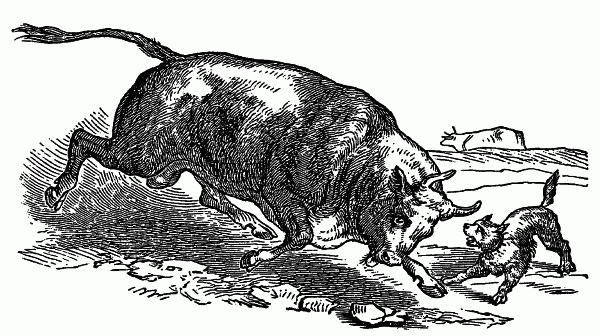
THE MAD BULL.
"The ergot, or spur of the hay, is confined to the June grass, as far as
my observation extends; owing, probably, to its early maturity. Most
other kinds of grass are cut before the seeds have matured sufficiently
to produce the spur. I was suspicious of the foulness of the feed before
I examined any hay, and have found the spur in the hay wherever the
disease is found.
"Mr. Sanford, of Edinburgh, Ohio, purchased one half of a mow of hay
from Mr. Bassett, of Randolph, which was removed to his farm in
Randolph, eight miles distant. Of this hay, Mr. Sanford fed eleven cows
some six or eight weeks. Mr. Bassett had been feeding the same to four
cows. At about the same time, both heads began to show lameness. I
visited Mr. S. after he had lost six cows, and examined the remaining
five, four of which were lame and the other showed symptoms of the
disease. He had two other cows, one of which was loaned to a neighbor,
and the other was fed upon different hay, for convenience. The loaned
cow was returned about the first of March,—the two then running with
the ailing ones until the 24th of April, when I saw them sound and in
good health.
"I then visited Mr. Bassett's stock, which I found infected with the
same disease,—he having lost one, and the remaining three being lame,
and much debilitated. The hoofs were sloughing off. Some of the same hay
remained in the snow, which, upon examination, exhibited an abundance of
the spur. Upon inquiry, I found that no such disease existed between the
two farms, or in the neighborhood of either Mr. S. or Mr. B. The
peculiarity of this circumstance at once swept away the last vestige of
doubt from my mind. Mr. E. Chapman, of Rootstown, accompanied me, and
can vouch for the correctness of these statements.
"He hooted at my opinions, asserting that he understood the disease, and
that it was caused by the freezing of the feet. He has since, however,
abandoned that idea, and honestly 'acknowledged the corn.' This ergot is
regarded by some as a parasitic fungus, formed in other grains, an
abundant vegeto-animal substance, and much disposed to putrefaction. We
appear to be in the dark regarding its real composition. The little
which has been written upon the subject, appears to be founded upon
hypothesis, and that the most obscure. The articles to which I refer may
differ in quality or property to a considerable extent, and we may
forever remain in the dark, unless chemical investigation be instituted.
"In this particular disease, there appears to be singularity in the
symptoms through all its various stages, which is likely to originate in
the peculiarity of the cause which produces them. The effects and
symptoms arising from the continued use of the ergot of rye, as
manifested in the human system, have been but briefly hinted at by
authors, and, probably, some of them are only reasonable conjectures.
All they say is, that it produces violent headache, spaculation in the
extremities, and death. Hitherto, its effects upon the inferior animal
have been subjected to no investigation, and its peculiarity in the
symptoms, differing from like phenomena by other causes,
may yet be demonstrated. I am not alone in my opinion of this disease. I
have taken counsel of those whose judgment cannot be questioned.
Whatever difference of opinion exists is attributable to a want of
investigation, and it will continue to exist until this singular
phenomenon is clearly accounted for. Every opinion should
be thoroughly criticized till facts are obtained. Every man's opinion is
sacred to himself, but we should yield to conviction.
"Two classes of this disease are exhibited: one, of irritation, and the
other, of debility; one, an acute, the other, a chronic form. The point
at which it assumes the chronic form is between congestion and
gangrene. By close observation we can discover these to be different and
higher degrees of the same disease. All subsequent degrees are dependent
upon the first.
"The first symptom, or degree, is, probably, an attack upon the
systematic circulation, produced by a certain medicinal and deleterious
property existing in the ergot, and communicated to the blood through
the absorption of the tongue. This is more evident from the fact that
the digestive organs retain their normal condition till the last stages
of the chronic form. The blood in the first two stages is healthy, and
the peculiar influence is only apparent in the subsequent stages; as
evidenced by the fact that the muscles and general good appearance, as
well as life itself, last longer than could be possible, if this
deleterious influence were exhausted upon the digestive organs and the
blood, in its first stages. And, as we suppose that fever and congestion
constitute an attack upon the red blood, which is exhibited by hurried
pulsation, we might rationally infer that the next degree would be
gangrene of the globule, causing sloughing, the same as if it were
carried to the muscles, or surface. This sloughing of the globule would
be the same as if exhibited on any other part of the organization, for
the fibrin is identical with muscle, as albumen is identical with the
white of an egg; and since congestion is the forerunner of gangrene at
the extremities, or on the surface, so fever and quick pulsation are the
forerunners of congestion of the blood. Gangrene cannot ensue without
obstruction in the blood-vessels; and congestion cannot take place
without obstruction in that which sustains the globule. As gangrene,
then, is the first stage of decomposition of animal matter, so is
congestion the first stage of decomposition of the globule; and as
mortification is death in the organized body, so is congestion death in
the organized globule.
"It appears evident that this disease, in all its forms and degrees of
intensity, seeks vent or release; in other words, Nature conflicting
with it, throws it off its track, or balance, and offers means of
escape, or shows it a door by which it may make its exit. In the first
stage of the disease, the dermoid (skin) tissues make the effort. In the
inflammatory, the serous, and the congestive, the mucous gangrene seeks
vent; if obtained, mortification is prevented; if not, mortification
directly supervenes, and death terminates the case.
"In the case to which I refer, observation confirms my opinion that
absolute mortification without vent determines the gangrene of the
blood, and is hardly curable; but that gangrene's finding vent
determines it to be curable, and the recovery highly probable."
Catarrh frequently assumes an epizoötic form of a very virulent
character, originating spontaneously and extending over a large section
of country at or about the same time. A cold spring succeeding a mild
winter, is peculiarly productive of malignant catarrh. This is one of
the most distressing and fatal diseases to which cattle are subject.
Symptoms.—The animal appears dull, and unwilling to move about,
staggering when forced to do so; obstinate costiveness is usually one of
the earliest symptoms, succeeded by diarrhœa, which is equally
difficult of management; sometimes, however, diarrhœa is present
from the first; the animal loses flesh rapidly; the coat is staring;
appetite is lost; tumors form about the head, neck, back, and joints,
which appear to be filled with air, and upon pressure cause a
crepitating sound; saliva flows from the mouth, becoming very fetid as
the disease progresses. The animal always dies of putrefaction.
Treatment.—This disease should be treated early, or not at all. Good
nursing is very essential. When costiveness is present, give Barbadoes
aloes, one ounce; croton-oil, ten drops; mix together; or give one pint
of linseed-oil, to which add from ten to twenty drops of castor-oil. If
the bowels are not open in twenty-four hours, give four ounces of
sulphate of magnesia every six hours until they are opened. Follow this
with tincture of aconite, ten drops in water, every four hours, until
the fever has abated.
Bleeding has been recommended by some writers; but the author has failed
to experience any benefit from resorting to it, but, on the contrary,
has seen much injury result from the use—or, rather, the abuse—of the
lancet. He is, indeed, inclined to attribute much of the fatality
attending this disease to indiscriminate blood-letting.
When much debility exists, the animal should be sustained by tonics and
stimulants. One ounce of nitric ether and half an ounce of tincture of
opium, given in a little water, will be found beneficial. It should be
given twice a day. Pulverized gentian-root, one ounce; Jamaica ginger,
half an ounce; pulverized cloves, half an ounce; mixed, and divided into
four powders, one to be given at night and at morning; will be found
useful, in place of the opium and ether.
This disease is properly known by the name of clue-bound. The manyplus,
or omasum (third stomach), frequently becomes so choked up with food
that it is hard and dry, and the operation of the digestive organs is
very seriously impaired. The animal eats voraciously, for a time, but
stops suddenly and trembles; the countenance assumes a peculiarly
haggard appearance; there is a wild expression of the eye; a foaming at
the mouth; a tendency to pitch forward, and at times a falling
head-foremost to the ground. Occasionally, the symptoms are very active,
speedily terminating in death. There are few diseases of a
constitutional character in which the stomach is not, more or less,
sympathetically involved.
"Toward the end of September, 1746, a great number of cows died at
Osterwich, in the principality of Halberstadt. Lieberkuhn, a celebrated
physician,—there were no veterinary surgeons at that time,—was sent to
examine into the nature of the disease, which was supposed to be one of
the species of murrain that was then committing such ravages among the
cattle in various parts of the Continent. There were none of the tumors,
or pestilential buboes, that, in an earlier or later period of the
malady, usually accompanied and characterized murrain; but upon
inspection of the dead bodies, considerable peritoneal inflammation was
found; the first and second stomachs were filled with food, but the
third stomach was the palpable seat of the disease; its leaves were
black and gangrened. The mass contained between the leaves was black,
dry, and so hard that it could scarcely be cut with a scalpel. It
intercepted the passage of the food from the first two stomachs to the
fourth; and this latter stomach was empty and much inflamed. Neither the
heart, nor the lungs, nor the intestines exhibited any trace of disease.
Twelve cows were opened, and the appearances were nearly the same in all
of them."
Treatment.—Give one and a half pounds of Epsom-salts, dissolved in
three pints of water; or one quart of potash, three times daily,
dissolved in water, will be found useful in this disease.
This is caused by hard or irritating substances making their way in
between the claws of the foot, causing inflammation, and sometimes
ulceration, in the parts. The pasterns swell, and the animal becomes
lame.
The foot should be thoroughly washed, and all foreign substances
removed. A pledget of tow, saturated with tar and sprinkled with
powdered sulphate of copper, should be inserted between the claws. This
usually requires but one or two applications.
This is a hard, knotty condition of the udder, which sometimes follows
calving, in consequence of the sudden distention of the bag with milk;
and the inflammation which supervenes causes a congealed or coagulated
condition of the milk to take place, of which, if neglected, suppuration
and abscesses are the result.
Treatment.—Let the calf suck the dam as speedily as possible, and, if
the hardness is not then removed, foment the udder with warm water;
after which, wipe it dry, and apply to the entire surface melted lard as
hot as the animal will bear. This is, generally, all that is required,
the most obstinate cases yielding to it. If abscesses form, they should
be lanced.
This disease—otherwise known as wood-evil, or moor-ill—arises from
eating the buds of oak, young ash, and other trees, which are of a very
highly stimulating or irritating character. As the intestinal canal is
liable to inflammatory action from irritant substances admitted into it,
animals are found to become diseased from eating too freely of these
vegetable substances.
Symptoms.—Loss of appetite and suspended rumination; mouth hot; skin
dry; pulse from sixty to seventy; swelling and pain of the belly;
obstinate constipation; fæces hard and covered with blood; urine of a
strong odor, highly colored, and voided with difficulty.
Treatment.—The animal should be bled, and a strong purgative
administered, followed by aconite and belladonna, as in enteritis.
Injections of Castile-soap and water should be freely used; the
application of the mustard, hartshorn, and water to the belly will also
be found very beneficial.
This disease—known also as catarrh—is occasionally the sequence of
coryza, but more frequently it arises from an impure atmosphere;
consequently, in cow-houses where animals are crowded together in
numbers, it is most frequently found. Scanty provender, and of an
inferior quality, is among the exciting causes of hoose, producing, as
it does, a debilitated state of the system, which, upon exposure of the
animal to cold, or wet, hastens the disorder. Some breeds of cattle are
peculiarly liable to this disease, which, if not arrested in its early
stage, runs on, involving the lungs, and frequently terminating in
consumption. Of all our domestic animals, neat cattle are most subject
to pulmonary diseases. This is attributable to the neglect and exposure
which are far too often their lot. Butchers will testify that a large
portion of all cattle slaughtered have abscesses and other diseases of
the lungs.
Symptoms.—Loss of appetite; muzzle dry; coat rough, or staring;
respiration quickened; horns hot; ears, nose, and legs cold; husky
cough; pulse from sixty to seventy, small and thready; bowels frequently
constipated.
Treatment.—Give one ounce of the following powders every six hours,
until the bowels are opened: Barbadoes aloes, one and half ounces;
nitrate of potassa, half an ounce; ginger, six drachms; mix and divide
into six powders. Setons in the dewlap are often of great benefit.
Hoove, or blown, so common, and often so speedily fatal in cattle, is
the result of fermentation in the rumen, or paunch, in consequence of
the animal's having eaten large quantities of wet grass, luxuriant
clover, turnips, etc. An accumulation of gas is the result of this
fermentation, which greatly disturbs the haunch and left side of the
belly, causing much pain to the animal, and frequently threatening
suffocation.
Treatment.—Drench the animal with one ounce of spirits of hartshorn
in one quart of water, the object being to neutralize the gas which is
present in the rumen; or, two ounces of table salt dissolved in one
quart of water will be found very effectual. If these do not speedily
give relief, an active purge should be given. Injections of soap and
water should be freely used. If the case still proves obstinate, and the
life of the animal is threatened, the paunch should be punctured. For
this purpose, the trochar—an instrument specially adapted—should be
used; but, in the absence of an instrument, an ordinary pocket-knife may
be employed, taking care not to make a large opening. The proper point
to operate is midway between the last rib and the prominent point of the
hip-bone, about twelve inches from the centre of the back or loins. Few
cases have a fatal termination where this operation has been properly
performed.
Worms in the brain occasionally occur, causing great uneasiness to the
animal and generally proving fatal.
The symptoms are, loss of appetite; suspended rumination; a fevered
condition of the system; horns and ears hot; respiration disturbed; coat
staring, etc. No course of treatment will prove efficacious in this
disease.
Pressure on the brain may occur from an accumulation of water, tumors,
bruises, etc., in the cranial case. In either case, the same effects are
produced as are observed in apoplexy.
Inflammation of the bladder generally accompanies inflammation of the
kidneys, though it is sometimes found disconnected and alone. It is
occasionally caused by calculous concretions in the bladder,—which
should be removed,—causing very acute abdominal pain to the animal. She
makes frequent efforts to stale, passing but a few drops of urine at a
time. The pulse is full and rapid; mouth clammy; nose dry; eyes
bloodshot; appetite lost; moaning, and walking with a staggering gait.
Treatment.—Inject into the bladder one quart of tepid water, and from
one to two ounces of tincture of opium mixed together. Give internally
one of the following powders every hour until relieved; nitrate of
potassa, one ounce; tartrate of antimony, and pulverized digitalis
leaves, each one drachm; mix, and divide into six powders. Mucilaginous
draughts should be freely given.
Rupture of the bladder sometimes occurs, but there are no symptoms by
which it may be known; and, if there were, no service could be rendered
in the way of repairing the injury; the animal must die.
The ox, like the horse, has a membrane of semilunar form in the inner
corner of the eye, which is capable of being thrown over the entire
eyeball, for the purpose of cleansing the eye from any foreign substance
which may get into it. This membrane is commonly called the haw, and is
susceptible of attacks of inflammation, which cause it to swell,
frequently even closing up the eye.
Treatment.—Give a dose of physic, and, if the animal is plethoric,
extract a little blood from the vein on the same side as the affected
eye. Apply to the eye either of the following washes: tincture of opium,
one ounce; rain-water, one pint; or, tincture of aconite, one drachm, to
one pint of water. Bathe two or three times a day.
This disease—sometimes called nephritis—occurs occasionally in cattle
in consequence of their eating bad or unwholesome food, or of the abuse
of diuretics, etc.
The symptoms are very insidious in their approach. The loins are very
tender upon pressure; the urine is voided in small quantities. As the
disease advances, the symptoms become more marked and acute. The animal
is dull, and feeds daintily; the evacuation of urine is attended with
increased pain, and the urine is highly colored and bloody; the nose is
dry; the horns, ears, and extremities are cold; respiration hurried; the
pulse full, hard, and throbbing.
Treatment.—Give one pint of linseed-oil and ten drops of castor-oil,
mixed together; follow this with small doses of salts once a day, for
three or four days; give injections of water, one half a gallon to two
ounces of tincture of arnica. Mustard applications to the loins are also
very useful.
Diseases of the liver are of very common occurrence,—a fact with which
all beef-butchers are familiar. Perhaps no organ in the animal economy
is so liable to disease. The obscurity of the symptoms and the good
condition of the animal prevent its discovery, as a general thing,
during its lifetime. When, however, the disease assumes an active
form,—known as the yellows, jaundice, or inflammation of the
liver,—the symptoms are more readily detected.
Symptoms.—A yellowish color of the eye will be observed; skin, urine,
etc., highly colored; soreness, on pressure, on the right side; loss of
appetite; dullness; constipation of the bowels, etc.
Treatment.—Calomel is the most reliable medicine known to
practitioners for diseases of the liver. Its abuse, however, has brought
it into disrepute. Yet, as with ordinary care it may be advantageously
used, we will prescribe it as that upon which the most dependence is to
be placed, and in doing so, will endeavor to have it used safely.
Bleeding has been recommended: but the author has never found any
benefit resulting. Give Epsom-salts, in doses of four ounces each, every
night, with one scruple of calomel, until the animal is relieved.
Mustard and water should be frequently applied to the right side, and
well rubbed in.
This disease is of rare occurrence in cattle. In it, the mucous membrane
lining the larynx is in a very irritable condition; the least pressure
upon the parts affected causes intensely excruciating pain; the
respiration becomes quick, painful, and laborious; the animal often
appears to be hungry, yet does not eat much, in consequence of the pain
occasioned by the act of swallowing.
Treatment.—Apply to the throat externally strong mustard, mixed, with
equal parts of aqua ammonia and water, to a thin paste, every hour,
until it produces an effect upon the skin; sponging the parts each time
with warm water before applying the mustard. The animal should not be
bled. Give upon the tongue, or in drink, half-drachm doses of nitrate of
potassa, every three or four hours, until relief is obtained. If
suffocation threatens, the operation of tracheotomy is the only resort.
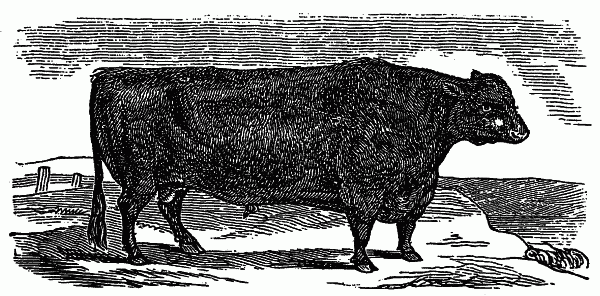
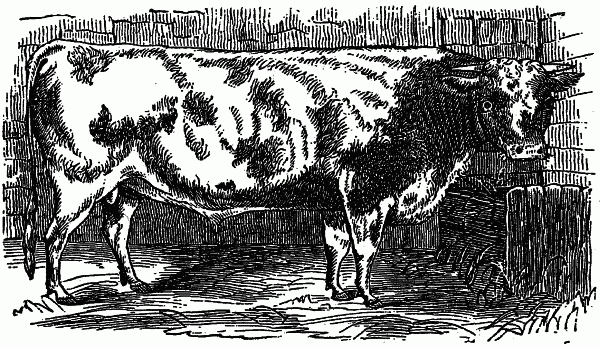
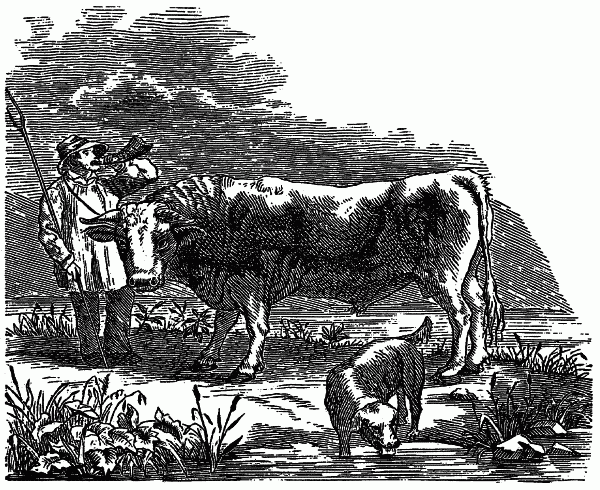
AN ABERDEENSHIRE POLLED BULL.
Cloths saturated with cold water, wrapped around the neck so as to cover
the larynx, frequently afford relief. A purgative will also be found
useful.
Cattle are very subject to lice, particularly when they are neglected,
half-starved, and in poor condition. Good care and good feeding—in
connection with the treatment recommended in mange, to which the reader
is referred—will comprise all that is requisite.
Mange, or leprosy, is one of the most unpleasant and difficult diseases
to manage of all the ailments to which cattle are subject requiring the
nicest care and attention to render it easy of cure. An animal badly
nursed will not, under the most skillful treatment, quickly recover. Its
causes are in the main, due to poor food, which produces a debilitated
condition of the system, and in connection with a want of cleanliness,
causes a development of the acari, or minute insects, exciting very
great irritation upon the skin and causing the cow to rub herself
against every object with which she comes in contact. The hair falls
off; a scurfy appearance of the skin is perceptible; and the animal is
poor in condition and in milk. The great trouble in treating this
disease springs from its contagious character; for, no sooner is the
animal, oftentimes, once free from the acari than it comes in contact
with some object against which it has previously been rubbing, when the
acari which were left upon that object are again brought in contact
with the animal, and the disease is reproduced. If, immediately after
the proper applications are made, the animal is removed to other
quarters, and not allowed to return to the former ones for six or eight
weeks, there is, generally speaking, but little trouble in treating the
disease.
Take the animal upon a warm, sunny day, and with a scrubbing-brush
cleanse the skin thoroughly with Castile-soap and water; when dry, apply
in the same manner the following mixture; white hellebore, one ounce;
sulphur flower, three ounces; gas-water, one quart; mix all well
together. One or two applications are, generally, all that will be
required. Give internally one of the following powders in the feed,
night and morning: flowers of sulphur, two ounces; black antimony, one
ounce; nitrate of potassa, one ounce; mix, and divide into eight
powders.
This is one of the most malignant diseases to which cattle are liable.
Fortunately, however, true murrain is comparatively rare in this great
stock-raising country.
The entire system seems to partake of the disease. The first indication
of its approach is a feverish condition of the system, attended with a
frequent and painful cough; the pulse is small, hard, and rapid. As the
disease advances, the respiration becomes disturbed; the flanks heave;
vesicular eruption is observed upon the teats, mouth, and feet; the
horns are cold; the animal is sometimes lame; constipation and,
sometimes, diarrhœa are accompanying symptoms; fæces black and
fetid; the eyes weep and become much swollen; great tenderness along the
spine; a brown or bloody discharge from the nose and mouth; the animal
moans incessantly, grinds his teeth, rarely lies down, but to get up
again quickly; finally, the breath becomes very offensive; tumors make
their appearance in various parts of the body, which, in favorable
cases, suppurate, and discharge a fetid matter.
Treatment.—Give one fourth of a pound of Epsom-salts, with one drachm
of Jamaica ginger, twice a day, for two or three days. A bottle of
porter, twice a day, will be found serviceable. Very little medicine is
required internally in this disease, but much depends upon good nursing.
External applications are chiefly to be depended upon. A solution of
chloride of lime should be applied to the eruptions, or a solution of
the chloride of zinc, twenty grains to an ounce of water; or, of
sulphate of zinc, two drachms to a pint of water; or pulverized
charcoal applied to the parts will be found useful.
Inflammation of the navel in calves occasionally occurs, causing
redness, pain, and sudden swelling in the part affected. This disease,
if not promptly attended to, speedily carries off the creature.
Treatment.—Foment the part well with warm hop-tea; after which, the
application of a cloth, well saturated with lead-water and secured by
bandages, should be applied. Internally, doses of Epsom-salts, of two
ounces each, dissolved in half a pint of water, should be given until
the bowels are acted upon. After the inflammation has subsided, to
counteract the weakness which may follow, give a bottle of porter two or
three times a day.
Choking in cattle is of common occurrence, in consequence of turnips,
potatoes, carrots, or other hard substances, becoming lodged in the
œsophagus, or gullet.
These obstructions can sometimes be removed by careful manipulations
with the hand; but, where this can not be accomplished, the flexible
probang should be employed. This is a long India-rubber tube, with a
whalebone stillet running through it, so as to stiffen it when in use.
This instrument is passed down the animal's throat, and the offending
substance is thus pushed down into the stomach.
Opening of the joint generally results from accidents, from puncturing
with sharp substances, from kicks, blows, etc. These injuries cause
considerable nervous irritation in the system, and sometimes cause
lock-jaw and death.
Treatment.—Close up the wound as speedily as possible. The
firing-iron will sometimes answer the purpose very well. The author
depends more upon the application of collodion—as recommended in his
work upon "The Horse and His Diseases" for the same trouble—than upon
any other remedy. It requires care in its application, in order to make
it adhere firmly. Shoemakers'-wax, melted and applied, answers a very
good purpose.
In natural labor—as has been suggested in a former part of this
work—the aid of man is rarely required in bringing away the calf. But
it not infrequently happens that, from malformation or wrong
presentation, our assistance is required in order to deliver the animal.
The brute force, which has been far too often heretofore resorted to,
should no longer be tolerated, since the lives of many valuable animals
have been sacrificed by such treatment. Very often, by gentle
manipulation with the greased hand, the womb can be so dilated as to
afford a comparatively easy exit for the fœtus.
If, however, the calf is presented wrong, it must be pushed back and
placed in its proper position, if possible. In natural labor, the
fore-legs, with the head lying between them, are presented; in which
position—unless deformity, either in the pelvis of the cow, or in the
fœtus, exists—the calf is passed with little difficulty, and
without assistance. It sometimes happens that the head of the fœtus
is turned backward. When this happens, the attendant should at once
strip himself to the waist, bathe his arms, and hands with a little
sweet-oil, or lard, and introduce them into the vagina, placing a cord
around both fore-feet, and then, pushing them back, search for the head,
which is to be brought forward to its proper position. The feet are next
to be brought up with it. No force should be used, except when the cow
herself makes the effort to expel the calf; otherwise, more harm than
good may be done.
A case of this kind recently occurred in the author's practice, being
the third within a year. The subject was a cow belonging to William
Hance, Esq., of Bordentown, New Jersey. After she had been in labor for
some twenty hours, he was called upon to see her. Upon inquiry, he found
that several persons had been trying, without success, to relieve her.
She was very much prostrated, and would, doubtless, have died within two
or three hours, had no relief been afforded. The legs of the fœtus
protruded as far as the knees; the head was turned backward, and with
the body, pressed firmly into the vagina, so that it was impossible to
return it, or to bring the head forward. The operation of embryotomy
was, therefore, at once performed, by cutting away the right shoulder,
which enabled the operator, with the aid of his appropriate hooks, to
bring the head forward, when the calf came away without further
trouble,—the whole operation not requiring fifteen minutes. The
uterus was then washed out, and the animal placed in as comfortable a
position as possible, and a stimulating draught given, composed of two
ounces of nitric ether, one ounce of tincture of opium, and a half pint
of water. This was followed with a few doses of Fleming's tincture of
aconite, ten drops in a little water, every few hours. In a few days the
animal had entirely recovered.
Occasionally, the head comes first, or the head and one leg. In such
cases, a cord should be slipped around the jaw and leg, and these then
pushed back, so as to allow the other leg to be brought up. When this
cannot be done, the fœtus can, in most cases, be removed in the
original position.
Breech, side, back, and other presentations sometimes occur; in all of
which instances, the fœtus must be turned in such a position that
it can be brought away with as little trouble as possible. When this
cannot be accomplished, the only resort is embryotomy, or cutting up of
the fœtus, which operation can only be safely performed by the
qualified veterinary surgeon.
Since writing the above, another case has occurred in the author's
practice. The cow—belonging to Samuel Barton, Esq., near Bordentown,
New Jersey—had been in labor some eighteen hours; upon an examination
of the animal, the calf was found to be very much deformed, presenting
backwards,—one of the hind-legs having been pulled off by the person or
persons assisting her previous to the author's arrival. Finding it
impossible to deliver her in the usual way, embryotomy was
in this instance employed. By this means, after taking out the
intestines, lungs, etc., of the fœtus, and cutting away its
hind-quarters, the fore-parts were brought away. The head presented a
singular appearance; the under jaw was so twisted as to bring the front
teeth on the side of the face; the spinal column or back-bone, was
turned twice around, resembling a spiral string; the front legs were
over the back; the ribs were much contorted; the hind-parts were as much
deformed; and, taken altogether, the deformity was the most singular
which has been brought under the author's observation.
Free Martins.—It has long been supposed by stockbreeders, that if a cow
produce twins, one of which is a male and the other a female, the female
is incapable of producing young, but that the male may be a useful
animal for breeding purposes. Many instances have occurred when the twin
sister of a bull has never shown the least desire for the male.
This indifference to sexual commerce arises, doubtless, from the
animal's being but imperfectly developed in the organs of generation.
This fact has been established by the investigations of Mr. John Hunter,
who had three of these animals slaughtered for anatomical examination.
The result is thus reported: "The external parts were rather smaller
than is customary in the cow. The vagina passed on, as in the cow, to
the opening of the urethra, and then it began to contract into a small
canal, which passed on into the division of the uterus into the two
horns; each horn passed along the edge of the broad ligament laterally
toward the ovaria.
"At the termination of these horns were placed both the ovaries and the
testicles. Both were nearly of the same size, which was about as large
as a small nutmeg. To the ovaria, I could not find any Fallopian
tube.
"To the testicles were vasa deferentia, but they were imperfect. The
left one did not come near the testicle; the right one only came close
to it, but did not terminate in the body called the epididymis. They
were both pervious and opened into the vagina, near the opening of the
urethra.
"On the posterior surface of the bladder, or between the uterus and
the bladder, were the two bags, called vesiculæ seminales in the male,
but much smaller than they are in the bull. The ducts opened along with
the vasa deferentia. This animal, then, had a mixture of all the
parts, but all of them were imperfect."
Well-authenticated cases have, however, occurred where the female has
bred, and the offspring proved to be good milkers. There are several
instances on record of cows' giving birth to three, four, and even five
calves at a time. There were on exhibition, in 1862, at Bordentown, New
Jersey, three free martins, two sisters and a brother, which were
beautiful animals. These were from a cow belonging to Mr. Joab Mershon,
residing on Biles Island, situated in the Delaware River, a short
distance above Bordentown. They were calved November 1st, 1858, and were
therefore nearly four years of age. They had never shown the least
desire for copulation. Their aggregate weight was 4300 pounds.
We extract the following from the London Veterinarian, for 1854:—"A
cow, belonging to Mr. John Marshall, of Repton, on Wednesday last, gave
birth to five, live healthy calves, all of which are, at the time I
write, alive and vigorous, and have every appearance of continuing so.
They are all nearly of a size, and are larger and stronger than could be
supposed. Four of them are bull-calves.
"The dam is by no means a large one, is eleven years old, of a mongrel
breed, and has never produced more than one offspring at any previous
gestation. I saw her two days after she had calved, at which time she
was ruminating, and did not manifest any unusual symptoms of exhaustion.
I may mention that the first four calves presented naturally; the fifth
was a breech-presentation."
Cleansing.—The placenta, or after-birth, by which the fœtus is
nourished while in embryo, should be removed soon after calving.
Generally, it will come away without any assistance. This is what is
called "cleansing after calving." When, however, it remains for some
time, its function having been performed, it becomes a foreign body,
exciting uterine contractions, and therefore injurious. The sooner,
then, it is removed, the better for the animal as well as the owner. To
accomplish this, the hand should be introduced, and, by pulling gently
in various directions, it will soon yield and come away. Should it be
allowed to remain, it rapidly decomposes, producing a low, feverish
condition of the system, which greatly interferes with the general
health of the animal.
Inversion of the Uterus.—The uterus is sometimes turned inside out
after calving. This is, generally, the result of debility, or severe
labor. The uterus should be replaced as carefully as possible with the
hands, care being taken that no dirt, straw, or other foreign substance
adheres to it. Should it again be expelled, it would be advisable to
quiet the system by the use of an anæsthetic, as chloroform, or—which
is much safer—chloric ether. As soon as the animal is under the
influence of this, the uterus may be again replaced. The
hind-quarters should be raised as high as possible, in order to favor
its retention. The animal should have a little gruel and a bottle of
porter given to her every five or six hours, and the vulva should be
bathed frequently with cold water.
Inflammation of the brain is one of those dreadful diseases to which all
animals are liable. It is known to the farmer as frenzy, mad staggers,
etc.
The active symptoms are preceded by stupor; the animal stubbornly stands
in one position; the eyes are full, red, and fiery; respiration rapid;
delirium soon succeeds; the animal, bellowing, dashes wildly about, and
seems bent on mischief, rushing madly at every object which comes in its
way.
The causes of this disease are overwork in warm weather, a plethoric
condition of the system, and too stimulating food. Prof. Gamgee, of the
Edinburgh Veterinary College, relates a case resulting from the presence
within the external meatus of a mass of concrete cerumen, or wax,
which induced inflammation of the ear, extending to the brain.
Treatment.—As this is attended with considerable risk, unless it is
taken prior to the frenzied stage, bleeding almost to fainting should be
resorted to, and followed by a brisk purge. Take one ounce of Barbadoes
aloes, and ten to fifteen drops of Croton-oil; mix the aloes with one
pint of water and the oil, using the mixture as a drench. One pound of
Epsom-salts will answer the purpose very well, in cases where the aloes
and oil cannot be readily obtained. Application of bags of broken ice to
the head, is very beneficial. Spirits of turpentine, or mustard,
together with spirits of hartshorn and water should be well rubbed in
along the spine, from the neck to the tail.
This is an inflammation of the pleura, or the serous membrane which
lines the cavity of the chest, and which is deflected over the lungs.
Inflammation of this membrane rarely occurs in a pure form, but is more
generally associated with inflammation of the tissue of the lungs. If
this disease is not attended to at an early period, its usual
termination is in hydrothorax, or dropsy of the chest. The same causes
which produce inflammation of the lungs, of the bronchia, and of the
other respiratory organs, produce also pleurisy.
Symptoms.—The respiration is quick, short, and painful; pressure
between the ribs produces much pain; a low, short, painful cough is
present; the respiratory murmur is much diminished,—in fact, it is
scarcely audible. This condition is rapidly followed by effusion, which
may be detected from the dullness of the sounds, on applying the ear to
the lower part of the lungs. The febrile symptoms disappear; the animal
for a few days appears to improve, but soon becomes weak, languid, and
often exhausted from the slightest exertion.
Treatment.—The same treatment in the early stage is enjoined as in
inflammatory pneumonia, which the reader will
consult—counter-irritation and purgatives. Bleeding never should be
resorted to. When effusion takes place, it is necessary to puncture the
sides with a trochar, and draw away the fluid, giving internally one of
the following purges three times a day: rosin, eight ounces; saltpetre,
two ounces, mix, and divide into eight powders. Half-drachm doses of
the iodide of potash, dissolved in water, to be given three times daily,
will be found useful in this disease.
This disease, as its name implies, is an inflammatory condition of the
lungs and the pleura, or the enveloping membrane of the lungs and the
lining membrane of the chest. It is sometimes called contagious,
infectious, and epizoötic pleuro-pneumonia,—contagious or infectious,
from its supposed property of transmission from the diseased to the
healthy animal.
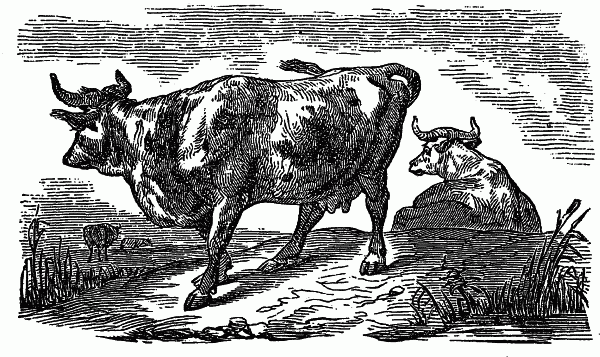
TAKING AN OBSERVATION.
A contagious character the author is not ready to assign to
it,—contagious, as he understands it, being strictly applicable to
those diseases which depend upon actual contact with the poison that it
may be communicated from one animal to another. This does not
necessarily imply the actual touching of the animals themselves; for it
may be communicated from the poison left in the trough, or other places
where the diseased animal has been brought in contact with some object,
as is often the case in glanders in the horse; the matter discharged
from the nose, and left upon the manger, readily communicating that
disease to healthy animals coming in contact with it. Contagious
diseases, therefore, travel very slowly, starting, as they do, at one
point, and gradually spreading over a large district, or section of
country.
This disease is, however, regarded by the author as infectious; by which
term is meant that it is capable of being communicated from the diseased
to the healthy animal through the medium of the air, which has become
contaminated by the exhalations of poisonous matter. The ability to
inoculate other animals in this way is necessarily confined to a limited
space, sometimes not extending more than a few yards. Infectious
diseases, accordingly, spread with more rapidity than contagious ones,
and are, consequently, more to be dreaded; since we can avoid the one
with comparatively little trouble, while the other often steals upon us
when we regard ourselves as beyond its influence, carrying death and
destruction in its course.
The term by which this disease is known, is a misnomer. Pleuro-pneumonia
proper is neither a contagious, nor an infectious disease; hence, the
denial of medical men that this so-called pleuro-pneumonia is a
contagious, or infectious disease, has been the means of unnecessarily
exposing many animals to its poisonous influence.
In the Recuéil de Médécine Vétérinaire, for 1833, will be found a very
interesting description of this fatal malady. The author, M. Lecoy,
Assistant Professor at the Veterinary School of Lyons, France, says:
"There are few districts in the arrondissement of Avesnes where more
cattle are fattened than in that of Soire-le-Chateau. The farmers being
unable to obtain a sufficient supply of cattle in the district, are
obliged to purchase the greater part of them from other provinces; and
they procure a great number for grazing from Franche Comté. The cattle
of this country are very handsome; their forms are compact; they fatten
rapidly; and they are a kind of cattle from which the grazer would
derive most advantage, were it not that certain diseases absorb, by the
loss of some of the animals, the profits of the rest of the herd.
Amongst the diseases which most frequently attack the cattle which are
brought from the North, there is one very prevalent in some years, and
which is the more to be dreaded as it is generally incurable; and the
slaughter of the animal, before he is perceptibly wasted, is the only
means by which the farmer can avoid losing the whole value of the beast.
"This disease is chronic pleuro-pneumonia. The symptoms are scarcely
recognizable at first, and often the beast is ill for a long time
without its being perceived. He fattens well, and when he is slaughtered
the owner is astonished to find scarcely half of the lungs capable of
discharging the function of respiration. When, however, the ox has not
sufficient strength of constitution to resist the ravages of disease,
the first symptom which is observed is diminution, or irregularity of
appetite. Soon afterwards, a frequent, dry cough is heard, which becomes
feeble and painful as the disease proceeds. The dorso-lumbar portion of
the spine (loins) grows tender; the animal flinches when the part is
pressed upon, and utters a peculiar groan, or grunt, which the graziers
regard as decisive of the malady.
"Quickly after this, the movements of the flanks become irregular and
accelerated, and the act of respiration is accompanied by a kind of
balancing motion of the whole body. The sides of the chest become as
tender as the loins, or more so; for the animal immediately throws
himself down, if pressed upon with any force. The elbows become, in many
subjects, more and more separated from the sides of the chest. The pulse
is smaller than natural, and not considerably increased. The muzzle is
hot and dry, alternately. The animal lies down as in a healthy state,
but rumination is partially or entirely suspended. The fæces are
harder than they should be; the urine is of its natural color and
quantity; the mouth is often dry; and the horns and ears retain their
natural temperature.
"This first stage of the disease sometimes continues during a month, or
more, and then, if the animal is to recover, or at least, apparently so,
the symptoms gradually disappear. First of all, the appetite returns,
and the beast begins to acquire a little flesh. The proprietor should
then make haste and get rid of him; for it is very rare that the malady,
however it may be palliated for a while, does not reappear with greater
intensity than before.
"In most cases, the disease continues to pursue its course toward its
termination without any remission,—every symptom gradually increasing
in intensity. The respiration becomes more painful; the head is more
extended; the eyes are brilliant; every expiration is accompanied with a
grunt, and by a kind of puckering of the angles of the lips; the cough
becomes smaller, more suppressed, and more painful; the tongue protrudes
from the mouth, and a frothy mucus is abundantly discharged; the breath
becomes offensive; a purulent fluid of a bloody color escapes from the
nostrils; diarrhœa, profuse and fetid, succeeds to the constipation;
the animal becomes rapidly weaker; he is a complete skeleton, and at
length he dies.
"Examination after death discloses slight traces of inflammation in the
intestines, discoloration of the liver, and a hard, dry substance
contained in the manyplus. The lungs adhere to the sides and to the
diaphragm by numerous bands, evidently old and very firm. The substance
of the lungs often presents a reddish-gray hepatization throughout
almost its whole extent. At other times, there are tubercles in almost
every state of hardness, and in that of suppuration. The portion of the
lungs that is not hepatized is red, and gorged with blood. Besides the
old adhesions, there are numerous ones of recent date. The pleura is not
much reddened, but by its thickness in some points, its adhesion in
others, and the effusion of a serous fluid, it proves how much and how
long it has participated in the inflammatory action. The trachea and the
bronchia are slightly red, and the right side of the head is gorged with
blood.
"In a subject in which, during life, I could scarcely feel the beating
of the heart, I found the whole of the left lobe of the lungs adhering
to the sides, and completely hepatized. In another, that had presented
no sign of disease of the chest, and that for some days before his death
vomited the little fodder which he could take, the whole of that portion
of the œsophagus that passed through the chest was surrounded with
dense false membranes, of a yellowish hue, ranging from light to dark,
and being in some parts more than an inch in thickness, and adhering
closely to the muscular membrane of the tube, without allowing any
trace to be perceived of that portion of the mediastinal pleura on which
this unnatural covering was fixed and developed.
"The cattle purchased in Franche Comté are brought to Avesnes at two
periods of the year—in autumn and in the spring. Those which are
brought in autumn are much more subject to the disease than those which
have arrived in the spring; and it almost always happens that the years
in which it shows itself most generally are those in which the weather
was most unfavorable while the cattle were on the road. The journey is
performed by two different routes,—through Lorraine and through
Champagne,—and the disease frequently appears in cattle that have
arrived by one of these routes. The manner in which the beasts are
treated, on their arrival, may contribute not a little to the
development of the malady. These animals, which have been driven long
distances in bad weather, and frequently half starved, arrived famished,
and therefore the more fatigued, and some of them lame. Calculating on
their ravenous appetite, the graziers, instead of giving them wholesome
food, make them consume the worst that the farm contains,—musty and
mouldy fodder; and it is usually by the cough, which the eating of such
food necessarily produces, that the disease is discovered and first
developed.
"Is chronic pleuro-pneumonia contagious? The farmers believe that it is,
and I am partly of their opinion. When an animal falls sick in the
pasture, the others, after his removal, go and smell at the grass where
he has lain, and which he has covered with his saliva, and, after that,
new cases succeed to the first. It is true that this fact is not
conclusive, since the disease also appears in a great number of animals
that have been widely separated from each other. But I have myself seen
three cases in which the cattle of the country, perfectly well before,
have fallen ill, and died with the same symptoms, excepting that they
have been more acute, after they have been kept with cattle affected
with this disease. This circumstance inclines me to think that the
disease is contagious; or, at least, that, in the progress of it, the
breath infects the cow-house in which there are other animals already
predisposed to the same disease. I am induced to believe that most of
the serious internal diseases are communicated in this manner, and
particularly those which affect the organs of respiration, when the
animals are shut up in close, low, and badly-ventilated cow-houses."
[Rec. de Méd. Vét. Mai, 1833.]
No malady can be more terrible and ruinous than this among dairy-stock;
and its spread all over the country, together with its continuance with
scarcely any abatement, must be attributed to the combination of various
causes. The chief are: first, the very contagious or infectious nature
of the disorder; second, inattention on the part of Government to the
importation and subsequent sale of diseased animals; and, third, the
recklessness of purchasers of dairy or feeding cattle.
This disease may be defined as an acute inflammation of the organs of
the chest, with the development of a peculiar and characteristic poison,
which is the active element of infection or contagion. It is a disease
peculiar to the cattle tribe, notwithstanding occasional assertions
regarding observations of the disease among horses, sheep, and other
animals,—which pretended observations have not been well attested.
The infectious, or contagious nature of this virulent malady is
incontestibly substantiated by an overwhelming amount of evidence, which
cannot be adduced at full length here, but which may be classified under
the following heads: first, the constant spreading of the disease from
countries in which it rages to others which, previously to the
importation of diseased animals, had been perfectly free from it. This
may be proved in the case of England, into which country it was carried
in 1842, by affected animals from Holland. Twelve months after, it
spread from England to Scotland, by means of some cattle sold at
All-Hallow Fair, and it was only twelve months afterward that cattle
imported as far north as Inverness took the disease there. Lately, a cow
taken from England to Australia was observed to be diseased upon
landing, and the evil results were limited to her owner's stock, who
gave the alarm, and ensured an effectual remedy against a wider spread.
Besides, the recent importation of pleuro-pneumonia into the United
States from Holland appears to have awakened our agricultural press
generally, and to have convinced them of the stubborn fact that our
cattle have been decimated by a fearfully infectious, through probably
preventable, plague. A letter from this country to an English author
says: "Its (pleuro-pneumonia's) contagious character seems to be settled
beyond a doubt, though some of the V.S. practitioners deny it, which is
almost as reasonable as it would be to deny any other well-authenticated
historic fact. Every case of the disease is traceable to one of two
sources; either to Mr. Chenery's stock in Belmont (near Boston,
Massachusetts), into which the disease was introduced by his importation
of four Dutch cows from Holland, which arrived here the 23d of last May;
or else to one of the three calves which he sold to a farmer in North
Brookfield, Massachusetts, last June."
2dly. Apart from the importation into countries, we have this certain
proof—to which special attention was drawn several years ago—that
cattle-dealers' farms, and public markets, constitute the busy centres
of infection. Most anxious and careful inquiries have established the
proposition that in breeding-districts, where the proprietors of
extensive dairies—as in Dumfries, Scotland, and other places—abstain
from buying, except from their neighbors, who have never had diseases of
the lungs amongst their stock, pleuro-pneumonia has not been seen. There
is a wide district in the Vicinity of Abington, England, and in the
parish of Crawford, which has not been visited by this plague, with
the exception of two farms, into which market-cattle had been imported
and thus brought the disease.
3dly. In 1854 appeared a Report of the Researches on Pleuro-Pneumonia,
by a scientific commission, instituted by the Minister of Agriculture in
France. This very able pamphlet was edited by Prof. Bouley, of Alfort,
France. The members of the commission belonged to the most eminent
veterinarians and agriculturists in France. Magendie was President;
Regnal, Secretary; besides Rayer, the renowned comparative pathologist;
Yvart, the Inspector-General of the Imperial Veterinary Schools;
Renault, Inspector of the Imperial Veterinary Schools; Delafond,
Director of Alfort College; Bouley, Lassaigne, Baudemont, Doyére, Manny
de Morny, and a few others representing the public. If such a
commission were occasionally appointed in this country for similar
purposes, how much light would be thrown on subjects of paramount
importance to the agricultural community!
Conclusions arrived at by the commission are too important to be
overlooked in this connection. The reader must peruse the Report itself,
if he needs to satisfy himself as to the care taken in conducting the
investigations: but the foregoing names sufficiently attest the
indisputable nature of the facts alluded to.
In instituting its experiments, the commission had in view the solving
of the following questions:—
1stly. Is the epizoötic pleuro-pneumonia of cattle susceptible of
being transmitted from diseased to healthy animals by cohabitation?
2dly. In the event of such contagion's existing, would all the animals
become affected, or what proportion would resist the disease?
3dly. Amongst the animals attacked by the disease, how many recover,
and under what circumstances? How many succumb?
4thly. Are there any animals of the ox species decidedly free from any
susceptibility of being affected from the contagion of pleuro-pneumonia?
5thly. Do the animals, which have been once affected by a mild form of
the disease, enjoy immunity from subsequent attacks?
6thly. Do the animals, which have once been affected by the disease in
its active form, enjoy such immunity?
To determine these questions, the commission submitted at different
times to the influence of cohabitation with diseased animals forty-six
perfectly healthy ones, chosen from districts in which they had never
been exposed to a similar influence.
Of these forty-six animals, twenty were experimented on at Pomeraye, two
at Charentonneau, thirteen at Alfort, and eleven, in the fourth
experiment, at Charentonneau.
Of this number, twenty-one animals resisted the disease when first
submitted to the influence of cohabitation, ten suffered slightly, and
fifteen took the disease. Of the fifteen affected, four died, and eleven
recovered. Consequently, the animals which apparently escaped the
disease at the first trial amounted to 45.65 per cent., and those
affected to 21.73 per cent. Of these, 23.91 per cent. recovered, and
8.69 per cent. died. But the external appearances in some instances
proved deceptive, and six of the eleven animals of the last experiment,
which were regarded as having escaped free, were found, on being
destroyed, to bear distinct evidence of having been affected. This,
therefore, modifies the foregoing calculations, and the numbers should
stand thus:—
| 15 | enjoy immunity, | or | 32.61 | per cent. |
| 10 | indisposed, | " | 21.73 | " |
| 17 | animals cured, | " | 36.95 | " |
| 4 | dead, | " | 8.98 | " |
Of the forty-two animals which were exposed in the first experiments at
Pomeraye and Charentonneau, and which escaped either without becoming
affected, or recovering, eighteen were submitted to a second trial; and
of these eighteen animals, five had, in the first experiment, suffered
from the disease and had recovered; five had now become affected; and
four had been indisposed. The four animals submitted to the influence
of contagion a third time, had been affected on the occasion of the
first trial. None of the eighteen animals contracted the disease during
these renewed exposures to the influence of contagion.
From the results of these experiments, the commission drew the following
conclusions:—
1stly. The epizoötic pleuro-pneumonia is susceptible of being
transmitted from diseased to healthy animals by cohabitation.
2dly. All the animals exposed do not take the disease; some suffer
slightly, and others not at all.
3dly. Of the affected animals, some recover and others die.
4thly. The animals, whether slightly or severely affected, possess an
immunity against subsequent attacks.
These are the general conclusions which the commission deemed themselves
authorized to draw from their experiments. The absolute proportion of
animals which become affected, or which escape the disease, or of those
which die and which recover, as a general rule, cannot be deduced from
the foregoing experiments, which, for such a purpose, are too limited.
The commission simply state the numbers resulting from their
experiments. From these it transpires that forty five of the animals
became severely affected with pleuro-pneumonia, and twenty-one per cent.
took the disease slightly, making the whole sixty-six per cent. which
were more or less severely attacked. Thirty-four per cent. remained free
from any malady. The proportion of animals which re-acquired their
wonted appearance of health amounted to eighty-three per cent., whereas
seventeen per cent. died. Many minor points might be insisted on, but it
is sufficient here to say, that the most careful analysis of all facts
has proved to practical veterinarians, as well as to experienced
agriculturists, and must prove to all who will calmly and
dispassionately consider the point, that pleuro-pneumonia is
pre-eminently an infectious, or contagious disease.
THE TWINS.
Symptoms.—From the time that an animal is exposed to the contagion to
the first manifestation of symptoms, a certain period elapses. This is
the period of incubation. It varies from a fortnight to forty days, or
even several months. The first signs, proving that the animal has been
seized, can scarcely be detected by any but a professional man; though,
if a proprietor of cattle were extremely careful, and had pains-taking
individuals about his stock, he would invariably notice a slight shiver
as ushering in the disorder, which for several days, even after the
shivering fit, would limit itself to slight interference in breathing,
readily detected on auscultation. Perhaps a cough might be noticed, and
that the appetite and milk-secretion diminished. The animal becomes
costive, and the shivering fits recur. The cough becomes more constant
and oppressive; the pulse full and frequent, usually numbering about
eighty per minute at first, and rising to upwards of one hundred. The
temperature of the body rises, and all the symptoms of acute fever set
in. A moan, or grunt, in the early part of the disease indicates a
dangerous attack, and the alae nasi (cartilages of the nose) rise
spasmodically at each inspiration; the air rushes through the inflamed
windpipe and bronchial tubes, so as to produce a loud, coarse
respiratory murmur; and the spasmodic action of the abdominal muscles
indicates the difficulty the animal also experiences in the act of
expiration. Pressure over the intercostal (between the ribs) spaces, and
pressing on the spine, induce the pain so characteristic of pleurisy,
and a deep moan not infrequently follows such an experiment. The eyes
are bloodshot, mouth clammy, skin dry and tightly bound to the
subcutaneous textures, and the urine is scanty and high-colored.
Upon auscultation, the characteristic dry, sonorous râle of ordinary
bronchitis may be detected along the windpipe, and in the bronchial
tubes. A loud sound of this description is, not infrequently, detected
at the anterior part of either side of the chest; whilst the respiratory
murmur is entirely lost, posteriorly, from consolidation of the lungs. A
decided leathery, frictional sound is detected over a considerable
portion of the thoracic surface. As the disease advances, and gangrene,
with the production of cavities in the lungs, ensues, loud, cavernous
râles are heard, which are more or less circumscribed, occasionally
attended by a decided metallic noise. When one lobe of the lungs is
alone affected, the morbid sounds are confined to one side, and on the
healthy side the respiratory murmur is uniformly louder all over.
By carefully auscultating diseased cows from day to day, interesting
changes can be discovered during the animal's lifetime. Frequently, the
abnormal sounds indicate progressive destruction; but, at other times,
portions of the lungs that have been totally impervious to air, become
the seat of sibilant râles, and gradually, a healthy respiratory
murmur proves that, by absorption of the materials which have been
plugging the tissues of the lungs, resolution is fast advancing. Some
very remarkable cases of this description have been encountered in
practice.
Unfortunately, we often find a rapid destruction of the tissues of the
lungs, and speedy dissolution. In other instances, the general symptoms
of hectic, or consumption, attend lingering cases, in which the
temperature of the body becomes low, and the animal has a dainty
appetite, or refuses all nourishment. It has a discharge from the eyes,
and a fetid, sanious discharge from the nose. Not infrequently, it
coughs up disorganized lung-tissue and putrid pus. Great prostration,
and, indeed, typhus symptoms, set in. There is a fetid diarrhœa, and
the animal sinks in the most emaciated state, often dying from
suffocation, in consequence of the complete destruction of the
respiratory structures.
Post mortem appearances.—In acute cases, the cadaverous lesions
chiefly consist in abundant false membranes in the trachea, or windpipe,
and closure of the bronchial tubes by plastic lymph. The air-vesicles
are completely plugged by this material, and very interesting specimens
may be obtained by careful dissection, in the shape of casts of the
bronchial tubes and air-vesicles, clustered together like bunches of
grapes. On slicing the lungs in these cases, hepatization is observed,
presenting a very peculiar appearance, which is, in a great measure, due
to the arrangement of the lung-tissue in cattle. The pulmonary lobules
are of a deep-red or brown color, perfectly consolidated, and
intersected or separated, one from the other, by lighter streaks of
yellowish-red lymph, occupying the interlobular, areolar tissue. In the
more chronic cases, the diseased lobes and lobules are found partly
separated from the more healthy structures.
This occurs from gangrene, and putrefactive changes, or in some
instances, from the ulcerative process, so constantly observed in the
segregation of dead from living tissues. Abscesses are not infrequently
found in different parts of the lungs. Sometimes circumscribed, at
others connected with bronchial tubes, and not infrequently
communicating with the pleural cavity. True empyema is not often seen;
but, at all times, the adhesions between the costal and visceral pleura
are extensive, and there is much effusion in the chest. In dressed
carcasses of cows that have been slaughtered from pleuro-pneumonia, even
though the disease has not been far advanced, it will be found that the
butcher has carefully scraped the serous membrane off the inner surface
of the ribs, as it would otherwise be impossible for him to give the
pleura its healthy, smooth aspect, from the firm manner in which the
abundant false membranes adhere to it. The diseased lungs
sometimes attain inordinate weight. They have been known to weigh as
much as sixty pounds.
Treatment.—The veterinary profession is regarded by many who have
sustained heavy losses from pleuro-pneumonia, as deeply ignorant,
because its members cannot often cure the disease. Persons forget that
there are several epidemics which prove equally difficult to manage on
the part of the physician, such as cholera, yellow fever, etc. The
poison in these contagious, epizoötic diseases is so virulent that the
animals may be regarded as dead from the moment they are attacked. Its
elimination from the system is impossible, and medicine cannot support
an animal through its tardy, exhausting, and destructive process of
clearing the system of so potent a virus. All antiphlogistic means have
failed, such as blood-letting and the free use of evacuants.
Derivatives, in the form of mustard-poultices, or more active blisters,
are attended with good results. Stimulants have proved of the greatest
service; and the late Prof. Tessona, of Turin, strongly recommended,
from the very onset of the disease, the administration of strong doses
of quinine. Maffei, of Ferrara, states that he has obtained great
benefit from the employment of ferruginous tonics and manganese in the
very acute stage of the malady, supported by alcoholic
stimulants. Recently, the advantages resulting from the use of sulphate
of iron, both as a preventive and curative, have been exhibited in
France. It would appear that the most valuable depurative method of
treatment yet resorted to is by the careful use of the Roman bath.
Acting, like all other sudorifics in cases of fever and blood diseases,
it carries off by the skin much of the poison, without unduly lowering
the vital powers.
Prevention.—The rules laid down in Denmark, and indeed in many other
places, appear the most natural for the prevention of the disease. If
they could be carried out, the disease must necessarily be stopped; but
there are practical and insuperable difficulties in the way of enforcing
them. Thus, a Dr. Warneke says, prevention consists in "the avoidance of
contagion; the slaughter of infected beasts; the prohibition of keeping
cattle by those whose cattle have been slaughtered, for a space of ten
weeks after the last case occurring; the disinfection of stalls vacated
by slaughtering; the closing of infected places to all passing of
cattle; especial attention to the removal of the dung, and of the
remains of the carcasses of slaughtered beasts; and, finally,
undeviating severity of the law against violators."
Dr. Williams, of Hasselt, suggested and carried out, in 1851, the
inoculation of the virus of pleuro-pneumonia, in order to induce a mild
form of the disease in healthy animals, and prevent their decimation by
the severe attacks due to contagion. He met with much encouragement, and
perhaps more opposition. Didot, Corvini, Ercolani, and many more
accepted Dr. Williams's facts as incontestable, and wrote, advocating
his method of checking the spread of so destructive a plague.
The first able memoir which contested all that has been said in favor of
inoculation, appeared in Turin, and was written by Dr. Riviglio, a
Piedmontese veterinary surgeon. This was supported by the views of many
others. Prof. Simonds wrote against the plan, and, in 1854, the French
commission, whose report has been before mentioned, confirmed, in part,
Riviglio's views, though, from the incompleteness of the experiments,
further trials were recommended.
Inoculation is performed as follows: A portion of diseased lung is
chosen, and a bistoury or needle made to pierce it so as to become
charged with the material consolidating the lung, and this is afterward
plunged into any part, but, more particularly, toward the point of the
tail. If operated severely, and higher up, great exudation occurs, which
spreads upward, invades the areolar tissue round the rectum and other
pelvic organs, and death soon puts an end to the animal's excruciating
suffering. If the operation is properly performed with lymph that is not
putrid, and the incisions are not made too deep, the results are limited
to local exudation and swelling, general symptoms of fever, and gradual
recovery. The most common occurrence is sloughing of the tail; and in
London, at the present time, dairies are to be seen in which all the
cows have short-tail stumps.
Dr. Williams and others have gone too far in attempting to describe a
particular corpuscle as existing in the lymph of pleuro-pneumonia. All
animal poisons can be alone discovered from their effects. In structure
and chemical constitution, there is no difference, and often the most
potent poisons are simple fluids. The Belgian Commission, appointed to
investigate the nature and influence of inoculation for
pleuro-pneumonia, very justly expressed an opinion that Dr. Williams had
not proved that a specific product, distinguished by anatomical
characters, and appreciable by the microscope, existed in this disease.
The all-important question, "Is inoculation of service?" has to the
satisfaction of most been solved. The Belgian and French commissions,
the observations of Riviglio, Simond, Herring, and many others, prove
that a certain degree of preservative influence is derived by the
process of inoculation. It does not, however, arrest the progress of the
disease. It certainly diminishes to some extent—though often very
slightly so—the number of cases, and, particularly, of severe ones.
This effect has been ascribed to a derivative action, independent of any
specific influence, and, indeed, similar to that of introducing setons
in the dewlap.
In London, some dairymen have considerable faith in inoculation, though
its effect is uncertain, and the manner of its working a mystery. The
best counsel, in the premises, which can be given to the keeper of dairy
stock is, to select his own animals from healthy herds, and strictly to
avoid public markets. In many instances, a faithful observance of these
injunctions has been sufficient to prevent the invasion of this terrible
disease. [Gamgee.]
The existence of this disease in the United States was not generally
known until the year 1859, when Mr. Chenery, of Belmont, near Boston,
Massachusetts, imported several cows from Holland, which arrived in the
early part of the spring of that year. Some of the animals were sick
when they arrived, but the true nature of the disease was not at that
time suspected. Several of them were so bad that they were carried in
trucks to Mr. Chenery's barn. Some two months passed away before the
character of the disease was discovered.
Upon the facts becoming known, the citizens of Massachusetts became
panic-stricken, as the disease was rapidly spreading over that State. An
extra session of the Legislature was speedily convened, when a Joint
Special Committee was appointed, to adopt and carry out such measures as
in their judgment seemed necessary for the extirpation of this monster,
pleuro-pneumonia.
The Committee met in the Hall of the House of Representatives, Thursday,
May, 31, 1860, to receive evidence as to the contagious or infectious
character of the disease, in order to determine concerning the necessity
of legislative action.
Mr. Walker, one of the commissioners appointed by the Governor, made the
following statement: "The disease was introduced into North Brookfield
from Belmont. Mr. Curtis Stoddard, a young man of North Brookfield, went
down, the very last of June, last year, and purchased three calves of
Mr. Chenery, of Belmont. He brought these calves up in the cars to
Brookfield. On their way from the depôt to his house, about five miles,
one of the calves was observed to falter, and when he got to his house,
it seemed to be sick, and in two or three days exhibited very great
illness; so much so, that his father came along, and, thinking he could
take better care of it, took the calf home. He took it to his own barn,
in which there were about forty head of cattle; but it grew no better,
and his son went up and brought it back again to his own house. In about
ten days after that, it died. His father, who had had the calf nearly
four days, in about a fortnight afterward observed that one of his oxen
was sick, and it grew worse very fast and died. Two weeks after, a
second also sickened, and died. Then a third was attacked and died, the
interval growing wider from the attack of one animal to that of another,
until he had lost eight oxen and cows. Young Stoddard lost no animal by
the infection,—that is, no one died on his hands. Prior to the
appointment of this Commission, about the first of November,—for
reasons independent of this disease, which I don't suppose he then knew
the nature of,—he sold off his stock. He sold off eleven heifers, or
young animals, and retained nine of the most valuable himself; which
shows that he did not then know any thing was the matter with them.
"These nine were four oxen, and five young cattle. The four he took to
his father's, three of the others to his uncle's, and the remaining two
to his father-in-law's; distributing them all among his friends,—which
furnishes another proof that he did not suppose he was doing any
mischief. He disposed of his herd in that way. From this auction, these
eleven animals went in different directions, and wherever they went,
they scattered the infection. Without a single failure the disease has
followed those cattle; in one case, more than two hundred cattle having
been infected by one which was sold at Curtis Stoddard's auction, when
he was entirely ignorant of the disease.
"When the commission was appointed, they went and examined his cattle,
and were satisfied that they were diseased,—at least, some of them.
They examined his father's herd, and found that they were very much
diseased; and when we came to kill Curtis Stoddard's cattle, seven of
the nine head were diseased. Two were not condemned, because the law
says, 'Cattle not appearing to be diseased, shall be appraised.'
Nevertheless, it proved that these animals were diseased; so that his
whole herd was affected.
"In regard to Leonard Stoddard's cattle, he lost fourteen of his animals
before the commissioners went to his place. They took eighteen more, all
of which were diseased,—most of them very bad cases,—indeed, extreme
cases. That left eight heads, which were not condemned, because not
appearing to be diseased. Here I remark, that when this disease is under
the shoulder-blade, it cannot be detected by percussion. The physicians
did not say that the animal was not diseased, but that they did not see
sufficient evidence upon which to condemn. Such animals were to be paid
for, upon the ground of their not appearing to be diseased.
Nevertheless, it is proper to state that the remaining eight which were
not condemned, were suspected to be diseased, and we told Mr. Stoddard
that we had the impression that they were diseased, notwithstanding
appearances. He said, 'There is a three-year-old animal that has never
faltered at all. She has never manifested the slightest disease. If you
will kill her, and she is diseased, I shall make up my mind that I have
not a well animal in my stalls.' We killed the animal, and found her to
be badly diseased.
"Thus, the first two herds were all infected by the disease; and in the
last of Curtis Stoddard's oxen which we killed, we found a cyst in the
lungs of each. One of these lungs is now in this building, never having
been cut open, and medical men can see the cyst which it contains. I
have said in what manner Mr. Curtis Stoddard's cattle spread the
infection.
"In regard to Mr. Leonard Stoddard's: in the first place, he kept six or
eight oxen which he employed in teaming. He was drawing some lumber, and
stopped over night, with his oxen, at Mr. Needham's. Needham lost his
whole herd. He lost eight or ten of them, and the rest were in a
terrible condition. Seven or eight more were condemned, and his whole
herd was destroyed, in consequence of Mr. Stoddard's stopping with him
over night. Mr. Stoddard sold an animal to Mr. Woodis of New Braintree.
He had twenty-three fine cows. It ruined his herd utterly. Seven or
eight animals died before the commissioners got there. Mr. L. Stoddard
also sold a yoke of cattle to Mr. Olmstead, one of his neighbors, who
had a very good herd. They stayed only five days in his hands, when
they passed over to Mr. Doane. In these five days they had so infected
his herd that it was one of the most severe instances of disease that we
have had. One third were condemned, and another third were passed over
as sound, whether they were so, or not. They did not appear to be
diseased. The cattle that were passed from Mr. Stoddard through Mr.
Olmstead to Mr. Doane, were loaned by Mr. D. to go to a moving of a
building from Oakham to New Braintree. They were put in with twenty-two
yoke of cattle, and employed a day and a half. It has since been proved
that the whole of these cattle took the contagion. They belonged to
eleven different herds, and of course, each of these herds formed a
focus from which the disease spread. Now, in these two ways the disease
has spread in different directions.
"But, when the commissioners first commenced, they had no idea that the
disease extended further than those herds in which there were animals
sick. Hence, their ideas and the ideas of those who petitioned for the
law, did not extend at all to so large a number of herds as have since
been proved to be diseased, because they only judged of those who
manifested disease. As soon as we began in that circle, we found a
second circle of infection, and another outside of that; and by that
time it had branched off in various directions to various towns. It
assumed such proportions that it was very evident that the commissioners
had not the funds to perform the operations required by the law. The law
confines the commissioners to one operation,—killing and burying. No
discretionary power is given at all. The commissioners became entirely
dissatisfied with that condition of things, because other measures
besides merely killing and burying, are quite as necessary and
important. When they arrived at that point and discovered to what extent
the infection had spread, they stopped killing the herds, and I believe
there has not been a herd killed for twenty days.
"The policy was then changed to circumscribing the disease, by isolating
the herds just as fast as possible and as surely as possible. A man's
herd has been exposed. There is no other way than to go and examine it,
and take the diseased animals away. Then he knows the animals are
diseased, and his neighbors know it. That has been the business of the
commissioners for the last twenty days; and the facts that they have no
discretionary power whatever, and that they were entirely circumscribed
in their means, and that it was hard for the farmers to lose their stock
and not be paid for it,—induced them to petition the Governor, in
connection with the Board of Agriculture, for the calling of a session
of the Legislature, to take measures for the extinction of the disease."
In response to a question, "Whether any animals that had once been
affected, had afterward recovered?"—the same gentleman stated that
instances had occurred where cattle had been sick twice, and had,
apparently, fully recovered; they ruminated readily, and were gaining
flesh. Upon examination, however, they were pronounced diseased, and,
when killed, both lungs were found in a hopeless case, very badly
diseased.
Dr. George B. Loring, another of the commissioners, stated that eight
hundred and forty-two head of cattle had, at that time, been killed, and
that, from a careful estimate, there still remained one thousand head,
which should either be killed, or isolated for such a length of time as
should establish the fact that they had no disease about them. Twenty
thousand dollars and upwards had already been appraised as the value of
the cattle then killed.
As to disinfecting measures, the farmers who had lost cattle were
requested to whitewash their barns thoroughly, and some tons of a
disinfecting powder were purchased for the advantage of the persons who
wished to use it. An early application was advised, that the barns might
be in readiness for hay the then coming season.
The practice adopted by the commissioners was, to appraise the cattle
whenever a herd was found which had been exposed, and a surgeon was
appointed to pass judgment upon the number of diseased animals. After
that judgment, the remaining animals that were pronounced sound were
killed and passed to the credit of the owner, after an appraisement made
by these persons. The fair market-prices were paid, averaging about
thirty-three dollars a head. At the time of the meeting of the
committee, some seventy cattle had died of the disease.
An examination was made of some of the animals killed, and the following
facts obtained:—
Case 1.—This cow had been sick for nineteen days; was feeble, without
much appetite, with diarrhœa, cough, shortness of breathing, hair
staring, etc. Percussion dull over the whole of the left side of the
chest; respiration weak. Killed by authority. Several gallons of serum
were found in the left side of the chest; a thick, furzy deposit of
lymph over all the pleura-costalis. This lymph was an inch in
thickness, resembling the velvety part of tripe, and quite firm. There
was a firm deposit of lymph in the whole left lung, but more especially
at its base, with strong adhesions to the diaphragm and
pleura-costalis near the spine. The lung was hard and brittle, like
liver, near its base. No pus. Right lung and right side of chest
healthy.
Case 2.—This cow was taken very sick, January 30th. In fourteen days,
she began to get better. April 12th, she is gaining flesh, breathes
well, hair healthy, gives ten quarts of milk a day, and in all other
respects bids fair for a healthy animal hereafter, except a slight
cough. Percussion dull over base of the left lung, near the spine, and
respiration feeble in the same regions.
Autopsy.—Left lung strongly adherent to diaphragm and costal pleura;
the long adhesions well smoothed off; pleura-costalis shining and
healthy. Also, the surface of the lung, when there were no adhesions,
sound and right; all the lung white, and free for the entrance of air,
except the base, in which was a cyst containing a pint or two of pus.
Loose in this pus was a hard mass, as large as a two-quart measure,
looking like marble; when cut through its centre, it appeared like the
brittle, hardened lining in case 1. It appeared as though a piece of
lung had been detached by suppuration and enclosed in an air-tight cyst,
by which decomposition was prevented. The other lung and the chest were
sound. It is to be inferred, as there were adhesions, that there had
been pleurisy and deposit of lymph and serum, as in case 1, and that
Nature had commenced the cure by absorbing the serum from the chest, and
the lymph from the free pleural surface, and smoothed off every thing to
a good working condition. The lump in the cyst was brittle and
irregular on its surface, as though it was dissolving in the pus. No
good reason can be given why Nature should not consummate the work which
she had so wisely begun.
Case 3.—This cow had been sick fourteen days; was coughing and
breathing badly; percussion dull over both chests and respiration
feeble. Killed.
Autopsy.—Both chests filled with water; deposits of lymph over all the
pleura-costalis, presenting the same velvety, furzy appearance as in
Case 1. Both lungs were hardened at the base, and the left throughout
its whole extent, and firmly adherent to diaphragm and costal pleura,
near the spine. The right lung had nearly one-third of its substance in
a condition for the entrance of air; but this portion, even, was so
compressed with the water, that a few hours longer would have terminated
the case fatally without State aid. This case had not proceeded far
enough for the formation of the cyst or pus.
In Mr. Needham's herd, about twenty-eight days intervened between the
first and second case of disease, instead of about fourteen, as in Mr.
Olmstead's.
Case 4.—A nice heifer, in fair condition, eating well, only having a
slight cough. Percussion dull over base of the left lung.
Autopsy.—Base of left lung adherent to diaphragm and costal pleura;
lung hardened. On cutting into base, found ulceration and a head of
Timothy grass, four or five inches long. Animal in every other way well.
Case 5.—This cow was taken, January 1st, with a cough, difficulty of
breathing, and the other symptoms of the disease, and continued sick
till March 1st. On taking her out, April 12th, to be slaughtered, she
capered, stuck up her tail, snuffed, and snorted, showing all the signs
of feeling well and vigorous.
Autopsy.—Right lung firmly adherent to diaphragm and costal pleura,
near the spine. Base of lung hardened, containing a cyst with a large
lump, of the size of a two-quart measure, floating in pus; outside of
the lump was of a dirty yellow-white, irregular, brittle, and cheesy;
the inside mottled, or divided into irregular squares; red like muscle,
and breaking under the finger, like liver. Costal pleura smooth,
shining; adhesions where there was motion; card-like and polished; no
serum; lung apparently performing its functions well, except for a short
distance above the air-tight cyst, where it was still hardened. It would
seem as though Nature was intending to dissolve this lump, and carry it
off by absorption. She knows how, and would have done it, in the opinion
of the writer, had she been allowed sufficient time.
Case 6.—Was taken December 18th, and was very sick; in three weeks she
was well, except a cough, quite severe, and so continued till about the
first of March, when she coughed harder and grew worse till seven days
before she was killed, April 12th, when she brought forth a calf, and
then commenced improving again.
Autopsy.—Right lung adherent to diaphragm and costal pleura. At its
base, was a flabby, fluctuating cyst. In cutting into it, the lump was
found to be breaking up by decomposition, and scenting badly. Every
thing else normal. Was not the cyst broken through by some accident,
thus letting in the air, when she grew worse? Would she not, probably,
have overcome this disagreeable accident, and recovered, in spite of it?
This cow's hair did not look well, as did that of those in which the
cyst was air-tight; but still she was beginning to eat well again, and
appeared in a tolerable way for recovery.
Case 7.—This heifer had coughed slightly for six weeks, but the owner
said he thought no one going into his herd would notice that any thing
was the matter with her.
A RURAL SCENE.
Autopsy.—Slight adhesions of lung to diaphragm. Near these adhesions
are small cysts, of the size of a walnut, containing pus and cheesy
matter; about the cysts a little way the lung was hardened, say for half
an inch. There were several cysts, and they appeared as though the
inflammation attacked only the different lobes of the lungs, leaving
others healthy between,—Nature throwing out coagulable lymph around the
diseased lobe, and forming thereby an air-tight cyst, cutting around the
diseased lobe by suppuration, so that it could be carried off by
absorption.
In the herd to which this animal belonged, nine days after the first cow
died, the second case occurred. First cow was sick five weeks. The time
of incubation could not have been over six weeks,—probably not over
three weeks. Of these cows, one improved in eight weeks, the other in
three weeks.
Case 8.—This cow had been sick three weeks. Killed.
Autopsy.—Large quantities of serum in left chest; lung adherent, and
hardened at base. On cutting into the hardened lung, one side of the
lump was found separated from the lung, with pus between the lines of
separation, and the forming coat of the cyst outside of the pus; the
other side of the lump was part and parcel of the hardened lung which
had not yet had time to commence separation. The costal pleura was
covered with organized lymph to the thickness of an inch, with the usual
characteristics. The right chest contained a small quantity of serum,
and had several small, hardened red spots in that lung, with some
tender, weak adhesions; but most of the right lung was healthy.
Case 9.—Sick four weeks. Killed.
Autopsy.—Right lung hardened at base; adherent to diaphragm and costal
pleura; lump separated on one side only. Cyst beginning to form, outside
of separation; pus between cyst and lump, but in a very small quantity.
These two cases settle the character of the lump, and the manner of the
formation of the cyst; the lump being lung and lymph, cut out by
suppuration,—the cyst being organized, smoothed off by suppuration,
friction, etc.
Case 10.—Killed. Hair looked badly; but the cow, it was said, ate, and
appeared well. This case, however, occurred in a herd, of which no
reliable information, in detail, could be procured.
Autopsy.—Base of lung hardened, adherent to diaphragm; containing a
cyst, in which was a lump, of the size of a quart measure, but little
pus. This lump had air-tubes running through it, which were not yet cut
off by suppuration; and in one place, the cyst was perforated by a
bronchial tube, letting in the external air to the lump, which was
undergoing disorganization, and swelling badly. When cut into, it did
not present the red, mottled, organized appearance of those
cases with air-tight cysts.
Quite a number of other cases were examined, but these ten present all
the different phases. One or two cases are needed of an early stage of
the disease, to settle the point, whether, in all cases, the primary
disease is lung fever, and the pleurisy a continuation, merely, of the
primary disease; together with some six or eight cases, during five,
six, seven, eight months from attack, and so on till entire, final
recovery. Some cases were sick almost a year since, and are now
apparently quite well; perhaps all the lump and pus are not yet gone.
Many practitioners think that no severe case will ever recover, and some
think that none ever get entirely well. Others, however, can see no
reason why, as a general rule, all single cases should not recover, and
all double cases die.
The disease was the most fatal in Mr. Chenery's (the original) herd,
although it was the best-fed and the warmest-stabled. He attributed the
fatality, in part, to a want of sufficient ventilation. The other herds,
in which all the fatal cases occurred in two hours, consisted,
originally, one of forty-eight head, of which thirteen died, or were
killed, to prevent certain death; of twenty-three head, of which seven
died; of twenty-two head, of which eight died; of twenty-two head, of
which eight also died; and of twenty-one head, of which four died. A
little less than thirty per cent., therefore, of these herds died.
This estimate excludes the calves. Most of the cows which had not calved
before being attacked, lost their calves prematurely. The probable time
of incubation, as deduced from those Massachusetts cases, is from two to
three weeks; of propagation, about the same time; the acute stage of the
disease lasting about three weeks.
The author's attention was first directed to this disease, upon its
appearance in Camden and Gloucester counties, New Jersey, in the year
1859, at about the same time it made its advent in Massachusetts. The
singularity of this coincidence inclined him for the time to regard the
disease as an epizoötic—having its origin in some peculiar condition of
the atmosphere—rather than as a contagious, or infectious disease,
which position was at that time assumed by him.
This opinion was strengthened by the fact, that no case occurring in New
Jersey could be traced to a Massachusetts origin, in which State it was
claimed that the disease never had existed in this country previous to
its introduction there. It was, therefore, denied by the veterinary
surgeons in the Eastern States, that the disease in New Jersey was the
true European pleuro-pneumonia, but it was called by them the swill-milk
disease of New York City, and it was assigned an origin in the
distillery cow-houses in Brooklyn and Williamsburg.
In 1860 it found its way across the Delaware River into Philadelphia,
spreading very rapidly in all directions, particularly in the southern
section of the county, known as The Neck,—many of the dairymen losing
from one third to one half of their herds by its devastating influence.
In order to save themselves—in part, at least—from this heavy loss,
many of them, upon the first indications of the malady, sent their
animals to the butcher, to be slaughtered for beef. In 1861 the disease
found its way into Delaware, where its ravages were severely felt. So
soon, however, as it became known that the disease was infectious or
contagious, an effort was made to trace it to its starting-point; but,
in consequence of the unwillingness of dairymen to communicate the fact
that their herds were affected with pleuro-pneumonia, all efforts proved
fruitless. In 1860 the disease found its way up the Delaware to
Riverton, a short distance above the city of Philadelphia. A
cattle-dealer, named Ward, turned some cattle into a lot, adjoining
which several others were grazing. The residents of this place are
chiefly the families of gentlemen doing business in the city, many of
whom lost their favorite animals from this destructive malady.
The first case occurring at this place, to which the author's attention
was called, was a cow belonging to Mr. D. Parrish, which had been
exposed by coming in contact with Ward's cattle, had sickened, and died.
An anxiety having been manifested to ascertain the cause of the death,
the author made an examination of the animal, which, upon dissection,
proved the disease to be a genuine case of the so-called
pleuro-pneumonia. This examination was made August 20th, 1860, at the
time of the Massachusetts excitement. Two cows, belonging to Mr. Rose,
of the same place, had been exposed, and both had taken the disease.
His attention having been called to them, he placed them under the
author's treatment, and by the use of diffusible stimulants and tonics,
one of these animals recovered, while the other was slaughtered for an
examination, which revealed all the morbid conditions so characteristic
of this disease.
The next case was a cow belonging to Mr. G. H. Roach, of the same place,
which had been grazing in a lot adjoining that of Mr. Parrish. This cow
was killed in the presence of Charles Wood, V.S., of Boston, Mass., and
Arthur S. Copeman, of Utica, N. Y., who was one of a committee appointed
by the New York State Agricultural Society for the purpose of
investigating the disease. Both of these gentlemen having witnessed the
disease in-all its forms, as it appeared in Massachusetts, were the
first to identify this case with those in that State.
Upon opening the cow, the left lung was found to be completely
consolidated, and adhered to the left side, presenting the appearance
usual in such cases. As she was with calf, the lungs of the fœtus
were examined, disclosing a beautiful state of red hepatization.
The author's attention was next called to the herd of Mr. Lippincott, a
farmer in the neighborhood, who had lost several cattle by the disease;
but as he had been persuaded that treatment was useless, he abandoned
the idea of attempting to save his stock in that way. From Riverton it
soon spread to Burlington, some ten miles farther up the river, where it
carried off large numbers of valuable cattle, and it continued in
existence in that neighborhood for some time.
The disease was not then confined to these localities alone, but has
spread over a large extent of country,—and that, too, prior to its
appearance in Massachusetts, as will be shown by extracts from the
following letters, published in the Country Gentleman:—
"We have a disease among the cattle here, I will class it under these
names,—congestion of the lungs, terminating with consumption, or dropsy
of the chest. Now, I have treated two cases; one five years since, as
congestion,—and the first is still able to eat her allowance, and give
a couple of pails of milk a day,—and the other, quite recently. The
great terror of this disease is, that it is not taken in its first
stages, which are the same in the cow as in the man—a difficulty in
breathing, which, if not speedily relieved, terminates in consumption or
dropsy. I have no doubt that consumption is contagious; but is that a
reason why every one taken with congestion should be killed to check the
spread of consumption? So I should reason, if I had pleuro-pneumonia in
my drove of cattle.
J. Baldwin.
"Newark, N. J., June 11, 1860."
"I notice that a good deal of alarm is felt in different parts of the
country about what is called the cattle-disease.
"From the diagnosis given in the papers, I have no doubt this is
pleuro-pneumonia, with which I had some acquaintance a few years ago. If
it is the same, my observation and experience may be of some service to
those suffering now.
"It was introduced into my stock, in the fall of 1853, by one of my own
cows, which, in the spring of that year, I had sent down to my brother
in Brooklyn, to be used during the summer for milk. She was kept
entirely isolated through out the summer, and in November was sent up
by the boat. There were no other cattle on the boat at the time, nor
could I learn that she had come in contact with any in passing through
the streets on her way to the boat; and she certainly did not, after
leaving it, until she mingled with her old companions, all of whom were
then, and long afterward, perfectly well. After she had been home about
two weeks, we noticed that her appetite failed, and her milk fell off:
she seemed dull and stupid, stood with her head down, and manifested a
considerable degree of languor.
"Soon her breathing became somewhat hurried, and with a decided catch in
it; she ground her teeth; continued standing, or, if she lay down, it
was only to jump up again instantly. Her cough increased, and so, too, a
purulent and, bloody discharge from her nostrils and mouth. The
excrement was fetid, black, and hard.
"In this case, we twice administered half a pound of Epsom-salts, and
afterward, a bottle of castor-oil. Very little, but a temporary effect
was produced by these doses.
"The symptoms all increased in intensity; strength diminished; limbs
drawn together; belly tucked up, etc.; until the eight day, when she
partly lay, and partly fell down, and never rose again.
"In a post-mortem examination, the lungs were gorged with black, fetid
blood; the substance of them thickened and pulpy. The pleura and
diaphragm also showed a good deal of disease and some adhesion. This
cow, on her arrival here, was put in her usual place in the stable,
between others. She remained there for two or three days after she was
taken sick, before we removed her to the hospital.
"In about three weeks from the time she died, one and then the other of
those standing on either side of her were attacked in the same way, and
with but two days between. This, certainly, looks very much like
contagion; but my attention had not before been called to this
particular disease, and to suppose inflammation or congestion of the
lungs contagious was so opposed to my preconceived notions, that I did
not even then admit it; and these animals were suffered to remain with
the others until their own comfort seemed to require the greater liberty
of open pens.
"One of them was early and copiously bled twice, while Epsom-salts were
administered, both by the stomach and with the injective-pump. The other
we endeavored to keep nauseated with ipecacuanha, and the same time to
keep her bowels open by cathartic medicine. All proved to be of no
avail. They both died,—the one in ten, the other in thirteen days.
Before these died, however, others were taken sick. And thus, later, I
had eight sick at one time.
"The leading symptoms in all were the same, with minor differences; and
so, too, was the appearance after death, on examination.
"Of all that were taken sick (sixteen) but two recovered; and they were
among those we did the least for, after we had become discouraged about
trying to cure them. In all the last cases we made no effort at all, but
to keep them as comfortable as we could. In one case, the acute
character of the disease changed to chronic, and the animal lived six or
eight weeks, until the whole texture of the lungs had become destroyed.
She had become much emaciated, and finally died with the ordinary
consumption.
"At the time the first case appeared, I had a herd of thirty-one
animals, all valuable Ayrshires, in fine condition and healthy. In all
the first cases, I had a veterinary surgeon of considerable celebrity
and experience, and every ordinary approved method of treatment was
resorted to and persevered in. The last cases—as before intimated—we
only strove to make comfortable.
"After I had paid the third or fourth forfeit, I began to awake up to
the idea that the disease was, in a high degree, contagious, whether I
would have it so or not; and that my future security was in prevention,
and not in remedy. I therefore separated all the remaining animals; in
no instance having more than two together, and generally but one in a
place.
"All were removed from the infected stalls, and put into quarantine.
Isolated cases continued to occur after this for some weeks, but the
spread of the disease was stayed; nor did a single case occur after
this, which we did not think we traced directly to previous contact.
"It is impossible to account for the first case of which I have spoken.
But, as the cow in that case was put into a sale-stable in New York
while waiting for the boat,—though there were no cattle then
present,—yet I have supposed it not unlikely that diseased animals had
been there, and had left the seeds of the disease.
"But, account for this case as we may,—and I have no doubt it is
sometimes spontaneous,—I feel convinced it is very highly contagious;
and that the only safety to a herd into which it has been introduced, is
in complete isolation,—and in this I feel as convinced that there is
safety. My cattle were not suffered to return to the barnyard or to any
part of the cattle-barns, except as invalids were sent to 'the hospital'
to die, until late the next fall, i.e., the fall of 1854. In the mean
time, the hay and straw had all been removed; the stables, stalls, cribs
and all thoroughly scrubbed with ashes and water, fumigated, and white
washed with quicklime. I have had no case since, and am persuaded I
should have avoided most of those I had before, if I had reasonably
admitted the evidence of my senses in the second and third cases.
E. P. Prentice.
Mount Hope, June 14th, 1860."
The author's experience with the disease, during the last year in New
Jersey, proves the efficacy of remedial agents when applied in the early
stages of the disease. Late in the spring of 1861, Mr. J. E. Hancock, of
Burlington County (residing near Columbus, N. J.), purchased some cattle
in the Philadelphia market, which, after they were driven home, he
turned in with his other stock. Soon after this purchase, one of the
animals sickened and died. This was in August; after which time Mr. H.
lost eight cows,—having, at the time of the death of the last animal,
some five others sick with the same disorder.
The author was called in, December 8th, 1861, and the five animals then
placed under his treatment. On the 12th of December, in the same year,
one of these cows, at his suggestion, was killed, which, upon the
post-mortem examination, beautifully illustrated the character of the
disease. The right lung was comparatively healthy; the left one
completely hepatized, or consolidated, and so enlarged as to fill up the
left cavity of the chest to it's utmost capacity. This lung weighed
thirty pounds. There was no effusion in the chest, but there was
considerable adhesion of the pleura-costalis and pleura-pulmonalis.
All the other tissues appeared to be healthy.
To the remaining animals, was administered the following: aqua ammonia,
three drachms; nitric ether, one ounce; pulverized gentian-root, half an
ounce; mixed with one quart of water, and drenched three times a day.
The last thing at night was given a teaspoonful of phosphate of lime,
mixed in a little feed, or in gruel. Setons, or rowels, in the dewlap
are also very beneficial. Under this treatment they all did well.
Soon after the introduction of the disease into this herd, it found its
way to the herd of William Hancock, a brother of the former gentleman,
who had an adjoining farm. In this herd one cow died, and the disease
was found by the author developed in four more cows and two oxen, all of
which—with a single exception—did well under the above treatment. The
disease afterward showed itself in the herd of John Pope, half a mile
distant, who lost nine animals by it.
Thursday, December 19th, was selected for the purpose of making an
examination of the Hancock herds; but, after some ten or twelve animals
had been examined and all pronounced tainted with the disease, the
owners concluded to stop the investigation, expressing themselves
dissatisfied with the result, as not one of the animals examined had
shown any symptoms of disease. In order to convince them of the
correctness of the diagnosis, a cow was selected and destroyed, which
the Hancocks believed to be in perfect health. Upon opening the animal,
several small patches of hepatized lung were brought into view. Upon
making a longitudinal section of the lump, as both were involved, they
presented a red, speckled appearance. All the other tissues were
healthy. The symptoms in these cases were quite different from any which
had been previously seen in an experience of three years with the
disease in and about Philadelphia, inasmuch as they were not preceded by
cough; in fact, cough did not appear in many of the animals at any time
during the progress of the disease. The animals looked, ate, and milked
well, previously to the development of the disease, so that the owners
were thrown completely off their guard by these deceptive symptoms of
health. Knowing the uncertain character of this disease, and wishing to
stay its ravages, a suggestion was made by the author as to the
propriety of having the entire herd killed for beef. This was done the
more readily, as the sale of the meat is legalized in Europe, it being
regarded as uninjured, and therefore wholesome meat. This suggestion was
acted upon, and thus these two farms were rid of this dreadful scourge
at one blow.
Mr. A. Gaskill, of Mount Holly, N. J., purchased a cow from one of the
Hancocks, for his own family use, which was sent to Mr. Frank
Lippincott's to pasture and turned in with Mr. L.'s own herd. Soon
after, this cow sickened and died. This was soon followed by the loss of
six of Mr. L.'s own cattle,—three oxen, two cows, and one steer. From
this herd, it was communicated to the Widow Lippincott's, who occupied a
neighboring farm; as also to Mr. Cleavenger's, who lost four animals;
and to Mr. Smith's, who had, at one time, seven animals sick; and from
Cleavenger's to Noaknuts, who lost two cows. Some two or three cows,
belonging to Mr. Logan, in the same neighborhood, got upon the road and
broke into Mr. Lippincott's pasture, mixing with his herd. As soon as
Mr. Logan was informed of the fact, he isolated these cows by enclosing
them in a pen at some distance from his other cattle; but they managed
to break out, and mingled with his other stock. It could scarcely be
expected that his herd could escape the disease, considering the
exposure to which they had been subjected. The disease manifested itself
in the herds of several other farmers in the country, but space will not
allow a more extended notice of the subject.
The treatment which has been found most successful in this country is as
follows, all of which has been tested by the author upon various
occasions: In the acute, inflammatory stage of the disease, give ten
drops of Flemming's tincture of aconite in water, every four hours,
until a change takes place; follow this with aqua ammonia, three
drachms; nitric ether, one ounce; pulverized gentian-root, one half an
ounce; water, one quart. Drench three times a day, and give, late in the
evening, a tablespoonful of phosphate of lime, in a little feed, or
drench with gruel. Put setons, or rowels in the dewlap, so as to have a
dependent opening.
TAKING IT EASILY.
This course has been found very advantageous. Or, the following will be
found quite satisfactory; nitrate of potash, two drachms; camphor, half
a drachm; tartrate of antimony, half a drachm; mix, and give in a little
gruel, night and morning. Or, the following: Glauber-salts, four ounces;
water, one pint; give twice a day. A gill of cold-drawn castor-oil,
added to the above, would be beneficial. Continue until the bowels are
freely opened. The following has also been found efficacious: sulphate
of magnesia, eight ounces; nitrate of potash and pulverized Jamaica
ginger-root, of each one ounce. Repeat as often as may be required.
Apply externally the following ointment to the sides; biniodide of
mercury, four drachms; castor-oil, half an ounce; lard, four ounces; mix
for use.
Preventive measures.—1st. The complete isolation of all herds in which
the disease has made its appearance. 2d. Such animals as show symptoms
of the disease should be placed under proper treatment. 3d. In England,
it is recommended that animals recovering from the disease should be
fattened and slaughtered for beef, as they are not safe even after their
apparent recovery. 4th. All animals beyond medical treatment should be
killed and buried; recompense in part, at least, being made to the
owners. 5th. No animal, healthy or diseased, should be allowed to run at
large upon the public highway so long as the disease may exist in its
neighborhood.
The united action of all those interested would soon rid the country of
a disease which has smitten all Europe.
The author takes this occasion to acknowledge the receipt of two very
ably written articles upon this subject, which, in consequence of their
length and the comparatively limited space allotted, he is reluctantly
compelled to omit. One is from the pen of R. McClure, V.S., and the
other from Isaiah Michener, V.S. For the benefit his readers, however,
he desires to make a single extract from the last-named communication,
without being considered as endorsing the opinion advanced therein:—
"I am inclined to favor the hypothesis that pleuro-pneumonia is produced
by animalculæ, and that these enter the lungs by myriads, and thereby
set up irritation and inflammation, which lead to all the phenomena and
pathological conditions which are to be found upon dissection. This is
my opinion of the cause of the malignant pleuro-pneumonia which has
existed in the United States for the last seven years."
After writing the foregoing, the author was informed that this disease
had made its appearance in Mr. Logan's herd, already mentioned as
exposed. He was called to visit the herd of Mr. G. Satterthwaite, who
likewise lost two cows, and had two cows and a calf sick at the time of
sending for him.
There are two conditions of the lungs known as pneumonia,—one, the
inflammatory, and the other, the congestive stage. The former may follow
an attack of bronchitis, or it may have a spontaneous origin. The
congestive is generally the result of cold suddenly applied to an
overheated animal, causing a determination of blood to the lungs, which
sometimes causes death by suffocation.
Symptoms.—The disease is preceded by a shivering fit; dry skin;
staring coat; clammy mouth; short cough; Schneiderian membrane (of the
nose) very much reddened; respiration hurried or laborious. In the
congestive stage, upon applying the ear to the sides, no sound will be
detected; While in the inflammatory stage, a crackling or crepitating
sound will be distinctively heard.
Treatment.—In the congestive stage, plenty of pure air will be
necessary. Bleed freely; and give in drench one pound of Glauber-salts,
with two drachms of Jamaica ginger. Nothing more will be required by way
of treatment.
In the inflammatory stage, bleeding should seldom be resorted to, except
where the animal is in full condition. Apply the following blister to
the sides, well rubbed in: oil of turpentine, one ounce; croton-oil,
twelve drops; aqua ammonia, half an ounce; linseed-oil, four ounces; mix
all together. Give internally one pound of salts in drench, and follow
with one of the following powders every four hours: nitrate of potash,
one ounce; tartrate of antimony and pulverized digitalis leaves, of
each, one drachm; mix all together, and divide into eight powders. Or
the following may be given with equal advantage: nitrate of potash, one
and a half ounces; nitrate of soda, six ounces; mix, and divide into six
powders; one to be given in wash or gruel every six hours.
This sometimes occurs during the throes in difficult cases of
parturition in cows, and the aid of a skillful veterinary surgeon is
requisite to replace the inverted bladder.
This disease—milk fever, or dropping after calving—rarely occurs until
the animal has attained mature age. The first symptoms make their
appearance in from one to five or six days after parturition. It appears
to be a total suspension of nervous function, independent of
inflammatory action, which is suddenly developed, and, in favorable
cases, as suddenly disappears. It is called dropping after calving, from
its following the parturient state.
Symptoms.—Tremor of hind legs; a staggering gait, which soon
terminates in loss of power in the hind limbs; pulse rises to sixty or
eighty per minute; milk diminishing in quantity as the disease
progresses; the animal soon goes down, and is unable to rise, moans
piteously; eyes set in the head; general stupor; and slow respiration.
Treatment.—This disease, though generally regarded as a febrile
disorder, will not yield to the general practice of taking blood, as a
large majority of the cases so treated die. The bowels must be opened,
but the veins never. Give Epsom-salts, one pound; Jamaica ginger, two
ounces; dissolve in warm water, one quart, and drench. The author
usually gives with good effect, some five or six hours after the salts,
two ounces of nitric ether and one ounce of tincture of opium, in half a
pint of water. Rub well in, along the back and loins, the following:
strong mustard, three ounces; aqua ammonia and water, each one and a
half ounces. Some modifications in the treatment of this disease, as
well as of most others, will be necessary under certain circumstances,
which can only be determined by the veterinary practitioner.
In some sections of the country, this disease—known by the other names
of black quarter, and joint murrain—is quite common among young cattle,
and is generally fatal in its termination. There is little or no warning
of its approach. The first animals in a herd to be attacked are
generally those in a full, plethoric condition.
Symptoms.—The joints suddenly become swollen, and so painful as to
produce severe lameness, particularly in the hind parts. General
irritative fever exists in the system, attended with great tenderness of
the loins; the head is poked out; eyes red and bulging; the roots of the
horns, as well as the breath, are hot; the muzzle dry, and nostrils
expanded; pulse rises to seventy or eighty, full and hard; respiration
is hurried; the animal is constantly moaning, and appears to be
unconscious of surrounding objects; the swelling of the limbs extends to
the shoulder and haunch; the animal totters, falls and dies in from
twelve to twenty-four hours.
Treatment.—Early bleeding is requisite here, to be followed by active
purgatives; after which, give one of the following powders every half
hour: nitrate of potassa, two ounces; tartrate of antimony and
pulverized digitalis, of each one and a half drachms; mix, and divide
into eight powders. These should not be renewed. Cold linseed tea should
be freely given.
Hydrophobia in cattle is the result of the bite of a rabid dog, from
which bite no animal escapes. The effects produced by the wound made by
the teeth of such an animal, after the virus is once absorbed into the
circulation of the blood, are so poisonous that all treatment is
useless. The proper remedies must be instantly applied to prevent this
absorption, or the case is utterly hopeless. Among men, nine out of
every ten bitten by rabid dogs escape the terrible effects resulting
from this dreadful disorder, without resorting to any applications to
prevent it. It is a well-established fact, that men, when bitten by
dogs, are generally wounded in some part protected by their clothing,
which guards them from the deleterious effects of the saliva which
covers the teeth, and which, at such times, is deadly poison. The teeth,
in passing through the clothing, are wiped clean, so that the virus is
not introduced into the blood; hence the comparatively few cases of
rabies occurring in man. When, however, the wound is made upon an
exposed surface, as the flesh of the hand, or of the face, this fatal
disease is developed in spite of every precaution, unless such
precautions are immediately taken. For this reason, cattle when bitten,
do not escape the disease.
Symptoms.—The animal separates itself from the rest of the herd,
standing in a kind of stupor, with the eyes half-closed; respiration
natural; pulse quickened; temperature of body and limbs natural; the
slightest noise agitates, causing the eyes to glare and exciting
bellowing; the bark of a dog produces the most violent effects; the
animal foams at the mouth and staggers as it walks; if water is
offered, the muzzle is plunged into it, but the victim cannot drink; in
making the effort, the most fearful consequences are produced. The
animal now seeks to do mischief,—and the quicker it is then destroyed,
the better.
Treatment.—This must be applied quickly, or not at all. The moment an
animal is bitten, that moment the wound should be searched for, and when
found, should be freely opened with a knife, and lunar caustic, caustic
potash, or the permanganate of potash at once applied to all parts of
the wound, care being taken not to suffer a single scratch to escape.
This, if attended to in time, will save the animal.
This disease derives its name from the color of the urine voided in it.
It is one of the most common complaints of horned cattle, and one of the
most troublesome to manage.
Symptoms.—Respiration hurried; rumination ceases; a high degree of
fever presented; the animal moans, arches the back, and strains in
passing the urine, which is tinged with blood, or presents the
appearance of pure blood. Prof. Gamgee, of the Edinburgh Veterinary
College, says: "The cause is almost invariably feeding on turnips that
have grown on damp, ill-drained land; and very often a change of diet
stops the spread of this disease in the byre. Other succulent food,
grown under similar circumstances, may produce the same symptoms,
tending to disturb the digestive organs and the blood-forming process.
"In the course of my investigations as to the cause of various
cattle-diseases, and of red water in particular. I have found that it
is unknown on well-drained farms and in dairies where turnips are used
only in a moderate degree. The lands of poor people furnish the roots
most likely to induce this disorder; and I can confirm the statement of
the late Mr. Cumming, of Elton, who, in his very interesting essay upon
this subject, says, particularly in reference to Aberdeenshire, that it
is 'a disease essentially attacking the poor man's cow; and to be seen
and studied, requires a practice extending into the less favorably
situated parts of the country. On large farms, where good stock is well
kept, and in town dairies, where artificial food is used to supplement
the supply of turnips, it is seldom now seen.'
"Symptoms.—General derangement attracts the dairyman's attention,
and, upon observing the urine which the animal has voided, it is seen to
be of a red, or of a reddish brown, or claret color; sometimes
transparent, at others clear. The color increases in depth; other
secretions are checked; the animal becomes hide-bound, and the milk goes
off. Appetite and rumination are suspended; the pulse becomes extremely
feeble and frequent, though—as in all debilitating, or anæmic,
disorders—the heart's action is loud and strong, with a decided venous
pulse, or apparent regurgitation, in the large veins of the neck.
"In some cases, if even a small quantity of blood be withdrawn, the
animal drops in a fainting state. In red water, the visible mucous
membranes are blanched, and the extremities cold, indicating the languid
state of the blood's circulation and the poverty of the blood itself.
Constipation is one of the most obstinate complications; and many
veterinary surgeons—aware that, if the bowels can be acted on, the
animal is cured—have employed purgatives in quantities far too large,
inducing at times even death. Occasionally, diarrhœa is one of the
first, and not of the unfavorable, symptoms."
Treatment.—Give one pint of linseed-oil; clysters of soap and water
should be freely used; and give plenty of linseed-tea to drink. When the
urine is abundant, give one ounce of tincture of opium, with one drachm
of powdered aloes, three times, at intervals of six or eight hours.
This is a constitutional inflammatory affection of the joints, affecting
the fibrous tissue and serous, or synovial membrane. It is caused by
exposure to cold and wet; being quite common in low, marshy sections.
Symptoms.—Loss of appetite; upon forcing the animal to move, every
joint seems stiffened; nose dry; coat staring; constipation is also an
attendant symptom; the joints, one or more, become swollen and painful.
This may be regarded as a metastic, or shifting disease; first one part,
and then another, seems to be affected.
Treatment.—Mild purgatives should be used; one-half-ounce doses of
colchicum-root pulverized will be found useful; one-ounce balls of
pine-tar may also be given with advantage. As a local application, the
author has found nothing to equal kerosene oil, one pint, to two ounces
of aqua ammonia, well rubbed in, two or three times a day.
This disease in cattle,—popularly styled Knot, or Gut-tie,—in
consequence of the peculiar arrangement of the abdominal viscera, is of
very rare occurrence. When, however, it does occur, the symptoms
accompanying are those of inflammation of the intestines.
No kind of treatment will be successful, and the poor brute must suffer
until death comes to its relief.
Aptha, or thrush in the mouth, is a vesicular disease of the mouth,
sometimes occurring as an epizoötic. It is often mistaken for
blain,—inflammation of the tongue, or black tongue,—and usually occurs
in the winter, or early in the spring. It appears in the form of
vesicles, or pustules all over the mouth, occasionally extending to the
outside of the lips. These pustules break, discharging a thin, sanious
fluid, leaving minute ulcers in their places.
This disease yields readily to treatment, when it is properly applied.
Three ounces of Epsom-salts, once a day for three or four days, should
be given in drench; wash the mouth well with a solution of alum,
tincture of myrrh, or vinegar and honey, and it will disappear in a few
days.
These enlargements so common in cattle, have been so admirably
described, in the Veterinarian for 1843, by John Ralph, V.S.,—who has
been so successful in the treatment of these morbid growths, that the
benefit of his experience is here given. He says: "Of all the
accidental productions met with among cattle, with the exception of
wens, a certain kind of indurated tumor, chiefly situated about the head
and throat, has abounded most in my practice.
"The affection often commences in one of the thyroid glands, which
slowly but gradually increases in size, feels firm when grasped, and
evinces very little tenderness. Generally the attendant is alarmed by a
snoring or wheezing noise emitted by the animal in respiration, before
he is aware of the existence of any tumefaction. This continues to
increase, embracing in its progress the adjacent cellular and muscular
tissues, and frequently the submaxillary and parotid glands. It becomes
firmly attached to the skin through which an opening is ultimately
effected by the pressure of pus from the centre of the tumor.
"The swelling often presents an irregular surface, and various centres
of maturation exist; but the evacuations only effect a partial and
temporary reduction of its bulk, in consequence of the continued
extension of the morbid growth and ulcerative process which often
proceed towards the pharynx, rendering respiration and deglutition still
more difficult, until at length the animal sinks from atrophy or
phthisis pulmonalis.
"In the early part of my practice, having been frustrated in my attempts
to establish healthy action in these ulcers, and referring to the works
that I had on surgery for information, I concluded that they bore some
resemblance to cancer in the human being, and determined to attempt
extirpation. Subsequently, numerous cases have occurred in which I have
successfully carried that determination into effect. I have had some
instances of failure, which failure always arose from some portion of
the morbid growth having been left.
"In the first stage, I have reason to believe that the tumor may be
dispersed by the general and topical use of the iodurets. After the
suppuration, I have tried them in vain.
"As soon as the nature of the tumor is clearly developed, I generally
attempt its removal, and, when most prominent by the side of the larynx,
I proceed in the following manner:—Having cast the beast, turned the
occiput toward the ground, and bolstered it up with bundles of straw, I
proceed to make an incision through it, if the skin is free, parallel
with, and over, and between the trachea and sterno-maxillaris,
extending it sufficiently forward into the inter-maxillary spaces. If I
find it firmly attached to the apex of the tumor, I then enclose it in a
curvilinear incision and proceed to detach the healthy skin to beyond
the verge of the tumor.
"Its edges being held by an assistant, the knife is directed downwards
through the subcutaneous parts, and all those that exhibit the slightest
change from healthy structure are removed.
"By tying any considerable blood-vessel before dividing it, and by using
the handle of the scalpel and the fingers in detaching the portion of
the parotid gland towards the ear the hemorrhage was always
inconsiderable.
"The wound is then treated in the ordinary way; except that detergents
and even antiseptics are often needed to arouse healthy action, and the
addition of some preparation of iodine is often made to the digestive.
In directing the constitutional treatment, our chief aim must be to
support the animal system with plenty of gruel until rumination is
restored.
"I need not note that the operation should be performed after the animal
has fasted some hours.
"As the success of the operation depends on an entire removal of the
diseased parts, and as the submaxillary and parotid glands, with
important branches of nerves and blood-vessels, are often enveloped
therein, we must not hesitate to remove the former, nor to divide the
latter. It has occasionally happened that a rupture has been made in the
œsophagus, or pharynx, during the operation. In that case, a portion
of the gruel with which the animal is drenched escapes for a few days;
but I always found that the wound healed by granulation, without any
particular attention.
"The weight of these tumors varies from a few ounces to some pounds. One
that I removed from a two-year-old Galloway bullock, weighed six pounds
and a quarter. A considerable portion of the skin that covered it was
excised and included in the above weight. It comprehended
one of the parotid glands, and I had to divide the trunk of the carotid
artery and jugular vein.
"This affection may be distinguished from parotiditis and other
phlegmasiæ by the action of constitutional disturbance, and heat, and
tenderness, and by the lingering progress it makes. I was once called to
a bull laboring under alarming dyspnœa that had gradually increased.
No external enlargement was perceptible; but on introducing my hand into
the mouth, a large polypus was found hanging from the velum palati
into the pharynx, greatly obstructing the elevation of the epiglottis
and the passage of food. After performing tracheotomy, to prevent
suffocation, I passed a ligature around its pedicle in the way suggested
by the old anatomist, Cheselden.
"A section of one of these tumors mostly displays several abscesses,
with matter varying in consistency and often very fetid, enclosed in
what seems to me to be fibro-cartilaginous cysts, the exterior of which
sometimes gradually disappears in the surrounding more vascular abnormal
growth. Osseous matter (I judge from the grating of the scalpel upon it)
occasionally enters into the composition of the cysts.
"I have treated this affection in cattle of the Long-horned,
Short-horned, Galloway, and Highland breeds; and from the number of
bulls in this class of patients, have reason to conclude that they are
more liable to it than the female.
"About twelve months ago, I examined the head of a cow, on the right
facial region of which there existed an enormous tumor, extending from
the eye to the lips, and which I mistook during life for a periosteal
enlargement. On cutting into it, my mistake was evident. There was
scarcely a trace of the original bones beneath the mass; even those
forming the nasal sinuses on that side were replaced by a formation much
resembling the cysts before alluded to, and full of abscesses. The
progress of the disease was decisively marked in the inferior rim of the
orbital cavity, where the osseous matter was being removed, and the
morbid structure deposited."
Occasionally, the joints assume a tumefied appearance, generally
ulcerating, and causing painful wounds.
Treatment.—The application of one part of alum to two parts of
prepared chalk, powdered and sprinkled upon the parts, is usually all
that is required.
It has been a prevalent opinion among farmers, that warbles are so many
evidences of the good condition of their cattle. It must, however, be
borne in mind that the warbles are the larvæ of the œstrus bovis,
which is said to be the most beautiful variety of gad-fly. This fly,
judging from the objects of its attack, must be particularly choice in
its selection of animals upon which to deposit its eggs, as it rarely
chooses those poor in flesh, or in an unhealthy condition. From this
circumstance, probably, has arisen the opinion above-mentioned.
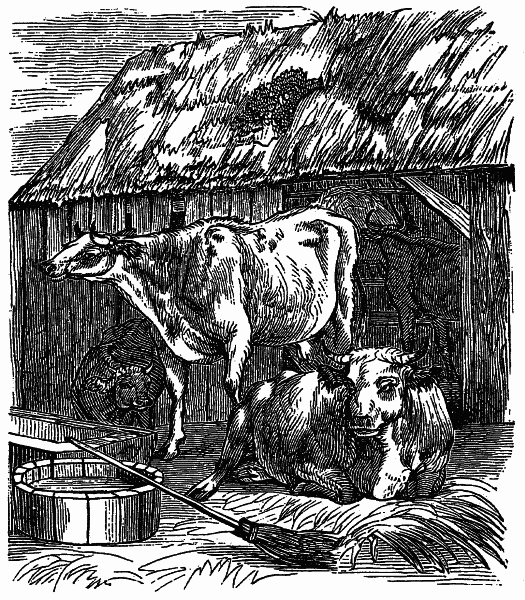
HOME AGAIN.
These warbles—or larvæ of the œstrus bovis—so nearly resemble
bots in the horse—or larvæ œstrus equi—that, were it not for
their increased size, they might readily be mistaken the one for the
other. There is, however, one other difference, and that is in the rings
which encircle the body; those of the former being perfectly smooth,
while those of the latter are prickly, and from one third to one half
smaller.
The author was called, in the year 1856, to see the prize cow, Pet,
belonging to James Kelly, of Cleveland, Ohio, whose extraordinary yield
of butter and milk had been reported in the Ohio Farmer, a short time
previous to his visit. This animal was found by him in rather poor
condition; the causes of which he could only trace to the existence of
these worms, comfortably located, as they were, beneath the animal's
hide, and forming small tumors all along the spinal column, each being
surrounded by a considerable quantity of pus. A number of these were
removed by means of a curved bistoury and a pair of forceps, since which
time—as he has been informed—the animal has rapidly improved,
regaining her former good condition.
Some may urge that this is an isolated case; but an examination of
cattle for themselves, will convince them to the contrary. It may be
added, that two other cows, belonging to the same gentleman, were also
examined at the same time,—one of them being in good condition, and the
other, out of condition. From the back of the latter several of these
insects were removed, since which time she also has much improved. The
former was entirely free from them. These cows were all kept in the same
pasture, received the same care, and were fed on the same food, and at
the same time; and as the removal of these larvæ has been productive of
such beneficial results, have we not a right to infer that these insects
are injurious?
If we go further and examine, in the spring of the year, all cattle
which are subject to them, instead of finding them in the fine
condition which one would naturally expect,—considering the abundance
of fresh young grass whose vigorous life they may incorporate into their
own,—they are out of condition, and out of spirits, with a laggard eye,
a rough coat, and, in some cases, a staggering gait, as though their
strength had failed in consequence.
How shall such attacks be prevented? During the months of August and
September this gad-fly is busily engaged in depositing its eggs. Some
are of the opinion that they are placed on the hairs of the animal;
others, that the skin is perforated, and the egg deposited in the
opening, which would account for the apparent pain manifested by cattle
at and after the time of such deposit. Be this as it may, it is certain
that the maggot works its way into the muscular fibre of the back, and
depends upon the animal's blood for the nourishment which it receives.
The author has been informed, by persons in whom he ought to have
confidence, that the free use of the card, during the above-named
months, is a specific protection against the attacks of the œstrus
bovis. He repeats this information here, not without diffidence; since
so large a majority of stock-owners evince, by their lack of familiarity
with the practical use of this convenient and portable instrument, an
utter disbelief in its reliability and value.
Cattle are not so subject to worms proper as are the other domestic
animals; nor, when these parasites do exist, is any injurious effect
apparent, except it be in the case of young calves of a weakly
constitution. Worms are most commonly located in the small intestines,
and cause there considerable irritation, and consequently, general
emaciation, or at least a tendency to it.
The cause, however, is easily removed by administering doses of sulphate
of iron, one-half drachm each, in molasses once or twice a day.
Inflammation of the bronchial tubes is often caused by worms of the
strongylus species. Upon examination after death, the bronchial
passages are completely blocked-up by these hangers-on.
Symptoms.—A rough, staring coat; hide-bound; painful cough;
respiration hurried, etc.
Treatment.—But little can be done by way of treatment in this
disease. The administration of small doses of spirits of turpentine has,
in some instances, proved successful.
The period most commonly selected for this operation is between the
first and third months. The nearer it is to the expiration of the first
month, the less danger attends the operation.
Some persons prepare the animal by the administration of a dose of
physic; but others proceed at once to the operation when it best suits
their convenience, or that of the farmer. Care, however, should be taken
that the young animal is in perfect health. The mode formerly practised
was simple enough:—a piece of whip-cord was tied as tightly as possible
around the scrotum. The supply of blood being thus completely cut off,
the bag and its contents soon became livid and dead, and were suffered
to hang, by some careless operators, until they dropped off, or they
were cut off on the second or third day.
It is now, however, the general practice to grasp the scrotum in the
hand, between the testicles and the belly, and to make an incision in
one side of it, near the bottom, of sufficient depth to penetrate
through the inner covering of the testicle, and of sufficient length to
admit of its escape. The testicle immediately bursts from its bag, and
is seen hanging by its cord.
The careless or brutal operator now firmly ties a piece of small string
around the cord, and having thus stopped the circulation, cuts through
the cord, half an inch below the ligature, and removes the testicle. He,
however, who has any feeling for the poor animal on which he is
operating, considers that the only use of the ligature is to compress
the blood-vessels and prevent after-hemorrhage, and, therefore, saves a
great deal of unnecessary torture by including them alone in the
ligature, and afterwards dividing the rest of the cord. The other
testicle is proceeded with in the same way and the operation is
complete. The length of the cord should be so contrived that it will
immediately retract, or be drawn back, into the scrotum, but not higher,
while the ends of the string hang out through the wound. In the course
of about a week, the strings will usually drop off, and the wounds will
speedily heal. There will rarely be any occasion to make any
application to the scrotum, except fomentation of it, if much swelling
should ensue.
A few, whose practice cannot be justified, seize the testicle as soon as
it escapes from the bag, and, pulling violently, break the cord and tear
it out. It is certain that when a blood-vessel is thus ruptured, it
forcibly contracts, and very little bleeding follows; but if the cord
breaks high up, and retracts into the belly, considerable inflammation
has occasionally ensued, and the beast has been lost.
The application of torsion—or the twisting of the arteries by a pair
of forceps which will firmly grasp them—has, in a great degree,
superseded every other mode of castration, both in the larger and the
smaller domesticated animals. The spermatic artery is exposed, and
seized with the forceps, which are then closed by a very simple
mechanical contrivance; the vessel is drawn a little out from its
surrounding tissue, the forceps are turned around seven or eight times,
and the vessel liberated. It will be found to be perfectly closed; a
small knot will have formed on its extremity; it will retract into the
surrounding surface, and not a drop more of blood will flow from it; the
cord may then be divided, and the bleeding from any little vessel
arrested in the same way. Neither the application of the hot iron, nor
of the wooden clamps, whether with or without caustic, can be necessary
in the castration of the calf.
A new instrument was introduced in France, some few years since, for
this purpose, called the acraseur,—so constructed as to throw a chain
over the cord, which is wound up by means of a screw working upon the
chain, and at the same time the cord is twisted off. No bleeding
follows this method of operating.
This instrument is constructed upon the same principle as the acraseur
for use in the human family, for the removal of hemorrhoids, etc., the
dimensions of the two only varying.
The advantages resulting from the use of this instrument over all other
methods are, that the parts generally heal within a week,—the operation
is not so painful to the animal,—it is less troublesome to the
operator,—also to the owner of the animal,—and lastly, it is a safer
and more scientific operation. Its success in France soon gave it a
reputation in England, and recently it has been introduced by the author
into this country, and with the best results. Contractors, hearing of
the success attending this new mode of operating, have visited him from
all parts of the country to witness its performance, and not one has
returned without leaving an order for this instrument,—so well
convinced have they been of its decided superiority over all other
methods.
In consequence of the formation of tumors about the throat in cattle,
from inflammation of the parotid gland, blain, etc., so characteristic
of this species of animals, it sometimes becomes necessary to perform
this operation in order to save their lives. It never fails to give
instant relief.
After the animal has been properly secured,—which is done by an
assistant's holding the nose with one hand, and one of the horns with
the other,—the operator draws the skin tight over the windpipe with the
thumb and fingers of his left hand; then, with the scalpel in his right,
cuts through the skin, making an incision about three inches long,
dissecting up the skin on each side, which brings the trachea, or
windpipe, in full view. He then cuts out a piece of the cartilaginous
rings, about two inches long and about half an inch wide. This simple
operation has saved the lives of very many valuable animals. The wound
readily heals, and seldom leaves any perceptible blemish, if the work is
properly performed.
To secure a more uniform flow and a richer quality of milk, cows are
sometimes spayed, or castrated. The milk of spayed cows is pretty
uniform in quality; and this quality will be, on an average, a little
more than before the operation was performed. In instances where the
results of this operation have been carefully noted,—and the operation
is rarely resorted to in this country, in comparison with the custom in
France and other continental countries,—the quality of the milk has
been greatly improved, the yield becoming regular for some years, and
varying only in accordance with the difference in the succulence of the
food.
The proper time for spaying is about five or six weeks after calving, or
at the time when the largest quantity of milk is given. There seems to
be some advantages in spaying for milk and butter dairies, where
attention is not paid to the raising of stock. The cows are more quiet,
never being liable to returns of seasons of heat, which always more or
less affect the milk, both in quantity and quality. They give milk
nearly uniform in these respects, for several years, provided the food
is uniformly succulent and nutritious. Their milk is influenced like
that of other cows, though to a less extent, by the quality and
quantity of food; so that in winter, unless the animal is properly
attended to, the yield will decrease somewhat, but will rise again as
good feed returns. This uniformity for the milk-dairy is of immense
advantage. Besides, the cow, when old and inclined to dry up, takes on
fat with greater rapidity, and produces a juicy and tender beef,
superior, at the same age, to that of the ox.
The following method of performing this operation is sanctioned by the
practice of eminent veterinary surgeons in France:—
Having covered the eyes of the cow to be operated upon, she is placed
against a wall, provided with five rings firmly fastened and placed as
follows: the first corresponds to the top of the withers; the second, to
the lower anterior part of the breast; the third is placed a little
distance from the angle of the shoulder; the fourth is opposite to the
anterior and superior part of the lower region; and the fifth, which is
behind, answers to the under-part of the buttocks. A strong assistant is
placed between the wall and the head of the animal, who firmly holds the
left horn in his left hand, and with his right, the muzzle, which he
elevates a little. This done, the end of a long and strong-plaited cord
is passed, through the ring which corresponds to the lower part of the
breast, and fastened; the free end of the cord is brought along the left
flank, and through the ring which is below and in front of the withers.
This is brought down along the breast behind the shoulder and the angle
of the fore-leg in order to pass it through the third ring; then it must
be passed around against the outer angle of the left hip, and fastened
after having been drawn tightly to the posterior ring, by a simple
bow-not.
The cow being thus firmly fixed to the wall, a cord is fastened by a
slip-noose around her hocks, to keep them together in such a manner that
she cannot kick the operator, the free end of the cord and the tail
being held by an assistant. The cow thus secured cannot, during the
operation, move forward, nor lie down, and the operator has all the ease
desirable, and is protected from accident.
The operator next—placed opposite to the animal's left flank, with his
back turned a little toward the head of the animal—cuts off the hair
which covers the hide in the middle of the flanks, at an equal distance
between the back and hip, for the space of thirteen or fourteen
centimetres in circumference (the French centimetre is rather more
than thirty-nine one hundredths of an inch); a convex bistoury is
placed, opened, between his teeth, the edge out, the joints to the left;
then, with both hands, he seizes the hide in the middle of the flank,
and forms of it a wrinkle of the requisite elevation, running lengthwise
of the body. The assistant seizes with his right hand the right side of
this wrinkle; the operator takes the bistoury and cuts the wrinkle, at
one stroke, through the middle; the wrinkle having been suffered to go
down, a separation of the hide is presented, of sufficient length to
admit the introduction of the hand; the edges of the hide are separated
with the thumb and fore-finger of the left hand, and in like manner the
abdominal muscles are cut through, for the distance of a centimetre from
the lower extremity of the incision made in the hide,—the iliac
slightly obliquely, and the lumbar across; a puncture of the
peritoneum, at the upper extremity of the wound, is then made with the
straight bistoury; the buttoned bistoury is then introduced, and moved
obliquely from above to the lower part, up to the termination of the
incision made in the abdominal muscles.
The flank being opened, the right hand is introduced into the abdomen,
and directed along the right side of the cavity of the pelvis, behind
the paunch, and underneath the rectum, to the matrix; after the position
of these viscera is ascertained, the organs of reproduction, or ovaries,
are searched for, which are at the extremity of the matrix; when found,
they are seized between the thumb and fore-finger, detached completely
from the ligaments which keeps them in their place, and by a light pull,
the cord and the vessels, the uterine or Fallopian tube, are separated
at their place of union with the ovarium, by means of the nails of the
thumb and fore-finger, which present themselves at the point of touch,
thus breaking the cord and bringing away the ovary.
The hand is again introduced into the abdominal cavity, and the
remaining ovaries brought away in like manner. A suture is then placed
of three or four double threads, waxed at an equal distance, and at two
centimetres, or a little less, from the lips of the wound, passing it
through the divided tissues; a movement is made from the left hand with
the piece of thread; having reached that point, a fastening is made with
a double knot, the seam placed in the intervals of the thread from the
right, and as the lips of the wound are approached, a fastening is
effected by a simple knot, with a bow, care being taken not to close too
tightly the lower part of the seam, in order to allow the suppuration,
which may be established in the wound, to escape. The wound is then
covered up with a pledget of lint, kept in its place by three or four
threads passed through the stitches, and the operation is complete.
It happens, sometimes, that in cutting the muscles before mentioned, one
or two of the arteries are severed. Should much blood escape, a ligature
must be applied before opening the peritoneal sac; since, if this
precaution is omitted, blood will escape into the abdomen, which may
occasion the most serious consequences.
For the first eight days succeeding, the animal should have a light
diet, and a soothing, lukewarm draught; if the weather should be cold,
cover with a woollen covering. She must be prevented from licking the
wound, and from rubbing it against other bodies. The third day after the
operation, bathe morning and evening about the wound with water of
mallows lukewarm, or anoint it with a salve of hog's lard, and
administer an emollient glyster during three or four days.
Eight days after the operation, take away the bandage, the lint, the
fastenings, and the thread. The wound is at that time, as a general
thing, completely cicatrized. Should, however, some slight suppuration
exist, a slight pressure must be used above the part where it is
located, so as to cause the pus to leave, and if it continues more than
five or six days, emollients must be supplied by alcolized
water, or chloridized, especially in summer. The animal is then to be
brought back gradually to her ordinary nourishment.
In some cows, a swelling of the body is observable a short time after
having been spayed, attributable to the introduction of cold air into
the abdomen during the operation; but this derangement generally ceases
within twenty-four hours. Should the contrary occur, administer one or
two sudorific draughts, such as wine, warm cider, or a half-glass of
brandy, in a quart of warm water,—treatment which suffices in a short
time to restore a healthy state of the belly,—the animal at the same
time being protected by two coverings of wool.
The only precaution, in the way of management, to be observed as a
preparative for the operation is, that on the preceding evening not so
copious a meal should be given. The operation should also be performed
in the morning before the animal has fed, so that the operator may not
find any obstacle from the primary digestive organs, especially the
paunch, which, during its state of ordinary fullness, might prevent
operating with facility.
The advantages of spaying milch-cows are thus summed up by able French
writers: First, rendering permanent the secretion of milk, and having a
much greater quantity within the given time of every year; second, the
quality of milk being improved; third, the uncertainty of, and the
dangers incident to, breeding being, to a great extent, avoided; fourth,
the increased disposition to fatten even when giving milk freely, or
when, from excess of age or from accidental circumstances, the secretion
of milk is otherwise checked; fifth, the very short time required to
produce a marketable condition; and sixth, the meat of spayed cattle
being of a quality superior to that of ordinary cattle.
This operation would seem to have originated in this country. The London
Veterinary Journal of 1834 contains the following, taken from the United
States Southern Agriculturist:—"Some years since, I passed a summer at
Natchez, and put up at a hotel there, kept by Mr. Thomas Winn. During
the time that I was there I noticed two remarkably fine cows, which were
kept constantly in the stable, the servant who had charge of the horses,
feeding them regularly three times a day with green guinea grass, cut
with a sickle. These cows had so often attracted my attention, on
account of the great beauty of their form, and deep red color, the large
size of their bags, and the high condition in which they were kept, that
I was at length induced to ask Mr. Winn to what breed of cattle they
belonged, and his reasons for keeping them constantly in the stable in
preference to allowing them to run in the pasture, where they could
enjoy the benefit of air and exercise, and at the same time crop their
own food, and thereby save the labor and trouble of feeding them? Mr.
Winn, in reply to these inquiries, stated that the two cows which I so
much admired were of the common stock of the country, and he believed,
of Spanish origin; but they were both spayed cows, and that they had
given milk either two or three years. Considering this a phenomenon (if
not in nature at least in art), I made further inquiries of Mr. Winn,
who politely entered into a very interesting detail, communicating facts
which were as extraordinary as they were novel. Mr. Winn, by way of
preface, observed that he, in former years, had been in the habit of
reading English magazines, which contained accounts of the
plowing-matches which were annually held in some of the southern
counties of England, performed by cattle, and that he had noticed that
the prizes were generally adjudged to the plowman who worked with spayed
heifers; and although there was no connection between that subject and
the facts which he should state, it was, nevertheless, the cause that
first directed his mind into the train of thought and reasoning which
finally induced him to make the experiments, which resulted in the
discovery of the facts which he detailed, and which I will narrate as
accurately as my memory will enable me to do it, after the lapse of more
than twenty years. Mr. Winn's frequent reflections had (he said) led him
to the belief "that if cows were spayed soon after calving, and while in
a full flow of milk, they would continue to give milk for many years
without intermission, or any diminution of quantity, except what would
be caused by a change from green to dry, or less succulent food." To
test this hypothesis, Mr. Winn caused a very good cow, then in full
milk, to be spayed. The operation was performed about one month after
the cow had produced her third calf; it was not attended with any severe
pain, or much or long continued fever. The cow was apparently well in a
few days, and very soon yielded her usual quantity of milk, and
continued to give freely for several years without any intermission or
diminution in quantity, except when the food was scarce and dry; but a
full flow of milk always came back upon the return of a full supply of
green food. This cow ran in the Mississippi low grounds or swamp near
Natchez, got cast in deep mire, and was found dead. Upon her death, Mr.
Winn caused a second cow to be spayed. The operation was entirely
successful. The cow gave milk constantly for several years, but in
jumping a fence stuck a stake in her bag, that inflicted a severe wound,
which obliged Mr. Winn to kill her. Upon this second loss, Mr. Winn had
two other cows spayed, and, to prevent the recurrence of injuries from
similar causes with those which had occasioned him the loss of the first
two spayed cows, he resolved to keep them always in the stable, or some
safe enclosure, and to supply them regularly with green food, which that
climate throughout the greater part of, if not all, the year enabled him
to procure. The result, in regard to the last two spayed cows, was, as
in the case of the first two, entirely satisfactory, and fully
established, as Mr. Winn believed, the fact, that the spaying of cows,
while in full milk, will cause them to continue to give milk during the
residue of their lives, or until prevented by old age. When I saw the
last two spayed cows it was, I believe, during the third year that they
had constantly given milk after they were spayed. The character of Mr.
Winn (now deceased) was highly respectable, and the most entire
confidence could be reposed in the fidelity of his statements; and as
regarded the facts which he communicated in relation to the several cows
which he had spayed, numerous persons with whom I became acquainted,
fully confirmed his statements."
In November 1861, the author was called to perform this operation upon
the short-horn Galloway cow, Josephine the Second, belonging to Henry
Ingersoll, Esq., of this city. This cow was born May 8th, 1860. The
morning was cold and cloudy. About ten o'clock the cow was cast, with
the assistance of R. McClure, V.S., after which she was placed under the
influence of chloric ether. He then made an incision, about five inches
in length, through the skin and walls of the abdomen, midway between the
pelvis bone and the last rib on the left side, passing in his right
hand, cutting away the ovaries from the Fallopian tubes with the
thumbnail. The opening on the side was then closed by means of the
interrupted suture. The animal recovered from the influence of the
anæsthetic in about fifteen minutes, when she was allowed to rise, and
walk back to her stall.
Upon the morning of the second day succeeding the operation, the animal
was visited and found to be in good spirits, apparently suffering very
little pain or inconvenience from the operation, and the wound healing
nicely.
Since that time, he has operated upon some twenty cows, all of which,
with a single exception, have thus far proved satisfactory.
Several of these cows are under the direction of a committee from the
Philadelphia Society for promoting Agriculture, whose duty it is to have
a daily record kept of each cow's yield of butter and milk, for one year
from the time of spaying. Their report will be perused by the
agricultural community with much interest.
The author's own experience will not justify him in speaking either in
favor of, or against, this operation; as sufficient time has not as yet
elapsed to satisfy him as to its relative advantages and disadvantages.
He, however, regards the operation as comparatively safe. The French
estimate the loss at about fifteen per cent., and the gain at thirty per
cent. Of those upon which he has operated, not a single animal died.
The medicines used in the treatment of the diseases of cattle, are
essentially the same as those in vogue for the diseases of the human
being and the horse,—the only difference being in their combination and
the quantities administered.
Absorbents.—Medicines which destroy acidities in the stomach and
bowels; such as chalk, magnesia, etc.
Alteratives.—Medicines which restore the healthy functions of
secretion, by gradually changing the morbid action in an impaired
constitution. Those in most common use are Æthiops mineral, antimony,
rosin, sulphur, etc., which form the principal ingredients in all
condition-powders, and are chiefly useful in diseases of the skin, such
as hide-bound, mange, surfeit, etc.
Alterative Powder.—Sulphur pulverized, one pound; black antimony, one
half a pound; nitrate of potassa, four ounces; sulphate of iron, one
half a pound; linseed meal, one pound; mix well; dose, one half an
ounce, night and morning.
Antacids.—Agents which neutralize, by their chemical action, acids in
the stomach; as ammonia, carbonate of potassa, chalk, lime-water,
magnesia, and soda.
Anthelmintics.—Remedies used for the expulsion of worms from the
stomach and intestines. These may act chemically or by their cathartic
operation. The most reliable are Æthiops mineral, nux vomica,
preparations of mercury, wormwood, etc.
Anthelmintic Powders.—Nux vomica, in one half-drachm doses, two or
three times daily, to an ox or cow; for calves, the dose must be
diminished, according to age.
Antidotes.—Medicines which neutralize the effects of poisons by a
chemical union, forming an insoluble compound, or a mild, harmless one.
Alkaline solutions are antidotes for the mineral acids; as soap in
solution, a simple remedy, and always at hand. Lard, magnesia, and oil
are antidotes for poisoning by arsenic; albumen,—in the form of the
white of an egg,—milk, etc., for corrosive sublimate, and other
mercurial preparations.
Antiseptics.—Medicines which prevent putridity in animal substances,
and arrest putrefaction, when already existing. These are used both
externally and internally. The chief specifics of this class are the
acids, alcohol, ammonia, asafœtida, camphor, charcoal, chloride of
lime, cinchona, ether, and opium.
Antispasmodics.—Medicines which exert their power in allaying
inordinate motions or spasms in the system, arising from various causes,
such as debility, worms, etc. Those most generally in use are ammonia,
asafœtida, camphor, cinchona, ether, lactacarium, mercury, and opium.
Antispasmodic draught.—Tincture of opium, one ounce; nitric ether, two
ounces; water, one-half pint. Mix for drench; if repeated, it should be
followed by a purgative, as soon as the spasms have subsided. Or, use
the following: sulphuric ether, one to two ounces; water, one-half pint
Mix for drench; repeat every hour, if necessary.
Aromatics.—Medicines possessing a grateful, spicy scent, and an
agreeable, pungent taste; as anise-seed, cardamoms, cinnamon, cloves,
ginger, etc. They are principally used in combination with purgatives,
stomachics, and tonics.
Astringents.—Medicines which serve to diminish excessive discharges, as
in diabetes, diarrhœa, etc. The principal agents of this class are
the acids, alum, chalk, lime-water, opium, and the sulphate of copper,
lead, iron, or zinc.
Astringent powder.—Opium, one drachm; prepared chalk, half an ounce;
Jamaica ginger, six drachms. Mix, and divide into four powders; one to
be given every hour, in a little flour gruel. Or, the following: opium,
one drachm; catechu, two drachms; prepared chalk, one ounce. Mix, and
divide into four powders; to be given as before.
Cardiacs.—Cordials—so termed, from their possessing warm and
stimulating properties—given to invigorate the system.
Cathartics.—Medicines—also known as purgatives—which cause free
evacuations of the bowels. The only purgatives used by the author in his
cattle practice, as a general rule, are aloes, cream of tartar,
Epsom-salts, lard and linseed-oil. These answer all the indications,
where purgatives are useful; indeed, no better purgative for cattle can
be found than Epsom-salts, combined with a carminative or aromatic drug,
such as ginger.
Caustics.—Substances which burn or destroy parts, by combining with
them and causing their disorganization; used to destroy unhealthy
action, or morbid growths, such as foul ulcers, foul in the foot, warts,
etc. The most powerful remedial of this class is actual cauterization
with a red-hot iron; caustic potash, lunar caustic, nitrous and
sulphuric acids, permanganate of potash, etc., are also used.
Cordials.—Best brandy, three ounces; orange peel, one drachm; tepid
water, one pint. Mix all together, for one dose. Or, this for a single
dose: ale, one pint; Jamaica ginger, two drachms. Or, the following,
also a single dose: allspice, three drachms; ginger, one drachm; caraway
seeds, two drachms.
Demulcents.—Mucilaginous medicaments, which have the power of
diminishing the effects of stimulating substances upon the animal
system. Of this class, garden rue, or marsh-mallow, gum-arabic, and
gum-tragacanth are the most useful.
Detergents.—Agents which remove foulness from ulcers.
Detergent Powder.—Prepared chalk, two ounces; alum, one ounce. Mix; to
be sprinkled on the part, after washing with Castile-soap and water.
This powder is also an admirable application for foot-rot in sheep.
Diaphoretics.—Agents which increase the natural discharge through the
pores of the skin, and in some animals induce perspiration.
Digestives.—Medicines which promote suppuration.
Digestive Ointment.—Mix together equal portions of spirits of
turpentine and lard. Or, mix together with a gentle heat the following:
Venetian turpentine, one ounce; lard, one ounce; pulverized sulphate of
copper, two drachms. Or this, mixed: rosin, two ounces; spirits of
turpentine, one ounce; red precipitate, one-half an ounce; lard, two
ounces.
Diuretics.—Medicines that stimulate the action of the kidneys, and
augment the secretion of urine. These are very useful in swellings of
the legs, or body. Take of nitrate of potash and rosin, each six
drachms; mix, and divide in three powders; one to be given daily. Or,
the following: spirits of turpentine, half an ounce; Castile-soap, one
ounce; Jamaica ginger, one drachm; opium, one drachm. Mix: and divide in
two balls; one to be given each day.
Emollients.—Medicines which relax the lining tissues, allay irritation,
and soften the parts involved,—generally of a mucilaginous, or oily
character. Lard, linseed meal, and marsh-mallows are chiefly used.
Lithontriptics.—Medicines possessing the power of dissolving calculi,
or stones in the urinary passages; composed principally, according to
the researches of modern chemists, of lithic or uric acid. The
preparation most successfully employed by the author in such cases is
muriatic acid, in doses of from one to two drachms, in a pail of water,
once or twice a day.
Narcotics.—Medicines that stupefy, and produce sleep. Belladonna,
camphor, hyoscyamus and opium, are among the narcotics in common use.
Nauseants.—Agents which cause loss of appetite, and produce the
sensation of vomiting, without affecting it. For this purpose, aloes,
tartrate of antimony, white hellebore, etc., are used.
Parturients.—Agents which act upon the uterus. In cases of difficult
parturition, or calving, resort is occasionally had to them. Ergot of
rye is the most powerful.
Refrigerants.—Cooling applications, which reduce the temperature of the
blood and body; as cold water, ether, lead-water, etc.
Rubefacients.—Medicines which gently irritate the skin, producing
redness on white surfaces. Of this class, are aqua ammonia, creosote,
mustard, turpentine, etc.
Sedatives.—Agents which depress the vital energies, without destroying
life; as aconite, digitalis, hellebore, hydrochloric acid, hyoscyamus,
opium, and tartrate of antimony.
Tonics.—Medicines which increase the action of the muscular system,
giving strength and vigor to the animal. These are among the most useful
remedies known to man, and are beneficial in all cases of debility,
toning up the stomach, and improving the appetite and condition of the
animal.
Tonic Powder.—Pulverized gentian-root, one ounce; Jamaica ginger, one
half an ounce; anise-seed, six drachms. Mix, and divide in eight
powders; one to be given night and morning.
Traumatics.—Medicines which excite the healing process of wounds; as
aloes, friar's balsam, myrrh, rosin, sulphate of copper or zinc, tar,
etc.
Traumatic lotion.—Mix tincture of aloes, one ounce; tincture of myrrh,
two ounces. Or, melt together, tar, one ounce; rosin, two ounces; lard,
four ounces. Or, mix sulphate of zinc, one drachm; rain-water, one half
pint. Or, use the following, the celebrated friar's balsam; benzoin, in
powder, four ounces; balsam of Peru, two ounces; Socotrine aloes, one
half ounce; rectified spirits, one quart. Digest for ten or twelve days;
then filter for use.
Aconite.—[Monk's hood; Wolf's bane.] An active poison. Used as a
sedative in tincture; ten to twenty drops in water.
Æthiops Mineral.—[Hydrargyri Sulphuretum.] One to two drachms.
Alcohol.—A stimulant; three to six ounces.
Allspice.—[Pimento berries.] Aromatic; two to four drachms.
Aloes.—Cathartic and tonic; tonic dose, one half to one
drachm—cathartic, one to two ounces.
Alum.—[Alumen.] Irritant, astringent, and sedative; two to four
drachms.
Ammonia.—[Aqua ammonia; Liquor ammonia; Hartshorn.] Principally
used in combination with mustard, as an external irritant, and
internally, as a diffusible stimulant; two to six drachms. Of carbonate
of ammonia, three to six drachms.
Anise-seed.—[Fruit of the Pimpinella Anisum.] One to two drachms.
Antimony.—[Sulphate of Antimony.] Used in condition-powders; one to
three drachms. Muriate of antimony. [Oil, or butter, of antimony.]
Caustic; very good in foul in the foot. Tartarized antimony. [Tartar
emetic.] One to four drachms. The author, in the last instance, varies
from the dose prescribed by veterinary authors, never giving it in more
than one-half-drachm doses, believing its action thus more certain and
satisfactory.
Asafœtida.—Stimulant; two to four drachms.
Axunge.—[Hog's Lard.] Ointment, principally; may be used as purgative
in doses of from one to one and a half pounds.
Balsam of Peru.—Stimulant, and tonic; two to four drachms.
Belladonna.—[Deadly Nightshade.] Narcotic, anti-spasmodic, and
irritant poison; one to two drachms.
Benzoin.—[Gum Benjamin.] Ointment; see Traumatics.
Calomel.—[Hydrargyri Chloridum.] One half to one drachm.
Camomile.—[Anthemis.] Stomachic, carminative, and tonic; one to two
ounces.
Camphor.—[Camphora Officinarum.] Narcotic and irritant; in small
doses, sedative and stimulant; one to four drachms.
Cantharides.—[Spanish Flies.] Internally, stimulant and diuretic;
twenty to thirty grains. Externally, vesicant; used in form of ointment,
or tincture.
Caraway.—[Fruit of the Carum Carisi.] Used chiefly for flavoring
purposes.
Cardamoms.—[Fruit of the Elettaria Cardamomum.] Used to communicate
an agreeable flavor to other medicines.
Catechu.—[Acacia Catechu.] Astringent, and antiseptic; three to six
drachms.
Chalk.—[Carbonate of Lime; Calcis Carbonas.] Two to three ounces.
Charcoal.—[Carbo Ligni.] Antiseptic; one half to one ounce.
Cinchona.—[Peruvian Bark.] Astringent and tonic; one to two ounces.
Copper, Sulphate of.—[Blue Vitriol.] Tonic and astringent; two to
four drachms.
Creosote.—[Creosotum.] A sedative, anodyne, astringent, narcotic, and
irritant poison; fifteen to twenty drops.
Croton Oil.—[Crotonis Oleum.] Internally, as a cathartic, six to ten
drops in linseed-oil; externally, as a counter-irritant.
Digitalis.—[Fox Glove.] Sedative and diuretic; one to two scruples.
Epsom-Salts.—[Sulphate of magnesia.] Cathartic; one pound, combined
with ginger.
Ergot.—[Spurred rye.] Parturient; two to six drachms.
Ether.—Stimulant, narcotic, and anæsthetic; one to two ounces.
Gentian.—[Root of Gentiana lutea.] Stomachic and tonic; one to two
ounces.
Ginger.—[Zengiber officinale.] Stomachic, carminative, and slightly
tonic; one to two ounces.
Gum-arabic.—[Gummi Acaciæ.] Demulcent and emollient; one to two
ounces.
Gum-tragacanth. Same action and same doses as the former.
Hellebore.—[Helleborus.] Irritant poison, and sedative; twenty to
thirty grains.
Hyoscyamus.—[Henbane.] Narcotic, anodyne, and anti-spasmodic; ten to
twenty grains.
Iodine.—[Iodineum.] Internally, as a tonic; two to three scruples;
also as a tincture, and in ointments for reducing enlargements of the
soft tissues.
Iron, Sulphate of.—[Ferri Sulphas; Green Vitriol, Coppera.]
Irritant, astringent, and tonic; two to four drachms.
Koosso. Anthelmintic; two to four drachms.
Lime, Chloride of.—Antiseptic; dose internally, one to two drachms.
Linseed oil.—Cathartic; one pint.
Lunar Caustic.—[Nitrate of Silver.] Used as a caustic.
Magnesia.—[See Epsom-Salts.]
Marsh-mallow.—[Altheæ Radix.] Demulcent and emollient; principally
used for poultices and fomentations.
Muriatic Acid.—[Hydrochloric Acid; Spirit of Salt.] Tonic,
irritant, and caustic; dose internally, one to two drachms.
Mustard.—[Sinapis.] Counter-irritant; used principally as an external
application.
Myrrh.—Stimulating tonic to unhealthy sores; seldom used internally.
Nitric Acid.—[Aqua fortis.] Astringent and tonic; one to two drachms
in water. Used also as a caustic.
Nux Vomica.—[Seeds of Strychnos.] In large doses, a deadly poison; in
medicinal doses, a powerful tonic and anthelmintic; one half to one
drachm.
Opium.—[Papaver Somniferum.] Narcotic, sedative, anodyne, stimulant,
and anti-spasmodic; two to four drachms.
Potash, Carbonate of.—[Potassæ Carbonas.] Antacid and diuretic; three
to six drachms.
Potash, Caustic.—[Potassa fusa.] Used only as a caustic.
Potassa, Permanganate of.—Used externally as a caustic.
Rosin.—Diuretic; two to three ounces.
Salt, Common.—[Chloride of Sodium.] Irritant, cathartic, stimulant,
and antiseptic; one to one and a half pounds.
Salts, Glauber.—[Sulphate of Soda.] Cathartic and diuretic; one to
one and a half pounds.
Saltpetre.—[Nitrate of Potassa.] Diuretic, febrifuge, and
refrigerant; one half to one ounce.
Sublimate, Corrosive.—[Protochloride of Mercury.] Seldom used
internally; externally, caustic and stimulant.
Sulphur.—[Brimstone.] Stimulant and laxative; three to four ounces.
Sulphuric Acid.—Irritant, caustic, and astringent; two to three
drachms.
Tartar, Cream of.—[Potassæ Tartras.] Cathartic; three to four ounces.
Turpentine.—Stimulant, anthelmintic, diuretic, and laxative; one to two
ounces.
Zinc, Sulphate of.—[White Vitriol.] Astringent and tonic; one to two
drachms.