Werner’s Readings and Recitations No. 35 Cats and Kittens
New York
EDGAR S. WERNER & COMPANY
Copyright, 1906, by Edgar S. Werner
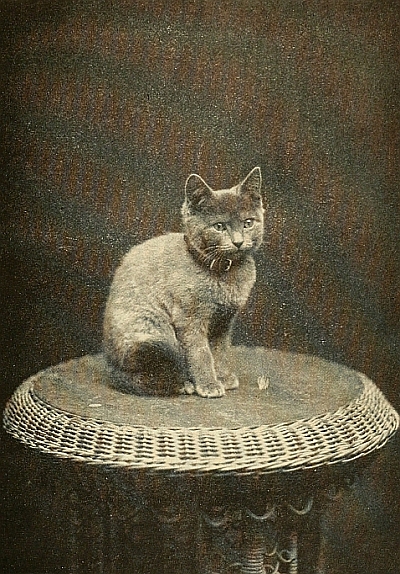
In whose honor this book is published.
Whole book · 200 sections
New York
EDGAR S. WERNER & COMPANY
Copyright, 1906, by Edgar S. Werner
| PAGE | |
| Audacious Kitten.—Oliver Herford | 184 |
| Bad Peter, Bad Joe | 119 |
| Baron Grimalkin’s Death (Parody on Greene’s “Baron’s Last Banquet”).—Will M. Carlton | 126 |
| Boy Blue and His Gun.—Nellie M. Garabraut | 209 |
| Boys’ Compositions on Cats | 215 |
| Cat and Fox (Fable) | 137 |
| Cat and Mouse | 157 |
| Cat and Painter.—Eleanor H. Porter | 188 |
| Cat and Tiger (Fable) | 43 |
| Cat Came Fiddling | 42 |
| Cat Convention.—Edna A. Foster | 155 |
| Cat Law-Suit | 168 |
| Cat-Life.—Lucy Larcom | 185 |
| Cat of Hindustan | 228 |
| Cat That Came to School (Action Poem) | 32 |
| Cat-egorical Courtship | 115 |
| Catching the Cat.—Margaret Vandegrift | 254 |
| Catkin | 65 |
| Cats (Parody on Southey’s “Cataract of Lodore”) | 66 |
| Cats.—Eve Lawless | 34 |
| Cats and Dogs.—Jerome K. Jerome | 46 |
| Cats’ and Kittens’ Opening Address | 12 |
| Cat’s Birthday Celebration.—Mrs. Gertrude Manly Jones | 27 |
| Cats’ Duet | 146 |
| Cats, Essay or Address on.—Stanley Schell | 224 |
| Cat’s Meat Man; or, Cupboard Love | 267 |
| Cats’ Merry, Merry Meeting (Action Song).—Stanley Schell | 153 |
| Cats Recognized by Cat Clubs of To-day | 243 |
| Cats’ Tea Party (Action Poem) | 26 |
| Cats’ Thanksgiving Day | 38 |
| Composite Cat.—Maria J. Hammond | 241 |
| Daisy’s Thanksgiving | 212 |
| Dame Trot and Her Cat | 77 |
| De Black Cat Crossed His Luck.—J.D. Corrothers | 124 |
| Dead Canary.—Mrs. Frederick W. Pender | 230 |
| Dead Kitten.—Sydney Dayre | 199 |
| Decoration of Honor.—L.E. Street | 36 |
| Dick Whittington (Song with Tableaux) | 49 |
| Dickens and His Kitten | 195 |
| Differences between Cat and Dog.—Elizabeth I. Cassin | 24 |
| Ding Dong Bell (Words only) | 227 |
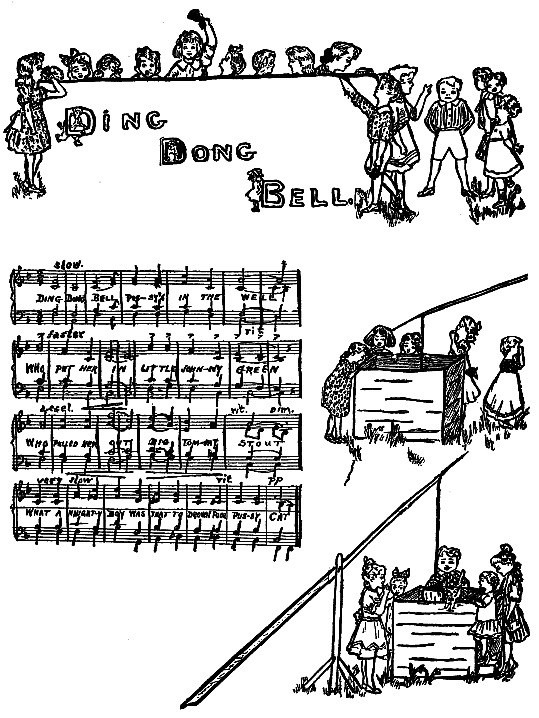
| Ding Dong Bell (Song—Illustrated) | 39 |
| Dirty Kitty Cat.—Stanley Schell | 194 |
| Dishonest Cat.—Mrs. Frederick W. Pender | 133 |
| Doctor Tom Mew | 98 |
| Dog and Cat | 218 |
| Dogs and Cats.—Alexander Dumas | 94 |
| Down to St. Ives | 207 |
| Duel.—Eugene Field | 143 |
| Elder Johnson’s Lecture on Cats | 69 |
| Emblematic Signification of Cat | 145 |
| Every Mother’s Love the Best | 150 |
| False Kindness | 79 |
| Family Cat | 97 |
| Feline Fate.—Anna Robeson Brown | 129 |
| Five Kitty Cats | 103 |
| Girl, Cat and Custard | 183 |
| Good-for-nothing Cat | 57 |
| Gray’s Elegy on Horace Walpole’s Cat | 232 |
| Had to Eat It | 219 |
| Happy Family (Music) | 165 |
| Hodge, the Cat.—Susan Coolidge | 117 |
| Homeless Kitten (Music).—Jane Campbell | 135 |
| Homeliest Cat at the Show.—Rosalie M. Jones | 20 |
| How Pussy and Mousie Kept House.—A.C. Kish | 68 |
| How Pussy Bathes | 187 |
| How to Feed and Care for Cats.—Stanley Schell | 240 |
| In Liquor | 260 |
| In the Hay-Loft.—Helen Thayer Hutcheson | 144 |
| Intelligent Cat.—Grace Bacon Holway | 35 |
| Jet and Snowflake (Dialogue) | 270 |
| Jim Wolfe and the Cats.—Mark Twain | 244 |
| Just Plain Cat.—Jennie Pendleton Ewing | 92 |
| Kathie’s Story | 100 |
| Kind Boy.—Mrs. Frederick W. Pender | 120 |
| Kitten and the Falling Leaves (Action Poem).—William Wordsworth | 122 |
| Kitten and the Mouse | 67 |
| Kitten of the Regiment.—James Buckram | 246 |
| Kitten that Never Grew Old | 178 |
| Kittens’ Blind-Man’s Buff (Illustrated) | 90 |
| Kittens’ Dancing-Lesson.—Stanley Schell | 179 |
| Kittens’ Fright (Action Poem) | 113 |
| Kittens’ Promenade | 74 |
| Kitten’s View of Life.—Thomas Westwood | 159 |
| Kitty | 242 |
| Kitty at School.—Kate Ulmer | 208 |
| Kittycat and the Milkman | 202 |
| Kitty’s Lesson.—C. Grace Jerolamen | 220 |
| Lament of a Forsaken Cat.—Elizabeth Harcourt Mitchell | 41 |
| Land on Your Feet.—Sam Walter Foss | 158 |
| Language of Cats | 186 |
| Lincoln’s Motherless Kittens.—Mrs. Frederick W. Pender | 196 |
| Little Cat Made Fur Fly | 264 |
| Little Kittens | 71 |
| Little Kitty (Action Poem) | 128 |
| Little Pussy.—Taylor | 121 |
| Little Turncoats.—Georgia A. Peck | 205 |
| Lost Kitty | 28 |
| Lost Mittens (Illustrated) | 201 |
| Matthew Arnold’s Cat, Atossa | 182 |
| Matilda Martha May.—Fannie Rogers White | 106 |
| Me an’ Bab.—Joy Vetrepont | 151 |
| Me an’ Methuselar.—Harriet Ford | 161 |
| Mirror Cat.—Oliver Herford | 30 |
| Mischievous Cat.—Mrs. E.T. Corbett | 206 |
| Miss Edith’s Modest Request.—Bret Harte | 138 |
| Miss Kitty Manx to Sir Thomas Angora.—Mary S. Boyd | 140 |
| Miss Tabbycat’s Reception.—Elizabeth L. Gould | 102 |
| Mistress Kitty | 96 |
| Model Cat.—Mrs. Frederick W. Pender | 271 |
| Modest Cat’s Soliloquy | 29 |
| Mother Gray and Her Children (Music) | 172 |
| Mother Tabbyskins | 82 |
| My Cat.—Charles Baudelaire | 115 |
| My Cat and Dog.—Marori | 200 |
| My Kittens.—Olive Stevens Brown | 104 |
| My Little Gray Kitty and I | 86 |
| My Ol’ Black Cat.—Flavia Rosser | 198 |
| My Old Gray Cat and I.—Joe Lincoln | 136 |
| My Pet Cat | 253 |
| My Pussy (Music—Illustrated) | 214 |
| Naughty Pussy | 233 |
| Newsboy’s Cat; or, the Fam’ly Man.—Mrs. E.T. Corbett | 213 |
| Nobody Did It | 88 |
| Nocturnal Shot | 81 |
| Object of Love.—Mary E. Wilkins | 107 |
| Old Nursery Rhyme | 78 |
| Out for a High Time.—E. Louise Liddell | 59 |
| Outing.—Mrs. Frederick W. Pender | 176 |
| Pace That Kills | 75 |
| Partnership.—Margaret Vandegrift | 75 |
| Pet and Her Cat | 174 |
| Pins in Pussy’s Toes.—Harriet Beecher Stowe | 40 |
| Poet’s Lamentation for Loss of His Cat.—Joseph Green | 261 |
| Polly Pry’s Kitten (Action Poem) | 55 |
| Prince of Newfoundland; or, Only a Dog and a Kitten.—Celia Thaxter | 141 |
| Puss and Her Three Kittens.—Tom Hood | 87 |
| Puss in Mischief (Action Poem) | 76 |
| Pussy and the Mice | 118 |
| Pussy at School.—Louis B. Tisdale | 171 |
| Pussy-Cat | 164 |
| Pussy-Cat and Mouse on Thanksgiving | 269 |
| Pussy Gray’s Dinner | 160 |
| Pussy Willows | 219 |
| Pussy’s Dream | 93 |
| Pussy’s Vocal Lesson | 169 |
| Quousque Tandem, O Catiline?—A.L. Frisbie | 257 |
| Rash Young Mouse (Action Poem) | 56 |
| Ready for Breakfast (Illustrated) | 101 |
| Retired Cat.—William Cowper | 236 |
| Revenge for Poisoning a Cat | 234 |
| Robin Redbreast and Pussy-Cat | 74 |
| Sad Case.—Clara D. Bates | 45 |
| Sandy Jenkins’s Remarks on the Black Cat.—J.D. Corrothers | 72 |
| Scarum Cat.—Mary Elizabeth Stone | 221 |
| Sea-Puss.—Kate Upson Clark | 170 |
| Secret Told Pussie | 80 |
| Social Tea.—Mrs. Frederick W. Pender | 180 |
| Some Cat Traits | 156 |
| Southey’s Cats Write Their Master.—Robert Southey | 263 |
| Strange Mouse | 239 |
| Sunday Episode (Illustrated).—Herbert Randall | 70 |
| Tatters, the Cat.—Mrs. Frederick W. Pender | 91 |
| That Cat.—Ben King | 78 |
| Three Maidens Fair.—Stanley Schell | 89 |
| Three Naughty Kittens.—Isabel Frances Bellows | 166 |
| Timid Kitten.—Carolyn Wells | 58 |
| Tom.—M.T. Hart | 252 |
| Tommie | 116 |
| Toodlekins and Flip | 265 |
| Tootsy Wootsy.—Mrs. Frederick W. Pender | 13 |
| Topsy | 85 |
| Troll Cat | 222 |
| Turn About | 79 |
| Two Gray Kits and the Gray Kits’ Mother | 71 |
| Two Hearts and a Kitten.—Mabel Preece | 203 |
| Two Pussy-Cats.—Ella Wheeler Wilcox | 105 |
| “Two’s Company, Three’s None.”—Mrs. Frederick W. Pender | 52 |
| Ungrateful Cat | 259 |
| Walter Savage Landor’s Favorite Cat, Chinchinillo | 134 |
| Warning (Music) | 114 |
| Watch-Cat.—Elliot Walker | 248 |
| Way You Look at It | 173 |
| We Cats (Action Song) | 60 |
| We’ve Lost Our Job.—Stanley Schell | 262 |
| What Became of the Kitten? | 175 |
| What I Want.—David L. Proudfit | 258 |
| What Puss Thinks | 33 |
| “When the Cat’s Away the Mice Will Play” (Tableau).—Mrs. Mary L. Gaddess | 167 |
| Where Are Those Sleepy Kittens? (Action Poem) | 44 |
| Where Have You Been? | 73 |
| Where Is My Kitty? (Action Poem) | 99 |
| Why Cats Wash After Eating.—Eva J. Beede | 25 |
| Why the Cat Always Falls upon Her Feet.—Louise Jamison | 211 |
| Wisdom | 233 |
| Wise Mouse.—Mary Raymond Garretson | 31 |
| Conundrums—25, 119, 123, 125, 142, 156, 157, 177, 179, 183, 193, 197, 198, 207, 210, 220, 227, 235, 251. | |
| PAGE | |
| Bates, Clara Doty | 45 |
| Baudelaire, Charles | 115 |
| Beede, Eva J. | 25 |
| Bellows, Isabel Frances | 166 |
| Boyd, Mary S. | 140 |
| Brown, Anna Robeson | 129 |
| Brown, Olive Stevens | 104 |
| Buckram, James | 246 |
| Campbell, Jane | 135 |
| Carlton, Will M. | 126 |
| Cassin, Elizabeth I. | 24 |
| Clark, Kate Upson | 170 |
| Coolidge, Susan | 117 |
| Corbett, Mrs. E.T. | 206, 213 |
| Corrothers, J.D. | 72, 124 |
| Cowper, William | 236 |
| Dayre, Sydney | 199 |
| Dumas, Alexander | 94 |
| Ewing, Jennie Pendleton | 92 |
| Field, Eugene | 143 |
| Ford, Harriet | 161 |
| Foss, Sam Walter | 158 |
| Foster, Edna A. | 155 |
| Frisbie, A.L. | 257 |
| Gaddess, Mrs. Mary L. | 167 |
| Garabraut, Nellie M. | 209 |
| Garretson, Mary Raymond | 31 |
| Gould, Elizabeth L. | 102 |
| Green, Joseph | 261 |
| Hammond, Maria J. | 241 |
| Hart, M.T. | 252 |
| Harte, Bret | 138 |
| Herford, Oliver | 30, 184 |
| Holway, Grace Bacon | 35 |
| Hood, Tom | 87 |
| Hutcheson, Helen Thayer | 144 |
| Jamison, Louise | 211 |
| Jerolamen, C. Grace | 220 |
| Jerome, Jerome K. | 46 |
| Jones, Mrs. Gertrude M. | 27 |
| Jones, Rosalie M. | 20 |
| King, Ben | 78 |
| Kish, A.C. | 68 |
| Larcom, Lucy | 185 |
| Lawless, Eve | 34 |
| Liddell, E. Louise | 59 |
| Lincoln, Joe | 136 |
| Marori | 200 |
| Mitchell, Elizabeth H. | 41 |
| Peck, Georgia A. | 205 |
| Pender, Mrs. Frederick W. | 13, 52, 91, 120, 133, 176, 180, 196, 230, 271 |
| Porter, Eleanor H. | 188 |
| Preece, Mabel | 203 |
| Proudfit, David L. | 258 |
| Randall, Herbert | 70 |
| Rosser, Flavia | 198 |
| Schell, Stanley | 89, 153, 179, 194, 224, 240, 262 |
| Southey, Robert | 263 |
| Stone, Mary Elizabeth | 221 |
| Stowe, Harriet Beecher | 40 |
| Street, L.E. | 36 |
| Taylor | 121 |
| Thaxter, Celia | 141 |
| Tisdale, Louis B. | 171 |
| Twain, Mark | 244 |
| Ulmer, Kate | 208 |
| Vandegrift, Margaret | 75, 254 |
| Vetrepont, Joy | 151 |
| Walker, Elliot | 248 |
| Wells, Carolyn | 58 |
| Westwood, Thomas | 159 |
| White, Fannie Rogers | 106 |
| Wilcox, Ella Wheeler | 105 |
| Wilkins, Mary E. | 107 |
| Wordsworth, William | 122 |
[All bow, then all together give the following calls as they back to stage back and exit.]
Werner’s
Readings and Recitations
No. 35.
Copyright, 1906, by Edgar S. Werner.
POEM, LESSON-TALK AND PANTOMIME, BY MRS. FREDERICK W. PENDER.
POSES BY BABY ELOCUTIONIST VIRGINIA BELL (2 YEARS OLD) AND KITTEN TOOTSY WOOTSY (4 MONTHS OLD).
Photographs by Jacques Joel, New York.
Copyright, 1906, by Edgar S. Werner.
Written expressly for this book.
[Some people do not care to teach children dialect, so we print the poem “Tootsy Wootsy” in ordinary English. The same lesson-talk applies to both forms of the poem.]
AS soon as a little tot in lisping accents can pronounce words sufficiently well to form sentences, it often becomes a proud mother’s ambition to teach her nursery rhymes; and baby is called on to surprise her fond papa, or maybe her doting grandparents, with a display of her wonderful elocutionary talent. But when the darling entertains a number of her mama’s dearest friends in the drawing-room, or, better still, when she makes her début at the Sunday-school social, and receives plaudits for her little recitation delivered in bird-like tones, it is then that the mother’s heart reaches its zenith of happiness. “Tootsy Wootsy” has been arranged and posed especially for children from three to six years of age.
Points.—Before the child recites, place a small stool or chair a little to right of center of platform. On left side there should be a small table or stand; a little way from this, lying on floor with cover off, should be kitten’s basket with a tiny nursing-bottle filled with milk. Care should be taken not to have these articles arranged in set manner, but rather with play-room or nursery effect. The younger the kitten, the easier handled by a child.
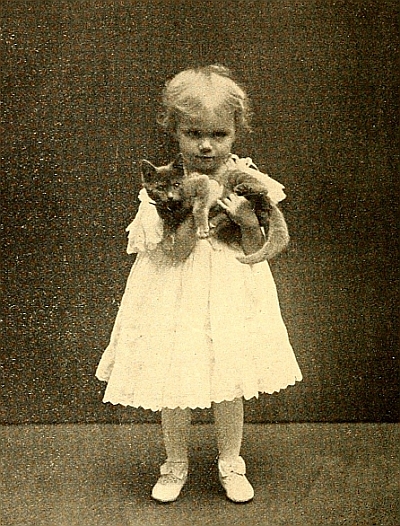
Picture I.—Advance on platform carrying pet kitten in arms in regular childish fashion; pause, throw weight of body evenly upon both feet; face expressing joy and pride; and in pleasing tones explain who “Tootsy Wootsy” is and how “tunnin’.”
Descriptive Pose.—Smile, hold kitten out in front of you for admiration of audience; seat yourself on floor, wind one arm and hand around kitten, while holding up other arm with fingers of hand extended, as though to illustrate what you think is correct size of her tail; facial expression brightens as head is slightly bowed, when gazing at beauty of kitten’s eyes.
Descriptive Pose.—Still seated, run one hand over and through kitten’s fur; hold kitten up a little and rub your cheek against its soft body; glancing alternately at kitten, then at her friends. Words requiring emphasis are “fluffy,” “wuffy,” “toat” and “it’s orsel wise.”
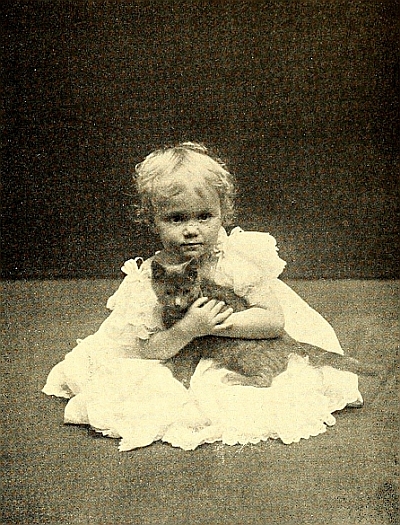
Picture II.—Still seated, hug kitten closely to breast, and show by look that you have no doubt of kitten’s receiving “firstes’, bestes’ tind oo’ prize.” Words that are emphatic are “some day,” “she,” and the entire second line.
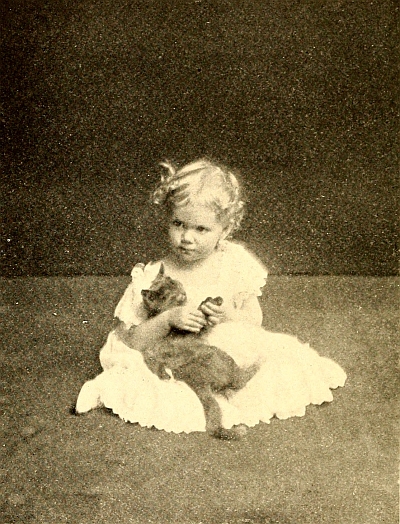
Picture III.—Put right arm around kitten; both hands clasp kitten’s paws; while you glance up obliquely with earnest tone and recite the lines. Special emphasis on “wite up ter me” as though it were something unusual for a kitten to do such a thing.
Descriptive Pose.—Serious tone and expression of face and eyes; prolong “des fas’ ersleep;” accompany “I nezzer ties” with movement of head from right to left to make more emphatic.
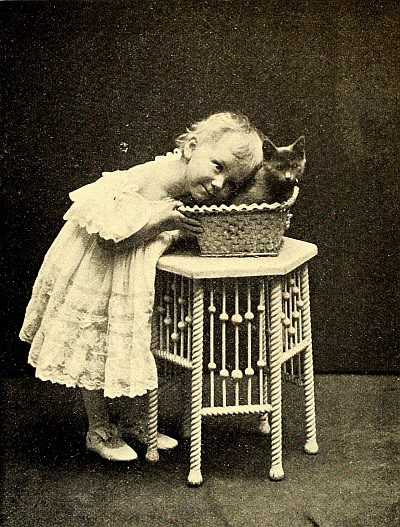
Picture IV.—Rise, advance to where basket is lying; place kitten in it; put basket with contents on stand; bow head, resting it lightly on kitten; hands clasp sides of basket; face expressing happiness.
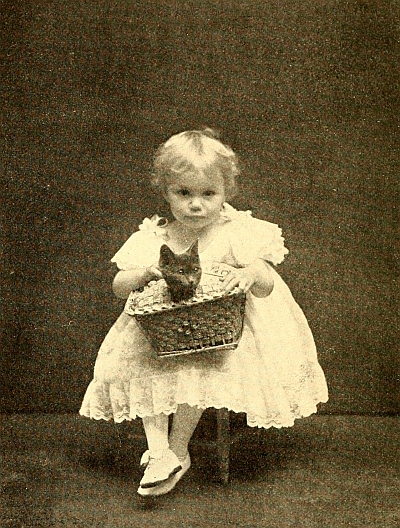
Picture V.—Place cover of basket over kitten, leaving head exposed to view; then sit in chair, feet crossed, and hold kitten in basket, for audience to gaze at. Show dignified tone and manner when reciting; tone softens and voice grows lighter on “still an’ twiet as er mouse.”
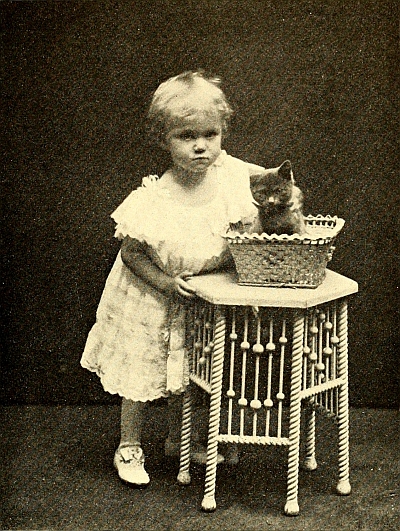
Picture VI.—Remove cover from basket, which still contains kitten; place cover to one side. Clasp with left hand kitten’s collar in the back. Cling with right hand to edge of stand, feet in natural childish position; body slightly inclined in sort of protecting manner over loved treasure, and with look and tone of disdain and strongest emphasis say that your kitten “ain’t ner tommon tind o’ tat;” give its breed, laying special stress on “Andora,” and “yes, she be;” decided nod of head in affirmative on last three words.
Descriptive Pose.—Continue dignified tone through first line; expression softens on second line; suggestion of smile. Emphasize “winks,” “purrs,” “p’ays wiv me.”
Descriptive Pose.—Take kitten from basket; resume your seat in chair; face should glow with pride and pleasure when thinking what you have for your kitten; for a moment the thought comes that when your friends learn what it is, they will make sport of you. With pathetic face beg them not to “laff.” Again assuming bright facial expression and giving marked stress to the words, assure them that it is—“Er sing ner uzzer titten’s dot,” and describe it as
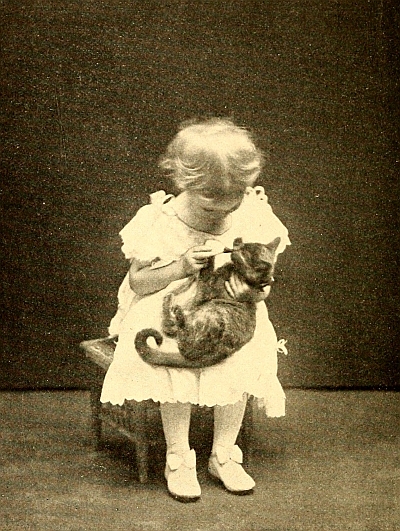
Picture VII.—Bend forward, clasp kitten with left hand, and proceed to give kitten milk from bottle that you take from basket.
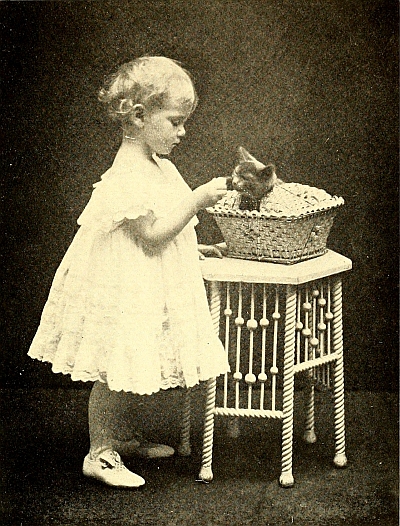
Picture VIII.—Rise, place cat in basket on stand, keep side of your body toward audience; continue to offer kitten milk as you recite the lines. Emphasize “very nice,” “nezzer,” and “wuns erway.”
Descriptive Pose.—Your fear of losing kitten should be expressed very vividly. Place nursing-bottle in basket. Lovingly take kitten out of basket. Put right hand to your eye as if to check a tear; left arm and hand encircle kitten; general appearance of childish sorrow.
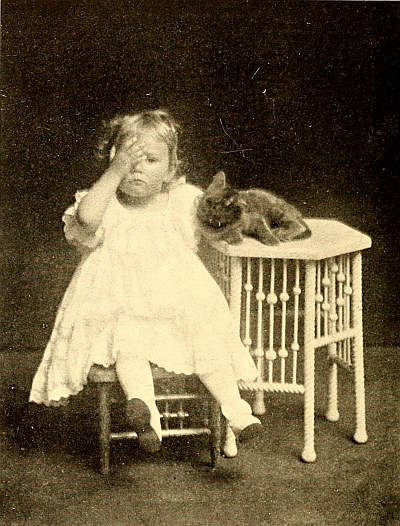
Picture IX.—In your great fondness for the kitten, you fear that you may lose it after all. Sit in chair, place cat on stand, holding its collar tightly with left hand. To illustrate still more clearly how you would mourn, should such a catastrophe befall you, when reciting how she “mite tazy dit,” place right hand on your face and give deep sigh and expression of intense suffering.
Descriptive Pose.—Take kitten, hug it closely, and in above lines beg it not to leave you. Strong emphasis on “yo’ bwake mi’ heart.” Then, carrying kitten under right arm, and basket containing nursing-bottle in left hand, smile sadly to audience and leave platform.
Rosalie M. Jones.
“HI! Hit her again! She’s ugly enough to stop a clock.”
“You let her ’lone,” screamed a small voice from the top story of a towering rear tenement, but alas, it fell far short of the depths, way, way, below where the cruel boys were tormenting the poor kitty.
Then the active little figure belonging to the voice hurriedly left the window above and racing down stairs, three steps at a jump, burst violently into their midst, caught their trembling little victim to her breast, and with no weapons but a flushed face and two big tearful eyes, turned defiantly to brave the cowards.
“Say, fellers, catch on ter de young defender.”
“Yer wanter send her ter de cat show, see. She’ll git a prize, I don’t tink.”
With a look of contempt which stung even the most hardened of them, Maysie turned away with her suffering burden and re-entered the house.
“For goodness sake! What’s that you’ve got now?” asked a tired looking woman, as she saw her small daughter come panting into the kitchen, clutching something by the legs.
“Jus’ a kitty.”
“Well, I never did! Why, Marg’ret Williams, are you crazy? I never saw such a homely creature in all my born days: it’ll bring us bad luck, sure, with that wicked green eye and that mean yeller one—ugh! You just take it straight back to the gutter you fished it out of.”
At this Maysie began to cry; sobbing out the story of its ill treatment.
“Oh, well, I reckon we’ll keep her till she’s cured up, anyway.”
So Maysie kept her cat, and pity blossomed so quickly into love that she was perfectly blind to its ugliness and fondly fancied it the dearest, sweetest and loveliest kitty in all the world.
On the next Sunday, Mrs. Williams read out from her great big newspaper: “A National Cat Show at Madison Square.”
“What’s a National Cat Show?” asked Maysie, who was sitting playing with Rags, as she called her foundling.
“Why it’s—it’s a show of cats, I suppose, and it’s to be held next Wednesday in Madison Square Garden.”
“Oh, yes, that must be where that bad boy in the street told me to send Rags, but I thought, o’ course, he was just foolin’; he said, maybe I’d get a prize for her. Do you—— do you think I might, mother?”
Mrs. Williams hid a smile behind her newspaper, as she read of the gorgeous Angora, Maltese, Persian and other rare and beautiful cats that were to be exhibited by the richest and most fashionable ladies in New York, but she only answered: “I shouldn’t wonder.”
This was enough. In the course of ten seconds, Maysie had decided in her own mind that she would take Rags to the show, and that there was not the slightest use of worrying her poor, tired mother about it beforehand and spoiling the delightful “s’prise.”
Early Wednesday morning Mrs. Williams started for her day’s work. Maysie, when left alone, fairly raced the breakfast dishes around her dishpan, over the towel and up again on the shelf. Then she slipped into a nice little fresh calico dress, tied a new red ribbon around Rags’s neck in a fantastic bow, which, however, would slide around under her chewed-off ear, then cramming her into the market-basket, she set off with a light heart.
She was too early to be admitted, and so had to stand and wait near the side door marked “Entrance for Cats.”
At last a carriage drove up to the great front door of the building and a lady descended from it, followed by a maid in a white cap, carrying a basket. She was such a pretty lady and so beautifully dressed, that Maysie liked her on the spot, and thought that it would only be kind to inform her that she was not at the right entrance for cats and must wait at the side door with her.
The lady smiled when she told her, and she said: “Oh, thank you, you’re very good; I see you have a cat, too! Is it to be in the show?”
“Oh, yes, don’t you think she’ll get a prize?”
“Pro—probably,” said the lady, turning away for an instant and shaking so strangely that Maysie thought she was cold.
“Had’nt I better ask the other lady to bring you a shawl or sumpin’ out of your carriage?”
“No, thank you, I’m quite well. Suppose we go into the show together?”
“Why, we can’t, can we. It ain’t open yet, is it?”
“Not to every one, but I am one of the patronesses, and I fancy they will let us in.” And sure enough they did.
“Here is a little girl who has a cat she would like to exhibit,” said the lady to a gentle-looking man inside, who seemed to be managing everything. “I know it’s rather late to enter it, but—” and she whispered something which made him smile and look almost as queerly at Maysie as the lady had done.
However, he gave Rags a nice cage, with soft straw in it, and a little medal with a number on it to hang around her neck by a scarlet ribbon.
“Now, you had better go up stairs and wait,” he said; “they won’t be on for an hour yet, and the judges cannot award the prizes until then.”
Maysie did not understand very clearly what he meant, but she was a trustful little soul, and so left Rags with him and climbed the stairs to a little waiting-room above.
After awhile the lady joined her saying, “Come, we can go in now.”
Pale with excitement, Maysie accepted the hand held out to her, and grasping it tightly, entered the great exhibition. Oh, wasn’t it beautiful! All lit up with ’lectric light! Row after row of cages crossed the floor, in each one of which blinked and stretched and softly purred a lovely, lovely kitty.
They kept getting more and more wonderful and beautiful as Maysie and the lady went on and on, but in her royal little soul, Rags’s mistress would not admit that any one of them was prettier or sweeter, or half as clever as Rags.
No, not even that grandest, showiest Angora, lying upon a rose-colored velvet cushion with exquisite pink roses in cut-glass bowls around her, and a tiny canary bird singing away blissfully in the same cage.
“You know, Rags ain’t never seen a bird, lessen it’s a sparrer, and she ain’t never smelt a flower in all her life, so wouldn’t you think they’d give her a prize jus’ to keep her from feelin’ bad?”
“Yes, I would indeed. There are the judges and they are coming from the other side of the room. Now, we will go over there and look for Rags, and if they have given her a prize, it will be written upon a card and hung on her cage, where we can see it in an instant.”
“Oh, my, do you suppose everybody what’s got a cat here feels like I do now?”
“I hardly think so much so, dear.”
At last they stood before Rags’s cage. Maysie put both hands over her eyes and peeped fearfully through her fingers.
“Oh! Oh! I believe I see a card.”
“Yes, you do.”
“What’s on it? Oh! What is on it?”
“P-r-i-z-e, prize!” read the lady.
“Ten dollars prize for the ug—for Rags.”
“My,” said Maysie, and she burst into tears of pure joy.
The lady kissed her warmly, dried her eyes and placed the bowl of roses right under Rags’s funny little nose.
Then the great, severe looking judges came up and congratulated her, and counted out into her two little hands all the heap of money that was the prize.
“And now,” said the lady, “I will drive you home.”
So she did, and didn’t all the children in the neighborhood run off to see who was getting out of the fine carriage that stopped before the tenement, and weren’t they surprised to find it was just Maysie? And didn’t Mrs. Williams laugh and cry and scold and pet her all at once when she heard the great news?
“Dear, dear, what a jewel Rags is.”
“Yes,” said her mother, “who’d have thought she’d have brought us such good luck by her very homeliness?”
“Homely? Why, mother, you forget, she’s got a prize.”
“So I did,” said Mrs. Williams, “so I did, of course.”
Elizabeth I. Cassin.
CATS see their prey, and catch it by creeping slyly up to it. Dogs smell their prey, and catch it by running it down. Cats must therefore have good eyes and be able to move very softly, while dogs must have strong scent and be able to go fast and far.
Eva J. Beede.
Action Poem.
[1] Stand erect, hands by side.
[2] Fold arms and look very imploringly.
[3] Place pinafores to imitate bibs by raising the bottom and placing it around neck.
[4] Place fingers as if to lift a cup to mouth.
[5] Make a bow.
[6] Let children take hold of hands as if to go out.
[7] Smooth hair.
[8] Point to chins.
[9] Point to coats or pinafores.
[10] Look very sorrowful.
[11] Raise hands and throw them both forward toward door.
Mrs. Gertrude Manly Jones.
HAVE any of you seen my kitty? I have hunted all over the house for her and I can’t find her anywhere. She’s not under the stove nor up in my bed, and I don’t know what to do. Won’t you help me look for her? She is a gray kitty, with a white spot between her eyes. You will know her by that. Her name is Spot, and she knows it just as well as I know my name. When I have a saucer of milk for her, and call, “Here, Spot, Spot, Spot!” she runs as fast as her little feet can trot. Oh, dear, where are you, kitty? I wish I could find you. I hope no big, bad boy, or naughty little girl has carried you away. Hark! What is that? “Meow, meow, meow.” Why, there she is, now, on the window-sill. Just wait, my precious, darling old kitty, until I get you in my arms!
Oliver Herford.
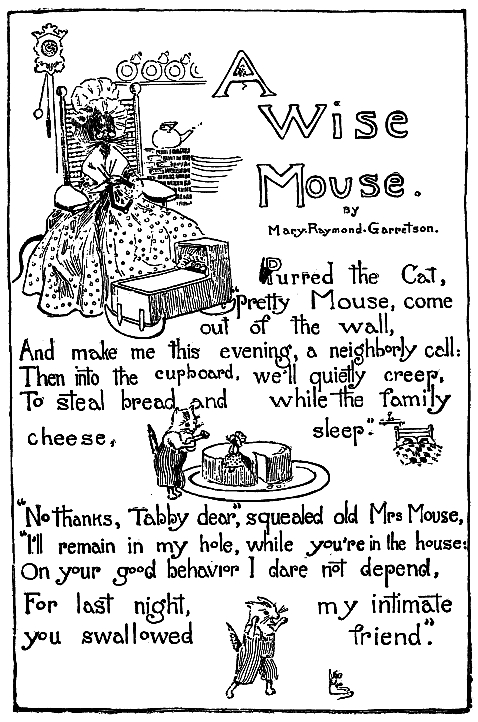
By
Mary·Raymond·Garretson.
Action Poem.
[1] Point out.
[2] Raise forefinger of each hand, and put one on each side of head.
[3] Look around.
[4] Pretend to wash face.
[5] Same as 3.
[6] Hold hands loosely and shake.
[7] Point to neck.
[8] Raise both hands.
[9] Point outward.
[10] Tap toes lightly.
[11] Point to door.
[12] Beckon.
[13] Hold hands together, palms upward.
[14] Let a few children imitate mewing.
[15] Look intently at teacher.
[16] Move forefinger.
[17] Curve right arm around to left side.
Eve Lawless.
THERE are women in this world, and men, too, who, I think, were intended for cats instead of human beings. Notice their soft velvety paws as they beg some favor of you; and then offend them, I’ll be bound you’ll see the claws, and feel them, too.
That person, who creeps around your house with stealthy tread and catlike caution, take my word for it, means mischief, and if you don’t hear some rumors regarding yourself, then I am no prophet.
A cat will kill a bird, eat it, wash her paws, and look up in your face, as though she said, “I don’t see who could have eaten that canary.” Can’t you think of some individual who bears a resemblance to that cat?
Hasn’t some one been casting aspersions upon your character, and said foul things about you, and then licked her paws—I mean washed her hands—and put on a grave-yard look, saying, at the same time, “How can people talk so about their neighbors?”
I hate these cats. I want to have a person candid, upright and outspoken, not palaver before your face, and backbite you when you haven’t the ghost of a chance to defend yourself. It always makes me shiver to hear a catlike tread.
Hallo! Here comes another cat. This time it comes in the shape of an anonymous correspondent, who wishes Eve to write to him on Love! I beg your pardon; I don’t write to promiscuous people, and especially to those who are ashamed to write more than their initials. When a man is not willing to sign his name fair and square to a letter, it doesn’t strike me that he can be any too proud of it. This anonymous letter-writing is of too catlike a nature to suit me.
Have I any more cats handy? I think so. Imagine you have written a poem; some friend praises it, stroking your fur the right way, figuratively speaking. Let another friend tell you of its faults, rubbing the fur contrariwise, won’t you spit, and scratch, and mew something about somebody’s having no taste? Why are we plagued with so many catlike attitudes?
Grace Bacon Holway.
L.E. Street.
“YOU—ow—w!” said Blitzen. “What are you doing on my premises?”
The other cat looked up from the plate before him. He was enjoying the good breakfast which had been placed upon it.
“I’m visiting here with my mistress.”
“What is your name?” further inquired Blitzen, still waving his tail, though in a somewhat less warlike manner; “and why is that blue ribbon tied on your collar?”
“My mistress calls me Herculo. I’m a pure-blooded Angora, and that blue ribbon is for a prize I took in a cat show. I’ve taken four.”
“Humph! Well, my name is Blitzen, which means lightning. I’m called that because I can scratch with my claws just as quick and sharp as lightning can strike. I’m just a plain cat, and never took a prize in my life; but I can catch mice and sparrows and climb a tree like a squirrel.”
Again the tail waved. Herculo looked duly impressed.
“Gr-r-r!” continued Blitzen, beginning to eat the breakfast which lay on another plate close by. “Don’t you dare touch any of my breakfast. Keep to your own plate.”
This was the way the two cats began their friendship. It did not take Blitzen long to grow quite amiable, especially when he saw how respectfully Herculo watch his exploits.
One morning Blitzen started off before daylight on an expedition, which kept him longer than he meant it should.
“Plates empty, eh?” he mused as he reached the kitchen door. “Now, what a good thing it was that I caught that mouse. Where can Herculo be, I wonder.”
“Meow-ow! Meow-ow!”
Blitzen pricked up his ears.
“That sounds familiar!”
“Me-ow-ow!”
“Herculo, as sure as I’m a cat! He must be in some scrape. Now, which direction—ah, front lawn, I guess.” And Blitzen ambled away thither.
“Meow-ow!”
Blitzen looked up in the larch tree, high up in the branches of which clung Herculo. Just beyond his reach sat a dozen sparrows twittering with bird laughter at the terror and discomfort of their would-be enemy.
“Hullo!” said Blitzen calmly. “Why don’t you come down?”
“Ca-an’t—it’s so hi-igh! I’ll fall.”
“What made you climb up there, anyhow, if you were too scared to come down again?”
“To hunt the sparrows. Meow!”
“Ha, ha!” laughed the sparrows. “Chee, chee!”
“Well, you just swing your hind feet off to the next branch below, can’t you?” said Blitzen.
Herculo tried, but was too frightened to succeed.
“I can’t,” he wailed again. “Yow-w-w!”
Blitzen walked around the tree and viewed him critically from all sides. Then he started for the barn. Herculo felt himself deserted, and yowed despairingly.
Blitzen trotted on. At the barn he found John, the man, and rubbing persuasively against his legs, said, “Meow!”
John stooped and petted him. Acknowledging the stroke of the friendly hand, Blitzen repeated firmly, “Meow!” Then he went a few steps toward the door and turned to see if John understood.
“What’s up, Blitzen, ye sinner?” asked John.
“Meow!” replied Blitzen, trotting ahead.
“Sure, he’s a knowin’ animal. He do be wantin’ somethin’. I’ll go with him,” was John’s conclusion.
And then Blitzen triumphantly led him to the tree where Herculo still clung, and still howled dolefully.
“Av coorse, I’ll get him down fer ye, Blitzen,” said John, taking in the situation. “Ye’re a clever feller entirely!”
By help of a ladder and John’s strong arms, Herculo was landed on the ground very much tumbled-up-and-down in his mind.
“Blitzen,” said his mistress, “you shall have a blue ribbon, too. You may not have any blue blood, but you’ve common sense; and that’s a trait worth having in man or beast!”
Harriet Beecher Stowe.
LITTLE Fred is now in the third summer of his life. He has been moved into the country, and his round blue eyes are growing rounder and bigger every hour with new and wonderful experiences.
Most striking among them and most puzzling to Fred is Pussy. Not a big cat, but a kitten, of those tender years corresponding to Fred’s own. What a wonder she is, seen now for the first time, serenely walking on all fours! A Maltese kit, of pure blood and glossy mouse color, with a white breast-pin in her bosom!
Eagerly Freddy seizes her; he hugs her very tight, and Pussy squirms in vain; he examines the wonder; he pokes his fat little fingers into Pussy’s bright eyes; he opens her mouth and looks at her little pink tongue. He sends her a little while with her head up, and then, for vanity’s sake, he sends her with her heels up, and her head hanging down. Then it occurs to him that Pussy’s tail is a nice handle to carry her by, and he tries that experiment. At last Pussy’s patience gives out, and out from her pretty velvet paws fly the ten little sharp, pearly points that have been given her for her defence, and Fred feels a new sensation. He throws Pussy on the floor and runs screaming to mamma.
“Oh, mamma, mamma, Pussy got pins in her toes!”
Then mamma explains to Freddy why the pins were put in Pussy’s velvet toes. Poor, soft, furry, helpless little Pussy! what could she do if she had not pins in her toes? Does Freddy like to have people poke their fingers in his eyes, or open his mouth, or feel of his tongue? No more does Pussy. Would Freddy like to be carried around, squeezed up under somebody’s arm, with his head hanging down? No more does Pussy. But Pussy cannot speak; she cannot complain—all she can do is to use the pins in her toes.
“When Freddy holds Pussy right end up, strokes her gently, and speaks lovingly to her, the little sharp pins in her paws go away—clear in—where nobody can see them, and Pussy begins to sing a low, little purring song to show how happy she is! So, Freddy dear,” says mamma, “there is a right way and a wrong way to handle everything. If you hold Pussy gently, stroke her softly, and treat her kindly, you never will be troubled by the ten little pins in her ten toes; but if you trouble, and worry, and tease Pussy, she will scratch.”
Elizabeth Harcourt Mitchell.
A Fable.
THE cat and the tiger were once on very good terms. They considered themselves members of the same family; and, whenever any disputes arose among the animals, they were both found vigorously supporting the other’s case. They were often to be seen roaming about the country together, and they frequently did each other great services, the tiger by his superior strength, and the cat by his more nimble wit.
Although, for the most part fast friends, the tiger when they were by themselves would often harass the cat by his conceited speeches.
“You may be very well for small game,” he would say, striding up and down, and lashing his tail to and fro, “but you must know that you are but a small and very plain edition of me. I can easily bring down deer, and I have even put the great elephant to flight. Look how my beautiful stripes flash in the sun. Are you not proud of belonging to my family?”
To this the cat said nothing, but closed his eyes and mused.
Now, it is well known that, though the tiger can easily climb up a tree, once he is up, if he wishes to come down, he must either leap or fall, since he is unable to climb down.
One day he said to the cat: “I have long wished that I could climb a tree. Many of my tormenting enemies escape from me because I must stick to the ground. You climb very well, though you are so little. Why will you not teach me?”
“Come along; I will teach you with pleasure,” said the cat, leading the way to a tall tree. After a great deal of instruction the tiger succeeded in getting up the tree; but the cat, seeing now an opportunity to retaliate for the tiger’s unpleasant words, ran off, laughing.
“I am up very well,” said the tiger, a little frightened at finding himself so far from the ground; “now show me how to come down.”
“Oh, no,” said the cat. “I was only to show you how to get up. Now you must get down the best you can. Since you are so much more powerful and beautiful, surely you can do that much better than I.”
The tiger tried to cajole his small friend, then begged him for help; but, finding him obdurate, flew into a rage and leaped to the ground, meaning to catch and crush him at once. Instead, he almost crushed himself, and lay on his side for some moments, gasping for breath.
At last, when he was able to rise, he rushed after the cat with the best speed he could muster. Lame as he was, he gained rapidly, and it would have gone hard with the cat had he not, luckily, spied a man’s house a little way off. In this he took refuge, and he has never yet mustered courage enough to leave that protection.
Action Poem.
[1] Children all huddled in a bunch, with faces in hands on desk.
[2] One child comes softly creeping in toward them and says, “Im-mieouw.”
[3] All children stretch, rub eyes and gather round their mother, now wide awake.
[4] All skip about as kittens do, when their mother is near, and play with one another.
Clara D. Bates.
Jerome K. Jerome.
I LIKE cats and dogs very much indeed. What jolly chaps they are! They are much superior to human beings as companions. They do not quarrel or argue with you. They never talk about themselves, but listen to you while you talk about yourself, and keep up an appearance of being interested in the conversation. They never make stupid remarks. And they never ask a young author with fourteen tragedies, sixteen comedies, seven farces, and a couple of burlesques in his desk, why he doesn’t write a play.
They never say unkind things. They never tell us of our faults, “merely for our own good.” They do not, at inconvenient moments, mildly remind us of our past follies and mistakes. They never inform us that we are not nearly so nice as we used to be. We are always the same to them. They are always glad to see us. They are with us in all our humors. They are merry when we are glad, sober when we feel solemn, sad when we are sorrowful.
“Hulloa! happy, and want a lark! Right you are; I’m your man. Here I am, frisking round you, leaping, barking, pirouetting, ready for any amount of fun and mischief. Look at my eyes, if you doubt me. What shall it be? A romp in the drawing-room, and never mind the furniture, or a scamper in the fresh, cool air, a scud across the fields, and down the hill, and we won’t let old Gaffer Goggles’s geese know what time o’day it is, neither. Whoop! come along.”
Or you’d like to be quiet and think. Very well. Pussy can sit on the arm of the chair, and purr, and purr, and Montmorency will curl himself up on the rug, and blink at the fire, yet keeping one eye on you the while, in case you are seized with any sudden desire in the direction of rats. And when we bury our face in our hands and wish we had never been born, they don’t sit up very straight, and observe that we have brought it all upon ourselves. They don’t even hope it will be a warning to us.
But they come up softly; and shove their heads against us. If it is a cat, she stands on your shoulder, rumples your hair, and says, “I am sorry for you,” as plain as words can speak; and if it is a dog, he looks up at you with his big, true eyes, and says with them, “Well, you’ve always got me, you know. We’ll go through the world together, and always stand by each other, won’t we?”
He is very imprudent, a dog is. He never makes it his business to inquire whether you are in the right or in the wrong, never bothers as to whether you are going up or down upon life’s ladder, never asks whether you are rich or poor, silly or wise, sinner or saint. Come luck or misfortune, good repute or bad, honor or shame, he is going to stick to you, to comfort you, guard you, and give his life for you, if need be—foolish, brainless, soulless dog!
Ah! old staunch friend, with your deep, clear eyes, and bright, quick glances, that take in all one has to say before one has time to speak it, do you know you are only an animal, and have no mind? Do you know that dull-eyed, gin-sodden lout, leaning against the post out there, is immeasurably your intellectual superior?
Do you know that every little-minded, selfish scoundrel, who lives by cheating and tricking, who never did a gentle deed, or said a kind word, who never had a thought that was not mean and low, or a desire that was not base, whose every action is a fraud, whose every utterance is a lie; do you know they are all as much superior to you as the sun is superior to rush-light, you honorable, brave-hearted, unselfish brute?
They are men, you know, and men are the greatest, noblest, and wisest, and best Beings in the whole vast eternal Universe. Any man will tell you that. Yes, poor doggie, you are very stupid, very stupid indeed, compared with us clever men, who understand all about politics and philosophy, and who know everything in short, except what we are, and where we came from, and whither we are going, and what everything outside this tiny world and most things in it are.
Never mind, though, pussy and doggie, we like you both all the better for your being stupid. We all like stupid things. It is so pleasant to come across people more stupid than ourselves. Ah me! life sadly changes us all. The world seems a vast horrible grinding machine, into which what is fresh and bright and pure is pushed at one end, to come out old and crabbed and wrinkled at the other.
Look even at Pussy Sobersides, with her dull sleepy glance, her grave slow walk, and dignified, prudish airs; who could ever think that once she was the blue-eyed, whirling, scampering, head-over-heels, mad little firework that we called a kitten.
What marvelous vitality a kitten has. It is really something very beautiful the way life bubbles over in the little creatures. They rush about, and mew, and spring; dance on their hind legs, embrace everything with their front ones, roll over and over, lie on their backs and kick. They don’t know what to do with themselves, they are so full of life.
Can you remember when you and I felt something of the same sort of thing? Can you remember those glorious days of fresh young manhood; how, when coming home along the moonlit road, we felt too full of life for sober walking, and had to spring and skip, and wave our arms, and shout? Oh, that magnificent young Life! that crowned us kings of the earth; that rushed through every tingling vein, till we seemed to walk on air; that thrilled through our throbbing brains, and told us to go forth and conquer the whole world; that welled up in our young hearts, till we longed to stretch out our arms and gather all the toiling men and women and the little children to our breast, and love them all—all.
Ah! they were grand days, those deep full days, when our coming life, like an unseen organ, pealed strange, yearnful music in our ears, and our young blood cried out like a war-horse for the battle. Ah, our pulse beats slow and steady now, and our old joints are rheumatic, and we love our easy chair and sneer at boys’ enthusiasm. But oh! for one brief moment of that god-like life again.
SONG WITH TABLEAUX.
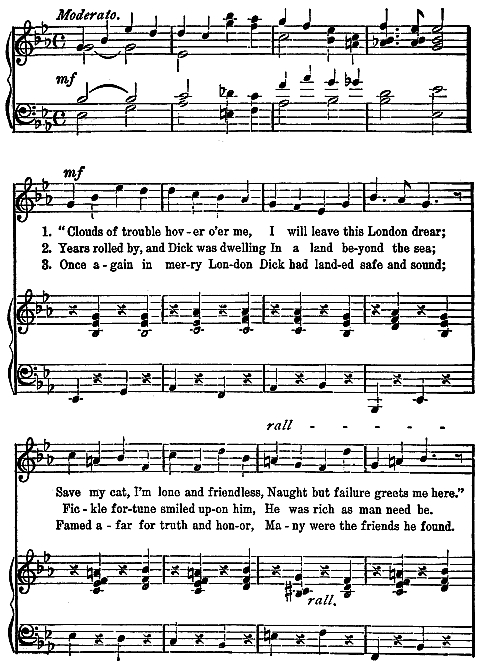
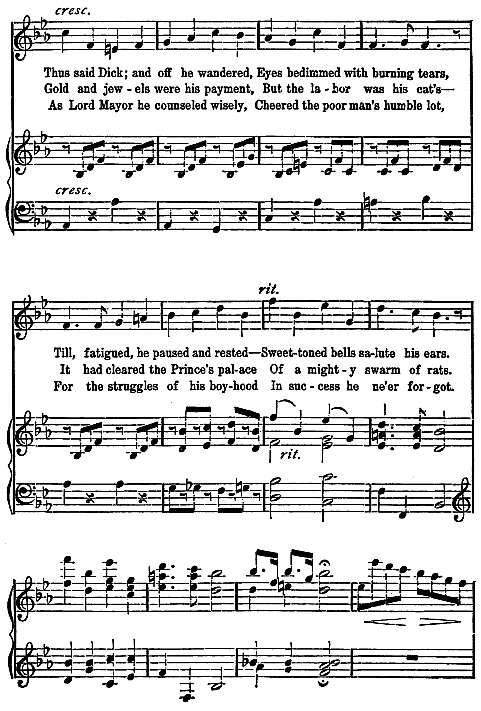
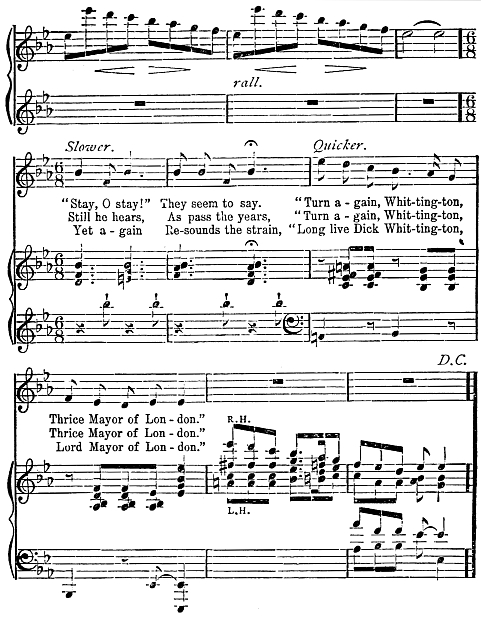
Persons Represented in the Tableaux: Dick Whittington, a beggar, attendants, etc. A cat.
Scene. For Tableau I, an exterior; for Tableaux II and III, an interior.
N.B. The chimes played on the Fairy Bells or some similar instrument will greatly add to the effect.
Tableau I. Verse 1. Dick, with a bundle over his shoulder, turns round at the sound of the bells.
Tableau II. Verse 2. Dick, well dressed, sits fondling his cat.
Tableau III. Verse 3. Dick, as Lord Mayor of London, sits in a chair of state. He gives alms to a poor man who kneels before him. Attendants look on.
Mrs. Frederick W. Pender.
Written expressly for this book.
(See page 52.)
[1] Child enters, walks to chair at stage C, looks down at kitty, speaking in loving tones, and petting her.
[2] Speaks as if she felt slightly teased.
[3] Continues petting kitty, and shakes a finger as if in warning.
[4] Drawls the line, separating the word into “Mal-tese,” and giving stress to “tease.”
[5] Shakes finger insistently, pulls and hauls at kitty. Gives a little meow.
Action Poem.
[1] and
[2] Beckon.
[3] Put hands together.
[4] Point to floor.
[5] Fold hands quickly.
[6] Point to door.
[7] Shake head slowly.
[8] Hold up forefinger.
[9] Emphasize with forefinger.
[10] Nod head saucily.
[11] Point outward.
[12] Shake hands loosely.
[13] Bend hands and place them together.
[14] Shake head slowly.
[15] Point over shoulders with both hands.
[16] Imitate walking with fingers on desks.
[17] Bring hands down suddenly.
Carolyn Wells.
E. Louise Liddell.
ACTION SONG.
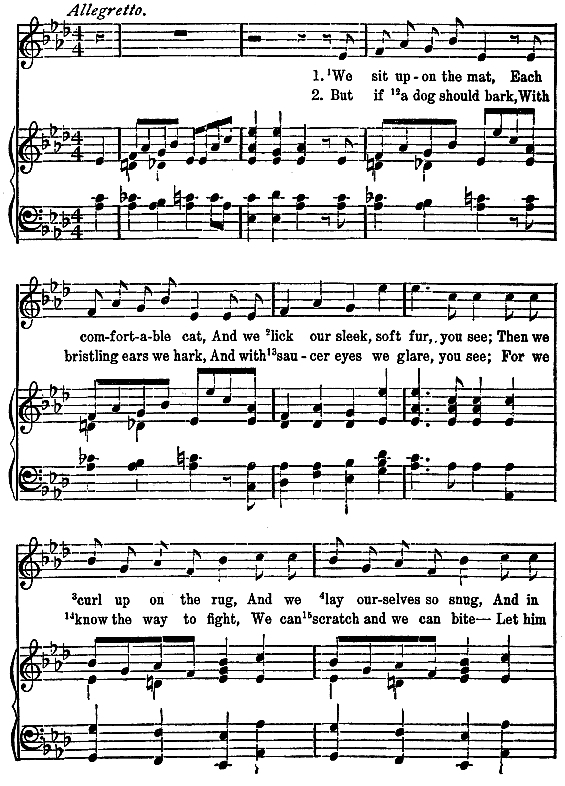
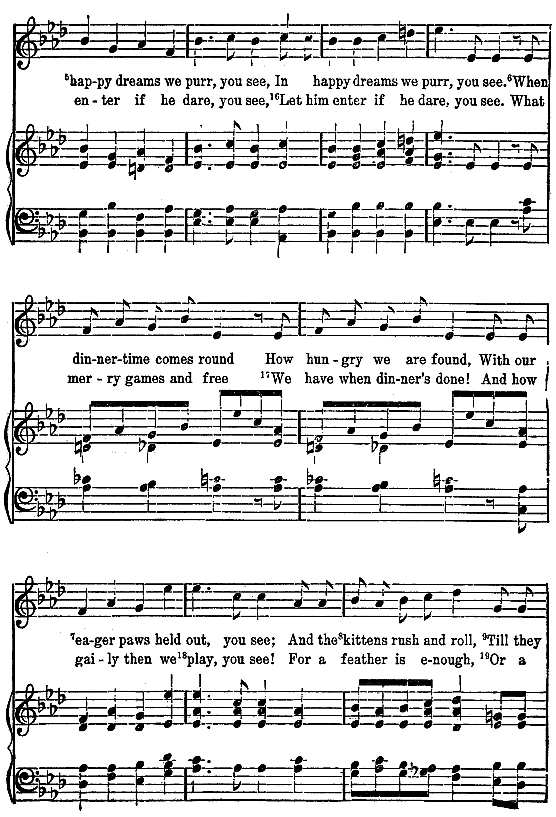
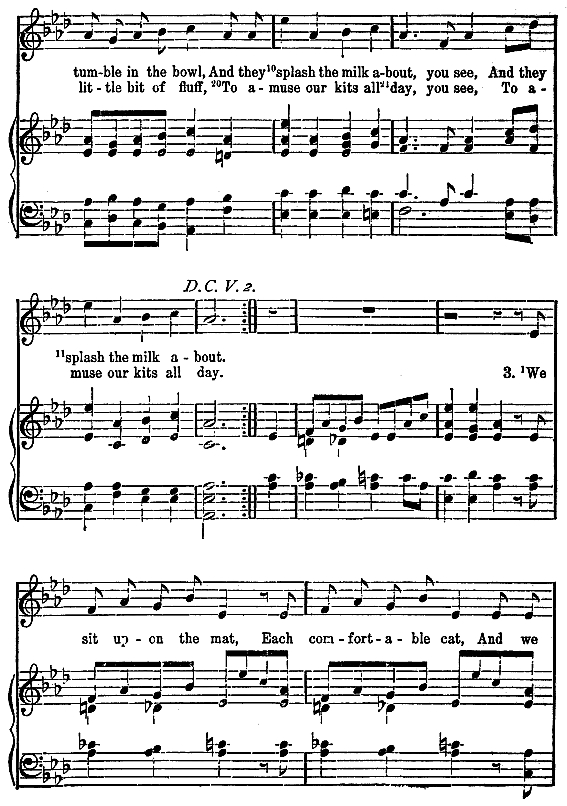
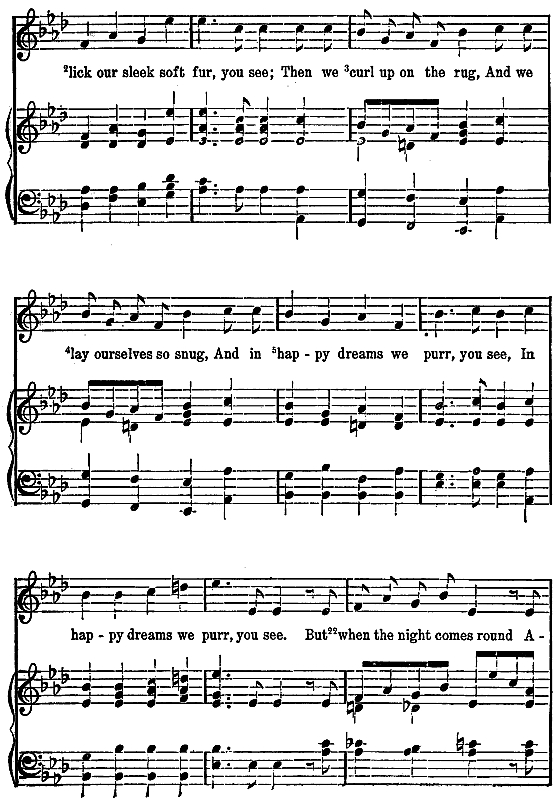
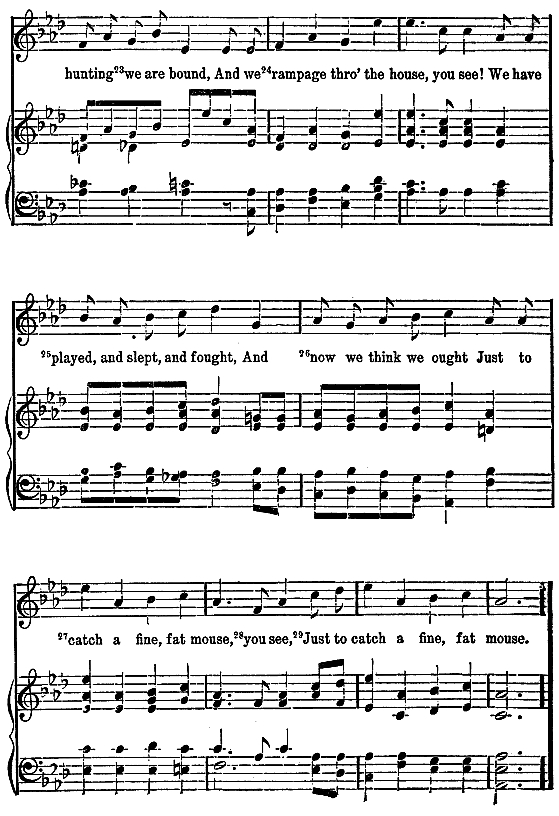
[1] Each child should sit on a footstool.
[2] Affect to lick breast and paws like a cat.
[3] Lay head down on curled left arm upon knee.
[4] Change attitude to right arm.
[5] Look up with shut eyes, blink and smile, and lay head down again.
[6] All get up and look about eagerly.
[7] Stand on tiptoes and raise paws, like a cat begging; open mouth.
[8] Run three steps to left.
[9] Same action to right.
[10] Raise forefinger, looking down with severe air.
[11] Affect to lap milk eagerly.
[12] Spring back, raise head, put hand to ear.
[13] Stand stiff and erect, with wide eyes.
[14] Shake clenched fist, scowling.
[15] Scratch and bite at imaginary foe.
[16] Remain with both hands extended in clawing attitude and teeth showing.
[17] Each lay left arm around left hand neighbor’s shoulder, smiling.
[18] Each pats her neighbor lightly, smiling.
[19] Blow upward, as if at a feather.
[20] Pounce down playfully with right hand.
[21] Sit down on footstool, and affect to play with something on floor.
[22] Look up mysteriously and lay finger to lips.
[23] Rise stealthily and look to and fro with keen eyes.
[24] Rush three steps to left and then three steps to right.
[25] Quickly pat the next child as in 18, lay head on shoulder and shut eyes, and scratch forward as in 15.
[26] Raise forefinger, smiling mysteriously; stoop, crouching forward.
[27] Pounce forward and seize imaginary mouse.
[28] Swallow imaginary mouse.
[29] Look up smiling, and resume seat on footstool.
(With Apologies to Robert Southey.)
A.C. Kish.
THE subject of this lecture is Cats, a domestic animal what is in common use. Cats is a animal as resembles poor people, as they scratches for a living, and never has enough. Cats is lazy, wherein they resemble the rich. Women am fond of cats—p’raps because both uses their claws in asserting their rites—cats on Toms and rats and mice, and little birds, and women on their husbands—which accounts for the great number of divorces. Cats likes milk, but not water, hence the aversion that milkmen have to ’em. Cats is like dandies, as they have great whiskers and white teeth, and is fond of gallivanting about, especially Thomas Cats. There are always a war between cats and rats. Cats has lofty naturs, as they gets on the house-tops, and ascends to the utmost branches of the tallest trees. Robinson Crusoe had a cat, and so had Mahomet. Cats is anti-Malthusians, and increases in geometrical progression, or more. The productions of cats is kittens and electric sparks. This is all there is about cats, except caterwaulin’, which they shares with human bein’s.
BY HERBERT RANDALL
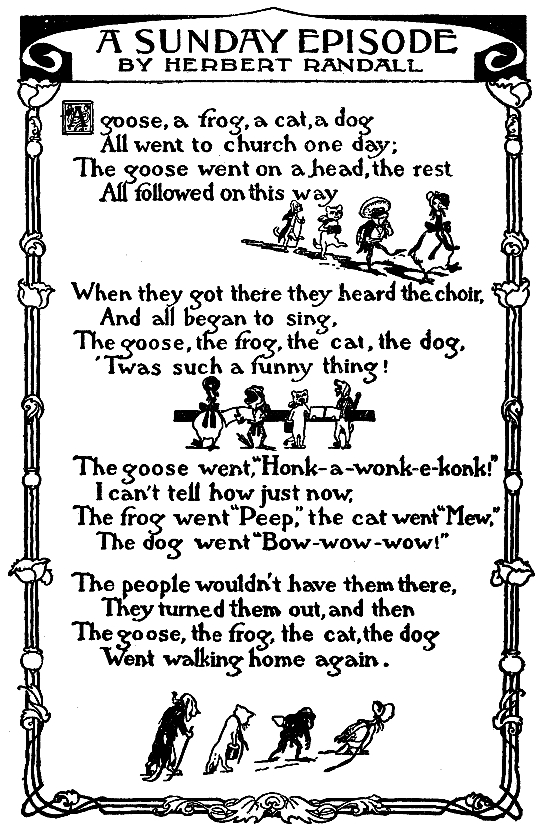
J.D. Corrothers.
[From “The Black Cat Club,” by special permission.]
THE cat—an’ pertickler de Black Cat—have bin a pow’ful an’ ’spectable genamun sense Time fust begun to wheel his eternal flight ob circumlocution th’u’ endless ages ob nitric acid, quinessence ob floatin’ protoplasm, an’ parliamentary usage!
Long befo’ de earf wah made, de Black Cat had gradjiated f’om a singin’ school in Mahs, an’ had created de planet ob Juan Fernandez an’ de islan’ ob Mesopotamia!
De cat am a practical pusson. He am no spring chicken. He am gen’ly cal’cated to hab nine libes, but dis de cunjah man ’roun’ de co’nah assures me am a sad mistake. He hab nine hundred and ninety-nine libes, libs as long as he want to evah time, an’, lak de good Christ’an, is “bo’n ag’in” almose any ole time. Dat’s why de Theosophists sings dey sacred solo, “De Cat Come Back.”
When de earf wah made without fo’m er void, de Black Cat wah dah watchin’ de whole business, an’ a-layin’ his wires foh to sen’ Grobah Clebelan’ to de United States senate an’ Dick Crokah to de happy lan’ o’ Canaan! Fust thing he done wuz to cross our fo’ parents’ luck in de beautiful Gahden ob Eden, an’ sen’ po’ Adam out to play football wid de rattlesnakes an’ In’juns in de lonely Province ob Wes’ Virginny.
De Black Cat am prone to ebil, as de spahks fly up’ards. He am a lubber ob de back fence, de telegraph pole, an’ de midnight serenade. Bootjacks, pistols, policemen’s clubs, an’ missiles kin not stop his rapturous ditty to de pale-face moon. He am a genamun! He am de mahvel ob de nations!
You mout ax me whut de Black Cat hab done foh sufferin’ humanity. I answer: He am de inventer ob de watermillun, co’n pone, sweeten ’taters, liquor, an’ ’possum; an’ wuz de fust man to teach de cullud race de advisability ob eatin’ po’k chops when you’s flush an’ libber when you’s hahd up.
Oh, de Laud will provide! Dat’s why he gib us our ole black cat Mesmerizer here to bring us good luck whahevah we goes in de United Snakes of Americy, while some ob our good ole mothers is a-ben’in’ ovah de wash-tub, ’way down yondah in Dixie-lan’, sheddin’ briny tears an’ a-sighin’—“Whah’s ma won’rin’ boy to-night?”
’N’ while she’s wo’kin’ ’n’ frettin’, hah trifflin’ son’s down on de co-nah, sunnin’ hisse’f an shootin’ dice, an’ a-singin’:
De Black Cat hab allus bin somebody. Look, whut a pull he had wid ole Isis, one o’ de riches’ men in Egypt, thousands o’ years ago: Cat come along one day, he did, an’ crossed Mr. Isis’ luck, an’ dat fellah didn’t do a thing but beg de cat’s pawdon, an’ build a sacred temple to him. Dat’s all he done to him! An’ don’ you think he kin take keer o’ us?—his needy an’ faithful chillun? All we’s got to do is to wo’k our rabbit’s foot, an’ say nothin’, an’ thaings’ll come our way.
Margaret Vandegrift.
[Little girl addresses the mother of her pet kitten.]
Action Poem.
[1] Enters, looks all around, and recites first line.
[2] Recites second line little more emphatically.
[3] Walks to stage L, and looks, while she recites in anxious tone; suddenly face brightens.
[4] Discovers that kitten is playing with her mother’s knitting, and in surprised voice speaks.
[5] Shakes finger at kitten, picks up knitting and examines it.
[6] Turns and looks at kitten, who seems to be at her side.
[7] Somewhat anxiously. Sits down and looks at kitten.
[8] Kitten climbs into lap and apparently rubs against her fingers. Girl looks down as if to scold.
[9] Looks into kitten’s eyes; hugs kitten close.
[10] Shakes finger warningly at kitten, which she holds up before her. Shows kitten knitting; puts knitting down.
[11] Looks sorrowfully at the hopelessly tangled wool.
[12] Turns suddenly to kitten, as if the dearness of her kitten will cause mother to forgive her; finishes hugging the kitten.
Ben King.
Aunt Mary: Nora, you’re a cruel child. Let that cat go at once.
Nora [banging cat]: But she’s been naughty, Aunty, an’ I’m punishin’ her. I told her it was for her own good, an’ it hurt me more’n it hurt her.
Romantic Pathetic Monologue for a Young Lady.
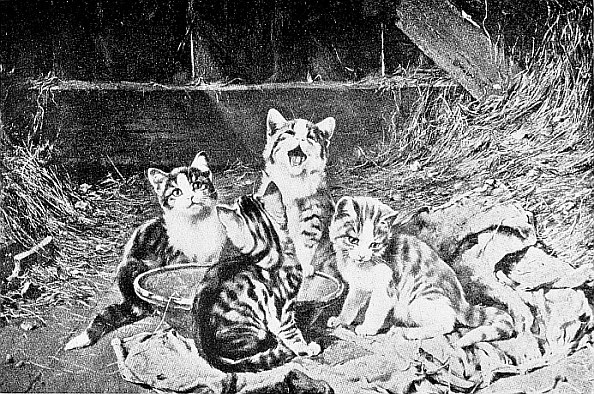
From Painting by J. Adam.
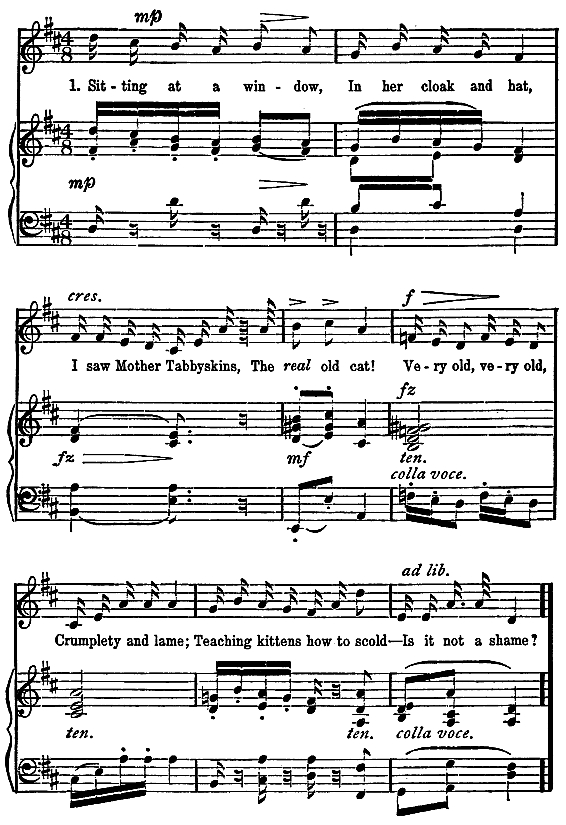
Tom Hood.
[Give in an animated style and tone of voice.]
Concert Recitation and Pantomime.
Stanley Schell.
Written expressly for this book.
[Three girls in elaborate gowns. Each gown has a long cat-tail attached at back, and each girl wears a cat-mask suited to color of cat she represents. On each girl’s head, just back of ears, is a lady’s hat, with three plumes drooping forward. The hat is kept in place by white-lawn streamers, tied in big bow beneath chin. One girl wears chain, with lorgnette, which she uses occasionally; another girl carries fancy parasol over shoulder; the third girl carries very showy fan, which she uses at different times. Gloves should be worn by all girls. Girls enter from stage rear with mincing steps, and trip to stage front, doing all sorts of things with lorgnette, parasol and fan until stage front is reached. Then all stand still and look at audience, then look sad a moment, and recite in concert the following:]
Mrs. Frederick W. Pender.
Written especially for this book.
Jennie Pendleton Ewing.
Alexander Dumas.
IT is admitted that the dog has intelligence, a heart and perhaps a soul, likewise it is agreed that the cat is a traitor, deceiver, thief, an egotist, an ingrate. How many have we not heard say: “Oh, I cannot abide a cat! it is an animal that loves not its master; it is attached only to the house; one must keep it under lock and key. I had one once, for I was in the country and there were mice. The cook had the imprudence to leave upon the table a poulet that she had just purchased; the cat carried it off, no morsel of it was ever seen after. Since that day I have said: ‘I will have no cat.’” Its reputation is detestable, the fact cannot be disguised, and one must acknowledge that the cat does nothing to modify the opinion in which it is held. It is entirely unpopular, but it cares as little about this as it does about the Grand Turk. Must I confess it to you? It is for this that I love it, for in this world one can remain indifferent to things the most serious—if there are serious things, and this one knows only at the end of his life; but he cannot evade the question of dogs and cats. There is always a moment when he must declare himself. Well, then! I love cats! Ah! the times they have said to me:
“What, you love cats?”
“Yes!”
“Do you not like dogs better?”
“No, I love cats much more.”
“That is extraordinary.”
I prefer certainly to have neither cat nor dog, but were I forced to live with one of these two individuals, I would choose the cat. It has for me the manners essential to social relations. At first, in its early youth, it possesses all the graces, all the suppleness, all the unexpectedness by which the most exacting, artistic fancy can be amused! It is adroit, it always knows where it is. Prudent unto caution, it goes everywhere, it examines without soiling, breaking nothing; it is in itself a warmth and a caress; it has not a snout, but a mouth—and what a mouth! It steals the mutton as does the dog, but, unlike the latter, makes no delight of carrion; it is discreet and of fastidious cleanliness, which might be well imitated by a number of its detractors. It washes its face, and in so doing foretells the weather into the bargain. One can entertain the idea of putting a ribbon around its neck, never a collar; it cannot be enslaved. It permits no modifications in its race; it lends itself to no combinations that industries could attempt. The cat reflects, this is obvious, contrary to the dog, a lackbrain whose rabies is his crowning idiocy. In short, the cat is a dignified, proud, disdainful animal that hides its love affairs in the shadows, almost within the clouds, upon the roofs, in the vicinity of the night-working students. It defies advances, tolerates no insults, it abandons the house in which it is not treated according to its merits; in short, the cat is truly an aristocrat in type and origin, whereas the dog is and ever will be naught but a vulgar parvenu by dint of complaisance.
The sole argument at all plausible against the cat is that it destroys the birds, the nightingales as well as the sparrows. If the dog does not as much it is because he is too clumsy and stupid. He runs also after the birds, but barking, the birds escape him, and he stays behind completely dumbfounded, open-mouthed and with astonished tail. He makes up for it upon the partridges and rabbits, after two years’ submission to the strong collar in order to learn this art, and it is not for himself, but for the hunter, that he goes in quest of game. The imbecile! He persecutes the animals, an animal himself, for the profit of the man who beats him. At least, when the cat catches a bird she has an excuse; it is to eat it herself. Why would that authorize man to slander her? Let men regard one another! They will see in their race, as in that of cats, those who have claws and have no other preoccupation but to destroy those who have wings.
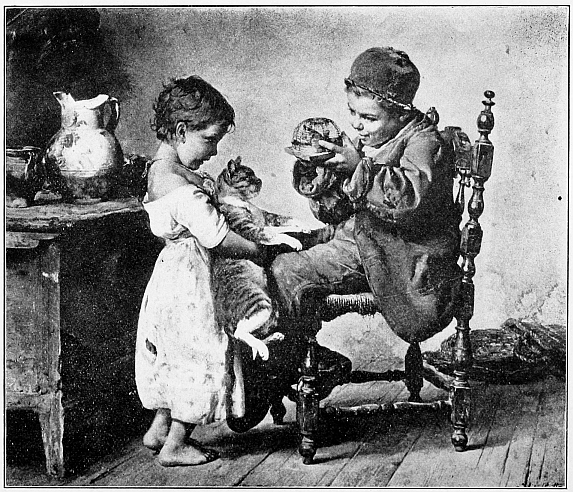
From Painting by A. Rotta.
Action Poem.
[1] Child runs in calling.
[2] Stops and looks about.
[3] As if thinking a moment, shakes head as she recites the line.
[4] Recites fourth line and runs out a moment.
[5] Enters hurriedly and tells audience.
[6] Sorrowfully. Stands disconsolate a moment.
[7] Recites line, skips to entrance near R. front and looks in; comes back, and stops a moment, as if thinking.
[8] Recites line; goes and looks in chair; stops a moment.
[9] Recites third line; goes and looks at table; seeing no kitty, looks heartsick and ready to cry.
[10] Looks up and off L. suddenly; face brightens as she listens. Recites line, full of joy and animation and love.
[11] Listens; speaks as if astonished. Takes kitten in her arms very lovingly.
[12] Talks to kitty very lovingly, drawling out on “My Kitty.” Gives kitty a loving squeeze.
NOW stay right still and listen, kitty-cat, and I’ll tell you a story:
Once there was a little girl. She was a pretty good little girl, and minded her papa and mamma everything they said, only sometimes she didn’t, and then she was naughty; but she was always sorry, and said she wouldn’t do so any more, and her mamma’d forgive her.
So she was going to hang up her stocking.
“You’ll have to be pretty good, lest ’twon’t be filled,” said her mamma.
“’Less may be there’ll be a big bunch of sticks in it,” said her papa.
Do you think that’s a nice way to talk, kitty-cat? I don’t.
So the little girl was good as she could be, and didn’t cry nor slap her little sister hardly any at all, and always minded her mamma, specially when she came where the chimney was.
So she hung up her stocking. And in the night she got awake and wanted it to come morning; but in the morning she didn’t get awake till ’twas all sunshiny outdoor. Then she ran quick as she could to look at her stocking where she’d hung it; and true’s you live, kitty-cat, there wasn’t the leastest little mite of a scrimp!
Oh, the little girl felt dreadful!
How’d you feel s’pose it had been you, kitty-cat?
She ’menced to cry, the little girl did, and she kept going harder and harder, till bymby she screeched orfly, and her mamma came running to see what was the matter.
“Mercy me!” said her mamma. “Look over by the window ’fore you do that any more, Kathie.”
That little girl’s name was Kathie, too, kitty-cat, just the same’s mine.
So she looked over by the window, the way her mamma said, and—oh! there was the loveliest dolly’s house you ever saw in all your born life. It had curtains to pull to the sides when you wanted to play, and pull in front when you didn’t. There was a bedroom, kitty-cat, and a dinner-room and a kitchen and a parlor, and they all had carpets on. And there was the sweetest dolly in the parlor, all dressed up in blue silk. Oh, dear! And a penano to play real little tunes on, and a rocking-chair and—O kitty-cat, I can’t begin to tell you half about it.
I can’t about the bedroom, either, nor the dinner-room. But the kitchen was the very bestest of all. There was a stove—a teenty, tonty mite of a one, kitty-cat—with dishes just ’zactly like mamma’s, only littler, of course, and frying-pans and everything; and spoons to stir with, and a rolling-pin and two little cutters-out, and the darlingest baker-sheet ever you saw!
The first thing that little girl did was to make some teenty mites of cookies, ’cause her mamma let her; and if you’ll come right downstairs, kitty-cat, I’ll give you one, ’cause I was that little girl, kitty-cat, all the time.
Elizabeth L. Gould.
[For the baby fingers—to be played with open fingers first—closing each as designated.]
Olive Stevens Brown.
Ella Wheeler Wilcox.
Fannie Rogers White.
Mary E. Wilkins.
A TINY white-painted house, with a door and one window in front, and a little piazza, over which the roof jutted, and on which the kitchen door opened, on the rear corner. Squashes were piled up on this piazza in a great yellow and green heap.
Ann Millet, her shawl pinned closely over her hair and ears, the small oval of her solemn, delicate old face showing almost uncanny beneath it, stood in the door, surveying the sky outside.
“There’s goin’ to be a heavy frost, sure enough,” she said. “I’ll hev to git the squashes in. Thar’s Mis’ Stone comin’. Hope to goodness she won’t stop an’ hinder me! Lor’ sakes! I’d orter hev more patience.”
A tall, stooping figure came up the street, and paused at the gate hesitatingly.
“Good-evenin’, Ann.”
“Good-evenin’, Mis’ Stone.”
“Gettin’ in your squashes, ain’t you?” Mrs. Stone spoke in a very high pitched tone. Ann was somewhat deaf.
“Yes. I didn’t dare resk ’em out to-night, it’s so cold.”
“Well, it’s a good deal colder than I hed any idea of when I come out. Yes, I’d take ’em in. We got ourn in last week. We ain’t got more’n half as many as you hev. I shouldn’t think you could use ’em all, Ann.”
“Well, I do. I allers liked squashes, an’ Willy likes ’em, too. You’d orter see him brush round me, a-roundin’ up his back an’ purrin’ when I’m a scrapin’ of ’em out of the shell. He likes ’em better’n fresh meat.”
“Seems queer for a cat to like sech things. Ourn won’t touch ’em. How nice an’ big your cat looks a-settin’ thar in the window!”
“He’s a-watchin’ of me. He jumped up thar jest the minute I come out!”
“He’s a good deal of company for you, ain’t he?”
“Yes, he is. What on airth I should do this long winter that’s comin’, without him, I don’t know. Everybody wants somethin’ that’s alive in the house.”
“That’s so. It must be pretty lonesome for you anyway.”
“Well, I don’t mean to complain. I’d orter be thankful. I’ve got my Bible an’ Willy, an’ a roof over my head, an’ enough to eat an’ wear; an’ p’rhaps some other woman ain’t lonesome because I am, an’ maybe she’d be one of the kind that didn’t like cats, an’ wouldn’t hev got along half as well as me. No, I never orter complain.”
“Well, if all of us looked at our mercies more’n our trials, we’d be a good deal happier. But, sakes! I must be goin’. Good-night, Ann.”
“Good-night, Mis’ Stone.”
Mrs. Stone hitched rapidly down the street to her own home, and Ann went on tugging in her squashes. She was a little woman and had to carry them in one at a time. After they were all in she took off her shawl and hung it on a nail behind the kitchen door. Then she gave her cat his saucer of warm milk in a snug corner by the stove and sat down contentedly to her own supper. The cat was a beautiful little animal, with a handsome dark striped coat on his back, and white paws and face.
When he had finished lapping his milk, he came and stood beside his mistress’s chair while she ate, and purred, and she gave him bits of bread from her plate now and then. She talked to him.
“Nice Willy! nice cat. Got up on the window to see me bring in the squashes, didn’t he? There’s a beautiful lot of ’em, an’ he shall hev some stewed for his dinner to-morrow, so he shall.”
And the cat would purr, and rub his soft coat against her, and look as if he knew just what she meant.
There was a prayer-meeting that evening, and Ann Millet went. She never missed one. The minister, when he entered, always found her sitting in the same place. She had a pretty voice when she was young, people said, and she sang now in a sweet thin quaver the hymns which the minister gave out. She listened in solemn enjoyment to the stereotyped prayers and the speaker’s remarks.
After meeting Ann always went up and told him how much she had enjoyed his remarks, and inquired after his wife and children. To her a minister was an unpublished apostle, and his wife and family were set apart on the earth.
When she had reached home and lighted her lamp, she called her cat. She had expected to find him waiting to be let in, but he was not. She stood out on her little piazza, and called, “Willy! Willy! Willy!”
She thought every minute she would see him bounding around the corner, but she did not. She called over and over, “Willy! Willy! Kitty! Kitty! Kitty!”
Finally she went into the house and waited awhile, crouching, shivering with cold and nervousness, over the kitchen stove. Then she went outside and called again, “Willy!” over and over, waiting between the calls trembling, her dull old ears alert, her dim old eyes strained. She ran out to the road, and looked and called. Once her heart leaped; she thought she saw Willy coming; but it was only a black cat which belonged to one of the neighbors. Over and over all night long she called the poor little creature which was everything earthly she had to keep her company in the great universe in which she herself was so small.
In the morning she went over to Mrs. Stone’s, her small old face wild and wan.
“Hev you seen anything of Willy?” she asked. “He’s been out all night, an’ I’m afraid somethin’s happened to him. I never knowed him to stay out so before.”
When they told her they had not seen him, she went on to the next neighbors to inquire. But no one had seen anything of the cat. All that day and night, at intervals, people heard her plaintive, inquiring call, “Willy! Willy! Willy!”
The next Sunday, Ann was not out at church. Mrs. Stone went over to see what was the matter.
“Why, Ann Millet, are you sick?” she asked.
“No, I ain’t sick.”
“You wa’n’t out to meetin’, an’ I didn’t know——”
“I ain’t never goin’ to meetin’ agin.”
“Why, what do you mean?”
“I mean jest what I say. I ain’t never goin’ to meetin’ agin. Folks go to meetin’ to thank the Lord for blessin’s, I s’pose. I’ve lost mine, an’ I ain’t goin’.”
“What hev you lost, Ann?”
“Ain’t I lost Willy?”
“You don’t mean to say you’re makin’ such a fuss as this over a cat?”
“Yes, I do.”
“Well, I aint nothin’ agin cats, but I must say I’m beat. Why, Ann Millet, it’s downright sinful for you to feel so. Of course, you set a good deal by Willy; but it ain’t as ef he was a human creature. Cats is cats. For my part, I never thought it was right to set by animals as ef they was babies.”
“I can’t hear what you say.”
“I never thought it was right to set by animals as ef they was babies.”
“I don’t keer. It’s comfortin’ to have live creatures about you, an’ I ain’t never hed anything like other women. I ain’t hed no folks of my own sense I kin remember. I’ve worked hard all my life, an’ hed nothin’ at all to love, an’ I’ve thought I’d orter be thankful all the same. But I did want as much as a cat.”
“Well, as I said before, I’ve nothin’ agin cats. But I don’t understand any human bein’ with an immortal soul a-settin’ so much by one.”
“I can’t hear what you say.”
“I don’t understand any human bein’ with an immortal soul a-settin’ so much by a cat.”
“You’ve got folks, Mis’ Stone.”
“I know I hev; but folks is trials sometimes. But, Ann Millet, I didn’t think you was one to sink down so under any trial. I thought the Lord would be a comfort to you.”
“I know all that, Mis’ Stone. But when it comes to it, I’m here an’ I ain’t thar; an’ I’ve got hands, an’ I want somethin’ I kin touch.”
Then the poor soul broke down, and sobbed out loud like a baby.
“I ain’t—never felt as ef I orter begrutch other—women their homes an’ their folks. I thought—p’raps—I could git along better without ’em than—some; an’ the Lord knowed it, an’ seein’ thar wa’n’t enough to go round, he gave ’em to them that needed ’em most. I ain’t—never—felt—as ef I’d orter complain. But—thar—was—cats—enough. I might a hed—that—much.”
“You kin git another cat, Ann. Mis’ Maxwell’s got some real smart kittens.”
“I don’t want any of Mis’ Maxwell’s kittens; I don’t never want any other cat.”
“P’rhaps yourn will come back.”
“No, he won’t. I’ll never see him agin. I’ve felt jest that way about it from the first.”
“Hark! I declar’ I thought I heard a cat mew somewhar! But I guess I didn’t. Well, I’m sorry, Ann. Why, Ann Millet, whar’s your squashes?”
“I throwed ’em away out in the field. Willy can’t hev none of ’em now, an’ I don’t keer about ’em myself.”
Mrs. Stone looked at her in horror. When she got home she told her daughter that Ann Millet was in a dreadful state of mind, and she thought the minister ought to see her.
The next day the minister called on her. He did not find her so outspoken; her awe of him restrained her. Still, Ann Millet was for the time a wicked, rebellious old woman.
In the course of the call a rap came at the kitchen door.
“Nothin’ but a little gal with a Malty cat,” said she. “The children hev got wind of my losin’ Willy, an’ they mean it all right, but it seem as ef I should fly! They keep comin’ and bringin’ cats. They’ll find a cat that they think mebbe is Willy, an’ so they bring him to show me. They’ve brought Malty and white cats, an’ cats all Malty. They’ve brought yaller cats, an’ black, an’ there wa’n’t one of ’em looked like Willy. Then they’ve brought kittens that they knowed wa’n’t Willy, but they thought mebbe I’d like ’em instead of him. They mean all right, I know; they’re real tender-hearted; but it ’most kills me. Why, they brought me two little kittens that hain’t got their eyes open jest before you came. They was striped and white, an’ they said they thought they’d grow up to look like Willy.”
He went away without saying much of anything; he was so afraid that what he said might be out of proportion to the demands of the case.
Going out the door, he stopped and listened a minute; he thought he heard a cat mew. Then he concluded he was mistaken, and went on. He watched eagerly for Ann the next meeting night, but she did not come.
The day after the meeting, she had occasion to go down cellar for something. The cellar stairs led up to the front part of the house. Ann went through her chilly sitting-room, and opened the cellar door, which was in the front entry. There was a quick rush from the gloom below, and Willy flew up the cellar stairs.
“Lor’ sakes!” said Ann, with a white shocked face. “He has been down there all the while. Now I remember. He followed me when I came through here to git my cloak that meetin’ night, an’ he wanted to go down cellar, an’ I let him. Lor’ sakes!”
She went back into the kitchen, her knees trembling. She poured out a saucer of milk, and watched Willy hungrily lapping. He did not look as if he had suffered, though he had been in the cellar a week.
Ann watched him, the white, awed look still on her face.
“I s’pose he mewed an’ I didn’t hear him. Thar he was all the time, jest whar I put him; an’ me a-blamin’ of the Lord an’ puttin’ of it on him. I’ve been an awful wicked woman. I ain’t been to meetin’, an’ I’ve talked, an’—them squashes I threw away. It’s been so warm they ain’t froze, an’ I don’t deserve it. I hadn’t orter hev one of ’em; I hadn’t orter hev anything. I’d orter offer up Willy. Lor’ sakes, think of me a-sayin’ what I did, an’ him down cellar!”
That afternoon Mrs. Stone saw Ann slowly and painfully bringing in squashes one at a time. The next meeting night Ann was in her place. After meeting, the minister hurried out of his desk to speak to her. When she looked up at him, her old cheeks were flushing.
“The cat has come back,” said Ann.
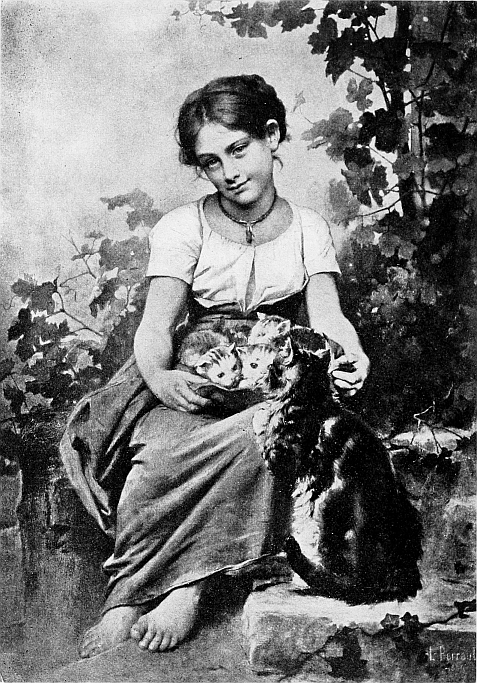
From Painting by L. Perrault.
Action Poem.
[1] Pass hands over eyes as if just awakening.
[2] Extend hands at right angles to chest, and move them to and fro.
[3] Hand by side, head erect, and look straight in front, as if astonished at something.
[4] Beckon with finger, and nod head, as if calling in haste.
[5] Raise hands and arms vertically, and then, with hands at right angles to arms, lower them quickly.
[6] Move hands quickly to right.
[7] Point as if directing attention to the three kittens running to right.
[8] Raise forefinger of right hand, and gesticulate as if to emphasize.
[9] Imitate action 5.
[10] Imitate action 4.
[11] Imitate action 8.
[12] Shake head, and speak very deliberately.
Charles Baudelaire.
Susan Coolidge.
What is it that looks like a cat, walks like a cat, but isn’t a cat? A kitten.
Mrs. Frederick W. Pender.
Written especially for this book.
Taylor.
William Wordsworth.
BY BERTHA L. COLBURN.
[From “Graded Physical Exercises,” by permission of the Publishers.]
[Imagine that you really see the kitten playing with the falling leaves; then, as you point to her and illustrate her movements, your gestures will be natural and expressive instead of awkward and mechanical.]
[1] Point to right.
[2] Same, with circular movement of hand.
[3] Point to three leaves in same direction but slightly different places.
[4] Point higher.
[5] Raise arms front to shoulder level and carry outward to half sides, turning palms upward.
[6] Turn palms down, and move arms in circles, lowering slowly.
[7] Arms extended at front shoulder level, palms up.
[8] Turn palms, and lower to low front.
[9] Peer forward.
[10] Extend arms at front shoulder level, palms down, and wave hands slightly to sides.
[11] Bend forward; extend arms; move hands downward, and give leaping movement with arms.
[12] Point left, then right.
[13] Point outward with both hands; lower right.
[14] Lower left.
[15] Look up eagerly.
[16] Give leaping movement with arms, and close hands.
[17] Open hands.
[18] Movement of leaping and catching leaves.
[19] Carry left arm out to half side mid line, palm up.
[20] Clasp hands joyously.
[21] Carry both arms out to mid line at half sides, palms up.
[22] Clap hands.
[23] Lift forearms to mid line at half sides, palms up.
What does a cat have that no other animal has? Kittens.
J.D. Corrothers.
[From “The Black Cat Club,” by special permission.]
“I KNOW where there is a catbird’s nest,” said Jack, as he came in to dinner, “and it’s full of young ones.”
“Let me see,” shouted wee Bessie. “I want to see the kitty birds.”
A Parody.
Will M. Carlton.
Action Poem.
[1] Move right forefinger.
[2] Point to self.
[3] Raise hand to mouth.
[4] Spread hand out to right.
[5] Spread hand out to left.
[6] Show first two fingers of left hand, and cross them with first finger of right hand.
[7] Point to self.
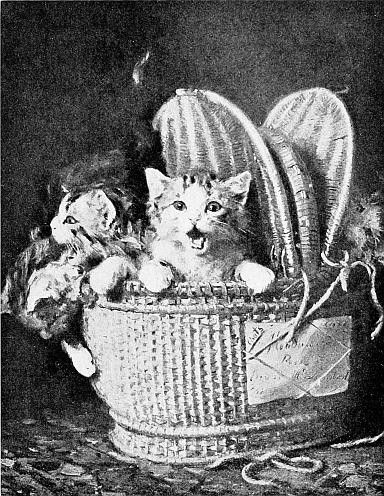
From Painting by E. Lambert.
Anna Robeson Brown.
BECAUSE the night was bitterly cold, Dick Eaton put on his heavy overcoat, in which everything was furlined, even to the pockets, before starting for Mrs. Leighton’s dinner.
He was, in general, a happy-hearted fellow, but when one has just received a severe snub from one’s lady love, one does not contemplate a dinner with much satisfaction.
Dick was in love with a girl of wit as well as of beauty; a young lady who could afford to pick and choose.
Dick’s friends sang his praises all day long, much to Miss Girton’s astonishment.
“I can not understand,” she said, “what it is that makes that young Eaton fellow so popular. He hasn’t an ounce of brains.”
So it happened that on this particular evening he was discouraged.
The wind blew the sleet in his face. He stumped along, growing less inclined for the chilly formality of a dinner at every step. Half the distance had been traversed when he felt something brush against his foot.
It was a kitten—a very weak, very wet, and very miserable kitten.
“Hello, old man,” said Dick. “Whom do you belong to?”
The kitten continued to blink at Dick and to shiver helplessly.
It was so very small that it staggered and slid about when it tried to stand.
“Well, I’m awfully sorry, but I can’t help it, you know. Run home to your mamma. You’re far too little to be out alone.”
He started to move away, but the kitten sprang feebly up his leg, and clung there. Dick was fond of cats. He lifted it, and rubbed the rough fur for dryness; the kitten sat on his arm and held its head first to one side and then to the other. “Well, you are cool; but I say, old man, what am I to do with you, you know?”
The kitten purred. The purr settled it.
“Well, I suppose you have got to come; only, old man, I must say I wish you had chosen to favor me on my way home.”
And the kitten gave a jubilant burst of purr which sounded apologetic.
Dick transferred it to his pocket, which, as it was a very small kitten, was roomy quarters. Dick walked briskly on, chuckling to himself, yet reflecting on his situation with some anxiety.
He simply could not produce the beast upon entering Mrs. Leighton’s parlors. If the animal would stay quietly in his pocket it might not be so hard to conceal it during the meal, and he would excuse himself as early as possible.
“Now, old man,” he said to the kitten, as they stood on the door-step, “I have done you a good turn, you know, so I expect you to do me another by lying low and keeping dark. Don’t give yourself away, if you love me.”
Never was a dinner so long. They had allotted him to a little girl in her first season, and he was far away from Miss Girton’s end of the table.
With the third course came a new torment. That kitten was starving, Dick had no doubt of it. He looked about him for something to slip into his pocket. Chicken with truffles, or Roman punch was hardly the diet any self-respecting cat would select for her offspring. Dick passed three courses endeavoring to manufacture some excuse for leaving the table, but finally gave up in despair, resolving to wait until the ladies retired to the drawing-room.
When the cigars had been lighted and chairs pushed back, he felt his hour had come.
“Leighton,” he said, addressing his host, “would you—could I—ah, that is—would it be too much trouble to get me a glass of milk?”
An amazed silence fell upon the party.
“Milk!” said the host.
“Well, you see, the doctor ordered me after every meal——”
“Oh, of course, if you like,” and the butler brought a large tumbler of milk and placed it solemnly before Dick, during a rather chilly silence. He was forced to gulp down at least half the glass. Meanwhile, how to get away?
“Leighton,” he said, “did I hear you say that Gladstone had been criticized in the ‘Times’ for that last speech of his?”
“Yes,” said Leighton, “and of all the unwarrantable——”
The men pushed the bottles into the center of the table, squared their elbows, and in ten minutes, as Dick had anticipated, were far too deep in politics to observe his movements. With the half-finished glass of milk in his hand, he rose and wandered out of the door and down the hall to where his overcoat hung.
The kitten was awake and restless. Dick felt that he was just in time. He held it under one arm, and carefully tilted the glass for it until every drop was gone.
“There, old man, you feel better, don’t you? Have a cigar after you drink?” The sound of chairs being pushed about in the dining-room struck him with sudden panic. He spilled the kitten hastily into his pocket again and sped back with the empty glass.
In the drawing-room Miss Girton was in her element, and Dick eyed her from afar with a heavy heart.
Soon the people wandered out by twos and three, a few into the softly lighted hall. Miss Girton was one of these, and Dick as a matter of course joined the group of men gathered around her. The ribbon of her bouquet had become untied, and she rolled it in her fingers, and trailed it to and fro over the shining wood floor as she talked.
Suddenly there was a stir among the overcoats and two bright spots met Dick’s eyes—two sparks of topaz fire. Oh, that fascinating blue ribbon! How it curved and trailed about! What kitten could have resisted the temptation?
Dick made a sudden plunge.
“Your ribbon is untied,” he said, offering it to Miss Girton, with nervous politeness.
“Thank you,” she said. She let it dangle from her hand for a minute, and then shook it out in a long curved line. No mortal kitten could withstand that.
There was a bound and a rush and the scamper of four soft little paws, and Dick’s unfortunate waif lay on its back under Miss Girton’s very feet, kicking and clawing at the ribbon in an ecstacy of playful excitement.
“Good gracious!” exclaimed Miss Girton. “Where did that come from?”
“It’s a cat, by Jove!” said somebody.
Then Dick, feeling cold and weak all over, made a step forward.
“It’s mine; I picked it up. It was so cold and wet, you know——”
“Did you find it?”—“Was it here all the time?”—“Where did it come from?” Everybody crowded around, while the kitten made short charges at the ribbon, batted at it with its paws, and kicked at it frantically with its hind legs.
Dick told the story with a sinking heart. What would she think of him? What would she say? She did not say anything, but nearly everybody else did.
“Come, Eaton,” cried the host, laughing. “That milk——”
“Yes,” said Dick, scarlet, but sturdy, “it was for the kitten.”
There was a roar of laughter from the men, and then the joke had to be explained to the ladies.
“And why did you not produce the beast right away,” said Leighton. “By the way, there’s a smart fox-terrier of mine upstairs. Let’s introduce them and have some fun.”
Dick made a dash for his protege.
“No, you don’t. This little beast’s had quite enough of that sort of thing, I fancy. I’m going to take it home and make it comfortable. You don’t mind living with me, old man? We’ll be pretty good chums so long as you don’t smoke bad tobacco.”
He got on his overcoat and said good-bye to his hostess amid a fire of good-natured chaff. Then he looked around for Miss Girton. She was standing alone, and her face wore a curious expression. Dick, with his prize cuddled up in his arms, came over to her.
“All that for a kitten?” she said. “Why was it?”
“Oh, well, it liked me, and it was so beastly wet, you know.”
She gave him her hand with a sudden dazzling smile.
“Won’t you come and see me to-morrow? I shall be quite alone all the afternoon, and I do so want to hear about—about the kitten.”
Mrs. Frederick W. Pender.
Written expressly for this book.
Addressed to His Child, Carlino.
Jane Campbell.
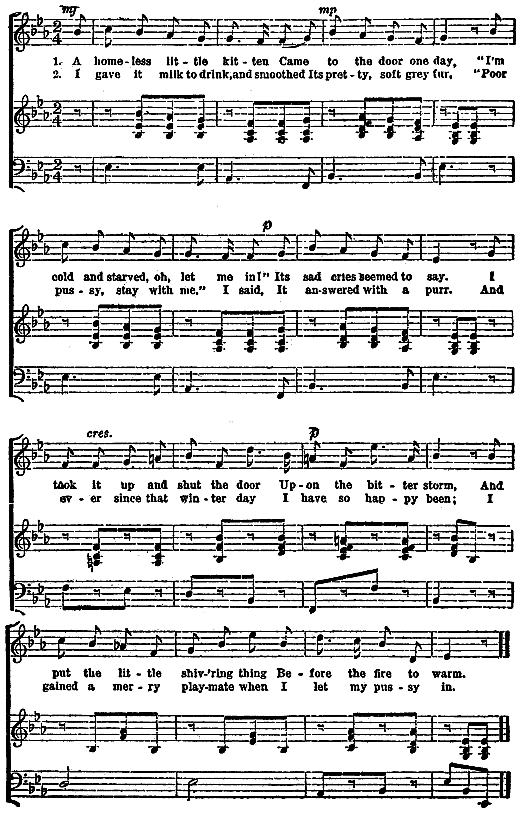
Joe Lincoln.
A Fable.
A CAT once met a fox in a forest. The fox bragged so much about the many tricks he could do that the cat felt she must, in some way, reply.
Finally, she said, very modestly: “Well, I only know how to do one thing. It’s my only trick.”
“You don’t say so!” replied the fox, patronizingly. “Why, I can do no end of tricks.”
The cat stared at the fox, enviously, and was suddenly aroused by hearing the horns of the king’s hunters and the barking of the dogs. The cat ran up the tree and, sitting on a branch, watched the approach of the cavalcade, with serenity.
“I thought you could do only one thing,” cried out the distracted fox as he ran away.
“I can,” the cat answered. “But this happens to be my trick.”
Then the cat had the satisfaction to see the dogs, after barking about the foot of the tree, run after the fox.
Bret Harte.
Mary S. Boyd.
Celia Thaxter.
Ques.—What kind of a cat do we usually find in a large library?
Ans.—Catalogue.
Ques.—Why are cats like unskillful surgeons?
Ans.—Because they mew-till-late and destroy patience (patients).
Eugene Field.
Helen Thayer Hutcheson.
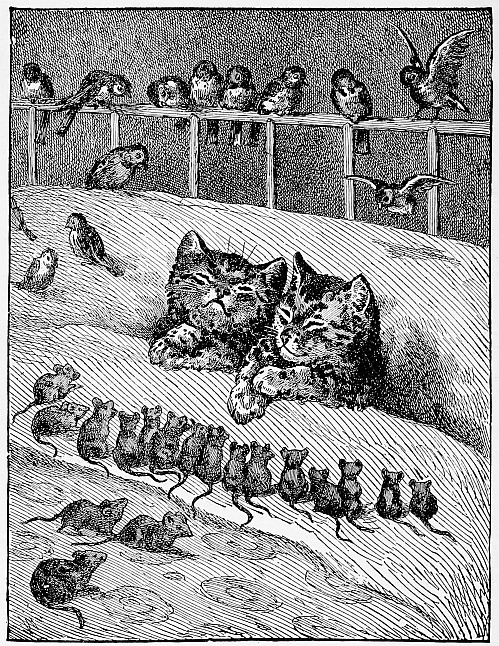
IN hieroglyphics of ancient monuments of Egypt a cat represents false friendship, or a deceitful, flattering friendship.
In heraldry, a cat is an emblem of liberty, because it dislikes to be shut up.
In coat-of-arms, the cat must always be represented as full face—both eyes and both ears to show. Three cats in pale sable is the coat of the family of Kent of Devonshire.
The cat is always the emblematic animal of newspaper offices and editors’ chairs of to-day.
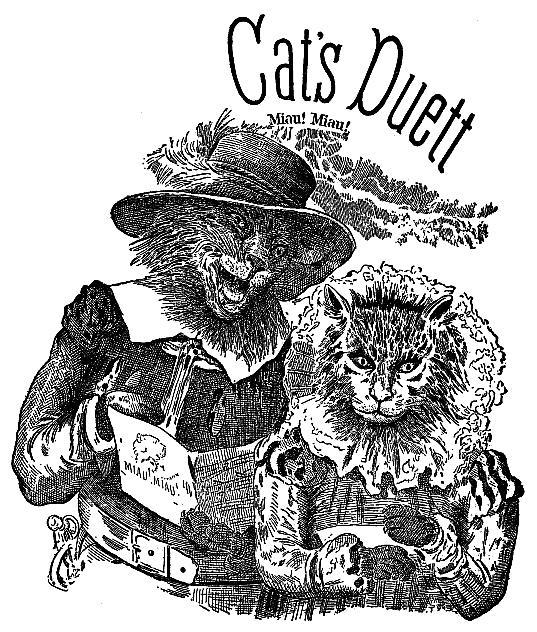
Cat’s Duett
Miau! Miau!
BERTHOLD
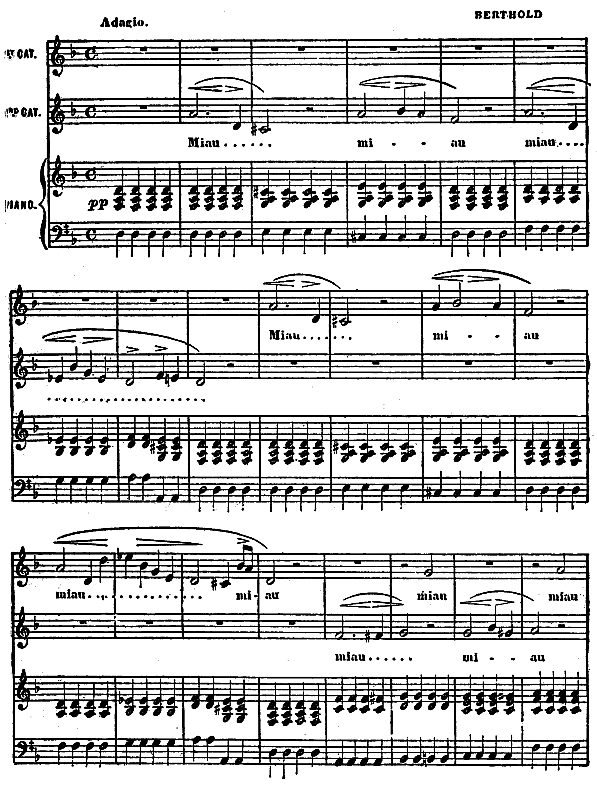
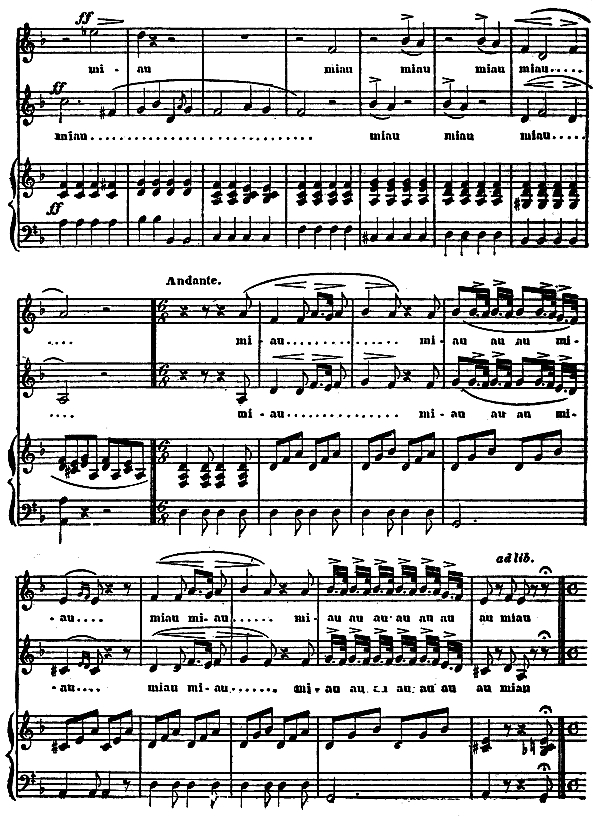
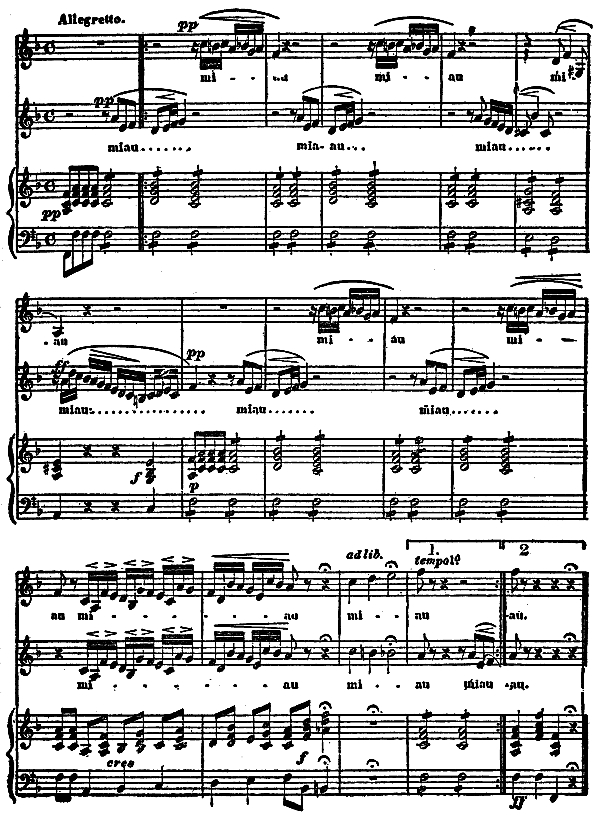
Joy Vetrepont.
ME an’ Bab we went to church, an’ Bab she saw a mouse. An’—course she wanted to catch him. An’ she slipped out under my sack, where I’d hid her when we went to church, an’ was out of the pew quicker’n no time.
Well, my pa’s a dicken, an’ he had a correction-box, an’ he was a-leanin’ over with the correction-box stretched out so ’t Frankie Hill, what sat in the farthest corner, could put in a cent, an’ all the people was givin’ centses, top, an’ ten cents, too, an’ five cents, too, and he was a-stretchin’ out the correction-box to Frankie, an’ just then the mouse ran right acrost his feet an’ Bab after him. An’ my papa he gave a queer sort of a cry, an’ dropped the correction-box, an’ all the centses fell on the floor in Frankie Hill’s pew, an’—an’ my pa’s face went redder’n red, an’ his ears, an’ his neck, an’ he turns around an’ sees our Bab scamperin’ after the mouse, an’ he started to go after her, an’ everybody on our side was a-lookin’ at Bab, an’ the people on the other side that couldn’t see Bab was lookin’ at my pa, an’ then they all looked at Mr. Green—that’s the minister—an’ Mr. Green he was lookin’ orful solemn. An’ the mouse ran acrost the raised places covered with red carpet, where the minister sits, an’ he ran under his chair, an’ Bab after him. An’ all the dickens had laid down their correction-boxes an’ was goin’ there, too—not under the chair I don’t mean—but up to the raised place with red carpet, an’ the mouse he scampered to the door that’s one side of where the min’ster sits, an’ he couldn’t get out, an’ there wasn’t no hole for him, an’ Bab was after him lickety split, an’—an’—he comed back an’ ran into old Miss Tromley’s pew, an’ she screamed an’ ran out, an’ then there was a reg’lar scrimmage; an’ the dickens was all mixed up, an’ Bab was among their feet, an’ my pa he stooped down, an’ then he came down ’tween the pews with Bab in his arms, an’ his face was orful. An’ he went out with Bab, an’ the other dickens went for their boxes.
An’ Mr. Green he dropped his hank-cher, and he was orful long pickin’ it up; an’ then he coughed, an’ hid his face in his hank’cher, an’ he shooked all over just like he did when my pa told that story about the dicken what put the wrong plaster on his nose; an’ everybody was laughin’, but I was cryin’, ’cause I didn’t know what my pa would do to Bab—or—or—me.
An’ Frankie Hill was pickin’ up centses in his pew when my pa comed back; an’ he took me by the arm, an’ led me out of church, an’ says, very stern—
“Go home!”
An’ our house is close by, so I went all by myself, an’ my pa went back to his correction-box. An’ I don’t know what came of the mouse; but Jemima Jane says it’s a good thing my ma’s away, an’ I’ll get a proper “correction-box” when she gets home.
Action Song for Six Boys and a Chorus.
Stanley Schell.
Written expressly for this book.
Costume: Every boy wears a different colored costume made from cambric or cotton cloth. First a hood is made perfectly tight-fitting and covering all except the eyes, nose and mouth. Then ears are made and fastened to side of head. The rest of costume is made like a little boy’s night-suit, but perfectly tight-fitting and open at the back. The suit is so made that feet and hands are covered by the sleeves, and legs being of sufficient length to form a sort of glove or stocking. To the lower back of the costume is attached a tail made from the goods rolled in a long coil and sewed together, then attached to suit. Every boy wears a cat-mask fitted under hood.
Stage Setting: At stage center should be placed a table with lighted lamp above it. On table a large pan of milk.
Music: “Merry, Merry Cats.”
[Chorus begins to sing and the cats come wandering in from all parts of stage and on all fours and to act out the words sung.]
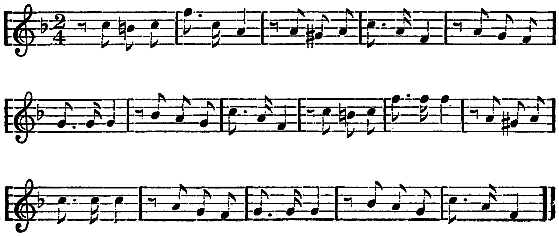
Actions: Boys smile as they enter and see the other cats; then, as they slowly edge around in alert fashion and catch the others’ eyes, they bow, move along, say “Good Day” and “How De Do?” and scamper quickly about “meowing” as they go.
Chorus sings as follows:
Actions: Cats scamper around, roll over each other, give each other gentle pats, etc.
Actions: Cats suddenly stop playing as one discovers table and gets up to see what is on table. His discovery is learned by his meow, and all rest paws on table and begin to lap milk from pan.
Actions: Cats having finished the milk lazily leave table, drop to floor and roll about; begin to wash themselves, then walk about in couples and act as if gossiping about something of greatest interest.
Actions: Cats act sleepy and move about very lazily. They yawn and stretch a bit, then nod to one another sleepily. Suddenly a crash is heard and all the cats scamper out of sight.
Edna A. Foster.
Cats work while we sleep.
Cats do not mind the cold.
Cats sing to show friendship.
Cats scratch or bite when annoyed.
Cats cannot catch game by running.
When hunting prey, cats’ claws are sheathed; when seizing prey, their claws are quickly uncovered and thrown out.
When winking at us, cats’ eyes become dull and expressionless.
When darkness approaches, pupils of cats’ eyes dilate and shine brightly.
When daylight strikes pupil of a cat’s eye, it contracts until only narrow vertical slits remain.
Cats’ ears always stand erect to catch sound, except Chinese cats, who have drooping ears.
Cats show less fondness for human beings than do most animals.
Cats are expert hunters of birds, squirrels, fish, mice, rats.
Cats spit or purr.
When scared, cats lay back ears, show thirty sharp teeth, arch back, raise tail.
Cats have five toes on each front paw and four on each back paw. To each toe is attached a sharp nail or claw. These claws are covered by a sheath except when in use.
Cats have twelve cutting teeth—six above and six below. Cats also have four longer teeth known as canine teeth, similar to those of nearly every carnivorous animal.
Cats love to sleep by day and prowl by night.
When cats catch prey they play with it for a long time before killing it.
Cats always wash after eating or drinking.
Ques.—What is the name of the plant most fatal to mice?
Ans.—Cat-nip.
Ques.—Why has a chambermaid more lives than a cat?
Ans.—Because each morning she returns to dust.
Sam Walter Foss.
Thomas Westwood.
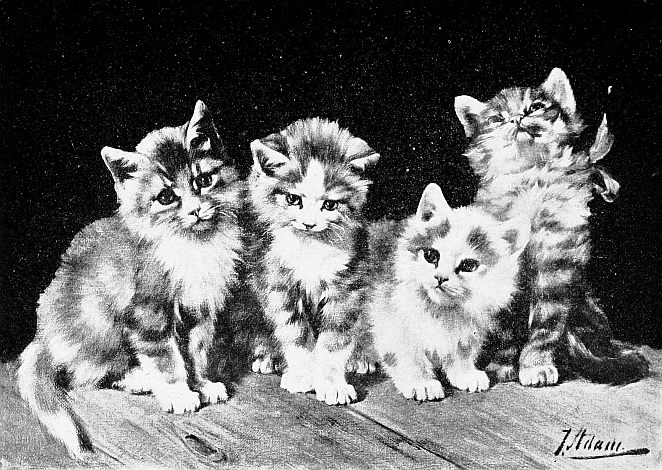
From Painting by J. Adam.
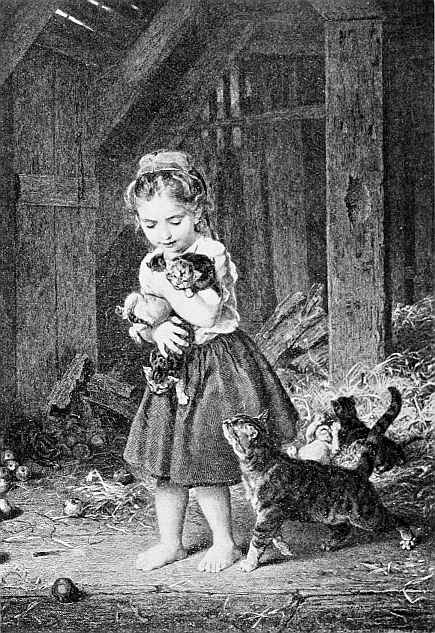
From Painting by L. Knaus.
Harriet Ford.
[Scene.—An alley leading to the stage entrance of the theater. Enter a very ragged child carrying a pet cat. She looks cautiously around as if afraid of being followed. Her dress is draggled and she wears an old shawl. Her hair is tangled and unkempt.]
NOP—nobody seed us, Methuselar. Nop—no—o—op. Thought sure Pike Cotes’u’d guess what we wuz up t’, an’ foller. Oh—oo! Oh—oo! That wuz a stunner, wa’n’t it, Methuselar? Sit down sudden ’nough that time, didn’t we? Oh—oo! Did I smash his ’ittle empty stomach? Did I? Drat Daddy? He drank yer milk, he did. Meuw, meuw! You’re right, Methuselar. He’s a stingy, skimpy, skinny old stealer. That he is. But you knowed you stayed out on the roof half the night—yes, you did, yes, you did. O’ course, ye’re shamed of it, now ye’re starved an’ sober. Daddy got in first an’ swiped your drink, he did. There’s no ust o’ me talkin’. You an’ Daddy are dead set t’ keep out nights. Yes, you be, yes, you be! Never you mind. We’ll buy a whole river o’ milk sometime or ’nother, an’ you shall jest swim in it, Methuselar.
We’ve had a tough time of it to-day, hain’t we? This ’ere’s me first ’round these diggin’s. Don’t believe nobody never thought o’ this afore. My eyes! but I wuz ’fraid Pike Cotes ’u’d catch on an’ sneak after us, but we skipped him. This must be the stage-door. We’ll jest set here an’ sing, Methuselar.
Can’t seem to rouse a shadder, Methuselar. Meuw! You knowed this wuz the spot fer us. Yes, you did, yes, you did. Didn’t you wink yer grazy eyes, an’ wag yer fuzzy tail when I sat an’ thought it up. Now, you knowed from the start, Methuselar, that you had t’ toddle ’long a me, an’ you ’greed to it, yes, you did, you did. You heard Pike Cotes tell how he got in the the-a-tur t’run erruns an’ things, an’ he said as how all the acturs an’ show folks jest dote on cats, an’ ’u’d have a fit if one turned agin ’em. Why, Puss, they’d no more dare walk by me an’ you ’thout givin’ us a penny fer luck—goodness! Here comes one.
He can’t be an actur, Methuselar. Why, he looked right at you an’ you never phased him. That song did it, Methuselar. It’s a Jonah, ain’t it? Let’s try anodder.
Here comes somebody else. Better luck this time, Methuselar.
My eyes! Methuselar, ain’t it grand? Hain’t seen one afore t’-day, have we? You caught her, Methuselar. Yes, you did, you did! She’s ’fraid you’d bring her everlastin’ bad luck. Guess she don’t know it’s ’bout all you kin do t’ hustle fer yourself ’thout mousin’ ’round hoodooin’ other folks. You couldn’t do much hoodooin’ on such an awful empty stomach, could you? Brace up, Methuselar! Here comes a swell.
Oh, sir, jest a penny t’ help a girl, me an’ puss are starvin’. Jest a—
Oh, thank you, sir! Thank you!
A nickle, as you’re a cat with whiskers, Methuselar! You done it, you done it! Yes, you did—yes, you did. Yer first trip, too, ain’t it? You’ll soon be up t’ the tricks. You do look hungry, Methuselar, but I’ll have t’ train you in looks. Now, jest t’ think, if you could squeeze out a few tears while I sung, my eyes! wouldn’t we get rich! Here comes a beautiful lady. Hush up an’ I’ll try a new dodge on ’er.
Oh, lady, can’t you give a poor girl a lift? I do so want t’ see you act in the play. If I could only git a few more pennies, me an’ a friend ’u’d clap you out of sight. Jest a few pennies, a quarter or a dime, or a nickle ’u’d do, lady. Oh, thank you! Much obliged, much obliged! God bless you, lady!
Ho, ho! Methuselar! How’s that? Ain’t you proud o’ yer mudder? That’s the way to catch ’em. Pike put me on, he did, the night he an’ me went to the play, an’ he tole me t’ help him raise the roof whenever his bloomin’ benefactor so much as put his nose on the stage.
Methuselar, I don’t think we need to sing. Anybody jest t’ look at us ’u’d know we wuz poverty-struck. Now, I’d know you was the minit I seen you. Well, I have t’ sing t’ make folks look, I s’pose. Oh, see this gentleman, Methuselar! I guess an upperatic song’ll catch him.
Oh, thank you, sir. Oh, thank you! Thank you! My name? Oh—Ginny Mur—Genavarur Murkin’s my name, sir. Yes, I have t’ sing or I guess we’d starve. I’d a’ sung better for you jest now only I’m frightful hungry. Rats ain’t in it with me an’ Methuselar. Methuselar? This ’ere’s Methuselar. We’re pards. Purty name? Yes, we think so. Pike Cotes, he named him. He’s ’bout the only friend I got, Pike is. He goes t’ Sunday school, Pike does, an’ he tole me, he says: “Now, if you’ll name that ’ere cat Methuselar, he’ll live to be as old as this ’ere house, see?”
Our house? Well, ’taint ourn, but we live on top. Bordun’s saloon’s on the first floor, you see, an’ Granny Midders an’ her son’s on the second. Tom Grimy an’ his pard’s the third, an’ Daddy an’ me an’ Methuselar’s fourth back. That ’ere saloon’s the spite o’ me an’ Methuselar’s life, ’cause Dad he—he can’t—can’t get by it nohow. He’s richer’n we are, but he has t’ drink. He can’t help it somehow. He’s purty weak lately. Me an’ Methuselar think he’s ’bout drowned out.
What, sir? What, sir? Sing—in—the the-a-tur? Yes, sir! Yes, sir—yes—sir! Sing in the the-a-tur? My eyes! You don’t think they’d have me? You do? Sing in the the-a-tur! Sing—in—oh, sir, may I try? I’ll sing—nobody never heard the way I’ll try for it, sir. Not alone? Yes, I know, sir—in the chorus, yes, sir. To-morrow? Yes, sir. Ten o’clock sharp, sir. Yes, I’ll fix up a bit, sir. Oh, thank you, sir. Look for you? Yes, sir. Good-bye, sir. Good-bye, sir—Good-bye!
Sing—in—the—the-a-tur! Methuselar! Me—Ginny Murkins. You shall hear, Methuselar, you shall, you shall. My! but I’ll be skart, won’t I? But I’ll sing, Methuselar. What’ll Pike say now, what’ll he say? Methuselar, you shall have a bouncin’ bowl of milk this minit, an’ Granny Midders shall help me get a gown. Methuselar—think of it! Sing in the the-a-tur—the the-a-tur—the the-a-tur!
[Exit laughing and crying.]
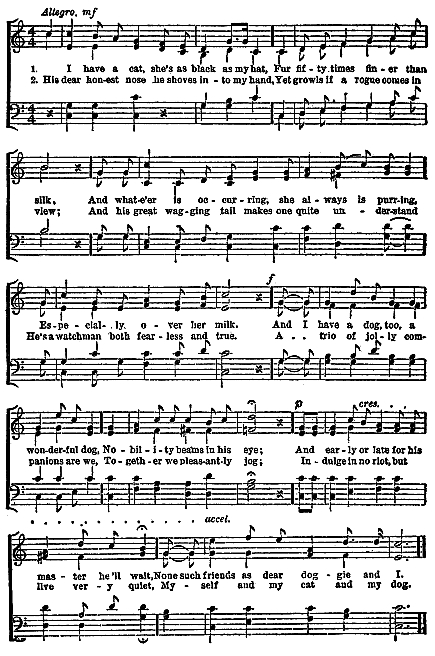
Isabel Frances Bellows.
Tableau.
Mrs. Mary L. Gaddess.
YOUNG girl in morning dress, seated in a chair; sewing on the floor, where it has been dropped. A youth in blouse and flannel trousers, or bicycle suit, kneels at her feet. She has her finger on her lips, and laughingly motions the youth with her hand to keep quiet, as someone is in the back room. Old lady in house dress, broom in hand, enters, stands as if appalled, then advances with broom up. The youth sees her, and jumps up; girl looks astonished, while old lady catches each by the ear and glares at them. The girl drops a curtsy and demurely says: “When the cat’s away the mice will play.” Lad nods head as if he agrees, while curtain falls.
Kate Upson Clark.
[On certain portions of the coast the white, rushing waves which precede a storm are called “sea-pussies.”]
Louis B. Tisdale.
[For a little child sitting in a chair nursing a kitten. Appropriate actions suggest themselves in the verse. “Do, mi, sol, do,” should be sung.]
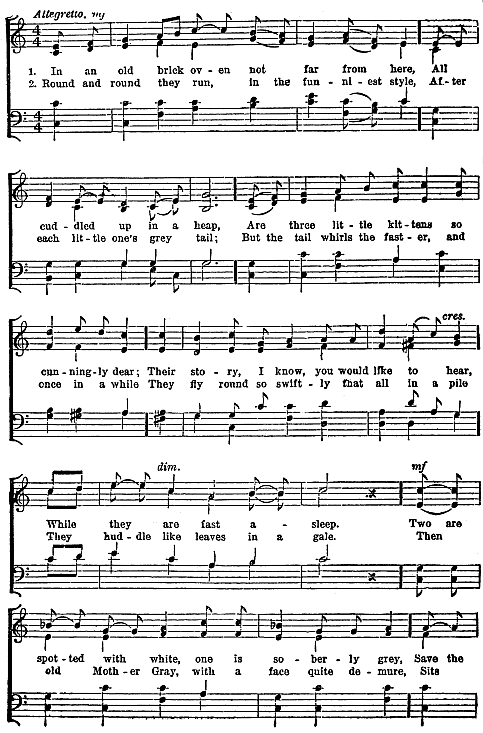
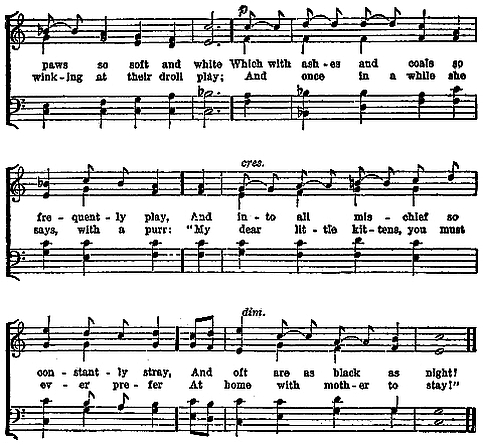
AUNTY.—What became of the kitten you had when I was here before?
Niece [in surprise]. Why, don’t you know?
Aunty.—I haven’t heard a word. Was she poisoned?
Niece.—No’m.
Aunty.—Drowned?
Niece.—Oh, no.
Aunty.—Stolen?
Niece.—No, indeed.
Aunty.—Hurt in any way?
Niece.—No’m.
Aunty.—Well, I can’t guess. What became of her?
Niece.—She growed into a cat.
Mrs. Frederick W. Pender.
Written expressly for this book.
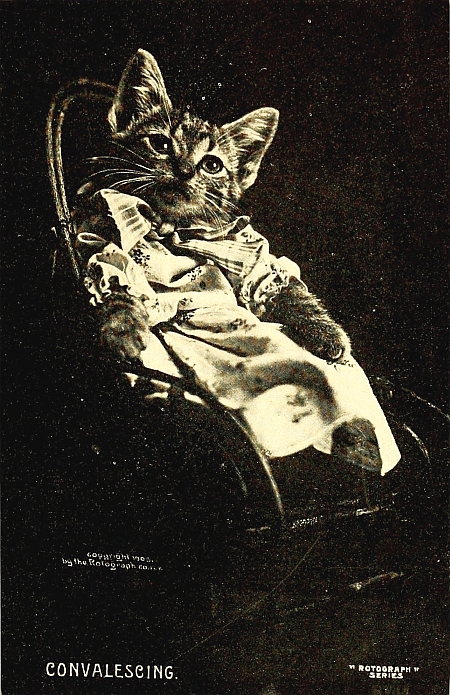
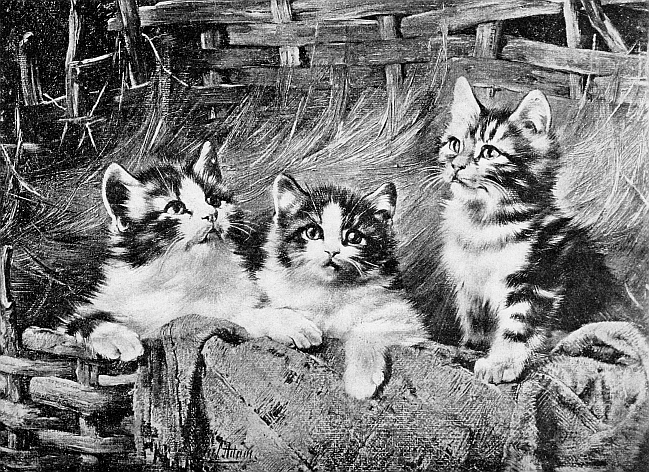
From Painting by J. Adam.
Ques.—What is the difference between a cat and a comma?
Ans.—A cat has its claws at the end of its paws; a comma its pause at the end of a clause.
Stanley Schell.
Written expressly for this book.
[Play music of Lancers from now on with variations.]
“I don’t like that cat; it’s got splinters in its feet!” was the excuse of a four-year-old for throwing the kitten away.
Mrs. Frederick W. Pender.
Written expressly for this book.
Elegy on a Canary.
Ques.—Why does a Maltese cat rest better in summer than winter?
Ans.—Because summer brings a caterpillar (cat-a-pillow).
Oliver Herford.
Lucy Larcom.
[Dialogue for four small girls. Each may have a cat, excepting the last. All stand on line, facing audience.]
Eleanor H. Porter.
“Me-ow-w!”
It was a plaintive wail that came from behind the ash barrel in the alley-way.
It had been so delightful to scurry out the hall-door when Miss Dorothy was not looking—out into the bright sunshine, where the red and yellow leaves were chasing each other down the smooth walk in front of the house.
Then there came a time when the sunshine fled and the leaves lay quiet, refusing to play, even when she poked them with her little insistent paw. She had run far down the street, and everything was new and strange to her. A big dog bounced around the corner, and she was obliged to scramble up a tree.
She had but just accomplished her fearsome descent when a group of boys hailed her appearance with yells of delight. Then to her tail—her beautiful fluffy tail—they tied a cruel cord with a jangling tin can at the end. Down the street she wildly fled, around corners, through back alleys, followed always by that deafening rattle dangling at the tip of her tail.
The shouts of the boys grew fainter and fainter, and finally ceased altogether. It was then that she stopped, and tugged and bit at the knotted cord until at last she could switch her tail from side to side—free from its hated burden.
“Me-ow-w!”
“Whew! little cat, is it so bad as all that?”
He was tall, wore a soft black hat, and carried a cane, which he playfully twirled over the kitten’s head as he spoke.
The kitten’s tail came upright instantly, waving an appreciative welcome to the kindly tones.
Two blocks down the street, the man ran up the steps of a house. His latch-key was in his hand before he spied the kitten. She had sprung lightly to the topmost step and was now facing him.
“Why—pussy!”
“Meow!”
Mechanically the man obeyed the obvious command, unlocked the door, and pushed it open. The kitten was inside the hall with a bound.
“Oh, what a beauty, Mr. Heywood! Where did you get it?” asked the landlady.
“That’s just the trouble, Mrs. Merriam; I didn’t get it at all—it came!”
“Came to you? How perfectly lovely! The very best sign of good luck that you could possibly have! There’s not a bit of doubt now, Mr. Heywood—your picture will be a certain success.”
“But what am I going to do with it?” asked Heywood.
“Do with it? Why, you’re going to keep it.”
The kitten had arrived with a bedraggled ribbon of what had once been lustrous white satin around her neck. This forlorn bit of finery Heywood at once consigned to the wastebasket, substituting a band of blue cut from a roll of ribbon, after scrutiny of his guest’s eyes to obtain just the proper shade; but the roll of ribbon soon began to show signs of a rapid disappearance, so frequently was the necklet renewed. This was owing to the fact that the kitten’s usual companions, during her waking hours, were Heywood’s tubes of paints.
The first time she had jumped upon his low stand and poked her inquisitive nose into his paint-box, he had looked on in dumb dismay. A skirmish, a sweep of a yellow paw—and a tube of Rose Madder leaped from the box and scurried across the floor with the kitten in full pursuit.
It was then that Heywood had caught up his crayon and drawn hurried lines on the canvas before him; and it was that rough sketch that became the first study for his famous picture “The Kittens’ Playground.”
After that he used every device in his power to interest the kitten in that paint-box.
From the very first the little stranger had not lacked for a name. She was always referred to as “Her Majesty,” and right royally she ruled the household. It was two weeks before Her Majesty’s new surroundings palled upon her and she longed for other worlds to conquer. Coincident with this longing came the open back-yard gate. A wild scamper, and she was free—out in the wide, wide world! Through the alley and across the lot another open gate tempted her. Up the steps, through the kitchen door and on into the dining-room pattered the little yellow feet.
“Why, Queenie!—you darling!” and she was in Miss Dorothy’s arms.
“Where have you been? You little dear—you’re as plump as a partridge, anyway! Some one has appreciated you. But they’ve taken off your pretty white ribbon and put on a horrid blue one. We’ll go and change it, sweetheart. I never did like blue!”
Meanwhile on the other side of the square consternation reigned.
“Where’s Her Majesty?”
“I don’t know, but I’ll hunt her up,” responded Mrs. Merriam.
Perhaps the kitten missed her box of pigment playthings, or perhaps she longed for the masculine homage she did not find at home; at any rate, three days later, when she heard a familiar call from across the open lot, she slipped through the back-yard gate, and hurried in the direction of Mrs. Merriam’s voice.
“I’ve got her,” she announced breathlessly, “but I guess she’s found her home, Mr. Heywood. I don’t know’s we ought to keep her—you see her ribbon’s changed.”
“Yes, I see it is. But that’s easily remedied. I shan’t paint her in a white one.”
“But—shall we keep her?” asked Mrs. Merriam timidly.
“We’ll try to—until the picture is done, anyway.”
When the kitten had first come to the house, Heywood had been engaged upon an elaborate landscape, which he had intended to finish and present to the judges of a forthcoming Art Exhibition. But since the first study of “Her Majesty,” his interest in the landscape had waned. Abandoning his original plan, he was now hard at work on “The Kittens’ Playground,” determined to exhibit that or nothing. For a week Her Majesty was closely guarded and the picture grew apace; then one day she disappeared. High and low they searched, but all in vain.
Across the square Miss Dorothy was tenderly caressing an animated ball of yellow fur.
“Queenie, Queenie, what does this mean? What am I to think when you run away from me so? Who are your new friends that insist on tying on these odious blue ribbons around your neck? Here, just let me take off the horrid thing and—why, what is this!” she exclaimed, interrupting herself in amazement as a tiny crumpled paper dropped into her hand.
“Kindly leave the blue ribbon on. I like it better—it’s more artistic,” she read.
“Well, really—impertinent creature!” Then she laughed, caught up a pencil, and wrote on the back of the paper:
“So sorry, but I prefer white!”
When the small yellow cat and the big white bow appeared before Heywood that night, he laughed outright. With careful fingers he undid the knot, and then he laughed again.
“As I expected—graceful, in spite of disadvantages.”
When the blue again adorned the kitten’s neck, it bore with it this message:
“I regret to be obliged a second time to call your attention to the fact that blue is the only possible ribbon for this cat. Look at her eyes!”
The picture was nearly done now. Her Majesty came and went much at her own sweet will, and it was not two days before another huge white bow appeared on her neck to mock Heywood’s gaze. His fingers shook a little as he untied the knot and freed the tiny crumpled paper.
“I regret to be obliged a second time to call your attention to the fact that I prefer white. Look at her—whiskers!” he read.
The time of the Exhibition arrived and Heywood had thoughts for but one thing. At last his picture was hung, and so attractive did it prove to be that it bid fair to realize his dearest hopes.
It represented the interior of an artist’s studio. The whole was but the setting for four yellow kittens—the cleverest, most fascinating yellow kittens in the world, peeping from behind curtains, tumbling among rugs, rolling over tubes of paint—life-like, bewitching, and altogether perfection.
It was on the third day of the Exhibition that a tall girl in drooping feathers and rich furs stopped before the picture with an exclamation of delight.
“It’s Queenie!—why, it’s Queenie to the very life!” “C.R. Heywood. Not for sale,” she read disappointingly from her catalogue; then she sought the manager.
“‘The Kittens’ Playground’—it is not for sale,” she asked.
“No, madam.”
“But the artist, Heywood—does he live in the city? Can you give me his address?”
“Thirty-four Union Avenue, madam,” replied the man, consulting his book.
Dorothy Marsh was not a young woman who dallied. Once determined on a course, action quickly followed. Her mother, always gentle and pleasantly acquiescent, was hurried into the carriage and the order, “Thirty-four Union Avenue,” given to the coachman.
Upon their arrival at the house, the two ladies were shown into the studio, and in a moment Heywood appeared.
The girl was in the middle of the floor, turning round and round in amazement.
“Why, they’re all Queenies, every one of them!” she exclaimed.
The man bowed, and a peculiar smile flickered across his face.
“They are, indeed, all—‘Her Majesty’s.’”
He had not time to say more, for at the first tones of the girl’s voice, there was the crash of a falling vase and the scampering of little feet from an inner room. Then with a spring and a bound a small yellow kitten landed in Miss Dorothy’s outstretched arms.
There was a moment’s awkward silence. Mrs. Marsh unconsciously came to the rescue.
“Why, it is our kitten, isn’t it? This must be where she goes so often, daughter.”
The color deepened in the girl’s cheeks and she threw a quick glance at Heywood.
“It evidently is, mother,” she laughed.
Mrs. Marsh turned to the artist.
“My daughter has taken a great fancy to your kitten picture at the Exhibition, Mr. Heywood. We—er—I see that the catalogue states that it is not for sale.”
“Indeed, madam, it was my intention to keep the picture,” he began, speaking to the mother, though looking at the daughter, “but—”—the kitten jumped from the girl’s arms to the floor and began playing with a tube of paint—“Well, there are circumstances,” he continued, then paused again.
“Yes, there are circumstances,” repeated the girl softly, her eyes on the kitten.
“Yes, circumstances which—which alter determinations,” he suddenly concluded, following her gaze with his eyes.
Dorothy was strangely silent through the rest of the interview.
It was when the ladies were leaving that the artist placed Her Majesty into Dorothy’s arms. His hand rested in a momentary caress on the round yellow head, then his fingers just touched the white bow at the neck.
“The ribbon in the picture, Miss Marsh,” he began, closely studying the girl’s face, “shall I change it to—er—white?”
“Thank you, no. I—I prefer the blue,” she answered, with a sudden flash from her eyes and a dazzling smile.
Her Majesty is older now. She is plump, sleek, and of stately dignity, and her eyes—once turquoise—gleam with shifting amber lights. Her present realm is a certain mansion. Incidentally, it is also the home of the artist, Heywood, and of his wife, Dorothy.
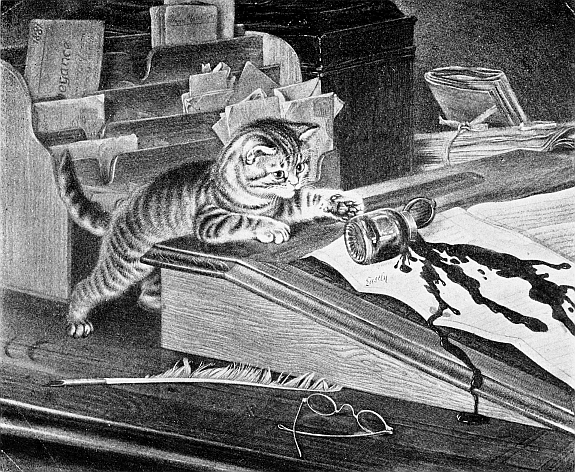
From Painting by Frank Paton.
From “Life,” by courtesy of David Smith, Artist. (See page 135.)
Ques.—When is a tea-pot like a kitten?
Ans.—When you’re teasin’ it (tea’s in it).
Stanley Schell.
Written expressly for this book.
CHARLES DICKENS was particularly fond of cats. One little deaf kitten had the liberty of her master’s study. She followed him about like a dog and sat beside him while he wrote.
One evening Dickens was reading by a small table upon which stood a lighted candle. As usual, the cat was at his elbow. Suddenly the light went out.
Dickens was deeply interested in his book, and he proceeded to relight the candle, stroking the cat while he did so. Afterward he remembered that puss had looked at him somewhat reproachfully while she received the caress. It was only when the light again became dim that the reason of her melancholy suddenly dawned upon him.
Turning quickly, he found her deliberately putting out the candle with her paw, and again she looked at him appealingly. She was lonesome; she wanted to be petted, and this was her device for gaining her end.
Mrs. Frederick W. Pender.
Written expressly for this book.
[During one of President Lincoln’s visits to the Army of the Potomac three tiny kittens were crawling about the tent. The mother had died, and the little wanderers were expressing their grief by mewing piteously. Mr. Lincoln took them on his lap, stroked their soft fur, and murmured, “Poor little creatures! Don’t cry; you’ll be taken good care of;” and, turning to an officer, said: “Colonel, I hope you will see that these poor, little, motherless waifs are given plenty of milk and treated kindly.” The Colonel replied: “I will see, Mr. President, that they are taken in charge by the cook of our mess, and are well cared for.” Several times during his stay, Mr. Lincoln was found fondling these kittens. He would wipe their eyes tenderly with his handkerchief, stroke them, and listen to them purring their gratitude to him. It was a curious sight at an army headquarters, upon the eve of a great military crisis in the nation’s history, to see the hand that had signed the Emancipation Proclamation tenderly caressing these stray kittens.]
Ques.—Why is the world like a cat’s tail?
Ans.—Because it is fur to the end of it.
Flavia Rosser.
Spell live mouse-trap with three letters.
C-A-T (cat).
Sydney Dayre.
Marori.
Mabel Preece.
TIMOTHY Dale, the blacksmith, sat beside the kitchen table in his tiny cottage, laboriously penning his first love letter. He destroyed sheet after sheet of writing paper in disgust at his misshapen letters and poor composition, until only one remained.
“It’s got ter come right on this ’ere one, or it can’t be done at all. The store’s closed fer th’ night an’ I ain’t got no more paper.”
“Dere Cynthia,” it read, “can you mete me bi the mill to morrow at 3. i luv you and wood like to no if you do the same and will marrie me plese not to forgit at 3 yours trooly Tim Dale.”
Cynthia Warden turned up the lamp and read the letter with no great surprise, for Timothy was not an adept in concealing his feelings. But Cynthia had been at boarding-school, and the honest but faulty epistle somewhat jarred on her. And then there was Walter Hughes.
Walter Hughes was a traveling salesman and at times visited his uncle, old Lawyer Hughes, the richest man in the place. At first the visits were infrequent, prompted by duty and the thought of “uncle’s little pile in the bank;” but after meeting Cynthia Warden he seemed to form an attachment for the village and spent much time there. His city-bred airs and refinement won Cynthia’s regards, and when he gave accounts of his thrilling experiences, her heart warmed to this hero of her girlish dreams. As she stood gazing out of her window, she almost laughed aloud at the thought of marrying Timothy Dale.
“Of course, it’s absurd. I might have thought him all very well had not Walter come;—but now it is out of the question.”
As Walter Hughes walked to Cynthia’s home the following afternoon his thoughts were extremely pleasant.
“The little game is progressing very favorably,” he murmured, rubbing his soft, flabby hands together in delight. “The girl is awfully smitten with me. She’ll come in for a goodly share of old Warden’s savings, and I might do worse than to marry her.”
He found Cynthia standing by the gate waiting for him.
“Come for a walk,” he suggested. “Cynthia,” he said, when they had exhausted the minor topics of the day, “I love you, and I believe you are not wholly indifferent to me. Will you marry me?”
Cynthia turned her eyes away that he might not see her great happiness, and as she did so they fell on an object by the roadside.
It was a kitten that some cruel boys had stoned. With a cry of pity she drew her hand from Hughes’s grasp and started toward the kitten, but he pulled her roughly back.
“Never mind the fool cat, Cynthia. What if it is hurt? I guess I’m of more importance than a kitten. Answer my question: will you marry me?”
It was as if a veil had been torn from her eyes. His cold, unsympathetic words, and still more, his pitiless face, betrayed the cruel, selfish nature of the man, and Cynthia’s face flushed with indignation and shame at the thought of having cared for such as he.
“No,” she responded quietly, but firmly, “I will not.”
He turned on his heel and left her standing there, and she buried her face in her hands, shuddering at the horror of what she had escaped.
A cheery voice roused her from her reverie.
“Well, Cynthia, girl, here you are! I’ve been looking by the mill for you, but as you warn’t there I thought I’d take a turn up this ’ere way an’ maybe I’d find—why, look at that pore little cat! Now, I’d jest like ter know who could ha’ done that! Wouldn’t I larrup their hide, though?”
He picked the kitten up and bound its wounded foot with his coarse red pocket-handkerchief. The hands of the burly fellow became as tender as a woman’s.
“I’ll jest take it home an’ fix it up,” he said carelessly, slightly ashamed of showing his soft-heartedness. “It’ll be sort ’er company ’bout the house. An’ now, Cynthia, I jest wanted ter know ef you’d do what I said in th’ letter—marry me—you know. I ain’t got much but a heart full of honest love ter give you, girl, but I’ll do my best by you an’ make you happy. I know I ain’t much, but—but—”
It was the longest speech the poor fellow had ever made and he broke down confusedly. But Cynthia, looking up at him with glistening eyes, said softly: “Will I marry you, Tim? Yes—with all my heart.”
Then, as with a low exclamation of surprise and joy he turned quickly toward her,—
“Look out!” she cried, laughing through the tears sparkling in her eyes, “Look out, or you’ll drop the kitten!”
Georgia A. Peck.
Mrs. E.J. Corbett.
Kate Ulmer.
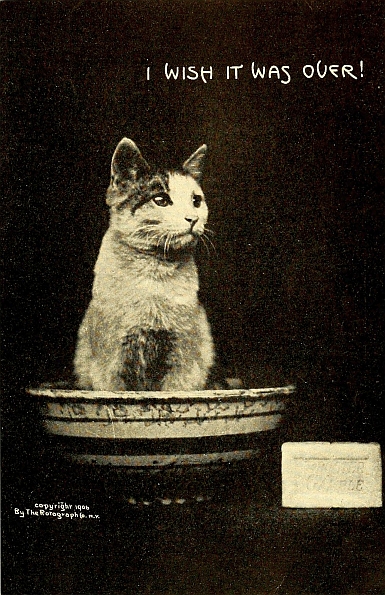
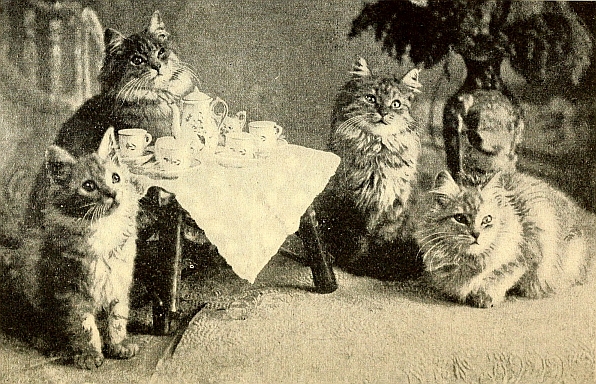
(See page 180.)
Nellie M. Garabraut.
A certain room has eight corners; in every corner sits a cat, on every cat’s tail sits a cat, and before each cat is a cat. How many cats in the room? Ans.—Eight cats.
A Legend.
Louise Jamison.
ONE day a magician was traveling through a great forest. He was a very good magician, and always ready to help any creature in need.
After he had gone a long way through the forest, he was very tired; and, as the sun was growing hot, he lay down at the foot of a big tree, and was soon asleep. While he slept, a great serpent came softly out of the thicket, and, as soon as it saw the man, it began to hiss to itself:
“Ah, ha! ah, ha, I’ve got him now! He’ll not spoil my supper again in a hurry. I could have eaten that cat last night if he had not driven me away. I’ll kill him for it now.”
So it crept nearer and nearer, and the magician slept on, without any thought of danger.
But it happened that the cat was watching. She was up in the tree, and she had not forgotten how the magician had saved her from this cruel serpent.
The serpent was very large and she was only a small cat, and she was terribly afraid, but she meant to save her good friend if she could.
So, just as the serpent was about to spring, she leaped down upon his back and stuck her paws deep into his head.
Wild with pain and anger, he tried to reach her with his deadly fangs, but she was always too quick for him, and she used her claws to such good purpose that her enemy soon lay dead.
Then she was so tired after her hard struggle that she had to lie down herself.
The magician found her beside him when he awoke, and when he saw the dead serpent he knew his life had been saved by his brave little friend.
“Dear little cat,” he said, “what can I do to show how much I thank you? Your eyes are quick to see, and your ears quick to hear; and for running your feet have been made swift, but one thing I can give you. All men shall know you as their friend, and your home shall be with them, and for your sake all cats shall leap where they will, and fall ever upon their feet.”
E.T. Corbett.
Tune “Buy a broom.”
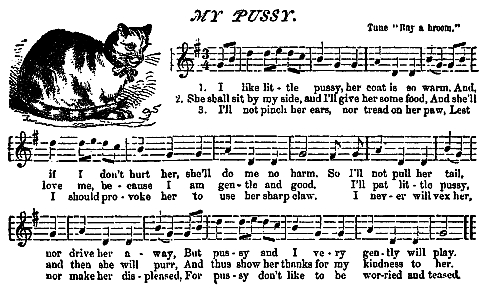
CATS is an insect what has no wings and has a long tail. It looks like fishworms, only fishworms hasn’t got no hair on it like cats has. Cats is black, and sets on back fentses and buzzes its wings, which it hasn’t got any. Cats is like locusts ’bout this, ’sept locust es got wings, an’ cats waves its talze ’bove its head, and don’t set on trees. Cats was a Namerican invention made by a Mr. Pharaoh, of Egypt, Illinois, ’bout one thousand years ago or so; I expect it was so or maybe more so. Anyway this man didn’t get no patent on cats, and they was copied by some fulish man who carried ’em to New Yorick where they have ruled things at night with a tight pair o’ strings, fur some daze. Cats has a hump back with long bristles onto it. It has a pair o’ lungs, which extends clean back to its tail, which is long. It uses all o’ these yere lungs in singin’ low, sweet melodies to the pail, watery mune, ’bout 1 o’clock in the morning. Cats sometimes sits on the comb of a slippery roof, an’ sizen sobs an’ squalls an’ strokes each other’s whiskers. Cats uses two legs to set on, one to stand on an’ t’other to fan his partner with. I know two cats what did this on our woodshed. I guess they did it because they thought they would shed. I know they got up there to shed, for me an’ Jack found half a hatful of catfur, an’ a pocketful o’ claws there the next mornin’. Wonder why they don’t shed in the daytime? Must be mune had something to do with it. Cats, unlike the insecks, don’t have no stingers. The bumblebee has. I onc’t caught a bumblebee an’ gave it to a cat. Cats don’t like bees, espeshly them what hez splinters in ther talez, wich this had. The thing stung all the way down and half way back again; the cat run about seventeen miles an’ then dropped down by the shady side of a stay-hack an’ quickly, without warnin’, he hastily died a sudden death all at once, for want of breath.
Onc’t when Jack an’ me was playin’ fishin’ in our well with a tom-cat tied to a string, Jack got hurt. He had the cat down in the well, waitin’ for a bite, an’ when his back was turned it crawled up the brick an’ clawed the sap outen him. After that Jack didn’t fule with cats.
I once knew a man who was wicked enough to throw a stove-lid through a big tom-cat at night, an’ the very next day he heard that his grandmother had broke her leg in New Orleans and several other places, which prove how wicked and sinful it is to disturb the critters; an’ that’s all I know about cats.
THE cat which we had afor we got Mose was yeller, and didn’t have no ears, and not eny tail, too, cos they were cut off to make it go way from where it lived, for it was so ugly so it come to our house. One day my mother she sed wudent my father drown it, cos she knew where she cud get a nicer looking one. So my father he put it in a bag, and a brick in the bag, too, and threw it in the pond and went to his office, my father did. But the cat busted the bag string, and wen my father cum home it was lying under the sofa, but cum out to look at him. So they looked at one another for a long wile, and bime by my father sed to my mother: “Well, you are a mity poor hand to go shoppin’ for cats. Thisn is a site uglier than the other.”
CATS don’t like to swim, and never do except it’s an old cat that you want to get rid of and you do her up in a bag with some bricks and throw her into a mill-pond off the bridge, and then she’ll burst the bag and swim ashore and kite for home, so’s to be there to welcome you there, so’s you won’t feel lonesome.
Our cat lives in the house what times she don’t live over to Jones’s barn. She is real handy to throw stones at and to pull her tail and make her squawk. I make her squawk ten or six times a day, and the backs of my hands is drawed out in lines like a map, where her toe nails has got hitched.
Cats can climb telegraph poles and set on the ridgepoles of four-story houses without being dizzy headed, and they can sleep with one eye open and lay awake with both eyes shut.
I’d rather have a dog than a cat, any day. Dogs can race cats, they can race other dogs, they can race boys, or anything. Nobody ain’t scared of a cat. A mouse is; but not if it ain’t somewheres that it can’t get out of, or a rat, either. A dog can make a cat dead if he bites her enough. When he comes in the yard he can make her tail look like a Christmas tree. He can make her fix her back up like a camel. I ain’t afraid of thieves, but thieves are afraid of dogs. If a thief comes where a dog can get at him he’ll run like the deust; but the dog won’t run. A dog can watch a house better than a policeman. He won’t let the man that owns it come in the back yard in the middle of the night; but a cat would. If a man or any other thief was to sneak in, would a cat care? She’d go over the fence like lightning. That’s what! A dog knows when your home from school. He ain’t sleepy then. He has fun with old hats, if you give him one. You’ve got to pay for keeping him; but you don’t a cat; because a dog’s some good and a cat ain’t. I’d rather have a dog.
IF I had invented a cat, I should have made her without nails. Cats is full of music. They have concerts every night in our wood-shed, and no tickets to pay for. The rich and the poor alike are welcome to hear ’em.
Cats live on mice, and what cream and beefsteak they can steal out of the pantry. Sometimes they catch chickens, and that makes the old hen mad, and the old woman that owns the chickens madder. And she goes for the cat with a broom, and the cat climbs a tree and sits there and lafs at her, and goes to sleep and dreams she is in a kitchen again till it comes night, and then she climbs down back end fust and goes off to a concert to see the other cats. Thomas cats has the best voices and can sing bass and tenor both at once. It is nice to hear ’em, but when you sleep alone and wake suddenly by hearing of ’em, there is something or ruther that makes a feller’s flesh creep and the cold shivers run down his backbone.
Cats like to get on the spare bed among the shams and things, and paw ’em all down into a nest, and they like to go to sleep in your best coat. I expect they enjoy the fun of hearing you swear the next day when you brush it. I should if I was a cat.
Kittens is cats when they are first born, and there is an awful sight of ’em. They keep coming right along without regard to wind or weather.
They are dreadful cute, and can unwind more thread and tear up more fancy gimcracks that the girls make than any other known animal.
It ain’t lucky to kill a cat. I don’t know why. It is good luck to have one come to you if you keep her. You get rich right away, or poor, I forget which. Every cat has nine lives, and they don’t never die if let alone unless they have fits, which most of ’em has. A cat in a fit will beat a whole circus all to nothing, and the first thing you know she’ll come right out of it and go to eating milk just as if nothing had happened.
LITTLE FLOSSIE had been presented with a small candy cat by her aunt, and it furnished amusement for nearly a week. One day it was missing, however, and her mother asked her if she had lost it.
“No, mamma, me didn’t losed it,” replied Flossie. “Me des’ played wif it till it dot so dirty, me des’ had to eat it.”
C. Grace Jerolamen.
Written expressly for this book.
Ques.—What is the difference between a cat and a camel?
Ans.—When a cat gets mad she gets her back up, but the camel simply humps himself.
Ques.—Why is a cat going up three pairs of stairs like a high hill?
Ans.—Because she’s a-mountin’.
Mary Elizabeth Stone.
[The cat appears in many of the weird tales and popular songs of the Northern nations. A characteristic legend is the following.]
Hor du Plat
Sag til den Kat
At Knurremurre er dod.
. . . . .
. . . . .
. . . . .
Essay or Address.
Stanley Schell.
IN all the varied world of animals, three only are universally the inmates of our homes, the companions of our firesides—the cat, the bird, and the dog. The cat, especially, is the friend of our early childhood; the purr of the cat blends with the voices of the children and the ticking of the clock; it is the music of repose, the veritable “Home, Sweet Home” that haunts the wanderer on far-off shores.
A tenderness toward the animal creation is always characteristic of noble, generous and intellectual souls; and it is well known that our most intellectual people are most tender-hearted toward beings helpless and inferior to themselves, and they love with a child-like love the cat, whose image is associated with the sweetness and tenderness of the child’s world of happiness—the home.
The most noted persons in every profession have been domestic cat lovers, particularly authors and poets. Such men as Pope Gregory, Mahomet, Petrarch, Tasso, Cardinal Woolsey, Admiral Doria, Gladstone, Montaigne, Swinburne, Watson, Matthew Arnold, Dickens, Southey, Cooper, Hugo, Mérimée, Sainte Beuve, Baudelaire, Gauthier, Pierre Loti, Hoffmann, Scheffel, Lord Chesterfield, Jeremy Bentham, Doctor Johnson, Fielding, Lincoln, etc., were all cat lovers and worshippers, and many of them immortalized the cat in rhyme or in prose.
The Cat Family is a large one, and to it belong:
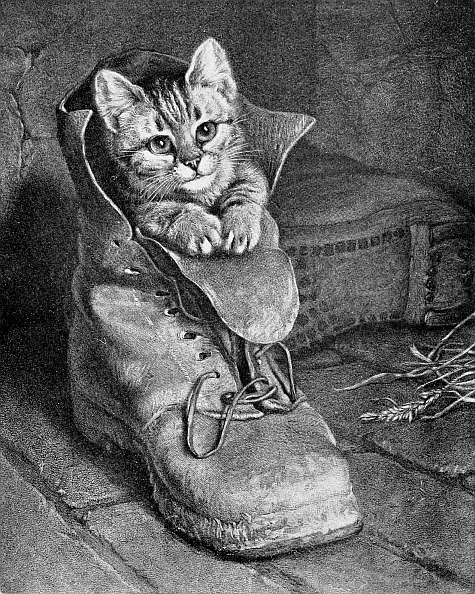
From Painting by Frank Paton.
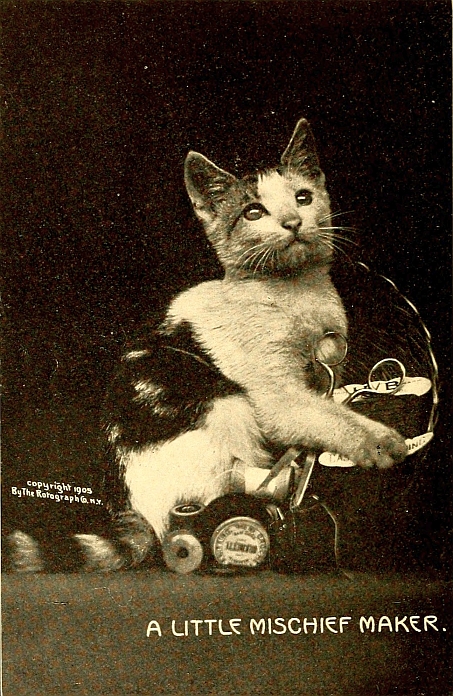
Considering the Cat Family as a whole, there is probably no other animal so well equipped for the battle of life.
Cats are carnivorous, preferring to discover and kill their own prey. Cats are ferocious and sanguinary, loving retirement; moving with concealment and stealth; always fighting desperately when injured, or when escape is no longer possible. All cats climb with ease, except the tiger and the lion. So persistent are the characters both of body and mind in the Cat Family, that, in spite of thirty-five centuries or more of domestication, the household cat to-day preserves far more of its ancestral traits than any other of the four-footed associates of man.
Cats are found all over the world except in the Australian region, in Madagascar, and the West Indies. They are mainly tropical and heat-loving, although a few species range far to the north, as the tiger in Asia and the puma in America. The short-tailed lynxes also predominate in the northern regions.
The first real evidence of cats in connection with man is to be found in the ancient monuments of Egypt, Babylon, and Nineveh. Cats are mentioned in inscriptions as early as 1684 B.C., and they were certainly domesticated in Egypt 1300 years before Christ.
The earliest known representation of the cat as a domestic animal and pet is at Leyden, in a tablet of the 18th or 19th Dynasty.
In ancient Egypt, the cat was an object of religious worship and a venerated inmate of certain temples. The Goddess of Pasht or Bubastis, the goddess of cats, was, under the Roman Empire, represented with a cat’s head. A temple at Beni-Hassan, dedicated to her, belongs to the 18th Dynasty (1500 B.C.). Behind this temple are pits containing a multitude of cat mummies.
The cat was also worshipped in the Temple of the Sun at Heliopolis, as the Egyptians deemed the cat an emblem of the sun, because its eyes were supposed to vary in appearance with the course of the sun, and for a similar reason the cat was deemed sacred to the moon, because it would undergo a change each lunar month, and because of the waxing and waning of its pupils.
Among the Greeks the cats became common pets at the period when Athens represented the civilization of the world; and, later, in the Græco-Italian civilization of Herculaneum and Pompeii in the south of Italy, and in the period of Roman supremacy, it was a well-known pet of courts and ladies’ boudoirs.
During the Middle Ages, cats were very scarce and valuable, and persons owning cats were heavily taxed.
The cat has also had its detractors, and shortly after the Middle Ages cats were looked upon as symbols of witchcraft and deviltry of all kinds, and were even burned at the stake as sorcerers and savants.
In Paris, every St. John’s Day, a number of cats were heaped up in baskets and bags in the Place de Greve, and the sovereign himself always set fire to the pile. This practice continued down to Louis XIV., who was the last King of France to do so cruel an act.
Gipsies have always feared the black cat and have greatly loved the white cat.
Shakespeare rarely alludes to cats, except in an uncomplimentary way.
The domestication of cats was gradual and continuous.
The origin of our domestic cat is undoubtedly the wild cat of Egypt and the American wild cat. And such origin is of very ancient date.
To-day the classification of our domestic cat is into two great classes: (1) The Long-haired or Angora Cat (Asiatic or Eastern in origin), consisting of the Persian, Russian, Chinese, and Indian Cats; (2) the Short-haired Cat (European and Western), consisting of the Tortoise Shell, Tortoise Shell and White, Tabbies—banded and spotted, brown, spotted, blue and silver, red, white, blue (Maltese in America), black and white, Royal cat of Siam, Manx.
Characters: Elsie, George, and James.
Stage Setting: Home interior.
Scene: George and James are sitting at table reading books.
[Enter Elsie.]
Elsie. O dear! O dear! It’s gone—killed—eaten up! O dear! O dear! [Wringing hands.]
George [looking up from book]. What is the matter, Elsie? What is gone?
Elsie [sorrowfully]. My dear, dear bird—my canary that you gave me.
George [sympathetically]. You don’t say so! How sorry I am!
James [looking on and deeply interested]. What killed it, Elsie?
Elsie. The cat.
George [angrily]. How cruel! how wicked! I’ll shoot her!
James [surprised]. For what?
George. Why, for killing the bird.
James. For killing one bird? What should be done with you, who have killed so many birds—all as beautiful as the canary?
George [indignantly]. Why, I am not a cat!
James [earnestly, yet with determined voice]. No; but you are far more responsible than a cat, who is governed only by instinct, and kills a bird for food, not for sport, as you do.
George [sarcastically]. Well, this is being decidedly personal.
James. It is simply calling things by their right names. Elsie, what do you think George has spent his whole day for? Just to catch and shoot a poor little wren. Late this afternoon he succeeded in fetching her down, and that leaves four poor little baby wrens in the nest to starve and die.
Elsie [shaking finger sorrowfully at George]. Bad, wicked George! I’ll not speak to you again for a week. You and that kitty-cat are two murderers of birds, and should be shut up in the cellar together.
[Exit Elsie.]
George [shrugging shoulders, gets up, shoves hands into pockets, and moves about room restlessly]. What a great fuss about a bird!
James [indignant]. Fuss? Why should you not apply the same rule to yourself that you would apply to a cat? The equity of the case is against you, George. You claim the right to kill, yet deny that right even to a cat! The law of usage is your only excuse, and it is a very poor defence at best; it is one law for the powerful and another for the weak. You should be too just to use it. [Rises and stands leaning on table.]
George [leaning against a chair]. Your logic is very good, James; but I would like to shoot that cat, for—for——
James. For doing just what you have done so many times. [Crosses to brother.]
George [stammering and looking ashamed]. Well, I’ll—I’ll——
James [looking at him with pleading eyes]. What?
George [looking into James’s face with a more open face]. I think I shall have to own that I have been in the wrong, and I promise never to shoot again in mere sport. [They shake hands earnestly and gladly.]
James. That’s a noble resolve, George. As to Elsie, I’m sure she’ll forgive you when she learns of your resolve; but mind—no mental reservations about that cat, or——
George [smiling]. Or what?
James [patting George on shoulder as both move to leave room]. Why, a cat-astrophe will be sure to follow.
Drowned in a Tub of Goldfishes.
A FRENCH lady by the name of Mme. de Bientruffé, whose departed husband had left her enough money to live comfortably the rest of her life, lived in quiet and happiness until her jealous neighbors began to envy her good luck, and wrongly to gossip about her. Among her most implacable enemies was a certain Mme. Galuchard, who burned with an almost Carthaginian hatred, which included not only Mme. de Bientruffé, but also her gray Angora cat, called Minouchon. Mme. Galuchard vowed incessantly with set teeth that some day or other she would cook their soup for them. The piano on which her old neighbor sometimes played threw her into fits of mad rage, which were accentuated only by the mewing of the cat. She had already several times demanded the execution of the animal, and every time the poor old lady had formally refused to comply with the demand, denying the charge that her pet attracted all the tomcats of the neighborhood. Not being able to encompass by open means the revenge which she desired, Mme. Galuchard resolved to accomplish it by force, and by means of the darkest machinations.
One day—entirely by chance, of course—a piece of bread crust, soaked in milk saturated with arsenic, was thrown in the way of the innocent Minouchon, who was wandering over the stairs, and, incapable of suspecting the perfidiousness of the human race, she thought she had found a tidbit, and hastened to sample it.
Alas! An hour later she died in fearful agony, and her little white Angora soul soared straight to the regions where there is no pain, and the remembrance of the misery of this world is effaced and vanishes in the vibrating splendor of the sky.
Her mistress mourned her as if she had been a human being. She had a handsome wooden box made, and painted white, in which she placed her idolized companion, with a new ribbon round her neck, and had her secretly buried in a corner of the nearest park.
When these sad duties were accomplished she had only one thought—how to punish the monster who had killed her pet.
Her suspicions soon fell on the repulsive Mme. Galuchard, who appeared to be puffed up with satisfaction over some insolent and cruel victory. Unfortunately, the latter had no pet animal through her love of which she might be hit; besides, Mme. de Bientruffé was too good-hearted to avenge the death of one innocent being by killing or injuring another.
If she thought over her plan for a long time, and at last fancied that she had found a punishment equal to the crime, she gave no sign that such was the case. The only thing to be noticed was that she bought one day a dozen traps—rat traps and mouse traps—which she caused to be set in her apartments. But then, since the assassination of the poor Angora cat had left the rodent tribe the freedom of the house, it was, of course, necessary for her to combat the animals, and the neighbors did not trouble themselves about it, Mme. Galuchard least of all.
A week later, however, when the latter was at home, and busy thinking what new injury she could do Mme. de Bientruffé, a uniformed messenger brought her a large box, and withdrew, saying that it was paid for. Thinking that she would find some beautiful gift—a shawl, a boa, perhaps a gown—Mme. Galuchard hastened to open the box.
Horrors! Hardly had she lifted the cover before a swarm of little gray animals, leaping, jumping, bounding, and giving piercing squeals, dashed across the room and crowded together in the corners, leaving the paralyzed woman half dead with fright. At the bottom of the box was a note signed by Mme. de Bientruffé:
“Madame: You killed my cat by giving him arsenic. As this kindness deserves another, I make you a present of my mice.”
Ques.—What proves a minister to be the most affectionate of men?
Ans.—In every church you will find a catechist (cat he kissed).
William Cowper.
Stanley Schell.
THE cat is instinctively a cleanly animal, and, when housed, should be provided with every means to keep herself clean. Articles necessary for a cat are:
1. A flat, galvanized pan or box, with clean sand, earth or sawdust.
2. Clean box or basket, filled with clean straw, excelsior, or tissue paper, in summer; cut-up (waste) paper from printer or binder, or a large, soft flannel blanket in winter. This basket should be kept in the sunlight.
3. Absolutely clean dishes for food.
Brush the cat daily with a soft hair-brush or with a bath-mitten.
To wash a cat (which should be done every week) prepare a dish of good, rather thick soft soap, and have ready two foot-tubs of tepid water. If you have a small bath-tub, place a towel in bottom of tub, stand cat on hind legs in tub and let her front legs rest on edge of tub. Hold her by the neck or collar with one hand, and, talking to her nicely, begin rubbing in gently but thoroughly the soft soap, beginning at the hind quarters and tail and gradually working up toward the ears. When soap is well applied, move soap-bowl aside and dip your free hand in one dish of tepid water and gently apply water to lower part of cat’s body, and so on up the body until all the tepid water in this bowl has been used; then use second dish of tepid water to rinse cat, using, as before, a little at a time.
When cat is thoroughly cleaned, wrap her in a clean turkish towel and gently pat her so as to dry her as much as possible. Remove towel and wrap cat in a warm flannel blanket and gently rub towel over her body to dry her still more; then put her into her basket and let her finish the drying for herself.
If you are afraid to wash your cat, you can clean her by rubbing her with olive or cocoanut oil, or with cream; then, after partly drying her, put her into her basket to do the rest.
Some of the articles of food good for a cat are:
Add boiled rice to the milk if cat has diarrhœa.
Whenever a cat is sick, if possible learn and remove cause; if not possible, give her one of the following:
Maria J. Hammond.
1. Short-Haired Cats
2. Long-Haired Cats
Mark Twain.
WE was all boys then, an’ didn’t care for nothin’ only how to shirk school, an’ keep up a revivin’ state of devilment all the time. This yah Jim Wolfe I was talkin’ about was the ’prentice, an’ he was the best-hearted feller, he was, an’ the most forgivin’ an’ onselfish, I ever see. Wall, there couldn’t be a more bullier boy than what Jim was, take him heow you would; and sorry enough was I when I see him for the last time.
Me an’ Henry was allers pesterin’ him, an’ plasterin’ hoss bills on his back, an’ puttin’ bumble-bees in his bed, an’ so on, an’ sometimes we’d jist creowd in an’ bunk with him not’standin’ his growlin’, an’ then we’d let on to git mad, and fight acrost him, so as to keep him stirred up like.
He was nineteen, he was, an’ long, an’ lank, an’ bashful, an’ we was fifteen an’ sixteen, an’ pretty tolerabal lazy an’ wuthless.
So, that night, you know, that my sister Mary giv the candy-pullin’, they started us off to bed airly, so as the comp’ny could have full swing; an’ we swung in on to Jim to have some fun.
Wall, our winder looked out onter the ruff of the ell, an’ about ten o’clock a couple of ole tom-cats got to raisin’ an’ chargin’ reound on it, an’ carryin’ on just like sin.
There was four inches of snow on the ruff, an’ it froze so there was a right smart crust of ice on it, an’ the moon was shinin’ bright, an’ we could see them cats jist like daylight.
First they’d stand off, e-yow-yow-yow, jist the same as if they was a-cussin’ one another, you know, an’ bow up their backs, an’ bush up their tails, an’ swell around, an’ spit, an’ then all of a sudden the gray cat he’d snatch a han’ful of fur off the yaller cat’s back, an’ spin him around jist like a button on a barn door. But the yaller cat was game, an’ he’d come an’ clinch, an’ the way they’d gouge an’ bite an’ howl, an’ the way they’d make the fur fly, was peowerful.
Wall, Jim he jist got disgusted with the row, an’ ’lowed he’d climb out there an’ shake ’em off’n that ruff. He hadn’t reely no notion o’ doin’ it, likely, but we everlastingly dogged him, an’ bully-ragged him, an’ ’lowed he’d allers bragged heow he wouldn’t take a dare, an’ so on, till bimeby he jist histed the winder an’ lo an’ behold you! he went—went exactly as he was—nothin’ on but his——ulster. You ought to ’a’ seen him! You ought to seen him creepin’ over that ice, an’ diggin’ his toe-nails an’ finger-nails in, fur to keep him from slippin’; an’ ’bove all, you ought to seen that——ulster a-flappin’ in the wind, and them long, ridicklous shanks of his’n a-glistenin’ in the moonlight.
Them company folks was down there under the eaves, an’ the whole squad of ’em under that ornery shed o’ dead Wash’ton Bower vines—all settin’ reound two dozzen sassers o’ bilin’-hot candy, which they’d sot in the snow to cool. An’ they was laughin’ an’ talkin’ lively; but, bless you! they didn’t know nothin’ ’bout the panorammy that was goin’ on over their heads.
Wall, Jim he just went a-sneakin an’ a-sneakin’ up unbeknown to them tom-cats—they was a-swishin’ their tails, an’ yow-yowin’ an’ threatenin’ to clinch, you know, an’ not payin’ any attention—he went a-sneakin’ an’ a-sneakin’ right up to the comb of the ruff, till he got in a foot an’ a half of ’em, an’ then all of a sudden he made a grab for the yaller cat! But by gosh he missed fire an’ slipped his holt, an’ his heels flew up, an’ he flopped on his back, an’ shot off’n that ruff just like a dart!—went a-smashin’ an’ a-crashin’ down through them old rusty vines, an’ landed right in the dead center of all them comp’ny people!—sot down jist like a yearthquake in them two dozen sassers of red-hot candy, an’ let off a howl that was hark from the tomb! They got—wall, they left, you know. They see he warn’t dressed for comp’ny, an’ so they left—vamoosed.
All done in a sec’nd; it was jist one little war-whoop an’ a whish o’ their dresses, an’ blame not one of ’em was in sight anywhere!
Jim he war in sight. He was gomed with the bilin’ hot molasses candy clean down to his heels, an’ more busted sassers hangin’ to him than if he war a Injun princess—an’ he come a-prancin’ upstairs jist a-whoopin’ an’ a-cussin’, an’ every jump he giv he shed some sassers, an’ every squirm he fetched he dripped some candy! an’ blistered! why, bless your soul, that poor creeter couldn’t reely set down comfortable for as much as four weeks.
James Buckram.
Elliot Walker.
OTHELLO sits at top of cellar stairs and gazes reflectively down into the gloom. He has washed his paws and now is reflecting. Yes, he has caught the mouse and eaten him—a most delicious mouse—a most exciting moment—when, after long, patient wait behind the wood-box, his prey suddenly darted across to the refrigerator. Othello had given one quick spring—and now he lashes his long black tail from side to side at the recollection—it had been a great satisfaction to catch that mouse at last.
But now the mouse is gone, and so is Othello’s occupation. For three successive nights he had crouched in patient watching. Now the mouse is no more, and Othello almost wishes it back in its hole, so that he might again pass long hours in delightful anticipation. And that was the last mouse in the cellar! No use to go down again. Nothing to do, and he may as well go to sleep.
What is that? Noises outside the door—strange whispers! Why! the key turned round in the keyhole by itself! How funny! He will put up his paw and play with it if it does that again. The door is opening and cold air is coming in, and something else coming in, too—two such creatures as you never have seen before—muffled creatures, with queer black things over their faces and queer things in their hands. Yes, they must be men, but very queerly dressed, and they cast searching glances in every direction. What a queer little lamp they have lighted—just a glare of light, then darkness, then light again that moves here and there. Oh, they are going down cellar, to look in the refrigerator, probably, or possibly to shake the furnace. That is all the master goes down cellar for.
The cat crawled from his hiding-place to top of cellar stairs and again gazed into the gloom. What! Are they talking about that beautiful roast, and the pudding and the cold mashed potatoes? They are going too far; they might have the potatoes, but the cold meat—that is too much! He will tell his master, and the master will make them give it back, even as he had made Othello give up the young robin, by choking and blows. Yes, he shall know of this at once. But how to reach him? The pantry doors to kitchen and dining-room are always locked now, ever since the parrot came. Ah, he understands it now! Those creatures in the cellar are friends of the parrot—probably invited by him to come and gobble everything. That is the parrot all over, wanting everything and getting it, and Othello, who formerly had the run of the house, and went regularly to wake the master every morning, is now relegated to the kitchen, with the pantry door locked.
Othello grins at recollection of the reason for locking that door. When the parrot had arrived six months before and cast a shadow over Othello’s position, hatred and jealousy filled his feline bosom. To be sure, the parrot was talented and could say real words like people, and Othello admired that, but his disposition was mean, and after he had startled Othello by screeching “Scat!” and “Get out, Blacky!” something had to be done. And now it pleases him much to remember the scientific play of his claws on the parrot’s head and neck, and the way the feathers flew, and the appalling screams. Well, Ephraim—that is the parrot’s name—had no business to insult him. He began it by putting his head through the bars of the cage and rasping out “Niggerhead! Niggerhead! I chew niggerhead!” Ephraim had come over in a sailing vessel, and the sailors had taught him many evil words and phrases. So Othello had reached out one paw invitingly and Ephraim had struck at it viciously. But Othello had pulled the paw back quickly and brought the other one down on Ephraim’s head and held it there while he raked him with the other. And all the people in the house had come running, and he was cuffed and driven down-stairs.
The men in the cellar are coming toward the stairs now, and Othello retires under the stove. Now they are in the kitchen again and have put the food on the dresser. Othello would like some of that cold meat—it smells delicious—but he fears to come out from under the stove. He is suspicious. He will wait. What are they doing? Unlocking the door to the pantry. How excited they seem! Now they are unlocking the dining-room door. What are they after? He crawls quietly after them—they cannot see him in the shadow, but he can see everything. Oh, they have laid a great nasty bag on the dining-room table, and they are taking from the sideboard all of those bright things that the family eat with and take such care of, and are putting them into the bag very carefully. There goes little Jenny’s mug—the one she lets him have milk from. No, that will not do. No meat, no milk! Now is his chance. From the dining-room to the hall, then up-stairs to the master’s room. How very easy, all in a minute!
What did that man say?—“Get the swag ready and leave it on the table; we’ll step back and eat. Don’t move it now—it may rattle. We’ll carry it off when we start—good haul!” Othello pricks up his ears. “Carry it off!” Yes, he understands that. He has been cuffed often for carrying off things—chops and slices of meat. These horrible men shall be cuffed, too—the master will do it. Creep along, Othello, creep along! Up the stairs now, down the hallway, into the master’s room. You will rouse him and save what you little know the value of. Jump on him, scratch him—anything! You have done it. He is wide awake now and trembling; is out of his warm bed, and seems to understand. There is a bright, shining thing in his hand and his face is white and set.
Bang! Bang! Bang! Bang! Why are you, brave Othello, cowering at top of the attic stairs? Two short seconds ago you were on the master’s bed, purring loudly. What is that awful rush below, out of the kitchen where the clock ticks, out across the porch, across the lawn, into the road? Bang! Bang! outside the house, then the sound of rapid running. Why, what is it, Othello? What are people screaming for, and why is little Jenny crying, why is Ephraim screeching atrociously, and why are you, with your tail twice its natural size, wailing dismally? Fright, Othello, general fright—and you brought it about with your notions of the rights of property. Quiet down now and crawl down-stairs to see what you get.
They are gathering in the dining-room, with all the lights going full blast, as you, Othello, sneak down-stairs wondering what it all means. The master has just come back from the outside, quite pale and shaky. “Fired six times and never hit one of them,” he says. “Did they get anything?” And the mistress, who has emptied the dirty bag on the table, replies, “Not a thing, William.”
They are all quiet now, especially Othello, who feels the queer experience deeply, and wonders how much abuse he will get when he is discovered hiding by the sideboard. The master spies him, and lifts him tenderly, with words of such affectionate appreciation that Othello wonders still more, but sinks his claws gently through the thin covering and purrs. “Ow!” says the man, and quickly extricates them. He strokes the cat very gently, and turning to his wife, says, “Maria, let’s get rid of that parrot. From this time forward the cat shall have first place. I have thought lately of buying a watch-dog, but it is not necessary. I’d rather have a watch-cat like Othello.”
Ques.—Why does a cat look on first one side and then on another when she enters a room?
Ans.—Because she can’t look on both sides at the same time.
M.T. Hart.
I WANT to tell you about my pet cat. I am sure it will interest you. He is marked like a tiger, with white paws and a white pompon in the end of his tail. I have never seen or heard of a cat who eats the things he does. One day he knocked down a bottle of olives from the pantry shelf and ate four. Other things he likes are red beets and baked beans; sometimes he even prefers them to meat.
One of his bad habits is to lie in my flower garden. I have it in a bay window, where the sun shines on it all the morning. As it is nice and warm there, I have caught him a number of times trying to sleep among the flowers.
He isn’t a bit afraid of dogs; indeed, they are more afraid of him, for he often chases them out of the yard.
One morning last winter I could not find him anywhere. At last I heard a faint mew. I listened, and heard it again, this time fainter than before. I looked all over. At last I thought of the oven in the kitchen stove. I opened it, and out walked my pet, more dead than alive. He must have gone in when no one was looking, and so had the door shut on him.
One place he enjoys to get in is the clean clothes basket, and it is needless to say that the cook chases him. One day, after she had ironed a whole basket of clothes he jumped in the basket and went to sleep. He hasn’t gone into the kitchen since. I think he knows the reason why.
He hates to hear anyone whistle. When I begin he sits on his hind legs and cries until I stop, sometimes even jumping into my lap and begging me by rubbing against my arm.
We have another cat, who is kept in the kitchen. My pet seems to hate him. I believe he does not think the other cat half as good as he is. They are continually fighting, for “the kitchen cat,” as I call him, tries to take my cat down a peg or two.
Margaret Vandegrift.
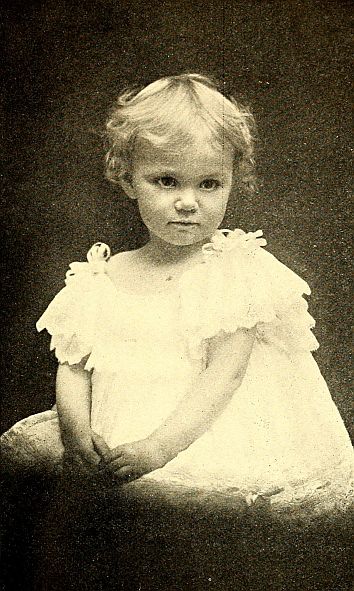
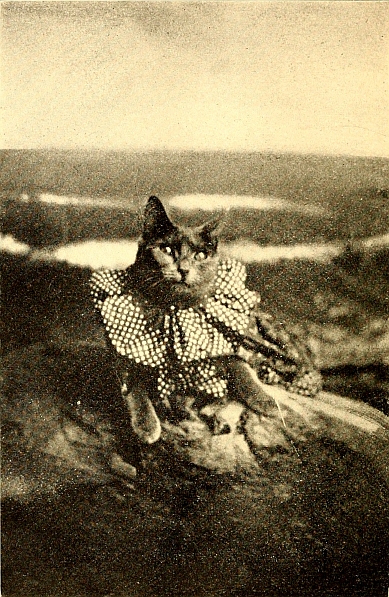
A.L. Frisbie.
David L. Proudfit.
Joseph Green.
[Dr. Mather Byles (Boston, 1706-1788) an eloquent, realistic, witty and genial preacher, had a favorite cat called The Muse. After her death, the doctor’s friend, Joseph Green, wrote the following elegy.]
Stanley Schell.
Action Poem for Two Children.
Written especially for this book.
Robert Southey.
[Southey conferred honor upon his cats according to their services. He raised one to the highest rank in peerage, promoting him through all its degrees by the following titles: His Serene Highness the Archduke Rumpelstilzchen, Marquis Macbum, Earl of Tomlemagne, Baron Raticide, Waowhler, and Skaratch.]
SHE was only a small black and white cat of humble birth, returning from a little social party. It was rather late at night, but what of that? Cats keep no count of the hour, and she was as dignified and proper in her bearing as a mature black and white puss need be. There was nothing about her to justify the insolent attitude of a Scotch terrier, who suddenly confronted her with a snarl and a snap. Puss tried to cross the street, but a trolley car was in the way, and the impudent terrier made bold to chase her. She suddenly turned, and the terrier stopped. Her back went up, her tail grew big, and she spat out defiance at her tormentor. The terrier may have been rude, but he was discreet—he kept at a safe distance. Two or three newsboys, a “red-hot” man, and a police officer, were interested spectators. They most ungallantly sided with the terrier, who was now barking ferociously, but keeping well out of pussy’s reach. One of the boys threw a stone at the combatants; it rolled between them, and the terrier’s attention was diverted for a moment from his antagonist. It was his first mistake. Puss saw her opportunity and leaped at the terrier, landing fairly on his back. In a second she had her claws full of his hair, and he was running for dear life down the street. Puss held on like a circus rider, contriving to sink her sharp claws into his back at every jump. The crowd followed, shouting. As they passed an alley puss jumped off and disappeared in the darkness. There is one terrier who has had enough fun with cats to last him a lifetime.
Dialogue for One Boy and One Girl.
Mrs. Frederick W. Pender.
Written especially for this book.
Transcriber’s Note: Some full-page images have been moved so as not to interrupt the flow of text. Obvious printer errors have been corrected without note. The music files are the music transcriber’s interpretation of the printed notation and are placed in the public domain.