THE DIFFERENT SPECIES OF SEALS—THE
FISHERY ON THE ISLANDS OF THE PACIFIC, &c.
NATURAL HISTORY OF THE WHALE.
CHAPTER I. THE DIFFERENT AND MOST REMARKABLE SPECIES OF THE WHALE TRIBE.
“Nature’s strange work, vast Whales of different form,
Toss up the troubled flood, and are themselves a storm.
Uncouth the sight, when they, in dreadful play,
Discharge their nostrils, and refund a sea.”
You recollect, my son, that some time since
in a morning’s walk you pointed out to me
an enormous arch over a field gate, which I
told you was formed of the jaw-bones of the
whale, and I then promised you an account
of these enormous fishes. Among the numberless
tribes of living animals that people
the northern seas, the class of whales are by
far the largest, and although living in the
water, they are in many respects similar to
quadrupeds; they not only bring forth their
young alive, but suckle them as do the land
animals; they have also a thick layer of fatty
substance, called blubber, surrounding their
whole body, beneath the skin, and it is by
this covering, my son, that Providence enables
them to defy the most dreadful extremities
of cold even under the ice at the Poles.
Although they are the “mightiest animals
that swim the ocean stream” their bulk has
been often exaggerated, they being rarely
more than 60 feet long, which implies a
weight of 70 tons, being nearly that of 300
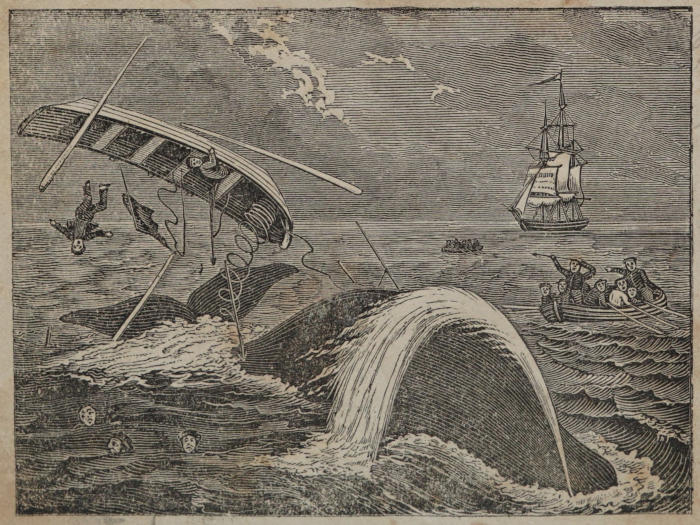
fat oxen. The tail is the most active limb
of this mighty animal; its power is tremendous;
a single blow throws a large boat with
its crew into the air. There are several varieties
of the whale. The most dangerous
one is the Razor Back, which is longer than
the Common Black or Right Whale, and although
smaller in circumference, is a more
powerful animal, swimming at the rate of
twelve miles an hour, and has been known
to run off 480 fathoms of line with a harpoon
attached to him in one minute. They are difficult
to obtain, often obliging the sailors to
cut the line in order to escape destruction;
but as this species contains only ten or
twelve tons of oil of an inferior quality, the
whalers generally shun his encounter; sometimes
however they mistake him in the water
for the common one. The other species
of whale eagerly sought after by man, is the
Cachalot or Spermaceti; this animal is almost
invariably found in large herds of from
150 to 200.
CHAPTER II. MODE OF LIVING—MANNER OF TAKING THEIR FOOD, &c.
The Spermaceti as well as the Common
Whale feeds on the smallest insects or animalcula
of the ocean, its capacious mouth
with the vast fringes of whalebone attached
to the inside of its mouth is a most excellent
filter, enabling it to receive a large quantity
of water at a mouthful, and to separate the
sea-weed and gravel from it, even of the size
of a pin’s head. This substance, called
whalebone, is taken from the upper jaw of
the animal, and is very different from the
real bones, which resemble those of great
land animals. When we reflect, my son,
that the same almighty power, whose will
has formed the immense whale, has also given
animation and senses to the smallest sea
insects which are the food of this marine
monster, how must our pride be lowered,
while we are so unable to comprehend the
mechanism which puts them in motion, and
much less that intelligence and power which
has given them life. Let us then exclaim
in astonishment and gratitude with the
sweet singer of Israel, “O Lord, how inscrutable
are thy ways, how magnificent
thy works!” As the whale must rise to the
surface of the sea to breathe, its tail is placed
horizontally, to enable it to ascend and
descend more quickly. This animal is dull
of hearing, although its sense of seeing is
acute. They will discover one another in
clear water when under the surface at an amazing
distance; when at the top of the water
however they do not see far. They have no
voice, but in breathing or blowing they make
a very loud noise; they throw the water
through their blow holes, which are situated
upon the head, many yards high, which looks
at a distance like a puff of smoke; and, when
the whale is wounded, is often red with
blood. Although this animal is so large, it
will sometimes descend perpendicularly after
being harpooned, at the astonishing velocity
of eight miles an hour; their usual
rate of swimming when not pursued is never
more than half that number. They are seldom
found asleep; they are however occasionally
found sleeping in calm weather
among the ice in northern latitudes. When
the whale feeds, it swims pretty swiftly with
its mouth open just below the surface of
the sea. This animal has but one young at
a time, which is from ten to fifteen feet long
at its birth; it goes with its mother for at
least one year, until it is supposed that the
whalebone or filter has grown sufficient to
enable it to procure its own food. The love
of the whale for its young is great, so that
whalers, whenever they can harpoon them,
are pretty sure of getting its parent; for
whenever the young rises to the surface of
the water to breathe, the old whale will join
and encourage it to swim off, and will often
take it under her fin, and seldom deserts it
while life remains. I will give you, William,
to-morrow, an incident which took
place in 1811, on board of a Northern Whaler.
CHAPTER III. THE TAKING OF A WHALE WITH HER YOUNG—ITS ENEMIES, &c.
In the spring of 1811, on board of Capt.
Scoresby’s ship, one of the harpooners
struck a young whale, with the hope of its
leading to the capture of its mother. Presently
she arose close by his boat and seizing
its young one dragged out nearly 100
fathoms of line with amazing swiftness.
Again she arose to the surface, darted furiously
on and appeared in great agony, seemingly
regardless of the danger which surrounded
her. At length one of the boats
came near enough to throw a harpoon which
hit, but did not hold; a second harpoon failed
also, but the third was fastened; still she
did not attempt to escape, but allowed other
boats to approach so that in a few minutes
three more harpoons were fastened,
and in the course of an hour afterwards she
was killed. Is it not extremely painful,
William, to destroy an animal of so much
affection for its young? There are also two
enemies to the whale found in the sea, the
Sword Fish and a cetaceous animal called
by our fishermen the Killer. At the sight
of the former the whale seems agitated in
an extraordinary manner, leaping from the
water as if with affright; wherever it appears,
the whale perceives it at a distance,
and flies from it in an opposite direction,
and having no instrument of defence except
its tail, it endeavors to strike it; but the
Sword Fish is as active as the other is strong,
and easily eludes the blow. It often cuts
the whale in such a manner as to colour the
water all around with blood. The Killer is
a more destructive enemy, with strong and
very powerful teeth. A number of these
fish are said to surround the whale, some attacking
it with their teeth behind, others
before, till at last he dies from the loss of
blood; and what is singular, my son, it is said
that the tongue of the whale is the only part
they devour. The whale is naturally a timid
animal, for it is said that the Northern
Petrel, a bird of the genus of the Mother
Cary’s Chicken of our coasts, will sometimes
alight upon its back, and set it off in
great agitation and terror. It is also frequently
annoyed by the larger species of
Sharks, as the wounds sometimes found upon
their tails evidently show. The flesh of the
whale is highly prized by the Esquimaux,
who not only eat the very fattest part, but
will drink the oil with great relish; the children,
also, devour the skin raw. Capt. Lyon,
who was present at a feast in an Esquimaux
village, says: “the houses were all
lighted up with lamps, all the pots were filled
with flesh, and the women, while cooking,
pick out and devour the most dainty
morsels. One man takes up a large piece,
applies it to his mouth, and severs with his
teeth as much as his mouth can possibly
hold, then hands it to his neighbor, and he
passes it to the next, till all is eaten; a new
piece is then supplied, and thus it continues
till they are completely gorged. A young
man named Toolooak received into his stomach
in 21 hours upwards of ten pounds of
flesh and a gallon and a pint of water.” The
obtaining of their food is so precarious, my
son, that for many days after this they may
not have a single morsel to eat.
CHAPTER IV. BOATS—HAND HARPOON—BLUBBER LANCE—GUN HARPOON—MANNER OF TAKING THE WHALE, &c.
“As when enclosing harpooneers assail,
In wintry seas, the slumbering Whale;
Soon as the harpoons pierce the scaly side,
He groans, he darts impetuous down the tide;
And rack’d all o’er with lacerating pain,
He flies remote beneath the flood in vain.”
The first and principal thing, my son, in
the whaling ships, are the boats, which are
made to float lightly upon the water; their
bow and stern are made sharp, and they are
capable of being rowed with great speed,
and readily turned round,—and are of
such size as to carry six or seven men and
seven or eight hundred weight of whale-lines.
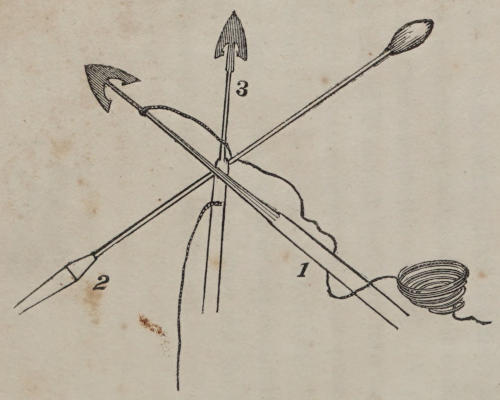
The instruments used in the capture
are the harpoon and lance; besides these
they have used occasionally the harpoon-gun,
which is a kind of swivel. This gun was
invented in the year 1731: being however
difficult and somewhat dangerous in its application,
it is now seldom used. One of
the most essential particulars in the Dutch
whale ships is the “Crow’s Nest,” a sort of
sentry box made of canvass or light wood,
pitched on the main-top-mast head. This
is the post of honor, where the master or
officer of the watch often sits for hours provided
with a spy glass, a speaking trumpet,
and a rifle gun. As soon as they have arrived
in those seas which are the haunt of the
whale, the crew are keeping watch day and
night;—seven boats are kept hanging by
the sides of the ship ready to be launched
in a few minutes. The captain or some
principal officer, seated in the crow’s nest,
surveys the waters, and the instant he sees
the back of the huge animal, gives notice to
the watch who are stationed upon the deck,
part of whom leap into the boat, and are followed
by a second boat, a harpooner being
in each. Owing to those mighty fields and
mountains of ice, the dangers of the Northern
or Greenland whale fishery is ten times
greater than are those of this country, as our
whale ships take these fish upon the coast
of Japan, in the Pacific Ocean, and upon the
Brazil Banks, and always in the open sea.
There are several rules among whalers
which are observed in approaching this fish,
to prevent as far as possible the animal from
taking the alarm. As the whale is dull of
hearing, but quick in sight, the boat steerer
always endeavors to get behind it. Smooth,
careful rowing is always requisite, and sometimes
sculling is practised. Whenever a
whale lies on the surface of the water, unconscious
of the approach of its enemies,
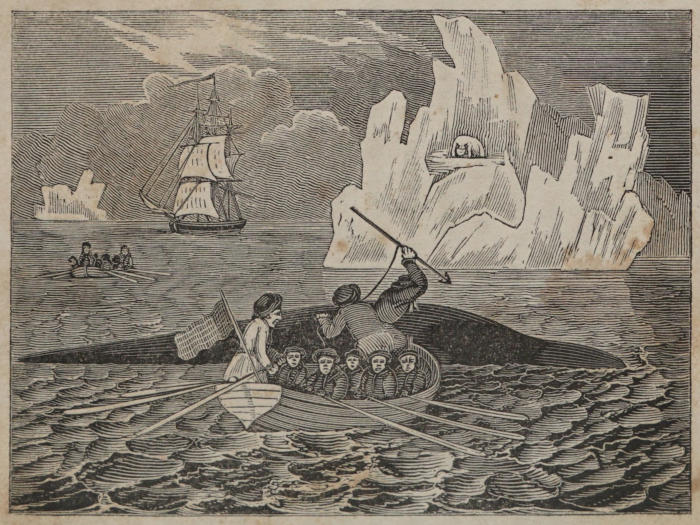
the hardy fisher rows directly upon it; and
an instant before the boat touches it, buries
his harpoon in its back: the wounded whale,
in the surprise and agony of the moment,
makes a convulsive effort to escape; then,
my dear son, is the moment of danger. The
boat is subjected to the most violent blows
from its head or its fins, but particularly from
its ponderous tail, which sometimes sweeps
the air with such tremendous fury, that both
boat and men are exposed to one common
destruction. The head of the whale is
avoided, because it cannot be penetrated
with the harpoon; but any part of the body
between the head and tail, will admit of the
full length of the instrument. The utmost
care is necessary in every person in the
boat, while the lines are running out—fatal
consequences having sometimes arisen from
the entanglement of the line while the whale
is going with amazing swiftness. A sailor
from Greenock, in 1818, happening to step
into the centre of a coil of running rope, had
his foot entirely carried off; another belonging
to the ship Henrietta had carelessly cast
some part of the line under his feet, when a
sudden dart of the fish made it twist round
his body, and he had but just time to cry
out, “Clear away the line! O dear!” when
he was cut almost asunder, dragged overboard
and never more seen. The immense
distances to which whales will run is very
surprising; a harpoon was thrown from the
boat of the ship Resolution, in 1812, into
one, which run out 10,440 yards, or about
six miles of line.
CATCHING WHALE IN THE ARCTIC SEAS.
Every boat fast to a living whale carries a
flag, and the ships to which such boats belong,
also wear a flag, until the whale is
either killed or makes its escape. These
signals serve to indicate to surrounding ships
the exclusive title of the “fast ship” to the
entangled whale, and to prevent their interference,
excepting in the way of assistance
in the capture. A full grown whale generally
occupies the whole of the boats belonging
to one ship in its capture, which sometimes
takes the whole day; they have been
taken in half an hour from the throwing of
the harpoon. The ease with which some
whales are killed, is truly surprising; but
with others it is equally astonishing that
neither line nor harpoon can effect their
capture. Some escape with four or five
harpoons, while others equally large have
been killed with a single harpoon; indeed,
my son, whales have been taken by the entanglement
of a line, without any harpoon
at all. One was taken by the crew of the
ship Nautilus, in 1814, by its accidentally
having taken the line into its mouth, and by
the compression of its lips, they having cut
the end of the line from a whale which they
had just killed; and as it was sinking in the
water, another one engaged in feeding was
advancing with its mouth wide open, accidentally
caught this line between its extended
jaws, which induced it to shut its mouth
and grasp the line so firmly as to effect its
capture.
A whale sometimes causes danger by
proving to be alive after having exhibited
every symptom of death. Capt. Scoresby
mentions the instance of one which appeared
so decidedly dead, that he himself had
leaped on the tail, and was putting a rope
through it, when he suddenly felt him sinking
from beneath him. He made a spring
towards a boat that was some yards distant,
and grasping its side was drawn on board.
The fish then moved forwards, reared his
tail aloft, and shook it with such prodigious
violence, that it could have been heard for
several miles off. After a few minutes of
this violent struggle he rolled on his side and
expired.
The many accidents which have taken
place in the Greenland and Spitzbergen
whale fishery, even under the direction of the
most experienced mariners are lamentable
and manifold; and I will now, William, relate
to you some of the many which have
occurred to the English and Dutch whalers.
The most common is that of a ship being
beset and sometimes dashed to pieces by
the collision of those mighty masses or mountains
of ice with which northern seas are
continually filled. The Blecker, Capt. Pitt,
was driven against the ice with such violence
that in an instant all her rigging was
dashed in pieces; the crew, however, escaped
upon the ice, and after a few days were
taken off by a Dutch ship. Capt. Bile, some
years afterwards, lost a ship richly laden,
which went down suddenly; after which
the crew wandered in boats over the sea for
fourteen days before they were taken up.
Thirteen other vessels perished the same
year in those seas. Three years afterwards,
Capt. Bile lost a second ship, the crew having
just time to save themselves on the
ice.
William here asked his father if whale
ships were not sometimes lost at sea? Yes,
my son, many fishing-ships as well as merchantmen
have foundered at sea, and have
never been heard from since their departure.
I remember, father, says William, a
piece of poetry which aunt Mary learnt me
a long time since on the loss of a vessel.
Deep in the silent waters,
A thousand fathoms low,
A stately ship lies perishing,
She foundered long ago.
There were blessings poured upon her,
When from her port she sailed,
And prayers and anxious weeping,
Went with her o’er the sea.
But how that fine ship perished,
None knew, save him on high;
No island heard her signal,
No other bark was nigh.
We only know from Boston
She sailed, far o’er the main;
We only know to Boston
She never came again.
You will find, my son, by referring to Irving’s
Sketch Book, a most thrilling description
of a wreck at sea.
The whale-fishery is not more distinguished
for examples of sudden peril and besetment
than for unexpected deliverance from
the most alarming situations.
“Three Dutch ships, after having completed
a rich cargo on the northern coast of
Spitzbergen, were at once so completely beset,
that the crews in general urged the necessity
of proceeding over the ice, and endeavoring
to reach some other vessel. The
captain of one of the three, however, strongly
urged the obligation of doing all in their
power to preserve such valuable property,
and they agreed to make a further trial;
when, in twenty days, the ice opened, and
they had a happy voyage homeward.
The Dame Maria Elizabeth, had set out
early for the fishery, and was so fortunate as,
by the 30th of May, to have taken fourteen
whales. Then, however, a violent gale from
the south blew in the ice with such violence,
that the captain found himself completely
beset, and saw two Dutch vessels and one
English go to pieces at a little distance. At
length a brisk gale from the north gave him
the hope of being extricated; when presently
he was involved in a dense fog, which
froze so thick upon the sails and rigging,
that the ship appeared a mere floating iceberg.
As the atmosphere cleared, the faint
light, and the birds winging their way to the
southward, announced the closing in of winter.
Unable to make any progress, the seamen
looked forward in despair to the prospect
of spending the season in that frozen
latitude. They had nearly come to the end
of their provisions, and famine was already
staring them in the face, when they thought
of broiling the whales’ tails, which proved
very eatable, and even salutary against the
scurvy. Thus they hoped to exist till the
middle of February, beyond which the prospect
was very dismal; but on the 12th November
there arose a violent north wind,
which dispersed the ice. Their hopes being
now awakened, every effort was strained;
and on the 18th a north-wester brought on
so heavy a rain, that next day they were entirely
clear of the ice, and had a prosperous
voyage homeward.
Capt. Broerties, in the Guillamine, arrived
on the 22d June at the great bank of northern
ice, where he found fifty vessels moored
and busied in the fishery. He began it
prosperously: the very next day indeed he
killed a large whale. The day after, a tempest
drove in the ice with such violence that
twenty-seven of the ships were beset, of
which ten were lost. Broerties, on the 25th
July, seeing some appearance of an opening,
caused his ship to be warped through by
the boats; but, after four days’ labor, she
found herself, with four other ships in a narrow
basin, enclosed by icy barriers on every
side.
On the 1st August the ice began to gather
thick, and a violent storm driving it
against the vessels, placed them in the greatest
peril for a number of days. On the 20th
a dreadful gale arose from the north-east, in
which the Guillamine suffered very considerable
damage. In this awful tempest, out
of the five ships two went down, while a
third had sprung a number of leaks. The
crews were taken on board of the two remaining
barks, which they greatly incommoded.
On the 25th all the three were completely
frozen in, when it was resolved to
send a party of twelve men to seek aid from
four vessels which a few days before had
been driven into a station at a little distance;
but by the time of their arrival two of these
had been dashed to pieces, and the other
two were in the most deplorable condition.
Two Hamburgh ships, somewhat farther removed,
had perished in a similar manner.
Meantime the former came in sight of Gale
Hamkes’ Land, in Greenland, and the tempest
still pushing them gradually to the
southward, Iceland at length appeared on
their left. The two more distant ships found
a little opening, through which they contrived
to escape. The crews of the three
others were beginning to hope that they
might at last be equally fortunate, when, on
the 13th September, a whole mountain of
ice fell upon the Guillamine. The men,
half naked, leaped out upon the frozen surface,
saving with difficulty a small portion
of their provisions. The broken remnants
of the vessel were soon buried under enormous
piles of ice. Of the two other ships,
one commanded by Jeldert Janz had just
met a similar fate, and there remained
only that of one other, to which all now
looked for refuge. By leaping from one
fragment of ice to another, the men, not
without danger, contrived to reach this vessel,
which, though in extreme distress, received
them on board. Shattered and overcrowded,
she was obliged immediately after
to accommodate fifty other seamen, the crew
of a Hamburg ship which had just gone
down, the chief harpooner and twelve of the
mariners having perished. These numerous
companies, squeezed into one vessel,
suffered every kind of distress. Famine,
in its most direful forms, began to stare them
in the face. All remoter fears, however,
gave way, when on the 11th October, the
vessel went to pieces in the same sudden
manner as the others, leaving to the unfortunate
sailors scarcely time enough to leap
upon the ice with their remaining stores.
With great difficulty they reached a field of
some extent, and contrived with their torn
sails to rear a sort of covering; but, sensible
that, by remaining on this desolate spot, they
must certainly perish, they saw no safety
except in scrambling over the frozen surface
to the coast of Greenland, which was in view.
With infinite toil they effected their object,
and happily met some inhabitants, who received
them hospitably, and regaled them
with dried fish and seals’ flesh. Thence
they pushed across that dreary region till
they succeeded at length, on the 13th March,
in reaching the Danish settlement of Frederickshaab.
Here they were received with
the utmost kindness, and, being recruited
from their fatigues, took the first opportunity
of embarking for Denmark, whence they
afterward sailed to their native country.
The Davis’s Strait fishery has also been
marked with very frequent and fatal shipwrecks.
In 1814 the Royalist, Capt. Edmonds,
perished with all her crew; and in
1817, the London, Capt. Mathews, shared
the same fate. The only account of either
of these ships ever received was from Capt.
Bennet of the Venerable, who, on the 15th
April, saw the London in a tremendous
storm, lying to windward of an extensive
chain of icebergs, among which, it is probable
she was dashed to pieces that very evening.
Large contributions were raised at
Hull for the widows and families of the seamen
who had suffered on these melancholy
occasions.
Among accidents on a smaller scale, one
of the most frequent is, that of boats employed
in pursuit of the whale being overtaken
by deep fogs or storms of snow, which
separate them from the ship, and never allow
them to regain it. A fatal instance of
this kind occurred to the Ipswich, Capt.
Gordon; four of whose boats, after a whale
had been caught, and even brought to the
ship’s side, were employed on a piece of ice
hauling in the line, when a storm suddenly
arose, caused the vessel to drift away, and
prevented her, notwithstanding the utmost
efforts, from ever coming within reach of the
unfortunate crews who composed the greater
part of her establishment. Mr. Scoresby
mentions several casualties of the same
nature which occurred to his boats’ companies,
all of whom, however, in the end, happily
found their way back. One of the most
alarming cases was that of fourteen men who
were left on a small piece of floating ice,
with a boat wholly unable to withstand the
surrounding tempest; but amid their utmost
despair they fell in with the Lively of Whitby,
and were most cordially received on
board.
The source, however, of the most constant
alarm to the whale-fisher is connected with
the movements of that powerful animal,
against which, with most unequal strength,
he ventures to contend. Generally, indeed,
the whale, notwithstanding his immense
strength, is gentle, and even passive; seeking,
even when he is most hotly pursued, to
escape from his assailants, by plunging into
the lowest depths of the ocean. Sometimes,
however, he exerts his utmost force in violent
and convulsive struggles; and every
thing with which, when thus enraged, he
comes into collision, is dissipated or destroyed
in an instant. The Dutch writers mention
Capt. Vienkes of the ship Barley Mill,
who, after a whale had been struck, was hastening
with a second boat to the support of
the first. The fish, however, rose, and with
its head struck the boat so furiously, that it
was shivered to pieces, and Vienkes was
thrown with its fragments on the back of the
huge animal. Even then this bold mariner
darted a second harpoon into the body of his
victim; but unfortunately he got entangled
in the line and could not extricate himself,
while the other party were unable to approach
near enough to save him. At last,
however, the harpoon was disengaged, and
he swam to the boat.
Mr. Scoresby, in one of his earliest voyages,
saw a boat thrown several yards into the
air, from which it fell on its side, plunging
the crew into the sea. They were happily
taken up, when only one was found to have
received a severe contusion. Capt. Lyons
of the Raith of Leith, on the Labrador coast,
in 1802, had a boat thrown fifteen feet into
the air; it came down into the water with
its keel upwards, yet all the men except one
were saved.
The crew of Mr. Scoresby the elder, in
1807, had struck a whale, which soon reappeared,
but in a state of such violent agitation
that no one durst approach it. The
captain courageously undertook to encounter
it in a boat by himself, and succeeded in
striking a second harpoon; but another boat
having advanced too close, the animal brandished
its tail with so much fury, that the
harpooner, who was directly under, judged
it most prudent to leap into the sea. The
tail then struck the very place that he had
left, and cut the boat entirely asunder, with
the exception of two planks, which were
saved by having a coil of ropes laid over
them; so that had he remained, he must
have been dashed to pieces. Happily all
the others escaped injury. The issues, however,
were not always so fortunate. The
Aimwell of Whitby in 1810, lost three men
out of seven, and, in 1812, the Henrietta of
the same port lost four out of six, by the
boats being upset, and the crews thrown into
the sea.
In 1809, one of the men belonging to the
Resolution of Whitby, struck a sucking
whale; after which the mother, being seen
wheeling rapidly round the spot, was eagerly
watched. Mr. Scoresby, being on this
occasion in the capacity of harpooner in another
boat, was selecting a situation for the
probable reappearance of the parent fish,
when suddenly an invisible blow stove in
fifteen feet of the bottom of his barge, which
filled with water and instantly sank. The
crew were saved.
CHAPTER V. PROCEEDINGS AFTER A WHALE IS KILLED.
“Before a whale can be flensed, as the
operation of taking off the fat and whalebone
is called, some preliminary measures are requisite.
These consist in securing the fish
to a boat, cutting away the attached whale-lines,
lashing the fins of the whale together,
and towing it to the ship.
The first operation performed on a dead
whale is to secure it to a boat. This is easily
effected by lashing it with a rope, passed
several times through two holes pierced in
the tail, to the boat’s bow. The more difficult
operation of freeing the whale from
the entanglement of the lines is then attempted.
As the whale, when dead, always
lies on its back, or on its side, the lines and
harpoons are generally far under water.
While this is in progress, the men of the
other boats, having first lashed the tail to a
boat, are employed in lashing the fins together
across the belly of the whale.
On one occasion, says a whaler, I was engaged
in the capture of a fish, upon which,
when to appearance dead, I leaped, cut
holes in the fins, and was in the act of reeving
a rope through them, when the fish sunk
beneath my feet. As soon as I observed
that the water had risen above my knees, I
made a spring towards a boat at the distance
of three or four yards from me, and caught
hold of the gunwale. Scarcely was I on
board before the fish began to move forward,
turned from its back upon its belly, reared
its tail aloft and began to shake it with
such prodigious violence, that it resounded
through the air to the distance of two or
three miles. After two or three minutes of
this violent exercise, it ceased, rolled over
upon its side, and died.
In the year 1816, a fish was to all appearance
killed. The fins were partly lashed,
and the tail on the point of being secured,
and all the lines excepting one were cut
away, the fish meanwhile lying as if dead.
To the astonishment and alarm, however,
of the sailors, it revived, began to move, and
pressed forward in a convulsive agitation;
soon after, it sunk in the water to some
depth, and then died. One line remained
attached to it, by which it was drawn up
and secured. A fish being properly secured,
is then “taken in tow,” that is, all the
boats join themselves in a line, by ropes always
carried for the purpose, and unite their
efforts in rowing towards the ship. The
course of the ship, in the mean time, is directed
towards the boats, but in calms, or
when the ship is moored to the ice, at no
great distance, or when the situation of the
fish is inconvenient or inaccessible, the ship
awaits the approach of the fish.
The fish having reached the ship is taken
to the larboard side, arranged and secured
for flensing. For the performance of this
operation a variety of knives and other instruments
is requisite.
The enormous weight of a whale prevents
the possibility of raising it more than one
fourth, or one fifth part out of the water, except,
indeed, when it has been some days
dead, in which case it swells in consequence
of air generated by putrefaction, until one
third of its bulk appears above the surface;
the fish then lying belly upwards, extended
and well secured, is ready for the operation
of flensing.
After the whale is properly secured along
side of the ship, the harpooners, having their
feet armed with spurs, to prevent them from
slipping, descend upon the fish. Two boats
each of which is under the guidance of one
or two boys, attend upon them, and serve to
hold all their knives, and other apparatus.
Thus provided, the harpooners divide the
fat into oblong pieces, or ‘slips,’ by means
of ‘blubber spades’ and ‘blubber knives;’
then, affixing a ‘tackle’ to each slip, flay it
progressively off as it is drawn upwards.
The flensers commence with the belly and
under jaw, being the only part then above
water. The blubber, in pieces of half a ton
each, is received on deck, and divided into
portable, cubical, or oblong pieces, containing
near a solid foot of fat, and passed down
between decks, when it is packed in a receptacle
provided for it in the hold, or other
suitable place, called the flens-gut, where it
remains until further convenience.
All the fat being taken away from the belly,
and the right fin removed, the fish is then
turned round on its side. As the fish is
turned round, every part of the blubber becomes
successively uppermost and is removed.
At length, when the whole of the
blubber, whalebone, and jaw bones have
been taken on board, the carcass being set
at liberty, generally sinks in the water and
disappears.”
When sharks are present they generally
help themselves very plentifully during the
cutting up. Birds pay close attendance,
particularly the larger species of Petrel or
Mother Cary’s Chicken, seizing the pieces
of flesh as it falls in the water. Gulls also
attend in great numbers to get their share;
but the large Petrel or Fulmar is decidedly
master of the feast. Hence the others are
obliged to relinquish the most delicious morsel
when he claims it.
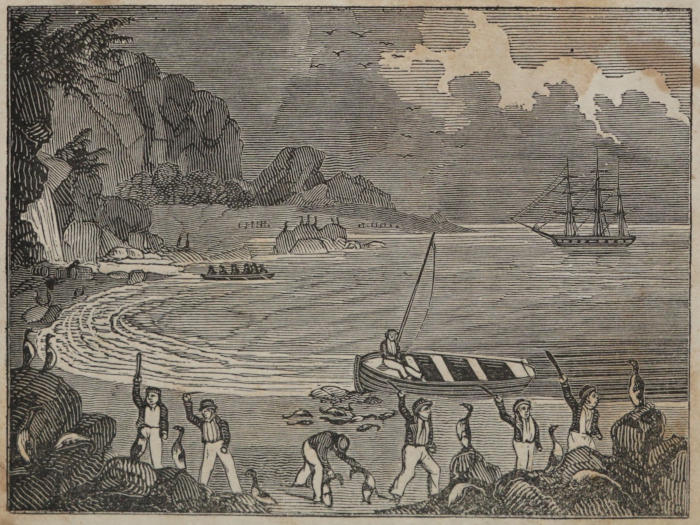
CREW OF A WHALER KILLING PENGUINS.
CATCHING SEAL ON THE ISLANDS OF THE PACIFIC.
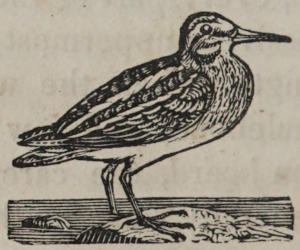
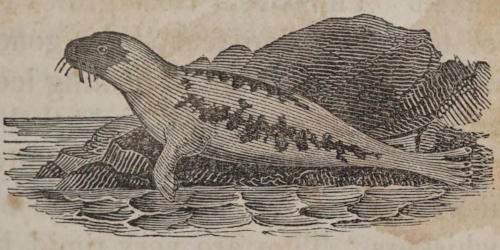
HARP SEAL.
CHAPTER VI. THE DIFFERENT SPECIES OF SEALS—THE FISHERY ON THE ISLANDS OF THE PACIFIC, &c.
There are six different species of seal
sought after by man for their skins and fur,
viz. the Common Seal, which frequents the
sea-coasts throughout the world, the Hooded
Seal, the Great Seal, the Harp Seal, the
Fetid Seal, and the Ursine Seal. The five
last species are found on the shores of
Greenland. The Great Seal grows to the
size of ten or twelve feet; he is generally
found resting upon cakes of floating ice, and
resembles the Common Seal in his habits as
well as in his appearance, but is readily distinguished
by its size and its large beard-like
whiskers. They are very timid, hence
the Greenlanders are seldom able to trap
them. The Esquimaux make ropes of the
skins of this species.
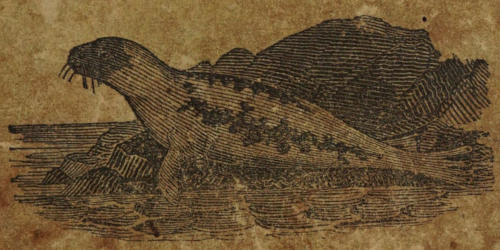
The Harp Seal is about eight feet long,
and is remarkable for its various colors.
When full grown it is of a greyish white color,
having upon its back a black figure like
two half moons, in the form as represented
in the plate. It is quite common in the
Greenland seas, where it frequents the deep
bays, migrating to and leaving them twice a
year, going in March and returning in May,
and again in June to return in September.
At the breeding season they have but one
young cub, which they nurse upon floating
cakes of ice, at a great distance from the
land. They live in great herds, swimming
and playing together, apparently under the
direction of an old one as a leader. They
are seldom found upon the fixed ice, but
seem to prefer the floating or drifting masses.
The Greenlanders take them frequently
by surrounding and pursuing them with
loud noise whenever they come to the surface
to breathe. Its skin is used by the
Esquimaux to cover their tents and boats.
The Fetid Seal is about four and a half
feet long; the hair on this seal is rough like
that of a pig; hence their skins are used by
the Greenlanders for clothing, the rough side
being generally turned inwards. This seal
frequents the ice near the land, seldom leaving
its favorite haunts which are near holes
in the ice for the purpose of fishing; is solitary
in its habits, pairs being rarely seen together;
and is not very timid, as the Northern
eagle will occasionally pounce upon it
while asleep upon the surface. Their flesh
is not esteemed as food even by the voracious
Esquimaux.
The last species of this genus, is the Ursine
Seal, which is a large animal, being five
feet in circumference, and weighing from
eight to nine hundred pounds. They are
found on the islands which lie between
America and Kamtschatka, where they arrive
in the month of June and remain until
September, and are then very fat. They
lie upon the shores in vast herds, but are
separated into families, one large male being
surrounded by fifteen or twenty females,
which they seem to guard with great care.
They are very quarrelsome, particularly the
old males, and sometimes a large flock
amounting to upwards of 100 individuals
have furious battles upon the shore. They
inflict very severe wounds upon each other
during their combats, and when they cease
to fight, plunge into the sea in order to wash
off the blood with which they may be stained.
The males are quite fond of their offspring,
but cruelly tyrannical to the females.
When any one attempts to catch one of their
cubs, the male opposes the aggressor, while
the female tries to secure the cub by carrying
it off in her mouth; but should she unfortunately
drop it, the male attacks her and
beats her dreadfully against the stones.
Capt. Foster says that the cubs are quite
fierce, and bark and bite at any one passing
them. This seal is a very swift swimmer,
moving at the rate of seven or eight miles
an hour, and is able to remain under water a
much longer time than the Common Seal.
We now come, my son, to the Common
Seal, which is found not only throughout the
northern seas of both continents, but upon
our own shores, and is the seal which furnishes
the inhabitants of those cold and frigid
climes with nearly all their necessaries
and luxuries. What a striking display of
the goodness of the all-wise Creator do we
find in giving to the Esquimaux, who are denied
the opportunity of deriving their subsistence
from animals which depend upon
the vegetable kingdom for nutriment, the
abundance of seals, supplying to them the
place of flocks and herds, without requiring
from those fed and clothed by them any provision
for their maintenance. The manner
in which the seal feeds is very interesting:
when fish are thrown into a tub where several
of these animals may be together, they
eagerly spring to a considerable distance in
the air, raising half their bodies out of the
water and stretching out their necks to the
utmost. If the fish is caught by the tail, it
is then turned head foremost and swallowed
whole. They also feed under water and
swallow with as much ease as in the air, but
in a different manner, which is to open its
mouth partially.
Seals are animals of passage; when on
their travels or migrations, vast droves are
seen moving along through the openings of
the ice, swimming with their heads always
out of the water. They are very timid, seldom
sleeping above five minutes at a time.
Three of the common seal were taken a few
years since on our coast in a net; they
fought desperately and were with great difficulty
secured. After a few months, however,
they became very tame, and one of them
was taught to perform many tricks, placing
himself in different attitudes at the command
of his keeper. They all died during
the winter.
There were two young seals kept in a
museum at Paris, which showed no fear in
the presence of men or other animals, never
attempting to escape or withdraw themselves,
unless to avoid being trodden on, and
then merely removing to a short distance.
One of them would occasionally threaten
with its voice and strike with its paw, but
would never bite unless extremely provoked.
They were very voracious, yet showed
no ill temper when their food was taken
from them, and some young dogs, to which
one of the seals was attached, would snatch
the fish from his mouth just as he was about
to swallow it, without the seal showing any
sign of anger. When both the seals were
suffered to eat together, they usually fought
with their paws, and the strongest drove the
other away.
One of these seals was at first very shy,
and retreated when any one attempted to
caress him, yet in a few days he became
quite tame and confident of the kindness of
those who approached him. When shut up
with two little dogs that used to mount upon
his back and playfully bark and bite at
him, he soon entered into the spirit of their
actions, and took pleasure in their frolics,
striking them gently with his paw rather to
encourage than repress them. When the
dogs ran off he would follow them, though
the ground was covered with stones and
mud. During cold weather he would lie in
close company with the dogs for the sake of
their mutual warmth. The other seal evinced
a strong degree of attachment to the
keeper, recognizing him at a considerable
distance, and using many expressive gestures
and looks to solicit his attention and
obtain food, the idea of which was no doubt
associated with the presence of the keeper.
These seals barked commonly in the evening,
or on a change of weather, though with
a much feebler voice than that of the dog;
their anger was exhibited by a kind of hissing
noise. A young seal, which was given
by the master of a whaler to the officers of
the Alexander, one of the ships on the former
voyage, became so entirely domesticated
and attached to the ship that it was frequently
put into the sea and suffered to
swim at perfect liberty, and when tired would
return of itself to the boats and be taken in.
The common seal brings forth two young
in autumn, and suckles them on shore until
they are six or seven weeks old, when they
are gradually accustomed by their parents
to frequent the sea. At this period they
are generally of a whitish or light fawn color,
covered with soft or woolly hair, and when
in distress or hurt have a sort of whining
voice. Seals are mostly associated in families
consisting of a few males and a large
number of females and young ones. They
are fond of landing on the sea-beach, ledges
of rocks or ice-banks, for the purpose of basking
in the sun, and in fine weather prefer
being on the ice to remaining in the water;
sometimes indeed they are very averse to
take to the water when they have been out
of it long enough to become perfectly dry.
When on their passage from one place to
another they swim in very large flocks or
shoals, and become visible to the mariner
every few minutes, as they are obliged to
come to the surface to breathe; this is generally
done by the whole company nearly at
the same time, when they spring up so as to
raise their heads, necks, and even their
whole bodies, out of the water. From the
peculiar vivacity of their movements and
general sportiveness of the company, such
a shoal of these animals has obtained from
the sailors the designation of a “seal’s wedding.”
The seal is peculiarly vigilant, and whenever
a herd of them visit the shore some are
always on the look out, and a seal when
alone is observed very frequently to raise
its head for the purpose of discovering the
approach of enemies.
Seals are sometimes enticed to the surface
by music, or the whistling of an individual
who is prepared to shoot them, and this
proves that they can hear far better when
under water than we might be inclined to believe
from a mere glance at their external
ears. When they hear this sound they
come to the surface, elongate their necks
to the utmost extent, and expose them fully
to the aim of the hunter. They are most
effectually secured however by firing duck
or other shot, which blinds them, so that
they may be approached and despatched;
when killed at once by a single bullet they
most commonly sink. Another mode of
killing the seal is to go to the caves on shore,
into which herds of seals occasionally enter.
When the sealers are properly placed they
raise a simultaneous shout, at which the affrighted
animals rush out in great confusion,
and are despatched with wonderful quickness
by a single blow on the nose, struck
with a club. They are very tenacious of
life when struck or wounded on any other
part of the body.
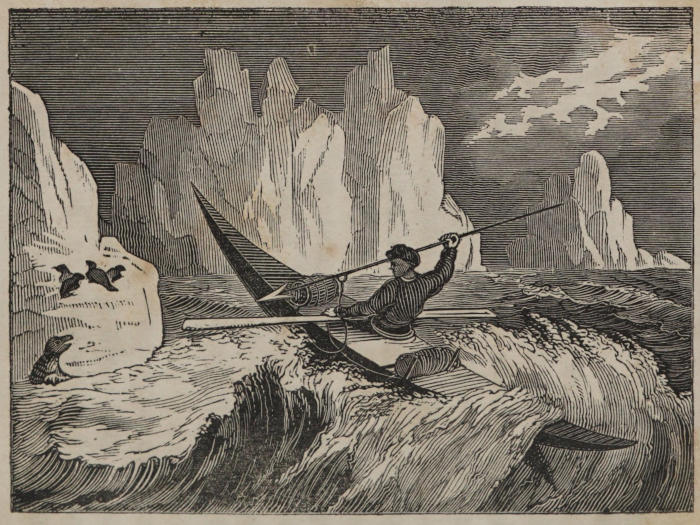
GREENLAND SEAL HUNTING.
Where the seals are very numerous the
sealers stop not to flay those they have killed,
but set off to another ice-field to kill
more, merely leaving one man behind to take
off the skins and fat. When the condition
of the ice forbids the use of boats, the hunter
is obliged to pursue the seals over it,
jumping from piece to piece, until he succeeds
in taking one, which he then stops to
flay and flense, or to remove the skin and
fat. This sometimes is horrible business,
since many of the seals are merely stunned,
and occasionally recover after they
have been flayed and flensed. In this condition,
too shockingly mangled for description,
they have been seen to make battle,
and even to swim off.
The Esquimaux hunt the seal in various
modes, according to circumstances. When
the breathing place (a hole made in the ice
by the seal) is discovered, the hunter raises
near it a small wall about four feet high,
of slabs of snow, to shelter himself from the
wind, and sits under the lee of his snow shelter,
having deposited his spear, lines and other
implements upon several little forked
sticks set up in the snow, in order to avoid
making the slightest noise in moving them
when wanted. The most curious precaution,
taken with a similar intention, is that
of tying his own knees together with a thong
to prevent any rustling of his dress, which
would alarm the seal. In this situation the
Esquimaux will frequently sit for many
hours when the thermometer is below zero,
attentively listening to ascertain whether
the animal is working below.
When he thinks the hole is almost completed,
he carefully raises his spear, to which
the line is previously tied, and the moment
the breathing of the seal is distinctly heard,
the ice being then of course very thin, he
strikes the spear into him with both hands,
and cuts away the ice with his knife to repeat
his blow. At other times, having enlarged
the breathing place, he takes his position
behind the shelter, and the animal,
when he next comes to the hole, rises fearlessly
out of the water, exposing his head
and shoulders, and repeats this action with
increased confidence. As he is not in haste
to dive again, the hunter now starts up suddenly
and drives his spear forcibly into him.
Another method adopted consists in covering
the breathing hole with light snow, and
making an opening through the top of it
with the spear handle about as large as the
mouth of a bottle. The hunter then withdraws
the spear and takes his place behind
his snow-screen, listening vigilantly until he
hears the seal breathing beneath the snow,
when he silently rises and plunges his weapon
through the snow-covering into the body
of the seal. The moment the seal is
struck, the hunter endeavors to catch the
line behind one leg to act as a strong check;
and as an additional security, a hitch is taken
round the ring finger, which is sometimes
either dreadfully lacerated or entirely
torn off by the violent struggles of a large
seal. The animal is then stabbed until dead;
the hole being enlarged, it is drawn out on
the ice, where it speedily freezes and is in
condition to be drawn home.
I have told you, my son, that the seal furnishes
the natives of those cold climates with
nearly all the necessaries of life, and I will
now give you a description of Capt. Lyon’s
visit to one of their feasts.
“On the return of a party of successful
seal-hunters,” he says, “blood, blubber, entrails,
skins and flesh, was sociably intermixed
in savoury heaps. Abundant smoking
messes were in preparation, and even the
dogs looked happy as they uninterruptedly
licked the faces of the children, who were
covered with blood and grease from the chin
to the eyes. Universal merriment prevailed,
and such men and children as could bear
more food stood lounging round the women,
who sat sucking their fingers and cooking
as fast as possible. While the messes were
preparing the children solaced themselves
by eating such parts of the raw uncleaned
entrails as their young teeth could tear, and
those morsels which proved too tough were
delivered over to their mothers, who soon
reduced them to a proper size and consistency
for their tender offspring.
“At the distribution of the contents of one
of the pots I was complimented with a fine
piece of half stewed seal’s flesh, from which
the kind donor, a most unsavory looking old
lady, with the most obliging politeness, had
first licked the gravy and dirt, and bitten it
all round in order to ascertain the most tender
part on which I should make the first attack.
My refusal of this delicacy did not
offend, and we had much laughing on the
subject, particularly when the old woman,
with well feigned disgust and many wry faces,
contrived to finish it herself. In my
rambles on this day of plenty I found, beyond
a doubt, that the women do not eat
with the men, but waiting till they are first
satisfied, then enjoy a feast by themselves.
In the meantime, however, the females who
superintend the cooking have the privilege
of licking the gravy from the lumps of meat
as they are taken out and before they are
presented to their husbands. Both sexes
eat in the same manner, although not in
equal proportions; the females very seldom,
and the men very frequently stuffing until
they become quite stupified. A lump of
meat being given to the nearest person, he
first sucks it all round and then pushes as
much as he can into his mouth, cutting it
from the larger piece close to his lips, to the
great danger of them and his nose. The
meat then passes round until it is consumed,
and the person before whom it stops is entitled
to the first bite of the next morsel. In
this manner a meal continues a long time, as
each eats or rather bolts several pounds, and
the pots are in consequence frequently replenished.
In the intermediate time the
convives suck their fingers or indulge in a
few lumps of delicate raw blubber. The
swallows of the Esquimaux are of such a
marvellous capacity that a piece of flesh of
the size of an orange very rarely receives
half a dozen bites before it is bolted, and
that without any apparent exertion. The
rich soup of the meat is handed round
at the close of the repast, and each takes a
sup in turn until it is finished, when the pot
is passed to the good woman of the house,
who licks it carefully clean and then prepares
to make a mess for herself. On all occasions
the children are stuffed almost to
suffocation. The meals being finished, every
one scrapes the grease, &c. from his face
into his mouth, and the fingers are then
cleaned by sucking.”
The food of the Esquimaux is cooked by
the aid of a lamp, which is supplied with
seal oil, the wick being composed of moss.
On this lamp are they also dependent for
warmth in their huts, which are made of
snow, as well as for their supply of water to
drink, which, during a great part of the year
is only to be obtained by melting snow. A
scarcity of seals, therefore, is accompanied
by a series of ills, the hut is deprived of light
and warmth, and the sufferings of famine
are increased by the torment of thirst,
against which they have no other resource
under such circumstances except to eat the
snow, which affords but a partial relief. In
judging of the filth and voracity of these poor
creatures, we must ever bear in mind the
circumstances which during so much of the
time render water almost unattainable, except
to quench their thirst, as well as the frequent
and severe starvation to which they
are subjected.
The Esquimaux apply the skins of seals
to various purposes, amongst which the most
important is the construction of their boats.
The small boat to carry but one person is
called kayak, and has been aptly compared
in shape to a weaver’s shuttle, having the
head and stern equally sharp. There is an
opening or hole in which the rower sits,
having a rim or projection to which a part
of the dress may be fastened in such a manner
as entirely to exclude the water. The
weight of the whole does not exceed fifty or
sixty pounds, so that the boat may be readily
carried by the owner on his head, and
from the peculiar form of the rim, without
applying his hands.
The Esquimaux are very proud of their
boats; they place a warm skin in the bottom
to sit upon, and the position of the paddler
is with the legs extended and the feet
pointed forwards. Whenever any weight is
to be raised, or the stowage of the boat to be
changed, two kayaks lie together, and the
paddles of each being laid across, a steady
double boat is formed. When not paddling
the occupant must preserve a very nice balance,
and a tremulous motion is always to be
observed in the boat. The Esquimaux in
the vicinity of Winter Island have not the
art of regaining the upright position when
overturned by a dexterous use of the paddle.
An inflated seal bladder is a constant
appendage to the canoe equipage; the weapons
are kept in their places on the upper
surface of the boats by small lines of whalebone,
tightly stretched across so as to receive
the points or handles of the spears beneath
them. The stem or stern of the boat
is frequently stowed with flesh, birds or
eggs; a seal, notwithstanding its roundness
and liability to roll, is so carefully balanced
on the boat as seldom to require being tied
on. When going before the wind while a
smart swell is running, the kayak requires
the nicest management, as the slightest inattention
would expose the broadside to the
sea and be followed by immediate peril to
this frail vessel. The extreme velocity with
which the kayak is impelled, and the dexterity
with which it is turned and guided,
render it a very interesting object.
The Esquimaux use another boat made of
seal-skin, which is larger and destined to carry
luggage, or to transport their families.
This is called umiak or oomiak, and is made
nearly square at the head and stern. Its
frame is made of whalebone or wood, and
the bottom is flat. The seal-skins with
which the frame is covered are deprived of
the hair, and are at all times transparent,
but especially so when wet. Each of the
boats has five or six seats or thwarts, placed
as in ours, and is moved by two very clumsy
oars with flat blades, which are used by the
women, and steered with a similar oar by
another. They vary much in size, having
the sides very flat and about three feet high.
Sometimes they are so large as twenty-five
feet in length by eight in breadth, and are
capable of containing women, boys and small
children, to the number of twenty-one persons.
As I have alluded to the Esquimaux, my
son, it will perhaps be interesting to you to
hear something further of their mode of life.
I will therefore give you a description of one
of their snow villages, with an account of a
visit by a large party of them to the winter
quarters of captains Parry and Lyon, which
is taken from the Narrative of Discovery
and Adventure in the Polar Seas and Regions.
“On the morning of the 1st February, a
number of distant figures were seen moving
over the ice, and, when they were viewed
through glasses, the cry was raised, ‘Esquimaux!
Esquimaux!’ As it was of great importance
to deal courteously and discreetly
with these strangers, the two commanders
formed a party of six, who walked in files
behind each other, that they might cause no
alarm. The Esquimaux then formed themselves
into a line of twenty-one, advanced
slowly, and at length made a full stop. In
this order they saluted the strangers by the
usual movement of beating their breasts.
They were substantially clothed in rich and
dark deer-skins, and appeared a much more
quiet and orderly race than their rude countrymen
of the Savage Islands. On the English
producing their precious commodities,
knives, nails, and needles, an active traffic
was set on foot; and the females, on seeing
that much importance was attached to the
skins which formed their clothing, began
immediately to strip off those with which
their fair persons were covered. The captains
felt alarm for the consequences, under
a temperature more than fifty degrees below
the freezing point; but were soon consoled
by discerning underneath another comfortable
suit. They were now cordially invited
to enter their habitations, to which they
agreed most readily, only that there appeared
no habitations to enter. However, they
were led to a hole in the snow, and instructed
to place themselves on their hands and
knees, in which position, having crept
through a long winding passage, they arrived
at a little hall with a dome-shaped roof,
whence doors opened into three apartments,
each occupied by a separate family. These
proved to be five distinct mansions, tenanted
by sixty-four men, women, and children.
The materials and structure of these abodes
were still more singular than their position.
Snow, the chief product of the northern tempests,
became here a protection against its
own cold. It was formed into curved slabs
of about two feet long and half a foot thick,
put together by a most judicious masonry,
so as to present a species of dome-shaped
structures, rising six or seven feet above the
ground, and about fourteen or sixteen feet
in diameter. The mode of inserting the
key-slab, which bound the whole together,
would, it is said, have been satisfactory to
the eye of a regularly-bred artist. A plate
of ice in the roof served as a window, and
admitted the light as through ground glass;
which, when it shone on the interior mansions,
in their first state of pure and beautiful
transparency, produced soft and glittering
tints of green and blue. But, alas! ere
long, accumulated dirt, smoke, and offal, converted
these apartments into a scene of blackness
and stench. This little village appeared
at first like a cluster of hillocks amid the
snow; but successive falls filled up the vacuities,
and converted it almost into a smooth
surface, so that even boys and dogs were
seen walking and sporting over the roofs;
though, as summer and thaw advanced, a leg
sometimes penetrated, and appeared to the
alarmed inmates below. Then, too, the ceiling
begins to drip; and the tenants, after repeatedly
endeavoring to patch it with fresh
slabs, and catching, of course, some severe
colds, are obliged to betake themselves to a
more durable covering. In each room, suspended
from the roof, burns a lamp, with a
long wick formed of a peculiar species of
moss, fed with the oil of the seal or the walrus,
and serving at once for light, heat and
cookery. The family sit round the apartment,
on a bench formed of snow, strewed
with slender twigs and covered with skins;
but this part of the dwelling must be carefully
kept a good deal below the freezing-point,
since a higher temperature would
speedily dissolve the walls of the frail tenement.
After a cheerful and friendly visit, an invitation
was given to the Esquimaux to repair
to the ships, when fifty accepted it with alacrity.
Partly walking, and partly dancing,
they soon reached the vessels, where a striking
congeniality of spirit was soon found to
exist between them and the sailors; boisterous
fun forming to each the chief source
of enjoyment. A fiddle and drum being produced,
the natives struck up a dance, or
rather a succession of vehement leaps, accompanied
with loud shouts and yells. Seeing
the Kabloonas or Whites, as they called
the strangers, engaged in the game of leap-frog,
they attempted to join; but not duly
understanding how to measure their movements,
they made such over-leaps as sometimes
to pitch on the crown of their heads:
however they sprang up quite unconcerned.
Their attention was specially attracted to
the effects of a winch, by which one sailor
forcibly drew towards him a party of ten or
twelve of their number, though grinning and
straining every nerve in resistance; but finding
all in vain, they joined in the burst of
good-humored laughter till tears streamed
from their eyes. One intelligent old man
followed captain Lyon to the cabin, and
viewed with rational surprise various objects
which were presented. The performance
of a hand-organ and a musical snuff-box
struck him with breathless admiration;
and on seeing drawings of the Esquimaux
in Hudson’s Strait, he soon understood them,
and showed the difference between their
dress and appearance and that of his own
tribe. On seeing the sketch of a bear, he
raised a loud cry, drew up his sleeves,
and showed the scars of three deep wounds
received in encounters with that terrible animal.
The seamen sought to treat their visitors
to such delicacies as their ship afforded,
but were for some time at a loss to discover
how their palate might be gratified.
Grog, the seaman’s choicest luxury, only one
old woman could be induced to taste. Sugar,
sweetmeats, gingerbread, were accepted
only out of complaisance, and eaten with
manifest disgust; but train-oil, entrails of
animals, and any thing consisting of pure fat
or grease, were swallowed in immense quantities,
and with symptoms of exquisite delight.
This taste was first evinced by an
old woman, who, having sold her oil-pot,
took care previously to empty the contents
into her stomach, and lick it clean with her
tongue, regardless of her face becoming thus
as black as soot. Capt. Lyon, being disposed
to ingratiate himself with rather a handsome
young damsel, presented her with a
good moulded candle, six in the pound. She
immediately began to eat off the tallow with
every symptom of the greatest enjoyment,
after which she thrust the wick into her
mouth; but the captain, concerned for the
consequences to this delicate virgin, insisted
on pulling it out. In preference to
strong liquors they drank water in the most
enormous quantities, by gallons at a time,
and two quarts at a draught; a supply of liquid
which is perhaps necessary to dissolve
their gross food, and which, being obtained
only from snow artificially melted, is a scarce
winter article.
The Esquimaux were attended by a large
pack of wolves, which seemed to follow solely
to pick up whatever might be found straggling
or defenceless about their habitation.
These animals continued through the whole
winter ravening with hunger, and in eager
watch for any victim which might come
within their reach. For this purpose they
took a station between the huts and the
ships, ready to act against either as circumstances
might dictate. They did not attack
the sailors even when unarmed, though
they were often seen hovering through the
gloom in search of prey. Every stray dog
was seized, and in a few minutes devoured.
Two wolves broke into a snow-house close
to the ship, and carried off each a dog larger
than himself; but, being pursued, one of
them was obliged to drop his booty. In the
extremity of their hunger they hesitated not
to tear and devour the cables and canvass
found lying near the vessel. A deadly war
was therefore waged against these fierce animals,
of which thirteen were killed in the
course of the season, and sent to be eaten
by the Esquimaux,—a present which was
received with much satisfaction.”
The number of seals destroyed in a single
season by the regular sealers may well excite
surprise; one ship has been known to
obtain a cargo of four or five thousand skins
and upwards of a hundred tons of oil.
Whale ships have accidentally fallen in with
and secured two or three thousand of these
animals during the month of April. The
sealing business is, however, very hazardous
when conducted on the borders of the Spitzbergen
ice. Many ships with all their crews
are lost by the sudden and tremendous
storms occurring in those seas, where the
dangers are vastly multiplied by the driving
of immense bodies of ice. In one storm that
occurred in the year 1774 no less than five
seal ships were destroyed in a few hours,
and six hundred valuable seamen perished.
“One of the most affecting shipwrecks
which ever occurred in the northern seas was
that of the Jean, of Peterhead, in 1826. Of
this we can give a full account from an interesting
narrative by Mr. Cumming, the
surgeon, an eye-witness and sharer of the
calamity. This vessel sailed on the 15th
March, having on board only twenty-eight
men, but received at Lerwick a complement
of twenty-three natives of Shetland; owing
to which arrangement, as well as by contrary
winds, she was detained till the 28th.
From the evening of that day to the 1st
April, the ship encountered very stormy
weather, which she successfully withstood,
and was then steered into those western
tracts of the Greenland sea which are the
most favorable for the capture of the seal.
In one day the seamen killed 1138 seals, and
the entire number caught in five days exceeded
3070. This scene, however, could not
be contemplated without some painful impressions.
The seals attacked were only
the young, as they lay fearlessly reposing
on the ice, before they had yet attempted to
plunge into the watery element. One blow
of the club stunned them completely. The
view of hundreds of creatures bearing some
resemblance to the human form, writhing in
the agonies of death, and the deck streaming
with their gore, was at once distressing
and disgusting to a spectator of any feeling.
However, this evil soon gave way to others
of a more serious nature.
On the morning of the 18th April the sailors
had begun their fishery as usual; but a
breeze sprung up, and obliged them by
eleven o’clock to suspend operations. The
gale continually freshened, and was the more
unpleasant from their being surrounded with
loose ice, which a dense and heavy fog made
it impossible to distinguish at any distance.
The mariners took in all sail, but did not apprehend
danger till six in the evening, when
the wind, which had been continually increasing,
began to blow with tenfold fury. All
that the narrator had ever heard, of the united
sounds of thunder, tempest, and waves,
seemed faint when compared with the stunning
roar of this hurricane. At eight the
ship was borne upon a stream of ice, from
which she received several severe concussions;
the consequence of which was that
at ten the water began to enter, and at
twelve no exertion in pumping could prevent
her from being gradually filled.
At one in the morning she became completely
waterlogged. She then fell over on
her beam-ends, when the crew, giving themselves
up for lost, clung to the nearest object
for immediate safety. By judiciously
cutting away the main and fore masts, they
happily enabled the ship to right herself,
when being drifted into a stream of ice, she
was no longer in danger of immediate sinking.
The whole hull, however, was inundated
and indeed immersed in water, except a
portion of the quarter-deck, upon which the
whole crew were now assembled. Here
they threw up an awning of sails to shelter
themselves from the cold, which had become
so intense as to threaten the extinction of
life. Those endowed with spirit and sense
kept up the vital power by brisk movement;
but the natives of Shetland, who are accused
on such occasions of sinking into a selfish
despondency, piled themselves together
in a heap, with the view of deriving warmth
from each other’s bodies. Those in the interior
of the mass obtained thus a considerable
temperature, though accompanied with
severe pressure; and blows were given, and
even knives drawn to gain and to preserve
this advantageous position. On the 19th,
one Shetlander died of cold, another on the
20th, and a third on the 21st,—events felt
by the others as peculiarly gloomy, chiefly,
it is owned, as forming a presage of their
own impending fate.
On the 22d the sun began to appear amid
showers of snow; and the 23d was ushered
in by fine weather and a clear sky. The
opinions of the crew were now divided as to
what course they should steer in search of
deliverance. Two plans were suggested.
They could either stretch northward into
the fishing stations, where they might expect,
sooner or later, to meet some of their
countrymen, by whom they would be received
on board; or they might sail southward
towards Iceland, and throw themselves
on the hospitality of its inhabitants. The
former plan was in several respects the more
promising, especially as a vessel had been
in sight when the storm arose. But its uncertainties
were also very great. They
might traverse for weeks those vast icy seas,
amid cold always increasing, and with imminent
danger of being swallowed up by the
waves. Iceland was distant, but it was a
definite point; and upon this course they at
last wisely determined. Several days were
spent in fitting out their two remaining boats,
all the others having been swept away—and
in fishing up from the interior of the vessel
every article which could be turned to account.
During this operation, the weather
continuing fine, they could not forbear admiring
the scene by which they were surrounded.
The sea was formed as it were
into a beautiful little frith, by the ice rising
around in the most varied and fantastic
forms, sometimes even assuming the appearance
of cities adorned with towers and forests
of columns. Continual efforts were necessary,
meantime, to keep the wreck on the
icy field; for had it slipped over into the
sea, of which there appeared a strong probability,
it would have gone down at once.
By the 26th the boats were completely ready,
having on board a small stock of provisions,
and a single change of linen. At half
past one in the morning of the 27th, the mariners
took leave, with some sorrow, of the
vessel, which ‘seemed a home even in ruins,’
leaving the deck strewed with clothes, books,
and provisions, to be swallowed up by the
ocean as soon as the icy floor on which it
rested should melt away.
The two boats, having received forty-seven
men on board, lay very deep in the
water; so that when a smart breeze arose,
the men were obliged to throw away their
spare clothing and every thing else which
could be wanted, and soon saw their little
wardrobe floating on the face of the sea.
The seamen were frequently obliged to
drag their boats over large fields of ice, and
again to launch them. However, a favorable
wind in ten hours enabled them to make
forty-one miles, when they came to the utmost
verge of the icy stream, and entered
upon the open ocean. Their fears were not
yet removed; for if a heavy gale had arisen,
their slender barks must soon have been
overwhelmed. There blew in fact a stiff
breeze, which threw in a good deal of water,
and caused severe cold; however, at seven
in the evening, they saw, with inexpressible
pleasure, the lofty and snow-capped mountains
of Iceland. But these were still fifty
miles off, and much might intervene; so that
the night, which soon closed in, passed with
a mixture of joy and fear. Fortunately the
morning was favorable; and about four they
saw a black speck on the surface of the
ocean. It proved to be an island, naked,
rocky, and seemingly uninhabited. On turning
a promontory, however, what was their
joy to see a boat pushing out to meet them!
and they were received by the natives with
every mark of kindness and compassion.
The seamen were distributed among the
half-subterraneous abodes, and received a
portion of the frugal and scanty fare on which
the inhabitants subsisted. After recruiting
their strength, they set sail for the coast of
Iceland, and after a tedious voyage, reached
Akureyri, the capital of this quarter of the
island. They were here also received with
the most humane hospitality, and remained
three months before they could obtain a passage
home; during which delay unfortunately
they lost nine of their number, chiefly from
mortification and other morbid affections occasioned
by extreme cold. In the middle
of July, they procured a passage in a Danish
vessel, which brought them and their boats
near to the coast of Shetland. Having landed
at Lerwick, they were conveyed by his
Majesty’s ship Investigator to Peterhead,
where they arrived on the 5th August.”
The Harp Seal, my son, of which you
have a drawing upon the cover, is quite common
in the Greenland seas, and shows much
of the frisky or frolicksome disposition of
the Common Seal. It is often seen gamboling
and whirling over as if in play with its
comrades. They live in great herds or companies,
appearing to be under the direction
of a leader, who watches over the safety of
the whole. The Esquimaux and Greenlanders
often drive them on shore, when
they come up to the surface in shallow water
to breathe. The skin of this species
they use to cover their tents and boats.
Seal oil when properly prepared is pure
and fine, and may be employed for all purposes
to which whale oil is adapted. The
skins of these animals are extensively consumed
in various manufactures, especially
in trunk making, saddlery, &c.
And now, my son, do you not think that
the station in which a kind Providence has
allotted to you, there are not many, very
many reasons not only for contentment, but
gratitude to your heavenly Father for the
inestimable blessings conferred upon you.
How necessitous are the poor Esquimaux!
Their climate forbids their attempting the
gratification of any desires beyond the commonest
animal wants. In the short summers
they hunt the reindeer; and during their
long cold winters, the seal. But the most
affecting circumstance to the Christian is
their present condition in the scale of humanity,
their deprivation of the means of
knowledge, above all the knowledge of the
Bible.
“Weep, weep for the people that dwell
Where the light of the truth never shone,
Where anthems of praise never swell,
And the love of the Lamb is unknown.”
As you gain more knowledge of the different
beings and things which God has made,
you will gain also more and more proofs of
his existence and of his amazing power, wisdom
and goodness. Let that goodness sink
deep into your soul, and form a part of your
daily thoughts and feelings. How much
kindness God has shown and is still showing
you; how many sources of comfort and of
enjoyment he gives you; how it grieves him
to see you think or feel or act wrong; how
he loves to see you be good and to do good,
that you may go, after death, to be with
him forever,—continually to improve in
knowledge, in holiness, and in happiness!