Mr. Hall and Mr. Talbot, on their feet, smiled at
each other in satisfaction as the throng surged
over the field.
“Some game!” said the former.
“I should say so! Well, glad to have met you,
Hall. And—er—by the way, in regard to that
Barry case. Seems to me we might—er——”
“My idea exactly,” replied the other heartily.
“I’ll very gladly advise a settlement to my client.
I’ll drop around in a day or two and we’ll talk it
over. Good-bye!”
Mr. Talbot followed the players to the dressing-room,
worming his way through a crowd of
enthusiastic youths, who had gathered to show
their approval of the Blues, and Mr. Hall, seeking
a way from the field, was suddenly confronted
by the gentleman who carried the cane and the
grey gloves. Mr. Hall’s face expressed surprise
and delight.
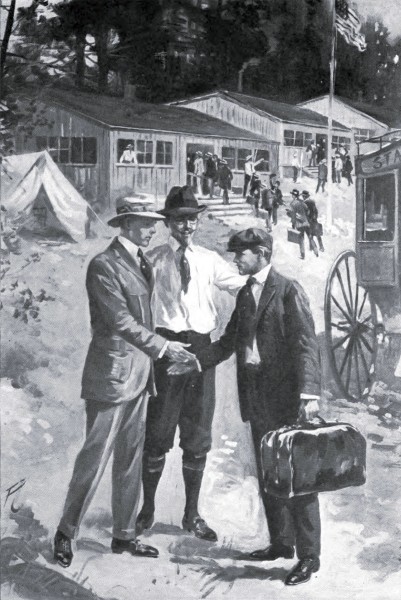
“Johnny!” he exclaimed. “Where’d you drop
from?”
Mr. York chuckled as he shook hands. “Hello,
old man,” he said. “You look almost as flabbergasted
as Sam Craig did when I yelled.”
“Was that you bellowing like a bull?” laughed
Mr. Hall. “I might have known it. You’re always
right there with the advice, Johnny.”
“Well, it happened to be good advice this time.
It won the game.”
“Oh, certainly,” scoffed the other. “Craig
and the others had nothing to do with it!”
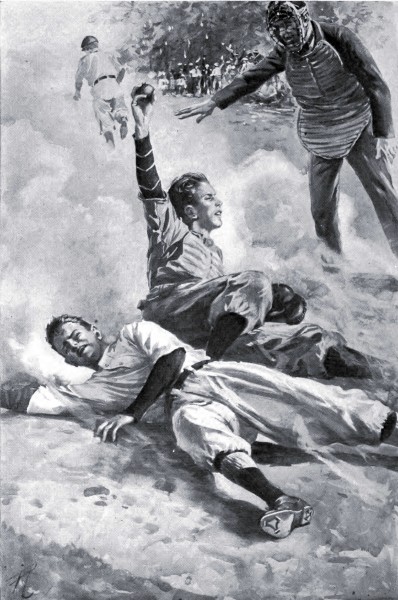
“Craig did what I told him to,” replied Mr.
York untroubledly. “If he hadn’t, he’d never
have nailed that man at second and the score
would have been tied at this minute—unless the
other chaps had won. Come on and let’s get out
of here.”
“When did you arrive?” asked Mr. Hall when
they were on the street.
“About an hour ago. Ran down to Columbus
last night, got there early this morning, and
found I could catch a train over here and see you
for a few hours and still get back to Mount Placid
to-morrow morning. My train goes at nine-something,
and I’ll have to change in the middle of the
night. I call that a real proof of love and affection,
John.”
“Yes, but you’re a silly chap if you think I’m
going to let you go on to-night.”
“Sorry, but I have to be home in the morning.
Topsy gets back and I must be there to meet her.
Well, how are you?”
“Bully, thanks. I needn’t ask how you are;
you look as strong as an ox; besides, I got news
of you from young Craig. By the way, that was
a nice letter you wrote to me about him.”
“By Jove, I didn’t, did I? Meant to, but quite
forgot it. Have you seen him?”
“Yes, he came around one morning and we had
a chat. Nice boy.”
“Yes, he is. Deserving, too. I never saw a
chap his age who looked more like a real catcher,
John. I want to do something for him; want to
get him into college.”
“Hm,” said Mr. Hall. “Can’t you afford it?”
Mr. York laughed ruefully. “Yes, but he
won’t let me. At least, not the easy way. I offered
to get him a college position and he turned
me down; said it wouldn’t be honest.”
“Good for him! What’s your plan, then?”
“Well—I haven’t any yet. Thought I’d consult
you. That reminds me that I invited him to
meet us at your office after dinner.”
“My office? Why didn’t you have him come to
the club?”
“Well, the office is on my way to the station,
for one thing, and I won’t have much time here.
Thought you and I could have some dinner together
and a quiet smoke and then walk down to
the office and see Craig for a few minutes. All
right?”
“Surely, but we must get there before eight or
we’ll have to climb nine flights of stairs. The
elevators stop at eight.”
“I think I told him about eight. By the way,
did you hear me having fun with Nick Turner?”
“Who’s he?”
“Why, that fellow who pitched for Lynton.”
“Smith, you mean? So his name is Turner,
eh? Was that you who hurled insults at him from
the stand?”
“Insults, nothing!” Mr. York chuckled. “I
only asked him why he left Shreveport and how
much he was getting to-day and a few things like
that. Only asked for information, John.”
“Well, you broke up the game, you old
schemer! Who is this chap?”
“Nick Turner? Pitched two years ago for
Shreveport. Never was much good, though.
Knew him the minute I saw him pitch. I dare
say those Lynton boys made up a ten-dollar purse
to get him to work for them to-day. They ought
to be spanked. I was glad you fellows here licked
them without any outside assistance.”
“They talked about having me pitch for them,”
replied Mr. Hall, with a smile. “I believe I
agreed to do it if necessary.”
“Glad you didn’t, old man. By the way, I
telephoned out to the Country Club when I didn’t
find you at your office, and they said you weren’t
there. Just by accident I heard of the ball game
from a conductor on a trolley-car and said to myself,
‘I’ll bet a million the old loafer’s out there!’
Didn’t find you in the stand, though, and didn’t
think of looking for you below; not until you and
another chap got to thumping each other like two
kids; saw you then. Those kids played a pretty
good game of ball, didn’t they? And wasn’t that
fellow who pitched for Amesville the same one
we saw last spring?”
“Yes, Tom Pollock. He’ll make his mark some
day, I guess.”
“Sure to; he’s a good pitcher.”
“I didn’t mean as a pitcher,” replied the other.
“I meant as a man. I suppose, though, you can’t
understand judging anyone except by his ability
to play baseball, you crazy fan!”
“I like that! Crazy fan, eh? What were you
doing to-day? Why weren’t you in your office attending
to business? How do you expect to get
on in the world if you go to ball games and such
puerile affairs?”
“Oh, Saturday’s a half holiday here,” Mr. Hall
laughed. “Here we are. Did you leave your bag
here?”
“Yes, the hall porter took charge of it. Show
me a tub of cold water, John. I’m two inches
deep in train dust!”
It was a few minutes before eight when Sam,
turning into Main Street at the corner of the
Adams Building, saw Mr. Hall and Mr. York just
entering the big doorway. He caught up with
them at the elevator and as they were whisked
aloft past dark corridors he had to listen to much
praise.
“You played a regular air-tight game, Sam,”
declared Mr. York. “And that throw to second
at the last was a marvel. What did you think
when you heard me yell?”
“There wasn’t time to think anything,” replied
Sam. “If I’d stopped to think I’d never
have thrown that way, sir. You see, I haven’t
much chance to try it yet.”
“But you had tried it, hadn’t you?”
“Not in a game, sir; just in practise the other
day.”
“Well, you certainly pulled it off in grand
style! And I want to tell you that if you’d thrown
your old way you’d never have caught him. He
had an awful lead from first and ran like a rabbit.
This our floor?”
“Yes,” replied Mr. Hall, “unless you and Craig
want to stay there and ride up and down and talk
baseball.”
“This man, Sam,” warned Mr. York, “is an
awful hypocrite. He pretends he doesn’t care a
thing about the game, but some time I’ll tell you a
few facts about him; like the time he dented in the
immaculate silk topper of a perfectly respectable
old gentleman at the White Sox park in
Chicago.”
“Well, I bought him a new one,” laughed Mr.
Hall, as he unlocked his door. “Enter, gentlemen.”
“Seems to me,” said Mr. York, pausing to sniff
suspiciously, “I smell smoke. Don’t you?”
“Smoke? No, I don’t think so. Probably from
the railroad. It comes up here when the wind’s
right. Smell anything, Craig?”
“Yes, sir, I believe there is a smoky smell.”
“Well, come on. This building’s fireproof,
anyway.”
“It’s what?” demanded Mr. York as he allowed
himself to be urged through the door.
“Fireproof, or what they call fireproof.”
“It’s about as fireproof as a can of gasoline,”
said the architect as Mr. Hall closed the door and
turned the lights on. “You’ve got nice brick and
stone walls, but your partitions are only plaster
over lathing and your floors are the best quality
of ‘fat’ pine. If this thing ever did catch on fire
and get a nice start it would go like a bundle of
shavings. Where’s your fire escape?”
“Fire escape? Why, at the back, I think; down
the corridor.”
“It might be a good idea to find out,” returned
the other drily. “Well, Sam, how did the hike
go?”
“Very well, sir. I found them at Norrence all
right and we got back to camp three days later.”
“And now you’re back at school, I suppose.”
“Not until Monday, sir. Will you have this
chair, Mr. Hall?”
“No, no, sit still. I’m going to open these windows
and get some air in here. Wonderful how
this warm weather keeps on. I suppose it’s cool
up where you are, Johnny.”
“Y-yes, but not freezing. Did Sam here tell
you that he paid a short visit to Greysides,
John?”
“Yes, he told me about it. Must have been
frightfully dull for him, poor chap!”
“He didn’t say so, but maybe it was.”
“I—I had a fine time, sir,” said Sam earnestly.
The others laughed.
“We had some fine old talks, anyway, didn’t
we? That brings me to what I wanted to say,
Sam. About that college idea, you know. I
haven’t worked anything out yet, but—— Look
here, John, I certainly do smell smoke, I tell
you!”
“Of course you do. I’ve just opened the windows.
It comes from the railroad yards.”
“It doesn’t smell like coal smoke,” Mr. York
objected. “Still—let me see, what was I talking
about? Oh, about that college scheme, Sam.
Ever think you’d like my profession?”
Sam considered. Then he shook his head.
“No, sir, I’ve never thought about it,” he answered.
“No inclination toward architecture, eh?”
“I’ve never thought about it, Mr. York.”
“Ever build anything?”
“I built a hen-house once,” replied Sam, with
a smile. “I like to do that sort of thing, but——”
“Where’d you get your plan?”
“Nowhere; I mean I just—just went ahead and
put it together.”
“But you planned it in your head first, didn’t
you?”
“I suppose I did,” Sam confessed. “You see,
there was the framework.”
“Did you do it all yourself? How big was it?”
“About twelve by eight. I did it all myself,
usually after school or in the morning. It—it
wasn’t much.”
“Ever do any drawing?”
“I’ve tried to.”
“Like good pictures, handsome buildings,
statuary—such things?”
“Yes, sir, very much.”
“Still you don’t think you’d care to create
them, eh?”
“Indeed I would, Mr. York, but I don’t believe
I ever could. I’d like to build a real house some
time, though. You wouldn’t have to know so
much to do that, would you?”
Mr. York laughed and Mr. Hall smiled sympathetically.
“Why, yes, Sam, in order to build a
house you’ve got to know quite a bit. Look here,
why don’t you think it over and decide whether
you’d like to be an architect? If you would, you
can start your college course with that end in
view; and in the summers there’s a place in our
office you can have. The wages wouldn’t be large,
but you’d learn the business and if you made
good I guess we’d be glad to give you a real job.
You’d have to work hard, though, and study
like the dickens. What do you think about
it?”
“I’d like it!” declared Sam decidedly. “If I
really could learn enough to—to be an architect——”
“Pshaw,” interrupted Mr. Hall, “it’s no trick,
Craig. All the fellows in my class at college who
couldn’t make a living at laying brick or driving
express wagons went in for architecture. All,
that is, except John York. He had so much
money he didn’t have to make it, and we persuaded
him to be an architect because we thought
he could do as little harm in that profession as
any.”
Sam smiled obligingly and Mr. York threatened
his friend with a paper-weight.
“You give it a good thinking over, Sam,” he
continued. “Talk to your folks about it. You
don’t have to decide before you get to college.
And as to college, why, you’ll just have to make
it somehow, old man. We’ll keep our eyes open
and see if we can’t find a scheme. John and I
will get our heads together”—Mr. York was interrupted
by a fit of coughing—“and work out
something. Look here, John, this place is worse
than Pittsburg! Why, the room is full of smoke.
Close the windows if you don’t want me to choke
to death!”
Mr. Hall started to comply with the request,
then apparently changed his mind, and walked to
the door that led to the corridor. “It certainly
is smoky,” he muttered, “and it can’t all come
from the railroad.” He opened the door and
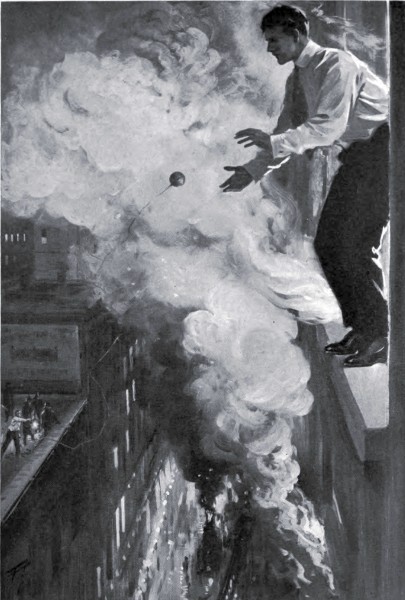
staggered back before the cloud of dense and
acrid smoke that billowed in. The others leaped
to their feet with exclamations of alarm. Mr.
Hall slammed the door shut again and faced
them.
“Fire,” he announced in level tones. “The
flames are coming up the elevator well, Johnnie.”
“So much for your fireproof building,” replied
Mr. York, seizing his hat and stick and gloves
from the desk. “Which way out, please?”
“I don’t know,” was the reply. “We’re cut
off from the stairs and the elevators aren’t running.
Couldn’t use them if they were, I guess.”
“But the fire escape, man! Where’s that?”
“We’ll try it, but it looks bad, Johnnie. I wonder—Put
your head out, Craig, and see if there’s
any sign of excitement below. No? Then it
hasn’t been seen.” Mr. Hall strode to the telephone
and yanked the receiver off. “Fire department,”
he said. “Emergency!” There was a
moment’s wait. Mr. York opened the door again
and once more the clouds of smoke seethed into
the room, whirling and eddying as they met the
air from the windows. He looked up and down
the corridor, returned, closing the door again, and
shook his head as his gaze met that of the man at
the telephone.
“Hurry up, John,” he said quietly. “It
doesn’t look pretty to me.”
“Hello! Hello! Fire department? The Adams
Building’s on fire. What? I’m John Hall. Yes.
I’m in my office on the tenth floor. Everything
looks to be pretty hot underneath. We’re
going to try to make the fire escape. Good-bye.”
Mr. Hall dropped the receiver back to the hook,
looked about the office, took a step toward his safe,
shrugged his shoulders, and moved toward the
door. “Come on, Johnnie,” he said quietly.
“We’ll have to make a run for it. Craig, keep
close to us. If we can’t make it we’ll have to come
back here and wait for ladders. All ready? Slip
out and I’ll shut this door again. Wait! How
about handkerchiefs over our faces?”
“Right!” agreed Mr. York. “Got one, Sam?
That’s the ticket! Now then, hold your breath
and keep together. Which way, John?”
“To the right, past the stairway. Come on!”
Sam never quite forgot that dash for safety.
It was a horrible nightmare while it lasted.
Somewhere near the stairway a solitary electric
bulb had faintly illumined the gloom of the long
corridor when they had ascended, but there was
no sign of it now. Instead, from the shaft in
which the two elevators were operated, a lurid
glow poured up, rising and falling as though
somewhere in the depths of the building a giant
furnace was being stoked. With the light of the
flames ascended billows of dun-coloured smoke and
showers of sparks, and, listening as they crouched
for their dash past the well, they heard the growling
roar of the fire, with now and then the sudden
crackling of the eager flames which, even as they
looked, sent a tiny tongue licking at the flooring.
The fire escape was at the rear of the building,
down the length of the long corridor, and to reach
it they must win past that veritable crater of
heat and smoke. Thrice they tried it and thrice
they were beaten back, their eyes blinded, their
lungs choked with the scorching fumes. And
then, endurance at an end, they staggered desperately
back to the office, suffered torments while
Mr. Hall fumbled for the knob, and at last, gasping
and sobbing, sought relief at the open windows.
It was a full minute before anyone spoke. Then,
drawing a deep breath into his parched lungs,
Mr. Hall said quietly, with a twisted sort of
smile, “Rather silly being roasted alive here,
Johnny!”
“We sha’n’t be. They’ll have us out of here
in a minute. There they come now! Hear?”
From somewhere far below came the shriek of
the engine siren, sounding nearer and nearer,
and the clang of the bells. And at that moment
the light in the office went out and they were in
darkness.