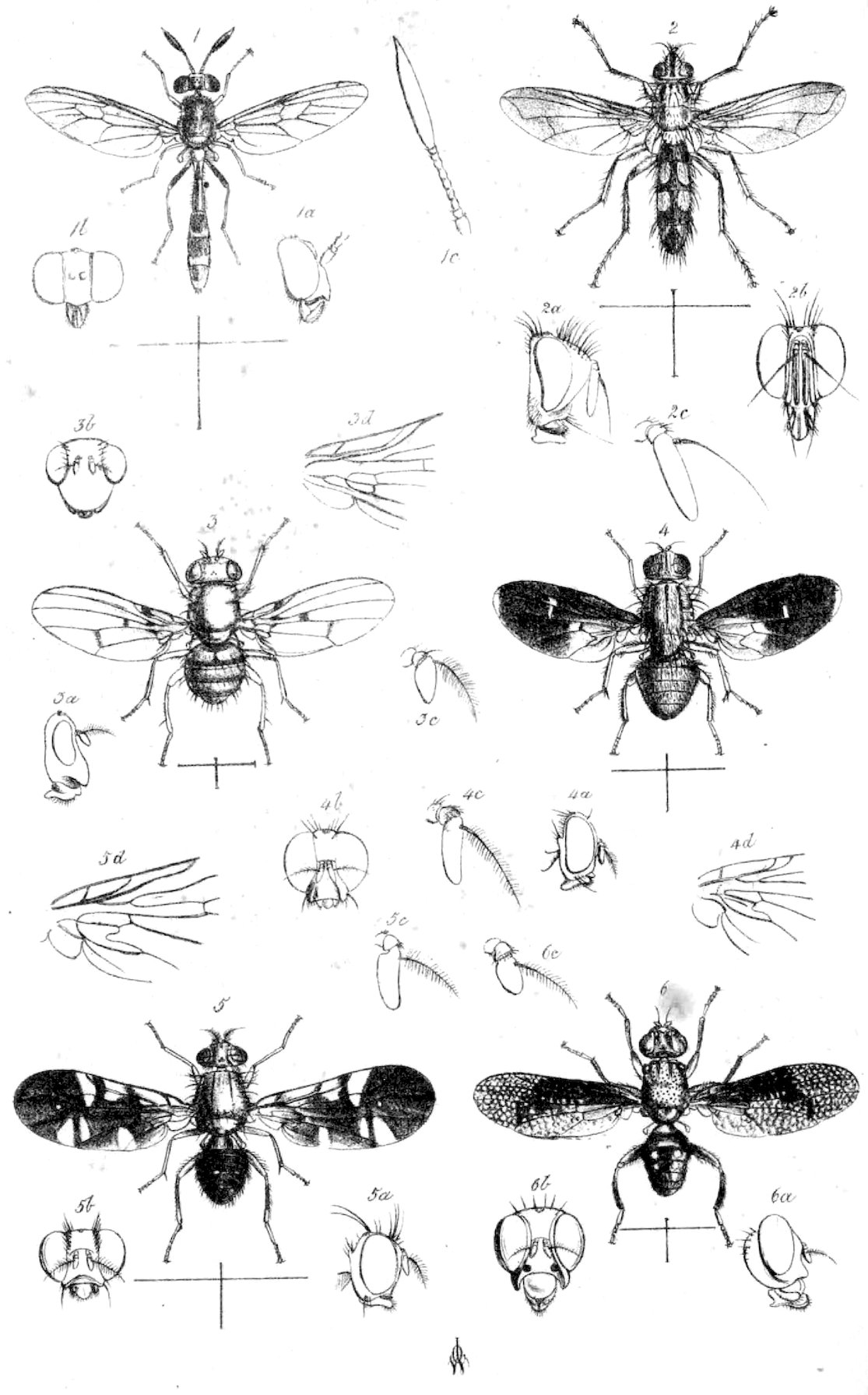
66. Echinomyia brevipennis, n. s., mas. Nigra, capite anticè albo, frontalibus
ferrugineis, scutello abdominisque fasciis testaceis, alis subcinereis
parvis basi limpidis.
Male. Black, stout. Head white, with white hairs beneath; front and vertex
black, shining; frontalia ferruginous, slightly widening from the vertex to
the antennæ; epistoma slightly prominent. Antennæ extending to two-thirds
of the length of the face; 3rd joint truncated, not much longer than
broad, much broader and shorter than the 2nd; arista stout, tapering from
its two indistinct basal joints, full twice the length of the 3rd joint. Scutellum
testaceous. Abdomen elongate-oval, longer than the thorax. Wings
greyish, rather short, limpid towards the base; veins black, testaceous
towards the base; præbrachial vein forming a very slightly acute angle at
its flexure, near which it is very deeply curved inward, and is thence straight
to its tip which joins the tip of the costal; discal transverse vein straight,
parted by much less than its length from the border, and by little more
than half its length from the flexure of the præbrachial. Alulæ greyish,
with testaceous borders. Length of the body 6 lines; of the wings 9 lines.
Mount Ophir, at the height of 4000 feet.
67. Tachina Ophirica, n. fœm. Cinerea, latiuscula, capite argenteo, frontalibus
20atris, thoracis vittis quatuor interruptis nigris, scutelli margine abdominisque
fasciis canis, alis subcinereis.
Female. Cinereous, rather short and broad. Head hoary, silvery-white above
and in front; frontalia deep black, slightly widening from the vertex to the
antennæ; facialia without bristles; epistoma hardly prominent. Antennæ
extending to about three-quarters of the length of the face; 3rd joint
linear, slender, rounded at the tip, about twice the length of the 2nd;
arista stout for about half its length, very much longer than the 3rd joint.
Thorax with four slender interrupted black stripes; scutellum with a hoary
border. Abdomen black, obconical, hardly longer than the thorax; a broad
hoary band on the fore border of each segment. Wings slightly greyish;
veins black; præbrachial vein forming an almost right and rather well-defined
angle from whence it is slightly curved inward to its tip; discal
transverse vein hardly curved inward, parted by rather less than its length
from the border and from the flexure of the præbrachial. Alulæ white.
Length of the body 4 lines; of the wings 8 lines.
Mount Ophir, at the height of 4000 feet.
68. Masicera tomentosa, Macq. Dipt. Exot. Suppl. 2.
Mount Ophir, at the height of 4000 feet.
69. Masicera vicaria, n. s., fœm. Nigra, longiuscula, capite albo, frontalibus
atris, thoracis vittis quatuor, lateribus scutello abdominisque fasciis
duabus latis interruptis canis, alis cinereis.
Female. Black, rather long. Head white, with short white hairs beneath
and behind; frontalia linear, deep black; facialia without bristles; epistoma
not prominent. Eyes pubescent. Antennæ extending nearly to the epistoma;
3rd joint linear, slender, slightly rounded at the tip, about four times
the length of the 2nd; arista rather stout for full one-third of the length
from the base, very much longer than the 3rd joint. Thorax with four
hoary stripes; sides and scutellum hoary. Abdomen elongate-obconical,
much longer than the thorax, with two broad interrupted hoary bands.
Legs stout. Wings grey; veins black; præbrachial vein forming a rather
obtuse angle at its flexure, from whence it is slightly curved inward to its
tip; discal transverse vein undulating, parted by very little less than its
length from the border and from the flexure of the præbrachial. Alulæ
whitish. Length of the body 5 lines; of the wings 9 lines.
Singapore.
70. Eurigaster muscoïdes, n. s., fœm. Nigra lata, capite albido, frontalibus
nigris, palpis testaceis, thorace cano nigro-quadrivittato, scutelli apice
fulvo, abdomine cano-fasciato, alis cinereis apud costam fuscescentibus.
Female. Black, broad, with long bristles. Head whitish; frontalia black,
linear; facialia without bristles; epistoma not prominent. Eyes pubescent.
Palpi testaceous. Antennæ extending to the epistoma; 3rd joint
linear, rounded at the tip, full four times the length of the 2nd; arista
21slender, very much longer than the 3rd joint. Thorax hoary, with four
black stripes. Scutellum tawny towards the tip. Abdomen obconical,
hardly longer than the thorax, with a broad hoary band on each segment.
Legs slender, hardly setose. Wings grey, brownish in front; veins black;
præbrachial vein forming a slightly obtuse angle at its flexure, from whence
it is slightly curved inward to its tip; discal transverse vein straight except
a slight curve by its hind end, parted by much less than its length from
the border, and by rather more than its length from the flexure of the præbrachial.
Alulæ white. Length of the body 3 lines; of the wings 6 lines.
Singapore.
Mas. Corpus longum, angustum, subcylindricum. Facies verticalis, subretracta.
Facialia nuda. Epistoma planum. Palpi longiusculi, sat graciles.
Antennarum articulus 3us gracilis, linearis, 2o sexties longior; aristâ
gracillimâ. Oculi nudi. Abdomen lineare, thorace multò longius. Pedes
longiusculi. Alæ sat augustæ.
Male. Body long, narrow, almost cylindrical. Face vertical, slightly retracted
towards the base. Facialia without bristles. Eyes remote, bare. Palpi rather
long and slender. Antennæ extending to the epistoma; 3rd joint slender,
linear, rounded at the tip, six times the length of the 2nd; arista very
slender, rather longer than the 3rd joint. Abdomen linear, much longer
than the thorax. Legs rather long. Wings rather narrow; costal vein
ending at hardly in front of the tip of the wing; brachial vein joining the
cubital.
71. Zambesa ocypteroïdes, n. s., mas. Nigra, capite albo, frontalibus
atris, antennarum articulo 3o fulvo, thorace cano nigro-quadrivittato, abdominis
fasciis duabus latis interruptis semihyalinis albido-testaceis, femoribus
testaceis apice nigris, tibiis piceis, alis limpidis, apice margineque
postico cinereis.
Male. Black. Head white, with short white hairs beneath; frontalia deep
black, linear. Proboscis testaceous. Palpi black. Third joint of the antennæ
tawny. Thorax hoary, with four black stripes, of which the outer
pair are very much broader than the inner pair. Abdomen a little narrower
than the thorax, with two broad whitish testaceous semihyaline bands which
are interrupted above. Femora testaceous, with black tips; tibiæ piceous.
Wings limpid, grey towards the tips and along the hind borders; veins
black; præbrachial vein forming an obtuse angle at its flexure from whence
it is slightly curved inward to its tip, which joins the cubital very near the
border; discal transverse vein very slightly curved inward, parted by less
than its length from the border, and by more than its length from the
flexure of the præbrachial. Alulæ white. Length of the body 5 lines; of
the wings 10 lines.
Singapore.
72. Dexia divergens, n. s. (gen. Thelaira, Desv.), mas. Cana longa angusta,
22capite albo, frontalibus atris, proboscide palpis antennisque testaceis,
aristâ plumosâ, thorace nigro-quadrivittato, abdomine testaceo semihyalino,
vittâ fasciisque nigris, pedibus longis testaceis, tarsia nigris, alia subcinereis.
Male. Body hoary, long, narrow, with long black bristles. Head white;
frontalia deep black, widening from the vertex to the antennæ; facialia
without bristles; epistoma not prominent. Eyes bare. Proboscis and palpi
testaceous. Antennæ testaceous, not nearly extending to the epistoma;
3rd joint slender; arista black, plumose. Thorax with four black stripes,
of which the outer pair are broader than the inner pair. Abdomen testaceous,
semihyaline, with a black dorsal stripe, and with a black band on
the hind border of each segment. Legs long, testaceous; tarsi black. Wings
greyish; veins black; præbrachial vein forming a hardly obtuse angle at
its flexure, from whence it is indistinctly undulating to its tip which joins
the costal at a little in front of the tip of the wing; discal transverse vein
slightly curved inward near its hind end, parted by hardly more than half
its length from the border, and by hardly less than its length from the
flexure of the præbrachial. Alulæ whitish. Length of the body 6 lines;
of the wings 11 lines.
Mount Ophir.
73. Sarcophaga ruficornis, Fabr. Syst. Antl. 287. 12. (Musca.)
Malacca. Inhabits also Hindostan.
74. Sarcophaga reciproca, n. s., fœm. Cana, capite albo, frontalibus palpis
antennis thoracis vittis pedibusque nigris, abdomine subtessellato, alis subcinereis.
Female. Hoary. Head white; frontalia black, linear. Proboscis, palpi and
antennæ black. Thorax with three black stripes, and with black lines
intersecting the two intermediate hoary stripes. Abdomen slightly tessellated.
Legs black. Wings greyish; veins black; præbrachial forming a
right angle at its flexure, near which it is much curved inward, and is thence
straight to its tip; discal transverse vein slightly undulating, parted by
less than its length from the border, and by little more than half its length
from the flexure of the præbrachial. Alulæ white. Length of the body
6 lines; of the wings 11 lines.
Singapore. A smaller specimen from Malacca apparently belongs to this
species.
75. Sarcophaga aliena, n. s., fœm. Cana, capite albo, frontalibus palpis
antennis thoracis vittis pedibusque nigris, abdomine tessellato, alis subcinereis.
Female. Hoary. Head white; frontalia black, slightly widening in front.
Proboscis, palpi and antennæ black. Thorax with three black stripes, and
with black lines intersecting the two intermediate hoary stripes. Abdomen
tessellated. Legs black. Wings slightly greyish; veins black; præbrachial
forming a very slightly acute angle at its flexure, near which it is much
curved inward, and is thence straight to its tip; discal transverse vein
23hardly undulating, parted by a little less than its length from the border,
and by much more than half its length from the flexure of the præbrachial
vein. Alulæ white. Length of the body 4 lines; of the wings 8 lines.
Mount Ophir.
76. Idia tenebrosa, n. s., fœm. Obscurè viridis punctata, capite pedibus
halteribusque nigris, antennis piceis, alis fusco-cinereis apud costam nigris.
Female. Dull green. Head slightly tuberculated above, black and shining
in front. Frontalia dull black, hardly decreasing in breadth to the base of
the antennæ which are piceous. Thorax very minutely punctured, with a
slight hoary tinge which is interrupted by three slender indistinct black
stripes. Abdomen shining, thickly punctured. Legs black. Wings brownish
grey, black along the costa. Alulæ grey, with black borders. Halteres black.
Length of the body 4½ lines; of the wings 7 lines.
Mount Ophir. Inhabits also South Africa.
77. Idia bicolor, n. s., fœm. Viridis, capite albido, facie nigrâ, frontalibus
obscurè nigris, antennis fulvis, thorace nigro-quadrivittato, abdomine æneomarginato,
vittâ dorsali nigrâ, pedibus nigris, alis cinereis costâ apiceque
nigricantibus, halteribus albidis.
Female. Green. Head whitish and shining above, black and shining in front.
Frontalia dull black, linear, furcate hindward. Antennæ tawny. Thorax
with a slight hoary bloom and with four slender black stripes. Abdomen
æneous at the tip and along each side, and with a slight black dorsal stripe.
Legs black; coxæ and femora green. Wings grey, blackish along the costa
and at the tips. Alulæ dingy whitish. Halteres whitish. Length of the
body 3 lines; of the wings 5 lines.
Malacca.
78. Musca flaviceps, Macq. Dipt. Exot. ii. 2. 145. 23. pl. 18. f. 1. (Lucilia.)
(Genus Chrysomyia, Desv.)
Singapore. Inhabits also Hindostan.
79. Musca chrysoïdes, n. s. (genus Chrysomyia, Desv.), mas. Sericeo-viridis,
capite testaceo, palpis antennisque fulvis, abdominis vittâ dorsali fasciisque
nigris, alis subcinereis apice obscurioribus.
Male. Sericeous green, hardly shining. Head testaceous. Proboscis black.
Palpi and antennæ tawny. Abdomen with a black dorsal stripe, and with
a black band on the hind border of each segment. Legs black; coxæ and
femora green. Wings greyish, much darker towards the tips; veins black,
tawny along the costa; præbrachial vein forming a very obtuse and somewhat
rounded angle at its flexure, from whence it is slightly curved inward
to its tip; discal transverse vein deeply undulating, parted by much less
than its length from the border, and by a little less than its length from the
flexure of the præbrachial vein. Alulæ dingy testaceous. Length of the
body 5 lines; of the wings 10 lines.
Malacca and Mount Ophir.
2480. Musca porphyrina, n. s. (genus Lucilia, Desv.), fœm. Purpurea, capite
albido, antennis pedibusque nigris, palpis fulvis, abdomine æneo-purpureo,
alis cinereis.
Female. Purple. Head whitish. Proboscis and antennæ black. Palpi tawny.
Thorax with a slight hoary tinge which is very indistinctly striped. Abdomen
bronze-purple. Legs black. Wings grey; veins black; præbrachial
vein forming a very slightly obtuse angle at its flexure, from whence it is
very slightly curved inward to its tip; discal transverse vein nearly straight,
parted by little more than half its length from the border and from the
flexure of the præbrachial. Alulæ dark grey. Length of the body 4½ lines;
of the wings 9 lines.
Mount Ophir, at the height of 4000 feet.
81. Musca trita, n. s. (genus Lucilia, Desv.), fœm. Cyaneo-viridis, capite
pedibusque nigris, facie albâ, thoracis lateribus subpurpurascentibus, abdominis
lateribus apiceque albido-tomentosis, alis sublimpidis.
Female. Bright bluish-green. Head and appendages and legs black; face
white. Sides of the thorax slightly purplish. Abdomen green, with slight
whitish tomentum along each side and at the tip. Wings almost limpid;
veins black; præbrachial vein forming a very obtuse and slightly rounded
angle at its flexure, from whence to its tip it is hardly curved inward;
discal transverse vein hardly curved inward, parted by much less than its
length from the border and by a little less than its length from the flexure
of the præbrachial vein. Alulæ greyish. Length of the body 3 lines; of
the wings 6 lines.
Malacca.
82. Musca defixa, n. s. (genus Lucilia, Desv.), mas. Cyaneo-viridis, capite
albido, epistomate testaceo, palpis pedibusque nigris, antennis fulvis, alis
subcinereis.
Male. Bluish-green. Head whitish; epistoma testaceous. Proboscis, palpi
and legs black. Antennæ tawny. Wings greyish; veins black; præbrachial
vein forming a slightly obtuse and slightly rounded angle at its
flexure, from whence to its tip it is moderately curved inward; discal
transverse vein slightly undulating, parted by one-third of its length from
the border, and by less than half its length from the flexure of the præbrachial.
Alulæ grey. Length of the body 3 lines; of the wings 6 lines.
Singapore.
83. Musca reflectens, n. s. (genus Pollenia, Desv.), fœm. Purpureocyanea,
viridi-varia, capite fulvo, frontalibus cinereis, palpis antennisque
testaceis, pectore testaceo, maculis duabus purpureo-cyaneis, abdomine
cano-subtessellato, apice æneo, pedibus validis nigris, tibiis fulvis, alis subcinerascentibus.
Female. Purplish-blue tinged with green, hardly shining. Head fawn-colour,
testaceous in front; frontalia cinereous. Proboscis black. Palpi,
antennæ and pectus testaceous, the latter with a purplish-blue mark on
each side. Abdomen slightly tessellated with hoary tomentum, æneous
at the tip. Legs black, stout; tibiæ tawny. Wings very slightly greyish;
veins black, testaceous towards the base and along the costa; præbrachial
25vein forming a very obtuse angle at its flexure, from whence it is slightly
undulating to its tip; discal transverse vein very deeply undulating, parted
by full half its length from the border, and by much less than its length
from the flexure of the præbrachial vein. Alulæ white. Length of the body
5 lines; of the wings 10 lines.
Malacca.
84. Musca infixa, n. s. (genus Silbomyia, Macq.), fœm. Viridi-cyanea,
capite albido, frontalibus antennisque nigris, palpis fulvis, thoracis vittis
quatuor abdomineque purpureis, pedibus piceis, femoribus cyanascentibus,
alis cinereis costâ venisque fusco-marginatis.
Female. Greenish-blue. Head whitish. Frontalia, proboscis and antennæ
black. Palpi tawny. Thorax with four purple stripes. Abdomen purple.
Legs piceous; femora bluish. Wings grey, brownish along the costa and
along the borders of the veins, which are black; præbrachial vein forming
an almost right and somewhat rounded angle at its flexure, from whence it
is very slightly curved inward to its tip; discal transverse vein very slightly
undulating, parted by full half its length from the border, and by much
more than its length from the flexure of the præbrachial vein. Alulæ dark
grey. Length of the body 5 lines; of the wings 10 lines.
Singapore.
85. Musca fumipennis, n. s. (genus Silbomyia, Macq.), fœm, Cyaneo-viridis,
capite testaceo, frontalibus piceis, palpis antennisque testaceis, thoracis
vittis quatuor subobsoletis purpurascentibus, scutello abdomineque purpureo-cyaneis,
pedibus nigris robustis densè pilosis, alis fuscis, apud costæ
dimidium basale sublimpidis.
Female. Bluish-green. Head pale testaceous; frontalia piceous. Proboscis
black. Palpi and antennæ testaceous. Thorax with four very indistinct
purplish stripes. Scutellum and abdomen purplish-blue. Legs black, stout,
thickly pilose; fore coxæ tawny. Wings brown, paler at the tips and along
the hind border, nearly limpid along the costa for half the breadth, and
rather less than half the length from the base; veins black; præbrachial
vein forming a very slightly oblique and much-rounded angle at its flexure,
from whence it is moderately curved inward to its tip; discal transverse
vein nearly straight, parted by rather more than half its length from the
border, and by much less than its length from the flexure of the præbrachial
vein. Alulæ grey. Length of the body 5 lines; of the wings 10
lines.
Singapore.
86. Musca dotata, n. s. (genua Phormia? Desv.), mas. Viridis, capite
antico albo, palpis antennisque fulvis, abdominis vittâ dorsali nigrâ fasciisque
nigro-æneis, pedibus nigris, alis cinereis, dimidio apicali antico nigro-fusco.
Male. Green. Head white in front. Proboscis black. Palpi and antennæ
tawny. Abdomen with a black dorsal stripe, and with blackish bronze
bands. Legs black. Wings grey; apical half blackish-brown, excepting
the hind border; veins black; præbrachial vein forming a very obtuse and
somewhat rounded angle at its flexure, from whence it is very slightly
26curved inward to its tip; discal transverse vein moderately undulating,
parted by little more than half its length from the border and by rather
less than its length from the flexure of the præbrachial. Alulæ grey.
Length of the body 3½ lines; of the wings 7 lines.
Singapore.
87. Musca diffidens, n. s. (genus Pyrellia, Desv.), fœm. Cyaneo-viridis,
capite albido, palpis antennis pedibusque nigris, alis vix cinerascentibus.
Female. Bright bluish-green. Head whitish. Proboscis, palpi, antennæ
and legs black. Wings hardly greyish; veins black; præbrachial vein
gently curved at its flexure, from whence it is almost straight to its tip;
discal transverse vein almost straight, parted by much less than its length
from the border, and by much more than its length from the curve of the
præbrachial vein. Alulæ whitish. Length of the body 3 lines; of the
wings 6 lines.
Singapore.
88. Musca confixa, n. s. (genus Pyrellia, Desv.), fœm. Lætè viridis cyaneo
purpureoque varia, capite nigro, antice albido, palpis testaceis, antennis
nigris basi rufescentibus, abdominis apice subæneo, pedibus nigris, alis
cinereis.
Female. Bright green, tinged with blue and purple along each side. Head
black above, whitish in front. Proboscis black. Palpi testaceous. Antennæ
black; first and second joints reddish. Abdomen slightly æneous
at the tip. Legs black; femora green. Wings grey; veins black; præbrachial
vein gently curved at its flexure, between which and its tip it is
slightly curved inward, discal transverse vein moderately undulating,
parted by much less than its length from the border, and by a little less
than its length from the flexure of the præbrachial vein. Alulæ dark grey.
Length of the body 3½ lines; of the wings 7 lines.
Mount Ophir, at the height of 4000 feet.
89. Musca refixa, n. s. (genus Pyrellia, Desv.), fœm. Purpurea, lateribus
subtùsque cyanea aut cyaneo-viridis, capite antico, palpis pedibusque nigris,
antennarum articulo tertio piceo, alis subcinereis.
Female. Purple shining, blue on each side and beneath. Head in front, proboscis,
palpi and legs black. Third joint of the antennæ piceous. Wings
slightly greyish; veins black; præbrachial vein forming a gentle curve at its
flexure, which is very near the border, indistinctly curved outward from
thence to its tip; discal transverse vein almost straight, parted by little
more than half its length from the border, and by about its length from the
flexure of the præbrachial vein. Alulæ grey. Length of the body 2½–2¾
lines; of the wings 5–5½ lines.
Var. β. Bluish-green. Scutellum purplish-blue. Discal transverse vein very
indistinctly curved inward.
Singapore.
90. Musca perfixa, n. s. (genus Pyrellia, Desv.), fœm. Purpurea, capite
palpis antennis pedibusque nigris, alis limpidis.
Female. Very nearly allied to M. refixa. Purple, shining. Head and
appendages and legs black. Wings limpid; veins black; præbrachial vein
27forming a gentle curve at its flexure which is very near the border, straight
from thence to its tip; discal transverse vein almost straight, parted by
about half its length from the border, and by a little more than its length
from the flexure of the præbrachial vein. Alulæ whitish. Length of the
body 3 lines; of the wings 6 lines.
Mount Ophir.
91. Musca affixa, n. s. (genus Morellia, Desv.), mas. Obscurè nigra,
capite antico albo, thoracis vittis tribus latis albidis, abdomine subtessellato,
alis subcinereis.
Male. Dull black. Head white in front. Thorax with three broad whitish
stripes. Abdomen slightly tessellated. Wings greyish; veins black; præbrachial
vein forming a gentle curve at its flexure which is very near the
border, nearly straight from its flexure to its tip; discal transverse vein
hardly undulating, parted by less than half its length from the border, and
by little less than its length from the flexure of the præbrachial vein.
Alulæ grey. Length of the body 4 lines; of the wings 7 lines.
Mount Ophir.
92. Aricia argentata, n. s., mas. Cana, capite argenteo, palpis antennis
pedibusque nigris, thoracis vittis duabus nigricantibus, scutelli apice testaceo,
abdominis maculis quatuor nigris dorsalibus basi testaceo, femoribus
testaceis, alis subcinereis.
Male. Hoary. Head silvery-white. Proboscis, palpi, antennæ and legs
black. Thorax with two blackish stripes. Scutellum towards the tip and
femora testaceous. Abdomen with four black dorsal spots, testaceous
towards the base. Wings and alulæ slightly greyish; veins black, testaceous
towards the base; cubital and præbrachial veins slightly diverging
for about two-thirds of their length from the præbrachial transverse vein,
very slightly converging from thence to the border; discal transverse vein
oblique, slightly curved inward along its hind half, parted by a little more
than its length from the præbrachial transverse, and by much less than its
length from the border. Length of the body 3½ lines; of the wings 6 lines.
Malacca.
93. Hydrotæa solennis, n. s., mas. Nigra, capite cano, thorace subcinereo
nigro-trivittato, abdomine longi-obconico, tibiis ferrugineis, alis subcinoreis.
Male. Black. Head hoary in front. Thorax slightly cinereous, with three
black stripes. Abdomen elongate-obconical. Tibiæ ferruginous. Wings
slightly greyish; veins black, testaceous at the base; cubital and præbrachial
veins slightly diverging for nearly two-thirds of their length from the
præbrachial transverse vein, very slightly converging from thence to the
border; discal transverse vein oblique, curved inward in the middle, parted
by about its length from the præbrachial transverse and by little more than
28half its length from the border. Alulæ greyish. Length of the body 2¾
lines; of the wings 5 lines.
Mount Ophir, at the height of 4000 feet.
94. Aricia patula, n. s., mas. Nigra sat lata, antennis, thoracis lateribus,
abdomine pedibusque fulvis, abdominis apice tarsisque nigris, alia cinereis.
Male. Black, rather broad. Eyes bright red. Antennæ, sides of the thorax,
scutellum, abdomen and legs tawny. Abdomen hardly longer than broad,
black towards the tip. Tarsi black. Wings and alulæ grey; veins black,
tawny towards the base; cubital and præbrachial veins diverging for more
than two-thirds of their length from the præbrachial transverse, parallel
from thence to their tips; discal transverse vein very oblique, curved
inward near its hind end, parted by more than half its length from the
border, and by very little more than its length from the præbrachial transverse
vein. Length of the body 3½ lines; of the wings 7 lines.
Singapore.
Helomyzæ affinis; mas et fœm. Corpus sat latum. Antennarum articulus
3us linearis; arista nuda. Femora antica subtùs tenuiter spinosa. Alæ
latiusculæ.
Allied to Helomyza. Male and Female. Body rather broad. Third joint
of the antennæ linear, rounded at the tip; arista bare. Fore femora with
slender spines. Wings somewhat broad; discal transverse vein slightly
oblique, parted by much less than half its length from the border, and by
about its length from the præbrachial transverse vein.
95. Xarnuta leucotelus, n. s., mas et fœm. Ferrugineo-fulva, antennis
testaceis, pedibus fulvis, alis nigro-fuscis apice albis, margine postico subcinereo.—Fœm.
Abdominis apice nigro.
Male and Female. Ferruginous tawny, with black bristles. Head rather
paler. Antennæ testaceous; arista black. Legs tawny; fore femora with
black spines beneath. Wings blackish-brown, greyish along the hind border
for more than half the breadth and less than half the length from the base;
extreme tips white; veins black. Alulæ whitish testaceous.
Female. Tip of the abdomen black. Length of the body 3½ lines; of the
wings 7 lines.
Singapore.
96. Helomyza intereuns, n. s., mas. Fulva, capite metathorace pectore
pedibusque testaceis, abdominis maculis transversis nigricantibus, tarsis
ferrugineis, alis subcinereis apices versus et apud venam transversam discalem
fuscis.
Male. Tawny with black bristles. Head, metathorax, pectus, legs and halteres
testaceous. Abdomen with a transverse blackish mark on the disk of
each segment towards the tip. Tarsi somewhat ferruginous. Wings
slightly greyish; tips brown, which hue is darkest in front; veins tawny,
29black towards the tips; transverse veins black. Discal transverse vein
clouded with brown, parted by much less than its length from the border,
and by much more than twice its length from the præbrachial transverse
vein. Alulæ whitish. Length of the body 2½ lines; of the wings 5 lines.
Malacca.
97. Helomyza exeuns, n. s., mas. Fulva, capite antico, metathorace pectore
pedibusque testaceis, abdominis maculis transversis nigricantibus, tarsis
ferrugineis apice fuscis, alis subcinereis maculâ apicibusque fuscis.
Very nearly allied to H. intereuns. Male. Tawny. Head in front, metathorax,
pectus, legs and halteres testaceous. Abdomen with a transverse
blackish mark on the disk of each segment. Tarsi ferruginous, with black
tips. Wings slightly greyish; tips brown; veins black, tawny at the base;
a brown spot on the discal transverse vein, which is straight, slightly
oblique, parted by less than its length from the border, and by about thrice
its length from the discal transverse vein. Alulæ whitish. Length of the
body 2¼ lines; of the wings 4½ lines.
Mount Ophir.
98. Lauxania eucera, n. s., mas. Nigra cinereo-tomentosa, capite atrobiguttato,
antennis piceis longissimis, aristâ albâ, abdomine pedibusque
fulvis, femoribus tibiisque nigro-fasciatis, alis subcinereis apud costam
subluridis.
Male. Black, with greyish tomentum. Head with a deep black spot on each
side between the eyes. Proboscis dull tawny. Palpi black. Antennæ
piceous; 1st joint long; 3rd slender, cylindrical, longer than the 1st and
the 2nd together; arista white, pubescent, longer than the 3rd joint.
Abdomen and legs tawny; femora and tibiæ with black bands; tarsi with
black tips. Wings greyish, slightly lurid along the costa; veins black;
discal transverse vein straight, slightly oblique, parted by less than its
length from the border, and by more than twice its length from the præbrachial
transverse vein. Halteres tawny. Length of the body 2 lines;
of the wings 4½ lines.
Singapore.
99. Lauxania detereuns, n. s., fœm. Nigra, nitens, antennis piceis, aristâ
nigrâ, tarsis anticis basi tibiisque tarsisque posterioribus testaceis, alis subcinereis.
Female. Black, shining, with black bristles. Antennæ piceous; 3rd joint
elongate-conical, much shorter than that of L. eucera; arista black, pubescent,
full thrice the length of the 3rd joint. Fore tarsi at the base and
posterior tibiæ and tarsi testaceous. Wings slightly greyish; veins and
halteres testaceous; discal transverse vein straight, almost upright, parted
by almost its length from the border and by nearly twice its length from the
præbrachial transverse vein. Length of the body 1¼ line; of the wings
3 lines.
Mount Ophir, at the height of 4000 feet.
30
100. Celyphus obtectus, Dalman, Analecta Entomologica, 32. 1. pl. 2. B.
f. 1–5.
Malacca. Inhabits also Hindostan and the Philippine Islands.
101. Lamprogaster zonata, n. s., fœm. Nigra, capite flavo nigro-vario,
antennis piceis, thorace flavo-quadrivittato, abdomine flavo-bifasciato, tarsis
albis, alis subcinereis maculis costalibus fasciâque fuscis.
Female. Black, shining. Head pale yellow, with four black shining stripes
in front; vertex, with a broad dull black stripe which occupies the whole
breadth behind, is notched on each side between the eyes, and is narrower
in front. Antennæ piceous; 3rd joint nearly linear, rounded at the tip;
arista minutely plumose, more than twice the length of the 3rd joint.
Thorax with four yellow stripes, one on each side in front of the wings, and
one on each side of the scutum. Abdomen with two yellow bands; 1st
slender; 2nd apical, dilated in the middle of the fore border; knees tawny;
tarsi white, with blackish tips. Wings greyish, slightly lurid and with
brown marks at the base and along the costa, and with a brown band which
extends along the præbrachial vein to half the space between the latter and
the border; discal transverse vein straight, upright, parted by about one-third
of its length from the border, and by much more than its length from
the præbrachial transverse, which is oblique. Halteres tawny. Length of
the body 5 lines; of the wings 10 lines.
Singapore.
102. Lamprogaster glabra, n. s., mas. Nigra, antennis piceis, abdominis
fasciâ subapicali flavâ, tarsis albis, alis sublimpidis maculis basalibus fasciisque
quatuor fuscis.
Male. Black, shining. Antennæ piceous, in structure like those of L. zonata.
Abdomen with a slender yellow band near the tip. Tarsi white, with black
tips. Wings nearly limpid, with four brown bands, slightly testaceous and
with some indistinct brown marks at the base; 1st and 3rd bands entire;
1st broader and darker than the others; 2nd and 4th interrupted; veins
black, testaceous towards the base; discal transverse vein straight, upright,
parted by one-fourth of its length from the border, and by more than its
length from the præbrachial transverse vein, which is also upright. Halteres
tawny. Length of the body 3 lines; of the wings 6 lines.
Singapore.
103. Lamprogaster transversa, n. s., fœm. Nigra, capite fulvo fasciis
duabus nigris unâque albidâ, antennis fulvis, thoracis vittis quatuor dorsalibus
fulvis duabusque lateralibus albidis, abdomine nigro-purpureo basi
fulvo maculisque duabus subapicalibus flavis, pedibus fulvis, tarsis albidis,
alis subcinereis fusco sexfasciatis.
Female. Black. Head tawny, with two black bands above and a whitish band
in front. Antennæ tawny. Thorax with four dorsal tawny stripes which
31are confluent in front and with two lateral whitish stripes. Abdomen
blackish-purple, tawny at the base, and with a yellow spot on each side near
the tip which is lanceolate. Legs tawny; tarsi whitish, with black tips;
hind tibiæ with brownish tips. Wings slightly greyish, with about six
irregular macular brown bands; veins brown, tawny at the base; discal
transverse vein nearly straight and upright, parted by much less than its
length from the border, and by more than its length from the præbrachial
transverse vein, which is oblique. Halteres testaceous. Length of the
body 4 lines; of the wings 8 lines.
Malacca.
104. Lamprogaster vittata, n. s., mas. Nigra, capite ex parte flavo, antennis
fulvis, thorace flavo-bivittato, scutello flavo-marginato, abdominis
vittâ dorsali flavâ, tarsis albis, alis nigricantibus basi fasciisque quatuor
albidis.
Male. Black, shining. Head pale yellow in front, beneath and about the
eyes. Antennæ tawny. Thorax with two yellow stripes; scutellum with
a yellow border. Pectus with an oblique yellow band on each side. Abdomen
with a yellow dorsal stripe. Tarsi white, with black tips. Wings
blackish, whitish at the base, and with four whitish bands; 1st band irregular;
2nd and 3rd entire; 4th interrupted; veins black; discal transverse
vein straight, upright, parted by about one-fourth of its length from the
border, and by much more than its length from the præbrachial transverse
vein, which is slightly oblique. Halteres testaceous. Length of the body
3 lines; of the wings 6 lines.
Singapore.
105. Lamprogaster guttata, n. s., fœm. Cinerea, capite nigro trimaculato
anticè testaceo, antennis fulvis, thorace cano-quinquevittato, lateribus testaceis,
abdominis fasciâ anticâ fulvâ, tarsis albidis, alis subcinereis fasciis
octo subinterruptis fuscis.
Female. Black, with cinereous tomentum. Head partly dull testaceous in
front; vertex with three black spots, two in front and one behind. Antennæ
tawny; arista pubescent. Thorax with five hoary stripes which are
connected in front by a transverse band; sides testaceous. Pectus with an
oblique dull testaceous stripe on each side. Abdomen with a tawny band
on the hind border of the first segment; oviduct slender, lanceolate. Tarsi
whitish, with black tips. Wings greyish, with about eight irregular and
partly interrupted brown bands; veins and halteres testaceous; discal
transverse vein nearly straight and upright, parted by about one-fourth of
its length from the border, and by more than its length from the præbrachial
transverse vein. Length of the body 3 lines; of the wings 6 lines.
Singapore.
106. Lamprogaster truncatula, n. s., fœm. Nigra robusta, abdominis
apice compresso lanceolato, tarsis albis, alis subcinereis lituris transversis
fuscescentibus fasciisque duabus nigro-fuscis.
Female. Black, stout, slightly shining. Arista pubescent. Abdomen compressed
and lanceolate at the tip. Tarsi white, with black tips. Wings
slightly greyish, with several slight transverse brownish marks, and with
32two blackish-brown bands; the 1st broad, basal, not extending beyond half
the breadth from the costa; the 2nd narrow, entire, near the 1st; veins
black; discal transverse vein straight and upright, parted by one-third of
its length from the border, and by very much more than its length from the
præbrachial transverse vein. Halteres testaceous. Length of the body
2½ lines; of the wings 5 lines.
Singapore.
Fœm. Corpus latiusculum, parce setosum. Caput antice subdilatatum; facies
magna. Antennæ breves; articulus 3us longi-conicus; arista longa, gracilis,
plumata. Abdomen brevi-ovatum, thorace non longius. Pedes breviusculi.
Alæ mediocriter latæ; venæ rectæ.
Female. Body rather broad, with a few bristles. Head somewhat dilated in
front; face large. Antennæ short; 3rd joint elongate-conical; arista long,
slender, plumose. Abdomen short oval, not longer than the thorax. Legs
rather short. Wings moderately broad; subcostal vein extending to about
one-fourth of the length of the wing; mediastinal extending a little beyond
the subcostal; radial ending at about seven-eighths of the length; cubital
ending at the tip; cubital and præbrachial almost parallel beyond the discal
transverse vein, which is straight and upright, and parted by very much
more than its length from the præbrachial transverse, and by much less
than its length from the border.
107. Xangelina basigutta, n. s., fœm. Testacea, scutello fusco, abdomine
fulvo, alis subcinereis guttâ costali nigrâ venis transversis nigro-sublimbatis.
Female. Testaceous. Proboscis partly brownish. Scutellum brown. Abdomen
tawny. Wings slightly greyish; veins black; a black dot at the tip
of the subcostal vein; transverse veins slightly clouded with black.
Length of the body 2 lines; of the wings 4 lines.
Malacca.
108. Platystoma rigida, n. s., mas. Ferrugineo-fusca, capite subtùs albo,
antennis piceis, pectore albido, pedibus nigris, alis nigricantibus albo confertim
at interruptè guttatis.
Male. Ferruginous-brown, tomentose. Head white behind and beneath, ferruginous
and shining in front. Antennæ piceous; arista slightly plumose.
Pectus whitish. Legs black. Wings blackish, thickly studded with white
dots, which disappear at the base and on an undulating band beyond the
middle; veins black. Length of the body 3 lines; of the wings 6 lines.
Singapore.
109. Platystoma stellata, n. s., mas. Cinereo-nigra, capite subtùs albido,
antennis fulvis, facie abdominis apice pedibusque nigris nitentibus, alis
obscurè cinereis guttis confertis at interruptis limpidis.
Male. Cinereous-black, tomentose. Head shining black in front, whitish
behind and beneath. Antennæ tawny. Abdomen shining black at the
33tip. Legs black and shining. Wings dark grey, with numerous limpid
dots which are comparatively wanting on a blackish-brown stripe along
two-thirds of the length of the costa, and on an exterior upright band
which is connected with the above stripe. Length of the body 3 lines; of
the wings 6 lines.
Malacca.
Mas. Corpus latiusculum, subsetosum. Caput thorace paullò angustius.
Antennæ epistoma non attingentes; articulus 3us lanceolatus, longiusculus;
arista latè plumosa. Abdomen ellipticum, thorace non longius. Alæ latiusculæ,
obscuræ, maculis pallidis, venis radiali et cubitali undulatis.
Male. Body rather broad. Head and thorax slightly setose. Head a little
less broad than the thorax; epistoma not prominent. Proboscis short.
Palpi short, porrect. Antennæ not reaching the epistoma; 3rd joint lanceolate,
rather long; arista deeply plumose, about twice the length of the
3rd joint. Abdomen elliptical, as long as the thorax. Wings rather broad,
dark, with pale marks; subcostal vein ending at much beyond one-third of
the length; mediastinal ending at much beyond half the length; radial
undulating, ending at about five-sixths of the length; cubital undulating,
ending at the tip of the wing; præbrachial and subanal hardly undulating;
discal transverse vein straight, nearly upright, parted by one-tenth of its
length from the border, and by more than half its length from the præbrachial
transverse.
110. Themara ampla, n. s., mas. Ferruginea, subtùs testacea, scutello, abdominis
fusci fasciis tribus pedibusque testaceis, alis obscurè fuscis, maculis
tribus anticis luridis tribusque posticis albis.
Male. Ferruginous, slightly shining, testaceous beneath. Head in front and
appendages testaceous. Scutellum and legs testaceous. Abdomen brown
above, testaceous at the base and with two testaceous bands. Wings dark
brown, with three hyaline triangular spots in front and three on the hind
border; the costal spots lurid, the hind spots white. Length of the body
4 lines; of the wings 8 lines.
Singapore.
Fœm. Corpus latiusculum, pubescens, vix setosum. Abdomen brevi-ovatum,
thorace latius et paullò longius. Alæ mediocriter latæ, limpidæ, fasciis
fuscis, venâ transversâ præbrachiali undulatâ, perobliquâ.
Female. Body rather broad, dull, pubescent, hardly setose. Head rather
less broad than the thorax; epistoma not prominent. Proboscis and palpi
short. Antennæ mutilated in the insect here described. Abdomen short
oval, broader and a little longer than the thorax. Wings moderately broad,
limpid with brown bands; longitudinal veins almost straight; subcostal
and mediastinal veins almost contiguous; mediastinal vein ending at much
beyond half the length of the wing; radial ending at a little beyond four-fifths
of the length; cubital ending at somewhat in front of the tip; discal
34transverse vein nearly straight and upright, parted by full one-fourth of
its length from the border, and by about its length from the præbrachial
transverse which is undulating and very oblique.
111. Strumeta conformis, n. s., fœm. Cervina, thoracis vittis duabus, metathorace
et pectoris disco nigricantibus, pedibus testaceis, alis limpidis fusco-quadrifasciatis.
Female. Fawn-colour. Thorax with two blackish stripes. Metathorax and
disk of the pectus blackish. Legs and halteres testaceous. Wings limpid,
pale brown along the costa, and with four pale brown bands; 1st and 2nd
bands connected hindward; veins black, testaceous towards the base. Length
of the body 4 lines; of the wings 7 lines.
Singapore.
Fœm. Corpus sat angustum, pubescens. Caput anticè subdilatatum. Antennæ
breviusculæ; articulus 3us longi-conicus; arista pubescens. Abdomen
fusiforme, thorace paullò longius. Pedes sat robusti. Alæ angustæ, obscuræ,
maculis limpidis.
Allied to Platystoma.—Female. Body rather narrow, dull, pubescent. Head
as broad as the thorax, slightly dilated in front; epistoma not prominent.
Proboscis and palpi short. Antennæ rather short, not reaching the epistoma;
3rd joint elongate-conical; arista pubescent. Abdomen fusiform, a little
longer than the thorax. Legs rather stout, especially the hind pair. Wings
narrow, dark with limpid spots; subcostal vein ending at before one-third
of the length of the wing; mediastinal ending at much beyond half the
length; radial ending at a little before three-quarters of the length; cubital
and subanal hardly undulating, the former ending at a little in front of the
tip of the wing; discal transverse vein straight and upright, parted by less
than half its length from the border, and by a little less than its length from
the præbrachial transverse.
112. Valonia complicata, n. s., fœm. Obscurè cinerea, capite testaceo,
thorace nigro-punctato, abdomine guttis quatuor lateralibus albis tomentosis
subtùs testaceo, pedibus fulvis, femoribus posterioribus tibiisque
posticis nigris, alis subcinereis guttis plurimis limpidis.
Female. Dark grey. Head and appendages testaceous. Thorax punctured
with black; humeral calli black, shining. Abdomen with two white tomentous
dots on each side; underside testaceous. Legs tawny; posterior femora
black, with tawny tips; hind tibiæ blackish except at the base. Wings
greyish, with very numerous limpid dots, blackish and without dots along
more than half the length of the costa; veins black. Halteres testaceous.
Length of the body 3 lines; of the wings 5 lines.
Malacca.
Fœm. Corpus sat angustum, pubescens. Caput thorace paullò angustius.
Antennarum articulus 3us longiusculus, sublanceolatus; arista plumosa.
35Abdomen subfusiforme, apice attenuatum, thorace paullò longius. Pedes
graciles. Alæ longiusculæ, sat angustæ, venis limbatis.
Female. Body rather narrow, dull, pubescent. Head a little less broad than
the thorax; epistoma not prominent. Proboscis and palpi short. Antennæ
not reaching the epistoma; 3rd joint rather long, sublanceolate;
arista plumose. Abdomen subfusiform, somewhat attenuated at the tip, a
little longer than the thorax. Legs slender. Wings rather long and narrow;
subcostal vein ending at before one-third of the length of the wing; mediastinal
ending at much beyond half the length; radial ending at about seven-eighths
of the length; cubital ending at very little in front of the tip; discal
transverse vein straight, hardly oblique, parted by one-fourth of its length
from the border, and by very much more than its length from the præbrachial
transverse.
This genus seems to be somewhat allied to the Helomyzides.
113. Sophira venusta, n. s., fœm. Testacea, thoracis fasciâ metathorace abdominisque
fasciis tribus maculisque duabus subapicalibus nigris, tibiis fuscescentibus,
alis limpidis venis fusco-limbatis.
Female. Testaceous. Thorax with a black band between the wings. Metathorax
black. Abdomen with three black bands, and with a black subapical spot on each
side. Tibiæ brownish; tarsi tawny. Wings limpid, lurid in front, striped with
brown along most of the veins; veins black, tawny towards the base; cubital
vein minutely setose towards the base. Length of the body 4 lines; of the
wings 8 lines.
Singapore.
Fœm. Corpus angustum, pubescens. Caput sat parvum, thorace multò angustius.
Antennarum articulus 3us sublinearis; arista rarò plumosa. Thorax longiovatus.
Abdomen fusiforme, thorace multò angustius, vix longius. Pedes
graciles, antici breves. Alæ longæ, mediocriter latæ, obscuræ, guttis albis.
Female. Body narrow, dull, pubescent. Head rather small, much less broad
than the thorax; epistoma not prominent. Proboscis and palpi short. Antennæ
not reaching the epistoma; 3rd joint almost linear, moderately long;
arista thinly plumose. Thorax elongate-oval. Abdomen fusiform, much narrower,
but hardly longer than the thorax. Legs slender; fore legs short. Wings
long, moderately broad, dark with white dots; radial vein ending at rather in
front of the tip of the wing; discal transverse vein almost straight, very oblique,
parted by about one-fourth of its length from the border, and by somewhat
less than its length from the præbrachial transverse.
114. Rioxa lanceolata, n. s., fœm. Cervina, thorace nigro-quadrivittato, abdomine
nigro vittâ dorsali cervinâ, pedibus testaceis, alis nigricantibus strigâ
discali guttisque quinque albis.
Female. Fawn-colour. Proboscis, legs and halteres testaceous. Thorax with two
blackish stripes on each side, the outer pair shortened hindward. Abdomen
black, with a fawn-coloured dorsal stripe which is attenuated hindward, and
does not extend to the tip. Wings blackish, almost limpid along the hind
border for more than half the length from the base, with a white discal streak
and with five white dots; 1st dot in a line with the streak; 2nd very minute,
36behind the 1st; 3rd on the costa near the tip; 4th larger, apical, near the
5th, which is on the hind border. Length of the body 5 lines; of the wings
10 lines.
Singapore.
Mas. Corpus metallicolor, subsetosum. Caput latiusculum. Palpi longiusculi.
Antennæ breves; articulus 3us sublinearis; arista latè pumosa. Thorax robustus.
Abdomen lineare, thorace paullò longius et multò angustius. Pedes
longiusculi, sat validi. Alæ mediocriter longæ latæque.
Male. Body metallic, slightly setose. Head rather broad, hardly narrower than
the thorax; epistoma not prominent. Proboscis short. Palpi porrect, rather
long and stout. Antennæ short, not nearly reaching the epistoma; 3rd joint
almost linear; arista deeply plumose, much more than twice the length of the
3rd joint. Thorax stout. Abdomen linear, a little longer than the thorax and
about half its breadth. Legs rather long and stout. Wings moderately long
and broad; subcostal vein ending at rather beyond one-third of the length;
mediastinal ending at very much beyond half the length; radial ending at
beyond five-sixths of the length; cubital ending at hardly in front of the tip;
discal transverse nearly straight, slightly oblique, parted by about half its
length from the border, and by rather more than its length from the præbrachial
transverse.
115. Xiria antica, n. s., mas. Purpurea, capite nigro, antennarum articulo 3o
ferrugineo, pedibus testaceis, tibiis nigris, tarsis albis anticis ferrugineis, alis
sublimpidis apice nigricantibus maculis costalibus albis et nigricantibus.
Male. Purple. Head and appendages black. Third joint of the antennæ ferruginous.
Legs testaceous; tibiæ black; fore tarsi ferruginous; posterior tarsi
white, with brown tips. Wings nearly limpid, with two white and two blackish
spots on the costa; tips blackish; veins black, testaceous along the costa.
Halteres whitish. Length of the body 4 lines; of the wings 8 lines.
Mount Ophir.
116. Achias maculipennis, Westw. Oriental Entomology, 38. pl. 18. f. 4.
Singapore. Inhabits also Java.
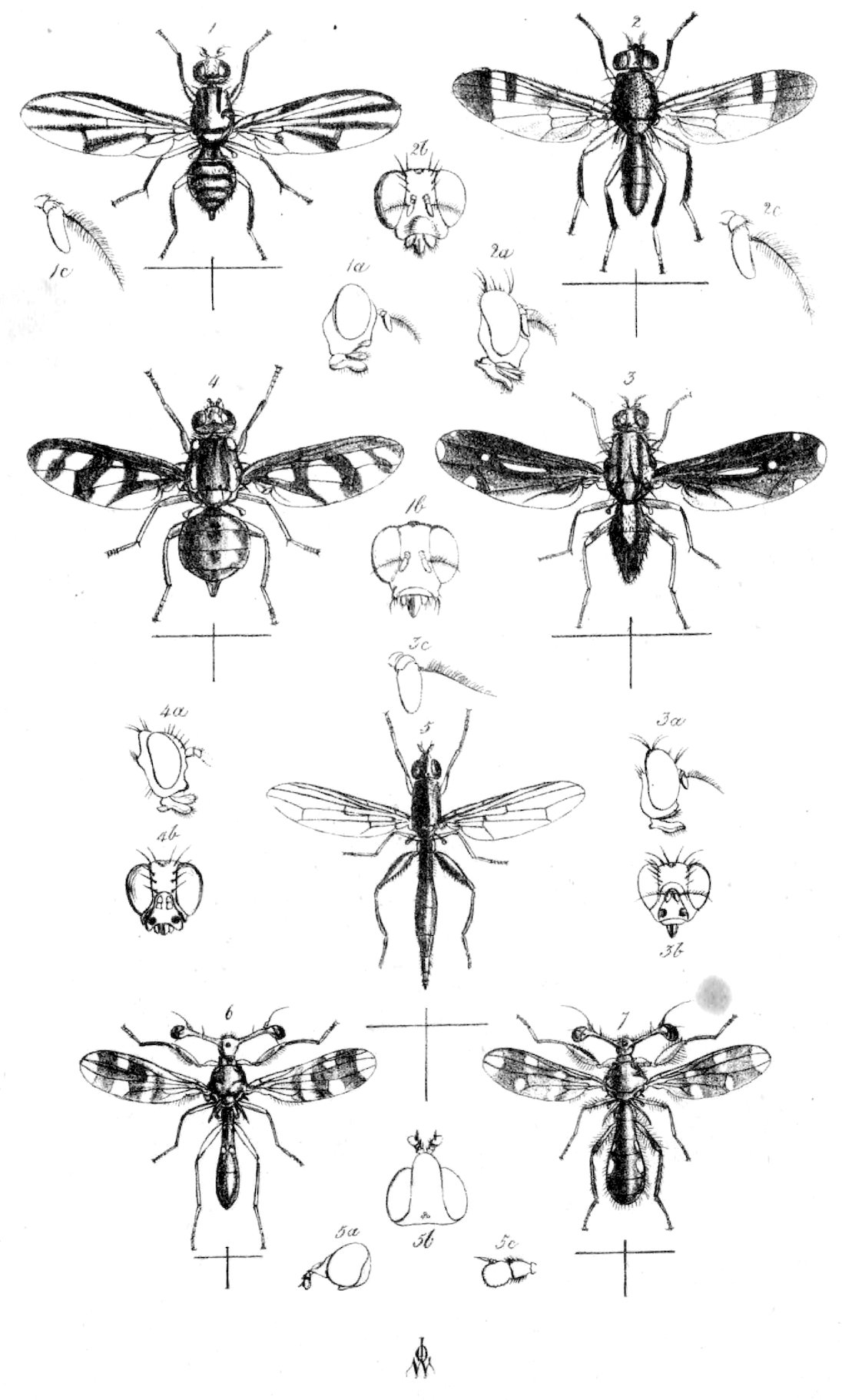
117. Diopsis quinqueguttata, n. s., fœm. Nigra, proboscide pedibusque
fulvis, his ex parte fuscescentibus, alis nigricantibus basi apice guttisque quinque
sublimpidis. (Plate II. fig. 7.)
Female. Black, shining. Proboscis tawny. Petioles of the eyes about half the
length of the thorax. Scutellum with two spines, which are more than half the
length of the thorax. Legs tawny, partly shaded with brown. Wings blackish,
nearly limpid at the base and at the tips, and with two interrupted nearly
37limpid bands, the first of two dots, the second of three dots; veins black. Length
of the body 3 lines; of the wings 4½ lines.
Mount Ophir.
118. Diopsis quadriguttata, n. s., mas. Picea, capite oculorun petiolis
pedibusque fulvis, his ex parte fuscescentibus, alis nigricantibus basi fasciâ
subapicali guttisque quatuor sublimpidis. (Plate II. fig. 6.)
Male. Piceous, shining. Head and petioles of the eyes tawny, the latter fully
half the length of the thorax. Scutellum with two spines, which are less than
half the length of the thorax. Legs tawny, slightly shaded with brown. Wings
blackish, nearly limpid at the base and towards the tips, except the extreme
part of the latter which is slightly blackish; two interrupted nearly limpid
bands, each composed of two dots; veins black. Length of the body 2½ lines;
of the wings 4 lines.
Malacca.
119. Calobata confinis, n. s., fœm. Nigra, capite cyaneo, antennis piceis, femoribus
posterioribus albo-cinctis, tarsis anticis albis, alis subcinereis fasciis
duabus connexis fuscis, 2a apicali.
Female. Black, dull. Head blue, shining. Proboscis and antennæ piceous. Posterior
femora with a white ring near the tips; hind femora with a white ring
at the base; fore tarsi white. Wings greyish, with two brown bands, the first
connected on the hind border with the second, which is apical; veins black.
Halteres whitish, with black knobs. Length of the body 7 lines; of the wings
10 lines.
Singapore and Mount Ophir.
120. Calobata immixta, n. s., fœm. Nigra, capite cyanescente, facialibus atris,
antennis piceis, pedibus testaceis anticis nigris, tarsis anticis albis, femoribus
posterioribus fasciis quatuor nigris, alis subcinereis fasciis duabus subconnexis
fuscescentibus, 2a apicali.
Female. Black, dull. Head bluish, shining; facialia deep black. Proboscis and
antennæ piceous. Legs testaceous; fore femora black, testaceous towards the
base; fore tibiæ black; fore tarsi white; posterior femora with four black bands;
posterior tibiæ; dull testaceous, black towards the base; posterior tarsi brownish.
Wings slightly greyish, with two brownish bands, the first slightly connected
on the hind border with the second which is apical; veins black.
Length of the body 5 lines; of the wings 10 lines.
Malacca.
121. Micropeza fragilis, n. s. Fulva, femoribus tibiisque anticis fuscis, tibiis
posterioribus basi apiceque fuscis, tarsis anticis posticisque albidis, alis subcinereis
guttis tribus apiceque limpidis.
Tawny. Fore femora and fore tibiæ brown; posterior tibiæ brownish at the
38base and at the tips, fore tarsi and hind tarsi whitish. Wings very slightly
greyish, with three limpid spots forming a curved band near the tips which
are also limpid; veins black. Length of the body 3½–4 lines; of the wings
5–6 lines.
Singapore and Mount Ophir.
122. Nerius fuscipennis, Macq. Dipt. Exot. ii. 3. 241. 1. pl. 325. f. 5.
Singapore and Mount Ophir. Inhabits also Java and the Philippine Islands.
Fœm. Corpus gracile, non setosum. Caput subproductum; facies brevis. Antennæ
epistoma attingentes; articulus 3us clavatus; arista pubescens, subapicalis.
Thorax subfusiformis. Abdomen lanceolatum, thorace angustius et duplò
longius. Pedes postici longi, femoribus incrassatis serratis, tarsis anticis subdilatatis.
Alæ angustæ.
Female. Body slender, without bristles. Head slightly produced, as broad as
the thorax; face short; epistoma not prominent. Antennæ extending to the
epistoma; third joint clavate; arista minutely pubescent, seated near the tip
of the third joint. Thorax subfusiform. Abdomen lanceolate, narrower than
the thorax and about twice its length. Anterior legs moderately long and
stout; fore tarsi slightly dilated; hind legs long; hind femora incrassated,
serrated beneath; hind tibiæ slightly curved. Wings narrow; subcostal vein
not extending to one-third of the length of the wing; mediastinal vein not
extending to half the length; radial extending to a little beyond three-quarters
of the length; cubital ending at very little in front of the tip of the wing;
discal transverse vein straight, upright, parted by less than its length from the
border, and by about thrice its length from the præbrachial transverse.
123. Texara compressa, n. s., fœm. Nigra, capite nigro-cyaneo subtùs cano,
antennis piceis, aristâ albidâ, alis subcinereis, halteribus albidis.
Female. Black. Head bluish-black, with hoary tomentum beneath. Antennæ
piceous; arista whitish. Wings greyish; veins black. Halteres whitish.
Length of the body 5 lines; of the wings 6 lines.
Singapore.