“Stranger! ponder here awhile;
Pause in Raglan’s ruined pile;
All that wealth and power, combined,
With skill to plan, and taste refined,
To rear a structure fit to be
The home of England’s Chivalry,
Was lavished here!—where, met in hall,
Mailed Barons kept their festival;
The night in lordly wassail spent—
The day in tilt and tournament:
Yet still, when England’s woes began,
Were first to arm and lead the van;
To shield the Monarch in his need,
In Freedom’s glorious cause to bleed;
To Loyalty surrendering all—
Then, with their falling King to fall!”
The Castle of Raglan is one of the most picturesque ruins in the
kingdom, and closely associated with a momentous period of our national
annals. Though roofless, tenantless, and dismantled, it still presents a
majestic and venerable aspect. No visitor of taste or sensibility will
ever traverse its spacious but long-deserted halls, without feeling a
deep interest in its eventful history.
It was on a bright autumnal evening that we quitted the comfortable
little inn, the “Beaufort Arms,” at Raglan, to make our first survey of
this baronial stronghold; and at that hour, and season of the year, it
was seen through its embowering trees in all its glory. Ascending the
gentle eminence on which it stands, we came to the outer gate, or
barbican, portions of which still remain, and crossing the ballium,
now covered with rich verdant pasture, we were received by the
intelligent Warden, who conducted us to the majestic gateway, and
pointed out to us, as we proceeded, the more imposing features of the
Castle, as they alternately met and receded from the eye.
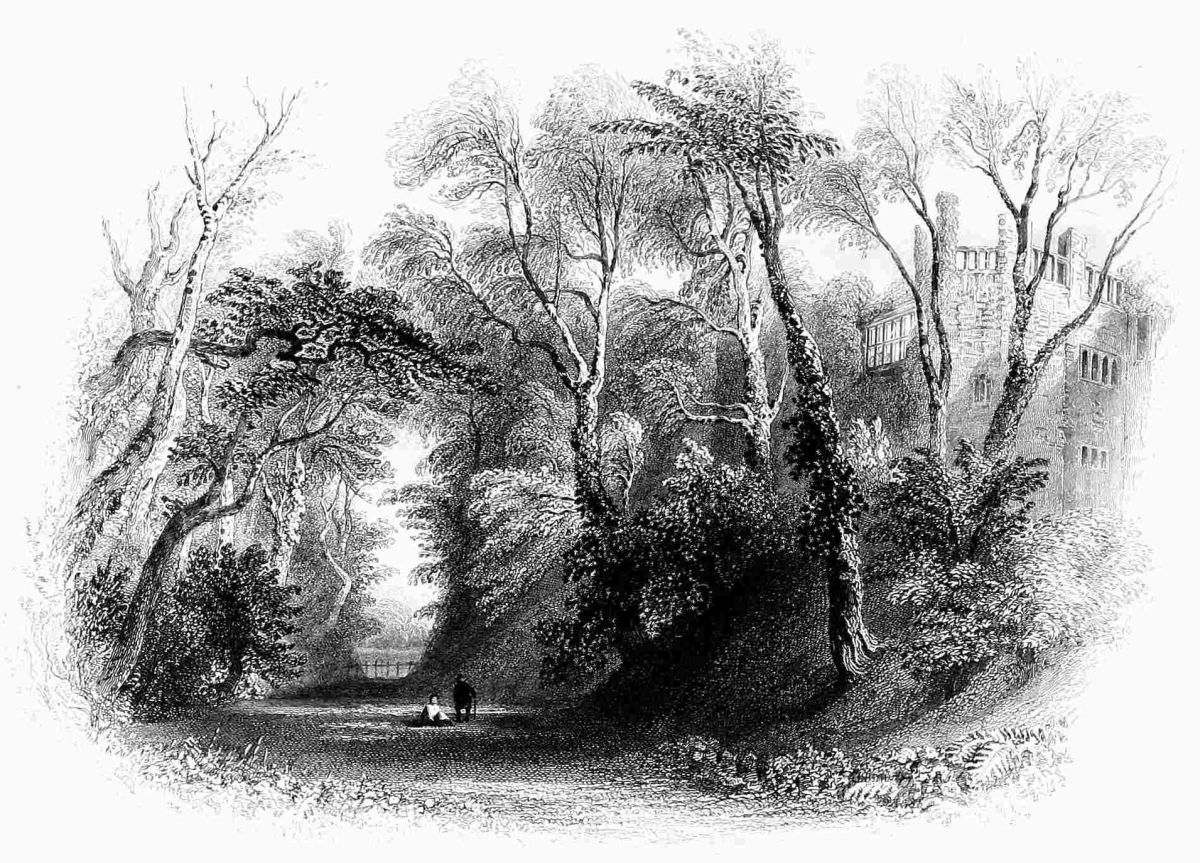
The Avenue.
Raglan Castle.
The vista through the Gateway, taking in the Great Court—once adorned
with statues and fountains, but now, like everything around it,
abandoned to the weather, is very striking; while the absolute silence
which pervades the scene, contrasts forcibly with its ancient stir and
splendour, and compels us, while fancy is peopling it with troops of
chivalry and their retainers, to exclaim, “Where are they?” A long
wooden table with benches, the last symbols of that hospitality for
which its noble owners were once conspicuous, stood on the grassy floor.
But these were no relics of the ancient banquet-hall, but of a modern
festive meeting, when the tenants upon the estates had met to express
their attachment to the noble Marquess and his family. The manner in
which the kitchen had been refitted for their entertainment, showed that
it must have been ‘got up’ in a style not unworthy of its feudal renown;
and, “as for the venison,”—
“Finer or fatter
Ne’er ranged in a forest, or smoked on a platter.”
We arrived, however, too late for the feast, though another, a much
simpler, and palatable treat awaited us—that which Nature, luxuriating
amidst the ruins of Art, had lavishly spread before us. Such piles of
masonry, such masses of ivy, were never before brought together! Here
and there, indeed, the sturdy ramparts looked through their leafy screen
with a sort of ghastly whiteness, like Hobbes’ spectre from behind the
yew-tree, or the bones of some enormous skeleton, upon which the kindly
hand of Nature had suspended her own green mantle. Nothing could be more
strikingly novel and picturesque. Along the vast framework of the
castle, on which the wealth and taste of centuries had been employed,
until its strength and beauty could receive no farther additions from
the hand of man, a straggling forest of vegetation expanded its mingling
branches. Under the same leafy covert, from the timid wren to the
ill-omened raven, birds of every feather had found a congenial roost.
From the sepulchral yew the moping owl looked out upon everything around
her as her own domain and cherished inheritance. Over our heads bats
performed their swift circles in the still twilight sky; while daws
chattered from the ancient keep, as if they had never heard a
musket-shot, nor felt the slightest apprehension of being disturbed in
their possession. On a lofty spray that overtopped every other tree, a
loving thrush serenaded his mate in the fragrant thicket below. Numerous
smaller birds, that seemed puzzled from the very abundance of the
accommodation where to fix their roost, kept up a constant fluttering
amongst the branches; while here and there was heard a bickering of
wings and twittering of bills, as if contending for possession of some
favourite branch for the night. Surely, we thought, there is room enough
here for all; and yet even there—among those spacious green arbours,
place and position were as eagerly sought and coveted by the feathered
tribes, as by the equally volatile and jealous retainers of a court.
At length all was seemingly adjusted; the stillness of night pervaded
the scene; the last shadows of twilight had faded into one common pall;
and night, attended by a host of sparkling satellites, took quiet
possession of the long line of courts that once swarmed with life and
enjoyment.
And now, between the western sky—that still retained some warm
lingering traces of sunset—and the donjon tower, mousing owls were seen
enjoying their solemn pastime, here swimming lazily through the arched
court, then along the battlements, or the margin of the clear glassy
moat; then soaring aloft, and settling for a minute or two among the
dark ivy; but still returning to make another circle and finding no
wings abroad but their own.
The contemplation of this Castle, at any period of the day, is
calculated to make a lasting impression; but when the rising moon shot
her mellow light through its old shattered casements, and the breeze
seemed to waken at the same instant and set all the ivy in motion, the
scene became still more impressive. Among the deep shadows that invested
the spacious courts, every prominent object was now brought suddenly
into view; and, with a little aid from fancy, the waving of plumes, and
the flashing of steel armour, seemed distinctly visible on the
battlements; while the fragments of crumbling masonry that lay scattered
below, as if struck by an enchanter’s wand, presented the semblance of
animated groups, that waited only the word of command to start into life
and motion. The stillness, too, which but half an hour before had
pervaded every court and tower, was succeeded by a soft rustling among
the leaves, that now flickered like quicksilver as the moonlight fell
upon them, and then lost itself in their massive branches; whilst the
shrubs and flowers that grew wild and vigorous in every court, or
clambered up the walls and archways, seemed to give forth their mingled
odours to the night wind, as it passed wooingly through their leaves,
and filled the air with incense.
“We seemed to tread on faëry land;
For, in every thing around us,
We felt the touch of a viewless hand,
And we heard the notes of a seraph band,
Whose magic spell had bound us;
While bright yclad, as in days of yore,
The Knight of Raglan strode before.”
The Pitched-court; the hall of state, with its magnificent bay-window;
the chapel; the fountain-court, with the grand staircase on the south
side opening upon it; then the elegant portal leading to the grand
terrace that overlooks Raglan church, were all traversed in succession,
with nothing to distract attention, or disturb the solitude, but the
whistle of a night-hawk, or the sound of our own footsteps on the
grassy carpet, that now forms the universal ‘pavement’ of these once
sumptuous apartments. For over the once tesselated floor, and the
tapestried walls, weeds have thrown an oblivious mantle, while—
“Ha, ha!” laughs the Ivy, “old Time to me
Hath given the glory and mastery!
So poets may sing, if it like them well,
From early matins till vesper bell;
And others may list to their minstrelsie—
I’ve a song of my own—so what care I?
Your castles, though stately, and strong, and tall,
I conquer them all—I conquer them all!”
But as the faint outline here sketched will be filled up when we take
the architectural features of the Castle in detail, we pass on to a few
preliminary remarks.
Grose, in his ‘Antiquities,’ observes that this castle is of no great
antiquity, having been founded, as he conjectures, about the close of
the fifteenth century, although many important additions were
subsequently added. In the time of Henry VIII., as Leland informs us,
Raglan, “yn Middle Venceland [Wentland], was a fair and pleasant castel,
with to goodlye parkes adjacent;” and “the laste Lord Herbertes,” as
Morgan told him, “builded all the best coffes of the Castle of Raglan.”
Camden, in his account of the Silures, or Monmouthshire, notices it very
briefly, as “a fair house of the Earl of Worcester’s, built
castel-like.”[197]
It is not stated by Grose on what authority he places Raglan Castle
among the strongholds erected in the time of Henry VII. His observations
can apply only to those portions of it which are comparatively modern.
The Citadel, or Yellow Tower of Gwent, is of unquestionable antiquity.
In the family history we are told that Sir John Morley, a military
knight, who lived in the time of Richard II., resided here as ‘lord of
Raglan Castle.’ But postponing this question at present, as one that
will be considered more fully when we come to examine the Castle in
detail, we shall merely observe that although, as it now appears, the
Castle does not indicate any more distant origin than the reign of Henry
V., yet traces may be discovered in various portions of towers built, or
reconstructed, during every subsequent reign, down to that of Charles
I.—with whose fate it is so painfully associated. Owing to the
circumstance named, the learned antiquary may discover ‘a disunion of
styles;’ but taken as a whole, the Castle of Raglan presents a
remarkable harmony of proportions that hides every minute discrepancy,
heightens the general effect, and leaves the spectator under a pleasing
conviction that, in design and execution, it is the work, not of many,
but of one master mind. But to this subject we shall return; and, in the
meantime, we proceed to give a brief sketch of
The Founders of Raglan.—By Mr. Jones the name of the founder is traced
to that of Sir William ap Thomas.[198] This date, however, is too
modern, and only a repetition of the conjecture thrown out by Grose.
There is every reason to believe that the Clares, as early as the
thirteenth century, had a castle at Raglan, the site, of which is now
occupied by the Citadel, or Tower of Gwent, erected probably in the
reign of Henry V. The above-named Sir William ap Thomas resided at
Raglan Castle during the reign of Henry V., who knighted him for his
valour in the wars of France. He married Gladys, daughter of Sir Richard
Gam, and widow of Sir Roger Vaughan,[199] by whom he had three sons and
a daughter. Of his eldest son, William, first Earl of Pembroke, we shall
speak hereafter. But of the old military Lords of Raglan, little of
historical interest has descended to modern times. From Richard
Strongbow, of whom a notice has been given in the preceding sketches of
Chepstow and Tinterne, Raglan descended to Walter Bloet, “in
consideration of soldiers, money, and arms,” furnished by him for the
expedition to Ireland, of which Strongbow was the leader. By the
marriage of the daughter and heiress of Bloet with Sir James Berkeley,
it passed into and remained in that ancient family until the reign of
Henry V., when it became vested in Sir William ap Thomas, already
mentioned; whose eldest son was created by Edward IV. Lord of Raglan,
Chepstow, and Gower, and commanded to assume the surname of Herbert, in
honour of his ancestor Hubert Fitz-Henry, chamberlain to King Henry I.
To this nobleman was entrusted the care of the Earl of Richmond,
afterwards Henry VII., who was for some time a prisoner in Raglan
Castle. Sir Hubert was created, in 1469, Earl of Pembroke, in
acknowledgment of his zeal to the house of York; but his career was
brief and disastrous, for having the same year raised a corps of
Welshmen, he marched against the Lancastrians under the Earl of Warwick,
and being taken prisoner at Dane’s Moor, was beheaded at Banbury on the
27th of July.[200] Of these calamitous events, the following account,
abridged from the old Chronicle, may not be unacceptable to the
reader:—
“King Edward hearing of these Northerne proceedings, and that his
brother and Warwicke were preparing against him, sent for the Lord
Herbert, whom he had created Earl of Pembroke, to be his general in the
North; and therefore accompanied with Sir Richard Herbert his brother,
and eighteen thousand well-furnished Welshmen, marched towards the
enemy; and after him was sent Humfrey Lord Stafford, with sixe thousand
archers, to second him in his warres. These lords meeting together had
notice by espials that the Northerne made towards Northampton; to
intercept whom, the Lord Stafford, lately made Earl of Devonshire, was
employed; and Sir Richard Herbert, who with two thousand horse layd
themselves covertly by the side of a wood, and suddenly set upon the
rereward, the rest having passed; but the Northerne very nimbly turned
about and bad the Welshmen such welcome, as few of them returned to tell
of their entertainment. The king understanding of this hard beginning,
mustered his subjects on every side, intending to cope with the
Northerne himself. And Earle Warwicke, as forward to advance his
fortunes, gathered his friends, with purpose to encounter with Pembroke
and his Welsh. But before any supplies came to either of them, it
chanced the armies to meete unawares upon a fair plaine called Dane’s
Moor, neere to the towne of Hedgecot, three miles from Banbury, and
presently fell to a bickering, wherein Sir Henry Nevill, knight, son of
the Lord Latimer, upon a lusty courage venturing somewhat too farre, was
taken prisoner; and notwithstanding he yielded himselfe to his takers,
was cruelly slaine; which unmartiall act rested not long unrepaied, with
the loss of most of the Welsh next day. For the field withdrawne, the
Lord Stafford repaired to Banbury, and there took his lodging, where his
affections were much enamoured vpon a faire damsell in the inne. But the
Earl of Pembroke coming to the same towne, tooke into the same inne,
and commanded the Lord Stafford to provide himself elsewhere, contrary
to their agreements made before. Whereat Stafford was displeased, and
departing thence with his whole band, left the Earl naked of men in the
towne, and disabled the field of the archers, whereby the day was lost
upon the king’s part, for which he shortly lost his owne head. The
Northerne, inflamed for the death of young Nevill, the next morning most
valiantly set upon the Welshmen, and by the force of archers drave them
from their ground of advantage, which Pembroke wanting supplied with his
own prowess; and Sir Richard, his brother, with his poll-axe twice made
way through the battell of the Northerne without any mortal or deadly
wound; so that by their valours it was verily supposed the field had
been wonne, had not John Clapham, an esquire and servant to Warwicke,
displayed his lorde’s colours with his white beare, and from an eminent
place cried, ‘A Warwicke! A Warwicke!’ Whereat the Welsh were so
terrified as they turned and fled, leaving their general and his brother
alone in the field, who, valiantly fighting, were encompassed and taken,
with the death of five thousand of their men. The Earl with his brother,
Sir Richard Herbert, were brought to Banbury, where, with ten other
gentlemen, they lost their heads, Conyers and Clapham being their
judges.
“This second victory thus got, and the Northerne men now fleshed under
the leadinge of Robbin of Riddesdale,[201] hasted to the king’s manor of
Grafton, where the Earle Rivers, father to the queen, then lay, whom,
with his sonne John, they suddenly surprised, and in Northampton strucke
off their heads without any judgment. The death of these lords the king
greatly lamented, and sought to revenge: first, therefore, writing his
commissions for the apprehension of Humfrey, Lord Stafford of
Southwicke, who, by diligent search, was found at Brentmarsh, and
beheaded at Bridgewater, as he worthily deserved. Next hee prepared a
mighty army, and with the same marched towards Warwicke, his company
encreasing ever as he went.”[202] In another Chronicle the same
disastrous events are thus related:—
“The Welshmen got first the West hill, hoping to have recovered the East
hill; which if they had obteyned the victorye had been theirs, as their
unwise prophesyers promised them before. The Northern men encamped
themselves on the South hill. The Erle of Pembroke and the Lord
Stafforde of Southwike were lodged at Banbery yᵉ day before yᵉ field,
which was St. James’s Day; and there the Erie of Pembroke put the Lord
Stafforde out of an inne wherein he delighted much to be, for the love
of a damosel that dwelled in the house, contrarie to their mutuall
agreement by them taken; which was, that whosoever obtained first a
lodging, should not be deceyved nor removed. After many great wordes and
crakes had betweyne these two captaynes, the Lord Stafforde in great
despite departed with his whole companye and band of archers, leaving
the Erle of Pembroke almost desolate in the towne, which with all
diligence returned to his hoste lying in the field unpurvoyed of
archers, abiding such fortune as God would sende and provyde.” In the
mean time, “Sir Henry Nevil, son to the Lord Latimer, tooke with him
certaine light horsemen, and skirmished with the Welshmen in the
evening, even before their campe, where he did divers valyaunt feates of
armes; but, a little too hardy, he went so farre forward that he was
taken and yeelded, and cruell slaine; which unmerciful acte the Welshmen
sore rued the next day or night. For the Northern men being inflamed,
and not a little discontented with the death of thys nobleman, in the
mornyng valyauntly set on the Welshmen, and by force of archers caused
them quickly to descende the hill into the valey, where both the hostes
fought.”
In this hot encounter, “the Erle of Pembroke behaved himselfe like a
hardy knight, and an expert capitaine; but hys brother, Syr Richard
Herbert, so valyauntly acquited himselfe, that with his poll-axe in his
hand, as his enemies did afterwards report, he twice by fair force
passed thorough the battaile of his adversaries, and without any mortal
wound returned. If everye one of his felowes and companions in arms had
done but halfe the actes which he that daye by his noble prowess
achieved, the Northerne men had obteyned neither safetie nor victorie.”
The chronicler then relates the circumstance which threw the Welshmen
into a panic, by which they lost five thousand men, and then records the
result with touching simplicity:—
“The Erle of Pembroke, Sir Richard Herbert,[203] his brother, and divers
were taken, and brought to Banbery to be behedded. Much lamentacion and
no lesse entreatie was made to save the lyfe of Syr Richard, both for
hys goodlye personage, which excelled all men there, and also for the
noble chivalrie that he had shewed in the fielde the day of the
battaile; insomuch that his brother, the Erle, when he should lay downe
his head on the blocke to suffer, says to Sir John Conyers and
Clapham—‘Maisters, let me die! for I am old; but save my brother,
which is yung, lustie, and hardie, mete and fit to serve the greatest
prince of Christendome.’
“But Coniers and Clapham remembering the death of the yung knight, Syr
Henry Nevill, cosyn to the Erle of Warwicke, could not hear on that
syde; but caused the Erle and his brother, with divers other gentlemen
to the number often, to be there behedded.”[204]
William, eldest son of this unfortunate nobleman, succeeded to the
earldom of Pembroke, and was retained by the king to serve him in his
wars of France and Normandy for one whole year, with forty men-at-arms
and two hundred archers. But the king, being desirous to dignify his son
Prince Edward with the title of Earl of Pembroke, procured a resignation
of the same from this William, and in lieu thereof created him Earl of
Huntingdon, on the fourth of July, 1479. Four years later he was
constituted, by Richard III., Justice of South Wales, and entered into
covenants with the king to take Dame Catharine Plantagenet, his
daughter, to wife, before the feast of St. Michael following; as also to
make her a jointure in lands to the value of two hundred pounds per
annum: the king undertaking to settle upon them and their heirs male,
lands and lordships of a thousand marks per annum. But this lady dying
in her tender years, it is likely that this marriage did not take
effect. He afterwards wedded Mary, the fifth sister of Woodville, Earl
Rivers, by whom he had an only daughter, at whose marriage with Sir
Charles Somerset, the Castle of Raglan, and its dependencies, passed
into the family of Worcester.
From the genealogical history of that house we collect the following
particulars:—The Sir Charles here named was a natural son of Henry,
third Duke of Beaumont, famous in his day for his desperate assault of
the Castle of St. Anjou, in which he put three hundred Scots to the
sword, and hanged all the Frenchmen therein. He was afterwards Governor
of the Isle of Wight, and of Calais; was finally taken prisoner at the
battle of Hexham, and there beheaded by Nevil for his adherence to the
house of Lancaster. At his death his son Charles assumed the name of
Somerset, and being a person of abilities attained to great wealth and
honours under Henry VII.,[205] who entered him of his Privy Council,
made him Constable of Helmsley Castle, Admiral of the Fleet, sent him as
ambassador with the Order of the Garter to the Emperor Maximilian, made
him a Banneret, Knight of the Garter, and Captain of the Royal Guard. On
a second embassy to Maximilian, he concluded two treaties—gave a bond
for the payment of £10,000 in aid of the Emperor against the Turks, and
in support of the Christian religion. Living in high favour with his
sovereign, his good fortune was established by his marriage with
Elizabeth, heiress of William Herbert, Earl of Huntingdon, in whose
right, in 1506, he bore the title of Lord Herbert of Raglan.
On the accession of Henry VIII. he continued in the same high offices;
and having, with six thousand men, attended the king into France, in
1513, he was present at the taking of Therrouenne and Tournay. For his
heroic conduct in this campaign, he received the office of Lord
Chamberlain for life; and finally, on account of his descent from John
of Gaunt, and alliance to the king by blood, he was advanced the
following year[206] to the dignity of Earl of Worcester.
By his will, dated March 24, 1524, he ordered his body to be buried
beside that of his first wife in the chapel of Our Lady, now called
Beaufort Chapel, in the Castle of Windsor. He directed that, in case he
departed this life at Raibo, in London, or near the river Thames, his
body should be conveyed by water to the said church at Windsor, as
privately as might be, without pomp or great charge of torches, or
clothing, hearse, wax, or great dinner; but only that twenty men of his
own servants should each have mourning and bear a torch; and that the
bier, or herse, should be covered with black cloth, and have a white
cross upon it.
Henry, the second Earl of Worcester, who, during his father’s lifetime,
had distinguished himself in the king’s service, and been knighted by
Charles Brandon, Duke of Suffolk, was appointed one of the commissioners
for concluding a peace with the French. Departing this life in 1549, he
was buried in the church of Chepstow, where a costly monument—already
noticed—was erected to his memory.[207]
William, his eldest son, and third Earl of Worcester, accompanied the
Marquis of Northampton into France, to present King Henry II. with the
royal insignia of the Garter. And again, in 1573, he was sent by Queen
Elizabeth as her representative at the christening of a daughter of
Charles IX., on which occasion, in the name of his royal mistress, he
presented a font in pure gold. He married Christian, daughter of Lord
North of Earthlodge.
Edward, his only son and heir, was sent ambassador to the Court of
Scotland, to offer the Queen’s congratulations to King James on his
return from Denmark; and ten years later he was appointed Master of the
Horse. At the accession of King James, he continued in the same office,
and was also named one of the commissioners for executing the office of
Earl-Marshall, the Duke of Norfolk being then under sentence in the
Tower.[208] He was afterwards Lord Privy Seal; and dying on the third of
March, 1628, ætatis 79, was buried in the family vault in Windsor
Castle.[209]
In his youth, as recorded by his colleague Sir Robert Naunton, “this
earl was a very fine gentleman, and the best horseman and tilter of his
times, which were then the manlike and noble recreations of the Court,
which took up the applause of men, as well as the praise and
commendation of ladies. And when years had abated these exercises of
honour, he grew then to be a faithful and profound counsellor. He was
the last liver of all the servants of her favour, and had the honour to
see his renowned Mistress, and all of them, laid in the places of their
rest; and for himself, after a life of very noble and remarkable
reputation, he died rich, and in a peaceful old age—a fate that befel
not many of the rest; for they expired like lights blown out—not
commendably extinguished—but with the snuff very offensive to the
standers by.”[210] Sandford describes him as “a great favourer of
learning and good literature.”
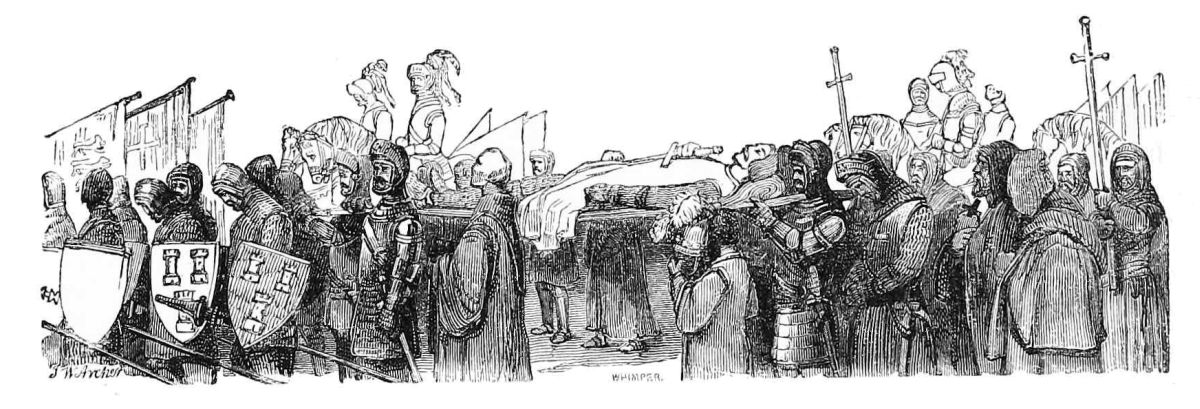
Procession.—Morning of the Tournament.
Henry, his son, the fourth earl, married Anne, daughter of John Lord
Russell, heir apparent to the Earl of Bedford; and, in 1642, was
created Marquess of Worcester. And this brings us down to the period,
when the family fortunes—like the fortress they inhabited—were
destined to undergo a lamentable change.
As the civil commotions increased, the Marquess fortified his castle of
Raglan, and there entertained his Sovereign with unbounded magnificence.
Such were his unlimited sacrifices to the royal cause, that the king,
fearing lest the garrison stores should become exhausted by his numerous
suite, offered to invest him with powers to exact supplies from the
neighbouring country. But with great magnanimity Worcester replied—“I
humbly thank your Majesty; but my castle would not long stand, if it
leant upon the country. I had rather myself be brought to a morsel of
bread, than see one morsel wrung from the poor to entertain your
Majesty.” But of this more fully when we describe the royal visit and
the Siege.
From these brief introductory notices of the lives and services of the
primitive lords of Raglan, we proceed to give a few sketches of life, as
it generally passed in the retirement of their own domains, in the midst
of their friends and retainers at Raglan Castle.
Baronial Life.—Of the expenses of a nobleman’s family and household in
the olden time, some idea may be formed by adverting to the facts
adduced by writers of the day. In a letter from the Earl of Shrewsbury,
who had the custody of Mary of Scotland, to the Marquis of Winchester,
and Sir Walter Mildmay, it is said—“May it please you to understand,
that whereas I have had a certain ordinary allowance of wine, amongst
other noblemen, for expenses in my household, without impost: the
charges daily that I do now sustain, and have done all this year past,
well known by reason of the Queen of Scots, are so great therein, as I
am compelled to be now a suitor unto you, that you will please to have a
friendly consideration, unto the necessity of my large expenses. Truly
two tuns in a month have not hitherto sufficed ordinarily; besides
that which is sacrificed at times for her bathings, and such like use;
which seeing I cannot by any means conveniently diminish, my earnest
trust and desire is, that you will now consider me with such larger
proportion in this case, as shall seem good unto your friendly wisdoms,
even as I shall think myself much beholden for the same. And so I commit
you unto God. From Tetbury Castle, this 15 of January, 1569. Your
assured friend to my power.—G. Shrewsbury.”[211]
“This passage,” Mr. Lodge observes, “will serve to correct a vulgar
error, relating to the consumption of wine in those days, which, instead
of being less, appears to have been—at least in the houses of the
great—even more considerable than that of the present time. The good
people who tell us that Queen Elizabeth’s maids of honour breakfasted on
roast beef, generally add, that wine was then used in England as a
medicine, for it was sold only by apothecaries. The latter assertion,
though founded on a fact, seems to have led to a mistake in the former;
for the word apothecary [from the Greek αποθήχη, a repositorium] is
applicable to any shopkeeper, or warehouseman, and was probably once
used in that general sense.”[212] In the retinues and domestic
attendance[213] of the nobles of this period, everything proclaimed that
the era of feudal authority and magnificence had departed. Accordingly,
when the civil wars had commenced, no peer, however wealthy or high in
rank, could drag after him a regiment, or even a company, of unwilling
vassals to the field. On the contrary, the meanest hind was free to
choose between king and parliament. Something, however, of the mere pomp
of feudalism was still maintained in the domestic establishments of the
nobility and wealthier gentry. “The father of John Evelyn, when he was
sheriff of the counties of Surrey and Sussex,[214] had a hundred and
sixteen servants, in liveries of green satin doublets, besides several
gentlemen and persons of quality, who waited upon him, dressed in the
same garb.”
One of the largest, if not the very largest, of English establishments
ever maintained by a subject, was that of the Lord Treasurer, the Earl
of Dorset,[215] heir of the Lord Buckhurst, and well-known poet of the
court. It consisted of two hundred and twenty servants, besides
workmen attached to the house, and others that were hired occasionally.
The chief servants of the nobility—so they were called, but they were
rather followers or clients—were still the younger sons of respectable,
or even noble families, who attached themselves to the fortunes of a
powerful patron, and served him either in court or military affairs,
for which they were allowed separate retinues in men and horses, with
gratuities in money, and promises of promotion.[216] The progress of
improvement that had banished minstrels, jugglers, and tumblers, from
princely establishments, had naturally introduced the drama in their
room; and, accordingly, we sometimes find a company of actors classed
among the servants of the chief noblemen, as well as a family physician,
or even a whole band. A steward, distinguished by a velvet jacket, and a
gold chain about his neck, presided as marshal of the household, and
next to him was the clerk of the kitchen. But these cumbrous appendages
were daily lessening, as domestic comfort came to be better understood.
This improvement, however, had commenced still earlier among those of
less rank and pretension. All who had their fortune still to seek in the
court, or in the army, and all who repaired to the metropolis in quest
of pleasure, found, so early as the time of Elizabeth, that the bustle
and the scramble of new and stirring times, made a numerous train of
attendants an uncomfortable appendage. The gallant, and the courtier,
therefore, like Sir John Falstaff, studied “French thrift,” and
contented himself with a single “skirted page,” who walked behind him
carrying his cloak and rapier.[217]
In consequence of the extravagant living introduced during this period,
the spendthrift gentleman often sank into the serving-man, as we may see
from the frequent recurrence of such a transformation in the old plays.
When servants were out of place—as we learn from the same authentic
pictures of the real life of the times—they sometimes repaired to St.
Paul’s Churchyard, the great place of public lounge, and there stood
against the pillars, holding before them a written placard, stating
their peculiar qualifications, and their desire of employment.[218]
“But whatever retrenchment,” observes the same author, “might be making
in the household expenditure by a diminished attendance, it was more
than counterbalanced by an extravagance in dress, and personal ornament,
that had now become an absolute frenzy.” It is said that King James
almost daily figured in a new suit, a humour that soon became prevalent
among his courtiers. Still more generally influential than his own
example was that of his several handsome favourites, all of whom having
been indebted for the royal favour merely to their personal attractions,
spared no pains nor cost to give those natural advantages their full
effect.[219]
When Buckingham was sent ambassador to France, to bring the Princess
Henrietta to England, he provided for this important mission a suit of
white uncut velvet and a cloak, both set all over with diamonds, valued
at eighty thousand pounds, besides a feather made of great diamonds. His
sword, girdle, hatband, and spurs, were also set thick with diamonds.
Another suit which he prepared for the same occasion, was of purple
satin, embroidered all over with pearls,[220] and valued at twenty
thousand pounds. In addition to these, he had twenty other dresses of
great richness. As a throng of nobles and gentlemen attended him, we may
conceive how their estates must have been impoverished by the purchase
of chains of gold, ropes of pearl, and splendid dresses, befitting the
retinue of such an ambassador. Even a court festival, of the time of
James the First, must have made a perilous inroad upon a year’s amount
of the largest income. Thus, at the marriage of the Princess Elizabeth
to the Palatine, Lady Wotton wore a gown profusely ornamented with
embroidery, that cost fifty pounds a yard; and Lord Montague spent
fifteen hundred pounds on the dresses of his two daughters, that they
might be fit to appear at court on the same occasion.[221]
The following letter—which we quote from a work of great merit and
research—unfolds much of the domestic ‘economy’ and habits of a family
of distinction during this reign. It is addressed to William, second
Lord Compton, by his wife, soon after their marriage:—
“My Sweet Life—Now I have declared to you my mind for the settling of
your state, I suppose that it were best for me to think and consider
within myself what allowance were meetest for me. I pray and beseech you
to grant to me, your most kind and loving wife, the sum of £2,600,
quarterly to be paid. Also, I would, besides that allowance, have £600,
quarterly to be paid, for the performance of charitable works; and these
things I would not, neither will be, accountable for. Also, I will have
three horses for my own saddle, that none shall dare to lend or borrow:
none lend but I; none borrow but you. Also, I would have two
gentlewomen, lest one should be sick, or have some other let. Also,
believe it, it is an undecent thing for a gentlewoman to stand mumping
alone, when God hath blessed their lord and lady with a large estate.
“Also, when I ride a hunting or a hawking, or travel from one house to
another, I will have them attending; so for either of these said women,
I must and will have for either of them a horse. Also, I will have six
or eight gentlemen; and I will have my two coaches, one lined with
velvet to myself, and four very fair horses; and a coach for my women,
lined with cloth and laced with gold; otherwise with scarlet, and laced
with silver; with four good horses. Also, I will have two coachmen, one
for my own coach, the other for my women.
“Also, at any time when I travel, I will be allowed not only caroches
and spare horses for me and my women; but I will have such carriages as
shall be fitting for all; orderly, not pestering my things with my
women’s; nor theirs with either chambermaids; nor theirs with washing
maids.
“Also, for laundresses, when I travel, I will have them sent away before
with the carriage, to see all safe. And the chambermaids I will have go
before, that the chamber may be ready, sweet, and clean. Also, for that
it is indecent to crowd up myself with my gentleman-usher in my coach, I
will have him to have a convenient horse, to attend me either in city or
country. And I must have two footmen. And my desire is that you defray
all the charges for me.
“And for myself, besides my yearly allowance, 1 would have twenty gowns
of apparel, six of them excellent good ones, eight of them for the
country, and six other of them very excellent good ones. Also, I would
have, to put in my purse, £2,000 and £200, and so you to pay my debts.
Also, I would have £6,000 to buy me jewels, and £4,000 to buy me a pearl
chain. Now, seeing I have been, and am, so reasonable unto you, I pray
you do find my children apparel and their schooling; and all my
servants, men and women, their wages.
“Also, I will have all my houses furnished, and my lodging-chambers to
be suited with all such furniture as is fit; as beds, stools, chairs,
suitable cushions, carpets, silver warming-pans, cupboards of plate,
fair hangings, and such like. So, for my drawing-chambers, in all
houses, I will have them delicately furnished, both with hangings,
couch, canopy, glass, carpet, chairs, cushions, and all things thereto
belonging.
“Also, my desire is that you would pay your debts, build up Ashley
House, and purchase lands: and lend no money, as you love God, to my
Lord Chamberlain, who would have all—perhaps your life—from you.... So
now that I have declared unto you what I would have, and what it is
that I would not have, I pray you, when you be an earl, to allow me
£2,000 more than I now desire, and double attendance.”[222]
Prodigality in feasting and riotous living soon became as conspicuous as
extravagance with regard to dress. In proof whereof, we may mention the
ante-suppers of the epicurean Earl of Carlisle. Weldon informs us, that
he gave a banquet to the French ambassador at Essex House, where fish of
such huge size were served up, and which had been brought all the way
from Russia, that no dishes in England could hold them, until several
were made for the express purpose. The household expenditure of James
the First was twice as much as that of his predecessor, amounting to a
hundred thousand pounds annually.[223]
Country Life.—While such were the habits of the courtiers, the country
aristocracy still followed that kind of life so much familiarized to our
minds by the descriptions in the old songs and plays of “the golden days
of good Queen Bess.” The rural knight, or squire, inhabited a huge
building—half house, half castle—crowded with servants in homespun
blue coats, many of whom were only serviceable in filling up the blank
spaces of the mansion; but as these had been born in his Worship’s
service, it was held as a matter of course that they should live and die
in it.
“The family rose at daybreak, and first of all assembled at prayers,
which were read by the family chaplain. Then came breakfast; after which
the master of the household and his sons got into their saddles, and
went off to hunt the deer, followed by some score of mounted attendants;
while the lady and her daughters superintended the dairy, or the
buttery, prescribed the day’s task for the spinning-wheels, dealt out
bread and meat at the gate to the poor, and concocted all manner of
simples for the sick and infirm of the village. If leisure still
remained, the making of confections and preserves was a never-failing
resource; independently of spinning and sewing, or perhaps embroidering
some battle or hunting piece, which had been commenced by the housewives
of a preceding generation.”
At noon dinner was served up in the Great Hall, the walls of which were
plentifully adorned with stags’ horns, casques, antique brands, and
calivers. The noisy dinner-bell, that sent the note of warning over the
country, gave also a universal invitation and welcome to the hospitable
board; and after dinner sack, or home-brewed ‘October,’ occupied the
time until sunset, when the hour of retiring to rest was at hand.
Such was the ordinary history of a day in the country mansion. When the
weather prevented out-door recreation or employment, the family library,
containing some six or eight tomes, that had perhaps issued from the
press of Caxton, or Wynkyn de Worde, was in requisition; and, if the
members of the family could read, they might while away the hours in
perusing these volumes for the twentieth time. In this fashion, they
derived their knowledge of religion from the Bible, and the “Practice of
Piety;” their Protestantism and horror of Popery from “Fox’s Acts and
Monuments;” their chivalrous lore from “Froissart’s Chronicles,” or,
perchance, the “Merry Gests of Robin Hood;” their historical erudition
from “Hall” or “Hollingshed;” and their morality and sentiments from
“the Seven Wise Masters,” or the “Seven Champions of Christendom.”[224]
Holidays.—In such a state of life the set holidays were glorious eras;
the anticipation, the enjoyment, the remembrance of a single Christmas
or birthday, furnished matter for a whole month of happiness. On such an
occasion the lord of the manor was more than a king, as he proceeded
with his family through the crowds of assembled peasants, to witness
their games of merriment, and feats of agility or strength; for his
smile inspired the competitors with double strength or swiftness; while
the prize acquired a tenfold value because it was he who bestowed it. At
evening, his bounty was expressed by oxen roasted whole, and puncheons
of mighty ale, with which he feasted the crowd; while his house was
thrown open to the throng of his more immediate acquaintances and
dependents. After the feast, his hall was cleared for dancing; three
fiddlers and a piper struck up; and as the “mirth and fun grew fast and
furious,” the strong oaken floor was battered and ploughed in all
directions by the hobnailed shoes of those who danced with all their
might, and with all their hearts.[225]
Such was the life of an old country gentleman when James succeeded to
the crown of England. But these habits, the last relics of the
simplicity of the olden times, did not long survive that event. Tidings
of the gay doings at court, and the wonderful good fortune of the royal
favourites, reached the ears of the aristocratic rustics; and from that
moment rural occupations and village maypoles lost their charm. The
young were impatient to repair to the metropolis; and the old were
obliged to yield to the prevailing fashion. With all the fierce
impetuosity of novices, rural esquires, and well-dowried country widows,
rushed into the pleasures and excesses of a town life; and thus, with a
rapidity hitherto unknown in England, and at which moralists became
giddy, ancient manners were soon abandoned; fortunes, that had
accumulated for generations, vanished; the hereditary estates of
centuries became the property of men of yesterday; and the time-honoured
names of some of the most ancient families disappeared from the scroll
of English heraldry, and soon ceased to be remembered.[226]
When Charles came to the throne, “the coldness of his character and his
decorous habits discountenanced those coarse and profligate excesses;
and the courtiers endeavoured to conform to something like the rules of
external decency. A general sobriety of demeanour succeeded.” “But, as
the stern ascetic Puritans grew into power, and advanced to the
destruction of the monarchy with prayer and fasting, the court party
soon became eager to distinguish themselves by an entirely opposite
behaviour. All the excesses of the former reign were resumed; and
Charles found himself unable to restrain, or even to rebuke, his
adherents, who swore, drank, brawled, and intrigued, to show their
hatred of the enemy, and their devotedness to the royal cause.”[227]
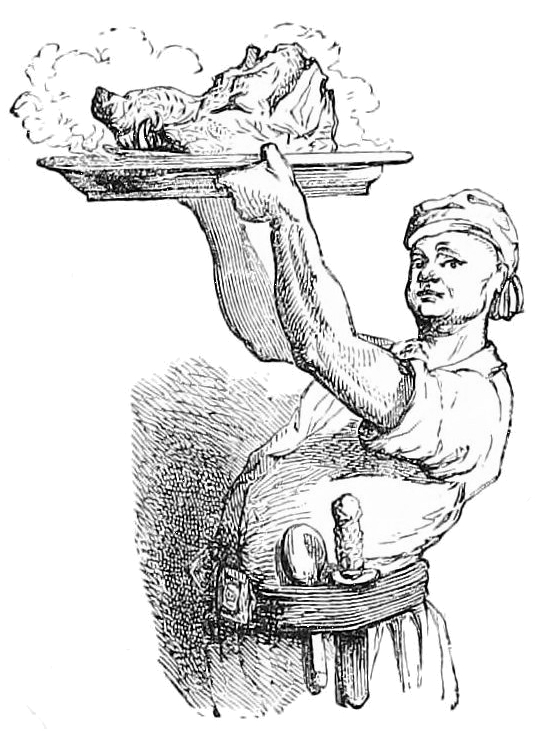
Life at Raglan.[228]—Down to this eventful period, the castellated
mansion of Raglan had continued to bask in the sunshine of prosperity.
Its halls were frequented by the elite of rank and station, and by many
of that intellectual aristocracy whose genius threw so much lustre upon
that and the preceding reign. The Earl, whose revenues were princely,
lived in a style becoming the representative of an illustrious race; and
while he observed great state, and gave sumptuous banquets to the
magnates of the land, he did not neglect the humble votaries of the
Muse.
Household.—The following record is taken from a “List of the Household
and method of living at Raglan Castle,” previous to the visit of Charles
the First:—
“At eleven o’clock in the forenoon the castle gates were shut, and the
tables laid—two in the dining-room; three in the hall; one in Mrs.
Watson’s apartment, where the chaplains eat (Sir Toby Matthews being the
first); and two in the housekeeper’s room for the ladies’ women.
“First.—The Earl entered the dining-room, attended by his gentlemen. As
soon as he was seated, Sir Ralph Blackstone, steward of the house,
retired. The comptroller, Mr. Holland, attended with his staff, as did
the sewer, Mr. Blackburne; the daily waiters, Mr. Clough, Mr. Selby, Mr.
Scudamore; and many gentlemen’s sons, with estates from two hundred to
seven hundred pounds a year, who were bred up in the castle; my lady’s
gentlemen of the chamber, Mr. Morgan and Mr. Fox. At the first table sat
the noble family, and such of the nobility as came there.
“Second.—At the second table in the dining-room sat knights and
honourable gentlemen attended by footmen.
“Hall.—In the hall, at the first table, sat Sir Ralph Blackstone,
steward; the comptroller, Mr. Holland; the secretary; the master of the
horse, Mr. Dolowar; the master of the fish-ponds, Mr. Andrews; my Lord
Herbert’s preceptor, Mr. Adams; with such gentlemen as came there under
the degree of a knight, attended by footmen, and plentifully served with
wine.
“Second Hall.—At the second table in the hall—served from my lord’s
table, and with other hot meats—sat the sewer, with the gentlemen
waiters and pages, to the number of twenty-four.
“Third.—At the third table, in the hall, sat the clerk of the kitchen,
with the yeomen officers of the house, two grooms of the chamber and
others.
“Other Officers of the household were—chief auditor, Mr. Smith; clerk
of the accounts, George Whithorn; purveyor of the castle, Mr. Salisbury;
ushers of the hall, Mr. Moyle and Mr. Cooke; the closet-keeper;
gentleman of the chapel, Mr. Davies; keeper of the records; master of
the wardrobe; master of the armoury; master-grooms of the stable for the
war horses, twelve; master of the hounds; master falconer; porter, and
his man; two butchers; two keepers of the home park; two keepers of the
red deer park; footmen, grooms, and other menial servants to the number
of one hundred and fifty. Some of the footmen were brewers and bakers.
“Out-officers were—the steward of Raglan, William Jones, Esq.; the
governor of Chepstow Castle, Sir Nicholas Kemys, Bart.;[229] housekeeper
of Worcester House, in London; James Redman, Esq.; thirteen bailiffs;
two counsel for the bailiffs to have recourse to; solicitor, Mr. John
Smith.”[230]
Among other distinguished individuals, who at this time filled offices
in the household of Raglan, was the Earl’s—and soon afterwards the
Marquess’s—chaplain, Dr. Thomas Bayly; to whom we owe those amusing
“Apophthegms of the Marquess of Worcester,” published at the
Restoration, and from which we take the following farce, in the
chaplain’s own words, as presenting a characteristic picture of the
times, when the Castle had become the scene of extraordinary
festivity:—
“I cannot tell whether it was upon the marriage of my Lord Edward
Herbert with the Earl Caernarvon’s sister, or the Lord Montague with the
Marquis of Worcester’s daughter, that there happened this merrie
passage, or mock wedding, as an echo to the voices that were heard in
Hymeneus’ chappel, between those lovely couple—think which you
please—who had newly left being wholly themselves, by being half of
each other; viz., one of those two pair of lovers had no sooner united
two hearts into one, and had seated themselves by one of the too many
proprieties belonging unto the honourable state of matrimony, viz. the
boord; but this Tom Deputy, an old bachelour, chanced to cast his eye
upon a pretty piece of waiting-woman, one of the appurtenances to this
honourable bride. Her, this jovial Tom, having whetted his wit by the
side of the marriage-bowle, fixes upon, being enabled sufficiently
thereby to follow any humour, as a fit subject to make their ladiships
some sport; which happened to be so suitable to the occasion, and so
well performed, that it soon captivated the cares also of all the
masculine nobility.
“Thus encountering the faire bride—‘Madam, you have the prettiest piece
of necessity yonder, at the side-table, that I know not how any man can
be without a wife that may have her for asking. Madam, will you give her
me? I protest I will marry her, and fancy myself to be a lord, and
herself a lady. “My mind to me a kingdom is;” which shall make her a
sufficient joynture.’
“‘Tom, Tom,’ said the Marquess, ‘such men as you and I, whose joynts are
enfeebled with the strokes of many years, must not think to winne young
maides, by promising to make them joyntures of the mind. But will you
make her deputy of Deputy Hall? and landlady of all the land that is
belonging to it? and Mrs. of all the stock that is upon the land, and
goods that is within the house? Answer me this, and then you shall heare
what my daughter and her woman will say unto you.’
“‘With all my heart,’ said Tom; ‘and all the hoggs and poultry that is
about the house to boote; and she shall sleep upon six feather beds.’
“‘Why, then, it shall be a match,’ said the lady, ‘with all my heart.’
“‘Give me your hand, madam,’ sayes Deputy; ‘I will have her, if there be
no more evills in the world.’ And presently he makes his addresses to
the pritty little gentlewoman of the said table; who had heard all the
discourse, and was persuaded, then, upon his approach, to answer his
humour with a condescention at the first word, and informed that he was
an old rich bachelor; he accosting her after this manner—‘This pritty
moppit, now thy lady hath given her consent that I shall have thee, if
thou saist so too, we’ll be married as soon as they.’
“‘With all my heart, and thank you too,’ said the young gentlewoman.
“‘By my troth, a match,’ said he; ‘give me thy hand—‘tis done. I’ll
break such a jest this day as I never broke in my life.’
“‘Aye; but do not break your promise,’ said the gentlewoman.
“‘What! before all this company?’ said Deputy; ‘that were a shame.’
“Up he goes again to the lady, and tells her that they were agreed. My
lady drank to him upon the same condition. He pledged her, and wished
the wine might be his poison if he did not marry her after dinner. The
lady, willing to prefer her woman to such a fortune, held him to his
word, and required performance of his promise, giving her many and high
commendations.
“Tom went not from any part of his promise, onely the time excepted; and
that in regard he meant to buy himself some wedding clothes. The
Marquess, willing to remove that obstacle, told him that he thought
his clothes would fit him; and bid him goe unto his wardrope, and take
what he had a mind to. ‘Give me your key,’ said Tom. It was delivered
unto him. Up went he, and then came down with his bever hat, sattin
cloke, laid with plush, dawb’d with a gold and silver lace, suite of the
same, silk stockings, with roses and garters suitable, inside and
outside, capope, all as brave as if he carried a lordship on his back.
“The lady-bride then takes her woman aside, and dresses her in one of
her richest and newest gownes—that should have made every day of that
week sensible of an exchange—with all things answerable thereunto; not
without some store of slight jewels; and brings her down, as glorious as
the morne, that breaks from the eastern hill, and chases night away.
“They look upon one another, and all upon them both. Tom cries out, ‘I
had best be in good earnest, my lady.’ Said my lady, ‘I thought you had
been in sober sadness.’ ‘Neither, madam,’ said the new bridegroome.
‘But, old Tom, I hope,’ said the lady, ‘you will not make me take all
this paines for nothing?’ No, by no means,’ saith he; ‘if ever we
repent, we will sell our fine cloathes and buy cattle! It is better
being a lord for a week, than a slave for ever. Come thy wayes,’ quoth
he—
‘How happy is the wooing
That is not long a doing!’
“Well—married they were, in the greatest pomp and ceremony; and the
Queen of Beauty took delight in leading the eyes of the vulgar, which by
this time were altogether fixed on the ladye of the May. Tom acted his
scene of mirth in the hall—which proved to be a thing of that
convenience, as if it had been an act of some set policie, to keep the
crowd out of the parlour that the masquers might have roome enough to
dance in.
“At last, when the masque was ended, and time had brought in supper, the
‘Cushine’ led the dance, out of the parlour into the hall, and saluted
the old-new-made bridegroome and his lady, leading them into the
parlour, to a table which was furnished with the same allowance that was
allotted for all the nobles, where they were soon forced to sit down
first—Tom taking upon him as much good cheer as they could give him.
“In fine, supper being ended, the Marquess of Worcester asked the
Lady-bride, ‘If she had a hundred pounds about her?’ She answered, ‘No,
my lord, but I can send for as much.’ ‘I pray do,’ said the Marquess;
‘but it must be all in gold.’ She sent for it, and presented it to her
father; who pulled out another purse of an hundred pieces, and put the
two hundred pieces in the bason, saying, ‘Madam, if you do not give
earnest, Deputy will tell you in the morning, that he married your woman
but in jest.’ Whereupon some gave fifty, others forty; some gave twenty,
others ten; the least gave five gold pieces, who sat at the table—in
all, £700. The apparel and other gifts, amounting to no lesse a value
than one thousand pounds; which so transported the old man, that he
protested, ‘that now he was in the humour, he would marry all the
waiting gentlewomen they had; one every day in the week, as long as the
wedding lasted.’ My Lord Marquess replied, ‘Ay, but Tom, you should have
added, “at this rate.”’...
“Not to be too tedious, the man—what with bounty, and what with that
which was as free to every man, as was their purses unto him, which was
good wine—the man was not himself when he should have gone to bed.
Which being related to my lord, his lordship took occasion to tell the
company the story of the beggar, who was made believe he did but dreame
of the happiness which really happened; and, thereupon, the marquess was
desirous to make experiment whether it could be related in the person of
old Thomas. In order whereto, he gave command that my friend Thomas
should be disrobed of his neat wedding garment, the rest of his fine
clothes taken from him, and himself carried unto his old lodging in the
porter’s lodge; and his wife to respite the solemnisation of the
marriage, until his comportment should deserve so faire an
admission—the which was done accordingly.
“The next morning made the experiment to answer the height of all their
expectations; for news was brought unto the Marquess—all the rest of
the lords and ladies standing by—that Tom took all yesterday’s work but
for a dream; or, at least, seemed to do so to humour the fancy.... But I
should be endlesse,” says Bayly, “if I should relate unto you the sport
that this fellow made.
“To conclude: The Marquess called them both before him, and delivered
unto them the money, with many good exhortations to them both, thus
moralizing upon the premises”—in a strain very characteristic of that
day:—
“‘That which was first in intention, is oftentimes, both with God and
man, the last in execution. As, for example, God had, before all worlds,
determined to show his love for mankind, by wedding his onely Sonne to
his Church; so
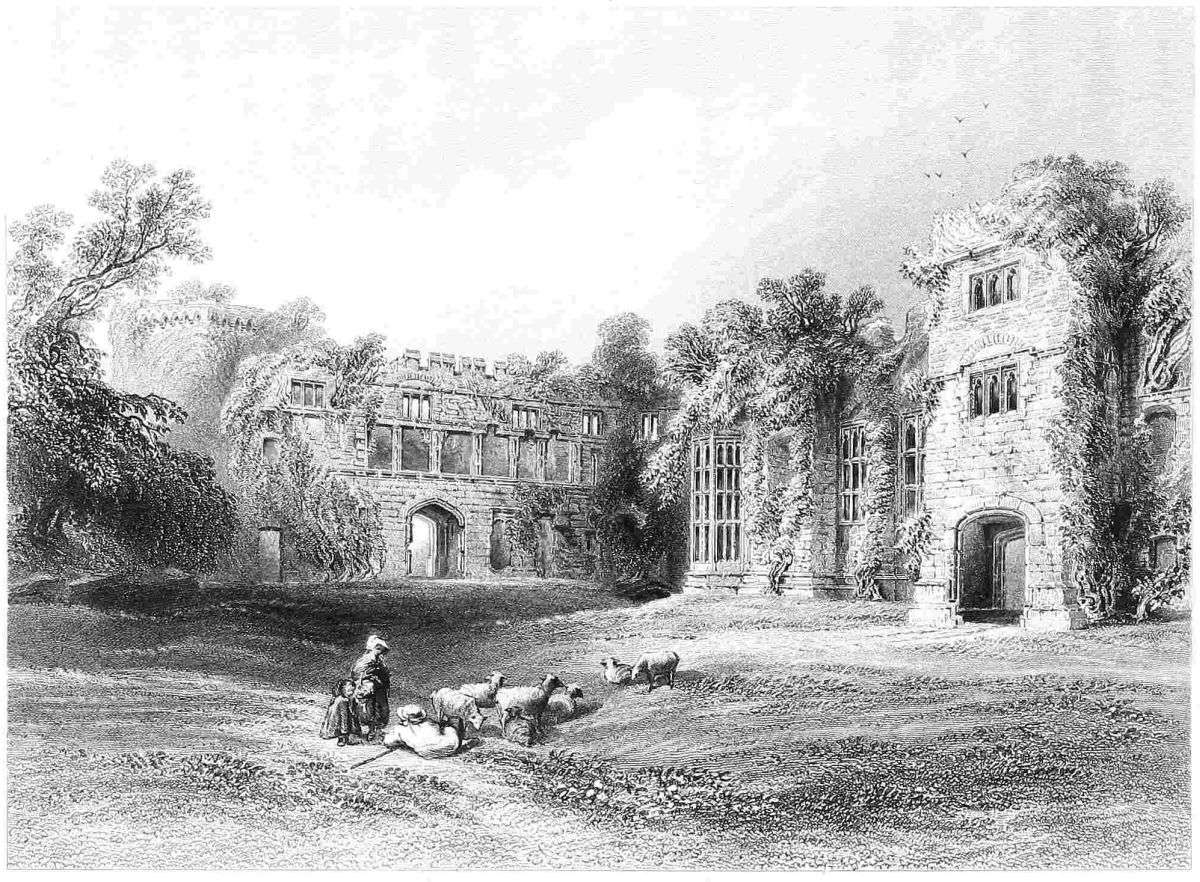
The Paved Stone Court.
Raglan Castle.
that thus much we have gained already, viz., that the marriage that was
made in paradise between Adam and Eve, though it was the first in time,
yet it was but secondary to the first intention; and he that said,
“Before Abraham was, I am,” was also before Adam was; and though the
first marriage was but a type of the second, yet the second, according
to the aforesaid intention, was an antecedent to the first. God, who
having an intention to wed his Sonne to his beloved spouse, the Church,
gave way to this type, or figure, or—to bring the similitude a little
homer—mock-wedding, which was between Adam and Eve, whom to make appear
more worthy and glorious in the eyes of his beloved, and all other
creatures, he arrayed with full majesty, and the robe of righteousness.
His mercy—the lady and empress of all the glorious attributes of
God—arrais this type and figure of his Church with the robe of
innocence, and gives them both a large proportion of his grace. These
blessings, Adam, by tasting the forbidden fruit, lost with his paradise,
and slept in death. Gentlemen,’ concluded the Marquess, ‘I will not make
any application hereof, lest I may seeme to mistrust your wisdomes; but
I have nothing to say to the woman.’”[231]
The preceding is certainly a very curious passage in the history of
A potent, grave, and reverend signior.
It reminds one of some parts of Don Quixote and of Rabelais—all but the
sermon at the close—which may have been imitated from one of the old
“Mysteries” then in vogue. But to these “Apophthegms” and Dr. Bayly, the
“martial chaplain” of the household, we may return in a subsequent
portion of the work. In the meantime, we shall take a survey of Raglan
Castle, as it now appears, and then proceed to a narrative of the Royal
Visits.
Architectural Details.—Of the strength, beauty, and attractions of this
stronghold—which we are now to examine with some degree of
minuteness—a quaint old poet[232] has thus recorded his admiration:—
A famous Castle fine
That Raglan hight, stands moated almost round;
Made of free-stone, upreight, as straight as line,
Whose workmanship in beauty doth abound,
With curious knots, wrought all with edged tool:
The stately Tower that looks o’er pond and poole;
The fountaine trim, that runs both day and night,
Doth yeald in shew a rare and noble sight.
This description, of course, applies to times long before the guns of
Fairfax had made a breach in the Yellow Tower; and while the Castle,
with all its regal appendages, was the cherished abode of its
illustrious owner—a repertorium of the fine arts, and the seat of
unbounded hospitality. At no period of its history, however—not even
while it was inhabited by worth and beauty, enriched with the precious
works of art, and seemed to enclose within its walls an earthly
paradise—at no period did it ever present so many features to fascinate
the mind and eye of Taste as at this moment.
And “Why is it”—inquires one of the ablest writers of the day—“Why is
it that we feel so poetical a sympathy with the great men of ages long
past? Why do castles please most when they are dismantled, and palaces
when they are in ruins? Why is an old battle-field rather improved than
otherwise by a crop of standing corn? Because we can imagine nobler
things than we can see. Because the heroic deed, not vile flesh and
blood, is the impersonation of the hero. We should be rather displeased
at meeting the Iron Duke walking to a pedometer on the field of
Waterloo. We would doubt whether on the plain of Marathon we could be
reconciled even to the ghost of Miltiades. Greatness shines more
brightly when it is abstracted from the man.”
We will now, as proposed, take the building in detail, beginning with
the grand entrance, and proceeding onward, until we have completed the
circuit of the walls, the inner apartments, battlements, terraces, and
outworks. On these prominent features we shall dilate with more or less
minuteness according to the interest of the subject—but always
directing the reader’s attention more especially to those portions which
have been chosen as subjects of illustration.
Grand Entrance.—Here a magnificent and imposing spectacle bursts upon
the eye—three pentagonal towers, crowned with battlements, and bearing
on their mutilated outline marks of the cannon-shot directed against it
by the besiegers. These, however, are less defaced than any other
portions of the ruin, and are now invested with a luxuriant mantle of
ivy, lichen, and parasitical plants, as if Nature interposed to protect
the venerable edifice from further outrage and decay. In the gateway are
grooves for two portcullises. The two pentagonal towers on the right and
left were appropriated to the inferior offices of the castle.
Immediately behind these were rooms occupied by the garrison, or
household troops. Adjoining these on the right, was the third pentagonal
tower, called the Closet Tower; and on the left again were the officers’
apartments, which were demolished during the operations of the siege.
Gateway.—Between the two foremost of the pentagonal towers,
above-named, the great portal—a work of imposing strength and fine
gothic proportions—opens into the second court. Halting under the
archway, the curious visitor will examine, with mingled pleasure and
surprise, the fine architectural details; the groined ceiling; its lofty
span; its fine proportions, in which grace, strength, and beauty are
eminently combined: while the deep grooves, worn smooth by the working
of the double portcullis, show how readily this hospitable gateway
could be transformed, when occasion required, into an impenetrable
barrier, and employed as a destructive engine of war. The old apartments
in the gateway tower are correctly represented in the following
woodcut—
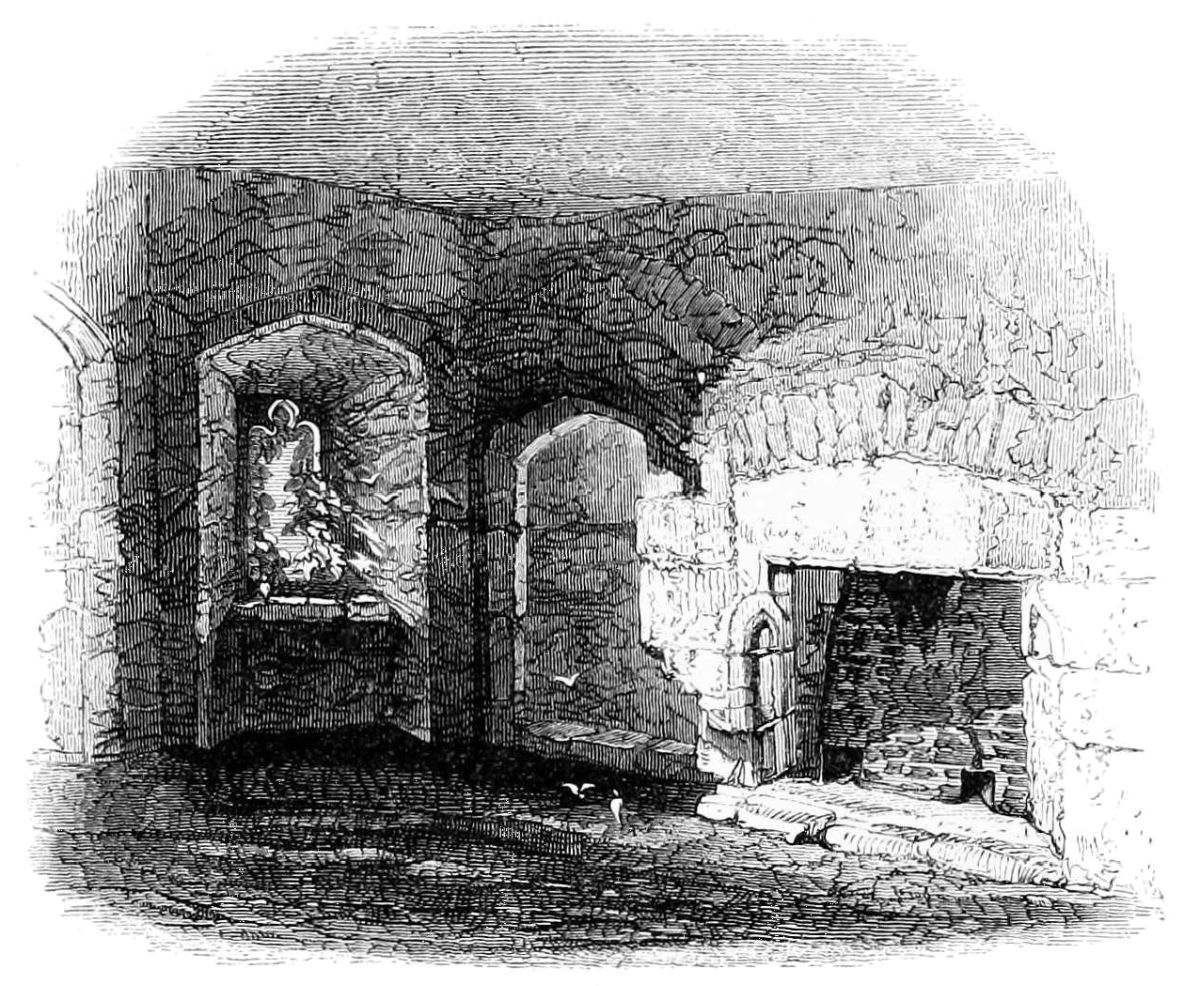
In a vaulted room in the east tower there is a remarkable echo; and
thither musical parties frequently resort during the fine season to
spread their pic-nic, and exercise their vocal powers. This apartment is
considered to have been the prison to which captives, or hostages of
distinction, were formerly consigned;[233] and certainly no place in the
Castle presents an air of more “hopeless security.” In the court
below—as represented in a former woodcut—several pieces of ancient
armour, and some heavy cannon shot, are shown to the visitor, as
illustrative of the times to which they belong. The next compartment is
The Paved Court.—All the buildings on the right of this court,
particularly the Closet Tower—the third pentagonal tower at the
entrance—suffered greatly from the enemy’s cannon during the siege; and
here, on the north-east side of the wall, the breach was effected that
hastened the capitulation. The Pitched, or Paved Court, the area of
which was once the parade ground, thronged with armed men, as they
joined in some military fête, or entered on some warlike preparation for
the siege, is now surrounded by only crumbling walls, and as verdant as
a bowling-green. The towering battlements are all richly festooned with
ivy. Every crevice sends forth its trees and shrubs, that seem to
luxuriate in the old mortar; and under the same canopy of leaves, as
already noticed, birds of song and birds of ill omen congregate
together. At the extremity of the Paved Court, on the right, as we
proceed westward, and from the point marked by a seat under a shady
ash-tree, the visitor obtains an imposing view of the architecture on
the south side, which, with all its dilapidations, is eminently
picturesque. “Its boundary is there hung with the richest tapestry that
Nature can weave—a mantling vestment of evergreen—through which
appears, in grand proportions, the majestic window of the Hall of
State.” This is a prominent feature in the steel engraving.
The Kitchen.—At the extremity of the court, and opposite to the portal,
is an archway leading to the kitchen, which occupies the area of a
pentagonal tower, projecting beyond the walls northward, and of narrow
compass, but great solidity and strength. In an office adjoining is an
extensive fireplace, the arch of which, thirteen feet in the span, is
formed by two massive stones. The wide capacious chimney is worthy of
notice. Beneath the kitchen is a room in perfect preservation, called
the Wet Larder, which may be easily reached by a subterranean passage.
From the kitchen a passage leads southward across the lower end of the
Pitched Court to the Buttery, and this again to the common
Dining-Hall, or Parlour.—This apartment measures forty-nine feet in
length by twenty-one in breadth, with an opening at the east end into a
narrow cross passage, which also communicates, by three openings or
doors, with the great Hall, which lies between the Pitched Court and the
Chapel, and occupies nearly the whole space between this dining-hall and
the Officers’ Tower, at the great entrance. Adjoining these is the
Baronial Hall.—This stately apartment, running parallel with the
ancient chapel, occupies the interval between the two inner courts, and
measures sixty-six feet in length by twenty-eight in breadth. The chief
indications of its original grandeur consist in the majestic
proportions—all of elegant design and masterly execution. The great
bay-window is a feature that cannot fail to excite admiration; and were
no other left entire, it would serve to convey a very distinct picture
of that feudal magnificence which was in character with the splendour of
its architecture. The fireplace, ten feet wide by eight feet high, is
well adapted to the size of the apartment, and to those times when,
instead of pit-coal, the branches or bole of a tree blazed on the winter
hearth.
Arms.—The arms of the Marquisate of Worcester, cut in stone, but much
obliterated, adorn the eastern wall; for the noble badge was an
offensive object to the republicans; and, on their taking possession of
the castle, it was probably
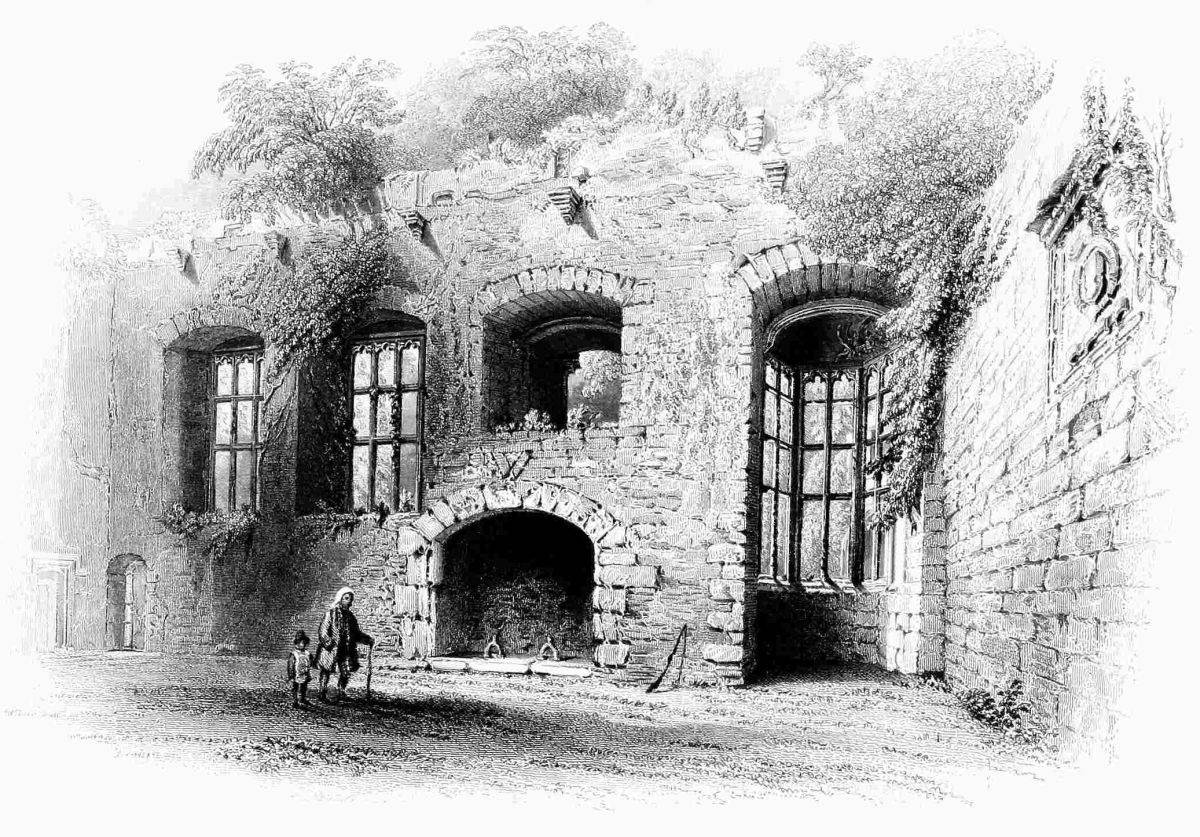
The Baronial Hall.
Raglan Castle.
used as a target,[234] and thus wantonly defaced. Over the fire-place,
as shown in the engraving, is the letter W. worked in brick.
Roof.—The geometrical roof, which once covered this noble hall, is
allowed by all writers on the subject to have been of admirable
construction. It was of Irish oak of the best quality, nicely adjusted,
elaborately carved, and so ingeniously framed and fastened together,
that the whole appeared as firm as if it had been chiselled out of a
solid block; yet withal so lofty, so light and airy in appearance, that
it seemed rather to be suspended from the sky above, than to rest upon
the corbel heads and walls which it covered and adorned. In the centre
was a gothic louvre adorned with painted glass, through which the
descending light streamed upon the assembled guests—their arms,
dresses, and accoutrements, in all the colours of the rainbow.
At the lower end of the hall is the Buttery, an apartment, thirty-two
feet long by eighteen broad; and attached to this is another of equal
dimensions, called the Pantry.
Officers’ Barracks.—Opposite the door of the great Hall, on the south,
was a range of apartments, used as lodgings for the superior officers of
the garrison. During the siege these were razed to the ground by the
enemy’s artillery; so that the area on which they stood is now
confounded with that of the Fountain Court. The latter apartments are
distinct from those already described.
The Chapel.—The Baronial Chapel stands in the rear of the apartments
named. It is a long narrow structure, running parallel with the great
Hall, and forming the north side of the Fountain Court; but the vestiges
that remain convey no distinct notion of its architectural style and
decorations; which were, no doubt, in harmony with other sacred
buildings of that age and its character of a baronial chapel. If,
however, we may form any opinion from two rudely carved stone
effigies[235] projecting from the wall on the north side, and nearly
covered with ivy, we should form but a very unfavourable estimate of its
ornamental sculpture: unless, indeed, the deformity they exhibit be the
result of wilful violence; and as they are at a good height, and not
approachable in the ordinary way, we had no means of ascertaining the
fact by close inspection. But the corbel heads, from which the arches
sprung, do not appear to justify a more favourable opinion; for the
workmanship exhibits neither skill in the design, nor spirit in the
execution. The Chapel, therefore, was of a date perhaps much anterior to
the surrounding buildings, and coeval with that of the Keep, or “Tower
of Gwent,” a work of the eleventh century.
The Fountain Court.—This court was formerly adorned with an equestrian
statue, mounted on a lofty pedestal, and embellished with a
fountain—the water for which was brought at great expense from the
neighbouring hills—and, after being thrown up in jets-d’eau, was
conveyed into the fish-ponds adjoining, so as to combine in its progress
the useful with the ornamental. But the pedestal, the marble basin, and
the statue, with every other fragment of the structure, have
disappeared. The pipes that conveyed the water have been ploughed up in
the fields adjoining the castle; but the classic beauty of the fountain
lives in the history and traditions of the place: and from a laughable
incident related in the “Apophthegms,” and which will be found in
another portion of this work, we may infer that the Marquess of
Worcester took great pleasure in this kind of embellishments.[236]
South-west Tower.—Ascending the flight of steps commencing at the grand
entrance, on the south side of the court, we were conducted through the
desolate apartments, known traditionally as those occupied by Charles
the First, after his flight from Naseby. This tower, and the whole range
of apartments connected with it, are in a state of complete
dilapidation; and were it not for the wooden scaffolding that secures
and facilitates the visitor’s progress, a tour of the ramparts would be
impracticable. A lady, we were told, who happened to be near this spot
during a rather high wind, was blown over the wall; but an umbrella,
which she had fortunately open in her hand, acted like a parachute, and
broke her fall; and thus she alighted among the shrubs beneath without
sustaining any material injury.
In these royal apartments, we were shown a tunnel, like a chimney, in
the wall of the king’s chamber, communicating with the outer rampart, by
means of which, in case of surprise or danger, the royal fugitive could
have been lowered in a basket, and enabled to make his escape beyond the
walls. Had a similar contrivance existed at Carisbrook, it would have
served his purpose better. But there he was indeed a prisoner. Here he
had the lives and services of a whole garrison at his command; with
Worcester himself, the most devoted friend the king ever possessed, to
provide against every danger, and supply every want.
A light and elegant stone window is here pointed out as that to which
the king often resorted, on account of the richly variegated and
extensive view which it commands of hill and dale, wood and water;
trees, hamlets, and farmhouses, covering a rich and well-cultivated
tract of land. These natural beauties are as fresh as ever; while the
splendid building, from which he then
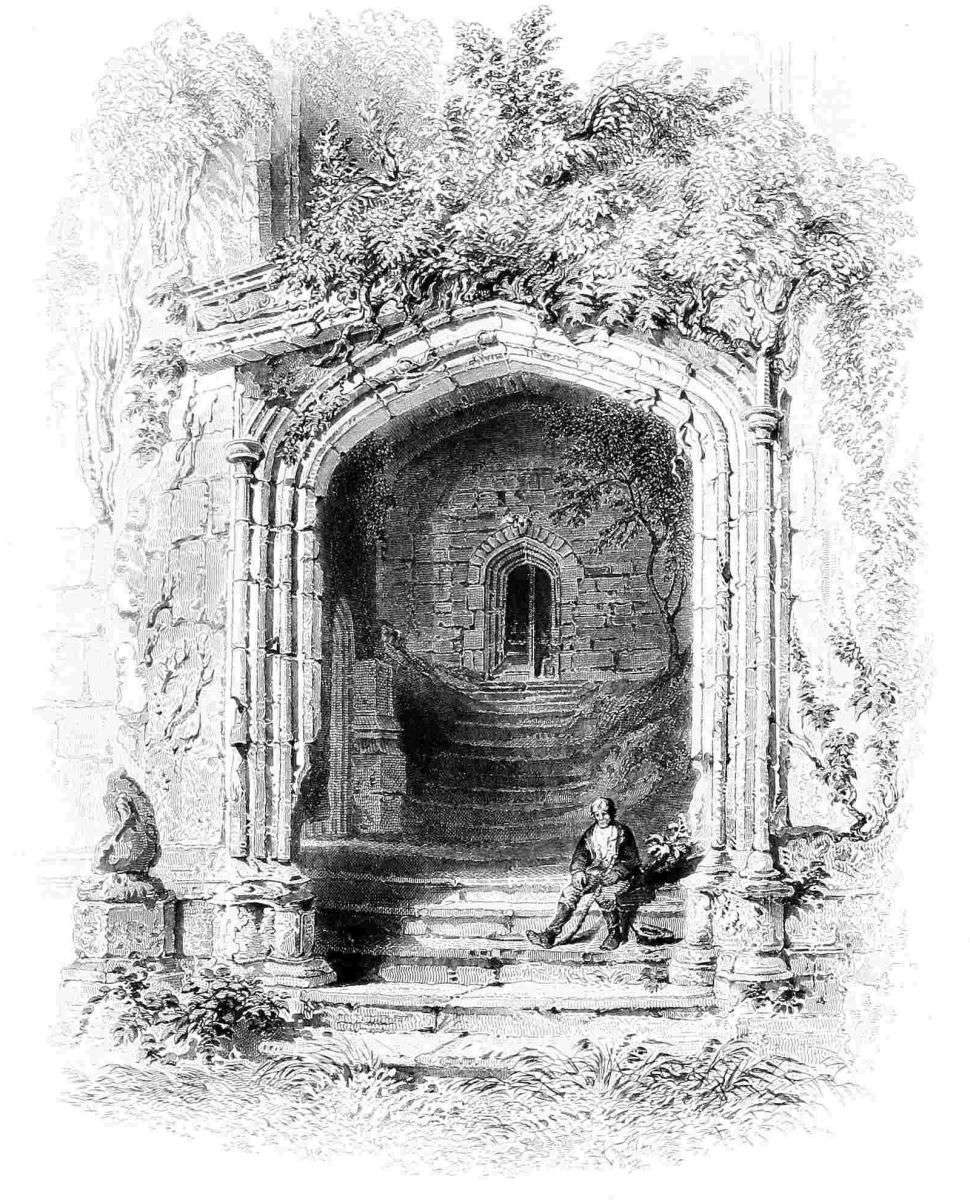
Gateway in the Fountain Court.
Raglan Castle.
contemplated the scene, is reduced to a lonely ruin—thus apostrophized
by the muse of Bloomfield:—
“Majestic Raglan! harvests wave
Where thundering hosts their watchword gave;
When cavaliers, with downcast eye,
Struck the last flag of loyalty!”
The Cellars.—These subterranean receptacles are of vast extent; and, in
massive strength and proportions—like a crypt under a cathedral—are
worthy of the noble edifice that covers them. In times of danger, and
particularly during the siege, they appear to have served the manifold
purposes of cellars, storehouses, larders, magazines, and muniments of
war, with provisions for a numerous garrison and household.
At the north-eastern part of the court, the buildings were nearly all
mutilated, or thrown down by the enemy’s batteries, which, from a rising
ground in the line of his approach, played with destructive force upon
this portion of the walls. Fragments, however, still remain to show the
predominant features of the Castle—its strength and beauty. From this
point, we are told, communication with the citadel was secured by means
of a sumptuous arched bridge, with a gate to correspond. But of these no
distinct vestiges are left. The “sumptuous bridge” is replaced by a
rustic structure of wood; the moat it spans is half filled with decayed
vegetables and debris; and the water, that formerly enclosed the Keep
like a wall of crystal, is now covered with a sluggish green surface,
that exhibits a very different kind of life.
In other parts of the moat, however, it is deep and transparent, mostly
so at the south corner, where masses of verdure—with a particularly old
and very picturesque tree, as shown in the illustration—are reflected
as if in a mirror. This is probably the most interesting point of view
in the whole Castle. Of a still summer evening, about sunset, the
outline of the gray towers and battlements, with all their contrasted
features of light and shade, beauty and decay—here fringed with wood,
and there displaying honourable scars—sleeps on the face of the water
like an inverted picture. The scene, with all its singular
accompaniments, has then a dreaminess of romance about it, similar to
that which the Fata Morgana conjures up on the Straits of Messina—but
with this important difference, that the scenery here, however romantic,
is real and substantial; that all we behold is the work of Art, over
which Nature has only thrown her splendid illusion of cloud, sunshine,
and exuberant vegetation.
Tower of Gwent.—This tall and massive structure, built as if to defy
the united force of time and violence, forms the Citadel or Donjon-Tower
of the fortress; and points very expressively to those remote times,
when the peace of a great man’s household depended on the strength of
his walls, and the number and courage of his retainers. In a direct
line with this Castle were three gates; the first of brick, from which,
at the distance of one hundred and eighty feet, and with an ascent of
many steps, was the White Gate, built of square stone. At some distance
on the left stands the Melin y Gwent, or Yellow Tower of Gwent, which
for strength, height, and workmanship, surpassed most other towers, if
not every other, in England or Wales. It had six sides, each thirty-two
feet wide, and ten feet thick, built of square stone, and in height five
stories. Its battlements, never meant to resist cannon shot, are only
eight inches thick; but so symmetrical and compactly set, that they
appear as if cut out of a solid block. During the siege—hereafter to be
described—this portion was soon demolished by the batteries directed
against it by Fairfax; but his heaviest guns, eighteen and twenty
pounders, took no more effect on the body of the tower, than if they had
opened upon a solid rock.[237] Our ancestors appear to have been
particularly well skilled in the composition of their cement, which in
Raglan is now nearly as hard as the stones it holds together. When the
Goths and Vandals of the country—the blind instruments of Fairfax—were
summoned to demolish with their pickaxes what the besiegers’ cannon had
spared, their republican zeal was attended with little success; for
“after battering of the top,” they were obliged, as we shall see, to
desist from that method as fruitless, and adopt other means for its
destruction.[238]
This Tower communicated with the Castle by means of an elegant arched
bridge encircled by an outer wall, with six arched and embattled
turrets, all of square stone. Adjoining this was a deep moat, thirty
feet broad, and supplied by a clear running stream, from which the
water-works, so much the fashion in those days, threw up columns of
water as high as the Castle battlements. Along the edge of the moat, was
a commodious sunken walk, embellished with grotto-work, statues of the
Twelve Cæsars, and otherwise ornamented with the choicest productions of
Nature and Art. This was the walk to which the family could resort at
all seasons, whether for exercise or meditation. Within the walls and
the green adjoining—then the bowling-green, and twelve feet higher than
the walk—was a garden plat, the size of which was proportioned to the
tower. Next to this plat—as shown in the accompanying
ground-plan—stood the Barn.
In casting the eye over the whole circuit of these buildings, the mind
is astonished at the immense labour which must have been exerted to
collect together such a quantity of materials of various descriptions.
And here it may
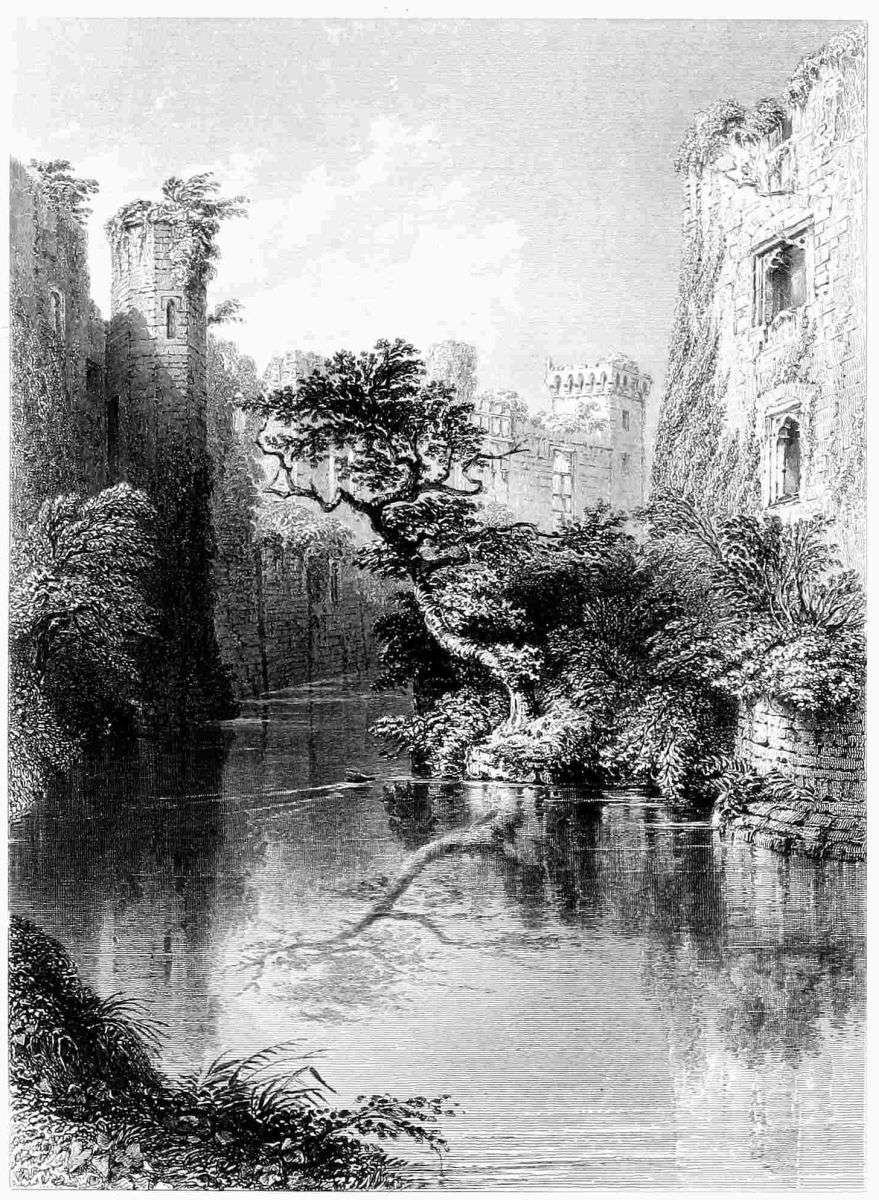
be observed that the majority of these baronial mansions are situated
on, or near, the bank of some navigable river, for the purpose of
defending some important pass or fortress, by means of which the
carriage of stone is attended with comparatively little expense or
trouble; but in the present instance, there is no navigable river nearer
than the Wye, from which the Castle is distant at Monmouth ten, and at
Chepstow twelve miles.[239] And what is very remarkable, there is no
quarry in the neighbourhood from which the stone employed in building
the Castle could have been procured. It is of a light grey colour, and
very hard; but the name of the quarter from which it was taken is still
a matter of vague conjecture. No such stone as that used for the
chimney-pieces of Raglan is now to be found in Monmouthshire. Such is
the neatness and exactness with which the facing stones are laid, that
they exhibit the same perfect appearance as if the artist had but just
left the scaffold. “The bricks which compose the south wall are
extremely well baked, and of a quality not less durable than that of the
stone.”
In the present day, we can form but a very imperfect notion of the
extent to which the original outworks were carried. When the demesnes of
ancient families are let out as farms, the tenant soon brings about a
revolution of ancient purposes. He adapts the whole to modern uses—to
whatever will best enable him to pay his rent. He calculates how many
bushels of potatoes will grow on the slope; how much the lawn will yield
to the plough, how much to pasturage; and how much grass may be annually
shorn from the old Bowling-green.
So has it fared with the renowned fortress of Raglan.[240] With little
interest in its history, little reverence for its ancient lords, every
successive tenant, during a long series of years, has only studied how
to turn it to the best advantage. Its ancient gardens have been
obliterated; its lawns converted into pasture; its fountains, streams,
and fish-ponds have been dried up; its materials carted away to erect
some farmer’s homestead; its walls, that so stoutly resisted the enemy’s
shot, and returned it with interest, seem to feel their degradation, and
strive to hide it under a mantle of ivy.[241] Now, however, the grounds
are kept in good order; while every feature and fragment of the
venerable ruin are preserved with exemplary care by the resident warden,
who happily possesses a taste for archæology.
The accompanying ground-plan will enable the reader to trace the various
apartments of the Castle in the same order in which they are described,
and to follow with more interest the details of the Siege, upon which we
are now to enter.
| 1 | Keep, or Yellow Tower. |
| 2 | Chambers destroyed in the Siege. |
| 3 | Great Hall. |
| 4 | Parlour, or small Dining-Room. |
| 5 | Kitchen. |
| 6 | Gateway and Staircase. |
| 7 | Galleries and State-Rooms. |
| 8 | Chapel. |
| 9 | Gateway leading to the Bowling-Green. |
| 10 | Spot formerly crossed by a bridge. |
| 11 | Breach made during the Siege. |
| 12 | On the upper story is King Charles’ window. |
| 13 | Moat surrounding the Keep. |
“Our Donjon-tower is stout and tall,
Each rampart mann’d and steady;
And loyal hearts, from every wall,
Shout—‘Roundheads! we are ready!’
Then here’s a health to Charles our King;
And eke to noble Worcester!
To each, to-morrow’s fight shall bring
New loyalty and lustre!
Then hoist the Royal Standard high!
And crown our Chief with laurels!
And where’s the man that would not die
In combating for Charles?” &c. &c.
We have next to take a brief survey of that portion of the Revolutionary
movements, with which the history of Raglan and its loyal garrison are
so closely associated.
“The Parliament had now,” says Lord Clarendon, “such footing in
Pembrokeshire, that many of the principal gentlemen had declared for
them; and the harbour of Milford Haven gave their fleet opportunity to
give them all supplies and relief.” This being the state of those parts,
The Lord Herbert, eldest son of the Marquess of Worcester, not only
offered but desired to receive that command, and engaged himself “not
only to secure it from the opposition and malignity of the other party;
but before the spring to raise such a strength of horse and foot, and to
provide such an equipage to march with, that might reduce Gloucester,
and then be added to the King’s army when he should be ready to take the
field. And all this so much at his own charge, for his father, the
Marquess, who was well able, would furnish the money—as was pretended
upon the King’s promise to repay him when he should be restored to his
own—that he would receive no part of the King’s revenue, or of such
money as his Majesty could be able to draw for the supply of his own
more immediate occasions.”
This was a very great offer, and such as no man else could so reasonably
make: for “the Marquess of Worcester was generally reputed the greatest
mony’d man in the kingdom; and probably might not think it an unthrifty
thing rather to disburse it for the King—who might be able to repay
it—than to have it taken from him by the other party; which would be
hardly questioned if they prevailed.”[242]
The Lord Herbert himself “was a man of more than ordinary affection for
the King; and one who, he was sure, would not betray him. For his
religion, it might work upon himself, but would not disquiet other men.
For though he were a Papist, he was never like to make others so; and
his reputation and interest were very great with many gentlemen of those
counties, who were not at all friends to his religion. It was to be
hoped that the old grudges and prejudices, which had been rather against
the house of Worcester and the Popish religion professed there, than
against the person of their lord, would have been composed, and declined
by his fair and gentle carriage towards all men—as of truth he was of a
civil and obliging nature—and by the public-heartedness of those who,
for the Cause and conscience’ sake would, it was hoped, sacrifice all
trivial and private contentions to a union that must vindicate the
religion, honour, and justice of the kingdom. Upon these reasons and
these presumptions, the King granted such a commission as is
before-mentioned to the Lord Herbert; who, with more expedition than was
expected by many, or by others believed possible, raised a body of above
fifteen hundred foot, and near five hundred horse, very well and
sufficiently armed, which increased the merit of the service.”[243]
Of the royalist army, raised and paid by the Marquess of Worcester, the
command of the infantry was given to Major-General Lawley; that of the
cavalry to Lord John Somerset, his second son; while Lord Herbert took
the field as Commander-in-chief. Immediately on its being ascertained
that Monmouth had declared for the Parliament, Lord Herbert placed
himself at the head of a body of troops, and, joined by a party of
volunteers from Goodrich, placed them behind a rising ground near the
town. Here, with about forty intrepid followers, he proceeded to
reconnoitre the enemy’s position, and surmounting an earthen mound which
they had thrown up, he passed the ditch, and put the guard to the sword.
They next succeeded in breaking the port chain and forced an entrance
for the cavalry; then, joining their comrades, they entered the town at
full gallop, and, surrounding the main guard, made them prisoners. “The
result of this expedition was the capture of Col. Broughton, four
captains, four lieutenants and ensigns, the republican committee, and
all the private soldiers, with a considerable quantity of arms and
ammunition.”
Raglan Castle by this time had been put into a state of thorough
defence, with a garrison of eight hundred men, many distinguished
officers, and all the necessaries for maintaining a long and vigorous
resistance. The Marquess himself—then on the verge of
fourscore—infused by his presence and conversation an invincible spirit
of loyalty into the garrison; and provisioned as it was, the place might
well be viewed as almost impregnable.
The clashing exploit of Lord Herbert, however, was speedily followed by
a mortifying reverse; for as the King’s army was on its march to
Gloucester, it was met near Coleford by a rabble force of disaffected
peasantry, whose object was to obstruct the Royalists in their passage
through the Forest of Dean; and a scuffle ensuing, Colonel Lawley, the
captain-in-chief, was mortally wounded by a stone.[244] But order being
restored, and Colonel Brett taking the command, the Royalists continued
their march until arriving on the right bank of the Severn, they threw
up defences at the “Vineyard”—the Bishop’s palace—and there fixed
their quarters. But in the meantime, Sir William Waller, who was then
with a regiment of horse on the borders of Worcestershire, put himself
in motion, and by forced marches took up his position in front of the
Royalists. This sudden apparition threw them into a panic; for,
considering themselves in their newly-fortified position quite secure
from all danger of surprise, Lord Herbert had gone to wait upon the King
at Oxford; while his brother, Lord John, who commanded the horse, had
set out with two or three troops on a reconnoitering party; so that no
officer of skill or authority was left to direct or head the forces.
All, therefore, was instant confusion in the camp; for, although their
position was strong, well supplied with cannon, and certainly not to be
stormed by any amount of cavalry that could be brought against them, yet
they abandoned all thoughts of defence, and without striking a blow,
surrendered to the first summons from Waller, on the simple grant of
quarter.
This unexpected disaster was a death-blow to the army of Worcester; “the
raising of which was considered such an effort on the part of the
Marquess, that it could hardly have been accomplished by any other
nobleman in the realm.” That “mushroom army grew up and perished so
soon, that the loss of it was scarce apprehended at Oxford, because the
strength, or rather the numerical force, was not understood. But had the
money,” as Lord Clarendon observes, “that was laid out in raising and
paying a body of men, who never in the least degree advanced the royal
interest, been brought into the King’s receipt at Oxford, and employed
to the most advantage, the war might have been ended the next summer;
for I have heard the Lord Herbert say, that those preparations, and
others which by that defeat were rendered useless, cost above three
score thousand pounds; the greatest part of which”—an enormous sum in
those times—“was advanced by his father, the Marquess of
Worcester.”[245] We now proceed to notice the
Royal Visit to Raglan, which in its loyal devotion remained unshaken by
these reverses; and the following anecdote gives us a favourable idea of
the good humour, combined with courtly magnificence, with which Lord
Worcester entertained the King on his first visit to the Castle. We
relate the anecdote on the authority of the family Chaplain:—
“Sir Thomas Somerset, brother to the Marquess, had a house which they
called Troy—the principal residence of the Duke of Beaufort—within
five miles of Raglan Castle. Sir Thomas Somerset being a neate man, both
within and without his house, as he was a complete gentleman of himself
every way, delighted very much in fine gardens and orchards, and in
replenishing and ordering them with all the varieties of choicest fruits
that could be got, and in defending his new plantations from the
coldness of the climate by the benefit of art. The earth, that was so
much made of, proved so grateful to him, that, at the same time that
the King happened to be at his brother’s house at Raglan, it yielded him
wherewithal to send his brother Worcester such a present, as at that
time of the year and place, was able to make the King and all his lords
believe that the Sovereign of the Planets, with all his prime electors,
had new changed the Poles; and that Wales, the refuse and outcast of the
fair garden of England, had fairer and riper fruit growing upon her
stone rubbish, than England’s levels had in all her beds. This,
presented to the Marquess, he could not suffer to be presented to the
King by any other hands except his own. In comes the Marquess, at the
latter end of supper, led by the arm, having such a goodly presence with
him, that his being led became him, rather like some ceremony of state,
than shew of impotence; and his slow pace, occasioned by his infirmity,
expressed a Spanish gravity, rather than feebleness. Thus, with a silver
dish in each hand filled with rarities, and a little basket upon his
arm, as a supply, in case his Majesty should be over bountiful of his
favours to the ladies that were standers by, he makes his third
obeysance and thus speaks:—
“‘May it please your Majesty, if the four elements could have been rob’d
to have entertained your Majesty, I think I had done my duty; but I must
do as I may. If I had sent to Bristol for some good things to entertain
your Majesty, there had been no wonder at all. If I had procured from
London some goodnesse that might have been acceptable to your Majesty,
that had been no wonder indeed. But here I present your
Majesty’—placing his dishes upon the table—‘with what neither came
from Lincoln that was, nor London that is, nor York that is to be;[246]
but I assure your Majesty that this present came from Troy.’ Whereupon
the King smiled, and answered the Marquess—‘Truly, my lord, I have
heard that corne[247] now growes where Troy town once stood; but I never
thought there had grown any apricocks there before.’ Whereupon the
Marquess replied—‘Anything to please your Majesty.’
“The fruit was very much admired by every one, and it was acknowledged
by all that were in the presence at that time, that they never saw the
King served in greater state in all their lives. There were some about
the King who followed my Lord Marquess when he departed the presence,
and told his lordship that he would make a very good courtier. ‘Aye,’
said the Marquess, ‘I remember I said one thing that may give you some
hopes of me—Anything to please your Majesty.’”
Of the Marquess’s farther proficiency in the art and mystery of a
courtier, during the royal visit, we find this specimen:—
“The Marquess had a mind to tell the King, as handsomely as he could, of
some of his, as he thought, faults; and thus he continues his plot:
Against the time that his Majesty was wont to give his lordship a visit,
as commonly he used to do after dinner, his lordship had the book of
John Gower lying before him on the table. The King casting his eye upon
the book, told the Marquess he had never seen it before. ‘Oh!’ said the
Marquis, ‘it is the book of books, which if your Majesty had been well
versed in, it would have made you a king of kings.’ ‘Why so, my Lord?’
said the King. ‘Why,’ said the Marquess, ‘here is set down how Aristotle
brought up and instructed Alexander the Great in all the rudiments and
principles belonging to a prince.’ And under the persons of Alexander
and Aristotle, he read the King such a lesson, that all the standers by
were amazed at his boldness; and the King supposing that he had gone
farther than his text would have given him leave, asked the Marquess,
‘If he said his lesson by heart, or whether he spoke out of the book?’
The Marquess replied, ‘Sir, if you could read my heart, it may be you
might find it there; or, if your Majesty please to get it by heart, I
will lend you my book.’ Which latter proffer the King accepted of, and
did borrow it. ‘Nay,’ said the Marquess, ‘I will lend it you upon these
conditions: First, That you read it; secondly, That you make use of it.’
But perceiving how that some of the new-made lords fretted, and bit
their thumbs at certain passages in the Marquess’s discourse, he thought
a little to please his Majesty, though he pleased not them, the men who
were so much displeased already protesting unto his Majesty, that no man
was so much for the absolute power of a king as Aristotle. Desiring the
book out of the King’s hand, he told the King that he would show him one
remarkable passage to that purpose, turning to that place that had this
verse:—
“A king can kill, a king can save,
A king can make a lord a knave,
And of a knave a lord also,” &c.
“Whereupon there were divers new-made lords who slunk out of the roome,
which the King observing, told the Marquess—‘My lord, at this rate, you
will drive away all my Nobility!’
“The Marquess replied—‘I protest unto your Majesty, I am as new a made
lord as any of them all;[248] but I was never called knave and rogue so
much in all my life, as I have been since I received this last honour,
and why should not they bear their shares?’”
But the Marquess, like many of the King’s party, seems to have wanted
that undoubting confidence of success, which not unfrequently secures
it. How different from the determined tone of a Cromwell is this:—“When
the King first entered the gates of Raglan, the Marquess delivered his
Majesty the keys, according to the ordinary custom; the King restoring
of them to the Marquis, the Marquis said, ‘I beseech your Majesty to
keep them, and you please, for they are in a good hand; but I am afraid
that ere it be long, I shall be forced to deliver them into the hands of
those who will spoil the compliment.’” And so it happened.
The plans taken by the King, while residing in Raglan Castle, to
persuade the Marquess of Worcester to farther advances of money, afford
a subject for a humiliating chapter in the royal history. The aged
Marquess had three ruling principles—loyalty to the King, attachment to
the Roman Catholic religion, and fondness for money. His loyalty had
been already extensively drawn upon, and there remained now to be tried
an attempt upon his proselytizing zeal. He had now to be flattered with
the idea that he might possibly persuade the King to profess the tenets
of his ancestors. Charles, indeed, had not made great progress in
Protestant doctrines; and the Marquess, confident in his theological
powers, imagined he would find an easy convert. Here is Dr. Bayly’s
account of the matter:—
“Thus affected was that noble and, indeed, in his way, heavenly
disposed, Henry, late Marquess of Worcester, to play the greatest prize
that ever was played between any two that ever entered within those
lists. Three diadems were to encounter with the tripple crowne, and the
tripple crowne with three sceptres. Opportunity, that lucky gamester,
that hardly loses a game in twenty, was on the Marquess’ side; time and
place directed him how to take points in his own tables; the King at
that time being in the Marquess’s own house at Raglan, and necessitated
to borrow money to buy bread, after so great a loss in battle. The King
being thus put to play the aftergame with the old Marquess, was a little
mistrustful that he had not played the foregame with him so well, as
that he had not thereby prejudiced the latter: for, though the Marquess
and his son were the two ablest and most forward’st shoulderers up of
the declining throne, especially the chip of the old block, whose
disposition expressed itself most noble in not caring who had loved the
King, so that he might be but permitted to love Alexander; whom he
affected not only with the loyal respects of a subject towards his
soveraigne, but also with such passionate ways of expressions and
laboriousnesse in all good offices, as are wont to be predominant in
those in whom simpathy is the only ground of their affections; yet there
were not wanting some kind of men who made the averseness of this
nobleman’s religion an occasion of improving their own envies. Which,
though it could never lose him the least ground in his master’s good
opinion of him—who never would judge no more a saint by his face than a
devil by his feet, but both according to their several ingagements—yet
there were some things which happened, as having relation to this
family, which were not altogether pleasing. However, though his Majesty
came thither ushered by necessity, yet he came neither unwelcomed nor
uninvited; and entertained as if he had been more than a king, by reason
of some late atchievements, rather than otherwise: and though money came
from him like drops of blood, yet he was contented that every drop
within his body should be let out at his command, so that he might
performe so meritorious a piece of worke as, he thought, the being an
instrument of bringing the father of his country to be the son of his
church, would be unto his soul’s health. The Marquess having these
resolutions within himselfe, thought to give them breath at the same
time that his Majesty should make his motion for a further supply of
money, which he daily and hourly expected; but was deceived in his
expectations; for the relation having already reach’d the King’s ear,
how an accident had made me no less fortunate to his lordship, than in
being the means of preserving his lordship’s person, and no
inconsiderable fortune then in the same venture with him; and how that I
preserved both the one and the other, in concealing both, for the space
that the moon useth to be twice in riding of her circuit,[249] (the
particulars hereof, here to insert, would tend rather to much arrogance
than any purpose, wherefore I further forbear,) until such time as the
trust which Providence had reposed in me was crowned by the same hand
with such successe as brought the Marquess safe to his own house in
peace; which I had no sooner brought to passe, but the Marquess drew
from me a solemn engagement never to leave him so long as we both should
live; which I was so careful for to observe, that I neither left him in
life nor death, faire weather nor foule, until such time as he left me,
and I laid him under the ground in Windsor Castle, in the sepulchre of
his fathers.”
The author of the notice of the Marquess of Worcester in “Lodge’s
Portraits,” says, that “the adventure here alluded to by Dr. Bayly is
and must remain unknown.” It is, however, made sufficiently clear in the
“First Apophthegm,” where Bayly tells us that he met the Marquess in the
Welsh mountains, “flying a danger with a softer pace than it made after
him.” Bayly, whose knowledge of the country must necessarily have been
great, had it in his power to conceal the Marquess. This was their first
meeting, and they ever after were inseparable. In nearly the words
already used, Bayly in this passage also says, “From which time
forward, until the time that I laid him in his grave in Windsor Castle,
I never parted from him.”
He continues—“And it was a strange thing, that during the time that I
was thus a bond-servant to his lordship, which was for the space of
twelve monethes thrice told, the difference in religion never wrought
the least difference in his disposals of trusts of the highest nature
upon me; but his speeches often shewed his heart, and his often lending
me his ear, that they were both as much mine as any man’s. Of which, it
seems, his Majesty being informed, I must be the beetle-head that must
drive this wedge into the royall stock; and was also told, that no man
could make a divorce between the Babilonish garment and the wedge of
gold sooner than myself. To be brief—I was ingaged in the business; I
could neither deny the employment, nor well tell how to go about it, I,
not knowing the Marquess’ drift all this while, thought the Marquess had
feared nothing more than what I myself was most afraid of, viz., that I
should be made an instrument to let the same horse bleed, whom the King
himself had found so free, that he was unwilling to give him the least
touch with his spur. Howsoever, I went about it, and thus began to tell
his lordship:—‘My Lord, the thing that I feared is now fallen upon me;
I am made the unwelcome messenger of bad news—the King wants money!’ At
which word the Marquess interrupted me, saying, ‘Hold, sir, that’s no
news; go on with your business.’ ‘My Lord,’ said I, ‘there is one
comfort yet, that as the King is brought low, so are his demands; and,
like his army, are come down from thousands to hundreds: and from paying
the souldiers of his army to buying bread for himself and his followers.
My Lord, it is the King’s own expression, and his desire is but three
hundred pound.’ Whereupon my Lord made a long pause before he gave me
one word of answer. I knew by experience that in such cases it was best
leaving him to himself, and to let that nature, which was so good, worke
itselfe into an act of the highest charity—like the diamond, which is
only pollished with its own dust. At last he called me nearer to him,
and asked me, ‘If the King himself had spoken to me concerning any such
business?’ To which I answered, ‘That the King himself had not; but
others did in the King’s hearing.’ Whereupon he said, ‘Might I but speak
unto him—but I was never thought worthy to be consulted with, though in
matters meerly concerning the affaires of my own country—I would supply
his wants, were they never so great, or whatsoever they were.’ Whereupon
I told his lordship that, ‘If the King knew as much, he might quickly
speak with him.’ Then said the Marquess, ‘The way to have him know so
much is to have somebody to tell him of it.’ I asked his lordship, ‘If
he would give me leave to be the informer.’ He told me, ‘He spake it to
the same purpose.’ I hastened from him, with as much feare of being
called back again, as I did towards the King, with a longing desire of
giving his Majesty so good an account of my so much doubted embassie.
“Half going and half running through the gallerie, I was stopt in my way
by one Lieutenant-Collonel Lyllard, who told me, that if ever I had a
mind to do my Lord Marquess and the garrison any good, now was the time:
for even now one of the King’s ships had run herself on ground under the
town of Chepstow. Calling unto me the captain of her (one Captain Hill),
who related unto me that upon the surrender of Bristol he was forced to
fly into the sanctuary of the King’s quarters, having formerly revolted
from the Parliament, or rather returned to her due obedience. Telling
me, moreover, that she was fraught with store of goods and rich
commodities, as sugar, tobacco, linnen of all sorts, &c., and that the
law in such a case appropriated the King to such a part of her lading;
which I better understood then than I can relate unto you now; and that
she had many fair brass and iron guns in her, with proportionable
ammunition, usefull for the garrison; and that, for a word of speaking,
I might have all this of the King for the use of the garrison. I
(considering that it would be nevertheless the King’s for being
converted to such an use, as also the business I was about) made no
doubt but that I could easily beg all this for the Marquess, in
consideration of the great charges his lordship had been at in
entertaining his Majesty so long. Neither was I deceived, for the King
granted it willingly.
“But as to the matter in hand, I told his Majesty apart, that I had
moved his lordship in matter of money; but found him a little
discouraged, in regard that his Majestie having been twice at Raglan a
moneth at a time, and that at neither of those times he ever vouchsafed
his lordship so much honour as once to call him to councel, though it
was in his own house, and must needs be acknowledged to be one who knew
the countrey, and the constitution of the inhabitants, better than any
other man that was about his Majestie had reason to understand.
Wherefore I told the King, I thought his lordship leant my motion a
deffer ear than he would have done, if his lordship had not been thought
so uselesse a creature; and that I perceived his lordship had a desire
to have some conference with his Majestie; which being obtained, I
believed his Majestie’s request would be easilie granted, and his
expectations answered in a higher measure than it may be his Majestie
did believe. The King said, ‘With all my hart: and as to the other
business which so much troubles my lord, in troth I have thought it a
neglect in us heretofore; but the true reason why I did forbear to do so
was, because I thought my Lord of Worcester did not desire it, by reason
of his retiredness, unwieldiness of body, and unwillingness of mind to
stir abroad; and therefore I thought it a contentment to him to be let
alone.’ I told his Majestie, that I did verilie believe that his
Majestie was in the rights in both respects, both of his Majestie’s and
his lordship’s; and that if his Majestie had called him to councel, I do
verilie believe his lordship would have been desired to be excused; but
yet he did expect he should have been called. Whereupon the King said,
‘I pray tell my Lord of Worcester, that I did not forbear that respect
unto him out of any disestimation I had either of his wisedome or
loyaltie; but out of some reasons I had to myself, which indeed
reflected as much upon my lord as they did on me. For had he used to
have come to the councel board, it would have been said that I took no
other councel but what was conveighed to me by Jesuites, by his
lordship’s meanes: and I pray tell him that that was the true cause.’ I
told his Majestie that I would, and that I thought it an easie matter to
cause him to believe no less; but withal I intimated to his Majestie
that I knew the Marquess had an earnest desire to have some private
conference with his Majestie this night; which, if granted, it might
conduce very much to his Majestie’s behoof. The King said, ‘How can that
be?’ I told his Majestie that my lord had contrived it before his coming
to the castle, and told his Majestie of the privacie of the
conveighance. Thereat his Majestie smiled and said, ‘I know my lord’s
drift well enough: either he means to chide me, or else to convert me to
his religion.’ Whereupon I told his Majestie, I doubted not but that his
Majestie was temptation-proof as well as he was correction-free; and
that he might returne the same man he went, having made a profitable
exchange of gold and silver for words and sleep.”[250]
It seems to have been thought necessary to make a great state secret of
this conference; and, in order that the company might not observe any
communication going on between the King and the Marquess, who,
doubtless, knew his guests, he hastily made answer—“I will tell you
what you shall do, so that you shall not need to fear any such thing. Go
unto the yeoman of the wine cellar, and bid him leave the keys of the
wine cellar with you, and all that you find in your way, invite them
down unto the cellar, and shew them the keys, and I warrant you, you
shall sweep the room of them if there were a hundred; and when you have
done leave them there.”[251] This ruse appears to have been so
successful, that after Bayly published his book, some of those who had
been in Raglan denied that ever there had been private conversations
between the King and the Marquess. But Bayly’s good faith seems to have
been unjustly suspected; and he replies to the objectors with humour and
severity in his Preface to the “Apophthegms.”
The Marquis having “lain down, the Chaplain found him asleep when he
went to let him know the time to meet the King was come. He expressed
much annoyance and fear on account of what had been arranged; but after
taking a pipe of tobacco and a little glassful of aqua mirabilis, he
recovered his spirits.”
Shortly after the King’s departure from Raglan, an adventure occurred
which placed the venerable Marquess in a novel and rather ludicrous
position. It was this:—
“There was a certain great man in the King’s army,[252] between whom and
the house of Raglan,” says Bayly, “there was at that time animosity. The
Marquess of Worcester had heard that this party should cast a dubious
saying, as the case then stood, viz., ‘That he intended to take Raglan
in his way;’ and was so far as good as his word, as that he marched into
the parke, and there drew up his men, and fac’d the Castle. Whereupon
the line was manned, and command was given that none should be suffered
to come near the line, nor within such a distance; which command was so
observed, that some of the officers of the army approaching within the
place prohibited, the centry bid stand. They did not. The centry called
upon them again to stand. They refused. The Lieutenant called upon the
centry to give fire. The centry, preferring the knowledge of his friends
to his duty to his officer, did not give fire; but swore he would give
fire if they did not stand. Whereupon one of them told him that it was
such a Generall, and wonder’d that the officer would bid the souldier
give fire upon him. The Generall forthwith coming to the drawbridge,
desired to speak with the Lord Charles; whom he no sooner saluted, but
required satisfaction for the affront. He was desired to come into the
Castle, and told that the matter should be examined before him, and if
any affront were given, he should receive satisfaction. Whereupon, being
come within the Castle, the Lieutenant was sent for; who told the
Generall, that though he knew him to be the Generall, yet, as a
souldier, he was not to take any notice of him, until such times as he
had declared himself, which when he did, he respected him accordingly.
Furthermore telling him, that he had been an old souldier, and that he
had in other parts seen rewards given unto souldiers who stood centry,
for firing upon their generall, having the like occasions; but never
knew it a fault before. All this would not serve turn. The Generall said
he was affronted, and must have satisfaction, requiring my lord to call
a councell of warre, and to do him justice; and so took his leave and
went his way. The Marquess of Worcester, sleeping upon his bed all this
while, and not dreaming of any of all this that had happened in the
interim, hearing the whole relation, he asked all his officers, ‘Whether
or no the Lieutenant had offended?’ They all answered, ‘No;’ and
commended him for what he had done. Then said the Marquess, ‘This is but
a pretence—they have a mind to quarrel with us. If ye should call a
councell of warre, and acquit him, that is what they desire, and thence
they would ground their quarrel; and if ye should inflict any punishment
upon him to give them satisfaction, that were basenesse and injustice;
therefore I will have it thus: Send a guard with him to the Generall of
such souldiers as are able to witness the truth; and let him try him at
his councell of warre, and see what law he hath for it, and so we shall
break the neck of the quarrell.’
“‘And so,’ said the Lieutenant, ‘I shall hang by the neck for my
labour!’ Whereat the Marquis replyed, ‘What friends hast thou in the
garrison?’ The Lieutenant made answer, ‘I have a wife and a daughter.’
Then said the Marquis with some vehemence, ‘I protest unto thee, if they
hang thee, I’ll marry thy wife and provide for thy daughter.’ The
Lieutenant replied, ‘I had rather you would marry my daughter, and
provide for me.’ ‘I protest,’ said the Marquess, ‘so I will; I will
marry thy daughter, and I will provide for thee an honourable grave; but
thou shalt be hanged first.’ ‘My Lord,’ said the Lieutenant, ‘shall I
bespeak my grave?’ ‘Thou shalt,’ said the Marquess. ‘Then,’ said the
Lieutenant, ‘I will be laid in the vault in Raglan Church between your
father and your grandfather; and I pray God I may be hanged before I see
you again.’ And so saying he flung out of the roome, leaving my Lord in
the merriest veine that ever I saw him in; who, remembering himself,
sent him five pieces to beare his charges.
“The Lieutenant being brought to the Generall at Monmouth, the Generall
dismissed him of his guard, and sent him to Hereford with an oath at his
heeles, that he would hang him if there were no more men in England.
“Then the Lieutenant cried out, ‘This makes for us, sure enough. I do
but think how finely I shall lie between the two old earles.’... The
particulars hereof being brought to the Marquess, his lordship was not a
little perplext between feare of having his new mistresse and loosing
his old friend; which he had run himself into between jest and earnest.
The time was come that the Marquess was not so much merrier than we
heretofore; but we were as much merrie as he upon the return of this
news. But the greatest sport of all was concerning the hopefull Lady
Marchioness, who was ever and anon enquiring and asking many questions
concerning the Marquess, whom she never saw. What manner of man he was?
How old? Whether he went with a staff, or no? What was the reason he
kept his chamber so much, and did not come abroad sometimes? What
ailments he had? And how long it was since his lady died? With many
other necessary questions to be asked by a young woman in her condition.
“Sport enough there was for both the garrisons of Raglan and Hereford.
Nevertheless, it stood the Marquess upon to be sollicitous in the
business, being sore prest between two strong passions, love and pitty.
Me he sends to solicit the businesse, with instructions; whose telling
me never so often, ‘that it was no laughing matter,’ could not make me
forbear laughing.
“But having taken my leave, his Lordship called me back again, and with
a loud and angry voice said to me, ‘Tell the Generall, that if he hang
my Lieutenant, I’ll hang the centry for not giving fire upon him when he
was bid.’ Whereupon I said unto his Lordship, ‘What doth he care how
many you hang?’ ‘God bless us all,’ said the Marquess; ‘if he neither
cares who he hangs of the King’s party, nor who other folkes hang; for
aught I know he cares not an’ we were all hanged.’
“So taking my second leave of the Marquess, and then my humble leave of
the Lady Elizabeth, who fearing nothing more but that I would prove too
good a sollicitor for her good, I went to Hereford, and made some sport
there; and so brought home the Lieutenant to his wife and daughter, who
ever after was called ‘My Lady Marquess.’”
We now proceed to that part of our subject, in which the desperate
fortunes of the Monarch are connected with his last visit to Raglan.
After the battle of Naseby, nothing prospered with the King. His army,
it was suspected, had not displayed on that day their former valour.
Though not disaffected, they were dispirited; the mass of the infantry
threw down their arms and cried for quarter; and with Cromwell’s horse
thundering in his rear, the King escaped to Leicester, and thence
through Bewdley, in Worcestershire, to Hereford. Only five days before
this ruinous defeat he had written in a letter to the Queen, that since
the rebellion began, “his affairs were never in so fair and hopeful a
way.” On the sixth he was a fugitive. But he had still hopes—strange as
it must appear—of getting together an army in South Wales.[253] At
Hereford, Prince Rupert took leave of the King, and hastened to
Bristol, that he might put it into a condition to resist the victorious
army that was speedily to make its appearance before it; and thence,
says Lord Clarendon, “his Majesty went to Abergavenny to meet the
Commissioners. As they were for the most part persons of the best
quality and the largest fortunes of these counties, so they had
manifested great loyalty and affection from the beginning of the war, by
sending many good regiments to the army; and with their sons and
brothers and nearest kindred—many of whom had lost their lives bravely
in the field. They now made as large professions as ever, and seemed to
believe that they should be able in a very short time to raise a good
army of foot, with which the King might again look upon the enemy, and
accordingly agreed what numbers should be levied upon each of the
counties.” From hence, says the historian, “his Majesty went for the
last time to Raglan Castle, the noble house of the Marquess of
Worcester, which was well fortified and garrisoned by him who remained
then in it.” There the King “resolved to stay till he saw the effect of
the Commissioners’ mighty promises. But in a short time he found that,
either by the continued successes of the Parliament armies, the
particular information whereof was every day brought to them by
intelligence from their friends, or the triumphs of their enemies in
Monmouth or Gloucester, there was little probability of their raising an
army in those parts, where all men grew less affected, or more frighted:
which produced one and the same effect.”
In his progress—for it was more like a “progress” than a
retreat—through Monmouthshire to Raglan, the King was greeted with
every expression of loyal sympathy by his Welsh subjects. In the “Iter
Carolinum,” printed amongst the “Somers’ Tracts,” it is recorded, “that
King Charles slept at Tredegar, the seat of Sir William Morgan, in this
county, on the seventeenth of July, 1645; and that he arrived at Sir
Philip Morgan’s,[254] Ruperra, in Glamorganshire, on the twenty-fifth,
and there remained till the twenty-ninth of the same month.” This must
have been immediately before his return to Raglan Castle, in August.
Entering upon a melancholy progress from house to house, among the
staunch royalists of South Wales, he had thus sought relief from the
gloomy reflections by which his mind was oppressed after the total
defeat at Naseby.
At Raglan, however, says the historian, “the King, as on his former
visit, passed days and weeks in sports and ceremonies, in hunting and
audience-giving;” for every effort was employed by those around him to
obliterate all recollections of the past by promises and predictions of
a brilliant future. When his Majesty re-entered the gates of
Raglan—which was indeed a harbour of refuge in his distress—the loyal
Marquess, kneeling down, kissed his Liege’s hand; and then rising up
saluted him with this compliment—“Domine! non sum dignus.” To which
the King replied—“My Lord, I may very well answer you again: I have
not found so great faith, no not in Israel. No man would trust me with
so much money as you have done.” To which the Marquess replied—“I hope
your Majesty will prove a defender of the Faith.”
By this time Lord Herbert (Earl of Glamorgan) had sailed for Ireland to
raise, if possible, new forces for the King’s service, and the renewal
of the war. Pleased with his zeal and loyalty, his Majesty had thus
written to him from Hereford:—
“Glamorgan—I am glad to hear that you are gone to Irland, and
asseure you that as myselfe is nowais disheartned by our late
misfortune, so nether this country; for I could not have expected
more from them then they have now freely undertaken, though I had
come hither absolute victorious; which makes me hope well of the
neighbouring sheers; so that, by the grace of God, I hope shortly
to recover my late losse, with advantage, if such succours come to
me from that Kingdome which I have reason to expect; but the
circumstance of tyme is that of the greatest consequence, being
that wᶜ now is cheefliest and earnestliest recomended to you by
your most asseured, reall, constant frend,
“Charles R.”[255]
Among the numerous and more humble examples of loyal affection, by which
the fallen Monarch was soothed during his retirement in Raglan Castle,
the following is well deserving of notice:—The reverend individual,
whom his own act has immortalized, was Thomas Swift,[256] incumbent of
the neighbouring parish of Goodrich. Fully aware of the King’s pecuniary
distress, he mortgaged his estate; and with the money thus raised he
proceeded to Raglan Castle. The Governor, with whom he was personally
acquainted, asked the object of his visit, and whether he could serve
him; for he was equally esteemed as a zealous pastor, and a staunch
royalist. “I am only come,” said he, “to give his Majesty my coat;” and,
in taking it off, the Marquess pleasantly observed: “Thy coat, I fear
me, is of little worth.” “Why then,” said Swift, “take my waistcoat
also.” And here was the hidden treasure, for, on being ripped up, it was
found to contain three hundred broad gold pieces. “And the King,” says
Lord Clarendon, “received no relief that was more seasonable and
acceptable than this during the war.” Mr. Swift’s zeal and activity in
the royal cause exposed him to much danger and many sufferings. “He was
plundered,” says Heath, “more than thirty times by the Parliament’s
army, and ejected from his church living. His estate was sequestered,
and he himself thrown into prison.”
At Raglan the King “stayed until news came that Fairfax, after taking
Leicester, had marched into the west, and defeated Goring’s troops at
Lamport; at the same time that the Scottish army, on its march, had
taken a small garrison between Hereford and Worcester by storm, and put
all within it to the sword;” while Prince Rupert sent for all those
foot, which were levied towards a new army to supply the garrison. But
the expectations, which had been industriously fostered in the King’s
mind of a more propitious fortune, became every day more faint. Of all
the schemes that had been set afoot for retrieving his past errors, and
regaining the hearts of his alienated subjects, not one was permitted to
prosper. And as a fatal climax to his unhappy fortunes, “it was at
Raglan Castle,” says Lord Clarendon, “that the King received the
terrible information of the surrender of Bristol (September 11, 1645),
which he so little apprehended, that if the evidence thereof had not
been unquestionable, it could not have been believed. With what
indignation and dejection of mind the King received this advertisement,
needs no other description and enlargement than the setting down in the
very words of it the letter which the King writ thereupon to Prince
Rupert; which, considering the unspeakable indulgence his Majesty had
ever shewed towards that Prince, is sufficient evidence how highly he
was incensed by that act, which yet he took some time sadly to think of
and consider, before he would allow himself to abate so much of his
natural candour towards him. As soon as he received that surprising
intelligence, the King removed from Raglan Castle.”
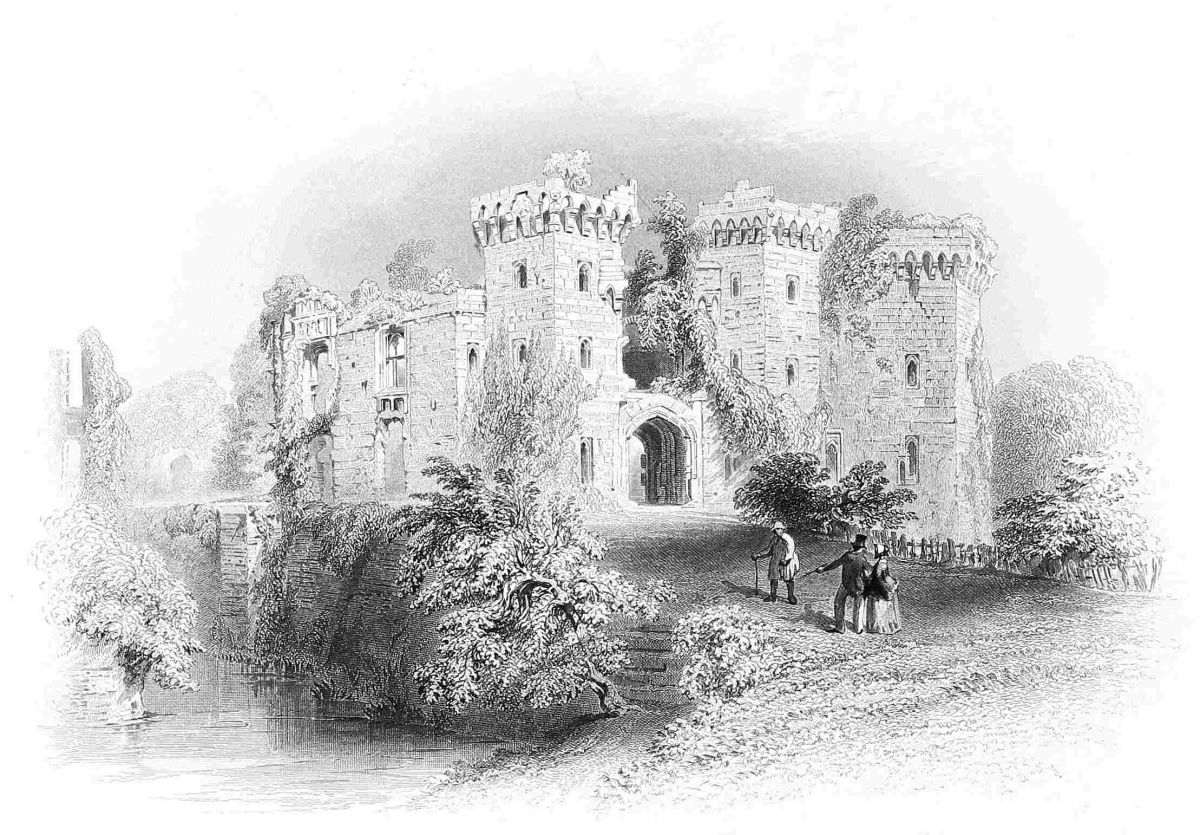
The Gateway Towers.
Raglan Castle.
The King took leave of Raglan Castle on the 15th of September,
mournfully observing to the Marquess, that by so doing he hoped “to ease
his lordship of a heavy burden.” His Majesty then thanked his noble and
devoted host for the large sums of money which had been advanced to him
in the course of his troubles. Whereupon the Marquess replied: “Sire, I
had your word for the money; but I never thought to have been so soon
repaid; for now that you have given me thanks, I have all I looked
for.”[257] Well might the royal guest have expressed his feelings on
quitting Raglan in the following lines, taken from his own
‘Collection:’—
I fall! I fall!
Whom shall I call?
Alas! can he be heard,
Who now is neither loved nor feared?
You, who were wont to kisse the ground,
Where’er my honour’d steps were found,
Come, catch me at my last rebound!
How each admires
Heaven’s twinkling fires,
When from their glorious seat
Their influence gives life and heat!
But, oh! how few there are—
Tho’ danger from that act be far—
Will stoop and catch a falling star.[258]
“Distracted with a thousand griefs, and accompanied by a few trusty and
disconsolate servants, the royal victim wandered about the country,
thankful to accept protection from any one who had fortune or
inclination to minister to his distress. And many ‘cruel days’ to use
his own words, were spent in weary marchings without food, narrow
escapes, and precipitate retreats, before he took his last farewell of
the land of Gwent.”[259]
On one occasion he was hotly pursued in his retreat through Shire
Newton, by a party of sixty Roundheads; but reaching a place called
Charleston Rock, near the New Passage, a fishing-boat was found, in
which he was safely ferried over the Severn into Gloucestershire. His
pursuers coming up in the meanwhile, but only to find their object
defeated, seized upon the remaining boats, and with drawn swords
compelled the fishermen to ferry them across. They hurried into the
boats, and, with the royal fugitive still in view, made all haste to be
once more on his traces. The poor fishermen, however, being royalists at
heart, had no sympathy with these king-hunters; but rowing lustily
towards a reef of rocks called the “English Stones,” within a gunshot of
the Gloucester shore, there hauled in their oars; and landing their
freight on the rocks, told them the water was so shallow that the boats
could go no further, and they might easily wade to the opposite bank.
And such, in fact, was quite practicable at low water; but, in the
present instance, the tide flowed so rapidly, that in making the attempt
to reach the opposite bank the whole party were drowned.
Informed of the catastrophe, Cromwell abolished the ferry, which was not
renewed until 1718, after a protracted lawsuit between the proprietor of
St. Pierre and the Duke of Beaufort’s guardians,[260] when it was named
the “New Passage.”
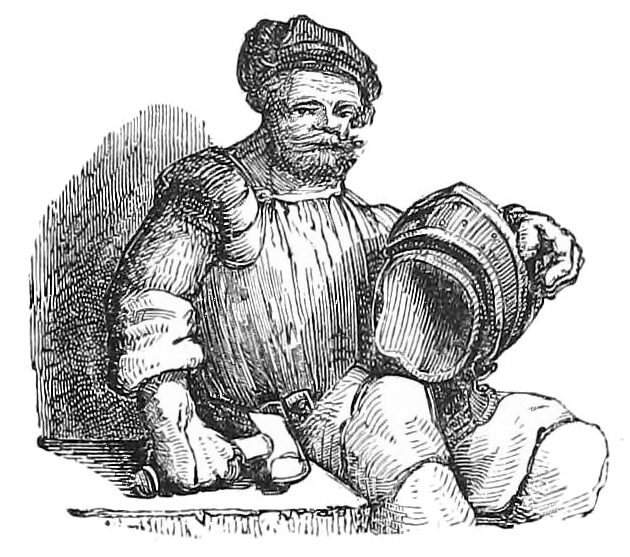
The Siege.—Early the following spring a resolution was passed that the
Castle of Raglan, which had so often thrown open its gates to the King,
and still supported a garrison in his service, should be reduced without
loss of time. It was the last fortress that held out, and until its
walls were dismantled, and the garrison made prisoners, the spirit of
loyalty in Monmouth would never be thoroughly subdued. The Castle was
accordingly invested by Major-General Glenham and Sir Trevor
Williams;[261] but the latter, it has been asserted, was not very hearty
in his opposition to the King; for he had many misgivings respecting the
ultimate designs of Cromwell, who also, as it appears from existing
documents,[262] was equally suspicious of Sir Trevor. The first summons
to surrender the Castle to Parliament was received by the garrison with
indignation and defiance.
Early in June they were joined by Colonel Morgan, who, with a strong
body of men[263] from Worcester, took the command. The troops of the
garrison made divers gallant sallies, and in one of these killed a
cornet of Morgan’s, and carried off the colours. But after the surrender
of Oxford to the Parliament, Colonel Morgan had a reinforcement of two
hundred men, and being now in a position, both as regarded the works and
the efficiency of the troops, to act with vigour, he sent the following
summons:—
I.—Colonel Morgan to the Marquess of Worcester.
“My Lord,—By his Excellency’s command, this is my second summons,
whereby you are required forthwith to deliver to me, for the uses
of both Houses of Parliament, the Castle of Raglan, with all
ordnance, arms, ammunition, and provisions, and all other
necessaries that belong to war, that are now in it; which if you
will be pleased to do, you may haply find mercy, as other garrisons
have had; and if you do refuse, expect but the ruin of yourself,
your family, and this poor distressed country. For I must acquaint
your lordship that his Excellency Sir Tho. Fairfax, having now
finished his work over the kingdom except this Castle, hath been
pleased to spare his forces for this work, which are now upon their
march this way with all materials fit for it; though I made no
doubt but I had of mine own strength sufficient to effect it. If
your lordship will deny to submit to this summons, and that more
blood must be spilt, your lordship may be confident that you shall
receive no favour from both Houses of Parliament. So, expecting
your answer this night by nine of the clock, I rest your lordship’s
servant,
“Tho. Morgan.
“From the Leaguer before Raglan,
“June 28, 1646.
“Upon the faith and honour of a soldier, this is a true copy of his
Majesty’s letter[264] to the Governors of Oxford, Lichfield,
Wallingford, and Worcester, and all other garrisons in England and
Wales; which I thought fit to present to your lordship, that you
may clearly see what possibility of relief you are like to have.”
II.—The Marquess of Worcester to Colonel Morgan.
“Sir,—I have received this day two advertisements from you; the
first I read, containing, as you would have me believe, a true
copy of his Majesty’s warrant to several garrisons upon honourable
terms to quit. But truly, Sir, it is not in the power of man to
make me think so unworthily of his Majesty, that to one, in the
opinion of the world, that hath given, himself and family, soe
great a demonstrance and testimony of his and their faith and
fidelitie towards him, that he would not please so much as name his
name, or Raglan. I entreat you, give me leave to suspend my
belief.[265]
“And for your second summons, it makes it too evident that it is
desired that I would die under a hedge like a beggar, having no
house left to put my head into, nor means left to find me bread.
Wherefore to give you answer, I make choice (if it soe please
God) rather to dye nobly, than to live with infamy. Which answer,
if it be not pleasing to you, I shall not think you worthy to be
styled by me your loving friend,
“H. Worcester.
“From my House of Raglan,
“June 28, 1646.”
This was followed by a third letter from Colonel Morgan:—
“My Lord,—Since it is not in my power to make you nor your son
believe anything concerning the surrender of those garrisons, by
his Majesty’s order, that comes from me or any of our party: once
more, and the last before I send your answer to his Excellency Sir
Tho. Fairfax, I shall give your lordship way to send an officer,
with another of mine, to those lords in Oxford to whom his
Majesty’s letters were directed, for your better satisfaction. This
I do, my Lord, to prevent your utter ruin, and that of this poor
country, so much occasioned by your lordship’s obstinacy. I expect
your present answer, and rest your servant,
“Tho. Morgan.
“June 28th.”
IV.—The Marquess of Worcester to Colonel Morgan.
“Sir,—In respect of your mentioning of any respect or kindness
towards me, lest to be divulged to the world should do you any
prejudice, I have thought fit in your own letter to return you
thanks for the same. And for Sir Tho. Fairfax, if he were here
with all his army, he should receive no other from me than what you
have had. I hope I serve (though not so well as I should) a Master
that is of more might than all the armies in the world; and to his
holy will and pleasure I submit myself, and yourself to do what you
think fitting.—Your friend and servant,
“H. Worcester.
“From my Dwelling at Raglan,
“June 28.”
In the first week of August ensuing, General Fairfax arrived from Bath
to hasten the siege—which was in great forwardness both for works and
approaches—and then sent in another summons[266] to the Marquess:—
V.—Sir Thomas Fairfax to the Marquess of Worcester.
“My Lord,—Being come into these parts with such a strength as I
may not doubt but, with the same good hand of Providence that hath
hitherto blessed us, in short time to reduce the garrison of Raglan
to the obedience of the Parliament, I have, in order thereto,
thought good to send your lordship this summons, hereby requiring
you to deliver up to me, for the Parliament’s use, the said
garrison and Castle of Raglan; which, as it only obstructs the
kingdom’s universal peace, the rendition may beget such terms, as
by delay or vain hopes cannot hereafter be expected.—I remain, my
Lord, your lordship’s most humble servant,
“Tho. Fairfax.
“Leaguer before Raglan,
“August 7, 1646.
“Your lordship’s speedy answer to this summons is desired.”
VI.—The Marquess of Worcester to Sir Thomas Fairfax.
“Sir,—Although my infirmities might justly claim privilege in so
sudden an answer; yet, because you desire it, and I am not willing
to delay your time, to your letter of summons to deliver up my
house, and the only house now in my possession to cover my head in,
these are to let you know, that if you did understand the condition
I am in, I daresay out of your judgment you will not think it a
reasonable demand. I am loth to be the author of mine own ruin on
both sides; and therefore desire leave to send to his Majesty to
know his pleasure what he will have done with his garrison. As for
my house, I presume he will command nothing; neither am I knowing
how, either by law or conscience, I should be forced out of it. To
these I desire your return, and rest your Excellency’s humble
servant,
“H. Worcester.
“From my poor Cottage at Raglan,
“Aug. 7, 1646.”
VII.—Sir Thomas Fairfax to the Marquess of Worcester.
“My Lord,—Touching your sending to his Majesty, it is that which
hath been denied to the most considerable garrisons of England,
further than an account to his Majesty of the thing done upon the
surrender; which I do else freely grant to your lordship. And for
that distinction which your lordship is pleased to make, that it
is your house, if it had not been formed into a garrison, I
should not have troubled your lordship with a summons; and were it
disgarrisoned, neither you nor your house should receive any
disquiet from me, or any that belong unto me.
“This I thought good to return to yours, and thereby to discharge
myself, before God and the world, of all extremities and sad
consequences that will ensue upon the refusal of the rendition of
your garrison upon my summons.—I remain yours,
“Tho. Fairfax.
“August 8.”
VIII.—The Marquess of Worcester to Sir Thomas Fairfax.
“Sir,—I do much confide in your honour, as that being at stake,
concerning leave to send to his Majesty, and will at this time
forbear to make further motion in it; only one thing which is
extraordinary, I offer to your consideration, for the just cause,
besides my allegiance, of my reasonable request; which is, That
upon his Majesty’s promise of satisfaction, I am above 20,000
pounds out of purse; and if I should do anything displeasing unto
him, I am sure all that is lost, and no benefit to the Parliament.
If you knew how well known I was, in Henry Earl of Huntington’s
time, unto your noble grandfather at York, I am assured I should
receive that favour at your hands that safely you might afford. God
knows, if I might quietly receive my means of subsistence, and be
in security, with the Parliament’s approbation, and freed from the
malice of those gentlemen that are of the Committee within this
county, I should quietly quit myself of the garrison; for I have no
great cause to take delight in it. I have that high esteem of your
worth, nobleness, and true judgement, that knowing you will offer
nothing ignoble or unworthy for me to do, as the case stands with
me, I desire to know what conditions I may have, and I will return
you present answer. And, in the meantime, I rest your humble
servant,
“H. Worcester.
“August 8, 1646.”
IX.—Sir Thomas Fairfax to the Marquess of Worcester.
“My Lord,—According to your lordship’s desire, I have returned you
conditions, such as may be fit and satisfactory to the soldiery. To
your lordship and family I have granted quiet and security from all
violence of any that belongs to me. I would persuade your lordship
not to fear any ill or disrespect from the Committee of this
county; I shall easily reconcile that party; or that they will not
do anything but as they shall receive order from the Parliament. By
this means you are at liberty to send to the Parliament; and upon a
present surrender and submission to their mercy and favour, your
lordship cannot but think to receive better terms for yourself than
if you stand it out to the last extremity; when, besides the hazard
of your person, and of those in your family, (which I do presume
are dear to you,) and the spoil of the Castle, which cannot be
avoided in extreme undertakings against it; your lordship hath no
reason to expect better than the Marquess of Winchester received,
who, in making good Basing House to the last, narrowly escaped in
his own person, lost his friends, subjected those that escaped to
great frights and hazard, his house and estate to utter ruin, and
himself to extremity of justice.
“Touching your lordship’s 20,000 pounds, your lordship hath liberty
to solicit about that by the same hands your lordship shall give an
account of the surrender to his Majesty. I desire your lordship
upon receipt of these to dismiss my trumpeter, and to return an
answer by one of your own.
“Tho. Fairfax.”
X.—The Marquess of Worcester to Sir Thomas Fairfax.
“Sir,—The difficulty of resolution by the soldiers and officers
(other than I thought) causeth my request for your patience in not
giving you full answer to the conditions you sent me yesterday; but
as soon as I shall obtain it, you shall not be long without it. But
one thing, and that of moment, I desire to be satisfied in,
Whether, if any conclusion should be made, that afterwards I shall
be left to the mercy of the Parliament, for alteration at their
will and pleasures; and if it be so, I shall endeavour in vain to
study more about it. For example, in my Lord of Shrewsbury’s case,
and divers others, how conditions have been broken doth a little
affright me. I know, by your will and consent, it should never be;
but soldiers are unruly, and the Parliament unquestionable; and,
therefore, I beseech you pardon my just cause of fear, and I will
rest your humble servant,
“H. Worcester.
“August 11.”
XI.—Sir Thomas Fairfax to the Marquess of Worcester.
“My Lord,—I have perused your letter of this 11th of August. As to
your scruple, wherein you desire to be satisfied, (so far as I
understand it,) I can only give you this resolution, that what I
grant I will undertake shall be made good. As to the instance you
give in my Lord of Shrewsbury’s case, the actors in that breach
(who were none of my army) have received their censure, and by this
time I believe the execution. But here, if any conclusion be made
while I stay, I dare undertake there shall be no such thing; or, if
any, there shall be reparation.
“Tho. Fairfax.
“August 11, 1646.”
XII.—The Marquess of Worcester to Sir Thomas Fairfax.
“Sir,—For the better accommodation of these unhappy differences,
if you please there may be a cessation of arms and working, and to
engage your honour for the return of my commissioners to-morrow by
ten of the clock, they shall wait upon you in your Leaguer; where
they shall vindicate me from being the only obstruction of the
general peace. So, in expectation of your sudden answer, I rest
your humble servant,
“H. Worcester.
“August 13, 1646.”
XIII.—Sir Thomas Fairfax to the Marquess of Worcester.
“My Lord,—Having not yet received by any of your letters a direct
answer to the conditions I sent you, I have no grounds or
consideration for such a cessation of arms and working, as in your
letter you desire; but if it be your purpose to return your answer
by commissioners, I shall, by the hour you mention, appoint
commissioners of mine own to receive the same in the Leaguer as you
desire, and engage myself for the safe return of yours, not
exceeding six commissioners and as many servants; and, in order to
this, I shall be content there be a cessation of arms and working
from nine of the clock to-morrow morning till two in the
afternoon.—Yours,
“Tho. Fairfax.
“Uske, August 14.”
XIV.—The Marquess of Worcester to Sir Thomas Fairfax.
“Sir,—Had I not thought you had been in the Leaguer, to the end
that the propositions from the place, in answer to yours, might
have been first presented unto you; and to avoid delays, which I
thought your side would best like of, it was resolved to send
commissioners together with our propositions; but considering it
was otherwise, I have sent you such as I am advised unto, to take
into your consideration. And because there is some addition to
yours, I would have been glad you had heard the just reasons
thereof, to the end you might not have been persuaded to slight
them without just cause. Your pleasure for the ordering of
business, I, at your leisure, expect; and, if you please, the
dismission of this messenger; and so rest your humble servant,
“H. Worcester.”
XV.—Sir Thomas Fairfax to the Marquess of Worcester.
“My Lord,—I have perused the propositions sent out by your
commissioners, which I find such as deserve no answer. I have
offered your lordship and the rest conditions which you may yet
have, if you accept in time. If there be any thing in them obscure,
needing explanation, or wanting circumstantials, for the better
performing of the things intended therein I shall be willing to
appoint commissioners on my part to treat with yours to that
purpose upon these propositions of mine; provided you send
commissioners instructed with power to treat and conclude, and
return your resolution herein by six of the clock in the
evening.—Yours, &c.,
“Tho. Fairfax.
“August 14, 1646.”
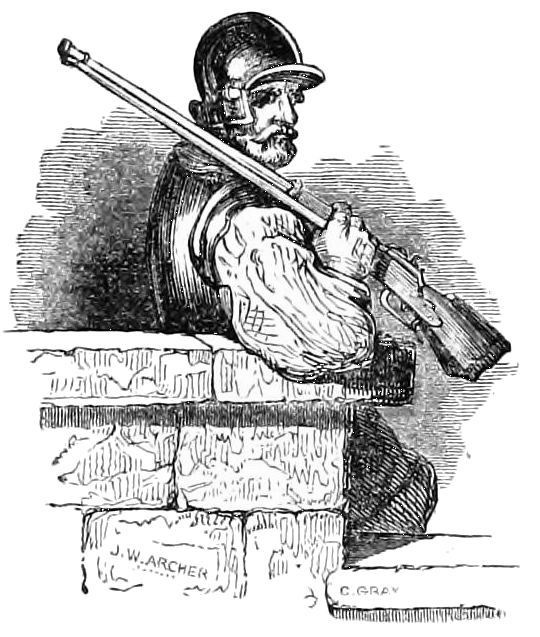
In the meantime the besiegers went on with their approaches toward the
Castle—their main works being not above some sixty yards distant—and
had planted four mortar pieces in one place, and two mortar pieces at
another, each mortar piece carrying a grenade shell twelve inches
diameter.
Towards the end of the siege, whilst the cannon of Fairfax was playing
upon the Castle from the neighbouring height, and when casualties within
the walls were of hourly occurrence, an incident occurred, which shows
that in these perilous times even ladies deemed it necessary to
apologise for being afraid of leaden bullets. “One evening, during the
hottest period of the cannonade,” says Dr. Bayly, “there came a musket
bullet in at the window of the withdrawing room, where my lord used to
entertain his friends with his pleasant discourses after dinners and
suppers, which, glancing upon a little marble pillar of the window, and
from thence hit the Marquess upon the side of his head, and fell down
flattened upon the table, which breaking the pillar in pieces, it made
such a noise in the room, that his daughter-in-law, the Countess of
Glamorgan, who stood in the same window, ran away as if the house had
been falling down upon her head, crying out—‘O Lord! O Lord!’ But at
length finding herself more afraid than hurt, she returned back again,
no less excusing her—as she was pleased to call it—rudeness to her
father, than acknowledging her fears to all the company. To whom the
Marquess said: ‘Daughter, you had reason to run away when your father
was knocked on the head.’ Then pausing some little while, and turning
the flattened bullet round with his finger, he further said: ‘Gentlemen,
those who had a mind to flatter me, were wont to tell me that I had a
good head in my younger days; but if I don’t flatter myself, I think I
have a good head-piece in my old age, or else it would not have been
musket proof.’”
Of the exemplary good order observed by the household, before the
establishment of a garrison within the Castle, an eye-witness has
transmitted the following testimony:—
“I have lived in Raglan Castle,” said he, “three years, and in all that
time I never saw man drunk, nor heard an oath, amongst any of all his
(the Marquess’s) servants; neither did I ever see a better ordered
family; and that which was most wonderful unto me was, that the servants
of his house, being half Papists and half Protestants, were never at
variance in point of religion—which was brought about by prohibiting
disputations.[267] Neither was any man the less accepted for his
religion, if his service were acceptable. But when the Castle was
filled with officers and soldiers, he used to be more grieved to hear
and witness the drunkenness that was then and there too much practised:
insomuch, that when some of his chief officers had told him, how that
they had fortified such and such a place so and so; and that the enemy
could not come; and that there it was impossible. ‘Ay, ay,’ said my
Lord; ‘but you have left the main place open and unprotected. You have
no fortifications against Heaven. For there is so much swearing and
drunkenness amongst you, that from thence I fear me will come our
greatest enemy, and you have made no provision against him.’ And,
indeed, he said justly; for, in truth, the royalists were grievously
addicted to many vices, to which, on the contrary, the companions and
followers of Cromwell were comparatively strangers.”
The importance attached by the Parliament to the reduction of Raglan
Castle is shown by the following report from their commissioner:[268]—
“Your assured friend and servant, W. C.,” (as the letter is signed,)
writes to the Parliament man from “Usk, August 15, 1646.—I shall now
give you an account how near our approaches are made unto the Castle.
That which is our maine work is about sixty yardes from theirs, and
that’s the most. We have planted four mortar pieces, each of them
carrying a grenado shel twelve inches diameter; and two mortar peeces
planted at another place carrying shels about the like compas; soe that
in case the treatye doe breake off, we are then ready to show by what
extremitye they must expect to be reduced. This we are very confident,
that the grenadoes will make them quit their workes and outhouses, and
solely betake themselves into the Castle, which indeed will be a worke
of time before we are able to undermine it, in regard we must mine down
a hill[269] under a moate, and then the workes, before we can come to
the Castle; yet we conceive it feasible to be done with some losse. Our
engineer, Captain Hooper, a painful and honest man, proceeding, as he
hath begun, with exact running trenches, which we made so secure as if
they were workes against a storme, will, with God’s blessing, come
within ten yards in a few dayes; and then, I believe, we shall make
galleries, mines, and many batteries. The General is every day in the
trenches, and yesterdaye appointed a new approache, which the engineer
of this army, who is now returned from Worcester, is to carry on with
all expedition. He has already broken the ground, throwne up approaches
of about an hundred yardes in length and circuit, and is within sixty
yards of the under part of their workes.”
The writer then proposes that the Parliament should agree to moderate
terms, and accept of an honourable answer. That the plan might succeed
he deems quite certain, though not without farther loss; and he adds, in
terms less courteous than characteristic of the times, that “it would
not be worth while to gaine this old man’s carkasse at so dear a
rate.”[270]
Aug. 14.—Fairfax appointed a new approach, which the engineer, Captain
Hooper, had so far proceeded in as to throw up approaches of an hundred
yards in circuit, making exact running trenches (as secure as if they
were works against a storm), coming within sixty yards of their works.
Aug. 15.—The Marquess sent forth his desire to treat upon the General’s
propositions; whereupon the treaty was appointed at Mr. Oates’s house,
(about a mile and a half from Raglan,) to begin at two of the clock that
afternoon. Fairfax’s commissioners were Colonel Birch, Mr. Herbert,
Quartermaster-General Grosvenor, Lieutenant-Colonel Ashfield, and Major
Tulida.
By Monday the 17th of August, two days after the date of this report,
the preliminaries for capitulation were finally arranged.[271]
Surrender.—During the blockade of Raglan, the Parliamentary General
fixed his head-quarters at Kevantilla House,[272] the residence of Mr.
Oates, about a mile and a half from Raglan; and there the treaty for the
surrender of the Castle was finally adjusted and prepared for signature.
The commission deputed for the occasion by Fairfax, were Colonel Birch,
Quarter-Master Herbert, General Grosvenor, Lieutenant-Colonel Ashfield,
and Major Tuliday. The meeting, as previously arranged, took place at
two o’clock in the afternoon of Saturday, August the fifteenth; and, on
the Monday following, the document was ratified, by appending to it the
signatures of the authorized commissioners. The capitulation was agreed
to on the following conditions:—
Article the First. The garrison, ammunition, and artillery of Raglan, to
be surrendered to General Fairfax on the third day after the
ratification of the said treaty; namely, at ten o’clock on the morning
of the Wednesday following, being the nineteenth day of August.
Article the Second, stipulated that all the officers, soldiers, and
gentlemen of the garrison, should march out with horses and arms;
colours flying; drums beating; trumpets sounding; matches lighted at
both ends; bullets in their mouths; and every soldier with twelve
charges of powder and ball; with permission to select any place, within
ten miles of the Castle, for the purpose of delivering up their arms to
the general in command; after which the soldiers were to be disbanded
and set at liberty.
Article the Third, engaged the General’s safe conduct and protection to
all the gentlemen and others who had sought refuge within the walls of
Raglan Castle to their respective homes.
Article the Fourth, was an enlargement of the preceding article, by
which three months’ protection was guaranteed to certain other
gentlemen, until they should either have made their peace with
Parliament, or departed the realm.
Article the Fifth, guaranteed the protection and care of the sick and
wounded left in the Castle.
Article the Sixth, was an indemnity for all words and acts of the
garrison during the siege of the Castle.
On Wednesday the nineteenth of August, in pursuance of these
arrangements, the Castle and Garrison of Raglan were duly surrendered to
Sir Thomas Fairfax, for the use of both Houses of Parliament. The
garrison, which at first had mustered eight hundred men, was now reduced
to less than half that number; and as certain of the warlike muniments
were becoming so diminished as to expose them at last to the chances of
seeing the Castle entered by storm, a prolonged resistance must have
been attended with disastrous consequences.
“The garrison had no sooner marched out,” says an eye-witness, “than
Fairfax entered the Castle, took a view of it, had some conversation
with the Marquess, and then, quitting the scene of his last operation in
the way of siege, proceeded to Chepstow, where he was received in
triumph by the committee; and, after a brief halt in the Castle,
returned to his head-quarters at Bath,”
“A conqueror; and blushing on his sword
The stains of blood, by loyal Raglan pour’d.”
Yet Fairfax, as far as lay in his power, was very exact in observing
every condition to which he was a party. It is recorded to his honour,
that, “far from allowing violence, he would not even permit insults, or
expressions of triumph over the unfortunate Royalists.” Something of
this generous bearing towards his opponents may be observed in his
correspondence with the Marquess of Worcester. He is painted by
historians as equally eminent for personal courage and for humanity; and
though strongly infected with prejudices, or principles derived from
religious and party zeal, he never seems, in the course of his public
conduct, to have been diverted, by private interest or ambition, from
adhering strictly to these principles. Sincere in his professions,
disinterested in his views, open in his conduct, “he had formed,” says
Hume,[273] “one of the most shining characters of his age, had not the
extreme narrowness of his genius in everything but in war, and his
embarrassed and confused elocution on every occasion but when he gave
orders, diminished the lustre of his merit, and rendered the part which
he acted, even when vested with the supreme command, but secondary and
subordinate.”
With this just tribute to his merits as a man and a soldier, we take
leave of the Conqueror of Raglan, annexing the following
Anecdotes.—When Fairfax, as we learn from the same authority, laid
siege to Raglan Castle, and fair terms were offered to all the garrison,
the Marquess only excepted, the generous old Nestor entreated his
friends to accept the proposal, and allow him to be the ‘Jonas.’ But
this proposition, it may be readily believed, had the opposite effect,
of strengthening their determination to stand by him to the last man. In
thanking his officers for their devotedness, he added, in his own
peculiar way, “I do not much like that way of embalming neither—to be
served up to my audit as a thing newly taken out of the cost of many
friends’ blood.”
In the conversation above alluded to, when Fairfax took possession of
the Castle, the Marquess is said to have made a jocular request,
bespeaking the General’s indulgence in favour of some pigeons that still
kept possession of their ancient haunt. To which he gravely replied,
that he was glad to perceive his Lordship in so ‘merrie’ a frame of
mind. Whereupon the Marquess told him the following story:—
“There were two rogues once going up Holborn in a cart to be hanged; but
the one being very jocund on so serious an occasion, gave offence to his
companion, who, being very downcast, reproved him. ‘Tush, man,’ said the
other, ‘thou art a fool; thou wentest a thieving, and never once
thoughtest of what would become of thee; wherefore, being on a sudden
surprised and taken, thou fallest into such a shaking fit, that I am
ashamed to see thee in such a pitiful condition. Whereas I was resolved
to be hanged before I fell to stealing, which is the reason I go so
composedly unto my death.’ So, in my own case,” continued the Marquess,
“I resolved to undergo whatsoever—even the worst—evils that you were
able to lay upon me, before I took up arms for my sovereign; and,
therefore, wonder not that I am so merrie.”
The fall of Raglan Garrison was a source of much triumph and
congratulation to the Parliamentary forces. “There were delivered up
with it,” says Rushworth, “twenty pieces of ordnance, but only three
barrels of gunpowder; for within the walls they had a mill with which
they could make a barrel a day. There was found, however, ‘great store
of corn and malt, wine of all sorts, and beer in abundance;’ but hay and
forage for their horses had been so completely exhausted, that these
noble animals were almost starved to death, and ‘had like to have eaten
one another for want of meat, had they not been tied with chains.’”
The captors found also great store of goods and rich furniture in the
Castle, which Fairfax committed to the care and custody of Mr. Herbert,
commissioner of the army, Mr. Roger Williams, and Major Tuliday, or
Tulida, to be inventoried. And in case any inhabitants of the country
could make a just claim to them—as having been violently taken from
them, or they compelled to bring them thither—that they should have
them restored.
Agreeably to the terms of surrender, as recorded in the history of the
siege, there marched out of the Castle—“The Marquess of Worcester, then
in the eighty-fourth year of his age; the Lord Charles, the Marquess’s
sixth son, Lieutenant-Governor of the Castle under his father: [he
subsequently retired to Flanders, and died a canon of Cambray;] the
Countess of Glamorgan; the Lady Jones; Sir Philip Jones; Dr. Bayly, so
often quoted in the preceding narrative; Commissary Gwilliam; four
Colonels; eighty-two Captains; sixteen Lieutenants; six Cornets; four
Ensigns; four Quartermasters; fifty-two Esquires and Gentlemen.”
It is worthy of record in this place, that, of all the forts and
garrisons in the King’s interest, those of Raglan and Pendennis endured
the longest sieges, and held out the last of any forts or castles in
England—being bravely defended by two persons of very great age—and
were at length delivered up within a day or two of each other. “Raglan,”
says Lord Clarendon, “was maintained with extraordinary resolution and
courage by the old Marquess of Worcester (then 85) against Fairfax
himself, until it was reduced to the greatest necessity. Pendennis
refused all summons; admitting no treaty till all their provisions were
so far consumed that they had not victuals left for four-and-twenty
hours; and then they treated, and carried themselves in the treaty with
such resolution and unconcernedness, that the enemy concluded they were
in no straits, and so gave them the conditions they proposed, which were
as good as any garrison in England had accepted. The governor of
Pendennis was John Arundel of Trerice, in Cornwall, an old gentleman of
near fourscore years of age, who, with the assistance of his son
Richard, afterwards made a baron in memory of his father’s service, and
his own eminent behaviour throughout the war, maintained and defended
the same to the last extremity.”[274]
Returning to the subject of Raglan, we must not overlook the following
predictions, as calculated to excite no little attention in times when
witchcraft, sorcery, and apparitions, were admitted as articles of
popular belief.
Prophecies.—Of the prophetic warnings which, from time to time, and
particularly during the siege, had taken possession of the vulgar mind
regarding the fall of Raglan and its hereditary lords, the following
passage is sufficiently characteristic:—One evening, during the
progress of the siege, one of his officers was relating to the Marquess
how strangely the narrator, Dr. Bayly, had escaped a shot by means of
the iron bar of a window that looked out upon the leaguer. Standing, for
example, in a window of the castle, there came a musket bullet and hit
full against the edge of an iron bar of a chamber window, so that it
parted the bullet in halves, the bar expatiating itself by degrees
towards the middle; “one half of the bullet,” said he, “flew by me on
the one side, and the other half on the other side; so that, by God’s
providence, I had no hurt.”
“The Marquess hearing this, asked me in what chamber it was. I told him.
His Lordship then said, as I remember, ‘The window was cross-barred; and
you will never believe me,’ said he emphatically, ‘how safe it is to
stand before the Cross, when you face your enemy!’”
But returning to the subject of predictions:—“Never,” says the family
historian, “never was there a noble house so pulled down by
prophecies—ushered into its ruin by predictions, and so laid hold
upon by signes and tokens! I shall tell you no more,” he continues, “but
what I have both read and seen long before the fall of that proud
fabric, which had the honour to fall the last of any that stood upon the
tearmes of honour. Now there was one old book of prophecies that was
presented to the Marquess, because it so much concerned Raglan Castle,
wherein there were these predictions: namely, That there should come an
Earl that should first build a white gate before the castle-house, and
after that should begin to build a red one; and before that red one
should be finished, there should be wars over all the land.”
Now all this was fulfilled in the Marquess’s own day, who, having built
the one gate and begun the other, yet by reason of the distractions of
the time, was forced to discontinue the latter, which at the time of the
siege remained unfinished. Some one standing by while this prophecy was
mentioned, exhorted the Marquess—half in jest, half in earnest—to make
haste and finish his red-gate house, because we should have no quiet
until that were up.
“Hark’ye,” said the Marquess, “nobody shall ever prophesy so much money
out of my purse in such times as these! Besides, the prophet does not
say until, but before—‘before the red gate is up;’ and, for aught I
know, if I should make haste with that building, I should hasten the war
to my own sorrow; for the prophet says, ‘before the red-gate house shall
be finished, there shall be wars all over the land.’ But what if I had
built neither the one nor the other, how could this prophecie have
concerned me?”
“Oh, my Lord,” said one of the company, “it is done; and you could not
otherwise choose but to do what you did.”
“Ay; but I can choose,” said the Marquess, “whether I will believe the
prophet or not.”
“Another prophecie there was,” continues our authority, “that the king
of the country should lose a great battle, [Naseby,] and afterwards fly
to Raglan Castle for safety; that the enemy should pursue him; and that
after a short time he should leave the Castle, and that the enemy should
besiege and set fire to the Castle wall. All of which was literally
fulfilled.”
Moreover it was said, that “an eagle should come into the park and be
there slain, which should be a forerunner to the destruction of that
house; which I saw literally performed; but yet executed by one that
never heard of the prophecie. It was furthermore foretold, that a
cloud of bats should hang over the Castle before its final demolishment;
this, three days before, all the Castle beheld to their no small
astonishment, and it continued a quarter of an hour, about twilight, so
thick that you could not, towards the middle of them, see the sky,
though clear. Being shot at with hail-shot, some of them fell down, and
the rest flew away.
“The Marquess being told of this, asked what those kind of creatures
might signify. Some about him answered, that they were scripture emblems
of ruin and desolation.[275] He then asked if they were all gone. It was
told him that they were. Whereupon the Marquess asked us whether or no
the enemy had begirt us round. It was answered that they had. ‘Then,’
said his Lordship, ‘I am glad of it; for then those emblems of ruin
cannot fly away from us, but they must also fly over the heads of the
enemy.’”
The Chaplain then proceeds, according to the superstitious belief of the
times, to relate the following prediction regarding the King
himself:—“The strangest prophecie of all,” he affirms, “both for
signification and accomplishment, is this, which I read before I saw it
in this book, and fourteen years before the war.” He then gives it in
the Welsh language, and explains that fab-anne, as it is one word,
signifies a baby, and joined to another Welsh word, should imply a
crowned infant, that, on growing up to man’s estate, and ruling these
realms for a season, should at last “fall by the stroke of an axe,”
or, “he shall be slain with an axe.” We shall not detain our readers by
following the Chaplain through the various arguments by which he appears
to establish the truth of this singular prediction; but, referring them
to the “Apophthegms,” in which it is recorded, we proceed to another
portion of our history.
As soon as the Castle was fairly occupied by the new garrison, the work
of demolition began. The peasantry were summoned to their aid; but on
the great tower their united labours made but slight impression. So,
“after battering the top with pickaxes,” they resolved to effect their
purpose more expeditiously, and, transferring their implements to the
foundation, succeeded in undermining it. As they proceeded, the gaps
were propped up with timber, and when the personal risk became too
imminent to continue the work, they set fire to the timber, and the
instant the charred props gave way, down came a solid mass of the
Tower of Gwent, half filling the moat, where it now lies; a specimen of
as firmly compacted a structure as ever was framed by the hand of man.
The mortar, indeed, seems harder and more durable than the materials
which it cements together. Of its massive construction the annexed
woodcut, showing the staircase in the centre of the wall, and the
engravings opposite, give a very clear and distinct notion.

Much treasure, it was conjectured, had been thrown into the moat during
the siege, while under the apprehension of being given up to plunder; so
the people were set to work with axes, shovels, and pickaxes, to drain
off the water, and collect the treasure. But nothing valuable being
discovered in the moat, they were next set to cut the stanks of the
fish-ponds, where they had store of very large carp and other fish. From
these reservoirs, during many generations, the family had drawn an
abundant supply for the table; and in times when the fasts of the Church
were rigorously observed, fish-ponds were indispensable to every large
establishment. The artificial oak roof of the great hall, already
noticed in the introductory sketch, could not be removed with advantage;
it was therefore allowed to remain full twenty years after the siege.
But the sheet-lead with which it was covered was found to be a very
“convertible material,” and was therefore rolled up, sent to market, and
the product paid over to the Parliamentary Exchequer.
Above thirty vaults of all sorts of rooms and cellars, and three arched
bridges, are yet standing; but the most curious arch of the chapel, and
rooms above, with many others, are totally destroyed. Many coins of
Queen Elizabeth have been found, but none deserving of preservation from
the crucible of the silversmith, to whom they were speedily consigned by
the finders.
These dreary “souterrains,” in the present day, are, of course, haunted
by goblins, or other beings with lungs not likely to be affected by the
damp and mephitic gases, which they are said to exhale. Never was place
better adapted for unearthly visitants; and wherever blood has been
spilt or treasure concealed, the spirits of vengeance or avarice seize
upon the spot as their own exclusive territory. As it appeared to us,
however, the genii loci were spirits of a very different stamp—beings
with whom the painter, the philosopher, and the poet, would choose to
make their abode. Not so the cicerone who showed these mysterious
caverns to Bloomfield. “Look down there,” said she, pointing to the
great cellar; “something very awful; candles wont burn there! Some
people says it’s because the damp chokes ’em. For my part, I think it’s
the devil himself; and not much fancying to be seen at his work, he
blows ’em out. Well, sir, you may smile as you please; but one puff of
brimstone’s enough for me. Let’s step into the Fountain Court. All the
wine’s gone; so a cellar with only bad spirits in it, is hardly worth
notice.”
Passing from the cellar to the dairy, we may observe that during the
siege, and for many generations previously, the fine meadows on the
banks of the Olwy, in the adjoining parish of Llandenny, were
appropriated as the dairy-farm of the Castle.
The Marquess’s Library was considered one of the best selected, and most
extensive in Europe; and we cannot doubt that the Gallery of Paintings
bore equal and corresponding testimony to the liberality and taste of
the noble owner.[276]
The loss sustained by the family in the immediate destruction of the
castle and woods, according to the printed statement, was computed at
one hundred thousand pounds; besides enormous sums furnished to his
Majesty for the raising and equipment of two armies, and the maintenance
of a numerous garrison, of which the daily expenses alone must have
required a princely revenue. With this evidence of the Marquess’s
resources, it is not surprising that he should be described by Clarendon
as “the most moneyed man of the kingdom.” The siege was followed by the
sequestration and sale of the whole estate, which, by the parliamentary
audit of 1646, amounted to twenty thousand pounds per annum, and
remained in the hands of Cromwell till the Restoration, a period of
fourteen years. All the old timber in the parks adjacent was cut down
and sold; the lead was stript from the roof of the great hall, and sold
for six thousand pounds; and a quantity of the timber was carried to
Bristol, and there used in rebuilding the wooden houses upon the old
bridge, which had recently been destroyed by fire. But the loss of the
library was in every sense a national loss, for in this, among many rare
invaluable manuscripts, were the archives of Gwent, with the earliest
records of Welsh literature. “One of these manuscripts,” says the late
Mr. Thomas,[277] “was an interesting work by Geraint Bardd Glass y
Cadair, an illustrious Welshman, who flourished about the ninth century.
He was the first who composed a Welsh grammar, a work that was revised
by Einion and Edeyrn, which form and arrangement are now extant; but the
original MS. was in the Raglan library at its capitulation.”
In his palmy days, long before he was created Marquess, the good Earl
lived in princely state in this Castle. Surrounded by faithful friends,
numerous retainers, and a household that, by its daily expenditure,
bespoke almost unlimited resources, he enjoyed in age all the happiness
to which men look forward as the reward and solace of a virtuous youth;
for, though long practised in the offices of Court, he could still
relish the sweets of domestic retirement, the humanizing influence of
science, and the conversation of pious and learned men. He was a friend
of literature, a pattern of religious consistency, an example of loyalty
which no reverses could shake; and when at last plunged into the deepest
adversity, stript of his property, bent down with years, and suffering
from bodily pain, he maintained a degree of mental serenity that
softened the remembrance of his wrongs, showed the true foundation of
his faith, and enabled him to view every dispensation of good or evil as
coming from God, and intended, by weaning his thoughts from this world,
to give him nearer and clearer views of heaven. Reduced in four short
years from the height of prosperity into the very abyss of
adversity—his home desolate, the prospects of his family blasted, his
friends hopeless or in prison, himself an inmate of the Tower—it is
impossible to withhold our sympathy from a man who, in no circumstances,
forgot the true nobility of his nature, and the obligations of his
creed; but in every trial could exclaim, in the words of his own
motto—Mutare vel timere sperno.
“Go, empty joyes,
With all your noyse,
And leave me here alone,
In sweet sad silence to bemoane
Your vaine and fleet delight;
Whose danger none can see aright,
Whilst your false splendour dims his sight.
Go, and insnare,
With your false ware,
Some other easie wight,
And cheat him with your flattering light;
Rain on his head a shower
Of honours, favour, wealth, and power—
Then snatch it from him in an hour.”[278]
On his melancholy departure from these ancestral halls, which he was
never more to behold, the venerable Marquess—accompanied by certain
members of his family and a few tried friends, among whom was the
devoted Bayly—was conducted to London, and placed under the custody of
the Black Rod. Expecting to be treated as a declared enemy of
Parliament, notwithstanding the terms of capitulation, his lordship was
agreeably surprised to find the severity, with which such cases were
usually visited, was relaxed in his favour. “Lord bless us,” said he to
Dr. Bayly, who never left him, “what a fearful thing was this Black Rod
when I heard of it first! It did so run in my mind, that it made an
infliction out of mine own imagination. But when I spoke with the man
himself, I found him a very civil gentleman; and I saw no black rod! So,
methinks, if we would not let these troubles and apprehensions of ours
be made worse by our own fears, no rods would be black.” And although—
“The pride of life has vanished,
And here I stand alone,
Degraded, stript, and banished
From all that was mine own;
Yet in dreams, when friends surround me
With the loyal and the true,
The youthful links that bound me,
Seem all riveted anew.
When I hear their loyal voices,
I half forget my wrongs,
And again my heart rejoices
In our good old loyal songs.
Pent up in these dark regions,
The only gems I boast,
Are my honour and allegiance—
All else of earth is lost.”[279]
But we shall leave the worthy Marquess for a time, to observe what is
passing in that dearly beloved, but now desolate mansion, the gates of
which were now closed upon him for ever.
The woodcut here introduced represents one of the richly ornamented, but
now dilapidated, windows of the front range of the Castle.
Of the settling of some portion of the Marquess of Worcester’s estates
upon Cromwell, we take the following particulars from a popular writer
of our own times:—“The Commons,” he observes, “now dealing with
delinquents, do not forget to reward good servants—to ‘conciliate the
grandees,’ as splenetic Walker calls it. For about two years (writing
after the conclusion of the war) there has been talk and debate about
settling £2,500 a year on Lieutenant-General Cromwell; but difficulties
have arisen. First, they tried Basinghouse lands, the Marquis of
Winchester’s, whom Cromwell had demolished; but the Marquis’s affairs
were in disorder. It was generally found that the Marquis had only a
life-rent there—only Abbotson and Itchin in that quarter could be
realized. Order thereupon to settle lands of papists and delinquents to
the requisite amount wheresoever convenient. To settle especially what
lands the Marquis of Worcester had in that county of Southampton; which
was done, though still with insufficient result. Then came the army
quarrels, and an end of such business. But now, in the Commons’
Journals, March 7th, this is what we read:—‘An ordinance for passing
unto Oliver Cromwell, Esquire, Lieutenant-General, certain lands and
manors in the counties of Gloucester, Monmouth, and Glamorgan, late the
Earl of Worcester’s, was this day read third time; and, upon the
question, passed and ordered to be sent unto the Lords for their
concurrence.’” Oliver himself, we shall find, has been dangerously sick;
and the following is what Clement Walker reports upon the matter of the
grant:—“The sixth of March brought an ordinance to settle two thousand
five hundred pounds a year of land out of the Marquis of Worcester’s
estate—the old Marquis of Worcester at Raglan—father of the Lord
Glamorgan, who, in his turn, became Marquis of Worcester, and wrote the
‘Century of Inventions.’ But £2,500 a year out of the old Marquis’s
estate upon Lieutenant-General Cromwell! I have heard some gentlemen,
that knew the manor of Chepstow and the other lands, affirm that in
reality they are worth £5,000, or even £6,000 a year. You see,”
continues he, “though they have not made King Charles a ‘glorious king,’
they have settled a crown revenue upon Oliver, and have made him as
glorious a king as ever John of Leyden was.”[280]
In addition to the personal anecdotes, or ‘pithy sayings,’ already
introduced, the following are too original and piquant to be
overlooked:—“We were talking one day,” says the family chronicler, “of
an old drunken fellow, who having used his body to sad disorder in
drinking all his lifetime, and at last giving it over, he presently
died. The fact being thus brought before him, the Marquis observed,
‘there was nothing to be wondered at in such a termination of the man’s
life; for if you take a brand,’ said he, ‘out of the fire that is
thoroughly burnt, it will fall to pieces; but if you let it lie there
still, it may remain a pretty while before it is turned to ashes.’”
This clearly shows that his Lordship was not a novice in the science of
pathology; for, had he made the ‘anatomy of drunkenness’ his particular
study, he could not have expressed himself by a figure that more
completely illustrates the case. The burnt log may not only last longer,
but also preserve its shape, and diffuse light and heat through the
whole apartment, while it remains in the fire; but if suddenly removed,
and the fire extinguished, it is soon transformed into a heap of black
ashes. The comparison applies very forcibly to those in whom the
pernicious habit of spirit-drinking has been long a rooted evil. If they
suddenly reform, the constitution—to use the same figure—has been so
thoroughly carbonized, that, on the artificial temperature being
withdrawn, it breaks down like the charred firebrand and is
extinguished; but if cautiously and gradually withdrawn, before the
charring process has reached the core, it may live to furnish a better
light than any that could be expected from it while in the furnace of
dissipation. In the Marquess’s time, as already noticed, the habit of
drinking was carried to a most fatal excess; and we may readily believe
that the ‘apophthegm’ here recorded, was the result of personal
observation among the troops of his own garrison, who—
“Red-hot with drinking;
So full of valour that they smote the air
For breathing in their faces.”
As the preceding anecdote shows the venerable Marquess as a pathologist,
so the following exhibits him in the more congenial character of a
quaint theologian:—“I was walking one day with his lordship,” says the
narrator, “in the private walk about the Great Tower,[281] and there we
spied where a bird had made her nest, whom we disturbed from hatching
her young ones, and sitting upon her eggs; which act of nature my lord
compared to the manner of the creation: ‘For,’ said he, ‘God having made
his nest in the world, and brought forth his young at first imperfected,
did by his Spirit incubate, and by his wings of prudence spread over
them, he gave them life and power; and by his word he brake the
shell—et sic pullulavit mundum.’” This method of giving a quaint and
solemn turn to the most familiar incidents of life was characteristic of
the times, and often introduced into their homilies by the clergy, who
made use of the most homely figures to illustrate some of the highest
questions in theology. But from the Marquess of Worcester, then at a
very advanced age, the effort to extract a moral, or to expound a
scriptural text, came very gracefully; and he omits no opportunity, as
we perceive, of improving others, by directing their thoughts to those
passages of scripture with which his own mind was familiar. It is almost
impossible, however, to resist the ludicrous ideas which religious
sentiment is made to conjure up when employed by the Parliamentary
leaders, and those irreverent applications of scripture which are to be
found, not only in their daily conversations, but in their speeches, and
even dispatches. Cant was the fashion of the day; and where a letter
was not profusely interlarded with the language and figures of Holy
Writ, the author was liable to be suspected of indifference or
disaffection to the cause.
“An evil soul, producing holy witness,
Is like a villain with a smiling cheek——”
“And thus he clothes his naked villany
With old odd ends stol’n forth of Holy Writ.”
The Marquess’s contempt of hypocrisy and deception is exemplified in
another apophthegm:—“A Roman Catholic being sorely pressed to take the
oath of supremacy, and being acquainted with another gentleman, who was
a Protestant, and so like unto him that you could hardly distinguish
them whilst they were together, much less asunder,—this imago
sui—this lifelike
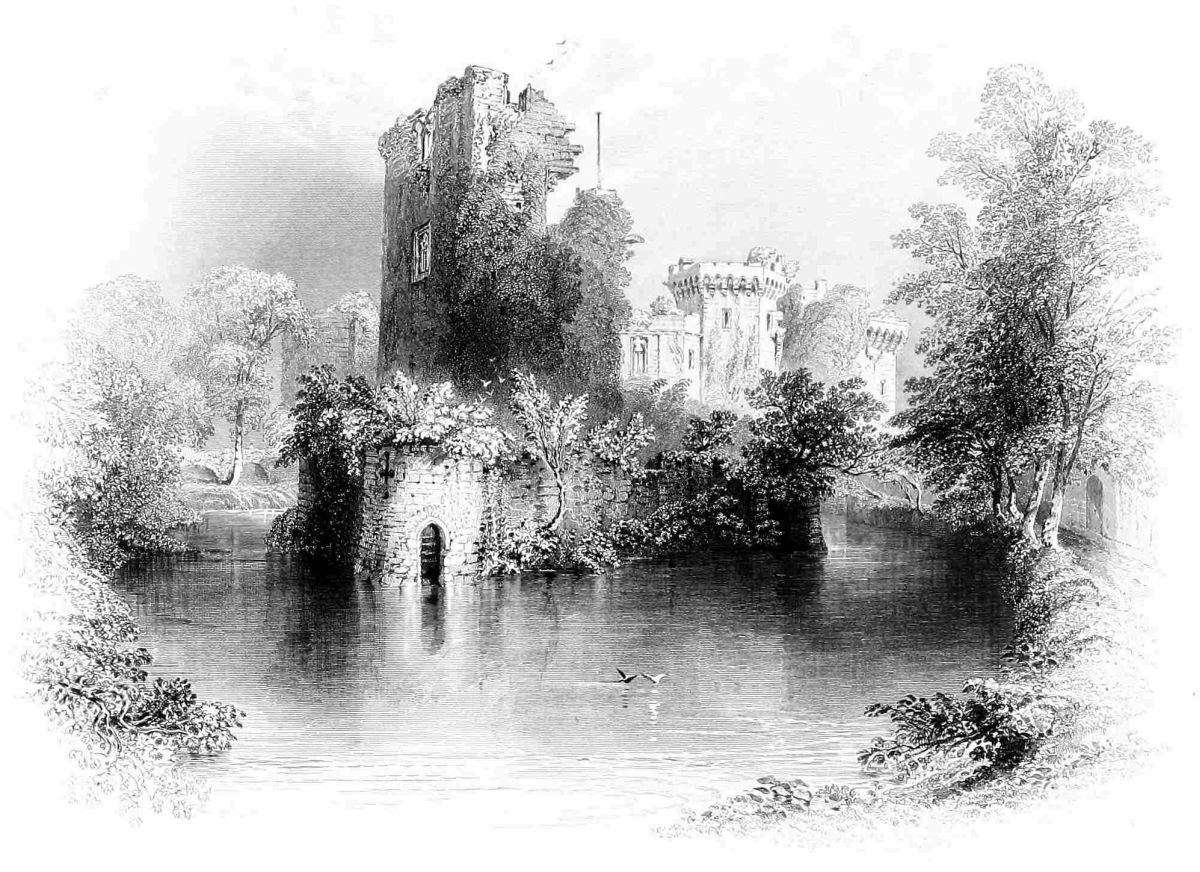
The Keep Tower, from the Moat.
Raglan Castle.
resemblance—as if Nature herself had chosen him to be his
representative—the right stone being pulled out, and a counterfeit set
in the right ring—and what with the likeness of his countenance, and
the identity of apparel, he passed for current; which jest my Roman
thought so good, that he must needs brag of it to the Marquess. But my
lord no way liked it; asking him—‘Would you put another upon doing that
which you would not do yourself? What if the devil—you two being so
like one another—should mistake you for him? I assure you he would go
neare to mar the conceit.’ For, he might have added, though honesty be
no Puritan, yet it will do no hurt.”
“Mine honour is my life; both grow in one;
Take honour from me, and my life’s undone.”
In the next passage, the Marquess undertakes the duty of admonishing a
party who had come to visit him; and his method of doing so is somewhat
amusing. We shall give the lecture, as nearly as we can, in his
chaplain’s own words:—“There was a new-married couple,” says he,
“presented before the Marquess. The bride was a goodly proper woman, her
face well-featured, an excellent eye she had, but she was pitifully
disfigured with the smallpox. The Marquess, looking much upon her, and
saying nothing to her for a long while, we all knew that silence was in
labour for some notable production. At last he advances toward the young
bride, and asked her: ‘Gentlewoman, do you know why it is said that God
Almighty created man and builded woman?’ The lady, somewhat out of
countenance, answered, ‘No, indeed, my lord.’ The Marquess asked her
again: ‘Do you know why you women are called housewives?’ ‘I think, my
lord,’ said the bride, ‘because good wives should keep at home, and not
gad abroad.’ ‘It is a good answer,’ said the Marquess, ‘but not the
right one; for women may be bad wives at home, as well as abroad;
otherwise they would never scold their husbands out of doors. The answer
to my first question is: Woman is not said to be made as Adam was,
which only signifies plain work; but to be built, which signifies
curiosity and contrivance; and, therefore, as to my second question, a
woman is called a housewife, because she is a house out of which all the
royal families of kings and emperors derive their extract. Neither are
you only compared to houses; but unto cities, kingdoms, churches, and
commonwealths. But do you know what house you are like?’ ‘No, indeed, my
lord,’ answered the bride. ‘Why, then, I’ll tell you,’ resumed the
Marquess; ‘when God builded the first woman, he made her his storehouse,
wherein he had laid up all the race of mankind, wherewith he replenished
the whole earth. But I must tell you, my lady, God Almighty did not make
you coaches nor waggons, that you should be always gadding about.’
Whereat the bridegroom made answer: ‘My lord, I thank you for this; I
hope my wife will remember it.’ ‘My lord,’ said the young bride, ‘you
will read such a lecture to my husband, that he will never let me go
abroad.’ ‘Oh no, my lady,’ said the Marquess, ‘he must not debar you of
that liberty, provided you never go abroad but when you go out like the
snaile; who seldom stirs abroad but whilst that blessing, the dew of
heaven, is upon the earth, that she may gather benefit; and by her
greatest care, and equal management, still carries her house upon her
back.’ ‘Oh, my lord,’ said she, ‘if I should goe abroad like the snaile,
I should carry not only a house upon my back, but horns upon my
forehead!’ ‘No, lady,’ said the Marquess; ‘though she pockes at you, yet
they are not horns; the snaile can soon draw them in if you touch them,
which no horned creature can perform; but she carries them in her head
to teach you what you should provide, and bear in mind against you go to
hay-making.’
“But the Marquess fearing he had a little displeased the young couple,
he thought to make amends by the following, though somewhat equivocal,
discourse:—‘Sir,’ said he to the bridegroom, ‘you know I have compared
your wife unto a building, and I much commend your choice, for a goodly
house should not be chosen for the smoothness or whiteness of the
wall—for such a one may be but a dairy-house or a milk-house; nor
according to the colours or paintings of the outside—for such a one may
be but a tavern or an alehouse; but if I see a house that is lofty and
stately built, and hath fair windows, though the outside be but
rough-cast, yet I am sure there are goodly rooms therein.’
“And so,” adds Bayly, “both parties were well pleased.” For what the
Marquess meant to express by this string of similes was, that although
the lady was much disfigured by the smallpox, yet her fine expressive
eyes, intellectual forehead, noble carriage, and cultivated mind, amply
atoned for accidental disfigurement; and left a balance in her favour
which no outward appearance could disparage or conceal.
These anecdotes of an octogenarian, however unsuited to modern ideas,
and of rather doubtful merit on the score of compliment, are
characteristic of times when the court-jester was still thought a
necessary appendage to a great household; and when riddle and allegory
were the daily vehicles of political wit and private satire, as well as
the legitimate promoters of loyalty, mirth, and good-fellowship. That
they were considered by Dr. Bayly himself—a grave and learned man—as
reflecting honour upon the Marquess who uttered them, and creditable to
his own taste and industry in transmitting them to posterity, is a proof
that, agreeably to the taste of the age, they were fully entitled to the
distinction of ‘apophthegms.’
Here follows another, in a more serious and figurative sense, to which
Juxon himself would not have objected, even from the pulpit:—“We were
talking upon one occasion of Christ’s miracles, more particularly of his
turning water into wine, and of the five loaves and two fishes. ‘Truly,’
said the Marquess, ‘these miracles He works amongst us every day; but
they are so ordinary, or familiar, that we take no notice of them. God
sends rain upon the earth; this water gets up into the vine, and the
sappe of the vine-tree God turneth into wine. And as few graines of
corne as will make five loaves being covered in the earth, will
multiply and encrease to such advantage as will feed five thousand with
bread; and two fishes will bring forth so many fishes as will suffice
so many mouths.’” It was by these serious and intelligible, as well as
original, remarks upon subjects accidentally brought out in
conversation, that the Marquess sought to impress upon all around him
those religious sentiments and convictions which he had himself imbibed
by diligent study of the Scriptures; the benefit of which he daily
acknowledged, when overtaken by the accumulated evils of age and almost
unparalleled adversity.
“Such a house broke—
So noble a master fallen! All gone—
And not one friend to take his fortune by the arm!”
We now turn to the faithful friend who has recorded these anecdotes of
his illustrious patron; who attended him during the whole progress of
the siege, and, after the closing scene at Raglan, accompanied him to
London, soothed him under the new series of afflictions to which he was
there exposed, and never left him until he saw the Master whom he loved
and honoured consigned to his final resting-place in the Beaufort Chapel
at Windsor. This companion, friend, and counsellor, was Dr. Bayly; and,
although our notice must be brief, it is a grateful task to commemorate
the virtues of a man, whose name has almost passed into oblivion; but
whose loyal devotion, genius, talent, and misfortune, justly entitle him
to a place in the same page that records the merits and sufferings of
Henry, first Marquess of Worcester.
Dr. Thomas Bayly was the fourth and youngest son of Dr. Lewis Bayly,
Bishop of Bangor. After finishing his curriculum at the University of
Cambridge, and receiving the degree of Bachelor of Arts in 1638, he was
presented by King Charles to the subdeanery of Wells. In the troubles
that continued to distract the nation, he took an active and unremitting
interest; and having retired with other loyalists to Oxford in 1644, he
was there created Doctor of Divinity. Previously to the battle of
Naseby, he had accepted Lord Worcester’s appointment as chaplain to the
household; and, as we have seen in the preceding account, acted in
several instances as confidential adviser between the King and the
Marquess. He was present during the whole course of the siege of Raglan,
more as a soldier than a chaplain, and took his full share of the perils
and responsibilities in which the officers of the garrison were then
involved.
When terms of capitulation were finally tendered by General Fairfax, and
accepted by the Marquess, Dr. Bayly was employed to draw up the articles
upon which the garrison was to be disbanded: and when the castle was
delivered up to the besiegers, he accompanied the Marquess to London,
attended him during his imprisonment as a friend and servant, consoled
him as a minister of religion, vindicated his character, advocated his
rights, and, when the final hour arrived, he performed over his grave
the last sad offices of religion and humanity.
After this event, Dr. Bayly repaired to the Continent, where he
continued to reside, chiefly in France, until the “martyrdom of King
Charles,” when he returned to England, and published the work already
mentioned, entitled, “Certamen Religiosum; or, a Conference between King
Charles I. and Henry, late Marquess of Worcester, concerning Religion,
in Raglan Castle, anno 1646.” This conference, however, was believed by
many to whom he stood opposed, to have no real foundation in truth; and
to be merely sent forth as a prelude to his declaring himself a convert
to the Roman Catholic faith; or, in the original words, to his “becoming
a Papist.”
In the course of the same year he published another work, entitled, “The
Royal Charter granted unto Kings by God himself,” &c.; to which is
added, “A Treatise,” wherein is proved that Episcopacy is jure divino.
By these writings he incurred the heavy displeasure of the
Government—to which all such topics were obnoxious—and the author was
committed to Newgate, where he languished for some time. But at length,
a favourable opportunity having been presented, he made his escape into
Holland, where he carried his religious views into immediate practice,
and became a zealous Roman Catholic.
Previous to this date, and during his confinement in Newgate, he wrote a
piece, entitled, “Herba Parietis; or, the Wallflower, as it grows out of
the stone chamber belonging to the metropolitan prison; being an
historie which is partly true, partly romantic, morally divine; whereby
a marriage between Reality and Fancy is solemnized by Divinity.”[282]
Shortly after this publication, he quitted Holland, and took up his
residence at Douay in France, where he sent forth another book, with the
title of “The End to Controversy between the Roman Catholic and
Protestant Religions, justified by all the several manner of ways
whereby all kinds of controversies, of what nature soever, are usually
or can possibly be determined.”[283] This was followed by “Dr. Bayly’s
Challenge,” the last of his published works; after which he proceeded to
Italy, where he spent the residue of his days, and died, as his
biographers conclude, in poverty and distress. It is more likely,
however, that, after having, by his controversial talents, rendered some
service to the church of his adoption, he retired into a monastery, and
there ended his chequered pilgrimage in exercises of devotion. This,
however, is matter of conjecture, for he is said by Dodd to have died in
the family of Cardinal Ottoboni; while Dr. Trevor, Fellow of Merton
College, who travelled in Italy in 1659, reports that he died in a
public hospital, and that he had seen his grave. His fate, however, like
that of many others—driven into involuntary exile by similar causes—is
involved in a mystery which no recent attempt has been made to
elucidate. Requiescat in pace.
To the books or pamphlets above named, Dr. Bayly received various
replies, which showed that, by their spirit and execution, they had
excited no little attention among the able and fierce controversialists
of that day. Among those who took the field against him were Christopher
Cartwright, L’Estrange, Robert Sanderson, Peter Heylin, and others.
A “Life of Fisher, Bishop of Rochester,” is also ascribed to the pen of
Dr. Bayly; but his title to that work is not fully substantiated. His
Dedication of “Worcester’s Apophthegms,” to the second Marquess, author
of “A Century of Inventions,” is manly and elegant. The conclusion is in
these words:—“I layd your noble father in his grave with mine own
hands; and I could not let a memorial of him lye buried under my own
manuscript, but thought it a duty belonging to his fame, and your own
merit, to dedicate this book unto your lordship, heir to all, but
apparently to nothing but his virtues and this memorial of them.”
In his Epistle to the Reader, he enters upon a lively vindication of the
genuineness of his “Certamen; or, Discourse Concerning Religion;” the
veracity of which had been bitterly impugned by his enemies; and states
that he published it in vindication of the King’s constant affection to
the Protestant religion. There is considerable spirit in the
preface:—“Some,” he says, “will not admit of that controversie
otherwise than as a parable: First, because they were there—that is, at
Raglan Castle—and heard no such thing; Secondly, because they believed
not the Marquess of Worcester to be so able a man; as I hear it hath
been said by some of his Majesty’s field chaplains, who envying that a
loyal pen should wagge, where they can be contented to sew pillowes
under the elbowes, to bead cushions over the heads of the people,[284]
and preach such wholesome and sound doctrine of mortification,
sanctification, justification, and good life, that they thought they
might safely get up into any pulpit, not caring what bottom it had, nor
what canopie was over head. Not much unlike the man who went to preach
after [upon] the sureness of his foundation, when his house was all on
fire. These men will tell you that this was no real thing; because they
were there—at Raglan—all the while; whilst, in fact, they were not
there at all except at meales; and when I tell you that they were the
doctours, that were better at smelling a good dinner than a disputation,
I have as good as told you their names. I expected truly better reason
from those doctours, than from the knight that said, ‘He was sure there
should be no such thing at Raglan, for his boy Tom was there all the
time!’
“But you will say,” he continues, “you do not believe there was any such
private discourse. Chuse then; who cares? Let him believe that will; it
was writ for the satisfaction of Christians—not of Infidels. But it may
be that ‘mendax Fama’ means to requite me for the wrong she did my
father, who writ a good book;[285] and some would not believe it to be
his; and now that I have set out a book none of mine own, she will have
it to be mine. I thank her kindly; but I had rather be without her
praises, than to be thought such an ingenious lyar.”
The suspicion that Bayly was the inventor, and not reporter, of the
“Certamen Religiosum,” is not supported by any testimony to which we can
attach implicit reliance; for those who charged him with the deception,
were of the party to whom he was politically as well as religiously
opposed. That conversations of the kind actually occurred between the
King and the Marquess, can hardly be doubted; but as Bayly, in the midst
of a garrison, could not be so cool and accurate as a modern reporter
for the press, we may fancy that he clothed the arguments, sent forth in
the “Certamen,” in his own language; and perhaps insensibly coloured
them with his own sentiments.
It has been farther said of him, that, besides taking part in the
defence of Raglan, he fought, on some occasion of his subsequent and
chequered career, as a common soldier. This is by no means unlikely; for
he was of an active and adventurous spirit; never reluctant to take up
arms in a good cause; and like some other ecclesiastics of his day, as
well known in the “tented field” as in the pulpit.
In his “Book of Apophthegms,”[286] he mentions the fact of his having
saved Lord Worcester from the enemy, by giving him timely notice of
their approach, when he found him wandering on the Welsh mountains; and,
recording this incident as the occasion and origin of his acquaintance
with the Marquess, he says: “From that time forward, until I laid him in
his grave in Windsor Castle, I never parted from him.” Such enthusiastic
attachment—disinterested as, under all the peculiar circumstances of
the case, it must have been—does infinite credit to the memory of
Bayly; for it generally happens that fallen greatness, like court
favourites, has no real friends.—We now return to the closing scene of
the master whom he had served with so much constancy, and whom it was
literally his misfortune to survive; for after his obsequies at Windsor,
Bayly was left a friendless wanderer, denounced at home, received with
suspicion abroad, and indebted to charity for bread and—a grave.
Reduced, as we have seen, to the humiliating condition of a prisoner,
the Marquess of Worcester did not long require the vigilance of the
Black Rod. From the day that Raglan was delivered up to General Fairfax,
his health, which during the siege had suffered from great mental
anxiety, rapidly declined under the absence of all that reconciles
worldly men to the evils of life. But, armed with that Christian
philosophy which is the only panacea for the outrages of fortune, he
preserved the inward calm of a resigned and tranquil spirit; and,
looking forward to another and a happier existence, he regarded passing
events, like his own bodily infirmities, as visitations from an unseen
Power, who, through a rugged and stormy path, was conducting his servant
into a new region of sunshine and peace. At his death, which took place
in December, all that descended to his family, as unconvertible to
Parliamentary uses, were the example he had set before them of unshaken
loyalty, well-grounded faith, and a patient endurance of evils which the
practice of such hereditary virtues might incur. By his wife, whom he
long survived, he had issue nine sons and four daughters: namely, Lord
Herbert, Earl of Glamorgan, who succeeded to the honours; Lord John, who
married a daughter of Thomas, Lord Arundel of Wardour; and Lord Charles,
who, during the siege of Raglan, acted as second in command under his
father, and after signalizing himself in the royal service, devoted
himself to the church, and died, as already observed, in exile at
Cambray. These are the only members of the family that require to be
noticed in this place.
Edward, the second Marquess, maintained the same spirit of loyalty which
had actuated his father through life. The services which he had
hitherto, as Lord Herbert, rendered to the royal cause, were followed by
others which won for him the entire confidence of his Sovereign, by whom
he was constituted Lord Lieutenant of North Wales, and invested with the
highest authority ever delegated by a king to his subject. To this
remarkable fact allusion has been already made;[287] but in this place,
where it may be more properly introduced, we shall quote the original at
full length. In the preceding history, as we have seen, the King
addressed him in letters patent from Oxford, by the title of Earl of
Glamorgan, Baron Beaufort of Caldecot; and to complete the honours
showered upon him, his Majesty invested him, in 1644, with the following
commission:—
“Charles, by the grace of God, King of England, Scotland, France,
and Ireland, Defender of the Faith, &c., to our right trusty and
right well-beloved cousin Edward Somerset alias Plantagenet, Lord
Herbert, Baron Beaufort of Caldicote, Grosmond, Chepstow, Raglan,
and Gower, Earl of Glamorgan, son and heir apparent of our entirely
beloved cousin, Henry, Earl and Marquess of Worcester, greeting.
“Having had good and long experience of your prowess, prudence, and
fidelity, do make choice, and by these nominate and appoint you
our, &c., to be our generalissimo of three armies, English, Irish,
and Foreign, and admiral of a fleet at sea, with power to recommend
your Lieut.-General for our approbation; leaving all other officers
to your own election and denomination, and accordingly to receive
their commission from you, willing and commanding them, and every
of them, you to obey as their general, and you to receive immediate
orders from ourself only. And lest, through distance of place, we
may be misinformed, we will and commend you to reply unto us, if
any of our orders should thwart or hinder any of your designs for
our service. And there being necessary great sums of money to the
carrying on so chargeable an employment, which we have not to
furnish you withal, we do by these empower you to contract with any
of our loving subjects of England, Ireland, and dominion of Wales,
for wardships, customs, woods, or any our rights and prerogatives;
we by these obliging ourselves, our heirs, and successors, to
confirm and make good the same accordingly. And for persons of
generosity, for whom titles of honour are most desirable, we have
entrusted you with several patents under our Great Seal of England,
from a Marquis to a Baronet, which we give you full power and
authority to date and dispose of, without knowing our further
pleasure. So great is our trust and confidence in you, as that,
whatsoever you do contract for or promise, We will make good the
same accordingly, from the date of this our commission forwards;
which, for the better satisfaction, We give you leave to give them,
or any of them, copies thereof, attested under your hand and seal
of arms. And for your own encouragement, and in token of our
gratitude, we give and allow you henceforward such fees, titles,
preheminences, and privileges, as do and may belong to your place
and command above-mentioned; with promise of our dear daughter
Elizabeth to your son Plantagenet in marriage, with three hundred
thousand pounds in dower or portion; most part whereof we
acknowledge spent or disburst by your Father[288] and you in our
service; and the title of Duke of Somerset to you and your heirs
male for ever; and from henceforward to give the Garter to your
arms, and at your pleasure to put on the George and blue ribbon.
And for your greater honour, and in testimony of our reality, we
have with our own hand affixed our great seal of England unto these
our commission and letters, making them patents.
“Witness ourself at Oxford, the first day of April, in the
twentieth year of our reign, and the year of our Lord one thousand
six hundred and forty-four.
“Charles.”
The result of this commission, full of promises, offers a striking
instance of the uncertainty of “the best laid schemes” of men. Lord
Glamorgan’s eldest son married; but no matrimonial alliance took place
between the Royal family and his. Nor is it mentioned that any use was
made of his unprecedented power to make peers; and what is singular
enough, the title of Glamorgan, granted to Lord Herbert himself, was
disputed, on account of some informality, at the Restoration of Charles
II., and surrendered by him when Marquess of Worcester. He seems,
indeed, to have regarded neither his private interest nor his public
reputation in comparison with those of his Royal master. He was sent to
Ireland, as already noticed, with a secret commission to negotiate with
the Roman Catholics; and upon its discovery, and being disowned by
Charles, he took all the fault on himself, to the imminent hazard of his
own life. At the Restoration he met with no adequate reward for his
devoted loyalty. Charles the Second, probably, had not all the power
that was supposed, as he certainly had not all the inclination that was
expected, to reward the adherents of his family.
Horace Walpole, in his “Catalogue of Royal and Noble Authors,” gives a
lively, but a very careless and unfair, account of this Marquess of
Worcester. He ridicules his “Century of Inventions;” but, in truth, Lord
Orford’s opinion will not go far on scientific subjects. An opinion,
very different from that of the critic-peer, will be formed on
consulting the new edition of the “Century of Inventions,” with
historical and explanatory notes, published in 1835, by Mr. Charles F.
Partington.
The title the Marquess gives the original work is, “A Century of the
Names and Scantlings of such Inventions, as at present I can call to
mind to have tried and perfected, which (my former notes being lost) I
have, at the instance of a powerful friend, endeavoured now, in the year
1655, to set these down in such a way, as may sufficiently instruct me
to put any of them in practice.”
“Artis et naturæ proles.”
He dedicates it to the King in language of unabated loyalty; and in a
second address impressively recommends his discoveries to the attention
of both Houses of Parliament. In the sixth of these “Inventions,” Mr.
Partington recognises an improved construction of the telegraph, as it
was used before the electric telegraph came into use.
In VIII. IX. and X. various engines of war are hinted, which have since
been perfected by Congreve and others. The reader who is curious in such
subjects, will be well repaid by a perusal of Mr. Partington’s book. We
can only find room for those inventions which foreshadow the
steam-engine.
“XC. An engine so contrived that, working the primum mobile forward or
backward, upward or downward, circularly or cornerwise, to and fro,
straight, upright or downright, yet the pretended operation continueth
and advanceth; none of the motions above-mentioned hindering, much less
stopping the other; but unanimously and with harmony agreeing, they all
augment and contribute strength unto the intended work and operation;
and, therefore, I call this a semi-omnipotent engine, and do intend
that a model thereof be buried with me.
“XCIX. How to make one pound weight raise an hundred as high as one
pound falleth; and yet the hundred pounds weight descending doth what
nothing less than one hundred pounds can effect.
“LXVIII. An admirable and most forcible way to drive up water by fire,
not by drawing and sucking it upwards, for that must be, as the
philosopher calleth it, infra spheram activitatis, which is had at
such a distance; but this way hath no bounder, if the vessels be strong
enough; for I have taken a piece of a whole cannon, whereof the end was
burst, and filled it three quarters full, stopping and screwing up the
broken end, as also the touchhole; and making a constant fire under it,
within twenty-fours it burst, and made a great crack. So that having
found a way to make my vessels, so that they are strengthened by the
force within them, the one to fill after the other, have seen the water
run like a constant fountain stream forty feet high; one vessel of
water, rarefied by fire, driveth up forty of cold water; and a man that
tends the work is but to turn two cocks, that one vessel of water being
consumed, another begins to force and refill with cold water, and so
successively, the fire being tended and kept constant, which the
selfsame person may likewise abundantly perform in the interim between
the necessity of turning the said cocks.
“C. Upon so potent a help as these two last-mentioned inventions, a
waterwork is, by many years’ experience and labour, so advantageously by
me contrived, that a child’s force bringeth up, an hundred feet high, an
incredible quantity of water, even two feet diameter. And I may boldly
call it the most stupendous work in the whole world! Not only, with
little charge, to drain all sorts of mines, and furnish cities with
water, though never so high seated, as well to keep them sweet, running
through several streets, and so performing the work of scavengers, as
well as furnishing the inhabitants with sufficient water for their
private occasions; but likewise supplying the rivers with sufficient to
maintain and make navigable from town to town, and for the bettering of
lands all the way it runs; with many more advantageous and yet greater
effects of profit, admiration, and consequence. So that, deservedly, I
deem this invention to crown my labours, to reward my expenses, and make
my thoughts acquiesce in the way of farther inventions. This making up
the whole century, and preventing any farther trouble to the reader for
the present, meaning to leave to posterity a book, wherein, under each
of these heads, the means to put in execution and visible trial all and
every of these inventions, with the shape and form of all things
belonging to them, shall be printed by brass plates.” And he devoutly
concludes:—“In bonum publicum, et ad majorem Dei gloriam.”
On these Mr. Partington has the following note:—“The three last
inventions may justly be considered as the most important of the whole
‘Century;’ and when united with the 68th article, they appear to suggest
nearly all the data essential for the construction of a modern
steam-engine. The noble author has furnished us with what he calls a
definition of this engine; and although it is written in the same vague
and empirical style which characterises a large portion of his
‘Inventions,’ it may yet be considered as affording additional proofs of
the above important fact.”
The Marquess’s “Definition” is exceedingly rare, as the only copy known
to be extant is preserved in the British Museum. It is printed on a
single sheet, without date, and appears to have been written for the
purpose of procuring subscriptions in aid of a water company, then about
to be established:—
“A stupendous, or a water-commanding engine, boundless for height or
quantity, requiring no external nor even additional help or force, to be
set or continued in motion, but what intrinsically is afforded from its
own operation, nor yet the twentieth part thereof. And the engine
consisteth of the following particulars:—
“A perfect counterpoise, for what quantity soever of water.
“A perfect countervail, for what height soever it is to be brought unto.
“A primum mobile, commanding both height and quantity, regulator-wise.
“A vicegerent, or countervail, supplying the place, and performing the
full force of man, wind, beast, or mill.
“A helm, or stern, with bit and reins, wherewith any child may guide,
order, and control the whole operation.
“A particular magazine for water, according to the intended quantity or
height of water.
“An aqueduct, capable of any intended quantity or height of water.
“A place for the original fountain, or river, to run into, and
naturally, of its own accord, incorporate itself with the rising water,
and at the very bottom of the aqueduct, though never so big or high.
“By Divine Providence and heavenly inspiration, this is my stupendous
water-commanding engine, boundless for height and quantity.
“Whosoever is master of weight, is master of force; whosoever is master
of water, is master of both; and, consequently, to him all forcible
actions and achievements are easy.”
“It is said,” continues our authority in another place, “that the
Marquess, while confined in the Tower of London, was preparing some food
in his apartment, (a singularly good result from a marquess having been
obliged to be his own cook,) and the cover of the vessel having been
closely fitted, was, by the expansion of the steam, suddenly forced off
and driven up the chimney. This circumstance attracting his attention,
led him to a train of thought, which terminated in the completion of his
‘water-commanding engine.’”
Thus, we think, posterity has something more to thank the noble owner of
Raglan for, than deeds of arms, or the defence of castles. His great
castle, however, was ere this time in ruins, and furnishing another
instance of the folly with which the conquerors at that period destroyed
the noble buildings which had belonged to their enemies the Royalists;
as if it had not been enough, and more wise and provident, to have kept
them in their own possession, and converted them to republican uses.
The Marquess survived the publication of his “Century” only about two
years. He died in retirement, near London, on the 3d of April, 1667, and
was buried in the vault of Raglan Church, on the 19th of the same month,
near his grandfather, Edward, Earl of Worcester.[289]
After the Restoration, as already noticed, a committee was appointed by
the House of Lords,[290] to take the patent above quoted into serious
consideration. The consequence was, that in a very few days thereafter
it reported that the Marquess was willing, without further question, to
deliver it up to his Majesty; and accordingly, on the third of September
following, the said patent, “granted,” as it was alleged, “in prejudice
to the Peers,” was formally surrendered to the Sovereign, as the only
fountain of national honours.
Henry, only son of the second Marquess, succeeded him in all those high
titles and appointments, by which the King endeavoured to make him
amends for the vast sacrifices which his family had incurred by a long
course of unflinching and untarnished loyalty. And to crown the whole,
he was installed K.G., and finally advanced to the highest rank of the
peerage. Having been “eminently serviceable to the King”—as expressed
in the patent—“since his most happy restoration to the throne of these
realms; in consideration thereof, and of his most noble descent from
King Edward the Third, by John de Beaufort, eldest son of John of Gaunt,
Duke of Lancaster, by Catherine Swinford, his third wife,” the Marquess
of Worcester was created, in December, 1682, Duke of Beaufort, with
remainder to the heirs male of his body.
At the funeral of Charles the Second, his Grace was one of the
supporters to George, Prince of Denmark, chief mourner. By James the
Second he was made Lord President of Wales, and Lord Lieutenant of
twelve different counties in the Principality; and at the Coronation, in
April following, he had the distinguished honour of carrying the Queen’s
crown. He was afterwards made Colonel of the 11th Regiment of foot, then
first raised. He next exerted himself against the Duke of Monmouth; and
endeavoured, though ineffectually, to secure Bristol against the
adherents of the Prince of Orange. Upon that Prince’s elevation to the
British throne, his Grace refused to take the oaths, and abjuring public
life, lived in retirement until his death, which took place in 1699, in
the seventieth year of his age.
Charles, the second but eldest surviving son of the first Duke, is
mentioned in the family history as a nobleman of great parts and
learning. He died in the lifetime of his father, in consequence of an
accident, in the thirty-eighth year of his age. His horses, we are told,
taking fright, and running down a steep hill, the danger became
imminent; when, to avoid the casualty which threatened him, he unhappily
leaped out, broke his thigh-bone, and only survived the accident three
days.
Henry, his eldest son, succeeded his grandfather as second Duke of
Beaufort. On Queen Anne’s visiting the University of Oxford in 1702, and
going thence in her progress to Bath, the Duke met her Majesty near
Cirencester, on the twenty-ninth of August; and, attended by great
numbers of the gentlemen, clergy, and freeholders of the county,
conducted her with great pomp to his seat at Badminton, where she was
received with regal splendour. This act of loyal hospitality—so
becoming in a descendant of Henry the first Marquess of Worcester—was
most graciously acknowledged by the Queen and her royal consort Prince
George of Denmark.
Three years after this event, the Duke took his seat in the House of
Lords; but did not appear at court until after the change of ministers
in 1710, when he frankly told her Majesty that he could “then, and only
then, call her Queen of England.”
After being installed in various high offices, and while promising a
long and distinguished career in the service of his country, he was
prematurely cut off in the thirty-first year of his age, and buried at
Badminton, where a monument records his titles, character, and public
services.
Badminton, which we have just named, is the principal seat of the
Beaufort family, and comprises one of the finest parks in England.
Badminton Church, which contains the monuments above-named, was rebuilt
at the expense of the late Duke of Beaufort in 1785, after a plan by
Evans. It stands within the Ducal Park; and, besides various other
specimens of art, represents the arms of Somerset—“foy pour
devoir”—faith for duty—worked in mosaic in the pavement of the
chancel. On the destruction of
Raglan Castle, as already described in these pages, was laid the
foundation of Badminton Park, where the household gods of the family
were formally enshrined, and insured the possession of a more peaceful
and propitious home.
“Here, in forgetfulness of many woes,
The loyal Founder sought and found repose;
Here, in sweet landscapes to the Muse endeared,
Soothed by Religion, and by Science cheered;
Tasted the sweets that rarely can be known,
Save when we make the public weal our own.”
This beautiful seat—long prior to the time in question—had been the
hereditary demesne of the Botelers, whose names appear in the earliest
period of British history. The house is built in the Palladian style of
architecture—a style for which the first Duke of Beaufort had acquired
a taste at Vicenza; and when the time had arrived that a house, worthy
of his illustrious ancestors, should be erected in this county, a
decided preference was given to the Italian model. The principal front
is of great length, having in its centre division a composite colonnade,
surmounted by an attic, on which is sculptured the family arms. The
wings of the mansion, extending considerably on each side, are
terminated by Tuscan arches, leading to the offices and stables. Over
each extremity of the centre is a cupola. The interior decorations of
this palace are splendid, but still in good keeping, and evincing due
regard to the classical taste in which the building itself originated.
The great dining or banquet hall is tastefully ornamented by wood
carvings, from the designs of the celebrated Gibbons—all of elaborate
execution, and presenting some of the finest specimens ever produced by
that artist. The picture gallery—which the stranger will admire for its
fine proportions and classical simplicity—presents a series of family
portraits, with which, individually, are associated many pleasing, and
some painful events and circumstances of the national history—
“Of lofty stem! the beautiful, the bold—
Names that still blazon the historic page!
Faintly, yet brightly, hath the painter told
Their worth and virtues to a latter age—
‘In faith inflexible;’ in beauty’s charms
Triumphant; and invincible in arms.”
The park, by which the mansion is encircled, is of great extent—more
than nine miles in circumference; and although the natural scenery is
comparatively tame, the walks and drives are exceedingly picturesque;
and, to the practised eye of strangers, present many points of view
which will linger on the memory long after other and more romantic
scenes are forgotten.
“Here waving woods—a mass of living green—
With varied shade diversify the scene;
Flowers of all hues perfume the haunted dell,
Where streams descend, and bubbling fountains dwell;
Where busts of heroes glimmer through the trees,
And Nature’s music floats upon the breeze—
Such, as in olden time, was heard to wake
The slumbering echoes of the Larian lake;
Or soothed, with dulcet tones, the opal sea,
That clasps thy beauteous shore—Parthenopè!
Yet brighter rises—fairer sets the sun
Upon thy classic shades—fair Badminton.”
With these particulars, which bring down the family history to
comparatively modern times, we close this portion of the subject, and
return to the scene of our illustrations—
Raglan Castle.—By those unacquainted with the subject, it has been
often regretted that, when prosperity had again visited the family of
Worcester, no effort was ever made to restore this castle to something
of its original splendour. But the obstacles that opposed such a
patriotic design were innumerable; and although the apartments at vast
expense might have been rendered habitable, yet the parks, and the
timber—the growth of centuries—having all been cut down and swept away
in the Revolution, and nothing left but a comparatively bleak and
uncultivated waste, the grand ornament of the manor was not to be
replaced by the hand of art. Turrets might again multiply along the
battlements, and splendid courts be rescued from the cumbrous ruins that
had long hid and disfigured them; but trees must be raised by a slower
process, and he who should replant the wasted demesne must do so, not
for himself, but for the benefit of future generations.
But, in addition to other obstacles that need not here be noticed, the
habits and manner of society had become so thoroughly changed after the
Restoration, that a feudal stronghold was no longer indispensable for
the security and comfort of great families. The military chief had now
thrown aside his cumbrous mail, and entered into the every-day duties of
civil life; and by improved intercourse with his fellow-men—confidence
in the stability of government—a taste for agriculture, and love of
national sports and pastimes, he felt his own happiness advanced by the
new facilities of promoting that of the people around him. He found that
to sleep soundly, required the aid of neither drawbridge nor portcullis.
Public order and confidence once restored, domestic feuds, which had so
long kept men strangers to one another—except in some field of
conflict—were succeeded by family alliances, which united them by new
ties of friendship and affection; and instead of mutual distrust and
mutual defiance, the nobles of the land were gradually weaned back from
an immoderate love of war to the arts of peace, and the practical
illustration of loyalty and patriotism. The feudal castle, built chiefly
for defence, was now of course a structure of which every one could
perceive the comfortless inconvenience. A host of retainers was no
longer required either for the safety or the baronial state of the
mansion; a new form of society required new and more simple forms of
accommodation; and the rural mansion, with its waving woods, gardens,
orchards, farm-like offices, well-stocked preserves, and richly
variegated lawns, succeeded those stern fortifications within which
former generations had maintained their haughty independence—but which,
in reality, was little better than “the freedom of a state prisoner”—
“For still the ramparts, tall and grim,
Were barriers ’twixt the world and him!”
Raglan Castle, however—even while occupied as a feudal
residence—possessed many advantages over its contemporaries. Its
spacious courts, lofty halls, numerous suites of chambers, extensive
battlements, ancient gardens, shady walks, and variegated prospects,
were luxuries to which few, if any, of our domestic fortalices could lay
claim. Within the walls of the castle, the riches of art, pictorial and
sculptured, were scattered with taste and liberality on every object
that could please the eye or amuse the fancy; while the skill and
science illustrated in their arrangement improved the mind, and imparted
a classic grace and colouring to the whole structure. Of its luxuries in
this respect—in its library, its Gallery of paintings and
sculpture—the description of an old poet may be quoted as not
inapplicable to the scene presented by Raglan, at the commencement of
the seventeenth century:—
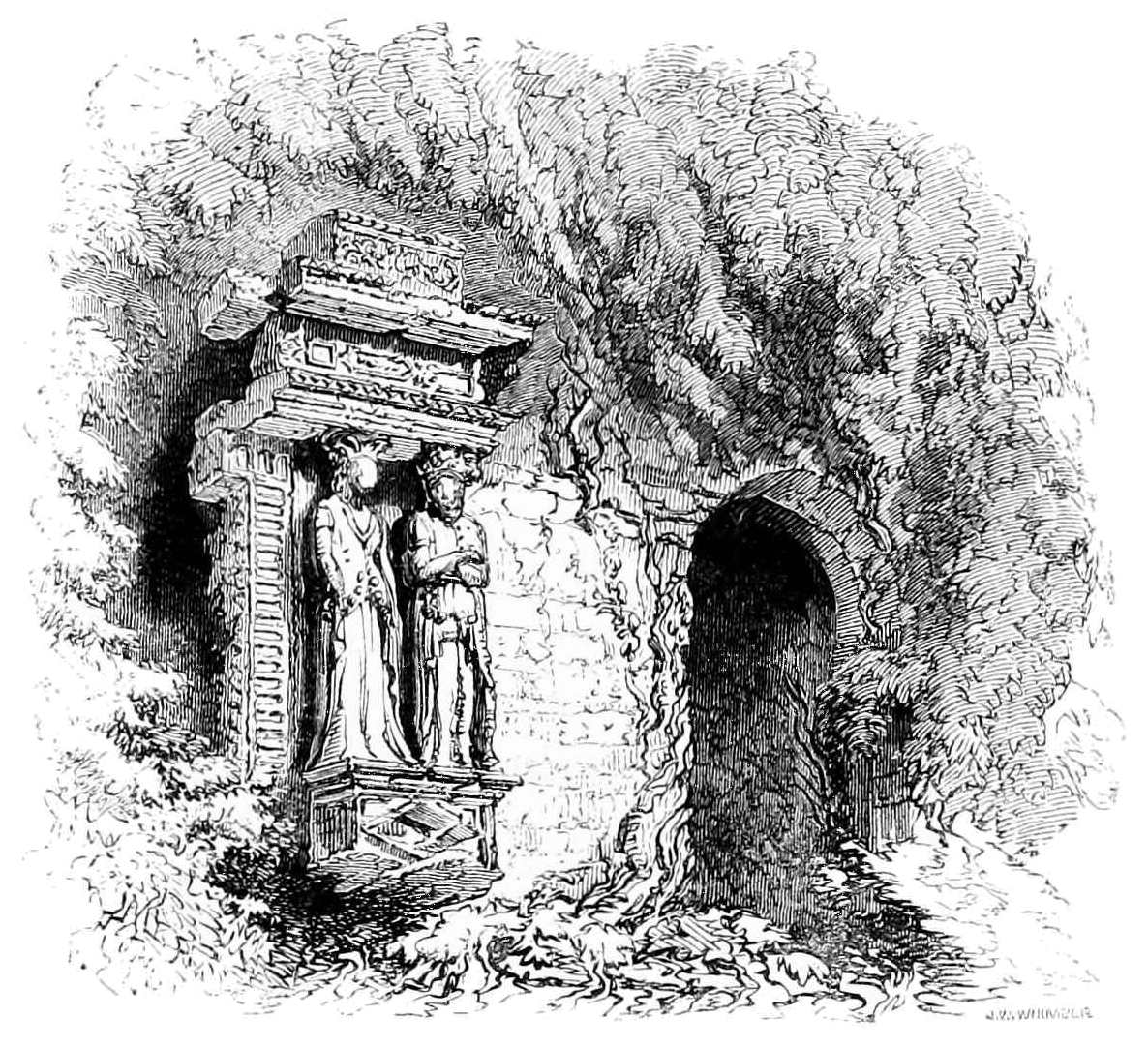
State Gallery—looking south.
“For the rich spoil of all the continents,
The boast of art and nature, there was brought;
Corinthian brass, Egyptian monuments,
With hieroglyphic sculptures all inwrought;
And Parian marbles, by Greek artists taught
To counterfeit the forms of heroes old,
And set before the eye of sober thought
Lycurgus, Homer, and Alcides bold—
All these and many more that may not here be told.”
But of all the artificial embellishments for which Raglan Castle was
famed, its Water-works—on a most ingenious and expensive scale—are
allowed to have formed a principal feature; and these Lord Herbert and
the first Marquess appear to have brought to a degree of perfection
previously unknown in this country. In their day—long before the name
of Cromwell had inspired sentiments of either respect or alarm—Raglan
Castle was probably as much distinguished in this respect amongst
baronial mansions, as the “Palace of the Peak” among the aristocratic
mansions of our own times. During the numerous fêtes celebrated within
its gates in honour of the King’s visit, these water-works came in for a
large share of royal admiration; and who can doubt that the rushing
fountains of Raglan had, perhaps, as soothing an influence upon the
distracted mind of the first Charles, as those of Tivoli are said to
have had on that of Mecænas, whom the distracting cares of state, as
tradition reports, had rendered sad and sleepless? Fresh from the field
of Naseby, the sound of welcome that met King Charles at the gate of
Raglan, must have been peculiarly grateful to his ear, on which the
shouts of loyalty were destined never to fall again with so much truth
and fervour. As the equestrian group in the Fountain Court threw up its
snowy column during the night, the spray may have reached the very
casement of the King’s chamber, and invited that repose which
unparalleled reverses had scared from his pillow. If, under the ordinary
circumstances of royalty, “uneasy lies the head that wears a crown,” his
must indeed have been “unrest,” from whose head the crown was so surely
but insensibly falling.—These, however, are sentimental conjectures,
with which the topographer has little or nothing to do; we turn,
therefore, to the subject in question, the water-works of Raglan, and
the hero of the scene, the first Marquess, of whom local history reports
the following
Anecdote.—At the beginning of the Long Parliament, we are told, certain
rustics of the neighbourhood, availing themselves of the prejudices
excited against Lord Worcester on account of his creed, presented
themselves one morning at the gate of Raglan, and in the name of
Parliament demanded possession of the household arms. Apprised of their
design, the noble owner met them at the White Gate; and after hearing
them repeat the demand for arms, put the question, “Whether, seeing that
they had come to disarm him and his servants, they intended also to
follow up that act of violence by robbing him of his money and goods?”
“No,” said the intruders; “we want your arms, and that only because you
are publicly denounced as a recusant!” “Nay,” said his lordship; “I am
indeed a peer of the realm, but I am no convicted recusant; and
therefore the law cannot in reason take notice of any such thing, much
less sanction this violent proceeding.”
Thus checked in their first attempt, the Marquess proceeded to warn them
of the danger they had incurred by pressing an unlawful demand; and
threatening them with serious consequences, they were well pleased to
forego the prime object of their visit, and turning round prepared to
retire without further parley. The Marquess, however, seeing their
contrition, invited them to enter the gate of the castle, and amuse
themselves, in a peaceable way, with a sight of whatever it contained.
His design, however, was to punish them, in a manner they little
expected, for the unnecessary alarm they had occasioned to the
household.
Condescending to be his own cicerone in the case, he conducted the
rustic band from one place to another, until—greatly wondering at
everything they saw—they had traversed nearly the whole premises. At
last, just when they had come to that part of the Castle Moat, over
which a lofty bridge communicated with the Keep,[291] he invited them to
pause, and examine the scene at leisure.
“Now, at this point,” says Bayly, “Lord Herbert had lately contrived
certain water-works, which, when the several engines and wheels were set
agoing, vast quantities of water through the hollow conveyances were to
be let down from the top of the high tower.” All being ready for action,
a signal from the Marquess brought down through these a deluge of
cataracts, which, by their roaring, hissing, and foaming through the
hollow tubes, produced such a hideous and deafening noise, that every
echo from the buildings around was roused into imitation; while the
visitors themselves, suddenly enveloped in a magic circle of roaring
cataracts, knew not what to think, nor which way to turn. Describing the
effect in his own graphic style, the Chaplain writes:—
“Such was the roaring, as if the mouth of hell had been thrown wide
open, and all the devils had been conjured up, that the poor silly men
stood so amazed, as if they had been half dead; and yet they saw
nothing!”
At last, as the plot was contrived, up comes a man in great haste and
affected trepidation; and staring wildly at the half-petrified rustics,
cried out as he passed them—“Look to yourselves, my masters; look to
yourselves; for, by’r Lady, the lions are all broke loose!” Hereupon the
rustic “arms-searchers” fell into such a dancing fit of ague, that, in
their attempts to escape the lions’ jaws, they tumbled so over one
another as they scampered down stairs, that it was feared one half of
them had broken their necks. Nor did they once look behind them, until
they found themselves a full mile beyond the gates of the castle.
By this ruse, the Marquess completely succeeded in warding off any
second party disposed to make a similar experiment. The demand for arms
was not repeated; the roar of Worcester’s “lions” kept all intruders at
bay; and the recent adventure, which had lost nothing by telling, did
more for a time to insure the tranquillity of Raglan Castle, than could
have been accomplished by a regiment of cavalry.
View from the Keep.—The Donjon Tower, where the above adventure
occurred—and which has been already described in these pages—commands
a magnificent view over the surrounding country, particularly to the
south-west, where the landscape—broken into verdant masses of
vegetation—gradually swells into a mountain range, which limits the
view, and depicts its own bold outline on the distant horizon. In
describing this view, we shall be as particular as our limits will
permit; for it is one of the finest in the county. The ascent, as usual
in such buildings, is by a tourniquet staircase, which opens at each of
the five different stories into the ancient, and, in the present case,
lofty apartments; to which, in cases of imminent danger, the family
could retreat as to an inviolable sanctuary. But this was an extremity
to which—so far as we are informed—none of the Worcester family were
ever compelled to resort. So that there are no dramatic incidents
associated with the tower, upon which a romantic story of siege and
storm might be founded.
Of this view, however, all visitors of taste in landscape-painting speak
in terms of admiration; and, having made the experiment on a beautiful
evening in September, we are bound, from the enjoyment it afforded us,
to recommend to all visitors a tour of the battlements, closing with a
view from the top of the Keep. In this view, as shown in the
accompanying engraving, is comprehended a wide panorama, enriched and
embellished with all the characteristic features of English landscape,
from the green valley and fertile wheat-field to the bleak pastoral
uplands that partly enclose the scene. All the foreground is occupied by
smiling cottages and cultivated farms, half buried, as Mr. Thomas[292]
has described them, in the umbrageous and many-coloured foliage that
enriches the scene, and in which the melancholy yew-tree is conspicuous.
The appearance of the ruins in this bird’s-eye view is particularly
striking. Every tower, arch, and battlement—here diverging into
distinct form and outline, and there grouped in picturesque
confusion—strike the spectator with mixed feelings of surprise and
amazement; for it is only from this elevation that he is enabled to form
any correct estimate of the beauty, variety, and extent of a building,
that seems every way fitted to have been the residence of a regal court.
The following table, as recommended by Mr. Thomas,[293] will assist the
curious visitor in discovering the various hills and landmarks which are
generally visible from the Tower of Gwent. Ranging from east to south,
the prominent features of the landscape appear in the following order:
namely—the Kymin, a conical hill overlooking the town of Monmouth, and
crowned with its pavilion. The next is Troy Park, the favourite seat of
the Ducal family; Craig-y-Dorth, the scene of a famous battle between
Henry IV. and Owen Glendower; then the Trellig range of hills,
particularly Beacon Hill—so called
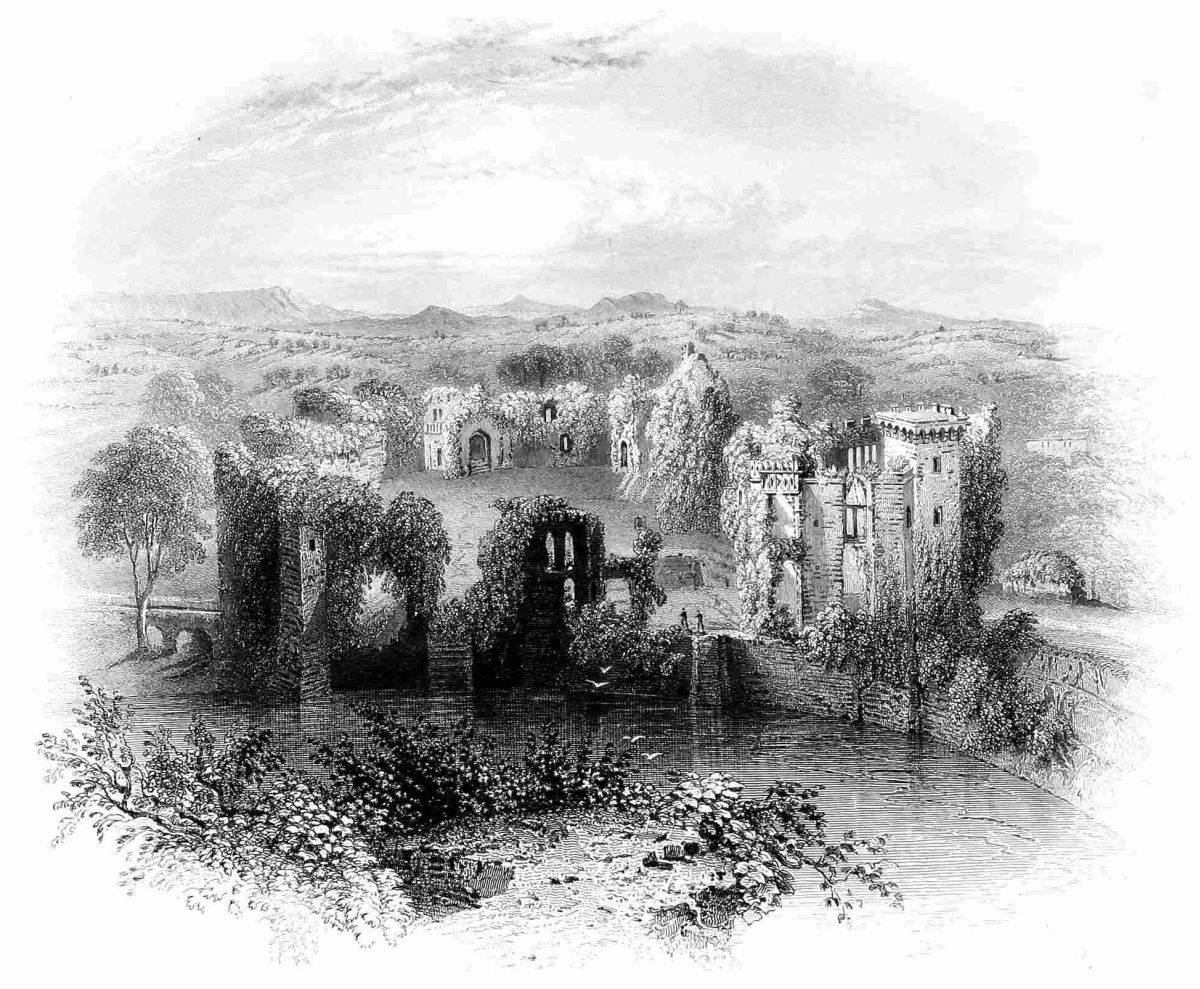
View from the Battlements.
Raglan Castle.
from being used as such in the late war during the threatened invasion.
The next is
Llanishen Hill, with the church of St. Dionysius; and continuous with it
rise the Devaudon and “New Church Hills,” opposite the Elms; the royal
forest of Wentwood and Pen-y-Cae Mawr; Kemeys Firs, near to Caerleon, an
elevation which commands a view of thirteen counties.[294]
In the south-west are seen the heights of Caerleon and Pen Twyn Barlwm;
Gaer Vawr, on which is an ancient encampment—the largest in the
county—with the site of a British town; Dial Carig; and Craig-y-Garcyd,
two miles north-west of Usk, the site of a Roman camp. In the immediate
foreground are the village and church of Raglan.
Westward appear Abersycan and the hills near Pontypool; the Blorenge
hill, nearly two thousand feet high.[295] The opening which occurs in
the range at this point, allows of a glimpse of the Breconshire hills at
Crick Howell to Bwlch, within eight miles of the county town. The next
in succession are—the Sugar Loaf, or Pen-y-Foel—so called from its
conical shape—near Abergavenny, which crowns the summits of four
converging hills, and rises eighteen hundred and fifty-two feet above
the channel of the river Gavenny, which flows near its base.
The same view takes in the Hatteril Hills, or Black Mountains, crowned
with Roman encampments; and near which is Oldcastle, once the residence
of Lord Cobham, whose unhappy fate forms a painful page in the national
history. From these hills the Monnow takes its source. Beneath lies the
dark Vale of Ewias; and in its bosom are the ruins of Lanthony, a
Cistercian Abbey of the twelfth century, which forms one of the
illustrated subjects of this work. In the same direction is seen the
Skyrrid Vawr, a lofty hill, seen in a volcanic fissure, which is
supposed to have been thrown open during one of those remote convulsions
of nature, of which in these districts the traces are so distinct and
frequent.
Looking northward, the prominent objects are Campstone Hill, and the
Craig, at the foot of which lie the picturesque remains of Grosmont
Castle, which gives the title of Viscount to the Beaufort family. To
these, but more northward, succeed Garway, Broad Oak, the Skinch-Cwm,
and White Hills, which close the panorama from Raglan Keep.—We have
been thus particular in designating the objects seen from the different
points of view, in order that the tourists who annually visit this
scene, may be in some degree prepared for the enjoyment which it is so
well calculated to afford.
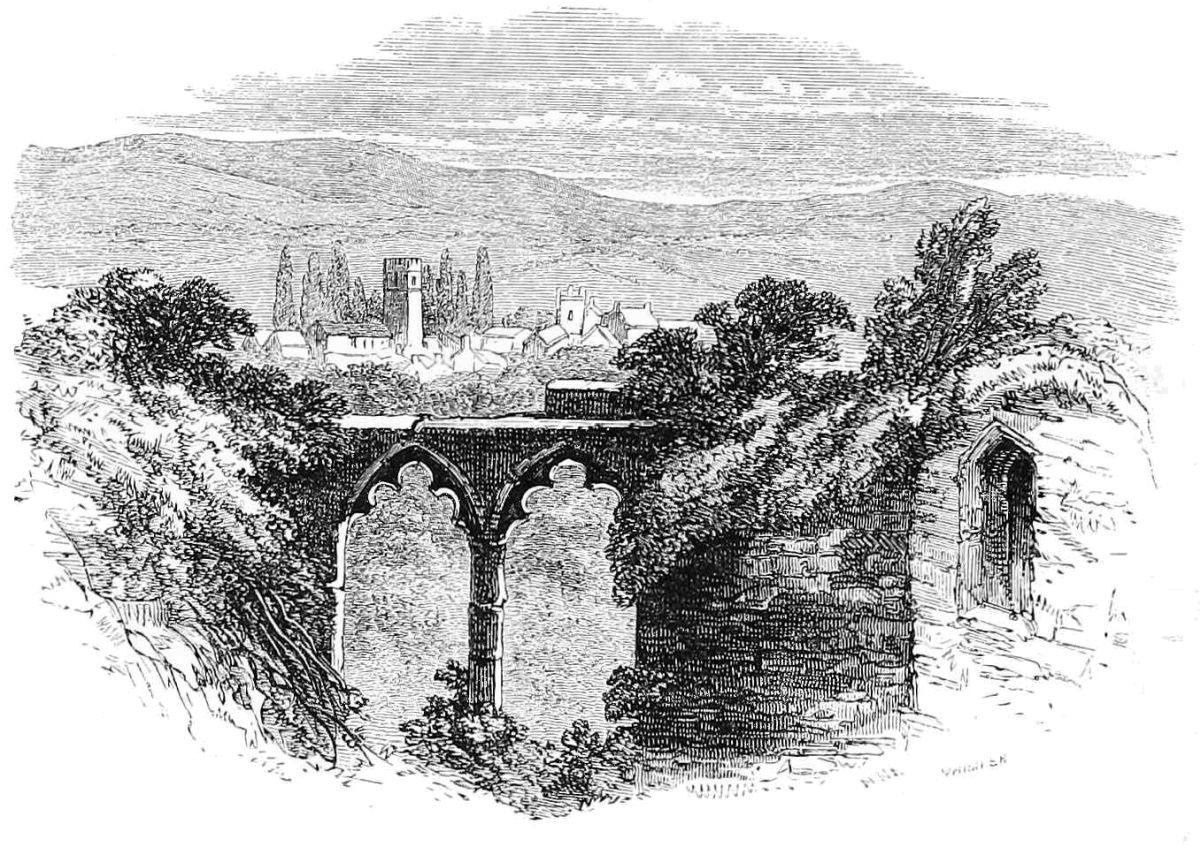
From the top of the Keep.
Descending from this lofty tower, where on festive occasions the family
ensign still floats, the contrast between the Natural scenery, which has
just faded from the spectator’s eye, and the iron-bound work of Art,
forces itself upon the mind, and elicits a spontaneous burst of
gratitude that, under the protecting banner of the English Constitution,
the peasant is now as safe in his cottage as ever Baron of Raglan was in
his Keep; that at last “right” is a match against “might,” and that the
strong arm of Justice falls with impartial force on the culprit—whether
he be robed in ermine, or clad in hodden grey.
“Yet Barons of the land! to you
A grateful people still retains
Proud memory of the swords ye drew—
The swords that broke a tyrant’s chains,
And planted Freedom on our plains!
For Freedom’s cradle was the Keep,
Her guardians were the Barons bold;
Who placed her temple on the steep,
And on her head a crown of gold;
And cried—‘The deed is done! Behold,
Henceforth our British land shall be
The glorious land of Liberty!’”
The visitor, as he crosses the rustic bridge that now spans the moat,
will recall the interesting fact, that this very spot, so to speak, was
the “birthplace” of the Steam-engine; a circumstance which, had Raglan
no other claim to their notice, must entitle it to a more than cursory
observation from all who have an hour to spend within its walls. The
spot where it is believed to have been first placed by the
inventor—then Lord Herbert—was in a building erected close under the
wall of the Keep, where the drawbridge rose; but which has left few or
no traces, in shape or dimensions, that are now visible above the moat.
It is satisfactory, however, to know that the ground is stamped by
tradition as the spot where the noble inventor, during his father’s
lifetime, made his first experiments on the uses and powers of steam;
and where he probably constructed that “model of his invention,” which
he desired might be placed with him in his coffin.
If ancient warriors considered it an honourable distinction to be
consigned to the tomb in a full suit of armour, it was excusable in one
who had carried with him through life the remembrance of many wrongs,
many sacrifices, to desire that, at least, the evidence of one bloodless
triumph, one proof of scientific discovery, might accompany him at his
final departure from this scene. It was the favourite child of his
matured judgment, the result of those scientific researches, after which
he had been straining for many years—the mighty consequences of which
were dimly foreshadowed in his imagination. It was the reward and
consolation of a life of suffering, as well as of science; and there is
something both natural and touching in the wish that this model—the
only mechanical evidence that told him “he had not lived in
vain”—should be deposited with him in the grave.
Some of his commentators have affected to smile at this wish, as
evincing a feeling of weakness and vanity on the part of Lord Worcester,
incompatible with a philosophic mind. But in this they only allege what
cannot be proved; and the charge falls harmless when applied to a man
who was—what can never be disputed—one of the most ingenious and
scientific men of his day. When Columbus—a schoolboy at Genoa—first
rigged his tiny skiff, and sent it dancing over the blue waters, on
which it moved like the shadow of coming events; no one foresaw that
this mere toy would one day be succeeded by vessels, directed by the
same master-pilot, that should throw open another continent to the old
world. Nor, while Lord Worcester was squandering much time and treasure,
as it was thought, in useless experiments in the Keep at Raglan, did any
one imagine that these very experiments were preparing the way for that
stupendous power, that should one day give incredible impulse to the
arts of civilized life, cross the Atlantic, and traverse the Pacific,
with a celerity that promises to unite in one bond of fellowship all the
nations of the earth.
It can hardly be doubted that results similar to these haunted the
imagination of Worcester, and kept up within him that spirit of
discovery which animated him in all his labours, soothed him with the
hope of being numbered among the benefactors of his country, and a
prospect of that immortality which attends the favoured votaries of
science. He may often have indulged the thought, though never embodied
in words—and it was a remarkable prediction on the part of him who
uttered it long afterwards—
“Soon shall thine arm, triumphant Steam, afar,
Drag the slow barge, and drive the flying car!”
It has been alleged by Desaguliers,[296] that Savary, the reputed
inventor of the steam-engine, obtained his notions from the work already
named, “The Century of Inventions;” and that, in order to conceal the
original, he purchased all the Marquess’s books that could be had for
money, and committed them to the flames. Of this, however, we have no
direct proof, and Captain Savary must be acquitted; but it is quite
certain that, as already mentioned, the original work is so rare, that
not a copy is to be found except in the British Museum, and perhaps in
the Beaufort Libraries at Troy House or Badminton Park. It is to be
observed, however, that no contemporary record exists to illustrate or
verify the Marquess’s description of the contrivance, which we presume
to call a Steam-Engine; or to inform us where, and in what manner, it
was carried into effect. Yet it is very evident from his account, that
he had actually constructed and worked a machine that raised water by
steam; an operation which was sufficient to produce on the minds of
rustics, the effect ascribed to the “roaring of lions,” as mentioned in
the preceding anecdote. The Marquess’s description, though short and
obscure, would appear to favour the belief, that the force of his engine
was derived solely from the elasticity of steam; and that the
condensation of steam by cold was no part of his contrivance, but the
invention of Captain Savary, who, in 1696—nearly thirty years after the
Marquess’s death—published an account of his machine in a small tract,
entitled, “The Miners’ Friend.” In these engines—several of which he
had erected previously—the alternate condensation and pressure of the
steam took place in the same vessel into which the water was first
raised from a lower reservoir, by the pressure of the atmosphere, and
then expelled into a higher one by the elastic force of strong steam.
Steam was thus employed merely to produce a vacuum, and to supply the
strength that was applied, for a like effect, to the sucker or piston of
an ordinary pump; and it was a great and important step to have
discovered a method of bringing the air to act in this manner, by the
application of heat to water, without the assistance of mechanical
force.
To the simple incident which, during his confinement in the Tower of
London, first set the warm and fertile imagination of the Marquess to
work on this subject, we have already adverted; and must now turn from
the curiosities of science, to such portions or features of Raglan
Castle as still remain to be noticed.
The Tilt-yard.—The exact situation of this important adjunct to the
Castle is still a question among the learned. By some, what is now
called the Bowling-green is described as the ancient Tilting-ground.
This conjecture, however, being rendered improbable by a careful
examination of the ground, another has been thrown out, namely—the
Grand Terrace on the north-west side of the Castle. But this locale is
also disputed, particularly by one who is resident near the spot, and
fully conversant with whatever has descended to our own times respecting
the original plan of the Castle. His opinion is, that the ancient
Tourney-field must have been on the outside of the present walls. An
experienced officer of the Royal Engineers, who lately inspected the
grounds, with the view of ascertaining the exact spot, confirms this
opinion; and observes that the Tilt-yard occupied the space immediately
outside of the present gate, and enclosed between the two moats which
surrounded the gateway. This opinion will probably set the question at
rest—particularly as it comes from a quarter well qualified to decide
in such doubtful cases—and allow the Bowling-green to retain its
hereditary fame and honours.[297]
In this enclosure it was usual for the lords of Raglan to exhibit those
chivalrous fêtes which gave a character to the age. They brought into
martial competition those aspirants of knightly fame, whose dexterity in
the use of the lance was perfected by daily practice in the tourney. In
these gorgeous pastimes, all that could fascinate the eye, and kindle
admiration in the spectators, was brought into brilliant operation.
Beauty, presiding at the lists, bestowed the palm on him who had
disarmed his rival in the charge, and thus established his claim to
knightly honours. Here, no doubt, many a lance has been couched, many a
spear broken in rival combat; for one of the old lords, as already
mentioned, was renowned as the best horseman of his day; and to support
this character, joust and tournament may have been no unfrequent
spectacles under the walls of Raglan.
It cannot be doubted that these martial exercises—conducted with
admirable tact and courtesy—contributed, in a very special degree, to
foster a spirit for military enterprise; to inculcate a high and
chivalrous sense of honour; to form the young soldier to habits of
fortitude and endurance which procured him the respect of his comrades,
and future distinction in the field. A knight, thoroughly trained
according to the system of feudal times, was a being whom we are
accustomed to regard as the beau-ideal of a soldier; whose high bearing,
indomitable courage, inflexible faith, unsullied honour, and loyal
devotion to his “ladye love,” are themes on which poets and historians
of the middle ages have lavished many glowing panegyrics.
For the education and discipline of those military aspirants, the grand
palæstra was the tilt-yard. For the feudal tournament—descriptions of
which are handed down to us by contemporaneous authors—no substitute is
left in these times. Nothing could have been more animated and dazzling,
when celebrated with all those details of martial pomp and
ceremony—indispensable to such exhibitions—than a pageant, in which
all who aspired to distinction were required to evince, in action, the
pure and elevating principles of love, loyalty, and religion. For these,
and many other reasons, impartial taste, as Gibbon observes, must prefer
a Gothic tournament to the Olympic games of classic antiquity. Instead
of the naked spectacles which corrupted the manners of the Greeks, the
pompous decoration of the lists was crowned with the presence of chaste
and highborn beauty, from whose fair hands the conqueror received the
prize of his dexterity and courage.[298]—And with this flattering
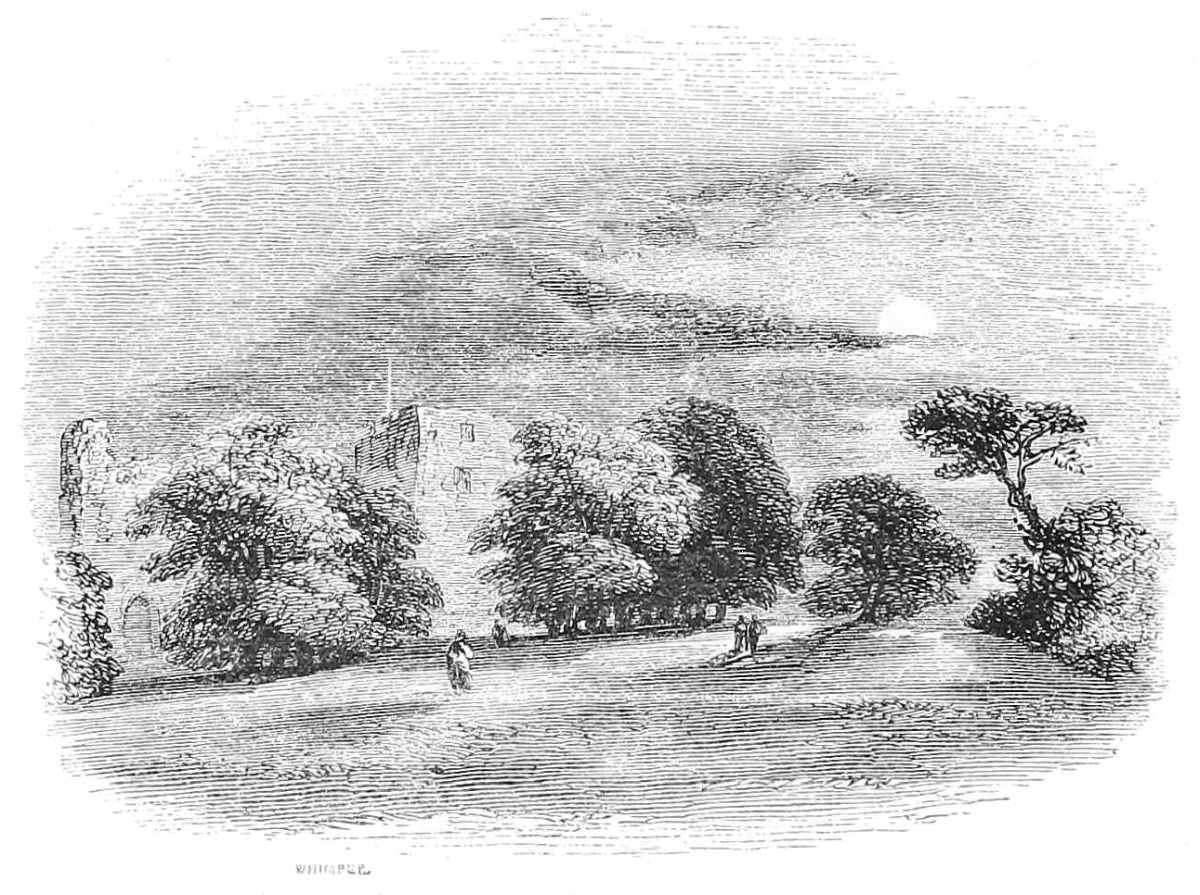
contrast between the demoralizing festivals of Greece, and the high tone
of refinement which characterised those of our Gothic forefathers, we
pass on to such other points in the history of Raglan Castle as have
been selected for illustration. In the woodcut introduced in the
preceding page, the view is taken from the old
Bowling-green—erroneously supposed to have been the Tilt-yard. Directly
opposite, in the centre, is the Donjon, or Tower of Gwent, so often
described or otherwise referred to in these pages. On the left, where a
massive gateway is seen, is the entrance to the Fountain Court, from
which, as formerly noticed, a noble staircase conducts to the State
apartments occupying the south side of the Castle. These are now in a
state of utter dilapidation; but the framework itself affords abundant
evidence—so far as architectural design and elaborate ornament can
assist us in such a conclusion—of their original splendour.
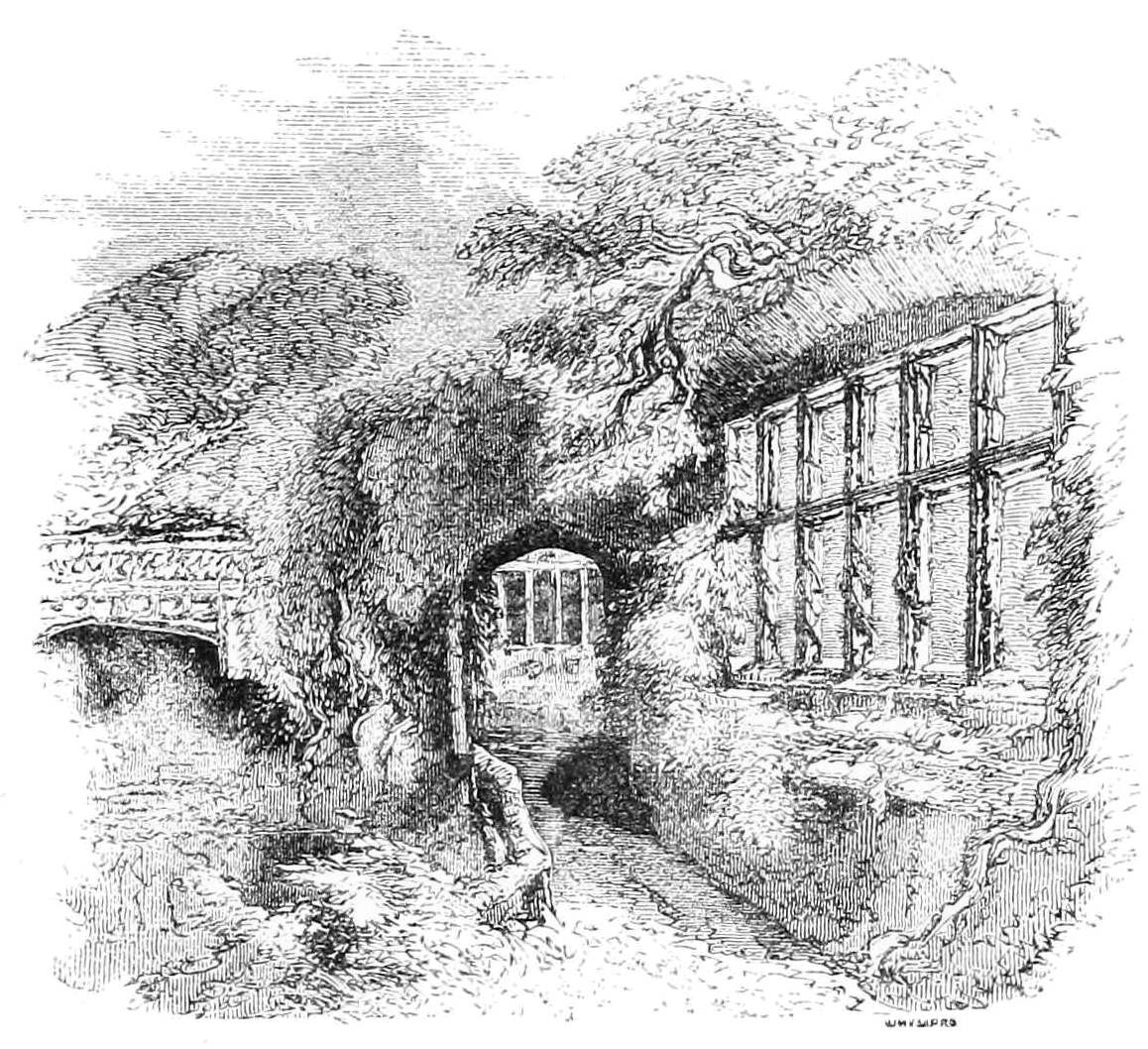
“But now th’ unsightly brier grows,
Where once, in gilded bower,
The Queen of Beauty trained the rose—
Herself a fairer flower.
And damp the hearth, and cold the bed,
Where he who wore the crown,
With anxious heart, and aching head,
In slumber laid him down!
But brief the slumber, long the night—
For Naseby’s fatal day,
And sorrow’s still increasing weight,
Had scared his sleep away!”
There is a tradition, that the Bowling-green was King Charles’s
favourite walk during his visit. It commands a varied and extensive
prospect; the vegetation is vigorous; and the grassy carpet, though not
in courtly trim, is still uninjured by plough or spade; and to
sentimental tourists it seems the very spot—aided by the adjoining
ruins—where, in the mirror of fancy, pictures of the olden day, the
hues of domestic life as it passed in the fifteenth century, may be seen
faithfully reflected.
“There is a spirit brooding o’er these walls,
That tells the records of a bygone day;
When, midst the splendour of thy courtly halls,
A pageant shone, whose gorgeous array,
Like Pleasure’s golden dream, has passed away;
Where Beauty’s smiles, and winning graces, lent
The witching radiance of their love-lit ray;
And from the scene a mingled strain was sent
Of music, laughter, festive song, and merriment.”—Raglan.
The game of bowls was unknown to the ancients, and bowling-greens are
said to have originated in England; where, in the course of time, every
castle, and most houses of the nobility, had each a bowling-green
attached to them. The “greens” were in some places narrow strips turfed
over; but if covered with gravel, they were called “Bares.”
Bowling-alleys were so called from being roofed over for play when the
weather was unfavourable; and these appear to have been the usual
appendages to taverns, and other places of public resort, particularly
in towns. In an old inventory we have—“To Sparke of Bury, Roper, for
vi. li. etc., of herryng line for the Bowling-alley, iijs. ivd.” At
the same place [Hengrave Hall] a bowling-alley occupied the space
between the north side of the moat, having the convenience of an open
corridor communicating with the Hall. Flat bowls were best for a close
alley; “round biassed bowls” for open ground, of advantage; bowls, round
as a ball, for green swarths which were plain and level; and of the
latter description is the Bowling-green of Raglan, now under notice.
In a plate of “Strutt’s Sports,” two small cones are placed upright, at
a distance from each other, and the players bowl at each
alternately—the winner was he who could lay his bowl nearest to the
mark. A small bowl or jack was also used as a mark; and only one bowl
for each person—not two or three, as in the present day.[299] There
were also ground-bowls, driven by a baton or mace through an arch.
Half-bowl—so called because it was played with one half of a
sphere—was prohibited by Edward the Fourth; and is the rolly-polly
still practised in Herts.[300]
Tennis-Court.—The site of this is still a question in the topography of
Raglan, although “the practice” cannot be doubted. Henry the
Seventh—who was a prisoner in Raglan Castle—his son Henry, and Charles
the Second, were all tennis players. In the sixteenth century,
tennis-courts were quite common in England. They were divided by a line
stretched in the middle; and the players, standing on either side with
their rackets, had to receive and return the ball, which the rules of
the game required to be struck over the line.[301]
Having already spoken of the Tilt-field, it is proper to remark that the
jousts and tournaments, for which it was set apart, differed from one
another in the following respects:—The latter consisted of parties of
knights, engaged at the same time; the former of two persons only. The
Joust was at first called the “Cane Game,” because hollow canes were
used instead of lances. On some occasions the combatants with swords and
lances were on foot, with a barrier of wood breast-high between them.
Toys, made to imitate the joust, consisted of knights on horseback, who
could be thrown off and unhorsed by the shock of their adversaries’
spears. Some had wheels, others not.
There were also boat-jousts, as represented in old paintings. The
conqueror was he who could best turn aside the blow of his antagonist by
one blow of his shield; and, at the same time, strike him with a lance
in such a manner as to throw him over into the water, himself remaining
unremoved from his station.[302]
Tradition.—On taking a final survey of these extensive ruins, and
speculating on the style and date of several of their component parts,
the difficulties that attend antiquarian decision—as great in the
present day as in that of the first Marquess—remind us of the following
anecdote:—
During an excursion in the vicinity, “We were told,” says his Chaplain,
who relates the story, “that we should come to a place that was famous
for a miracle, which, according to popular tradition, was wrought by the
preaching of St. David to three thousand people.” To accommodate the
saint, the ground on which he stood at the time, being too low to admit
of his being advantageously seen and heard by the multitude, most
obligingly rose up into a green knoll, carrying the saint with it, and
there settled at a proper elevation. Whereupon St. David, pitching the
cross on which he leant into the miraculous soil, and continuing his
discourse, was distinctly heard and seen, much to their comfort and
edification, by the whole assembly. This cross, at the time in question,
“was yet standing, with some words, or letters, which time and Welsh
weather had so defaced that they were no longer intelligible to vulgar
eyes.” In memory, or rather in proof, of the miracle, the guardian
saint had caused a church to be erected on the spot, and many were the
pilgrims, during the long lapse of centuries, who had resorted to the
Cross, and borne testimony to the celestial influence which still
hovered round the spot; and in those who were already gifted with that
“faith which can remove mountains,” produced the most wonderful changes.
This relation, working upon the Marquess’s mind, made him desirous to
turn aside for a little, and inspect the hallowed ground in person.
Having reached the churchyard, the cross was instantly visible; but in
shape and ornament bearing all the marks of venerable antiquity. The
inscription was almost obliterated; and among the gentlemen who attended
the Marquess, it became an object of competition who should best
decypher the original; though all that could be traced with any
resemblance to an alphabet, were—Crx ... Xti ... Dd, and part of an s.
The enigma that had puzzled so many others, however, appeared to his
lordship of very easy solution. “Why,” said he to the gentlemen around
him, “these letters are neither more nor less than fragments of three
simple but sacred words; to wit—Crux Christi Davidis.” “Which we all
wondered at,” says the Chaplain, “that no man could find out, though it
afterwards appeared so plain. ‘Look ye now,’ said the Marquess; ‘I,
without my spectacles, and ill eyes, could read it sooner than all you
that needed none, and had good eyes. And mark me,’ he added, ‘it is not
a good eye but a good faith that attains to a knowledge of such things;
whilst you pore so much upon the letters you lose the meaning. Now, I
will tell you how I came to find it out: I considered what had been told
me, with the help whereof I came to understand what the words might
signify; so that in this, I am sure, tradition was a means to help me to
the understanding of the scripture.’”
The quaint simplicity of the last sentence—so full of meaning—and the
lesson it inculcates regarding the authority of Traditions, illustrate
in a quiet way the Marquess’s opinions as to those of the Church; and to
antiquaries, the aid of tradition is thus very ingeniously recommended.
Where authentic history falls short of the mark in researches, the
traditions of a castle are entitled to consideration; and in the
preceding account of Raglan, it has been our study to combine the
two—though not in the sense recommended by the Marquess.
Of Lord Herbert, the following anecdote is recorded:—Some time after he
was created Earl of Glamorgan, he received the King’s commission, as we
have seen,[303] to proceed to Ireland, and there ascertain what could be
done to strengthen the royal cause. Setting out on this expedition, and
accompanied, as we are told, by a distinguished retinue of officers,
knights, and gentlemen—“all of the red letter”—who had staked life and
fortune on the enterprise, his lordship arrived at Caernarvon, where he
was to embark for Ireland. Here they were detained a short time; and
Glamorgan continuing to receive at his table the loyalist gentlemen of
the place, the conversation turned upon some old prophecies, which it
was thought were fast reaching their fulfilment. “And particularly one,”
said a gentleman of the company. “It is an old Welsh prediction, and
says—‘That in these latter times there should come to this very town a
magpie, and build her nest in the royal crown; that next a jackdaw
should arrive, and beat off the magpie; then a buzzard should appear
on the same roost, and drive away the jackdaw; and then there should be
seen no crown, but that of thorns, upon the King’s head! Farther, that
there should come a band of men from a far country, and take away the
thorns, and then the crown should appear again.’”
And thus far, as the townsmen averred, the prophecy had been
accomplished; to wit—“Over the gate of Caernarvon Castle, there was a
statue of King Edward the First, in full proportion, with a crown upon
his head. Well, there did come a magpie, as every one could tell, which
built, her nest in the said crown; then came a jackdaw that beat away
the magpie, as foretold; and, in like manner, came at last a buzzard,
and drove away the jackdaw.” “And all this,” said the worthy townsmen,
“we assure your honour to be as true as Holy Writ.”
Hereupon the Earl of Glamorgan, having listened with deep interest to
the recital, replied with much animation—“And why may not we, my
gallant friends and comrades—why may not we be that band of men from
a far country, that shall take away these thorns from the King’s
head—first, in type, and then in substance?” And thereupon all
concluded themselves to be the men destined for that glorious service.
They resolved that, on rising from table, they would satisfy their eyes
with the sight, as their ears had already been with the relation, and
lend willing and helping hands to disencumber the figure. Nothing else
could be thought of; and dinner being ended, the Earl and his company
sallied forth to the castle gate, resolved to signalize the day by an
act of loyalty that would endear their names to posterity. Looking up,
accordingly, with great eagerness to the royal badge, that seemed to
implore their assistance, its appearance, sure enough, was in literal
accordance with the disordered condition in which crowns are generally
left by rival combatants. It was, in fact, quite a heart-breaking sight
to see the diadem of England so covered and entangled with thorns, as if
artificially platted round the King’s temples.
“Verily,” said one of the nobles present, “never hath mine eye beheld a
sadder spectacle!” “The Earl himself, almost frantic with grief and
indignation, straightway commanded the nest to be torn down; which was
done with every mark of ignominy; and then the company began to breathe
again. The materials composing the nest being examined with severe
scrutiny, were found to be of white-thorn—a substance whereof never was
bird known before to build her nest!”
A thing so unprecedented, both as regards the nest and the material[304]
thereof, caused in the beholders a degree of amazement not to be
expressed: in memorial whereof, every one present thrust a sprig of
thorn in his hatband, and so wore it as a talisman. So far, “in type,”
the thorns were removed from the King’s crown—but not “in substance.”
This adventure in Caernarvon being duly narrated to the Marquess at
Raglan, he paused for a minute, and then inquired of those about him,
“What was the nickname which the Roundheads were wont to give the
Bishops?” But there were none about him who could even guess at his
meaning; which he perceiving, said, “As I take it, they used to call the
Bishops Magpies, whom they reproach for building their nests in the
crown; then came the Presbyterian Jackdaws, and beat them out; and the
next thing that you shall see will be the Independent Buzzard, which
shall drive them away. And who shall come next, God only knows!”
To this solution, one with a Roman nose made answer: “I hope, my lord,
that after these men have played their pranks sufficiently, no man
hereafter will presume to build his nest in the crown; but I hope there
will be a knot of good fellows that may case the King’s head from the
pricking of those thorns, and clear the crown from those incumbrances.”
Whereupon the Marquess, replying, asked the party who related the story,
“What manner of crown it was—of what form—that was upon the King’s
head?” The gentleman replied, “A royal crown.” “Ay; but I mean,”
rejoined my lord, “was it an open or an imperial crown?” “An open
one.” “Oh, then, that was the reason; the King’s crown was too open: had
it been close at top, with the Cross overhead [a sly word for the Roman
Catholic faith], such unlucky birds could never have come there to have
built their nests; but one thing there is,” said he, in conclusion,
“that I mislike in the story, namely, that after they had taken the
thorns from the King’s head, they should afterwards wear them in their
own hatbands.”[305] This was what no one present could explain to the
Marquess’s satisfaction. And Lord Glamorgan’s negotiations in Ireland
proved a failure to remove any “thorns from the royal crown.”—So much
for a prophecy which shows the superstition and credulity of the
times—a credulity which tainted even those who were charged with the
highest offices of the state. Yet such—
“The superstitious, idle-headed eld
Received, and did deliver to our age.”
In those days, no fortress surrendered, no castle fell, no band of
heroes was discomfited, but in fulfilment of some irresistible
“prophecy.”—But here we must close the subject with a few words on the
Outworks of Raglan.—On this head little remains to be added. The
details, given in the first volume of this work, respecting castles of
the middle ages, preclude the necessity of our doing more than simply
referring the reader to those passages in the description of Rochester
and Arundel, which equally apply to Raglan. With respect to the outworks
of the latter, a very brief notice may here suffice. By a practical eye
the line of fortification may still be traced; and what remains of the
original defences thrown up during the siege, shows very clearly that
the military engineers employed were men whose skill and science did
credit to the age. The vestiges of this lamentable war are mostly
observable on the west side of the castle, where a strong bastion,
projecting from the exterior wall of the fortification, forms a striking
feature of the outworks, and a no less striking contrast with the
luxuriant vegetation which now crowns, and almost conceals, these
monuments of a barbarous and unnatural war. The point to which we
allude, is that represented in the engraving, and entitled the “Avenue,”
where the state apartments, unlatticed, roofless, and dilapidated, look
down upon the green belt of trees and underwood that surround them with
a melancholy aspect—but a melancholy that imparts feelings of
thankfulness to the lovers of peace; for it tells very plainly that the
devastating storm has long subsided, and that the sunshine of national
prosperity and contentment has again visited the scene. The engines of
war have disappeared; the ramparts, raised by men for the destruction of
their fellow-men, are now razed to the ground. Nature—striving to throw
her green mantle of oblivion over a scene from which she was so rudely
banished by the violence of war—smiles at her own bloodless triumph,
and peoples the over-arching groves with feathered tribes that sing no
songs but those of peace and joy—
“Where once the steel-clad warrior trod,
Spring renews her verdant wreath;
And o’er the once ensanguined sod,
Flowers their mingled incense breathe.
Where the clang of clarion rose,
All is silence and repose;
Save where, in yonder halls of state,
The blackbird serenades his mate.”
We now proceed to a brief notice of the environs:[306]—
Raglan Church has little to interest the archæological inquirer beyond
its antiquity—and its claim to this distinction is fully vindicated by
its appearance. It consists of a nave, side aisles, a chancel, and a
square embattled tower, which, with a few trees throwing their shadows
over the burial-ground, forms a pleasing landmark in the distance. We
had the pleasure of uniting in the Morning Service before leaving the
village, and were much gratified by the religious demeanour which
pervaded the congregation, and edified by the simple but impressive
discourse with which the service was terminated.
Every feature seems stamped with the seal of antiquity; at first sight
nothing seems to have been renewed, or removed in the sacred edifice,
for at least two centuries. The great-great-grandfathers of the present
race may have occupied the same pews, knelt at the same altar, and been
addressed from the same pulpit; for the materials of which these are
composed seem as if framed to survive kingdoms and empires.
Over the Raglan Vault in the chancel, already noticed, some rusty
trophies of chivalry are suspended; and beneath repose several of the
ancient lords by whom they were worn, or wielded. To the state of the
monument itself, we have already alluded;[307] and judging from that of
its prostrate or dislocated compartments, the sculpture must have been
among the best specimens of its day, and employed on materials worthy to
transmit the family names to posterity; for it is of rare and variegated
marble, and appears to have been, according to monkish—but in contempt
of all classical—taste, elaborately gilded.
It has been regretted by visitors, that a tomb, in which are deposited
the remains of a nobleman—to whom the credit of a renowned invention
unquestionably belongs—should not be restored, or at least repaired. By
others, who regard it merely as an example of the Arts at that early
period, it is only a broken link in the chain of sepulchral
associations, which the skill and pencil of the artist can readily
supply. There might, indeed, be an appearance of inconsistency—a want
of harmony—in restoring the old family sepulchre, while the Castle
itself is left to destruction. In certain conditions and situations, a
fragment is more interesting than the original monument; and such,
perhaps, is the only interest which that in question ought to excite.
But with regard to the noble dust, we need only say—
“Adieu, and take thy praise with thee to heaven;
Thy ignominy sleep with thee in the grave,
But not remembered in thy epitaph.”
The family residence, more immediately connected with that of Raglan,
and to which, in the course of this article, special attention was
directed in our notice of the royal visit to the Marquess of Worcester,
is—
Troy House.—This name—which the King was so much pleased to use as a
classical synonyme, in his acknowledgment of the fruits which it had
furnished for the royal table while at Raglan—is so called from its
situation on the river Trothy. The village of Mitchell Troy, about a
mile and a half from Monmouth, contains a church dedicated to St.
Michael; but the chief object to which the tourist’s eye is directed is
the baronial mansion above-named. The house, which was already in high
repute at the time of the King’s visit to Raglan, was built by Inigo
Jones, who, in the suite of Christian IV. of Denmark, came back to
England in 1606. In consequence of the patronage of James the First—and
more particularly of his Queen—he was induced to settle in the
metropolis; and hence originated the sacred, regal, and aristocratic
edifices which bear his name. He was consequently appointed one of the
commissioners for repairing St. Paul’s Cathedral; but this was not
commenced until the spring of 1623. In the following reign he was much
employed in preparing Masques for the entertainment of the court, and in
building the Banqueting-house at Whitehall; but while thus engaged, he
fell under the displeasure of Ben Jonson, who ridiculed him on the
stage, and made him the subject of his epigrammatic muse. Jones realized
a handsome fortune; but being a Roman Catholic, and a partisan of
royalty, he suffered severely in the Civil War. At length, worn out with
sorrow and physical sufferings, he died in July, 1652, leaving behind
him many monuments of his genius, of which the subject under notice was
not the least considerable.[308]
The fame of Troy House, however, depends less on the fact of its being
the work of Inigo Jones, than upon the celebrity of its gardens—the
fruits of which are still said to vie with those of tropical
growth.[309] The excellence of these fruits, as already noticed, caused
the King to remark, “That the Sovereign of the Planets had now changed
the poles; and that Wales, the outcast of England’s fine gardens, had
fairer and riper fruits than England’s valleys had in all her beds.” Sir
Charles Somerset, sixth son of the fourth Earl of Worcester, married
Elizabeth, daughter and heiress of Sir William Powel of Troy and
Llanpylt, and added the influence of a considerable estate to that of
the house of Worcester. It was from his gardens that the dessert for the
royal table at Raglan was supplied.
In the picture gallery of Troy House is a large and beautiful portrait
of the first Marquess of Worcester, by Sir Peter Lely. He is represented
in an open field, seated before a tent, with the Marchioness and an
infant daughter by her side, and wears a fancy dress, with a scarf over
his right shoulder—the ribbon and badge of the Garter. The other
portraits are those of the Ducal house of Beaufort, since its creation
in 1682.
The situation of this hereditary mansion is too low to produce a
striking feature in the landscape; but it commands very agreeable views
of the town of Monmouth and its environs—with the rivers Monnow and
Wye, whose waters unite and form one channel a short distance below Troy
House.
Grosmont, from which the lords of Raglan take the rank of Viscount, is
entitled to a brief notice in this place. In old writings it is spelt
Grysmond, and contains a population of about eight hundred. The parish
church, dedicated to St. Nicholas, is in the patronage of the Prince of
Wales. In the churchyard, in the east wall of the chancel, is a
monumental slab, said to cover the remains of Kent, or Gwent, a
Franciscan monk, whose wonderful achievements in the early part of the
fourteenth century[310] afford materials for many local traditions.
According to one of these, the inhabitants are indebted to this good
neighbourly monk for the bridge over the Monnow, on the road to
Kentchurch in Herefordshire. It is called John of Kent’s Bridge, and is
said to have been built in one night.
The Castle of Grosmont is a picturesque ruin.[311] It stands on a height
commanding the view of a beautiful valley watered by the river Monnow,
and bounded by Craig Savenny and the Garway Hill. The remains of this
ancient castle occupy the summit of this hill, or rather eminence; its
ivied walls, partly impending over the precipitous banks of the river,
and towering at intervals through a grove of wide-spreading oaks, render
the view extremely picturesque.
“By Grysmond’s ruins, scarred with years,
On yonder roofless turret standing,
How rich—how beautiful appears
The scene beneath my eye expanding!
The oak’s green banner clothes the steep,
There—herds and harvests bless the Giver;
And there, in many a crystal sweep,
Descends the Monnow’s classic river!
And here—if e’er romance be found
To love the vale or haunt the mountain—
Here is her home, with ivy bound,
And here her grot, and crystal fountain.
And here—to him who seeks repose,
By sorrow worn, or passion driven—
Here is a refuge from his woes,
And here sweet intercourse with Heaven!” &c.
Monmouth.—Of this ancient town and its Castle, the limits prescribed to
the present work will not permit us to indulge in any minute
description. But before entering upon the Abbey of Llanthony—the next
subject for illustration—the birthplace of Henry the Fifth is entitled
to a general notice. The bridge over the Monnow, with its ancient
gate-house at the west end, is, perhaps, the most striking feature of
the place. Two other bridges, one over the Trothy, and a third over the
Wye, contribute in no small degree to heighten the picturesque effect,
as the stranger perambulates the scene and recalls the many interesting
facts, connected with Monmouth and its vicinity, which to history and
romance have given an early and permanent lustre.
The Castle—of which so little remains that its original appearance can
only be described by reference to the historical fragments that still
mark the spot—is of unquestionable antiquity. It is supposed to have
been built—or rather perhaps rebuilt—by John of Monmouth, whose
adherence to the Barons cost him his estate, but contributed to the
success of the cause in which he had embarked. The King having created
his son Earl of Lancaster, this estate was annexed to the earldom. The
Castle became a favourite residence of John of Gaunt, to whom it
descended by his marriage with Blanche, daughter of Henry of Monmouth,
Duke of Lancaster. It was in this Castle that the unfortunate Edward the
Second was confined when taken prisoner by his Queen Isabella.[312]
But the glory of the place is its association with Henry V., son of
Henry of Bolingbroke, who was born here,[313] and whose name and renown
are so familiar to every reader of our national history and the drama.
His dissipated habits while Prince of Wales, and his glorious
achievements in the conquest of France, have been so inimitably
portrayed by Shakspeare, that he still seems to live in our own age—in
the country which his worth and valour adorned—and to be as agreeably
associated with our familiar recollections as the most illustrious
characters of our own day. His good-humoured dissipation and pleasantry
in youth, became the foil to his subsequent greatness; and was probably
as much the origin of that strong admiration with which he is still
regarded, as his general talents, or the splendour of those victories,
to which his personal courage and address so mainly contributed. At the
time, as the reader may recollect, when the French realm was torn
asunder by the opposing factions of the Dukes of Orleans and Burgundy,
Henry took the favourable moment for reviving the claims of his
predecessors upon France. Placing himself at the head of his army, he
landed at Harfleur, and with only fifteen thousand men, opposed to
upwards of fifty thousand, won the battle of Agincourt, and returned to
England covered with renown. Apart from the splendour, however, which
attended the campaign, it has been justly remarked that his reign was
more brilliant than beneficial; for whilst his triumph entailed great
misery on France, it “did more harm than good” to the true interests of
England.[314] But his life was short—too short for maturing the plans
he had in view for consolidating the fruits of a brief but eventful
career; and while his greatest projects seemed to be advancing to a
successful issue, Henry of Monmouth was suddenly cut off at the age of
thirty-four.
The connection of this gallant prince and sovereign with Monmouth,
invests it with a lasting claim to veneration on the part of those
tourists who judge of the soil by the character of its products. In the
words of Fluellen, “All the water in Wye cannot wash your Majesty’s
Welsh plood out of your pody;” nor, we may add, weaken a single link of
that chain which connects the hero of Agincourt with the history of
Monmouth.
The Bridge, of which a cut is here introduced, was erected by Edward the
First in 1272. Surmounting the Saxon gateway is a room, used as a
guard-room or a magazine; and immediately above the arch are three
loopholes, made by the authorities of the place, when, at a very recent
period, they apprehended a sudden irruption of Chartists from Newport.
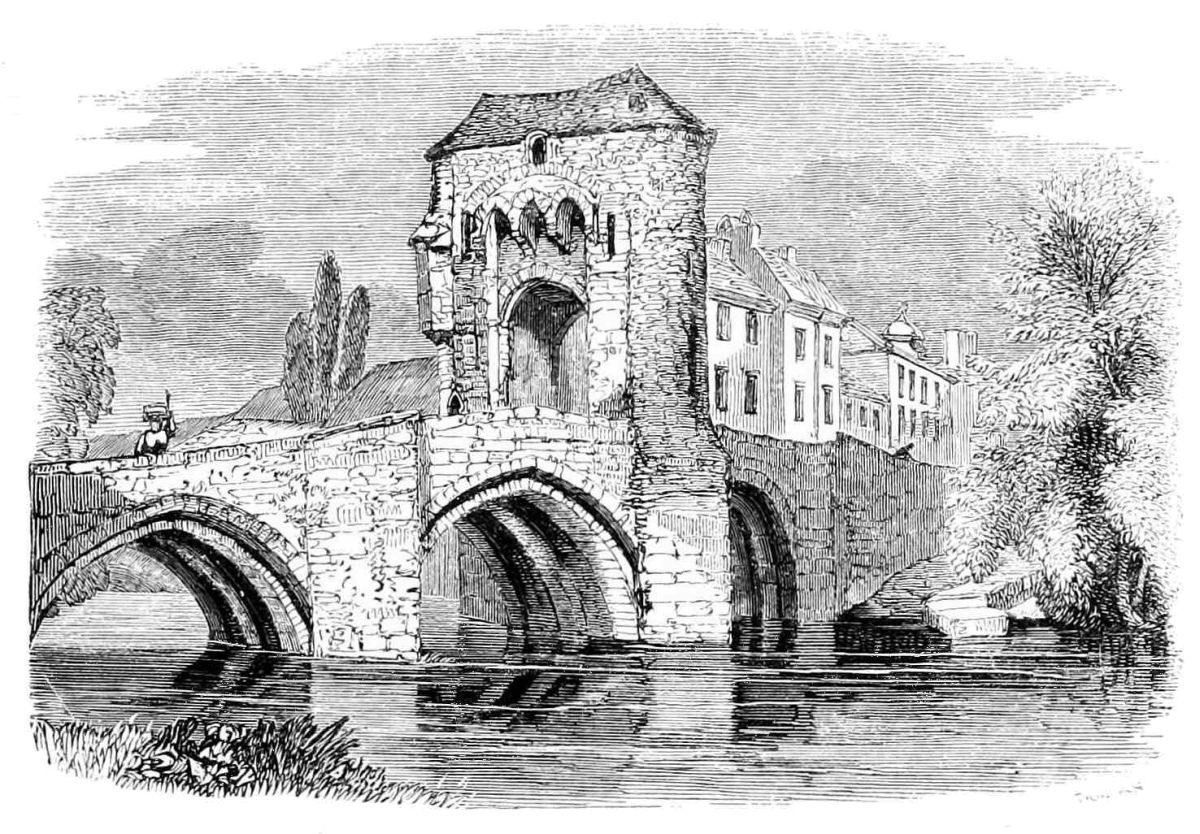
During the civil war, Monmouth was justly considered as a position of
vast importance. After the defeat of the King’s army at Marston Moor,
Prince Rupert directed his attention to the marches of Wales. He
resolved to fortify Beachley, and with troops of horse to secure the
isthmus between the rivers Severn and Wye; but in this attempt he was
out-manœuvred by Colonel Massey. Lieut.-Colonel Kyrle afterwards
negotiated with Massey to deliver up the town of Monmouth, then held for
the King. Having revolted from the Parliamentary army on the loss of
Bristol, he was willing to purchase reconciliation at the price of
Monmouth. He proposed to Colonel Massey to feign a sudden return with
his forces from Beachley to Gloucester, when he agreed to make a sortie
from Monmouth, as if to fall on his rear, which might then drive him
back, and in the pursuit enter the town with him. Massey, accordingly,
gave out the necessity of a retreat; and having marched three miles,
lodged his troops in the Forest of Dean. This was no sooner reported at
Monmouth, than Kyrle drew out his men to follow in the rear of Massey.
Accordingly, about a mile from Colford, he was surprised by Massey, and
all his horsemen were led towards Monmouth. But the town having been
alarmed by an officer who had escaped, the garrison were on the alert;
yet, as Kyrle himself advanced to the drawbridge with a hundred horse,
and pretended to be returning with many prisoners, the officers and
soldiers were thrown off their guard; and with the consent of the
governor, Colonel Holtby, the drawbridge was lowered, and the town was
entered. “The governor and most of the garrison escaped, some prisoners
were made, and the rest were put to the sword.”
The loss of Monmouth, so justly considered the key of South Wales,
alarmed the garrison of Raglan Castle. The old Marquess called in the
assistance of Prince Rupert’s cavalry, which obtained some advantages
over the flying parties of Massey, but could not disturb his possession
of Monmouth, in which he was strongly fortified.
Geoffrey of Monmouth, whose name gives additional lustre to the place,
was also a native of this town. He is supposed to have been educated in
the ancient Benedictine Priory, founded by Wihenoc de Monmouth, in the
reign of Henry the First. A small chamber of the ancient monastery has
long been shown to inquisitive tourists, as the library of Geoffrey. The
apartment bears in the ceiling and windows certain traces of former
magnificence; but the art is of a later period than the first Henry’s
reign, and probably contemporary with that of Tinterne. Geoffrey, whose
fame as the historian of Britain takes precedence of all his
contemporaries, was archdeacon of his native town, and subsequently,
through the patronage of Robert, Earl of Gloucester, and Alexander,
Bishop of Lincoln—both renowned as the friends of learning—promoted to
the bishopric of St. Asaph. His history is considered to be a vitiated
translation of the “Annals of the British Kings,” written by St.
Thalian, Bishop of St. Asaph, who flourished in the seventh century. It
is very entertaining, and forms an epoch in the literature of this
country, being almost the first production which introduced that species
of composition called Romance. “Geoffrey of Monmouth’s History,” says
Campbell in his elaborate Essay on English Poetry, “was not a forgery,
but derived from an Armorican original, and with the pseudo-Turpin’s
Life of Charlemagne, was the grand historical magazine of the romancers.
Popular songs,” he adds, “about Arthur and Charlemagne—or, as some will
have it, Charles Martel—were probably the main sources of Turpin’s
forgeries, and of Geoffrey’s Armorican book.”
In Geoffrey will be found the affecting history of Lear,[315] King of
Britain, who divided his kingdom between Gonerilla and Regan, his two
elder daughters, and disinherited his youngest daughter Cordelia. Hence
Shakspeare drew his incomparable tragedy of “King Lear,” but improved
the pathos of the story by making the death of Cordelia precede that of
Lear; while in the original, the aged father is restored to his kingdom,
and Cordelia survives him. Milton also was indebted to Geoffrey of
Monmouth for his beautiful fiction of Sabrina in the “Mask of Comus.”
But to return to the scene under notice:—
The Priory, of which little remains, was a cell belonging to the
Benedictine Monastery of Saumur in Anjou; and in this, as we have said,
the renowned Geoffrey is believed to have prosecuted his studies. By
some writers he is called a monk of the Dominican order; but, according
to Leland, the fact has never been established; nor have we any sure
grounds for believing that, as others report, he attained the dignity of
Cardinal under the Holy See. He has higher claims to the reverential
remembrance of posterity, than either a monk’s cowl or a cardinal’s hat.
But notwithstanding his reputed Treatise on the Holy Sacrament, and
poetical Commentaries on Merlin, his fame must ever rest on the
original, or translated, History[316] of Britain, to which we have
already alluded.
Queen Elizabeth, we are told, was fond of tracing her descent from the
British line; and Spenser, in his “Faërie Queen,” introduces his
Chronicle of Briton Kings, from Brut to Arthur, with the following
address:—
“Thy name, oh Soveraine Queene, thy realme and race,
From this renowned Prince derived arre,
Who mightily upheld that royal mace,
Which now thou bear’st, to thee descended farre,
From mighty Kings and Conquerors in warre.
Thy fathers and thy grandfathers of old,
Whose noble deeds above the northern starre,
Immortal Fame for ever hath enrolled,
As in that Old Man’s book they were in order told.”
Near the bridge of the Monnow stands the ancient—
Church of St. Thomas. The simplicity of its form—to quote the
historian of the place—the circular shape of the door, the arch
separating the nave from the chancel, the ornaments of which bear a
Saxon character, seem to indicate that it was constructed before the
Conquest. The western window and some of the other apertures—which are
ornamented Gothic—have been evidently formed since the original
foundation.
Monmouth, the Blestium of Antoninus, is supposed to have been the site
of a Roman station. We know, from historical records, that it was a
fortress in early times, and one of the strongholds occupied by the
Saxons to maintain their conquests between the Severn and the Wye, and
check the incursions of the Welsh. The town appears to have been
fortified with a wall and a moat, except where it was secured by the
river. At the Leland’s Survey, parts of the dilapidated walls were still
remaining, the moat entire, the four gates standing, which he calls the
Monk’s Gate, to the north; the Eastern Gate; the Wyegate; and the Monnow
or Western Gate. At present there are few or no distinct vestiges of the
walls; and the only part of the moat which can be traced, was pointed
out as that stretching from the back of Whitecross Street to the remains
of an ancient gateway, and thence to the Wye. Of the four gates
mentioned by Leland, that called the Monk’s Gate, which stood near the
Hereford road, is now demolished. Parts of two round towers which
flanked the eastern gate are visible. Of the latter no traces are left.
But that over the Monnow, as shown in the preceding cut, is nearly
entire, and bears the marks of very great antiquity. It was the opinion
of a celebrated historian of the place, that the circular arches, the
massive solidity of the structure, and some minuter features, were
sufficient to remove all doubts as to its Saxon origin; and that the
alterations it underwent in the time of the first Edward, were only
repairs executed in conformity with the original plan. But as this is
not a field for antiquarian disquisitions—but only a record of opinions
generally received—we are content to follow the popular belief, and
assign to it a date somewhat anterior to that of the Conquest.
Of Monmouth, Churchyard sings:—
“The Kinge here borne did prove a peerless Prince;
He conquered France and reigned nine yeares in hap;
There was not here so great a victor since,
That had such chaunce and fortune in his lap.
For he by fate and force did covet all,
And, as turn came, stroke hard at Fortune’s ball,
With manly mind, and ran a reddie waye
To lose a feint, or winne the gole by playe.
If Monmouth bring such princes forth as this,
A soyle of grace it shall be call’d of right;
Speake what you can, a happie seat it is,
A trim shiere town for noble Baron or Knight;
A cittie sure, as free as is the best,
Where ’Size is kept, and learned lawyers rest;
Such auncient wise, in meete and wholesome ayre,
Where the best sort of people do repayre.”
Kymin Hill, on the south-east side of Monmouth, commands one of the
finest views in the kingdom. To this enchanting prospect, the celebrated
lines by Dyer may be applied with little alteration:—
“Now I gain the mountain’s brow—
What a landscape lies below!
No clouds, no vapours intervene;
But the gay, the open scene,
Does the face of Nature show
In all the hues of heaven’s bow;
And, swelling to embrace the light,
Spreads around beneath the sight.
Old castles on the cliffs arise,
Proudly towering in the skies;
Rushing from the woods, the spires
Seem from hence ascending fires.
Half his beams Apollo sheds
On the yellow mountain heads,
Gilds the fleeces of the flocks,
And glitters on the broken rocks.”
“And see the rivers, how they run
Through woods and meads, in shade and sun!
Ever charming, ever new,
When will the landscape tire the view?”
Authorities quoted or referred to in the preceding article on
Raglan Castle and its vicinity:—Dugdale—Camden—Collins’
Peerage—Speed—Hollinshed—Williams’ Monmouth—Grafton—Robert of
Gloucester—Illustrations of British History—Peck’s
Curiosa—Stow—Winwood—Manners and Customs of England—Pictorial
History—Memoirs of the Court of James I.—Osborne’s
Memoirs—Evelyn’s Diary—Strutt—Somers’ Tracts—Howel’s
Letters—Barber’s Tour—Bayly’s Apophthegms of the Marquess of
Worcester—Churchyard—Wood’s Rivers of Wales—Thomas’
Raglan—Carne—Archæological Journal—Clarendon’s History—Certamen
Religiosum—Ellis’s Original Letters—Memoirs of
Swift—Carlyle—Parliamentary Papers—Mercurius
Civicus—Edwards—The Family History—History of the Civil
War—Chronicles—Rushworth’s Papers—Lodge’s Illustrations—County
History and Local Descriptions—Sir R. Colt Hoare—Coxe—Notes of a
Personal Visit to Raglan—Communications from Correspondents,
etc.—See Appendix.