Alessandro Greco to the Author.
Marionette Theatre,
Piazza Nuova, Palermo,
4 June, 1909.
My dear Enrico,
Since I last wrote to you there has been a continual to-do and
no time for writing letters. What has been the to-do?
Is it possible you have forgotten my telling you that I am
studying to be a singer and that I take lessons every day?
Now listen to this: Here in Palermo, a new opera was performed
recently for the benefit of the victims of the earthquake at
Messina. The story was taken from a great German romance
and the music was composed by an Italian who is now in
America. I was asked to sing as a supplementary
tenor. We had a month of rehearsals and in the end the
performance was splendidly successful. O my dear
friend! If you had seen me on the stage! I was
dressed as a warrior with a wig of curly hair and a pair of
moustaches. I also received applause, and, when I appeared
before the audience to bow my acknowledgments, I thought:
“Oh, if only my dear friend were present, how he would be
applauding me!” You will understand after that
whether I have had any time to write to you; but now that things
have calmed down a little and there is less going on I can write
to you as much as you like.
As you know, I am always busy in the teatrino; the other
evening we repeated Samson, that play which you once saw
here. If you will believe me, I was thinking of you the
whole time because I remembered that when we gave it two years
ago you were present.
Just now in the Story of the Paladins, Orlando is
throwing away his arms and running about naked in the woods, mad
for love of Angelica; and soon we shall have the burning of
Bizerta and the destruction of the Africans. This will
finish in July and we shall then begin the Story of Guido
Santo.
What have you done with that photograph of myself which I gave
you and which you put into your cigarette-case? Is still
there, or have you lost it? I have often promised to send
you another but have not done so because when you come to Palermo
in September I hope we shall be photographed together, you and
I. Nevertheless I send you this one now, it was taken by an
English lady who came to the teatrino last summer; you see me
getting into a rage with a paladin, I am talking seriously to him
and swearing at him because he will not let me dress him
properly.
I will not prolong this letter, I do not wish to bore you; but
I promise you that I will never fail to let you know of my doings
and I count on you to tell me of yours.
Costantino, Sansone, Rinaldo, Rosina, Angelica, Ferraù,
Pasquino, Onofrio and all the other marionettes embrace you and
send you their kind regards.
I am and always shall be
Your affectionate friend
Alessandro Greco (Buffo).
On arriving at Palermo, I went to the teatrino at about ten at
night; not seeing the buffo in his usual place keeping order at
the door, I guessed he must be on the stage and, knowing the way,
passed through the audience, dived under the proscenium, crept
along a short passage, mounted a ladder and appeared among them
unannounced. The father, the buffo and his brother, Gildo,
were so much astonished that they dropped their marionettes all
over the stage and shouted:
“When did you come?” “Why did you not
write?” “Why did you not telegraph?”
Thereby spreading their astonishment among the audience, who
saw no connection between these ejaculations and the exploits of
Guido Santo. They soon recovered
themselves, however, picked up their paladins and managed to
bring the performance to its conclusion, and we shut the theatre
and proceeded upstairs to the house. On the way the buffo
took me aside into his workshop to show me two inflammable
Turkish pavilions which he was making; Ettorina in her madness
was to fire them in a few days, one in the afternoon and the
other at the evening repetition, as a conclusion to the
spectacle. I inquired:
“Who was Ettorina, and why did she go mad?”
“I will tell you presently,” replied the buffo,
“we must first go upstairs.”
As we went up I asked after the singing and he promised to
take me to the house of his professor to hear him have a
lesson. Papa and Gildo had preceded us and we found them
with the young ladies, Carolina and Carmela, and the child, Nina,
who is as much a buffa as her brother Alessandro is a
buffo. In a moment, the air was thick with compliments.
Papa: And how well you are
looking! So much fatter than last year.
Myself (accepting the
compliment): That is very kind of you. You are all
looking very well also. Let me see, Buffo mio, how old are
you now?
Alessandro: Guess.
Myself: Twenty-five.
Aless: Bravo. I completed my
twenty-fifth year just three weeks ago. And you?
Myself: I have also completed my
twenty-fifth year, but I did it more than three weeks ago.
Aless: I see. You have
twenty-five years on one shoulder; and how many more on the
other?
Myself: Twenty-five.
Aless: It seems to me you are
making a habit of attaining twenty-five. Are you going to
do it again?
Myself: I have begun, but I shall
put off completing it as long as possible. If you want to
know my exact age I will give you the materials for
making the calculation. I went to the Great Exhibition of
1851.
Gildo: Tell us about it. I
have often seen pictures of it in the illustrated papers, but I
have never spoken to anyone who was there. Was it very
beautiful? Were there many people? Did you see Queen
Victoria?
Myself: I can’t tell you much
about it. I was asleep and when I woke up I was so hungry
that I cried till my mother took me into a side room and gave me
my dinner. Then I went to sleep again until they took me
home. I have been to many exhibitions since, but I never
enjoyed one so much. You see, this one did not bore me.
Aless: You should not have had your
dinner there. I went to the exhibition in Palermo and the
food in the restaurant was not wholesome.
Gildo: Yes, but you must remember
that Alessandro is very particular about his food. He can
only eat the most delicate things and must have plenty of
variety.
Myself: I did not have much variety
in those days. I took my restaurant with me, the one at
which I was having all my meals.
Gildo: Oh well, if one can afford
to travel like a prince—
Myself: Gildo! I was not six
weeks old and—
Papa: I have now made the
calculation and I find you are my senior by six years. I
hope that when I have caught you up I shall carry my age as
lightly as you carry yours. Do I explain myself?
Aless (to me): I think you
look older. I should have said you were a well-preserved
man of sixty-four or (stretching a point in my favour)
perhaps sixty-five.
Myself (feeling sure that here
must be another compliment): Thank you very much.
Buffo: Not at all; it does you
great credit.
Gildo: Now me, please. Ask me
my age.
Myself: Well, Gildo, and how old
are you?
Gildo: A hundred and seventy-four
next birthday.
Myself: Santo Diavolo!
You don’t look it. You must have been very busy since
last autumn when, if I remember right, you were only
twenty-one.
Carolina (tapping my right arm
to attract my attention): Signor Enrico, Signor Enrico, why
do you not ask me my age?
Carmela (tapping my left
arm): Signor Enrico, Signor Enrico, you have not asked me my
age.
Myself: Because I know how old you
are. You are both of you the age that charming young ladies
always are, and you do not look a day older.
Nina: I’m fourteen.
Caro and Carm (comparing notes): Did you hear
what he said? He said we are charming young ladies.
Nina (insisting): I’m
fourteen. Do I look it?
Myself: I can compliment you on
looking a little older. Since last year you have grown out
of being a child, but you have hardly yet grown into being a
young lady like your sisters, though you are quite as
charming.
Aless (taking the opportunity to
begin): First you must know that Carlo Magno is now dead and
the Pope is shut up in Paris and is being—
Caro: Signor Enrico, Signor Enrico,
do you drink marsala in London?
Myself: Marsala is known in London,
but we do not drink it every day as you do in Palermo.
Gildo: In England people drink tea;
everything is so different in England.
Myself: That is quite true,
Gildo. In England what is like that (holding my hand out
with the palm up) in Sicily is like this (holding it with
the palm down: Peppino Pampalone taught me this
gesture).
Gildo: And that is why in London
the people walk on their feet, whereas in Palermo they walk on
their hands, as you have no doubt observed.
Aless: Si; e ecco perchè in
Londra si mangia colla bocca, ma quì, in Palermo, si
mangia nella maniera che ti farò
vedere da un diavolo nel teatrino. But I was telling you
about the Pope. He is shut up in Paris, where he is
guarding the Christians against the—
Caro: Signor Enrico, do you ever
see the sun in London?
Gildo: Yes, they see the sun in
London, but only on three days of the week; on the other days
they send it to be cleaned.
Carm: Then it is not the same sun
as ours?
Gildo: It is a different sun.
Our sun is made of gold and remains always bright. The sun
of London is made of copper and, being constantly exposed to the
air, it tarnishes more rapidly even than the breastplate of Carlo
Magno, and you know what a lot of cleaning that wants.
Papa: All this is very interesting,
but listen to me. I have something to say. When I was
a boy at school—are you attending? Very well, then, I
may proceed. When I was a boy at school, we had a professor
who told us that in consequence of—
Caro: Signor Enrico, Signor Enrico,
what is the English for Grazie?
Myself: It means Thank you.
Carm: Signor Enrico, Signor Enrico,
what is the English for Buona notte?
Myself: Buona notte in English is
Good night.
Aless:—and Paris is being
besieged by four Turkish emperors, namely, Rodoferro di Siberia,
Balestrazzo di Turgovia, Leofine di Cina and Bracilone
d’Africa, and they have two hundred thousand men—
Gildo: Now me, please. Teach
me to speak English. What did you say is the English for
Grazie?
Myself: Thank you.
Gildo: And Buona notte?
Myself: Good night.
Gildo (tentatively): Thank
you. Good night.
Myself: Bravo, very good.
Caro: What does that mean?
Myself: Very good means—
Papa:—and this
professor of ours told us that in consequence of certain
natural—do I explain myself?—of certain natural
causes, it is rare for a human being to live more than one
hundred years. It is therefore unlikely that—
Aless:—and Paris is being
besieged by—
Myself: Yes, I know, Buffo, by four
Turkish emperors and they have two hundred thousand men. I
should think it must be rather a serious situation. But I
want to hear about Ettorina.
Aless: It is a very serious
situation, but do not be alarmed because—
Papa:—it is therefore
unlikely that Gildo will ever reach the age of one hundred and
seventy-four. Do I explain myself?
Caro: Signor Enrico, Come sta? what
does it mean?
Myself: It means How do you do?
Caro (trying her hand): How
do you do?
Myself: Brava. Very good.
(Nina did not ask to be taught English. She
was following the conversation with sympathetic illustrative
gestures not caring two straws whether anyone observed her,
just as she did not care whether anyone observed that she was
breathing; and, just as she could not stop
breathing, so she appeared unable to stop her
gestures. She was as incessant and as resourceful as
the orchestra in Hänsel and Gretel.)
Carm: Signor Enrico, Signor Enrico,
Io t’amo.
Myself: Oh! but this is so
sudden.
Aless:—do not be alarmed,
because—
Carm: What does it mean in
English?
Myself: Oh, I beg your
pardon. It means—
Aless:—do not be alarmed, for
it is the will of heaven that—
Papa: I may even go further and say
it is unlikely that Gildo—
Caro: Signor Enrico, do you know
what Carmela is doing?
Myself: She is making lace on a
pillow, no doubt for her wedding trousseau.
Carm (demurely): Not
for my wedding. No one will ever want to marry me.
Myself: Oh, come now, you
don’t expect me to believe that?
Aless:—it is the will of
heaven that they shall all escape—
Myself: Well, if this is not for
you, perhaps it is for Carolina’s wedding?
Aless:—that they shall all
escape to Montalbano—
Caro (demurely): Not for my
wedding. I shall never marry. I shall stay at home
and look after my dear papa and my dear brothers.
Nina (recklessly):
That’s all very pretty, but I’m going to get
married. (She was sitting on the edge of the table
swinging her legs.)
Aless:—that they shall all
escape to Montalbano through the subterranean road which the
devils—
Myself: Why don’t you tell me
about Ettorina? Come to Ettorina.
Aless: One moment, if you
please—which the devils will make on Wednesday
evening—
Carm: You have not yet told me what
it is in English.
Myself: What what is in
English?
Carm: Io t’amo.
(By the time I had given the information Papa, who
had been proposing my health in a speech of which I caught little
except an occasional Do I explain myself? had begun
perorating towards a close and was about to crown his remarks
with a brindisi in verse.)
Papa: Questa tavola—
Gildo (taking the words out of
his mouth):
—oggi
è assai più bella.
Enrico! Bevo alla salute di tua sorella. [60]
Aless:—which the devils will
make on Wednesday evening by command of Argantino the—
Papa (beginning
again):
Questa tavola non è sporca ma è
netta.
Enrico! mangia, e non dare a loro retta. [61a]
Myself (obediently taking a
pear. It was a fine pear with a maggot in it;
they wanted me to take another but I knew that those with maggots
are usually the best. Not seeing why I should not be
a poet also, I put it thus):
Animale
Non fa male. [61b]
Gildo (instantly raising his
glass):
Ora che ho mangiato non sono più a
dieta;
Bevo alla salute d’Enrico che è poeta. [61c]
Aless:
Anch’io voglio brindar, da povero
precoce,
Ad Enrico che sentir vuole la mia voce;
Da un anno non ti vedo, O caro fratello!
Vieni oggi, ti farò sentir l’Otello. [61d]
Myself (bowing my
acknowledgments): Thank you very much.
Gildo: What did you say? Does
that mean Good night? Is that what you said before?
Myself: Very much means Molto,
Thank you means Grazie, and Good night means Buona notte.
Gildo: Let me try. Very much
thank you good night?
Myself: Bravo, Gildo! You are
making progress.
(Nina was not so much preoccupied with her comments as to
be unable to take a line of her own when there was nothing
particularly inspiring in the conversation and, just
now, she had laid her head down in an empty plate and was
unostentatiously putting out her tongue and making faces sideways
at me.)
Gildo (taking a fig in one
hand and raising his glass with the other):
Oggi mi voglio mangiare un fico;
Bevo alla salute del Signor Enrico. [62]
(I had to drink each time, not
much—merely to acknowledge the
compliment—excusing myself by saying I had not the
energy to drink more.)
Myself: My dear Buffo, when you
have sufficiently got into the habit of being twenty-five to
approach the age Gildo says he is, you will not have so much
energy as you have now.
Aless: Yes, I shall.
Myself: No, Buffo mio.
Aless: We will make a bet about it,
but you will lose.
Gildo (to Aless): By that
time Enrico will not be here to pay if he does lose, so you will
not win.
Myself: Bravo, Gildo.
Gildo (bowing his
acknowledgments): Thank you very night—Why do you
laugh? That is what you say. Why do you laugh?
Papa (taking his revenge about
the brindisi): Don’t talk so much, Gildo.
Aless (taking his about the
bet): You have been talking all the evening, Gildo. You
are as bad as a conjurer in the piazza.
(Gildo proclaimed a general silence and, as a
guarantee of good faith, pretended to skewer his lips
together with a tooth-pick.)
Aless (whispering to me):
Argantino is the Prince of the Devils and has commanded them to
make the subterranean road from Paris to Montalbano—
Papa: May I speak one word?
Myself (graciously): Yes,
Papa. You may even speak two words.
Papa: I—
Aless and Gildo (shouting): One!
Papa:—have—
Aless and Gildo: Two! There now, shut up.
You’ve spoken your two words. Silence.
Caro: Signor Enrico, last year you
only stayed in Palermo four days; this year you will, of course,
stay at least a month.
Myself: I am sorry, my dear young
lady, but it is impossible.
Aless:—and they will all
escape and—
Myself: Please, Buffo, how many
kilometres is it from Paris to Montalbano?
Aless: I do not remember, but it is
a long way.
Caro: Why do you not stay a
month?
Carm: Yes, why are you going
away?
Myself: My dear young ladies, I
must go to Calatafimi.
Caro: But why do you go to
Calatafimi?
Carm: Yes, why do you not stay with
us?
(Nina did not speak. She merely gazed at me as
though she could not mind her wheel, Mother.)
Myself: I have friends at
Calatafimi whom I have promised to go and see and I
cannot—
Aless:—and arrive in safety
at Montalbano.
Myself: I believe you told me once
that Montalbano is Rinaldo’s castle in Gascony. Did
the devils make a subterranean road right across France? It
is a long way, you know.
Aless: The devils must do as
Argantino commands them.
Myself: If he is the Prince of the
Devils of course they must; but this seems rather a large
order. Come to Ettorina. Why don’t you come to
Ettorina?
Aless: One moment, if you please;
first you must know that—
Caro: Signor Enrico, who are your
friends at Calatafimi?
Myself: I know a baritone singer
and his father and mother, two or three landed
proprietors and the custode of the Temple of Segesta who lives at
Calatafimi and is great friend of mine. I also know
another—
Carm: It is not true. How
many ladies do you know at Calatafimi?
Myself: Well, let me see. I
don’t think I can exactly—
Caro: Tell us about the young
ladies of Calatafimi, you like them better than you like us.
(Here sobs were heard; Nina’s head and
shoulders had fallen over the back of her chair, her hair
had come down an she was weeping gently but
inconsolably.)
Myself: I shall be back in three
days.
(Whereupon Nina recovered herself and fixed her eyes on the
ceiling with an expression of beatific joy such as is worn by S.
Caterina da Siena when the ring is being put on her finger in the
pictures. Nina’s hair had now to be done up
and it is magnificent hair, lustrous, black,
wavy thick and long—for a girl of fourteen,
wonderful. Her two sisters did it up as though it
usually came down about this time of the evening and she
submitted in the same spirit. It was no concern of
ours.)
Papa: It is now one year since you
were last in Palermo and it seems like yesterday—do I
explain myself?
Gildo (so that everyone could
hear): I have kept all your post-cards in a secret
place. No one suspects that I have received them.
Aless: You must know that before
Malagigi died he—
Caro: Signor Enrico, why do you
wear spectacles?
Myself: In order that I may more
clearly contemplate your beauty.
Caro: I do not believe you.
Carm: Signor Enrico, why do you
wear your hair so short?
Myself: In order that—
Caro: Signor Enrico, why do you
wear that little beard, that barbetta?
Carm: Signor Enrico, why do
you wear—?
Aless: Why do you wear a coat and
waistcoat?
Gildo: Why do you wear boots?
Papa: Why do you—?
Nina: I can tell you why he does
all these things. It is to make the young ladies of
Calatafimi go mad for love of him as the daughter of Cladinoro
went mad for love of Ruggiero Persiano.
Myself: I have never heard of
Ruggiero Persiano. Who was he, a paladin?
Nina: Yes; a cavaliere errante.
Myself: Then who was the daughter
of Cladinoro?
Nina: Ettorina.
Myself: Do you mean to say that
Ettorina went mad for love of Ruggiero Persiano?
Nina: Yes.
Myself (rising to go):
Finalmente!
Aless: Yes, but first you must
know—
Myself: All right, Buffo, never
mind about that; at last I know who Ettorina was and why she went
mad and that will do for the present. Thank you very much
and good night.
Gildo: That is what I said.
Why did you laugh when I said that?
Myself: Say it again, Gildo, and I
won’t laugh this time.
Gildo: Thank you very night and
good much.
Myself: Bravo. If you go on
at this rate you will soon be speaking English like a native.
I took leave of the young ladies, and Papa, Alessandro and
Gildo accompanied me to the albergo, where they left me. As
I approached my bedroom door I looked up over it half-expecting
to see there the words which, years ago, I had seen written over
the entrance to a Tuscan monastery:
O beata Solitudo!
O sola Beatitudo!
Next morning I called on the buffo in his workshop. His
two combustible Turkish pavilions were finished, ready to be
fired by Ettorina, and he was full of his devils. I
inquired why we were doing Guido Santo so soon; it was only a
year since my last visit to Palermo, when I had witnessed his
lamented end after a fortnight of starvation in prison, and, at
this rate, the story would be over in fourteen months instead of
lasting eighteen. The buffo said they had made the
experiment of shortening it. If one has to shorten a story,
probably the Paladins of France with its continuations
would suffer less from the process than many others. At all
events it could scarcely grow longer, as a work of art so often
does when one tries to shorten it.
The devils were naturally among the dramatis personæ of
the teatrino, but they had to be got ready and repaired and
provided with all things necessary for them to make the
subterranean road. I said:
“I am not sure that I quite followed all you told me
last night.”
“There was perhaps a little confusion?” he
inquired apologetically.
“Not at all,” I replied politely; “but I
never heard of Argantino before. Did you say he was the son
of Malagigi?”
“That is right. He did not happen to be at
Roncisvalle, so he was not killed with Orlando and the other
paladins. An angel came to him and said, ‘Now the
Turks will make much war against the Christians and, since the
Christians always want a magician, it is the will of heaven that
you shall have the rod of Malagigi, who is no longer here, and
that Guido Santo shall have la Durlindana, the sword of Orlando.’ And it was so, and Argantino
thereafter appeared as a pilgrim.”
“I remember about Malagigi; he made all Rinaldo’s
armour.”
“Excuse me, he made some of his armour; but he did not
make his helmet, nor his sword Fusberta, nor his horse
Baiardo. First you must know that Rinaldo was one of the
four brothers, sons of Amone, and their sister was
Bradamante.”
“I saw her die at Trapani. The Empress Marfisa
came and found her dying of grief in a grotto for the loss of her
husband, Ruggiero da Risa.”
“Precisely. She was Marfisa’s sister-in-law
because she married Marfisa’s brother Ruggiero da
Risa.”
“Then who was the cavaliere errante, Ruggiero
Persiano?”
“He was the son of Marfisa and Guidon Selvaggio, and
this Guidon Selvaggio was the son of Rinaldo.”
“Had Bradamante no children?”
“Guido Santo is the son of Bradamante and Ruggiero da
Risa.”
“I heard something about Guido Santo at Castellinaria
the other day—let me see, what was it? Never
mind. I hope he left children.”
“I told you last year that he never married.”
“Oh yes, of course; that is what I was thinking
of. One cannot remember everything at once and pedigrees
are always confusing at first. Then it is for love of
Bradamante’s nephew by marriage, Ruggiero Persiano, that
Ettorina has now gone mad?”
“Bravo. And Malagigi was Bradamante’s
cousin.”
“How was that?”
“Amone had a brother Buovo, and Malagigi was the son of
Buovo. Therefore Malagigi was the cousin of Rinaldo and of
Bradamante. And that is all you need know about the
pedigree for the present. Malagigi was Emperor of
Magic. Other magicians only commanded a devil or two each, but Malagigi dominated all the hosts of the
inferno, all the devils, harpies, serpents, gorgons, hydras,
furies and also the monster Briareus.”
“Just as the buffo dominates all the marionettes in the
teatrino,” I interpolated.
He bowed and proceeded: “Rinaldo’s helmet used to
belong to Mambrino.”
“I have read about it in Don Quixote.”
“Ah! but that was not a real helmet; that was only a
barber’s basin because Cervantes wanted to laugh at Don
Quixote. Rinaldo slew Mambrino and took his helmet, but
Mambrino was a giant and his helmet was too large for Rinaldo, so
Malagigi took it down into the laboratory of the inferno and
altered it to fit.”
“And do the audience see all that done on the
stage?”
“Most of it; and what they do not see they
imagine. Fusberta, Rinaldo’s sword, formerly belonged
to another giant, Atlante. Malagigi always intended it for
Rinaldo, but he was a wise magician and knew that people do not
value things unless they pay for them, so he would not let him
have it till he had earned it by killing Atlante.”
“It’s rather like what you told me last year about
Orlando’s dream and his going to the river-bank where Carlo
Magno and that other giant, Almonte, were fighting, and his
killing Almonte and his taking his sword and horse and
armour.”
“I did not say that Orlando had a dream; it was Carlo
Magno who had the dream about a young man whom he did not know,
and I told you that afterwards, when Orlando came and helped him
to fight Almonte, Carlo Magno recognised him as the young man in
his dream.”
“Sorry, Buffo; my mistake. But it is rather like
it, isn’t it?”
“About his taking the giant’s sword it is rather
like it, but that is not a bad thing in the teatrino, the people
must not be puzzled by too much variety.”
Then he told me about Baiardo, Rinaldo’s horse, who formerly belonged to Amadigi di Gaula, to whom he was
given by Berliante, another magician, who found him in the
desert. After the death of Amadigi, Berliante chose but
seven devils, put them inside Baiardo and turned him loose in the
forest, saying: “This horse can only be dominated by a man
as strong as Amadigi.” After this, several things
happened, of which I only remember that Baiardo kicked all the
sense out of Isolier, a Spanish cavalier who was trying to tame
him with his sword, not knowing the right way to do it, and a
nameless Englishman was involved in a duel. At last Rinaldo
came and, after working hard at Baiardo for an hour, struck him a
blow between the eyes with his mailed fist and thus tamed
him. Then Rinaldo mounted him and boasted of his triumph,
shouting in his humorous way: “Now Baiardo is carrying
eight devils.”
“And so you see Rinaldo getting Baiardo is not at all
like Orlando getting his horse Vegliantino; besides, Baiardo is
red, the colour of fire, and Vegliantino is white all over,
without one black hair.”
“Why do you call Orlando’s horse
Vegliantino? Last year he was Brigliadoro.”
“One moment, if you please. Almonte called him
Brigliadoro because he had a golden bridle; but when Orlando took
him he called him Vegliantino because he was so
wide-awake—only slept with one eye at a time—always
kept the other open. You have good horses also in
England. I read in the Giornale di Sicilia that your
King Edward has a good horse who won the great race this year,
but I do not remember his name. It was not a reasonable
name.”
“The name was Minoru. Do you think that a bad name
for a good horse?”
“I think Vegliantino is better.”
“Perhaps it is. Let us return to Malagigi.
Are you not going to tell me why he is no longer giving the
Christians the benefit of his services as magician?”
So he told me about Malagigi, who, it seems, had a
quarrel with Carlo Magno, in the course of which Malagigi
boasted:
“You are the Emperor of the World, but I am the Emperor
of the Inferno.”
Carlo Magno did not quite like this and responded by cursing
Malagigi, saying that he would not go to heaven when he
died. One would think that Malagigi must have had the
substance of this remark addressed to him before by persons who
had not troubled to wrap it up in the imperial language employed
by Carlo Magno. If so, it had never made any impression on
him, but now he began to think there might be something in
it. He had been a good man on the whole and a Christian,
nevertheless, as a sorcerer he had no doubt diabolised a little
too freely. To be on the safe side, he determined to repent
and, as these things do not get over the footlights unless they
are done in the grand manner, he began by burning his magical
books, all except one, and they were the books of Merlin, whose
disciple he had been. He next dropped his name of Malagigi,
because it had been given him by the devils in council, and
called himself Onofrio. He still kept on terms with his
confidential private devil, Nacalone, whom he now summoned and to
whom he spoke these words:
“Convey me to some peaceful shore where I may repent of
my sins and die of grief in a grotto.”
When we came to this—I could not help it, I was full of
small complaints that morning—I exclaimed:
“But, my dear Buffo, this makes consecutive fifths with
his cousin Bradamante dying of grief in the grotto at
Trapani.”
He admitted that it would have been better if one of them had
had the originality to die in bed as a Christian or an ordinary
man does, or to be killed in mortal combat, but there it was, it
was the will of heaven and could not be altered. It seemed
rather an invitation to the shortener of the story,
but the same people do not come to the theatre every night and
those who had missed the death of Bradamante would be pleased to
see Malagigi die.
The nearest peaceful shore with a suitable grotto known to
Nacalone happened to be in Asia; he put his master on his back
and flew off with him apologising for carrying him so far, but
there was not really much trouble about it, because his wings
were strong and the journey was accomplished in safety.
Malagigi sat repenting in his Asian grotto, like S. Gerolamo
in the pictures. He found a stone with a hole in it into
which he stuck a cross made of two pieces of wood tied together
with dried grass, and to this cross he prayed. In the
intervals of prayer and repentance he gathered the herb malva,
dried it, powdered it, mixed it with water into paste, formed it
into cakes, baked them in the sun and ate them. When his
time came, he died, and gradually his corpse became a skeleton,
but his spirit still dwelt within because it was so
ordained. His dying did not surprise me—to be born is
to enter upon the path which even magicians must tread and which
leads to the inevitable door—nor was I alarmed about his
spirit remaining inside his skeleton—it gave him a touch of
originality after all and differentiated his death from that of
Bradamante whose soul I had seen extracted by an angel; but I
could not help being seriously uneasy about his burning all his
books. Each book had a devil chained inside it, and when
Malagigi opened a book its devil used to appear for
instructions. As long as he was repenting, they might
perhaps be trusted to behave themselves; but after his death, in
spite of its being somewhat equivocal, I was afraid that all
these devils, and Merlin had an extensive library, would escape
and be free to do as they chose. The buffo assured me,
however, that no harm would come of it, and as he knew what was
ordained by the will of heaven I was ready to take his word;
besides, there was still the one unburnt book and this was the
home of Nacalone, who might be powerful enough to
avert disasters. So Malagigi’s body remained in the
grotto, dead and yet not dead.
Then a time came when his son Argantino happened to be
travelling in Asia with his second cousin Guido Santo.
Accompanied by Costanzo, a Turk, whom Argantino had defeated and
baptised, the two knights came to the dreadful enchanted grotto
and entered it to see whether perhaps it might contain anything
good to eat. Costanzo did not enter, they sent him off to
collect a quantity of wood to make a fire because it was a chilly
evening. When their eyes had become accustomed to the dim
light, they discerned a tomb whereon was this inscription:
Guido knelt down to pray, saying: “I perceive here a
sepulchre.”
“Yes,” replied Argantino kneeling by his side;
“I wonder who in this peaceful grotto is sleeping his last
long sleep.”
Presently the tomb opened by a miracle and a voice disturbed
their devotions:
“Malagigi parlerà.”
The two cousins trembled with horror as a skeleton rattled up
from the sepulchre and spoke thus:
“I am the great magician Malagigi, and in obedience to
the command of heaven my spirit has here waited for this
day. To you, O my son Argantino! I confide the one book of
magic which remains to me. To you, O Guido! I confide the
horse Sfrenato.”
Here he delivered the two compliments to the two paladins; but
for the moment Sfrenato took the magical book and carried it in
his mouth as a cat carries her kitten.
“And now, listen to me. Terrible times are in
store for the Christians and it is God’s ordinance that you
two shall preserve the faith. Swear to me therefore, O
Guido! that you will”—and so forth.
When he had concluded his address, his prophetic spirit
was exhausted, as might perhaps have been anticipated, for the
speech was of portentous length, and the skeleton clattered down
again into the tomb, which closed by another miracle while a ball
of fire ran along upon the ground across the stage and back
again. Then Guido took his oath and spoke thus to
Argantino:
“Let us now depart. And you Turks! all of you,
tremble! for Guido shall be your destruction.”
With this he vaulted upon Sfrenato, who curveted and whinnied
with joy at recognising his master. And so the two paladins
continued their journey; but before leaving the neighbourhood
they naturally made arrangements with the local marble-mason to
have the tomb closed in a proper and hygienic manner.
“And all this,” said the buffo, “happened
only last Friday, and why did you not come in time to see
it? It was very emotional.”
As I had missed the emotional interview at the tomb the buffo
generously arranged that there should be a private repetition of
the scene specially for the young ladies and me; but it could not
be that afternoon because it would take time to prepare and we
had the appointment to go to his professor’s house for his
singing lesson, and that also would take time. Before
singing one does a few exercises, the effect of which is to warm
up the throat and awaken the voice, because the warmer the
throat, the better the quality of the voice, and this had to be
got through before anyone could be allowed to listen. At
the proper moment I was taken to the professor’s house and
introduced into the studio where the buffo, who had taken off his
collar to do the exercises, sang extracts from
his repertorio, which includes Otello, Rigoletto,
I Pagliacci and Cavalleria Rusticana.
After he had sung one of his pieces, I made him my compliments
and congratulated his professor on the result of his teaching,
whereupon they made their excuses—I had come on an
unfortunate day, the voice was suffering from fatigue and the
piano was out of tune. I had not observed the fatigue, but
they were right about the piano and I agreed with the maestro,
who said it was time to order a new one. Not only was it
out of tune enough to curdle the milk, but they had endeavoured
to distract attention from its defects by crowding its lid with
rubbish till it resembled the parlour chimney-piece in a suburban
villa or the altar in a second-rate church.
As some old harridan when bidden to the christening of her
great-niece fumbles among such ornaments of her gioventù
tempestosa as have been refused by the pawnbroker, and choosing
the least suitable decks herself out therein, thinking thus to
honour the festa—even so on this piano were accumulated
artificial flowers, photographs in metal frames, a sprinkling of
glass vases in wire cages that jangled, a couple of crockery pigs
to bring good luck and a few statuettes and busts.
“Please, Buffo,” I inquired, “who is that
silver saint upon the piano?”
“It is not a saint,” he replied, “it is only
un musicista qualunque.”
“It looks about the shape of Mozart,” I said,
wondering what he was doing in that galley.
“I do not remember his name,” said the buffo,
“it is written on him in front; it is not a reasonable
name.”
He brought me the bust and I, thinking that, to harmonise with
the musical atmosphere of the studio, it should have been
Leoncavallo or Mascagni, found that it was even more out of tune
than the shameless piano it had been standing on. It was
betkoven, with every letter distinctly legible through the thick silver paint with
which it was covered.
These foreign names are so puzzling. At an afternoon
party in Palermo I once had a conversation with a gentleman who
told me that Bellini was the king of opera-writers and the
emperor of composers. To pass a few hours with people who
consider Bellini to have written the last note in music is as
restful and refreshing as to dream away an August afternoon in a
peaceful backwater, forgetting that there is a river running to
the sea. After Bellini, the gentleman mentioned Beethoven,
who, it seems, studied in Italy, and that is why his music is so
melodious. The more accessible writers on Beethoven know as
little about this studying in Italy as they know about the
Palermitan spelling of his name, but it must be right, because
how otherwise could he have acquired his astonishing power of
producing the true Italian melody? And there is another
German musician who is even more melodious and more Italian in
style than Beethoven and therefore a greater musician.
“Did he also study in Italy?” I asked.
“And what was his name?”
“They all come here to study, and his name was
Sciupè.”
I divined that this German melodist could only be either the
Viennese Schubert or the French Pole Chopin, but with my English
pronunciation I failed to make the distinction. Then a
young lady, who had been sitting near, proposed to clear the
matter up by playing a piece composed by Sciupè, and if I
would listen attentively I should understand why he is known as
the German Bellini. By this time I had made up my mind that
it must be Schubert and was expecting one of the songs
transcribed by Liszt, but she played Chopin’s Funeral March
and told me that the composer had written besides a number of
operas and conducted them at Berlin. I acquiesced in what
appeared to be the will of heaven, saying:
“Oh! yes, of course. How stupid of
me!”
The buffo has a fine voice and has got far beyond appearing to
have learnt his songs diligently and to be delivering them
correctly. I suspect, however, that he did not pass that
way. He will soon have assimilated all that can be taught
about singing, and for the rest he is naturally an actor, one of
those few who are born with the strange power of appearing to
experience inwardly what they express outwardly, a power that his
life among the marionettes has strengthened and perfected.
But as to predicting his future, which is what he wanted me to
do, I suppose that only an expert, and perhaps not even an
expert, can tell from hearing a singer in a small room how he
will sound on the stage; and the voice is not everything, there
is the appearance and the question of how his personality will
affect the public, and the further question of how he will stand
the life and amalgamate with his fellows. So, like a good
Sicilian, I told him that there never was such a magnificent
voice, that I had never heard anyone sing so well and that I was
sure he would eclipse all previous tenors, which made everything
quite satisfactory.
The next day we had our private performance, and it began with
Guido Santo and Argantino at the dreadful enchanted grotto of the
great magician Malagigi. I was glad to see Argantino; it
was nearly as good as seeing Malagigi in his habit as he lived
because, although the son only had one diabolical book, yet in
his personal appearance he strikingly resembled the father, being
indeed the same marionette and distinguished chiefly by his
wings, which he inherited from his mother Sabina who was a
witch. Argantino always wore his wings even when he used to
wear armour, and on his shield he bore the portrait of a devil so
that everyone should know at a glance the kind of man he
was. After the angel tells him he is to do the magic for
the Christians he appears clothed as a pilgrim with wings, and in
this way, although it is the same marionette and both Malagigi
and Argantino are magicians, confusion is
avoided—at least the buffo said that was the intention.
There was another thing I should have been sorry to
miss. I had hitherto supposed the dictionaries to be right
in defining a miracle as an event contrary to the established
course of nature, but the buffo took me behind the scenes to
study the miracle by which the tomb opened. There were
three or four strings so arranged that if anyone pulled them the
tomb could not remain closed. The buffo pulled them and the
tomb opened. Nothing less contrary to the ordinary course
of nature could be imagined. It would be interesting to
know whether other miracles would similarly falsify their
definition if one could have a buffo to take one behind and
disclose the secret of how they are performed.
The second scene was a Ballo Fantastico, which was given to
take the taste of the tomb and the skeleton out of our
mouths. It was done by a heavy Turk who danced cumbrously;
presently his arms detached themselves and became transformed
into devils who danced separately; then his legs followed their
example; then his head descended from his trunk and, on reaching
the stage, became transformed into a dancing wizard carrying a
rod of magic and beating time to the music; then, while the body
was dancing by itself, various devils came out of it followed by
several serpents that floated among the devils; after which it
developed a head, a neck, wings and a tail, so that it became
transformed into a complete dragon, and the wizard mounted upon
its back and rode about wizarding all the other creatures.
Altogether the original Turk became transformed into sixteen
different marionettes.
After this we had a funambolo or rope-dancer. The
curtain rose disclosing his rope ready for him, he entered and,
after bowing profusely, leapt up and sat first on the rope, then
on a seat at the back. Here he played with his pole,
holding it first with one hand then with the other, then
balancing it on his head and doing tricks with it. Then he
walked along the rope forwards and backwards and danced,
doing his steps with great care and precision. After which
he sat down to recover his breath. Then he rope-walked
again, doing impossible things—that is, they would have
been impossible if he had not been sustained by many invisible
strings, which the buffo manipulated with wonderful skill.
I liked the funambolo even better than the wizard, he was
extraordinarily lifelike.
In the evening I became transformed into an ordinary member of
the public and saw the devils make the subterranean road.
The performance contained a great deal besides about Periglio, a
Turkish paladin, who, having been accused by the son of the
Emperor of China of helping the Christians, was condemned to be
beheaded. The father of his accuser with the other three
Emperors came to see him die; they stood at corners relentlessly
smoothing their beards and curling their moustaches with their
right fists and crying “A Morire!” Periglio in
chains was led on, blindfolded. The solemn headsman
followed, carrying his axe, and, as the boy left off turning the
handle of the mechanical piano, the cornet blasted a
broken-hearted minor ninth over the last chord of the funeral
march and prolonged it till—well, after all it was a
mistake; Periglio had not really helped the Christians; his
brother proved that, on the contrary, he had done them as much
damage as any Turk among the allied armies of 200,000 men.
So he was pardoned, and one of his friends gaily kicked the
executioner off the stage. The brothers embraced and then,
with their hands on their breasts, bowed to the audience to
acknowledge the applause; but they did not know they were
brothers, they had not yet recognised each other; that was to be
another emotional moment to come later on.
The kicking the executioner off the stage and the embracing
and bowing of the brothers were so absurdly natural that I
inquired about them, and it seemed that Gildo had thought of
these effects and carried them out.
“But then,” said the buffo, “Gildo is
an artist. You should see him with Truffaldino.”
“What is Truffaldino? Another cavaliere
errante?”
“He is the paladin who is a buffo. You should see
him toss his crown from one side of his head to the other and put
both his hands on his heart when he makes love to Angelica.
He only plays the fool a little the first night, and more and
more as the drama proceeds, until he dies by being pulled to
pieces by four horses. It is all done by Gildo, and the
audience laugh every night that Truffaldino appears.”
Then we were taken to Vienna, where Guido Santo and Argantino
had arrived, but we only saw Argantino.
“Where is Guido?” I asked. “I want to
see him.”
“Yes, well, you won’t see him this evening,”
replied the buffo. “He’s only in the next room,
but he’s much too busy to come.”
“What is he doing?”
“Baptising Christians—those who couldn’t
make up their minds before whether they would be converted or
not.”
“Very well, we won’t interrupt him.”
So I had to be content with Argantino, who came with his book,
his rod of magic and his wings. After flying about for some
time in a hall with columns, he settled down, and someone entered
and told him the disquieting news about Pope Gregorio III being
shut up in Paris. But, knowing that it was the will of
heaven that the inhabitants should not perish, he summoned his
confidential family devil Nacalone by opening the book, just as a
rich man of to-day liberates infernal power by opening his
cheque-book. Nacalone was as comic as the mask Pasquino,
and tumbled to show his willingness to obey. He had a
string to his back so that he could be turned upside down and
made to stand on his head. He received his instructions and
flew off to execute them.
The Viennese columns disappeared and the devils, plenty of
them, all with wings and tails and horns, were shown, as in a vision, working at the subterranean road. Two
were sawing a block of stone; some flew up to use their hammers
and do work in the upper parts of the tunnel; one, who was
perhaps nervous or perhaps more of an artist and wanted to look
the part of a modern Palermitan workman, used his legs to climb a
ladder to reach his work; others were digging up the ground and
knocking down the walls; a devil wheeled an empty Sicilian cart,
painted with paladins, rapidly across the stage and after a
moment wheeled it back slowly because it was now heavily laden
with tools and cement; another kept coming with a basket of
stones on his shoulder and emptying them down in heaps. It
was a busy scene and much applauded, especially the cart.
The Viennese columns hid it from view.
The buffo was very proud of this scene, and no wonder.
“There is nothing like it in Dante. But
then,” he continued, “there would not be likely to
be. What is Dante? As versification, as language, his
poem is fine, splendid, supreme, above all other poetry books;
but as sense, what is it? And then again, why should Dante
go about to make me believe in devils? Me! the ruler of all
the devils in the teatrino! As though I did not know more
about devils than anyone. Dante is the Emperor of Words,
but the buffo is the Emperor of Deeds. And then his
obscurity! As a theme for discussion Dante is as obscure as
religion. One says: ‘It is so.’ While
another says: ‘It is not so.’ As men discuss a
melon and one says: ‘Inside it is red.’ While
another says: ‘Inside it is white.’ Who can
bear testimony to the truth of Dante’s words? We
cannot cut his poem open and see his inner meaning. Whereas
I have cut my inferno open for you. I have shown you what
it is like inside, and you can bear testimony to the truth of the
subterranean road.”
The buffo told me that the Christians in Paris were not armed,
but they all got safely away to Montalbano. During the
siege, the Pope directed the defence, and the people, following
his commands, threw their furniture over the walls with
the intention of damaging the enemy; but the Turkish Emperors had
made a study of the art of war and taught their men how to hold
their shields over their heads, and thus they warded off the
chairs and tables and were able to creep along under cover,
approach the city, climb up the walls and descend into the
piazza. The first who entered went round to open the gates
and let the rest in. As soon as they had recovered from
their surprise at finding that the inhabitants had all escaped,
they began to commit sacrileges. Balestrazzo, Emperor of
Turgovia, occupied the principal church of Paris as a stable for
his horses. Rainello, a nephew of the traitor Gano di
Magonza, wishing to do a bravery, went into a church and cried
with a loud voice:
“Take down that crucifix; it is only wood; if it had
been a god I should not have denied the faith. Take it
away. There is only one God and Mahomet is his
prophet.”
With this he leapt on the altar, drew his sword, and was about
to hew the crucifix into pieces when a thunderbolt struck
him. As he was the first to lay hands upon the sacred
images, so he was the first to be struck. But he recovered;
he did not die of the thunderbolt; it was the will of heaven that
he should live to be killed by Guido Santo.
It was a pity that I had to go to Calatafimi and could not
stay for all this, but before I went I had the satisfaction of
seeing Ettorina go mad. At first she was hardly more than
slightly unhinged, yet she was mad enough to enter the
enemy’s camp by night. The sentinel had just been
awakened by the corporal, but she paid no more attention to them
than they to her. Nor did she shrink from making
consecutive fifths, or downright octaves, with Costanzo as she
crossed the stage, going away to fetch a quantity of wood to
light a fire because it was a chilly evening; but, as the buffo
pointed out, she had a sufficient dramatic reason to justify the
licence. Presently, like the laden Sicilian cart, she
staggered back with her faggots and disappeared. In a few
moments we saw the fitful glare from the
conflagration she had kindled dancing on the combustible pavilion
which took up all the back of the scene. Various Turkish
soldiers entered to investigate the cause of the unwonted light,
but they did not return to report, she killed them all, one after
the other; and this gave time which the buffo utilised by
applying a match from below, and, while the pavilion blazed and
the audience applauded, Ettorina in her burnished armour went as
mad as Tilburina in her white satin till the curtain fell.
Although I had to miss a great deal that it would have been
interesting to see on the stage, I spent a couple of mornings
with the buffo in his workshop helping to make the scene of the
people escaping, which was perhaps even better than being among
the audience later. I think he is most happy when he is
holding up the mirror to nature and reproducing modern Palermitan
life as it appears to him. He enjoyed the devils and the
subterranean road, but the inhabitants of Paris in modern
costume, each saving his most precious object and escaping with
the Pope through the subterranean road to Montalbano, was a
larger canvas and gave him more opportunities. As a
creative artist he is in the fortunate position of being up to a
certain point his own impresario, stage-manager and
performer. Nevertheless he has to rely on the co-operation
of his father and Gildo, and there is always the public to be
considered, therefore it is possible that some of the things we
made and contemplated in the workshop did not get so far as to be
presented on the stage.
There was a sluggard carrying a mattress under each arm; and a
drunkard carrying a bottle of wine, a real glass bottle that
would catch the light and make an effect. Another man had
on his back a table and was carrying a plate, a
knife, fork, spoon and napkin; he was a glutton. The masks
Pasquino and Onofrio were making a comic escape and talking in
dialect; Pasquino was carrying his wife Rosina on his shoulder
and a pillow in his hand, and Onofrio was saving an article of
crockery made at Caltagirone. And because the buffo was
studying to become a singer he had made a musician:
“But I cannot show his voice,” he complained.
“He might be practising a solfeggio,” I suggested,
“which you could sing for him.” But this was
not treating the buffo’s voice with proper respect.
“Or put a piece of music-paper in his hand and make him a
composer.”
“Bravo! But what is written on the
music-paper?”
I said: “Stornelli Montagnoli.”
He began to hum meditatively:
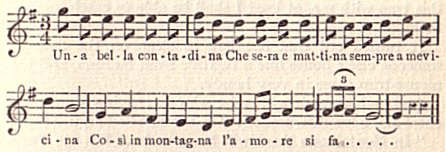
“No,” he said, “that won’t do.
In the first place it is not yet known in Palermo, and when it
is, it will be so popular that no one in particular will think of
saving it.”
“Very well then,” I replied, “make it that
he has just discovered an entirely new resolution of the dominant
seventh and has written it down before he forgets it.”
“All right. And this is the painter; he has his
easel and a picture which he has only just begun; that is more
precious to him than all the pictures he has finished because it
is so full of hope.”
“Bravo, Buffo. And where is the miser?”
“Oh Caspita!” he exclaimed. “How
clever you are! Of course there must be a miser. We
will make him at once.”
So we selected an old man marionette who happened to have
nothing particular to do at the moment, and got a piece of
sacking out of which we made a bag and filled it—not with
gold—
“No,” said the buffo, “that must be one of
the things the people do not see, they must imagine the
gold.” Then we loaded the miser with his bag and
added him to the crowd of fugitives.
And he had made a woman saving a mouse-trap; she was a
suffragette. That was because he had read in the
Giornale di Sicilia that in England a meeting of
suffragettes had been dispersed by letting mice in among
them. The buffo’s suffragette had argued thus:
“In all the world there are mice; Montalbano will be no
exception. How do I know what sort of house I shall have
there? It will probably be over-run with mice. If I
take this trap with me, at least I shall be able to catch some of
them.”
It turned out that she had to sleep on the floor in someone
else’s house like a fugitive from Messina, and the
mouse-trap came in very handy.
And he had made a chemist who was saving a medicine chest and
a few instruments. The chemist had argued thus:
“In Montalbano there will be no order. Here in
Paris the restaurants are well-managed and the food is
good. How can I tell what sort of food they will give us
there? Very likely we shall have to depend a great deal
upon chance. I will take these instruments and medicine and
earn money by curing those who will be sure to be upset by the
badness of the food.”
And a man came weeping; his father had died the day before and
there had not been time to bury the body, but it had been put
into a coffin and the undertaker’s men were laughing
because the son was rich and had promised to pay them extra for
carrying the body to Montalbano and burying it there; but the son
did not see they were laughing, he was in front to show them the
way.
Two boys came along, each saving a marionette, one had Orlando, the other Rinaldo; they forgot that they were
escaping and stopped to make the paladins fight; a third boy came
and said they were his marionettes and the others had stolen
them, and the boys left Orlando and Rinaldo lying on the stage
and began to fight among themselves till their three mothers
followed.
“Be quick, be quick, you silly boys, be quick,”
shouted the mothers, hustling everything before them—boys,
marionettes and all—as an autumn hurricane sweeps away the
fallen leaves.
“What is that man doing?” I inquired.
“Which man?”
“The one standing in the corner there—he seems to
have a camera.”
“Yes, that’s right. He has been sent by the
Cinematograph Company to reproduce the scene for their
show.”
“Oh! I see. That’s a capital idea; the
people will like that.”
“Yes, won’t they?”
And two men were dragging a heavy bundle along on the ground
between them, and I asked:
“What’s in the bundle?”
“Clothes,” he replied.
And there was a woman carrying a hen in a basket, and the hen
escaped from the basket, laid an egg in the middle of the stage
and cackled back into Paris; but the woman saved the egg and
said: “Better an egg to-day than a hen
to-morrow.”
Another woman was carrying her baby on one arm and leading a
child by the hand, and the child was crying because it had to
walk too fast and was tired.
“This is the astronomer,” said the buffo.
“Is that his umbrella under his arm? It seems too
long and too bright.”
“No; that is Halley’s comet which he has predicted
for next spring. He does not want to leave it behind, the
Turks might destroy it and he would lose his
reputation.”
There was the boy from the barber’s shop opposite;
he had been playing with a black kitten when the alarm came and
he joined the fugitives just as he was, in his white tunic with
the kitten in his arms and a comb stuck in his bushy hair.
And there came a troop of old women, chattering and shuffling
along and understanding no more about it all than I should have
understood if I had not had my buffo, my programme
raisonné, to explain it.
Then I said: “Buffo mio, we have had a musician and a
painter, where is the poet?”
“Here he comes.” And there came a pale,
Alfred de Musset youth with long hair, a roll of paper and a
quill pen. “Do you know what he is saying? He
is saying: ‘Better to embrace and be betrayed than to
suffer and die in ignorance.’“
“Is that the philosophy of the buffo?” I
inquired.
“It is the philosophy of the poet,” he
replied.
“Isn’t it rather beyond the public? Will
they understand?”
“The public won’t hear that; it is only for you
and me. There are many things we do not tell the public
because they are the public; but we understand because we are
artists.”
“Very well. And then if we have a poet we must
have a critic—won’t this one do? he has a book;
perhaps he is going to review it, or perhaps it is his
encyclopædia to save him from making mistakes.”
“If you like, he shall be the critic; only then you
ought to tell me what he is saying.”
“He is saying: ‘I despise everything because it is
not something else.’“
“Bravo, bravo! That is better than what the poet
said.”
“O my dear Buffo, I am not going to admit that.
Besides, it is not true of all critics.”
“What I said is not true of all poets.”
“Well, if we don’t like what we have made them
say, let us have someone to follow and show them where they are
both wrong.”
“All right. Let me see. That will be
when they have had time to think it over. That will be the
Cold Dawn of the following morning. We will now make the
Aurora.”
So we found a disengaged lady marionette and began to dress
her in a piece of cobwebby grey muslin from which the last few
spangles had not yet dropped. I said:
“I’m not at all sure that this is not going too
far. Do you think we can really show the Cold Dawn of the
following morning escaping out of Paris by the underground
road?”
“She must go; she will be wanted at Montalbano to show
some of the people that they have saved the wrong
things.”
“Very true. Yes. That is what people so
often do when they travel, they leave behind them the things they
want most and take a lot of other things that are useless.
Now, that resolution of the dominant seventh was hardly worth
saving—at least it was not really new.”
“Where did you get it from?”
“I stole it out of the works of the musician whose bust
was on your maestro’s piano the other day, the one with the
Dutch name who lived in Vienna.”
“I hope you invented what the critic said?”
“Not exactly. Your poet reminded me of something
in Walt Whitman and I twisted it round and gave it to the
critic.”
“What’s Walt Whitman? Is he another
Dutchman?”
“He was an American poet, but his mother had a Dutch
name.”
“Did he come to the teatrino?”
“He never came to Europe. I wish he had been to
the teatrino. He would have liked your Escape from Paris,
but perhaps he would not have cared so much for the
paladins. He wrote something about them.”
“What did he say?”
“If he had seen the end of the story, when the angel
takes Guido Santo’s soul out of his mouth, I believe he
would have said that instead of flying up to heaven he flew
across the Atlantic with it and installed it ‘amid the kitchenware’ to animate all the machinery and
things in one of the Exhibitions held by the American Institute
in New York.”
“Is that what he said?”
“No. What he said was that all that world of
romance was dead:
Passed to its charnel vault—laid on the
shelf—coffin’d with crown and armour on,
Blazon’d with Shakespeare’s purple page,
And dirged by Tennyson’s sweet sad rhyme.
“Well, it is not true. But of course if he never
came to the teatrino he could not know. Americans do come
to the teatrino. I never know which are Americans and which
are English; for the English come too. They come in the
winter and the spring, and when they are pleased with some stage
trick—”
“I suppose you mean with some miracle?”
“Of course,” he replied; “it is the same
thing. When they are pleased with some stage miracle, they
clap their hands and applaud.”
“That is nice and sympathetic of them.”
“Yes, and they shout out loud and cry: ‘Bravo,
very good night.’“
“No, Buffo! Is that really what they
say?”
“Yes, they shout: ‘Bravo, very good night,’
and it is a pleasure to hear them.”
“I should think so. I must come in the winter next
time and hear them say that.”
“They all ask me some questions. I know what they
mean, but I cannot speak to them, and, if you please, will you
write down for me in English what I shall tell you, so that I can
show them the paper?”
“Certainly, my dear Buffo, any little thing of that
kind. If any of them come to see the Escape from Paris, I
should think they will have a good many questions to ask.
For instance, there is the Aurora”—He was finishing
her off by putting a silver fillet round her hair and a shining
star upon her forehead—”I cannot help it, but I
still feel unhappy about her. She does not explain
herself.”
“That will not signify. We must leave room for the
imagination to play—not too much, but it is a mistake to be
too exact. There must be some mystery which the public can
take in any way they choose. It is like the nuts on the
bicycle, they must not be left loose, but they must not be
screwed too tight.”
I gave way, saying: “I suspect you are right. It
flatters the spectators to feel that they are helping the
performance by using their imagination. And if they
don’t understand—well, they can think they do and
that flatters them again. And there is another reason why
we must not tell the public everything—it would take too
long.”
“Ah yes! We must not bore the public or they will
not come again to the teatrino, and then where would the money
come from to pay for my singing lessons?”
So we let the Cold Dawn follow among the rest. There
were half a dozen rollicking blue-jackets off the warship in the
port, they had been spending the evening with their girls and
were escaping with them. When I objected that Paris was a
sea-port town only in a Bohemian sense, he replied that that was
enough for him; and when I said that if the sailors really had a
ship anywhere near, they would have done better to escape by sea,
he complained that I was being fastidious.
There were soldiers arm-in-arm and singing, they had been
interrupted while drinking in a wine-shop in a side street off
the Via Macqueda and were saving the marsala which they had not
finished.
After them came the maresciallo dei carabinieri in the uniform
he wears for a festa, with a plume in his three-cornered
hat. He was a broad, beefy fellow, taller than the
soldiers, being made of a marionette who is usually a
giant. He came swinging along, all so big and so burly,
followed by a lady, showily dressed, who walked mincingly and was
saving a pair of pink satin shoes and a powder-puff. She
kept calling to him to stop, she wanted to speak to
him. But he would not listen, he was not going to pay any
attention to her—not in his gala uniform, it would not have
been proper. Besides, there were people looking.
A blind musician with a broken nose and a falsetto voice was
led by his mate who carried a ‘cello. An interrupted
wedding party followed, and school-children with their
professors, sick people out of the hospital with doctors and
nurses to help them, and a rabble of water-sellers, shoe-blacks,
pedlars and men pushing carts.
Then followed the paladinessa Ettorina still mad, so mad that
they were dragging her along and forcing her to escape while she
struggled to get free and did not want to go, because a mad
person does not understand danger. And paladins and
warriors came—Amantebrava, Lungobello, Ottonetto and many
more whose names I do not remember.
Last of all came Pope Gregorio III. He was not one to
leave the city till the last of his flock had been saved.
He wore his tiara and was in white robes with a red cross front
and back; he carried his crosier in his left hand and on his
right thumb was a diamond ring which sparkled as he blessed the
people. So he passed with his Secretary of State, his
cardinals, his bishops, his monsignori, his acolytes, his
chamberlains, his Guardia Nobile and his Swiss Guard; some
carried lighted candles, some carried banners and others crosses;
some were swinging incense and others were intoning the psalm
In Exitu Israel. The solemn pomp of the procession
disappeared into the opening of the subterranean road and the
sound of the singing could no longer be heard. They were
all safely gone. The stage was empty. Yet the curtain
did not fall.
Then came a poor mad boy, a sordo-muto, who had been
overlooked. He was in a great hurry, making frightful
inarticulate noises and running this way and that, being too much
alarmed to go straight. Before he had found the mouth of
the tunnel the curtain fell and we did not see what became of
him. He may have been left behind after all.


