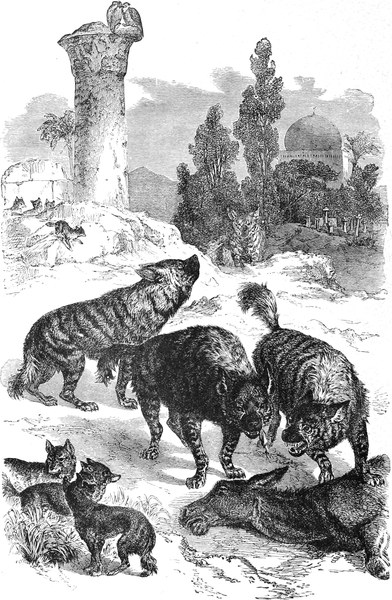
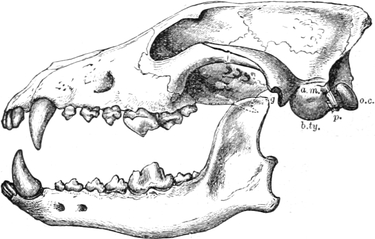
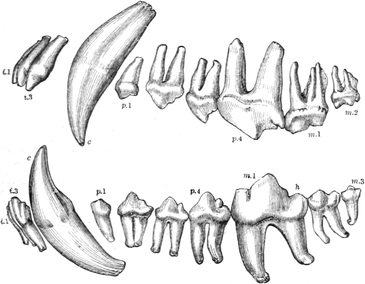
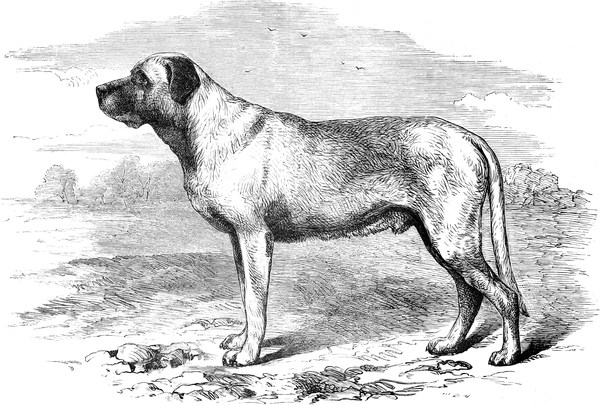
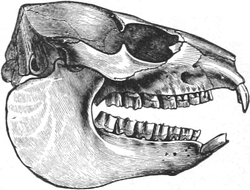
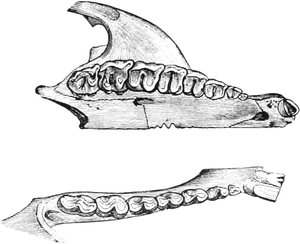
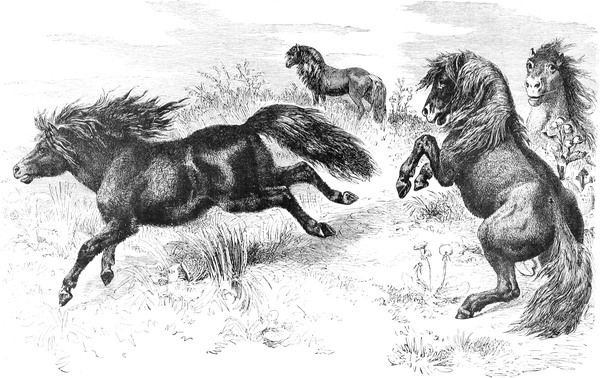
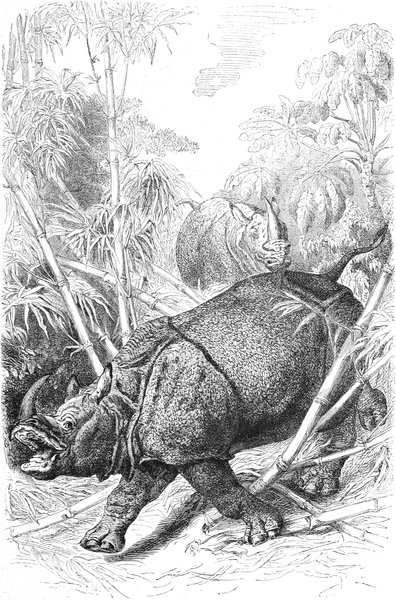
THE CARNIVORA. — CHAPTER I. INTRODUCTORY REMARKS—THE CAT FAMILY. — THE LAND CARNIVORA. [1] — THE CAT FAMILY. [6] — CHAPTER II. THE CAT FAMILY— THE LION . — THE LION. [7] — CHAPTER III. THE CAT FAMILY— THE TIGER AND THE LEOPARD . — THE TIGER. [15] — THE LEOPARD. [17] — CHAPTER IV. THE CAT FAMILY— THE JAGUAR, THE SMALLER WILD CATS, THE DOMESTIC CAT . — THE JAGUAR. [19] — THE PUMA. [21] — THE OUNCE. [23] — THE CLOUDED TIGER. [24] — THE OCELOT. [25] — THE MARBLED TIGER-CAT. [27] — THE VIVERRINE CAT. [28] — THE PAMPAS CAT. [29] — THE LONG-TAILED TIGER-CAT. [30] — THE MARGAY. [31] — THE COLOCOLO. [32] — THE JAGUARONDI. [34] — THE EYRA. [35] — THE SERVAL. [36] — THE RUSTY-SPOTTED CAT. [37] — THE LEOPARD CAT. [38] — THE BAY CAT. [40] — THE SPOTTED WILD CAT. [41] — THE MANUL. [43] — THE EGYPTIAN CAT. [44] — THE COMMON WILD CAT. [45] — THE DOMESTIC CAT. [47] — CHAPTER V. CAT FAMILY—HYÆNA FAMILY—CRYPTOPROCTA FAMILY—AARD-WOLF FAMILY. — THE COMMON JUNGLE CAT. [52] — THE COMMON LYNX. [53] — THE PARDINE LYNX. [55] — THE CANADIAN LYNX. [56] — THE RED LYNX. [57] — THE CARACAL. [58] — THE CHEETAH. [59] — THE HYÆNA FAMILY. [61] — THE SPOTTED HYÆNA. [64] — THE BROWN HYÆNA. [67] — THE STRIPED HYÆNA. [68] — THE CRYPTOPROCTA FAMILY. [70] — THE CRYPTOPROCTA. [71] — THE AARD-WOLF FAMILY. [72] — THE AARD-WOLF. [73] — CHAPTER VI. THE CIVET FAMILY. — THE AFRICAN CIVET. [76] — THE ASIATIC CIVET. [77] — THE LESSER CIVET. [78] — THE GENETTE. [79] — THE MUNGOOS, OR ICHNEUMON. [80] — THE CRAB MUNGOOS. [87] — THE COMMON PARADOXURE. [88] — THE BINTURONG. [89] — CHAPTER VII. THE DOG FAMILY.— THE DOMESTIC DOG. [91] — THE DOMESTIC DOG. [92] — CHAPTER VIII. THE DOG FAMILY.— DOGS OF SAVAGES—DOGS OF CIVILISED NATIONS—WILD DOGS. — THE HARE INDIAN DOG. — THE ESKIMO DOG. — THE DOMESTIC DOGS OF OTHER SAVAGE TRIBES. — THE DOGS OF CIVILISED NATIONS, — THE DALMATIAN DOG. — THE GREYHOUND. — THE SCOTCH GREYHOUND. — THE DEERHOUND. — THE TURKISH GREYHOUND, — THE GRECIAN GREYHOUND — THE PERSIAN GREYHOUND. — THE ITALIAN GREYHOUND — THE COCKER, — THE SPRINGER — THE KING CHARLES’S SPANIEL — THE BLENHEIM SPANIEL — THE CHINESE PUG-DOG — THE WATER-SPANIEL — THE POODLE — THE MALTESE DOG — THE LION DOG — THE TURKISH DOG — THE ST. BERNARD DOG. — THE NEWFOUNDLAND DOG — THE SHEEP DOG. — THE POMERANIAN DOG — THE CUR — THE LURCHER — THE BEAGLE — THE HARRIER — THE FOXHOUND — THE STAGHOUND. — THE BLOODHOUND. — THE SETTER, — THE POINTER. — THE RETRIEVER, — THE OTTER-HOUND — THE TURNSPIT. — THE DACHSHOUND, OR BADGER-DOG, — THE BULL-DOG — THE BULL-TERRIER — THE MASTIFF. — THE CUBAN MASTIFF — THE TIBET DOG. — THE ENGLISH TERRIER. — THE SCOTCH TERRIER — PARIAH DOGS. — THE INDIAN WILD DOG. [117] — THE DINGO, OR AUSTRALIAN WILD DOG. [119] — CHAPTER IX. THE DOG FAMILY.— WOLVES — JACKALS — FOXES, ETC. — THE WOLF. [122] — THE JACKAL. [129] — THE COMMON FOX. [130] — THE ARCTIC FOX. [131] — THE FENNEC. [132] — THE LONG-EARED FOX. [133] — THE RACOON DOG. [135] — THE HYÆNA-DOG. [136] — CHAPTER X. THE BEAR FAMILY.— THE BEARS. — THE BEAR FAMILY. [138] — THE COMMON BROWN BEAR. [139] — THE AMERICAN BLACK BEAR. [141] — THE GRIZZLY BEAR. [142] — THE SYRIAN BEAR. [143] — THE SUN BEARS. [145] — THE SLOTH BEAR. [147] — THE SPECTACLED BEAR. [150] — THE POLAR BEAR. [151] — CHAPTER XI. RACOON FAMILY—PANDA FAMILY—WEASEL FAMILY—FOSSIL CARNIVORA. — THE RACOON FAMILY. [154] — THE RACOON. [156] — THE COATI. [157] — THE KINKAJOU. [158] — THE CACOMIXLE. [159] — THE PANDA FAMILY. [160] — THE PANDA [161] — THE WEASEL FAMILY. [162] — THE GLUTTON. [164] — THE MARTEN. [166] — THE PEKAN. [167] — THE SABLE. [168] — THE COMMON WEASEL. [170] — THE ERMINE. [171] — THE POLECAT. [172] — THE FERRET. [173] — THE MINK. [174] — THE GRISON. [175] — THE TAYRA. [176] — THE RATEL. [177] — THE COMMON BADGER. [178] — THE AMERICAN BADGER. [180] — THE TELEDU. [181] — THE CAPE ZORILLA. [182] — THE COMMON SKUNK. [183] — THE COMMON OTTER. [187] — THE SEA OTTER. [192] — GENERAL RELATIONS OF THE LAND CARNIVORA, RECENT AND FOSSIL. — APPENDIX TO CHAPTER VI. (VIVERRIDÆ, CIVET FAMILY.) — THE CYNOGALE. [199] — THE CYNICTIS. [200] — THE MANGUE. [201] — THE SURICATE. [202]
CASSELL’S NATURAL HISTORY.
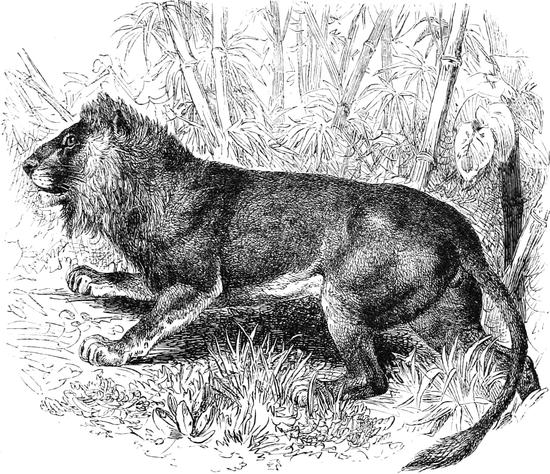
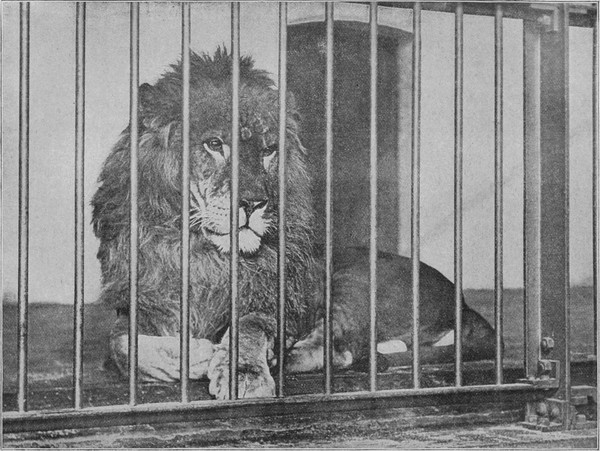
LION OF GUZERAT.
The Carnivora—Division into Terrestrial (Fissipedia) and Aquatic (Pinnipedia)—Introductory Remarks on the
FISSIPEDIA—Their
Relations to Man and to other Animals—Their Distribution over the Surface of the Globe—Their
Structure—The Diversity of their Form and Habits—Their Division into Lesser
Groups—THE CAT FAMILY—Their
Geographical and Chronological Distribution—Their Skeleton—The Peculiarities of their Skull, Teeth, &c.
The Carnivora, or flesh-eating Mammals, form a fourth order of the
Mammalia, and are divided into two great groups, or sub-orders as they
are called by zoologists, one terrestrial, and the other aquatic. The
first is the group of the Fissipedia, or “split-feet,” so called from
the fact that the feet are divided into well-marked toes; the second is
the group of the Pinnipedia, or “fin-feet” (Seals, &c.), so called
from the fact that the toes are bound together by skin, forming fins or
flippers rather than feet.
This group, which comprises all the great “beasts of prey,” is one of
the most compact, as well as one of the most interesting among the
Mammalia. So many of the animals contained in it have become “familiar
in our mouths as household words,” bearing as they do an important
part in fable, in travel, and even in history: so many of them are of
such wonderful beauty, so many of such terrible ferocity, that no one
can fail to be interested in them, even apart from the fact likely to
influence us more in their favour than any other—that the two home
pets which of all others are the commonest and the most interesting
belong to the group.
No one who has had a Dog friend, no one who has watched the wonderful
instance of maternal love afforded by a Cat with her kittens, no one
who loves riding across country after a Fox, no lady with a taste for
handsome furs, no boy who has read of Lion and Tiger hunts, and has
longed to emulate the doughty deeds of the hunter, can fail to be
interested in an assemblage which furnishes animals at once so useful,
so beautiful, and so destructive.
It must not be supposed from the name of this group that all its
members are exclusively flesh-eaters—and, indeed, it will be hardly
necessary to warn the reader against falling into this mistake, as
there are few people who have never given a Dog a biscuit, or a Bear a
bun. Still, both the Dog and several kinds of Bears prefer flesh-meat
when they can get it; but there are some Bears which live almost
exclusively on fruit, and are therefore in strictness not carnivorous
at all. The name must, however, be taken as a sort of general title for
a certain set of animals which have certain characters in common, and
which differ from all other animals in particular ways.
Comparatively few of the flesh-eaters are of direct use to man, at any
rate while alive, yet one member of the group—the Dog—is the most
useful of all domestic quadrupeds, though derived from one of the most
savage of all—the Wolf. The Ferret, the Cheetah and the Cat are also
more or less domesticated; but they come far below the Dog in amiable
qualities, and in value to man. Below their value in service comes the
use of their most beautiful skins; and still lower down the scent,
derivable from a few species. Yet from these two last sources our fair
ones seek to derive new charms, not heeding the poet Cowley’s quaint
objurgation:—
“The adorning thee with so much art
Is but a dangerous skill;
Like to the poisoning of a dart,
Too apt, before, to kill.”
Most of the Carnivora may be looked upon as man’s natural enemies, for
he has no chance of making headway unless he can keep “the beast of the
field” from “increasing upon him.” Amongst primæval men, the tribes
who made the best weapons to keep off these, the destroyers of their
families, were certain to succeed best in the struggle for existence,
so that the act of sharpening a flint-stone to repel the attack of
some wild beast may be said to have prepared the way for civilisation,
for flint knives led to bronze hatchets, bronze hatchets to axes
and hammers of iron, and when once iron-working was understood and
appreciated, civilisation went on with gigantic strides.
Besides acting as one of the severest of schoolmasters in the hard
school of adversity in which man has been trained, the flesh-eaters
serve to keep in check, and indirectly to bring to perfection, the
grass-eating tribes. Upon these—the Oxen, Antelopes, Wild Asses,
&c.—the large Carnivora delight to prey; in so doing they have to put
forth all their powers, their agility, strength, and cunning, while the
Herbivores, at the same time, have acquired caution and swiftness of
foot in the highest degree, in order to escape from their ruthless and
implacable destroyers.
While the larger beasts of prey keep in check the troops of great
hoofed animals, the smaller kinds, such as Cats and Ferrets, have a
most important office in thinning the constantly multiplying ranks of
gnawing animals, such as Rats and Mice, which would otherwise prove a
plague of the worst description. Indirectly, too, our Carnivora may
even influence largely the spread of certain kinds of vegetation: for
instance, as Mr. Darwin has shown, where there are no Cats there is
no clover! This seems strange, not to say fabulous, but it is known
that clover will only flourish when there are plenty of Humble-bees,
the only insects able to carry the fertilising pollen from flower to
flower, and so ensure a good supply of seed for the next crop. Now,
Field Mice are particularly hostile to Humble-bees, knowing quite well
where to find their nests and combs, and how to get at their honey,
of which they are very fond. Thus, where Field Mice exist in great
numbers, Humble-bees will be comparatively few. But Mice are chiefly
kept down by Cats, and so the end of this biological “house that Jack
built” is that to ensure a good crop of clover it is advisable to have
plenty of Cats about!
The conception of the fearful struggle for existence going on between
beast and beast has been caught by Shakspere in a wonderful passage in
his “Timon of Athens.” Apemantus would “give the world to the beasts
to be rid of the men,” whereupon Timon asks him whether he would have
himself “fall in the confusion of men, and remain a beast with the
beasts.” Apemantus answers in the affirmative, and Timon’s rejoinder is
as follows: “A beastly ambition, which the gods grant thee to attain
to! If thou wert the Lion, the Fox would beguile thee: if thou wert
the Lamb, the Fox would eat thee: if thou wert the Fox, the Lion would
suspect thee, when, peradventure, thou wert accused by the Ass: if thou
wert the Ass, thy dulness would torment thee, and still thou livedst
but as a breakfast to the Wolf: if thou wert the Wolf, thy greediness
would afflict thee, and oft thou shouldst hazard thy life for thy
dinner: wert thou the Unicorn, pride and wrath would confound thee,
and make thine own self the conquest of thy fury: wert thou a Bear,
thou wouldst be killed by the Horse: wert thou a Horse, thou wouldst
be seized by the Leopard: wert thou a Leopard, thou wert german to the
Lion, and the spots of thy kindred were jurors on thy life: all thy
safety were remotion, and thy defence, absence.” To learn the truth of
these words, one has only to turn to any book of travel in Africa or
India, where one is certain to read of a wholesale destruction which it
is melancholy to think of.
In Great Britain this conflict is a thing of the past; but two
terrible enemies of man even there have been extirpated within the
historic period—namely, the Wolf and the Bear; of these and of their
extirpation we shall speak when we come to describe those types. Now,
happily, these greedy Carnivora are “scattered and peeled—meted out
and trodden down.” Far in the north of the island there is the wild
Cat, the two Martens are becoming scarcer and scarcer; the Badger is
found here and there; the Polecat is rare; so that the Fox, the Stoat,
and the Weasel—the last being the very least and meanest of the order
alone are common.
But in the later geological epoch—pre-historic as to us—the nobler
types abounded, and Great Britain was then as much the land of savage
beasts as Africa and India are now.
The Carnivora are found all over the world, from the equator to
the poles: in most parts of the globe they are abundant, the great
exception being the Australian region of zoological geography, namely,
the immense island of Australia, which can only boast of a Dog,
doubtfully native, and New Zealand and the adjacent Polynesian Islands,
which are quite devoid of members of the group, the native Dog of New
Zealand having probably been recently introduced.
Many forms have become extinct, and, as we shall see when we come
to speak of these bygone creatures, the lower we dig in the strata
which compose the rocks of which our earth is made, the lower do the
types become, that is to say, among the extinct Carnivora we have no
animals so perfectly constructed for flesh-eating as the Cat family,
for instance, but the various kinds get nearer and nearer, the lower
we go, to what may be called the general plan of Mammalian structure,
and farther and farther from the special type of structure found in the
higher Carnivores of the present day.
There is considerable range of size among the various members of the
group, the Lion and Tiger being the largest, the Weasel and Suricate
the smallest. As to their habits, the Carnivore are very varied;
leaving out as we do for the present the fin-footed Seals, Sea Bears,
and Walruses, we yet have the semi-aquatic Otter and the Enhydra, or
Sea Otter, both at home in the watery element, and most expert swimmers
and divers; but for the most part the flesh-eaters are inhabitants of
the copse, the jungle, and the forest. Many are nimble climbers, some
are arboreal in their habits, living entirely in trees, and most are
crepuscular, that is, hunt their prey after dusk.
As to their diet, we mentioned above that they are by no means all
flesh-eaters; in fact there is every gradation from those which live
exclusively on animal food, such as the Lion, Tiger, &c., to the purely
herbivorous kinds of Bear. Some again, such as the Cat family, seem
to prefer flesh-meat, others, such as the Otter, adopt a Lenten diet,
and feed on fish or eggs. This matter, however, is, of course, largely
determined by the habitat of the animal, those whose habitation is
inland being compelled to devour land animals, while those living by
the sea or by river-banks usually take to fish either occasionally or
as a regular thing.
Turning to the structure of the group, one of the first things that
strikes us is the looseness of their skin, which, instead of being
stretched on the body as tightly as a drum parchment, as it is in
grass-eaters—for instance, the Ox or Hippopotamus—is quite “baggy,”
having between it and the flesh of the beast a layer of the loosest
possible fibres. It is for this reason that the skin of any but a
very fat Dog can be pinched up so readily, while of a Herbivore it
may be said, in the words of eulogy uttered by Mr. Squeers of his son
Wackford, “Here’s firmness, here’s solidness! why you can hardly get up
enough of him between your fingers and thumb to pinch him anywheres.”
In consequence of this the operation of skinning a Lion or Bear is a
comparatively easy one. After the first cut the beast may be pulled
out of his skin, almost without further use of the knife; while with
an Antelope or an Ox the skin has to be cut away carefully and
laboriously from the underlying flesh.
The use of this loose skin will be very evident to any one who will
take the trouble to watch the great Cats playing together at the
Zoological Gardens. They are continually scratching one another, but
the loose skin is dragged round by the claws which, in consequence, can
get no hold, and do no harm; with a tight skin, on the other hand, the
slightest scratch of such a claw as a Tiger’s would cause a serious
wound. The looseness of the skin is very evident in the Puma and
Jaguar, in which it hangs in a fold along the middle of the belly, like
a great dewlap.
In the Carnivora the skeleton, or bony framework of the body, attains
its utmost perfection, both as a tissue and as machinery. Its tissue
is dense, white, and ivory-like, every bone is exquisitely moulded
and polished, so that there are few more beautiful objects of study
than a well-prepared Cat’s skeleton, and almost none more instructive
or better calculated to give an idea of the perfection of “animal
mechanics.” The flexibility and strength of the spine, the exquisite
fitting of its joints, the small head capable of being turned in almost
any direction in the search for prey or the avoidance of danger, the
wonderful arrangement of levers afforded by the limbs, which exhibit
at once the greatest amount of strength and the greatest amount of
elasticity, all combine to fill the mind with wonder and admiration,
as great as that excited by the most perfect work of art or the most
stupendous phenomenon of inanimate nature.
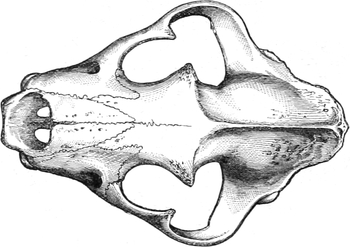
UPPER VIEW OF LION’S SKULL.
The skull of nearly all Carnivora is distinguished from that of most
other Mammals by its immense strength, and its evident adaptation to
the habits of its possessor—to the effective seizing and devouring of
living prey. It is remarkable for the immense roughened bony ridges,
developed in many parts of it, which serve for the attachment of the
mighty jaw-muscles, the great size of which causes an increase in
the width of the bony jugal arch, extending from under the eye to
just in front of the ear. Another point worthy of notice is the great
shortening of the jaws, or of the facial in relation to the cranial
portions of the skull. In this respect Carnivores, especially the
most typical forms, the Cats, are very markedly distinguished from
Herbivores, in which the brain-case is small and the face immensely
prolonged. This has to do with the different kind of food used by the
two groups—that of vegetable-eaters requiring long grinding, that of
flesh-eaters powerful mincing. Connected also with this same function
of mastication is the form of the condyle, or bony projection of the
lower jaw, by which it moves on the skull, and of the smooth surface of
the latter which receives it. These are in Carnivora greatly elongated
transversely, and narrowed from before backwards, so that no motion
from side to side, but only an up-and-down motion, is possible. The
higher Carnivora, therefore, cannot chew or grind their food, but
only mince it, their sharp teeth acting exactly like scissor-blades.
In the interior of the skull should be noticed a large plate of bone
which extends inwards and separates the great brain, or cerebrum, from
the lesser brain, or cerebellum, and prevents the jarring of that
important organ likely to arise from the animal’s vigorous movements.
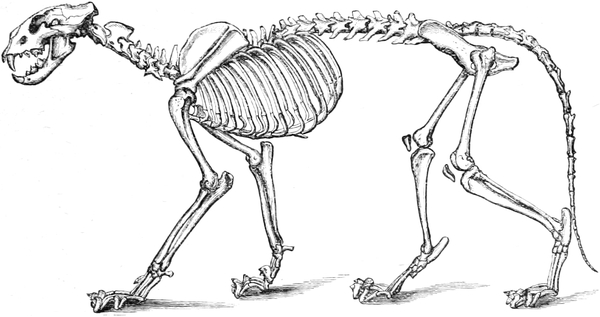
SKELETON OF LION.
In the spine, or vertebral column, there is not much to notice beyond
the great size of the first two vertebræ, or those which support
the head, and the development of strong spines or processes for the
attachment of muscles.
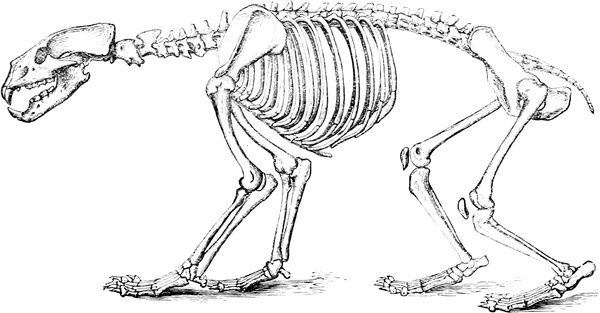
SKELETON OF POLAR BEAR.
In the limbs there are certain points of considerable interest and
importance. If a Bear and a Lion be watched while walking, a great
difference will be observed in their gait: the Bear’s movements are
far clumsier and less springy than those of the Lion. A little further
observation will show that this is due, chiefly, to the manner in which
their feet are set on the limbs, for it will be seen that the Bear
keeps the sole of his foot flat on the ground, and, as his foot is very
large, he has something of the awkward, sprawling movement of a man
walking in shoes too big for him. The Lion, on the other hand, has his
wrist and his heel lifted well above the ground, and so walks, not on
the sole of his foot, but on his toes, the under surfaces of which are
furnished with beautifully soft leathery pads, so as to ensure a soft,
silent footstep. Then what looks like the knee of a Lion, Cat, or Dog
is really his wrist. and what looks like a backward turned knee in
his hind leg is his heel, the true elbow and knee being almost hidden
by the skin.
The reason of this arrangement is seen by looking at the skeletons of
the two animals. In the Bear the metacarpals and metatarsals, or
five long bones extending between the wrist and the ankle respectively,
and the joints of the toes, are kept in a horizontal position, as
in ourselves; in the Lion, on the contrary, the metacarpals and
metatarsals are lifted almost into a vertical position, the walking
surface being now afforded by the under surface of the toe-bones, or
phalanges. By reason of this the Lion gets an extra lever in his leg,
in addition to the two levers which the Bear possesses, namely, those
afforded by the bones of the arm and fore-arm and of the thigh and leg
respectively; and consequently his springiness is greatly increased. An
animal which walks like the Bear, on the sole of its foot, is said to
be plantigrade: one which walks on its fingers, like the Lion, Cat,
or Dog, is called digitigrade.
As in all animals in which the fore limbs are used for support, and
not for prehension, the collar-bone, or clavicle, is either wholly
absent or quite rudimentary, and the fore limb has therefore no bony
connection with the trunk, but is attached simply by muscles and
ligaments. The Carnivores, in leaping or running, often come down with
their whole weight upon the fore legs, and if a large bony clavicle,
like that of a Monkey or Bat, were present, it would infallibly be
broken.
The bones are all strongly bound together by elastic bands, or
ligaments, and are covered by the great fibrous masses, or muscles,
which, forming as they do the flesh, take the chief share in giving
to each animal its characteristic shape. These muscles are, in most
instances, attached to the bones by strong cords or bands resembling
the ligaments, and called tendons. The bones being, in great measure,
articulated or jointed to one another by smooth surfaces, sometimes
flat, sometimes round, sometimes pulley-like, act as levers. The
muscles are usually attached at one end to a fixed at the other to a
movable bone; when they act, by shortening in length and widening in
diameter, they make the more movable bone to turn upon the other. In
this way they cause the limbs to be straightened or bent, the jaws to
be opened or shut, the claws extended or retracted, and perform all the
other movements of which the animal is capable. The development of the
muscles in the larger Carnivora is wonderfully great. A Lion will kill
an Ox with a blow of his paw, and drag it off to his lair as easily as
his humble relation, the Cat, disposes of a Rat or Mouse.
We now have to consider a most important series of organs—the organs
of alimentation or nutrition; those, in fact, which serve the
purposes of taking in, preparing, and digesting the food. They are the
mouth with its tongue, teeth, and salivary glands, the gullet, stomach,
and intestines, with the liver, and sweetbread, or pancreas.
We are all familiar in ourselves with four kinds of teeth, namely
(1), the “incisors,” or cutting teeth, in front; (2), the “canines,”
the pointed eye-teeth that come next; (3), the “false grinders,” or
“premolars;” and (4), the true grinders, or “molars.” Man has a very
even and full-mouthed series; the Carnivora, on the other hand, possess
a most irregular series, and in this series there are certain gaps
or interspaces. Our own even orderly set is best adapted for a mixed
diet, that has for the most part undergone a great amount of change
by cooking. But the Carnivora, in their wild state, must eat flesh
raw, and for the most part reeking, and this has to be torn from the
conquered prey. So that the teeth have to be applicable to the first,
or destructive process, and then to the tearing to pieces of the
fleshly substance, and the scraping of the bones; they may even have
to crush the bones themselves, the more spongy parts serving for food;
and, greatest feat of all, to break the hardest long bones for the
succulent marrow.
The mode of feeding and the form and number of the teeth of necessity
correspond: tearing and gnawing are processes that need teeth like
knives and scissors, while grinding or chewing require teeth like
millstones. Both these kinds exist in the Bear. In the Dog the crushing
teeth become less in size and importance; in the Lion they are
suppressed, and all the teeth have a cutting character, their number
being at the same time much reduced.
The teeth are often all that remains of certain extinct creatures; they
are, therefore, a most important part of the anatomy of an animal,
as well as being of great service in the matter of classification or
grouping. They are the hardest of all the organs; their relation to the
food of the species, and their necessary correlation to the digestive
organs, makes them serve as a key to the rest of the creature’s
structure, which structure is in absolute harmony with its habits and
daily life.
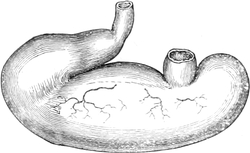
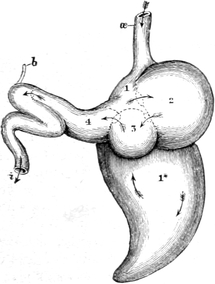
STOMACH OF LION.
The tongue is covered with horny projections, or papillæ, and in
the Cat tribe serves as a rasp to rub and scrape off the smaller
fragments of flesh from the bones. The stomach is always simple, that
is, consists of a bagpipe-like cavity not divided into compartments,
as in the Ruminants and some other animals. A great difference from
herbivorous animals is also seen in the length of the intestine. As the
food is of a highly nourishing nature it requires less time for its
digestion, and a smaller surface for its absorption into the blood,
and the intestine is therefore remarkably short—not more than three
times the length of the body in the Lion and Wild Cat, instead of being
fifteen to thirty times the length, as in some vegetable feeders. The
Carnivora have, therefore, the manifest advantage of a more compact and
smaller “barrel” than the Herbivora, and, in consequence, have less
weight to carry, and are slim and slender-waisted.
As might naturally be expected, the organs by which the blood, loaded
with nourishment from the digestive canal, is carried to all parts
of the body, are well developed. The heart, if not “as hard as the
nether millstone,” is yet compact and strong in the highest degree: the
circulation is vigorous, and the result is seen in great courage and
astonishing powers of endurance.
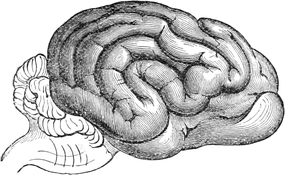
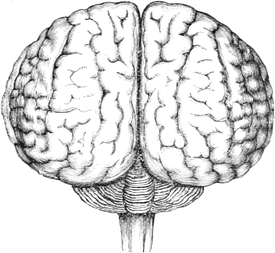
BRAIN OF DOG.
In the lungs, with the windpipe and larynx, in which the multitudinous
cries of the group—barks, howls, roars, and whines—are produced,
there is nothing to merit any special mention.
The brain of Carnivora is, as a rule, remarkably large and well formed,
in conformity with their high degree of intelligence. Its surface
is thrown into well-marked ridges with intervening depressions, and
presents a great contrast with the almost smooth brain of a Shrew or
a Hedgehog. From it are given off nerves to the tongue, teeth, skin,
muscles, and other parts of the head, as well as some to organs at a
considerable distance from the head, as the heart, lungs, and stomach,
and, most important of all, three pairs of nerves, one for each of the
organs of the higher senses—the nose, eye, and ear.
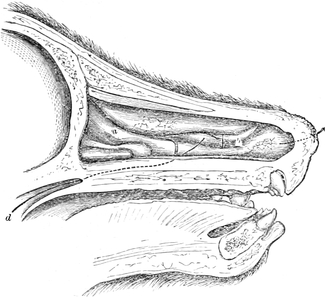
LONGITUDINAL SECTION THROUGH A DOG’S NOSE, SHOWING THE
SPONGY BONES. (Nat. Size. From a Sketch by T. J. Parker)
a. The smelling region; b. The sneezing
region; c. A bristle passed through the nostril into the nasal
chamber; d. A bristle passed from the nasal chamber into the passage by
which the latter communicates with the mouth.
The two nerves of smell pass through a beautifully-perforated
bone—hence called the “sieve-bone,” or ethmoid—and proceed one
on each side of a bony and gristly wall which divides the two nasal
chambers from one another, to a delicate membrane covering a pair
of bones of wonderful complexity—a labyrinth which must be seen to
be understood, for the beautiful manner in which it enfolds itself
can hardly be imagined. These “spongy-bones,” as they are called,
the membrane covering which forms the true organ of smell, lie in
the upper and hinder part of each nasal cavity, but in front of them
is a large scroll of bone, also covered by a membrane of exquisite
sensitiveness, but not taking cognisance of odours. This anti-chamber,
as it were, of the nose, is extremely sensitive, and its sensibility is
a safeguard against intrusive dust, and deadly disease-germs. It is the
sneezing region, and is the natural and most careful porter of the
gates of the breath.
The way in which the eyes of the Carnivora are set in their head
indicates their habits of life. They look straight forward, and are
expressive, in the nobler kinds, of the energy and cruelty of their
owner’s disposition. As in many of the Lemurs, the eye possesses what
is called a tapetum, a sort of reflecting mirror in the bottom of the
eye, which redoubles, as it were, the faint rays of evening, evidently
a very important thing for these, mostly nocturnal, animals.
The sense of hearing is as perfect as that of sight; not, perhaps, in
the higher, musical sense of the word, but for catching the faintest
and feeblest undulations of the air. The Mole is supposed to be most
sharp of hearing; but it is a question whether he is quicker of hearing
than his cruel neighbour the Rabbit-killing Weasel. Any one who has
watched a Cat sitting demurely by a Mouse-hole, or a Terrier on the
look out for a Rat, will give these Carnivores credit for the most
acute sense of sound. Anatomy corroborates what simple observation
suggests, and the internal as well as external organs of hearing in the
Carnivora are most exquisitely perfect.
Many members of the group live in families, that is, a male and female
with their young form a little coterie by themselves, and associate
very little with other families. Very few live in great societies or
herds, after the manner of the grass-eating animals, such as Oxen,
Antelopes, or Wild Horses, but an exception to this is afforded by the
Wild Dogs of Constantinople, which roam the streets in great numbers,
and by Wolves, which invariably hunt in packs.
The Dogs and Wolves, besides being gregarious, resemble the Herbivora
in another and far less amiable characteristic, that is, they do not
choose a mate for life or even for a season, but let their affections
run wild and practise the most unmitigated polygamy and polyandry. Many
of the larger Cats, on the contrary—the Lion, for instance—choose a
mate, to whom they are wonderfully faithful.
The young are always born in a comparatively helpless condition, not
able to run about at once like a new-born Calf or Foal; they are
generally blind for some time after birth, and are entirely dependent
on the mother for food and warmth.
The higher Carnivora are most kind parents, and to the best of their
ability, educate their young. This was well known to the ancients:
Ezekiel the prophet (xix. 2, 3) gives this character of the Lioness in
inimitable language: “What is thy mother? A Lioness: she lay down among
Lions, she nourished her whelps among young Lions. And she brought up
one of her whelps: it became a young Lion, and it learned to catch the
prey; it devoured men.” All writers bear witness to the painstaking way
in which the parent Lion or Tiger trains up its young and practises
them for their trade of slaughter. Sometimes both parents, sometimes
only one, go out with their offspring, and by example and precept show
them the safest places to hide, the proper moment to spring, the best
place to seize the victim, and so on. And the future tyrants are very
apt, they thoroughly enjoy their schooling, and make the best possible
use of their opportunities; so much so that the young of the great
Cats are far more dreaded than the old ones, as they not only kill to
satisfy hunger, but commit wholesale slaughter, simply for practice and
to keep their paws in.
The diversity of form and structure in the group of land Carnivora
is very great. We find, as in the groups we have considered
previously, many different kinds or species, amongst which are
creatures so different as the great and powerful Lion and the
small and insignificant Weasel, the active Tiger and Jaguar, and
the lazy Glutton. These species, as very little observation shows
us, naturally fall into certain larger groups or genera, having
important characteristics in common; for instance, the Lion, Tiger,
Leopard, Jaguar, Lynx, and all the small Cats, are so much like one
another, and so different from all other animals, as to be put in
the one genus Felis, which is distinguished by having retractile
claws, and by being quite devoid of true grinding teeth. Again, the
Dog and Wolf have so many points in common, that they are placed in
the single genus Canis, the Dog being called Canis familiaris, the
Wolf Canis lupus. If a number of genera are found to agree pretty
closely with one another in essential matters, they are grouped into
a family; thus we have the family Mustelidæ, which includes not
only the Weasel (Mustela), but a number of other genera, such as
the Otter, Badger, Skunk, and many others. Furthermore, the families
are conveniently grouped into sub-orders, according to characters
considered to be of greater importance than those which determine
genera or families. We may roughly compare this method of grouping to
the way in which the soldiers in an army are arranged. Thus, individual
men—corresponding to species—are arranged in companies, which
we may take to represent genera; several companies are united into
a regiment, just as a number of genera are united into a family;
a greater or less number of regiments go to form a battalion, in
the same way as the families go to form a sub-order; and, lastly,
two or three battalions constitute an army, which is the complete
assemblage, and corresponds, in our rough illustration, to an order.
We suppose that nine persons out of ten, if asked to give three common
examples of land Carnivores, would, almost without hesitation, name
the Cat, the Dog, and the Bear. The most accomplished naturalist would
be unable to give a better answer to this question, as those three
well-known animals are types of the three primary sections into which
the whole sub-order is divided, and which may, in fact, be termed
respectively the groups of the Cats, Dogs, and Bears. It must be borne
in mind, however, that the words are here used in the broadest and most
general sense, for the group of “Cats” includes not only the animals
properly so-called, but also the Civets, Ichneumons, Hyænas, whilst
amongst “Bears” are grouped Racoons, Otters, Badgers, Weasels, and many
others.
It will, perhaps, be as well to give the scientific names for these
three groups which we have, most unscientifically, called Cats, Dogs,
and Bears. We have first the Æluroidea,[2] or Cat-like animals;
next the Cynoidea,[3] or Dog-like animals; and, lastly, the
Arctoidea,[4] or Bear-like animals. We also give below a list of the
families of land Carnivores arranged under their respective sections,
with the most important forms belonging to each family; as such a list
will, in all probability, be useful for reference.[5]
The splitting up of our flesh-eaters into these sections is not an
arbitrary matter, but is determined by certain definite anatomical
characters, one of the chief of which is the structure of the base of
the skull. These matters will, however, be better discussed under the
various families, when we shall also devote a short time to that very
important branch of anatomy, the form, number, and arrangement of the
teeth.
This is the chief of the families of Carnivora, containing as it does
all the great beasts of prey. Its members are the most perfectly
constructed of animals for a life of rapine; their weapons—teeth and
claws—attain the utmost degree of perfection, and their elegant form,
silent movements, and often beautiful colouring, make them in every
respect the culminating forms of the flesh-eating group, and one of the
chief of the upper branches of the great Mammalian tree.
Both the Old and New World are well stocked with Cats. Everywhere they
are the correlates, geographically speaking, of the beautiful forms of
the Herbivora, and are their natural checkmates in the earth-peopling
process. Their terrible office is to cull out the surplus number
of Goats, Antelopes, Deer, Oxen, and Sheep; they also are not good
neighbours to the Monkey tribes, nor to Rats, Cavies, Hares, Squirrels,
and other gnawing animals. The smaller Cats also add feathered game to
their diet. Everywhere they are the terror of woodland and of field, of
plain and of forest. All are of the kindred of the Lion, and, like him,
all “go about, seeking whom they may devour.”
Man has half tamed one of the smallest—we say half tamed, for does
not the demon that possesses all Cats still only slumber in the heart
of the tamest domestic variety? As for the Hunting Leopard, he is
deceived in the services he renders, and, in his own mind, is hunting
for himself, and not for his master.
It is only necessary to mention the animals belonging to this noble
family of “gentlemen caterers” to assure oneself that in it are
contained the best known, the most skilled, the most perfectly armed
of all the Carnivorous order. We have the Wild Cats existing under
many forms nearly all over the world, the Lion the great tyrant of
Africa, the Tiger the despot of India, the Puma and Jaguar taking their
place in America, the Leopard helping the work of the Lion and Tiger
in Africa and Asia, the Lynxes found in both Old and New Worlds, and
the Cheetah, or Hunting Leopard of Asia and Africa. To these need only
be added the Wolf, Hyæna, and Bear, to exhaust the list of “beasts of
prey” in the ordinary acceptation of the term, that is, of beasts which
are dangerous to man, for we “lords of creation” are not sufficiently
generous to include under the term beasts of equal cruelty which prey
on the lower animals.
By most naturalists all these animals are grouped together under the
single genus Felis, which is thus said to include a great number
of species, as Felis leo (the Lion), Felis tigris (the Tiger),
Felis catus (the wild Cat), &c. It is very usual to separate from the
rest the Hunting Leopard, and make it constitute by itself a distinct
genus, Cynælurus, or Gueparda, distinguished from its cousins by
its great length of leg, and a slight difference in the form of its
teeth. Some naturalists separate, in addition, the Lynxes, making of
them the genus Lyncus, and others, again, prefer to make separate
genera of all the chief kinds, calling the Lion Leo nobilis, the
Tiger Tigris regalis, and so forth. This separation or union is,
however, a mere conventional matter, and we prefer to consider all
Felidæ as belonging to the one genus Felis, as the simplest and
most comprehensible plan.
The Felidæ are found over almost the whole world, being absent
only in Australia, New Zealand, the south-eastern part of the Malay
Archipelago, the Polynesian Islands, Madagascar, and the Antilles. In
all other parts of the world Cats—using the word in a wide sense—are
found, and, wherever they are found they are feared, for such a compact
assemblage of bloodthirsty tyrants and ruthless destroyers has no
parallel in the whole animal kingdom.
Remains of fossil Felidæ have been found as far back as the Miocene or
even the Eocene epoch, in the South of England, and Central and South
Europe, in North-west India, in Nebraska, in North America, and in the
caves of Brazil. Of these the best known is the great cave Lion or
Tiger, the Felis spelæa.
Every part of these animals is so altered and specialised from the
usual type of Mammalian structure as to assist in the best possible way
the capturing, killing, and devouring of living prey. Looking merely at
the outside, we are struck with the lithe, agile form, the small head,
the total absence of anything like a “pot-belly,” the well-proportioned
limbs, the usually close fur, the stealthy, silent movements, and the
eager, restless glance: all characters suited to an animal to which
powers of quiet rapid movement through jungle or long grass, of quick
observation, and of great strength and agility, are of the utmost
importance.
In the skeleton there are two points of importance, as relating
both to the habits of the Cat tribe and to the determining of their
systematic position in zoology. These are the character of the skull,
and the structure and arrangement of the bones of the toes. Both these
points furnish characters by which the Cats may be separated from
all other families. To these two points, therefore, we will proceed
at once, as, without going into lesser details, there is nothing of
special importance in the vertebral column, large limb bones, &c.
All the points mentioned in the introduction to the group as being
characteristic of the Carnivorous type of skull are here carried to
their extreme. The bony ridges for the attachment of the jaw-muscles
are immense; the jaws attain their utmost limit of structure and
strength, and the lower jaw being perfectly incapable of motion from
side to side, the teeth, as we shall see by-and-by, act like scissors
and not like mill-stones.
If the skull of a Cat be examined, there will be seen on its under
surface, near the hinder end, a pair of rounded swellings, directed
somewhat obliquely. On looking at the skull from the side, there is
seen to be a roundish aperture, the auditory meatus, leading into each
of these swellings, which are found to be thin-walled half globes,
stuck on, as it were, to the under surface of the skull. Round the
aperture is fixed, in the living state, the Cat’s prominent external
ear, and stretched across it, like the parchment of a drum, is a thin
membrane, which vibrates with every sound. The rounded cavity is called
the “drum of the ear,” the membrane stretched across it the “drum
membrane,” or “tympanic membrane,” and the bony half-globe, which forms
the floor of the drum cavity, is the “bulb of the drum,” or bulla
tympani.
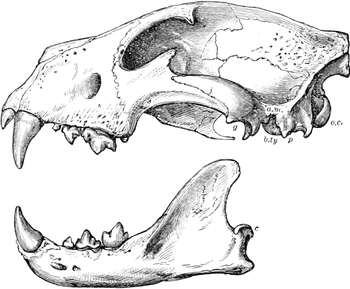
SIDE VIEW OF LION’S SKULL.
a.m, auditory meatus; b.ty, bulla
tympani; j, jugal arch or zygoma; o.c, occipital condyle for
the articulation of the skull with the first vertebra; c, condyle
of the lower jaw; g, glenoid cavity with which the condyle of the
lower jaw articulates; p, the bony clamp, or paroccipital
process.
Closely pressed against the hinder wall of this bulla is a sort of
bony clamp, which seems to keep the bulla in its place, and running
obliquely along the surface of the swelling is an indistinct groove,
corresponding to which, in the interior of the drum, is a bony wall,
dividing the drum cavity into an inner and an outer compartment, these
two divisions being formed from separate bones, as an examination of a
very young skull will show.
The almost globular form and great relative size of the bulla
tympani; the absence of any distinct bony passage leading from its
cavity to the interior, the opening being quite flush with the wall
of the drum; and the division of the cavity into two parts by a bony
partition, are all very important as distinctive characters of the Cat
family, and also, with lesser modifications, of the whole Æluroid group.
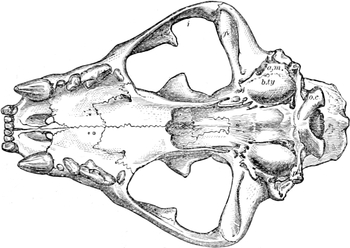
UNDER VIEW OF LION’S SKULL.
The letters have the same significance as in the
side view.
The power of retracting the claws, so characteristic a feature of all
the true Cats (which are, without exception, digitigrade), is brought
about by certain peculiarities of structure of the last two joints of
the toes. Of the three phalanges, or bones which make up the skeleton
of the toe, the first, or that nearest to the wrist or ankle, is of
the ordinary shape: about three times as long as broad, with a regular
cylindrical shaft, and pulley-like ends, for articulation with the bone
to which it is joined. The second, or middle phalanx, is pretty much
like the first, except that its shaft is scooped out on one side, so
as to make a greater distance between it and the corresponding bone of
the next toe than there would otherwise be. The third and last joint,
called the ungual phalanx, from the fact of its supporting the
claw, has the regular pulley-surface to articulate with the preceding
joint, but its farther end is strongly curved downwards and pointed
at the end; it has, in fact, the shape of the horny talon of which it
forms the supporting core. Further support is afforded to the claw by
an outgrowth of the phalanx, which commences near its articular end,
and grows over the end of the claw like a sort of hood, thus giving
the ungual phalanx of the Cat a most peculiar and unmistakable shape.
Between the upper surfaces of the last phalanx and the last but one
passes a strong and very elastic ligament, which so pulls upon the
ungual phalanx as to bend it on its predecessor, and so cause the two
to be almost parallel, the hood of the claw-bearing bone being received
between the preceding joint of its own toe and that of the next; hence
the scooping out of the middle phalanges. Thus, by the action of this
ligament, the claw under ordinary circumstances is pulled back within
its covering of skin, which forms for it a sort of protecting pouch,
and effectually prevents its being worn down by rubbing against the
ground. But when the Cat strikes its prey, it bends the paw upon the
wrist by means of the strong flexor (or bending) muscles, which are
placed along the under surface of the fore-arm and hand. The end of the
string-like tendons of one of these muscles divides into four slips,
one for each toe, and, running along the under surface of the first two
phalanges, is inserted into the corresponding surface of the third,
and, this under surface being bent upwards by the elastic ligament, the
tendon is, when the claw is retracted, put upon the stretch. But when
the flexors come into play, they pull upon the ungual phalanx, causing
it to turn through a quarter-circle upon its articulation, and thus
protruding the claw from its pouch. Immediately the flexors relax the
elastic ligament is again allowed to act, and the claw springs back
into its place of repose.
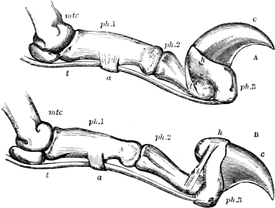
TENDONS AND LIGAMENTS OF A CAT’S TOE.
(Twice Natural Size. From a Sketch by T. J. Parker.)
A, with the claw retracted;
B, with the claw exserted; mtc, the
metacarpal; ph. 1 , the first; ph. 2, the second; ph.
3, the third phalanx; h, the bony “hood;” c, the claw;
l, the elastic ligament; t, the flexor tendon; a, a
ligamentous loop, through which the tendon passes.
This arrangement is of great importance, as the Cat family always
attack their prey in the first instance by a stroke of the powerful
fore-paw, and not, as do the Dogs, by a grip of the teeth.
Not less characteristic of the Cat family than the points we have just
considered are the number and form of the teeth, which here attain
the most perfectly carnivorous character, being so constructed as to
be wholly incapable of grinding, thus making it impossible for their
possessor to live upon any but highly nourishing animal food.
In the front part of the Cat’s upper jaw are six small teeth with
chisel-like edges—three on each side of the middle line. These teeth
are, in shape, not unlike our own front teeth, and, like them, are
single-fanged, but their small size, when compared with those that
follow, is remarkable. They are borne by a bone quite distinct in
young skulls from that which carries the other teeth—the premaxillary
bone—and are, therefore, classed as incisor teeth. Corresponding
with them in the lower jaw are six similar teeth—the lower incisors;
so that the incisors of the Cat are said to be
(3–3)(3–3),
that is, three on each side above and below.
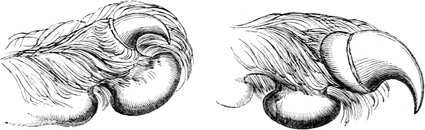
LION’S CLAW, SHEATHED AND UNSHEATHED.
Following the last incisor, and separated from it by a short interval,
comes on each side in both jaws a long, pointed fang, the chief
means by which the Cats seize and hold on to their prey. These are
the canines, or dog-teeth, and correspond to the “eye-teeth” in
ourselves, those adze-like teeth immediately following and slightly
projecting beyond the last incisor. When the mouth is closed the lower
canines are seen to bite in front of the upper, and to fit into the
space between the latter and the incisors. The canines of the Cat are
written thus,
(1–1)(1–1).
Following the canines, but separated from them by a slight interval
or diastema, are, in the upper jaw four, in the lower three teeth,
which correspond to our “grinders,” or molars and premolars. In the
upper jaw the foremost tooth of this set is as small as one of the
incisors, and its crown is simple, or nearly so. The next two teeth
are larger and have sharp, cutting edges, divided into three points,
or cusps. The second of these two teeth is much the larger, its edge
is more blade-like, and the front part of its inner edge sends off a
strong blunt process, which is supported by a distinct root, so that
this tooth has three roots instead of two like its predecessor; it is
also of much greater size than any of those in front, and, biting like
a scissor-blade against the corresponding tooth of the lower jaw, is
called the sectorial, or carnassial tooth. Behind it comes the last
of the set, a small tooth with a transversely-set, almost flat crown.
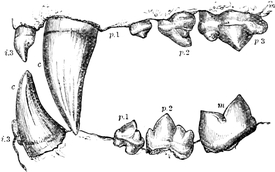
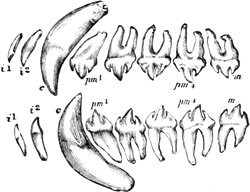
PERMANENT TEETH OF LION.
i. 3, the third incisor; c, the canine;
p. 1, p. 2, p. 3, the premolars; m, the
molars.
In the lower jaw, the grinding series is represented by only three
teeth, all more or less resembling the second of the series in the
upper jaw. Of these the third is the largest, and is called the lower
carnassial, biting, as it does, against the upper tooth of that name.
In every case the teeth of the lower jaw bite within those of the
upper, and, the jaws being so articulated as to allow only of up and
down motion, and being incapable of play from side to side, the molars
and premolars entirely lose their character of grinders, and become
trenchant, cutting up the food, in fact, in precisely the same manner
as a pair of scissors.
Now comes the question, which of these teeth are premolars, and which
molars? This is decided by finding which of them have their place
occupied in the young kitten by its first set of back-teeth, the
deciduous or milk molars, and which, on the other hand, have no
predecessors: those which replace the milk molars being the premolars
of the adult, those which arise as altogether new teeth, and have no
representatives in the young animal, molars. The examination of a young
Cat shows that there are, behind the canines, in the upper jaw three,
and in the lower two teeth; that is to say, one less on each side of
each jaw than in the adult. As age advances these deciduous or milk
molars all drop out, and are replaced by the permanent premolars, while
behind the last milk molar of each jaw an entirely new tooth makes its
appearance—the true or permanent molar. Thus it is seen that only the
last tooth in each jaw is a molar, and that the carnassials are of
different natures in the two jaws, the upper being the last (third)
premolar, the lower the single molar.
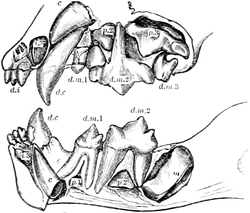
MILK TEETH OF LION, EXPOSED BY CUTTING AWAY THE OUTER
PORTIONS OF BOTH JAWS.
(Natural size. From Owen, after Rousseau.)
d.i, deciduous incisors; d.c, deciduous
canines; d.m.1, d.m.2, d.m.3, deciduous molars. The
remaining letters have the same significance as in the preceding figure.
We therefore write the premolars of the Cat
(3–3)(2–2), and the molars
(1–1)(1–1),
so that the whole “dental formula” is as follows:—i.,
(3–3)(3–3), c.,
(1–1)(1–1), p.,
(3–3)(2–2), m.,
(1–1)(1–1) = 30. In the milk dentition,
the number of incisors and canines is
the same as in the adult, and, as we have just stated, the molars are
absent, so that the formula is di.,
(3–3)(3–3), dc.,
(1–1)(1–1), dm.,
(3–3)(2–2) = 26, di, dc,
dm, standing for deciduous incisors, canines, and molars.
The tongue in this family becomes an important adjunct to the teeth,
almost losing its character as a delicate organ of taste. The little
elevations or papillæ which beset the tongue in all animals—in
ourselves for instance—are formed into strong horny spines set closely
together like the teeth of a file, and, as may be seen any day at
feeding-time at the Zoological Gardens, used to rasp the flesh from the
bones as effectively as any file would do it. Most people must have
noticed the different texture of a Cat’s and a Dog’s tongue. In the
latter it is as smooth as in ourselves, in the former it has more of
the texture of a piece of coarse sandpaper.
In some Felidæ, such as the Domestic Cats, the pupil, or small
aperture in front of the eye which lets in light to the sensitive
retina beyond, has the round shape it possesses in man, only in the
dark, when it is dilated to receive every ray of light available. In
the day, on the other hand, when more light is to be had than the
animal requires, the pupil contracts to an ellipse, or in the strongest
light to a mere line. This is not the case in the larger Cats, such as
the Lion, Tiger, and Leopard, in which also the eyes themselves and the
cavities in the skull for their reception are smaller, proportionally,
than in the Domestic Cat.
Taking the structure of the Cat tribe, all in all, there is nothing
whatever to make it the least difficult to suppose that they all sprang
from one stock, and that size and colour, and every other point in
which they now differ from each other, may have been brought about,
through long periods of time, as the result of the influence of their
surroundings. It is necessary to presume this, for classifiers from
necessity lay hold on the most minute differences, for the sake of
making proper specific distinctions, although these differences may
be merely the outcome of some change of locality, warmer, or colder,
drier, or moister, higher upon the hills, or lower down on the plains.
Once developed, however, it becomes hereditary, and then a variety
becomes a race, and a race solidifies into a species. Yet, the
result once obtained, however it arose, the profit is great to us
who are careful observers and enthusiastic admirers of the infinite
fecundity of Nature.
THE LION—Its Geographical Distribution at the Present Day and in Ancient Times—Its Haunts—Varieties of the Lion—Distinction
between the Lion and other Cats—Its Courage, Speed, and Strength—Its Roar—Its Supposed Magnanimity—Its
Habits—Man-eating—Occasional resort to Vegetable Diet—Love-making—The Lion-cubs and
their Education—Old Age—Breeding in Captivity—Lion Hunting.
THE “King of Beasts” must, of course, be placed at the head of our list
of beasts of prey, for although he is excelled in size and ferocity
by the Tiger, in elegance of form by the Leopard and Jaguar, and in
beauty of colouring by most of the great Cats, yet it would be useless,
even if it were advisable, to depose him from the throne he has, by
the universal consent of mankind, so long occupied. And, truly, who
would wish to uncrown him? He is anything but an amiable beast—cruel
and cowardly, greedy, treacherous, noisy, and self-asserting, never
forgetful of the “divine right of kings” to prey upon their subjects;
but still he is quite on a level, in the matters of morality and
fitness to reign, with a very large proportion of his brother
sovereigns of the genus Homo, with whom he well deserves a place in
that limbo where, according to the mildly-spiteful poet of Olney, dwell
“all that ever reigned” of the kings of men.
The Lion is entirely confined to the Old World, where it ranges through
Africa from Barbary to Cape Colony, and extends into the south-west
corner of Asia, where its range just overlaps that of the Tiger. Except
in this “debateable land” the two monarchs keep clear of one another,
the Lion keeping court over Africa and South-west Asia, and the Tiger
ruling in Southern and Eastern Asia, the most important pretender in
either kingdom being the Leopard.
With respect to the subject of distribution of the Lion in ancient
times, we will quote from a late able writer. “That Lions were once
found in Europe there can be no doubt. Thus it is recorded by
Herodotus that the baggage camels of the army of Xerxes were attacked
by Lions in the country of the Pæonians and Crestonœi, on their march
from Acanthus (near the peninsula of Mount Athos) to Therme, afterwards
Thessalonica (now Salonika). The camels alone, it is stated, were
attacked, other beasts remaining untouched as well as men. The same
historian also observes that the limits in Europe within which Lions
were then found were the Nessus or Nestus, a Thracian river running to
Abdera, and the Achelous, which waters Acarnania. Aristotle mentions
Europe as abundant in Lions, and especially in that part which is
between the Achelous and Nessus, apparently copying the statement of
Herodotus. Pliny does the same, and adds that the Lions of Europe are
stronger than those of Africa and Syria. Pausanias copies the same
story as to the attack of the Lions on the Camels of Xerxes; and he
states, moreover, that Lions often descended into the plains at the
foot of Olympus, which separates Macedonia from Thessaly, and that
Polydamas, a celebrated athlete, a contemporary of Darius Nothus, slew
one of them, although he was unarmed. The passage in Oppian, which some
have considered as indicating the existence of Lions up to the banks
of the Danube, fails, as an authority, for placing the Lion in that
locality, because, as Cuvier observes, the context shows plainly that
the name of Ista is there applied to an Armenian river, either by an
error of the author or of the transcribers.”
Nor is Europe the only part of the world from which the form of the
Lion has disappeared. Lions are no longer to be found in Egypt,
Palestine, or Syria, where they were once evidently far from uncommon.
The frequent allusion to the Lion in Scripture, and the various Hebrew
terms there used to distinguish the different ages and the sex of the
animal, prove a familiarity with the habits of the race. Even in Asia
generally, with the exception of some countries between India and
Persia, and some districts of Arabia, these magnificent beasts have
become comparatively rare; and this is not to be wondered at. To say
nothing of the immense draughts on the race for the Roman arena—and
they were not inconsiderable, for there were a thousand Lions killed
at Rome in the space of forty years—population and civilisation have
gradually driven them within narrower limits, and their destruction
has been rapidly worked in modern times since firearms have been used
against them instead of the bow and the spear. The African Lion is
annually retiring before the persecution of man farther and farther
from the Cape. Mr. Bennett[8] says of the Lion: “His true country is
Africa, in the vast and untrodden wilds of which, from the immense
deserts of the North to the trackless forests of the South, he reigns
supreme and uncontrolled.” In the sandy deserts of Arabia, in some of
the wild districts of Persia, and in the jungles of Guzerat, in India,
he maintains a precarious footing; but from the classic soil of Greece,
as well as from the whole of Asia Minor, both of which were once
exposed to his ravages, he has been utterly dislodged and extirpated.
The fearful custom, so common afterwards among the Romans, of having
many encaged Lions, “fierce with dark keeping,” to use Bacon’s
expression, for judicial as well as sporting purposes, was evidently an
old custom in the East; for we learn from the book of Daniel that the
kings of Babylon kept a “den of Lions” into which offenders were thrown
alive. Judging, however, from the Biblical narrative, the Chaldeans had
a far less revolting manner of killing criminals than the Romans, for
they seem to have used the Lions simply as executioners; to have cast
in the victim, and then to have fastened up the entrance of the den,
drawing a decent veil on the horrible scene taking place within. They
did not, like the Romans, curry favour with the masses by making the
death of their victims into a spectacle, at which all classes had their
love of excitement gratified by the sight of men and women torn and
mangled and devoured by raging beasts, to the accompaniment of small
talk and flirtation.
As to the former occurrence of the Lion in places where it is now
absent, we may instance its evident commonness in Palestine. One of the
earliest Lion stories occurs in the history of the Hebrew Hercules,
who, when travelling with his father and mother to Timnath, “came to
the vineyards of Timnath: and, behold, a young Lion roared against him.
And the Spirit of the Lord came mightily upon him, and he rent him as
he would have rent a kid, and he had nothing in his hand: but he told
not his father or his mother what he had done.”[9]
Every one will remember David’s account of his encounter with the tawny
savage in the Syrian pasture lands. “And David said unto Saul, Thy
servant kept his father’s sheep, and there came a Lion, and a Bear,
and took a Lamb out of the flock: and I went out after him, and smote
him, and delivered it out of his mouth: and when he arose against me, I
caught him by his beard, and smote him, and slew him. Thy servant slew
both the Lion and the Bear.”[10]
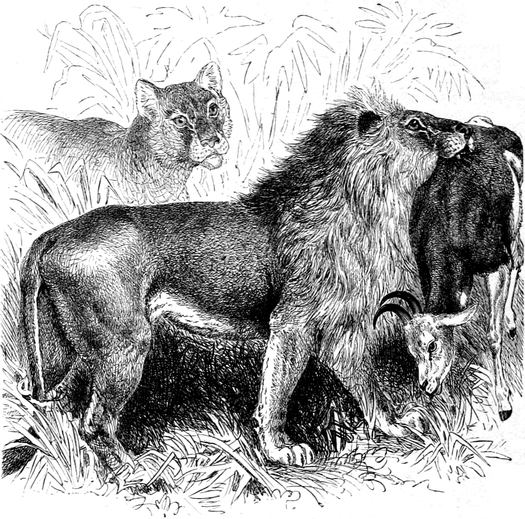
LION OF SENEGAL.
Another Lion-slayer is one of David’s “braves”—Benaiah—“He went down
also and slew a Lion in the midst of a pit in time of snow.”[11] Now
this slight mention of the forest-king is a perfect picture in a few
short words. In that land of milk and honey there was snow at certain
seasons, and then that huge, bearded Cat was fain to hide himself in
some cleft of the rock. If, however, the term “pit” means one in which
the Lion has fallen, being entrapped, the short snatch of history loses
none of its interest. The calm courage of this man made him to be “more
honourable than the thirty mighty men,” in the list of David’s captains.
After the deportation of the ten tribes to Babylon, the number of Lions
and other beasts of prey must have increased to a fearful extent in
Palestine, for we find the men sent by the King of Assyria to re-people
the deserted cities, complaining to their monarch of the ravages of
these beasts which, as they put it, had been sent “because they knew
not the manner of the God of the land.”
As to the favourite haunts of the Lion in the various countries where
it exists, “that Lions exist in the desert,” says M. Carette, “is
a myth popularised by the dreams of artists and poets, and has no
foundation but in their imagination. This animal does not quit the
mountains where it finds shelter, food, and drink. When the traveller
questions the natives concerning these wild beasts, which Europeans
suppose to be their companions in the desert, they reply, with
imperturbable sangfroid, ‘Have you, then, Lions in your country which
can drink air and eat leaves? We fear only the viper, and, in humid
spots, the innumerable swarms of mosquitos which abound there.’”[12]
But the sacred writer makes him come up from the “swellings of Jordan;”
and with Homer he is the Mountain Lion: the “artists and poets” of
M. Carette are moderns, who know but little of the subject; not
ancients who were familiar with the beast.
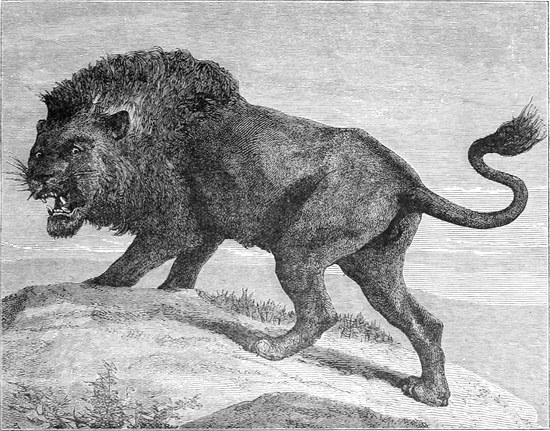
LION OF BARBARY.
When an animal has a wide geographical distribution it is almost always
found that it exhibits, in different parts of its range, more or less
well-marked varieties, distinguished from one another by evident though
sometimes unimportant characters. This is the case with the Lion, of
which five varieties are usually distinguished, three being found in
Africa, and two in Asia. These varieties, or races, are as follows:—
1. The Lion of Barbary.—The fur is of a deep yellowish-brown colour,
and the mane is more developed than in any other variety, forming long
tresses which cover the neck and shoulders, and are continued along the
belly and the inside of the legs. This variety extends over the whole
of Africa north of the Sahara.
2. The Lion of Senegal is found in the western part of Africa, south
of the Sahara. Its fur is of a lighter colour than that of the Barbary
Lion, and the mane is less thick, and hardly at all developed over the
breast and insides of the legs.
3. The Lion of the Cape ranges over the whole of South Africa, and
is said to be found under two lesser varieties, one yellowish in
colour, and the other brown: the latter is considered to be the more
formidable. The mane is darker than in either of the foregoing kinds.
The Asiatic varieties are smaller than the kinds found in Africa.
The mane is variable, and the form less graceful than in the Cape or
Barbary Lion.
4. The Persian or Arabian Lion.—This is a paler variety found in
Western Asia.
5. The Lion of Guzerat, or so-called “maneless Lion,” is usually
stated to be the best-marked variety of all, as its mane, though by no
means absent, as the name of the variety would lead us to suppose, is
very much less than in any other kind; the body also is bulkier and the
legs shorter. Some writers, however, deny altogether the distinctness
of the variety, and consider that the mistake of considering the
Guzerat Lion as such, has arisen from the fact of young specimens
having been described. The strongest statements we have met with on
this head are by Captain Harris, whose words we will quote, as they
show how little reliance is to be placed on the distinction drawn by
travellers between closely-allied varieties or species. Harris says
that the South African Lion does not differ “in any material points
from those found in Guzerat, in Western India, measuring between ten
and eleven feet in extreme length, but generally possessing a finer
mane, a peculiarity which is attributable to the less jungly character
of the country he infests, and to the more advanced age which he is
supposed to attain. Amongst the Cape colonists it is a fashionable
belief that there are two distinct species of the African Lion—the
yellow and the black—and that the one is infinitely less ferocious
than the other. But I need scarcely inform the well-instructed reader
that both the colour and the size depend chiefly upon the animal’s
age; the development of the physical powers, and of the mane also,
being principally influenced by a like contingency. That which has
been designated the ‘maneless Lion of Guzerat’ is nothing more than a
young Lion whose mane has not shot forth; and I give this opinion with
less hesitation, having slain the ‘king of beasts’ in every stage from
whelphood to imbecility.”
There has been no attempt to divide the above-named varieties into
distinct species. From Linnæus to Dr. Gray, all zoologists agree in
this matter. Hence we see that animals do not vary under domestication
only; but wild creatures also have their varieties or races,
differing in the various localities in which they are found.
All these varieties together form a very well-marked species of the
genus Felis, and are known as Felis leo, in zoological language.
Some authors, however, as we have already noticed, prefer to consider
the various kinds of Cat as so many distinct genera, and speak of the
Lion as a single genus and species (Leo nobilis). The species, or
genus—for it matters very little which we call it—is distinguished
from other Cats by its uniform tawny colour, the tuft of hair at the
end of the tail, and the flowing mane, which clothes the head, neck,
and shoulders of the male. The head of the Lion is more square than
that of the other species of Cats. The mane is entirely absent in the
female, which is, in consequence, a comparatively ordinary-looking
animal, as it is only by the grandeur of his hirsute appendage that the
male is compensated for his plain colouring. The addition of the mane,
however, gives him an immense advantage over all other species, adding
to his apparent size, especially to that of the head, increasing almost
infinitely the beauty of his form, and altogether making him one of the
most magnificent objects in the animal kingdom. A further distinction
between the Lion and other Cats is to be found in the strong tuft of
hair at the end of the tail, which exists in both sexes. Quite at the
extremity of the tail, and hidden by the tuft, is a curious little
horny appendage or “thorn” with which it was supposed that the Lion,
when lashing his tail, spurred his flanks, and so awoke all his courage
and ferocity!
We have just mentioned the uniform tawny colour as characteristic of
the Lion. This is so, in fact, in adult specimens, but the new-born
young are invariably spotted, and the spots often persist for a
considerable time. This is the case with Lions born in captivity, as
well as with those in a state of nature, and has often been observed in
the Lions born in the Zoological Gardens. In some instances the spots
are visible during the animal’s life. There are grounds for believing
that all the great Cats are descended from a spotted ancestor.
One more external character: the snout of the Lion is longer and more
Dog-like than that of any other Cat; the forehead and nose are almost
in the same straight line, instead of making a bold curve, as they do
in the Tiger, Leopard, Jaguar, and the smaller Cats. So that the Lion,
which is conventionally represented with an almost human roundness of
face, has really a more thoroughly quadrupedal “muzzle” than any of his
kin.
In the Cape Lion the tail tuft is black, the mane brown or black,
according to age, and the handsome appearance of the animal is thus
much enhanced. There is also a black spot at each corner of the mouth.
The size varies slightly in the different varieties. Captain
Harris gives the measurements of an adult male from the Cape as
follows:—Extreme length from snout to tip of tail, usually about
ten feet; tail, three feet; height at the shoulder, three feet eight
inches. The “maneless” Lion is somewhat smaller, as shown by the
following measurements made by Captain Smee:—Length, including the
tail, eight feet nine inches and a half; height (at the shoulder, we
suppose), three feet six inches; and the impression of his paw measured
six inches and a half across. A female, killed at the same time, was
eight feet seven inches long, and three feet four inches high. The
weight of the male (excluding the entrails) was thirty-five stone.
The real size of the Lion is much less than would be supposed before
measurement; and he is very inferior in size to many kinds of the
Herbivorous animals, such as Horses, Oxen, and Buffaloes, and even the
larger Antelopes, such as the Eland.
As to the internal structure of the Lion, there is really nothing,
or almost nothing, to add to what has already been said under the
character of the whole family. Like all the great beasts of prey, the
Tiger, Leopard, &c., the osseous and muscular systems are immensely
developed. The ridges of the bones take on a marvellous size for the
attachment of the muscles, and in the skull the size of the great
processes to which the muscles of the neck are attached, and the width
of the jugal arches, or bony bridges under which pass the great muscles
by which the lower jaw is closed, and the powerful bite given, are very
remarkable.
It is curious to see what wonderfully different impressions are
produced on different writers by the appearance of the Lion in his
native haunts. For instance, Captain Harris says, “Those who have
seen the monarch of the forest in crippling captivity only, immured
in a cage barely double his own length, with his sinews relaxed by
confinement, have seen but the shadow of that animal which ‘clears the
desert with his rolling eye.’”
On the other hand, Livingstone speaks in the most disrespectful, not to
say contemptuous way, of the animal’s vaunted majesty of bearing: “When
a Lion is met in the daytime, a circumstance by no means unfrequent
to travellers in these parts, if pre-conceived notions do not lead
them to expect something very ‘noble’ or ‘majestic,’ they will see
merely an animal somewhat larger than the biggest Dog they ever saw,
and partaking very strongly of the canine features. The face is not
much like the usual drawings of a Lion, the nose being prolonged like
a Dog’s; not exactly such as our painters make it, though they might
learn better at the Zoological Gardens; their ideas of majesty being
usually shown by making their Lions’ faces like old women in nightcaps.
When encountered in the daytime, the Lion stands a second or two
gazing, then turns slowly round, and walks as slowly away for a dozen
paces, looking over his shoulder; then begins to trot, and, when he
thinks himself out of sight, bounds off like a Greyhound.”
The concluding sentence of this passage shows that Livingstone
considers not only the Lion’s beauty to have been over-rated, but his
courage also. The following extract quite bears out this opinion:—
“On riding briskly along early one morning, I observed, as I thought,
a solitary Zebra a few hundred yards in advance. I instantly alighted,
and, leaving ‘Spring’ (his horse) to take care of himself, I made
towards the quarry, gun in hand, under cover of a few small trees.
Having proceeded for some distance, I peeped cautiously from behind a
bush, when I found, to my astonishment, that the animal which I had
taken for a Zebra was nothing less than a noble Lion. He was quietly
gazing at me. I must confess I felt a little startled at the unexpected
apparition; but, recovering quickly from my surprise, I advanced to
meet him. He, however, did not think fit to wait till I was within
proper range, but turned tail, and fled towards the Swakess. Hoping to
be able to come to close quarters with him, I followed at the top of my
speed, and was rapidly gaining ground on the brute, when suddenly, with
two or three immense bounds, he cleared an open space, and was the next
moment hidden from view among the thick reeds that here lined the banks
of the river. Having no Dogs with me, all my efforts to dislodge him
from his stronghold proved unavailing. Whilst still lingering about the
place, I came upon the carcase of a Gnu, on which a troop of Lions had,
apparently, been feasting not many minutes previously. Undoubtedly my
somewhat dastardly friend had been one of the party.”
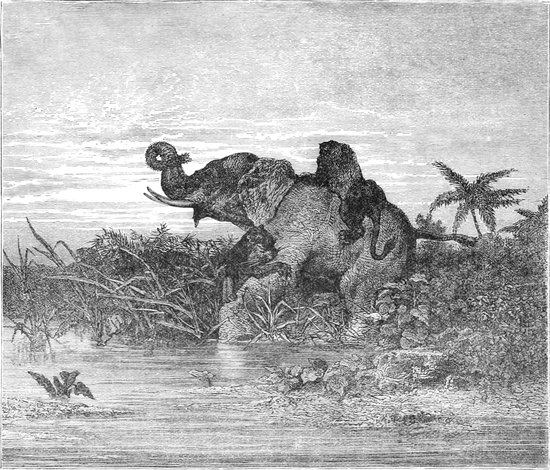
LION AND LIONESS ATTACKING AN ELEPHANT.
After such rude shocks as these to our faith in the African monarch’s
courage, it is positively refreshing to come across instances where
the Lion has shown himself capable of very great boldness, such, for
instance, as the following:—
“We were waked up suddenly by hearing one of the Oxen bellowing and
the Dogs barking. It was moderately dark, and I seized Clifton’s
double rifle, and rushed out, not knowing where, when I saw the driver
perched on the top of a temporary hut, made of grass, about six feet
high, roaring lustily for a doppè (cap). I scrambled up just as the
poor Ox ceased his cries, and heard the Lions growling and roaring on
the top of him, not more than fourteen yards from where we were, but
it was too dark to see them. I fired, however, in the direction of the
sound, and just above the body of the Ox, which I could distinguish
tolerably well, as it was a black one. Diza (the driver) followed my
example; and, as the Lions did not take the least notice, I fired my
second barrel, and was just proceeding to load my own gun, which Jack
had brought me, when I was aware, for a single instant only, that
the Lion was coming; and the same moment I was knocked half-a-dozen
somersaults backwards off the hut, the brute striking me in the chest
with his head. I gathered myself up in a second, and made a dash at a
fence just behind me, and scrambled through it, gun in hand, but the
muzzle was choked with dirt. I then made for the wagon, and got on the
box, where I found all the Kaffirs, who could not get inside, sticking
like Monkeys, and Diza perched on the top. How he got there seemed to
me a miracle, as he was alongside me when the brute charged. A minute
or two afterwards one of them marched off a Goat, one of five that were
tethered by the foot to the hut that we had so speedily evacuated.
“Diza, thinking he had a chance, fired from the top of the wagon, and
the recoil knocked him backwards on to the tent, which broke his fall.
It was a most ludicrous sight altogether. After that we were utterly
defeated, and the brutes were allowed to eat their meal unmolested,
which they continued to do for some time, growling fiercely all the
while. The Kaffirs said there were five in all. I fired once again, but
without effect; and we all sat shivering with cold without any clothes
on till near daybreak, when our enemies beat a retreat, and I was not
sorry to turn in again between the blankets. I was just beginning to
get warm again when I was aroused by a double shot, and rushed out on
hearing that the driver and after-rider had shot the Lion. We went to
the spot, and found a fine Lioness dead, with a bullet through the ribs
from the after-rider; a good shot, as she was at least 150 yards off.
Another had entered the neck just behind the head, and travelled all
along the spine nearly to the root of the tail. I claimed the shot,
and forthwith proceeded to skin her. I cut out the ball; it proved to
be my shot out of Clifton’s rifle. This accounted for her ferocious
onslaught. The after-rider was rather chopfallen at having to give her
up to the rightful owner.
“Diza got a claw in his thigh, and the gun which he had in his hand
was frightfully scratched on the stock: rather sharp practice. A
strong-nerved old Kaffir woman lay in the hut the whole time, without a
door or anything whatever between her and the Lions, and kept as still
as a Mouse all the while.”
Again:—“The enemy disdainfully surveyed us for several minutes, daring
us to approach with an air of conscious power and pride, which well
beseemed his grizzled form. As the rifle balls struck the ground nearer
and nearer at each discharge, his wrath, as indicated by his glistening
eyes, increased roar, and impatient switching of the tail, was clearly
getting the mastery over his prudence. Presently a shot broke his leg.
Down he came upon the other three with reckless impetuosity, his tail
straight out and whirling on its axis, his mane bristling on end,
and his eyeballs flashing rage and vengeance. Unable, however, to
overtake our Horses, he shortly retreated under a heavy fire, limping
and discomfited to his stronghold. Again we bombarded him, and again
exasperated he rushed into the plain with headlong fury, the blood now
streaming from his open jaws, and dyeing his mane with crimson. It
was a gallant charge, but it was to be his last. A well-directed shot
arresting him in full career he pitched with violence upon his skull,
and throwing a complete somersault, subsided amid a cloud of dust.”
The Lion has some excuse for occasionally developing a strong running
away propensity. His pace when going at full speed is wonderfully
rapid, considering the length of his legs. As the following extract
shows, he is able to outrun a firstrate Horse, so that the animals on
which he usually feeds would, if he chose to pursue them, have simply
no chance whatever against him. As we shall see, however, the Lion
seldom pursues his prey, preferring to lie in ambush and to spring
upon a passing herd. This consideration makes the following experience
rather remarkable. The Lion probably pursued Mr. Baldwin not to satisfy
appetite, but for revenge.
“Now for an adventure with a Lion, which I have reserved for the last.
On Friday the old Masara captain paid me a visit. He had seen a Lion in
the path, and left a lot of Masaras to watch him. I had been working
hard all day in the hot sun with an adze, making a dissel-boom for the
wagon, and was tired, lame, and shaky in the arms, and did not feel
at all up to the mark for rifle-shooting; but I ordered ‘Ferns’ to be
saddled, who was also not at all fresh, having had a tremendous burst
in the morning across a flat after a lean Eland Cow. Just after, I
caught sight of about twenty-five Masaras sitting down, all armed to
the teeth with shields and assegais. My attention was attracted to a
Kaffir skull, which struck me as a bad omen, and the thought entered
my head that it might be my fate to lay mine to bleach there. I did
not, however, suffer this thought to unnerve me, but proceeded, and
found that the Lion had decamped. The Masaras followed his spoor about
a couple of miles, when he broke cover. I did not see him at first,
but gave chase in the direction in which the Masaras pointed, saw him,
and followed for about 1,000 yards, as he had a long start, when he
stood in a nasty thorn thicket. I dismounted at about sixty or seventy
yards, and shot at him. I could only see his outline, and that very
indistinctly, and he dropped so instantaneously that I thought I had
shot him dead. I remounted and reloaded, and took a short circle, and
stood up in my stirrup to catch a sight of him. His eyes glared so
savagely, and he lay crouched in so natural a position, with his ears
alone erect, the points black as night, that I saw in a moment I had
missed him. I was then about eighty yards from him, and was weighing
the chances of getting a shot at him from behind an immense ant-heap,
about fifty yards nearer. I had just put the Horse in motion with that
intention when on he came with a tremendous roar, and ‘Ferns’ whipped
round like a top, and away at full speed. My Horse is a fast one, and
has run down the Gemsbok, one of the fleetest Antelopes, but the way
the Lion ran him in was terrific. In an instant I was at my best pace,
leaning forward, rowels deep into my Horse’s flanks, looking back over
my left shoulder over a hard, flat, excellent galloping ground. On
came the Lion, two strides to my one. I never saw anything like it,
and never want to do so again. To turn in the saddle and shoot darted
across my mind when he was within three strides of me, but on second
thoughts I gave a violent jerk on the near rein, and a savage dig at
the same time with the off-heel, armed with a desperate rowel, just
in the nick of time, as the old manikin bounded by me, grazing my
right shoulder with his, and all but unhorsing me, but I managed to
right myself by clinging to the near stirrup-leather. He immediately
slackened his speed. As soon as I could pull up, which was not all
at once, as ‘Ferns’ had his mettle up, I jumped off, and made a very
pretty and praiseworthy shot, considering the fierce ordeal I had just
passed (though I say it who ought not), breaking his hind leg at 150
yards off, just at the edge of the thicket. Fearful of losing him, as
the Masaras were still flying for bare life over the veldt, with their
shields over their heads, and I knew nothing would prevail on them to
take the spoor again, I was in the saddle, and chasing him like mad in
an instant. His broken leg gave me great confidence, though he went
hard on three legs; and I jumped off forty yards behind him, and gave
him the second barrel—a good shot—just above the root of the tail,
breaking his spine, when he lay under a bush roaring furiously, and
I gave him two in the chest before he cried ‘Enough!’ He was an old
manikin, fat and furious, having only four huge yellow blunt fangs
left.”
Not only has the Lion the advantage of great courage—at least, except
when coming in contact with those he feels to be his masters—and of
great swiftness, but his strength is prodigious. He will fell an Ox
or an Antelope with a single blow of his paw, break its neck with one
crunch of his cruel teeth, and bound off with it to his lair as easily
as if he were only carrying a Rabbit. With a Calf in his mouth he has
been known to leap a wall nine feet high. Not an animal of the forest,
save the Rhinoceros, can hope to escape from such terrible perfections
as these. Any quarry the Lion may choose—Ox, Antelope, or Zebra—is
bound to succumb.
There is another characteristic about the beast which is a valuable
accessory weapon, comparable to the “British cheer,” with which our
soldiers are always supposed to strike terror into the hearts of their
enemies. We mean, of course, the terrible roar—that deafening thunder
voice, at sound of which the Leopard and Hyæna hold their breath in
awe, and the doomed flocks tremble and flee. With man even the noise,
when heard for the first time, produces an indescribable feeling, and
a firm conviction that all his courage will be needed to meet such a
fearful opponent. Sometimes, however, the Lion seems to exercise his
voice for fun, or for practice, rather than for striking terror into
his hearers.
The terror in which the Lion is held by the meaner members of his own
family is well shown by the following passage from Homer. Menelaus and
Ajax hear Ulysses calling for help:—
“—— at the voice arrived, they found
Ulysses, Jove-beloved, compass’d about
By Trojans, as the Lynxes in the hills,
Athirst for blood, compass an antler’d Stag
Pierced by an archer; while the blood is warm
And his limbs pliable, from him he ’scapes;
But when the feather’d barb hath quell’d his force,
In some dark hollow of the mountain’s side,
The hungry troop devour him; chance, the while,
Conducts a Lion thither, before whom
All vanish, and the Lion feeds alone;
So swarm’d the Trojan powers numerous and bold,
Around Ulysses, who with wary skill
Heroic combated his evil day.
But Ajax came, covered with his broad shield
That seemed a tower, and at Ulysses’ side
Stood fast; then fled the Trojans wide-dispersed.”
Shakspere has the same idea, when he says—
“Lions make Leopards tame.”
The magnanimity of the Lion is a very well-worn theme. Every one knows
all about Androcles and the Lion; “the tale is somewhat musty” by this
time. All the older poets have something about it—the writers of the
golden age—before natural selection was thought of, and when animals
of many kinds were credited with a vast amount of idyllic amiability,
of which, alas! nobody believes them capable now.
In the exquisite woodland scenery of “As You Like It,” a hungry Lioness
that has just suckled her whelps, is accredited with a nobility to
which she, assuredly, had no title. “A green and gilded Snake” has been
frightened from the sleeping Oliver by Orlando—
“—— it unlinked itself,
And with indented glides did slip away
Into a bush: under which bush’s shade
A Lioness, with udders all drawn dry,
Lay couching, head on ground, with Cat-like watch,
When that the sleeping man should stir, for ’tis
The royal disposition of that beast
To prey on nothing that doth seem as dead.”
We are not anxious to know when and how Shakspere gained his knowledge
of wild beasts; we possess his descriptions, and that suffices for us.
He may make Athenians speak like his fellow Englishmen; place Bohemia
by the sea-side, and have the forest of Arden peopled with Lions. All
that is of the least importance; for, may we not say of him, what he
makes Helena say to Hermia?—
“—— your tongue’s sweet air,
[Is] More tuneable than Lark to shepherd’s ear,
When wheat is green, when hawthorn buds appear.”
The Lion is a solitary animal, hunting alone, except from the
commencement of the breeding season, when his wife goes with him, up
to the time when the babies are beginning to know how to take care of
themselves. Until they have arrived at months of discretion, “the Lion
tears in pieces enough for his whelps and strangles for his Lionesses,
and fills his holes with prey and his dens with ravine.”
The Lion’s den is made by scraping away the surface of the earth
in some secluded spot, where the beast remains as long as game is
plentiful, and there is no one to disturb him. When he has used up one
hunting-ground, he departs for “fresh woods and pastures new.”
He hunts entirely by night, at which time it is not safe for any one,
in a Lion neighbourhood, to stir out without firearms, for the Lion,
with the laziness which distinguishes him, will always prefer man-meat
caught at once, to Antelope or Zebra-meat, for which he will have
the trouble of looking. In the daytime he spends most of the time
in sleeping off his bloody carouse, and, until nightfall, is always
very unwilling to be disturbed, and unless molested hardly at all
dangerous, except in the breeding season. This seems curious, as, from
the ferocity of the animal when he is attacked, or when he is catering
for himself by night, it savours of the marvellous to talk of such a
savage being harmless under any circumstances. But there can be no
doubt about the fact; he seems to object to expose his actions not only
to the light of day, but also to that of the moon. For this, we have
the testimony of a man whose loss Englishmen have not yet ceased to
deplore; a man who, by universal consent, is facile princeps in the
ranks of African explorers:—
“By day there is not, as a rule, the smallest danger of Lions which
are not molested attacking man, nor even on a clear moonlight night,
except they possess a breeding στοργή (natural affection). This makes
them brave almost any danger. And, if a man happens to cross to the
windward of them, both Lion and Lioness will rush at him, in the manner
of a bitch with whelps. This does not often happen, as I only became
aware of two or three instances of it. In one case a man, passing when
the wind blew from him to the animals, was bitten before he could climb
a tree. And, occasionally, a man on horseback has been caught by the
leg under the same circumstances. So general, however, is the sense of
security, on moonlight nights, that we seldom tied up our Oxen, but
let them lie loose by the wagons. While, on a dark, rainy night, if a
Lion is in the neighbourhood, he is almost sure to venture to kill an
Ox.”[13]
The following passage shows how unusual it is for a Lion to do any
damage by day; so uncommon that the natives consider a supernatural
cause necessary to account for so remarkable an occurrence:—
“The Bakàtla of the village Mabatsa were much troubled by Lions, which
leaped into the cattle-pens by night, and destroyed their Cows. They
even attacked the herds in open day. This was so unusual an occurrence
that the people believed that they were bewitched: ‘given,’ as they
said, ‘into the power of the Lions by a neighbouring tribe.’ They
went once to attack the animals, but, being rather a cowardly people
compared to Bechuanas in general, on such occasions, they returned
without killing any.”
The darker and stormier the night is the better the Lions like it,
and the more persistent will be their attacks. “The new moon brought,
if possible, a more abundant supply of rain than usual; nor did the
Lions fail to take advantage of the nocturnal tempest, having twice
endeavoured to effect an entrance into the cattle-fold. It continued,
until nine o’clock the next morning, to pour with such violence, that
we were unable to open the canvas curtains of the wagon. Peeping out,
however, to ascertain if there was any prospect of its clearing up, we
perceived three Lions squatted within a hundred yards, in open plain,
attentively watching the Oxen. Our rifles were hastily seized, but
the dampness of the atmosphere prevented their exploding. One after
another, too, the Hottentots sprang out of the pack-wagons and snapped
their guns at the unwelcome intruders, as they trotted sulkily away,
and took up their position on a stony eminence at no great distance.
Fresh caps and priming were applied, and a broadside was followed by
the instantaneous demise of the largest, whose cranium was perforated
by two bullets at the same instant. Swinging their tails over their
backs, the survivors took warning by the fate of their companion, and
dashed into the thicket with a roar.”
When a Lion is fortunate enough to live in the neighbourhood of
villages, he naturally prefers the least troublesome course of
selecting his supper from the flocks and herds of the inhabitants.
It is said that in Algeria, some thirty years ago, each Lion, in the
course of his life, cost the Arabs upwards of £8,400, as he destroys
every year Cattle, Horses, Camels, &c., to the value of £240, and the
average duration of a Lion’s life may be taken at thirty-five years.
Thus, Jules Gérard, the celebrated Lion-killer, remarks, that in one
district the Arab who paid five francs a-year to the State, paid fifty
to the Lion!
If there are no farms or villages handy, the Lion has to content
himself with the more troublesome course of catching wild prey. To this
end he lies in ambush, in some convenient spot, and waits patiently
or impatiently until a herd of Antelopes or Zebras passes by, when he
leaps upon one of the number, roaring terribly. He usually strikes the
animal down at once, by the immense weight of his body, the terrible
blow of his paw, and the fearful grip of his teeth in the neck of his
victim. If he misses his aim, he never pursues the flying herd, but
returns dejectedly to his lair and waits for another opportunity. The
Lion’s mode of attack is described with all the marvellous accuracy and
fire of his transcendent genius by the great Grecian:—
“——— as leaps a famish’d Lion fell
On beeves that graze some marshy meadow’s breadth
A countless herd, tended by one unskill’d
To cope with savage beasts in their defence,
Beside the foremost kine or with the last
He paces heedless, but the Lion, borne
Impetuous on the hindmost, one devours
And scatters all the rest.”
“But as the Lion on the mountains bred,
Glorious in strength, when he hath seized the best
And fairest of the herd, with savage fangs
First breaks her neck, then laps the bloody paunch
Torn wide. Meantime, around him, but remote,
Dogs stand and swains clamouring, yet by fear
Repress’d, annoy him not or dare approach.”
The Lion is said sometimes to develop the taste for “man-eating,” which
makes the Tiger so terrible. This, however, is comparatively rare,
except in old animals; but, whether he eats men by choice or not his
depredations are fearfully extensive, especially when he has had a good
deal of experience, knows exactly when to attack a place, and has lost
wholly or in part the fear of man, which usually distinguishes him.
Here is an account of the termination of the career of one of these
heroes, a perfect Dick Turpin among Lions, so great had become his
skill in “lifting”:—
“We had not been many days at that place, when a magnificent Lion
suddenly appeared one night in the midst of a village. A small Dog that
had incautiously approached the beast paid the penalty of its life for
its daring. The next day a grand chase was got up, but the Lion, being
on his guard, managed to elude his pursuers. The second day, however,
he was killed by Messrs. Galton and Bam; and, on cutting him up, the
poor Dog was found, still undigested, in his stomach, bitten into five
pieces. The natives highly rejoiced at the successful termination of
the hunt; for this Lion had proved himself to be one of the most daring
and destructive ever known, having, in a short time, killed upwards of
fifty Oxen, Cows, and Horses. When he had previously been chased he had
always escaped unscathed, and every successive attack made upon him
only served to increase his ferocity.”
That the Lion does not always “drink the blood of the slain,” but
adopts a mild and cooling diet at times, is shown by a remarkable
passage in Dr. Livingstone’s work. He is speaking of the various
vegetable blessings in the desert:—“But the most surprising plant of
the desert is the ‘Kengwe or Kéme’ (Cucumis caffer), the water melon.
In years when more than the usual quantity of rain falls, vast tracts
of the country are literally covered with these melons. This was the
case annually when the fall of rain was greater than it is now, and
the Bakwains sent trading parties every year to the Lake. It happens
commonly once every ten or eleven years. For the last three years its
occurrence has coincided with an extraordinarily wet season. Then
animals of every sort and name, including man, rejoice in the rich
supply. The Elephant, true lord of the forest, revels in this fruit,
and so do the different species of Rhinoceros, although naturally so
diverse in their choice of pasture. The various kinds of Antelopes feed
on them with equal avidity; and Lions, Hyænas, Jackals, and Mice, all
seem to know and appreciate the common blessing.”
This is a very curious circumstance when we consider how purely
carnivorous the Lion, in common with the other Felidæ, is under
ordinary circumstances. But Dr. Livingstone’s is not the only evidence
to show that the bloodthirsty creature occasionally likes a “relish” of
green-meat with its flesh. We are informed by Dr. Huggins, F.R.S., that
in the Zoological Gardens at Dublin a Lioness had had several litters,
but the young ones invariably languished and died after a short time,
until the expedient was hit upon of supplying the Lioness with live
Goats. This seems horrible enough, but in fact it was not so. The
Goat was put into the cage in the evening, and instead of manifesting
the extreme terror one would have expected, it seemed to feel no fear
at all, but ate grass placed in the den with perfect content, and,
when night came, and it had eaten its fill, lay down by its terrible
companion, cuddling up close to her, chewing the cud, and seeming to
enjoy the warmth, and to be delighted with its new bedfellow. The
Lioness showed no hostility to the confiding beast until towards the
morning, when she suddenly smashed its head with one blow of her
paw, ripped it open, and at once began feeding with avidity on the
paunch, with its contents of softened and half-digested grass, always
completely finishing this “herbaceous treat” before setting to work on
the flesh. It is also stated (vide infra) that very old Lions take to
eating grass, thus giving a literal significance to the favourite “Lion
and Lamb” illustration, used by poets of all ages to express the change
by which the “natural man” is converted into the “spiritual man,” the
savage civilised, and the “Philistine” cultured—“The Lion shall eat
straw like the Ox.”
“And now beside thee, bleating Lamb,
I can lie down and sleep,
Or think on Him who bore thy name,
Graze after thee and weep.”
The Lion enjoys the honourable distinction of being, unlike most
Carnivora, strictly faithful to his spouse, although report says that
she is by no means so virtuous, but only cleaves to her mate until a
stronger and handsomer one turns up. Let us hope this is a calumny.
At the breeding season each Lioness is usually followed by a number
of Lions, who try all means in their power to gain her affections,
and fight the most terrible battles with one another. In these fights
the mane is of great use, for its length and thickness prevent the
combatants taking a firm grip of one another’s neck. Thus, the Lion
with the finest mane has the best chance of succeeding in life in two
ways. The Lioness is more likely to take a fancy to him than to a less
favoured suitor, for most of the lower animals, as well as ourselves,
appreciate personal adornment very strongly; and he has also the best
possible protection in the tournament in which he is obliged to take
part, fighting, à outrance, against all comers.
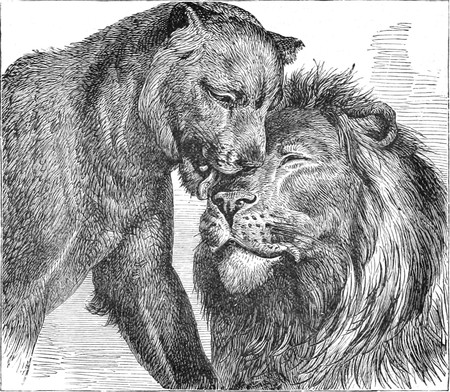
THE KISS OF PEACE.
When the battle is over, and the “queen of love and beauty” has
bestowed the prize—herself—on the victor, the happy pair live
together until the young are able to take care of themselves. The male
often hunts for his mate, and allows her to take as much as she wants
of the prey before satisfying his own hunger. He cares for her in the
same way all the time she is suckling, and for the litter from the time
when they are weaned till they are able to hunt for themselves.
The Lioness goes with young about fifteen or sixteen weeks, and
produces from two to six at a litter. The cubs are delightful little
creatures, about as big as a moderate-sized Cat, blind at first,
with pretty innocent faces, and delightfully playful ways. The
mother is devoted to them; thinks, no doubt, like Celia Chettam, in
“Middlemarch,” that where there are babies “things are right enough,
and that error, in general, is a mere lack of that central posing
force.”
When the cubs are about eight to twelve months old they begin hunting
for themselves, by attacking smaller animals, such as sheep and Goats,
under their parents’ direction. The period between the ages of one and
two years is the worst part of the Lion’s existence, as far as the
inhabitants of the district are concerned, for they “kill not only to
support themselves, but also in order to learn how to kill.”
At the age of three the young Lion’s education is complete; he leaves
his father’s house, and begins to think of getting a house and a wife
for himself, and then in her company he “roars after his prey and seeks
his meat from God” for the rest of his career. He is not full-grown
until the age of eight, when he may be considered as quite adult; and
for many years to come revels in the consciousness of unconquerable
strength and power, and oppresses all inferior creatures to his heart’s
content.
But even to king Leo “life is not all beer and skittles;” there is
suffering and work to be borne and done. The lower creatures “groan
and travail” with us; and we find disease where we should least expect
to find it, namely, in the wild creatures that at their will freely
roam the desert. “The Carnivora, too, become diseased and mangy. Lions
become lean, and perish miserably by reason of the decay of the teeth.
When a Lion becomes too old to catch game, he frequently takes to
killing Goats in the villages. A woman or child happening to go out at
night falls a prey too; and as this is his only source of subsistence
now, he continues it. From this circumstance has arisen the idea that
the Lion, when he has once tasted human flesh, loves it better than any
other. A man-eater is, invariably, an old Lion. And, when he overcomes
his fear of man so far as to come to villages for Goats, the people
remark, ‘His teeth are worn, he will soon kill men.’ They at once
acknowledge the necessity of instant action, and turn out to kill him.
When living far away from population, or when, as is the case in some
parts, he entertains a wholesome dread of the Bushmen and Bakalahari,
as soon as either disease or old age overtakes him, he begins to catch
Mice and other small Rodents, and even to eat grass. The natives,
observing undigested vegetable matter in his droppings, follow up his
trail in the certainty of finding him, scarcely able to move, under
some tree, and despatch him without difficulty. The grass may have been
eaten as medicine, as is observed in Dogs.”
Before leaving the subject of the life and death of our great
Carnivore, it will be as well to add a few words as to its breeding in
captivity. It is stated by a naturalist who probably knows more about
the matter than any other man,[14] that “the Lion appears to breed more
freely than any other species of Felis, and the number of young at
a birth is greater, not infrequently four, and sometimes five, being
produced in a litter. It is remarkable that these animals breed more
freely in travelling collections (wild-beast shows) than in zoological
gardens. Probably the constant excitement and irritation produced by
moving from place to place, or change of air, may have considerable
influence in the matter.
“A very extraordinary malformation, or defect, has frequently occurred
among Lions produced during the last thirty years, in the Regent’s
Park. This imperfection consists in the roof of the mouth being open.
The palatal bones do not meet; the animal, is, therefore, unable to
suck, and consequently always dies. This abnormal condition has not
been confined to the young of any one pair of Lions, but many Lions
that have died in the Zoological Gardens, and not in any way related to
each other, have, from time to time, produced these malformed young,
the cause of which appears to me quite unaccountable.”
Lion-hunting has not yet become, like Tiger-hunting, a regularly
organised sport, entered upon at a particular season by large parties
of Europeans, who think far more of the fun of the thing than of
ridding the world of destroying beasts. The sport of Lion-hunting,
on the other hand, is only undertaken by an individual traveller,
now and then, who has to take nearly the whole of the danger on his
own shoulders, and is quite without the extraneous aids afforded by
regiments of Elephant-mounted fellow-hunters, and armies of beaters.
The rest of the Lion-killing is done, not for sport, but for use, to
get rid of a beast which has decimated flocks, and put friends and
neighbours to a cruel death. In all parts where the Lion is found, the
natives have one or more ways of trying to get rid of him: sometimes
meeting him in open fight, sometimes destroying him in a more underhand
manner, by pitfalls, or the like.
Of all methods, that which is attended with the least danger is the
ditch, or pitfall, of the Arabs of Algeria. This is a pit four or five
yards broad, and ten deep, dug in the middle of the douar, or small
encampment of from ten to twenty tents, in which the Arabs live during
the winter. The whole douar is surrounded by a hedge, two or three
yards in height, and a lesser hedge is placed round the pit to prevent
the cattle falling into it; the latter being kept loose within the
encampment to attract Lions by their scent and their cries. When the
desirable effect is attained, and a Lion has made up his mind to take
toll from the flock he hears bleating within the enclosure, he leaps
the hedge with one of his tremendous bounds, and, the ditch being a
less distance from the hedge than the horizontal range of his leap,
falls headlong into the trap prepared for him, from which, owing to its
depth, and the fact that it is made narrower above than below, his most
frantic efforts can never succeed in extricating him.
As soon as the Arabs hear his roars, and know that they have their
enemy a prisoner, they prepare a great feast, summon all the
inhabitants of the neighbouring douars, and, proceeding to the pit’s
mouth, every one hurls stones at the poor animal, calling him at the
same time by all the opprobrious names in the Arabic vocabulary, and,
finally, fire upon him until he is dead. When this is the case, they
haul up the carcase with ropes; and, having got their prey on level
ground, “the mothers take each a small piece of the animal’s heart and
give it to their male children to eat, in order to render them strong
and courageous. They take away as much as possible of the mane in order
to make amulets of it, which are supposed to have the same effect.
Then, when the skin has been removed and the flesh divided, each family
goes back to its respective douar, where, in the evening, beneath the
tents, the event of the day will, for a long time, be the favourite
story with every one.”
Besides the pitfall, the Arabs construct ambushes, which are of two
kinds. “In the first a hole is dug, about a yard deep, and three or
four wide. After placing trunks of trees over it, and covering them
with heavy stones, the whole is strewed over with the earth dug out of
the ground, except in a few places on one side, where holes are left
for the men to shoot through, and an opening on the other, which forms
the door of the cavern, and which is closed from the inside by means of
a piece of rock.” A pit of this sort is made in some place frequented
by Lions. The carcase of an animal is put on the ground opposite the
loopholes, and the Arabs get inside and wait until the Lion begins to
try conclusions with the bait, when he is promptly peppered by his
hidden enemies.
In the second kind of ambush, the hunters conceal themselves in a tree
instead of in a pit. Otherwise the mode of procedure is the same.
All these methods of Lion-slaying are safe and sure, but scarcely
heroic. Often, however, the Arabs organise regular hunting parties,
and compass the death of their foe in a far more legitimate and
sportsman-like manner. A party of about fifty usually take part in
the hunt; they proceed, after a good deal of talking over the plan of
operations, to the Lion’s lair, and by the footmarks it is determined
whether the animal in question is young or old, male or female. Five or
six experienced Arabs act as watchmen to observe the movements of the
game, and signal to their comrades. The modus operandi varies with
the age and sex of the Lion. Jules Gérard describes the method when
a full-grown male, of course the worst of all to have to do with, is
diagnosed.
“When the hunters have succeeded in getting within gunshot of the
supposed lair, they ‘turn’ it, so as to command it from the high
ground, and stop directly they command the position, observing
throughout their operations the greatest silence. As the Lion’s sense
of hearing is very delicate, it sometimes happens that he hears the
steps of the hunters, or the rolling of some stone which has been
displaced from the side of the mountain. In this case he rises and
walks in the direction of the sound. If one of the ‘men of the watch’
perceive him, he takes the skirt of his burnous in his right hand, and
hoists it before him, which means ‘I see him.’ One of the huntsmen from
the group then stands forward, and puts himself in communication with
him, shaking his burnous from right to left, which signifies ‘Where
is he?’ and ‘What is he doing?’ If the Lion is still, the ‘man of the
watch’ raises the skirts of his burnous to his head, then lets them
fall, and walks a few steps forwards, repeating the same signal, which
may be translated by ‘He is motionless, in front of you, and at some
distance.’ If the Lion walks to the right or left, the man walks in
the same direction, shaking his burnous either from left to right, or
from right to left. Finally, if the animal proceeds in the direction
of the hunters, the ‘man of the watch’ places himself exactly opposite
them, shakes his burnous violently, and cries with all his might, ‘Aou
likoum!’ (‘Take care!’) At this signal the hunters draw themselves up
in a line, if possible against a rock, so that their position may not
be turned. Woe to him who has not heard the cry of ‘Aou likoum!’ in
sufficient time, and has stopped at some distance from his comrades.”
When a Lion actually comes in sight, all concealment is, of course,
at an end. The Arabs get as near as possible, to fire, and as soon
as their guns are discharged rush upon the wounded beast with their
pistols and swords. As might naturally be expected the casualties in
this mode of warfare are fearful; hardly a hunt takes place unmarked by
the death of one or more of the hunters.
One of the most daring single combats of which we ever remember to have
read was one between a great black-maned Lion and Mr. C. J. Andersson,
who had all the real part of the fight entirely to himself. The account
is also interesting as showing—like, perhaps, most descriptions of the
same kind—how very tenacious of life the Lion is, for the animal in
question, although it had received the contents of both Mr. Andersson’s
barrels, one of which completely smashed its shoulder, had a sufficient
number of its nine lives left to enable it to get clear off, and cheat
its gallant destroyer of his lawful spoil—the skin.
“One day, when eating my humble dinner, I was interrupted by the
arrival of several natives, who, in breathless haste, related that
an Ongeama, or Lion, had just killed one of their Goats close to
the mission station (Richterfeldt), and begged of me to lend them a
hand in destroying the beast. They had so often cried ‘Wolf!’ that I
did not give much heed to their statements; but, as they persisted
in their story, I at last determined to ascertain its truth. Having
strapped to my waist a shooting-belt containing the several requisites
of a hunter—such as bullets, caps, knife, &c.—I shouldered my trusty
double-barrelled gun (after loading it with steel-pointed balls), and
followed the men.
“In a short time we reached the spot where the Lion was believed
to have taken refuge. This was in a dense tamarisk brake of some
considerable extent, situated partially on and below the sloping banks
of the Swakop, near to its junction with the Omutenna, one of its
tributaries.
“On the rising ground above the brake in question were drawn up
in battle array a number of Damaras and Namaquas, some armed with
assegais, and a few with guns. Others of the party were in the brake
itself, endeavouring to oust the Lion.
“But as it seemed to me that the ‘beaters’ were timid, and moreover
somewhat slow in their movements, I called them back, and, accompanied
by only one or two persons, as also a few worthless Dogs, entered the
brake myself. It was rather a dangerous proceeding, for in places the
cover was so thick and tangled as to oblige me to creep on my hands and
knees, and the Lion in consequence might easily have pounced upon me
without a moment’s warning. At that time, however, I had not obtained
any experimental knowledge of the old saying, ‘A burnt child dreads the
fire,’ and therefore felt little or no apprehension.
“Thus I had proceeded for some time when suddenly, and within a
few paces of where I stood, I heard a low, angry growl, which
caused the Dogs, with hair erect in the manner of Hogs’ bristles,
and with their tails between their legs, to slink behind my heels.
Immediately afterwards, a tremendous shout of ‘Ongeama, Ongeama!’ was
raised by the natives on the bank above, followed by a discharge of
firearms. Presently, however, all was still again, for the Lion, as
I subsequently learnt, after showing himself on the outskirts of the
brake, had retreated into it.
“Once more I attempted to dislodge the beast; but finding the enemy
awaiting him in the more open country, he was very loth to leave his
stronghold. Again, however, I succeeded in driving him to the edge of
the brake, where, as in the first instance, he was received with a
volley; but a broomstick would have been equally efficacious as a gun
in the hands of these people, for, out of a great number of shots that
were fired, not one seemed to have taken effect.
“Worn out at length by my exertions, and disgusted beyond measure at
the way in which the natives bungled the affair, I left the tamarisk
brake, and, rejoining them on the bank above, offered to change places
with them. But my proposal, as I expected, was forthwith declined.
“As the day, however, was now fast drawing to a close, I determined
to make one other effort to destroy the Lion, and should that prove
unsuccessful, to give up the chase. Accordingly; accompanied by only
a single native, I again entered the brake in question, which I
examined for some time without seeing anything; but on arriving at
that part of the cover we had at first searched, and when in a spot
comparatively free from bushes, up suddenly sprang the beast within a
few paces of me. It was a black-maned Lion, and one of the largest I
ever remember to have encountered in Africa. But his movements were
so rapid, so silent, and smooth withal, that it was not until he had
partially entered the thick cover (at which time he might have been
about thirty paces distant) that I could fire. On receiving the ball he
wheeled short about, and with a terrific roar, bounded towards me. When
within a few paces he crouched as if about to spring, having his head
embedded, so to say, between his fore-paws.
“Drawing a large hunting-knife, and slipping it over the wrist of
my right hand, I dropped on one knee, and, thus prepared, awaited
his onset. It was an awful moment of suspense, and my situation was
critical in the extreme. Still my presence of mind never for a moment
forsook me—indeed, I felt that nothing but the most perfect coolness
and absolute self-command would be of any avail.
“I would now have become the assailant; but as—owing to the
intervening bushes, and clouds of dust raised by the Lion’s lashing his
tail against the ground—I was unable to see his head, while to aim at
any other part would have been madness, I refrained from firing. Whilst
intently watching his every motion, he suddenly bounded towards me;
but whether it was owing to his not perceiving me—partially concealed
as I was in the long grass—or to my instinctively throwing my body on
one side, or to his mis-calculating the distance in making his last
spring, he went clear over me, and alighted on the ground three or four
paces beyond. Instantly, and without rising, I wheeled round on my
knee, and discharged my second barrel, and as his broadside was then
towards me, lodged a ball in his shoulder, which it completely smashed.
On receiving my second fire he made another and more determined rush
at me; but owing to his disabled state, I happily avoided him. It
was, however, only by a hair’s breadth, for he passed me within arm’s
length. He afterwards scrambled into the thick cover beyond, where, as
night was then approaching, I did not deem it prudent to pursue him.
“At an early hour on the next morning, however, we followed his
‘spoor,’ and soon came to the spot where he had passed the night. The
sand here was one patch of blood, and the bushes immediately about were
broken and beaten down by his weight, as he had staggered to and fro
in his effort to get on his legs again. Strange to say, however, we
here lost all clue to the beast. A large troop of Lions that had been
feasting on a Giraffe in the early morning had obliterated his tracks;
and it was not until some days afterwards, and when the carcase was in
a state of decomposition, that his death was ascertained. He breathed
his last very near to where we were ‘at fault,’ but in prosecuting the
search we had unfortunately taken exactly the opposite direction.”
THE TIGER—Its Colour, Size, &c.—Geographical Distribution—Mention of the Tiger by Ancient Writers—Habits of the
Tiger—Its Destructiveness—Native Superstitions—Tiger-hunting—THE LEOPARD—Historical Account—External
Characters—Size—Geographical Distribution—Varieties—Habits—Love of Dog-meat—Clay-eating Propensities—Attracted
by Small-pox Patients.
AS the Lion is king of beasts in Central Africa, so the Tiger reigns
supreme on a large portion of Southern Asia, where it is the most
dreaded foe of the native, and the noblest game of the English
sportsman. Its great size, its wonderful activity and strength, its
glorious colouring, make it, in many respects, the most striking of all
the great Carnivora. The marvellous symmetry of its form, making it
almost to much a “line of beauty in perpetual motion” as the Greyhound;
the flame-like bands of orange-yellow, with interspersed black shadows,
winding over its lithe sides and terrible countenance; the ferocity
of its disposition, and its seeming uselessness for anything but
destruction, have been the theme of one of the weirdest, most wonderful
melodies of the artist-poet Blake, who sings of it thus:—
“Tiger, tiger, burning bright
In the forests of the night,
What immortal hand or eye
Could frame thy fearful symmetry?
“In what distant deeps or skies
Burnt the fire of thine eyes?
On what wings dare he aspire?
What dread hand dare seize the fire?
“And what shoulder, and what art,
Could twist the sinews of thy heart?
And when thy heart began to beat,
What dread hand? and what dread feet?
“What the hammer? What the chain?
In what furnace was thy brain?
What the anvil? What dread grasp
Dare its deadly terrors clasp?
“When the stars threw down their spears,
And water’d heaven with their tears,
Did He smile His work to see?
Did He who made the lamb make thee?
“Tiger, tiger, burning bright
In the forests of the night,
What immortal hand or eye
Dare frame thy fearful symmetry?”
A recent writer[16] is very anxious to depose the Lion from the post of
honour usually assigned to him, that the “Royal Tiger” may reign in his
stead. And, although Englishmen will never feel quite happy to see the
“Emperor of India” put even on an equality with the “British Lion,” we
can hardly help thinking that an unprejudiced person would consider the
flowing mane and tufted tail of the Lion more than counterbalanced by
the brilliant colour, more perfect form, and superior size of the Tiger.
The anatomical characters are so similar to those of the other Cats,
that it is needless to dwell upon them; they are, indeed, for the most
part so exactly like those of the Lion, that even the illustrious
Cuvier is said to have been completely worsted in an attempt to
separate the mingled bones of the two species. In the skull, however,
the muzzle is shorter than in the Lion, and forms a bolder curve
with the forehead, a character very well seen in the living animal,
and making the Tiger’s face much rounder, and more like that of the
Domestic Cat than the Lion’s. In the skeleton, as in that of other
Cats, the flexibility of the spinal column is very noticeable, as also
is the arrangement of the limb bones, especially those of the hind
limb, which are so disposed as to form a sort of double C-spring.
(See the figure of the Lion’s skeleton on p. 5.) When a Tiger leaps,
he first crouches down, bending the backbone into a strong downward
curve by means of the great muscles which lie beneath it, at the same
time contracting the flexor muscles of the limbs, more particularly
of the hind limbs, so as to make their three divisions—thigh, leg,
and foot—set at an acute angle to one another. He then brings into
play the immense extensor muscles, which are especially well developed
in all leaping animals, the back and limbs are straightened, and the
animal, weighty as it is, its projected forwards with immense force.
The pupil of the eye is round. The tail is long, and devoid of a
terminal tuft, and there is no mane like the Lion’s, although the
cheeks bear large whisker-like tufts of stiff hairs. Similar bristles
occur on the chin, lips, and eyebrows, those on the cheek being
especially large, and constituting the sensitive vibrissæ which
are so noticeable in most Cats, as well as in many other animals.
All these hirsute appendages are capable of being erected when the
animal is angry. For this purpose the bulb-like ends of them, which
are imbedded in the skin, are covered with slips of muscular fibre
from the great cutaneous muscle—that by which quadrupeds are enabled
to “shiver” their skins—and these hair muscles are provided with an
abundant supply of nerves. When the muscles contract, they make the
hairs “stand on end,” producing a sort of magnified “goose-skin.” The
vibrissæ are especially sensitive, and are of great assistance to the
Tiger as he makes his way through the jungle in the dark.
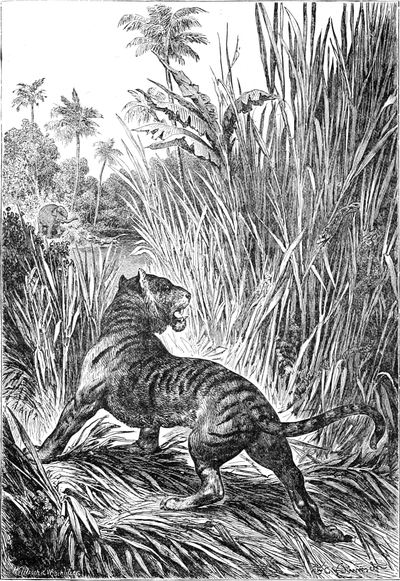
SCENE IN THE JUNGLE.
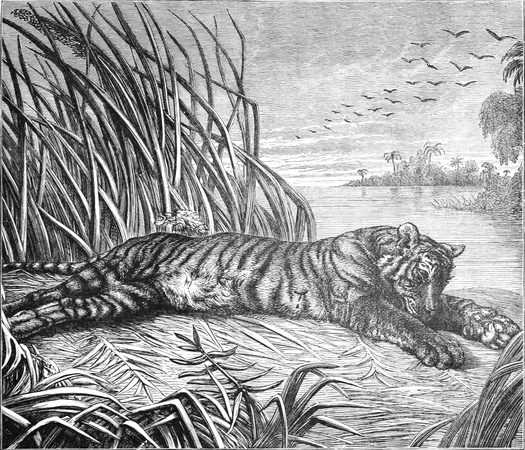
DYING MAN-EATER.
The great distinctive character is, of course, the colour. Of this, and
of the main points of difference between the two sexes, Sir J. Fayrer
writes as follows:—“The colour of a full-grown Tiger in good health
is exceedingly beautiful. The ground is of a rufous or tawny-yellow,
shaded into white on the ventral surface. This is varied with vertical
black stripes, or elongated ovals or brindlings. On the face and on the
back of the ears the white markings are peculiarly well defined, and
present an appearance as remarkable as beautiful. The depth of shade
of the ground colour, and the intensity of the black markings, vary
according to the age and condition of the animal. In old Tigers the
ground becomes more tawny, of a lighter shade, and the black markings
better defined. The young are more dusky in the ground colouring than
the middle-aged or old Tigers. The depth of colour is also affected
by locality and climate. Those found in forests are often of a deeper
shade than Tigers found in more open localities. It is said that in
more northern latitudes they are of a lighter colour, almost white. The
circular white patches on the back of the ears, and the white and black
about the face, are very conspicuous in the Tiger, rushing through the
grass or jungle when disturbed. Brilliant as is the general colour, it
is remarkable how well it harmonises with the grass or bush among which
he prowls, and for which, indeed, until his charge, and the short deep
growls or barkings which accompany it, reveal his presence, he may be
mistaken. The Tigress differs from the Tiger; the head, as well as the
whole body, is smaller and narrower. The neck is lighter, and is devoid
of any crest, which, though very much smaller than the voluminous mane
of the Lion, undoubtedly exists in large and old males. The Tigress is
lither, more active, and when accompanied by her offspring, far more
savage and bloodthirsty than the male; she will then attack, even when
unprovoked; and in defence of her young, of which she is proverbially
fond, is as courageous as she is vicious. Most of the accidents that
have befallen sportsmen and others who have encountered these animals
have been due to Tigresses. I have seen a Tigress, accompanied by her
young, charge, unprovoked, a line of Elephants, and inflict severe
injuries before she was despatched. The only well-authenticated case
in which a sportsman was taken out of a houdah was one in which a
Tigress, in one bound, reached the sportsman, her hind feet resting
on the Elephant’s head, the fore feet on the rail of the houdah. The
occupant, who had mortally wounded her as she sprang, was seized, and,
after a short struggle, dragged or thrown to the ground. The Tigress
then received another bullet, and died where she fell; the sportsman,
severely wounded, was carried into camp, and slowly recovered.”
As to the size of adult animals, the same author has the following
remarks:—
“It is generally admitted that the Tiger attains the greatest size in
India, and there can be no doubt that he is really the largest of the
existing Felidæ.... The size of the Tiger varies; some individuals
attain great bulk and weight, though they are shorter than others
which are of a slighter and more elongated form. The statements as to
the length they attain are conflicting and often exaggerated; errors
are apt to arise from measurements taken from the skin after it is
stretched, when it may be ten or twelve inches longer than before
removal from the body. The Tiger should be measured from the nose
along the spine to the tip of the tail as he lies dead on the spot
where he fell before the skin is removed. One that is ten feet by this
measurement is large, and the full-grown male does not often exceed
this, though no doubt larger individuals (males) are occasionally seen,
and I have been informed by Indian sportsmen of reliability that they
have seen and killed Tigers over twelve feet in length. The full-grown
male Indian Tiger, therefore, may be said to be from nine to twelve
feet, or twelve feet two inches, the Tigress from eight to ten, or
perhaps, in very rare instances, eleven feet in length, the height
being from three to three and a half, or, very rarely, four feet at the
shoulder. But we must look with doubt on Buffon’s statement that one
had attained a length of fifteen feet; and with even greater hesitation
can we accept the recorded statement that Hyder Ally presented a Tiger
to the Nawab of Arcot that measured eighteen feet.”
The Tiger is entirely confined to Asia, where its range is very wide,
extending from the Caspian to the Sea of Okhotsk, and from latitude
50° southwards. It has been found in the Elburz Mountains, Bokhara,
China, Malaysia, Sumatra, Borneo, Java, and Bali. It is known about
Ceylon and from the great tableland of Tibet. Its head-quarters are
North India, where great numbers are killed annually. From what has
been said, it will be evident that the Tiger is by no means, as one is
very apt to imagine, an altogether tropical animal; the Caucasus, the
western limit of its range, is far from being a warm region, and its
eastern limit, the island of Saghalien, is as far north as Kamtchatka.
It has been found also at a height of 8,000 feet above sea-level. It is
an interesting circumstance that the Tigers found amongst the snows of
Mantchuria and Corea have the “body covered with long softish hairs,”
and a shaggy ruff round the neck. Thus, as is so constantly the case,
a definite variety is produced solely by the action of surrounding
conditions. Certain Tigers find it advantageous to live farther north
than the generality of their kind, so as to have a freer field for
their depredations than would be afforded to them by the more southern
districts, and, to suit themselves to the vigorous climate, acquire
long warm fur, such as would be quite out of place on the back of a
denizen of the Bengal jungles.
It is a somewhat remarkable circumstance, considering the nearness
of Palestine to the Caucasus and Elburz Mountains, that the Tiger is
not once mentioned in the Bible. It was, however, well known to the
Greeks and Romans, and, like the Lion, was a regular performer at the
amphitheatre. The district called Hyrcania, a tract of land lying to
the south-east of the Caspian Sea, seems to have been the most noted
spot for Tigers. In the “Æneid,” Dido, in her magnificent declamation
against the perfidy of Æneas, is made to say—
“Nec tibi Diva parens, genius nec Dardanus auctor,
Perfide, sed duris genuit te cautibus horrens
Caucasus, Hyrcanæque admôrunt ubera tigres.”
“(Perfidious monster! boast thy birth no more;
No hero got thee, and no goddess bore:
No! thou wert brought by Scythian rocks to day,
By Tigers nurs’d and savages of prey.)”
and Shakspere uses the same expression:—
“The rugged Pyrrhus, like the Hyrcanian beast.”
In disposition the Tiger differs but little from the other wild
Felidæ. Although possessed of such immense strength and ferocity, he
often shows himself a very coward. Like most animals he scarcely ever
attacks an armed man unless provoked, that is, unless he (or she) be a
confirmed “man-eater,” although often seizing upon women and children.
He shares with our Domestic Cat a love of cruelty for its own sake. The
author of “Rambles in the Mirzapore District” says of this essentially
feline character:—“It is sometimes an interesting sight to witness
the demeanour of a Tiger towards his terrified prey (i.e., when a
victim is tied up for him, and the sportsman waits to shoot him in
the tree above it). When not raging with hunger, he appears to derive
the same pleasure from playing with his victim as a Cat in tormenting
a Mouse. He gambols around the Buffalo as if enjoying his alarm; and
when the affrighted animal, in mad despair, feebly attempts to butt
at his remorseless foe, the Tiger bounds lightly over his head, and
recommences his gambols at the other side. At last, as if he had
succeeded in creating an appetite for dinner, he crushes the skull of
his victim with one blow of his powerful fore-paw, and soon commences
his bloody meal.”
Another point in which the Tiger resembles the Cat is the devotion of
the female to her offspring, and the remarkably lively and skittish
disposition of the “kittens,” of which from two to five are usually
produced at a birth. These are at first about half the size of our
Domestic Cat. The mother goes with young about 105 days, the breeding
season being in the early part of the year, but varying slightly
according to locality. She is a most affectionate and attached mother,
and generally guards and trains her young with the most watchful
solicitude. They remain with her until nearly full grown, or about the
second year, when they are able to cater for themselves. Whilst they
remain with her she is peculiarly vicious and aggressive, defending
them with the greatest courage and energy, and when robbed of them is
terrible in her rage; she has nevertheless been known to desert them
when pressed, and even to eat them when starved.
As soon as they begin to require other food than her milk she kills for
them, and teaches them to do so for themselves by practising on small
animals, such as Deer, and young Calves and Pigs. At these times she
is wanton and extravagant in her cruelty, killing apparently for the
gratification of her ferocious and bloodthirsty nature, and, perhaps,
to excite and instruct the young ones, and it is not until they are
thoroughly capable of providing their own food that she separates from
them.
The young Tigers are far more destructive than the old. They will kill
three or four Cows at a time, whilst the elder and more experienced
rarely kill more than one, and this at intervals of from three or four
days to a week. For this purpose the Tiger will leave its retreat in
the dense jungle, proceed to the neighbourhood of a village, and during
the night will steal towards the herds and strike down a Bullock, drag
it into a secluded place, and then remain near the “murrie,” or kill,
for several days, until it has eaten it, when it will proceed in search
of a further supply. When it has once found good hunting-ground in the
vicinity of a village, it continues its ravages, destroying one or two
Cows or Buffaloes a week. It is very fond of the ordinary domestic
cattle which, in the plains of India, are generally weak, half-starved,
under-sized creatures. One of these is easily struck down and carried
or dragged off. The smaller Buffaloes are also easily disposed of,
but the Buffalo Bulls, and especially the wild ones, are formidable
antagonists, and have often been known to beat the Tiger off, and even
to wound him seriously with their horns.
Some notion of the fearful damages committed by Tigers in India will
be gained from the following extract:—“Cattle killed in my district
are numberless. As regards human beings, one Tiger in 1867–8–9, killed,
respectively, twenty-seven, thirty-four, forty-seven people. I have
known it attack a party and kill four or five at a time. Once it killed
a father, mother, and three children; and the week before it was shot
it killed seven people. It wandered over a tract of twenty miles,
never remaining in the same spot two consecutive days, and at last was
destroyed by a bullet from a spring gun, when returning to feed on
the body of one of its victims—a woman. At Nynee Tal, in Kumaon, in
1856–7–8, there was a Tiger that prowled about within a circle, say, of
twenty miles, and it killed, on an average, about eighty men per annum.
The haunts were well known at all seasons.... This Tiger was afterwards
shot while devouring the body of an aged person it had killed.” It
is also stated in a Government report that “in one instance, in the
Central Provinces, a single Tigress caused the desertion of thirteen
villages, and two hundred and fifty square miles of country were thrown
out of cultivation. This state of things would, undoubtedly, have
continued, but for the timely arrival of a gentleman who, happily,
was fortunate enough, with the aid of his gun, to put an end to her
eventful career.” Again, it is reported, “that one Tigress, in 1869,
killed 127 people, and stopped a public road for many weeks, and was
finally killed by the opportune arrival of an English sportsman.”
As might naturally be expected, an enemy so dreadful is sure to have
supernatural power ascribed to it by the credulous natives, whose
property is destroyed, and whose lives are endangered by the ravages
of this terrible beast. People in the state of civilisation of the
ordinary Indian villages are sure to think there is something more
than natural in an animal capable of such wholesale destruction, so
wantonly cruel, of such fearful strength and such terrible beauty; and
the following passages will give some idea of the prowess ascribed to
the Tiger by those who are the greatest sufferers from his bloody
disposition:—
“The natives of India, especially the Hindoos, hold the Tiger, as they
do the Cobra, in superstitious awe. Many would not kill him if they
could, for they fear that he will haunt them or do them mischief after
death. Some they regard as being the tenement of a spirit, which not
only renders them immortal, but confers increased powers of mischief.
In many parts of India the peasants will hardly mention the Tiger by
name. They either call him, as in Purneah, Giahur (Jackal), Janwar (the
beast), or they will not name him at all; and it is the same in the
case of the Wolf. But though they will not always themselves destroy
him, they are quite willing that others should do so, for they will
point out his whereabouts, and be present at his death; and the delight
evinced thereat is intense, for it often relieves a whole village from
an incubus of no slight weight, and saves the herdsman from his weekly
loss of cattle. The conversation and remarks made by these villagers
round the fallen Tiger are often very amusing and characteristic.
“All kinds of power and influence are ascribed to portions of him when
dead; the fangs, the claws, the whiskers, are potent charms, medicines,
love-philtres, or prophylactics against disease, the evil eye, or
magic. They are in such demand that the natives will take them; and
we have known whiskers, claws, and even fangs, extracted and carried
away during the night, even when the dead Tiger has been placed under
the surveillance of a guard. The fat, also, is in great demand, for its
many potent virtues in relieving rheumatism and other ailments. The
liver, the heart, and the flesh are taken away and dried, to be eaten
as tonics or invigorating remedies that give strength and courage.
There is also a popular delusion that a new lobe is added to the liver
every year of his life. A Tiger’s skin with its whiskers preserved is
a rarity; you cannot keep them. The domestic, who would preserve any
other valuable as a most sacred trust, will fail under this temptation!
The whiskers, besides other wonderful powers, are said to possess
that of being a slow poison when administered with the food. Such
is the belief, which you may try in vain to disturb! The clavicles,
too—little curved bones like tiny ribs—are also much valued; but they
are generally lost or overlooked when the Tiger is cut up, lying buried
in the powerful muscles near the shoulders.”
It is a very common opinion that the wounds made by a Tiger’s claw
or teeth are poisonous, and consequently highly dangerous. It is,
however, hardly necessary to state that the Tiger’s venom is of quite
the same nature as that of the Frog and Newt, which so many country
people believe in devoutly to this day. The huge jagged canines, and
the carefully sharpened claws make wounds which are certainly ugly
enough, but their danger arises merely from their depth, and from their
liability to fester in a hot climate.
Of course Tiger-hunting is, par excellence, the “royal sport of
India;” the game calling forth more courage and address from the
sportsman than any other, and the “spice of danger” so necessary to the
true sportsman being at its maximum. Usually, a hunt is made up of a
considerable number of sportsmen, accompanied by a crowd of beaters.
The Elephant upon which each hunter rides is provided with a houdah of
light wood and basket work, and consisting of two compartments, a front
one in which the sportsman himself sits, and a hinder one occupied
by his servant, who is in readiness with spare guns. The driver, or
mahout, sits on a cushion on the Elephant’s neck, armed with a pointed
iron rod, or gujbag, to every touch of which the docile animal
answers.
On arriving at a portion of the jungle where Tigers are known to exist,
the sportsmen hold themselves in readiness with loaded rifles, while
the beaters, on foot, encircle the jungle, and endeavour, with shouts
and gesticulations, to drive the game from their lurking-place to the
destruction which awaits them. As soon as a Tiger appears every piece
is levelled at him, and, in many cases, he is despatched at once; but
often he is either entirely missed, or only slightly wounded, and then
he at once makes for the nearest Elephant, and often succeeds in making
Elephant, or mahout, or even sportsman, feel his cruel teeth and claws,
before the coup de grace is given. A Tiger is at no time the easiest
thing to kill; like its humble kinsman, the Cat, it has “nine lives”
to part with, and these lives are much more tenacious than in the case
of poor puss. A Tiger, holding on with tooth and claw to a writhing
Elephant, in such a position that a mis-directed shot may kill man or
Elephant instead of Tiger, is an extremely awkward beast indeed to
deal with, and is often enabled to sell his life very dearly. When the
day’s sport is over, the Tigers are either carried into camp on pad
Elephants, or skinned where they lie; the natives possessing themselves
of the flesh, and everything else of which they can lay hold.
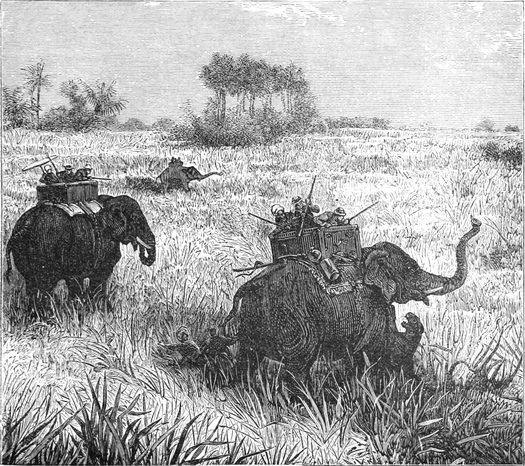
TIGER HUNT.
The foregoing is the legitimate method of keeping down the Tiger race,
but many others are employed. “They are snared in pitfalls and traps,
shot by spring-guns and arrows, occasionally poisoned, and it is said
that bird-lime has been used in their destruction. I have read of this,
but know of no authenticated case in which it has been practised. The
bird-lime, it is said, is spread on the fallen leaves; these adhering
to the Tiger’s paws are soon plastered all over him, including his face
and eyes. Blinded and stupefied by rage and fear, he falls an easy
prey to the villagers, who then either shoot or stab him to death
with spears. Another mode of effecting his death is to lay a bait, by
tying up a Cow or Goat in some spot the Tiger is wont to frequent. Near
this, on a machan, or on the branch of a tree, or from behind some
extemporised screen, the shikarie waits his approach at night, and
when the bait is seized takes aim, and often succeeds in destroying
him, though it not unfrequently happens that in the uncertain light he
misses altogether, or only wounds, in which case a second chance is
seldom obtained.”
The perils of Tiger-hunting are great and varied. In the following
instance related by Sir Joseph Fayrer a large comic element was
introduced, although the fun is probably more striking to us to read of
than it was to the hunter and his mahout who took part in it:—
“A rather curious Tiger-hunt, in which the Tiger seemed to think that
he should have his share of the sport as well as the ‘shikarie,’
occurred some short time ago in the Dhoon. A gentleman, well known in
Dehra, an enthusiastic though rather inexperienced sportsman, they say,
went out about a month ago, into the Eastern Dhoon, for a day or two’s
shooting. Arrived on the ground, he was seated in his houdah on the
Elephant, looking out anxiously for game of some sort, when the mahout
suddenly cried, ‘Shér, Sahib; burra, Shér!’ for a Tiger had made his
appearance unexpectedly close to the Elephant. The gentleman hurriedly
fired, and planted a ball from his rifle, not in the Tiger’s shoulder,
but in his abdomen. This mistake must have been due to surprise at the
Tiger’s sudden advent on the scene, and the consequently hurried shot;
otherwise such a want of knowledge of anatomy as was evinced in seeking
a vital spot in the abdomen would be unpardonable. The consequences
of the mistake were serious; for the Tiger, resenting the sudden
disturbance in the region where the remains of his last kill were
peacefully reposing, charged the Elephant, and, by a spring, succeeded
in planting his fore-paws on her head, while his hind legs clawed and
scratched vigorously for a footing on her trunk.
“Imagine the feelings of the mahout, with a Tiger within six inches
of his nose! the Elephant trumpeting, shaking, and rolling with rage
and pain, till he was barely able to maintain his seat on her neck
at all; and the occupant of the houdah, too, tumbled from top to
bottom, and from side to side of it, as if he were a solitary pill in
a pillbox too large for him. Of course, in this predicament, he was
utterly unable to use his rifle to rid the Elephant of the unwelcome
head-dress she was, perforce, wearing. The attempt to fire, in all that
shaking, would probably have resulted in his blowing out the mahout’s
brains instead of the Tiger’s, or in his shooting himself. Meanwhile
the mahout, with the courage of despair, slipped out of the gaddela,
or cushion, on which he sat, and, rolling it round his left arm, and
taking the iron gujbag in his right, assailed the Tiger manfully
about the ears. But, being thick-headed, he did not seem to mind the
gujbag at all; for, after taking a bite at the Elephant’s forehead,
he calmly continued his struggles for a footing on the reluctant
and ever-dodging trunk, heedless of the rain of blows on his thick
skull, and, no doubt, promising himself to square accounts presently
by swallowing the mahout, gujbag, and all. But the Elephant was
beginning to see that she couldn’t shake the Tiger off, so she tried
another plan; and, making an extempore battering-ram of herself, with
the Tiger as a buffer, she charged straight at a sal-tree, thinking to
make a Tiger-pancake on the spot. But the sal-tree, alas! was a small
one, and gave way under the shock, and away went tree, Tiger, and
Elephant into an old and half filled-up obi, or Elephant pit, which
happened to be conveniently placed to receive them just on the other
side of the fallen tree. The Tiger and the mahout were both knocked
off by the shock and fall; but the latter, luckily for himself, fell
out of the pit, the former into it, under the Elephant. The Elephant
now had her share of the sport, and gave the Tiger such a kicking
while he lay under her, making a kind of shuttlecock of him between
her fore and hind legs, that the breath must have been almost kicked
out of him; then deeming she had done enough for honour and glory, and
that she couldn’t eat the Tiger if she did kill him, she commenced
climbing out of the pit, whose crumbled and sloping sides luckily made
the scramble out practicable. The mahout, who had by this time picked
himself and his scattered wits up, rushed round and caught her by the
ear just as she reached the level, and was preparing for a bolt, and
scrambling rapidly up to his perch on her neck, succeeded in stopping
her and turning her face to the foe once more. The Elephant being
now under command, our sportsman at length resumed his proper share
in the proceedings, and the Tiger being still at the bottom of the
pit, breathless, if not senseless, from the kicking he had undergone,
by a well-directed shot put him finally hors de combat, and had
the satisfaction of carrying him into the station in triumph, where
his skin is preserved as a witness of this strange Tiger-hunt. The
Elephant, though it got one nasty bite, and was badly scratched about
the trunk and fore-legs, is now none the worse for its single combat
with the monarch of the Indian forests.”
We mentioned above that the Tiger rarely attacks man unless provoked.
When, however, he is hard pressed for a meal, he will often visit
inhabited spots, and then is as likely to choose human as bovine food.
Imagine the sensation likely to arise in a small village, inhabited
only by a few unarmed, or at least but poorly armed men, with their
wives and children, by such an occurrence as the following, related by
an English traveller:—
“On the 11th of November of the same year I chanced to meet a Tiger
myself. I was on the shore of the mainland opposite Amoy, in the
afternoon, looking out for small birds, in company with a friend.
I carried a gun, but had only small shot and one cartridge. Some
villagers came running to us crying ‘Go and shoot the Tiger!’ I
thought they were making game of us, until some of them assured us
that there really was a Tiger in a neighbouring village, and that they
would be much obliged if we would kill it. They led us to a village
at the foot of a hill near the shore, where we found men, women, and
children huddled outside in great alarm. Many of the men were armed
with matchlocks. They desired us to take off our boots, and one of
the men guided us over the roofs of the houses to the last house near
the hill, and, pointing to a large rock, he made us listen. We could
distinctly hear growls, and peering over I saw the lips and feet of
the Tiger under the overhanging rock. The house on which we stood
presented a wall facing the rock, and about two yards distant. We went
inside, and I persuaded the owner to make a hole in the wall. I had no
means of drawing the charge of my gun, so I rammed down a cartridge
on the top of the small shot in one barrel, and a few hollow buttons
into the other. In the hurry and excitement no bullets or iron nails
were forthcoming. The Tiger noticed the hole in the wall, but only
growled. I fired the button barrel first, aimed at its neck, but he
only answered by a growl, and I saw that the buttons had done no more
than turn up the skin without penetrating. His jaw was full towards me,
and I gave him the cartridge right between his eyes. He gave a furious
roar, and bounded into the garden, where he stood for some seconds
bleeding from the nose, and with his tongue lolling from his mouth. I
had no more cartridges with me, so I loaded again with the metal-edged
buttons which the villagers tore off their coats for me. The Tiger had
moved away, and I tracked him by his blood into a dilapidated temple.
I looked in at the window, and there stretched beside a coffin sat the
noble beast. He, turned his head and growled as he saw me, and, without
a moment’s thought I raised the barrels and fired another shower of
buttons in his face. I turned and fled; but a roar followed which I
shall never forget, and I found myself, breathless, at the bottom of a
precipice, with my gun upraised, expecting to see the angry creature
upon me; but strange enough he did not follow. The villagers, who were
assembled two hundred yards away, all ran when I ran; but seeing the
Tiger did nut pursue, one of them came forward and put me on his knees,
and patting me on the back, helped to bring back my breath, which I had
lost by the fall. We crept up to the window again. Every one of the
thick wooden bars had been knocked out by the force of the leap; but
from the blood only splashing the outside of the window, it was evident
the Tiger had not come out of the building. We looked in at the window,
and just below, outstretched on the floor in a pool of blood, lay the
Tiger. I threw up my hand and shouted to my friend, who watched the
proceedings at a distance, that the Tiger was dead. At the noise, the
Tiger raised his head and growled. He was a Cat, of course, and had the
usual nine lives. I went to the villagers and proposed a joint attack,
but they would not consent. Some of them ascended the hills behind and
fired on to the roof of the house in which the Tiger was sheltered.
It was getting dark, so breathless and hurt I took boat and returned
to Amoy. A few hours after the Tiger is said to have moved away; but
whether he died or recovered his wounds I could never satisfactorily
learn, so contradictory were the stories told.”
Mr. Thomson recounts a tale of a planter in this province, who,
returning home after a carouse, a little too much under the influence
of Scotch whisky, was sorely bested by a Tiger. “It was rather dark,
and verging on the small hours of morning when MacNab, mounting on
his trusty steed, set his face towards home. Feeling at peace with
all men, and even with the beasts of prey, he cantered along a road
bordered with mangroves, admiring the fitful gleams of the fire-flies
that were lighting their midnight lamps among the trees. But soon the
road became darker, and Donald, the pony, pricked his ears uneasily
as he turned into a jungle-path which led towards the stream. Donald
snuffed the air, and soon redoubled his pace, with ears set close back,
nostrils dilated, and bristling mane. Onward he sped, and at last the
angry growl of a Tiger in full chase behind roused MacNab to the full
peril of his position, and chilled his blood with the thought that his
pursuer was fast gaining ground, and that at any moment he might feel
the clutch of his hungry and relentless claws. Here was a dilemma, the
cold creek before him, and the hot breath of the Tiger in the rear.
A moment or two were gained by tossing his hat behind him, and then
Donald cleared the streams at a bound. The Tiger lost his scent, and
Mr. MacNab reached home in safety, by what he delighted to describe as
a miraculous escape.”
To us, who “live at home at ease,” life would seem to be hardly
bearable in a place when one is liable, any day, to meet with such
an adventure as this—with every chance, too, of a less pleasant
termination. But it is astonishing how indifferent to the presence of
wild beasts the inhabitants of these countries become. Even Europeans
soon acquire the same fearlessness, or, rather, apathy. Of this Mr.
Thomson gives a striking illustration:—“In these sparse settlements
of Malays and Chinese, Roman Catholic missionaries are at work. I once
fell in with one of these priests, shod with straw sandals, and walking
alone towards Bukit, Mer-tangrim (the pointed hill), to visit a sick
convert who had a clearing upon the mountain-side. His path lay through
a region infested with wild animals; and when I inquired if he had no
dread of Tigers, he pointed to his Chinese umbrella, his only weapon,
and assured me that with a similar instrument a friend of his had
driven off the attack of a Tiger not very far from where we stood. But
the nervous shock which followed that triumph had cost the courageous
missionary his life.”
The Leopard, or Panther, is undoubtedly the third in importance and
interest of the great Cats. From a historical point of view it is more
interesting than the Tiger, and would naturally come immediately after
the Lion, but its size, ferocity, and beauty are so very inferior
to the Tiger’s that it must needs yield to the glorious Bengalee.
In the matter of beauty alone it is eclipsed by the Jaguar, but the
fact of its having been known from very ancient times, and that of
its occurrence in our own hemisphere, must decide us, in the absence
of any important characters, anatomical or otherwise, to give it the
precedence of its very nearly related American cousin.
The Leopard was the only one of the greater feline animals, except the
Lion and Tiger, that seems to have been known to the ancients. It is
always represented as drawing the chariot of Bacchus, and the forlorn
Ariadne is sculptured as riding on one of the spotted steeds of her
divine lover. The Panther was also constantly used in the barbarous
sports of the amphitheatre, and, in common with the Lion and Tiger, has
been both executioner and grave to many a bold-hearted martyr.
The Leopard’s skin was a favourite mantle in the olden times in Greece.
In the “Iliad,” Homer, speaking of Menelaus, says—
“With a Pard’s spotted hide his shoulders broad
He mantled o’er.”——
and the Leopard, or Panther, is given in the “Odyssey” as one of the
forms assumed by Proteus, “the Ancient of the Deep.”
A curious ancient superstition about the Leopard is embodied in its
name. It was thought not to be actually the same animal as the Panther
or Pard, but to be a mongrel or hybrid between the male Pard and the
Lioness: hence it was called the Lion-panther, or Leopardus. This
error, as Archbishop Trench tells us, “has lasted into modern times;
thus Fuller, ‘Leopards and Mules are properly no creatures.’” Another
word-combination was made by the Romans when wishing to find a name for
the Giraffe. It is “a creature combining, though with infinitely more
grace, yet some of the height and even the proportions of a Camel,
with the spotted skin of the Pard.” They called it “Camelopardus,”
the Camel-panther.
Some authors give it as their opinion that the Leopard outshines all
the great beasts of prey in beauty and elegance, and, indeed, called
it the Carnivore par excellence. Unfortunately, most English people
have no means of forming a true opinion on a matter of this sort, as we
see the animals only in menageries; but judging from the specimens we
have seen in confinement, we should incline to the belief that it is
far behind both the Lion and Tiger, and is even beaten by the Jaguar in
the matter of colouring, although the surly look of the latter makes
him, on the whole, a far less attractive beast. The adult Leopard in
the London Zoological Gardens is perhaps the clumsiest brute in the
whole Lion-house—fat, bull-necked, and stupid-looking. Stupid-looking,
and even clumsy, that is, when lying lazily asleep on the floor of his
den; but watch him when four o’clock comes, and the meat-barrow goes
round, and then where will you find more marvellous agility? All the
Cats are alike in this; they are very lazy at times, but when they do
begin to move, there is no more complete example of perfectly graceful
movement, and one feels as if he could watch them “on and off for days
and days,” as Alice’s frog-footman puts it.
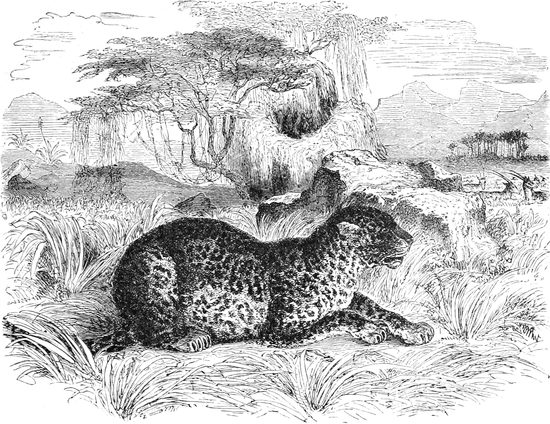
LEOPARD.
The characters of the hide are so characteristic that they must be
given in some detail, especially as the spots must be distinguished
from those of the Jaguar, the great spotted Cat of the New World. The
skin is described as follows:—“On an orange-yellow ground, passing
below into white, are spots of deep or brownish-black, sometimes
distinct, sometimes composed of two, three, or even four points
disposed in a circle, and surrounding a space, always somewhat darker
than the ground-colour, and shading into it below. On the medio-dorsal
line, in the hinder part of the body, the spots are so arranged as to
produce three or even four regular parallel bands. On the side of the
body, also, bands are found, but they are indefinite in number, and
irregularly disposed. On the head and legs, the circular spots pass
by degrees into mere points. The belly is strewn with great double
points, irregularly disposed, and on the legs the points, also double,
unite and form bands. The tail is covered over the greater part of its
length with annular spots. On the hinder part of the ears is a clear
spot.”
It must not be supposed, however, that all Leopards have exactly the
kind of marking here described, for it varies according to habitat,
age, sex, and season. Still, the skin-markings are definite enough to
enable one to tell the true Leopard, either from the Hunting Leopard
(Cheetah), the Jaguar, or the Clouded Tiger, the only animals with
which there is any possibility of confounding it.
In size the Leopard is decidedly inferior to either the Lion or Tiger;
being not more than some seven feet six inches from snout to tip of
tail, and two feet seven inches high at the shoulder. The tail itself
is about three feet eight inches long. The female is somewhat smaller
than the male, to which the above measurements apply. The whiskers are
strong and white, and the eyes yellow.
The head-quarters of the Leopard are the African continent, where its
range is almost co-extensive with the Lion’s, as it occurs from Algeria
in the north to Cape Colony in the south. In the latter locality it is
known by the settlers as the Tiger, but this is quite a misnomer. The
Tiger of the Cape colonists is a spotted, not a striped Cat, and is
indeed nothing but the African variety of the Panther. Like the Lion,
the Leopard extends into Asia, penetrating, however, much farther into
that continent than the king of beasts. In the western parts of Asia
it occurs, amongst other places, in Palestine, where “it is found all
round the Dead Sea, in Gilead, and Bashan, and occasionally in the few
wooded districts in the West.” Leopards are found in Ceylon, where they
are the only great Carnivores, but where they are neither very numerous
nor very dangerous, as they seldom attack man. By the Europeans the
Ceylon Leopard is erroneously called a Cheetah, but the true “Cheetah”
(Felis jubata), the Hunting Leopard of India, does not exist in the
island.
The Leopard is found at its extreme easterly range in Japan, where it
occurs under a distinct variety, known as the “Northern Leopard,” the
skin of which is “much like that of a fine-coloured Hunting Leopard,
but it is at once distinguished by the comparatively shorter legs, by
the larger size and brown centre of the black spots, and from all the
varieties of the Leopard by the linear spots on the nape and the spots
on the back not being formed of roses or groups of spots. The skin in
its tanned state is four feet six inches, and the tail two feet ten
inches long.”
Another variety from Formosa is distinguished by the shortness of
its tail, which is not more than a foot and three-quarters long, or
about half the length of that of its African brother. Some naturalists
propose to consider both these varieties as distinct species, but such
characters as the length of the tail and the form and disposition of
the spots are eminently variable, and when we consider that another
Leopard from Formosa has been described with a tail one foot one inch
long, and another whose caudal appendage was two feet seven inches
in length, we shall certainly be justified in concluding that such
slight difference must have been produced by the innate tendency of all
animals to vary in unimportant particulars, and by the influence of
surrounding conditions, and we may safely put all these various kinds
of Leopard under the common label Felis pardus.
There is, however, one very interesting character about the “Northern
Leopard” which, although by no means entitling it to rank as a species,
yet makes it a very instructing instance of the way in which a breed
or race is produced by the modifying influence of climate. The animal
in question is found not only in Japan, but in Mantchuria, “extending
probably to Corea, and the Island of Saghalien,” and is remarkable
from the fact that its hair is long and shaggy, a condition of things
evidently brought about by the cold climate it has to endure. Hence we
see that the British climate need not have differed from its present
condition to have been the home, as indeed it once was, of the larger
beasts of prey.
Perhaps the most interesting variety of this species is the Black
Leopard of Java. It has exactly the appearance of an ordinary Leopard
painted black, the paint, however, not being laid on sufficiently thick
to hide the spots, which are of a more intense black than the rest
of the hide. The Black Leopard is sometimes described as a distinct
species, and is called Leopardus melas, but there can be very little
doubt that it is, in reality, a mere variety, differing only in
colour—the most variable of characters—from the common kind. It is,
however, so singular as to require the special notice which we have
given it.
“Leopards frequent the vicinity of pasture-lands in quest of the Deer
and other peaceful animals which resort to them; and the villagers
often complain of the destruction of their cattle by these formidable
marauders. In relation to them the natives have a curious but firm
conviction that when a Bullock is killed by a Leopard, and, in
expiring, falls so that its right side is undermost, the Leopard will
not return to devour it. I have been told by English sportsmen (some
of whom share in the popular belief), that sometimes, when they have
proposed to watch by the carcase of a Bullock recently killed by a
Leopard, in the hope of shooting the spoiler on his return in search of
his prey, the native owner of the slaughtered animal, though earnestly
desiring to be avenged, has assured them that it would be in vain, as,
the beast having fallen on its right side, the Leopard would not return.
“The Singhalese hunt them for the sake of their extremely beautiful
skins, but prefer taking them in traps and pitfalls, and occasionally
in spring cages formed of poles driven firmly into the ground, within
which a Kid is generally fastened as a bait, the door being held
open by a sapling bent down by the united force of several men, and
so arranged as to act as a spring, to which a noose is ingeniously
attached, formed of plaited Deer’s hide. The cries of the Kid attract
the Leopard, which, being tempted to enter, is enclosed by the
liberation of the spring, and grasped firmly round the body by the
noose.”[18]
There is a Scottish adage which says that “Hawks will not peck out
hawks’ een;” but the Leopard, a Carnivore, has a confirmed liking for
the flesh of the flesh-eating Dog. This fact has been observed by a
writer who states that the Leopard has quite a mania for that sort of
diet, and will not hesitate to penetrate into a tent at night in quest
of his favourite game.
There is a rather curious habit of the Leopards which we have observed
at the Zoological Gardens, though whether it holds good with all
Leopards we are not prepared to say, never having seen the circumstance
mentioned. The Lion and Tiger, when devouring their reeking bones at
their four o’clock dinner, at Regent’s Park, lie down at full length,
and hold the meat between their fore-paws, in this way steadying it
while they take their tremendous bites. The Leopards, on the other
hand, do not lie down, but squat on their haunches, the fore-legs being
kept almost vertical, and the head, of course, correspondingly bent
down to reach the food. The paws are rarely used to steady the piece
of meat, and only, in fact, when the beast comes across a particularly
fractious morsel which he finds it impossible to manage with his teeth
alone. For this reason, a Leopard in the act of feeding is a far more
awkward-looking beast than the Lion or Tiger, both of which hold their
food in quite a civilised way.
In connection with the Leopard’s mode of feeding, we may mention
a curious tale about its diet. There can be little doubt that it
is a mere “yarn,” or rather a piece of folk-lore, but still it is
interesting, especially when we think of the many tales of clay-eating
men:—“The natives [of Ceylon] assert that it devours the kaolin
clay, called by them kiri mattee, in a very peculiar way. They say
that the Cheetah [Leopard] places it in lumps beside him, and then
gazes intently on the sun, till, on turning his eyes on the clay, every
piece appears of a red colour like flesh, when he instantly devours it.”
As a rule, the Leopard seems to be far more cowardly than the Lion or
Tiger. Jules Gérard, the Lion-killer, holds the beast in the greatest
contempt for its pusillanimity. Still, it often shows a good deal of
pluck, chiefly, however, when in want of food. As to this matter, the
actual experience of those who have observed the animal in its native
land will convey a truer idea than any summing up of its good and bad
points. “One night I was suddenly awoke by a furious barking of our
Dogs, accompanied by cries of distress. Suspecting that some beast
of prey had seized upon one of them, I leaped, undressed, out of my
bed, and, gun in hand, hurried to the spot whence the cries proceeded.
The night was pitchy dark, however, and I could distinguish nothing;
yet, in the hope of frightening the intruder away, I shouted at the
top of my voice. In a few moments a torch was lighted, and we then
discovered the marks of a Leopard, and also large patches of blood.
On counting the Dogs, I found that ‘Summer,’ the best and fleetest of
our kennel, was missing. As it was in vain that I called and searched
for him, I concluded that the Tiger [Leopard] had carried him away;
and, as nothing further could be done that night, I again retired to
rest; but the fate of the poor animal continued to haunt me, and drove
sleep away. I had seated myself on the front chest of the wagon, when
suddenly the melancholy cries were repeated, and on rushing to the
spot, I discovered ‘Summer’ stretched at full length in the middle of
a bush. Though the poor creature had several deep wounds about his
throat and chest, he at once recognised me, and, wagging his tail,
looked wistfully in my face. The sight sickened me as I carried him
into the house, where, in time, however, he recovered. The very next
day ‘Summer’ was revenged in a very unexpected manner. Some of the
servants had gone into the bed of the river to chase away a Jackal,
when they suddenly encountered a Leopard in the act of springing at our
Goats, which were grazing, unconscious of danger, on the river’s bank.
On finding himself discovered, he immediately took refuge in a tree,
when he was at once attacked by the men. It was, however, not until he
had received upwards of sixteen wounds—some of which were inflicted
by poisoned arrows—that life became extinct. I arrived at the scene
of conflict only to see him die. During the whole affair, the men had
stationed themselves at the foot of the tree, to the branches of which
the Leopard was pertinaciously clinging, and, having expended all their
ammunition, one of them proposed, and the suggestion was taken into
serious consideration, that they should pull him down by the tail.”
One of the most remarkable circumstances related about the Leopard is
the way in which it is attracted by persons suffering from small-pox;
the odour attending that disease seems to have an irresistible
fascination for them. Sir Emerson Tennent says that the medical
officers at small-pox hospitals have to take special precautions
against Leopards, which invariably haunt the spot.
As with the other Felidæ, the only value of the dead Leopard is the
price of its skin, no truly carnivorous animal being good eating;
although it is related that one of the South African tribes will eat
the flesh, not only of the Leopard, but even of the Hyæna, when they
are hard pressed for food.
THE Jaguar takes the place of the Leopard in America, where it is the
most formidable of beasts of prey. It extends across the whole of the
central part of the continent; its northern limit being the south-west
boundary of the United States.
It is a slightly larger animal than the Leopard, fierce and sulky in
expression, but more elegant in form, and far handsomer as to its skin.
The spots are arranged in larger and more definite groups, each group
consisting of a ring of well-defined black spots enclosing a space of
a somewhat darker tawny than the ground-colour, in which lesser spots
often occur.
The Jaguar is perhaps the fiercest-looking of all the great Cats,
having an extremely ferocious expression and a horrid habit of showing
its great fangs. Some time ago we were taken over the fine Lion-house
in the Zoological Gardens by the Superintendent, Mr. Bartlett, to
whose practical genius for everything that relates to the comfort of
the animals under his charge most of the perfections of that structure
are due. The little sleeping apartments at the back of the den open by
iron doors into a long corridor, and in each of the doors is a small
hole about the size of a penny, through which the keeper can look.
Mr. Bartlett blew sharply through the hole in the den of the Jaguar’s
cage, and then allowed us to look through, and there was something
terrible in the way the savage beast rushed at the door, growling and
“swearing” like a very large and fierce Tom Cat. Even the knowledge of
the strong iron door between us and the Jaguar could not prevent us
from starting back, there was something so suggestive, in the beast’s
looks, of being torn to pieces and devoured.
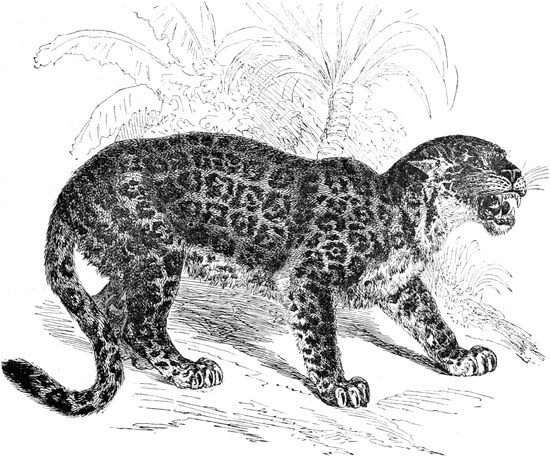
JAGUAR.
The Jaguar is found in North and South America, extending from the
Southern regions of the United States, through Mexico, Central America,
and Brazil, as far south as Paraguay. Of its habits, occurrence, &c.,
the following interesting account is given by Mr. Darwin:[20]—
“The wooded banks of the great rivers appear to be the favourite
haunts of the Jaguar; but south of the Plata, I was told that they
frequented the reeds bordering lakes. Wherever they are, they seem
to require water. Their common prey is the Capybara, so that it is
generally said, where Capybaras are numerous there is little danger
from the Jaguar. Falconer states that near the southern side of the
mouth of the Plata there are many Jaguars, and that they chiefly live
on fish. This account I have heard repeated. On the Paranà they have
killed many wood-cutters, and have even entered vessels at night.
There is a man now living in Bajada, who, coming up from below when
it was dark, was seized on the deck; he escaped, however, with the
loss of the use of one arm. When the floods drive these animals from
the islands, they are most dangerous. I was told that, a few years
since, a very large one found its way into a church at Santa Fé: two
padres entering one after the other were killed, and a third, who
came to see what was the matter, escaped with difficulty. The beast
was destroyed by being shot from a corner of the building, which was
unroofed. They commit also at these times great ravages among Horses
and cattle. It is said that they kill their prey by breaking their
necks. If driven from the carcass, they seldom return to it. The
Gauchos say that the Jaguar, when wandering about at night, is much
tormented by the Foxes yelping as they follow him. This is a curious
coincidence with the fact which is generally affirmed of the Jackals
accompanying, in a similarly officious manner, the East Indian Tiger.
The Jaguar is a noisy animal, roaring much by night, and especially
before bad weather. One day, when hunting on the banks of the Uruguay,
I was shown certain trees to which these animals constantly recur for
the purpose, as it is said, of sharpening their claws. I saw three
well-known trees; in front, the bark was worn smooth as if by the
breast of the animal, and on each side there were deep scratches, or
rather grooves, extending in an oblique line, nearly a yard in length.
The scars were of different ages. A common method of ascertaining if
a Jaguar is in the neighbourhood is to examine these trees. I imagine
this habit of the Jaguar is exactly similar to one which may any day be
seen in the common Cat, as with outstretched legs and exserted claws it
scrapes the leg of a chair; and I have heard of young fruit-trees in
an orchard in England having been thus much injured. Some such habit
must also be common to the Puma, for on the bare hard soil of Patagonia
I have frequently seen scores so deep that no other animal could have
made them. The object of this practice is, I believe, to tear off the
ragged points of their claws, and not, as the Gauchos think, to sharpen
them. The Jaguar is killed, without much difficulty, by the aid of Dogs
baying and driving him up a tree, where he is despatched with bullets.”
It has been stated that great contests take place between the Jaguars
and the Alligators which frequent the rivers of the regions in which
the great Cat lives. It is said that the Jaguar is fully a match for
the Alligator on land, while in the water the reptile has usually
the best of it. The tale must, however, be taken cum grano salis.
A very curious fact is mentioned by Brehm, namely, that the Jaguar
always attacks Negroes and Indians in preference to whites, and that a
white man, obliged to sleep in the open air in a dangerous locality,
always feels perfectly safe if accompanied by natives. It is thought
that this is probably due to the strong odour which characterises
the skin of the Negro and other dark races. As tending to confirm
this extraordinary statement, we may mention an anecdote told us by
the late Prof. P. M. Duncan, F.R.S., of the behaviour of the great
Felidæ at the Zoological Gardens towards coloured people. Every one
must have noticed the calm, supercilious, way in which those grand
creatures regard the visitors to their abode, seeming to look on them
as beings of an inferior race come to pay rightful homage to strength
and beauty; except at feeding-time, they seem hardly to give a thought
to the admiring crowds in their house of reception, but pace regularly
up and down their dens, or sit with paws thrust out between the bars,
stolidly gazing. Several years ago, however, when the Prince of Wales’s
Indian animals were exhibited at the Gardens, a little black boy, one
of the attendants attached to the collection, often passed through the
Lion-house; and when he did so, every Cat in the place started to its
feet, and rushed to the bars of its cage with great demonstrations of
anger and ferocity. They evidently felt that here, at least, was one of
the black, two-legged animals on which their fathers and grandfathers
had fed from time immemorial, and that now was their time to strike
for a pleasant change of diet, after the monotony of beef bones,
ignominiously cut up and parcelled out to them.
The Puma, or “South American Lion,” is the second great American
Carnivore. It occurs far more widely spread in the continent than the
Jaguar, ranging from the cold regions of the Strait of Magellan up
to 50° or 60° north latitude. In appearance it is not unlike a small
Lioness, having a tint somewhat similar to the characteristic tawny
colour of the monarch of Africa, but darker, greyer, and less rich;
the mane, too, is absent. Its head is proportionally, as well as
absolutely, much smaller than that of the Lion; its face is rounder,
and it is altogether a much smaller beast: its average size being about
thirty-nine or forty inches from the snout to the root of the thick,
strong tail, the latter again being some twenty-five or twenty-six
inches long, and the height about the same. Indistinct spots occur, as
in the Lion, on the belly and the inside of the legs. The hind-quarters
are very large, and are kept higher than the shoulders in walking. The
skin beneath the belly is remarkably loose and pendulous.
Unlike the Jaguar, the Puma avoids water, although well able to swim
when necessary. It is as much at home in trees as on solid ground,
and is a terror to the Capuchin and other Monkeys which abound in the
forests of South America. It is, however, a far more cowardly animal
than the Jaguar, and is not feared by the natives to anything like the
same degree. Mr. Darwin, who had ample opportunity of observing its
habits, writes thus of it in his “Naturalist’s Voyage”:—
“This animal has a wide geographical range, being found from the
equatorial forests, throughout the deserts of Patagonia, as far south
as the damp and cold latitudes (53° to 54°) of Tierra del Fuego. I have
seen its footsteps in the Cordillera of Central Chili, at an elevation
of at least 10,000 feet. In La Plata the Puma preys chiefly on Deer,
Ostriches, Bizcacha, and other quadrupeds. It there rarely attacks
cattle or Horses, and most rarely man. In Chili, however, it destroys
other quadrupeds. I heard, likewise, of two men and a woman who had
been thus killed. It is asserted that the Puma always kills its prey
by springing on the shoulders, and then drawing back the head with one
of its paws until the vertebræ break. I have seen, in Patagonia, the
skeletons of Guanacos, with their necks thus dislocated.
“The Puma, after eating its fill, covers the carcass with many large
bushes, and lies down to watch it. This habit is often the cause of
its being discovered; for the Condors, wheeling in the air, every now
and then descend to partake of the feast; and being angrily driven
away, rise all together on the wing. The Chileno Guaso then knows
there is a Lion [Puma] watching his prey; the word is given, and men
and Dogs hurry to the chase. Sir F. Head says that a Gaucho in the
Pampas, upon merely seeing some Condors wheeling in the air, cried, ‘A
Lion!’ I could never myself meet with any one who pretended to such
powers of discrimination. It is asserted that if a Puma has once been
betrayed by thus watching a carcass, and has then been hunted, it never
resumes this habit, but that having gorged itself, it wanders far away.
The Puma is easily killed. In an open country it is first entangled
with the bolas,[22] then lazoed, and dragged along the ground till
rendered insensible. At Tandil (south of the Plata), I was told that
within three months one hundred were thus destroyed. In Chili they
are generally driven up bushes or trees, and are then either shot or
baited to death by Dogs. The Dogs employed in this chase belong to a
particular breed, called ‘Leoneros.’ They are weak, slight animals,
like long-legged Terriers, but are born with a peculiar instinct for
this sport. The Puma is described as being very crafty. When pursued it
often returns on its former track, and then suddenly making a spring on
one side, waits there till the Dogs have passed by. It is a very silent
animal, uttering no cry even when wounded, and only rarely during the
breeding season.”
The comparative silence of the Puma is very noticeable in the specimens
at the Zoological Gardens. They never roar like other large Cats,
never, in fact, getting beyond a sort of hoarse grunt; but when angry,
they spit and “swear” in precisely the same manner as furious Tom Cats.
In this respect they differ very markedly from the Lion and Tiger, and
agree with the lesser Cats, such as the Ocelot, Serval, Lynx, &c.
The flesh of the Puma is often eaten by the Gauchos. Mr. Darwin, who
tried it, pronounced it to be very white, and to taste remarkably like
veal. This is a curious circumstance, as the flesh of most Carnivora
is anything but palatable. While speaking of the Leopard, we mentioned
its curious habit of squatting instead of lying down to eat, and
of only occasionally touching its food with its paws. With the Puma
this is still more remarkable; it squats in the same manner as the
Leopard, but, although we have watched it many times, we never once saw
it use its paws to assist in holding its food. However difficult of
manipulation the bone may be, however it may slip about and object to
be crunched, it never seems to occur to the animal that he might use
his paws to steady it.
In captivity, the Puma, at any rate when caught young, is a tolerably
docile animal, and, like the Domestic Cat, is fond of playing with
inanimate objects; the Pumas at the Zoological Gardens, for instance,
have a large wooden ball as a toy. They do not, however, appear to be
always perfectly amiable; the female may often be seen swearing at her
lord in a most reprehensible manner.
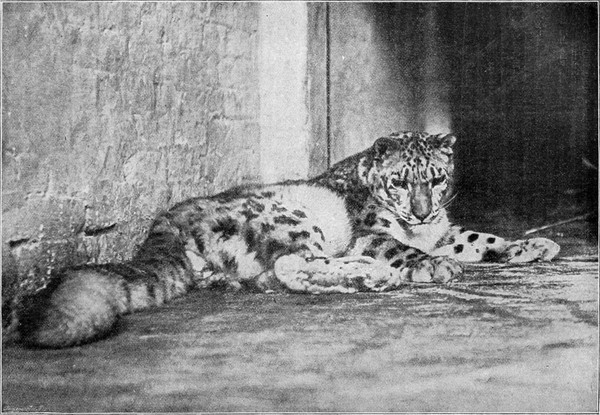
SNOW LEOPARD, OR OUNCE.
(From the Living Specimen in the Zoological Gardens, London.)
❏
LARGER IMAGE
The Ounce, or “Snow Leopard,” as it is commonly called by sportsmen
in the hills, is found throughout the Himalayas at a great elevation,
never very much below the snows, at ranges varying with the season from
9,000 to 18,000 feet. It is said to be more common on the Tibetan side
of the Himalayas; it is found also throughout the highland region of
Central Asia, and extends as far west as Smyrna.
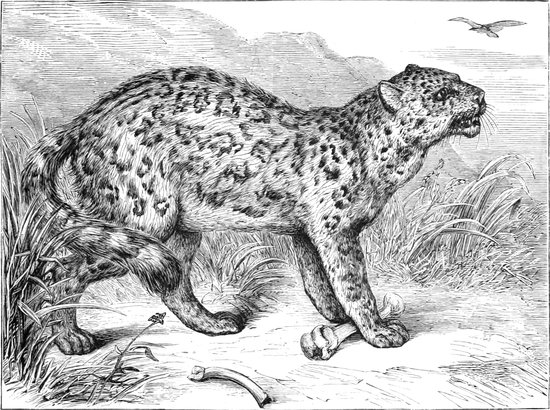
OUNCE.
It is about the same size as the Leopard (four feet four inches long,
excluding the tail), which it also resembles in habits; in fact, it
may be looked upon as a Leopard specially adapted for a cold climate.
The ground-colour of the skin is pale yellowish-grey, turning beneath
to dingy yellowish-white. It is spotted in much the same way as the
Leopard, though not so distinctly. “The fur throughout is very dense,
and it has a well-marked, though short mane. The face is short and
broad, and the forehead much more elevated than in any other Cat.”
The Ounce is said to frequent rocky ground, and to kill the Wild Sheep
as well as Domestic Sheep, Goats, and Dogs; but it has never been known
to attack man.
This animal, which is about intermediate in size between the great
Cats, such as the Lion, Tiger, or Leopard, and the lesser kinds, such
as the Ocelot, Eyra, or Tiger-Cats, is, as far as the markings of the
skin are concerned, one of the most beautiful animals in the whole
family. The ground-colour of the skin is not so fine as that of the
Tiger, being a light buff instead of a rich orange-tawny, but the
large, irregular, cloud-like patches of black are far more exquisite
than the parallel bands of the Tiger; and, indeed, the only animal
which in any way approaches it in the beauty of its markings is the
Ocelot, and from this the Clouded Tiger certainly bears the palm. Its
form is not particularly graceful, as its legs are short in comparison
with the length of its body, and its snout, though longer than that of
most Cats, is blunt and somewhat awkward. One of the chief beauties
of this creature, however, is its magnificent tail, which is fully
four-fifths the length of the body (the latter being some forty inches
long), and handsomely ringed with black. The skull is much elongated,
especially its facial portion, and bears a strong resemblance to that
of the extinct Felis smilodon. The pupil is oblong and erect, not
round, as in all the preceding species.
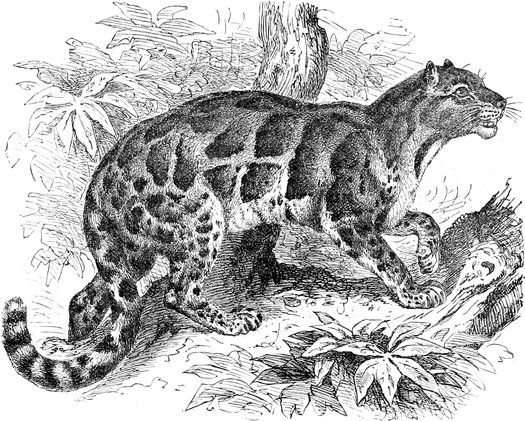
CLOUDED TIGER.
The Clouded Tiger, or Rimau Dahan, is found in Siam, Assam, Borneo,
Java, Sumatra, and the Malayan Peninsula. It was first introduced to
Great Britain by Sir Stamford Raffles, who brought two specimens with
him to England, of which he gives the following interesting account:—
“Both specimens above mentioned, while in a state of confinement,
were remarkable for good temper and playfulness; no domestic kitten
could be more so. They were always courting intercourse with persons
passing by, and in the expression of their countenance, which was
always open and smiling, showed the greatest delight when noticed,
throwing themselves on their backs, and delighting in being tickled and
rubbed. On board the ship there was a small Musi Dog, who used to play
round the cage and with the animal, and it was amusing to observe the
playfulness and tenderness with which the latter came in contact with
his inferior-sized companion. When fed with a fowl that had died, he
seized the prey, and after sucking the blood and tearing it a little,
he amused himself for hours in throwing it about and jumping after it
in the manner that a Cat plays with a Mouse before it is quite dead.
He never seemed to look on man or children as prey, but as companions,
and the natives assert that when wild they live principally on poultry,
birds, and the smaller kind of deer. They are not found in numbers, and
may be considered rather a rare animal, even in the southern part of
Sumatra. Both specimens were procured from the interior of Bencoolen,
on the banks of the Bencoolen River. They are generally found in the
vicinity of villages, and are not dreaded by the natives, except as
far as they may destroy their poultry. The natives assert that they
sleep and often lie in wait for their prey on trees; and from this
circumstance they derive the name of Dahan, which signifies the fork
formed by the branch of a tree, across which they are said to rest, and
occasionally stretch themselves.
“Both specimens constantly amused themselves in frequently jumping and
clinging to the top of their cage, and throwing a somerset, or twisting
themselves round in the manner of a Squirrel when confined, the tail
being extended and showing to great advantage when so expanded.”
Besides the localities we have mentioned, the Clouded Tiger is
described by Consul Swinhoe as existing in Hainan, and he gives a
curious quotation respecting the animal from a native paper, the
Hainan Gazetteer:—“Pao, or Leopard, resembling a Tiger in form, with
white fur and round head. Those with spots like cash (Chinese coin) are
called the ‘Golden-cash Leopard’ (Felis pardus). Those with spots
shaped like the mint-leaf are called Mint Leopard (F. macrocelis).
They dread Snakes. Hwai Nantzse has the following couplet:—‘Snakes
command the Leopard to stand: all creatures have their masters.’”
There was in 1876 a fine specimen in the Zoological Gardens, but it
was not always to be seen, as it was kept during the day fastened up
in one of the little sleeping apartments at the back of a cage in the
Lion-house, and was let out only for about half an hour before the
Gardens closed. It was well worth stopping to see. As soon as the iron
door of its cell was raised, it would come out into the large cage with
a peculiarly sailor-like slouch, for owing to the shortness of its legs
its gait was quite different to that of an ordinary Cat, and altogether
less elegant. The expression of the face, too, was neither savage, nor
majestic, nor intelligent, but rather dull and stupid. It was fond of
assuming all sorts of queer attitudes. Brehm describes one as lying
prone on a thick branch placed in its cage, with all four legs hanging
down straight, two on each side of the branch, certainly a remarkable
position for an animal to assume of its own free will.
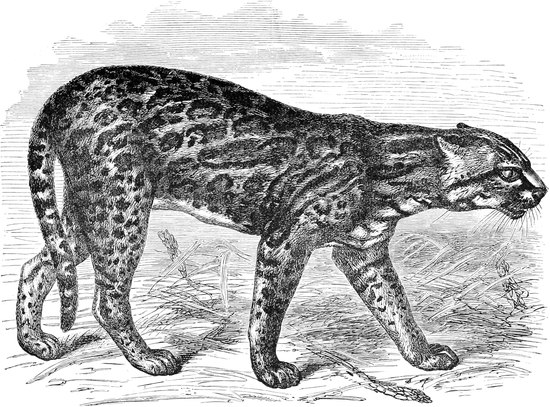
OCELOT.
This extremely beautiful Cat (see previous page) is, like the Jaguar
and the Ounce, a native of America, where it is found throughout the
central part of the Continent, from Mexico and Texas on the north, to
the northern boundaries of Brazil on the south. Its musical name was
coined by Buffon as an abbreviation of its native Mexican appellation
Tlalocelotl.
The grey or tawny skin is marked by broadly-sweeping rows of
longitudinally elongated spots of large size, each consisting of a
black rim enclosing an area somewhat darker than the general ground
tint. The head is also beautifully striped, and the tail ringed black.
Altogether, the Ocelot is, in the matter of markings, second only to
the Clouded Tiger. It is about four feet long from the snout to the tip
of the tail, and its legs are rather short for its size.
“It is a very voracious animal, but at the same time timid. It rarely
attacks men. It is afraid of Dogs, and when pursued it makes off to
the woods and climbs a tree. There it remains, and even takes up its
abode to sleep and look out for game and cattle, upon which it darts
as soon as they are within range. It prefers the blood to the flesh,
and, in consequence, destroys a vast number of animals, for instead of
devouring them, it only quenches its thirst by sucking their blood.”[26]
Notwithstanding its cowardice, the Ocelot is a very savage animal.
Buffon mentions a pair of young ones in captivity, which, at the age of
three months, were sufficiently strong and cruel to kill and devour a
bitch who had been given them as a nurse. He further adds the curious
fact, that the male always kept the female in wonderful subjection,
so much so, that she was afraid even to attempt to eat until he was
completely satisfied.
“This prettily-marked Wild Cat (see previous page) has been found
in the Sikkim Himalayas, in the hilly regions of Assam, Burmah, and
Malaysia, extending into the islands of Java, at all events.” The head
and body together are from eighteen and a half to twenty-three inches
long, the tail fourteen to fifteen and a half inches. The ground-colour
of its hide is of a dingy tawny, “occasionally yellowish-grey, the
body with numerous elongate wavy, black spots, somewhat clouded or
marbled.” The tail is spotted and tipped with black, and the belly is
yellowish-white.
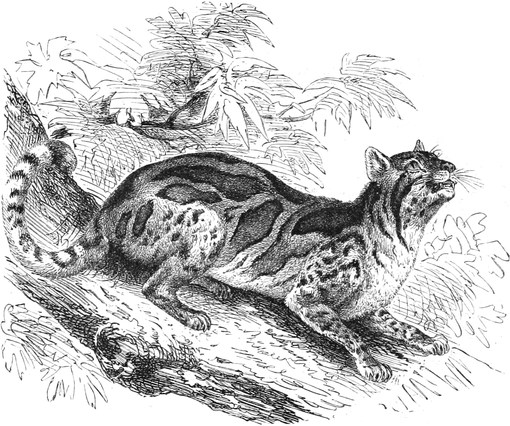
MARBLED TIGER-CAT.
“This large Tiger-Cat,” says Mr. Jerdon, “is found throughout Bengal,
up to the first of the South-eastern Himalayas, extending into Burma,
China, and Malaysia. I have not heard of its occurrence in Central
India, nor in the Carnatic; but it is tolerably common in Travancore
and Ceylon, extending up the Malabar coast as far as Mangalore. I have
had one killed close to my house at Tellicherry. In Bengal it inhabits
low, watery situations chiefly, and I have often got it upon the edge
of swampy thickets in Purneah. It is said to be common in the Terai
and marshy regions at the foot of the Himalayas, but apparently not
extending further west than Nepaul. Buchanan Hamilton remarks, ‘In the
neighbourhood of Calcutta it would seem to be common. It frequents
reeds near water; and, besides fish, preys upon Ampullinæ, Unios
(shell-fish), and various birds. It is a furious untamable creature,
remarkably beautiful, but has a very disagreeable smell.’ On this Mr.
Blyth observes, ‘I have not remarked the latter, though I have had
several big toms quite tame, and even found this to be a particularly
tamable species. A newly-caught male killed a tame young Leopardess of
mine about double his size.’ The Rev. Mr. Baker, writing of its habits
in Malabar, says that it often kills Pariah Dogs; and that he has known
instances of slave children (infants) being taken from their huts by
this Cat; also young calves.”
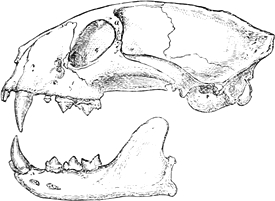
SKULL OF VIVERRINE CAT.
a. The bony bar formed by the union of the
frontal and jugal bones which complete the orbit behind.
Notwithstanding its ferocity this is by no means a large animal, being
only thirty to forty-four inches long, without the tail, which is ten
and a half to twelve and a half inches in length. “The ears are rather
small and blunt; the pupil circular; the fur coarse and without any
gloss; the limbs short and very strong.” The snout is narrow, and drawn
out like that of a Civet, hence the name Viverrina. The colour is
grey, lighter beneath, and banded and spotted with black. There is a
very noticeable peculiarity in the skull, from the fact that the orbit,
or bony cavity in which the eye is lodged, is completed behind by bone,
a character quite exceptional among Cats, and indeed among, Carnivora
generally.
A very fine specimen was brought over by the Prince of Wales after his
visit to India, and deposited in the Zoological Gardens in Regent’s
Park.
This animal, as its name implies, is found on the Pampas of South
America, extending as far south as the Strait of Magellan, and being
especially abundant in the region of the Rio Negro. It is about forty
inches long, with a shortish tail and long fur: the hairs, indeed,
sometimes attain a length of four or five inches. “The colour of the
skin is a pale yellowish-grey, traversed by regularly disposed yellow
or brown bands, which run obliquely from the back and the flanks. The
hairs, considered separately, are brown at the root, then yellow, and
finally black at the point, but those of the hinder part of the back
are black at the root, then grey, then yellowish-white, and finally
white up to the point, which is black.”
The Pampas Cat is a comparatively harmless beast, not preying upon
poultry-yards, but confining itself to the small Mammals which abound
in the South American steppes.
This little-known form—the “Oceloid Leopard” as it is sometimes
called—was discovered by Prince Maximilian of Neuwied, in Brazil,
where it inhabits the great forests, and is often killed for the sake
of its beautiful fur. In colour it is not unlike the Ocelot, in size
it is inferior to it, and its longitudinally elongated spots are
neither so large nor so well marked. It is chiefly distinguished from
other forms by its long bushy tail, and its big staring eyes. It is
considerably smaller than the preceding species, the body being about
twenty-seven inches long, the tail fourteen.
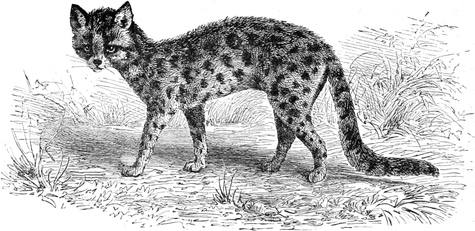
LONG-TAILED TIGER-CAT.
This is also an American species, being found in Brazil and Guiana,
where it is often known as the “Tiger-Cat.” It is much smaller than the
Ocelot—little larger than the Domestic Cat, in fact—the body being
about twenty-three inches long, and the tail thirteen, and resembles
the Ocelot in general appearance (see next page). Its spots are,
however, smaller, and more regularly arranged, so that it is by no
means so handsome an animal as F. pardalis.
It lives in the woods, and destroys an immense amount of small game
and birds. It is a savage beast, but is capable of domestication, and
may be put to good use as a mouser; it can never, however, be quite
trusted, and always keeps up a more or less ferocious appearance.
Still, it must be remembered that, in common with a large proportion
of the wild Felidæ, it has never had a fair chance of showing its
milder virtues. The Cats, almost without exception, are savage in the
extreme, and practically untamable when caught in the adult state, but
Mr. Bartlett informs us that there is hardly one of the group that may
not be thoroughly domesticated, if taken young and properly treated.
This is another Central American Tiger-Cat, of equal ferocity with the
last, but far less beautiful. The fur is rougher; the ground-colour
is tawny; the spots are smaller than in the Ocelot, and not so
exquisitely arranged. The whole body is some forty-one inches long, of
which the tail takes up about fourteen.
The Colocolo is an extremely ferocious animal, and does great harm in
the forests in which it lives, where, amongst other things, it feeds
largely on Monkeys. “On the banks of a river in Guiana, an officer,
having killed one of these Cats, stuffed it, and placed it to dry
in the hinder part of the boat in which he was travelling. One day
they passed under some great trees, the branches of which, hanging
into the water, formed a resting-place for innumerable Monkeys, which
approached the boat with great curiosity, and seemed to take pleasure
in following it as far as the trees would permit. On this particular
voyage, the Monkeys ran towards the boat as usual, but the sight of
the stuffed fur inspired them with such terror that they precipitately
took flight, uttering cries of rage and terror. This observation shows
clearly enough that Monkeys look upon the Colocolo as one of their most
terrible enemies.”[33]
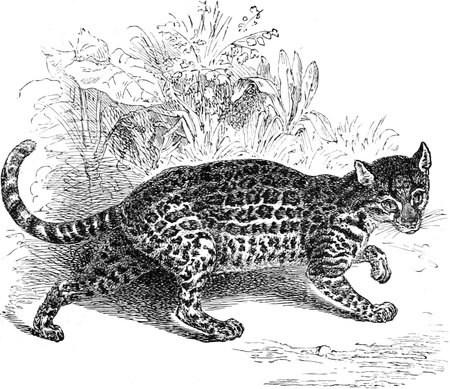
MARGAY.
This is a curious, long-bodied, short-legged animal (see next page),
with a body almost as lithe and lissom as a Weasel’s. Like the Puma’s,
its head is small and well shaped, and its tail long; but it is a much
smaller animal, not exceeding three feet in length, including the tail.
Its colour is a dark grey-brown, “each hair being greyish-black, very
dark at the root, and entirely black between the root and the point,
which is of a dark-grey hue. This diversity of colour causes the
Jaguarondi to appear darker or lighter according to circumstances,”
that is, according to whether, being in a placid condition, his hair is
lying smooth and flat on the body, or whether, being excited, he erects
it.
The Jaguarondi lives in the thick forests of Brazil, Paraguay, and
Guiana, where it always prefers the most impenetrable thickets, and is
never seen in the open country. It lives upon birds and small Mammals,
having a special fondness for fowls, which no amount of training will
ever diminish. Even when a domesticated Jaguarondi is chained up in
a yard, it will “try a thousand shifts” to entice the fowls into its
neighbourhood, and will then suddenly leap on and devour them.
This is by far the most beautiful of all the smaller one-coloured
Cats (see next page). The beauty of its rich chestnut hide, and the
extreme elegance of its form, quite incline one to assign to it the
palm for beauty, even in presence of such splendidly-marked forms as
the Ocelot. The specimen in the London Zoological Gardens is a most
delightful animal. It is slightly smaller than an ordinary Cat, and
much less in height, owing to the shortness of its legs, in comparison
with which the body is of great length; so that one at first sight
instinctively compares it with a Weasel, to which, however, it has
really no relationship whatever. Its neck is long, its head small, and
curiously flattened from above downwards, almost like an Otter’s, and
its tail long and well shaped. Its movements are almost Snake-like,
so continuously does it twist and turn its long lithe body. In its
sanguinary habits and mode of life it does not differ in any important
respect from the Jaguarondi, with which it also agrees in its
geographical distribution. It is, however, a much rarer animal.
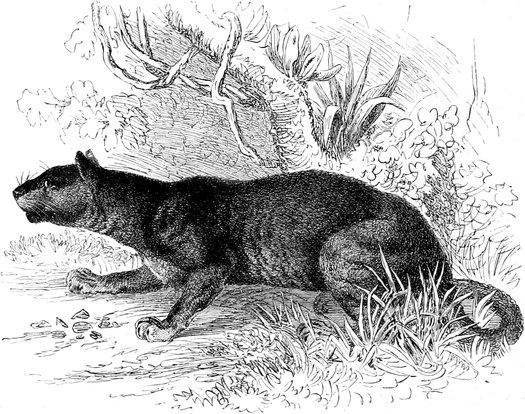
JAGUARONDI.
Mr. Bartlett informs us that he has kept the Eyra in his house, and
that it made a most charming pet. Brehm also mentions two domesticated
individuals which were on very good terms with the Cats and Dogs in the
house, and were particularly friendly with a Monkey, who did them the
kind office of catching their fleas.
The Serval, or African Tiger-Cat, is found over the greater part of
Africa, being specially abundant in the south, but extending also as
far north as Algeria. It especially frequents the extensive grassy
plains or steppes, where it lives upon Antelopes and other game.
Its legs are proportionally much longer and the tail much shorter than
those of most of the true Cats, in which respects it approaches the
Lynxes. It is distinguished from these, however, by the absence of
tufts of hair on the ears. The body is about forty inches in length,
the tail about sixteen inches. This, it will be seen, by a comparison
with the dimensions given of the preceding kinds, shows a much smaller
proportion between the tail and the body than in most of the true Cats,
but the appendage is never as short as in a Lynx. The ground-colour
of the skin is tawny, lighter or darker according to circumstances,
and spotted with black. The spots on the flank are all elongated
longitudinally, and, along the back, run into distinct bands which
are continued on to the forehead. This running together of spots into
longitudinal stripes is very common in the Cat tribe. The tail is
regularly ringed with black. The fur, although coarse, is handsome, and
much used.
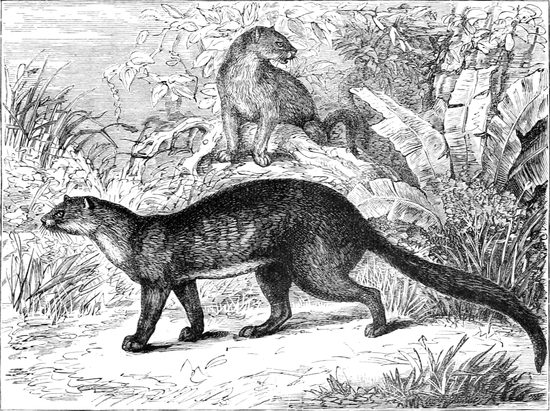
EYRA.
Mr. Jerdon says, “This very pretty little Cat frequents grass in the
dry beds of tanks, brushwood, and occasionally drains in the open
country and near villages, and is said not to be a denizen of the
jungle. I had a kitten brought over when very young, and it became
quite tame, and was the delight and admiration of all who saw it. Its
activity was quite marvellous, and it was very playful and elegant in
its motions. When it was about eight months old, I introduced it into
a room where there was a small fawn of the Gazelle, and the little
creature flew at it the moment it saw it, seized it by the nape, and
was with difficulty taken off.” There is something marvellous in this
destroying instinct. This kitten had, probably, never seen a Gazelle
before in the whole course of its short life, but it at once recognised
its prey, and all the savagery of its long line of ancestors was
concentrated in the spring which landed it on the unlucky Gazelle’s
neck.
The head and body of this species are together sixteen to eighteen
inches long; the tail, nine inches and a half. The short, soft
fur is a greenish-grey, with a faint rufous tinge, and marked with
rusty-coloured spots, roundish on the sides, but, as usual, becoming
elongated in the direction of the animal’s length, on the back. It is
found in the Carnatic, and in the southern parts of Ceylon.
This is another of the numerous Indian Cats, and is a very beautiful
species. Its hide is of a yellowish-grey, or bright tawny hue, quite
white below, and marked with longitudinal stripes on the head,
shoulders, and back, and with large irregular spots on the sides,
which become rounded towards the belly. The tail is a spotted colour,
indistinctly ringed towards the tip. The body, from the end of the
snout to the tip of the tail, attains a length of from thirty-five to
thirty-nine inches, eleven or twelve of which are made up by the tail.
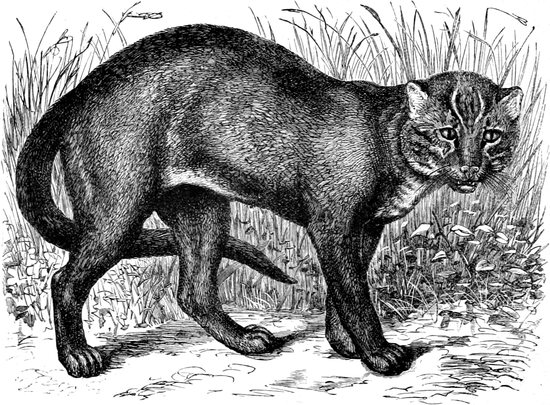
BAY CAT.
“The Leopard Cat is found throughout the hilly region of India, from
the Himalayas to the extreme south, and Ceylon, and in richly-wooded
districts, at a low elevation occasionally, or when heavy jungle grass
is abundant, mixed with forest and brushwood. It ascends the Himalayas
to a considerable elevation, and is said by Hodgson even to occur in
Tibet, and is found at the level of the sea in the Bengal Sunderbunds.
It extends through Assam, Burmah, the Malayan peninsula, to the islands
of Java and Sumatra, at all events.”[39]
It is as fierce as any of its savage kin. “A shikarie declared that it
drops on large animals, and even on Deer” (remember that the animal is
only two feet long!) “and eats its way into the neck; that the animal
in vain endeavours to roll or shake it off, and at last is destroyed.”
In confinement it is extremely savage, and, curiously enough, “it
never paces its cage for exercise during the daytime, at least, but
constantly remains crouched in a corner, though awake and vigilant.”
This animal (see figure on previous page) is found on the Gold Coast
of Africa, as well as in Nepaul, Sumatra, and Borneo. It is of a deep
bay-red colour above, becoming paler below: there are a few indistinct
dark spots on the hind legs, and the head is splendidly ornamented with
stripes of black, white, and orange, offering a striking contrast to
the uniform tint of the body, and reminding one strongly of the Tiger.
The head and body measure about thirty-one inches, the tail nineteen
inches.
Unfortunately nothing is known of the habits of this Cat, so that
we can only assume that it has the same savage nature and untamable
disposition as the members of its family most nearly allied to it.
The habits of this Indian species differ a good deal from those of most
Wild Cats, for instead of living in forests and jungles, it frequents
“open, sandy plains, where the Field Rat must be its principal food. I
hardly ever remember seeing it in what could be called jungle, or even
in grass.”[42]
It is of a grey colour, spotted with black, and attains a length of
sixteen to eighteen inches, not including the tail, which measures ten
or eleven inches more. The ears are of a dull-reddish colour, and have
a small tuft of hair on the tip, thereby showing a relationship between
this Cat and the Lynxes.
The Manul seems to replace the common Wild Cat in Northern Asia, where
it occurs on the steppes of Tartary and Siberia. It was discovered by
Pallas, who gives no account of its habits.
Its body is twenty-eight, its tail twelve inches long, so that it is
about the same length as the Wild Cat; it has, however, longer legs.
The skin contains a mixture of yellowish and of white hairs; the head
is striped, and the tail ringed with black.
This is an animal (see figure on next page) of great historic interest,
as its remains have been found embalmed in the Egyptian monuments. At
the present day it is found in Abyssinia and Egypt.
It is about the size of an average Domestic Cat, but has a longer
tail. The general colour is light tawny or yellowish-grey, with dark
transverse bands. The tail is tawny above, white below, and ringed only
at the termination.
The Wild Cat exists in “all the wooded countries of Europe, Germany
especially, Russia, Hungary, the North of Asia, and Nepaul. This
animal is larger in cold climates, and its fur is there held in high
estimation. In Britain it was formerly plentiful, and was a beast of
chase, as we learn from Richard the Second’s Charter to the Abbot of
Peterborough, giving him permission to hunt the Hare, Fox, and Wild
Cat. The fur in those days does not seem to have been thought of much
value, for it is ordained in Archbishop Corboyl’s canons, A.D.
1127, that no abbess or nun should use more costly apparel than such as
is made of Lambs’ or Cats’ skins.
“The Wild Cat is now rarely found in the South of England, and even in
Cumberland and Westmoreland its numbers are very much reduced. In the
North of Scotland and Ireland it is still abundant.”
The average length of a full-grown male specimen is, from snout to root
of tail, about twenty-eight inches, the tail itself measuring about
thirteen inches. The soft thick fur is of a grey colour, inclining to
yellowish on the face, and being nearly white on the belly. There is a
black band along the middle of the back, from which numerous dark-grey
bands proceed in a transverse direction like the hoops of a barrel,
gradually dying away as they reach the belly. The thick tail is ringed
with grey and black.
“The Wild Cat leads a solitary life; at most, two individuals are seen
together. It even appears that the occupant of one district prevents
access to it of any others. Its life is completely nocturnal, and has
much analogy with that of the Lynx and of our own Domestic Cat. It
climbs well, and mounts trees, either as a resting-place, or to escape
from an enemy when there is no hole in which it can hide. Under this
circumstance it ‘plays ’possum’ to the best of its ability, keeping
close to a large branch, the colour of which, harmonising with that of
its skin, contributes to conceal it from view. It does not commence
its hunting operations until night has set in; and, in surprising the
bird in its nest, the sitting Hare, the Rabbit in its burrow, and even
the Squirrel on its tree, it displays a cunning unsurpassed by any of
its tribe. When the quarry is a small animal, it leaps on its back and
severs its carotids with its sharp teeth. It never pursues an animal
which it has failed to reach at the first onslaught, but prefers to
go in search of new prey; in a word, it has all the characters of a
true Cat. Happily for hunters, its principal nutriment consists of
Mice and small birds. It is only by accident that it seeks for larger
animals; it is, however, certain that it sometimes attacks Fawns or
small Roes. It keeps watch by the banks of lakes and streams for
fish and birds, both of which it knows full well how to seize. It is
extremely destructive in parks, and, above all, in covers, which it
utterly depopulates in a very short time. Considering its size, the
Wild Cat is a very dangerous Carnivore, its sanguinary nature inciting
it to kill far more animals than it can possibly eat. For this reason
all hunters detest it, and pursue it with perfect hatred. But no one
seems to remember the services it renders to man in destroying small
Rodents, and yet these services are undoubted. Tschudi relates that the
remains of twenty-six Mice have been found in the stomach of a single
individual of this species.”[46]
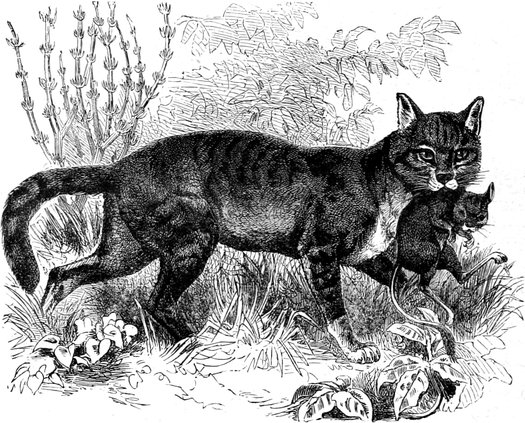
EGYPTIAN CAT.
This interesting account shows how little difference there is between
the habits and the nature of this little wild beast of Great Britain
and its big cousins of the African and Indian jungles. In its nocturnal
habits, its mode of attack, its bloodthirstiness, and its wanton
cruelty, it is just the Tiger over again on a small scale, only less
harmful because less powerful. Some idea of its immense strength may be
gathered from the fact that it is known to have actually killed men.
In some places the Wild Cat is regularly hunted, usually in winter,
when the tracks in the snow are easily followed. The sport has the
necessary element of danger to no ordinary degree, for the terrible
little beast, if wounded, makes straight for the hunter, and attacks
him with tooth and claw, and such teeth and such claws are by no means
pleasant things to be wounded with. On the whole, we have hardly reason
to be sorry that the race is almost extinct in Great Britain.
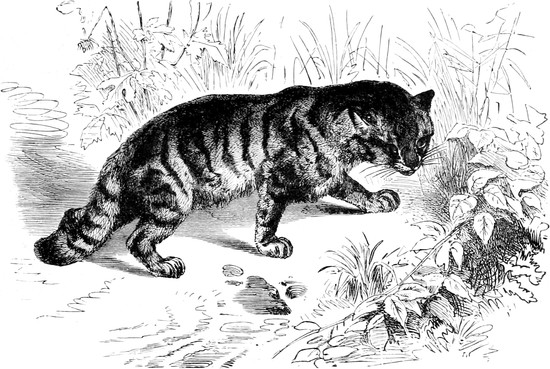
COMMON WILD CAT.
This animal—the Cat par excellence—is, next to the Dog, the
flesh-eater which possesses for us the greatest personal interest,
as it is, with the exception of the Dog, almost the only quadruped
regularly admitted into the society of man, eating from his hand,
drinking from his cup, and being to him, if not a firm friend, like
its canine relative, at least a comfortable, contented companion,
adding greatly by its look of calm repose and its contented purr to the
cosiness of the fireside.
The origin of the Domestic Cat is so far distant that it is quite
uncertain from what wild species it was derived. It is not once
mentioned in the Bible, a very curious circumstance, as it was well
known in Egypt, and it might have been expected that it would be
named, with the Dog, among the unclean animals. Cats “are mentioned in
a Sanskrit writing 2,000 years old, and in Egypt their antiquity is
known to be even greater, as shown by monumental drawings and their
mummied bodies.” From many circumstances it seems probable that the
Cat had, like the Dog, a multiple origin, that is, was produced by the
commingling of several wild forms. It is certain that our Domestic Cats
will breed freely with many of their feral brethren, such as the Common
Wild Cat, the Chaus, Viverrine, and Rusty-spotted Cats, &c.
Wherever the Cat is found as a domesticated animal it is held in great
esteem. This feeling was carried to its greatest extent by the ancient
Egyptians, whose devotion to their pets was such that, according to
Herodotus, when a fire broke out, they cared for nothing but the
safety of their Cats, and were terribly afflicted if one of them fell
a victim to the flames. On the death of a Cat, the inhabitants of the
house shaved off their eyebrows, and the deceased animal was embalmed,
and buried with great solemnity in a sacred spot. Many Cat mummies
have been found in the Egyptian tombs, and some are to be seen in the
British Museum, together with similarly preserved specimens of human
beings, and of sacred Calves. Some individuals were wrapped separately
in ample bandages covered with inscriptions; others of a less degree of
sanctity were preserved in numbers with a single wrapping for several.
Their movements and their cries were consulted as oracles, and the
murder, or even the accidental felicide of one of them, was punished by
death.
TEETH OF DOMESTIC CAT.
The earliest account of the Cat in Britain is as far back as
A.D. 948. “That excellent prince Howel Dha, or Howel the
Good, did not think it beneath him, among his laws relating to the
prices, &c., of animals, to include that of the Cat, and to describe
the qualities it ought to have. The price of a kitling, before it
could see, was to be a penny; till it caught a Mouse, twopence. It was
required, besides, that it should be perfect in its senses of hearing
and seeing, be a good mouser, have the claws whole, and be a good
nurse; but if it failed in any of these qualities, the seller was to
forfeit to the buyer the third part of its value. If any one stole or
killed the Cat that guarded the prince’s granary, he was to forfeit a
milch ewe, its fleece, and lamb, or as much wheat as, when poured on
the Cat, suspended by its tail (the head touching the floor), would
form a heap high enough to cover the tip of the former. This last
quotation is not only curious as being an evidence of the simplicity of
ancient manners, but it almost proves to demonstration that Cats are
not aborigines of these islands, or known to the earliest inhabitants.
The large prices set on them, if we consider the high value of
specimens at that time, and the great care taken of the improvement and
breed of an animal that multiplies so fast, are almost certain proofs
of their being little known at that period.”[48] Moreover, as the Wild
Cat was abundant in Britain at this or at more recent periods, it is
tolerably certain that this species is not the parent of our domestic
kinds.
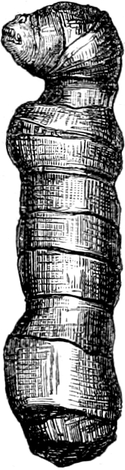
MUMMY OF EGYPTIAN CAT.
Little need be said about the anatomy of the Cat, for it differs but
slightly from its larger relatives, and hardly at all from the smaller
wild species. The skull is smooth, and has its ridges less developed
than in the great beasts of prey; the orbits are very large, and the
nose-region is extremely short, and forms a continuous curve with the
forehead. Owing to these two latter circumstances the Cat is extremely
round-faced, more so, perhaps, than any other species of the genus.
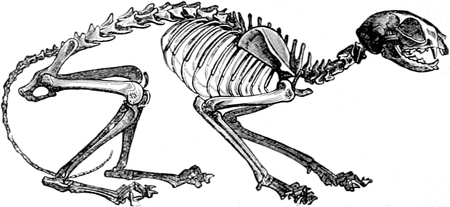
SKELETON OF DOMESTIC CAT.
One curious point of structure is to be found in the intestines, which
“are wider, and a third longer, than in Wild Cats of the same size.”
There can be little doubt that this has been brought about by the fact
that the food of a domesticated flesh-eater is certain to be somewhat
miscellaneous, and not of the strictly carnivorous nature preferred by
the animal in its wild state.
The varieties in colour exhibited by the Cat are very great, and often
kittens in the same litter will differ greatly in this respect. “The
normal colour,” according to Dr. Gray, “seems to be that of the Tabby
Cat, grey, with black dorsal streaks and sub-concentric bands on the
sides and thighs; sometimes all black from melanism, or grey, blue,
yellow, or white, or these colours more or less mixed. When black,
white, and yellow, it is called Tortoiseshell, or Spanish Cat. The fur
varies greatly in length; it is very short, close, and almost erect
from the skin in the Rabbit Cats. It is very long, silky, and fluffy
in the Angora (or Angola) Cat. The tail is usually long. It is very
short or almost entirely wanting in the Isle of Man Cats, or the Japan
Cats of Kæmpfer. The ears are generally erect; but they are sometimes
pendulous in the Chinese Cats.”
With regard to the colour of Cats, a very curious circumstance has been
observed, namely, that White Cats with blue eyes are nearly always
deaf! The only rational explanation of this remarkable phenomenon is
that suggested by Mr. Wallace, namely, that the absence of colour
in the skin is usually accompanied by a similar absence of pigment
elsewhere, and it has been shown that the presence of a peculiar black
pigment is very essential to the proper action of the sense organs. To
bear out this view it may be stated that Albinos—that is, abnormally
colourless animals—are usually deficient in taste, smell, and sight.
The eye also varies much in colour, being blue, yellow, or green. The
pupil, or small black aperture in the centre of the coloured portion,
is extremely sensitive, dilating greatly in the dark, and contracting
to a mere line when the light is strong.
We have already mentioned the skin-muscle, or thin band of flesh lying
immediately under the skin, and by means of which the shivering of the
skin, the erection or rendering vertical of hairs, &c., is performed.
The latter effect—an effect seen on a small scale in ourselves as
“goose-skin”—is well seen in the Cat, for the animal invariably
makes its hair stand on end when it is angry or alarmed, and so makes
itself look as large and terrible as possible. In the manner of using
this muscle, as well as in many other matters, the Cat resembles in a
remarkable degree the great beasts of prey, and forms a capital study
of feline expression. Every one must have noticed the instantaneous
change in the whole demeanour of a Cat when it catches sight of a
strange Dog. This and other characteristic attitudes are well described
by Mr. Darwin.[49]
“When this animal is threatened by a Dog it arches its back in a
surprising manner, erects its hair, opens its mouth, and spits.” This
well-known attitude “is expressive of terror combined with anger. Anger
alone is not often seen, but may be observed when two Cats are fighting
together; and I have seen it well exhibited by a savage Cat whilst
plagued by a boy. The attitude is almost exactly the same as that of a
Tiger disturbed, and growling over its food, which every one must have
beheld in menageries. The animal assumes a crouching position, with
the body extended; and the whole tail, or the tip alone, is lashed or
curled from side to side. The hair is not in the least erect. Thus far,
the attitude and movements are nearly the same as when the animal is
prepared to spring on its prey, and when, no doubt, it feels savage.
But when preparing to fight, there is this difference, that the ears
are closely pressed backwards; the mouth is partially opened, showing
the teeth; the fore-feet are occasionally struck out with protruded
claws, and the animal occasionally utters a fierce growl. Let us now
look at a Cat in a directly opposite frame of mind, whilst feeling
affectionate and caressing her master, and mark how opposite is her
attitude in every respect. She now stands upright with her back
slightly arched, which makes the hair appear rather rough, but it does
not bristle. Her tail, instead of being extended and lashed from side
to side, is held quite stiff and perpendicularly upwards; her ears are
erect and pointed; her mouth is closed, and she rubs against her master
with a purr instead of a growl. Let it further be observed how widely
different is the whole bearing of an affectionate Cat from that of a
Dog, when, with his body crouching and flexuous, his tail lowered and
Wagging, and ears depressed, he caresses his master.
“We can understand why the attitude assumed by a Cat when preparing
to fight with another Cat, or in any way greatly irritated, is so
widely different from that of a Dog approaching another with hostile
intentions; for the Cat uses her fore-feet for striking, and this
renders a crouching position convenient or necessary. She is also much
more accustomed than a Dog to lie concealed and suddenly spring on
her prey. No cause can be assigned with certainty for the tail being
lashed or curled from side to side. This habit is common to many other
animals, for instance, to the Puma, when prepared to spring; but it is
not common to Dogs or to Foxes.”
Under ordinary circumstances, when neither attacking a foe nor
caressing a friend, the Cat is the very image of lazy content. As she
sits by the fire, softly purring, and occasionally licking her paws
and rubbing them over her face, she seems an embodiment of repose,
an incarnation of otium cum dignitate, a standing discourse on the
advisability of
“Holding it ever the wisest thing
To drive dull care away.”
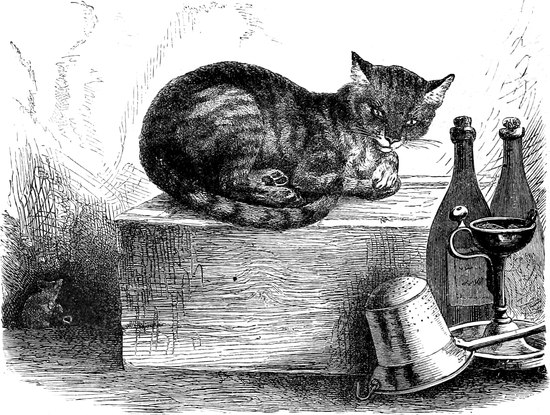
DOMESTIC CAT.
But notwithstanding its usual indolence, the Cat, like all its
congeners, is capable of very violent action upon occasions. This is
more especially the case with kittens, who are, perhaps, the most
delightful of all young animals: the most elegant, the most active, the
most restless, the most overboiling with life and spirits. Who has not
watched a kitten play? No matter what its toy may be; it is content
with anything movable—a ball, a piece of string, a lady’s dress, the
fallen leaves in the garden—anything and everything she will play
with, and as she plays, “grace is in all her steps,” every movement
of her head, every pat of her velvet paw, every whisk of her little
tail, is elegance itself. Even in the old Cat this wonderful power
of executing the most rapid movements with almost the quickness of
thought is rather in abeyance than actually absent; she can still run,
leap to many times her own height, climb a tree or a vertical wall by
means of her sharp claws, and perform other marvellous gymnastic feats
impossible to anything else but a Squirrel or a Monkey.
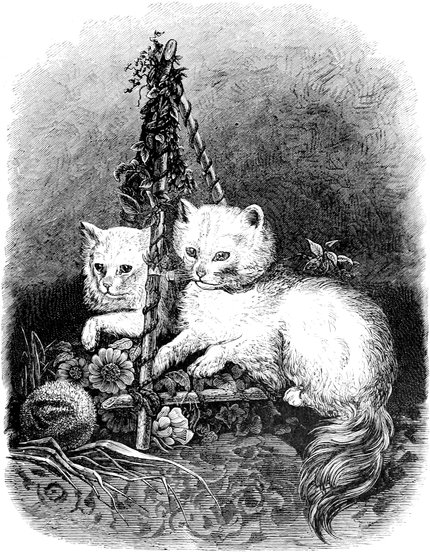
ANGORA KITTENS.
The sense which of all others is most deficient in the Cat is that
of smell. In this she differs most markedly from the Dog. It is said
that a piece of meat may be placed in close proximity to a Cat, but
that, if it is kept covered up, she will fail to distinguish it. This
want is, however, partly compensated for by an extremely delicate
sense of touch, which is possessed, to a remarkable extent, by the
whiskers, or vibrissæ, as well as by the general surface of the skin.
These bristles, as we have already mentioned in speaking of the Tiger,
are possessed to a greater or less extent by all Cats, and are simply
greatly developed hairs, having enormously swollen roots, covered with
a layer of muscular fibres, with which delicate nerves are connected.
By means of these latter, the slightest touch on the extremity of the
whiskers is instantly transmitted to the brain. These organs are of the
greatest possible value to the Cat in its nocturnal campaigns. When it
is deprived of the guidance afforded by light it makes its way by the
sense of touch, the fine whiskers touching against every object the Cat
passes, and thus acting in precisely the same manner as a blind man’s
stick, though with infinitely greater sensibility. Imagine a blind
man with not one stick, but a couple of dozen, of exquisite fineness,
and these not held in his hand, but embedded in his skin, so that his
nerves come into direct contact with them instead of having a layer of
skin between, and some notion may be formed of the way in which a Cat
uses its whiskers.
But the Cat in its night walks has a further advantage over the blind
man, namely, that except on the very darkest nights, it is not entirely
deprived of the power of sight, for, as we have already mentioned, the
pupil is so constructed that in the dark it can be dilated, so as to
catch every available ray of light, and, moreover, the tapetum, or
brilliant lining of the eyeball, reflects and magnifies the straggling
beams, and so enables the Cat, if not actually to “see in the dark,” as
is sometimes stated, at least to distinguish objects in an amount of
light so small as to be inappreciable to our duller vision.
As we have already mentioned, the Domestic Cat is less strictly
carnivorous than the wild Felidæ: still it prefers meat or milk to
anything else, and is by no means a miscellaneous feeder, like the
Dog. In the matter of diet, Gilbert White remarks[50]—“There is a
propensity belonging to common house Cats that is very remarkable. I
mean their violent fondness for fish, which appears to be their most
favourite food; and yet Nature in this instance seems to have implanted
in them an appetite that, unassisted, they know not how to gratify;
for, of all quadrupeds, Cats are the least disposed towards water, and
will not, when they can avoid it, deign to wet a foot, much less to
plunge in that element.” Mr. White does not seem to have known of the
habits of the Jaguar.
A curious instance of the selection of their food by Cats and Dogs is
given by the same author:—“As my neighbour was housing a rick, he
observed that his Dogs devoured all the little red Mice that they could
catch, but rejected the common Mice; and that his Cats ate the common
Mice, refusing the red.”
This may be partly accounted for by the fact that the little Harvest
Mouse has scarcely any trace of the odour which makes the domestic kind
disagreeable, and which odour is not disliked, or perhaps is hardly
perceived, by the Cat. Both Dogs and Cats, when the corn-ricks are
being housed for threshing, will go on helping the farmer and his men
for hours, killing Mice by hundreds and by thousands long after they
have been satiated by eating them. These Mouse battues illustrate the
intelligence of the Cat as well as of the Dog, in a quick understanding
of what relates to their own interest; for they know immediately what
the removal of the thatch from the rick means, and, as it were, scent
their prey before it is unearthed. Yet the food-treasures in these
ricks are not unknown to the Cats, who night by night for months,
perhaps, have caught and regaled themselves upon stragglers from the
swarm.
But although of most domestic Cats it may be said,
“Rats and Mice, and such small deer,
Have been Tom’s food for many a year,”
yet, in districts that have the game well “preserved,” this sort of
diet is often exchanged for that of nobler prey, and the tame Cat will
stray for months from the homesteads for young Rabbits, Leverets, and
the Partridge covey. This poaching is almost sure to end in death, as
these Cats are closely watched by the keepers.
One curious thing about these poaching habits is that they run in
families. As Mr. Darwin says, one Cat “naturally takes to catching
Rats, and another Mice, and these tendencies are known to be inherited.
One Cat, according to Mr. St. John, always brought home game birds,
another Hares or Rabbits, and another hunted on marshy ground, and
almost nightly caught Woodcocks or Snipes.”
A Cat who has once taken to habits like these soon loses her taste for
human society and a comfortable fireside, and becomes quite wild and
almost as untamable as one of the actually feral species. Many years
ago, in a village where we were then living, a female half-wild Cat
made furtive visits to an old and extensive farmstead for the sake of
the dove-cot Pigeons, and for the safer rearing of her young. These she
would deposit, not in-doors, like our tame, pet Cats, but generally in
the fagot-stack, and once in a corner of the thick house-thatch, in
which was a labyrinth of passages made by the grey Rat. This Cat would
form no friendship with us, but made almost demoniacal demonstrations
of her combined hatred and fear. Her swearing and her spitting were
accomplishments learned by her kittens as soon as they could see, and
no care of ours could tame them.
One of the most remarkable things about the Cat is its habit of always
burying its excrement, whether solid or liquid. A Cat living in the
house is easily trained to leave the premises for this purpose, and
will always be found to cover her droppings with earth; but even young,
untrained Cats of dirty habits, who cannot be kept from occasionally
defiling the house, will invariably try to hide their sin by scraping
up cinders, &c., over it, or will, at any rate, make vigorous scratches
at the carpet, in their endeavours to get up some of it for the same
purpose. How a habit of this sort can have originated in an animal
living in the woods, as do all the Cats when in a wild state, is a
puzzle.
Like most of the Carnivora, the Cat is a tender and affectionate
mother; the care with which she trains her young ones, her anxiety for
their comfort, her industry in washing them, are too well known to
require remark. So fond is she of her offspring that she will entirely
alter her usual habits to regain lost ones. Mr. Hugh Miller, F.G.S.,
tells us of a Cat belonging to a clergyman in Northumberland, whose
kittens were taken from her and given to a miller living at a distance
of fully two miles, quite beyond the usual walk of a home-loving puss.
The mother, however, although she had never been to the place before,
and could by no possibility have known where her kittens were taken,
made two successive journeys to the mill, each time bringing back in
triumph to the rectory one of her dear ones.
So strong is the maternal instinct in the Cat that she will, if
deprived of her own offspring, bestow her affections on animals of a
totally different species, on creatures even, which, under ordinary
circumstances, she would look upon as her natural and lawful prey. The
following is a remarkable instance of this overpowering mother-love:—
“My friend had a little helpless Leveret brought to him, which the
servants fed with milk in a spoon, and about the same time his Cat had
kittens, which were despatched and buried. The Hare was soon lost,
and was supposed to be gone the way of most foundlings, to be killed
by some Dog or Cat. However, in about a fortnight, as the master was
sitting in his garden in the dusk of evening, he observed his Cat, with
tail erect, trotting towards him, and calling, with little, short,
inward notes of complacency, such as they use towards their kittens,
and something gambolling after, which proved to be the Leveret that the
Cat had supported with her milk, and continued to support with great
affection.”[51]
Thus was a graminivorous animal nurtured by a carnivorous and
predaceous one! Why so cruel and sanguinary a beast as a Cat, of the
ferocious genus Felis, the Murium Leo (Lion of the Mice), as
Linnæus calls it, should be affected with any tenderness towards an
animal which is its natural prey, is not so easy to determine. This
incident is no bad solution of that strange circumstance which grave
historians, as well as the poets, assert of exposed children being
sometimes nurtured by wild beasts that probably had lost their young.
For it is not one whit more marvellous that Romulus and Remus, in their
infant state, should be nursed by a she-Wolf, than that a poor little
suckling Leveret should be fostered and cherished by a Cat.
White, in his “Observations,” has another similar anecdote. “A boy has
taken three little young Squirrels in their nest, or eyry, as it is
called in these parts. These small creatures he put under the care of
a Cat who had lately lost her kittens, and finds that she nurses and
suckles them with the same assiduity and affection as if they were
her own offspring. This circumstance corroborates my suspicion that
the mention of exposed and deserted children being nurtured by female
beasts of prey who had lost their young, may not be so improbable an
incident as many have supposed; and, therefore, may be a justification
of those authors who have gravely mentioned what some have deemed to
be a wild and improbable story. So many people went to see the little
Squirrels suckled by a Cat, that the foster-mother became jealous of
her charge, and in pain for their safety, and therefore hid them over
the ceiling, where one died. This circumstance showed her affection for
these foundlings, and that she supposed the Squirrels to be her own
young.”
Equally remarkable as an instance of the transference of maternal
affection is the tale of the Cat whose kittens were replaced by two
out of the five pups belonging to a Spaniel. The Cat brought up her
foster children so well, that they were able to run about long before
the three left under the charge of their own natural mother. Before
long they were removed, and the Cat was inconsolable, until, one day,
coming across the Spaniel and her pups, she concluded that the latter
were her own lost darlings, and in her eagerness to get them engaged
in two successive fights with the Spaniel, in each of which she was
victorious, and after each of which she carried away a pup to her own
premises, thus getting again, as she thought, her own two children, and
the Spaniel being obliged to content herself with one.
This last anecdote is also remarkable because of the wonderful
instinctive antipathy existing between Dogs and Cats, an antipathy
which is one of the most curious instances of inherited instinct, for
a young kitten, who has never seen a Dog in its life will, on being
approached by one, put up its back, and swear and spit with all the
force of feline Billingsgate. It is only after living in the same house
with a Dog for some time that a Cat will become reconciled to him, but
when she once gets to tolerate his presence, the two often become very
good friends.
The most astonishing tale we have met with, with respect to their
intelligence and sensibility, is one by Mr. C. H. Ross. He states that
a Cat in his possession “would climb upon the top of the piano, and,
sitting close underneath the picture” of a Bulldog, “fix its eyes upon
the Dog’s face, and, putting back its ears, remain there, with a wild
and terrified expression, for as long as an hour at a time,” and this,
too, while there were two living Dogs in the house with whom she was on
perfectly good terms. This is extraordinary enough, for it is usually
stated that animals do not recognise pictures unless they are coloured,
and the illustration in question was an engraving. But the queerest
part of the story is yet to come. “During the time that he noticed
this conduct on the Cat’s part, she was with kitten, and when the four
kittens were born they were dead, and one of them, strange to say, had
a Bull-dog-shaped head, marked almost exactly like the picture!”
Instances are not wanting in which Cats have formed friendships with
birds—creatures which, as a rule, they look upon as their natural
prey. One example of an affection of this sort is extremely curious.
A Cat and a Canary had acquired a great fondness for one another. The
Canary used to perch on the Cat’s back and play all sorts of pranks
with it. One day their master saw, with horror, the feline Damon rush
upon his passerine Pythias and seize it in his mouth. He naturally
thought that at last nature had triumphed over grace, but on looking
round saw that another Cat had entered the room, to whose tender
mercies the bird-lover would by no means trust his little friend.
Like its natural enemy the Dog, the Cat is sometimes afflicted with
rabies, or madness. Mr. Youatt, a great authority on the subject,
says:—“Fortunately for us this does not often occur; for a mad Cat
is a truly ferocious animal. I have seen two cases, one of them to my
cost; yet I am unable to give any satisfactory account of the progress
of the disease. The first stage seems to be one of sullenness, and
which would probably last to death; but from that sullenness it is
dangerous to rouse the animal. It probably would not, except in the
paroxysm of rage, attack any one; but during that paroxysm it has no
fear, nor has its ferocity any bounds.
“A Cat that had been the inhabitant of a nursery, and the playmate of
the children, had all at once become sullen and ill-tempered. It had
taken refuge in an upper room, and could not be coaxed from the corner
in which it had crouched. It was nearly dark when I went. I saw the
horrible glare of her eyes, but I could not see so much of her as I
wished, and I said that I would call again in the morning. I found the
patient on the following day precisely in the same situation and the
same attitude, crouched up in a corner, and ready to spring. I was very
much interested in the case; and as I wanted to study the countenance
of this demon, for she looked like one, I was foolishly, inexcusably
imprudent. I went on my hands and knees, and brought my face nearly on
a level with hers, and gazed on those glaring eyes and that horrible
countenance, until I seemed to feel the deathly influence of a spell
stealing over me. I was not afraid, but every mental and bodily power
was, in a manner, suspended. My countenance, perhaps, alarmed her, for
she sprang on me, fastened herself on my face, and bit through both
my lips. She then darted down-stairs, and, I believe, was never seen
again. I always have nitrate of silver in my pocket; even now I am
never without it. I washed myself and applied the caustic with some
severity to the wound; and my medical adviser and valued friend, Mr.
Millington, punished me still more after I got home. My object was
attained, although at somewhat too much cost, for the expression of
that brute’s countenance will never be forgotten.”
Except as fur-bearing animals, Cats are made no direct use of, save as
Mouse and Rat-catchers. In this capacity they are quite invaluable,
for these destructive little Rodents increase and multiply to such an
extent, that if it was not for some such check as that afforded by
the presence of a good mouser, many places would be as much overrun,
and the inhabitants put to as much inconvenience, as were the people
amongst whom Dick Whittington’s lot was cast. With regard to the number
of these plagues of which a single Cat can rid the neighbourhood, it is
stated by M. Lenz, as a well-ascertained fact, that a Cat of ordinary
size is fully capable of catching and eating twenty Mice a day, or
7,300 a year! Besides Rats and Mice, they are fond of insects, such as
Cockroaches; and in some countries, such as Paraguay, they are found to
be of great value in killing Serpents, which, however, they are said
never to eat, slaying them by repeated dexterous blows of the paw,
simply for the sport.
The Domestic Cat is found wherever civilised man exists. It occurs
throughout Europe and Asia, and has spread largely in America and
Australia since the discovery of these continents by Europeans. The
best-marked variety of the species is the beautiful Angora Cat, which
is larger than the ordinary Cat, and covered with long fine hair,
usually snow-white. The Manx Cat, native only in the Isle of Man, is
distinguished by the very remarkable character of being tailless, or,
at least, that appendage is quite rudimentary. In other respects, it
does not differ from the ordinary varieties. The Persian Cat is a very
fine variety often seen in English drawing-rooms; its hair is long,
though nothing like so long as that of the Angora. It is a remarkably
lazy beast, and far less interesting than the ordinary kind.
The Chinese Cat has also long silky fur and pendent ears, and is
regularly fattened and eaten. Mr. Swinhoe gives a curious quotation
about this animal from the Hainan Gazetteer. “‘Lino’ (or Domestic
Cat) ‘cannot endure Fleas or Lice on its skin. Cats that have nine
holes inside the mouth will catch Rats the four seasons through.’”
What the Chinese Gazetteer means by the nine holes is difficult to
imagine. Is it not a celestial piece of hyperbole for a Cat with a good
large gullet?—just as we speak of their tenacity of life by saying
that they have nine lives—thus our Cat has nine lives, and the
Chinese Rat-catcher has nine throats.
THIS, as Mr. Jerdon observes, “is the Common Wild Cat all over India,
from the Himalayas to Cape Comorin, and from the level of the sea to
7,000 or 8,000 feet of elevation. It frequents alike jungles and the
open country, and is very partial to long grass and reeds, sugar-cane
fields, corn-fields, &c. It does much damage to game of all kinds,
Hares, Partridges, &c., and quite recently I shot a Peafowl at the
edge of a sugar-cane field, when one of these Cats sprang out, seized
the Peafowl, and, after a short struggle (for the bird was not dead),
carried it off before my astonished eyes, and, in spite of my running
up made good his escape with his booty. It must have been stalking
these very birds, so immediately did its spring follow my shot.”
Besides being so common in India, the Chaus is found all over Africa,
especially in the north.
It is of a yellowish-grey colour, inclining to reddish in some parts,
and white below. The muzzle and the limbs have dark stripes, and the
tail is more or less ringed with black, but the greater part of the
body is unspotted. It is interesting to notice that the annulation of
the tail is most distinct in the young. We have elsewhere remarked that
the young of all the one-coloured Cats (Lion, Puma, &c.), are more or
less indistinctly spotted or striped. The ears are slightly tufted, so
that this species, like the Spotted Wild Cat, approaches the Lynxes.
The length, of the head and body together is twenty-six inches; of the
tail, nine or ten; the height at the shoulder fourteen or fifteen. A
black variety is to be met with in some parts of India.
In the Lynx we come again to an animal of historical interest, for
this creature was well known to the ancients. It is mentioned by Pliny
as having first appeared in the Amphitheatre at Rome in the time of
Pompey, having been brought to the great city from Gaul, where, at
that time, it was probably very abundant. No doubt it would cause
grand sport in the arena, for it is an extremely savage beast, and
capable of holding its own against animals many times its own size. The
Lynx was also one of the animals sacred to Bacchus, and is sometimes
represented, instead of the Leopard, as drawing the car of this deity.
But the Lynx of the ancients has, as Buffon remarks, quite the
character of a fabulous animal. It was supposed “that its sight was
so piercing as to penetrate opaque bodies, that its water had the
marvellous property of becoming a solid body, a precious stone, called
lapis lyncurius!” This last legend, as Brehm suggests, probably
arose from the fact that the amber brought from Liguria was called
lapis ligurius, and that the Greek merchants, knowing nothing about
such a place as Liguria, corrupted ligurius into lyncurius, and,
of course, connected it with Lyncus. A survival of the superstition
about the Lynx being able to see through walls still exists in our
common expression, “Lynx-eyed.”
The Common Lynx is found chiefly in Norway, Sweden, Russia, and
Northern Asia, and in the mountainous districts of Central Europe. In
other parts of the Continent it is nearly or quite extinct.
The animal attains a much greater size than any of the ordinary Wild
Cats, being as much as forty or fifty inches long, from the tip of its
snout to the root of its tail. It is also readily distinguished from
the Cats proper by the shortness of its tail, which does not exceed six
to nine inches, or about one-fifth the length of the body, and by the
length of its legs, which gives it a decidedly un-Cat-like look, and
brings its height at the shoulder up to twenty-five inches. Another
distinguishing feature is to be found in the long pointed ears, each
with a tuft of long stiff hair on its tip; and still another is the
length of the fur on the cheeks, whereby a pair of capital whiskers
of almost Dundreary length is produced. These, it must be understood,
are quite distinct from the true “whiskers,” or tactile vibrissæ,
with which the upper lip of the Lynx, like that of all Felidæ,
is provided. The tufted ears and bearded cheeks, together with the
fierce brightness of the eye, give the Lynx an altogether peculiar and
somewhat weird expression.
When we have added that the pads of the feet are overgrown with hair,
we have mentioned all the obvious differences between a Lynx and a true
Cat. In everything else, its teeth, its bones, its sheathed claws, its
manner of killing its prey, its habit of swearing and spitting when
angry, it is a Cat all over. Still, the differences between it and the
ordinary Cats are considerable, and some naturalists prefer to look
upon the Lynxes as a distinct genus (Lyncus); but, on the whole,
especially when we consider how the chasm is bridged over by the Jungle
Cat, it is more convenient to keep the two together, and consider the
Lynxes as simply a section of the great genus Felis.
The skin of the Common Lynx is of a reddish-grey colour, more or less
spotted with red or dark grey; but the variations in marking are very
great in different individuals, and in the same individual at different
ages. The fur, also, is longer in winter than in summer.
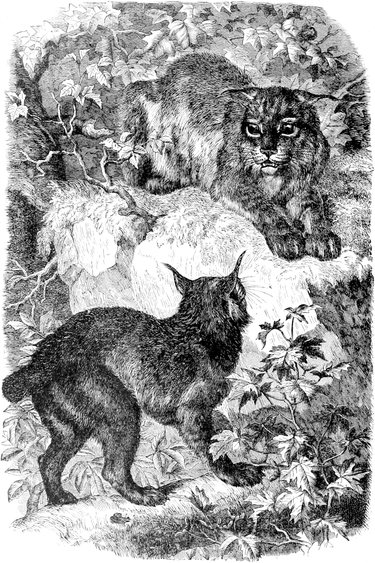
COMMON LYNX.
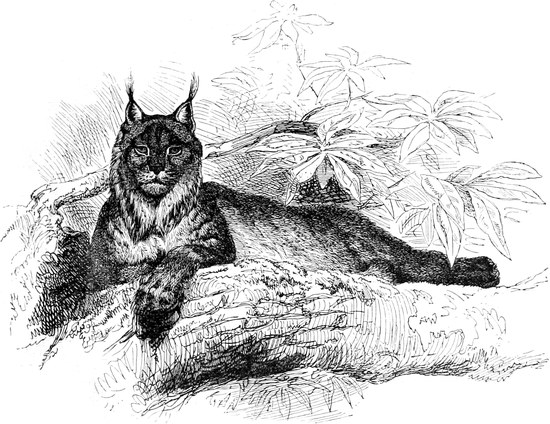
CANADIAN LYNX.
The Lynx is undoubtedly the most dangerous and destructive beast of
prey now left in Europe; at any rate, a single Lynx will do more
damage than an individual of any other wild species. The Russian Wolves
may be, on the whole, worse enemies, but they hunt in packs, and are
only dangerous in numbers, a single Wolf being a sorry coward, while
a Lynx is a truly redoubtable antagonist, as the following excellent
account of his habits will show:—
“While he succeeds in finding food in the forests and gorges of the
high mountains, he does not attempt to shift his quarters, but lives
alone with his mate, and betrays his presence by horrible howlings,
audible at a great distance. He only quits his chosen solitude at the
last extremity, and mounts on a branch, where he crouches at full
length among the foliage, which half hides without incommoding him.
With eye and ear on the watch, he remains whole days motionless, with
eyes half closed, and in a state of apparent sleep, which is only the
more dangerous, for then he is most completely cognisant of all that
is passing around him. The Lynx lives by stratagem. Like all Cats,
he has not a particularly fine sense of smell, and his pace is not
sufficiently rapid to allow him to pursue his prey. His patience, and
the skill with which he creeps noiselessly, bring him close up to his
victim. More patient than the Fox, he is less cunning; less hardy than
the Wolf, he leaps better and can resist famine longer. He is not so
strong as the Bear, but keeps a better look-out, and has sharper sight.
His strength resides chiefly in his feet, jaws, and neck. He prefers to
make his hunting as easy as possible, and only chooses his victim when
food abounds. Every animal he can reach with one of his bounds, which
rarely miss their aim, is lost and devoured; if he misses, he allows
the animal to escape, and returns to crouch in his post of observation,
without showing his disappointment. He is not voracious, but he loves
warm blood, and this passion makes him imprudent.... If he comes upon
a flock of Goats or Sheep, he approaches, dragging his belly along the
ground, like a Snake, then raises himself with a bound, falls on the
back of his victim, breaks its neck or cuts its carotid with his teeth,
and kills it instantaneously. Then he licks the blood which flows
from the wound, rips open the belly, devours the entrails, gnaws off
a part of the head, neck, and shoulder, and leaves the rest.”[54] So
bloodthirsty is his nature, that a single individual has been known to
destroy forty Sheep in a few weeks. Fortunately for the inhabitants,
this plague is now nearly extinct in Central Europe. It is extremely
rare in the Alps, though it was tolerably common within the last
fifty years; and in the forests of Thuringia, only two have been found
during the present century.
The Lynx, when caught young, is said to be quite tameable, but the
domesticated animal is liable to die of over-fatness. Its flesh is
eaten in Siberia, and even in Switzerland, but as usual with its tribe,
the skin is the part on which the greatest value is set. It has a very
beautiful hide, and in Siberia, where the greatest value is obtained,
each one costs from twenty to fifty francs on the spot. “The skin of
the fore-feet is sold separately; they are cut off, and fetch from ten
to fifteen francs a pair. A Lynx skin is worth three of the Sable, six
of the Wolf, twelve of the Fox, and a hundred of the Squirrel.”
There are some differences as to size, &c., between the Lynxes found in
Scandinavia and those inhabiting Central Europe. These are sometimes
separated as distinct species, the former being then called Felis
borealis, the other F. cervaria; the latter is the larger of the two.
This animal takes the place of the common kind in Southern Europe,
being especially abundant in Spain, where its range just overlaps that
of its relative.
It is somewhat smaller than the Common Lynx—not more than thirty-two
inches long. Its skin is of a beautiful rufous tint, regularly spotted
with black, the spots extending over the tail, and the red colour
merging into white on the under surface.
This species (see figure, p. 73) replaces the European variety in North
America, where it is especially abundant in the Rocky Mountains and in
Canada.
It is about the same size as the Common Lynx. Its fur is shorter but
thicker. The hairs on the back are darker, the points being ringed with
grey and brown; those of the flanks are grey at the root, reddish-white
at the extremity. It has the reputation of being a very lazy beast, and
far less ferocious and more cowardly than its cousins of the Old World.
The Red Lynx is found in the United States, from the Pacific to the
Atlantic. It differs but little in structure or habit from the species
we have already described.
Its skin, as well as that of the Canadian kind, is a very important
article of commerce.
This is the handsomest of the Lynxes (see figure on previous page),
both on account of its elegant shape, and of its fine colour, which is
a uniform reddish-brown or light chestnut, unspotted or very sparsely
spotted in the adult, but showing distinct spots in the young. It is
found in India, Persia, Arabia, and Tibet, and also throughout Africa.
Its length varies from twenty-six to thirty inches, the tail measures
nine or ten, and the height sixteen or eighteen inches. The ears are
fully three inches long, black externally, white within, with a long
dark ear-tuft.
Unlike the other Lynxes, the Caracal is made use of as a hunting
animal, being occasionally trained to stalk the Peafowl, Hares,
Kites, Crows, Cranes, &c. It is, however, a most savage animal in
captivity. The specimen in the London Zoological Gardens seems to be
in a permanent state of ill-temper. If the American Lynx, which is
unfortunate enough to live in the same cage with him, dares to come
“betwixt the wind and his nobility,” or even if he, in the course
of his peregrinations, should by chance get sufficiently near his
companion to be annoyed with the sight of so vulgar a beast, he
immediately arches his back, lays back his ears, uncovers his great
canines, and swears in the most fearful manner, until the other unlucky
animal is quite cowed, and looks as meek as its feline nature will
allow it, evidently deprecating the anger of my lord, and although not
conscious of having done wrong, quite ready to promise faithfully never
to do it again.
The Hunting Leopard, or Cheetah, is the last member of the Cat family,
and is distinguished from the foregoing forms of the group by its long
legs, the peculiar form of the flesh tooth of the upper jaw, and by
the fact that its claws are less perfectly retractile than those of
other cats, owing to the excessive length of the elastic ligaments. So
much struck have some observers been with the variation of the Cheetah
from the ordinary feline type, that it has been named Cynælurus, or
Dog-Cat, a very inappropriate name, as the animal is a Cat all over,
as any one will see who will take the trouble to look at the specimens
in the Zoological Gardens. No Dog has that round face, long tail, and
supercilious, almost arrogant, expression.
The Cheetah is about four feet and half long from tip of snout to root
of tail. The latter appendage is two feet and a half in length, and
the height of the animal at the shoulder two feet and a half to two
and three-quarters. The hide is of a bright reddish fawn-colour, and
covered with numerous black spots, which are single, and not arrayed in
rosettes, as in the Leopard, Jaguar, Ocelot, &c. The appearance of the
face is very characteristic, owing to a black stripe which passes down
the cheek in a sort of sigmoid curve, from the corner of the eye to the
angle of the mouth. The tail has black spots and a black tip. The body
is slender and small in the loins like a Greyhound’s.
There are three varieties of this animal. One, the maneless Cheetah,
is confined to Africa; another, the maned Cheetah, is found all over
South-west Asia, and is distinguished from the first-named variety
by its longer hair, and by the presence of a distinct though short
mane, which, however, is more like the cheek-tufts (we must not call
them whiskers, though they exactly resemble them, as that name is
appropriated to the long vibrissæ) of the Tiger or Lynx than the mane
of the Lion. The third variety is the woolly Cheetah, which differs
so much from the other two, as to be usually separated as a distinct
species (Felis lanea). Its hair is woolly, and the spots and
face-mark light brown instead of black. The hind legs are unusually
short. It is a native of South Africa.
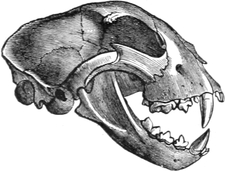
SKULL OF CHEETAH.
Mr. Jerdon says, that “this animal was the original Panther and
Leopardus of the ancients, who considered (with the Arabs of the
present day in North Africa) that it was a breed between the Lion and
the Pard.” Possibly it was this animal to which Jeremiah alluded,
when he said, “Can the Ethiopian change his skin, or the Leopard
his spots?” For, although rare, it is still found in Palestine. Canon
Tristram says, “A few still haunt the neighbourhood of Tabor and the
hills of Galilee. In Gilead it is more common, and a sheikh there
presented me with three skins of the Cheetah, shot by his people.”
It frequents open plains, and hunts by day, in correspondence with
which habits it has a circular and not an elliptical pupil to the eye.
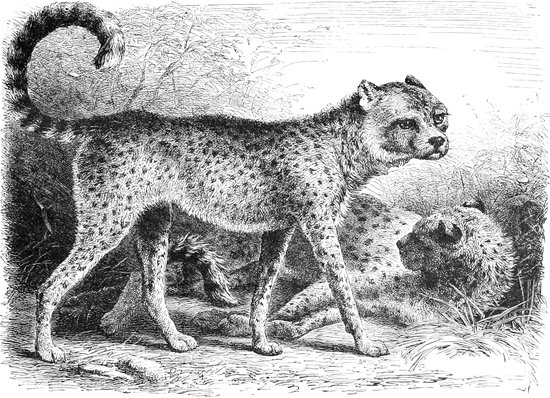
CHEETAH.
The Cheetah is a half-domesticated animal; we say half-domesticated,
because, although it is used regularly in hunting, yet it is never
properly tamed, and always has to be, as it were, gulled into doing
its work. The following account of the manner in which it is used in
Indian sport is given by Mr. Jerdon[60]:—
“‘On a hunting party,’ says Buchanan Hamilton, ‘the Cheetah is carried
on a cart, hooded, and when the game is raised the hood is taken off.
The Cheetah then leaps down, sometimes on the opposite side to its
prey, and pursues the Antelope. If the latter is near the cart, the
Cheetah springs forward with a surpassing velocity, perhaps exceeding
that which any other quadruped possesses. This great velocity is not
unlike the sudden spring by which the Tiger seizes its prey, but it
is often continued for three or four hundred yards. If within this
distance the Cheetah does not seize its prey, he stops, but apparently
more from anger or disappointment than from fatigue, for his attitude
is fierce, and he has been known immediately afterwards to pursue with
equal rapidity another Antelope that happened to be passing. If the
game is at too great a distance when the Cheetah’s eyes are uncovered,
he generally gallops after it, until it approaches so near that he can
seize it by a rapid spring. This gallop is as quick as the course of
well-mounted horsemen. Sometimes, but rarely, the Cheetah endeavours
to approach the game by stealth, and goes round a hill or rock until
he can come upon it by surprise. This account of the manner of hunting
I collected from the conversation of Sir Arthur Wellesley, who, while
commanding officer at Seringapatam, kept five Cheetahs that formerly
belonged to Tippoo Sultan.’ Mr. Vigne writes thus:—‘The hunting with
Cheetahs has often been described, but it requires strong epithets
to give an idea of the creature’s speed. When slipped from the cart,
he first walks towards the Antelope with his tail straightened, and
slightly raised, the hackle on his shoulder erect, his head depressed,
and his eyes intently fixed upon the poor animal, who does not yet
perceive him. As the Antelope moves, he does the same, first trotting,
then cantering after him; and when the prey starts off, the Cheetah
makes a rush, to which (at least I thought so) the speed of a racehorse
was, for the moment, much inferior. The Cheetahs that bound or spring
upon their prey are not much esteemed, as they are too cunning.
The good ones fairly run it down. When we consider that no English
Greyhound ever yet, I believe, fairly ran into a doe Antelope, which
is faster than the buck, some idea may be formed of the strides and
velocity of an animal who usually closes with her immediately, but
fortunately cannot draw a second breath, and, consequently, unless he
strike the Antelope down at once, is obliged instantly to stop and
give up the chase. He then walks about for three or four minutes in
a towering passion, after which he again submits to be helped on the
cart. He always singles out the biggest buck from the herd, and holds
him by the throat until he is disabled, keeping one paw over the horns
to prevent injury to himself. The doe he seizes in the same manner,
but is careless of the position in which he may hold her.’ The natives
assert that (in the wild state) if the ground is not very favourable
for his approaching them without being seen, he makes a circuit to the
place where he thinks they will pass over, and if there is not grass
enough to cover him, he scrapes up the earth all round, and lies flat
until they approach so near that by a few bounds he can seize on his
prey. Mr. W. Elliott says, ‘They are taught always to single out the
buck, which is generally the last in the herd. The meer-shikars are
unwilling to slip till they get the herd to run across them, when they
drive on the cart and unhood the Cheetah.’
“I have only to add to this, on my own testimony, that I have often
seen it, when unhooded, at some distance from the Antelope, crouch
along the ground and choose any inequality of surface to enable it to
get within proper distance of the Antelope. As to Vigne’s idea of its
rush being made during one breath, I consider it a native one, and
unfounded, and I may say the same of its holding one paw over the horns
of the buck. The Cheetah, after felling the Antelope, seizes it by the
throat, and when the keeper comes up he cuts its throat and collects
some of the blood in the wooden ladle from which it is always fed.
This is offered to the Cheetah, who drops his hold, and laps it up
eagerly, during which the hood is cleverly slipped on again. My tame
Cheetah, when hungry or left alone (for it appeared unhappy when away
from the Dogs with no one near it), had a plaintive cry, which Blyth
appropriately calls a ‘bleat-like mew.’ Shikaries always assert that
if taken as cubs they are useless for training, till they have been
taught by their parents how to pull down their prey. This opinion is
corroborated, in part at least, by my experiences with the tame one
mentioned above.”
Although capable of domestication, the Cheetah is, when roused,
anything but a pleasant animal to come across. Two colonists from the
Cape of Good Hope happened to meet one while they were out shooting
Gazelles, and, unfortunately for themselves, pursued it. “The roughness
of the road retarded the animal’s flight, and a ball reached it. It
immediately turned upon the hunter who had wounded it, and, leaping
upon him, pulled him from his Horse, and a hand-to-hand conflict began
between the two adversaries. The other hunter dismounted and hastened
to succour his comrade, at the risk of hitting him as well as the
animal from which he wished to deliver him. His shot was badly aimed.
The noise of the discharge changed the aspect of the combat, for the
Cheetah abandoned the man whom he had thrown down, to fling himself
with redoubled fury on the new assailant, who had not even time to draw
his hunting-knife. The animal seized him by the head, and, without
letting go, rolled with him to the bottom of a ravine. It was of no
avail that the first man, left alive, but horribly mutilated, dragged
himself to the new battle-field; the wounds of his companion were
mortal, and he only had the melancholy satisfaction of giving the coup
de grâce to the animal, who was already exhausted by loss of blood.”
It is curious, considering the constant domestication of this animal
in India, that it does not breed at all readily in confinement. In
fact, Mr. Bartlett, who probably knows more about the matter than any
one, says that it has never to his knowledge bred in England; but Dr.
Günther affirms that it has bred in the Gardens in Frankfort.
The young animal is covered with soft brown hair, without spots, a
curious fact, quite reversing the usual order of things, for, as we
have seen, the young of the Lion, Puma, and other one-coloured Cats,
are distinctly spotted. The black mark on the cheek appears first,
and then the body spots. Mr. Jerdon gives an interesting account of a
Cheetah kitten belonging to him:—
“I brought up the young one above alluded to along with some Greyhound
pups, and they soon became excellent friends. Even when nearly
full-grown it would play with the Dogs (who did not over relish its
bounding at them), and was always sportive and frolicsome. It got much
attached to me, at once recognising its name (Billy), and it would
follow me on horseback like a Dog, every now and then sitting down for
a few seconds, and then racing on after me. It was very fond of being
noticed, and used to purr just like a Cat. It used to climb on any high
object—the stump of a tree, a stack of hay—and from this elevated
perch look all round for some moving object. As it grew up, it took
first to attacking some Sheep which I had in the compound, but I cured
it of this by a few sound horsewhippings; then it would attack Donkeys,
and get well kicked by them; and when not half-grown it flew one day
at a full-grown tame Nylghau, and mauled its legs very severely before
it could be called off. I had some Chikaras (Gazella Bennettii)
caught, and let loose before it to train it. The young Cheetah almost
always caught them easily, but it wanted address to pull them down, and
did not hold them. Occasionally, if the Antelope got too far away, it
would give up the chase, but if I then slipped a Greyhound, it would
at once follow the Dog and join the chase. It was gradually getting to
understand its work better, and had pulled down a well-grown Antelope
Fawn, when I parted with it, as I was going on field service.”
Brehm had a Cheetah called “Jack,” which was so tame that his master
led him about like a Dog, and even took him into a drawing-room
full of ladies, by whom, after they had recovered from their fright
at seeing a real wild beast enter the room, he allowed himself to be
patted and caressed. The same author states that a Cheetah once lived
at large in an English seaport, and was the greatest possible favourite
with the sailors and other inhabitants.
This group contains the single genus Hyæna, one species of which, the
Striped Hyæna (H. striata), inhabits North-east Asia and Northern
Africa; the others (H. crocuta and H. brunnea) inhabiting South
Africa.
Externally, the Hyænas have something the appearance of extremely
ugly and unattractive-looking Dogs. They are somewhat larger than a
Shepherd’s Dog, and are covered with coarse bristly hair, short over
the greater part of the body, but produced into a sort of mane along
the ridge of the neck. The mode of progression is entirely digitigrade,
the legs having much the same proportion as in an average Dog, except
for the fact that the hind legs are shorter than the fore legs, so that
the body slopes from the withers to the haunches. The claws resemble
those of the Dog in that they cannot be retracted in sheaths of skin:
here, therefore, we have a great and marked difference from all the Cat
tribe.
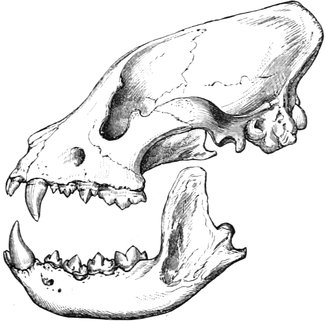
SKULL OF HYÆNA.
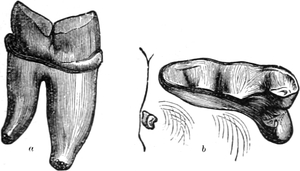
TEETH OF HYÆNA.
a, First lower molar. b, Last
upper premolar.
The tail is bushy, the snout long, but blunt, giving the beast a
snub-nosed appearance and a horridly vulgar expression, quite different
to that of most of his relatives. The long-nosedness is partly,
however, only a matter of external appearance, for the skull, although
nothing like as short as a Cat’s, is yet very far from being as long as
that of a Dog or a Civet, and it is still more Cat-like in the immense
width of the cheek-arches, and the great development of bony ridges
for the attachment of muscles. The great longitudinal ridge on the top
of the skull is indeed far larger than in even the Lion or Tiger, and
forms a great shelving crest, like that of an old-fashioned helmet.
As we have already mentioned, this ridge is for the attachment of the
great cheek muscles which close the jaw-muscles which, in the Hyæna,
are of such power, that the animal’s favourite way of attacking Dogs is
to bite their legs off, and one of its choicest titbits is the marrow
of bones, which can only be obtained by cracking the bone across, as we
should crack a nut. Any one who has examined a Horse’s or an Antelope’s
thigh-bone will have some notion of the power of jaws capable of
smashing such a tough morsel.
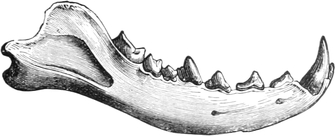
LOWER JAW OF HYÆNA.
But something more is required than strong muscles for work such as
this; and the Hyæna is furnished with a set of tools which, when
worked by such mighty power, are simply irresistible. The large
grinding-teeth, instead of the scissor-blade form they have in the
Cats, have great conical crowns, the base of the cone being belted by a
strong ridge which defends the subjacent gum (see figure on
preceding page). One has only to look at these teeth to see their perfect
adaptation to their purpose. Sir Richard Owen remarks, “An eminent
civil engineer, to whom I showed the jaw of a Hyæna, observed that the
strong conical tooth, with its basal ridge, was a perfect model of a
hammer for breaking stones for roads.”
The canines of the Hyæna are proportionally much smaller than in the
Felidæ, and the outermost incisor—that nearest the canine—is much
larger than in the Cats, so that it approaches towards the canine in
size. This, as we shall see, is even more the case in the Dog.
Then, the number of the teeth is different; the Hyæna is a less
specialised animal than the Cats, that is, departs less from the
average structure of a Mammal, and, in correspondence with this, we
find that its jaws are longer and its teeth more numerous; it has, in
fact, one more premolar, or false grinder, on each side of each jaw,
bringing the total number of teeth to thirty-four, instead of thirty.
(See p. 13.)[62]
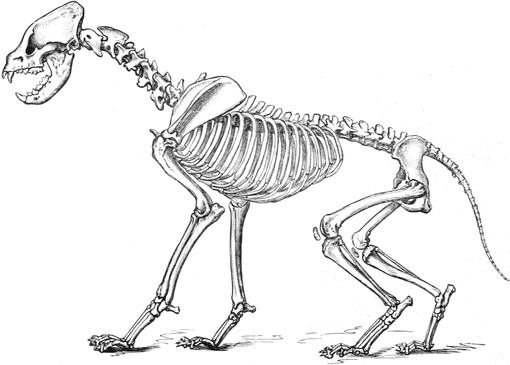
SKELETON OF HYÆNA.
In speaking of the Cat family, we mentioned that the characters of
the floor of the skull, and particularly of the swollen, bulb-like
bulla tympani, were of great importance in determining the position
of an animal in the series. Now this bulla in the Hyæna is large and
rounded, as in Cats, but differs in the fact that it is not divided by
a bony partition into two compartments. The external opening of the
cavity, too, is quite flush with its outer wall, and the clamp of bone
(see figures on pp. 11 and 79) is quite close to its hinder wall.
In these characters, as well as in certain matters of internal
structure, such as the presence of a small cæcum, or “blind-gut,”
the Hyænas approach to the Cats and Civets, being connected with the
latter group by the curious Aard-Wolf. In other respects they approach
the Dog family, their nearest ally in that group being the Cape Hunting
Dog.[63]
This species exists over the whole of Africa south of the Sahara,
a portion of the continent which differs in a remarkable manner in
its animal productions from the northern part; so much so that in a
division of the world into regions for the purposes of studying the
geographical distribution of animals, the north of Africa is united
with Europe, while its ultra-Saharal portion is formed into a distinct
region. Over this Ethiopian region, then, the Spotted Hyæna ranges,
extending from Abyssinia and the Soudan in the north, where it meets
with its striped brother, to Cape Colony, where it exists along with
the curious Aard-Wolf. It is known as the “Wolf,” or “Tiger-Wolf,” by
the Cape colonists, who, it seems, have a fancy for giving animals
wrong names. We have seen already that the Leopard is with them a
“Tiger.”
The skin is of a yellowish-brown ground tint, irregularly blotched with
circular black spots. On the back of the neck and on the withers it has
a quantity of long stiff hairs, forming a kind of reversed mane. The
fur is coarse and bristly, its character adding greatly to the animal’s
singularly unattractive appearance. The height at the shoulder is about
two feet six or eight inches, the extreme length five feet ten inches,
of which length the tail takes up some sixteen inches.
Like some other beasts of a similarly mean nature, the Spotted Hyæna
prefers not to do his own killing, but likes better to live as a sort
of humble messmate on those better provided than himself with the
courage requisite to good hunters. When he does cater for himself,
instead of subsisting on the leavings of his betters, he always makes
his attack in a cowardly way, and trusts rather to stratagem than to
any of the higher qualities of a sportsman. Dr. Livingstone says:—“In
the evening of our second day at Serotli, a Hyæna appearing suddenly
among the grass, succeeded in raising a panic among our cattle. This
false mode of attack is the plan which this cowardly animal always
adopts. His courage resembles closely that of a Turkey-cock. He will
bite if an animal is running away; but if the animal stand still, so
does he.”
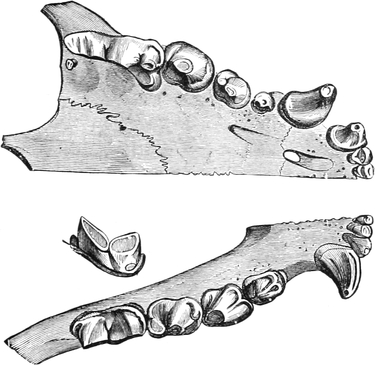
TEETH OF SPOTTED HYÆNA.
Other authors tell a similar tale, showing, too, that under cover of
darkness the Hyæna can be moderately plucky; can, at any rate, muster
sufficient courage to attack the herds in an encampment. “More than
once, during dark and drizzling nights, they made their way into the
sheep-kraal, where they committed sad havoc. We had several chases
after them, but they managed invariably to elude us.”[65] Again, “The
Sheep having been placed in a pit to prevent them from straying, were
visited during the night by a party of Hyænas, which slaughtered some
and drove the residue to the summit of a high hill, where they were
found the following morning.”[66]
The Hyæna has his misfortunes, like other beasts; Sheep are not to be
had every day, often food is scarce, and he has to go with an empty
stomach for days together. He may suffer, too, in other ways, besides
hunger. Thus Mr. Andersson relates:—“Almost the first animal I saw at
this place was a gigantic ‘Tiger-Wolf,’ or Spotted Hyæna, which, to my
surprise, instead of seeking safety in flight, remained stationary,
grinning in the most ghastly manner. Having approached within twenty
paces, I perceived, to my horror, that his fore-paws and the skin
and flesh of his front legs had been gnawed away, and that he could
scarcely move from the spot. To shorten the sufferings of the poor
beast, I seized my opportunity and knocked him on the head with a
stone, and catching him by the tail, drove my hunting-knife deep into
his side. But I had to repeat the operation more than once before I
could put an end to his existence. I am at a loss to account for his
mangled condition. It certainly could not have been from age, for his
teeth were good. Could it be possible that, from want of food, he had
become too weak for further exertions, and that, as a last resource, he
had attacked his own body? Or, was he an example of that extraordinary
species of cruelty said to be practised by the Lion upon the Hyæna,
when the latter has the insolence to interfere with the monarch’s
prey?” ... “It is asserted by more than one experienced hunter, that
when the Hyæna proves troublesome, the Lion has been known to bite off
all its feet, and, thus mutilated, leave the poor animal to its fate.”
It may well be imagined the horrible nuisance such animals are to all
South African travellers. They steal everything they can get at. They
devoured two handsome flags of Mr. Andersson’s which he had hoped to
plant on the shores of Lake ’Ngami. But, perhaps, the greatest trouble
is caused by their infernal cachinnations; no noise in the forest
produces so much discomfort, for though not so loud as the Lion’s roar,
it is totally devoid of grandeur, and is only hideously grotesque
and vile in the ears of all but Hyænas, who, we suppose, are charmed
by it. The traveller we have just mentioned was, during an illness,
laughed to scorn in the most amazing fashion by Hyænas and Jackals,
and their derision was too much for his equanimity at a time when
he sorely needed sympathy and help. Flesh and water had become very
scarce, and in his trouble he says, “One evening I desperately resolved
to go to the water myself in the hope of succeeding better [than the
attendants]. Accordingly I ordered my servants to prepare a ‘skäran,’
and to carry me there, taking the chance of being run over or gored by
Elephants or Rhinoceroses, for in my disabled state it was impossible,
should any animal charge, to get out of its way. Seeing my helpless
condition, the men remonstrated, but I was resolved to go, and fortune
favoured me. I had patiently waited till nigh morning without seeing
anything but Hyænas and Jackals. I believe these creatures knew I would
not hurt them, for they approached within a very few paces, staring and
laughing at me in the most impudent manner. I threw gravel pebbles at
them, but this only served to increase their mockery. I could stand it
no longer, but hurled my camp-chair at their heads, when they quickly
betook themselves to flight.”
Livingstone had the same trouble with the fearful din. “An astonishing
number of Hyænas collected round, and kept up a loud laughter for two
whole nights. Some of them do make a very good imitation of a laugh.
I asked my men what the Hyænas were laughing at, as they usually give
animals credit for a share of intelligence. They said that they were
laughing because we could not take the whole, and that they would
have plenty to eat as well as we.” Any one who has never heard the
Hyæna laugh, and is anxious for that pleasure, has only to visit
the Zoological Gardens at feeding time. Some give utterance to such
horrible cachinnations when stirred up by the keeper, that one would
think they are enough to wake the dead and madden the living.
Most hunters think it quite infra dig. to hunt so contemptible and
cowardly a beast as the Hyæna. Regular expeditions are, however,
organised against it by the Cape colonists, who set fire to the
brushwood, to drive out the animals, which are then attacked by Dogs.
A method of killing, considered more suitable to the beast, is that
of the trap. Mr. Andersson succeeded in killing several by means of a
cleverly arranged spring-gun.
The Brown Hyæna, or “Strand-Wolf” of the Cape colonists, is tolerably
common in South Africa, though far less so than the spotted species. It
is a smaller animal than the latter, its usual height at the shoulder
being about two feet four inches, its length, including the tail, four
feet ten inches, the tail itself being about a foot in length.
Its general colour is reddish-grey, brindled with brown and black
stripes or spots. The extremities are yellowish, with deep black
transverse bands. The tail is black, with red hairs towards the tip.
As to habits, there is really nothing to add to what has already been
said with regard to the Spotted Hyæna, except that it is especially
common at the sea-side, and feeds a good deal on dead bodies thrown
upon the shore. It only dares to attack flocks when very hungry.
The Striped Hyæna takes the place of the spotted kind over the northern
part of Africa. It also extends into Asia, where it ranges over Asia
Minor and Persia, and through India to the foot of the Himalayas.
Amongst other places, it is “common in every part of Palestine, and
indifferent as to the character of the country. We obtained the young
occasionally in spring, and procured on Mount Carmel the largest pair
of adults I ever saw. The old rock-hewn tombs afford to the Hyæna
convenient covert. It attacks the graves even in the vicinity of
towns.”[69]
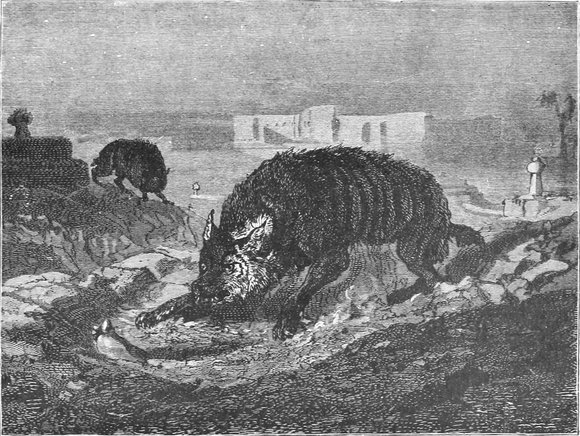
HYÆNAS IN AN ARABIAN CEMETERY.
In ground-colour it resembles the spotted kind, but instead of being
marked with spots, its hide is covered with complete black transverse
bands like the hoops of a barrel, which extend downwards on to the
legs. It is as nearly as possible of the same size as the brown variety.
As to its habits and characteristics, there is little to add to what
has already been said of its South African brother; it follows the Lion
for scraps, roams about the Arab cemeteries to dig up and devour the
dead, prowls round the towns and villages in Egypt and elsewhere to
pick up offal, and is always the same ugly, ill-conditioned, repulsive,
and yet useful beast. For the Arabs and Egyptians are never greatly
inclined to sanitary reform, and without Hyænas, Jackals, and Vultures,
would be in a sad case indeed.
As to the animal’s cowardliness, every writer bears witness. Jules
Gérard says:—“The Arabs say, ‘as cowardly as a Hyæna,’ and the Arabs
are right.” So much do the sons of the desert despise their scavenger,
that when Gérard killed one with his sabre, they implored him never
again to use the defiled weapon, saying that it would certainly betray
him after having been sheathed in such a dastardly carcass. It is
stated that the Dog is the only animal the Hyæna dares attack, and even
this game they like some help in killing. “When they feel inclined to
eat a Dog, they hang about some douar, in the neighbourhood of which
there happens to be a good cover. The female stations herself behind
some brushwood, and the male goes towards the Dogs, who attack him, and
follow him as far as the position of his consort. The female comes out
at the fitting moment to attack, throttle, and devour on the spot the
Dog who ventures farthest in pursuit of her husband.”
Although the Hyæna is generally considered unworthy of being hunted,
yet the Arabs occasionally condescend to come to the rescue of their
Dogs, by beating their destroyers to death. They have also a curious
“yarn” about a new and singular way of killing a Hyæna—a similar
process to the traditional method of bird-catching. “The Arab who finds
a Hyæna in his hole, takes a handful of Cow’s dung, and presents it
to him, saying, ‘Come, and I will render you beautiful with henna.’
The Hyæna holds out his paw; the Arab seizes it, drags him out, then
gags him, and causes him to be stoned by the women and children of the
douar, as a cowardly and unclean beast.” One would have imagined that
a Hyæna of ordinary mental capacity would be far too old to be caught
with this sort of chaff!
This family contains a single animal only, so that the description of
the family and of the species will be identical. It has no English
name, and must, therefore, be known by its scientific appellation,
which is, unfortunately, none of the most musical.
This little animal is extremely interesting, from the fact that it
forms a perfect transition between the Cat family on the one hand, and
the Civet family on the other. Like the Cats it has truly retractile
claws; unlike them it is plantigrade, or, rather, semi-plantigrade,
for it does not walk on the tips of its toes, like a Cat or Dog,
neither does it keep the whole sole of the foot flat to the ground like
a Bear, but the soles of both fore and hind feet are devoid of hairs,
except for a short space near the ankle and heel, and it is the large
hairless space which is applied to the ground in walking.
The characters of the skull are almost exactly half way between those
of the two families we have mentioned. The bulb of the ear has its
opening quite flush with its outer wall, but is far less swollen than
in the Cats. The teeth differ from those of Cats in one important
particular, namely, in the fact of there being one more premolar in
each jaw.
The Cryptoprocta is about thirteen inches and a half long from snout to
root of tail, the latter appendage being nearly as long as the body.
The general colour is light brownish-red, this tint being produced by
the individual hairs being ringed with yellow and brown alternately.
The body is slender and elegantly formed. The head is also well shaped,
with a pointed snout, and large rounded ears. There are five toes on
each foot, and, as we have already mentioned, the claws are provided
with true retractile ligaments.
This curious and interesting little animal is very rare; only one or
two specimens having reached Europe. Even at the present time hardly
anything is known of its internal organs. It was first brought to
England forty or fifty years ago. “Mr. Telfair, President of the
Mauritius Natural History Society, who presented the animal to the
Zoological Society of London, received it from the interior and
southern part of Madagascar, and stated that it was the most savage
creature of its size he ever met with. Its motions and power and
activity were those of a Tiger, and it had the same appetite for blood
and destruction of animal life. Its muscular force was very great, and
the muscles of its limbs were remarkably full and thick. It lived with
Mr. Telfair for some months.”
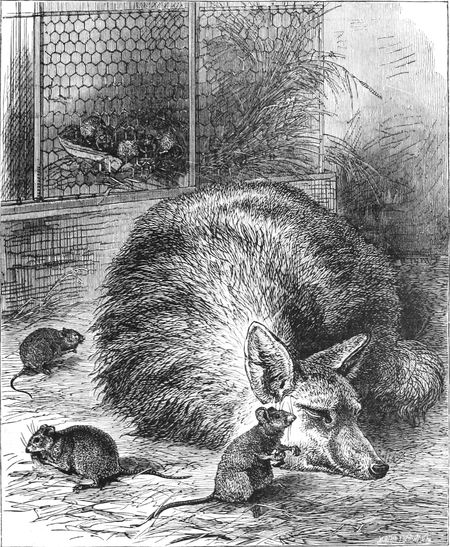
AARD-WOLF.
This family contains but a single genus and species, viz.:—
This is a remarkable animal inhabiting the southern parts of Africa,
where its range is almost co-extensive with that of the brown variety
of the Hyæna. It is an extremely interesting animal, as it forms a
connecting link between the Civet family and the Hyænas; although
more nearly allied to the latter than to the former, it is found to
be impossible to assign it to one of these groups in reference to the
other, and it is, in consequence, placed in a family by itself.
This rare animal was first mentioned and described by Andrew Sparman
in 1772–6, but his account of it attracted little notice until it
was re-discovered by the traveller Delalande, who brought specimens
to France, where the beast was described and christened after him,
Proteles Lalandii, or Delalandii.
The relationships of the Aard-Wolf are well shown by its external
appearance. It has the sloping back of a Hyæna, owing to the fore legs
being longer than the hind legs; but its head is quite Civet-like,
the snout being long and pointed, and altogether unlike a Hyæna’s.
Its size is that of a full-grown Fox, but it stands higher upon its
legs; its ears are considerably larger and more naked, and its tail
shorter and not so bushy. At first sight it might be easily mistaken
for a young Striped Hyæna, so closely does it resemble that animal in
the colours and peculiar markings of its fur, and in the mane of long
stiff hair which runs along the neck and back; indeed, it is only to
be distinguished by its more pointed head, and by the additional fifth
toe of the fore-feet. It is also quite Hyæna-like in colour, being of
a dull yellowish-grey tint, and marked with dark brown stripes and a
black muzzle.
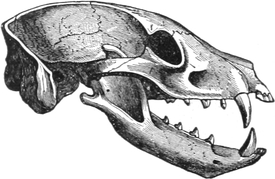
SKULL OF AARD-WOLF.
The skull has all the essential characters of that of a Viverrine, the
form to which it approaches most nearly being the Ichneumon. The teeth
are also Civet-like, but in the characters of its internal organs it
approaches more nearly to the Hyænas.
“In its habits and manners the Aard-Wolf resembles the Fox. Like that
animal it is nocturnal, and constructs a subterraneous burrow, at
the bottom of which it lies concealed during the day-time, and only
ventures abroad on the approach of night to search for food, and
satisfy the other calls of nature. It is fond of the society of its own
species; at least many individuals have been found residing together
in the same burrow; and, as they are of a timid and wary character,
they have generally three or four entrances to this hole; so that,
if attacked on one side, they may secure a retreat in an opposite
direction. Notwithstanding the disproportionate length of their fore
legs, they are said to run very fast, and so strong is their propensity
to burrow, that one of M. Delalande’s specimens, perceiving itself
about to be run down or captured, immediately ceased its flight, and
began to scratch up the ground, as if with the intention of making a
new earth.” Its food consists very largely of carrion, but it also
devours Ants. Owing to the former “high” kind of diet, the animal is
generally possessed of an extremely bad smell.
With regard to its fighting propensities, which it probably possesses
in common with all its relations—partly from the necessities of the
struggle for existence, and partly from pure quarrelsomeness—we may
mention Professor Flower’s observation, that there is a “rounded patch
in front of each wrist joint,” or “knee,” as the wrist of digitigrade
quadrupeds is usually called, just as if the animals were in the
constant habit of kneeling. Professor Flower adds in a note:—“Mr.
Bartlett informs me that this is the habit both of the Proteles and
the Hyænas, especially when fighting. He attributes it, at least in the
case of the Hyænas, to an instinctive dread lest their feet should be
seized and crushed by the powerful jaws of their adversary.”
THE name of this family[74] is given to it from the fact that the
most important forms included in it are what are known as Civets, or
Civet Cats, animals from which the well-known perfume of that name is
obtained.
The civet is a white, fatty substance, found in two curious little
pouches or turnings-in of the skin just under the animal’s tail.
Thus Touchstone says: “Civet is of a baser birth than tar; the very
uncleanly flux of a Cat.” The perfume “is procured by scraping the
inside of the pouch with an iron spatula at intervals, about twice a
week. If the animal is in good condition and a male, especially if he
has been irritated, a drachm or thereabouts is obtained each time.
The quantity collected from the female does not equal that secreted
by the male. Civet, like most other articles of this nature, is much
adulterated, and it is rare to get it quite pure. The adulteration is
effected with suet or oil, to make it heavier.”
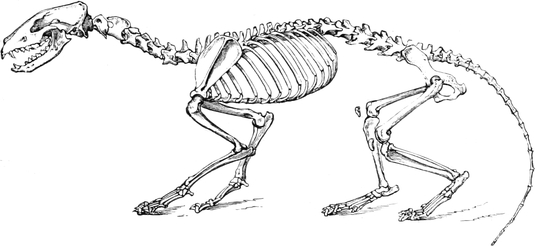
SKELETON OF CIVET.
Civet is far less esteemed as a perfume now than in former times; its
odour is rank and almost overpoweringly strong, so that musk and other
vegetable perfumes are now generally preferred. But in Shakspere’s time
it was quite “the thing.” Don Pedro, in “Much Ado,” says of Benedick:
“Nay, he rubs himself with civet: can you smell him out by that?” And
Claudio answers: “That’s as much as to say, the sweet youth’s in love.”
The animals comprised in this group are confined entirely to the Old
World, where they are represented in South Europe by the domesticated
Genette; in Africa and South Asia by the true Civet (Viverra), the
Ichneumons, so celebrated for their propensity for eating Crocodile’s
eggs, the curious Paradoxures, and many others.
In anatomical characters, as well as in external appearance, the
animals are related both to the Cat family and to the Hyænas, as will
be seen by comparing the various points of their structure with
those of the two families just named. They are mostly long-bodied,
short-legged animals, with stiffish fur, a long tail, and a sharp
muzzle. They walk on their toes, of which they have five on each
foot, like Cats; many of them, however, keeping the wrist and ankle
much nearer the ground than the Cats do, and being consequently
distinguished as semi-plantigrade. They also wander from the regular
Cat-structure in the matter of their claws, which are only half
retractile, the elastic ligament not attaining the same perfection as
in the Cats. Thus we conclude that in this respect, at any rate, the
Civets are less specialised than the Cats proper; they approach more
nearly to the central plan of Mammalian structure, and are less perfect
as Carnivores. We shall see that the same is the case with respect to
their other characters, such as the skull and teeth.
The skull is not unlike what a Cat’s would be if it were put on the bed
of Procrustes and pulled out; for, in correspondence with the length
of the snout in these creatures, the face part of the skull is long
in comparison with the brain-containing part. The cheek-arches, also,
are by no means so broad as in the Felidæ, in correspondence with
the less size of the jaw muscles. But the character of the base of the
skull is pretty much the same. There is, as in Cats, the large swollen
bulla, or ear-drum bone, the small opening flush with the outer wall
of the bulla, and the clamping bone closely applied to its hinder wall.
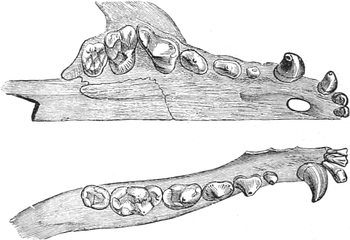
TEETH OF CIVET.
The teeth of the Civets present many interesting differences from
those of the Cat tribe. In the first place, in accordance with the
less perfectly carnivorous habit of the group, the jaws are longer,
and, consequently, not so powerful as in the Cat; the number of teeth
also is considerably increased. The incisors and canines remain the
same, but the premolars are increased to four, and the molars to two on
each side of each jaw,[75] so that there are no less than forty teeth,
instead of thirty only, as in the Cats. Then the form of the teeth is
altered; the canines are of far less proportional size, not having the
same amount of hard work to do as the great dog teeth of the Lion or
Tiger; the grinders, too, lose their scissor-blade form, and exhibit
on their upper surfaces little lumps, or cusps, thereby developing
a grinding surface such as no Cat has. This is especially the case in
the Paradoxures, or Palm-Cats, which have quite lost all carnivorous
habits, and feed chiefly on the fruit of palm-trees.
This animal, by its rough spotted skin, calls to mind the Hyæna,
to which, however, it is inferior in size, being hardly three feet
long. It differs also from our laughing friend in many more important
particulars. Its legs are shorter, its tail longer and not so bushy,
its snout more pointed, its ears shorter, and its expression less
villainous-looking. It is found in the North of Africa and in Eastern
Asia.
This animal is the chief of the civet producers, its scent-glands
being large and secreting constantly. At the Zoological Gardens the
specimen in captivity rubs the perfume against the walls of the cage,
where it is scraped up by the keeper, for whom it is a not unimportant
perquisite.
The hair is long, coarse, of a brownish-grey colour, and marked with
interrupted transverse bands or spots. On the middle line of the back
and between the shoulders its hair is longer, forming a sort of mane.
The snout is white, the tail ringed with black.
“The Civet approaches, in its habits, nearest to the Foxes and
smaller Cats, preferring to make its predatory excursions against
birds and smaller quadrupeds in the night, although, like other
Carnivora, it will occasionally attack its prey in the daytime. In a
state of captivity it becomes in a degree tame, but never familiar,
and is dangerous to handle. The young ones feed on farinaceous
food—millet-pap, for instance—with a little flesh or fish, and when
old on raw flesh. Many of them are kept in North Africa, to obtain the
perfume which bears the name of the animal, and brings a high price.”
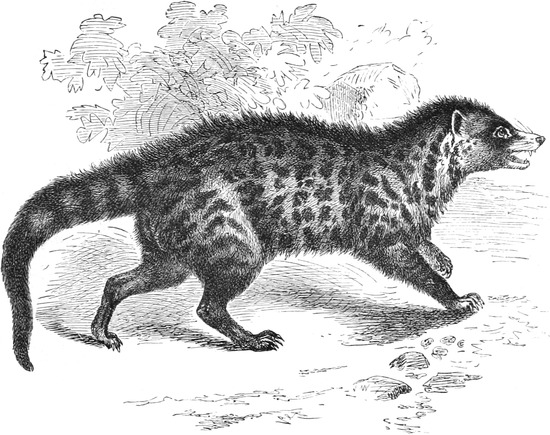
AFRICAN CIVET.
The great naturalist, Cuvier, says of a Civet kept at Paris:—“Its
musky odour was always perceptible, but became stronger than usual when
the animal was irritated. At such times little lumps of odoriferous
matter fell from its pouch. These masses were also produced when the
animal was left alone, but only at intervals of fifteen or twenty days.
This Civet passed nearly all day and the whole night in sleeping,
rolling itself up with its head between its legs; it was necessary to
threaten or even strike it to rouse it from its lethargy.”
The Asiatic Civet, large Civet Cat, or Zibet, “inhabits Bengal,
extending northwards into Nepaul and Sikkim, and into Cuttack, Orissa,
and Central India on the south. It also extends into Assam, Burmah,
Southern China, and parts of Malayana. It is said to frequent brushwood
and grass, also the dense thorny scrub that usually covers the bends of
tanks. It is very carnivorous, and destructive to poultry, game, &c.,
but will also, it is said, eat fish, crabs, and insects. Hounds, and
indeed all Dogs, are greatly excited by the scent of the Civet, and
will leave any other scent for it. It will readily take to water if
hard pressed.”
The Zibet is forty-seven to fifty-six inches in length, from thirteen
to twenty of this being taken up by the tail. It is of a yellowish-grey
colour, with black spots and stripes. The throat and sides of the neck
are white, and the fine tail is ringed with black.
This species is said to be tamed more easily than its African relative;
but of this, as well as of its habits, very little is known.
The Lesser Civet, or Rasse, is found in the island of Java, as well
as in many parts of India, such as Nepaul and Madras. “It is not an
uncommon species in Hong-Kong and the adjacent islands. In Formosa it
is the commonest of all the carnivorous group. Skulking during the day
in the dark ravines that intersect the hilly country in the north-west,
in the twilight it threads its way with great speed through the long
grass, and searches the fields for small mammals and birds. It is much
dreaded by the Chinese for the havoc it commits in the hen-roost; and
as its skin is somewhat valued for lining to great coats, its haunts
and creeps are sought after, and traps laid for it. Of these the
slip-knot noose for the head and feet is the most commonly practised
and the most killing. As the cool season approaches, hawkers may be
daily met with, even in the villages, offering for sale the stretched
skins of these animals. The poorer classes, who are unable to purchase
the dearer furs, make use of these cheaper yet pretty skins.” The Rasse
is about thirty-two inches in length, its tail thirteen inches. The
odour of musk is so strong as to taint the skin and the flesh of the
entire animal. “The Chinese,” says Mr. Swinhoe, “eat the flesh of this
animal; but a portion that I had cooked was so affected with the Civet
odour that I could not palate it.”
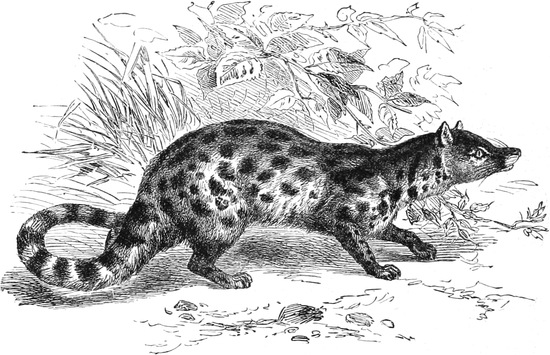
LESSER CIVET.
The Rasse is a much smaller animal than the two preceding species, its
head and body together being about twenty-two or twenty-three inches
long, and its tail sixteen or seventeen. It is of a yellowish or
brownish-grey colour, with longitudinal bands on the back, and regular
rows of spots on the side. The tail has eight or nine complete dark
rings.
In India it is kept tame, the natives often domesticating it for the
purpose of more conveniently extracting the civet.
This is the only Viverrine animal common in Europe, in some parts of
which it is a regularly domesticated animal, and catches Mice as well
as a Cat. Besides living in all the southern parts of Europe, it is
found in the whole of Africa north of the Sahara, that wonderful desert
which constitutes a boundary as efficient in preventing the dispersal
of animals as an ocean. In this, as in many other cases, the North
African animals are identical, or agree closely with those of Europe,
while those of trans-Saharal Africa are of an entirely different
character.
The fur of the Genette is of a grey colour, “spotted with small black
or brown patches, which are sometimes round and sometimes oblong. The
tail, which is as long as the body (about twenty-one inches), is ringed
with black and white, the black rings being to the number of nine or
eleven. There are white spots on the eyebrows, the cheeks, and the end
of the nose.”
The civet-pouches are, in this genus, reduced to very slight
depressions at the sides of the root of the tail, and although the
odour of the animal is tolerably strong—yet not disagreeably so, as in
the Civet—there is no perceptible secretion from these pouches.
The Ichneumons, or Mungooses, form a well-defined genus of Weasel-like
animals, with semi-plantigrade feet, five toes provided with somewhat
retractile claws, and long tails. The species now under consideration
is found in Southern India as well as “in the North-west Provinces and
the Punjab, and throughout the Deccan up to the Nerbudda River. It
frequents alike the open country and low jungles, being found in dense
hedgerows, thickets, holes in banks, &c., and it is very destructive to
such birds as frequent the ground,” for it only sucks the blood, and so
kills many birds before it is satisfied.
It is sixteen or seventeen inches long, its tail fourteen, and is of
a tawny yellowish-grey colour. The head is marked with reddish and
yellowish rings, so arranged as to produce a resultant iron-grey hue.
There is a curious superstition about the Mungoos, of which Sir Emerson
Tennent says: “I have found universally that the natives of Ceylon
attach no credit to the European story of the Mungoos (H. griseus)
resorting to some plant, which no one has yet succeeded in identifying,
as an antidote against the bite of the venomous Serpents on which it
preys. There is no doubt that, in its conflicts with Cobra di Capello
and poisonous Snakes, which it attacks with as little hesitation as
the harmless ones, it may be seen occasionally to retreat, and even to
retire into the jungle, and, it is added, to eat some vegetable; but a
gentleman, who had been a frequent observer of its exploits, assures
me that most usually the herb it resorted to was grass, and if this
were not at hand, almost any other plant that grew near seemed equally
acceptable. Hence has probably arisen the long list of plants, such
as the Ophioxylon serpentinum[81] and Ophiorhiza mungos,[82] the
Aristolochia indica,[83] the Mimosa octandria,[84] and others,
each of which has been asserted to be the Ichneumon’s specific; whilst
their multiplicity is demonstrative of the non-existence of any one
in particular on which the animal relies as an antidote. Were there
any truth in the tale as regards the Mungoos, it would be difficult to
understand why creatures, such as the Secretary-bird and the Falcon,
and others, which equally destroy Serpents, should be left defenceless,
and the Ichneumon alone provided with a prophylactic. Besides, were
the Ichneumon inspired by that courage which would result from the
consciousness of security, it would be so indifferent to the bite of
the Serpent that we might conclude that, both in its approaches and
its assaults, it would be utterly careless as to the precise mode of
its attack. Such, however, is far from being the case; and, next to
its audacity, nothing could be more surprising than the adroitness
with which it escapes the spring of the Snake under a due sense of
danger, and the cunning with which it makes its arrangements to leap
upon the back and fasten its teeth in the neck of the Cobra. It is this
display of instinctive ingenuity that Lucan celebrates when he paints
the Ichneumon diverting the attention of the Asp by the motion of his
bushy tail,[85] and then seizing it in the midst of its confusion.”
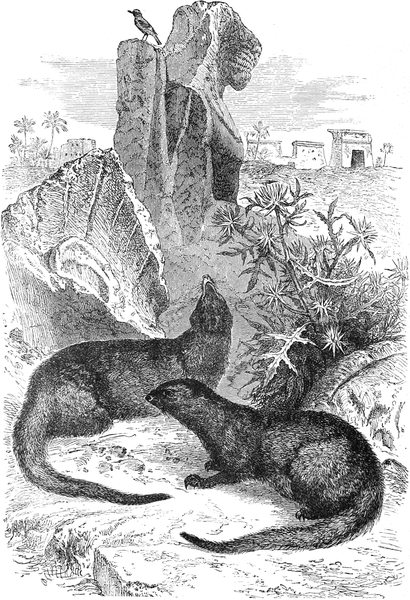
ICHNEUMONS.
“The mystery of the Mungoos and its antidote has been referred to the
supposition that there may be some peculiarity in its organisation
which renders it proof against the poison of the Serpent. It remains
for future investigation to determine how far this conjecture is
founded on truth; and whether in the blood of the Mungoos there exists
any element or quality which acts as a prophylactic. Such exceptional
provisions are not without precedent in the animal economy. The
Hornbill feeds with impunity on the deadly fruit of the Strychnos;[86]
the milky juice of some species of Euphorbia, which is harmless to
Oxen, is invariably fatal to the Zebra; and the Tsetse Fly, the pest of
South Africa, whose bite is mortal to the Ox, the Dog, and the Horse,
is harmless to man and the untamed creatures of the forest.”
This animal is usually considered to be sufficiently different from the
other Mungooses as to require a separate generic name. It has an almost
Snake-like body, and a very long, slender snout. It is of an iron-grey
colour, with a very well-marked white stripe on each side of the neck.
The tail is reddish and very thick, and attains a length of eleven
inches, the head and body together being eighteen inches in length.
Like the Civets, it has glands situated near the root of the tail,
but these glands, instead of secreting a perfume, produce a fluid of
the most abominably fetid odour, so that the beast is by no means
a pleasant one to come near. Moreover, to make matters worse, the
secretion of these glands does not quietly ooze out as in the Civets,
but the sacs are provided with muscles, by the aid of which the animal
is able to squirt out the noxious stuff to a considerable distance upon
any offending person.
“This curious animal has been found in the South-east Himalayas,
extending into Assam and Arakan. In its habits it is somewhat aquatic,
preferring, it is said by Hodgson, Frogs and Crabs. It lives in burrows
in the valleys of the lower and central regions of Nepaul.”
This animal, and other species of the same genus, are often called
“Tree Cats,” or “Palm Cats,” but as they are not Cats at all, it
is better to throw over the incorrect English name, and follow the
plan which, as the reader may see, is adopted on the labels at the
Zoological Gardens in this and similar cases: that is, Anglicise the
Latin name, even at the risk of using a somewhat long and ugly word;
but, as Milton says:—
“Why, is it harder, sirs, than Gordon,
Colkitto, or Macdonnel, or Galasp?
Those rugged names to our like mouths grow sleek,
That would have made Quintilian stare and gasp.”
The name Paradoxurus—“queer-tailed”—was given to the genus from
the fact that some of the animals composing it have their tails
curled round into a sort of screw, the under side being thus brought
uppermost. The name “Tree Cat” is very inappropriate, as the
Paradoxures are not in the least like Cats, but resemble far more
closely the Civets, which are, indeed, their nearest allies. They are
long-bodied and short-legged, with sharp snouts and long tails, and are
almost completely plantigrade.
The Common Paradoxure varies a good deal as to the character of its
fur. The ground-colour is usually “brownish-black, with some dingy
yellowish stripes on each side, more or less distinct, and sometimes
not noticeable; a white spot above and below each eye, and the forehead
with a whitish band in some; a black line from the top of the head down
the centre of the nose is generally observable.” The individual hairs
are yellowish at the base and blackish at the tip, and according to the
state of wear and tear of these, the animal appears to be of various
shades of tawny, brown, blackish, &c. The head and body together attain
a length of twenty-two to twenty-five inches, the tail nineteen to
twenty-one.
“This Tree Cat is a common and abundant animal throughout the greater
part of India and Ceylon, extending through Burmah and the Malayan
Peninsula to the island. It is most abundant in the latter wooded
region, and is rarely met with in the low portions of the Deccan,
Central India, and the North-West Provinces. It is very abundant on the
Carnatic and Malabar coast, where it is popularly called the Toddy
Cat, in consequence of its supposed preference for the juice of the
palm, a fact which appears of general acceptation both in India and
Ceylon (where it is called the Palm Cat), and which appears to have
some foundation. Kelaart says: ‘It is a well-established fact that it
is a consumer of palm toddy.’ It lives much in trees, especially in
the palmyra and cocoa-nut palms, and is often found to have taken up
its residence in the thick thatched roofs of native houses. I found
a large colony of them established among the rafters of my own house
at Tillichery. It is occasionally found in dry drains, outhouses,
and other places of shelter. It is quite nocturnal, issuing forth at
dark, and living by preference on animal food, rats, lizards, small
birds, poultry, and eggs; but it also freely partakes of vegetable
food, fruit, and insects. In confinement it will eat plantain, boiled
rice, bread and milk, &c. Colonel Sykes mentions that it is very fond
of Cockroaches. Now and then it will commit depredations in some
poultry-yard; and I have often known them taken in traps baited with
a Pigeon or a Chicken. In the south of India it is very often tamed,
and becomes quite domestic, and even affectionate in its manners. One
I saw, many years ago, at Trichinopoly, went about quite at large, and
late every night used to work itself under the pillow of its owner,
roll itself up into a ball, with its tail curled round its body, and
sleep till a late hour of the day. It hunted for Rats, Shrews, and
House Lizards. Their activity in climbing is very great; and they used
to ascend and descend my house, at one of the corners of the building,
in a most surprising manner.” Sir Emerson Tennent states that in Ceylon
the Palm Cat makes fearful havoc with the fowls of the villagers, “and,
in order to suck the blood of its victims, inflicts a wound so small as
to be almost imperceptible.”
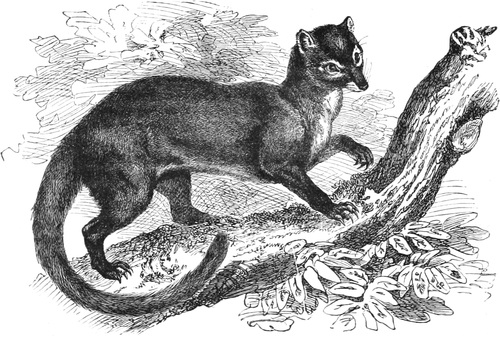
COMMON PARADOXURE.
This is a curious little animal, of a black colour, with a white border
to its ears, a large head and turned-up nose, and a long, immensely
thick, tapering tail, which, remarkably enough, is prehensile, like
that of a New World Monkey. It is twenty-eight to thirty inches long
from snout to root of tail, and the tail itself is nearly of the same
length. It is sometimes called the “black Bear Cat.”
“It is slow and crouching. In its habits it is quite nocturnal,
solitary, and arboreal, creeping along the large branches, and aiding
itself by its prehensile tail. It is omnivorous, eating small animals,
birds, insects, fruit, and plants. It is more wild and retiring than
Viverrine animals in general, and it is easily tamed; its howl is
loud.” It walks entirely on the soles of its feet, and its claws are
not retractile. It ranges from Nepaul to Sumatra and Java.
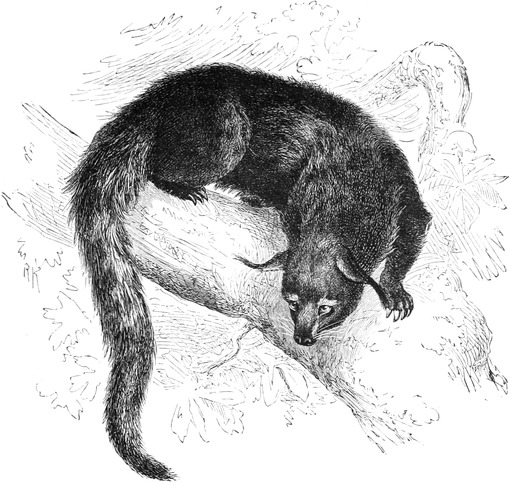
BINTURONG.
Altogether the Binturong is a decidedly interesting animal, and has
been a great puzzle to zoologists. It was formerly placed in the
Racoon family, to many of the members of which it bears a very strong
resemblance; but this resemblance is quite superficial, and brought
about by the similarity in the mode of life, &c. In the characters
of the skull and teeth, it undoubtedly belongs where we have placed
it, among the Civet group. Thus it forms a capital warning to those
zoologists whose knowledge is only skin-deep, and who group animals
entirely by their external character, without taking into account the
important points of fundamental structure, which should in every case
be considered first.[90]
Section Cynoidea—Geographical Distribution—Skull of Dog—Teeth—Legs—Walk—Claws—Internal Anatomy—The
Cæcum, or “Cul de sac” of the Intestine—Size—THE DOMESTIC DOG—Its Fidelity and Love—Differences between
the Domesticated and Natural Species of the Family—Barking a Civilised Habit—Antiquity of the Dog—The
Dog among the Hebrews and Egyptians—The Dog in the Bible—“Dog” as a Term of Reproach—Venerated
by many Ancient Nations—The Dog among the Greeks and Romans—Pre-historic Dogs—Dogs in the New World—Peruvian
Dogs—Superstitions about the Dog—The Dog as an article of Diet—Origin of the Dog—Identity of
Structure of Wild and Domestic Dogs—The independent Training of Wild Canidæ by Savages in many parts of
the World—Voice—Results of the whole question as to Origin—Anecdotes about Instinct, Reason, Docility—Muscles
of Dog’s Head—Consociation of Dogs—Anecdotes of Sense of Right, Wrong, Duty, Conscience—Sensitiveness,
Honesty, Theft, Cunning, Quarrelsomeness, Magnanimity, the reverse, Revenge, Hatred—Conjugal
Affection—Devotion to Man—Fickleness—Despair—Rabies and Hydrophobia—Wonderful Variety of Breed.
WE now come to the first and only family of the section Cynoidea,
the most compact of the three divisions of split-footed flesh-eaters,
and the one which contains the smallest number of forms. Only four
genera, in fact, are contained in the group, namely, the Dogs, Wolves,
and Foxes (Canis), the Long-eared Fox (Megalotis), the Racoon-dog
(Nyctereutes), and the curious Hyæna-like Lycaon.
But the group is none the less interesting for the small number of
forms included in it; for containing, as it does, the Dog, the animal
of all others entitled to the name domestic, it yields in importance
to neither of the larger groups, notwithstanding the varied series
of creatures enclosed within their pale. Members of the Dog family
are found in nearly all parts of the world, being absent only in the
West Indian Islands, Madagascar, the eastern islands of the Malayan
Archipelago, New Zealand, and the Polynesian Islands. When we say that
the Dog is absent from those places, we mean, of course, as a true
native. Wherever civilised man has penetrated, there his four-footed
friend is sure to be found; but in the places just mentioned no Dog,
Wolf, or Fox occurs as a true aboriginal. Very probably, the gigantic
island of Australia should be added to the above list, as it is by no
means certain that the Dingo, or wild Dog found there, has not been
introduced by man.
The Dogs form a sort of connecting link between the Cat-like species on
the one hand, and the Bear-like group on the other. In the matter of
being digitigrade, they agree with the Cats; the number of their teeth
agrees with that of the Bears; in the character of the skull they come
just half-way between the two.
On the under surface of the Dog’s skull there is found, in a
corresponding position to the ear-drum swelling of the Cat (see p. 11),
a similar rounded swelling, which, however, is smaller in proportion
to the size of the skull, rougher in texture, and not so regular in
shape, but sloping towards its outer aperture. Moreover, the margins
of its outer aperture, round which the external ear is fixed, are
produced outwards into a short tube or spout, thus making a small bony
ear-passage beyond or external to the rim to which the drum membrane
is attached. In the Cat, it will be remembered, there was no bony tube
of this sort, but the drum parchment was flush with the margins of the
opening of the drum cavity. Then the partition, which was so large in
the Cat, dividing the cavity into two compartments, is here reduced to
quite a low wall. Lastly, the bony clamp, which we mentioned in the
Cat as being fixed quite closely against the hinder face of the bulla,
is here separated from it by a small valley. These skull characters
are very characteristic of the Cynoidea, and are therefore of great
importance in the grouping of the Carnivora.
The great arches of bone beneath the eye are, in the Dog, nothing
like so large as in the Cat, owing to the smaller size of the jaw
muscles which pass under them. The snout, however, is much longer, in
correspondence with the increased number of the teeth.
There will be no difficulty in making out the teeth of the Dog now we
have studied those of the Cat. We shall find, as before, that there are
in the small front bones of the upper jaw three teeth on each side,
and the same number in the corresponding part of the lower jaw: these
are, of course, the incisors. They are followed by the canines, or
great eye teeth, of which, as in the Cat, there is one on each side of
each jaw. After the canines, however, come no less than six teeth on
each side of the upper jaw, and seven on each side of the lower. It
is found that the first four of these are represented in the jaw of
the young Dog by milk molars; therefore, as we explained in treating
of the teeth in the Cat, these four are premolars, and the remaining
three, molars. A likeness to what we find in the Cat exists in the fact
that the last premolar of the upper jaw and the first molar of the
lower jaw are very large teeth, and bite against one another. These
are the carnassials of the respective jaws. Thus the dental formula
of the Dog is—incisors,
(3–3)(3–3), canines,
(1–1)(1–1), premolars,
(4–4)(4–4), molars,
(2–2)(3–3) = 42.
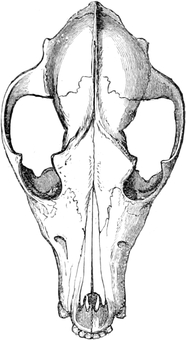
UPPER VIEW OF WOLF’S SKULL.
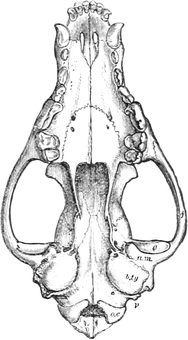
UNDER VIEW OF WOLF’S SKULL.
The form of the teeth, as well as their number, comes much nearer to
that of an ordinary Mammal, or is much less specially carnivorous than
in the Cats. The incisors are proportionally larger than in our first
section; their crowns are distinctly divided into three cusps—a large
central and two small lateral ones; and the outermost incisors of the
upper jaw approach tolerably nearly in shape and size to the canines,
being nearly half as long as the latter, and having almost lost their
lateral cusps. The canines have much about the same form and relative
size as in the Cat, as also have the premolars, except that the first
of these, though smaller than its successor, is not so markedly so as
in the Cats, while, on the other hand, the last (the carnassial) is
proportionally larger.
But in the molars, or at least in all but the lower carnassial, we find
something quite different, namely, an interesting approximation to
the semi-herbivorous type of dentition of the Bears. Both molars in
the upper jaw, and the two last in the lower, have become bonâ fide
“grinders.” The scissor-like cutting edge has disappeared, and in place
of it we have a hard crushing surface, raised into four cusps—two
large external and two smaller internal ones. This has relation, of
course, to the mixed character of the Dog’s food. The sectorial molar
of the lower jaw still, however, retains its distinctive characters;
its crown has much the same shape as in the Cat, but in addition
possesses an extra lobe, in the shape of a large heel-like process
projecting from its hinder border, and formed by a modification of its
posterior cusp.
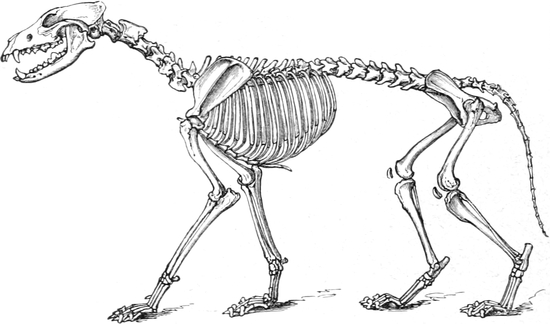
SKELETON OF WOLF.
The Dog family have, as a rule, longish legs. They walk on the tip of
their toes, like the Cats; but unlike the latter, their claws are not
retractile. Curious to relate, however, the elastic ligament by which
the drawing back of the feline claw is effected is present, but in so
feeble a condition as to be quite incapable of antagonising the great
flexor muscles.
In consequence of this, the paw of a Dog is by no means such a perfect
weapon as that of a Cat; and, as a matter of fact, the Dogs are
distinguished from the Cats by their habit of always attacking the prey
at once with their teeth, and never beginning the attack with a blow of
the paw.
In the matter of internal anatomy, the Dog family differ from all other
Carnivores in possessing a large “blind gut,” or cæcum. The intestines,
which are proportionally longer than a Cat’s, are, as usual, divided
into large and small, and, at the place where the large and small
intestines join one another, there goes off a folded sac, communicating
with the intestine at one end, but quite closed at the other, forming,
in fact, a small cul-de-sac. The use of this curious appendage is not
properly understood, nor why it should be so well developed in the Dog
family, while it is very small indeed in Cats, and wholly absent in
Bears.
No member of this family attains the size reached by some of the
Felidæ, such as the Lion and Tiger, or some of the Ursidæ, such as
the Grizzly or Polar Bear; the Mastiff is the largest of the tribe, no
wild species of which is larger than an ordinary Shepherd’s Dog.
We have now to consider an animal which has more interest for us than
any member of the animal kingdom, with the single exception of Homo
sapiens; indeed, many people, if asked to name the creature which
feels for them the most disinterested friendship, the most devoted
love, and which shows the most constant and untiring kindness and
attention, would without hesitation name the humble Carnivore rather
than the arrogant and self-asserting Primate. It was not his servants
who recognised Ulysses on his return from his long voyage; it was not
even his faithful Penelope; it was the old Dog Argus, who
“—— —— soon as he perceived
Long-lost Ulysses nigh, down fell his ears
Clapp’d close, and with his tail glad sign he gave
Of gratulation, impotent to rise
And to approach his master as of old.”
Where shall we find an instance of human devotion, unaltered and
unalterable by death, greater than that recorded by our great Lake poet
of the Dog whose ill-fated master was killed in passing Helvellyn?—
“The Dog, which still was hovering nigh,
Repeating the same timid cry,
This Dog had been through three months’ space,
A dweller in that savage place.
Yes, proof was plain, that since the day
On which the traveller thus had died,
The Dog had watched about the spot,
Or by his master’s side.
How nourished here through such long time,
He knows who gave that love sublime,
And gave that strength of feeling, great
Above all human estimate.”
No animal has been so universally or so thoroughly domesticated as the
Dog; in none have the moral and intellectual faculties been so largely
developed; and there is certainly none which the human race could so
ill spare. We might possibly, with a proper amount of practice, become
vegetarians, and so do without our sheep and cattle, our pigs and
poultry. The Cat we might easily dispense with, for she is, after all,
a very passive sort of creature, and rarely condescends to express
either emotion or affection, whatever her feelings may be; but to lose
the Dog would be to lose a friend, and a friend so faithful and true
that his loss would be a veritable plucking out of the right eye and a
cutting off of the right hand. As Mr. Darwin observes: “It is scarcely
possible to doubt that the love of man has become instinctive in the
dog,” which it can hardly be said to have done, as yet, in man!
Wherever man of any degree of civilisation is found, there the Dog
is to be found too—everywhere invaluable, though often grossly
and brutally ill-treated. In all probability, too, Dogs occur as
true natives in all parts of the world, except in the Australian
region—Australia, New Zealand, and the surrounding islands; in these
places he has, in all probability, been introduced by man.
The likeness of the domestic Dog to his more immediate relatives is
very close. Except in the want of obliquity in the eyes, and in the
curling of the tail, so different to the straight “brush” of a Wolf
or wild Dog, there is really no definite character which can be given
as separating Canis familiaris from the wild species of the genus.
Moreover, the difference between the varieties of the Dog itself is so
great, that it is impossible to frame anything like a good definition
which will include the Bulldog, the Greyhound, the Newfoundland, and
the Terrier, and, at the same time, exclude the Dingo and the Búansú.
The one constant difference is the habit of barking, “which is almost
universal with domesticated Dogs, and which does not characterise a
single natural species of the family.”
The Dog certainly took its origin at a very remote period, for we find
undoubted evidence of his existence and regular domestication in the
very earliest records. Among the early Hebrews, he seems to have been
unknown, or rather, despised; and it strikes one as a most remarkable
circumstance that this astute nation of shepherds should never have
domesticated so useful an assistant. Possibly this is partly owing to
the prejudice the grand old Theists of Palestine must have felt against
an animal held in great veneration as an emblem of the Divine Being by
the idolatrous Egyptians; and yet this objection can hardly have had
much weight, as the Hebrews kept Oxen, animals which were regularly
worshipped by the Egyptians. Throughout the Old and New Testaments the
Dog is spoken of with scorn and contempt as “an unclean beast,” so that
probably the Israelites had the misfortune only to know this friend
of man in the character in which he now appears in Constantinople—as
the common scavenger of the neighbourhood. The only instance in the
Bible in which the Dog is mentioned as a domesticated animal is in
that magnificent drama, the Book of Job, a poem of great antiquity,
and very possibly not of Hebrew origin. The suffering patriarch, after
recounting to his “friends” the greatness of his former prosperity,
says: “But now they that are younger than I have me in derision, whose
fathers I would have disdained to have set with the dogs of my flock.”
This passage is extremely remarkable, as showing at what an early
period of the world’s history the Dog was sufficiently domesticated to
be capable of the arduous task of guarding Sheep—a task, the proper
performance of which necessitates the total suspension of the true
canine instinct, which is not to guard and protect the Sheep, but to
worry and devour them.
The prejudice of the Jews against the Dog is shown at the present
day by the Hindoos and by the Mahometans, with whom “Dog” is the
greatest possible term of reproach, and who never think of the animal
as anything but a semi-useful, degraded beast, good for nothing but
to clear off the offal of the streets. Among many ancient nations,
however, the Dog was held in great veneration, and was even worshipped
as a god. In the passage—“Howbeit every nation made gods of their own
... and the Avites made Nibhaz,”[93] the word Nibhaz is supposed to
signify a barker, and it is thought that this idol had the form of
a Dog. “The Egyptians had several breeds of Dogs, some solely used
for the chase, others admitted into the parlour, or selected as the
companions of their walks; and some, as at the present day, selected
for their peculiar ugliness. All were looked upon with veneration,
and the death of a Dog was not only lamented as a misfortune, but was
mourned by every member of the house in which it occurred.”
It is certain that the Egyptians selected their Dogs in such a manner
as to produce well-marked varieties, for, as Mr. Youatt states,
“there are to be seen on the Egyptian temples representations of Dogs
with long ears and broad muzzle, not unlike the old Talbot Hound.”
This is extremely interesting as showing at what an early period
the Dog had been completely differentiated from other Canidæ, by
acquiring definite characters, quite distinct from those of his wild
relations. The Assyrians, too, had advanced considerably in the art of
seizing upon important varieties in the structure of their Dogs, and
perpetuating them as Hounds. Mr. Darwin informs us that an undoubted
Mastiff of enormous size is figured on the tomb of Esar Haddon, about
640 B.C., and he goes on to say, “I have looked through the
magnificent works of Lepsius and Rosellini, and on the monuments
from the fourth to the twelfth dynasties (i.e., from about 3400
B.C. to 2101 B.C.) several varieties of the Dog are
represented; most of them are allied to Greyhounds. At the later of
these periods a Dog resembling a Hound is figured, with drooping ears,
but with a large back, and more pointed head than in our Hounds. There
is, also, a Turnspit, with short and crooked legs, closely resembling
the existing variety.”[94]
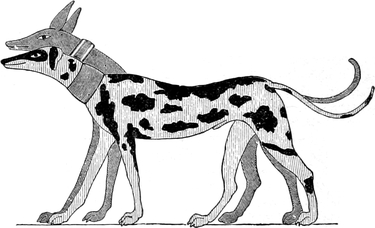
GREYHOUNDS. (From an Egyptian Monument.)
Both the Greeks and Romans made much of the Dog, and among the latter,
Greyhounds, Hounds, House Dogs, and Lap Dogs existed. Some of them
are preserved in sculpture. The Greeks had a Dog closely resembling
our Newfoundland, as is made certain from a piece of sculpture, “said
to have been the favourite Dog of Alcibiades, and to have been the
production of Myron, one of the most skilful artists of ancient times.”
Dogs “were sacrificed at certain periods by the Greeks and Romans to
almost all their deities, and particularly to Mars, Pluto, and Pan, to
Minerva, Proserpine, and Lucina, and also to the moon, because the Dog
by his barking disturbed all charms and spells, and frightened away
all spectres and apparitions. The Greeks immolated many Dogs in honour
of Hecate, because by their baying the phantoms of the lower world were
disturbed. A great number of Dogs were also destroyed in Samothrace
in honour of the same goddess. Dogs were periodically sacrificed in
February, and also in April and in May; also to the goddess Rubigo,
who presided over the corn, and the Bona Dea, whose mysterious rites
were performed on Mount Aventine. The Dog Cerberus was supposed to be
watching at the feet of Pluto, and a Dog and a youth were periodically
sacrificed to that deity. The night when the capital had nearly been
destroyed was annually celebrated by the cruel scourging of a Dog in
the principal public places, even to the death of the animal.”[95]
Homer, like the modern English, frequently uses the word “Dog” as an
epithet of contempt—“thou Dog in forehead;” but the Dog was man’s
companion everywhere amongst those old Greeks. When the “God of the
silver bow” strikes beasts and men with pestilence, it is said—
“Mules first and Dogs he struck, but at themselves,
Dispatching soon his bitter arrows keen,
Smote them.”
Yet, mixed with these friendly Dogs there were evidently Pariah Dogs;
cowards are threatened thus:—
“The Vulture’s maw
Shall have his carcase, and the Dogs his bones.”
Two nobler breeds are also indicated, viz., Shepherd Dogs and Hounds:—
“As Dogs that careful watch the fold by night,
Hearing some wild beast in the woods, which Hounds
And hunters with tumultuous clamour drive
Down from the mountain-top, all sleep forego.”
Homer also makes indubitable reference to another breed, viz., the
Boarhound:—
“As when Dogs and swains
In prime of manhood, from all quarters rush
Around a Boar, he from his thicket bolts,
The bright tusk whetting in his crooked jaws;
They press him on all sides, and from beneath
Loud gnashings hear, yet firm, his threats defy.”
But more ancient than any of these records are the evidences which
prove the existence of the domestic Dog among the pre-historic savages
of Northern Europe. In the Danish “kitchen-middens,” or heaps of
household refuse, piled up by the men of the newer stone period—a
time when our Scandinavian forefathers used chipped or polished flints
instead of metal for their weapons—are found bone-cuttings belonging
to some species of the genus Canis. Along with these remains are
some of the long bones of birds, all the other bones of the said birds
being absent. Now it is known that the bird-bones here found are the
very ones which Dogs cannot devour, while the absent ones are such as
they can bolt with ease, and it has been ingeniously argued from this
that the remains in question did really belong to a domestic Dog, as,
if the animals to which they appertained had been Wolves, they would
have made short work of the long bones as well as of the others. Other
Dog-bones are found in Denmark in later periods. At the time when the
flint knives were succeeded by bronze a large Dog existed, and at the
time when iron was used one larger still. In Switzerland, during the
newer stone period, a Dog existed, which is probably the oldest of
which we have any record. It “partook of the character of our Hounds
and Setters or Spaniels,” and, in the matter of its skull, “was about
equally remote from the Wolf and Jackal.” This Dog, too, like its
Danish contemporary, was succeeded in the bronze period by a larger
variety. Thus we see that, at a time when our ancestors were living “in
dens and caves of the earth,” in a state of civilisation about equal to
that of the African or Australian aborigines of the present day, the
Dog was already systematically kept, and “selected,” that is, any good
varieties which appeared were taken note of, and kept up.
We have mentioned above the common practice amongst the Greeks and
Romans of offering Dogs as sacrifices to the numerous deities. The
same custom was prevalent in early times in Scandinavia, where the
Dog was often used as a sacrificial victim. Mr. Youatt says:—“Before
Christianity was established among the Danes, on every ninth year, at
the winter solstice, a monstrous sacrifice of ninety-nine Dogs was
effected. In Sweden the sacrifice was still worse. On each of nine
successive days ninety-nine Dogs were destroyed. This sacrifice of the
Dog, however, gave way to one as numerous and as horrible. On every
ninth year ninety-nine human victims were immolated, and the sons of
the reigning tyrant among the rest, in order that the life of the
monarch might be prolonged.
“On the other hand, the Dog was frequently the executioner; and,
from an early period, whether in the course of war, or the mock
administration of justice, thousands of poor wretches were torn to
pieces by animals trained to that horrible purpose.
“As a counterpart to much of this, the ancient Hyrcanians may be
mentioned, who lived near the Caspian sea, and who deemed it one of the
strongest expressions of respect to leave the corpse of their deceased
friends to be torn and devoured by Dogs. Every man was provided with a
certain number of these animals, as a living tomb for himself at some
future period, and these Dogs were remarkable for their fierceness.”
In the New World, the Dog is, or was, held as an object of adoration
by many of the natives; and dog-worship seems to have been a more
ancient culte than the sun-worship practised by the Mexicans.
Humboldt informs us that “when the Inca Pachacutec, in his religious
wars, conquered the Indians of Xanxa and Huanca (the present valley
of Huancayo and Juuja), and compelled them by force to submit to the
worship of the sun, he found that Dogs were made the objects of their
adoration, and that the priests used the skulls of these animals as
wind instruments. It would also appear that the flesh of this canine
divinity was eaten by the believers. The veneration of Dogs in the
valley of the Huancaya is probably the reason why the skulls, and even
whole mummies, of these animals are sometimes found in the Huacas, or
Peruvian graves of the most ancient period. Von Tschudi, the author
of an admirable treatise on the Fauna Peruana, has examined these
skulls, and believes them to belong to a peculiar species, which he
calls Canis ingæ, and which is different from the European Dog. The
Huancas are still, in derision, called ‘dog-eaters’ by the inhabitants
of other provinces.” Humboldt also tells us that “the Peruvian Dogs
were made to play a singular part during eclipses of the moon, being
beaten as long as the darkness continued.” But he says nothing about
the origin of so curious a custom.
An animal of such intelligence as the Dog, one so necessary to the
welfare of man, and devoted to him by so many ties, is certain to have
a number of curious superstitions current regarding him. An excellent
account of some of the most curious of them is given by the Rev. J.
Gardner.
“Among the Hyperborean tribes, with whom the Dog is reckoned a very
valuable animal, it occupies a conspicuous place in their traditions,
being considered—as, for instance, among the Eskimo, according to the
accounts given by Franklin and Parry, and other Arctic navigators—as
the father of the human family. The Chippewayan Indians had a tradition
that they were sprung from a Dog; and hence they neither ate the flesh
of that animal themselves, nor could they look with any other feeling
than horror upon those nations who fed upon it. In all these cases,
probably, the Dog is the symbol of the sun. A strange notion prevails
among the Greenlanders that an eclipse is caused by the sun being
pursued by his brother the moon. Accordingly, when this phenomenon
takes place, the women take the Dogs by the ears, believing that, as
these animals existed before man was created, they must have a more
certain presentiment of the future than he has; and therefore, if they
do not cry when their ears are pulled, it is an infallible sign that
the world is about to be destroyed.
“The inhabitants of Japan have a superstitious regard for Dogs. Thus,
we learn from Picart, in his ‘Religious Ceremonies of all Nations,’
‘The emperor who sat on the throne when Kaempfer resided in Japan was
so extravagantly fond of them, that there has been a greater number
of them in that kingdom ever since his reign (if we may depend on the
veracity of this traveller) than in any other nation in the whole
world. Every street is obliged to maintain a fixed and determinate
number of them. They are quartered upon the inhabitants, and in case
of sickness they are obliged to nurse and attend them. When they die,
they are obliged to inter them in a decent manner in the mountains
and hills peculiarly appropriated for the interment of the people. It
is looked upon as a capital crime not only to kill them, but barely
to insult and treat them ill; and no one but the legal proprietor is
allowed so much as to correct any of them. All this reverence and
respect are owing to a celestial constellation which the Japanese call
the Dog, under the influence whereof the aforesaid Emperor of Japan was
born.’”
By most people the Dog is valued only during his life; his skin is not
particularly valuable, and his flesh is little esteemed. This is by no
means, however, the case everywhere. It is well known that the Chinese
use the Dog as a regular article of food. Many of the North American
tribes look upon an entrée of Dog as the greatest possible bonne
bouche they can set before a stranger. Sir Leopold McClintock relates
that, in the Sandwich Islands, he had most profuse apologies offered
to him because there was no puppy to be had for a feast to which he
was invited. The Eskimo, too, look upon a dish of young Dog as a great
treat; and it is related that a Danish captain provided his friends
with a feast of this kind, and when they praised his mutton, sent for
the skin of the beast, and exhibited it to them! The Greeks and Romans
also used the Dog as an article of diet, and many ancient writers, such
as Galen and Hippocrates, represent Dog-meat as a highly desirable dish.
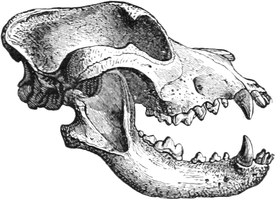
SKULL OF DOMESTIC DOG.
It is a remarkable circumstance, when we come to consider the probable
origin of the Dog, that there is evidence of his domestication at such
early periods, and by so many savage tribes in different parts of the
world. As we have already seen, tame Dogs were possessed by savages
in the neolithic, or newer stone period, by the Assyrians, Egyptians,
Greeks, Romans, and the ancient inhabitants of North and South America,
to say nothing of the numerous savage tribes at the present day, such
as the Australians and the inhabitants of Guiana. Now the important
question arises, had all these Dogs a common origin? Did the great
neolithic Dog, the Sheep-dog of Job’s time, the Greyhounds, Turnspits,
and Hounds of the Assyrians and Greeks, the divinely-honoured animals
of Peru, and the supposed ancestors of the Eskimo and the Chippeways,
spring from a single pair? or have various wild species of Canidæ
been tamed and converted into true domestic Dogs, by different people
in different parts of the world, these various species having since
been crossed and re-crossed with one another and with their parent
forms, until a species has been produced as complex in its origin as
the English nation, which has flowing in its veins the blood of ancient
Briton, Roman, Anglo-Saxon, Dane, Norman, and Fleming?
Until recently it was thought that all the evidence which could be
brought to bear on the matter pointed to a separate origin of the Dog.
It was argued, for instance, that as we have evidences of distinct
breeds existing in far-back periods of the world’s history, there was
actually no time, prior to those periods, for him to have diverged from
a savage ancestor, such as a Wolf or a Jackal. It was also thought
highly unlikely that a number of primitive races of man should have
separately tamed different wild Canidæ. Mr. Youatt, one of our best
authorities on the Dog, writing in 1845, says: “This power of tracing
back the Dog to the very earliest periods of history, and the fact
that he then seemed to be as sagacious, as faithful and as valuable
as at the present day, strongly favours the opinion that he descended
from no inferior and comparatively worthless animal; that he was not
the progeny of the Wolf, the Jackal, or the Fox; but he was originally
created, somewhat as we now find him, the associate and friend of man.”
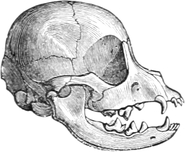
SKULL OF YOUNG DOG.
A few years ago there was no gainsaying arguments such as these, for
then nearly everybody believed that the world was literally only six
thousand years old, and that species were absolutely unchangeable.
But Sir Charles Lyell and Mr. Darwin have “changé tout cela.” The
argument from time fails utterly, and other facts have to be taken into
consideration.
There is, first of all, the fact of identity of structure. There is
absolutely no definition framable which will include all the varieties
of the domestic Dog, and exclude all the wild species—none even which
will include all the Dogs properly so called, both wild and tame, and
at the same time exclude the Wolf and Jackal. It is the same as regards
habits, instincts, mental endowments, &c. Wolves and Jackals can be
and have been tamed. Domestic Dogs can become, and have again and
again become, wild, and in no way better than true aborigines; and to
assert that the Dog is not descended from a Jackal because his manners
and customs are better, his tail more curly, and his voice a bark
instead of a howl, is about as just as to assert that Englishmen cannot
possibly be descended from ancient Britons, because they wear clothes
instead of a coating of blue paint.
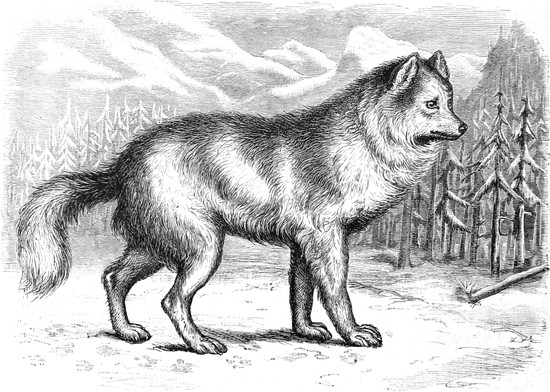
HARE INDIAN DOG.
With regard to the opinion that many races of men are not likely
independently to have tamed wild Canidæ, there are certain facts
which show that the exact contrary is the case. Savages in all parts
of the world are fond of making pets of various kinds, and would have
been certain to come across Wolf or Jackal pups in their wanderings
through the woods. Then, again, as Mr. Darwin remarks, “At an extremely
ancient period, when man first entered any country, the animals living
there would have felt no instinctive or inherited fear of him, and
would consequently have been tamed far more easily than at present.
For instance, when the Falkland Islands were first visited by man,
the large Wolf-like Dog (Canis antarcticus) fearlessly came to meet
Byron’s sailors, who, mistaking this ignorant curiosity for ferocity,
ran into the water to avoid them. Even recently a man, by holding a
piece of meat in one hand and a knife in the other, could sometimes
stick them at night.” Another important point is the readiness with
which many wild species of Canidæ breed in confinement, so that the
difficulty of perpetuating the newly-acquired characteristics of the
tamed animal is, in this case, obviated. Furthermore, it is perfectly
well known that savages at the present day do actually tame, and make
useful to themselves, the wild Dogs of their particular countries: “the
savages of Guiana catch, and partially tame and use the whelps of the
wild species of Canis, as do the savages of Australia those of the
Dingo.”
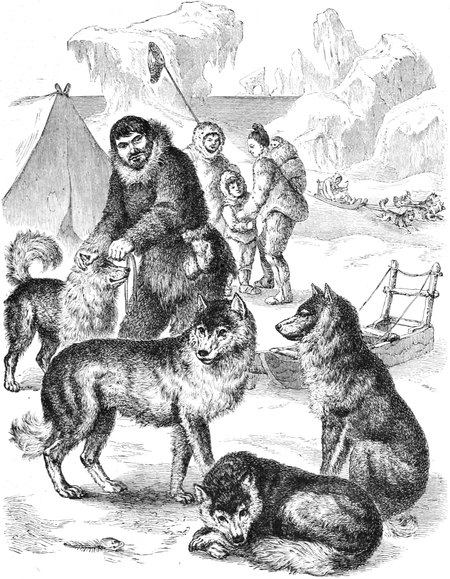
ESKIMO DOGS.
These statements certainly tend to show that there is no actual
improbability in supposing that many wild species of Canidæ have at
different times, and by different nations, been tamed and gradually
modified into true domestic Dogs. But the most significant fact
bearing upon the multiple origin of the Dog is the often-occurring
close resemblance between the domestic Dog of a savage tribe and the
wild species of Canis inhabiting the same district. Of this most
important circumstance there are far too many instances to allow
of its being looked upon as a mere coincidence. Sir John Richardson
says: “The resemblance between the Wolves and the Dogs of those Indian
nations who still preserve their ancient mode of life continues to
be very remarkable, and it is nowhere more so than at the northern
extremities of the Continent, the Eskimo Dogs being not only extremely
like the Grey Wolves of the Arctic circle in form and colour, but also
nearly equalling them in size. The Dog has generally a shorter tail
than the Wolf, and carries it more frequently curled over the hip, but
the latter practice is not totally unknown to the Wolf, although that
animal, when under the observation of man, being generally apprehensive
of danger or on the watch, seldom displays this mark of satisfaction.”
And again, “The resemblance between the northern Wolves and the
domestic Dog of the Indians is so great, that the size and strength of
the Wolf seem to be the only difference. I have more than once mistaken
a band of Wolves for the Dogs of a party of Indians; and the howl of
the animals of both species is prolonged so exactly in the same key,
that even the practised ear of an Indian fails at times to discriminate
them.”
As the Eskimo and Indian Dogs resemble the North American Wolf (C.
lupus), so the Dog of the Hare Indians, a very distinct breed (see
below), resembles the Prairie Wolf (C. latrans). So great is this
resemblance that Richardson says, “I could detect no marked difference
in form except the smallness of its [the Dog’s] cranium, nor in the
fineness of its fur, and arrangement of its spots of colour. The length
of the fur on the neck, back part of the cheeks, and top of the head,
was the same in both species. It, in fact, bears the same resemblance
to the Prairie Wolf that the Eskimo Dog does to the great Grey Wolf.”
Another observer remarks that, except in the matter of barking, there
is no difference whatever between the black Wolf-dog of the Indians of
Florida and the Wolves of the same country. The Dogs also breed readily
with the wild animals they so closely resemble. The Indians often cross
their Dogs with Wolves to improve the breed, and in South America the
same process is resorted to between the domesticated and the wild Dogs.
The same phenomenon is seen in many kinds of Dog in the Old World. The
Shepherd Dog of the plains of Hungary is white or reddish-brown, has a
sharp nose, short erect ears, shaggy coat, and bushy tail, and so much
resembles a Wolf, that Mr. Paget, who gives the description, says he
has known a Hungarian mistake a Wolf for one of his own Dogs. There is
also a close resemblance between some of the Indian Pariah Dogs and the
Indian Wolf. Some of the domestic Dogs of Egypt, both at the present
day and in the condition of mummies, closely resemble the Wolf of that
country; “whereas the domestic Dogs of Nubia, and certain other mummied
Dogs, have the closest relation to a wild species of the same country
... which is only a form of the common Jackal.” Dogs have, moreover,
been known to cross with Jackals as well as with Wolves. Lastly, in
Africa, some of the natives assert that their half-tamed Dogs are
derived from Foxes; and the Dogs of the Bosjesman have a striking
resemblance to the black-backed Jackal (C. mesomelas), which, as we
shall see, is a South African variety.
These facts are so significant and so important that they in reality
leave only one difficulty to be settled, and that is the question of
voice. As we stated above, all domestic Dogs bark, while all wild
Canidæ express their feelings only by howls. But the difficulty here
is not so great as it seems. Some domestic Dogs left on the island
of Juan Fernandez entirely lost the habit of barking in thirty-three
years, and a few individuals removed after that period only re-acquired
it very slowly; thus, domestic Dogs allowed to run wild forget how to
bark. On the other hand, Jackals, wild Dogs, and Wolf-pups reared by
bitches, readily acquire the habit. Thus the last stumbling-block in
the argument disappears, and we are forced to agree with Mr. Darwin,
from whom many of the above facts are taken,[96] that “it is highly
probable that the domestic Dogs of the world have descended from two
good species of Wolf (C. lupus and C. latrans), and from two or
three other doubtful species of Wolves (namely, the European, Indian,
and North African forms); from at least one or two South American
Canine species; from several races or species of the Jackal; and
perhaps from one or more extinct species;” and that the blood of these,
“in some cases mingled together, flows in the veins of our domestic
breeds.”
There is no animal so interesting as the Dog for the study of the
relation between man and the lower animals in the matter of instinct,
reason, conscience, and the like. As no animal has been so thoroughly
domesticated, and so systematically trained and educated, so none has
developed in the same degree those higher endowments which are often
considered as the exclusive attributes of humanity, such as reasoning
power, a sense of right and wrong, of property, and of number.
For the study of instinct, it is impossible to find an animal in any
way approaching to him for interest, for not only does he exhibit, to a
wonderful degree, the instincts common to all the higher animals, but
almost every kind of Dog possesses some special instinct, imparted from
a remote ancestor, and absent, or nearly so, in other varieties. We
may instance the mode of “pointing” game peculiar to the Pointer, the
marvellous power of following scent of the Bloodhound or Foxhound, and
the acute generalship of the Shepherd’s Dog, who, with comparatively
little teaching, guards, drives, and keeps together a whole flock
of foolish animals, which, to the Dog mind, must seem intended by
Providence to be worried and eaten. These special instincts we shall
consider when we come to speak of the various breeds; but we must
now say a few words on those instincts which are common to the whole
species.
Unlike the Lion and Tiger, the male Dog takes no interest whatever
in his offspring, who are taken care of during the weeks of their
helplessness entirely by the mother. She, however, quite makes up for
paternal neglect by the assiduity with which she tends and cares for
her feeble offspring. It is one of the most touching, and, at the same
time, almost amusing sights, to see a bitch with her first litter;
how jealously she watches the blind, fat, slug-like little creatures.
At first she will growl and snap even at her beloved master, if he
approaches too near her treasures. When they have grown a little,
how fussy she becomes when they are noticed; she will even drag them
by the leg, one by one, upstairs, to exhibit their perfections! For
several weeks this care continues, but by the time the pups have grown
half as big as their mother, and can see and run about, her solicitude
diminishes. She begins to quarrel with them over bones and other
titbits, and, before long, takes no more notice of them than if they
were the commonest stray Dogs in the street. It is this evaporation of
mother-love which so distinguishes a Dog-parent from, at any rate, a
great number of human parents.
Like most animals, the female Dog, if deprived of the natural objects
of her affection, will lavish her care on almost any young and helpless
thing with which she may be brought in contact.
Dr. Sclater,[97] whilst visiting the Zoological Gardens at Antwerp, in
1875, noticed a curious instance of the blindness of maternal love in
a Dog. Among other objects of attraction were “three young Tiger-cubs,
born in the Gardens on the 14th of October, 1873,” that had been “most
successfully foster-mothered by a large bitch.”
We have stated that the male Dog is perfectly oblivious of his paternal
duties; we have, however, met with one instance of a Dog, who, whatever
may have been his qualities as a parent, discharged with great fidelity
the part of guardian, and that, too, not to one of his own species, but
to one of an alien and hostile race. This curious instance of canine
affection was exhibited by a small male pet Spaniel, belonging to some
friends of ours, who brought up a kitten. The food, certainly, was
supplied by the family, but the brooding and tendance were done most
faithfully. On warm days, the Dog would carry the kitten and lay it
in the sun, choosing some snug place out of the wind, in the garden.
The kitten, a female, lived to become a very beautiful Cat; but her
unsuspecting innocence led to her death. Not fearing any of the
Dog-kind, she made no attempts to escape from them, and was worried to
death by a strange stray Dog.
One of the most striking circumstances with regard both to the general
and the special instincts of the Dog, namely, those instincts common to
the whole species, and those possessed by particular breeds, is the way
in which they are transmitted from parent to child. The Pointer points
the first time he is taken out; the Shepherd’s Dog learns his duties
with astonishingly little teaching. Not only are instincts transmitted
in pure breeds, but in cross-breeds the special characteristics of
both parents come out with the most marvellous accuracy. “... It is
known that a cross with a Bull-dog has affected for many generations
the courage and obstinacy of Greyhounds; and a cross with a Greyhound
has given a whole family of Shepherd-dogs a tendency to hunt Hares. Le
Roy describes a Dog, whose great grandfather was a Wolf, and this Dog
showed a trace of its wild parentage only in one way—by not coming
in a straight line to his master when called.” The tendency to attack
Poultry, Sheep, &c., “has been found incurable in Dogs which have
been brought home as puppies from countries, such as Tierra del Fuego
and Australia, where the savages do not keep these domestic animals.
How rarely, on the other hand, do our civilised Dogs, even when quite
young, require to be taught not to attack Poultry, Sheep, and Pigs!”[98]
A most astonishing account of an inherited mental peculiarity—an
instinctive dislike—is related by Dr. Huggins, to whose researches the
science of astronomy owes so much. He writes:—
“I possess an English Mastiff, by name Kepler, a son of the celebrated
Turk, out of Venus. I brought the Dog, when six weeks old, from the
stable in which he was born. The first time I took him out, he started
back in alarm at the first butcher’s shop he had ever seen. I soon
found that he had a violent antipathy to butchers and butchers’ shops.
When six months old, a servant took him with her on an errand. At a
short distance before coming to the house she had to pass a butcher’s
shop. The Dog threw himself down (being led with a string), and neither
coaxing nor threats would make him pass the shop. The Dog was too heavy
to be carried; and as a crowd collected, the servant had to return
with the Dog more than a mile, and then go without him. This occurred
about two years ago. The antipathy still continues, but the Dog will
pass nearer to a shop than he formerly would. About two months ago, in
a little book on Dogs published by Dean, I discovered that the same
strange antipathy was shown by his father, Turk. I then wrote to Mr.
Nicholls, the former owner of Turk, to ask him for any information he
may have on the point. He replied—‘I can say that the same antipathy
exists in King (the sire of Turk), in Punch (son of Turk, out of
Meg), and in Paris (son of Turk, out of Juno). Paris has the greatest
antipathy, as he would hardly go into a street where a butcher’s
shop was, and would run away after passing it. When a cart with a
butcher’s man came into the place where the Dogs were kept, although
they could not see him, they all were ready to break their chains. A
master-butcher, dressed privately, called one evening on Paris’s master
to see the Dog. He had hardly entered the house before the Dog (though
shut in) was so excited that he had to be put into a shed, and the
butcher was forced to leave without seeing the Dog. The same Dog, at
Hastings, made a spring at a gentleman who came into the hotel. The
owner caught the Dog and apologised, and said he never knew him to do
so before, except when a butcher came to his house. The gentleman at
once said that was his business. So you see that they inherit these
antipathies, and show a great deal of breed.’”[99]
A gentleman on reading this account of Dr. Huggins’s Dog, wrote to
say that he possessed a son of Sybil, daughter of Turk, who possessed
the family antipathy in a marked degree, and another stated that he
also possessed a grandson of the redoubted Mastiff, in whom the same
peculiarity was developed. Thus we see that this most remarkable
instinctive dread, arising no one knows how, existed not only in Dr.
Huggins’s Dog, but in his father, grandfather, brothers, and nephews!
It was suggested, and it seems highly probable, that the feeling in
this case first arose from the fact of some ancestor of the Turk family
being ill-treated by a butcher; but it is quite possible that it may
have arisen spontaneously. Boswell, in his life of Johnson, quotes the
“Great Lexicographer” as attributing a similar dislike to butchers
noticed in the Dogs of some savage countries, where the animal was used
for food, not to horror at the butcher’s cruelty, but merely to the
smell of carnage.
A very remarkable trait in the Dog’s character, which has undoubtedly
become instinctive, and is consequently transmitted from generation to
generation, is his love of human society. A well cared-for Dog will
always prefer his master’s company to that of his own kind, and will
take any amount of trouble, and give up any amount of personal ease,
that he may not be parted from him.
But, undoubtedly, the most wonderful canine instinct is the sense of
direction, the power possessed by so many Dogs of finding their way
back to an old and well-loved home, after being forcibly removed from
it to a new place of abode. Instances are numerous in which Dogs, taken
from their usual habitation, shut up in a basket, or by night, or in
a swift railway train, have unerringly found their way back, greatly
to the surprise of both their new and their old masters. Mr. Wallace
has suggested that this was not a true case of instinct, but that the
Dog, in all probability, found his way back by smell; that he, as it
were, takes a note of every smell he passes—a stagnant pool here, a
haystack there, a wayside inn, a stable, &c. &c.—and, remembering not
only the smells, but the order in which he smelt them, he follows
the scent until he arrives at his destination. There is no doubt that
the Dog’s olfactory sense is wonderfully acute, but this is certainly
carrying it too far. Moreover, as has been remarked, the direction of
the wind was quite likely to change between the Dog’s two journeys,
and if one of his odoriferous landmarks happened to be movable, like a
flock of Sheep, where would he be? But the one fact which completely
disposes of the smell theory of the phenomenon is, that there is no
evidence of a Dog’s ever returning to his old home by the way he was
taken from it; he invariably takes a different route, usually a short
cut. For instance: “A Hound was sent by Charles Cobbe, Esq., from
Newbridge, county Dublin, to Maynalty, county Meath, and thence, long
afterwards, conveyed to Dublin. The Hound broke loose in Dublin, and
the same morning made his way back to his old kennel at Newbridge,
thus completing the third side of a triangle by a road he had never
travelled in his life.” Again, Mr. Romanes narrates the case of a
Dog who, when taken by his master from Oban to Greenock, by sea, was
grievously sea-sick. The next time the journey had to be made, the Dog,
remembering his former trouble, jumped off the boat and disappeared.
His master continued his voyage, and was greatly surprised, when he
arrived at Greenock, to find the Dog waiting for him on the wharf!
The distance from Oban to Greenock is fifty miles in a straight line,
and this straight course the Dog is not likely to have taken, as his
way would then have lain across mountains, a lake, and an arm of the
sea. Thus it would seem that the Dog must have some sort of notion of
direction, must possess, as it were, a special sense of the nature of
a mariner’s compass, and that, so far from his sense of locality being
due in any way to power of smell, it is perhaps the most striking
example of a pure instinct which it is possible to conceive.
We have not given many instances of instinct in the Dog, for it is a
faculty of which no one denies the existence, but of reasoning power it
is necessary to treat more fully, as many persons are disposed wholly
to deny the presence of that faculty in all the lower animals, and to
make it the exclusive prerogative of man. Every one who has kept a
Dog must have seen it perform actions which, in a human being, would
unhesitatingly be put down to reason; every one must have heard of
cases in which a choice of two or more courses was presented to a Dog,
and in which he has, after due reflection, chosen the best.
We are indebted to Mr. Hugh Miller, F.G.S., for a good instance of
reasoning power in a Dog belonging to his brother, Captain Miller.
This Dog, “Tara” by name, a Greyhound with a dash of Pointer, was one
day taken out with a carriage for a run of forty miles. Now, it is
estimated that a Dog, by his uncontrollable habit of “meandering,”
usually goes over about three times, the ground of the horse or man he
accompanies, so that on this occasion Tara must have run considerably
over a hundred miles, and was in consequence rather done up when she
reached home. She usually slept in the dining-room, whence she was
always ejected at 7 A.M. by the housemaid who cleaned the
room. On this occasion, however, no amount of persuasion could induce
Tara to occupy her accustomed sleeping-place; she positively insisted
upon following her master upstairs to his bedroom, where she evidently
expected she could remain undisturbed for a good long rest, and where
she did actually remain till 2 P.M. on the following day.
Another and more striking instance of the exercise of reasoning power
is given in the Quarterly Journal of Science for April, 1876. It
is there stated that a Newfoundland Dog was “sent across a stream to
fetch a couple of hats, whilst his master and friend had gone on some
distance. The Dog went after them, and the gentlemen saw him attempt to
carry both hats, and fail, for the two were too much for him. Presently
he paused in his endeavour, took a careful survey of the hats,
discovered that one was larger than the other, put the small one in the
larger, and took the latter in his teeth by the brim!”
In the face of facts such as these, the question as to whether Dogs
possess the power of reasoning becomes merely one of words. No one
would say that a human being who did as this Dog did acted from
blind instinct. One can easily call to mind several persons of one’s
acquaintance, to whom it would be the height of presumption to deny
the possession of reason, and who yet would never have thought of
putting the hats one inside the other. It is related that the great
Newton made, in his study door, a big hole for his Cat and a little one
for the kitten. In doing this he showed far less exercise of reason
than the Dog; and it is quite conceivable that if he had been sent to
fetch the hats he would have brought them over separately! We shall
give other instances of reason in the Dog when we come to speak of
conscience, cunning, revenge, &c., as exhibited by him. Any book of
Dog-anecdotes will furnish the reader with many more, so that, on the
whole, one is forced to the conclusion that, to prove the absence of
reason in the Dog, one must argue something after this fashion:—Dogs
often perform actions which, in man, would undoubtedly be attributed
to reason. But man is the only member of the animal creation which
possesses the reasoning faculty. Therefore, all actions in the
Dog which simulate reason are, in reality, due to blind instinct.
Therefore, Dogs do not possess the reasoning faculty. Which was to be
demonstrated.
One of the most interesting points in the Dog’s character, and one in
which many of his human masters would do well to imitate him, is his
teachableness. A good Dog may be taught almost anything, no matter how
difficult or distasteful, or how foreign to his nature. And not only
will he learn to do anything, but to understand anything, for there
can be no doubt whatever that Dogs actually do understand what is said
to them, in many cases, quite irrespectively of tone or gesture. Of
course, with an ordinary Dog who has received no special and systematic
training, it is the tone of his master’s voice or his gestures which
convey meanings to him, far more than the actual words; but with
many Dogs, whose intelligence is great, and whose education has been
thorough, this acme of culture is attained, and the animal does,
undoubtedly, understand the actual words said to him. As an instance,
we may mention the well-known case of “Sirrah,” the Ettrick Shepherd’s
Dog, who wanted only the words “Sirrah, my man, they’re a’ awa’!” to
proceed immediately in search of the missing flock. It is a matter
of the commonest observation how soon even ordinary Dogs learn to
understand certain words or phrases, such as “Rats!” “Cats!” “Set them
off!” “Beg!” “Trust!” and so forth; and, although certainly in many of
these cases tone and gesture have a great deal to do with the animal’s
comprehension, yet there can be no sort of doubt that a Dog of fair
intelligence learns, after a time, to recognise the words, if spoken
in the most ordinary tone of voice. The following account—a truly
marvellous one—illustrates not only the most perfect understanding of
words, but capacity for a high degree of education, great intelligence,
extensive memory, and reasoning faculties of no mean order:—
“Two fine Dogs, of the Spanish breed, were introduced by M. Léonard,
with the customary French politesse, the largest by the name of M.
Philax, the other as M. Brac (or Spot). The former had been in training
three, the latter two, years. They were in vigorous health, and having
bowed very gracefully, seated themselves on the hearth-rug side by
side. M. Léonard then gave a lively description of the means he had
employed to develop the cerebral system in these animals—how, from
having been fond of the chase, and ambitious of possessing the best
trained Dogs, he had employed the usual course of training—how the
conviction had been impressed on his mind that by gentle usage, and
steady perseverance in inducing the animal to repeat again and again
what was required, not only would the Dog be capable of performing
that specific act, but that part of the brain which was brought into
activity by the mental effort would become more largely developed, and
hence a permanent increase of mental power be obtained.
“After this introduction, M. Léonard spoke to his Dogs in French, in
his usual tone, and ordered one of them to walk, the other to lie down,
to run, to gallop, halt, crouch, &c., which they performed as promptly
and correctly as the most docile children. Then he directed them to go
through the usual exercises of the manège, which they performed as
well as the best trained ponies at Astley’s.
“He next placed six cards of different colours on the floor, and,
sitting with his back to the Dogs, directed one to pick up the blue
card, and the other the white, &c., varying his orders rapidly, and
speaking in such a manner that it was impossible the Dogs could have
executed his commands if they had not had a perfect knowledge of the
words. For instance, M. Léonard said, ‘Philax, take the red card and
give it to Brac, and, Brac, take the white card and give it to Philax.’
The Dogs instantly did this, and exchanged cards with each other. He
then said, ‘Philax, put your card on the green, and Brac, put yours
on the blue;’ and this was instantly performed. Pieces of bread and
meat were placed on the floor, with figured cards, and a variety of
directions were given to the Dogs, so as to put their intelligence and
obedience to a severe test. They brought the meat, bread, or cards,
as commanded, but did not attempt to eat or to touch unless ordered.
Philax was then ordered to bring a piece of meat and give it to Brac,
and then Brac was told to give it back to Philax, who was to return it
to its place. Philax was next told he might bring a piece of bread
and eat it; but, before he had time to swallow it, his master forbade
him, and directed him to show that he had not disobeyed, and the Dog
instantly protruded the crust between his lips.
“While many of the feats were being performed, M. Léonard snapped a
whip violently, to prove that the animals were so completely under
discipline, that they would not heed any interruption. After many
other performances, M. Léonard invited a gentleman to play a game of
dominoes with one of them. The younger and slighter Dog then seated
himself on a chair at the table, and the writer and M. Léonard seated
themselves opposite. Six dominoes were placed on their edges in the
usual manner before the Dog, and a like number before the writer. The
Dog, having a double number, took one up in his mouth, and put it in
the middle of the table; the writer placed a corresponding piece on one
side; the Dog immediately played another correctly, and so on until all
the pieces were engaged. Other six dominoes were then given to each,
and the writer intentionally played a wrong number. The Dog looked
surprised, stared very earnestly at the writer, growled, and finally
barked angrily. Finding that no notice was taken of his remonstrances,
he pushed away the wrong domino with his nose, and took up a suitable
one from his own pieces and placed it in its stead. The writer then
played correctly; the Dog followed, and won the game. Not the slightest
intimation could have been given by M. Léonard to the Dog. This mode
of play must have been entirely the result of his own observation
and judgment. It should be added that the performances were strictly
private. The owner of the Dogs was a gentleman of independent fortune,
and the instruction of his Dogs had been taken up merely as a curious
and amusing investigation.”[100]
To give another instance of a Dog understanding actual words:—A woman
expressed aloud a wish that a certain Cat, who plagued her greatly, was
dead. Her favourite Dog went out of the house, found the Cat in the
garden, and immediately slew it! This is quite a parallel case to the
story of Henry II. and Thomas à Becket.
Another very unequivocal instance is given us by Mr. Hugh Miller.
Pompey, a black Retriever, belonging to a lady at Morningside,
Edinburgh, could not be kept because he was perpetually damaging the
neighbours’ gardens. He was, therefore, sent to lodge with the family
of an old servant, but there, too, he made his position untenable by
fighting with the servant’s own Dog. At last, it was agreed that there
was no use in trying to cure Pompey of his bad habits; he was condemned
to death, and the butcher was ordered to hang him on a certain day.
The children, who loved the poor beast, despite his crimes, kept
throwing their arms round his neck and saying, “Oh, poor Pompey,
you’re going to be hanged!” On the morning fixed for the execution
Pompey disappeared, and kept clear until he imagined the storm had
blown over. Another day was, therefore, fixed, but before that time
the servant at whose house he was stopping mentioned Pompey’s case to
a lady, who obtained a reprieve, and adopted him herself. He behaved
very well with his new mistress for some time, although for a full
year after his rescue he was much depressed in spirits, and wore quite
a hang-dog look. But after some years, there was a general change of
servants in the house, and Pompey, who disliked strangers, bit one of
the new-comers. His mistress—without meaning a threat—said to him,
“Oh, Pompey, you’ll be hanged after all!” whereupon Pompey decamped,
and could by no means be heard of. At length, an advertisement in the
Scotsman was answered by a gentleman, who stated that an ownerless
Dog, of the description given, had been caught changing trains at
Layton, Cumberland. Here he was detained, and, although at home rather
averse to strangers, displayed at once extraordinary urbanity, and was
soon a prime favourite. Evidently it was his intention to ingratiate
himself with his new friends, that he might not be sent home and
hanged. Subsequently, he was identified by a friend of his mistress’s
who was travelling in Cumberland, and sent home. Besides illustrating a
Dog’s knowledge of words, this anecdote furnishes a wonderful instance
of acuteness, for this Dog knew nothing of the railway by which he
travelled to Layton, except from having a short time before accompanied
the cook to the station to see her off on a journey.
After finding that the Dog can understand what is said to him, one is
always tempted to wish he could go one step further, and answer again,
for to hear from a Dog’s own lips his opinion on “men and things” would
be an entertainment of no small interest. Attempts have been made
to teach Dogs to speak, but as one might imagine with very partial
success. A curious account of an attempt of this kind was communicated
by the great philosopher Leibnitz to the French Academy.
“A little boy, a peasant’s son, imagined that he perceived in the Dog’s
voice an indistinct resemblance to certain words, and therefore took it
into his head to teach him to speak. For this purpose he spared neither
time nor pains with his pupil, who was about three years old when
his learned education commenced, and in process of time he was able
to articulate no fewer than thirty distinct words. He was, however,
somewhat of a truant, and did not very willingly exert his talent, and
was rather pressed than otherwise into the service of literature. It
was necessary that the words should be pronounced to him each time,
and then he repeated them after his preceptor. Leibnitz attests that
he heard the animal talk in this way, and the French Academicians add,
that unless they had received the testimony of so celebrated a person
they would scarcely have dared to report the circumstance. It took
place in Mesnia, in Saxony.”[101]
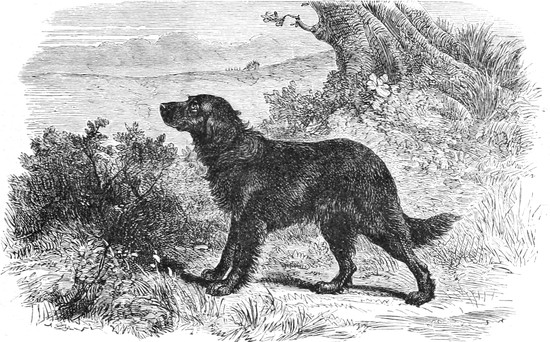
BLACK RETRIEVER.
But “actions speak louder than words,” and although the Dog is not
gifted with the power of articulate speech, he is yet capable of
expressing his feelings by look and gesture as eloquently as most
people. It is altogether wonderful to see how a Dog’s whole expression
and demeanour are changed by a word or look either of praise or blame.
The eye, the mouth, the ear, the tail, the whole trunk, all are called
into requisition, and together speak a language which is unmistakable.
Mr. Darwin gives a most interesting account of the mode of expression
of two opposite states of mind in the Dog; an account which, like
everything written by the same author, leaves nothing to be desired for
clearness and accuracy.
“When a Dog approaches a strange Dog or man in a savage or hostile
frame of mind, he walks upright and very stiffly; his head is slightly
raised, or not much lowered, the tail is held erect and quite rigid;
the hairs bristle, especially along the neck and back; the pricked
ears are directed forwards, and the eyes have a fixed stare. These
actions follow from the Dog’s intention to attack his enemy, and are
thus to a large extent intelligible. As he prepares to spring, with a
savage growl, on his enemy, the canine teeth are uncovered, and the
ears are pressed close backwards on the head. Let us now suppose that
the Dog suddenly discovers that the man whom he is approaching is not
a stranger, but his master; and let it be observed how completely and
instantaneously his whole bearing is reversed. Instead of walking
upright, the body sinks downwards, or even crouches, and is thrown into
flexuous movements; his tail, instead of being held stiff and upright,
is lowered and wagged from side to side; his hair instantly becomes
smooth; his ears are depressed and drawn backwards, but not closely to
the head; and his lips hang loosely. From the drawing back of the ears
the eyelids become elongated, and the eyes no longer appear round and
staring.”
And again, “when a Dog is on the point of springing on his antagonist,
he utters a savage growl; the ears are pressed closely backwards, and
the upper lip is retracted out of the way of his teeth, especially of
his canines.... If a Dog only snarls at another, the lip is generally
retracted on one side alone, namely, towards his enemy.”
“The feeling of affection of a Dog towards his master is combined with
a strong sense of submission, which is akin to fear. Hence Dogs not
only lower their bodies and crouch a little as they approach their
masters, but sometimes throw themselves on the ground, with their
bellies upwards. This is a movement as completely opposite as is
possible to any show of resistance.... A pleasurable and excited state
of mind, associated with affection, is exhibited by some Dogs in a very
peculiar manner, namely, by grinning.”[102]
It is extremely interesting to consider the means by which these
various expressive movements are produced. If the skin be removed from
the head of a Dog, there will be seen, lying beneath it, a quantity of
red flesh, intermixed with a good deal of fat and fibrous substance. If
this latter be carefully dissected away, the red flesh will be seen to
resolve itself into a number of muscles, very definitely arranged,
and each one designed for some special movement. There are, first of
all, muscles which move the eye. One set of fibres closely encircle
the aperture of the eyelids, and, when they act, close the eye, either
entirely, as in actual sleep, or partially, as in that half sleepy
state a Dog loves to be in on a hot afternoon, or before a blazing
fire. Another set of eye muscles have an entirely different action
to these. They radiate from the eyelids to the surrounding parts of
the head, and when they act, “draw back the eyelids from the eyeball,
and give a sparkling fierceness to the eye.” From this reason Sir
Charles Bell, who first described them, called them scintillantes, or
sparkling muscles. The ears have a number of muscular bands attached
to them, some drawing them forwards, some backwards, others sideways.
These are, therefore, highly important muscles, for a Dog hardly passes
a moment without moving his ears. We ourselves possess representatives
of these muscles, but in an entirely useless state in most persons,
very few having the power of moving their ears. Other very important
muscles pass from one of the face bones in front of the eye, and are
attached to the lip just above the canine teeth. When these act,
they draw the lips back from those teeth, thus baring the Dog’s
chief weapon, and producing a snarl; they are, therefore, called the
ringentes, or snarling muscles; and one has only to irritate a Dog
to see their effect in altering the animal’s expression. Lastly, there
are muscles which draw back the corners of the mouth and produce a sort
of grin, an action which seems to be almost normal in the Wolf, but
which is also frequently seen in Dogs. It will be readily observed how
important these muscles are, and how every expressive look in a Dog’s
countenance can be referred to the action of one or more of them.
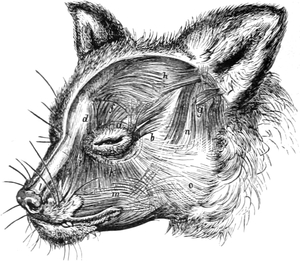
MUSCLES OF DOG’S HEAD. (After Sir C. Bell)
a, Circular muscle round the eyelids; b,
d, scintillantes; f, g, h, muscles of the ear;
i, k, ringentes; m, circular fibres of the mouth;
n, muscle drawing back the angle of the mouth; o, cutaneous
muscle, for moving the skin of the neck.
There can be no doubt that Dogs are perfectly capable of communicating
their thoughts to one another, and of understanding one another’s
meaning as well as that of their masters. One often sees two Dogs,
after a friendly sniff, carry on a small conversation, before trotting
on their ways, evidently quite as fond of a little chat as Burns’s
celebrated “twa Dogs,” who
“Foregather’d ance upon a time
****
Nae doubt but they were fain o’ ither,
An’ unco pack and thick thegither;
Wi’ social nose whyles snuff’d and snowkit;
Whyles mice and moudieworts
[103] they howkit;
Whyles scour’d awa in lang excursion,
An’ worry’d ither in diversion;
Until wi’ daffin weary grown,
upon a knowe they sat them down,
And there began a lang digression
About the lords o’ the creation.”
The method of hunting in packs adopted by wild Dogs is an undoubted
proof of the faculty of combining together for a definite end, a
number of animals agreeing to hunt a quarry, which one alone would
be powerless against. But there are many instances of civilised Dogs
concocting plans in the cleverest way, and carrying them out with a
care and circumspection perfectly wonderful in a “dumb animal.” For
instance, Mr. Romanes says:—“A small Skye and a large Mongrel were
in the habit of hunting Hares and Rabbits upon their own account, the
small Dog having a good nose, and the large one great fleetness. These
qualities they combined in the most advantageous manner, the Terrier
driving the game from the cover towards his fleet-footed companion,
which was waiting for it outside.” The same gentleman gives another and
still more curious instance:—
“A friend of mine in this neighbourhood had a small Terrier and a large
Newfoundland. One day a shepherd called upon him to say that his Dogs
had been seen worrying Sheep the night before. The gentleman said there
must be some mistake, as the Newfoundland had not been unchained. A
few days afterwards the shepherd again called with the same complaint,
vehemently asserting that he was positive as to the identity of the
Dogs. Consequently, the owner set one watch upon the kennel, and
another outside the sheep enclosure, directing them (in consequence of
what the shepherd had told him) not to interfere with the actions of
the Dogs. After this had been done for several nights in succession,
the small Dog was observed to come at day-dawn to the place where the
large one was chained. The latter immediately slipped his collar, and
the two animals made straight for the Sheep. Upon arriving at the
enclosure, the Newfoundland concealed himself behind a hedge, while
the Terrier drove the Sheep towards his ambush, and the fate of one of
them was quickly sealed. When their breakfast was finished, the Dogs
returned home, and the large one, thrusting his head into his collar,
lay down again as though nothing had happened. Why this animal should
have chosen to hunt by stratagem prey which he could so easily have run
down I cannot suggest; but there is little doubt that so wise a Dog
must have had some good reason.”
In another case we have met with, a “solemn league and covenant” was
made, for purposes of offence and defence, between a Dog and a Cat. A
Blenheim Spaniel was taken to a strange house, and, shortly after his
arrival, was attacked and severely scratched by the two Cats living
there. The Spaniel was no match for both antagonists at once, and so
judiciously beat a retreat into the garden. He there met with a Cat
belonging to the gardener, and succeeded in making friends with her and
prevailing on her to join with him against his cruel enemies. The two
allies then went into the house, and finding one of the victorious Cats
alone, attacked and defeated her. Shortly after she was put to flight,
victor number two entered the room; she was also presently attacked
and routed with great loss by the allied forces, who were thus left
masters of the field. The narrator of this tale goes on to state that
the Spaniel remained ever afterwards on terms of the firmest friendship
with his feline helper.
It is a subject of great interest to consider which of the virtues and
vices of man himself are exhibited by the Dog. We will take, first, his
good qualities, and then shall “follow his vices—close at the heels of
his virtues;” so that we may see how many of both he can be found to
possess.
First, and most important of all, is a clear sense of right and wrong,
without which no moral advancement is possible. That nearly all Dogs
have this sense, and that many possess it in a very marked degree,
there can be no doubt. Several instances of this faculty are given by
the author we have already quoted, Mr. G. J. Romanes,[104] who writes
of a little Dog in his possession:—
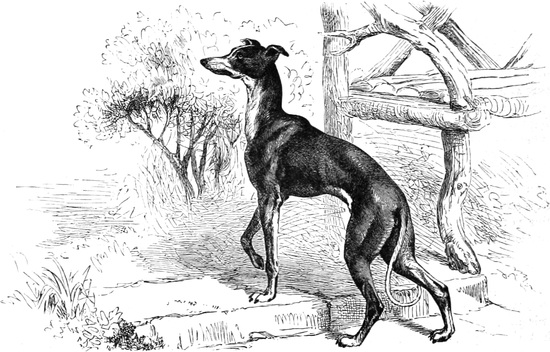
ITALIAN GREYHOUND.
“For a long time this Terrier was the only canine pet I had. One day,
however, I brought home a large Dog and chained him up outside. The
jealousy of the Terrier towards the new-comer was extreme. Indeed, I
never before knew that jealousy in an animal could arrive at such a
pitch; but as it would occupy too much space to enter into details,
it will be enough to say that I really think nothing that could have
befallen this Terrier would have pleased him so much as would any
happy accident by which he might well get rid of his rival. Well, a
few nights after the new Dog had arrived, the Terrier was, as usual,
sleeping in my bed-room. About one o’clock in the morning he began to
bark and scream very loudly, and upon my waking up and telling him
to be quiet, he ran between the bed and the window in a most excited
manner, jumping on and off the toilette-table after each journey, as
much as to say: ‘Get up quickly; you have no idea of what shocking
things are going on outside!’ Accordingly I got up and was surprised to
see the large Dog careering down the road: he had broken loose, and,
being wild with fear at finding himself alone in a strange place, was
running he knew not whither. Of course I went out as soon as possible,
and after about half-an-hour’s work succeeded in capturing the runaway.
I then brought him into the house and chained him up in the hall; after
which I fed and caressed him, with the view of restoring his peace of
mind. During all this time the Terrier had remained in my bed-room,
and, although he heard the feeding and caressing process going on
down-stairs, this was the only time I ever knew him fail to attack
the large Dog when it was taken into the house. Upon my re-entering
the bed-room, and before I had said anything, the Terrier met me with
certain indescribable grinnings and prancings, which he always used to
perform when conscious of having been a particularly good Dog. Now, I
consider the whole of this episode a very remarkable instance in an
animal of action prompted by a sense of duty. No other motive than
the voice of conscience can here be assigned for what the Terrier did:
even his strong jealousy of the large Dog gave way before the yet
stronger dread he had of the remorse he knew he should have to suffer
if next day he saw me distressed at a loss which it had been in his
power to prevent. What makes the case more striking is, that this was
the only occasion during the many years he slept in my bed-room that
the Terrier disturbed me in the night-time. Indeed, the scrupulous care
with which he avoided making the least noise while I was asleep, or
pretending to be asleep, was quite touching: even the sight of a Cat
outside, which at any other time rendered him frantic, only causing him
to tremble violently with suppressed emotion, when he had reason to
suppose that I was not awake. If I overslept myself, however, he used
to jump upon the bed and push my shoulder gently with his paw.”
“The following instance is likewise very instructive. I must premise
that the Terrier in question far surpassed any animal or human
being I ever knew in the keen sensitiveness of his feelings, and
that he was never beaten in his life. Well, one day he was shut up
in a room by himself, while everybody else in the house where he
was went out. Seeing his friends from the window as they departed,
the Terrier appears to have been overcome by a paroxysm of rage,
for when I returned I found that he had torn all the bottoms of the
window-curtains to shreds. When I first opened the door he jumped about
as Dogs in general do under similar circumstances, having apparently
forgotten, in his joy at seeing me, the damage he had done. But when,
without speaking, I picked up one of the torn shreds of the curtains,
the Terrier gave a howl, and rushing out of the room, ran up-stairs
screaming as loudly as he was able. The only interpretation I can
assign to this conduct is, that his former fit of passion having
subsided, the Dog was sorry at having done what he knew would annoy
me; and not being able to endure in my presence the remorse of his
smitten conscience, he ran to the farthest corner of the house, crying
peccavi in the language of his nature.
“I had had this Dog for several years, and had never—even in his
puppyhood—known him to steal. On the contrary, he used to make an
excellent guard to protect property from other animals, servants, &c.,
even though these were his best friends. Nevertheless, on one occasion
he was very hungry, and in the room where I was reading and he was
sitting there was, within easy reach, a savoury mutton chop. I was
greatly surprised to see him stealthily remove this chop and take it
under a sofa. However, I pretended not to observe what had occurred,
and waited to see what would happen next. For fully a quarter of an
hour this Terrier remained under the sofa without making it sound,
but doubtless enduring an agony of contending feelings. Eventually,
however, conscience came off victorious, for, emerging from his place
of concealment, and carrying in his mouth the stolen chop, he came
across the room and laid the tempting morsel at my feet. The moment he
dropped the stolen property he bolted again under the sofa, and from
this retreat no coaxing could charm him for several hours afterwards.
Moreover, when during that time he was spoken to or patted, he always
turned away his head in a ludicrously conscience-stricken manner.
Altogether, I do not think it would be possible to imagine a more
satisfactory exhibition of conscience by an animal than this; for it
must be remembered, as already stated, that the particular animal in
question was never beaten in its life.”
That extreme sensitiveness, so often an attribute of the highest kinds
of mind, was developed to an extraordinary degree in this wonderful
Terrier. His owner says:—“A reproachful word or look from me, when
it seemed to him that occasion required it, was enough to make this
Dog miserable for a whole day. I do not know what would have happened
had I ventured to strike him; but once, when I was away from home, a
friend used to take him out every day for a walk in the park. He always
enjoyed his walks very much, and was now wholly dependent on this
gentleman for obtaining them. (He was once stolen in London, through
the complicity of my servants, and never after that would he go out by
himself, or with any one whom he knew to be a servant.) Nevertheless,
one day, while he was amusing himself with another Dog in the park, my
friend, in order to persuade him to follow, struck him with a glove.
The Terrier looked up at his face with an astonished and indignant
gaze, deliberately turned round, and trotted home. Next day he went
out with my friend as before, but after he had gone a short distance,
he looked up at his face significantly, and again trotted home with a
dignified air. After this, my friend could never induce the Terrier
to go out with him again. It is remarkable, also, that this animal’s
sensitiveness was not only of a selfish kind, but extended itself in
sympathy for others. Whenever he saw a man striking a Dog, whether
in the house or outside, near at hand or a distance, he used to rush
to the protection of his fellow, snarling and snapping in a most
threatening way. Again, when driving with me in a dog-cart, he always
used to seize the sleeve of my coat every time I touched the Horse with
the whip.”
Sensitiveness such as this generally goes along with the keenest
susceptibility to ridicule; and here, again, the same Dog showed a
dislike of being laughed at which is amusingly human, as is also the
clever trick by which he tried to escape the gibes which were entering
so deeply into his soul.
“The Terrier used to be very fond of catching flies upon the
window-panes, and if ridiculed when unsuccessful, he was evidently much
annoyed. On one occasion, in order to see what he would do, I purposely
laughed immoderately every time he failed. It so happened that he did
so several times in succession—partly, I believe, in consequence of
my laughing; and eventually he became so distressed that he positively
pretended to catch the fly, going through all the appropriate
actions with his lips and tongue, and afterwards rubbing the ground
with his neck as if to kill the victim; he then looked up at me with
a triumphant air of success. So well was the whole process simulated,
that I should have been quite deceived had I not seen that the fly
was still upon the window. Accordingly I drew his attention to this
fact, as well as to the absence of anything upon the floor; and when
he saw that his hypocrisy had been detected, he slunk away under some
furniture, evidently much ashamed of himself.”
Honesty is a virtue very commonly developed in good Dogs, and instances
of it are numerous. In the family of a friend of ours there is a large
Retriever—a long-faced, Puritanical-looking Dog—which, when the
temptation to steal is ready to overpower him, will, to keep his virtue
untarnished, turn his back upon the longed-for morsel, solemnly looking
in the opposite direction. Evidently, like Coleridge’s “holy hermit,”
he “prays where he does sit,” and thus overcomes the temptation. But,
as usual, the best anecdote is given by Mr. Romanes, again apropos of
his wonderful Terrier.
“I have seen this Dog escort a Donkey, which had baskets on its back
filled with apples. Although the Dog did not know that he was being
observed by anybody, he did his duty with the utmost faithfulness; for
every time the Donkey turned back its head to take an apple out of the
baskets the Dog snapped at its nose; and such was his watchfulness,
that, although his companion was keenly desirous of tasting some of the
fruit, he never allowed him to get a single apple during the half-hour
they were left together. I have also seen this Terrier protecting meat
from other Terriers (his sons) which lived in the same house with him,
and with which he was on the best of terms. More curious still, I have
seen him seize my wristbands while they were being worn by a friend to
whom I had temporarily lent them.”
In some Dogs, as in many people, honesty does not spring from high
principle, but from mere conventionality. Actual dishonesty, too, is
the commonest vice of untrained or badly-trained Dogs. It is, however,
comparatively rare to meet with Dogs whose thefts are of a really
artistic nature. Two of the best instances of this are furnished by Sir
Walter Scott,[105] who gives a most interesting account of a Shepherd’s
Dog and a Spaniel, both of whom had a perfect talent for thieving; they
were not only afflicted with kleptomania in a high degree, but showed
as much talent in the performance of their equivocal deeds as the most
prominent member of the “swell mob.”
“I have heard of a sheep-stealer who had rendered his Dog so skilful
an accomplice in his nefarious traffic, that he used to send him out
to commit acts of felony by himself, and had even contrived to impress
on the poor cur the caution that he should not, on such occasions,
seem even to recognise his master if they met accidentally. There
were several instances of this dexterity, but especially those which
occurred in the celebrated case of Murdison and Millar in 1773. These
persons, a sheep-farmer and his shepherd, settled in the vale of
Tweed, commenced and carried on for some time an extensive system of
devastation on the flocks of their neighbours. A Dog belonging to
Millar was so well trained that he had only to show him during the
day the parcel of Sheep which he desired to have, and when dismissed
at night for the purpose, Yarrow went right to the pasture where the
flock had fed, and carried off the quantity shown to him. He then drove
them before him by the most secret paths to Murdison’s farm, where the
dishonest master and servant were in readiness to receive the booty.
Two things were remarkable. In the first place, that if the Dog, when
thus dishonestly employed, actually met his master, he observed great
caution in recognising him, as if he had been afraid of bringing him
under suspicion; secondly, that he showed a distinct sense that the
illegal transactions in which he was engaged were not of a nature to
endure daylight. The Sheep which he was directed to drive were often
reluctant, to leave their own pastures, and sometimes the intervention
of rivers or other obstacles made their progress peculiarly difficult.
On such occasions, Yarrow continued his efforts to drive his plunder
forward until the day began to dawn, a signal which, he conceived,
rendered it necessary for him to desert his spoil, and slink homeward
by a circuitous road. It is generally said this accomplished Dog was
hanged along with his master; but the truth is, he survived him long,
in the service of a man in Leithen: yet was said afterwards to have
shown little of the wonderful instinct exhibited in the service of
Millar.
“Another instance of similar sagacity a friend of mine discovered in
a beautiful little Spaniel, which he had purchased from a dealer in
the canine race. When he entered a shop, he was not long in observing
that his little companion made it a rule to follow at some interval,
and to estrange itself from his master so much as to appear totally
unconnected with him. And when he left the shop, it was the Dog’s
custom to remain behind him till it could find an opportunity of
seizing a pair of gloves, or silk stockings, or some similar property,
which it brought to its master. The poor fellow probably saved its life
by falling into the hands of an honest man.”
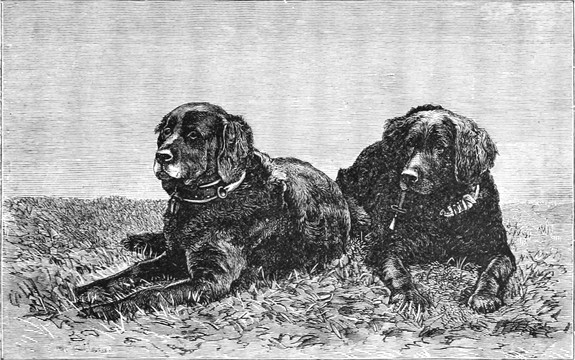
NEWFOUNDLAND DOGS.
Equally good is the account given by Mr. Youatt of a pair of canine
house-lifters, whose talents were really pre-eminent. One is almost
tempted to wonder if an iron safe with all the most recent improvements
would have been proof against their attacks.
“The writer of this work had a brace of Greyhounds as arrant thieves
as ever lived. They would now and then steal into the cooking-room
belonging to the kennel, lift the lid from the boiler, and, if any
portion of the joint or piece of meat projected above the water,
suddenly seize it, and before there was time for them to feel much
of its heat, contrive to whirl it on the floor, and eat it at their
leisure as it got cold. In order to prevent this, the top of the
boiler was secured by an iron rod passing under its handle, and tied
to the handle of the boiler on each side; but not many days passed ere
they discovered that they could gnaw the cords asunder, and displace
the rod, and fish out the meat as before. Small chains were then
substituted for the cords, and the meat was cooked in safety for nearly
a week, when they found that, by rearing themselves on their hind legs,
and applying their united strength towards the top of the boiler, they
could lift it out of its bed, and roll it along the floor, and so get
at the broth, although the meat was out of their reach. The man who
looked after them expressed himself heartily glad when they were gone;
for he said he was often afraid to go into the kennel, and was sure
they were devils and not Dogs.”
The foregoing Dogs were all dishonest in a tolerably open sort of way,
and are comparable to human burglars and shop-lifters; but the animal
of whom the following tale is told disdained plain dealing, and went
in for something akin to the well-known “confidence dodge,” by which
so many unsuspecting countrymen are every year taken in by London
sharpers:—
“I once, under somewhat singular circumstances, made the acquaintance
of a Dog, as arrant a vagabond and impostor as ever ran on four
legs, but whose shortcomings were, I feel convinced, occasioned by
circumstances entirely beyond his control. He was above the medium
size, and of handsome proportions, except for one or two blemishes.
There was an air of superior breeding about the animal; his coat was
silky and genteel, and his bright eyes beamed with intelligence. Owing,
however, to an accident of birth, a taint of the most objectionable cur
kind had crept into his composition. It announced itself in distorting
to bandiness his otherwise symmetrical fore-legs, and in a shapeless,
club-like tail, which usurped the place of a wavy, graceful terminal
appendage such as would have been his had not his breed been marred.
A close observer might have remarked, as well as the peculiarities
mentioned, a raffish-drooping of the left eyelid and an up-curving of
the upper lip on the right side, as though the animal had been used to
pot-house company; and they had taught him the trick of holding a short
pipe there. But, on the whole; and at a cursory glance, he was quite a
nice-looking Dog.
“The first occasion of our meeting was very late one wintry night, when
the snow lay half a foot deep on the street pavement. I cannot say if
he first caught sight of me or I of him, for he was crouched in the
shadow of a lamp-post; seemingly on the chance of there coming that way
a compassionate pedestrian who might be induced to give him a night’s
lodging. Our eyes met, and had I been a long-lost relative he could
not have been more suddenly inspired with joy. He bounded to his feet,
and proclaimed his good-luck in tones that must have awakened all the
babies in the neighbourhood. I quickened my step, but he appeared to
regard this as a friendly response to his friskiness, and he barked the
louder. For peace and quietness’ sake I adjured him as a ‘Good Dog.’
That did the business. He had no objection to trotting soberly by my
side on that understanding, and so together we arrived at my domicile.
“It was altogether against the rules of the establishment to admit
strange Dogs, but under such circumstances what could I do? His genteel
appearance pleaded for him. The mere fact of his having, like a
blundering, stupid, honest tyke, jumped to the conclusion that I looked
just the sort of Man to befriend a houseless Dog, spoke in his favour.
Every one was in bed as I opened the door with my latch-key, and not
too deeply to compromise myself I pointed out to my canine intruder
that his place for the night was the door-mat. I went down-stairs and
searched for scraps, and got him together a tolerably good supper, and
left him perfectly comfortable.
“I cannot believe that at that time he had it in his mind to abuse my
confidence, or to act towards me in any way the reverse of honourable.
It must have been that unfortunate one-eighth of cur that, made bold
by beef-bones, rose against the animal’s better nature, and conquered
it. Anyhow, when the outer door was opened to the newspaper-boy next
morning, the servant was scared by the spectacle of a Dog taking the
whole flight of steps at a leap, and making off with part of a leg of
pork in its mouth. The villain had feloniously extracted it from the
pantry, which I had inadvertently left open when I went foraging for
him. Besides the pork he had carried off, he had helped himself during
the night to a small steak-pie, about a pound of fresh butter, and a
fine rasher of ham. I had but little expectation of encountering the
canine traitor ever again; but I did so. About a week after, at dead
of night, and in the pouring rain, once more I made out his crouching
figure in the shadow of the identical lamp-post. Again our eyes met,
and, as on the previous occasion, he instantly leapt to his feet. Not
to cut capers about me. However, his guilty fears did not make of him
a faltering, trembling coward. He took in the whole situation at a
glance, including my vengefully-grasped umbrella, and, with one brisk
bark of derision, made off at a speed which quickly carried him out of
sight. Since then I have frequently encountered him, but it has been
in the busy streets at daytime, but he does not run away. If he can
avoid my eye he does so. If he cannot—and with his guilt haunting
him I imagine it is not easy to do so—he assumes a puzzled expression
of countenance, as though half convinced he has seen me before, though
when and under what circumstances he could not say though his life
depended on it.”[106]
Another very good instance of cunning, produced by a long course of
back-slum life and manners, is given by the writer from whom the
foregoing anecdote is taken, respecting “a Dog—a low-looking villain,
blind of one eye, and, in consequence of his nefarious propensities,
with never more than three sound legs to run on, who haunts the
neighbourhood of Drury Lane. Nobody owns the brute, but he has
contrived to scrape acquaintance with a kind-hearted cheesemonger, who
keeps a shop there. I have the worthy tradesman’s own word for it that
he always knows when the officer on the look-out for vagrant Dogs is
about by the sudden appearance of Tinker and his peculiar behaviour.
At ordinary times disdaining to be anything better than a Dog of the
streets, his custom is to salute the cheesemonger from the pavement,
and by a bark and a wag of his stump of a tail solicit an unconsidered
trifle of bone or bacon-rind; but on the special occasion alluded to
his tactics are quite different. He enters the shop with a sober and
business-like air, and lies down on a mat by the parlour-door, with
paws extended and his tail beating a contented tattoo on the floor, as
though since his puppyhood that had been his home and abiding-place,
and he had known and desired to know no other. It is a joke between
the officer and the cheesemonger, and the former enters the shop and
loudly demands to know if ‘that Dog lives here.’ I have not as yet had
the pleasure of witnessing it, but the cheesemonger informs me that it
is ‘as good as a play’ to observe the reassuring blink of his only eye
which, at this juncture, Tinker bestows on the policeman, immediately
afterwards curling himself round for a doze, as though to say, ‘Let
this convince you.’ Tinker’s stay, however, is not protracted. As soon
as, according to his calculation, the coast is clear, he is off, as
unexpectedly as he came, and until he is again hard pressed by the law
never thinks of crossing the cheesemonger’s threshold.”
We spoke just now of Dogs being honest from pure conventionality;
there is no doubt that many of them soon acquire a very acute sense
of the conventional, and perform certain actions, or assume a
certain behaviour, simply because they feel it to be the right and
proper thing. We have heard of a Bull-terrier who acquired perfectly
that sense of decorum which in many human beings serves in lieu of
religious feeling. When this Dog was bought, it was debated whether or
not it would be advisable to let him remain in the room at prayers;
the question was eventually decided in the affirmative, and the Dog
almost immediately seemed to get a sense of what was meant, and to
feel that he was expected to behave with propriety. He therefore
adopted a particular mode of procedure—a sort of canine ritual—to
which he always steadily adhered. While the Bible was being read, he
sat straight up on his haunches on the hearth-rug, looking solemnly
into the fire. This he continued until the family knelt to pray, when
he immediately went off to a corner of the room, and stood there
with lowered head until all was over. He did this with such perfect
solemnity that the effect was indescribably ludicrous, and friends
stopping in the house had to be warned of what to expect.
The tales of canine magnanimity are endless. Every one knows that of
the big Newfoundland who, being long plagued by a number of little
yelping curs, one of whom at last bit him, revenged himself only by
dipping the offender in the quay hard by, and, after he was cowed,
plunging in and bringing him safe to land. But all Dogs are not
magnanimous. Some of them, like certain men one meets with, have quite
a talent for taking offence, and will pick a quarrel on the slightest
provocation, or, indeed, on no provocation at all. There are, of
course, the wretched little curs one meets in the street, whose sole
delight seems to be to rush out suddenly and bark furiously at every
passer-by; but these miserable beings act as they do rather from lack
of brain, and for want of something to do, than from real badness of
heart. There are Dogs, however, who are naturally quarrelsome, and
will do all in their power to get up a row, simply for the pleasure of
the thing. “There is a well-authenticated instance of a Terrier, who,
in picking a quarrel, contrived, as if trained in the Kanzellei of
Prince Bismarck, to place himself technically in the right. He would
time his movements so that some passenger should stumble over him, and
would then fasten on the calf of his leg. With a most statesman-like
aptitude, he selected the aged, the infirm, and the ill-dressed, as the
objects of his cunningly-planned attacks.”[107]
Not only are instances of quarrelsomeness to be found Dogs, but also
of the strongest desire to revenge real or supposed injuries, of the
exercise of a wonderful amount of cunning and reasoning power to bring
a hated rival to justice. The following anecdote forms a capital
antithesis to that of Mr. Romanes’ Terrier, who prevented the escape of
the Dog he disliked and was jealous of, although such an event would
have brought him the greatest possible comfort:—
“A fine Terrier, in the possession of a surgeon, about three weeks
ago, exhibited its sagacity in a rather amusing manner. It came
into the kitchen and began plucking the servant by the gown, and
in spite of repeated rebuffs, it perseveringly continued in its
purpose. The mistress of the house hearing the noise, came down to
inquire the cause, when the animal treated her in a similar manner.
Being struck with the concern evinced by the creature, she quietly
followed it up-stairs into a bed-room, whither it led her; there it
commenced barking, looking under the bed, and then up in her face.
Upon examination, a Cat was discovered there quietly demolishing a
beef-steak, which it had feloniously obtained. The most singular
feature in the whole case is that the Cat had been introduced into
the house only a short time before, and that bitter enmity prevailed
between her and her canine companion.”
Besides illustrating the desire for vengeance, this is as good an
instance of reason as any we have given. The Dog evidently argued to
himself in this wise:—“If I fly upon this wretched Cat and deprive her
of her stolen goods by force, she will get nothing more than a fright,
or, perhaps, a few tooth marks; but if I lodge a complaint against her
before the proper tribunal, her guilt will be manifest to the whole
household, and she will be got rid of, or even killed.” The Dog, by the
way he conceived and acted on this plan, showed himself to be nearly
as clever and almost as wicked as a great many men one reads about in
history.
We have spoken of maternal love as exhibited by the Dog. This is, of
course, a case of instinct; but instances are not wanting in which Dogs
have shown the high faculty of devoted love towards other than their
offspring, and of friendship like that of Ruth for Naomi. Mr. Darwin
mentions a Greyhound bitch who, contrary to the usual custom of her
race, fell deeply in love with a Pointer, and would have nothing to say
to any other Dog during the life of her lover; and, stranger still,
when he died, she showed a constancy equal to that of the best of her
sex among the human race, and remained strictly faithful to his memory,
never afterwards bearing pups.
Rarer than conjugal affection amongst animals, is friendship between
individuals of the same sex; of this, too, instances are not wanting.
Mr. Youatt relates the following:—“Two Dogs, the property of a
gentleman at Shrewsbury, had been companions for many years, until one
of them died of old age. The survivor immediately began to manifest
an extraordinary degree of restless anxiety, searching for his old
associate in all his former haunts, and refusing every kind of food. He
gradually wasted away, and at the expiration of the tenth day he died,
the victim of an attachment that would have done honour to man.”
Of equally intense devotion to man, instances are so numerous that one
hardly knows which to mention. None is, perhaps, more wonderful or more
affecting than that we have already mentioned, of the Dog who watched
for three months by the corpse of his dead master on Helvellyn. There
is also a tale of a Newfoundland Dog, whose master—a soldier—returned
to his home, after an absence of many years, when the Dog recognised
him at once, “leaped upon his neck, licked his face, and died.” He
must have retained, during the whole of the time his master was away,
the memory of his care and friendship. One cannot doubt that he often
thought of and longed for him; and the rush of joy and hope fulfilled
was too much for the great heart of the noble animal. He succumbed to
the intensity of his feelings, thereby showing himself to be superior
in one of the highest and grandest of qualities to by far the greater
proportion of the human race. How many men, or even women, of one’s own
acquaintance, are capable of dying of joy?
But there is a dark side to this picture. A very large proportion of
Dogs possess but little of this virtue of fidelity, but have greatly
developed the contrary vice of extreme fickleness. They will change
masters without the slightest objection, and be “off with the old
love and on with the new” absolutely without a pang. Froissart, the
chronicler, tells a curious tale respecting the treachery of Richard
II.’s Dog, “a Grayhounde, called Mithe, who always wayted upon the
kynge, and woulde knowe no man els. For where so ever the kynge did
ryde, he that kept the Grayhounde dyd lette him lose, and he wolde
streyght mime to the kynge, and faune uppon hym, and leape with his
fore fete uppon the kynge’s shoulders. And as the kynge and the
Erle of Derby (Bolingbroke, afterwards Henry IV.) talked togyder in
the courte, the Grayhounde, who was wonte to leape uppon the kynge,
left the kynge, and came to the Erle of Derby, Duke of Lancastre, and
made to him the same friendly continuance and chere as he was wonte
to do to the kynge. The duke, who knewe not the Grayhounde, demanded
of the kynge what the Grayhounde would do? ‘Cousin,’ quod the kynge,
‘it is a greate goode token to you, and an evyl signe to me.’ ‘How
knowe you that?’ quod the duke. ‘I knowe it well,’ quod the kynge.
‘The Grayhounde acknowledgeth you here this day as Kynge of England,
as ye shall be, and I shall be deposed; the Grayhounde hath this
knowledge naturally; therefore take hym to you: he wyll follow you and
forsake me.’ The duke understood well these words, and cherished the
Grayhounde, who wolde never after follow Kynge Richard, but followed
the Duke of Lancastre.” This anecdote, curious, if true, would seem to
show that rats and men are not the only animals who make haste to leave
a sinking ship.
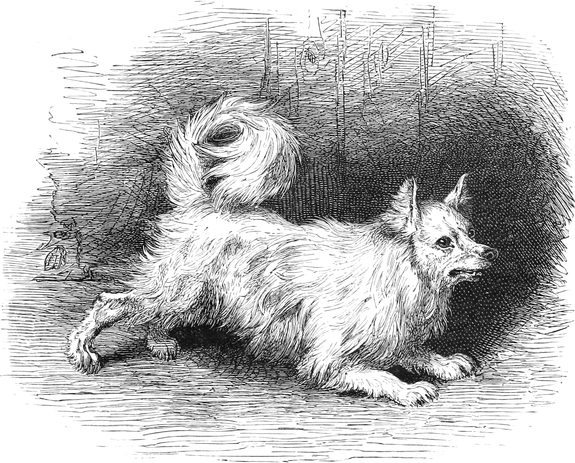
POMERANIAN DOG.
We have made mention of a certain quarrelsome Dog, fond of picking a
quarrel, who always took care, with the true instinct of a cowardly
bully, to pick out old or infirm persons as objects of his attacks. We
are glad to say that we have found a notice of a Setter who showed a
becoming respect for age. His owner says:—
“One other curious fact may here be mentioned about this Dog. Although
naturally a very vivacious animal, and, when out for a walk with myself
or any other young person, perpetually ranging about in search of game,
yet, if taken out for a walk by an elderly person, he keeps close to
heel all the time, pacing along with a slow step and sedate manner, as
different as possible from that which is natural to him. This curious
behaviour is quite spontaneous on his part, and appears to arise from
the sense of the respect that is due to age.”
We need hardly say that this Dog belongs to Mr. Romanes, amongst whose
animals specimens of all the Christian gifts and graces seem to be
found.
We thus see that a very large proportion of our own virtues and vices
are developed in our canine “fellow-mortals”; there is, however, one
state of mind which we should hardly expect to find in any animal,
viz., despair. With man it is, alas! sufficiently common to feel that
he has had enough of “life’s fitful fever,” and that the only thing
left is to make haste
“—— to be hurled
Anywhere, anywhere, out of the world.”
But who would expect a dumb quadruped to have feelings of this sort?
Yet that such may be the case is rendered probable by the following
remarkable story:—
“A day or two since, a fine Dog, belonging to Mr. George Hone, of
Frindsbury, near Rochester, committed a deliberate act of suicide by
drowning in the Medway at Upnor, Chatham. The Dog had been suspected
of having given indications of approaching hydrophobia, and was
accordingly shunned, and kept as much as possible from the house. This
treatment appeared to cause him much annoyance, and for some days he
was observed to be moody and morose. On Thursday morning he proceeded
to an intimate acquaintance of his master’s at Upnor, on reaching the
residence of whom he set up a piteous cry on finding that he could not
obtain admittance. After waiting at the house some little time, he was
seen to go towards the river close by, when he deliberately walked down
the bank, and, after turning round and giving a kind of farewell howl,
walked into the stream, where he kept his head under water, and in a
minute or two rolled over dead. This extraordinary act of suicide was
witnessed by several persons. The manner of his death proved pretty
clearly that the animal was not suffering from hydrophobia.”[108]
The last statement of the writer of this anecdote may be called in
question, as it is a well established fact that a mad Dog will often
plunge its head into water, and make violent though ineffectual efforts
to drink; and it is very likely that the Dog in question had no real
intention of committing suicide, but was drowned while attempting to
slake his insatiable thirst. This seems a probable explanation, though
it takes the point from our tale.
Of that most horrible and fatal disease—rabies—little need be said
here. It is accompanied in the Dog by inflammation, inability to
swallow, insensibility to pain, even to severe blows or burns, and
usually great ferocity, and a disposition to bite everything that
comes in its way. The gait, the glance, and also the howl of a mad
Dog are very characteristic. But the most terrible thing about rabies
is that it can be communicated to man, producing in him the special
human form of the disease, hydrophobia. This latter, like rabies,
never arises except by inoculation with the saliva of a rabid Dog, so
that both these terrible, and it is to be feared increasing diseases,
might be stamped out by the adoption for a few months of a rigorous
quarantine.[109] When a human being is bitten, symptoms of rabies
usually occur in from a fortnight to three months; but a case is on
record in which the disease did not appear for twelve years! When the
poison is once established in the system a cure seems to be utterly
impossible. The only remedy is at once either to cut out the wound
or to rub it deeply and thoroughly with lunar caustic (nitrate of
silver), which Mr. Youatt states to be far more efficacious than actual
cauterising or burning with a red-hot iron.
The varieties or breeds of the Dog are extremely numerous, and differ
from each other to a wonderful degree. In the matter of size, we have
the Mastiff, as large as a pony, at one end of the series, and the
Toy-terrier, a few inches long, at the other. As to the development
of hair, there is every gradation, from the hairless Turkish Dog
to the Skye-terrier or the Poodle; as to running powers, there are
the Greyhound and the Turnspit; in the matter of mental and moral
characteristics, we have the intelligent Shepherd’s Dog, the obstinate
and courageous Bull-dog, the silly Italian Greyhound, and the lazy
Lap-dog. Never was animal so thoroughly, so unanimously, and so
successfully selected: never did any show such endless variation in so
many particulars.
NOT only has civilised man his endless breeds of Dogs, but nearly
every savage tribe of any degree of intelligence has, to a greater
or less degree, succeeded in producing a race exhibiting well-marked
characters, useful to them as a guardian of flocks or a beast of
burden. Then, in many parts of the world there are to be found troops
of Dogs which have become wild, though not sufficiently so to be
actually dangerous, and which act as scavengers in those countries
which, like Turkey, are not blessed with a particularly stringent code
of sanitary regulations. We shall first consider the Dogs kept by
savages.
This interesting variety (see figure on p. 104) is found only in North
America, in the region of the Great Bear Lake and the Mackenzie River,
where it is kept as a Hunting-dog by the Hare Indians and one or two
other tribes. As we mentioned above, it deserves great interest from
the fact that it closely resembles the Prairie-wolf, from which it is
very probably descended.
“The Hare Indian Dog has a mild countenance, with, at times, an
expression of demureness. It has a small head, slender muzzle, erect
thickish ears, somewhat oblique eyes, rather slender legs, and a broad,
hairy foot, with a bushy tail, which it usually carries curled over
its right hip. It is covered with long hair, particularly about the
shoulders; and at the roots of the hair, both on the body and tail,
there is a thick wool. The hair on the top of the head is long, and on
the posterior part of the cheek it is not only long, but being also
directed backwards, it gives the animal, when the fur is in prime
order, the appearance of having a ruff round the neck. Its face,
muzzle, belly, and legs are of a pure white colour, and there is a
white central line passing over the crown of the head and the occiput.
The anterior surface of the ear is white, the posterior yellowish-grey,
or fawn-colour. The end of the nose, the eyelashes, the roof of the
mouth, and part of the gums, are black. There is a dark patch over
the eye. On the back and sides there are larger patches of dark
blackish-grey, or lead-colour, mixed with fawn-colour and white, not
definite in form, but running into each other. The tail is bushy, white
beneath and at the tip. The feet are covered with hairs, which almost
conceal the claws. Some long hairs between the toes project over the
soles; but there are naked callous protuberances at the root of the
toes and on the soles, even in the winter time, as in all the Wolves
described in the preceding pages. The American Foxes, on the contrary,
have the whole of their soles densely covered with hair in the winter.
Its ears are proportionably nearer each other than those of the Eskimo
Dog.
“The Hare Indian Dog is very playful, has an affectionate disposition,
and is soon gained by kindness. It is not, however, very docile,
and dislikes confinement of every kind. It is very fond of being
caressed, rubs its back against the hand like a Cat, and soon makes an
acquaintance with a stranger. Like a wild animal, it is very mindful
of an injury, nor does it, like a Spaniel, crouch under the lash; but
if it is conscious of having deserved punishment, it will hover round
the tent of its master the whole day, without coming within his reach
even when he calls it. Its howl, when hurt or afraid, is that of the
Wolf; but when it sees any unusual object, it makes a singular attempt
at barking, commencing by a kind of growl, which is not, however,
unpleasant, and ending in a prolonged howl. Its voice is very much like
that of the Prairie-wolf. The larger Dogs, which we had for draught at
Fort Franklin, and which were of the mongrel breed in common use at
the fur-posts, used to pursue the Hare Indian Dogs for the purpose
of devouring them; but the latter far outstripped them in speed, and
easily made their escape. A young puppy, which I purchased from the
Hare Indians, became greatly attached to me, and when about seven
months old ran on the snow by the side of my sledge for nine hundred
miles without suffering from fatigue. During this march, it frequently,
of its own accord, carried a small twig, or one of my mittens, for a
mile or two; but, although very gentle in its manners, it showed little
aptitude in learning any of the arts which the Newfoundland Dogs so
speedily acquire, of fetching and carrying when ordered. This Dog was
killed and eaten by an Indian on the Saskatchewan, who pretended that
he mistook it for a Fox.”[110]
The importance of this half-tamed variety (see figure on p. 105) to
the cold stunted beings who keep it can hardly be over-estimated. An
undoubted authority, Dr. Robert Brown, F.L.S., observes:—
“When the Greenland Dogs die off, the Greenlander must become extinct:
more certainly even than must the ‘Plain’ Indian when the last Buffalo
is shot. It is impossible for him to drag home the Seals, Sharks,
White Whales, or Narwhals which he may have shot in the winter at the
‘strom-holes’ in the ice without his Dogs; or for the wild native
in the far North to make his long migrations, with his family and
household goods, from one hunting-ground to another without these
domestic animals of his. Yet that sad event seems to be not far
distant. Several years ago, a curious disease, the nature of which has
puzzled veterinarians, appeared among the Arctic Dogs, from high up
in Smith’s Sound down the whole coast of Greenland to Jakobshavn (69°
13′ N. lat.), where the ice-fjord stops it from going farther south;
and the Government uses every endeavour to stop its spread beyond that
barrier by preventing the native Dogs north and south from commingling.
Kane and Hayes lost most of their Dogs through this disease; and at
every settlement in Danish Greenland the natives are impoverished
through the death of their teams. It is noticed that whenever a native
loses his Dogs he goes very rapidly down-hill in the sliding scale of
Arctic respectability, becoming a sort of hanger-on of the fortunate
possessor of a sledge-team.
“During the latter portion of our stay in Jakobshavn, scarcely a day
elapsed during which some of the Dogs were not ordered to be killed, on
account of their having caught this fatal epidemic.
“The Dog is seized with madness, bites at all other Dogs, and
even at human beings. It is soon unable to swallow its food, and
constipation ensues. It howls loudly during the continuance of the
disease, but generally dies in the course of a day, with its teeth
firmly transfixing its tongue. It has thus something of the nature of
hydrophobia, but differs from that disease in not being communicable
by bite, though otherwise contagious among Dogs. The Government sent
out a veterinary surgeon to investigate the nature of the distemper;
but he failed to suggest any remedy, and it is now being ‘stamped out’
by killing the Dogs whenever seized—a heroic mode of treatment, which
will only be successful when the last Dog becomes extinct in Greenland.”
The Eskimo Dog is found throughout a great part of the Arctic
regions—the herds found in Siberia, Kamtschatka, and Arctic America
being all closely allied to one another, and all resembling, to a
wonderful degree, the great Arctic Wolf, from which there can be little
doubt they are descended. In form they resemble the Shepherd’s Dog,
and attain to the size of the Newfoundland. The muzzle and ears are
pointed, the hair long, and with a short yellowish-grey fur between the
hairs. The eyes are often oblique, and the howl peculiarly wolfish.
The colour varies a good deal: some of the Dogs being black, with a
white breast; others white; others reddish, yellowish, or spotted.
This variety in colour is very characteristic of domesticated races of
animals. There is never the same amount of difference found between the
individuals of a wild species.
Not only does the Eskimo Dog agree with the Wolf in appearance, but
also in disposition: it is wild, savage, and obstinate to a degree
almost inconceivable to us, who are only acquainted with civilised
Dogs. In illustration of the wolf-like disposition of the beast, Dr.
Robert Brown relates an incident which shows that it is but little
removed from its probable ancestor. We said above that it was only
half-tamed; so certainly is this the case, that it “can only be kept
in subjection by the most unmerciful lashing, for its savage nature
will out. When at Clyde River, in 1861, I heard of a most horrible
tragedy which had been enacted there a few years before. A man, a boy,
and a little girl landed there from an omiak (or open skin-boat), on
an island where, as is usual, some Dogs were confined. Before the poor
people could escape to their boat, the animals, infuriated by hunger,
sprang upon them. The man and the boy, though much lacerated, managed
to regain the omiak, but the poor girl was torn to pieces.”
Wolves could hardly be much worse than this. These Dogs were, however,
confined and half-starved; but another writer[111] relates how he very
nearly fell a victim to a pack of Dogs in actual use, at the door of
his own hut.
“Leaving the hunters to look after their teams, I returned to the
hut. The blinding snow, which battered my face, made me insensible
to everything except the idea of getting out of it; and, thinking of
no danger, I was in the act of stooping to enter the doorway, when a
sudden noise behind me caused me to look around, and there, close at my
heels, was the whole pack of thirteen hungry Dogs, snarling, snapping,
and showing their sharp teeth like a drove of ravenous Wolves. It was
fortunate that I had not got down upon my knees, or they would have
been upon my back. In fact, so impetuous was their attack, that one of
them had already sprung when I faced round. I caught him on my arm, and
kicked him down the hill. The others were for the moment intimidated
by the suddenness of my movement, and at seeing the summary manner in
which their leader had been dealt with; and they were in the act of
sneaking away, when they perceived I was powerless to do them any harm,
having nothing in my hand. Again they assumed the offensive; they were
all around me; an instant more and I should be torn to pieces. I had
faced death in several shapes before, but never had I felt as then; my
blood fairly curdled in my veins. Death down the red throats of a pack
of wolfish Dogs had something about it peculiarly unpleasant. Conscious
of my weakness, they were preparing for a spring; I had not even time
to halloo for help—to run would be the readiest means of bringing
the wretches upon me. My eye swept round the group, and caught sight
of something lying half-buried in the snow about ten feet distant.
Quick as a flash I sprang, as I never sprang before or since, over the
back of a huge fellow who stood before me, and the next instant I was
whirling about me the lash of a long whip, cutting to right and left.
The Dogs retreated before my blows and the fury of my onset, and then
suddenly skulked behind the rocks. The whip had clearly saved my life;
there was nothing else within my reach, and it had been dropped there
quite accidentally by Katutunah as he went down to the sledges.”
The horrible savagery of these poor wretches can hardly be wondered
at; they live in a country where there is hardly a chance for them in
any independent foraging expedition; they are half-starved by their
masters, being fed chiefly on frozen walrus hides in the winter, and
allowed to shift for themselves in the summer when their services are
not required, and are in so perennial and acute a state of hunger that
they are ready at any time to eat their own harness if allowed to do so.
It is generally stated that they are perfectly insensible to kindness,
and only to be kept in order by a liberal application of the lash, or
even of a more formidable weapon; for the Eskimo, if their Dogs are
refractory, do not scruple to beat them about the head with a hammer,
or anything else of sufficient hardness which happens to be at hand.
They will even beat the poor brutes in this horrible manner until they
are actually stunned. Notwithstanding the absolute dependence of the
Eskimo on their Dogs, little or no care is taken of them; they receive
nothing in any degree approaching petting, and spend all their time in
the open air.
The chief use of the Eskimo Dog is to draw the sledges, which are
the only possible conveyance in that frozen land. In all the Arctic
expeditions which have been sent out at various times, a good supply
of Sledge-dogs has been one of the greatest desiderata, as without
them it would be absolutely impossible to proceed far. No other animal
would answer the purpose, both horses and cattle being quite useless
in journeys over ice and snow, amongst which the pack of light, active
Dogs make their way with wonderful ease and safety.
The presence of a good leader to every sledge-team is of the first
importance: the other Dogs obey him far more implicitly than the
driver, as he has gained his proud position vî et armis, and keeps
all his subordinates in the strictest order. Notwithstanding this, the
behaviour of the team while running is far from exemplary. Captain
Lyon says “they are constantly fighting, and I do not recollect to have
seen one receive a flogging without instantly wreaking his passion
on the ears of his neighbour.” So that it is always best to trust to
a good leader than to any amount of whipping, as the latter may only
involve the whole concern—team, sledge, driver, and all—in hopeless
and inextricable confusion. “Among the Eskimo on the western shores
of Davis Straits, a loose Dog usually precedes the sledge, and, by
carefully avoiding broken places in the ice, acts as a guide to the
sledge-team, which carefully follows his lead.”
Besides their use as draught animals, these Dogs are employed in
Bear and Seal hunting. Their skin is also valuable, and the natives
are extremely fond of their flesh, although, as the Dog is getting
gradually scarcer, they can seldom indulge in the dainty.
The Antarctic savages occasionally domesticate the Dingo. Of this Dog
we shall give an account later on. Many of the African savages—such,
for instance, as the Damaras, Namaquas, and Kaffirs—also keep Dogs.
The first-named of these tribes take great care of the Dogs, and value
them highly. Mr. Andersson says he has “known them pay as much as two
fine Oxen for a Dog.” The Kaffir Dogs, on the contrary, are thought
very little of. Mr. Baldwin speaks of them as “a set of noisy curs,
which invariably, at the sight of a white man, tumble head-over-heels
in all directions, upsetting everything, as frightened as if they had
seen an apparition. After the first alarm, they bait you unmercifully,
and for many minutes it is impossible to hear yourself speak. I don’t
know that I ever succeeded in making friends with a real Kaffir cur in
my life, not even a puppy; and I scarcely ever saw, or knew, or heard
of one good for anything; they do, indeed, lead the life of a Dog. They
are well fed when quite young, but afterwards they are expected to
provide for themselves, and are consequently wretchedly lean and mangy,
but they continue to exist.”
Dogs are also half-tamed by the natives of South America, where there
are, according to Humboldt, two very distinct breeds, one “totally
hairless—with the exception of a small tuft of white hair on the
forehead and at the tip of the tail—of a slate-grey colour, and
without voice. This variety was found by Columbus in the Antilles, by
Cortes in Mexico, and by Pizarro in Peru (where it suffers from the
cold of the Cordilleras); and it is still very frequently met with in
the warmer districts of Peru, under the name of Peiros Chinos.”
The second kind, sometimes called Canis ingæ, “belongs to the barking
species, and has a pointed nose and pointed ears. It is now used for
watching sheep and cattle. It exhibits many varieties of colour,
induced by being crossed with European breeds. The Canis ingæ follows
man up the heights of the Cordilleras. In the old Peruvian graves, the
skeleton of this Dog is sometimes found resting at the feet of the
human mummy, presenting an emblem of fidelity frequently employed by
the mediæval sculptors.”
This breed is also distinguished by great ferocity, and will bite
strangers upon the slightest provocation, or even without any
provocation at all. With their masters, too, they are often very surly.
We now come to
and we commence with the Greyhound and its near allies—Dogs of swift
flight, poor sense of smell, and of a comparatively low order of
intelligence, the brain-case being proportionally smaller than in any
other breed.
This is a comparatively unimportant breed; it is employed in England
solely for the purpose of attending on carriages, from which
circumstance it is often called the Carriage-dog. It is about the size
of a Greyhound, usually of a white colour spotted with black, and its
hair is quite short. The Danish Dog is a large sub-variety of the same
breed.
The various breeds of this Dog (see figure on p. 117) are the most
elegant in the whole species. The expression “a line of beauty is
perpetual motion,” hackneyed though it be, occurs to every one in
thinking of a Greyhound, the shape and movements of which are so
perfectly graceful. The general characters of the variety are well
known, and are well and pithily given in an old rhyme, quoted by Mr.
Youatt, according to which
“A Greyhounde should be headed lyke a Snake,
And neckyd lyke a Drake,
Fotyd like a Cat,
Tayled like a Ratte,
Syded like a Teme,
And chyned like a Bream.”
The head is proportionally smaller than in any other variety, and,
in consequence of this, the Greyhound is by no means one of the Dogs
particularly noted for intellect, his energy having all gone off in the
direction of speed, and there being, in consequence, none to spare for
brain-power. He is, in fact, an athlete, and nothing more—a pace et
præterea nihil. In former times the Greyhound was sufficiently strong
to cope with the Wolf, but for many hundred years he has gradually
degenerated in strength, and towards the close of the last century
was so deficient in courage and perseverance that Lord Oxford, one of
the lights of the sporting world at that time, hit upon the ingenious
plan of crossing his Greyhounds with Bull-dogs. This expedient was so
successful that, “after the sixth or seventh generation, there was not
a vestige left of the form of the Bull-dog; but his courage and his
indomitable perseverance remained, and, having once started after his
game, he did not relinquish chase until he fell exhausted, or perhaps
died. This cross is now almost universally adopted. It is one of the
secrets in the breeding of the Greyhound.”
The form of the Greyhound is as well known as that of any Dog:
its long, slender muzzle, capacious chest, slender loins, and
beautifully-shaped limbs, are familiar to every one; the latter form
a set of spring-levers only equalled by the limbs of a Racehorse or a
Deer. The colour is very variable—black, white, fawn, or brindled. The
hair is short and fine, and the ears rise erect for a certain height
and then hang over.
This Dog is now used only for coursing or hare-hunting. In performing
this task, it is guided entirely by the eye, its sense of smell being
deficient, and practically of no importance in the chase: so that if
once the Greyhound loses sight of the game, the latter is started
again by a Spaniel. The speed attained by a good Greyhound is very
remarkable: it is, indeed, only just inferior to that of a Racehorse.
This is a more strongly-built variety or sub-breed of the Common or
English Greyhound. It is less swift than its southern brother, but more
muscular, more hairy, and inclined to “dodge” the Hare in coursing,
instead of winning by speed alone.
This is a well-marked variety of the Greyhound breed, distinguished
by stronger form, shaggy hair, and drooping ears. Both in appearance
and in disposition it is wilder and more savage than the Greyhound;
sometimes being decidedly inclined to ferocity. It was a Dog of
this breed, named “Maida,” which was the special favourite of Sir
Walter Scott, and which is so often painted by the side of the great
novelist, who describes his noble hound, under the name of “Bevis,” in
“Woodstock,” as being “in strength a Mastiff, in form and almost in
fleetness a Greyhound. Bevis was the noblest of the kind which ever
pulled down a Stag, tawny-coloured like a Lion, with a black muzzle and
black feet, just edged with a line of white round the toes. He was as
tractable as he was strong and bold.”
if Greyhound it should be called, is a small Dog, either entirely
devoid of hair, or having only a few hairs on its tail. “He is never
now in the field, and bred only as a spoiled pet—and yet not always
spoiled, for anecdotes are related of his inviolable attachment to his
owner. One of them belonged to a Turkish Pacha, who was destroyed by
the bowstring. He would not forsake the corpse, but laid himself down
by the body of his murdered master, and presently expired.”[112]
is doubtless the lineal descendant of the one sculptured on Grecian
temples. It is a decidedly less specialised Dog than the English
breed, its head being larger, its snout shorter, and its fur longer,
especially on the tail.
This Dog is slenderer, and has more hairy ears than the English breed.
It is “much prized by the Bedouin Sheikhs, and used for the chase
of the Gazelle. With its elegant shape, and the long silky hairs of
its ears and tail, it is, perhaps, the most beautiful race of its
kind.”[113]
is the smallest variety of the breed, and is used almost exclusively as
a pet, for which it is valuable on account of its exquisitely beautiful
form and its general amiability (see figure on p. 116); but, like many
amiable people, it is a thoroughly silly little beast, devoid of all
higher canine intelligence, and almost incapable of forming a strong
attachment.
In all the Dogs we have yet considered, the brain-case is small, and,
in consequence, the intelligence is not of a very high order. In those
of which we must now treat, the brain-case, with its contained organ,
is of considerable size, giving the Dog the appearance of possessing a
large forehead. They all, too, have great power of scent. There are,
first of all, a number of Dogs consecutively grouped together under the
general term of “Spaniels.”
like other Spaniels, has long hair, very long pendent ears, and an
elevated tail. It is one of the smallest of its kind, and is chiefly
used for flushing Woodcocks and Pheasants in thickets and copses, into
which the Setter, and even the Springer, can scarcely enter.
is used for the same purpose as the Cocker, but is a larger, stronger,
and steadier Dog.
has all the Spaniel characteristics in an exaggerated form. Its
forehead is round and prominent, its coat is long and fine, the silky
hair of its pendulous ears sweeps the ground, and its eye is large and
moist. It is very small, and is consequently known almost entirely as a
drawing-room pet. The King Charles of the present day is an interesting
example of deterioration; for, as Mr. Youatt says, “it is materially
altered for the worse.” The muzzle is almost as short, and the forehead
as ugly and prominent, as in the veriest Bull-dog. The eye is increased
to double its former size, and has an expression of stupidity, with
which the character of the Dog too accurately corresponds. Still, there
is the long ear, and the silky coat, and the beautiful colour of the
hair, for which characters the breed is still much prized. The Spaniels
which were the special pets of the heartless voluptuary after whom they
are named were of the black-and-tan kind. Charles I. preferred a black
breed.
is very similar to the King Charles; and, like it, is almost
exclusively a drawing-room pet.
is an interesting variety, which has been produced by those
indefatigable people, who love anything queer, and seem to think
nothing perfect until it is deformed. Dr. John Edward Grey says of this
Dog:—
“It is a small, long-haired Spaniel, with slender legs, and rather
bushy tail curled over its back. It differs from the Pug-nosed Spaniel,
called King Charles’s Spaniel, in the hair being much longer and more
bushy, the tail closely curled up, and the legs being smaller and
much more slender. The nose of the Chinese or Japanese Pug is said by
some to be artificially produced by force, suddenly or continuously
applied; but that is certainly not the case in the skull that is in the
British Museum, for the bones of the upper jaw and the nose are quite
regular and similar on the two sides, showing no forced distortion of
any kind such as is to be observed in the skulls of some Bull-dogs; for
I believe that some ‘fanciers’ are not satisfied with the peculiarity,
and do sometimes try to increase the deformity by force.”
Dr. Lockhart states that “there are two kinds of Pug in China: one,
a small black-and-white, long-legged, pug-nosed, prominent-eyed Dog;
the other, long-backed, short-legged, long-haired, tawny-coloured,
with pug-nose and prominent eyes. Sometimes in these Dogs the eyes
are so prominent that I have known a Dog have one of his eyes snapped
off by another Dog in play. The preference for vegetable food is a
fact, but I think it is a result of education, as most of them will
take animal food; this is usually kept from them, so that their growth
and organisation may be kept down. The Sleeve Dog is a degenerated,
long-legged variety of Pug, rigidly kept on low diet, and never allowed
to run about on the ground. They are kept very much on the top of a
kang, or stove bed-place, and not allowed to run about on the ground,
as it is supposed that if they run on the ground they will derive
strength from the ground, and be able to grow large. Their food is much
restricted, and consists chiefly of boiled rice.”
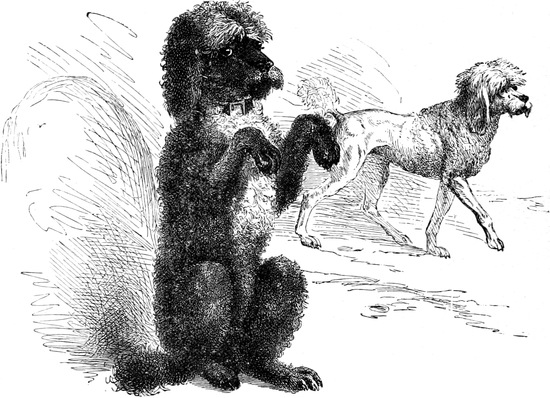
POODLES. (One-eighth Natural Size.)
is larger than any of the Spaniels already mentioned: it is also a
stronger Dog, and has closely-curled hair, and ears proportionally much
shorter than in the preceding breeds. It is used in shooting, having
first to find the game, and then, when a bird falls, to bring it to its
master without mangling. It is one of the most docile and intelligent
of Dogs, and has numerous tales told of it, both in prose and poetry.
Among the latter we may mention Cowper’s well-known piece “The Water
Lily.”
is a Dog of Continental origin, and is well known by its thick,
generally white, curly hair, which conceals its face and covers its
body like a mat. In France, and sometimes, alas! in England, people
try to improve the breed by shaving off the hair from the hinder half
of the body, with the exception of the tip of the tail, thus making the
wretched animal a spectacle to men and angels. Some misguided people go
even further than this, and dye the hair of various colours—making,
perhaps, a magenta body and a yellow tail, or some other equally
tasteful and appropriate combination.
The Poodle, notwithstanding the way it is treated, is an extremely
intelligent Dog, and capable of learning all sorts of tricks; it will
walk on its hind legs, dance, sham dead, and, in fact, do almost
anything it is taught. It is also affectionate and devoted, and has
shown itself capable of retaining for life the memory of a deceased
master.
A small variety of the Poodle is the Barbet, which, according to
Mr. Youatt, is unmanageable except by its owner, ill-tempered, “eaten
up with red mange, and frequently a nuisance to its master and a
torment to every one else.” Notwithstanding this, it is an extremely
intelligent Dog; and, indeed, “the Barbet possesses more sagacity
than most other Dogs, but it is sagacity of a particular kind, and
frequently connected with various amusing tricks. Mr. Jesse, in his
‘Gleanings in Natural History,’ gives a singular illustration of this.
A friend of his had a Barbet that was not always under proper command.
That he might keep him in better order, he purchased a small whip, with
which he corrected him once or twice during a walk. On his return the
whip was put on a table in the hall, but on the next morning it was
missing. It was soon afterwards found concealed in an out-building, and
again made use of in correcting the Dog. Once more it would have been
lost, but, on watching the Dog, who was suspected of having stolen it,
he was seen to take it from the hall-table in order to hide it once
more.”[114]
is an animal of the Poodle kind, of very considerable antiquity, as
it is mentioned by Strabo as Canis melitæus. It has a long body,
short legs, pendent ears, and long silky hair, of a pure white, or
sometimes yellowish colour. One of the chief points about this Dog is
its extremely small size.
is possibly, according to Mr. Youatt, a cross between the Maltese and
the hairless Turkish Dog. Its name is derived from the fact that its
hair, long on the head, neck, and fore-legs, is extremely short over
the rest of the body, except at the end of the tail, where there is a
small tuft.
is occasionally seen in England, but is, properly speaking, a native
of hot climates. Its usual name of Turkish or Egyptian Dog is,
however, quite a misnomer. It is almost entirely naked, and, more
curious still, subject to a disease of the teeth, which drop out so
early that the Dogs often have nothing left to bite with but a single
grinder on each side. This Dog is a curious and interesting instance of
degeneration, for its two distinguishing characters—hairlessness and
toothlessness—are actual deformities.
This magnificent breed is now better known than formerly in England,
as it is becoming quite usual to keep them instead of Mastiffs or
Newfoundlands. The readers of Punch have been familiarised with its
form, from Mr. Du Maurier’s sketches, who has been as successful in
depicting the noble Dog as the delightful little girl who, wishing to
enter a bazaar where Dogs are not admitted, proposes to her sister to
hide the gigantic creature under their skirts!
The breed was, until lately, almost confined to the Alps, where it was
kept by the monks of the convent of Mount St. Bernard, and sent out,
provided with a little barrel of brandy tied round its neck, to rescue
travellers lost in the snow. The number of people who have been saved
from death in this way, by the humanity of these good monks and the
intelligence of their Dogs, must be very great, for a single Dog, the
celebrated “Barry,” saved no less than forty lives himself, and at last
perished on one of his expeditions of mercy.
is, according to Youatt, simply a large Spaniel: it is the finest and
largest of Water-dogs (see figure on p. 121), besides being amongst the
most intelligent and courageous. It is covered with thick curly hair,
usually black or black-and-white, the curls being more flowing and
not so close and woolly as in the ordinary Spaniel or the Retriever.
So fully is this Dog adapted for swimming, that its feet have very
considerable webs, extending between the toes—an evident adaptation to
its aquatic habits.
Of the use and intelligence of this Dog it is needless to give
instances. Again and again it has saved the lives of drowning people
when human help was unavailable. We can give only one anecdote
illustrative of the value of this Dog, whose kindness of heart is equal
to his courage: who will guard and play with a little child or save a
strong man from drowning with equal skill and readiness:—
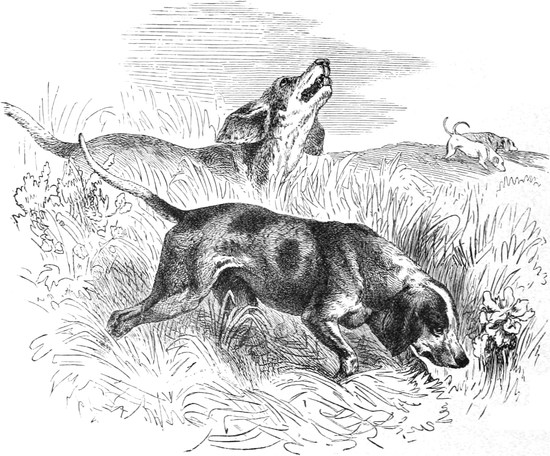
FOXHOUNDS.
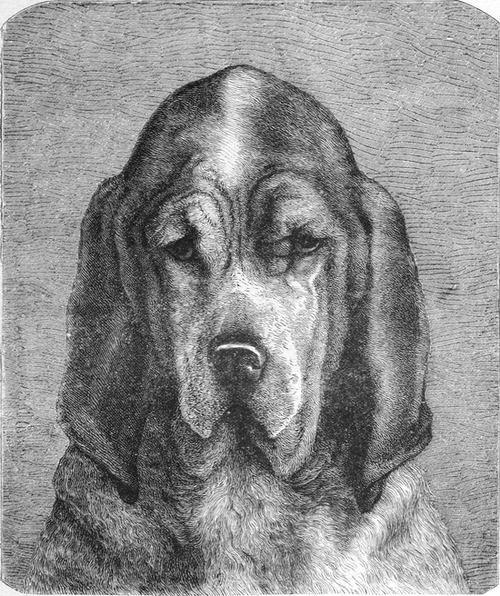
HEAD OF BLOODHOUND.
“A native of Germany was travelling one evening on foot through
Holland, accompanied by a large Dog. Walking on a high bank, which
formed one side of a dyke, his foot slipped, and he was precipitated
into the water; and, being unable to swim, soon became senseless. When
he recovered his recollection, he found himself in a cottage on the
contrary side of the dyke, surrounded by peasants, who had been using
the means for the recovery of drowned persons. The account given by
one of them was that, returning home from his labour, he observed at a
considerable distance a large Dog in the water, swimming and dragging,
and sometimes pushing along, something that he seemed to have great
difficulty in supporting, but which he at length succeeded in getting
into a small creek on the opposite side. When the animal had pulled
what he had hitherto supported as far out of the water as he was able,
the peasant discovered that it was the body of a man, whose face and
hands the Dog was industriously licking. The peasant hastened to a
bridge across the dyke, and, having obtained assistance, the body was
conveyed to a neighbouring house, where proper means soon restored the
drowned man to life. Two very considerable bruises, with the marks of
teeth, appeared, one on his shoulder, and the other on his poll; hence
it was presumed that the faithful beast had first seized his master by
the shoulder, and swum with him in this manner for some time, but that
his sagacity had prompted him to quit his hold, and to shift it to the
nape of the neck, by which he had been enabled to support the head out
of water; and in this way he had conveyed him nearly a quarter of a
mile before he had brought him to the creek, where the banks were low
and accessible.”[115]
This is not only the most important of all our domestic breeds, but it
is second to none for intelligence and devotion. It is quite a rare
thing to find a Shepherd’s Dog who will offer the slightest violence
to the animals under its care; and it can often be trusted almost with
the entire management of the flock, driving them from place to place,
gathering them together to be counted, and making altogether a far more
valuable assistant to the shepherd than any human being could possibly
be. The Dog is wholly devoted to the work, and his obedience and skill
are perfect, penning the Sheep from field after field, for his owner,
who foots it slowly after him, and finds the flock ready to his hand.
It used to be credibly reported to us in our boyhood, that some of
these Dogs would lay themselves down by a Sheep that had got cast
(i.e., was weltering, back downwards, in the clayey furrow, and,
loaded with wet and heavy wool, had lost power to rise); these Dogs, it
was said, would push their arched spine against the helpless Sheep, and
give them sufficient leverage to enable them to rise.
There are different kinds of Sheep Dogs found in different
countries—there are, for instance, the English, the Scotch, and the
French breeds. The Scotch Drover’s Dog is also a well-marked sub-breed.
The Scotch Shepherd’s Dog, or Colley (see figure on p. 120), is now a
good deal used as a pet: it is a very beautiful Dog, with a slender
muzzle, small feet, long straight hair forming a sort of ruff round the
neck; and, beneath this, a sort of under-coat of very soft fine hair.
The origin of the Shepherd’s Dog is, according to Mr. Youatt, “somewhat
various; but the predominant breed is that of the intelligent and
docile Spaniel.”
is a breed often seen in London streets. It is a beautiful Dog of
medium size, with long, usually white, hair, straight ears, and a
tufted tail. (See figure on p. 125.)
is a cross between the Sheep Dog and the Terrier.
was originally bred as a cross between the Sheep Dog and Greyhound, but
was afterwards modified by a further cross with the Spaniel. It is used
a good deal by poachers.
The next group of Dogs is conveniently known as Hounds; they are all
used in the chase, and, being bred and selected especially for this
work, are good for little else.
is the smallest of the Hounds, usually not exceeding ten or twelve
inches in height. These Dogs were formerly a good deal used in
Hare-hunting, and were celebrated for their uniform size, close
running, and musical voice. So small were they that they used to be
carried to the field in panniers.
was also used for hunting the Hare. It is about half-way between the
Beagle and the Greyhound as to size.
is, in England at least, the most important of the Hound group. He
may, in fact, be looked upon as one of the main supporters of that
peculiarly English institution, the Squirearchy; for what would become
of the average country gentleman if he could not hunt through the
winter six days a week, and visit his Hounds on Sunday?
The Foxhound (see figure on p. 136) “is the old English Hound,
sufficiently crossed with the Greyhound to give him lightness and
speed without impairing his scent.” His height is about twenty-two
to twenty-four inches; his fur short, ears long and drooping, and
tail tolerably straight. He exhibits great variation as to hue;
and an authority, cited by Youatt, “gives a curious account of the
prejudices of sportsmen on the subject of colour. The white Dogs were
curious hunters, and had a capital scent; the black, with some white
spots, were obedient, good hunters, and with good constitutions;
the grey-coloured had no very acute scent, but were obstinate and
indefatigable in their quest; the yellow Dogs were impatient and
obstinate, and taught with difficulty.”
The statement about the particularly good scent of the white Hounds is
very curious, for it is generally found that animals of light colour
are inferior in sensory endowments to darker ones, owing to the absence
of a peculiar black pigment from the delicate membranes to which the
nerves of special sense are distributed.
The pace of the Foxhound is very rapid. One was known to run a course
of four miles one furlong and one hundred and thirty-two yards in a
trifle over eight minutes! Of the correctness of their scent, no one
who has seen the Hounds put off and watched the unerring way they
pursue the Fox, can have any doubt.
This is the largest of modern English Hounds, and the one which most
nearly approaches in character the old “Hound” which fell into disuse
on account of its slowness, but which we often find mentioned in
olden writers. Shakspere, for instance, writes of this old English or
Southern Hound in “Midsummer Night’s Dream”:—
Hip. I was with Hercules and Cadmus once,
When in a wood of Crete they bay’d the bear
With hounds of Sparta: never did I hear
Such gallant chiding; for, besides the groves,
The skies, the fountains, every region near
Seem’d all one mutual cry: I never heard
So musical a discord, such sweet thunder.
The. My hounds are bred out of the Spartan kind,
So flew’d, so sanded; and their heads are hung
With ears that sweep away the morning dew;
Crook-knee’d and dew-lapp’d, like Thessalian bulls;
Slow in pursuit, but match’d in mouth like bells,
Each under each. A cry more tuneable
Was never holla’d to, nor cheer’d with horn,
In Crete, in Sparta, nor in Thessaly:
Judge when you hear.
Of the powers of scent possessed by the Staghound, the following is a
notable example:—
“Lord Oxford reduced four Stags to so perfect a degree of submission,
that, in his short excursions, he used to drive them in a phaeton made
for the purpose. He was one day exercising his singular and beautiful
steeds in the neighbourhood of Newmarket, when their ears were saluted
with the unwelcome cry of a pack of Hounds, which, crossing the road
in their rear, had caught the scent, and leaving their original object
of pursuit, were now in rapid chase of the frightened Stags. In vain
his grooms exerted themselves to the utmost; the terrified animals
bounded away with the swiftness of lightning, and entered Newmarket
at full speed. They made immediately for the Ram Inn, to which his
lordship was in the habit of driving, and, having fortunately entered
the yard without any accident, the stable-keepers huddled his lordship,
the phaeton, and the Deer, into a large barn, just in time to save
them from the Hounds, who came into the yard in full cry a few seconds
afterwards.”
This Dog resembles pretty closely the Deerhound, or old English Hound,
but is considerably larger, with longer ears of a soft and delicate
texture, and deeper “flews,” or down-hanging upper lips. (See figure on
p. 137.) The colour is brown, verging to reddish along the back, and to
light fawn-colour below. The eyes should be surrounded with a distinct
red ring, due to the exposure of the delicate membrane lining the
eyelids. To judge from the animal’s countenance, no one would imagine
the horrid purpose for which it was originally bred, for few Dogs have
a milder, more benevolent, or more intelligent visage.
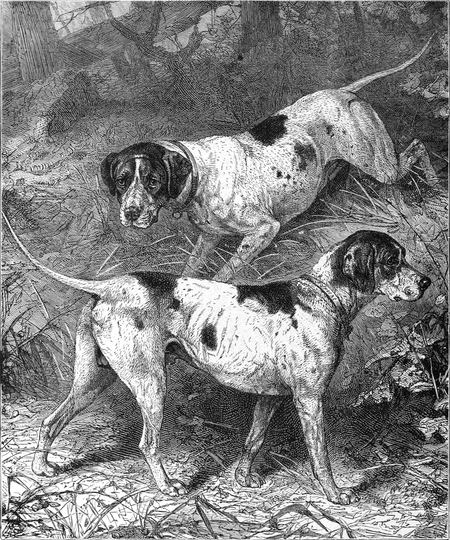
POINTERS.
In former times, these Dogs were used to track robbers and other
offenders, a duty which they performed with the most unerring accuracy,
never giving up the chase until they had brought their miserable quarry
to bay. When engaged in this work, all their mildness disappeared, and
they were transformed into perfect furies. Mr. Youatt, writing in 1845,
says:—“The Thrapstone Association lately trained a Bloodhound for the
detection of Sheep-stealers. In order to prove the utility of this Dog,
a person whom he had not seen was ordered to run as far and as fast as
his strength would permit. An hour afterwards, the Hound was brought
out. He was placed on the spot whence the man had started. He almost
immediately detected the scent, and broke away, and, after a chase
of an hour and a half, found him concealed in a tree fifteen miles
distant!”
according to Youatt, “is evidently the large Spaniel, improved to
his peculiar size and beauty, and taught another way of marking his
game, viz., by setting or crouching. If the form of the Dog were not
sufficiently satisfactory on this point, we might have recourse to
history for information on it. Mr. Daniel, in his ‘Rural Sports,’ has
preserved a document, dated in the year 1685, in which a yeoman binds
himself, for the sum of ten shillings, fully and effectually to teach a
Spaniel to sit Partridges and Pheasants. The first person, however,
who systematically broke-in sitting Dogs is supposed to have been
Dudley, Duke of Northumberland, in 1335.” The hinder surface of the
legs, and the under surface of the tail of the Setter, should be well
“feathered,” that is, beset with long hair.
Mr. Darwin says:—“Our Pointers are certainly descended from a Spanish
breed, as even the names Don, Ponte, Carlos, &c., would show. It is
said that they were not known in England before the Revolution in 1688;
but the breed, since its introduction, has been much modified,” the
change having been “chiefly effected by crosses with the Foxhound.”
The value of this Dog consists in his habit of “pointing,” or standing
silently, with lifted foot and outstretched muzzle, as soon as he finds
game. A very remarkable circumstance with regard to this habit is the
way in which it is inherited: a young Dog points instinctively the
first time he is taken into the field.
More or less distinct sub-breeds of the Pointer are to be found in
Spain, Portugal, France, and Russia. The hair is short, the colour
variable.
according to Brehm, is a cross between the Newfoundland and the
Pointer. It is a good water-dog, and is used for sport, especially
in shooting water-birds. It derives its name from its talent for
retrieving, or following a wounded bird, and bringing it back to the
sportsman without mangling. It is a large Dog, with a good forehead
and long ears, and is covered with a closely-curled hide of a brown or
black colour. (See figure on p. 113.)
is a breed formerly in great requisition for hunting the Otter, a sport
which is now almost if not quite discontinued. This Dog “used to be of
a mingled breed, between the Southern Hound and the rough Terrier, and
in size between the Harrier and the Foxhound.”
Before the invention of bottle-jacks, this Dog was used in England to
turn the spit on which the joint was roasted, for which purpose they
were attached to a sort of wheel. It is a queer-looking Dog—very
long-bodied and very short-legged, and is possessed of a great degree
of intelligence. Brehm relates an anecdote of two Turnspits, who
were employed in the kitchen of a house at Plessis, one of whom, the
cook’s favourite, had to turn the spit on Mondays and Wednesdays; the
other taking his turn on Sundays, Tuesdays, and Thursdays. Friday and
Saturday were holidays for both. One Wednesday the favourite Dog was
absent, and the cook endeavoured to press into service the other rather
than search for and disturb his pet. But No. 2, although he had made
no objection to having three days of work to his mate’s two, could not
stand this: he growled and bit, and positively refused to be harnessed.
At last he rushed out of the house, and made his way to an open place,
where his lazy colleague was playing with some friends. As soon as he
saw the truant, he hustled and bit at him, and finally drove him into
the house to the cook’s feet, having accomplished which act of justice
he became calm, and looked quietly up to his master, as much as to
say—“Here’s your Dog: it’s his turn now.”
is a German breed, closely allied to the Turnspit, but with the
characters of the latter exaggerated. The fore-legs are crooked at the
wrist-joint, and the feet are very large. It was originally bred, as
its name implies, for Badger-hunting, and, so strong is its instinct
for the sport even now it has become a drawing-room pet, that it will
rush at anything that looks like a hole, and begin to burrow vigorously.
is undoubtedly the most savage and untamable of all the breeds: he is,
moreover, except to the eyes of a fancier, the ugliest; for, although
he has not the grotesque proportions of the Turnspit, yet his crooked
legs, Rat’s tail, flat forehead, little wicked eyes, turned-up nose,
big mouth, and underhung lower jaw, make him a creature absolutely
hideous to any one whose taste is not sufficiently cultivated to enable
him to admire anything “proper.” The two features of the crooked legs
and the underhung jaw are simply selected and perpetuated deformities.
The projection of the lower jaw and the receding of the nose are
extremely marked, and give the Dog a most sinister appearance. The
chest of a good Bull-dog is very broad and strong. The hind-quarters,
on the other hand, are comparatively feeble.
The Bull-dog was formerly used—as its name implies—for the barbarous
“sport” of Bull-baiting, in which our forefathers took so much delight.
The Dog would seize upon the Bull’s nose and lip, and no power in
heaven or earth could make him leave his hold. He would even fight
with the Lion, and seize upon his gigantic antagonist again and again,
although torn and mangled all over with great claw-wounds.
Although not a water-dog, the Bull-dog is a capital swimmer, his
immense strength and indomitable pluck giving him an advantage over
even such a professed swimmer as the Newfoundland. “During a heavy
gale, a ship had struck on a rock near the land. The only chance
of escape for the shipwrecked was to get a rope ashore; for it was
impossible for any boat to live in the sea as it was then running.
There were two Newfoundland Dogs and a Bull-dog on board. One of the
Newfoundland Dogs was thrown overboard, with a rope thrown round him,
and perished in the waves. The second shared a similar fate; but the
Bull-dog fought his way through that terrible sea, and, arriving safe
on shore, rope and all, became the saviour of the crew.”
Little is known as to the origin of the Bull-dog, but Mr. Darwin
makes the curious and interesting statement that “some authors who
have written on Dogs maintain that the Greyhound and Bull-dog, though
appearing so different, are really closely-allied varieties, descended
from the same wild stock; hence I was anxious to see how far their
puppies differed from each other.... On actually measuring the old
Dogs and their six-day old puppies, I found that the puppies had not
acquired nearly the full amount of proportional difference.”
is a cross between the Bull-dog and the Terrier, and is generally
superior, both in appearance and value, to either of its progenitors.
“A second cross considerably lessens the underhanging of the lower jaw,
and a third entirely removes it, retaining the spirit and determination
of the animal.”
This Dog “is probably an original breed peculiar to the British
Islands.” It is larger than the Bull-dog, has a head of somewhat the
same shape, with deep flews, but its ears are pendent, and it has
none of the Bull-dog’s deformity. (See figure on p. 109.) From the
Bloodhound it is distinguished by the shape of the head, which is
rounder and shorter, and by the absence of the red ring round the eye.
At the present day, the Mastiff is used chiefly as a house Dog, for
which purpose his fidelity and strength make him thoroughly well suited.
is about intermediate in size between the Bull-dog and the English
Mastiff; in appearance it closely resembles the latter. It is an
extremely savage Dog, and was used in the days of slavery for tracking
runaway negroes. It is now used as a watch Dog, and, by the Spaniards,
for Bull-fighting.
This magnificent animal is kept by the Bhoteas, a race inhabiting the
table-lands of Tibet, who use it as a watch Dog. It is about the size
of a Newfoundland Dog, but with a head more like that of a Mastiff, the
“flews,” or pendent side-flaps of the upper lip, being of great-size.
The hair is long, and the tail bushy and well curled.
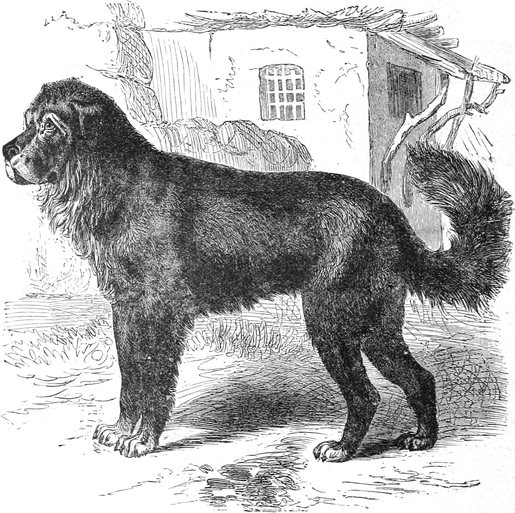
TIBET DOG.
Mr. Bennett says of some specimens kept in the Zoological Gardens
many years ago, that they “were larger than any English Mastiff we
have seen. Their colour was a deep black, slightly clouded on the
sides; their feet and a spot over each eye alone being of a full tawny
or bright brown. They had the broad, short, truncated muzzle of the
Mastiff, and lips still more deeply pendulous.” In disposition they
are—at any rate in their native country—“tremendously fierce, strong,
and noisy; and while savage by nature, or soured by confinement, so
impetuously fierce, that it is unsafe, unless the keepers are near,
even to approach their dens.”
This Dog was known to the Greeks and Romans, whose writers mention its
fierce conflicts with the Aurochs, the Wild Boar, and even the Lion.
This is a small Dog, with a good forehead, prominent eye, pointed
muzzle, and usually short hair. The colour varies greatly—white and
black-and-tan being perhaps the commonest hues; in the latter case,
there is always a tan-coloured spot on the eye, a circumstance which it
is interesting to remark, as a similar spot occurs in nearly all black
Dogs with tan-coloured feet.
The Terrier is used for unearthing the Fox, but his chief
accomplishment is Rat-killing, in which noble sport he is a great
adept. “There are some extraordinary accounts of the dexterity, as
well as courage, of the Terrier in destroying Rats. The feats of a Dog
called ‘Billy’ will be long remembered. He was matched to destroy one
hundred large Rats in eight minutes and a half. The Rats were brought
into the ring in bags, and as soon as the number was complete, he was
put over the railing. In six minutes and thirty-five seconds they
were all destroyed. In another match he destroyed the same number in
six minutes and thirteen seconds. At length, when he was getting old,
and had but two teeth and one eye left, a wager was laid of thirty
sovereigns, by the owner of a Berkshire Bitch, that she would kill
fifty Rats in less time than Billy. The old Dog killed his fifty in
five minutes and six seconds. The pit was then cleared and the Bitch
let in. When she killed thirty Rats she was completely exhausted,
fell into a fit, and lay barking and yelping, utterly incapable of
completing her task.”
has a large head, short stout legs, and long, rough, shaggy hair. The
colours of the pure breed are black and fawn. This breed is probably
of more ancient origin than the English Terrier. It is an extremely
intelligent, faithful, and affectionate animal, and, like its relative
from south of the Border, a great Rat-catcher. The “Dandie Dinmont”
breed, so well known from the immortal Pepper and Mustard in “Guy
Mannering,” is a variety of the Scotch Terrier; so also is the Skye
Terrier, which is distinguished by its long hair and short legs. In
all these Terriers, as well as in the English breed, a black nose and
black roof to the mouth are points of importance.
Having considered the chief bonâ fide varieties of the Dog, we come,
lastly, to those nondescript animals, the Pariahs, or domesticated
Dogs run wild, which occur in packs in many parts of Eastern Europe
and of Asia. These herds of miserable, half-starved animals are
undoubtedly not true wild Dogs, but degenerated tame ones, the Dog
being derived from a wild ancestor, under certain circumstances shows
his descent by reverting to the habits of his forbears. Instances
of this occur occasionally in the case of even the better breeds of
Dogs. For instance: “A black Greyhound Bitch, belonging to a gentleman
in Scarisbrick, in Lancashire, though she had apparently been well
broken-in and always well used, ran away from the habitation of her
master, and betook herself to the woods. She killed a great many Hares
and made free with the Sheep, and became an intolerable nuisance to the
neighbourhood. She was occasionally seen, and the depredations that
were committed were brought home to her. Many were the attempts made
to entrap or destroy her, but in vain; for more than six months she
eluded the vigilance of her pursuers. At length she was observed to
creep into a hole in an old barn. She was caught as she came out, and
the barn being searched three whelps were found, which, very foolishly,
were destroyed. The Bitch evinced the utmost ferocity, and, although
well secured, attempted to seize every one who approached her. She
was, however, dragged home, and treated with kindness. By degrees her
ferocity abated. In the course of two months she became perfectly
reconciled to her original abode, and a twelvemonth afterwards (1822),
she ran successfully several courses. There was still a degree of
wildness in her appearance; but although at perfect liberty, she seemed
to be altogether reconciled to a domestic life.”
Captain Williamson says “that many persons affect to treat the idea of
degeneration in quadrupeds with ridicule; but all who have been any
considerable time resident in India must be satisfied that Dogs of
European breed become, after every successive generation, more and more
similar to the Pariah, or indigenous Dog of that country. The Hounds
are the most rapid in their decline, and, except in the form of their
ears, they are very much like many of the village curs. Greyhounds and
Pointers also rapidly decline, although with occasional exceptions.
Spaniels and Terriers deteriorate less; and Spaniels of eight or nine
generations, and without a cross from Europe, are not only as good as,
but far more beautiful than, their ancestors. The climate is too severe
for Mastiffs, and they do not possess sufficient stamina; but, crossed
by the East Indian Greyhound, they are invaluable in hunting the Hog.”
The Pariah Dogs occur in Turkey, Egypt, Syria, China, India, &c.,
varying a good deal according to their abode. Their habits are well
described by Mr. G. R. Jesse, whose account of the Egyptian Pariah
will apply equally well to that of Constantinople, or of any other
place where sanitary regulations are simply nil, and where the Dogs
are the only creatures who make any attempt to clear the place of
fever-breeding filth.
“The Dogs of the Egyptian towns are masterless, and live on carcases
thrown out on the mounds of rubbish outside the walls and what is
cast them by the charitable. In the villages, and with the shepherds
along the desert, they are better cared for, protecting the property
of the people from thieves, and their animals from wild beasts. These
Dogs are generally sandy in colour, but they vary—some are black,
and others white. At Ermeret, near Thebes, is a breed of black Dogs,
quite different from those of Lower Egypt—fierce, excellent watchers,
having roughish wiry hair, and drooping but small ears: they are stated
to be derived from the Slowara Arabs. Numbers of Dogs congregate on
some of the rubbish mounds outside the gates and walls of Cairo, and
live on the carcases of Horses, Asses, &c., which are thrown there,
the Arabs not having arrived at that pitch of Western economy which
terminates the utility of a beast of burden at a cheap restaurant.
These masterless Dogs act as scavengers, in which capacity they are
accompanied by the large black-and-white yellow-billed Carrion Hawk,
Kites, and troops of black-and-grey Carrion Crows. Among the skeletons,
and scattered bones, heads, and hoofs, these Dogs—about two feet in
height, generally of a yellow colour, or black, or a dirty white,
smooth-skinned, and mostly with erect pointed ears—may be seen in
crowds, their mouths and necks bloody, snarling, snapping, fighting,
tearing, and gorging to repletion. The bitches scratch holes in the
rubbish-heaps, and there bring forth their young. After the bones of
the dead animals are cleared of flesh by the Dogs, bundles of them are
collected and carried off by women and children. The Dogs of the town
associate in bands, and each band has its district and its chief. No
other Dog is permitted to enter the territory without being at once
assailed. If, however, a Dog wishes to pass from one quarter of the
town to another, he is said to creep along with his tail down in a
humble manner, and immediately the Dogs of that part come upon him
to throw himself on his back, and deprecate their attack. After due
examination, he is allowed to proceed, but repeats his submissive
actions whenever he meets new foes, and so, after enduring repeated
challenges, gains his destination. These Dogs are still and quiet
during the day (unless, indeed, an European comes in sight, when their
vociferousness is loud and long), but at night they are very vigilant,
and guard the bazaars against the nocturnal thief.”
In some parts of India the superfluous Pariahs are utilised by giving
them as food to caged Tigers. An anecdote is related of one who proved
himself a match for the Tiger, and who was, as a reward, admitted to
close intimacy with the royal beast.
“I knew an instance,” says Captain Williamson, “of one that was
destined for the Tiger’s daily meal standing on the defensive, in a
manner that completely astonished both the Tiger and the spectator.
He crept into a corner, and whenever the Tiger approached, seized him
by the lip or the neck, making him roar most piteously. The Tiger,
however, impelled by hunger—for all supply of food was purposely
withheld—would renew the attack. The result was ever the same. At
length the Tiger began to treat the Dog with more deference, and not
only allowed him to partake of the mess of rice and milk furnished
daily for his subsistence, but even refrained from any attempt to
disturb him. The two animals at length became reconciled to each other,
and a strong attachment was formed between them. The Dog was then
allowed ingress and egress through the aperture; and, considering the
cage as his home, he left it and returned to it just as he thought
proper. When the Tiger died he moaned the loss of his companion for a
considerable period.”
In Siam, these unhappy creatures are equally abundant, and are even
worse off. Mr. Thomson[116] states that they occur in great numbers in
nearly all the temples. “It is contrary to the Buddhist creed to take
away life; hence many of their temples become places of refuge for
troops of famished Dogs, who remain there till they die; for though the
priests give them what food they can spare, there is never enough for
them all. These Dogs, then, are usually animated skeletons, their skins
destitute of hair, and covered with many sores. I tossed them a little
food; it gave rise to the most savage fight I ever witnessed. One or
two wretched curs limped away from the strife, torn and lacerated,
probably to lie down and die. This canine community—fierce, hungry,
and diseased—must surely be one of those many Buddhist hells where
sorcerers expiate their crimes. The animals are deemed to be animated
by the spirits of the departed, and are undergoing a lifetime of
torture. The priests, if they are good men, look on at their misery
with pious complacency, and probably take the lesson to heart, lest
they, too, in the next stage of their existence, should be condemned to
howl for offal or garbage to satisfy the hungry pangs and sore-eaten
frames of starving Pariah Dogs.”
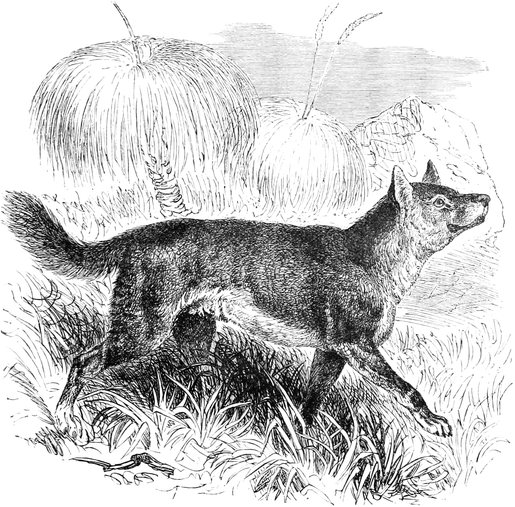
DINGO.
This animal, which exists in large numbers all over the peninsulas of
India and Malacca, differs so much from the ordinary Dogs, that it
has been proposed to separate it from them under a different generic
name, Cuon. Its distinctive characters are, however, by no means
sufficiently great to warrant this separation. It occurs, under
slightly different varieties, in different parts of India, and receives
various native names. By the Mahrattas it is called Kolsun (Canis
dukhunensis of Colonel Sykes); Sona kúta, or Golden Dog, in Central
India; Buansú in the Himalayas; Dhole in Ceylon, and so on.
A capital notion of the appearance of this interesting Dog may be
obtained from a case of stuffed specimens now in the India Museum at
South Kensington. The Zoological Society has at different times been
able to exhibit in their Gardens more or less fine examples of the
Indian Wild Dog. Dr. Murie gives the following account of a male and
female specimen sent to the Gardens some time ago:—
“Their tout ensemble conveyed to me the idea of a compound between
Wolf, Jackal, and Fox, partly on account of their colour, partly from
their size and general shape, and also partially from the contour of
the head, ear-outline, and direction of the eyes. But, on the other
hand, a critical inspection left the impression that they were more
markedly of the Dog type. This pair of animals very nearly corresponded
in size,” the most important dimensions being—length, from snout to
tip of tail, forty-two inches; length of the tail, twelve inches;
height at shoulder, about fifteen inches, and at the loins about
sixteen inches.
“Their colour was entirely reddish or fulvous brown, and remarkably
like the tint of a Fox. The tip of the nose and lower part of the
face was somewhat darker; the tail also exhibited deepening of hue.
Moreover, upon the outer side of the hind-leg, and similarly on the
fore-limb, there was a tendency, though a very indistinct one, to
whitish spotting.... Of those features marking race, the tail was
moderately lengthened, dark, and full below, as in the Jackal or Wolf,
and not with the great round brush of the Fox. The eye had a certain
obliquity; but the pupil, as far as I could ascertain, was round. Ears
large, erect, and hairy.”
“I am not cognisant of any observations as to their habits having been
noted prior to their receipt by the Society. But I may mention that
when in the Gardens they were exceedingly active, snapping, snarling,
and in their general behaviour resembling a couple of Wolves rather
than sedate Dogs. I am not aware that they were heard to bark; but
occasionally they howled and whined.”
The Wild Dog has thus, in many respects, an appearance resembling that
of a Fox or a Jackal, with which it also agrees in its filthy smell. It
is, however, a true Dog, although less specialised than the domestic
kinds, and therefore approaching the average structure of the wild
Canidæ.
These Dogs hunt in packs, six, eight, ten, or as many as thirty,
animals in a pack. They hunt either by night or day; and it is said
that “when once a pack of them put up any animal, no matter whether
Deer or Tiger, that animal’s doom is sealed; they never leave it. They
will dog their prey for days, if need be, and run it down exhausted,
and if it turns to fight, they go in fearlessly, and by their numbers
win. All animals dread the Wild Dog; others they may elude by speed,
artifice, or battle: but their instinct tells them that there is no
escaping the Wild Dog, as it hunts in packs by scent as well as by
sight, and is as brave as it is persevering.”
They make no noise when running, except sometimes a low whispering kind
of note, which may either express their own gratification, or act as
a signal to other Dogs. Great numbers of them are destroyed in their
hunting expeditions, as the larger animals, such as the Elk and Boar,
defend themselves with great fierceness, and sacrifice many of their
pursuers before they fall a victim to the overwhelming numbers and
unconquerable perseverance of the latter.
In some parts of India they are half-domesticated, and used in the
noble sport of “Pig-sticking.” “They are remarkably savage, and
frequently will approach none but their doonahs, or keepers, not
allowing their own masters to come near them. Some of them are very
fleet, but they are not to be depended upon in coursing; for they are
apt suddenly to give up the chase when it is a severe one, and, indeed,
they will too often prefer a Sheep or a Goat to a Hare. In Hog-hunting
they are more valuable. It seems to suit their temper, and they appear
to enjoy the snapping and the snarling incident to that species of
sport.”[118]
This is another distinct breed of Wild Dog, quite as remarkable in its
way as the Indian Wild Dog, and possessing far greater interest than
the latter, from the fact that it is the only Mammal not belonging to
the group of Marsupials, or pouched animals (Kangaroos, Wombats, &c.),
found in the great island of Australia. In all probability, it is not
a true native even there, but was most likely introduced before the
discovery of the island by Europeans.
The Dingo “approaches in appearance to the largest kind of Shepherd’s
Dog (see figure on page 147). The head is elongated, the forehead
flat, and the ears short and erect, or with a slight direction
forwards. The body is thickly covered with hair of two kinds—the one
woolly and grey, the other silky and of a deep yellow or fawn colour.
The limbs are muscular, and, were it not for the suspicious yet
ferocious glare of the eye, he might pass for a handsome Dog. When he
is running, the head is lifted more than usual in Dogs, and the tail is
carried horizontally. He seldom barks.”[120]
There are some Dingoes in the Zoological Gardens, and one would never
guess their savageness of disposition from their innocent faces. They
are decidedly good-looking Dogs in appearance, but as regards temper
they are anything but pleasant animals, although quite tamable if
taken young: they are, indeed, often domesticated by the natives, but
are never known to attain to those higher qualities which make the
thoroughly civilised Dog so valuable.
“When Van Diemen’s Land began to be colonised by Europeans, the losses
sustained by the settlers by the ravages of the Wild Dogs were almost
incredible. The districts infested by these animals were principally
those appropriated to Sheep, and there was scarcely a flock that did
not suffer. It was in vain to double the number of shepherds, to watch
by night and day, or to have fires at every quarter of the field; for
these animals would accomplish their object by stratagem or force.
One colony lost no fewer than 1,200 Sheep and Lambs in three months;
another colony lost 700.
“The ravagers were either the native Wild Dogs of the island or those
that had escaped from their owners. They seemed to have apportioned
the country into different districts, each troop having its allotted
range. At length the evil became so great, that a general meeting of
the colonists was convened. The concluding sentences of the speech of
Lieutenant Hill forcibly express the extent of the evil:—‘The country
is free from bushrangers: we are no longer surrounded and threatened by
the natives. We have only one enemy left in the field; but that enemy
strikes at the root of our welfare, and through him the stream of our
prosperity is tainted at its very source.’ The colonists were then few,
but they cordially united in the endeavour to extirpate this formidable
enemy; and, although the Wild Dog is still found in the interior of the
island, he is comparatively seldom seen, and his ravages have nearly
ceased.”[121]
WE have considered all the most important “beasts of prey,” with two
exceptions, under the Cat family, to which they belong. Two important
ravagers still remain—the Bear, of which we shall speak by-and-bye,
and the Wolf, whose turn has now come. Of the great Cats, much good
is often spoken. Notwithstanding their cruelty and bloodthirstiness,
they are handsome, strong, and usually courageous: each one hunts
his prey for himself, and when he has satisfied his appetite, leaves
the remainder to inferior beasts, disdaining, unless when reduced by
starvation, to touch any but fresh meat. The Bear, too, often has a
word said for him: his curious, half-good-natured look, his semi-human
waddle, the tricks he is capable of learning, all combine to make him
seem not so very objectionable a beast after all. But who ever heard
any good said of a Wolf? There have, indeed, been a few instances of
Wolves in captivity who have shown much affection and fidelity to their
masters; but, under ordinary circumstances, cruel, cowardly, dastardly,
greedy, pitiless, are the adjectives applied to him.
The Wolf has a place in history as venerable as that of the Lion,
and he was the dread of the shepherd four thousand years ago. A
very old Sheep-master, addressing his sons on his death-bed—these
sons being, eleven out of twelve of them, shepherds—said of the
youngest:—“Benjamin shall ravin as a Wolf: in the morning he shall
devour the prey, and at night he shall divide the spoil.”
Homer also, in his immortal “Iliad,” frequently brings in the Wolf,
giving with a few master-touches a vivid picture of the hated brute’s
habits:—
“Sudden as hungry Wolves the Kids purloin,
Or Lambs, which haply some unheeding swain
Hath left to roam at large the mountains wild;
They, seeing, snatch them from beside the dams,
And rend incontinent the feeble prey.”
——“As Wolves that gorge
The prey yet panting, terrible in force,
When on the mountains wild they have devour’d
An antler’d Stag new-slain, with bloody jaws
Troop all at once to some clear fountain, there
To lap with slender tongues the brimming wave;
No fears have they, but at their ease eject
From full maws flatulent the clotted gore.”
The ancient Greeks and Romans had a very curious superstition about the
Wolf. They believed that if a man and a Wolf met, and the beast saw his
human enemy before the latter caught sight of him, the man became dumb.
Hence the Greek proverb, λύκον ἰδεῖν, “to see a Wolf,” that is, to be
struck dumb. Virgil expresses the same notion in his “Bucolics”—
“Nunc oblita mihi tot carmina: vox quoque Mœrim
Jam fugit ipsa: lupi Mœrim videre priores.”
[123]
There are many ancient proverbs of which the Wolf is the theme; one is
often used now, “lupus in fabula,” used in much the same sense as
“Talk of the Devil.” Then there is “ovem lupo committere,” equivalent
to our “set the Fox to watch the Geese”; “hac urget lupus, hac canis
angit,” of much the same significance as “a Donkey between two bundles
of hay”; and many others.
We have said that the Wolf is everywhere detested; there is an
historical exception to this. He was held in great veneration and even
worshipped by the ancient Egyptians, who often embalmed his body, and
one of whose cities, Lycopolis (the modern Siout), was named after him.
The Common Wolf is still very abundant in many parts of Europe, being
found in Spain, Greece, Italy, France, Eastern Germany, Poland, Russia,
Sweden, Norway, and Lapland. In Switzerland they are now rare, and in
the remainder of the Continent extinct.
It is very curious to think that such a beast as the Wolf should now
flourish in a neighbouring country like France, as we have quite
forgotten the time since any plague of the sort existed in England. And
yet it is barely two centuries since they were finally got rid of, and
in early times they were quite common over a great part of the island,
and, of course, did an immense amount of damage. One Saxon king, Edgar,
“applied himself to their extirpation in earnest, enlisting English
criminals in the service, by commuting the punishment awarded for their
crimes to the delivery of a certain number of Wolves’ tongues, and
liberating the Welsh from the payment of the tax of gold and silver,
on condition of an annual tribute of three hundred Wolves. But the
vast wild tracks and deep forests of ancient Britain were holds too
strong even for his vigorous measures. What the number and consequent
danger had been may be imagined from the necessity that existed, in
the previous reign of Athelstan (A.D. 925), for a refuge
against their attacks. Accordingly, a retreat was built at Flixton
in Lancashire, to save travellers from being devoured by these gaunt
hunters. The Saxon name for the month of January, ‘Wulf-moneth,’ in
which dreary season hunger probably made the Wolves more desperate, and
the term for an outlaw, ‘Wolfshead,’ implying that he might be killed
with as much impunity as a Wolf, also indicate the numbers of these
destructive beasts, and the hatred and terror which they inspired.
“That Edgar failed in his attempts at extirpation is manifest from a
mandamus of Edward I., to all bailiffs &c., to give their assistance
to his faithful and beloved Peter Corbet, whom the king had enjoined to
take and destroy Wolves ... in all forests and parks and other places
in the counties of Gloucester, Worcester, Hereford, and Salop, where
they could be found.... Even so late as 1577, the flocks of Scotland
appear to have suffered from the ravages of Wolves, which do not seem
to have been rooted out of that portion of the kingdom till about the
year 1680, when Sir Ewen Cameron’s hand laid the last Wolf low. In
Ireland, Wolves must have lingered as late as the year 1710; about
which time the last presentment for killing them in the county of Cork
was made.”
The Wolf is about the size of a large Shepherd’s Dog, measuring some
five feet from snout to tip of tail: of this length about twenty
inches are taken up by the tail. The height at the shoulders is about
thirty-two inches. The skin is of a dark yellowish-grey colour, or
sometimes almost black; the hair is long and coarse in the northern
varieties, which have to sustain existence through a long, cold winter,
and shorter in the southern kinds, which enjoy a warmer climate. There
is also a good deal of variation in colour, according to the country
from which the animal comes.
The muzzle has much the same shape as that of many Shepherd’s Dogs,
but the ears are very upright and pointed, and the eyes are set
obliquely; in this respect the difference between a Wolf and a Dog is
very striking—the obliquity of the eye in the former gives him a most
sinister expression. The pupil of the eye is round. The bushy tail,
too, is not curled up like a Dog’s, but held down, almost between the
hind legs. But perhaps the most striking difference from the Dog is in
the voice; the Wolf never barks—that is entirely a civilised habit:
even Dogs allowed to become wild lose it—but howls in a horrible and
ghastly manner.
The Wolf usually lives in solitary places in mountains; but in Spain he
is said sometimes to make his lair in corn-fields, in close proximity
to inhabited dwellings. Here he lives with his wife and family, usually
caché during the day, and issuing forth at night to take his prey.
During the warmer periods of the year Wolves, as a rule, hunt each one
for himself, but in the winter they often unite into great packs, and
pursue their prey over the snow at a rapid pace and with indomitable
perseverance. Swift and untiring must be the animal which, on an open
plain, can escape from them; even the Horse, perfectly constructed as
he is for rapid running, is almost certain to succumb, unless he can
reach a village before his pace begins to flag. They never spring upon
an animal from an ambush—the nearest approach ever made to such a mode
of attack being their practice of attacking sheepfolds by leaping into
the midst of the flock and killing right and left; when they reach
their prey, too, the first onslaught is made with the teeth, and never
by a blow of the paw. Thus, a Wolf’s attack—like that of all members
of the genus Canis—is entirely different from a Cat’s. The Cat lies in
ambush all alone, springs upon the passing prey, which, if he misses
he scarcely ever pursues, and kills by a blow of the paw. The Dog and
Wolf attack openly, sometimes alone, but oftener in company, pursue
their prey with unflagging energy until it falls a victim, and give the
death-wound at once with their teeth. To shepherds the Wolf is, and
has been from the earliest times, a most unmitigated curse. A single
Wolf will leap the wall of a sheepfold and murder perhaps a quarter
or a third of the flock before his lust of slaughter is satisfied. Of
course, he cannot eat more than one, or part of one, and the others he
slays from wanton cruelty. Mutton is naturally his standing dish, as it
can be procured, if at all, in abundance, and with comparatively little
difficulty; but he is not at all particular, and will eat Deer, Goats,
Birds, and even Reptiles. But his favourite meat, curious to relate,
is Dog, and there are many instances related of the eagerness and
recklessness shown by Wolves to obtain this cannibal feast. “Wolves
have been known to carry off a Pointer from a sledge going at full
gallop. The animal leaps with a single bound amongst the three or four
persons in the vehicle, who remain stupefied at so much audacity,
seizes his innocent victim, and plunges again into the forest. The
whole is done in less time than it takes to tell. Another time, it is
a young Newfoundland, which his master, travelling on horseback, has
placed before him, on the pommel of his large saddle; the Wolf sees
him, leaps upon and seizes him, and carries him off without touching
man or horse.”[124]
If the Wolf confined himself to Sheep and Dogs, matters would be bad,
indeed, but still endurable; unfortunately, however, this horrible
savage likes human flesh just as well as “flesh of muttons, beefs,
or goats.” A single Wolf hardly ever dares attack a man, for he is
essentially a cowardly animal, but a child may be now and then carried
off, and a man or a body of men may be attacked by an immense troop
of Wolves, and then, unless they can get to a village or some other
shelter, their fate is sealed. They may kill the Wolves by dozens,
expend all their ammunition, making every shot tell, fell the howling
monsters till their swords are hacked like Falstaff’s, but it is all
of no avail: each falling Wolf is replaced by a fresh one hungrier
and more vigorous than himself, and the end, unless succour come, can
only be death by the teeth and a grave in the maw of perhaps hundreds
of Wolves. It is related that, in 1812, twenty-four French soldiers
were attacked by Wolves, and after a hard fight, were all slain and
devoured; their comrades found only the remains of their arms and
uniforms, together with a few bones, and the bodies of two or three
hundred Wolves who had fallen in the unequal struggle, only to add to
their comrades’ banquet.
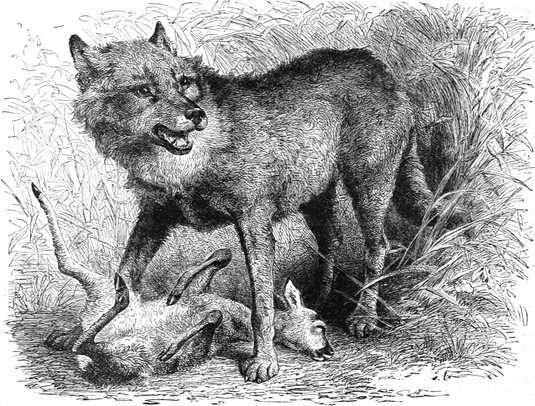
COMMON WOLF.
The destruction wrought by these animals in countries where they
abound is very great. “In 1823, in Livonia, a declaration made to the
authorities stated, as having been carried off by Wolves, 15,182 Sheep;
1,807 Oxen; 1,841 Horses; 3,270 Goats; 4,190 Pigs; 703 Dogs; and 1,873
Fowls and Geese.”
The Wolf, savage though he be, is quite tamable; he has often shown
great devotion to his master, and has, in fact, behaved in every
respect like an affectionate Dog, a very interesting fact, as bearing
upon the evolution of Dogs from wild Canidæ.
The most remarkable instance of this with which we have met is the
following, which shows the Wolf to be—what one would never suspect him
to be—capable of that almost superhuman affection, which is sometimes
exhibited by Dogs:—“A lady near Geneva had a tame Wolf, which seemed
to have as much attachment to its mistress as a Spaniel. She had
occasion to leave home for some weeks. The Wolf evinced the greatest
distress after her departure, and at first refused to take food. During
the whole time she was absent he remained much dejected. On her return,
as soon as the animal heard her footsteps, he bounded into the room
in an ecstasy of delight. Springing up, he placed one paw on each of
her shoulders, but the next moment he fell backward and instantly
expired.”[125]
There are several varieties of the Wolf besides the common European
kind, most of which have been considered by different authors as
distinct species, and some of which are even now so considered, though
the differences between them are so very slight and unimportant, that
it seems hardly advisable to look upon them as anything more than
geographical species—varieties produced by difference of climate and
other surroundings.
“The Black Wolf is a name given to a variety which is most frequent in
Southern Europe, and particularly in the Pyrenees, and to the south of
those mountains, where they are more common than the ordinary Wolf,
which the Black Wolf equals in stature, and, if anything, exceeds in
strength. Cuvier says it is found, but very rarely, in France.”
The Wolf found in Palestine, the subject of so many references in the
Old Testament, is, according to Canon Tristram, a very well-marked
variety. He says of it:—
“The Wolf is the dread of the shepherd from one end of the country to
the other, and a single Wolf is far more destructive than a whole pack
of Jackals. Again and again I have put up the Syrian Wolf and fired at
it without success. Near Beersheba, in the hill country, in the forests
of Bashan and Gilead, in the ravines of Galilee and Lebanon, and in the
maritime plains, it is alike distributed. I never saw two together, and
I never heard of them hunting in packs. It is much to be wished that
some traveller may be able to secure a specimen for examination, for it
may possibly prove to be a distinct variety. It is of a lighter fawn
colour than any European Wolf I ever saw, and appears decidedly larger.
I can confirm the statement of Dr. Russell, that the natives speak of
another larger and fiercer species called ‘Sheeb,’ but I could never
obtain any clear definition of the distinctions between the two.”
The Wolf of India, abundant in the open country, rare in the wooded
districts over the whole of the great peninsula, is considered, by
authorities such as Mr. Blyth and Dr. Jerdon, as a distinct species,
and is called Canis pallipes.
“The Wolves of the Southern Mahratta country,” says Mr. Elliot,
“generally hunt in packs, and I have seen them in full chase after
the Goat-Antelope (Gazella Bennettii). They likewise steal round a
herd of Antelopes, and conceal themselves on different sides, till an
opportunity offers of seizing one of them unawares, as they approach,
whilst grazing, to one or other of their hidden assailants. On one
occasion three Wolves were seen to chase a herd of Gazelles across
a ravine in which two others were lying in wait. They succeeded
in seizing a female Gazelle, which was taken from them. They have
frequently been seen to course and run down Hares and Foxes; and it is
a common belief of the Ryots that in the open plains, where there is no
cover or concealment, they scrape a hole in the earth, in which one of
the pack lies down, and remains hid, while the others drive the herd
of Antelopes over him. Their chief prey, however, is Sheep; and the
shepherds say that part of the pack attack and keep the Dogs in play,
while others carry off their prey, and that if pursued they follow the
same plan, part turning and checking the Dogs, whilst the rest drag
away the carcass till they evade pursuit. Instances are not uncommon of
their attacking man. In 1824, upwards of thirty children were devoured
by Wolves in one pergunnah alone. Sometimes a large Wolf is seen to
seek his prey singly. These are called Won-tola by the Canarese, and
reckoned particularly fierce.”
This Indian Wolf has dingy reddish-white fur, some of the hairs being
tipped with black; the lower parts are dingy white, the tail slightly
tipped with black.
Closely allied to the Indian Wolf is a variety from Tibet, “Canis
laniger, sometimes called the ‘White Wolf’ by sportsmen who cross the
Himalayas. It is the Chángú of Tibet, Chankodi, near the Niti Pass
from Kumaon; and it is a larger animal than the Indian Wolf, with white
face and limbs, and no dark tip to the tail, which is fully brushed.
The hair is extremely woolly,” this peculiarity being, of course
brought about by the cold climate to which the animal is exposed. Tibet
also boasts another variety, the Red or Golden Wolf, which is fulvous,
with greyish-brown head, and with the lower parts pure white. A third
variety, with black shaggy fur, and sometimes known as Canis niger,
exists in the same country.
The North American Wolf, which extends from Greenland in the north
to Mexico in the south, is often separately considered as Canis
occidentalis. It differs from the European kind chiefly in its fur
being finer, denser, and longer, and in the curious fact that its feet
are, as Sir John Richardson remarks, very broad, so as to enable it to
run easily on the snow. The development of these natural snow-shoes in
the American Wolf fitting it so beautifully for its particular mode of
life is highly interesting. This species is entirely absent from South
America, but its wide distribution in North America may be gathered
from Richardson’s account:—
“Wolves are found in greater or less abundance in different districts,
but they may be said to be very common throughout the northern regions;
their footmarks may be seen by the side of every stream, and a
traveller can rarely pass a night in these wilds without hearing them
howling around him. They are very numerous on the sandy plains which,
lying to the eastward of the Rocky Mountains, extend from the sources
of the Peace and Saskatchewan Rivers towards the Missouri. There bands
of them hang on the skirts of the Buffalo herds, and prey upon the
sick and straggling Calves. They do not, under ordinary circumstances,
venture to attack the full-grown animal; for the hunters informed me
that they often see Wolves walking through a herd of Bulls without
exciting the least alarm; and the marksmen, when they crawl towards a
Buffalo for the purpose of shooting it, occasionally wear a cap with
two ears, in imitation of the head of a Wolf, knowing from experience
that they will be suffered to approach nearer in that guise.”[126]
The American Wolf extends into Greenland, where the Eskimo take it
in traps of a very novel construction, “made of strong slabs of ice,
long and narrow, so that a Fox can with difficulty turn himself in it;
but a Wolf must actually remain in the position in which he is taken.
The door is a heavy portcullis of ice, sliding in two well-secured
grooves of the same substance, and is kept up by a line, which,
passing over the top of the trap, is carried through a hole at the
farthest extremity; to the end of the line is fastened a small hoop of
whalebone, and to this any kind of flesh bait is attached. From the
slab which terminates the trap a projection of ice, or a peg of wood
or bone, points inwards near the bottom, and under this the hoop is
lightly hooked; the slightest pull at the bait liberates it, the door
falls in an instant, and the Wolf is speared where he lies.”
There are no less than five varieties of the North American Wolf, to
all of which separate specific names have been given by authors. They
are: the Common Grey Wolf (Lupus griseus), the White Wolf (Lupus
albus), the Pied Wolf (Lupus sticte), the Dusky Wolf (Lupus
nubilus), and the Black Wolf (Lupus ater.) All these differ from
one another only in the lesser details of colouring and other minor
characters. In their habits they resemble one another entirely, and it
is therefore unnecessary to do more than mention them.
The Coyote, or Prairie Wolf[127] occurs, along with the common North
American Wolf, as far south as Mexico; its northern range being about
the 55th degree of latitude.
“The Prairie Wolf has much resemblance to the Common Grey Wolf in
colour; but differs from it so much in size, voice, and manners, that
it is fully entitled to rank as a distinct species. It inhabits the
plains of the Missouri and Saskatchewan, and also, though in smaller
numbers, those of Columbia. On the banks of the Saskatchewan, these
animals start from the earth in great numbers on hearing the report of
a gun, and gather around the hunter in expectation of getting the offal
of the animal he has slaughtered. They hunt in packs, and are much
more fleet than the Common Wolf. I was informed by a gentleman who has
resided forty years on the Saskatchewan, and is an experienced hunter,
that the only animal on the plains which he could not overtake, when
mounted on a good Horse, was the Prong-horned Antelope, and that the
Meesteh-chaggoneesh, or Prairie Wolf, was the next in speed.”
“The fur of the Prairie Wolf is of the same quality with that of the
Grey Wolf, and consists of long hairs, with a thick wool at their base.
The wool has a smoky or dull lead colour; the long hairs on the back
are either white for their whole length, or they are merely tipped with
black. The prevailing colour along the spine is dark blackish-grey,
sprinkled with white hairs. Its cheeks, upper lip, chin, throat, belly,
and insides of the thighs, are white. There is a light-brown tint upon
the upper surface of the nose, on the forehead, and between the ears,
on the shoulders, on the sides, where it is mixed with grey, and on
the outsides of the thighs and legs. The tail is grey and brown, with
a black tip. Some individuals have a broad black mark on the shins of
the fore-legs, like the European Wolf. The ears are short, erect, and
roundish, white anteriorly and brown behind. The tail is bushy, and is
clothed, like the body, with wool and long hair. Some specimens want
the brown tints, and have most of the grey colour.”[128] The length of
body and head together amounts to about three feet; that of the tail
about fourteen or fifteen inches.
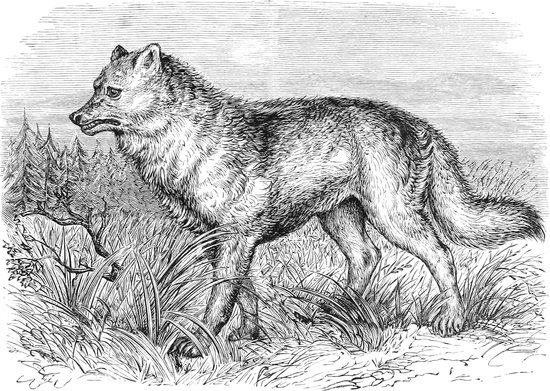
COYOTE, OR PRAIRIE WOLF.
The Red Wolf (Canis jubatus) of Brazil shows considerable resemblance
both to the Jackals and to the Foxes. It has long, slender legs, a
slender snout, long ears, and stiff, shaggy, reddish hair, raised into
a mane along the neck.
Next to the Wolf, the Jackal is the most important wild member of the
Dog tribe. It is a much smaller animal than the Wolf, not exceeding
thirty inches in length, and seventeen in height at the shoulder. It
is also distinguished from Wolves and true Dogs by its curious, long
pointed muzzle. Its fur is of a dusky-yellowish colour—whence its
name of “Loup doré,” or gilded Wolf, and its specific appellation
aureus—“the hairs being mottled black, grey, and brown, with the
under fur brownish-yellow, the lower parts yellowish-grey, tail
reddish-brown, ending in a darkish tuft.” There is a good deal of
variation from this colour, depending partly on the time of year,
partly on the locality.
The Jackal is a cowardly animal, blessed with a most evil smell and
with a voracious appetite. It lives largely upon carrion, a good deal
of which it gets as a sort of “perquisite” from the remains of the
Lion’s feast. It is sometimes called “the Lion’s provider,” a name
which “may have arisen from the notion that the yell of the pack gives
notice to the Lion that prey is on foot, or from the Jackals being seen
to feed on the remnants of the Lion’s quarry.” Dr. Jerdon says, “it is
a very useful scavenger, clearing away all garbage and carrion from the
neighbourhood of Cape Town, but occasionally committing depredations
among poultry and other domestic animals. Sickly Sheep and Goats
usually fall a prey to him; and a wounded Antelope is pretty certain to
be tracked and hunted to death by Jackals. They will, however, partake
freely of vegetable food.”
Like most other Dogs, the Jackal hunts in packs; and then, while on an
expedition for food, makes night hideous by its fearful cries. In this
it calls to mind the Hyæna, as well as in some other particulars, as,
for instance, in its love for carrion, and in the remarkably cool way
in which it will stare and laugh at travellers, as if holding them up
to general ridicule.
The habits of the Jackal are altogether canine. Their hunts are
conducted under the guidance of a leader, who is said to give the
signal for every attack by a peculiar cry, and so powerful are these
little animals in their union, that they are quite capable of pulling
down a Deer. Their chief food in Ceylon seems to be Hares, the numbers
of which they keep down to such an extent that those palatable Rodents
are quite scarce in regions infested by Jackals.
The Jackal resembles, in one respect, the Fox, more than either the
Wolf or Wild Dog. It has the reputation for excessive cunning, and
indeed takes the place of our old vulpine friend, in the legends of
the East. It is said that “when a Jackal has brought down his game
and killed it, his first impulse is to hide it in the nearest jungle,
whence he issues, with an air of easy indifference, to observe whether
anything more powerful than himself may be at hand from which he
might encounter the risk of being despoiled of his capture. If the
coast be clear, he returns to the concealed carcass, and carries it
away, followed by his companions. But if a man be in sight, or any
other animal to be avoided, my informant has seen the Jackal seize a
cocoa-nut husk in his mouth, or any similar substance, and fly at full
speed, as if eager to carry off his pretended prize, returning for the
real booty at some more convenient season.”
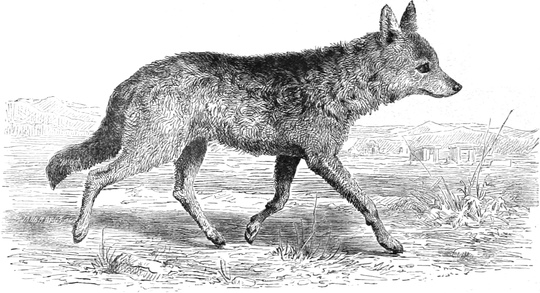
JACKAL.
Sir Emerson Tennent states that the Jackal, like the Domestic Dog, is
subject to rabies, and that cattle frequently die from bites inflicted
by them when in this condition.
“An excrescence is sometimes found on the head of the Jackal,
consisting of a small horny cone, about half an inch in length, and
concealed by a tuft of hair. This the natives call Narri comboo;
and they aver that this ‘Jackal’s horn’ only grows on the head of the
leader of the pack. Both the Singhalese and the Tamils regard it as a
talisman, and believe that its fortunate possessor can command, by its
instrumentality, the realisation of every wish, and that if stolen or
lost by him, it will invariably return of its own accord. Those who
have jewels to conceal rest in perfect security, if along with them
they can deposit a Narri comboo, fully convinced that its presence is
an effectual safeguard against robbers.
“One fabulous virtue ascribed to the Narri comboo by the Singhalese
is absurdly characteristic of their passion for litigation, as well as
of their perceptions of the ‘glorious uncertainty of the law.’ It is
the popular belief that the fortunate discoverer of a Jackal’s horn
becomes thereby invincible in every lawsuit, and must irresistibly
triumph over every opponent. A gentleman connected with the Supreme
Court of Colombo has repeated to me a circumstance, within his own
knowledge, of a plaintiff, who, after numerous defeats, eventually
succeeded against his opponent by the timely acquisition of this
invaluable charm. Before the final hearing of the cause, the mysterious
horn was duly exhibited to his friends; and the consequence was that
the adverse witnesses, appalled by the belief that no one could
possibly give judgment against a person so endowed, suddenly modified
their previous evidence, and secured an unforeseen victory for the
happy owner of the Narri comboo!”
Jackals have often been tamed; and, under the circumstances, behave
exactly like the Domestic Dog: they fawn upon their masters, wag their
tails, and throw themselves on their backs with all four paws in the
air, altogether like Dogs. The chief drawback to their domestication is
their abominable smell; but it is stated by Colonel Sykes that a tame
female Jackal in his possession was quite devoid of this odour, while a
recently-caught male, which was placed with her, smelt so horribly as
to be almost unapproachable.
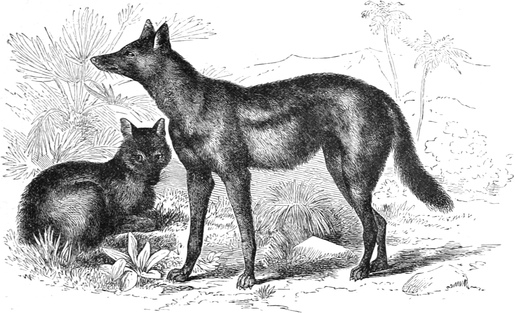
JACKAL OF SENEGAL.
The Common Jackal is found in Asia Minor, South-East Asia, including
Persia and India, as far south as Ceylon, and in the North of Africa.
The Black-backed Jackal (Canis mesomelas) is found in trans-Saharal
Africa, from Nubia to the Cape. It is rather larger than the common
kind, with longer ears and tail, a light red skin, with a black
back-stripe. It is a very thievish animal, and is accused by some of
the natives of eating off the tails of their Sheep.
The Jackal of Senegal (Canis anthus) is one of the best marked
varieties of the Jackal, and has a strong claim to the distinction of a
separate specific name. It is considerably larger than the common kind,
more elegantly built, and has very long legs, almost like those of a
Greyhound. It is of a bright tawny colour, with dark band on the back,
side, and chest. It is one of the commonest animals in Central Africa,
and “its habits are different to those of the Common Jackal. It is more
prudent and suspicious, and is completely nocturnal. During the day it
lies hidden in a safe retreat, and nothing but chance can reveal its
presence to the hunter.”
The Crab-eating Dog (Canis cancrivorus) is a Jackal approaching in
many respects, especially in its long and bushy tail, to the Foxes. It
is found in the savannahs of South America. The Aguara, or Azara’s Fox
(Canis Azaræ), another South American species, is almost half-way
between Jackals and Foxes, the latter of which it chiefly resembles in
its long tail and short snout.
The Foxes form a very distinct group of Canidæ, differing far more
from the Dog, Wolf, and Jackal than those animals do from one another.
The most characteristic and important difference between them lies in
the fact that in the Foxes the pupil of the eye contracts under the
influence of strong light to a vertical slit, dilating and becoming
circular again as the light diminishes. This is the case, as will be
remembered, in the Common Cat, and many other members of the same
family; it is, in fact, very usual in animals of nocturnal habits,
which, being used under ordinary circumstances to make shift with the
smallest quantity of light obtainable, are advantaged by being able to
exclude all superfluous rays when the illumination becomes stronger
than they can comfortably bear. Moreover, the muzzle of Foxes is much
sharper than that of Dogs, the head more rounded, the ears erect and
triangular, the limbs short, and the tail or “brush” long, thick, and
bushy. On account of these differences, many naturalists prefer to
separate the Foxes altogether from Dogs, Wolves, and Jackals, and make
them constitute a new genus—Vulpes—the Common Fox being called
Vulpes vulgaris.
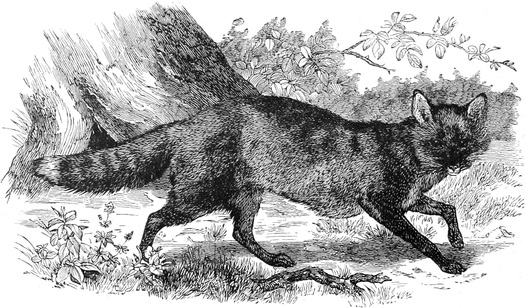
COMMON FOX.
The habits and appearance of the Fox are thoroughly well known,
especially in Great Britain, where the life of this, the greatest
marauder of the farmyard, is held in such high esteem, that in many
places vulpicide is a crime of almost equal magnitude with homicide,
and of far greater magnitude than uxoricide: at any rate, if the
latter operation be only fairly conducted, secundum artem, with
boots. In many counties, even now, the farmer who kills the pillager
of his poultry-yard, instead of leaving him to come by his death in
the hunting-field, is promptly “sent to Coventry,” and often obliged
to pack up, bag and baggage, and try his fortune in another locality.
The Fox, indeed, must be brought to justice for no crime he may commit,
however great; but when his time is up, he must be hunted to death
with an army of Dogs, each one twice his own size, and his dying
struggles witnessed by scores of horsemen and horsewomen, who are
considered to have done great things if they are “in at the death” of
the insignificant little thing, which ought to have been knocked on the
head long ago.
The cunning of the Fox is proverbial. When hunted, he “makes a thousand
shifts to get away,” and often succeeds in baffling the whole pack
of well-trained Hounds. His stealthy tread, as he winds along the
hill sides and valley slopes to seek his prey or to reach his lair,
is altogether characteristic of one thoroughly well up to his work.
Numberless tales are told of his sagacity, but we will content
ourselves with one which forms almost as good an example of animal
reason as any we have met with, even in the Dog:—
“A farmer in Bogside, Beith, of the name of Fleming, was looking out
of his window one summer’s morning, about three o’clock, when he saw
a Fox crossing a field before it, carrying a large Duck which he had
captured. On coming to a stone dyke, about four feet high, on the side
of the field, Reynard made an effort to leap over it with his prey, but
failed, and fell back into the field. After making three attempts, with
the same result, he sat down, and viewed the dyke for a few minutes;
after apparently satisfying himself, he caught the Duck by the head,
and standing up against the dyke with his fore-paws as high as he
could reach, he placed the bill of the Duck in a crevice in the wall;
then springing upon the top he reached down, and pulling up the Duck,
dropped it upon the other side, leaped down, and picking it up, went on
his way.”
The Common Fox is found, under more or less well-marked varieties, some
of which are often elevated to the rank of species, over the greater
part of Europe, Asia, and North Africa, and in many parts of America.
This is an extremely well-marked species of Fox, found in the southern
and central parts of Greenland, and extending high up Smith’s Sound. It
is sometimes seen during the Seal-hunting season hundreds of miles from
land, on the frozen sea, where it has wandered to feast on the dead
Seals.
It is usually stated that the colour of the skin of this animal varies
with the season—that in summer it is of a blue-grey colour, while in
winter it is perfectly white; these colours, of course, serving as
a protection to the animal: the blue harmonises well with the rocky
shore and the thick, dark ice, while the winter coat is perfectly
indistinguishable on the snow, with which the ground is then thickly
strewn. But according to a writer of high authority, Dr. Robert Brown,
this is all a mistake. The white and blue colours are distinctive of
separate varieties of the Arctic Fox, and not of the same animal at
different seasons; the colour in each case being wholly independent of
the time of year. The length, from snout to root of tail, is about two
feet, that of the tail itself about a foot.
An interesting account of the manners and customs of this pretty little
animal is given by Sir J. Richardson, who says:—
“The Arctic Fox is an extremely cleanly animal, being very careful not
to dirt those places in which he eats or sleeps. No unpleasant smell is
to be perceived, even in a male, which is a remarkable circumstance. To
come unawares on one of these creatures is, in my opinion, impossible;
for even when in an apparently sound sleep, they open their eyes at
the slightest noise which is made near them, although they pay no
attention to sounds when at a short distance. The general time of rest
is during the daylight, in which they appear listless and inactive;
but the night no sooner sets in than all their faculties are awakened:
they commence their gambols, and continue in unceasing and rapid motion
until the morning. While hunting for food, they are mute, but when
in captivity or irritated, they utter a short growl, like that of a
young puppy. It is a singular fact that their bark is so undulated
as to give an idea that the animal is at a distance, although at the
very moment he lies at your feet. Although the rage of a newly-caught
Fox is quite ungovernable, yet it very rarely happened that on two
being put together they quarrelled. A confinement of a few hours often
sufficed to quiet these creatures; and some instances occurred of their
being perfectly tame, although timid, from the first moment of their
captivity. On the other hand, there were some which, after months of
coaxing, never became more tractable. These, we supposed, were old ones.
“Their first impulse on receiving food is to hide it as soon
as possible, even though suffering from hunger, and having no
fellow-prisoners of whose honesty they are doubtful. In this case,
snow is of great assistance, as being easily piled over their stores,
and then forcibly pressed down by the nose. I frequently observed
my Dog-Fox, when no snow was attainable, gather his chain into his
mouth, and in that manner carefully coil it so as to hide the meat.
On moving away, satisfied with his operations, he of course had drawn
it after him again, and sometimes with great patience repeated his
labours five or six times, until in a passion he has been constrained
to eat his food without its having been rendered luscious by previous
concealment. Snow is the substitute for water to these creatures,
and on a large lump being given to them, they break it in pieces
with their feet, and roll on it with great delight. When the snow was
slightly scattered on the decks, they did not lick it up, as Dogs are
accustomed to do, but by repeatedly pressing with their nose collected
small lumps at its extremity, and then drew it into the mouth with the
assistance of the tongue.” In another passage, Captain Lyon, alluding
to the above-mentioned Dog-Fox, says, “He was small and not perfectly
white; but his tameness was so remarkable, that I could not afford to
kill him, but confined him on deck in a small hutch with a scope of
chain. The little animal astonished us very much by his extraordinary
sagacity: for, during the first day, finding himself much tormented
by being drawn out repeatedly by his chain, he at length, whenever he
retreated to his hut, took this carefully up in his mouth, and drew
it so completely after him that no one who valued his fingers would
endeavour to take hold of the end attached to the staple.”
The Eskimo take the Arctic Foxes in traps, which are described by
Captain Parry as being “extremely simple and ingenious. They consist
of a small circular arched hut, built of stones, having a square
aperture at the top, but quite close and secure in every other part.
This aperture is closed by some blades of whalebone, which, though in
reality only fixed to the stones at one end, appear to form a secure
footing, especially when the deception is assisted by a little snow
laid on them. The bait is so placed that the animal must come upon this
platform to get at it, when the latter, unable to bear the weight,
bends downwards, and after precipitating the Fox into the trap, which
is made too deep to allow of his escape, returns by its elasticity to
its former position, so that several may then be caught successively.”
They are also taken in the wolf-traps of ice; and all the rocky islands
lying off the mouth of the Coppermine River are studded with square
traps, built of stone, by the Eskimo, wherein the Fox is killed by a
flat stone falling upon him when he pulls at the bait.
The skins of both the white and the blue Fox are important articles of
commerce, but the blue variety, being much rarer than the white, is far
more valuable, the price for it being six or seven times as much as
that of the white.
This is a pretty little Fox-like animal, about ten inches long, not
including the tail, which measures about five inches and a quarter.
The fur is of a whitish hue, the cheeks large, and the snout sharp,
just like those of a true Fox; but the ears distinguish it at once:
they are quite erect, and nearly three inches and a half long, that is,
considerably longer than the whole head.
The Fennec is found in the whole of Africa, and has also been described
as occurring at Bushire, on the shores of the Persian Gulf. It was
first noticed by the African traveller, Bruce, who kept a specimen as
a pet. The favourite food of this animal “consisted of dates or any
sweet fruit; but he was also very fond of eggs. He would eat bread
when hungry, more especially if it was rendered palatable by honey or
sugar. The sight of a bird aroused him to eager watchfulness as long as
it was present; and a Cat was his aversion. He would endeavour to hide
from the latter, but never showed a disposition to resist or defend
himself. The animal was disposed to sleep by day, but as night came on
he became restless to excess. Bruce never heard it utter any sound.
He says that the animal is described in many Arabian books under the
name of El Fennec, by which appellation he states that it is known all
over Africa; and he conceives that the word is derived from the Greek
Phoinix, a palm or date-tree, adding that the animal builds his nest
on trees, and does not burrow in the earth.”
The fondness of the Fennec for vegetable food is curious, as most of
the wild Canidæ have so marked a preference for animal food. Bruce’s
statement quite bears out the main fact in the old fable of “The Fox
and the Grapes,” as well as that in the “Song of Songs”—“Take us the
Foxes, the little Foxes, that spoil the vines: for our vines have
tender grapes.”
On the shores of the Persian Gulf, the Fennec is sometimes hunted
with Dogs, and will often take to the sea to escape from its enemies.
Fennec-hunting is likely to be good sport, as the long-eared little
creature is extremely plucky and enduring. In Africa, according to Sir
John Kirk, “these animals hunt in packs. Although inferior in speed to
the Antelope, they will run him down, and at last wear him out; even
the Buffalo they are said sometimes to kill.”
This very extraordinary little animal is found only in South Africa. It
has somewhat the appearance of a Fennec, but the bushy tail is straight
and comparatively short, being not more than half the length of the
body and head, which together are about two feet long. The ears are of
great size, and the snout is very short and pointed. The skin is of a
greyish-yellow colour, white beneath, and the tail is darker than the
rest of the body. It differs from all other Canidæ in having no less
than six additional molar teeth, two on each side of the upper, one
on each side of the lower jaw.[134] Some of the teeth, too, show an
approximation in form to those of the Civets. For these reasons it is,
like the two following animals, placed in a separate genus from the
rest of the Canidæ.
This is another member of the family, the peculiarities of which are
so great as to necessitate its being placed in a separate genus. It
is very different from an ordinary Dog, and has the look of a Racoon,
which, as we shall see afterwards, is a member of one of the families
of Arctoidea, and far removed from the Dogs. The body is covered with
long brown fur; the ears are short and rounded. The back is curiously
arched, almost like that of a Marten or Weasel; the legs are short and
slender. The body attains a length of almost twenty-eight inches; the
prettily-feathered tail is about four inches in length. The teeth equal
in number those of ordinary Dogs.
This curious animal, sometimes called the “Cape Hunting Dog,” is
found over the greater part of trans-Saharal Africa, being especially
abundant in the neighbourhood of Cape Colony. Of all the Cynoids it is
the species which shows the greatest approximation to the Æluroid type.
It is, to all intents and purposes, a Dog, but yet in some few respects
shows a decided relationship with the Hyænas; for instance, the back
slopes slightly towards the hinder quarter, the muzzle is black, and of
that ugly snub-nosed character so characteristic of Hyænas, the ears
are long and straight, and the tail scanty. It differs also from the
true Dogs in having only four toes on all the feet, instead of five on
the fore feet and four on the hind feet. The skull and teeth are quite
Cynoid in character: the former presenting only one single slight and
unimportant point in which it tends to resemble that of a Hyæna.
The Lycaon is about the size of a Wolf. Its skin varies a good deal
in its markings. “White, black, and yellow ochre are its chief tints;
the white predominates in some, the black in others, and forms the
fundamental colours; the spots are very irregular, sometimes large,
sometimes small, very varyingly disposed on the surface of the
body; the white and ochreous spots are always mixed with black. The
colouration of the head is the most constant; the muzzle is black up to
the eyes; and black bands are prolonged between the eye and ear, along
the top of the head, to the neck. The tail is usually tolerably regular
in colouration: it is ochreous at the root, black in the middle, white
or ochreous at the tip; the eyes are brown.”
The Hyæna-Dogs are partly diurnal, partly nocturnal in their habits.
They like fresh meat, and are, at the same time, partial to carrion.
“These animals invariably hunt together in large organised packs,
varying in numbers from ten to sixty, and by their extraordinary
powers of endurance and mode of mutual assistance, they are enabled
to run into the swiftest and overcome the largest and most powerful
Antelope. Their pace is a long, never-tiring gallop, and in the chase
they relieve one another, the leading Hounds falling to the rear when
fatigued, when others who have been husbanding their strength come up
and relieve them. Having succeeded in bringing their quarry to bay,
they all surround him, and he is immediately dragged to the ground, and
in a few minutes torn to pieces and consumed.
“Their voices consist of three different kinds of cry, each being
used on special occasions. One of their cries is a sharp angry bark,
usually uttered when they suddenly behold an object which they cannot
make out. Another resembles a number of Monkeys chattering together, or
conversing when their teeth are chattering violently from cold. This
cry is emitted at night, when large numbers of them are together and
they are excited by any particular occurrence, such as being barked
at by Domestic Dogs. The third cry, and the one most commonly uttered
by them, is a sort of rallying note to bring the various members of
the pack together when they have been scattered in following several
individuals of a troop of Antelopes. It is a peculiarly soft and
melodious cry, yet, nevertheless, may be distinguished at a great
distance. It very much resembles the second note uttered by the Cuckoo,
which visits our island during the summer months; and when heard on
a calm morning echoing through the distant woodlands, it has a very
pleasing effect.”[137]
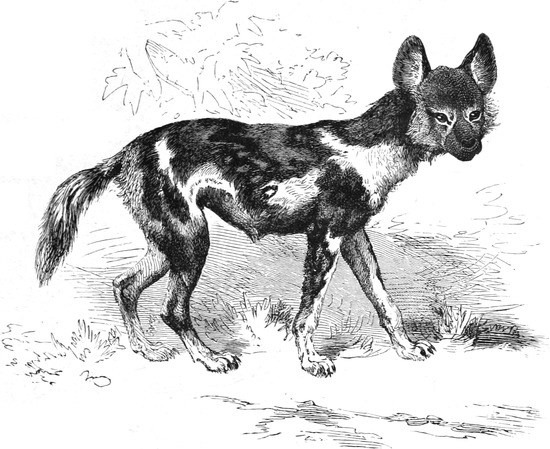
HYÆNA DOG.
WE now come to the last group of Carnivora—that of the Arctoidea—and
to a family which forms an extreme limit to the long series, of which
the Dogs constitute the centre, and the Cats the opposite end. The
latter, as we have already seen, culminate in one direction—that
is, they attain the perfection of structure for a predatory life and
flesh diet. The members of the Dog family, again, are flesh-eaters,
as a rule, but not exclusively. They are well adapted for hunting and
catching living prey, but by no means so perfectly as the Cats; they
are, indeed—from a carnivorous point of view—the inferiors of the
Feline group in teeth, in claws, and in muscular strength and agility.
The Bears, with which we have now to do, depart as widely from the Dogs
in one direction as the Cats in the other; and their distance from
the latter family is great indeed. The Cats attain the perfection of
quadrupedal form, while few animals are more clumsy and awkward-looking
than a Sloth Bear. Cats walk, with an elegant and silent tread, on the
very tips of their toes; Bears shuffle along with a waddling, though
often rapid gait, and with the whole sole of both fore and hind feet
applied to the ground, or, in other words, are wholly plantigrade. Cats
have a clean-cut, rounded face, with beautifully chiselled nostrils and
thin lips; Bears a long snout, almost like a Pig’s. The fur of Cats is
usually short and brilliantly coloured; that of Bears long, shaggy, and
sombre. Lastly, while the Cats are almost exclusively flesh-eaters,
many Bears are strict vegetarians, or at most eat such matters as Ants
and honey, and only have recourse to meat when their favourite food
cannot be had.
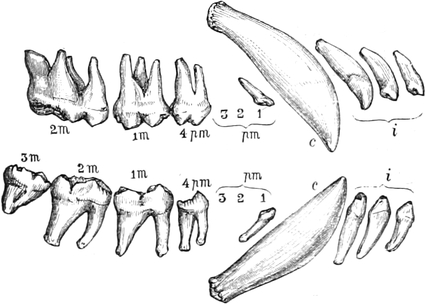
TEETH OF POLAR BEAR.
i, incisors; c, canines; pm,
premolars (the second and third of which are absent in both jaws);
m, molars.
In correspondence with the partly or entirely vegetable nature of
the Bear’s diet, we find a remarkable series of modifications in its
teeth. The front teeth, or incisors, are of considerable size, and have
three points or cusps. The great eye-teeth, or canines, although large
and formidable, are decidedly smaller in relation to the rest of the
teeth than in either the Dog or Cat group. Following these are three
very small teeth, which usually fall out at an early period, and are,
therefore, not to be found in most skulls; these, as well as the next
tooth, which is of considerable size, have their places occupied in the
young Bear by “milk-molars,” and are therefore called premolars. The
last premolar in the upper jaw is succeeded by two, that in the lower
jaw by three, true grinders or molars; so that the “dental formula” of
the Bear is the same as that of the Dog, namely, incisors,
3–3
3–3; canines,
1–1
1–1; premolars,
4–4
4–4; molars,
2–2
3–3.
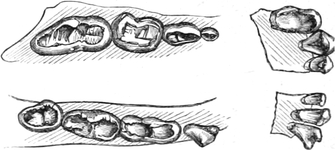
TEETH OF POLAR BEAR.
The incisors and grinding teeth only are shown, the
grinding surfaces of the latter being displayed.
But though the number agrees, the form is very different. The incisors
and canines, as we have said, exhibit no difference of importance,
but the last premolar and all the molars, instead of having the sharp
cutting character they have in the Cat, and to a less degree in the
Dog, have comparatively flat crowns, raised up into a number of little
elevations or tubercles; even the “carnassial” teeth (last premolar in
the upper jaw, and first molar in the lower) have entirely lost their
scissor-blade character, and become true grinders. As a corresponding
change, the hinge of the lower jaw is no longer so constructed as to be
incapable of any but an up and down motion; it can, on the contrary,
be worked from side to side, so that the Bear can actually chew his
food. The animal derives a double advantage from this: in the first
place, the food can be reduced to a pulp, a very necessary thing
for such food-materials as roots, which in an entire state would be
highly indigestible; and, in the second place, it is acted upon for a
considerable time by the saliva, and thus partially digested in the
mouth, for one of the chief properties of saliva is to convert the
insoluble, and therefore indigestible, starchy matter, of which a large
part of most vegetable substances consists, into soluble, and therefore
digestible, sugar.
It is a remarkable circumstance that the teeth have the same form in
all the Bears: though, as we shall see, while most of them are wholly
or largely herbivorous, some, such as the Polar Bear, are almost
entirely of flesh-eating habits, and one would naturally expect a
difference in the teeth. Curiously enough, however, no such difference
is apparent.
The Bears have five toes to each foot, all armed with long curved
claws. In the skull the floor of the drum cavity of the ear is hardly
at all dilated, so that there can scarcely be said to be a bulla
tympani at all; moreover, a bony passage of considerable length leads
from the drum to the exterior, instead of the aperture being flush with
the wall of the drum, as in the Cats. As we have seen, the Cats have a
small cæcum, or blind process, to the intestine, and the Dogs one of
considerable size. In the Bear this appendage is wholly absent.
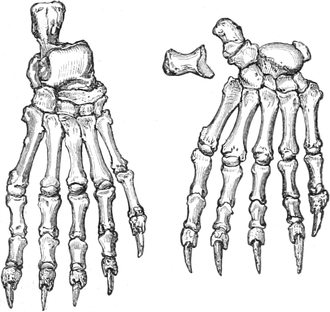
FEET OF BEAR.
Bears are found over a large part of the world, in Europe, Asia,
North and South America, and North Africa. They are, however, wholly
absent from what is termed trans-Saharal Africa, that is, the part
of the continent south of the great Sahara Desert; and are also
not to be found in any part of the Australian region, or, in other
words, in Australia, Tasmania, New Zealand, and the islands of the
Malayan Archipelago east of Wallace’s line. They thus have a far more
restricted distribution than either of the other two chief families of
Carnivora—the Felidæ and Canidæ.
The Brown Bear is the commonest member of the whole family, and has
been known from very early periods. It was, indeed, for a long time the
only species known to Linnæus, who recognised no other kind up to the
tenth edition of his great work, when he doubtfully admitted the Polar
Bear.
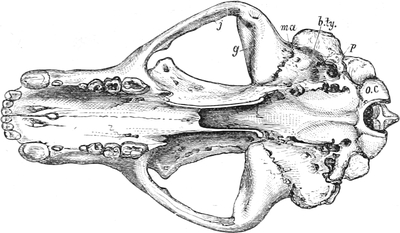
UNDER VIEW OF BEAR’S SKULL.
o.c, occipital condyle; p, paroccipital
process; b.ty, bulla tympani; ma, external auditory passage;
g, glenoid cavity; j, jugular arch.
The Brown Bear is found in many parts of Europe—Norway, Russia,
Central Europe, Spain, &c.—in Siberia, Kamtchatka, and Japan, and in
a part of the Arctic regions of North America. In former times it was
found in Britain, whence it was imported by the Romans, under the name
of the Caledonian Bear, for the sports of the amphitheatre. “Ray quotes
authority for the Brown Bear being one of the Welsh beasts of chase;
and Pennant adduces the places which retained the name of Pennarth, or
the Bear’s Head, as evidence that it existed in that principality. In
the ‘History of the Gordons’ it is stated that one of that family, so
late as the year 1057, was directed by the king to carry three Bears’
heads on his banner, as a reward for his valour in slaying a fierce
Bear in Scotland.” It is, however, quite possible that this valorous
Gordon may be a mythical personage, or that he may have lived at a much
earlier period than that to which his exploit is assigned.
The Brown Bear is an awkward-looking brute, with sprawling gait,
heavy body, and no tail to speak of. It is about six feet long,
and about three or three and a half feet high at the shoulder. Its
fur is longish, rather woolly, and of a dark brown hue. It lives a
solitary life, and, like many of its kin, has the curious habit of
hibernating. During the summer, when food is abundant, it lays in a
very large stock of provisions, thereby becoming immensely fat. This
operation being satisfactorily performed by the beginning of winter,
the Bear, finding that his foraging operations become more and more
arduous, seeks out a resting-place, such as a hollow tree or a cavern,
or if these are not to be had, makes a sort of rude hut or nest for
himself of branches and moss, and then goes into winter quarters,
and calmly settles down for a post-prandial slumber, which lasts
until spring. He then emerges from his hiding-place, very thin and
weak—altogether a mere ghost of his former self—and immediately sets
about repairing his losses by as many hearty meals as he can possibly
cram into the time at his disposal, or as the means at his command will
allow.
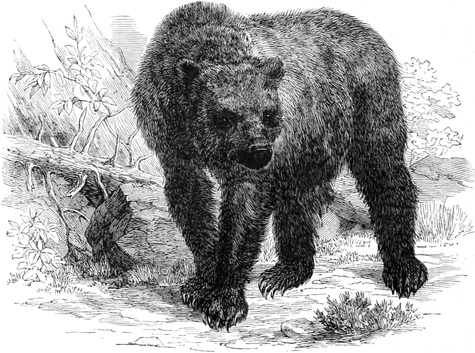
COMMON BROWN BEAR.
The Bear feeds chiefly on roots, berries, and other vegetables; it
has also a fondness for Ants, and a perfect passion for honey, in the
capture of which he is often severely stung about the nose—almost
his only vulnerable part—by the infuriated inhabitants of the comb.
He also preys upon small quadrupeds, and sometimes—especially when
fully adult—on larger ones. He is occasionally bold enough to attack
the Bull, but is, as often as not, worsted in the encounter. He rarely
attacks man, unless provoked, and then, when his blood is up, is a most
dangerous antagonist. His mode of attack is peculiarly his own. He
does not fell his victim with a blow of his paw like one of the larger
Cats, or seize it at once with his teeth like a Dog, but “gives it the
hug”—embraces it tightly, and with a great show of affection, with
its powerful fore limbs, and continues the squeeze until the wretched
animal is suffocated. The female Bear, especially when her family is
about, is a particularly ferocious creature. Her savageness is, indeed,
proverbial; she is devoted to her cubs, and any one threatening their
safety does so at his own peril.
The Bear is not only an affectionate mother, but is capable of a
very firm friendship, as the following anecdote, related by Mr.
Andersson,[140] shows. He tells us that, amongst a collection of
animals he possessed “were two Brown Bears—twins—somewhat more than
a year old, and playful as kittens when together. Indeed, no greater
punishment could be inflicted upon these beasts than to disunite them,
for however short a time. Still, there was a marked contrast in their
dispositions: one of them was good-tempered and gentle as a lamb,
while the other frequently exhibited signs of a sulky and treacherous
character. Tempted by an offer for the purchase of the former of these
animals, I consented, after much hesitation, to his being separated
from his brother.
“It was long before I forgave myself this act. On the following day, on
my proceeding, as usual, to inspect the collection, one of the keepers
ran up to me, in the greatest haste, exclaiming, ‘Sir, I am glad you
are come, for your Bear has gone mad!’ He then told me that during the
night the beast had destroyed his den, and was found in the morning
roaming wild about the garden. Luckily, the keeper managed to seize him
just as he was escaping into the country, and, with the help of several
others, succeeded in shutting him up again. The Bear, however, refused
his food, and raved in so fearful a manner that, unless he could be
quieted, it was clear he would do mischief.
“On my arrival at his den, I found the poor brute in a most furious
state, tearing the wooden floor with his claws, and gnawing the
barricaded front with his teeth. I had no sooner opened the door than
he sprang furiously at me, and struck me repeated blows with his
powerful paws. As, however, I had reared him from a cub, we had too
often measured our strength together for me to fear him now; and I
soon made him retreat into the corner of his prison, where he remained
howling in the most heartrending manner. It was a most sickening sight
to behold the poor creature, with his eyes bloodshot and protruding
from the sockets, his mouth and chest white with foam, and his body
crusted with dirt. I am not ashamed to confess that at one time I felt
my own eyes moistened. Neither blows nor kind words were of any effect:
they only served to irritate and infuriate him; and I saw clearly
that the only remedy would be either to shoot him or to restore him
to his brother’s companionship. I chose the latter alternative; and
the purchaser of the other Bear, my kind friend, Sir Henry Hunloke, on
being informed of the circumstance, consented to take this one also.”
A more curious case is related by Brehm, who tells us of a little
boy who crept one night for warmth and shelter into the cage of an
extremely savage Bear. The latter, instead of devouring the child, took
him under its protection, kept him warm with the heat of its body, and
allowed him to return every night to its cage. The poor boy soon died
of small-pox, and the Bear from henceforth refused all food, and soon
followed its little protégé to the grave.
In former times, the Bear was in great requisition in England for the
noble sport of Bear-baiting. Bear gardens existed in many parts of the
metropolis, in which the unlucky animals were baited to death with
Dogs, for the delectation of our most religious and gracious sovereign,
good Queen Bess, and “his sowship,” her successor. The office of
keeper of the Bear Ward was considered quite an honourable post, and
was usually held by one of “Her Majesty’s Servants,” the players—by
such men, for instance, as Betterton and Alleyn the founder of Dulwich
College. It has always been the custom, too, to train Bears to walk on
their hind legs and dance. This they do much more easily than a Dog or
a Cat, on account of their broad soles.
The Brown Bear, like most animals, differs more or less in minor
characters according to the country in which it is found. The Bear of
the Pyrenees and of Austria, for instance, is described as having,
in the young condition, yellowish-white fur and black feet. Sir J.
Richardson describes a well-marked variety as occurring in North
America; this, which is quite distinct from the Grizzly and Black
Bears, he calls the Barren-ground Bear.
This animal is distinguished from the common Brown Bear, not only by
its black fur, but by its slenderer snout, more convex forehead, and
smaller size: it rarely exceeds five feet in length. Its habits are
more strictly vegetarian than those of the brown kind. “Its favourite
food appears to be berries of various kinds, but when these are not to
be procured, it preys upon roots, insects, fish, eggs, and such birds
or quadrupeds as it can surprise. It does not eat animal food from
choice; for when it has abundance of its favourite vegetable diet, it
will pass the carcass of a Deer without touching it.”
It usually hibernates—at any rate, when able to obtain a sufficiently
plentiful meal, or rather series of meals, before the commencement of
winter. Sometimes, however, when food is scarce, Bears will roam about
the whole winter, never being able to obtain a sufficiently good feed
to warrant their going, with any safety or comfort, into permanent
winter quarters. With regard to the hibernating Bears a very remarkable
fact is mentioned by Sir J. Richardson, who is a most cautious and
accurate writer, namely, that when the Bear “comes abroad in the spring
it is equally fat” (as it was at the commencement of winter), “though
in a few days thereafter it becomes very lean.”
The Indians have an unbounded reverence for the Bear. When they kill
one, they make exculpatory speeches to it, give it tobacco to smoke,
call it their relation, grandmother, &c., and try in every possible way
to appease its manes. They then cook and eat it with great gusto.
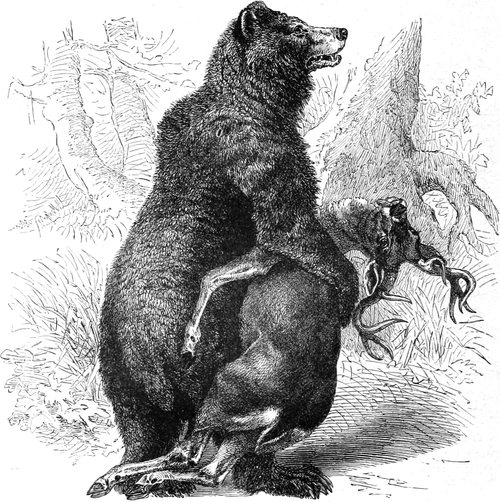
GRIZZLY BEAR.
This animal, which inhabits the region of the Rocky Mountains as far
south as Mexico, is the most savage member of the whole family, and
is more dreaded by Indian and Canadian trappers than any other. It is
stated to attain a length of nine feet and a weight of eight hundred
pounds, so that it greatly exceeds the Brown and Black Bears in size,
and approaches in these respects to the Polar Bear. Its strength is
enormous. “It has been known to drag to a considerable distance the
carcass of a Buffalo, weighing about one thousand pounds.”
The fur is of a dark-brown colour, with a good deal of grey on the
head, and is of an inferior quality to that of the brown and black
kinds. It is also distinguished from the latter by shorter and
more conical ears, by very long, arched, white claws, and by the
ridiculously small size of its tail, which is completely hidden by the
surrounding fur. “It is a standing joke among the Indian hunters, when
they have killed a Grizzly Bear, to desire any one unacquainted with
the animal to take hold of its tail.”
The Grizzly is much more carnivorous in its habits than other Bears,
and its ferocity is so great that it will often attack man unprovoked.
“The young Grizzly Bears and gravid females hibernate, but the older
males often come abroad in the winter in quest of food.”
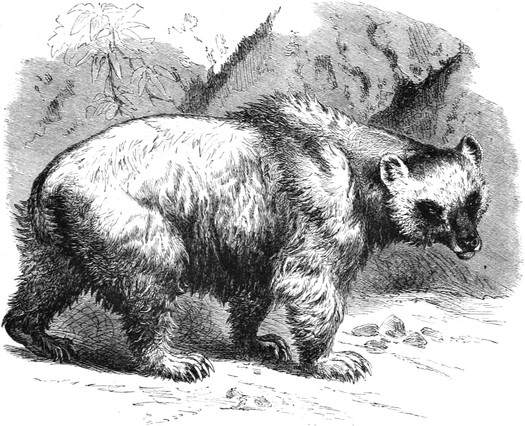
ISABELLINE, OR INDIAN WHITE BEAR.
This animal, a fine specimen of which is in the Zoological Gardens,
is the Bear of which we have the oldest historical record. It was an
animal of this species that was slain by David during his shepherd’s
career; and two females of the same kind are stated to have attacked
the mockers of Elisha, and to have killed forty-two of them.
The Syrian Bear is found in the mountains of Palestine, and especially
in Lebanon; a variety, known as the Indian White Bear,[144] occurs in
the Himalayas. It is of a yellowish-brown colour, but this hue varies
somewhat according to sex and the season of the year. The claws are
smaller than in any of the foregoing species, and, as in the Brown
Bear, the diet is usually of a vegetable nature, recourse being had to
animal food only in times of necessity.
Under the name of “Sun Bear” are often included two very different
species, the Himalayan Bear, Indian Black Bear, or Tibetan Sun Bear
(Ursus tibetanus), and the Malayan Bear or Bruang (U. malayanus).
The latter differs in certain comparatively unimportant respects from
all the forms we have yet described, and is, therefore, sometimes
separated as a distinct genus (Helarctos).
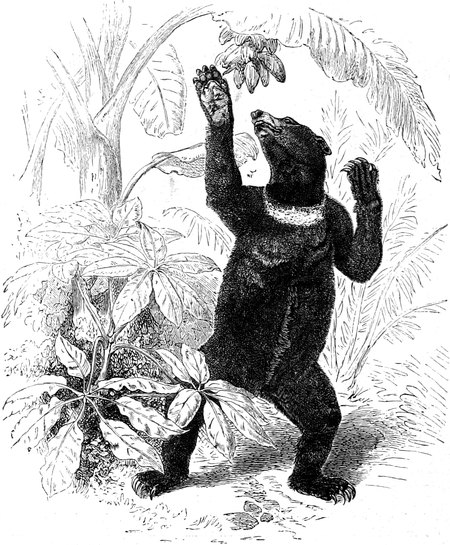
MALAYAN SUN BEAR.
The Himalayan Bear is found in Nepaul, Assam, Eastern Siberia, and
China. It is about the size of the American Bear, and, like it, has
close black fur, and a body and head more slender than those of the
Brown or Syrian Bear. It is further distinguished by its white chin, by
a broad white Y-shaped mark on the chest, and by a collar of longish
hairs on the shoulders.
The Malayan Bear, called Bruang by the Malays, is found in the Malayan
Peninsula, and in the adjacent islands of Borneo, Sumatra, and Java.
It is much smaller than the Himalayan Bear, not exceeding four feet and
a half in length. The fur is black, becoming brownish on the nose, and
the chest is marked with a crescentic white mark, or, in the Bornean
variety of the species, by a heart-shaped, orange-coloured patch. The
claws are remarkably long.
The habits of the two species differ but little. In summer, according
to Dr. Jerdon, the Sun Bear “is generally found at a considerable
elevation, nine to twelve thousand feet or so, and often close to
snow; but in winter it descends to five thousand feet, and even lower
sometimes. It lives chiefly on fruits and roots, apricots, walnuts,
apples, currants, &c.; also on several grains, barley, Indian corn,
buckwheat, &c.; and in winter chiefly feeds on various acorns, climbing
the oak trees and breaking down the branches.... They are very fond
of honey. Now and then they will kill Sheep, Goats, &c., and are
occasionally said to eat flesh.... This Bear has bad eyesight, but
great power of smell, and if approached from windward is sure to take
alarm. A wounded Bear will sometimes show fight, but in general it
tries to escape. It is said sometimes to roll itself into the form of a
ball, and then roll down steep hills, if frightened or wounded. If met
suddenly, when there is no means of escape, it will attack man at once;
and curious to say, it always makes for the face, sometimes taking off
most of the hairy scalp, and frightfully disfiguring the unfortunate
sufferer. There are few villages in the interior where one or more
individuals thus mutilated are not to be met with.”[146]
The Sun Bears are distinguished in menageries for their gift of walking
about on their hind legs, which they do in a curiously human manner.
This mode of progression seems sometimes to be adopted in the wild
state. Both species are noticeable, in their state of captivity in the
Zoological Gardens, for the antics they perform. The Himalayan Bears
play with one another like two awkward boys, stand on their hind legs
to wrestle, then fall down, and roll over and over, biting and hugging
in the most laughable manner. The Malayan Bear is even more amusing.
When the keeper gives it one of the hard biscuits on which it is fed,
it will sometimes lie down on its back, and hold the biscuit now with
its fore paws, now with both fore and hind paws, swaying about all the
time, and expressing its satisfaction by the most comical noises.
Mr. Swinhoe quotes some curious notions entertained by the Chinese
respecting the Sun Bear. They are contained in the native publication
already referred to, The Hainan Gazetteer. “Heirng [or Bear] is
fond of climbing trees and panting. Its gall in spring is in its heel,
in summer in its belly, in autumn in its left paw, in winter in its
right paw. About its heart there is a white fat, like jade, the taste
of which is extremely fine: this is usually called ‘Bear’s white.’ In
winter the Bear lies torpid, and does not eat. When hungry, it licks
its own paws, and thence the goodness in the paws.”
This curious and ungainly-looking beast is another of the Indian Bears,
being found “throughout India and Ceylon, from Cape Comorin to the
Ganges.” It is distinguished by its extremely awkward shape, its long
shaggy hair, its prolonged and very flexible snout and lower lip, all
of which peculiarities combine to give it a remarkable and anything
but prepossessing appearance. The fur is mostly black, the muzzle and
the tips of the feet being of a dirty white or yellowish colour, and
the breast ornamented with a V-shaped or crescentic mark. It attains a
length of between five and six feet.
The Sloth Bear feeds on Ants, honey, fruit, &c. “The power of suction
in the Bear, as well as of propelling wind from its mouth, is very
great. It is by this means enabled to procure its common food of white
Ants and larvæ with ease. On arriving at an Ant-hill, the Bear scrapes
away with the fore feet until he reaches the large combs at the bottom
of the galleries. He then, with violent puffs, dissipates the dust and
crumbled particles of the nest, and sucks out the inhabitants of the
comb by such forcible inhalations as to be heard at two hundred yards’
distance or more. Large larvæ are in this way sucked out from great
depths under the soil. When Bears abound their vicinity may be readily
known by numbers of these uprooted Ants’ nests and excavations, in
which the marks of their claws are plainly visible. They occasionally
rob birds’ nests, and devour the eggs.”[148]
The capture of Ants is, however, by no means always devoid of
inconvenient consequences for the ursine ravisher. The insects are as
brave and ferocious as they are industrious, and their strong sharp
mandibles are capable of making a considerable impression upon the
snout, lips, and eyelids of their huge enemy.
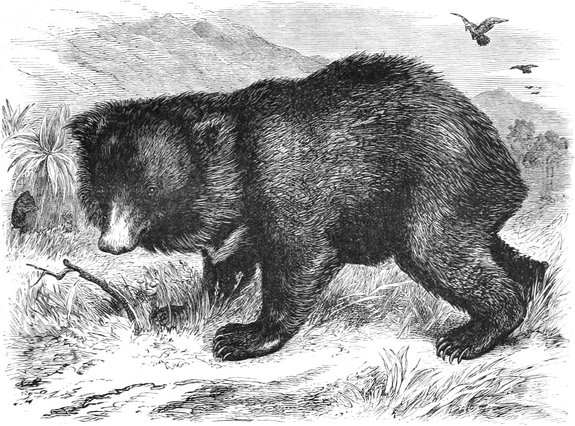
SLOTH BEAR.
Like the Sun Bear, the Sloth Bear rarely attacks man unless provoked,
but, like it, is, when attacked, a most dangerous antagonist, always
making for the face, and especially the eyes. Both in Ceylon and in
India the natives have a very wholesome dread of the animal, and,
indeed, fear his onslaught more than that of any other beast. “Among
the Singhalese there is a belief that certain charms are efficacious in
protecting them from the violence of Bears, and those whose avocations
expose them to encounters of this kind are accustomed to carry a
talisman, either attached to their neck or enveloped in the folds
of their luxuriant hair. A friend of mine, writing of an adventure
which occurred at Anarajapoora, thus describes an occasion on which
a Moorman, who attended him, was somewhat rudely disabused of his
belief in the efficacy of charms upon Bears:—‘Desiring to change the
position of a herd of Deer, the Moorman (with his charm) was sent
across some swampy land to disturb them. As he was proceeding, we saw
him suddenly turn from an old tree and run back with all speed, his
hair becoming unfastened, and, like his clothes, streaming in the wind.
It soon became evident that he was flying from a terrific object,
for he had thrown down his gun, and, in his panic, he was taking
the shortest line towards us, which lay across a swamp covered with
sedge and rushes, that greatly impeded his progress, and prevented us
approaching him or seeing what was the cause of his flight. Missing
his steps from one hard spot to another, he repeatedly fell into the
water, but he rose and resumed his flight. I advanced as far as the
sods would bear my weight, but to go further was impracticable. Just
within ball range there was an open space, and as the man gained it,
I saw that he was pursued by a Bear and two cubs. As the person of
the fugitive covered the Bear, it was impossible to fire without
risk. At last he fell exhausted, and the Bear being close upon him, I
discharged both barrels. The first broke the Bear’s shoulder; but this
only made her more savage, and rising on her hind legs, she advanced
with ferocious growls, when the second barrel—though I do not think it
took effect—served to frighten her, for turning round she retreated,
followed by her cubs. Some natives then waded through the mud to the
Moorman, who was just exhausted, and would have been drowned but that
he fell with his head upon a tuft of grass. The poor man was unable
to speak, and for several weeks his intellect seemed confused. The
adventure sufficed to satisfy him that he could not again depend upon
a charm to protect him from Bears, though he always insisted that but
for its having fallen from his hair, where he had fastened it under his
turban, the Bear would not have ventured to attack him.’”[149]
One of the most comical and grotesque of all the Bear family is
the Spectacled Bear, which derives its chief attraction from the
light-coloured rings round its eyes; these—the greater part of the
face being, like the body, black—have exactly the appearance of a pair
of common “goggles,” through which the beast seems to look with an air
of mingled wisdom and imbecility. Hence, of course, we get the animal’s
English popular name.
The Spectacled Bear occurs only in South America, where it is found in
the mountainous regions of Chili. It attains a length of about three
feet and a half.
The great White Bear of the Arctic regions—the “Nennok” of the
Eskimo—is the largest as well as one of the best known of the whole
family. It is a gigantic animal, often attaining a length of nearly
nine feet, and is proportionally strong and fierce. It is found over
the whole of Greenland; but its numbers seem to be on the decrease.
It is distinguished from other Bears by its narrow head, its flat
forehead in a line with the prolonged muzzle, its short ears, and long
neck. “It is of a light creamy colour, rarely pure white, except when
young: hence the Scottish whalers call it the ‘brounie,’ or ‘brownie,’
and sometimes ‘the farmer,’ from its very agricultural appearance as
it stalks leisurely over the furrowed fields of ice. Its principal
food consists of Seals, which it persecutes most indefatigably; but it
is somewhat omnivorous in its diet, and will often clear an islet of
Eider-duck eggs in the course of a few hours. I have seen it watch a
Seal for half a day, the Seal continually escaping, just as the Bear
was about putting its foot on it, at the atluk (or escape hole) in
the ice. Finally, it tried to circumvent its prey in another manner.
It swam off to a distance, and when the Seal was again half asleep at
its atluk, the Bear swam under the ice, with a view to cut off its
retreat. It failed, however, and the Seal finally escaped. The rage of
the animal was boundless; it roared hideously, tossing the snow in the
air, and trotted off in a most indignant state of mind.”[152]
Being so fond of Seal-flesh, the Polar Bear often proves a great
nuisance to Seal-hunters, whose occupation he naturally regards as
a thoughtful catering for his wants. He is also glad of the Whale
carcases often found floating in the Arctic seas; and travellers have
seen as many as twenty Bears busily discussing the huge body of a dead
Whalebone Whale.
As the Polar Bear is able to obtain food all through the Arctic winter,
there is not the same necessity, as in the case of the vegetable-eating
Bears, for hibernating. In fact, the males and young females roam about
through the whole winter, and only the pregnant females retire for
the season. These—according to the Eskimo account, quoted by Captain
Lyon—are very fat at the commencement of winter, and on the first
fall of snow they lie down and allow themselves to be covered, or else
dig a cave in a drift, and then go to sleep until the spring, when the
cubs are born. By this time the animal’s heat has melted the snow for
a considerable distance, so that there is plenty of room for the young
ones, who tumble about at their ease, and get fat at the expense of
their parent, who, after her long abstinence, becomes gradually very
thin and weak. The whole family leave their abode of snow when the sun
is strong enough to partially melt its roof. The Eskimo have the same
theory about the hibernating Polar Bears that the Northern Indians
hold with regard to the Brown Bear, namely, that it has no evacuations
during the winter, “stopping up all the natural passages with moss,
grass, or earth.”
The Polar Bear is regularly hunted with Dogs by the Eskimo. The
following extract gives an account of their mode of procedure:—“Let
us suppose a Bear scented out at the base of an iceberg. The Eskimo
examines the track with sagacious care, to determine its age and
direction, and the speed with which the animal was moving when he
passed along. The Dogs are set upon the trail, and the hunter courses
over the ice at their side in silence. As he turns the angle of the
berg his game is in view before him, stalking, probably, along with
quiet march, sometimes snuffing the air suspiciously, but making,
nevertheless, for a nest of broken hummocks. The Dogs spring forward,
opening a wild, wolfish yell, the driver shrieking ‘Nannook! nannook!’
and all straining every nerve in pursuit.”
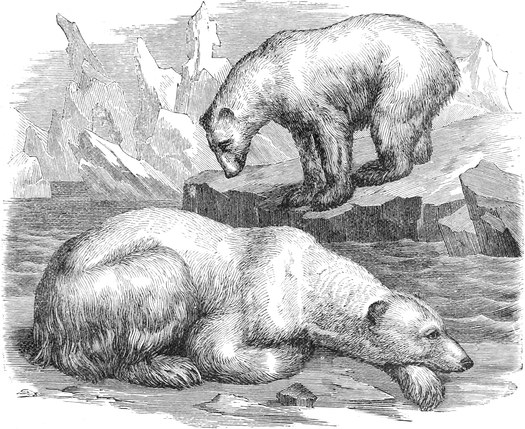
POLAR BEARS.
“The Bear rises on his haunches, inspects his pursuers, and starts off
at full speed. The hunter, as he runs, leaning over his sledge, seizes
the traces of a couple of his Dogs, and liberates them from their
burthen. It is the work of a minute, for the motion is not checked, and
the remaining Dogs rush on with apparent ease.
“Now, pressed more severely, the Bear makes for an iceberg, and stands
at bay, while his two foremost pursuers halt at a short distance and
await the arrival of the hunter. At this moment the whole pack are
liberated; the hunter grasps his lance, and, tumbling through the snow
and ice, prepares for the encounter.
“If there be two hunters, the Bear is killed easily; for one makes a
feint of thrusting the spear at the right side, and, as the animal
turns with his arms towards the threatened attack, the left is
unprotected and receives the death-wound.
“But if there be only one hunter, he does not hesitate. Grasping the
lance firmly in his hands, he provokes the animal to pursue him by
moving rapidly across its path, and then running as if to escape. But
hardly is its long unwieldy body extended for the solicited chase,
before, with a rapid jump, the hunter doubles on his track and runs
back toward his first position. The Bear is in the act of turning
after him again, when the lance is plunged into the left side, below
the shoulder. So dexterously has this thrust to be made, that an
unpractised hunter has often to leave his spear in the side of his prey
and run for his life. But even then, if well aided by the Dogs, a cool
skilful man seldom fails to kill his adversary.”[153]
With regard to the value of the skins, Dr. R. Brown informs us that
“The Royal Board of Trade in Greenland give the natives about five
rigsdaler (11s. 3d.) for a skin. Occasionally, there are a number
killed near Cape Farewell, which have come round on the Spitzbergen
ice-stream. Here a curious custom prevails, viz., that whoever sights
the Bear first—man, woman, or child—is entitled to the skin, and the
person who has shot it only to the blubber and flesh.”
There are some dreadful tales prevalent as to the ferocity of the Polar
Bear; but these, according to the same excellent observer, approach
a good deal the nature of “yarns.” After having lived for some time
in the Arctic regions, and hunted Bears again and again, he considers
that “a great deal of the impressions which we have imbibed regarding
its ferocity are more due to old notions of what it ought to be
rather than what it is, and that the tales related by Barentz, Edward
Pelham, and other old navigators, regarding its bloodthirstiness during
the time they wintered in Spitzbergen, were a good deal exaggerated.
When enraged, or emboldened by hunger, I can, however, quite well
understand that, like all wild and even domesticated animals, it
may be dangerous to man. On the East Coast of Greenland, where they
know little of man, they are very bold. The members of the German
Expedition, when making out-door observations, had to be continually
on their guard against them. I have chased it over the floes of Pond’s
Bay, and the Bear’s only thought seemed to be how best to escape from
its pursuers. I should have hesitated a good deal before making so
free with the Grizzly Bear of the Californian wilds (Ursus ferox),
which is, perhaps, the most ferocious animal on the American continent.
Though seemingly so unwieldy, the nennok runs with great speed, and
being almost marine in its habits, it swims well. I have chased it
with a picked crew of eight whalemen, and yet the Bear has managed
to distance us in the race for the ice-fields. It would every now
and again, when its two cubs were getting left in the rear, stop and
(literally) push them up behind; and on reaching the steep edge of the
ice-floe, finding that we were fast reaching them, it lifted each of
them upon the ice with its teeth, seizing the loose skin at the back of
the neck. Once on the ice, they were safe.
“Unlike its congeners, it does not hug, but bites; and it will not
eat its prey until it is dead, playing with it like a Cat with a Mouse.
I have known several men who, while sitting watching or skinning Seals,
have had its rough hand laid on their shoulder. Their only chance then
has been to feign being dead, and manage to shoot it while the Bear
was sitting at a distance watching its intended victim. Though Eskimo
are often seen who have been scarred by it, yet I repeat that, unless
attacked or rendered fierce by hunger, it rarely attacks man. During
our last trip to Greenland, none of our party saw one; indeed, they are
only killed in the vicinity of Disco Bay, during the winter or spring,
when they have either come or drifted south on the ice-floes. Six were
killed in the vicinity of Omenak during the winter of 1866–67.”
The flesh of the Polar Bear is sometimes eaten by the Eskimo, but parts
of it are said to be poisonous; this is especially the case with the
liver. Scoresby relates that sailors who have incautiously partaken of
the latter have been made very ill, and have died from its effects; and
Kane, who wished to try for himself the truth of the statement, was
upset by the first taste. The fat of this Bear is used for burning; it
has not the disagreeable smell of train-oil.
THIS is a small family of curious Bear-like animals, of small size,
and differing a good deal in external appearance, although agreeing
closely in all essential particulars. They are plantigrade, like the
Bears, and like them are quite devoid of a blind-gut, or cæcum. The
skull is long-snouted, and, though presenting certain resemblances to
that of the Civets, has still the essential Arctoid characters, such
as the well-marked bony ear-passage, and the wide space between the
ear-drum bone and the bony projection on the hinder part of the skull
(paroccipital process). A great difference from the Bear’s skull,
is, however, seen in the swollen and bulb-like ear-drum bone (bulla
tympani), which is as large as that of a Dog.
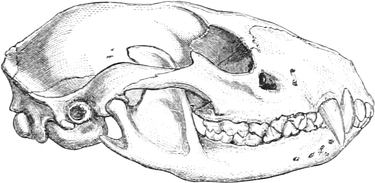
SKULL OF RACOON.
The grinding-teeth have on their biting surfaces large and prominent
tubercles, so that they are neither altogether of a crushing, nor
altogether of a mincing character. The molars bear a considerable
resemblance to the hinder molars of the Dog; the canines are compressed
from side to side, have very sharp front and back edges, and are
somewhat outstanding. The number of the teeth is forty,[155] that is,
two less than in the Bears, the missing teeth being the last upper
molar of each side.
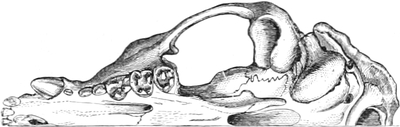
HALF OF SKULL OF RACOON, UNDER VIEW.
The four genera of the Racoon family are found only in the New World;
their northern limit is British Columbia, while southwards they reach
to Paraguay in the central part of South America.
Every visitor to the Zoological Gardens must have been struck with the
curious habits of this animal. If any one gives it a bit of bun or
biscuit, the Racoon holds out both its hands for the morsel, and takes
it almost as deftly as a Monkey; it then waddles off to the little
pond in the middle of its cage, dips its prize in the water, and when
it is well soaked, proceeds to devour it. Except in the case of meat,
which the Racoon seems to consider moist enough, the food always has
to undergo this soaking process before it is thought to be fit to eat.
It is from this habit that the Racoon derives its specific name of
lotor, “the washer,” and its German appellation of Waschbär, or
“washing Bear.”
The Racoon is a decidedly handsome animal, about the size of a large
and very corpulent Cat. The hair is of a brown or grizzled colour, long
and furry, the tail bushy and beautifully ringed. Its body is large
and somewhat unwieldy, its legs short, and its feet armed with strong
claws, suitable for burrowing or climbing. The head is large, the
cheeks prominent and black, and the snout sharp, light-coloured, and
somewhat up-turned—“tip-tilted, like the petal of a flower”—giving
the animal a curious inquisitive look, which is quite borne out by
its character. It investigates every object within reach, animate or
inanimate; the latter, if portable, it is fond of carrying off and
carefully washing.
In the matter of diet it is omnivorous, and seems almost equally fond
of meat, insects, fruit, or bread. It is said also to catch and eat
oysters and crabs, and to confine itself, in the case of the birds it
catches, to the brain and blood. It is a decidedly cunning animal,
and in captivity, when allowed a certain amount of liberty, shows
great talent in stealing fruit and killing fowls. When eating, it very
usually sits up on its haunches and holds the food with both fore-paws.
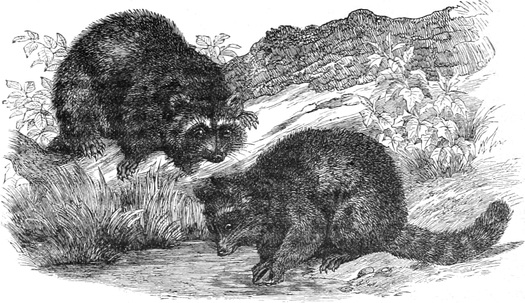
RACOON.
The skin of the Racoon forms a valuable fur, and the animal is,
consequently, much sought after throughout the whole of its range,
which extends over a considerable portion of North America. It is
usually caught in traps, but is also hunted by Dogs. The hunt takes
place at night, by the light of torches. The Racoon is pursued until he
takes refuge up a tree, when the Dogs form a circle round the trunk,
and an experienced climber swarms up to the animal’s refuge, pursues
him to the end of a branch, and then, by shaking the branch, makes him
fall to the ground, when the Dogs have another turn. So active is the
Racoon, and so dangerous when roused, that this operation often has to
be repeated two or three times before he is finally caught.
The Crab-eating Racoon (Procyon cancrivorus) is a South American
species, differing from the foregoing chiefly in the shortness of its
fur, and its consequently slender shape. It is a far less handsome
animal than its North American relative, which it resembles very
closely both in structure and in habits.
The Coati is an animal of far less attractive appearance than the
Racoon. The body is proportionally longer, the limbs are short, and the
snout of a remarkable length and very pig-like: in fact, the head of a
Coati reminds one strongly of that of a small dark-coloured Pig pulled
out until the muzzle was two or three times its ordinary length. The
snout is, moreover, very flexible, and the animal perpetually turns it
about in various directions in a highly inquisitive way. The body is
somewhat over half a yard in length, the tail a little shorter.
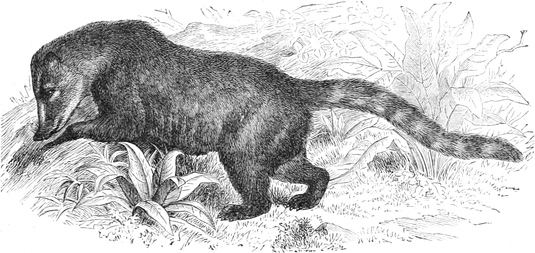
COATI.
The fur is short and of a reddish or greyish-brown colour, the muzzle
and feet are black, the tail ringed with black and brownish-yellow.
Like the Racoon, it feeds upon fruit, insects, small birds, &c., and,
like it, is a good climber. The specimens in the Zoological Gardens
are in a constant state of activity, trotting about from one end of
the cage to another, climbing over the tree trunk placed in their
prison, and turning their queer-looking snouts about ceaselessly. The
geographical range of the Coati extends from Mexico in the north to
Paraguay in the south.
Looking merely at the exterior of this animal, one would almost feel
inclined to place it, as some of the earlier naturalists did, among
the Lemurs: for, like them, it has a prehensile tail, one which can
be coiled around branches to help its progress, precisely like that
of a New World Monkey. It will be remembered that one member of the
Civet family, the Binturong (p. 95), presents a similar peculiarity.
But the Binturong’s tail is a comparatively imperfect organ, merely
prehensile at the tip, while that of the Kinkajou can be readily coiled
two or three times round a branch. We thus see that the same remarkable
adaptation to arboreal life which is found in the whole group of New
World Monkeys appears in one species from each of two distinct families
of Carnivores, one of which is confined to the Old World, while the
other exists only in the New World. And we shall see the same character
crop up once more, when we come to the group of pouched animals
(Marsupials), in the American Opossums. It must, of course, be clearly
understood that the possession of a prehensile tail is no sign whatever
of any relationship between the animals possessing it. It may be taken
as certain that it was produced quite separately in all the four cases
we have mentioned in relation to the habits of the animal.
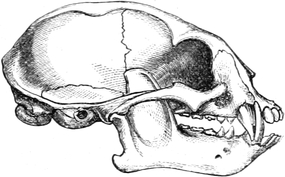
SKULL OF KINKAJOU.
The Kinkajou uses its paws in a wonderfully hand-like manner, and
employs both fore and hind feet to bring food to its mouth. It will
also hold a piece of bread in one hand, and break off pieces from it
with the other, and this in spite of the fact that it has no opposable
thumb, and that its fingers are short and webbed nearly to the claws.
For the rest, it is a pretty, innocent-looking little animal, with a
body about a foot long, and a tail of some eighteen inches, covered
with soft brown fur, and walking on the soles of its fore feet, while
in the hind feet the heel is well raised from the ground. The skull is
remarkable for its rounded form, and for the shortness of its facial
portion: on a superficial examination it looks almost Cat-like. It
feeds upon fruit, eggs, insects, birds, &c. It is found in Mexico,
Guatemala, and in the great forests of Peru and North Brazil.
The Cacomixle, Civet, or ring-tailed Cat, as it is indifferently called
by the miners of the districts where it is found, is a puzzling little
creature, which was, until quite recently, placed in the Civet family,
and, in consequence, was looked upon as one of the chief difficulties
in the way of explaining satisfactorily the present geographical
distribution of animals, for all the other Viverridæ are Old World
forms. Its true place has, however, at last been assigned to it, and
the anomaly is at an end: for, like all other members of the Racoon
family, it is confined to America, where it occurs in California,
Texas, and the higher regions of Mexico.
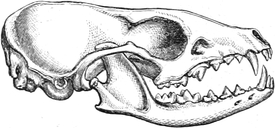
SKULL OF CACOMIXLE.
The Cacomixle is about a yard long, two-fifths of this length being
taken up by the tail. Its fur is brown, and its tail beautifully
ringed. Its habits are entirely arboreal, and it makes a moss-lined
nest in hollow trees. It has a curious habit of gnawing the wood round
the entrance of the hole, so that hunters are able to tell whether a
hollow tree is inhabited or not, by the presence or absence of débris
of bark and wood at the root. It frequently trespasses into the miner’s
tent “and plunders his provision bag. When caught, as it often is,
it becomes so familiar and amusing, and does so much to relieve the
monotony of the miner’s life, that it is highly valued, and commands
quite a large price.” It is said to be a capital mouser.
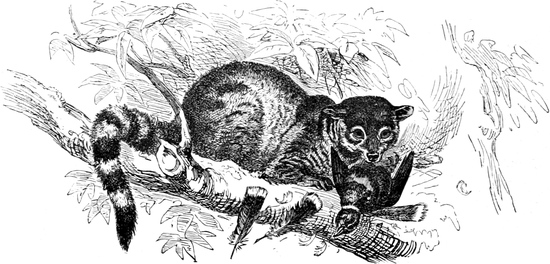
CACOMIXLE.
This group, which has received a most unfortunate name, as it belongs
to the Arctoidea and not to the Æluroidea, contains only two
genera, one of which has been recently discovered, while the other has
been known for many years.
forms a striking object among the small Mammals. It is a really
beautiful creature, rich red chestnut in colour on the upper surface,
jet black as to the lower surface, the limbs also black, the snout
and the inside of the ears white, the tail bushy, reddish-brown in
colour, and indistinctly ringed. The fact of the under surface being
black while the upper is bright reddish-yellow is remarkable; with
most animals, when there is any difference in colour, it is the under
surface which is lighter. The body and head are about half a yard long,
the tail about a foot. The mode of progression is plantigrade, and the
large curved claws are half retractile. The main anatomical characters
are decidedly ursine, as also are the habits. Mr. Bartlett, who studied
the Panda that found a home for a time at the Zoo, states that, when
drinking, it sucked up the fluid like a Bear, instead of licking it up
as a Dog or Cat would do. When offended it would rush at Mr. Bartlett,
and strike at him with both feet, the body being raised like a Bear’s
and the claws projecting. It also, when angry, made a sharp spitting
noise; at other times it used a “weak, squeaking call-note.” On level
ground it ran in the same manner as the Weasel, Otter, and Kinkajou,
with a sort of jumping gallop, the back being kept much arched.
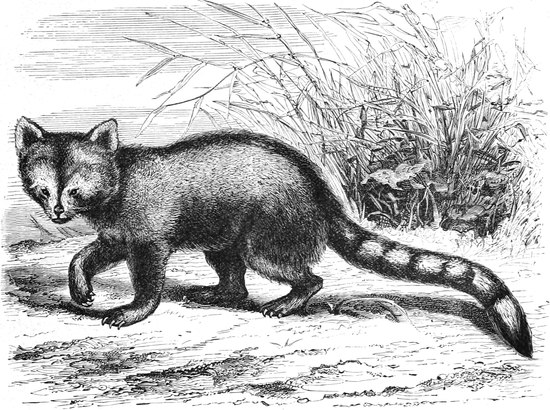
PANDA. (From the Proceedings of the Zoological
Society.)
The Panda is found in the forests of the Eastern Himalayas, as well
as in Eastern Tibet. It is sometimes known as the Wah, or as the Red
Bear-Cat.
The only remaining member of this family has been discovered within
the last few years in the mountains of East Tibet, by the Abbé David,
and has been called by M. Alphonse Milne-Edwards Ailuropus. It is a
large animal, nearly white, and very Bear-like in external appearance,
although the structure of the skull and teeth shows clearly that its
nearest allies are the Panda and the Racoon.
This family, including the Weasels, Martens, Skunks, Gluttons,
Otters, Badgers, &c., is the most heterogeneous assemblage of all
the Carnivorous group. Its members have a very wide geographical
distribution, being found in all parts of the world, except the West
Indies, Madagascar, and the Australian region. They differ very much
among themselves, but have, nevertheless, certain important characters
in common, such as the structure of the ear-drum bone, which in
essential respects resembles that of the Bears, as also do the organs
of digestion. They all possess, beneath the root of the tail, anal
glands, organs of similar nature to the civet-producing glands of the
Viverridæ, but secreting a more or less noxious fluid. The number of
animals in this family is very great, and it will be impossible to
treat of any but the principal species. As a matter of convenience, the
members of the group are often split up into sections, one (the true
Mustelidæ) containing the Gluttons, Martens, Weasels, Ferrets, and
Grisons; another (the Melidæ) consisting of the Badgers, Ratels, and
Skunks; and a third (the Lutridæ) containing the Otters.
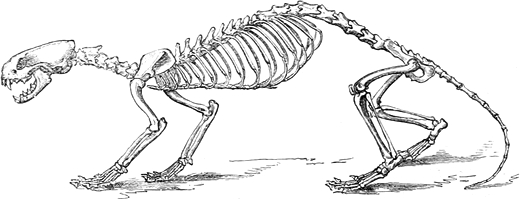
SKELETON OF WEASEL.
Many of these animals are looked upon as “vermin,” but among them are
some of the most valuable of the fur-producing animals: the Ermine,
Sable, Mink, and Marten. These are all inhabitants of the Northern
hemisphere, and the business of trapping them is a very important
branch of industry, as may be gathered from the fact, quoted by Dr.
Elliott Cones,[163] that “during the century 1769–1868, the Hudson’s
Bay Company sold at auction in London, besides many millions other
pelts (skins), the following of Mustelidæ:—1,240,511 Sables; 674,027
Otters; 68,694 Wolverenes; 1,507,240 Minks; 218,653 Skunks; 275,302
Badgers; 5,349 Sea-Otters. In 1868 alone, the Company sold (among many
thousand others), 106,254 Sables; 73,473 Minks; 14,966 Otters; 6,298
Skunks; 1,104 Wolverenes; 1,551 Badgers; 123 Sea-Otters; besides which
were also sold in London, in the autumn of the same year, about 4,500
Sables; 22,000 Otters, &c.”
The Glutton, or Wolverene, the largest of the Weasel group, is found
over the greater part of the northern regions, both of the Old and New
Worlds, being especially abundant in Siberia and Kamtchatka. It attains
a length of some three feet four inches, ten inches of which go to the
tail. It has a Dog-like snout, a broad or rounded head, short ears, an
arched back, a short bushy tail, and long, dark brown or almost black
fur. A band of pale reddish-brown runs along the sides, and unites with
the corresponding band of the opposite side on the rump.
The skull is very strong and massive, and the jaws bear altogether
thirty-eight teeth. The number of the incisors, canines, and premolars
corresponds with that we have found in the Arctoids; but the molars are
reduced to one on each side in the upper, and two on each side in the
lower jaw.[165] The mode of progression is semi-plantigrade, and the
animal’s movements are, compared with those of its nearest allies, the
Martens and Weasels, slow and clumsy; unlike these, too, it is not a
good climber, although the older accounts of its customs stated that
it was in the habit of climbing trees, and dropping suddenly down upon
large animals as they passed, and then destroying them as they fled in
terror at the unexpected attack. In this, as in many other instances,
the imagination has largely been called into play to supplement what
was deficient in the actual observations of the writers. Probably
few animals have given rise to so many or such wild fables as the
Wolverene. Its name of Glutton is due to the mythical account of its
habits given by an early writer, Olaus Magnus, who says: “It is wont,
when it has found the carcass of some large beast, to eat until its
belly is distended like a drum, when it rids itself of its load by
squeezing its body betwixt two trees growing near together, and again
returning to its repast, soon requires to have recourse to the same
means of relief.” It need hardly be said that this story must be taken
cum grano salis maximo.
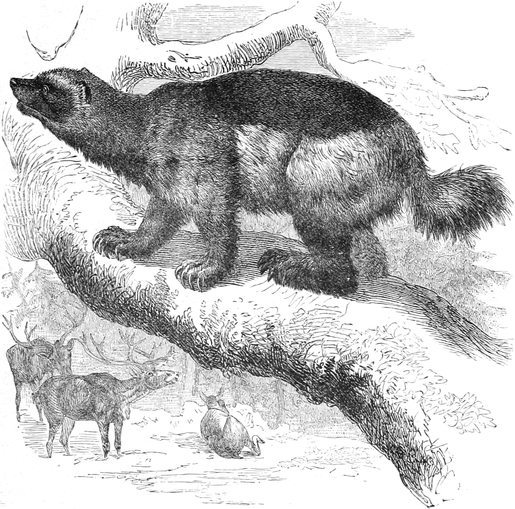
GLUTTON.
Besides its great strength, the Wolverene is noted for its excessive
cunning, and the two qualities combined give it a power of
destructiveness of which one would hardly expect any animal below a
schoolboy to be capable. One of its favourite tricks is to frequent the
“Marten-roads”—that is, the lines of traps for catching Martens—and
one by one to demolish the traps, and carry off either the bait or the
imprisoned animal. To make matters worse for the unlucky trapper, the
Glutton’s experience and knowledge of traps in general are so great
that he shows equal skill in avoiding these set for his own benefit
as in despoiling those meant for others; either he takes no notice
of them, or carefully pulls them to pieces, and so gets the bait and
outwits the hunter, without danger to himself. It is only in a trap
constructed with the greatest care, and disguised so as to resemble a
“câche,” or store of hidden food, that the wary beast can be caught.
Mr. Lockhart, an American writer, quoted by Dr. Coues, gives some
really charming instances of his own experience in trying to get the
better of his inveterate enemy. In one case, he had carefully buried
a Lynx’s skin in the snow, to the depth of some three feet; the snow
was arranged so as to present a perfectly undisturbed appearance, and
the Lynx’s entrails and blood were strewed about, and its carcass
left, so as to take off the scent. On returning next morning to
his beautifully-made “câche,” he found the carcass, &c., gone, but
everything else apparently just as he had left it. His joy was great,
but premature; for on digging, no skin was to be found: the Wolverene
had stolen it during the night, but had added insult to injury by
filling up the hole, and putting everything in statu quo.
Mr. Lockhart gives another equally astonishing instance of the
Wolverene’s ability:—“At Peel’s River, on one occasion, a very
old Carcajou [the trapper’s name for the Glutton] discovered my
Marten-road, on which I had nearly a hundred and fifty traps. I was in
the habit of visiting the line about once a fortnight; but the beast
fell into the way of coming oftener than I did, to my great annoyance
and vexation. I determined to put a stop to his thieving and his life
together, cost what it might. So I made six strong traps at as many
different points, and also set three steel traps. For three weeks I
tried my best to catch the beast, without success; and my worst enemy
would allow that I am no green hand in these matters. The animal
carefully avoided the traps set for his own benefit, and seemed to
take more delight than ever in demolishing my Marten-traps, and eating
the Martens, scattering the poles in every direction, and câching what
baits or Martens he did not devour on the spot. As we had no poison
in those days, I next set a gun on the bank of a little lake. The gun
was concealed in some low bushes, but the bait was so placed that the
Carcajou must see it on his way up the bank. I blockaded my path to
the gun with a small pine-tree, which completely hid it. On my first
visit afterwards, I found that the beast had gone up to the bait and
smelled it, but had left it untouched. He had next pulled up the
pine-tree that blocked the path, and gone around the gun and cut the
line which connected the bait with the trigger just behind the muzzle.
Then he had gone back and pulled the bait away, and carried it out on
the lake, where he laid down and devoured it at his leisure. There I
found my string. I could scarcely believe that all this had been done
designedly, for it seemed that faculties fully on a par with human
reason would be required for such an exploit, if done intentionally.
I therefore re-arranged things, tying the string where it had been
bitten. But the result was exactly the same for three successive
occasions, as I could plainly see by the footprints; and what is most
singular of all, each time the brute was careful to cut the line a
little back of where it had been tied before, as if actually reasoning
with himself that even the knots might be some new device of mine, and
therefore a source of hidden danger he would prudently avoid. I came
to the conclusion that that Carcajou ought to live, as he must be
something at least human, if not worse. I gave it up, and abandoned the
road for a period.”
One very extraordinary habit of the Wolverene is shared by very few
animals except man. It is stated by Dr. Coues that, when it meets a
man, it will often, if it be to windward, approach within fifty or
sixty yards, and then, sitting calmly down on its haunches, will shade
its eyes with one fore-paw, and gaze earnestly at its enemy. This very
human action it will often repeat two or three times before attempting
to flee.
The Pine Marten is perhaps the most pleasing of the Weasel group, as
far as appearance is concerned. Its long, lithe body attains a length
of over half a yard; its tail is about a foot in length. The legs are
short, though not nearly so short as in the Weasels, and its paws have
five digits, armed with sharp claws. The snout is sharp and beset at
the sides with long vibrissæ. The skin is very beautiful, dark-brown
for the most part, lighter on the cheeks and snout, and on the throat
and under side of the neck a light yellow.
The skull is much more elongated than either a Bear’s or a Glutton’s;
the tympanic bullæ are slightly swollen, and the jugal arches, beneath
which the jaw muscles pass, are comparatively narrow and slender. As
in the Wolverene, there are thirty-eight teeth, eighteen in the upper,
twenty in the lower jaw, and the molars are thoroughly carnivorous in
character, being produced into sharp, trenchant, cutting edges.
The Pine Marten occurs over a considerable portion of Europe and Asia,
and, amongst other places, in Great Britain, where, however, it is
becoming rare. The finest specimens are said to come from Sweden.
This animal is essentially arboreal in its habits, inhabiting chiefly
thick coniferous woods, whence its name of Pine Marten is derived. In
the branches the female makes a nest of leaves or moss, and sometimes
saves herself this trouble by ejecting Squirrels or Woodpeckers, and
occupying the vacant dwellings. For its size it is, like all the
Mustelidæ, extremely ferocious and strong. It attacks and kills
Fawns, notwithstanding their superior size; from these down to mice,
nothing comes amiss to it, and nothing is safe from its attacks.
The Beech Marten, or Stone Marten (Mustela foina), differs from the
foregoing species in certain characters of the skull and teeth, as well
as in the fact that the throat is white instead of yellow. Its habits
are, on the whole, similar to those of the Pine Marten, but it is more
often found away from woods, on the sides of mountains and rocks, or
in the neighbourhood of farms. Its general distribution is the same
as that of the Pine Marten, but it is decidedly more common than the
latter in Great Britain.
The Pekan, or Pennant’s Marten, is a North American species. It is
much larger than either of the preceding, the body attaining a length
of thirty inches from snout to root of tail, while the tail itself is
about sixteen inches long. The face is more Dog-like than that of the
Common Marten; the skin is brown, becoming lighter in the front part of
the back, and presenting white patches on the chest and belly.
Like the Pine Marten, it is a good climber, but, unlike it, shows
a partiality, not for the driest parts of the wood, but for the
neighbourhood of water. Its chief food seems to be Mice, but it is also
fond of stealing the fish used to bait traps—whence it is often called
the Fisher—and Sir J. Richardson states that its favourite meal is the
Canadian Porcupine, which it kills by a bite on its unprotected belly,
and eats, notwithstanding the quills. Sometimes it is forced, by want
of better food, to eat beech-nuts.
This is another species of the same genus, important from the fact that
it is the most valuable of the fur-producing animals. Its skin seems
to have been even more precious in former times than now. A writer in
the sixteenth century states that “forty of the best quality, which is
the quantity usually packed in one bale, have been sold for more than a
thousand pieces of gold.”
The Sable is found in the northern parts of Asia, being especially
abundant between the Lena and Kamstchatka. It differs markedly from the
true Martens in the form of its head, which is conical, the apex of the
cone being formed by the pointed snout, while from its base project the
pointed, and, for a Mustela, large ears. The legs and feet, too, are
larger and stronger than in the other species of this genus.
Sable-hunting is, naturally, a very important branch of industry, and
forms the chief occupation of many of the Siberian tribes. The work is
by no means an easy one; it entails miles of travelling in dark woods
and through heavy snow-storms; the track of the Sables may have to be
followed for long distances; and numerous traps must be skilfully set
and visited daily. With all his trouble, the hunter often finds that
“an Arctic Fox, or some other Carnivore, has eaten up the costly booty,
leaving only a few fragments, as if for the express purpose of showing
him how narrowly he has escaped earning forty, fifty, or sixty silver
roubles.”
The American Sable (Mustela americana), often called the Marten, is
a closely allied species. It attains a length of eighteen inches, not
including the tail, which measures about a foot more. Its capture gives
the American trapper his staple occupation. It “is ordinarily captured
in wooden traps of very simple construction made on the spot. The traps
are a little enclosure of stakes or brush, in which the bait is placed
upon a trigger, with a short upright stick, supporting a log of wood.
The animal is shut off from the bait in any but the desired direction,
and the log falls upon its victim with the slightest disturbance. A
line of such traps, several to the mile, often extends many miles. The
bait is any kind of meat, squirrel, piece of flesh, or bird’s head.
One of the greatest obstacles that the Sable-hunter has to contend
with in many localities is the persistent destruction of his traps by
the Wolverene and Pekan.... I have accounts from Hudson’s Bay trappers
of a Sable road fifty miles long, containing 150 traps, every one of
which was destroyed through the whole line twice—once by a Wolf, once
by a Wolverene. When thirty miles of the same road were given up, the
remaining forty traps were broken five or six times in succession by
the latter animal.”[169]
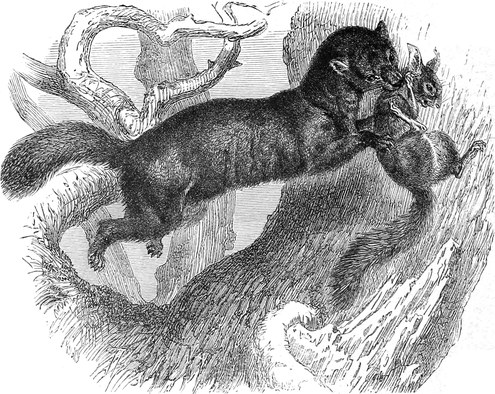
SABLE.
The Weasel, like the remaining members of the genus Putorius, are
very often called “vermiform,” and a better name could scarcely be
applied to them, for anything more worm-like could hardly be imagined
in a hairy quadruped. The legs are extremely short in relation to the
body, which is attenuated in the highest degree, and almost regularly
cylindrical from one end to the other. Then the neck is of most
disproportionate length, and carries the head out so far, that the
fore legs appear as if placed quite at the hinder end of the chest,
instead of in the front of it. The head passes almost insensibly into
the neck, and the neck into the body. The head is flattened, and bears
little glittering savage-looking eyes, and small rounded ears. The
length from snout to root of tail does not exceed eight inches. The
tail is about two inches long. The fur is light reddish-brown above,
and white below; in northern latitudes the brown parts assume a much
lighter colour in winter, so that the Weasel undergoes a change of coat
similar to, but less extensive than, that undergone by the Ermine.
The Weasel is a good climber, and makes use of its skill in this
accomplishment to prey upon birds, their eggs, and young. Rats and
Mice are, perhaps, its staple food. Of these it makes great havoc, and
is therefore a useful hanger-on to the farm-yard, notwithstanding its
occasional depredations in the hen-roost. When it catches a Mouse or
Rat, it gives it one bite on the back of the head, piercing the most
vulnerable part of the brain, and killing instantly. Professor Thomas
Bell says:—“I have observed that when a Weasel seizes a small animal,
at the instant that the fatal bite is inflicted, it throws its long,
lithe body over its prey, so as to secure it should the first bite
fail, an accident, however, which I have never observed when a Mouse
has been the victim. The power which the Weasel has of bending the head
at right angles with the long and flexible, though powerful neck, gives
it a great advantage in this mode of seizing and killing its smaller
prey.” The first part eaten is usually the brain. The stories of the
Weasel’s blood-sucking propensities are probably false, or at any rate
grossly exaggerated.
The Weasel will pursue its prey over fields, in trees, in subterranean
burrows, or across water. Like many of the wild Cats, it kills far
more than is necessary for its support, and in pursuance of its
favourite occupation of slaughter shows an unequalled courage and
pertinacity. Its power of keeping its presence of mind under very
trying circumstances is well shown in the following anecdote related
by Bell:—A gentleman, “while riding over his grounds, saw at a
short distance from him a Kite pounce on some object on the ground,
and rise with it in his talons. In a few moments, however, the Kite
began to show signs of great uneasiness, rising rapidly in the air,
or as quickly falling, and wheeling irregularly round, whilst it was
evidently endeavouring to force some obnoxious thing from it with
its feet. After a sharp but short contest, the Kite fell suddenly to
the earth, not far from where Mr. Pindar was intently watching the
manœuvre. He instantly rode up to the spot, when a Weasel ran away from
the Kite, apparently unhurt, leaving the bird dead, with a hole eaten
through the skin under the wing, and the large blood-vessels of the
part cut through.”
The Stoat, or Ermine, is an important species closely allied to the
Weasel, from which it differs chiefly by its greater size, and by the
peculiarities of its colouring. In summer the upper parts vary from
yellowish-brown to mahogany brown, while the under side is white tinged
with sulphur-yellow, except on the throat, which is pure white. The
tail is tipped with black. The brown upper and white under surfaces are
separated by a perfectly distinct line of demarcation, which extends
from the snout to the root of the tail, dipping down at the limbs, so
as to include the outer surfaces of the latter in the dark area. In
winter, on the other hand, the skin is, with the exception of the tip
of the tail, which always remains black, pure white, tinged here and
there with sulphur-yellow. Intermediate states between full winter
dress and full summer dress are often found, and these, curiously
enough, show their half-way character in two ways. Sometimes there is
an alteration in level of the line of demarcation between the white
and brown portions of the skin, the latter being occasionally found
restricted to a narrow strip along the back, but remaining still
without any admixture of white hairs. In other cases, again, the
line of demarcation remains unaltered, but the dark portions become
gradually lighter and lighter, until the final white dress is assumed.
As to the interesting question of the exact manner and cause of
this change, it is sometimes stated that the direct influence of
cold produces a rapid lightening in the colour of individual hairs,
while there are also facts to show that the change is not due to an
alteration in colour of existing hairs, but to a renewal of the coat,
the hairs of one colour being replaced by those of the other. Dr.
Elliott Coues, who has worked up the subject in an able and exhaustive
manner, has satisfied himself that the change may take place in either
way. Some of his specimens, “notably those taken in spring, show the
long woolly white coat of winter in most places, and in others present
patches—generally a streak along the back—of shorter, coarser,
thinner hair, evidently of the new spring coat, wholly dark-brown.
Other specimens, notably autumnal ones, demonstrate the turning to
white of existing hairs, these being white at the roots for a varying
distance, and tipped with brown. These are simple facts not open to
question. We may safely conclude that if the requisite temperature be
experienced at the periods of renewal of the coat, the new hairs will
come out of the opposite colour; if not, they will appear of the same
colour, and afterwards change; that is, the change may or may not be
coincident with shedding. That it ordinarily is not so coincident seems
shown by the greater number of specimens in which we observe white
hairs brown-tipped. As Mr. Bell contends, temperature is the immediate
controlling agent. This is amply proven in the fact that the northern
animals always change; that in those from intermediate latitudes the
change is incomplete, while those from farther south do not change at
all.” The advantage of the change to the animal is manifest; its colour
becomes that of the snow over which it travels in pursuit of game, so
that it is less easily seen and avoided. Unfortunately for it, however,
a similar “protective colouring” is adopted by some of its victims.
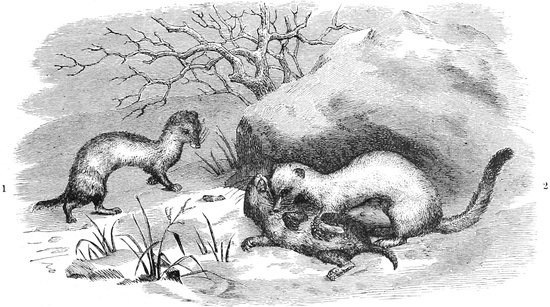
WEASEL (1) AND ERMINE (2) IN THEIR WINTER CLOTHING.
The habits of the Stoat resemble those of the Weasel; it is dangerous
both to the sheep-fold and to the poultry-yard, but partly atones for
its poaching by the immense number of Rats and Mice it is capable of
destroying. Audubon relates that he “once placed a half-domesticated
Ermine in an outhouse infested with Rats, shutting up the holes on the
outside to prevent their escape. The little animal soon commenced its
work of destruction. The squeaking of the Rats was heard throughout the
day. In the evening it came out, licking its mouth, and seemed like
a hound after a long chase, much fatigued. A board of the floor was
raised to enable us to ascertain the result of our experiment, and an
immense number of Rats were observed, which, although they had been
killed in different parts of the building, had been dragged together,
forming a compact heap.”
Both Weasel and Ermine are found over the greater part of Northern
Europe, Asia, and America.
In form this animal does not differ very markedly from the Marten,
except for the fact that its head is broader, its snout blunter, and
its tail very much shorter: the latter being about five and a half
inches, while the head and body together are nearly a foot and a half
long. The neck is considerably shorter, and the body stouter than
in the Weasel and Stoat. The fur is made up of hairs of two kinds,
the shorter woolly and of a yellowish colour, the longer black or
brownish-black and shining. One of its most marked characters is its
horrible stench. This is produced, like the scent of the Civets, in a
pair of glands near the root of the tail, which secrete a yellowish
creamy substance of the most fetid character.
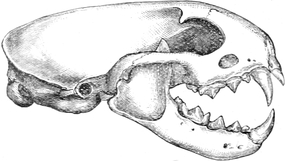
SKULL OF POLECAT. (After Coues.)
The Polecat is also known as the Fitchet (Fitchew of Shakspere),
Foumart, or Foulimart: the latter names are said to be a contraction of
“Foul Marten,” thus distinguishing it from the Common or Sweet Marten,
which is a comparatively inodorous animal. The name Polecat is probably
a contraction of Polish Cat.
The Polecat is perhaps even more destructive than the other Mustelidæ,
and is certainly a far greater plague to the farmer. Its ravage
among Rabbits, Hares, and Partridges is immense, and if once it gets
unobserved into a poultry-yard, the fate of a very considerable
number of the inmates is sealed, as it possesses in a high degree
the family love of slaughter for slaughter’s sake. It has been known
to kill as many as sixteen Turkeys in a single night; and, indeed,
it seems a point of honour with this bloodthirsty little creature to
kill everything it can overpower, and to leave no survivors on its
battlefields. It has, too, an unfortunate liking for eggs, as well
as for game and poultry, and in this way alone does great harm to
preserves. There are also many accounts of its fondness of fish; Bell
also quotes an instance in which a female Polecat was pursued to her
nest, and was found to have laid up, in a side hole, a store of food,
consisting of forty Frogs and two Toads, all of which she had skilfully
“pithed,” that is, bitten through the brain, so that, although
retaining a certain amount of vitality, they were effectually prevented
from running away!
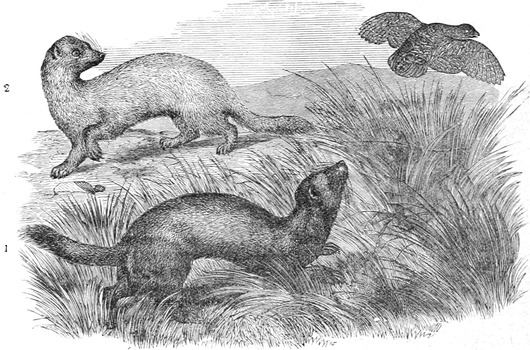
1. POLECAT. 2. FERRET.
The Polecat is found throughout Northern Europe, not extending
southwards into the warmer parts of the Continent, but being quite at
home in snow-covered regions. It is essentially, like the Marten, a
sub-arctic and temperate animal.
This is a domesticated variety of the genus Putorius, of African
origin. It shows its Southern nature by being, unlike the Polecat,
unable to endure great cold; even an English winter is enough to kill
it if not properly housed. It is an interesting animal, zoologically,
from the fact that it is a true-breeding Albino, having the white fur
and pink eyes of that peculiar “sport.” It is a little smaller than the
Polecat, with which it will breed with perfect readiness, producing
hybrids intermediate in character between the two parent species.
Ferrets are much used, both in Britain and America, chiefly for killing
Rats and for driving Rabbits out of their burrows. For the latter
function the Ferret is muzzled, to prevent its killing the Rabbit in
the burrow; the latter is either netted or killed immediately, as soon
as it is driven out. The Ferret is also frequently employed to kill
fowls for the table. Its particularly neat method of slaughtering by
one bite in the neck is much admired by Ferret-fanciers, who make quite
a pet of the animal. It, however, never shows the slightest affection
for its master, and has usually to be confined: the necessity of this
is shown in an instance, quoted by Bell, in which a child was attacked
in its cradle, and only rescued after the veins of its neck had been
severed, its face, neck, and arms lacerated, and its eyes so injured
that the sight of one of them was permanently lost.
This important fur-producing animal is found in the northern parts of
both hemispheres under various specific forms, the most important of
which are the European Mink (P. lutreola) and the American Mink (P.
vison). Although most nearly allied to the Stoats and Weasels, it
shows a certain resemblance to the Martens in its larger and stouter
body, which attains a length of from fifteen to eighteen inches, the
tail being about seven or eight inches long, and bushy at the tip. Like
most of its allies, it has two kinds of fur—“a soft matted under fur,
mixed with long, stiff, lustrous hairs.” The colour varies from dull
yellowish-brown to dark chocolate-brown; the upper lip is usually white
in the European, dark in the American species. The scent-glands are
well developed, and their secretion is second only in offensiveness to
that of the Skunk.
The habits of the Mink differ altogether from those of the other
species of the genus. As Dr. Coues observes, “It is to the water what
the other Weasels are to the land, or the Martens to the trees. It is
as essentially aquatic in its habits as the Otter, Beaver, or Musk Rat,
and spends, perhaps, more of its time in the water than it does on
land. In adaptation to this mode of life, the pelage has that peculiar
glossiness of the longer bristly hairs and felting of the close under
fur which best resists the water.” It feeds chiefly upon aquatic or
amphibious animals, such as fish, frogs, crayfish, molluscs, and the
like, but also preys largely upon the smaller Mammals. It is stated
that it is not an indiscriminate slaughterer, but kills only what is
necessary for its actual wants.
In America the Mink has been regularly domesticated and trained as
a Rat-catcher, like the Ferret. “Minkeries” have been established
in connection with farm-yards, and have proved in more than one
instance eminently successful. The animals soon allow themselves to be
handled, and besides becoming good Ratters, bring their owner a very
considerable profit by their fur, for which alone it is well worth
while to breed them, as the expense of keeping them is trifling.
This is a Weasel-like animal, found only in South America, and
distinguished from its nearest relations, the Martens and Weasels,
by the fact that the colour of the upper is lighter than that of the
lower surface of its body, the former being grey, the latter dark
brown. Its whole length is rather under a yard; of this not more than
a third is taken up by the tail. It is found in plantations and in the
neighbourhood of buildings, and makes its abode in hollow trees, clefts
in rocks, and holes in the earth.
As to its disposition, some notion may be gained from a tale told by
Bell of a tame specimen in his possession. He says that it “was very
fond of Frogs, but these were not the only animals which were obnoxious
to its voracity. On one occasion, in the winter, I had placed it in its
cage, in a room with a fire, where I had also two young Alligators,
which in general were stupidly tame. On going into the room in the
morning, I found the Grison at large, and one of the Alligators dead,
with a hole eaten under the fore-leg, where the great nerves and
blood-vessels were torn through; and the other Alligator began snapping
furiously at every one who attempted to approach it.”
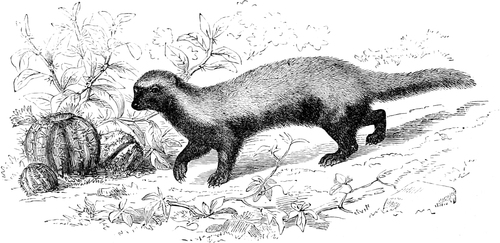
GRISON.
This animal may be considered without exaggeration to be one of the
ugliest in the whole Carnivorous order. It is not unlike the Marten
in shape, but of a dark brown colour, and with a low, villainous, and
almost debauched expression of face. The head and body together attain
a length of rather more, the tail of rather less, than half a yard. The
colour of the pelage is dark blackish-brown, becoming lighter on the
head and neck, on the under surface of which there is a yellowish spot.
It is found, like the Grison, in South America, where it extends from
Brazil and British Guiana in the north to Paraguay in the south.
It lives in forests, preying upon small mammals and birds, and does
its hunting chiefly in the morning, starting for work at sunrise, and
returning about midday.
This animal, sometimes known as the Honey Badger, is one of the
exceptional animals whose colour is lighter above than below. Its
stiff, wiry hair is ashy-grey on the upper surface, while on the
under surface, the muzzle, limbs, and tail are black. The line of
demarcation between the grey and black is so sharp, that the animal
has the appearance of being really black, but covered, as to its back,
with a grey cloak. It is about three-quarters of a yard long, the tail
taking up about a sixth of the length. In the matter of teeth it is
interesting, as its molars are reduced to one on each side in each jaw:
a reduction equal to that found in the Cats.
It is said to live largely on Bees, and to show a great amount of skill
in tracking to their nest the insects which it observes on the wing.
Sparrmann states that it seats itself on a hillock to look out for the
Bees, and shades its eyes with one fore-paw against the rays of the
setting sun.
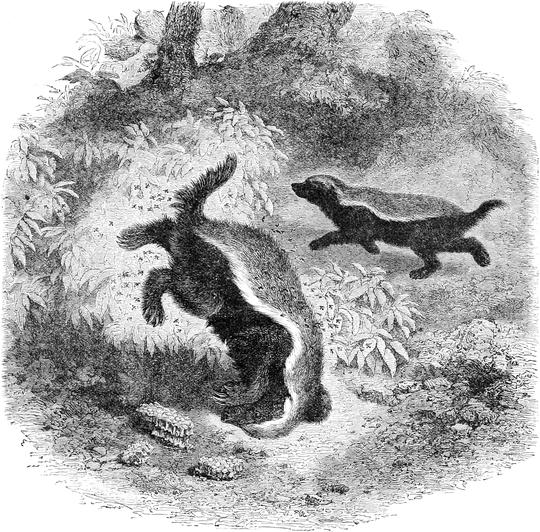
RATEL.
It is a stupid animal, very sleepy during the day, and issuing from its
burrows at sunset to seek for the birds, tortoises, insects, and worms
on which it feeds. It is very tenacious of life, and is well protected
from attacks by the thickness and looseness of its skin, and the thick
subcutaneous layer of fat. It also possesses an additional means, if
not of defence, at least of offence, in its tail glands, the secretion
of which is very strong and pungent as to its odour. It is still
further advantaged by its burrowing powers; it will scratch up a hole,
and disappear into it in an incredibly short space of time.
The Ratels in the Zoological Gardens in Regent’s Park (where the habits
of all the animals will repay the study of the most casual observer)
exhibit a remarkable peculiarity. We have very frequently watched one
of them run round and round his cage in the usual purposeless manner
of captive animals, but with this peculiarity: when he reached a
particular corner of the den, he quietly, and without effort, turned
over head and heels, and then went on again. On one occasion, after he
had been doing this with great regularity for some rounds, he seemed to
become abstracted, and passed the usual spot without the somersault.
When, however, he had proceeded a few paces, he recollected himself,
stopped for a moment, returned to the exact place, turned over as
usual, and proceeded without further let or hindrance.
There are two species of Ratel, one, the Cape Ratel (Mellivora
capensis), occurs in South Africa, the other, or Indian Ratel (M.
indica), being found in India.
The Badger is the largest of the indigenous Carnivora of Great Britain;
for although the length of its body is not quite equal to that of the
Fox, in bulk it far exceeds the slender and active Reynard. It is,
indeed, a heavy and somewhat clumsy animal, long and stout-bodied, and
short-legged, with a tapering and mobile snout, and a short scrubby
tail. The long hair is of three colours: black, white, and reddish, the
mingling of the three producing a varying grey hue. The head is white,
except for a black band on each side, which commences a little behind
the nose, and extends backwards, including the eye and ear, the tip of
the latter being, however, white. The lower parts of the body and the
legs are black, the tail grey. The length of the body from snout to
root of tail is about two feet three inches; that of the tail, seven
inches and a half.
It is fond of retired places, such as sheltered woods, and in them
it makes for itself a large burrow or earth “which has but a single
entrance from without, but afterwards divides into different chambers,
and terminates in a round apartment at the bottom, which is well lined
with dry grass and hay.” The Badger is consequently a very skilful
digger, and for this purpose is possessed of strong curved claws. Its
diet is completely mixed: it eats roots, fruit, eggs, small mammals,
frogs, insects, &c. It is quite susceptible of domestication, and is
said to show a vast amount of affection and good temper. As to its
habits, we cannot do better than quote an excellent account of some
half-domesticated Badgers given in a letter to The Times by Mr.
Alfred Ellis, of Loughborough:—“About ten years since, the Badger
was established here, but it was not until the third attempt that my
efforts prospered. The Badgers then introduced, or their successors,
have bred every year, and as not more than one pair remain in permanent
occupation it is probable that there are many more of these animals
in this country than is generally supposed; but their shyness, their
colour, and the short time they require to obtain their food, and
the recesses of the woods in which they delight to dwell, make it no
easy task to study their life and habits. The deep earth in which our
Badgers live is only fifty yards from the window at which I write.
The building of this house two years ago did not disturb them, and
they have shown an increasing confidence and trust. The Badger breeds
later than the Fox, and it was the middle of March this year before
the preparations for the coming family were made. These consisted in
cleaning out the winter bed, and replacing it by a quantity of dry
fern and grass, so great that it would seem impossible the earth could
receive it. In June the first young Badger appeared at the mouth of the
earth, and was soon followed by three others, and then by their mother.
After this, they continued to show every evening, and soon learnt to
take the food prepared for them. The young are now almost full grown,
and, forgetting their natural timidity, will feed so near that I have
placed my hand on the back of one of them. The old ones are more wary,
but often feed with their family, though at a more cautious distance.
Their hearing and sense are most acute, and it is curious to see them
watch, with lifted head and ears erect, then, if all is quiet, search
the ground for a raisin or a date. But the least strange sight or sound
alarms them, and they rush headlong to earth with amazing speed.
“The Badger, like the Bear, treads upon the whole heel, and its walk
closely resembles that animal. They caress each other in the same
grotesque manner while they gambol and play, and at times they utter
a cry so loud as to startle any one ignorant of its source. It is
not unlike the chatter of the Stoat, but many times louder. On fine
evenings we can watch them dress their fur-like coats, or do kind
offices for each other, and search for parasites after the manner of
Monkeys. No creature is more cleanly in its habits. Over their earth
hangs a birch-tree, from which grows a horizontal bough eighteen inches
from the ground. On this they scrape their feet in dirty weather, and
keep their house inodorous by depositing their excrement at one place
for many months and covering it with earth. The hibernation of the
Badger is not like that of the Hedgehog—continuous and complete—but
is irregular, and is probably influenced by the character of the
winter. I have known the mouth of the earth covered with a coat of snow
for fourteen days, and it might have been much longer before they came
forth, while they may sometimes be tracked in a thin snow for a long
distance.”
“As the winter approaches, the old bedding is replaced by dry fern and
grass, raked together by their powerful claws. This is often left to
wither in little heaps till dry enough for their purpose. Partially
concealed, I have watched a Badger gathering fern and using a force in
its collection quite surprising.
“Bell, in his ‘Quadrupeds’ quotes Buffon as stating that Badgers are
fond of Wasps’ nests. This is true, for, like the Bear, they love honey
and sweet food. I once heard a pair of Badgers fighting, and crept upon
the ground until within a few yards of the angry conflict, but the
bracken hid them from view. Next morning I visited the place. A Wasps’
nest had been stormed and eaten; very little of the comb remained, and
not a dozen homeless Wasps. That summer I myself saw the wrecks of
seven Wasps’ nests taken by the Badgers in one field, and this autumn
they are digging out every one they can find.
“The Badger and the Fox are not unfriendly, and last spring a litter of
cubs was brought forth very near the Badgers; but their mother removed
them after they had grown familiar, as she probably thought they were
showing themselves more than was prudent.”[179]
Although far from common, the Badger is found in many parts of Great
Britain and on the Continent. Closely allied species occur over a great
part of Northern Europe and Asia.
In former times it was in great requisition for the so-called sport of
“Badger-baiting,” in which charming and refined amusement the unhappy
animal was put into a barrel and attacked by an unlimited number of
Dogs, amongst whom it was often able to do considerable execution,
thanks to its sharp teeth and powerful jaws.
The distinction between this species and the European Badger consists
chiefly in the shorter and more hairy character of the snout, and in
the fact that the body is of a uniform whitish hue, sometimes shaded
with grey or tawny. The body and head together are about twenty-four
inches long, the tail six inches. It is found throughout the greater
part of North America.
In its shyness, its general mode of life, and its habits, it differs
but slightly from the Common Badger. Although in many parts it is
so numerous that its burrows form a very serious obstacle to the
traveller, yet it is a comparatively rare thing to see a specimen, so
immediately does it retire to its strongholds on the first intimation
of man’s approach. It can, however, be trapped without much difficulty,
and thousands are caught in this way every year. In 1873 the Hudson’s
Bay Company sold 2,700 in London alone. Dr. Coues quotes an interesting
account of the habits of a captive Badger. He says:—“In running, his
fore-feet crossed each other, and his body nearly touched the ground.
The heel did not press on the ground like that of the Bear, but was
only slightly elevated above it.... We have never seen any animal that
could exceed him in digging. He would fall to work with his strong
feet and long nails, and in a minute bury himself in the earth, and
would very soon advance to the end of a chain ten feet in length. In
digging, the hind as well as the fore-feet were at work, the latter for
the purpose of excavating, and the former (like paddles) for expelling
the earth out of the hole; and nothing seemed to delight him more than
burrowing in the ground. He seemed never to become weary of this kind
of amusement; and when he had advanced to the end of his chain he would
return and commence a fresh gallery near the mouth of his first hole.
Thus he would be occupied for hours, and it has been necessary to drag
him away by main force. He lived on good terms with the Racoon, Grey
Fox, Prairie Wolf, and a dozen other species of animals. He was said to
be active and playful at night, but he seemed rather dull during the
day, usually lying rolled up like a ball, with his head under his body
for hours at a time.”
This animal, sometimes called the “stinking Badger,” is found only
in Java and Sumatra, and in those islands only on mountains having
an elevation of more than 7,000 feet above the sea. It is a little
more than a foot long; has a pig-like head, a stout body, very short
legs, and a stumpy tail, not more than an inch long. The feet are
plantigrade. It is of a dark brown colour, with the exception of a
white band running along its back. But one of its chief characteristics
is its power of ejecting, from its tail-glands, a volatile fluid, the
odour of which is said to be even as bad as that of the Skunk.
The Teledu lives in burrows during the day, and comes out at night to
seek its food, which consists chiefly of earth-worms, insects, and
their larvæ.
An ally both of the Skunks and Badgers, the Zorilla may be said to take
the place of the former animals in Africa, through the whole of which
continent it extends, reaching also into Asia Minor. The body, which
attains a length of about a foot, is moderately stout, of a shining
black ground-colour, and marked with white bands and spots. The snout
is elongated like that of the South American Skunk (vide infra); the
tail is bushy, about eight or nine inches long, and striped or spotted.
The Zorilla lives upon small mammals, birds, and their eggs, as well
as amphibia and crustacea. It is a determined enemy to poultry, and
entails great loss to the inhabitants of the districts where it
is found, but is often tamed, and used to catch Rats and Mice. In
the matter of scent, the secretion in its tail-glands is worthy of
comparison with that of the Skunk itself.
An allied form is the Indian genus Helictis, a Weasel-like animal
with a long body, and of a grey-brown colour, white underneath, and
marked along the back with a white stripe. The tail is long and bushy.
This animal is found from Nepaul to Java in the south, and Formosa in
the east.
This notorious American species is a stoutly-built animal, with short
legs, a long conical head with a truncated snout, and a long bushy
tail. The general colour of the fur is black, or nearly so, but on
the forehead there is a white streak, and on the neck a white patch,
from which two broad bands of the same hue proceed backwards along the
upper surface of the body. The length from tip of snout to root of
tail is something over a foot; the tail itself is less than a foot in
length. The general appearance of the animal is decidedly Badger-like;
it has, in fact, a good deal of resemblance both to the Ratel and to
the Teledu. As in the Weasel, Ermine, and Polecat, there is one molar
on each side of the upper, two on each side the lower jaw; altogether
there are thirty-four teeth. It occurs throughout the whole of the
temperate portion of North America.
We have mentioned that several of the Weasel family enjoy the
distinction of being able to eject a foul-smelling fluid from glands at
the root of the tail. In this accomplishment the Skunk is the undoubted
chief. It can eject its perfume to a considerable distance, and with
unerring aim: and the smell! The “odour of mingled guano and Polecat,”
which, according to Mr. Kingsley, distinguishes the ancient Cornish
dainty squab-pie, is simply nothing in comparison with the horrible
stench emitted by this little animal. It is so durable, that the spot
where a Skunk has been killed will often retain the scent for days, or
even weeks; indeed, Audubon relates that at one place where a Skunk
had been killed in the autumn, the odour was quite perceptible in
the following spring after the snow had melted. Clothes defiled with
the secretion cannot be thoroughly cleansed by any ordinary means:
for even if the scent seems to have disappeared, it will make itself
evident every time the wearer goes near a fire, or into the sun.
Notwithstanding this, furriers have found out a way for effectually
purifying Skunk-skins, which are now a good deal used as furs. In
Britain, where the Skunk is not known in the flesh, these furs are
called by their right names, but in America, where the inhabitants do
not enjoy the same blissful ignorance of this noxious beast, they are
dignified with the appellation of “Alaska sable.”
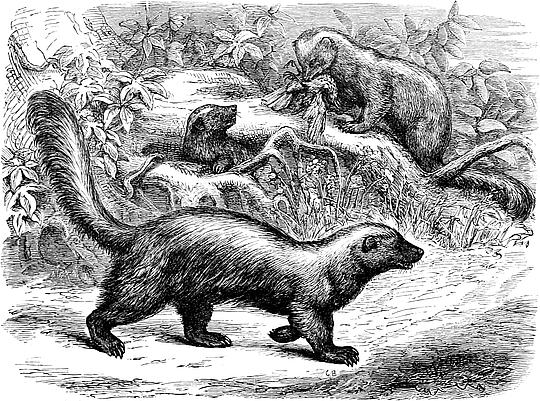
SKUNK.
But the scent of the secretion is not its worst feature. Sir John
Richardson quotes Mr. Graham as saying “that he knew several Indians
who lost their eyesight in consequence of inflammation, produced
by this fluid having been thrown into them by the animal,” and
continues, “I have known a dead Skunk, thrown over the stockades of a
trading-port, produce instant nausea in several women, in a house with
closed doors, upwards of a hundred yards distant.” Dogs often suffer
from inflammation of the eyes after being squirted with the fluid, and
appear to be almost distracted with the pain. Curiously enough, the
secretion has been recommended as a cure for asthma. “The story is told
of an asthmatic clergyman who procured the glands of a Skunk, which he
kept tightly corked in a smelling-bottle, to be applied to his nose
when his symptoms appeared. He believed he had discovered a specific
for his distressing malady, and rejoiced thereat; but on one occasion
he uncorked his bottle in the pulpit, and drove his congregation out of
church.”[184]
The efficacy of the secretion as a defensive weapon for the not
otherwise formidable animal is greatly enhanced by the distance to
which it can be ejected. This is probably as much as twelve or fourteen
feet, while the smell itself can be perceived for a comparatively
immense distance.
Besides its perfume, the Skunk has yet another claim to careful
avoidance: its bite has been known in many cases to produce
hydrophobia, in a form quite indistinguishable, according to an
American surgeon, Dr. Janeway, from that induced by the bite of a rabid
Dog.
An allied species, the Little Striped Skunk,[185] is less than a
foot long, and the tail is shorter than the body. The fur is black,
and marked with numerous white stripes and spots. It is found in the
southern part of the United States, and is said to be readily capable
of domestication, proving very serviceable as a Mouser. Of course,
under these circumstances, the glands are removed while the animal is
young.
The White-backed Skunk[186] is the South American form of the genus.
It occurs throughout that Continent as well as in Mexico and the
south-western portions of the United States. It is much larger than the
northern species, attaining a length of from eighteen inches to two
feet, and is further distinguished by its short white tail, which does
not exceed nine or ten inches in length, its pig-like snout projecting
a full inch beyond the mouth, and its white back sometimes marked by a
median black stripe. The rest of the fur is, as usual, black.
Our friend, Mr. Purdie, whose acquaintance with the Skunk in South
America has been of the most practical kind, assures us that when about
to discharge its secretion, the animal invariably faces round, so as
to look its enemy full in the face, throws its tail over its back,
and allows the breeze to carry the fluid in the desired direction.
This method of discharge seems highly unaccountable, and difficult to
reconcile with the anatomical facts; but it would be certainly going
too far to say that it is impossible. Dr. Coues, who has repeatedly
observed the North American Skunk, states that the animal invariably
turns its back to its intended victim.
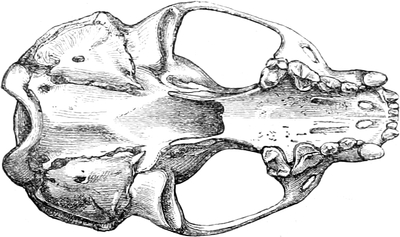
UNDER VIEW OF SKULL OF COMMON OTTER. (After
Coues.)
We now come to the most thoroughly aquatic of the Fissipedia, the
sub-family of Otters, animals which, although quite capable of active
and unembarrassed movement on land, are yet thoroughly at home only in
the water. In accordance with this mode of life, the toes are webbed,
and provided with very short claws, and the tail is long, tapering,
and flattened, so as to serve the precise purpose of the corresponding
appendage in a fish. The length of the head and body is about two
feet, that of the tail, one foot five inches. The fur is of a soft
brown colour, becoming lighter on the under side of the throat and
the breast, and consists of long, coarse, shining hairs, with a short
under-fur of fine texture, well calculated to preserve equality of
temperature as the animal resorts alternately to land or water. The
skull is greatly elongated, and flattened from above downwards; the
facial part of it is small, as compared with the brain-containing or
cranial part. The region of the skull between the eyes is very narrow,
and its floor is wide and thin. In all these points, save the first
mentioned, the skull of the Otter approaches that of the Seal. As
to the teeth, there is one premolar less on each side of the lower
jaw than in the Martens,[188] and both molars and premolars have
sharp-pointed cusps, quite like those of the other Mustelidæ.
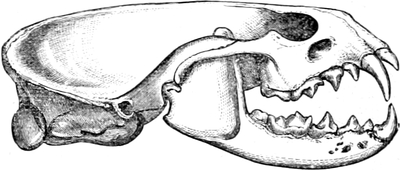
SIDE VIEW OF SKULL OF COMMON OTTER. (After
Coues.)
The habits of the Otter are so entirely aquatic, that in the good
old times it was thought to be a sort of cross between a beast and a
fish, just as the Bat was thought to be intermediate between a beast
and a bird. So deeply rooted was this opinion that the Otter’s flesh
was considered quite fishy enough to be eaten by devout Catholics on
fast days. To this Izaak Walton alludes in a well-known passage in his
“Complete Angler.”
“Piscator. ‘I pray, honest huntsman, let me ask you a pleasant
question: do you hunt a beast or a fish?’
“Huntsman. ‘Sir, it is not in my power to resolve you; I leave it
to be resolved by the College of Carthusians, who have made vows
never to eat flesh. But I have heard the question hath been debated
among many great clerks, and they seem to differ about it, yet most
agree that her tail is fish; and if her body be fish too, then I
may say that a fish will walk upon land.’”
The movements of the Otters in water are marvellous. They swim about in
families, performing the most astonishing pranks, from mere exuberance
of spirits and excess of energy. Nothing can give a better idea of
their activity, than the description of them in that most delightful of
natural history books and fairy tales, “Water Babies.”
“Suddenly Tom heard the strangest noise up the stream; cooing, and
grunting, and whining, and squeaking, as if you had put into a bag two
Stock Doves, nine Mice, three Guinea-pigs, and a blind puppy, and left
them there to settle themselves and make music. He looked up the water,
and there he saw a sight as strange as the noise; a great ball rolling
over and over down the stream, seeming one moment of soft brown fur,
and the next of shining glass: and yet it was not a ball; for sometimes
it broke up and streamed away in pieces, and then it joined again; and
all the while the noise came out of it louder and louder.
“Tom asked the Dragon-fly what it could be: but, of course, with his
short sight, he could not even see it, though it was not ten yards
away. So he took the neatest little header into the water, and started
off to see for himself; and, when he came near, the ball turned out
to be four or five beautiful creatures, many times larger than Tom,
who were swimming about, and rolling, and diving, and twisting, and
wrestling, and cuddling, and kissing, and biting, and scratching,
in the most charming fashion that ever was seen. And if you don’t
believe me, you may go to the Zoological Gardens (for I am afraid
that you won’t see it nearer, unless, perhaps, you get up at five in
the morning, and go down to Cordery’s Moor, and watch by the great
withy pollard which hangs over the back-water, where the Otters breed
sometimes), and then say, if Otters at play in the water are not the
merriest, lithest, gracefullest creatures you ever saw.”
The Otter makes a sort of nest in hollows in the banks of the river
in which it lives, but does not, as is sometimes stated, construct
complicated burrows: its claws, indeed, are too weak for any such work.
It usually confines itself to rivers, but is sometimes found on the
sea-shore.
Otter hunting was formerly a very favourite sport. It was conducted
with a special breed of Dogs—the Otter-hound—(see p. 141), and the
spear was used for killing the animal when brought to bay.
Otters are quite capable of domestication, and may be taught to catch
fish for their masters. For this purpose they must be caught young,
and gradually brought to live upon bread and milk. When this end is
attained, they are taught to fetch and carry, like a Dog—first sticks,
&c., then a stuffed fish, then a dead one. When this part of their
education is perfect, and they make no attempt to mangle the fish given
to them, they are sent into the water to catch living fish. Otters
are trained for this purpose in India, and also in China, where they
are used by the fishermen of the Yang-tse-kiang. Mr. J. Thomson[189]
says:—“We noticed men fishing with trained Otters in this part of the
river. There were a number of boats, and each boat was furnished with
an Otter tied to a cord. The animal was thrust into the water, and
remained there until it had caught a fish; then it was hauled up, and
the fisherman, placing his foot upon its tail, stamped vigorously until
it had dropped its finny prey.”
There is one peculiar habit of the Canadian Otter[190] which is worthy
of mention. “Their favourite sport is sliding, and for this purpose
in winter the highest ridge of snow is selected, to the top of which
the Otters scramble, when, lying on the belly, with the fore-feet
backwards, they give themselves an impulse with their hindlegs, and
swiftly glide head foremost down the declivity, sometimes for the
distance of twenty yards. This sport they continue apparently with the
keenest enjoyment until fatigue or hunger induces them to desist.”
In the Margined-tailed Otter[191] the skull characters, which we have
mentioned as distinctive of Otters, especially the narrowness of the
region between the eyes, and the shortness of the nasal region, are
so exaggerated, that the animal approaches towards the Sea Otter, of
which we shall speak next. The Margined-tailed Otter, which is found in
Brazil and Surinam, derives its name from a longitudinal ridge on each
side of its conical tail. The fur is of a bright bay-brown colour, both
above and below.
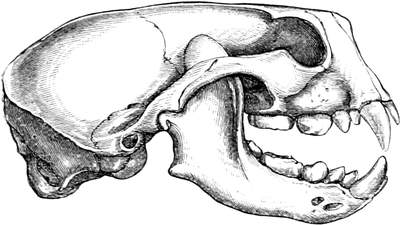
SIDE VIEW OF SKULL OF SEA OTTER. (After
Coues.)
This interesting animal differs in many important respects from
the Common Otter, and in all such points shows an approximation to
the structure of the Seals. It is a large animal, about three feet
long, not counting the tail, which is about a foot more. Its fur is
dark brown, both on the upper and lower surfaces, and presents a
frosted or silvered appearance, owing to the fact that the long stiff
hairs, which differ greatly from those of the under-fur, are grey or
colourless at the tip. The head is very short, the snout naked; the
eyes extremely small, and placed low down on the sides of the head,
and the whiskers are short, but stout and stiff, and mostly directed
downwards; altogether there is something very Seal-like about the face.
The fore-limbs and feet are small, the paws rather Cat-like in their
rounded form, and the claws are quite hidden by the hair. The hind
feet, on the other hand, are flat and expanded, being no less than six
inches long by four broad, and webbed like a Duck’s feet, or a Seal’s
flippers; they differ, however, from the Seal’s, in the fact that the
toes increase in length from the inner to the outer side; both above
and below they are covered with dense fur, which quite hides the short,
stout claws. The skull is, both in its cranial and facial portions,
much shorter in comparison with its width than in the ordinary Otters;
its base is extremely broad, and both upper and lower jaws bear on each
side only eight teeth, so that there are altogether thirty-two teeth,
or four less than in the Common Otter.[193] This diminution in number
is brought about, as will be seen from the formula below, by reducing
the upper premolars from four to three, and the lower incisors from
three to two on each side. The form of the grinders differs altogether
from what we have found, not only in the Mustelidæ, but in all the Land
Carnivores. Their grinding surfaces present no sharp cusps, or jagged
cutting edges, as in most Carnivorous forms; neither are they provided
with numerous small tubercles and ridges, as in the Bears; but the
surface of each is raised into a small number of rounded eminences,
reminding one of the “roches moutonnées” of a glacial district, or, as
Dr. Coues remarks, differing from the teeth of ordinary Carnivores, as
water-worn pebbles differ from fresh-chipped angular pieces of rock.
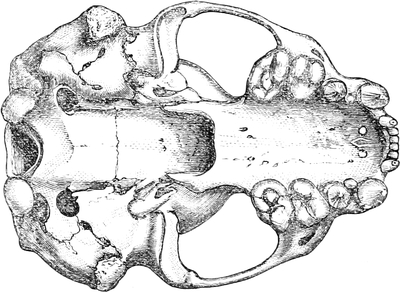
UNDER VIEW OF SKULL OF SEA OTTER. (After
Coues.)
The Sea Otter is found in the North Pacific, chiefly in the regions of
Kamstchatka and Alaska, and extends as far south as California.
Like the Seal, the Sea Otter is gregarious, being often found “in bands
numbering from fifty up to hundreds. When in rapid movement, they make
alternate undulating leaps out of the water, plunging again as do
Seals and Porpoises. When in a state of quietude, they are much of the
time on their backs. They are frequently seen in this posture, with
the hind flippers extended, as if catching the breeze to sail or drift
before it. They live on Clams, as well as Crabs and other species of
Crustacea; sometimes small fish. When the Otter descends and brings up
any article of food, it instantly resumes its habitual attitude on the
back to devour it. On sunny days, when looking, it sometimes shades its
eyes with one fore paw, much in the same manner as a person does with
the hand.”[194] This curious habit, as we have seen, is adopted also
by the Glutton. The supine position is so habitual that the females
actually sleep in the water on their backs, with the young ones clasped
between their fore paws. While in this position, too, the Otter will
toss a piece of sea-weed backwards and forwards from paw to paw, like a
ball, and the mother play with her offspring for hours together.
The fur is very valuable, and the animal is consequently hunted
regularly; so regularly, that there is every possibility of the species
becoming speedily extinct unless some check is put upon the chase. For
taking some action in the matter, there is the further reason that the
natives of the Aleutian Isles, the chief resort of the animal, are
dependent on its hunting for their subsistence, and it has been shown
that the people have diminished in numbers coincidently with the Otters.
“There are four principal methods of capturing the Sea Otter, namely,
by surf-shooting, by spearing-surrounds, by clubbing, and by
nets.”
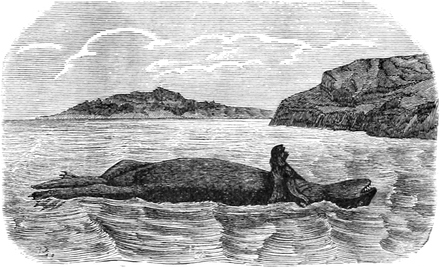
FEMALE SEA OTTER SWIMMING ON HER BACK WITH YOUNG IN
HER ARMS. (After Steller.)
“The surf-shooting is the common method, but has only been in vogue
among the natives a short time. The young men have nearly all been
supplied with rifles, with which they patrol the shores of the island
and inlets, and whenever a Sea Otter’s head is seen in the surf, a
thousand yards out even, they fire, the great distance and the noise of
the surf preventing the Sea Otter from taking alarm until it is hit;
and in nine times out of ten, when it is hit in the head, which is all
that is exposed, the shot is fatal, and the hunter waits until the surf
brings his quarry in, if it is too rough for him to venture out in his
‘bidarkie.’ This shooting is kept up now the whole year round.
“The spearing-surround is the orthodox native system of capture, and
reflects the highest credit upon them as bold, hardy watermen. A party
of fifteen or twenty bidarkies with two men in each, as a rule, all
under the control of a chief elected by common consent, start out in
pleasant weather, or when it is not too rough, and spread themselves
over a long line, slowly paddling over the waters where the Sea Otters
are most usually found. When any one of them discovers an Otter asleep,
most likely, in the water, he makes a quiet signal, and there is not a
word spoken or a paddle splashed while they are on the hunt. He darts
towards the animal, but generally the alarm is taken by the sensitive
object, which instantly dives before the Aleut can get near enough to
throw his spear. The hunter, however, keeps right on, and stops his
canoe directly over the spot where the Otter disappeared. The others,
taking note of the position, all deploy and scatter in a circle of
half a mile wide round the point of departure thus made, and patiently
wait for the re-appearance of the Otter, which must take place within
fifteen or thirty minutes, for breath; and as soon as this happens the
nearest one to it darts forward in the same manner as his predecessor,
when all hands shout and throw their spears, to make the animal dive
again as quickly as possible, thus giving it scarcely an instant to
recover itself. A sentry is placed on its second diving-wake as before,
and the circle is drawn anew; and the surprise is often repeated,
sometimes for two or three hours, until the Sea Otter, from interrupted
respiration, becomes so filled with air or gases that he cannot sink,
and becomes at once an easy victim.
“The clubbing is only done in the winter season, and then at infrequent
intervals, which occur when tremendous gales of wind from the
northward, sweeping down over Saanach, have almost blown themselves
out. The natives, the very boldest of them, set out from Saanach, and
scud down on the tail of the gale to the far outlying rocks, just
sticking out above surf-wash, where they creep up from the leeward to
the Sea Otters found there at such times, with their heads stuck into
the beds of kelp to avoid the wind. The noise of the gale is greater
than that made by the stealthy movements of the hunters, who, armed
with a short, heavy, wooden club, dispatch the animals one after
another without disturbing the whole body, and in this way two Aleuts,
brothers, were known to have slain seventy-eight in less than an hour
and a half.”
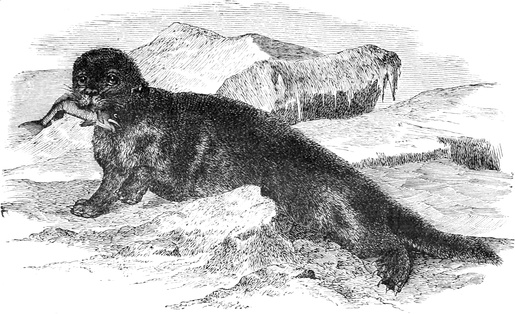
SEA OTTER.
The nets used by the Atka and Attore Aleuts “are from sixteen to
eighteen feet long, and six to ten feet wide, with coarse meshes made
nowadays of twine, but formerly of sinew. On the kelp-beds these nets
are spread out, and the natives withdraw and watch. The Otters come
to sleep or rest on these places, and get entangled in the meshes of
the nets, seeming to make little or no effort to escape, paralysed, as
it were, by fear, and fall in this way easily into the hands of the
trappers, who have caught as many as six at one time in one of these
small nets, and frequently get three.... No injury whatever is done to
these frail nets by the Sea Otters, strong animals as they are; only
stray Sea Lions destroy them.... The salt water and kelp seem to act as
a disinfectant to the net, so that the smell of it does not repel or
alarm the shy animal.”[195]
From very obvious reasons we have been compelled to describe the
various forms of Land Carnivora of which we have been able to take
account, one by one, beginning with Cats, and ending with the
Otters. But the reader will already have discovered that a linear
arrangement like this gives no true conception of the relations
existing between the various families of which the sub-order is
composed, or of the various genera which are included in the families.
For cross-relationships of the most puzzling and often complicated
description are perpetually turning up: among the Æluroids, for
instance, we found Cryptoprocta to be intermediate between Cats and
Civets, and yet, if we had followed the order indicated by this
relationship, we should have had to ignore the close connection between
Cats and Hyænas, and that between Hyænas and Civets, through the
intermediation of the Aard Wolf.
It is necessary, then, to devise some method of writing down the
names of the families, other than that of placing them one under the
other, if we are to get anything like a clear notion of their mutual
relationships. The method adopted by Professor Flower is perhaps the
most convenient, and following him, we arrange the groups thus:—
CRYPTOPROCTIDÆ.
PROTELIDÆ.
CANIDÆ.
PROCYONIDÆ.
AILURIDÆ.
In this scheme we see an expression of the fact that the Dogs
(Canidæ) form a central group, from which the families of the
Æluroidea—those to the left—diverge in one direction, and the
families of the Arctoidea—those to the right—in the other direction.
The Civets (Viverridæ) and the Weasel family (Mustelidæ), being
the least modified of the Æluroid and Arctoid sections respectively,
are placed at the bottom of the table, the Cats (Felidæ) and Bears
(Ursidæ), being the most modified, are placed at the top. The two
latter families, again, are placed at opposite extremities of the
table, as far from one another as possible, to indicate the great gap
which separates the digitigrade, short-skulled, active, carnivorous
Cats, from the plantigrade, long-skulled, clumsy, herbivorous Bears.
To be quite accurate, such a scheme should take account not merely of
families, but of genera: in our table, for instance, there is nothing
to show the immense amount of specialisation undergone by one section
of the Mustelidæ—the Otters—to fit them for aquatic life; but such
a detailed arrangement is quite beyond the scope of the present work.
In considering the chief forms of Carnivora existing at the present
day, we have by no means exhausted this varied and interesting group,
for a number of its members, the forerunners of those now living, have
vanished from the face of the earth, and are known to us only by their
bones, which we find here and there entombed in the strata of which the
crust of our earth is composed.
In the newest, that is the most recently deposited, set of strata,
those which together form the beds of the Pleistocene period, we find
a very curious change in the flesh-eaters inhabiting England. Instead
of having nothing but Wild Cats, Wolves, and Bears—the only wild
beasts known to have existed in the historical period—we have the
enormous Cave Lion (Felis spelæa), besides the Cave Bear (Ursus
spelæus), and the Cave Hyæna (Hyæna spelæa), the last being merely
a variety of the Spotted Hyæna (Hyæna crocuta) of the present day.
The presence of the first and last of these would seem to indicate that
the climate of Britain was warmer in the Pleistocene period than it now
is; but the presence of the Glutton, as well as of some non-carnivorous
Arctic animals, tends to the other opinion, namely, that the climate
of England was sub-Arctic. Very probably the Cave Lion and Hyæna were
provided with thick woolly fur, and so, like the Mantchurian Tiger and
the Northern Leopard (see pp. 34 and
42), enabled to bear a degree of
cold experienced by but few of their relatives at the present day.
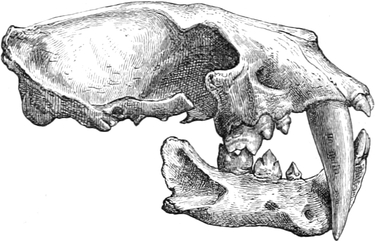
SKULL OF MACHÆRODUS. (After Gaudry.)
In beds of the same age in South America is found a true Cheetah,
a species now confined to the Old World. But the most wonderful
animal belonging to this period is the great Sabre-toothed Tiger
(Machærodus), a gigantic animal, with canines six or eight inches
long, and jagged at their edges like a very fine saw. It would almost
seem as if Dame Nature, in producing this terrible beast, had actually
got to the end of her tether in the matter of specialisation for
carnivorous habits; the canines of Machærodus were so long that he
must have had some difficulty in opening his mouth sufficiently wide
to take in anything large, and thus it would seem that he actually
overshot the limit of perfection, and died of over-specialisation.
The canines of the Sabre-toothed Tiger are, however, not its only
peculiarity: there is one less premolar on each side of the upper jaw
than in the modern members of the Cat family, so that the total number
of teeth is reduced to twenty-eight,[196] the smallest number found in
any of the Carnivora.
On descending to the rocks of Pliocene age, we find, amongst many
forms existing at the present day, an animal called Galecynus,
about the size of the Fox, and possessing many characters, in its
teeth, limbs, &c., intermediate between those of the Dogs and those of
the Civets. Another genus, Hyænarctos, is almost exactly half-way
between Dogs and Bears; its molars have less of a cutting character
than a Dog’s, and less of a grinding character than a Bear’s, and its
front premolars, though much smaller than a Dog’s, do not fall out
altogether, as in the Bear.
In the Pliocene, or Late Miocene strata, remains have been found of
many existing genera, such as Cats, Civets, Hyænas, Dogs, Weasels,
Ratels, and Otters; but amongst these are several genera not occurring
in any of the more recent strata, and all, or nearly all, tending
to bridge over the gaps which separate existing families from one
another. For instance, a perfect gradation between the Hyænas and
Civets is afforded by two genera, Hyænictis and Ictitherium; while
Lutrictis shows affinities both with Civets and Otters, Hemicyon
with Dogs and Gluttons, and Dinictis with Cats and Weasels. Another
very interesting genus, Promephitis, belongs undoubtedly to the
Weasel family, but is intermediate between its three sub-families,
the Weasels proper, Badgers, and Otters. Simocyon, again, an animal
about the size of a Leopard, is described as having the canines of a
Cat, the molars of a Dog, and jaws shaped like those of a Bear. Lastly,
Amphicyon is a large plantigrade animal, Bear-like for the most part,
but with trenchant molars, like a Dog’s, and having a small additional
or third molar on each side of the lower jaw, the number of its teeth
being thus brought up to that which may be called the typical Mammalian
number, namely, forty-four.[197]
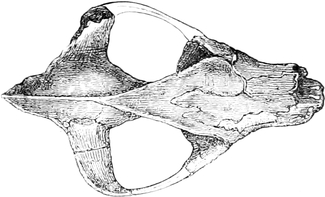
SKULL OF ARCTOCYON. (After Gaudry.)
In the Eocene, or Lower Tertiary, still more remarkable forms occur,
along with several genera existing at the present day, such as the
Cryptoprocta, Civet, Dog, and Marten, all of which are found in the
upper or more recent strata of the Eocene formation. But lower down the
genus Cynodon also connects Dogs with Civets; and in the very lowest
beds occurs a large plantigrade animal (Arctocyon), with a very small
brain-case, wide jugal arches, a complete set of forty-four teeth, and
altogether of a generalised character. In the Eocene of North America,
Limnocyon and Prototomus occur low down, and in the Middle Eocene
a form as large as a Lion has been discovered, to which the name
Limnofelis has been given, and also Orocyon, and some allies of the
Hyænodon.
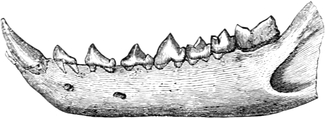
LOWER JAW OF HYÆNODON. (After Gaudry.)
But we have not yet learned all that Palæontology can teach us about
the history of the Carnivora. In the Eocene and Lower Miocene beds
are found animals referred to the genera Hyænodon, Pterodon,
Palæonictis, and Proviverra which, not content with trespassing on
the boundaries between existing families, actually wander outside the
Carnivorous order altogether, and approach so nearly to the Marsupials
(Kangaroos, Opossums, &c.) that many competent anatomists have proposed
to place them in the latter group. The premolars and molars in these
extinct animals have sharp cusps, and increase gradually in size from
before backwards; so that, of the whole grinding series, the first
premolar is the smallest, and the last molar the largest. Now we have
seen that the rule among existing Carnivora is for the last molar to
be a small tooth, and for the largest of the set to be the fourth
premolar in the upper jaw, and the first molar in the lower jaw. On
the other hand, the regular increase in size is very characteristic of
the flesh-eating Marsupials, amongst which the Thylacine, or so-called
Tasmanian Wolf, shows a considerable resemblance, as to its teeth, to
Hyænodon and Pterodon, while Palæonictis and Proviverra are
more nearly allied to the Opossums and to the Dasyure, or Tasmanian
Devil. The brain-case in these forms was very small, and a cast of the
interior of the skull of Proviverra, figured by M. Gaudry,[198] shows
that the brain must have had an extremely low character.
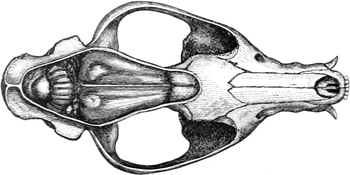
SKULL OF PROVIVERRA. (After Gaudry.)
The roof of the skull is supposed to be cut away to
show the form of the brain, as deduced from a natural cast of the
interior of the skull.
We thus see that a considerable number of the existing genera
of Carnivora took their origin in the Eocene epoch, where they
co-existed with creatures curiously intermediate between the various
existing families, and with others intermediate between Carnivora and
Marsupials. In the rocks of the Secondary period (chalk, oolite, lias,
&c.), none of the Carnivora have as yet appeared, and only Marsupial
remains are found.
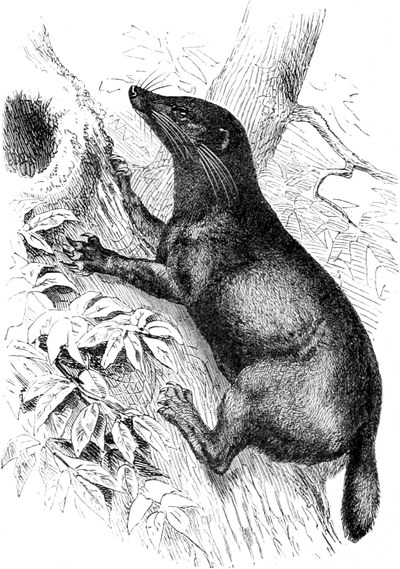
CYNOGALE.
Although in all essential respects a true Viverrine, the Cynogale, or
Mampalon, differs very considerably in external appearance from all
the members of the family we have hitherto considered. It has none of
a Civet’s lithe and slender appearance, but is stout and plump. Its
tail is very short, not more than six inches long, or a quarter the
length of the head and body, which together attain length of about two
feet. The snout is long and pointed, the muzzle bald, and the ears very
short; the whiskers are decidedly extensive in their development, for
besides the usual hairs on the snout, there are two large bundles of
long bristles on the cheeks, one a little in front of and below the
eye, the other in front of the ear. The limbs are short and stout,
and the digits are five in number, slightly webbed at the base, and
provided with short, retractile claws. The close thick fur is of a
yellowish-brown colour, lighter on the under side of the head, and over
the eyes, and darker on the legs. The mode of progression is nearly
plantigrade.
There is not much known of the habits of the Cynogale, except that it
frequents the neighbourhood of water, and is also a good climber. It is
found in the island of Borneo.
This animal, a near relative of the Ichneumons, is found in South
Africa, where it is represented by three species. The head and body
attain a length of about half a yard; the tail of about a foot. The
pelage is smooth, of a reddish colour, darker on the head and limbs;
the tail is bushy, of a greyish colour, and tipped with white. There
are five toes on the fore foot, three on the hind foot.
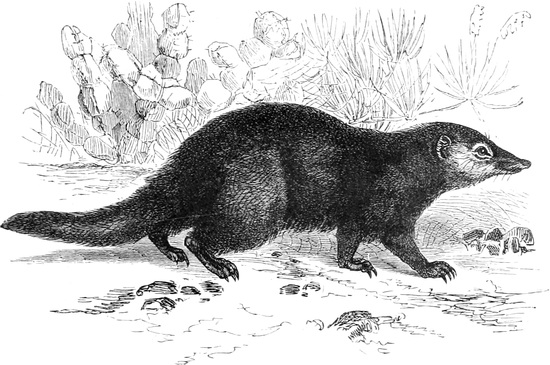
MANGUE.
The Crossarchus, Mangue, or Kusimanse, presents a good deal of
resemblance to the Cynogale, but differs from it in having rough fur
and a comparatively long tail. It is also a much smaller animal, not
exceeding fourteen or fifteen inches in length from snout to root of
tail, which latter appendage is about eight inches in length. The
body is thick and stout; the fur brown, becoming lighter on the head;
the ears are short, and the snout is long and flexible, projecting
some distance beyond the mouth, somewhat like that of the Coati. The
secretion of the tail glands is very fetid.
The single species of Crossarchus is found in tropical Africa. Very
little is known of its habits in a wild state; in captivity it soon
becomes tame, and seems to prefer animal to vegetable food.
This is a South African species, and, as in the case of the last two
forms, little or nothing is known of its habits in a state of nature.
It is about the size of the Crossarchus, the body and head attaining
a length of about thirteen, the tail of about six inches. The body is
of a greyish-brown colour, marked along the back with yellowish-grey
transverse stripes. There is a black patch round the eye, bordered by
a lighter area, and the ears and the end of the tail are also black.
As in the Cynogale, the head is rounded, the snout long, and the ears
short. The legs are much longer than in either of the preceding genera,
and the feet are distinguished by being provided with only four instead
of five toes. The claws are very long and curved, and, as might be
judged from this, the animal is addicted to burrowing.
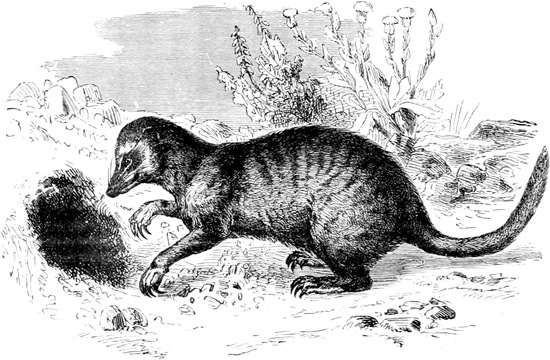
SURICATE.
There are several of these pretty little animals in the Zoological
Gardens, where their innocent faces and quiet ways distinguish them
very favourably from their relatives, the Ichneumons, which are
perpetually quarrelling in the most outrageous fashion.
WILLIAM
KITCHEN
PARKER.
THOMAS
JEFFERY
PARKER.
ORDER UNGULATA (HOOFED QUADRUPEDS). — CHAPTER I. PERISSODACTYLA—THE EQUIDÆ, OR HORSE FAMILY. — SUB-ORDER PERISSODACTYLA. — FAMILY I.—EQUIDÆ, THE HORSE-TRIBE. — THE FOSSIL EQUIDÆ. — CHAPTER II. PERISSODACTYLA—THE TAPIR AND RHINOCEROS FAMILIES. — II.—THE TAPIRIDÆ (FAMILY OF TAPIRS). — III.—THE RHINOCEROS FAMILY (RHINOCEROTIDÆ). — THE AFRICAN RHINOCEROSES. — THE ASIATIC RHINOCEROSES. — THE FOSSIL RHINOCEROSES. — THE EXTINCT FAMILY PALÆOTHERIDÆ. — CHAPTER III. ARTIODACTYLA—THE PIG OR HOG FAMILY. — SUB-ORDER ARTIODACTYLA. — I.—SUIDÆ, OR HOG FAMILY. — CHAPTER IV. ARTIODACTYLA—THE HIPPOPOTAMUS FAMILY. — II.—THE HIPPOPOTAMUS FAMILY (HIPPOPOTAMIDÆ). — THE ANOPLOTHERES (ANOPLOTHERIDÆ).
KIANG, OR WILD ASS OF TIBET.
THE hoofed quadrupeds are so called because they possess hoofs, from
which fact the order Ungulata takes its name,[260] and they include
animals of widely different appearance, such as the Horse, Rhinoceros,
Giraffe, Camel, and the like. They are classified into two sub-orders,
according to the odd or even number of toes, those having an odd number
on the hind foot being termed the Perissodactyla,[261] such as the
Horse, Tapir, and Rhinoceros; and the Artiodactyla,[262] or animals
with an even number of toes on their hind feet, such as the Pig,
Hippopotamus, Sheep, Ox, Deer, and the like. All the animals belonging
to the order feed upon vegetables, with the exception of the Pig and
Peccary, which are omnivorous; and none of them are provided with
sharp-edged cutting back teeth, adapted for dividing flesh, such as are
found in the Carnivora—Lions, Tigers, Wolves, and Hyænas. The odd-toed
Ungulates come first.
The odd-toed animals consist of three living families—(1) The Equidæ,
or Horses; (2) the Tapiridæ, or Tapirs; (3) the Rhinocerotidæ, or
Rhinoceroses; and two extinct families—(1) the Palæotheridæ, or
Palæotheres (παλαιός, old; θηρίον, beast); and (2) the Macraucheniadæ
(μακρός, long; αὐχήν, neck). In all the animals belonging to the group,
the number of dorso-lumbar vertebræ is not fewer than twenty-two,
the third or middle digit of each foot is symmetrical, the femur or
thigh-bone has a third trochanter, or knob of bone on the outer side,
and the two facets on the front of the astragalus or ankle-bone are
very unequal. When the head is provided with horns, they are skin-deep
only, without a core of bone, and they are always placed in the middle
line of the skull, as in the Rhinoceros.
In the Perissodactyla the number of toes is reduced to a minimum.
Supposing, for example, we compare the foot of a Horse with one of
our own hands, we shall see that those parts which correspond with
the thumb and little finger are altogether absent, while that which
corresponds with the middle finger is largely developed, and with its
hoof, the equivalent of our nail, constitutes the whole foot. The small
splint bones, however, resting behind the principal bone of the foot
represent those portions (metacarpals) of the second and fourth digits
which extend from the wrist to the fingers properly so called, and are
to be viewed as traces of a foot composed of three toes in an ancestral
form of the Horse, which we shall discuss presently. In the Tapir,
the hind foot is composed of three well-developed toes, corresponding
to the three middle toes in man, and in the Rhinoceros both feet are
provided with three toes formed of the same three digits. In the
extinct Palæotherium also, the foot is constituted very much as in the
Rhinoceros.
TARPAN.
The Equidæ, or Horse-tribe, comprise several living and many extinct
species. Three living members are restricted, in a state of nature, to
Asia and Africa, and are divided into the true Horses, which have horny
patches or callosities on the inner sides of both pairs of limbs—above
the wrist in the fore, and on the inner side of the metatarsus on the
hind limbs—and the Asses, which possess such callosities only on the
fore-limb. With the latter are classed the Zebras and the Quaggas.
All the existing and some of the extinct members of the family, are
characterised by the feet being formed of one perfectly developed digit
or toe only, the others being present in a rudimentary shape as the
splint-bones. In the extinct Hipparion, however, and Anchithere, as we
shall see presently, the accessory toes are well developed.
WILD HORSE OF TARTARY.
The true Horses are represented by one well-established species,
Equus caballus, from which all the other races, or varieties, are
descended, by a process of selection under the care of man, and these
vary in size, proportion of parts, and colour, as much as any two
closely-allied species of wild animals can be said to be defined from
each other. According to Mr. Darwin, no aboriginal or truly Wild Horse
is positively known to exist, for the Wild Horses of the East may
probably be descended from those which have escaped from the service
of man. In all probability the wild animal has been exterminated by
the hand of man in those countries which it formerly inhabited, and in
which it has left its remains to attest its former presence.
The Tarpan and Wild Horse of Tartary, which are to be found in
thousands in the great treeless plains, present us with the nearest
examples of the stock from which the Domestic Horses were probably
derived. Their colour is mouse-coloured, with a stripe along the back.
The best and strongest of these are caught by the Tartars by the aid of
the lasso, and by the help of Falcons, which are trained to settle on
the Horse’s head, and flutter their wings, so as to take its attention
away from the approaching hunter.
The first Domestic Horses known in Europe were introduced at a very
early period, long before the dawn of history, in the period known by
the archæologists as that of polished stone, or that in which man had
not yet acquired a knowledge of the metals bronze or iron. They are met
with in the ruins of those wonderful pile dwellings, which lie at the
bottom of the Swiss lakes, in association with the remains of the Pig,
Sheep, Goat, Short-horned Ox, large Ox of the Urus type, and Dog, and
evidently belonged to a race of farmers, by whom they were introduced
into Europe. Bones occur in the camps, sepulchres, and habitations of
this age, throughout the whole of the Continent, and of Great Britain
and Ireland. In all probability they were used at this time not for
riding or for driving, but for food. In the succeeding, or bronze age,
however, they were employed for purposes of riding, as may be seen from
the discovery of the bronze bits, which have been met with in France
and Italy. They were probably introduced by a race of nomads, who no
doubt brought Horses with them from the steppes of Central Asia.
According to Colonel Hamilton Smith, “so little is known of the
primitive seat of civilisation—the original centre, perhaps, in
Bactria, in the higher valleys of the Oxus, or in Cashmere, whence
knowledge radiated to China, India, and Egypt—that it may be surmised
that the first domestication of the post-diluvian Horse was achieved
in Central Asia, or commenced nearly simultaneously in several regions
where the wild animals of the Horse form existed.”
The Horse was universally used for food by man before the historic
period, and would be used now in Europe more generally than it is, were
it not for an edict of the Church in the eighth century. During the
Roman occupation of Britain, it formed a large part of the diet of the
inhabitants; by the Scandinavians it was eaten in honour of Odin. As
Christianity prevailed over the heathen worship, it was banished from
the table. It appears, however, that it was used in England as late
as the year 787, after it had been prohibited in Eastern Europe. The
ecclesiastic rule, however, was not always obeyed, for the monks of St.
Gall, in Switzerland, not only ate Horse-flesh in the eleventh century,
but returned thanks for it in a metrical grace, which has survived to
our times on account of its elegance and beauty.
It is somewhat remarkable that the Horse is, with few exceptions,
mentioned in the Bible only in connection with war, and that there is
a wonderful absence of detail with regard to its nature and habits
otherwise than for the purposes it served in battle. That the Horse
spoken of in Scripture was nearly identical with the Arab Horse of
to-day there can be little doubt, if we examine the various sculptures
and paintings which are handed down to us, and which speak of the faded
glories of Egypt and Assyria. The first account we have of the Horse
is during the famine in Egypt that was foretold by Joseph, and here we
find that it was evidently an Egyptian animal. “And they brought their
cattle unto Joseph; and Joseph gave them bread in exchange for Horses,
and for the flocks, and for the cattle of the herds, and for the Asses;
and he fed them with bread for all their cattle for that year.”
The courage and fiery nature of the Arab Horse, particularly fitting it
for use in the wars of ancient times, were evidently well understood.
In the Book of Job (xxxix. 19–25) we read:—“Hast thou given the Horse
strength? hast thou clothed his neck with thunder? Canst thou make
him afraid as a grasshopper? the glory of his nostrils is terrible.
He paweth in the valley, and rejoiceth in his strength: he goeth on
to meet the armed men. He mocketh at fear, and is not affrighted;
neither turneth he back from the sword. The quiver rattleth against
him, the glittering spear and the shield. He swalloweth the ground
with fierceness and rage: neither believeth he that it is the sound of
the trumpet. He saith among the trumpets, Ha, ha! and he smelleth the
battle afar off, the thunder of the captains, and the shouting.”
The Hebrews in the patriarchal age did not require Horses, and for a
long time after their settlement in Canaan did not use them, probably
partly on account of the nature of the country, which was hilly, and
partly because they were prohibited on account of their hostility to
the Egyptians. The Horses of the kings David and Solomon were derived
from Egypt. In the reign of the latter, a Horse was worth 150 shekels
of silver, and a chariot six hundred. The former was the first to
establish a force of cavalry and chariots.
From the very earliest ages known to the historian in Egypt and
Assyria, Horses were used for purposes of war, and were yoked in pairs,
and sometimes in threes, to the war-chariots in which the kings and
great captains rode. They are generally depicted as being of upright
or Hog manes. Horsemen were also employed by both nations, but they
were evidently not thought so important as Horses and chariots for
warlike purposes.
In the earlier period of Greek history, and in Homeric times, the art
of riding was utterly unknown to the Greeks, for if a man was seen on
horseback he was supposed to be a Centaur. Down to 500 B.C.
riding was not practised by the Greeks, although it was well known
to the Barbarians. As we get close to the year mentioned, we hear
of Persian cavalry; for instance, the great question with regard to
the battle of Marathon (490 B.C.) is, What were the Persian
cavalry doing? And at the same period we find that cavalry had become
an important arm in Northern Greece. Throughout all the times of Greek
pre-eminence, Horses were mainly used for the purpose of the chariot.
The utmost care and attention were devoted to their breeding, and the
greatest expense incurred in the maintenance of a stud, which was a
luxury possible only to the very richest persons, and almost entirely
beyond the means of private individuals. The greatest horsekeepers, and
consequently winners in the chariot-races, were almost entirely princes
and ruling families.
After 450 B.C. we begin to hear of riding and of cavalry in
Greece proper, side by side with charioteers. Books were written on the
art, one of which, from the pen of Xenophon, is still extant.
The case is totally different when we turn to the history of Rome
during the same period. In the early regal times, and in the first
centuries of the Republic, cavalry was the most important arm of the
military service. It was naturally composed of the aristocracy, who
alone could bear the expense of a Horse. It was only when a rich middle
class had sprung up, and were denied the aristocratic privilege of
serving on horseback, that the heavy-armed infantry, which in later
times won all the great Roman victories, came first into existence. As
they increased, the cavalry decreased in importance, and the typical
Roman soldier was what was called in mediæval times a man-at-arms.
The native breeds of Horses in Britain, before the Roman conquest,
are known to us merely from a reference to them by Cæsar, that they
were powerful and well suited for purposes of war by their stature and
training. They were used in the battles of the Romans, yoked to the
chariots. They were evidently considered of great importance, since
they appear on some of the early British coins—as, for example, those
of Cunobelin. After the conquest of Britain by the Angles, Jutes, and
Saxons, the Horses demanded more attention than before. Athelstan
thought the preservation of the native breed of sufficient importance
to call for a legal enactment to prevent the export of Horses,
excepting as presents. Saddle-horses were employed, according to the
testimony of Bede, in England in the early part of the seventh century,
and from the notices in the Anglo-Saxon Chronicle it is evident that
they were frequently used by the Danes for purposes of transport from
one part of the country to another; and in the song of the fight of
Maldon, we read of Goderic flying from the field on a Horse, on which
his lord had ridden down to the battle.
The first attempt on record to improve the native breed, by the
introduction of foreign blood, was by the importation of “running
Horses” from Germany in the time of Athelstan; in whose reign also
many Spanish Horses were imported. William the Conqueror, who owed his
success in the Battle of Hastings to his cavalry, paid great attention
to the English breed. In his time, Professor Bell tells us, “Roger de
Belesme, Earl of Shrewsbury, imported the elegant and docile Spanish
Horse, and bred from it on his estates in Powisland; and it is recorded
that the Horses of that part of Wales were long celebrated for their
swiftness, a quality which they had doubtless derived from this happy
mixture of blood. The heavy panoply of mail, however, with which the
warriors of this and of succeeding ages at once protected and loaded
both themselves and their steeds, sufficiently attests that the cavalry
must have been mounted on Horses of great strength and size; and there
is no doubt that, until the universal employment of firearms rendered
such a protection in a great measure unavailable, the speed and figure
of the War Horse must have been sacrificed to the qualities of power
and endurance. The beautiful Horses on which many of our light cavalry
regiments are now mounted, although endowed with considerable strength,
would have been crushed beneath the weight of metal by which both the
knight of olden time and his Horse were so heavily laden.”
King John paid great attention to the improvement of the breed for
agricultural purposes; and to him, according to Youatt, we are indebted
for our Draft Horses. He imported no less than a hundred Flanders
stallions, which probably laid the foundation of the strength and size
which are the eminent characteristic of our Horses of war and labour.
Edward III. was a zealous patron of the course, and in his reign
the heavy native breed was crossed with lighter Horses of Spanish
origin, the offspring of the Arabs, which had been introduced by the
Moors. From this time forwards, great pains were taken by the English
sovereigns to improve the breeds; races were regularly established in
various parts of the kingdom, and various enactments were passed to
secure excellence. James I. gave as much as five hundred pounds—an
enormous sum, according to the value of money in those times—for an
Arabian; and in the Protectorate of Cromwell, Horses were introduced
from the south-east and from Morocco, by which beauty of form, and a
degree of swiftness before unknown, were added to the stoutness which
had hitherto characterised English Horses. In the time of Charles II.,
we may remark that the bell, which had hitherto been the prize of
the successful Horse in racing, was exchanged for the cup, which has
continued to be the prize down to the present day.
Mr. Darwin considers that the cause of modification in the forms of
Horses greatly arises from their varying conditions of life; that, for
instance, Horses living in mountainous regions, or on small islands,
become reduced in size from want of a variety of food. Corsica and
Sardinia have native breeds of Ponies; and the Puno Ponies living in
the lofty regions of the Cordilleras are said to be strange little
creatures. But Horses can withstand intense cold, as they live wild
on the plains of Siberia, where they scrape away the snow in order to
get at the herbage underneath. Not only do the wild Tarpans in the
East possess this instinct, but also those that have run wild on the
Falkland Islands, as well as the Horses in North America descended from
those brought into Mexico by the Spaniards.
That the original colour of the Horse was dun may be gathered from
evidence dating as far back as the time of Alexander the Great, and
the wild Horses now in Western Asia and Eastern Europe are of the same
colour. In Hungary and Norway, duns with a stripe down the spine are
considered of an aboriginal colour.
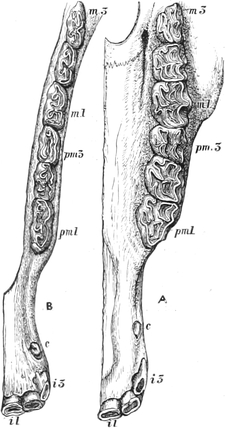
DENTITION OF HORSE.
(A) upper, (B) lower, jaw.
The series of permanent teeth in the Horse consists of three incisors,
one canine, three premolars, and three molars in each jaw, or 40 in
all; and is of great interest. The grinders (or molars and premolars)
are remarkable for their length, the complexity of their pattern, and
for the thick coating of cement which fills up the interspaces of the
folds of enamel. The incisors present a peculiar pattern, which is of
great importance in deciding the age of a Horse. Each is covered with a
layer of enamel, which is folded inwards at the top, after the manner
of the finger of a glove, the top of which has been pulled inwards, as
is seen in the accompanying figure of a vertical section of an incisor
tooth. This hollow is filled with cement, and its state of wear enables
the age of the Horse to be ascertained, constituting “the mark.”
VERTICAL SECTION OF INCISOR OF HORSE.
(After Owen.)
e, enamel; c, cement; a a′,
inverted fold of enamel, &c. (“the mark”).
A Colt when born has usually the first and second molars forced through
the gum, and at seven or eight days old the two central incisor teeth
appear; five or six weeks later, the next two incisors. At three
months, they are equal to the central ones, and both pairs have nearly
reached their natural level. A third grinder has then appeared; and
about the eighth month, the third incisor above and below on each
side. The Colt has now his full complement of incisor teeth—viz.,
six in each jaw. At six months the obliteration is apparent in the
four central incisors; and at a year and a half the mark will be
very faint in the central incisors, and diminished in the other two.
A fourth molar appears at twelve months, and a fifth at two years.
These are all milk or temporary teeth. At about three years old, the
central pair of incisors, or nippers, both in the upper and lower
jaws, are pushed upwards and removed by two permanent teeth, which
take their place, and which are distinguishable from the milk teeth
by their increased size; a three-year-old Colt, therefore, is easily
recognised by the possession of these two new and enlarged incisors.
At three years and a half the second incisors will have given place
to permanent ones; and at four and a half the remaining incisors will
have followed suit. Thus at four years old the central nippers will be
fully grown; the next pair will not have attained their full size, and
the corner temporary incisors will be worn small, and the mark nearly
obliterated. At five years old the mark from the central teeth begins
to be effaced, the next pair fully grown, and the corner pair only
partially grown. Between the fourth and fifth year the canines begin to
appear in the male, two in each jaw; in the female they do not appear
until old age. At six years old the mark on the central nippers is
much diminished, or obliterated. The other incisors will also be worn,
and the canines fully developed. At seven the mark on the next pair
of incisors is nearly gone, and the canines rounded at the point and
edges. At eight the mark disappears from all the incisor teeth, and the
canines are much rounder and blunter. From this time the age of a Horse
is difficult to decide, and the teeth of the upper jaw seem to be the
best guides. In the accompanying figure (B) the incisors of a
Horse aged sixteen years are represented, in which it will be observed
that the oval island of enamel, or “mark,” has been obliterated, and
its place is indicated by a round, dark, island (A), composed
of osteo-dentine, which has been formed within the pulp-cavity of the
tooth. The absence of the fine white crystalline enamel from the centre
of the tooth at once points out the aged Horse from that “in mark,” and
renders all attempts to produce by artificial means the same pattern
impossible, though this trick is by no means unknown or unattempted in
horse-dealing.
INCISORS AND CANINES OF HORSE (B)
AND MARE (A).
BONES OF FORE (1) AND HIND (2) LIMBS OF HORSE.
A, Carpus (knee);
A1, Tarsus (hock); B,
Cannon bone; B1, Splint bone; C,
Greater Posterior; D, Coronet; E,
Coffin bone; F, Navicular.
In the whole anatomy of the Horse there is no organ more beautifully
adapted for the purposes it serves than the foot, and it is well worthy
to be discussed at some length. The foot practically consists of the
three last bones of the limb. The bones are firmly bound together by
ligaments, affording also attachment to the wonderfully strong tendons
by which the foot is moved. A mass of gristle called the lateral
cartilage is placed on each side, and behind the bones is an elastic
pad which is termed the plantar cushion. A fibrous layer is placed
over these, and enveloping the whole is a horny covering known as the
hoof. Immediately below the carpus, or the so-called knee of the Horse,
in the fore limb, and below the tarsus or hock in the hind limb, we
find what are termed the cannon bones. These, which differ little in
either fore or hind leg, are really, in point of fact, respectively
the metacarpal and metatarsal bones. On each side, towards the hinder
part of these cannon bones, is a bone termed the splint. These splints
are in fact rudimentary metacarpal and metatarsal bones. The cannon
bones run in a direction vertically downwards, and in the best possible
manner for supporting a heavy weight, and in addition the bones are
composed of extraordinarily hard and dense material, although to all
appearance they are comparatively slender. Altogether, the object
looked for is attained—namely, strength with symmetry. The cannon or
shank bone proceeds downwards until it reaches a bone known as the
greater pastern, and between these two are also two little bones,
termed the sesamoids: this portion of the leg is called the fetlock.
The sesamoid bones are attached to the back of the cannon bone, and are
so arranged as to increase the surface of the joint, and also forming
a pulley for the passage of the back tendons. The pastern bone rests
immediately upon a bone termed the little pastern or coronet, the
former bone being placed obliquely downwards and forwards, being an
admirable provision against concussion. It is here, in proportion to
the oblique position in which this bone is placed, the horseman finds
either a springy or jolting action in the Horse he rides. The little
pastern or coronet rests upon a bone known as the coffin. (The three
bones—viz., the greater pastern, the little and the coffin bone—are
really nothing more nor less than three phalanges, the three together
being analogous to the human finger or toe.) It is situated partly
within and partly without the hoof, and its direction, like the greater
pastern, is downwards and forwards, and it is this bone which forms the
pivot or centre of motion.
SKELETON OF HORSE.
The last bone of the foot, and immediately below the little pastern,
as before stated, is the coffin or pedal bone. This bone is strongly
imbedded in the hoof, and is convex in front, rounded at the sides, and
slightly concave on its under surface. There is around the front and
sides of the coffin bone a considerable degree of roughness for the
attachment of muscles, which part of the foot is termed the sensitive.
The under part is comparatively smooth. Between the coffin and little
pastern is a small oblong flattened bone, termed the navicular. It is
covered over on its under surface by a smooth cartilaginous layer.
This bone probably helps to ward off concussion, also to give a larger
surface for membranes containing synovial fluid, or what is known as
“joint oil,” which preserves the joints from too great friction.
The more striking features in the skull of the Horse are the completion
of the orbital ring behind by the union of the frontal and jugal bones,
and the edentulous space in front of the molar series, into which the
bit is inserted in riding or driving. The brain is large, and that part
of it known as the cerebrum, or “big brain” (A), is deeply
folded; it does not, however, overlap the cerebellum, or “little
brain” (B), or the olfactory lobes (C). The spinal
column is composed of seven cervical, twenty-four dorsal, five sacral,
and about seventeen caudal vertebræ.
Of the various diseases the stomach of the Horse is liable to, perhaps
the most peculiar is that caused by an insect known as the Gad-fly.
With regard to this creature and its mode of attack, Youatt gives the
following information:—“In the spring and early part of the summer,
Horses are much troubled by a gnat or caterpillar, which causes a great
deal of itching and uneasiness. Grooms are sometimes alarmed at the
appearance of these insects. Their history is peculiar, and will dispel
every fear with regard to them. We are indebted to Mr. Bracy Clark for
almost all we know about them. A species of Gad-fly (Œstrus equi) is,
in the latter part of the summer, exceedingly busy about the Horse. It
is observed to be darting with great rapidity towards the knees and
sides of the animal. The females are depositing their eggs on the hair,
which adhere to it by means of a glutinous fluid with which they are
surrounded. In a few days the eggs are ready to be hatched, and the
slightest application of warmth and moisture will liberate the little
animals which they contain. The Horse, in licking himself, touches the
egg; it bursts, and a small worm escapes, which adheres to the tongue,
and is conveyed with the food into the stomach. There it clings to the
cuticular portion of the stomach by means of a hook on either side of
its mouth; and its hold is so firm and so obstinate, that it must be
broken before it can be detached. It remains there feeding on the mucus
of the stomach during the whole of the winter, and until the end of the
ensuing spring; when, having attained a considerable size, and being
destined to undergo a certain transformation, it disengages itself from
the cuticular coat, is carried into the villous portion of the stomach
with the food, passes out of it with the chyme, and is evacuated with
the excrement. The larva, or maggot, seeks shelter in the ground, and
buries itself there; it contracts in size, and becomes a chrysalis
or grub, in which state it lies inactive for a few weeks, and then,
bursting from its confinement, assumes the form of a fly. The female,
becoming impregnated, quickly deposits her eggs on those parts of the
Horse which he is most accustomed to lick, and thus the species is
perpetuated.”
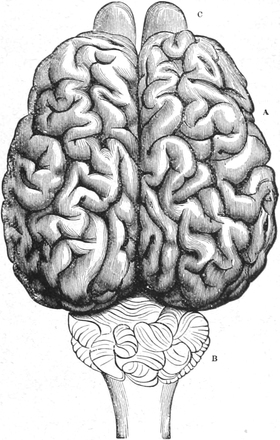
BRAIN OF HORSE.
“There are several plain conclusions to be drawn from this history.
The bots cannot, while they inhabit the stomach of the Horse, give the
animal any pain, for they have fastened on the cuticular and insensible
coat. They cannot stimulate the stomach and increase its digestive
power, for they are not on the digestive portion of the stomach. They
cannot, by their roughness, assist the trituration or rubbing down of
the food, for no such office is performed in that part of the stomach:
the food is softened, not rubbed down. They cannot be injurious to the
Horse, for he enjoys the most perfect health when the cuticular part
of his stomach is filled with them; and their presence is not even
suspected until they appear at the anus. They cannot be removed by
medicine, because they are not in that part of the stomach to which
medicine is usually conveyed: and if they were, their mouths are
too deeply buried in the mucus for any medicine, that can safely be
administered, to affect them; and last of all, in due course of time
they detach themselves, and come away. Therefore the wise man will
leave them to themselves.”
THE RACE-HORSE.—The breed of Horses for which England is
chiefly remarkable is the Race-Horse, resulting from a cross of the
English stock with the Arabian; and this was chiefly brought about by
the care of Mr. Darley. The offspring of the Arabian thus introduced
was the Devonshire, or Flying Childers, the fleetest Horse of his time,
which ran four miles, one furlong, and a hundred and thirty-eight
yards in seven minutes and a half. Descended from the same Arabian
was Eclipse, who never met an opponent sufficiently fleet to test his
powers. He became the sire of three hundred and thirty-four winners;
while King Herod, a descendant of the same stock, was the sire of no
less than four hundred and ninety-seven winners. The former of these
Horses died in 1789, at the age of seventy-five years, after realising
for his owner a princely fortune: his skeleton is now preserved
in the museum at Oxford. The English Race-Horse, in swiftness and
energy, elegance and grace, surpasses his Arabian progenitor; and is
so superior to other European breeds, that it is usual on the English
course to allow foreign Horses an advantage in the weight that they
carry. All English Race-Horses are descended either from Arabian or
Barb sires.
ENGLISH RACE-HORSE.
THE TROTTING HORSE OF AMERICA.—Two nations have the credit
of introducing a race of Horses known as the Trotting Horse. One of
these is Russia, the other the United States; and the latter has so
far excelled her rival, that the Trotting Horse is now generally known
as the “Trotting Horse of America.” The Russian breed is Arabian on
a Flemish stock, and is known as the Orloff Trotter; but from the
bending of the knee when the Horse is striding, and the trotting
action not being carefully looked after, the animal is considered by
good judges to be only “half-developed.” The breed of the American
Trotter seems to have been both Barb and Arabian on an English stock,
the well-known Bashaw Trotters being descended from an imported Barb
ancestor, the Grand Bashaw; and Top Gallant was produced by a union of
Arab or Eastern breed, with some Horse either English or of English
origin. One of the greatest American trainers of the Trotting Horse,
Hiram Woodruff, says in his work on this subject that the English
had the stock all along, as much as the Americans, but that the
method of training and perseverance of the latter have produced the
best and fastest trotters. He entirely disputes the idea of the trot
being an artificial action of a Horse, and the common notion that the
only two natural paces of that animal are the walk and the gallop;
and in vindication of his theory he asks, “Whether a colt can now be
found anywhere that does not trot sometimes, and that when he is by
the side of his dam, before ever the hand of a man has been laid upon
him? If it is said that this results from the long domestication of
his ancestors, my reply will be that it happens among the produce of
Horses whose ancestors for more than two centuries have never been used
for trotting, and were never taught to trot at all, if it is true that
the Arabs of the desert only use their Horses at the two so-called
natural paces, the walk and the gallop.” He further remarks that other
animals trot when wild, such as the wild Asses, Zebras, and Quaggas,
as well as the Deer and the Elk. He therefore considers that the most
careful attention should be given to the training of a young colt for
trotting purposes; and that, for a Horse to become a trotter, he should
at the early age of two years be broken in with a view to that purpose
especially, while his gallop or walk should, so to speak, be kept in
the background. His education altogether extends over several years, as
both speed and durability have to be considered in his capabilities;
sometimes he reaches the age of seven years before his finest powers
can be developed. Some of the fastest English trotters go at the rate
of a mile in three minutes; while the quickest in America, according
to Mr. Woodruff, take only two minutes and twenty-five seconds, or
thereabouts, to do the same distance. The Trotting Horse has now become
a product of great commercial value to the Americans.
THE DRAY HORSE.—The huge Dray Horse, in its massive form and
ponderous strength, and slowness of gait, forms a striking contrast to
the Racer and the Trotting Horse. It is as admirably fitted for the
slow carriage of heavy weights as the two last are for their elegant
swiftness. It is as good an example of the results of judicious
selection on the part of man, for a definite purpose, as can be offered
by the study of any of the domestic animals.
THE SHETLAND PONY.—The smallest variety of Horses in the
British Islands is the Shetland Pony, which averages seven or eight
hands in height, but yet is wonderfully strong, and capable of
enduring an immense amount of fatigue. Its wild, shaggy mane gives
it somewhat the appearance, as has been remarked, of a Skye Terrier.
It is mischievous and skittish, and generally harder to ride than a
full-sized Horse.
THE ARAB AND THE BARB.—The two principal varieties of
foreign Horses which are important for us to consider are the Arab
and the Barb. The Arab would not be acknowledged by every one to be
perfect in form. The head, however, is inimitable. “The broadness and
squareness of the forehead,” writes Youatt, “the smallness of the ears,
the prominence and brilliancy of the eye, the shortness and fineness
of the muzzle, the width of the nostril, the thinness of the lower
jaw, and the beautifully-developed course of the veins, will always
characterise the head of the Arabian Horse. The body of the Arab may,
perhaps, be considered as too light, and his chest too narrow; but
behind the arms the barrel generally swells out, and leaves sufficient
room for the play of the lungs. The neck of the Arabian is long and
arched, and beautifully joined to the chest. In the formation of the
shoulder, next to that of the head, the Arab is superior to any other
breed. The withers are high, and the shoulder-blade has its proper
inclination backwards. It is also thickly clothed with muscle, but
without the slightest appearance of heaviness. The fineness of his
legs, and the oblique position of the pasterns, might be supposed by
the uninitiated to lessen his apparent strength; but the leg, although
small, is deep, and composed of bone of the densest character. The
tendons are sufficiently distinct from the bone, and the starting
muscles of the fore-arm and the thigh indicate that he is fully capable
of accomplishing many of the feats that are recorded of him. It is
an error,” continues Youatt, “into which almost every writer on the
history of the Horse has fallen, that the Arabian is bred in the arid
deserts, and owes the power of endurance which he possesses in his
adult state to the hardships which he endured while he was a colt. The
real fact is, that the Arabs select for their breeding-places some of
those delightful spots, known only in countries like these, where,
though all may be dry and barren around, there is pasture unrivalled
for its succulence, and its nutritious or aromatic properties. The
powers of the young animal are afterwards developed, as they alone
could be, by the mingled influence of plentiful and healthy food, and
sufficient, but not, except in one day of trial, cruel exercise.”
The attachment an Arab feels for his Horse is proverbial, cases having
been recorded of a devotion so deep that the owner prefers almost to
starve rather than part with his Horse. The following anecdote is an
instance:—“The whole stock of an Arab of the desert consisted of a
mare. The French Consul offered to purchase her, in order to send her
to his Sovereign, Louis XIV. The Arab would have rejected the proposal,
but he was miserably poor; he had scarcely a rag to cover him, and
his wife and children were starving. The sum offered was great; it
would provide him and his family with food for life. At length, and
reluctantly, he yielded. He brought the mare to the dwelling of the
consul, dismounted, and stood leaning upon her; he looked now at the
gold, and then at his favourite. ‘To whom is it,’ said he, ‘I am going
to yield thee up? To Europeans, who will tie thee close; who will beat
thee; who will render thee miserable. Return with me, my beauty, my
jewel, and rejoice the hearts of my children!’ As he pronounced the
last words, he sprang upon her back, and was presently out of sight.”
ENGLISH DRAY HORSE FROM THE STUD OF MESSRS. BARCLAY,
PERKINS & CO.
❏
LARGER IMAGE
ARAB HORSE.
The Barb is found throughout the North of Africa, from the
Mediterranean to the Sahara desert, and has obviously been introduced
by the Moors. It is to the Barb that the principal excellence of the
Spanish Horse is due; and to this Horse, as well as to the Arab, may be
assigned a large share in producing the English Hunter and Racer. All
English thoroughbreds are descended from one or other of these.
The Persian Horse is closely allied to the Arab, and possesses great
powers of endurance. The distance marked for a race, which Sir R. K.
Porter saw, was no less than four-and-twenty miles. In some points,
according to Youatt, the Persian Horse excels the Arabian.
WILD HORSES IN AMERICA.—At the time of the discovery of
America there were no Horses in any part of that continent, although
the boundless prairies were admirably fitted for the support of
countless herds. Soon, however, those imported by the settlers strayed
away, and as a consequence horses are now met with in vast numbers, in
some cases amounting, it is said, to ten thousand in one troop. They
appear to be under the command of a leader, the strongest and boldest
of the herd, whom they implicitly obey. When threatened with danger,
at some signal, understood by them all, they either close into a dense
mass and trample their enemy to death, or, placing the mares and foals
in the centre, they form themselves into a circle and welcome him with
their heels. The leader first faces the danger, and when prudence
requires a retreat all follow his rapid flight. In the thinly inhabited
parts of South America, according to Youatt, it is dangerous to fall
in with any of these troops. The Wild Horses approach as near as they
dare; they call to the loaded Horse with the greatest eagerness, and if
the rider is not on the alert, and has not considerable strength of arm
and sharpness of spur, his animal will divest himself of his burden,
take to his heels, and be gone for ever. Byron well describes the Wild
Horse in his “Mazeppa”:—
“A trampling troop; I see them come!
In one vast squadron they advance!
I strove to cry—my lips were dumb.
The steeds rush on in plunging pride;
But where are they the reins to guide?
A thousand horse—and none to ride!
With flowing tail, and flying mane,
Wide nostrils—never stretch’d by pain,
Mouths bloodless to the bit or rein,
And feet that iron never shod,
And flanks unscarr’d by spur or rod,
A thousand horse, the wild, the free,
Like waves that follow o’er the sea.
On came the troop ...
They stop—they start—they snuff the air,
Gallop a moment here and there,
Approach, retire, wheel round and round,
Then plunging back with sudden bound,
They snort—they foam—neigh—swerve aside,
And backward to the forest fly.”
Of the meeting a troop of Wild Horses in a more thickly inhabited
part of the country, Sir F. Head gives some interesting details. He
describes some unfortunate captured animals as being forced along by
their riders at their very utmost speed: “As they are thus galloping
along, urged by the spur, it is interesting to see the groups of Wild
Horses one passes. The mares, which are never ridden in South America,
seem not to understand what makes the poor Horse carry his head so low
and look so weary. The little innocent colts come running to meet him,
and then start away frightened; while the old Horses, whose white marks
on the flanks and backs betray their acquaintance with the spur and
saddle, walk slowly away for some distance, then breaking into a trot
as they seek their safety, snort and look behind them, first with one
eye and then with the other, turning their noses from right to left,
and carrying their long tails high in the air.”
The capture and breaking in of Wild Horses in America are described by
Miers as follows:—
“The lasso is a missile weapon, used by every native of the United
Provinces and Chili. It is a very strong plaited thong of equal
thickness, half an inch in diameter, and forty feet long, made of
many strips of green hide, plaited like a whip-thong, and rendered
supple by grease. It has at one end an iron ring, above an inch and a
half in diameter, through which the thong is passed, and this forms
a running noose. The Gaucho, or native peon, is generally mounted on
horseback when he uses the lasso. One end of the thong is affixed to
his saddle-girth; the remainder he coils carefully in his left hand,
leaving about twelve feet belonging to the noose end in a coil, and
a half of which he holds in his right hand. He then swings this long
noose horizontally round his head, the weight of the iron ring at the
end of the noose assisting in giving to it, by a continued circular
motion, a sufficient force to project it the whole length of the line.”
The Gauchos drive the Wild Horses into a corral, which is a circular
space surrounded by rough posts firmly driven into the ground. The
corral, relates Miers, “was quite full of Horses, most of which were
young ones about two or three years old. The Capitan (chief Gaucho),
mounted on a strong, steady Horse, rode into the corral, and threw his
lasso over the neck of a young Horse and dragged him to the gate. For
some time he was very unwilling to lose his comrades; but the moment
he was forced out of the corral his first idea was to gallop away;
however, a timely jerk of the lasso checked him in the most effectual
way. The peons now ran after him on foot and threw a lasso over his
fore legs, just above the fetlock, and twitching it, they pulled his
legs from under him so suddenly that I really thought the fall he got
had killed him. In an instant a Gaucho was seated on his head, and with
his long knife, in a few seconds, cut off the whole of the Horse’s
mane, while another cut the hair from the end of his tail: this, they
told me, was a mark that the Horse had been once mounted. They then
put a piece of hide in his mouth to serve for a bit, and a strong hide
halter on his head. The Gaucho who was to mount arranged his spurs,
which were unusually long and sharp, and while two men held the Horse
by his ears, he put on the saddle, which he girthed extremely tight.
He then caught hold of the Horse’s ear, and in an instant vaulted
into the saddle; upon which the man who held the Horse by the halter
threw the end to the rider, and from that moment no one seemed to
take any further notice of him. The Horse instantly began to jump in
a manner which made it very difficult for the rider to keep his seat,
and quite different from the kick or plunge of an English Horse;
however, the Gaucho’s spurs soon set him going, and off he galloped,
doing everything in his power to throw his rider. Another Horse was
immediately brought from the corral; and so quick was the operation
that twelve Gauchos were mounted in a space which, I think, hardly
exceeded an hour. It was wonderful to see the different manner in which
different Horses behaved. Some would actually scream while the Gauchos
were girding the saddle upon their backs; some would instantly lie down
and roll upon it; while some would stand without being held, their legs
stiff and in unnatural positions, their necks half bent towards their
tails, and looking vicious and obstinate; and I could not help thinking
that I would not have mounted one of those for any reward that could
be offered me, for they were invariably the most difficult to subdue.
It was now curious to look around and see the Gauchos on the horizon
in different directions, trying to bring their Horses back to the
corral, which is the most difficult part of their work, for the poor
creatures had been so scared there that they were unwilling to return
to the place. It was amusing to see the antics of the Horses; they
were jumping and dancing in different ways, while the right arm of the
Gauchos was seen flogging them. At last they brought the Horses back,
apparently subdued and broken in. The saddles and bridles were taken
off, and the young Horses trotted off towards the corral, neighing to
one another. When the Gaucho wishes to take a Wild Horse, he mounts one
that has been used to the sport and gallops over the plain. As soon
as he comes near his victim, the lasso is thrown round the two hind
legs, and as the Gaucho rides a little on one side, the jerk pulls
the entangled Horse’s feet laterally, so as to throw him on his side
without endangering his knees or his face. Before the Horse can recover
the shock, the rider dismounts, and snatching his poncho, or cloak,
from his shoulders, wraps it round the prostrate animal’s head. He
then forces into his mouth one of the powerful bridles of the country,
straps a saddle on his back, and bestriding him, removes the poncho;
upon which the astonished Horse springs on his legs, and endeavours by
a thousand vain efforts to disencumber himself of his new master, who
sits quite composedly on his back, and, by a discipline which never
fails, reduces the Horse to such complete obedience that he is soon
trained to lend his whole speed and strength to the capture of his
companions.”
WILD HORSES IN AUSTRALIA.—In Australia, as well as in
America, the Horses imported by the colonists have escaped into the
wilds, and reverted to their feral condition. They are known as
“Brumbies,” and are a serious inconvenience to the stock farmer,
because they entice away his Horses and spoil his carefully selected
breeds. The animal develops wonderful sagacity in avoiding the
sportsman, and his keenness of scent and vigilance are certainly as
great as in any other animal which seeks in flight safety from man.
These Brumbies were described by Anthony Trollope, himself an ardent
Fox-hunter, as being perfect marvels of ugliness. These animals are
found in enormous numbers in some districts. In 1875, for example, no
less than seven thousand are stated to have been shot in one station in
New South Wales, still leaving plenty behind to perpetuate the race.
THE ASS.—Four species of Asses and three of Zebras are
described by naturalists, but our domestic animal is probably descended
from one alone; the Asinus teniopus of Abyssinia. In Great Britain,
and generally in Central Europe, the Ass has not given rise to distinct
breeds like those of the Horse, a fact which may be accounted for, as
Mr. Darwin remarks, by the animal being kept by poor persons who do
not carefully match and select the young. Its small size in England
and Northern Europe is probably due far more to want of care in
breeding than to cold, for in Western India it is not much larger than
a Newfoundland Dog, being usually not more than from twenty to thirty
inches high.
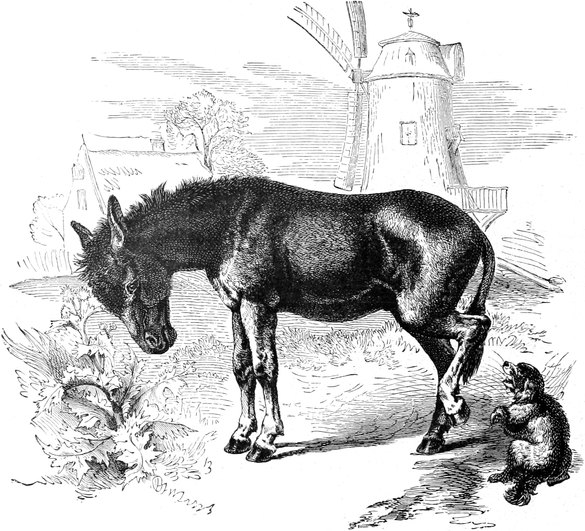
DOMESTIC ASS.
The Ass varies greatly in colour, and its legs, especially the fore
legs, are sometimes transversely barred; a fact which may be explained
on the hypothesis of the reappearance of the attributes of the parental
form. “The stripes,” Mr. Darwin says, “are believed to occur most
frequently and to be plainest on the legs of the Domestic Ass during
early youth, as is apparently likewise the case with the Horse. The
shoulder-stripe, which is so eminently characteristic of the species,
is nevertheless variable in breadth, length, and manner of termination.
I have measured a shoulder-stripe four times as broad as another, and
some more than twice as long as others. In one light-grey Ass the
shoulder-stripe was only six inches in length and as thin as a piece of
string; and in another animal of the same colour there was only a dusky
shade representing a stripe. I have heard of three white Asses—not
albinoes—with no trace of shoulder or spinal stripes, and I have seen
nine other Asses with no shoulder-stripe, and some of them had no
spinal-stripe. Three of the nine were light greys, one a dark grey,
another grey passing into reddish roan, and the others were brown, two
being tinted on parts of their bodies with a reddish or bay shade.
Hence we may conclude that if grey and reddish-brown Asses had been
steadily selected and bred from, the shoulder-stripe would have been
almost as generally and as completely lost as in the case of the Horse.”
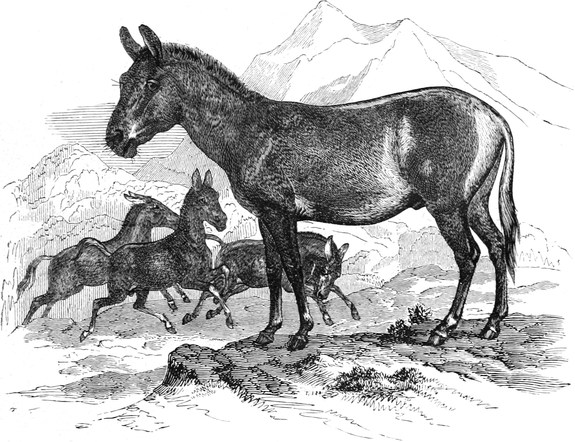
ONAGER.
“The shoulder-stripe on the Ass is sometimes double, and Mr. Blyth has
seen even three or four parallel stripes. I have observed in ten cases
shoulder-stripes abruptly truncated at the lower end, with the anterior
angle produced into a tapering point, precisely as has been figured
in the Dun Devonshire Pony. I have seen three cases of a terminal
portion abruptly and angularly bent, and two cases of a distinct,
though slight, forking. In Syria, Dr. Hooker and his party observed for
me no less than five instances of the shoulder-stripe being plainly
forked over the fore leg. In the common Mule it is likewise sometimes
forked. When Spist noticed the forking and angular bending of the
shoulder-stripe, I had seen enough of the stripes in the various equine
species to feel convinced that even a character so unimportant as this
had a distinct meaning, and was thus led to attend to the subject. I
now find that in the Asinus Burchellii and Quagga, the stripe which
corresponds with the shoulder-stripe of the Ass, as well as some of
the stripes on the neck, bifurcate, and that some of those near the
shoulder have their extremities angularly bent backwards. The forking
and angular bending of the stripes on the shoulders apparently stand
in relation with the changed direction of the nearly upright stripes
on the sides of the body and neck to the transverse bars on the legs.
Finally, we see that the presence of shoulder-, leg- and spinal-stripes
in the Horse, their occasional absence in the Ass, the occurrence of
double and triple shoulder-stripes in both animals, and the similar
manner in which these stripes terminate at their lower extremities,
are all cases of analogous variation in the Horse and Ass. These
cases are probably not due to similar conditions acting on similar
constitutions, but to a partial reversion in colour to the common
progenitor of these two species, as well as of the other species of the
genus.”
The Asses, beside the characters above mentioned, have the upper part
of the tail covered with short hairs, while the lower part terminates
in a long hairy tuft; horny excrescences, or warts, exist on the fore
legs alone. In England, as we have before remarked, Asses are small and
without much variation, because their points have not been selected.
When, however, care is taken in breeding, the result is as remarkable
as in the case of the Horse. Near Cordova, according to Mr. Darwin,
they are carefully bred, as much as two hundred pounds having been
paid for a stallion Ass. Asses from Spain, Malta, and France have
been introduced into Kentucky for the breeding of Mules, which have
been raised by the care of the Kentuckians from their original size
of fourteen hands to sixteen hands in height. Great prices are put on
these splendid animals, one of great celebrity having been sold for
over one thousand pounds. At their cattle shows, one day is given up to
the exhibition of Asses.

WILD ASS OF ABYSSINIA.
Asses have always been in repute in the East, and much pains have been
taken in their breeding. They are frequently mentioned in the Bible,
from which it appears that white Asses were used by people of high
rank, as may be seen from the following verse (Judges v. 10): “Speak,
ye that ride on white Asses, ye that sit in judgment, and walk by the
way.”
THE MULE AND HINNY.—The hybrid offspring of the Ass and the
Mare is the Mule; while the Hinny is that of the Horse and female
Ass. Of these the Mule is by far the larger, taking more the form and
appearance, as well as the dimensions, of the mare; while the latter
assumes so much of the nature and general appearance of the Ass as to
render the breeding of it undeserving of attention.
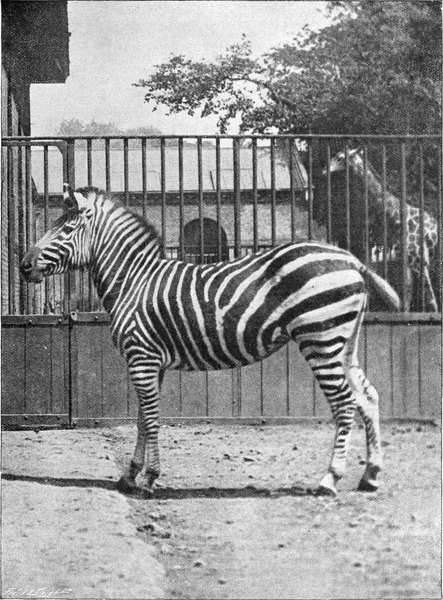
ZEBRA.
(From the Living Specimen in the Zoological Gardens,
London.)
❏
LARGER IMAGE
THE WILD ASS OF TIBET.—We are indebted to Dr. Sclater, the
accomplished Secretary of the Zoological Society of London, for an
interesting account of the various species of Wild Asses. The Kiang, or
Wild Ass of Tibet, inhabits the high plateaux, at no less an altitude
than from fifteen to sixteen thousand feet above the sea. It is a large
animal, measuring fourteen hands in height, and is exceedingly swift
and wary. The back is marked by a broad black line, but there is no
transverse bar across the shoulders; it is probably the true Equus
hemionus of Pallas. (See figure, p. 295.)
THE ONAGER, or Wild Ass of the Asiatic deserts, presents
several varieties. That variety which inhabits Cutch and Scinde
is remarkable for its swiftness and difficulty of approach. It is
closely allied to the Wild Ass of Assyria, named by St. Hilaire Equus
hemippus. (See figure, p. 311.)
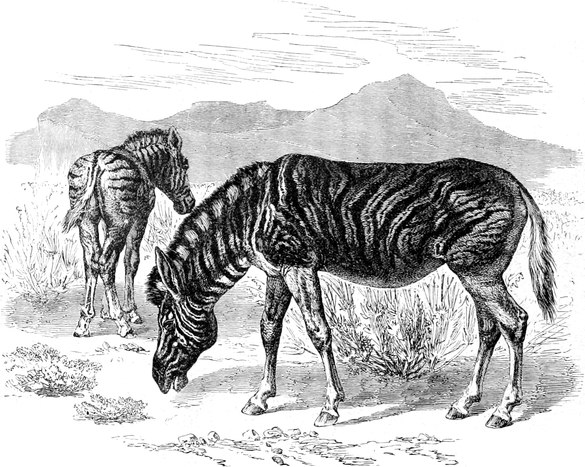
BURCHELL’S ZEBRA.
THE WILD ASS OF ABYSSINIA, the parent form from which the
domestic animals were derived, is readily distinguishable from the
above species by the stripes on its hind legs. (See figure, p. 312.)
THE ZEBRAS.—Dr. Sclater describes three species of Zebra:
the black and white, or true Zebra, which inhabits the mountains;
Burchell’s Zebra, or the black and yellow Zebra, which inhabits the
plains; and the Quagga. The true Zebra inhabits the hilly districts of
Southern Africa, and is remarkable for its beauty and its fierce and
untamable nature. It is by far the most conspicuous and most beautiful
of the Ass tribe. The stripes which define it from the ordinary Asses
are remarkably like those of the Tiger in their arrangement. Those on
its legs are horizontal, while those of its body are for the most part
vertical.
BURCHELL’S ZEBRA is found in great numbers north of the Orange
River; and, according to Sir Cornwallis Harris, “seldom congregating
in herds of fewer than eighty or a hundred, it abounds to a great
extent in all the districts included between that noble stream and the
southern tropic. Occupying the same regions and delighting in the same
pastures as the Brindled Gnu, rarely is it to be seen unless in the
companionship of that fantastic animal, whose presence would seem to
be almost indispensable to its happiness. It is singular enough that
the members of two families so perfectly foreign to each other should
display so great a predilection for each other’s society, uniformly
intermixing as they do, and herding in bonds of the closest friendship.
Fierce, strong, fleet, and surpassingly beautiful, there is, perhaps,
no quadruped in the creation, not even excepting the Mountain Zebra,
more splendidly attired, or presenting a picture of more singularly
attractive beauty, than this free-born child of the desert.”
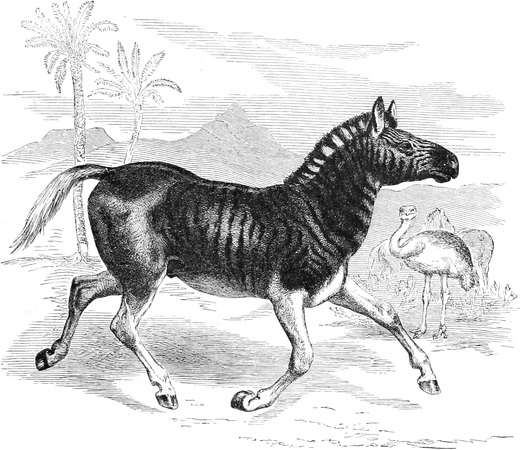
QUAGGA.
The QUAGGA, which is less attractively coloured, and inhabits
a different tract of country, is also described by Sir Cornwallis
Harris, as follows:—“The geographical range of the Quagga does not
appear to extend to the northward of the river Vaal. The animal was
formerly extremely common within the colony; but, vanishing before
the strides of civilisation, is now to be found in very limited
numbers, and on the borders only. Beyond, on those sultry plains
which are completely taken possession of by wild beasts, and may with
strict propriety be termed the domains of savage nature, it occurs
in interminable herds; and, although never intermixing with its more
elegant congeners, it is almost invariably to be found ranging with
the White-tailed Gnu and with the Ostrich, for the society of which
bird especially it evinces the most singular predilection. Moving
slowly across the profile of the ocean-like horizon, uttering a shrill,
barking neigh, of which its name forms a correct imitation, long files
of Quaggas continually remind the early traveller of a rival caravan on
its march.... Bands of many hundreds are thus frequently seen during
their migration from the dreary and desolate plains of some portion of
the interior, which has formed their secluded abode, seeking for those
more luxuriant pastures where, during the summer months, various herbs
thrust forth their leaves and flowers to form a green carpet, spangled
with hues the most brilliant and diversified.”
The living members of the family of Horses are, as we have seen,
restricted to the region of the Old World, and were unknown in the
Americas and in Australia, when those countries were first discovered.
From an examination, however, of their fossil remains, it is evident
that in the Pliocene and Pleistocene times Horses were widely
distributed in both North and South America. The bones and teeth in
caves and river deposits of Europe also show that Wild Horses were
very numerous in Europe in the latter age. We are even able to form
an accurate idea of the European Wild Horse from the engravings which
the ancient hunters of Reindeer have left behind in caves of Auvergne,
Switzerland, and Derbyshire. The outline engraved on a bit of bone or
a fragment of antler shows us an animal with a large head, thick neck,
and big mane, coarse and clumsy in its points, as might be expected
from an aboriginal wild breed not subject to the care and selection of
man. The Horse, like the Bison and the Reindeer, formed a large part of
the food of these ancient men of the caves, and was not domesticated.
The true Horses begin to appear in Europe in the later Pliocene strata.
In the early Pliocene and late Miocene ages the family of Horses is
represented by the HIPPARION, a small, slender, graceful
animal, possessed of three well-defined toes, bearing hoofs, on each
limb: one strong and large in the middle, while the two lateral toes
are so small that they do not extend beyond the fetlock. They may
be compared to dew-claws. The teeth are like those of the Horse,
but shorter, and the pattern of the enamel on the grinding surface
is more complicated. In the early Miocene and late Eocene the
ANCHITHERIUM appears. Its orbit is not so completely encircled
with bone as in the Horses and Hipparion.
“The shaft of the ulna,” writes Professor Huxley, “is stouter than
in Hipparion, and is less closely united with the radius. The fibula
appears—at any rate, in some cases—to have been a complete though
slender bone, the distal end of which is still closely united with the
tibia, though much more distinct than in the Hipparions and Horses. In
some specimens, however, the middle of the shaft seems to have been
incompletely ossified. Not only are there three toes in each foot,
as in Hipparion, but the inner and the outer toes are so large that
they must have rested upon the ground. Thus, so far as the limbs are
concerned, the Anchitherium is just such a step beyond the Hipparion
as the Hipparion is beyond the Horse, in the direction of a less
specialised quadruped. The teeth are still more divergent from the
Equine type. The incisors are smaller in proportion, and their crowns
lack the peculiar pit which characterises those of Equus and Hipparion.
The first grinder is proportionally much larger, especially in the
upper jaw, and, like the other six, has a short crown and no thick coat
of cement. The pattern of their crowns is wonderfully simplified. The
fore and hind-ridges run with but a short obliquity across the crown,
and the pillars are little more than enlargements of the ridges, while
in the lower jaw these pillars have almost entirely disappeared. But
the foremost of the six principal grinders is still somewhat larger
than the rest, and the posterior lobe of the last lower molar is small,
as in the other Equidæ.”
In all those respects in which Anchitherium departs from the modern
Equine type it approaches that of the extinct Palæotheria; and
this is so much the case that Cuvier considered the remains of the
Anchitherium, with which he was acquainted, to be those of a species of
Palæotherium. From these considerations it may be concluded that the
highly specialised Horse has obtained its characteristics by descent
from the Hipparion, and that again from the Anchitherium. In some cases
on record there is a reversion towards the ancestral type, Horses
having been born with tridactyle feet, similar in every respect to
those of the Hipparion.
The lineage of the Horse is traceable yet further back by the
discoveries of Marsh and Cope in New Mexico, Wyoming, and Utah, in
North America, up to the Eohippus of the Lower Eocene, a small animal
not larger than a Fox, and with three toes on the hind foot and four
and a rudiment of a fifth on the fore foot. It must further be noted
that the fossil Horses increased in size as they lost their toes, and
that the living Horse is the biggest of the family.
THE Hog-like creatures which constitute the family of Tapirs form the
second division of the quadrupeds which are possessed of three toes on
their hind feet, and are therefore termed, as has already been said,
the Perissodactyla. It must not, however, be forgotten that these
creatures possess a fourth toe on the fore foot, which is small and
does not reach to the ground. The family is represented by one genus
only—Tapirus—which is distributed over wide regions in the warmer
parts of the Old and the New Worlds. All the animals comprised under it
possess short and movable trunks, by which they convey their food into
their mouths, and at the extremity of which are placed the nostrils.
They are of a brownish-black colour; the skin is hairy and extremely
thick, and the tail is very short.
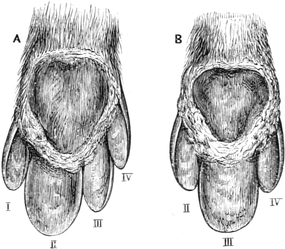
FORE (A) AND HIND
(B) FOOT OF TAPIR. (After Murie.)
The Tapir inhabits principally the inmost recesses of dense forests,
is nocturnal in its habits, and is phytophagous, that is, feeds on
vegetables. However, it is said that it is also an indiscriminate
swallower of everything, filthy or clean, nutritious or otherwise,
pieces of wood, clay, pebbles, and bones being not uncommonly found in
its stomach; and it is even stated of one that was kept in confinement
that it gnawed a silver snuff-box to pieces and swallowed the contents.
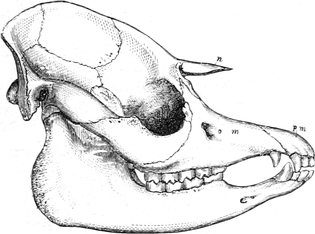
SKULL OF AMERICAN TAPIR.
n, Nasal Bone; m, Maxillary Bone;
pm, Pre-maxillary Bone.
The skull of the Tapir, seen in profile, reminds us strongly of that of
the Hog, the same pyramidal elevation being brought to view. Examined
closely, however, we find that this pyramid differs immediately from
that of the latter animal by the possession of only three faces, while
in the Pig there are four. In addition, it is also to be noticed that
the anterior line is formed by the joining of the lateral faces,
dilating into a triangle only towards the front: this being due to the
frontal bones, which are early united and directed somewhat backwards.
The bones of the nose are articulated to the base of the triangle, and
here there is a point which penetrates between them. A deep furrow,
produced by the upper border of the orbit, descends from the two sides
above the orbit, which, approaching the sub-orbital hole, serves for
the insertion of various muscles connected with the proboscis. With
regard to the differences between the skull of the Malayan Tapir and
the American, Cuvier observes that a glance at the profile of their
respective crania is sufficient to impress upon the observer their
specific differences. The forehead of the Indian Tapir is convex, and
rises higher than the back of the head. It is accompanied, in its
rise, by the nasal bones, an arrangement by which space is given for
the comparatively large proboscis, and adding length to the furrows
where the muscles are inserted. This organisation, according to Cuvier,
explains why the Indian Tapir has a more powerful and more extensile
trunk than the American. There is also in the former, on the base of
the nasal bones, at their junction with the frontal bones and on each
side, a deep fossa, or depression, which does not exist in the other
species. This elevation of the forehead is accompanied by a depression
of the occipital crest, which, far from forming a pyramid, as in the
American species, rather descends backwards. The aperture of the
bony nostrils, enlarged by the prolongation of the maxillary bones,
terminates below and forwards by more elevated premaxillaries, which
are fused (anchylosed) together in early youth, as in the American.
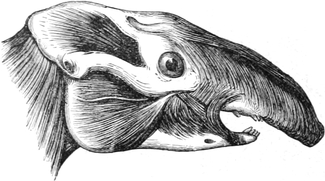
HEAD OF MALAYAN TAPIR, SHOWING MUSCLES
OF SHORT TRUNK AND FACE. (After Murie.)
In the upper jaw there are, in the adult Tapir, on each side three
incisors, one canine, four premolars, and three molars. In the lower
jaw, on each side, there are three incisors, one canine, three
premolars, and three molars: altogether making forty-two teeth in
number.
Some peculiarities offer themselves with regard to the form of the
teeth: for instance, the outer incisors above are very large and
resemble canines, while those below are unusually small. The canines
themselves are very small, having their crowns considerably shorter
than their roots.
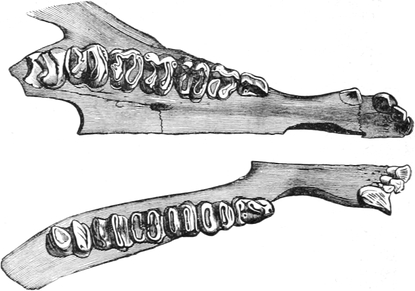
TEETH OF MALAYAN TAPIR.
With regard to other portions of the skeleton nothing need be remarked,
except that the bones of the extremities are exceedingly strong, and
resemble in many respects those of the Rhinoceros.
Three species of Tapirs are known, namely, American Tapir (Tapirus
americanus), Roulin’s Tapir (Tapirus villosus), and Asiatic Tapir
(Tapirus malayanus).
THE AMERICAN TAPIR.[263]—Of the three foregoing species the
best known is the American Tapir, which is found in almost all parts of
South America from Buenos Ayres to Central America, and from the Andes
to the Atlantic. In its habits it is nocturnal, spending the whole of
the day-time in the cool shades of the densest forests, and coming
forth to feed on the surrounding vegetation as evening approaches.
It is a most powerful animal, and everything in the underwood of the
forest gives way to its rush. It has the habit of making runs or roads
through the brushwood, which beaten tracks are usually selected by
travellers in passing through the forests. It is stated that it has a
most keen sense of smell, enabling it to detect its enemies at long
distances, when it at once rushes into brushwood or thicket so dense
that neither man nor horse can follow. It never attacks man without
being very hardly pressed and brought to bay.
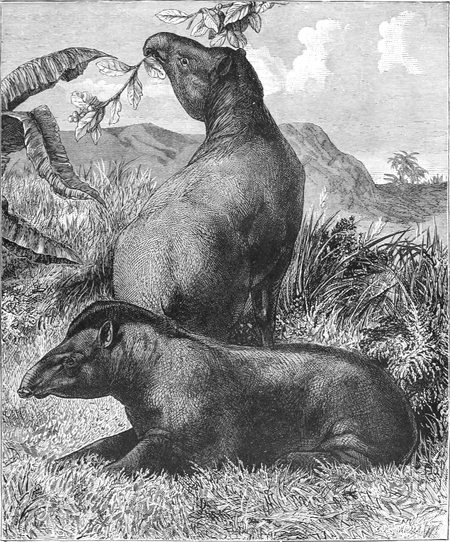
AMERICAN TAPIRS.
It is excessively fond of the water, being a most expert swimmer,
and usually keeping to a particular track in the element in which it
indulges.
The American species is characterised by having the general colour
throughout of a deep brown, approaching to black; but the sides of
the lower lip, band on the under and middle part of the chin, upper
edges of the ears, and naked line at the bottom of the hoofs, are snowy
white. The scanty hair of the body is very short, and is hardly to be
distinguished at a comparatively short distance.
The skin, which is of great density beneath, is described by M. Roulin
to be not less than seven lines thick on the back; and he says that
in the days when rifles were not brought to their present pitch of
perfection a ball from one of them would scarcely make an impression.
On the back of the neck there is a thick rounded crest, which extends
from the forehead, as low as the level of the eyes, to the shoulders,
and beset with a comparatively thin mane of stiff blackish bristles.
The American Tapir is hunted for its excessively tough hide, and also
for its flesh, which, although described by Europeans as unsavoury,
being coarse and dry, is considered palatable by the Indians. It is
captured sometimes, although not often, by means of the lasso, an
instrument so successful in Horse-catching in America, but often futile
as regards the Tapir, for its usual haunts render this mode of capture
most difficult, and its determined rush and immense strength frequently
enable it to break the strongest lasso. Another way of hunting the
Tapir practised by the native hunters is to find out the animal’s track
leading to the water; there, with their Dogs, they patiently lie in
wait until evening approaches, when the Tapir comes out for the purpose
of taking his evening stroll and indulging in the indispensable bath.
They then get between him and the water, when a desperate encounter
ensues, the Dogs often getting very badly injured.
The most successful manner of catching the Tapir, however, is by means
of imitating its whistle or call, thus bringing the animal within range
of the Indian’s poisoned arrow.
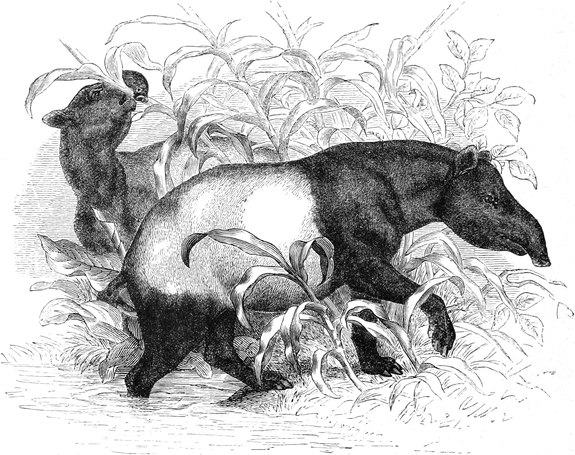
MALAYAN TAPIR.
The American Tapir is spoken of as being mild in captivity and easily
domesticated, and tame Tapirs are permitted to run at large in the
streets of the towns of Guiana, and often wander into the forests,
but return again in the evening to the house in which they are kept
and fed. The Tapir is capable of considerable attachment to its owner,
and possibly, by care and attention, might be turned to good account,
as the qualities with which it is credited—strength, docility, and
patience—ought to render it capable of the duties of a beast of burden.
THE HAIRY TAPIR,[264] the second species of American Tapir,
inhabits the inner range of the Cordilleras, this species being
strictly mountainous in its habits.
It is stated to differ from the other species of America by not
possessing a mane; but has altogether longer hair, and there are no
wrinkles on the proboscis. In the conformation of the skull and general
characteristics it more nearly resembles the Asiatic Tapir than the
American, and is less common than the latter animal.
THE MALAYAN TAPIR.[265]—The Asiatic Tapir, which appears
to have become known to Europeans only in the present century—at
least, the first certain information of it reached Europe in the
year 1816—is an inhabitant of Sumatra, Malacca, and the south-west
provinces of China. It is said to have been found also in Borneo. In
size it is larger than either T. americanus or T. villosus. It is
distinguished by the absence of a mane, the general colour of the hair
being glossy black, but with the back, rump, and sides of the belly
white.
In its habits the Asiatic Tapir appears to be similar to his American
cousin, and in captivity it is said to be of a most mild and
inoffensive disposition, becoming as tractable and familiar as a Dog.
FOSSIL TAPIRS.—The living Tapir is known at the present day
only in the warmer regions of the New and Old Worlds, in South America,
and in the East. In the Pleistocene Age, however, it is proved to have
ranged far up the valley of the Mississippi in the United States. In
the Miocene and Pliocene Ages the animal inhabited Europe, and its
fossil teeth are met with by no means unfrequently in the Crag deposits
of Norfolk and Suffolk. The Lophiodon of the European and American
Eocenes is also a closely allied form.
The Rhinoceroses form the third family of the sub-order of
Perissodactyla. They are to be found in Africa south of the Sahara
Desert, and in Eastern Asia—in India, Java, and Sumatra, &c., where
the climate is tropical or sub-tropical. They are represented by
several living species, as well as by several extinct forms which
ranged, in the later Tertiary times, over nearly the whole of Europe
and Northern Asia. The principal characters which are to be observed
in the Rhinoceros are the large unwieldy bodies, supported on short,
stout legs, terminating in a large callous pad with hoof-bearing toes,
the large and long head, the small eyes and ears, and the short tail.
All the living species also possess one or two horns, which are placed
in the middle line of the head on and above the nose. The horns are to
be viewed as a mere appendage to the skin, like hair, for they are only
skin deep, and are composed of a series of fibres matted together, and
are essentially a mass of hair in which each hair is confluent with
those next to it. Horns were present also in all the fossil species
excepting one, the Aceratherium, the hornless Rhinoceros of the Miocene
Age. The skin in all the Rhinoceroses is very thick, and is converted
into a jointed armour in some of the Asiatic species; it is also
scantily covered with hair, except in “the Hairy-eared Rhinoceros.” A
fossil kind was woolly.
It is a disputed point whether the word Reèm, mentioned several times
in the Bible, and translated in the authorised version as Unicorn,
is the Rhinoceros or the Urus; the probability seems to be that the
latter is intended. The first time Reèm is mentioned in the Bible
is in Numbers xxiii. verses 21, 22, to the following effect:—“The
Lord his God is with him, and the shout of a king is among them. God
brought them out of Egypt; he hath as it were the strength of Reèm.”
Whatever animal Reèm may have been, it was a creature evidently of
great power, and the strongest known to the prophet. In another
passage—Deut. xxxiii. verses 16, 17—we obtain the information that
Reèm was a two-horned and not a one-horned animal, and therefore could
not possibly have been the Indian Rhinoceros at least, and that it is
mentioned at the same time with Bullocks. Other passages speak of Reèm
in connection with the plough and harrow, for which its tameless and
savage disposition rendered it unfit. It is also spoken of in Isaiah in
connection with sacrifices of cattle (chap. xxxiv. verses 6, 7).
Topsel, an author of the sixteenth century, while trying to show that
there lived such a creature as the fabled Unicorn, and giving a picture
representing it as possessing the horn of the Narwhal, the body of a
Horse, and the feet of an Ox, successfully shows Reèm to mean neither a
Unicorn nor Rhinoceros, but simply an Ox. He relates:—“That there is
such a beast the Scripture itself witnesseth, for David thus speaketh
in the 92nd Psalm: Et erigetur cornu meum tanquam, monocerotis—that
is, my home shall bee lifteth up as the horne of a unicorn.” He goes on
to say: “We have already shown, in the story of the Rhinoceros, that
Reèm in Hebrew signifies a Unicorne, although Munster be of another
opinion; yet the Septuagints, in the translation of Deut. xxxiii., do
translate it a Unicorne, for the Rhinoceros hath not one horne but
two. Rabbi Solomon, David Kimchi, and Saadius do always take Reèm and
Karas for a Unicorne, and they derive Reèm from Rom, which signifieth
Altitudinem, height, because the horne of the Unicorn is lifted up
upon high. Hereunto the Arabians agree, which call it Barkeron, and
the Persians Bark; the Chaldeans, Remana. In the 39th chapter
of Job the Lord speaketh in this manner to Job:—‘Will the Unicorne
rest and serve thee, or tarry beside thy cratches? Canst thou bind
the Unicorne with a halter to thy plough to make furrows? or will
he make plaine the clots of the valleys?’ ... Whereby God Himself
must needs be traduced if there be no Unicorne in the world.” We may
therefore conclude that Reèm was one of the Oxen wild in those times in
Palestine. It, probably, was the great wild Ox, or Urus, which formerly
abounded in the forests of Macedonia, and was hunted in the forests of
Germany as late as the tenth century after Christ.
The Rhinoceros was first seen at Rome, according to Pliny, in the
games given by Pompey to the Roman people. He describes it as being
possessed of one horn on its nose, which it sharpens on a stone before
it fights, and that when it fights with the Elephant it attempts to
rip its belly open. The earliest time the animal was mentioned by name
was by Agatharchides, who describes it as fighting in the manner above
alluded to. In both these instances it is evident that the one-horned
Asiatic species is meant. The African Rhinoceros, according to Dion
Cassius, was for the first time brought before the notice of the Romans
in B.C. 39, in the games given by Augustus to celebrate his
victory over Cleopatra. It was exhibited along with a Hippopotamus, and
both animals were in all likelihood obtained from the Upper Nile.
Probably the first Rhinoceros ever seen by modern Europeans was a
one-horned species, the R. unicornis, sent from India to Emanuel,
King of Portugal, in 1513. A sketch was sent from Lisbon to Nürnberg,
and a most extraordinary engraving was made by Albert Dürer, from
which Gesner, Topsel, &c., took copies. This animal was made to
appear in a wonderful suit of armour beautifully decorated, and
supplied with a second horn on the shoulders, resembling the point of
that of the Narwhal. Topsel’s description of the Rhinoceros is most
ludicrous—“First of all, that there is such a beast in the world
both Pliny, Solinus, Diodorus, Ælianus, Lampridius, and others, doe
yeald erefrigable testimony.” He then goes on to say “The picture
here expressed was taken by Gesner from the beast alive at Lisbon, in
Portugale.... Eucherius saith that the Rhinoceros hath two hornes in
his nose, but that is utterly false, as you may see by the picture....
The Rhinoceros cast up a Beare into the aire even as a Bull would do a
ball which were laid upon his two hornes; we shall not neede to apply
Gemino cornu to the Bull, as Politianus doth, but rather take it
figuratively for a strong horne, and if it must needs be litterall, it
is apparent by the picture that there is another little horne, not upon
the nose, but upon the wither of the beast.... When they are to fight
they whet their horne upon a stone; and there is not only a discord
betwixt these beasts and Elephants for their food, but a naturall
description and enmity: for it is confidently affirmed that when the
Rhinoceros which was at Lisbone was brought into the presence of an
Elephant, the Elephant ran away from him.... Hee (the Rhinoceros) is
taken by the same means that the Unicorn is taken, for it is said by
Albertus, Isidorus, and Alumnus, that above all other creatures they
love virgins, and that unto them they will come, be they never so
wilde, and fall asleep before them, so being asleep they are easily
taken and carried away.” Topsel then goes on to inform us that “all
the later physicians attribute the virtue of the Unicorn’s horne to
the Rhinoceros’s horn, but they are deceived by imitation of Isidorus
and Albertus, for there is none of the ancient Græcians that have ever
observed any medicines in the Rhinoceros. The Indians made bottles of
their skins, wherein they put their lycion, or succum medicatum.”
The first Rhinoceros brought alive to England was in 1685, and another
was shown throughout a great part of Europe in 1739, and another in
1741. Parsons[266] described and figured the Rhinoceros of 1739,
and refers to that of 1741, which Cuvier says he believes to be the
same animal afterwards shown in Paris in 1749, painted by Oudry, and
afterwards engraved by Edwards and figured by Albinus. It was the one
described by Daubenton, as well as by Meckel. The one of which Cuvier
gives the osteology was the fifth brought to Europe. It arrived at
Versailles in 1771, and died in 1793, at the age of about twenty-six
years. Another Rhinoceros arrived from the East Indies in 1790, as a
present to Mr. Dundas. This was afterwards purchased for £700, and
exhibited at Exeter ’Change and also about England generally. Another
animal, which was destined for the menagerie of the Emperor of Germany,
arrived from India in 1800, but died in London soon after its arrival.
It was dissected by Mr. Thomas, and his observations thereon were
published in the “Philosophical Transactions.” Shortly afterwards an
eighth arrived, which subsequently went to Germany. Since this it has
become common in the Zoological Gardens in various parts of Europe,
and, in 1878, the genus was represented in the Regent’s Park by no less
than five different species and varieties.
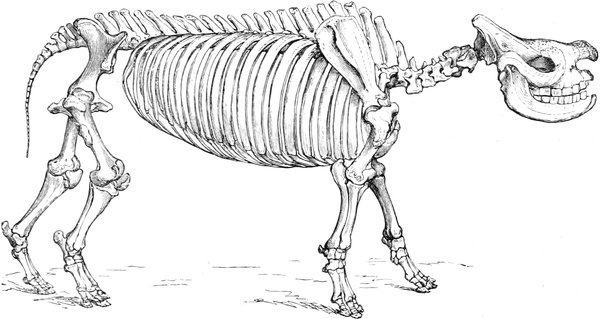
SKELETON OF THE RHINOCEROS.
The skeleton of the Rhinoceros, viewed generally, has a resemblance
to that of the little Hyrax, the Tapir, and the Horse. The skull is
much elevated at the base, being somewhat of a pyramidal form, and the
nasal bones curve upwards and downwards, and are of such a size and
thickness, in order to support one or more immense horns, that they
are quite unparalleled for their development in any other existing
quadruped. The nasal bones, together with the pre-maxillary and
maxillary bones, form the general contour for the external apertures of
the nostrils. This is peculiar, and found in no other animal, with the
exception of the Tapir.
The Rhinoceros has no canine teeth; the incisor teeth vary, not only in
regard to their form and proportions, but also their existence; and in
the varieties of these teeth we may discern the same inverse relation
to the development of the horns which is manifested by the canines of
the Ruminants. Thus, the two-horned Rhinoceroses of Africa, which are
remarkable for the great length of one or both of the nasal weapons,
have no incisors in their adult dentition; neither had the great
extinct hairy species (Rhinoceros tichorhinus), though that the
latter had great horns is proved by the nature of the bones of the nose
and face which supported their weight. The Sumatran bicorn Rhinoceros
combines, with comparatively small horns, moderately developed incisors
in both jaws.
The sternum of the mature animal consists of four bones, the first of
which is compressed into a ploughshare-like shape, and projects in
a point in front of the first rib. All the bones of the fore limbs
of the Rhinoceros resemble those of the Tapir more than those of any
other animal; but from their much larger size are not at all likely
to be confounded with them. Of the hind limbs, the points offering
peculiarities are as follows:—The femur is remarkable for being
extremely flattened from before backwards, and the projection called
by Cuvier the third trochanter projects very much, forming a hook
ascending towards a hook which descends from the projection known
as the grand trochanter, thereby leaving an oval hole between these
two projections. With regard to the lower portions of the hind leg,
resemblances are to be found both to the Horse and Tapir, the tibia,
fibula, and tarsus being built on the same plan as those of the former,
although some of the bones of the tarsus resemble those of the Tapir
more than they do those of the Horse. There are also some points of
resemblance in the metatarsus to that of both the Horse and Tapir. The
difference between the hind legs of the Rhinoceros and Elephant is very
marked, and their gait is different.
FEMUR OF RHINOCEROS.
The dentition of the Rhinoceros differs in a very remarkable degree
from that of the family of Horses. The grinders are implanted by
distinct roots, and in the upper jaw their crowns are traversed by two
deep folds of enamel, which constitute open valleys. In the lower jaw
they are composed of two crescent-shaped lobes, also open. The covering
of “cement” is thin, and never fills up the valleys, as in the case of
the more complex dental system in the Horse. The normal number of the
grinders is seven in each jaw, while the incisors, as we have already
remarked, vary, not only in form, but also are sometimes absent, and
canines are not developed in any of the living or fossil members of the
family.
Of the number of species of Rhinoceros there is considerable doubt.
At least four, possibly five, inhabit Africa, and four Asia. With
regard to the African species, we will first take the large “WHITE”
RHINOCEROS (Rhinoceros simus) described by Burchell. This is an
animal measuring somewhat over twelve feet in length and about five
feet ten inches in height. It has a square nose and two large rounded
horns, the anterior one averaging about two feet six inches in length,
but not uncommonly found measuring three feet six inches, sometimes
even over four feet; the posterior rarely or never exceeding fifteen
inches, and generally not being more than twelve inches. Its skin is
smooth, and without any of those folds so characteristic of the Asiatic
species. It inhabits all the country south of the Zambesi, and probably
it may also exist in Central Africa. It feeds solely on grass, and
sometimes collects into small herds.
DENTITION OF RHINOCEROS. A, UPPER; B, LOWER JAW.
OSWELL’S
RHINOCEROS[267] in no way differs from R. simus,
except that the front horn points forwards, and in some cases even
downwards. This Mr. Drummond considers not to be a distinct species,
but only an accidental and local variety.
The so-called BLACK RHINOCEROS (Rhinoceros bicornis major)
is a much smaller animal than R. simus, being about eleven feet
in length and five feet in height, with an elongated head and horns
thicker in proportion to length than those of R. simus. The front
horn is twenty inches or twenty-two inches in length, and never attains
to more than twenty-six or twenty-eight inches; while the back horn
averages ten inches or twelve inches. Its skin is not black, but
flesh-coloured, and the upper lip is highly prehensile. The first
specimen ever brought to Europe was captured in Upper Nubia in 1868,
and was provided with a lodging in the Regent’s Park Zoological
Gardens. It is found in all the country south of the Zambesi; inhabits
thorn thickets chiefly (in which R. simus is never found), but
occasionally occurs in other jungle or open ground. It feeds chiefly on
thorn leaves and branches, though also eating grass, for the plucking
of which its flexible upper lip is as well fitted as the long tongue
of the Giraffe. It is gregarious, five or six being sometimes found
together.
“WHITE” RHINOCEROS.
The KEITLOA, or Sloan’s Rhinoceros (Rhinoceros keitloa),
differs but little from R. bicornis major, excepting in the
formation of the head, which is somewhat shorter and broader, and it
has a less prehensile lip. Its chief characteristic is the posterior
horn, which is flattened at the sides, being of almost equal length
to the anterior, and even occasionally longer, twenty inches and
twenty-two inches being about the average. It is found sparingly in all
the country south of the Zambesi, and is not gregarious, a bull and cow
only being usually seen together. RHINOCEROS BICORNIS MINOR
is the smallest, being seldom over ten feet in length, or more than
four feet ten inches in height. The head is more elongated and the nose
more prehensile than in any other species, while the legs are shorter
in proportion and the feet smaller. The anterior horns rarely exceed
twelve inches, and the posterior seven or eight inches. It is usually
found only between Zululand and the Limpopo river, although it has been
killed farther north, not far from the Zambesi. It is not gregarious,
two full-grown ones and a calf being the greatest number that has been
recorded as seen together. It feeds on thorns, leaves, and shoots, and
rarely, if ever, is found out of the thorn jungle.
KEITLOA.
Until recent times, it was universally believed that the hide of a
Rhinoceros was too tough to allow a bullet to penetrate; indeed,
even now in popular opinion the belief is still retained, but, like
many popular opinions, it has been proved to be untrue; and that a
Rhinoceros may be as easily shot with an ordinary bullet as an Ox is
fully established on the authority of Gordon Cumming, Sir S. Baker, Dr.
Livingstone, and others.
Sir S. Baker, in his “Nile Tributaries,” gives the following
interesting account of a Rhinoceros hunt:—“We were leisurely returning
home through alternate plains and low open forests of mimosa, when
Taher Sheriff, who was leading the party, suddenly reined up his Horse,
and pointed to a thick bush, beneath which was a large, grey, but
shapeless mass. He whispered, as I drew near, ‘Oom qurrin’ (mother of
the horn), their name for the Rhinoceros. I immediately dismounted,
and with the short No. 10 Tatham rifle I advanced as near as I could,
followed by Suleiman, as I had sent all my gun-bearers direct home
by the river when we had commenced our circuit. As I drew near, I
discovered two Rhinoceroses asleep beneath a thick mass of bushes; they
were lying like Pigs, close together, so that at a distance I had been
unable to distinguish any exact form. It was an awkward place; if I
were to take the wind fairly, I should have to fire through the thick
bush, which would be useless; therefore I was compelled to advance
with the wind direct from me to them. The aggageers remained about a
hundred yards distant, while I told Suleiman to return, and hold my
Horse in readiness with his own. I then walked quietly to within about
thirty yards of the Rhinoceroses, but so curiously were they lying
that it was useless to attempt a shot. In their happy dreams they must
have been suddenly disturbed by the scent of an enemy, for, without
the least warning, they suddenly sprang to their feet with astonishing
quickness, and with a loud and sharp whiff, whiff, whiff! one of them
charged straight at me. I fired my right-hand barrel in his throat, as
it was useless to aim at the head, protected by two horns at the nose.
This turned him, but had no other effect, and the two animals thundered
off together at a tremendous pace. Now for a ‘tally ho!’ Our stock of
gum was scattered on the ground, and away went the aggageers in full
speed after the two Rhinoceroses. Without waiting to re-load, I quickly
remounted my Horse Tétel, and, with Suleiman in company, I spurred
hard to overtake the flying Arabs. Tétel was a good strong cob, but
not very fast; however, I believe he never went so well as upon that
day, for, although an Abyssinian Horse, I had a pair of English spurs,
which worked like missionaries, but with a more decided result. The
ground was awkward for riding at full speed, as it was an open forest
of mimosas, which, although wide apart, were very difficult to avoid,
owing to the low crowns of spreading branches; these, being armed with
fish-hook thorns, would have been serious on a collision. I kept the
party in view until, in about a mile, we arrived upon open ground.
Here I again applied the spurs, and by degrees I crept up, always
gaining, until I at length joined the aggageers. Here was a sight to
drive a hunter! The two Rhinoceroses were running neck and neck, like
a pair of Horses in harness, but bounding along at tremendous speed
within ten yards of the leading Hamram. This was Taher Sheriff, who,
with his sword drawn and his long hair flying wildly behind him, urged
his Horse forward in the race, amid a cloud of dust raised by the two
huge but active beasts, that tried every sinew of the Horses. Rodur
Sheriff, with the withered arm, was second; with the reins hung upon
the hawk-like claw that was all that remained of a hand, but with his
naked sword grasped in his right, he kept close to his brother, ready
to second his blow. Abou Do was third; his hair flying in the wind, his
heels dashing against the flanks of his Horse, to which he shouted in
his excitement to urge him to the front, while he leant forward with
his long sword, in the wild energy of the moment, as though hoping
to reach the game against all possibility. Now for the spurs! and as
these, vigorously applied, screwed an extra stride out of Tétel, I
soon found myself in the ruck of men, horses, and drawn swords. There
were seven of us, and passing Abou Do, whose face wore an expression
of agony at finding that his Horse was failing, I quickly obtained a
place between the two brothers, Taher and Rodur Sheriff. There had been
a jealousy between the two parties of aggageers, and each was striving
to outdo the other; thus Abou Do was driven almost to madness at the
superiority of Taher’s Horse, while the latter, who was the renowned
hunter of the tribe, was determined that his sword should be the first
to taste blood. I tried to pass the Rhinoceros on my left, so as to
fire close into the shoulder my remaining barrel with my right hand,
but it was impossible to overtake the animals, who bounded along with
undiminished speed. With the greatest exertion of man and horses,
we could only retain our position within about three or four yards
of their tails—just out of reach of the swords. The only chance in
the race was to hold the pace until the Rhinoceroses should begin to
flag. The Horses were pressed to the utmost; but we had already run
about two miles, and the game showed no signs of giving in. On they
flew—sometimes over open ground, then through low bush, which tried
the Horses severely; then through strips of open forest, until at
length the party began to tail off, and only a select few kept their
places. We arrived at the summit of a ridge, from which the ground
sloped in a gentle inclination for about a mile towards the river; at
the foot of this incline was thick, thorny, nabbuk jungle, for which
impenetrable covert the Rhinoceroses pressed at their utmost speed.
Never was there better ground for the finish of a race; the earth was
sandy, but firm, and as we saw the winning post in the jungle that
must terminate the hunt, we redoubled our exertions to close with the
unflagging game. Suleiman’s Horse gave in—we had been for about twenty
minutes at a killing pace. Tétel, although not a fast Horse, was good
for a distance, and we now proved his power of endurance, as I was
riding at least two stone heavier than any of the party. Only four of
the seven remained; and we swept down the incline, Taher Sheriff still
leading, and Abou Do the last! His Horse was done, but not the rider;
for, springing to the ground while at full speed, sword in hand, he
forsook his tired Horse, and, preferring his own legs, he ran like an
Antelope, and for the first hundred yards I thought he would really
pass us and win the honour of first blow. It was of no use; the pace
was too severe, and, although running wonderfully, he was obliged to
give way to the Horses. Only three now followed the Rhinoceroses. Taher
Sheriff, his brother Rodur, and myself. I had been obliged to give the
second place to Rodur, as he was a mere Monkey in weight; but I was
a close third. The excitement was intense; we neared the jungle, and
the Rhinoceroses began to show signs of flagging, as the dust puffed
up before their nostrils, and with noses close to the ground, they
snorted as they still galloped on. ‘Oh for a fresh Horse!’ We were
within two hundred yards of the jungle; but the Horses were all done.
Tétel reeled as I urged him forward; Rodur pushed ahead; we were close
to the dense thorns, and the Rhinoceroses broke into a trot; they were
done! Away went Taher; he was close to the very heels of the beasts,
but his Horse could do no more than his present pace; still he gained
upon the nearest; he leaned forward, with his sword raised for the
blow—another moment and the jungle would be reached! One effort more,
aid the sword flashed in the sunshine, as the rearmost Rhinoceros
disappeared in the thick screen of thorns, with a gash about a foot
long upon his hind-quarters. Taher Sheriff shook his bloody sword in
triumph above his head; but the Rhinoceros was gone—we were fairly
beaten, regularly outpaced. Taher Sheriff explained that at all times
the Rhinoceros was the most difficult animal to sabre, on account of
his extraordinary swiftness, and, although he had killed many with the
sword, it was always after a long and fatiguing hunt, at the close of
which the animal, becoming tired, generally turned to bay, in which
case one hunter occupied his attention, while another galloped up
behind and severed the hamstring. The Rhinoceros, unlike the Elephant,
can go very well upon three legs, which enhances the danger, as one cut
will not utterly disable him.”
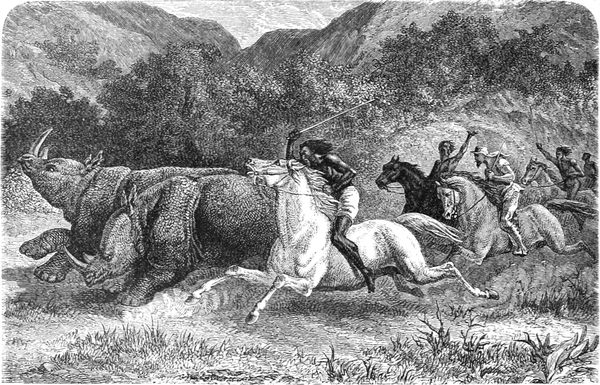
THE RHINOCEROS HUNT.
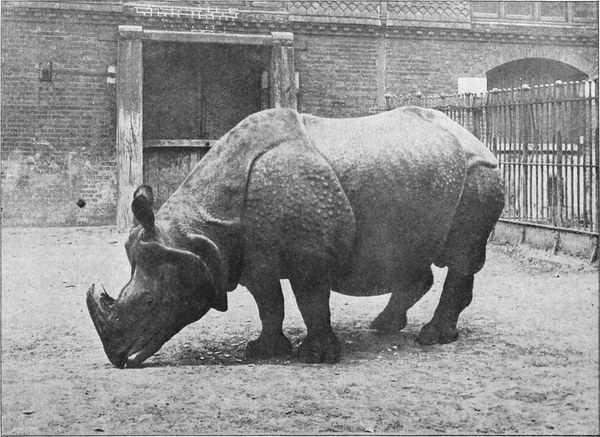
RHINOCEROS.
(From the Living Specimen in the Zoological Gardens, London.)
❏
LARGER IMAGE
Not unfrequently, however, it is the hunter who has to fly away before
the Rhinoceros, as Sir S. Baker found out to his cost in the Upper Nile.
Gordon Cumming, in his “Hunter’s Life in South Africa,” gives the
following details of the Rhinoceros:—“Of the Rhinoceros there are
four varieties in South Africa, distinguished by the Bechuanas by the
names of the Borèlé, or Black Rhinoceros; the Keitloa, or Two-horned
Black Rhinoceros; the Muchocho, or common White Rhinoceros; and the
Robaoba, or Long-horned White Rhinoceros. Both varieties of the Black
Rhinoceros are extremely fierce and dangerous, and rush headlong and
unprovoked at any object which attracts their attention. They never
attain much fat, and their flesh is tough, and not much esteemed by the
Bechuanas. Their food consists almost entirely of the thorny branches
of the waitabit thorns. Their horns are much shorter than those of the
other varieties, seldom exceeding eighteen inches in length. They are
finely polished with constant rubbing against the trees. The skull is
remarkably formed, its most striking feature being the tremendously
thick ossification in which it ends above the nostrils. It is on this
mass that the horn is supported. The horns are not connected with
the skull, being attached merely by the skin, and they may thus be
separated from the head by means of a sharp knife. They are hard and
solid throughout, and are a fine material for various articles, such
as drinking-cups, mallets for rifles, handles for turners’ tools, &c.,
&c. The horn is capable of taking a very high polish. The eyes of the
Rhinoceros are small and sparkling, and do not readily observe the
hunter, provided he keep to leeward of them. The skin is extremely
thick, and only to be penetrated by bullets hardened with solder.
During the day the Rhinoceros will be found lying asleep, or standing
indolently in some retired part of the forest, or under the base of the
mountains, sheltered from the power of the sun by some friendly grove
of umbrella-topped mimosas. In the evening they commence their nightly
rambles, and wander over a great extent of country. They usually visit
the fountains between the hours of nine and twelve o’clock at night,
and it is on these occasions that they may be most successfully hunted
and with the least danger. The Black Rhinoceros is subject to paroxysms
of unprovoked fury, often ploughing up the ground for several yards
with its horn, and assaulting large bushes in the most violent manner.
On these bushes they work for hours with their horns, at the same time
snorting and blowing loudly, nor do they leave them in general until
they have broken them in pieces. All the four varieties delight to roll
and wallow in the mud, with which their rugged hides are generally
encrusted. Both varieties of the Black Rhinoceros are much smaller and
more active than the white, and are so swift that a Horse with a rider
on his back can rarely overtake them. The two varieties of the White
Rhinoceros are so similar in habits that the description of one will
serve for both; the principal difference consisting in the length and
set of the anterior horn: that of the Muchocho averaging from two to
three feet in length, and pointing backwards; while the horn of the
Robaoba often exceeds four feet in length, and inclines forward from
the nose at an angle of 45°. The posterior horn of either species
seldom exceeds six or seven inches in length. The Robaoba is the rarer
of the two, and it is found very far in the interior, chiefly to the
eastward of the Limpopo. Its horns are very valuable for loading-rods,
supplying a substance at once suitable for a sporting implement and
excellent for the purpose. Both these varieties of Rhinoceros attain
an enormous size. They feed solely on grass, carry much fat, and their
flesh is excellent, being preferable to beef. They are of a much milder
and more inoffensive disposition than the Black Rhinoceros, rarely
charging their pursuer. Their speed is very inferior to that of the
other varieties, and a person well mounted can overtake and shoot
them. The head of these is a foot longer than that of the Borèlé. They
generally carry their heads low; whereas the Borèlé, when disturbed,
carries his very high. Unlike the Elephants, they never associate in
herds, but are met with singly or in pairs. In districts where they
are abundant from three to six may be found in company; and I once saw
upwards of a dozen congregated together on some young grass; but such
an occurrence is rare.”
Gordon Cumming relates that the Rhinoceros and Hippopotamus are usually
attended by little birds known as Rhinoceros Birds, “their object
being to feed upon the ticks and other parasites that swarm upon these
animals. They are of a greyish-colour, and are nearly as large as a
common Thrush. Their voice is very similar to that of the Mistletoe
Thrush. Many a time have these ever-watchful birds disappointed me
in my stalk, and tempted me to invoke an anathema upon their devoted
heads. They are the best friends the Rhinoceros has, and rarely fail to
awaken him even in his soundest nap. ‘Chukuroo’ perfectly understands
their warning, and, springing to his feet, he generally first looks
about him in every direction, after which he invariably makes off. I
have often hunted a Rhinoceros on horseback which led me a chase of
many miles, and required a number of shots before he fell, during which
chase several of these birds remained by the Rhinoceros to the last.
They reminded me of mariners on the deck of some bark sailing on the
ocean, for they perched along his back and sides; and as each of my
bullets told on the shoulder of the Rhinoceros, they ascended about six
feet into the air, uttering their harsh cry of alarm, and then resumed
their position. It sometimes happened that the lower branches of trees,
under which the Rhinoceros passed, swept them from their living deck;
but they always recovered their former station. They also adhere to
the Rhinoceros during the night. I have often shot these animals at
midnight when drinking at the fountains, and the birds, imagining they
were asleep, remained with them till morning; and on my approaching,
before taking flight, they exerted themselves to their utmost to awaken
Chukuroo from his deep sleep.”
There are four different Rhinoceroses in Asia, of which two are
characterised by the possession of one horn, while the remaining two
possess two horns, as in the African species. All the adult Asiatic
possess incisors or front teeth, which are conspicuous by their absence
from the African species. The normal number of these is four in the
upper, and four in the lower jaws, the median pair being the larger in
the upper, and the smaller in the lower. The development of these teeth
seems to stand in relation to the development of horns, those animals
with the smallest horns being provided with the largest incisors. The
most familiar is the INDIAN RHINOCEROS (Rhinoceros unicornis
= R. indicus, Cuvier), with a single horn on the nose, and thick
naked skin covered with large boss-like granulations, which lies in
massive folds on various parts of the body, and more especially behind
and across the shoulders and before and across the thighs. There are
a few stiff hairs on the tail and ears. It inhabits the East Indies,
principally beyond the Ganges, and is recorded as having been found
in Bengal, Siam, and Cochin-China. It is found in shady forests, the
neighbourhood of rivers, and marshy places, its food consisting of
herbage and branches of trees. The fully-grown animal rarely arrives at
a greater height than five, and its average may be taken at four feet.
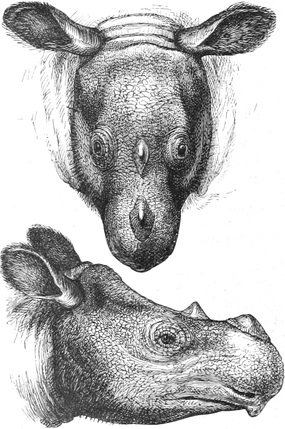
FRONT AND SIDE VIEWS OF HEAD OF SUMATRAN RHINOCEROS.
(From the Proceedings of the Zoological Society.)
Williamson, in his “Oriental Field Sports,” speaking of the Indian
Rhinoceros, describes it as an inveterate enemy of Elephants, attacking
whenever he can find them single, or, at least, not protected by a male
of great bulk; ripping without mercy, and confiding in his coat of mail
to defend him from the puny attacks of the females, as well as to
resist the tusks of young males. He relates that the apparent bluntness
of the horn of the Indian Rhinoceros, which is about as broad at the
base as it is high, would make it appear a somewhat insignificant
weapon, and inadequate to penetrate any hard or tough substance.
This, however, we are informed, is not the case, Elephants often
being found dead, obviously, it is stated, from the wounds received
from the horn of the Rhinoceros; and in one case, as is related by
Williamson, a large male Elephant and Rhinoceros were found both dead
together, the Elephant’s abdomen having been ripped open, and the
Rhinoceros’s horn found transfixed beneath the ribs. Williamson also
states that Major Lally, an officer of the Indian army, whose veracity
is beyond question, while engaged in one of his hunting expeditions,
and having arrived at the summit of a low range of hills, was suddenly
presented with a distinct view of a most desperate engagement between
a Rhinoceros and a large male Elephant, the latter, to all appearance,
protecting a small herd which were retiring in a state of alarm.
The Elephant was beaten, and decamped, followed by the Rhinoceros,
into a heavy jungle, where much roaring was heard, but nothing could
be discerned. From this we may conclude that the habit which Pliny
describes of the Rhinoceros ripping open the Elephant is confirmed by
modern observation.
THE JAVAN
RHINOCEROS (R. sondaicus = R. javanus of Cuvier)
is a smaller representative of the Indian Rhinoceros, with the skin
not so coarsely granulated, and the folds not so strongly marked. It
is covered with a sparse growth of bristles, and its head and limbs
are longer and more slender in their proportions than in the latter
species. It inhabits Java and the Malay Peninsula, and the Sunderbunds
of Bengal, living on herbage and the branches of trees.
THE SUMATRAN
RHINOCEROS (R. sumatrensis of Cuvier) is the
more commonly known of the two two-horned species inhabiting Asia. Its
head is armed with two obtusely-pointed horns, its body is covered
with bristles, and the folds of the skin are deep, and especially
that behind the shoulder. The folds on the neck, however, are not so
distinct as in the one-horned species.
THE HAIRY-EARED RHINOCEROS (R. lasiotis) has been confounded
by naturalists with the Sumatran species, until Dr. Sclater showed from
the comparison of these two animals, in the Zoological Gardens, that
they were specifically distinct. The former is characterised by the
long hairy fringe to the ears, by the covering of long fine reddish
hair on the body, the smoother and more finely granulated skin, and
the shorter tail. The one in Regent’s Park was captured in January,
1868, under very singular circumstances, as described in the following
extract from a Calcutta newspaper:—“The quiet station of Chittagong
has been lately enlivened by the presence of a Rhinoceros. It appears
that about a month ago some natives came into Chittagong and stated
that a Rhinoceros had been found by them in a quicksand, and was quite
exhausted with the efforts to relieve herself. They had attached two
ropes to the animal’s neck, and with the assistance of about 200 men
dragged her out, and keeping her taut between two ropes they eventually
made her fast to a tree. The next morning, however, they found the
Rhinoceros so refreshed, and making such efforts to free herself,
that they were frightened, and made application to the magistrate of
Chittagong for protection. The same evening Captain Hood and Mr. H. W.
Wickes started with eight Elephants to secure the prize, and after a
march of about sixteen hours to the south of Chittagong they came up
with the animal. The Elephants, at the first sight of the Rhinoceros,
were very much afraid, and bolted one and all, but after some exertion
they were brought back and made to stand by. A rope was now with some
trouble attached to the animal’s hind leg, and secured to an Elephant.
At this juncture the Rhinoceros roared; the Elephants again bolted, and
had it not been for the rope slipping from the leg of the Rhinoceros,
that limb might have been pulled from the body. The Rhinoceros
was, however, eventually secured with ropes between Elephants, and
marched into Chittagong in perfect health. Two large rivers had to be
crossed—first the Sungoo River, where the animal was towed between
Elephants, for she could not swim, and could only just keep her head
above water by paddling with the fore-feet like a Pig; and, secondly,
the Kurnafoolie River, when the ordinary cattle ferry-boat was used.
Thousands of natives thronged the march in, which occupied a few days,
the temporary bamboo bridges on the Government road invariably falling
in with the numbers collected thereon to watch the Rhinoceros crossing
the stream below; and sometimes the procession was at least a mile in
length. The ‘Begum,’ as the Rhinoceros has been named, is now free from
all ropes, and kept within a stockade enclosure, having therein a good
bath excavated in the ground, and a comfortable covered shed attached.
She is already very tame, and will take plantain leaves or chupatties
from the hand, and might almost be led about by a string.” Begum was
ultimately brought to London, and sold to the Zoological Society for
£1,250.
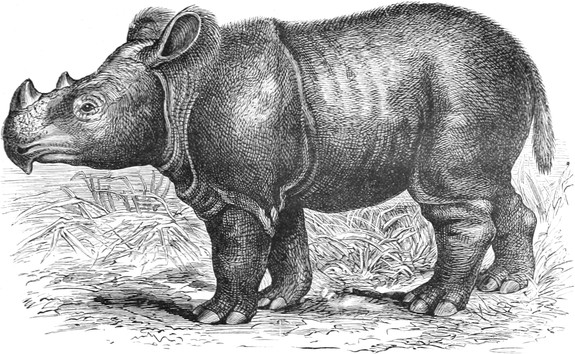
HAIRY-EARED RHINOCEROS. (From the Proceedings of the
Zoological Society.)
Although the species of Rhinoceroses living at the present time are but
few, the researches of palæontologists show us that in past time the
number of species was considerable, and that they were not, as now,
confined to the warmer parts of the Old World, but were distributed
over a large portion of Northern Asia and Europe.
The first representative of the Rhinoceros family is the
Orthocynodon, an animal with large upright canines, discovered in
the Upper Eocene strata of the United States. The fossil Rhinoceroses
properly so called are first found in the Miocene, and are divided into
four groups. The first group is characterised by the nostrils being
separated by a bony partition, and in the adult animal the incisor
teeth are lost: the second is distinguished by the absence of a bony
partition between the nostrils, and the incisor teeth are of a medium
size: in the third there is no partition, but the incisors are large;
and in the fourth it is imperfectly developed.
An example of the first group, and probably the best known form of
all the extinct Rhinoceroses, is Rhinoceros tichorhinus, or the
Woolly Rhinoceros. Like that of the Mammoth, with which animal it was
evidently associated, its entire body was covered with hair and wool,
the skin had no folds, and its nose carried two horns, the anterior of
which was of remarkable size, and characteristic of the group to which
it belongs; the nostrils were separated by a complete bony partition.
The Woolly Rhinoceros has been discovered under similar circumstances
to that of the Mammoth, having been found embedded in ice in the
northern latitudes of Asia, in the years 1771 or 1772, being some
twenty years previous to that of the discovery of the first Mammoth by
a fisherman named Schumachoff. According to Pallas, the discovery was
made by some Yakuts, who were on a hunting expedition, and took its
dimensions on the spot; it was about eleven and a half feet in length.
Its body was still clothed with skin, but altogether the animal was so
far decomposed that not more than the head and feet could be brought
away. On the skin many short hairs still remained. The range of the
Woolly Rhinoceros was undoubtedly the same as that of the Mammoth,
except that it did not cross Behring Strait, and, consequently, its
remains are not found in America. The remains of the Woolly Rhinoceros
are found in numerous caves in association with the remains of
Hyænas, having undoubtedly been a staple article of food for these
animals. In England remains have been found in the caves at Creswell,
Nottinghamshire; in the Brixham Cave; in Kent’s Hole, near Torquay,
Devonshire; and in Wookey Hole, near Wells, Somerset, as well as in the
caves of Wales and Derbyshire.
As an example of the second group, we have Rhinoceros megarhinus of
the Pliocene and Pleistocene strata. This animal possessed two horns.
Its remains are found in France and Italy, and in the pre-glacial
forest bed of Cromer, and in the lower brick earths of the Thames
valley. Rhinoceros incisivus represents the third group in Miocene
times. It had no bony septum between the nostrils, the incisors are
large, and there are four toes on the fore-foot. Of the fourth group
the best examples are R. etruscus and R. leptorhinus. The former
of these possessed two horns, and the nostrils were separated by an
imperfect bony septum. Its remains are found in various Pliocene and
Pleistocene deposits. The latter also possessed two horns, and its
nostrils were divided by a thin and delicate bony partition, which can
only be termed imperfect in comparison with the massive partition in
the Woolly Rhinoceros. It is devoid of incisors. This species is found
in Pleistocene deposits in Britain, France, and Italy, in caverns, and
in river-beds, the most perfect remains being met with in the valley
of the Thames near Ilford. These were collected by Sir Antonio Brady,
and are now to be seen in the British Museum. In the figure the fragile
nose septum is represented as broken.
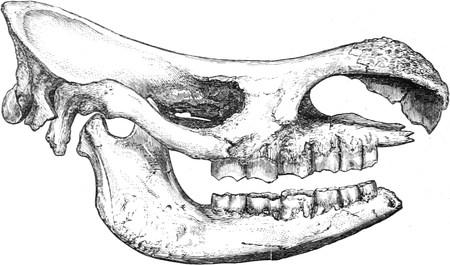
SKULL OF FOSSIL RHINOCEROS [R. LEPTORHINUS].
The genus Aceratherium, of Kaup, is a hornless Rhinoceros, found
in the same Miocene strata as the R. incisivus. Like the latter,
it possesses incisors, and, not improperly, may be considered as
a female of the latter species, if the horn be viewed as a sexual
characteristic: first of all in the possession of the male, and
afterwards transferred by descent, in the case of all the Post-Miocene
Rhinoceroses, to the female.
The Palæotheridæ, or fourth family to be considered under the head of
the Perissodactyla, is that which is found only in the fossil state
in the Eocene strata of Europe and North America. They are allied,
on the one hand, to the Horses, and on the other to the Tapirs. The
type of the family, the Palæotherium, was originally discovered by
Cuvier in the quarries of Montmartre, near Paris. The grinding teeth
closely resemble, in the pattern of their grinding surfaces, those of
the Rhinoceros. The full complement, however, of incisors and canines,
as well as of grinders, is present in each jaw, namely—Incisors, 3;
canines, 1; premolars, 4; molars, 3. These animals varied in size from
that of a Roedeer to that of a Tapir, and were possessed of three
well-developed hoof-bearing toes.
The genus Macrauchenia is also an extinct form, constituting a separate
family, Macraucheniadæ, peculiar to the later Tertiaries of South
America. Its skull is, on the whole, like that of the Horse, but the
nasal bones are short and like those of the Tapir. It possessed a long
neck, like the Llamas, and a full complement of teeth, partly equine,
partly resembling those of Rhinoceros. Both fore and hind feet were
furnished with three toes.
W. BOYD
DAWKINS.
H. W. OAKLEY.
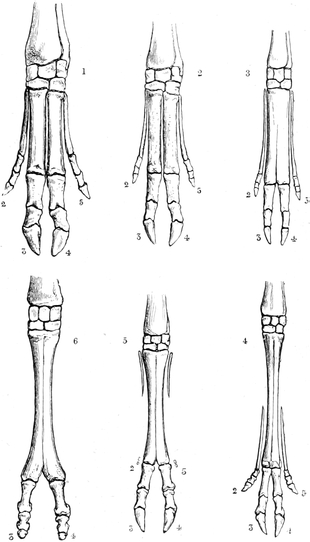
BONES OF THE LEFT FORE LIMB OF (1) COMMON PIG, (2)
AFRICAN DEERLET, (3) JAVAN DEERLET, (4) ROEBUCK, (5) COMMON SHEEP, (6)
CAMEL.[268]
(From Specimens in the Museum of the Royal College of
Surgeons.)
BESIDES the Perissodactyla there is another large group of animals in
which the extremities of the fore and hind toes are entirely surrounded
by horny tissue in the shape of hoofs. These are the Artiodactyla, or
cloven-hoofed animals, which differ from the Perissodactyla in the
manner in which the weight of the body is carried upon the feet. In the
Artiodactyla the toes are even in number, being four in all the feet,
except in the Camel tribe, the Giraffe, and a very few Antelopes, in
which only two are present. It is the digit which corresponds to the
human thumb in the fore foot, and to the great toe in the hind, which
is always deficient, the inner and the outer digits (the second and
the fifth) being frequently reduced to but minute rudiments, as in the
Sheep and Ox. Some may ask how we know that it is the thumb and the
great toe which are missing, and not the little finger or toe, for
instance. A glance at the human hand and foot will explain the point.
Counting the bones in the thumb or great toe, it will be found that
there are but two bones beyond the limit of the “ball of the thumb,”
or the free part of the great toe, whilst in all the other fingers and
toes three bones can be counted. A reference to Fig. 3 makes it evident
that in the Artiodactyla there figured, as in all others, each toe has
three bones in it; and as all mammalian animals which have five toes
agree with man in possessing one less bone in the inner toe than in any
of the others, it is but logical to conclude that when four toes only
are present, all possessing an equal number of bones, the one absent
is that corresponding to the thumb and great toe. Each foot is always
symmetrical in itself, at the same time that its imaginary axis, which
is the line drawn down the middle of it, runs between the two medial
toes, they corresponding with the third and fourth of the human limb.
The accompanying drawings of the bones of the fore-foot of the Pig, the
Water Chevrotain (or Deerlet), the Javan Chevrotain, the Roebuck, the
Sheep, and the Camel, illustrate, better than can be done by words, the
difference in the degree of development of the outer toes found in the
group. In the Pig all the four toes are well developed, and there is
no consolidation of their constituent elements. In the Water Deerlet
of West Africa the external toes are smaller, whilst, as in the Pig,
each metacarpal—which is in the human hand the part of each finger
included within the palm—is independent of its neighbour, the Javan
Deerlet differing in having the third and fourth fused into a “cannon”
bone. But in the Red Deer the reduction of the second and fifth digits
is so great that their metacarpals are not perfect, being only present
in their upper parts; whilst the phalanges, or lower bones, are very
small, being reduced in the Sheep to mere bony spots with minute
hoofs, which latter are quite absent in the Camel, Llama, Giraffe, and
Pronghorn Antelope.
There are numerous other characters which associate these animals, and
prove the natural affinities of the different species, at the same time
that in geologic times there existed other creatures which fill up the
intervals between existing forms, and conclusively demonstrate the
manner in which the order has been evolved from a common type in times
long past.
All the Artiodactyla are strictly terrestrial, none being arboreal in
their habits. The Hippopotamus is the only member of the group which is
aquatic, spending much of its life in the water, without, however, any
special modification of its limbs or tail like that found in the more
truly aquatic Seals, Sirenia, or Whales.
There is a great uniformity throughout the order in the general plan
upon which the limbs are constructed. In all the species the wrist
in the fore limb—commonly called the knee—and the heel in the hind
limb—the hock—is raised a considerable distance above the ground, at
the same time that the whole weight of the body is carried upon the
extreme tips of the toes, the terminal bones of which are expanded
within the hoof to increase the basis of support. The collar-bone is
absent in all, as it is in nearly every animal that does not use its
fore limbs for any other purpose than that of carrying the weight of
the front parts of its body.
In the Perissodactylate Rhinoceros the horn or horns is or are situated
in the middle line of the face above the nose, and are not supported
upon any bony horn core. In all those Artiodactyla which carry horns or
antlers, there are appendages paired and lateral in position, at the
same time that they are either supported upon bony cores, or are formed
of bone itself, and are situated upon the forehead.
The following table best represents our present knowledge as to the
classification of the Artiodactyla:—
|
ORDER UNGULATA
|

|
SUB-ORDER
ARTIODACTYLA
|

|
Non-ruminants.
|
|
Pigs of the Old World.
|
|
Peccaries of the New World.
|
|
Hippopotami.
|
|
Ruminants.
|

|
Camels.
|
|
Llamas.
|
|
Chevrotains or Deerlets.
|
|
Bovidæe (Oxen).
|
|
Cervidæ (Deer).
|
THE Non-Ruminantia, or Artiodactyls which do not chew the cud,
possess the following characters: they usually have more than one
pair of incisors in the upper jaw, they are devoid of horns, and
the stomach has rarely more than two divisions. In only one genus,
that of the Peccary, are the metatarsal and metacarpal bones united
into one compact bony mass. They are divisible—as the above table
indicates—into three families: the Suidæ, or Hogs, the Hippopotamidæ,
or Hippopotamuses, and the Anoplotheridæ,[269] or Anoplotheres, an
extinct family, met with only in the Eocene strata of the Old and New
Worlds.
The Hog family may be divided into three well-marked groups:—1,
the True Swine, consisting of three genera, Sus, Potamochœrus, and
Babirusa; 2, the Wart Hogs, represented by one genus, Phacochœrus;
and 3, the Peccaries, represented also by one genus, Dicotyles. They
have three kinds of teeth—incisors, canines, and boss-covered or
transversely ridged grinders—slender limbs, and the third and fourth
toes are considerably larger than the second and fifth.
In order to enable the Hog family to “root” or turn up the ground, they
are provided with a truncated and cylindrical proboscis, or snout,
which is capable of considerable movement. The skin is more or less
supplied abundantly with hair, and the tail is short, and in some cases
merely represented by a tubercle.
The sense of smell in the Hog is very acute, and when its broad snout
ploughs up the herbage, not a root, an insect, or a worm, escapes the
olfactory sense. Although credited with stupidity, the Hog in its
native state is to be styled anything but a dull and lethargic animal,
neither is it the filthy animal that domestication has reduced it to.
Properly cared for, the Pig is as cleanly in its habits, and as capable
of strong attachment, as any other creature.
No animal that is mentioned in the Bible—not even the Dog—is spoken
of with more abhorrence than the Pig; and even at the present day a Jew
or Mohammedan looks upon this creature with anything but a generous
feeling, treating it as something utterly detestable. So great was the
horror with which the older Jews regarded the Hog, that they would not
even mention it by name, but called it “the abomination.” The origin
of the great antipathy which the Jews have always experienced for the
Pig appears to be lost in antiquity. In Lev. xi. 7, the Hog is spoken
of with other animals as being unclean and unfitted for food, simply
because it did not chew the cud, although the hoof was divided. It has,
however, been suggested that the Pig was so strictly prohibited by
Moses from being eaten, on account of its flesh being supposed in a hot
country to cause skin-diseases, and especially the dreaded leprosy; but
it is to be doubted whether Moses is to be considered as the originator
of the horror with which the Hog has been and still is regarded. It
seems probable that this disgust dates from a period of far greater
antiquity than that of Moses; and it is certain that the flesh of Swine
can be eaten in hot countries without producing any bad effects. It
is a matter of considerable wonder, that while Swine are held in such
abhorrence, we read of herds being so often kept in Palestine. In the
Gospel of St. Matthew (viii. 28–34), we read of a herd of Swine being
entered by devils, and which, so possessed, rushed down a hill and were
drowned in the sea. Again, in the parable of the Prodigal Son, we are
told of his becoming a swineherd. Although Pigs were so much disliked,
the Jews were evidently well acquainted with their habits, as we read
in the Second Epistle of St. Peter (ii. 22), where the apostle refers
to the fact of Pigs wallowing in the mire. It is also remarkable that
with the exception of one passage in the Bible, the mention of the Hog
is confined to those in a domesticated state, this exception being
found in Psalm lxxx. 13: “The boar out of the wood doth waste it, and
the wild beast of the field doth devour it.”
The genus Sus, or Hog proper, ranges, in the wild state, over the
greater portion of the Old World, through Central and Southern Europe
into Central and Southern Asia, and as far to the east and south as New
Guinea. It is also met with in the North African forests, in the region
north of the Sahara desert. It is conspicuous by its absence from North
and South America, Australia, and the cold northern regions of Europe
and Asia.
The adult teeth in the True Hogs (genus Sus) are forty-four, of which
there are in each jaw three incisors, one canine, four premolars, and
three true molars. The canines are very variable in size, being reduced
to a minimum under domestication, and arriving at a maximum in the wild
males.
THE WILD BOAR[270] inhabits Europe, North Africa, and
Hindostan, each country having its own peculiar type or race, which
sometimes is so marked as to constitute separate species in the opinion
of first-rate naturalists.
The Wild Boar is distinguished by a body generally of a dusky-brown or
greyish colour, having a tendency to black, and being diversified with
black spots. The canines or tusks in the male are long and powerful,
and project beyond the upper lip, the mouth is large, and the elongated
head is set on a short neck rising out of a thick and muscular body.
The size is variable, an old Wild Boar recorded by Desmarest being
five feet nine inches long, while a four-year-old of the more ordinary
size measured three feet without the tail. The female is smaller than
the male, and with smaller tusks. The hairs of the body are coarse,
intermixed with a downy wool. On the neck and shoulders the hairs take
the form of bristles, being long enough to assume a kind of mane which
the animal is enabled to erect if irritated. The young has the body
marked with longitudinal stripes of a reddish colour.
In its habits the Wild Boar is by choice herbivorous, feeding on
plants, fruits, and roots; but it will also eat Snakes, Lizards, and
various insects, and when pressed by hunger nothing appears to come
amiss to its voracious appetite; it is stated that even dead Horses
are sometimes called into requisition. The Boar is nocturnal in its
habits, rarely leaving the shadow of the woods in the day-time, and
coming forth as twilight approaches in search of food, delighting in
roots often deeply embedded in the soil, and which its keen sense of
smell enables it easily to detect. Much mischief is often done by this
animal, which ploughs up the ground in continuous furrows for long
distances, and is not content, like the domesticated variety, with
ploughing up a spot here and there.
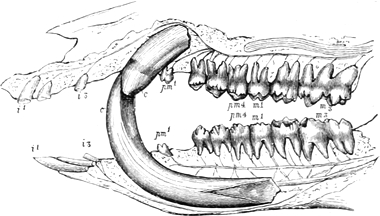
DENTITION OF WILD BOAR.
The Wild Boar was formerly an inhabitant of Great Britain. According to
Bell, “About the year 940, the laws of Hoel Dha direct that it shall
be lawful for the chief of his huntsmen to chase the Boar of the woods
from the fifth of the ides of November (9th), until the calends of
December (1st), Cap. xxi. sect. 14.” In the next century Bell states
that “the numbers had perhaps begun to diminish, since a forest law of
William I., established in A.D. 1087, ordained that any who
were found guilty of killing the Stag, the Roebuck, or the Wild Boar,
should have their eyes put out; and sometimes the penalty appears to
have been a painful death. It appears,” continues Bell, “that Charles
I. turned out some Wild Swine in the New Forest, for the purpose of
restoring the breed to that royal hunting-ground; but they were all of
them destroyed during the civil war. A similar attempt was made in Bere
Wood, in Dorsetshire; but one of the Boars having injured a valuable
Horse belonging to the worthy Nimrod who exhibited this specimen of
sporting epicurism, he caused them to be destroyed.”
The Wild Boar probably became extinct in Britain before the reign of
Charles I.; while in Ireland it was abundant as late as the seventeenth
century.
THE INDIAN HOG[271] differs but little in general appearance
from the European Wild Boar, and is looked upon in the East as a most
exciting object of the chase, its speed, endurance, and courage making
it one of the most formidable and dangerous animals that can possibly
be encountered.
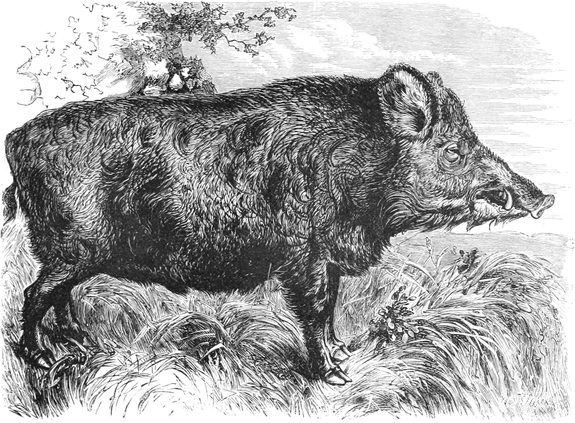
WILD BOAR.
The habits of this animal are admirably portrayed by Williamson, in his
“Oriental Field Sports.” After describing the extraordinary speed this
creature is possessed of, equalling that of a good Horse, and asserting
that a moderate-sized Hog can, and often does, overthrow Horses and
their riders, he states that “The Wild Hog delights in cultivated
situations; but he will not remain where water is not at hand, in
which he may, unobserved, quench his thirst and wallow at his ease.
Nor will he resort for a second season to a spot which does not afford
ample cover, whether of heavy grass or of underwood jungle, within
a certain distance, for him to fly to in case of molestation, and
especially to serve as a retreat during the hot season, as otherwise
he would find no shelter. The sugar-cane is his great delight, both
as being his favourite food, and as affording a high, impervious,
and unfrequented situation. In these, Hogs commit great devastation,
especially the breeding Sows, which not only devour, but cut the canes
for litter, and throw them up into little huts, which they do with much
art, leaving a small entrance which they stop up at pleasure. Sows
never quit their young Pigs without completely shutting them up. This,
indeed, is requisite only for a few days, as the young brood may be
seen following the mother, at a round pace, when not more than a week
or ten days old. The canes are generally planted about the end of May
or beginning of June, in ground rendered extremely fine by digging.
For this purpose cuttings of canes are buried horizontally, and with
the first showers of the rainy season, which usually commences in
the middle of June, the several joints throw out shoots that grow so
rapidly, as often to be two or three feet high by the beginning of
September. The red cane, called the bun-ook, which is not so valuable
as the smaller or yellower sort, begins to ripen in September; by the
end of which month it will have attained the height of seven or eight
feet. These serve as the first receptacles for the Wild Hogs, which
having suffered, since the harvest in March, all the inconveniences of
bad diet, long nightly excursions, scarcity of water, great diurnal
heat, and frequent disturbance, arrive among them in excellent running
order. It should be observed that throughout India a custom prevails
of setting fire to the grass jungles in the month of May, when they
are completely dry, for the purpose of increasing the growth of the
new grass, by the stimulus of the ashes which are washed in with the
first showers in June.” Williamson goes on to say that “the bun-ook
is commonly cut in November, and the Hogs then shift to the yellow
canes, which are by that time forward enough to serve as sufficient
cover. Canes require much manure and excellent tillage; consequently
they are usually planted near to villages, and surrounded by fields
of wheat, barley, and other grain. A species of lupin called rhur
is cultivated in large quantities. It grows luxuriantly, generally to
the height of eight or nine feet, forming quite a wilderness.... In
these rhur fields Hogs delight, as they are completely umbrageous,
but being open below, admit the air freely. Besides, this wild rice
growing very thick among the rhur, and a kind of soft downy grass
about a foot in height, they find themselves very comfortably situated.
About the middle of March, or, at the latest, by the beginning of
April, the Hogs must shift their quarters, the canes and grain being
by this time generally cut. However, they often retain possession to
the last moment, frequently disputing every inch with the reapers,
and not rarely causing them to leave parts uncut, in the hope that
the Hogs will evacuate them; which, if the jungle whither they must
betake themselves happen to be remote, they feel no great disposition
to do. For at this season the Hog is extremely heavy and indolent, in
consequence of the abundance of the excellent food to which he has,
for five or six months, been habituated. Hogs are often killed in
March with three and four inches of fat on their chines and shoulders.
Exclusive of the habits of ease in which he has so long indulged, it
is probable the Hog feels diffident as to his want of exercise, and
ability to travel under such a mass of flesh. Besides, he is extremely
tenacious of the spot which has so long pampered him; and, although
unable to proceed any distance without being blown, yet the short
sallies he makes to attack such as venture near his haunt are marked
with vigour and resolution. Sometimes he will do considerable mischief
with his tusks.... Great numbers are at this season either caught in
nets made for the purpose, or they are shot by the shekarries, or
native sportsmen, a circumstance that never fails to afford a happy
triumph to the affrighted villagers.”
The Wild Boar of India is hunted usually by men on horseback, armed
with spears of a more or less variable length, averaging from about
six feet and a half to eight and sometimes ten feet. The shaft of
a spear consists of bamboo properly weighted with lead; the spear
itself is a broad and stout blade. It is held by a man on horseback in
such a manner that about a foot and a half projects in front of the
stirrup-iron, and the Horse is ridden in such a way that when the Boar
charges it is transfixed by the spear.
An account of a Wild Boar hunt of an exceptionally interesting and
exciting nature is related by Captain Shakespeare:—“While beating the
sugar canes for Wild Hogs, a few miles from Hingolu, a villager came
and said, ‘If you want to see a Hog come with me;’ and leading the way
over the brow of a hill, pointed out an object in a field below, that
in the mist of the morning appeared like a large blue rock, much too
large for a Hog. However, the object presently got on its legs, and
dissipated every doubt existing as to its character. About a hundred
yards distant from the animal was a fissure in the hills, thickly
wooded, and here, no doubt, was the Boar’s lair; and if he took alarm
and rushed thither, it would be next to impossible to dislodge him. A
savage Boar in his stronghold is as difficult to oust as the Grizzly
Bear from his winter cave in the Rocky Mountains. He constantly rushes
out, knocks over and gores the beaters nearest the mouth of his
retreat, and then skips back again before there is the shadow of a
chance of spearing him.”
DOMESTIC SOW AND YOUNG.
After describing the way in which he managed to place himself between
the Boar and his retreat, Captain Shakespeare continues:—
“Standing as I was, behind a hedge considerably higher than my mare’s
head, I did not see the Boar. The duffadar (native officer) was some
thirty yards to my left, and looking over a lower part of the hedge,
shouted out, ‘Look out! here he comes!’ The mare was standing still,
and I had but just time to drop my spear point, which caught the Boar
in the rise, and the blade was buried in his withers. My mare, from
her standing position, cleared with one bound the Boar, spear and all,
as this was carried out of my hand; then suddenly turning, was in
her stride after the Hog. The Hog had but seventy yards to reach the
jungle, and just as he struck the first branch of the jungle with his
back, breaking in two the shaft of my spear (which was still fast in
his body), the duffadar closed with him. The Boar, having been missed
by the spear, ran under the duffadar’s Horse, and for thirty yards
lifted him off his legs, plunging and kicking till the rider came to
the ground. Fortunately we had three Dogs with us; and having shouted
to the people to let them go, they came up and took the attention of
the Boar at the moment he was on the duffadar, who had fallen on his
sword and broken it, and was utterly helpless. The next moment the
Boar made full tilt for his stronghold, the Dogs following close
at his heels. Armed with a fresh spear, I rode up the face of the
hill, and from thence looking down saw the Boar at bay and surrounded
by the Hounds, but in such a situation that it was impossible on
horseback to go to the assistance of the Dogs. At this moment one of
the beaters came running up with a heavy double-barrelled rifle, and
being apprehensive that the Hounds would be speedily slaughtered if not
relieved, I took the gun, and dismounting, resolved to attack the Boar
on foot. Just as I got to the bottom, I saw the monster Boar with his
back to a tree, and the three Dogs looking very cautiously at him. He
was about forty yards from me. Directly he saw me, putting his head a
little down to take aim, he came straight at me, increasing his pace
from the trot to the charge. When about fifteen yards off, he received
the first bullet of my rifle in his neck, Taking not the least notice
of it, he came on, and the second barrel fired at him, at about five
yards, broke his left under jaw-bone at the tusk. Fortunately I brought
my rifle down to the charge, and striking it with his head, the Boar
sent me over on my back. While running over me he made a glance, and
wounded me in the left arm. Had I not put down my rifle-barrel at the
moment, most probably his tusks would have been buried in my body. As
it was I had two shooting jackets on, it being a very cold morning, and
I suffered more from the jar than the wound. As I lay, I seized the end
of my rifle-barrel, determined to sell my life as dearly as possible.
To my delight, I must say, I saw the Boar knock over the man who was
running down with my big spear. He did not turn on either of us; for
the Boar is a noble foe, rarely turning, unless desperately wounded
and unable to go on, to mutilate a fallen enemy. The Dogs immediately
tackled him, and permitted me, though almost breathless, to get up. The
rifle-stock was cracked, and the pin that fastens the barrel into the
stock much bent. Having put this to rights, I loaded, and, proceeding
in the direction the Boar had gone, came up to within fifteen yards
of where he had halted and stood regarding me vengefully. Taking aim
I sent a bullet through his eye into his brain, and rolled him over
dead. I have stated that the Boar is the most courageous animal in the
jungle. There he was; with a broken spear in his withers, the shaft
sticking up a foot and a half from the blade, knocking over a horseman
and wounding his Horse; receiving two bullets—ten to the pound—the
first in his neck and throat, the second breaking his jaw, and fired
within a few feet of his muzzle; making good his charge, cutting down
his enemy like grass, wounding him; knocking over a second man armed
with a spear; defying the Dogs; and then, in the act of charging again,
shot in the brain, and dying without a groan.”
HEAD OF DOMESTIC PIG.
HEAD OF WILD BOAR.
THE DOMESTIC HOG is proved by the researches of Nathusius and
Rütimeyer to be descended from two distinct wild stocks—the Wild Boar,
and an Eastern type known now only in the domesticated condition, and
named Sus indica by Pallas. The breeds of Hogs descended from the
Wild Boar are to be found in various parts of Northern and Central
Europe, and resemble their progenitors in the length of their legs, and
the development of their tusk. The skull, however, has become higher
and broader, and their tusks are not so large, and the body is not
covered with such a dense coating of hair.
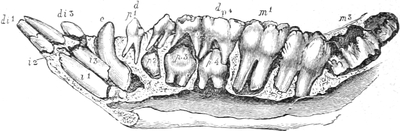
MILK DENTITION OF PIG.
d, deciduous or falling-out [milk] teeth.
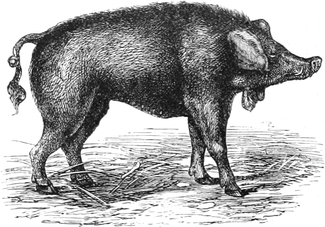
IRISH GREYHOUND PIG. (After Richardson.)
The old “Irish Greyhound Pig,” of Richardson, may be taken as an
example of one of the domestic races descended from the Wild Boar.
Sometimes in this breed, as in the Normandy Pigs, a peculiar pendant,
about three inches long and covered with bristles, is to be seen
attached to the corner of the jaw, as in the accompanying figure.
The domesticated breeds of China and Siam have, among other characters,
broader and stouter heads than those which are descended from the Wild
Boar, and are best known to Englishmen under the form of the Chinese
breed. They constitute the type of Sus indica, which is now so
largely represented among the various European strains, and which is
mostly due to the crossing of the two original stocks.
Both these breeds were brought under the dominion of man in a very
remote age, and have varied in exact proportion to the care taken in
selecting the various characters. Both are found in the pile-dwellings
in the Swiss Lakes which belong to the Neolithic age, or to that period
when the use of metal was unknown in Europe north of the Alps, and both
were probably introduced from the East by the same race of herdsmen to
whom we owe the domestic cattle, Horses, and Dogs, as well as the arts
of gardening, farming, and spinning. The amount of change which has
been produced by the art of man in modifying the original stock may be
estimated from the figure at the top of the preceding page.
THE SOLID-HOOFED BREED OF PIGS.—Among the most remarkable
breeds of Pigs under domestication, the Solid-hoofed Pigs deserve
special notice, because they show a persistent variation from the
even-toed type. “From the time of Aristotle,” writes Mr. Darwin, “to
the present time, solid-hoofed Swine have been occasionally observed
in various parts of the world. Although this peculiarity is strongly
inherited, it is hardly probable that all the animals with solid hoofs
have descended from the same parents; it is more probable that the same
peculiarity has reappeared at various times and places. Dr. Struthers
has lately described and figured the structure of the feet; in both
front and hind feet the distal phalanges of the two greater toes are
represented by a single, great, hoof-bearing phalanx; and in the front
feet, the middle phalanges are represented by a bone which is single
towards the lower end, but bears two separate articulations towards the
upper end.”
This singular modification is stated by Dr. Coues to be persistent in
a Texas breed. So far as the hoof is concerned the animal is perfectly
solid-ungulate. It is also perfectly “odd-toed” (or perissodactyle)
in the terminal phalanges, which are joined together so as to form
one single hoof-supporting bone, a of figure. Above this, however,
the other two phalanges (b, c) remain separate, and are widely
separated from each other by the intervention of a special ossicle
(d). How far this departs from the normal type may be seen from the
comparison of the figure with that of the foot of the Common Hog.
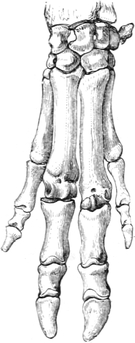
BONES OF PIG’S FOOT.
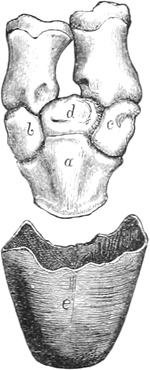
FOOT OF SOLID-HOOFED PIG.
(After Coues.)
The hoof, e, is withdrawn
sufficiently to show the joints.
Among the aberrant forms resulting from domestication, according, to
Nathusius, is the JAPAN, OR MASKED PIG (S. pliciceps, Gray),
with its short head, broad forehead and nose, great fleshy ears, and
deeply-furrowed skin, of which the great thick folds are compared
by Mr. Darwin to the plates on the Indian Rhinoceros. It is held by
Nathusius to belong to the same stock as the Chinese Pig, a view which
is by no means improbable if we consider the enormous differences which
are produced by the selection of characters under the care of man in
the European breeds.
The Hogs are represented in Africa, south of the Sahara, and
in Madagascar, by an animal known as the BUSH HOG
(Potamochœrus), which possesses a remarkable boss or excrescence,
rising from the face below the eyes. The species figured, the
Potamochœrus penicillatus, has peculiar ears which look almost as if
they had been cut.
One of the most singular of the Wild Hogs is the BABIRUSA
(Porcus babirusa), inhabiting the islands of Celebes and Borneo, in
which, in the males, the tusks arrive at an enormous size, those of
the upper jaw curving upwards and backwards, and even, in some cases,
penetrating the skull in their backward reach. These tusks, however,
are useless for purposes of attack. The lower jaws also are armed
with two sharp tusks, which are capable of inflicting severe wounds.
The animal is nearly hairless, and is said to arrive at a size not
much less than that of a Donkey. It is very ferocious, and is a more
formidable antagonist than the Wild Boar of Europe.
The name Babirusa is said to be a compound of Baba and Rusa,
being the Malayan appellations of the Pig and the Deer respectively.
The Babirusa is described as being of a delicate nature, requiring
considerable care and attention when kept in confinement. In its
natural state it is said to be very swift, running with the rapidity
of a Deer, and to be of a fierce disposition. The flesh of this animal
is highly prized as an article of food in the countries in which it is
found.
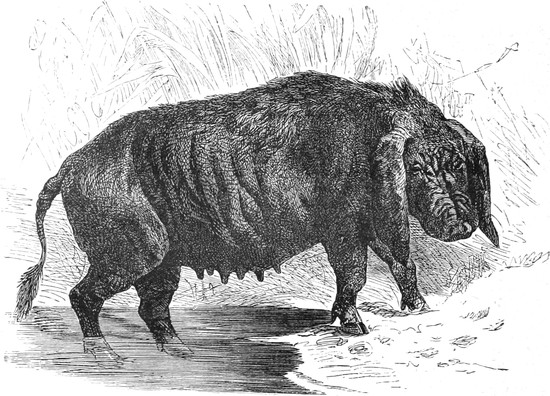
MASKED PIG.
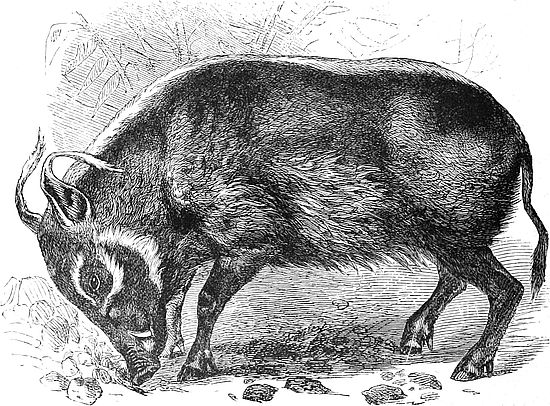
BUSH HOG.
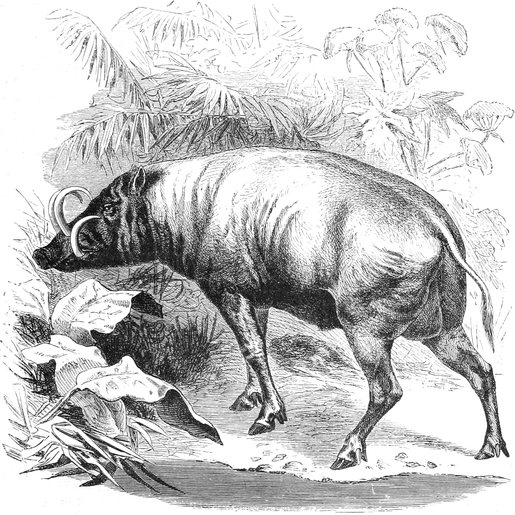
BABIRUSA.
THE WART
HOGS (Phacochœrus) constitute the second
well-marked group to be considered under the head of the family of
Hogs. They range over tropical Africa from Abyssinia to Caffraria.
They are remarkable, not only for having enormous tusks, and for the
development of a large excrescence, or wart, under each eye, but also
for the peculiar construction of their last grinding teeth. These are
massive, and composed of prisms of enamel surrounding a central mass of
dentine, and embedded in the cement which unites them into one tooth.
There is only one pair of upper incisors, and the last molars are the
only ones which are not shed in the old animal. The canines are large,
recurved, sharp, and project eight or nine inches beyond the lips.
Two species of this peculiar genus occur in Africa.
ÆLIAN’S WART
HOG[272] is a native of the North of Africa. Its skin is of a
reddish colour, sparingly supplied with bristles; the neck and back
support a mane, some of the bristles of which attain a considerable
length.
THE ETHIOPIAN WART HOG (P. æthiopicus) is a native of the
southern portions of Africa, and differs principally from the preceding
in the larger size of the warts, and a more peculiarly shaped head. The
food of both species of Wart Hogs appears to consist almost entirely of
roots.
The Hog family is represented in the New World by the small though
formidable animals known as the PECCARIES (Dicotyles), which
are not more than about three feet long, and about fifty or sixty
pounds in weight. They live in herds, are omnivorous, and are perhaps
the most awkward animals to be dealt with by the hunter in the forests
of South America. They know no fear, and will attack anything which
comes in their way, inflicting frightful wounds with their short,
lancet-shaped tusks, which are entirely concealed within their lips.
They live in holes and hollow logs, into which they back, one by one,
until their abode is full, the last standing as sentinel with his head
outside. This habit affords the hunter an easy means of killing them,
for if the sentinel be killed outright the next takes his place, after
pushing out the dead body, and this may go on until the last of the
herd is killed.
SKULL OF THE ETHIOPIAN WART HOG.
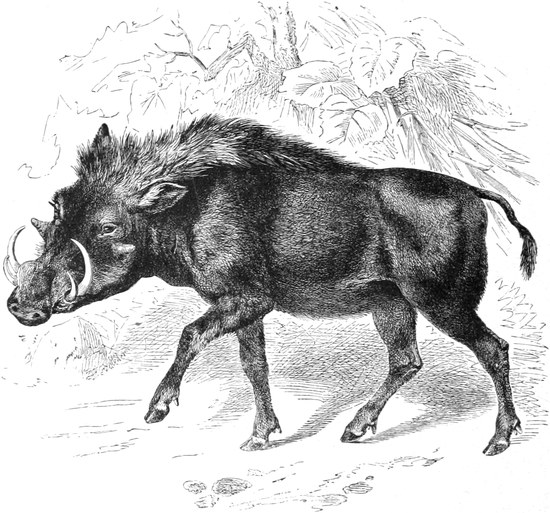
ETHIOPIAN WART HOG.
The dentition of the Peccary differs from that of the True Hogs in
the smaller number of teeth, which are thirty-eight, instead of
forty-four, in number, the upper incisors being reduced to four, and
the premolars in the upper and lower jaws being six instead of eight.
There are also differences in the shape of the teeth, the grinders
presenting transverse ridges, as may be seen from the comparison of the
accompanying figure with that of the Hog.
There is also another important difference to be noted between the
Peccaries and the True Hogs in the structure of the feet. In the
former, the middle metatarsals and metacarpals unite into a solid
cannon bone analogous to that of cattle, while in the latter they are
distinct during the whole life of the animal.
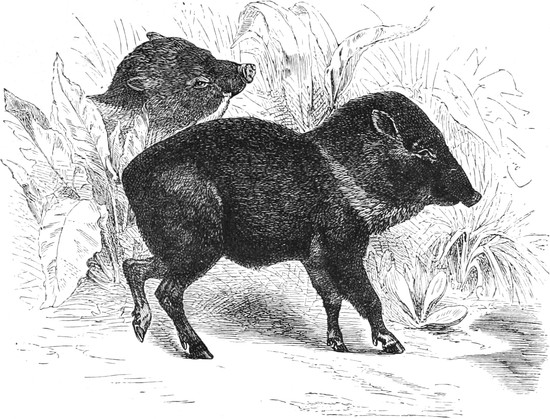
PECCARY.
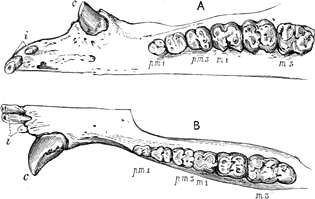
DENTITION OF PECCARY.
(A, Upper; B, Lower jaw.)
Two species of Peccary are known, the COMMON,
OR TAJUCA, OR
COLLARED PECCARY
(Dicotyles torquatus), which ranges from Texas as far as the Straits
of Magellan, and the WHITE-LIPPED
PECCARY (D. labiatus), of the forests of South America. The
latter is the larger of the two and the more ferocious.
THE FOSSIL
HOGS.—The remains of the Fossil Hog are met with
in the fossil state in Europe, as far back as the Miocene Age, in
which period, as Professor Gaudry has pointed out, the canines were
not developed into large tusks in the Hog tribe. In the Pliocene Age
the males possessed moderate tusks, and in the Pleistocene, as at the
present time, the forests of Europe were haunted by large “tuskers.”
HIPPOPOTAMI IN A MEADOW BY THE SENEGAL.
Present Representatives—Two Species—THE COMMON RIVER HORSE—General Appearance—Characteristics: Skin, Head,
Nostrils, Eyes, Ears, Legs, Tail, Mouth, Tusks, Dentition, Skeleton, Stomach—Habits—Food—Under Water—Behemoth
of the Bible—Used in the Roman Sports—As described by the Ancient Naturalists—As portrayed
by the Ancient Artists—The First Hippopotamus in England—Subsequent Inmates of the Zoological Gardens—Herds
of Hippopotami—Harpoon for Hunting—Sir Samuel Baker’s Accounts of Hippopotamus Hunts—Various
Methods of Capture—Occasional Fits of Blind Fury—A Night Attack upon a Diahbeeah—Uses of the
Hippopotamus—THE LIBERIAN HIPPOPOTAMUS—Fossil Forms—THE ANOPLOTHERES.
THE Hippopotami, or River Horses, constitute the second family to be
considered next after the Hogs, among the non-ruminant hoofed animals
possessing an even number of toes on each foot. They are represented at
the present time by two closely-allied species found only in Africa,
the Hippopotamus amphibius, or Common River Horse, which haunts the
rivers of Africa from the Sahara desert to the Cape Colony; and the
much smaller Liberian animal, living on the west coast and on the
rivers flowing into Lake Tchad.
THE COMMON
RIVER HORSE
(Hippopotamus amphibius) is a large,
unwieldy-looking animal, sometimes as much as eleven or twelve feet
long, with a massive body and enormous head, and short stout legs.
Nevertheless, it is capable of moving swiftly on the land and of
swimming with perfect ease. Its skin is naked, thick, and penetrated
by pores which exude a thick fatty secretion, which may perhaps be
useful to it while in the water. The front part of the head is massive,
and broader than that of any other living quadruped; the nostrils are
comparatively small slits, which are closed and water-tight during
the frequent dives beneath the surface of the water; the eyes are
prominent, and placed far back in the head and the ears are so short
that they look as if they had been cropped. They, too, have a special
arrangement of muscles by which they can be closed. The short legs are
terminated by four hoof-bearing toes; and the short tail is adorned
with bristles arranged laterally and on opposite sides, which are the
only traces of hair found on the animal. The mouth is very large,
and armed with tusks and grinders, that present a fearful appearance
when the animal opens its mouth with a gape, which is unsurpassed in
width by that of any other animal. The tusks are enormous, especially
those in the lower jaw, which are curved upwards as in the Hogs, and
meet those of the upper jaw close to their sockets. By the attrition
of their surfaces together their tips are reduced to a chisel edge.
Between these great teeth are four front or incisor teeth, of conical
shape, in both upper and lower jaws, those in the latter being the
larger. The grinders in each jaw are three in number, and of a trefoil
pattern on their worn surfaces; while the false grinders in front
of them, four in number in each jaw, are conical, sharp-edged,
and resemble those of the Hogs. The skeleton is very Hog-like, and
the stomach is divided into four compartments. The liver has a
gall-bladder, and the kidneys are divided into lobes.
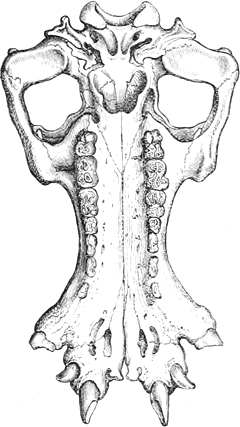
BASE OF SKULL OF HIPPOPOTAMUS,
SHOWING DENTITION.
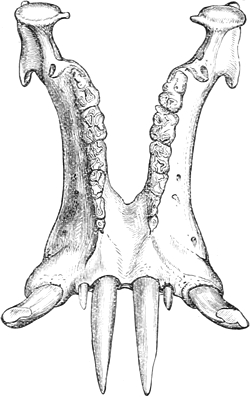
LOWER JAW OF HIPPOPOTAMUS,
SHOWING DENTITION.
The River Horse is nocturnal in its habits, frequenting rivers and
lagoons, and rarely leaving them or their immediate neighbourhood
except at night, when it will go considerable distances in search of
food, sometimes causing great damage to cultivated crops, which may be
estimated from the fact that its stomach is capable of holding from
five to six bushels. Its food consists principally of grass, young
shrubs, and water plants, and it is particularly fond of green corn.
When in the water its slow respiration enables it to remain for a long
time beneath the surface without coming up to breathe; and the means of
closing both its ears and nostrils against the access of water, before
alluded to, is admirably suited for its aquatic habits.
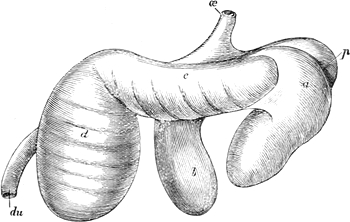
STOMACH OF HIPPOPOTAMUS. (After Clark.)
a b c d, the four
divisions in their order; p, partition in interior of division;
œ, œsophagus; du, duodenum.
The first and only time in which any animal at all answering the
description of the Hippopotamus is mentioned in the Bible is under
the designation of Behemoth (Job xl. 15–24), and even then there is
room for doubt as to whether the description may not be nearly as
applicable to the Elephant, though on the whole it certainly suits the
Hippopotamus better.
It is interesting to know that Milton evidently considered Behemoth to
mean the Elephant, or any rate, not the Hippopotamus, for in “Paradise
Lost,” in writing of the Creation, he says:—
“Scarce from his mould
Behemoth, biggest born of earth, upheaved
His vastness: fleeced the flocks, and bleating, rose
As plants: ambiguous between sea and land
The river horse and scaly crocodile.”
According to Pliny, the Hippopotamus was first seen in Europe in the
curule ædileship of Scaurus, 58 B.C., when the exhibition
in the circus surpassed anything the Romans had ever seen. Among
other novelties, he exhibited a Hippopotamus and five Crocodiles. But
according to Dion Cassius, the Hippopotamus was first shown in the
games celebrated by Augustus, 29 B.C. So great was the demand
for Hippopotami in the Roman sports at a later period, that according
to Marcellinus Ammianus, they had disappeared from Egypt since the time
of the Emperor Julian. Favourable circumstances, however, must have
again restored them, as we learn, from the accounts given by Zerenghi
and others, of their being plentiful about the year 1600 and later. In
some parts of Egypt the Hippopotamus seems to have been sacred, as we
learn from Herodotus. Sonnini relates that the Hippopotami laid bare
whole countries by their terrible ravages, and from the terror they
inspired they were generally looked upon as the symbol of Typhon, that
giant who spread death and destruction among the deities which were
worshipped, and were the emblem of mischance and cruelty, and that the
worship of them at Papresius was practised with the view of appeasing
and averting their anger.
The descriptions given by early writers of the Hippopotamus are in
many instances most ludicrous. Aristotle, borrowing from Herodotus,
states that “the Hippopotamus of Egypt has a mane like a Horse, a
bifurcated hoof like an Ox, a flat visage or muzzle, an astragalus
like the animals with cloven feet, projecting teeth which do not show
themselves much, the tail of a Hog, the voice of a Horse, and in size
it resembles an Ass. Its skin is of such a thickness that spears are
made of it.” It is pretty clear from this description that Aristotle
meant the Hippopotamus, but also that he never saw one. Diodorus
approaches nearer to the truth as to the size of this animal when he
says that it is five cubits in length, and that the bulk resembles
that of the Elephant. However, he still retains the cloven hoof and
Horse’s mane. Pliny speaks of it as living in the Nile, and also
gives it the bifid hoof of the Ox, the back, mane, and neigh of the
Horse, a flattened muzzle, the tail and teeth of the Boar; evidently
following the descriptions given of it by Aristotle. He also adds that
helmets and bucklers are made of its skin, and that the animal feeds
on the crops, and is very cautious in avoiding snares; but he goes on
to say that it is covered with hair like the Seals. It is difficult
to conceive how he could have fallen into so great an error after
having spoken of its being exhibited in Rome by M. Scaurus, with five
Crocodiles. He finishes his account by stating that when the animal
gets too fat, and is diseased, it bleeds itself by pressing a vein of
its leg against some sharp object, and then plastering up the wound
with mud, so that it may speedily heal. The ancient artists appear to
have been more faithful in their portraits of the Hippopotamus than the
ancient authors and naturalists in their descriptions; indeed, with
very few exceptions, the animal has been pretty faithfully portrayed.
One exception is a figure copied by Hamilton from one of the caves of
Beni-Hassan, in which the feet are displayed as cloven and the lower
tusks made to appear so excessively large as to prevent all possibility
of their being hidden when the animal closed its jaws. In the figure
on the plinth of the statue of the Nile, which was formerly in the
Vatican, although the teeth and feet are not correct, the general idea
is good; and in many other sculptures and mosaics it is very well
represented, also on some of the medals and coins of Roman Emperors:
sometimes it is represented as holding a Crocodile in its mouth,
which probably may have given rise to the stories of the enmity the
Hippopotamus bears towards the Crocodile. In more modern times we have
more or less fabulous descriptions given by Isidore of Seville and
Vincent de Beauvais, neither of whom appears to have seen the animal.
Belon and Gillius, it would seem, are the first of the moderns who
actually saw the Hippopotamus alive, and this was at Constantinople,
although Sonnini appears to doubt the identity of the animal which
Belon saw. This is hardly justifiable, as Belon was a very accurate
observer, and even points out with much truth the differences between
the one he saw and those he had seen pictured on ancient works of art.
The first Hippopotamus ever seen alive in Great Britain, or indeed in
Europe in modern times, was brought to England on the 25th of May,
1850, and placed in the Gardens of the Zoological Society. Mitchell
gives the following account of its capture and habits:—“Since the
Imperial Exhibitions in the Circus of Rome, no living Hippopotamus
has been imported into Europe, except the young male which the
Society possesses. The difficulty of obtaining such an animal may
be conjectured from the fact that after the Viceroy of Egypt had
determined to present one to the Society, it became necessary for his
Highness to despatch an expedition to the Upper Nile for the purpose
of making the capture, and that success was only achieved after two
thousand miles of the river had been ascended. In the month of July,
1849, the chief huntsman of the party, in searching the reedy margin
of an island in the White Nile, called Obaysch, at last discovered a
little Hippopotamus calf, which, as he conjectured, had been born about
two days. It was so small that, in his delight at having accomplished
the Pasha’s order, he seized it in his arms, and would have carried
it to the boat which waited on him, had not the slimy exudation which
is lavishly poured forth from innumerable pores in the skin of the
young Hippopotamus rendered it so slippery that he was entirely unable
to retain his hold. The animal having thus slipped from his grasp,
all but escaped into the Nile, where the mother doubtless was lying
near at hand. The hunter, however, with the presence of mind which
characterises a good sportsman, seized his spear, and with the sharp
side-hook, which has been in fashion in Egypt for three thousand
years or more, he succeeded in arresting the headlong plunge of his
prize, without inflicting greater injury upon him than a skin wound,
the scar of which he bore to the day of his death. The long voyage
down the river was successfully accomplished in a boat which had been
built for the purpose by the Viceroy’s order, and ‘Obaysch,’ as they
named the Hippopotamus, from his birthplace, was safely delivered in
November, 1849, after a journey of four months, into the care of the
Hon. C. A. Murray, through whose powerful influence the Viceroy had
been prevailed upon to exert his power and assist the Society in an
object for which all exertions of their own had failed. Obaysch spent
his first winter in Cairo, under the charge of his intelligent keeper,
Hamet Saaffi Canaana, a Nubian Arab, whom Mr. Murray engaged for the
purpose. In May, 1850, proper preparations were made, with the obliging
co-operation of the directors, in the Peninsular and Oriental Steam
Navigation Company’s ship Ripon, for the transport from Alexandria,
and on the 25th of that month the first Hippopotamus which had breathed
on English soil within this period of history was landed successfully
on the quay at Southampton, and liberated in the Gardens from his
travelling-house at ten o’clock the same evening. On emerging from the
door of it he followed Hamet, who had scarcely ever left him during the
whole voyage from Cairo, into the building which had been prepared for
him, and instantly indulged in a long-continued bath. The ten hours
which elapsed between his removal from the steamer at Southampton, and
his arrival in the Regent’s Park, is the longest period during which he
has ever been without access to water.”
For the first year Obaysch was fed almost entirely on Cow’s milk and
finely-ground Indian corn, and as he grew older he consumed about
100 lbs. weight of hay, chaff, corn, roots, and green food a day. He
rapidly grew, until he reached the enormous weight of about four tons,
and he was one of the chief attractions of the Gardens at the time of
his death in March, 1878.
In 1853 a young female, Adhela, was obtained from the same district,
and in the spring of 1871 the first calf was born, and a second in
January, 1872, both of which were lost shortly after their birth, in
spite of every care and precaution. The third was born on the 5th of
November, 1872, and called “Guy Fawkes,” and has been successfully
reared. Little Guy Fawkes sucked freely shortly after its birth, and
has continued to thrive up to the present time, now rivalling her
mother in size. When she chooses to disport herself in her huge tank,
her vast bulk and enormous gape combine to keep the crowd of onlookers
in a proper state of subjection not unmixed with awe.
Hippopotami roam together in herds, and where they have not been
disturbed come fearlessly to the top of the water, often lazily basking
on the surface, and on the banks; but in places where they have been
hunted and shot at they become very wary, and content themselves by
just showing their noses among weeds, and sometimes they are so
carefully concealed that but for their footprints on the bank of the
river their presence would be unsuspected. Cumming, in his African
hunting experiences, gives a description of seeing an entire colony
of these animals on the banks of the Limpopo. He says:—“Presently
in a broad and deeply shaded pool of the river we heard the Sea Cows
bellowing, and on approaching somewhat nearer beheld a wonderful and
interesting sight. On a sandy promontory of the island stood about
thirty cows and calves, whilst in the pool opposite and a little below
them stood about twenty more Sea Cows, with their heads and backs
above water. About fifty yards farther down the river, again showing
out their heads, were eight or ten immense fellows, which I think were
all bulls, and about a hundred yards below these, in the middle of the
stream, stood another herd of eight or ten cows with calves, and two
large bulls. The Sea Cows lay close together like Pigs, and as they
sprawl in the mire have not the least objection to their neighbours
pillowing their heads on their backs and sides.”
COMMON HIPPOPOTAMUS.
HIPPOPOTAMUS.
(From the Living Specimen in the Zoological Gardens,
London.)
❏
LARGER IMAGE
Livingstone also gives a description of seeing a herd of Hippopotami
as follows:—“On a shallow sand bank, under a dyke crossing the River
Zambesi near the mouth of the Sinjere, lay a herd of Hippopotami
in fancied security. The young ones were playing with each other like
young puppies, climbing on the backs of their dams, trying to take
hold of one another by the jaws, and tumbling over into the water.
Mbia, one of the Makotols, waded across to within a dozen yards of the
drowsy beasts, and shot the father of the herd, who being very fat soon
floated, and was secured at the village below. The men then gorged
themselves with meat for two days, and cut large quantities into long
narrow strips, which they half dried and half roasted on wooden frames
over the fire.”
HUNTING HIPPOPOTAMI WITH THE HARPOON.
The harpoon is the weapon usually used by the natives of Africa for
catching the Hippopotamus. One kind of harpoon consists of a shaft
about twelve feet long, at one end of which is a combination of spear
and fish-hook, the spear being let into a socket of the shaft and
also attached to the shaft by means of cords. At the other extremity
is a coil of rope, to which is attached a large float, so that when a
Hippopotamus is harpooned the float shows the position of the animal.
When an animal is struck, it is followed either by men in canoes or on
land, who by means of ropes get possession of the line to which the
float is attached, which they entwine round a tree, and every time the
animal comes up to breathe he is greeted with a shower of spears until
finally finished.
Livingstone in his “African Travels” gives the following interesting
account of this instrument and its makers. He relates that on the
Zambesi River “beyond Pita lies the little island Nyamotobsi, where we
met a small fugitive tribe of Hippopotamus hunters, who had been driven
by war from their own island in front. With the civility so common
among them, the chief ordered a mat to be spread for us under a shed,
and then showed us the weapon with which they kill the Hippopotamus.
It is a short iron harpoon inserted in the end of a long pole, but
being intended to unship, it is made fast to a strong cord of milola,
or hibiscus bark, which is wound closely round the entire length of
the shaft, and secured at its opposite end. Two men in a swift canoe
steal quietly down on the sleeping animal. The bowman dashes the
harpoon into the unconscious victim, while the quick steersman sweeps
the light craft back with his broad paddle. The force of the blow
separates the harpoon from its corded handle, which, appearing on
the surface, sometimes with an inflated bladder attached, guides the
hunters to where the wounded beast hides below until they despatch it.”
Livingstone then goes on to say:—“These Hippopotamus hunters form a
separate people called Akombwi, or Mapodzo, and rarely—the women, it
is said, never—intermarry with any other tribe. The reason for their
keeping aloof from certain of the natives of the Zambesi is obvious
enough, some having as great an abhorrence of Hippopotamus meat as
Mohammedans have of swine’s flesh. Our pilot, Scissors, was one of this
class; he would not even cook his food in a pot which had contained
Hippopotamus meat, preferring to go hungry until he could find another,
and yet he traded eagerly in the animals’ tusks, and ate with great
relish the flesh of the foul-feeding Marabout.”
Sir Samuel Baker relates from personal observation the capture of a
Hippopotamus with the harpoon above described. He says:—“At length
we arrived at a large pool, in which were several sand-banks covered
with rushes, and many rocky islands. Among these rocks was a herd of
Hippopotami, consisting of an old bull and several cows; a young Hippo
was standing, like an ugly little statue, on a protruding rock, while
another infant stood upon its mother’s back that listlessly floated on
the water. This was an admirable place for the hunters. They desired
me to lie down, and they crept into the jungle out of view of the
river. I presently observed them stealthily descending the dry bed
about two hundred paces above the spot where the Hippos were basking
behind the rocks. They entered the river, and swam down the centre of
the stream towards the rock. This was highly exciting. The Hippos were
quite unconscious of the approaching danger, as steadily and rapidly
the hunters floated down the strong current; they neared the rock, and
both heads disappeared as they purposely sank out of view; in a few
seconds later they reappeared at the edge of the rock upon which the
young Hippo stood. It would be difficult to say which started first,
the astonished young Hippo into the water, or the harpoons from the
hands of the howartis! It was the affair of a moment. The hunters dived
directly they had hurled their harpoons, and swimming for some distance
under water, they came to the surface, and hastened to the shore lest
an infuriated Hippopotamus should follow them. One harpoon had missed;
the other had fixed the bull of the herd, at which it had been surely
aimed.
“This was grand sport! The bull was in the greatest fury, and rose to
the surface, snorting and blowing in his impotent rage; but as the
ambatch float was exceedingly large, and this naturally accompanied his
movements, he tried to escape from his imaginary persecutor, and dived
constantly, only to find his pertinacious attendant close to him upon
regaining the surface. This was not to last long. The howartis were
in earnest, and they at once called their party, who, with two of the
aggageers, Abou Do and Suleiman, were near at hand. These men arrived
with long ropes that form a portion of the outfit for Hippo hunting.
The whole party now halted on the edge of the river, while two men swam
across with one end of the long rope. Upon gaining the opposite bank,
I observed that a second rope was made fast to the middle of the main
line; thus upon our side we held the ends of two ropes, while on the
opposite side they had only one. Accordingly, the point of junction of
the two ropes in the centre formed an acute angle. The object of this
was soon practically explained. Two men upon our side now each held a
rope, and one of these walked about ten yards before the other. Upon
both sides of the river the people now advanced, dragging the rope on
the surface of the water until they reached the ambatch float that was
swimming to and fro, according to the movements of the Hippopotamus
below. By a dexterous jerk of the main line the float was now placed
between the two ropes, and it was immediately secured in the acute
angle by bringing together the ends of these ropes on our side. The men
on the opposite bank now dropped their line, and our men now hauled
in upon the ambatch float that was held fast between the ropes. Thus
cleverly made sure, we quickly brought a strain upon the Hippo; and
although I have had some experience in handling big fish, I never knew
one pull so lustily as the amphibious animal that we now alternately
coaxed and bullied.
“He sprang out of the water, gnashed his huge jaws, snorted with
tremendous rage, and lashed the river into foam; he then dived, and
foolishly approached us beneath the water. We quickly gathered in the
slack line, and took a round turn upon a large rock within a few feet
of the river.
“The Hippo now rose to the surface about ten yards from the hunters,
and jumping half out of the water, he snapped his great jaws together,
endeavouring to catch the rope, but at the same instant two harpoons
were launched into his side.
“Disdaining retreat, and maddened with rage, the furious animal
charged from the depths of the river, and gaining a footing, he reared
his bulky form from the surface, came boldly upon the sandbank, and
attacked the hunters open-mouthed. He little knew his enemy: they were
not the men to fear a pair of gaping jaws, armed with a deadly array of
tusks, but half a dozen lances were hurled at him, some entering his
mouth from a distance of five or six paces; at the same time several
men threw handfuls of sand into his enormous eyes. This baffled him
more than the lances: he crunched the shafts between his powerful jaws
like straws, but he was beaten by the sand, and, shaking his huge
head, he retreated to the river. During his sally upon the shore, two
of the hunters had secured the ropes of the harpoons that had been
fastened in his body just before his charge. He was now fixed by three
of these deadly instruments; but suddenly one rope gave way, having
been bitten through by the enraged beast, who was still beneath the
water. Immediately after this he appeared on the surface, and without
a moment’s hesitation, he once more charged furiously from the water
straight at the hunters, with his huge mouth open to such an extent
that he could have accommodated two inside passengers. Suleiman was
wild with delight, and springing forward lance in hand, he drove it
against the head of the formidable animal, but without effect. At
the same time, Abou Do met the Hippo sword in hand, reminding me of
Perseus slaying the sea-monster that would devour Andromeda; but the
sword made a harmless gash, and the lance, already blunted against
the rocks, refused to penetrate the tough hide. Once more handfuls of
sand were pelted upon his face, and again repulsed by this blinding
attack, he was forced to retire to his deep hole, and wash it from his
eyes. Six times during the fight the valiant bull Hippo quitted his
watery fortress, and charged resolutely at his pursuers; he had broken
several of their lances in his jaws; other lances had been hurled, and
falling upon the rocks, they were blunted and would not penetrate. The
fight had continued for three hours, and the sun was about to set;
accordingly the hunters begged me to give him the coup de grâce, as
they had hauled him close to the shore, and they feared he would sever
the rope with his teeth. I waited for a good opportunity, when he
boldly raised his head from the water about three yards from the rifle,
and a bullet from the little Fletcher between the eyes closed the last
act.”
Another interesting account is also given by Sir S. Baker of the
capture of a Hippopotamus by means of the spear. The description
conveys a good idea of the habits and wariness of these animals.
“Hippopotami had trodden a path along the margin of the river, as these
animals came out to feed, shortly after dark, and travelled from pool
to pool. Wherever a plot of tangled and succulent herbage grew among
the shady nabbuks, there were the marks of the harrow-like teeth, that
had torn and rooted up the rank grass like an agricultural implement.
“After walking about two miles, we noticed a herd of Hippopotami, in
a pool below a rapid, where the rush of water had thrown up a bank of
pebbles and sand. Our old Neptune did not condescend to bestow the
slightest attention when I pointed out these animals—they were too
wide awake; but he immediately quitted the river’s bed, and we followed
him quietly behind the fringe of bushes upon the border, from which we
carefully examined the water.
“About half a mile below this spot, as we clambered over the
intervening rocks through a gorge which formed a powerful rapid, I
observed, in a small pool just below the rapid, an immense head of a
Hippopotamus close to a perpendicular rock that formed a wall to the
river, about six feet above the surface. I pointed out the Hippo to
old Abou Do, who had not seen it. At once the gravity of the old Arab
disappeared, and the energy of the hunter was exhibited as he motioned
us to remain, while he ran nimbly behind the thick screen of bushes
for about a hundred and fifty yards below the spot where the Hippo was
unconsciously basking, with his ugly head above the surface. Plunging
into the rapid torrent, the veteran hunter was carried some distance
down the stream, but breasting the powerful current, he landed upon the
rocks on the opposite side, and retiring some distance from the river,
he quickly advanced towards the spot beneath which the Hippopotamus was
lying. I had a fine view of the scene as I was lying concealed exactly
opposite the Hippo, who had disappeared beneath the water. Abou Do now
stealthily approached the ledge of rock beneath which he had expected
to see the head of the animal; his long sinewy arm was raised, with the
harpoon ready to strike, as he carefully advanced. At length he reached
the edge of the perpendicular rock. The Hippo had vanished, but far
from exhibiting surprise, the old Arab remained standing on the sharp
ledge, unchanged in attitude. No figure of bronze could have been more
rigid than that of the old river king, as he stood erect upon the rock,
with the left foot advanced, and the harpoon poised in his ready right
hand, above his head, while in the left he held the loose coils of rope
attached to the ambatch buoy. For about three minutes he stood like
a statue, gazing intently into the clear and deep water beneath his
feet. I watched eagerly for the reappearance of the Hippo. The surface
of the water was still barren, when suddenly the right arm of the
statue descended like lightning, and the harpoon shot perpendicularly
into the pool with the speed of an arrow. What water fiend answered
to the summons? In an instant an enormous pair of open jaws appeared,
followed by the ungainly head and form of the furious Hippopotamus,
who, springing half out of the water, lashed the river into foam, and,
disdaining the concealment of the deep pool, he charged straight up the
violent rapids. With extraordinary power he breasted the descending
stream; gaining a footing in the rapids, about five feet deep, he
ploughed his way against the broken waves, sending them in showers of
spray upon all sides, and upon gaining broader shallows he tore along
through the water, with the buoyant float hopping behind him along the
surface, until he landed from the river, started at full gallop along
the dry shingly bed, and at length disappeared in the thorny nabbuk
jungle.”
HIPPOPOTAMI AT THE FALLS OF THE RIVER SENEGAL.
“I never could have imagined that so unwieldy an animal could have
exhibited such speed; no man would have had a chance of escape, and
it was fortunate for our old Neptune that he was secure upon the high
ledge of rock, for if he had been in the path of the infuriated beast,
there would have been an end of Abou Do.
“The old man plunged into the deep pool just quitted by the Hippo, and
landed upon our side, while in the enthusiasm of the moment I waved
my cap above my head, and gave him a British cheer as he reached the
shore. His usually stern features relaxed into a grim smile of delight;
this was one of the moments when the gratified pride of the hunter
rewards him for any risks. I congratulated him on his dexterity; but
much remained to be done. I proposed to cross the river, and to follow
upon the tracks of the Hippopotamus, as I imagined that the buoy and
rope would catch in the thick jungle, and that we should find him
entangled in the bush; but the old hunter gently laid his hand upon my
arm, and pointed up the bed of the river, explaining that the Hippo
would certainly return to the water after a short interval.
“In a few minutes later, at the distance of nearly half a mile, we
observed the Hippo emerge from the jungle, and descend at full trot
to the bed of the river, making direct for the first rocky pool, in
which we had noticed the herd of Hippopotami. Accompanied by the
old howarti (Hippo hunter), we walked quickly towards the spot; he
explained to me that I must shoot the harpooned Hippo, as we should
not be able to secure him in the usual method by ropes, as nearly
all our men were absent from camp, disposing of the dead Elephants.
Upon reaching the pool, which was about a hundred and thirty yards in
diameter, we were immediately greeted by the Hippo, who snorted and
roared as we approached, but quickly dived, and the buoyant float ran
along the surface, directing his course in the some manner as the cork
of a trimmer with a pike upon the hook. Several times he appeared,
but as he invariably faced us, I could not obtain a favourable shot;
I therefore sent the old hunter round the pool, and he, swimming the
river, advanced to the opposite side, and attracted the attention of
the Hippo, who immediately turned towards him. This afforded me a good
chance, and I fired a steady shot behind the ear, at about seventy
yards, with a single-barrelled rifle. He disappeared beneath the water
at the shot. The crack of the ball and the absence of any splash
from the bullet told me that he was hit; the ambatch float remained
perfectly stationary upon the surface. I watched it for some minutes;
it never moved. Several heads of Hippopotami appeared and vanished in
different directions, but the float was still; it marked the spot where
the grand old bull lay dead beneath.”
In addition to the ordinary means of harpooning, a harpoon is also
used as a sort of trap, it being well known to the hunters that the
Hippopotamus has certain roads or tracks which it habitually uses,
preferring a quiet gully with tall trees and grass overhanging. The
hunter finding such a road prepares a harpoon within six feet of a
moderate-sized tree-trunk, to which he attaches heavy stones. Having
found a suitable tree overhanging the path of the Hippopotamus, he
throws the rope which is attached to the shaft of the harpoon round
a branch, and hauls up his weighted instrument, having done which he
drives a stake on one side of the path and turns the rope round it.
He then drives another stake on the other side of the path, stretches
his rope across, and fastens it to the other stake. The unsuspecting
animal, taking his usual evening stroll, strikes his foot against the
rope, which dislodging the stakes, the harpoon comes thundering down
and the Hippopotamus is transfixed, to be found in the morning by the
trapper, probably dead or dying, a long way from the scene of the trap.
Livingstone gives an account in his “African Travels” of a Hippopotamus
captured by means of this trap, of whose working he was himself an
eye-witness. He says that “both banks of the River Zambesi near the
Mboma village are dotted with Hippopotamus traps, over every track
which these animals have made in going up out of the water to graze.
The Hippopotamus feeds on grass alone, and where there is any danger
only at night. Its enormous lips act like a mowing-machine, and form a
path of short-cropped grass as it feeds. We never saw it eat aquatic
plants or reeds. The tusks seem weapons of both offence and defence.
The Hippopotamus trap consists of a beam five or six feet long,
armed with a spear-head, or hard-wood spike covered with poison, and
suspended to a forked pole by a cord, which, coming down to the path,
is held by a catch, to be set free when the beast treads on it. Being
wary brutes, they are still very numerous. One got frightened by the
ship as she was steaming close to the bank. In its eager hurry to
escape it rushed on shore, and ran directly under a trap, when down
came the heavy beam on its back, driving the poisoned spear-head a foot
deep into its flesh. In its agony it plunged back into the river, to
die in a few hours, and afterwards furnish a feast for the natives.
The poison on the spear-head does not affect the meat, except the
part around the wound, and that is thrown away. In some places the
descending beam is weighted with heavy stones, but here the hard heavy
wood is sufficient.”
The Hippopotamus is also captured by means of pitfalls placed in the
animal’s tracks. The mouth of the pit is carefully concealed by means
of boughs of trees, grass, rushes, &c. Usually two and sometimes three
of these pits are dug in close proximity to each other, the extreme
wariness of the Hippopotamus causing it to be suspicious of danger, and
whilst carefully avoiding one trap it falls into another.
Sometimes these pits catch a very different kind of animal from that
for which they were intended. A good story is told in a book of African
travels of a Frenchman who had the misfortune to fall into one,
and after spending the whole of the morning in getting out, whilst
congratulating himself on his success, and brushing off the mud, he
tumbled into another close by, from which he did not escape until late
in the evening.
The Hippopotamus has been considered by travellers and naturalists
to be of a mild and inoffensive disposition, retiring and shy in its
habits, and unless provoked rarely attacking man. Probably this to a
great extent is true of the animal, but numerous instances are recorded
of most ferocious and quite unprovoked attacks, and when this is the
case few animals are capable of showing such blind rage.
Canoes are sometimes overturned and crunched between the jaws of this
powerful animal without any apparent reason, and even on dry land it
occasionally attacks man. Sir S. Baker relates an account of a bull
Hippopotamus attacking the proprietor of a melon-garden, and killing
him by one crunch of his huge jaws; and Dr. Moffat, the father-in-law
of Livingstone, speaks of a man being literally bitten in half by one
which chased him on dry land. The Hippopotamus does not seem at all
particular as to the size or nature of the objects it assaults, several
instances having been recorded of its charging steamers. Sir S. Baker
gives the following account of one of these onslaughts on the Bahir
Giraffe:—“At one p.m., as we were steaming easily, I happened to be
asleep on the poop-deck, when I was awakened by a shock, succeeded by
the cry, ‘The ship’s sinking!’ A Hippopotamus had charged the steamer
from the bottom, and had smashed several floats off her starboard
paddle. A few seconds later he charged our diahbeeah, and striking
her bottom about ten feet from the bow, he cut two holes through the
iron plates with his tusks. On examination two clean holes were found
punched through the iron as though driven by a sharp pickaxe.”
Another attack of this kind is also related by Sir S. Baker in a lake
communicating with the White Nile, which for ferocity and pertinacity
is probably unequalled. He says:—“The night was cold, and the moon
clear and bright. Every one was wrapped up in warm blankets, and I was
so sound asleep that I cannot describe more, until I was suddenly awoke
by a tremendous splashing quite close to the diahbeeah, accompanied by
the hoarse wild snorting of a furious Hippopotamus. I jumped up, and
immediately perceived a Hippo, which was apparently about to attack the
vessel. The main deck being crowded with people sleeping beneath their
thick Mosquito-curtains, attached to the stairs of the poop-deck, and
to the rigging in all directions, rendered it impossible to descend. I
at once tore away some of the ties, and awakened the sleeping people.
My servant, Suleiman, was sleeping next to the cabin door. I called
to him for a rifle. Before the affrighted Suleiman could bring the
rifle the Hippopotamus dashed at us with indescribable fury. With one
blow he capsized and sank the zinc boat with its cargo of flesh. In
another instant he seized the dingy in his immense jaws, and the crash
of splintered wood betokened the complete destruction of my favourite
boat. By this time Suleiman appeared from the cabin with an unloaded
gun in his hand, and without ammunition. This was a very good man,
but he was never overburdened with presence of mind; he was shaking
so fearfully with nervousness, that his senses had entirely forsaken
him. All the people were shouting and endeavouring to scare the Hippo,
which attacked us without ceasing, with a blind fury that I have never
witnessed in any animal except a Bulldog.
“By this time I had procured a rifle from the cabin, where they were
always kept fixed in a row, loaded and ready for action, with bags
of breech-loading ammunition on the same shelf. The movements of the
animal were so rapid, as he charged and plunged alternately beneath
the water in a cloud of foam and wave, that it was impossible to aim
correctly at the small but fatal spot upon the head.
“The moon was extremely bright, and presently, as he charged straight
at the diahbeeah, I stopped him with a No. 8 Reilly shell. To my
surprise, he soon recovered, and again commenced the attack. I fired
shot after shot at him without apparent effect.
“The diahbeeah rocked upon the waves raised by the efforts of so
large an animal; this movement rendered the aim uncertain. At length,
apparently badly wounded, he retired to the high grass; there he lay by
the bank, at about twenty-five yards’ distance, snorting and blowing. I
could not distinguish him, as merely the head was above water, and this
was concealed by the deep shadow thrown by the high grass. Thinking
he would die, I went to bed; but before this, I took the precaution
to arrange a white paper sight upon the muzzle of my rifle, without
which night shooting is very uncertain. We had fallen asleep; but in
about half an hour we were awoke by another tremendous splash, and once
more this huge beast came charging directly at us as though unhurt. In
another instant he was at the diahbeeah; but I met him with a ball in
the top of his head which sent him rolling over and over, sometimes
on his back, kicking with his four legs above the surface, and again
producing waves which rocked the diahbeeah. In this helpless manner he
rolled for about fifty yards down the stream, and we all thought him
killed.
“To our amazement he recovered, and we heard him splashing as he
moved slowly along the river through the high grass by the left bank.
Ultimately he was killed, and on making a post-mortem the following
morning, I found he had received three shots in the flank and shoulder,
four in the head, one of which had broken his lower jaw, and another
had passed through his nose, and passing downward, had cut off one of
his large tusks.”
The uses to which the Hippopotamus can be applied cannot be considered
as many; certainly the flesh is much eaten by the natives of Africa,
and even by Europeans it is not to be despised, although travellers
seem to disagree as to its merits. Cumming says the flesh is excellent
eating, and Baker appears to agree with him, while Dr. Livingstone
speaks of it as being pretty good food when one is hungry and can get
nothing better, and that it is a coarse-grained meat, having something
of the flavour between pork and beef. Probably the Hippopotamus is of
considerable use in clearing the rivers of huge water-plants, which
abound in African rivers, and which might otherwise in time so choke
them up as to convert them from running streams to little else than
swamps.
The whips made of Hippopotamus hide are in much request, and are
highly esteemed in the neighbouring countries for their elasticity
and durability; but the parts of the Hippopotamus most in request,
especially by dentists, are the canine teeth, no other ivory keeping
its colour so well.
THE LIBERIAN
HIPPOPOTAMUS.—The second living species of
Hippopotamus (H. liberiensis) is a much smaller animal than the
common Hippopotamus; according to Dr. Morton, not being larger than
a middle-sized heifer, though possessing the relative proportions of
the common species. It rarely attains a weight exceeding four hundred
pounds, or a quarter of a ton, as distinguished from the four tons’
weight of Obaysch of whom we have already spoken. One of the more
important differences between them consists in the fact that the
Liberian Hippopotamus possesses only two incisors in the lower jaw.
A young animal belonging to this species was brought over to Great
Britain in 1873, and is stated by Dr. Sclater to have been obtained on
the West Coast, from the little Scarcies River. Unfortunately it died
shortly after its arrival at the Zoological Gardens in Dublin.
The Hippopotamus ranged in the later Tertiary period far beyond its
present home in the African rivers. In the Pliocene age it was very
abundant in Italy, and has been met with as far north as Norfolk and
Suffolk. In the succeeding, or Pleistocene age, also, it haunted the
rivers of France and of England, having been found from the valley of
the Ribble northwards. Its remains are from time to time dredged up
from the bottom of the German Ocean, and are met with in the dens of
Hyænas, as, for example, at Kirkdale, under conditions which prove that
it fell a prey to the wild beasts then inhabiting the country. Strange
to say, remains of this animal, now flourishing only under a tropical
climate, are met with side by side with the remains of the Reindeer,
which now flourishes only in a cold temperature, under circumstances
which compel us to believe that both animals were living in the same
region at approximately the same time. This singular fact can only be
accounted for on the supposition that in those days the summer heat was
great, and the winter cold severe, such as we find to be the case in
Central Asia. These climatic extremes would allow of the same district
being inhabited by these animals at different seasons of the year.
An extinct species of Hippopotamus (Hexaprotodon), which is
characterised by the possession of six instead of four incisors in the
upper and lower jaws; lived also in India in the later Tertiary age.
We have seen that at the present time Africa is inhabited by two kinds
of Hippopotami, respectively of large and small size. We have also seen
that in the Pleistocene age the larger animal inhabited Europe. It is
a singular fact that abundant remains of a smaller fossil species, or
Pentland’s Hippopotamus, should abound in the bone caves of Sicily,
and that this dwarfed species should range from that island to Malta,
Crete, and the Morea. It is closely allied to the Liberian species,
although it is pretty clear that it differed from it in certain
details, such as in the form of its molar teeth. A small species of
Hippopotamus has been found fossil in Madagascar.
ANOPLOTHERE RESTORED.
Certain extinct animals living in the Eocene times, included by Cuvier
in his division of the Pachyderms, and closely allied to the Hogs
and Hippopotami, constitute the family of Anoplotheres. They were
first revealed by the genius of Cuvier from the study of the remains
discovered in the gypsum quarries at Montmartre; and they owe their
name and their most distinguishing character to the fact that their
teeth, which in all number forty-four, form an even, unbroken series,
like those in man, the canines not standing out sharp and prominent
above the rest, as in the case of the Carnivores and the Palæotheres
found in association with them. These animals presented remarkable
variations in size, some being as large as a Pony, while others were
about the size of a Gazelle. They varied also in their proportions,
some being heavily built, as in the restoration given above, while
others were slender and elegant like the Antelopes. They are of
peculiar interest, because they are the parent stock from which in
succeeding geological ages the Ruminants are derived.
W. BOYD
DAWKINS.
H. W. OAKLEY.