THE REIGN OF GEORGE III. (continued).
Invasion of Holland by Dumouriez—He is defeated at Neerwinden and goes over to the Enemy—Second Partition of Poland—The
Campaign in the Netherlands—And on the Rhine—The English Fleets in the Channel and West Indies—Siege of
Toulon—First appearance of Napoleon Buonaparte—Fall of Lyons—The Reign of Terror—Insurrection in La Vendée—Its
brutal Suppression—Worship of the Goddess of Reason—Opposition to the War in England—Prosecutions for Sedition—Trials
in Scotland—Discussions on the subject in Parliament—Arrests of Horne Tooke, Thelwall, Hardy, and others—Battle
of the First of June—The War in the West Indies—Annexation of Corsica—The Campaign of 1794—The Prussian
Subsidy—Successes of Pichegru against the Austrians—The Struggle for the Sambre—Loss of Belgium—Danger of Holland—The
War in the South—The Reign of Terror continues—The Festival of the Supreme Being—Death of Robespierre and
his Associates—The Thermidorians—Final extinction of Poland—The Portland Whigs join the Ministry—Trials of Hardy,
Horne Tooke, and their Associates—Opening of Parliament—The Budget—Attempts at Reform—Marriage of the Prince of
Wales—His Allowance—The French occupy Holland—It becomes a Republic—Prussia and Spain leave the Coalition, but
the War continues—Campaigns on the Rhine and in Italy—The War in La Vendée and in Brittany—The Expedition
from England planned—Destruction of the Expedition at Quiberon—Extinction of the War in La Vendée—Establishment
of the Directory—Attack on George the Third—The Budget—Pitt's first Negotiations for Peace—Failure of
Lord Malmesbury's Mission—Successes in the West Indies and Africa—Expedition to Bantry Bay—The Campaign of
1796—Retreat of the French—Napoleon's Italian Campaign—The Battles of Arcole—A new British Loan—Suspension of
Cash Payments—Grievances of the Seamen—Mutiny at Portsmouth—Its Pacification—Mutiny at the Nore—Descent on
the Welsh Coast—Campaign of 1797—Preliminaries of Leoben—Treaty of Campo Formio—Lord Malmesbury's Mission to
Lille.
Dumouriez was now making his projected attack
upon Holland. On the 17th of February, 1793,
he entered the Dutch territory, and issued a proclamation,
promising friendship to the Batavians,
and war only to the Stadtholder and his British
allies. His success was brief, and he was soon
forced back at all points. He received peremptory
orders from the Convention to retire into Belgium.
He obeyed with reluctance. On Dumouriez' return
to Belgium, he was greatly incensed at the wholesale
rapacity of the Commissioners of the Convention.
They had plundered the churches, confiscated the
property of the clergy and the wealthy inhabitants,
and driven the people, by their insolence and
violence, into open revolt. He did not satisfy
himself by simply reproving these cormorants by
words; he seized two of the worst of them,
and sent them to Paris under a military guard.
General Moreton-Chabrillant, who defended the
Commissioners, he summarily dismissed; he restored
the plate to the churches, as far as he was
able, and issued orders for putting down the
Jacobin clubs in the army. On the 16th of March
he was attacked at Neerwinden by the Prince of
Saxe-Coburg, and after a sharply-fought field, in
which both himself and the Duke of Chartres
fought bravely, he was routed with a loss of four
thousand killed and wounded, and the desertion
of ten thousand of his troops, who fled at a great
rate, never stopping till they entered France, and,
spreading in all directions, they caused the most
alarming rumours of Dumouriez' conduct and
the advance of the enemy. The Convention at
once dispatched Danton and Lacroix to inquire
into his proceedings, and, roused by all these
circumstances, no sooner had these two envoys
left him than he entered into communication with
the Prince of Saxe-Coburg. Colonel Mack, an
Austrian officer, was appointed to confer with
Dumouriez, and it was agreed that he should
evacuate Brussels, and that then the negotiation
should be renewed. Accordingly, the French retired
from Brussels on the 25th of March, and on
the 27th they encamped at Ath, where Dumouriez
and Mack again met. The result of this conference
was the agreement of Dumouriez to abandon
the Republic altogether, to march rapidly on
Paris, and disperse the Convention and the mother
society of the Jacobins. His designs, however,
were suspected by the Jacobins, and he was
eventually compelled to go over to the enemy
almost alone. Dampierre, who had been appointed
by the Convention to supersede Dumouriez, took
the command of the army, and established himself
in the camp at Famars, which covered Valenciennes.
He was there attacked, on the 8th of
May, by the combined armies of Austrians, Prussians,
English, and Dutch, under Clairfayt, the
Duke of Saxe-Coburg, and the Duke of York.
He was defeated with terrible slaughter, four
thousand men being killed and wounded, whilst
the Allies stated their loss at only eight hundred
men. Dampierre himself lost a leg and died the
next day. Lamarque, who succeeded him, might
have easily been made to retreat, for the French
were in great disorder; but the Allies had resolved
to advance no farther till Mayence should be retaken.
Lamarque, therefore, fortified himself in
his camp at Famars, and remained unmolested till
the 23rd of the month. He was then attacked
and beaten, but was allowed to retire and encamp
again between Valenciennes and Bouchain.
The Allies, instead of pushing their advantages,
waited the advance of the King of Prussia upon
Mayence. Custine, who was put in command of
the Rhine, was enabled to keep back the Prince of
Hohenlohe, who had but an inconsiderable force,
the King of Prussia having been compelled to send
a large force to Poland, instead of forwarding it
according to agreement to the Rhine.
In fact, whilst these events had been proceeding
on the frontiers of France, Russia, Prussia, and
Austria had been dividing Poland amongst them.
The King of Prussia, when contemplating his
participation in this vile business, issued a proclamation
assigning the most virtuous reasons for
it. It was to check the spread of French principles
in Poland, which had compelled himself and his
amiable allies, the Empress of Russia and the
Emperor of Germany, to invade Poland. But
these pretences were merely a cloak for a shameless
robbery. Poland abutted on Prussia with the
desirable ports of Thorn and Dantzic, and therefore
Great Poland was especially revolutionary in
the eyes of Frederick William of Prussia. The
Polish Diet exposed the hollowness of these
pretences in a counter-manifesto. This produced
a manifesto from Francis of Austria, who declared
that the love of peace and good neighbourhood
would not allow him to oppose the intentions of
Prussia, or permit any other Power to interfere
with the efforts of Russia and Prussia to pacify
Poland; in fact, his love of peace would not
allow him to discountenance an aggressive war,
but his love of good neighbourhood would allow
him to permit the most flagrant breach of good
neighbourhood. As for the Empress of Russia,
she had a long catalogue of ingratitude against
the Poles, in addition to their Jacobinical principles,
and for these very convenient reasons she
had now taken possession of certain portions of
that kingdom, and called on all the inhabitants of
these districts to swear allegiance to her immediately.
The Empress having thus broken
the ice of her real motives, the King of Prussia no
longer pretended to conceal his, but called on all
the inhabitants of Great Poland to swear allegiance
to him forthwith. The Russian Ambassador at
Grodno commanded the Poles to carry these orders
of Russia and Prussia into effect by a circular
dated the 9th of April. The great Polish Confederation,
which had invited the interference of
Russia in order to carry out their own party
views, were much confounded by these announcements
of their friends. They reminded the
marauders of the engagements entered into by
Russia, Prussia, and Austria, at the time of the
former partition, to guarantee the integrity of the
remainder. But this was merely parleying with
assassins with the knife at their throats. The
aggressive Powers by force of arms compelled poor
King Poniatowski and the nobles to assemble a
Diet, and draw up and sign an instrument for the
alienation of the required territories. By this
forced cession a territory, containing a population
of more than three millions and a half, was made
over to Russia; and another territory to Prussia,
containing a million and a half of inhabitants,
together with the navigation of the Vistula, with
the port of Thorn on that great river, and of
Dantzic on the Baltic, so long coveted. As for
the small remainder of what once had been Poland,
which was left to that shadow-king, Poniatowski,
it was bound down under all the old oppressive
regulations, and had Russian garrisons at Warsaw
and other towns. But all these Powers were compelled
to maintain large garrisons in their several
sections of the appropriated country.
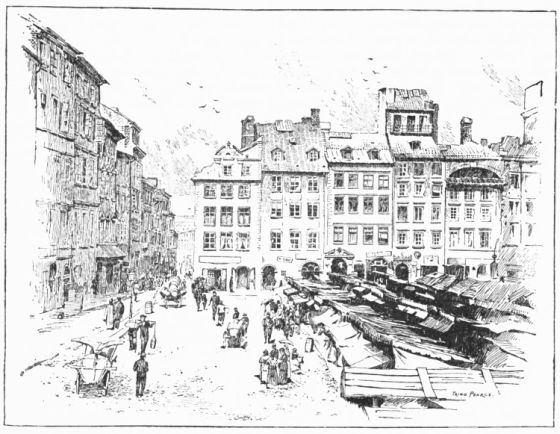
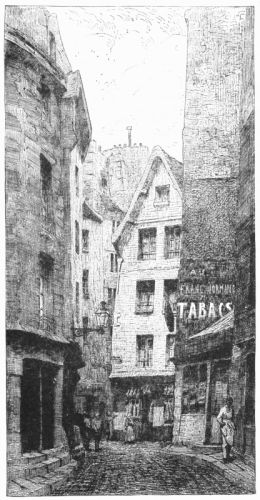
VIEW IN THE OLD TOWN, WARSAW.
Thus it happened that the King of Prussia, with
hands full of aggression, did not appear on the
Rhine to chastise the aggressions of France, before
the month of April. He brought with him about
fifty thousand men, Prussians, Saxons, Hessians,
and Bavarians. He was joined by fifteen or
twenty thousand Austrians, under Wurmser, and
five or six thousand French Emigrants under
the Prince of Condé. But the French had on
the Rhine one hundred and forty thousand
men at least, of whom twenty thousand were
within the walls of Mayence. The Prussians laid
siege to that city, and the Austrians and British
to Valenciennes. On the 21st of July the French
engaged to give up Mayence on condition that
they should be allowed to march out with the
honours of war, and this the King of Prussia was
weak enough to comply with. They must, of
necessity, have soon surrendered at discretion;
now they were at liberty to join the rest of the
army and again resist the Allies. Valenciennes
did not surrender until the 28th of July, and
not till after a severe bombardment by the
Duke of York. Thus three months of the
summer had been wasted before these two towns,
during which time the French had been employed
in drawing forces from all quarters to
the frontiers of Belgium, under the guidance of
Carnot. The Duke of York was recalled from
Valenciennes to Menin, to rescue the hereditary
Prince of Orange from an overwhelming French
force, against which his half-Jacobinised troops
showed no disposition to act. Having effected his
deliverance, the Duke of York marched on Dunkirk,
and began, towards the end of August, to invest
it; but he was left unsupported by the Prince
of Orange, and being equally neglected by the
Austrians, he was compelled to raise the siege on
the 7th of September, and retreated with the loss
of his artillery. The Prince of Orange was himself
not long unassailed. Houchard drove him
from Menin, and took Quesnoy from him, but was,
in his turn, routed by the Austrian general Beaulieu,
and chased to the very walls of Lille. According
to the recent decree of the Convention,
that any general surrendering a town or post
should be put to death, Houchard was recalled to
be guillotined. There continued a desultory sort
of warfare on the Belgian frontiers for the remainder
of the campaign. On the 15th and 16th
of October Jourdain drove the Duke of Coburg
from the neighbourhood of Maubeuge across the
Sambre, but the Duke of York coming up with
fresh British forces, which had arrived at Ostend
under Sir Charles Grey, the French were repulsed,
and the Netherland frontiers maintained by the
Allies for the rest of the year.
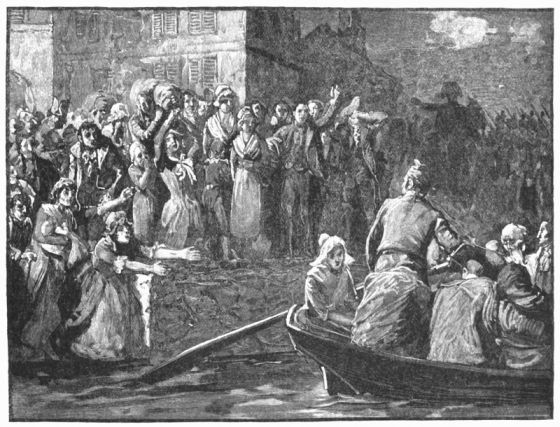
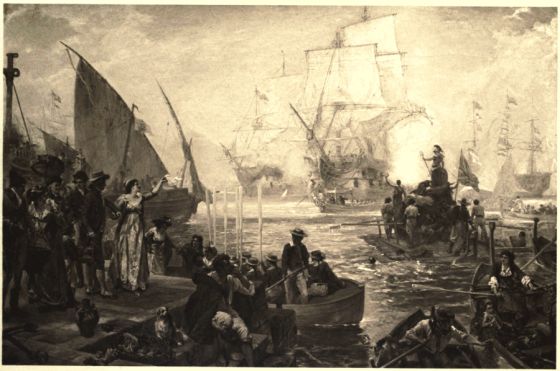
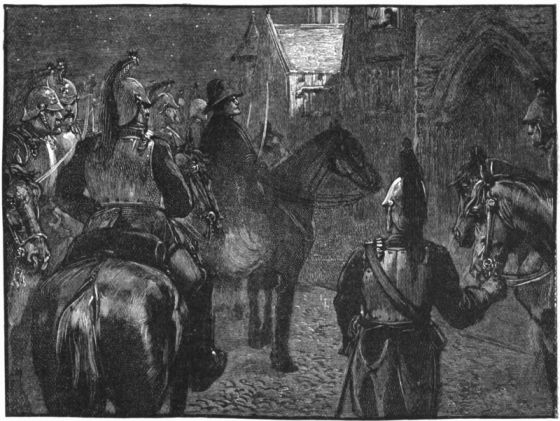
RETREAT OF THE ROYALISTS FROM TOULON. (See p. 423.)
On the Rhine, the war was carried on quite
into the winter. The King of Prussia did not
stay longer than to witness the surrender of
Mayence; he then hurried away to look after his
new Polish territory, and left the army under the
command of the Duke of Brunswick. Brunswick,
in concert with Wurmser and his Austrians, attacked
and drove the French from their lines at
Weissenburg, took from them Lauter, and laid
siege to Landau. Wurmser then advanced into
Alsace, which the Germans claimed as their old
rightful territory, and invested Strasburg. But
the Convention Commissioners, St. Just and
Lebas, defended the place vigorously. They called
forces from all quarters; they terrified the people
into obedience by the guillotine, Lebas saying
that with a little guillotine and plenty of terror
he could do anything. But he did not neglect
to send for the gallant young Hoche, and put him
at the head of the army. Wurmser was compelled
to fall back; Hoche marched through the defiles
of the Vosges, and, taking Wurmser by surprise,
defeated him, made many prisoners, and captured
a great part of Wurmser's cannon. In conjunction
with Pichegru, Dessaix, and Michaud, he
made a desperate attack, on the 26th of December,
on the Austrians in the fortified lines of Weissenburg,
whence they had so lately driven the French;
but the Duke of Brunswick came to their aid, and
enabled the Austrians to retire in order. Hoche
again took possession of Weissenburg; the Austrians
retreated across the Rhine, and the Duke
of Brunswick and his Prussians fell back on
Mayence. Once there, dissatisfied with the Prussian
officers, he resigned his command, he and
Wurmser parting with much mutual recrimination.
Wurmser was not able long to retain Mayence;
and the French not only regained all their old
positions, before they retired to winter quarters,
but Hoche crossed the lines and wintered in the
Palatinate, the scene of so many French devastations
in past wars. The French also repulsed the
enemy on the Spanish and Sardinian frontiers.
Though war had long been foreseen with France,
when it took place we had no fleet in a proper
condition to put to sea. It was not till the 14th
of July that Lord Howe, who had taken the
command of the Channel fleet, sailed from Spithead
with fifteen ships of the line, three of which
were first-rates, but none of them of that speed
and equipment which they ought to have been.
He soon obtained intelligence of a French fleet of
seventeen sail of the line, seen westward of Belleisle.
He sent into Plymouth, and had two third-rate
vessels added to his squadron. On the 31st
of July he caught sight of the French fleet, but
never came up with them, the French ships being
better sailers. After beating about in vain, he
returned to port, anchoring in Torbay on the 4th
of September. At the end of October Howe put
to sea again with twenty-four sail of the line and
several frigates, and several times came near the
French fleet, but could never get to engage. He,
however, protected our merchant vessels and
disciplined his sailors. One French ship was taken
off Barfleur by Captain Saumarez of the Crescent,
and that was all.
In the West Indies a small squadron and some
land troops took the islands of Tobago, St. Pierre,
and Miquelon. At the invitation of the planters,
we also took possession of the western or French
portion of St. Domingo; but in Martinique, where
we had had the same invitation, the Royalist
French did not support our efforts according to
promise, and the enterprise failed from the smallness
of the force employed. Besides these transactions,
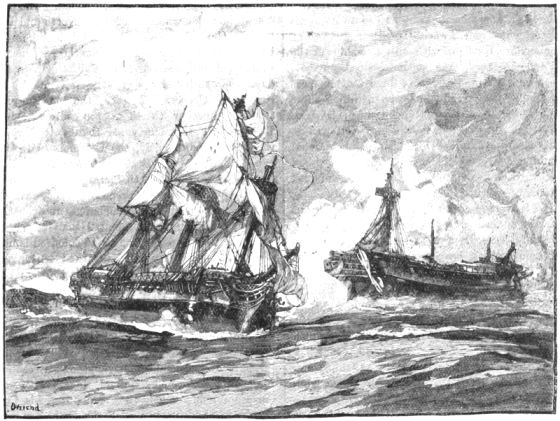
there occurred a severe fight between
Captain Courteney, of the frigate Boston, with
only thirty-two guns and two hundred men, and
the Ambuscade, a French frigate of thirty-six guns
and four hundred picked men, in which both
received much damage, and in which Captain
Courteney was killed, but in which the Frenchman
was compelled to haul off. In the East
Indies we again seized Pondicherry, and all the
small factories of the French.
The great maritime struggle of the year was at
Toulon. The south of France was then in active
combination against the Convention and the
Jacobin faction. There was a determination in
Toulon, Marseilles, and other places on the coast
to support the Royalist party in Aix, Lyons, and
other cities. For this purpose they invited the
British to co-operate with them. Lord Hood,
having obtained from the people of Toulon an
engagement to surrender the fleet and town to
him, to be held for Louis XVII., arrived before
that port in July, with, however, only seven ships
of the line, four frigates, and some smaller vessels.
Nearly all the old Royalist naval officers were
collected in Toulon, and were so eager for revenge
on the Jacobin officers and sailors—who had not
only superseded them, but had persecuted them
with all the savage cruelty of their faction—that
they were all for surrendering their fleet to Lord
Hood, and putting him in possession of the forts
and batteries. There was a firm opposition to this
on the part of the Republicans, both in the fleet
and the town, but it was carried against them.
Besides the Royalist townsmen, there were ten
thousand Provençals in arms in the town and
vicinity. As General Cartaux had defeated the
Royalists at Marseilles, taken possession of the
town, and, after executing severe measures on the
Royalists there, was now in full march for Toulon,
there was no time to be lost. Lord Hood landed
a body of men under Captain Elphinstone, to
whom the forts commanding the port were quietly
surrendered. Lord Hood was thus at once put
into possession of the best French port in the
Mediterranean, and a great fleet, with all the
stores and ammunition. But he knew very well
that the place itself could not long be maintained
against the whole force of Republican France.
He resolved, however, to defend the inhabitants,
who had placed themselves in so terrible a position
with their merciless countrymen, to the utmost of
his power. He therefore urged the Spaniards to
come to his assistance, and they sent several
vessels, and three thousand men. He received reinforcements
of ships and men from Naples—the
queen of which was sister to Marie Antoinette—and
from Sardinia. Fresh vessels and men also
arrived from England. Lord Mulgrave arrived
from Italy, and at Lord Hood's request assumed
command, for the time, of the land forces.
General Cartaux arrived and took up his position
in the villages around Toulon. He was reinforced
by General Doppet, from the Rhone, and
General Dugommier, from the Var; and the latter
had in his corps-d'armée a young lieutenant of
artillery, who contained in his yet unknown person
the very genius of war—namely, Napoleon Buonaparte.
Cartaux was a man who had risen from
the ranks; Doppet had been a physician in Savoy;
and Dugommier was acting on a plan sent from
the Convention. Buonaparte suggested what he
thought a much superior plan. "All you need,"
he said, "is to send away the English; and to do
that, you have only to sweep the harbour and the
roadstead with your batteries. Drive away the
ships, and the troops will not remain. Take the
promontory of La Grasse, which commands both
the inner and outer harbour, and Toulon will be
yours in a couple of days." On this promontory
stood two forts, Equilette and Balaquier, which
had been much strengthened by the English. It
was resolved to assault these forts, and batteries
opposite to them were erected by the French
under Buonaparte's direction. After much desperate
fighting, vast numbers of troops being
pressed against the forts, that of Balaquier was
taken. This gave the French such command of
the inner harbour, that Lord Hood called a council
of war, and showed the necessity of retiring with
the fleet, and thus enabling the Royalists to
escape, who would otherwise be exterminated by
their merciless countrymen. This was agreed to,
and it was resolved to maintain the different forts
till the ships had cleared out. The Neapolitans
behaved very ill, showing no regard for anything
but their own safety. They held two forts—one
at Cape Lebrun, and the other at Cape Lesset;
these, they said, they would surrender as soon as
the enemy approached. They made haste to
get their ships and men out of harbour, leaving all
else to take care of themselves. The Spaniards
and Piedmontese behaved in a much nobler
manner. They assisted willingly all day in getting
on board the Royalists—men, women, and children.
All night the troops began to defile through a
narrow sallyport to the boats under the guns of
the fort La Malaga. This was happily effected;
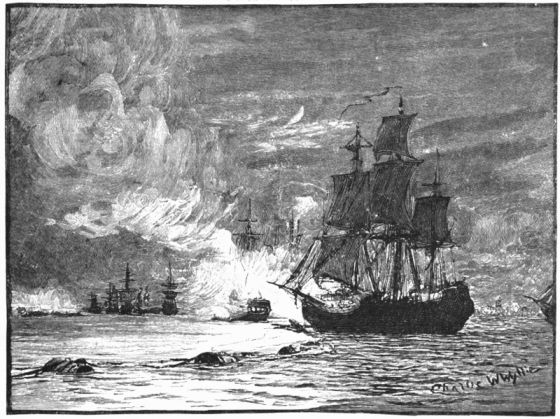
and then Sir Sidney Smith, who had recently
arrived at Toulon, and had volunteered the
perilous office of blowing up the powder-magazines,
stores, arsenals, and the ships that could not be
removed, began his operations. He succeeded in
setting fire to the stores and about forty ships of
war that were in the harbour.
After the departure of the British fleet, the
Jacobin troops, townsmen, and galley convicts,
were perpetrating the most horrible scenes on the
unfortunate Toulonese. Even the poor workmen
who had been employed by the English to
strengthen the defences, were collected in
hundreds, and cut down by discharges of grape-shot.
Three Jacobin commissioners, the brother
of Robespierre, Barras, and Freron, were sent to
purge the place, and besides the grape-shot the
guillotine was in daily activity exterminating the
people. The very mention of the name of Toulon
was forbidden, and it was henceforth to be called
Port de la Montagne.
The troops of the Convention were equally
successful against Lyons. It was speedily invested
by numerous troops, under the command of
Dubois-Crancé, one of the Commissioners of the
Convention. On the 21st of August he summoned
the place to surrender, but the Lyonese held out
till the 2nd of October, when Couthon, one of the
most ruthless of the Jacobin deputies, arrived,
with twenty-eight thousand armed peasants, from
Auvergne. He demanded that the city should be
instantly bombarded, and, if necessary, reduced to
ruins. Dubois-Crancé said there was no need for
this merciless alternative, as the place must very
soon yield from famine. Couthon thereupon
obtained an order from the Convention to supersede
Dubois-Crancé, as devoid of proper Republican
zeal; and on the 7th of October commenced a
terrible bombardment. The inhabitants came
to a parley with Couthon, and agreed to surrender
without conditions. Couthon immediately
appointed a committee to try all rebels, and he
sent his opinion of the population at large to the
Convention, describing the people as of three kinds—the
wicked rich, the proud rich, and the ignorant
poor, who were too stupid to be good Republicans.
He proposed to guillotine the first class, to seize
the property of the second, and to remove the
last into different quarters of France. The Convention
adopted his views cordially, and passed a
decree that Lyons should be destroyed; that
nothing should be left but the houses of the poor,
the manufactories, the hospitals, the school of arts,
the public schools, and public monuments; that
the name of Lyons should be buried for ever, and
that on its ruins should be erected a monument
bearing this inscription:—"Lyons made war
against liberty: Lyons is no more!" The name of
the spot ever afterwards was to be the Liberated
Commune. The massacres were carried out by
Collot d'Herbois.
The same scenes, but on a still larger scale, were
exhibiting in the capital. The Reign of Terror
was fully inaugurated, and rapidly extending itself.
At first, on the expulsion of the Girondists
from the Convention—that is, in June—the guillotinings
were only fourteen. In July the number
was about the same; but in August Robespierre
became a member of the Committee of Public
Safety, which carried on the machinery of government,
and then the work went on swimmingly.
From the moment that Robespierre took his place
on the Committee, the stream of blood flowed freely
and steadily. His friend—if such monsters can
be said to have any friends—Barrère, who belonged
to the timid Plain till the Girondists were
overthrown, now became his active agent. He
proposed, on the 7th of August, that William Pitt
should be proclaimed the enemy of the whole
human race, and that a decree should be passed
that every man had a right to assassinate him.
On the 9th it was announced that the Republic
was completed; that Hérault de Séchelles had
produced a new and perfect constitution, which
was at once adopted by the Convention. It was a
constitution containing all the doctrines of the
Mountain, in the bombast of that truculent
faction. As it was quickly set aside, we need
not detail its principles. Then this constitution
was celebrated on the 10th of August, the
anniversary sacred to the downfall of monarchy.
Next followed fresh executions, among the most
notable victims being Marie Antoinette (October
16) and Madame Roland (November 9), while
most of the prominent Girondists were hunted
down and killed.
Whilst blood was thus flowing by the guillotine,
not only in Paris, but, under the management of
Jacobin Commissioners, in nearly all the large
towns of France, especially Lyons, Bordeaux, and
Nantes, a terrible work of extermination was
going on against the royalists of La Vendée. The
simple people of that province, primitive in their
habits and sincere in their faith, desired no
Republic. Their aristocracy, for the most part of
only moderate possessions, lived amongst them
rather like a race of kindly country squires than
great lords, and the people were accordingly
cordially attached to them. In March of the year
1793 the Convention called for a conscription of
three hundred thousand, and the Vendéans, to a
man, refused to serve under a Government that had
persecuted both their priests and their seigneurs.
This was the certain signal of civil war. Troops
were ordered to march into La Vendée, and compel
obedience. Then the peasants flew to arms, and
called on the nobles and priests to join them. At
first they were entirely successful, but matters
changed when Kleber was put in practical command.
Their general, Lescure, was killed, and most
of their other leaders were severely wounded.
Kleber triumphed over them by his weight of
artillery, and they now fled to the Loire. Amongst
a number of royalist nobles who had joined them
from the army of the Prince of Condé on the
Rhine, was Prince de Talmont, a Breton noble,
formerly of vast property in Brittany, and now of
much influence there. He advised them, for the
present, to abandon their country, and take
refuge amongst his countrymen, the Bretons.
The whole of this miserable and miscellaneous
population, nearly a hundred thousand in number,
crowded to the edge of the Loire, impatient, from
terror and despair, to cross. Behind were the
smoke of burning villages and the thunder of the
hostile artillery; before, was the broad Loire,
divided by a low long island, also crowded with
fugitives. La Roche-Jaquelein had the command
of the Vendéans at this trying moment; but the
enemy, not having good information of their
situation, did not come up till the whole wretched
and famished multitude was over. On their way
to Laval they were attacked both by Westermann
and Léchelle; but being now joined by nearly seven
thousand Bretons, they beat both those generals;
and Léchelle, from mortification and terror of the
guillotine—now the certain punisher of defeated
generals—died. The Vendéans for a time, aided
by the Bretons, appeared victorious. They had
two courses open before them: one, to retire
into the farthest part of Brittany, where there
was a population strongly inspired by their own
sentiments, having a country hilly and easy of
defence, with the advantage of being open to the
coast, and the assistance of the British; the
other, to advance into Normandy, where they
might open up communication with the English
through the port of Cherbourg. They took the
latter route, though their commander, La Roche-Jaquelein,
was strongly opposed to it. Stofflet
commanded under Jaquelein. The army marched
on in great confusion, having the women and
children and the waggons in the centre. They
were extremely ill-informed of the condition of the
towns which they approached. They might have
taken Rennes and St. Malo, which would have
greatly encouraged the Bretons; but they were
informed that the Republican troops were overpowering
there. They did not approach Cherbourg
for the same cause, being told that it was well
defended on the land side; they therefore proceeded
by Dol and Avranches to Granville, where
they arrived on the 14th of November. This
place would have given them open communication
with the English, and at the worst an easy
escape to the Channel Islands; but they failed in
their attempts to take it; and great suspicion
now having seized the people that their officers
only wanted to get into a seaport to desert them
and escape to England, they one and all protested
that they would return to the Loire. In vain did
La Roche-Jaquelein demonstrate to them the
fatality of such a proceeding, and how much
better it would be to make themselves strong in
Normandy and Brittany for the present; only
about a thousand men remained with him; the
rest retraced their long and weary way towards
the Loire, though the Republicans had now accumulated
very numerous forces to bar their way.
Fighting every now and then on the road, and
seeing their wives and children daily drop from
hunger and fatigue, they returned through Dol
and Pontorson to Angers: there they were
repulsed by the Republicans. They then retreated
to Mons, where they again were attacked and
defeated, many of their women, who had concealed
themselves in the houses, being dragged out and
shot down by whole platoons. At Ancenis,
Stofflet managed to cross the Loire; but the
Republicans got between him and his army, which,
wedged in at Savenay, between the Loire, the
Vilaine, and the sea, was attacked by Kleber and
Westermann, and, after maintaining a desperate
fight against overwhelming numbers and a terrible
artillery, was literally, with the exception of a
few hundred who effected their escape, cut to
pieces, and the women and children all massacred
by the merciless Jacobins. Carrier then proceeded
to purge Nantes in the same style as Collot
d'Herbois had purged Lyons.
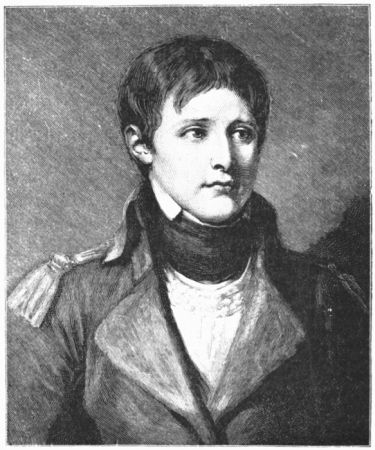
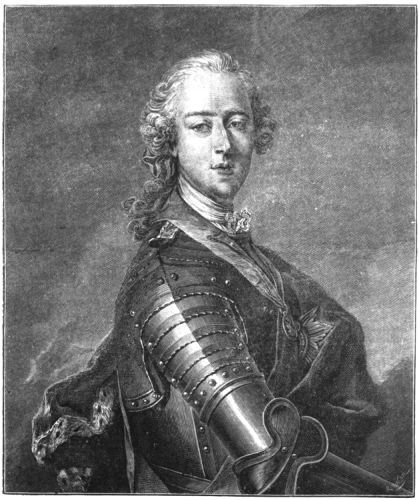
NAPOLEON BUONAPARTE, LIEUTENANT OF ARTILLERY.
(After the Portrait by J. B. Greuze.)
These godless atrocities, these enormous murders,
beyond all historic precedent, proclaimed a people
which had renounced God as well as humanity;
and they soon proceeded to avow this fact, and to
establish it by formal decree. In their rage for
destroying everything old, there was nothing that
escaped them. They altered the mode of computing
time, and no longer used the Gregorian
calendar, but dated all deeds from the first year of
Liberty, which they declared to have commenced
on the 22nd of September, 1792. The next and
greatest achievement was to dethrone the Almighty,
and erect the Goddess of Reason in His place.
Under the auspices of the Goddess of Reason they
did a very unreasonable thing: they deprived all
working people and all working animals of one
rest-day in every month. Instead of having the
four weeks and four Sundays in a month, they
decimalised the months, dividing them each into
three decades, or terms of ten days each, so that
there were only three rest-days, instead of four, in
the month.
The British Parliament met on the 21st of
January, 1794. The Opposition, on the question
of the Address, made a strong remonstrance
against the prosecution of the war. They urged
the miserable conduct of it, and the failures of the
Allies, as arguments for peace. They did not
discourage the maintenance of a proper system
of self-defence, and therefore acceded to the demands
of Ministers for raising the navy to eighty-five
thousand men. The production of the Budget
by Pitt, on the 2nd of February, gave additional
force to their appeals for peace. He stated that
the military force of England, including fencibles
and volunteers, amounted to a hundred and forty
thousand men, and he called for nineteen million
nine hundred and thirty-nine thousand pounds for
the maintenance of this force, and for the payment
of sixty thousand German troops. Besides this,
he asked for a loan of eleven million pounds, as
well as for the imposition of new taxes. This was
an advance in annual expenditure of fifteen million
pounds more than only two years ago; and when
the manner in which the money was spent was
inquired into, the objections became far more
serious. It thus appeared that we were not only
fighting for Holland and Belgium, but that we
were subsidising German princes to fight their own
battles. There had been a large subsidy to the
King of Prussia, to assist him, in reality, to
destroy Poland. We were, in fact, on the
threshold of that system of Pitt's, by which
Britain engaged to do battle all over Europe
with money as well as with men. But remonstrance
was in vain. Fox, Grey, and Sheridan,
and their party in the Commons, the Marquis
of Lansdowne, the Duke of Bedford, and the
Whigs in the Peers, made amendment after
amendment on these points, but were overwhelmed
by Pitt's majorities. Burke, in the Commons, was
frantic in advocacy of war, because France was
revolutionary and impious.
The anti-Gallic spirit was at the same time
made violent use of to crush opinion at home. It
is true that there was a foolish zeal on behalf of
the French Revolution in a certain portion of the
British public, which ought, by this time, to have
been cooled by the too obvious nature and tendency
of that Revolution; but this might readily
have been prevented from doing harm by a fair
exposure of the folly of the admirers of so bloody
and dishonest a system as that of the French
Jacobins. But it was more in accordance with
the spirit of Government at that time to endeavour
to crush the freedom of the press and of speech,
under cover of the repression of a Gallic tendency.
The persecution began in Scotland.
The first indictment was preferred against
James Tytler, a chemist, of Edinburgh, for having
published an address to the people, complaining
of the mass of the people being wholly unrepresented,
and, in consequence, being robbed
and enslaved; demanding universal suffrage, and
advising folk to refuse to pay taxes till this
reform was granted. However strange such a
charge would appear now, when the truth of it has
long been admitted, it was then held by Government
and the magistracy as next to high treason.
Tytler did not venture to appear, and his bail, two
booksellers, were compelled to pay the amount of
his bond and penalty, six hundred merks Scots.
He himself was outlawed, and his goods were sold.
Three days afterwards, namely, on the 8th of
January, 1793, John Morton, a printer's apprentice,
and John Anderson and Malcolm Craig,
journeymen printers, were put upon their trial for
more questionable conduct. They were charged
with endeavouring to seduce the soldiers in the
castle of Edinburgh from their duty, urging
them to drink, as a toast, "George the Third
and Last, and Damnation to all Crowned Heads;"
and with attempting to persuade them to join
the "Society of the Friends of the People,"
or a "Club of Equality and Freedom." They
were condemned to nine months' imprisonment,
and to give security in one thousand
merks Scots for their good behaviour for
three years. Next came the trials of William
Stewart, merchant, and John Elder, bookseller, of
Edinburgh, for writing and publishing a pamphlet
on the "Rights of Man and the Origin of Government."
Stewart absconded, and the proceedings
were dropped against the bookseller. To these
succeeded a number of similar trials, amongst
them those of James Smith, John Mennings,
James Callender, Walter Berry, and James Robinson,
of Edinburgh, tradesmen of various descriptions,
on the charges of corresponding with Reform
societies, or advocating the representation of the
people, full and equal rights, and declaring the
then Constitution a conspiracy of the rich against
the poor. One or two absented themselves, and
were outlawed; the rest were imprisoned in different
towns. These violent proceedings against
poor men, merely for demanding reforms only too
much needed, excited but little attention; but now
a more conspicuous class was aimed at, and the
outrageously arbitrary proceedings at once excited
public attention, and, on the part of reformers,
intense indignation.
The persons now indicted were Thomas Muir
and the Rev. Thomas Fyshe Palmer. Muir was
a young advocate, only eight-and-twenty years
of age. He was brought to trial at Edinburgh,
on the 30th of August, 1793. He was charged
with inciting people to read the works of Paine,
and "A Dialogue between the Governors and the
Governed," and with having caused to be received
and answered, by the Convention of Delegates, a
seditious address from the Society of United Irishmen
in Dublin, to the Delegates for promoting
Reform in Scotland. He was also charged with
having absconded from the pursuit of justice, and
with having been over to France, and with having
returned in a clandestine manner by way of
Ireland. To these charges Muir replied that he
had gone to France after publicly avowing his
object, both in Edinburgh and London, that object
being to endeavour to persuade the French Convention
not to execute Louis XVI.; that when in
Paris he urged this both on the ground of humanity
and good policy, as tending to make constitutional
reform easier, as well as the keeping of
peace with England; that the sudden declaration
of hostilities whilst there had warned him to return,
but had closed up the direct way; that
that was the reason of his taking a vessel from
Havre to Ireland; that he had, however, returned
publicly, and surrendered himself for trial at the
earliest opportunity.
The most respectable witnesses testified in his
favour, that he had always argued that the monarchy
of the country was good; the government
far superior to that of France; that many opinions
of Paine were unsound and untenable; that an
equal division of property was a chimera, and that
we here wanted no revolution, but only moderate
reform. The chief witness against him was a
woman-servant, who had lived in his father's
family, who deposed to his telling people to read
the "Rights of Man;" to giving an organ-man
something to play "Ça ira!" and the like. It is
clear that Mr. Muir was what would now be considered
a very moderate reformer indeed. But
the Lord Advocate treated him with the most
scurrilous indignity, calling him "that unfortunate
wretch at the bar;" "that demon of mischief;"
"that pest of Scotland." The very proofs of
Muir's moderation were turned by the Lord Justice
Clerk into crimes; it was only "policy;" and he
proceeded to pass on him the monstrous sentence
of transportation for fourteen years!
This base and disproportionate sentence startled
the people of England. In Scotland then party
spirit ran furiously high. As there were clubs for
advocating thorough reform, so there were others
for discouraging and crushing it. The Tory arbitrary
principle was rampant, and Muir was the
victim of it.
Mr. Fyshe Palmer was not tried till the 12th of
September. He was then brought before the
Circuit Court of Justiciary at Perth, and charged
with writing and publishing an "Address to the
People," which had been issued by the Society of
the Friends of Liberty, at Dundee. Palmer was
an Englishman of good family, in Bedfordshire.
He had taken his degree at Cambridge, and obtained
a fellowship at Queen's College; but he had
afterwards joined the Unitarians, and had resided
and preached some time at Montrose and Dundee,
and had delivered lectures on Unitarianism in
Edinburgh and Forfar. It appeared that Palmer
was not the author of the Address, but had only
been asked to correct the proof of it, and that
he had, whilst so doing, struck out some of the
strongest passages. One Mealmaker, a weaver,
acknowledged himself the author of the Address;
but Palmer was a Unitarian, and this, to the
bigoted Presbyterianism of his judges, was rank
poison. His advocate pleaded that he was not
quite sane, but neither did this avail; the jury
brought in an instant and unanimous verdict of
guilty, and the judges condemned him to be transported
for seven years. This was a still more
outrageous sentence than that of Muir, for Palmer
had corresponded with no French or Reforming
societies whatever; he had simply corrected a
proof!
Not at all dismayed by this unrighteous severity,
the Scottish Friends of the People met in convention,
in Edinburgh, on the 9th of October. At
this Convention delegates appeared, not only from
most of the large towns of Scotland, but also from
London, Sheffield, and Dublin. Letters were also
received from the Societies in England. Mr.
William Skirving, a friend of Muir and Palmer,
as secretary to the Convention, read these letters,
and other papers, demanding annual parliaments
and universal suffrage. As the British Parliament
was considered, and truly, merely a corrupt clique
of the representatives of boroughmongers, they proposed
to apply directly to the king, that he might
urge those necessary reforms on the Legislature.
In Scottish fashion, the Reformers opened and
closed their sittings with prayer, presenting a
striking contrast to the French Revolutionists.
On the 6th of November delegates appeared from
the Society of United Irishmen, and Margarot and
Gerald from the Society of the Friends of the
People in London. Margarot stated that five
hundred constables had beset the meeting in
London, to prevent delegates from getting away to
this Convention, but that the manufacturing towns
of England were almost all in favour of Reform;
that in Sheffield alone there were fifty thousand;
that a general union of the Reformers of the
United Kingdom would strike terror into their
enemies, and compel them to grant annual parliaments
and universal suffrage.
The Irish delegates described the condition of
Ireland as most deplorable. They said that the
Government interest, through the landed aristocracy,
was omnipotent; that the manufacturers
were unemployed; that an infamous coalition had
taken place between the Irish Opposition and
Ministry; that the Catholics had been bought
up so that all parties might combine to crush
Reform; that the United Irishmen were everywhere
persecuted, and that one of them had only
just escaped from a six months' imprisonment.
Amongst these, for the most part working men,
sat a number of gentlemen, and even one lord,
Lord Dacre, who had lived in Paris and was a
regular Revolutionist. The Convention sat unmolested
till the 5th of December, arranging for a
future meeting in England, and organising committees
and correspondents in different towns.
They also recommended to all Reform clubs and
societies to invoke Divine aid on their endeavours
for just reform. On meeting on the morning of
the 5th, the president, Paterson, announced that
himself, Margarot, and the delegates had been
arrested, and were only out on bail. Immediately
after this, the Lord Provost appeared with a force
to disperse the meeting, and though Skirving
informed him that the place of meeting was his
own hired house, and that they had met for
a purely constitutional purpose, the Lord Provost
broke up the meeting and drove out the
members. That evening they met again at
another place, but only to be turned out again.
Still they did not disperse before Gerald had
offered up a fervent prayer for the success of
Reform. Mr. Skirving then issued a circular inviting
the delegates to meet in his private house,
and for this he was arrested on the 6th of January,
1794, brought before the Court of Justiciary, and
sentenced to fourteen years' transportation. On
the 13th Margarot received the same sentence;
and, in the month of March, Gerald likewise.
Muir and Palmer, on the 19th of December,
1793, had been conveyed on board the hulks at
Woolwich, before being shipped off to the
Antipodes, and were put in irons; but before they
were sent off, the matter was brought before
Parliament. It was introduced by Mr. Adams,
on the 14th of February, 1794, moving for leave to
bring in a bill to alter the enactment for allowing
appeals from the Scottish Court of Justiciary in
matters of law. This was refused, and he then
gave notice of a motion for the revision of the
trials of Muir and Palmer. Sheridan, on the
24th, presented a petition from Palmer, complaining
of his sentence as unwarranted by law. Pitt
protested against the reception of the petition, and
Dundas declared that all such motions were too
late; the warrant for Palmer's transportation was
already signed and issued. Wilberforce moved
that Palmer's being sent off should be delayed till
the case was reconsidered, but this was also
rejected by a large majority. Such was the determined
spirit of Pitt and his parliamentary majority
against all Reform, or justice to Reformers. On
the 10th of March Mr. Adams again moved for
a revision of the trials of Muir and Palmer,
declaring that "leasing-making" (verbal sedition),
their crime by the law of Scotland, was punishable
by fine, imprisonment, or banishment, but not by
transportation, and that their sentence was
illegal. Fox exposed the rancorous spirit with
which the trials had been conducted, and to which
the judges had most indecently lent themselves;
that the Lord Justice Clerk, during Muir's
trial, had said, "A government in every country
should be just like a corporation; and, in this
country, it is made up of the landed interest,
which alone has a right to be represented. As for
the rabble, who have nothing but personal property,
what hold has the nation on them? They
may pack up all their property on their backs, and
leave the country in the twinkling of an eye!"
Lord Swinton said, "If punishment adequate to
the crime of sedition were to be sought for, it
could not be found in our law, now that torture is
happily abolished." The Lord Advocate was in
his place to defend his conduct and doctrine, but
Pitt and Dundas supported these odious opinions.
The House also sanctioned them by a large
majority, and Adams's motion was rejected. In the
Upper House, similar motions, introduced by Lords
Lansdowne and Stanhope, were similarly treated.
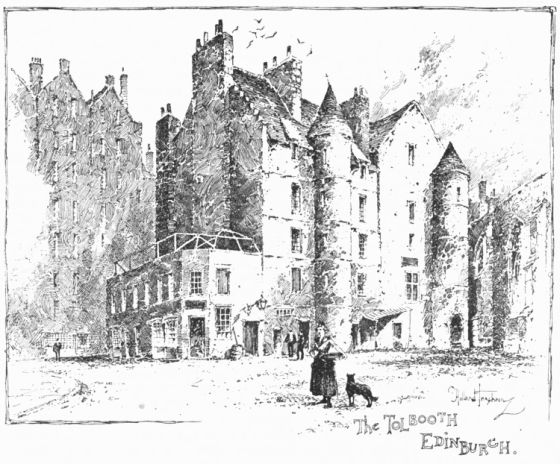
The success of the Scottish courts in sentencing
Reformers encouraged the Ministers to try the
experiment in England; but there it did not
succeed so well. First, one Eaton, a bookseller,
of Bishopgate, was indicted for selling a seditious
libel, called "Politics for the People; or, Hog's-wash."
On the 2nd of April, Thomas Walker, a
merchant of Manchester—was, with six others,
indicted at the Lancaster assizes; but Eaton,
in London, and these Manchester men, were
acquitted. Rather irritated than discouraged by
these failures, Pitt and Dundas made a swoop at
the leaders of the Corresponding Society, and the
Society for Constitutional Information in London;
and, in the month of May, Horne Tooke, John
Thelwall—a celebrated political lecturer—Thomas
Hardy, Daniel Adams, and the Rev. Jeremiah
Joyce—private secretary to the Earl of Stanhope,
and tutor to his son, Lord Mahon—were arrested
and committed to the Tower on a charge of high
treason. No sooner was this done, than, on the
12th of May, Dundas announced to the House of
Commons that, in consequence of the Government
having been informed of seditious practices being
carried on by the above-named societies, they had
seized their papers, and he now demanded that
a committee of secrecy should be appointed to
examine these papers. This was agreed to; and
on the 16th Pitt brought up the report of this
committee, which was so absurd in its results that
nothing but the most blind political desperation
could have induced the Government to make it
known. The committee found nothing amongst
these papers but the reports of the societies since
the year 1791, which had been annually published
and made known to every one. Yet on this
miserable evidence Pitt called for the suspension
of the Habeas Corpus Act, and it was accordingly
granted, Burke—who now seems to have grown
quite politically mad by dwelling on the horrors
of the French Revolution—believing it the only
measure to insure the safety of the country.
Windham and others asserted that the mere
suspension of the Habeas Corpus Act was hardly
sufficient: there required yet more stringent
measures. Similar language was held in the
Lords, but did not pass without some severe
comments from the Duke of Bedford, and the
Lords Stanhope, Lauderdale, and Albemarle, who
declared that Ministers, instead of suppressing,
were creating a veritable reign of terror.
The Bill was, notwithstanding, readily passed;
and on the 13th of June an Address was carried
to his Majesty, expressing the determination of
their lordships to punish the men who had been
concerned in the so-called conspiracy. Fox and
Lambton condemned this course energetically in
the Commons, declaring that, if there were any
conspiracy, the ordinary laws and tribunals were
amply sufficient for their punishment. Fox moved
that all that part of the Address which expressed a
conviction of the existence of a conspiracy should
be struck out, but it was carried entire; and such
was the alarm of the country at the reverses of
the Allies on the Continent and the successes of
France, that far more violent measures would
have been readily assented to.
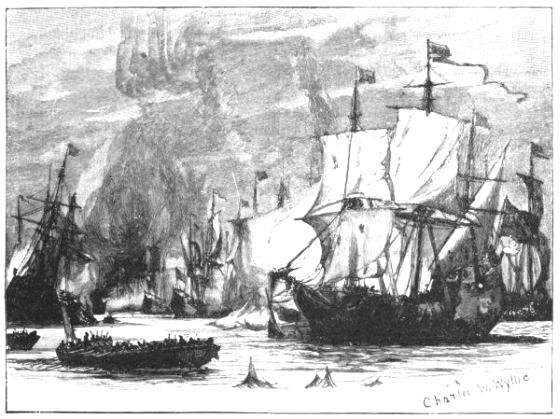
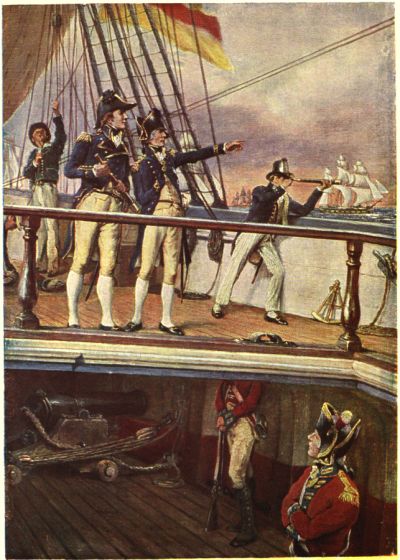
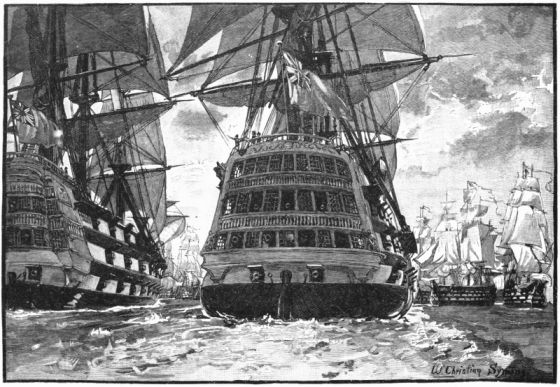
Meanwhile Lord Howe had been on the look-out
some time for the French fleet, which, it was
understood, was about to leave Brest, in order to
meet a convoy of merchant ships from the West
Indies, and aid it in bringing that trade fleet into
port. On reaching Brest, however, he discovered
that the French fleet had sailed, and it was not
till the 28th of May that he caught sight of it
out at sea, opposite the coast of Brittany. The
French fleet, commanded by Admiral Villaret
Joyeuse, was greatly superior to Howe's in
ships, number of seamen, and weight of metal.
Howe had twenty-five sail of the line and five
frigates, carrying two thousand and ninety-eight
guns, in weight of metal twenty-one thousand five
hundred and nineteen pounds, and sixteen thousand
six hundred and forty-seven men. Joyeuse, now
joined by Admiral Neilly, had twenty-six line-of-battle
ships and smaller vessels, carrying two
thousand one hundred and fifty-eight guns, in
weight of metal twenty-five thousand five hundred
and twenty-one pounds, and nineteen thousand
eight hundred and twenty-eight men. After some
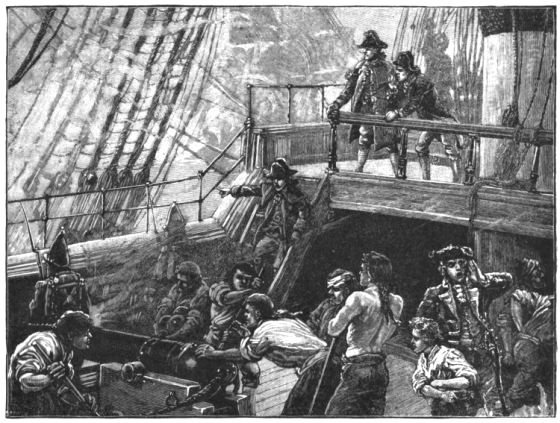
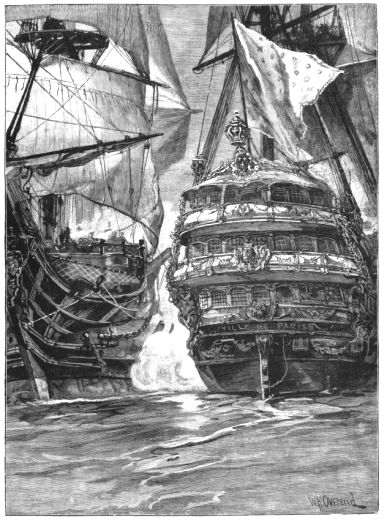
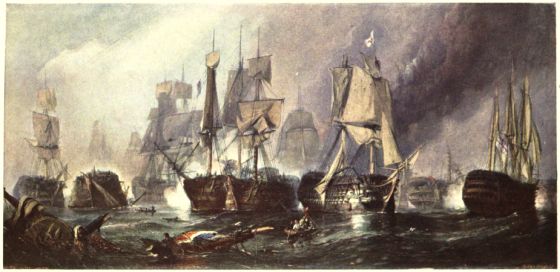
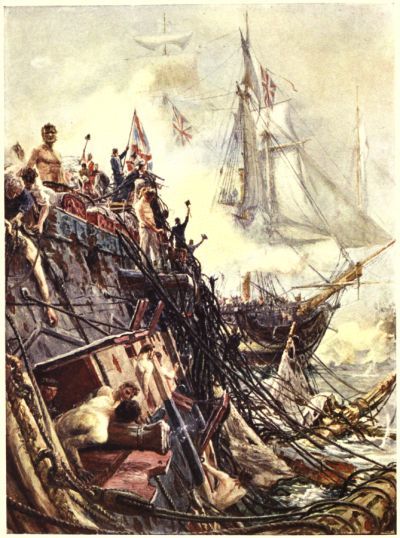
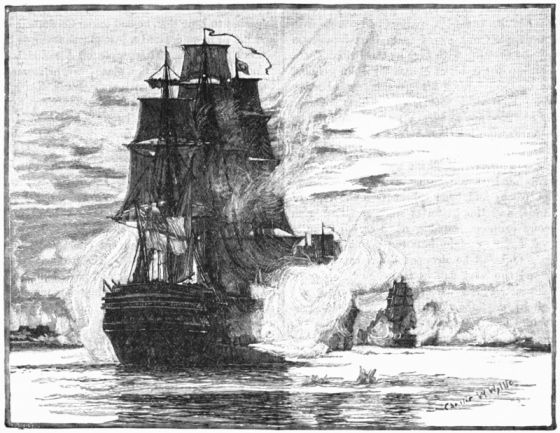
skirmishing, on the 1st of June—"the glorious
first"—Howe came to close quarters with the
enemy, who was compelled to fight by the presence
of the Conventional Commissioner Bon St. André.
He ordered his fleet to follow his ship, the
Charlotte, in cutting right through the enemy's
line. Only five ships, however, accomplished this
so as to engage the French to the leeward, and
prevent them from escaping. Howe afterwards
complained that some of his captains had not
obeyed his orders, and threatened them with a
court-martial; but some replied that their ships
were in such bad sailing condition that they could
not effect this movement, and others that they
did not understand the signal. Thus, five vessels
fighting to the leeward, and the rest to the windward,
the battle raged furiously from nine in the
morning till three in the afternoon, when the
French admiral sheered off for Brest, leaving
behind seven of his finest vessels in the hands of
the British. The British lost in the action two
hundred and seventy-nine men, and had eight
hundred and seventy-seven wounded. The French
lost in six of the captured ships alone six hundred
and ninety men, and had five hundred and
eighty wounded. The seventh, the Vengeur, went
down almost as soon as the British flag was
hoisted on her, with, it is supposed, three
hundred men in her. Altogether, it is likely
that the French did not lose less than fifteen
hundred men, besides wounded, and two thousand
three hundred prisoners. The British lost a
number of officers, who were either killed in
the battle or died afterwards of their injuries
Amongst these were Sir Andrew Douglas, second
captain of Howe's own ship; Captains Montagu
of the Montagu, Hutt of the Queen, and Harvey
of the Brunswick; Rear-Admirals Pasley of the
Bellerophon, and Bowyer of the Barfleur. Admiral
Graves and Captain Berkeley were severely wounded.
Howe made every effort to pursue and bring the
French admiral again to action; but, owing to the
bad sailing qualities of English ships at that time,
and the shattered state of many of them, he could
not overtake Villaret, who made the best of his
way to Brest. During the remainder of the year
there were various engagements between small
squadrons in different quarters, in which the
advantage generally remained with the British,
besides the training thus afforded to the officers
and sailors for the mighty victories which awaited
them.
During the spring of 1794 the British, under
Lieutenant-General Sir Charles Grey, took the
French island of Martinique, in which attempt the
Duke of Kent, father of Queen Victoria, distinguished
himself. They also took St. Lucia,
Guadeloupe, and its dependencies, Marie-Galante,
Deseada, and the Saintes. But they were not so
successful in assisting the French Royalists in
St. Domingo to expel the Republicans. They
beat the French in three successive battles, but
our troops were then attacked by the yellow fever.
General Whyte made himself master of the French
capital, Port-au-Prince; but General Dundas, who
was appointed governor, was carried off by the
fever, as also were numbers of the troops. The
French general also fell a victim to the fever; but
at this juncture arrived the Jacobin Commissioner,
Victor Hugues, with a reinforcement of from
fifteen hundred to two thousand men. He immediately
assumed the command, proclaimed freedom
to all the blacks, and the plunder of the Royalists.
The Royalists, terrified, submitted, or only
feebly supported their British allies, who were
thereupon compelled to yield them to their fate.
Hughes, one of the bloodiest of the French
revolutionists, set the guillotine to work in the
hands of the negroes. The Royalists were beheaded
or fusilladed in troops, their houses burnt,
and their estates ravaged. Before the end of the
year this monster had reduced the island to a
dreadful desert. In his ferocious fury, he had
caused the very sick and wounded in the hospitals
to be massacred, and the dead to be thrown out of
their graves. Amongst these were the remains of
General Dundas, and the other dead British
officers, which were flung into the river. Hugues
also recovered Guadeloupe, and perpetrated the
same cruelties and abominations there.
During this summer the island of Corsica fell
into our hands, and that by conduct as brilliant
on the part of Nelson and the troops and seamen
under him, as was at the time the formal inefficiency
of our generals there. The Corsicans soon
experienced the insolence and rapacity of the
godless French Republicans, and rose in general
insurrection. The patriot Paoli was the first to
advise them to renounce all connection with such
a race of fiends, and was, in consequence, proscribed
by the Convention, but at the same time
appointed General-in-Chief and President of the
Council of Government by his own people. As he
well knew that little Corsica was no match for
France, he applied to the British for assistance.
Lord Hood was then engaged in the defence of
Toulon, but he sent a few ships and troops during
the summer and autumn to Paoli's aid, and by this
assistance the French were driven out of every
part of the island except San Fiorenzo, Calvi, and
Bastia. The mother of Buonaparte, and part of
the family, who were living at Ajaccio, fled to
France, imploring the aid of the Convention for
her native island. Lord Hood, however, having
evacuated Toulon, made haste to be beforehand
with them. By the 7th of February, 1794, he
had blockaded the three ports still in the hands of
the French, and had landed five regiments, under
the command of General Dundas, at San Fiorenzo.
The French were soon compelled to evacuate the
place, but they retreated to Bastia, without almost
any attempt on the part of Dundas to injure or
molest them. Lord Hood now urged the immediate
reduction of Bastia, but Dundas, an incompetent
officer, and tied up by all the old
formal rules of warfare, declared that he could not
attempt to carry the town till the arrival of two
thousand fresh troops from Gibraltar. But there
was a man of very different metal and notions
serving there, namely, Nelson, who was indignant
at this timid conduct. He declared that if he had
five hundred men and the Agamemnon ship-of-war,
he could take the place. Lord Hood was resolved
that he should try, whilst he himself blockaded
the harbour. Nelson, who declared his own seamen
of the Agamemnon were of the right sort, and
cared no more for bullets than for peas, had one
thousand one hundred and eighty-three soldiers,
artillerymen, and marines, with two hundred and
fifty sailors, put under his command, with the title
of brigadier. They landed on the 4th of April,
dragged their cannon up to the tops of the rocks
overhanging Bastia, to the astonishment of French,
Corsicans, and the timid Dundas. On the 10th
Nelson was aloft with his whole force, and with
all his cannon in position. A body of Corsicans
rather kept guard than gave any active assistance
on another side of the town; for they had no
cannon, or could not drag them up precipices like
British seamen. On the 11th Lord Hood summoned
the town to surrender; but the French
commander and Commissioner, Lacombe-Saint-Michel,
replied that he had red-hot shot for the
ships and bayonets for the British soldiers, and
should not think of yielding till he had two-thirds
of his garrison killed. But Nelson, ably seconded
by Colonel Vilettes, plied his artillery to such
purpose, that, on the 10th of May, Lacombe-Saint-Michel
made offer of surrender, and on the
19th the capitulation was completed. The French
forces and the Corsicans in their interest were
shipped off to Toulon, after the signing of the
capitulation on the 21st; and now General
D'Aubant, who had succeeded General Dundas,
but who had continued lying at San Fiorenzo
instead of assisting at the siege, came up with his
troops and took possession of Bastia. The whole
loss of the British in this brilliant affair was only
fourteen men killed and thirty-four wounded.
Calvi, the most strongly-situated and fortified
place, still remained to be taken. By the middle
of June it was thoroughly invested, both by sea
and land, and Nelson again serving on shore,
assisted by Captains Hallowell and Serecold, was
pouring shells and red-hot shot into the fort.
Captain Serecold was killed at the very outset; but
Nelson and Hallowell, chiefly with the sailors and
marines, continued the bombardment through the
terrible heat of the dog-days, and the enervating
effects of malaria from stagnant
ponds in the hills,
and compelled the surrender
on the 10th of August, but
not before one-half of the two
thousand men engaged were
prostrated by sickness. The
island was now, by the advice
of Paoli, offered to the British
Crown and by it accepted; but a gross blunder
was made in not appointing Paoli Governor, as
was expected both by himself and his compatriots.
Instead of this most proper and conciliatory
measure, Sir Gilbert Elliot was appointed
Governor, to the disappointment and disgust of the
Corsicans. Sir Gilbert attempted to gratify the
islanders by framing a new Constitution for them,
and granting them trial by jury; but neither of
these institutions was adapted to their ideas, and
both failed to heal the wound which the ignominious
treatment of their great patriot occasioned.
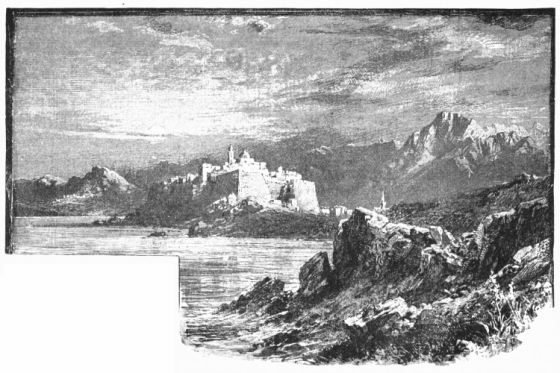
But this little episode of the war presented
one bright spot amid the vast picture of miserable
mismanagement, want of concert and of activity,
amongst the Allies engaged against France.
The campaign of 1794 was most disgraceful and
discouraging. The plan still was for the different
armies of the Allies to advance from the different
frontiers, north, west, east, and south, and concentrate
themselves on Paris; but all the activity
and concentration were on the side of the French.
In the very commencement of it, it was observed
that Prussia was not bringing by any means the
stipulated amount of forces into the field. The
king, thinking much more of securing his Polish
robberies than of co-operating against France,
remained in Poland, and was even discovered to
be secretly negotiating with the French Convention
for peace. Britain was alarmed at this
symptom of Prussian defection and made strong
remonstrances. Frederick William coolly replied
that it was impossible for him to go on without a
large sum of money. The hint of Prussia was not
lost; money was promised, and in April of this
year a subsidy of two millions two hundred thousand
pounds was paid to Prussia to secure her
more active operation, and on condition that she
brought into the field sixty thousand men. The
bulk of this money was paid by Britain, a small
fraction by Holland; and what was the result?
The King of Prussia sent very few troops into the
field, but employed the money in paying and
maintaining armies to keep down the invaded
provinces of Poland, and to invade more! Thus
Britain was duped into the disgraceful business
of riveting the fetters of unhappy Poland; and it
would have been well had this taught the British
Government wisdom. But it was now intent
on that astonishing career of subsidising almost
all the nations of Europe against France; of
purchasing useless German soldiers at astounding
prices; of pouring out the wealth and blood of
Britain like water to enable the Germans and
Russians to defend their own hearths and homes,
and in vain. The results of this subsidy ought to
have satisfied Britain, and would have satisfied
any other nation; for it did not long retain Prussia
as an ally, even in name.
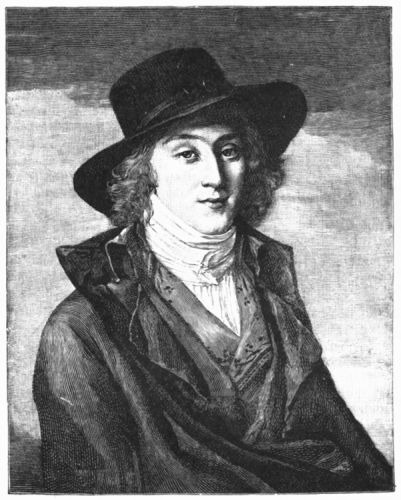
ST. JUST. (After the Portrait by David.)
Belgium, this summer, was the great battle-ground.
In it were Austrians, Dutch, British,
and Hanoverians. At the opening of the campaign
the Allies had probably two hundred
thousand men scattered along the frontiers, and
the French upwards of three hundred thousand.
But whilst the French were united in one object,
and the Convention kept pouring fresh masses of
men in, the Allies were slow and disunited. The
Duke of York, who commanded the English and
Hanoverians, about thirty thousand men, was
completely tired of the sluggish formality of the
Austrian general, Clairfait, and refused to serve
under him. To remove the difficulty, the Emperor
of Austria agreed to take the command of his
forces in the Netherlands in person, so that the
Duke of York would serve under him. Francis II.
arrived in April, and great expectations were
excited by his presence. Instead of urging all
the different divisions of the allied armies to
concentrate in large masses against the able
generals, Pichegru and Jourdain, Francis sat down
before the secondary fortress of Landrecies, though
the Allies already held those of Valenciennes,
Condé, and Quesnoy. This enabled Pichegru to
advance on West Flanders, and take Courtrai and
Menin in the very face of Clairfait. At the same
time Jourdain had entered the country of Luxembourg
with a large force, and whilst the Austrians
were wasting their time before Landrecies, he was
still further reinforced from the army of the
Rhine, which the absence of the King of Prussia
left at leisure, and he now fell upon the Austrian
general, Beaulieu; and though Beaulieu fought
bravely for two days, he was overwhelmed by
successive columns of fresh troops, and driven
from his lines. Jourdain then advanced upon the
Moselle, where the Prussians ought to have been,
and were not, in spite of the subsidy.
Pichegru, on his part, having driven back Clairfait,
turned round on the Duke of York, who lay
at Tournay. There he met with a severe repulse,
and fell back with heavy loss; but Clairfait having
again advanced to regain Courtrai, Pichegru once
more engaged and defeated him. Clairfait then
fell back into Flanders, to cover Ghent, Bruges,
and Ostend. Pichegru, urged on against his
better judgment by St. Just, who was the Commissioner
from the Convention, sent Kleber and
Marceau across the Sambre to attack General
Kaunitz; but Kaunitz gave the French a severe
defeat, killing four thousand of them; and had
the Austrians been as rapid as they were brave,
they might have nearly exterminated the whole of
the French division. This success inspirited the
Allies to advance actively, but the Duke of York,
not taking into account the habitual slowness of
German troops, shot ahead, expecting to fall in with
Clairfait's columns at Turcoing; but there he only
found the French, under Souham and Bonnaud,
who well nigh enveloped him by their vast
numbers, totally defeated, and nearly took him
prisoner. This gave such a panic to the Austrians,
that the entire army fell back, and Francis II.,
thoroughly discouraged, withdrew from the command
and left it to the Prince of Coburg. The
Duke of York rallied, and maintained his ground
at Tournay against Pichegru, and Kaunitz followed
up his advantage against Kleber and Moreau,
driving them across the Sambre; but these were
only temporary successes. Jourdain, finding no
Prussians in the Moselle, drew nearer to the camp
of Pichegru. There were various conflicts at
Ypres, Charleroi, and on the plains of Fleurus.
The Allies drove the French three times across
the Sambre, but they returned with fresh and
never-ending forces, and compelled the Allies to a
general retreat. Bruges opened its gates to the
French; Pichegru, aided by Moreau, compelled
the Duke of York to retire successively on Oudenarde,
Tournay, and Antwerp, places filled with
the fame of Marlborough. At Antwerp the
Duke of York was joined by Lord Moira, with
ten thousand men, intended originally for La
Vendée, but too late to prevent the massacre of
Savenay. The English garrison quitted Ostend,
and came round to Antwerp; and the British
occupied that town, whilst Clairfait lay at Louvain,
and the two armies, unitedly, protected
Mechlin.
The French allowed the retreating Allies no
rest. There was no want of men. The Convention,
by the menace of the guillotine at home,
and the promises of plunder and licence abroad,
could raise any number of thousands of men, could
find millions of money, and they had not a single
feeling of humanity, as the streaming axes of the
executioners all over the country showed. They
could also fight and daunt their enemies by the
same unhesitating ferocity. They had long published
to all their armies that no quarter was to be
given to British or Hanoverians—they were to be
massacred to a man; and they now sent word
to the fortresses of Valenciennes, Condé, Quesnoy,
and Landrecies, that unless the garrisons surrendered
every soul on their being taken should
be butchered. The fortresses were immediately
surrendered, for the menace was backed by one
hundred and fifty thousand men—the combined
troops of Pichegru and Jourdain. Besides, the
fortresses in the hands of the Allies were so badly
supplied both with ammunition and stores, that
they were but dens of famine and impotence. On
the 5th of July Ghent opened its gates to the
French; on the 9th the French entered Brussels,
having driven the Duke of Coburg out of his
entrenchments in the wood of Soignies, near which
the battle of Waterloo was afterwards fought.
They next attacked the Duke of York and
Lord Moira at Mechlin, and after a sharp conflict
drove them thence. The very next day Clairfait
was defeated and obliged to abandon both Louvain
and Liége. General Beaulieu was driven out of
Namur, solely because he had no provisions there
for his army, though otherwise the place could
have made a long defence. The Duke of York
was compelled to abandon the strong and important
citadel of Antwerp from the same cause,
and to cross the Scheldt into Dutch territory,
leaving the French to make their triumphant
entry into Antwerp on the 23rd of July. Such
was the brilliant campaign of the French in the
Netherlands in the summer of 1794—such the
ignominious defeat of the Allies, with an army of
two hundred thousand men. Pitt, however, bravely
struggled to keep up the Coalition. A loan of
four million pounds was granted to Austria. At
the same time, in addition to the Hessian soldiers
engaged, the Duke of Brunswick, the king's
relative, was to furnish two thousand two hundred
and eighty-nine men on the same liberal terms,
and was himself to have an annual allowance of
sixteen thousand pounds sterling.
Those princes that did bring men into the field,
such as the Hessians, Brunswickers, etc.—the
Menschen-Veräufer, or man-sellers, as they were
styled by their own people—were rapacious beyond
example. During the American war we had
employed these Hessians, Brunswickers, and the
like, at a cost that excited general indignation.
Besides paying seven pounds ten shillings and a
penny for every man, the Duke of Brunswick,
who furnished only four thousand and eighty-four
men, had had an annual subsidy of fifteen
thousand five hundred and nineteen pounds. The
Landgrave of Hesse-Cassel, who furnished twelve
thousand men, had ten thousand two hundred and
eighty-one pounds a year.
It was towards the end of May before Marshal
Möllendorf, the Prussian general, began the
campaign. He then attacked the French, and
drove them out of their entrenchments at
Kaiserslautern with great slaughter. There, however,
his activity seemed to cease; and on the
12th of July the French again fell upon him. He
fought bravely for four whole days, supported by
the Austrians; but both these Powers were compelled
to retreat down the Rhine, the Prussians
retiring on Mayence and the Austrians crossing
the river for more safety. The French marched
briskly after the Prussians, took Trèves, and then
sent strong detachments to help their countrymen
to make a complete clearance of Belgium
and to invade Holland. Clairfait, who was still
hovering in Dutch Flanders, was attacked by
overwhelming numbers, beaten repeatedly, and
compelled to evacuate Juliers, Aix-la-Chapelle,
and finally Cologne. The French were so close at
his heels at Cologne that they shouted after him
that "that was not the way to Paris." Coblenz,
where the Royalist Emigrants had so long made
their headquarters, though strongly fortified, soon
after surrendered. The stout fortress of Venloo,
on the Meuse, and Bois-le-Duc, as promptly surrendered,
and the French marched on Nimeguen,
near which the Duke of York lay, hoping in vain
to cover the frontiers of Holland. The people of
Holland, like those of Belgium, were extensively
Jacobinised, the army was deeply infected by
French principles, and to attempt to defend such
a country with a mere handful of British was
literally to throw away the lives of our men.
Yet the duke stood stoutly in this hopeless
defence, where half Holland ought to have been
collected to defend itself.
On the 19th of October the French attacked
the duke with sixty thousand men, and though
his little army fought with its usual dogged
bravery it was compelled to give way. It did
this, however, only to assume a fresh position,
still covering Nimeguen, where, on the 27th, the
French again attacked it, and compelled it to
retire from the contest. The duke led the wreck
of his army across the Waal and the Rhine,
and posted himself at Arnhem in Guelderland,
to throw some impediment in the path of Pichegru,
who was advancing, at the command of the
Convention, to reduce Holland. Nimeguen, full
of Dutch traitors, soon opened its gates;
Maestricht did the same to Kleber; and at the
end of the campaign the gloomiest prospects hung
over Holland.
In the south great successes had been won by
the French. A formidable attack was made on
the territories of the King of Sardinia and the
position of Saorgio was turned. But another
division of these French descended from the Alps.
It was the month of May when General Dumas,
with the army of the Alps, had forced his way
through the defiles of Mont Cenis. The Piedmontese
garrisons of the forts there had fled
without much resistance, astonished and confounded
at seeing the French appear on the loftiest
heights around them. The French pursued their
retreating troops as far as Susa, led on by Jacobinised
Savoyards, who hated the Piedmontese.
But Dumas, finding that strong forces of Piedmontese
and Austrians, under the King of Sardinia
and the Austrian General Wallis, were
drawn up at the foot of the Alps, did not venture
to descend into the plains. Another body of the
army of Italy was delayed some time in the
Genoese territory, whilst Buonaparte was employed
in sounding the condition and intentions of
the people of Genoa. All the Alpine passes were
in their hands, and Italy was doomed to drink
the cup of misery to the very dregs.
Whilst the French armies had been carrying
bloodshed and misery into the countries around
them, their brethren at home had been equally
busy in pushing forward those mutual hatreds
which appeared likely to end in the extermination
of the whole race of revolutionists. The Girondists
being destroyed, new divisions showed
themselves in those who had hitherto been allies—Robespierre
and his coadjutors. Hébert, Chaumette,
Clootz, Ronsin, and others, began to raise
their heels against their chief, and their chief
doomed every one of them to the guillotine. His
most important victim was Danton, a man by no
means contemptible (guillotined April 5th, 1794).
Robespierre believed that there was a majority
of the Republicans who thought they had gone too
far in abolishing the Deity and setting up the
Goddess of Reason. He declared that the people
needed festivals, and immediately it was decreed
that every decade should be celebrated as a
festival. A festival in honour of the Supreme
Being inaugurated this series of special holidays,
and it was to be followed by festivals to the
Human Race, the French People, the Love of
Country, Agriculture, Necessity, Misfortune, Posterity,
and various other qualities and sentiments,
each having one decade in the year. The first
festival to the Supreme Being was fixed for the
20th of Prairial, or 8th of June. The painter
David was commissioned to prepare the scenes and
ceremonies of the festival, which was enacted in the
gardens of the Tuileries. Robespierre, in his sky-blue
coat and most showy waistcoat, and carrying
in his hand a grand bouquet of flowers mixed with
ears of wheat, led the procession and officiated as
high priest. But though Robespierre had proclaimed
the reign of the Supreme Being, he had
not the least intention that it should on that
account be any the more a reign of mercy. In his
speech at the festival of the Supreme Being, he
declared that the Republic must be still further
purged—that they must remain inexorable. On
this point he and all his colleagues were agreed,
but they were agreed in nothing else. They immediately
broke into fresh schisms, as would
necessarily be the case with such men, who must
go on exterminating one another to the last.
Robespierre, St. Just, and Couthon still hung
together; but Barrère, Collot d'Herbois, Billaud-Varennes,
and most of the other members of the
Committees of Public Welfare and Public Safety,
were in the very act of rushing into opposition,
and beginning a struggle with the triumvirate—Robespierre,
Couthon, and St. Just—to the death.
St. Just advised Robespierre to anticipate them,
but he, relying on his authority with the
Convention, remained inactive. It was a fatal
mistake. Barrère and his faction determined to
strike a decisive blow at Robespierre; and Tallien
volunteered to commence the attack on Robespierre
in the Convention. To Robespierre's utter
astonishment, his friends were outnumbered, and
decrees were immediately passed for the arrest of
Couthon, Lebas, St. Just, Robespierre and his
brother. He escaped and fled to the Commune.
For a moment it seemed as if a revolution would
have restored him to power. But the Parisians
were weary of their tyrant, and on the following
day Robespierre with twenty members of the
Commune perished on the scaffold (July 28th, 1794).
No sooner had Collot d'Herbois, Barrère, and
that party triumphed over Robespierre than they
summoned the members of the tribunal to their
bar—ay, on the very morning of the day of his
execution—and voted them honours amid much
applause. The tribunal replied, that though a few
traitors like Coffinhal and Dumas had found their
way into the tribunal, the majority of them were
sound and devoted to the Convention. Accordingly,
the next day the Convention handed over to
Fouquier-Tinville and his colleagues a list of fresh
proscriptions of sixty-nine municipals, and a few
days afterwards—namely, the 12th of Thermidor,
being the 30th of July—they added twelve more,
completing eighty-one victims! These were all
executed within twenty-four hours. The Convention
then fell into new divisions, some members
contending for its being time to cease these
tragedies, others insisting on maintaining them.
Billaud-Varennes, Barrère, and Collot d'Herbois
defended the guillotine and Fouquier-Tinville, but
the greater number of the enemies of Robespierre
denounced them, declared themselves the overthrowers
of Robespierre, and assumed the name of
Thermidorians, in honour of the month in which
they had destroyed him. For the Thermidorians
saw that the better part of the public had become
sick of blood, and they set about contracting the
Reign of Terror. They reduced the powers of the
two governing Committees; they decreed that one-fourth
of the members should go out every month;
they reduced the revolutionary sections of Paris
from forty-eight to twelve, and abolished the forty
sous a day to the sansculotte patriots for their
attendance. A month after the execution of
Robespierre, Tallien made a fierce onslaught on the
Terrorist system, and declared that there were numbers
yet living who had been equally merciless with
Robespierre, Couthon, and St. Just; and the next
day Lecointre denounced by name Barrère, Billaud-Varennes,
and Collot d'Herbois. To put an end
to the Jacobin resistance, the Convention closed
the Jacobin Club altogether, which had thus only
survived the fall of Robespierre about four months.
Thereupon the Jacobins began to denounce the
Thermidorians as anti-Republicans, but they retorted
that they were Republicans of the purest
school—that of Marat.
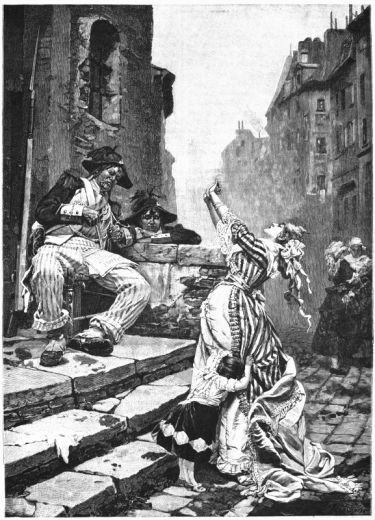
PARIS UNDER THE REIGN OF TERROR: A VAIN APPEAL.
(After the Picture by Paul Svedomsky)
Whilst these frightful horrors were taking place,
Russia, Prussia, and Austria had been completing
the extinction of Poland. An ill-advised
attempt by the Poles for the recovery of their
country had precipitated this event. The
Russian Minister in Poland had ordered the reduction
of the little army of that country, under
its now almost nominal king, Stanislaus Augustus,
from thirty thousand to fifteen thousand. The
Poles resented this, without considering that they
were unable, at the moment, to resist it. Kosciusko
was appointed Commander-in-Chief, and he
issued an order for the rising of the people in
every quarter of Poland, and for their hastening
to his flag. At first, the enthusiasm of the call to
liberty and to the rescue of the common country
gave some brilliant successes. Kosciusko, on his
march from Cracow to Warsaw, at the head of
only four thousand men, encountered a Russian
army of upwards of twelve thousand, and defeated
it with a slaughter of three thousand of the enemy.
On the 17th of March, 1794, the Polish troops
in Warsaw attacked the Russian garrison, eight
thousand strong, and slaughtering more than half
of them, drove the rest out of the city, and
Kosciusko marched in soon afterwards. A week
later the population of Lithuania, Kosciusko's
native province, rose, and drove the Russians with
much slaughter from Wilna, its capital. But this
could not save Poland: its three mighty oppressors
were pouring down their multitudinous legions on
every portion of the doomed country. The Emperor
of Austria marched an army into Little
Poland at the end of June, and an army of fifty
thousand Russians and Prussians was in full
march on Warsaw. For a time, Kosciusko repulsed
them, and committed great havoc upon
them on the 27th of July; again, on the 1st and
3rd of August. At the same time, Generals Dombrowski,
Prince Joseph Poniatowski, and other
Polish generals, were victorious in different quarters,
and the King of Prussia was compelled to
draw off his army, forty thousand strong, from
Warsaw, in order to recover Great Poland. This
gleam of success on the part of the Poles, however,
was but momentary. Their army in Lithuania,
commanded by corrupt, gambling, and gormandising
nobles, was beaten at all points by the Russians,
and driven out of Wilna on the 12th of August.
At the same time, the savage Suvaroff, the man
who had cried "Glory to God and the Empress!"
over the ruthless massacre of Ismail, was marching
down on Warsaw. Kosciusko had unwisely
weakened his army by sending a strong detachment
under Dombrowski into Great Poland, and,
attacking a Russian force under Count Fersen, at
Macziewice, about fifty miles from Warsaw, on the
17th of September, he was utterly routed. He
had only about twenty thousand men, whilst
Fersen had at least sixty thousand. But Kosciusko
was anxious to prevent the arrival of
Suvaroff before the engagement, and thus rushed
into battle with this fatal inequality of strength.
He was left for dead on the field, but was discovered
to be alive, and was sent prisoner to
St. Petersburg, where he was confined till the
accession of the Emperor Paul, who set him at
liberty. The fall of Kosciusko was the fall of
Poland. Not even Kosciusko could have saved
it; but this catastrophe made the fatal end obvious
and speedy. Still the Poles struggled on bravely
against such overwhelming forces for some months.
The ultimate partition treaty was at length signed
on the 24th of October, 1795; some particulars
regarding Cracow, however, not being settled between
Prussia and Austria till the 21st of October,
1796. Stanislaus Augustus was compelled to
abdicate, and he retired, after the death of
Catherine, to St. Petersburg, with a pension of two
hundred thousand ducats a year. He died there
in the month of February, 1798, only about fifteen
months after his former mistress, the Czarina.
And thus Poland was blotted out of the map of
nations.
In England there had been a coalition of what
was called the Portland section of the Whigs,
with Pitt's Ministry. These Whigs had not only
separated from Fox and his friends, but they had,
from the first outbreak of the French Revolution,
followed the lead of Burke and supported all
Pitt's measures. The Duke of Portland, therefore,
was, in July, made Third Secretary of State; Lord
Fitzwilliam, President of the Council, and, in
December, Lord-Lieutenant of Ireland; Earl
Spencer was made, at the same time, Lord Privy
Seal, and, in December, First Lord of the Admiralty;
Pitt's elder brother, Lord Chatham, being
removed for him, and made Privy Seal; and
Windham became Secretary of War in place of
Sir George Yonge.
But this large infusion of Whiggery did not
render the Administration any the more liberal.
It was determined to bring the politically accused,
now out on bail, to trial. On the 6th of October
true bills were found by the grand jury of Middlesex
against Thomas Hardy, the secretary of the
Corresponding Society, John Horne Tooke, John
Augustus Bonney, Stewart Kyd, the Rev. Jeremiah
Joyce, Thomas Wardle, Thomas Holcroft,
John Richter, Matthew Moore, John Thelwall,
Richard Hodgson, and John Baxter, for high
treason. Hardy was put upon his trial first at
the Old Bailey, October 29th, before Chief Justice
Eyre, a judge of noted severity, Chief Baron Macdonald,
Baron Hotham, Mr. Justice Buller, and
Mr. Justice Grose, with other judges. Sir John
Scott, afterwards Lord Eldon, as Attorney-General,
opened the case against him in a speech of nine
hours. In this he laboured to represent the Corresponding
Society, and Hardy as its secretary, as
guilty of a treasonable intercourse with the French
revolutionists, and read numbers of documents
expressing great admiration of the French institutions.
But these were merely the documents
which had long and openly been published by the
Society, and were well known through insertion in
the newspapers. There was nothing clandestine
about them, nothing suggestive of a concealed and
dangerous conspiracy. Their invariable burthen
was the thorough reform of Parliament, and the
utter disfranchisement of the rotten boroughs, by
which the whole representation of the country was
transferred to the aristocracy. Next a strong
attempt was made to connect the secretary of
the Society with the men lately condemned in
Scotland, especially Margarot, with whom, as all
undoubtedly engaged in the same object of Reform,
Hardy, as secretary, had considerable correspondence.
The whole failed to impress an English
jury, and Hardy was acquitted after a trial of
eight days.
The next who took his trial was Horne Tooke.
The evidence was much the same, but the man
was different. Tooke was one of the keenest
intellects of the time, full of wit and causticity,
by which he had worsted even Junius. He
summoned as witnesses the Prime Minister himself,
the Duke of Richmond, Master-General of
the Ordnance, and others of the Cabinet, who had
all in their time been ardent Reformers, and cross-questioned
them in a style which, if he were
guilty, showed that they had once been as much
so. Tooke's trial was very damaging to the
Government, and he was also acquitted after a
trial of six days, during the whole of which the
jury had not been allowed to separate, that they
might not receive any popular impressions from
without—a course which was not calculated to
put them in a particularly good humour with the
prosecutors.
On the 1st of December Bonney, Joyce, Kyd,
and Holcroft were brought up, but the evidence
was precisely the same against them as against
Tooke; they were discharged without trial. Holcroft
would have made a speech condemnatory of
these prosecutions, but was not allowed. As these
gentlemen were removed from the bar, John Thelwall,
the well-known elocutionist and political
lecturer, was brought up. As the Government
thought there were some other charges against
him, the trial went on, and lasted four days, but
with the same result; and as it was found that it
was hopeless to expect verdicts of guilty from
English juries for mere demands of Reform, the
rest of the accused were discharged. To the
honour of the nation, people of all parties appeared
to rejoice at the independent conduct of the juries.
This noble independence was in bright contrast
to that of Scottish juries. In this very
autumn, fresh trials of accused seditionists had
taken place at Edinburgh, in which the conduct of
Government and the servility of the Scottish juries
were equally reprehensible. One Robert Watt,
a ruined tradesman of that city, was put upon his
trial, on the 14th of August, charged with eighteen
overt acts of high treason—in exciting many individuals
to arm themselves, and to meet in convention
to concoct plans for the overthrow of the
Government. But it appeared on the trial that
Watt had long been a Government spy, employed
to instigate people to these courses, by direct
orders from Mr. Secretary Dundas and the Lord
Advocate of Scotland. Letters from these gentlemen
containing these orders, and proofs of Watt
being in the pay of Government for these purposes,
were produced by Mr. Henry Erskine, the
prisoner's counsel. It was shown unanswerably
that he had been encouraged to have arms made
and distributed, and to tempt soldiers in Edinburgh.
He had been thus employed to mislead
and ensnare unsuspecting persons from August,
1792, to October, 1793—more than twelve months;
and it was shown that after this the Government
had abandoned him, and that he had then joined
the Reformers in earnest. Notwithstanding this
display of the infamous conduct of the Government,
Watt was condemned to be hanged, drawn,
and quartered.
One Samuel Downie was next arraigned on the
same charges, on the 5th of September, as an accomplice
of Watt. But it appeared that he had
been rather the dupe of Watt and the spy-employing
Government than anything else; and though
the jury pronounced him guilty, they recommended
him to mercy. He was respited and eventually
pardoned; but Watt underwent his sentence, so
far as being hanged and beheaded,—a warning to
spies how they trusted a Government equally
faithless to the people and to the tools by which
they sought to betray them.
The last act of this year, 1794, was the opening
of Parliament on the 30th of December. The
king, in his speech, was compelled to confess the
deplorable defeat of our Allies, and of our own
army under the Duke of York. He had to
admit that, Robespierre having fallen, there might
possibly be a more pacific spirit in France; that
Holland, the only ally for whom we were verbally
bound to take up arms, was negotiating a peace
with the French; that the United States of
America had refused to coalesce with the French
against us, and had, on the contrary, made a
treaty of amity, commerce, and navigation with
us. Here, then, was an end of all real causes for
anything more than a mere defensive war on our
part. Yet the speech breathed a most warlike
spirit, and made a great deal of the secession of
the island of Corsica from France and its adhesion
to England. In the same spirit were the Addresses
from both Houses carried by overwhelming
Ministerial majorities.
Canning, now rising into note, and Windham,
declared that there were no motives for peace, but
everything to necessitate the active prosecution of
the war; and Windham could not help severely
condemning the acquittal of Horne Tooke, Hardy,
Thelwall, and the rest of the accused Reformers.
He was called to order for thus impugning the
conduct of independent juries, and reminded that
no legal proofs of the guilt of the prisoners had
been produced—on which he replied that they
ought to have been condemned, then, on moral
proofs.
Sheridan marked the opening of the year 1795
by moving, on the 5th of January, for the repeal
of the suspension of the Habeas Corpus Act. He
showed that the very grounds on which this suspension
had been based had miserably given way
on the trials of Tooke, Hardy, and the rest; that
the whole amount of arms and money on which
the so-called "formidable" conspiracy had rested
had been shown to be one pike, nine rusty muskets,
and a fund of nine pounds and one bad shilling!
He said that the great thing proved was the
shameful conspiracy of the Government against the
people, and their infamous employment of spies
for that end; that eight thousand pounds had been
spent on the Crown lawyers, and a hundred witnesses
examined, only to expose the guilt of the
Ministry. Windham defended the measures of
Government, and charged the juries with ignorance
and incapacity, for which Erskine severely reprimanded
him. But the standing majorities of Pitt
were inaccessible to argument, and the continuance
of the suspension was voted by a majority of two
hundred and thirty-nine against fifty-three. A
like result attended the debate in the Lords, where,
however, the Dukes of Norfolk and Bedford, the
Marquis of Lansdowne, and the Earls of Lauderdale
and Guildford strongly opposed the suspension.
These debates were immediately followed by the
opening of the Budget on the 23rd of February—an
opening which was enough to have made any
men but such as were then at the head of British
affairs pause in their ruinous career. There was a
call for one hundred thousand seamen, for one
hundred and sixty thousand regulars, and fifty-six
thousand militia—total, two hundred and sixteen
thousand soldiers, besides volunteers, fencibles,
and foreign troops in British pay, amounting, by
land and sea, to at least four hundred thousand
men! For their support there were demanded
sixteen million and twenty-seven thousand pounds,
in addition to other taxes to make up deficiencies
and interest on the Debt; the whole revenue demanded
was twenty-seven million five hundred
thousand pounds. Besides this there was an annual
subsidy to the King of Sardinia of two hundred
thousand pounds, although there was no prospect
whatever of saving him. To raise all this, new
duties had to be laid on tea, coffee, raisins, foreign
groceries and fruits, foreign timber, insurances,
writs, affidavits, hair-powder, licences, etc., and the
revenue from the Post Office, while the privilege
of franking had to be abridged. The only tax
that the compliant aristocracy protested against
was that on the powdered pates of their menials;
but the country cried lustily and in vain against
the increase of taxation, which, gross as it was,
was but the beginning of their burdens and of the
burden of posterity.
The Reformers made repeated and strenuous
efforts to obtain a parliamentary expression of the
desirableness of this country refraining from interfering
with the internal affairs of France, and of
making specific arrangements with that country.
Earl Stanhope made such a motion in the Lords
on the 6th of January, and the Duke of Bedford
made a similar one on the 27th of February.
Lord Grey had moved the same thing on the day
before, but all these endeavours were rendered
abortive by Pitt's standing majority. It was
replied that France had no government that could
be treated with, and Lord Mansfield asserted
that we had a right to interfere in the internal
affairs of any country that acted on principles
dangerous to its neighbour. Fox, on the 24th
of March, moved for a committee of the whole
House to inquire into the state of the nation, but
this was rejected on the ground that the times were
too critical, and Canning adduced the condition
of Ireland, just on the verge of rebellion, as a sufficient
cause for not ascertaining our actual state.
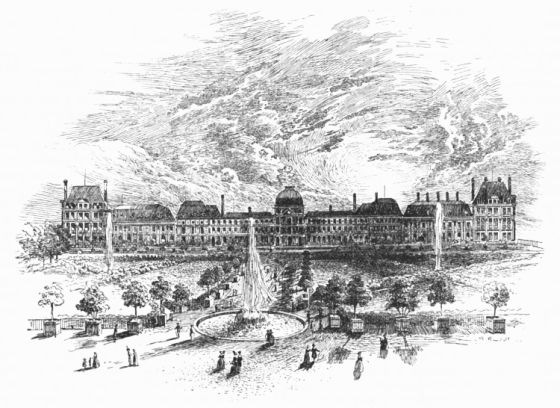
THE PALACE OF THE TUILERIES, PARIS.
The only attempts at reform were in the commissariat
and discipline of the army. The soldiers
were allowed an extra quantity of bread and meat,
and the militia regiments were permitted to have
artillery, and to increase their force and improve
their staffs. But even these reforms were made
unconstitutionally by the dictum of the Ministers,
without the authority of Parliament, and occasioned
smart but ineffectual remonstrances from the
House. Every motion for inquiry or censure
was borne down by the Ministerial majority.
The remainder of the parliamentary session was
occupied with royal marriages and settlements.
George III. and his queen, though pious and
decorous in their own lives, had the misfortune
to have amongst their sons some of the most
dissolute and debauched men that ever figured in
the corrupt atmosphere of courts. The Prince of
Wales was become a very byword for his profligacy
and extravagance. The Duke of York was
but little better, so far as his means allowed him;
and the Duke of Sussex, wishing to marry a
woman to whom he was really attached, found the
Royal Marriage Act standing in his way.
The marriage of the Prince of Wales with Mrs.
Fitzherbert was notorious; but as it was not
openly avowed by the Prince, no steps were taken
to dissolve it. But in 1794 the Prince had got a
new favourite, the Lady Jersey, already a grandmother,
but a young one. For her Mrs. Fitzherbert
was dismissed, showing how little the
Prince thought of the reality of the marriage with
that fair lady, and he now lived openly and
ostentatiously with Lady Jersey, Lord Jersey
being well contented with the arrangement for
the sake of the good things he hoped to gain by it,
being at once appointed Master of the Horse to
the Prince. But the Prince's extravagance and
gambling, by the practice of which, notwithstanding
his own losses, he reduced his friends,
one after the other, as the Earl of Moira, Sir
Wallace Porter, and others, to beggary, had now
brought him into extreme difficulties. His debts,
after having been more than once paid off by
Parliament, now again amounted to six hundred
and thirty thousand pounds! Another appeal to
Parliament was absolutely necessary, for his
creditors were grown excessively clamorous. The
king seized the opportunity to induce the Prince
to marry a foreign princess, representing it as the
only plan by which they could apply to Parliament
for such an increase of means as would enable him
to liquidate his debts. But instead of allowing
the Prince to go abroad and make his own
selection, so that there might be possibly
some degree of freedom of choice in the matter,
the queen was anxious to have her own niece,
the Princess Louisa Augusta Amelia of Mecklenburg,
selected for him. This Princess, afterwards
the popular Queen of Prussia, was a
good creature, and might possibly have wrought
some favourable change even in so depraved a
nature as that of the Prince of Wales. But the
king was equally determined to secure the unenviable
post for his own niece, Caroline Amelia
Elizabeth, the second daughter of the Duke of
Brunswick, who was one of the petty princes of
Germany. To effect this arrangement, an attachment
between the Crown Prince of Prussia and
this Princess Caroline had to be rent asunder.
The Prince was ready to fall in with any such
bargain, on condition that he was liberated from
his debts. It was certain that he would please
himself as to the lady or ladies with whom he
would really live. All obstacles of nature, or of
nearness of consanguinity, or of private attachments
were overborne by diplomacy, and by the
promise of the discharge of the Prince's debts.
The Princess Caroline of Brunswick was selected—a
young lady of not unpleasing person in her
youth, according to the descriptions of the time,
but of defective education, and coming to this
country with the repugnance of a prior and rudely-sundered
attachment. She landed at Greenwich
on Sunday, the 5th of April, 1795, and the marriage
ceremony was performed at St. James's, by the
Archbishop of Canterbury, on the 8th. The
Princess had not been ignorant of the dissolute
character of her appointed husband, and his mode
of receiving her was not calculated to inspire any
brilliant hopes of his improvement. He had sent
his mistress, the Lady Jersey, to meet her on
landing, and he made no disguise of his connection
with her before or after the marriage. The
Memoirs of the time assert that Lady Jersey
omitted no arts to render the Princess ridiculous
and even disgusting to the Prince; but what
chagrined him far more deeply was the breach of
the promises held out to him of the discharge of
his debts by a parliamentary grant or grants.
On the 27th of April Pitt introduced a message
from the king, recommending the settlement of a
suitable provision on the Prince of Wales on his
marriage. The Prince expected that Pitt would
propose and carry, by means of his compliant
majority, which had readily voted away millions
to foreign monarchs, a vote for the immediate
discharge of his debts. His astonishment may
therefore be imagined, when Pitt proposed that
Parliament should grant him such an income as
should enable him, by decent economy, to defray
these debts by instalments through a course of
years. Having stated these debts at six hundred
and thirty thousand pounds, he proposed to
increase the Prince's allowance from seventy-five
thousand to one hundred and forty thousand
pounds, an increase of sixty-five thousand pounds
a-year. Twenty-five thousand pounds of this were
to be set apart every year for the liquidation
of the debts in the course of twenty-seven
years. This was, in fact, only giving him an
increase on his marriage of forty thousand pounds
per annum; but so unpopular was the Prince
that not even that amount of money could be
obtained. The question was warmly debated
during two months, and it was not till the 27th of
June that it was finally settled in still worse
terms for the Prince, namely, that his allowance
should be one hundred and twenty-five thousand
pounds per annum, with the income of the Duchy
of Cornwall, about fifteen thousand pounds more,
thus making up the one hundred and forty
thousand pounds; but out of this seventy-five
thousand pounds per annum were appropriated
to the payment of his debts, leaving him only
sixty-seven thousand pounds a year clear for his
own expenditure, or eight thousand pounds per
annum less than his previous allowance. With
the grant to the Prince this Session closed, namely,
on the 27th of June.
The first transactions of the campaign of 1795
which demand our attention, are those of Holland.
To the British army these were most disastrous,
and came to an end before the winter closed.
The Duke of York had returned to England early
in December, 1794, leaving the chief command to
General Walmoden, a Hanoverian, second to
whom was General Dundas. Walmoden had gone
quietly into winter quarters in the isle of Bommel,
forgetting that the firmness of the ice would soon
leave him exposed with his small force to the
overwhelming swarms of the French, under
Pichegru, who, in the middle of December, crossed
the Waal with two hundred thousand men, and
drove in his lines. General Dundas advanced
against him with eight thousand men, and, for the
time, drove the French back, on the 30th of
December, across the Waal. But this could not
last with such disproportionate forces, especially
as our troops were left with the most wretched
commissariat, and an equally wretched medical
staff; in fact, there were neither surgeons to attend
the greater part of the wounded, nor medicines
for the sick. On the 4th of January, 1795, the
French came back with their overpowering
numbers, and on the 6th the British were compelled
to retire across the Leck, and continue their
retreat, suffering indescribable miseries from the
want of food, tents, and proper clothes, in the
horrors of a Dutch winter. Notwithstanding this,
the British repeatedly turned and drove back the
enemy with heavy slaughter. But on the 11th
of January Pichegru attacked them in a defile
between Arnhem and Nimeguen, with a condensed
force of seventy thousand men, and took every
measure to destroy, or compel the surrender of,
the whole British army. They, however, fought
their way through and continued their march for
the Elbe, the only quarter open to them. During
this retreat they were less harassed by the French,
who fell off to occupy Utrecht and Rotterdam,
than by the fury of the winter and the hostility of
the Jacobinised Dutch, who cursed them as the
cause of all the sufferings of their country. Such
was the end of Britain's campaign for the defence of
her Dutch allies. Holland was proclaimed a free
Republic under the protection of France, and
Britain immediately commenced operations for
indemnifying herself, by seizing the ships and
colonies of her late ally in every quarter of the
globe. They intercepted the homebound Dutch
Indiamen, and when the Council of Government
sent deputies to London to reclaim them, Lord
Grenville, the Foreign Minister, asked them in
what character they came. They replied, that
they came as representatives of the sovereign
people of Batavia. The Foreign Minister said he
knew of no such Power, and declined to receive
them. No time was lost in seizing the Dutch
colonies and factories. On the 14th of July
Admiral Sir G. Keith Elphinstone appeared in
Table Bay, and landed a considerable force under
command of Major-General Craig. They possessed
themselves of Simon's Town and the strong fort of
Muyzenberg, and in the beginning of September,
being reinforced by another body of troops, under
Major-General Alured Clarke, on the 23rd of that
month they were masters of Cape Town. A
similar activity was displayed in the East Indies;
and in the course of the year, or early in 1796, all
the Dutch possessions in Ceylon, Malacca, Cochin,
Amboyna, and other places were surrendered
to the British. The same seizures were in course
of execution on the settlements of the Dutch in
the West Indies, and on the coast of South
America.
But though we punished the Dutch for their
French predilections, the tide of French success
was rolling on in various quarters, and presenting
a prospect of a single-handed conflict with France.
The powers on whose behalf we had armed were
fast, one after another, making terms with the
Republicans. Holland was in their hands, and
the King of Prussia, on the 5th of April, concluded
a peace with them at Basle, in which he
agreed to surrender to France all his possessions
on the left bank of the Rhine, on condition of
retaining those on the right. There was a mutual
exchange of prisoners, including the troops of such
other German States as had served with Prussia.
Spain hastened to follow the example of Prussia.
A peace was concluded at the same place—Basle—on
the 22nd of July, by which she gave up all the
Spanish part of San Domingo. To purchase the
French evacuation, the Ministers of Spain itself
recognised the Batavian Republic—which was
become, in reality, a province of France—and promised
to intercede with Portugal, Naples, Parma,
and Sardinia. The Grand Duke of Tuscany followed
with a proclamation of a treaty of neutrality
with France, on the 1st of March. Sweden and
the Protestant Cantons recognised the French Republic
and the Batavian one, its ally; and the
Duke of Hesse-Cassel, and even George III., as
Elector of Hanover, were compelled to an agreement
to furnish no more troops to the Emperor of
Germany. Whilst the Allies were thus falling
away in rapid succession before the forces of
Republican France, Britain, instead of taking
warning, and resolving to mind only her own
business, went madly into fresh treaties with Continental
Powers. Russia and Austria were received
into fresh treaties of mutual defence.
Russia we were to assist with ships, and Austria
with twenty thousand foot and six thousand horse,
or to pay each month ten thousand florins for
every thousand infantry, and thirty thousand
florins for every thousand of cavalry. To complete
the circle of treaties, Sir Gilbert Elliot, British
Governor of Corsica, entered into a treaty with
the Dey of Algiers, by which, on payment of a
hundred and seventy-nine thousand piastres, he
was to restore all the Corsicans captured and
enslaved by him, and was to enjoy the strange
privilege of carrying all his piratical prizes into
the ports of Corsica, and to sell them there—which
was, in fact, licensing this chief of sea-robbers to
plunder all the other Italian States.
On the Rhine there was a good deal of
sharp fighting between the French and Austrians.
General Bender had been compelled to surrender
Luxembourg, on the 7th of July, and allowed to
retire with his army of ten thousand men into
Germany, on condition of not serving again till
exchanged. There then remained little on either
bank of the Rhine to restrain the advance of the
French, except Mayence on the left bank, and
Manheim and Düsseldorf on the right. Pichegru,
in August, made himself master of both Düsseldorf
and Manheim, and was advancing to the
reduction of Heidelberg when he was met by old
General Wurmser, and driven back to Manheim.
He was, in fact, meditating treachery. Jourdain,
who was advancing in another direction to co-operate
with Pichegru in the reduction of Mayence,
was encountered by Clairfait, and driven
back to Düsseldorf. Clairfait then attacked the
French forces already investing Mayence, and the
garrison making a sally at the same time, the
French were completely dispersed, and part retreated
north and part south. Wurmser then
invested Manheim, and compelled its surrender on
the 22nd of November. Pichegru signed an
armistice with the Austrians before joining them.
Jourdain also retreated.
In Italy nothing was done till late in the year.
Towards the end of November, the French army,
under Massena, commenced operations in earnest.
The Austrians and Piedmontese being scattered
over a wide extent of country, defending various
passes, the French attacked and beat them from
different points. The right and centre of the
Allies were ere long routed; and the left, posted
on the shores of the bay St. Pier d'Arena, near
Genoa, was attacked, both from the land and from
the water, by gunboats, which Nelson, who had
been detached to co-operate with the Austrians,
had no means of coping with, except by letting
loose a far greater number of armed vessels, and
was also compelled to flight. Nelson managed to
keep open the Bochetta pass for them, or from
eight thousand to ten thousand prisoners would
have been made, including the Austrian General
Devins himself, who was laid up at Novi, at the
foot of the Apennines. The French were then in
a position to open the campaign against Italy in
the spring.
The massacre of Savenay had not settled La
Vendée. In the spring of 1794 armed parties
were again on foot. The largest body was
that under Charette, posted on the Isle Noirmoutier,
to which many of the fugitives who
escaped from the massacre of Savenay betook
themselves. Amongst these was the wounded
General D'Elbée, with his wife, and a brother of
Cathelinau. Charette quitted the isle to make an
attack on some of the Republican troops left in
small bodies in the country, consigning the care of
the sick and wounded to the protection of a garrison
of one thousand eight hundred men. This
garrison was soon corrupted by the Republican
general, Turreau; it surrendered, and D'Elbée
and his wife were both shot, and the sick and
wounded treated with merciless cruelty. This
was about the only place of any strength left the
Vendéans; but a worse misfortune was at hand.
The young and chivalrous Henri La Roche-Jaquelein,
marching, at the head of a body of his
own peasantry, between Trementine and Nouaillé,
met two Republican soldiers. The count generously
offered them quarter; but, instead of accepting
it, one of them instantly levelled his
musket and shot him through the head. The two
soldiers were immediately dispatched by his followers
and, supposing that a Republican column
must be at hand, they buried the three hastily in
one grave and fled. The young count was only
in his twenty-first year, and with him died the
hopes and confidence of his peasantry. Stofflet
succeeded him in the command of his people, but
Charette might be considered the Commander-in-Chief
of the Vendéans.
The fall of Robespierre produced a marked
change in the policy of the Convention towards
the Royalists of this district, and they were promised,
on laying down their arms, that they
should enjoy their country and their religion in
peace. On this assurance, Charette signed a
treaty of pacification with the agents of the
Government at Nantes, in February, 1795. But
scarcely was the peace signed, when Charette
received a letter from Monsieur—brother of the
late king, and now appointed by the Royalist
party Regent to the Dauphin, now styled by
them Louis XVII.—assuring him of his confidence,
declaring him the second founder of the monarchy,
and appointing him his Lieutenant-General. Charette
wrote back to inform him that he had been
compelled to sign a peace, but that his submission
was only apparent, and when the Royalist affairs
were somewhat reinstated, he should be ready to
take up arms and die in the service of his prince.
The young General Hoche, who was sent to reduce
the insurgents of Brittany, whilst Canclaux reduced
those of La Vendée, did not for a moment
believe in the sincerity of the peace. He was
aware that Puisaye, the chief of the insurgents in
Brittany, was gone to England, to endeavour to
induce Pitt to do what all the efforts and importunities
of the Bourbon princes and Emigrant
nobles had failed to do—to send an expedition to
the coast of Brittany, with another to the coast of
La Vendée, in which the British fleet should
support the bodies of Emigrants who had, in
England and the Channel Islands, formed themselves
into regiments for the purpose. Aware of
this, he still did all he could to reconcile the
peasantry to the peace, and very soon they would
have been pacified by this judicious treatment, and
been averse from rising again, with a prospect of
re-experiencing their former sufferings; but the
Bourbon princes and the tribes of Emigrants now
driven from the Rhine did not allow them that
chance.
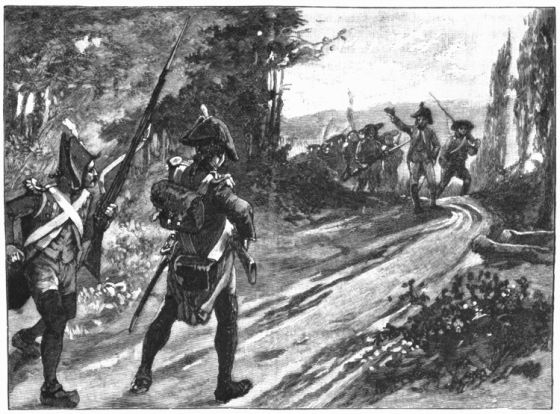
LA ROCHE-JAQUELEIN AND THE REPUBLICAN SOLDIERS. (See p. 444.)
Puisaye's mission to London had been successful.
Pitt was weak enough to fall into the
plan of sending over the Emigrants in our ships—as
if any such force could do more against the
Republican armies than create fresh miseries to
all parties, and bring down worse vengeance on
the unfortunate Vendéans and Bretons. Puisaye,
with the aid of the Counts d'Hervilly, d'Hector,
du Dresnay, Colonel Routhalier, and other Royalist
officers, had mustered a most miscellaneous
body of three thousand Emigrants, most of whom
had been soldiers, and who were accompanied by
four hundred artillerymen of Toulon, commanded
by Routhalier. Besides these men, of whom the
Count d'Artois, for the time, gave the command
to Puisaye, intending himself to follow, Puisaye
carried over ten thousand pounds, furnished by
the Count d'Artois, twenty-seven thousand muskets,
six hundred barrels of gunpowder, uniforms for
seventeen thousand infantry and four thousand
cavalry, as well as provisions for three months.
These troops and stores were, after many delays,
conveyed in a little squadron of three ships
of the line and six frigates, attended by transports,
and commanded by Sir John Borlase
Warren. They sailed from the Isle of Wight
in the beginning of June, another squadron
being sent to take up the Emigrant troops
in the Channel Islands, and land them at St.
Malo, where they were to co-operate with bodies
of Chouans. These Chouans were smugglers
and bandits, who had led a life of plunder,
and had been easily collected into a sort of
guerilla force, and their mode of warfare still
bore a strong resemblance to their old habits.
These men, under their different chiefs, had been
excited by Puisaye to combine for a strong resistance
to the Republicans. They were dressed in
green coats and pantaloons, with red waistcoats.
During his absence, Puisaye had deputed the chief
command of the Chouan bands to the so-called
Baron Cormatin, or Sieur Désoteux, who had
assumed the title of Baron de Cormatin from an
estate of his wife's. Cormatin was a vain, weak
man, and by no means trustworthy, being ready,
at any moment, to supersede his chief, Puisaye,
and act for himself. If the expedition against
St. Malo did not succeed, it was to join Puisaye
and his detachment in the Bay of Quiberon; and
transports were also sent to the mouth of the
Elbe, to fetch thence the Emigrant regiments with
the black cockade, and bring them to join Puisaye.
If all went well, the Count d'Artois was to follow
with British troops. The grand error of the whole
was, that the French prince did not put himself
at once at the head of the expedition, and see the
different squadrons united in the Bay of Quiberon
before making the descent, though, even then, it
could have effected no great success.
On the passage, the squadron of Sir John
Warren came in sight of the French fleet of
Villaret-Joyeuse, of nine ships of the line, but it
bore away, and left them to pursue their course.
They entered the Bay of Quiberon on the 25th of
June and, after much wrangling as to the best
situation for landing, they put the troops ashore
at the village of Carnac. There they were immediately
joined by Georges Cadoudal, d'Allègre,
Dubois-Berthollet, and other Chouan chiefs, with
about four thousand or five thousand of their wild
and bandit-looking soldiers. Along with the
Chouans came troops of peasants, crying "Vive le
Roi!" and bringing in abundance of fresh eggs,
poultry, and other provisions. Puisaye was delighted,
and felt confident that all Brittany was
ready to rise. But this delusion was soon dissipated.
The Emigrants, accustomed to regular
armies, looked with contempt on this wild and
ragged band, and they, on their part, were not
restrained, on the landing of the arms and uniforms,
from seizing and carrying them off, without
much exertion on the part of Puisaye. There was
danger of bloodshed. At length, in about a couple
of days, ten thousand of them were put into red
coats, and furnished with muskets. But fatal
dissensions prevented all operations. Puisaye
proposed to march up the country, seize different
towns, such as Vannes and Rennes, and take up
their position behind the Mayenne; but d'Hervilly
refused to march till the troops were formed into
regular regiments, and the Emigrants joined him
in despising the Chouans, and in complaining that
they had not been taken to La Vendée to join
Charette. Puisaye and d'Hervilly also disputed
the supreme command, and Puisaye had to dispatch
letters to London, to Count d'Artois, on the
subject. At length, after five days had been
wasted in this contention, Puisaye proposed that
they should endeavour to carry Fort Penthièvre,
which stood on a small peninsula on Quiberon
Bay, and was united to the main land by a sandy
isthmus. To this d'Hervilly consented, and Sir
John Warren agreed to support him in the
attempt. On the 1st of July Warren began to
bombard the fort, and on the 3rd, the place being
warmly assailed by both the British and the
Chouans, the Republicans surrendered. Meanwhile,
Puisaye had sent off emissaries all over
Brittany, to rouse Scépeaux, Charette, Stofflet,
and the rest of the insurgent chiefs. The news of
the landing had flown all over Brittany in a few
days, and the Royalists were full of joy.
But the Convention sent to Hoche two extraordinary
Commissioners to stimulate him to the
utmost activity. Hoche immediately wrote to the
Committee of Public Welfare to assure them that
nothing was wanting to his success but for Government
to support him with "provisions, of which
we are in want, and the twelve thousand men
whom you promised me so long ago." He posted
his generals on every frontier, and in every strong
place. Thus he had enveloped Brittany on all
sides; instead of the Bretons rising en masse,
as was expected, they kept quiet, and only the
Chouans appeared in arms. Even they demanded
that the Count d'Artois should come and put
himself at their head; and the Emigrants asked
to be re-embarked, and taken to La Vendée to
support Charette. On their part, the able arrangements
of Hoche and Canclaux prevented the
Vendéans from operating in favour of the Bretons,
and Puisaye saw himself paralysed by the vigour
of his opponents and the dissensions of his
followers. The different bodies of Chouans were
repulsed by the Republicans as they advanced
towards Quiberon Bay, and they complained that
d'Hervilly had withdrawn the four hundred men
of the line who had been ordered to support them.
D'Hervilly replied that he had recalled them to
assist at the taking of Penthièvre. Thus favoured
by the wranglings of the Royalists, Hoche, on the
5th of July, found himself established on the
heights of St. Barbe, commanding the Isthmus of
Falaise. On the 7th d'Hervilly, supported by
his regulars and by two hundred British marines,
endeavoured to drive him thence, but was repulsed
with great slaughter. Hoche then bore down from
the heights, and drove all the miscellaneous forces
of Emigrants and Chouans, mingled with women
and children, to the promontory, and under the
guns of Fort Penthièvre. But for the well-directed
fire from Warren's boats the mass, nearly twenty
thousand fugitives, must have surrendered at once,
having no outlet of escape. There, however, for
some days they stoutly defended themselves.
On the 15th the British squadron brought in
the Emigrant troops from the Elbe, under the
young and gallant Count de Sombreuil; but they
amounted only to eleven thousand men. Puisaye
now ordered the Count de Vauban to advance
against Hoche with twelve thousand Chouans,
and, whilst they attacked on the right, he himself
attacked his lines in front. After some desperate
fighting they were driven back, and lost most of
their cannon in the deep sand of the isthmus.
Their misfortunes were completed, on the 20th, by
the garrison of the fort of Penthièvre going over
to the enemy, surrendering the fort to them, and
helping to massacre such of their officers and
comrades as refused to follow their example. The
English admiral exerted himself to receive the
remainder of the troops who remained true on
board his ships; but the storminess of the weather
and the impatience of the fugitives rendered this
a most difficult task. About fourteen thousand
regulars and two thousand four hundred Chouans
were got on board; but Sombreuil, exposed to the
murderous fire from the enemy whilst waiting on
the beach, surrendered on promise of life. No
sooner, however, were they in the hands of the
Republicans than all the officers and gentlemen
were led out and shot; and the common men
enrolled in Hoche's regiments.
Sir John Warren put the two thousand four
hundred Chouans on shore near Lorient, and left
them to return to their own predatory mode of
warfare. He then located himself on two small
neighbouring islands, and waited for a fresh squadron
carrying four thousand British troops, which
arriving in September, he bore away with them
for La Vendée, and thus terminated the miserable
descent on the coast of Brittany. The descent on
the coast of La Vendée was still more unsatisfactory.
On arriving there, it was found that fifteen
thousand Republicans were in possession of the
Isle Noirmoutier, formerly the stronghold of
Charette. The British, therefore, disembarked on
the little desolate Isle Dieu, about five leagues
from Noirmoutier, and there awaited the arrival of
Count d'Artois, who did not come till the 10th of
October, and then, alarmed at the fusillading of the
officers at Quiberon, declined to land. On hearing
this, Charette exclaimed—"We are lost! To-day
I have fifteen thousand men about me; to-morrow
I shall not have five hundred!" And, in fact,
chagrined at the pusillanimous conduct of the
prince, and the approach of Hoche with his
victorious troops from Brittany, his followers
rapidly dispersed, and at the end of the year the
British armament returned home, having done
nothing. From this day may be dated the extinction
of the war in La Vendée. Stofflet, in
January, 1796, was defeated, and in February
was betrayed to the enemy, and on the 26th of
that month was executed at Angers with four of
his companions. Charette was captured a month
afterwards, and was shot at Nantes on the 29th of
March. With him died the last Vendéan general
of mark. By this time, the spring of 1796,
not a fifth part of the male population of La
Vendée remained alive; and Hoche himself calculated
that the Vendéan war had cost France a
hundred thousand men.
Meanwhile the Convention determined to proceed
to the abolition of the Constitution of '93,
and to the establishment of one more accordant
with their own tendencies. In 1793 the Revolutionists
were as violent against aristocracy as
against monarchy, and had allowed only one
legislative body. The precipitate acts of the last
three years had now persuaded them that at least
a second, if not an aristocratic, chamber might be
useful, as a balance against legislation under
violent impulses. They proposed, then, to have
two chambers—one called the Council of Five
Hundred, composed of that number of members
of at least thirty years of age, having exclusively
the right of proposing laws, of whom one-third
should be renewed every year; the second, called
the Council of the Ancients, to consist of two
hundred and fifty members, of at least forty years
of age, all either widowers or married, having the
sanctioning of the law, and also to be annually
renewed by one-third. No sooner were these
decrees passed than there was a violent outburst
of discontent. On April 1st, and again on
May 20th, the Parisian mob rose in insurrection,
but were completely suppressed. This was the
death-blow of the Democratic party. Then came
the turn of the Royalists. A meeting took place
in the Odéon theatre, on the 3rd of October, under
protection of some battalions of National Guard.
The Duke of Nivernois presided. The Committees
of Public Safety and Welfare gave the alarm to the
Convention, and the Convention sent a force to
disperse the meeting, but it had already dissolved
itself. The Sections had committed the mistake of
refusing to allow the ultra-Jacobins to vote, and
the Convention now embodied and armed one
thousand eight hundred of these, ready, in their
indignation, to do anything. On the 4th, the
Section Lepelletier beat to arms, and the committee
held its meeting in the convent of Filles St.
Thomas, in the Rue Vivienne. General Menou
was summoned from the camp at Sablons, and
ordered to disperse the meeting. He proceeded to
the convent, found the committee of the Section
armed, and, instead of dispersing them, agreed to
retire on a promise that they would withdraw of
themselves. The Convention immediately arrested
Menou as a traitor, and deprived him of his
command. They forthwith appointed Barras
general of the interior in the place of Menou, and
ordered him to clear the streets, and place troops
in a position to insure the safety of the Convention.
Barras was a general of brigade, but he
was not too fond of exposing himself and, fortunately
for him and for another, he had his eye on
one who would execute the orders of the Convention
without shrinking. This was Napoleon
Buonaparte. The Convention had about five thousand
troops; but the decision of the conflict must
depend on the cannon. These were in the camp
at Sablons. Buonaparte instantly dispatched
Murat to secure them, and received the insurrectionists
with such a shower of grape that after
a short resistance they were completely defeated.
During this time Britain was suffering severely
from the effects of the war. The nation was
indignant under the disgrace of the complete
defeat of its army on the Continent, at the defection
of those very Allies who had been so profusely
subsidised, at the perfidy by which these
despot Powers had made Britain the efficient
party in the dismemberment of Poland, and
at the heavy taxes imposed in consequence.
Political meetings were held in most large towns
and in the metropolis, expressing the most decided
disapprobation of the policy of Ministers and at
the refusal of all reforms. At the end of June a
monster meeting had been held in St. George's
Fields, and on the 26th of October, another, of
fifty thousand people, near Copenhagen House, at
which the lately prosecuted but acquitted agitators,
Thelwall, Gale Jones, and others, were the
speakers. The numbers and tone of these meetings,
which were accompanied with loud cries of
"Bread! Bread!" and "Down with Pitt!"
greatly alarmed Government, and there was a
summons of Parliament at the unusually early
date of October 29th, only three days after the
meeting in Copenhagen Fields. On going to the
House to open the session, the king—who had
become very unpopular from his eager support of
the war, and his going about saying, "The French
won't leave a single crowned head in Europe!"—was
shot at with an air-gun in Margaret Street,
opposite to the Ordnance Office, the ball from
which passed through the windows of the carriage,
between his Majesty and the Earl of Westmoreland.
The king on entering the House, exclaimed
to the Lord Chancellor, "My lord, I
have been shot at!" As the king returned,
he was again furiously hissed; there was the
same vociferous shouting of "Bread! Bread!"
and "No Pitt!" Stones were thrown at the
royal carriage; and, in the haste and confusion
to escape into the palace of St. James's, one
of the royal grooms was thrown to the ground,
and had his thigh broken. The king got into a
private coach to regain Buckingham House, where
his family was; but he was recognised, and
pursued by the same cries of "Bread! Bread!"
and "Peace!" That evening the king, who had
behaved throughout with great courage, accompanied
the queen and three of his daughters to
Covent Garden Theatre, where he was received
with zealous acclamations; the actors sang "God
save the king!" three times over. Some of the
people in the gallery were, however, pretty
vehement in their hisses, but were attacked and
turned out.
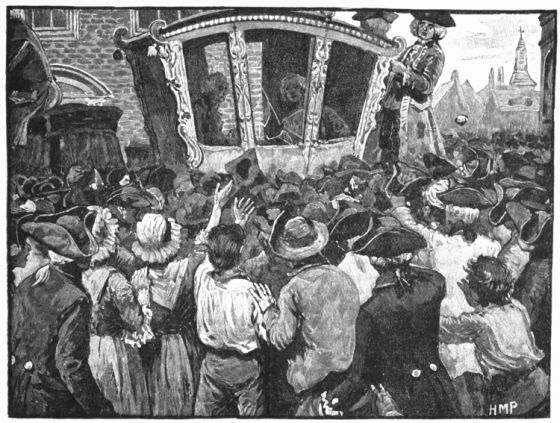
ATTACK ON THE ROYAL CARRIAGE. (See p. 448.)
The Ministers, instead of making rational
concessions to the demands of the people for Reform,
proceeded without delay to fresh aggressions on
their liberties. Not contented with the existing
suspension of the Habeas Corpus Act, and with
introducing into the Lords a Bill for the protection
of the king's person and Government, they
passed a law prohibiting all political meetings,
and another to extend the law of treason;
they recommenced arrests and prosecutions, and
sent out shoals of spies and informers, so that all
the safeguards of public liberty were completely
annihilated. These despotic measures did not
pass without energetic opposition and a good deal
of violent language from Fox; but all remonstrance
was useless against Pitt's majority. Still
the alarm of the Government was not allayed.
On the 8th of December the king sent a message
to both Houses, reiterating his assurance of an
earnest desire to negotiate peace with France.
The Opposition very properly pointed out that, so
far as France was concerned, victorious in its
armies, and as anti-monarchical in its government
as ever, there were less hopes of any consent on
its part to peace than when the Opposition had
so repeatedly urged the same measure. In this
unsatisfactory state closed the year 1795.
Mr. Grey seized the professed desire of peace
by Government, so soon as Parliament met after
the Christmas recess, to bind them to it by a
resolution. He complained that, so far from any
intentions of peace, Ministers were making fresh
preparations for the prosecution of the war. Pitt
denied this, and asserted that the Government
was really anxious for peace, but could not
consent to it unless France agreed to yield up its
conquests of Belgium, Holland, Savoy, and Nice.
On the 10th of March Mr. Grey moved for an
inquiry into the state of the kingdom. He
showed that this contest, so unsuccessful, had
already, in three years, added seventy-seven
millions to the national debt; more than the
whole expense of the American war, which had
cost sixty-three millions. He commented severely
on the wasteful manner in which this money had
been thrown away on monarchs who had badly
served the cause, or had perfidiously betrayed it;
and on the plunder of the country by jobbers,
contractors, commissaries, and other vampires,
who had left the poor soldiers to neglect, starvation,
and death, amid the horrors of winter, and
inhospitable, pretended friends, for whom they
had been sent to fight. Grey and Fox followed
this up by fresh resolutions and motions condemning
Ministers for their misconduct of the
war, and enormous waste of the public money;
but all these were triumphantly got rid of by
overwhelming majorities; and in the face of this
ineffectual assault, Pitt introduced his Budget,
calling for fresh loans, amounting to no less than
twenty-five million five hundred thousand pounds,
and for supplies to the amount of upwards of
forty-five millions. Some of the items of this
sum were—navy, seven million five hundred and
twenty-two thousand five hundred and fifty-two
pounds; army, eleven million nine hundred and
eleven thousand eight hundred and ninety-nine
pounds; ordnance, one million nine hundred and
fifty-four thousand six hundred and sixty-five
pounds; miscellaneous and extraordinary, thirteen
million eight hundred and twenty-one thousand,
four hundred and thirty pounds. The last item
alone amounted to more than the whole national
expenditure before the commencement of this war,
yet the whole of these startling sums were readily
voted away by the Ministerial majority; and with
these funds in hand for renewed prosecution of the
war, the Session ended, on the 19th of May.
In March, 1796, Mr. Wickham, the British
envoy to Switzerland, asked of M. Barthélemy, by
direction of Pitt, whether the French Directory
were desirous of entertaining the question of
peace. Barthélemy replied that the Directory
would enter into negotiations on the basis of
France retaining all the Netherlands won from
Austria, which were now annexed to the Republic,
and which France would never restore. The
reply was certainly insincere. France was as
busy as ever by her emissaries undermining the
loyalty of all the populations around her on pretence
of liberating them. She had worked upon
the Swiss, so that it was evident that they would
soon fall into her net. She had entered into a
treaty with the disaffected in Ireland, namely,
Lord Edward Fitzgerald, Wolfe Tone, Arthur
O'Connor, and their fellow-conspirators, and the
treaty was already signed, and a large fleet and
force preparing for the invasion of Ireland. Not
only was France on the very eve of invading
Ireland, but she had issued a decree prohibiting
the introduction of all British manufactures into
Holland, Belgium, and the German states on the
Rhine, as well as into any of the French colonies,
on the severest penalties. Yet, in the face of all
these hostile demonstrations, did Pitt send over
Lord Malmesbury to endeavour to negotiate a
peace. Lord Malmesbury arrived in Paris, on the
22nd of October, with a splendid retinue. The
Directory received him haughtily, and commissioned
M. Delacroix to discuss the matter with him. Lord
Malmesbury insisted on the restoration of the
Netherlands to Austria, a point on which the
French Government had declared there could be no
treaty, and which rendered the embassy, from the
first moment, utterly absurd. Delacroix communicated
the proposal to the Directory, and the Directory
immediately published it, contrary to all the
rules of diplomacy, in the Moniteur, Instead of
proceeding further with Britain, the Directory
immediately dispatched General Clarke, an officer
of Irish extraction, and afterwards made Duke
of Feltre, under Buonaparte, to Vienna, to treat
separately with Austria. This failed, and, of
course, with it all failed; though there was much
talk between Malmesbury and the Directory on the
subject of Britain restoring the French colonies
in the East and West Indies, since the restoration
of Belgium and Holland was a sine quâ non.
Thus, as might have been seen from the first, the
negotiation was at a deadlock. The King of
Sardinia was already in negotiation for peace for
himself; and therefore British Ministers did not
add to his difficulties by demanding the restoration
of Savoy and Nice.
At the very moment that these negotiations on
the part of Britain were going on, Buonaparte,
who had been appointed to the command of the
army of Italy, was achieving there victory after
victory. Genoa had shut her ports against our
ships, Naples had concluded peace with France,
Spain had been induced to proclaim war against
us, and Hoche had sailed for Ireland with twenty-five
thousand troops. On the 19th of December
Lord Malmesbury received a message to quit Paris
within forty-eight hours, with the additional
assurance, that whenever Great Britain was prepared
to accept the terms of France, an ordinary
courier would answer the same purpose as well as
a lord. The blame of continuing the war thus lay
entirely with the French.
During the year 1796 strong forces were sent
to the West Indies, and the Island of Grenada
was recovered by General Nichols; St. Lucia, by
General Abercromby, whilst General Whyte conquered
the Dutch settlements of Demerara,
Berbice, and Essequibo; but some of these possessions
were dearly purchased by the number of the
troops who perished from the unhealthiness of
their climate. The Dutch made an effort to recover
the Cape of Good Hope. They were to
have been assisted by the French in this enterprise,
but their allies not keeping their engagement,
they sailed alone, and reached Saldanha
Bay on the 3rd of August, when Rear-Admiral
Sir George Elphinstone surprised and captured
the whole of their vessels, consisting of two sixty-four-gun
ships, one fifty-four, five frigates and
sloops, and a store-ship. A squadron then proceeded
from the Cape to Madagascar, and destroyed
a French settlement there, seizing five
merchant vessels.
During the summer a French squadron stretched
away across the Atlantic with six sail of the line,
and finding our Newfoundland coasts almost
wholly unprotected, destroyed and plundered the
fishermen's huts and fishing stages, as well as their
vessels, and then, returning, picked up a considerable
number of our merchantmen at sea, and
was lucky enough to make a retreat, by favour
of a fog, through our watching squadrons, into
Brest. After this clever exploit, they joined the
great Brest fleet, which sailed for Ireland on the
15th of December. This consisted of no fewer
than forty-three sail, seventeen of them of the line,
four frigates, six corvettes and brigs, with six
transports. On board the transports were twenty-five
thousand men, who had been well tried in the
war of La Vendée, and abundance of arms and
ammunition, as well as extra arms to put into the
hands of the disaffected Irish, for to Ireland the
armament was bound. General Hoche, who had
terminated the Vendéan war, was appointed to
terminate all the woes of Ireland, and convert
that sacred island into another French paradise.
Besides Hoche, Generals Grouchy, Hombert, and
Bruix were attached to the expedition. The fleet
sailed out and anchored in Camaret Bay, but no
British fleet was visible to intercept them. But
no sooner did the armament put out to sea again
the next day, than it was assailed by a tempest
and the ships were driven different ways. One of
them was forced immediately on the Grand Stenet
rock, and wrecked—out of one thousand four
hundred souls on board only sixty were rescued.
Seven ships of the line, and ten of the vessels
commanded by Rear-Admiral Bouvet, managed to
reach Bantry Bay on the 24th of December, but
there the storms continued to batter them. There
being no sign of an insurrection, and no other part
of the fleet appearing, they sailed back and
reached Brest on the 1st of January, 1797. When
they were gone, another portion of the fleet arrived
in Bantry Bay, but only to be tossed and driven
about without rest, to lose several of the ships, and
to put back again. As for Hoche, he never saw
Ireland; the greater part of the fleet being driven
about and swamped in the Channel. Of the forty-three
sail, only thirty-one returned, and thousands
of the soldiers were drowned in the foundering
transports. Sir Edward Pellew, in the Indefatigable,
of forty-four guns, and Captain Reynolds,
in the Amazon, of thirty-six guns, fell in with the
Droits de l'Homme, of seventy-four guns, and
after a severe fight close in Audierne Bay, south
of Ushant, left her a wreck aground, where, of the
one thousand eight hundred men aboard, scarcely
more than three hundred were saved, notwithstanding
the greatest exertions of the British seamen
to rescue them.
The Directory began its campaigns of 1796 with
much spirit and ability. The plans which had
been repeatedly pointed out by Dumouriez, Pichegru,
Moreau, and more recently by Buonaparte, of
attacking the Austrians in Germany and Italy
simultaneously, and then, on the conquest of
Italy, combining their armies and marching them
direct on the Austrian capital, were now adopted.
Pichegru, who had lost the favour of the Directory,
was superseded by Moreau, and that general and
Jourdain were sent to the Rhine. Jourdain took
the command of sixty-three thousand foot and
eleven thousand horse, at Coblenz, and immediately
invested the famous fortress of Ehrenbreitstein,
on the opposite bank of the river.
Moreau was sent to lead the army at Strasburg,
consisting of seventy-two thousand foot and nearly
seven thousand horse. Jourdain found himself
soon menaced by the Archduke Charles, the
Emperor's brother, the ablest and most alert
general that the Austrians possessed at that period.
He advanced rapidly on Jourdain's position with
seventy thousand foot and twenty thousand horse,
defeated a division of Jourdain's army under
General Lefebvre, and compelled Jourdain himself
to raise the siege. But the archduke, out of too
much anxiety for Wurmser, who was opposed to
Moreau with much inferior forces, ascended the
Rhine to support him, and Jourdain immediately
availed himself of his absence to advance and seize
Frankfort on the Main, Würzburg, and other
towns. Moreau advanced to drive back Wurmser
and the archduke, till a union with Jourdain would
enable them to fall conjointly on the Austrians.
But the archduke perceived that, in consequence
of the orders of the Directory, Moreau was spreading
his army too wide, and he retreated so as to
enable Wurmser to join him. This retrograde
movement was mistaken, both by friends and
enemies, for a sign of weakness; and whilst
Moreau advanced with increased confidence, many
of the raw contingents of the archduke's army
deserted, and several of the petty States of Germany
sued to the Directory for peace. But the
moment for the action of the archduke had now
arrived. Whilst Moreau was extending his lines
into Bavaria, and had seized Ulm and Donauwörth,
and was preparing to occupy the defiles of
the Tyrol, the Archduke Charles made a rapid
detour, and, on the 24th of August, fell on
Jourdain, and completely defeated him. He then
followed him to Würzburg, and on the 3rd of
September routed him again. With a velocity extraordinary
in an Austrian, the archduke pushed
on after Jourdain's flying battalions, and on the
16th of September gave him a third beating at
Aschaffenburg, and drove his army over the
Rhine. Moreau—left in a critical position, so far
from the frontiers of France, and hopeless of any
aid from Jourdain, who had lost twenty thousand
men and nearly all his artillery and baggage—made
haste to retrace his steps. Thus both of the
French armies were beaten back to the left bank
of the Rhine, and Germany was saved.
But meanwhile in Italy the French had been
completely successful. Buonaparte reached the
French headquarters at Nice on the 26th of
March, and immediately set himself to organise
and inspirit the forces, which were in great
disorder; he found the commissariat also in a
deplorable condition. The troops amounted to
fifty thousand; the Austrians, under the veteran
General Beaulieu, to considerably more. The
united army of the Sardinians and Austrians,
Beaulieu on the left, d'Argenteau in the centre,
and Colli with the Piedmontese division on the
right, hastened to descend from the Apennines,
to which they had retreated at the end of the last
campaign. Beaulieu met the French advanced
guard at Voltri, near Genoa, on the 11th of April,
and drove it back. But d'Argenteau had been
stopped in the mountains by the resistance of a
body of French, who occupied the old redoubt
of Montenotte. Buonaparte, apprised of this,
hurried up additional forces to that point, and
defeated d'Argenteau before Beaulieu or Colli
could succour him. Having now divided the
army of the Allies, Buonaparte defeated a strong
body of Austrians under General Wukassowich;
and having left Colli and the Piedmontese isolated
from their Allies, debouched by the valley of
Bormida into the plains of Piedmont. Beaulieu
retreated to the Po, to stop the way to Milan;
and Buonaparte, relieved of his presence, turned
against Colli, who was compelled to retreat to
Carignano, near Turin. Trembling for his capital,
and with his means exhausted, Victor Amadeus
made overtures for peace, which were accepted;
the terms being the surrender of all the Piedmontese
fortresses and the passes of the Alps
into the hands of the French, and the perpetual
alienation of Nice and Savoy. This humiliation
broke the heart of the poor old king, who died on
the 16th of October. Buonaparte, however, did
not wait for the conclusion of this peace; the truce
being signed, he hastened on after Beaulieu whom
he defeated and drove across the Po. Beaulieu
next posted himself at Lodi, on the Adda; but
Buonaparte, after a fierce contest, drove him from
the bridge over the Adda on the 10th of May,
and with little further opposition pursued him to
Milan. Beaulieu still retreated, and threw himself
into the fastnesses of the Tyrol. On the 15th
Buonaparte made a triumphal entry into Milan,
and immediately sent troops to blockade Mantua.
Buonaparte then advanced into the Papal States,
rifling the Monti de Pietà at Bologna and Ferrara.
Everywhere contributions were demanded at the
point of the bayonet, and French authorities
superseded the native ones. Pius VI. made haste
to sue for peace, and it was granted on the most
exorbitant terms. Fifteen millions of francs must
be paid down in cash, six millions in horses and
other requisites for the army. A great number of
paintings and statues were to be selected from the
galleries of art, and five hundred manuscripts from
the library of the Vatican. The provinces of
Ferrara and Bologna must be ceded; the port and
citadel of Ancona, and all the Papal ports, must
be closed against the British. This most costly
peace was signed on the 23rd of June, and Buonaparte
hastened northward to stop the advance of
the army of Wurmser, which had been sent
through the Tyrol to compete with the rising
Corsican.
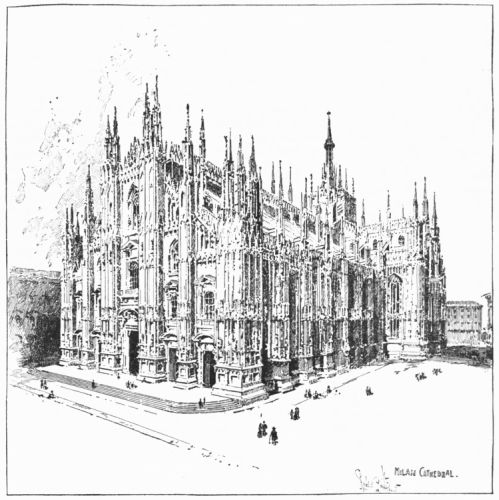
Wurmser advanced down the valley of Trent
with fifty thousand men, whose number was increased,
by the remains of the army of Beaulieu,
to sixty thousand. With such a force well conducted,
the Austrians might have worsted Buonaparte,
whose troops were not more than forty-five
thousand, and already greatly harassed by rapid
marches. But there was no comparison between
the genius of the commanders. The conduct of
the Austrians was a series of fatal blunders. Had
the Archduke Charles been there it might have
been different; but the first thing which Wurmser
did was to weaken himself by dividing his forces,
and sending one detachment under Quasdanowich
along the western shore of the Lake of Garda,
and marching along the eastern bank himself with
the other. The quick eye of Buonaparte instantly
saw his advantage; neither of the divisions was
now equal to his own, and he beat them both in
detail. He raised the blockade of Mantua, defeated
Quasdanowich at Lonato, chased him back
into the mountains, and then engaged and routed
him twice near Castiglione, on the 3rd and 5th of
August. Wurmser had to make a hasty retreat
into the mountains, leaving behind his artillery
and many thousand men slain. Buonaparte pursued
him into the very gorges of the Tyrol, and
inflicted fresh losses upon him. The sturdy but
not very bright old Austrian, however, made a
detour in the hills, and again issued on the plains
from the valley of the Brenta. With remarkable
address and agility for him, he made his way to
Mantua, and threw himself into the fortress with
the wretched remains of his army, about eighteen
thousand men.
There was still a fair chance for the Austrians—Britain
had furnished them with money—and
two fresh armies were descending from the hills.
One of these, amounting to thirty thousand, was
led by a brave officer, General Alvinzi; the other
of twenty thousand, under Davidowich, was
marching from the Tyrol to meet Alvinzi near
Verona, who was coming from Carinthia by Belluno.
Buonaparte did not allow them to meet.
He attacked Alvinzi on the 6th of November, and
met with a terrible repulse. A detachment of
French under Vaubois had been dispatched to
impede the march of Davidowich, but was also in
retreat. Buonaparte again attacked Alvinzi near
Verona, and again was repulsed. Had the Austrians
united their two new armies before entering
Italy, or had Wurmser marched from Mantua to
support Alvinzi, the French must have been
utterly annihilated. As it was, Napoleon was
dreadfully disheartened, and wrote a despairing
letter to the Directory, saying his best officers
were killed, and his men exhausted from fighting
and severe marches. But his pride and dogged
pertinacity came to his aid. He made a rapid
march and got into the rear of Alvinzi, but found
himself stopped by a narrow bridge over the
Alpone at Arcole. The country on each side was
a marsh, and the only approach to the bridge was
by long narrow causeways. As the French advanced
along the causeway on their side to storm
the bridge, they were swept down by hundreds by
the Austrian cannon. Time after time, Buonaparte
drove his columns along the causeway, but
only to see them mown down by grape shot.
His men fled into the very marshes to save themselves,
and he himself was thrown from his horse
into the marsh, and had to be dragged from the
mire. Bodies of Hungarians and Croats made a
final sally along the causeway, cutting down all
before them, and it was marvellous that he escaped
them. By this time Alvinzi had brought up his
main body to the neighbourhood of the bridge,
and the battle raged obstinately there for three
days. Seeing it impossible to carry the bridge
against that solid mass of troops, Buonaparte
dispatched General Guyeuse to cross the Adige at
the ferry of Albaredo, below the confluence of the
Alpone, and take Alvinzi in flank. Guyeuse succeeded
in crossing, but was repulsed on the other
side by the Austrians. Buonaparte again, on the
16th, made one more desperate rush at the bridge,
but only to receive another bloody defeat.
The next day he threw a bridge over the Alpone,
just above its confluence with the Adige, and sent
over Augereau with a powerful force, whilst he
again assailed the bridge from his side. These
combined operations succeeded. Alvinzi was
compelled to retreat to Vicenza and Bassano.
Scarcely had he given way, when Davidowich, who
ought to have joined him long before, came down
the right bank of the stream. He now came only
to experience a severe defeat, whereas his timely
arrival might have insured a complete victory.
He again had recourse to the security of the hills.
The belligerents then went into winter quarters,
leaving the French victorious.
Whilst the French had been thus beating the
Austrians out of Italy, and thus rendering abortive
our new and lavish subsidy to the Emperor,
Ministers had been busy in the election of a new
Parliament. This new Parliament assembled on
the 6th of October, and was full of patriotism.
As Hoche's army had not yet sailed, and as nobody
seemed to know its destination, Pitt represented
that it probably was for the coast of
England, and called for the enrolment of fifteen
thousand men from the parishes, half of whom
were to be sent into the navy, and for sixty
thousand militia and twenty thousand more yeomen
cavalry, all which were carried. On the
26th of October Windham, as Secretary at War,
announced the whole military force of the country
at home and abroad, apart from the troops in
the East Indies, which were raised and maintained
by the Company, to be one hundred and ninety-six
thousand men, and he demanded for their payment
five million one hundred and ninety thousand
pounds. On the 7th of November Pitt opened
his Budget, requiring no less than twenty-seven
million nine hundred and forty-five thousand
pounds for the total expenditure of the year.
There was another loan called for of eighteen
million pounds, and though the terms were then
considered low, such was the spirit of the nation
that the amount was subscribed within two days.
The year 1797 was opened by the suspension of
cash payments. The Bank of England had repeatedly
represented to Pitt, as Chancellor of the
Exchequer, that his enormous demands upon it for
specie, as well as paper money, had nearly exhausted
its coffers and could not long be continued.
The payment of our armies abroad, and the
advances to foreign kings, were necessarily made
in cash. The Government, in spite of enormous
taxation, had already overdrawn its account eleven
million six hundred and sixty-eight thousand
eight hundred pounds, and the sole balance in the
hands of the Bank was reduced to three million
eight hundred and twenty-six thousand eight
hundred and ninety pounds. Pitt was demanding
a fresh loan for Ireland, when a message came from
the Bank to say that, in existing circumstances,
it could not be complied with. Thus suddenly
pulled up, the Privy Council was summoned, and
it was concluded to issue an order for stopping all
further issue of cash, except to the Government,
and except one hundred thousand pounds for the
accommodation of private bankers and traders.
Paper money was made a legal tender to all other
parties, and the Bank was empowered to issue
small notes for the accommodation of the public
instead of guineas. A Bill was passed for the
purpose, and that it might not be considered more
than a temporary measure, it was made operative
only till June; but it was renewed from time to
time by fresh Acts of Parliament. The system
was not abolished again till 1819, when Sir Robert
Peel brought in his Bill for the resumption of cash
payments, and during the whole of that time the
depreciation of paper money was comparatively
slight.
At the same time, our seamen—who were the
real and proper defenders of the country but were
so miserably paid and so abominably treated in
many ways, that they could only be compelled into
the service by the odious operation of pressgangs—now
burst forth into mutiny. Their complaints
and resistance compelled a small advance and improvement.
None since then had taken place.
This advance of wages did not amount to more
than eightpence-halfpenny a day to able seamen and
sevenpence to ordinary seamen. And the low pay
was but the smallest part of the complaint of these
brave men. They complained that a most unfair
system of prize-money had prevailed, by which the
admirals and chief officers swept off most of
the money and left little or nothing to the petty
officers and the men; that their treatment on board
was barbarous, unfeeling, and degrading; that
their provisions were of the vilest description,
being the direct consequence of the contracts with
villainous purveyors, through equally rascally
Navy Commissioners, so that, in fact, they were
served with such salt beef, salt pork, and biscuit
as no dog would touch. Nor did their list
of grievances only too real end here. Instead of
Government paying the pursers direct salaries,
they were paid by deducting two ounces from
every pound of provisions served out to the men.
Thus, instead of sixteen ounces to the pound, they
received only fourteen ounces; and the same rule
applied to the measurement of liquids—beer and
grog—served out to them. Things had come to
such a pass from these causes, and the neglect of
their complaint was so persevering, that the whole
fleet determined on a mutiny.
Accordingly, petitions were sent in from several
of the principal men-of-war lying at Portsmouth,
to Lord Howe, the commander of the Channel
fleet, praying him to intercede with the Admiralty
for the same liberality towards the seamen of the
royal navy and their families as had been shown
to the army and militia, in increase of pay and
better provisions. Lord Howe, instead of complying
with this reasonable desire, sent the petitions
to the port-admiral, Sir Peter Parker, and to Lord
Bridport, who commanded the Channel fleet under
Howe. They treated the petitions as the work of
some ill-disposed person, and therefore of no consequence;
but Parker was very soon compelled
to inform Lord Spencer, the head of the Admiralty,
that he had discovered that there was a general conspiracy
to take the command of the ships from the
officers on the 16th of April. To test this, orders
were immediately issued to put out to sea; and
the moment that Lord Bridport signalled this
order to the fleet, the effect was seen. The sailors
all ran up into the rigging and gave several
tremendous cheers. They instantly followed up
this by taking the command from the officers, and
sending two delegates from each ship to meet on
board the Queen Charlotte, Lord Howe's flag ship.
They thence issued orders for all the seamen to
swear fidelity to the cause, and the next day they
all swore. They kept part of the officers on board
as hostages, and put others, whom they accused of
oppression, on shore. They next passed resolutions
to maintain order, and treat the confined officers
with all due respect. They then drew up a petition
to the Admiralty stating their grievances, and
respectfully praying for redress. This brought
down to Portsmouth Lord Spencer, and other lords
of the Admiralty, where they met in council with
Bridport and other admirals. Had these admirals
shown a proper attention to the health and claims
of these men, their grievances must long ago have
ceased; but though they were perfectly well aware
of them, they now proposed, along with the Admiralty,
to recommend the granting of part of their
demands. The deputies replied that they sought
nothing but what was reasonable, and would never
lift an anchor till those terms were granted. This
Admiralty committee then offered some of the
terms, but left out the proposal that the pensions
of the Greenwich veterans should be raised from
seven pounds to ten pounds, and the crews of
men-of-war should have vegetables when in port.
The sailors, indignant at this miserable parsimony,
returned on board and hoisted the red flag at
every mast-head. This was a sign that no concession
would be made. Yet, on the 22nd, the
delegates addressed letters to the Admiralty, and
to Lord Bridport, firm, but respectful. Government
then tried its usual resource, the proclamation
of a pardon, but without taking notice of the
necessary concessions. With this proclamation,
Lord Bridport went the next day on board the
Royal George, and assured the seamen that he
had brought a royal pardon, and also the redress
of all their grievances. On this assurance, the
crew hauled down the red flag, and all the other
ships did the same.
News now came that the Brest fleet was
putting to sea. On the 7th of May Lord Bridport
went on board and ordered anchor to be
weighed. Not a man stirred; nor was it likely.
No sooner had Lord Bridport told them what was
not true, that their demands were acceded to,
than, in the House of Lords and the House of
Commons, Ministers had spoken of the subject in
very ambiguous terms, and the Board of Admiralty
had only ended the ambiguity by issuing an order
on the 1st of May, commanding, in consequence
of "the disposition lately shown by the seamen of
several of his Majesty's ships," that the arms and
ammunition of the marines should be kept in
readiness for use in harbour, as well as at sea;
and that on the first appearance of mutiny the
most vigorous measures should be taken to quell
it. This was ordering the officers of marines to
fire on the sailors who should refuse to be thus
shamefully juggled out of their promised rights by
the Government. On board the London, Vice-Admiral
Colpoys pushed the matter so far that
his men resisted orders; and as one was unlashing
a gun, Simpson, the first-lieutenant, told him
that if he did not desist he would shoot him.
The man went on unlashing, and Simpson shot
him dead! On this, the sailors, in a rage, disarmed
the officers and proceeded to hang Simpson
at the yard-arm. Colpoys then begged for the
lieutenant's life, assuring them that the order was
his own, and that Simpson had only done his duty
in obeying it. The chaplain and surgeon joined
in the entreaty; and the men, far more merciful
and reasonable than their commanders, complied.
They ordered, however, Colpoys and all the officers
to their respective cabins, and put the marines,
without arms, below deck. Similar scenes took
place on the other ships, and the fleet remained
in the hands of the sailors from the 7th to the
11th of May, when Lord Howe arrived with an
Act of Parliament, granting all their demands.
Howe, who was old and infirm, persuaded them to
prepare a petition for a full pardon. They, however,
accompanied this petition by an assurance
that they would not serve again under the
tyrannical officers whom they had put on shore;
and this was conceded. Admiral Colpoys was
included in this list of officers proscribed by their
oppressed men, along with four captains, twenty-nine
lieutenants, seventeen masters' mates, twenty-five
midshipmen, five captains of marines, three
lieutenants, four surgeons, and thirteen petty
officers of marines. The whole being arranged on
the 15th of May, the red flag was struck; and
the deputies waited on Lord Howe to express
their obligations to him for his kind services on
behalf of the oppressed seamen. His lordship
gave them luncheon, and then was escorted by
them, along with Lady Howe, on board the fleet.
On their return, they carried Lord Howe on their
shoulders to the Governor's House. Sir Roger
Curtis's squadron had just come in from a cruise,
and on learning what had passed, declared themselves
ready to support the rest of the fleet; but
the news which Howe had brought at once
satisfied them, and all eagerly prepared to set sail,
and demonstrate their loyal zeal by an encounter
with the Brest fleet.
But the fleet at Sheerness, which sympathised
with that at Portsmouth, did not think fit to
accept the terms which had satisfied the seamen
of Portsmouth. They were incited by a sailor,
named Richard Parker, to stand for fresh demands,
which were not likely to meet with the sympathy
of either sailors or landsmen, being of a political
character and including a revision of the Articles
of War. On the 20th of May, the ships at the
Nore, and others belonging to the North Sea fleet,
appointed delegates, and sent in their demands, in
imitation of the Portsmouth men. The Admiralty
flatly rejected their petition. On the 23rd of May
the mutineers hoisted the red flag; and all the
ships of war lying near Sheerness dropped down
to the Nore. On the 29th, a committee from the
Board of Admiralty went down to Sheerness, to
try to bring them to reason, but failed. The
mutineers then drew their ships in a line across
the Thames, cutting off all traffic between the sea
and London. On this, the Government proceeded
to pull up the buoys at the mouth of the river, to
erect batteries along the shores for firing red-hot
balls; and a proclamation was issued declaring
the fleet in a state of rebellion, and prohibiting all
intercourse with it. This soon brought some of
the mutineers to their senses. They knew that
every class of people was against them. On the
4th of June, the king's birthday, a royal salute
was fired from the whole fleet, as a token of
loyalty; the red flag was pulled down on every
ship but the Sandwich, on board of which was
Parker, and all the gay flags usual on such occasions
were displayed. Several of the ships now
began to drop away from the rest, and put themselves
under protection of the guns of Sheerness.
On the 13th of June the crew of the Sandwich
followed this example, and delivered up the great
agitator, Richard Parker, who was tried, and
hanged at the yard-arm of that ship on the 30th.
Some others of the delegates were executed, and
others imprisoned in the hulks; and thus terminated
this mutiny, as disgraceful to the sailors as
that at Portsmouth was reasonable and honourable.
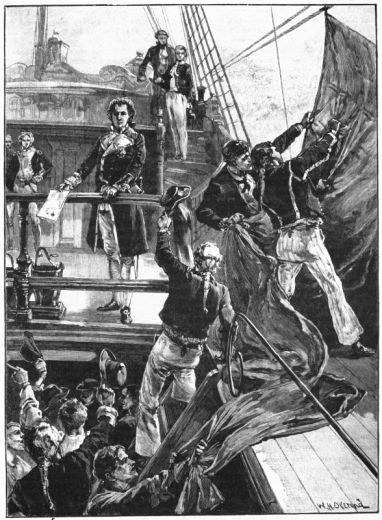
THE MUTINY AT SPITHEAD: HAULING DOWN THE RED FLAG ON THE "ROYAL GEORGE." (See p. 456.)
Early in this year Admiral Sir John Jervis fell
in with the great Spanish fleet, which was intended
to co-operate with the French in the invasion
of Ireland, and defeated it. Nelson had
predicted that the Spanish fleet would not take
much destroying. Admiral de Langara had had a
fortunate escape in the Mediterranean, in venturing
to Corsica. He had now been superseded
by Don Juan de Cordova, and Jervis, on the 14th
of February, met with him off Cape St. Vincent.
Cordova had twenty-seven sail of the line, Jervis
only fifteen; but he had Nelson in his fleet, which
more than counterbalanced the inequality of
numbers; and the discipline on board the Spanish
ships was far below that of the British. Nelson
broke through the Spanish line, and chiefly by
his exertions and manœuvres four of the largest
vessels were taken, including one of one hundred
and twelve guns. The rest escaped into Cadiz,
and there the British blockaded them. The news
of this brilliant victory arrived in London when
the public was greatly dispirited by the exhausted
state of the Bank of England, and helped to
revive confidence. Sir John Jervis was made
Earl of St. Vincent, and Nelson, the real hero, a
Knight of the Bath.
A still more signal victory was won by Admiral
Duncan in the autumn. On the 11th of October,
the Admiral, who had been watching the Dutch
fleet in the Texel, found that during a storm it
had stolen out, and was on its way to join the
French fleet at Brest. There were eleven sail of
the line, and four fifty-six gun ships, commanded
by Admiral de Winter. Duncan had sixteen sail
of the line. Notwithstanding our superiority of
numbers, the Dutch fought with their accustomed
valour, but Duncan ran his ships between them
and the dangerous coast, to prevent their regaining
the Texel, and so battered them that they were
compelled to strike. Eight sail of the line, two
fifty-six gun ships, and two frigates remained in
our hands; but the Dutch had stood it out so
stoutly, that the vessels were few of them capable
of being again made serviceable. The loss in killed
and wounded on both sides was great. Duncan
was elevated to the peerage for this victory of
Camperdown, and the danger of immediate invasion
was at an end.
On the 10th of February, 1797, the French
made a descent on the Welsh coast, which created
much alarm at the time, and no less speculation
as to its meaning. Four armed vessels, containing
about fourteen hundred men, had appeared
in the Bristol Channel, off Ilfracombe, in
north Devon. They did not attempt to land there,
but stood over to the Welsh coast, and landed in a
bay near Fishguard. They were commanded by
General Tate, and commenced marching inland,
and the whole country was in alarm. Lord Cawdor
marched against them with three thousand men,
including a considerable body of militia, and they
at once laid down their arms and surrendered
without a shot. Many were the conjectures as to
the object of this descent, and historians have
much puzzled themselves about a matter which
appears plain enough. The men looked ragged
and wild, more like felons than soldiers, and were
apparently not unwilling to be made prisoners.
They were, no doubt, a part of the great Brest fleet
meant for Ireland, which had been driven about by
the tempests ever since they quitted that port on
the 17th of December, and were only too glad to
set foot on any land at all, and probably were by
this time so famished and bewildered that they
did not know whether they were in England or
Ireland. Many of their comrades of the same unfortunate
expedition never did see land again.
The opening of the campaign on the Rhine in
1797 restored the positions of the French. On
the lower part of the river, Hoche, who now
commanded them, defeated General Kray; on the
upper Rhine Moreau retook the fortress of Kehl,
opposite to Strasburg; and such was the alarm of
Austria that she began to make overtures of
peace. The fortunes of her army in Italy made
these overtures more zealous; Alvinzi was defeated
at Rivoli on the 14th of January, and Provera
soon after surrendered with four thousand men,
and Wurmser capitulated at Mantua. The Archduke
Charles was now sent into Italy with another
army, but it was an army composed of the ruins
of those of Beaulieu, Alvinzi, Wurmser, and Davidowich,
whilst it was opposed by the victorious troops
of Buonaparte, now supported by a reinforcement
of twenty thousand men under Bernadotte. The
archduke, hampered by the orders of the Aulic
Council in Vienna, suffered some severe defeats on
the Tagliamento in March, and retreated into
Styria, whither he was followed by Buonaparte.
But the danger of a rising in his rear, where the
Austrian General Laudon was again collecting
numerous forces, induced Buonaparte to listen to
the Austrian terms for peace. The preliminaries
were signed on the 18th of April at Leoben, and
Buonaparte, to bind the Emperor to the French
cause, and completely to break his alliance with
Britain, proposed to hand over to the Austrians
the territory of Venice. This being effected,
Buonaparte hurried back to seize and bind the
promised victim. He took a severe vengeance on
the people of Verona, who had risen against the
French in his absence, and then marched to Genoa,
where, under pretence of supporting the people in
their demands for a Republic, he put down the Doge
and Senate, set up a democratical provisional
government, seized on all the ships, docks, arsenal,
and stores—in fact, took full possession. All
further pretence of regard for the neutrality of
Genoa was abandoned.
On the 17th of October the peace between France
and Austria was definitively signed at Campo
Formio. To France Austria ceded Belgium, the
left bank of the Rhine, including Mayence, the
Ionian islands, and the Venetian possessions in
Albania, both of which really belonged to Venice.
Venice itself, and its territory as far as the Adige,
with Istria and Venetian Dalmatia on the other
side of the Adriatic, were made over to Austria
without ceremony. The Milan and Mantuan
states were given up by Austria, with Modena,
Massa, Carrara; and the papal provinces of
Bologna, Ferrara, Ravenna, and the rest of them,
as far as the Rubicon, were included in a new
so-called Cisalpine Republic belonging to France.
Tuscany, Parma, Rome, and Naples were still
called Italian, but were as much, Naples excepted,
in the power of France as the rest. In fact,
except Venetia, which Austria secured, all Italy
except Naples was subjected to the French, and
the regular process of democratising was going on,
in the latter kingdom, for an early seizure.
Before the conclusion of this treaty Pitt had
made another effort to obtain peace with France.
The fact that one ally, Austria, was engaged in
separate negotiations gave him a fair excuse, and
Lord Malmesbury was once more sent to negotiate.
He went to Lille, presented his plan of a treaty,
and at first all went well. Britain promised to
restore all her conquests with the exception of
Ceylon, the Cape of Good Hope, and Trinidad.
But the Directory suffered the negotiations to drag
on, and when intestine struggles in France had
been terminated in the triumph of the Republican
party on the 18th Fructidor (September 4), the
negotiations were suddenly broken off on the ground
that Malmesbury had not full authority. Once
more the war party in France had gained the day,
and the weary contest was resumed.
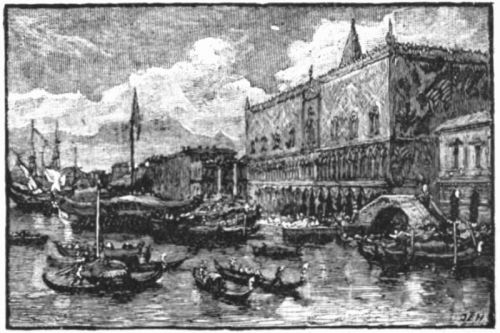
THE DOGE'S PALACE, VENICE.