THE REIGN OF VICTORIA (continued).
Parliamentary Reform—Mr. Disraeli's Resolutions—Their Text—Mr. Lowe's Sarcasms—The "Ten Minutes" Bill—Sir John
Pakington's Revelations—Lord John Manners' Letter—Ministerial Resignations—A New Bill promised—Meeting at
Downing Street—Mr. Disraeli's Statement—The Compound Householder—The Fancy Franchises—Mr. Gladstone's Exposure—Mr.
Lowe and Lord Cranborne—The Spirit of Concession—Mr. Gladstone on the Second Reading—Mr. Gathorne
Hardy's Speech—Mr. Bright and Mr. Disraeli—The Dual Vote abandoned—Mr. Coleridge's Instruction—The Tea-Room
Cabal—Mr. Gladstone's Amendment—His other Amendments withdrawn—Continued Debates and Divisions—Mr.
Hodgkinson's Amendment—Mr. Disraeli's coup de théâtre—Mr. Lowe's Philippic—The County Franchise—The Redistribution
Bill—Objections to It—The Boundaries—Lord Cranborne and Mr. Lowe—Mr Disraeli's Audacity—The Bill in the
Lords—Four Amendments—Lord Cairns's Minorities Amendment—The Bill becomes Law—The "Leap in the Dark"—Punch
on the Situation—The Scottish Reform Bill—Prolongation of the Habeas Corpus Suspension Act—Irish Debates—Oaths
and Offices Bill—Mr. Bruce's Education Bill—The "Gang System"—Meetings in Hyde Park—Mr. Walpole's
Proclamation and Resignation—Attempted Attack on Chester Castle—Collapse of the Enterprise—Attack on the Police
Van at Manchester—Trial of the "Martyrs"—Explosion at Clerkenwell Prison—Trades Union Outrages at Sheffield—The
Crimes of Broadhead—Tailors and Picketing—The Buckinghamshire Labourers—Distressing Accidents—Royal Visitors—Foreign
Affairs—The French Evacuation of Mexico—The Luxemburg Question—The London Conference—Neutralisation
of the Duchy—The Austrian Compromise—Creation of the Dual Monarchy—The Autumn Session—The Abyssinian
Expedition—A Mislaid Letter.
ON the 11th of February, 1867, in pursuance of
the pledges given by the new Ministry in their
various speeches before the beginning of the Session,
the House of Commons was once more invited to
consider the question of Reform, under the
guidance, however, of Mr. Disraeli, instead of
Mr. Gladstone. The Conservative party naturally
felt somewhat strange to the work; they had
turned out the Liberal Government upon various
pleas, all of which they were to abandon, more or
less completely, before the close of the Session of
1867; they had no such traditional or inherited
policy to guide them in framing a popular Reform
Bill as the Liberals had; and they had a dread
of the Opposition, which, considering their own
conduct towards the defeated Reform Bill of the
preceding year, was, perhaps, not unreasonable. Still
the fact that the whole question had been already
fully canvassed and discussed—that the House
had become familiarised with the details as well as
the general principles of Reform, and that its
members had, one and all with more or less
sincerity, it is true, pledged themselves to Reform
in some shape or other—was in their favour.
When the pros and cons of the situation are
considered, the course adopted by Mr. Disraeli, in
introducing the subject, seems, at first sight, both
natural and ingenious. "We desire no longer,"
said the Conservatives, "to risk the settlement of
the whole question upon a question of detail; the
House is pledged to Reform; let us then, instead
of dictating to it a definite policy, instead of
bringing in a Bill of our own immediately,
endeavour to ascertain the general sense of the
House upon disputed points before framing it,
that we may not frame it in the dark, and meet
the common fate of those Ministries that have
hitherto dealt with the subject." This was the
meaning of Mr. Disraeli's famous Resolutions,
which he explained to the House in his opening
speech. In this speech, throughout ingeniously
indefinite, the new Chancellor of the Exchequer
provided such men as Mr. Lowe, possessing a keen
sense of humour, with ample food for ridicule.
After the resolutions had been sufficiently debated,
Government promised to bring forward a Bill
embodying the general opinion of the House, so
far as the discussions on the resolutions should
have enabled them to ascertain it. Mr. Gladstone,
in answer to Mr. Disraeli, reproached Government
with wishing to shift the whole responsibility
in the matter from their own shoulders to those of
the House. The principle of Ministerial responsibility
was one sanctioned by long usage, and was
not to be lightly abandoned. With regard to the
resolutions themselves, though at first sight he
disliked the plan, he was willing to give them a
fair trial, provided they were not mere vague
preliminary declarations which it would be of no
practical advantage to discuss. The resolutions
appeared in the papers next day, and produced
general disappointment. It was felt that
Government, in spite of all their protestations,
were really "angling for a policy," and that
they were treating neither the House nor the
nation straightforwardly. The resolutions were as
follows:—
1. "That the number of electors for counties
and boroughs in England and Wales ought to be
increased.
2. "That such increase may best be effected by
both reducing the value of the qualifying tenement
in counties and boroughs, and by adding other
franchises not dependent on such value.
3. "That while it is desirable that a more direct
representation should be given to the labouring
class, it is contrary to the Constitution of this
realm to give to any one class or interest a predominating
power over the rest of the community.
4. "That the occupation franchise in counties
and boroughs shall be based upon the principle of
rating.
[It will be remembered that it was upon this
very question of rating, as against rental, that the
Russell Ministry had been thrown out of office
in the preceding year. After Lord Dunkellin's
amendment, the Conservatives were bound to
make the principle of rating a part of any scheme
brought forward by them. How much they were
obliged to modify it before the end of the matter,
and how amply justified Mr. Gladstone's arguments
against it were proved to be, will be seen hereafter.]
5. "That the principle of plurality of votes, if
adopted by Parliament, would facilitate the settlement
of the borough franchise on an extensive
basis.
6. "That it is expedient to revise the existing
distribution of seats.
7. "That in such revision it is not expedient
that any borough now represented in Parliament
should be wholly disfranchised.
8. "That in revising the existing distribution of
seats, this House will acknowledge, as its main
consideration, the expediency of supplying representation
to places not at present represented,
which may be considered entitled to that privilege.
9. "That it is expedient that provision should
be made for the better prevention of bribery and
corruption at elections.
10. "That it is expedient that the system of
registration of voters in counties should be assimilated
as far as possible to that which prevails in
boroughs.
11. "That it shall be open to every Parliamentary
elector, if he thinks fit, to record his vote
by means of a polling paper, duly signed and
authenticated.
12. "That provision be made for diminishing
the distance which voters have to travel for the
purpose of recording their votes, so that no expenditure
for such purpose shall hereafter be legal.
13. "That a humble Address be presented to her
Majesty, praying her Majesty to issue a Royal
Commission to form and submit to the consideration
of Parliament a scheme for new and enlarged
boundaries of the existing Parliamentary boroughs
where the population extends beyond the limits
now assigned to such boroughs; and to fix, subject
to the decision of Parliament, the boundaries of
such other boroughs as Parliament may deem fit
to be represented in this House."
The House and the country were naturally dissatisfied
with such vague statements as these, and
between the 11th and the 25th of February, when
Mr. Disraeli promised something more definite,
many attempts were made to induce Government
to declare themselves more plainly. "The
Resolutions of the Government," said Mr. Lowe
later, borrowing a happy illustration from the
"Vicar of Wakefield," "have no more to do with
the plan of the Government than Squire Thornhill's
three famous postulates had to do with the
argument he had with Moses Primrose, when, in
order to controvert the right of the clergy to
tithes, he laid down the principles—that a whole
is greater than its part; that whatever is, is; and
that three angles of a triangle are equal to two
right angles." However, Mr. Disraeli kept his
secret, in spite of attacks from Mr. Ayrton and
arguments from Mr. Gladstone, till the night of
the 25th, when he rose to explain the resolutions
and to suggest certain constructions of them
on the part of Government; a very different
thing, it will be understood, from bringing in a
Bill by which the framers of it are bound in the
main to stand or fall. In the first place, then,
Government proposed to create four new franchises—an
educational franchise, to include persons
who had taken a university degree, ministers of
religion, and others; a savings bank franchise; a
franchise dependent upon the possession of £50 in
the public funds; and a fourth dependent upon
the payment of £1 yearly in direct taxation. By
these means the Government calculated that
about 82,000 persons would be enfranchised. In
boroughs the occupier's qualification was to be
reduced to £6 rateable value, and in counties to
£20 rateable value—reductions which it was
supposed would admit about 220,000 new voters.
With regard to the redistribution of seats, four
boroughs, convicted of extensive corruption, and
returning seven members between them, were to
be wholly disfranchised; and in addition to these
seven members, Mr. Disraeli appealed "to the
patriotism of the smaller boroughs" to provide
him with twenty-three more, by means of partial
disfranchisement. The thirty seats thus obtained
were to be divided as follows:—Fifteen new seats
were to be given to counties, fourteen to boroughs
(an additional member being given to the Tower
Hamlets), and one member to the London University.
The points of likeness and unlikeness between
this scheme and that of the Liberals in 1866
will be easily perceived by any one who takes the
trouble to examine the two plans.
This meagre and unsatisfactory measure, however,
was short-lived; and the secret history of it,
as it was afterwards told by various members of
the Government, affords an amusing insight into
the mysteries of Cabinet Councils. The fact was
that before the beginning of the Session, and
during the time that the thirteen resolutions
were lying on the table of the House, two Reform
schemes were under the consideration of
Government, "one of which," said Lord Derby,
"was more extensive than the other." When it
was seen that the House would have nothing to
say to the resolutions, and that a Bill must be
brought in without delay, it became necessary to
choose between these two schemes. At a Cabinet
meeting on Saturday, February 23rd, the more
extensive one, based upon household suffrage,
guarded by various precautions, was, as it was
supposed, unanimously adopted, and Mr. Disraeli
was commissioned to explain it to the House of
Commons on the following Monday, the 25th.
The rest of the story may be told in Sir John
Pakington's words. "You all know," he said,
addressing his constituents at Droitwich, "that,
on the 23rd of February, a Cabinet Council decided
on the Reform Bill which was to be proposed to
Parliament. On Monday, the 25th, at two o'clock
in the afternoon, Lord Derby was to address the
whole Conservative party in Downing Street. At
half-past four in the afternoon of that day—I
mention the hour because it is important—the
Chancellor of the Exchequer was to explain the
Reform Bill in the House of Commons. When
the Cabinet Council rose on the previous Saturday,
it was my belief that we were a unanimous
Cabinet on the Reform Bill then determined upon.
[Lord Derby, however, afterwards stated that
General Peel, one of the three seceding Ministers,
had some time before the Cabinet of the 23rd
expressed his strong objections to the Reform Bill
then adopted, but had consented to waive his
objections for the sake of the unity of the
Ministry.] As soon as the Council concluded, Lord
Derby went to Windsor to communicate with her
Majesty on the Reform Bill, and I heard no more
of the subject till the Monday morning. On the
Monday, between eleven and twelve o'clock, I
received an urgent summons to attend Lord
Derby's house at half-past twelve o'clock on important
business. At that hour I reached Lord
Derby's house, but found there only three or four
members of the Cabinet. No such summons had
been anticipated, and consequently some of the
Ministers were at their private houses, some at
their offices, and it was nearly half-past one before
the members of the Cabinet could be brought
together. As each dropped in, the question was
put, 'What is the matter? Why are we convened?'
and as they successively came in, they
were informed that Lord Cranborne, Lord Carnarvon,
and General Peel had seceded, objecting
to the details of the Bill which we thought they
had adopted on the Saturday. Imagine the difficulty
and embarrassment in which the Ministry
found themselves placed. It was then past two
o'clock. Lord Derby was to address the Conservative
party at half-past two; at half-past four
Mr. Disraeli was to unfold the Reform scheme
[adopted on the previous Saturday] before the
House of Commons. Literally, we had not half
an hour—we had not more than ten minutes—to
make up our minds as to what course the Ministry
were to adopt. The public knows the rest. We
determined to propose, not the Bill agreed to on
the Saturday, but an alternative measure, which
we had contemplated in the event of our large and
liberal scheme being rejected by the House of
Commons. Whether, if the Ministry had had an
hour for consideration, we should have taken that
course was, perhaps, a question. But we had not
that hour, and were driven to decide upon a line
of definite action within the limits of little more
than ten minutes."
In Lord Malmesbury's "Recollections" is to be
found a letter from Lord John Manners, which
corroborates this ingenuous confession. "I am
truly sorry," he wrote on February 26th, "to
hear of the cause of your absence from our
distracted councils, and hope that you will soon be
able to bring a better account of Lady Malmesbury.
I really hardly know where we are, but
yesterday we were suddenly brought together to
hear that Cranborne and Carnarvon withdrew
unless we gave up household suffrage and duality,
upon which announcement Peel said that, although
he had given up his opposition when he stood
alone, now he must be added to the remonstrant
Ministers. Stanley then proposed that to keep us
together the £6 and £20 rating should be adopted,
which, after much discussion, was agreed to. We
have decided to abandon the Resolutions altogether,
and to issue the Boundary Commission
ourselves. We are in a very broken and disorganised
condition."
It was soon felt, however, by the Ministry that
this condition of things was unsound, and could
not last. The measure explained on the 25th
satisfied neither Conservatives nor Liberals. A
large meeting of Liberals held at Mr. Gladstone's
house decisively condemned it; while from their
own friends and supporters Government received
strong and numerous protests against it.
What was to be done? Lord Derby once more
called his Government together, and they agreed
to retrace their steps, even at the cost of the three
objecting Ministers. Upon the 4th of March Lord
Derby, in the House of Lords, and Mr. Disraeli,
in the Commons, announced the resignation of
Lord Cranborne, Lord Carnarvon, and General
Peel (who were replaced by the Dukes of
Richmond and Marlborough and Mr. Corry),
the withdrawal of the measure proposed on
the 25th, and the adoption by Government of
a far more liberal policy than that represented.
Both in the House and in the country there were
naturally some rather free criticisms passed upon
a Government who, three weeks before the
announcement of a Reform Bill brought forward
by them, had not come to an agreement upon its
most essential provisions, and upon a sudden
emergency, and to keep their members together,
adopted and introduced a makeshift measure,
which their own sense of expediency, no less than
public opinion, afterwards obliged them to withdraw.
In these marchings and counter-marchings of
Government much valuable time had been thrown
away. "No less than six weeks of the Session,"
said Lord Grey, "have been wasted before any
step whatever has been taken." The Conservative
leaders, however, vehemently protested that it was
no fault of theirs; and now that the confession
had been made, and the three refractory colleagues
got rid of, affairs did at length assume a businesslike
aspect. "It is our business now," said the
Chancellor of the Exchequer, "to bring forward,
as soon as we possibly can, the measure of Parliamentary
Reform which, after such difficulties and
such sacrifices, it will be my duty to introduce to
the House. Sir, the House need not fear that
there will be any evasion, any equivocation, any
vacillation, or any hesitation in that measure."
In the interval between these Ministerial explanations
and the production of the real Reform
Bill in Parliament meetings of their supporters were
held by the lenders of both parties. At a meeting
held in Downing Street on the 15th of March,
Lord Derby explained to 195 members of the
Conservative party the distinctive features of the
proposed Bill. Startling as the contemplated
changes in the franchise must have seemed to
every Conservative present, only one dissenting
voice was heard—that of Sir William Heathcote,
who declared, in strong terms, that he wholly
disapproved of the measure, and that he believed,
if carried out, it would destroy the influence of
rank, property, and education throughout the
country by the mere force of numbers. The
scheme, of which only a few fragments were as yet
generally known, was given to the public on the
18th of March, when Mr. Disraeli described it at
much length in the House. And although the
measure at first proposed was so largely altered in
its passage through Parliament that by the time
it had become part of the law of England its
original projectors must have had some difficulty
in recognising it as theirs, it is worth while to
take careful note of its various provisions as they
were originally drawn up, that the action of the
two great parties engaged throughout the subsequent
struggle may be the more plainly understood.
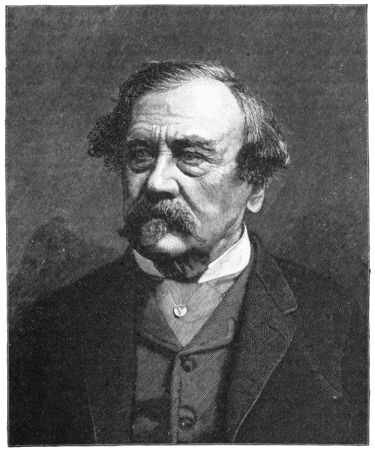
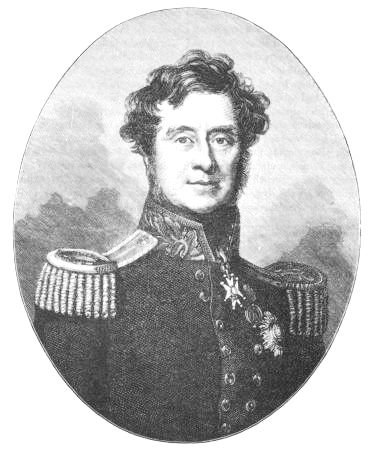
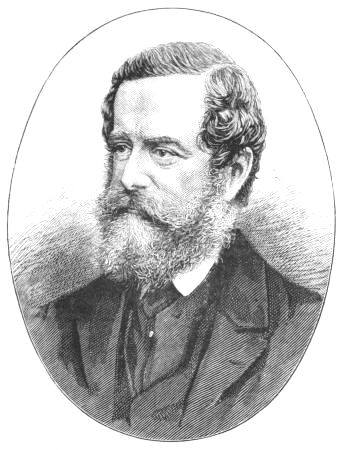
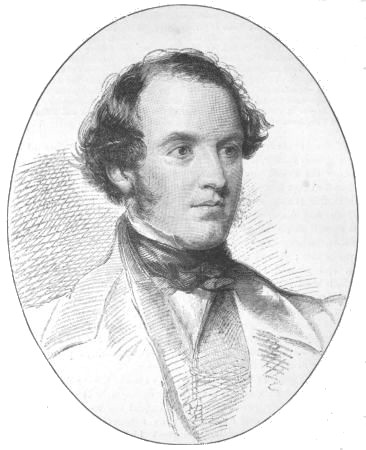
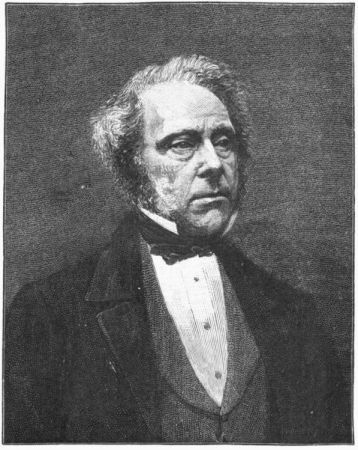
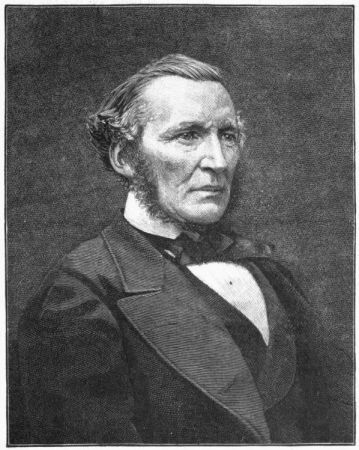
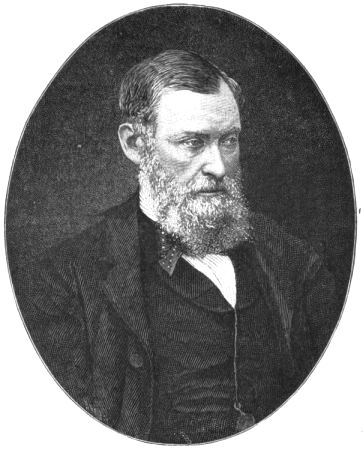
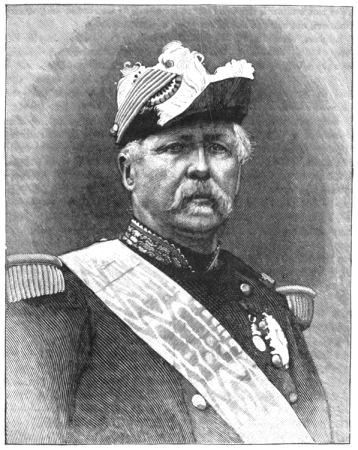
LORD MALMESBURY.
(From a Photograph by Elliott & Fry, Baker Street, W.)
The first quarter of Mr. Disraeli's speech was
taken up by a review of the past history of the
question—an old and well-known story, somewhat
impatiently listened to by the House. He picked
the various Reform schemes of his predecessors to
pieces, and finally declared that the principle at
the bottom of them all—the principle of value,
regulated whether by rental or rating—had been
proved by long experience to be untenable and
unpractical, and Government were now about to
abandon it altogether. Nor was Mr. Disraeli
slow to disclose his secret. The very next
paragraph of his speech announced that, in the
opinion of Government, any attempt to unite the
principle of value with the principle of rating, any
such solution as a £6 or £5 rating franchise,
would be wholly unsatisfactory. In the boroughs
of England and Wales, Mr. Disraeli went on to
say, there were 1,367,000 male householders, of
whom 644,000 were qualified to vote, leaving
723,000 unqualified. Now, if we examined these
723,000, we should find that 237,000 of them were
rated to the poor and paid their rates. So that
if the law were changed in such a manner as to
make the borough franchise dependent upon the
payment of rates only, unrestricted by any standard
of value, these 237,000 would be at once qualified
to vote, making, with the 644,000 already qualified,
881,000 persons in the English and Welsh boroughs
in possession of the franchise. There would still
remain 486,000, belonging mostly to the irregular
and debatable class of compound householders—householders
paying their rates, not personally,
but through their landlords. Now, since Government
thought that the franchise ought to be based
upon a personal payment of rates, it became a
great question as to what was to be done with
these 486,000 compound householders. "Ought
the compound householders to have a vote?"
As a compound householder Government thought
he ought not to have a vote. But he was not to
be left altogether in the cold. Ample opportunities
were to be afforded him for raising himself
out of the anomalous position to which the Small
Tenements Acts had consigned him. Let him
only enter his name upon the rate-book, and claim
to pay his rates personally; and having fulfilled
the constitutional condition required, he would
at once succeed to the constitutional privilege
connected with it. It had been said that the
working classes did not care enough about the
suffrage to take so much trouble to obtain it.
"That, however," said Mr. Disraeli, oracularly,
"is not the opinion of her Majesty's Government."
Thus 723,000 additional persons might, if they
wished, obtain the franchise under the new Bill.
To these were to be added all those who paid 20s.
a year in direct taxes, whether compound householders
or not; while, to prevent the working
classes from swamping the constituencies and
nullifying the influence of the middle and upper
classes, Government brought forward the curious
expedient of dual voting. "Every person," said
the Chancellor of the Exchequer," who pays
£1 direct taxation, and who enjoys the franchise
which depends upon the payment of direct taxation,
if he is also a householder and pays his rates,
may exercise his suffrage in respect of both qualifications."
The dual vote, however, provoked such hot
opposition that, as will shortly be seen, Government
eventually withdrew it. The direct taxes
qualification, Mr. Disraeli calculated, would add
more than 200,000 to the constituency; and
the three other "fancy franchises," as they were
called—the education franchise, the funded property
franchise, and the savings bank franchise—another
105,000. In all, Government held out
the splendid promise of an addition of more than
1,000,000 voters to the borough constituency. In
counties the franchise would be lowered to £15
rateable value—a reduction which would enfranchise
about 171,000 additional voters; while
the four lateral franchises mentioned above would
bring the number of new county voters up to
about 330,000. With regard to the redistribution
of seats, Government had substantially the
same proposals to make as those originally described
to the House on the 25th of February.
Mr. Disraeli, however, vigorously defended them
from the charge of inadequacy which had been
brought against them in the interval. Neither
Government nor the country, he said, was prepared
to go through the agitating labour of constructing
a new electoral map of England; and
this being the case, all that would be done would
be to seize opportunities as they arose of remedying
grievances and removing inequalities by some such
moderate means as those proposed in the Bill.
Alas! for Mr. Disraeli's figures when they came
to be handled by Mr. Gladstone. Instead of
237,000, it was stoutly maintained by Mr. Gladstone
that scarcely 144,000 would be admitted to
the franchise by extending it to all who personally
paid their rates. And as to the facilities to be
offered in such tempting profusion to the compound
householder for obtaining a vote, they amounted
to this—that he was to have the privilege of
paying over again that which he had already paid.
It was difficult to believe that he would ever avail
himself of this privilege to any great extent.
Practically, the Bill did nothing for the compound
householder; so that, while it would introduce
household suffrage—nay, universal suffrage—into
villages and country towns where there was no
system of compounding for rates, in large towns,
like Leeds, with a population of a quarter of a
million, where the majority of the inhabitants
were compound householders, its effect would be
little or nothing. In fact, the results of the Bill,
had it been passed as it was originally drawn up,
would have been almost grotesque. In Hull, for
instance, where the Small Tenements Act was almost
universally enforced, the number of personally
rated occupiers under the £10 rental who would
have been enfranchised by the Bill would have
been 64 out of a population of 104,873; while in
the small borough of Thirsk, where the system of
compounding for rates was not in use, 684 would
have obtained the franchise as personal ratepayers.
In Brighton, where compound householders
abounded, the Bill would have enfranchised 14 out
of every 10,000 occupiers under the £10 line;
while in York it would have enfranchised 100 out
of every 1,000. The enfranchising effect of the
Bill would have been between "six and seven
times as great in the boroughs not under Rating
Acts as in the others." It is more than probable
that in framing their measure Government foresaw
none of these anomalies, and that they were
revealed to them and impressed upon them in the
course of debate. There was, in fact, no adequate
knowledge among them of the working of those
complicated details of rating machinery upon which
they made the whole effect of their Bill ultimately
depend. With regard to the secondary franchises—the
direct taxes franchise, the education franchise,
etc.,—Mr. Gladstone contended that the
figures quoted by Mr. Disraeli were wholly
erroneous and visionary, and that the new voters
it was supposed they would admit were no more
substantial than Falstaff's men in buckram. For
himself, he had no belief in the principle of rating
as a bulwark of the Constitution; and to base the
possession of the franchise upon the personal payment
of rates, he thought fundamentally wrong.
To the proposition of dual voting as a safeguard of
household suffrage, he declared himself inflexibly
opposed. It could only serve as a gigantic instrument
of fraud, and was nothing less than a proclamation
of a war of classes. And where was
the lodger franchise, so highly praised by the
Conservatives in 1859, which all the world had
expected to find in the Bill? If that were
added, and the so-called safeguards of dual voting
and personal payment of rates done away with, the
Liberal party would accept the Bill as a whole.
A short debate followed, in which Mr. Lowe reappeared,
to do battle as warmly against the
Reform Bill of the Conservatives as he had
formerly waged it against that of the Liberals.
Mr. Lowe had been duped, but he was not yet
prepared to confess it. Later, when concession
after concession had been made by Government,
and a far more Radical measure than any
Liberal Ministry had ever dreamt of was on the
point of becoming law, Mr. Lowe did indeed make
ample and public confession of his mistake, and
loud and bitter were the expressions of his wrath
and mortification. But at this stage of the matter
the "Cave" had still some confidence in Conservative
principles and time-honoured Conservative
traditions, and refused to believe that the party
they had helped to put into power would ever
betray them so completely as was afterwards
actually the case. They disliked the Bill and said
so; but for some little time they trusted to the
genuine Conservative influence still existing behind
the Ministerial benches for its modification. Lord
Cranborne, a seceder from the Tories, as Mr. Lowe
had been from the Liberals, made a short but
energetic attack upon the Bill on this occasion.
"If the Conservative party accept the Bill," he
said, "they will be committing political suicide:
household suffrage, pure and simple, will be the
result of it, for no one can put any faith in the
proposed safeguards; and, after their conduct last
year, it is not the Conservatives who should pass a
measure of household suffrage."
During the interval between the introduction of
the Bill and the motion for the second reading, an
important meeting of the Liberal party was held
at Mr. Gladstone's house on March 21st, to consider
whether opposition should be offered to the
second reading. Mr. Gladstone said, "Since the
printing of the Government Bill, having applied
myself day and night to the study of it, I have not
the smallest doubt in my own mind that the wiser
course of the two would be to oppose the Bill on
the second reading." He thought, however, "that
the general disposition of the meeting would not
bear him out in that course;" and to maintain the
unity of the party, he was willing to sacrifice his
own personal opinion. "If Ministers were content
to abandon the dual voting, and to equalise the
privileges and facilities of the enfranchised in all
cases, however the qualification arose, then the
measure might be made acceptable. If they would
not concede these points, then he thought that the
Liberals should not permit the measure to go into
committee." It was already evident that both
sides had made up their minds to pass some kind
of Reform Bill during the Session, and that both
were prepared to make concessions rather than
offer to the country once more the pitiable spectacle
of a great measure of necessary Reform overthrown
by party spirit and party warfare. Still the
Liberals were determined to wrest certain points
from Government; and in his speech on the
second reading (March 25th) Mr. Gladstone thus
summed up the defects in the Bill, which must, he
said, be amended before the Liberals could give in
their adhesion to it:—
1. Omission of a lodger franchise. 2. Omission
of provisions against traffic in votes of householders
of the lowest class, by corrupt payment of
their rates. 3. Disqualifications of compound
householders under the existing law. 4. Additional
disqualifications of compound householders
under the proposed law. 5. The franchise founded
on direct taxation. 6. The dual vote. 7. The
inadequate distribution of seats. 8. The inadequate
reduction of the franchise in counties. 9.
Voting papers. 10. Collateral or special franchises.
Every one of these ten points, except the
second, was finally settled more or less in accordance
with the demands of the Liberals,—an instructive
comment on the experiment of "government
by minorities," which Mr. Disraeli was
making with such great success.
In contradistinction to Lord Cranborne, Mr.
Gladstone maintained that while the Bill seemed on
the face of it to be a measure of household suffrage,
it was in reality nothing of the kind; every concession
in it was balanced by a corresponding
restriction, and what it gave with one hand it took
away with the other. For the dual vote he had
nothing but hard words: "At the head of the list
stand those favoured children of fortune—those
select human beings made of finer clay than the
rest of their fellow-subjects—who are to be endowed
with dual votes. Upon that dual vote I
shall not trouble the House, for I think that my
doing so would be a waste of time." And, indeed,
the general opinion of the House had already pronounced
so decidedly against it, that no purpose
would have been served by discussing it at length.
Mr. Gladstone went on to declaim afresh against
the fine which the Bill would inflict upon the compound
householder before he could obtain his vote.
Then followed an elaborate and masterly examination
of the probable results of the Bill if passed in
its original form. Making use of some important
statistics, the return of which had been lately moved
for by Mr. Ward Hunt, he attacked the Bill as one
that would "flood some towns with thousands of
voters, and only add a few in other towns." After
reading a long series of these damaging statistics,
Mr. Gladstone might well ask, "Is it possible that
any one on the Treasury benches can get up in his
place, and recommend those clauses respecting
the compound householder with all their anomalies?"
Men, however, were not lacking to defend
them, and to defend them with ability and vigour.
Mr. Gathorne Hardy, then Commissioner of the Poor
Laws, after a graceful tribute to the power of Mr.
Gladstone's speech, made out, perhaps, the best case
for the Ministerial measure that had yet been attempted.
He denied that the Bill was a Household
Suffrage Bill; the proper name for it was a Rating
Franchise Bill; and so far from excluding anybody,
as Mr. Gladstone had tried to prove, it opened the
franchise to every one who chose to claim it. And
as to the "fine" which it was said would be imposed
upon the compound householder by the Bill,
he could recover whatever rates he paid from the
landlord—a statement in support of which Mr.
Hardy quoted an Act of Queen Victoria, allowing
"any occupier paying any rate or rates in respect of
any tenement where the owner is rated to the same,
to deduct from his rent or recover from his landlord
the amount so paid." The Act, however, did not
really bear out Mr. Hardy's argument, since it only
enabled the tenant to recover the reduced rate,
while the Bill obliged him to pay the full rate
before obtaining his vote. The personal payment,
of rates, and the two years' residence clauses, were,
he admitted, meant as safeguards and limitations;
but he believed them to be just and reasonable, and
such as would be approved by the country.
The debate was vigorously kept up—the Ministry
being only represented by Mr. Gathorne Hardy and
Mr. Disraeli, and supporters and opponents of the
Bill being found promiscuously on both sides of the
House. In truth, people had not yet got over
their surprise, and neither Liberals nor Conservatives
quite knew what to think of a measure so
Liberal at heart, though cased with Conservative
safeguards, brought in by a Conservative
Government. It was only towards the end of the
debate, when Mr. Bright spoke, and Mr. Disraeli
made answer on the whole case, that the country
began clearly to see which way things were going.
Mr. Bright was in a happy vein; he mixed in an
effective way solid criticism on the details of the
Bill with sarcastic descriptions of its framers, and
earnest denunciation of what he called the "deception
and disappointment" of which it bore the
marks. He regarded the Bill as really equivalent
to a measure for £8 suffrage, and therefore
less thorough than the Bill of the previous year.
It was too much inclined to a "set off"—the
enfranchising of higher class voters to counteract
the lower, which, of course, would not be the removal
of the real grievance that the workmen felt.
Then, after protesting that he would be the first
person in the House to support a "fair and honest
measure" of Reform, Mr. Bright went on: "I
will be no party to any Bill which would cheat the
great body of my countrymen of the possession of
that power in the House on which they have set
their hearts; and which, as I believe, by the Constitution
of this country, they may most justly
claim."
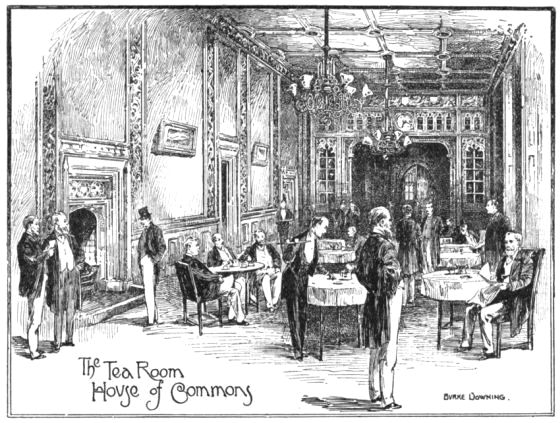
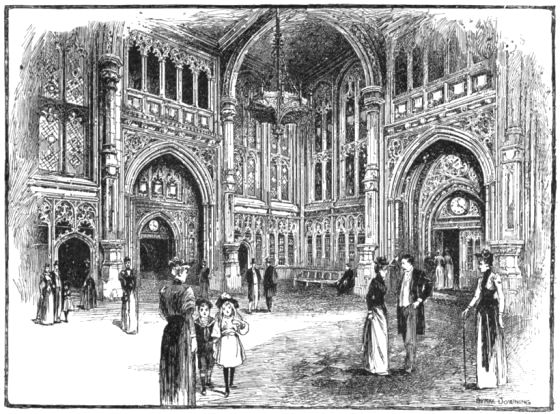
TEA-ROOM, HOUSE OF COMMONS.
When Mr. Disraeli rose to end the debate, the
House clearly saw that, though he was supporting
his Bill most strenuously, he was really speaking in
the spirit of his own resolutions. Those, it will be
remembered, had been brought forward early in
the Session with the avowed purpose of "feeling"
or "taking the sense of" the House. Mr. Disraeli
made no secret then of his readiness to do as he
was bid by the majority; and now, though he pretended
to make a secret of it, the same readiness
was to be detected in his speech. There was a vast
amount of epigram directed at Mr. Gladstone; but
Mr. Disraeli, in taking up the amendments indicated
by him, confessed that "if satisfactory arguments
were brought forward in committee," no
doubt the House would adopt them; and the
House might adopt them, he implied, without
endangering the Government Bill. To the lodger
franchise—of which Mr. Disraeli claimed himself
to be the father—he was not personally opposed;
it might be left to the committee. The compound
householder amendment—why was it that Lord
Russell and Mr. Gladstone, in schemes of their
own, had wished to keep up the distinction between
classes of ratepayers, and now wished to
abolish those distinctions? Yet that amendment
might be referred to the committee. In the same
way with the amendment about voting papers,
about the qualification of residence, about the
county franchise, about redistribution of seats.
On one and all of these points Mr. Disraeli's
watchword was "elasticity." The Bill's chief merit
was that it was elastic, whereas Mr. Gladstone's
£5 rating Bill would have been rigid and hard.
This Bill, he said, was so drawn as to secure the
"fitness and variety" that were to become
security against democracy. Then Mr. Disraeli
ended, saying that it was the one wish of
Government to co-operate with the House in
settling this question once for all. Till the
settlement was arrived at they would not desert
their posts. Any concessions, he implied, any
withdrawal of obnoxious clauses, or substitution
of amending clauses, would be consented to.
Government, the House, the country, only asked
for one thing—settlement. The Bill must be
passed at any cost; no personal feeling should
make Government either withdraw it or resign
until it had been passed. "Pass the Bill," he concluded,
"and then change the Ministry if you
please." A speech of which this was the tone very
naturally disarmed the Opposition. The only
danger was lest the Conservative rank and file,
irritated by their leader's tone of concession, should
mutiny. There was no mutiny, however, though
there was some murmuring, and the Bill was read
a second time on the 26th of March, without a
division.
The committee was fixed for the 8th of April.
On the 1st Mr. Disraeli made the first of his
promised concessions; he announced that Government
were prepared to withdraw the clause
relating to the dual vote. That removed one of
the bugbears of the Liberal party, and left them to
direct their interest to the interminable and
vexatious question of the compound householder.
The enormous number of small occupiers who
compounded for their rates—amounting, it was
confidently said, to two-thirds of the occupiers
under £10—showed the importance of the question.
The compound householder rose first into
prominence at a large meeting of Liberal members
held at Mr. Gladstone's house on the 5th of April.
There it was agreed that the point in the Government
Bill that lay most open to attacks from the
Liberals, now that the dual vote had been withdrawn,
was this point of the personal payment
of rates. Without amendment on this head the
Government Bill was illusory; it gave with one
hand what it took away with the other. Mr.
Gladstone recurred to what he had himself said
earlier in the Session—that there should properly
be a "hard and fast line," below which occupiers
should neither pay rates nor exercise the suffrage.
This was, in fact, a proposal for a £5 rating franchise;
for the abolition of all distinctions between
persons who paid their rates directly and those
who paid them through their landlord; and for the
relief of all those who occupied tenements at less
than £5 rateable value from the liability to be
rated at all. With a view to carrying his amendment,
he proposed that Mr. John Duke Coleridge,
member for Exeter, should move an instruction to
that effect.
At the meeting where this line of action was
planned there was some criticism, but little open
dissent from the course. During the three days
that were to elapse before the proposal of Mr. Coleridge's
amendment, however, an ominous change
took place in the position of affairs. Mr. Disraeli
had promised he would not resign, and that he
would not withdraw the Bill; but he had not
promised that he would not dissolve Parliament,
supposing the conduct of the Opposition were to
drive him that way. Now, the threat of a dissolution
is always terrible to many members.
Hence, when the word "dissolution" began to be
whispered, the Opposition began to disunite. A
meeting of dissatisfied members took place in the
tea-room of the House of Commons, transformed
for the moment into a new cave of Adullam; and a
cabal was formed for breaking up the plans of the
Liberals in reference to Mr. Coleridge's instruction.
Forty-eight members of the Liberal party agreed
to vote against the amendment, and a deputation
waited upon Mr. Gladstone to inform him of their
decision. In the face of such a defection it was,
of course, impossible to proceed. Mr. Coleridge
practically withdrew his instruction, reserving his
right to proceed on the subject of it in committee;
Mr. Gladstone began to feel that, as concerned
really Liberal amendments, his hands were not so
free as he hoped; and Government faced the
committee with new strength and satisfaction.
Mr. Gladstone, however, was not satisfied with
the result of the tea-room cabal; for much of the
discontent that had promoted it had been directed
at the "hard and fast line" of the £5 rating
franchise. It was resolved, therefore, to divide
upon a different amendment—one which should
relieve the compound householder from the disabling
clauses of the Bill, but which should still
keep to the original basis of household rating
suffrage. Mr. Gladstone's amendment inserted in
the restrictive clause the words "whether he in
person, or his landlord, be rated to the relief of the
poor;" and the arguments which, with his usual
force, he urged upon the House in its support were,
first, that the houses below £10 rental that
compounded for their rates were two-thirds of the
whole number of such houses, and that therefore
a Bill that excluded compounding householders
from the franchise was an illusion; and secondly,
that the case standing so, the "settlement" for
which Government were clamouring would not
be attained unless the Bill were amended. The
debate on Mr. Gladstone's amendment occupied
two nights, and was chiefly valuable as showing
the extraordinary difference of opinion that
prevailed among the supporters of the Bill, and
the equally different points of view from which
members were found to oppose it. When the
division came, however, Government triumphed.
The numbers were found to be—For the amendment,
289; against, 310—majority for Government,
21. This was an important majority, and,
as the division lists showed, it implied far more
unanimity among the Conservatives (in spite of the
defection of Sir W. Heathcote and Lord Cranborne)
than among the Liberals. Twenty-five of
the old "Adullamite" party voted with Mr. Disraeli—a
fact sufficiently indicating the opinion
which was held as to the tendency of the amendment.
The Adullamites voted for the original
Bill because they wanted the compound householder—the
dangerous being who occupied a
house below £10 annual rent—to be kept without
his vote.
The immediate effect of this division was to
draw from Mr. Gladstone an important statement
of policy. He wrote a letter to Mr. R. W.
Crawford, member for the City of London, to say
that he felt it useless to proceed personally with
the other amendments standing in his name. He
was compelled to own that the Liberals who
thought together on the question of Reform were
not a majority, but a minority, "and they have
not the power they were supposed to possess of
limiting or directing the action of the Administration,
or of shaping the provisions of the Reform
Bill. Still," Mr. Gladstone went on, "having
regard to the support which my proposal with
respect to personal rating received from so large a
number of Liberal members, I am not less willing
than heretofore to remain at the service of the
party to which they belong; and when any suitable
occasion shall arise, if it shall be their wish, I
shall be prepared again to attempt concerted action
upon this or any other subject for the public good....
I shall not proceed with the amendments
now on the paper in my name, nor give notice of
other amendments such as I had contemplated;
but I shall gladly accompany others in voting
against any attempt, from whatever quarter, to
limit still further the scanty modicum of enfranchisement
proposed by the Government, or in
improving, when it may be practicable, the provisions
of the Bill." This letter showed that
Mr. Gladstone was disheartened, but his discouragement
only increased the zeal of the reforming
party throughout the kingdom. The
House broke up for the Easter holidays immediately
after the vote; and during the recess
meetings were held in every important town in
England and Scotland, to express confidence in
Mr. Gladstone and to encourage him and his followers
in their attempts to liberalise the Bill.
The number, enthusiasm, and unanimity of these
meetings had, in all probability, much to do with
Mr. Disraeli's later concessions.
When the House met again, the first important
act of the committee was to accept Mr. Ayrton's
amendment, substituting one year for two years as
the period of residence necessary for borough
voters. There seems to have been a general idea
in the House that to require two years' residence
in a borough before a man could be entitled to
vote in an election of members of Parliament was
vexatious; and in spite of the strenuous efforts
of Government, Mr. Ayrton's amendment was
carried by the large majority of 81. A majority
as large as this is never, however, so much to be
dreaded by a Government as one a fourth of its
size. Accordingly Mr. Disraeli stated on the next
day that he and his colleagues "deferred to the
opinion of the House." Then came Mr. Hibbert's
notice to amend the Bill, by allowing all compound
householders who chose to pay personally to pay
reduced rates—a proposal that became celebrated,
from the conduct of the Government "whip" with
regard to it. It came out in the course of the
debate—Mr. Bernal Osborne revealed it—that the
whip, Colonel Taylor, had undertaken, "as a
gentleman and a man of honour, to press upon the
Cabinet the desirability of adopting Mr. Hibbert's
amendment;" and also that Colonel Taylor had
stated to Mr. Dillwyn, a Liberal member, that "he
believed Lord Derby and Mr. Disraeli to be
personally in favour of accepting it." That is to
say, just before a division, the Government whip
entered into negotiations with some of the enemy's
forces, and endeavoured to win them over to his
side by a statement—afterwards disavowed on
authority—of the opinions of his chief. The
episode afforded an interesting comment upon the
manœuvres of party government.
The debate on Mr. Hibbert's motion turned on
the question—Whether, supposing a compound
householder wanted a vote (which, according to the
Bill, would require him to pay his rates personally),
he should be compelled to pay as much as other
non-compounding householders, or whether the
same amount should be accepted from him personally
as had been accepted previously from his
landlord on his account? Mr. Disraeli aimed not
only at making him pay the full rate, but even at
repealing a section of Sir William Clay's Act (14
and 15 Vict., c. 14) which had defined certain
electoral rights of householders above £10. That
Act had allowed non-rated occupiers—compounders
above £10—to claim to be rated, in order to be put
upon the register of voters, and had declared them
liable only for the reduced or commuted rate. Under
that Act, according to Mr. Bright, electoral rights
were guaranteed to not less than 94,000 persons;
and Mr. Disraeli's proposal, to say nothing of its
immediate effect in excluding new voters, simply
amounted to a proposal either to disfranchise
these 94,000 altogether, or to make them pay
higher rates than they had previously paid. We
can understand the spirit in which Mr. Bright
spoke of this as an "audacious proposal." Still,
audacious or not, the proposal of Government for
the time succeeded. The division was taken on
the question, whether the borough voter should be
rated as an "ordinary occupier," always and
without exception, and Government had a very
great majority with them, affirming that he should.
The numbers were—Ayes, 322; Noes, 256—majority
for Government, 66.
Eight days afterwards they had changed their
minds. Another amendment was proposed in the
meantime, and Mr. Gathorne Hardy, in the debate
that followed, gave an artless explanation of what
Government intended by their emphatic cry of
"personal payment." He said—"The Government
insisted upon the personal payment of rates.
But the Bill had not the phrase, 'personal
payment of rates.' That was a description rather
of the Government's intention. The Bill required
that a man should be responsible for his rates. It
was necessary, in order to come within the provisions
of the Bill, that a man should have his
name upon the rate-book, and be personally responsible."
But Mr. Hardy forgot, in stating this as
the essential principle of the Bill, that he was only
stating what was already law. He forgot that the
Small Tenements Act provided that rates assessed
upon the landlord are recoverable, not only by
distraint upon the landlord's goods, but by distraint
upon the occupier's, "in the same way as if the
rates were assessed on such occupier." That is to
say, the occupier was, and always had been,
responsible for his rates. The compound householder
was as much responsible as the non-compounding
householder. Mr. Disraeli's Bill, if this
was its foundation, was founded upon an illusion.
This fact seems to have suddenly dawned upon
the minds of the House of Commons between the
13th and the 17th of May. On the latter day,
Mr. Hodgkinson, member for Newark, moved the
insertion of the following words, which Mr. Disraeli
afterwards calmly called, "not an amendment, but
a proviso,"—"Provided always that, except as
hereinafter provided, no person other than the
occupier shall, after the passing of this Act, be rated
to parochial rates in respect of premises occupied by
him within the limits of a parliamentary borough,
all Acts to the contrary notwithstanding."
This was to cut the Gordian knot at a stroke,
by abolishing the compound householder altogether.
Mr. Hodgkinson brought forward his amendment,
the effect of which would be to make all
occupiers of tenements personal ratepayers, and
therefore, according to the Bill, voters. In other
words, household suffrage pure and simple was
offered to the acceptance of the House. Mr.
Gladstone saw the importance of the moment; he
saw that the question lay between "an extension
of the franchise, limited, unequal, equivocal, and
dangerous," accompanied with certain social and
economical advantages, and "an extension of the
franchise which was liberal, which was perfectly
equal," without those social and economical advantages.
As the leader of the Liberal party,
he chose the "lesser evil," he preferred the liberal
extension, and he was willing to sacrifice the
convenience of compounding. That was only to
be expected from the Liberal leader; but what
was the amazement of the House when Mr.
Disraeli, by a sudden coup de théâtre, rose to
accept Mr. Hodgkinson's amendment likewise!
Nay, he rose not only to accept the amendment,
but to greet it with strong welcome and approval.
It is true that, on the 9th of May, eight days
before, Mr. Disraeli had declared that the advice
of those who wished to supersede or repeal the
Rating Acts was "rash counsel." It is true that,
on the 13th, only four days before, Mr. Disraeli
had branded with two names, which immediately
became famous—"obsolete incendiaries," and
"spouters of stale sedition"—a deputation of 360
gentlemen, headed by seventeen members of Parliament,
which had waited on Mr. Gladstone, with
a view to remove the disqualification laid by the
Bill on the lower class of ratepayers. It is true
that, on the morning of the 17th, the Government
"whip" had sent a circular to the Conservatives,
asking their attendance at the House, plainly
with the intention of opposing Mr. Hodgkinson's
amendment. These facts, however, were nothing
to Mr. Disraeli. He was bent on a coup, and he
made it. The Bill was entirely transformed in a
single evening; and Government, through their
Chancellor of the Exchequer, vowed that they had
all along been meaning to produce the transformation
scene themselves. To show the importance of
the change, it is enough to say that the total
number of new voters which the original Bill
would have made was 118,400, and that the
number of new voters added by the Bill, plus Mr.
Hodgkinson's amendment, was 427,000. Nothing
more is needed to show that the compound householder
was a person of importance, and that it was
only natural that his destiny should be a matter of
interest to both sides of the House.
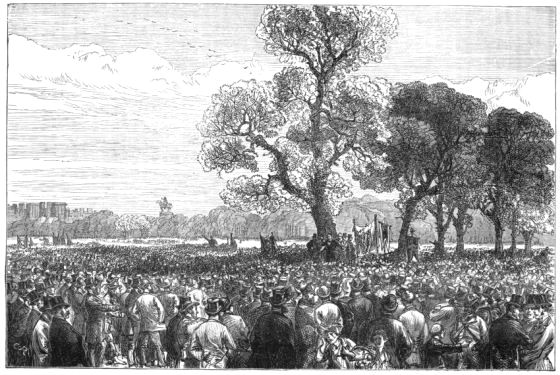
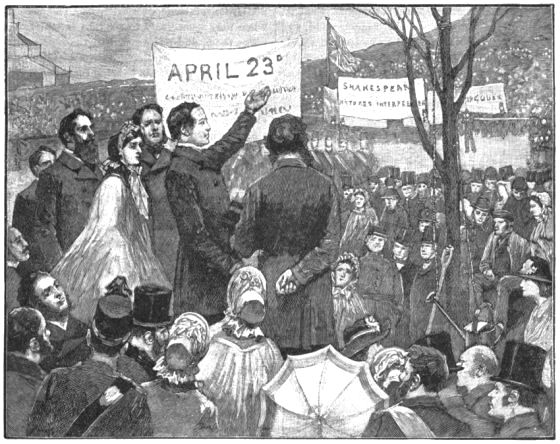
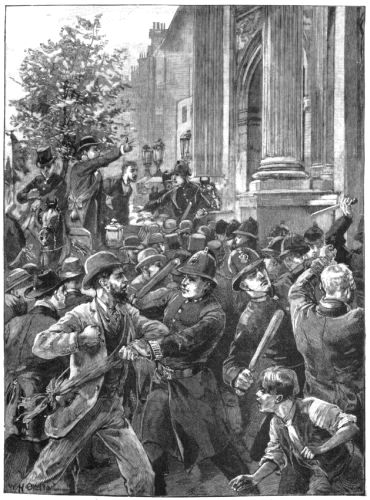
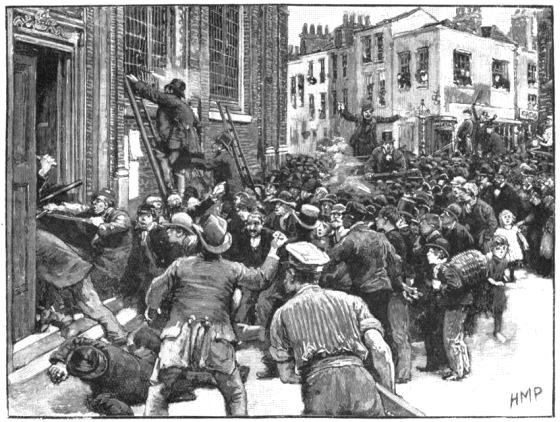
MEETING AT THE REFORMERS' TREE, HYDE PARK, LONDON. (See p. 454.)
The concession made by Mr. Disraeli was not
accepted without a protest on the part of some of
his own followers, and a still louder protest on the
part of the consistent anti-reformers, Lord Cranborne
and Mr. Lowe. Lord Cranborne insisted
upon at least an adjournment, that the House
might not vote blindfold; and Mr. Lowe spent the
three days' recess in preparing a new philippic.
Both sides of the House came in for their share of
reproof from this impartial censor; both alike, he
said, were weary of the subject of Reform, and
willing to adopt any solution of the question; both
were afraid of a dissolution; both alike were
miserably anxious not to give offence to the classes
about to be enfranchised. He declared that no
great number of members really and honestly
either desired or approved the change about to be
made. Which party in the House, save and
except a few of the extreme Liberals below the
gangway, really wanted household suffrage and the
enfranchisement of the new voters? The question
had changed since last year. "The question now
is not—what is the opinion of the élite of the
working classes? but—what is the opinion of the
unskilled labour class? For instance, in the
borough which I represent you will, I rather think,
give us some Wiltshire labourers with 8s. a week
wages. Will any gentleman favour me with a
précis of the politics of these men?" It was like
1866 over again; but Mr. Lowe was powerless to
change the intentions of the House. The amendment
was adopted without a division on May
20th, though Mr. Disraeli attempted, a short time
afterwards, to tone it down and practically to
replace what it had abolished, by making it
optional to continue the compounding system.
The attempt, doubtless suggested to him by some
timid follower, was unsuccessful; and the law
came to be that "no owner of a dwelling in a
parish, either wholly or partially within a borough,
is to be henceforth rated to the poor rate instead
of the occupier." In this way the vexed question
of "personal rating" was solved, and household
suffrage in its simple form was established in the
boroughs.
With regard to the county franchise, the history
of the Bill was not so full of incident. The
original proposal of Government had been to give
the franchise to "rated occupiers of premises of
any tenure within the county of the rateable value
of fifteen pounds and upwards;" the words "any
tenure" referring to the various modes—freehold,
copyhold, leasehold, annual tenancy, etc.—on which
premises may be held. There were also various
"fancy franchises" proposed in the counties as in
the boroughs, but these were very soon withdrawn.
The substantial proposal of Government was
modified in various ways. On Mr. Colvile's
motion, the franchise was extended to copyhold
tenants of premises of the value of £5 per
annum—that is, to such persons as, without being
freeholders, were practically the owners of their
dwellings; and very soon afterwards Government
acceded to the proposal of Mr. Hussey
Vivian to extend the franchise to "leaseholders
under sixty years' leases of lands worth £5 a year."
Finally Mr. Locke King proposed to substitute
£10 for £15 as the figure down to which county
occupiers were to have a vote; and though he did
not press his motion, he obtained from Government
the concession of reducing the figure from
£15 to £12.
The part of the Bill that related to the redistribution
of seats was very roughly handled
during the early stages of the Bill, and the
treatment it received in committee was equally
severe. But when all was done, there still
remained much that failed to satisfy the reforming
party in the country. Government proposed
to deal with thirty new seats—namely, with the
seven provided for them by the total disfranchisement
of Lancaster, Reigate, Great Yarmouth, and
Totnes, and the twenty-three from the same
number of small boroughs which were to lose one
of their two members. This number was soon
enlarged. On May 31st Mr. Laing, member for
the Wick Boroughs, moved that "no borough
which had a smaller population than 10,000 at the
census of 1861 shall return more than one member
to Parliament." This motion, which gave thirty-eight
seats to the House in place of twenty-three,
was carried by a great majority (306 to 179),
though the Chancellor of the Exchequer opposed it.
There, however, the House paused in the process
of disfranchisement. Mr. Serjeant Gaselee's motion
to extend the principle of Mr. Laing's amendment,
by wholly depriving towns of less than 5,000 inhabitants
of their member, was not carried.
Mr. Disraeli's treatment of the delicate task of
redistribution was this. He proposed to give
twenty-five seats to the counties, two new members
being given to each of the following: Cheshire,
Derbyshire, Devonshire, Essex, West Kent, North
Lancashire, Lincolnshire, Norfolk, Somersetshire,
Staffordshire, East Surrey, and the West Riding
of Yorkshire, and one new seat being given to
South Lancashire. A member apiece was to be
given to thirteen large manufacturing or commercial
towns, till now unrepresented: Barnsley,
Burnley, Dewsbury, Darlington, Gravesend, Hartlepool,
Keighley, Luton, Middlesborough, St. Helens,
Stalybridge, Stockton, and Wednesbury. Chelsea
and Hackney were to be constituted boroughs,
each with two members. Salford and Merthyr
Tydvil were each to return two instead of one.
The Universities of London and Durham were to
combine to return one member.
This scheme enfranchised a certain number of
new towns, and its county redistribution in some
cases gave a more direct voice to the industrial
population; but it left the great manufacturing
towns of Birmingham, Manchester, and the rest
exactly where they were, and it retained what was
thought to be too much power in the hands of the
small boroughs. Mr. Disraeli, however, declined
the proposal of Mr. Laing to give a third member
to the six great manufacturing and commercial
towns—Liverpool, Manchester, Leeds, Sheffield,
Birmingham, and Bristol; and again he opposed
Mr. Hadfield's and Mr. Berkeley's proposals in
favour of Sheffield and Bristol. And when he
assented to Mr. Horsfall's motion to give a third
member to Liverpool, Manchester, and Birmingham,
it was only on condition that the members
given to them should be taken away from some of
the other towns which Government admitted to
have claims for increased representation.
The remaining time during which the Bill was
in committee was occupied with a discussion of the
complicated question of boundaries. It was necessary,
in order to give completeness to the Bill, to
examine the boundaries of existing boroughs and
counties, as well as to determine those of the new
boroughs created by the Bill. For this purpose,
after much debating on minute points connected
with the rights conferred by different kinds of
ownership in boroughs and counties, a Parliamentary
Commission was appointed "to inquire
into the boundaries of all the boroughs of England
and Wales, with a view to ascertain whether the
boundaries were to be enlarged;" to investigate
also the local conditions of the new boroughs, and
to ascertain what alterations should be made in
the divisions of counties. The report of the
Boundary Commissioners was to be laid before
Parliament, and, till its adoption, provisional
regulations were made on the points in question.
At last, at the end of a long and weary Session,
the moment arrived—the "supreme and solemn
moment," as Mr. Beresford Hope described it—when
the Reform Bill was to be read a third
time. It was the evening of the 15th of July.
Mr. Disraeli's success was at hand. But, first of
all, although no more divisions were to be faced,
and although the passing of the Bill was certain,
Government knew they were not to escape a
whipping from exasperated enemies and candid
friends. In the presence of a crowded House
Lord Cranborne rose to deliver his soul. From
the day when he had resigned office, and refused
to work with Mr. Disraeli, the rooted antipathy
between the late Secretary for India and the
Chancellor of the Exchequer had been growing in
strength. In incisive language, and with the slow
measured action to which his tall figure so readily
lent itself, he deliberately charged the Tory leaders
with a betrayal of their trust. He ridiculed the
idea of the Bill being called "a Conservative
triumph." "The real parent of the Bill, as we are
about to pass it," he said, "is not the Chancellor
of the Exchequer [Mr. Disraeli], but the member
for South Lancashire [Mr. Gladstone]." The Bill
that had been offered to the House in March
was wholly unlike the Bill that was now waiting
its final approval. The "checks and counterpoises,"
of which Mr. Disraeli had spoken so
confidently, were gone. Mr. Gladstone had demanded
ten alterations in the Bill, and had carried
nine of them—the lodger franchise, the abolition
of the compound householder, the provision against
traffic in votes, the abolition of the "taxing franchise,"
the omission of the dual vote, enlarged
redistribution of seats, reduced county franchise,
the omission of voting papers, of the educational
and of the savings bank franchises. "If the
omission of these clauses, and the adoption of the
principles of Mr. Bright, be a triumph, then the
Conservative party has never in the whole course
of its history won a triumph so signal as this."
Then, in words of profound seriousness, he went
on: "I desire to protest, in the most earnest
language which I am capable of using, against the
political morality on which the manœuvres of this
year have been based. If you borrow your
political ethics from the ethics of the political
adventurer, you may depend upon it the whole
of your representative institutions will crumble
beneath your feet.... Even if I deemed this
measure to be most advantageous, I still should
deeply regret that the position of the Executive
should have been so degraded as it has been in the
present Session. I should deeply regret to find
that the House of Commons has applauded a
policy of legerdemain; and I should, above all
things, regret that this great gift to the people—if
gift you think it—should have been purchased
at the cost of a political betrayal which has no
parallel in our Parliamentary annals."
This, from a seceding Conservative, from one
who, even in opposition, retained the confidence of
the Conservative back benches, was severe; and
no less severe was the language of Mr. Lowe, who
spoke immediately after. If Lord Cranborne was
bitter because he, and genuine Conservatives with
him, had been sacrificed to keep, as he said,
"political adventurers" in office, Mr. Lowe was
furious because he had succeeded in turning out
the Liberal Government in 1866 only to make
way for a more revolutionary Tory Government in
1867. "Was it to be conceived," he said, "that
right honourable gentlemen, who had given no
indications of the extreme facility of changing
their opinions and lending themselves to the art
of treachery, would, for the sake of keeping a few
of them in office for a short time and giving some
small patronage to half a dozen lawyers, have been
prepared to sacrifice all the principles, all the convictions,
all the traditions of their lives; while
others were prepared to turn round upon their
order and the institutions of their country, merely
for the purpose of sitting behind these right
honourable gentlemen, and hearing, with the knowledge
that it is all true, language such as that the
noble lord [Cranborne] has used to-night?" However,
Mr. Lowe had, in the midst of his wrath,
what may be called "lucid intervals" of foresight
and practical reflection upon the consequences of
the Bill. Every one admitted that it was to pass;
every one admitted that its effect would be striking
and immediate. What, then, ought to be the
attitude of Parliament and public opinion? Clearly,
to soften "the blow which had been levelled at
our ancient institutions" as much as possible.
"We must," said Mr. Lowe, in an afterwards
famous epigram—"we must persuade our masters
to learn their letters."
Several other speeches followed, none of them
very complimentary to Government, and Mr.
Disraeli was not happy in his attempt to answer
them. He had to perform the impossible task of
showing that the Conservative party had in this
measure acted in a purely Conservative spirit, and
in a manner consistent with previous professions.
Instead of taking up the tenable ground that the
Conservative party had seen good cause, on an
examination of figures and facts, to change their
old opinions, he boldly asserted that the old
opinions remained unchanged and were embodied
in this Bill. With a noble audacity he declared
that even in 1859—the year when Lord Derby's
first Reform Bill was projected—"the Cabinet
was unanimous ... that if we attempted to
reduce the borough qualification which then existed,
we must have recourse to household suffrage;" an
assertion which it is sufficient to say was flatly
contradicted soon afterwards by Lord Carnarvon
in the House of Lords. But neither questionable
paradoxes on Mr. Disraeli's part, nor fierce invective
on Mr. Lowe's, had any influence on the
success of the Bill. When the Speaker put the
momentous words from the chair, "That this Bill
do now pass," only one obstinate voice cried
"No;" and a shout of "Aye," audible far beyond
the limits of the House, gave Mr. Disraeli
the happy assurance that his Bill had passed the
Commons.
The Bill had passed the Commons, but it was
not yet law. Indeed, when Lord Derby rose to
move the second reading of the Reform Bill in
the House of Lords on July 22nd—exactly a week
after it had left the Commons—he found his own
party by no means so manageable as Mr. Disraeli
had found them in the Lower House. The
debate was long and the speeches were able,
and though in the end the second reading
passed without a division, yet the speeches were
very nearly unanimous in disapproving of the
measure. Lord Cairns, indeed, approved the Bill
warmly, and made no secret of his hopes from
"the residuum." "We know that on most
subjects there is a considerable difference of
opinion between what are called the higher artisan
class and those below them," said he; that is, we
know that there is a gulf fixed between the bricklayer
and the bricklayer's labourer. Lord Cairns
appealed, in the name of the Conservatives, from
the bricklayer to the bricklayer's labourer. This,
he said, was the distinction between the Bill of
1866 and the present Bill: the line of £7
rental would let in the "higher artisan class"
only—a class presumed to be hostile to Conservatism;
and household rating suffrage would
let in the "class below them"—a class easily
manageable at election times. This dangerous
argument was, however, not generally supported
in the House. Lord Shaftesbury said: "To
proceed as is done by this Bill, to lift by the
sudden jerk of an Act of Parliament the whole
residuum of society up to the level of the honest,
thrifty working-man, is, I believe, distasteful to
the working-men themselves. I am sure it dishonours
the suffrage." This was in the debate raised
by Lord Grey's amendment, which was to the effect
that "the Representation of the People Bill does
not appear to the House to be calculated, in its
present shape, to effect a permanent settlement of
this important question, or to promote the future
good government of the country." Lord Grey,
however, did not mean to oppose the second reading,
but only to show to the Commons what the
Lords considered to be weak points in their Bill,
and in the end, finding that the common opinion
of the House accepted the Bill as inevitable, he
withdrew his amendment—not, however, before
Lord Carnarvon, one of the seceding Ministers,
had spoken in words that almost echoed the
furious charges of Lord Cranborne and Mr. Lowe
in the other House. Speaking of Mr. Disraeli's
assertion, to which we have already referred, that
household suffrage had been the secret doctrine of
the Conservatives ever since 1859, he gave it the
most emphatic contradiction.
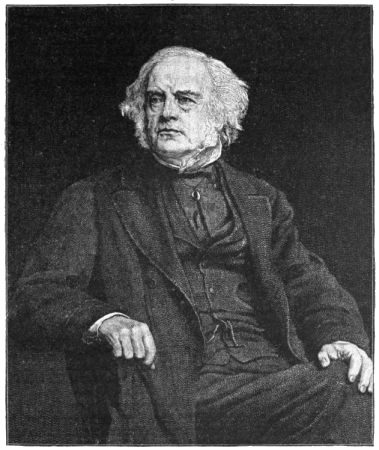
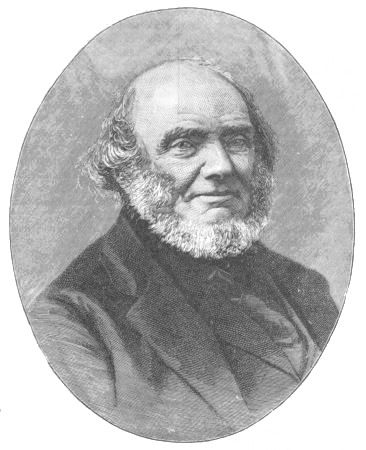
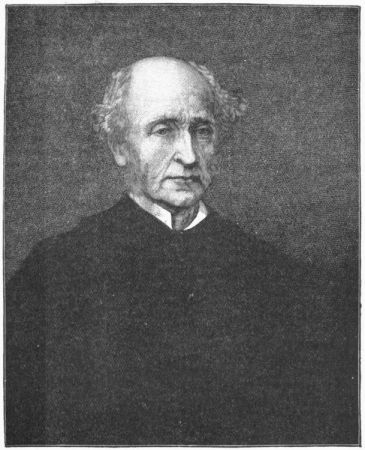
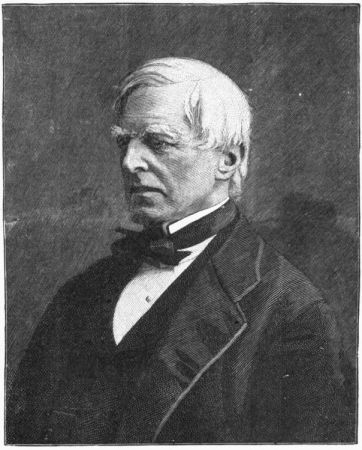
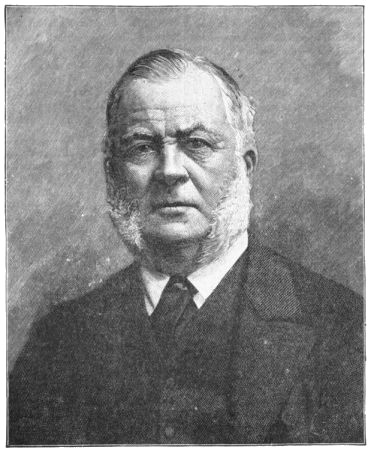
JOHN BRIGHT.
(From the Portrait by Frank Holl, R.A. By Permission of the Corporation of Birmingham.)
In the end four important amendments were
proposed by the Lords, who showed a very different
attitude from that which their fathers had shown
in 1832. There was throughout the whole of the
speeches of the peers a note of sadness and dissatisfaction;
but none thought seriously of rejecting
the Bill altogether. And the amendments, important
in themselves, did not touch the household
suffrage, which was the bugbear of the Bill, and
did not even attempt to restore the compound
householder for the purpose of robbing household
suffrage of its sting. The important amendments
were:—(1) To raise the qualification for lodgers
to £15, instead of £10—proposed by Lord Cairns;
(2) To restore £10, instead of £5, as the copyhold
qualification in counties—proposed by Lord
Harrowby; (3) To secure a representation of
minorities in the "three-cornered constituencies"—proposed
by Lord Cairns; (4) To allow the
employment of voting papers at elections—proposed
by the Marquis of Salisbury. Of these, the first
was passed by a majority of 121 to 89; the second
by a majority of 119 to 56. Both these decisions
were, however, finally reversed by the Commons
by large majorities; nor was the amendment
allowing the use of voting papers any more
successful. The Lords, with a good grace, submitted
to correction, and the Bill remained, in
these respects, the same as it had been when it
originally passed the House of Commons.
With regard to Lord Cairns's more successful
amendment relating to the rights of minorities, a
little more may be said. It was not a new idea;
the claims of minorities to a voice in affairs had
long been felt to be a serious question by political
theorists, especially Mr. Mill and Mr. Thomas
Hare; and Mr. Lowe had attempted, earlier in the
Session, to get those claims recognised in the Bill by
the introduction of some clauses resembling those
of Lord Cairns. Lord Cairns proposed, "That at
a contested election for any county or borough, no
person shall vote for more than two candidates"—adding,
a short time afterwards, that in elections
for the City of London, where four members are
returned, no one should vote for more than three
candidates. This amendment, the object of which
was to enable the minority in the boroughs of
Manchester, Liverpool, and Birmingham, in the
City of London, and in certain counties, to "lump"
their votes on one candidate, and so secure his
return, was carried by a large majority—142 to 91.
When the amendment came down to the Commons,
after the amended Bill had been read a third time
in the House of Lords, it was warmly debated.
Mr. Lowe's previous motion, to allow any elector
to have as many votes as there were vacant seats,
and to give all his votes to one candidate if he
chose, had been rejected by a majority of 141;
but now the opinion of many members had changed.
The debate was carried on quite independently of
the ordinary party divisions; instead, the division
seemed to be between those who wished in all
cases to follow the outlines of English political
precedent, and those who believed that those precedents
were sometimes clumsy and inconvenient.
For once, the House enjoyed the unusual sight of
Mr. Gladstone, Mr. Disraeli, and Mr. Bright all
taking one side on a contested question; the
principal supporters of the other side being Mr.
Mill and Mr. Lowe. Strange to say, the accustomed
leaders of the House failed to carry their
views into effect. The amendment was passed by
a majority of 253 to 204.
It is enough to add that, on the Report being
presented to the Lords, that House agreed to the
corrections of the House of Commons, and was
content to have carried one of its four amendments.
On August 15th, 1867, the Royal Assent was
given to the "Representation of the People Act;"
and for a time at least the Reform question was
settled.
Lord Derby ushered the Bill out of the House on
the third reading with words that immediately
became famous: "No doubt we are making a great
experiment, and taking a leap in the dark." That,
indeed, was the feeling of many of the Conservatives,
and even of many of the moderate Liberals;
and few of the cartoons of Punch have been more
effective than that which, illustrating the Prime
Minister's words, represented him as a steeple-chaser,
charging with shut eyes at a fence of portentous
thickness, beyond which lay an unknown
country. But another of Punch's cartoons gave
the honour of the Bill to its real author, though
there were long afterwards those who asserted, in
agreement with Mr. Bright, that it was "Lord
Derby's Bill." On the walls of the Royal Academy
had hung in that year's exhibition a wonderful
picture by a new artist—Mr. Poynter's "Israel in
Egypt." It showed the mighty form of the Sphinx,
the mysterious Egyptian monster that still remains
half buried in sand in the Theban Desert,
dragged upon a car to its place by a thousand
toiling Israelitish slaves. The spectator, as he
gazed upon the picture, could almost hear the crack
of the slavedriver's whip, and the groan of the
miserable wretch who fell under the wheels; the
crowd of bending forms seemed alive, the car
seemed moving. This was the picture that Punch
parodied. To a place in the Temple of Success and
Fame a car was moving, dragged by straining
multitudes; the multitudes bore the well-known
likeness of the members of the English House of
Commons, and the figure on the car wore the
mysterious, Sphinx-like, Oriental features of Mr.
Disraeli! "Israel in Egypt" became "Disraeli in
Triumph;" the slaves bending beneath the weight,
and torn by the merciless lash of necessity, were
her Majesty's Ministers and the blind, dazed, unwilling,
but yet obedient members of the Conservative
party.
Parliamentary Reform occupied nearly all the
time of the House of Commons during the first of
the two Sessions of 1867; but still on the "off
days" there were several important discussions and
some important legislation. The Reform Bill only
applied to England and Wales, and in the unquiet
state of Ireland Government did not propose to
make any alterations in the electoral law of that
country. To Scotland they wished to apply a
measure very similar to the English one—only
differing from it, in fact, so far as the exigencies of
Scottish law required. Household suffrage in its
simple form in the boroughs, in the counties a reduction
of the qualification like that effected in
England, and a moderate redistribution of seats
were the main features of the Government measure.
It was not, however, carried during this year
from want of time.
Although Ireland had not assumed that prominence
in the debates of Parliament which she held
afterwards, there were "Irish debates" in plenty;
and political prophets saw clearly that Ireland
was to be the immediate question for the Reformed
Parliament to grapple with. First came
the proposal of Lord Naas, unfortunately rendered
necessary, for the continued suspension of the
Habeas Corpus Act. The Secretary to the Lord-Lieutenant
explained that he had hoped to be able to dispense
with these extraordinary powers, but that fresh
signs of activity had appeared among the disaffected
population. When the mysterious "invasion" of
Chester happened (an event to be immediately
described), a simultaneous attempt at a rising was
made at Cahirciveen, in the county of Kerry; and
symptoms of revolt made themselves apparent in
some of the large towns. He, therefore, with great
regret, asked for the suspension of the Habeas
Corpus Act for three months longer; and the gravity
of the emergency was shown by the fact that the
seconder of the motion was Sir John Grey. The
suspension was allowed by the House, and also by
the House of Lords; but it was with considerable
alarm that, three months later, the country heard
that Government had found it necessary to apply
again to Parliament for a further suspension
of the Habeas Corpus Act. The Queen's Speech
at the beginning of the Session had "trusted that
Parliament might be enabled to dispense with the
continuance of any exceptional legislation" for
Ireland, and yet the continuance was twice asked
for. This was generally felt to be an instance of a
want of foresight on the part of the Ministry;
though Lord Naas announced that the disturbances
in Ireland were caused by the resolutions adopted
at a Fenian meeting held at New York in January,
when an attempt at insurrection was decreed. The
debate that took place on Lord Naas making his
second proposal called forth a great deal of that
fund of contradictory opinion on Irish questions
which was so richly exhibited in the debates of two
years later. The request of Government was,
however, granted without difficulty. Bills tending
to the prevention of discontent, as well as to its
cure, were also discussed during the Session, but
they only served to show what was afterwards
proved by Mr. Gladstone's Ministry, namely,
that the question of Irish remedies was far too
complicated, far too debateable, to be disposed of
in a casual debate or two thrown in amidst a busy
Session. No motions of private members, such as
was that of Sir Colman O'Loghlen, no Ministerial
afterthoughts, like the Bill of Lord Naas for "promoting
the improvement of land by tenants," could
solve the Land Question; and the House showed
its sense of this by allowing these measures to drop
after short discussions. In the same way with the
Irish Church Question. Sir John Gray brought it
forward on the 7th of May, in the thick of the
Reform campaign, and, of course, his motion—"That
the House would on a future day resolve
itself into a committee to consider the temporalities
and privileges of the Established Church of Ireland"—had
no chance of success at such a time.
It drew, however, from Mr. Gladstone another of
those emphatic statements of disapproval of the
existing Establishment which, begun in 1865, had
cost him his seat for Oxford University, and which
ended in 1869, when he carried Disestablishment.
In the House of Lords, Lord Russell moved for a
Royal Commission to inquire into the revenues of
the Established Church of Ireland, and his motion
was agreed to. The investigations made by the
Commissioners appointed in consequence of this
motion formed the basis of the action of the
Liberal Government two years later.
Other subjects that occupied the attention of
Parliament during the year were, besides various
points of foreign policy, Church Rates, Religious
Tests in the Universities, Religious Disabilities in
various offices in Ireland, Increase of the Episcopate,
National Education, the Factory Acts and
their possible extension, the Agricultural Gangs,
and the Right of Meeting in the London Parks.
In the second and extraordinary Session of Parliament,
which was called together in the autumn to
vote supplies for the Abyssinian expedition, a few
other matters were brought forward; but the
principal concern of that short Session was the
subject that had called the House together.
That, however, is a matter that may fairly be left
until we come to speak of the year 1868, when the
whole story of the causes, circumstances, and
results of the expedition will be told. On the
other questions we have mentioned little actual
legislation was achieved, but the tendency of
future legislation was foreshadowed.
The Oaths and Offices Bill had for its object
the removal of the restriction that prevents
a Roman Catholic from being Lord Chancellor
of Ireland, and of various small disabilities, relics
of the old penal laws, which Roman Catholics
still suffered in Ireland. The Bill was passed
after some discussion. Mr. Coleridge's Bill for
abolishing religious tests required from members
of Oxford University in taking certain degrees
and in being elected to certain offices, was not so
fortunate. The House of Lords rejected it after it
had been passed by the Commons—and passed in
an extended form, applying to Cambridge as well
as to Oxford. The Lords seem to have thought
that their concessions on the subject of Reform
were as much as could be expected from them in one
Session. Nor did they accept with any unanimity
Lord Lyttelton's Bill for extending the Episcopate;
and the Bill had to be withdrawn. National
Education was approached, but no more, in a Bill
brought in by Mr. Bruce, a prominent member
of the Opposition. Mr. Bruce based his Bill upon
many of the same statistics that afterwards lent
strength to Mr. Forster's advocacy of a similar
proposal—as, for instance, where he showed that
in the diocese of London, containing 361,000 children
who ought to be at school, only 182,000
(almost exactly one half) were actually at school.
The Bill was in some points singularly like Mr.
Forster's Bill of 1870, and in many points unlike
it; it showed the same favour to the local system,
and proposed the appointment of "school committees"
with the functions, or nearly the functions,
of the school boards afterwards established; and it
showed the same regard for religious education.
It was not proposed with any intention of being
carried into law; it was only an instance of the
common Parliamentary device of inviting a Government
to declare itself, and of showing to the
Opposition, in case of an unsatisfactory Government
answer, what the tactics of their own
leaders would be if they were to be restored to
power. Other measures especially affecting the
wage-earning classes that were carried into law
were measures for extending the operation of
the Factory Acts to certain occupations not
included in them, and thus increasing the protection
afforded to women and children in the great
towns; and also strong legislative restrictions upon
what is known as the "gang system." This last,
which prevailed especially in the eastern counties,
was the system by which children of both sexes
were gathered together in gangs by a contractor,
or "ganger," and let out to the farmers to work in
the fields at weeding or sowing. It is obvious
that a system of this kind was full of danger, both
to the physical and moral well-being of the
children. Too often the contractors were hard
men, whose one object was to make as much
money as possible out of their gangs; and for this
they would overwork the children's bodies and
leave them morally uncared for. An Act was
passed applying the same principles to the agricultural
gangs as had been applied to the factories,
and asserting the right of Parliament to protect
the children and limit the powers of the gang-masters.
It laid down hours beyond which it was
unlawful for the children to work, and imposed
other restrictions on the employment of girls.
It worked well even at first; and later, when
supplemented by the Elementary Education Act of
1870, it put it still more out of the power of
parents to sell their children's whole time, to give
them up body and soul, to the weary drudgery of
farm labour.
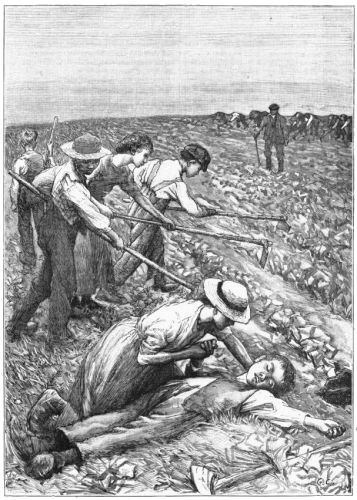
"GANG SYSTEM" OF FARMING. (See p. 452.)
The time of Parliament was further occupied
with discussions on the Right of Meeting in the
Metropolitan Parks. The way in which, in 1866,
the populace and Mr. Beales took this question
into their own hands and marched into Hyde Park
across the ruins of the railings has already been
recorded; and it has been said how keenly Mr.
Secretary Walpole felt the distress of the situation.
Again in this year the Reform League was
active. The conduct of Government with regard to
Reform had not, at least early in the Session,
pleased the ardent Reformers; they distrusted Mr.
Disraeli's obscure eloquence, they thought the
"system of checks and counterpoises" was far too
clever to be satisfactory. Accordingly, it was
resolved by the leaders of the League to hold
another meeting in the Park, on the 6th of
May. But on the 1st of May a proclamation
appeared whereby all persons were warned and
admonished to abstain from attending, aiding,
or taking part in any such meeting, or from
entering the Park with a view to attend, aid, or
take part in any such meeting. This was an
instance of the "spirit of conciliation and compromise"
English statesmen are so fond of,
which succeeds so poorly in times of high excitement.
Government intended to leave the
Park gates open, and not to attempt to disperse
the meeting by force, and yet it "admonished"
people not to attend. Of course, the proclamation
excited much discussion in Parliament; and Mr.
Bright made an energetic statement of his belief
that the parks were "public places," and an energetic
protest against the proposal to swear in
special constables—a measure which, he said,
always tends to promote class hostility, and to
create breaches between the divisions of the
people. With this declaration of "the Tribune"
to back them, the Reform League carried out its
plan in the face of the Government admonition.
Seventy thousand persons formed the audience of
the speakers in the Park; a hundred thousand
more, drawn partly by real interest in Reform, and
partly by curiosity, filled the approaches and the
open spaces; and "the Ring" was filled with the
carriages of rich people, who had come to look
on. There was absolutely no disturbance. The
O'Donoghue, Mr. Beales, Colonel Dickson, Mr.
Odger, Mr. Lucraft, and other well-known Reformers
made speeches, and the meeting quietly
dispersed at dusk, with no occasion for the
5,000 police and the soldiers who were in readiness
close by to come in and restore order.
But Government felt that they had received a
check. Mr. Walpole resigned, "in consequence
of the onerous duties imposed upon him," and
his place was filled by a man of less susceptibility
and more energy—Mr. Gathorne Hardy.
He made many attempts during the remainder
of the Session to pass a Government Bill
abolishing the right of public meeting in the
parks, but without success. The Reform Bill
occupied too exclusively the time of the House;
and it was felt that there was a certain invidiousness
in passing a measure that would seem to be
directly aimed at the prominent Reformers at the
very time when their demand for Reform was
being granted. Immediately after the passing of
the Representation of the People Act, Parliament
was prorogued; but before the year was over it
was convoked again for an extraordinary Session,
to be described when we come to speak of the
Abyssinian War.
The first occurrences outside Parliament that
demand our attention are those connected with the
Fenian outbreak, which this year were marked
by a rare audacity, and occasioned great alarm in
the public mind and severe retributive measures.
We have already said that in February a rising
took place in the county of Kerry. In December
a martello tower near Cork was attacked, and the
arms were carried away; and in several places
gunsmiths' shops were broken into and robbed of
their contents. But the alarm caused by these
outbreaks on Irish soil was as nothing compared
with that caused by certain outbreaks of Fenianism
in England. The first of these was a supposed
attempt to take Chester Castle and make off with
the arms and ammunition contained in it.
Chester Castle is a mediæval fortress, and in
1867 it was used as a garrison for a small number
of troops, and a storehouse for arms. As was
afterwards discovered, a meeting had been held
in New York early in the year, in which it had
been decided to attempt a rising in Ireland; and
a band of fifty men was sent over in detachments
to the United Kingdom to organise the rising. A
central "Directory" of fifteen members was understood
to be established in London, and branch
directories were placed in many of the great towns.
In obedience to orders from these authorities, a
movement was made upon Chester on February
11th. The Castle contained at the time 9,000
stand of Enfield rifles, 4,000 swords, 900,000
rounds of ammunition, and some arms belonging
to the militia; and the only guard consisted of a
handful of men belonging to the 54th Regiment.
During the night of the 10th information was
given to the Chester authorities by the Liverpool
police that an ex-officer in the American service—himself
a Fenian—had come to them, and made
known the Fenian design, which was to assemble
in large numbers in Chester the next day, seize
the Castle, carry off the arms, break the telegraph
wires, and tear up the rails on the railway, and
themselves escape, viâ Holyhead, to Ireland with
their booty. Very early in the morning the information
began to be verified, and large numbers
of young men, apparently of the artisan or labouring
class, kept arriving by every train from
Manchester, Liverpool, Stalybridge, Preston, and
other manufacturing towns. Meanwhile, the civil
and military authorities of Chester were actively
employed; telegrams were passing between them
and the Assistant Adjutant-General at Manchester,
and Government and the Commander-in-Chief
were also kept informed. Early in the morning
the volunteers were called out; and Mr. Walpole
having telegraphed instructions that they ought
not to be employed as soldiers in putting down a
riot, but that they might as individuals assist the
authorities, and even, if necessary, use their arms,
they were sworn in as special constables. Still the
invaders kept massing in the town. For some
reason, though their errand was very well known,
they were not arrested in detachments in the
places from which they started, but were allowed
to come to Chester unimpeded. By five o'clock
the strangers amounted to 1,500 in number, and
yet the only force at the disposal of the authorities
was a company of soldiers of the 54th, some of the
county constabulary, and the volunteers as special
constables. Yet, by extraordinary good fortune,
this most inadequate force was not put to the test
of fighting. The Fenians, seeing that some preparations
had been made for their reception,
suspected that others might have been secretly
made. So no attack was made upon the Castle,
although, between six and seven o'clock, when all
the invading force was present, and the great
reinforcements had not arrived for the defence,
there were abundant opportunities, and good hopes
of success. During the evening a public meeting
of the "friends of order" was held, and 500 special
constables were sworn in—a poor defence against
thrice their number of desperate men armed with
revolvers. But the special constables patrolled
the town throughout the night, and by the morning
it was found that the Fenians had melted away.
They had walked off in small batches to Warrington
and the other large towns in the neighbourhood.
After they had gone some relics of
their visit were found, in the shape of two haversacks
containing privately-made ball-cartridges,
and there were other indications that they were
prepared to fight. During the morning of the
12th a battalion of 500 Foot Guards arrived
from London—too late to have prevented the
attack, supposing the Fenians had made it
when they had so fair a chance; but not
too late to relieve the anxious minds of the
inhabitants of Chester from the alarm and terror
of the past day. It is enough to add that sixty-seven
"suspicious characters," all of them probably
members of the invading force, were arrested at
Dublin, on the morning of the 12th, as they landed
from the Holyhead steamer. Nothing very conclusive
was found upon them to illustrate the
history of the Chester fiasco; but the authorities,
acting on the powers conferred by the Act that
suspended the Habeas Corpus, kept them in safe
custody in Richmond Bridewell. Finally some of
the ringleaders, among whom was Michael Davitt,
were condemned to terms of imprisonment.
For some months after this Fenianism lay comparatively
inactive, and the public alarm had time
to subside. But in September England was again
unpleasantly reminded of it by an event that
took place at Manchester, and which, in the
audacity of its design and the desperate manner of
its execution, was sufficiently startling. The Manchester
police, about the 10th of the month,
arrested two men who were behaving in a suspicious
manner at dead of night, and on each of
them was found a loaded revolver. From communications
held with the Irish police, it was
discovered that these men were Fenians of
considerable military rank in the brotherhood—Colonel
Kelly and Captain Deasey. They were
remanded at the police-court on their arrest; and
on the 18th, after their second examination, they
were to be removed in the ordinary police-van to
the city gaol. As they were about to enter the
van, the police saw two more suspicious-looking
men loitering about, and a constable seized one of
them, who attempted to stab him. This caused
the police to handcuff Kelly and Deasey, and they
then entered the van. Seven policemen rode outside
and four more followed in a cab; but none
of these were armed except with the usual
policeman's staff. The van drove off along its
accustomed route, over Ardwick Green and along
the Hyde Road, in the outskirts of Manchester.
There is a railway-bridge that crosses this road;
and the van approached this bridge about four
o'clock. As it did so, a tall fair-haired young man
ran out in front of it into the road, and presenting
a revolver at the driver summoned him to stop.
A large body of men made their appearance at the
same moment; and then fired several shots at the
driver and the other policemen on the roof, shot
the horses one after another, hurled a stone that
brought the driver from his seat, and clambered
up to the roof of the van to be in readiness to
break it open if the door could not be forced.
The small body of unarmed constables made a
brave defence of the door; but axe and crowbar
were being vigorously employed, and forty or fifty
men armed with revolvers were carrying on the
attack and firing without mercy. A crowd began
to gather, but the Fenian revolvers kept them
back for the most part. Two of the constables,
Bromley and Trueman, were wounded; a civilian
named Sprossen was shot in the ankle. Still the
door resisted; a hole had been made in the roof,
and stones had been let fall on the head of Sergeant
Brett; he had been summoned to give up the keys,
but he steadily refused. Then a panel of the door
gave way, and one of the assailants, the tall young
man who had led the attack, and who was
afterwards identified as William O'Meara Allen,
presented his revolver at the wounded policeman
with a fresh demand for the keys. When this was
refused, he fired at the lock of the door and blew
it open. Again he demanded the keys—for the
cells of the van were each of them locked—and
again was refused. Then he fired point blank at
the head of Brett, who fell mortally wounded, the
bullet having passed straight through the skull.
The keys were now secured, the doors unlocked,
the two prisoners released. As a witness at the
trial swore, Allen said to one of them, "Arrah,
Kelly, I'll die for you before I'll deliver you up!"
Then Kelly and Deasey made off, Allen threatening
to shoot any one who followed. The Fenians then
dispersed, running across the fields or into the
town; and all of them escaped for the time with
the exception of four, including Allen, who were
run down. Brett died very soon after receiving
the shot.
It may be imagined that so bold a rescue created
consternation in the minds not only of the inhabitants
of Manchester, but of all English people.
It was the most reckless act the Fenians had as
yet attempted; and the uncompromising use of
force, while it horrified people, showed them once
for all what a dangerous thing the Fenian conspiracy
was. The seriousness of the occasion was
such that Government issued a special commission
for the trial of the prisoners, who, with
the four who were captured just after the rescue,
numbered twenty-nine. The judges were Justices
Blackburn and Mellor, and before them twenty-six
of the men who had been arrested were arraigned,
in different detachments, on counts extending from
the charge of wilful murder to the charge of riot
and assault. There is no need to state the facts
of the trial at length; when the law had once been
laid down, the case became one simply of identification.
The Attorney-General, Sir John Karslake,
held the Crown brief, and explained the law—namely,
that if men conspired and combined to
effect a rescue, prepared to use force if they were
opposed, and if from their action during the rescue
death resulted, that amounted to the crime of
murder. The prisoners Allen, Larkin, Gould,
Maguire, and Shore were all identified by numerous
witnesses as having led the attack on the
van; and many witnesses swore to Allen's having
fired the fatal shot. They were all found guilty,
and, though each of them denied having actually
committed the murder, they were sentenced to
death. To Maguire, however, who was convicted
in spite of very clear evidence of an alibi, the
Home Office sent a pardon; and Shore's punishment
was commuted, because he had not been
armed with a revolver, but had only thrown stones.
But with the others the law took its course.
Great efforts were made to obtain a reprieve, and
much energy was displayed by a section of the
press in showing that the crime for which they
were to suffer was political, and was not murder.
But it was of no avail; the Ministry then in power
was not likely to take that view, nor even to
recognise the proposition that no political offences
are capital. On November 23rd Allen, Larkin, and
Gould were executed at Manchester, in the presence
of enormous crowds of people. Their memory was
consecrated by "processions" of their countrymen,
held on December 1st—a Sunday—in Manchester,
and in Dublin, Limerick, and other Irish towns.
The Irish populace persisted in regarding the three
men as martyrs, and Mr. T. D. Sullivan commemorated
the deed in the popular ditty, "God
save Ireland."
Whatever ultimate effect the execution had, it
did not prevent certain desperate sympathisers
from outdoing in nefarious audacity the executed
men. It was known that the feelings of a large
class of Irishmen were embittered by the execution;
but it was not suspected that within a very
short time a deed would be perpetrated in London
that would throw the Manchester rescue into the
shade. Such a deed was, however, done; and,
once for all, it implanted in the minds of all classes
of English people a feeling of intense hatred
towards Fenianism.
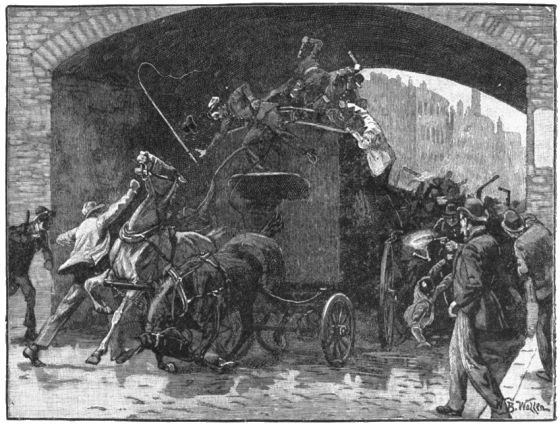
FENIAN ATTACK ON THE POLICE VAN IN MANCHESTER. (See p. 455.)
Two men, named Burke and Casey, had been
arrested in London on a charge of being Fenians;
they were imprisoned, under a remand, in the
Clerkenwell House of Detention. This prison had
an exercising-ground within its walls, and at a
fixed hour in the afternoon the prisoners were
exercised there. The wall of the exercising-ground
ran along Corporation Lane; it was about twenty-five
feet in height and two feet in thickness,
becoming slightly thinner towards the top. The
partisans of the Fenian prisoners determined to
blow down this wall during exercise-time, to give
them a chance of escaping in the confusion. Accordingly,
about a quarter to four on the afternoon
of December 13th, a man came along the lane
wheeling a truck, on which was a barrel covered
with a white cloth. This truck he left opposite
the wall, disappeared for a moment, and returned
with a long squib, which he fixed in the barrel.
He then coolly borrowed a light from some boys
who were playing about close by, applied it to the
squib, and ran off. In a few seconds a horrible
explosion took place, sounding like the discharge
of a park of artillery, and sending a shock through
all that district of London. The prison wall
tottered and fell. The houses opposite were shaken
to their foundations, and several of them, after
rocking for a moment, came crashing down. The
screams and groans of wounded people mingled
with the noise of falling rafters, and the clouds of
dust that rose from the ruins, choking the light of
such lamps as stood the shock, added to the horror
of the scene. When search could be made, it was
found that at least forty people, many of them
women and children, were seriously hurt; one was
dead already, and three died soon afterwards
in the hospital. The others, with their various
degrees of injury, were taken care of at St.
Bartholomew's and at the Free Hospital, Gray's
Inn Road, until their recovery. It may be added
that Burke and Casey did not escape, the governor
of the prison having, for that day, changed their
hour of exercise, so that when the explosion came
they were safely in their cells. Thus the attempt
of the miscreants to release the prisoners was completely
frustrated. The excitement caused by this
outrage was such as cannot be described. Crowds
of people thronged the scene of the explosion, and
500 police and a body of soldiers were necessary
to keep order. Rumours of all kinds found their
way about London—that the Bank of England
was blown up and sacked; that the Tower of
London was destroyed; that the explosion was but
the first of a series of plotted outrages meant to
avenge the "Manchester martyrs." These ideas,
however, subsided when the facts came to be
known. Nevertheless Mr. Gladstone afterwards
declared that the Fenian outrages, by fixing public
attention upon deeply-rooted Irish grievances, had
brought the Disestablishment of the Irish Church
"within the region of practical politics."
It was in this year that society was startled by
certain revelations of the proceedings of trades
unions which were made before a commission
sitting at Sheffield. A number of mysterious
outrages had taken place periodically in that town;
and a Royal Commission, which had been appointed
to investigate the nature and working of
trades unions, determined to probe to the bottom
the supposed connection between these acts and
the unions. Accordingly it delegated its functions
to three barristers, of whom Mr. Overend, Q.C.,
was chairman, and sent them down to Sheffield to
inquire into the matter. A special Act of Parliament
was passed, allowing these gentlemen to give
"certificates of indemnity" to any witness who
should confess to any illegal acts, for it was known
that without such certificates the questions of the
commissioners would never be answered. The
result of the inquiry was to discover facts that
thrilled all England. A kind of vehmgericht, or
secret tribunal, seemed to have been set up, which
passed sentence of death, and had its sentences
executed; which punished offenders against its
secret laws by acts the perpetrators of which could
never be brought before their country's justice;
and which deprived obnoxious workmen of the
means of life, setting the rules of the trade in the
place of law.
The cases that most excited public interest
were those of crimes instigated by one Broadhead,
the secretary of the Sawgrinders' Union. A man
named Linley had broken the rules of the trade by
taking more apprentices than the proper number.
In the words of the trade, he was "filling it with
lads." For this offence, which was supposed to
injure the chances of the men, Broadhead confessed
that he had "set on" two workmen, named
Crookes and Hallam, to "do for" Linley—that is,
to disable him, or even to kill him, if necessary.
This fact, which is but one out of many, was
revealed first of all by Hallam himself. When
called upon to give his evidence he was completely
unmanned. He twice fainted away; and when
he came to himself, he could only speak in a
whisper. In this way he confessed with slow
articulation how they had murdered Linley. They
had first bought a revolver and followed Linley
about every night for six weeks, watching their
opportunity. Then they changed their plan and
bought an air-gun, of which they first of all made
trial upon some rabbits in a neighbouring wood.
Afterwards they marked Linley down in a public-house
in Scotland Street; they entered a backyard,
and saw him sitting in a parlour. Then with great
difficulty Hallam induced Crookes to shoot. The
bullet entered Linley's head and he died some
time afterwards. The two murderers ran off and
escaped, and the coroner's jury was obliged to
return a verdict of "wilful murder against some
person or persons unknown." Hallam got £7 10s.
for the deed. He confessed that he did not know
Linley, and that he owed him no personal
grudge. He took his life merely because he
was injuring the trade. Hallam's evidence was
confirmed by Crookes, and the evidence of both by
Broadhead. The revelations made by the latter were
what really brought home to the public mind the
strength, the rigour, the unscrupulousness of the
trade organisations. Under promise of a certificate
he confessed not only to the murder of Linley, but
to the destruction of machinery, the blowing up
of houses, the mutilation, or attempted mutilation,
of whole families. "I hired Dennis Clark," he
said, "for £3 or £5, to blow up Hellewells." He
owned that he had paid a large sum to blow up the
house of a certain Parker, and £19 for blowing up
Reaney's engine-house; and he admitted many
more acts of the same kind. Moreover, he admitted
that he had arranged many of the outrages
with the secretaries of other unions—one, Bromhead,
secretary of the Pen and Pocket Blade
Grinders', and William Hides and William Skidmore,
secretaries of the Saw-handle Makers' and of
the Jobbing Grinders'. He even confessed that he
had written letters to the newspapers, denouncing,
as "infamous deeds" and "hellish deeds," the very
acts that he had himself instigated and paid for.
The outrages were very varied in character, some
being merely cases of rattening—that is, preventing
a man from working by spoiling his tools or
machinery; others being cases of injury to the person,
or of the destruction of premises. The most
common form of these grosser outrages was to
hang a canister of gunpowder in the chimney of
the obnoxious workman or master, or to fling a
canister of powder into the fire through the
window. In other cases, as in that of Linley,
shooting was resorted to. The evidence of Broadhead
and others revealed the whole system in
its full details; and disclosures of the same kind,
scarcely less terrible, were made before commissioners
who sat at Manchester.
Other proceedings of the trades' unions, which
attracted much attention during the present year,
were those connected with the strike of the London
tailors, and of the engine-drivers on the London
and Brighton Railway. The former began on the
28th of April and lasted for several months. In
August, ten of the working tailors were indicted
at the Central Criminal Court for a misdemeanour
in "conspiring together, by unlawful ways, contrivances,
and stratagems, to impoverish Henry
Poole, George Wolmershausen, and certain other
persons, in their trade and business, in restraint of
trade, and the freedom of personal action." In the
course of the trial the public learnt many facts about
the system of "picketing," which was a common
device of workmen on strike towards workmen
who would not join them. One witness said, "On
the 3rd of May I saw over 200 opposite Mr.
Stohwasser's shop in Conduit Street. The general
conduct of the persons acting as pickets was the
following and hissing workmen who had not struck
on leaving their work in the evening. They were
called cowards, and by other offensive names.
That was the general conduct of the pickets from
time to time. The pickets also used to resort to
certain public-houses—ten or a dozen—which they
called committee-rooms. I have seen them meet
there early in the morning, and then go on picketing."
Another witness, a pensioned sergeant of
police, said that he had seen customers go to shops
in carriages, and the pickets hang about the
carriages until the customers went away. Much
evidence was given of a similar character, showing
that, although no outrages like the Sheffield outrages
were committed, the union had used its
forces to prevent obnoxious workmen, by threats,
abusive language, and other annoyances, from
working at their trade. Baron Bramwell, who
presided at the trial, laid down the law on the
matter very clearly. He said that the common law
of the land made it a criminal offence for two or more
persons to conspire by threats, intimidation, or molestation,
to deter or influence another in the employment
of his industry, talents, or capital. On the
other hand, an Act of 1859 declared that "no workman,
merely by reason of his endeavouring peaceably,
and in a reasonable manner, and without threat
or intimidation, direct or indirect, to persuade others
from working or ceasing to work, should be guilty
of an offence under the former Act of Parliament."
After some deliberation, the jury found the leading
defendants guilty, but strongly recommended
them to mercy on the ground of the obscurity of
the law; and a similar verdict was returned
immediately afterwards in a case of some more of
the tailors. The judge, however, did not wish the
conviction to be more than a warning, and the
defendants were released on entering into their
own recognisances to come up for judgment when
called upon.
In the case of the engine-drivers' strike, the dispute
ended by the directors conceding most of the
points in dispute, and the grave public inconvenience
that had been feared was happily avoided.
Another strike, however, took place in the same
month of March, which, though it was not
immediately successful, was the beginning of a
movement that within a few years acquired
national importance. This was a strike of agricultural
labourers in Buckinghamshire, rising in
revolt against the system that allowed a family
to starve on nine shillings a week. It was not,
however, till some years later that the agricultural
labourers became organised and succeeded in
obtaining their rights.
This year was memorable for various distressing
accidents, some of them destructive only of property,
others grievously destructive of life. Her
Majesty's Theatre in London was burnt down; and
not only was the building itself, the scene of many
operatic triumphs during seventy-five years, destroyed,
but the music library with all its priceless
manuscripts of Handel, Rossini, and the rest,
perished. But more lamentable than this was the
memorable ice accident in the Regent's Park,
London, on the 15th of January. There was a
severe frost, and the ice on the Ornamental Water
was crowded with skaters. Suddenly it began to part
away from the bank, and for a moment the skaters
found themselves supported by a floating sheet of
ice. Almost instantly this broke up and two
hundred persons were in the water. It need only
be added that, in spite of all the efforts of the
bystanders and of the Humane Society's men, more
than forty persons were drowned. The depth of
the water was afterwards reduced in accordance
with the recommendation of the coroner's jury.
Before the year ended, other accidents as startling,
though happily not so widely destructive of life,
took place. An explosion of gunpowder at the
Faversham Powder Mills, in the month of
December, blew eleven men into the air; a still
more frightful explosion of nitro-glycerine, at
Newcastle, killed five men, and showed that the
destructive power of modern chemical invention is
liable to nullify all measures of safety that can be
taken to counteract it; and a fire that took place
in March at Accrington, by which nine children
were burnt alive in their schoolroom, added an unprecedented
element of horror to the catalogue of
accidents.
There was, however, as if to compensate for
these darker facts, an unusual amount of gaiety
imported into England during the summer months
by the arrival of certain distinguished foreign
visitors. The Belgian volunteers came over, more
than a thousand strong, and were entertained in a
very fraternal manner by their English brethren.
The Viceroy of Egypt came, and was fêted by the
richer classes of England with considerable expenditure
and effect. But his star paled before
the greater glories of a visitor who arrived when
the Viceroy had been a few days in London—no
less a person than the Commander of the Faithful
himself. Britain is so much an Asiatic power, and
has under her sway so many millions of Mohammedans,
that it was excusable for her to make the
most of her opportunity of welcoming the Sultan
of Turkey, the recognised head of all those who
profess the orthodox Mussulman faith. All
questions as to the real character of the man
and of his government were lost sight of by the
London public in the contemplation of his retinue,
his jewels, his swarthy complexion, and the white
Arab that he rode. He was bandied about from
dinner to opera, from opera to ball; the days were
filled with reviews, and processions, and fêtes.
The Lord Mayor gave him a ball at the Guildhall;
the Secretary for India spent £10,000 out of the
revenues of India upon a single evening's entertainment
at the India Office. But the noblest and
most creditable display attempted in his honour
was the naval review at Spithead. Fifteen ironclads
and sixteen unarmoured ships, with sixteen
gunboats, formed a mighty avenue, through which
the royal yacht, bearing her Majesty and the
Sultan, the Prince of Wales, and other great
personages, passed, amid deafening salutes. Only
one thing was wanting to complete the Sultan's
full enjoyment of the scene. A strong north-easter
was blowing all the time, and, by common consent
of the staff of his Majesty, the spectacle of the
naval review proved rather impressive than
pleasant. The Sultan left England on the 23rd of
July, after a visit of twelve days.
The year 1867 was a time of profound peace in
Europe, except so far as it was disturbed by
revolutionary movements which had for their
object the overthrow of the Papal Government,
and which collapsed with the defeat of Garibaldi
at Mentana. Besides the consummation of the
failure of his costly experiment in Mexico, a new
mortification befell the Emperor of the French
this year in connection with the Grand Duchy of
Luxemburg. Yet he continued to put the best
face upon everything, to claim increasing influence
for Napoleonic ideas, and to credit his foreign
policy with success in all directions. Justly
indeed might he declare—in the speech delivered
at the opening of the Chambers on February
14th—that "the voice of France had influence
enough to arrest the conqueror at the gates of
Vienna." But when, in the "Livre Jaune" (the
"Yellow Book," containing the usual annual exposition
of the views of the French Government on
foreign policy), the recall of the French troops
from Mexico was said to have been "resolved upon
in the full plenitude of our liberty of action,"—when
it was intimated that "anything having the character
of external pressure could only have placed us in
the position, despite ourselves, of having to prolong
a state of things which we should wish to
abridge,"—when he said that "the Government of
the United States understood that want of conciliation
would only have prolonged the occupation
[of Mexico], and embittered relations which, for
the welfare of both countries, should remain
friendly,"—these brave words could not hide from
the keen-witted politicians of France the real
nature of the pusillanimous surrender they were
intended to disguise. Still less could the truth
be hidden when the unfortunate Maximilian,
dissuaded by his followers from abdication, was
taken prisoner and ignominiously shot (June 19,
1867). Many keen observers prophesied that the
Second Empire was nearing its end.
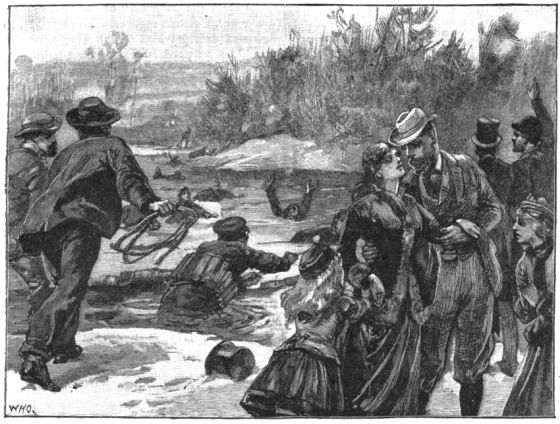
SKATING DISASTER IN REGENT'S PARK, LONDON. (See p. 459.)
The Emperor formally opened the Paris International
Exhibition on the 1st of April. Two
days before, a question had been discussed in the
North German Parliament which might easily
have rekindled another war in Europe. The
discussion bore on the negotiations, then first
divulged, that had been proceeding for some
time between the Emperor Napoleon and the King
of Holland for the cession of the Grand Duchy of
Luxemburg to France. The King of Holland, as
ruler of Limburg and Luxemburg, had voted on
the side of Prussia in the memorable division of
the 14th of June, 1866; Count Bismarck had
therefore no excuse for seizing Luxemburg as he
did Hanover and Hesse-Cassel. When the war
was over, and the organisation of the new North
German Bund was being gone on with, the King
of Holland expressed his desire that neither
Limburg nor Luxemburg should be included in the
new Bund. To this Prussia acceded, yet retained
her garrison in Luxemburg. Such a possession as
the Grand Duchy, separated by Belgian territory
from his Dutch dominions, and interposed between
two powerful States the relations between which
were continually becoming more perilous and
inflammable, was productive of more anxiety than
profit to the King of Holland; and could he have
quietly ceded it to France, for a consideration,
nothing would have pleased him better. It came
to this, that the King of Holland declared himself
ready to sell Luxemburg to France, if the consent
both of the population and of Prussia could be first
obtained. But it was quite another thing to gain
the consent of Prussia. The King of Holland
had no sooner given to the Prussian Government
an intimation of the contemplated cession, than the
matter was debated in the North German Parliament,
and warmly, not to say angrily, canvassed
in newspapers, in streets, and in houses, through
the length and breadth of Germany. It was an
intolerable thought to men who had just won so
large a measure of national unity, and were full of
pride and exultation in the retrospect, that an
old German land, which had formerly given a line
of emperors to Germany, should pass under the
power of France. The negotiation respecting
Luxemburg, had it now been transferred from
the Hague to Berlin, must, considering the excitement
of German feeling, have become acrimonious,
and would probably have ended in war.
For this the Emperor, who was engaged in plans
for the re-organisation of the French army, and the
introduction of a new weapon, was not as yet
prepared; he therefore abandoned the notion of
purchasing Luxemburg, forbore to open direct
negotiations with Berlin, and called in the assistance
of the neutral Powers. It was arranged on
the initiative of the Russian Government that
the King of Holland, in his capacity of Grand
Duke, should be invited by Britain, Prussia,
Austria, Italy, and Belgium, to propose a Conference,
to be held in London, for the settlement
of the Luxemburg question. The King of Holland
did so. Representatives of France and Prussia
also, as well as the Powers above mentioned,
were sent to the Conference, which held its first
meeting in London on the 7th of May, 1867. The
nature of the work to be done was pretty generally
understood before the Conference met, and its
deliberations were soon over. On the 18th of May
a treaty was signed, by which it was stipulated
that Luxemburg should remain, as before, under
the rule of the House of Orange-Nassau, without
any political connection with Holland, but that it
should be for the future a neutral State, its
neutrality being guaranteed by the Powers that
were signatories to the treaty, with the exception
of Belgium, itself a neutral kingdom. In accordance
with its acquired character of neutrality, the
capital of the Grand Duchy was to cease to be a
fortified town; its fortifications were to be razed
within a specified time; and the Prussian troops
were to be withdrawn after the ratifications of the
treaty had been exchanged. In this way the
question was equitably and honourably settled
without war, thanks to the diplomacy of Lord
Stanley, who had actively promoted the project of
a Conference. Earlier in the year he had written
to Lord Malmesbury that unless the Prussian
garrison was withdrawn from Luxemburg "Napoleon
must fight."
Elsewhere Englishmen observed with satisfaction
the healing of old sores. Austria, with her armies
shattered and her prestige departed, burdened with
debt, and distracted by the demands of a dozen
different nationalities, displayed in this year that
wonderful tenacity of life which she has before
exhibited on many a historic emergency. In Count
Beust, the late Saxon Minister, the Emperor found
a statesman of great capacity, astuteness, and
perseverance, whom he appointed to the post of
Foreign Minister at the end of October, 1866. At
that time dismemberment was openly talked of;
for the difficulties of the monarchy were so great
that no one could see his way out of them. The
other chief Ministers were Prince Esterhazy and
Count Belcredi, the authors of what was called the
policy of "inhibition," under which, until a common
and equal representation of the whole monarchy
could be devised, the Constitution of February,
1861, giving a Parliament or Reichsrath to
Western Austria, was suspended; the central
power governed absolutely; and parliamentary life
throughout the empire was confined within the
walls of the provincial Diets. Hungary still held
aloof from the rest of the empire, like a half
severed limb, having its own Parliament for local
affairs, but unrepresented in the imperial councils,
and sullenly obeying the administrative and executive
dispositions of the central power. Count
Beust placed two leading political aims before him—to
effect a compromise with Hungary, and to
revive constitutional and parliamentary life in
Western Austria. To bring about the first, it was
necessary to come to an understanding with M.
Déak and the party which he represented, since
he, above all other living men, possessed the
confidence of the Hungarians. Now M. Déak
was firmly convinced that a system of complete
dualism between Austria and Hungary would
alone meet the exigencies of the case—a system
under which, certain common affairs being reserved
and separately provided for, all Hungarian affairs
should be managed by a separate Administration,
appointed indeed by the Emperor, but responsible
to the Hungarian Parliament. At the opening of
this Parliament, on the 19th of November, 1866,
an imperial rescript was read, holding out hopes
of a responsible Ministry for Hungary, and of
concessions to the views of M. Déak. The plans
of Belcredi, who desired to convoke an "Extraordinary
Reichsrath," representing all the other
nationalities along with Austria, but excluding
Hungary, were swept away; and he himself was
compelled to resign soon afterwards. Count Beust
was then made Prime Minister. A deputation
from the Hungarian Diet, headed by Count Andrassy,
arrived in Vienna about the end of January,
and proceeded to negotiate with Count Beust and
the other Austrian Ministers respecting the terms
of the compromise. Early in February, 1867, the
Emperor appointed Count Andrassy his Minister
President for Hungary, and entrusted him with the
formation of a Hungarian Ministry. At last, on
the 17th of February, appeared the imperial and
royal rescript, restoring to Hungary her full
parliamentary rights as they had existed before
1848. The terms of the compromise between
Austria and Hungary were settled in the following
manner:—"Common affairs" were defined to
include the foreign policy of the empire, with its
diplomatic representation abroad, and a joint army
under the command of the Emperor. Both parts
of the Empire were to contribute proportionately
to the cost of the Ministry of Foreign Affairs and
of the army; and this proportion was afterwards
fixed, somewhat unjustly, at 70 per cent, for Austria
and 30 per cent, for Hungary. Hungary was likewise
to contribute to the payment of the interest of
the State debt. All international treaties were to
receive the sanction of both Legislatures. All other
affairs requiring a joint consideration, such as the
Customs duties, indirect taxes, and the currency,
were to be regulated by treaties, subject to the
approval of both moieties of the realm. On the 8th
of June a memorable pageant graced the streets, the
noble river, and the ancient cathedral of the double
capital of Hungary. On that day the Emperor
Francis Joseph, who had never yet received the
crown of St. Stephen, was solemnly crowned King
of Hungary in the cathedral of Buda, amidst the
joyful acclamations of a reconciled people.
So passed an uneventful recess. The necessity
for sending an armed force to Abyssinia, in order
to compel the Sovereign of that country to
release a number of British subjects, made it
advisable for the Government of Lord Derby
to convene Parliament for a short winter Session,
in order that the exact state of the question
might be explained to both Houses, their
approval of the expedition secured, and the grant
of the necessary advances obtained from the House
of Commons. Parliament accordingly was summoned
to meet on the 19th of November for the
despatch of business, and was opened by commission.
With regard to the legislative labours of
the Session, Reform Bills for Scotland and Ireland
were promised, which should assimilate the franchises
of those countries to those recently established
in England, and also measures on public
schools and elementary education. On the motion
of the Chancellor of the Exchequer, £2,000,000 were
voted for the Abyssinian expedition, the total cost
of which, unless the Emperor Theodore should
succumb, and give up his prisoners without
fighting, was estimated by Government at about
£3,500,000. To meet this expenditure, the House
of Commons voted the addition of a penny to the
income tax, and sanctioned the payment of the
Indian troops engaged out of Indian revenues.
Objections were raised to the expedition from
various quarters, but they were sustained with
little earnestness. In the Commons it was said
that the Ministers had involved the country in
war without keeping Parliament duly informed of
the progress of the difficulty in its earlier stages;
in the Upper House, a noble lord predicted
failure, and said that for the army to keep up its
communications with the sea after having penetrated
into the highlands of Abyssinia would be
found impossible. However, the general feeling, both
in Parliament and in the country, went along with
Government in thinking that all peaceful modes
of settlement had been exhausted, and that there
remained only the alternative of an appeal to arms.
In one of the debates in the House of Commons
respecting relations with Abyssinia, a singular
and really strange fact came to light. Mr. Bernal
Osborne and Colonel Sykes drew the attention of
the House to a certain letter addressed by King
Theodore to Queen Victoria several years before,
to which no answer had been sent. It now appeared
from the papers published in the Blue
Books that Theodore's resentment on account of
this slight had much influenced his later conduct.
A lively debate ensued. Mr. Layard, who had
been Under-Secretary for Foreign Affairs under
Lord Russell at the time (February, 1863) when
Theodore's letter reached the Foreign Office, gave
the best explanation that he could of the neglect,
but it was a very lame one. He said that he
himself (owing to some division of duties between
himself and the permanent Under-Secretary, Mr.
Hammond) had never seen the letter; but that
when, after a delay of eighteen months, the
despatch of Consul Cameron, covering the King's
letter, was looked for and found, it appeared that
it had a minute written on it by Lord Russell,
directing the correspondence to be sent to the
India Office, "which was the usual course taken in
all matters relating to Abyssinia." It was found
afterwards, first, that Theodore's anger was caused
by the writings of the missionaries, in which they
had alluded, one to the King's mother's history in
disrespectful terms, and the other by reflecting on
his own conduct; secondly, that Consul Cameron
had returned to Abyssinia against the King's
injunction without taking back with him an
answer to the letter addressed to the Queen.
But what became of the letter after it had
reached the India Office? The answer was given by
Colonel Sykes, who had obtained his information
from the officials at the India Office. This letter,
on which the most momentous consequences hung—in
which the ruler of the one Christian nation in
Africa entreated the Christian Queen of a Christian
nation to co-operate with him in his endeavours to
drive the encroaching, cruel, bigoted Turks from
his ancestral domains—this letter, on reaching the
India Office, appears never to have passed beyond
the notice of the chief clerk. It was supposed
that the letter had been already answered from the
Foreign Office, and so no action was taken about it.
Years passed away and still Theodore received no
answer to his letter. One may conceive what
interpretations, what crude reflections and deductions,
would sweep through the soul of a passionate
semi-barbarian monarch at finding the letter into
which he had thrown all the rough sincerity of his
heart treated with silent contempt.
"The postage of that letter," said Colonel Sykes,
"will cost us five millions."