REIGN OF GEORGE III. (concluded).
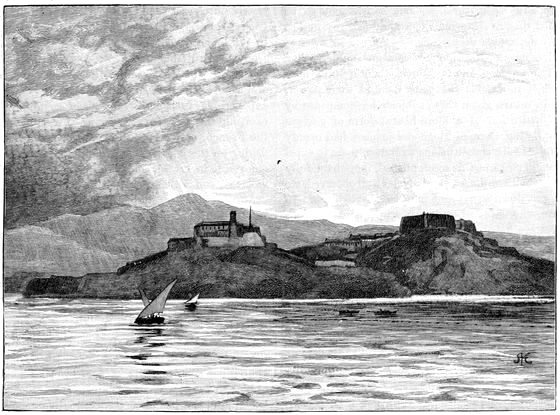
The Congress at Vienna—Napoleon's Escape from Elba—Military Preparations—England supplies the Money—Wellington
organises his Army—Napoleon's Journey through France—His Entry into Paris—The Enemy gathers round him—Napoleon's
Preparations—The New Constitution—Positions of Wellington and Blucher—The Duchess of Richmond's Ball—Battles
of Ligny and Quatre Bras—Blucher's Retreat—The Field of Waterloo—The Battle—Charge of the Old
Guard—Arrival of the Prussians—The Retreat—French Assertions about the Battle refuted—Napoleon's Abdication—The
Allies march on Paris—End of the Hundred Days—The Emperor is sent to St. Helena—The War in America—Events
on the Canadian Frontier—Repeated Incapacity of Sir George Prevost—His Recall—Failure of American Designs on
Canada—Capture of Washington by the British—Other Expeditions—Failure of the Expedition to New Orleans—Anxiety
of the United States for Peace—Mediation of the Czar—Treaty of Ghent—Execution of Ney and Labédoyère—Inability of
Wellington to interfere—Murat's Attempt on Naples—His Execution—The Second Treaty of Paris—Final Conditions
between France and the Allies—Remainder of the Third George's Reign—Corn Law of 1815—General Distress—Riots and
Political Meetings—The Storming of Algiers—Repressive Measures in Parliament—Suspension of the Habeas Corpus Act—Secret
Meetings in Lancashire—The Spy Oliver—The Derbyshire Insurrection—Refusal of Juries to convict—Suppression
of seditious Writings—Circular to Lords-Lieutenant—The Flight of Cobbett—First Trial of Hone—The Trials
before Lord Ellenborough—Bill for the Abolition of Sinecures—Death of the Princess Charlotte—Opening of the Session
of 1818—Repeal of the Suspension Act—Operation of the Corn Law—The Indemnity Bill—Its Passage through Parliament—Attempts
at Reform—Marriages of the Dukes of Clarence, Cambridge, and Kent—Renewal of the Alien Act—Dissolution
of Parliament and General Election—Strike in Manchester—Congress of Aix-la-Chapelle—Raids of the Pindarrees—Lord
Hastings determines to suppress them—Malcolm's Campaign—Outbreak of Cholera—Campaign against the Peishwa—Pacification
of the Mahratta District—Apparent Prosperity of Great Britain in 1819—Opening of Parliament—Debates
on the Royal Expenditure—Resumption of Cash Payments—The Budget—Social Reforms—The Scottish Burghs—Roman
Catholic Emancipation rejected—Weakness of the Government—Meeting at Manchester—The Peterloo Massacre—The
Six Acts—The Cato Street Conspiracy—Attempted Insurrection in Scotland—Trials of Hunt and his Associates—Death
of George III.
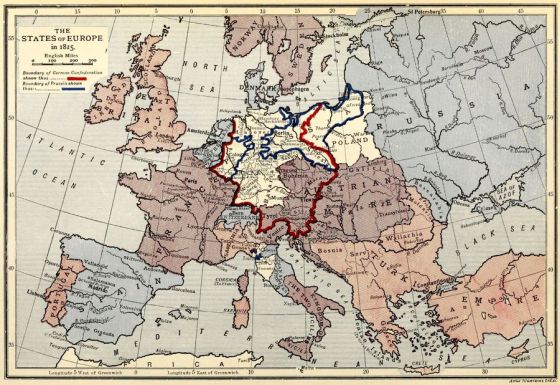
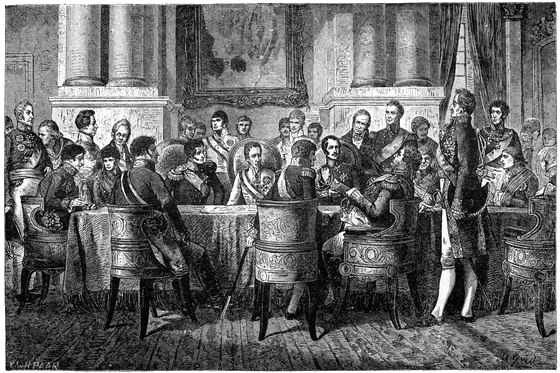
The Allied sovereigns and their Ministers met
at Vienna, in the opening of the year 1815, in
congress, to settle the boundaries of all such
States as had undergone disruptions and transformations
through the will of Buonaparte. They
were proceeding, with the utmost composure, to
rearrange the map of Europe according to their
several interests and ambitions. Austria, Spain,
France, Great Britain, Portugal, Prussia, Russia,
and Sweden had their sovereigns or their representatives
there. Those for Great Britain were
the Duke of Wellington, the Lords Cathcart and
Clancarty, and Sir Charles Stewart. All at once
a clap of political thunder shook the place, and
made every astute diplomatist look aghast. It
was announced that Buonaparte had escaped from
Elba, and was rapidly traversing France on the
way to Paris, and that his old soldiers were flocking
with acclamation to his standard. It was
what was certain to occur—what every man not
a cunning diplomatist must have foreseen from
the first, as certainly as that a stone thrown up is
sure to come down again. Yet no one seems to
have foreseen it, except it were Lord Castlereagh,
who, not arriving at Paris before this foolish
scheme was adopted, had protested against it, and
then yielded to it. On the 13th of March the
ministers of the Allied Powers met, and signed a
paper which, at length, was in earnest, and showed
that they were now as well convinced of a simple
fact as the dullest intellect had been ten years
before—that there was no use treating Buonaparte
otherwise than as a wild beast. They now declared
him an outlaw, a violator of treaties, and an incorrigible
disturber of the peace of the world; and
they delivered him over to public contempt and
vengeance. Of course, the British ambassadors were
immediately looked to for the means of moving
the armies of these high and mighty Powers, and
the Duke of Wellington to plan and to lead the
military operations against the man who had once
more developed himself from the Emperor of Elba
into the Emperor of the French.
The Duke of Wellington wrote to the British
Government to inform them of this event, and
that the Allied sovereigns were this time resolved
to make sure of the fugitive; that the Emperor of
Austria had agreed to bring into the field three
hundred thousand men; the Czar, two hundred
and twenty-five thousand; Prussia, two hundred
and thirty-six thousand; the other States of
Germany, one hundred and fifty thousand; and
that it was expected Holland would furnish fifty
thousand. Thus nine hundred and sixty thousand
men were promised, independently of Sweden and
Great Britain; so that a million of men might be
calculated upon to crush Buonaparte, provided
that the latter Power were ready to furnish the
necessary millions of money to put this mighty
host in motion.
The Duke earnestly recommended the utmost
promptness and liberality as the only means to
settle the matter effectually and at once. He said
that to give only moderate assistance was sure to
enable Buonaparte to protract the contest, and
would cost Britain more in the end; that, on the
contrary, if Britain found the means of maintaining
a great army, he was confident that "the
contest would be a very short one, and decidedly
successful." And this, in the circumstances, was
clearly the best advice. Great Britain, having
been no party to the silly arrangement for setting
up Buonaparte as a burlesque emperor at the very
doors of France, might very well have said to
the Allied sovereigns—"This is your work; we
have no further concern in it; you may finish
it as you please." But Britain was sure not to
do this; as both the Government and nation had
set their mind on hunting down the slippery and
mischievous adventurer, they were sure to follow
up the pursuit.
The British Ministry adopted the advice most
cordially. Lord Liverpool, in the House of Lords,
and Lord Castlereagh, in the Commons, on the 6th
of April, announced the astounding fact of the
escape of Buonaparte, and proposed addresses
from both Houses to the Prince Regent, recommending
the most energetic measures of co-operation
with the Allies now finally to crush this
lawless man. Whitbread vehemently opposed this
measure, declaring that it was not our business
"to commence a new crusade to determine who
should fill the throne of France." This was true
enough; but it was a truth, in the then temper of
the Government or public, which was not likely to
be attended to. The addresses were carried in
both Houses without any division, and Lord
Wellington was nominated to command the forces
which should take the field for Great Britain;
and these were to amount to no fewer than one
hundred and fifty thousand, and to consist of a
moderate number of British soldiers, and the rest
to be paid Hanoverians, Belgians, Dutch, and
Germans. Parliament immediately voted the
enormous sum of ninety million pounds for
supplies, knowing the vast subsidies which would
be required by the Allied monarchs, besides the
large sum necessary to pay our own quota of
troops.
On the 23rd of March the Allied sovereigns,
including that of the United Kingdom, signed, by
their plenipotentiaries, a new treaty of alliance
offensive and defensive, on the same principles as
the Treaty of Chaumont, entered into in March,
1814. The Duke of Wellington then hastened
away to Belgium to muster his forces there—for
Belgium, as it had been so often before, was sure
to become the battle-ground on this occasion. So
early as the 5th of April he announced that he
had placed thirteen thousand four hundred men in
the fortresses of Belgium, and had besides twenty-three
thousand British and Hanoverian troops,
twenty thousand Dutch and Belgian, and sixty
pieces of artillery. Unfortunately, the bulk of
his victorious army of the Peninsula had been sent
to the inglorious contest with America, where a
good naval blockade would have been the most
effectual kind of warfare. But he observed that
Buonaparte would require some time to assemble a
strong force, and this time must be employed by
Britain to collect a correspondingly powerful
army. The Duke, with accustomed energy, not only
applied himself with all his strength to this object,
but to stimulating, by letters, the Allied sovereigns
to hasten up their quotas, some of them notoriously
the slowest nations in the world.
Buonaparte landed at Cannes on the 1st of
March. His advanced guard presented themselves
before Antibes, and were made prisoners by the
garrison. This did not discourage Buonaparte;
he advanced by forced marches with his now less
than one thousand men, and leaving behind him
his train of artillery. Till he reached Dauphiné,
however, he received very little encouragement
from any party. All the authorities, proprietors,
and clergy, stood aloof; only a few peasantry
occasionally cried "Vive l'Empereur!" but did not
join him. He began to be very uneasy. But on
the 7th of March, as he approached Grenoble,
Colonel Labédoyère, who had been gained over
before, came out with an eagle in his hand, and at
the gates distributed tricolour cockades, which had
been concealed in a drum. Buonaparte advanced
alone towards the troops, and called on any one
who wished to kill his Emperor to do his pleasure.
All cried "Vive l'Empereur!" and crowded round
him. General Marchand endeavoured to recall
the soldiers to their duty, but in vain.
Whilst Napoleon was thus advancing towards
Paris, the besotted Bourbons rather rejoiced in it,
for they said it would compel the two chambers to
invest the king with despotic power—that was
what they were still longing for; and Louis himself,
addressing the foreign ambassadors, bade them
assure their sovereigns that he was well, and that
the foolish enterprise of "that man" should as little
disturb Europe as it had disturbed him.
Monsieur and the Duke of Orleans hastened to
Lyons, and the Duke of Angoulême to Nìmes.
Corps of volunteers were called out, and an address
to the people was composed by Benjamin Constant,
calling on them to defend their liberties against
Buonaparte; and a woman on the staircase of the
Tuileries exclaimed, "If Louis has not men enough
to fight, let him call out the widows and childless
mothers who have been rendered such by Napoleon!"
Meanwhile the conspiracy of General
l'Allemand and his brother at Lille, to carry over
the garrison of eight thousand men to Napoleon,
was discovered by General Mortier, and defeated.
Had this plot succeeded, Louis and his family
must have been made prisoners. But that was
the extent of the adhesion to the Bourbon cause.
When Buonaparte reached Lyons, the soldiers,
in spite of the Duke of Orleans, of Monsieur, and
of Marshal Macdonald, went over to him to a man.
He was now at the head of seven thousand men,
and Mâcon, Châlons, Dijon, and nearly all Burgundy
declared for him. Marseilles and Provence
stood out, the authorities of Marseilles setting a
price upon his head. But being now in Lyons,
Buonaparte issued, with amazing rapidity, no
fewer than eight decrees, abolishing every change
made by the Bourbons during his absence, confiscating
the property of every Emigrant who had
not lost it before, restoring the tricolour flag and
cockade, and the legion of honour; abolishing the
two chambers, and calling a Champ-de-Mai, to be
held in the month of May to determine on a
new constitution, and to assist at the coronation of
the Empress and the King of Rome. He boldly
announced that the Empress was coming; that
Austria, Russia, and Great Britain were all his
friends, and that without this he could not have
escaped. These decrees, disseminated on all sides,
had a wonderful effect on the people, and he
advanced rapidly, reaching Auxerre on the 17th of
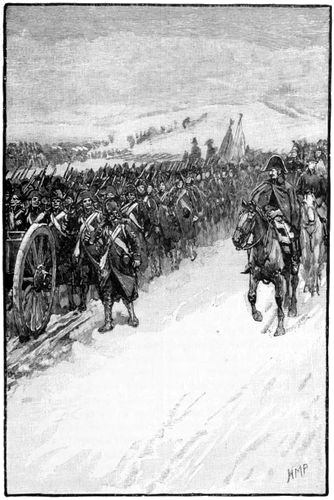
March. He rode on several hours in advance of
his army, without Guards, talking familiarly with
the people, sympathising in their distresses, and
promising all sorts of redresses. The lancers of
Auxerre and Montereau trampled the white
cockade under foot and joined him. He appointed
Cambacérès minister of justice; Fouché, of police;
and Davoust Minister of War. But Fouché,
doubting the sincerity of Buonaparte, at once
offered his services to Louis, and promised, on
being admitted to a private interview, to point out
to the king a certain means of extinguishing the
usurper. This was presumed to mean assassination
by some of his secret agents, and was honourably
rejected by Louis, and an officer was sent to arrest
Fouché; but that adroit sycophant retired by a
back door, locking it after him, got over a wall,
and was the next moment in the house of the
Duchess of St. Leu, and in the midst of the
assembled Buonapartists, who received him with
exultation.
Thus surrounded by treason, Louis doubted the
fidelity of Soult, who resigned his command; but
he trusted Ney, and sent him to attack Buonaparte
in the rear, whilst an army at Mélun, under
Clarke, Duke of Feltre, was to attack him in
front. Ney took leave of Louis on the 9th of
March, declaring that he would bring Buonaparte
to him in a cage; but at Lons-le-Saulnier, on the
14th, he received a letter from Napoleon, calling
him "the bravest of the brave," and inviting him
to resume his place in his army, and Ney went
over at once. To abate the public opinion of his
treason, he pretended that this expedition had
been long arranged between himself and Buonaparte,
but this Buonaparte at St. Helena denied.
Astounded by these repeated defections, Louis
tried to gather some notion of the state of other
bodies and troops about him. He attended a
sitting of the Chamber of Deputies, and was received
with acclamation; he reviewed twenty-five
thousand of the National Guard, and there
was the same display of loyalty; he inspected six
thousand troops of the line, but there the reception
was not encouraging. He finally summoned a
council at the Tuileries, and there the generals
declared frankly that he had no real means of
resisting Buonaparte. This was on the 18th of
March, and Louis felt that it was time for
him to be making his retreat. At one o'clock in
the morning of the 20th he was on his way towards
Lille, escorted by a body of Household
Troops. It was time, for that very day Buonaparte
reached the camp of Mélun, where Macdonald
had drawn up the troops to attack him;
but Buonaparte threw himself amongst them,
attended only by a slight escort of horse, and the
soldiers all went over to him with a shout. Macdonald
rode back to Paris, and, following the king,
assumed the command of the Guard accompanying
him. Louis hoped that the troops at Lille, under
Mortier, would stand by him; but Mortier assured
him of the contrary, and so, taking leave of Macdonald
on the frontiers, Louis pursued his way to
Ostend and thence to Ghent, where he established
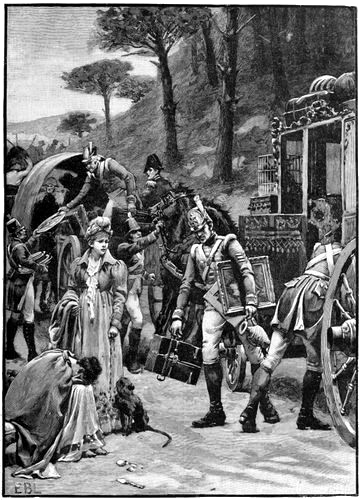
his Court. The Household Troops who had accompanied
him were disbanded on the frontiers, and
in attempting to regain their homes by different
routes, most of them were killed, or plundered and
abused.
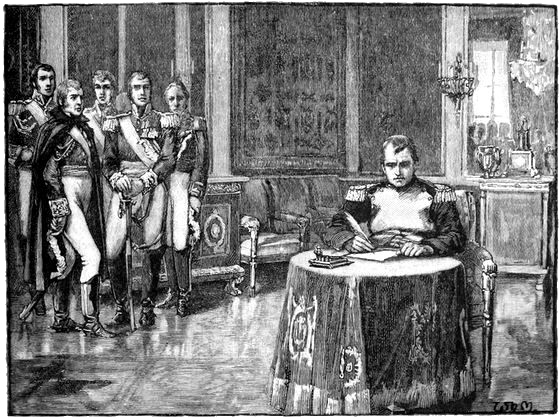
On the evening of the very day that Louis
quitted Paris Buonaparte arrived in it. He had
slept on the night of the 19th at Fontainebleau,
where, in the preceding April, he had signed his
abdication. No sooner had the king departed
than the Buonapartists, who were all ready for
that event, came forth from their hiding-places.
Lavalette resumed his position at the post-office,
and thus managed to intercept the proclamations
of Louis, and to circulate those of Buonaparte.
Exelmans took down the white flag from the
Tuileries and hoisted the tricolour, and a host of
the adherents of the old Imperial Government,
hurrying from all quarters, thronged the avenues
to the palace, and filled the court of the Carrousel.
There were ex-Ministers of Buonaparte, ex-councillors,
ex-chamberlains, in imperial costume—in
short, every species of officers and courtiers, down
to cooks, and butlers, and valets, all crushing forward
to re-occupy their places.
The Guards at the gates stood with tricolour
cockades on their hats, and the great ladies of the
Court came driving in, for they were not far off.
The Duchess of St. Leu had been permitted to
remain in Paris, and her house had been the focus
of all the Buonapartist adherents and conspiracies.
From that centre had been sent summonses to
every branch of the Buonaparte family to be in
readiness, and all had responded except Cardinal
Fesch, Louis Buonaparte, and Eugene Beauharnais,
who had too much sense to quit Munich
with his wife, the daughter of the Bavarian king.
Even Murat, to his ruin, had been induced to
declare for Buonaparte once more.
When the returned Emperor, therefore, drove
up to the Tuileries, at nearly ten o'clock on the
night of the 20th—a foggy and wet night—his
carriage, covered with mud, was surrounded by
his friends, as if he had only been absent on one
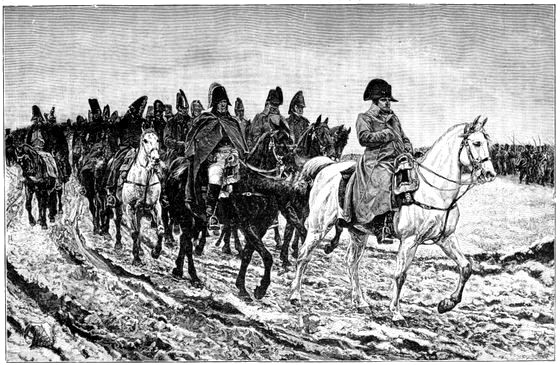
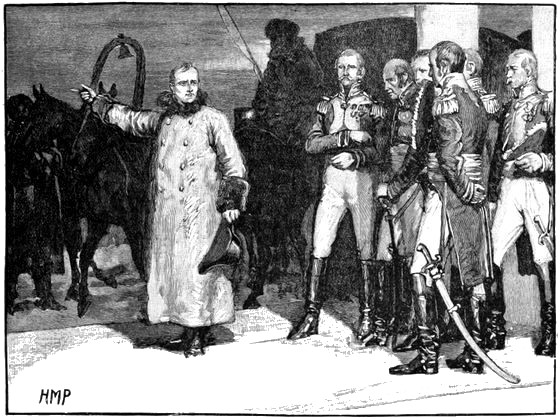
of his campaigns. As he stepped out of his
carriage in his old grey great-coat and cocked hat,
now to be seen in the museum of the Louvre, he
was instantly so hemmed in that he called out,
"My friends, you stifle me!" and a number of
general officers at once hoisted him upon their
shoulders, and thus bore him into the palace and
up into the State apartments amid deafening
shouts of "Vive l'Empereur!"
Thus was the man who had been put down by
all the assembled armies of Europe not twelve
months before, who had quitted Paris weeping
like a woman, and threatened, in his exile southward,
with being torn limb from limb—thus was
he as it were miraculously borne back again on
men's shoulders, and seated on the throne of the
twice-expelled Bourbons! It was far more like a
wild romance than any serious history. The peace
of the world had again to be achieved. The Bourbons
had been worsted everywhere, even in loyal
Vendée, and in Marseilles, which had so recently
set a price on Buonaparte's head. The Duke of
Angoulême was surrounded in Marseilles, and
surrendered on condition of quitting France. The
Duke of Bourbon found La Vendée so permeated
by Buonapartism that he was obliged to escape by
sea from Nantes; and the Duchess of Angoulême,
who had thrown herself into Bordeaux, found the
troops there infected by the Buonaparte mania,
and, quitting the place in indignation, went on
board an English frigate.
But the position of Buonaparte was far from
being secure or satisfactory. Though the soldiers
had come over to him, and endeavoured to rouse
the populace of Paris to shout for his return, it
was in vain. The Guards, incensed at their
silence, struck them with the flat of their swords,
and bade them cry, "Napoleon and Liberty!" but,
though they saw that Napoleon had returned, they
very much doubted whether he had brought liberty
with him, and they remained cold and indifferent.
They saw the armies of the Allies looming again
in the distance, and they gave no credence to
Napoleon's ready lies that he was at peace with
them. But he omitted no exertions to enter into
such a peace. He dispatched messengers to every
Court, offering to accept the terms of the Treaty
of Paris, though he had repeatedly avowed that
this treaty consummated the disgrace of France.
To these messages no answers were returned. It
was already determined that he should receive no
communication from the Allied sovereigns but in
the shape of overwhelming armies. They had proclaimed,
in their Congress at Vienna, and in their
new Treaty of Coalition, that he had forfeited
every claim to consideration, and the British
House of Commons had fully coincided with them,
and already upwards of a million of soldiers were
in arms, and in march towards France to finally
crush him.
In England the Chancellor of the Exchequer
had found no difficulty in raising a loan of thirty-six
million pounds, and this money was freely
devoted to put the armies of the Coalition in
motion. Never had such vast armaments been in
preparation from the very north of Europe to
France. The Congress had removed its locale
from Vienna to Frankfort, to be nearer the scene
of action. The Emperors of Russia and Austria,
and the King of Prussia, were again at the head
of their forces. On the side of Switzerland, one
hundred and fifty thousand Austrians, who were
liberated from Italy by the defeat of Murat, were
ready to march into France; another army of the
same number directed its course to the upper
Rhine. Schwarzenberg was again Commander-in-Chief
of Austria. Two hundred thousand Russians,
under Barclay de Tolly, were also marching
for Alsace, and Langeron, Sacken, and other
generals were at the head of other numerous
divisions, all under the nominal leadership
of the Archduke Constantine. Blucher was already
posted in Belgium with one hundred and
fifty thousand Prussians; and the army of Wellington,
of eighty thousand men, composed of
British, and different nations in British pay,
occupied Flanders. The contingents of Holland,
Sweden, and the smaller German states raised the
total to upwards of a million of men, which, if
they were not all at hand, were ready to march up
in case of any reverses to those first in the field.
To contend against this enormous force, Buonaparte,
by the most surprising exertions, had again
collected upwards of two hundred thousand men
of considerable military practice; but he dared not
to name the conscription to a people already sore
on that point; and he endeavoured to raise further
reinforcements by an enrolment of National Guards
all over France. For this purpose commissioners
were sent down into the Departments, on the
authority of an Imperial decree of April the 5th;
and he proposed to raise as many federates, or
volunteers of the lower orders—the only class
which had raised a cheer for him on his return.
But these schemes proved, for the most part,
abortive. In the northern Departments, where
heretofore the commands of Buonaparte had been
most freely obeyed, the inhabitants showed a
sullen and dogged resistance, and the same was
the case in Brittany. Farther south matters
were worse. In the Departments of Gard,
Marne, and Nether Loire, the white flag and
cockade were openly displayed; and wherever the
tree of liberty was planted—for it was now the
trick of Buonaparte to associate the sacred name
of liberty with his, a name and a thing on which
he had so uniformly trampled—it was cut down
and burnt. It was in such circumstances that
Buonaparte had to put his frontiers into a state of
defence against the advancing hosts. He had
defended the northern side of Paris with a double
line of fortifications; strongly fortified Montmartre,
and on the open southern side cast up
some field-works, relying, however, on the Seine as
the best barrier. Paris he placed under the command
of General Haxo; and the fortresses on the
side of Alsace, the Vosges, and Lorraine were all
strongly garrisoned. Lyons, Guise, Vitry, Soissons,
Château-Thierry, Langres, and other towns
were made as strong as forts, redoubts, field-works,
and garrisons could make them; and trusting by
these to retard the slow Austrians, and even the
Russians, till he could have given a desperate
blow to the Allies in the Netherlands, of whom he
was most afraid, on the 11th of June he quitted
Paris, saying, "I go to measure myself with
Wellington!"
He had, however, lost something of his old self-confidence,
and the opposition which he had met
with from the State, and the alienation of the
people, were not exhilarating. Napoleon saw that
he must conciliate the French by concessions, but
neither his temperament nor his necessities permitted
him to do this liberally. He gave nominal
freedom to the press, but he bought up
the majority of the editors and proprietors; yet,
not being able to do this wholly, the opposition
spoke bitter things to him and of him, and
damaged his cause seriously. He called on Siéyès,
Carnot, and Fouché to assist in framing his
constitution; and he gave peerages to Carnot
and Siéyès, and those once stern Republicans
accepted them. But, even with their aid, he
could not bring himself to grant a free constitution.
Nobody believed him to be sincere even in what
he did give. The police were as strict as ever,
and yet every night the walls of Paris were covered
with proclamations of Louis XVIII., forbidding
the payment of taxes, and announcing the approach
of one million two hundred thousand men.
The very Dames des Halles, the market women,
took up the word against them. They sang a
song with much vivacity, "Donnez-nous notre
paire de gants,"—equivalent in pronunciation to
notre père de Ghent, that is, Louis, who was then
residing at Ghent. None but the very lowest of
the population retained the old illusions respecting
him. In such circumstances, not even his
new Constitution could satisfy anybody. It was
very much the same as Louis XVIII. had sworn
to in 1814. It granted free election of the House
of Representatives, which was to be renewed every
five years; the members were to be paid; land and
other taxes were to be voted once a year; ministers
were to be responsible; juries, right of petition, freedom
of worship, inviolability of property, were all
established. But Buonaparte destroyed the value
of these concessions by publishing this, not as
a new Constitution, but as "an additional Act" to
his former Constitution. The word "additional"
meant everything, for it proclaimed that all the
despotic decrees preceding this fresh declaration
were still in force, and thus it neutralised or
reduced these concessions to a mere burlesque.
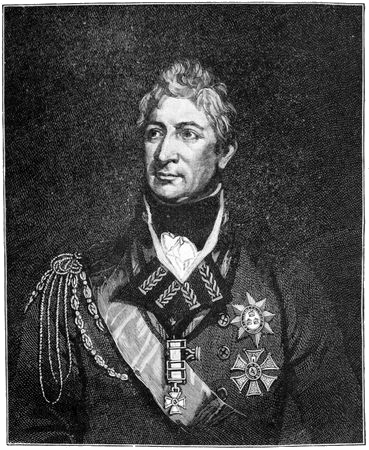
SIR THOMAS PICTON.
(From the Painting by Sir M. A. Shee, P.R.A.)
Napoleon, however, called his Champ-de-Mai
together for the electors to this anomalous document;
but, to add to the incongruity, the assembly
was held in the Champ-de-Mars, and not in May
at all, but on the 1st of June. There he and his
brothers, even Lucien, who had been wiled back
to his assistance, figured in fantastic robes as
emperor and princes of the blood, and the electors
swore to the Constitution; but the whole was a
dead and dreary fiasco. On the 4th the two
Chambers, that of Peers and that of Representatives,
met. The Peers, who were his own officers
and picked men, readily agreed to the Constitution;
but not so the Chamber of Representatives. They
chose Lanjuinais president, who had been a zealous
advocate of Louis XVI., and who had drawn
up the list of crimes under which Buonaparte's
forfeiture had been pronounced in 1814. They
entered into a warm discussion on the propriety of
abolishing all titles of honour in that Chamber.
They rejected a proposition to bestow on Napoleon
the title of Saviour of his Country, and they
severely criticised the "additional Act," declaring
that "the nation would entertain no plans of
aggrandisement; that not even the will of a victorious
prince should lead them beyond the boundaries
of self-defence." In this state of things
Buonaparte was compelled to depart, leaving the
refractory chamber to discuss the articles of his
new Constitution.
Napoleon was at Vervins, on the 12th of June,
with his Guard, and on the 14th he had joined
five divisions of infantry and four of cavalry at
Beaumont. The triple line of strong fortresses
on the Belgian frontiers enabled him to assemble
his forces unobserved by the Allies, whilst he was
perfectly informed by spies of their arrangements.
Wellington had arrived at Brussels, and had
thrown strong garrisons into Ostend, Antwerp,
Nieuwport, Ypres, Tournay, Mons, and Ath. He
had about thirty thousand British, but not his
famous Peninsular troops, who had been sent to
America. Yet he had the celebrated German
legion, eight thousand strong, which had won so
many laurels in Spain; fifteen thousand Hanoverians;
five thousand Brunswickers, under their
brave duke, the hereditary mortal foe of Napoleon;
and seventeen thousand men, Belgians,
Dutch, and troops of Nassau, under the Prince of
Orange. Doubts were entertained of the trustworthiness
of the Belgians, who had fought under
Napoleon, and who had shown much discontent of
late; and Napoleon confidently calculated on them,
and had Belgian officers with him to lead them
when they should come over to him. But, on the
whole, the Belgians behaved well; for, like all
others, their country had felt severely the tyranny
of Napoleon. Altogether, Wellington's army
amounted to about seventy-five thousand men.
He occupied with his advanced division, under
the Prince of Orange, Enghien, Braine-le-Comte,
and Nivelles; with his second, under Lord Hill,
Hal, Oudenarde, and Grammont; and with his reserve,
under Picton, Brussels and Ghent. What
he had most to complain of was the very defective
manner in which he had been supplied with
cannon on so momentous an occasion, being able
to muster only eighty-four pieces of artillery,
though he had applied for a hundred and fifty, and
though there were cannons enough at Woolwich
to have supplied the whole of the Allied armies.
Blucher's headquarters were at Namur, his right
extending to Charleroi, near the left of Wellington,
and his left and reserves covering Gevil and
Liége. His force amounted to eighty thousand
men, supplied with two hundred cannon. On the
15th Buonaparte addressed his army, telling them
that the enemies arrayed against them were the
same that they had so often beaten, and whom
they must beat again if they were the men they
had been. "Madmen!" he exclaimed, "the
moment of prosperity has blinded them. The
oppression and humiliation of the French people
are beyond their power. If they enter France
they will there find their tomb!" This address
had such an effect that the French advanced with
all the spirit of their former days. They swept
the western bank of the Sambre of the Prussian
outposts; they advanced to Charleroi, drove out
the Prussians under Ziethen, and compelled them
to fall back on the village of Gosselies, and thence
to Ligny and St. Amand. It was now seen that
the object of Buonaparte was to cut off the communication
between the Prussians and British, and
defeat the Prussians first, instead of having to
fight the two armies at once. To complete this
Ney had been dispatched to attack and drive back
the British advance at Quatre Bras and Frasnes;
but, hearing firing in the direction of Charleroi,
which was the engagement with Ziethen, he sent a
division to support the French there, and thus
found his main body too weak to move the British
at Quatre Bras. For doing this without orders,
Buonaparte reprimanded Ney, as he afterwards
did Grouchy for too implicitly following his orders
in pursuit of Blucher.
The Duke of Wellington was informed, at
Brussels, on the same day, of this attack of
Napoleon on the Prussians at Ligny, and of the
British advance, under the Prince of Orange, at
Quatre Bras. It has been said that he was taken
by surprise. Quite the contrary. He was waiting
in the most suitable position for the movement of
Buonaparte. This was announced to him by a
Prussian officer of high rank, said to be Baron
Müffling, who arrived at half-past one at his hotel
in Brussels. Wellington immediately dispatched
orders to all the cantonments of his army to break
up and concentrate on Quatre Bras, his intention
being that his whole force should be there by
eleven o'clock the next night, Friday, the 16th.
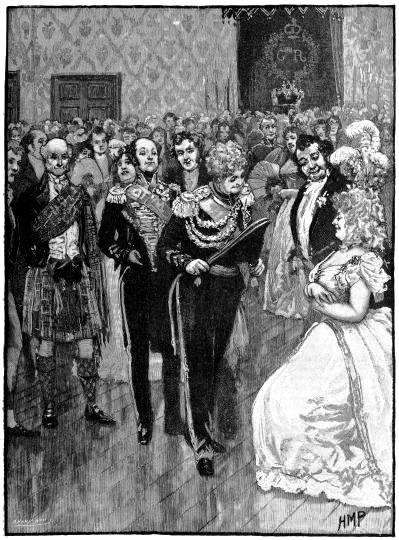
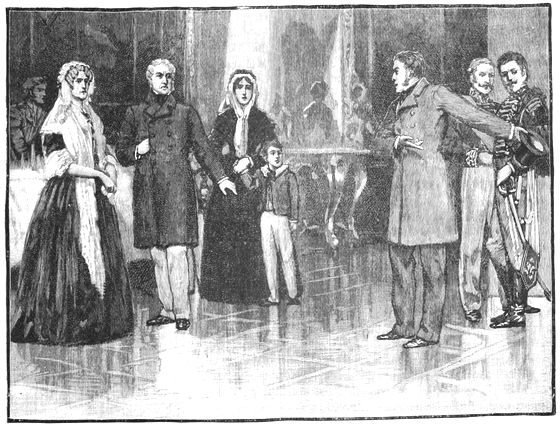
At three o'clock his Grace sat down to dinner, and
it was at first proposed that notice should be sent
to the Duchess of Richmond to put off a ball
which she was going to give at her hotel that
evening; but, on further consideration, it was
concluded to let the ball proceed, and that the
Duke and his officers should attend it, as though
nothing was about to occur, by which the great
inconvenience of having the whole city in confusion
during their preparations for departure
would be avoided. Accordingly, every officer
received orders to quit the ball-room, and as
quietly as possible, at ten o'clock, and proceed to
his respective division en route. This arrangement
was carried out, and the Duke himself remained
at the ball till twelve o'clock, and left
Brussels the next morning (April 16) at six
o'clock for Quatre Bras. Such were the facts
which gave rise to the widespread report that the
Duke knew nothing of the attack of Napoleon till
the thunder of his cannon was heard by the Duke
of Brunswick in the ball-room.
Wellington arrived early in the forenoon at
Quatre Bras, and then rode to Brie, to consult
with Blucher. It appeared as if it was the intention
of Buonaparte to bear down with his
whole force on Blucher; and though Bulow's
division, stationed between Liége and Hainault,
was too far off to arrive in time, Blucher resolved
to stand battle; and it was agreed that Wellington
should, if possible, march to his assistance, and
vice versâ, should the attack be on Wellington.
Ney, with a division of forty-five thousand,
attacked the British at Quatre Bras and Frasnes,
whilst Napoleon directed the rest of his force on
Blucher at Ligny, and General D'Erlon lay with
ten thousand men near Marchiennes, to act in
favour of either French force, as might be required.
Buonaparte did not attack Blucher till
about three o'clock, and then he continued the battle
with the utmost fury for two hours along his
whole line. Buonaparte, finding that he could not
break the Prussian line, sent for the division of
D'Erlon, and then, contriving to get into the rear
of Blucher's position at Ligny, threw the Prussians
into disorder. Blucher made a desperate
charge, at the head of his cavalry, to repel the
French, but his horse was killed under him; and
the French cuirassiers galloped over him, a Prussian
officer having flung a cloak over him. He
escaped with his life, and, remounting, led the
retreat towards Tilly. The loss of the French in
this battle is stated by General Gourgaud at seven
thousand, but is supposed to exceed ten thousand.
The Prussians admit the loss of as many, but the
French declared that they lost fifteen thousand.
It was, however, a severe blow for the Allies; and
had Ney managed to defeat Wellington, the consequences
would have been momentous. But Ney
found that the British had evacuated Frasnes that
morning, and lay across four roads at Quatre Bras—one
leading to St. Amand, the Prussian position.
On another, leading from Charleroi to Brussels,
was a wood, called the Bois de Bossu; and here
the attack commenced on the Belgians. The wood
was sharply contested, and about three o'clock
the Belgians were driven out by the French, who,
in their turn, were expelled by the British Guards.
The battle then became general and severe, the
42nd Highlanders suffering greatly. Ney endeavoured
to cut through the British by a furious
charge of cavalry; but this was repelled by such
a deadly fire as heaped the causeway with men
and horses. Ney then sent for the division of
D'Erlon, but that had been already summoned by
Buonaparte. The battle was continued till it was
dark, and the British remained on the field, hoping
that the Prussians had also maintained their
ground, and that they might form a junction in the
morning. But the Prussians had retreated in the
night to Wavre, about six leagues in the rear of
Ligny, and had gone off in such silence that
Napoleon was not even aware of it. But Wellington
was aware of it, and, on the morning of
the 17th, began a retreat also on Waterloo, where
he and Blucher had concerted to form a junction
and give battle. Blucher had made his retreat so
artfully, that the French were at a loss to know
which way he had taken. It appeared as if he
had directed his march for Namur, and about
three o'clock on the 17th Grouchy received orders
to pursue Blucher, wherever he might have gone.
This dispatch of Grouchy with thirty-two thousand
men to deal with Blucher proved a serious mistake
for Napoleon, who, not having Grouchy's
division to support him at the battle of Waterloo,
severely blamed him, and charged his own defeat
upon him. But it was the ungenerous practice of
Buonaparte, whenever he was defeated, to charge
it upon some of his generals, even when they had
been acting most meritoriously. This he did in
Russia, and this he repeated in the retreat on
Paris in 1814, and this we shall find him doing
again in the battle of Waterloo, to the undaunted
and indefatigable Ney. Grouchy has shown satisfactorily
that he himself first brought to Napoleon
the news of Blucher's retreat, and requested orders
to pursue him with his cavalry, but that he could
not obtain such order till noon on the 17th, and
then the order was to follow him wherever he
went. We shall soon see that Thielemann, by
Blucher's orders, kept Grouchy well employed,
and took care to prevent his return to Waterloo.
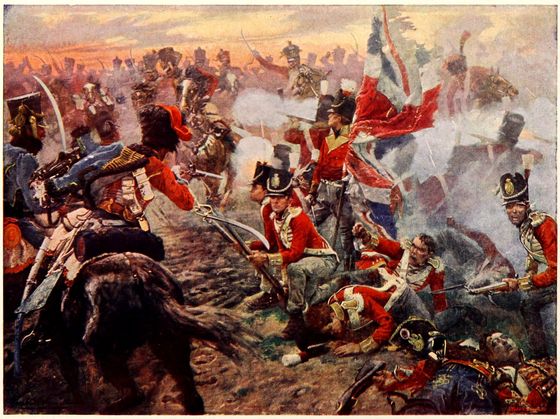
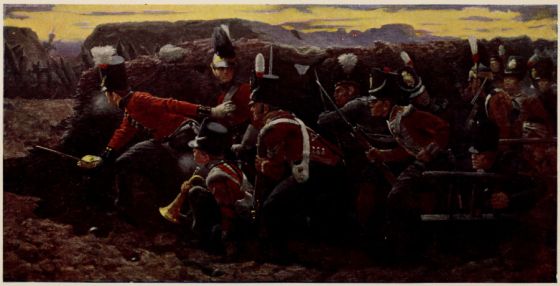
QUATRE BRAS.
FROM THE PAINTING BY VEREKER M HAMILTON, R.E.
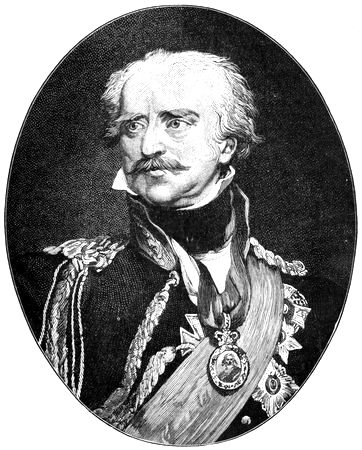
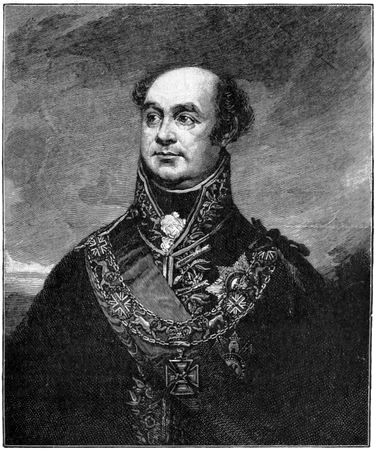
MARSHAL BLUCHER. (From the Portrait by Sir Thomas Lawrence, P.R.A.)
Napoleon, finding Blucher gone, turned his
attentions to Wellington, expecting to find him
still at Quatre Bras; but, as we have said, the
Duke was now on his retreat to Waterloo. Buonaparte
dispatched his cavalry in hot haste after
him, and they came up with his rear at Genappe,
where the British had to pass through a narrow
street, and over a narrow bridge across the Dyle.
There the French came with such impetus that
they threw the light cavalry into confusion; but
the heavy dragoons soon rode back, and drove the
French with such effect before them, that they
made no further interruption of the march.
Without an enemy at their rear the march was
repugnant enough to the soldiers. British soldiers
abominate anything like a retreat. They had
heard of the defeat of the Prussians at Ligny;
and this retrograde movement looked too much of
the same character to please them. Besides, it
was raining torrents all the way; and they had to
tramp across fields up to the knees in mud. At
five in the evening, however, the Duke commanded
a halt, and took up his position on ground which
thenceforth was to be immortal. He was on the
field of Waterloo! Long before this the position
had attracted his attention, and he had thought
that had he to fight a battle anywhere in that part
of the country, it should be on that ground.
About two miles beyond the village of Waterloo,
which has been chosen to bear the name of this
famous battle, and about a mile beyond the
hamlet of Mont St. Jean, there stretches across
the Charleroi road a ridge of some elevation.
On this Wellington posted his army, his left
extending to a hamlet called La Haye, and his
right across the Nivelles road, to a village and
ravine called Braine Merbes. These two roads
united in the highway to Brussels, just behind the
hamlet of Mont St. Jean, and close behind the centre
of Wellington's position was the farm of Mont St.
Jean; a little below his centre, on the Charleroi
road or causeway, leading through Genappe to
Quatre Bras, whence they had come, was another
farmhouse, called La Haye Sainte. On Wellington's
right, but down in the valley near the
Nivelles road, lay an old château, with its walled
orchard, and a wood beyond it, called Hougomont—a
contraction of Château-Gomont. Below this
position ran a valley, and from it ascended opposite
other rising grounds, chiefly open cornfields; and
along this ascent, at about half a mile distant,
Buonaparte posted his army, shutting in by his
right the château of Hougomont, and commanding
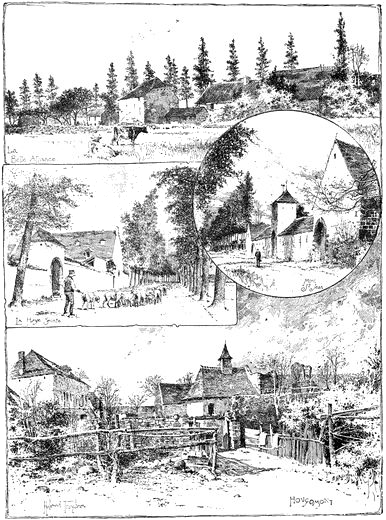
it from the high ground. Nearly opposite to Wellington's
centre stood a farmhouse, enclosed in its
orchards, called La Belle Alliance. There Buonaparte
took his stand, and kept it during all the
fight—each commander being able to view the whole
field. Close behind Wellington the ground again
descended towards Mont St. Jean, which gave a considerable
protection to his reserves, and kept them
wholly out of the observation of the French. To
make the situation of Wellington's army clear, we
have only to say that behind the village of
Waterloo extended the beech wood of Soigne
along the road to Brussels for the greater part of
the way.
When Buonaparte, early in the morning of
the 18th, mounted his horse to reconnoitre Wellington's
position, he was rejoiced to observe so
few troops; for many were hidden behind the
height on which Wellington took his stand. One
of his staff suggested that Wellington would be
joined by Blucher; but so wholly ignorant was
Napoleon of the settled plan of the two generals
that he scouted the idea. "Blucher," he said, "is
defeated. He cannot rally for three days. I
have seventy-five thousand men: the English only
fifty thousand. The town of Brussels awaits me
with open arms. The English opposition waits
but for my success to raise their heads. Then
adieu subsidies and farewell coalition!" And,
looking again at the small body of troops visible,
he exclaimed, in exultation, "I have them there at
last, these English!" General Foy, who had had
ample experience of "these English" in Spain,
said, "Wellington never shows his troops; but, if
he be yonder, I must warn your majesty that the
English infantry, in close fighting, is the very
devil!" And Soult, who had felt the strength of
that infantry too often, confirmed Foy's assertion.
Wellington was quite prepared for the fiercest
attack of Buonaparte. Notwithstanding his loss
at Quatre Bras, he had still about sixty-eight
thousand men, though the British portion did not
exceed thirty-five thousand; and Buonaparte, as
he had stated, had about seventy thousand, but
most of them of the very best troops of France,
whilst few of Wellington's army had been under
fire before, and some of the Belgians and Hanoverians
were of very inferior quality. In point
of cannon, Buonaparte had more than double the
number that Wellington had. But the Duke
informed Blucher that he should make a stand
here, and the brave old Marshal replied to Wellington's
request of a detachment of Prussians to
support him, that he would be there with his main
army. Wellington therefore expected the arrival
of the Prussians about noon; but though they lay
only about twelve miles off, the difficulties of the
route over the heights of Chapelle-Lambert, and
the occupation of part of Wavre by the French
division under Grouchy, prevented their advance
under Bulow from reaching the field till half-past
four. Wellington, however, rested in confident
expectation of the support of the Prussians and
of their numerous cannon.
Buonaparte posted himself in his centre, near
the farmhouse of La Belle Alliance, having Ney
and Soult near him, but Counts Reille and D'Erlon
being in immediate command of the centre. His
left, which stretched round the château of Hougomont,
was commanded by his brother Jerome;
his right by Count Lobau. Wellington took his
post on the ridge near where the great mound of
the dead surmounted by the Belgian lion now
stands. His troops were divided into two lines;
the right of the first line—consisting of British,
Hanoverian, and Belgian troops—under Lord Hill.
The centre, under the Prince of Orange, consisted
of troops of Brunswick and Nassau, flanked on the
right by the Guards under General Cooke, and on
the left by the division of the Hanoverian general
Alten. The left wing consisted of the divisions
of Picton, Lambert, and Kemp. The second line
consisted of troops in which less confidence was
placed, or which had suffered severely at Quatre
Bras on the 16th. In and around the farmhouse
of La Haye Sainte, in advance of the centre,
was placed a body of Germans. The plan of each
commander was simple: Wellington's, to keep his
ground till Blucher should come up, and then all
simultaneously charge forward to drive the French
from the field; Napoleon's, by his brisk and ponderous
charges to break and disperse the British
before the Prussians could arrive.
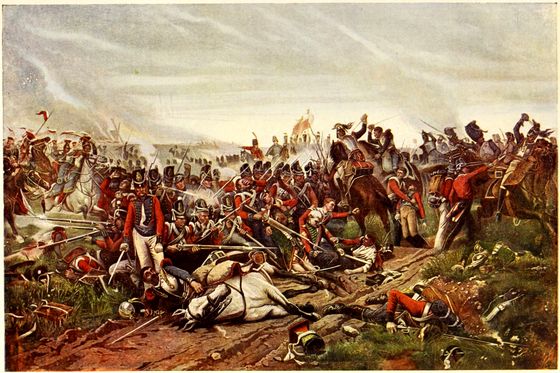
By permission of Messrs. S. Hildesheimer & Co., Ld. Reproduced by André & Sleigh. Ld., Bushey, Herts.
THE BATTLE OF WATERLOO: FRENCH CUIRASSIERS CHARGING A BRITISH SQUARE.
FROM THE PAINTING BY P. JAZET.
It was not till between eleven and twelve o'clock
on the morning of Sunday, the 18th of June, that
this terrible conflict commenced; for the troops of
Napoleon had not yet all reached the ground,
having suffered from the tempests of wind and
rain equally with the Allies. The rain had now
ceased, but the morning was gloomy and lowering.
The action opened by a brisk cannonade on the
house and wood of Hougomont, which were held
by the troops of Nassau. These were driven out;
but their place was immediately taken by the
British Guards under General Byng and Colonels
Home and Macdonald. A tremendous cannonade
was kept up on Hougomont by Jerome's batteries
from the slopes above; and under cover of this
fire the French advanced through the wood in
front of Hougomont, but were met by a terrible
fire from the British, who had the orchard wall as
a breastwork from which to assail the enemy.
The contest here was continued through the day
with dreadful fury, but the British held their
ground with bull-dog tenacity. The buildings of
the farmyard and an old chapel were set fire to
by the French shells; but the British maintained
their post amid the flames, and filled the wood
in front and a lane running under the orchard
wall with mountains of dead.
The fire had soon become general, and a desperate
struggle was raging along the whole line.
Buonaparte threw column after column forward
against the British squares; but they were met
with deadly volleys of artillery and musketry,
and reeled back amid horrible slaughter. A
desperate push was made to carry La Haye
Sainte and the farm of Mont St. Jean, on Wellington's
left centre, by the cuirassiers, followed by
four columns of French infantry. The cuirassiers
charged furiously along the Genappe causeway,
but were met and hurled back by the heavy
British cavalry. The four columns of infantry
reached La Haye Sainte and dispersed a body of
Belgians; but Picton, advancing with Pack's
brigade, forced them back, and the British cavalry,
which had repulsed the cuirassiers, attacking them
in flank, they were broken with heavy slaughter
and left two thousand prisoners and a couple of
eagles behind them. But the British, both cavalry
and infantry, pursuing their advantage too far,
were in turn repulsed with great loss, and Generals
Picton and Ponsonby were killed. The French
then again surrounded La Haye Sainte, where a
detachment of the German legion, falling short of
ammunition, and none being able to be conveyed
to them, were literally massacred, refusing to surrender.
In a little time the French were driven
out of the farmhouses by shells.
Soon after, a resolute attack was made on the
right of the British centre by a great body of
cavalry, which rode impetuously into the front of
the squares and of thirty pieces of artillery.
Though cut down in heaps, they drove the artillerymen
from their guns, but these only retreated
amongst the infantry, carrying with them the
implements for serving the guns, and, the moment
the infantry repelled their assailants a little, the
men were at their guns again, and renewed the
firing. The cuirassiers fought most undauntedly;
they rode along the very front of the squares,
firing their pistols into them, or cutting at them
with their swords. Again and again they dashed
forward to break the squares, but in every instance
were met with such a destructive fire that they
were compelled to draw off, only a mere fragment
of this fine cavalry surviving this heroic but
fatal attempt. From that time the French continued
the battle chiefly by an incessant fire of
artillery along the whole line, which the British
avoided in great part by lying on their faces.
By six o'clock in the evening the Allied army
had lost ten thousand men in killed and wounded,
besides a great number of the dispersed Belgians
and other foreigners of the worst class, who had
run off, and taken refuge in the wood of Soigne.
But the French had suffered more severely; they
had lost fifteen thousand in killed and wounded,
and had had more than two thousand taken
prisoners. At about half-past four, too, firing had
been heard on the French right, and it proved to
be the advanced division of Bulow. Grouchy had
overtaken the Prussians at Wavre, but had been
stopped there by General Thielemann, by order of
Blucher, and kept from crossing the Dyle till it
was too late to prevent the march of Blucher on
Waterloo; so that whilst Thielemann was thus
holding back Grouchy, who now heard the firing
from Waterloo, Blucher was on the track of his
advanced division towards the great battle-field.
When Buonaparte heard the firing on the right, he
thought, or affected to think, that it was Grouchy,
whom he had sent for in haste, who was beating
the Prussians; but he perceived that he must now
make one gigantic effort, or all would be lost the
moment that the main armies of the British and
Prussians united. Sending, therefore, a force to
beat back Bulow, he prepared for one of those
thunderbolts which so often had saved him at the
last moment. He formed his Imperial Guard
into two columns at the bottom of the declivity of
La Belle Alliance, and supporting them by four
battalions of the Old Guard, and putting Ney at
their head, ordered him to break the British
squares. That splendid body of men, the French
Guards, rushed forward, for the last time, with
cries of "Vive l'Empereur!" and Buonaparte rode
at their head as well as Ney, as far as the farm
of La Haye Sainte. There the great Corsican,
who had told his army on joining it this last
campaign that he and they must now conquer
or die, declined the death by suddenly wheeling
his horse aside, and there remaining, still and stiff
as a statue of stone, watching the last grand
venture. The British right at this moment was
wheeling towards Buonaparte's position, so that his
Guards were received by a simultaneous fire in
front and in the flank. The British soldiers advanced
from both sides, as if to close round the
French, and poured in one incessant fire, each man
independently loading and discharging his piece as
fast as he could. The French Guards endeavoured
to deploy that they might renew the charge, but
under so terrible a fire they found it impossible:
they staggered, broke, and melted into a confused
mass. As they rolled wildly down the hill, the
battalions of the Old Guard tried to check the
pursuing British; but at this moment Wellington,
who had Maitland's and Adams's brigades of
Guards lying on their faces behind the ridge on
which he stood, gave the command to charge, and,
rushing down the hill, they swept the Old Guard
before them. On seeing this, Buonaparte exclaimed,
"They are mingled together! All is lost
for the present!" and rode from the field. The
battle was won. But at the same moment Wellington
ordered the advance of the whole line, and
the French, quitting every point of their position,
began a hasty and confused retreat from the field.
Buonaparte, in his bulletin of June 21st, found
a reason for this utter defeat in a panic fear that
suddenly seized the army, through some evil-disposed
person raising the cry of "Sauve qui
peut!" But Ney denied, in his letter to the Duke
of Otranto, that any such cry was raised. Another
statement made very confidently in Paris was, that
the Old Guard, being summoned to surrender,
replied, "The Guard dies, but never surrenders!"—a
circumstance which never took place, though
the Guards fought with the utmost bravery.
As this rout was taking place, Bulow, who had
beaten back the French battalions from Frischermont
and Planchenoit, was approaching La Belle
Alliance, and Blucher with the main army soon
after appeared following him. At a farmhouse
called Maison Rouge, or Maison du Roi, behind
La Belle Alliance, the Duke of Wellington
and Blucher met and felicitated each other.
Blucher, in the Continental manner, embraced and
kissed the victorious Duke; and it was agreed
that, as the army of Wellington had been fighting
hard for eight hours, the Prussians should make
the pursuit. Blucher swore that he would follow
the French whilst a horse or a man could move,
and, with three cheers from the British, he set
forward with his troops in chase. So far from
"the Guards dying, but not surrendering," these
brave men flew now before the stern old Prussian,
and immediately in the narrow passage at
Genappe they abandoned to him sixty pieces of
their cannon. Amongst other spoil they captured
the carriage of Napoleon, and found in it,
amongst other curious papers, a proclamation for
publication the next day at Brussels. As it was
moonlight, the Prussians continued the chase till
late into the night, slaughtering the fugitives like
sheep. Numbers quitted the road and fled across
the country, seeking shelter in the woods, where
many of them were afterwards found dead or
severely wounded. The highway, according to
General Gneisenau, was covered with cannon,
caissons, carriages, baggage, arms, and property of
every kind. The wounded were humanely sent to
Brussels, but those who could continue their flight
did so till they had reached France, where they
sold their horses and arms, and dispersed themselves
to their homes. The grand army was no
more, with the exception of the division of
Grouchy, who made good his retreat to Paris, only
to be upbraided by Buonaparte as the cause of his
defeat. In this battle and retreat the French lost
more men than at Leipsic, the killed and wounded
exceeding thirty thousand.
But the loss of the Allies had also been perfectly
awful. The Prussians, besides the great slaughter
at Ligny, had been engaged in a bloody struggle
at Planchenoit, and the British and their Allies
had lost in the battle of Waterloo two thousand
four hundred and thirty-two killed, and nine thousand
five hundred and twenty-eight wounded;
these, added to the numbers killed and wounded at
Quatre Bras, raised the total to fifteen thousand.
Of British and Hanoverian officers alone six hundred
were killed or wounded at Waterloo. The
Duke of Brunswick fell at the head of his troops
at Quatre Bras, without having the satisfaction of
witnessing the final ruin of Buonaparte. So many
of Wellington's staff were disabled that he had at
one time no officer to dispatch with a pressing
order. A young Piedmontese, of the family of De
Salis, offered himself. "Were you ever in a battle
before?" asked the Duke. "No, sir," he replied.
"Then," said the Duke, "you are a lucky man,
for you will never see such another." When the
Duke, who had witnessed so many bloody battles,
saw the carnage of Waterloo, and heard, one after
another, the losses of so many companions in arms,
he was quite overcome. In his despatches he
says: "I cannot express the regret and sorrow
with which I look round me, and contemplate
the losses that we have sustained." And again,
"The losses I have sustained have quite broken
me down, and I have no feeling for the advantages
we have gained."
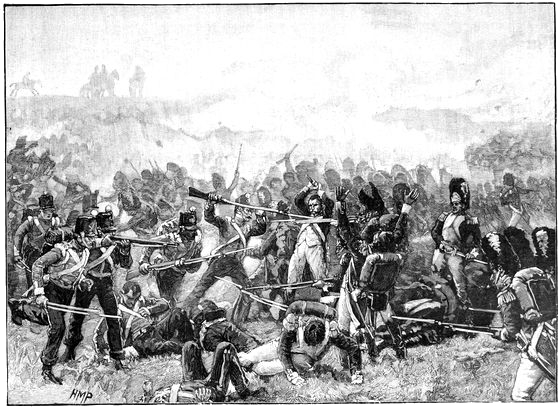
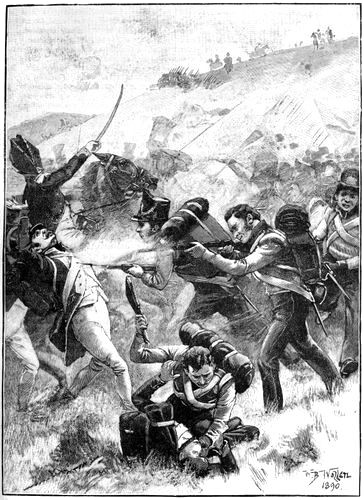
THE BATTLE OF WATERLOO. (See p. 99.)
It is scarcely worth while to attempt to expose
the assertions due to Napoleon and the mortified
vanity of the French, which have declared that
Wellington made a bad choice of his battle-field,
and that he would have been beaten had not the
Prussians come up. These statements have been
amply refuted by military authorities. The selection
of the field may be supposed to be a good
one when it is known that Marlborough had
chosen the very same, and was only prevented from
fighting on it by the Dutch Commissioners. But
no one can examine the field without seeing its
strength. Had Wellington been driven from his
position, the long villages of Mont St. Jean and
Waterloo behind him, succeeded by the beech
wood of Soigne, would have enabled him to hold
the French in check for days—much more for the
time sufficient for the whole Prussian force to
come up. When it is seen what resistance such a
mere farm as La Haye Sainte, or the château of
Hougomont, enabled the British to make, what
would the houses, gardens, and orchards of Mont
St. Jean and Waterloo have done, stretching for
two miles, backed by the wood of Soigne—not a
forest choked by underwood, but of clear ground,
from which ascended the tall, smooth boles of the
beech trees? As to the danger of being defeated
had not the Prussians come up, there was none.
No advantage through the whole day had been
gained by the French, except making an entry
into the court-yard of Hougomont, and in capturing
La Haye Sainte, from both of which they had
long been driven again. The cuirassiers had been
completely cut up before the arrival of the Prussians;
not a square of infantry had been broken;
and when Buonaparte made his last effort—that of
hurling his Guards on the British columns—they
were, according to the positive evidence of Marshal
Ney, who led them on, totally annihilated. It is
true that the Prussians had been for some time
engaged on the right of the French, and had stood
their ground; but they had been terribly cut up
at Planchenoit, and they do not appear to have
made much advance till the total rout of the
French by the last charge of the British. Wellington
had advanced his whole line, and was
leading on the pursuit in person when he and
Blucher met on the high ground behind La Belle
Alliance—that is, beyond the very ground on
which Buonaparte had stood the whole day. The
Prussians fought bravely, but they did not affect
the question of victory or defeat as it regarded the
British; they came in, however, to undertake the
chase, for which the British were too tired after
standing on the field twelve hours, and fighting
desperately for eight; and they executed that
chase most completely.
On the 19th of June Paris was excited by
the announcements of Buonaparte's bulletin that
terrible defeats had been inflicted on the Prussians
at Ligny, and on the British at Quatre Bras. A
hundred cannon and thousands of prisoners were
declared to be taken. The Imperialists were in
ecstasies; the Royalists, in spite of the notorious
falsehood of Buonaparte on such occasions, were
dejected. On the 21st whispers were busily circulating
that not only had a most dreadful pitched
battle been fought, but that the fine French army
which had so lately left France was utterly annihilated
or dispersed. It was soon added that,
instead of being at the head of victorious forces, as
he had represented, Buonaparte had again fled
from his army, and was in the Palace of the Elysée-Bourbon.
And this last news was true. Napoleon
had never stopped in his own flight till he
reached Philippevillè. There he proposed to proceed
to Grouchy, and put himself at the head of
his division; but he heard that that too was defeated,
and he hurried on to Paris, fearful of the
steps that the two legislative Chambers might take.
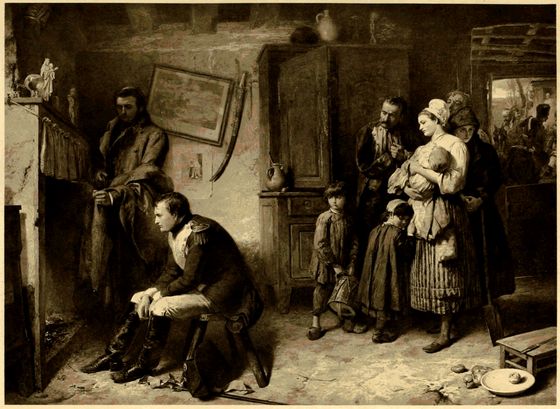
"ON THE ROAD FROM WATERLOO TO PARIS."
FROM THE PAINTING BY MARCUS STONE, A.R.A., IN THE CORPORATION
OF LONDON ART GALLERY, GUILDHALL.
Buonaparte, seeing that nothing was to be expected
from the Chambers—for even the Peers
adopted the resolutions of the Representatives—who
had already demanded his abdication—assumed
the air of the despotic emperor, and demanded of
Carnot that he should issue orders for a levy of
three hundred thousand men, and should find
supplies. Carnot said both propositions were impossible.
Napoleon then summoned, on the night
of the 21st, a general council, consisting of the
late Ministers, the Presidents, and Vice-Presidents
of the two Chambers, where Regnault and Maret
recommended a show of resistance whilst offering
terms of peace; but Lafayette said that would only
make matters worse. The Allies were victorious,
and there was but one course for the Emperor;
and Lanjuinais and Constant supported that view.
On the 22nd the Chamber of Representatives met
early, and again demanded an act of abdication.
Napoleon complied, but, as on his former abdication,
only in favour of his son. The Chamber
thanked him, but took no notice of the clause in
favour of Napoleon II. But Lucien Buonaparte
and Labédoyère, in violent language, pressed on
the House of Peers the recognition of Napoleon II.
They persisted in passing it quietly over; but they
required Napoleon to issue a proclamation to the
army, declaring his abdication, without which the
soldiers would not believe it, and, to conciliate
them, he complied. Still, fearing lest he should
put himself at the head of Grouchy's division, or
some other, though small, troublesome force, they
insisted that he should retire to Malmaison—so
long the favourite abode of the repudiated Josephine,
With this, too, he complied, but immediately
discovered that he was surrounded by
Guards, and was in fact a prisoner. General
Becker was appointed to have surveillance over
Napoleon; and it was supposed that, as Becker
had personal cause of resentment against him, this
surveillance would be rigorous. But Becker was a
man of honour; he respected the misfortunes of a
man who, whatever had been his crimes, had made
himself almost master of the world, and he treated
him with the utmost courtesy. Orders were
issued by the Provisional Government for two
frigates to convey Napoleon to the United States,
and Becker was to allow of his retirement to
Rochefort, in order to his embarkation—to accompany
him there, but not to permit his movement
in any other direction.
Meanwhile, the British and Prussian armies advanced,
and on the 1st of July Wellington was
within a few miles of Paris, with his right on the
heights of Richebourg, and his left on the forest
of Bondy; and Blucher, at the same time, crossing
the Seine on the 2nd, posted his army, with its
right at Plessis-Piquet, his left at St. Cloud, and
his reserve at Versailles. In this position, Commissioners
were sent by the Provisional Government
to Wellington, desiring a suspension of
hostilities, informing him that Buonaparte had
abdicated and retired from Paris. The Duke
replied, that so long as the army remained in
Paris there could be no suspension of hostilities,
and that he had no authority to treat on any
question of government. The Commissioners demanded
whether the Allies would stop if Napoleon
II. was proclaimed? Wellington said "No."
Whether they would stop provided they chose
another prince of a royal house?—probably meaning
the Duke of Orleans. As the Duke said
he had no orders to accept any such proposals,
they were useless, and he handed to them the proclamation
of Louis XVIII., offering to grant constitutional
liberties, and to pardon all offenders,
excepting a few who had committed the most
recent and aggravated treason. These were supposed
to mean Ney, Labédoyère, and some others.
Wellington offered, however, to remain where he
was on condition that the regular troops should be
sent beyond the Loire, and the town be held by
the National Guard till the king's arrival. The
Commissioners did not comply with this demand;
and the necessity of such compliance was sufficiently
shown by this army disputing the advance
of the Prussians on the 2nd of July. They
had resisted Blucher at St. Cloud, Meudon, and
in the village of Issy. Blucher succeeded, but
with considerable loss; and the next day the
French made another attack to recover Issy, but
without effect.
Wellington was therefore on the point of entering
Paris when, on the same day, the 3rd, he
received a flag of truce from the Provisional
Government, asking for a military convention
between the armies at St. Cloud. This was accepted,
and one English and one Prussian officer
met three French officers, and the convention was
concluded by the agreement that the French army
should retire behind the river Loire, and that the
Allies should be put in peaceable possession of
Paris, with all the defences on the Montmartre
side of the city, as well as every other. This convention
was signed the next day by Wellington,
Blucher, and Davoust, and, according to its stipulation,
the French troops evacuated Paris, and
marched towards the Loire. Ney and Labédoyère
made their exit from the city, knowing that they
would be arrested by Louis XVIII., if possible.
On the 7th of July the British and Prussian
forces entered Paris. The former encamped themselves
in the Bois de Boulogne, and the Prussians
bivouacked along the Seine. There they came
into full view of the Bridge of Jena, so named to
commemorate the victory of Buonaparte on that
field, so fatal to the Prussians, and of the column
in the Place Vendôme, erected with cannon taken
from the Austrians, and bearing insulting mementoes
of the defeats of Prussia. The Prussians
had already lowered the statue of Napoleon from
the top of the column, and were beginning to
demolish the bridge, when the Duke of Wellington
interfered. He represented that, although these
objects were justly offensive to Prussia, they ought
to be left to the decision of the King of France, in
whose capital they were, and that the name of the
bridge might be changed. Blucher was unwilling
to give way, and also insisted on the levy of a
military contribution on the city of Paris of one
hundred million francs, as some reparation for the
spoliations of the French in Berlin. Wellington
suggested that these matters should be left for the
determination of the Allied sovereigns, and at
length prevailed.
The next day, the 8th of July, Louis a second
time entered his capital, escorted by the National
Guard. Fouché announced to the two Chambers
that their functions were at an end; but they still
declared themselves sitting in permanence. But
General Desolles, commander of the National
Guard, proceeded to close the Chambers. He
found both of them deserted, and locked the
doors, and put his seal upon them, setting also a
guard. Soon afterwards the members of the Chamber
of Representatives, who had only adjourned,
began to arrive, but were received with jeers
by the Guards, which were eagerly joined in by the
populace, and they retreated in confusion. Fouché,
in reward for his politic private correspondence
with the Allies, was reinstated in his old office of
Minister of Police, and the government of Louis
recommenced in great quiet—affording the French
much more real liberty than they had enjoyed
either under Buonaparte or the factions of the
Revolution. And thus ended the celebrated
Hundred Days from the landing of Napoleon
to his second exclusion.
Buonaparte had arrived in Rochefort on the 3rd
of July—only fifteen days after the battle of
Waterloo. The two frigates provided by the Provisional
Government to convey him to America—the
Saale and the Medusa, accompanied by the
corvette Balladière and the large brig Epervier—lay
in the Aix roads; but Buonaparte was very
sure that the British Government would not permit
them to sail. That Government, anticipating such
an event as the endeavour of Napoleon to make
his escape to America—whence he might watch
his opportunity of once more renewing the troubles
of the world—had, immediately after the battle of
Waterloo, placed no less than thirty vessels of
different descriptions along the whole coast of
France, from Ushant to Cape Finisterre, thus
making it impossible for any vessel to pass out of
a French port without undergoing the severest
search. Napoleon thereupon embarking in a
British frigate, the Bellerophon, wrote a theatrical
letter, claiming the hospitality of the Prince
Regent:—
"Rochefort, July 13th, 1815.
"Royal Highness,—A victim to the factions
which distract my country, and to the enmity of
the greatest Powers of Europe, I have terminated
my political career, and I come, like Themistocles,
to throw myself on the hospitality of the British
people. I put myself under the protection of their
laws, which I claim from your Royal Highness, as
the most powerful, the most constant, and the
most generous of my enemies.
"NAPOLEON."
This note contained much that was not true.
It implied that Buonaparte had come voluntarily
and without necessity on board the Bellerophon,
whilst it was well known that perhaps another
hour would have been too late to secure him from
seizure by the officers of Louis, king of France.
He affected to claim the protection of British
laws, when he was a notoriously proclaimed
outlaw, so proclaimed by the whole of the Allied
Powers for the breach of his solemn engagement
to renounce all claims on the throne of France.
There was, therefore, no answer whatever to that
note from the Prince Regent, who was under
engagement to his Allies, as they to him, to hold
no communication with a man who had so shamefully
broken his word, and had, moreover, thereby
sacrificed so many valuable lives. The reply was
from Lord Melville, First Lord of the Admiralty,
announcing to him that the British Government,
with the approbation of its Allies, had determined
that, to prevent any further opportunity for the
disturbance of the peace of Europe by General
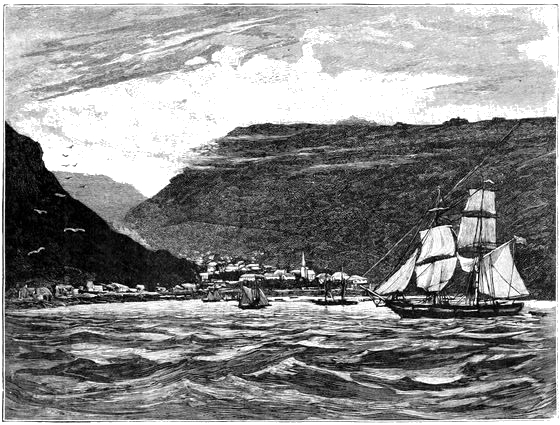
Buonaparte, he should be sent to St. Helena;
that they had been guided in this choice, not only
by the desire of his security, but also by the consideration
that the island was extremely healthy,
and would afford him much greater liberty than he
could enjoy in a nearer locality; and that he
might select three officers, with his surgeon, and
twelve domestics to attend him. From the
number of the officers Savary and Lallemand were
expressly excepted. It also added that the persons
permitted to accompany him would be subject to
a certain degree of restraint, and would not be
permitted to leave the island without the sanction
of the British Government. It was finally added
that General Buonaparte should make no delay in
the selection of his suite, as Rear-Admiral Sir
George Cockburn, appointed to the command of
the Cape of Good Hope, would convey him in the
Northumberland to St. Helena, and would be
presently ready to sail. Napoleon left Plymouth
Sound on the 5th of August, and died at St.
Helena on May 5th, 1821, having spent his last
years in quarrelling with his gaoler, Sir Hudson
Lowe, and in an elaborate attempt to falsify
history.
The war in America, amid the absorbing
momentousness of the gigantic conflict in Europe,
went on with little attention from Ministers at
home, and, consequently, with the results which
seem destined to attend Britain's campaigns in that
quarter. In Canada, which the Americans were
particularly anxious to obtain, there was a most
meagre and inadequate British force; and, what
was much worse, the Ministry still continued there
the incompetent governor, Sir George Prevost.
The only circumstances to which Britain owed the
preservation of those provinces were the loyalty
of the people and the sterling bravery of the
handful of soldiers. Early in the year 1813
the American general, Dearborn, suddenly approached
York, on Lake Ontario, and attacked it,
supported by the flotilla under command of Commodore
Chauncey. The British had about seven
hundred men there, partly regulars, partly militia,
with some few Indians. General Sheaffe drew off
the main part of his force, and left the rest to
capitulate, abandoning a considerable quantity of
military and other stores, which were most desirable
for the Americans. The British Government
ought to have taken care to have had a fleet on
the lakes, but this had been neglected, so that the
Americans could not be prevented from bearing
down on any point of the lake frontiers. Dearborn,
having a strong flotilla, embarked the stores
he won at York and sailed for Niagara, where he
landed at Fort George, with six thousand infantry,
two hundred and fifty cavalry, and a good train of
artillery. The British there, under Vincent, were
not a fourth of the enemy. Vincent, therefore,
after some gallant fighting, retired up the strait
to Burlington Bay, about fifty miles from Fort
George, and, collecting the little garrisons from
Fort Erie and other points, found himself at the
head of about one thousand six hundred men, and
resolved to make a stand. Dearborn, rendered
confident by his great superiority of numbers,
marched after him, and, on the 4th of June, was
seen approaching the British position. He encamped
about five miles from Vincent, with three
thousand five hundred men and nine pieces of
artillery. He intended to attack the next morning,
but in this he was forestalled; for Colonel Harvey
reconnoitred his camp, and advised General Vincent
to assault it at midnight with fixed bayonets.
This was done, and though the attacking party
numbered only seven hundred and four men, the
Americans fled in all directions, leaving two
generals, one hundred prisoners, and four pieces
of artillery in their hands. Colonel Harvey, who
had headed the charge, returned to the British
camp loaded with booty. It was expected that,
in the morning, when Dearborn ascertained the
inferior force of British, he would renew the fight;
but after destroying provisions and stores, to
facilitate his flight, he decamped, and only halted
eleven miles off, where he met with strong reinforcements.
About the same time Sir James Yeo, who had
dared to attack the superior squadron of Commodore
Chauncey on Lake Ontario, and took two
of his schooners, now prevailed on the spiritless
Sir George Prevost to join him in an attack on
Sacketts Harbour. Here the Americans had a
dockyard, where they built vessels for the lake
fleet, and had now a frigate nearly ready for
launching. Sir George consented, but, on reconnoitring
the place, his heart failed him, and he
returned across the water towards Kingston. Sir
James was highly chagrined, but prevailed on
this faint-hearted governor to make the attempt.
Seven hundred and fifty men were landed, who
drove the Americans at the point of the bayonet
from the harbour, and set fire to the new frigate,
to a gun-brig, and to the naval barracks and
arsenal abounding with stores. Some of the
Americans were in full flight into the woods, and
others shut themselves up in log barracks, whence
they could soon have been burnt out. In the
midst of this success the miserable Sir George
Prevost commanded a retreat. Men and officers,
astonished at the order, and highly indignant at
serving under so dastardly a commander, were,
however, obliged to draw off. The Americans,
equally amazed, turned back to endeavour to
extinguish the flames. The arsenal, the brig, and
the stores were too far gone; but the new frigate,
being built of green wood, had refused to burn,
and they recovered it but little injured. Thus,
however, was lost the chance of crushing the
American superiority on the lake, which must
have been the case had Sacketts Harbour been
completely destroyed.
Sir James Yeo, greatly disappointed, put Sir
George Prevost and his troops over to Kingston
again, and then proceeded to the head of the lake,
to reinforce General Vincent. Dearborn, as soon
as he heard of this junction, fled along the lake
shore to Fort George, where he shut himself up in
a strongly-entrenched camp with about five thousand
men. There Vincent, however, determined
to attack him, but once more he was met by the
curse of an incompetent appointment. Major-General
Rottenburg had been made Governor of
Upper Canada, and assumed the command over
the brave Vincent, only to do nothing.
The western extremity of Lake Erie was the
scene of a most unequal contest at the commencement
of 1813. Colonel Procter lay near Frenchtown,
about twenty miles from Detroit, with about
five hundred troops, partly regulars, partly militia
and sailors. In addition, he was supported by
about the same number of Red Indians. The
Americans, under General Winchester—an old
officer of the War of Independence—amounted to
one thousand two hundred men. With these
Winchester had scoured the Michigan country,
and, at the end of January, advanced to attack
Procter. Sir George Prevost had commanded
Procter to act on the defensive; but scorning this
cowardly advice, he suddenly advanced by night,
as the Americans had quartered themselves in
Frenchtown, surprised, and captured or destroyed
the whole of them, except about thirty who escaped
into the woods. Winchester himself was seized
by Round Head, the Indian chief, who arrayed
himself in his uniform, and then delivered him up
to Colonel Procter. From this point Colonel
Procter hastened to cross the lake in a flotilla, and
attack General Harrison at Fort Meigs. He
knew that Harrison was expecting strong reinforcements,
and he was anxious to dislodge him
before they arrived. Procter had with him one
thousand men, half regulars, half militia, and one
thousand two hundred Indians; but Harrison's
force was much stronger, and defended by a well-entrenched
camp. Procter erected batteries, and
fired across the river Miami, endeavouring to
destroy the American block-houses with red-hot
shot, but they were of wood too green to take fire.
On the 5th of May Harrison's expected reinforcements
came down the river in boats, one thousand
three hundred strong. Harrison now commenced
acting on the offensive, to aid the disembarkation
of the troops; but he was defeated by Procter,
who routed the whole of the new forces, under
General Clay, took five hundred and fifty prisoners,
and killed as many more. But his success had its
disadvantage. His Indian allies, loaded with
booty, returned to the Detroit frontier, and the
Canadian militia to their farms. Procter was
compelled, therefore, to leave Harrison in his
camp, and return also to Detroit, for Sir George
Prevost had provided him with no new militia, or
other force, to supply the place of those gone.
Still worse, Prevost could not even be prevailed
on to send sailors to man the few British vessels
on Lake Erie, where the American flotilla was now
far superior to the British one. In vain did Captain
Barclay, who commanded the little squadron, urge
Prevost to send him sailors, or the few vessels
must be captured or destroyed; in vain did
Colonel Procter urge, too, the necessity of this
measure. Sir George, who took care to keep out
of harm's way himself, sent taunting messages to
Captain Barclay, telling him that the quality of his
men made up for the inferiority of numbers, and
that he ought to fight. Barclay, who was as brave
a man as ever commanded a vessel, and had lost
an arm in the service, but who did not pretend to
do impossibilities, was now, however, stung to give
battle. He had three hundred and fifty-six men—few
of whom were experienced seamen—and
forty-six guns of very inferior description. The
American commodore, Percy, had five hundred and
eighty men, and fifty-four guns, with picked crews
on all his vessels. Barclay fought till he had
taken Percy's ship, and lost his remaining arm.
In the end the British vessels were compelled to
strike, but not till they had lost, in killed and
wounded, one hundred and thirty-five men, and
had killed and wounded one hundred and twenty-three
of the Americans. This success enormously
elated the Americans, and they now confidently
calculated on defeating Procter, and annexing
Upper Canada. Harrison made haste to interpose
nearly six thousand men between Procter—who
had now only five hundred, and as many Indians—and
the country on which he was endeavouring
to retreat. The forces of Procter were compelled
to give ground, and Harrison inflicted a severe
revenge on the Indians, for their slaughter of the
Americans at Meigs. The chief, Tecumseh, being
killed, they flayed him, and cut up his skin into
razor-straps, as presents to the chief men of the
Congress, and Mr. Clay is said to have boasted the
possession of one of these. The American armies
now put themselves on the track for Kingston and
Montreal. Harrison marched along the shore of
Lake Erie with upwards of five thousand men,
and General Wilkinson, with ten thousand more,
crossed Lake Ontario, towards Kingston, to join
him. General Hampton, at the same time also,
was marching on Montreal. Sir George Prevost
was in the utmost alarm, and sent orders to
General Vincent to fall down to Kingston, leaving
exposed all Upper Canada. But as General Rottenburg
was moving on Kingston, Vincent, who
was now joined by the remainder of Procter's
force, determined to disobey these orders; and
several general officers confirmed him in this
resolution, and offered to share the responsibility.
This was the salvation of Upper Canada. The
three American generals were attacked and
routed. The Canadian militia did good service,
and the Americans were completely driven out of
both Upper and Lower Canada before winter. In
their retreat they grew brutal, and committed
savage cruelties on the unarmed population. They
burnt down the town of Newark, near Fort
George, driving about four hundred women and
children out of it into the snow. They destroyed
various villages in their route. This ferocity
excited the British and Canadians to retaliation.
Colonel Murray crossed the water, and pursued
them in their own territories. He attacked and
carried Fort Niagara, killed or made prisoners of the
whole garrison, and captured the arms and stores.
General Hull came up, with two thousand men, to
check the march of Murray, who with one thousand
regulars and militia, and between three and
four hundred Indians, on the 30th of December,
repulsed him with great slaughter, pursued him,
and—to avenge the poor Canadians—set fire to
Buffalo and the village of Black Rock. The whole
of that frontier was thus left defenceless.
Whilst these operations were going on the British
blockading squadrons rode in every American
port and completely obstructed all commerce.
Their vessels ascended many of the rivers, especially
the Chesapeake and its tributaries. At the
end of June Sir S. Beckwith landed, from the
squadron of Admiral Cockburn, at Hampton, in
Virginia, where the Americans had a fortified
camp, and drove them out of it, and captured all
their batteries. In the following month Admiral
Cockburn visited the coasts of North Carolina and
seized the islands, towns, and ports of Portsmouth
and Ocracoke. The complaints of the Americans
of the miseries of this state of blockade began very
unpleasantly to reach the ears of President Madison.
In the spring of 1814 the Americans made a
fresh attempt to invade Canada. Wilkinson,
who had retreated so precipitately the preceding
autumn, was the first to cross the frontier; but he
was repulsed and pursued to Sacketts Harbour,
where he took refuge. The British burned some
of his block-houses and barracks, and carried off
great quantities of stores. In April General
Drummond, being put across Lake Ontario by Sir
James Yeo's squadron, stormed Fort Oswego, destroyed
it, and burnt the barracks. In May the
British were not so successful in intercepting some
naval stores which the Americans were conveying
to Sacketts Harbour. They were repulsed with
loss. At the beginning of July the American
general, Brown, crossed the Niagara with a strong
force, attacked and took Fort Erie, and advanced
into Canada. General Riall attempted to stop him
at Chippeway, with an insufficient force, and was
compelled to retreat to near Fort Niagara. There
he was reinforced by General Drummond, with a
detachment of the troops recently landed from the
army of the Peninsula. Riall and Drummond had
now about three thousand men, and Brown had
five thousand. A severe battle was fought, almost
close to the cataract of Niagara, where the veteran
Peninsular men defeated Brown, killing and
wounding one thousand five hundred of his troops,
but having six hundred killed and wounded themselves.
They pursued Brown to Chippeway, and
thence to Erie. There Drummond rashly attempted
the reduction of the fort with his inferior
numbers, and was repulsed with loss.
Sir George Prevost now put himself at the head
of the brave troops that had so lately advanced
from conquest to conquest under Wellington. He
had eleven thousand of these brave fellows, including
a fine regiment of cavalry, and a numerous
train of artillery. With such an army, an able
general would not only have cleared the whole
frontier of Canada, but would have inflicted a
severe chastisement on the Americans in their own
territory. The great object to be accomplished
was the destruction of Sacketts Harbour, with
which must fall at once the whole naval power of
America on Lake Ontario. Every military man
expected that this would be done; but Sir George,
after waiting in a camp at Chamblay, advanced to
Plattsburg Harbour, on Lake Champlain. But
there he would do nothing till the American
flotilla, which lay in the harbour, was also attacked.
For this purpose Captain Downie was sent by Sir
James Yeo from the Ontario squadron suddenly
to take command of a squadron of a few ships and
a miscellaneous naval force, as hastily mustered
and knowing little of each other—Downie knowing
only one of his officers. The ship which he commanded
was just launched, was unfinished, and
everything was in confusion: yet in this condition,
Sir George Prevost insisted on their going into
action against a superior and well-prepared American
squadron, promising to make a simultaneous
attack on the harbour and defences on land.
Downie commenced the attack on the water, but
found no co-operation from Sir George on shore,
who stood still till he had seen Downie killed, and
the unequal British vessels, three in number, fairly
battered to pieces, and compelled to strike. And,
after all, Sir George never did commence the
attack on the fort with that fine army, which
would have carried it in ten minutes, but marched
back again, amid the inconceivable indignation of
officers and men, who could not comprehend why
they should be condemned to obey the orders of so
disgraceful a poltroon. On their march, or rather
retreat, they were insulted by the wondering
Americans, and abandoned vast quantities of
stores, ammunition, and provisions. The loss of
men during this scandalous expedition was not
more than two hundred; but eight hundred veterans—who
had been accustomed to very different
scenes, under a very different commander—in their
resentment at his indignity went over to the
enemy. In fact, had this unhappy general continued
longer in command, the whole British force
would have become thoroughly demoralised.
The officers who had served under Prevost had
too long withheld their remonstrances, expecting
that the British Government would see plainly
enough the wretched incompetence of the man.
But now Sir James Yeo made a formal and plain-spoken
charge against him, and especially for his
wicked abandonment of Captain Downie and his
squadron to destruction. He was recalled; but it
was too late: a natural death had, in the meantime,
rescued him from that punishment which he
so richly deserved. It could not, however, rescue
him from the disgrace which must hang on his
memory so long as the history of these transactions
remains.
In September the Americans in Fort Erie, being
strongly reinforced, and elated by their repulse of
General Drummond, marched out and made an
attack on the British lines. General de Watteville
received them with such effect that they rapidly
fell back on Fort Erie and, no longer feeling
themselves safe even there, they evacuated the
fort, demolished its works, and retreated altogether
from the shore of Upper Canada. When the news
of peace, which had been concluded in December
of this year, arrived in the spring, before the commencement
of military operations—though thirty
thousand men at a time had invaded the Canadian
frontiers, and Hampton, Wilkinson, and Harrison
had all been marching in the direction of Kingston
and Montreal simultaneously, the British were
in possession of their fortress of Niagara, and of
Michilimakinac, the key of the Michigan territory;
and they had nothing to give in exchange but
the defenceless shore of the Detroit. They had
totally failed in their grand design on Canada, and
had lost—in killed, wounded, and prisoners—nearly
fifty thousand men, besides vast quantities
of stores and ammunition. In short, they had
incurred an expenditure quite heavy enough to deter
them from lightly attacking the Canadas again.
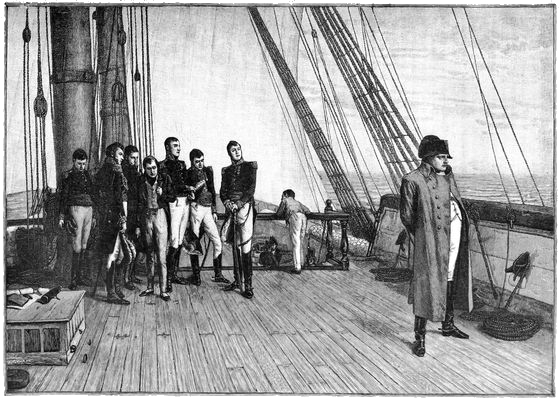
NAPOLEON ON BOARD THE "BELLEROPHON." (From the Picture by W. Q. Orchardson, R. A.)
In July, 1814, whilst the struggles were going
on upon the Canadian frontiers, the British projected
an expedition against the very capital of the
United States. This was carried into execution
about the middle of August. Sir Alexander
Cochrane landed General Ross, and a strong body
of troops, on the banks of the Patuxent, and
accompanied them in a flotilla of launches, armed
boats, and small craft up the river itself. On
entering the reach at Pig Point they saw the
American flotilla, commanded by Commodore
Baring, lying seventeen in number. They prepared
to attack it, when they saw flames begin to
issue from the different vessels, and comprehended
that the commodore had deserted them; and it was
firmly believed that he had so timed the setting
fire to his vessels that they might blow up when
the British were close upon them, if they had not
already boarded them. Fortunately, the flames
had made too much progress, and the British
escaped this danger. The vessels blew up one
after another, except one, which the British secured.
Both soldiers and sailors were highly incensed
at this treachery, and prepared to avenge it
on Washington itself. On the 24th of August
they were encountered at Bladensburg, within five
miles of Washington, by eight or nine thousand
American troops, posted on the right bank of the
Potomac, on a commanding ridge. Madison was on
one of the hills, to watch the battle, on the event
of which depended the fate of the capital.
To reach the enemy the British had to cross the
river, and that by a single bridge. This was commanded
by the American artillery, and it might
have been expected that it would not be easily
carried; but, on the contrary, a light brigade swept
over it, in face of the cannon, followed by the rest
of the army; and the troops deploying right and
left the moment they were over, this single division—about
one thousand six hundred strong—routed
the whole American force before the remainder
of the British could come into action. Few of
the Americans waited to be killed or wounded.
Madison had the mortification to see his army
all flying in precipitation, and the city open to
the British.
Before entering Washington, General Ross sent
in a flag of truce—or, rather, he carried one himself,
for he accompanied it—to see that all was
done that could be done to arrange terms, without
further mischief or bloodshed. He demanded that
all military stores should be delivered up, and that
the other public property should be ransomed at a
certain sum. But scarcely had they entered the
place, with the flag of truce displayed, when—with
total disregard of all such customs established
by civilised nations in war—the party was fired
upon, and the horse of General Ross killed under
him. There was nothing for it but to order the
troops forward. The city was taken possession of,
under strict orders to respect private property,
and to destroy only that of the State. Under
these orders, the Capitol, the President's house, the
Senate-house, the House of Representatives, the
Treasury, the War-office, the arsenal, the dockyard,
and the ropewalk were given to the flames; the
bridge over the Potomac, and some other public
works, were blown up; a frigate on the stocks
and some smaller craft were burnt. All was done
that could be done by General Ross, and the
officers under him, to protect private property; but
the soldiers were so incensed at the treachery by
which the Americans had sought to blow up the
seamen, by the firing on the flag of truce, and the
unprincipled manner in which the Americans had
carried on the war in Canada, as well as by the
insults and gasconading of the Americans on all occasions,
that they could not be restrained from committing
some excesses. Yet it may be said that
never was the capital of a nation so easily taken,
and never did the capital of a nation which had
given so much irritating provocation escape with
so little scathe. The following evening it was
evacuated in perfect order, and without any enemy
appearing to molest the retreat. On the 30th the
troops were safely re-embarked.
But this was not the only chastisement which
the Americans had received. On the 27th Captain
Gordon, of the Seahorse, accompanied by other
vessels, attacked Alexandria, situated lower on the
Potomac. They found no resistance from Fort
Washington, built to protect the river at that
point; and the authorities of Alexandria delivered
up all public property, on condition that the
private property should be spared. The British
carried off the naval and ordnance stores, as
well as twenty-one vessels, of different freights.
On the 12th of September General Ross made an
assault on the city of Baltimore. This was a
strongly fortified place, and the Americans can
always fight well under cover; and, on that
account, the attempt should have been made with
due military approaches. But General Ross had
so readily dispersed the army that defended
Washington, and another which had been drawn
up in front of Baltimore, that he made a rash
endeavour to carry the place at once, but was
killed in the attempt, as well as a considerable
number of his men. He had inflicted a loss of
six or eight hundred men, in killed and wounded,
on the Americans; but this was little satisfaction
for his own loss.
Earlier than this, in July, Colonel Pilkington
took all the islands in the Bay of Passamaquoddy;
and in another expedition, in September, the
British took the fort of Castine, on the Penobscot
river, defeated double their number of Americans,
pursued up the river the John Adams, a fine
frigate, and compelled the commander to burn it.
They took the town of Bangor, and reduced the
whole district of Maine, from Passamaquoddy Bay
to the Penobscot. In fact, these ravages and
inroads, which rendered the whole seaboard of
America unsafe, made the Americans, and especially
President Madison, exclaim loudly against
the barbarous and wanton destruction of their
capital and ports.
But, not contented with this superiority, the
British were tempted to invest and endeavour to
storm New Orleans. This was returning to the
old blunders, and giving the American sharp-shooters
the opportunity of picking off our men at
pleasure in the open field from behind their walls
and batteries. This ill-advised enterprise was
conducted by Sir Edward Pakenham. Nothing
was so easy as for our ships to blockade the mouth
of the Mississippi, and thus destroy the trade, not
only of New Orleans, but of all the towns on that
river; but this common-sense plan was abandoned
for the formidable and ruinous one of endeavouring
to take the place by storm. The city of New
Orleans lies at the distance of one hundred and
ten miles from the sea, on a low, boggy promontory,
defended on the river side by a chain of
powerful forts, and on the other by morasses.
Having landed as near New Orleans as they could,
the British troops, on the 23rd of December, were
met by an American army, and received a momentary
repulse; but this was quickly reversed, and on
Christmas day Sir Edward Pakenham encamped
at the distance of six miles from New Orleans.
But he found at least twenty thousand Americans
posted between him and the city, behind a deep
canal and extensive earthworks. There was no
way of approaching them except across bogs, or
through sugar plantations swarming with riflemen,
who could pick off our men at pleasure. This was
exactly one of those situations which the whole
course of our former wars in that country had
warned us to avoid, as it enabled the Americans,
by their numerous and excellent riflemen, to destroy
our soldiers, without their being in scarcely
any danger themselves. In fair and open fight
they knew too well that they had no chance with
British troops, and the folly of giving them such opportunities
of decimating those troops from behind
walls and embankments is too palpable to require
military knowledge or experience to point it out.
Yet Sir Edward Pakenham, who had fought
in the Peninsula, was imprudent enough to run
himself into this old and often-exposed snare. On
the 26th of December he commenced a fight on
these unequal terms, the Americans firing red-hot
balls from their batteries on the unscreened advancing
columns, whilst from the thickets around
the Kentucky riflemen picked off the soldiers on
the flanks. Pakenham thus, however, advanced
two or three miles. He then collected vast quantities
of hogsheads of sugar and treacle, and made
defences with them, from which he poured a sharp
fire on the enemy. By this means he approached
to within three or four hundred yards of the
American lines, and there, during the very last
night of the year, the soldiers worked intensely to
cast up still more extensive breastworks of sugar
and treacle casks, and earth.
The new year of 1815 was commenced by a
heavy fire along the whole of this defence from
thirty-six pieces of cannon, the immediate effect of
which was to drive the Americans, in a terrible
panic, from their guns, and walls composed of
cotton bales and earth. Why an immediate advance
was not made at this moment does not
appear. It would probably have placed the whole
of the American defences in the hands of the
British troops, and driven the Americans into the
city. But even then little advantage would have
been gained, for the news of the contest was bringing
down riflemen in legions from the country
all round, and the British, struggling in bogs, and
exposed at every fresh advance, must be mowed
down without a chance of retaliating.
In a little time the Americans, recovering their
spirits, returned to their guns, and plied them so
well that they soon knocked the breastworks of
sugar and treacle casks to pieces. As nothing
would tempt the Americans to show themselves
from behind their cotton bales and embankments,
after maintaining this murderous position for two
whole nights and days, Pakenham drew back his
men, sacrificing some of his guns, and formed a
scheme of sending a detachment across the river
to turn the batteries and then play them upon
the enemy. But for this purpose it was necessary
to cut a canal across the tongue of land on which
the army stood, in order to bring up the boats
required to carry the troops over the river.
Major-General Lambert had arrived with reinforcements,
so that against the American twenty
thousand Pakenham had now about eight thousand
men. All worked at the canal, and it was
finished on the 6th of January. Colonel Thornton
was to carry across the river one thousand four
hundred men, and surprise the great flanking
battery of eighteen or twenty guns, whilst Sir
Edward Pakenham advanced against the lines in
front. A rocket was to be thrown up by Pakenham
when he commenced his assault, and Thornton
was at that instant to make a rush on the battery
and turn it on the enemy. But they had not
sufficiently calculated on the treacherous soil
through which they cut their canal. Thornton
found it already so sludged up that he could only
get boats through it sufficient to carry over three
hundred and fifty men, and this with so much
delay that, when Pakenham's rocket went up, he
was still three miles from the battery—and that
in broad daylight—which he ought already to
have taken. Unaware of this, Pakenham advanced
against the chain of forts and ramparts.
He had ordered ladders and fascines to be in
readiness for crossing the canal, but by some gross
neglect it was found that they were not there, and
thus the whole of the British troops were exposed
to the deadly fire of the American batteries and
musketry. No valour was of any use in such
circumstances; but Sir Edward cheered on the
few but brave-hearted troops till the ladders and
fascines could arrive; but ere this happened,
Pakenham was killed. Generals Gibbs and Keane
took the place of the fallen commander, and still
cheered on their men; but it was only to unavailing
slaughter: the American marksmen, under
cover, and with their rifles on rest, picked off the
British soldiers at their pleasure. Gibbs was soon
killed and Keane disabled by a wound. In
such circumstances the troops gave way and retired,
a strong reserve protecting the rear; but
out of gun-shot there was no further danger,
for the Americans were much too cunning to
show their heads beyond the protection of their
defences.
Meanwhile, Colonel Thornton, though delayed,
and with only a handful of men, still pushed on
towards the battery, surprised the Americans, who
expected no attack in that quarter, and carried it
against overwhelming numbers. When about to
turn the captured guns against the enemy, a
messenger came in haste to say that Pakenham
had fallen, and the attacking force had retired.
But Thornton would not retrace his steps without
carrying off a good quantity of the artillery,
amongst which was a howitzer, inscribed, "Taken
at the surrender of Yorktown, 1781." On his
return to the main body, which he did without
any pursuit—for even so small a band the Americans
did not venture to pursue—it was found that
he had had but three men killed and forty
wounded, he himself being amongst the latter.
On the 18th of January, 1815, commenced the
final retreat of the British to their ships. They
were allowed to march away without molestation,
taking all their guns and stores with them, except
ten old ship guns of no value, which they rendered
useless before they abandoned them. Andrew
Jackson, afterwards President of the United
States, commanded in this defence of New Orleans,
and loud were the boastings of his prowess all over
the States, when, in fact, he had not risked a man.
His merit was to have shown what excellent shots
his countrymen were, and how careful they were
to keep out of the reach of shot themselves. So
far as the British were concerned, they had shown
not only their unparalleled bravery, but also, as
on many such occasions, their great want of prudence.
This sacrifice of life would have been
spared by a single and much more effectual
blockade, and the most lamentable part of the
business was, that all the time peace had been made,
though the news of it had not reached them.
But General Lambert did not retire far without
striking another blow. His predecessor had failed
to take New Orleans, but he had brought away
the troops in excellent order, and he passed over
in Sir Alexander Cochrane's squadron and attacked
and took the important forts of Mobile, at
the confluence of the Mobile, Tombigbee, and
Alabama rivers—the territories around which have
since grown into States. This was a basis for important
operations on those shores; but they were
rendered unnecessary by the peace.
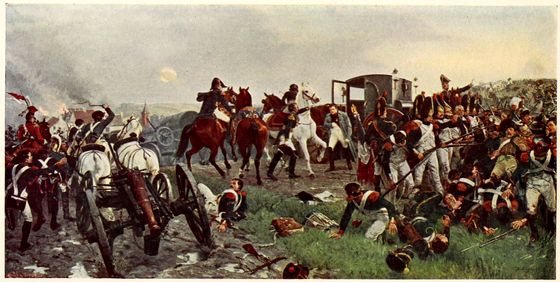
By permission of the Corporation of Liverpool.
ON THE EVENING OF THE BATTLE OF WATERLOO.
BY ERNEST CROFTS, R.A. FROM THE PAINTING IN THE WALKER ART GALLERY.
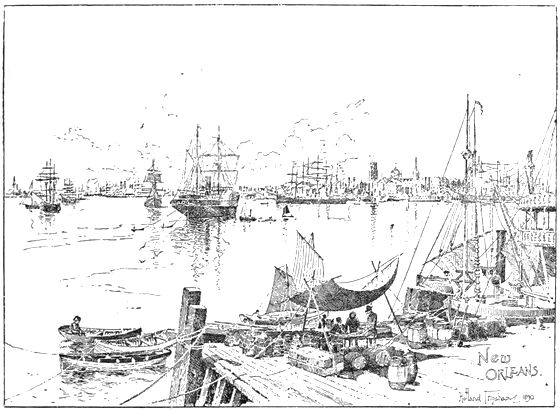
When peace was made in Europe, the United
States became anxious for peace too. Madison
had begun the war in the ungenerous hope of
wresting Canada from Great Britain, because he
thought her too deeply engaged in the gigantic
war against Napoleon to be able to defend that
colony. He believed that it would fall an easy
prey; that the Canadians must so greatly admire
the model republic that they would abandon
monarchy at the first call, and that he should thus
have the glory of absorbing that great world of
the north into the American Republic. In all
this, he and those who thought with him found
themselves egregiously deceived. The Canadians
showed they were staunchly attached to Great
Britain, and the attempts at invasion were beaten
back by the native militia and by our handful of
troops with the greatest ease. Meanwhile, the
blockade of the east, and the seizure of the
merchant shipping, drove the New England and
other eastern States to desperation. Throughout
this war Great Britain made a uniform declaration
of a preference for peace, but her offers were
regularly rejected so long as Napoleon was triumphant.
The United States, professing the utmost
love of freedom, were the blind and enthusiastic
worshippers of the man who was trampling the
liberties of all Europe under his feet. It was
not till the last moment—not till he had been
defeated in Russia, driven by Britain out of Spain,
routed and pursued out of Germany, and compelled
to renounce the Imperial Crown of France—that
the American Government began to understand
the formidable character of the Power which
it had so long and so insolently provoked, and to
fear the whole weight of its resentment directed
against its shores. It is certain that, had Britain
been animated by a spirit of vengeance, it had now
the opportunity, by sending strong fleets and a
powerful army to the coast of America, to ravage
her seaboard towns, and so utterly annihilate her
trade as to reduce her to the utmost misery, and
to precipitate a most disastrous system of internal
disintegration. The New England States, in 1814,
not only threatened to secede, but stoutly declared
that they would not furnish another shilling towards
paying the expenses of the war. They even
intimated an idea of making a separate peace
with Britain. In Massachusetts especially these
menaces were vehement. Governor Strong spoke
out plainly in the Legislative Chamber of that
State. Madison endeavoured to mollify this spirit
by abandoning his Embargo and Emancipation
Acts, but this was now too late, for the strict
blockade of the British, in 1814, rendered these
Acts perfectly dead.
To procure peace, Madison now sought the good
offices of the Emperor Alexander of Russia with
Great Britain, and these offices were readily accepted,
for the latter had never willingly gone
into or continued this unnatural war. A Congress
was appointed at Gothenburg, and thence
transferred to Ghent. There, on the 24th of
December, 1814, a loose and indefinite peace was
concluded, in which every principle on which the
war had been begun was left to be settled by
commissioners; and some of which—such was the
difficulty of negotiating with the Americans—were
not settled for many years. On these points alone
were the two Powers agreed—that all hostilities
between the contracting parties and the Indians
should be put an end to, and that both parties
should continue their efforts for the suppression of
the slave-trade. Such was the joy of the north-eastern
States of America at the peace that the
citizens of New York carried the British envoy,
sent to ratify the treaty, in triumph through the
streets.
When the Bourbons had entered Paris in 1814
they had shown the utmost liberality towards
those who had driven them from France and had
murdered those of their family on the throne and
nearest to it. They did not imitate the summary
vengeance of Napoleon, whose Government, in
1812, had put to death not only General Mallet,
who had endeavoured to restore the Bourbons,
but also thirteen of his accomplices, on the plain
of Grenelle. When Louis XVIII. returned, there
were numbers of the bloody Revolutionists who
had voted for, and some who had acted in, the
frightful atrocities of the Revolution—many who
had urged on the sufferings, the indignities, and
the death of Louis XVI., Marie Antoinette, the
Princess Elizabeth, the Princess Lamballe, and the
worst form of death of the unhappy Dauphin.
Yet no vengeance was taken, and numbers of
these people were allowed to reside unharmed in
Paris. Having been now again driven forth, and
seen the readiness with which those who had
sworn to maintain their Government had taken
their oaths and betrayed them, it might have been
expected that there would have been some severe
punishments. But the natural mildness of Louis
XVIII., and the wise counsels of Wellington
and Talleyrand, produced a very different scene.
Never, after such provocations, and especially to
the sensitive natures of Frenchmen, was so much
lenity shown. In the proclamation of Louis
XVIII. of the 24th of July, nineteen persons only
were ordered for trial, and thirty-eight were
ordered to quit Paris, and to reside in particular
parts of France, under the observation of the
police, till their fate should be decided by the
Chambers. Of the nineteen threatened with
capital punishment, with trial before a military
tribunal, only Ney and Labédoyère suffered;
another, Lavalette, was condemned, but escaped by
changing dresses with his wife in prison. It
was also stated that such individuals as should be
condemned to exile should be allowed to sell their
property in France, and carry the proceeds with
them. Yet more clamour was raised by the
Buonapartists about the deaths of Ney and Labédoyère
than had been made in any executions by the
Imperial or the Revolutionary parties over whole
hecatombs of innocent persons. As for Ney and
Labédoyère, their treason had been so barefaced
and outrageous that no reasonable person could
expect anything but summary punishment for
them. Ney had declared to Louis XVIII. that
he would bring Buonaparte to him in a cage,
and then carried over his whole army at once
to the Emperor. Labédoyère had been equally
perjured after the most generous forgiveness of
his former treasons, and he had been particularly
active in stimulating the Parisians to make
a useless resistance to the Allies approaching
Paris, by stating that the Bourbons were preparing
a most sanguinary proscription. Both
officers knew that they had no hope of life, no
plea of protection, and they fled in disguise.
Yet vehement reproaches were cast on the Duke
of Wellington for having, as the Buonapartists
asserted, broken the 12th article of the Convention
of Paris, by which the city was surrendered to the
Allied armies. Madame Ney, after the seizure
and condemnation of her husband, went to the
Duke, and demanded his interference on the Marshal's
behalf, as a right on the ground of this
article, which she interpreted as guaranteeing all
the inhabitants, of whatever political creed or
conduct, from prosecution by the restored Government.
It was in vain that Wellington explained
to her that this article, and indeed the whole
Convention, related solely to the military surrender,
and not to the political measures of the
Government of Louis, with which the Duke had
publicly and repeatedly declared that he had no
concern, and in which he would not interfere.
When the Commissioners from the Provisional
Government had waited on him, so early as the
2nd of July, at Estrées, and claimed exemption
for political offenders, he showed them the proclamation
of Louis, dated Cambray, the 28th of
June, making exceptions to the general amnesty,
and distinctly told them that he had no orders
to interfere with the measures of the Bourbon
Government. To this the Commissioners had
nothing to object, and they thus clearly understood
that the British commander would not take any
part in political, but merely in military measures.
Nevertheless, when Ney was executed, the clamour
was renewed that Wellington had betrayed him.
We now anticipate, somewhat, to dispose of this
calumny, for there never was a party so recklessly
addicted to charging their enemies with breach
of faith as that of Buonaparte and his followers.
The foul charge was so industriously disseminated
over Europe, that Wellington, at Paris, on the
19th of November, 1815, issued a memorial on the
subject, which he first caused to be sent to all the
Allied Powers and then to be published. In this
most decisive document he stated that the Convention
of Paris related exclusively to the military
occupation of the place, and was never intended,
and could not be intended, to prevent either the
existing French Government, the Provisional, or
any French Government that might succeed it,
from acting towards political offenders as it might
deem proper. He had refused before to enter
into a question of settling the Government. To
make this clear, he quoted the 11th article,
providing for the non-interference of the Allied
army with property; and the 12th:—"Seront
pareillement respectées les personnes et les propriétés
particulières; les habitants, et en général
tous les individus qui se trouvent dans la capitale,
continueront à jouir de leur droits et libertés sans
pouvoir être inquiétés, ou recherchés en rein,
relativement aux fonctions qu'ils occupent ou
avaient occupées, à leur conduite, et à leur
opinions politiques." Labédoyère was shot on the
19th of August, 1815, and Ney on the 7th of
December.
It remains only to notice the terminating scene
of the once gay Murat, Buonaparte's gallant leader
of cavalry in so many campaigns, and finally King
of Naples. In consequence of plans that he
had laid with Buonaparte in Elba, Murat rose
on the 22nd of March of this year, and pushed
forward with the intention of driving the Austrians
out of Upper Italy. But Austria was well aware
of what had been in progress, and, though
Murat proclaimed the independence of Italy, the
Italians fled from him rather than joined him.
On the Po he was met by the Austrians, under
General Fremont, fifty thousand strong, and
defeated. He retreated rapidly towards Naples
again, suffering other discomfitures, and at the
same time receiving a notice from Lord William
Bentinck that, as he had broken his convention
with the European Powers, Britain was at war
with him. To keep the Neapolitans in his interest,
he drew up a liberal Constitution, on the 12th of
May, amid the mountains of the Abruzzi, and sent
it to Naples, where his queen, Caroline Buonaparte,
proclaimed it. It was of no avail; the
people, instead of assisting him, were ready to rise
against him, and his soldiers every day rapidly
deserted and went to their homes.
Murat hastened in disguise to Naples to consult
with his wife, who had as much courage and more
judgment than he had; but this availed him
nothing. On the 20th of May his generals signed
a convention with the Austrians at Casa Lanza,
a farmhouse near Capua, to surrender Capua on
the 21st, and Naples on the 23rd, on condition
that all the Neapolitan officers who took the oath
of allegiance to King Ferdinand should retain
their respective ranks, honours, and estates. At
this news Murat fled out of Naples, and, with a
very small attendance, crossed over in a fisherman's
boat to the island of Ischia, and his wife
went on board the vessel of Commodore Campbell,
which, however, she was only able to effect by
a guard of three hundred English sailors and
marines, for the lazzaroni were all in insurrection.
Commodore Campbell, having received Caroline
Buonaparte, her property and attendants on board
his squadron, then sailed to Gaeta, where were
the four children of Murat, took them on board,
and conveyed them altogether to Trieste, the
Emperor of Austria having given Madame Murat
free permission to take up her residence in Austria,
under the name of the Countess of Lipano.
Well had it been for Murat could he have made
up his mind to seek the same asylum; for it
appears clear that it would have been granted
him, for he was no longer dangerous. But he
clung convulsively to the fortunes of Napoleon,
and making his way in a small coasting vessel,
he followed him to France, and reached the port
of Fréjus on the 28th or 29th of May, where
Buonaparte had landed on his return from Elba.
From this place Murat wrote to Buonaparte
through Fouché, offering his services to him; but
Buonaparte, who would have been duly sensible of
the services of Murat had he succeeded in holding
Italy against the Austrians, and thus acting as an
important divider of the efforts of the Austrians,
was equally sensible of the little value of Murat
as a mere individual, defeated, and having lost
Italy. He refused to give him a word of reply.
Murat accordingly lay in concealment with his
followers, vainly hoping for a word of encouragement,
till the news of the utter defeat of Buonaparte
at Waterloo came upon him like the shock
of an earthquake. The south of France was no
longer a place for any who had been prominent
amongst the retainers of Buonaparte; some of
Murat's followers made haste to escape from the
search and the vengeance of the Royalists. As
for Murat himself, he wrote again to Fouché,
imploring his good offices with the Allies to obtain
him a passport for England. Receiving no response
to this, Murat condescended to write a most
imploring letter to Louis XVIII., but he had no
time to wait for the slow progress of diplomatic
life—he fled and, after many adventures, reached
Corsica. There he was allowed to remain, and a
few weeks would have brought him the assurance
of entire freedom from enmity on the part of the
Allies. But, unfortunately, by this time the
shock of the utter overthrow and captivity of
Buonaparte following on his own misfortunes, had
overturned his intellect. He conceived the insane
idea of recovering Naples by the same means that
Buonaparte had for a while recovered Paris. A
large number of Neapolitan and Corsican refugees
encouraged him in the mad project.
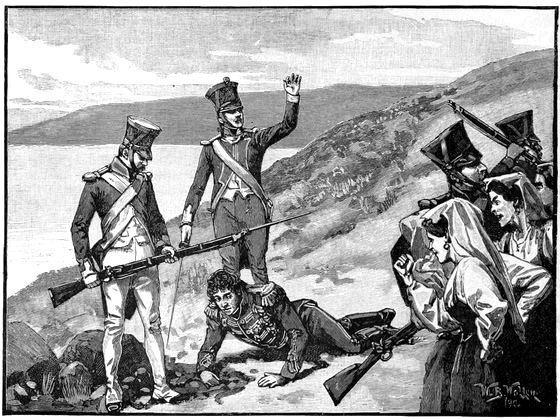
CAPTURE OF MURAT. (See p. 117.)
On the 8th of October Murat landed near Pizzo,
on the Calabrian coast—a coast more than any
other in Italy fraught with fierce recollections of
the French. His army now consisted of only
twenty-eight men; yet, in his utter madness, he
advanced at the head of this miserable knot of
men, crying, "I am your king, Joachim!" and
waving the Neapolitan flag. But the people of
Pizzo, headed by an old Bourbon partisan, pursued
him, not to join, but to seize him. When they
began firing on him, he fled back to his vessels;
but the commander, a man who had received
the greatest benefits from him, deaf to his cries,
pushed out to sea, and left him. His pursuers
were instantly upon him, fired at him, and
wounded him; then rushing on him, they knocked
him down and treated him most cruelly. Women,
more like furies than anything else, struck their
nails into his face and tore off his hair, and he
was only saved from being torn to pieces by the
old Bourbon and his soldiers, who beat off these
female savages and conveyed him to the prison at
Pizzo. The news of his capture was a great
delight to Ferdinand. He entertained none of
the magnanimity of the Allies, but sent at once
officers to try by court-martial and, of course, to
condemn him. Some of these officers had been in
Murat's service, and had received from him numerous
favours, but not the less readily did they
sentence him to death; and on the 13th of October,
1815, he was shot in the courtyard of the prison
at Pizzo—with characteristic bravery refusing to
have his eyes bound, and with characteristic vanity
bidding the soldiers "save his face, and aim at
his heart!"
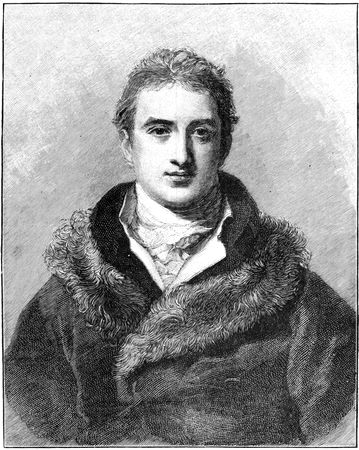
The Congress of Vienna, interrupted by the
last razzia of Buonaparte, now resumed its sittings,
and the conditions between France and
the Allies were finally settled, and treaties embodying
them were signed at Paris by Louis
XVIII. on the 20th of November. France was
rigorously confined to the frontier of 1790, losing
the additions conferred on it by the first Treaty of
Paris; and to prevent any danger of a recurrence
of the calamities which had called the Allies thus
a second time to Paris, they were to retain in
their hands seventeen of the principal frontier
fortresses, and one hundred and fifty thousand of
their soldiers were to be quartered, and maintained
by France, in different parts of the kingdom. The
term of their stay was not to exceed five years,
and that term might be curtailed should the
aspect of Europe warrant it. The Allied sovereigns
also insisted on the payment of the enormous
expenses which had been occasioned by this
campaign of the Hundred Days—the amount of
which was estimated at seven hundred millions of
francs. This sum, however, was not to be exacted
at once, but to be paid by easy instalments.
There was one restitution, however, which the
Allies had too delicately passed over on their
former visit to Paris—that of the works of art
which Napoleon and his generals had carried off
from every town in Italy, Germany, and the
Netherlands, during their wars. As has been
already stated, museums had been freely pillaged
by Buonaparte or by his orders. Accordingly,
there was now a great stripping of the Louvre, and
other places, of the precious pictures and statues
which the hands of the greatest marauder that the
world had ever seen had accumulated there. The
"Horses of the Sun," from St. Mark's, Venice, the
"Venus di Medici," the "Apollo Belvedere," the
"Horses of the Car of Victory," which Buonaparte
had carried away from Berlin, and many a
glorious painting by the old masters, precious
books, manuscripts, and other objects of antiquity,
now travelled back to their respective original
localities, to the great joy of their owners, and the
infinite disgust of the French, who deemed themselves
robbed by this defeat of robbery.
Louis XVIII., having raised an army of thirty
thousand men, thought that he could protect himself,
and was anxious that France might be spared
the expense of supporting the one hundred and
fifty thousand men. Accordingly, one-fifth of the
army was withdrawn in 1817. In the following
year a Congress was held, in the month of September,
at Aix-la-Chapelle, at which the Emperors of
Russia and Austria and the King of Prussia
attended; on the part of France, the Duke of
Richelieu; and of Great Britain, the Duke of
Wellington and Lord Castlereagh, when it was
determined that a complete evacuation of France
might and should take place by the 20th of
November, when the three years terminated. At
this Congress it was determined also that, besides
the seven hundred million francs for the charges
incurred by the Allied armies, another seven
hundred millions should be paid in indemnification
of damages to private individuals in the different
countries overrun by France. These and other
items raised the total to be paid by France for
Napoleon's outbreak of the Hundred Days to
about sixty million pounds sterling.
Great Britain, which had amassed so vast a
debt in aiding the Continental sovereigns against
Napoleon, played the magnanimous to the last.
She gave up her share of the public indemnities,
amounting to five million pounds, to the King of
Holland and the Netherlands, to enable him to
restore that line of fortresses along the Belgian
frontiers which our Dutch king, William III., had
planned, and which Joseph II. of Austria had suffered
to fall to decay, thus rendering invasion from
France especially easy. Nor was this all: she
advanced five million pounds to enable the different
sovereigns to march their troops home again,
as she had advanced the money to march them
up, the money demanded of France not being
ready. Truly might Napoleon, in St. Helena, say
that England, with her small army, had no business
interfering in Continental wars; that "with
our fleet, our commerce, and our colonies, we are
the strongest power in the world, so long as we
remain in our natural position; but that our
gains in Continental wars are for others, our
losses are for ourselves, and are permanent."
Here, then, our history of the political transactions
of the reign of George III. terminates.
That reign really terminated in 1811, with the
appointment of the Regency, which continued the
ruling power during the remainder of his life.
From that date it is really the history of the
Regency that we have been prosecuting. But this
was necessary to maintain the unity of the narrative
of that most unexampled struggle which was
involving the very existence of every nation in
Europe. Of all this the poor old, blind, and
deranged king knew nothing—had no concern
with it. The reins of power had fallen from
his hands for ever: his "kingdom was taken from
him, and given to another." He had lived to
witness the rending away of the great western
branch of his empire, and the sun of his intellect
went down in the midst of that tempest which
threatened to lay in ruins every dynasty around
him. We have watched and detailed that mighty
shaking of the nations to its end. The events of
the few remaining years during which George III.
lived but did not rule, were of a totally different
character and belong to a totally different
story. They are occupied by the national distresses
consequent on the war, and the efforts for
reform, stimulated by these distresses, the first
chapter of which did not close till the achievement
of the Reform Bill in 1832.
The Government and Parliament which, with
so lavish a hand, had enabled the Continental
monarchs to fight their battles, which had spent
above two thousand millions of money in these
wars, of which eight hundred millions remained as
a perpetual debt, with the perpetual necessity of
twenty-eight millions of taxation annually to discharge
the interest—that burden on posterity
which Napoleon had, with such satisfaction, at
St. Helena, pronounced permanent—this same
Government and Parliament, seeing the war concluded,
were in great haste to stave off the effects
of this burden from the landed aristocracy, the
party which had incurred it, and to lay it upon
the people. They saw that the ports of the world,
once more open to us, would, in exchange for our
manufactures, send us abundance of corn; and,
that the rents might remain during peace at the
enormous rate to which war prices had raised
them, they must keep out this foreign corn.
True, this exclusion of foreign corn must raise the
cost of living to the vast labouring population to
a ruinous degree, and threatened fearful convulsions
from starving people in the manufacturing
districts; but these considerations had no
weight with the land-holding Government and its
Parliamentary majority. In 1814 they were in
haste to pass a Corn Law excluding all corn except
at famine prices; but the lateness of the season,
and an inundation of petitions against it, put it
off for that Session. But in 1815 it was introduced
again and carried by a large majority. By
this all corn from abroad was excluded, except
when the price was eighty shillings per quarter.
By this law it was decreed that the people who
fought the battles of the world, and who would
bear the bulk of the weight of taxation created by
these wars, were never, so long as this law continued,
to eat corn at less than four pounds per
quarter. This was, in fact, not only a prohibition
of cheap bread, but a prohibition of the sale of the
labours of the people to foreign nations to the
same extent. It was an enactment to destroy the
manufacturing interest for the imagined benefit of
land-owners; and it was done on this plea, as
stated by Mr. Western, one of the leading advocates
of the Bill—"That, if there is a small
deficiency of supply, the price will rise in a ratio
far beyond any proportion of such deficiency: the
effect, indeed, is almost incalculable. So, likewise,
in a surplus of supply beyond demand, the price
will fall in a ratio exceeding almost tenfold the
amount of such surplus." The avowed object,
therefore, was to prevent the manufacturing population
from reaping the benefit of that Continental
peace which they had purchased at such a cost,
and consequently to repress the growth of their
trade to the same degree. Mr. Tooke, in his
"History of Prices," confirms this view of the
matter, asserting that "the price of corn in this
country has risen from one hundred to two hundred
per cent., and upwards, when the utmost
computed deficiency of the crops has not been
more than between one-sixth and one-third below
an average, and when that deficiency has been
relieved by foreign supplies." Mr. Western candidly
showed that, to the farmer, years of deficiency
were the most profitable, from this principle
of enormous rise from a small cause; that if the
produce of an acre of wheat in a good year is
thirty-three bushels at six shillings, the amount
realised would be only nine pounds eighteen
shillings; but, if the produce were reduced by an
unfavourable season one-sixth, and the price raised
from six shillings to twelve shillings, the produce
of twenty-seven and a half bushels would realise
sixteen pounds ten shillings, the difference being
profit!
The effect was immediately shown by a rapid
rise of prices, wheat becoming one hundred and
three shillings a quarter. But this did not satisfy
the land-owners, and Mr. Western, in 1816, introduced
no less than fourteen resolutions to make
more stringent the exclusion of foreign corn. It
was openly declared "that excessive taxation
renders it necessary to give protection to all
articles, the produce of our own soil, against
similar articles, the growth of foreign countries."
Mr. Barham declared that "the country must be
forced to feed its own population. No partial
advantage to be derived from commerce could
compensate for any deficiency in this respect.
The true principle of national prosperity was an
absolute prohibition of the importations of foreign
agricultural produce, except in extreme cases;"
and on this ground it was proposed to exclude
foreign rape-seed, linseed, tallow, butter, cheese, etc.
Some of the most eminent land-owners were
clear-sighted and disinterested enough to oppose
these views with all their power. The Dukes of
Buckinghamshire and Devonshire, the Lords
Carlisle, Spencer, Grey, Grenville, Wellesley, and
many members of the Commons, voted and protested
energetically against them; and the additional
restrictions were not carried. But enough
had been done to originate the most frightful
sufferings and convulsions. We shall see these
agitations every remaining year of this reign.
The Prince Regent, in his opening speech, in
1816, declared "manufactures and commerce to be
in a flourishing condition." But Mr. Brougham at
once exposed this fallacy. He admitted that there
had been an active manufacturing and an unusual
amount of exportation in expectation of the ports
of the world being thrown open by the peace; but
he declared that the people of the Continent were
too much exhausted by the war to be able to
purchase, and that the bulk of these exported
goods would have to be sold at a ruinous reduction—at
almost nominal prices; and then would immediately
follow a stoppage of mills, a vast population
thrown out of employment, and bread and
all provisions made exorbitantly dear when there
was the least power to purchase. All this was
speedily realised. British goods were soon selling
in Holland and the north of Europe for less
than their cost price in London and Manchester.
Abundant harvests defeated in some degree the
expectations of the agriculturists, and thus both
farmers and manufacturers were ruined together;
for, the check being given to commerce, the manufacturing
population could purchase at no price,
and, in spite of the harvest, the price of wheat was
still one hundred and three shillings per quarter.
Many farmers, as well as manufacturers, failed;
country banks were broken, and paper-money was
reduced in value twenty-five per cent.; and a
circumstance greatly augmenting the public distress
was the reduction of its issues by the Bank
of England from thirty-one millions to twenty-six
millions.
The year 1816 was a most melancholy year.
Both agricultural and manufacturing labourers
rose in great masses to destroy machinery, to
which, and not to the temporary poverty of the
whole civilised world, exhausted by war, they
attributed the glut of manufactured goods, and
the surplus of all kinds of labour. In Suffolk and
Norfolk, and on the Isle of Ely, the agricultural
labourers and fen-men destroyed the threshing-machines,
attacked mills and farms, pulled down
the houses of butchers and bakers, and marched
about in great bands, with flags inscribed "Bread
or blood!" In Littleport and Ely shops and
public-houses were ransacked, and the soldiers
were called out to quell the rioters, and much
blood was shed, and numbers were thrown into
prison, of whom thirty-four were condemned to
death, and five executed. The colliers and workers
in the iron mines and furnaces of Staffordshire
and Warwickshire, as well as in the populous
districts of South Wales, were thrown out of
work, and the distress was terrible. The sufferings
and consequent ferments in Lancashire were
equally great. In Nottinghamshire, Leicestershire,
and Derbyshire, the Luddites broke out again, as
they had done in 1812, and by night demolished
the stocking-frames and the machinery in the
cotton-mills. Great alarm existed everywhere,
and on the 29th of July a meeting was called at
the "City of London" Tavern to consider the
means of relieving the distress, the Duke of York
taking the chair, the Dukes of Kent and Cambridge,
the Archbishop of Canterbury, the Bishop
of London, the Chancellor of the Exchequer,
and others attending. Many palliatives were proposed,
but Lord Cochrane and other reformers
declared that the only effectual remedy would be
the abolition of the Corn Law. Soup-kitchens
were recommended, but in Scotland these were
spurned at as only insults to the sufferers; at
Glasgow the soup-kitchen was attacked, and its
coppers and materials destroyed; and at Dundee
the people helped themselves by clearing a hundred
shops of their provisions.
During the whole of these scenes the attitude of
Government was not merely indifferent, but absolutely
repulsive. At no time had so cold and
narrow-spirited a Ministry existed. The names
of Castlereagh, Liverpool, Sidmouth, and Lord
Eldon as Lord Chancellor, recall the memory of a
callous Cabinet. They were still dreaming of
additional taxation when, on the 17th of March,
they were thunderstruck by seeing the property-tax
repealed by a majority of forty. The Prince
Regent had become utterly odious by his reckless
extravagance and sensual life. The abolition of
the property-tax was immediately followed by
other resistance. On the 20th of March a motion
of disapprobation of the advance of the salary of
the Secretary to the Admiralty, at such a time,
from three to four thousand pounds a-year was
made, but lost. On this occasion Henry Brougham
pronounced a most terrible philippic against the
Prince Regent, describing him as devoted, in the
secret recesses of his palace, to the most vicious
pleasures, and callous to the distresses and sufferings
of others! Mr. Wellesley Pole described it
as "language such as he had never heard in that
House before."
Not only in Parliament, but everywhere the
cry for Reform rose with the distress. Hampden
Clubs were founded in every town and village
almost throughout the kingdom, the central one
being held at the "Crown and Anchor" in the
Strand, London, its president being Sir Francis
Burdett, and its leading members being William
Cobbett, Major Cartwright, Lord Cochrane, Henry
Hunt, and others. The object of these clubs was to
prosecute the cause of Parliamentary reform, and
to unite the Reformers in one system of action.
With the spirit of Reform arose, too, that of cheap
publications, which has now acquired such a vast
power. William Cobbett's Political Register, on
the 18th of November, 1816, was reduced from a
shilling and a halfpenny to twopence, and thence-forward
became a stupendous engine of Reform,
being read everywhere by the Reformers, and especially
by the working-classes in town and country,
by the artisan in the workshop, and the shepherd
on the mountain. The great endeavour of Cobbett
was to show the people the folly of breaking
machinery, and the wisdom of moral union.
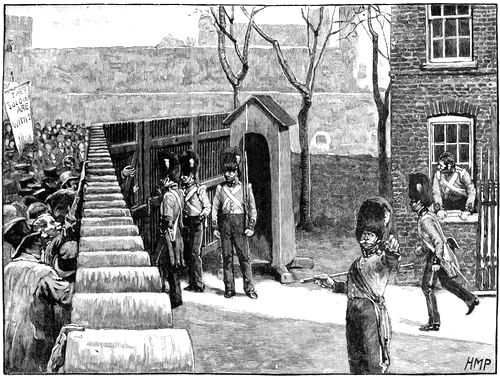
THE MOB OF SPENCEANS SUMMONING THE TOWER OF LONDON. (See p. 121.)
It is only too true, however, that many of the
Hampden Clubs entertained very seditious ideas,
and designs of seizing on the property of the
leading individuals of their respective vicinities.
Still more questionable were the doctrines of the
Spenceans, or Spencean Philanthropists, a society
of whom was established in London this year, and
whose chief leaders were Spence, a Yorkshire
schoolmaster, one Preston, a workman, Watson
the elder, a surgeon, Watson the younger, his son,
and Castles, who afterwards turned informer
against them. Mr. "Orator" Hunt patronised
them. They sought a common property in all
land, and the destruction of all machinery. These
people, with Hunt and Watson at their head, on
the 2nd of December, met in Spa Fields. The
Spenceans had arms concealed in a waggon, and a
flag displayed declaring that the soldiers were
their friends. The crowd was immense, and soon
there was a cry to go and summon the Tower.
Mr. Hunt and his party appear to have excused
themselves from taking part in this mad movement.
The mob reached the Tower, and a man,
supposed to be Preston, summoned the sentinels
to surrender, at which they only laughed. The
mob then followed young Watson into the City,
and ransacked the shop of Mr. Beckwith, a gunsmith,
on Snow Hill, of its firearms. A gentleman
in the shop remonstrated, and young Watson
fired at him and severely wounded him. Young
Watson then made his escape, but his father was
secured and imprisoned; and the Lord Mayor and
Sir James Shaw dispersed the mob on Cornhill,
and took one of their flags and several prisoners.
Watson the elder was afterwards tried and acquitted;
but a sailor who was concerned in the
plunder of the gunsmith's shop was hanged.
A week after this riot the Corporation of London
presented an Address to the Throne, setting forth
the urgent necessity for Parliamentary reform.
These events were a little diversified by the
storming of Algiers on the 27th of August. In
1815 the Government of the United States of
America had set the example of punishing the
piratical depredations of the Algerines. They
seized a frigate and a brig, and obtained a compensation
of sixty thousand dollars. They do not
appear to have troubled themselves to procure any
release of Christian slaves, or to put an end to the
practice of making such slaves; and, indeed, it
would have been rather an awkward proposal on
the part of North Americans, as the Dey might
have demanded, as a condition of such a treaty,
the liberation of some three millions of black
slaves in return. But at the Congress of Vienna
a strong feeling had been shown on the part of
European Governments to interfere on this point.
It was to the disgrace of Great Britain that, at
the very time that she had been exerting herself
so zealously to put an end to the negro slave
trade, she had been under engagements of
treaty with this nest of corsairs; and Lord
Cochrane stated in Parliament this year that
only three or four years before it had been his
humiliating duty to carry rich presents from our
Government to the Dey of Algiers. But in the
spring of this year it was determined to make an
effort to check the daring piracies of Tunis,
Algiers, and Tripoli. Lord Exmouth was sent to
these predatory Powers, but rather to treat than
to chastise; and he effected the release of one
thousand seven hundred and ninety-two Christian
slaves. From Tunis and Tripoli he obtained a
declaration that no more Christian slaves should
be made. The Dey of Algiers refused to make
such concession till he had obtained the permission
of the Sultan. Lord Exmouth gave him three
months to determine this point, and returned
home. A clause in the treaty which he had made
with Algiers ordered that Sicily and Sardinia
should pay nearly four hundred thousand dollars
for the ransom of their subjects; they accordingly
paid it. This clause excited just condemnation
in England, as actually acknowledging the right
of the Algerines to make Christian slaves.
But the matter was not to be thus peacefully
ended. Before Lord Exmouth had cleared
out of the Mediterranean, the Algerines—not in
any concert with their Government but in an
impulse of pure fanaticism—had rushed down from
their castle at Bona on the Christian inhabitants
of the town, where a coral fishery was carried on
chiefly by Italians and Sicilians, under protection
of a treaty made by Britain, and under that of her
flag, and committed a brutal massacre on the
fishermen, and also pulled down and trampled on
the British flag, and pillaged the house of the
British vice-consul.
Scarcely had Lord Exmouth reached home when
he was ordered forth again to avenge this outrage,
and he sailed from Plymouth on the 28th
of July, 1816, with a fleet of twenty-five large and
small ships. At Gibraltar he was joined by the
Dutch Admiral Van Cappellan with five frigates
and a sloop, to which were added a number of
British gunboats. On the 27th of August Lord
Exmouth sailed right into the formidable harbour
of Algiers, and dispatched a messenger to the
Dey, demanding instant and ample recompense for
the outrage; the delivery of all Christian slaves in
the kingdom of Algiers; the repayment of the
money received by the Dey for the liberation of
Sicilian and Sardinian slaves; the liberation of
the British consul—who had been imprisoned—and
of two boats' crews detained; and peace between
Algiers and Holland. The messenger landed
at eleven o'clock, and two hours were given the
Dey to prepare his answer. The messenger remained
till half-past two o'clock, and no answer
arriving, he came off, and Lord Exmouth gave
instant orders for the bombardment. The attack
was terrible. The firing from the fleet, which was
vigorously returned from the batteries in the town
and on the mole, continued till nine in the evening.
Then most of the Algerine batteries were
knocked literally to pieces, but the firing did not
cease till about eleven. No sooner was the assault
over than a land wind arose and carried the fleet
out of the harbour, so that the vessels were all
out of gunshot by two o'clock in the morning. A
wonderful spectacle then presented itself to the
eyes of the spectators in the fleet. Nine Algerine
frigates, a number of gunboats, the storehouses
within the mole, and much of the town were in
one huge blaze, and by this they could see that the
batteries remained mere heaps of ruins. The
next morning Lord Exmouth sent in a letter to
the Dey with the offer of the previous day,
saying, "If you receive this offer as you ought,
you will fire three guns." They were fired. The
Dey made apologies, and signed fresh treaties of
peace and amity, which were not of long endurance.
But within three days one thousand and
eighty-three Christian slaves arrived from the
interior, and were received on board and conveyed
to their respective countries.
We must return from victory abroad to discontent
at home. On the 28th of January, 1817,
the Prince Regent opened the fifth Session
of Parliament. In his speech he expressed indignation
at "the attempts which had been made
to take advantage of the distresses of the country
for the purpose of exciting a spirit of sedition and
violence;" and he declared himself determined to
put down these attempts by stern measures. The
seconder of the Address in the Commons had the
good sense to believe that the demagogues and
their acts would die of themselves. Certainly, if
the demagogues had no cause on which to base
their efforts, those efforts must have proved fruitless;
and the wisdom of Government consisted in
seriously inquiring whether there were such causes.
To attempt to insure peace by smothering distress
is the old remedy of tyrants, and is like heaping
fuel on fire to put it out. Whilst this debate was
proceeding, a message arrived from the Lords to
announce that the Regent, on his return from the
House, had been insulted, and some missile thrown
through the windows of his carriage. The House
agreed upon an Address to the Regent on this
event, and then adjourned.
The next day the debate was resumed. It appeared
that the Prince had been hooted at, and
a stone, or other missile, flung through the
window of the carriage. The Ministerial party
endeavoured to raise the occurrence into an attempt
on the Prince's life; the Opposition hinted
at the expression of public disgust with the tone
which Government was assuming towards the
distresses of the people, called zealously for
stringent reductions of expense, and moved an
amendment to that very effect. But the Government
had yet much to learn on this head; and
Lord Sidmouth announced that the Prince Regent
in three days would send down a message on the
disaffection of the people. It would have been
wise to have added to this measure a recommendation
of serious inquiry into the causes of
this disaffection, for disaffection towards a
Government never exists without a cause; but
the Government had carried on matters so easily
whilst they had nothing to do but to vote large
sums of money for foreign war that they had grown
callous, and had been so much in co-operation with
arbitrary monarchs that they had acquired too much
of the same spirit; and they now set about to put
down the people of England as they, by means of
the people of England, had put down Buonaparte.
It was their plan to create alarm, and under the
influence of that alarm to pass severe measures
for the crippling of the Constitution and the
suppression of all complaints of political evil.
In the debate on this subject, George Canning,
who on many occasions had shown himself capable
of better things, breathed the very language of
Toryism. He declared the representation of Parliament
perfect, and treated the most moderate
proposals for Reform as only emanations from the
mad theories of the Spenceans. The message of
the Prince Regent came down on the 3rd of
February, ordering certain papers to be laid before
the House, "concerning certain practices, meetings,
and combinations in the metropolis, and in
different parts of the kingdom, evidently calculated
to endanger the public tranquillity, to alienate the
affections of his Majesty's subjects from his Majesty's
person and Government, and to bring into
hatred and contempt the whole system of our laws
and institutions." Lord Sidmouth endeavoured to
guard the House of Peers against the belief that
the insult to the Regent had any share in the
origination of this message, but the House of
Lords, in its Address, directly charged this event
as an additional proof of the public disaffection.
Unfortunately, the Regent had two Houses of
Parliament only too much disposed to make themselves
the instruments of such vengeance. The
message was referred to a secret committee in
each House, and on the 18th and 19th of February
they respectively made their reports. Both went
at great length into the affair of the Spa Fields
meeting, and the proceedings and designs of the
Spenceans were made to represent the designs of
the working classes all over the kingdom; that
such men as Thistlewood, who not long after
suffered for his justly odious conduct, were conspicuous
among the Spenceans, and that there had
been an affray in Spa Fields, were circumstances
to give ample colouring to the reports of these
committees. The Lords' report stated—"It appears
clear that the object is, by means of societies,
or clubs, established, or to be established, in all
parts of Great Britain, under pretence of Parliamentary
reform, to infect the minds of all classes
of the community, and particularly of those whose
situation most exposes them to such impressions,
with a spirit of discontent and disaffection, of insubordination,
and contempt of all law, religion,
and morality; and to hold out to them the plunder
of all property as the main object of their efforts,
and the restoration of their natural rights; and
no endeavours are omitted to prepare them to take
up arms, on the first signal, for accomplishing
their designs."
The country societies were pointed out "as principally
to be found in the neighbourhood of
Leicester, Loughborough, Nottingham, Mansfield,
Derby, Chesterfield, Sheffield, Blackburn, Manchester,
Birmingham, Norwich, Glasgow, and its
vicinity; but," it added, "they extend, and are
spreading in some parts of the country, to almost
every village." The report of the Commons went
over much the same ground, dwelling particularly
on the Hampden Clubs as avowed engines of
revolution. It dwelt on the acts and activity
of the leaders, of the numbers which they had
seduced and were seducing, the oaths which bound
them together, and the means prepared for the
forcible attainment of their objects, which were
the overthrow of all rights of property and all the
national institutions, in order to introduce a reign
of general confusion, plunder, and anarchy.
Now, though in some obscure and ignorant
parts of the country there were clubs which contemplated
the foolish idea of seizing on neighbouring
properties, the committees must have been
very ill-informed to have drawn any such conclusion
as to the Hampden Clubs, which were
organised for Parliamentary reform under the
auspices of Sir Francis Burdett, Major Cartwright,
Lord Cochrane, Cobbett, and others. Most of
these persons had large properties to be sacrificed
by the propagation of any such principles, and
the great topics of Cobbett's Register, the organ
through which he communicated with the people,
were the necessity of refraining from all violence,
and of rising into influence by purely political
co-operation. But these reports answered the
purposes of the Government, and they proceeded
to introduce, and succeeded in passing, four Acts
for the suppression of popular opinion. The first
was to provide severe punishment for all attempts
to seduce the soldiers or sailors from their allegiance;
the second to give safeguards to the person
of the Sovereign, but which did not include the
most effectual of all—that of making him beloved;
the third was to prevent seditious meetings, and
gave great power to the magistrates and police
to interfere with any meeting for the mildest
Reforms; the fourth was the old measure of suspension
of the Habeas Corpus Act, which armed
the magistrates with the fearful authority to arrest
and imprison at pleasure, without being compelled
to bring the accused to trial. The last of these
Acts was not passed till the 29th of March, and
it was to continue in force only till the 1st of
July. But in the meantime events took place
which occasioned its renewal.
Within a few days after the first passing of this
Act, that is, in the first week of March, a body
of weavers—said by the Government to amount to
ten thousand men, but by a more competent
authority, Samuel Bamford, the author of the
"Life of a Radical," not to have exceeded four or
five thousand—met in St. Peter's Field, at Manchester,
and commenced a march southward. The
intention was to proceed to London, to present to
the Prince Regent, in person, a petition describing
their distress. Bamford had been consulted, and
had condemned the project as wild, and likely to
bring down nothing but trouble on the petitioners.
He believed that they were instigated by spies
sent out by Government in order to find an
opportunity of justifying their arbitrary measures.
Suspicious persons had been trying him. But the
poor, deluded people assembled, "many of them,"
says Bamford, "having blankets, rugs, or large
coats rolled up, and tied knapsack-like on their
backs. Some had papers, supposed to be petitions,
rolled up, and some had stout walking-sticks."
From their blankets, they afterwards acquired the
name of Blanketeers. The magistrates appeared
and read the Riot Act, and dispersed the multitude
by soldiers and constables; but three or four
hundred fled in the direction of their intended
route, and continued their march, pursued by a
body of yeomanry. By the time that they
reached Macclesfield, at nine o'clock at night, they
amounted to only one hundred and eighty; yet
many of them persisted in proceeding, but they
continually melted away, from hunger and from
the misery of lying out in the fields on March
nights. By the time that they reached Leek they
were reduced to twenty, and six only were known
to pass over the bridge at Ashbourne.
This was an attempt as constitutional as it was
ignorantly and hopelessly planned by suffering
people; but more criminal speculations were on
foot. A second report of the Lords' secret committee,
recommending the renewal of the suspension
of the Habeas Corpus Act, stated that a
general insurrection was planned to take place at
Manchester, on the 30th of March—to seize the
magistrates, to liberate the prisoners, burn the
soldiers in their barracks, and set fire to a number
of factories; and that such proposals were really
in agitation is confirmed by Bamford and other of
the Radical leaders. The report says that the
design was discovered by the vigilance of the
magistrates, a few days before its intended taking
place; but it is far more probable that the magistrates
had received some intimation of what was
in progress from those who had misguided the
ignorant multitude. Bamford tells us that both
he and his friends had been applied to to engage
in the design, but they had condemned it as the
work of incendiaries, who had availed themselves
of the resentment of the Blanketeers at their
treatment, to instigate them to a dreadful revenge.
The truth was, a number of spies in the pay of
Government, with the notorious Oliver at their
head, were traversing the manufacturing districts
of Derbyshire, Nottinghamshire, Yorkshire, and
Lancashire, to stimulate the suffering population
into open insurrection, that they might be crushed
by the military. Bamford and the more enlightened
workmen at once saw through the snare,
and not only repulsed the tempters, but warned
their fellows against their arts. The failure of
the first design, however, did not put an end to
the diabolical attempt on the part of the spies.
They recommended the most secret meetings for
the purpose; that another night attack should be
prepared for Manchester, and that Ministers
should be assassinated. Such proposals were
again made to Bamford and his friends, but they
not only indignantly repelled them, but sought
safety for their own persons in concealment, for continual
seizures of leading Reformers were now made.
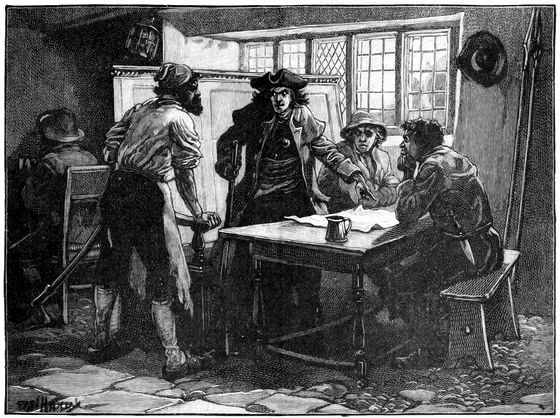
THE "NOTTINGHAM CAPTAIN" AND THE AGITATORS AT THE "WHITE HORSE." (See p. 126.)
Disappointed in this quarter, the odious race of
incendiary spies of Government tried their arts,
and succeeded in duping some individuals in
Yorkshire, and many more in Derbyshire. That
the principal Government spy, Oliver, was busily
engaged in this work of stirring up the ignorant
and suffering population to open insurrection from
the 17th of April to the 7th of June, when such
an outbreak took place in Derbyshire, we have the
most complete evidence. It then came out, from
a servant of Sir John Byng, commander of the
forces in that district, that Oliver had previously
been in communication with Sir John, and no
doubt obtained his immediate liberation from him
on the safe netting of his nine victims. In fact,
in a letter from this Sir John Byng (then Lord
Strafford), in 1846, to the Dean of Norwich, he
candidly admits that he had received orders from
Lord Sidmouth to assist the operations of Oliver,
who was, his lordship said, going down into that
part of the country where meetings were being
frequently held, and that Oliver, who carried a
letter to Sir John, was to give him all the information
that he could, so that he might prevent
such meetings. Here, as well as from other
sources, we are assured that Oliver only received
authority to collect information of the proceedings
of the conspirators, and by no means to incite
them to illegal acts. We have also the assurance
of Mr. Louis Allsop, a distinguished solicitor of
Nottingham, that Oliver was in communication
with him on the 7th of June, immediately on his
return from Yorkshire, and informed him that a
meeting was the same evening to take place
in Nottingham, and he and another gentleman
strongly urged him to attend it, which Oliver did.
Mr. Allsop says that Oliver had no instructions to
incite, but only to collect information. All this
has been industriously put forward to excuse
Ministers. But what are the facts? We find
Oliver not only—according to evidence which
came out on the trials of the unfortunate dupes at
Derby—directly stimulating the simple people to
insurrection, but joining in deluding them into
the persuasion that all London was ready to rise,
and that one hundred and fifty thousand from the
east and west of the capital only waited for them.
We find him not only disseminating these ideas
throughout these districts from the 17th of April
to the 27th of May, but also to have concerted a
simultaneous rising in Yorkshire, at Nottingham,
and in Derbyshire, on the 6th of June. Thornhill-lees,
in Yorkshire, was on the verge of action,
and ten delegates, including Oliver, were arrested.
In Derbyshire the insurrection actually took place.
What immediately follows shows that Oliver
had planned and brought to a crisis, by his personal
exertions, this unhappy rising. On Sunday,
the 8th of June, Jeremiah Brandreth, a framework-knitter
of Nottingham, appeared with some
others at a public-house called the "White Horse,"
in the village of Pentrich, in Derbyshire. This
village is about fourteen miles from Nottingham,
and about a mile from the small market town of
Ripley. It is in a district of coal and iron mines,
and is near the large iron foundry of Butterley.
The working people of the village, and of the
neighbouring village of South Wingfield, were
chiefly colliers, workers in the iron mines or iron
foundry, or agricultural labourers—a race little
informed at that day, and therefore capable of
being readily imposed on. This Brandreth had
been known for years as a fiery agitator. He was
a little, dark-haired man, of perhaps thirty years
of age. He had been much with Oliver, and was
one of his most thorough dupes, ready for the
commission of any desperate deed. He had acquired
the cognomen of the "Nottingham Captain,"
and now appeared in an old brown great-coat, with
a gun in his hand, and a pistol thrust into an
apron, which was rolled round his waist as a belt.
Two of the workmen from Butterley Foundry
entered the "White Horse," which was kept by a
widow Wightman, whose son George was deep in
the foolish conspiracy into which Oliver and this
his blind, savage tool, the Nottingham Captain,
were leading him. They found Brandreth with a
map before him, and telling them there was no
good to be done, they must march up to London
and overthrow the Government. He said all the
country was rising; that at Nottingham the
people had already taken the castle and seized the
soldiers in their barracks, and were waiting for
them. This shows that he had come straight
from Oliver, who, on the 7th, was at Nottingham,
attending the meeting there, and who knew that
the meeting in Yorkshire had been prevented.
Yet he had allowed the people of Nottingham to
believe that the Yorkshire men were coming,
according to agreement, in thousands; and he
allowed Brandreth to go and arouse Derbyshire,
under the belief that Nottingham that night
would be in the hands of the insurgents. On
Monday night, the 9th of June, Brandreth and a
knot of his colleagues proceeded to muster their
troop of insurgents for the march to Nottingham.
They roused up the men in their cottages, and,
if they refused to go, they broke in the doors with
a crowbar, and compelled them to join them.
Most of these unwilling levies slipped away in the
dark on the first opportunity. At South Wingfield
he assembled his forces in an old barn, and
then they proceeded through the neighbourhood
demanding men and guns. An old woman had
the courage to tap the "captain" on the shoulder,
and say—"My lad, we have a magistrate here;"
and many of the men thought Brandreth must be
mad or drunk. At the farm of widow Hetherinton
he demanded her men and arms, and when she
stoutly refused him, he put the gun through
the window and shot one of her men dead.
As the day dawned, Brandreth and his infatuated
troop appeared before the gates of
Butterley Foundry, and demanded the men; but
Mr. Goodwin, the manager, had been apprised of
their approach, and had closed the gates. Brandreth
had planned to take Butterley Foundry, and
carry away not only the men but a small cannon
kept there; but Mr. Goodwin went out and told
Brandreth he should not have a man for any such
insane purpose, and seeing an old man that he
well knew, Isaac Ludlam, who bore a good character,
and had been a local preacher amongst the
Methodists, he seized him by the collar and
pushed him into the foundry court, telling him
not to be a fool, but stay at home. Ludlam, however,
replied, "he was as bad as he could be,"
rushed out, and went on—to his death; for he was
one of those that were executed.
All this time it was raining heavily, and Brandreth,
daunted by the weather, or by the courageous
conduct of the manager, gave the word to march.
The manager calculated that there were only about
a hundred of them at this point; but they were
soon after joined by another troop from Ripley,
and they took two roads, which united about
three miles farther on, collecting fresh men by the
most direful threats. When they reached Eastwood,
a village three or four miles farther on the
road to Nottingham, they were said to amount to
three hundred, but ragged, famished, drenched
with the rain, and not half of them armed, even
with rude pikes. Near Eastwood they were met
by a troop of horse from Nottingham, which had
been summoned by Mr. Rolleston, a magistrate,
and at the sight they fled in confusion. About
forty guns and a number of pikes were picked up,
and a considerable number of prisoners were made,
amongst them Brandreth. These prisoners were
afterwards tried at a special assize at Derby.
They were defended by Thomas (afterwards Lord)
Denman, whose eloquence on the occasion raised
him at once into notice, and whose generous,
gratuitous, and indefatigable exertions on behalf
of these simple, ignorant victims of Government
instigation, showed him to be a man of the noblest
nature. Notwithstanding his efforts, twenty of
these unhappy dupes were transported for different
terms, and three—Brandreth, Ludlam, and Turner—were
hanged and then beheaded as traitors.
Such were the means employed by the British
Government in 1817 to quiet the country under
its distress—a distress the inevitable result of the
long and stupendous war. The only idea was to
tighten the reins of Government—to stimulate the
sufferers into overt acts, and then crush them.
Fortunately, with the exception of the Derby
juries, the juries in general saw through the
miserable farce of rebellion, and discharged the
greater part of Oliver's and Lord Sidmouth's
victims. Watson was acquitted of high treason in
London on the 16th of June, less than a week
after the Derbyshire insurrection. His son had
eluded the pursuit of the police. Seventeen prisoners
on the like charges were liberated in July
in Glasgow and Edinburgh, and were paid seven
shillings each to carry them home. On the 22nd
of August, of the twenty-four persons that Oliver
had entrapped in Yorkshire, twenty-two were
discharged—against eleven of them no bills being
found by the grand jury—and the two left in
prison were detained there because, under the suspension
of the Habeas Corpus Act, they were not
brought up for trial. The Manchester Blanketeers
were, in like manner, all discharged, though
the Duke of Northumberland did his utmost to
stimulate Lord Sidmouth to get them punished.
On the country at large the impression was that
the Government had propagated a most needless
alarm, and that those who had fallen on the
scaffold had been exalted by them from poor,
ignorant labourers into burlesque traitors, through
the execrable agency of their incendiaries, Oliver,
Castles, Mitchell, and others.
But the Government had to receive another
lesson this year on the folly of endeavouring, in
the nineteenth century, to crush the liberties of
Britons. There was an organ called the Press,
which, partaking neither of the Governmental fears
of a natural complaint by the public of the evils
which preyed upon it, nor the Governmental hopes
of silencing the sufferers without any attempt to
mitigate their calamities, reported freely the
mingled folly and cruelty of Ministers, and called
for the only remedy of the country's misfortunes—Reform.
On moving the second reading of the
Bill for the suspension of the Habeas Corpus Act,
Lord Sidmouth observed that some noble lords had
complained that the authors and publishers of
infamous libels on the Government were not prosecuted.
He assured them that the Government
were quite as anxious as these noble lords to
punish the offenders, but that the law officers of
the Crown were greatly puzzled in their attempts
to deal with them; that authors had now become
so skilful from experience, that the difficulties of
convicting them immeasurably exceeded those of
any former time.
It would seem that the law officers of the Crown
despaired of proceeding in the old way, but they,
or the Ministers themselves, hit on a new and
more daring one. On the 27th of March the
Secretary of State addressed a circular letter to
the lords-lieutenant of counties, informing them
that the Law Officers were of opinion that a justice
of the peace may issue warrants to apprehend
persons charged with the publication of political
libels, and compel them to give bail; and he required
the lords-lieutenant to communicate this
opinion to the ensuing Quarter Sessions, that all
magistrates might act upon it. This was the most
daring attack on the liberty of the subject which
had been made in England since the days of the
Stuarts. Lord Grey, on the 12th of May, made a
most zealous and able speech in the House of
Lords against this proceeding, denouncing the
investment of justices of the peace with the power
to decide beforehand questions which might puzzle
the acutest juries, and to arrest and imprison for
what might turn out to be no offence at all. He
said:—"If such be the power of the magistrate,
and if this be the law, where, I ask, are all the
boasted securities of our independence and freedom?"
But it appears from the correspondence
of Lord Sidmouth, that he was at this moment
glorying in this expedient and triumphing in its
imagined success. He said the charge of having
put such power into the hands of magistrates, he
would do his best and most constant endeavour to
deserve; and that already the activity of the
dealers in libellous matter was much diminished.
He had, in truth, struck a deadly terror to the
hearts of the stoutest patriots, who saw no prospect
but ruin and incarceration if they dared to speak
the truth. Cobbett then fled, and got over to
America. In taking leave of his readers, in his
Register of March 28th, he gave his reasons for
escaping from the storm:—"Lord Sidmouth was
'sorry to say' that I had not written anything
that the Law Officers could prosecute with any
chance of success. I do not remove," he continued,
"for the purpose of writing libels, but for
the purpose of being able to write what is not
libellous. I do not retire from the combat with
the Attorney-General, but from a combat with a
dungeon, deprived of pen, ink, and paper. A
combat with the Attorney-General is quite unequal
enough; that, however, I would have encountered.
I know too well what a trial by special jury is;
yet that, or any sort of trial, I would stand to
face. So that I could be sure of a trial of whatever
sort, I would have run the risk; but against
the absolute power of imprisonment, without even
a hearing, for time unlimited, in any gaol in the
kingdom, without the use of pen, ink, and paper,
and without communication with any soul but the
keepers—against such a power it would have been
worse than madness to attempt to strive."
Nor were the fears of Cobbett imaginary. The
Ministry at this time were such fanatics in
tyranny, that they would have rejoiced to have
thus caged the great political lion, and kept him
in silence. At this very moment they had pounced
upon one who was equally clever in his way,
and who had, perhaps, annoyed them still more,
but whom they did not so much fear to bring into
a court of justice. This was William Hone, who
had for some time been making them the laughing-stock
of the whole nation by his famous parodies.
Hone was a poor bookseller in the Old Bailey,
who had spent his life in the quest after curious
books, and in the accumulation of more knowledge
than wealth. His parodies had first brought him
into notice, and it did not appear a very formidable
thing for the Government to try a secluded
bookworm not even able to fee counsel for his
defence. His trial did not come on at the Guildhall
till the 18th of December, and then it was
evident that the man of satirical fun meant to
make a stout fight. The judge, Mr. Justice
Abbott, and the Attorney-General, Sir Samuel
Shepherd, from their manner of surveying the
accused, did not apprehend much difficulty in
obtaining a verdict against him. But they very
soon discovered their mistake. The charge against
Hone was for having published a profane and
impious libel upon the Catechism, the Lord's
Prayer, and the Ten Commandments, thereby
bringing into contempt the Christian religion.
The special indictment was for the publication
of John Wilkes's catechism. The Attorney-General
did not very judiciously commence his
charge, for he admitted that he did not believe
that Hone meant to ridicule religion, but to produce
a telling political squib. This let out the
whole gist of the prosecution, though that was
very well perceived by most people before; and it
was in vain that he went on to argue that the
mischief was just the same. Hone opened his
own defence with the awkwardness and timidity
natural to a man who had passed his life amid
books, and not in courts; but he managed to complain
of his imprisonment, his harsh treatment, of
his poverty in not being able to fee counsel, of the
expense of copies of the informations against him,
and of the haste, at last, with which he had been
called to plead. The judge repeatedly interrupted
him, with a mild sort of severity, and the spectators
were expecting him to make a short and
ineffective defence. Hone, on the contrary, began
to show more boldness and pertinacity. He began
to open his books, and to read parody after parody
of former times. In vain Mr. Justice Abbott and
the Attorney-General stopped him, and told him
that he was not to be allowed to add to his
offence by producing other instances of the crime
in other persons. But Hone told them that
he was accused of putting parodies on sacred
things into his books, and it was out of his books
he must defend himself. The poor, pale, threadbare
retailer of old books was now warmed into
eloquence, and stood in the most unquestionable
ascendency on the floor of the court, reading and
commenting as though he would go on for ever;
and he did go on for six hours. He declared
that the editor of Blackwood's Magazine was a
parodist—he parodied a chapter of Ezekiel;
Martin Luther was a parodist—he parodied the
first Psalm; Bishop Latimer was a parodist; so
was Dr. Boys, Dean of Canterbury; so was the
author of the "Rolliad;" so was Mr. Canning.
He proved all that he said by reading passages
from the authors, and he concluded by saying that
he did not believe that any of these writers meant
to ridicule the Scriptures, and that he could not,
therefore, see why he should be supposed to do so
more than they. Nay, he had done what they
never did: as soon as he was aware that his
parodies had given offence he suppressed them—and
that long ago, not waiting till he was prosecuted.
They, in fact, were prosecuting him for
what he had voluntarily and long ago suppressed.
The Attorney-General, in reply, asserted that it
would not save the defendant that he had quoted
Martin Luther and Dr. Boys, for he must pronounce
them both libellous. The judge charged
the jury as if it were their sacred duty to find the
defendant guilty; but, after only a quarter of an
hour's deliberation, they acquitted him.
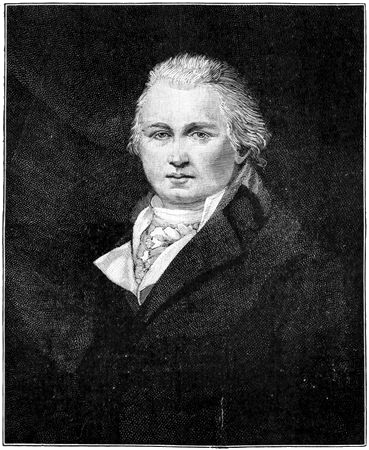
This signal and unexpected defeat seemed to
rouse the Government to a fresh effort for victory
over the triumphant bookseller. The Lord Chief
Justice Ellenborough, who was not accustomed to
let juries and the accused off so easily, rose from
his sick bed, where he was fast drifting towards
the close of his career. The defendant was called
into court the next morning, the 19th of December.
There sat Ellenborough, with a severe and
determined air. Abbott sat by his side. Hone
this time was charged with having published an
impious and profane libel, called "The Litany,
or General Supplication." The Attorney-General
again asserted that, whatever might be the intention
of the defendant, the publication had the
effect of bringing into contempt the service of the
Church. Hone opened his books to recommence
the reading of parallel productions of a former day,
or by persons high in esteem in the Church, but
this was precisely what the invalid Lord Chief
Justice had left his bed to prevent. The judge
told him all that was beside the mark, but Hone
would not allow that it was so, opened his books,
and read on in spite of all attempts to stop him.
Never had Ellenborough, not even in his strongest
and best days, been so stoutly encountered;
scarcely ever had such a scene been witnessed in
the memory of man. The spectators showed an
intense interest in the combat, for such it was,
and it was evident that the general sympathy
went with the accused, who put forth such extraordinary
and unlooked-for power. The exhausted
Chief Justice was compelled to give way, and
Hone went on reading one parody after another,
and dwelt especially on the parodies of the Litany
which the Cavaliers wrote to ridicule the Puritan
Roundheads. When he had done, the Lord Chief
Justice addressed the jury in a strain of strong
direction to find a verdict for the Crown. He
said "he would deliver the jury his solemn
opinion, as he was required by the Act of Parliament
to do; and under the authority of that Act,
and still more in obedience to his conscience and
his God, he pronounced this to be a most impious
and profane libel. Believing and hoping that
they, the jury, were Christians, he had no doubt
but they would be of the same opinion." This
time the solemn and severe energy of the Lord
Chief Justice seemed to have made an impression
on part of the jury, for they took an hour and a
half to determine their verdict, but they again
returned one of Not Guilty.
Here, had the Government been wise, they
would have stopped; but they were not contented
without experiencing a third defeat. The next
morning, the 20th of December, they returned to
the charge with an indictment against Mr. Hone
for publishing a parody on the Athanasian Creed,
called "The Sinecurist's Creed." The old Chief
Justice was again on the bench, apparently as
resolved as ever, and this time the defendant, on
entering the court, appeared pale and exhausted,
as he well might, for he had put forth exertions
and powers of mind which had astonished the
whole country and excited the deepest interest.
The Attorney-General humanely offered to postpone
the trial, but the defendant preferred to go
on. He only begged for a few minutes' delay to
enable him to put down a few notes on the
Attorney-General's address after that was delivered;
but the Chief Justice would not allow
him this trifling favour, but said, if the defendant
would make a formal request for the purpose, he
would put off the trial for a day. This would
have injured the cause of the defendant, by making
it appear that he was in some degree worsted, and,
fatigued as he was, he replied, promptly, "No!
I make no such request." William Hone, on this
third trial, once more seemed to forget his past
fatigues, and rose with a strength that completely
cowed the old and fiery judge. He did not desist till
he had converted his dictatorial manner into a suppliant
one. After quoting many eminent Churchmen
as dissentients from the Athanasian Creed, and
amongst them Warburton and Tillotson, he added,
"Even his lordship's father, the Bishop of Carlisle,
he believed, took a similar view of this creed."
This was coming too near; and the judge said,
"Whatever that opinion was, he has gone, many
years ago, where he has had to account for his
belief and his opinions. For common delicacy,
forbear." "O, my lord," replied the satisfied
defendant, "I shall certainly forbear." The judge
had profited by the lesson to-day: he gave a much
more temperate charge to the jury, and they
required only twenty minutes to return the third
and final victory of Not Guilty. Never had this
arbitrary Government suffered so withering a
defeat. The sensation throughout the country
was immense. The very next day Lord Ellenborough
sent in his announcement of retiring from
the bench, and in a very short time he retired
from this world altogether (December 13, 1818),
it being a settled conviction of the public mind
that the mortification of such a putting-down, by
a man whom he rose from his sick-bed to extinguish,
tended materially to hasten that departure.
The only matters of interest debated in Parliament
during this year, except that of the discontent
in the country, were a long debate on
Catholic emancipation, in the month of May,
which was negatived by a majority of only twenty-four,
showing that that question was progressing
towards its goal; and a motion of Lord Castlereagh
for the gradual abolition of sinecures. This
intimated some slight impression of the necessity
to do something to abate the public dissatisfaction,
but it was an impression only on the surface.
This Ministry was too much determined to maintain
the scale of war expenditure to which they
had been accustomed to make any real retrenchment.
A committee appointed to consider the
scheme recommended the abolition of sinecures to
the amount of fifty-four thousand pounds per
annum, but neutralised the benefit by recommending
instead a pension-list of forty-two thousand
pounds per annum. The country received the
amendment with disgust and derision.
The year, gloomy in itself from the dislocation
of trade and the discontent of the people, terminated
still more gloomily from another cause—the
death of the Princess Charlotte. This event,
wholly unexpected, was a startling shock to the
whole nation. This amiable and accomplished
princess was not yet twenty-two. She had been
married only in May, 1816, to Prince Leopold of
Coburg, and died on the 6th of November, 1817,
a few hours after being delivered of a stillborn
child. What rendered the event the more
painful was that her death was attributed to
neglect by her accoucheur, Sir Richard Croft.
Dr. Baillie, who saw her soon after her confinement,
refused to join in the issue of a bulletin
which the other medical men had prepared, stating
that she was going on well, and a few hours
proved the fatal correctness of his opinion. Sir
Richard, overwhelmed by the public indignation
and his own feelings, soon afterwards destroyed
himself. No prince or princess had stood
so well with the nation for many years. The
people saw in her a future queen, with the vigour,
unaccompanied by the vices and tyrannies, of
Elizabeth. She had taken the part of her mother
against the treatment of her father, and this
was another cause which drew towards her the
affections of the people. All these hopes were extinguished
in a moment, and the whole nation was
plunged into sorrow and consternation, the more
so that, notwithstanding the twelve children of
George III., there had only been this single grandchild,
and several of his sons remained unmarried.
The year 1818 commenced gloomily. On the
27th of January Parliament was opened by a
Speech, drawn up for the Prince Regent, but read
by the Lord Chancellor. The first topic was, of
course, the severe loss which the country and the
prince had sustained in the death of the Princess
Charlotte. It was only too well known that the
prince and his daughter had not for some time
been on very cordial terms, the princess having
taken the part of her mother; and the vicious and
voluptuous life of the Regent did not probably
leave much depth of paternal affection in his
nature, which had originally been generous and
capable of better things. It was remarked by
Mr. Ward, afterwards Lord Dudley and Ward,
that the mention of the princess "was rather dry—sulky,
rather than sad." But the death of his
only issue, and that at the moment that she
might have been expected to give a continued
succession to the Throne, was a severe blow to
him. There was an end of all succession in his
line. He stood now without the hopeful support
which his daughter's affectionate regard in the
country had afforded him, and he was ill able to
bear the loss of any causes of popularity. He
received a serious shock; and it was only by
copious bleeding that he was saved from dangerous
consequences; yet, so little was the depth of his
trouble, that within three months of his loss he
attended a dinner given by the Prussian ambassador,
and entertained the company with a song.
The rest of the Speech consisted of endeavours
to represent the country as in a prosperous
condition; to have escaped from insurrection by
the vigilance of Ministers, and to have recovered
the elasticity of commerce. No amendment was
moved to the Address in either House, but not the
less did the conduct of Ministers escape some
animadversion. In the Peers, Lord Lansdowne
ridiculed the alarms which had been raised regarding
the movements in Derbyshire, which, he said, had
not been at all participated in by the working
population at large, and had been put down by
eighteen dragoons. He contended that there
was no evidence of any correspondence with
these conspirators in other quarters; but this
was notoriously incorrect, for there had been a
correspondence in Lancashire and Yorkshire, a
correspondence especially disgraceful to Ministers,
for it was on the part of their own incendiary agents.
He observed truly, however, that the insurrection,
as it was called, had by no means justified the
suspension of the Habeas Corpus Act, for it could
have been most readily put down without it by
the regular course of law. In the Commons, Sir
Samuel Romilly thought that the Derbyshire
insurrectionists had been very properly brought to
trial; for Brandreth had committed a murder, and,
therefore, those who acted with him were, in the
eye of the law, equally guilty. But if they were
properly brought to trial, there were others who
ought still more properly to have been brought to
trial too—the very men whom Government had
sent out, and who had aroused these poor people
into insurrection by false and treacherous statements.
There was no justice in trying and
punishing the victims, and screening their own
agents; and this was what Government had done,
and were still doing. It is in vain, therefore, that
their defenders contend that they gave no authority
to Oliver and the other spies to excite the people
to outbreak: these spies having notoriously done it,
they still protected and rewarded them, and thus
made themselves responsible for their whole guilt.
If they had not authorised the worst part of the
conduct of the spies, they now acted as though
they had, and thus morally assumed the onus of
these detestable proceedings. One thing immediately
resulted from the pæans of Ministers on
the flourishing state of the country—the repeal of
the Suspension Act. The Opposition at once
declared that if the condition of the country was
as Ministers described it, there could be no occasion
for the continuance of this suppression of the
Constitution; and accordingly a Bill for the repeal
of the Suspension Act was at once brought in and
passed by the Lords on the 28th, and by the
Commons on the 29th of January.
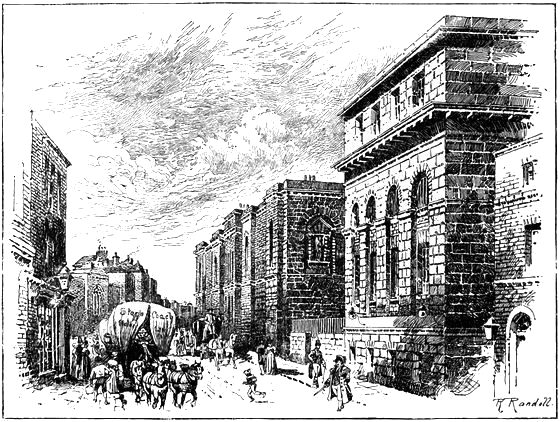
OLD BAILEY, LONDON, 1814.
Now, much of this at the moment was true; the
manufacturers were naturally anxious to resume
their business, and a fall in the price of corn, after
the plentiful harvest of 1817, to seventy-four
shillings and sixpence, relieved a little the pressure
on the working classes. Could cheap bread have
been secured, the condition of the people might
soon have become easy; but the fatal Corn Law
came immediately into operation. By the end of
1817 corn had risen in price again to eighty-five
shillings and fourpence; and then the ports were
opened, but the supplies did not bring down the
markets. The spring of 1818 proved wet, and
then about the middle of May a drought set
in, and continued till September, so that the
apprehension of a deficient harvest kept up the
price of all articles of life, notwithstanding that a
million and a half quarters of wheat had been imported
during the year. So long as bread was
tolerably cheap, and work more abundant, political
agitation in the manufacturing districts subsided;
but it was soon proved that the apparent increase
of activity in manufacturing and commercial
exports was but a feverish desire on the part of
manufacturers and merchants to force a trade for
which the exhausted Continent was not yet prepared.
Nothing but a free importation of corn
could have carried the country comfortably through
the crisis; and this was denied by the measures
of Government, except at a rate of price that put
the proper consumption of bread beyond the
means of the working classes.
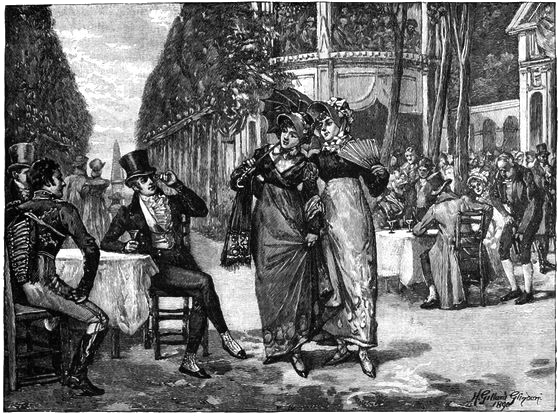
BEAUS AND BELLES OF THE REGENCY PERIOD.
Meanwhile Ministers, anxious to exonerate
themselves from the odium so fully their due for
fomenting insurrection, commenced Parliamentary
inquiries which only the more clearly demonstrated
their guilt. On the 2nd of February the celebrated
green bag was sent down by the Prince Regent to
the Lords, and another green bag on the following
day to the Commons. These green bags—or
rather, this green bag, for they were classed as one
by the public, their contents being one—made a
great figure in the newspaper comments of the time.
They were stuffed with documents regarding the
late extraordinary powers assumed by Ministers,
and the occurrences in the midland counties which
had been held to justify them. No doubt the
papers had been carefully selected, and they were
now submitted to a secret committee of each House,
which, being named by Ministers, was pretty sure
to bring in reports accordingly. On the 23rd the
Lords' committee brought up their report, and
on the 27th the Commons' produced theirs. As
might have been expected from their parentage,
there was a striking likeness in the offspring of the
committees; they were veritable twins. Both
travelled over the same ground; the statements
made by the secret committee of 1816 averring
that schemes of conspiracy were in agitation, and
the events of 1817, particularly in Derbyshire and
Yorkshire, as fully confirming these averments.
They were compelled, however, to confess that the
insurrections, though clearly connected in different
counties, in Lancashire, Yorkshire, Derbyshire,
and Nottinghamshire, were not very formidable,
and that the mass of the population in these
counties did not at all sanction, much less second,
such proceedings. Yet, notwithstanding this
confession, the fact remained that under the
arbitrary measures of Ministers a great number of
persons had been thrown into prison, against
whom no charge could be established; and that
at Derby three had been executed, and twenty
others transported or imprisoned for long terms,
and these, every one of them, through the acts
and incitements of the emissaries of Ministers
themselves. On the motion for printing the report
of the Commons, which, of course, justified
Ministers, Mr. Tierney said it was scarcely worth
while to oppose the printing of "a document so
absurd, contemptible, and ludicrous."
But Ministers were too sensible of the unconstitutional
character of their deeds to rest
satisfied with the mere justification of an accepted
report. A Bill of Indemnity was introduced to
cover "all persons who had in 1817 taken any
part in apprehending, imprisoning, or detaining in
custody persons suspected of high treason, or
treasonable practices, and in the suppression
of tumultuous and unlawful assemblies." Thus
Ministers were shielded under general terms, and
to avoid all appearance of personal movement
in this matter by those in the Cabinet the most
immediately active, the Bill was introduced by the
Duke of Montrose, the Master of the Horse.
There was an energetic debate in each House as
the Bill passed through. It was opposed in the
Peers by Lords Lansdowne, Holland, and Erskine,
but was carried by ninety-three against twenty-seven.
Ten peers entered a strong protest on the
journals against the measure, denying the traitorous
conspiracy or the extensive disaffection to the
Government alleged, affirming that the execution
of the ordinary laws would have been amply
sufficient, and that Ministers were not entitled to
indemnity for causeless arrests and long imprisonments
which had taken place, for the Bill went to
protect them in decidedly illegal acts. In the
House of Commons the Bill was strongly opposed
by Brougham, Tierney, Mr. Lambton—afterwards
Lord Durham—and Sir Samuel Romilly. They
condemned the conduct of Ministers in severe
language, while the Bill was supported by Canning,
by Mr. Lamb—afterwards Lord Melbourne,
who generally went with the other side—by
Sir William Garrow, and Sir Samuel Shepherd,
Attorney-General.
Ministers carried their indemnity in the Commons
by one hundred and sixty-two against sixty-nine;
but this did not prevent a prolongation of
the demands of the Reformers for a searching
inquiry into their employment of the spies. Many
petitions were presented to the House of Commons
for this inquiry—one of them from Samuel
Bamford, who had been a sufferer by imprisonment.
On the 3rd of February Hone's case was brought
forward by William Smith, of Norwich; on the
10th, Lord Archibald Hamilton made a motion for
inquiry into similar prosecutions of persons in
Scotland, and especially of Andrew M'Kinley, and
this was supported by Sir Samuel Romilly and
others, but rejected; yet the next day Mr. Fazakerley
made a demand for a rigid inquiry into the
employment of the spies, and for ascertaining
whether they really had exceeded their instructions.
Here was an opportunity for Ministers to clear
themselves, were they really innocent of sending
them out to excite as well as to discover conspirators.
There was a violent debate, but the
motion was rejected by one hundred and eleven
against fifty-two. The discussion left no doubt
of the employment of Oliver and others, and this
fact being put beyond dispute, Ministers should,
in self-vindication, have cleared themselves, if they
were guiltless, as their friends pretended; but
they did not do so. On the 17th Lord Folkestone
moved for inquiry into the treatment in prison of
Mr. Ogden and others, and a similar motion was
made on the 19th, in the Lords, by the Earl of
Carnarvon. In both cases Ministers, instead of
courting inquiry, resented it, and closed the
door of investigation by large majorities. Lords
Sidmouth, Bathurst, and Liverpool were prominent
in staving off these inquiries; and Lords Grosvenor,
King, and Holland were earnest in urging the
necessity of such inquiry for their own good
fame. Lord Stanley, afterwards Earl of Derby,
put this in the strongest light. He said that he
thought Ministers "had been much calumniated,
but they would be most so by themselves if they
refused to inquire into those acts, when inquiry,
according to their own statements, would fully
acquit them of the charges laid against them."
This was so self-evident that the fact that they
would not admit this inquiry might, were there no
other grounds for decision, be taken as positive
proof of their guilt. But it is not likely that
Oliver and his comrades, who were for months
in daily communication with Ministers whilst on
their detestable missions, would have dared so far
to exceed their orders, or, had they done so, that
they would have been protected at the expense
of the reputations of Ministers themselves, and
rewarded into the bargain. The instructions to
these men were undoubtedly of too dark a character
to be produced in open daylight.
Amid this melancholy manifestation of a convicted,
yet dogged, treason against the people on
the part of their rulers, many motions for reform
and improvements in our laws were brought forward.
On the part of Mr. Sturges Bourne, a
committee brought in a report recommending
three Bills for the improvement of the Poor Law:
one for the establishment of select vestries, one for
a general reform of the Poor Law, and one for
revising the Law of Settlement. On the part of
Henry Brougham, a Bill was introduced for appointment
of commissioners to inquire into the
condition of the charities in England for the education
of the poor. There were many attempts to
reform the Criminal Law, in which Sir Samuel
Romilly especially exerted himself. One of these
was to take away the penalty of death from the
offence of stealing from a shop to the value of five
shillings, another was to prevent arrests for libel
before indictment was found, and another, by Sir
James Mackintosh, to inquire into the forgery of
Bank of England notes. There was a Bill brought
in by Mr. Wynn to amend the Election Laws;
and one for alterations in the Law of Tithes, by
Mr. Curwen; another by Sir Robert Peel, father
of the great statesman, for limiting the hours of
labour in cotton and other factories; a Bill to
amend the Law of Bankruptcy, and a Bill
to amend the Copyright Act, by Sir Egerton
Brydges; and finally a Bill for Parliamentary
Reform, introduced by Sir Francis Burdett, and
supported by Lord Cochrane, subsequently the
Earl of Dundonald. All of these were thrown
out, except the Select Vestries Bill, Brougham's
Bill to inquire into the public charities, a Bill for
rewarding apprehenders of highway robbers and
other offenders, and a Bill granting a million of
money to build new churches. The cause of
Reform found little encouragement from the Parliamentary
majorities of the Sidmouths, Liverpools,
and Castlereaghs. This list of rejections of projects
of reform was far from complete; a long
succession followed. The Scots came with a
vigorous demand, made on their behalf by Lord
Archibald Hamilton, for a sweeping reform of
their burghs. Municipal reform was equally
needed, both in Scotland and England. The
whole system was flagrantly corrupt. Many
boroughs were sinking into bankruptcy; and the
elections of their officers were conducted on the
most arbitrary and exclusive principles. The
Scots had agitated this question before the outbreak
of the French Revolution, but that and the
great war issuing out of it had swamped the
agitation altogether. It was now revived, but
only to meet with a defeat like a score of other
measures quite as needful. Lord Archibald Hamilton
asked for the abolition of the Scottish Commissary
Courts in conformity with the recommendation
of a commission of inquiry in 1808; General
Thornton called for the repeal of certain religious
declarations to be made on taking office; and Dr.
Phillimore for amendment of the Marriage Act of
1753; and numerous demands for the repeal of
taxes of one kind or another all met the same
fate of refusal.
The death of the Princess Charlotte left the
prospect of the succession to the Crown equally
serious. Of the numerous sons and daughters of
George III. not one had legitimate issue. It
might be necessary soon to look abroad in Germany
or in Denmark for an heir to the Crown.
This consideration led to a number of royal
marriages during the earlier part of this year.
The first of these marriages was not of this description.
It was that of the Princess Elizabeth,
his Majesty's third daughter, to the Landgrave
and Hereditary Prince of Hesse-Homburg, on the
7th of April. As the princess was already nearly
eight-and-forty, no expectation of issue in that
quarter was entertained. On the 13th of April
Lord Liverpool brought down a message from the
Regent to the Peers, and Lord Castlereagh to the
Commons, announcing treaties of marriage in
progress between the Duke of Clarence and the
Princess Adelaide Louisa, of Saxe-Meiningen; and
also between the Duke of Cambridge and the
Princess Augusta Wilhelmina, of Hesse, youngest
daughter of the Landgrave of Hesse. The House
of Commons was also asked to add an additional
ten thousand pounds a year to the allowance of
the Duke of Clarence, and six thousand pounds
a year each to those of the Dukes of Cumberland
and Cambridge, and to that of the Duke of Kent,
if he, too, should marry. Ministers intimated that
it had been the intention to ask much larger sums,
but they found that it was necessary to reduce the
sum asked for the Duke of Clarence. It was a
matter of notoriety that the duke had already a
large family by the actress, Mrs. Jordan, and
probably the feeling of the House was influenced
by his desertion of that lady; but there was a
stout opposition and the sum was reduced to six
thousand pounds. Loud acclamations followed the
carrying of this amendment, and Lord Castlereagh
rose and said, after the refusal of the sum asked,
he believed he might say that the negotiation for
the marriage might be considered at an end. The
next day the duke sent a message declining the
sum granted; yet, after all, his marriage took
place. The Duke of Cumberland was already
married to the Princess Frederica Sophia, the
daughter of the Duke of Mecklenburg-Strelitz, who
had been divorced from Frederick Louis, Prince of
Prussia. The Duke of Cumberland was one of
the most unpopular men in the whole kingdom,
for there were rumours of very dark passages in
his life, and Parliament had rejected an application
for an additional allowance on his marriage; and it
now rejected this application amid much applause.
The sum asked for the Duke of Cambridge was
carried, but not without considerable opposition.
The spirit of reform was in the air.
On the 13th of May came down a message,
announcing the approaching marriage of the Duke
of Kent with the daughter of the Duke of Saxe-Coburg-Saalfeld,
Victoria Maria Louisa, sister of
Prince Leopold, and widow of Emich Charles, the
Prince of Leiningen. The princess was already
the mother of a son and daughter. The nation was
extremely favourable to this match. The Duke of
Kent was popular, and the more so that he had
always been treated with unnatural harshness by
his father. He had been put under the care of an
old martinet general in Hanover, who had received
a large annual allowance with him, and kept him so
sparely that the poor youth ran away. He had been
then sent to Gibraltar, where the severe discipline
which he had been taught to consider necessary
in the army brought him into disgrace with the
garrison. But towards the public at large his
conduct had been marked by much liberality of
principle.
It was deemed necessary, before the end of the
Session, which would close the term of Parliament,
to renew the Alien Act. It had been renewed in
1814, and again in 1816, each time for two years.
On the last occasion it had been vehemently
opposed, and as determined an opposition was now
manifested against its renewal. From the 5th of
May to the 29th the fight was continued, every
opportunity and advantage which the forms of
Parliament afforded being resorted to to delay and
defeat it; but on the 29th it passed the Commons
by ninety-four votes against twenty-nine. It was
introduced into the Lords on the 1st of June by
Lord Sidmouth. But it had been discovered that,
by an Act of the Scottish Parliament of 1685, all
foreigners holding shares in the Bank of Scotland
to a certain amount became thereby naturalised;
and, by the Act of Union, all subjects of Scotland
became naturalised subjects of England. A clause,
therefore, was introduced by the Lords to obviate
this, and passed; but on the Bill being sent down
to the Commons it was struck out; and Ministers
were compelled to allow the Bill without this
clause to pass, and to introduce their separate Bill,
which was passed on the 9th of June.
Ministers were in haste to close and dissolve
Parliament in order to call a new one before the
very probable demise of the king—for though they
had provided that in case of the decease of the
queen the Parliament should not reassemble, this
did not apply to the decease of the king; and
should this take place before the day fixed for the
assembling of the new Parliament, the old Parliament—even
though formally dissolved—would reassemble:
therefore, on the 10th of June—the
very day after the passing of the supplementary
Alien Bill—the Prince Regent came down to the
House of Lords, prorogued Parliament, and then
immediately the Lord Chancellor pronounced it
dissolved. The members of the Commons were
taken by surprise. No such sudden dismissal had
taken place since 1625, when Charles I. dismissed
his Oxford Parliament after a single week's session.
On the return to their own House the Speaker
was proceeding, as usual, to read the Royal Speech,
but he was reminded by Mr. Tierney that there
was no Parliament in existence, and by Lord
Castlereagh that, by so doing, he might render
himself liable to a Præmunire, and he therefore
desisted and the members withdrew.
The elections for the new Parliament were
carried on with much vigour, and there were upwards
of a hundred contested ones. In some cases
the contest was extremely violent, considering the
death of the king was almost daily expected, and
that the term of the Parliament must necessarily
be a short one. In Westminster there were no
less than six candidates. Lord Cochrane was
about to depart for Chili to take the command of
the naval forces of that state, and therefore did
not offer himself again. There were Sir Francis
Burdett again, the Honourable Douglas Kinnaird,
Sir Murray Maxwell, Sir Samuel Romilly, Major
Cartwright, and Mr. Henry Hunt, commonly
called Orator Hunt. Of these Sir Murray Maxwell
was a Tory, and received severe treatment.
Major Cartwright and Hunt obtained very little
support, and soon withdrew from the contest.
The members returned were Romilly and Burdett,
a Whig and a Radical. For London were returned
four new members, all Whigs, Wood,
Wilson, Waithman, and Thorpe. Brougham patriotically
stood for Westmoreland, to break, if
possible, the influence of the Lowther family; but
he was compelled to retire on the fourth day, and
two of the Lowther family were returned. A
hundred and ninety new members were returned,
and the Opposition gained considerably by the
election. An acute observer, well accustomed to
party battles, remarked that Government did
not appear much beloved, and that they had
almost spent all their war popularity; and they
were not destined to recover it in the coming year.
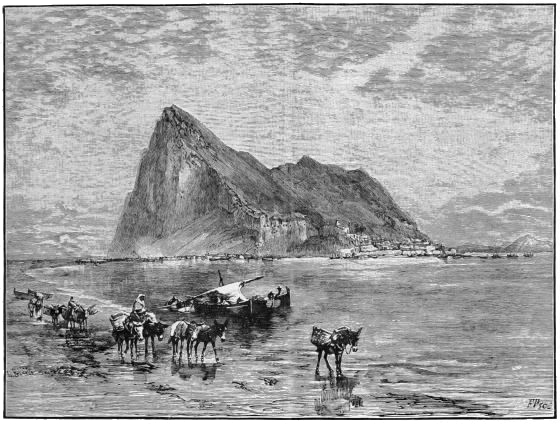
Scarcely were the elections over when a strike
took place amongst the working cotton-spinners in
Manchester. Food was dear, and the rate of
wages was not in any proportion to the dearness.
The men who turned out paraded the streets, and,
as is generally too much the spirit of strikes, endeavoured
forcibly to compel the workmen of other
factories to cease working too. The magistrates,
on the 1st of September, issued a proclamation,
that they were determined to resist such attempts,
and to punish the offenders. Sir John
Byng, the same who had favoured the endeavours
of Oliver in Yorkshire, commanded the forces
there, and every precaution was taken to secure
the factories still in work. On the very next day
the spinners were joined by a great mob from
Stockport, and they endeavoured to break into
Gray's mill, in Ancoat's Lane, and force the men to
cease. But there was a party of soldiers placed
within in expectation of the attack, and they fired
on the assailants, and killed one man and wounded
two others. The troops then dispersed the mob,
which was said to have amounted to at least
thirty thousand men. This ended the strike and
the rioting for the time. The coroner's jury pronounced
the death of the man justifiable homicide,
and Ministers congratulated themselves on the
speedy end of the disturbance. But the elements
of fresh ones were rife in the same districts. The
country was by no means in the prosperous condition
that they had represented it.
In the autumn the great Congress of Sovereigns
assembled at Aix-la-Chapelle. We have already
anticipated their chief object—the final evacuation
of France by the Allied troops, and the settlement
of compensations. They assembled about the
middle of September, and remained together till
the middle of November. Their business conferences,
however, did not commence till the 30th
of September. With regard to the evacuation of
France, we need only state that it was greatly
promoted by the exertions of the Duke of Wellington.
Robert Owen was there to endeavour to
enlist the Sovereigns in his schemes of social
reform, but did not make any proselytes amongst
the crowned heads, though the Czar Alexander
told him he fully entered into his views, as he was
generally accustomed to tell all reformers and
religious professors, leaving them in the pleasing
delusion that they had won him to their opinions.
Clarkson was there to engage them to sanction
the suppression of the slave trade, but with as
indifferent a result. This was the closing scene of
the great European drama, which opened with the
French Revolution and terminated with the capture
of Buonaparte. The Congress of Aix-la-Chapelle
may be regarded as the recital of the
epilogue.
The year 1818 did not close without one more
brush of war. This was in India. There had not
been much quiet, even after the destruction of
Tippoo Sultan and the power of Mysore. When the
Earl of Moira (afterwards Marquis of Hastings)
succeeded, as Governor-General, to Earl Minto, in
1813, he found the country still disturbed in
different directions, particularly on the north-west
frontiers. The Burmese engaged his immediate
attention, and then the Nepaulese, who were not
quietened till after two campaigns. But there
was a far more troublesome enemy than either of
these in the field. These were the Pindarrees, a
multitude of horsemen made up of the scum of
Hindostan—men who had either lost caste, or
never had any—who formed themselves into flying
bands, and with the swiftness of the wind rushed
down on the cultivated districts, and swept
all before them—cattle, sheep, money, jewels,
everything that could be made prey of. The two
most celebrated chiefs of the Pindarrees were
Kureem and Cheetoo, but Cheetoo managed to
put down Kureem, and became the one great and
formidable head of these robbers. In 1811 he
rode at the head of twenty-five thousand cavalry.
In 1814, whilst our troops were engaged in Nepaul,
the Pindarrees, under Cheetoo, crossed the Nerbudda,
the Godavery, and advanced to the Kistnah,
ravaging the whole of the Deccan and the neighbouring
territories; and in spite of our forces
under Major Frazer in one direction, and Colonel
Doveton in another, they effected their retreat
across the Nerbudda again, loaded with enormous
booty. In 1816 they made a still more extensive
incursion, ten thousand of them descending
into the Madras Presidency as far as Guntoor,
and though Colonel Doveton exerted himself to
come up with them, it was in vain. In twelve
days Cheetoo's marauders had plundered three
hundred and ninety villages in the Company's
territory, put to death one hundred and eighty-two
people, wounded five hundred and five, and
tortured in various ways three thousand six
hundred.
It was now found that our pretended Mahratta
allies, the Peishwa, Scindiah, and other chiefs, were
in league with Cheetoo, and unless this conspiracy
were broken the most fearful devastations might be
expected on our states. The Governor-General
represented this to the authorities at home, and
recommended that the Pindarrees should be regularly
hunted down and destroyed. In the
course of 1816 he received full authority to execute
this scheme. At the end of October he posted
Lieutenant-Colonel Walker along the southern
bank of the Nerbudda, to prevent the Pindarrees
from crossing into the Company's territories;
but as the line of river thus to be guarded was one
hundred and fifty miles in length, the force employed
was found insufficient against such adroit
and rapid enemies. In November Cheetoo dashed
across the river between Lieutenant-Colonel Walker's
posts, and his forces dividing, one part made
a rapid gallop through forests, and over rivers and
mountains, right across the continent, into the
district of Ganjam, in the northern Circars, hoping
to reach Juggernaut and plunder the temple of
its enormous wealth. But this division was met
with in Ganjam by the Company's troops, and
driven back with severe loss. The other division
descended into the Deccan, as far as Beeder,
where it again divided: one portion being met with
by Major Macdonald, who had marched from
Hyderabad, was completely cut up, though it was
six thousand strong. The other body struck westward
into Konkan, under a chief named Sheik
Dulloo, and then, turning north, plundered all the
western coast, and escaped with the booty beyond
the Nerbudda, though not without some loss at
the hands of the British troops on that river.
As it was now clearly useless to endeavour
to prevent these desperate hordes from crossing
the Nerbudda, it was determined to march into
their own retreats beyond that river, and regularly
hunt them down. Sir John Malcolm, one of our
ablest officers, who has left us a most graphic
account of these transactions, had just now returned
from England, and he was appointed, with
Major-General Marshall, to this service. Not
only Cheetoo, but Kureem, was again on foot;
and Sir John learnt that Cheetoo was posted near
the camp of the Holkar Mahrattas, and had received
a lac and sixty thousand rupees from the
Peishwa. By this time he had advanced as far as
Agra, but on this information he fell back on
Oojein, where Sir Thomas Hislop lay with another
body of troops. On the 21st of December, 1817,
Holkar's army and Cheetoo's army made a united
attack on the British at Mahidpore, on the banks
of the Seepra. They were received with a murderous
slaughter, and fled, leaving seventy pieces
of artillery, all they had, and a great quantity of
arms. They fled in confusion to Rampoora, a
fortified town in Malwa. The British on their
part had suffered severely, having one hundred
and seventy-four killed, and six hundred and four
wounded. Amongst these were thirty-five officers
wounded, half of them severely.
Sir John Malcolm and Captain Grant pursued
the fugitives along the banks of the Seepra, killing
numbers, and seizing immense booty, including
elephants and numerous camels. He left them no
time to reassemble, but advanced rapidly on the
capital of Holkar, joined by reinforcements from
the Bombay army under Major-General Sir William
Keir. Alarmed at this vigorous action, the Holkar
Mahrattas hastily concluded peace, gave up all
their forts, and placed their territories under
British protection. Some Pathan chiefs attempted
to resist, trusting to the defences of Rampoora;
but General Brown soon stormed that place, and
the whole country of the Holkar Mahrattas was
reduced to obedience. No respite was granted to
the Pindarrees. Cheetoo was followed from place
to place by the Gujerat army under Sir William
Keir, and sought refuge in vain amongst the hills
and jungles of Malwa and along the Nerbudda.
At length, in January, 1818, Cheetoo's last camp
was surprised and cut to pieces. After seeking
refuge amongst various tribes, Cheetoo was ultimately
found in the jungle near the fort of Aseerghur,
torn to pieces by a tiger, his horse grazing
not far off, safe, and a bag on his saddle containing
his remaining jewels and two hundred and
fifty rupees. And thus ended the existence of
the long formidable hosts of the Pindarrees.
Whilst this extirpation of the Pindarrees had
been going on, the cholera broke out at Jessore,
in the low lands of the Delta of the Ganges. This
fatal disease has been supposed by medical men to
receive its force, if not its origin, from the want
of salt in this unhealthy district. Salt being one of
the monopolies of the East India Company, it
was not permitted, though abundant in Madras, to
be carried into Bengal except on payment of a
duty of two hundred per cent. The natives,
therefore, who subsisted on a rice diet, not being
able to procure this necessary antiseptic, frequently
fell victims to the terrible scourge of
cholera. From this centre, where it may fairly be
said to have raged in perpetuity, it now spread
rapidly up the course of the Ganges, the Jumna,
and their confluent rivers, and if the British
impost on salt had anything to do with the prevalence
of the epidemic, a severe retribution now
fell upon those who profited by it. The Marquis
of Hastings, the Governor-General, was posted in
Bundelcund with his army, when it appeared
there and swept away thousands. The very men
attending on the Governor-General at dinner
dropped down behind his chair and died. To seek
a healthier region, he marched eastward, but all
the way the pest pursued him, and when he
reached the healthy station of Erich, on the right
bank of the Betwah river, towards the end of
November, one-tenth of the force had fallen under
its ravages. The scourge did not stop there, but
for a number of years continued to spread at an
amazing speed, and eventually overspread Europe
with its horrors.
During the time that Malcolm, Keir, Hislop,
and other officers were running down the Pindarrees,
Major-General Smith, who had received
reinforcements at Poonah, was performing the
same service against Bajee Rao, the Peishwa who
had furnished Cheetoo with funds. He marched
from Poonah at the end of November, 1817,
accompanied by Mr. Mountstuart Elphinstone.
They encountered the army of the Peishwa on the
Kistnah, where his general, Gokla, had posted
himself strongly in a ghaut. The pass was speedily
cleared, and the army of the Peishwa made a rapid
retreat. The chase was continued from place to
place, the Peishwa dodging about in an extraordinary
manner, till, at length, he managed to
get behind General Smith, and, passing between
Poonah and Seroor, he was joined by his
favourite Trimbukjee, whom he had long lost sight
of, with strong reinforcements of both horse and
infantry. General Smith, so soon as he could
discover the route of the Peishwa, pursued it, but
soon after the Mahrattas showed themselves again
in the vicinity of Poonah. To secure that city
from the Peishwa's arms, Captain F. F. Staunton
was dispatched from Seroor on the last day of
the year with six hundred sepoys, three hundred
horse, and two six-pounders; but he was not able
to reach Poonah. The very next day, the 1st of
January, 1818, he found his way barred by the
whole army of the Peishwa, consisting of twenty
thousand horse and several thousand foot. Could
they have remained a little longer, General Smith,
who was on the track of the Peishwa, would have
been up to support them. But in the night of the 2nd
of January, having no provisions, Staunton fell back,
carrying with him all his wounded and his guns,
and reached Seroor by nine o'clock on the morning
of the 3rd of January.
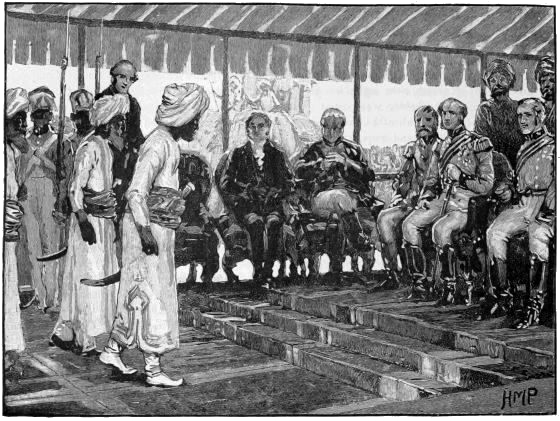
SURRENDER OF THE PEISHWA. (See p. 141.)
That very day General Smith reached Corregaum
in force, and at this apparition the Peishwa fled
back towards the sources of the Kistnah, whence
he had descended. Not only General Smith,
but Brigadier-General Pritzler and Colonel Boles
kept up the pursuit, advancing from different quarters,
as the slippery Mahratta chief turned and
manœuvred. At length weary of the chase, they
determined to reduce Satara, his capital, and then
each of his strong forts and towns one after
another, thus depriving him of supplies, and
leaving him no place of refuge or subsistence.
Satara surrendered to General Smith on the 10th
of February, the same day that he appeared before
it. As one place after another fell, Gokla, the
Peishwa's general, made an effort to arrest this process
of reduction, and this enabled General Smith to
attack him on the 20th of February, at Ashtee,
where he completely routed him. Gokla himself
was killed, and the Peishwa only escaped by
abandoning his palanquin and mounting a horse.
General Smith and Lieutenant Warrand were
wounded, but not a man was killed on the British
side. Great booty was taken, including twelve
elephants and fifty-seven camels.
The remnant of the Mahratta army fled northwards,
pursued and continually reduced by the
British. At the same time the reduction of the
towns and forts was steadily going on, and every
day the fugitive Peishwa became more and more
involved in the toils of his enemies. He endeavoured
to escape into Nagpore, but on the banks
of the Wurda he was met, on the 1st of April, by
Colonel Scott and driven back, only to fall into
the hands of Colonel Adams, who attacked him
near Soonee with only one regiment of native
cavalry and some horse artillery, and gave him a
thorough defeat, taking five guns, three elephants,
and two hundred camels. More than a thousand
Mahrattas fell, and the Peishwa himself narrowly
escaped, his palanquin, which he had abandoned,
being found shot through. Bajee Rao now endeavoured
to get to the north-east into Malwa, but he
was stopped by General Sir Thomas Hislop, who
was advancing from that quarter towards the
Deccan. At length, his forces dispersed, his towns
in possession of the British, his way on all sides
cut off, the Peishwa came in and surrendered himself
to Sir John Malcolm, on the 3rd of June,
1818, on promise of good treatment. Sir John
granted him eight lacs of rupees per annum, on
condition that he resigned the title of Peishwa for
ever, and surrendered all his possessions. This
was confirmed by the Supreme Government at
Calcutta. Thus was the existence of the Pindarrees,
and the power of the Mahrattas, broken
up, and the Rajah of Satara restored. He was a
minor, but on reaching the age of twenty-one,
which was in the year 1821, he was invested with
the government of his dominions. These included
a district of about eleven thousand square miles,
and produced a net revenue of fifteen million
rupees. Out of this, however, three lacs per
annum were reserved for chiefs who had become
subjects of the Company, and three more lacs were
alienated. As for Trimbukjee, whose crimes and
murders had determined the British to secure him
at any cost, he was discovered, after a long quest,
in the neighbourhood of Nassick, by Captain
Swanston, and carried to Tannah, the prison from
which he had escaped. He was thence transferred
to Calcutta, and finally to the rock of Chunar,
near Benares. The last success of this war was
the reduction of the fortress of Aseerghur, one
of the most formidable strongholds in India,
which had undergone some most arduous sieges.
None of the princes who accepted our protection
benefited more than Scindiah. He was relieved
from the insolence of haughty military chieftains,
who commanded his armies, and left him as little
free will as they left to his subjects quiet possession
of their property. He was enabled to disband
his vast armies, and reduce them to thirteen
thousand infantry and nine thousand horse. His
disbanded soldiers returned home, and became
tillers of the land lately running into jungle, by
which, and other influences of peace, his revenue
was nearly doubled. All the districts wrested
from him by the Pindarrees were restored to him;
he lost only the mischievous fortress of Aseerghur.
Sir John Malcolm cleared the country of the
swarms of Arabs, and of Mekranees from
Beluchistan, who had acquired a most formidable
ascendency in the armies of the Indian chiefs; and
these chiefs were informed that again to employ
these mercenary ruffians, or to allow them to
remain on their territories, would be regarded as a
declaration of hostility by the British Government.
Similar changes were introduced into the territories
of the dethroned Peishwa by the Honourable
Mountstuart Elphinstone, who resided at Poonah;
and by the conquest of the Poonah territory,
by the treaty of Mundissoor, made by Sir John
Malcolm after his great victory at Mahidpore, and
by exchanges made with the Guicowar of Baroda,
and other arrangements, the British dominions
were now linked together in one broad and continuous
expanse, from Calcutta to Bombay, and
from Bombay to Madras, as by the former
Mahratta war they had been established between
Madras and Calcutta.
If we were to believe figures, and the returns of
exports and imports, and of duties paid, we must
set down the opening of the year 1819 as considerably
prosperous. This was the view which
Ministers took of the condition of Great Britain
when they met the new Parliament on the 14th of
January. The speculations that had been carried
on during 1818 had swelled the revenue, and given
an impression of growing commerce, which unfortunately
did not exist. The results of these
speculations in imports of raw material, especially
of cotton, and in extensive exports of manufactures
to countries not yet sufficiently reinvigorated
to purchase, had produced numerous and
heavy failures during the latter part of the
past year, and these still continued, in strange
contrast to the self-congratulating language of
Ministers. In nothing was the fall of price so
great as in cotton, and those who had bought
largely suffered in proportion. These bankruptcies
were not confined to Great Britain; they extended
to New York, and to southern ports of the United
States, where the same speculation had been going
on largely.
Besides the flattering assurances of the steady
improvement in commerce and manufactures, and,
consequently, in the revenues, the Regent's Speech,
read, as usual, by the Lord Chancellor, justly
congratulated the country on the successful termination
of the Pindarree war by the Marquis of
Hastings. It informed the two Houses that a
new treaty had been entered into with the United
States for adjusting the different points at issue
between the two nations, not settled by the treaty
of peace, and also for regulating the commerce between
them. It announced the results of the Congress
at Aix-la-Chapelle, and stated that some new
measures were needed for the care of his Majesty's
person in consequence of the death of the queen.
The Address, in both Houses, was carried almost
pro formâ. Mr. Manners Sutton was elected
Speaker of the Commons by acclamation.
The new arrangements for the care of the king's
person came on first for discussion. On the 25th
of January Lord Liverpool introduced a Bill to
make the Duke of York guardian of his Majesty's
person in place of the late queen. This question
was decided with little debate. On the 4th of
February a message was brought down from the
Regent informing the House of Commons that, in
consequence of the demise of her Majesty, fifty-eight
thousand pounds became disposable for the
general purposes of the Civil List; and recommending
that the claims of her late Majesty's
servants to the liberality of the House should be
considered. Lord Castlereagh moved that the
House should go into committee on this subject,
as, besides the fifty-eight thousand pounds, there
was another sum of one hundred thousand pounds,
which had been appropriated to the maintenance
of the establishment at Windsor. It was understood
that Ministers would propose to reduce the
sum for the establishment at Windsor to fifty
thousand pounds, but that they would recommend
that ten thousand pounds, which her Majesty had
received in consideration of her charge of the
king, should be transferred to the Duke of York.
Mr. Tierney objected to the charge of fifty thousand
pounds for the maintenance of the establishment
at Windsor. He said he could not conceive
how this money was to be spent, or on whom, for
certainly it could not be on the king, who, he
understood, was in that state of mental and bodily
debility which made it necessary that as few
persons as possible should be about him, and that
his regimen was so very simple that it could cost
next to nothing.
On the 22nd the Commons went into committee
on this subject, and Mr. Tierney then proposed
that both the establishment at Windsor and the
salary to the Duke of York should be paid out of
the Privy Purse or other private funds of the
Crown. There was a private property belonging
to the Crown of one hundred and forty thousand
pounds a year, and surely this was sufficient to
defray the charge of the necessary care of the
king's person. He reminded the House also of
the sums which had been voted for the royal
family since 1811. Besides fifty thousand pounds
a year set apart for the debts of the Prince Regent,
he had a privy purse of sixty thousand pounds a
year, besides an additional grant of ten thousand
pounds a year made since. The king had also a
privy purse of sixty thousand pounds a year, with
an additional revenue of ten thousand pounds from
the Duchy of Lancaster. Surely, out of all these
sums, there must be ample means of taking care
of the king's person. To all these second statements
Mr. Peel—afterwards the Sir Robert who
began his political career in the ranks of high
Toryism—replied that the Duke of York would
accept no salary which came from the Privy Purse,
and he quoted Sheridan and Adam, old friends of
the Prince Regent, and staunch Whigs, who had
zealously advocated the sacredness of the Privy
Purse. When the vote was taken for the disposal
of the sum for the Windsor establishment, it was
carried by two hundred and eighty against one
hundred and eighty-six, a sufficient proof that in
the new Parliament the Government possessed a
strong majority. On the 25th the proposal to
confer on the Duke of York ten thousand pounds
per annum, for this charge of his own father's
person, was also carried by a still larger majority—two
hundred and forty-seven against one hundred
and thirty-seven. In the debate, Denman and
Brougham opposed the vote, and Canning supported
it. In the House of Peers Lords Grey,
Lansdowne, and other Whig peers opposed the
vote of the ten thousand pounds to the Duke of
York. And truly, in private life, it would not
have seemed very filial conduct for a man,
already possessing a large income, to require a
great annual payment for discharging the simple
duty of seeing that his aged father, a gentleman
also of ample means, was well looked after.
A great portion of the present Session was
occupied with discussing the return to cash payments,
which, by the Act of Parliament, ought to
take place on the 5th of July of this year. It
appears that no less than fifty debates and conversations
in both Houses took place on this important
subject during the Session. Very soon
after the meeting of Parliament a secret committee
of each House was appointed to inquire into the
state of the Bank. These committees were, however,
so managed, by delivering to the members
lists of suitable persons for such committees, that
scarcely any but Ministerial men were voted,
though these votes were given by ballot. In the
Commons this result was so evident that the
Opposition declined to vote at all. The first
reports of the committees went rather to close
more strictly than to open the issue of gold by the
Bank. It had been paying in gold its notes issued
previous to January, 1817. This payment it was
proposed to stop, as, at present, evidently injurious
to the interests of the country. Mr. Peel, on
moving for a Bill for this purpose, stated that the
gold at the present price was fast finding its way
abroad, and was as rapidly absorbed in re-minting
a gold coinage for France. It appeared that during
the first half of 1818 gold to the value of no
less than one hundred and twenty-eight million
francs had been coined at the French mint, of
which three-fourths were derived from the gold
coinage of England. A Bill was accordingly
passed to stop payment altogether in gold till the
necessary preparations were made by a fresh Bill.
Still, the condition of the Bank was represented as
flourishing. Its liabilities were stated in January,
1819, as amounting to thirty-three million eight
hundred and ninety-four thousand five hundred
and eighty pounds; its assets, including the debt
due from Government, fifty-three million seven
hundred and eighty-three thousand seven hundred
pounds. The total Bank surplus appeared to be
nineteen million eight hundred and eighty-nine
thousand one hundred and twenty pounds; and its
surplus, independent of the Government debt, and
therefore available for current use, was five million
two hundred and two thousand three hundred
and twenty pounds. The committees adopted the
scheme broached by Mr. Ricardo in his "Proposals
for an Economical and Secure Currency," published
in 1816. This was that the Bank, in the first
instance, should not pay for its notes in gold coin,
but in ingots of a certain weight, its fineness being
attested by a stamp; and this degree of purity
should be regulated from time to time till the
gold descended to the Mint price of three pounds
seventeen shillings and tenpence-halfpenny per
ounce. When the Mint gold at length reached
this rate of value, then the payment in coin was
to be begun. Resolutions to this effect were
moved by the Earl of Harrowby on the 21st of
May, and they received the approval, not only of
the Ministerial side, but of the leading Opposition
members, Lords Grenville, Lansdowne, and King.
In the House of Commons similar resolutions
were moved on the 24th by Mr. Robert Peel, who,
on this occasion, made the first of those candid
admissions of new views which he afterwards
repeated on the question of Catholic Emancipation,
and finally on the abolition of the Corn Laws.
This eminent statesman, though beginning his
career in the ranks of Conservatism, had a mind
capable of sacrificing prejudice to truth, though it
was certain to procure him much obloquy and
opposition from his former colleagues. He now
frankly admitted that the evidence produced
before the secret committee of the Commons, of
which he had been a member, had greatly changed
his views regarding the currency since in 1811 he
opposed the resolutions of Mr. Horner, the chairman
of the Bullion Committee. He now believed
the doctrines of Mr. Horner to be mainly sound,
and to represent the true nature of our monetary
system; and, whilst making this confession, he had
only to regret that he was compelled by his convictions
to vote in opposition to the opinions of his
venerated father. Several modifications were proposed
during the debate, but there appeared so
much unanimity in the House that no alterations
were made, and the resolutions passed without a
division. The resolutions were to this effect:—That
the restrictions on cash payments should continue
till the 1st of May, 1822; that, meanwhile,
the House should make provision for the gradual
payment of ten millions of the fourteen millions
due from the Government to the Bank; that,
from the 1st of February, 1820, the Bank should
take up its notes in gold ingots, stamped and
assayed in quantities of not less than sixty ounces,
and at a rate of eighty-one shillings per ounce.
After the 1st of October of the same year the rate
of gold should be reduced to seventy-nine shillings
and sixpence per ounce; and again on the 1st of
May, 1821, the price should be reduced to seventy-seven
shillings and tenpence halfpenny per ounce;
and at this rate of gold, on the 1st of May, 1822,
the Bank should finally commence paying in the
gold coin of the realm. Bills to this effect were
introduced into both Houses by the Chancellor of
the Exchequer and Mr. Peel, and were readily
passed; and such was the flourishing condition of
the Bank that it did not wait for the full operation
of the Act, but commenced paying in coin to any
amount on the 1st of May, 1821.
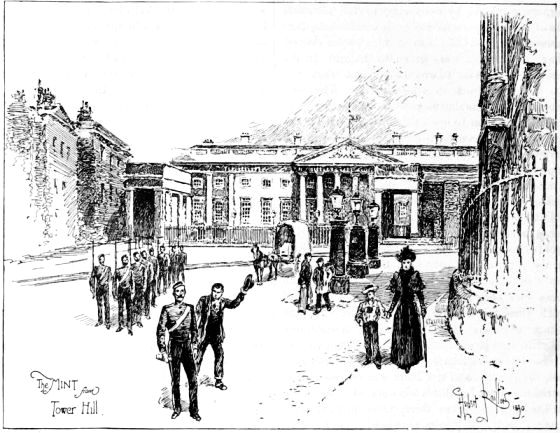
The select committee of the Commons appointed
at the instance of Lord Castlereagh, to inquire
into the state of the national income and
expenditure, now presented its report on the
3rd of June, and it was agreed to. The Chancellor
of the Exchequer stated on its authority
that, since 1815, taxation had been reduced
eighteen million pounds per annum; that in
1816 the revenue of Great Britain and Ireland
had been consolidated, and that, at that time, the
interest of the Debt of Ireland, including the
Sinking Fund provided for its reduction, exceeded
the entire revenue of that part of the United
Kingdom by one million nine hundred thousand
pounds. He then announced that supplies for the
present year would be required to the amount of
twenty million five hundred thousand pounds;
that the existing revenue would only furnish seven
million pounds towards this; and that it would be
necessary to have recourse to the Sinking Fund to
make up the deficiency of thirteen million five
hundred thousand pounds. This Sinking Fund
was fifteen million five hundred thousand pounds,
so that it would leave only two million pounds;
but as it was necessary to have a tolerable surplus
in hand to meet exigencies, it was proposed to
raise this reserve fund to five million pounds by
fresh taxes to the amount of three million pounds.
On this basis Mr. Vansittart, the Chancellor of
the Exchequer, on the 9th of June, produced his
Budget. Including the interest on the Debt, the
whole annual expenditure amounted to seventy-six
million, seventy-four thousand pounds—an ominous
peace expenditure. Instead, therefore, of the
supplies, aided by the draft from the Sinking Fund,
leaving a surplus of two million pounds, a fresh
loan of twelve million pounds—besides the three
million pounds of new taxes on malt, tobacco, coffee,
cocoa, tea, British spirits, pepper, and foreign wool
was needed. By the hocus-pocus of Exchequer
accounts this was made to look like a reduction of
the Debt instead of an increase of it; but the
country saw with dismay that three years after
the peace the incubus of past war was still
adding to its burden. Mr. Tierney, on the 18th,
moved for a committee to inquire into the state of
the nation, but this was negatived by three hundred
and fifty-seven votes against one hundred and
seventy-eight; and a motion of Sir Henry Parnell
on the 1st of July for extensive retrenchments was
got rid of in the same manner.
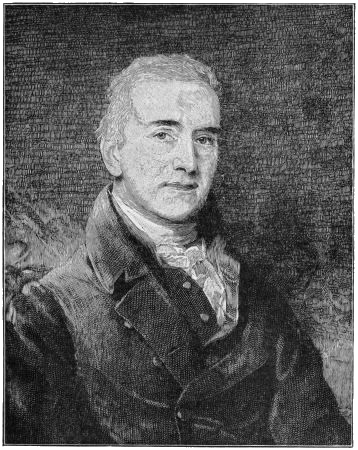
But amid the discouragements of monetary
legislation, which showed that it would require a
determined contest to compel Ministers to retrench,
there were symptoms of a spirit of legal and social
reform amongst Parliamentary men generally which
augured the approach of better times. Mr. Sturges
Bourne obtained the passing of his long-advocated
Poor Law Bill; but Bills for regulating settlements,
and for preventing the misapplication of the poor
rates, were thrown out. A Bill was passed to
regulate the treatment of children in cotton
factories, and to limit the hours of their employment.
Mr. Brougham's Act for inquiry into the
charitable foundations of England was extended,
with the support of Government, so as to
apply to educational as well as to all kinds of
charities, except such as had special visitors, or
were maintained by private subscriptions. Sir
James Mackintosh also took up the humane track
of labour occupied so nobly by the late Sir Samuel
Romilly. On the 2nd of March he moved for the
appointment of a select committee to take into
consideration the subject of capital punishment as
regarded felonies. This was eminently needed, for
the penal laws during the reign of George III.
were truly Draconian. Notwithstanding a strong
opposition by Ministers, the motion was carried,
amid much cheering, and on the 6th of July Sir
James Mackintosh introduced the report, which
was ordered to be printed. Government, as if to
wipe out their disgrace in resisting so humane a
measure, now proposed an inquiry into the condition
of gaols and other places of confinement, and
into the best method of employing and reforming
delinquents during their imprisonment. Some reforms
were made in Scottish law. The old rights of
trial by battle, and of appeals of murder, felony, or
mayhem, were abolished as rendered unnecessary
by the full exercise of the institution of jury, and
as belonging only to a barbarous age. The severity
of the Scottish law against duels was mitigated,
that law pronouncing forfeiture of all movable
property, and banishment against all persons sending,
or even carrying, a challenge to fight a duel.
The principle of that law was sound, but its
severity was its own defeat. A more questionable
Bill was one carried, after much opposition, called
the Foreign Enlistment Bill, which was intended
to check the aid of Englishmen in assisting the
Spanish South American colonists in throwing off
the oppressive government of the mother country.
Numbers of Englishmen were engaged on the side
of independence, and this Bill was vainly intended
to put an end to that generous aid.
The Scottish burgh question was brought forward
again this Session. The magistrates of the burgh
of Aberdeen having been elected, in 1817, in the
same corrupt manner as those of Montrose had
been in 1816, the Court of Session had declared
the election illegal. The burgh of Montrose was
found to have been disfranchised; but this was
not the case with Aberdeen, and the magistrates
applied to Government to grant a warrant for a
new election, or rather a re-election of themselves.
This the Government, in the face of the decision of
the Court of Session, as well as of a numerously
signed petition from the burgesses praying that the
election should be by open poll, issued. On the
1st of April Lord Archibald Hamilton moved an
address to the Prince Regent, praying for a copy
of this warrant. It was strenuously resisted by
Ministers, but the motion was lost by only a small
majority. On the 6th of May Lord Archibald
Hamilton renewed his motion in another form—namely,
that the petitions which had been presented
from Scottish burghs on the subject of Reform
should be submitted to a committee of inquiry.
He showed that out of sixty-six royal burghs
thirty-nine had voted for Reform; that these
thirty-nine contained a population of four hundred
and twenty thousand souls, whilst the remaining
twenty-seven contained only sixty thousand. The
preponderance was so great that, in spite of the
opposition of Ministers, the House took another
view of the matter, and Lord Archibald's motion
was carried, though only by one hundred and forty-nine
votes against one hundred and forty-four.
The question of Catholic Emancipation was
brought forward on the 3rd of May, by Grattan:
it was the last time that he did so, but he had the
satisfaction of seeing that the question was rapidly
advancing, for it was lost by only two votes. A
fortnight afterwards Lord Donoughmore introduced
a similar motion, in the hope of surmounting this
small difference, but, after a long debate, he found
the majority increased against it by thirty-nine
votes. The closing contest of the Session was for
Parliamentary Reform. Sir Francis Burdett brought
on his annual motion, on the 1st of July, for the
eighteenth time, but was defeated by one hundred
and fifty-three votes against fifty-eight. He was
seconded by Mr. George Lamb, younger brother of
Lord Melbourne, who, however, did not go the
length of annual parliaments and universal suffrage.
Even at that day, Joseph Hume was for moderate
reform, and Lord John Russell was alarmed at
anything further than Triennial Parliaments, and
the transferring the franchise from certain corrupt
boroughs to others not yet represented. Such were
the feeble ideas of Reform amongst its self-constituted
leaders. Parliament was prorogued, on
the 13th of July, by the Prince Regent in person.
During this first Session of the new Parliament
Ministers had carried matters with a high hand,
imagining that they had a majority which would
enable them to resist popular opinion, as they had
done since the conclusion of the war. But the
progress of the Session did not warrant this conclusion.
They were defeated in several very important
contests, and before the Session came to an
end were made to feel that they had greatly declined
in public confidence. In the severe debate
of the 18th of May, on the motion of Mr. Tierney
for a Committee of Inquiry into the state of the
nation, they had a majority of more than two to
one. But this was very different on the 3rd of
June, when they only carried their Foreign Enlistment
Bill by a majority of thirteen. On the
question of the resumption of cash payments, the
conversion of Mr. Peel to the principles of Horner
was a rude shock to the Cabinet, and shrewd men
prognosticated that, the entire system of Mr.
Vansittart being thus overturned, he must retire.
Then came not merely partial conversions, or near
approaches to defeat, but actual defeats. Such were
those on Sir James Mackintosh's motion for inquiry
into the criminal laws, and on Lord Archibald
Hamilton's for Scottish burgh Reform. The question
of Catholic Emancipation had approached
to a crisis, and a majority of only two against it
was, in truth, a real defeat. The consequence was
that the conviction of the insecurity of Ministers
was not only shared by men of impartial judgment,
but by themselves. Towards the end of the
Session Lord Liverpool himself was found writing
to a friend, that unless the measure for the return
to cash payments raised the confidence of the
public in them, they must soon go out:—"I am
quite satisfied that, if we cannot carry what has
been proposed, it is far better for the country that
we should cease to be a government. After the
defeats we have already experienced during this
Session, our remaining in office is a positive evil.
It confounds all ideas of government in the minds
of men. It disgraces us personally, and renders us
less capable every day of being of any real service
to the country, either now or hereafter. If, therefore,
things are to remain as they are, I am quite
sure that there is no advantage, in any way, in our
being the persons to carry on the public service.
A strong and decisive effort can alone redeem our
character and credit, and is as necessary for the
country as it is for ourselves."
This appeal did something to strengthen them,
but not permanently. The fact that Parliament
might terminate any day from the death of the
king did much to keep members in remembrance
of their constituents; but the great cause of
Ministerial decay of popularity was that the
circumstance and spirit of the times demanded
more liberal legislation than such men as Liverpool,
Sidmouth, and Eldon could comprehend, much less
originate. The manufacturing districts were especially
in a depressed condition. The efforts
which had been made to force a trade had failed.
The excessive exportation of manufactured goods
had resulted exactly as Brougham had prognosticated:
the foreign markets had been glutted
before the people were capable of buying, and the
fall in prices had been ruinous. The equally great
importation of raw material to continue the supply
of fabrics for which the demand was inadequate,
had made matters worse. The bankruptcies during
the first half of this year were double the average
number, credit was severely shaken, and numbers
of workmen were thrown out of employment or reduced
to very low wages. Wheat, though not so
high as a year or two ago, averaged eighty shillings
per quarter. The consequence was a renewed
political action, and meetings were called by the
workmen in various parts of the manufacturing
districts to consider both their unsatisfactory
position and the governmental as well as commercial
causes of it. The Corn Laws were justly
denounced as one potent cause of their sufferings,
and the popular leaders of Reform were called upon
to assist them in getting rid of it. So early as the
18th of January a meeting of this character was
held at Manchester. Application had been made to
the borough-reeve to summon a meeting to petition
Parliament for this object, but he declined, the
Manchester authorities of that day standing
strangely aloof from the people in their endeavours
for relief from this enactment, which was as inimical
to their own interests as manufacturers,
as it was to the comfort of their work-people.
Refused in this quarter, the people proceeded to
hold a meeting without such sanction, and invited
Mr. "Orator" Hunt to go down and take the
chair. Perhaps they could not have selected a
more unsafe guide on the occasion, for personal
vanity was Hunt's besetting sin. Hunt, instead
of encouraging the very constitutional object of
the meeting—to petition Parliament for the repeal
of the obnoxious law—treated the petitioning that
House as ridiculous, and persuaded the excited
people to put their sentiments into the form of a
remonstrance to the Prince Regent. The meeting
then dispersed quietly; but Hunt found occasion
to keep himself in the public eye there a little
longer. Some officers of the 7th Hussars, who
were posted at Manchester, treated him rudely as
he appeared at the theatre, asserting that when
"God Save the King" was called for, he hissed.
Whether he did so or not, the conduct of the
officers answered his purpose of making political
capital; he wrote to the Commander-in-Chief, the
Duke of York, and then sent his letter to the
newspapers. Still more, he wrote to Samuel Bamford
to support him in a scheme which was
particularly calculated to produce riot and bloodshed,
and in this case Bamford did not exercise his
usual good sense. At Hunt's suggestion—to select
a dozen stout fellows, and appear on the evening of
the following Monday in the pit of the theatre,
armed with stout cudgels, to inflict a summary
chastisement on the officers in case of a second
demonstration of their feelings—Bamford appeared
at the time appointed with ten stout, picked fellows,
with knotty cudgels, marching along the streets to
the theatre. The object was immediately perceived
by the people, who crowded to the door of the
theatre, completely filling the space in front.
But the manager was too prudent to open his
theatre in such circumstances. He announced
that there would be no performance that evening.
Hunt was, therefore, disappointed of a catastrophe
in the theatre; but he drove up in a carriage,
mounted the box, and addressed the crowd in very
exciting tones, declaring that the magistrates
desired nothing so much as an opportunity of letting
loose the bloody butchers of Waterloo upon
them—meaning the 7th Hussars. It was not his
fault that all went off quietly.
In May the gingham-weavers of Carlisle and
that neighbourhood held a similar gathering, and
in June meetings were held on Hunslet Common,
near Leeds, at Glasgow, Ashton-under-Lyne, and
other places. The meeting at Glasgow, on the 16th
of June, was held on the Green, and amounted to
thirty or forty thousand people. They complained
of the low wages for cotton-weaving, and proposed
a petition to the Prince Regent, praying that he
would enable them to get over to Canada, promising
that all such as received that favour should
repay the outlay by yearly instalments. But the
bulk of the assembly protested against emigration,
asserting that the remedy for their distresses lay
in annual parliaments, universal suffrage, and the
consequent reduction of taxation; and they proposed
that they should march up to London in a
body, and present their petition to the Prince
Regent in person. At Ashton the chair was taken
by the Rev. Joseph Harrison, and the strange
creature called Dr. Healey, of whom Bamford
gives an extraordinary account in his "Life of
a Radical," made a most wild and seditious
harangue. At a great meeting at Stockport, on
the 28th of the same month, a very different personage
presided. This was Sir Charles Wolseley, of
Wolseley Park, in Staffordshire. Sir Charles said
that he had been engaged in the outbreak of the
French Revolution, and had assisted in the taking
of the Bastille, and that he would spend his last
drop of blood, if it were necessary, in destroying
the Bastilles of his own country. The acquisition
of such an advocate of Reform was not likely to be
received with apathy. Sir Charles was invited to
preside at a similar meeting at New Hall, near
Birmingham, on the 12th of July. At this meeting
he was elected "legislatorial attorney and
representative" for that town. This was a circumstance
that excited the alarm of Government.
They immediately issued warrants for the apprehension
both of Sir Charles and of Dr. Harrison
for seditious expressions used at the Stockport
meeting. Sir Charles was arrested at his own
house, at Wolseley Park; and Harrison was taken
on the platform of a public meeting, at Smithfield,
in London, on the 21st of July, at which Hunt was
presiding. On conveying Harrison to Stockport,
the constable who arrested him was attacked by
the mob, and a pistol was fired at him, the ball of
which lodged in his body.
Circumstances appeared now to be growing
serious. Meetings were held in defiance of the
strict measures of Government throughout the
manufacturing districts; and at Blackburn it
was announced at such a gathering, on the 5th of
July, that the women had also formed themselves
into "Sister Reform Associations," and these
called on their own sex everywhere to imitate their
example, so as to co-operate with the men, and to
instil into the minds of their children a hatred of
tyrannical rulers. The men, at the same time,
made another advance in the Reform agitation;
this was drilling-a movement which gave great
alarm to the magistrates of Lancashire, who wrote
from various quarters to apprise Government of it.
It was a circumstance that might well excite
suspicion that something more than Reform was
intended. But when it came to be explained by
the parties themselves, it turned out to mean
nothing more than that the Reformers in the
neighbourhood of Manchester were intending to
hold a great meeting in order to elect a representative,
as the people of Birmingham had done,
and that they wished to assemble in the utmost
order and quiet. But the very means employed
by them to avoid confusion, and enable them to
meet and disperse with decorum, were just those
most calculated to excite the fears of a magistracy
and Ministry already suspicious.
The great meeting had been intended to take
place on the 9th of August; and on the 31st of
July an advertisement appeared in the Manchester
Observer calling on the inhabitants to meet on
the 9th in the area near St. Peter's Church for the
purpose of electing a representative to Parliament,
as well as for adopting Major Cartwright's plan of
Parliamentary Reform. This immediately drew
from the magistrates a notice that such a meeting
would be illegal, and that those who attended it
would do so at their peril. The working men on
this announced that the meeting would not take
place, and a requisition was presented to the
borough-reeve and constables, requesting leave
to hold such a meeting. It was refused; and on
its refusal the people proceeded with their original
design, only appointing the 16th as the day of
meeting, with Hunt in the chair.
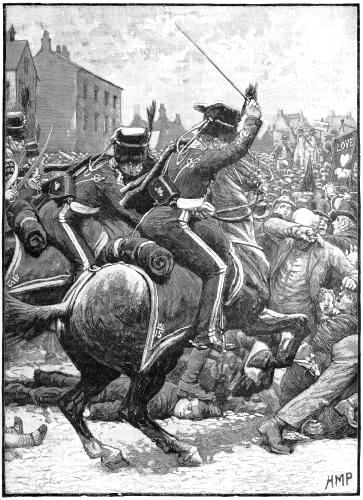
THE PETERLOO MASSACRE: HUSSARS CHARGING THE PEOPLE. (See p. 151.)
This was taking a bold step in defiance of the
authorities, and orderly and peaceable conduct
was, more than ever, necessary. On the morning
of the day proposed there was little appearance of
any stir amongst the artisans of the town, and it
does not seem that they took any or much part in
the assembly, but that it was made up of the
parties marching in from the country and towns
around. During the forenoon of this day, Monday,
the 16th of August, large bodies came marching in
from every quarter, so that by twelve o'clock it
was calculated that eighty or a hundred thousand
such people were congregated in and around the
open space designated. Some of them had disregarded
the injunctions of the general committee,
and had gone extensively armed with sticks.
Bamford soon heard that his eccentric friend,
called "the quacking" Dr. Healey, of whom his
narrative gives some ludicrous recitals, had headed
the band from Lees and Saddleworth, with a black
flag borne behind him, on which stared out in
great white letters, "Equal Representation or
Death" on the one side, and on the other, "Love,"
with a heart and two clasped hands—but all white
on their black ground, looking most sepulchral and
hideous. Presently loud shouts indicated that
Hunt was approaching, who came, preceded by a
band of music, seated in an open barouche, with
a number of gentlemen, and on the box a woman,
who, it appeared, had been hoisted up there by the
crowd, as the carriage passed through it.
The platform for the chairman and speakers
consisted of a couple of waggons boarded over,
and Hunt and his friends had some difficulty in
reaching it through the dense crowd, the attendant
bands continuing to play "God Save the King,"
and "Rule Britannia," till they were safely placed
on the platform, when the music ceased, and Hunt,
having been called to the chair, took off his white
hat, and was commencing his address, when there
was a strange movement in the throng, and a cry,
"The soldiers are upon us!" and this was the
fact. The magistrates had met in great numbers
on the previous Saturday, and had determined to
seize the ringleaders; but instead of doing this as
they might have done, at their several localities
when drilling, or on their way to the town, they
left this to be done after these vast numbers were
assembled, and by the aid of the soldiers, which
was certain to produce serious consequences. We
have the statements of these magistrates themselves,
as laid before Parliament, and of Sir
William Jolliffe, M.P., lieutenant of the 15th
Hussars, and personally engaged on the occasion.
The reason assigned by them was, that they waited
to see "what the complexion of the meeting might
be;" but, if this was the case, they might as well
have waited till some disorder took place, which
they did not, but sent the soldiers into the crowd,
whilst peacefully and in an orderly manner standing
to listen to the chairman. Had they waited
to the end, they would undoubtedly have seen the
immense crowd disappear as quietly as it had
come. But the magistrates were clearly excited
by their fears. They had assembled a great
constabulary and military force. Two hundred
special constables had been sworn in; six troops
of the 15th Hussars lying in the barracks were
held in readiness; a troop of Horse Artillery with
two guns; the greater part of the 31st Regiment
of Infantry; several companies of the 88th
Regiment; the Cheshire Yeomanry, nearly four
hundred men, who had ridden in that very morning;
and about forty Manchester Yeomanry,
chiefly master manufacturers. These were troops
enough to storm a town, much more to defend it
from an unarmed multitude. The whole of this
force, except the Manchester Yeomanry, was put
under the command of Colonel L'Estrange, of the
31st Regiment, in the absence of Sir John Byng,
the general of the district, but who had his headquarters
at Pontefract, and who, it appeared, had
received no information of these military preparations,
or of the imagined need of them.
We have the accounts of what took place from
both sides—from the magistrates and the people.
Mr Hulton, the chairman of the bench of magistrates,
made the following statements in evidence,
on the trial of Hunt, at York. He said that the
warrants for the apprehension of the leaders of
this movement were not given to Nadin, the chief
constable, till after the meeting had assembled,
and that he immediately declared that it was
impossible for him to execute them without the
protection of the military; that orders were at
once issued to the commander of the Manchester
Yeomanry, and to Colonel L'Estrange, to come
to the house where the magistrates sat. The
yeomanry arrived first, coming at a quick trot,
and so soon as the people saw them they set up a
great shout. The yeomanry advanced with drawn
swords, and drew up in line before the inn where
the magistrates were. They were ordered to
advance with the chief constable to the hustings,
and support him in executing the warrants. They
attempted to do this, but were soon separated one
from another in the dense mob, and brought to a
stand. In this condition, Sir William Jolliffe also
giving evidence, said that he then, for the first
time, saw the Manchester troop of yeomanry.
They were scattered, singly or in small groups, all
over the field, literally hemmed in and wedged into
the mob, so that they were powerless either to
make an impression, or to escape; and it required
only a glance to discover their helpless condition,
and the necessity of the hussars being brought to
their rescue. The hussars now coming up, were,
accordingly, ordered to ride in and disperse the
mob. The word "Forward" was given, and the
charge was sounded, and the troop dashed in
amongst the unarmed crowd. Such a crowd never
yet stood a charge of horse. There was a general
attempt to fly, but their own numbers prevented
them, and a scene of terrible confusion ensued.
"People, yeomen, constables," says Sir William
Jolliffe, one of these hussars, "in their confused
attempts to escape, ran one over another, so that
by the time we had arrived at the midst of the
field, the fugitives were literally piled up to a
considerable elevation above the level of the
ground."
Surely, both magistrates and soldiers might now
have been satisfied. A defenceless multitude have
no means of resistance, and, doing their best to
get away, might have been left to do so without
further molestation, which would be equally brutal
in the magistrates, and cowardly in the soldiers.
But neither of these parties seems to have thought
so on this unhappy occasion. The magistrates
issued no orders to desist, and the soldiers, by the
confession of one of their officers, went on striking
with the flats of their swords at the impeded people,
who were thrown down in their vain efforts to get
away, and piled in struggling heaps on the field.
Mr. Hulton confessed that he walked away from
the window after he had let loose the horse-soldiers
on the people. "He would rather not see
any advance of the military." He was, in fact, so
tender-hearted that he did not mind the people—men,
women, and children, met to exercise their
political rights—being trodden down under the
iron hoofs of horses, and cut down by the sword,
so long as he did not see it.
Hunt, and about a dozen of his friends, were
seized on the platform. Bamford and some others,
who had escaped, were afterwards taken. The
streets were then cleared by the infantry. Such
was the celebrated Manchester massacre, in which
the actual wounds inflicted by the soldiers do not
appear to have been many. About seventy people
were carried to the infirmaries, or went there, to
have their wounds dressed—a considerable number
for severe cuts and fractured limbs; and six
lives were lost, including a special constable run
over by the cavalry, and a Manchester Yeoman,
who was struck from his horse by a brickbat,
aimed by a man whom he was pursuing.
The Ministers and the Prince Regent, indeed,
fully approved of the conduct of these magistrates,
and that was to be expected, for neither of these
parties ever evinced much sympathy for the people,
and consequently received very little regard in
return. There was a disposition to rule by the
high hand in both the Prince and the Cabinet,
which eventually brought them into extreme odium,
and warned them that very different times were
approaching. On the reassembling of Parliament
Lord Sidmouth made the most candid statement
of the full and entire approbation of himself and
his colleagues of this cruel and dastardly transaction.
He said that the news of the event
reached town on the Tuesday night; and that it
was followed on the Wednesday by two gentlemen
from Manchester, one of them a magistrate, to
give the Government the most minute particulars
regarding it; that a Cabinet Council was immediately
summoned, at which the two Manchester
gentlemen attended, and entered into the fullest
details of all that had taken place; and that
the Attorney-General and Solicitor-General, then
present, gave it as their opinion that the proceedings
were perfectly justified by the necessity of the case.
The statement of all particulars was then dispatched
to the Prince Regent, who was yachting off Christchurch,
and, on the 19th, the Prince replied, by
the hand of Sir Benjamin Bloomfield, expressing
his "high approbation and commendation of the
conduct of the magistrates and civil authorities at
Manchester, as well as of the officers and troops,
both regular and yeoman cavalry, whose firmness
and effectual support of the civil power preserved
the peace of the town on that most critical occasion."
To most people this appeared to be giving commendation,
not for preserving, but for disturbing
the peace of the town; but Lord Sidmouth, having
received this sanction, addressed letters, on the
21st, to the Lords-Lieutenant of Lancashire and
Cheshire, the Earls of Derby and Stamford, requesting
them to convey to the magistrates of the
two counties, who were present at Manchester on
the 16th, "the great satisfaction derived by his
Royal Highness from their prompt, decisive, and
efficient measures for the preservation of the
public tranquillity." Hunt and his confederates
were charged with high treason; but, on the
circumstances being examined, they were found
not to bear out this charge, and Hunt and his
friends were indicted only for a treasonable
conspiracy; and true bills to the extent of this
mitigated charge were proved against Hunt and
nine others at the summer assizes for the county
of Lancaster.
Great meetings were held in various towns and
counties to condemn the whole proceedings, and
addresses were sent up and presented to the Prince
Regent which were, in fact, censures of his own
conduct, and were not, therefore, received in a
becoming manner. To one from the Common
Council of London he replied that he received it
with regret, and that those who drew it up knew
little or nothing of the circumstances which preceded
or attended the Manchester meeting. The
fact was, that they knew these a great deal better
than he did. Similar addresses were sent up from
Westminster, York, Norwich, Bristol, Liverpool,
Birmingham, Leeds, Sheffield, and many other
towns. A meeting of the county of York was
calculated at twenty thousand persons, and
amongst them was the Earl Fitzwilliam, Lord-Lieutenant
of the West Riding, who had also
signed the requisition to the high-sheriff. For
this conduct he was summarily dismissed from his
lord-lieutenancy. Scarcely less offence was given
by the Duke of Hamilton, Lord-Lieutenant of the
county of Lanark, who sent a subscription of fifty
pounds to the committee for the relief of the
Manchester sufferers, expressing, at the same time,
his severe censure of the outrage committed on the
16th of August. Of course, the Ministerial party
in town and country did all in their power to
counteract this strong and general expression of
disapprobation. In Scotland and the North of
England the squirearchy got up associations for
raising troops of yeomanry, as in direct approval
of the savage conduct of the Manchester Yeomanry.
In the immediate neighbourhood of the scene of
outrage the conflict of opinion between the two
parties ran high. Numbers of the Manchester
Yeomanry were indicted for cutting and maiming
in St. Peter's Field, with intent to kill; but these
bills were thrown out by the grand jury at the
Lancaster assizes. An inquest at Oldham, on the
body of one of the men killed, was also the scene
of a fierce and regular conflict for nine days, that
was put an end to by an order from the Court of
King's Bench. But even men who were accustomed
to support Ministers generally were startled by
their conduct on this occasion. Mr. Ward, afterwards
Lord Dudley and Ward, in one of his
letters written from Paris at the time, but
not published till a later date, says:—"What
do reasonable people think of the Manchester
business? I am inclined to suspect that the
magistrates were in too great a hurry, and that
their loyal zeal, and the nova gloria in armis
tempted the yeomanry to too liberal a use of the
sabre—in short, that their conduct has given some
colour of reason to the complaints and anger of the
Jacobins. The approbation of Government was
probably given as the supposed price of support
from the Tories in that part of the country."
But the Government was, at that juncture, very
far from being a wise Government. Parliament
was called together on the 23rd of November, and
opened by the Prince Regent in person. In his
Speech he spoke of the unsettled state of the
country, and recommended measures of repression.
The Addresses were in the same tone, and they
were commented upon with great warmth by the
Opposition, and amendments moved. Zealous
debates took place in both Houses, especially in
the Commons, where the discussion continued two
evenings, and till five o'clock on the third morning.
The Addresses, however, were carried in the Lords
by one hundred and fifty-nine to thirty-four, and
in the Commons by three hundred and eighty-one
to one hundred and fifty. The Prince Regent
sent down a mass of papers to both Houses relating
to the condition of the disturbed districts, and a
host of Bills, founded on these, were introduced.
In the Lords, on the 29th of November, the Lord
Chancellor Eldon introduced one in keeping with
his alarms, namely, "An Act to prevent delay in
the administration of justice in cases of misdemeanour."
This was followed by three others,
introduced by Lord Sidmouth; one to prevent the
training of persons to the use of arms, and to
the practice of military evolutions and exercises,
another to prevent and punish blasphemous and
pernicious libels. Amongst others, Hone was
again at work, and ridiculing the despotically-spirited
Ministers in his "Political House that
Jack Built." The third was to authorise justices
of the peace, in certain disturbed counties, to seize
and detain arms collected and kept for purposes
dangerous to the public peace. These were to
continue in force till 1822. Not thinking he had
yet done enough, on the 17th of December Lord
Sidmouth brought into the Peers another Bill more
effectually to prevent seditious meetings and
assemblies, which he proposed should continue in
force five years. In the Commons, in addition to
all this, on the 3rd, Lord Castlereagh had introduced
a Bill for imposing stamp duties and other
regulations on newspapers, to prevent blasphemous
and seditious libels, as if Sidmouth's Bill on that
subject had not fettered the press sufficiently. All
these Bills were passed, notwithstanding the
strongest remonstrances by the Opposition as so
many infringements of the Constitution, and they
became known as Sidmouth's and Castlereagh's
Six Acts.
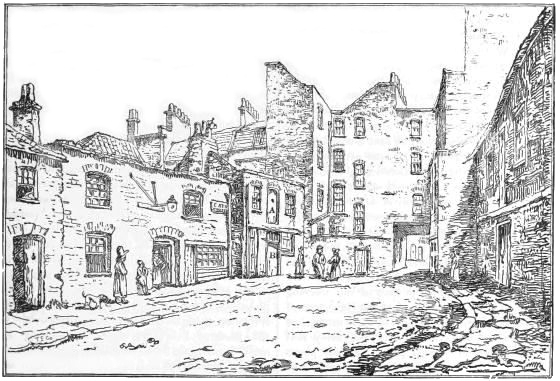
VIEW OF CATO STREET, LONDON, SHOWING THE STABLE AT WHICH THE CONSPIRATORS WERE CAPTURED. A, LOFT;
B, STABLE-DOOR. (From a print published in 1820.)
These enactments, unaccompanied by any others
the object of which was to relieve the distress of
the people, only tended still more to exasperate
the feelings of the working classes. In fact,
nothing had been so obvious as the effect of the
proceedings of Government of late in disturbing
that peace which they professed themselves so
desirous to preserve. They, in truth, were the
real agitators. The passing of the Six Acts only
made the popular resentment the deeper, and
whilst this tended to render the more prudent
Reformers cautious, it stimulated the lowest and
most unprincipled of them to actual and deadly
conspiracy. The general conspiracy believed in
by Ministers never existed, but a conspiracy was
actually on foot in London, which again was found
to have been, if not originally excited, yet actively
stimulated, by the agents of Government. The
details of this transaction, and of the concluding
scene of the Manchester outrage, namely, the trial
of Hunt and his associates, necessarily lead us
about two months beyond the death of George
III., which took place on the 29th of January,
1820. In November, 1819, whilst Government
were framing their Six Acts, the more completely to
coerce the people, they were again sending amongst
them incendiaries to urge them to an open breach
of the laws in order to furnish justifications for
their despotic policy. The leading miscreant of this
class was a man named Edwards, who kept a small
shop at Eton for the sale of plaster casts. Some
of the emissaries appeared at Middleton, the place of
Bamford's abode, but he was in prison awaiting
his trial with Hunt and the rest, and the people
tempted were too cautious to listen to these
agents of Government. But in London these
agents found more combustible materials, and
succeeded in leading into the snare some who had
been long ready for any folly or crime. Chief
amongst these was Thistlewood, who had been a
lieutenant in the army, a man who had, or conceived
that he had, suffered injustice at the hands
of Ministers, and who had wrought up his temper
to the perpetration of some desperate deed.
Bamford when in London, in 1816, had found
Thistlewood mixed up with the Spenceans, and to
be met with any day at their places of resort—the
"Cock," in Grafton Street, the "Mulberry Tree," in
Moorfields, the "Nag's Head," Carnaby Market, No.
8, Lumber Street, Borough, and a public-house in
Spa Fields, called "Merlin's Cave." At these places
they might be found, amidst clouds of tobacco-smoke
and the fumes of beer, discussing remedies
for the miserable condition of the people. At the
latter place Thistlewood was often to be found
with the Watsons, Preston, and Castles, who was
employed to betray them. From this spot they
issued for their mad attempt on the Tower on the
2nd of December of that year. Thistlewood was
one of those seized on that occasion, but was
acquitted on his trial. Not warned by this, he
no sooner got abroad than he sent a challenge to
Lord Sidmouth, for which he was arrested, and
sentenced to a year's imprisonment. He issued
from gaol still more embittered against Sidmouth
and his colleagues, and resolved on striking some
mortal blow at them. He did not lack comrades
of a like fiery and abandoned stamp, and they
determined on a scheme for cutting off the whole
Cabinet together. The detestable deed was to be
perpetrated in the autumn of 1819, a time when
the public mind, especially that of the working
classes, was so embittered against the Government.
They did not, however, succeed in their intentions,
and it was at this crisis of unwilling delay that
the man Edwards became privy to their plans.
In November he carried the important, and, as he
hoped, to him profitable secret to Sir Herbert
Taylor, who was attached to the establishment of
the king at Windsor, and by him he was introduced
to Lord Sidmouth. This minister and his
colleagues, with that fondness for the employment
of spies, and for fomenting sedition instead of nipping
it in the bud, immediately engaged Edwards,
on good pay, to lead forward the conspirators into
overt action. It was not enough for them that, by
adding another witness or two to Edwards, they
would be able to produce the most complete proof
of the treason of these men—they rather luxuriated
in the nursing of this plot, and thus ripening
it into something bloody and horrible; and in this
they succeeded.
The Christmas holidays necessarily postponed
the plans of the conspirators by the Ministers
going out of town, and the deaths of the king
and of the Duke of Kent produced further
impediments by preventing the regular Cabinet
meetings. At one moment the plan appeared to
be in jeopardy from the Ministers being in danger
of dismissal for their refusal to procure the new
king a divorce; but all these hindrances only the
more enabled Edwards to ply his arts, and
stimulate his victims to their destruction. So
thoroughly had he brought them to this point,
that, on the 19th of February, they came to the
resolution to assassinate the Ministers each at his
own house, as they could not get them all
together; but at this moment Edwards brought
them word that the Ministers were going to have
a Cabinet dinner the next day. To make sure,
they sent out for a newspaper, and finding that it
was so, Thistlewood remarked that as there had
not been a Cabinet dinner for a long time, there
would be fourteen or sixteen there, and it
would be a fine haul to murder them all together.
The dinner was to be at the house of Lord
Harrowby, and it was planned that one of the
conspirators should call with a note, and then the
rest should rush in and put the Ministers all to
death, and bring away the heads of Sidmouth and
Castlereagh in bags provided for that purpose.
They were then to fire the cavalry barracks by
throwing fire-balls into the straw-sheds, and the
people rising, as they hoped, on the spread of the
news, they were to take the Bank and the Tower.
The Ministers being duly informed of all, the
preparations for the dinner were carried on ostensibly
as though nothing was suspected. On
the 23rd of February, when the evening had
arrived, carriages began to collect about the house
of Lord Harrowby, and the scouts who were sent
out to see that there were no soldiers or police
stationed there, reported all right. But the
carriages were driving to the house of the Archbishop
of York, which adjoined Lord Harrowby's,
and this had deceived the conspirators. The
Ministers had remained at home to dine, and then
had assembled at Lord Liverpool's to await the
news of the result. The police, conducted by the
spies, meanwhile reached the rendezvous of the
conspirators, which was a stable in Cato Street,
near the Edgware Road. The soldiers had orders
to be in readiness, and surround the place immediately,
and assist in securing the desperadoes.
But it seems that the soldiers were not ready at
the moment, and on the police entering the stable
they found that the conspirators were in the hayloft
over it. They were proceeding up the ladder
to the loft, and Smithers, one of the police, had
just entered it, when Thistlewood, seeing that they
were betrayed, stabbed the man to the heart, blew
out the light, and made his escape. There was a
confused firing of pistols in the dark, and the
soldiers coming up, nine of the conspirators were
secured, with a quantity of arms and ammunition;
but fourteen were said to have succeeded in
escaping.
The next morning London was thrown into
consternation by the announcement of this conspiracy,
and by a reward of one thousand pounds
being offered in the Gazette for the apprehension
of Thistlewood. He was captured before eight
o'clock that morning, whilst in bed, at the house
of a comrade, in Moorfields. But his arrest did
not diminish the wild alarms which not only seized
the capital but the country. This was immediately
believed to be only the centre of that universal
conspiracy of which Government had taken so
much pains to propagate an impression. People
everywhere were arming for the defence of their
own neighbourhoods, and magistrates and yeomanry
were turning out by night to keep watch
against a surprise, whilst people in town took
great care to lock and barricade their houses
against the invisible foe. Thistlewood and nine
others were put upon their trial on the 13th of
April, and, after a trial of three days, he and
eight of them were pronounced guilty, and himself
and four of the most desperate were condemned to
death; the others were sentenced to transportation
for life; but one man, who was proved to
have been amongst them without being aware of
their object, was pardoned. Thistlewood and the
four others were executed on the 1st of May.
The next day Alderman Wood moved in the
House of Commons for an inquiry into the conduct
of Edwards, but it was rejected by a large
majority. On the 19th he again returned to the
subject, and supported his motion by producing
depositions from many persons brought before him
as a magistrate, demonstrating, in the plainest
manner, that Edwards had recommended to them
the murder of Ministers and the destruction of
Parliament, had furnished plans for these objects,
and had done all in his power to seduce needy men
into these measures. He proved, also, from the
same depositions, that Edwards himself had been
living for six weeks in great affluence in the house
of a schoolmaster in St. George's Street, Hanover
Square, who was not aware of the occupation of
Edwards till the wretch himself informed him of
it. Alderman Wood called on Parliament to act
on this unquestionable evidence, and purge itself
of any sanction of such disgraceful transactions.
But Ministers again resisted all inquiry, and their
friends openly defended them in the use of such
means, even ridiculing Alderman Wood, and those
who supported his motion, for supposing that
Lord Sidmouth would proceed against Edwards
through any depositions furnished by magistrates.
The motion was, of course, thrown out.
Before these discussions took place, an attempt
had been made by similar means to lead the people
of Scotland into insurrection. Emissaries appeared
in the towns and villages informing the
people that there were preparations made for a
general rising, and they were ordered to cease all
work and betake themselves to certain places of
rendezvous. On the morning of Sunday, the
2nd of April, the walls of Glasgow were found
placarded everywhere by a proclamation, ordering
all persons to cease labour and turn out for a
general revolution. The next morning the magistrates
called out the military, and they were
drawn up in the streets in readiness for the appearance
of an insurrection, but none took place.
The people were all in wonder, and assembled to
see what would happen; but there appeared not
the slightest disposition to make any disorder, and
some of the cotton mills were at work as though
nothing was expected to take place. But still,
the mischief had not altogether failed. Some
fifty poor ignorant men had been decoyed out of
Glasgow to near Kilsyth, on the assurance that
four or five thousand men would there join them,
and proceed to take the Carron Ironworks and
thus supply themselves with artillery. These poor
dupes were met on the road, on some high ground
on Bonnymuir, by a detachment of armed men
sent out against them, and, after some resistance,
during which some of them were wounded, nineteen
were made prisoners and the rest fled. Other arrests
were made in different parts of Scotland, and they
were tried in the following July and August; but
so little interest was felt in this attempt, or in the
details of what was called "the Battle of Bonnymuir,"
that three only were punished and the rest
discharged.
There remain only the trials of Hunt and his
associates in the meeting at Manchester to close
the events which arose out of circumstances originating
under the reign of George III. These
took place at York spring assizes, whither they
had been prudently removed out of the district
where both parties were too much inflamed for a
fair verdict to be expected. During the time that
they lay in prison the conduct of Hunt had
greatly disgusted his humble associates. He
showed so much love of himself that Bamford says
he began to think that he could never have really
loved his country. The Government had found it
necessary a second time to lower its charge against
the Manchester prisoners. At first it was high
treason, then it subsided to treasonable conspiracy,
and now, at last, it was merely "for unlawful
assembling for the purpose of moving and inciting
to hatred and contempt of the Government." Of
this they were all convicted, and were confined in
different gaols for various periods, and were called
upon to give substantial security for good behaviour
in future before being set at liberty.
Hunt was imprisoned for three years in Ilchester
gaol. It is only justice to him to state that
though, during this imprisonment, he was continually
sending to the newspapers complaints of
ill treatment, he was instrumental in making
known to the public some flagrant malpractices
going on in the gaol, and which, through these
exposures, were afterwards corrected.
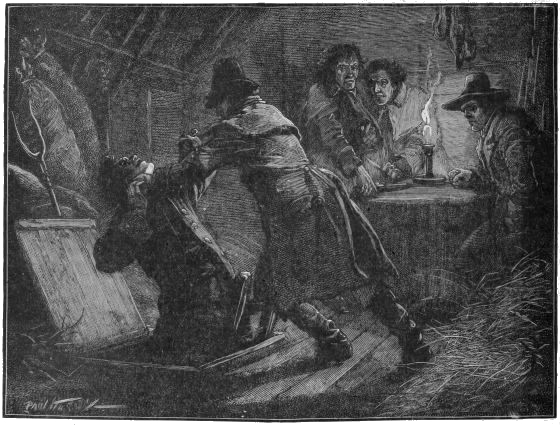
SURPRISE OF THE CATO STREET CONSPIRATORS. (See p. 155.)
The trial of Sir Charles Wolseley and Dr.
Harrison for their speeches at the meeting for
Reform at Stockport in June, 1819, terminated
also in their conviction and imprisonment for
eighteen months, as well as the giving of security
for their future good behaviour on liberation.
With these inglorious events closed the long
reign of George III. Indeed, he had passed away
before they were brought to their conclusion. He
died on the 29th of January, 1820, in the eighty-second
year of his age, and the sixtieth of his
reign. Only six days previously had died his
fourth son, the Duke of Kent, in his fifty-third
year. But the duke had not departed without
leaving an heir to the Throne in the Princess
Victoria, who was born on the 24th of May, 1819.
Could the old king have been made sensible of
these events, there were others which showed that
his line, which of late had appeared likely to
die out in one generation, notwithstanding his
numerous family, was again giving signs of perpetuation.
On the 26th of March, 1819, a son
had also been born to the Duke of Cambridge, and
a son to the Duke of Cumberland on May 27th of
the same year, afterwards King of Hanover.
A VILLAGE HOLIDAY OF THE OLDEN TIME.
(FROM THE PAINTING BY F. GOODALL, R.A., IN THE
NATIONAL GALLERY OF BRITISH ART.)