REIGN OF JAMES II.
James's Speech to the Council—Rochester supersedes Halifax—Other Changes in the Ministry—James Collects the Customs
without Parliament—French Pension continued—Scottish Parliament—Oates and Dangerfield—Meeting of Parliament—It
grants Revenue for Life—Monmouth and Argyll—Argyll's Expedition—His Capture and Execution—Monmouth's
Expedition—He enters Taunton—Failure of his Hopes—Battle of Sedgemoor—Execution of Monmouth—Cruelties of
Kirke and Jeffreys—The Bloody Assize—The Case of Lady Alice Lisle—Decline of James's Power—He Breaks the Test
Act—Revocation of the Edict of Nantes—Prorogation of Parliament—Acquittal of Delamere—Alienation of the Church—Parties
at Court—The Dispensing Power Asserted—Livings granted to Catholics—Court of High Commission Revived—Army
on Hounslow Heath—Trial of "Julian" Johnson—James's Lawlessness in Scotland and Ireland—Declaration of
Indulgence—The Party of the Prince of Orange and the Princess Mary—Expulsion of the Fellows of Magdalen College—New
Declaration of Indulgence—Protest of the Seven Bishops—Birth of the Prince of Wales—Trial and Acquittal of
the Bishops—Invitation to William of Orange—Folly of James—William's Preparations—Blindness of James and
Treachery of his Ministers—William's Declaration—James convinced, makes Concessions—William lands at Torbay—His
Advance to Exeter—Churchill's Treason—Flight of the Princess Anne and her Husband—James sends Commissioners
to Treat with William—Flight of James—Riots in London—Return of James—His Final Flight to France—The
Convention—The Succession Question—Declaration of Rights—William and Mary joint Sovereigns.
To the reign of merry cruelty now succeeded the
reign of gloomy, ascetic, undisguised ferocity.
Charles could laugh and sport with his ladies,
whilst his subjects were imprisoned and tortured.
James, who never laughed, pursued his cruel
bent with a settled butcher-like mood, and would
have extirpated nations, were it in his power, to
restore Catholicism, and establish the political
absolutism adored by the Stuarts. Yet he began
the reign of the Inquisition with the hypocrisy of
the Jesuit. When the breath had left the body of
Charles, James retired for a quarter of an hour to
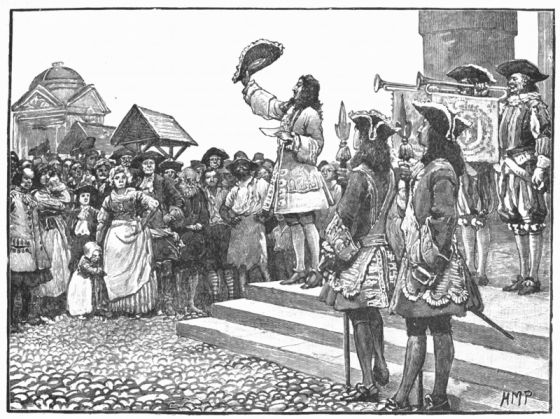
his chamber, and then met the Privy Council with
a speech which promised everything that he was
most resolved not to perform. He began by eulogising
the deceased "as a good and gracious king."
If he really thought his late merry, debauched,
and despotic brother good and gracious, it was an
evil omen for the nation, whose ruler had such
conceptions of what was good and gracious. He
then added, "I have been reported to be a man
fond of arbitrary power; but that is not the only
falsehood which has been reported of me; and I
shall make it my endeavour to preserve this
Government, both in Church and State, as it is by
law now established. I know the principles of
the Church of England are favourable to monarchy,
and the members of it have shown themselves good
and loyal subjects; therefore I shall take care to
defend and support it. I know, too, that the laws
of England are sufficient to make the king as
great a monarch as I can wish; and as I shall
never depart from the just rights and prerogatives
of the Crown, so I shall never invade any man's
property. I have often before ventured my life in
defence of this nation, and shall go as far as any
man in preserving it in all its just rights and
liberties."
The first thing which scandalised the people was
the miserable economy of the late king's funeral.
It was said to be scarcely befitting a private gentleman,
and the Scottish Covenanters asserted
that the dead tyrant had been treated, as the
Scriptures declared tyrants should be, to the "burial
of an ass." The first thing which James set about
was the rearrangement of the Cabinet. There was
but one man in the Cabinet of the late king who
had his entire confidence—this was Rochester, the
second son of the late Lord Clarendon. To him
he gave the office of Lord High Treasurer, thus
constituting him Prime Minister; to Godolphin,
who had held this office, he gave that of Chamberlain
to the Queen. Halifax was deprived of the
Privy Seal, and was made President of the
Council, a post both less lucrative and less influential,
a circumstance which highly delighted
Rochester, who now saw the wit who said he had
been kicked upstairs, served in precisely the same
way. Sunderland, the late Secretary of State,
was suffered to retain his office. He had intrigued
and acted against James; both he and
Godolphin had supported the Exclusion Bill, but
Sunderland now with his usual supple artifice, represented
that he could have no hope of the
king's favour but from the merit of his future
services; and as he possessed some dangerous
secrets, he was permitted to keep his place. He
did not, however, content himself with this, but
cherished the ambition of superseding Rochester
as Lord Treasurer, and therefore represented himself
to the Catholics as their staunch friend, whilst
they knew that Rochester was the champion of
the Church of England. For the present, nevertheless,
from having been at high feud with both
Rochester and Clarendon, he cultivated a strong
friendship with them to make his position firm
with the king. Halifax had opposed the Exclusion
Bill, but he had become too well known as a
decided enemy of Popery and of the French
ascendency. James, therefore, tolerated him for
the present, and whilst he assured him that all
the past was forgotten, except the service he had
rendered by his opposition to the Exclusion Bill, he
told Barillon, the French ambassador, that he
knew him too well to trust him, and only gave him
the post of President of the Council to show how
little influence he had.
The Great Seal was retained also by Lord
Guildford, who, though he was by no means a
friend of liberty, was too much a stickler for the
law to be a useful tool of arbitrary power.
James secretly hated him, and determined to associate
a more unscrupulous man with him in the
functions of his office. This was his most obedient
and most unflinching creature, the Lord Chief
Justice Jeffreys, of whose unexampled villainies
we shall soon hear too much. Guildford was by
the overbearing Jeffreys at once thrust back into
the mere routine of a judge in equity, and all his
State functions and patronage were usurped by
this daring man. At the Council board Jeffreys
treated him with the most marked contempt, and
even insult, and poor Guildford soon saw all influence
and profit of the Chancellorship, as well as
the Chief Justiceship, in the hands of Jeffreys, and
himself reduced to a cipher.
But the most ungenerous proceeding was that
of depriving the old and faithful Lord Ormond of
the Lord-Lieutenancy of Ireland. Ormond had not
only stood firmly by Charles I., but had suffered
unrepiningly the evil fortunes of Charles II. He
had shared his exile, and had done all in his power
for his restoration. He had opposed all the endeavours
by the Popish Plot and the Exclusion
Bill to get rid of James, and was highly respected
in his office in Ireland. He had lately lost his
eldest son, Lord Ossory, and, though aged, was
still vigorous and zealous in discharge of his
duties. But he had the unpardonable faults of
being a firm Protestant and as firm an advocate
for the constitutional restrictions of the Crown.
James recalled him from his Lord-Lieutenancy on
the plea that he was wanted at Court in his other
office of Lord Steward of the Household. But the
ancient chief felt the ungrateful act, and, at a
farewell dinner at Dublin to the officers of the
garrison, in toasting the health of the king, he
filled a cup of wine to the brim, and, holding it
aloft without spilling a drop, declared that whatever
the courtiers might say, neither hand, heart,
nor reason yet failed him—that he knew no
approach of dotage.
Having made these changes in the ministry,
James lost no time in letting his subjects see that
he meant to enjoy his religion without the restraints
to which he had been accustomed. He
had been used to attend Mass with the queen in
her oratory, with the doors carefully closed; but
the second Sunday after his accession he ordered
the chapel doors to be thrown wide open, and went
thither in procession. The Duke of Somerset,
who bore the sword of State, stopped at the
threshold. James bade him advance, saying, "Your
father would have gone farther." But Somerset
replied, "Your Majesty's father would not have
gone so far." At the moment of the elevation of
the Host, the courtiers were thrown into a strange
agitation. The Catholics fell on their knees, and
the Protestants hurried away. On Easter Sunday
Mass was attended with still greater ceremony.
Somerset stopped at the door, according to custom,
but the Dukes of Norfolk, Northumberland,
Grafton, Richmond, and many other noblemen,
accompanied the king as far as the gallery.
Godolphin and Sunderland also complied, but
Rochester absolutely refused to attend. Not
satisfied with proclaiming his Catholicism, James
produced two papers, which he said he had found
in the strong box of the late king, wherein Charles
was made to avow his persuasion that there could
be no true Church but the Roman, and that all
who dissented from that Church, whether communities
or individuals, became heretic. James
declared the arguments to be perfectly unanswerable,
and challenged Sancroft, Archbishop of
Canterbury, to attempt it. This was not very
consistent with his speech as regarded the
Church of England, and his next step was as
great a violation of his assurance that he would
not invade any man's property. Funds for
carrying on the Government were necessary, and
James declared that as the customs and part of
the excise had only been granted to Charles for
his life, they had now lapsed, and that it would
produce great inconvenience to wait for the
meeting of Parliament for their re-enactment.
Nothing prevented him from calling Parliament
at once, but James undoubtedly had a fancy for
trying his father's favourite measure of levying
taxes without Parliament. It was contended that
as no law for customs or excise now existed, all
goods newly imported would come in duty free,
and ruin the merchants who had to sell goods
which had paid the duty. North, Lord Guildford,
recommended that the duties should be levied as
usual, but the proceeds kept in the Exchequer till
Parliament met and authorised their appropriation;
but Jeffreys was a councillor much more
after the king's heart. He recommended that an
edict should at once be issued, ordering the duties
to be paid as usual to his Majesty, and this advice
was carried, every one being afraid of being
declared disloyal, or a trimmer, who voted against
it. The proclamation was issued, but, to render it
more palatable, it announced that a Parliament
would be very soon called, and as many addresses
as possible from public bodies, sanctioning the
measure, were procured. The barristers and
students of the Middle Temple, in their address,
thanked the king for preserving the customs, and
both they and the two universities expressed the
most boundless obedience to the king's sovereign
and unlimited power. But the public at large
looked on with silent foreboding. "The compliments
of these bodies," says Dalrymple, "only
served to remind the nation that the laws had
been broken."
Before venturing to assemble Parliament James
endeavoured to render Louis of France acquiescent
in this step. He knew from the history of the
late reign how averse Louis was from English
Parliaments, which were hostile to his designs
against the Continental nations. He therefore
had a private interview with Barillon, in which he
apologised most humbly for the necessity of
calling a Parliament. He begged him to assure
his master of his grateful attachment, and that he
was determined to do nothing without his consent.
If the Parliament attempted to meddle in any
foreign affairs, he would send them about their
business. Again he begged him to explain this,
and that he desired to consult his brother of
France in everything, but then he must have
money by some means. This hint of money
was followed up the next day by Rochester, and
Barillon hastened to convey the royal wishes.
But Louis had lost no time in applying the
effectual remedy for a Parliament, the moment
the assembling of one became menaced. He sent
over five hundred thousand crowns, which Barillon
carried in triumph to Whitehall, and James wept
tears of joy and gratitude over the accursed bribe.
But he and his ministers soon hinted that the
money, though most acceptable, would not render
him independent of Parliament, and Barillon
pressed his sovereign to send more with an
urgency which rather offended Louis, and rendered
it possible that the ambassador had a pretty good
commission out of what he obtained. James
sent over to Versailles Captain Churchill, already
become Lord Churchill, and in time to become
known to us and all the world as the Duke of
Marlborough. He was to express James's gratitude
and his assurances of keeping in view the
interests of France, and so well did the proceedings
of Churchill in Paris and of Barillon in
England, prosper, that successive remittances,
amounting to two millions of livres, were sent
over. But of this, except four hundred and
seventy thousand livres, the arrears of the late
king's pension, and about thirty thousand pounds
for the corruption of the House of Commons,
Louis strictly forbade Barillon paying over more at
present to James without his orders. In fact, he
was no more assured of the good faith of James
than he had been of that of Charles; and he had
ample reason for his distrust, for at the very same
time James was negotiating a fresh treaty with
his son-in-law, the Prince of Orange.
It is impossible to comprehend the full turpitude
of this conduct of James without keeping
steadily in view the aims of both James and
Louis. James's, like that of all the Stuarts, was
simply to destroy the British constitution and
reign absolutely. To do this the money of
France was needed to render them independent
of Parliaments, and a prospect of French troops
should the English at length rebel against these
attempts at their enslavement. The object of
Louis was to keep England from affording any aid
to any power on the Continent, whilst he was
endeavouring to overrun it with his armies.
On the day of the coronation in England
(April 23rd), St. George's Day, the Parliament
in Scotland met. James called on the Scots to
set a good example to the approaching Parliament
of England in a liberal provision for the Crown;
and the Scottish Estates, as if complimented by
this appeal, not only responded to it by annexing
the excise to the Crown for ever, and offering him
besides two hundred and sixty thousand pounds a
year for his own life, but declared their abhorrence
of "all principles derogatory to the king's sacred,
supreme, sovereign, and absolute power and authority."
They did more, they passed an Act making
it death for any one to preach in a conventicle,
whether under a roof or in the open air. In
England the elections were going on most
favourably, and therefore James seized on the
opportunity, whilst all appeared smiling and secure,
to indulge his appetite for a little vengeance.
On the 7th of May, Titus Oates, the enemy of
James and of Popery, the arch-instrument of the
Whig agitators, was brought up to the bar of the
King's Bench, before the terrible Jeffreys. When
he was now brought up, the Court was crowded
with people, a large proportion of them being
Catholics, glad to see the punishment of their ruthless
enemy. But if they expected to see him depressed
or humbled, they were much disappointed.
He came up bold and impudent as ever.
Jeffreys flung his fiercest Billingsgate at him, but
Oates returned him word for word unabashed.
On his last trial he had sworn he had attended a
council of Jesuits on the 24th of April, 1671, in
London, but it was now proved beyond doubt
that on that very day Oates was at St. Omer. He
had sworn also to being present at the commission
of treasonable acts by Ireland, the Jesuit, in
London, on the 8th and 12th of August, and on
the 2nd of September of the same year. It was
now also clearly proved that Ireland left London
that year on the 2nd of August, and did not
return till the 14th of September. Oates was
convicted of perjury on both indictments, and was
sentenced to pay a thousand marks on each indictment;
to be stripped of his clerical habit; to be
pilloried in Palace Yard, and led round Westminster
Hall, with an inscription over his head
describing his crime. He was again to be pilloried
in front of the Royal Exchange, and after that
to be whipped from Aldgate to Newgate, and
after two days' interval whipped again from
Newgate to Tyburn. If he survived this, which
was not expected, he was to be confined for life,
but five times every year he was to stand again
in the pillory.
If the crimes of this wretch were monstrous, his
punishment was equally so. He had the assurance
on his trial to call many persons of distinction,
including members of Parliament, to give
evidence in his favour, but he was answered only
by bitter reproaches, for having led them into the
spilling of much innocent blood. The lash was
applied the first day so unmercifully, that though
he endured it for some time, it compelled him to
utter the most horrible yells. Several times he
fainted, but the flagellations never stopped, and
when the flogging ceased, it was doubted whether
he was alive. The most earnest entreaties were
made to the king and queen to have the second
flogging omitted, but they were both inexorable.
Yet the guilty wretch survived through all,
though he was said to have received seventeen
hundred stripes the second day on his already
lacerated body. So long as James reigned, he
was subjected to the pillory five times a year, but
he lived to be pardoned at the Revolution, and
receive a pension of five pounds a week in lieu of
that granted him by Charles II. He died in 1705.
Dangerfield, who had not only succeeded in
destroying so many innocent victims, but had
displayed villainy and ingratitude of the blackest
dye, was also convicted, and sentenced to pay
five hundred pounds, and to be pilloried twice and
whipped twice over the same ground as Oates.
He was extremely insolent on his trial, but on
hearing his sentence he was struck with horror,
flew into the wildest exclamations, declared himself
a dead man, and chose a text for his funeral
sermon. Singularly enough, his end was really at
hand. On returning from his whipping a gentleman
named Robert Francis, of Gray's Inn, stepped
up to the coach and asked him how his back
was. Dangerfield replied by a curse, and Francis
thrusting at him with his cane, wounded him in
the eye; the wound was declared to occasion his
death, though the unmerciful flogging was probably
the real cause, and Francis was tried for the
murder, and hanged.
The meeting of Parliament on the 19th of May
drew the public attention from these barbarities.
Every means had been exerted to influence the
elections. In the counties the reaction of Toryism,
and the effects of the Rye House Plot in defeating
and intimidating the Whigs, gave the Court every
advantage. In the corporations the deprivation
of their ancient charters made them the slaves
of Government. But even with these advantages
James was not satisfied. Wherever there appeared
likely to be any independent spirit shown, agents
were sent down to overawe the people, and to
force a choice of the Government candidate. On
the 22nd of May James went to the House of
Lords in great state to open Parliament. He took
his seat on the throne with the crown on his head,
and his queen, and Anne, his daughter, Princess of
Denmark, standing on the right hand of the
throne. The Spanish and other Catholic ambassadors
were present, and heard the Pope, the
Mass, the worship of the Virgin Mary, and the
saints all renounced, as the Lords took their oaths.
James then produced a written speech and read it.
He repeated in it what he had before declared to
the Council, that he would maintain the Constitution
and the Church as by law established, and
added that, "Having given this assurance concerning
their religion and property, they might
rely on his word." Although it had been the
custom to listen to the royal speech in respectful
silence, at this declaration the members of both
Houses broke into loud acclamations. He then
informed them that he expected a revenue for life,
such as they had voted his late brother. Again
the expression of accord was loud and satisfactory,
but what followed was not so palatable. "The
inclination men have for frequent Parliaments,
some may think, would be the best secured by
feeding me from time to time by such proportions
as they shall think convenient, and this argument,
it being the first time I speak to you from the
throne, I will answer once for all, that this would
be a very improper method to take with me; and
that the best way to engage me to meet you often
is always to use me well. I expect, therefore,
that you will comply with me in what I have desired,
and that you will do it speedily." This
agreeable assurance he followed up by announcing
a rebellion to have broken out in Scotland under
Argyll and other refugees from Holland.
When the Commons returned to their own
House, Lord Preston entered into a high eulogium
of the king, telling the House that his name spread
terror over all Europe, and that the reputation of
England was already beginning to rise under his
rule; they had only to have full confidence in him
as a prince who had never broken his word, and
thus enable him to assert the dignity of England.
The House went into a Committee of Supply, and
voted his Majesty the same revenue that Charles
had enjoyed, namely, one million two hundred
thousand pounds a year for life. But when
several petitions against some of the late elections
were presented, a serious opposition asserted
itself in a most unexpected quarter. This was
from Sir Edward Seymour, of Berry Pomeroy
Castle, the member for Exeter. Seymour was
both a Tory and a High Churchman, proud of his
descent from the Lord Protector Seymour, and
who had great influence in the western counties.
He was a man of indifferent moral character,
but able and accomplished, and a forcible debater.
He was now irritated by the Government proceedings
in the elections which had interfered with
his interests, and made a fierce attack on the
Government pressure on the electors; denounced
the removal of the charters and the conduct of
the returning officers; declared that there was
a design to repeal the Test and Habeas Corpus
Acts, and moved that no one whose right to sit
was disputed should vote till that right had been
ascertained by a searching inquiry. There was no
seconder to the motion, and it fell to the ground;
for the whole House, including the Whigs, sat, as
it were, thunderstruck. But the effect was deep
and lasting, and in time did not fail of its end.
For the present, however, things went smoothly
enough. The king informed the House—through
Sir Dudley North, the brother of the Lord Keeper
Guildford, and the person who had been elected
Sheriff of London by the influence of Charles
for his ready and ingenious modes of serving the
royal will—that his late brother had left considerable
debts, and that the naval and ordnance
stores were getting low. The House promptly
agreed to lay on new taxes and North induced
them to tax sugar and tobacco, so that the king
now had a revenue of one million nine hundred
thousand pounds from England, besides his pension
from France, and was strong in revenue.
The Lords were employed in doing an act of
justice in calling before them Lord Danby, and
rescinding the impeachment still hanging over his
head, and also summoning to their bar Lords
Powis, Arundel, and Bellasis, the victims of the
Popish plot, and fully discharging them as well
as the Earl of Tyrone. They also introduced a
Bill reversing the attainder of Lord Stafford, who
had been executed for treason and concern in the
Popish plot, now admitting that he had been unjustly
sacrificed through the perjury of Oates.
The Commons were proceeding to the third reading
of this Bill, when the rebellion of Monmouth was
announced, and the question remained unsettled
till the trial of Warren Hastings more than a century
afterwards, when men of all parties declared
that Oates's Popish plot was a fiction, and the
attainder of Stafford was then formally reversed.
The political refugees who had fled to Holland
and sought protection from Prince William were
numerous, and some of them of considerable distinction.
Monmouth and the Earl of Argyll were
severally looked up to as the heads of the English
and Scottish exiles. The furious persecution
against the Covenanters in Scotland and the
Whigs in England had not only swelled these
bands of refugees, but rendered them at once
ardent for revenge and restoration. Amongst
them Ford; Lord Grey of Wark; Ferguson, who
had been conspicuous among the Whig plotters;
Wildman and Danvers, of the same party;
Ayloffe and Wade, Whig lawyers and plotters;
Goodenough, formerly Sheriff of London, who
gave evidence against the Papists; Rumbold,
the Rye House maltster, and others, were incessantly
endeavouring to excite Monmouth to
avail himself of his popularity, and the hatred of
Popery which existed, to rebel against his uncle
and strike for the crown. Monmouth, however,
for some time betrayed no desire for so hazardous
an undertaking. On the death of Charles he had
returned from the Hague, to avoid giving cause of
jealousy to James, and led the life of an English
gentleman at Brussels. William of Orange strongly
advised him to take a command in the war of
Austria against the Turks, where he might win
honour and a rank worthy of his birth; but Monmouth
would not listen to it. He had left his
wife, the great heiress of Buccleuch, to whom he
had been married almost as a boy from royal policy,
and had attached himself to Lady Henrietta Wentworth,
Baroness Wentworth of Nettlestede. The
attachment, though illicit, appeared to be mutual
and ardent. Monmouth confessed that Lady Henrietta,
who was beautiful, amiable, and accomplished,
had weaned him from a vicious life, and
had their connection been lawful, nothing could
have been more fortunate for Monmouth. In her
society he seemed to have grown indifferent to
ambition and the life of courts. But he was
beset by both Grey and Ferguson, and, unfortunately
for him, they won over Lady Wentworth
to their views. She encouraged Monmouth, and
offered him her income and her jewels to furnish
him with immediate funds. With such an advocate,
Grey and Ferguson at length succeeded. Grey
was a man of blemished character. He had
run off with his wife's sister, a daughter of the
Earl of Berkeley, and was a poor and desperate
adventurer, notoriously cowardly on the field of
battle. Ferguson was a fiery demagogue and
zealot of insurrection. He had been a preacher
and schoolmaster amongst the Dissenters, then a
clergyman of the Church, and finally had become
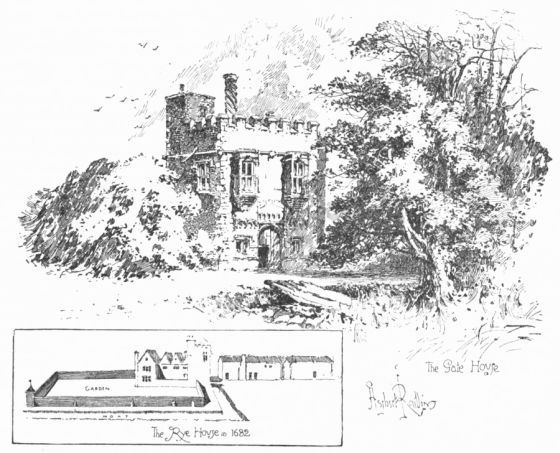
a most untiring intriguer, and was deep in the Rye
House Plot. Under all this fire of rebellion, however,
there was more than a suspected foul smoke
of espionage. He was shrewdly believed, though
not by his dupes, to be in the pay of Government,
and employed to betray its enemies to ruin.
Monmouth having consented to take the lead in
an invasion, though with much reluctance and
many misgivings, a communication was opened
with Argyll and the Scottish malcontents. We
have seen that Argyll, after his father had been
inveigled from his mountains and beheaded, had
himself nearly suffered the same fate from James
when in Scotland. He had been imprisoned and
condemned to death on the most arbitrary
grounds, and had only managed to escape in disguise.
He had purchased an estate at Leeuwarden,
in Friesland, where the great Mac Cailean
More, as he was called by the Highlanders, lived
in much seclusion. He was now drawn from it
once more to revisit his native country at the
head of an invading force. But the views of the
refugees were so different, and their means so
small, that it was some time before they could
agree upon a common plan of action. It was at
length arranged that a descent should be made
simultaneously on Scotland and England—the
Scottish expedition headed by Argyll, that on
England by Monmouth. But to maintain a correspondence
and a sort of unison, two Englishmen,
Ayloffe and Rumbold the maltster, were to accompany
the Scots, and two Scotsmen, Fletcher of
Saltoun and Ferguson, the English force. Monmouth
was sworn not to claim any rank or reward
on the success of the enterprise, except such as
should be awarded him by a free Parliament; and
Argyll was compelled, although he had the
nominal command of the army, to submit to hold
it only as one of a committee of twelve, of whom
Sir Patrick Hume of Polwarth was to be president.
In fact, Argyll at the outset displayed a fatal
want of knowledge of human nature or firmness of
resolution, in consenting to accept a command on
so impossible a basis. To expect success as a
military leader when hampered with the conflicting
opinions of a dozen men of ultra views in
religion and politics, and of domineering wills,
was the height of folly. Hume, who took the
lead in the committee, was a man of enormous
conceit, a great talker, and a very dilatory actor.
Next to him was Sir John Cochrane, the second
son of Lord Dundonald, who was almost equally
self-willed and jealous of the power of Argyll.
With their Republican notions, they endeavoured
to impose such restrictions on the power of the
earl as were certain to insure the ruin of the
attempt, in which everything must depend on the
independent action of a single mind.
We have already noticed the character of Ferguson,
one of the twain selected to accompany
Monmouth. Fletcher of Saltoun, the other, was
a far different man—a man of high talent, fine
taste, and finished education. At the head of a
popular senate he would have shone as an orator
and statesman; but he had those qualities of lofty
pride and headstrong will which made him by no
means a desirable officer in an army of adventurers,
although his military skill was undoubted.
What was worse, from the very first he foreboded
no good result from the expedition, and accompanied
it only because he would not seem to desert
his more sanguine countrymen. When Wildman
and Danvers sent from London flaming
accounts of the ripeness of England for revolt,
and said that just two hundred years before the
Earl of Richmond landed in England with a mere
handful of men, and wrested the Crown from
Richard, Fletcher coolly replied that there was all
the difference between the fifteenth century and
the seventeenth.
These men, Wildman and Danvers, represented
the country as so prepared to receive Monmouth,
that he had only to show his standard for whole
counties to flock to it. They promised also six
thousand pounds in aid of the preparations. But
the fact was that little or no money came, and
James and his ministers were duly informed of
the measures of the insurgents, and were at once
using every means with the Dutch Government to
prevent the sailing of the armaments, and taking
steps for the defence of the Scottish and
English coasts. We may first follow the fortunes
of Argyll and his associates, who sailed first. He
put out from the coast of Holland on the 2nd of
May, and after a prosperous voyage, sighted Kirkwall,
in Orkney, on the 6th. There he very unwisely
anchored, and suffered two followers to
go on shore to collect intelligence. The object of
his armament then became known, and was sure
to reach the English Government in a little time.
The Bishop of Orkney boldly ordered the two
insurgents to be secured, and refused to give
them up. After three days lost in endeavouring
to obtain their release, they seized some gentlemen
living on the coast, and offered them in exchange.
The bishop paid no regard to their proposal or
their menaces, and they were compelled to pursue
their voyage.
The consequence of this ill-advised measure was
that news of the armament was sent to Edinburgh
with all speed, and whilst the invading force was
beating round the northern capes and headlands,
active preparations were made for defence. The
whole of the militia, amounting to twenty thousand
men, were called out; a third of these, accompanied
by three thousand regulars, were marched
into the western counties. At Dunstaffnage,
Argyll sent his son Charles ashore to summon the
Campbells to arms, but he returned with the
report that many of the chiefs had fled or were in
prison, and the rest afraid to move. At Campbelltown,
in Kintyre, Argyll published a proclamation,
setting forth that he came to suppress Popery,
prelacy, and Erastianism, and to take the crown
from James, whom he accused of persecution of
the Covenanters, and the poisoning of his brother.
He sent across the hills the fiery cross to summon
all true men to his standard, and appointed Tarbert
as the place of rendezvous. About eighteen hundred
men mustered at the call, but any advantage
to be derived from this handful of men was far
more than counterbalanced by the pertinacious interference
of Cochrane and Hume. They insisted
on arranging everything, even the appointment of
the officers over Argyll's own clan. They insisted
also that the attack should be directed against the Lowlands,
though Argyll wisely saw that they had
no chance whatever in the open country with their
present force. He contended that having first
cleared the Western Highlands of the national
soldiery, they should soon have five or six thousand
Highlanders at their command, and might then
descend on the Lowlands with effect. Rumbold
advocated this prudential course, but all reasoning
was lost on Hume and Cochrane, who insolently
accused Argyll of wanting only to secure his own
territories, and sailed away with part of the troops
to the Lowlands. They found the coast, however,
well guarded by the English ships, and escaped up
the Clyde to Greenock. There they again quarrelled
between themselves, and finding the people not
at all disposed to join them, they returned to
Argyll. But they had learned no wisdom: the
earl again proposed to endeavour to secure Inverary—they
as firmly opposed it. They, therefore,
fixed on the castle of Ealan Ghierig as their
present headquarters, landed their arms and
stores, and made an officer named Elphinstone
commander of the fort. Argyll and Rumbold now
drove back the troops of Athol, and prepared to
march on Inverary; but from this they were
diverted by a call from Hume and Cochrane at the
ships, who were about to be attacked by the
English fleet. Argyll hastened to them, and proposed
to give fight to the English, but was again
prevented by these infatuated men. The earl,
therefore, in utter despair, passed into Dumbartonshire,
and was the very next day followed by the
news of the capture of all his ships, and the
flight of Elphinstone from Ealan Ghierig, without
striking a blow. As a last desperate attempt,
Argyll proposed to make a rush on Glasgow and
secure a strong footing there; but the very men
who had so strongly urged the attempt on the
Lowlands now deserted him in numbers, and on
the march nothing but disasters from the insubordination
of the little army ensued. They were
attacked on all sides by the militia, and when the
earl and Ayloffe advised a bold attack on the
enemy, Hume and his partisans protested against
it. The end of all was that, becoming involved
amongst morasses, the army was seized with panic,
and rapidly melted away. The wrong-headed
Hume escaped, and reached the Continent; Cochrane
was taken, and soon after Rumbold, Major
Fullerton, and Argyll himself were seized.
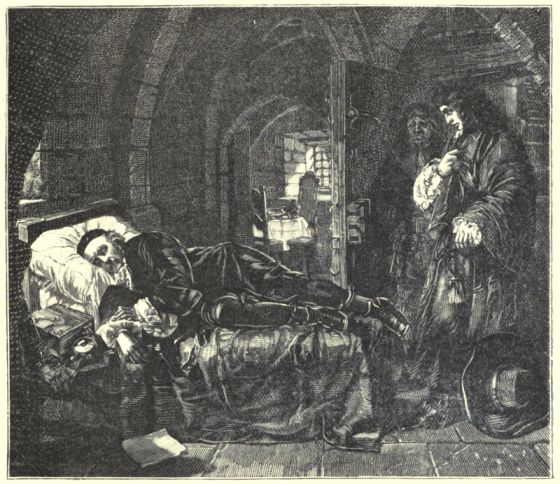
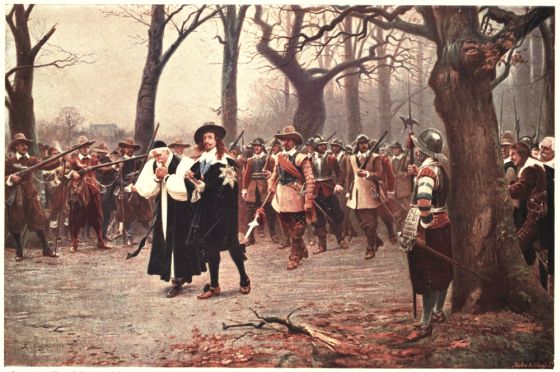
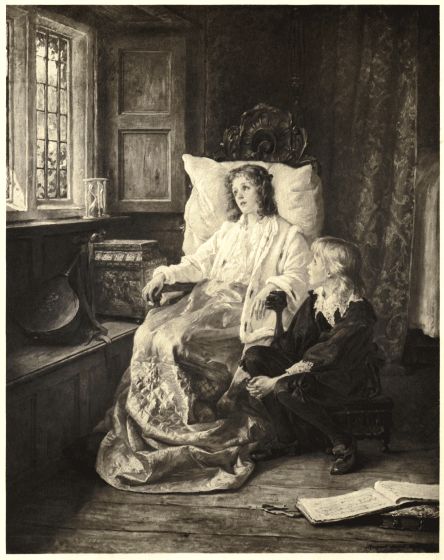
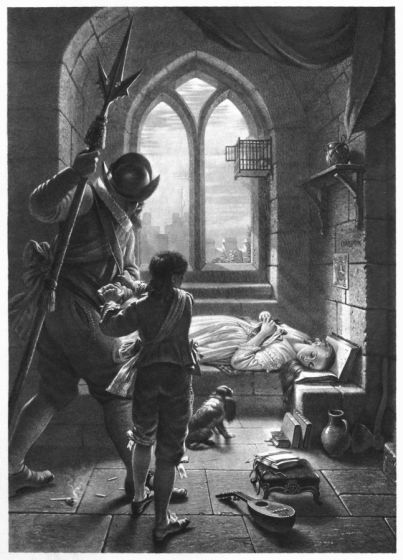
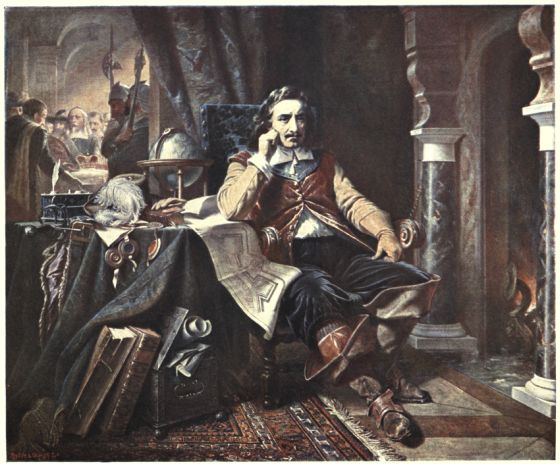
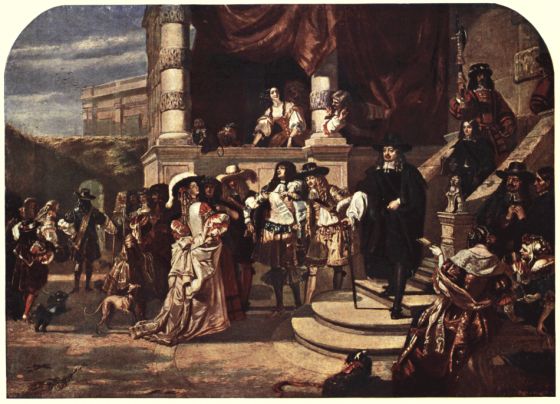
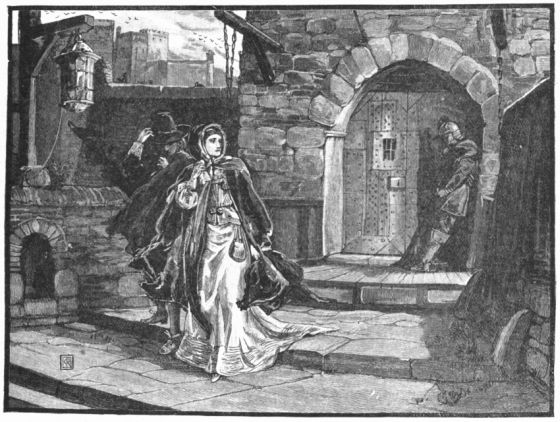
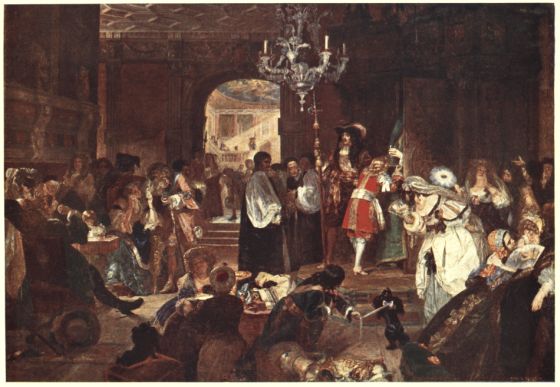
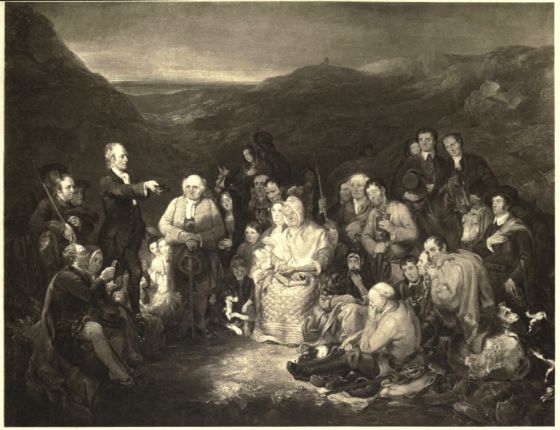
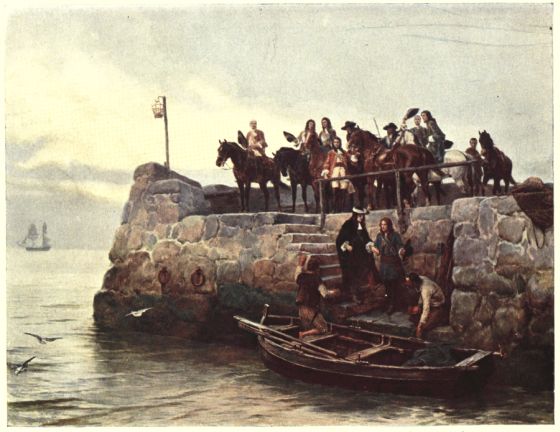
THE LAST SLEEP OF ARGYLL. (See p. 297.)
(From the Fresco by E. M. Ward, R.A., in the House of Commons.)
The conduct of Argyll after his capture was distinguished
by a calm dignity which showed how
superior he was to the factious, pugnacious men
who had baffled all his plans. With his arms
pinioned behind him, he was led bareheaded
through the streets of Edinburgh, from Holyrood
to the castle. The Royalists thus revelled in revenging
on the son the act of his father thirty-five
years before, when he caused Montrose to be
conducted over the very same ground. The headsman
marched before him with his axe, and on
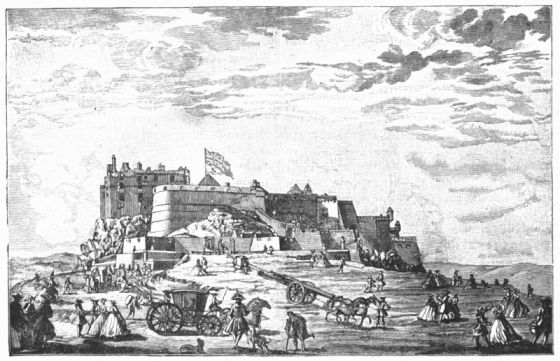
reaching his cell in the castle Argyll was put into
irons, and informed that his execution would quickly
follow. This was the 20th of June; his execution
did not take place till the 30th. During the ten
days the orders of James were that he should be
tried all ways to compel him to confess the full particulars
of the invasion, its originators, supporters,
and participators. It was understood that James
meant that his favourite application of the boots
and thumbscrews should be used, but this was not
attempted. Argyll was menaced, but his firm
refusal to reveal anything that would incriminate
others, convinced his enemies that it was useless,
and could only cover them with odium. The
last day of his life he lay down to rest, ere the
hour of his execution should arrive. During his
sleep, a renegade Privy Councillor insisted on
entering his cell. The door was gently opened,
and there lay the great Argyll in heavy chains
and sleeping the happy sleep of infancy. The
beholder turned and fled, sick at heart. His former
sentence of death was deemed sufficient to supersede
any fresh trial, and being brought out to the
scaffold, and saying that he died in peace with all
men, one of the Episcopalian clergymen stepped to
the edge of the scaffold and exclaimed to the
people, "My lord dies a Protestant." "Yes," said
the earl, also going forward, "a Protestant, and
cordial hater of Popery, prelacy, and all superstition."
His head was fixed on the top of the Tolbooth,
where that of Montrose had formerly stood.
On the 30th of May, nearly a month after the
sailing of Argyll, Monmouth left the Texel. His
squadron consisted of a frigate of thirty-two guns,
called the Helderenbergh, and three small tenders,
a fourth tender having been refused by the
Dutch. He was attended by about eighty officers,
and a hundred and fifty men of different degrees,
fugitives from England and Scotland. With such
a force he proposed to conquer the crown of
England! All the fine promises of money by
Wildman and Danvers had ended in smoke, and
he had only been able, chiefly through the revenues
of Lady Henrietta Wentworth, to supply
himself with arms and stores for a small body of
cavalry and infantry. The voyage was long and
tedious, the weather was stormy, and the Channel
abounded with the royal cruisers. On the morning
of the 11th of June his little fleet appeared off the
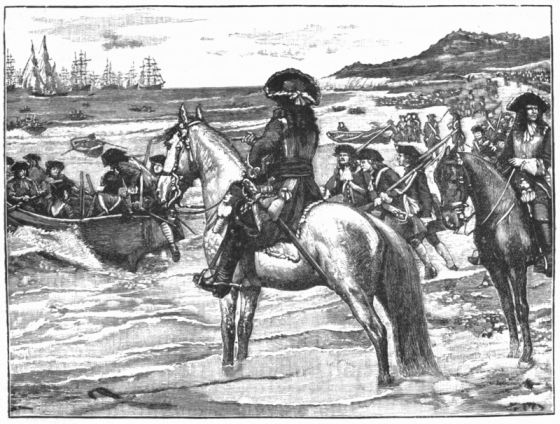
port of Lyme, in Dorsetshire.
Monmouth was extremely popular with the
people, and on discovering that it was their
favourite hero come to put down the Popish
tyrant, he was received with loud acclamations.
"Monmouth and the Protestant religion!" was
the cry. There was a rush to enlist beneath his
banners, and within four-and-twenty hours he was
at the head of fifteen hundred men. Dare, one of
the adventurers, had been put ashore as they came
along the coast to ride across the country and
rouse the people of Taunton, and he now came in
at the head of about forty horsemen, with the
news that the people of Somersetshire were in
favour of his cause. But with this arrival came
the tidings that the Dorsetshire and Somersetshire
folk were mustering at Bridport to attack them,
and Monmouth ordered Lord Grey, who was the
commander of the cavalry, to march there at once,
and disperse them before they had collected in
strength. But here an incident occurred which
showed the unruly materials that he had to work
with. Dare had mounted himself on a fine horse in
his expedition to Taunton, and Fletcher of Saltoun,
who was second in command of the cavalry under
Grey, without asking leave of Dare, as superior
officer, and being himself badly mounted, took
possession of his horse. Dare refused to let him
have it, they came to high words, Dare shook his
whip at Fletcher, and the proud Scot drew his
pistol and shot Dare dead on the spot. This summary
proceeding, which might have passed in the
ruder country of Scotland, created a violent outburst
amongst the soldiers of Monmouth. They
demanded of the duke instant execution of the
murderer, and it was only by getting on board the
Helderenbergh that Fletcher escaped with his life.
He returned to Holland, and thus was lost to the
expedition almost its only man of any talent and
experience.
The next morning Grey, accompanied by Wade,
led forth his untrained cavalry to attack the militia
at Bridport. There was a smart brush with the
militia, in which Monmouth's raw soldiers fought
bravely, and would have driven the enemy from
the place, but Grey, who was an arrant coward in
the field, turned his horse and fled, never drawing
bit till he reached Lyme. The men were indignant,
and Monmouth was confounded with this
conduct of his chief officer; but nevertheless he
had not moral firmness to put some more trusty
officer in his place. Four days after his landing,
the 15th of June, Monmouth marched forward to
Axminster, where he encountered Christopher
Monk, Duke of Albemarle, the son of the first
General Monk, at the head of four thousand men
of the trained bands. Though daunted at first,
Monmouth accepted the situation, and disposed his
men admirably for a fight. He drew up the main
body in battle array on advantageous ground, sent
out his skirmishers to the front, and, as a last precaution,
lined the hedges of a narrow lane, through
which Albemarle must pass to come at him, with
musketeers. Monk, however, was too cautious to
risk a pitched battle on these terms—the more
especially as his own forces were untrustworthy.
There appeared so much enthusiasm for Monmouth
amongst his troops that, fearing their desertion,
he drew back. The result was that the whole
body was speedily thrown into disorder, that panic
seized them, and that they fled pell-mell towards
Exeter, flinging away their arms and uniforms to
expedite their escape. Monmouth, however, probably
not aware of the extent of the rout, steadily
pursued his march to Chard, and thence to Taunton,
where he arrived on the 18th of June, just a week
after his landing, and was received by the whole
place with the warmest demonstrations of joy.
All this seemed auspicious and encouraging, but
it did not satisfy Monmouth. He knew that, without
the adhesion of the army and the leading gentry,
he should never make his way to the crown. Their
adhesion had been promised him, but where were
they? Not a regiment had given a sign of being
ready to join him. Lords Macclesfield, Brandon,
Delamere, and other Whig noblemen—who,
he had been assured, would instantly fly to his
standard—lay all still. Trenchard of Taunton, who
had promised to join him, unlike his townsmen, fled
at his approach, and made his way into Holland,
to the Prince of Orange. Wildman, who had
promised such wonders of county support and of
money, did not appear. On the contrary, the
nobility and gentry from all parts of the country,
with the clergy, were pouring in addresses of
attachment and support to James. Parliament,
both Lords and Commons, displayed the same
spirit.
The common people might believe that the
son of Lucy Walters was legitimate, but the educated
classes knew better, and that Monmouth
could never be king. Parliament, therefore, at
once voted James four hundred thousand pounds
for present necessities, and laid new taxes for
five years on foreign silks, linen, and spirits.
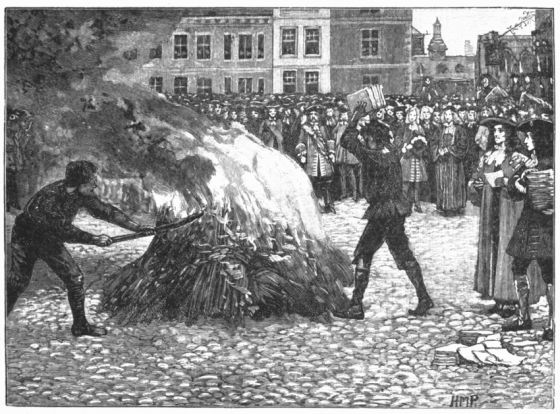
They ordered Monmouth's declaration to be
burnt by the hangman, and rapidly passed
against him a Bill of Attainder, setting a reward
of five thousand pounds on his head. They were
ready to go farther, and the Commons actually
passed a Bill for the preservation of the king's
person and government, making it high treason to
say that Monmouth was legitimate, or to make
any motion in Parliament to alter the succession.
But James, knowing the uselessness of any such
Act, adjourned Parliament without waiting for the
Act passing the Lords, and dismissed the nobles
and gentry to defend his interests in their different
localities. He took care, however, to revive the
censorship of the press, which had expired in
1679.
When Monmouth, with consternation, noted
these adverse circumstances, Ferguson was ready
with a reason. It was that Monmouth had committed
a capital error in not taking the title of
king. The style and title of king, he asserted,
carried a wonderful weight with the English. But
of this right he had deprived himself by abjuring
this title and leaving it entirely to James. The
majority would fight for the man who was in
possession of the royal name, but for whom were
they to fight who fought for Monmouth? Nobody
could tell, and the result must be discouragement.
Grey seconded Ferguson: Wade and the Republicans
opposed the scheme. But probably Monmouth
was only too willing to be persuaded, and,
accordingly, on the 20th of June, he was proclaimed
in the market-place of Taunton. As the
names of both rivals were James, and James II.
would continue to mean James who now had that
title, Monmouth was styled King Monmouth.
Immediately on taking this step, Monmouth issued
four proclamations. Following the example of
James, he set a price on the head of James, late
Duke of York; declared the Parliament sitting at
Westminster an unlawful assembly, and ordered it
to disperse; forbade the people to pay taxes to the
usurper; and proclaimed Albemarle a traitor,
unless he forthwith repaired to the standard of
King Monmouth, where he would be cordially
received.
Almost every part of this proceeding was a
gross political blunder. By assuming the royal
title he lost nearly everything, and gained nothing.
He offended the Republican party, and divided
the allegiance of his little army, some of the most
energetic of whose officers, as Wade and others,
were of that political faith. He offended that
great Protestant party which was looking forward
to the Protestant succession of William of Orange
and the Princess Mary, and in case of their want
of issue to the Princess Anne. He cut off all retreat
to Holland in case of failure, and all hope of
mercy from James if he fell into his hands. By
pledging himself on landing not to aspire to the
crown, and thus immediately breaking his pledge,
he inspired the thinking portion of the people with
deep distrust, as inducing the same disregard of
his word as had been so long conspicuous in the
Stuarts. With all the influential Protestants who
might have joined him, so soon as events gave hope
of success, considering him the champion of a Protestant
succession, he had placed himself in a hopeless
position, because that succession could only
come through a legitimate issue. By denouncing
the Parliament that body became his mortal
foes. The only party from which he could now
expect any support was the people, and without
means, without leaders, without military training,
the result could only be failure, utter and fearful.
And despite the persuasions of Ferguson, the
melancholy truth seemed already to stare the unhappy
Monmouth in the face. He received a
secret answer from Albemarle, addressed to James
Scott, late Duke of Monmouth, telling him that
he knew who was his lawful king, and that he had
better have let rebellion alone. As he rode out of
Taunton on the 22nd of June towards Bridgewater,
it was remarked that he looked gloomy and
dejected; the very people who crowded in the
road to greet him with huzzas, could not help remarking
how different was the expression of his
countenance to what it had been in his gay procession
there five years before. The only man who
seemed elated with anticipation of triumph was
Ferguson, and if, as is suspected to have been the
case, he were playing the traitor to the unfortunate
Monmouth, he might now well grow confident of
his diabolical success.
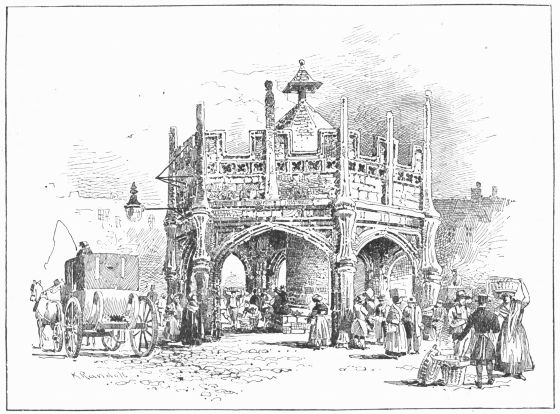
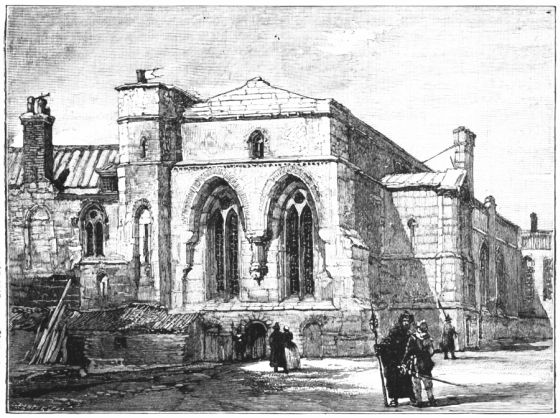
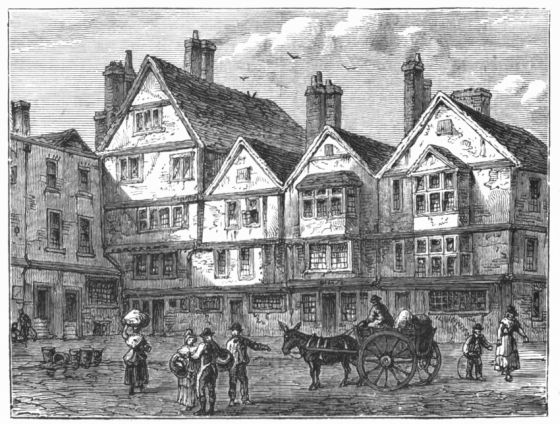
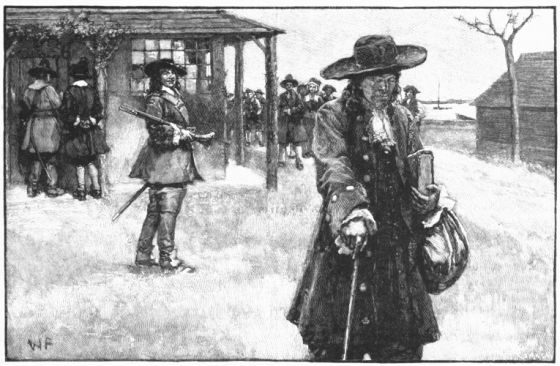
THE CROSS, BRIDGEWATER, WHERE MONMOUTH WAS PROCLAIMED KING.
On reaching Bridgewater, where there existed a
strong Whig body, Monmouth was again well received.
The mayor and aldermen in their robes
welcomed him, and preceded him in procession to
the Cross, where they proclaimed him king. He
took up his abode in the castle, encamped his army
on the castle field, and crowds rushed to enlist in
his service. His army already amounted to six
thousand men, and might soon have been doubled
or trebled; but his scanty supply of arms and
equipments was already exhausted. He had no
money, and men without weapons were useless.
Numbers of them endeavoured to arm themselves,
mob-fashion, with scythes, pitchforks, and other
implements of husbandry and of mining.
Meanwhile, troops were drawing from all
quarters, and preparing to overwhelm the invaders.
Lord Feversham and Churchill, afterwards Marlborough,
were ordered to march with strong bodies
of troops to the West. Churchill was already
arrived, and Feversham rapidly approaching. The
militias of Sussex and Oxfordshire were drawing
that way, followed by bodies of volunteer gownsmen
from Oxford. To prevent any of the Whig
party from affording Monmouth aid, they and the
Nonconformists were closely watched, and many
seized and imprisoned.
From Bridgewater Monmouth advanced to Glastonbury,
and thence to Wells and Shepton Mallet.
He appeared to have no precise object, but to seek
reinforcements; from Shepton Mallet he directed
his march on Bristol, which was only defended by
the Duke of Beaufort and the muster of his
tenantry. Bristol, once gained, would give them
a strong position, and afford large supplies of
money, stores, and arms. But Churchill harassed
his rear on the march, and to reach the Gloucestershire
side of the town, which was easiest of
assault it was necessary to march round by Keynsham
Bridge, which was partly destroyed. Men
were despatched to repair it, and Monmouth following,
on the 24th of June was at Ponsford,
within five miles of the city. On reaching Keynsham
Bridge, it was found to be repaired, but they
were there encountered by a body of Life Guards
under Colonel Oglethorpe, and Bristol having received
reinforcements, the attack on it was abandoned.
It was then proposed to get across the
Severn and march for Shropshire and Cheshire,
where he had been enthusiastically received in his
progress; but the plan was not deemed practicable,
and he advanced to Bath, which was too
strongly garrisoned to make any impression upon.
On the 26th they halted at Philip's Norton.
Feversham was now at their heels, and attacked
them, the charge being led by the Duke of
Grafton—the son of Charles and the Duchess of
Cleveland—who fought bravely, but was repulsed.
Monmouth, however, took advantage of the night
to steal away to Frome, which was well affected
to his cause, but had been just visited and disarmed
by the Earl of Pembroke with the Wiltshire
militia. The night march thither had been
through torrents of rain and muddy roads; Frome
could afford neither assistance nor protection;
and, to add to his disappointment, here news
reached him of the total failure of Argyll's expedition
into Scotland, and that Feversham was
now joined by his artillery and was in pursuit of
him. Under these disastrous circumstances, and
not a man of note, not a regiment of regulars or
militia (as had been so liberally promised him by
Wildman and Danvers) having come over to him,
Monmouth bitterly cursed his folly in having
listened to them, and resolved to ride off with his
chief adherents, and get back to the Continent
and his beloved Lady Wentworth. But from this
ignominious idea he was dissuaded by Lord Grey,
and they retreated again towards Bridgewater,
where a report represented fresh assembling of
armed peasantry. They reached that town on the
2nd of July, and, whilst throwing up trenches for
defence, on the 5th Feversham arrived with about
five thousand men, and pitched his tents on Sedgemoor,
about three miles from the town. Feversham
himself, with the cavalry at Weston Zoyland,
and the Earl of Pembroke with the Wiltshire
militia, about fifteen hundred in number,
camped at the village of Middlezoy. Monmouth
and his officers ascended the tower of the church
and beheld the disposition of the enemy. Sedgemoor
had formerly been a vast marsh, where
Alfred, in his time, had sought a retreat from the
triumphant Danes, and it was now intersected by
several deep ditches, as most fen lands are, behind
which the royal army lay. Near Chedzoy were
some regiments of infantry which Monmouth had
formerly commanded at Bothwell Bridge.
It was reported that the soldiers were left, by
the reckless incapacity of the general, to drink
cider and preserve little watch; and Monmouth,
who saw that they lay in a very unconnected condition,
conceived that by a skilful night attack he
could easily surprise them. The gormandising
incapacity of Louis Duras, now Lord Feversham,
a foreigner who had been advanced by Charles II.,
was notorious, and the transcendent military
talents of Churchill, who was in subordinate command,
were yet little known. Preparations were
therefore instantly made for the surprise. Scouts
were sent out to reconnoitre the ground, who
reported that two deep ditches full of mud and
water lay between them and the hostile camp,
which would have to be passed. At eleven
o'clock at night the troops, with "Soho" for their
watchword, marched out of Bridgewater in profound
silence, taking a circuitous route, which
would make the march about six miles. It was a
moonlight night, but the moor lay enveloped in a
thick fog, and about one in the morning the
troops of Monmouth approached the royal camp.
Their guides conducted the soldiers by a causeway
over each of the two ditches, and Monmouth
drew up his men for the attack, but by accident a
pistol went off; the sentinels of the division of the
army—the Foot Guards—which lay in front of
them, were alarmed, and, listening, became aware
of the trampling of the rebels as they were forming
in rank. They fired their carbines and flew to
rouse the camp. There was an instant galloping
and running in all directions. Feversham and the
chief officers were aroused, and drums beat to
arms, and the men ran to get into rank. No time
was to be lost, and Monmouth ordered Grey to
dash forward with the cavalry, but he was
suddenly brought to a halt by a third dyke, of
which they had no information. The Foot Guards
on the other side of the dyke demanded who was
there, and on the cry of "King Monmouth!"
they discharged a volley of musketry with such
effect, that the untrained horses of Grey's cavalry
became at once unmanageable; the men, thrown
into confusion, were seized with panic and fled
wherever they could find a way or their horses
chose to carry them. Grey, as usual, was in the
van of the fugitives. But, on the other hand,
Monmouth came now rushing forward with his
infantry, and, in his turn, finding himself stopped
by the muddy dyke, he fired across it at the
enemy, and a fierce fight took place, which was
maintained for three-quarters of an hour. Nothing
could be more brave and determined than Monmouth
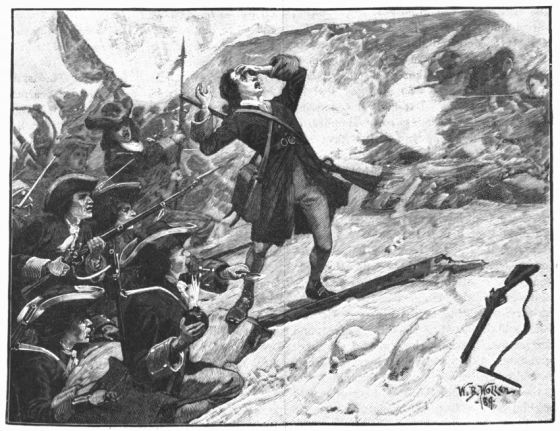
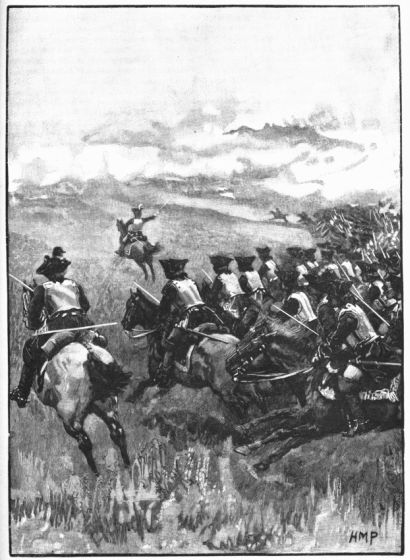
and his peasant soldiers. But day was
now breaking, the cavalry of Feversham, and the
infantry of Churchill, were bearing down on their
flanks from different quarters, and Monmouth,
then seeing that his defeat was inevitable, forgot
the hero and rode off to save his life, leaving his
brave, misguided followers to their fate. If anything
could have added to the base ignominy of
Monmouth's desertion of his adherents, it was the
undaunted courage which they showed even when
abandoned. They stood boldly to their charge;
they cut down the horsemen with their scythes,
or knocked them from their saddles with the butt
end of their guns; they repulsed the vigorous
attack of Oglethorpe, and left Sarsfield for dead
on the field. But, unfortunately, their powder
failed, and they cried out for fresh supplies in
vain. The men with the ammunition waggons
had followed the flight of the cavalry, and driven
far away from the field. Still the brave peasantry
and soldiers fought desperately with their scythes
and gunstocks, till the cannon was brought to
bear on them, and mowed them down in heaps.
As they began to give way the royal cavalry
charged upon them from the flank, the infantry
poured across the ditch, the stout men, worthy of
a better fate and leader, were overwhelmed and
broke, but not before a thousand of them lay dead
on the moor, or before they had killed or wounded
more than three hundred of the king's troops.
The unfortunate rebels were pursued with fury,
and hunted through the day out of the neighbouring
villages, whither they had flown for concealment.
The road towards Bridgewater was
crowded with flying men and infuriated troopers
following and cutting them down. Many of those
who rushed frantically into the streets of Bridgewater
fell and died there of their wounds, for the
soldiers, who were treated by the farmers to hogsheads
of cider, were drunk with drinking, with
blood and fury. A vast number of prisoners were
secured, for they were a profitable article of merchandise
in the Plantations; five hundred were
crowded into the single church of Weston
Zoyland, and the battle and pursuit being over,
the conqueror commenced that exhibition of
vengeance which was always so dear to James.
Gibbets were erected by the wayside, leading from
the battle-field to Bridgewater, and no less than
twenty of the prisoners were hanging on them.
The peasantry were compelled to bury the slain,
and those most suspected of favouring the rebels
were set to quarter the victims who were to be
suspended in chains. Meanwhile Monmouth, Grey,
and Buyse, the Brandenburger, were flying for
their lives. They took the north road, hoping
to escape into Wales. At Chedzoy Monmouth
drew up a moment to hide his George and procure
a fresh horse. From the summit of a hill they
turned and saw the final defeat and slaughter of
their deluded followers. They pushed forward for
the Mendip Hills, and then directed their course
towards the New Forest, hoping to obtain some
vessel on that coast to convey them to the Continent.
On Cranborne Chase their horses were
completely exhausted; they therefore turned them
loose, hid their saddles and bridles, and proceeded
on foot. But the news of the defeat of the rebels
had travelled as fast as they, and in the neighbourhood
of Ringwood and Poole parties of cavalry
were out scouring the country, in hopes of the
reward of five thousand pounds for Monmouth.
Lord Lumley and Sir William Portman, the commanders,
agreed to divide the sum among their
parties if successful, and early on the morning of
the 7th, Grey and the guide were taken at the
junction of the two cross roads. This gave proof
that the more important prize was not far off.
The officers enclosed a wide circle of land, within
which they imagined Monmouth and Buyse must
yet be concealed; and at five the next morning
the Brandenburger was discovered. He confessed
that he had parted from Monmouth only four
hours before, and the search was renewed with redoubled
eagerness. The place was a network of
small enclosures, partly cultivated and covered
with growing crops of pease, beans, and corn,
partly overrun with fern and brambles. The
crops and thickets were trodden and beaten down
systematically in the search, and at seven o'clock
Monmouth himself was discovered in a ditch
covered with fern.
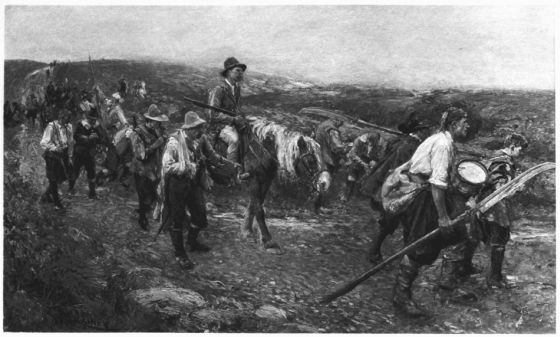
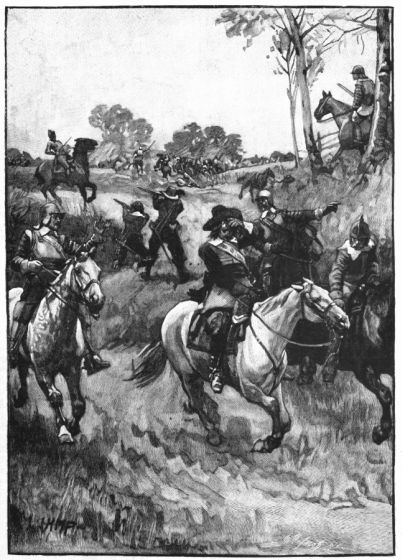
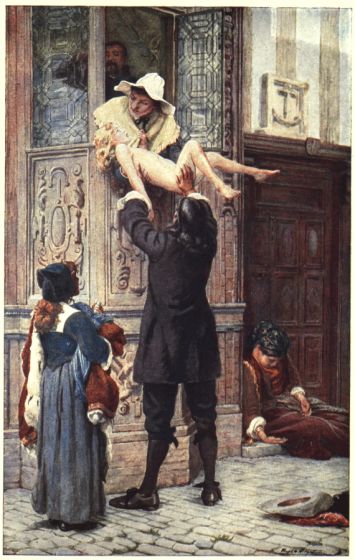
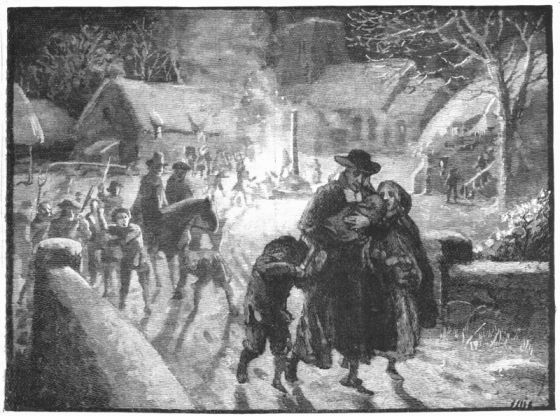
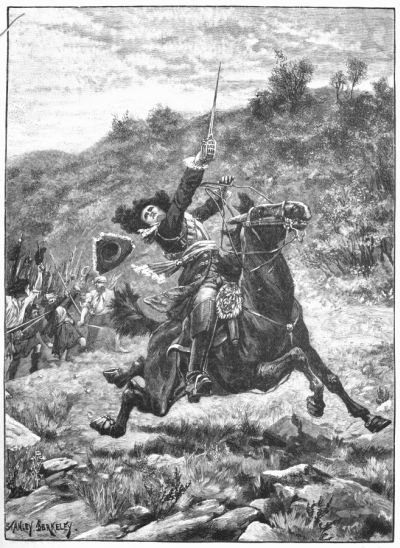
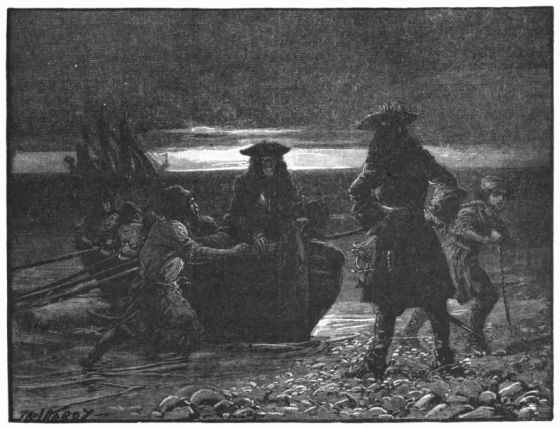
"AFTER SEDGEMOOR."
From the Painting by W. Rainey, R.I.
Monmouth, though mild and agreeable in his
manners, had never displayed any high moral
qualities. Indeed, if we bear in mind the
frivolous and debauched character of the Court
in which he had grown up, whether it were the
Court of the exile or of the restored king, it
would have been wonderful if he had. He was
handsome, gay, good-natured, but dissolute and
unprincipled. He was ready to conspire against
his father or his uncle, to profess the utmost contrition
when defeated, and to forget it as soon as
forgiven. He has been properly described as the
Absalom of modern times. If he merely deserted
his miserable followers on the battle-field, he now
more meanly deserted his own dignity. He continued,
from the moment of his capture to that
when he ascended the scaffold, prostrating himself
in the dust of abasement, and begging for his life
in the most unmanly terms. He wrote to James
instantly from Ringwood, so that his humble and
agonised entreaties for forgiveness would arrive
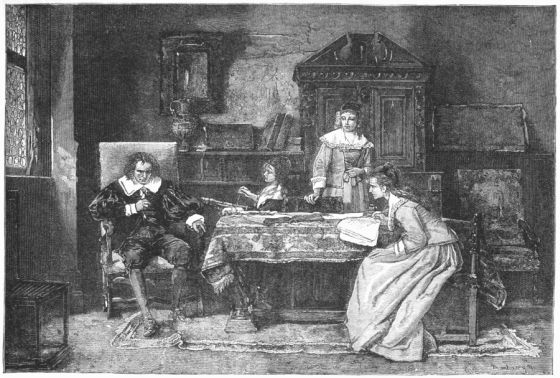
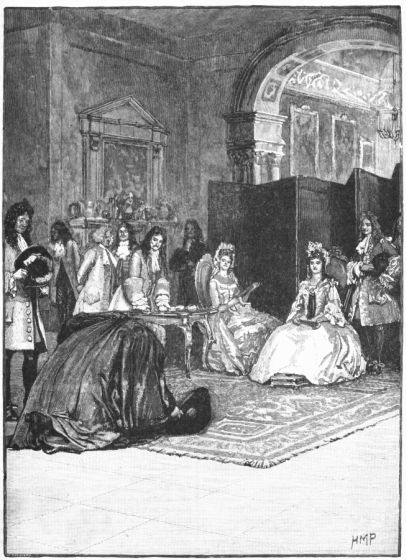
with the news of his arrest. James admitted the
crawling supplicant to the desired interview, but
it was in the hope of the promised word of
wondrous revelation, not with any intention of
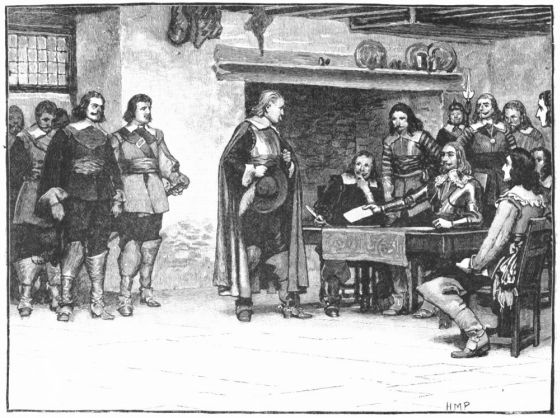
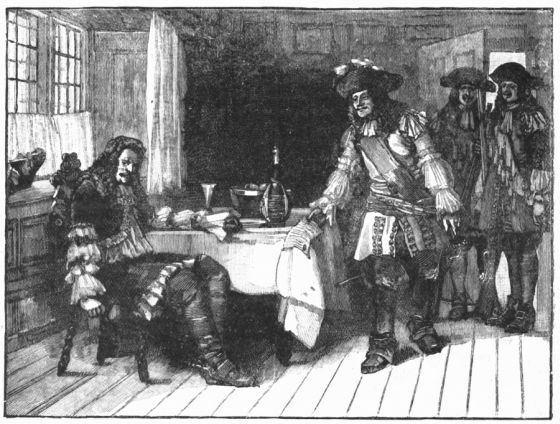
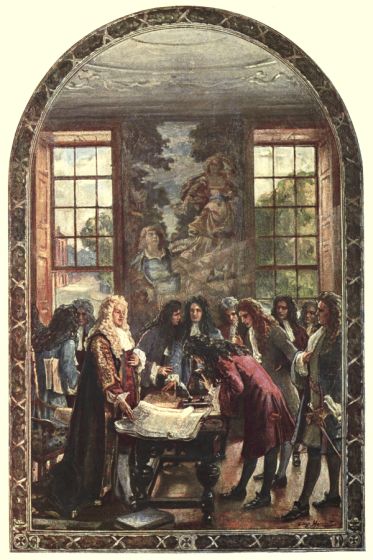
pardoning him. He got him to sign a declaration
that his father had assured him that he was never
married to his mother, and then coolly told him
that his crime was of too grave a dye to be forgiven.
The queen, who was the only person
present besides James and the two Secretaries of
State, Sunderland and Middleton, is said to have
insulted him in a most merciless and unwomanly
manner. When, therefore, Monmouth saw that
nothing but his death would satisfy the king and
queen, he appeared to resume his courage and fortitude,
and rising with an air of dignity, he was
taken away. But his apparent firmness lasted
only till he was out of their presence. On his
way to the Tower he entreated Lord Dartmouth
to intercede for him—"I know, my lord," he said,
"that you loved my father; for his sake, for
God's sake, endeavour to obtain mercy for me."
But Dartmouth replied that there could be no
pardon for one who had assumed the royal title.
Grey displayed a much more manly behaviour.
In the presence of the king he admitted his guilt,
but did not even ask forgiveness. As Monmouth
was under attainder, no trial was deemed necessary,
and it was determined that he should be
executed on Wednesday morning, the next day
but one. On the fatal morning of the 15th he
was visited by Dr. Tenison, afterwards archbishop,
who discoursed with him, but not
very profitably, on the errors of his ways.
Before setting out for the scaffold, his wife and
children came to take leave of him. Lady Monmouth
was deeply moved; Monmouth himself
spoke kindly to her, but was cold and passionless.
When the hour arrived, he went to execution with
the same courage that he had always gone into
battle. He was no more the cringing, weeping
supplicant, but a man who had made up his mind
to die. A disgusting scene of butchery followed,
owing to the nervousness of the executioner. The
populace were so enraged at the man's clumsiness,
that they would have torn him to pieces
if they could have got at him. Many rushed
forward to dip their handkerchiefs in Monmouth's
blood, and the barbarous circumstances
of his execution and the unfeeling persecution of
the prelates, did not a little to restore his fame
as a martyr to liberty and Protestantism.
Whilst these things were going on in London,
the unfortunate people in the West were suffering
a dreadful penalty for their adherence to Monmouth.
Feversham was called to town, and
covered with honours and rewards, though it was
notorious that he had done nothing towards the
victory. Buckingham even declared that he had
won the battle of Sedgemoor in bed. In his place
was left one of the most ferocious and unprincipled
monsters that ever disgraced the name of soldier.
This was Colonel Kirke, who had been governor of
Tangier until it was abandoned, and now practised
the cruelties that he had learned in his unrestrained
command there. In that Settlement, left
to do his licentious will on those in his power, he
acquired a name for arbitrary, oppressive, and dissolute
conduct, which in ordinary times would have
insured his death. He now commanded the demoralised
soldiers that he had brought back with
him, and who, whilst they were capable of every
atrocity, were called "Kirke's lambs," because, as a
Christian regiment sent against the heathen, they
bore on their banner the desecrated sign of the
Lamb. His debauched myrmidons were let loose
on the inhabitants of Somersetshire, and such as
they could not extort money from, they accused
on the evidence of the most abandoned miscreants,
and hanged and quartered, boiling the quarters in
pitch, to make them longer endure the weather on
their gibbets. The most horrible traditions still
remain of Kirke and his lambs. He and his officers
are said to have caused the unhappy wretches
brought in, who were not able to pay a heavy
ransom, to be hanged on the sign-post of the inn
where they messed, and to have caused the drums
to beat as they were in the agonies of death, saying
they would give them music to their dancing. To
prolong their sufferings, Kirke would occasionally
have them cut down alive, and then hung up
again; and such numbers were quartered, that the
miserable peasants compelled to do that revolting
work, were said to stand ankle deep in blood. All
this was duly reported to the king in London, who
directed Lord Sunderland to assure Kirke that
"he was very well satisfied with his proceedings."
It was asserted in London that in the single week
following the battle, Kirke butchered a hundred of
his victims, besides pocketing large sums for the
ransom of others, yet he declared that he had not
gone to the lengths to which he was ordered.
On the 10th of August he was sent for to Court,
to state personally the condition of the West,
James being apprehensive that he had let the rich
delinquents escape for money, and the system of
butchery was left to Colonel Trelawny, who continued
it without intermission, soldiers pillaging the
wretched inhabitants, or dragging them away to
execution under the forms of martial law. But a
still more sweeping and systematic slaughter was
speedily initiated under a different class of exterminators—butchers
in ermine.
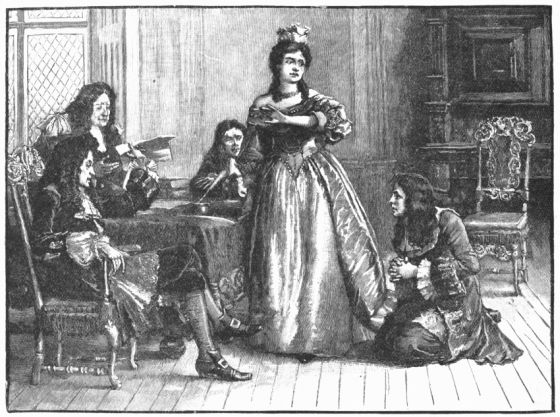
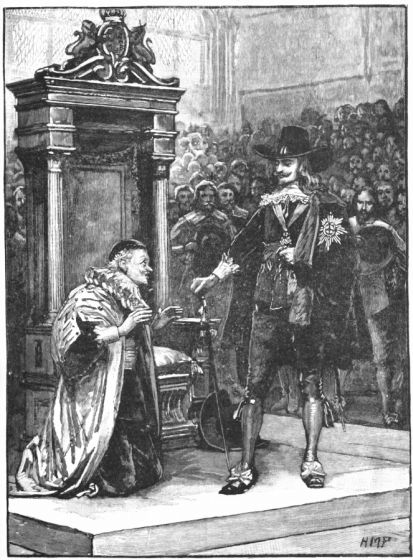
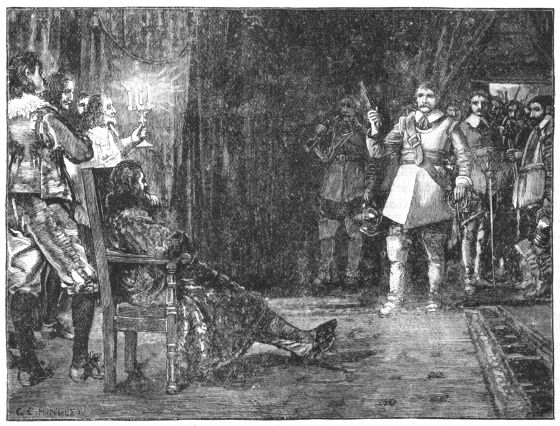
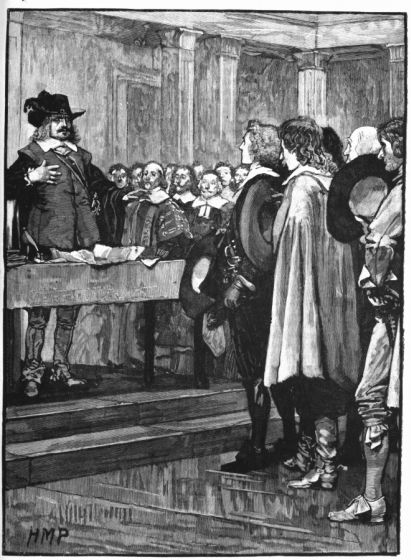
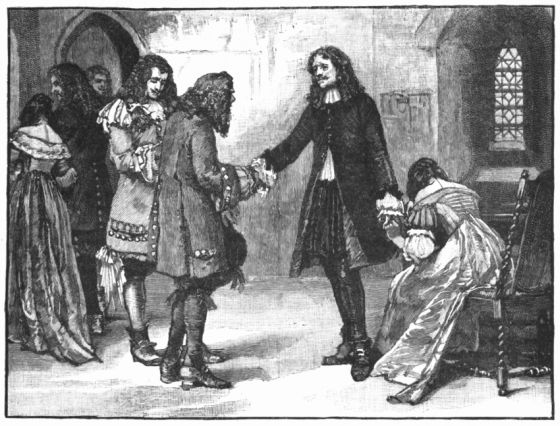
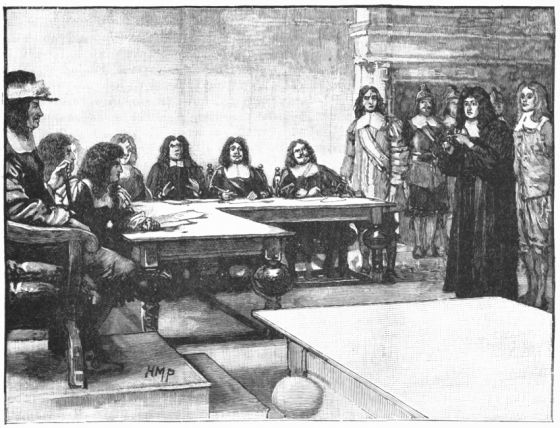
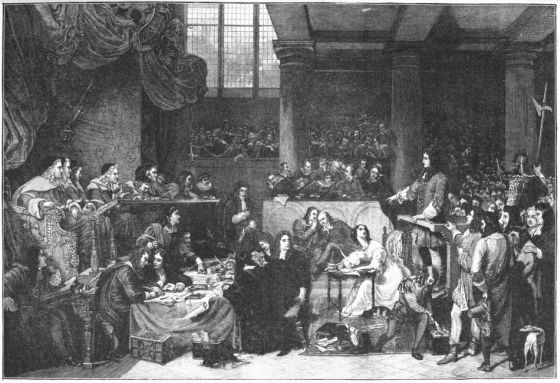
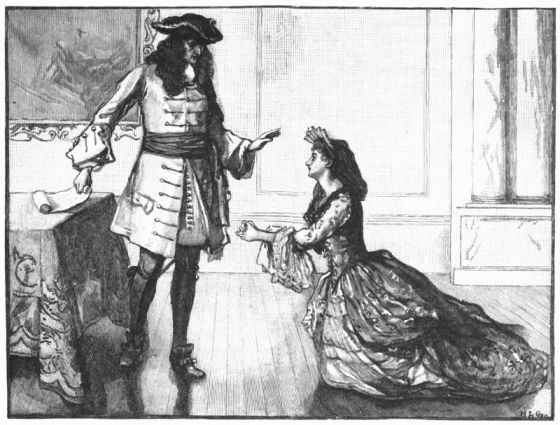
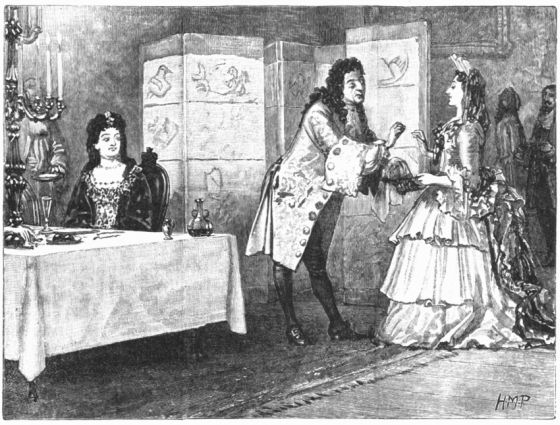
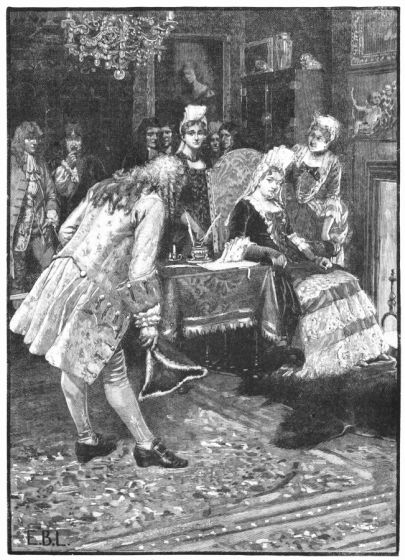
MONMOUTH'S INTERVIEW WITH THE KING. (See p. 303.)
Lord Chief Justice Jeffreys, the most diabolical
judge that ever sat on the bench—now rendered
furious by nightly debauch and daily commission of
cruelties; in his revels hugging in mawkish and
disgusting fondness his brutal companions; in his
discharge of his judicial duties passing the most
barbarous sentences in the most blackguard and
vituperative language; in whose blazing eye,
distorted visage, and bellowing voice raged the
unmitigated fiend,—was sent forth by his delighted
master to consummate his vengeance on
the unhappy people whom the soldiers had left
alive and cooped up in prison. He was already
created Baron of Wem, dubbed by the people Earl
of Flint, and, the Lord Keeper just now dying, he
was promised the Great Seal if he shed blood
enough to satisfy his ruthless king. Four other
judges were associated with him, rather for form
than for anything else, for Jeffreys was the
hardened, daring, and unscrupulous instrument on
whom James confidently relied.
Jeffreys' Bloody Assize, as it was then and always
has been termed, both from its wholesale slaughter
and from the troops which accompanied him
throughout the circuit—a name constantly used by
the unfeeling king himself—was opened at Winchester
on the 27th of August, and commenced
with a case of hitherto unexampled ruthlessness.
Mrs. Alice Lisle—or, as she was generally
called, Lady Alice, her husband, one of the
judges of Charles I., having been created a
lord by Cromwell—was now an infirm and aged
woman, deaf and lethargic. Her husband had
been murdered, as we have related, by the Royalists,
as he was entering the church at Lausanne.
Lady Alice was known far and wide for her benevolence.
Though her husband was on the other
side, she had always shown active kindness to the
followers of the king during the Civil War, and
on this account, after her husband's death, his
estate had been granted to her. During the rebellion
of Monmouth her son had served in the king's
army against the invader; yet this poor old lady
was now accused of having given a night's shelter
to Hicks, a Nonconformist minister, and Nelthorpe,
a lawyer, outlawed for his concern in the Rye
House Plot. They were fugitives from Sedgemoor,
and the law of treason was that he who
harbours a traitor is liable to death, the punishment
of a traitor. Mrs. Lisle had no counsel, and
pleaded that though she knew that Hicks was a
Presbyterian minister, she did not know that he
and Nelthorpe were concerned in the rebellion,
and there was no direct proof of the fact.
Jeffreys terrified the witnesses, and then came
the turn of the jury. They retired to consult, but
not coming to a speedy conclusion, for they were
afraid of the judge, and yet loth to condemn the
prisoner, Jeffreys sent them word that if they did not
agree he would lock them up all night. They then
came into court and expressed their doubts of Mrs.
Lisle knowing that Hicks had been with Monmouth.
Jeffreys told them that their doubt was
altogether groundless, and sent them back to agree.
Again they returned, unable to get rid of their
doubt. Then Jeffreys thundered against them in
his fiercest style, and declared that were he on the
jury, he would have found her guilty had she been
his own mother. At length the jury gave way
and brought in a verdict of guilty. The next
morning Jeffreys pronounced sentence upon her
amid a storm of vituperation against the Presbyterians,
to whom he supposed Mrs. Lisle belonged.
He ordered her, according to the rigour of the old
law of treason, to be burned alive that very afternoon.
This monstrous sentence thoroughly roused the
inhabitants of the place; and the clergy of the
cathedral, the staunchest supporters of the king's
beloved arbitrary power, remonstrated with
Jeffreys in such a manner, that he consented to
a respite of five days, in order that application
might be made to the king. The clergy sent a deputation
to James, earnestly interceding for the
life of the aged woman, on the ground of her
generous conduct on all occasions to the king's
friends. Ladies of high rank, amongst them the
Ladies St. John and Abergavenny, pleaded tenderly
for her life. Feversham, moved by a bribe of
a thousand pounds, joined in the entreaty, but
nothing could move that obdurate heart, and all
the favour that James would grant her was that she
should be beheaded instead of burnt. Her execution,
accordingly, took place at Winchester on the
2nd of September, and James II. won the unenviable
notoriety of being the only tyrant in
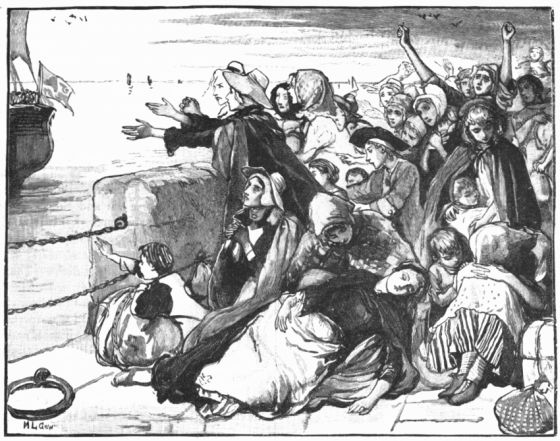
England, however implacable, who had ever dyed
his hands in woman's blood for the merciful deed
of attempting to save the lives of the unfortunate.
What made this case worse was, that neither
Hicks nor Nelthorpe had yet been tried, so that
the trial of Mrs. Lisle was altogether illegal, and
the forcing of the jury completed one of the most
diabolical instances of judicial murder on record.
From Winchester Jeffreys proceeded to Dorchester.
He came surrounded by still more
troops, and, in fact, rather like a general to take
bloody vengeance, than as a judge to make a just
example of the guilty, mingled with mercy, on
account of the ignorance of the offenders. The
ferocious tyrant was rendered more ferocious, from
his temper being exasperated by the agonies of the
stone which his drunken habits had inflicted on
him. He had the court hung with scarlet, as if to
announce his sanguinary determination. When
the clergyman who preached before him recommended
mercy in his sermon, he was seen to make
a horrible grimace, expressive of his savage disdain
of such a sentiment. It was whilst preparing to
judge the three hundred prisoners collected there,
that he received the news of his elevation to the
woolsack. He had received orders from James to
make effectual work with the rebels, and he now
adopted a mode of despatching the unhappy
wretches in wholesale style. As it would be a
very tedious work to try all that number one
by one, he devised a more expeditious plan. He
sent two officers to them into the prison, offering
them mercy or certain death. All who chose to
make confession of their guilt should be treated
with clemency, all who refused should be led to
immediate execution. His clemency amounted to
a respite of a day or two—he hanged them all the
same. Writing to Sunderland, Jeffreys said on
the 16th of September:—"This day I began with
the rebels, and have despatched ninety-eight." Of
the three hundred, two hundred and ninety-two
received sentence of death. Eighty only were
hanged, the rest were, for the most part, sent to
the Plantations as slaves.
From Dorchester he went to Exeter, where
two hundred and forty-three prisoners awaited
their doom. He proceeded in the same way, and
condemned the whole body in a batch, and as they
saved him much trouble, he did not hang so many
of them. Taunton, the capital of Somersetshire,
the county where the rebellion was the strongest,
presented him with no fewer than a thousand
prisoners. Here he perfectly revelled in his bloody
task. The work seemed to have the effect of
brandy or champagne upon him. He grew every
day more exuberant and riotous. He was in such
a state of excitement from morning to night, that
many thought him drunk the whole time. He
laughed like a maniac, bellowed, scolded, cut his
filthy jokes on the astounded prisoners, and was
more like an exulting demon than a man. There
were two hundred and thirty-three prisoners
hanged, drawn, and quartered in a few days. The
whole number hanged in this bloody campaign
has been variously stated at from three to seven
hundred. Probably the medium is the most correct.
But so many were hung in chains, or their
jointed quarters and limbs displayed on the highways,
village greens, and in the market-places, that
the whole country was infected with the intolerable
stench. Some of their heads were nailed on the
porches of parish churches; the whole district was
a perfect Golgotha. It was in vain that the most
distinguished people endeavoured to check the infuriated
judge's rage; he only turned his evil
diatribes on them, and gave them what he called
"a lick with the rough side of his tongue."
Because Lord Stowell, a Royalist, complained of
the remorseless butchery of the poor people of his
neighbourhood, he gibbeted a corpse at his park
gate.
The fate of the transported prisoners was worse
than death itself. They were eight hundred and
forty in number, and were granted as favours to
the courtiers. Jeffreys estimated that they were,
on an average, worth from ten pounds to fifteen
pounds apiece to the grantee. They were not to
be shipped to New England or New Jersey, because
the Puritan inhabitants might have a sympathy
with them on account of their religion, and
mitigate the hardship of their lot. They were to
go to the West Indies, where they were to be
slaves, and not acquire their freedom for ten
years. They were transported in small vessels
with all the horrors of the slave trade. They
were crowded so that they had not room for lying
down all at once; were never allowed to go on
deck; and in darkness, starvation, and pestiferous
stench, they died daily in such quantities that the
loss of one-fifth of them was calculated on. The
rest reached the Plantations, ghastly, emaciated,
and all but lifeless. Even the innocent school
girls, many under ten years of age, at Taunton,
who had gone in procession to present a banner to
Monmouth, at the command of their mistress,
were not excused. The queen, who had never
preferred a single prayer to her husband for
mercy to the victims of this unprecedented proscription,
was eager to participate in the profit,
and had a hundred sentenced men awarded to her,
the profit on which was calculated at one thousand
pounds. Her maids of honour solicited a
share of this blood-money, and had a fine of seven
thousand pounds on these poor girls assigned to
them.
The only persons who escaped from this sea of
blood were Grey, Sir John Cochrane, who had
been in Argyll's expedition, Storey, who had been
commissary to Monmouth's army, Wade, Goodenough,
and Ferguson. All these owed their
escape to money or their secret services in giving
information against their old friends, except Ferguson,
who by some means escaped to the Continent.
On the other hand, Bateman, the surgeon
who had bled Oates in Newgate after his scourging,
and by his attentions saved his life, was, for a
mere duty of his profession, arrested, tried, hanged,
and quartered.
James now seemed at the summit of his ambition.
He had established an actual reign of
terror. The dreadful massacre of the West struck
dumb the most courageous, and this gloomy tyrant
gave full play to his love of cruelty. The Nonconformists
were everywhere beset by informers,
who imprisoned, robbed, and abused them at
pleasure. They could only meet for worship in
the most obscure places and in the most secret
manner. Their houses were broken into and
searched on pretence of discovering conventicles.
Their ministers were seized and thrust into prison.
Baxter was there; Howe was obliged to escape
abroad. Never, even in the time of Laud, had
the oppression been so universal and crushing.
All spirit of resistance appeared to be quenched in
terror. The close of the year 1685 was long remembered
as one of indescribable and unexampled
depression and speechless misery.
James, on the contrary, never was so triumphant.
He believed that he had now struck
effectual terror into the country, and might rule
at will. He had increased the army, and openly
declared the necessity of increasing it further.
He had in many instances dispensed with the
Test Act in giving many commissions in the army
to Catholics, and he resolved to abolish both that
Act and the Habeas Corpus Act. His great design
was to restore the Roman religion to full liberty
in England; he believed that he was able now to
accomplish that daring deed. Parliament was to
meet in the beginning of November, and he
announced to his Cabinet his intention to have
the Test Act repealed by it, or, if it refused, to
dispense with it by his own authority. This
declaration produced the utmost consternation.
Halifax, however, was the only member who dared
to warn him of the consequences, and avowed that
he would be compelled to oppose the measure.
James endeavoured to win him over to his
views, but finding it vain, determined to dismiss
him from office. His more prudent Councillors
cautioned him against such an act on the eve of
the meeting of Parliament, on the ground that
Halifax possessed great influence, and might head
a dangerous opposition. But James was the last
man to see danger ahead, and Halifax ceased to
be President of the Council. The news was
received with astonishment in England, with exultation
in Paris, and with discontent at the
Hague.
The dismissal of Halifax produced a great
sensation out of doors. The Opposition gathered
new courage. Danby and his party showed themselves
early to coalesce with the adherents of
Halifax. The whispered assurance that Halifax
was dismissed for refusing to betray the Test and
Habeas Corpus Acts created general alarm, and
even the leading officers of the army did not
hesitate to express their disapprobation. Just at
this crisis, only a week before Parliament would
assemble, came the news of the revocation of the
Edict of Nantes by Louis XIV. This Edict had
been issued under the ministry of Richelieu, and
had closed the long and bloody war between
Catholic France and its Protestant subjects.
Under certain restrictions the Huguenots were
tolerated, and were contented. But Louis, urged
by the Jesuits, had long been infringing on the
conditions of the treaty. He had dismissed all
Huguenots from his service, had forbade them to
be admitted to the profession of the law, and
compelled Protestant children to be educated by
Catholics. Now at length he abolished the Edict
altogether, by which the Huguenots were once
more at the mercy of dragoons and ruffian
informers and constables. Their ministers were
banished, their children torn from them, and sent
to be educated in convents. The unhappy people
seeing nothing but destruction before them, fled
out of the kingdom on all sides. No less than
fifty thousand families were said to have quitted
France, some of them of high rank and name, the
bulk of them weavers in silk and stuffs, hatters,
and artificers of various kinds. Many settled in
London, where they introduced silk weaving, and
where their descendants yet remain, still bearing
their French names, in Bethnal Green and Spitalfields.
Others carried their manufacturing industry
to Saxony, and others emigrated to the
Cape as vine growers. France, by this blind act
of bigotry, lost a host of her best citizens, and had
her arts carried to her rivals.
This was a terrible blow to the scheme of James
for restoring Romanism to power in England.
The people justly said, if a politic monarch like
Louis could not refrain at such a serious cost from
persecuting Protestants, what was England to
expect should Romanism gain the ascendency
here, under a bigoted and narrow-minded king
like James? James himself saw the full extent
of the, to him, inopportune occurrence, and professed
to join heartily in the universal outcry of
Europe, not excepting the very Pope himself, and
Spain, the land of Jesuits and inquisitions; for
those parties who were suffering from the aggressions
of Louis found it, like James, convenient to
make an outcry. What more irritated James was
an address which the French clergy in a body had
presented to Louis, applauding the deed and declaring
that the pious king of England was looking
to Louis for his aid in reducing his heretical
subjects. This address was read with astonishment
and terror by the English people, and James
hastened to condemn the revocation of the Edict,
and to promote and contribute to the relief of
the refugees who had sought shelter here. This
affected sympathy did not last long.
On the 9th of November James met his Parliament.
He congratulated them on the suppression
of the rebellion in the West, but observed that it
had shown how little dependence could be placed
on the militia. It would be necessary to maintain
a strong regular force, and that would, of course,
require proportionate funds. He had, he observed,
admitted some officers to commissions who
had not taken the test, but they were such as he
could rely on, and he was resolved to continue
them there. On their return to their House the
Lords tamely voted him an address of thanks, but
with the Commons a demur on this head arose,
and a delay of three days was voted before considering
an address. This was ominous, and
during the interval the ambassadors of Austria
and the Pope advised James not to quarrel with
the Parliament. Barillon, on the contrary, urged
him towards the fatality, for which he required
little stimulus. If he quarrelled with his Parliament,
he must become Louis's slave, and leave
Austria, Spain, and Italy at his mercy. When
the Parliament resumed the question, the members,
both Whigs and Tories, who were alike
opposed to James's projected aggressions, carefully
avoided any irritating topic except that of the
army. They took no notice of the atrocities committed
in the west; they did not revert to the
illegal practices by which members in the interest
of Government had been returned, but they skilfully
proposed improvements in the militia, so as
to supersede the necessity of a standing army.
When the vote for Supply was proposed, the
House carried a motion for bringing in a Bill
for rendering the militia more effective, and on
this motion Seymour of Exeter, a Tory, as well as
Sir William Temple, and Sir John Maynard, who
had taken a leading part in the Parliamentary
struggle against Charles I., and was now upwards
of eighty years of age, took part: several
officers of the army, including Charles Fox, Paymaster
of the Forces, voted on the popular side of
the question. Of course they were dismissed.
But the House now having broken the ice, voted
an address to the king on the subject of maintaining
inviolate the Test Act. When they went into
Committee for the Supply, the king demanded one
million two hundred thousand pounds, the House
proposed four hundred thousand pounds. They
were afterwards willing to advance the sum to
seven hundred thousand pounds, but the Ministers
put the motion for the original sum to the vote,
and were defeated. The next day the Commons
went in procession to Whitehall, with their
address regarding the test. James received them
sullenly, and told them that whatever they pleased
to do, he would abide by all his promises. This
was saying that he would violate the Test Act as
he had done. On returning to their House, John
Coke of Derby said he hoped they were all
Englishmen, and were not to be frightened from
their duty by a few high words. As the House
had been careful to avoid any expressions disrespectful
to the king, they resented this manly
but incautious speech, and committed Coke to the
Tower. The Court took courage at this proceeding,
but though the Commons had not all at once
recovered their independent tone, the discontent
was strongly fermenting, and though Seymour had
at first in vain called on them to examine the
abuses of the franchise during the last election,
they now took up the question, and Sir John
Lowther of Cumberland, another Tory member,
headed this movement. The same spirit in the
same day broke out in the Lords. Though they
had voted thanks for the address, Halifax now contended
that that was merely formal, and the Earl
of Devonshire, William Cavendish, the bosom
friend of Lord William Russell, and Viscount
Mordaunt, afterwards the celebrated Earl of
Peterborough, proposed to consider the king's
speech, and vehemently denounced a standing
army. What was still more significant was, that
Compton, the Bishop of London, a Royalist, and
the son of a Royalist—that Earl of Northampton
who had fought for Charles I.,—and who had,
moreover, been the educator of the two princesses,
not only spoke for himself, but for the whole
bench and Church, and declared that the constitution,
civil and ecclesiastic, was in danger. Here
was a quick end of the doctrine of Non-resistance.
Jeffreys endeavoured to reply to these ominous
harangues, but the bully of the bench, where he
had it all his own way, here cut a very different
figure. He was scarified in a style of refined
sarcasm, against which his coarse Billingsgate was
worse than harmless; it recoiled upon his own
head, and this brutal monster, cowardly as he was
insolent, sank prostrate before the whole House,
and even gave way to a dastardly flood of tears of
shame. James, astonished and enraged, but not
warned by this first breath of the rising tempest,
the next morning hurried to the House of Lords
and prorogued Parliament till the 10th of February;
but it never met again, being repeatedly
prorogued, till the national spirit arose which
drove him from the throne.
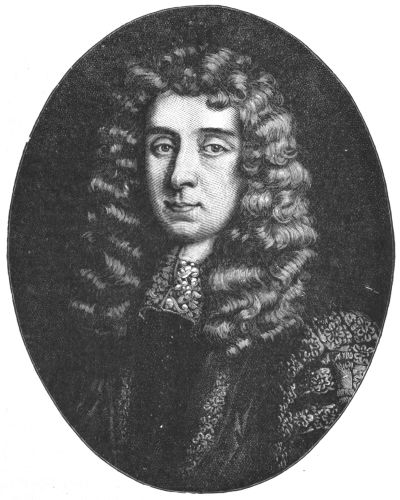
JUDGE JEFFREYS. (After a Painting by Sir Godfrey Kneller.)
The prorogation of Parliament was followed
by the trial of three Whig leaders of eminence.
These were Gerard, Lord Brandon, the eldest son
of the Earl of Macclesfield, Hampden, the grandson
of the patriot, and Henry Booth, Lord Delamere.
Hampden and Gerard were accused afresh
of having been concerned in the Rye House Plot,
Delamere of having been in league with Monmouth.
Grey, Earl of Stamford, had been on the
eve of being tried by the Peers on a similar charge
of concern in the Rye House Plot, but the prorogation
defeated that, and he was soon after
liberated. These were the men against whom
Grey had been induced to give information, and
who, with Wade and Goodenough, were witnesses.
Hampden and Gerard were tried at the Old
Bailey and condemned. But Grey had stipulated
that their lives should be safe, and they were
redeemed by their relatives at a heavy price.
Delamere, as a peer of the realm, was tried by a
High Court of Peers, and as he was accused of
having been engaged with Monmouth, his life was
in danger. Jeffreys was appointed Lord High
Steward, and he selected thirty peers as triers, all
of whom in politics were opposed to Delamere,
and half of them ministers and members of the
royal household. He did not stop there, but as
he had a personal spite against Delamere for
having complained of him to Parliament when
Chief Justice of Chester, and called him a
"drunken jackpudding," he did his best personally
to condemn him. But in spite of the murderous
bias with which the villainous judge had contrived
the prisoner's death, the Lords Triers unanimously
acquitted him. This was a fact that
equally electrified James and the country. Both
saw that there was a spirit abroad that was no
longer to be trifled with. The people openly
rejoiced; the infatuated tyrant raged, but took no
warning. The very Tories who had carried the
Crown hitherto through every attempt, the Established
Church which had preached Non-resistance,
saw the gulf, to the edge of which their
principles had brought them. Their loyalty
paused at the threshold of Romanism, and the
destruction of the safeguards of the liberty of the
subject. The deadly artifices which an abandoned
judge and a lawless monarch had employed against
the life of Delamere, might soon be practised
against every one of them. The spell of despotism,
therefore, was broken. The spirit of an
unconquerable suspicion had reached the very
cabinet and the household of the Romish king,
and his power was at an end.
But the greater the danger the more recklessly
the bigotry-blinded monarch rushed upon it. His
father had been bent on destroying the Constitution,
but stood firm to the Anglican Church;
James was resolved to root out both Church and
Constitution together; but to his narrow intellect
it never occurred that if his father lost his head in
attempting half of this impossible enterprise, his
danger was double in aiming at the whole. At
the very beginning of the year 1686 he took a
sudden stride in the direction of avowed Romanism,
and during the whole year he marched forward
with an insane hardihood that struck the
boldest and most adventurous of his friends with
consternation. The fact as to whether Charles II.
had died a Catholic or a Protestant was still a
matter of dispute. A few knew the truth, more
surmised, but the bulk of the people still believed
him to have been a Protestant. James determined
to sweep away the remaining delusion. He therefore
brought forth the two papers from Charles's
strong box, and challenged the whole bench of
bishops to refute them. He especially called on
Sancroft, the Archbishop of Canterbury, to do it;
but as the Primate from policy declined it, James
took it for granted that they were secretly admitted
to be unanswerable. He therefore had
them printed in magnificent style, and appended
to them his own signature, asserting that they
were his late brother's own composition, and left
in his own handwriting. He had this proof of
Charles's Romanism distributed liberally to his
courtiers, to the prelates and dignitaries of the
Church, and amongst the people, even delivering
them out of his coach window to the crowds as he
drove about. He thus at once made known that
his late brother had been secretly a Romanist, and
that he was himself an open and uncompromising
one.
His next step was to throw all the power of the
Government into the hands of the most unscrupulous
Catholics. His brother-in-law, Rochester,
the Lord Treasurer, was nominally his Prime
Minister, but Sunderland and a knot of Catholics
were the really ruling junto. Sunderland, one of
the basest men that ever crawled in the dust of a
Court's corruption, was the head of this secret
cabal. Sunderland, in the last reign, had been a
violent Exclusionist. He had intrigued with the
Duchess of Portsmouth, through her, if possible, to
bring Charles to consent to this measure; but so
soon as James was on the throne, he became his
most servile tool, declaring that as he had nothing
to hope but from the king's clemency and his own
efforts to make compensation for the past, James
could have no more efficient servant. James, who
was a mean soul himself, did not spurn this meanness,
but made use of it, and truly Sunderland
earned his dirty bread. Avarice was his master
vice, and he would have sold two souls for money
if he had them. He retained the post of President
of the Council, and held with it his old one
of Secretary of State; whilst observing the course
which James was taking, he did not despair to
wrest from the staunch Protestant Rochester his
still more lucrative office of Lord Treasurer. He
had not the foresight to perceive that the project
which James entertained to restore Romanism
must bring speedy destruction on them all. This
sordid minister was, at the same time, in the
pay of Louis, at the rate of six thousand pounds a
year, to betray all his master's most secret counsels
to him.
With Sunderland were associated in the secret
Romish junto—Sunderland himself not being
an avowed Catholic, but a private professor—some
of those Catholic lords who had been imprisoned
on account of the Popish plots—Arundel,
Bellasis, and William Herbert, Earl of Powis. To
these were added Castlemaine, the man who for a
title and revenue had sold his wife to Charles II.
He had been imprisoned, too, on account of the
Popish plot, and was ready to take vengeance by
assisting to destroy his Protestant enemies and
their Church together. With him were associated
two of the most profligate and characterless men
of that profligate age—Jermyn, celebrated for his
duels and his licentious intrigues, and lately
created by James Lord Dover, and a man familiarly
named Dick Talbot—whom James had also
for these crimes, which were merits in James's
eyes, made Earl of Tyrconnel. These merits were,
that Talbot was ready for any service of unmanly
villainy that his master could desire. Like another
prime favourite and associate of James, Lord
Chancellor Jeffreys, Tyrconnel was notorious for
his drinking, gambling, lying, swearing, bullying,
and debauchery. He was equally ready to lie
away a woman's character or to assassinate a
better man than himself. In the last reign, when
it was desired by the Court to ruin the character
of James's wife, Anne Hyde, that she might be
got rid of, he joined with Colonel Berkeley in the
infamous assertion that they had had the most
familiar intrigues with her. When they did not
succeed with James, they as readily confessed that
the whole was a lie. A man with the least spark
of honour in him would have remembered this unpardonable
villainy to his now deceased wife, and
have banished the wretch from Court. James promoted
him, and made him one of his most intimate
companions. Tyrconnel offered to murder
the Duke of Ormond, and was rewarded for his
readiness by being made commander of the forces
in Ireland; but his services were chiefly at
present demanded at Court.
FOURPENNY PIECE OF JAMES II.
To this precious cabal was added Father
Petre, the Jesuit Provincial, brother of Lord
Petre, and the organ of the Jesuits at Court.
The Pope, too, had his agents at Court, Adda,
his nuncio, and a vicar-apostolic; but these
advocated cautious measures, for Innocent
XI. had a difficult card to play in the
Popedom. Louis, the greatest of the Catholic
kings, was the most dangerous enemy
of the temporal power of the Pope, as of
every other temporal power, and the Jesuits
were all at variance with him, because he leaned
toward the Jansenist party, which at this time
was in the ascendency, through the triumphant
attacks on the Jesuits by Pascal in his "Lettres
Provinciales." The Jesuits, on the contrary, advocated
all James's views. These generally subtle men
seemed driven, by their falling estimation all over
Europe, to clutch at a hope of power in England,
and they had at all times been famed for their sly
policy of insinuation rather than for their caution
and moderation when successful. For their high-handed
proceedings they had then, as they have
since, been driven again and again from almost
every Christian country. They did not display
more than their ordinary foresight in the affairs
of James.
But we should not possess a complete view of
the position and character of James's Court if we
did not take in a few other actors—the French
king's agents, and the king's mistresses. To
Barillon, who had so long been ambassador at the
English Court, and the agent of Louis's bribes, the
French king had sent over Bonrepaux; and
whilst Barillon attached himself to Sunderland
and the secret Catholic cabal, Bonrepaux devoted
his attentions to Rochester and his section of the
ministry, so that Louis learned the minutest movements
and opinions of both parties. These parties,
in their turn, made use of the king's mistresses; for
James, although in disposition the very opposite
of Charles, was, with all his morose profession of
zealous piety, just as loose in his adulteries.
FIVE-GUINEA PIECE OF JAMES II.
With the aid of the Council of his Catholic cabal,
James now began in earnest to put down Protestantism
in this kingdom, and restore Romanism.
As there was no hope of money from Parliament,
he made his peace with the King of France,
stooped his shoulder to the burden, and became
once more a servant unto tribute. He abandoned
all the best interests of England, apologised to
Louis for having received the Huguenots, and took
measures to defeat the very subscription in their
favour which he had commenced and recommended.
He arrested John Claude, one of the refugees who
had published an account of the persecutions of
the Huguenots by Louis, and caused his book to
be publicly burnt. In spite of this and his open
discouragement, the subscription amounted to
forty thousand pounds, but he took good care that
the unfortunate Huguenots should never get the
money, by ordering every one who applied for it to
first take the Sacrament according to the Anglican
ritual, which he knew differed so much from their
own mode, as to form an effectual bar, which it
did. And this was the man who complained of
the Test Act as a violation of conscience. He had
himself dispensed with this Act in defiance of the
law, but he now sought to obtain a sanction from
the judges for the breach of the Act. To Parliament
he durst not appeal; he therefore called
on the twelve judges to declare that he possessed
this dispensing power as part of his prerogative.
The judges to a man refused; he dismissed them
and appointed more pliant ones. But the law
officers of the Crown were equally stubborn.
Sawyer, the Attorney-General, told the king that
he dared not do it, for it was not to abolish a
statute, but the whole statute law from the accession
of Elizabeth. Sawyer was too useful to be
dismissed, but Heneage Finch, the Solicitor-General,
was turned out, and Powis, a barrister of
no mark, was put in his place. A case was immediately
tried in the Court of King's Bench, to
obtain the judges' sanction. Sir Edward Hales
was formally prosecuted for holding a commission
in the army, being a Catholic; but the Lord Chief
Justice, Sir Edward Herbert, took the opinion of
the new judges upon it, which was, that the king
possessed the power to dispense with the Act,
and judgment was given accordingly. No sooner
was James in possession of this decision of the
King's Bench, than he appointed the four Catholic
lords of his secret cabal members of the Privy
Council—namely, Arundel, Bellasis, Powis, and
Dover.
Having perpetrated this daring act in the
Council, James hastened to exercise the same
power in the Church. Encouraged by the known
opinions and intentions of the king, several clergymen
who had outwardly conformed to the Church
of England and held livings, now threw off the
mask and proclaimed themselves of the Catholic
Church, and applied to James to authorise them
still to hold their livings. These were Obadiah
Walker, Master of University College, Oxford;
Boyce, Dean, and Bernard, fellows of different colleges;
and Edward Sclater, curate of Putney and
Esher. The king granted them dispensations to hold
their livings, despite their avowed conversion to
the doctrines of another Church, on the plea that
he would not oppress their consciences. But to
support men in holding livings in a Church which
they had abandoned was so outrageous a violation
of that Church's conscience, that it was impossible
long to be submitted to. James, in his very contracted
mind, imagined that, because the bishops
and ministers had so zealously advocated absolute
submission to his will, they would practise it.
How little could he have read human nature.
Of these sudden converts, Sclater and Walker as
suddenly reconverted themselves at the Revolution.
James having now his hand in, went on boldly.
He had permitted professed converts to Catholicism
to retain their Protestant livings, he next appointed
a Catholic to a Church dignity. John
Massey, a Fellow of Merton, who had gone over to
Rome, was, in violation of every local and national
statute, appointed Dean of Christ Church. Massey
at once erected an altar and celebrated Mass in
the cathedral of Christ Church, and James told
the Pope's nuncio that this should soon be the
case in Cambridge. It remained now only to fill
the sees of the Church with Catholic bishops as
they fell vacant; and to enable him to do that, it
was necessary, in the first place, to possess himself
of a power in the Church like that which he had
assumed in the State. He must have a tribunal
before which he could summon any refractory
clergy, as he could now by his pliant judges control
any appeal to the bench. He therefore determined
to revive the Court of High Commission, that terrible
engine of the Tudors and the Stuarts, which
the Long Parliament had put down. This court
had power not only to cite any clergyman before
it who dared to preach or publish anything reflecting
on the views or measures of the king, but
"to correct, amend, and alter the statutes of the
universities, churches, and schools," or where the
statutes were bad to make new ones, and the
powers of the Commission were declared to be
effectual for these purposes, "notwithstanding any
law or statute to the contrary." In fact, all the
powers of the High Commission were revived,
and the old device and motto were adopted on
the seal.
WINDSOR CASTLE, FROM THE BROCAS.
This was a direct and daring declaration of war
on the Church. The Act of Supremacy was thus
turned against it, and every clergyman, professor,
and schoolmaster, from the Primate to the simple
curate and tutor, was laid at the mercy of this
insane tyrant. The alarm of the whole Court and
country when this outstanding fact was made
known, was indescribable. The staunchest courtiers
trembled at the temerity of the monarch: the
French ministers and the Jesuits alone applauded.
The new and terrible power of the tribunal was
quickly brought into play. The Commission was
made known about the middle of July, and
seven commissioners were named. At their head
stood Jeffreys, who was now to display his
truculent spirit in the character of a Grand Inquisitor.
The six other commissioners were
Archbishop Sancroft, Bishops Crewe of Durham
and Sprat of Rochester, Lords Rochester, Sunderland,
and the Chief Justice Herbert. Sancroft
excused himself from acting on the plea of ill-health,
and James in anger immediately ordered him to be
omitted in the summons to the Privy Council,
saying, if his health were too bad to attend the
Commission, it was equally so to attend the
Council, and Cartwright, Bishop of Chester, was
put on the Commission in his stead. These pliant
Churchmen and courtiers were quickly shown what
work they had to do. Amongst the clergymen
who had ventured to preach against the Roman
Church, and to reply to the attacks which the
Romish preachers were now emboldened to make
on the Anglican Church, beginning at Whitehall
itself, Sharp, Dean of Norwich, and one of the
royal chaplains, had been honest enough to defend
his own faith, and expose the errors of Rome, in a
sermon at his own Church of St. Giles's-in-the-Fields.
Compton, the Bishop of London, was immediately
called upon by Sunderland to suspend
him. But Compton, though he had lately fallen
under the royal displeasure for opposing James's
designs in the House of Lords, and had been dismissed
from the Privy Council, and from his post
of Dean of the Royal Chapel, replied that he could
not suspend Sharp without hearing him in his
defence. Thereupon Compton was at once summoned
before the new Commissioners. He demurred,
declared the Court illegal, that he was a
prelate, and amenable only to his peers in the
Church, or, as lord of Parliament, to his peers in
Parliament. Consenting, however, at length to
appear, he was abruptly asked by Jeffreys why he
had not suspended Sharp. Compton demanded a
copy of the Commission, to see by what right they
summoned him. This roused the base blood of
Jeffreys, who began to insult the prelate, as he
had done many a good man before, declaring that
he would take another course with him; but the
rest of the Commissioners recalled the brutal bully
to a sense of the respect due to the bishop. After
the hearing of the case, Rochester, Herbert, and
Sprat declared for his acquittal; but James, enraged
at his Treasurer, vowed if he did not give
his vote against Compton, he would dismiss him
from his office. The place-loving minister gave
way. Compton was suspended from his spiritual
functions, but dared the Court to touch his revenues;
and the Chief Justice warned James that
did he attempt to seize them, he would be defeated
at common law. For awhile, therefore, James was
obliged to restrain his proceedings till, as he resolved,
he had put the laws more completely
under his feet.
But enough had already been done to produce a
change such as never had been seen in England
since the days of Queen Mary. Encouraged by
the king's countenance and proceedings, the
Catholics now openly set at nought all the severe
laws against them, their chapels, and priests.
Though it was still death by the law for any
Romish clergyman to appear in England, and all
meetings of Catholics for worship were forbidden
under the severest penalties, the streets now
swarmed with the clergy in full canonicals, and
Popish chapels were opened in every part of the
kingdom. The Protestant public gazed in astonishment
at sights which neither they nor their
fathers had beheld in England. The frieze cowls,
and girdles of rope, crosses, and rosaries, passed
before them as apparitions of an almost fabulous
time. James threw open the old chapel at St.
James's, where a throng of Benedictine monks
located themselves. He built for himself a public
chapel at Whitehall, and induced Sandford, an
Englishman, but the envoy of the Prince Palatine,
to open a third in the City. A brotherhood of
Franciscans established themselves in Lincoln's
Inn Fields; another of Carmelites appeared in the
City; a convent was founded in Clerkenwell, on
the site of the ancient cloister of St. John, and a
Jesuit church and school were opened in the
Savoy, under a rector named Palmer.
The same ominous change appeared all over
the country, especially in those districts where
Catholics were numerous. But neither in town
nor country were the common people disposed to
see the whole empire of Popery thus restored.
They assembled and attacked the Catholics going
into their chapels, insulted them, knocked down
their crosses and images, and turned them into
the streets. Hence riots ran high and fiercely in
London, Worcester, Coventry, and other places.
The Lord Mayor ordered the chapel of the Prince
Palatine in Lime Street to be closed, but he was
severely threatened by the king and Jeffreys.
The mob then took the matter into their hands;
they attacked the chapel at high Mass, drove
out the people and priests, and set the cross
on the parish pump. It was in vain that the
train bands were ordered out to quell the riot;
they refused to fight for Popery.
But this spirit, which would have caused a
wiser monarch to pause, only incensed James, and
he assembled an army of thirteen thousand men
on Hounslow Heath to overawe the City, and conveyed
thither twenty-six pieces of artillery, and
ample supplies of ammunition from the Tower.
But it boded little prospect of support from his
army that the people of London immediately
fraternised with it, and the camp became the
great holiday resort of all classes, resembling, in
the strange concourse of strange characters who
appeared there, Schiller's description of the camp
of Wallenstein. James, however, was proud of
his army, and flattered himself that from his
having formerly been a general in the French
service, he could command it to some purpose.
But there were as clever tacticians as himself at
work. He allowed Mass to be publicly celebrated
in the tent of Lord Dumbarton, the second in
command, and this, with the known fact that
many officers were Catholics, and the sight of
priests and friars strolling about amongst the
tents, roused the zeal of Protestant patriots. Foremost
amongst these was Dr. Samuel Johnson, who
had been chaplain to Lord William Russell, and
was a man of liberal ideas of government, and
a sturdy champion of Protestantism. In the last
reign he had written a severe satire on James,
under the title of "Julian the Apostate," in which
he drew a vigorous parallel between the Roman
apostate and the English one. Julian, according
to him, an idolater even when he pretended not to
be, was a persecutor when he pretended freedom
of conscience, and robbed cities of their municipal
charters, which were zealous for the true faith.
For this daring philippic he was prosecuted and
imprisoned in the King's Bench, but this did not
prevent him from still making war on the Popish
prince. "Julian" Johnson, as he was called, had
found, while imprisoned in the King's Bench, congenial
society in the companionship of a fellow-prisoner,
whose name was Hugh Speke. This
man, Speke, being of a gloomy, seditious temperament,
furnished "Julian" Johnson with money to
print, and encouraged him by every kind of argument
in endeavouring to excite in the Hounslow
camp an active spirit of hostility to the Romish
schemers. Thereupon Johnson wrote and published
a stirring address to the soldiers, which was
distributed in thousands amongst the army.
There could be no mistake concerning the style of
this document, even if the writer and his friend
had kept their counsel, as they did not. The
publication was speedily traced to Johnson, who
was thereupon brought up to the bar of the
King's Bench, and, after a long examination, condemned
to stand three times in the pillory, to be
whipped from Newgate to Tyburn, and to pay a
fine of five hundred marks.
Johnson was one of those sturdy, uncompromising
reformers—always found, like the petrel, just
before the occurrence of a storm—who are regarded
with almost more terror and aversion by
men of more moderate views or weaker nerves,
than by the national offenders whom they attack.
When assured by the judge that he might be
thankful to the Attorney-General that he had not
arraigned him of high treason, he indignantly
replied that he thanked him not; that he did not
consider himself favoured by being degraded and
whipped like a hound, when Popish writers disseminated
with impunity what they pleased.
This was denied by the Attorney-General and the
bench; but Johnson was prepared for them, and
pulling a whole mass of such publications from his
pocket, which were issued by permission of the
royal censor, he read their titles aloud, saying,
"There, let Mr. Attorney-General now show
whether he will do his duty by them." To spare
the priesthood degradation in the person of Johnson,
he was cited, at the command of the High
Commission, before Crewe and Sprat, the royal
Commissioners, accompanied by the Bishops of
Rochester and Peterborough, to the chapter-house
of St. Paul's, and personally degraded from his
order. In having the Bible taken from him in
the ceremony, Johnson shed some tears, but said,
"You cannot deprive me of its blessed promises."
He received two hundred and seventeen lashes in
enforcing his punishment, but bore it stoutly, and
declared that he could have sung a psalm had he
not deemed that it might appear like bravado.
Though the clergy blamed Johnson, and stood
aloof from him as a firebrand, because he preached
resistance to Popery, which they were soon to do
themselves, they were now loud in their pulpits
in replying to its attacks, and exposing its lying
legends, and its mummery of relics, its tricks
of priestcraft, its denial of the Scriptures and the
Cup to the laity, the celibacy of the clergy, the
abuse of the confessional, and the idolatry of
image worship, and prayers to saints. Distinguished
amongst these declaimers were Tillotson,
Tenison, Stillingfleet, Sherlock, Prideaux, Wake,
Atterbury, and many lesser lights in the pulpit.
But this zeal was not confined to preachers, for
the printing presses of the Universities were
kept constantly going. The Catholics, under
royal patronage, replied as actively, and the
war of pamphlets and pulpits foreshadowed a war
of actual arms. James, as blind to all signs of
the times as his father had been, went insanely on
his way, now eagerly endeavouring to convert his
daughter Anne, and now as resolutely scheming
to deprive his daughter Mary of the succession.
In Scotland and Ireland his crusade against the
constitution of the realm and the Protestant
religion was equally fierce and reckless.
To Scotland James sent down orders to the
Government to dispense with the test and admit
Catholics to all offices, and nothing was to be
published without the Chancellor's licence, so that
no reflections might be made on the Catholic
religion or the king's order. The Duke of Queensberry—who
was Lord Treasurer, and therefore
regarded as Prime Minister—though a Tory, declared
that he would not undertake to do anything
against the Protestant religion, but there
were not wanting sycophants who were ready to
attempt just what the king pleased, in the hope of
supplanting Queensberry. These were Lord Perth,
the Chancellor, and his brother Lord Melfort,
Secretary of State. They went over to Romanism
as a means of preferment, and were imitated
by the Earl of Murray, a descendant of the
Regent, and a member of the Privy Council.
Perth opened a Catholic chapel in his house, and
soon received a cargo of priests' dresses, images,
crosses, and rosaries. The incensed mob attacked
the house during Mass, tore down the iron bars
from the windows, chased the worshippers from
their shrine, and pelted Lady Perth with mud.
The soldiers were called out, and considerable
bloodshed followed. James, irritated instead of
being warned, sent down orders to punish the
rioters severely, to screen the Catholics from
penalties, and to renew the persecution of the
Covenanters with all rigour. Alarmed at these
insensate commands, three members of the Privy
Council—the Duke of Hamilton, Sir George Lockhart,
and General Drummond—hastened up to
London to explain to James the impossibility of
enforcing them, but made no impression.
On the 29th of April the time arrived for the
meeting of the Scottish Parliament, when a letter
from James was read calling on the Estates to pass
a Bill freeing the Catholics from all penalties;
but so far from the Parliament accepting such a
proposition, the Lords of the Articles, whose business
it was to introduce the propositions for new
measures, and who had been chosen by James
himself, declined to comply with the proposal. In
vain they were urged by Perth, Melfort, and
Murray; they remained refractory for three
weeks, and then only dared to recommend that
the Catholics should be permitted to worship in
their own houses. But even this the Parliament
would not consent to, and, after a week's debate,
threw out even this very much modified scheme.
James, who had during this discussion seen the
intense anxiety in England to learn the news of
the progress of the debate, perpetrated one of the
most audacious acts of arbitrary power that
modern times have witnessed. He sent for the
mail bags from the North regularly, and detained
all correspondence thence till the matter was
ended. No single Scottish letter was issued in
London for a whole week.
When at last the news, in spite of him, burst
forth amid loud rejoicings, he was enraged, but,
like his father, he declared that he would do by
his own royal authority what he wanted; that he
had been only foolish in asking for what the Act
of Supremacy gave him in Scotland as perfectly
as in England. He therefore launched the bolts
of his vengeance at those who had disputed his
will. Queensberry was dismissed from all his
offices, the Bishop of Dunkeld ejected from his
see, and crowds of Papists were appointed to the
posts of those who had refused to obey the royal
mandate. Without the ceremony of an Act of
Parliament, James proceeded to usurp the rights
of boroughs, and to appoint provosts and town
councillors at his will; he ordered the judges to
declare all the laws against Catholics void, and
announced his intention of fitting up a Roman
Catholic chapel in Holyrood. These measures
struck a momentary terror and deep silence into
the Scottish people, but it was only the silence
preceding the storm.
In Ireland James had a preponderating body of
Catholics eager to receive justice and the restoration
of their estates at his hands. But only a
wise and cautious monarch could succeed in
making decent recompense to the native Irish for
their many sufferings and spoliations. Their
lands, by the Act of Settlement, were for the
most part in the hands of a sturdy race of
Englishmen, both Episcopalians and Presbyterians,
who had been placed there at successive periods,
and extensively by the Commonwealth. To
announce that he would repeal this Act, and reinvest
the natives with their ancient demesnes, was
at once to rouse to arms a body of such pluck and
nerve as the Celtic race had no chance with, notwithstanding
their numbers. At the news that
the Act was to be revoked, and the Church and
Government of Ireland to be put into the hands
of Catholics, the timid English gentry fled, the
trade of the island received a paralysing blow,
and the sturdy Saxon population prepared not
only to defend their possessions, but to exterminate,
if necessary, the aboriginal tribes.
Clarendon, the Lord-Lieutenant, the brother of
Rochester, the Prime Minister of England, in
great alarm wrote to James, detailing the immediate
effects of this announcement; but James
persisted in his obstinate course. He declared
that the Protestants were his enemies, and that it
was necessary to fortify himself with his friends;
that his father had lost his head by conceding—he
should have said by conceding too late,—and
that he would concede nothing. He went on
putting Catholics into the Privy Council, into the
corporations and the army, dismissing Protestants
to make room for them. He then sent out
Tyrconnel, as his unscrupulous instrument, to
occupy the post already his, of head of the army;
he was at the same time furnished with instructions
to take virtually all the functions of
government into his hands, and reduce Clarendon
to a cipher. Clarendon, like all the Hydes, was
meanly attached to office and its emoluments, or
he would at once have resigned rather than suffer
the indignity of beholding his office usurped by a
bullying ruffian like Tyrconnel. This desperate
gambler, duellist, and debauchee, soon began to
talk of the Act of Settlement as a damned and
villainous thing; set about remodelling the army
so as to exclude all Protestants, and replace them
by Catholics; officers and men of the Protestant
faith were dismissed by wholesale; he was in
league with the priests to drill the entire Papist
population, so as to confer the whole power of the
island on them, and place every Protestant throat
at their mercy. In a very few weeks he had
introduced two thousand Popish soldiers into the
army, and gave out that by Christmas the whole
of the troops would be native Catholic. In the
Church and the State he pushed on rudely the
same measures, and with a violence of conduct and
of language which appeared more like drunken
madness than anything else. Taking the cue
from him, and instructed by the priests, everybody
treated Clarendon with marked insult and
contempt. Still clinging meanly to office, he
appealed to his brother in London to obtain for
him more honourable treatment, but was thunderstruck
by the news that Rochester himself had
been dismissed.
PARLIAMENT HALL, EDINBURGH.
Rochester, the champion to whom the Protestants
of the Anglican Church looked up for
aid, had, as miserably as his brother, disgraced
himself by suffering his honour to be compromised
by the love of office and income. He
saw the career which James was running, and
which no remonstrance or popular menace could
arrest, and instead of resigning with dignity when
his counsels became useless, he had even flattered
James with the hope of his conversion. But he
did not deceive the Jesuit Cabal which surrounded
and governed James. They assured the king that
nothing would ever make Rochester a genuine
supporter of Catholic views, and the sooner he
cut himself loose from the connection the better.
Accordingly, on the 19th of December, the king,
with many professions of regard, took from his
brother-in-law Rochester the Treasurer's staff, but
softened his fall by granting him out of Lord
Grey's estate lands to the yearly value of seventeen
hundred pounds, and an annuity of four
thousand pounds for his own life and that of his
son. He was spared also the mortification of
seeing his rival Sunderland invested with his
office; the Treasurership was put in commission;
Lord Arundel received the Privy Seal, and
Bellasis was made First Lord of the Treasury,
whilst Dover, a ruined gambler, and Godolphin
received places at the board.
The fall of Clarendon followed rapidly on that
of Rochester. On the 8th of January, 1687, he
received the order to resign his post to Tyrconnel.
Such was the panic at this news, that no less than
fifteen hundred families of gentlemen, merchants,
and tradesmen, are said to have fled from Dublin
to England in a week, and a reign of terror commenced
all over Ireland. The known intentions
of the king, and the character of his Lord-Lieutenant,
were the signals for proscription to all
Protestants, and they were turned out of the
army, the offices of State, from the bench, and the
magistracy, with an indecency which astonished
the moderate Catholics themselves. Law and
justice appeared to be at an end. The worst
passions of a population long loaded with every
species of injustice were let loose, and the once
dominant race now saw themselves the objects of
unconcealed hatred and recrimination. The wild
population drove off their cattle, set fire to their
houses, and the newly-raised soldiery devoted
themselves with the gusto of vengeance to pillaging,
murdering, and outraging the Protestant
settlers with a frightful exultation.
Such were the ominous circumstances under
which the year 1687 opened. By driving from
him his relatives, the Hydes, James had severed
the last ties between him and Protestantism; had
demolished the last guarantees of Protestant
security. The whole Protestant public, and many
of the more clear-sighted Catholics, looked forward
with an awful sense of impending mischief, and
they were only too correct in their apprehensions.
James was determined to push forward his
schemes for the restoration of Romanism in
defiance of every long-cherished prejudice of the
people, and of every constitutional principle.
Besides the conversions which interest had made
amongst the courtiers, there were a few other
persons of more or less distinction who for royal
favour had apostatised, but the number was most
insignificant. The Earl of Peterborough, and the
Earl of Salisbury—the descendant of Cecil, Elizabeth's
minister,—had embraced Catholicism, and
amongst literary men some half dozen. There
were Wycherley, the obscene dramatist, Haines, a
low comedian, and Tindal, who afterwards became
a professed deist; but the most remarkable and
deplorable instance was that of the poet Dryden.
Dryden had sufficiently degraded his fine talents
by plays and other compositions which could not
be read now without a blush; but his compliance
with the impure taste of the age had not enriched
him. He enjoyed a pension of one hundred
pounds a year from Charles, but that expired with
Charles, and James, on renewing it, withdrew the
usual butt of sack which accompanied it. After
that no further notice was taken of the poet who
had rendered such services to the royal cause, and,
pressed by his needs, Dryden declared himself a
Papist, and was speedily rewarded by royal notice
and emolument. Henceforward his pen was employed
to defend the royal religion, and the most
remarkable result of his labours remains in his
celebrated poem of "The Hind and Panther."
Slight as were these triumphs over the steadfast
minds of Englishmen, James began now to be
aware that he must win over bodies which he
really hated, and had hitherto persecuted with all
his might, if he meant to succeed. We have had
occasion to relate the horrible cruelties and sanguinary
ferocity with which he had pursued the
Covenanters in Scotland and the Puritans in
England, but he now deemed it necessary to pretend
himself their friend. The Church had so
uniformly and vehemently proclaimed the doctrine
of Non-resistance, that he imagined he was pretty
sure of it; but in Scotland and England the Nonconformists
were a numerous and sturdy race, and
danger from them might be apprehended in case
Romanism was too exclusively reinstated. He
therefore concluded to make his approaches to this
object by feigning a love of religious liberty. He
commenced first in Scotland by issuing a Declaration
of Indulgence, on the 12th of February, 1687,
but with an avowal of absolutism and a niggardly
concession of religious liberty, which were not
likely to be very gratefully received by the Scots.
"We, by our sovereign authority, prerogative royal
and absolute power, do hereby give and grant
our royal toleration. We allow and tolerate the
modern Presbyterians to meet in their private
houses, and to hear such ministers as have been or
are willing to accept of our indulgence; but they
are not to build meeting-houses, but to exercise in
houses. We tolerate Quakers to meet in their form
in any place or places appointed for their worship;
and we, by our sovereign authority, suspend, stop,
and disable all laws and Acts of Parliament made
and executed against any of our Roman Catholic
subjects, so that they shall be free to exercise
their religion and to enjoy all; but they are to
exercise in houses or chapels; and we cass, disannul,
and discharge all oaths by which our subjects
are disabled from holding offices."
Thus James had declared himself absolute,
above all laws, and at liberty to discharge any Act
of Parliament. The same breath which gave a
decree of religious liberty, annihilated every other
liberty, and made the whole nation dependent on
the will of one man. But whilst thus sweeping
away all the labours of all past Parliaments at his
pleasure, he with an inconsistency which betrayed
a secret feeling that the power of Parliament was
not so easily set aside, even then contemplated
calling Parliament together if he could have but a
prospect that it would confirm what he had done
in Scotland, and proposed immediately to do in
England. He therefore commenced a system of
what has been called "closetings." He sent for
the Tory members of Parliament, who were in
town, one by one, and taking them into his closet
at Whitehall, tried by personal persuasions and by
bribes—for though dreadfully penurious, he now
all at once became liberal of promises, and tolerably
liberal of money—and entreated the members
to oblige him by voting for the abolition of the
laws against Catholics, which he told them had
been, in truth, directed against himself; and whilst
he promised, he threatened, too, in case his wishes
were not complied with. Whilst he made this experiment
in town, the judges now on circuit were
ordered to send for the members in the country to
the different county towns, and use the same persuasions.
The result was by no means satisfactory.
If there was one feeling stronger than
another which had taken possession of the public
mind, it was, then and long after, that the Catholics
were not to be trusted with power, and that
to grant them opportunity would be to restore the
horrors of Queen Mary's days. James himself met
with some signal rebuffs, and in every instance he
dismissed the refusers from any office that they
held; amongst them Herbert, Master of the Robes,
and Rear-Admiral of England.
As no good was to be obtained from Parliament,
he at once prorogued it again till November,
asserting that he would grant toleration on his
own authority; and on the 8th of April he issued
his "Declaration of Indulgence for England."
This Declaration, though in not quite positive
and reiterated terms, set forth the same principle
of absolutism, and independence of Parliament.
"We have thought fit, by virtue of our royal prerogative,
to issue forth this our declaration of indulgence,
making no doubt of the concurrence of
our two Houses of Parliament when we shall
think it convenient for them to meet." He made
no secret in it of wishing to see Catholicism the
religion of the land; but, as the people did not
seem willing to accept it, he had resolved to give
to all professions of religion the same freedom.
He talked like a philosopher about the virtues and
justice of entire toleration, and the impolicy as
well as injustice of persecution—conveniently
ignoring that his practice, whenever he had had
the power, had been in direct opposition to these
smooth maxims. He not only then proceeded to
abolish all the penal acts which had ever been
passed, giving free right of worship, public or
private, to all denominations, but denounced the
utmost vengeance of the laws against any one who
should disturb any congregation or person in the
exercise of their religion.
The substance of the Declaration was admirable;
it was so because it was the Christian truth; but
the deed had two defects, and they were fatal
ones. It was granted at the expense of the whole
Constitution; and to admit that it was valid was
to abandon Magna Charta and the Petition of
Right, and accept instead the arbitrary will of
the monarch. The second and equally fatal
objection was that every one knew, from James's
practice, and his proved deceitfulness, and his
obstinate persistency, that the whole was but
a snare to introduce Romanism, and then tread
down every other form of religion. James
boasted to the Pope's nuncio that the Declaration
would be a great blow, and that in
a general liberty of conscience the Anglican
Church would go down, for persecution of the
Dissenters would then be revenged upon her, and,
unsupported by the Crown, she would meet with
deserved contempt. And, had the toleration been
legitimately obtained and guaranteed, after the
servile conduct of the Church at that time, this
might have been the case. The Dissenters had
every reason to be thankful for toleration. They
had been trodden down by the Anglican hierarchy;
they had been dragged before the arbitrary High
Commission, and plundered and imprisoned at
pleasure. The bishops had supported every unrighteous
act against them—the Conventicle Acts,
the Test Act, the Five-Mile Act, the Act of Uniformity;
and now they could enjoy their property,
the peace of their firesides, their liberty, and their
worship in the open sight of God and man. These
were great boons, and, therefore, a great number
of Nonconformists expressed their gratitude for
them. The Quakers in particular sent up a grateful
address, which was presented by Penn with an
equally warm speech; but both they and the other
Dissenters restricted themselves to thanking James
for the ease they enjoyed, without going into the
question of his right to grant it. Some few individuals,
in their enthusiasm, or worked upon by
the Court, went beyond this; but the general
body of the Nonconformists were on their guard,
and some of the most eminent leaders refused even
to address the king in acknowledgment of the
boon. Amongst these were Baxter, who had been
so ignominiously treated by Jeffreys; Howe, who
had had to flee abroad; and Bunyan, who had
suffered twelve years' imprisonment for his faith;
they boldly reminded their followers of the unconstitutional
and, therefore, insecure basis on which
the relief rested; that a Protestant successor might
come—even if before that Popery, grown strong,
had not crushed them—and again subject them to
the harsh dominance of the Anglican hierarchy.
No exertions were omitted to induce the Dissenters
to send up addresses; and they were
actively canvassed by members of their different
bodies, as Carr, Alsop, Lobb, and Rosewell, the
last of whom was liberated from prison for the
purpose. James took care to throw all the blame
of the past persecutions on the Church, which, he
said, had been at the bottom of all those councils.
The Church, on the other hand, deserted by the
Crown, retorted the accusation, and attributed
every act of persecution to the Government, to
which it professed unwillingly to have submitted.
Thus was seen the edifying sight of the two arch-oppressors
quarrelling, and in their bitter recriminations
letting out the confession that they
both knew very well how base and un-Christian
their conduct had been.
But there was a third party to which all alike
looked with anxiety in this crisis, and this consisted
of William of Orange and his wife. As
Protestants, and the probable successors of James,
if they approved of the Indulgence, they would
greatly strengthen the king; if they disapproved
of it altogether, it would give a shock to the
Protestant interest in England. But William was
too politic not to see all the bearings of the question,
and he and the princess jointly avowed their
entire approval of complete toleration of all phases
of the Christian religion, but their disapproval of
the illegal means by which James aimed to effect
it, and of Catholics being admitted to place and
power. These were precisely the views of the great
majority of Englishmen; and accordingly James
sank still deeper in public odium on this publication,
and William and Mary rose in popularity.
They seized the opportunity to organise a most
powerful party in their favour, and thus pave the
way to an accession to the throne, which their
sagacity assured them would much sooner arrive
than the natural demise of the king. Mary has
been censured for so readily uniting in a plan to
drive her father from the throne. So long as
the policy of James promised a continuance of
his power, no steps were taken by Mary to supersede
him; so soon as it became evident that no
earthly power, to say nothing of justice or right,
could keep him on the throne, it became a mere
act of prudence to take care that no alien interest
usurped her own. That Mary contemplated
or committed any act of personal cruelty
or harshness towards her father beyond securing
her succession against an intruder, remains to be
shown. Her husband, with all his virtues, was not
proof against allowing, if not perpetrating, questionable
acts; and he had been so jealous of his
dignity and power, that for years he brooded in
gloomy discontent on the prospect of Mary's succession
to the crown of England without his having
any claim to share it, not even communicating his
splenetic feeling to her. But this secret was penetrated
by Burnet, explained to Mary and, through
her generosity, at once the difficulty was dissipated
by her engaging to admit him to a full share of
her hereditary authority. From that moment
William redoubled his zeal to secure the succession;
but there is no question that Mary
exerted her filial regard to secure her father
against any personal injustice.
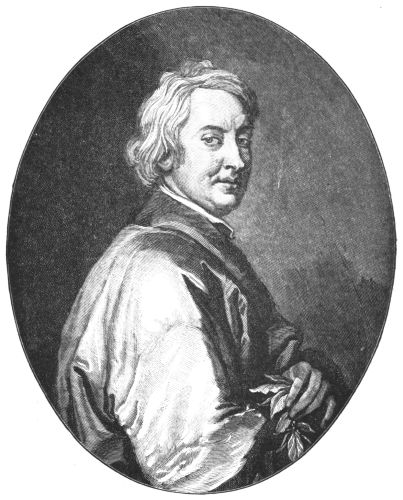
JOHN DRYDEN. (After the Portrait by Sir Godfrey Kneller.)
William now despatched to England orders to
his ambassador, Dykvelt, to use his endeavours to
knit up the different sections of the discontented
into one paramount interest in his favour. The
scattered elements of an overwhelming power lay
around the throne, which James, by his blind folly
and tyranny, had made hostile to himself, and
prepared ready to the hand of a master to combine
for his destruction. Danby, who had fallen in
the late reign for his opposition to the French
influence, and who had been the means of uniting
Mary to William, had regained extensive influence
amongst both Tories and Whigs, and was driven
by James into determined opposition. Halifax,
who had been the chief champion of James's accession
by opposing the Exclusion Bill, and whose
dangerous eloquence made him especially formidable,
had been dismissed and neglected by him.
Finch, Earl of Nottingham, a zealous Tory and
Churchman, and one of the most powerful orators
of the House of Lords, he made his enemy by his
dismissal of his younger brother from the post of
Solicitor-General for not acquiescing in the king's
dispensing powers, and by his attacks on the
Church and the Constitution. The Earl of Devonshire
he had managed, by imprisonment and a
monstrous fine, equally to disgust; and the Earl
of Bedford he had completely alienated by
the execution of his son, Lord William Russell.
Compton, the Bishop of London; Herbert, lately
Rear-Admiral of England; Clarendon, Rochester,
Lumley, Shrewsbury, had all, by a most insensate
folly, been offended by dismission and private injuries.
There was not a man of any talent or
influence whom this fatuous tyrant had not driven
from him in his obstinate resolve to set Romanism
and despotism along with him on the throne, except
Lord Churchill, upon whom he continued to
heap favours, but who was too worldly-wise not to
see that his benefactor was running headlong to
ruin, and who was by no means the man to share
ruin out of gratitude. Dykvelt executed his
mission so well, that in four months he returned
to the Hague with a packet of letters in his possession
from all those noblemen, bishops, and
others, including Admiral Russell, the cousin of
the decapitated Lord William Russell, promising
William their most enthusiastic support. From the
Princess Anne, who was bound up heart and soul
with Churchill and his clever wife—afterwards the
celebrated Sarah, Duchess of Marlborough—her
sister Mary also received the most cordial assurances
that nothing should induce her to abandon
her religion, or her attachment to her sister's
rights.
Dykvelt returned from England on the 9th of
June; and, to continue the effect produced in that
country, on the 8th of August another agent in
the person of General Zulestein was despatched
thither. His ostensible mission was to offer an
address of condolence on the death of the queen's
mother, the Duchess of Modena; but his real one
was to strengthen the connection with the malcontents,
which he could the more unsuspectedly
do from his military character, and from his
having taken no particular part in diplomacy.
Zulestein was completely successful; but these
proceedings could not entirely escape James or his
envoy at the Hague, the Catholic Marquis of
Abbeville, who succeeded in getting Burnet, the
active adviser of William, removed from open
intercourse with the Court. But Burnet was still
not far off, and through his chief counsellors,
Bentinck and Halweyn, William still consulted
with him on every step of the plans regarding
England. James also sought to reach William
through Stewart, a Scottish lawyer, who had fled
from his persecutions of the Covenanters to the
Hague, but who, on the appearance of the Declaration
of Indulgence, most suddenly went to the
king's side, in hopes of promotion. Stewart wrote
a letter to Fagel, the Grand Pensionary, who had
great influence with William, which he confessed
was at the suggestion of the king, strongly urging
him to use his power with William to persuade
him to support James's act; but Fagel, with a
dexterous policy, replied in another letter, stating
that the prince and princess were advocates for
the most ample toleration, but not for the abolition
of the Test, or of any other Act having the
inviolability of the Anglican Church for its object.
This was calculated to satisfy the Catholics
of every privilege which they could reasonably
expect from the laws and the public opinion of
England, whilst it fully assured the Church of its
safety under William and Mary.
Every fresh movement thus contributed to
strengthen the position of William, and to show
to James, had he had sufficient mind to comprehend
it, how completely his conduct had deprived
him of the confidence of his subjects. Even the
Pope took no pains to conceal how suicidal he
deemed his policy. He would have sufficiently
rejoiced in any rational prospect of the return of
England to the Church of Rome, but he was not
dull enough to imagine the sentiment of the king
the sentiment of the nation; on the contrary, he
was persuaded that the rash cabals of the Jesuits
were inevitably hastening a crisis which must the
more deeply root the Anglican antipathy to
Popery. James had despatched Castlemaine as
ambassador to Rome with a splendid retinue. It
was not enough that this open affront was done to
his country by sending a Catholic ambassador to
the Pope, and in the person, too, of a man who
had no distinction except the disgraceful one of
having purchased his title by the prostitution of
his wife; but Castlemaine was deputed to solicit
a dispensation from Innocent for Father Petre to
receive the Episcopal dignity, which was forbidden
to a Jesuit. James contemplated nothing less
than making Petre Archbishop of York, which see
he kept vacant for the purpose; but the Pope was
too much at enmity with the Jesuits, as well as
with James for his impolitic conduct, and his
alliance with the great French aggressor, to concede
any such favour. Castlemaine, who was
living in pomp at Rome, threatened to take his
departure if this request was not granted, and
Innocent only sarcastically replied by bidding him
start in the cool of the morning, and take care of
his health on the journey.
This discourtesy shown him by the head of that
religion for which he was putting everything to
the hazard, had, however, only the effect of
further raising the pugnacity of James. He
determined only the more to honour and exalt
Popery in England. The nuncio, Adda, had been
made Archbishop of Amasia—a mere title of
honour, in consequence of James's desire that he
should be publicly acknowledged at his Court.
Hitherto both he and the Vicar-Apostolic, Leyburn,
had been instructed by the Papal Court to
keep a careful incognito; but James would no
longer consent to this; and, accordingly, on the
1st of May, 1686, Adda had been publicly consecrated
at Whitehall, by the titular Archbishop
of Ireland, assisted by Leyburn, the Vicar-Apostolic.
In the evening of that day the
nuncio was received into the royal circle, in the
queen's apartments; and James shocked and disgusted
his courtiers by falling on his knees before
him and imploring his blessing. It was the first
time that an English Court had seen their
monarch, for a very long period, doing homage at
the feet of a Papal nuncio, and the effect was
humiliating. On the 3rd of July the nuncio was
favoured with a public reception at Windsor. He
went thither attended by a numerous procession
of the ministers and of officials of the Court,
and was conveyed in a royal coach, wearing a
purple robe, and a brilliant cross upon his breast.
In his train were seen with surprise and contempt
the equipages of Crewe, Bishop of Durham, and
Cartwright, Bishop of Chester. The Duke of
Somerset, as First Lord of the Bedchamber,
was expected to introduce him; but he declined,
representing the penalties to which the act would
expose him. This refusal was the less expected,
because he had not objected to carry the sword of
State before his Majesty when the king had gone
to the royal Papal chapel. James was indignant.
"I thought," he said, "that I was doing you a
great honour by appointing you to escort the
minister of the first of all crowned heads."
Somerset, moved to a firmness of demeanour and
language unusual even in him, declared that he
dared not break the law. James replied, "I will
make you fear me as well as the law. Do you
not know that I am above the law?" "Your
Majesty," replied Somerset, with commingled
dignity and affected humility, "may be above the
law, but I am not; and I am only safe while I
obey the law." The king, not used to being
thwarted, much less to language of so plain a sort,
turned from him in a rage, and the next day
issued a decree depriving him of his posts in the
Household and of his command in the Guards.
This most impolitic conduct James followed,
on the 1st of February, 1687, by a still more
absurd and ludicrous, but equally mischievous,
reception. It was that of Cocker, an English
Benedictine monk, who, being more deeply implicated
in treason than his friends cared to confess,
had narrowly escaped with his life in the
trials of the Popish plot. This man the Elector
of Cologne had appointed his Resident at the
English Court—probably at the suggestion of
James, and in defiance of public opinion; and
James now insisted that he should receive a
public introduction to Court, in the habit of his
order, and attended by six other monks in a like
costume. Thus James took a pleasure in violating
the laws and insulting public opinion at every
turn, to show that he was independent of both;
and he now prepared to commence in earnest the
destruction of the Church.
Before advancing to this dangerous experiment,
however, he deemed it necessary to tighten the
discipline of the army, which had shown no little
disgust at his proceedings.
Many of James's soldiers had deserted, and it
was found that they were under no oath or
obligation which rendered such desertion liable to
serious punishment. But James determined to
punish them, even condignly, in order to strike a
sufficient terror into the whole army. He consulted
the judges as to whether he did not possess
this power; they said that he did not. Instead of
accepting this answer, James dismissed Herbert,
the Chief Justice of the King's Bench, Sir John
Holt, another judge of the same bench and Recorder
of London, and put in their places Sir
Robert Wright, a creature of Jeffreys', a man of
ruined and base character, Richard Allibone,
and Sir Bartholomew Shower as Recorder. With
these infamous instruments he went to work; and,
instead of trying the offenders by court-martial,
he brought them before these men in the King's
Bench and in the Old Bailey, and hanged them in
sight of their regiments. By these outrages on
every law and principle of constitutional safety
James thought he had terrified the army into
obedience; and he now attacked the very existence
of the Universities, in order to give the
education of the country into the hands of Popery.
James commenced his encroachments on the
Universities by ordering one Alban Francis, a
Benedictine monk, to be admitted a Master
of Arts of Cambridge. That many persons
not strictly admissible by the rules of the University
had received honorary degrees, including
foreigners of different forms of faith, and even a
Turk, was indisputable; but the object of these
favours was so clear that no mischief could arise
from the practice. But now the Universities
were but too well aware that James aimed at a
thorough usurpation of these schools by the
Catholics to lightly pass the matter by. The
heads of colleges sent hastily to Albemarle, their
Chancellor, begging him to explain to the king
that the person named could not be admitted
according to the statutes; at the same time they
conceded so far as to offer to admit Francis on
his taking the Oaths of Supremacy and Obedience.
He refused. James menaced the authorities, but
in vain, and he summoned them before the High
Commission Court. John Pechell, the Vice-Chancellor
of the University, attended by eight
fellows, including the illustrious Isaac Newton—afterwards
Sir Isaac—appeared, and were received
by Jeffreys with all his devilish bluster. Pechell
was soon terrified at this most brutal monster,
whose employment alone would have sufficiently
stamped the character of James; and, when any
of the other fellows attempted to speak, Jeffreys
roared out, "You are not Vice-Chancellor; when
you are, you may talk; till then, hold your
tongue." Finding, however, that, though he could
embarrass, he could not bend the Vice-Chancellor,
Jeffreys, by order of James, declared Pechell dismissed
from the office of Vice-Chancellor, and all
his emoluments suspended. This was a gross
violation of the rights of the University, and
Jeffreys added to the outrage a piece of his
usually blasphemous advice to the fellows—"Go
your way and sin no more, lest a worse thing
befall you."
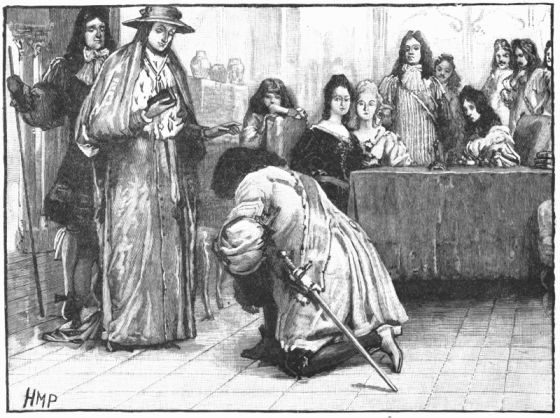
JAMES DOING HOMAGE TO THE PAPAL NUNCIO. (See p. 323.)
The decease of the President of Magdalen
College, Oxford, enabled James to follow up his
plans without loss of time. Magdalen was one
of the very richest of the English foundations, and
consisted of a president, forty fellows, and thirty
scholars, called Demies. It was the law of the
foundation that the President could only be
elected from those who were or had been members
of that college, or of New College. The President
died in March, 1687, and the 13th of April was
fixed for the election of the new one. A Dr.
Smith, a learned Orientalist, and an enthusiastically
loyal man, applied for the royal consent,
but was informed that the king was determined to
give it only to one of his own religion; and, to
the astonishment and disgust of the college, one
Anthony Farmer was named as the royal nominee.
The choice seemed made to insult the University
in the highest degree possible, for not only was
Farmer a Popish convert, but a man of the most
drunken, debauched, and infamous character that
could have been picked from the vilest haunts of
unnamable wickedness. The astounded fellows
humbly but earnestly remonstrated, but in vain.
On the appointed day, despite the king's positive
injunctions, and the presence of his agent, the
choice fell on a distinguished and highly virtuous
member of the college, John Hough.
The irate king summoned the fellows before the
beastly Jeffreys and the High Commission, as he
had summoned the heads of the University of
Cambridge. There Jeffreys exhibited his wonted
display of insufferable Billingsgate; and when Dr.
Fairfax, one of the fellows, had the boldness to
call in question the legality of the High Commission,
he lost all patience. "Who is this man?
What commission has he to be impudent here?
Seize him; put him into a dark room. What
does he do without a keeper? He is under my
care as a lunatic. I wonder nobody has applied to
me for the custody of him." But, after all, the
character of Farmer was shown to be so vilely
reprobate, that he was dropped, and the college
ordered to receive Dr. Parker, Bishop of Oxford.
Parker was not an openly acknowledged Papist,
but was understood to be really one; but he was
neither a fellow of Magdalen nor of New College,
and the fellows were firm enough to stand by their
own election of Dr. Hough. James determined
to go in person to Oxford and overawe these
obstinate men; and he was the more bent upon it,
having in the meantime suffered a similar defeat
in endeavouring to force a Catholic into the
hospital connected with the Charterhouse School.
The trustees refused, and were called before
Jeffreys. There he began browbeating the master,
Thomas Burnet, but was unexpectedly opposed by
the venerable Duke of Ormond. At this the
bully swagger of this most hideous and contemptible
judge that ever sat on a bench at once
gave way, for he had no real courage. He stole
from the court, and the scheme failed for the day.
But the High Commission having sentenced
Hough to be deposed from the presidentship of
Magdalen, and Fairfax from his fellowship,
again met, and summoned the trustees of the
Charterhouse. Here again they were awed by a
letter addressed to the king, signed by the
trustees, including the names of Ormond, Halifax,
Danby, and Nottingham, the chiefs of all the
great parties who secured to James his crown, and
still by their forbearance kept it on his head, so
that they were compelled to pause before proceeding
farther.
On the 16th of August James set out on a progress,
with every display of royal state which
could impress on the minds of his subjects an idea
of his kingly position. He proceeded to Portsmouth,
Southampton, Bath; thence by Gloucester
and Worcester to Ludlow, Shrewsbury, and
Chester; whence he again turned south, and
reached Oxford on the 3rd of September. Everywhere
he had been attended by the High Sheriffs
of the counties with splendid retinues; and the
clergy in the towns had flocked around him in
great numbers, though he continued on his progress
to neglect their preaching for Mass. If outward
circumstances could be relied on, it might
have been supposed that the king had never been
more popular; and, with all the prestige of this
tour, he summoned the refractory fellows of Magdalen
before him, and rated them soundly on
their disobedience. They knelt and offered him a
petition, but he haughtily refused to look at it,
bidding them go that instant and elect the Bishop
of Oxford, or expect his high displeasure. But
the fellows could not be thus brought to submission,
and James quitted the town in high
dudgeon.
On the 20th of October James sent down a
special commission, consisting of Cartwright,
Bishop of Chester, Wright, Chief Justice of the
King's Bench, and Jenner, a baron of the Exchequer,
attended by three troops of cavalry, with
drawn swords, to Oxford, to expel Hough and
instal Parker. Parker was installed, but the fellows
would not acknowledge him. James, therefore,
ejected them altogether. In a few weeks Parker
died, and then the king proceeded to put
the whole college into the hands of Papists, appointing
Gifford, one of the four vicars-apostolic,
president; for now, in the regular progress of his
system, James had admitted four vicars-apostolic
instead of one, which had been the case
before. It may be imagined what resentment
this arbitrary proceeding occasioned, not only in
the Universities themselves, but amongst the clergy
in every quarter of the kingdom, who now saw
that nothing would deter the king from uprooting
the deepest foundations of the Church.
Still more daring and atrocious schemes were
agitated by James and his Popish cabal. Soon
after his accession it had been proposed to set
aside the claims of the Princess of Orange, and
make Anne heir-apparent, on condition that
she embraced Popery. Anne refused. It was
then proposed to make over Ireland to Louis of
France in case Mary of Orange could not be prevented
from succeeding to England; and Louis expressed
his assent to the proposal. Tyrconnel was to
make all necessary preparations for this traitorous
transfer. But at this moment a new light broke
on James, which quashed these unnatural and
unnational projects: the queen was declared pregnant.
The news of this prospect was received by
the public with equal incredulity and suspicion.
The queen had had several children, who had died
in their infancy; and there was nothing improbable
in the expectation of another child, although
five years had elapsed since her last confinement.
The prospect of an heir, however, true or false,
drove James on further and more desperate
projects. Should a son be born, and live,
which none of the queen's children had done
hitherto, the Popish heir would be exposed to
the danger of a long minority. James might die
before the son had been firmly rooted in the
Catholic faith, and the Protestant bishops and
nobles would surround him with Protestant instructors,
and most likely ruin all James's plans
of perpetuating Popery. To obviate this, he determined
to have an Act of Parliament, settling
the form of the child's guardianship and education,
and vesting all the necessary powers in Catholic
hands. Any prudent man would at least have
waited to see the birth and probable life of the
child before rushing on so desperate a scheme; for,
to have an Act, he must call a Parliament; and
to call a Parliament in the present feeling of
the nation was to bring together one of the most
determinedly Protestant assemblies of men that
had ever been seen. But James was of that mole-eyed,
bigot character which rushed headlong on the
most perilous issues. He determined to pack a
Parliament by means which none but a madman
would have attempted. Whether from county or
borough, he could expect nothing but a most obstinate
and universal demonstration in favour of
the Church and Constitution. His brother Charles,
for his own purposes, had deprived the towns of
their charters, because they were Whig and often
Nonconformist, and had given them others, which
put them into the hands of the Tories and Churchmen,
and these were the very men who now would
resist James's plans to the death. The country
was equally Church and Tory, but all this did not
daunt James. He determined to remodel the corporations,
and to change every magistrate in the
counties that was not ready to carry out his
views. He appointed a Board of Regulators at
Whitehall to examine into the state of the corporations
and introduce new rules and new men as
they thought fit. These regulators were seven in
number, and all Catholics and Jesuits, except the
king's incarnate devil, Jeffreys. These men appointed
deputations of chosen tools to visit the
different corporations, and report to them; and
James issued a proclamation announcing his intention
to revise the commissions of the peace, and
of the lieutenancy of counties. In fact, James
proceeded like a man who was satisfied that he
could do just as he pleased with the Constitution
of a country which, through all ages, had shown
itself more jealous of its Constitution than any
other in the world.
He sent for the lords-lieutenants, and delivered
to them a paper of instructions, with which they
were each to proceed to their several counties.
They were to summon all the magistrates, and
tell them what his Majesty expected from them on
the ensuing election of Parliament, and to send
him up their individual answers, along with the
list of all the Catholic and Dissenting gentlemen
who might take the place of those who should
dare to object to the king's plans on the bench or
in the militia. The proposal was so audacious,
that the greater proportion of the lords-lieutenants
peremptorily refused to undertake any such commission;
these included the noblest names in the
peerage, and they were at once dismissed. The
sweeping measure of turning out the Duke of
Somerset, the Viscounts Newport and Falconberg,
the Earls of Derby, Dorset, Shrewsbury,
Oxford, Pembroke, Rutland, Bridgewater, Thanet,
Abingdon, Northampton, Scarsdale, Gainsborough,
and many others, showed how far James was gone
in his madness. As the king could not get any
noblemen to take the places of the dismissed, he
filled them up as he could, and even made his
butcher, Jeffreys, lord-lieutenant of two counties.
But all was in vain; he soon received answers
from every quarter that the whole nation, town
and country, absolutely refused to obey the king's
injunctions. Even those who had gone most zealously
to work were obliged to return with most
disconsolate reports, and to assure the king that, if
he turned out every magistrate and militia officer,
the next would still vote against Popery. Catholics
and Nonconformists, though glad of indulgence,
would not consent to attempt measures
which could only end in defeat and confusion.
The Nonconformists would not move a finger to
endanger Protestantism. It was the same in the
corporations. Some of these James could deprive
of their charters, for the new ones frequently contained
a power of revocation; but when he had
done this he found himself no forwarder, for the
new ministers upon the points that he had at
heart were as sturdy as the old. Other towns
from which he demanded the surrender of their
charters refused. Wherever James could eject
the Church members of corporations he did so,
from London to the remotest borough, and put in
Presbyterians, Independents, and Baptists. It was
perfectly useless; they were as Protestant as the
Church. Even where he obtained a few truckling
officials, they found it impossible to make the
people vote as they wished; and in the counties
the Catholic or Dissenting sheriffs were equally indisposed
to press the Government views, or unable
to obtain them if they did. He changed the
borough magistrates in some cases two or three
times, but in vain. Some of the people in the
towns did not content themselves with mere passive
resistance; they loudly declared their indignation,
and the tyrant marched soldiers in upon them;
but only to hear them exclaim that James was
imitating his dear brother of France, and dragonading
the Protestants.
Whilst these things were going on all over the
country, James was putting on the same insane
pressure in every public department of Government.
The heads of departments were called on
to pledge themselves to support the wishes of the
king, and to demand from their subordinates the
same obedience. The refractory were dismissed,
even to the highest law officers of the Crown; and
James demanded from the judges a declaration
that even the Petition of Right could not bar the
exercise of his prerogative; but the bench consulted
in secret, and the result was never known.
He even contemplated granting no licences to
inns, beer-houses, or coffee-houses, without an engagement
to support the king, in spite of Church
or magistrate; but another of his measures now
brought things to a crisis.
James determined to make his intentions known
for fully restoring Popery by a new Declaration of
Indulgence, in which he reminded his subjects of
his determined character, and of the numbers of
public servants that he had already dismissed for
opposing his will. This Declaration he published
on the 27th of April, 1688, and he ordered the
clergy to read it from all pulpits in London on the
20th and 27th of May, and in the country on the
3rd and 10th of June. This was calling on the
bishops and clergy to practise their doctrine of
Non-resistance to some purpose; it was tantamount
to demanding from them to co-operate in the overthrow
of their own Church. They were, as may
be supposed, in an awful dilemma; and now was
the time for the Dissenters—whom they had so
sharply persecuted and so soundly lectured on the
duty of entire submission—to enjoy their embarrassment.
But the Dissenters were too generous,
and had too much in common at stake. They
met and sent deputations to the clergy, and exhorted
them to stand manfully for their faith, declaring
that they would stand firmly by them. A
meeting of the metropolitan clergy was called, at
which were present Tillotson, Sherlock, Stillingfleet—great
names—and others high in the
Church. They determined not to read the Declaration
on the 20th, and sent round a copy of this
resolution through the City, where eighty-five incumbents
immediately signed it.
The bishops meanwhile met at Lambeth, and discussed
the same question. Cartwright of Chester,
one of the king's most servile tools, and a
member of the High Commission, took care to be
there, to inform the king of what passed; but
during his stay nothing but a disposition to compliance
appeared to prevail, and he hurried away
to Whitehall with the news. No sooner, however,
was he gone than letters were secretly despatched,
summoning the bishops of the province of Canterbury;
and another meeting took place on the 18th,
or two days prior to the Sunday fixed for the
further reading of the Declaration. The bishops
concluded not to read it, and six of them waited
on the king with the written resolution. James
was confounded, having assured himself that they
meant to comply. He used the most menacing
language, and declared that they had set up the
standard of rebellion; and ordered them from his
presence to go at once and see that he was
obeyed. To prevent the publication of the resolution,
he detained it; but that very evening it
was printed and hawked through the streets, where
it was received with acclamations by the people.
Any but a mad bigot, seeing the feelings of the
public, would have instantly revoked the declaration;
but James was not that man. Sunday
arrived, and out of all the hundred churches, the
Declaration was only read in four, and with the
effect of instantly clearing them, amid murmurs of
indignation. Still it was not too late to recall the
Order in Council; and even James himself, with
all his folly and infatuation, was now staggered.
It was strongly recommended in the Council to
abandon the Declaration; but James listened to
his evil genius, the brutal Jeffreys, and determined
to bring the seven signing bishops to trial before
the Court of King's Bench, on a charge of seditious
libel. The fatal counsel was adopted, and
they were summoned to appear before the Privy
Council on the 8th of June.
In the interval the bishops and clergy in all
parts of England, with few exceptions, showed
the same resolute spirit. The Bishops of Gloucester,
Norwich, Salisbury, Winchester, Exeter,
and London, signed copies of the same petition.
The Bishop of Carlisle regretted that, not belonging
to the province of Canterbury, he could not
do the same. The Bishop of Worcester refused
to distribute the Declaration amongst his clergy;
and the same spirit showed itself amongst the
parochial clergy, who almost to a man refused to
read it.
On the evening of the day appointed, the seven
prelates—namely, Sancroft, the Archbishop of
Canterbury, Lloyd of St. Asaph, Ken of Bath
and Wells, Turner of Ely, Lake of Chichester,
White of Peterborough, and Trelawney of Bristol—attended
the Privy Council. Jeffreys took up the
petition, and, showing it to Sancroft, asked him
if that was not the paper which he had written,
and the six bishops present had signed. Sancroft
and his colleagues had been instructed by the
ablest lawyers in England as to the course they
should pursue, and the dangers to be avoided.
The Primate, therefore, instead of acknowledging
the paper, turned to the king and said—"Sir, I
am called hither as a criminal, which I never was
before; and, since I have that unhappiness, I
trust your Majesty will not be offended if I decline
answering questions which may tend to criminate
me." "This is mere chicanery," said James. "I
hope you will not disown your own handwriting."
Lloyd of St. Asaph said that it was agreed by all
divines that no man in their situation was obliged
to answer any such question; but, as James still
pressed for an answer, Sancroft observed that,
though he were not bound to accuse himself, yet,
if the king commanded it, he would answer,
taking it for granted that his Majesty would not
take advantage to bring his admission there in
evidence against him. James said he would not
command him; but Jeffreys told them to withdraw
for awhile, and when they were called back,
James commanded the Primate, and he acknowledged
the writing. They were then again sent
out, and, on coming back, were told by Jeffreys
that they would be proceeded against, not before
the High Commission, but, "with all fairness,"
before the King's Bench.
They were then called upon to enter into recognisances,
but they refused, on the plea that they
were peers of Parliament, and that no peer of
Parliament could be required to enter into recognisances
in case of libel. This greatly disconcerted
James, for it compelled him to send them
to prison, and he justly feared the effect of it on
the public. But there was no alternative; a
warrant was signed for their commitment to the
Tower, and they were sent thither in a barge.
The scene which immediately took place showed
that James had at length a glimmering of the
danger which he had raised. The whole river
was crowded with wherries full of people, who
crowded round the bishops to entreat their blessings,
many rushing breast-high into the water to
come near enough. James, in terror, ordered the
garrison and guards of the Tower to be doubled;
but the same spirit animated the soldiers, who
knelt at the approach of the prelates, and also
solicited their blessing. Presently the soldiers
were found carousing to the health of their
prisoners; and when Sir Edward Hales, who had
been made Lieutenant of the Tower for his going
over to Popery, desired the officers to put a stop
to it, they returned and told him that it was impossible,
for the soldiers would drink nobody's
health but the bishops'. Every day the gates of
the Tower were besieged by the equipages of the
chief nobility. The very Nonconformists came in
bodies to condole with their old persecutors; and
Tower Hill was one constant throng of people
manifesting their sympathy.
Two days only after the bishops were sent to
the Tower—namely, the 10th of June—was announced
what, under other circumstances, would
have been a most auspicious event for James—the
birth of an heir. But the nation was so full of
suspicion, both of the monarch and the Jesuits
that he had around him, that it would not credit
the news that the healthy boy which was born
was the actual child of James and his queen. It
was certainly of the highest moment that James
should have taken every precaution to have the
birth verified beyond dispute; but in this respect
he had been as singularly maladroit as in all his
other affairs. As the Protestants were, of course,
highly suspicious, he should have had the usual
number of Protestant witnesses ready. But the
queen, who sat playing cards at Whitehall till
near midnight, was suddenly taken ill a month
before the calculated time, and there was neither
the Princess Anne present—she was away at
Bath,—nor the Archbishop of Canterbury, nor the
Dutch ambassador—whom it was so necessary to
satisfy on behalf of the Prince and Princess of
Orange,—nor any of the Hyde family, not even
the Earl of Clarendon, the uncle of Mary and
Anne. On the contrary, there were plenty of
Jesuits, and the renegades Dover, Peterborough,
Murray, Sunderland—who directly afterwards
avowed himself a Catholic—Mulgrave, and others.
The consequence was that the whole people declared
the child spurious; that it had been introduced
into the bed in a warming-pan; and when
the public announcement was made, and a day of
solemn thanksgiving was appointed, there was no
rejoicing. Fireworks were let off by order of
Government; but the night was black and tempestuous,
and flashes of lurid lightning paled the
artificial fires, and made the people only the more
firm in the belief that heaven testified against the
imposture. And yet there was no imposture.
There were some Protestants present—sufficient
to prevent any collusion, and particularly Dr.
Chamberlain, the eminent accoucheur; but James,
by his folly and tyranny, had deprived himself of
the public confidence, and fixed on his innocent
offspring a brand of disavowment, which clung to
him and his fortunes, and has only been removed
by the cooler judgment of recent times. William
of Orange sent over Zulestein to congratulate
James on the birth of an heir; but that minister
brought back the account that not one person in
ten believed the child to be the queen's.
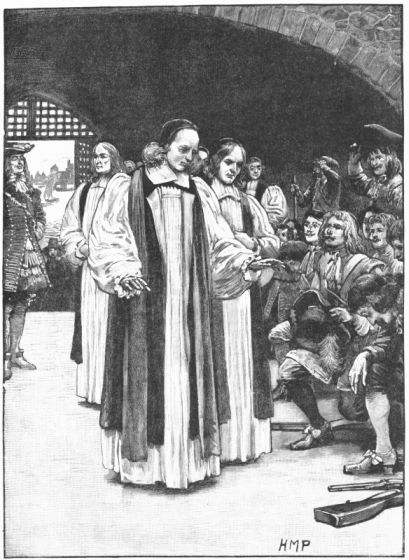
THE SEVEN BISHOPS ENTERING THE TOWER. (See p. 328.)
On Friday, the 15th of June, the first day of
term, the bishops were brought from the Tower to
the King's Bench, and, pleading not guilty, they
were admitted to bail till the 29th of June.
During this fortnight the public excitement continued
to augment, and from every quarter of the
kingdom—even from the Presbyterians of Scotland,
who had shown themselves such determined
opponents of prelacy, and had been such sufferers
from it—came messages of sympathy and encouragement
to the bishops. On that day immense
crowds assembled to receive their blessings, and to
utter others on their way to Westminster Hall;
and this homage was the warmer because the prelates
had resisted the demand of Sir Edward
Hales, the Lieutenant of the Tower, for his fees,
this renegade having shown them little courtesy,
and now plainly letting them know that, if they
came again into his hands, they should lie on the
bare stones.
Every means had been taken to pack a jury.
Sir Samuel Astrey, the Clerk of the Crown, had
been summoned to the palace, and been instructed
by James and his great legal adviser, Jeffreys.
The judges, too, were of the most base and complying
character. They were such as had been
raised from the very lowest ranks of the bar for
their servile fitness, and because the more eminent
lawyers would not stoop to such ignominy. They
were Wright; Allibone, a Papist; Holloway and
Powell; the Attorney-General, Sir Thomas Powis,
an inferior lawyer; the Solicitor-General, Sir
William Williams, a man of ability and vigour,
but rash, imperious, and unpopular. Ranged
against these were the most brilliant lawyers of
the time—Sawyer and Finch, formerly Attorney- and
Solicitor-General; Pemberton, formerly Chief
Justice; Maynard; Sir George Treby, who had
been Recorder of London, and others. Somers,
afterwards Lord Chancellor in William's reign,
was the bishops' junior counsel. The foreman of
the jury was Sir Roger Langley. On the side
of the prosecution, the judges, and even the
blustering Jeffreys, betrayed a sense of terror.
The trial commenced at nine in the morning,
and not till seven in the evening did the jury
retire to consider their verdict. The lawyers for
the prisoners raised great difficulties as to proving
the handwriting of the libel, and next in proving
its being published in Westminster. The Crown
lawyers were obliged to bring into court Blathwayt,
a clerk of the Privy Council, for this object; and
then the counsel for the prisoners stopped him, and
compelled him to state what had passed there between
the bishops and the king—much to the
chagrin of the Government party. Before the
publication could be proved, even Sunderland was
obliged to be brought into court in a sedan. He
was pale, trembled violently from fright and
shame of his late apostacy, and gave his evidence
with his eyes fixed on the ground. But even then,
when the judges came to consider the bishops'
petition, they were divided in opinion. Wright
and Allibone declared it a libel, and contended for
the royal right of the dispensing power; but Holloway
conceded that the petition appeared to him
perfectly allowable from subjects to their sovereign;
and Powell set himself right with the
public and wrong with the Court—a significant
sign—by boldly declaring both the Dispensing
Power and the Declaration of Indulgence contrary
to law.
With such sentiments developing themselves on
the bench, there could be little doubt what the
verdict would be; yet the jury sat all night, from
seven o'clock till six the next morning, before
they were fully agreed, there being, however, only
three dissentients at first. When the court met at
ten o'clock, the crowd, both within and without,
was crushing and immense; and when the foreman
pronounced the words "Not guilty," Halifax
was the first to start up and wave his hat; and
such a shout was sent up as was heard as far
as Temple Bar. The news flew far and wide; the
shouting and rejoicing broke out in every quarter
of the town. The whole population, nobility,
clergy, people, all seemed gone mad. There were
more than sixty lords who had stood out the trial,
and now threw money amongst the throngs as they
drove away. The people formed a line down to
the water's edge, and knelt as the bishops passed
through, asking their blessing. The Attorney-General,
Williams, was pursued in his coach with
curses and groans; and Cartwright, the Bishop of
Chester, and James's tool of the High Commission,
being descried, was hooted at as "That wolf in
sheep's clothing!" and, as he was a very fat man,
one cried, "Room for the man with the Pope in
his belly!"
The whole town was in an intoxication of delight.
Bonfires were lit, guns fired, bells rung all
night, and the Pope in effigy was burnt in several
places—one before the door of Whitehall itself;
another was kindled before the door of the Earl of
Salisbury, who had lately gone over to Popery;
and his servants, in their ill-timed zeal, rushing
out to extinguish it, were attacked, and, firing on
the people, killed the parish beadle, who was come
to attempt what they themselves were attempting—to
put out the fire. That morning James had
gone to review his troops on Hounslow Heath.
He received the news of the acquittal by a special
messenger while in Lord Feversham's tent. He
was greatly enraged, and set out at once for
London. Before, however, he was clear of the
camp the news had flown amongst the soldiers,
and a tremendous cheering startled him. "What
noise is that?" demanded James. "Oh!" said
the general, "it is nothing but the soldiers
shouting because the bishops are acquitted."
"And call you that nothing?" asked James;
and added angrily, "but so much the worse for
them."
The very day which pronounced the acquittal of
the bishops saw signed and despatched an invitation
from the leading Whigs to William of Orange to
come over and drive the tyrant from the throne.
The Whigs had long been contemplating and preparing
for this end; they now saw that the crisis
was come. The brutal and besotted king had effectually
alienated all hearts from him. From him
nothing but destruction of every liberty and sentiment
that Englishmen held dear was to be expected;
and in the heir which was now, as was
generally believed, foisted on the nation by the
king and the Jesuits, there was only the pledge
of the reign of Popery and proscription, and of
the extermination of all those high hopes and
privileges which were entwined with Protestant
freedom. The Whig leaders had sent repeatedly to
William to stimulate him to the enterprise; but,
apart from his habitual caution and the salutary
fear that Monmouth's reception had inspired,
the Prince of Orange had many difficulties to contend
with from the peculiar constitution of the
Dutch Republic, and the peculiar views and interests
of his allies. Though at the head of the
Dutch confederation, he had always experienced
much opposition from individual states and cities,
especially Amsterdam, which his great enemy,
Louis of France, managed to influence. This invitation
called him to expel from his throne a
Catholic king, and replace his Government by a
Protestant one, though the Pope and Spain, the
most Catholic of countries, were his close allies,
and must not be offended. He had, therefore,
stipulated that he should receive such an invitation
under the hands and seals of the Whig leaders as
should leave little doubt of his reception, and that
he should be regarded as the saviour from an intolerable
ruler, and not forced to attempt a conquest
which must in its very success bring ruin by
wounding the national pride of England.
He now received a paper, signed by the Earls of
Shrewsbury, Devonshire, and Danby, Lord Lumley,
Bishop Compton, Edward Russell, the Admiral of
England, and Henry Sidney, the brother of the
late Algernon Sidney, and afterwards Earl of
Romney. This paper, which had been furnished
at William's request, was but the result of negotiations
between himself and the Whig leaders
for some time. He now called into council with
the English envoy his confidential friends, Bentinck
and Dykvelt, and it was resolved that
the time for action was come, and that the invitation
should be accepted. In the meantime, whilst
William began in earnest, but as secretly as circumstances
would allow, his preparations, James
at home did everything which a foolish and obstinate
ruler could do to complete the alienation of
the affections of his subjects. He returned from
his camp to his capital only to find it in transports
of delight over his own defeat, and resounding
with the explosions of guns and crackers,
with drinkings of the health of the bishops in the
streets, and with the effigy of the Pope blazing
before his own gate. So far from making him
pause at the contemplation of the avowed and
universal spirit of his people, he was only the more
exasperated, and continued muttering, "So much
the worse for them." He determined to take summary
vengeance on the clergy, on the lawyers who
had opposed or deserted him, on the army, and on
the people. He at once promoted Mr. Solicitor-General
Williams, for his unscrupulous conduct
on the trial of the bishops, to a baronetcy, and
would have placed so convenient a man on the
bench could he have spared him at the bar. He
dismissed Powell and Holloway; he determined to
visit with his vengeance all the clergy throughout
the kingdom who had refused to read the Declaration;
and an order was issued to all the chancellors
of the dioceses and the archdeacons to make a
return of them. No matter that they approached
ten thousand in number; if necessary, he would
drive them all from their benefices. The judges
on the circuits were ordered to denounce these refractory
clergy, and to speak in the most derogatory
terms of the bishops. He broke up his camp,
the soldiers of which had been intended to overawe
the capital, and stand by whilst he destroyed
the national Constitution and the national religion;
but had now terrified and disgusted him by
drinking the healths of the liberated bishops.
But all his angry attempts only recoiled on himself,
and showed more clearly than ever that the
reins of power were irrecoverably slipping from his
fingers. The spell of royalty—a people's respect—was
utterly broken. The chancellors and archdeacons
paid no attention to the order for reporting
their independent brethren; the High
Commission met, and, so far from finding any returns,
received a letter from one of the most
truckling of their own body, Sprat, Bishop of
Rochester, resigning his place in the High Commission.
If such a man saw the handwriting on
the wall, the warning, they felt, must be imminent,
and they departed in confusion. The judges, on
their part, found themselves deserted on their circuits;
nobody but the sheriff and his javelin men
came to meet them, and then went through their
duties amid every sign of indifference to their
dignity. They were treated, not as the high-minded
judges of England, but as the base and
venal tools of a most lawless and mischievous
monarch. The soldiers were as bold in their separate
quarters as they had been in camp. James
thought he could deal with them separately, and
tried the experiment by ordering a regiment of
infantry, which had been raised in the Catholic
district of Staffordshire, to sign an engagement to
support him in dispersing all the rest, or to quit
the army. Almost to a man they piled their arms,
and the confounded king was obliged to withdraw
the order. But James had a remedy even for the
defection of the army. In Ireland the brutal and
debauched Tyrconnel had been busily engaged in
drilling Irish Celts, and preparing an army so
strongly Catholic that he might by this means
carry out the royal design of repealing the Act of
Settlement, and driving the Protestant colonists
from their lands. These troops James sent for,
regiment after regiment, and the people of
England saw, with equal indignation and alarm,
that their liberties, their religion, their laws, were
to be trodden down, and the kingdom reduced to
a miserable abode of slaves by the wild tribes of
the sister island, vengeful with centuries of unrequited
oppressions. This put the climax to the
national resentment, and still more pressing messages
were sent over to William to hasten his
approach, and leaders of party in large numbers
contemplated a speedy transit to his standard. It
was at this juncture that the wild genius of
Wharton gave vent to the pent-up feelings of
Protestant wrath, by the adaptation of the old
Irish tune of "Lillibullero" to English words.
William, meanwhile, was making strenuous preparations
for his enterprise. He formed a camp at
Nimeguen, collecting troops and artillery from the
different fortresses. Twenty-four additional ships
of war were fitted out for service, and arms and
accoutrements were in busy preparation in every
manufactory in Holland. He had saved up
unusual funds for him, and had money also
pouring in from England and from the refugee
Huguenots, who hoped much from his enterprise
in favour of Protestantism. It was impossible
that all this preparation could escape the attention
of other nations, and especially of the quick-sighted
Louis XIV. of France. But William had a ready
answer—that he wanted an extra squadron to go
in pursuit of a number of Algerine corsairs which
had made their appearance off the Dutch coasts.
The military preparations were not so easily explained;
but though Louis was satisfied that they
were intended against England, James, blind to
his danger, as strongly suspected that they were
meant to operate against France. The only
enemies which William had to really dread were
Louis and the Council of Amsterdam, which Louis
had so long influenced to hostility to William, and
without whose consent no expedition could be permitted.
But the ambition and the persecuting
bigotry of Louis removed this only difficulty out
of William's way in a manner which looked
like the actual work of Providence. The two
points on which Amsterdam was pre-eminently
sensitive were trade and Protestantism. Louis contrived
to incense them on both these heads. His
unrelenting persecution of the Huguenots, including
also Dutch Protestants who had settled in
France, raised an intense feeling in Amsterdam,
stimulated by the outcries and representations of
their relatives there. To all appeals for tolerance
and mercy Louis was utterly deaf; and whilst
this feeling was at its height, he imposed a
heavy duty on the importation of herrings from
Holland into France. Sixty thousand persons in
Holland depended on this trade, and the effect
was, therefore, disastrous. In vain did the French
envoy, Avaux, represent these things; Louis continued
haughty and inexorable.
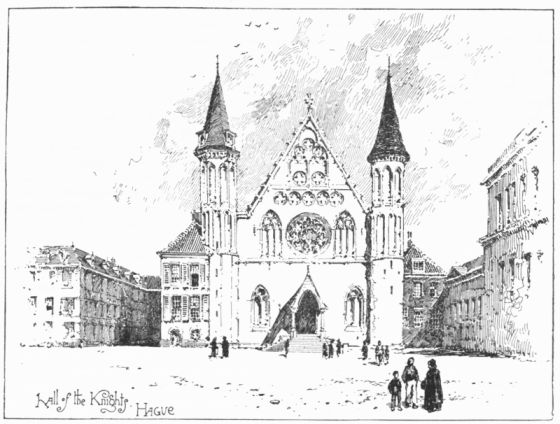
VIEW IN THE HAGUE: THE HALL OF THE KNIGHTS IN THE BINNENHOF.
These circumstances, in which the pride and
bigotry of Louis got the better of his worldly
policy, completed the triumph of William of
Orange. He seized on them to effect a removal of
the long-continued jealousies of the Council of
Amsterdam against him. He entered into negotiations
with the leading members of the Council
through his trusty friends Bentinck and Dykvelt,
and as they were in the worst of humours with
Louis, the old animosities against William were
suffered to sleep, and he obtained the sanction of
the States-General to his proposed expedition for
the release of England from the French and
Catholic influences, and its reception into the confederation
of Protestant nations. Another circumstance
just at this crisis occurred to strengthen all
these feelings in Holland and Germany, and to
account for any amount of troops collected at
Nimeguen. The aggressions of Louis had roused
and combined all Europe against him. Powers
both Catholic and Protestant had felt themselves
compelled to unite in order to repress his attempts
at universal dominion. The King of Spain, the
Emperor of Germany, the King of Sweden had
entered into the League of Augsburg to defend the
empire; and to these were added various Italian
princes, with the Pope Innocent XI. himself at
their head. Louis had not hesitated to insult
the Pope on various occasions, and now he saw
the pontiff in close coalition with heretic princes
to repel his schemes.
In May of this year died Ferdinand of Bavaria,
the Elector of Cologne. Besides Cologne, the
elector possessed the bishoprics of Liége, Münster,
and Hildesheim. In 1672 Louis had endeavoured
to secure a successor to the Elector in the French
interest. He therefore proposed as his coadjutor
the Cardinal Furstemberg, Bishop of Strasburg;
and he would have succeeded, but it was necessary,
in order to his choice, that Furstemberg
should first resign his bishopric; to this the Pope,
in his hostility to Louis, would not consent; he
refused his dispensation. But now, the Elector
having died, the contest was renewed. Louis
again proposed the cardinal; the allies of the
League of Augsburg nominated the Prince
Clement of Bavaria, who was elected and confirmed
by the Pope, though a youth of only seventeen
years of age. The allies were equally successful
in the bishoprics of Liége, Münster, and
Hildesheim; but the principal fortresses, Bonn,
Neutz, Kaiserswerth, and Rheinberg, were held
by the troops of Furstemberg, and therefore were
at the service of France. Louis was, however,
exasperated at the partial defeat of his plans, and
complained loudly of the partiality of the Pope,
and began to march troops to the support of Furstemberg.
But whilst Louis was actually planning a
sweeping descent on the German Empire, in
which William of Orange lay pre-eminently in his
way, he was at the same time in danger of a more
momentous occurrence—that of William leaving
the way open by sailing for England. If William
should succeed in placing himself on the throne of
England, he would be able to raise a far more formidable
opposition to his plans of aggrandisement
than he had ever yet done. Even with his small
resources he had proved a terrible enemy, and had
arrayed all Europe against him; what would he
do if he could bring all the powers of England by
land and sea to co-operate with Holland, Spain,
Austria, Sweden, and the Netherlands? The
stupidity of James and the offended pride of Louis
saved William in this dilemma, and led Louis to
commit on this occasion the cardinal blunder of
his reign.
It was impossible that Louis could be ignorant
of what William was doing. The preparations of
ships and troops were indications of a contemplated
attack somewhere. It might be directed
to resist the French on the side of Germany; but
other facts equally noticeable demonstrated that
the object was England. Avaux, the French
envoy at the Hague, in the absence of Abbeville,
who was on a visit to England, noticed, in the
months of April and May, a swift sailing boat,
which made rapid and frequent passages between
England and Rotterdam; and he noticed that,
after every arrival from England, there were
closetings of William and the English Whig
leaders at the Hague, especially Russell. After
the birth of the heir-apparent of England, William
despatched Zulestein to London with his professedly
warm, though they could not be very
sincere, congratulations on the event; but soon
after, on the escape to the Hague of Rear-Admiral
Herbert, who was supposed to carry the invitation
of the leading Whigs to William, the prince
omitted the child's name in the prayers for the
royal family of England, and openly expressed his
doubts of his being the real child of the queen.
These circumstances, the continued activity of
the military preparations, the constant sailings of
this mysterious boat, and the subsequent closetings,
with the continual growth of the number of
distinguished English refugees at the Hague,
satisfied the French envoy that a descent on
England was certain and nigh at hand. Avaux
not only warned Louis of the imminent danger,
but he warned James by every successive mail
from the Hague, through Barillon. Louis took
the alarm. He despatched Bonrepaux to London
to arouse James to a due sense of his peril, and
offered to join his fleet with an English one to
prevent the passage of the Dutch armament. He
held a powerful body of troops ready to march to
the frontiers of Holland, and ordered Avaux to
announce to the States-General that his master
was fully cognisant of the warlike preparations of
the Stadtholder; that he was quite aware of their
destination, and that, as the King of England
was his ally, he should consider the first act of
hostility against James as a declaration of war
against himself. He at the same time declared
the Cardinal Furstemberg and the Chapter of
Cologne under his protection. Simultaneously
the same message was delivered to the Spanish
Governor of Flanders, and Marshal d'Humières
was despatched to take the command of the
French army in that quarter.
This plain declaration fell like a thunderbolt
into the midst of the States-General. There was
the utmost evident confusion. A poor and embarrassed
excuse was made, and a courtier sent
post haste to fetch William from Minden, where
he was in secret negotiation with the Elector of
Brandenburg. If James took the alarm, and
Louis, as was his intent, went heartily into the
coalition to defeat the enterprise, it must become
a most hazardous undertaking, even if it were at
all feasible. But the folly of that most wrong-headed
of the Stuarts again saved the Prince of
Orange, and removed the last difficulty out of the
way of his enterprise. James would not believe a
word of the warning. He would not believe that
his own daughter would sanction an attempt at
his dethronement. He would not believe that
William's armament had any other object than
the King of France himself. He highly resented
the declaration of Louis that there was an alliance
between them, as calculated to alarm his own subjects,
especially his Protestant ones. He received
Bonrepaux with cold hauteur in return for his
offers of assistance; and Van Citters, the Dutch
ambassador, with proportionate cordiality, who
hastened on the part of the States to assure him
that the French communications were sheer inventions.
He gave orders that all the foreign
ministers should be informed that there was no
such league between France and England as Louis
had pretended for his own purposes.
In fact, James was living all this time in the
midst of a set of traitors, who, even to his most
confidential minister, Sunderland, had secretly
gone over to William, and were putting him in
possession of every daily thought, word, and
intention of their master. Besides the seven that
had signed, and of whom Admiral Russell was
already with William, the Earl of Shrewsbury
had fled to him, having mortgaged his estates and
taken forty thousand pounds with him, and offered
it to the prince. The two sons of the Marquis
of Winchester, Lord Wiltshire, and a younger
brother; Halifax's son, Lord Eland; Danby's son,
Lord Dumblaine; Lord Lorne, the son of the unfortunate
Earl of Argyll; Lord Mordaunt, Gerard,
Earl of Macclesfield, and Admiral Herbert were
already with him. Herbert had been appointed
Admiral to the Dutch fleet, with a pension of six
thousand pounds a year. Wildman, Carstairs,
Ferguson, Hume, who had escaped from the
Argyll and Monmouth expeditions, went there;
and, whilst the sons of Halifax and Danby were
with William, they themselves, though remaining
in England with Devonshire, Lumley, and others,
were sworn to rise in his favour the moment he
landed. But the worst of the unsuspected traitors
at his own Court were the Lords Churchill and
Sunderland. James had made Churchill almost
everything that he was; on Sunderland he had
heaped benefits without stint or measure. He had
scraped money together by all possible means;
and James did not merely connive at it, he
favoured it. This meanest of creeping things was
in the pay of France to the amount of six thousand
pounds per annum; he had a pension from
Ireland of five thousand pounds more; as President
of the Council he occupied the post of
Prime Minister, and derived immense emoluments
from fines, forfeitures, pardons, and the like.
Rather than lose his place, he had openly professed
Catholicism; but scarcely had he thus sold
his soul for his beloved pelf and power, when he
saw as plainly as any one else that the ground
was sliding from under the feet of his foolish
master, and was overwhelmed with consternation.
He hastened again to sell himself to William, on
condition that his honours and property should
be secure; and thus had James his very
Prime Minister, his most confidential and trusted
servant, at every turn drawing out all his plans
and thoughts, and sending them to his intended
invader. Sunderland's wife was the mistress of
Sidney, who was at the Hague; and, through her,
this most contemptible of men sent constantly his
traitorous communications to her paramour, and
so to William.
With such snakes in the grass about him,
James was completely blinded to his danger.
Churchill and Sunderland persuaded him that
there was no danger from Holland, and inflamed
his resentment at what they called the presumption
of Louis. They were completely successful;
and Sunderland, after the establishment
of William in England, made a boast of this
detestable conduct. Louis was so much disgusted
by the haughty rejection of his warning, that he
himself committed a gross political error. Instead
of preventing the descent on England, and the
aggrandisement of his great opponent William—by
far the most important measure for him—by
directly attacking the frontiers of Holland, and
keeping William engaged, in his vexation he
abandoned the besotted James, and made an
attack on the German Empire. Dividing his
army, one portion of it, under the Marquis of
Boufflers, seized Worms, Mainz, and Treves; a
second, under Humières, made itself master of
Bonn; and a third, under the Duke of Duras and
Marshal Vauban, took Philippsburg by storm.
The greater part of the Rhine was at once in
Louis's hands, and great was the triumph in Paris.
But not the less was the exultation of William of
Orange; for now, the French army removed, and
the mind of Louis incensed against James, the
way was wide open for him to England.
No time was now lost in preparing to depart.
A Memorial, professing to be addressed by the
Protestants of England to the States, but supposed
to have been drawn up by Burnet, was published,
accompanied by two declarations in the name
of William to the people of England and
Scotland. These latter were the work of the
Grand Pensionary Fagel, but condensed and
adapted more to the English taste by Burnet. In
the Memorial the people of England were made to
complain of the wholesale violation of the Constitution
and the liberties of his subjects by James,
and of the attempt to fix a false and Popish heir
on the nation. They called on William to come
over and vindicate the rights of his wife, and at
the same time to rescue the country of her birth
and her rightful claims from Popery and arbitrary
power.
The Declaration to England and Scotland in
reply was drawn with consummate art. William
admitted that he had seen with deep concern the
fundamental and continual violations of the laws
of the kingdom. The contempt of Acts of Parliament;
the expulsion of just judges from the
bench to make room for the servile instruments of
oppression; the introduction of prohibited persons
into both the State and Church, to the jeopardy
of freedom and true religion; the arbitrary
treatment of persons of dignity by the illegal
High Commission Court; the forcible introduction
of Papists into the colleges; the removal of lords-lieutenants,
and the destruction of corporations
which stood firmly for the rights and religion of
the nation; the attempt to impose a spurious and
Popish issue on the throne, and the equally
atrocious attempt to tread down English liberties
by an army of Irish Papists: for these reasons
William declared himself ready to comply with
the prayers of the English people, and to come
over with a sufficient force for his own protection,
but with no intention or desire of conquest, but
simply to restore freedom by an independent Parliament,
to inquire into the circumstances attending
the birth of the pretended prince, and to leave
everything else to the decision of Parliament and
the nation. He declared that he should endeavour
to re-establish the Church of England
and the Church of Scotland, and at the same
time to protect the just rights of other professors
of religion willing to live as good subjects in
obedience to the laws.
When copies of these papers were sent to
James by his ambassador, Abbeville, from the
Hague, the delusion of the affrighted monarch
was suddenly and rudely dissipated. He gazed
on the ominous documents—in which his subjects
invited a foreign prince to take possession of his
throne, and that prince, his son-in-law, accepted
the proposal—with a face from which the colour
fled, and with a violently trembling frame. Fear
at once did that which no reason, no accumulation
of the most visible signs of his vanishing
popularity could ever effect. He at once
hastened to make every concession. He summoned
his Council, and forwarded a despatch to
the Hague, declaring that he regarded the siege of
Philippsburg by Louis as a breach of the Treaty of
Nimeguen, and that he was ready to take the field
against him in conjunction with the forces of
Spain and Holland. Before an answer could be
received, James hurried forward the work of retractation.
When he looked around him there
was not a power or party that he had not
alienated—the Cavaliers and Tories who fought
for his father, and supported his brother through
a thousand arbitrary measures; the Church, the
Dissenters, the army, the navy, the bench, the
bar, the whole people, held in constant terror of
being made the abject victims of Popish domination,
he had, in his insane rage for his religion,
offended, injured, and alarmed beyond measure.
He now sought to win back the able Halifax; he
issued a proclamation, protesting that he would
protect the Church, and maintain the Act of
Uniformity; that Catholics should no longer be
admitted to Parliament or the Council. He sent
for the bishops, and asked for their earnest advice
in the restoration of public affairs. He ordered
the restoration of the deposed magistrates and
lords-lieutenants; he reinstated Compton, Bishop
of London; he gave back the charter to the City,
and, a few days after, the charters of the provincial
corporations; he immediately abolished the
Court of High Commission; and finally replaced
Dr. Hough and the ejected fellows of Magdalen
College in full possession of their house and
privileges.
These sweeping concessions showed plainly that
the tyrant knew very well how odious his encroachments
had been, and that nothing but fear
could force their abandonment from his ungenerous
soul. They had, therefore, the less
effect. There was public rejoicing, indeed, but it
was for the victory over the mean despot, not for
gratitude for concessions which it was felt would
be resumed the moment danger should pass; and
this feeling was deepened by an accident. The
Bishop of Winchester was sent down to Oxford to
formally reinstate the principal and fellows of
Magdalen, but was as suddenly recalled; and
this event, coupled with a rumour that the Dutch
fleet had put to sea, but was dispersed by a storm
and put back, made the people more firmly conclude
that no faith could be reposed in the words
of James. The bishop, it was contended, had
been temporarily recalled on urgent affairs; but
the effect remained the same. Still, the City of
London celebrated the recovery of its charter
with much rejoicing, and sent a deputation to
express their gratitude to the king. The Dukes
of Somerset, Ormond, and Newcastle, the Marquis
of Winchester, the Earls of Derby, Nottingham,
and Danby, and the Bishop of London, declared
their fidelity, and the prelates issued a form of
prayer for the safety and prosperity of the royal
family.
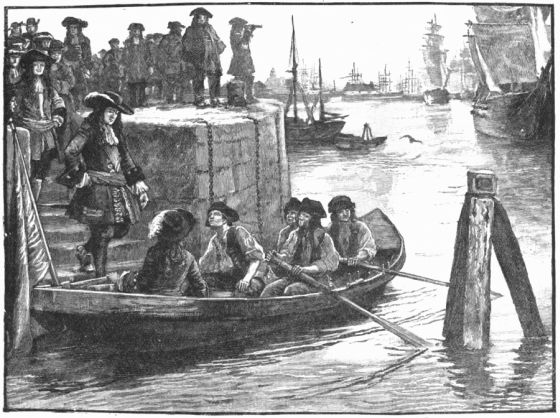
WILLIAM OF ORANGE EMBARKING TO JOIN THE "BRILL." (See p. 338.)
Whilst James was exerting himself to conciliate
his subjects, he was equally industrious in putting
the kingdom into a posture of defence. He made
Lord Dartmouth Commander of the Fleet, which
consisted of thirty-seven men-of-war, and seven
fire-ships—a naval force inferior to that of the
prince, and, still worse, weak in the principles of
loyalty, though Dartmouth himself might be relied
on. His army, including about six thousand Irish
and Scots, amounted to forty thousand men—more
than enough to repel the force of the invaders,
had the hearts of the men been in the
cause.
William was compelled to delay his embarkation
for more than a week by tempestuous
weather. His fleet, under the command of
Herbert, which was lying off Scheveningen, on the
28th of September, was compelled to seek shelter
in Helvoetsluys. The wind raged furiously till
the 15th of October, and public prayers were
offered in the churches for more favourable
weather. All attempts to invade England had,
since William of Normandy's enterprise, been
notoriously defeated by storms; and the people
became so superstitious on this head that it was
found necessary, under severe penalties, to forbid
foreboding language. On the 16th, the wind
abating, William took a solemn leave of the
States-General. He thanked them for their long
and devoted support of him in his endeavours for
the independence of Europe, and committed his
wife to their protection whilst he was absent for
the same great object, and the security of the
Protestant religion. He declared that if he died
it would be as their servant; if he lived, it would
be as their friend. The Pensionary Fagel, now
old and failing, replied with great emotion; and,
amid the tears of most present, William stood
like a stoic, without any visible agitation. The
deputies of the principal towns accompanied him
to the water side, and that evening he went on
board his frigate the Brill. The next day a
public fast was held in the Hague, with sermons
and prayers for the success of the expedition, and
Mary continued to retain her place in the church
in public during the long service from half-past
ten in the morning till half-past seven in the
afternoon.
On the afternoon of the 19th the fleet sailed
from Helvoetsluys, the men-of-war, in three
divisions, forming a long line out at sea, and
the transports driving before the breeze nearer
land. The day was fine, the wind steady from
the south-west; and as the eventful squadron
passed the sandy downs of Scheveningen, the inhabitants
of the Hague crowded them in thousands,
and raised acclamations of anticipated
success. But the scene rapidly changed. By ten
o'clock at night a furious tempest was again
raging, which dispersed the fleet, sank one ship,
damaged many others, compelled them to throw
overboard great quantities of stores, and destroyed
a thousand horses through their being closed down
under hatches. The fleet managed to regain
Helvoetsluys, which William himself reached on
the 21st. He refused to go on shore, but sent to
the States for fresh supplies, and busied himself in
pushing on his repairs.
The news of this disaster reached England with
many aggravations, so that it was imagined that
the expedition would be given up for that season;
and James declared with much satisfaction that
it was what he expected, the Host having been
exposed for several days. He seized, however,
the time afforded by this delay to assemble an
extraordinary body, the members of the Privy
Council, the peers who were in or near London,
the judges, the law officers of the Crown, the Lord
Mayor and aldermen, the queen-dowager, and
two-and-twenty women—some ladies about the
queen, some menials. The Princess Anne was
summoned, but excused herself on account of
indisposition. "I have called you together," said
James, "upon a very extraordinary occasion; but
extraordinary diseases must have extraordinary
remedies. The malicious endeavours of my
enemies have so poisoned the minds of many of
my subjects, that, by the reports I have from all
hands, I have reason to believe that many do
think this son which God has pleased to bless me
with be none of mine, but a supposititious child."
The witnesses were all examined on oath except
the queen-dowager, and presented such a mass of
evidence as was undoubtedly complete, and it was
enrolled in chancery and published. But such
was the intense prejudice of the age that it failed
to convince the public at large. As Anne was
not present, the Council waited on her with a
copy of the evidence, on which she observed, "My
lords, this was not necessary; the king's word is
more to me than all these depositions." Yet her
uncle, Clarendon, assures us that she never
mentioned the child but with ridicule, and only
once was heard to call it the Prince of Wales, and
that was when she thought it was dying. Anne,
in fact, was devoted to the cause of the Prince of
Orange; and Barillon says that she avoided every
opportunity of convincing herself of what she did
not wish to believe.
This singular deed of verification of the child's
identity was the last act of the ministry of Sunderland.
His treason had not escaped observation.
A letter of his wife's had been intercepted and
shown to him by the king, in which she was found
in close correspondence with Sidney. He strictly
denied all knowledge of it, and did not hesitate to
advert to his wife's liaison with Sidney as sufficiently
exculpatory of himself. For a time he
lulled James's suspicions, but they again revived;
and, on the very evening of this extraordinary
council, James sent Middleton and demanded the
Seals. To the last Sunderland acted the part of
injured innocence; but was not long in getting
away to the Hague, not, however, in time to join
William before his second embarkation. His
office of Secretary to the Southern Department
was given to Middleton, and of Secretary to the
Northern Department to Lord Preston, both Protestants.
Petre was dismissed from the Council,
but retained his post as Clerk of the Closet at
Whitehall. But all this did not alter the tone of
public feeling. The very day before the assembling
of the extraordinary council, the London
mob demolished a new Catholic chapel; and on
the 14th of October, the king's birthday, there had
been no sign of rejoicing, not even the firing of
the Tower guns; but the people reminded one
another that it was the anniversary of the landing
of William the Conqueror. Their thoughts were
running on the landing of another William.
On the 1st of November the Prince of Orange
again set sail, and this time with a favourable
though strong gale from the east. Besides the
English noblemen and gentlemen whom we have
mentioned, including also Fletcher of Saltoun,
William had with him Marshal Schomberg, an
able and experienced general, who was appointed
second in command; Bentinck, Overkirk, and
Counts Solmes and Sturm. Herbert was the
chief admiral, much to the chagrin of the Dutch
admirals, but very wisely so determined by
William, who well knew the hereditary jealousy
of the Dutch fleet, and the remembered boast and
besom of Van Tromp in England. He resolved
that, if they came to conflict with Lord Dartmouth,
it should be English commander against
English, or his cause might receive great prejudice.
For twelve hours William drove before the
breeze towards the coasts of Yorkshire, as if intending
to land there; then, suddenly tacking, he
stood down the Channel before the gale. Dartmouth
attempted to issue from the mouth of the
Thames to intercept him, but the violent wind
which favoured William perfectly disabled him.
His vessels as they came out to sea were driven
back with much damage, compelled to strike yards
and top-masts, and to lie abreast the Longsand;
whilst William, leading the way in the Brill,
sailed rapidly past with his whole fleet and a
crowd of other vessels that had gathered in his
rear, to the amount of nearly seven hundred. It
was twenty-four hours before Dartmouth could
give chase, and on the 5th of November William
reached Torbay, his real destination.
William took up his quarters in a cottage whilst
his troops were landing, and from its thatched
roof waved the flag of Holland, bearing the significant
motto, "I will maintain the Protestant Religion
and the Liberties of England." Burnet was
one of the first to congratulate William on his
landing on English soil; and, at the recommendation
of Carstares, the first thing on the complete
disembarkation was to collect the troops, and return
public thanks to Heaven for the successful
passage of the armament. The next day William
marched in the direction of Exeter; but the rains
continued, and the roads were foul, so that he
made little progress. It was not till the 9th that
he appeared before the city. The people received
him with enthusiasm, but the magistracy shrank
back in terror, and Bishop Lamplough and the
dean had fled to warn the king of the invasion.
The city was in utter confusion, and at first
shut its gates; but as quickly agreed to open
them, and William was accommodated in the
vacated deanery. But the people of the West
had suffered too much from the support of
Monmouth not to have learnt caution. A service
was ordered in the cathedral to return thanks for
the safe arrival of the prince; but the canons
absented themselves, and only some of the prebendaries
and choristers attended, and, as soon as
Burnet began to read the prince's declaration, these
hurried out as fast as they could. On Sunday,
which was the 11th, Burnet was the only clergyman
that could be got to preach before the prince,
and the Dissenters refused the fanatic Ferguson
admittance to their chapel. This extraordinary
person, however, who appears to have been
one-third enthusiast and two-thirds knave, called
for a hammer, and exclaiming, "I will take the
kingdom of heaven by storm!" broke open the
door, marched to the pulpit with his drawn sword
in his hand, and delivered one of those wild and
ill-judged philippics against the king which did
so much mischief in the attempt of Monmouth.
Altogether, so far the cause of William appeared
as little promising as that of Monmouth had done.
Notwithstanding the many earnest entreaties from
men of high rank and of various classes—nobles,
bishops, officers of the army and navy,—a week
had elapsed, and no single person of influence had
joined him. The people only, as in Monmouth's
case, had crowded about him with shouts of
welcome. William was extremely disappointed
and chagrined; he declared that he was deluded
and betrayed, and he vowed that he would re-embark,
and leave those who had called for him to
work out their own deliverance, or receive their
due punishment. But on Monday, the 12th, his
spirits were a little cheered by a gentleman of
Crediton, named Burrington, attended by a few followers,
joining his standard. This was immediately
followed, however, by the news that Lord Lovelace,
with about seventy of his tenants and neighbours,
had been intercepted by the militia at Cirencester,
taken prisoners, and sent to Gloucester
Castle. The slow movement of the disaffected
appears to have originated in William's not having
landed in Yorkshire, as was expected, but in the
west, where he was not expected. In the North
Lords Delamere and Brandon in Cheshire, Danby
and Lumley in Yorkshire, Devonshire and Chesterfield
in Derbyshire, in Lancashire the Earl of
Manchester, in Nottinghamshire and Lincolnshire
Rutland and Stamford, and others were all waiting
to receive him. The very army which had been
encamped on Hounslow Heath was the seat of a
secret conspiracy of officers, with Churchill himself
at their head, who kept up constant communication
with the club at the "Rose" tavern in Covent
Garden, of which Lord Colchester was president.
But all this concert was paralysed for a time by
William's appearance in so distant a quarter.
But the elements of revolt, which had suffered
a momentary shock, now began to move visibly.
The very day that Lord Lovelace was captured,
Lord Colchester marched into Exeter, attended by
about seventy horse, and accompanied by the hero
of "Lillibullero," Thomas Wharton. They were
quickly followed by Russell, the son of the Duke
of Bedford, one of the earliest promoters of the
revolution, and still more significantly by the Earl
of Abingdon, a staunch Tory, who had supported
James till he saw that nothing but the reign of
Popery would satisfy him. A still more striking
defection from the king immediately followed.
Lord Cornbury, the eldest son of the Earl of
Clarendon, pretended to have received orders to
march with three regiments of cavalry stationed at
Salisbury Moor, to the enemy in the west. He
was a young man entirely under the influence of
Lord Churchill, having been brought up in the
household of his cousin, the Princess Anne, where
Churchill and his wife directed everything; and
there can be no doubt that this movement was the
work of Churchill. As the cavalry proceeded
from place to place by a circuitous route to
Axminster, the officers became suspicious, and demanded
to see the orders. Cornbury replied that
his orders were to beat up the quarters of the army
in the night near Honiton. The loyal officers, who
had received hints that all was not right, demanded
to see the written orders; but Cornbury,
who had none to produce, stole away in the dark
with a few followers who were in the secret, and got
to the Dutch camp. His regiment, and that of the
Duke of Berwick, James's own (natural) son, with
the exception of about thirty troops, returned to
Salisbury; but the third regiment, the Duke of St.
Albans', followed the colonel, Langton, to Honiton,
where General Talmash received them; and most
of the officers and a hundred and fifty privates declared
for the prince, the rest being made prisoners,
but soon afterwards discharged.
The news of this defection of one so near to the
king's family created the greatest consternation in
the palace. In his terror James summoned a military
council. He was anxious to receive the assurances
of fidelity from his other officers—as if any
assurances, under the circumstances, anything but
leading them against the enemy, could test the
loyalty of these men. He told them that he
wished to be satisfied that there were no more
Cornburys amongst them; and that if any had
scruples about fighting for him, he was ready
to receive back their commissions. Of course
they protested the most ardent devotion to his
cause, though there was not a man of them that
was not already pledged to desert him. Churchill,
recently made a lieutenant-general, and the Duke
of Grafton, the king's nephew, were especially
fervid in their expressions of loyalty; so, too, were
Trelawney, smarting secretly over the persecution
of his brother, the Bishop of Bristol, and the
savage Kirke, who, when James had importuned
him to turn Papist, had replied that he "was sorry,
but he had already engaged to the Grand Turk
that if he changed his religion he would become a
Mussulman." Reassured by these hollow professions,
James gave orders for joining the camp at
Salisbury; but the next morning, before he could
set out, he was waited on by a numerous deputation
of lords spiritual and temporal, with Sancroft
at their head, praying that a free Parliament
might be immediately called, and communication
opened with the Prince of Orange.
James received the deputation ungraciously. In
all his hurried concessions he had still shown his
stubborn spirit by refusing to give up the Dispensing
power; and now, though he declared that
what they asked he passionately desired, he added
that he could not call a Parliament till the Prince
of Orange quitted the kingdom. "How," he
asked, "can you have a free Parliament whilst a
foreign prince, at the head of a foreign force, has
the power to return a hundred members?" He
then fell foul of the bishops, reminding them that
the other day they refused to avow under their
hands their disapproval of the invasion, on the
plea that their vocation was not in politics; and
yet here they were at the very head of a political
movement. He charged them with fomenting the
rebellion, and retired, declaring to his courtiers that
he would not concede an atom. He then appointed
a council of five lords—of whom two were
Papists, and the third Jeffreys—to keep order
during his absence, sent off the Prince of Wales to
Portsmouth to the care of the Duke of Berwick, the
commander, and set out for Salisbury. He reached
his camp on the 19th of November, and ordered a
review the next day at Warminster, of Kirke's
division. Churchill and Kirke were particularly
anxious that he should proceed to this review, and
Kirke and Trelawney hastened on to their forces,
on pretence of making the necessary preparations.
On the other hand, Count de Roye as earnestly
dissuaded James from going to Warminster. He
told him that the enemy's advanced foot was at
Wincanton, and that the position at Warminster,
or even that where they were at Salisbury, was
untenable. James, however, was resolved to go;
but the next morning, the 20th, he was prevented
by a violent bleeding at the nose, which continued
unchecked for three days.
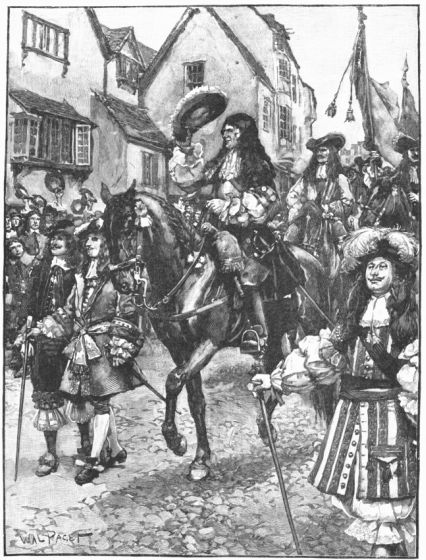
WILLIAM OF ORANGE ENTERING EXETER. (See p. 339.)
Scarcely had this impediment occurred when
news came that the king's forces had been
attacked at Wincanton, and worsted by some of
the division of General Mackay. James was now
assured that, had he gone to Warminster, he
would have been seized by traitors near his person,
and carried off to the enemy's quarters. He
was advised to arrest Churchill and Grafton; but,
with his usual imprudence, he refused, and summoned
them along with the other officers to a
military council, to decide whether they should
advance or retreat. Feversham, Roye, and Dumbarton
argued for a retreat; Churchill persisted
in his recommendation of an advance to the post
at Warminster. The council lasted till midnight,
when Churchill and Grafton, seeing that their
advice was not followed, felt the time was come to
throw off the mask, and therefore rode directly
away to the prince's lines. The next morning the
discovery of this desertion filled the camp with
consternation, and this was at its height when it
was known that Churchill's brother, a colonel,
Trelawney, Barclay, and about twenty privates
had ridden after the fugitives. It was said that
Kirke was gone too, but it was not the fact; and
he was now arrested for having disobeyed orders
sent to him from Salisbury; but he professed such
indignation at the desertion of Churchill and the
others, that the shallow-minded king set him
again at liberty. The deserters were received by
William with a most gracious welcome, though
Schomberg remarked of Churchill that he was
the first lieutenant-general that he had ever heard
of running away from his colours.
In James's camp all was confusion, suspicion,
and dismay. There was not a man who was sure
of his fellow, and the retreat which commenced
more resembled a flight. Numbers who would have
fought had they been led at once to battle, now
lost heart, and stole away on all sides. The news
that found its way every hour into the demoralised
camp was enough to ruin any army. From every
quarter came tidings of insurrection. The Earl of
Bath, the Governor of Plymouth, had surrendered
the place solemnly to William; Sir Edward
Seymour, Sir William Portman, Sir Francis
Warre—men of immense influence in Devon,
Somerset, and Dorset—were already with William
at Exeter; a paper had been drawn up and signed
by the leading persons there to stand by the
prince, and, whether he succeeded or whether he
fell, never to cease till they had obtained all the
objects in his declaration; Delamere had risen in
Chester, and had reached Manchester on his way
south; Danby had surprised the garrison at York;
the town had warmly welcomed him, and a great
number of peers, baronets, and gentlemen were in
arms with him. Devonshire had called together
the authorities and people of Derby, and published
his reason for appearing in arms, calling on them
to assist all true men in obtaining a settlement of
the public rights in a free Parliament. At Nottingham
he was met by the Earls of Rutland,
Stamford, Manchester, Chesterfield, and the Lords
Cholmondeley and Grey de Ruthyn.
These were tidings of a reaction as determined
as James's headstrong career had been; but the
worst had not yet overtaken him. On the evening
of November 24th he had retreated towards
London as far as Andover. Prince George of Denmark,
the husband of the Princess Anne, and the
Duke of Ormond, supped with him. Prince George
was a remarkably stupid personage, whose constant
reply to any news was, "Est-il possible?" When
the intelligence of one desertion after another
came he had exclaimed, "Est-il possible?" But
the moment supper was over and the king gone
to bed, Prince George and Ormond rode off to
the enemy too. When James the next morning
was informed of this mortifying news, he coolly
replied, "What! Is 'Est-il possible' gone too?
Were he not my son-in-law, a single trooper would
have been a greater loss." With the prince and
Ormond had also fled Lord Drumlanrig, the eldest
son of the Duke of Queensberry, Mr. Boyle, Sir
George Hewit, and other persons of distinction.
The blow was severe; and though James at the
first moment, being stunned, as it were, seemed to
bear it with indifference, he pursued his way to
London in a state of intense exasperation. There
the first news that met him was the flight of his
own daughter Anne. Anne was bound up, soul
and body, with the Churchills, and it had no
doubt been for some time settled amongst them
that they should all get away to the prince her
brother-in-law.
It was towards evening of the same day that
Anne fled that James arrived at Whitehall, agitated
by the awful desertions of his highest officers
and his nearest relatives. This announcement put
the climax to his torture. He exclaimed, "God
help me! My very children have forsaken me."
Severe as the punishment of his desperate treason
against his people deserved to be, this certainly
was a cruel fate. For some days a lady near his
person records that she thought she saw in him
occasional aberrations of intellect. That night he
sat late in council, and it was urged on him to call
together such peers and prelates as were in London
to consult on the necessary steps in this crisis.
The next day came together nearly fifty peers and
bishops, and James asked their advice as to calling
a Parliament. On this head there appeared no
difference of opinion; but Halifax, Nottingham,
and others, urged with equal earnestness that all
Catholics should be dismissed from office, and a
general amnesty published for all in arms against
him. James assented to the calling a Parliament,
but his eyes were still not opened to the folly of
his past conduct, and he would give no assurance
of dismissing the Papists, and broke out into
vehement language at the proposal to pardon his
enemies. "My lords," he said, "you are wonderfully
anxious for the safety of my enemies, but
none of you troubles himself about my safety."
And he vowed that he would yet take vengeance
on those who had deserted him, and, above all, on
Churchill. Clarendon, who was on the eve of
running off to William, took the opportunity to
utter the bitter feelings which his dismissal from
the Lord-Lieutenancy of Ireland to make way for
Tyrconnel had no doubt long left in his mind.
He upbraided James with his dogged and incurable
Popery, with sacrificing everybody and
everything for it; declaring that, even at that
moment, James was raising a regiment from which
Protestants were rigorously excluded. He taunted
him with running away from the enemy, and
asked him who was likely to fight for him when
he himself was the first to flee.
After this severe treatment by his closest connections,
James appeared to comply with the
advice of the lords. He sent for Halifax, Nottingham,
and Godolphin, and informed them that he
had appointed them Commissioners to treat with
William. He dismissed Sir Edward Hales from
the Tower, and placed Bevil Skelton, a Protestant,
there. But the nature or the intention of this
most obtuse of bigots was by no means changed;
he was internally as determined as ever to reverse
every concession on the first possible occasion.
Barillon tells us that he assured him that all this
was a mere feint; that he only sent the Commissioners
to William in order to gain time for
sending his wife and child into France; that as to
calling a Parliament, that would only be to put
himself into their power, and compel him to submit
to their conditions; that he had no faith in his
troops, except the Irish; none of the rest would
fight for him; and, therefore, as soon as the queen
and young prince were safe, he should get away to
Ireland, Scotland, or France, and await the turn
of events. Such was the utterly hopeless character
of the Stuart race!
To clear the way for the escape of the royal
infant, Lord Dover was put in command at Portsmouth,
and James sent orders to Lord Dartmouth
to see that the child was safely conveyed to the
French coast. In anticipation of the accomplishment
of this object, he made every preparation for
his own flight. He sent to Jeffreys to bring the
Great Seal, and take up his quarters with it in the
palace, lest by any means it should fall into the
hands of the invader, and thus give an air of authority
to his proceedings. But his escape was
delayed by unpleasant news from Lord Dartmouth.
The announcement of the calling of a
Parliament, and of attempted agreement with the
Prince of Orange, had spread exultation through
the navy, and the officers had despatched an
address of fervent thanks to James, when the
arrival of the infant prince awoke a general suspicion
that all was still hollow, and that James
meant nothing but escape. The officers were in
great agitation, and plainly pointed out to Dartmouth
his heavy responsibility if he allowed the
prince to quit the kingdom. Dartmouth, therefore,
wrote James, declaring that he would risk
his life for the support of the Crown, but that he
dared not undertake to facilitate the escape of the
Prince of Wales. This was confounding news,
and James took instant measures for the return
of his son to London, and for his escape by another
means to France.
Meanwhile William was gradually advancing
towards the capital, and, on the 6th of December,
the king's Commissioners met him at Hungerford,
where they found the Earls of Clarendon and
Oxford already swelling the Court of the invader.
They were received with much respect, and submitted
their master's proposal that all matters in
dispute should be referred to the Parliament for
which the writs were ordered, and that, in the meantime,
the Dutch army should not advance nearer
than forty miles from London. The Whigs in
William's Court were decidedly averse from reconciliation
with James, whose implacable nature
they knew; but William insisted on acceding to
the terms, on condition that the royal forces should
remove the same distance from the capital, and
that the Tower of London and Tilbury Fort
should be put into the keeping of the City
authorities. If it were necessary for the king
and prince to proceed to Westminster during the
negotiations, they should go attended only by
a small guard. Nothing could be fairer; but
William knew well the character of his father-in-law,
and felt assured that he would by some
means shuffle out of the agreement, and throw the
odium of failure on himself; and he was not deceived.
Never had James so fair an opportunity
of recovering his position and securing his throne,
under constitutional restraints, for his life; but he
was totally incapable of such wisdom and honesty.
On the very day that the royal Commissioners
reached William's camp, James received the
Prince of Wales back from Portsmouth, and prepared
to send him off to France by another route.
On the night of the 10th of December he sent the
queen across the Thames in darkness and tempest,
disguised as an Italian lady, and attended by two
Italian women, one of whom was the child's nurse,
and the other carried the boy in her arms. They
were guarded by two French refugees of distinction—Antonine,
Count of Lauzun, and his
friend Saint Victor. They arrived safely at
Gravesend, where a yacht awaited them, on board
of which were Lord and Lady Powis. Saint
Victor returned to inform James that they had
got clear off, and in a few hours they were safely
in Calais.
Scarcely did Saint Victor bring the cheering
news of the auspicious sailing of the yacht, when
the Commissioners arrived with the conditions
that had been agreed on by William. Here was
the guarantee for a speedy adjustment of all his
difficulties; but the false and distorted-minded
James only saw in the circumstance a wretched
means of further deceit and contempt of his
people and of all honourable negotiation. He
pretended to be highly satisfied, summoned for the
morrow a meeting of all the peers in town, and of
the Lord Mayor and aldermen, and directed that
they should deliberate freely and decide firmly for
the good of the country. This done, he retired to
rest, ordered Jeffreys to be with him early in the
morning, said to Lord Mulgrave, as he bade him
good night, that the news from William was most
satisfactory, and, before morning, had secretly
decamped, leaving his kingdom to take care of
itself rather than condescend to a pacification
with his son-in-law and his subjects, which should
compel him to rule as a constitutional king.
But James was not satisfied with this contemptible
conduct; he indulged himself before
going with creating all the confusion that he
could. Had the writs, which were preparing,
been left for issue on the 15th of January, 1689,
a new Parliament would be in existence, ready to
settle the necessary measures for future Government;
he therefore collected the writs and threw
them into the fire with his own hands, and annulled
a number which were already gone out, by
an instrument for the purpose. He also left a
letter for Lord Feversham, announcing his departure
from the kingdom, and desiring him no longer
to expose the lives of himself and his soldiers "by
resistance to a foreign army and a poisoned
nation;" then, taking the Great Seal in his hand,
he bade the Earl of Northumberland, who was the
Lord of the Bedchamber on duty, and lay on a
pallet bed in the king's room, not to unlock the
door till the usual hour in the morning, and then,
disguised as a country gentleman, disappeared
down the back stairs. He was waited for by Sir
Edward Hales, whom he afterwards created Earl
of Tenterden, and they proceeded in a hackney-coach
to Millbank, where they crossed the river in
a boat to Vauxhall. When in mid-stream, he
flung the Great Seal into the water, trusting that
it would never be seen any more; but it was
afterwards dragged up by a fishing-net. James,
attended by Hales and Sheldon, one of the royal
equerries, drove at a rapid pace for Elmley Ferry,
near the Isle of Sheppey, having relays of horse
ready engaged. They reached that place at ten
in the morning, and got on board the Custom
House hoy which was waiting for them, and
dropped down the river.
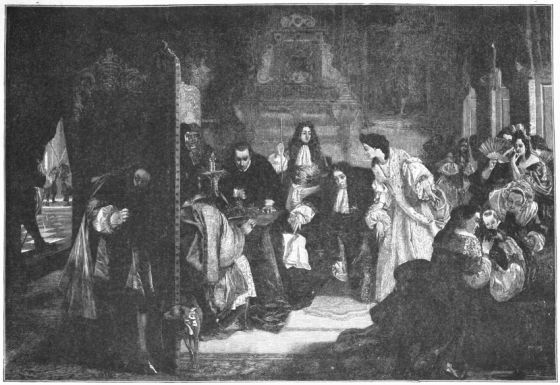
JAMES HEARING OF THE LANDING OF WILLIAM OF ORANGE. (After the Painting by E. M. Ward, R.A.)
In the morning, when the Duke of Northumberland
opened the king's chamber door, and it was
discovered that James had fled, the consternation
in the palace may be imagined. The courtiers
and the numbers of persons who were waiting to
fulfil their morning duties, and the lords who had
been summoned to council, spread the exciting
tidings, and the capital became a scene of the
wildest and most alarming confusion. Feversham
obeyed the orders of the king left in his letter,
without pausing to ask any advice, or to calculate
what might be the consequences. These were as
serious as might have been expected. There was
no Government, no constituted authority to appeal
to. Lord Rochester had continued loyal to the
last; but the base desertion of James and the imminent
danger at once decided him. He bade the
Duke of Northumberland muster the Guards, and
declare for William. The officers of the other regiments
in London followed the advice, and endeavoured
to keep together their men, declaring
for the Prince of Orange. The lords who had
been summoned to Council hastened into the City
to concert measures with the Lord Mayor and
aldermen for the public safety. A meeting was
hastily called in Guildhall, where the peers,
twenty-five in number, and five bishops, with
Sancroft and the new Archbishop of York at their
head, formed themselves into a provisional council
to exercise the functions of Government till the
Prince of Orange should arrive, for whom they
sent a pressing message, praying him to hasten
and unite with them for the preservation of the
Constitution and the security of the Church. The
two Secretaries of State were sent for, but Preston
alone came; Middleton denied the authority of the
self-created Council. The Lieutenant of the Tower,
Bevil Skelton, was ordered to give up the keys to
Lord Lucas, and an order was sent to Lord Dartmouth,
desiring him to dismiss all Popish officers
from the fleet, and attempt nothing against the
Dutch fleet. But no measures could prevent the
outbreak of the mob in London. The feeling
against the Catholics displayed itself on all sides.
Under pretence of searching for Papists, the
hordes of blackguards from every low purlieu of
London swarmed forth and broke into houses, and
plundered them at their pleasure. The vile
Jeffreys was with difficulty saved from the fury of
the mob.
James, his heartless master, was also seized.
The Custom House hoy in which he embarked
was found wanting in ballast, and the captain was
obliged to run her ashore near Sheerness. About
eleven at night on the 12th of December, before
the hoy could be floated again by the tide, she was
boarded by a number of fishermen who were on
the look-out for fugitives, and the appearance of
the king immediately attracted their notice.
"That is Father Petre," cried one fellow; "I
know him by his hatchet face." James was immediately
seized and searched; but, though he had
his coronation ring in his pocket, besides other
jewels, they missed them, and did not recognise
him. They carried him ashore at Feversham,
where, at the inn, amid the insults of this rabble,
he declared himself their king. The Earl of Winchelsea,
hearing of the king's detention, hastened
to his assistance, had him removed to the house
of the Mayor, and sent word of his capture to
London.
When the countryman who carried the messages
from Lord Winchelsea arrived at Whitehall, the
news of the king's detention occasioned the greatest
embarrassment. The lords had sent for William,
and hoped that they were well rid of the foolish
king. Nothing could have been easier than their
course if James had got over to the Continent.
The throne would be declared vacant, and the
Prince and Princess of Orange invited to occupy it,
on giving the necessary guarantees for the maintenance
of the Constitution. But now the whole
question was involved in difficulties. If James
persisted in his right to the throne, in what capacity
was William to be received? Could any safe
measures be arranged with a man like James?
Was he to be deposed, and his son-in-law and
daughter forcibly placed on his throne? The
dilemma was equally embarrassing to the lords
and prelates, and to the prince himself. When the
messenger was introduced, and delivered a letter
from James, but without any address, Halifax
moved that they should instantly adjourn, and
thus leave the letter unnoticed. Halifax was
deeply incensed at the trick which James had
played off upon him in sending him to negotiate
with William merely that he might get away,
and was now resolved to adhere to the prince;
but Lord Mulgrave prevailed on the lords to
retain their seats, and obtained from them an
order that Lord Feversham should take two hundred
Life Guards, and protect the king from
insult. Feversham demanded the precise powers
of his order, and was told that he must defend the
king from insult, but by no means impede the
freest exercise of his personal freedom. This
meant that they would be glad if he facilitated his
escape. Halifax immediately left London, and
joined the Prince of Orange, who was now at
Henley-on-Thames. Sancroft and the clergy, as
soon as they were aware that the king had not
left the country, retired from any further participation
in the Council. William and his adherents
were extremely chagrined at this untoward turn
of affairs. When the messenger arrived at Henley
he was referred to Burnet, who said, "Why did
you not let the king go?"
But when Feversham arrived at the town whose
name he bore, the king was no longer disposed to
escape. His friends who had gathered about him,
Middleton and Lord Winchelsea especially, had
endeavoured to show him that his strength lay in
remaining. Had he vacated the throne by quitting
the kingdom, it had been lost for ever; but
now he was king, and might challenge his right;
and the prince could not dispossess him without
incurring the character of a usurper, and throwing
a heavy odium of unnatural severity on himself
and his wife. James had sufficient mind left to
perceive the strength thus pointed out to him.
He resolved to return to his capital, and from
Rochester despatched Feversham with a letter to
William, whom he found advanced to Windsor,
proposing a conference in London, where St.
James's should be prepared for the prince. By
this time William and his Council had determined
on the plan to be pursued in the great difficulty.
He had calculated on James's being gone, and had
issued orders to the king's army and to the lords
at Whitehall in the style of a sovereign. His
leading adherents had settled amongst themselves
the different offices that they were to occupy as
the reward of their adhesion. It was resolved,
therefore, if possible, to frighten James into a
second flight. No sooner had Feversham delivered
his despatch than he was arrested, and thrown into
the Round Tower on the charge of having disbanded
the army without proper orders, to the
danger of the capital, and of having entered the
prince's camp without a passport. Zulestein was
despatched to inform James that William declined
the proposed conference, and recommended him to
remain at Rochester.
James, however, was now bent on returning to
London. He had not waited for the prince's
answer, but on Sunday, the 16th of December, he
entered his capital in a sort of triumphal procession.
He was preceded by a number of gentlemen,
bareheaded. Immense crowds assembled as
if to welcome him back again. They cheered him
as he rode along. The bells were rung, and bonfires
were lit in the streets. Elated by these
signs, as he imagined them, of returning popularity,
he no sooner reached Whitehall than he
called around him the Jesuits who had hidden
themselves, stationed Irish soldiers as guards
around his palace, had grace said at his table by a
Jesuit priest, and expressed his high indignation
at the lords and prelates who had presumed to
usurp his functions in his absence—who had, in
fact, saved the capital from destruction when he
had abandoned it. His folly, however, received
an abrupt check. Zulestein was announced, and
delivered the stern message of William. James
was confounded, but again repeated his invitation
for his nephew to come to town, that they might
settle all differences in a personal conference.
Zulestein coldly assured him that William would
not enter London whilst it contained troops not
under his orders. "Then," said James, "let him
bring his own guards, and I will dismiss mine, for
I am as well without any as such that I dare
not trust." Zulestein, however, retired without
further discussion, and the moment he was gone,
James was informed of the arrest of Feversham.
Alarmed at these proofs of the stern spirit of
William, James sent in haste to Stamps and
Lewis, the leading members of the City Council—the
Lord Mayor had never recovered his terror
of Jeffreys' presence,—to offer to place himself
under their protection till all necessary guarantees
for the public liberties had been given and
accepted. But the Common Council had not
had time to forget his seizure of their charter,
and they prudently declined to enter into an
engagement which, they said, they might not be
able to fulfil. Whilst James was thus learning
that though the City acclamations might be proofs
of regret for his misfortunes, they were by no
means proofs of a desire for his continuing to
reign, William, on the same day, the 17th, bade
all his leading adherents hold a solemn council, to
consider what steps should be taken in this crisis.
It was understood that he would never consent to
enter London whilst James was there, and it was
resolved that he should be removed to Ham
House, near Richmond, which the brutal Lauderdale
had built out of the bribes of Louis XIV.
and the money wrung from the ravaged people
of Scotland. Halifax, Shrewsbury, and Delamere
were despatched to James with this intimation,
though Clarendon had done all in his power to
have James seized and confined in some foreign
fortress till Tyrconnel surrendered Ireland to the
prince's party.
Simultaneously with the three lords, William
ordered his forces to advance towards London.
In the evening of the 17th James heard that the
Dutch soldiers had occupied Chelsea and Kennington.
By ten o'clock at night Solmes, at the head
of three battalions of infantry, was already
making across St. James's Park, and sent word
that his orders were to occupy Whitehall, and
he advised the Earl of Craven, who commanded
the Coldstream Guards, to retire. Craven—though
now in his eightieth year, was still possessed of
the courage and chivalry which he had displayed
in the wars of Germany, and which had won him
the heart of Elizabeth of Bohemia, who was said
to be married to him—declared that, so long as he
retained life, no foreign prince should make a
King of England a prisoner in his own palace.
James, however, ordered him to retire. The Coldstream
Guards withdrew, and the Dutch guards
surrounded the palace. James, as if there were
no danger to his person, went composedly to bed,
but only to be roused out of his first sleep to
receive the deputation from the prince. On reading
the letter proposing his removal to Ham,
which Halifax informed him must be done before
ten o'clock in the morning, James seems to have
taken a final resolve to get away. He protested
against going to Ham, as a low, damp place in
winter, but offered to retire to Rochester. This
was a pretty clear indication of his intention to
flee—the very object desired. A messenger was
despatched in all speed to the prince, who returned
with his full approbation before daybreak.
The morning of the 18th was miserably wet
and stormy, but a barge was brought to Whitehall
Stairs, and the wretched monarch went on
board, attended by the Lords Arran, Dumbarton,
Dundee, Lichfield, and Aylesbury. The spectators
could not behold this melancholy abdication—for
such it was—of the last potentate of a most unwise
line, who had lost a great empire by his incurable
infatuation, without tears. Even Shrewsbury
and Delamere showed much emotion, and
endeavoured to soothe the fallen king; but
Halifax, incurably wounded in his diplomatic
pride by the hollow mission to the prince at
Hungerford, stood coldly apart. Boats containing
a hundred Dutch soldiers surrounded his
barge as it dropped down the river. James
landed and slept at Gravesend, and then proceeded
to Rochester, where he remained four days.
Though his advisers entreated him not to fly,
James had now sunk the last manly feeling of a
monarch who would dare much and sacrifice more
to retain a noble empire for his family. A
dastardly fear that if he remained he would be
put to death like his father took possession of
him. He made a last offer to the bishops,
through the Bishop of Winchester, as he had done
to the City of London, to put himself into their
hands for safety, but they also declined the
responsibility, and he then gave all over as lost.
On the evening of the 22nd of December he sat
down before supper, and wrote a declaration of
his motives for quitting the kingdom. About
midnight he stole quietly away with the Duke of
Berwick, his natural son, and, after much difficulty,
through storm and darkness, reached a
fishing smack hired for the purpose, which, on
Christmas Day, landed him at Ambleteuse, on the
coast of France. Thence he hastened to the
castle of St. Germains, which Louis had appointed
for his residence, and where, on the 28th,
he found his wife and child awaiting him. Louis
also was there to receive him, had settled on him
a revenue of forty-five thousand pounds sterling
yearly, besides giving him ten thousand pounds
for immediate wants. The conduct of Louis was
truly princely, not only in thus conferring on the
fallen monarch a noble and delightful residence,
with an ample income, but in making it felt by
his courtiers and all France, that he expected the
exiled family to be treated with the respect due
to the sovereigns of England.
The flight of James had removed the great difficulty
of William—that of having recourse to some
measure of harshness towards him, as imprisonment,
or forcible deposition and banishment,
which would have greatly lowered his popularity.
The adherents of James felt all this, and were
confounded at the advantage which the impolitic
monarch had given to his enemies. The joy of
William's partisans was great and unconcealed.
In France the success of William was beheld with
intense mortification, for it was the death-blow to
the ascendency of Louis in Europe, which had
been the great object of all his wars, and the
expensive policy of his whole life. In Holland
the elevation of their Stadtholder to the head of
the English realm was beheld as the greatest
triumph of their nation; and Dykvelt and
Nicholas Witsen were deputed to wait on him in
London and congratulate him on his brilliant success.
But, notwithstanding all these favourable
circumstances, there were many knotty questions
to be settled before William could be recognised
as sovereign. The country was divided into
various parties, one of which, including the Tories
and the Church, contended that no power or law
could affect the divine right of kings; and that
although a king by his infamy, imbecility, or open
violation of the laws might be restrained from
exercising the regal functions personally, those
rights remained untouched, and must be invested
for the time in a regent chosen by the united Parliament
of the nation. Others contended that
James's unconstitutional conduct and subsequent
flight amounted to an abdication, and that the
royal rights had passed on to the next heir; and
the only question was, which was the true heir—the
daughter of James, the wife of William, or
the child called the Prince of Wales? The more
determined Whigs contended that the arbitrary
conduct of the House of Stuart, and especially of
James, who attempted to destroy both the Constitution
and the Church, had abrogated the
original compact between prince and people, and
returned the right of electing a new monarch into
the hands of the people; and the only question
was, who should that choice be? There were not
wanting some who advised William boldly to
assume the crown by right of conquest; but he
was much too wise to adopt this counsel, having
already pledged himself to the contrary in his
Declaration, and also knowing how repugnant such
an assumption would be to the proud spirit of
the nation.
To settle these points he called together, on
the 23rd of December, the peers, all the members
of any Parliament summoned in the reign of
Charles II. who happened to be in town, and the
Lord Mayor and aldermen, with fifty other
citizens of London, at St. James's, to advise him
as to the best mode of fulfilling the terms of his
Declaration. The two Houses, thus singularly
constituted, proceeded to deliberate on the great
question in their own separate apartments. The
Lords chose Halifax as their Speaker; the Commons,
Henry Powle. The Lords came to the conclusion
that a Convention was the only authority
which could determine the necessary measures;
that in the absence of Charles II. a Convention
had called him back to the throne, and therefore
a Convention in the absence of James might
exercise the same legitimate function. When the
Lords presented an address to this effect on the
25th, William received it, but said it would be
necessary to receive the conclusion of the Commons
before any act could take place. On the
27th the Commons came to the same decision,
and William was requested to exercise the powers
of the executive till the Convention should
assemble.
In issuing orders for the election of the members
of the Convention, William displayed a most
politic attention to the spirit of the Constitution.
He gave direction that no compulsion or acts of
undue persuasion should be exercised for the
return of candidates; no soldiers should be
allowed to be present in the boroughs where the
elections were proceeding; for, unlike James,
William knew that he had the sense of the
majority of the people with him. The same
measure was adopted with regard to Scotland.
There, no sooner had William arrived in England,
than the people rose against James's Popish
ministers, who were glad to flee or conceal
themselves. Perth, the miserable renegade and
tyrant, endeavoured to escape by sea; he was
overtaken, brought ignominiously back, and flung
into the prison of Kirkcaldy. The Papists were
everywhere disarmed, the Popish chapels were
attacked and ransacked. Holyrood House, which
swarmed with Jesuits, and with their printing
presses, was not exempt from this summary visitation;
and bonfires were made of all sorts of Popish
paraphernalia—crosses, books, images, and pictures.
William now called together such Scottish noblemen
and gentlemen as were in London, who
adopted a resolution requesting him to call a Convention
of the Estates of Scotland, to meet on
the 14th of March, and in the meantime to take
on himself the same executive authority as in
England. William was, therefore, the elected
ruler of the whole kingdom for the time. This
power he proceeded to exercise with a prudence
and wisdom which were in striking contrast to the
antagonism of James. All parties and religions
were protected as subjects; Feversham was released,
and the administration of justice proceeded
with a sense of firmness and personal security
which gave general confidence.
On the 22nd of January, 1689, the Convention
met. The Lords again chose Halifax as Speaker,
the Commons, Powle. The Catholic lords had not
been summoned, and were not there. In the
Lords, Bishop Sherlock and a small knot of Tories
were for recalling James, and attempting the impossible
thing of binding him to the Constitution;
another party, of which Sancroft was known to
be the head, though he had not the courage to go
there and advocate it, were for a regency; whilst
Danby contended for proclaiming the Princess
Mary in her own right; and the Whigs were for
nominating William as an elective prince. In the
Commons, similar parties appeared; but the great
majority were for declaring the throne vacant,
and, on the 28th, they passed a resolution to that
effect, and the next day another, that no Popish
king could possess the throne. These carried up
to the Lords were, after a debate of two days,
also adopted, but only by small majorities.
James now sent a letter to each House, declaring
that he had not abdicated, but had been compelled
to withdraw by necessity; and he offered to
return and redress every grievance. Both Houses
refused to receive the letters; but in both the
question as to who should be the successor to the
throne was violently debated. Lord Lovelace and
William Killigrew presented a petition to the
Commons, demanding that the crown should be
given to the Prince and Princess of Orange
jointly. A member asked if the petition were
signed, and Lovelace replied "No," but added
that he would soon procure signatures enough.
In fact, there were noisy crowds about the
House; and Lovelace was suspected of having
brought the mob from the City to intimidate the
opponents. His proceedings were strongly protested
against, and William himself sent for
him and expressed his disapprobation of bringing
any such influence to force the deliberations of
the Convention. The Earl of Devonshire then
gathered a meeting of the advocates of the prince
and princess at his house, where the question was
discussed, and where Halifax concluded for
William and Danby for Mary. To obtain, if
possible, some idea of the leaning of William, who
had preserved the most profound silence during
the debates, Danby put the question to a friend
and countryman of William's present what was
the real wish of William. He replied that it was
not for him to say, but that, if he must give an
opinion, he did not believe that the prince would
consent to be gentleman-usher to his wife. This
opened the eyes of Danby, who said, "Then you
all know enough, and I far too much." In fact,
blind must all have been who had studied the
character of William not to have seen from the
first that he came there to be king, and that on
equal terms at least with his wife. The man who
had for years brooded in jealous secrecy over the
idea that his wife would one day be raised over
his own head by her claim on the British crown,
was not likely to accept less than an equal throne
with her.
Whilst this question was still agitating both
Houses, Mary herself settled it by a letter to
Danby, in which she thanked him for his zeal in
her behalf; she declared that she was the wife of
William, and had long resolved, if the throne fell
to her, to surrender her power, by consent of Parliament,
into his hands. This was decisive, and
the enemies of William had only the hope left
that the Princess Anne might protest against
William, and insist on the precedence of her rights
and those of her issue. But Anne had long been
perfectly accordant with William and Mary, and
declared herself entirely willing that William
should hold the throne for his life.
Mary and Anne having spoken out, William
now sent for Halifax, Danby, Shrewsbury, and
the other leaders, and told them that, having
come for the good of the nation, he had thought it
right to leave the nation to settle its election of a
ruler, and that he had still no desire to interfere,
except to clear their way so far as he himself was
concerned. He wished therefore to say that, if
they decided to appoint a regent, he declined to
be that man. On the other hand, if they preferred
placing the princess, his wife, on the
throne, he had nothing to object; but if they
offered to give him during his life the nominal
title of king, he could not accept it; that no man
respected or esteemed the princess more than he
did, but that he could never consent to be tied to
the apronstrings of any woman, even the very
highest and best of her sex; that if they chose to
offer him the crown for life, he would freely accept
it; if not, he would return cheerfully to his own
country, having done that which he had promised.
He added that he thought, in any case, the rights
of Anne and her issue should be carefully protected.
This left no doubt as to what must be the
result. A second conference was held on the 5th
of February between the two Houses, where the
contest was again renewed as to whether the
throne was actually vacant, and they parted
without coming to any agreement; but the Lords,
on returning to their own House, yielded, and
sent down to the Commons the new oaths, and
the resolution that the prince and princess should
be declared king and queen. The Commons, who
had already come to this conclusion, would not,
however, formally pass it till they had taken
measures for securing the rights of the subject
before finally conferring the crown. They therefore
drew up what was called the "Declaration of
Rights," by which, while calling William and
Mary to the throne, they enumerated the constitutional
principles on which the crown should
be held. This Declaration was passed on the 12th
of February, and about a year afterwards was
formally enacted, under the title of the "Bill of
Rights," which contains the great charter of the
liberties of the English people.
The Declaration stated that, whereas the late
king, James II., had assumed and exercised a
power of dispensing with and suspending laws
without consent of Parliament, and had committed
and prosecuted certain prelates because
they had refused to concur in such arbitrary
powers; had erected an illegal tribunal to oppress
the Church and the subject; had levied taxes, and
maintained a standing army in time of peace
without consent of Parliament; had quartered
soldiers contrary to law; had armed and employed
Papists contrary to law; had violated the freedom
of election, and prosecuted persons in the King's
Bench for causes only cognisable by Parliament;
and whereas, besides these, the personal acts of
the late king, partial and corrupt juries had been
returned, excessive fines had been imposed, illegal
and cruel punishments inflicted, the estates of
persons granted away before forfeiture or judgment;
all these practices being utterly contrary
to the known laws, statutes, and freedom of the
realm:
And whereas the said king, having abdicated
the throne, and the Prince of Orange, who under
God had delivered the realm from this tyranny,
had invited the estates of the realm to meet and
secure the religion and freedom of the kingdom;
therefore, the Lords spiritual and temporal, and
the Commons in Parliament assembled, did, for
the vindication and assertion of their ancient
rights, declare—That to suspend the execution of
the laws, or to dispense with the execution of
laws by regal authority without consent of Parliament,
that to erect boards of commissioners,
and levy money without Parliament, to keep a
standing army in time of peace without the
will of Parliament, are all contrary to law; that
the election of members of Parliament ought to
be free, speech in Parliament free, and to be impeached
nowhere else; no excessive bail, or excessive
fines, nor cruel or unjust punishments can
be awarded; that jurors ought to be duly impanelled,
and, in trials for high treason, be freeholders;
that grants and promises of fines before
conviction are illegal and void; and that, for
redress of grievances and the amendment of laws,
Parliaments ought to be frequently held. All
these things are claimed by the Declaration as the
undoubted rights and inheritance of Englishmen;
and, believing that William and Mary, Prince and
Princess of Orange, will preserve from violation
all these rights and all other their rights, they
resolve and declare them to be King and Queen of
England, France, and Ireland for their joint and
separate lives, the full exercise of the administration
being in the prince; and, in default of heirs
of the Princess Mary, the succession to fall to the
Princess Anne of Denmark; and, in the default
of such issue to the Princess Anne of Denmark,
to the posterity of William. On the same 12th of
February on which this most important document
was passed, the Princess Mary landed at Greenwich.
The next morning, Wednesday, the 13th of
February, 1689, the two Houses waited on
William and Mary, who received them in the
Banqueting room at Whitehall. The prince and
princess entered, and stood under the canopy of
State side by side. Halifax was speaker on the
occasion. He requested their Highnesses to hear
a resolution of both Houses, which the Clerk of
the House of Lords then read. It was the Declaration
of Rights. Halifax then, in the name of
all the Estates of the realm, requested them to
accept the crown. William, for himself and his
wife, accepted the offer, declaring it the more
welcome that it was given in proof of the confidence
of the whole nation. He then added for
himself, "And as I had no other intention in
coming hither than to preserve your religion, laws,
and liberties, so you may be sure that I shall
endeavour to support them, and be willing to
concur in anything that shall be for the good of
the kingdom, and to do all that is in my power
to advance the welfare and the glory of the
nation."
This declaration was no sooner brought to an
end than it was received with shouts of satisfaction
by the whole assembly, and, being heard
by the crowds without, was re-echoed by one universal
"Hurrah!" The Lords and Commons, as
in courtesy bound, then retired; and, at the
great gate of the palace, the heralds and pursuivants,
clad in their quaint tabards, proclaimed
William and Mary King and Queen of England,
at the same time praying for them, according to
custom, "a long and happy reign." The dense
mass of people, filling the whole street to Charing
Cross, answered with a stunning shout; and thus,
in three months and eight days from the landing
of William at Torbay, the Great Revolution of
1688 was completed.