THE REIGN OF RICHARD II.
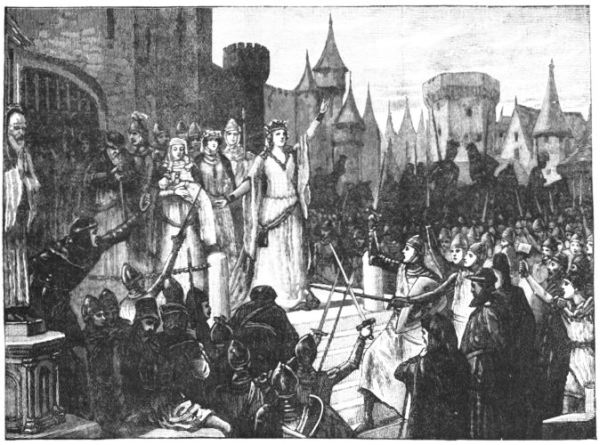
Accession of the King—Attitude of John of Gaunt—Patriotic Government—Insurrection of the Peasantry—John Ball—The
Poll-tax—Wat Tyler—The Attack on London—The Meeting at Mile End—Death of Wat Tyler, and Dispersion of the
Insurgents—Marriage of the King—Expedition of the Bishop of Norwich—Death of Wycliffe—Unpopularity of Lancaster—He
Retires to Spain—Gloucester Attacks the Royal Favourites—Committee of Reform—The Lords Appellant—The
Wonderful Parliament—Richard sets Himself Free—His Good Government—Expedition to Ireland—Marriage with
Isabella of France—The King's Vengeance—Banishment of Hereford and Norfolk—Arbitrary Rule of the King—His
Second Visit to Ireland—Return of Hereford—Deposition and Murder of Richard.
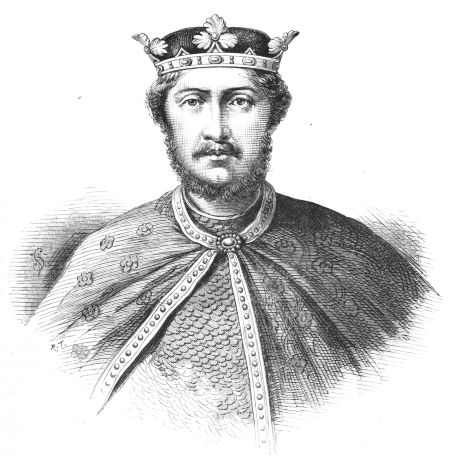
Richard II. was only eleven years of age at the
time of his grandfather's death. He was the sole
surviving son of the popular Black Prince, his
elder brother having died before his father left
Guienne. Richard, therefore—called Richard
of Bordeaux, from being born there—was brought
up as the heir-apparent by his mother, Joan of
Kent, and his uncles, in the most luxurious indulgence,
and in the most extravagant ideas of his
royal rank. This was a fatal commencement for
the reign of a boy, and it was made still more so
by the extreme popularity of his father, whose
memory was idolised both as the most renowned
warrior of his time, and as the advocate of the
people against the stern measures of Edward III.
All these things combined to spoil a naturally
good and affectionate disposition.
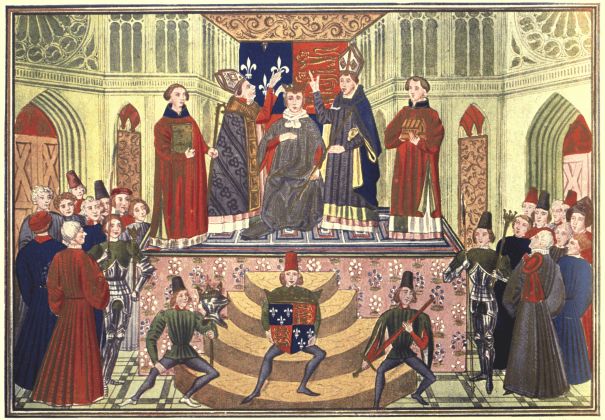
Richard ascended the throne on the 22nd of
June, 1377, his grandfather having died the day
before. While the old king still lay on his death-bed,
a deputation of the citizens of London had
waited on the juvenile prince at Shene, where he
was living, and offered him their lives and fortunes.
They entreated him to come and take
up his residence in the Tower amongst them.
Richard gave a gracious reply in assent, and the
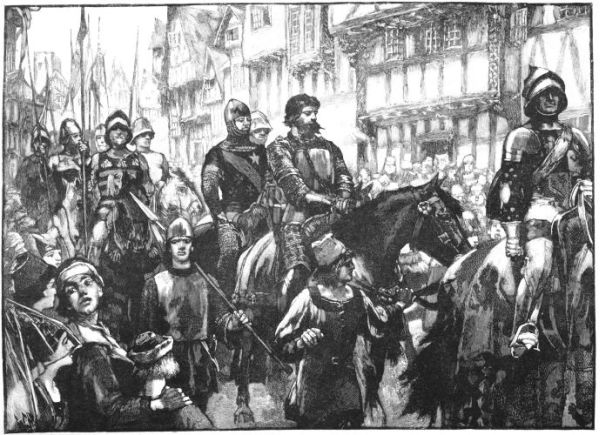
next afternoon made his entrance into the capital.
Three weeks were spent in performing the obsequies
of the late king, and in preparing for the
coronation of the present. This took place on
the 16th of July.
The day after the coronation the prelates and
barons met in council to arrange the form of government
during the king's minority. They
avoided appointing a regent in order, as is supposed,
that they might not have to elect the Duke
of Lancaster, the celebrated John of Gaunt, the
king's uncle, who had long been suspected of aspiring
to the crown, and who was, moreover, an unpopular
personage. They therefore chose nine
councillors—namely, three bishops, two earls, two
barons, and two knights—to assist the chancellor
and the treasurer. Not one of the king's uncles
was included, not even the Earl of Cambridge,
afterwards made Duke of York, who was indolent
and of slight capacity, and therefore not much to
be feared; nor the Earl of Buckingham, afterwards
Duke of Gloucester, who was bold and turbulent,
but much more popular than either of his brothers.
Contrary to general expectation, Lancaster
appeared to acquiesce in the arrangement without
a murmur, and retired with all his attendants to
his castle of Kenilworth, as if about to devote
himself to the pursuits of private life. But he
had taken care to secure the appointment of some
of his staunch cavaliers in the council, and, in
reality, he and his brothers were the ruling
powers in the state. Amongst the leading members
of the council were the Bishops of London,
Carlisle, and Salisbury, the Earls of March and
Stafford, Sir Richard Devereux, and Sir Hugh
Segrave.
The Commons had acquired now so much consideration
and boldness, that they petitioned the
king on this occasion to be admitted to assist the
barons in nominating the royal council during the
minority; which petition, though it was not complied
with, received a civil answer. They further
represented the necessity of their being summoned
every year, as entitled by the law of Edward III.,
and before they dissolved they appointed two
citizens as treasurers to receive and disburse the
moneys granted by them to the Crown. These
treasurers were John Philpot and William Walworth,
citizens of London.
The Commons did not conceal their suspicions
of the Duke of Lancaster. They uttered very
plain language regarding him, and this language
did not fail to rouse his ire. When the Archbishop
of Canterbury recommended Richard to the
affections of his people, and called on Parliament
to assist in advising how the enemies of the realm
might best be opposed, the Commons replied that
they could not themselves venture to answer so
important a question, but begged to have the aid
of twelve peers, naming the Duke of Lancaster
expressly as "my lord of Spain."
The moment that the king had assented to this
the Duke arose, bent his knee to the king, and
said, with much anger, that the Commons had no
claim to advice from him. They had charged him
with nothing short of treason—him, the son of a
king, and one of the first lords of the realm, a man
of a family not only closely allied to the throne,
but noted for its faith and loyalty. It would, indeed,
be marvellous, he said, if he, with more than
any other subject in the kingdom to lose, should
be found a traitor. He resented the imputation
indignantly, called on his accusers to stand forth,
and declared that he would meet them like the
poorest knight, either in single combat, or in any
other way that the king might appoint.
This extraordinary demonstration created a
great sensation. The lords and prelates crowded
round him, entreating him to be pacified, "for no
mortal being could give credit to such imputations."
The Commons pointed to the fact that
they had named Lancaster as their principal adviser,
and finally the duke allowed himself to be
appeased. But it was clear that the Commons
were strongly against him. The majority consisted
of the very men who had been opposed to
him in 1376; and their speaker was Sir Peter
De la Mare, the man whom he had imprisoned for
his activity on that occasion.
Another blow aimed at the aspiring duke was
through his patronage of the late king's mistress,
the notorious Alice Perrers. Lancaster had procured
her return from banishment, and protected
her. But he was now fain to abandon her, seeing
the stormy state of the political atmosphere, and
consented even to sit on a committee of the House,
with four other peers, to try her for soliciting causes
in the king's courts for hire and reward, and for
having procured from the late king the revocation
of the appointment of Sir Nicholas Dagworth to
an office in Ireland, and a full pardon of Richard
Lyons, who had been convicted by the Commons
of various misdemeanours. The beautiful, clever,
and unscrupulous Alice was now finally banished,
with forfeiture of all her lands, tenements, goods,
and chattels.
The enemies more immediately in view when
the Parliament was summoned were the French
and Spaniards. Taking advantage of the reign
of a minor, the French refused to renew the
truce which had expired before the death of the
late king; they drew close their alliance with
Enrique de Trastamare, who resented the assumption
of the title of King of Castile by the
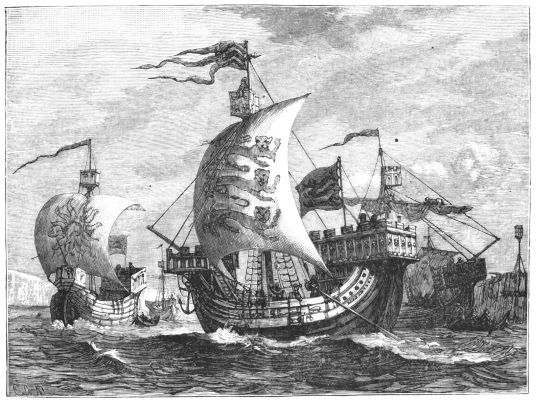
Duke of Lancaster. They united their fleets and
ravaged the English coasts. Richard only ascended
the throne in June, and in August the
whole of the Isle of Wight was in the possession
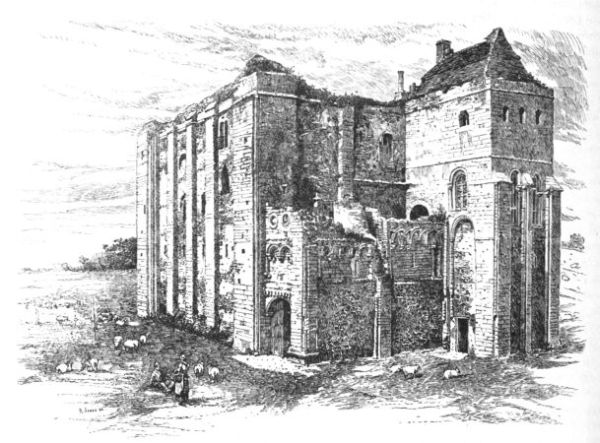
of these foreigners, with the exception of Carisbrooke
Castle. They laid waste the island, burnt
the towns of Hastings and Rye, and attacked
Southampton and Winchelsea. Winchelsea made
a successful resistance, and the Earl of Arundel,
falling on the combined fleet before Southampton,
repulsed it with great loss. But marauders of
other nations flocked to the fleets of the French
and Spaniards, and committed much devastation
both on our ships at sea and on our coasts. The
maritime districts of Kent and Sussex suffered
severely, and a fleet even ascended the Thames
and burnt the greater part of Gravesend.
To check these several inroads Parliament
granted supplies which, however, from the empty
condition of the Treasury, were obliged to be borrowed
in advance from the merchants. With
these funds a fleet was raised, and put under the
command of the Duke of Lancaster, who passed
over to Brittany, besieged the town of St. Malo,
where he lay for some weeks, and then returned
to England without effecting anything, to the
grievous disappointment of the people. Meantime
the Scots, instigated by the French, broke
the truce, and attacked the castle of Berwick,
which they took. They burned Roxburgh, and
made incursions into the northern counties.
Being repulsed, and Berwick having been retaken
by the Earl of Northumberland, they united with
the French and Spaniards at sea, and under one
John Mercer, they swept the German Ocean, and
seized all the ships in the port of Scarborough.
These tidings produced great alarm and indignation
in London, and John Philpot, the stout
alderman lately appointed one of the treasurers
for the Commons, seeing that nothing was done
by the Government effectually to check these marauders,
fitted out a small fleet at his own expense,
put to sea without waiting for any commission
from the authorities, and, coming up with the
united fleet, gave battle, and after a desperate
conflict succeeded in capturing sixteen Spanish
ships, with all the vessels carried off from Scarborough,
and John Mercer himself. Returning
triumphantly to London after this most brilliant
achievement, he was received, as he deserved, with
enthusiastic acclamation by his fellow-citizens, but
was severely reprimanded by the royal council for
having dared to make war without regal permission.
So offensive was it to the routine of that
day that a man without orders should save his
country.
Nothing having been done by the regularly
appointed commanders except the usual feat of
spending the money, a new Parliament was summoned.
This met at Gloucester on the 20th of
October, 1378. The Commons objected to a fresh
subsidy, as well they might, seeing that the last had
produced no advantage; but, being answered by
Sir Richard Scrope, the steward of the household,
that it was indispensable, they insisted on permission
to examine the accounts of the treasurers,
which was granted under protest that it was not
by right, but by favour, and should not be drawn
into a precedent. They next requested to be furnished
with a copy of the enrolment of the tenths
and fifteenths which they had last granted, to
learn how they had been raised, which, as money
was wanted, was also conceded under protest.
Finally, they proposed that six peers and prelates
should come to their chamber to consult with
them on these matters—an evidence that the
Lords and Commons at that time regularly occupied
separate houses. This was declined by the
great men of the Upper House, who, however, professed
their readiness to meet, by committee, with
a committee of the Commons.
The Commons having obtained the necessary
accounts and documents, went leisurely and deliberately
to work; and though the impatient
Government repeatedly urged them to dispatch,
they still proceeded with all sedateness and care,
showing that the popular body was growing sensible
of its real powers. Having discovered that
the whole of the supplies had been duly but fruitlessly
spent, they granted a fresh impost on wool,
wool-fells, and skins, for the pressing services of
the State.
Another army was raised, and placed under the
command of the Earl of Buckingham. He passed
over to Calais, whence in the summer of 1380 he
marched with 2,000 cavalry and 8,000 infantry,
through the very heart of France, pursuing the
old accustomed ravages, through Picardy, Campagne,
Orleannais, and on to Brittany. The
Duke of Burgundy, with a far greater army,
hovered in the vicinity of this handful of men;
but, remembering the past result of conflict with
small armies of the English, he kept aloof.
By the time that Buckingham reached Brittany,
Charles V. died, and Charles VI., a minor, like the
King of England, succeeded in the autumn of
that year. The Bretons, now thinking that, a
mere boy being on the throne of France, they
could protect themselves, grew impatient of the
burdensome presence of the English. De Montfort,
who had found a friendly refuge in England,
was averse from treating his old allies with ingratitude;
but the people accused the English
of rapacity and haughtiness—and, no doubt, with
cause enough, if we are to judge by the general
proceedings of the English in France—and would
not cease their demands till the count had transferred
his alliance to the regency which governed
France during the minority. This accomplished,
the people expressed every impatience to be rid of
Buckingham and his army, and as soon as the following
spring allowed of his embarking, he took
his leave, having escaped the hostility of the natives
only by the bravery of his troops and the
supplies of provisions from home. The English
returned home denouncing bitterly the ingratitude
of the Bretons; and this was the unsatisfactory
termination of their long and expensive exertions
to maintain the independence of Brittany. The
only possession which we retained in that province
was the port of Brest, which Richard had received
from De Montfort in exchange for an equivalent
estate in England. Calais and Cherbourg—obtained
from the King of Navarre—Bordeaux and
Bayonne were still towns in the hands of the
English, affording tempting avenues of approach
to every quarter of France, and incitements to
future expeditions.
But at this moment events were approaching
which demanded all the efforts of the Government
to maintain domestic order. In various
countries of Europe the advance of society, and,
though slow, of trade and manufactures, had
begun to produce its certain effect upon the
people. They no sooner ate of the tree of knowledge
than they perceived that they were naked—naked
of liberty, and property, and every solid
comfort. They were in a great measure serfs and
bondsmen, transmitted with the estates from proprietor
to proprietor, like the chattels and the
live stock. The haughty aristocracy looked upon
them as little better than the beasts; and, addicted
to continual wars with each other or with
foreign countries, made use of the miserable
people only as soldiers for those wars or as slaves
to cultivate their lands. The wretched sufferers
were ground by domestic exactions, and pillaged
and burnt out continually in some of the countries
by invading armies. Nothing could be more
terrible than their condition; and when they
began to perceive all its horrors, and to endeavour
to rise above them, their imperious masters trod
them down again with harsh and often terrible
ferocity.
But wherever towns grew and trade sprang up,
there numbers became, by one means or other,
free. In England every man who could contrive
to live a year and a day in any town became a
free man. The very wars which had desolated
Europe had tended to awaken a spirit of independence;
the soldiers who served in different
countries picked up intelligence by comparing
various conditions of men. The constant demands
of Government for money inspired those who
had to furnish it with a sense of their own importance.
The example of the freedom and superior
comfort in towns stimulated the inhabitants
of the country to grasp at equal benefits.
Flanders, as the earliest manufacturing and
trading country, had, as we have seen, speedily
become democratic; had expelled its ruler, and
had now maintained a long career of independence.
At this moment it was waging a most
sanguinary and determined war, not only against
its own earl, but against the whole forces of Burgundy
and France, led by Philip van Artevelde—the
son of Jacob, the stout old brewer of Ghent—and
by a relentless citizen, Peter Dubois.
Once more in France insurrection had broken
out, headed by the burghers and people of the
towns, excited against the tax-gatherers, and had
spread from Rouen to Paris, where it was raging.
And now the same convulsion, originating in the
same causes, had reached England; and simultaneously
in Flanders, France, and this country, the
people were in arms against their Government and
nobles.
It has been supposed that the preaching of
Wycliffe had no little effect in rousing this storm
in England, and there can be no doubt of it. The
people, once made acquainted with the doctrines
of human right, justice, and liberty abounding in
the Bible, and pervading it as its very essence,
could only regard the knowledge as a direct call
from God to rise, rend the bondage of their cruel
slavery, and assume the rank of men. This light,
this wonderful knowledge, coming too suddenly
upon them, made them, as it were, intoxicated,
and overthrew all restraint and tranquillity of
mind. They felt their wrongs the more acutely
by perceiving their rights, and how basely they
had been deprived of them by men professing
this religion of truth, justice and humanity.
Such was the case on the preaching of Luther in
Germany afterwards, and it was the case here
now. Occasionally a nobleman had suddenly emancipated
the whole of the villeins on his domain in
return for a fixed rent to be paid by them; but
this process was slow and uncertain, and extremely
exciting to those who witnessed this
emancipation, remaining themselves in bondage.
Thus all classes of the people were in a restless
state. The freemen just above these serfs, and
especially those on the coast, who had been plundered
and burnt out by the enemy, were full of
bitterness from their sufferings, and disposed to
regard the tax-gatherer as little short of a demon.
Few, except the working order of the clergy, who
lived and laboured amongst them, treated them
like human beings.
Imagine, then, this state of things, and a priest
like John Ball of Kent coming amongst them on
Sundays as they issued out of church in the
villages, and saying to them as Froissart thus
reports him: "Ah, ye good people, matters go
not well to pass in England, nor shall do, till
everything be common, and that there be no
villeins nor gentlemen, but that we be all united
together, and that the lords be no greater masters
than we. What have we deserved, or why should
we be kept thus in bondage? We all come from
one father and mother, Adam and Eve. Whereby
can they show that they are greater lords than
we be? saving by that they cause us to win and
labour for that they dispend. They are clothed in
velvet and camlet, furred with ermine, and we
are vestured with poor cloth. They have their
wines, spices, and good bread, and we have the
drawing out of the chaff, and drink water. They
dwell in fair houses, and we have the pain and
travel, rain, and wind in the fields; and by that
which cometh of our labours they keep and maintain
their estates. We be called their bondmen,
and without we do willingly their service we be
beaten; and we have no sovereign to whom we
can complain, nor that will hear us, nor do us
right. Let us go to the king—he is young—and
show him what bondage we be in, and show him
how we will have it otherwise, or else we will
provide us of some remedy; and if we go together,
all manner of people who be now in any
bondage will follow us, to the intent to be made
free; and when the king seeth us we shall have
some remedy, either by fairness or otherwise."
This honest John Ball, having got this great
gospel of freedom into his head, could not be
prevailed on to be quiet. The archbishop shut
him up for some months in prison, but on coming
out he went about saying the very same things.
"And these people," says Froissart, "of whom
there be more in England than in any other realm,
loved John Ball, and said that he said truth." In
the beginning of the world, they said, there were
no bondmen; wherefore they maintained none
ought to be bound, without he did treason to his
lord as Lucifer did to God. But they said they
could have no such battle, because they were
"neither angels nor spirits," but men formed in
the similitudes of their lords; adding, "Why, then,
should we be kept under so like beasts?" And
they declared they would no longer suffer it;
they would be all one, and if they laboured for
their lords, they would have wages for it.
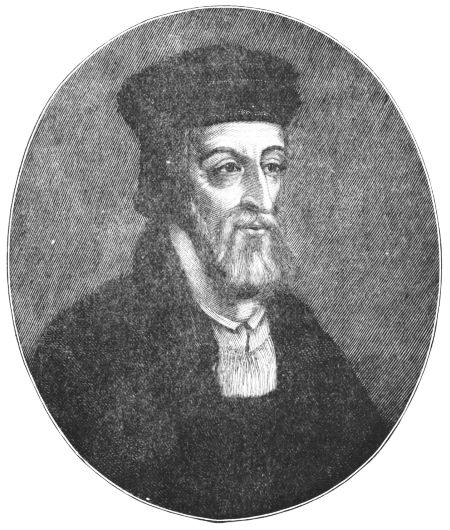
JOHN WYCLIFFE.
(From the portrait in King's College, Cambridge.)
This was all only too true; but a truth coming
too suddenly, and more than they could bear, or
were disciplined to win, or, if won all at once, to
maintain. And these poor people did not know
that even now there was growing up that power
amongst the people, in the shape of Parliament,
which should gradually and securely fight their
battles, and establish all their desires. Even now
the Commons had reached the presence of the
king and the nobles, and stood there boldly declaring
their rights, and putting an ever-growing
restraint on regal and aristocratic licence.
In the Parliament which met in January, 1380,
the Commons complained loudly of the extravagance
of the expenditure. They demanded that
the king's council should be dismissed; that the
king should govern only by the aid of the usual
Crown officers—the chancellor, treasurer, privy
seal, chamberlain, and steward of the household;
and that these ministers should be chosen by Parliament.
These unexampled demands were all
granted; a committee of finance was appointed,
to consist of Lords and Commons; and such a
concession as had never yet been made was
granted, and three representatives of cities—two
aldermen of London and one of York—were put
upon it. In the autumn, being informed that the
subsidies which they voted were inadequate to
defray the debts of the State, they pronounced the
demand for more money "outrageous and insupportable."
This was bold language; the result
was, of the many schemes to meet the difficulty,
the fatal poll-tax, which threw the country into a
general convulsion. This was a tax of three groats
per head on every male and female above fifteen
years of age. In towns it was to be regulated
by the rank and ability of the inhabitants, in
order to render it easier to the poor, so that no
person should pay less than one groat, nor more
than sixty, for himself and wife.
This poll-tax was the drop to the full cup. The
people were already groaning under the continued
exactions for the French wars, and this tax drove
them to desperation. What added gall to its
bitterness was that it was farmed out to some of
the courtiers, who again farmed it out to foreign
merchants, whose collectors proceeded with a
degree of harshness and insolence which irritated
the people beyond endurance. It was soon discovered
that the amounts which came into the
treasury would by no means reach the sum calculated
upon. Commissions were then issued to
inquire into the conduct of the collectors, and to
enforce payment in cases where favour had been
shown, or where due payment had not been made.
The people soon grew obstinate, and declared
boldly they would not pay. Hereupon the commissioners
treated them very severely, and they
again, on their part, resenting this severity, began
secretly to combine for resistance, and proceeded to
chase away, wound, or even kill the officers of the
law.
One of these commissioners, Thomas de
Bampton, sat at Brentwood in Essex, and summoned
the people of Fobbing before him. They
declared that they would not pay a penny more
than they had done. Bampton then menaced
them, and ordered his sergeant-at-arms to arrest
them. But they drove him and his men away.
Whereupon Sir Robert Belknap, the chief justice
of the Common Pleas, was sent into Essex to try
the recusants; but they denounced him as a
traitor to king and country, made him glad to
get away, and cut off the heads of the jurors and
clerks of the commission, which they stuck upon
poles, and carried through all the neighbouring
towns and villages, calling on the people to rise.
In a few days the commons of Essex were in a
general insurrection, and had found a leader in a
vagabond priest, who called himself Jack Straw.
They attacked the house of Sir Robert Hales,
the Lord Treasurer of England, who was also
Prior of the Knights of St. John of Jerusalem.
Ample provision had just been made for a
chapter-general of the order, and there was in the
house abundance of meats, wines, cloths, and
other things for the knights brethren. The
people ate up the provisions, drank the wine, and
destroyed the house.
They then sent letters and messengers into all
the neighbouring counties, and not only the peasantry
of Kent, but of Norfolk and Suffolk, were
soon up in arms. But the incident which caused
the whole immediately to break into flame was
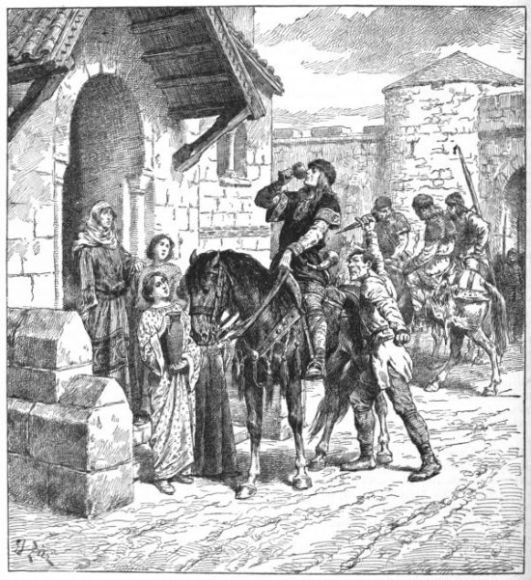
this:—One of the collectors of the tax at Dartford,
in Kent, went to the house of one Wat
Tyler, or Walter the Tyler, who, Froissart says,
was "indeed a tyler of houses, an ungracious
patron." He demanded the tax for a daughter of
Wat, who the mother contended was under
fifteen, the age fixed by the law. The insolent
tax-gatherer declared he would prove that, and
was proceeding to the grossest outrage, when Wat
came running in at the outcries of the wife and
daughter, and knocked out the scoundrel's brains
with his hammer. The neighbours applauded
Wat's spirit, and vowed to stand by him; "for,"
says the chronicler, "the rude officers had in many
places made the like trial."
The news of this exciting occurrence, and the
insurrection of the men of Kent, spread rapidly
over the whole country, from the Thames to the
Humber; through Hertford, Surrey, Sussex, Suffolk,
Norfolk, Cambridge, and Lincoln. In every
place they chose some leader, whose assumed
names still remain in their letters and proclamations,
as Jakke Milner, Jak Carter, and Jak
Treweman. They were invited by the letters from
Kent to march to London, where "the Commons
should be of one mind, and should do so much to
the king that there should not be one bondman in
all England." They are reported soon to have
mustered 60,000 from the counties round London,
making free with houses and provisions as they
marched along.
But the great stream appears to have come from
Kent and the south. One of their first visits was
to Sir Simon Burley, the guardian of the king, at
Gravesend. Sir Simon had claimed a man living
in that town as his bondman, in spite of the legal
plea set up that he had resided there more than a
year and a day. He demanded 300 pounds of
silver for the man's freedom; but this was refused,
and Sir Simon sent his prisoner to Rochester
Castle. The men of Kent, now joined by a
strong body from Essex, marched on Rochester,
took the castle by surprise, and not only liberated
this man, but other prisoners.
At Maidstone Wat Tyler was elected captain of
the insurgent host, and the democratic preacher,
John Ball, its chaplain, who took for the text
of his first sermon the good old rhyme—
"When Adam dolve, and Eve span,
Who was then the gentleman?"
Wat Tyler and his host entered Canterbury on
the Monday after Trinity Sunday, 1381, where
John Ball denounced death to the archbishop, who
had often imprisoned him: luckily, however,
he was absent. But they broke open the archbishop's
house; and, as they carried out the
wealthy pillage, they said, "Ah! this Chancellor
of England hath had a good market to get together
all this riches. He shall now give an
account of the revenues of England, and the
great profits he hath gathered since the king's
coronation."
They struck terror into the monks and clergy of
the cathedral; did much damage to it and the
church of St. Vincent, as is said; compelled the
mayor and aldermen to swear fidelity to King
Richard and the Commons of England; cut off
the heads of three wealthy men of the city; and,
followed by 500 of the poor inhabitants, advanced
towards London. By the time they reached
Blackheath, joined by the streaming thousands
from all quarters, the insurgents are said to have
numbered 100,000 men.
Into the midst of this strange, rude, and tumultuous
host, suddenly, to her astonishment and
terror, came the king's mother, on her return from
a pilgrimage to Canterbury. "She was," says
Froissart, "in great jeopardy to have been lost, for
the people came to her chaise and did rudely use
her, whereof the good lady was in great dread lest
they should have dealt rudely with her damsels.
Howbeit, God kept her," and being excused with
a few kisses, and with offers of protection, she got
to London as fast as she could, and to her son in
the Tower, with whom there were the Earl of
Salisbury, the Archbishop of Canterbury, the Earl
of Hereford, and other noblemen and gentlemen.
At Blackheath John Ball frequently addressed
the assembled multitudes on his old and favourite
topics of the rights and equality of men. We
must bear in mind that this man and his doctrines
have been described by his enemies. He appears
to have been a thorough democrat or Chartist of
his day, drawing his opinions from the literal declarations
of the gospel that God is no respecter of
persons; and these new and startling ideas being
addressed to the inflamed minds of ignorant and
oppressed people, they immediately applied them
in their own way, and declared that they
would have no more lords, barons, and archbishops,
but simply the king and the Commons of
England. They are said to have committed great
atrocities on their way from different counties,
pillaging the manors of their lords, demolishing
the towns, and burning the court rolls. They
swore to be true to the king, and to have no king
of the name of John, this being aimed at John
of Gaunt, their standing aversion, who was regarded
as the author of this tax, because he exercised
authority over his nephew. They also
swore to oppose all taxes but fifteenths, the
ancient tallage paid by their fathers.
That many outrages were committed is most
probable: such must be inevitable from so general
a rising of an uneducated and oppressed populace
smarting under generations of wrongs. But we
shall most fairly judge them by their own public
demands presented to the king, which we shall
presently see were most wonderfully simple, reasonable,
and enlightened for such a people, under
such exasperating circumstances.
The harangues of John Ball are described as
working the insurgent army into the wildest excitement,
and the admiring people are said to have
declared that he should be the Primate and Chancellor
of England, this officer at that time being
almost always a prelate.
At the taking of the castle of Rochester, the
mob had compelled the governor, Sir John
Newton, to go along with them; and now they
sent him up the river in a boat to go to the king
at the Tower as their messenger. He was to
inform the king of all that they had done or
meant to do for his honour; to say that his
kingdom had for a long time been ill-governed by
his uncles and the clergy, especially by the Archbishop
of Canterbury, his chancellor, from whom
they would have an account of his administration
of the revenue. Sir John, coming to the Tower,
was received by Richard graciously; and he then
told the people's desire, assuring the king that all
he said was true, and that he dared do no other
than bring the message, for they had his children
as hostages, and would kill them if he did not
return.
After some consultation the king informed Sir
John that in the morning he would come and
speak to the people. With this message Sir John
joyfully departed, and the vast crowd are said to
have received the message of the king's coming
with great satisfaction.
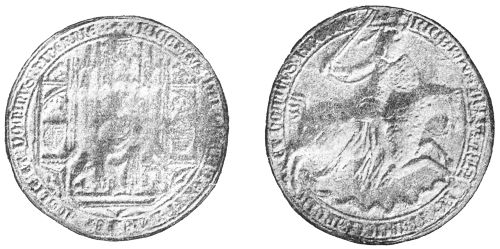
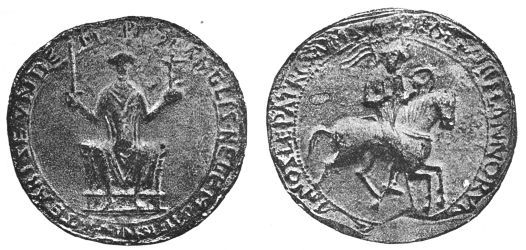
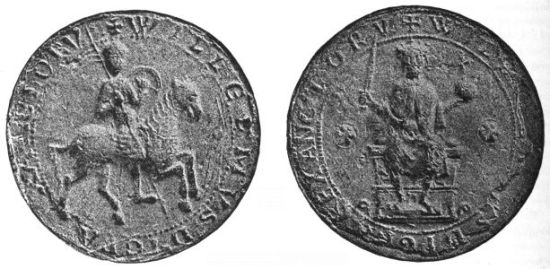
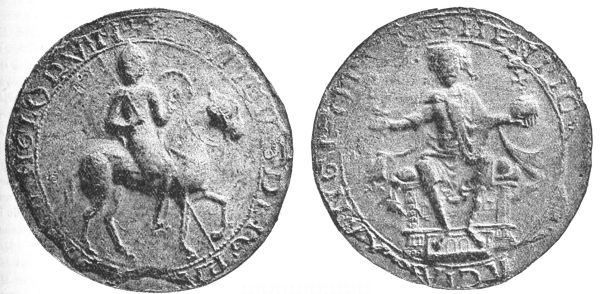
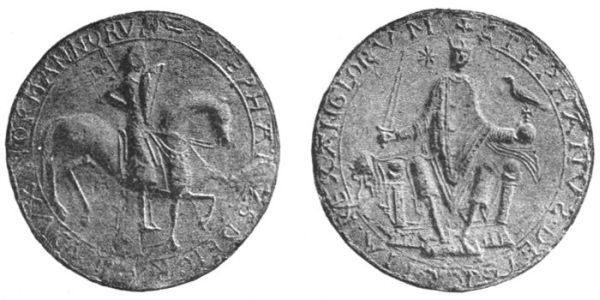
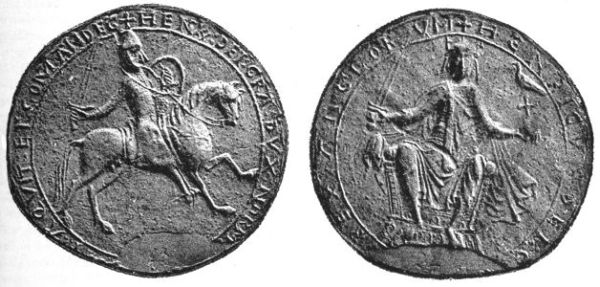
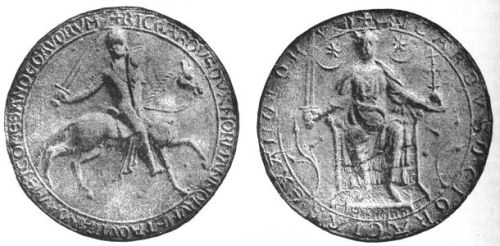
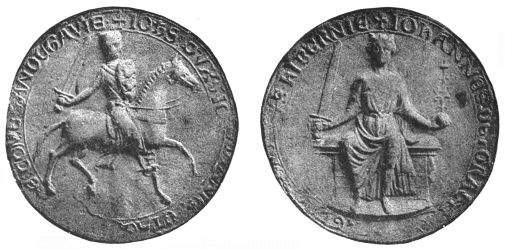
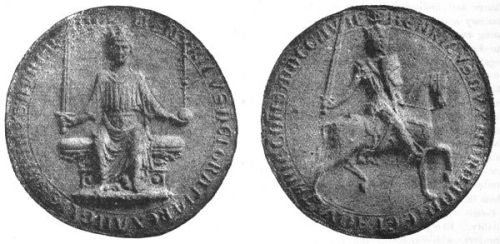
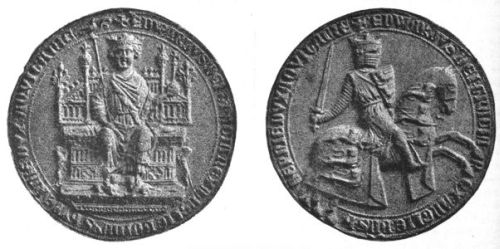
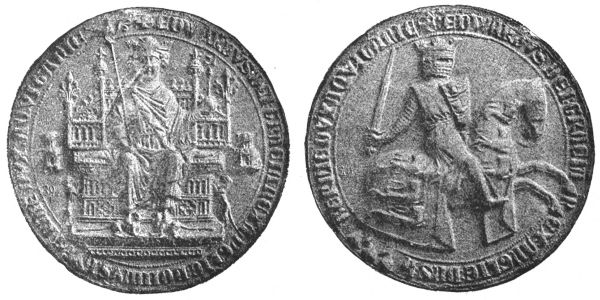
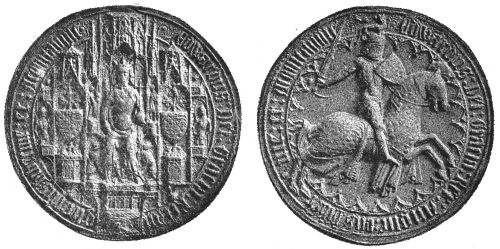
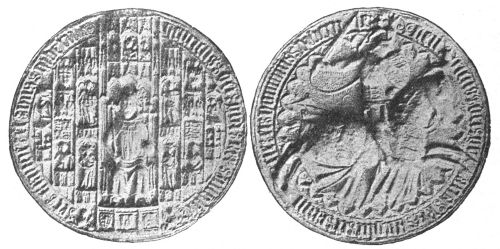
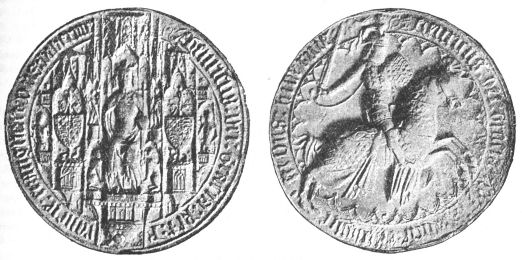
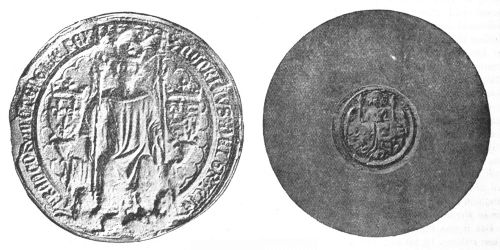
GREAT SEAL OF RICHARD II.
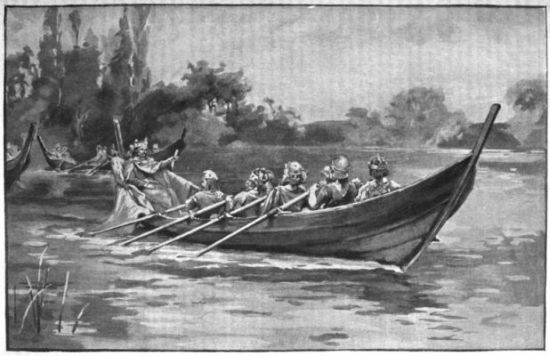
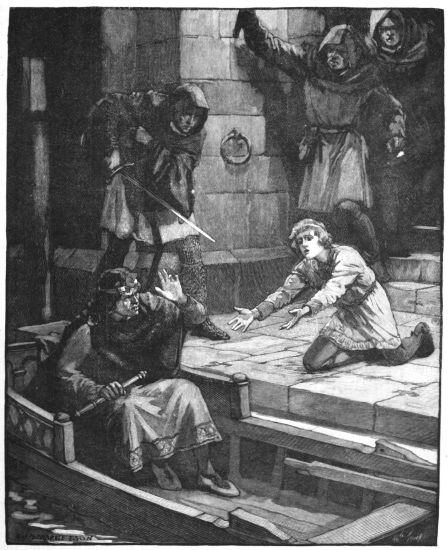
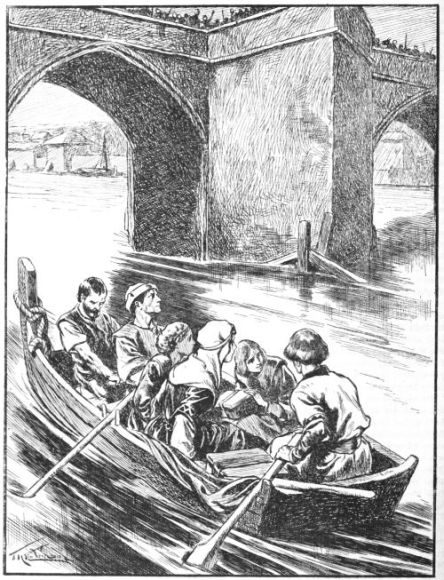
The next morning, being the 12th of June, the
king, attended by a considerable number of the
lords of the court, descended the river in his
barge. At Rotherhithe he found 10,000 men on
the river banks awaiting his coming, with two
banners of St. George and sixty pennons. So
soon as they saw the king they set up one universal
cheer. This was no doubt meant as a
hearty welcome; but the king and his courtiers
being all in a state of panic—for the council, it is
stated, were perfectly paralysed by their fears—the
boisterous acclamation struck the royal party
as frightful yells. "The people," says Froissart,
"made such a shout and cry as if all the devils in
hell had been among them." Instead of landing,
the courtiers advised the king to draw off. The
people cried to the king that, if he would come on
shore, they would show him what they wanted;
but the Earl of Salisbury replied, saying, "Sirs,
ye be not in such order or array that the king
ought to speak to you;" and with that the royal
barge bore away up the river again.
At this sight the crowd were filled with indignation.
They had hoped that now they should
bring to the royal ear all their grievances; and
there can be little doubt that if the king had
shown the spirit which he afterwards did, and
boldly and courteously put his barge within good
hearing, and listened to and answered their complaints,
all that followed might have been prevented.
But being now persuaded that the great
lords about him would not allow the king to hold
fair and open audience with them, "they returned,"
says Froissart, "to the hill where the
main body lay"—for this was only a deputation,
the hill being most likely Greenwich Park—and
there informed the multitude what had taken
place.
On hearing this the enraged host cried out with
one voice, "Let us go to London!" "And so,"
continues Froissart, "they took their way thither;
and on their going they beat down abbeys and
houses of advocates and men of the court, and so
came into the suburbs of London, which were
great and fair, and beat down divers fair houses,
and especially the king's prisons, as the Marshalsea
and others, and delivered out the prisoners
that were therein." They broke into the palace of
the archbishop at Lambeth, regarding him as the
enemy of the nation, and burnt the furniture and
the records belonging to the chancery.
As the men of Kent advanced through Southwark,
the men of Essex advanced along the left
bank of the river, destroyed the house of the lord
treasurer at Highbury, and menaced the north of
London.
When the men of Kent arrived at London
Bridge they found it closed against them, and
they declared that if they were not admitted they
would burn all the suburbs, and, taking London
by force, would put every one to death. The
people within said, "Why do we not let these
good people in? What they do they do for us
all!" and thereupon they let down the centre of
the bridge, which Walworth, the mayor, had had
drawn up.
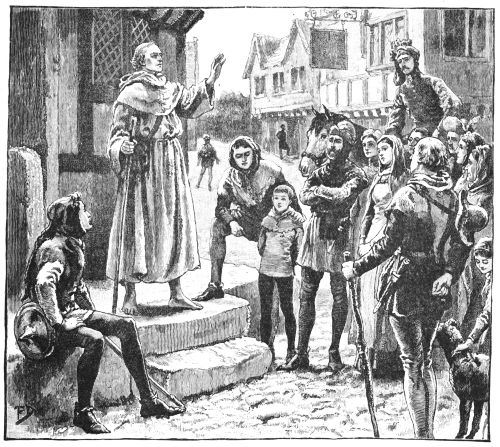
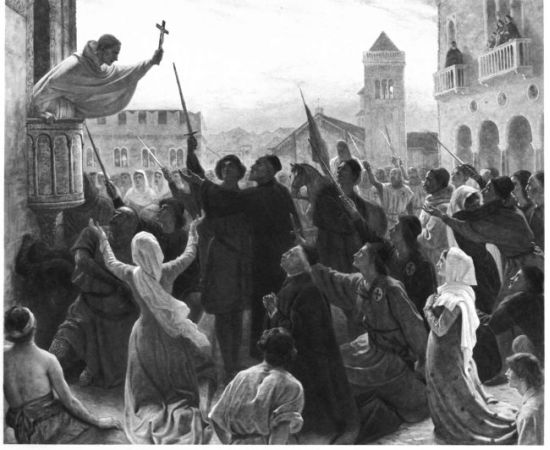
ONE OF WYCLIFFE'S "POOR PRIESTS" PREACHING TO THE PEOPLE. (See p. 462.)
"Then these people entered into the city, and
went into houses, and sat down to eat and drink.
They desired nothing but it was incontinently
brought to them, for every man was ready to
make them good cheer, and to give them meat
and drink to please them. Then the captains,
as John Ball, Jack Straw, and Wat Tyler,
went throughout London, and 20,000 men with
them, and so came to the Savoy, in the way to
Westminster, which was a goodly house, which
appertained to the Duke of Lancaster; and when
they entered they slew the keepers thereof, and
robbed and pillaged the house, and then set fire
to it, and clean burnt and destroyed it."
This palace of John of Gaunt's was the most
magnificent house in London. The mob, having
thus shown their hatred of him, went to the
house of the Knights Hospitallers in Clerkenwell,
which had been lately built by Sir Robert
Hales, the grand prior of the Order and Treasurer
of the kingdom, whose house they destroyed at
Highbury. It is only fair to bear in mind that
in destroying these noble houses, the people disclaimed
any idea of plunder. Their objects were,
as they asserted, to punish the traitors to the nation,
and obtain their own freedom from bondage.
They published a proclamation forbidding any
one to secrete any booty. They hammered out
the plate, and cut it into small pieces. They beat
the precious stones to powder, and one of the rioters
having concealed in his bosom a silver cup, was
thrown with his prize into the river.
In the morning (June 14), the sight from the
Tower was by no means cheering. The multitude
was clamouring for the heads of the chancellor
and treasurer, whom they regarded as main
authors of all the exactions and ill-treatment
they had received, and preventing the entrance
of any provisions till their demand was conceded.
Presently a message was brought them from the
king that if they would quietly retire to Mile
End, then having plenty of open land, "where
the people of the city did disport themselves in
the summer season," he would meet them there
and listen to their requests. Anon the gates were
thrown open, the drawbridge was lowered, and
Richard, attended by a few unarmed followers,
rode on amid the throng. Arriving at Mile End,
he found himself surrounded by 60,000 petitioners.
On the way Richard's half brothers, the Earl of
Kent and Sir John Holland, had taken alarm
and ridden off, leaving this youth of sixteen in a
cowardly manner in such circumstances. But
Richard on this occasion displayed a bravery and
a discretion which, had they been uniformly exhibited,
must have produced a prosperous reign.
According to Froissart, in the night, while they
lay asleep on Tower Hill, the king had been
advised by Sir William Walworth and others to
make a sally and slay them in their sleep; for,
as he observes, there were not one in twenty in
harness, and as they were drunken, they might
be killed like so many flies. These counsellors
represented that the citizens of London could
easily do this, as they had their friends ready in
arms secreted in their houses, and that there were
Sir Robert Knowles and Sir Perdiccas d'Albret,
the famous Free Company captains, with 8,000
more that might be mentioned. But the Earl
of Salisbury and "the wise men about the king
gave better and more humane advice." And now
that the king spoke face to face with them,
behold, all their demands resolved them into these
four:—1, The abolition of bondage; 2, The
reduction of the rent of land to fourpence the
acre; 3, The liberty of buying and selling in
all fairs and markets; 4, A general pardon for
the past offences.
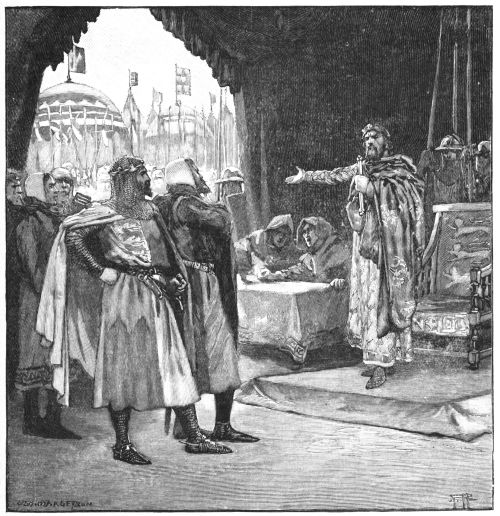
The king with a smiling countenance assured
them that all this was fully granted them, and
that if they would retire every one to his own
county and place, he would give one of his
banners to those of each shire, bailiwick, and
parish to march home under; and that they
should leave two or three from each village to
bring unto them copies of the charter he would
give them. On hearing this the people said, "We
desire no more." They became quite appeased,
and began to draw off towards London. That
night thirty clerks were employed in making
copies of this charter, which were sealed and
delivered in the morning.
But while the superior and better-disposed
country people had attended the king, Wat
Tyler and Jack Straw, with the more turbulent
and factious portion of the insurgents, had
remained behind. No sooner was the king out
of sight, than these treacherous fellows made a
rush at the Tower, and got possession of it, most
probably through the perfidy or perhaps panic
of the garrison, for there were in the Tower,
according to Holinshed, 600 men-at-arms, and
as many archers, while of these commons and
husbandmen many were provided only with
sticks, and not one in a thousand was properly
armed. Here the insurgents got possession, as
no doubt was their grand object, of their designed
victims, the Archbishop of Canterbury, the chancellor;
Sir Robert Hales, the treasurer; William
Appledore, the king's confessor; and Legge, one
of the farmers of the obnoxious tax, with three
of his accomplices. All these they speedily
beheaded. The head of the archbishop was
carried through the city on the point of a lance,
with the hat he wore nailed to the skull, that
he might be better known to the multitude, and
it was set on London Bridge.
They ranged through all the apartments of the
Tower, again came upon the terrified mother of
the king, pricked her bed with their swords to see
if any one was concealed in it, and saluted her
with a few more kisses. The poor lady fainted
away, and was carried by her attendants to her
house, called "The Wardrobe in Carter Lane."
Here the king on his return joined her, and gave
her comfort, trusting that all would now soon
be over.
In the morning (June 15), Richard left the
Wardrobe, and, after mass at Westminster, rode
through Smithfield at the head of sixty horsemen,
where he beheld a great throng of people in front
of the abbey of St. Bartholomew. He said he
would go no farther till he knew what ailed them,
and that he would appease them again. It was
Wat Tyler at the head of 20,000 insurgents. Wat
had refused the charter sent to him, demanding
fresh conditions; and, when these were conceded
in a second, demanded still more; amongst other
things, the total repeal of the forest or game
laws, and that all parks, waters, warrens, and
woods should be common, so that the poor as
well as the rich should freely fish in all waters,
hunt the deer in the parks and forests and the
hare in the fields.
On seeing the king stop, Wat Tyler said, "Sirs,
yonder is the king; I will go and speak with
him. Stir not hence without I make you a sign;
and when I make you a sign, come on and slay
them all except the king. He is young; we can
do with him as we please, and we will lead him
with us all about England, and so we shall be
lords of all the realm without doubt." Wat rode
up to the king, and so near that the head of his
horse touched the flanks of that of the king.
Then said Wat, "Sir king, seest thou all yonder
people?" "Yea, truly," said the king; "why
dost thou ask?" "Because," said Wat Tyler,
"they be all at my commandment, and have
sworn to me faith and truth to do all that I will
have them. And thinkest thou that they, and
as many more in London, will depart without thy
letters?"
The king courteously assured him they should
have them; and at this point, says Froissart, Wat
Tyler cast his eyes on an esquire of the king,
whom he hated on account of some words he had
said. "Ah!" said he, "art thou there? Give
me thy dagger." The esquire refused, but the
king bade him give it, and with that Wat began
to play with it, and said to the esquire, "By my
faith, I will never eat meat till I have thy head."
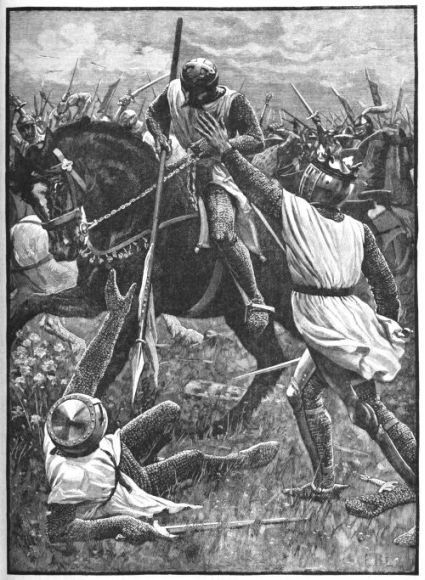
At this moment the mayor, Sir William Walworth,
coming up with his twelve horse, and
hearing these words, and looking through the
press, said, "Ha! thou knave, darest thou speak
such words in the king's presence?" Wat gave
a sharp answer, and Froissart says that the
king said to Walworth, "Set hands on him."
Be that as it may, Walworth thrust a short sword
into Tyler's throat; or, as others say, struck him
on the head with it or with his mace. At all
events, Walworth gave him the first blow, which
was speedily followed by one of the king's squires—Robert
Standish, probably the one with whom
the altercation commenced—stabbing him in the
abdomen. Tyler wheeled his horse round, rode
about a dozen yards, and fell to the ground, where
he soon expired.
On seeing him fall his followers cried out, "We
are betrayed! They have killed our captain!"
and they put themselves in battle array, with
their bows before them.
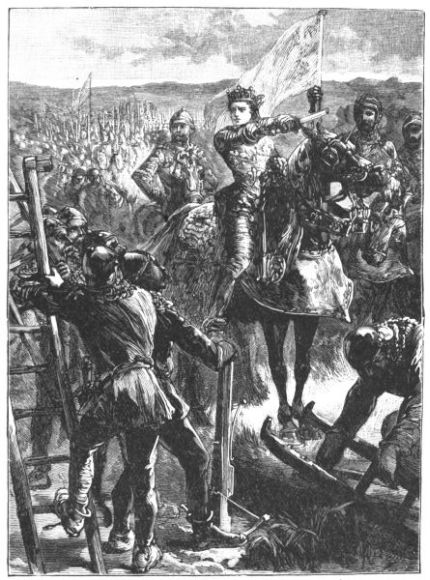
With wonderful presence of mind Richard
ordered his attendants to keep back, and, riding
confidently up to the people, said, "Sirs, what
aileth you? I will be your leader and captain.
Follow me, I am your king; Tyler was but a
traitor; be ye at rest and peace." Then he rode
back to his company, who advised that they
should draw off into the fields near Islington.
Thither many followed the king; and many,
hoping no good, quietly stole away. On coming
into the fields, they beheld Sir Robert Knowles,
with 1,000 men-at-arms; and the insurgents, now
fearing the worst, got away as fast as they could,
throwing down their bows, and many kneeling
to the king and imploring pardon. Knowles
burned to be allowed to charge and cut them
down; but the king refused him this indulgence,
saying he would take his revenge in another way;
which, in truth, he afterwards did. He issued
a proclamation, however, forbidding any stranger
to remain another night in the city on pain of
death.
Such is the history of this remarkable insurrection
as transmitted to us with some slight
variations by Froissart, Knighton, Walsingham,
Stowe, and Holinshed. While these things passed
in London, various parts of the country were
equally agitated and overrun by the insurgents.
In the south the outbreak extended as far as
Winchester, in the north as far as Beverley and
Scarborough. The nobility shut themselves up,
and neither stirred out to free themselves nor
aid the king. So general and simultaneous was
the rising, that some supposed that it was concerted
and conducted by some able but invisible
leaders much above Wat Tyler and Jack Straw
in influence and subtlety. When the mob was at
Blackheath there were rumours that the king's
uncle, the Duke of Gloucester, was seen disguised
amongst them; but this was probably owing to
some one bearing a strong resemblance to the duke
being there, or it may have been got up by his
enemies to injure him at court, as there were
active endeavours, about the same time, to alarm
the king regarding Lancaster's intentions, who
was on the Borders treating with the Scots.
Only one man of distinction acted with the
spirit which might have been expected from the
warlike baronage of England, and that was a
churchman.
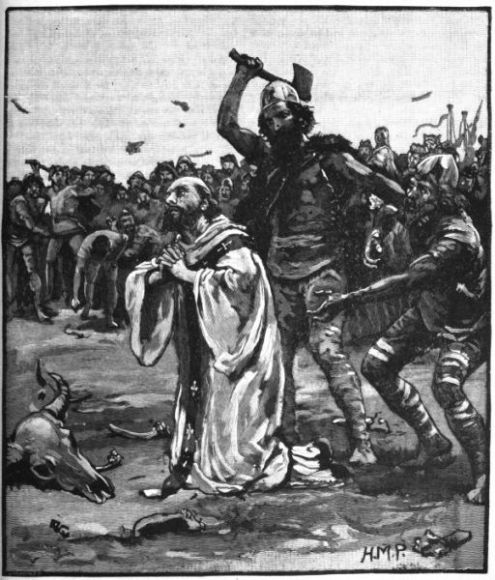
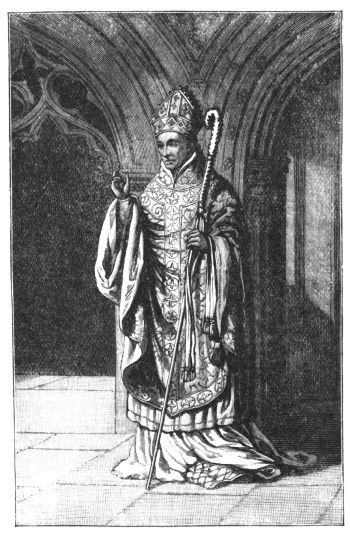
Henry Spencer, the young Bishop of Norwich,
finding that the rebellious peasantry would not
listen to what he considered reason, buckled on
armour, mounted his steed and, at the head
of a strong body of retainers, attacked them
in the field as they were pursuing their career
of depredation. He repeatedly surprised these
marauding bodies, routed, and slew them. His
mode of dealing with them was summary and
unique. After every battle he sat in judgment
on his prisoners, and, after giving them absolution
from their sins, had their heads struck off.
By these means he soon restored order in the
counties of Norfolk, Huntingdon, and Cambridge.
When the news of Tyler's overthrow and the
dispersion of the insurgents spread through the
country, and those who had shut themselves up
in castle and town hurried forth to show their
deep loyalty to the king, Spencer's work had long
been done.
Richard himself, having stuck the heads of
Wat Tyler and of numbers of his compeers on
London Bridge, was advised to undertake a progress
through the different quarters of his kingdom,
to make all quiet and secure. Numbers
flocked to his standard, and at the head of 40,000
men he advanced from place to place, issuing
proclamations, recalling and destroying the
charters he had given, commanding the villeins
to return to their labours, and prohibiting, under
severe penalties, any illegal assemblies. In Kent
and Essex Richard found some resistance; and
it was not until 500 of these unhappy creatures
had been killed in Essex that they gave way.
According to Holinshed, 1,500 of the insurgents
were executed; amongst them Jack Straw, John
Litster, and Westbroom, the last two of whom had
assumed the title of Kings of Norfolk and Suffolk.
When Parliament met it was announced to
it that the king had revoked all the charters
he had been obliged to grant to the villeins; but
the chancellor suggested whether it would not be
well to abolish serfdom altogether. This, probably,
was the view of the king's better counsellors:
it certainly was not his view of things on
his journey; but it met with the response which
was inevitable at that day. The barons declared
that nothing should induce them to give up the
services of their villeins, and that they would
resist with all their power either violence or persuasion
for that object; nay, were it even to save
themselves from general massacre, they must uphold
the existing system. It was plain the day for
the extinction of serfdom was not yet come.
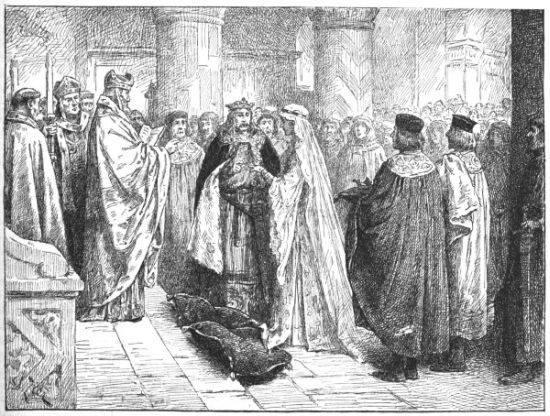
The king was now sixteen, and at this early age
he was married to Anne of Bohemia, who herself
was only fifteen. She was the daughter of the
late Emperor of Germany, Charles IV., called
Charles of Luxembourg at the battle of Poitiers,
where he attended his father, the old blind King
of Bohemia. Anne was thus granddaughter to
the brave old blind monarch, and sister to the
Emperor Sigismund. As has almost universally
been the case with German princesses, there was
a great boast and parade of the illustrious
ancestry of Anne, but no money whatever. Nay,
Richard, or rather the country, had to pay the
expenses of her journey to England, though it was
made from the palace of one royal relative to that
of another, particularly the Dukes of Brabant and
Flanders, and under their escort. But, though
possessed of high pedigree and without portion,
Anne was reckoned handsome, and was good-hearted
and pious. The king became deeply attached
to her, and the English were extremely
proud of her as the Cæsar's (Kaiser's, or Emperor's)
sister, of which they could never speak
enough. She lived only twelve years as queen; but
she won the affection of every one who came near
her, was universally beloved, and long lamented
under the name of the "Good Queen Anne."
Had she lived as long as her husband, she would
undoubtedly have preserved him from alienating
the love of his people, and perishing as he did.
England was at this moment about to undertake
the support of the very principles of freedom
and popular independence in Flanders which it
had so sternly put down at home. Flanders, as
the earliest manufacturing and trading country,
had, as we have seen, speedily displayed a
democratic spirit. It had expelled its ruler,
who resisted, and endeavoured to crush all
tendency towards popular rights. Though Jacob
van Artevelde, the stout brewer of Ghent, had
fallen, yet that high-spirited city had maintained
a long career of independence. Philip van Artevelde,
the son of Jacob, warned by the fate of
his father, had, during his youth, kept aloof
from popular ambition, and adhered to a strictly
private life. But the people of Ghent becoming
sorely pressed by the Earl of Flanders, and its
very existence being at stake, Philip, no longer
able to suppress the spirit of the patriot born
with him, suddenly emerged from his obscurity
and put himself at the head of the populace. He
was, however, defeated and slain by the French
at Rosbecque, but the Flemings recovered themselves,
and made a desperate resistance. At this
time there were two Popes—Clement VII., a
Frenchman, and Urban VI., an Italian. We
have seen that on all occasions when there was only one Pope, he was
a zealous peace-maker; but this schism, with its two rival pontiffs,
naturally produced a fiery feud. The French Pope, Clement, was
recognised by France and its allies, Scotland, Spain, Sicily, and
Cyprus. Urban was supported by England, the people of Flanders, and the
rest of Europe. The two pontiffs launched their anathemas against each
other, and roused all their allies to assist their respective causes.
France exerting itself powerfully to give the ascendency to Clement,
Urban entreated the aid of England. The prominence which the Bishop
of Norwich had assumed in the Wat Tyler insurrection, and his prompt
energy and success as a general, drew the attention of Urban, and he
sent to the martial bishop extraordinary powers as his champion. The
king and parliament gave their consent; a fifteenth lately granted
by the Commons was made over to the prelate for the purposes of the
enterprise, and he engaged to serve against France for a year, with
2,500 men-at-arms and the same number of archers.
Philip Artevelde, in his great need, had solicited
the assistance of England; but his ambassadors
had most imprudently demanded at the same time
the payment of a debt which they alleged was
of forty years' standing. The Duke of Lancaster
and the royal council had made themselves merry
over this unique mode of soliciting alliance in a
crisis, and refused to help them. But now it was
determined to abet the people of Ghent, as a
means of upholding them, after their heavy defeat
at Rosbecque, against France.
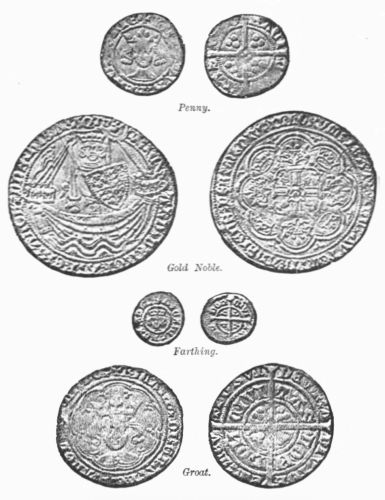
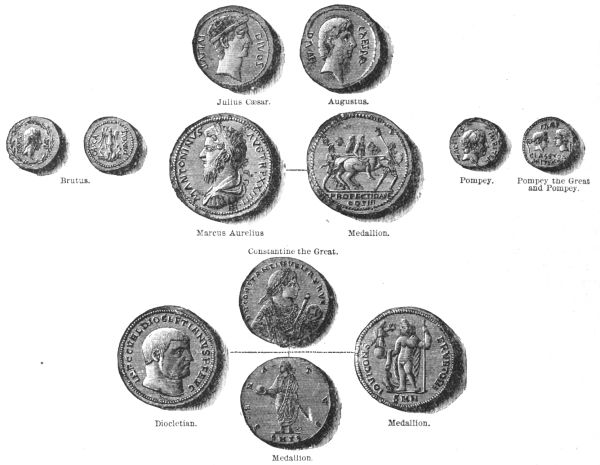
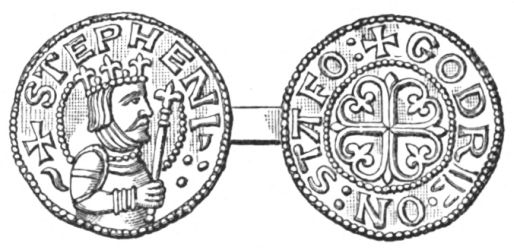
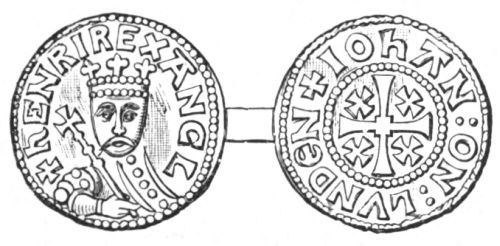
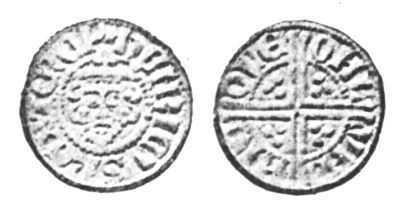
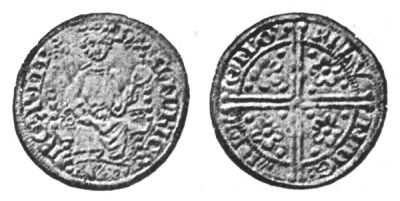
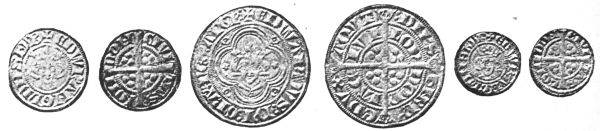
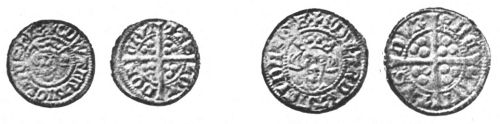
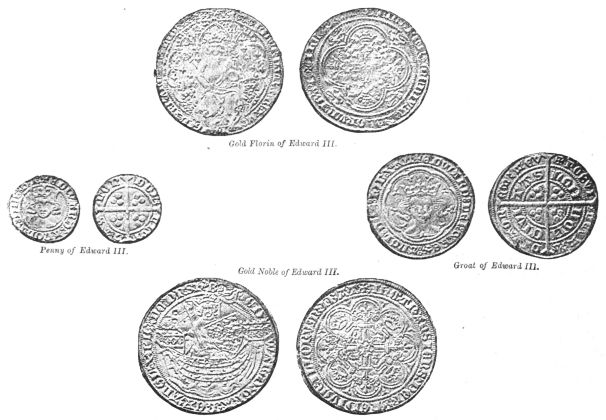
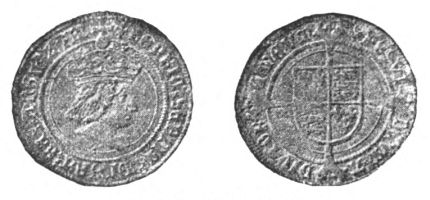
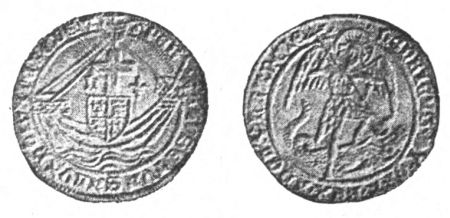
COINS OF THE REIGN OF RICHARD II.
Henry of Norwich passed over the Channel, took Gravelines by
assault, pursued the fugitives to Dunkirk, and entered the town in
their rear. He was speedily master of the coast as far as Sluys, and
might have struck a decisive blow at the French power in Flanders; but
he was not supported, though there was a numerous body of men-at-arms
at Calais. The Duke of Lancaster, whose own offers of leading this
expedition had been refused by Parliament, and who is said to have seen
with chagrin the success of his rival, was accused of preventing the
advance of these troops. The bishop, thus thwarted in the midst of his
triumphs, turned his arms against Ypres, to oblige the Ghentese; but
the siege was prolonged, and the King of France, at the entreaty of the
Count of Flanders, was approaching with a fine army. The men of Ghent
retired; the bishop made one furious assault, and then withdrew. He
threw himself once more into Gravelines, and, after holding it a short
time, demolished its fortifications, and returned to England.
That this campaign of the militant bishop did not equal the
expectations which his former demonstration had raised, appears partly
owing to his own precipitancy, but far more to the machinations of his
powerful enemies. Like most unsuccessful commanders, he fell under
the censure of the Government. He was accused before Parliament of
having taken a bribe of 18,000 francs to betray the expedition, and of
having broken his contract with the king by returning before the year
of his engagement had expired. Of the former charge he was cleared on
full inquiry, but he was condemned on the latter to forfeit all his
temporalities till he had paid the full damages to the king. Four of
his principal knights were also condemned to pay 20,000 francs into the
treasury for having sold stores and provisions to the enemy to that
amount.
Not to interrupt the narrative of events which
extend over into other years, we may here note
one of the most remarkable incidents of this reign.
This is the death of Wycliffe, who was struck with
apoplexy while performing public service in his
parish church, and died on the last day of the
year 1384.
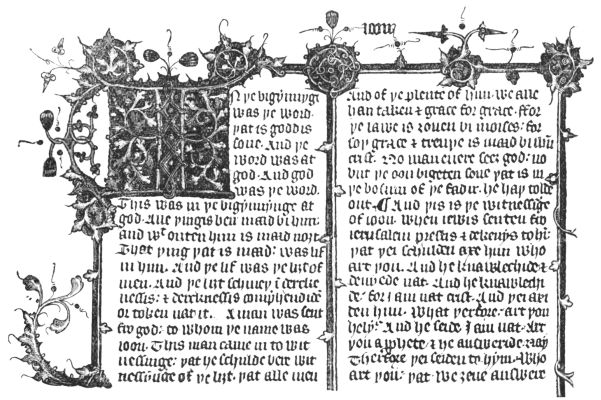
John Wycliffe had not only put in active
motion the principles of Church reform by his
preaching, and his public defences against the
attacks of the authorities of the Church, but he
had made those principles permanent by the
translation of the Bible. Not that Wycliffe's
was the first translation of the Scriptures into
English; we know, for instance, that Bede translated
the Gospel of St. John, and finished the
work on his death-bed in 735. But these earlier
translations of the Bible had remained in the
libraries of monasteries, and, by the little education
of the people, and the conservative vigilance
of the Church, had been the sole study of a few
learned men. Wycliffe, by his position as teacher
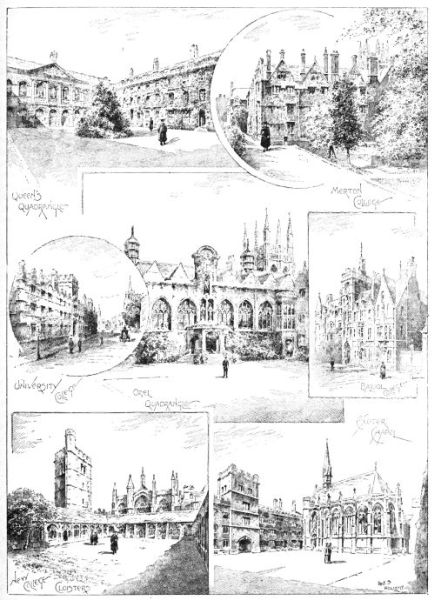
at Oxford, had excited a wide interest and inquiry
about the Scriptures; by his patronage at court,
and the persecutions of the prelates, they had been
made the subject of a vast curiosity, and this
curiosity he had taken care to gratify by multiplying
copies through the aid of transcribers, and
by the "poor priests," the converts to his doctrines,
reading them and recommending them everywhere
amongst their hearers. The English Bible
was never more to be a rare or merely curious
book. It is said that when the good Queen
Anne's countrymen who attended her here at
the court were expelled by the Lancaster faction,
they carried back copies of Wycliffe's Bible and
writings, which had been her favourite reading;
they thus fell into the hands of Huss and Jerome
of Prague, accompanied by the anti-papal doctrines
of the great English reformer; and in this
manner arose in Bohemia the sect of the Hussites.
The chief value of Wycliffe's work consisted in
his correction of abuses. Numbers of his "poor
priests," as they were called, traversed the nation,
as he had done, in their frieze gowns, and with
bare feet, everywhere proclaiming the doctrines of
the Gospel, and denouncing the impositions and
vices of Popery. They held up the monks and
priests of the time to deserved scorn, and the
people, feeling the sacred truth, flocked round
them, deserting those by whom they had been so
long deluded and fleeced.
There can be little doubt that John Ball, the
preacher of Wat Tyler's army, was one of these
"poor priests" of Wycliffe, for it was only three
years before Wycliffe's death that this insurrection
occurred, and Wycliffe's apostles had been
preaching everywhere amongst the people for
years. There is as little doubt that this preaching
produced this insurrection, as Luther's produced
the "Peasants' War" afterwards in Germany.
The effect was perfectly natural that men, who for
ages had been trodden down as slaves and beasts
of burden, hearing all at once that "God had
made of one blood all the nations of the earth,"
that He "was no respecter of persons," and that
they were called upon by Him to do to one
another as they would be done by, should review
their position, and stand astonished at its vast
antithesis to the ordinances of Christianity. That
the people rebelled was not their fault, but that of
the barons and the Church, which, while professing
the Gospel, had ignored every precept of it
in regard to the people. Now that the great and
eternal principles of political justice as well as
saving faith contained in the Gospel were once
known, they never could be again taken away;
they became the heritage of the people. The
Wat Tyler insurrection was put down, but that
which produced it could never be put down any
more. The powerful eloquence and holy lives of
the preachers of Wycliffe were universally confessed.
Men of all ranks, from the royal Duke of
Lancaster, to the peasant, joined them, and acquired
the name of Lollards. It is true that
John of Gaunt supported Wycliffe from selfish
motives only, and deserted him as soon as he
began to attack the doctrine of Transubstantiation.
The inhabitants of London were especially
warm adherents of the new teaching. John of
Northampton, one of the most opulent and distinguished
citizens, was a decided Lollard, and
during the time of his being mayor, particularly
irritated the clergy, who drove a brave trade in
pardons and indulgences, by his active reformation
of the vices of the people. The Lords Hilton,
Latimer, Percy, Berkeley, and Clifton, with many
other nobles, knights, and eminent citizens, became
the protectors and advocates of scriptural
reform.
Richard had now reached the age of nineteen.
The ability, address, and bravery which he had
displayed at the time of the insurrection raised
high hopes in the nation of the success of his
future government. Time, however, failed to
realise these expectations. Richard was by no
means destitute of cleverness, but his mind was
rather showy than solid. He had been brought
up in his boyhood in the south of France, at the
luxurious court of Bordeaux. He had early
been imbued with the tastes of Provence—music
and poetry—rather than with politics and arms.
After his father's death his mother and half-brother
had treated him with ruinous personal indulgence,
and instilled into his mind the most mischievous
ideas of his future greatness and royal authority.
There is a striking parallel between his education,
his personal character, and his fate, and
those of Charles I. Both were fond of literature
and the fine arts; both had the strongest domestic
attachments, and had been indoctrinated with the
most fatal ideas of the royal prerogative. Both
were high-spirited, chivalrous, and, necessarily,
despotic; they were moulded to despotism by their
parents. Both had their favourites—Richard, De
Vere and De la Pole; Charles, Strafford and
Buckingham. Both, while they were intensely
beloved by their own families and immediate associates,
lost the affections of their people by utterly
despising their rights, and both came to a tragic
end.
When the Bishop of Norwich returned from
his unfortunate expedition, Lancaster concluded
an armistice with France, in which the Scots were
included; but, as these reckless neighbours still
continued the war, he marched into Scotland in
1384, burnt the huts of which their towns were
composed, and—to destroy the retreats into which
they always retired on the approach of an English
army—he supplied his troops, according to Knighton,
with 80,000 axes, with which they cut down
the forests, inflicting a most serious injury on the
nation. Notwithstanding this service, he found,
on his return to London, that the suspicions of his
disloyalty were more rife than ever. While the
Parliament was sitting at Salisbury, a Carmelite
friar, one John Latimer, put into the king's hands
the written particulars of a real or pretended
conspiracy to place the crown on the head of John
of Gaunt. Richard was advised to show this to
Lancaster, who swore that it was false, and vowed
to do battle with any one who impeached his innocence.
He insisted that the friar, who persisted
in his story, should be committed to safe custody;
and, accordingly, he was consigned to the care of
Sir John Holland, the king's half brother, but
a secret ally of the Duke of Lancaster, who
strangled him in the night, it is said, with his own
hands, and had him dragged through the streets
in the morning as a traitor.
No sooner did the armistice with France and
Scotland expire in May, 1385, than the French
sent John of Vienne, formerly Governor of Calais,
to Scotland with an aid of 1,000 men-at-arms and
400,000 francs in gold, and armour for the equipment
of 1,000 Scottish knights and esquires, to induce
them to make an inroad into England. This
armament arrived in Scotland in the early summer,
but the French knights, according to Froissart,
were greatly astonished at the rudeness of
the country and the hard living of the people.
When they wanted to begin the campaign, they
complained that the Scots wanted to be paid for
fighting their own battles, and would not budge a
foot till the 20,000 livres were distributed amongst
them. In short, it did not tend much to the
mutual satisfaction of their allies that the gay
Frenchmen had come over. At length, the forces
being paid, the united army of France and Scotland
descended on Northumberland, and took
three castles in the marches, but, on the approach
of the English, as rapidly retired. John of
Vienne was astonished at their retreat, allowing
the enemy to pillage their country, but they told
him they did not pretend to make resistance to so
powerful a force; that all their cattle were driven
into the woods and fastnesses; that their houses
and chattels were of small value; and that they
well knew how to compensate themselves. Accordingly,
as Richard advanced into Scotland by
Berwick and the east coast, the Scots, accompanied
by the French, poured 30,000 men into
England by the west, and, ravaging Westmoreland,
Cumberland, and Lancashire, collected a
splendid booty, and returned well satisfied to their
country.
Richard was now, for the first time, at the head
of an army against a foreign enemy. He had
before only led his forces against his own peasantry.
Marching into Scotland without being
able to find any enemy, he reduced to ashes
Edinburgh, Dunfermline, Perth, and Dundee,
and he was about to perpetrate the same rigour
on Aberdeen, when the news reached him that
the Scots were laying waste Cumberland, and
John of Vienne was besieging Carlisle. He then
made a rapid counter-march, in order to intercept
them; but on the way another of his
favourites, Sir Michael de la Pole, infused some
fresh suspicions into the king's mind regarding
Lancaster, and the following morning Richard
angrily announced his intention of returning home.
In vain Lancaster protested against it; the king
persisted in his intention. He disbanded his
army; and, on the other hand, the Scots declaring
that they found the heavy French cavalry of no
use in their desultory species of warfare, behaved
with so much rudeness to them, that they also
returned home, much disgusted, says Froissart,
"with the country, and the manners of the inhabitants."
In the Parliament which met in November following,
Richard confirmed various honours which
he conferred during the expedition. He was
anxious to allay the jealousies between his relatives
and his favourites. He therefore created
his uncles, the Earls of Cambridge and Buckingham,
Dukes of York and Gloucester, with a new
grant of lands of the annual value of £1,000 each.
Henry Bolingbroke, the son of Lancaster, and
Edward Plantagenet, the son of the Duke of
York, he made Earls of Derby and Rutland.
But then he proceeded to heap similar honours
and emoluments on his favourites. Robert de
Vere, a handsome young man of good family, but
of dissolute manners, he created Earl of Oxford,
with the title of Duke of Ireland—a title before
unknown in England; and transferred to him by
patent, which was confirmed by Parliament, the
entire sovereignty of that island for life. He
gave him in marriage his relative, the daughter of
Ingelram de Courcy, Earl of Bedford; but De
Vere became deeply enamoured of one of the
queen's ladies of the bedchamber, a Bohemian, the
Landgravine of Luxembourg, and therefore allied
to the Imperial family. Not only the king but
the queen favoured his suit, and obtained a divorce
and dispensation for his fresh marriage from
the Pope. This transaction gave deep offence
to the English nation, for the rejected wife was
the granddaughter of Edward III. and Philippa
of Hainault. Her uncles, the Dukes of
Gloucester, York, and Lancaster, were still more
incensed.
Michael de la Pole, the other chief favourite,
was created Earl of Suffolk, with the reversion of
the estates of the late earl on the death of his
widow and the queen. As Richard had no
children, he, at the same time, in order to cut off
the hopes of the Duke of Lancaster, named
Roger, Earl of March, and grandson of Lionel,
Duke of Clarence, his heir to the throne.
The Duke of Lancaster thus, after repeatedly
avowed suspicions of his designs on the throne,
now so markedly cut off, found it most agreeable
to retire awhile from court; and no fairer plan
could present itself than that of prosecuting his
claims on the crown of Spain, in which his
brother, the Earl of Cambridge, had been so unsuccessful.
John, the newly-chosen King of
Portugal, had sent to invite him to come over
and support him against their common enemy, the
King of Spain. Nothing could be more agreeable
to Lancaster, and Richard was equally glad to
have him out of the way. One-half of the year's
supply was devoted to the purposes of this expedition.
Twenty thousand men were mustered, and
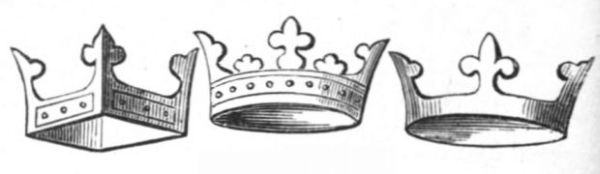
before John of Gaunt and Constance, his wife,
Princess of Spain, set out, the king presented him
with a crown of gold, as confident that he would
wear it; and the queen presented one also to the
duchess. The fleet sailed from Plymouth in July,
1386, and the duke arriving safely in Portugal,
his eldest daughter, Philippa, was married to the
king. During the first campaign the duke carried
all before him; but the second summer consumed
his army by its heat, and compelled him to retire
to Guienne. But by successful policy he now
managed to become reconciled to the King of
Spain, and married his second daughter to the
son and heir of that monarch. Thus John of
Gaunt, though destined never to wear a crown
himself, was the father of two queens. His
duchess Constance made over her claims on the
Spanish throne to her daughter Catherine, and
their descendants reigned over Spain for many
generations. For himself, he received 200,000
crowns to defray the expenses of the expedition,
and an annuity was settled on him of 100,000
florins, and the same amount on the duchess.
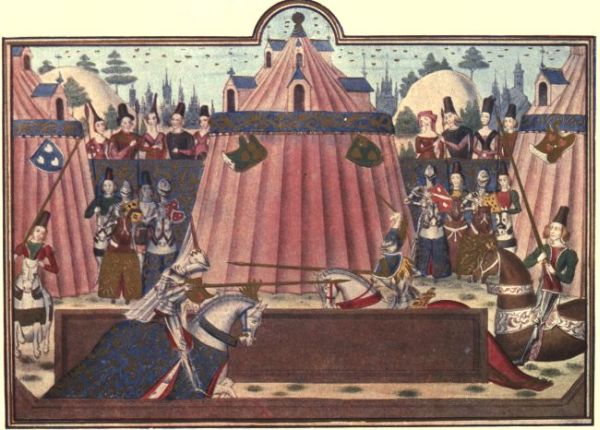
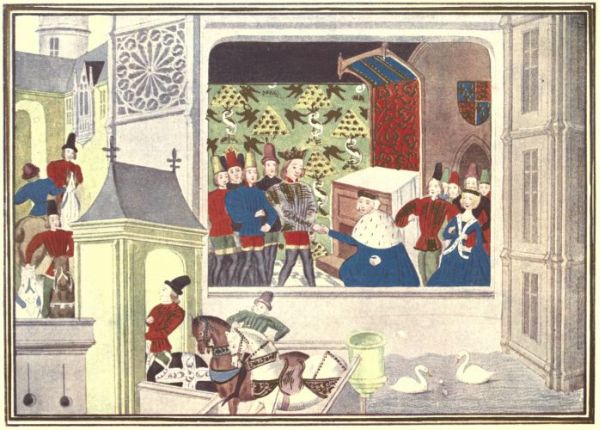
From the Froissart MS. in the British Museum.
Reproduced by André & Sleigh, Ld., Bushey, Herts.
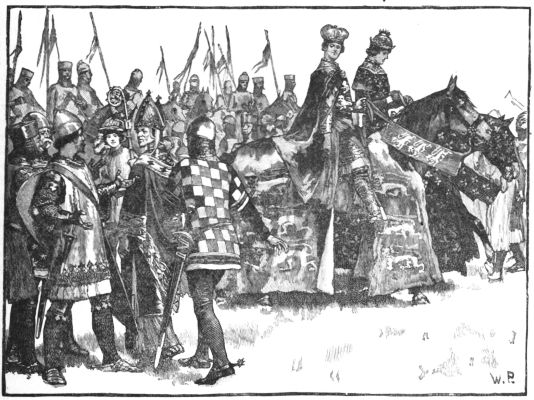
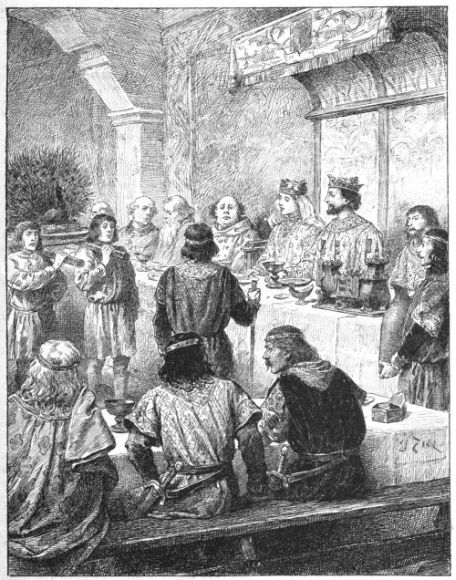
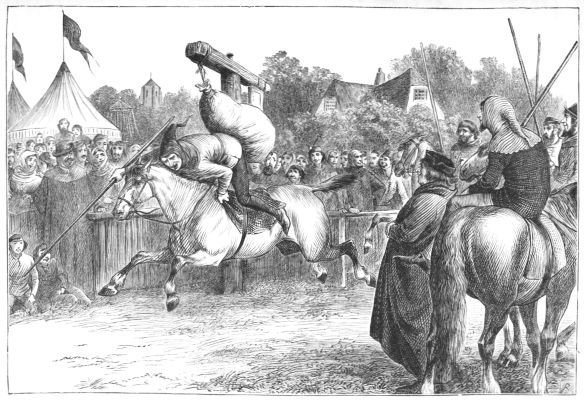
TOURNAMENT AT ST. INGLEVERE, NEAR CALAIS.
IN THIS TOURNAMENT THREE FRENCH KNIGHTS, THE CHALLENGERS, HELD THE LISTS FOR THIRTY DAYS AGAINST ALL COMERS FROM ENGLAND AND ELSEWHERE. AMONG THE ENGLISH
KNIGHTS WAS SIR JOHN HOLLAND, HALF-BROTHER TO RICHARD II.
While the Duke of Lancaster was absent, the
restless Duke of Gloucester became more assuming
and imperious towards the king than Lancaster
had ever been. He fomented the jealousies of the
nobles, insisted on remodelling the government,
and reduced the king to a mere automaton. At
the same time the French, also taking advantage
of the great duke's absence, contemplated a formidable
invasion of the island. Their preparations
were on the most extensive scale, both in
men and ships. The army is said to have exceeded
100,000 men; and their vessels in the
port of Sluys, it was vaunted, could, if placed
side by side, have bridged the whole Channel. The
nobility and gentlemen of France seemed every
one burning with desire to avenge the injuries
and defeats they had so often suffered from the
English. The news of this stupendous armament
spread dismay through the country; troops were
assembled, beacons erected, and the Earl of
Arundel was appointed high admiral, with orders
to destroy the ships of the enemy the moment
they landed, and leave the inhabitants to lay
waste the country before them, and then deal with
them at leisure. But the fate of this armada was
the same as that which has regularly attended all yet
directed against the British isles. It was dispersed
by a terrible tempest; the army was disbanded;
and the Earl of Arundel, executing his commission
with great vigour, took 160 vessels, laden
chiefly with wine, relieved the garrison of Brest,
and then, proceeding to the port of Sluys, destroyed
all the ships there, and laid waste the
country round to the distance of ten leagues.
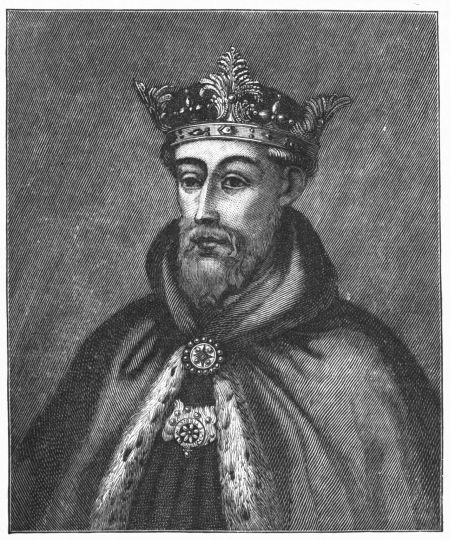
JOHN OF GAUNT, DUKE OF LANCASTER.
(From a painting on glass in All Souls' College, Oxford.)
After this brilliant issue of the threatened
danger, the nation was all gaiety and rejoicing.
But the factious Gloucester resolved that his
royal nephew should not rejoice long. He collected
his partisans, and determined to drive
the king's favourites from office. They contended
that the people were so fleeced by the
tax-gatherers, that the landowners could not collect
their rents, and that the ministers and their
officers embezzled the public moneys. The first on
whom they meant to open their charge was the
chancellor, De la Pole, the new Earl of Suffolk.
The chancellor opened the Parliament which met
at Westminster, in October, 1386, with a bold
announcement; the king, he said, was resolved to
punish the French for their menaced invasion,
by passing over at the head of a suitable armament,
and carrying the war into France. He
requested them to take into consideration the
necessary supplies for so great a national enterprise.
But the Lords and Commons met this
by a joint petition for the dismissal of the
ministers and members of council, and especially
of the chancellor. The king, much enraged, at
first contemplated—what was long afterwards so
fatally done by Charles I.—seizing the leaders of
the opposition, but, finding that he should not be
supported in this out of doors, he retired to his
palace at Eltham, and, then, giving way, drove to
town, dismissed the obnoxious ministers, and made
the Bishop of Hereford treasurer. But this concession,
so far from appeasing Gloucester and his
adherents, only made them feel surer of their real
object. They impeached the chancellor, and,
though they could prove little against him, they
caused him to be imprisoned during the king's
pleasure, and fined. So long as the Parliament
sat, Suffolk suffered his sentence; but as soon as
it was dissolved the king liberated him.
Emboldened by this second success, the opposition
proposed to establish a committee, with
authority to reform the Government. The king
indignantly declared that he would never consent,
but would dissolve the Parliament. But again
the Commons coolly presented to him the statute
by which Edward II. had been deposed, and at
this significant hint the king gave way, and signed
a commission, appointing a council of fourteen
persons—prelates and peers—including the three
great officers of state, all of Gloucester's faction,
except Neville, Archbishop of York. They were
empowered to inquire into everything in the
household, the ministry, the courts of law, and
the condition of the people. Gloucester was at
the head, and the king, now nearly twenty-one
years of age, was virtually deposed. The whole
sovereign prerogative lay in the council, and for
twelve months—the term assigned to this junto—Richard
was nothing.
It was not to be expected that a young monarch
of Richard's quick feelings could tamely acquiesce
in such a tyrannic tutelage as this. His favourites
did their part in stimulating him to resistance.
At the close of the session of Parliament he
entered a protest against this invasion of the
royal prerogative, and began to seek the means
to break up this irksome circle of control. He
sounded the sheriffs of the counties, but they had
been appointed by his uncles, and he found them
in their interest. He therefore set out on a sort
of royal progress, and used every endeavour to
make himself popular with his subjects. Wherever
he came he marked his arrival by some act
of grace. The gentlemen of the county and the
burghers of the principal towns were invited to
his court, and were received with the utmost
affability. This won greatly upon them, and there
was a general avowal of a determination to stand
by him and the royal authority. He went to
York, to Chester, to Shrewsbury, and thence to
Nottingham. At the two latter places he held
councils of the judges, and took their opinion on
the conditions which the Parliament had forced
upon him. Here the judges, who in those days
were not independent of the Crown as they are at
present, proved as subservient to the king as Parliament
had shown itself subservient to the aristocratic
faction; declared that the commission was
wholly subversive of the constitution; that those
who introduced the measure, or induced the king
to consent to it, were liable to capital punishment;
that all who compelled him to observe it, or prevented
his exercise of his rights, were traitors;
that the king, and not the Lords and Commons,
had the power to determine the order in which
questions should be debated in Parliament; that
it was for the king to dissolve Parliament at
pleasure. Still more: that the Lords and Commons
had no power to impeach the king's ministers,
officers, or justices; that those who introduced
and passed the statute of deposition of Edward
II. were traitors; and that the judgment against
the Earl of Suffolk was unconstitutional and
invalid altogether.
This sweeping judgment, which annihilated the
power of Parliament, and made the Crown all but
independent, was signed and sealed by the judges,
in the presence of the Archbishops of York and
Dublin, the Bishops of Durham, Chichester, and
Bangor, the Duke of Ireland, the Earl of Suffolk,
and two other counsellors.
Armed with this potent instrument, Richard
prepared to take vengeance on his dictators. He
determined to arrest the chief of his opponents,
and send them to be judged before the very men
who had thus prejudged them. Thomas Usk was
appointed sub-sheriff of Middlesex; a bill of indictment
was prepared; Sir Nicholas Brember,
who had been three times Mayor of London,
undertook to influence the city, and even swore
in different companies "to stand to the death for
the king." The commission was to expire on
the 19th of November, and on the 10th Richard
entered London amidst the acclamations of the
people. The mayor and principal citizens wore
the royal livery of white and crimson, and a vast
crowd attended him to St. Paul's, and thence to
his palace of Westminster.
Everything appeared conspiring to his wishes;
he retired to rest elated with his success, and
calculating on the defeat of his enemies; but
when he awoke in the morning it was to a sad
reverse. He learned that a strong force, stated
at 40,000 men, had arrived in the vicinity of the
city, under the command of the Duke of Gloucester
and the Earls of Arundel and Nottingham.
During the whole time that he had been making
his preparations to seize the members of the
council they had been carefully watching and
cautiously following him. The very day after the
judges had delivered their decision at Nottingham,
and bound themselves to keep it profoundly secret,
one of them in the other interest, Sir Richard
Fulthorpe, had betrayed the whole matter to the
Earl of Kent, and through him to the Duke of
Gloucester. A royal proclamation was issued,
forbidding the citizens to aid or supply with provisions
the armed force without: but the confederates,
the next day advancing to Hackney,
sent in a letter to the mayor and corporation,
commanding them, under menace of severe penalties,
to give their assistance to the loyal object
of delivering the king from the hands of traitors,
and requiring an immediate answer. On the 13th
the Earls of Derby and Warwick went out and
joined them at Waltham Cross, and the members
of the commission "appealed," as they termed it,
of treason the Archbishop of York, the Duke of
Ireland, the Earl of Suffolk, Sir Robert Tresilian,
and Sir Nicholas Brember.
This "appeal" they sent to the king by the
Archbishop of Canterbury, and the Lords Cobham,
Lovel, and Devereux. Richard was obliged to
give way, for he now perceived that, after all, the
city was not with him; and on Sunday, the 17th,
the appellants marched into London, and, appearing
before the king in Westminster Hall, formally
preferred the charge of high treason against the
aforesaid persons. The accused fled. De la Pole,
the Earl of Suffolk, succeeded in reaching France,
where he soon after died. De Vere, the Duke of
Ireland, hastened to Wales, where the letters
of the king overtook him, commanding him to
raise the royal standard, and promising to join
him on the first opportunity. The duke was
encouraged by the adherence of Molyneux, the
constable of Chester, who came with a strong body
of archers; but Gloucester, who only wanted a
plea for deposing his nephew, eagerly seized on
this circumstance, and agreed with Arundel,
Warwick, and Sir Thomas Mortimer at Huntingdon,
to "depose Richard, and take the crown into
his own custody." De Vere was rapidly marching
towards London, but was met by Gloucester and
Lord Derby, Lancaster's son, at Radcot Bridge,
in Oxfordshire, and utterly routed. Molyneux
was slain, but De Vere made his escape to Ireland,
and thence to Holland, where he died about four
years afterwards.
The successful appellants returned to London
at the head of their 40,000 men, and presented
thirty-nine articles of impeachment against the
five already named, the Archbishop of York,
Suffolk, De Vere, Tresilian the judge, and
Brember, Mayor of London. All, except Brember,
who was in prison, had fled, and all the judges,
except Sir William Skepworth, were arrested as
they sat in their courts, and committed to the
Tower. The king demanded the opinion of the
principal lawyers of the day on the validity of
the impeachment, who unanimously declared it
to be informal and illegal. But the peers determined
to proceed; on which the bishops and
abbots all protested against taking any part in
judgments of blood, and left the house in a body.
The accused were condemned and adjudged to
death; but only Sir Nicholas Brember and Tresilian
the judge—who was hated by the people
for his bloody sentences on those involved in the
late insurrection, and who was betrayed in his
concealment by a servant—were executed.
Nothing could be more arbitrary than the proceedings
of this "Wonderful Parliament," as it
was called. Brember, who was a commoner, was
adjudged and condemned by the peers, who were
certainly not his peers. The Archbishop of York
had crossed to Flanders, where he passed the
short remainder of his days as a humble parish
priest.
The "Wonderful Parliament," or, as others
termed it, the "Merciless Parliament," which sat
all the spring of 1388, and was dissolved on the
3rd of June, employed itself, at the instigation
of the vindictive Gloucester, who had a savage
thirst of blood, in imprisoning, condemning, and
driving away the king's friends, even to his confessor.
The judges who gave the extra-judicial
answers to the king at Nottingham were condemned
to death; but, at the intercession of the
bishops, were banished to Ireland; while Blake,
the secretary who drew up those answers, and
Usk, who had been made under-sheriff, were put
to death. Sir John Beauchamp, Sir James
Berners, Sir John Salisbury, and Sir Simon
Burley were all executed, Salisbury being drawn
and hanged. Gloucester did not suffer the Parliament
to dissolve without an order for the
expulsion of the Bohemians who attended the
queen, or without passing acts to incapacitate
the king from reversing the attainders which
they had issued. This strange Parliament at
once declared that its judgments should never
be reversed, nor any of its statutes ever repealed.
Yet it declared that it had pronounced
things treason which had never been so held
before, and therefore no judge should ever make
its example a precedent. It gave to the appellants
£20,000 in remuneration for their services,
and granted to them and their friends a full
indemnity, besides a general pardon to the
opposite party, with the exception of eighteen
persons named.
Richard, stunned, as it were, by this stern and
sanguinary demonstration on the part of his great
and haughty relatives, remained for about twelve
months passive, and in a manner extinguished
in his own kingdom. But we may rest satisfied
that he never for a moment in his own mind
intended that this state of things should last a
day longer than he could help, or that they who
now carried measures against him with a high
hand and a combined power, should escape their
due punishment. He felt that the "sons of
Zeruiah were too hard for him;" that his arbitrary
uncles and cousins had artfully raised the
public will against him, and that it was vain to
resist. Gloucester had done his bloody work;
and it only required time to make the nation
feel repugnance to the agency of so much cruelty.
His administration did not by its splendour conceal
the hideousness of the acts on which his
power was based. Arundel, indeed, did some
brave deeds at sea; but the only brilliant deed
on land was the battle of Otterburn, which has
been so celebrated by the minstrels of that day,
as may be seen in Percy's "Reliques of English
Poetry." It was fought on the 15th of August,
1388, and Douglas, the Scottish chief, was killed;
but on the English side Sir Henry Percy—the
celebrated Hotspur—and Ralph Percy were taken
prisoners, and the English, according to Froissart,
were driven from the field; though English
writers give a different account—each party, in
fact, claiming the victory.
By degrees the terror which Gloucester had
inspired began to die away from the minds of
men; they began to sympathise with their
youthful king, kept in such unworthy subjection,
and to offer to him their aid and services. No
sooner did Richard feel conscious of this change
in the public feeling than he gave one of those
proofs of high thought, and bold, prompt action,
which, if they had been the results of a steady,
energetic temperament, and not mere evanescent
flashes, would have made his enemies stoop in awe
before him, and his reign fortunate. In a great
council held in May, 1389, he suddenly addressed
his uncle Gloucester: "How old do you think I
am?" "Your highness," replied Gloucester, "is
in your twenty-second year." "Then," said the
king, "I must surely be old enough to manage
my own concerns. I have been longer under
the control of guardians than any ward in my
dominions. I thank ye, my lords, for your past
services, but I require them no longer."
Before the council could recover from its surprise
he demanded the seals from the Archbishop
of Canterbury, and gave them to William of
Wykeham, Bishop of Winchester, and the keys
of the exchequer from the Bishop of Hereford,
handing them to one of his own friends. Gloucester,
after a private interview with his nephew,
finding it impossible to move him, retired into
the country. Richard retained his uncle, York,
and his cousin, Henry of Bolingbroke, in his
favour, and entrusted them with the chief administration
of affairs.
For about eight years Richard ruled with a
moderation and a deference to the rights of Parliament
and the people, which won him much
popularity. He, on one occasion, voluntarily
remitted some subsidies, declaring that he would
not call for them till he really needed them.
His uncle Lancaster returned from Spain, and
having placed his two daughters on the thrones
of that country and of Portugal, he appeared
satisfied in his ambition, and disposed not only
to acquiesce in the sway of his nephew, but
also to reconcile him to the offending Gloucester,
whom he brought again to court. It was not
long, however, before there was great division
between the royal brothers; for, Lancaster's wife
being dead, he married Catherine Swynford, a
daughter of a private gentleman of Hainault,
who had been his mistress, and by whom he had
several children. His brothers York and Gloucester
were highly incensed at this marriage of
the great John of Gaunt, regarding the lady of far
too inferior birth to enter into their alliance; but
Richard not only countenanced his uncle in this
honourable proceeding, but passed an act through
Parliament to legitimise the children, and created
the eldest son Earl of Somerset.
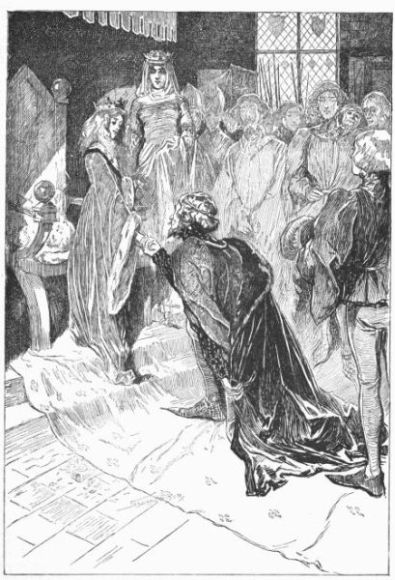
BETROTHAL OF THE PRINCESS ISABELLA TO RICHARD. (See p. 472.)
By this rupture between the royal brothers, the
power of Richard was left unassailed—which it
never was when they were united—and the
country enjoyed internal tranquillity. He ceded
to his uncle of Lancaster the province of Guienne
for life; but, as the inhabitants remonstrated
loudly against this act, it was finally revoked with
the duke's consent. He concluded a peace with
France in 1394, which also included Scotland;
Robert II. having died in 1390, and John, his
eldest son, now reigning under the title of
Robert III.; the Scots entertaining the same
prejudice against a king of the name of John as
the French and English, each nation remembering
with disgust the reign of a King John.
Meantime Richard frequently met his Parliament,
and appeared on all occasions anxious to
possess its approbation. He even on one occasion
asked his officers of state to resign, and place
themselves at the bar of Parliament, requesting
every one who had cause of complaint to prefer
it. Pleased with this condescension, Parliament
not only bore willing testimony to the honour
of the ministers, but were ready to meet all the
king's demands for money. By consent of Parliament,
also, he recalled such of the bishops who
had been banished to Ireland as now survived;
made his confessor a bishop; and, moreover, on
hearing of the death of the Duke of Ireland, he
restored the earldom of Oxford in favour of
his uncle, Sir Aubrey de Vere, and afterwards
had the body of the duke brought from Louvain,
and re-interred with great state in the church
of Colne.
At this time, also, after much dispute with
Rome regarding the appointment by the Pope
of foreigners to English bishoprics and livings,
he settled that question on a better basis than
it had yet occupied, passing the last and most
comprehensive of the statutes of provisors, by
which it is provided that any persons receiving
such investment from Rome, or carrying causes
there, shall, with all their abettors, suffer forfeiture
of all their goods, chattels, and lands,
wherever found, and be put out of the king's
protection.
These were years in which Richard appeared
to realise the early auguries of his reign, and act
with such wisdom and moderation as make the
latter portion of his days a marvel and a sad mystery.
But we believe the mystery will be solved
by the fact that he now—that is, in June, 1394—lost
his excellent queen, the good Queen Anne.
She died at her favourite palace of Shene; and
Richard, who had been most ardently attached
to her, was so beside himself with grief that, in
a state of frenzy, he ordered the palace of Shene
to be levelled with the ground; and the rooms
where Anne died were actually dismantled.
From all that we learn of Anne it appears very
evident that her influence over Richard was of the
most beneficial kind, and that the longer she lived
the more prudent and popular he became. With
her he lost his compass and his guiding star, and
wandered off the good way.
In the immediate bitterness of his grief, however,
he was advised, in order to divert his
sorrow, to make a visit to his Irish dominions.
There was certainly confusion enough there to
occupy his thoughts. The wars of the last three
monarchs, and the troubles of the second Edward,
had withdrawn their attention from Ireland, and
both the native and the English races there had
made great encroachments on the authority of the
Government. The revenues had formerly produced
a surplus of £30,000; they were not now
equal to the necessary expenses of the management
of the island. The natives, asserting their
ancient territories, were fast enclosing the English
in narrower bounds, while the English were at
variance amongst themselves. They were divided
into two classes—those who had helped to conquer
the country, and those who had been recently sent
there by the English Government. There were,
therefore, English by race merely, and English by
birth. The descendants of the original invaders
had, in proportion as they were remote from the
seat of government, grown independent, and in
many cases adopted the language and manners of
the natives. Many of these men retained great
numbers of armed followers, made inroads on their
neighbours, ruled as kings in their own districts,
and expelled all thence who would not conform to
their will. Such was Thomas Fitzmaurice, who,
to secure his goodwill, was created Earl of Desmond,
and who yet was rather a terror than a
strength to the Government.
These old settlers, the English by race merely,
were very jealous of new arrivals, many of them
being poor courtiers who were sent there—as they
were in later days sent to our colonies—to help
themselves to what they could secure, and others
banished men. These were supported by the
English Government as a counterbalance to the
power of the native chiefs, and of the English by
race. Edward III. had indeed forbade any office
to be held but by Englishmen still connected with
England by property or office; but this produced
such a ferment among the old Englishry that it
was obliged to be abandoned. While these feuds
and divisions weakened the English party, the
native chiefs pushed on their advances, and the
greater part of Ulster was recovered by the
O'Neills, much of Connaught was regained by the
O'Conors, and the O'Briens made equal conquests
in Leinster. To prevent amalgamation of the
English chiefs with the native Irish, and thus
the strengthening of their formidable native
power, Edward III. had passed the famous statute
of Kilkenny which made it high treason to marry
with the Irish.
It was in the hope that an English nobleman,
residing in the country with a permanent right,
and with almost regal power, might reduce the
island to order, that Richard had made the Earl
of Oxford Duke of Ireland, and granted to him
and his heirs for ever all the lands which he
should conquer from the native Irish, except such
as they had retaken from the Crown or from
former grantees. The hopes which had been entertained
from this scheme were defeated by the
king's feud with the barons, and by the attainder
and banishment of Oxford.
Richard now set out to reduce the different
factions, and restore order himself, at the head
of 4,000 men-at-arms and 30,000 archers, and
attended by the Duke of Gloucester and the Earls
of Rutland and Nottingham. He landed at
Waterford in October, 1394, and at the approach
of so effective a force the most daring chieftains
retired into their bogs and mountains. Such was
the vigour with which Richard on this occasion
prosecuted his object—no doubt finding a great
relief to his mind in action—that very soon the
Irish made terms of surrender, and the four
principal kings, O'Neill, O'Brien, O'Conor, and
McMurrough, came in and attended the king to
Dublin, where they were, no doubt, much to the
annoyance of their wild Irish habits, obliged to
assume the outward smoothness of civilisation,
most reluctantly induced to receive the honour of
knighthood, to be arrayed in robes of state, and
feasted in all decorum at the king's table.
The Irish chieftains, to the number of seventy-five,
did homage, and agreed to the payment of a
yearly tribute. Richard never on any occasion,
not even in the Wat Tyler riots, displayed more
energy and tact. He had all the qualities which
should distinguish a monarch. He reformed the
abuses of the Government, redressed grievances,
enforced the laws, removed tyrannical officers, and
thus reconciled the minds of the Irish, and re-established
the English supremacy.
This good work was interrupted by a violent
dispute between the Lollards and the Church at
home. The Reformers had acquired much power,
and, feeling their influence amongst the people,
they prepared a sweeping petition to the Commons,
containing many facts which were yet too
strong for reception by the Government. They
objected to the celibacy of the clergy, and complained
that, by accepting offices under Government,
and being ministers of state, and even
generals, they were attempting to do the impossible
thing—namely, to serve God and Mammon.
They declared that by teaching transubstantiation
they led to idolatry; that through
the confessional they acquired a despotism
over the people; by authorising war and
criminal executions they opposed the law of
Christ, which was one of love and mercy;
and they even asserted that by licensing men
to exercise the trade of goldsmiths and swordsmiths
they violated the principles of the Gospel,
which were those of simplicity and peace.
Though no one was found hardy enough to
present the petition abounding with doctrines
which, though they had existed in the New
Testament for nearly fourteen centuries, were
still too new to the public for acceptance, yet
the clergy were alarmed at this demonstration,
and solicited the protection of the king, who
severely reprimanded the leaders of the Lollards,
and ordered all teachers of that persuasion to be
expelled from the university of Oxford. Good
Queen Anne was gone, and a new era, with new
influences and fortunes, was at hand.
Richard now astonished the whole country by
proposing to marry the eldest daughter of the
King of France. The strong antipathy which
the long and cruel wars had nourished between
the two nations made them already regard each
other as natural and hereditary enemies. Both
the people of England and France, therefore, were
surprised at this proposal, and averse from it.
But the people are little consulted in any age in
these matters; and the proposal, after some discussion
at the French court, was well entertained.
At the English court it was far from popular.
The princes and barons looked on the French
wars as the sources of fresh military glory and
promotion. The Duke of Gloucester most of all
expressed his opposition to it. He had more
reasons than one. The first was, that he had a
daughter whom he would fain see married to
Richard. By this alliance he could calculate on
his descendants succeeding to the throne of
England, even if he could not himself usurp it.
During the king's life, with his easy and pleasure-loving
disposition, he could calculate on engrossing
the real power of the State. Not less strange
was his second reason. If the king allied himself
to France, he would thus greatly strengthen his
authority at home, and Gloucester was too far-seeing
not to perceive that Richard, who never
forgot an injury, would then be in a position to
revenge himself on him for his past attempts to
usurp the control over his nephew, and especially
for the armed conspiracy which had destroyed his
favourite ministers, and suspended his prerogative
for twelve months. That this marriage was a
matter entirely of policy was clear enough. The
French princess was a mere child ten years of
age. The preliminaries were, however, soon concluded,
and the ceremony took place in 1396.
The conduct of Richard after this marriage
was such as to lead the people the more sensibly
to deplore the death of the good Queen Anne.
Instead of the better spirit which had distinguished
his latter years, instead of the wise and
active conduct which he had displayed in Ireland
while under the influence of a salutary sorrow, a
light and thoughtless disposition had taken its
place, as if a mere girlish wife had brought with
her an atmosphere of trifling and frivolity. With
the exception of his harsh treatment of the city
a few years before, and the deprivation of its
charter, which, though soon restored, had left a
lively memory of the arbitrary fact, there was not
much in Richard's political conduct to complain
of. But his personal character was rapidly deteriorating.
He lived in a continual course of
feasting and dissipation, and thus wasted the
funds he had received with the queen, and the
resources derived from his people.
Amongst the principal favourites of this time
were his half-brother, the murderer, Sir John
Holland, who had been on a pilgrimage to Jerusalem
in penance for his crimes, and now was
dignified with the title of the Earl of Huntingdon,
as his brother was with that of the Earl of
Kent. Through the hands of these men all
favours and honours passed, and we cannot suppose
that their conversations and counsels were
very good for the king. His household was on a
most ruinous scale, consisting, it is said, of not
less than 10,000 persons, and the riot and follies
carried on there excited great disgust.
All these matters were carefully noted by the
discontented Duke of Gloucester, still more
morose from the king's refusal of his daughter, on
the plea of her being too near akin. It was in
vain that the king made him rich presents to win
his goodwill. He was still sullen, morose, and
destitute of all courtesy, returning the attentions
of the nobles with abrupt and curt answers, so
that they said amongst themselves, if ever Gloucester
could stir up a war he would.
At length Richard resolved to strike his long
deferred blow. He invited the Earl of Warwick
to dinner, and then, the latter being off his guard,
he had him arrested at the house of the chancellor,
near Temple Bar, and committed to the
Tower. The primate was made use of to bring his
brother, the Earl of Arundel, to a private interview
with the king, who instantly arrested him
and sent him to Carisbrooke Castle. But perhaps
the most revolting of these insidious modes of
arrest was that of the Duke of Gloucester himself.
Richard, while intending to sacrifice his
uncle's life, did not hesitate to pay him a visit at
his castle of Pleshy, in Essex. Here Gloucester
came forth with his wife and daughter to meet
him, without any suspicion, and, according to the
account of the rolls of Parliament, with a dutiful
procession. The king caused him to be seized
and hurried on board a vessel by the earl
marshal, and conveyed to Calais. It is said
by contemporary chroniclers that, while this was
doing, Richard was conversing in a friendly
guise with the duchess. Froissart says Richard
was kindly entertained, requested Gloucester to
accompany him to London, and had him seized on
the way. This does not appear probable if the
parliamentary rolls are correct. But in any case
the manner of the thing was treacherous and unworthy
of a great monarch.
The sudden disappearance of the duke alarmed
all his friends and partisans, who believed that he
was murdered, and they trembled for their own
security. To pacify the public mind, Richard
issued a proclamation, stating that these arrests
had been made with the full assent of the Dukes
of Lancaster and York, and of their sons and all
the leading members of the council; that they
were made, not on account of the transactions of
the tenth and eleventh years of his reign, for
which bills of indemnity had been given, but for
recent offences; and that no one need be alarmed
on account of participation in those past proceedings.
This was to lull into security fresh victims, and
to obtain that sanction from Lancaster, York,
and their sons, which Richard pretended to have
had, and which was not true. These princes were
at Nottingham, and Richard determined to retort
upon them their conduct towards his favourites.
He therefore hastened down thither, and as these
noblemen were at dinner he suddenly summoned
them to the gate, and compelled them to set their
seals to a form of arrest which had been prepared
for the purpose. They were made to say, "We
appeal Thomas Duke of Gloucester, Richard Earl
of Arundel, and Thomas Earl of Warwick, as
traitors to your majesty and realm," and to call
for trial upon them.
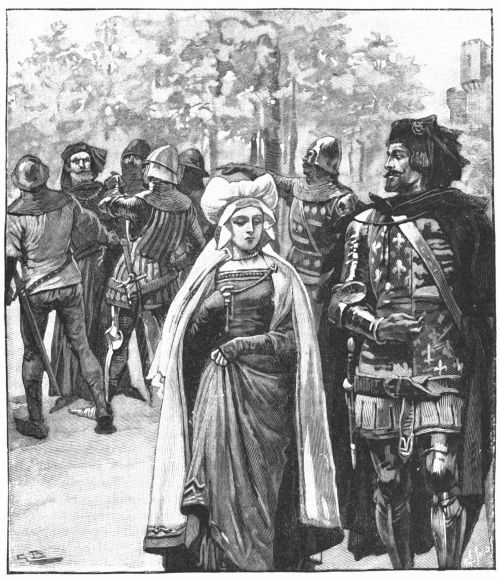
ARREST OF THE DUKE OF GLOUCESTER. (See p. 472.)
To secure his measures Richard employed every
means to impress the Parliament and public with
awe. Great preparations were made for the assembling
of a Parliament which was to decide
the fate of a prince of the blood, and one so
powerful and popular, as well as of some of the
chief nobles of the realm. It is said that the
sheriffs had been tampered with—a most base and
unconstitutional act, and which, resorted to in the
assembling of this famous Parliament, opened
the way for much subsequent corruption of the
kind. A wooden shed of large extent was erected
near Westminster Hall, for the reception of so
numerous an assembly as was summoned to give
the fuller sanction to its decrees, and the lords
came with such prodigious retinues, no doubt for
their own safety, that they not only occupied all
the lodgings of London, but of the towns and
villages for ten miles round.
The king came to Westminster, attended by
600 men-at-arms, wearing the royal livery of the
hart, and 200 archers, raised in Cheshire. On the
second day of the session, Sir John Bussy, the
Speaker, and a thorough creature of the king,
petitioned that the clergy might appoint proxies,
the canons forbidding their presence at any trials
of blood, and Lord Thomas Percy was appointed
their procurator. The Parliament passed whatever
Richard was pleased to dictate to it. It annulled
the commission of regency and the statute
confirming it, passed in the tenth year of his
reign. It abrogated all the acts which attainted
the king's ministers—though the Parliament
which passed them and the people had sworn to
maintain them for ever—and declared that they
had been extorted by force. It revoked all
pardons granted heretofore to Gloucester, Arundel,
and Warwick.
This facile assembly first impeached Thomas
Arundel, Archbishop of Canterbury, as the aider
and abettor of the accused noblemen, for having
moved and advised the arrest and execution of
Sir Simon Burley and Sir James Berners, contrary
to the wishes of the king, and that while chancellor,
and bound to support the rights of the
Crown. The archbishop rose to defend himself;
but Richard, fearful of the effect of his eloquence,
desired him to waive awhile his observations, on
pretence of requiring more time to consider the
matter; but the next day he was declared to be
guilty, and banished for life.
The following day, September 21st, the charges
were read to the lords against the three nobles.
They were that Gloucester and Arundel had compelled
the king, under menace of his life, to sign
the commission of regency; that at Hornsey
Park they had drawn to their party the Earl of
Warwick and Sir Thomas Mortimer, and by force
had compelled the king to do their will. The
Earls of Rutland, Kent, Huntingdon, Somerset,
Salisbury, and Nottingham, and the Lords Spenser
and Scrope were accused of the same crime; that
at Huntingdon they had conspired to depose the
king, and shown him the statute of the deposition
of Edward II., and had also insisted on the death
of Sir Simon Burley, in opposition to the king's
will.
The Earl of Arundel pleaded not guilty and
former pardons; but he was condemned and executed.
Warwick was convicted of high treason;
but, on account of his submissive behaviour, his
life was spared, and he was banished to the Isle
of Man.
On the 24th a mandate was issued by the king
and his council in Parliament to the earl marshal
to bring his prisoner, the Duke of Gloucester from
Calais to the bar of the House. Three days after
this an answer was returned by the earl marshal
that "he could not produce the said duke before
the king and his council in that Parliament, for
that, being in his custody in the king's prison at
Calais, he there died."
The simple unexplanatory abruptness of this
announcement is particularly startling. It impresses
the mind with the conviction of foul play,
and suggests that the king—not daring to bring
to further trial a prince so nearly related to the
Crown, and so highly esteemed by the people, and
yet resolved not to let him escape—had procured
his assassination. Apoplexy and other things
were talked of, but there could be but one opinion
of his end—murder. How this was effected has
never been discovered. When Henry Bolingbroke
had usurped Richard's throne, and it was his
particular interest to prove Richard a murderer
of their common uncle, one John Hall, a servant
of the Earl of Nottingham, was brought forward,
who swore that to his knowledge the duke was
taken from the prison to an inn, called the
Prince's Inn, and there smothered between two
beds by a servant of the king and another of the
Earl of Rutland. Though eight persons were
named in the paper as being concerned in the
transaction, none of these were ever examined,
nor was Hall brought before any judge; but,
having made this confession, he was at once beheaded.
It appears sufficiently clear, therefore,
that this was an invention of Bolingbroke's to
blacken the character of Richard. Froissart says
he was strangled in prison by four people with
towels; but the mode matters little: the fact of
Gloucester's murder cannot admit of a doubt, and
whatever it was, the Parliament appears not to
have troubled itself about it. They declared,
both Lords and Commons, that he was a traitor,
and confiscated all his property to the Crown. The
rest of the nobles and prelates named in the indictment
were then conditionally pardoned, except
those who took up arms against the king in his
eleventh year, including Lord Cobham, who was
banished to Jersey for life, and Mortimer, who had
fled into the wilds of Ireland, and was outlawed.
What is extraordinary is, that several of the
very peers who were engaged in these transactions,
now declared treasonable, sat in judgment
on their more unlucky accomplices. The Duke
of York, the Bishop of Winchester, and Sir
Richard Scrope, had been members of Gloucester's
commission of regency; and Derby and Nottingham
were two of the five who appealed to the
favourites of treason. Some of these were not
only winked at, but even promoted when the trial
was over. Richard, indeed, in Parliament, fully
exculpated them, asserting that, though for a time
deceived by the pretences of Gloucester, they had
abandoned his cause like good and loyal subjects.
He then created his cousins, Derby and Rutland,
Dukes of Hereford and Albemarle; his two half-brothers,
the Earls of Kent and Huntingdon,
Dukes of Surrey and Exeter; the Earl of Nottingham,
Duke of Norfolk; the Earl of Somerset,
Marquis of Dorset; the Lords Despenser, Nevil,
Percy, and William Scrope, Earls of Gloucester,
Westmoreland, Worcester, and Wiltshire.
On the last day of the session of this servile
Parliament the peers took an oath that all the
judgments passed in this Parliament should have
the full force of statutes for ever; that any one
attempting to reverse them should be held to be
a traitor; and that the clergy should excommunicate
him. The Commons held out their hands
in acquiescence with this oath, and Lord Thomas
Percy, the proxy of the clergy, swore on their
behalf. The Parliament was then prorogued till
after the Christmas holidays, when it met at
Gloucester.
Perhaps no period of our history exhibits a
monarch more reckless of the restraints of the
constitution than Richard at this epoch; nor a
Parliament more servilely disposed to grovel at his
feet, and surrender every valuable right. Before
closing its sessions, the Commons not only granted
him most liberal supplies, but a tax on wool,
wool-fells, and hides, not for the year as previously,
but for life, thus rendering him, to a great degree,
independent of Parliament; and Richard, again,
to provide against any repeal of this munificent
grant, published a general pardon, which, however,
was to become void the moment any future Parliament
attempted to repeal this act.
But this vile Parliament went still further in
surrendering the birthrights of the people. It
had been customary to appoint a committee of
the peers and judges formerly, to remain after the
business of the session was completed, to hear
and determine on such petitions as had not been
already answered. Advantage was now taken to
seize on this form of a committee to supersede the
general functions of Parliament; and twelve peers
and six commoners, not judges or justices, were
not only invested with the powers of the ancient
committees, but also to "hear, examine, and determine
all matters and subjects which had been
moved in the presence of the king, with all the
dependencies thereof." One half only of these
were required to attend, so that to nine people
were transferred all the powers and authority of
Parliament!
The immediate object of this stretch of parliamentary
and, under its guise, of kingly power,
was to execute the designs of the monarch which
led to his ruin. Richard was of that light and
sensitive character, and had been early so imbued
with the idea of the divinity that "doth hedge
a king," that he was easily led on to the
most arbitrary conduct. In the late proceedings
against Gloucester and his adherents he had
broken unceremoniously through all the restraints
of the constitution, and the obsequiousness of Parliament
induced him now to imagine that he had
placed himself above all law. Parliament had
granted him supplies for life, and with the aid
of the committee to which Parliament had so
tamely resigned its prerogative, "all persons well
affected to the king," he could, he imagined, do
just as he pleased; and he lost no time in putting
this to the proof. He had destroyed Gloucester;
he resolved to cut off or remove other overgrown
relatives and nobles.
The lively and strong memory which Richard
had always shown of past injuries, but never more
so than during the late trials, struck terror into
the hearts of many who were conscious that they
had offended. Amongst these was the Duke of
Norfolk. At present he stood apparently high
amongst Richard's friends; but he was well aware
how slippery was that position, and he was conscious
that his reluctance to carry out the bloody
proscription against Gloucester would be treasured
up in the king's never-failing remembrance for the
first tempting occasion. Of the original lords
appellant he only and the Duke of Hereford now
remained.
Norfolk happening to overtake Hereford, on the
road between Brentford and London, the following
conversation took place, according to Hereford's
statement of it as it still remains on the rolls of
Parliament:—
Norfolk. We are on the point of being undone.
Hereford. Why so?
Norfolk. On account of the affair at Radcot Bridge.
Hereford. How can that be, since the king has granted us
pardon, and has declared in Parliament that we behaved as
good and loyal subjects?
Norfolk. Nevertheless, our fate will be like that of others
before us. He will annul that record.
Hereford. It will be marvellous, indeed, if the king, after
having said so before the people, should cause it to be
annulled.
Norfolk. It is a marvellous and false world that we live
in; for I know well that, had it not been for some persons,
my lord your father of Lancaster and yourself would have
been taken or killed, when you went to Windsor after the
Parliament. The Dukes of Albemarle and Exeter, and the
Earl of Worcester and I, have pledged ourselves never to
assent to the undoing of any lord without just and reasonable
cause. But this malicious project belongs to the Duke of
Surrey, the Earls of Wiltshire and Salisbury, drawing to
themselves the Earl of Gloucester. They have sworn to
undo six lords, the Dukes of Lancaster, Hereford, Albemarle,
and Exeter, the Marquess of Dorset and myself; and have
power to reverse the attainder of Thomas Earl of Lancaster,
which would turn to the derision of us and many others.
Hereford. God forbid! It will be a wonder if the king
should assent to such designs. He appears to make me
good cheer, and has promised to be my good lord. Indeed,
he has sworn by St. Edward to be a good lord to me and
others.
Norfolk. So he has often sworn to me by God's body, but
I do not trust him the more for that. He is attempting to
draw the Earl of March into the scheme of the four lords
to destroy the others.
Hereford. If that be the case, we can never trust them.
Norfolk. Certainly not. Though they may not accomplish
their purpose now, they will contrive to destroy us in our
houses ten years hence.
Hereford must have taken the earliest opportunity
to communicate this confidential conversation
to the king. It showed him that the king
was carefully watching those who had formerly
appeared as his enemies. He was in haste,
therefore, to secure himself by the sacrifice of
the friend who had thus put him on his guard.
Whatever were the steps he took for this end,
he received a summons to attend the king at
Haywood, where he was made to pledge himself
on his allegiance to lay the whole of the preceding
conversation before the council. Hereford
took care not to leave the king without obtaining
a full pardon for himself, under the Great Seal,
for all the treasons, misprisions, and offences that
he had ever committed.
Accordingly he appeared in full Parliament,
and laid this statement before them; but it contained
so much which would naturally incense
the king, that he went to Richard the next
day, and, throwing himself on his knees before
him, once more craved his pardon, declaring
that, when he took part formerly in measures
against the king, he did not know that he was
doing wrong, but that now he knew it, and implored
forgiveness for it. All this anxiety showed
that he was conscious of having entered into the
very conspiracies which he was now endeavouring
to throw off upon others.
Richard, with his usual smooth duplicity, once
more assured him before the whole Parliament
of his entire pardon, and promised him great
favour. But Richard had, no doubt, already
made up his mind as to what he would do. He
had here strong hold on his turbulent and
disaffected nobles, and he never let such advantages
escape him. The great object, therefore, of
obtaining a committee of men devoted to him, in
whom were concentrated all the powers of Parliament,
was to deal with these two nobles, who were
dangerous to the solidity of his throne.
To this convenient committee, this sort of
pocket Parliament, Richard referred the decision
of the cause between them. Norfolk, aware of
danger, had not appeared in his place in Parliament;
but he was summoned by proclamation,
and, on surrender, was brought before Richard
at Oswaldster. There he boldly declared his
innocence, and denounced the whole of Hereford's
story as false, "the lies of a false traitor."
Richard had them now in his power, and
ordered them both into custody. He proceeded
to Bristol, where his little pocket Parliament went
on exercising all the functions and authority of
the real Parliament; and Richard caused them to
enact that their statutes were of equal authority
with those of a full Parliament, and should take
the same effect; that all prelates before taking
possession of their sees, all tenants of the Crown
before receiving possession of their lands, should
take an oath to observe the enactments of this
junto as perfectly as those of Parliament itself,
and that any person attempting to alter or revoke
them should be guilty of treason. No more absolute
independence of Parliament was ever assumed
in this country. The violations of the constitution
for which Charles I. afterwards lost his
head were not more outrageous than these.
The controversy between Hereford and Norfolk,
it was decreed by this committee, should be referred
to a high court of chivalry, which was
appointed to take place at Windsor on the 29th
of April. As Hereford here persisted in the
charge, and Norfolk as stoutly denied it, and as
no witnesses could be brought, the court determined
that the decision of the question should be
made by wager of battle, which was to take place
at Coventry on the 16th of September.
There, at the moment that the two antagonists
were on the point of running a tilt at each other,
the king threw down his warder, and the earl
marshal stayed the combat. The king then pronounced
sentence of banishment upon them both,
which, he informed them, was the judgment of
the council. Hereford was exiled for ten years,
Norfolk for life. It is clear, from the greater
severity of the sentence of Norfolk, that the
charges of Hereford had told against him. He
was pronounced guilty of having, on his own
confession, endeavoured to excite dissensions
amongst the great lords, and of having secretly
opposed the repeal of the acts of Gloucester's
Parliament. Richard took precautions to prevent
the malcontents associating abroad so as to plot
treason. The Duke of Norfolk was commanded
to go on pilgrimage to the Holy Land, and
after that to reside only in Germany, Hungary,
or Bohemia; and neither of the dukes was to
hold any communication with the banished Archbishop
of Canterbury at any time during their
exile.
Hereford, a man of consummate command of
his temper, cool, calculating, and as unprincipled
as he was ambitious, appeared to submit to this
extraordinary, and, by all, unexpected, sentence,
with so much humility that he obtained from
Richard various benefits which a more openly
indignant man would have lost. In the first
place, the king, touched by his submission, promised
to shorten the term of his exile five years.
He acceded to Hereford's request that letters
patent should be granted to both the banished
lords to appoint attorneys to take possession of
any inheritances which might fall to them during
their absence, though they could not be there
to perform homage or swear fealty. This request
has been pronounced by some historians a mysterious
one; but there is no mystery about it.
John of Gaunt, Hereford's father, was now old
and infirm, and not likely to live long. He had
so lost all that high and swelling spirit which
distinguished him through a long life, that he had
consented to sign the royal acts against his own
family—that for the attainder of his brother
Gloucester, and now for the banishment of his
own son. If he died while his son was abroad
under sentence of banishment, all his vast estates
would pass to the Crown in default of the performance
of the necessary feudal conditions of tenure.
Hereford, aware of this, endeavoured to guard
against it by this royal engagement, and, probably,
that his design might not be too obvious, was a
party to the extension of the favour to his opponent.
We shall presently see that Hereford's
precaution did not prevent Richard seizing on
Lancaster's estates, as that sagacious nobleman
feared; but it gave Hereford a grand plea for his
return to vindicate his usurped rights.
The two banished dukes took their departure.
Richard, to soften still more the mind of Hereford,
sent to him at Calais a present of 1,000
marks. The unfortunate Norfolk, after his
pilgrimage, returned, and died of a broken heart
at Venice. And we may here notice what became
of the exiled Archbishop of Canterbury. After
residing some time in France, the Pope appointed
him to the see of St. Andrews in Scotland. This
step was taken at the request of Richard, who
flattered himself that he had thus rendered a
troublesome adversary harmless.
Richard now imagined that he had reached the
summit of uncontrollable power. With his taxes
secured for life, instead of being compelled every
year to come to Parliament to solicit their renewal,
and to be called to account by the Commons
for their expenditure; with his obsequious
little pocket Parliament and council ready to
decree any measure that he willed, however unjust
and unconstitutional; and with a standing body
of 10,000 archers, maintained out of those
foolishly-conceded life-long supplies, Richard was,
in fact, an absolute monarch. Froissart says, no
man, however great, dared speak against anything
that he did. He had lopped off or driven
away the most powerful of his nobles and kinsmen;
and he now raised money by forced loans.
He compelled the judges to expound the law at
his pleasure. He forced the unhappy adherents
of Gloucester to purchase and re-purchase charters
of pardon; and, to obtain plenty of fines and
amercements, he at one stroke outlawed seventeen
counties, on the charge of having favoured his
enemies at the battle of Radcot Bridge. He
could accuse both sides at pleasure of being his
enemies; for, while he had secretly commissioned
the Duke of Ireland to take up arms, Gloucester
and Hereford were ostensibly maintaining the
royal cause.
The money thus extorted from his groaning
subjects was spent with reckless extravagance.
We have already spoken of the prodigal licence
and swarming numbers of his court. That of
Edward III. had been esteemed very magnificent,
but this of Richard far eclipsed it; and the
chroniclers describe with wonder the gorgeous
furniture and equipages, the feasts and pageants
of this court, which had not the martial glory
to make it tolerable to the people which Edward's
had. It is said that the number of tailors, cloth
merchants, cooks, jewellers, and retainers in costly
liveries, was something inconceivable.
But, like that of many another thoughtless
king, Richard's grandeur was hollow and delusive.
It had no basis in the affections of any class of
the community. The friends of Gloucester and
Hereford, and the other nobles who were banished,
were full of violent discontent, and secretly
diffused it on every side. The people saw with
indignation their hard-earned money wasted on
the worst of creatures. Richard had made them
his enemies at the very commencement of his
reign by his perfidious conduct to them in the
Wat Tyler insurrection, and by the cruelty with
which he pursued them afterwards. As Shakespeare
makes the nobles say:—
Ross. The commons hath he pilled with grievous taxes,
And quite lost their hearts; the nobles hath he fined
For ancient quarrels, and quite lost their hearts.
Willoughby. And daily new exactions are devised;
As blanks, benevolences, and I wot not what:
But what, o' God's name, doth become of this?
Northumberland. Wars have not wasted it, for warred he hath not,
But basely yielded upon compromise
That which his ancestors achieved with blows.
More hath he spent in peace than they in wars.
There wanted but a match to explode the mine,
already laid by his folly and want of real regard
to his people, under Richard's feet, and this came
in the death of the aged John of Gaunt. He died
about three months after the banishment of his
son; an event which no doubt hastened his end.
Now was seen the wisdom of Hereford's act
in procuring the letters patent for the securing
of his inheritance, for the arbitrary rapacity of
Richard at once revealed itself, and he declared
that Hereford's banishment was tantamount to
outlawry, which implied forfeiture of estate; and
this dishonest and impolitic judgment a great
council which he assembled, including his committee
of Parliament, confirmed. It declared the
patents granted both to Hereford and Norfolk
were utterly illegal and void. Neither Richard
nor his council hesitated, when it pleased them,
to stultify and declare unlawful their own most
solemn acts. In fact, all faith was banished,
and government was a farce, to be followed by
a tragedy.
Richard seized on the vast estates of the
banished Hereford, now Duke of Lancaster, and
when Henry Bowet, the duke's attorney, resisted
this iniquitous proceeding, he also was arrested
and condemned to death as a traitor, but let off
with banishment. This most lawless deed appeared
to put the climax to the national endurance.
The people murmured, the nobles assumed
a sullen and brooding aspect, and the whole nation
was ripe for revolt.
Henry of Lancaster was not a man to let slip
the favourable opportunity. He had always
shown outward deference to the people; he waited
and watched every movement from Paris, where
he resided, and where he had been on the point
of strengthening his position by marrying the
daughter of the Duke of Berri, when Richard, in
alarm, sent over an embassy and defeated it.
Yet at this crisis, when Hereford, newly become
Lancaster, was maddened by the seizure of all his
demesnes and honours, did Richard venture to
leave his kingdom, where he had not one real
friend. His cousin and heir, the Earl of March,
had been surprised and killed in a skirmish with
the Irish. Richard, with his quick, resentful
feelings, in his eagerness to revenge his loss, determined
at once to go to Ireland. He appointed
the Duke of York, his uncle, regent in his absence,
attended mass at Windsor, and at the door of the
church took wine and spices with his young queen,
whom he repeatedly took up in his arms and
kissed like a child, as she still was, being only
about twelve years of age, saying, "Adieu, madam,
adieu, till we meet again."
From Windsor, Richard, accompanied by several
noblemen, marched to Bristol, where those circumstances
were pressed on his attention which would
have made any prudent monarch return with all
speed to his capital. Reports of plots and discontents
reached him from various quarters. The
Londoners, who had always shown the most decided
liking for the present Duke of Lancaster,
on hearing of Richard's voyage for Ireland, said
amongst themselves, "Now goes Richard of Bordeaux
to his destruction, as sure as did Edward
II., his great-grandfather. Like him, he has
listened so long to evil counsellors, that it can
be neither concealed nor endured any longer."
There were numbers of officers in his army who
were as disaffected, and amongst these were the
Lord Percy and his son. The king summoned
these noblemen to his presence, but they got away
into Scotland, and put themselves under the
protection of King Robert. The condition of
England at this moment was very miserable.
There were general murmurings and divisions
in the community. Robbers and robberies
abounded, justice was perverted, and the people
said it was time there was some remedy. The
bishops and nobles got into London for safety,
and those who had lost their relatives by the
king's exactions rejoiced in the trouble, and
wished to see it grow. In their eyes the Duke
of Gloucester had been a great and plain-spoken
patriot, to whom the king would not listen, and
who had lost his life through his honest representations
of the condition of the country.
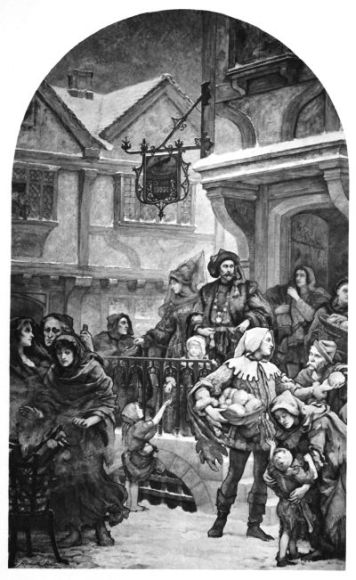
THE CHARITY OF WHITTINGTON.
From the wall painting by Henrietta Rae (Mrs. Normand)
in the Royal Exchange.
Under such circumstances Richard set sail at
Milford Haven, and in two days, on May 31st,
1399, landed at Waterford. There he lost three
weeks in waiting for the Duke of Albemarle,
who was to have followed him with another
force, but who is supposed to have been influenced
by the prevailing disaffection. At length Richard
marched on towards Kilkenny, and many of the
lesser chieftains came humbly, with halters round
their necks, suing for pardon. Not so the great
chieftain McMurrough. He came to a parley with
Scrope, the Earl of Gloucester, mounted on a magnificent
grey charger, which had cost him 400 head
of cattle, and brandishing a huge spear in his
hand. He expressed his willingness to become a
nominal vassal of the Crown, but would be free
of all compulsion or conditions. Richard refused
to treat with so independent an individual, but
set a price on his head, and proceeded to Dublin,
where he was at length joined by Albemarle, and
he then again gave chase to the wild Irish chief.
But in the midst of this pursuit he was suddenly
arrested by news from England, which reduced
all other considerations to nothing.
Lancaster had landed at Ravenspur, in Yorkshire,
and was rapidly collecting an army and
marching towards London. While the duke was
brooding at Paris over the fresh indignity put
upon him by Richard, who had sent the Earl
of Salisbury to break off the match with Marie,
Countess of Eu, daughter of the Duke of Berri,
the exiled Archbishop of Canterbury arrived,
bringing him the news of Richard's departure
for Ireland, and the desire of the people of
London for his arrival. To elude the vigilance
of the French court, he obtained permission to
visit the Duke of Brittany, and he speedily set
sail from Vannes for England. Three small
vessels carried the whole of his invading army—namely,
the archbishop, the son of the late Earl
of Arundel, fifteen lancers, and a few servants.
But he had full reliance on the spirit which then
animated all England. He was quickly joined
by the Earls of Westmoreland and Northumberland,
to whom he declared, in the White Friars
at Doncaster, that he came only to reclaim the
honours and estates of his father, which were
secured to him by the king himself by his letters
patent, and he swore to make no claim upon the
crown.
His uncle, the Duke of York, as regent of the
kingdom in the royal absence, advanced to St.
Albans ostensibly to oppose his progress; but it
could not be supposed that he was very hearty
in the cause, after having seen one brother
murdered by the king, and the only son of the
other, the great John of Gaunt, expelled and
thwarted by him. The favourites of the king, the
Earl of Wiltshire, Bussy, and Green, who were
not only members of the infamous council, but had
been farmers and exactors of the oppressive taxes,
showed a prudent doubt of any sure protection
from such a champion as York. They had been
appointed to wait on the young queen at Wallingford,
but they took flight, leaving her to fate, and
fled to Bristol, in expectation of meeting the king.
York very soon took the same direction, no doubt
in the desire to resign, as soon as possible, his
responsibility into the hands of the king, for he
felt that there was no reliance on his army.
Thus he left the way open to the capital, and
Lancaster advanced along it with equal rapidity
and success. On all the estates belonging to his
family he was received with rapture, and the
people of London came out to meet him, headed
by the clergy, with addresses of congratulation
and offers of assistance. But he did not make
much delay in the metropolis: all was evidently
his own there. He therefore made a rapid march
after his uncle, to prevent his union with the
king's forces, should he arrive, and he came up
with him at Berkeley. After a friendly message
from Lancaster, York met him in the castle
church, and the result of their conference was
that York joined his forces to those of Lancaster.
Probably he might believe that Lancaster sought
only his just demand of the enjoyment of his hereditary
estates, which York had already avowed
that he would aid him in. But from that moment
the cause of Richard was betrayed, and his doom
was sealed. York, on his authority as the king's
lieutenant, ordered Sir Peter Courtenay, the
governor of Bristol Castle, to open its gates; Sir
Peter, protesting that he knew no authority but
the king's, yet submitted to the commands of
York as regent. The next morning, the three
late members of the council and farmers of the
taxes, the Earl of Wiltshire, Bussy, and Green,
were brought out and executed without any trial.
The people had clamoured loudly for their blood,
and were delighted at their deaths. The Duke of
York took up his quarters at Bristol, and Lancaster,
who must have had full confidence in the
adhesion of his uncle, went on to Chester, where
the people were most favourable to the king, in
order to secure the city.
Meanwhile Richard, having received this astounding
news, prepared to pass over with
his army. From this resolution the Duke of
Albemarle, who played constantly into the hands
of the queen's enemies, used every endeavour to
persuade him. At length it was determined that
the Earl of Salisbury should sail with his own
retainers, only 100 men, and endeavour to raise
the inhabitants of Wales, Richard promising to
follow in a week.
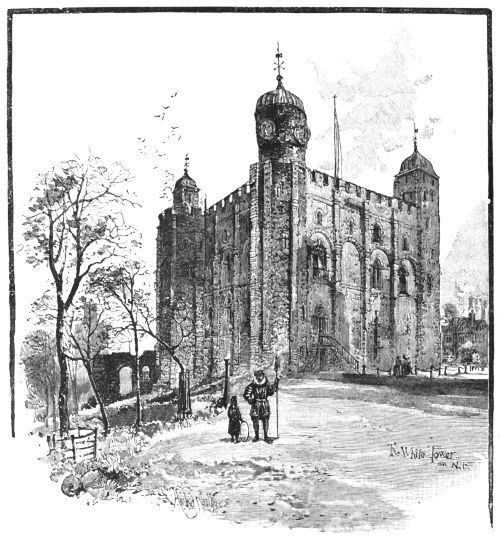
THE TOWER OF LONDON: THE WHITE TOWER.
Salisbury was successful. The men of both
Wales and Cheshire flocked to the king's standard,
and the earl looked impatiently for the king's
arrival. But no Richard appeared; and it was
not till nearly three weeks from Salisbury's setting
out that Richard came, with the Dukes of Albemarle,
Exeter, and Surrey, the Earl of Worcester,
the Bishops of London, Lincoln, and Carlisle—plenty
of noblemen but hardly any soldiers.
Scarcely had they landed, when the most general
disaffection showed itself. The news of the
Duke of York having joined Lancaster was fatal;
and Richard, looking out of his window on the
second morning after his arrival at Milford Haven,
saw that his army had vanished. A council was
instantly held in the greatest consternation. Some
counselled the king to retire to his French provinces;
but his evil genius, the Duke of Exeter,
the quondam murderer, John Holland, strongly
urged him to hasten on to Conway, where the
Earl of Salisbury lay. If they could not make a
stand there, they could still put out to sea for
Guienne. This advice prevailed; but such was
the confused state of the royal councils that, instead
of advancing there in a small but compact
body, the king, disguised as a Franciscan friar,
stole out of the camp at midnight, and, accompanied
by his two half-brothers, Exeter and
Surrey, the Earl of Gloucester, the Bishop of
Carlisle, and a few other attendants, made their
way towards Conway. As soon as their departure
was known, the military chest was plundered, and
Albemarle, Worcester, and most of the leaders,
hastened to Lancaster, the rest dispersing to
their own counties as best they might, insulted
and robbed on their way by the Welsh.
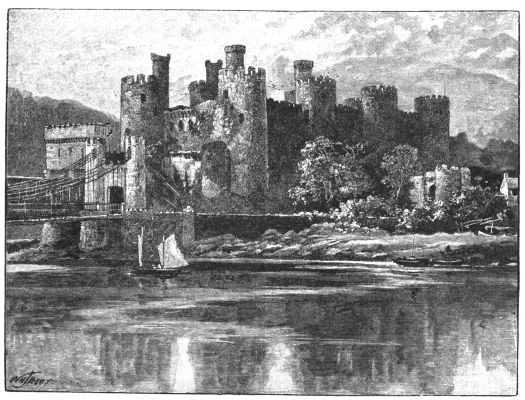
Still more overwhelming news met the fugitive
king on reaching Conway. Instead of a fine
army, there lay Salisbury with only 100 men, and
destitute of all provisions. While Richard had delayed
his coming, adverse influences had been
brought to bear on Salisbury's host; disheartening
rumours were circulated amongst the troops, and,
in spite of Salisbury's tears and entreaties, they
rapidly dispersed.
In this deplorable situation the mind of the
king seems to have lost all its wonted courage.
He sent his two half-brothers, the Dukes of
Surrey and Exeter, to his haughty rival to ask
what were his intentions. They could very easily
be divined. Richard was wholly in his power,
and it was not in the nature of Lancaster to
let pass so tempting an opportunity of seizing a
crown. While the two emissaries went on their
mission, the king and Salisbury examined the
castles of Beaumaris and Carnarvon, but, finding
only bare walls, they returned dejected to Conway.
Meantime Surrey and Exeter were admitted to
the presence of Lancaster at Chester, who at once
detained them as prisoners. Here was already
the traitor Albemarle, who was so gay that he
could afford to taunt the fallen kinsmen of the
king.
Lancaster having carefully informed himself of
the retreat of the king, and that he had a considerable
treasure deposited in the strong castle of
Holt, immediately despatched a body of troops to
capture the money, and another of 400 men-at-arms
and 1,000 archers, under the Duke of Northumberland,
to secure the king. Northumberland
marched into Flint, and thence to Rhuddlan
Castle, and about five miles beyond the latter
place left his detachment concealed behind a
rock. He then rode forward with only four
attendants to Conway, where he was readily
admitted to the presence of the king, who was in
the highest anxiety regarding his brothers and the
fate of their mission. The duke replied that his
brothers were quite well at Chester, and that he
was himself despatched with a letter to his Grace
by the Duke of Exeter. In the letter Exeter was
instructed to say that Richard might put full confidence
in the offers made by Northumberland.
These were that the said dukes, Exeter and
Surrey, the Earl of Salisbury, the Bishop of
Carlisle, and Maudelin, the king's chaplain,
should take their trials for having advised the
murder of Gloucester; that Lancaster should be
made justiciary of the kingdom, as his ancestors
had been before him; and, these terms being conceded,
the duke would wait on the king at Flint,
to implore pardon, and accompany him to London.
Richard, after consulting his friends, consented
to the terms, but secretly assured his adherents
implicated that he would stand by them steadfastly
on their trial, and would take the first opportunity
to be avenged on his and their enemies;
saying he would flay some of them alive if he
could, and that all the gold on earth should
not induce him to spare them. He insisted on
Northumberland swearing on behalf of Lancaster
to the strict observance of the articles, and, "like
Judas," says the writer of the account, in the
Archæologia, which we are following, "he perjured
himself on the body of our Lord"—that is he
swore on the host.
Northumberland set out, Richard reminding
him of his oath, and telling him he relied upon
him. He soon followed with a small company of
friends and servants. On coming to a turn of
the road, Richard exclaimed, "God of Paradise,
assist me! I am betrayed! Do you not see
pennons and banners in the valley?" Northumberland
with eleven others just then came up, and
pretended to be ignorant of any armed force near.
"Earl of Northumberland!" said Richard, "if I
thought you capable of betraying me, it is not too
late to return!"
"You cannot return," said Northumberland,
seizing Richard's bridle; "I have promised to conduct
you to the Duke of Lancaster." A body of
lancers and archers came hastening up, and Richard,
seeing all hope of escape gone by, exclaimed, "May
the God on whom you laid your hand reward you
and your accomplices at the last day!"
They reached Flint Castle that evening, where
Richard, when left alone with his friends, vented
the bitterness of his regret that he had repeatedly
spared Lancaster, when he so carefully destroyed
other and far less dangerous men. "Fool that I
was!" he exclaimed; "thrice did I save the life of
this Henry of Lancaster. Once my dear uncle,
his father, on whom the Lord have mercy, would
have put him to death for his treason and
villainy. God of Paradise! I rode all night to
save him, and his father delivered him to me to do
with him as I pleased. How true is the saying
that we have no greater enemy than the man
whom we have preserved from the gallows!
Another time he drew his sword on me, in the
chamber of the queen, on whom God have mercy!
He was also the accomplice of the Duke of Gloucester
and the Earl of Arundel; he consented to
my murder, to that of his father, and of all my
council. By St. John, I forgave him all; nor
would I believe his father, who more than once
pronounced him deserving of death."
The next morning the fallen king, after a sleepless
night, ascended the tower of the castle, and
looked out anxiously for the approach of Lancaster,
who had agreed to meet him there; and
anon he saw him coming at the head of 80,000
men. This vast army came winding along the
strand to the castle, which it surrounded, and
Richard beheld himself a captive in the midst of
his own subjects. At this sight, and the reflections
it occasioned, the once arbitrary monarch
shuddered, and bewailed his fate. He cursed
Northumberland in impotent rage, but was soon
called to meet Archbishop Arundel, himself a
rebel returned, without asking leave, from banishment,
the traitor Duke of Albemarle, and the
Earl of Worcester. They knelt in pretended
homage, and Richard held a long conversation
with Arundel. When they were gone, Richard
again ascended to the tower, gazed on the great
host of his revolted subjects, and feeling a dire
foreboding of his fate, said, "Good Lord God! I
commend myself into Thy holy keeping, and cry
Thee mercy that Thou wouldst pardon all my sins.
If they put me to death, I will take it patiently,
as Thou didst for us all."
At dinner there were only his few remaining
adherents, and since they were all companions in
misfortune, Richard would insist on their sitting
down with him. While at their meal persons
unknown came into the hall, and insulted and
menaced him; and no sooner did he rise than
he was summoned into the court to meet Lancaster.
The duke advanced to the king, clad in
complete armour, but without helmet, and, bending
his knee, did obeisance with his cap in his hand.
"Fair cousin of Lancaster," said Richard, uncovering,
"you are right welcome." "My lord,"
replied Lancaster, "I am come somewhat before
my time, but I will show you the reason. Your
people complain that for the space of twenty or
two-and-twenty years you have ruled them rigorously;
but, if it please God, I will help you to rule
them better." The humbled monarch replied, "Fair
cousin, since it pleaseth you, it pleaseth us well."
The king's horses were ordered, and they set
forward at once for Chester, amid a flourish of
trumpets, Richard and the Earl of Salisbury
riding on tired and wretched animals. The duke
came behind. At Chester, after issuing writs in
the king's name for a meeting of Parliament, Lancaster
dismissed a great part of his army, and set
out for London. At Lichfield Richard slipped
unperceived out of his window, but was retaken
in the court, and was ever afterwards strictly
guarded. On arriving at London, Richard was
sent to Westminster, and thence to the Tower,
while the hypocritical Lancaster went in solemn
state to St. Paul's, and pretended to weep awhile
at the tomb of his father, while in his heart he
was congratulating himself on his successful
treason. We have two conflicting statements of
the manner of Richard's entrance into London.
Froissart says that he was conducted secretly to
the Tower for fear of the Londoners, who had a
great hatred of him; but other accounts accord
with that of Shakespeare, copied, no doubt, from
the chronicles, which make Lancaster conduct him
thither in triumph.
Parliament met on the 29th of September to
consider of the course to be adopted: in other
words, to carry out the will of Lancaster, and
depose Richard. It was clear that Richard had
entirely lost the affections of the people. They
would never again receive him. His utter want
of regard for them; his continual exactions to
waste their means on unworthy favourites; the
contempt he had all along expressed for the
people, and his severe treatment of them; his
breach of all his oaths as a king; his attempts to
make himself absolute, and to rule by a junto,
had made him disliked and despised through the
whole realm, but especially in the metropolis. It
is equally true that Lancaster was their favourite,
and that they would willingly accept him as king;
and had he been content to accept the crown as
the popular gift, he would have had the highest
possible title to it, far beyond any hereditary plea.
But Lancaster disdained that only valid ground of
right, and determined to claim it by descent.
Than this there could be nothing more palpably
untenable, for the Earl of March, the grandson of
Lionel, Duke of Clarence, the third son of Edward
III., was the true heir.
As soon as Lancaster allowed it to be known
that he did not really content himself with being
the reformer of the State, but aspired to the
crown, some of his chief supporters fell away; and
amongst them the Earl of Northumberland, who
had been made to assure Richard of his just treatment.
This was a main reason for Lancaster
dismissing a large part of his army at Chester,
including the followers of Northumberland.
The remaining transactions of this reign come
to us chiefly through the rolls of Parliament,
penned under the direct influence of Lancaster,
and, therefore, are probably coloured as much as
possible to favour his own views, and cover his
notorious usurpation. A deputation of prelates,
barons, knights, and lawyers waited on Richard
in the Tower, and received from him his resignation,
which he was then said to have promised at
Conway, but which we know was not the fact.
He was also in that document, signed by him and
presented by the deputies to Parliament, made to
name, by his own preference, Lancaster as his
successor. Of course, all this he was obliged to say.
The next day this act of resignation was read
in full Parliament, and there unanimously accepted,
and received by the people with shouts of
applause. If Richard had thus voluntarily abdicated,
there could be no necessity for what immediately
followed—a series of thirty-three articles
of impeachment in order to his deposition. The
chief charges contained in these were his violation
of his coronation oath, his murder of the Duke of
Gloucester, and his despotic and unconstitutional
conduct. Of course, there was no opposition; but
Merks, the Bishop of Carlisle, who had remained
faithful to Richard, and continued with him to
the last, stood boldly forward, claimed for him the
right to be confronted with his accusers, and urged
that Parliament should have the opportunity of
judging whether his resignation were voluntary
or not. Nothing could be more reasonable, but
nothing more inconvenient where all was settled
beforehand to one end; and the only answer
which the high-minded prelate received was his
immediate arrest by Lancaster, and consignment
to the Abbey of St. Albans.
Richard was then formally deposed, with an
acrimony of accusation which, to say the least,
if his resignation had been, as asserted, voluntary
in favour of Lancaster, was as ungracious
as it was uncalled for. The chief justice, Sir
William Thirning, was deputed to notify this
decision of Parliament to the captive.
Lancaster, who had taken his seat during these
proceedings near the throne, then rising, and
crossing himself on the forehead and breast, pronounced
the following words:—"In the name of
Fadher, Son, and Holy Ghost, I, Henry of Lancaster,
challenge this rewme of Ynglonde and the
crowne, with all the members and appurtenances,
als I that am descendit be ryght lyne of the blode,
cumyng fra the gude lord King Henry Thirde, and
throghe that ryght that God of His grace has sent
me, with help of my kyn and of my frendes to
recover it; the whiche rewme was in poynt to be
ondone for defaut of governance, and undoying
of the gude lawes."
This speech was one of those which have a
sound of reason to the ear, but will not bear a
moment's examination. True, he was descended
from Henry III., like Edward III. and Richard,
but not in the true line—that being, as we have
stated, the line of Lionel, and Henry being now
not only the usurper of Richard's throne, but of
the Earl of March's reversion.
But the pretence was enough, and more than
enough, for all who heard it. They knew it was
empty sound, and the real reasons for assent
lay in Lancaster's will, backed by a powerful army
and a willing people.
Henry, as proof of Richard's having resigned
his rights into his hands, produced the ring and
seal. The Archbishop of Canterbury, Arundel,
his late fellow-exile, now took him by the hand,
and led him to the throne. He knelt for a short
time on the steps in prayer, or affected prayer;
for Lancaster, amid all his grasping at his neighbour's
goods, was especially careful to do outward
homage to the great Being who had said, "Thou
shalt not covet." On rising, the two archbishops
placed him on the throne; and, as soon as the
acclamations ceased, the primate made a short
sermon, choosing his text, with the finished tact of
a priestly courtier, from 1 Samuel ix. 17:—"Behold
the man whom I spake to thee of! this same
shall reign over my people;" and the sermon was
worthy of the text.
Thus ended the reign of Richard II.; and, as
with it ended also the authority of Parliament
and the ministers of the Crown, Lancaster
immediately summoned the Parliament to meet
again in six days, appointed new officers, and,
having received their oaths, retired to the royal
palace.
The history of the progress of Parliamentary
power in this reign is most important. We find
Parliament at various times asserting its authority,
calling on the Crown to reform its household,
its courts of law, to restrain its expenditure, and
dismiss its servants. By its means the Duke of
Gloucester obtained his commission to regulate
the administration, and to impeach the prime
minister, De la Pole, the Earl of Suffolk; and
though, during the latter years of his reign, Parliament,
as in our time, became corrupt and subservient,
yet the people, assuming the exercise of
those powers which their delegates had basely
surrendered, punished and deposed the monarch
whom they could not reform.
Richard was dethroned in the twenty-third year
of his reign, and the thirty-fourth of his age.
We may anticipate the events related at greater
length in subsequent pages (see Chapter XXXIV.)
to briefly sketch the fate of the deposed king.
Henry IV. submitted to the lords the question
what should be done with the late monarch,
whose life, he declared, he was at all events resolved
to preserve. The lords recommended perpetual
confinement in some castle, where none of
his former adherents could obtain access to him.
This advice was acted upon, and probably was first
suggested by Henry. Richard disappeared, and
no one knew anything of his place of detention.
The King of France threatened war on behalf of
the rights of his daughter, Isabella, and his son-in-law,
the deposed king. To avert this storm
Henry proposed to make various alliances between
the two royal families, including the marriage of
the Prince of Wales to a daughter of Charles.
But the King of France rejected the proposal,
declaring that he knew no King of England but
Richard. The French king, however, received
intelligence that Richard was dead, and therefore
he avowedly ceased to prosecute his claims, but
confined himself to those of his daughter, demanding
that she should be restored to him, with
her jewels and her dowry, according to the marriage
settlement. Charles afterwards consented
to receive her with her jewels only, counter claims
being set up against the dowry.
From the moment, however, that the public
statement of Richard's death was made by the
King of France, the nation became inquisitive,
and it was not long before the dead body of the
deposed monarch was brought up from Pontefract
Castle, and shown publicly in St. Paul's for two
days, where 20,000 people are said to have gone
to see it. Only the face was uncovered, and that
was wonderfully emaciated. Various were the
rumours of the mode of his death on all these
occasions, but, as in the case of Richard's victim,
the Duke of Gloucester, nothing certain ever
transpired. One story was that Sir Piers Exton,
with seven other assassins, entered his cell to
despatch him, when Richard, aware of their purpose,
snatched an axe from one of them, and felled
him and several of his fellows to the earth; but
that Exton, getting behind him, prostrated him
with one blow, and then slew him. Another story
was that he starved himself to death; and there
were not wanting rumours that he had escaped,
and lived many years in the guise of an ordinary
man. One thing is quite certain; that the so-called
Richard, who, as we shall see, was a considerable
source of anxiety to the new king, can
have been nothing but an arrant impostor. But
Henry of Lancaster may be safely trusted to secure
his dangerous captive. The features of Richard
were too well known to thousands in London to
be mistaken for those of the priest Maudelin,
whose body, it was pretended, had been substituted
for Richard's. There can be no doubt but
that he died a secret and violent death; the mode
of that death must for ever remain a mystery.
But the evidence would seem to incline to the conclusion
that he was starved to death by his keepers.
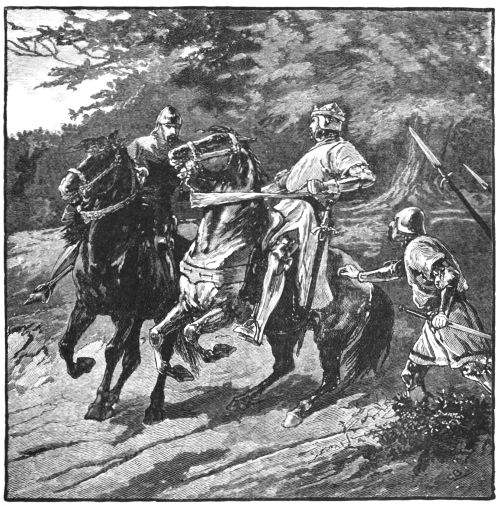
ARREST OF KING RICHARD. (See p. 482.)