The order to which we have given the name of GAPERS (Hiantes) includes a considerable
number of families, which, though differing considerably from each other in some trifling respects,
are related in many essential particulars. Nearly all these birds are of small or moderate size,
and are recognisable by their slender though powerful body, short neck, large and remarkably
flat head, long narrow-pointed wings, and short feeble legs. Their beak is short, broad, and
flat, tapering towards its extremity, and although somewhat varied in its formation, is always surrounded
by a stiff, bristle-like growth; the gape is so unusually wide as to constitute the most
remarkable feature they all have in common. The plumage is sometimes harsh and dusky, and
sometimes soft, glossy, and brilliantly coloured. The birds belonging to this order principally
frequent the warmest portions of our globe, and are rarely met with in high northern latitudes, as the
latter afford them but a very scanty supply of the insects upon which they mainly subsist. Heat
is essential to the abundance of their favourite food, and it is for this reason that such species as
inhabit the temperate zones are compelled to quit their native lands for sunnier climes as winter
approaches. Some occupy forests; others mountains, valleys, or open plains; and many, when
about to make their nests, seek the immediate vicinity of man. All the members of this order
are possessed of extraordinary powers of flight, and pass the greater part of their lives in pursuing
their tiny prey through the realms of air. Upon the ground they move awkwardly and slowly,
and are usually scarcely more adroit in climbing among the branches of trees. The sight of all
these birds is excellent, but their other senses appear to be only slightly developed. In temper
they are social, brisk, and restless, and exhibit much tenderness towards their young. Their
intelligence, however, is by no means great; indeed, some species are unquestionably extremely
deficient in this respect. So very various is the formation of the nests, and the number and
appearance of the eggs of the different families into which this order is divisible, that we shall
not attempt to mention them here, but will describe them with the group or species to which
they belong.
SWALLOWS.
The SWALLOWS (Hirundines) constitute the foremost family of this order, and are readily distinguished
by their small, delicately-formed body, broad breast, short neck, and flat head; their beak is
short, flat, broad at its base, and terminates in a slight hook; the gape is so wide as to extend as
far as the eyes. These birds have no crop; their broad, flat, horny tongue is sharp at its edge,
divided at its tip, and furnished with small tooth-like appendages towards its base. The feet are
broad and feeble, the toes, three of which are placed in front, are very weak and the claws are slender.
The wing is long, narrow, composed of nine quills, and sharply-pointed at its extremity; the tail
forked, containing twelve feathers; those at the exterior often far exceeding the centre ones in length.
The plumage is composed of small compact feathers, and frequently exhibits considerable metallic
lustre. Both sexes are alike in colour, but the young differ somewhat from the adult birds.
Swallows are found throughout every division of both hemispheres, and occupying every latitude,
but they rarely breed and are far from numerous within the limits of the Polar regions. Such
species as inhabit the torrid zones do not migrate, whilst those that visit comparatively cold countries
go to warmer climes as winter approaches, quitting and returning to their native lands at the
appointed period with such extraordinary regularity that the time of their appearance or departure
may be calculated almost to a day. As regards their intelligence, these birds are far superior
to most other members of the order. Their pleasing twitter may almost be termed a song, and
their flight is distinguishable by an ease and rapidity that has rendered it proverbial. All Swallows
bathe and drink whilst upon the wing. They subsist upon insect diet, which they obtain by darting
upon their tiny victims with marvellous velocity as they skim through the air, and swallow them
entire. They consume beetles and flies in enormous quantities, for their appetite is insatiable;
but bees and wasps, or any insect armed with a sting, they never touch, as their wonderful instinct
renders them fully aware that such morsels are not to be snapped at with impunity. Naumann
mentions that having upon one occasion put a wasp into the beak of a young Swallow, the bird
died almost immediately from the effects of the stinging it received whilst swallowing the insect.
Some species form most artistic abodes with bits of clay consolidated by means of the glutinous
spittle with which the members of this family are provided; whilst others excavate deep holes for the
reception of the young, the same nests being employed for many successive years. The females
alone brood, and lay from two to six eggs.
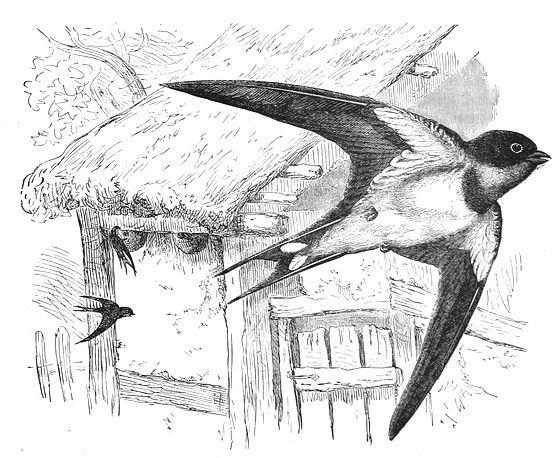
THE CHIMNEY SWALLOW (Cecropis-Hirundo-rustica).
The TRUE SWALLOWS (Cecropis) are characterised by their slender and powerful body, wide
flat head, broad but very slightly curved beak, long wings, extending beyond the deeply-forked tail,
moderate sized foot, and lax plumage, which upon the upper parts gleams more or less with
metallic lustre.
THE CHIMNEY SWALLOW.
The CHIMNEY SWALLOW (Cecropis-Hirundo-rustica) is seven inches long and twelve broad, the
wing measures four and a half and the tail about three inches. The upper part of the plumage is
glossy blueish black; the brow and throat are chestnut brown, a broad line upon the head black,
and the other parts of the body reddish yellow. The five outer feathers of the tail are adorned with
round white spots upon the inner web. The female is not quite so dark as her mate, and the young
are still paler. This species breeds throughout the whole continent of Europe, if we except its
extreme north. In the northern parts of Asia and Africa it is replaced by a very similar species—the
RUST-RED SWALLOW (Cecropis cahirica, or Cecropis Boissoneauti), which is very numerous in
Egypt. The NORTH AMERICAN HOUSE SWALLOW (Cecropis Americana), the SOUTH AMERICAN
RED SWALLOW (Cecropis rufa), and the Cecropis neoxena are also very nearly allied species, but
somewhat less in size than their European relative.
We are desirous our readers should fully understand that the Chimney Swallow is essentially
a native of Europe, and that when it wanders to warmer regions it does not "homeward fly," but
exactly the contrary, being then compelled, by reason of the approach of winter, to leave its native
land "in distant climes to roam," until such time as the breath of spring has caused the snow and
frost completely to disappear, and the leaves have again burst forth upon the trees. When these
migrations are about to commence, the Swallows assemble in very large flocks, which congregate
upon the trees or houses, and keep up such an incessant twitter and commotion as would lead an
observer to suppose that they are discussing the important journey they are about to undertake.
The Swallows usually leave Europe about September or October; according to our own observation,
they often travel as far south as eleven degrees north latitude, and are constant winter guests in India
and Ceylon; by the end of April, however, they are with us again, and have either sought out
their old nests or chosen a proper spot on which to build. For this purpose, they generally select
such districts as are in the vicinity of water; and, "although the Chimney Swallow has received
its most general name from the somewhat peculiar position in which it frequently builds its nest,
it by no means confines itself to chimneys, but builds readily in almost any suitably-sheltered
position. Thus, the disused shafts of mines and the sides of old wells are sometimes resorted to.
Occasionally it will build in the roof of a barn or shed, attaching its nest to the rafters; or in a garret
or passage to which it finds easy access. In almost all cases it selects a point where some projection
from the wall, 'some coign of vantage ground,' forms a buttress on which its nest may be supported.
The nest is constructed principally of mud or soft earth, collected in small pellets from the edges
of ponds and other wet places; these are carried home in the bird's bill, and plastered on to the
spot selected for the nest; fresh pellets are then brought and added, together with numerous
straws and leaves of grasses, until the whole is gradually moulded into the form of an open saucer,
attached by one side to the wall of the chimney or other place of retreat. A lining of feathers is
then put into the nest, and upon these the eggs are laid." Such of these nests as are well sheltered
from the wind and rain are often employed for many years, and that, not merely by the original
builders, but by successive generations; any little repairs required being made from time to time
by the occupants.
The Chimney Swallow, though by no means a powerful or hardy bird, possesses such an amount
of life and spirit as is seldom met with in any other members of the feathered race, and which no
inclemencies of weather or scarcity of food can entirely quell. Its appearance is extremely trim, and
its disposition so brisk and lively that it has ever been an especial favourite. Morning has scarcely
dawned before it is on the alert, and occupied in twittering its summons to the rest of the world to
be up and about their work. Its voice can boast no real music, but its notes are so sprightly, and so
evidently the outpouring of the bird's own joyous sensations, as it turns its breast in all directions,
flaps its wings, and indulges in a variety of animated gestures, that it cannot fail to please the hearer,
and impart an additional charm to the beauties of the first hours of a bright early summer's day.
The flight of this species is peculiarly light and graceful, and very far superior to its movements
upon the ground, over which it crawls with an awkward and helpless step, its little feet appearing
quite unable to support its body, either when walking or perching. When upon the wing the powers
of the Swallow are seen in their full perfection, and few objects are more beautiful than one of these
birds, as it skims over the face of the country, now soaring upwards to a great height, and now sinking
suddenly down until it almost sweeps the ground; then changing its course, it flies backwards and
forwards with amazing celerity, pursuing its way with untiring speed, and not unfrequently indulging
in a bathe in the lake or stream over the bosom of which it delights to skim. This proceeding, like
all its other evolutions on the wing, is rapidly and easily accomplished; the bird sinks close to the
water, and suddenly darts beneath its surface, re-appearing in less than a moment, and then flies off to
a distance to shake the moisture from its plumage. The Swallow devours enormous numbers of flies,
beetles, and butterflies; when in pursuit of prey it either keeps near the ground, or skims through
the air at an altitude regulated according to the barometrical state of the atmosphere, insomuch that
from this fact has arisen the popular idea that its movements indicate the kind of weather to be
expected.
The eggs (see Fig. 35, Coloured Plate XVI.), from four to six in number, are laid about May, and
are incubated entirely by the female. If the season is fine the male ministers to her wants, and the
young are hatched in twelve days; but should the weather be cold or wet the unfortunate mother is
expected to provide for herself, and must therefore leave her nest; if this is the case the nestlings do
not quit the shell for about seventeen days. The young grow rapidly, and before they are fully
fledged may be often seen peering and gaping above the sides of the nest, until able to accompany
their parents during their daily excursions; yet, even then, they return to the nest for a short period
as evening closes in. No sooner has the first family become self-supporting than the female again
lays, but this time the eggs are fewer than before, and it is not uncommon for this second brood to be
hatched so late in the season that the nestlings are too weak to accompany the rest of the family
when the time for migrating arrives. A Spanish proverb says, "He who could destroy a Swallow
could kill his own mother;" but, in spite of the reprobation of the act expressed in this popular adage,
hundreds and thousands of these useful and sprightly birds are annually slaughtered out of mere
wanton mischief, not only in that country, but in all parts of Europe, and yet few members of the
feathered creation are more innocent, more useful, or more ornamental to the landscape. "The
Swallow," says Sir Humphry Davy, "is one of my favourite birds, and a rival of the Nightingale, for
he cheers my sense of seeing as much as the other does my sense of hearing. He is the glad prophet
of the year, the harbinger of the best season; he lives a life of enjoyment, among the loveliest forms
of Nature. Winter is unknown to him, and he leaves the green meadows of England in autumn, for
the myrtle and orange groves of Italy, and for the palms of Africa. He has always objects of pursuit,
and his success is secure. Even the beings selected for his prey are poetical, beautiful, and transient.
The ephemeræ are saved by his means from a slow and lingering death in the evening, and killed in a
moment when they have known nothing but pleasure. He is the constant destroyer of insects, the
friend of man, and a sacred bird. His instinct, which gives him his appointed season, and teaches
him when and where to move, may be regarded as flowing from a Divine source; and he belongs to
the oracles of Nature, which speak the awful and intelligible fiats of a present Deity."
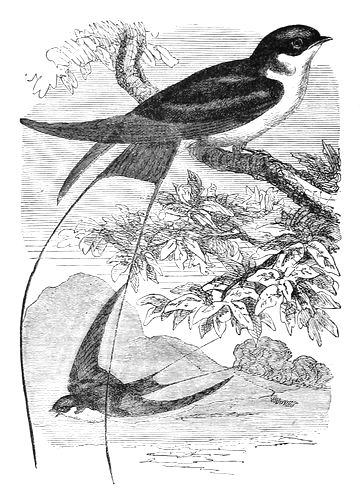
THE THREAD-TAILED SWALLOW (Cecropis-Uromitus-filifera).
The power of flight possessed by these birds is truly wonderful, and the distance to which they
can travel through the air, without the possibility of rest, is almost incredible. Nevertheless, at one
time, and that not many years ago, it was believed that on the approach of cold weather Swallows
plunged to the bottom of some pond, in the mud of which they passed the winter, and revived again
in spring. So long ago as the year 1849 this subject was brought before the Academy of Sciences at
Stockholm, and the following document, which, coming from the quarter it did, was by some looked
upon as an irrefragable proof of the truth of this strange story, was submitted to and gravely discussed
by that learned body:—"Near to the estate of Kafvelas, in the province of West Gothland, there is a
little lake called Djpasjon, where on several occasions in the winter time, when the ice-net has been
drawn, stelnade, or stiffened Swallows, have been brought up in my presence. My father, then
Inspector at Kafvelas, who was also present, directed me to take some of them home, and place
them in a chair at some little distance from the fire. This I did, and, to my great astonishment, I
soon observed the birds to draw their heads from under their wings, where they had been previously
placed, and in a few moments to fly about the room. But as this was not the proper season for their
quickening, they lived but a short time afterwards."
So often has this statement been repeated, that even Wilson felt himself called upon to confute
it. "The Swallow," says that graphic writer, "flies in his usual way, at the rate of one mile in
a minute, and he is so engaged for ten hours every day; his active life is extended on an average
for ten years, which gives us two million one hundred and ninety thousand miles—upwards of eighty-seven
times the circumference of the globe. And yet this little winged seraph, if I may so speak,
who in a few days can pass from the Arctic regions to the torrid zone, is forced when winter
approaches to descend to the bottom of lakes, rivers, and mill-ponds, to bury itself in the mud with
eels and snapping turtles, or to creep ingloriously into a cavern, a rat-hole, or a hollow tree, with
snakes, toads, and other reptiles, till the return of spring! Is not this true, ye wise men of Europe
and America, who have published so many credible narratives upon this subject? The Geese, the
Ducks, the Cat-bird, and even the Wren, which creeps about our houses like a mouse, are all declared
to be migratory, and to pass to southern regions on the approach of winter. The Swallow alone,
on whom Heaven has conferred superior powers of wing, must sink in torpidity to the bottom of
some pond to pass the winter in the mud!"
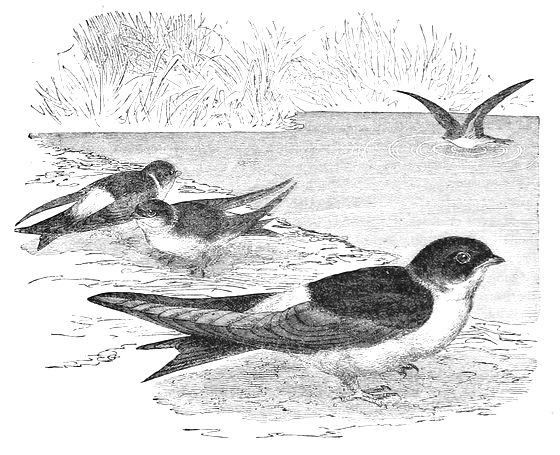
THE MARTIN (Chelidon urbica).
We must confine our notice of the True Swallows to the mention of two other species, one
remarkable for its size, and the other for the very peculiar formation of its tail.
THE SENEGAL SWALLOW.
The SENEGAL SWALLOW (Cecropis Senegalensis) is about eight inches long and fifteen broad;
the wing measures five and a half, and the tail about four inches. The plumage of the upper part
of the body is of a glossy blueish black, with the exception of the rump and a ring round the
neck, which are reddish brown; the under side is entirely of the latter hue, somewhat paler upon
the throat and upper part of the breast. This very large species inhabits Central Africa in great
numbers, and is met with from the western coast to the shores of the Red Sea. In its mode of
life and habits it so closely resembles the Chimney Swallow that a description of its habits would
be mere repetition; unlike that bird, however, it does not always dwell in the immediate vicinity
of man, but frequently wanders forth and lives upon the vast and barren steppes. Another very
similar species is found in Angola and at the Cape of Good Hope.
THE THREAD-TAILED SWALLOW.
The THREAD-TAILED SWALLOW (Cecropis-Uromitus-filifera) is a small and delicate bird, easily
recognisable by the long threads in which the two outer feathers of the tail terminate. The upper
part of the body is of a beautiful metallic blue, the top of the head rust-red, the region of the cheeks
black, the under side white, and the tail spotted with white. The length of this species is five,
and its breadth eleven inches. The thread-like appendages are not so long in the tail of the female
as in that of her mate. This singular bird principally frequents India and Central Africa, and we
have met with it living solitarily or in pairs during our travels in Nubia. As far as we were able to
ascertain, its habits exactly correspond with our account of its European congener. The Indians
call this species "Leischra," as the threads attached to the tail are supposed to resemble the grass
known by that name.
THE MARTIN.
The MARTIN or ROOF SWALLOW (Chelidon urbica) we have selected as the type of a group,
recognisable by their slightly forked tail and strong feet, the toes of which are connected from the
first joint, and, like the tarsi, are thickly covered with feathers. This bird is five inches and a half
long, and ten and three-quarters broad; the wing measures four inches, and the tail two and a half.
Upon the back the plumage is almost entirely of an uniform blueish black; the under side and
rump are white. The eye is dark brown, the beak black, and the bare parts of the foot black.
Both sexes are alike in colour, but the plumage of the young is less clear in its tints than that of the
adult. The Martin inhabits the whole of Europe, and penetrates further north than the Chimney
Swallow; it is numerous in Siberia, and during its migrations visits the interior of Africa and
Southern Asia. In most respects it closely resembles the species already described, but is somewhat
less brisk and intelligent; its flight also is not so rapid and varied as that of the Chimney Swallow,
but it frequently soars to an enormous height in pursuit of the insects upon which it subsists. Its
voice is very far inferior to that of the rest of its family, and its cry monotonous and harsh.
In populous districts the nests of this bird are invariably constructed upon houses, but where
human habitations are scarce, the Roof Swallow is content to make its preparations upon rocks,
or any situation that will afford it a secure shelter from the wind and rain. The nest is very similar
to that of the Chimney Swallow, but with this difference, that it is always built against a hole, and
has no external entrance; sometimes many pairs construct their dwellings under the same eaves
or the same rock, and thus form a kind of settlement. Although usually peaceful, during the
breeding season disputes and battles are of constant occurrence; each couple naturally endeavouring
to obtain the snuggest corner, and to oust its neighbour should the opportunity offer. The brood
consists of from four to six delicate snow-white eggs, and the nestlings are hatched in about
twelve days. The female alone broods, and is fed by her mate only when the weather is fine; the
young also frequently have but an insufficient supply of food, owing to the difficulty of procuring
insects when the season is inclement, and thus must very often be left behind when the flocks
migrate, as they are still too weak to undergo such great fatigue. If all goes well, the nestlings
are fully fledged in about sixteen days, but generally remain for some time longer under the care
of their parents. During this period the whole family return at night to their nest, which they
fill so completely that we have often been inclined to wonder that the walls did not give way under
the pressure to which they were subjected. Desperate fights often ensue when a stray bird finds
its way into a wrong nest, and most courageously do those in possession exert themselves to expel
the intruder, who is generally equally determined to remain. Far less brave is the Swallow when
brought into collision with its principal enemy, the Sparrow; it often happens that no sooner is
the Swallow's nest completed than a male Sparrow creeps in and takes possession, keeping guard
at the door, in order to prevent the entrance of the rightful owner; under these circumstances,
the latter, not venturing to obtain admittance by force, usually summons its companions, who
together beset the impudent intruder with loud cries and every demonstration of anger. In most
cases the Sparrow retains possession of its ill-gotten abode, but should the Swallow be bold, a battle
sometimes takes place that proves fatal to one or other of the combatants. So constant are these
attempts of the Sparrow to obtain a home for its young, that a pair of Swallows sometimes are
deprived twice in the season of the domicile they have laboriously completed, and, should this
occur, do not breed at all that year. It was formerly imagined that the Swallow revenged itself
on its foe by building it up in the nest, but we need hardly say that this is untrue.
The Martins make their appearance in England a few days after the Chimney Swallow
(Cecropis-Hirundo-rustica), and on their arrival are usually seen in warm and low situations, such
being most likely to supply an abundance of their natural food. They are equally distributed throughout
the kingdom, and are found wherever man has fixed his residence, seeming to court his protection.
They commence nidification early in May, and build in the upper angles of windows and under
the eaves of houses, sometimes under the arches of bridges or against the face of rocks. The nest
is formed of mud completely worked and cemented, and is closed all round except a small orifice,
usually on the sheltered side, just of sufficient size to permit the passage of the inhabitant; the
interior is well lined with a collection of straw, hay, and feathers. These birds leave us in
October; preparatory to their departure, they congregate in great numbers on the roofs of houses.
The MOUNTAIN or SHORE SWALLOWS (Cotyle) are recognisable by their slightly
forked tail, and lax, lustreless plumage. Two species are indigenous to Europe; a description of
these will serve for the entire group.
THE ROCK SWALLOW.
The ROCK SWALLOW (Cotyle rupestris) is about five inches and a half long, and from twelve
and a half to thirteen and three-quarters broad; the wing measures about five inches. The coloration
of the plumage closely resembles that of the rocks upon which this species principally lives. The
upper parts of the body are light brown, the quills and tail blackish; the centre feathers that
compose the latter are beautifully marked with oval yellowish white spots; the throat is whitish;
the breast and belly dirty reddish grey; the eye is dark brown, the beak black, and the foot
reddish grey. The sexes are nearly alike; the young are somewhat more uniform in hue than the
adult bird.
The actual habitat of the Rock Swallows appears to be Spain, Italy, and Greece, but they
are constantly met with and are known to breed in the Tyrol, and even in still more central parts
of Europe. So hardy are they that such as migrate do not leave till the autumn is far advanced,
and return as early as February or March; whilst others, inhabiting the extreme south, remain in
their native land throughout the entire year. In Egypt and South-western Asia they are replaced
by a smaller but very similar species. The Rock Swallows seldom associate with their congeners,
and are readily distinguished from them by their greyish hue, and comparatively slow and hovering
flight. In Switzerland, after their return in the spring, they usually allow some time to elapse before
they seek their own nests or build new ones; during the interval they busy themselves in making
excursions in all directions, either skimming near the mountains, or, if the weather be fine, soaring
to a considerable height in the air. If, on the contrary, the season be dull or rainy, they keep
close to the earth, or beneath projecting rocks and stones. If the day be bright, they come down
from their retreats among the mountains, and perch upon the roofs of cottages, but never venture
actually into houses. The nest is placed beneath a projecting ledge of rock, or in some similar
situation, and resembles that of the Chimney Swallow. Several pairs frequently build together, but we
have never seen settlements like those formed by some other species. Many various statements have
been made as to their mode of nidification, seeing that, owing to the precipitous nature of the
localities selected, it is very often extremely difficult to approach the abode of a Rock Swallow. The
eggs are white, spotted with red, and are from three to five in number. After the nestlings are
fully fledged, they still remain for some time with the old birds, following them about in search
of insects, which are caught on the wing, but as soon as a fly or a beetle is thus obtained, the
hungry young perch for a moment upon a tree, and receive the morsel from the parent's beak.
When the period of incubation is over, the different families form small parties, and wander about
the country, as in the spring, until the proper time for commencing their migrations. In its general
disposition, the Rock Swallow is less alert and brisk than its congeners, and its voice has a deeper
and rather hoarse sound.
THE SAND MARTIN.
The SAND MARTIN (Cotyle riparia), one of the smallest members of its family, is only five
inches long and eleven broad; the wing measures four, and the tail two inches. The plumage is
greyish brown above, white beneath, and marked on the breast with a greyish brown ring. The
sexes are nearly alike, but the young are darker than the adults. These birds inhabit and breed
in all parts of Europe, except the extreme northern countries, and usually frequent such rocks
or hills as overhang streams and rivers. The wonderful nests that have rendered the members
of this group so famous, are made either in natural hollows, or in holes excavated with enormous
labour by the builders; they appear, however, to prefer the cavities which they have themselves
prepared, and are most careful to dig their retreats at such an elevation as to be above high-water
mark. "It appears," says Naumann, "almost incredible that a pair of these small birds, with no
other instruments than their delicate beaks, can dig, as they do, a horizontal passage several inches
in diameter, and from three to six feet deep, in the space of two, or sometimes three days. The
male and female both assist in this, for them, gigantic undertaking, and work with the utmost energy
and ardour, disposing of the loose earth by throwing it out behind them with their feet; and yet,
strange to say, it is not uncommon for them suddenly to leave one of these excavations when almost
finished, and commence another; occasionally, they will even dig a third. Why they do this has
never been satisfactorily ascertained, for it is only the passage to the chamber in which the nest
is made that is ever occupied either by the parents or the young family. Many pairs invariably
work close together, thus forming an extensive settlement, and it is most amusing to watch the
earth flying out of a number of their holes as it is ejected by the busy labourers, who are usually
quite out of sight." It is to these settlements that Pliny alludes in the following amusing terms: "At
the Heracleotic mouth of the Nile in Egypt, the Swallows present an insuperable obstacle to the
inroads of that river, by the embankment formed by their nests in one continuous line, nearly a
stadium in length—a thing that could not possibly have been effected by the agency of man. In
Egypt, too, near the city of Coptos, there is an island sacred to Isis; in the early days of spring, the
Swallows strengthen the angular corner of this island with chaff and straw, thus fortifying it in order
that the river may not sweep it away. This work they persevere in for three days and nights
together, with such unremitting labour that it is a well-known fact that many of them die in
consequence of their exertions; moreover, this is a toil which recurs to them regularly every year."
The nest itself is made at the end of the above-mentioned passage, and consists of a bed
of straw, hay, and fibres, snugly lined with wool, hair, and feathers. The eggs, five or six in number,
are of an oval shape, and have a thin, pure white shell. The young are hatched in a fortnight, and
remain for a similar period under the care of their parents. Should the first family not be reared, a
second brood is at once laid. The flight of the Sand Martin is so light as to bear comparison
with that of the butterfly. Its voice is weak and gentle, and its disposition lively and active; it
is extremely social, and lives at peace with most other birds. In its general habits it resembles
its congeners, but leaves for warmer climes earlier in the year than they do, and does not reappear till
about May.
THE ARIEL SWALLOW.
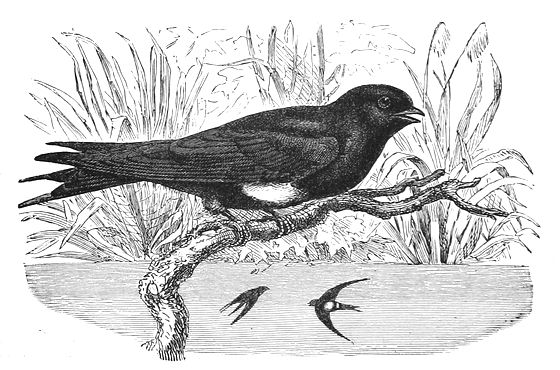
THE ARIEL (Chelidon Ariel).
The ARIEL SWALLOW, or FAIRY MARTIN (Chelidon Ariel), as the Australian representative of our
Roof Swallow is called, is about three inches and a half in length. The upper part of its body is deep
blue, the top of the head rust-red, the rump brownish white, and the tail dark brown; the eye is
blackish brown, the beak black, and the foot brownish grey. According to Gould, the Ariel appears
in the southern and western portions of Australia about August, and, seeking after its old haunts, lays
two or three broods, and departs again in February. In some situations the nests of this species
are built crowded together under eaves of houses and hollow trees, or beneath the shelter of an
overhanging rock; the male birds assist in the construction of the long flask-like passage by which
the actual home for the young is entered, and fetch clay for the females while employed in building.
"Until my arrival in the colony of New South Wales," says Gould, "I had no idea of the
existence of this new and beautiful Martin, nor, in fact, until I was awakened by its twittering notes
at the bedroom window at the inn in Maitland did I discover that I was surrounded by hundreds
of this species, which were breeding under the verandahs and corners of the windows, precisely
after the manner of the Common Martin. Several of their bottle-shaped nests were built round
the house, and from thence I obtained as many eggs as I desired. I observed this bird throughout
the district of the Upper Hunter, as well as in every part of the interior, breeding in various localities,
wherever suitable situations presented themselves, sometimes in the holes of low decayed trees,
while not unfrequently clusters of nests were attached to the perpendicular banks of rivers, the sides
of rocks, &c., always, however, in the vicinity of water. The nest, which is bottle-shaped, with a
long neck, is composed of mud or clay, and, like that of our Common Martin, is only constructed in
the morning and evening, unless the day be wet or lowering. While building these nests they appear
to work in small companies, six or seven assisting in the formation of each, one of them remaining
within and receiving the mud brought by the others in their mouths. In shape the nests are nearly
round, but vary in size from four to six inches in diameter, the spouts being eight, nine, or ten inches
in length; when built on the sides of rocks or in the hollows of trees, they are placed without any
regular order in clusters of thirty or forty together, some with their spouts inclining downwards,
others at right angles, &c.; they are lined with feathers and fine grasses." The eggs, which are four
or five in number, are sometimes quite white, or spotted or blotched with red; they are eleven-sixteenths
of an inch long, by half an inch broad.
The WOOD SWALLOWS (Atticora) are delicate birds with long wings (in which the first and
second quills are of equal length), forked tails, thin beaks, and slender legs, furnished with short toes;
the plumage gleams with metallic lustre, and is much varied in its hues. All the species included
in this group inhabit South America and Africa; they frequent woods and forests, and build their
nests in the trunks of hollow trees.
THE STRIPED WOOD SWALLOW.
The STRIPED WOOD SWALLOW (Atticora fasciata) is a native of Brazil. Its plumage is black,
marked with white upon the breast and under part of the thigh; the rump has a blueish gloss. The
length of the body is six inches, the wing measures four, and the tail three inches. This active,
lively bird frequents the forests of Northern Brazil, from whence it flies, in search of its insect fare,
over the neighbouring streams and rivers, and perches or sleeps amongst the surrounding trees.
We must not omit to mention the American SAILOR SWALLOWS (Progne), partly because
they have frequently been seen in Europe, but more especially as they form the connecting link
between the Swallows and the Swifts; they are powerful birds, with long, broad wings, extending
beyond the very decidedly forked tail. Their beak is strong, broad at the base, compressed at its
sides, much arched, and terminates in a hook; the legs are robust, the tarsi bare, and the toes thicker
and more fleshy than those of other Swallows. The plumage is very dense.
THE PURPLE SWALLOW.
The PURPLE SWALLOW (Progne purpurea) is seven inches and a half long and fifteen and a
half broad; the wing measures about five, and the tail two and a half inches; the centre feather
of the latter does not exceed two inches. The female is a trifle smaller and more slender than her
mate. The plumage is of a deep blackish blue, shaded with purple; the quills and tail-feathers are
blackish brown; the eye dark brown, the beak blackish brown, and the foot purplish black. The
head of the female is brownish grey, spotted with black; the upper part of the body is greyer in
tint than that of the male, and streaked with black.
This bird is a particular favourite with the Americans, and has been described at great length
by many writers. According to Audubon, the Purple Swallows appear in New Orleans about
February, and at once come sweeping about the towns or over the streams and rivers. Near the
Falls of the Ohio, they are not seen till March, and in Missouri not before the middle of April. In
August they leave for more southern countries, assembling like their European brethren upon steeples
or high trees, preparatory to starting upon their travels. The flight of this species resembles that
of the Roof Swallow, but upon the earth and among the branches of trees its movements are far
more easy, and it frequently alights to seek for insects on the ground. Whilst upon the wing,
it often bathes and drinks in the same manner as our English Swallows, and like them seizes its
prey as it darts through the air. Its disposition is bold and courageous, insomuch that it will
frequently chase cats, dogs, Falcons, Cranes, or even Vultures, with great intrepidity.
The nest of the Purple Swallow, which is long and flask-shaped, is formed of dry twigs, grass,
leaves, feathers, and other elastic materials, and is either built against a tree or placed in similar
situations to those selected by its congeners. The female produces two and sometimes three
broods, and lays from four to six purely white eggs; the first family is fully fledged by May, and the
second about July. Both parents assist in the work of incubation; the male proves himself a most
tender and devoted spouse, and often spends whole hours at the side of his mate, singing to her
with great vivacity. Should several pairs brood near the same spot, the utmost harmony prevails
among them.
Pursuant to our intention of laying a natural classification of the Animal Kingdom before our
readers, we shall now proceed to describe the SWIFTS, although we are well aware that many
modern naturalists consider that they should not be grouped with the Swallows.
The family of the SWIFTS (Cypseli) are small or moderate-sized birds, with a long slender
body, short neck, broad flat head, and small delicate beak, which is broad at its base, slightly curved,
and somewhat compressed at its tip. The gape is uncommonly wide; the wings are narrow and
curved like a sabre; the tail is very variously formed, being sometimes long, sometimes short, and
more or less deeply incised at its extremity; the feet and toes are stunted, the latter armed with
short, powerful, and much curved claws. The plumage is thick and composed of small feathers,
it is usually of a dusky hue, but occasionally exhibits considerable metallic lustre. The various
members of this family are found throughout all the divisions of our earth, except its most northern
portions, and inhabit every situation from the sea-coast to the snow boundary of lofty mountain
ranges. From early morning till late in the evening, they may be seen skimming through the air with
astonishing rapidity, or soaring to such an elevation as to be almost beyond the reach of our vision.
So powerful are their wings that no amount of exertion appears to fatigue them; their pinions, which
when extended form a crescent, are wielded with a force and rapidity rivalling the activity of the
Humming Birds—they dart with the velocity of an arrow upon their prey, or indulge in every
conceivable variety of flight or motion, as they skim through what may certainly be called their native
element; even when among the branches of trees, they display considerable agility, but are perfectly
helpless upon the ground. All the members of this family are of a restless disposition; they spend
but a few hours of the night in repose, and require a very large amount of food to enable them to
support their prolonged exertions, so that they consume insects in enormous quantities, seizing them
whilst upon the wing.
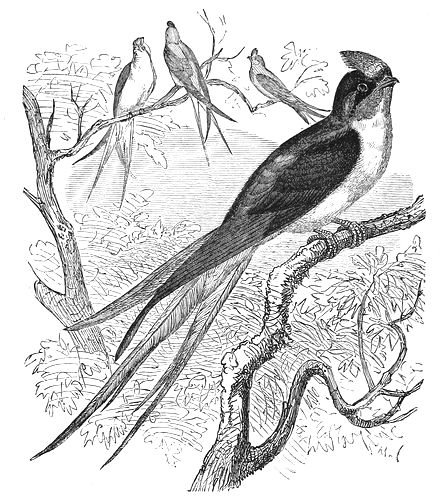
THE KLECHO (Dendrochelidon klecho).
All such species as inhabit the temperate zone migrate with the utmost regularity as winter
approaches, and return to their native haunts with such unfailing precision that the day on which
they will re-appear may be accurately prognosticated. Those species inhabiting the interior of
Africa never actually migrate, but occupy themselves in flying over the face of the country during
the wet season. The work of constructing the nest is commenced as soon as the winter journeyings
are over, and is always carried on amidst great excitement; the males chasing and fighting each
other most furiously during the whole time, and constantly engaging in pitched battles with the
birds whose nests they prefer taking rather than undergo the labour of constructing a home for themselves.
Unlike the nests of the Swallows, those built by the Swifts seldom consist of more than
a few slight materials laid carelessly together, and cemented with saliva from the builder's beak. The
eggs are round and white; the female alone broods, but both parents share in the toil of satisfying
their hungry progeny.
The TREE SWIFTS (Dendrochelidon) constitute a group whose various species form a link
between the Swallows and the Swifts Proper. These birds are recognisable by their elongate body,
long wings, in which the two first quills are of equal length, their long, deeply-forked tail, and the
crest with which their head is adorned: their feet resemble those of the Swallow.
THE KLECHO.
The KLECHO (Dendrochelidon klecho), so called from the sound of its cry, is about seven inches
long; the wing measures six, and the tail three inches. Upon the upper part of the body the
plumage is of a brilliant metallic steel-green; the wing-covers have a blueish lustre; the quills are
blackish on the inner and blue on the outer web, and the shoulder-feathers white. The belly is
white, the rest of the under surface and rump of a beautiful deep grey. The male has a reddish
brown and the female a black spot near the eye.
The Tree Swifts differ almost entirely in their mode of life from any other members of their
family. Extensive woods and dense forests are their favourite resorts, such being preferred as are
in lowland districts; according to Jerdon, the Indian Klecho constantly builds in these localities,
flying from thence over the streams or lakes in the vicinity in search of insects on which it subsists.
Whilst resting from its labours it usually selects a withered tree for its perch, and amuses itself by
expanding and playing with the beautiful crest upon its head. Its flight is excellent, but it climbs
awkwardly among the branches. When upon the wing it utters almost incessantly a loud parrot-like
scream; when perched its voice is not quite so harsh. We learn from Bernstein that, unlike all
other Swifts, the Klecho usually builds at the summit of a tree, upon a branch of about an inch in
thickness. Its strange nest, the walls of which are scarcely thicker than parchment, is constructed
of bits of bark, feathers, and other similar materials, woven together, and cemented with saliva. The
great peculiarity of the nest consists in the fact that it is only just big enough to contain the one large
egg laid by the female, and that the walls are far too delicate to bear the weight of the brooding
mother; the bird is, therefore, compelled to perch and support herself upon the branch, and merely
allow her breast to cover and warm her offspring. The female lays twice in the season; the egg is
perfectly oval and of a blueish tint.
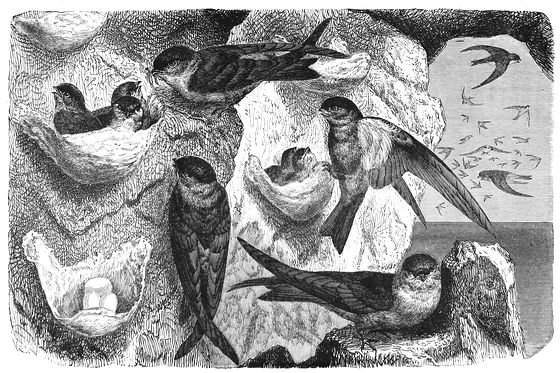
The SALANGANES (Collocalia) are a group of Swifts whose edible nests have been famous
from time immemorial, but as to whose life and habits little information has been acquired. These
birds are distinguished by their small size, long wings, in which the second quill exceeds the rest in
length, their forked or slightly incised tail, small but powerful beak, and delicate feet, the exterior toe
of which is directed backwards. In all the members of this group the salivary glands are much
developed.
THE SALANGANE PROPER.
The SALANGANE PROPER (Collocalia nidifica), as we will call the species most extensively met
with, is from four to five inches long, and twelve inches broad. Its wing measures about four inches
and a half, and its tail two and a quarter. The plumage is of a greyish brown, paler upon the
under surface; the quills and tail are blackish, and the vicinity of the eyes marked with white. The
feathers of the adult have a slight metallic lustre that is not perceptible in the young. It was
formerly supposed that these remarkable birds were only found upon the Sunda Islands, but modern
observation has proved that they also inhabit the mountains of Assam, the Neilgherries, Sikkim,
and Ceylon. Most contradictory tales have been told by travellers as to the materials of which
their famous edible nests are composed.
The earliest account of these nests is met with in Bontius, who tells us that "Large flocks of very
small birds of the Swallow kind come down during the breeding season, and settle upon the Chinese
coasts, where they swarm over the cliffs that overhang the sea. In these situations they build their
strange nests, forming them of fish spawn, which they collect from the shore. These nests are much
valued by the natives, who will often pay very large sums of money for them, in order to make them
into soup, which is considered a dainty." More modern investigators have been equally inaccurate in
their surmises, some pronouncing them to be constructed of the flesh of a kind of snail or worm, or a
peculiar species of sea-weed, gathered from the shore. Recent observations upon this interesting
point have, however, proved that all these explanations are incorrect, and we learn that these luxuries,
in which the Chinese so much delight, are formed of a secretion resembling saliva, drawn from under
the bird's own tongue. After a great variety of experiments as to its component parts, Marsden
pronounces that the material resembles a mixture of gelatine and white of egg, an opinion in
which Bernstein, who is a trustworthy authority on this disputed question, entirely coincides; we
will, however, describe the nest of the Salangane before we give our readers the real secret of its
construction, as vouched for and described by the last-mentioned naturalist. The Salangane usually
builds in such deep and dark cavities that the observation of its proceedings as it fastens its small,
thin, gelatinous nest to the rock, is attended with great difficulty. This structure is in shape like
the quarter of an egg-shell, divided longitudinally along its entire length. Some of these nests are
white, some of a brown colour, and opinion differs considerably as to the reason of this variety; we
ourselves believe it to depend on the age of the structure, as we have never seen a brown nest
occupied, but other authorities pronounce them to be the work of two distinct species. In the
markets the white nests command a very high price, while such as are dark are but little esteemed.
The two white eggs laid by the Salangane are deposited at the bottom of this remarkable gelatinous
receptacle, without any further preparation for their warmth or comfort.
THE KUSAPPI.
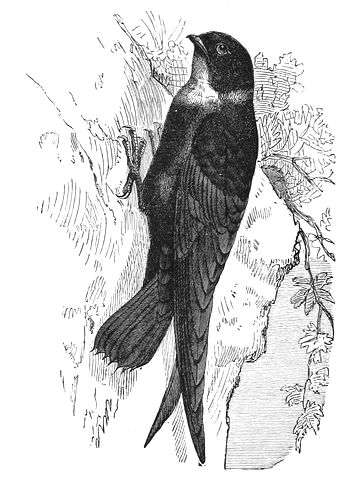
THE WHITE-THROATED PRICKLY-TAILED SWIFT (Acanthylis caudacuta).
The abode of the KUSAPPI (Collocalia fuciphaga) is much more easy of access than that of its
congener above described, as it is either placed at the bottom of a hole, or affixed to the naked rock.
In shape it resembles that of the Salangane, but its walls are partially composed of stalks of plants,
horsehair, and blades of grass, not woven, but cemented together with the aforesaid gelatinous
secretion, by which it is also attached to the surface of the cliff. The amount of the mucilaginous
substance used varies considerably, some nests being in great measure composed of it, whilst such
as are formed of very pliable extraneous materials are made to a certain extent without its aid.
Bernstein gives the following account of the process of building the nests of the Kusappi, and has
proved the accuracy of his statements by numberless experiments, having even drawn the slimy
thread himself from the bird's beak. "Shortly before the breeding season," says Bernstein, "the
glands beneath the tongue of these birds become unusually distended, and present the appearance
of two large swellings, which diminish considerably in size after the nest is completed. When about
to make the foundation of its future abode, the Kusappi presses its tongue against the rock that is
to serve for a support, and then, retiring a few paces, draws out a long gummy thread, which dries
with great rapidity; this process is repeated, until a crescent-shaped mass is formed, and firmly
fastened to the stone. The bird then takes the blades of grass, or stalks of other plants, one after
another, from a heap it has already prepared, and cements them together by a similar operation,
producing, as it turns its head from side to side, in order to draw out its thread, the undulating
lines so frequently seen upon these remarkable structures, and this process is continued until the
nest has assumed the necessary dimensions." The Salangane's method of proceeding is essentially
similar to that adopted by the Kusappi, but, as we have already said, it builds entirely with the
gelatinous threads, without any foreign admixture. We have frequently remarked that such of these
birds as are well fed exhibit a much more considerable enlargement of the glands than is observable
in those that have only been able to obtain a scanty supply of nourishment. This fact explains the
reason why so much difference is constantly noticeable both in the size and beauty of these much-prized
nests, millions of which are annually consumed, such as are very clear and delicate often
realising fabulous prices. Java is particularly rich in this article of commerce, and Epp thus describes
one of the localities in which the nests are most numerously met with:—"The Karang Kallong," he
says, "is a huge chalk rock, rising perpendicularly from the sea, by which it is surrounded, and is
garrisoned with a force of twenty-five men, whose sole duty is to protect the birds while building.
A large tree grows at the edge of the steep, and from this point of view those who venture to look
down behold the busy workers swarming beneath, appearing in the distance no larger than bees.
The sides of the precipice contain nine caverns, each of which has its name, and can only be entered
by a man lowered from above; should the rope break, his death is inevitable, and even if this
danger be escaped, the task of finding the entrance to the cavern is attended with great peril, as the
foaming waves constantly dash high enough to conceal it from view. The natives who engage in this
terrible undertaking fortify themselves for their task by a dose of opium, and offer up a prayer to
the Goddess Njaikidul before making the descent." In 1847 no fewer than 2,700 people inhabited
the summit of the Karang Kallong, and of these 1,500 men were thus employed. Enormous
numbers of nests are exported annually from this place to China, and are sold at very high prices;
but those who thus risk their lives to obtain the expensive luxury are but poorly remunerated. We
are but little acquainted with the habits of these birds, except that they fly with great rapidity,
and constantly frequent the sea-shore.
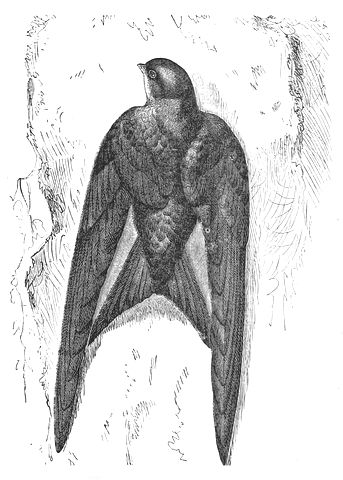
THE STEEPLE SWIFT (Cypselus apus).
The PRICKLY-TAILED SWIFTS (Acanthylis) are distinguished from other members of
their family by the very peculiar construction of their tail-feathers, the shafts of which extend
beyond the web; the plumage is also thicker, and the tarsi longer and more powerful than in
most other species.
THE WHITE-THROATED PRICKLY-TAILED SWIFT.
The WHITE-THROATED PRICKLY-TAILED SWIFT (Acanthylis caudacuta) is about eight inches and
a half long, and twenty broad; the wing measures eight and the tail two inches. The head, upper
tail-covers, sides of the wings, quills, and tail are pale black, with a metallic greenish blue gloss; the
back and shoulder-feathers are whitish brown, the breast and nape white. The under side is blackish
brown, the lower wing-covers and a streak on the side of the head are white, more or less intermixed
with glossy, blackish blue feathers. The inner web of the secondary quills is also white; the beak is
black, the foot lead-colour, and the eye deep brown.
We learn from Jerdon that this species is found in the south-eastern provinces of the Himalaya,
Nepaul, Sikkim, and Bhotan, and that its flight is extraordinarily light and rapid. The breeding
settlements are generally at a considerable height in the mountains, but always below the snow
boundary. The strange prickly tail appears to be employed to assist the bird while climbing.
Further particulars as to its habits and mode of life are entirely wanting.
THE DWARF SWIFT.
The DWARF SWIFT (Cypselus parvus) is a small species found in some parts of Central Africa,
where it usually frequents the forests or woodland districts. Its length does not exceed five inches
and a half, and its breadth is eleven inches. The plumage is almost entirely dark grey, lightest
upon the throat; the wings are of a brownish hue. In its general habits the Dwarf Swift resembles
its congeners, but the structure of its nest is so remarkable as to merit a minute description.
Brehm tells us that upon one occasion, whilst travelling in the vicinity of the Blue River, he was
attracted by cries uttered by one of these birds as it flew backwards and forwards near a lofty palm
whose branches towered above the surrounding trees. On going nearer the spot, he observed that
the Swift kept disappearing, as it were, within one of the large, fan-like leaves, against the glossy
green of which several white objects were distinctly visible. Thinking this circumstance somewhat
extraordinary, he climbed the tree, and found, to his no small astonishment, that the said green leaf
was the nest, and the white objects, the eggs, of the noisy bird. We should, perhaps, be more
accurate if we said that the leaf formed the outer part of the nest, the actual chamber for the young
being composed of cotton wool and feathers, fastened together with saliva, and in shape resembling a
round spoon: the interior did not exceed two inches and a half in diameter. Guided by a most
wonderful instinct, this little builder seems perfectly aware of the danger to which its aërial abode
is exposed from a strong wind, and takes the very safe precaution of gumming with her tenacious
spittle not only the nest and eggs, but the nestlings also, firmly to the leaf. Another peculiarity in
the domestic arrangements of this species is that the two white eggs that compose a brood are
fastened end upwards, in the very limited bed prepared for their reception.
THE PALM-TREE SWIFT.
The PALM-TREE SWIFT (Cypselus palmarum) constructs its nest in a very similar manner to the
Dwarf Swift.
THE STEEPLE SWIFT.
The STEEPLE SWIFT (Cypselus apus) is from six to seven inches long and fifteen and a half
broad; its wing measures six and a half, and tail three inches. Its plumage is of a blackish brown,
with the exception of the throat, which is white; the eyes are brown, the beak and feet black.
The Steeple Swifts are met with throughout the southern countries of Europe, in Central Asia,
and over the entire continent of Africa. They appear in Europe with the utmost regularity on the
first or second of May, and usually leave about the first of August. Such of them as are seen after
that period find their way to us from more northern countries, having been left behind by their
companions. The migrations of these birds are undertaken in large flocks and are usually commenced
at midnight. Like all its congeners, the Steeple Swift is extremely restless, active, and lively in
disposition, but differs considerably in its habits from all other members of its family. The air
is its home, and almost its entire life is passed upon the wing. From early morning it may be
seen, either sailing through the sky at a considerable height, or skimming along in its tortuous
course as it pursues its insect prey. In general, however, it is only towards evening, or if the
sky be wet or cloudy, that it approaches the surface of the earth. Such of these birds as inhabit
the Canary Islands are an exception to this rule, for, according to Bolle, they invariably seek the
shelter of their holes for a couple of hours during the forenoon. So extremely awkward are the
movements of this species when upon the ground, that it is commonly supposed to be unable to rise
if it should chance to alight on terra firma. This idea is, however, incorrect, for with the aid of
its wings it is enabled to make a violent spring, and thus recommence its flight. The feet of the
Swift are almost useless for walking; they are, however, invaluable assistants to the bird when
climbing, and the sharp claws with which they are armed are most formidable weapons of defence
against its adversaries. The sight and hearing of the Steeple Swifts is excellent, but in every other
respect they are far below their congeners, with whom they live in a constant state of warfare; even
towards their own species they exhibit the same violent and revengeful disposition, falling upon
and clawing each other with such violence as often to tear the flesh from their opponent's breast.
We ourselves have seen the males become so excited in these encounters, as to permit us to approach
and seize them with our hands, and Naumann mentions having observed one of these birds dart like
a Falcon upon a Sparrow quietly picking up worms in a field, and attack it with such fierceness
that the terrified little creature sought refuge between the feet of a man who was standing near
the spot.
Steeples, lofty edifices, and in some countries rocks, are the situations preferred by this
species when about to build. The nest is constructed of hay, dry leaves, blades of grass, or even
bits of rag, cemented into a solid mass by the saliva from the builder's beak. The two or at most
three eggs that constitute a brood are white, elongate, and of the same breadth at both ends. The
female begins to lay at the end of May; she alone performs the work of incubation, and is fed by
her mate if the weather be fine; should it, however, be wet, she is compelled to leave her little
family, and go herself in pursuit of insects, as the male can only provide for his own requirements.
The young grow very slowly and remain for many weeks under parental care, indeed, they are
rarely fully fledged until the end of August. It is by no means uncommon for these birds to avoid
all the trouble attendant on nidification, by setting upon and worrying a Starling or Sparrow until they
have compelled it to resign its little domicile; under these circumstances, if the eggs of the late
occupier have been already laid, the marauder simply covers them with a layer of some elastic
material, and on this the female deposits her brood. These Swifts subsist almost entirely on insects,
and usually require a large supply of food; they can, however, occasionally fast for a lengthened
period.
THE ALPINE SWIFT.
The ALPINE SWIFT (Cypselus Melba) is considerably larger and more powerful than the bird
last described, its length being about eight, and its breadth from nineteen to twenty inches; the
wing measures eight and the tail three inches. The plumage of this species is dusky greyish brown
above, and white upon the throat and belly; the rings around the eyes are deep brown, and the
feet and beak black. The young are recognisable by the light edge upon their feathers.
All the mountains of Southern Europe, and a large part of Asia, afford a home to the Alpine
Swift; it is, however, rarely met with in the central or northern parts of the European continent.
According to Jerdon, it is by no means uncommon in India, around the Ghauts, and Neilgherries,
and on the Malabar coast; it is also sometimes seen near Madras; and all parts of Africa are visited
by these birds during the course of their migrations. Although the favourite resorts of this species
are in the mountains in Switzerland, it constantly frequents the steeples of the churches, appearing
in that country about the end of March, and only leaving for warmer regions in October. We have
been informed by the monks upon Montserrat that the Alpine Swift has been seen from time to
time near their cloisters throughout the entire winter. In most particulars of its life and habits this
bird closely resembles the Steeple Swift, but it is capable of mounting to even a still greater height
in the air. Its voice resembles that of the Kestrel. Like its congeners it is eminently social, and
generally flies about in considerable flocks; we have seen thousands at a time swarming around
the summit of Montserrat, and Jerdon tells us that they congregate in similar multitudes on the
heights of some Indian mountains. Their nests are built in holes of rocks, steeples, or similar
situations; they are formed externally of twigs, upon which are laid leaves, straw, rags, paper
cuttings, or other materials of like description, the whole being consolidated by means of the
glutinous spittle to which we have so frequently alluded. The three elongated white eggs that
form the brood are laid at the end of May; the nestlings are hatched by the middle of June, and
are fully fledged by the last week in July.
The NIGHT JARS or GOATSUCKERS (Caprimulgi) constitute a family of very remarkable
birds, in some respects resembling the Swallows and Swifts, but differing from them in many
important particulars. Some species fully equal the Raven in size, whilst others, on the contrary,
are not larger than a Lark; in all, the body is elongate, the neck short, the head large, broad, and
flat, the eye prominent. The beak is broad, short, and tapers towards its tip, which is much
compressed; the jaws are unusually large, and the gape wide; the legs are weak, the tarsi short and
covered with horny plates, the upper part being occasionally feathered, or quite bare. The toes vary
considerably in different species, but are usually weak and short, the centre one only being well
developed; this middle toe is sometimes furnished with a large serrated claw. The wings are long
and pointed, but not to such a degree as those of the Swallow, the second and third quills, instead of
the first, generally exceeding the rest in length. The tail is formed of ten feathers, and differs
considerably as to its shape; the plumage, like that of the Owl, is soft, and composed of large
feathers; it is usually dark in colour, but much variegated and very delicately marked. The base of
the beak is covered with a very remarkable growth of stiff bristles, and the eyes are surrounded with
short but thick lashes. In some species the males have long and peculiarly formed feathers in the
region of the tail and on the wings.
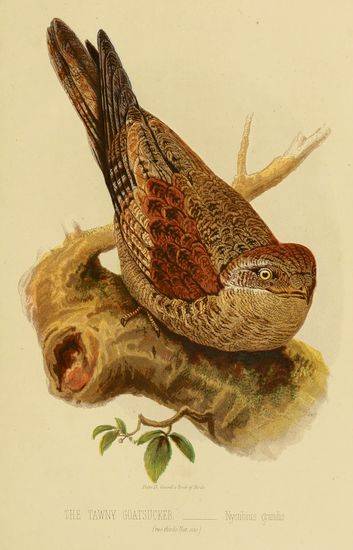
Plate 13, Cassell's Book of Birds
THE TAWNY GOATSUCKER ____ Nyctibius grandis
(two-thirds Nat. size)
The Night Jars, or Fern Owls, as they are sometimes called, are found throughout all divisions
of our globe, with the exception of its most northern latitudes; two species are met with in Europe,
and others occur in America, Africa, and Asia. Though thus spread over the face of the earth, the
actual habitat of this group is somewhat limited; certain amongst them occupy mountains, others
frequent desert tracts or fruitful plains, but all keep to a certain extent within the limits of their
appointed domain, their plumage being usually coloured so as to harmonise and blend with the
tints of the rocks, sand, or tree trunks, among which they pass the greatest portion of their lives.
Such of these birds as dwell in tropical forests do not migrate; and the greater number skim over the
surrounding country at certain seasons; but all those inhabiting northern latitudes withdraw in the
autumn towards the south. It is only during these migratory excursions—which often extend as
far as the interior of Africa—that the Night Jars exhibit anything like a social disposition; in their
native haunts each pair keeps entirely apart from others, and never allows the slightest intrusion
within the precincts of the locality selected for its abode. It may occasionally happen that some
tempting neighbourhood will induce several couples to settle comparatively near together, but
under any circumstances the same utter want of intercourse among them is observable. Towards
man they by no means exhibit this want of sociability, and in most parts of the earth more or less
frequent the immediate vicinity of his dwellings. Almost all these birds seek for insects—upon which
they principally subsist—during the night, and retire to sleep within their favourite recesses as soon
as morning dawns; but some American species are an exception to this rule, as they fly about
in quest of prey not only in the daylight, but even when exposed to the full glare of the sun.
Upon the ground they may be said to recline, rather than to perch or sit, and their gait, when
attempting to take a few steps over its surface, is remarkably clumsy; their powers of flight, however,
make ample amends for this deficiency, combining the facility and swiftness with which we are
familiar in the movements of the Falcon and the Swallow.
The sight of the Night Jars is very keen, their hearing tolerably well developed, and their
temperament by no means so sluggish as those who only see them drowsily perched among the
branches during the day are usually inclined to suppose. They make no nest, and are content
to deposit their eggs upon the naked ground, without even such scant preparation as the hollowing
out of a slight cavity in which they might be more securely placed. Audubon tells us that it is not
uncommon for the female, when disturbed, to conceal an egg in her mouth, and hurry with it to a spot
where she can brood upon it unobserved. The young (usually not more than one or two in number)
are tended and provided for with great care. Despite the important services rendered by this
family, its members are in most countries regarded with unaccountable disfavour. One idea prevalent
among the peasantry in some parts of Europe is so absurd that we cannot refrain from mentioning
it; we allude to the idea that some species of Night Jars employ their huge jaws in relieving the
goats of their milk—a superstition from whence is derived their usual name of Goatsuckers, an
appellation conferred upon them from the most remote antiquity.
THE NACUNDA.
The NACUNDA (Podager nacunda) has obtained its name from the unusual size of its mouth, and
may be regarded as the type of a South American group, distinguished by their powerful body, very
broad head, strong beak, and thick plumage; their beak curves slightly downwards at its tip, and the
mouth is surrounded by a growth of very stiff, short bristles; the nostrils are situated immediately
above the upper mandibles. The wings, in which the second and third quills exceed the rest in
length, are long and pointed; the short tail is composed of broad feathers and slightly rounded at its
tip. The legs are powerful, the tarsi long and bare, the toes fleshy, and the nail of the middle toe
serrated. The plumage of the Nacunda on the upper part of the body is blackish brown,
marked with fine reddish yellow lines; the head is darker than the middle of the back, and the
region of the shoulder indicated by large blackish brown spots. The tail-feathers exhibit six or
eight dark lines, those of the male being edged with white. The throat, cheek-stripes, and region
of the ear are reddish yellow, and slightly spotted; the belly, legs, lower tail-covers, and a line
which passes from ear to ear around the throat are of a pure white; the breast is marked with
undulating lines. The very large eyes are light brown; the beak greyish brown, tipped with black;
the feet flesh-red, shaded with brownish grey. According to the Prince von Wied, this species is
about ten inches long and twenty-seven broad; the wing measures eight inches and a quarter, and
the tail two inches and two-thirds. These birds are principally found upon the vast savannahs of
South America, where they usually frequent such parts as are covered with brushwood; they are also
constantly seen around the Indian villages, and are called Chiangos by the natives. Unlike most of
their congeners, they are very social and active, carrying on the pursuit of the insects upon which
they subsist in broad daylight. The Prince von Wied assures us that he only once saw any great
number of them together, and that was upon a large tract of land in the province of Bahia; they
were flying fearlessly around the horses and cattle, apparently enjoying the intense heat of the sun, to
which they were exposed. Schomburghk describes their flight as equalling that of the Falcon in
swiftness, and the movements of their wings as resembling those of the Swallow. If disturbed, they
endeavour to conceal themselves from observation among the low grass, and exhibit so much dexterity
in evading pursuit, as to have given rise, among the Indians, to the strange fancy that the Nacundas
possess two pairs of eyes. As night approaches, their melancholy cry is constantly to be heard, as they
sweep in large parties around the trees, or over the fields, during their noisy and incessant pursuit of
food. Burmeister found a Nacunda's egg in some long grass under a bush; it was almost cylindrical
in form, the shell yellowish white, thickly marked with three shades of brown. Azara states that this
species lays two eggs.
The TWILIGHT NIGHT JARS (Chordeiles) are recognisable by their slender body, short
neck, and large head. Their wings, in which the second quill exceeds the rest in length, are long
and pointed. The tail is short, formed of broad, powerful feathers, and more or less forked at its
extremity; the legs are smooth, and the toes short; the centre toe being armed with a very decidedly
hooked and serrated claw. Their plumage is thick, composed of small feathers, and is brighter in
hue and more distinctly marked than that of most of their congeners.
THE NIGHT FALCON.
The NIGHT FALCON (Chordeiles Virginianus), a well-known member of this group, is an inhabitant
of North and South America. Its length is about eight and a half, and its breadth from twenty to
twenty-one inches; the wing measures seven inches and two-thirds. The upper part of the plumage
is brownish black, spotted with white and pale brownish red. The secondary quills are dotted with
brownish white, and the first five primaries have a broad stripe of white across their centre. The tail
is striped with brown and grey, its four exterior feathers being tipped with white; the under side of
the body is greyish white, marked with undulating brown lines; the throat is surrounded by a broad
white line. The female resembles her mate, but the brown parts are darker, and the whitish spots
redder, than in the plumage of the male. Her tail has no white spots at its extremity.
"The Night Falcons," says Audubon, "make their appearance in Louisiana about the first of
April, during their migrations eastward, but never breed either in that State or in Mississippi. So
rapid is their transit through these parts of the country, that the flocks have entirely disappeared
within a few days of their arrival, whilst in the Southern States, on the contrary, they are often to
be met with from the fifteenth of August till October. These wandering parties generally fly over
the towns and villages, and settle from time to time upon the trees or houses, meanwhile uttering a
harsh, shrill note, that cannot fail to attract the attention of all who hear it. We have seen them in
Maine about June, and in the Central States somewhat earlier. These birds penetrate northwards as
far as New Brunswick, but are rarely or never met with in Labrador or Newfoundland." The flight
of the Night Falcons is light, animated, and capable of being long sustained, it is accompanied by
loud, shrill cries, as the birds alternately soar above the summits of lofty mountains, or, rapidly sinking,
continue their course close to the surface of the water. During such times as they are trying
to attract the attention of the female part of the community, their evolutions become almost
inconceivably fleet and agile; it is not uncommon to see one of them, after describing a series of
the most elegant gyrations, come rushing down with such headlong velocity towards its intended
partner, that it seems to render its death inevitable; but when within a few yards of the earth the
bird dexterously spreads out its wings and tail, and again rises into the air, in order to recommence
its sportive manœuvres. Audubon describes the spectacle of several males thus offering
and exhibiting their admiration as being most amusing, and tells us that no sooner has the female
made her choice, than the happy mate elect at once begins to harry and drive his rivals from
the field.
The food of the Night Falcons consists principally of various kinds of small insects; they
consume flies in enormous quantities, seeking their prey during the day, and sleeping at night upon
trees or houses, from the tops of which their loud cries may be heard from time to time during the
night. The breeding season commences at the end of May; the two eggs that form their brood have
a grey shell, spotted with greenish brown or violet-grey (see Fig. 2, Coloured Plate IV.), and are
deposited without any previous preparation upon the ground. The nestlings are at first covered
with dark brown down, and are tended with great affection by their parents; the female especially
exhibits unusual boldness and cunning in protecting or concealing her family from danger. When
the young are strong enough to perch it is not uncommon for them to sit motionless beside the
father and mother for hours, remaining so perfectly quiet and silent as to render it very difficult to
discover their place of concealment. Large numbers of these useful birds are shot out of mere
mischief. According to Audubon their flesh is excellent during the autumn, at which season they
become well-flavoured and fat.
THE COMMON GOATSUCKER.
The EUROPEAN NIGHT JAR or COMMON GOATSUCKER (Caprimulgus Europæus) represents a
group of birds whose pursuit of food is carried on exclusively by night. All the various species of
nocturnal Goatsuckers have slender bodies, short necks, and broad wings, not very sharply pointed
at the extremity, as the second quill is slightly longer than the first. The tail is almost straight at
its tip; the beak is short and broad, narrow at its base, and curves downwards from beneath
the nostrils. The centre toe of the small delicate foot is considerably longer than the rest, and is
connected with that on each side by a fold of skin extending as far as the first joint; the small inner
toe is entirely detached from the rest; the tarsus is partially covered with small feathers, and upon its
lower portion is defended by horny plates; the claw upon the middle toe is serrated. The plumage,
which is composed of large feathers, is fleecy; the upper parts of the body are dark grey, variously
marked with brownish black and reddish yellow; the under side is light grey, streaked and spotted
with black and dark brown; the brow and edges of the jaws are indicated by whitish lines; the three
first quills in the wing of the male are decorated with a white, in the female with a yellow spot. The
centre tail-feathers are grey, striped with black; the rest are paler, and rather spotted than streaked
with black: they terminate in a pointed white patch. The markings in the plumage of the female are
less distinct than in that of her mate, and the exterior tail-feathers are spotted and tipped with
reddish yellow. The length of this species is about ten, and its breadth twenty-one inches; the wing
measures seven and a quarter, and the tail between four and five inches. The European Night Jar
inhabits some parts of Asia and the whole of our continent, if we except its extreme north and the
southern provinces of Spain; in the latter country it is replaced by a very similar bird, the Red-breasted
Goatsucker (Caprimulgus ruficollis). It is at present undecided whether the JOTAKA
(Caprimulgus jotaca), met with in Japan, is identical with the European species. (The egg of the
European Goatsucker is represented at Fig. 41, Coloured Plate XVI.)
THE RESPLENDENT GOATSUCKER.
The RESPLENDENT GOATSUCKER (Caprimulgus eximius) is a most beautiful bird, inhabiting
Northern Africa, remarkable for the brilliancy of its plumage, which is almost entirely of a bright
golden hue, marked upon the head, breast, and back with oval spots, and upon the wings and tail with
streaks of a somewhat deeper shade; the throat, vent, a spot upon the pinions, and the tips of the
exterior tail-feathers are white. Rüppell, who first discovered these birds in Bahiuda, tells us that
they frequent vast steppes, and that their gay plumage blends most deceptively with the yellow
stubble and light sand which abounds in their favourite haunts. We ourselves have often met with
them in Cordofania.
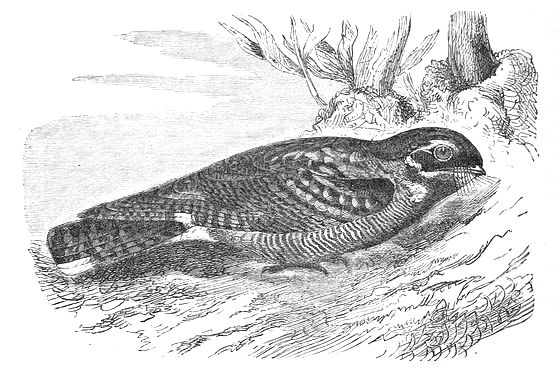
THE EUROPEAN GOATSUCKER (Caprimulgus Europæus).
The BRISTLED NIGHT JARS (Antrostomus), indigenous to America, are recognisable by
their long, flat beak, which is hooked at its tip, by their prominent tube-like nostrils, and the ten stiff
strong bristles, of about an inch in length, that grow at the base of the upper mandible, and can be
lowered or raised at pleasure. The second or third quill exceeds the rest in length; the tail is long,
but comparatively narrow, more rounded at its tip, and the plumage is also thicker, and composed of
smaller feathers than that of such of their congeners as we have already alluded to.
THE WHIP-POOR-WILL.
The WHIP-POOR-WILL (Antrostomus vociferus), so called from its peculiar cry, is about nine
inches and one-third long, and seventeen and a half broad; the wing measures seven and a half, and
the tail five inches. The upper parts of the body are dark brownish grey, spotted with brownish
black; the region of the cheeks is brownish red, the wing-covers and quills are dark brown, spotted in
lines with a paler tint, the latter tipped with a mixture of both shades; the four centre tail-feathers
resemble the back in colour and markings, whilst those at the exterior are white, slightly spotted on
the upper portion, and dark brown towards the end. The upper parts of the throat and breast are
dark brown, with blackish-brown markings; the rest of the under side is of a paler hue. A yellowish
white line passes across the front of the throat. North America is the actual habitat of this species,
which is, however, frequently seen in Central America and the West Indies during the course of its
migrations.
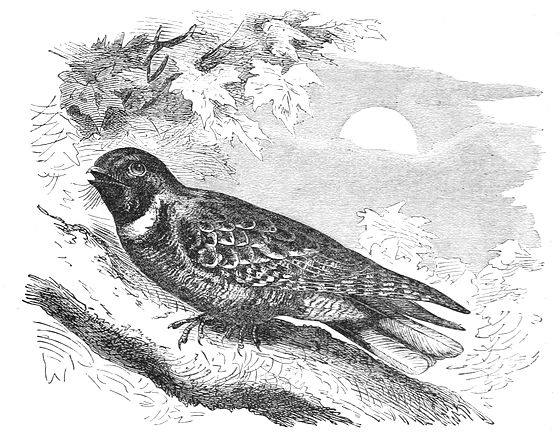
THE WHIP-POOR-WILL (Antrostomus vociferus).
The AFRICAN NIGHT JARS (Scotornis) constitute a group of birds distinguished from their
congeners by their remarkably long graduated tail, which far exceeds the body in length; the third
quill of the wing is longer than the rest, thereby rendering it less pointed than that of most Goatsuckers;
the beak is very small and delicate, and the bristles at its base comparatively long; the
inner toes are longer than those on the exterior. The plumage is somewhat difficult to describe; in
Scotornis climacurus the body is principally of a pale reddish brown, with dark markings; the chin,
cheek-stripes, and extremities of the smaller wing-covers are white, the quills black, spotted with grey
on the lower half; the first six are striped with white in the middle; the rest are spotted with red
and black, and tipped with white. The centre tail-feathers are marked with undulating lines of
different shades; those at the exterior are white upon the outer web, and the two next in order
terminate in a white spot; the lower side is a mixture of brown and grey, arranged in wave-like
curves. The male is about fifteen inches long and twenty broad; the wing measures five inches and
a half and the tail full nine and a half. The body of the female is considerably shorter than that of
her mate. All the sparely-covered,
sandy plains of Central Africa afford
a home to the members of this group.
According to our own observations
they are rarely found beyond sixteen
degrees north latitude; other authorities
affirm that they occasionally
wander as far as Europe, and have
been met with in Provence, but we
are inclined to question the accuracy
of this statement.
The LYRE-TAILED NIGHT
JARS (Hydropsalis), a group of very
remarkable birds inhabiting South
America, are recognisable by their
long powerful wings, in which the first
quill is much bent; their slender, but
comparatively strong beak; their delicate
feet, partially covered with feathers,
and protected with horny plates
upon its lower half; and their remarkably
forked tail, which in the male
bird is occasionally of great length.
THE LYRE-TAILED NIGHT JAR.
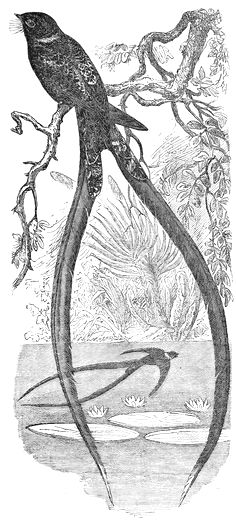
THE LYRE-TAILED NIGHT JAR (Hydropsalis forcipata).
The LYRE-TAILED NIGHT JAR
(Hydropsalis forcipata), as the species
with which we are most familiar has
been called, is spotted with brown
and yellow upon its body, the centre
of the throat being white. The exterior
tail-feathers of this beautiful
bird are from twenty-six to twenty-eight
inches long, while the body does
not exceed seven, and the wing nine
inches. According to Azara, the
Lyre-tailed Night Jar is somewhat
rarely met with, as it usually frequents
the inmost recesses of the
vast forests of South America. Its
scientific name, Hydropsalis, has been
derived from the fact that like other
Night Swallows it flies close to the
water when passing over the lakes or
rivers in search of food.
Some Goatsuckers have certain feathers of their wings so remarkably developed, that they have
been called by the Arabs "the four-winged birds," and are described by Swainson under the name
of MACRODIPTERYX.
THE LONG-WINGED MACRODIPTERYX.
The LONG-WINGED MACRODIPTERYX (Macrodipteryx longipennis) has the tail of moderate size,
and straight at its extremity; the foot resembles that of the European species; the beak is delicate
and furnished with long bristles at its base. The plumage of the male bird is characterised by the
long appendages which grow between the primary and secondary quills. These appendages, or rather
shafts, are frequently seventeen inches long, entirely bare to within six inches of the extremity, where
the web grows upon both sides and forms a broad expansion. The wing of the female is entirely
without this remarkable structure. The plumage, which is somewhat dusky, is a mixture of red and
black; the throat is paler, and the nape decorated with a yellowish tint; the primaries are striped
black and red, with a dark tip; the secondaries are black with four red stripes. The centre tail-feathers
are grey, spotted and streaked with black. The length of these birds is about five inches:
the tail measures from three and a half to four, and the wing six inches and three-quarters.
THE STREAMER-BEARING NIGHT JAR OR "FOUR WINGS."
The STREAMER-BEARING NIGHT JAR, or "FOUR WINGS" (Cosmetornis vexillarius), is another
remarkable species, closely allied to that above described, but distinguished by the development, not
of one only, but of two excessively long feathers, that grow from each wing. These peculiar
appendages are furnished with a web upon both sides, extending throughout their entire length. We
are entirely without particulars as to the life and habits of this extremely rare bird, which inhabits
South-eastern Africa.
All the various groups of Goatsuckers whose outward appearance we have thus briefly described
frequent woodland districts or forests, in the immediate neighbourhood of large plains and open
fields, as such localities abound with the insects on which they mainly rely for nourishment. Still
there are exceptions. The Red-throated Goatsucker, for example, is most frequently seen upon rocks
slightly overgrown with trees or shrubs, and though it builds in various situations, prefers plantations
of olive-trees, when about to make its nest, whilst the Cream-coloured Night Jar (Caprimulgus
isabellinus), on the contrary, usually conceals itself amidst the bushes or grass that cover the sandy
banks of the Nile. During the day most species seek a shady retreat, and either sit upon the ground
whilst reposing, or find shelter upon trees, on the boughs of which they recline, not after the
manner of other birds, but in such a position as to allow the entire body to lie along the supporting
branch, holding themselves, meanwhile, firmly in place by means of their inner toes, and the serrated
claw, with which the central toe is furnished; it is only when disturbed from their slumbers that the
Goatsuckers perch in the ordinary manner; as soon as the supposed danger is over, they at once
resume their favourite attitude. Whilst asleep the eyelids are kept completely closed, but if
suddenly awakened, these birds blink, and peer around them, after the fashion of an Owl, and seek to
conceal themselves by lying close to the earth, or to the tree on which they are reposing. Upon
the ground they move with much difficulty; indeed, it has often been stated that their feet are
useless as a means of progression, but this is not the case, as we have on several occasions seen the
African Goatsuckers walk some little distance when passing from one resting-place to another. The
flight of all these various groups is unsteady and apparently aimless during the day, but at sunset they
seem endowed with new life, and may be seen alternately skimming and hovering over the face of the
country, in pursuit of moths, beetles, and various other insects, upon which they subsist. When their
appetite is appeased, they rest for a time upon some branch, and then sally forth again before morning
dawns to procure a second repast. It is not uncommon for the Goatsuckers to wander to a very
considerable distance from their usual haunts during these nocturnal excursions, and even approach
the immediate vicinity of towns and villages; nay, so inquisitive and bold are they in regard to the
objects they meet with whilst in search of prey, that they will often follow and hover round a man or
a dog for a quarter of an hour at a time. During the breeding season their flight becomes still more
varied and beautiful, and the birds themselves seem roused to a higher degree of intelligence than is
observable at other times; such species especially, as possess the remarkably long wings or tails we
have described, cannot fail to impress those who are fortunate enough to see them gliding or hovering
aloft, with their flowing plumage alternately closed or outspread, as they perform their light and
elegant gyrations through the realms of air. Russegger describes the African "Four Wings" as
looking like some strange being from another world, as it whirls along, at one moment appearing to
multiply itself by rapidly assuming the most various attitudes, or revolving like a shuttlecock, with
its long feathers streaming and twisting in the wind. The voices of these various birds differ very
considerably; some species uttering a harsh, droning note, not unlike the sound of a spinning-wheel
(whence is derived their name of "Night Jar," or "Night Churr"), whilst others are capable of
producing by no means inharmonious tones. The European Goatsucker, when alarmed, purrs very
much like a cat, and during the breeding season attracts the attention of its mate by two distinct
notes; at other times its cry may be represented by the syllables, "Dak, dak," faintly and hoarsely
uttered. So dismal and unearthly are the voices of some American Night Jars, that Schomburghk
tell us that neither Indians, Creoles, nor Negroes would venture to shoot one of them, regarding them
as direct embodiments of, or emissaries from, the various evil spirits and enchanters, of whose
machinations and spells the ignorant natives live in constant dread.
"A Goatsucker," says Waterton, "inhabits Demerara, about the size of an English Wood Owl,
whose voice is so remarkable that when once heard it is not to be easily forgotten. A stranger would
never believe it to be the cry of a bird, but would say it was the departing voice of a midnight
murdered victim, or the last wailing of poor Niobe for her children, before she was turned to stone.
Suppose a person in hopeless sorrow, beginning with a loud note, 'Ha, ha; ha, ha; ha, ha, ha;'
each note lower and lower, till the last is scarcely heard, pausing a moment between each exclamation,
and you will have some idea of the moaning of the Great Goatsucker of Demerara. Other species
articulate some words so distinctly that they have received their names from the sentences they utter,
and absolutely bewilder a stranger on his arrival in their vicinity. One sits down close to your door,
or flies and alights three or four yards before you as you walk along the road, crying, 'Who are you?
who, who are you?' Another bids you 'Work away; work, work, work away!' A third cries
mournfully, 'Willy, come go; Willy, Willy, Willy, come go!' and a fourth tells him to 'Whip-poor-Will,
Whip-poor-Will!' in tones wonderfully clear and startling."
As regards their instincts and capabilities, the nocturnal Goatsuckers are far behind the diurnal
members of their family, and exhibit so little sense of self-preservation, as constantly to expose
themselves to great danger. We have frequently, whilst camping out in Africa, whenever we have
kindled a fire, been visited by numbers of these birds, apparently quite regardless of the risk they
ran of being brought down by our gun. In Spain, however, the Goatsuckers appear to be somewhat
more on the alert; indeed, owing to their supposed dexterity in evading pursuit, they are there called
by the peasantry Engaña Pastor, or "Shepherd Deceivers," as that class of men come most in contact
with these birds, whilst tending their flocks; not from the absurd reason that has obtained such
universal credence, but because these much-maligned visitants perform a most invaluable service both
to the farmer and his cattle.
"When the moon shines brightly," Waterton continues, "you may have a fair opportunity of
examining the Goatsucker; you will see it close by the cows, goats, and sheep, jumping up every now
and then under their bellies. Approach a little nearer; he is not shy; 'he fears no danger, for he
knows no sin.' See how the nocturnal flies are tormenting the poor kine, and with what dexterity he
springs up and catches them, as fast as they alight on the belly, legs, and udders of the poor animals.
Observe how quietly they stand, and how sensible they seem of his good offices; for they neither
strike at him, nor try to drive him away as an uncivil intruder. Were you to dissect him, and inspect
his stomach, you would find no milk there; it is full of the flies that have been annoying the herd."
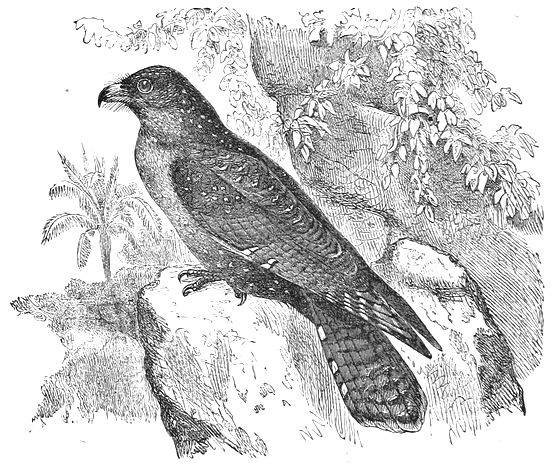
THE OIL BIRD (Steatornis Caripensis).
All Night Jars breed but once in the year, and that always during the spring-time of their
native lands. No nest is built, the parents contenting themselves with any retired, shady nook,
when about to deposit their eggs. Towards their young, both parents exhibit great attachment and
devotion, and will exert every effort to entice any approaching stranger from the little family.
Many strange tales have been circulated as to the manner in which their eggs are conveyed from
one place to another, in time of danger, and on this point we may now venture to speak with
authority, having been fortunate enough to be an eye-witness to the whole proceeding. Upon the
occasion to which we refer, a pair of Night Jars which we purposely disturbed, appeared to be
overcome with fear for the space of a minute, then, suddenly recovering themselves, they each
seized an egg in their capacious beaks, and bore it carefully and gently away, flying so near the
ground as almost to touch it with their feet. Both parents assist in the labour of incubation, and
continue to sit, even after the nestlings have left the shell, in order to keep them warm: according
to some authorities, this practice is continued until they are almost fledged. The young are fed
during the night, and reared upon a variety of insect food. When taken from the nest, they thrive
and grow rapidly, if provided with a plentiful supply of flies.
The GIANT GOATSUCKERS (Nyctibius) constitute another South American group, easily
recognisable by their strongly-hooked beak, heavy foot, the central toe of which has no serrated
claw, powerful body, and large head. The wings (in which the third quill exceeds the rest in
length) are long and pointed, the tail long, and slightly rounded, and the plumage rich, soft, and lax.
The beak is very peculiar in its formation, and appears triangular when seen from above; the upper
mandible is extremely broad at its base, sloping gently downwards as far as the nostrils, from which
point it becomes thin, round, compressed, and curves gently over the lower mandible, which is also
slightly bent at its tip, and somewhat shorter than the upper portion. The sharp edges of the beak
have a tooth-like appendage, about one line in length, placed just where it begins to curve. The
jaws open almost to the ears, and the gape is therefore enormous. The horny portion of the bill is
almost entirely concealed from view by a growth of feathers intermixed with bristles, which covers
the upper mandible, from the nostrils almost to the tip. The legs are short, the toes slender, and the
claws comparatively strong and hooked. The central nail has a prominent ridge.
THE IBIJAU, OR EARTH-EATER.
The IBIJAU, or EARTH-EATER (Nyctibius grandis), is by far the largest member of this group.
Its length, according to the Prince von Wied, exceeds twenty-one, and its breadth forty-seven
inches; the wing measures fifteen inches and a half, and the tail ten inches and one-third. A whitish
or greyish yellow predominates in the coloration of the plumage, which is darkest upon the upper
portion of the body, and marked with a variety of fine brown and black lines; the head-feathers have
dark streaks upon the shafts, and triangular spots at the tip. The edges of the wings and region of
the shoulders are deep reddish brown, streaked with black, and intermixed with white spots upon the
carpal joint; the under side is white, ornamented with curved brown lines, each feather being tipped
with yellow, the quills are dark greyish brown, striped with a paler shade, and spotted with white
upon the outer web, the tail-feathers are decorated with six or seven dark and light stripes, the
throat is white, marked with brown, as is the breast, the latter is also streaked longitudinally with
black; the hinder parts of the body are pure white; the beak and feet are yellowish grey, and the
eyes dark blackish brown.
These large Goatsuckers, though by no means rare in South America, are not frequently seen, as
they remain during the entire day ensconced at the summit of the most lofty trees, lying full length
upon the thickly foliaged branches in the manner already described. So closely does their plumage
resemble the bark of the trees on which they recline, that it is very difficult to detect their presence,
and so extremely dull are some species that, as the Prince von Wied tells us, they allow themselves
to be fired at repeatedly without attempting to stir, or will sit quietly and permit a snare to be
thrown over their heads. We cease to wonder at such utter stupidity when we learn from the same
source that though the body of these Swallows equals that of the Raven, their brain does not exceed
a hazel-nut in size. Evening has no sooner set in than, like their congeners, they at once commence
their search for moths and similar prey, in pursuit of which they soar to a very considerable height;
and it is by no means rare to find the ground completely strewn with the wings of the enormous moths
and butterflies which they attack and seize in their huge beaks. During the night their dismal cry is
constantly heard, as one mate calls to the other; but when morning approaches they seek their
favourite retreats. Burmeister tells us that the two eggs that constitute a brood are deposited in any
slight cavity in the trees. Such as he obtained were oval in shape, with a lustreless, pure white shell,
thickly covered with brown dots of various shades, most thickly strewn over one end.
THE GUACHERO, OR OIL BIRD.
The OIL BIRD (Steatornis Caripensis) has hitherto been classed among the Goatsuckers, but it
differs so essentially from any other member of that family in its mode of life, that we have decided
upon describing it entirely apart. The body of this remarkable species is slender, the head flat and
broad; the wing, in which the third and fourth quills exceed the rest in length, though long and
pointed, does not extend as far as the extremity of the well-developed tail. The beak is broad at its
base, compressed in the middle, and terminates in a hook; its tip, moreover, is furnished with two
denticulations; the gape extends to the eyes, but the lower mandible is feeble and considerably
shorter than the upper part of the beak. The feet are so small as to be almost useless upon the
ground: their soles are callous, and the tarsi without feathers; the front toes are all of equal size,
entirely unconnected, and the short hinder toe is reversible. The plumage is extremely soft, almost
silky, and the region of the beak is overgrown with long bristles; the large eyes are protected by
heavy lids covered with long hairs. The gullet is not dilated into a crop, and the stomach is very
muscular; the entrails are covered with a fatty layer of such thickness that they may be said to be
embedded in fat. The plumage is of a beautiful reddish brown, deepest in shade upon the back; the
head, breast, belly, wings, and tail are rust-red, marked with heart-shaped white spots, which are here
and there surrounded by a black line. The eye is blueish black, the beak and feet horn-grey. The
length of this species is about twenty-one inches, and its breadth about forty-two inches. Humboldt,
who discovered this remarkable bird in 1799, found it living in the rocky caverns of Caripe, and more
recent travellers have met with it in the dark clefts and fissures of rocks among the Andes.
"The Cueva del Guachero, or Cave of the Guacheros," as described by Humboldt, "is a vast
fissure, pierced in the vertical profile of a rock, facing towards the south; and the rocks which
surmount the grotto are covered with trees of immense height; succulent plants and orchidaceæ rise
in the driest clefts, and plants waving in the wind hang in festoons at the entrance. Within the cave
vegetation continues to the distance of forty paces. Daylight penetrates far into the grotto, but
when the light begins to fail the hoarse voices of the inhabitants become audible, and it would be
difficult to form an idea of the horrible noise occasioned by thousands of these birds in the dark parts
of the cavern. Their shrill and piercing cries strike upon the vaults in the rocks, and are repeated by
the subterranean echoes. The Indians showed us the nests of the Guacheros by fixing a torch to a
long pole; these nests were fifty or sixty feet above our heads, in holes of the shape of funnels, with
which the roof of the grotto is pierced like a sieve. The noise increased as we advanced, the
birds becoming scared by the torches we carried, but when the din somewhat abated, immediately
around us we heard at a distance the plaintive cries of others at roost in the ramifications of the
cavern. It seemed as if different groups answered each other alternately. The Indians enter the
Cueva del Guachero once a year, near Midsummer. They go armed with poles, with which they
destroy the greater part of the nests. At that season several thousand birds are killed; and the old
ones, as if to defend their brood, hover over the heads of the Indians, uttering terrible cries. The
young, which fall to the ground, are opened on the spot. Their peritoneum is found extremely
loaded with fat, and a layer of fat reaches from the abdomen to the vent, forming a kind of fatty
cushion between the legs. At the period commonly called at Caripe the "oil harvest," the Indians
build huts with palm leaves near the entrance and even in the porch of the cavern, where, with a
fire of brushwood, they melt in pots of clay the fat of the young birds just killed. This fat is known
by the name of butter or oil (mantece or aceite) of the Guachero; it is half liquid, transparent, without
smell, and so pure that it may be kept above a year without becoming rancid. At the convent of
Caripe no other oil is used in the kitchen of the monks but that of the cavern, and we never observed
that it gave the aliments a disagreeable taste or smell."
Funck, who also visited the cavern above described, states that the Guacheros leave their nests
after darkness has completely closed in, and that their harsh, raven-like cry may then be heard as
they fly about in quest of food. Fruit forms their usual nourishment, and this they will swallow,
even if as large as a Pigeon's egg; but the seeds and kernels they reject as indigestible. The nest
is constructed of clay, and the brood consists of from two to four eggs. Grosz also gives an account
very similar to that of Humboldt respecting another stronghold of the Oil Birds, called the Ravine
of Iconongo, that he visited in New Granada. This extensive nesting-place is about half a mile long,
and from thirty to forty feet broad, and had to be entered by means of a rope let down from above.
Grosz fortunately succeeded in obtaining many Guacheros, both dead and alive, and made valuable
observations relative to their demeanour and habits. Their movements in the air, he tells us, are
light and rapid, the pinions and tail during their flight being held fully expanded; upon the ground
their gait is extremely awkward, their feet requiring assistance from the wings, even to sustain the
creeping hobbling motion to which their progress when on terra firma is restricted. Whilst thus
attempting to walk the tail is slightly raised, and the head and neck bent forward in a constant succession
of serpent-like movements, in order to maintain their balance. When perched they keep the
body erect, supporting it slightly upon the wings, and hang the head droopingly. If much excited
whilst in flight, the cry of the Guachero becomes positively unearthly, so dismally hideous are its
tones. Both parents brood alternately upon the eggs, which, according to Grosz, are white and pear-shaped.
No preparations whatever are made for the reception of the young family, the eggs being
merely deposited in the clefts of the rocks. The nestlings, when first hatched, are extremely ugly
and uncouth, and completely helpless until they are fully fledged; so extraordinarily voracious are
they that, if other food is not on the spot, they will fall furiously upon each other, or even seize and
drag at their own feet or wings.
The OWL SWALLOWS (Podargi) constitute a family bearing considerable resemblance to the
Night Jars, both in their general appearance and mode of life. These birds have a slender body and
short neck; their head is broad and flat, their wings short and blunt, their tail long, their tarsi high
and powerful. The beak, which opens farther back than the eyes, is large, flat at its base, and broader
than the brow; the mandibles are hooked at the tip, of equal length, and smooth at the margin; the
nostrils are situated at the base of the beak, and are almost entirely concealed beneath the feathers
of the forehead. The foot is short, with three of the toes placed in front, and one pointing directly
backwards; the latter is not reversible. The plumage is soft, and dusky in its coloration; the
region of the beak, and, in some cases, that of the ear, is covered with a growth of bristles.
Such of these birds as we are at present acquainted with, inhabit the forests of Southern Asia, as
also of New Holland and the neighbouring islands; but little has as yet been ascertained respecting
their general habits, and we must therefore confine ourselves to the mention of those species with
which we are best acquainted.
The DWARF OWL SWALLOWS (Ægotheles), found exclusively in New Holland, are
recognisable by their long but powerful body, nearly round head, short, rounded wing (in which the
second quill exceeds the rest in length), long, rounded tail, and comparatively high and bare tarsi;
the toes are of equal length and unconnected; the beak is thick, broad, and compressed at its base,
but becomes suddenly narrow towards its extremity, and terminates in a flat hook; the lower mandible
is furnished with a hollow rim that encloses the curved tip of the upper part of the beak. The
plumage is soft in texture, except around the beak and in the region of the eyes and brows, these
parts being covered with a bristle-like growth.
THE TRUE DWARF OWL SWALLOW.
The TRUE DWARF OWL SWALLOW (Ægotheles Novæ Hollandiæ) is about nine inches and a
quarter long, and above twelve in breadth. The upper part of the body is dark brown, streaked with
white; the entire under surface, a spot near the eye, and two sickle-shaped lines, the one on the neck
and the other at the back of the head, are grey, dotted with black and reddish yellow; the anterior
quills are brown, spotted with light brown and grey on the inner web; the tail is dark brown, regularly
striped with grey, and dotted with black; the iris is nut-brown; the feet of a pink flesh-colour. The
sexes are alike in size, and similarly tinted, but the plumage of the young is darker than that of the
adult bird. Gould tells us that this species lives and breeds in all woodland districts throughout
Southern Australia and Tasmania, and that it also frequents the shrubs and bushes upon the coast.
Its flight is direct and slow, and, when perched, its attitudes resemble those of an Owl; like that bird,
if disturbed, it turns its head rapidly in all directions, and emits a low, hissing sound. The Dwarf
Owl Swallow breeds twice in the year, and deposits its four or five round pure white eggs in the
hollows of trees. One strange habit possessed by this bird renders the discovery of its retreat very
easy; for no sooner is any unusual sound made in the vicinity of its hole than the active little
occupant at once scrambles up to the entrance, and putting out its head, peers around to discover
the cause of the disturbance. Should danger seem imminent it at once takes flight, and seeks safety
elsewhere; but should nothing alarming be in view, it quietly returns to the bottom of its abode,
until again roused by some voice from the outer world.
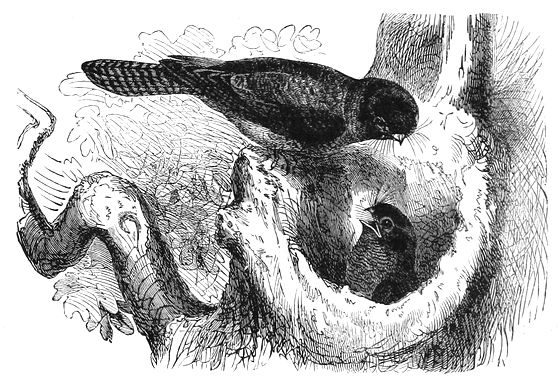
THE TRUE DWARF OWL SWALLOW (Ægotheles Novæ Hollandiæ).
The GIANT OWL SWALLOWS (Podargus) are birds of considerable size, with large flat
heads, moderately large wings, in which the first quill exceeds the rest in length, long rounded tails,
and short tarsi, furnished with a foot of moderate size, the two innermost toes connected by a fold
of skin. The beak is hard, powerful, much broader than it is high, slightly curved at the roof of the
upper mandible, and very decidedly hooked at its tip, which fits into a corresponding groove in the
lower portion of the beak; the gape extends as far as the hindermost corner of the eye. The
plumage is soft, and resembles that of the Owl. The beak has but a sparse growth of bristles.
THE GIANT OWL SWALLOW.
The GIANT OWL SWALLOW (Podargus humeralis) is a bird about the size of a Crow. The upper
part of the body is brown marked with greyish white and dark brown, the top of the head being
streaked with blackish brown, and spotted with white. The quills are brownish black, marked with
rows of spots upon the outer, and striped upon the inner web; the beak is light brown shaded with
purple; the feet and eyes are yellowish brown. The many varieties of this species resemble each
other both in appearance and habits.
"Like the rest of the genus, the Podargus humeralis is strictly nocturnal, sleeping throughout the
day on the dead branch of a tree, in an upright position, across and never parallel to the branch, and
which it so closely resembles as scarcely to be distinguishable from it. I have occasionally seen it
beneath the thick foliage of the Casuarinæ; and I have been informed that it sometimes shelters itself
in the hollow trunks of the Eucalypti, but I could never detect one in such a situation. I mostly
found them in pairs, perched near each other on the branches of the Gums, in places not at all
sheltered from the beams of the mid-day sun."—GOULD.
The sleep of the Giant Owl Swallow is so profound that one of a pair may be shot from a branch
without the mate that is sleeping at its side being roused, and the heavy sluggard may be pelted with
stones, or struck with a stick, without being awakened from its slumbers. Should it at last be roused
to consciousness, it scarcely exhibits animation sufficient to prevent it from falling to the ground, as it
slowly flutters, in a semi-torpid state, to the nearest tree, when it at once perches, and falls into a
sleep as heavy as that from which it has just been disturbed. No sooner, however, has night set in,
than the previously drowsy stupid bird becomes a new creature, and after carefully preening its
plumage, at once proceeds to run actively and briskly up and down the branches of trees in search of
Grasshoppers; it also extracts larvæ from under the bark, after the manner of Woodpeckers, or dives
down holes and fissures to find any delicate morsels that may be concealed within. Its flight is not
particularly good, owing to the shortness of it wings, but it passes with considerable rapidity from
tree to tree, and occasionally amuses itself by a variety of manoeuvres in the air. Gould is of opinion
that this species lives entirely upon insects, but Verreaux affirms that it frequents morasses during
winter, when food is scarce, and consumes snails or other inhabitants of the water, and that in the
breeding season it will attack young birds, kill them by repeatedly striking them against the stem of
the tree, and then devour them. The pursuit of prey is carried on late in the evening, and again just
before dawn, the intermediate hours being devoted to the process of digestion, combined with heavy
sleep. The breeding season commences about July, and is ushered in by repeated battles between
the males, whose loud voices become louder and more dissonant as they dispute possession of a
female, or exert themselves to please her with their vocal efforts. Both parents co-operate in
building their small, flat nest, which is most carelessly constructed of fine twigs lined with grass and
feathers, and is usually placed in a forked branch at about five or six feet from the ground. The
eggs are from two to four in number, their shape is elongate, and their colour pure white, so that
they are often distinctly visible through the thin walls of their slightly constructed abode. Both
parents assist in their incubation, the father sitting upon them during the night, and seeking food
during the day, whilst the female takes her place upon the nest in his absence. Should the sun's
rays prove too powerful for the young, they are carried to a shady nook or hole until mid-day is
passed. By November they are fully fledged, but remain for some time longer under parental care
and tuition. Gould and Verreaux both inform us that if the season be unusually cold, it is not
uncommon for the Giant Owl Swallow to remain for a time in a hole, or on a branch, in a state of
complete torpidity. Such of these birds as we have seen caged in Europe were extremely tame, and
would not only eat from the hand, but allowed themselves to be carried about the room without any
sign of fear.
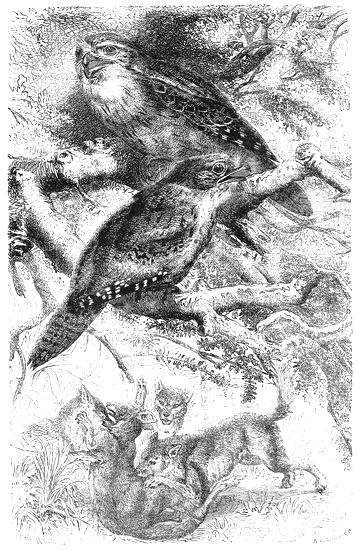
THE GIANT OWL SWALLOW (Podargus humeralis).
The FROG-MOUTHS (Batrachostomus) constitute a group of comparatively small birds,
inhabiting India and its neighbouring islands. Though smaller than the Giant Owl Swallow, they
have a still larger beak, which is very broad and flat at its base, slightly arched at its tip, and
terminates in a hook; the upper mandible projects over the lower one in all directions; the nostrils
are small and covered with feathers, and the wings abruptly rounded; the tail is long, and is either
graduated, or has the outer feathers very short; the tarsi and feet are small but strong, the toes
powerful and very flexible.
THE PLUMED FROG-MOUTH.
The PLUMED FROG-MOUTH (Batrachostomus cornutus or B. Javanensis) is an inhabitant of Java,
and distinguished from its congeners, not only by the remarkable arrangement of the head-feathers,
but by the beauty of its plumage. In this bird the region of the ears and brow is covered with a
plume of long, ragged feathers, which hangs down over the eyes and makes the head appear of a size
very disproportionate to the rest of the body. The plumage on the back is light rust-red, marked
with fine zig-zag black lines, the nape being adorned with a white crescent-shaped patch; the
shoulder-feathers are tipped with white spots thrown into relief by an ornamented semicircular line of
black at their tips; the brow is marked with reddish yellow spots. The centre of the throat and
upper part of the breast and belly are white, partially marked with zig-zag lines; the lower breast is
rust-red, spotted with black and white; the tail is light reddish yellow, striped seven or eight times
with a deeper shade, and streaked with black; the quills are similarly decorated. The eye is sulphur-yellow,
the feet brown, and the beak pale yellow. This extraordinary looking bird chiefly inhabits
the thickets of allangallany palm-trees that abound in Java at about 3,000 feet above the level of the
sea. Bernstein, who was the first to give us any account of it, says nothing as to its life or habits,
but has given us a description of the nest. This delicate little structure, which is formed almost
entirely of down from the body of the bird, is placed in a hole within the stem of the palm, and is so
small as to render it impossible for the parent to sit in it whilst engaged in the process of incubation.
The female is therefore compelled to lie along the stem that encloses her snug cradle, and whilst
holding firmly on with her feet, presses her breast against the opening of the nest, and thus imparts
warmth to her young. The one egg found by Bernstein was oval in shape and of a dull white,
streaked and spotted with brownish red; these markings were most thickly strewn over the broad
end, where they formed a kind of wreath.
Another very similar species (B. auritus) has the face ornamented with a pair of large tufts of
light feathers that project horizontally, giving the bird a very singular and grotesque appearance.
Under this name we class numerous families, all of which are more or less distinguished for the
perfection of their vocal apparatus. In appearance the members of this order are for the most part
pleasing and elegant, and their disposition usually attractive and engaging. Their body is long, the
neck short, and their head comparatively large; the beak, though differing much as to its formation,
is almost invariably small, straight, or only very slightly curved, and the upper mandible is generally
more or less incised; the tarsi are covered with horny plates, the toes long, and the claws large and
sharp; the wings, invariably of moderate size, are formed of ten quills, the first of these being usually
much stunted or not at all developed; the tail is by no means large, and composed of twelve feathers.
The plumage, which is soft, thick, and occasionally downy in texture, is simple and uniform in its
coloration; some few species, however, are brilliantly ornamented. The young at first differ
considerably in appearance from the adult birds, and both young and old moult their feathers once
within the year. All the members of this extensive order are active, intelligent, and extremely
restless; their flight is light and rapid, and their movements amongst the branches or upon the ground
are distinguished by extraordinary agility. In all, the sight and hearing are very perfect. They
live chiefly upon insects and seeds of various kinds, but some few species will kill and devour small
birds or similar prey. Every part of the world is enlivened by the presence of these delightful
warblers, whose cheerful voices are heard even in the most dreary and desolate regions, on burning,
sandy plains, as well as upon the ice-bound shores of arctic regions. Such as inhabit tropical
climates do not migrate; but those within the temperate zones, as winter approaches, remove towards
the south, seeing that their native lands at that season do not afford them a sufficient supply of food.
Very great variety is observable in the construction of the nests built by different species of singing
birds, many exhibiting wonderful skill, and in some cases actually sewing together the materials they
employ, with their sharp beaks, whilst others are contented to drag a few leaves into a hole and thereon
deposit their brood. The eggs, sometimes five or six in number, are hatched by the agency of both
parents, who also assist each other in procuring food for the young progeny. The latter grow with
great rapidity, and are capable of providing for a family of their own after the first year.
The TOOTH-BEAKED SINGING BIRDS (Dentirostres) constitute a large tribe, the members
of which are at once recognisable by a notch or tooth at the extremity of the upper mandible.
The SHRIKES (Lanii) are a very numerous and well-known group, equally common in all
parts of the world. In these birds the body is powerful and the breast prominent; their neck
is strong, the head comparatively large and round, the wings broad and rounded, the third or
fourth quill far exceeding the rest in length, while their tail is long and graduated. The beak is
powerful, compressed at its sides, and terminates in a strong hook, near which the upper mandible
has a very perceptible tooth-like appendage. The feet are large and robust, the toes long, and
armed with sharp claws; the plumage is rich, thick, and lax, and its coloration pleasing and varied.
Woods surrounded by meadows or pasture lands are the favourite resorts of these birds; but
they are also constantly found dwelling in hedges, among brushwood, or upon solitary trees. Such
species as frequent northern latitudes migrate regularly during the autumn, and find their way, in
pursuit of food, even to Central Africa. In their habits they closely resemble some of the birds of
prey, and their movements bear considerable similarity to those of the Raven family. Although
by no means conspicuously endowed in most respects, the voice in some species is highly
developed, and all seem capable of improving their natural powers of song, by imitating the sounds
produced by other birds. Their flight is irregular, and their step upon the ground a mere series of
hops; but, despite these deficiencies, they display great dexterity in securing their prey, even should
it equal themselves in size; and are exceeded by no other members of the feathered creation in
rapacity and the cruelty which they display towards their victims. They devour insects in large
quantities, but by no means rely solely upon them for food, for they destroy great numbers of
Sparrows and other small birds; and their attacks are all the more dangerous as they are entirely
unsuspected. It is not uncommon to see a large party of little birds quietly perched around a
Shrike, and evidently regarding it as a friendly companion, whilst in reality the treacherous intruder
is merely watching for a favourable moment to dart upon and kill some member of the group that it
has already singled out as its prey. One very remarkable habit, depicted in the engraving on
page 145, is highly characteristic of this family; we allude to the practice of spiking their victims
upon sharp thorns, from which circumstance they have obtained the well-merited appellation of
BUTCHER BIRDS. The nest of the Shrike is artistically constructed of the green portions of plants,
and placed in a thick bush or closely-foliaged branch. The brood consists of from four to six eggs,
which are hatched by the female alone, whilst her mate undertakes the duty of providing for her
nourishment. Both parents assist in feeding the nestlings, and in defending them. The young remain
under parental care and instruction for a considerable time after they are fully fledged, sometimes
not leaving it until the winter, for the Shrike, if undisturbed, breeds but once in the course of the year.
THE SENTINEL BUTCHER BIRD.
The SENTINEL BUTCHER BIRD, or GREAT GREY SHRIKE (Lanius Excubitor), is from nine and
a half to ten inches long, and its breadth about fourteen inches; the wing measures four inches and
the tail four and a half. Upon the upper part of the body the plumage is of an uniform light grey;
the under side is pure white, and a broad black stripe passes across the eyes. The upper half of
the large primary quills, as well as the inner webs and tips of the secondaries, are white, their other
portions and the rest of the quills being black; the centre tail-feathers are black, but with the
exception of a large black spot upon the centre of the inner web of the fifth, and a black streak
upon the shaft of the exterior feather, the rest are entirely white. The eye is brown, the beak black,
and the foot dark grey; the plumage of the female is less pure in its coloration than that of her
mate: the young are recognisable by the wave-like markings upon the breast and other parts of the
body. The egg is shown at Fig. 3, Coloured Plate XVI.
This species of Shrike is found in almost every European country, and throughout a large part
of Asia and Northern Africa; it is also very numerous in North America. Everywhere it appears
to prefer woodland districts, but is nevertheless constantly met with both in mountain ranges and in
marshy plains. Whilst on the alert for prey it may usually be seen upon the topmost branches of a
tree, peering eagerly about in all directions, in the hope of detecting any small bird or mouse that
may be near, pouncing down and killing it with wonderful dexterity as soon as the proper moment
arrives. If the destroyer is hungry the prey is at once dragged away and devoured; but should
this not be the case, the body is impaled upon a thorn, and left for a future meal. Even when tame it
continues this habit, and has been known to make constant use of a spike driven into a wall for that
purpose by its owner.
"We have seen," says one writer, "the New Holland Butcher Bird (Vanga destructor) act in
this manner when in captivity, and after strangling a mouse or crushing its skull, double it through
the wires of its cage, and, with every demonstration of savage triumph, tear it limb from limb and
devour it. The bird to which we allude had the talent of imitation in great perfection, and had
learnt to sing several bars of airs, with a full-toned musical voice. It executed the first part of 'Over
the Water to Charlie' with a spirit that would have gone to the heart of an old Jacobite." The term
Excubitor or Sentinel was given to the Butcher Bird by Linnæus, from its vigilance in watching
against Hawks and other birds of that tribe, whose approach it is ever the first to perceive, uttering
at the same time a querulous chattering, indicative, no doubt, of fear and dislike; hence on the
Continent it is used by persons engaged in the capture of the Peregrine Falcon.
The flight of this Shrike is slow and undulating, and can rarely be sustained for more than a few
minutes at a time; even when merely passing from one tree to another the bird moves in undulating
lines, keeping near the ground, and rapidly agitating both its wings and tail. Its sight is excellent, and
its sense of hearing so delicate as at once to detect the slightest sound. In disposition it is bold,
courageous, and very quarrelsome; during the breeding season it lives peaceably with its mate, but
after that period each individual provides only for itself, and carries on an incessant warfare, not only
with other birds, but with its own race. The notes of the Excubitor vary considerably at different
times of the year; in the spring both sexes possess an actual song, which seems to reproduce the
sounds uttered by all their feathered companions. The period of incubation commences in April,
and both parents assist in the formation of the nest, which is artistically constructed of twigs, straws,
and grass, its round interior being lined with wool, hay, and hair. The eggs, from four to seven in
number, are greenish grey, spotted with brown or dark grey, and are hatched in about a fortnight.
The nestlings are fed at first upon beetles, grasshoppers, and other insects, but at a later period on
small birds and mice. Both parents defend the little family with the utmost courage, and continue
their care and instructions until the season for migration. When aged, this species of Shrike soon
becomes very tame, and easily learns to obey and recognise its master. In former times it was
trained for the chase.
THE SOUTHERN SHRIKE.
The SOUTHERN SHRIKE (Lanius meridionalis) is very similar to, but more beautiful than the
species above described, and is found throughout Southern Europe and North-western Africa; the
male is about ten inches long and thirteen broad; the wing measures more than four inches, and
the tail four and three-quarters; the female is half an inch smaller than her mate. The plumage is
deep grey upon the upper part of the body, and white beneath, the breast being shaded with a rich
red; the four centre tail-feathers are black, the eye is brown, the upper mandible dark, and the lower
one light blue; the foot is black.
This bird is, we believe, the only Shrike that remains throughout the year in Spain; it arrives
in Greece about April, and leaves again in the end of August. Its habits do not differ from those
of its congeners already alluded to. The nest, which is usually placed at the summit of an olive-tree,
is formed of green stalks, woven together, and lined with sheep's wool and goats' hair; the eggs, four
or six in number, are of a dirty white or reddish white, thickly strewn with brown, grey, or red spots
of various sizes. These eggs are regarded as such dainties in Spain, that men will often risk their lives
in procuring them for the market.
THE GREY, OR BLACK-BROWED SHRIKE.
The GREY, or BLACK-BROWED SHRIKE (Lanius minor), is a beautiful species, from seven and
a half to eight inches broad, and thirteen and a half to fourteen inches long. The upper part of
the body is light grey, the under side quite white, with the exception of the breast, which is slightly
tinged with pink; the brow and cheek-stripes are black, the base of the quills is white, and the
remaining portion black; the four centre tail-feathers are black, the next in order white upon the
lower half, with a dark spot upon the inner web, whilst those at the exterior are entirely pure white.
The eye is brown, the beak black, and the foot grey. The female is exactly like her mate; but the
young are dirty white upon the brow, and yellowish white, striped with grey, upon the under surface.
The Black-browed Shrike is common in some parts of Europe, especially in Bavaria, Brandenburgh,
the south of France, Italy, and Turkey; but is quite unknown or rarely seen in most other parts of
the Continent. During its migrations it visits Central Africa; we ourselves have seen it in the Nile
provinces as early as September, and have never observed it in Europe before May. According to
Naumann, this species is by far the most lively and harmless member of its family; its flight is light
and graceful, and its capacity for imitating the voice of almost any other bird unusually great. Its
food consists exclusively of beetles, butterflies, grasshoppers, and other insects; it also devours larvæ
and chrysalids in large quantities. When in pursuit of prey it shows great agility, and usually watches
its victims in the same manner as its congeners; but, unlike them, it does not transfix its booty upon
thorns previous to devouring it. The nest, formed of hay, straw, wool, hair, and feathers, is placed
at the summit of a tree; the eggs, six or seven in number, are greenish white, marked with brownish
or violet-grey spots and streaks. Both male and female co-operate in the work of incubation; the
young are hatched within a fortnight; they are reared upon insects, and defended with much courage
by their parents, who chase every feathered intruder to a distance, and will even venture down to
confront a man, should he approach too near the little family. Large numbers, however, in spite of
all their efforts, are destroyed by Hawks, Crows, and other formidable neighbours.
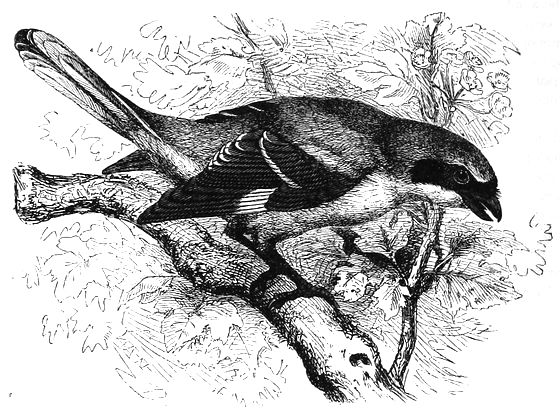
THE SENTINEL BUTCHER BIRD (Lanius Excubitor).
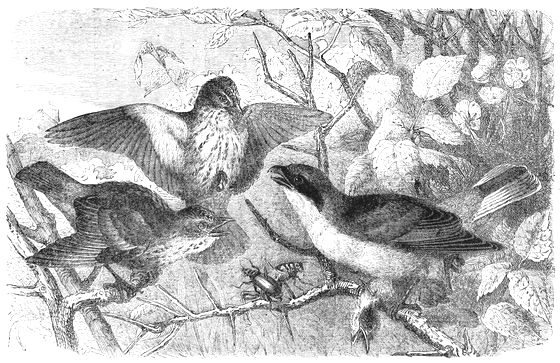
BUTCHER BIRD AND FLY-CATCHERS.
The BUTCHER BIRDS PROPER (Enneoctonus) are very easily distinguishable from the
above-mentioned groups by their short, strong, and slightly hooked beak, and by the variety of
plumage observable in the male and female. This group contains two distinct species, of which we
are about to describe the most generally known.
THE RED-BACKED SHRIKE, OR TRUE BUTCHER BIRD.
The RED-BACKED SHRIKE, or TRUE BUTCHER BIRD (Enneoctonus-Lanius-collurio), is light grey
upon the head, nape, and wings; the mantle is reddish brown; the breast pale rose-pink; a black
stripe passes above and beneath the eyes; the quills are of a brownish greyish black, with a light
border; the base of each of the secondaries is decorated with a small spot, which, when the wing
is extended, combine and form a well-defined line; the centre tail-feathers are brownish black; those
next in order are white at the roots, whilst the exterior ones are almost entirely white, and tipped
with black. The eye is brown, the beak black, and the foot greyish black. The female differs
considerably from the male, her body being reddish grey above and of a whitish tint beneath,
marked with undulating brown lines. The young resemble the father, but are spotted slightly upon
the back. (See Coloured Plate XIV.) The length of this species is seven inches, and its breadth
eleven and a half.
The Butcher Bird is met with in most countries of Europe, from Scandinavia, Russia, and some
parts of Siberia, to the south of France and Greece. During its winter migrations it visits the forests
of North-eastern Africa, and does not return to Europe until late in the spring. Trees and bushes
are the situations it prefers when about to build, and it often makes its nest for years on the same
spot, but should it be disturbed, it at once leaves not only the tree but the neighbourhood. In its
habits it closely resembles other Shrikes, and in like manner consumes large quantities of insects.
The Butcher Bird, however, often continues to kill, long after it has satisfied the cravings of hunger,
and pursues small quadrupeds or birds so incessantly as to drive away or destroy all such as have
been unfortunate enough to make their homes in its vicinity. This species is constantly in the habit
of impaling its captives after they are dead upon thorns, and it is not uncommon to see the bodies of
many victims thus secured until their destroyer has recovered his appetite: Naumann tells us that
the brain appears to be regarded as the greatest delicacy, and is always eaten fresh. Should a
Butcher Bird be disturbed whilst making its meal, it at once takes flight, and does not return.
The nest, which is usually placed in a thorn bush, at no great distance from the ground, is large,
thick, and carefully constructed of straw, hay, or moss, woven firmly and neatly together, and lined
with delicate fibres or similar materials. The female, who broods but once in the year, lays five or
six eggs (Fig. 4, Plate XVI.), of various sizes, shapes, and colours, more or less resembling those of
other Shrikes; she alone performs the work of incubation, sitting on her nest with such devotion
and care that she will allow herself to be captured rather than quit her post.
The Butcher Bird will frequently live for several years in captivity, and cannot fail to become
a favourite, by reason of its wonderful power of imitating not only the voices of its feathered
companions, but other sounds, for instance, such as the barking of a dog.
THE RED-HEADED SHRIKE, OR WOOD CHAT.
The RED-HEADED SHRIKE (Enneoctonus-Phoneus-rufus), or WOOD CHAT, as it is sometimes
called, is seven inches long and eleven broad; the wing measures three and a half and the tail three
inches. In the male, the upper portion of the body is black, the under surface yellowish white, the
back of the head and nape are reddish brown, and the shoulders and rump white. The female
resembles her mate. The plumage of the young is brownish grey, marked with crescent-shaped
black spots; the wings and tail are brown; the eyes are dark brown; the beak blueish black, and
the feet deep grey.
The Red-headed Shrike is very numerously met with in Southern Europe, where it not only
frequents woodland districts, but settles in the immediate vicinity of houses. As winter approaches
it leaves for warmer latitudes, and is very commonly seen in the forests of Central Africa, shortly
after the rainy season. In its mode of life this species resembles the Butcher Bird, but it subsists
principally upon insects, and only destroys small quadrupeds or birds when compelled to do so
through lack of other food. The nest is placed upon a tree, and constructed of dry stalks or green
plants, the interior being lined with moss and delicate fibres, feathers, hair, and wool. The five or
six eggs that constitute a brood are laid in May; these have a greenish white shell, spotted with dark
grey or brown. When caged, the Red-headed Shrike soon becomes an attractive companion, owing
to its great facility for imitating the voice of almost any bird that it may hear.
THE MASKED SHRIKE.
The MASKED SHRIKE (Enneoctonus personatus) is of a blueish black upon the upper parts of the
body; the breast is reddish yellow; the brow, shoulders, throat, and rump are white; the six centre
tail-feathers are entirely black, and the two outer ones pure white, with a black shaft; the rest are a
mixture of black and white. The eye is brown, the beak and feet black. This species, according to
Lindmayer, appears in Greece at the beginning of May, and leaves again in the middle of August.
It is also met with in large numbers in Egypt and Nubia, remaining in the latter countries throughout
the entire year; whilst such individuals as migrate from Europe penetrate as far as the interior of
Africa, and remain there during the winter season. Unlike other members of its family, it perches
upon lofty trees, from the summit of which its clear but monotonous voice is constantly to be heard.
The nest, which is small and delicately constructed, usually contains six or seven eggs of a yellow
hue, spotted with yellowish brown. This species subsists entirely upon insect diet.
The THICK-HEADED SHRIKES (Pachycephali) are recognisable by their compact body,
powerful head, strong beak, short wings and tail, and powerful feet. All the species belonging to this
group are met with in New Holland and the islands of the Pacific, where they perch upon the
summits of lofty trees, and climb about among the branches, with the alacrity of Titmice. Insects
constitute their principal nourishment; they also devour large quantities of caterpillars and worms.
Their movements are slow and their gait heavy. Their song varies according to the species, some
having loud but agreeable voices, whilst others utter a prolonged piping note, varied and repeated
in a very peculiar manner. The nest is round, beautifully constructed, and generally placed upon
the branches or in a hole of some tree; it usually contains four eggs.
THE FALCON SHRIKE.
The Falcon Shrike (Falcunculus frontatus), a member of the group above described, is a
powerfully-formed and prettily-marked bird of about six inches in length: the beak resembles that of
a Falcon, but neither the hook nor tooth-like appendages are well developed. In both sexes the
mantle is olive-green, and the under surface bright yellow; the sides of the head are white, and
marked by a broad black line that passes from the nape across the eyes and over the brow; the crest
and throat are black; the exterior and secondary quills blackish brown, broadly bordered with grey;
the tail is similarly coloured, but tipped with white. The eye is reddish brown; the beak black, and
the foot blueish grey. The female is smaller than her mate, and of a brighter hue upon the throat.
We learn from Gould that this bird is found in New South Wales and Australia, where it alike
frequents thick bushes and such trees as grow upon the open plains; it subsists chiefly upon insects,
which are obtained among the foliage or under the bark of the larger branches, or trunks of the trees.
In procuring these it displays great dexterity, stripping off the bark in the most determined manner,
for which purpose its powerful bill is most admirably adapted. The same author says, "It is very
animated and sprightly in its actions, and in its habits closely resembles the Tits, particularly in the
manner in which it clings to and climbs among the branches in search of food. While thus employed
it frequently erects its crest, and assumes many pert and lively positions. No bird of the same size,
with which I am acquainted, possesses greater strength in its mandibles, or is capable of inflicting
severer wounds, as I experienced on handling one I had previously winged, and which fastened on
my hand in the most ferocious manner. As far as I am aware, the Falcunculus frontatus is not
distinguished by any powers of song; it merely utters a few low, piping notes. I could neither succeed
in securing the nest of this species, nor obtain any authentic information respecting its nidification."
The stomachs of the specimens dissected by Gould were filled with the larvæ of insects and berries.
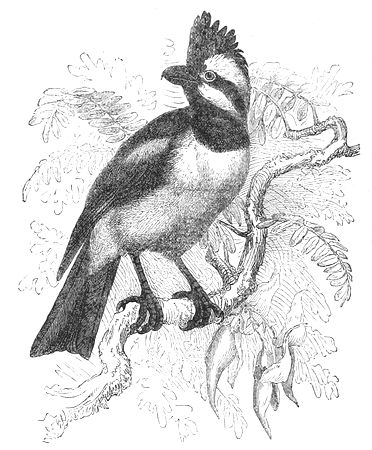
THE FALCON SHRIKE (Falcunculus frontatus).
The BUSH SHRIKES (Malaconoti) constitute a numerous group, inhabiting Africa and India.
These birds are distinguishable by their comparative length of wing and shortness of tail; the
formation of the latter varies considerably in different species. The beak is long, slender, and but
slightly curved or incised; the tarsus high and weak. The thick plumage is brilliant in its hues, and
unusually developed on the lower portions of the body. All the members of this family live either in
pairs or small parties, amidst the leafy tops of forest-trees, or in such districts as are covered with a
thick growth of brushwood. They feed exclusively on insects, but with this exception we are almost
entirely without particulars as to their habits or mode of incubation.
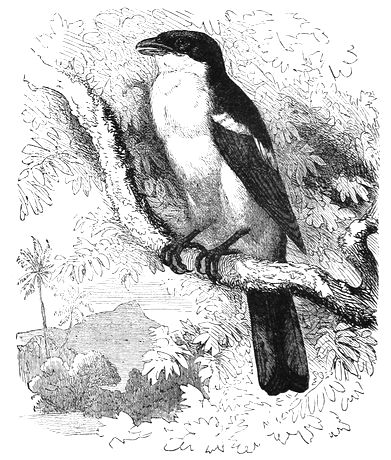
THE FLUTE SHRIKE (Laniarius Æthiopicus).
The FLUTE-VOICED SHRIKES (Laniarius) are recognisable by their elongate body, short
neck, head of medium size, and moderately long wing, in which the fourth or fifth quills exceed the
rest in length. The rather long tail is rounded at its extremity; the beak is long, very decidedly
hooked, and but slightly incised. The tarsus is high, the toes powerful, and armed with formidable
claws.
THE SCARLET SHRIKE.
The SCARLET SHRIKE (Laniarius erythrogaster), a species inhabiting Eastern Africa, and
replaced in the western and southern portions of that continent by a somewhat similar species (the
Laniarius barbarus), is of an uniform glossy black on the upper portion of the body; the under
side, with the exception of the brownish yellow hump, is of a brilliant scarlet; the eye is yellow, beak
black, and foot lead-grey. The length of this bird is nine, and its breadth thirteen inches; the wing
measures four and the tail three inches and a half. The plumage of the Laniarius barbarus is exactly
similar, if we except a dull yellow patch upon the top of its head.
THE FLUTE SHRIKE.
The FLUTE SHRIKE (Laniarius Æthiopicus) is entirely black upon the upper parts of the
body, except a white line upon the wings; the under side is pure white, shaded here and there with
rose-red; the eye is reddish brown, the beak black, and the foot blueish grey. The length of its
body is nine and a half, and breadth twelve inches and one-third; the wing measures four, and the
tail three and three-quarter inches.
Like other members of this group the two species above described lead a very retired life
among the sheltering branches of their favourite trees, from whence their most strange and very
monotonous song is to be heard almost incessantly throughout the day.
The HOODED SHRIKES are easily distinguishable from the last-mentioned group by their
comparatively long, graduated tails, short wings, in which the fourth quill exceeds the rest in length,
and remarkably long tarsi.
It is at present uncertain if all the species of Shrikes inhabiting Western and Eastern Africa
can be included in this group. The coloration of their plumage is almost identical, and in their
habits they closely resemble each other, but considerable variety is observable in their size. All
make their homes amidst such thick brushwood as grows close to the ground, and they never
seek the shelter of the trees except when very closely pursued. If driven from their favourite
lurking-places amongst the bushes and long grass, they fly with rapid strokes of the wing to the
nearest shelter, keeping close to the earth as they hurry along, but occasionally hovering for a few
moments before concealing themselves. Whilst in search of insects, they run upon the ground with
a rapidity and ease far exceeding the powers of any other members of their family.
Except the facts that these birds associate in small parties during the period of incubation, and
live alone or in pairs at other seasons, we are without particulars as to their nidification and breeding,
and have been unable personally to observe their habits.
THE TSCHAGRA.
The TSCHAGRA (Telephonus erythropterus)—the species we have selected for description—is
brownish grey upon the upper part of the body, and light grey beneath. A broad black line passes
over the head, and another, somewhat narrower, crosses the region of the eye. These lines are
separated by a light streak, which is white upon the face, but becomes of a yellow tinge towards the
sides. The outer web of the quills is grey, but is so broadly bordered with reddish brown that
when the wings are closed they appear to be almost entirely of the latter hue. The upper
secondaries are edged with reddish grey; the two centre tail-feathers are grey, marked with dark
stripes; the rest are black, tipped with white, those of the exterior have also a light border to the
outer web. The eye is reddish brown, the beak black, and the feet lead-colour, with a greenish
shade. In length the Tschagra does not exceed eight inches, its breadth is ten inches, the wing
measures three inches and the tail three and a half. It is, at present, uncertain whether the very
similar birds inhabiting Eastern and Western Africa are identical with this species. In colour they
are closely alike, but differ somewhat in size.
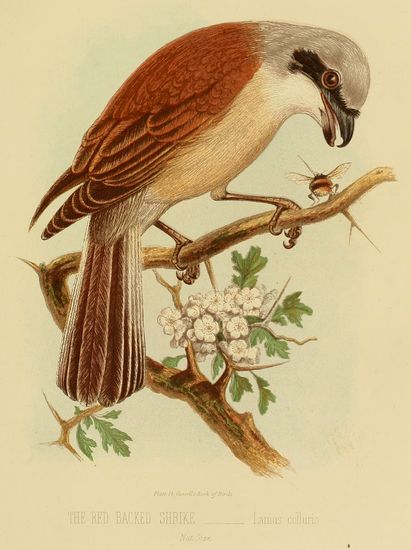
Plate 14, Cassell's Book of Birds
THE RED BACKED SHRIKE ____ Lanius collurio
Nat. Size
THE HELMET SHRIKE.
The HELMET SHRIKE (Prionops poliocephalus or Prionops cristatus) is easily recognisable by the
remarkable plume, composed of stiff, hairy feathers, with which the head is decorated. Some of
these hairy feathers cover the nostrils and base of the beak, and incline forwards, whilst the rest rise
directly from the top of the head, and combining, form a crest that in shape resembles the upper part
of a helmet. The eyelids are brightly coloured, and in texture similar to the cere with which our
readers have become familiar in the Raptores. The wings, in which the third quill exceeds the rest
in length, although of considerable size, do not cover more than a third of the very long and rounded
tail; the tarsi are short, and the toes long. The plumage is soft, thick, and very simply coloured;
the mantle-quills and a large portion of the tail are black; the crest, head, nape, and entire under
surface white. An indistinct yellowish line passes over the back of the head. The inner web and
tips of the primary quills, the tips of the secondaries and the exterior tail-feathers are white; the
rest are tinted with a mixture of black and white, in which the former predominates. The eye is
pearl-grey, and its lid bright orange, the feet cinnabar-red, and the beak black. Heuglin tells us that
the crest of the young bird is short, and shaded with grey. The length of this species is eight and
its breadth thirteen inches; the wing measures four inches and a half and the tail thirteen and a half.
Rüppell found large flocks of Helmet Shrikes inhabiting the valleys on the Abyssinian coast, where
they lived, like their congeners, in low bushes, and subsisted upon insects. Nevertheless, this writer
states that he never saw them again in his travels through other parts of that country. We ourselves
were, on one occasion, fortunate enough to see a considerable party of these remarkable-looking birds
in the forests near the Blue Nile. Such slight observations as we were able to make would seem to
indicate that their mode of life is very similar to that of the last-mentioned group. Heuglin only met
with this species during the rainy season, and therefore concludes that it is of migratory habits.
The RAVEN SHRIKES (Thamnophili) constitute a very peculiar group inhabiting South
America, Africa, and New Holland, closely allied to the Shrikes, though differing from them in so
many particulars that ornithologists are as yet at variance respecting their classification, founding their
difference of opinion upon the peculiar construction of the singing apparatus observable in some
species. These birds are for the most part of moderate size, with powerfully constructed bodies;
their wings are either of medium length, or short and much rounded, whilst the tail is subject to many
varieties of form; the tarsi, which are usually long and slender, always exceed the centre toe in
length, this latter is united with the exterior toe as far as the first joint, whilst on the inner side
the toes are entirely unconnected. The elongate beak, which is always more or less straight at its
culmen, curves abruptly towards its tip, where it exhibits tooth-like appendages. The margins of the
bill are sharp and compressed; the plumage of some species is rich, soft, and in many instances
striking in appearance, owing to the long and almost wool-like feathers upon the back; the base of
the beak is usually surrounded by a growth of bristles.
We are entirely without particulars as to the life and habits of several members of this group,
and must therefore avoid any general description.
The CROW SHRIKES (Cracticus), according to Gould, who first described them, closely
resemble the Piping Crows in appearance.
THE MAGPIE SHRIKE.
The MAGPIE SHRIKE (Cracticus destructor), the most numerous representative of this section, is
of a deep greyish brown upon the upper part of the body; the wings are blackish brown; the top of
the head and nape black; the rump is white, the under side greyish white, and a white spot lies
between the eyes and the base of the beak. The quills are blackish brown, with a white edge to
the outer web of the secondaries; the tail-feathers are black, and, except the two centre ones, are
tipped with white. The eye is dark reddish brown; the beak is grey at its base, and black towards
the tip; the feet are deep grey. The female has darker markings than her mate, and the young
are spotted with brown and reddish yellow. The length of this species is about thirteen inches
and a half.
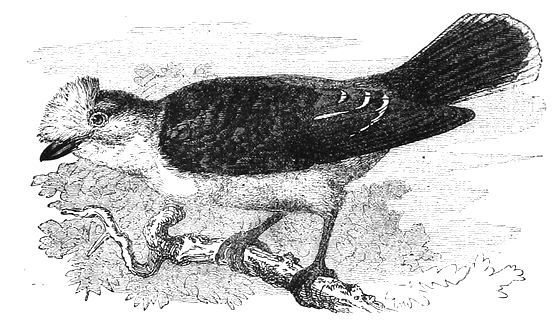
THE HELMET SHRIKE (Prionaps poliocephalus).
Gould tells us that the Magpie Shrikes are found extensively throughout Australia, where they
inhabit the brushwood extending from the coast to the mountain tracts; and, despite their habit of
perching almost motionless on the branches whilst on the watch for prey, their presence is speedily
announced to the traveller by the constant repetition of their extraordinarily harsh and unpleasing
cry. The larger kinds of insects or small birds constitute their principal food; upon these they dart
with direct aim, and after killing their prey, return with it to the perch they have just quitted, usually
spitting the victim upon a thorn or pointed twig, after the manner of the Butcher Bird, before
devouring it. Gould tells us that this species is very daring, even when brought in contact with
man, and mentions an instance in which he was followed for more than an hour by a hungry Magpie
Shrike, it having discovered that a small bird was imprisoned in his hunting-pouch. The breeding
season commences in September; the nest is large, and neatly constructed of fine twigs, lined with
small shoots and delicate fibres. The brood consists of four eggs, with a deep yellowish brown shell,
marked with dark spots and tracings of various shades, which frequently take the form of a wreath
at the broad end.
The RAVEN SHRIKES (Thamnophilus) appear to combine all the peculiarities exhibited by
the various members of this group, and in some respects resemble the Jay in appearance. These
birds are recognisable by their powerful body and rounded wings, in which the third and fourth
quills exceed the rest in length; the tail is long, composed of broad feathers, abruptly graduated at its
sides, and rounded at its extremity. The beak is high, compressed at the sides, and rounded at the
culmen; the upper mandible terminates suddenly in a large hook. The foot is muscular, the tarsus
thick and of moderate length, the long fleshy toes are armed with large hooked claws, that of the
hinder toe considerably exceeding the rest in size. The plumage is composed of broad feathers, and
thus appears thick and rich in texture; the region of the beak is surrounded by a slight growth of
bristles.
THE MAGPIE SHRIKE (Cracticus destructor).
VIGORS' RAVEN SHRIKE.
VIGORS' RAVEN SHRIKE (Thamnophilus undulatus or Thamnophilus Vigorsii) is a large bird
about fourteen inches long; its wing measures five and its tail six inches. The plumage of the male
is entirely black upon the upper side, streaked with white upon the back, wings, and tail; the lower
parts of the body are of an uniform dark grey, somewhat paler upon the throat. The female is
almost exclusively yellowish brown, the top of the head being blackish brown, and the back, wings,
and tail striped alternately with black and reddish yellow. Burmeister found the Bush Shrike
inhabiting the wooded highlands of Rio de Janeiro and Santo Paulo, occasionally in the vicinity of the
towns and villages. Such as he observed hopped about amongst the branches at some distance from
the ground, repeatedly uttering their monotonous cry. They exhibited no fear of molestation, and
would allow a sportsman to approach quite close, even if armed with his gun.
We are somewhat better informed as to the habits of the species of Bush Shrikes mentioned by
Azara and the Prince von Wied. These are described as resembling both the Shrikes and the Ant
Thrushes (Pitta) in form and general appearance. All lead a retired life amidst the bushy foliage of
their native forests, and usually prefer the darkest and most secluded localities, seldom quitting these
retreats except when flying from one bush to another. The larger species are occasionally met with
in the open country, but there, as elsewhere, they keep within the shelter of the brushwood, and only
leave their favourite haunts for a few minutes morning and evening. Towards other birds they
exhibit little sociability, but are much attached to their mates, each couple keeping together throughout
their lives. The voice of the various species is so very similar as to render it almost impossible to
distinguish the one from the other by the ear alone. The Prince von Wied describes their cry as
resembling the sound produced by the rebound of a ball from a stone or other hard body, followed
by a deep bass note. In some few instances the call is perfectly monotonous. The Bush Shrikes
subsist almost exclusively upon insects, but they also destroy small reptiles and young birds. The
nest, which is carelessly formed of blades of grass and moss, lined with feathers, is concealed so
cunningly as to render its discovery difficult, even by the sharp-eyed natives. The eggs are laid about
December; they are of a dirty yellow colour, marked with a wreath of olive-brown spots at the
broad end.
The DRONGO SHRIKES (Edolii) constitute a family of birds found extensively throughout
Africa, Southern Asia, and New Holland; they appear to form the connecting link between the
Shrikes and the Fly-catchers. All the various members of this family have slender bodies, long
wings and tails, broad beaks, and short feet. The fourth and fifth wing-quills exceed the rest in
length; the tail is composed of ten feathers, and is more or less deeply forked at its extremity. The
large thick beak is surrounded with bristles at its broad base; the slightly-curved upper mandible is
incised at its edges and terminates in a hook; the tarsi are short, the feet small but muscular, and
armed with strong claws. The plumage is dark-coloured, thick, harsh, and possesses a very peculiar
gloss. Most species are black, others blue, and some few light or deep blue upon the back and
whitish beneath; the eye is always bright red, and the beak and feet black. All the members of this
family are very similar in their habits and mode of life.
THE KING CROW, OR FINGA.
The KING CROW, or FINGA of Bengal (Dicrourus macrocercus), is one of the most remarkable
and most numerous of the many species inhabiting India. Its length is about twelve and its
breadth sixteen inches; the wing measures five inches and three-quarters, and the tail about six
inches. In this bird the entire body is of a resplendent black, deepest in shade upon the wings
and tail; the under portions are brownish black; the region of the nape is decorated with a white
spot. The sexes are alike in colour, and the young are readily distinguished from their parents by
white crescent-shaped spots upon the feathers that cover the under surface. The nest is composed of
grass, twigs, and roots carefully put together, and contains from three to five eggs of a white colour,
with pale brown or purplish spots.
The Finga is found throughout the whole of India, Assam, and Burmah, as far as China,
occupying almost every locality except the densest parts of the jungle. An almost identical but
larger bird is met with in Ceylon. We are also acquainted with four other Indian varieties, and
several very similar species inhabit Africa and Australia.
The DRONGOS (Chaptia) are recognisable from the last-mentioned group by their more
delicate feet and less decidedly pointed tails.
THE SINGING DRONGO.
The SINGING DRONGO (Chaptia musica) is nine inches long; its wing and tail both measure
four inches and a half. The plumage is of a blueish black, enlivened by a most brilliant gloss; the
wing and tail-feathers are black; the belly and lower wing-covers dark grey, approaching to black.
Le Vaillant discovered this bird in South-eastern Africa, and more recent travellers have seen
it in the northern parts of that continent. India possesses a very similar species, which, however,
unlike the rest of the group, frequently inhabits dense thickets.
The FLAG-BEARING DRONGOS (Edolius or Dissemurus) constitute a group of still more
striking birds, with tails in which the exterior feathers are more than twice the length of those in the
centre. The lower half of these outer feathers is entirely without web, while at the tip the web is
broad at the outer and very narrow on the inner side, so as somewhat to resemble a flag. The
beak is comparatively long and powerful, slightly compressed at its base and much curved at the
culmen, hooked at the tip, and furnished with teeth-like appendages; the base of the beak is
surrounded with thick soft bristles.
THE BEE KING.
The BEE KING of the Indians (Edolius paradiseus) is fourteen inches long; the outer tail-feathers
are eighteen or nineteen inches in length, while those in the centre do not exceed six inches and
a half; the wing measures six inches and three-quarters. The rich plumage is of an uniform black,
with a blue metallic gloss. The feathers upon the fore part of the head are prolonged into a crest,
and, like those upon the nape and breast, are slightly incised at their extremities.
The DRONGO SHRIKES are met with in large numbers throughout the whole of India, even
to an altitude of 8,000 feet, and may constantly be seen sitting upon the house-tops or telegraph-posts
in the immediate vicinity of man, or perching fearlessly on the backs of the sheep as they
wander about the fields and pastures. Some few species seek for food during the night, and carry on
the chase in parties, which assemble on a favourite tree shortly after sunset; others, again, are active
throughout the entire day, and though they do not hunt for prey after evening has closed in, may
frequently be heard uttering their loud, harsh, monotonous cry should the night be fine and moonlit.
During the breeding season each pair lives entirely apart from the rest, and permits no intruder to
approach the nest.
We learn from Le Vaillant, Blyth, and others, that the Drongos are in many respects highly
endowed, their instincts acute, their various senses well developed, and their movements through
the air distinguished by great lightness and activity. So acute is their vision that, like the Swallow,
they dart upon a flying insect from a considerable distance with a rapidity that renders escape almost
impossible, and, as we have said, readily destroy their game even in the twilight. Except when
engaged in seeking food, they rarely come to the ground; indeed, they seem to have considerable
difficulty in using their delicate feet, even whilst in the trees, merely employing them as a means
of clinging to the branches, and appearing quite incapable of hopping from one twig to another
with anything like a sprightly motion. Such acts as bathing or drinking are carried on, as in the
case of the Swallow, whilst the birds are upon the wing. All the members of this group are lively,
noisy, and active. They exhibit the utmost courage in defending their mates and nestlings from
danger, several individuals often combining together to drive away a common foe. They constantly
attack Owls with great spirit, and Gurney tells us that they frequently endeavour to battle with
the larger birds of prey. So violent are they during the season for choosing a mate, that Jerdon
mentions having seen four or five of these desperate rivals rolling together upon the ground, as they
fought in a paroxysm of rage and jealousy. All the various tribes of Drongos appear to subsist
exclusively upon insects, more particularly upon bees and wasps; some large species also devour
grasshoppers, dragon-flies, and butterflies, but, like their smaller brethren, prefer such insects as
are furnished with stings, thus often rendering themselves extremely troublesome to the owners of
bees. At the Cape of Good Hope they are known under the name of "Bee-eaters." Le Vaillant tells
us that they seem to know exactly at what hour the heavily-laden insects return to their hives, and
adroitly relieve them of their burdens, strewing the ground with the wings and bodies of the victims.
We learn from Gurney that they are often attracted by the smoke from the conflagrations that
occasionally burst forth upon the arid plains of their native lands, for they know well that the
devouring flames will drive forth a host of insects, and thus afford a rich and abundant supply of
food. Philipps mentions an amusing instance of the cunning displayed by some of these birds whilst
engaged in the pursuit of a meal. Upon one occasion, he tells us, he saw a locust closely pursued
by a bird that was almost near enough to seize it, when an observant Drongo, having espied the
tempting morsel, and finding it impossible to reach the spot in time, suddenly uttered the cry of
terror usually employed to signal the approach of a Hawk; the ruse succeeded; the other bird
instantly darted away to seek safe shelter, leaving the wily Drongo in undisturbed possession of the
coveted booty.
The season of the year at which the incubation of these birds takes place is somewhat uncertain,
and naturalists differ very considerably in their opinions on this point. According to our own
observations and experience, they breed but once in the year. The nest, like that of the Pirol, is
suspended between two branches at some distance from the ground, and so placed as to be fully
exposed to all the changes of wind and weather; nevertheless, the exterior is very carelessly formed
of twigs and fibres, and has no lining except at most a few coarse hairs. The eggs, three or four in
number, have a white or reddish white shell, spotted with brown or red. Many species of the
Drongo are caught and reared; the Bee-eater in particular is very commonly seen in the houses in
Calcutta and other Indian cities. Blyth tells us that it is readily tamed, and soon becomes a most
amusing companion, from the power it possesses of imitating not only the voices of other birds, which
it does so exactly as to deceive their mates, but also any sound it hears.
The SWALLOW SHRIKES (Artami) constitute a family of strangely-formed birds, that inhabit
New Holland, India, and the Malay Islands. Their muscular bodies are furnished with very long
wings, in which the second quill is longer than the rest. Their short or moderate-sized tails are
either quite straight or slightly incised at the extremity. The beak is short, almost conical, rounded
at the sides, the upper mandible slightly bent at the tip, and incised at the margins. The feet are
strong, with short tarsi and toes, the latter armed with sharp and very hooked claws. The plumage
is thick, and of a dusky hue.
THE WOOD SWALLOW SHRIKE.
The WOOD SWALLOW SHRIKE (Artamus sordidus) is of a reddish grey upon the body; the tail
and wings are dark blueish black, the third and fourth quill being edged with white upon the
outer web. The tail-feathers, with the exception of the two in the centre, are broadly tipped with
white. The eye is dark brown, the beak blue at its base and black at its tip; the feet are greyish
white. The female is smaller than her mate, and presents a spotted appearance upon the back,
the feathers on that part having a dirty white streak upon their shafts. The colour of the surface
of the body is a mixture of white and brown. This bird is about six inches long and thirteen and
a half broad.
The various species of Swallow Shrike, though differing slightly in some of their habits and in
their mode of life, still bear so strong a family likeness to each other as will permit us to describe
them collectively. All prefer woodland districts, and usually select localities in which their favourite
trees abound. One species in particular is called by the natives the Palmyra Swallow, from the
fact that it always seeks the shelter of the Palmyra palm. Such members of the family as inhabit
Java select trees growing in open tracts, covered with short grass and brushwood; one of their
favourite trees is then chosen as a sleeping-place or gathering-point, and from thence they fly over
the surrounding country in search of food. Jerdon tells us that the fancy of the Swallow Shrike
for certain trees is so strong that where these grow it is often found living at an altitude of 4,000
feet above the level of the sea. It is only in the air that these birds exhibit their full powers; and
as they glide along, with outspread but almost motionless wings, their movements resemble those of
some of the Raptores. Other species, on the contrary, exhibit all the rapidity and free evolution of
the True Swallow, as they soar aloft or sink rapidly to the earth in pursuit of their tiny aërial victims.
They but rarely descend to the ground, as their progress on foot is accomplished with some difficulty.
Shortly after the breeding season enormous parties of Swallow Shrikes congregate upon the trees,
where they live in the utmost harmony, each one satisfying its own wants, and carrying on the
business of the day without either molesting or rendering assistance to its companions. A tree
thus occupied is as full of life and bustle as a beehive, every part of its foliage affording a perch to
one of these hungry and active birds, whose sharp eyes enable them instantly to detect and dart
upon a passing insect, after which process they at once return to their former position on the tree.
Gould tells us that these large flocks may often be seen hovering over a sheet of water, and
literally darkening its surface by their numbers, as they dart about amidst the tempting hosts of
insects that abound in such localities. We must not omit to mention one very striking peculiarity of
the Wood Swallows. Gilbert tells us he has seen swarms of these birds, as large as a bushel measure,
hanging like bees in large clusters from the branches of the trees. "This bird," says Gould,
"besides being the commonest species of the genus, is a great favourite with the Australians, not
only on account of its singular and pleasing actions, but by its often taking up its abode and
incubating near the houses, particularly such as are surrounded by paddocks and open pasture-land,
skirted by large trees. It was in such situations as these I first had the opportunity of observing
this species; it is there very numerous in all the cleared estates on the south side of the Derwent,
about eight or ten being seen on a single tree, crowding against one another on the same dead branch,
but never in such numbers as to deserve the appellation of flocks. Each bird appeared to act
independently of the other, each, as the desire for food prompted it, sallying forth from the branch
to capture a passing insect, or to soar around the tree and return again to the same spot. On alighting
it repeatedly throws one wing out at a time, and spreads its tail obliquely, previous to settling. At
other times a few were seen perched on the fence surrounding the paddock, on which they frequently
descended like Starlings, in search of coleoptera and other insects. It is not, however, in this state
of comparative quiescence that this graceful bird is seen to best advantage, neither is it at that state
of existence for which its form is especially adapted; for though its structure is more equally suited
for terrestrial, arboreal, and aërial habits than any other species I have examined, yet the form of the
wings point out the air as its peculiar province. Here it is that when engaged in pursuit of the
insects which the warm weather has enticed from their lurking-places among the foliage to sport in
higher regions, this beautiful species in its aërial flights displays its greatest beauty, whilst soaring
above in a variety of easy positions, with its white-tipped tail outspread."
The voice of these birds resembles the call-note of the Swallow, but is somewhat harsher and
more monotonous. Some are stationary, while others wander from one place to another as soon as
the period of incubation is over. The Wood Swallow makes its appearance in Van Dieman's Land in
October, at the commencement of the Australian summer; and after rearing two broods returns again
to more northern latitudes. The nests are built in a great variety of situations. Gould found one in
a thickly-foliaged bush close to the ground, another placed in the fork of a bare branch, and others
under the loose bark of a large tree; they are also frequently placed under the roofs of the settlers'
houses; and one species in particular prefers to avoid all labour by taking possession of the deserted
nests of other birds. Their own nests are usually neatly formed of delicate twigs, woven together,
and lined with fine fibrous roots. The four eggs that constitute a brood are generally of a dirty white,
spotted and streaked with reddish brown. Bernstein tells us that the species inhabiting Java build
amid the parasitic plants that cover their favourite palms, or upon the leaves of the tree itself, forming
their little abodes of grass, moss, fibres, and small leaves, carelessly arranged, but strongly lined with
soft and elastic materials. The Indian species, according to Jerdon, makes a bed of feathers inside
its nest. Many of the members of this family remain in company even during the breeding season,
and build in close proximity to each other. It is still uncertain whether the male bird assists in the
cares of incubation, but both parents tend their young with great care, and rear them exclusively upon
insect diet.
The FLY-CATCHERS, according to Linnæus, comprise a large number of small singing birds,
distinguished by their broad, flat beaks. These have again been divided into a variety of families,
amongst which the following stands first upon our list as forming a connecting link between the
Fly-catchers and the Shrikes properly so-called.
The KING or TYRANT SHRIKES (Tyranni) constitute a family of American birds, having
small but powerful bodies, and long, pointed wings, which when closed extend half-way down the tail.
The second and third quills exceed the rest in length. The large broad tail is either excised or
rounded at its extremity; the legs are strong, the tarsi high, and the toes muscular; the straight and
slightly conical beak terminates in a hook, and is surrounded with bristles at its base. The thick
soft plumage is usually grey upon the back, and white or yellow upon the under parts of the body.
The Tyrant Shrikes are found extensively throughout South America, and are especially numerous in
the warmest latitudes of that continent.
THE TRUE TYRANT SHRIKE, KING BIRD, OR TYRANT FLY-CATCHER.
The TRUE TYRANT SHRIKE, KING BIRD, or TYRANT FLY-CATCHER (Tyrannus intrepidus), as
the most noted member of this family is called, is about eight inches long and fourteen broad. The
soft and brilliant plumage of this species is prolonged into a crest at the top of the head. The entire
back is of a deep blueish grey, darkest upon the head, the feathers that form the crest being edged
with bright red and yellow; the under side is greyish white, tinted with a deeper shade on the breast.
The throat and neck are pure white, the quills and tail brownish black, the latter tipped with white,
as are the wing-covers. The eye is dark brown, the beak black, the feet greyish blue. In the
plumage of the female all these colours are much more dusky and indistinct than in that of her mate.
According to Audubon, the Tyrant Shrike is one of the most attractive birds that visit the
United States during the summer months. It appears in Louisiana about the middle of March, and
occasionally remains until the middle of September, but the flocks for the most part proceed north
before that season, and spread themselves over every part of the country, filling the air with their
quivering shrill cry, as they explore the orchards, fields, or gardens, and fearlessly approach the
dwelling-houses of mankind. As the breeding season draws near, they may be seen flying merrily
about at some distance from the ground, in search of a convenient spot for building, the male
constantly uttering his shrill note, and keeping quite close to his mate. The nest is formed of bits
of cotton, wool, tow, or similar materials, and is usually of considerable size; the interior is neatly
and thickly lined with fibres and horsehair; the four or six eggs have a reddish white shell, irregularly
marked with brown streaks. No sooner is the brood laid than the male bird begins to exhibit the
utmost courage and devotion in tending and protecting his partner. The entire day is occupied in
feeding and entertaining her, as he perches close beside her on a twig, displaying his glowing crest
and white breast in all its beauty to her admiring eyes. Should an enemy or rival approach, he
darts furiously down and chases the intruder to a distance, sometimes as far as a mile from the nest,
and then returns rapidly to his little family. So bold and fearless is the Tyrant Shrike upon these
occasions, that even Falcons scarcely venture to approach its nest; and the cats of the neighbourhood,
well knowing the reception they would meet with, carefully avoid trespassing within the
domains of the intrepid father.
"At this period," says Wilson, "the extreme affection of the Tyrant Shrike for his mate and
young makes him suspicious of every bird that happens to pass near his residence, so that he attacks
every intruder without discrimination. In the months of May, June, and part of July his life is
one continued scene of broils and battles, in which, however, he generally comes off conqueror.
Hawks, Crows, and Eagles all equally dread an encounter with this dauntless little champion, who,
as soon as he sees one of the last approaching, launches into the air to meet him, and darts down
on to his back, sometimes fixing there, to the great annoyance of the king of birds, who, if no
convenient retreat be near, endeavours by various evolutions to rid himself of his merciless adversary.
But the Tyrant Fly-catcher is not so easily dismounted; he teases the Eagle incessantly, charges
upon him right and left, and remounts into the air, that he may descend on his enemy's back with
greater force, all the while keeping up a shrill and rapid twittering, and continuing the attack
sometimes for more than a mile, until he is relieved by some other of his tribe equally eager for
the contest."
The Purple Swallow alone seems capable of contesting the field with this courageous opponent,
and resisting its attacks. Wilson mentions having seen the Tyrant Shrike also greatly irritated by his
vain efforts to get rid of the Red-headed Woodpecker, the latter dodging him round a rail, and
appearing highly amused at the impotent rage of his assailant.
About August the voices of these birds are far more rarely heard, and they employ their time in
picking the worms and insects from the furrows in the fields, or in gliding over the water in pursuit of
flies. Like the Swallow, they drink and bathe whilst on the wing, invariably perching upon a
neighbouring tree, the better to dry their plumage. The Tyrant Shrikes quit the United States
before any other of the feathered summer visitors, and prosecute their migrations by night as well as
by day, flying alternately with rapidly repeated strokes of the pinions, and a smooth, gliding motion,
that is apparently produced without the slightest effort. The flesh of this species is delicate, and
much esteemed in Louisiana. A Tyrant Shrike kept for many months by Nuttall always swallowed
berries whole; grasshoppers, if too large to be so disposed of, were pounded and broken on the floor
of his cage, as the bird held them in his beak. To manage the larger beetles was not so easy; these
he struck repeatedly against the ground, and then turned from side to side, by throwing them
dexterously into the air, after the manner of the Toucan; the insect being uniformly caught reversed
as it descended, with the agility of a practised cup and ball player. After the beetle was swallowed,
he remained perfectly still for some time, in order to digest his meal, tasting it distinctly some time
after it entered the stomach, as was obvious from the ruminating motion of his mandible. When the
soluble portion had been extracted, large pellets of the indigestible legs, wings, and shells were
brought up again in half an hour's time, and ejected from the mouth after the manner of Hawks
and Owls. This bird, we are further told, had the sagacity to retire under the shelter of a depending
bed-quilt in the apartment about which he was allowed to run at large, if the weather was unusually
cold.
THE BENTEVI.
The BENTEVI (Saurophagus sulphuratus), a well-known species, resident in Brazil, is recognisable
by its comparatively long wings and slightly incised tail. Its legs are powerful, tarsi high, toes long,
and armed with sickle-shaped claws; the beak, which is higher than it is broad, and terminates in a
hook, is of a conical shape, and equals the head in length; its culmen is slightly rounded, and
its base surrounded with bristles. These latter are particularly numerous in the region of the
cheek-stripes. The length of this species is five and its breadth ten inches; the tail measures three
inches. Upon the upper part of the body the plumage is of a greenish brown; the forehead and
eyebrows white; the crest-like feathers upon the crown of the head are of a brimstone-yellow; the
sides of the head, the bridles, and cheeks black; the wing-covers, tail-feathers, and quills are broadly
edged with rust-red; the throat and fore part of the neck are white; the breast, belly, rump, and legs
sulphur-yellow. In the plumage of the young the top of the head is entirely black; the wing and
tail-feathers are broadly edged with rust-red; and all the colours paler than in those of the adult
birds. The Bentevis are extensively met with throughout South America, particularly in well-wooded
pasture-land or meadows; indeed, their loud, penetrating voices may literally be heard from
every tree. We learn from Schomburghk that though they subsist principally upon insects, they also
devour the nestlings of other species, and frequently visit the houses of the inhabitants in order to
pilfer scraps of the meat hung out to dry. So bold are they that it is not uncommon to see them
picking up their insect prey from under the very feet of the herds of cattle as they graze. Towards
their feathered companions they exhibit unceasing animosity, chasing them and harrying them from
spot to spot with loud spiteful cries, occasionally venturing to carry their pugnacious propensities so
far as to attack some of the larger birds of prey. As the breeding season approaches, they become
still more quarrelsome and noisy, until the air resounds with the voices of both the males and females
as they chase each other in angry rivalry or sport among the branches, or so constantly utter their
strange cry as to appear prompted by an anxious desire to outdo their companions, both in loudness
and rapidity of utterance. This cry, from which the name of the species is derived, has been freely
interpreted by the inhabitants of Monte Video and Buenos Ayres to mean, "Bien-te-veo," "I see you
well," and in Guiana into, "Qu'est ce que dit?"
THE TRUE TYRANT SHRIKE, KING BIRD, OR TYRANT FLY-CATCHER (Tyrannus intrepidus).
The nest, which is large, thick, and ball-shaped, is artistically constructed of moss, leaves, grass,
and feathers, and is entered by a small round aperture in the sides. The eggs, three or four in
number, have a pale greenish shell, marked with a few black and greenish blue spots, which are most
thickly strewn over the broad end. We learn from Azara that the Bentevi is readily tamed, and
when caged will live on peaceful terms with
its companions. The same authority mentions
a peculiarity that he observed in one of
these birds that he himself reared, namely,
that it always seized the bits of flesh that
were given to it in his beak, and struck them
repeatedly against the ground, as though he
supposed the morsels required killing before
they could be eaten.
The FORK-TAILED TYRANTS (Milvulus)
differ from the groups already described
principally in the great length of their
forked tails. Their bodies are slender, and
they have short necks, broad heads, and
long wings. Their large, strong beaks bulge
slightly towards the sides, terminate in a
decided hook, and are partially covered with
bristles at the base; the feet are short; the
toes of moderate size, armed with very sharp,
compressed claws; the three first wing-quills,
of which the second is the largest, are pointed
at the tip. This latter peculiarity is particularly
apparent in the male. The plumage
is soft and elastic, but by no means thick.
THE SCISSOR BIRD.
The SCISSOR BIRD of the Brazilians (Milvulus
tyrannus), though properly a native
of Central America, is occasionally met with
in the United States. The length of this
elegant species is about fourteen inches, of
which at least ten belong to the exterior
tail-feathers, whilst those in the centre do
not measure more than two and a half inches.
Its head and cheeks are deep black, except at
the lower part of the crest, which is yellow; the back is ash-grey; the under side white; the quills,
wing-covers, and rump are blackish brown, edged with grey; the outer web of the exterior tail-feathers
is white along the whole of the upper half; the eye dark brown; the beak and feet are black.
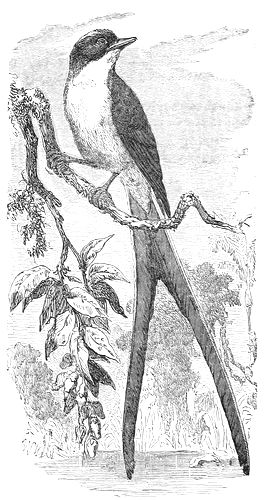
THE SCISSOR BIRD (Milvulus tyrannus).
We learn from Audubon and Nuttall that the Scissor Birds are frequently met with upon all the
vast steppes of Central and Southern America, and are common in some districts. They are usually
seen assembled in large parties upon low brushwood, and from thence fly down to seize their insect
prey. At the appearance of dusk they retire to pass the night together upon a favourite tree. Whilst
perched they seem to be of very indolent and quiet disposition, but whilst in flight their appearance is
striking and remarkable, as they constantly open and close their long tails, after the fashion of a pair
of scissors, during the whole time that they are upon the wing, a circumstance from which they derive
their name. Insects constitute their principal fare, and these they capture in the same manner as
other members of their family; they also pursue and devour many small birds, and, according to
Nuttall, frequently consume berries. The nest, which is usually concealed in a thickly-foliaged bush,
is open above, and formed of delicate twigs, snugly lined with a bed of fibres, wool, or feathers; the
eggs are white, mottled with reddish brown, these markings being thickest at the broad end. As
autumn draws to a close the Scissor Birds congregate with other species in large parties, previous to
setting forth upon their migrations. Schomburghk tells us that such of these flocks as he observed
leaving the country, settled upon the trees from about three to five o'clock in the afternoon, and
remained there for the night, resuming their southern course at the first dawn of day.
THE ROYAL TYRANT.
The ROYAL TYRANT (Megalophus regius), so called from the tiara-like crescent that adorns its
head, and its great beauty of plumage, has a slenderly-formed body and pointed wings, in which the
third and fourth quills exceed the rest in length, the first and second being comparatively short; the
tail is moderately long, and quite straight at its extremity; the beak, which is flat and spoon-shaped,
terminates in a sharp hook; the feet are short; the toes, of which the two exterior are united at the
base, are powerful, and armed with short blunt claws. The plumage is soft and downy, and upon the
top of the head is prolonged into a broad flowing crest; at the base of the beak it is replaced by
bristles; five very long bristles also decorate the cheek-stripes. The upper part of the body is of a
beautiful light brown, while the entire under surface and tail are bright reddish yellow; the throat
is whitish; the quills are deep brown or blackish, with a light edge upon the inner web; the
wing-covers are tipped with pale yellow; the tiara is of a gorgeous flame-colour, or carmine-red,
each feather having a black spot at its tip, surrounded in the male by a light yellow line. These
spots gleam with a blue metallic lustre, and the crest extends as far as the nape; the eye is light
brown, the upper mandible brown, the lower one light yellow; the feet are pale flesh-pink, and the
long bristles black. In the young the plumage is almost entirely brown, mottled upon the breast, and
spotted on the back; the crest is very small, and of an orange-yellow. The length of this species is
six inches; the wing measures three and a half, and the tail two and a half inches.
The Royal Tyrant inhabits the primitive forests of Brazil and Guiana, where it frequents the
most shady recesses, and leads a quiet and solitary life, usually preferring the tops of the trees.
Notwithstanding the preference it shows for retired spots, it is frequently caught by the natives, on
account of its great beauty. We learn from Burmeister that the capture of the male is rendered
comparatively easy, by the fact that a brooding female has no sooner lost her mate than she consoles
herself with another. The natives, who are aware of this peculiarity, when they find a pair shoot the
male, and then wait patiently until his successor makes his appearance, when he is also killed. We
have it on good authority that a female Royal Tyrant will in this manner take to herself as many as
a dozen of these ill-fated partners. The eggs are oval, and have light violet shells, marked with
brownish or blood-red spots, and streaked with the same shade at the narrow end. We have no
account of the nest built by this species.
The STILTED FLY-CATCHERS (Fluvicolæ) constitute a group of South American birds
differing in many particulars from the Tyrant Shrikes. The members of this group are recognisable
by their large, powerful bodies, and their long wings and tail, in the former of which the first quill
is only a trifle shorter than the second. They have strong legs, high tarsi, and thick, sharp claws.
Their large, high, and slender beak is of a conical form, and but very slightly bent at its extremity.
Their thick plumage is heavy, and is composed of small feathers, presenting but a very slight
development of down. The base of the beak is covered with stiff bristles, of which from three to
five of still stiffer and larger size are scattered over the region of the cheek-stripes.
The Stilted Fly-catchers are frequently met with in the immediate neighbourhood of human
habitations, and in such open plains as are almost entirely destitute of trees or bushes, near ponds,
rivers, or even in marshy districts, everywhere subsisting upon insects, and carrying on the pursuit
of their prey exactly in the same manner as the birds above described.
THE YIPERU, OR YETAPA.
The YIPERU, or YETAPA—Cunningham's Bush Shrike—(Gubernates Yiperu), a well-known
member of this group, has a slender body, large wings, and very long, forked tail. Its beak is
thick and broad at its base, the upper mandible considerably arched, and furnished with a strong,
short hook at its extremity; the legs, though short, are powerful, the toes of moderate size, and
armed with slightly-curved claws. The plumage is thick and soft, that of the wings and tail being
unusually heavy. The back and under side of the body are grey, the wings and tail black, with a
white patch at the shoulder, and a light red spot on the outer web of the large quills. The throat is
white, separated from the grey breast by a reddish brown line, which extends as far as the eyes; the
brow is of a whitish shade, the eye itself reddish brown, and the beak and feet black. The length of
this species is fifteen inches, of which nine are included in the length of the exterior tail-feathers,
whilst those in the centre are not more than two and a half inches long. The span of the wings is
about fifteen inches.
We learn from Azara that the Yetapas principally frequent such plains as are only partially
covered with brushwood or trees, and fly about in small parties, seeking for their insect food upon the
ground. Their cry is monotonous but penetrating.
THE COCK-TAILED FLY-CATCHER.
The COCK-TAILED FLY-CATCHER (Alectrurus tricolor)—the other member of this group which we
have selected for description—is easily recognisable by its short, stiff tail, in which sometimes the
two exterior and sometimes the centre feathers are of very peculiar appearance, owing to the
very irregular development of the web. The thick conical beak terminates in a delicate hook,
the legs are slender, the tarsi high, and the toes long. The wings are of moderate size and pointed,
the third quill being longer than the rest; the first and second are much incised and narrow towards
the tip. The plumage is soft, composed of small feathers, and the bristles on the cheek-stripes are
unusually large. In the male bird the inner web of the very broad centre tail-feathers is much
developed; the body is almost entirely black, the throat, belly, and shoulders being white. The
plumage of the female and young is yellowish brown, except upon the throat, which is whitish, with
various light markings, and the centre tail-feathers are no broader than those at the side; all have
greyish brown eyes. The beak is of a dirty light brown, and the feet dark brown. The length of the
Cock-tailed Fly-catcher is five and a half, and the tail about nine inches. The wing measures two
and a half, and the tail two inches.
These birds inhabit all the plains of South America, and, according to Azara and D'Orbigny,
perch throughout the entire day upon the high grass, from whence they rise to catch the insects as
they pass, and then sink with outspread wings and tail to their former lurking-place; they rarely fly to
any distance, and often seem to move through the air in a backward direction. We are without
particulars concerning the mode of breeding and nidification of this species.
The CATERPILLAR EATERS (Campephagæ) comprehend a number of birds inhabiting the
East Indies and contiguous islands, as also Africa and New Holland. With their mode of life we are
but little acquainted, beyond the fact that they associate in small parties, and seek their food almost
exclusively amongst the foliage of trees and bushes. They consume great numbers of insects and
their larvæ, and some few eat berries.
THE RED BIRD, OR GREAT PERICROCOTUS.
The RED BIRD, or GREAT PERICROCOTUS (Pericrocotus speciosus), the species we have selected as
the representative of its family, is a magnificent creature, about nine inches long, and twelve inches
and a half broad. The wings, in which the fourth and fifth quills are longer than the rest, measure
four and a quarter and the tail four inches. The beak is short, broad at its base, and slightly curved.
The tarsi are short, the feet delicate, and the claws much hooked. The plumage of the male is
of a brilliant blueish black upon the back, quills, and centre tail-feathers; whilst the entire under
side, a broad band across the wings (formed by a line of spots upon the outer quills), and the exterior
tail-feathers are glowing scarlet. In the female, the brow, back, and upper tail-covers are greenish
yellow; the quills dusky black, spotted with yellow; the centre tail-feathers tipped with deep yellow;
the rest of the plumage is bright yellow, decorated with various dark markings. In both sexes the
eye is brown, and the beak and feet black.
These very beautiful birds are met with extensively throughout the greater part of India,
particularly in Calcutta, Assam, and Burmah; they are most numerous in such localities as are
3,000 or 4,000 feet above the level of the sea. Like most of their congeners, they are generally
active and social, usually gleaning their insect food from amongst the buds and blossoms of their
favourite trees, and only occasionally descending to the ground or seeking their prey upon the wing.
Jerdon tells us that whilst the business of the day is going on the males and females separate from
each other, each sex associating in small parties of four or five birds, and carrying on their work in
the most lively manner, hopping and climbing briskly about among the foliage, and constantly
uttering their cheerful and penetrating note. The nest of the Red Bird found by the writer to
whom we have alluded, was constructed of moss and delicate fibres, and contained three white eggs,
slightly spotted with brownish red. Radde mentions a grey species, inhabiting China, the Philippine
Islands, and Eastern Siberia, and tells us that the flocks which he saw, each numbering some fifteen
or twenty birds, tumbled noisily about near the tops of the trees, and filled the otherwise silent
forests with their shrill chattering cry. On the first approach of danger, these lively parties at once
united into large flocks, and sought refuge in the highest trees, preserving meanwhile such unbroken
silence as to render their capture a work of great difficulty.
The FLY-SNAPPERS (Myiagræ), another family of these birds, inhabit the eastern hemisphere,
and are recognisable by the slender formation of their body, moderate-sized wings, in which the
fourth and fifth quills exceed the rest in length, and long tail; in the males of some species the web
of the centre tail-feathers is much developed; the beak is broad and compressed, broad at its base,
straight at the culmen, incised at its margins, and hooked at its extremity. The feet are short and
weak; the plumage bright-coloured, and rich in texture. The base of the beak is surrounded with
bristles. All the members of this family are unusually brisk and restless in their habits, and enliven
their native forests by their gay plumage and cheerful notes.
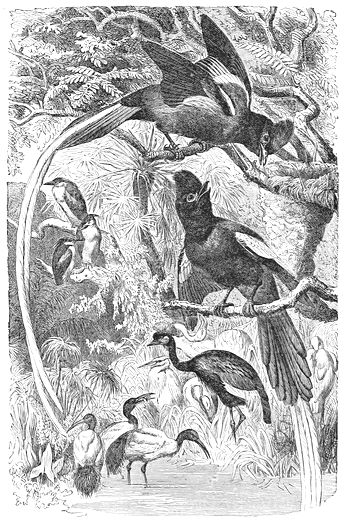
THE PARADISE FLY-CATCHERS (Terpsiphone paradisea).
The PARADISE FLY-CATCHERS, separated as a distinct group under the name of the
Terpsiphone, comprise the most beautiful and striking species of the family, and are distinguished by
the formation of their tail, which is very long and conical, the centre feathers in the male being
double the length of those at the exterior.
THE PARADISE OR ROYAL FLY-SNAPPER.
The PARADISE or ROYAL FLY-SNAPPER (Terpsiphone paradisea) is a magnificent species, two feet
in length, if we include the centre tail-feathers, which measure fifteen and sixteen inches, whilst those
at the side do not exceed five inches. The wing is four inches long. The coloration of the sexes
differs considerably—in the old male the head, crest, neck, and breast are of a greenish black; the
rest of the feathers are white, streaked here and there with black upon the shafts; the primary and
secondary quills are black, tipped with white upon the inner and entirely white upon the outer web.
The female, readily distinguished from her mate by the comparative shortness of the tail-feathers, is
like the young male, of a glossy black upon the head, neck, and breast, and white upon the belly; the
rest of the plumage being entirely nut-brown. The nestlings are ash-grey upon the throat, breast,
sides, and upper part of the belly. All have deep brown eyes, bright blue beaks and eyelids, and
lavender-blue feet. The Royal Fly-snapper inhabits the whole of India, from Ceylon to the
Himalaya, where it is replaced by another species, and is usually found within the shelter of such
forests as are not more than 2,000 feet above the sea. According to Jerdon, it occasionally ventures
forth from its favourite retreats to investigate the surrounding country, but rarely makes its home
amongst the brushwood or trees upon the open plains. Its flight is undulatory in its commencement,
and very striking, owing to the strange effect presented by its long tail, as it waves and flutters
through the air. This flowing tail is raised and spread with every appearance of delighted vanity by
its beautiful owner, as it perches quietly in the branches, and glances sharply around in order to
detect the approach of an insect, upon which it darts at once with great rapidity, and having secured
it, returns to its lurking-place. Almost the entire day is spent in restlessly flitting about from branch
to branch, and tree to tree, and constantly uttering its loud but not unpleasing cry. The nest is
formed of moss and fibres, lined with hair and wool. This magnificent bird is usually to be seen
perched upon a branch, and displaying to the utmost its beautiful plumage, as it alternately expands
and closes its graceful crest and tail, in evident appreciation and enjoyment of its own beauty. Its
flight, which is very rapid when occupied in chasing its rivals from the field, or pursuing its insect
prey, changes into a hovering motion if the bird is under no excitement, and merely wishes to fly to
a distant spot; at such times few more attractive sights can be witnessed than it presents as it thus
slowly glides in a series of undulating lines through the air, its pure white tail upheld and streaming
behind in such a manner as to form a flowing train. These long tail-feathers are only retained during
the time that the bird wears its bridal attire, and are soon torn away by the foliage of the trees when
the period of incubation is over. Unlike most of its congeners, the Paradise Fly-snapper is endowed
with a gentle and sweet-toned cry. Le Vaillant describes a nest that he was informed had been built
by one of these birds as being horn-shaped, about eight inches long, and the broadest part two and
a half inches across. This little structure, which hung in the forked branches of the mimosa-tree,
was most carefully constructed of fibres woven together, so as in its texture to resemble haircloth.
The interior was without any warm lining.
The FANTAILS (Rhipidura) are a group of birds inhabiting Australia and the neighbouring
islands; they are also occasionally to be met with in some parts of Asia. All the various species
have slender bodies, long wings, of which the fourth and fifth quills exceed the rest in length, and
well-developed tails; their tarsi are powerful, and of moderate length; their beaks broad, curving
gradually downwards to the slightly hooked extremity, and incised at the margins; the region of the
bill is covered with large bristles.
THE WAGTAIL FANTAIL.
The WAGTAIL FANTAIL (Rhipidura motacilloides), so called from its resemblance to the European
Water Wagtail (Motacilla), is of a glossy greenish black upon the mantle, throat, and sides of the
breast; a narrow, yellowish white streak passes above the eyes; and a triangular spot occupies the
tips of the smaller wing-covers. The extremities of all the webs of the exterior tail-feathers and
the entire under surface are pale yellowish white, the quills are brown, the eyes dark brown, the beak
and feet black. Both sexes are alike in colour, and differ but slightly in size, their length being
usually about five inches.
The Fantails are found extensively throughout Australia, where they frequent retired woodland
districts, but are often seen in the immediate vicinity of men; indeed, so extremely tame and social
are they that they by no means confine their visits to orchards and gardens, but enter freely into the
houses, in search of flies and other insects. Their flight is undulatory in its course, is seldom long
sustained, and never rises above the tops of the trees. Should the birds desire to reach a distant
spot, they usually descend to the ground, over the surface of which their powerful legs enable them to
run with great rapidity. The song of this species, though loud and shrill, is by no means unpleasing,
and, should the moon be bright, is often heard after nightfall. The period of incubation commences
in September, that is, in the early Australian spring, and each pair breeds twice, or, if the season be
fine, thrice within the year. Their deep, cup-shaped nest is most artistically constructed of dry grass,
bits of bark and roots, overlaid with spiders' webs, and lined with a soft bed of delicate fibres, grass,
and feathers. Such trees as overhang the water are generally preferred for building purposes. The
nest is placed very near the ground, and furnished with a strange-looking, long appendage, which is,
no doubt, intended to act as a sort of balance; it is frequently placed in situations that are fully
exposed to the violence of the sea and wind, but with such care are the materials for these beautiful
structures selected to harmonise with the colour of the branch on which they are placed, that their
discovery is always a work of difficulty. The brood consists of two or three dirty greenish white
eggs, marked with black or reddish brown spots and streaks, either at the broad end or around the
centre. During the whole time that the parents are occupied in the education of their young they
exhibit the utmost courage and anxiety to prevent the approach of an enemy, and if alarmed express
their uneasiness by a peculiar call somewhat resembling the sound produced by a child's rattle.
The TRUE FLY-CATCHERS (Muscicapæ) constitute a family of birds chiefly confined to
Europe and Asia, and though unadorned with the flowing tails and glowing tints possessed by some
of their near relations already described, comprise many beautiful species. All have elongate bodies,
short necks, and broad heads. Their wings (in which the third quill exceeds the rest in length) are
long, and their tails of moderate size, either incised or graduated at the extremity. Their short,
strong, compressed beaks are broad at the base, and terminate in a slight hook; the upper mandible
is furnished with a sharp ridge at its culmen, and the base of the bill is surrounded with bristles.
Their soft lax plumage varies considerably in its coloration, according to the age and sex of the bird,
and the young are easily recognisable by their spotted appearance.
Like most of the groups above described, all the members of this family frequent trees in
preference to bushes, and rarely seek their food upon the ground. Should the day be rainy, they
content themselves with berries; but in fine weather pass their time in actively giving chase to every
unlucky insect that chances to attract their keen little eyes as they perch quietly among the branches,
and, having secured the victim, they at once return to their lurking-place. During the period of
incubation, the males utter a monotonous cry; but at other seasons their voices are very rarely heard.
The nest built by the Fly-catchers is carelessly constructed, but furnished with a warm bed for the
reception of the young, and is placed either in holes of trees or upon a branch, quite close to the
stem. Both parents assist in hatching the four or five eggs that compose a brood, and tend the
young until the season for migrating approaches, when they leave their native lands for more southern
regions, often reaching Central Africa in the course of their winter journeyings.
THE GREY OR SPOTTED FLY-CATCHER.
The GREY or SPOTTED FLY-CATCHER (Butalis grisola) is distinguishable from its congeners by
the following characteristics:—The plumage of the male is deep grey upon all the upper part of
the body, each feather having a black shaft. The crown of the head is blackish grey, lightly spotted;
and the wing-feathers are tipped with light grey, thus forming an indistinct border to the pinions.
The entire under side is dirty white, shaded with reddish yellow upon the sides, and streaked with
faint, dark grey, oval patches on the breast and sides of the throat. The eye is brown, the beak and
feet black; the colours in the plumage of the female are paler. The back of the young is whitish,
spotted with grey, and marked with brown and reddish yellow; the under side is of a whitish shade,
spotted with grey upon the breast and throat. The male bird is five inches and a half long and nine
and a half broad; the wing measures about three and the tail three and a half inches; the female is
only a few lines smaller than her mate. These lively, restless birds inhabit all the countries of
Europe except its extreme north, and are especially numerous in the southern provinces, making their
appearance in pairs at the end of April or beginning of May; in England, about the 20th of May,
when they at once commence breeding. They leave for warmer latitudes early in the autumn.
During their winter migrations they visit the interior of Africa, and we ourselves have seen large
numbers sojourning for a time in the forests near the Blue Nile. In Europe they seem to have no
preference for any particular locality, but inhabit highland or lowland regions, unfrequented forest
tracts, or the gardens and orchards of a populous district, with equal impartiality; trees in the
immediate vicinity of water, however, afford them the retreats they most delight in, the sheltering
branches enabling them to dart down unobserved amongst the swarms of insects that disport
themselves over the surface of lakes and streams. Whilst thus engaged in watching for prey, the
Fly-catcher waves its tail to and fro, as its keen eye selects the most tempting morsel, which is
instantly swooped upon and seized with a noisy snap of the beak, the bird returning at once to its
perch. Should its victim be too large to be swallowed entire, its body is crushed against a tree in
such a manner as to tear off the wings and legs, and thus render it manageable. The bird thus
disposes of flies, gnats, butterflies, and dragon-flies, always catching them upon the wing. When
the coldness of the season compels it to subsist upon berries, these latter are also obtained whilst in
flight, by sweeping down towards the tree and snatching them from the stalk en passant, without
tarrying for a moment to rest on the branch. The delicate feet of this species do not permit it to hop
from bough to bough, and its movements upon the ground, to which it rarely descends, are feeble and
awkward; but its flight, on the contrary, is rapid, and extremely graceful, its course through the air
being diversified from time to time by a fluttering motion, produced by alternately completely closing
and broadly spreading its pinions and tail.
The voice of the Fly-catcher may be described as a gentle, twittering chatter. The call-note
is monotonous, and in moments of terror or excitement usually accompanied by violent motion
of the wings. Solitary individuals are seldom seen, and only during such time as the young are
still under parental guidance are they met with in parties; at other times they are found in pairs,
that keep apart from each other, and exhibit most determined pertinacity in driving off all intruders
from the haunts they have appropriated. The nests are built in a great variety of situations—in holes
of rocks, walls, or roofs, in hollow trunks of trees, or on a branch quite close against the main stem;
brushwood or low clumps of old willows, however, afford the seclusion these birds prefer. Green
moss, fine dry fibres, and similar materials are usually employed in constructing the somewhat
carelessly-formed domicile, which is warmly lined with horsehair, wool, and feathers. The female
alone undertakes the whole labour of building. Instances are recorded of the nest of this species
being found in very odd situations. We have heard of one built in the head of a garden-rake that
had been left standing against a wall; another was seen by Mr. Atkinson, on the angle of a lamp-post
in one of the streets of London; and a third, mentioned by both Jesse and Yarrell, occupied
a still more remarkable position—namely, within the crown of one of the lamps in Portland Place,
in London.
Should a couple not be disturbed, they produce but one brood of four or five eggs in the year;
these are laid in June, and have a blueish or blueish green shell, very variously marked with light
rust-red. Both parents assist in the work of incubation, and hatch the eggs within a fortnight. The
young grow rapidly, but remain for a long time under the care of their parents.
A curious circumstance concerning this bird is recorded by Thomas Andrew Knight, Esq.,
President of the Horticultural Society, namely, that—"A Fly-catcher that had built in a stove in one
of the green-houses in the Society's gardens was always observed to leave its nest when the thermometer
stood at 72°, and resumed its place upon the eggs as soon as the temperature fell again
below that point."
Naumann mentions a little incident that came under his notice, that will illustrate the utility
of these birds in the great scheme of Nature. "A boy in our village," he says, "succeeded in
obtaining a Fly-catcher's nest before the young were fledged, and placed the little family, including
the mother, in a room in his house. No sooner had the parent bird ascertained that all attempts to
escape were hopeless, than she at once set to work to feed her young with the flies that were winging
their flight about the chamber. Of course before long all these were consumed, and the boy was
compelled to carry his prize to a neighbour's cottage, in order that they might procure a supply of
food. In this manner the useful family went the round of the village, clearing the houses of vast
numbers of troublesome guests. My turn came last, and in gratitude for the benefit received I
succeeded in obtaining liberty for both mother and nestlings."
Despite the immense services rendered by these birds, they and their eggs are constantly
destroyed by boys and men, who are too ignorant or unthinking to know and appreciate the benefits
they confer upon us; large numbers also fall victims to the attacks of cats, martens, rats, and mice.
The Fly-catcher is easily reared, and soon so completely adapts itself to captivity that it may be
allowed to fly at large about a room. If provided with a small box filled with sand, in which an
upright stick is placed with another laid across, it prefers perching upon the latter to any other
situation, and never in any way injures the furniture of the apartment. One of these birds kept by
ourselves was fed during several successive winters upon rolls soaked in milk, and finely-minced
meat; upon this diet it became remarkably tame, and, although liberated every spring, regularly
returned to us at the end of the warm season.
The MOURNING FLY-CATCHERS (Muscicapa) differ from those members of their family
already described in the shortness of their beak, which is almost triangular, in the inferior size of
their wings, and in the diversity of plumage that distinguishes the sexes.
THE BLACK-CAPPED OR PIED FLY-CATCHER.
The BLACK-CAPPED or PIED FLY-CATCHER (Muscicapa atricapilla) is five inches long, and about
eight inches and a half broad. The male bird is deep grey, more or less clearly marked with black
upon the entire upper side; the brow, lower parts of the body, and a patch upon the wings are white.
The female is greyish brown above, and dirty white beneath; her anterior wing-quills being blackish
brown, whilst the undermost are bordered with white; the three exterior tail-feathers are white upon
the outer web. The young are similar to the mother. Both sexes have dark brown eyes, and black
beaks and feet. This species is particularly numerous in some parts of Germany, and usually makes
its appearance in England about April, leaving for more southern latitudes in September, but it is by
no means common in this country. A nest found by Mr. Heysham, of Carlisle, contained eight eggs,
one of which lay at the bottom, whilst the rest were placed perpendicularly, in regular order round
the little apartment, the narrow end turned upwards and supported against the sides of the wall.
THE COLLARED OR WHITE-NECKED FLY-CATCHER.
The COLLARED or WHITE-NECKED FLY-CATCHER (Muscicapa albicollis) is frequently mistaken
for the preceding species, the females especially bearing a most deceptive resemblance to each other.
The adult male, however, is recognisable by a white ring around the throat, and the female is without
the light edging to the tail-feathers. Both these Mourning Fly-catchers inhabit Europe, the latter
being numerously met with in its most southern countries, but comparatively rarely seen in the more
northern portions; whilst the former frequents every part of the European continent, making its
appearance at the end of April, and leaving again about September: their migrations often extend as
far as Central Africa, and are usually carried on at night: the males are always the first to leave,
and generally return to Europe before their mates. Both species are extremely lively, passing the
entire day, when the weather is fine, in pursuing their prey, or chasing each other in sportive
evolutions through the air, or hopping nimbly from twig to twig, meanwhile uttering their twittering
call-note. Even when perched, their little bodies are kept in constant motion by the incessant
agitation of their wings and tail. The song of these birds is generally to be heard long before
sunrise, when all their feathered companions are still asleep; and we are therefore inclined to listen to
their voices with a pleasure and attention, occasioned rather by the circumstances under which their
penetrating and somewhat melancholy notes are uttered, than from any intrinsic merits of their
music; during the breeding season, however, the male sings agreeably and energetically throughout
the day. Both these species of Fly-catchers subsist upon the same kinds of insects, and, should
their ordinary food fall short, have recourse to various berries, or they glean small beetles from the
leaves of the trees. Like all birds that live in a state of constant activity, they are extremely
voracious, and devour enormous quantities of grasshoppers, horse-flies, butterflies, gnats, and other
insects, always seizing their prey upon the wing, even should the victim be creeping on a leaf, or
running over the ground. The nests are usually made in hollow trees, and are padded with a
layer of moss and fibres, lined with feathers, wool, and hair. Should a hollow tree not be attainable,
the nest is built upon some branch quite close to the trunk. The brood consists of five or six
delicate-shelled, pale greenish eggs; these are incubated by both parents, and are hatched within a
fortnight after they are laid. In three weeks' time the nestlings are fledged, but they remain for a
considerably longer period under parental care and guidance. In some countries boxes are often
placed in gardens in order to attract the breeding pairs; and so tame do the families thus reared
become, that they will even allow the boxes to be moved from one place to another, without either
leaving them or testifying any uneasiness. When caged, they soon attach themselves to those who
feed them, and will take flies from the hand: Nightingales' food suits them best when they are
subjected to a life of confinement. Large numbers of these useful birds are caught by the Italians,
in a variety of nets and snares, during the time of their autumn migrations, and hundreds of them
are exposed for sale as dainty morsels in every market-place. In ancient times Fly-catchers were
sent from Cyprus to Italy prepared in spice and vinegar, and closely packed in pots or small casks.
THE DWARF FLY CATCHER.
The DWARF FLY-CATCHER (Erythrosterna parva) has been selected as the representative of a
distinct group, on account of its comparatively powerful beak and high tarsi. The length of this bird
is about five and its breadth about eight inches. Its plumage is so diversified as to have given rise
to many errors concerning the number of species. During the spring the upper part of the body of
the adult male is of brownish grey, deepest in shade towards the head; the feathers of the larger
wing-covers and the posterior quills have a light edge; the chin, throat, lower and upper breast are
rust-red; the rest of the under side dirty white; the primary quills are of a blackish brown-grey,
enlivened by a light border. In the young male the reddish brown upon the throat is paler than in
the adult bird, and all the colours in the plumage of the female are fainter and greyer than in that of
her mate. All have dark brown eyes, and black beaks and feet.
The Dwarf Fly-catcher is found extensively throughout Poland and almost the whole of
Germany, where it seems to prefer the shelter of the beech-woods, living principally in the summits
of lofty trees, and rarely approaching the vicinity of man or descending to the ground. Its call is
generally a loud piping note; but the song varies so considerably in different individuals as to be
sometimes almost unrecognisable. The nest is placed either in a hole or upon the branch of a tree,
at some distance from the trunk: it is formed of slender blades of grass vegetable fibres, green moss,
or similar materials, lined with wool and hair. The brood consists of four or five eggs, of a greenish
white, marked indistinctly with light rust-red patches. Both parents assists in the work of incubation,
and exhibit extraordinary attachment to their young; the male bird, however, devotes himself
principally to tending and entertaining his mate, whilst she undertakes the main part of the building
operations. No sooner are the nestlings capable of supporting themselves than they leave their
parents, and retire into the depths of the forests, where they remain until their winter migrations.
From the day when the parent birds are separated from their families, their nature seems to undergo
a complete change, and they at once assume a quiet, inactive deportment, that strongly contrasts with
their previously sportive, busy habits. Count Gourcy, who reared many of these Dwarf Fly-catchers,
tells us that they were readily tamed, and soon learnt to know him, welcoming his approach to the
cage by flapping their wings and waving their tails above their heads. They bathed freely, and
devoured insects in large quantities, eagerly snapping at any fly that was unlucky enough to approach
too near.
The SILK-TAILS (Bombycillæ) possess a compact body, short neck, and moderate-sized head.
Their wing, in which the first and second quills are longer than the rest, is of medium length, and
pointed at the extremity; the tail is short, and composed of twelve feathers; the straight, short beak
is broad, much compressed at its base, but raised and narrow at its tip, the upper mandible being
longer and broader than the lower one, arched at its culmen, and slightly hooked at its extremity,
which is visibly incised. The feet are short and powerful, and the exterior and centre toe connected
by a fold of skin. The soft silky plumage upon the head is prolonged into a crest, and some of
the wing and tail feathers terminate in horn-like laminæ. The coloration differs but little in the
two sexes.
THE EUROPEAN OR COMMON SILK-TAIL.
The EUROPEAN or COMMON SILK-TAIL, BOHEMIAN CHATTERER, or WAX-WING (Bombycilla
garrula) is eight inches long and thirteen and a half broad. The plumage is almost entirely reddish
grey, darkest upon the back, and shading into greyish white beneath; the brow and rump are reddish
brown; the chin, throat, bridles, and a streak over the eyes black; the primary quills are greyish
black, spotted with gold on the tip of the outer, and edged with white upon the inner web; the
secondaries are furnished with parchment-like or horny plates at their extremities, which are bright
red; the tail-feathers are blackish at their lower portion, light yellow towards their extremities, and
terminate in horny plates, resembling those upon the secondary quills. In the female the colours are
fainter, and the horny appendages much less developed than in the plumage of her mate. The
young are almost entirely dark brown, with light edges to many of the feathers; the brows and a
stripe that passes from the eyes to the back of the head, a streak across the light reddish yellow
throat and the rump are whitish, while the lower tail-covers are of a dusky rust-red.
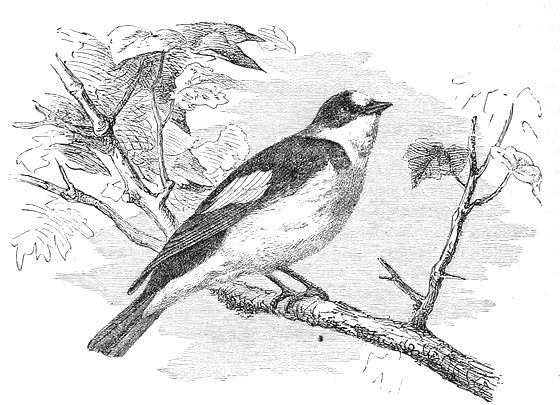
THE COLLARED OR WHITE-NECKED FLY-CATCHER (Muscicapa albicollis).
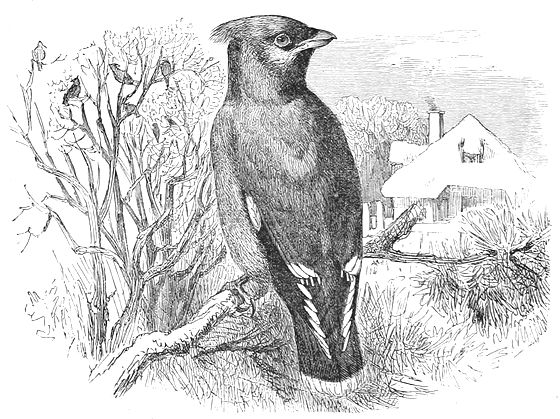
THE SILK-TAIL, BOHEMIAN CHATTERER, OR WAX-WING (Bombycilla garrula).
The Common Silk-tail is an inhabitant both of Northern Europe and of North America, but
is found only occasionally in some parts of Asia, being replaced in that continent by its Japanese
congener, the Bombycilla phœnicoptera; while in America the CEDAR BIRD (Bombycilla cedrorum) is
more numerously met with. In the northern portions of Europe, birch and pine forests constitute its
favourite retreats, and these it seldom quits, except when driven by unusual severity of weather or by
heavy falls of snow to seek refuge in more southern provinces. Even in Russia, Poland, and Southern
Scandinavia it is constantly to be seen throughout the entire winter; indeed, so rarely does it wander
to more southern latitudes that in Germany it is popularly supposed to make its appearance once in
seven years. On the occasion of these rare migrations, the Silk-tails keep together in large flocks,
and remain in any place that affords them suitable food until the supply is exhausted. Like most
other members of the feathered creation inhabiting extreme climates, these birds are heavy and
indolent, rarely exerting themselves except to satisfy their hunger, and appearing unwilling to move
even to a short distance from their usual haunts. With their companions they live in uninterrupted
harmony, and during their migrations testify no fear of man, frequently coming down to seek for food
in the villages and towns they pass over, without apparently regarding the noisy bustle of the streets.
Even during their winter journeyings, they settle frequently, and pass the entire day indolently
perching in crowds upon the trees, remaining almost motionless for some hours together, only
descending in the morning and evening to procure berries, in search of which they climb from
branch to branch with considerable dexterity. Their flight is light and graceful, being effected by
very rapid strokes of the wings. Upon the ground they move with difficulty, and rarely alight upon
its surface, except when in search of water. Their call-note is a hissing, twittering sound, very
similar to that produced by blowing down the barrel of a key. The song, though monotonous and
gentle, is uttered by both sexes with so much energy and expression as to produce a pleasing effect,
and may be generally heard throughout the entire year. Insects unquestionably constitute the
principal food of the Silk-tails during the warmer months, but in winter they subsist mainly upon
various kinds of berries. So voracious is this species, that, according to Naumann, it will devour
an amount of food equal to the weight of its own body in the course of twenty-four hours. When
caged, it sits all day long close to its eating-trough, alternately gorging, digesting, and sleeping,
without intermission. Until the last few years we were entirely without particulars as to the
incubation of the Silk-tail, and have to thank Wolley for the first account of the nest and eggs. This
gentleman, who visited Lapland in 1857, determined not to return to England until he had procured
the long-desired treasure, and, after great trouble and expense, succeeded in collecting no fewer than
600 eggs. All the nests discovered were deeply ensconced among the boughs of pine-trees, at no
great height from the ground; their walls were principally formed of dry twigs and scraps from the
surrounding branches; the central cavity was wide, deep, and lined with blades of grass and feathers.
The brood consists of from four to seven, but usually of five eggs, which are laid about the middle
of June; the shell is blueish or purplish white, sparsely sprinkled with brown, black, or violet spots
and streaks, some of which take the form of a wreath at the broad end (see Fig. 25, Coloured
Plate IV.) The Silk-tail readily accustoms itself to life in a cage, and in some instances has been
known to live for nine or ten years in confinement, feeding principally upon vegetables, salad, white
bread, groats, or bran steeped in water.
The MANAKINS (Pipræ) constitute an extensive family of most beautiful and gaily-plumaged
birds, inhabiting America, Southern Asia, and New Holland. Almost all the members of this group
are of small size, few being larger than a Pigeon, and all are clothed in soft, silky feathers, glowing
with the most brilliant hues. Their bodies are compact; their wings short, or of moderate length;
their beak short, broad at the base, arched at the culmen, and slightly hooked and incised at its
extremity. The feet are powerful, the tarsi rather long, and the toes comparatively short. The
plumage, always compact and thick, varies much in its coloration, according to the age and sex.
All these birds inhabit forests and woodland districts, some few frequenting hilly or mountainous
tracts, while the greater number are only seen in lowland regions. Most of them are extremely lively
and social, passing their time in flying in small parties about the summits of forest-trees, and attracting
the attention of travellers as much by the peculiarity of their cry as by the glowing tints of their
plumage. They live almost exclusively on fruits of various kinds, sometimes on such as are of
considerable size. Kittlitz mentions having upon one occasion seen a Manakin flying with such
difficulty as to arrest his particular notice, and having brought down the bird with his gun, he
found on examining the stomach that it contained a half-digested palm-nut. "How it was possible,"
he says, "for the bird to have swallowed a fruit nearly as large as its own body appeared to me most
extraordinary, but close investigation showed me that the gape of this species, like that of a snake, is
capable of great extension. I am, however, still at a loss to explain how the juices of the stomach
were enabled to demolish so huge a morsel." Some few species also devour insects.
The ROCK BIRDS (Rupicola) comprise some of the largest species in the entire family. Their
bodies are powerful; their wings, in which the fourth quill exceeds the rest in length, are long; the
tail is short, broad, straight at the tip, and almost covered by the long feathers upon the rump. The
tarsi are robust, the toes long, and armed with thick, long, and very decidedly hooked claws. The
feathers upon the back are broad, with either sharp tips or angular extremities; those upon the brow,
top of the head, and nape, form an upright crest or plume.
THE COCK OF THE ROCK.
The COCK OF THE ROCK (Rupicola crocea), the best known species of this group, has been
minutely described by many writers. The rich plumage of the adult male is of a bright orange-yellow;
the feathers that form the crest are deep purplish red; the large wing-covers, quills, and
tail-feathers brown, edged with white at their tips, and marked with large white spots. The females
and young are of an uniform brown; the lower wing-covers orange-red; the rump and tail-feathers
light reddish brown; and their crest considerably smaller than that of the male. All have orange-red
eyes, greyish yellow beaks, and yellowish flesh-pink feet. The male is twelve inches long; his wing
measures seven and his tail nine inches, the female is at least two inches smaller.
The Cock of the Rock is an inhabitant of Guiana and North-eastern Brazil, where it frequents
well-watered mountain regions, and the immediate vicinity of waterfalls, only quitting these localities
about June or July, to visit the woods and forests, in order to procure the abundant supply of
ripe fruit that awaits it at that season; but it never, even during these excursions, descends into
the open plains. Humboldt met with these birds on the shores of the Orinoco, and Schomburghk
encountered them twice, each time in large flocks, whilst he was travelling through British Guiana,
once on the Canuku Mountains, and again amongst the sandstone rocks near Wenham Lake. "On
one occasion," says Schomburghk, "after ascending to the summit of a lofty precipice, so entirely
covered with huge blocks of granite overgrown with moss and ferns as to be almost impassable, we
came suddenly upon a small open spot, entirely destitute of vegetation. A signal from the Indian
who accompanied me warned me to conceal myself silently amongst the surrounding brushwood.
We had only been for a few moments thus hidden from view, when we heard a sound so exactly
resembling the cry of a kitten that I concluded we were about to attempt the capture of some
small quadruped. The cry was instantly and most exactly imitated by my guide, and he was again
answered by similar voices proceeding from every direction. In spite of a sign from the Indian to
have my gun in readiness, the first sight of the beautiful birds, whose strange notes had thus deceived
me, took me so completely by surprise, that I quite forgot to fire until too late; for after darting
rapidly from the bushes, and ascertaining by a rapid glance that they had been deluded by a false cry,
they instantly retreated to their former shelter. Before leaving the spot, however, I succeeded in
shooting seven of the flock, but was not fortunate enough to see them perform the peculiar dances
and evolutions I had heard described by my brother and my Indian guide." We will give our readers
a description of the strange and interesting spectacle here alluded to, as afterwards witnessed by
himself; in the same naturalist's own words:—"Having at last attained a suitable spot, we listened
breathlessly for the cry of the birds, and my guides having ascertained exactly where they were
amusing themselves, I was noiselessly conducted behind some bushes close to their ball-room, and
after we had lain ourselves flat on the ground, saw one Of the most attractive and extraordinary sights
I ever beheld. Some twenty of these glorious birds were seated upon the stones and rocks around
a small open space, in the centre of which a solitary male was dancing vigorously, and performing
a great variety of evolutions, alternately springing repeatedly with both feet from the ground,
spreading his wings, and moving his head, with most comical gestures, from side to side, waving
his tail like a wheel through the air, and then, when nearly exhausted by his long-sustained
exertions, concluding by walking coquettishly around the open space, as though desirous to receive
the applause of the spectators, which the females expressed by uttering a very peculiar cry. One
after another the males came down and took their turn in amusing the company, each going back
to his seat before another performer commenced. So completely absorbed was I in watching these
strange evolutions, that I had entirely forgotten my Indian companions, and was much startled when
a sudden shot was heard, and four of these beautiful birds fell. The rest of the party at once rose
in great terror, leaving their companions dead upon the ground."
The remarkable performance thus described by Schomburghk is no doubt a part of the courtship
of the Cock of the Rock. We learn from the same authority that the nestlings are to be found at
all seasons of the year, but in the greatest numbers about March, when the plumage of the male is
in its full beauty. The nests found by Humboldt in Orinoco were made in holes in the granite rocks,
whilst those seen by Schomburghk were built in clefts and fissures, suspended like the nest of a
Swallow, and covered with resin. One of these nests is often occupied for years together, and
repaired by the addition of fresh fibres, feathers, or down, for the reception of each new brood. It
is by no means uncommon to find a great number of nests in the same cleft or hole. The brood
consists of two white eggs, marked with black, and somewhat larger than those of a Pigeon. The
nestlings are reared upon the same fruits and berries that afford the parents their principal means of
subsistence. Great numbers of these splendid birds are shot annually, as their skins not only
command a high price, but are much employed by the Indians in making a variety of beautiful
decorations: a large state mantle worn by the Emperor of Brazil was entirely composed of their
feathers. In some districts of South America the natives are compelled to bring a certain supply of
skins as tribute, and are thus quickly diminishing the numbers of these elegant creatures. Their
flesh is well-flavoured, but of a very peculiar colour, being bright orange-red. Humboldt tells us
that the Cock of the Rock is much valued by the Indians as a domestic favourite, and is kept by
them in cages made of the stalks of palm-leaves.
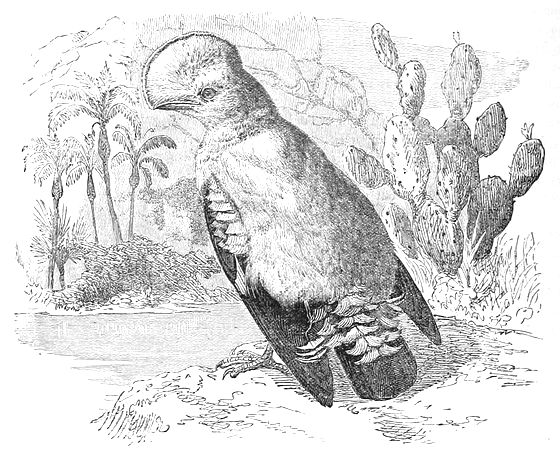
THE COCK OF THE ROCK (Rupicola crocea).
Another very similar species, found only in Peru, the Peruvian Cock of the Rock (Rupicola
Peruana), lives entirely amongst trees, upon the berries and fruits of which it subsists; but it exhibits
none of the dancing propensities of its Brazilian relative. We learn from Tschudi that in no instance
did he ever see one of these Peruvian birds either on rocks or upon the ground, but always
associated in large flocks, that lived and built their nests upon trees. He tells us that they are easily
discovered from a considerable distance by their loud and most discordant cry.
The TRUE MANAKINS (Pipra) comprise a number of small and most magnificently-tinted
birds, distinguished by the shortness of their wings and tails. In the former the primary quills are
graduated, very narrow towards the tip, and do not extend beyond the base of the small tail, which
is either conical or quite straight at its extremity. The short high beak is compressed at its centre,
slightly incised directly behind the hook that terminates the upper mandible, and furnished with a
sharp ridge at its culmen. The tarsi are high and thin, and the toes short, the outer and centre toes
being united as far as the first joint. The compact thick plumage is extremely short in the region of
the forehead, and takes the form of fine bristles around the nostrils and the base of the beak. In the
coloration of the male, black predominates, affording a rich contrast to the glowing fiery tints that
adorn some parts of his body; whilst the females and young usually appear in a modest garb of
greyish green. The Manakins live in pairs, or small parties, and principally frequent the inmost
glades of their native woods and forests, hopping from bough to bough with untiring sprightliness, and
enlivening the most gloomy recesses of their sylvan haunts by their gay colours and animated twitter.
Before noon these pairs or parties unite with other birds in search of food, and at the approach of
the mid-day heat again retire to their favourite sheltered nooks. Insects, fruits, and berries of various
kinds, constitute their principal food, and to obtain these they occasionally venture near the abode of
man. Schomburghk mentions having seen several of these usually very timid birds approach his
tent daily, in order to gather the ripe fruit from some fig-trees that grew close to his encampment.
The nest of the Manakins is carelessly formed of moss, and lined with cotton wool. The two eggs
that constitute a brood are unusually elongated, of a pale tint, and marked with delicate spots that
generally form a wreath at the broad end.
The LONG-TAILED MANAKINS (Chiroxiphia) constitute a prominent group of the family
under consideration, and are recognisable by the prolongation of the centre tail-feathers, this
peculiarity being particularly observable in the male.
THE LONG-TAILED MANAKIN.
The LONG-TAILED MANAKIN (Pipra-Chiroxiphia-caudata) has a sky-blue body, with black wings,
throat, and tail, only the two centre feathers of the latter being blue; the brow and top of the head
are red. The females and young are of an uniform greenish hue, shaded with brown upon the quills
and the extremities of the tail-feathers. Both sexes have dark brown eyes, light reddish brown beaks
with very pale margins, and brownish flesh-red feet. The male is about six inches long and ten
broad; his wing measures two inches and five-sixths, and his tail two and a half inches. The female
is only a few lines smaller than her mate.
The Prince von Wied tells us that he met with this beautiful species very frequently during his
travels through Bahia, and generally found it associated in small flocks, which took refuge amid the
dense foliage of the trees at the first alarm of danger. We learn from the same author that during the
breeding season they live in pairs, and usually build in the fork of a branch, at no very considerable
height from the ground. The nest is small, carelessly formed of twigs, blades of grass, wool, and
moss, woven roughly together, and generally contains two large eggs, with a greyish yellow shell,
marked with indistinct spots, and a somewhat more clearly defined wreath at the broad end. The
call-note of the bird is a loud, clear, piping tone. According to Burmeister, the Long-tailed Manakin
is never seen near the settlements of the colonists.
THE TIJE.
The TIJE (Pipra-Chiroxiphia-pareola) is the species we have selected to represent a group
possessing tails that are quite straight at the extremity. The body of the male is principally of a coal-black,
the back alone being sky-blue, whilst the head is adorned with a magnificent blood-red
fork-shaped tuft or crest. The plumage of the female is entirely siskin-green, without markings of
any kind. Both sexes have greyish brown eyes, black beaks, and yellowish red feet. The length of
this bird is four inches and two-thirds, and the breadth nine inches and six lines.
The Tije is met with very extensively in a northerly direction, from Bahia as far as Guiana,
where it inhabits the forests and woodland districts, subsisting exclusively upon fruit and berries.
Schomburghk describes the nests he found as formed of moss and cotton wool. They contained
but two eggs. Incubation, he tells us, takes place in April and May. The call-note of the Tije is
monotonous and loud.
THE BLACK-CAP MANAKIN.
The BLACK-CAP MANAKIN (Pipra-Chiromachæris-Manacus) is the representative of a group
known as the Chiromachæris, recognisable by their high tarsi, the sickle-shaped form of the first
primary quill, and the beard-like development of the plumage in the region of the chin. In the
Black-cap Manakin the top of the head, back, wings, and tail are black; the rump grey; the neck,
throat, breast, and belly white. The plumage of the female is entirely green. The eyes of both sexes
are grey, their beaks lead-coloured, and whitish on the lower mandible; the feet are pale yellowish
flesh-colour. "This beautiful bird," says the Prince von Wied, "is found extensively throughout
South America, and is particularly numerous in Guiana, living, except during the breeding season, in
small parties and flocks, that keep either quite close to the ground, or at no great distance from its
surface. When in flight they move from spot to spot with astonishing celerity, the rapid action of
their wings occasioning a strange loud sound, not much unlike the drone of a spinning-wheel." The
voice of the Black-cap Manakin is likewise described by travellers as very remarkable. It is, we are
told, capable of uttering two entirely dissimilar notes, the first of which resembles the sharp, cracking
noise produced by breaking a nut, followed by a bass note so deep as to lead travellers to suppose it
to be rather the growl of a large quadruped than the cry of a small bird. The food of this species
consists of insects and berries. The nest is similar to that of its congeners. In Brazil the Black-cap
Manakin is called the "Mono," or "Monk," from the faculty it has of inflating the feathers upon its
throat in such a manner as to resemble a beard.
The PANTHER BIRDS (Pardalotus) constitute a group of small Australian species, very nearly
allied to the Manakins, but possessing short thick beaks, very broad at the base, and deeply indented
behind the hooked tip of the upper mandible. Their feet and tarsi are long and thin, the exterior
and centre toe being partially united; the wings are pointed, the tail short. The plumage is
conspicuous for its elegant markings.
THE DIAMOND BIRD.
The DIAMOND BIRD (Pardalotus punctatus), as the best known species is called, has received
its name from the spots on its plumage. The crown of the head, wings, and tail, are black, with a
round white patch at the tip of each feather; a white streak passes above the eyes, the cheeks and
sides of the neck are grey, the feathers on the back grey, shading at their roots into brown, and edged
with black at the extremities. The uppermost tail-covers are cinnabar-red; the front of the throat,
breast, and lower tail-covers yellow; the belly and sides are yellowish red; the eyes deep brown, the
beak brownish black, and the feet brown. The female resembles her mate, but is somewhat
less brightly coloured. Both sexes are three inches and a half long.
The Diamond Bird is found throughout the whole of Southern Australia, from east to west, and
is still numerously met with in Van Diemen's Land. Trees and bushes are its favourite resorts, and
in search of these it ventures freely into the gardens of the settlers, where it speedily attracts attention
by the activity it displays in gleaning its insect fare from the leaves and branches, and by the constant
repetition of its very pleasing piping note, composed of two syllables, which have been freely translated
by the German settlers into the words, "Wie tief, wie tief." The most striking peculiarity, however,
in this beautiful little bird is the strange manner in which it builds, the nest being placed not in
hollow trees, but in holes excavated by the brooding pairs in the ground, generally on the side of
some steep declivity. These excavations form galleries, or passages, usually from two to three feet
long, and at their mouth are just large enough to allow the bird to pass through, whilst the lower end
is made much wider, for the reception of the nest, and so raised as to insure safety from the entrance
of rain. The chamber for the accommodation of the young is of a round shape, about three inches
in diameter, with an entrance hole in its side. This apartment is most beautifully formed of scraps
from the bark of the gum-trees, woven together with a perfection of neatness that cannot fail to
astonish all who see it, if they consider that the labour of its construction is carried on entirely in the
dark; the Diamond Bird affording, in this respect, a very striking contrast to such other members
of the feathered creation as build under similar circumstances, their nests being, almost without
exception, a mere heap of materials thrown loosely and carelessly together, without the slightest
attempt at shapeliness, or endeavour to arrange the heterogeneous mass. Gould was fortunate
enough to discover a number of these nests, notwithstanding the care taken by the Diamond Birds
to excavate only in such localities as are completely overgrown with plants or the roots of trees.
The brood consists of four or five round, smooth-shelled eggs, of a pale reddish white. The female
lays twice within the year.
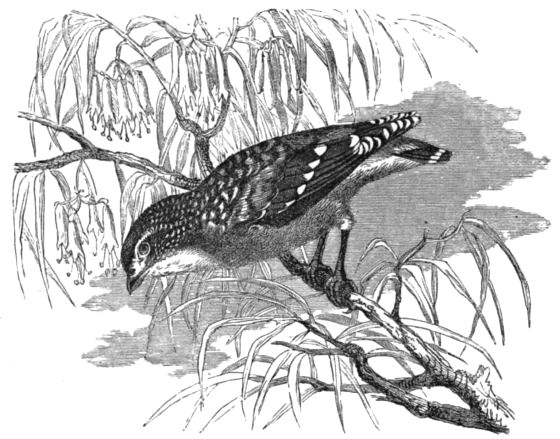
THE DIAMOND BIRD (Pardalotus punctatus).
The BALD-HEADED CROWS (Gymnoderi) constitute a family generally regarded as nearly
allied to the Manakins (Pipræ), although differing considerably from the latter in the peculiarity of
their habits and the superiority of their size, which varies from that of a Crow to that of a Thrush.
The Gymnoderi are recognisable by their powerful body, (in many respects resembling that of a Crow),
short neck, moderately long and pointed wings, in which the third quill exceeds the rest in length,
and short tail, composed of twelve feathers, and straight at its extremity. The beak varies somewhat
in different groups, but is usually flatly compressed both towards the base and at the hooked tip,
which is furnished with a slight cavity, for the reception of the end of the lower mandible. The
gape extends very far back, nearly to beneath the eyes. The feet, though short and strong, are only
fitted for perching, and are seldom employed as means of progression. The plumage is thick,
compact, and composed of large feathers, but differs so considerably in different species as to render
a general description impossible. In all the members of this family the windpipe is very wide, and
furnished on each side with a delicate layer of muscular fibres.
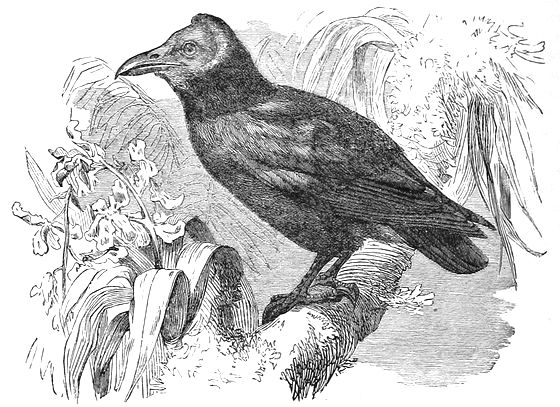
THE CAPUCHIN BIRD, OR BALD FRUIT CROW (Gymnocephalus calvus).
The Bald-headed Crows inhabit the forests of South America, and subsist entirely, or almost
entirely, upon juicy fruit. In disposition they are indolent, possessed of but little intelligence, and
extremely shy. Some few species are rarely heard to utter a note; but they are, for the most part,
remarkable for the loudness of their voice, by which their presence is readily detected.
THE CAPUCHIN BIRD.
The CAPUCHIN BIRD, or BALD FRUIT CROW (Gymnocephalus calvus), represents one of the
most remarkable of the groups into which the family of Gymnoderi is divided. The body of this
species much resembles that of a Crow, with some slight variation in the different members; that is
to say, the beak is considerably flatter, the feet shorter and stronger, and the toes comparatively much
longer than in that bird. The slightly-pointed wings extend to the middle of the short tail; the
region of the beak, bridles, and eyes, the brow, the top of the head, and the throat, are bare, and
along the cheek-stripes are four stiff bristles. The plumage is compact, of a reddish brown colour,
shaded with olive-green upon the back; the quills and tail-feathers are blackish brown, the secondaries
tinted with red; the upper wing-covers are greenish brown; the face, beak, and feet black; and the
eyes dark brown; the bare portions of the face are slightly strewn with bristles; in the young these
bristles are replaced by a whitish down, and the entire plumage varies considerably, not only from that
of the adult birds, but in different individuals. The body of this species measures sixteen, the wing
nine, and the tail four inches.
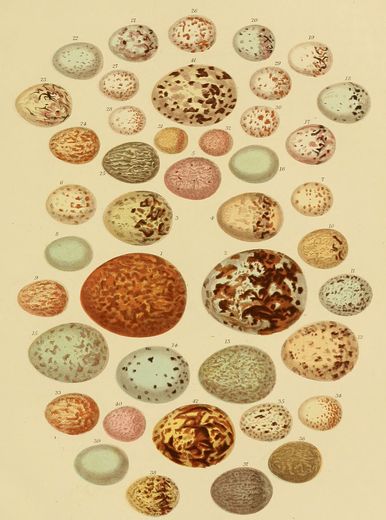
Plate 16, Cassell's Book of Birds
1. Kestrel (Falco tinnunculus).—2. Sparrowhawk (Accipiter Nisus).—3. Great grey Shrike (Lanius excubitor).—4. Red backed Shrike (Lanius collurio).
5. Cuckoo (Cuculus canocus).—6. Nuthatch (Sitta europæa).—7. Creeper (Certhia familiaris).—8. Pied Fly-catcher (Muscicapa luctuosa).—9.
Spotted Fly-catcher (Muscicapa grisola).—10. Yellow Wagtail (Motacilla flava).—11. Pied Wagtail (Motacilla alba).—12. Missel Thrush (Turdus
viscivorus).—13. Blackbird (Turdus merula).—14. Thrush (Turdus musicus).—15. Ring Ouzel (Turdus torquatus).—16. Red Start (Phoenicura
ruticilla).—17. Greenfinch (Cocothraustes chloris).—18. Bulfinch (Pyrrhula vulgaris).—19. Goldfinch (Fringilla carduelis).—20. Lesser Redpole
(Fringilla linaria).—21. Chaffinch (Fringilla cœlebs).—22. Linnet (Fringilla cannabina).—23. Yellow-ammer (Emberiza citrinella).—24. Tree Sparrow
(Passer montanus).—25. House Sparrow (Passer domesticus).—26. Greater Titmouse (Parus Major).—27. Tomtit (Parus ceruleus).—28. Bottle
Tit (Parus caudatus).—29. Marsh Titmouse (Parus palustris).—30. Cole Titmouse (Parus ater).—31. Golden-crested Wren (Regulus auricapillus).—32.
Fire Crest (Regulus ignicapillus).—33. Redbreast (Erythaca rubecula).—34. Wren (Troglodytes europæus).—35. Swallow (Hirundo
rustica).—36. Tit Lark (Anthus pratensis).—37. Skylark (Alauda arvensis).—38. Woodlark (Alauda arborea).—39. Hedge Sparrow (Accentor modularis).—40.
Grasshopper Warbler (Salicaria locustella).—41. Nightjar (Caprimulgus europæus).—42. Quail (Coturnix vulgaris).
We are almost entirely without particulars as to the habits of these remarkable birds, except that
they live in pairs in the depths of the forests of Guiana and North Brazil, and are rarely met with
at an altitude of more than 1,200 feet above the level of the sea. Fruits appear to constitute their
principal nourishment; and when not engaged in satisfying the calls of hunger, the couples are
usually to be seen perched side by side upon a branch. Their cry, which resembles the bleating
of a calf, is uttered, according to Schomburghk, at regular intervals.

THE UMBRELLA BIRD, OR UMBRELLA CHATTERER (Cephalopterus ornatus).
THE UMBRELLA BIRD.
The UMBRELLA BIRD, or UMBRELLA CHATTERER (Cephalopterus ornatus), is one of the most
extraordinary of birds, as far as regards the singular ornaments with which it has been provided. It
is about the size of a Crow, and the whole of its plumage being of a deep black it has a good deal
of the corvine character in its aspect. Its head is adorned with a large and spreading crest, which
appears intended to act as a parasol: this crest is composed of long, slender feathers, rising from
a contractile skin on the top of the head; the shafts are white, and the plumes glossy blue, hair-like,
and curved outwards at the tips. When the crest is laid back the shafts form a compact white
mass, sloping up from the back of the head, and surmounted by the dense hairy plumes. Even in
this position it is not an inelegant ornament, but when fully opened its peculiar character is developed.
The shafts then radiate on all sides from the top of the head, reaching in front beyond and below
the tip of the beak, which is thus completely concealed from view. The crest forms a slightly
elongated dome, of a beautiful shining blue colour, having a point of divergence rather behind the
centre, like that in the human head. The length of this dome from front to back is about five inches,
the breadth from four inches to four and a half. As if this remarkable crest was not enough to
distinguish the bird amongst its fellows, it is likewise furnished with a second singular ornament,
resembling which nothing is to be found in the feathered creation. This is a long cylindrical plume,
depending from the middle of the neck, and carried either close to the breast, or puffed out and
hanging down in front, the feathers lapping over each other like scales, and bordered with fine
metallic blue. On examining this plume, it is found not to be composed of feathers only; the skin
of the neck is very loose, and from the lower part grows a long, fleshy process, about as thick as a
Goose's quill, and an inch and a half long, to which the feathers are attached, thus producing a
beautiful tassel depending from the breast, and forming an appendage as unique and elegant as the
crest itself.
The plumage of this strange bird is of an almost uniform black; the feathers on the mantle
edged with dark greenish black; the crest is blackish blue; the quills and tail-feathers deep black.
All the small feathers have white shafts; the eye is grey; the upper mandible blackish brown, the
lower greyish brown, and the feet pale black. The length of this species is about nine inches and
a half; the wing measures eleven inches and three lines.
The Umbrella Birds are inhabitants of Peru, where they particularly frequent the precipices on
the eastern side of the Cordilleras, to an altitude of 3,000 feet above the sea; and from thence are
met with as far as Rio Negro, and the boundaries of Chile. They associate in small flocks, which
subsist principally upon fruit of various kinds, and live almost entirely at the summits of lofty trees.
Their remarkable cry, which resembles the lowing of a cow, is most frequently heard just before
sunrise and after sunset. We are entirely without particulars as to their nidification and manner of
breeding.
The BELL BIRDS (Chasmarhynchus)—so called from the resemblance of their voices to a
muffled bell—constitute a group with whose habits we are much more familiar. Their body is
compact, and about as large as that of a Pigeon. The wings, in which the third and fourth quills
exceed the rest in length, are long, and extend as far as the centre of the tail: the latter is slightly
rounded at its tip. The beak is about half as long as the head, and so much depressed as to be
far broader than it is high; the upper mandible is slightly arched, and curves somewhat at its tip,
behind which is a small tooth-like appendage. The gape is remarkably large. The tarsi are short,
and the toes long. The thick plumage is composed of small feathers, and takes the form of bristles
in the region of the beak, which is also furnished with very remarkable fleshy appendages resembling
those possessed by the Turkey. The coloration of the feathers varies very considerably, not only in
the four species that compose the group, but in the different sexes.
THE BARE-NECKED BELL BIRD.
The BARE-NECKED BELL BIRD (Chasmarhynchus nudicollis). This bird, which is called "The
Blacksmith" by the Brazilians, is entirely of a pure snow-white, with the exception of the bridles
and throat, which are bare and of the colour of verdigris. The eyes are greyish brown, the beak
black, and the feet flesh-pink. The length of this species is about ten, and its breadth nineteen
inches; the wing measures nine inches and three-quarters, and the tail three inches and a quarter.
The female is not quite so large as her mate, she is black upon the throat and top of the head; the
upper part of her body is of a siskin-green, the under side yellow, longitudinally spotted with black,
and streaked with whitish and yellowish lines upon the throat. The young male resembles the
mother until it is one year old, when it acquires white spots, and only in its third year appears in the
garb of the adult.
THE ARAPONGA.
The ARAPONGA (Chasmarhynchus variegatus) is also white over the greater portion of its body,
but the delicate purity of its hue is marred by a slight intermixture of grey. The wings are deep
black, and the top of the head pale brown. The front of the throat is bare, but studded with a
multitude of small, fleshy, worm-shaped appendages, of a deep brown colour; the beak and feet are
black. The plumage of the female is greenish, and on her throat the strange appendages of the male
are replaced by feathers.
THE TRUE BELL BIRD.
The TRUE BELL BIRD (Chasmarhynchus carunculatus) is entirely snow-white. The male is
furnished with a very remarkable wattle at the base of the beak, which is hollow, black, and muscular.
When the bird is under the influence of no emotion, this wattle is flaccid and pendent, but when
excited he raises and inflates this fleshy horn until it attains a length of about two inches, and a
thickness of half an inch at its root. Schomburghk tells us that the female is larger than her mate,
but her fleshy lappet is proportionately considerably smaller. The young resemble the mother, and
present a very remarkable appearance whilst in their state of transition.
THE THREE WATTLED BELL BIRD.
The THREE-WATTLED BELL BIRD, or HAMMERER (Chasmarhynchus tricarunculatus), is furnished
with three fleshy lappets, one of which grows above the base of the beak, whilst the two others appear
as prolongations of the corners of the mouth. The colour of these lappets, as also of the bill and
feet, is blackish; that of the eye, light brownish red. The head and throat of the male are bright
chestnut-brown, and the nape and upper part of the breast pure white. The female, whose plumage
is olive-green, streaked with a lighter shade on the under side, is entirely without the appendages
that distinguish her mate. The young resemble the mother. The length of this species is twelve
inches; the wing measures six and a half, and the tail four inches; the lappet on the upper part of the
beak is from two inches and a half to three inches long, and those at the corners of the mouth about
two inches and a half. In the young the fleshy appendages are mere rudiments.
All the different kinds of Bell Birds above described belong to South America. The Blacksmith
inhabits the Brazilian forests, the Araponga is met with in the northern portions of the continent,
whilst the True Bell Bird is found in Guiana, and the Hammerer in Costa Rica. As far as is at
present ascertained, it would appear that in their habits and mode of life these different species
closely resemble each other. The Blacksmith, we are told by the Prince von Wied, is one of the
most attractive and beautiful of the many strange occupants of the magnificent forests of Brazil; the
dazzling whiteness of its plumage affording a striking contrast to the rich deep hues of the leafy
retreats it usually prefers. Its loud clear note is distinctly heard to a very considerable distance, as
it rings, bell-like, at regular intervals, through the surrounding silence, or is rapidly repeated with a
force and peculiarity of tone that strongly resembles the blows made by a smith upon his anvil. No
sooner does one bird commence than all the rest of a party follow suit, and combine their efforts to
produce such a concert as must be heard to be appreciated. The Blacksmith also frequently perches
upon the very topmost bough of one of the giant trees of the forest, at such a height as to be out
of the sportsman's reach, who is thus often compelled to content himself with admiring its snowy
plumage, as the bird stands in bold relief against a background of deep blue sky, and ever and anon
sounds its metallic note, as though to call attention to its conspicuous position. Waterton speaks
with equal enthusiasm of the True Bell Bird, whose voice, he tells us, is heard throughout the entire
day, but most frequently at early morning or after sunset. Each tone is followed by a considerable
pause, lasting, after the first three notes, for the space of six or eight minutes, when the strange
performance recommences, with not more than one minute's interval between the sweet, bell-like
sounds, which are often audible at a distance of three miles. As long as the bird is in repose, the
fleshy lappets we have described hang downwards, but they are raised and turned in all directions
at the instant that the cry is uttered; and, on its cessation, drop at once to their former position.
The females generally perch on the lowest branches, but are not easily discovered, owing to their
silence, and the greenish hue of their feathers, which enables them to hide securely amid the foliage.
Fruits and berries constitute the principal food of this group, and, according to Schomburghk, they
also occasionally eat insects. The Bell Birds make their appearance in Demerara and Berbice about
May or June, from whence they spread over the face of the country, rarely occupying wooded heights
at more than from 1,200 to 1,500 feet above the sea, and never visiting the immediate neighbourhood
of the coast. Strange to say, notwithstanding the interest excited in these strange and beautiful
occupants of the South American forests, we are still entirely without any particulars as to their
breeding, nidification, or powers of enduring life in a cage.
The THRUSHES (Turdidæ) constitute a group that comprises some of the larger birds of the
order. Their body is powerful, their neck short, and head large; the bill is straight, compressed at
its sides, and slightly incised at the tip of the upper mandible, which curves downwards over the
lower portion of the beak. The tarsi are high, and covered with large plates; the toes moderate,
armed with very decidedly hooked claws; the wing is of medium length, and contains ten primary
quills, of which the third is the longest; the formation of the tail varies considerably; in some cases
it is short and rounded, in others long and graduated; but, generally, it is of moderate size, and more
or less straight at its extremity; the plumage is thick, usually of some dusky hue, but occasionally
brightly coloured.
The GROUND SINGERS (Humicolæ), as the most gifted of the above family have been
named, include some of the smaller species of Thrushes, and are recognisable by their comparatively
slender bodies short wings, moderate-sized tail, high tarsi, pointed beaks, glossy dark plumage, and
expressive eyes. The Ground Singers are entirely confined within the limits of the eastern
hemisphere, and make their appearance in Europe with the commencement of spring, leaving again
for warmer latitudes at the approach of autumn. They usually prefer woodland regions, more
especially such as are well watered, as they there find an abundance of the larvæ, worms, and
berries, upon which they mainly subsist. Unlike the groups above described, they glean their food
principally from the ground, as they hop over the surface of the soil with the utmost agility, and
rarely seek their insect fare upon the trees, from which, however, they pluck ripe berries with much
adroitness. From every point of view we must recognise in these birds a very high degree of
intelligence, all the senses being well developed, and their sight and hearing particularly good. When
upon the wing, their motions are rapid and easy, and as regards their wondrous vocal gifts we need
only allude to one member of the group, the Nightingale, the "Queen of Song," to convince our
readers that their musical powers are unequalled in the whole feathered creation. In disposition
they are vigilant, acute, and lively, ever on the alert against danger, and daring and prompt in
encountering a foe. The nests built by the Ground Singers are large, thick, and usually placed in
holes among the projecting roots, or in the hollow trunks of trees, also in hedges or other similar
situations, but they vary considerably in appearance, according to the species of the builder. The
brood consists of from four to seven eggs, which are either of one uniform colour or marked with
faint spots. The cares of incubation are undertaken by both parents. The young are at first clad
in a speckled plumage, but resemble the adult birds before the end of the first autumn. Most of
the members of this delightful group are eminently suited for life in a cage, and become attached
to those who rear them.
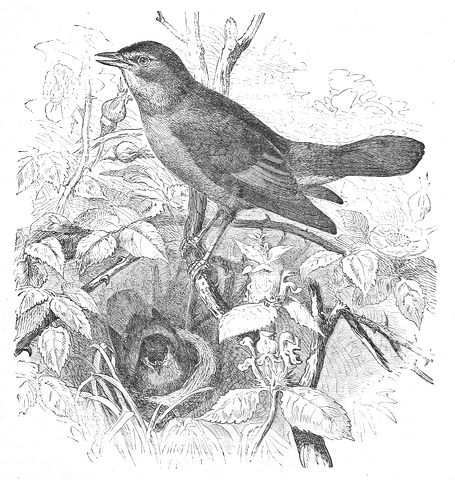
THE NIGHTINGALE (Luscinia Philomela).
The NIGHTINGALES (Luscinia) are recognisable by their slender body, strong legs, high
tarsi, moderately long wings and tail, the latter of which is rounded at the extremity. The beak is
almost straight, and pointed at its tip; the close thick plumage in both sexes is of a reddish grey.
THE NIGHTINGALE.
The NIGHTINGALE (Luscinia Philomela)—see Coloured Plate XVIII.—as the species so familiar
to us all is called, is reddish grey upon the upper part of the body, the top of the head and the back
being of a deeper shade; the under side is light yellowish grey, palest on the throat and near the
centre of the breast; the inner webs of the quills are dark brown, and the tail-feathers brownish red.
The eye is also brownish red, and the beak and feet reddish grey. In the young birds some of the
feathers on the back have light yellow spots on the shafts, and are edged with pale black, thus giving
the plumage a speckled appearance. The length of this bird is six inches and a half, and its breadth
nine inches and two-thirds; the wing measures three and the tail two inches and three-quarters.
The female is slightly smaller than her mate.
This Nightingale is met with over the whole continent of Europe, from Sweden to the
Mediterranean, and over a large portion of Central Asia, as far north as the middle of Siberia; it
also visits North-western Africa in the course of its migrations. Central Europe, Turkey, and Asia
Minor possess a very similar species (Luscinia major), although, as its name indicates, larger and
stronger than that above described, from which it is also distinguished by the shortness of the first
wing-quill, and the markings that adorn the breast. Both these vocalists are much alike in their
habits and general demeanour, but are readily identified by the peculiarities that characterise their
song. Woods, groves, and leafy forests in the immediate vicinity of water afford the favourite retreats
of these "most musical, most melancholy" songsters; in such localities they live, each pair within
its own especial domain, which, although small, is jealously guarded, and boldly defended from all
intrusion. The larger species would seem to prefer low-lying districts, but its more celebrated relative,
according to Tschudi, is met with in Switzerland and Spain, at an altitude of from 3,000 to 5,000
feet above the sea, if trees and brushwood be there attainable. Some parts of Southern Europe
are especially frequented by these delightful birds; Spain in particular is extremely fortunate in this
respect; and in certain districts their enchanting voices are heard from every bush and hedge. The
declivities of Sierra Morena may be literally described as an extensive "nightingale garden;" and
those who, like ourselves, have been so fortunate as to spend a spring morning on Montserrat, or an
evening within the walls of the ruined Alhambra, must own that they have enjoyed a concert of sweet
sounds that could not be surpassed. For our own part, as we listened to a hundred thrilling voices
combining in the performance of their vesper hymn, we were ready to exclaim, with good old Izaak
Walton, "Lord, what psalmody hast thou provided for thy saints in heaven, when thou affordest bad
men such music on earth!" The general demeanour of the Nightingale is eminently reserved and
dignified, and would appear to indicate that it was fully conscious of the admiration it can command.
Even when hopping over the ground, it preserves a certain air of stateliness, as it springs from spot
to spot, with body erect and tail upraised, pausing for a moment before every fresh effort. Whilst
perching in the trees, also, the tail is elevated, but the wings are allowed to droop. Should the bird
desire to pass from one branch to another, it accomplishes its object by one active leap, and rarely
condescends to amuse itself by jumping from twig to twig. The flight of the Nightingale is
undulatory, but though light and rapid, it is rarely sustained beyond a short distance: that these
birds, however, are capable of great exertion whilst on the wing must be evident to all who have
witnessed the endeavours of two contending rivals to drive each other from the field.
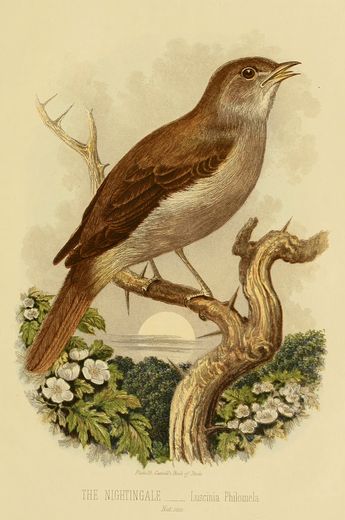
Plate 18. Cassell's Book of Birds
THE NIGHTINGALE ____ Luscinia Philomela
Nat. size
No sooner have the Nightingales arrived in Europe than their song is to be heard almost
incessantly. Some few pour forth their trilling notes throughout the long, bright night; but, for the
most part, they only sing during the day, except just at the commencement of the breeding season,
when the desire to please and attract their mates renders the male birds excited and restless. The
nest of the Nightingale is a mere heap of dry leaves, rushes, and grass, with a lining of horsehair,
cotton wool, or any similarly elastic material; occasionally twigs and straw are also employed.
Naumann mentions an instance of a Nightingale building on a branch five feet from the ground, and
of another that made its preparations for its little family in the centre of a heap of dry leaves that had
been thrown down in a garden-shed; these are, however, exceptions to the general rule, their nests
being, for the most part, placed in low bushes, upon felled trees, or in holes in the ground. The
eggs, from four to six in number, have a delicate, glossy, greenish grey shell. Both parents assist in
hatching their young, who are tended with great care, the male keeping a very sharp eye indeed upon
his mate, lest she should endeavour to leave her charge in order to take a peep at the outer world,
or even to stretch her wearied limbs. Bäszler mentions having been much amused upon one
occasion, when he had scared a brooding female from her nest, by the cries of reproof and marital
pecks that were forcibly employed by her indignant spouse, in order to drive back his partner to her
maternal duties. Worms of various kinds, the larvæ of insects, ants, smooth-skinned caterpillars, and
some species of beetles, constitute the principal food of the adult birds, and upon these the nestlings
are likewise reared. During the autumn they also consume large quantities of berries. The young
remain under the care of their parents until the approach of the moulting season. Almost
immediately after leaving the shell the young males commence trying their voices, but give little or
no indication of their future capabilities in the notes they utter during the first months of their life.
It is not until the following spring that they become possessed of their full powers, at which time
they seek a mate, and in her honour begin to pour forth a copious flood of sounds, as sweet and
enchanting as those of the older birds. The moulting season commences about July, after which the
autumn migrations commence. These journeyings are accomplished in families, or small parties, the
birds flying with great rapidity to very distant countries. We ourselves have met with them
occasionally in the forests of Southern Nubia and Eastern Soudan, and have observed that they
appear to make themselves but little conspicuous during their absence from their native lands.
About the middle of April they reappear in Europe, the males coming first, and at once seek their
former haunts, announcing their welcome presence, and greeting their old home by joyous strains,
that are continued without intermission for hours at a time, and even prolonged far into the
night.
The HEDGE SINGERS, or TREE NIGHTINGALES (Aëdon or Agrobates), bear a strong
family likeness to the True Nightingales, both in their habits and general appearance. They are
met with in Southern Europe, North-western Asia, and Northern Africa. The members of this family
are recognisable by their elongated body and comparatively strong beak, the upper mandible of
which is very decidedly bent; the third and fourth quills of the long, broad wings are of equal
length, the tail much rounded, and the tarsi low. Their plumage is soft, silky, and of a pale reddish
brown, lightest upon the under side. The sexes are alike in colour, and the young without any spots
upon their feathers. So very similar are all these birds in their mode of life that we shall confine
ourselves to a full description of but one species.
THE TREE NIGHTINGALE.
The TREE NIGHTINGALE (Aëdon galactodes) is of a reddish grey upon the upper parts of the body,
darker upon the top of the head than elsewhere; the nape is greyish, the under side greyish yellow or
dirty white, tinted with red on the sides of the neck, and with reddish yellow on the thighs; the
cheeks are whitish brown, and a white streak passes over the eyes. The quills and upper wing-covers
are brown, the former diversified with a narrow light brown edge, and the latter with a broad border
of reddish yellow; the tail-feathers, with the exception of the one in the centre, are of a beautiful
rust-red, with a white tip, the latter marked with a round, blackish brown spot; the eye is deep
brown, the beak and feet reddish. This species is about seven inches long and eleven broad; the
wing measures rather more than three, and the tail three inches.
The Tree Nightingales are found principally on arid spots, but sparsely overgrown with low
brushwood, though they by no means avoid cultivated districts or the immediate neighbourhood of
man. In Spain, they constantly frequent the vineyards and olive plantations, and in North-eastern
Africa take up their abode in the gardens, or close to the huts of the natives, provided that they there
find a few of their favourite bushes whereon to perch. We ourselves have never met with them in
the primitive forests, or upon lofty mountains, though they often frequent wooded highlands. Such
of these birds as inhabit Central Africa are stationary, whilst those occupying Northern Africa and
Southern Europe migrate, leaving their more northern habitat about the end of September and
returning in April. The males take their departure first, followed in a few days by their mates:
arrived at their destination, they soon spread themselves over the face of the country. In their
habits they are somewhat peculiar; they always select the very topmost point of a bush, post, or
tree, as their ordinary perch, and on it they sit with tail erect, drooping wing, upright body, and legs
drawn in, as they pour out their song, or glance sharply around in search of a worm or beetle.
Should a prize of this nature be discerned, the bird will instantly dart down, flourishing and spreading
its tail, and, after running rapidly for a few paces, seize its prey and return to its observatory, uttering
a short call-note denoting extreme satisfaction. Their mode of flight and other movements are
almost identical with those of the Nightingale, and like that bird they seek their food principally upon
the ground, coming occasionally even into the streets of towns, when hard pressed for the means of
subsistence, though at other times they are extremely cautious and timid. Strange to say, such as
came under our own notice in Central Africa would permit the dark-coloured natives to approach
quite close to them, but took instant alarm at the appearance of a white man. The voice of this
species is capable of but very little variety, and will bear no comparison with that of its world-famed
relative; yet, in spite of this inferiority, it is ever a favourite, its constant cheerfulness enlivening all
that listen to its almost incessant song, which may be heard not only through the whole of the
breeding season, but is uttered as the little creature runs, perches, or even flies through the air. The
period of incubation commences at the end of May, and lasts for a considerable time. The nest,
which is large and roughly formed of twigs, moss, and grass, lined with hair, wool, and feathers, is
placed either against the trunk of a tree or on one of the larger branches, or in a thick bush. The
eggs have a dirty white or blueish grey shell, marked with pale dark patches and brown spots. We
are without particulars regarding the rearing of the nestlings, but have ourselves met with unfledged
young as late as September.
The BLUE-THROATED WARBLERS (Cyanecula) are birds with slender bodies, short blunt
wings, and high, slender legs. Their long beak is compressed at the nostrils, the upper mandible
slightly raised, but sharp-pointed at its extremity. The plumage is lax, and varies in hue with the age
or sex of the bird. In the male the upper part of the body is dark brown, the under side dirty
white, streaked at the sides with greyish brown. The throat, which is of a magnificent ultramarine
blue, is decorated in some instances with a dark star, which spreads and extends downwards like
a black streak, separated from a crescent-shaped spot upon the breast by a delicate light line. A
band across the eyes is of a whitish, and the bridles of a blackish hue. The quills are brownish grey;
the tail-feathers, except in the centre, blackish-brown at their distal half; rust-red towards the roots.
The eye is dark brown, the beak black, the feet greenish in front, and yellowish grey behind. In
the plumage of the female all the colours are paler than those of her mate. The young are spotted
with rust-red on the back, and striped on the under side, their throat being whitish. This bird is six
inches long and eight and a half broad; the wing measures two inches and three-quarters, and the
tail two inches and a quarter. The various species of Blue-throated Warblers are distinguishable
from each other by the somewhat varied coloration of their throats; thus, that of the male SWEDISH
BLUE-Throat (Cyanecula Suecica) has a reddish star in its centre, the WHITE-STARRED BLUE-THROAT
(Cyanecula leucocyana) a white star, whilst the Cyanecula Wolfii is entirely without this decoration.
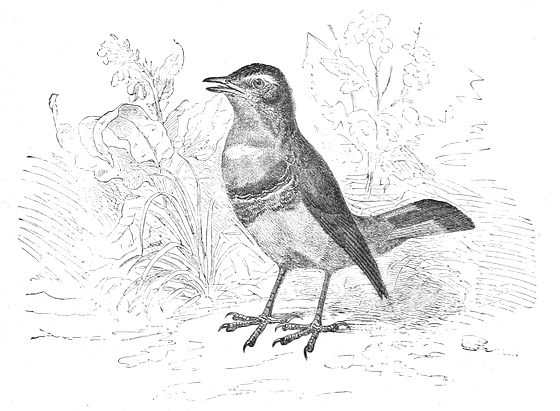
THE SWEDISH BLUE-THROAT (Cyanecula Suecica).
Of these the Cyanecula leucocyana is the largest, and the Cyanecula Wolfii the smallest species.
The females of all closely resemble their mates in appearance.
These birds inhabit the northern portions of the Eastern Hemisphere, and from thence wander
forth to visit Central Asia, Egypt, and Nubia, only occasionally venturing as far as Southern Asia or
Central Africa. The autumn migration is undertaken in large parties, which fly in a direct line
towards their destination, whilst in the spring, on the contrary, the males return first, and steer their
aërial course as far as possible in the immediate vicinity of the banks of rivers or any large bodies
of water, as in such localities they find an abundant supply of the worms, beetles, and similar fare
that afford them their principal means of subsistence. The disposition of the Blue-throats in every
way corresponds with their attractive appearance, and their intelligence is by no means inferior to
that of the Nightingale. All their movements are characterised by a liveliness that seems to indicate
a thorough enjoyment of existence; and their demeanour, as they hop quickly over the ground, with
body erect and tail outstretched, evidently denotes a most satisfactory consciousness of their own
personal charms. When climbing among, or perching on the branches of a tree or bush, they show to
less advantage; and their flight, through rapid, cannot be maintained for any great distance. The
sung of the various species differs considerably in quality; that of the Swedish Blue-throat is, perhaps,
the least pleasing to the ear, owing to the fact that the various strophes that compose it are each in
turn repeated with a frequency that soon becomes wearisome to the hearer, after he has ceased to
amuse himself with the strange droning under-tone or accompaniment kept up by the bird during the
whole song, which produces the effect of two distinct voices. Amongst the Lapps this species is
known as the "Hundred-tongued Warbler," from the great faculty it has for imitating, not only the
notes of birds, but a great variety of sounds. Like the Hedge Warblers generally, it is most unwearied
in these vocal exertions, which are often continued even whilst the little songster is running upon the
ground. The nests built by the Blue-throats are often concealed in bushes, or among the roots of
trees, with so much care as to render their discovery a work of difficulty. Holes in the banks of
rivers or brooks are also sometimes selected for the reception of the nest; that side of the water,
according to Hinz, always being preferred which is most exposed to the rays of the morning or
noon-day sun. The nest itself is large, open at the top, and formed of twigs and stalks of plants,
lined with delicate blades of grass, and in northern latitudes with wool or hair. The eggs, which are
laid in the middle of May, are from six to seven in number, and have delicate light blueish green
shells, marked with reddish brown spots, and clouded with brown at the broad end. Both parents
assist in the work of incubation, which lasts for about a fortnight. The young are reared upon
worms and beetles. They leave the nest before they can fly, and soon learn to run over the surface
of the ground with the rapidity of mice. No sooner is the first family fairly started in the world
than the parents at once commence preparations for a second brood. When caged, the Blue-throat
soon becomes very tame, but unless carefully tended only survives for a short time.
The RUBY NIGHTINGALES (Calliope) are a group of Asiatic birds nearly related to the
Blue-throats, and forming, as it were, the connecting link between them and the Hedge Warblers.
All have moderately long and powerful beaks, strong, high tarsi, large toes, and medium-sized wings,
the first quill of which is unusually short. The tail is short, pointed at the sides, and rounded in the
centre of its tip. The plumage is compact and smooth.
THE CALLIOPE OF KAMSCHATKA.
The CALLIOPE OF KAMSCHATKA (Calliope Camtschatcensis) is the species of the above group
selected for description, as, according to Temminck, it may now also be regarded as an inhabitant of
Europe. Upon the upper part of the body the plumage is olive-brown, deepest in shade upon the
brow and head; the under side is greenish grey, except the centre of the breast, which is white; the
bridles are black, and a streak over the eyes of glossy whiteness; the throat is of a magnificent ruby
red, and separated from the breast by a black line, that fades gradually into a brownish grey. In the
plumage of the female all the colours are paler than in that of her mate. The young are dark
brownish grey, marked with reddish yellow. The length of this species is six inches; the wing
measures two inches; and the tail two inches and one-third.
According to Middendorf, these birds frequent the well-watered provinces and marshy districts of
North-eastern Asia, from the middle of May till the beginning of October (occasionally, only, till the
end of August), when they commence their migrations, journeying through Eastern Siberia, Mongolia,
Southern China, and Japan, and reaching India about November. The Calliope usually remains
concealed during the day, and only ventures forth after twilight to obtain food, in quest of which it
runs about exactly in the manner of the Blue-throats, displaying, however, even greater agility than
they are capable of, when making its way through the long grass that abounds in its favourite marshy
retreats.
Jerdon speaks of this species as shy, unsociable, and very silent during the greater part of the
year; but with this last statement we by no means fully agree. Whilst performing their migrations,
the two sexes certainly associate in flocks; and during the spring the notes of the males are to be
heard both by day and night. The voice of the Calliope is very sweet, and though by no means
loud, very clear. As the breeding season approaches the male commences singing still more
energetically, and is usually to be seen perched, with inflated throat, wings outspread, and tail raised
at a right angle with his body, on the topmost branch of a birch or alder-tree, whilst he perseveringly
endeavours to attract the admiration of his mate who sits beneath, almost entirely concealed from
view. The nests of these birds found by Middendorf on the banks of the Taimye were most beautiful
works of art, neatly covered with a roof, and approached by a horizontal entrance-gallery excavated
in the sand. The nests were found to contain about five blueish green eggs, which were laid in June.
In China the Calliope is known as the "Hung-po" (Redbreast), or "Ching-po" (Goldbreast), and is
much prized as a domestic favourite by people of all classes: it is constantly kept by the Chinese,
not in a cage, but secured to a perch or branch by means of a string tied round the neck. This
peculiar and very practical manner of preventing the escape of a bird is, as Swinhoe tells us, very
extensively adopted in the Celestial Empire.
THE ROBIN REDBREAST.
The ROBIN REDBREAST (Erythaca rubecula or Rubecula silvestris) is the last member of the
family to which our space permits us to allude. In this species the upper mandible is arched and
incised immediately behind its curved tip. The feet are of moderate height, and delicately formed;
the wings, in which the fourth and fifth quills are the longest, are rather short and weak; the tail is of
medium size, and slightly incised at its extremity.
The plumage is lax, and of a deep olive-grey upon the upper part of-the body; the under side is
grey; the brow, throat, and upper portion of the breast yellowish red. The female is somewhat paler
than her mate, and the young are distinguishable by reddish yellow spots on the shafts of the upper
feathers; the under side is reddish yellow, with grey spots and light edges to the feathers; the large,
expressive eyes are brown, the beak blackish brown, and the feet reddish grey. The length of this
bird is five inches and a half, and its breadth eight inches and a half; the wing measures two inches
and three-quarters, and the tail two inches and a half.
Europe must certainly be regarded as the home of the Redbreasts; beyond its limits they seldom
venture, except during their migrations, when some few travel as far as North-western Africa and the
adjacent islands. By far the greater number of those met with in the northern and central countries
of our continent usually only journey as far as Southern Europe. This lively, beautiful little bird,
with whose sweet twittering voice and social fearless habits we are so familiar, is met with in all
woodland districts, and may constantly be seen hopping nimbly about our fields and gardens, or
flitting from bush to bush, quite close to our houses, in search of the spiders, worms, snails, and
beetles upon which it subsists. In winter, when it is difficult to obtain these means of support, it
lives upon various kinds of berries. The nest of the Robin is placed in holes in the ground, in
hollow trunks of trees, or similar situations, at no great elevation, and is formed of moss, stalks,
and leaves, woven together, and delicately lined with hair, wool, and feathers. Should the margin of
the cavity in which the nest is placed not project in such a manner as to form a sheltering cover, a
roof is constructed, and an entrance made in the side. The eggs, which are of a yellowish white,
marked with reddish yellow spots (see Fig. 33, Coloured Plate XVI.), are from five to seven in
number; these are laid about May. The parents brood alternately during a fortnight, they feed the
nestlings assiduously with worms and insects, and diligently instruct and tend them for about a week
after they are fledged; they are then permitted to go forth into the world on their own account;
whilst, if the weather be fine, the old birds at once prepare for a second family. Numberless are
the anecdotes that might be quoted to show the kindly disposition of these interesting little favourites,
but we must confine ourselves to the mention of two or three exemplifications of their habits.
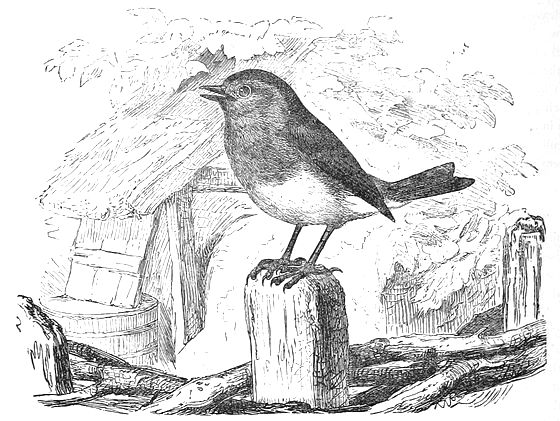
THE ROBIN REDBREAST (Erythaca rubecula or Rubecula silvestris).
The first that we shall narrate happened in our own village. Two male Redbreasts were
captured and confined in the same cage. From the moment of their imprisonment they seemed
entirely to have laid aside their usual amiable and social demeanour; morning, noon, and night they
squabbled and pecked each other, and fought with an enduring rancour which plainly showed that
they each grudged every atom of food or drop of water obtained by the other. This state of affairs
was at last brought to a very unexpected termination; one of the captives broke its leg, and forthwith
the conduct of its companion was completely changed; it at once took charge of the helpless invalid
with as much tenderness as if it had been one of its own young, fed and tended it until the limb was
restored; and, strange to say, even after the invalid was strong and well again, neither of the birds
ever showed the slightest inclination to renew former hostilities.
An instance of the truly parental affection they often exhibit towards the young of entirely
different species is mentioned by Naumann, who upon one occasion introduced an unfledged Linnet into
the cage of a Redbreast. No sooner did the hungry nestling begin to clamour for food than the
parental feelings and sympathy of the Robin were awakened; it at once hopped off to procure a
dainty mouthful, which it placed tenderly in the youngster's gaping beak, repeating the performance
till the calls of hunger were completely satisfied. Even in its native woods, and surrounded by
its own kind, the Redbreast will occasionally contract a close friendship with a bird of another species.
Posslen mentions a pretty instance of this social tendency as having occurred in Germany. "In a
wood near Köthen," he says, "a Redbreast was found to have actually deposited six eggs in the
same nest with the six eggs laid by a Linnet, the two mothers brooding side by side until the nestlings
made their appearance."
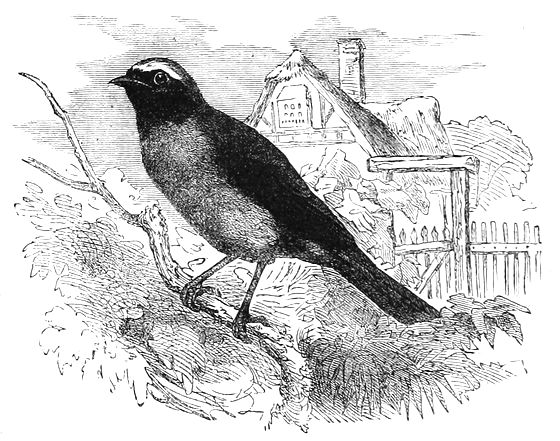
THE GARDEN REDSTART (Ruticilla phœnicura or Phœnicura ruticilla).
The WARBLERS (Monticolæ) constitute a numerous family, whose members vary considerably
in size, but closely resemble each other, both in appearance and habits. These birds are recognisable
by their slender bodies, moderate-sized or long wings, in which the third quill generally exceeds the
rest in length; short tail, either straight or excised at its tip; slender tarsi, and awl-shaped beak, with
quite straight or slightly arched upper mandible, the latter furnished with a very short, delicate hook
at its extremity. The coloration of their thick, lax plumage differs according to the age and sex, the
males being usually much more beautifully coloured than their mates, and the young distinguishable
from the adults by the spots with which they are adorned. Many species are remarkable for the
brownish red and white hues that predominate in the tail-feathers. Most of the various members of
this family occupy rocky or stony districts, whilst some few, on the contrary, frequent woods, gardens,
or pasture-land. In disposition they are watchful, lively, and restless, but by no means social, never
congregating, even during the migratory season, in flocks, but living invariably in pairs, or at most in
families. Morning has no sooner dawned than they commence hopping, or rather running over the
ground, climbing among the branches of bushes, or flying about in short courses over a considerable
tract of country, always returning to pass the night upon their usual resting-place. Unlike other
singing birds, when excited, they bow the head repeatedly, and either flourish and spread their tails or
agitate them with a tremulous kind of motion. The voices of this family, though possessing many
sweet notes, are generally marred by an intermixture of harsh tones, and a constant repetition of the
same cadence. Many species have great facility for imitation, and constantly introduce the notes
and strophes of other birds into their own natural song. All such as inhabit the northern portions of
the globe migrate to warmer latitudes at the approach of winter, whilst those that live in southern
regions remain throughout the entire year in their native lands. The reason of this difference in
their habits is at once explained, if we reflect that the insects upon which they almost exclusively
subsist are only found in northern countries during the summer, but are readily obtained in southern
climes throughout the entire year. Both sexes assist in the labours attendant on building and
incubation. The nest, which is carefully hidden from view, is usually situated in clefts or fissures of
rocks and stones, or occasionally in hollow trees and similar situations, and though very rudely
constructed externally, is provided with a well-lined interior, for the reception of the little family.
The eggs, from four to six in number, are generally of a pale blue colour.
The REDSTARTS (Ruticilla) are distinguishable by their slender body, awl-shaped beak, which
is furnished with a slight hook at the tip of the upper mandible; slender, delicate feet; high tarsi;
moderately long wings and tail, the latter almost straight at its extremity, and lax plumage, which
varies considerably according to the age and sex of the bird. The members of this group inhabit the
eastern hemisphere (Asia especially being tolerably rich in species), and resemble each other no less in
their habits and general disposition than in their general coloration and appearance.
THE BLACK-CAPPED REDSTART.
The BLACK-CAPPED REDSTART (Ruticilla atra or Ruticilla titys) is black upon the head, the back
and lower part of the breast being grey. The belly is whitish, the wings spotted with white; the
feathers on the wings, and those that form the tail, with the exception of two in the centre, are
yellowish red. Uniform deep grey predominates in the coloration of the female and one year old
male, the plumage of the latter being marked with undulating black lines. The length of this species
is six, and its breadth ten inches. The wing measures three inches and one-third, and the tail two
inches and a half.
The Black-capped Redstart inhabits Europe, and is numerous in such parts of the continent as
are rocky or mountainous. In Switzerland it is not uncommon to see these birds not only perching
at a very considerable altitude, but disporting themselves over the glaciers and beds of snow. In
marshy districts or low-lying valleys they are met with far less frequently, and are much more
numerous in the south of Europe than in the northern portions. Though by no means social, this
species exhibits but little fear of man, and will take up its abode on the house-tops of a crowded city,
apparently quite undisturbed by the noise and bustle of the streets. In disposition it is lively and
restless, and from dawn to long after sunset appears to be in a state of constant excitement and
activity. Like the Fly-catcher, it seizes its insect prey whilst upon the wing, and performs a great
variety of beautiful evolutions, as it alternately soars and sinks through the air. Upon the ground
it moves with swiftness and ease, bowing its head repeatedly, and whisking its tail whenever
anything happens to attract its particular attention, or when under the influence of emotion. The
voice of the Black-capped Redstart, though by no means beautiful, possesses great flexibility, and is
capable of imitating the songs of a great variety of other birds.
The nest, which is carelessly constructed of fibres, stalks, and grass, and thickly lined with hair
and feathers, is built upon rocks, in holes of walls, under eaves of houses, or in similar situations.
Hollow trees are occasionally, but very rarely, employed for this purpose. The eggs have a delicate,
glossy, pure white shell, and are usually from five to seven in number. Both parents labour equally
in feeding and tending the little family, but upon the female devolves almost the entire work of
brooding, the male only relieving her for about two hours at noon. As many as three broods are
sometimes produced in the course of a season.
THE GARDEN REDSTART.
The GARDEN REDSTART (Ruticilla phœnicura or Phœnicura ruticilla), a common English species,
is a very beautiful bird. The sides of its beak, forehead, and throat, are black; the rest of the upper
part of the body dark grey. The breast, sides, and tail, are bright rust-red; the part of the head
immediately above the brow and the centre of the under side are white. The plumage of the female
is dark grey above, and of a lighter shade beneath; her throat is occasionally of a deeper hue. The
young are grey, spotted with reddish yellow, on the back; and the feathers on the under side have
rust-red borders; the eyes of all are brown, and the beak and feet black. This bird is five inches
and a half long, and three broad; the wing measures three, and the tail two inches and a quarter.
The Garden Redstart is an inhabitant of Europe and Asia, from whence it migrates to pass the
winter months in the eastern provinces of India or the interior of Africa. In its habits and mode of
life it very closely resembles the species last described, with this exception, that it usually perches
upon trees. Its sweet song is composed of two or three gentle flute-like cadences. The nest is
roughly constructed of dry fibres and grass, and thickly lined with feathers; it is usually situated in a
hollow tree, or hole in a wall or rock, such cavities being preferred as have a very narrow entrance.
The eggs, from five to eight in number, have a smooth blueish green shell (see Fig. 16, Coloured
Plate XVI.), and are laid at the latter end of April. A second brood is produced in June, and, strangely
enough, is deposited, not in the nest employed for the first family, but in another, specially prepared
for its reception. The pair, however, often return to their first breeding-place the following summer.
The MEADOW WARBLERS (Pratincola) are a group of small, stoutly-built birds, with
variegated plumage; short, thick, rounded beaks; wings of moderate size; in which the third and
fourth quills exceed the rest in length; short tails, composed of slender feathers; and long, thin legs.
The members of this group inhabit the eastern hemisphere, and frequent localities overgrown with
shrubs or underwood.
THE BROWN-THROATED MEADOW WARBLER.
The BROWN-THROATED MEADOW WARBLER (Pratincola rubetra) presents a very variegated
appearance, owing to the broad reddish grey border fringing the blackish brown feathers, with which
the upper part of its body is covered. The under side is light yellowish white; the chin, a streak
over the eyes, and the centre of the wings are pure white. All the colours in the plumage of the
female are indistinct; a stripe over the eyes is of a yellowish shade, and the light-coloured spot on the
wings very faintly indicated. In the young birds the upper part of the body is a mixture of rust-red
and greyish black, striped longitudinally with reddish yellow. The pale red feathers on the under side
are diversified with reddish yellow spots, and tipped with greyish black. The eyes of all are deep
brown, the beak and feet black. The body is five inches and a half long, and eight broad; the wing
measures two inches and a half, and the tail two inches. The habits of this bird so closely resemble
those of the following species that one description will serve for both.
THE BLACK-THROATED MEADOW WARBLER.
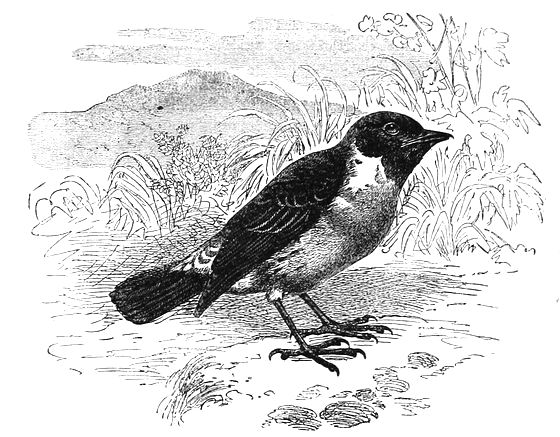
THE BLACK-THROATED MEADOW WARBLER (Pratincola rubicola).
The BLACK-THROATED MEADOW WARBLER (Pratincola rubicola), a species very nearly allied
to that above described, is black upon the throat and over the entire upper part of the body;
the under side is rust-red; the rump, a spot upon the wings, and the sides of the neck are pure
white. The female is greyish black upon the throat and mantle, the feathers of the latter edged
with reddish yellow; the entire under side is of the latter hue. Both these birds inhabit the
continent of Europe and some portions of Asia, and are often met with in Northern Africa during
their winter journeyings. All, however, do not migrate. We are told on good authority that they are
seen in Spain and Great Britain throughout the entire year. Everywhere they show a very decided
preference for cultivated districts, and especially delight in well-watered pasture-land, or such open
fields as are upon the outskirts of woods; indeed, the more fruitful the situation the more numerously
do they congregate. Their voice is sweet, full, and capable of producing a great variety of cadences.
Like most other members of their family, they sing almost incessantly during the spring and
early part of the summer, and are often to be heard far into the night. The nests of both these
species is loosely formed of dry leaves, fibres, or grass, mixed with a little moss, lined with some elastic
material, such as a layer of horsehair. Grass-meadows are generally selected, as affording situations
adapted for building purposes, and the nests are placed with so much care within hollows on the
ground, or beneath a low bush that, as frequently happens, the brooding pairs are not discovered,
either when the field is mowed, or even when the haymakers have raked the grass from its surface.
The eggs, five or six in number, are broad in shape, with delicate, glossy, light blueish green shells,
and are laid from May to June. The female alone broods; the eggs are hatched in about a fortnight.
The young are watched and tended with great care, and are saved from many enemies by the
prudence of their parents, who, should danger be at hand, remain perfectly silent and motionless
until the unwelcome visitor has left the spot. As regards the movements, diet, and habits of these
two species, we will only add that in almost every essential particular they resemble those of the
Warblers already described.
The CLIPPERS (Ephthianura), another group of the same family, met with in New Holland,
are recognisable by their nearly straight beak, which is shorter than the head, compressed at the
sides, and incised close to the tip. The third and fourth quills of the long wing exceed the rest
in length; the tail is short, and straight at its extremity; the legs are long, the tarsi thin, and the
toes slender. We are at present acquainted with but few members of this interesting and probably
numerous group.

THE WHEATEAR (Saxicola œnanthe).
THE WAGTAIL CLIPPER.
The WAGTAIL CLIPPER (Ephthianura albifrons), as the species most frequently met with is called,
is deep grey on the upper part of the body, each feather having a dark brown spot in its centre. The
wings and tail-feathers are dark brown, the latter, with the exception of those in its centre, decorated
with a large, oval, white spot. The fore part of head, face, throat, breast, and belly are pure white. The
hinder part of the head and a broad line that passes from the sides of the neck to the upper region
of the breast, are black. In the female the mantle is greyish brown; the throat and under side
are yellowish white; while the ring about the neck and a light spot on the exterior tail-feathers
are only slightly indicated. This species is four inches long. Gould, who first described the
Wagtail Clipper, found it upon a small island in Bass's Straits, and afterwards throughout the whole
of Southern Australia. Like its congeners, it is lively and active, and ever watchful against the
approach of danger. Like them it selects a stone or leafless branch when about to perch, and if
disturbed, flies swiftly for a few hundred yards before it again settles. Its step upon the ground is
rapid, and generally accompanied by a whisking motion of the tail. The song of the male is
extremely pleasing, and is heard constantly about September or October, when the breeding season
commences. The nest is formed of small twigs, grass, lined with hair or some similar material; it is
usually concealed beneath shrubs or brushwood, at an elevation of only a few inches from the ground.
The eggs, three or sometimes four in number, are of a pure white, adorned with reddish brown
spots or markings, most numerous at the broad end. The young are carefully tended by their
parents, who, however, often betray the situation of the nest, either by their evident uneasiness at the
approach of a stranger, or by affecting lameness or exhaustion, in the hope of turning the attention of
an unwelcome visitor from their helpless charge to themselves. Two broods are produced during the
season, the first family going forth into the surrounding country till the second batch of nestlings are
able to support themselves, when they all join company with the parent birds.
The CHATS (Saxicolæ) are slender birds, with awl-shaped beaks, which are very lightly incised
on the margin, slightly curved at the tip, and very broad at the base. The tarsi are high and
slender, the toes of moderate size, the wings blunt, the tail short, broad, and straight at the extremity.
The plumage is rich and lax; it varies considerably in its coloration, but is remarkable from the
circumstance that the tail, which is in most instances white, is always of a colour different from the
body. These birds are met with extensively in Europe and Asia, and are particularly numerous
upon the African continent. We shall, however, confine ourselves to a minute description of but a
few species, as the habits of all are very similar.
THE FALLOW CHAT, OR WHEATEAR.
The FALLOW CHAT, or WHEATEAR (Saxicola œnanthe), is of a light ash-grey upon the upper part
of the body. The breast, brow, and a band over the eyes, are white; the under side and rump
reddish yellow; a patch upon the cheek-stripes, the wings, and two centre tail-feathers are black; the
rest are white towards the base, and black at the tip. The eye is brown, the beak and feet black.
After the moulting season the upper part of the plumage of the male is rust-red, and the under side
reddish yellow. In the female reddish grey predominates. The brow and a stripe over the eyes are
dirty white, the bridles pale black, the under side light brownish red; the feathers of the wings are
dark grey, edged with light yellow. The length of this species is six inches and a quarter, and the
breadth eleven inches; the wing measures three inches and a half, and the tail two inches and a
quarter; the female is a few lines smaller than her mate. The Wheatear both dwells and breeds
in the British Islands, and throughout that portion of Europe that lies between the Alps, Pyrenees,
Balkan Mountains, and Lapland; in Asia it is met with in corresponding latitudes; occasionally it
appears in the upper provinces of India; we have also seen it ourselves in many parts of Africa. In
Southern Europe this bird is replaced by two nearly-related species—
THE EARED STONE CHAT AND BLACK-THROATED STONE CHAT.
The EARED STONE CHAT (Saxicola aurita) and the BLACK-THROATED STONE CHAT (Saxicola
stapazina). The first of these is six inches long, and ten inches and a half broad; the wing measures
three inches and a third, and the tail two inches and a half. The plumage on the upper part of the
body is whitish grey; that of the under side greyish reddish white; a narrow line that passes from
the beak to the eyes, an oval patch on the cheek, the wings, central tail-feathers, and the tips of those
at the exterior are black; the colours in the plumage of the female are paler and redder than those of
her mate. The Black-throated Stone Chat is rust-red on the upper portions of the body, breast, and
belly; the throat and wings are black, the feathers of the single wing-covers edged with rust-red; the
exterior tail-feathers are white, tipped with black, and those in the centre entirely black. The young
of both species are greyish yellow on the head, nape, and back, every feather being lightly edged with
grey at the tip, and streaked with white on the shaft. The under side is dirty white, with a greyish
shade upon the breast; the quills and tail-feathers are pale black; the feathers of the wing-covers are
bordered with yellowish white.
Though they by no means avoid fruitful tracts or cultivated districts, these birds very decidedly
prefer to take up their abode in mountains or stony regions, and are for this reason particularly
numerous in Sweden, Southern Germany, and Switzerland; in the latter country they are popularly
known as Mountain Nightingales, from the height to which they often ascend. Even the icy and
rugged tracts of Scandinavia and Lapland seem to suit their requirements; and we have often seen
them hopping nimbly over the glaciers, in situations where no other living object was discernible.
Individuals inhabiting more southern latitudes display the same liking for barren ground, and
are usually seen in localities so sterile and arid as to appear totally incapable of affording them a
sufficient supply of the insects upon which they subsist. Their disposition is lively, restless, vigilant,
and very unsocial; only during their winter migrations do they commingle with others of their species.
Even when circumstances compel a certain amount of neighbourship, each bird lives for itself, without
appearing to take the slightest interest in the proceedings of others in the vicinity.
The flight of the Stone Chat is remarkable, owing to the fact that, at whatever height the perch
may be from which it starts, the bird invariably sinks towards the ground, close to the surface of
which it always flies, in a series of short, undulating lines. At the approach of the breeding season
this mode of flight is changed, and the bird then entertains itself and its mate by repeatedly soaring
into the air to a height of some twenty or thirty feet, singing as it goes, and then descending
precipitately, to end its joyous song upon its favourite perch. When standing upon a stone or rock,
it holds its body erect, shakes its tail, and, should anything unusual catch its eye, at once commences
bowing repeatedly. This strange habit has given rise to its Spanish name of the "Sacristan," in
allusion to the genuflexions practised by the monks. The voices of all the species we have described
are loud and peculiar, but by no means pleasing. Of their performance, however, it may be said that
what is wanting in quality is made up by the energy and persistency with which their song is poured
out, not only from daybreak to sunset, but long after night has closed in. The nest, which is for the
most part built in holes and fissures of rocks and stones, or occasionally in hollow trees, is carefully
concealed from view. Its dense roughly-made exterior is formed of fibres, grass, and stalks, lined
thickly and warmly with wool, hair, or feathers; the eggs, from five to seven in number, are of a
delicate blueish or greenish white, occasionally, but rarely, spotted with pale yellow. The female
hatches her brood with but little assistance from her mate, who perches near, in order to keep a strict
watch against the approach of danger, and warns her of its appearance by an anxious cry. But one
brood is produced in the season, the first eggs being laid about May; occasionally, however, the
female produces two broods. The young remain with the parents till the winter migration, which
takes place in September. In March they again return to their native lands.
The RUNNING WARBLERS (Dromolæa) constitute another group of this family, recognisable
by the predominance of black in the coloration of their plumage, and by the formation of their
comparatively long and much compressed beak, which is broad at its base, and very decidedly curved
and hooked at its extremity. The wings are long and pointed.
THE WHITE-TAILED WHEATEAR.
The WHITE-TAILED WHEATEAR (Dromolœa-Saxicola-leucura) is about seven inches and a quarter
long, and eleven and three-quarters broad; the wing measures three inches and two-thirds, and the
tail two inches and three-quarters. The plumage is of an uniform rich black; the wing-quills are
grey towards their roots, and a band of dazzling white adorns the extremity of the tail. The female
is deep brown, but similar to her mate in appearance. The young male and female respectively
resemble the father and mother, but are paler. This species inhabits Southern Europe, and almost
invariably resorts to its most mountainous districts. In Spain it is particularly numerous, and is also
frequently seen in Southern Italy, Greece, and North-western Africa. In the latter portion of the
globe and in Asia it is replaced by several nearly allied species. In all these various regions it shows
a decided preference for barren heights and rocky precipices, and is as constantly met with on rugged
peaks, at an altitude of 500 feet above the sea, as upon the masses of dislodged stone that strew the
declivities of the mountains. The darker the colour of the rock, the more dreary and desolate the
situation, the more attractive it appears to be, as the blackness of the stone accords well with the
dusky plumage of the birds, and renders concealment comparatively easy.
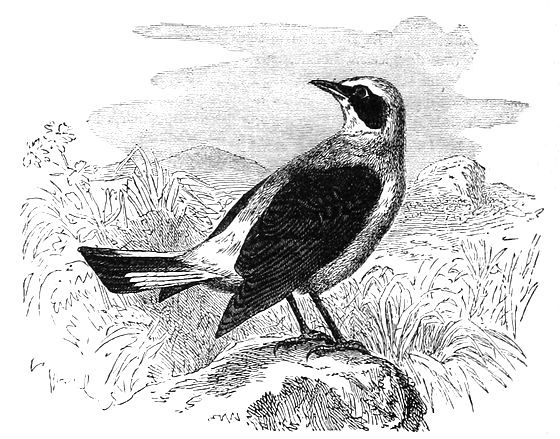
THE EARED STONE CHAT (Saxicola aurita).
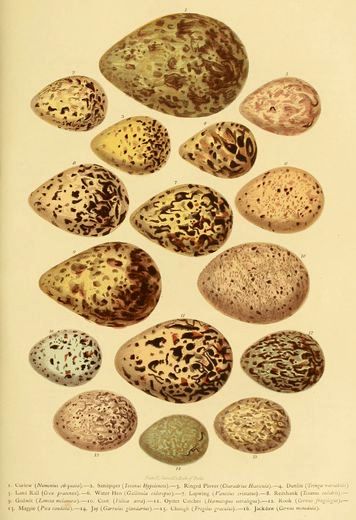
Plate 17. Cassell's Book of Birds
1. Curlew (Numenius Arquata).—2. Sandpiper (Totanus Hypolencos).—3. Ringed Plover (Charadrius Hiaticula).—4. Dunlin (Tringa variabilis)—5.
Land Rail (Crex pratensis).—6. Water Hen (Gallinula chloropus).—7. Lapwing (Vanellus cristatus).—8. Redshank (Totanus calidris).—9.
Godwit (Limosa melanura).—10. Coot (Fulica atra).—11. Oyster Catcher (Hæmatopus ostralegus).—12. Rook (Corvus frugilegus).—13.
Magpie (Pica caudata).—14. Jay (Garrulus glandarius).—15. Chough (Fregilus graculus).—16. Jackdaw (Corvus monedula).
Those who have ventured to scale the rugged heights and steep precipices frequented by these
birds, are often startled by the sound of their clear, sweet voices, as they suddenly salute the ear
in situations apparently destitute of animal life, whilst those whose patience will permit them to
follow the sound until they come to the spot upon which a pair have taken up their abode, will
behold a performance that richly repays the trouble of a tedious climb. Upon a ledge or platform
of rock he will see the male bird either tripping lightly around the open space, or executing a regular
dance, with wings and tail outspread, accompanying the movements of his feet and body with a
continuous flow of song, and bowing his head repeatedly: this entertainment being varied by rising
suddenly into the air, and sinking again rapidly, with open pinions, to the ground. Upon one
occasion, whilst journeying over the Sierra de los Anches, we came upon a pair of these birds, seated
near to a nest containing their unfledged young. The terrified female immediately began flitting from
rock to rock, while her mate at once commenced dancing, tripping gracefully about, and singing with
all his power, as though with the idea of riveting our attention on himself, and thus averting danger
from his little family. We could not find it in our hearts to render the wily stratagem abortive, so
contented ourselves with a hasty glance at the nest, and left the spot, followed by a loud song of
triumph and rejoicing from the anxious father. The nest, which is placed in holes in the rock, is not
commenced until the end of April or beginning of May. The exterior is formed of fibres and grass,
woven firmly together, the interior being carefully lined with a layer of goats' hair. The eggs are of
a pale greenish blue, marked violet or reddish, but their pattern is very variable; they are from four
to six in number: in Spain we have occasionally found as many as seven in a brood. The young
are reared upon insects, and are no sooner fledged than they may be seen perching upon the rocks
or stones, watching their parents as they pursue flies or other insects destined to fill their craving
beaks. Meanwhile, should any unusual sight or sound attract the attention of the vigilant father, he
instantly warns his brood by a peculiar cry that they must at once seek shelter in the neighbouring
holes and fissures, and recalls them with the same note when they may again venture forth. It is
only after the moulting season, which continues throughout July, August, and September, that the
young withdraw themselves from the protection of their parents, in order to seek a mate and begin
life on their own account.
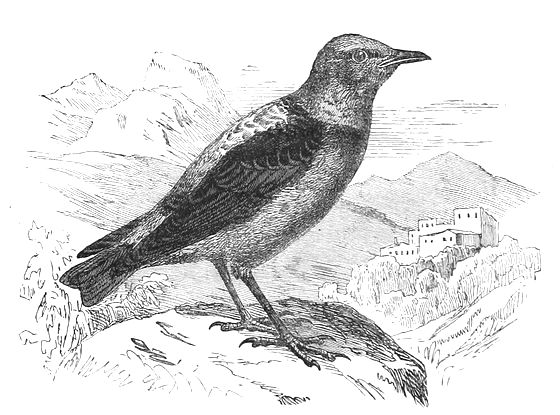
THE STONE THRUSH, OR ROCK WAGTAIL (Petrocincla-Turdus-saxatilis).
The STONE THRUSHES, or ROCK WAGTAILS (Petrocincla), are comparatively large birds,
recognisable by their slender body and strong, awl-shaped beak, which is broad at its base; the
upper mandible is slightly arched, and curved at its tip; the tarsi are armed with very decidedly bent
claws; the wing is long, its third quill exceeding the rest in length, while the tail is short, and almost
straight at its extremity. The plumage is smooth, bright-tinted, and sometimes much variegated.
THE STONE THRUSH, OR ROCK WAGTAIL.
The STONE THRUSH, or ROCK WAGTAIL (Petrocincla-Turdus-saxatilis), is a magnificently-coloured
bird, about eight inches long and fourteen broad. The head, face, part of the throat,
nape, and rump are of a beautiful blueish grey, the entire under side is bright rust-red, the quills are
blackish brown, the shoulder-feathers deep grey or slaty black; the two centre tail-feathers are dark
grey, and those at the exterior rust-red. In autumn all the small feathers have light edges. The
female is of a pale brown, spotted with a still lighter shade on the upper part of the body, whilst the
rust-red feathers on the under side are darkly bordered: the throat is white. In both sexes the eyes
are reddish brown, the beak pale black, and the feet of a reddish hue; the young resemble the
mother. These birds frequent all the mountain regions of Southern Europe, but are also known to
breed in some part of Austria, in the Tyrol, along the course of the Rhine, and occasionally in
Bohemia and in the Hartz Mountains: in Italy and Greece they are especially numerous, and
everywhere appear to prefer the rocky valleys lying immediately at the foot of mountain ranges
to the precipices or towering heights occupied by the group last described.
The Rock Wagtails generally appear in Europe about April or May, and almost immediately
commence their preparations for breeding. Their nests, usually concealed with great cunning in such
holes in the rock or ground as are almost inaccessible, are made of twigs, straw, moss, or grass,
heaped roughly together to form the outer wall, the cup-shaped interior being neatly lined with a
variety of elastic materials, selected with great care. The delicate blueish green eggs (see Fig. 24,
Coloured Plate IV.) are from four to six in number. We have not as yet been able to ascertain
whether the male relieves his partner in the work of incubation, or contents himself with amusing her
by a kind of dance, performed with ruffled streaming plumage and half-closed eyes, in which he
delights to indulge at this season of the year. Both parents, however, assist in tending the young
flock, who are reared on the same kinds of insects as form the staple food of the adults; the latter
also devour snails and worms, and during the autumn consume large quantities of berries and fruit,
including grapes. Their winter migrations take place in September, and often extend over a large
portion of Northern Africa; indeed, we have often seen them in the vicinity of the Blue River. In
disposition the Rock Wagtail is cautious, sprightly, and restless, passing almost the entire day in
active exercise; its flight is extremely light and beautiful, and so rapid as to enable it to seize an
insect on the wing; unlike most of the members of its family, it generally flies in a direct line, and,
after describing a few circles in the air, hovers awhile before perching. Upon the ground its
movements alternate between a tripping step, accompanied by repeated bowings of the head, and
the dancing movement alluded to above. Its voice is pleasing, flute-like, and capable of imitating
a great variety of notes and sounds; it is for this reason unusually attractive when caged. Count
Gourcy tells us that it soon becomes so tame as to greet its master with a song, and testifies its
affection by a variety of pretty tricks.
We must not omit to mention one strange propensity to which this species is addicted when in
captivity, during the season at which its kind usually migrate. At that time of the year it seems
seized with attacks of perfect frenzy, rushes round its cage, leaps about, and utterly refuses to take
any food that is not forced upon it. This state of excitement only continues for from eight to ten
days, and leaves the bird in its ordinary state of health. Throughout the whole course of the attack
the little prisoner exhibits a degree of terror which is quite inexplicable, at sights and sounds that at
other times would scarcely attract its attention.
THE BLUE ROCK WAGTAIL, OR BLUE THRUSH.
The BLUE ROCK WAGTAIL, or BLUE THRUSH (Petrocincla cyana), is rather larger than the
species last mentioned, being from eight inches and three-quarters to nine inches and a half long,
and fourteen broad; the wing measures five and the tail three inches and a half. The plumage of
the male is of an uniform greyish blue, and the quills and tail-feathers edged with blue. The female
is blueish grey upon the upper part of the body, the throat being decorated with light reddish brown
spots, each of which is surrounded by a dark line; the feathers on the under side are edged with
brownish white, and marked with dark brown crescent-shaped patches; the quills and tail-feathers are
also dark brown. The nestlings resemble the mother, but have light brown spots upon the back;
the eyes of all are brown, and the beak and feet black. After the moulting season all the feathers
in the plumage of the male are of an uniform greyish blue, and the quills and tail-feathers edged
with blue.
The Blue Thrushes inhabit the whole of Southern Europe, Northern Africa, and a portion of
Central Asia, and are especially numerous in Greece, Dalmatia, Italy, the South of France, Spain,
Egypt, and Algiers; during winter a few are occasionally seen in India, but these, no doubt, are
stragglers that have lost their way, as, for the most part, these birds remain throughout the entire
year in their native land. Like the species last described, they principally occupy rocky valleys and
mountainous regions, but are also often to be seen about towns and villages, where they perch upon
steeples, roofs, or lofty walls; in Egypt they frequently dwell within the ruins of ancient temples.
Although sprightly and active, they are remarkably unsocial, and exhibit a positive dislike to the
society not only of man and of birds in general, but of their own kind. During the period of
incubation alone do they associate even in pairs; at other seasons each leads an entirely independent
life, and exhibits active hostility to every other member of the feathered creation. The flight of this
species is much more continuous than that of its congeners, and it usually hovers before perching:
like the Thrush, it often soars into the air when about to pour forth its song. Upon the ground it
moves with great ease and rapidity. The voice of the Blue Thrush, though inferior to that of the
Rock Wagtail, is pleasing, and so flexible as readily to imitate the notes of other birds. The
evolutions performed by the male for the delectation of his mate are even more comical than those
indulged in by the Petrocincla saxatilis, as the little creature inflates his body until it is almost as
round as a ball, bows his head, and continually brandishes his tail aloft whilst engaged in going
through his dancing steps. The nest is situated in holes in rocks, walls, and ruins, or upon lofty
towers or steeples, and is rudely formed of grass; nevertheless, its flat interior is neatly lined with
fibres. The four oval-shaped eggs which compose a brood are laid at the beginning of May. These
are of a glossy, greenish blue, faintly spotted with violet-grey, and more distinctly with reddish brown;
unspotted eggs are also occasionally laid. In Italy, Malta, and Greece, the Blue Thrush is especially
esteemed as a domestic favourite, and commands a high price. Wright tells us that in Malta
particularly, from fifteen to twenty dollars are frequently paid for a good singer, and that as high a
sum as fifty dollars has been given for an unusually gifted specimen. In Malta, such of the lower
orders as keep these birds fasten a piece of red cloth to the cage, in order to protect its inmate from
the much-dreaded evil eye. Owing to the extreme care with which the nests are concealed, and the
unusual timidity displayed by this species, its capture is attended with great difficulty; indeed, none
but the most wary and patient of sportsmen can hope to obtain an adult bird.
THE BUSH WARBLER.
The BUSH WARBLER (Thamnolæa albiscapulata), an inhabitant of the Abyssinian mountains,
possesses a short, decidedly curved beak, slightly pointed wings, in which the fourth quill exceeds
the rest in length, a comparatively long and rounded tail, and short feet; its length is eight inches,
and its breadth one foot and three-quarters of an inch. The wing measures four inches and
one-third, and the tail three inches and three-quarters. The plumage of the male is of a blueish
black upon the head, throat, and upper part of the breast, back, wings, tail, and legs; the belly and
lower breast are bright rust-red; a band that divides the upper and lower parts of the breast, and
the feathers on the small wing-covers are snow-white; the tail-feathers are rust-red on both sides, and
tipped with black. The females and young are without the white patches on the breast and wings.
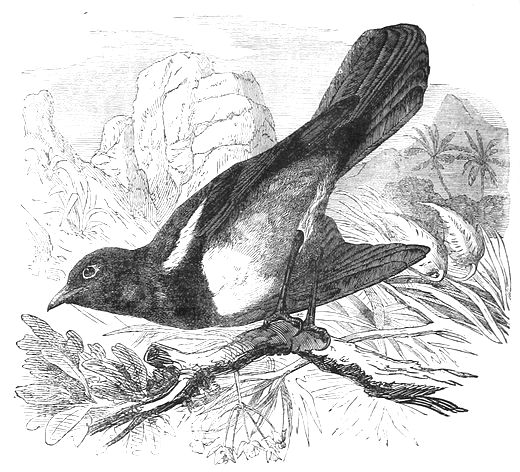
THE BUSH WARBLER (Thamnolæa albiscapulata).
We had many opportunities of observing these birds at Habesch, and saw them constantly in
the neighbouring mountains. They lived almost invariably in pairs, and frequented rocks, stones,
trees, or the surface of the ground, with equal impartiality. Upon the rocks they conduct themselves
after the manner of the Stone Thrush: whilst sporting upon the trees, they hang from the trunk, as
they search the bark for grubs, or perch on the very topmost bough, and pour forth their clear and
joyous song. We were unable to make any observations respecting their breeding and nidification.
The THRUSHES (Turdi) constitute a very numerous family, whose various members are
spread over the whole surface of our globe. These birds closely resemble each other in form and
habits, although they differ considerably in size; for whilst some have the dimensions of a Pigeon,
the smaller species are no larger than the Warblers we have just described. All have more or less
slenderly-formed bodies; the beak is almost straight, and of moderate length, slightly curved along
the culmen of the upper mandible, and incised at its tip; the tarsus is slender, and, like the toes, of
medium size; the claws, on the contrary, are large. The wings, in which the third and fourth quills
exceed the rest in length, are long and pointed; the tail is generally moderately long, and either
quite straight, or slightly rounded at its extremity. The plumage is soft, somewhat lax, and very
various in its coloration; the sexes are usually similar in appearance, and the young are adorned
with spots.
Our space forbids our entering into a particular account of all the European Thrushes, and we
can therefore only describe a few of those most commonly known. Of the eighty-one species with
which we are acquainted, two inhabit the northern tracts of our globe, whilst fifteen are met with in
India and the adjacent countries. There are nine in Africa, five in Australia, and twenty-seven in
South America. Of these, the RED-WINGED THRUSH (Turdus fuscatus), the RED-THROATED THRUSH
(Turdus ruficollis), the PALE THRUSH (Turdus pallens), the SIBERIAN THRUSH (Turdus Sibericus),
the WANDERING THRUSH (Turdus migratorius), the HERMIT THRUSH (Turdus solitarius), WILSON'S THRUSH
(Turdus Wilsoni) SWAINSON'S THRUSH (Turdus Swainsoni), DWARF THRUSH (Turdus
minor), the SOFT-FEATHERED THRUSH (Turdus mollissimus), the BLACK-THROATED THRUSH (Turdus
atrogularis), and the GROUND THRUSH (Turdus varius) are all met with in Europe; the four
first-mentioned of these thirteen species come from Siberia, the next in order from North America,
the two last but one from Southern Asia, and the GROUND THRUSH (Turdus varius) from Australia.
The members of this family inhabit every variety of climate, and make their home indifferently within
the depths of tropical forests, or under the shelter of the pines and firs that frequently skirt the
glaciers of mountain ranges, amidst the rich woodland pastures that adorn highly-cultivated tracts, or
upon the sparsely scattered shrubs that draw their scanty means of existence from the burning sands
or arid soil of vast steppes. Some few species remain during the entire year within the limits of
their native lands, while by far the greater number exhibit such a propensity for wandering about
to see the world as is almost without a parallel in the whole feathered creation. All are eminently
endowed, and lively and active in their disposition; their flight is remarkably swift, but varies
considerably in the different species; that of the Song, Red, and Ring Thrushes being the swiftest
and most graceful, whilst that of the Missel and Black Thrushes is very feeble, owing to the
comparative shortness of their pinions. All, however, are equally adroit in hopping over the surface
of the ground, or climbing amid the trees, and they are all capable of springing with remarkable
facility, aided by their wings, to a distant branch. Their sight is so keen as to enable them to
detect the smallest insect at a great distance; and their sense of hearing so delicate as to warn them
of the approach of danger long before it has been perceived by the other inhabitants of their native
woods, who at once seek safe shelter when they hear the warning cry of their more acute and
vigilant companions. To this superior sagacity is no doubt attributable the eager desire exhibited
by Thrushes to investigate any new or striking object: they, however, take good care to keep at a
safe and respectful distance, even while carrying on their examination with the most eager attention.
Although extremely quarrelsome—we might almost say vicious—in temperament, the members of this
family are eminently social, and constantly assemble in large parties, comprising not only those of
their own race, but a variety of other birds. Towards man they appear to feel but little attraction,
and are quite acute enough readily to distinguish friends from enemies. As regards their vocal
powers, the different groups are somewhat unequally endowed, though the notes of all are in many
respects very similar. The song of the "Nightingale of the North," as the Singing Thrush is called
in Norway, must certainly be regarded as excelling that of any other species; whilst that of the
Missel and Juniper Thrush are also remarkable for great sweetness and variety of tone; of the
Hermit Thrush (Turdus solitarius) Audubon speaks with great enthusiasm.
Unlike most other birds, the Thrushes do not accompany their notes with any description of
movement or gesticulation, but sit perfectly quiet and almost motionless during the whole song; one
male has no sooner perched himself on a conspicuous branch, and commenced singing, than he is
answered by all those in the neighbourhood, as they hurry to the spot to join in the performance,
and share the admiration they evidently expect it will excite. Insects, snails, and worms afford
them the means of sustenance during the summer, these being principally obtained from the surface
of the ground; they also greedily devour berries, some preferring one sort and some another. Thus
the Missel Thrush constantly seeks the fruit of the mistletoe, and for this reason is popularly
supposed to bear its seeds from one spot to another; while the Ring Thrush consumes whortleberries
in such quantities after the breeding season that, according to Schauer, its flesh acquires a blue, and
its bones a red tinge. This very decided predilection for particular fruits and berries renders these
birds very troublesome in vineyards and orchards, and brings down upon them severe retribution at
certain seasons of the year.
Such groups as inhabit the north rarely commence breeding before June, whilst others usually lay
within a very short time after their return to their native lands. The situations of the nest also vary
considerably, according to the localities in which they are built.
THE MISSEL THRUSH.
The MISSEL THRUSH (Turdus viscivorus) is about ten inches long, and from sixteen inches and
a half to seventeen and a half broad; its wing measures from five inches and a half to five inches and
three-quarters, and the tail from four inches to four inches and a quarter. Upon the upper part of
the body the feathers are deep grey, the under side is whitish, marked on the throat with triangular,
and on the other portions with kidney-shaped brownish black spots; the quills and tail are brownish
grey, bordered with greyish yellow; the eye is brown, the beak dark, and the feet light horn-colour.
The female resembles her mate, but is somewhat smaller; the feathers on the under side of the young
are spotted with black, and the wing-covers bordered with yellow. This species is found throughout
the entire continent of Europe, and is numerously met with in Great Britain. In Wales it is
popularly known as "Penn-y-llwya," or "Master of the Coppice," on account of the overbearing and
quarrelsome disposition it displays. In England it is often called the "Storm Thrush," from the fact
that its voice is constantly to be heard before a storm of wind or rain. Such of these birds as
inhabit the most northern portions of our continent wander somewhat further south as winter
approaches, whilst those that occupy more genial latitudes remain throughout the entire year in
their native lands. Some few are occasionally known to stray as far as North-western Africa.
Districts abounding in lofty trees or pine and fir forests are the localities they prefer. The nest is
formed of moss, stalks, lichens, and grass; the outer wall being frequently coated with a layer of
mud, and the interior neatly lined with fine grass and similar materials. (The egg is represented
in Fig. 12, Coloured Plate XVI.)
The voice of the Missel Thrush resembles that of the Blackbird. "The male," says Mudie,
"is not a mere idle songster; he is equally vigilant and bold in the defence of his family. The
call-note he utters in case of danger—and which is answered by the female as if she were expressing
her confidence of safety while he is on the watch—is harsh, grating, and has the tone of a note of
defiance. With the Missel Thrush this defiance is no idle boast, for the sneaking Magpie, the
light-winged Kestrel, and even the Sparrow Hawk, are at those times compelled to keep their distance,
as the Thrush is too vigilant to be taken by surprise, and under the sprays where these birds contend
with him on equal terms he keeps them all at bay. Nor is he the guardian of his own family only—he
is in some measure the warder of the whole grove, and when the harsh but shrill sound of his
bugle-note of alarm is heard, all the warblers take heed of the danger, and the chorus is mute until he
again mounts the highest branch and raises the song of thankfulness for deliverance."
THE SONG THRUSH.
The SONG THRUSH (Turdus musicus) is considerably smaller than the Missel Thrush, its length
being eight inches and a half, and its breadth twelve and three-quarters; its wing measures four inches
and one-sixth, and its tail three inches and a quarter. The upper portion of the body is olive-grey,
the under side yellowish white, marked with triangular oval brown spots, which are less numerous
on the belly than in the species above described; the lower wing-covers are also palish yellow, instead
of white, and the feathers on the upper covers tipped with dirty reddish yellow. The sexes differ
only in their size; the young are recognisable by the yellowish streaks and brown spots on the tips
of the feathers of the upper part of their body. Like the Missel Thrush, this species inhabits the
whole of Europe, being, however, especially numerous in its extreme north, and rarely breeding
in the most southern portions of the continent, which are usually only visited during the winter
months; it is also frequently met with in China, and during its migrations wanders as far as North-western
Africa, but is rarely seen in the north-eastern provinces of that continent. Notwithstanding
the very quarrelsome disposition usually displayed by these birds, many interesting anecdotes have
been recorded concerning the great affection they display towards each other. Amongst these
Yarrell mentions a touching instance, related by Mr. Knapp:—"We observed," says the latter,
"two common Thrushes frequenting the shrubs on the green in our garden; from the slenderness
of their forms and the freshness of their plumage, we pronounced them to be birds of the preceding
summer. There was an association of friendship between them that called attention to their
actions. One of them seemed ailing or feeble from some bodily accident, for, though it hopped
about, it appeared unable to obtain a sufficiency of food. Its companion, an active, sprightly
Thrush, would frequently bring it worms or bruised snails, when they mutually partook of the
banquet; the ailing bird would then wait patiently, understand the actions, and expect the assistance
of the other, and advance from his asylum on its approach. This procedure was continued for some
days, but after a time we missed the fostered invalid, which probably died, or, by reason of its
weakness, met with some fatal accident." (The egg of the Song Thrush is shown in Fig. 14,
Coloured Plate XVI.)
THE FIELDFARE, OR JUNIPER THRUSH.
The FIELDFARE, or JUNIPER THRUSH (Turdus pilaris), is ten inches long and sixteen and
a half broad; the wing measures five and a half and the tail about four inches. The plumage of
this species is unusually variegated: the head, nape, and rump are deep grey; the upper part of the
back and region of the shoulder dull chestnut-brown; the quills and tail-feathers black, the former and
the feathers of the wing-covers being grey upon the outer web and tip; the exterior tail-feathers are
bordered with white; the front of the throat is dark reddish yellow, spotted longitudinally with black;
the feathers on the breast are brown, with a whitish edge; the rest of the under side is quite white;
the eye is brown, the beak yellow, and the foot dark brown. The female is somewhat paler than
her mate.
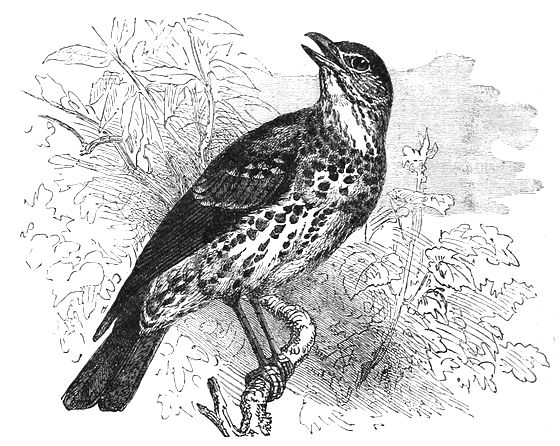
THE SONG THRUSH (Turdus musicus).
These birds mostly live and breed in the extensive birch forests that abound in Northern
Europe, and usually make their appearance in the central portions of that continent late in the
autumn, rarely wandering as far as its extreme south. They generally appear in Great Britain in
large flocks about March, when, should the season permit, they at once spread themselves over the
fields in every direction in search of insects, or if these have all disappeared, seek the berries that
constitute their principal food in our hedges and gardens. But should the weather prove so
exceptionally cold as to deprive them of the latter means of support, they are compelled to wander
still farther south, returning, however, to Great Britain again before the end of the winter. Under
ordinary circumstances, they remain with us till May, and have occasionally been known to breed in
Yorkshire, Kent, and some parts of Scotland. Mr. Hewitson thus describes the habits of the
Fieldfare when preparing its nest:—"After a long ramble through some very thick woods, our
attention was attracted by the harsh cries of several birds, which we at first supposed to be Shrikes,
but which afterwards proved to be Fieldfares. We were soon delighted by the discovery of several
of their nests, and were surprised to find them—so contrary to the habits of other species of the
genus Turdus with which we are acquainted—breeding in society. Their nests were at various
heights from the ground, from four feet to thirty or forty feet, or upwards; they were for the most
part placed against the trunk of the spruce fir; some were, however, at a considerable distance from
it, upon the upper surface, and towards the smaller end of the thicker branches: they resemble most
nearly those of the Ring Ouzel; the outside is composed of sticks and coarse grass and weeds,
gathered wet, matted with a small quantity of clay, and lined with a thick bed of fine dry grass.
None of them as yet contained more than three eggs, although we afterwards found that five was
more commonly the number than four, and that even six was very frequent. The eggs are very
similar to those of the Blackbird, and still more to those of the Ring Ouzel."
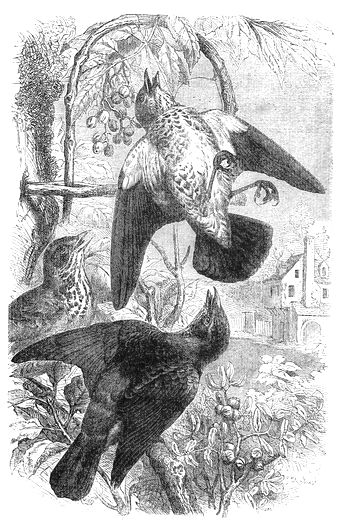
THE REDWING.
The REDWING (Turdus iliacus) is eight inches and a half long and thirteen and a half broad.
Its wing measures four and a half, and tail three and a half inches. Upon the upper part of the body
the plumage is of a greenish brown, the under side whitish, the sides of the breast bright rust-red,
and the throat yellowish, marked all over with triangular and round dark brown spots. The female
is of a lighter colour than her mate. The back of the young is greenish, spotted with yellow, and
their lower wing-covers rust-red; the eyes of all are reddish brown; the beak black, except at the
base of the lower mandible, which is grey; the foot is of a reddish hue. This species is also an
inhabitant of Northern Europe, but usually appears in the more southern portions of the continent
at the close of autumn. Its winter migration extends as far as Northern Africa; it is also met with
in Asia, but has never, we believe, been seen in an easterly direction beyond Irkutzk.
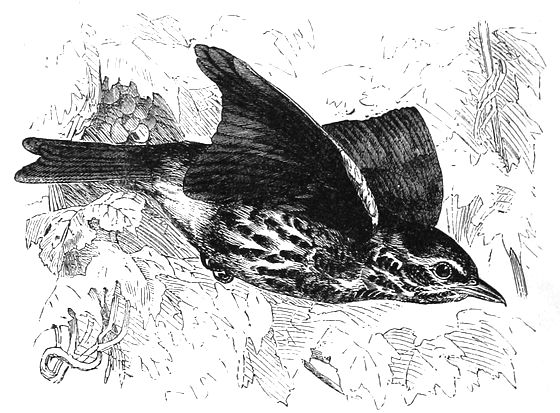
THE REDWING (Turdus iliacus).
It generally arrives in Great Britain about October, appearing in large flocks; and great numbers
frequently perish, should the winter be extremely severe. "The Redwings," says Yarrell, in his
excellent "History of British Birds," "are much less inclined to feed on berries than most of the other
species of this genus, and should the resources obtained by their search on the ground be closed
against them by long-continued frost and snow, the Redwings are first to suffer. During such severe
seasons as in 1799, 1814, and 1822, hundreds have been found almost starved, alike unable to
prosecute their journey south to more congenial countries, or to bear the rigour of this." Whether
such mortality resulted from the intensity of the cold, or the long continuance of snow upon the
ground, may be matter for speculation.
THE RING OUZEL, OR RING THRUSH.
The RING OUZEL, or RING THRUSH (Turdus torquatus), is ten inches long and sixteen broad,
the wing measures five and a half, and the tail more than four inches. The plumage of the male,
with the exception of a broad, crescent-shaped, white spot upon the breast, is of a pure black, marked
with faint crescent-shaped spots, formed by the light edges of the feathers; the quills and wing-covers
are shaded with grey, and bordered with brownish grey; the tail is of an uniform brownish black,
with the exception of its two exterior feathers, which are surrounded by a delicate line of greyish
white. The female is greyer than her mate; all the borders to the feathers are broader; moreover,
the crescent on her breast is only slightly indicated, and of a dull grey hue. The feathers upon the
back of the young bird are dark, with a light edge, and partially streaked with light reddish yellow
on the shafts; the throat is pale reddish yellow, spotted with a deeper shade; the breast, which is of a
reddish hue, is marked with round spots, whilst those upon the greyish yellow belly are crescent-shaped.
The eye is brown, the base of the lower mandible reddish yellow, the rest of the beak black; the foot
is blackish brown. The Ring Thrush principally frequents the highest mountain ranges of Europe,
but it is met with throughout the highland countries during its migrations, and often wanders as far
as the Atlas Mountains. This species has been classed by some ornithologists as the representative
of a separate group, under the name of Thoracocinela, but, in our own opinion, it can only be
regarded as a connecting link between the Thrushes and Blackbirds. (The egg of the Ring Ouzel is
represented in Fig. 15, Coloured Plate XVI.)
This species arrives in Great Britain about April, and is not common. Mr. Mudie informs us
that cold moors, stony places, where a good deal of water falls, and where there are springs and lakes,
are the nesting ground of the Ring Ouzel. When startled by anyone coming suddenly upon them,
they utter the same alarm-note as the Blackbird. Their short sweet song resembles that of the
Missel Thrush, and is given forth from some low rock, or elevated stone. The nest varies a little
with the situation. A plant or bush, especially if against a bank, usually has the preference; but a
tuft of grass or heath, or even the projecting part of a massy stone, is often employed. The nest is
formed of moss and lichen, plastered with mud, and lined with dry soft grass. The eggs are four,
rarely six in number, about the size of those of the Blackbird, but rather greener in tint, and the spots
more decidedly marked.
THE BLACKBIRD.
The BLACKBIRD, BLACK THRUSH, or MERLE (Turdus merula), differs from the species above
described in the comparative shortness of its blunt-shaped wings (in which the third, fourth, and fifth
quills are nearly of equal length), and still more decidedly in its mode of life. Its length varies from
nine and three-quarters to ten inches, and its breadth from thirteen and a half to fourteen inches; the
wing measures from four inches and one-third to four and a half, and the tail four and a half inches.
The plumage of the adult male is of an uniform black, the eye brown, the beak and edges of the
eyelid bright yellow, and the legs dark brown; in the adult female the upper part of the body is pure
black, the under side blackish grey, edged with light grey; the throat and upper part of the breast are
greyish black, but spotted with white and rust-red; the young are blackish brown upon the back,
spotted with yellow upon the shafts, and rust-red, spotted with brown on the under side.
THE BLACKBIRD (Turdus merula).
The Blackbird is met with extensively from sixty-six degrees north latitude throughout the
whole of Southern Europe, and is a permanent resident in Great Britain. Everywhere it frequents
moist and well-wooded districts or tracts of underwood, usually remaining from year's end to year's
end within the limits of its native land. Only such as reside in the extreme north of the continent
migrate, and then rarely beyond the southern parts of Sweden. "The Blackbirds," says Mr. Yarrell,
"occupy hedges, thickets, plantations, and woods. They are shy, vigilant, and restless, frequenting
the ground under cover of evergreens and other shrubs, that serve to conceal them, and, if disturbed,
take wing with a vociferous chattering of alarm, and, after a short flight, turn suddenly into some
thick brake or hedgerow to avoid pursuit. The food of the Blackbird varies considerably with the
season; in the spring and early part of the summer it consists of the larvæ of insects, with worms and
snails; the shells of the latter being dexterously broken against a stone, to get at the soft body within.
As the season advances they exhibit their great partiality for fruit of various sorts, and their frequent
visits to our orchards bring upon them the vengeance of the gardener. This bird commences his
song early in the spring, and it has been observed that he occasionally sings his best during an April
shower. He continues singing at intervals during the summer till the moulting season. Like some
other birds gifted with great powers of voice the Blackbird is an imitator of the sounds made by
others. He has been heard closely to imitate part of the song of the Nightingale, and three or four
instances are recorded of his having been known to crow like a cock, apparently enjoying the sound
of the responses made by the fowls in a neighbouring poultry-yard." Mr. Neville Wood mentions an
instance in which he heard a Blackbird cackle as a hen does after laying. This species pairs and
breeds very early in the spring, generally choosing the centre of some thick bush in which to fix and
conceal the nest. The exterior is formed of coarse roots and strong bents of grass, plastered over
and interlaced with dirt on the inner surface, thus forming a stiff wall; it is then lined with fine grass.
The eggs are four or five, sometimes six in number, of a light blue, speckled and spotted with pale
reddish brown (see Fig. 13, Coloured Plate XVI.) Occasionally they are of an uniform blue shade.
Their length is one inch and two lines, and their breadth eight lines. The first brood is hatched by
the end of March, or early in April.
THE MOCKING BIRD (Mimus polyglottus).
The MOCKING THRUSHES (Mimi) constitute a family nearly allied to the birds above
described. They are recognisable by their slender bodies, and short but strong wings, that only
extend as far as the base of the long tail, and have the third, fourth, and fifth quills of equal length.
The exterior tail-feathers are graduated, the tarsi high, the feet large and powerful, and the claws
comparatively weak. The beak somewhat resembles that of the True Thrush, but is much higher
and more arched; the plumage, moreover, is unusually soft and lax. Unlike the True Thrushes, the
members of this group do not prefer forests or woodlands, but frequent open tracts, marshy districts,
or even the sea-coast; and while some seek the retirement of the most isolated situations, others
make their home close to the dwellings of man. Such species as inhabit the southern portions of the
western hemisphere do not migrate, whilst those from the north, when winter approaches, wander
southward as far as the United States or even Central America. All American writers speak with
enthusiasm of the song of these birds; and though we are by no means inclined to allow them the
superiority over their European cousins that has been claimed for them, still we are fully prepared to
acknowledge that their vocal powers are eminently fascinating and remarkable.
THE MIMIC THRUSH.
The MIMIC THRUSH, or MOCKING BIRD (Mimus polyglottus), as the most celebrated species
has been called, is nine and a half inches long and thirteen and a half broad; the plumage on the
upper part of the body is dark grey, shaded with brown upon the brow and side of the head; the
under side is brownish white; the quills and wing-covers are brownish black, and the feet dark brown.
The female is browner and darker than her mate, and the white in the tail less pure. Both sexes are
alike in size.
The United States of North America must be regarded as the native land of this interesting
bird, and from thence, as autumn approaches, it wanders forth to visit the surrounding countries.
(The Mocking Birds of Louisiana, however, form an exception to this rule, as, owing to the mildness
of the climate, they often remain there throughout the entire year.) This delightful songster generally
frequents plantations, gardens, and brushwood, and not only lives but breeds in the immediate vicinity
of man; it also prefers sandy plains, the banks of rivers, and the neighbourhood of the sea-coast.
On the ground its movements resemble those of the True Thrush, but its flight is undulating, and
rarely sustained for any great distance, as the Mocking Bird from time to time takes rest upon a
tree before proceeding on its way; moreover, as it flies, the tail is alternately expanded and closed.
As regards the wonderful powers of song that have rendered this species so famous, we cannot
do better than quote the words of Wilson:—"The intelligence he displays in listening and
laying up lessons from almost every species of the feathered creation within his hearing is really
surprising, and marks the peculiarity of his genius. To his other endowments we may add that of a
voice full, strong, and musical, and capable of every modulation, from the clear mellow tones of the
Wood Thrush to the savage scream of the Bald Eagle. While in measure and accent he faithfully
follows his originals, in force and sweetness of expression he greatly improves upon them. In his
native groves, mounted on the top of a tall bush, or half-grown tree, in the dawn of dewy morning,
when the woods are already vocal with a multitude of warblers, his admirable song rises pre-eminent
over every competitor. The ear can listen to his music alone, to which that of all others seems a
mere accompaniment. Neither is his strain altogether imitative. His own native notes, which are
easily distinguishable by such as are well acquainted with those of our various song birds, are bold,
full, and varied, seemingly beyond all limits. They consist of short expressions of two, three, or at
most five or six syllables, generally interspersed with imitations, all of them uttered with great
emphasis and rapidity, and continued with undiminished ardour for half an hour or an hour at a time.
His expanded wings and tail, glistening with white, and the buoyant gaiety of his action, arrest the
eye as his song most irresistibly does the ear; sometimes he sweeps round with enthusiastic ecstasy,
mounting and descending as his song swells or dies away, and, as my friend Mr. Bartram has
beautifully expressed it, 'He bounds aloft with the celerity of an arrow, as if to recover or recall
is very soul expired in the last elevated strain.'
"While thus exerting himself, a bystander destitute of sight would suppose that the whole
feathered tribe had assembled together on a trial of skill, each striving to produce his utmost effect, so
perfect are his imitations. He many times deceives the sportsman, and sends him in search of birds
that perhaps are not within miles of him, but whose notes he exactly imitates; even birds themselves
are frequently imposed on by this admirable mimic, and are decoyed by the fancied calls of their
mates; or dive with precipitation into the depth of thickets, at a scream of what they suppose to be
the Sparrow Hawk."
As may readily be imagined, the sounds imitated by these remarkable birds vary according to
the situation in which they live; those that occupy woodland districts naturally repeat the note
uttered by their feathered companions, whilst those near a farmyard learn not only to imitate the
cries of all its different inhabitants, but reproduce them so perfectly as to deceive the nicest ear. Thus
they have been known to summon the house-dog, by whistling like his master; drive a hen to a state
of the utmost excitement, by constantly screaming out in such a manner as to lead her to suppose
that one of her chicks was in the last agonies; or to scare away a whole flock of poultry by the
perfection with which they imitate the cry of one of the many tyrants of the air. The clapping of
a mill, a creaking door, the grating of a saw, or, indeed, any of the multitudinous noises heard in a
busy household, at once attract their attention, and are simulated with such torturing exactness as
often to render the Mocking Bird, when caged, almost unbearable.
Amongst the many enemies to whose attacks this species is exposed, the black snake is one of
the most formidable, and frequent and terrible are the battles that ensue between these apparently
very unequal combatants.
"Whenever," says Wilson, "the insidious approaches of this reptile are discovered, the male
darts upon it with the rapidity of an arrow, dexterously eluding its bite, and striking it violently and
incessantly about the head, where it is very vulnerable. The snake soon becomes sensible of its
danger, and seeks to escape; but the intrepid defender of his young redoubles his exertions, and,
unless his antagonist be of great magnitude, often succeeds in destroying him. All its pretended
powers of fascination avail it nothing against the vengeance of this noble bird. As the snake's
strength begins to flag, the Mocking Bird seizes and partially lifts it up from the ground, beating it
with his wings; and when the business is completed he returns to the repository of his young,
mounts the summit of the bush, and pours out a torrent of song in token of victory."
In the southern provinces of the United States the breeding season of this Thrush commences
in April, whilst in the northern parts, on the contrary, it does not begin till the end of May.
Throughout the whole of this period the male is extremely restless, and endeavours to attract the
attention of his mate by the ceaseless activity of his movements, alternately strutting conceitedly
about on the ground, with tail expanded and drooping wings, or fluttering, butterfly-like, around the
spot on which she is perched, at the same time performing a series of graceful evolutions in the
air. The nest, which is formed of dry twigs, tendrils, grass, and wool, thickly lined with delicate
fibres, is usually placed at the summit of trees or leafy shrubs, frequently close to habitations, but
occasionally also in low bushes and briary clumps growing in comparatively unfrequented and
uncultivated spots. Two and sometimes three broods are produced in the year; the first containing
from four to six, the second at most five, and the third seldom more than three eggs. These
are round in shape, of a light green colour, variously marked with dark brown. The young are
hatched by the mother alone, and usually leave the shell in about a fortnight. The two first families
grow rapidly, but they do not attain their full size until late in the year. Audubon maintains that,
should the parents be disturbed whilst tending their young, they exhibit the greatest anxiety for their
safety, and redouble their care and attention. This opinion is, however, in direct contradiction
to the idea prevalent in America, that if the Mocking Thrush be alarmed it at once deserts its
progeny. During the summer this species lives principally upon insects, which, unlike most
Thrushes, it often pursues to a considerable height in the air. In autumn it feeds upon a great
variety of berries. When caged it is readily reared upon the food usually given to Thrushes, but
should also receive an occasional meal of ants' eggs or meal-worms. Upon this diet it will not
only live for a considerable time and become extremely tame, but lay its eggs regularly from year
to year.
THE FERRUGINOUS MOCKING BIRD, OR THRASHER.
The FERRUGINOUS MOCKING BIRD, or THRASHER (Taxostoma rufum), has a slender body, long
wings, a short tail, and a powerful foot. The upper part of the body is brownish red; the under
side, reddish white, striped with blackish brown upon the sides and breast; the small feathers on the
wing-covers are edged with white, and thus form two light borders to the pinions; the eye is yellow,
the beak blueish, and the foot brown. Its length is about twelve inches; this measurement includes
the tail, which is nearly six inches. The wing is four inches and one-third.
"This large and well-known songster," says Nuttall, "is found in all parts of America, from
Hudson's Bay to the shores of the Mexican Gulf, breeding everywhere, though most abundantly in
the northern portions. Early in October these birds retire to the south, and probably extend their
migrations at that season through the warmer regions towards the borders of the tropics. From the
fifteenth of April till early in May they begin to revisit the Middle and Northern States, keeping pace
in some measure with the progress of vegetation. They appear always to come in pairs, so that their
mutual attachment is probably more durable than the season of incubation. Stationed near the top
of some tall orchard or forest tree, the gay and animated male salutes the morn with his loud and
charming song. His voice—resembling that of the Thrush of Europe, but far more powerful and
varied—rises pre-eminent amidst all the choir of the forest. His music has all the full charm of
originality; he takes no delight in mimicry, and, therefore, really has no right to the name of
Mocking Bird. From the beginning to the middle of May the Thrasher is engaged in building his
nest, usually selecting for this purpose a low thick bush in some retired thicket or swamp, a few feet
from the earth, or even on the ground in some sheltered tussock, or near the root of a bush. It has a
general resemblance to the nest of the Cat Bird; outwardly being made of small interlacing twigs, and
then layers of dry oak or beech leaves. To these materials generally succeed a stratum of strips of
grape-vine or red cedar bark; over the whole is piled a mass of some coarse root fibres, and the
finishing lining is made of a layer of finer filaments of the same. The eggs (never exceeding
five) are thickly sprinkled with minute spots of palish brown on a greenish ground. In the Central
States these birds rear two broods in the year; in other parts of America but one. Both parents
display the most ardent affection for their young, and attack dogs, cats, and snakes, in their defence.
Towards their most insidious enemies of the human race, when the latter are approaching their
helpless young, every art is displayed—threats, entreaties, and reproaches, the most pathetic and
powerful, are tried; they dart at the ravisher with despair, and lament the bereavement they suffer
in the most touching strains. I know nothing equal to the bursts of grief manifested by these
affectionate parents except the accents of human suffering. Their food consists of worms, insects,
caterpillars, beetles, and various kinds of berries. The movements of the Thrasher are active,
watchful, and sly; it generally flies low, dwelling among thickets, and skipping from bush to bush
with his long tail spread out like a fan."
THE CAT BIRD.
The CAT BIRD (Galeoscoptes Carolinensis) is almost entirely slate-grey, which is darkest on the back
and lightest on the under side; the top of the head is brownish black, the throat light grey, and the
lower wing-covers rust-red. Its length is nine inches, the wing four inches, and the tail four inches
and three lines. The best account of this bird has been given by Wilson, who has described it at
great length.
"The Cat Bird," says that graphic writer, "is very common in the United States, and arrives in the
lower parts of Georgia from the south about the twenty-eighth of February, and probably winters in
Florida. About the beginning of May he has already succeeded in building his nest. The place
chosen for this purpose is generally a thicket of briars or brambles, a thorn bush, thick vine, or the
fork of a small sapling; no great solicitude is shown for concealment, though few birds appear more
interested for the safety of their nests and young. The materials employed are dry leaves, or weeds,
small twigs, or fine dry grass; the interior is lined with fine black fibrous roots. The female lays
four, sometimes five eggs, of an uniform greenish blue colour, without any spots. Two, and
occasionally three broods, are raised in the year.
THE CAT BIRD (Galeoscoptes Carolinensis).
"The manners of this species are lively, and at intervals border on the grotesque. It is
extremely sensitive, and will follow an intruder to a considerable distance, wailing and mewing as it
passes from one tree to another, its tail now jerked and thrown from side to side, its wings drooping,
and its breast deeply inclined. On such occasions it would fain peck at your hand; but these
exhibitions of irritated feeling seldom take place after the young have sufficiently grown to take care
of themselves. In some instances I have known this bird at once to recognise its friend from its
foe, and to suffer the former even to handle the treasure deposited in its nest with all the marked
assurance of the knowledge it possessed of its safety; while, on the contrary, the latter had to bear
all its anger. The sight of a dog seldom irritates it, but a single glance at the wily cat excites the
most painful paroxysms of alarm. It never neglects to attack a snake with fury, though it often
happens that it becomes the sufferer for its temerity.
"The Cat Bird," continues the same author, "is one of our earliest morning songsters, beginning
generally before break of day, and hovering from bush to bush with great sprightliness when there
is scarce light sufficient to distinguish him. His notes are more remarkable for singularity than
for melody. They consist of short imitations of other birds and other sounds; but his pipe being
rather deficient in clearness and strength of tone, his imitations fail where these qualities are requisite.
Yet he is not easily discouraged, but seems to study certain passages with great perseverance, uttering
them at first low, and, as he succeeds, higher and more freely, nowise embarrassed by the presence of
a spectator even within a few yards of him. On attentively listening for some time, one can perceive
considerable variety in his performance, in which he seems to introduce all the odd sounds and quaint
passages he has been able to collect. Upon the whole, though we cannot arrange him with the grand
leaders of our vernal choristers, he well merits a place among the most agreeable general performers.
"In spring or summer, on approaching a thicket of brambles, the first salutation you receive is
from the Cat Bird; and a stranger, unacquainted with its note, would conclude that some vagrant
orphan kitten had got bewildered in the briars, and wanted assistance, so exactly does the call of the
bird sometimes resemble the voice of that animal.
"In passing through the woods in summer, I have sometimes amused myself with imitating
the violent chirping or squeaking of young birds, in order to observe what different species were
around me; for such sounds, at such a season, in the woods, are no less alarming to the feathered
tenants of the bushes than the cry of fire or murder in the streets is to the inhabitants of a large
and populous city. On such occasions of alarm and consternation, the Cat Bird is the first to make
his appearance, not singly, but sometimes half a dozen at a time, flying from different quarters to the
spot. At this time those who are disposed to play with his feelings may almost throw him into fits,
his emotion and agitation are so great at the distressful cries of what he supposes to be his suffering
young. Other birds are variously affected, but none show symptoms of such extreme suffering. He
hurries backwards and forwards, with hanging wings and open mouth, calling out louder and faster,
and actually screaming with distress, till he appears hoarse with his exertions. He attempts no
offensive means, but he bewails, he implores, in the most pathetic terms with which Nature has supplied
him, and with an agony of feeling which is truly affecting. Every feathered neighbour within
hearing hastens to the place, to learn the cause of the alarm, peeping about with looks of consternation
and sympathy; but their own duties and domestic concerns soon oblige each to withdraw. At any
other season the most perfect imitations have no effect whatever on him."
The BABBLERS, or NOISY THRUSHES (Timaliæ), constitute a very numerous race,
inhabiting Africa, Southern Asia, and other portions of the eastern hemisphere. The members of
this family are in many respects nearly allied to the birds above described, but are recognisable
by their compact body, short, rounded wings, in which the fourth or fifth quill is the longest; a
moderate-sized, broad-feathered, and more or less rounded tail, powerful foot, and comparatively
strong, compressed beak, slightly bent at the tip of the upper mandible. The plumage is unusually
lax, and of a dusky hue.
These birds frequent tracts of brushwood or underwood in extensive forests or cane districts, and
subsist upon the insects, snails, worms, fruits, and berries that abound in their favourite localities.
All are active, restless, and social in their habits, although they rarely assemble in large flocks, and
are invariably extremely noisy. Only a few possess good voices. Their powers of flight are by no
means great, and rarely enable them to rise as high as the summits of the trees; but they exhibit
remarkable agility in skipping in and out amidst the densest foliage.
THE GREY BIRD.
The GREY BIRD (Pycnonotus arsinoë) represents a group whose principal characteristics are
their middle-sized but strong and slightly-curved beak, powerful foot, moderately long wings, in which
the fifth quill is the longest, and somewhat rounded tail. The plumage is lax, and generally, with
the exception of the lower tail-covers, of dull appearance. The Grey Bird is about seven and a half
inches long and eleven broad, the wing three inches and a quarter, and the tail three inches in length.
It is of a deep greyish brown on the back and top of the head. The head and throat are blackish
brown, the breast and belly whitish grey; the eye is brown, the beak and feet black. Both sexes
are alike in colour.
THE GREY BIRD (Pycnonotus arsinoë).
LE VAILLANT'S GREY BIRD.
LE VAILLANT'S GREY BIRD (Pycnonotus Vaillantii) is a very similar but larger species, met with
in Arabia and the Cape of Good Hope. The body of this bird, which we have named after the
celebrated traveller Le Vaillant, is of a somewhat lighter grey, and the under side of the wing and
rump of a beautiful sulphur-yellow. It has been asserted that a third member of this group has
been seen in Spain, but all our attempts to discover it have proved unavailing. Africa and Southern
Asia must unquestionably be regarded as forming the almost exclusive habitat of the Grey Birds, from
whence they but very rarely wander as far as Europe, or even Arabia. They are first met with in any
considerable numbers at about twenty-five degrees north latitude. In the north of Nubia they are to
be seen on every mimosa hedge, and in Eastern Soudan are more commonly met with than almost
any other bird; in the latter country they alike frequent forests and gardens, mountains or plains, but
usually seem to prefer such spots as afford a shelter from the sun; for this reason they are constantly
found under the leafy branches of the sycamores that abound on the banks of the Lower Nile.
Towards man they exhibit no fear, but trustingly take up their abode close to the huts of the natives.
Their temperament is cheerful and restless, and their movements upon the ground and among the
branches sprightly and active. Their flight, on the contrary, is by no means elegant, and usually
consists of a kind of hovering, fluttering motion. From early morning till late in the evening their
loud, clear, and often beautiful voices are to be heard almost incessantly, as they hop busily to and
fro, gleaning caterpillars or insects from the leaves, pausing ever and anon to expand or elevate the
long feathers that decorate the back of the head, and, with body erect, to cast a keen investigating
glance on the surrounding buds and blossoms. Whilst the mimosa is in bloom, they are constantly
to be seen upon its branches, diving their beaks amidst the yellow petals, in order to obtain the tiny
beetles that lurk within, and thereby smearing their heads all over in the most ludicrous manner with
the bright golden pollen that is profusely scattered over the stamens of the flowers. During the
period of incubation, which in Soudan commences with the rainy season, and, in more northern
latitudes, in the months that correspond with our spring, not only the couples, but the settlements of
couples that often build upon the same tree live together in the utmost harmony. The nests are
always carefully concealed under the foliage, though so slenderly constructed as to be permeable
to light; their sides are composed of fine grass and roots, woven together with spiders' webs, and
smoothly lined with delicate fibres. The eggs are small, of a reddish white colour, and marked with
dark brown and blueish grey spots, some of which form a wreath at the broad end. We were unable
to obtain further particulars respecting the breeding of either this or the preceding species. The
natives of Northern Africa are far too indolent to attempt to tame these interesting birds, but in
India they are much prized, and frequently reared in cages, not, however, on account of their song,
but owing to the sport they afford as combatants; indeed, they are regularly trained for the cruel
purpose of making them fight. In Ceylon the Pycnonotus hæmorrhous is taken young from the nest,
and secured by a string to its perch; it is taught to come at its master's call, and when it has learnt
the necessary obedience, is confronted with another bird similarly fastened, and the two are then
incited to attack each other with such fury as would certainly end in the death of one or both, did
not the spectators take care to separate them at the proper moment by means of the strings.
The TRUE BABBLERS (Timalia) inhabit Southern Asia, and are distinguishable by their
powerful beak, which is decidedly arched and much compressed at its sides, as well as by their
strong feet and claws, long hinder toes, short rounded wings, in which the fifth and sixth quills
exceed the rest in length, and moderately long, rounded tail. At the base of the beak there is
a growth of well-developed bristles.
THE RED-HEADED BABBLER.
The RED-HEADED BABBLER (Timalia pileata) is olive-brown on the wings and tail; the sides of
the head and nape are dark grey; the brow and region of the ear white; the top of the head is
brilliant rust-red; the throat and breast pure white, the former delicately marked with black; the
belly is of a pale reddish hue, shaded with olive-brown upon its sides; the eye is dull red, beak
black, and the feet flesh-pink; the body measures six inches and three-quarters, the wing two inches
and three-eighths, and the tail two inches and four-fifths. Horsfield, who discovered this species,
saw it first in Java, and tells us that its song consists of the five first notes of the gamut, c, d, e, f, g,
repeated in their proper succession with great regularity. More recent travellers have found it on
the continent of India, and from them we learn that the Red-headed Babblers principally frequent
tracts of underwood that mark the places where the ancient forests once stood, or districts thickly
overgrown with shrubs and bushes, and that they are more numerously met with in highland than
lowland regions. Everywhere they live in pairs, and, though they rarely venture forth into the open
country, are often to be seen in the early morning, perching on the branches of their leafy retreats,
whilst they preen their feathers or dry their wet plumage. Even during the breeding season the
male frequently adopts this position, and sits with drooping wings, apparently entirely forgetful, not
only that his mate is left solitary, but of everything around him. At other times the somewhat
neglectful spouse endeavours to cheer his hard-working partner with his song, accompanying his
notes by spreading the long feathers at the back of his head and brandishing his tail aloft. The nest
of these birds, which is deep, cup-shaped, and very fragile, is usually formed of leaves woven neatly
together, and is placed in a bush at a considerable height from the ground. The eggs, from two to
three in number, are white, thickly covered with reddish brown markings of various shades, largest
and most numerous at the broad end, and often intermixed with a few dark grey patches, that
appear to penetrate deep into the shell.
The HOOK-CLAWED BABBLERS (Crateropus), another group of the same family, are
recognisable by their strongly-built body, rather long, powerful, and slightly arched beak, which is
compressed at its sides; moderate sized, strong feet, armed with formidable hooked and pointed
claws; short wings, in which the fourth quill exceeds the rest in length; and long tail, formed of
large feathers, and slightly graduated at the sides. The plumage is thick, harsh, and rarely very
brightly coloured.
THE WHITE-RUMPED BABBLER.
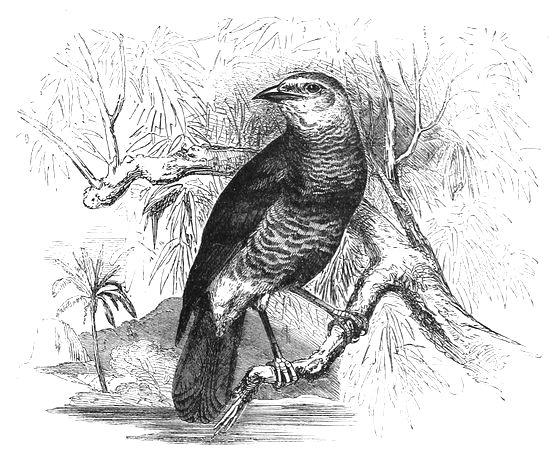
THE WHITE-RUMPED BABBLER (Crateropus leucopygius).
The WHITE-RUMPED BABBLER (Crateropus leucopygius) is chocolate-brown on the upper part of
the body; the top of the head, face, and rump are white; the feathers on the under side brownish
grey, edged with white, this bordering presenting the appearance of crescent-shaped spots; the quills
and tail-feathers are marked with a series of dark lines; the eye is deep carmine-red, the beak black,
and the feet grey. These Babblers are social in their habits, and are always met with in small
parties, numbering from eight to twelve birds. Their flight, which is performed by alternate rapid
strokes of the wings and a hovering motion produced by broadly expanding the pinions and tail,
is rarely sustained for any great distance, and has no pretence to either grace or speed. In the
brushwood, on the contrary, they exhibit a wonderful power of climbing and creeping through dense
foliage, such as will bear comparison with that of the Mouse Birds themselves. Few sights are
more amusing than that presented by a party of these noisy chatterers, as they fly quite close together
from bush to bush, settling on each one in turn, creeping through it in all directions, and screaming
violently whenever anything attractive or unusual catches their eye, then, having snapped up as many
insects and devoured as many buds and leaves as their appetites require, they re-assemble, and fly
off in closely-packed array, to repeat the same process at another spot. We are entirely without
particulars either respecting their nidification or manner of breeding.
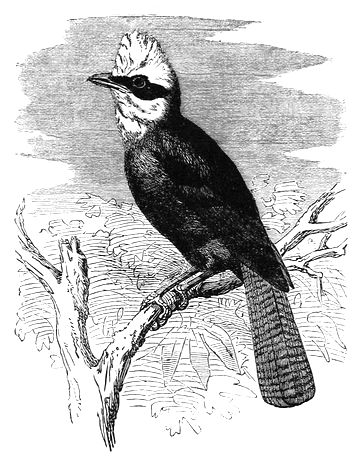
THE WHITE-TUFTED LAUGHING THRUSH (Garrulax leucolophus).
The LAUGHING THRUSHES (Garrulax), inhabiting India and Southern Asia, resemble
the above-mentioned group so closely in their general appearance as to render any detailed
description of their habits mere repetition; we shall therefore content ourselves with the mention
of but one species, as the mode of life and habits and general appearance of the group is very
similar.
THE WHITE-TUFTED LAUGHING THRUSH.
The WHITE-TUFTED LAUGHING THRUSH (Garrulax leucolophus) is a large bird, about twelve
inches long and fifteen and a half broad; its wing and tail both measure five inches. The head—with
the exception of the black cheek-stripes—the nape, throat, and breast are pure white, shaded with
grey upon the sides; the rest of the plumage is of a reddish olive-brown, deepest in shade on the
inner web of the quills and tail-feathers. All the wooded tracts of the Himalayas afford shelter
to large numbers of these remarkable birds, and resound with their most peculiar cry, which so closely
resembles a hideous laugh as to startle, and, indeed, positively to terrify such as hear it for the first
time. Insects, snails, worms, and berries afford them their principal means of subsistence; the
former are sought for on the ground or in the foliage, and the latter are gathered from the branches
as they hang suspended from the trees. The nest is a mere mass of roots, moss, and grass, placed
in a thick bush. The eggs are few in number, and have a pure white shell. Frith gives us an
interesting account of the manner in which a very similar species, the CHINESE LAUGHING THRUSH
(Garrulax Chinensis), kills and devours its prey. "This bird," he tells us, "seized a snake about a
foot long that was put into its cage, struck it against the ground, bored its head repeatedly with its
bill, and then proceeded to eat it, holding the body firmly with his foot whilst he tore it into pieces.
Large beetles he treated in a similar manner, and, previous to snapping up a wasp or a bee, always
allowed his intended victim to drive its sting repeatedly into his expanded tail; small pieces of
cooked flesh he placed between the bars of his cage before proceeding to devour them."
The WATER OUZELS (Cinclus) constitute a group whose members, though closely allied
to the Thrushes, have been separated from them on account of certain peculiarities by which they
are distinguished. They all have slender bodies, which, however, appear stout, owing to the great
thickness of the plumage; delicate, almost straight beaks, compressed at the sides and narrow
towards the tip; the nostrils are closed by a fold of skin; the feet are high and strong, the toes
long, and armed with very hooked and strong claws; the wing is unusually short, much rounded,
and almost as broad as it is long; the tail-feathers, which are broad and slightly rounded at the
extremity, are so short as to be little more than stumps. The thick, soft plumage is totally unlike
that possessed by any other land birds, being furnished with an undergrowth of downy feathers. The
Water Ouzels are met with in all parts of the world, but are especially numerous in northern
countries; they are also occasionally seen in the Himalayas, Andes, and other tropical mountain
ranges.
THE WATER OUZEL, OR DIPPER.
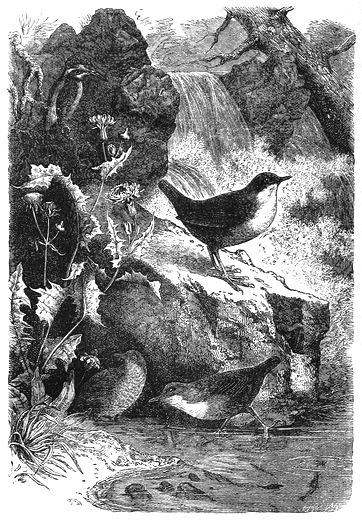
WATER OUZELS AND KINGFISHER.
The WATER OUZEL, or DIPPER (Cinclus aquaticus), is seven and a half inches long, and eleven
and one-third broad, the wing measures three and a half, and the tail two inches; the female is a few
lines smaller than her mate. The coloration of the plumage is simple, but very striking, the head
and nape are yellowish brown; the feathers on the rest of the upper part of the body are slate-grey,
edged with black; the entire throat is milk-white; the upper breast reddish brown, and the remainder
of the under side deep brown; the feathers of the young are light slate-colour, bordered with a deeper
shade on the back, and on the under parts of a dirty white, with dark edges and markings. The
Dippers are found very extensively throughout all such European mountain ranges—except the
Scandinavian Alps, where they are replaced by a similar but darker bird—as are well supplied with
water; they also frequent Central Asia, Palestine, and North-western Africa. In the south and
extreme east of Asia and in America they are represented by a variety of nearly allied species. In
Great Britain they are also numerous, especially in Derbyshire, upon the banks of the Dove and
Derwent. Waterfalls, rippling streams, and mountain lakes are the localities they most delight in;
and in the vicinity of these they often remain throughout the entire year, always providing that during
the winter the ice upon the surface of the water does not so entirely cover it as to prevent them from
indulging in the constant immersions that may be said to be almost necessary to their existence. It
is not uncommon to see the banks of a mountain stream, from its source to its fall, occupied by a party
of these birds, each pair taking possession of about a quarter of a mile of water, and living strictly
within the limits of its district. Those who have been at the pains to observe the movements and
habits of this interesting species, cannot fail to have been delighted by the antics it performs while
carrying on its bathing operations; not merely does it run over the stony bed of the river with the
utmost agility, and wade even up to its eyes in the rippling stream, but continues its course under
the water, or even beneath the ice, to a considerable depth, not, as has been stated, for a minute
at a time, but certainly during the space of from fifteen to twenty seconds. Strange as this
performance by so small a bird may appear to our readers, wading is the least extraordinary part of its
proceedings; into the swift eddying rapid, into the bed of the roaring, rushing waterfall, it boldly
plunges, steering its way, if need be, with the aid of its short wings, through the whirling masses of
water, and flying, or rather, we should say, swimming, by the help of its pinions, across more tranquil
spots with an ease that will bear comparison with the movements of almost any species of water-fowl.
Nuttall says, in speaking of these birds, "When the water becomes deep enough for them to plunge,
they open and drop their wings with an agitated motion, and, with the head stretched out as in the
ordinary act of flying in the air, descend to the bottom, and there, as if on the ground, course up and
down in quest of food. While under the water, to which their peculiar plumage is impermeable, they
appear as though silvered over with rapidly escaping bubbles of air." A writer in the "Annals of
Sporting," gives the following interesting account of a party of these birds, to whose movements he
was an eye-witness:—
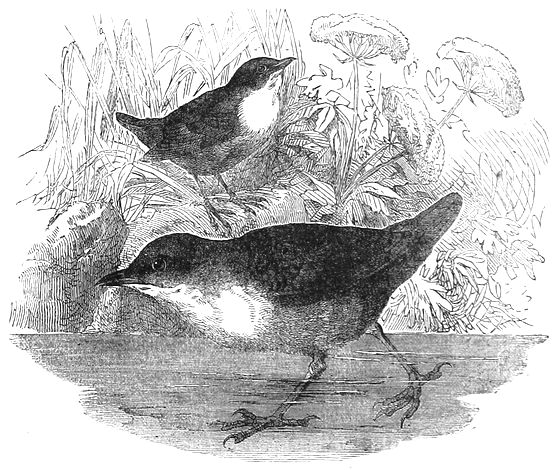
THE WATER OUZEL, OR DIPPER (Cinclus aquaticus).
"About four years ago, when on a shooting excursion, I embraced the opportunity—as everybody
else who has it ought to do—of visiting the deservedly celebrated Falls of the Clyde, and
here it was, while viewing the Fall of Bonnington, that, happening to cast my eye down below, a
little beyond the foot of the cascade, where the river is broken with stones and fragments of rock,
I espied, standing near each other on a large stone, no less than five Water Ouzels. Thus favourably
stationed as I was for a view—myself unseen—I had a fair opportunity for overlooking their
manœuvres. I observed accordingly that they flirted up their tails and flew from one stone to
another, till at length they mustered again upon the identical one on which I had first espied them.
They next entered into the water and disappeared, but they did not all do this at the same time,
neither did they do it in the same manner. Three of them plunged over head instantaneously,
but the remaining two walked gradually into the stream, and having displayed their wings, spread
them on the surface, and by this means appeared entirely to support themselves. In this position
they continued for some time—at one moment quickly spinning themselves, as it were, two or three
times round, at another remaining perfectly motionless on the surface; at length they almost
insensibly sank. What became of them it is not in my power to state, the water not being sufficiently
transparent for me to discover the bottom of the river, particularly as I was elevated so much above
it. Neither can I say that I perceived any one of them emerge again, although I kept glancing my
eye in every direction, in order, if possible, to catch them in the act of re-appearing. The plumage
of the bird, indeed, being so much in harmony with the surrounding masses of stone, rendered it not
very easily distinguishable. I did, however, afterwards observe two of these birds on the opposite
side of the stream, and possibly the three others might also have emerged and escaped my notice."
Mr. Mudie, in his "Feathered Tribes," observes—"A question has been raised how the
Dipper can contrive to keep beneath a fluid so much more dense than itself. An Owl to an Owl's
bulk of air is as a stone to a pound, as compared with the Dipper's bulk of water to the Dipper;
but if birds rise and ascend in the air at pleasure by the motions of their wings, it is only reversing
those motions to enable them to descend or keep themselves down in water. The difference of
specific gravity between the bird and the water is indeed so trifling that very little effort suffices to
move it in any direction, upwards, downwards, or laterally. Birds do not fly upon the principle of
specific gravity, as, with equal wings, the heavy birds fly best; they fly because they strike the air
more forcibly in the opposite direction to that in which they wish to go, and, under water, the
Dipper just does the same. If it wishes to go down, it strikes upwards with the wings and tail; if
to come up, it does just the reverse. The only difference is that the wings are held 'recovered,'
as running birds use them, and that gravitation has even less to do in the matter than in flying. Any
one who has ever seen a Dipper under water, or has the slightest knowledge of the mere elements
of mechanics, can understand the whole matter in an instant. The Dipper is indeed often adduced
as an instance of the beautiful simplicity of animal mechanics."
The flight of the Water Ouzel is effected by a series of rapidly repeated strokes, yet, even when
winging its way through the air, the bird skims along near the surface of the stream, darting down
from time to time to seize a passing insect. Only when hotly pursued does it quit the vicinity
of its favourite lake or river, and seek safety by flying to any considerable distance, and it always
returns to its usual haunts as soon as the cause of its alarm has disappeared. While perched upon
an elevated point on the bank, engaged in watching for prey, it is not uncommon to see it dart
suddenly down and seize its victim with an action more resembling the leap of a frog than the
movement of a member of the feathered creation. As regards intelligence and the perfection of
its senses, this remarkable bird is decidedly highly endowed; its sight and hearing, in particular,
are extremely acute. In disposition it is cunning, cautious, and so observant that it at once
perceives any unusual object or detects approaching danger.
To the presence of man the Dipper usually exhibits the utmost repugnance, whether he come in
the guise of a friend or foe, nor is it less fearful of the attacks of the numerous birds of prey that
dwell around and within its rocky haunts. We learn from Homeyer, who has observed these Ouzels
very extensively, that their dislike to man, above alluded to, is sometimes laid aside, and that they
have not only been known to allow the approach of a stranger, but have even ventured to approach
mill-streams, and, in some instances, cultivated quite a close acquaintance with the miller and his
family. The same writer also mentions that a pair of these birds made their appearance in Baden-Baden,
and much astonished the visitors at one of the largest hotels, by commencing their diving
and bathing operations immediately in front of the house. Even towards birds of its own kind,
the Water Ouzel is extremely unsocial; only during the period of incubation does it tolerate the
society of its mates; at other times it lives alone, driving off any of its neighbours that unwarily
intrude within the precincts of its little domain with a violence well calculated to prevent a renewal
of the offence, as the following extract will show:—
"A gentleman," says a correspondent of the Field newspaper, "was walking along the bank
of a little stream in Pembrokeshire, when he saw a Dipper, shooting along with its usual arrowy
flight, divert itself from its course, and, dashing against a Redbreast that was sitting quietly on a twig
overhanging the stream, knock it fairly into the water. The savage little bird was not content with
this assault, but continued to attack the poor Redbreast as it lay fluttering on the waves, endeavouring
to force it below the surface. It twice drove its victim under water, and would have killed it, had
it not been scared away by the shouts and gestures of the witness. The Robin at length succeeded
in scrambling to the bank, and got away in safety." So strong is this dislike to companionship, that
even the young are sent forth to provide for themselves at such a tender age as would appear to
render it impossible for them to obtain their own livelihood.
The song of the male Dipper may be best described as a lively chatter, consisting of a variety
of light tones uttered with different degrees of sound and expression, and is to be heard not only
in the spring, but during the utmost severity of the winter. "Those," says Schinz, "who have
listened to their cheerful voices on a bleak January morning, when every object in the landscape
seemed frozen or dead, or watched the gay little singers as, in the very joyousness of their heart,
they sprung through a hole into the ice-bound stream, to take their usual copious bath, would be
inclined to believe that they are actually insensible to the chilling breath of the frost and the icy
nature of the scene around them." Insects of all kinds constitute their principal means of existence.
Gloger tells us that during the winter they also frequently eat mussels and small fish, and that
this diet imparts a fishy flavour to their flesh. Should the season be unusually severe, they are
sometimes compelled to venture forth and snatch a meal from the most unlikely places; thus we were
informed by a miller in our neighbourhood that his mill was repeatedly visited during a heavy frost
by a pair of these birds, they being attracted by the hope of obtaining a portion of the oil with
which the mill-wheels were greased, and so overcome with hunger were the poor creatures that they
swallowed the grease boldly, even when one of the men stood close to the spot.
The period of incubation commences in April, one brood and occasionally two being produced
within the year. The nest is constructed close to the surface of the water, and, if possible, in such a
situation as to permit the stream to flow past it, and thus afford protection against the attacks of
martens, weasels, cats, and such-like enemies; it is usually placed upon projecting stones or rocks,
or in holes in bridges or mill-dams, and similar situations. In an instance that came under our
own notice, it was built in the wheel of a mill that had for a time stopped work. All our
endeavours to obtain a sight of the nest last mentioned would have been useless, had not the friendly
miller drawn off the water, and thus permitted us to satisfy our curiosity. The cavity, or nook
selected for the reception of the brood is lined with a thick bed of twigs, grass, straw, and moss,
these materials being overspread with a layer of leaves. If the mouth of the hole be large it is
covered with a kind of mossy lid, resembling that made by the Wren for her little abode, leaving
only an entrance passage of very moderate dimensions. When placed among the machinery of a
mill, the nest has sometimes required to be two feet long, in order to keep it firmly fixed on its
precarious foundation. The eggs, from four to six in number, are of a glossy white, variously
shaped, but generally from eight to ten lines long, and eight to eight and a half lines broad. Though
the female broods with such diligence and care that she will not even make her escape at the
approach of danger, she rarely succeeds in hatching more than two of her brood, the rest of the
eggs being no doubt addled by the damp situation of the nest. Whilst engaged in tending their
young family, the parents often appear to lay aside their usual timidity, and will permit a stranger
to investigate their proceedings without exhibiting any sign of fear.
THE AMERICAN WATER OUZEL.
The AMERICAN WATER OUZEL (Cinclus Americanus) differs from the European species above
described by the absence of white on the brownish chin and throat. Nuttall tells us, in his
interesting work on American ornithology, that "this bird was first noticed by Pallas in the Crimea,
and afterwards by Mr. Bullock in Mexico, from whence it appears, by an exclusively interior route,
to penetrate into the wild and remote interior of Canada, as far as the shores of the Athabasca Lake."
Mr. Townsend says, in speaking of this bird—whose habits are but little known—"The American
Dipper inhabits the clear mountain streams in the vicinity of the Columbia. When observed it was
swimming along the rapids, occasionally flying for short distances over the surface of the water, and
then diving into it, re-appearing after a short interval. Sometimes it alights on the banks of the
stream, and jerks its tail upwards like a Wren. I did not hear it utter any note. The stomach
was found to contain fragments of fresh-water snail-shells. I observed that this bird did not alight
on the surface of the water, but dived immediately while on the wing."
The PITTAS, or PAINTED THRUSHES (Pittæ), constitute a family of birds nearly allied to
the preceding, and remarkable for their short but powerful body, moderately long neck, large head,
and long wings—in which the fourth and fifth quills exceed the rest in length—that reach to the tips
of the very short, straight tail. All have unusually powerful beaks, compressed at the sides, and
slightly arched at the culmen, those of some species in particular being so strong as to have
occasioned Linnæus to class them with the Ravens. The foot is slender, the tarsus high, and the
outer toes connected with that in the centre as far as the first joint. The plumage is thick and full,
and usually glows with the most resplendent colours. Owing to the great variety of hue and
difference in the shape of the beak and length of quills observable in the different members of this
family, they have been necessarily subdivided, although they all nearly resemble each other in their
habits and mode of life.
THE NURANG.
The NURANG of the Hindoos (Pitta Bengalensis) is blueish green upon the back, shoulders,
and wing-covers; the somewhat prolonged upper tail-covers are pale blue, the chin, breast, and
throat beneath the ear white; the under side is entirely brownish yellow, with the exception of a
scarlet patch on the lower part of the belly and vent; a stripe that passes over the eyes is black, as
well as a line over the head; a streak forming the eyebrow is white. The quills are black, tipped
with white, the first six primaries being also spotted with white; the secondaries are edged with
blueish green on the outer web; the tail-feathers are black, tipped with dull blue, and a brilliant
azure patch decorates the region of the shoulder. The eye is nut-brown, the beak black, and the
foot reddish yellow. The length of the body is seven inches, that of the wing four, and the tail
measures one inch and two-thirds. The Nurang is met with throughout the whole of India and
Ceylon, and in some localities is very numerous.
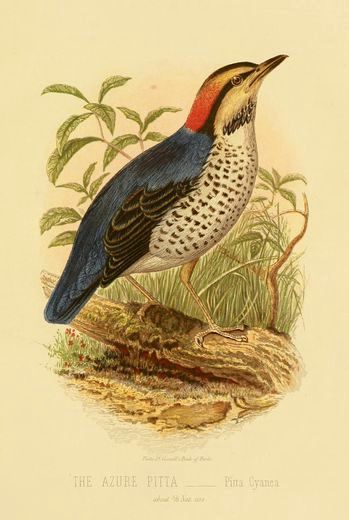
Plate 19, Cassell's Book of Birds
THE AZURE PITTA ____ Pitta Cyanea
about 5/8 Nat. size
THE PULIH.
The PULIH (Pitta Angolensis) one of the most beautiful birds of Western Africa, is more
powerfully constructed, and has shorter feet than the last-mentioned species, but is similarly coloured.
The plumage on the upper part of the body is green, with a slight metallic lustre; the top of the
head, a broad cheek-stripe, the tail, lower wing-covers, and quills are black, the latter, from the third
to the sixth, enlivened by a white spot; the tips of the tail-feathers and those upon the rump are
greenish blue, the throat and a streak over the eyes reddish white; the upper breast is ochre-yellow,
the lower part of the body light scarlet, the beak reddish black, and the foot flesh-pink. The length
of the body is six inches and a quarter, that of the wing four, and the tail one inch and two-thirds.
The Pulih inhabits a large portion of Western Africa.
THE NOISY PITTA.
The NOISY PITTA (Pitta strepitans) the third species we have selected for description, is of
a beautiful olive-green on the back and wings; the shoulders and wing-covers are of the colour
of verdigris; the throat, region of the ears, and nape, black; the under side is reddish yellow, with
a black and scarlet patch on the belly and lower tail-covers, the rest of the tail and exterior quills
are black, the fourth, fifth, and sixth primaries being ornamented with a white spot upon the base.
The eye is brown, the beak dark brown, and the foot flesh-pink. The body is seven inches and a
half long. This beautiful bird is met with on the eastern coast of Australia, between Macquarie and
Moreton Bays.
The Pittas almost exclusively inhabit India and the neighbouring islands, Western Africa, and
Australia, and are never met with in the Western Hemisphere. Of the thirty-three species enumerated
by Wallace, six belong to Africa, two to Australia, and no less than twenty-five to the Malay Islands.
Almost all frequent the inmost recesses of vast forests, whilst a few, on the contrary, occupy such
rocky districts as are covered with brushwood. Jerdon is of opinion that their very inferior powers
of flight place them almost at the mercy of the heavy winds that occur at certain seasons, and
account for their being occasionally compelled to steer their course for localities to which they
would not voluntarily resort. The first Nurang seen by him had taken shelter from a storm within
the hospital at Madras.
All the various species respecting whose breeding we have any particulars, build close to the
ground, and form their nests carelessly of grass, stalks, twigs, or roots, lined with hair, moss, or
delicate leaves. The eggs vary considerably in appearance; those found by Bernstein were oval, and
had a glossy white shell, whilst other authorities tell us that those laid by some species are bright
yellow, irregularly marked with brown and deep purplish grey, while others again are greenish white,
spotted with red and other dark tints. It has not yet been ascertained whether the male assists in
the labour of incubation, but both parents co-operate with the utmost courage and devotion in
tending and protecting their young family. Strange informs us that the Australian species may be
allured to come down from the trees, even almost to the mouth of the gun, by a careful imitation
of their call-note, and Hodgson speaks in similar terms of those inhabiting Nepaul. Bernstein
succeeded in rearing a pair of Pittas that he had taken from the nest upon insect diet, and also
rendered them extremely tame.
The ANT THRUSHES (Myiotheræ) constitute a family of birds principally inhabiting South
America. Some of them are very similar in appearance to the Wood Thrush, whilst others resemble
the Shrikes. The formation of the beak varies considerably, being sometimes much arched, sometimes
awl-shaped, and of very different size and strength. The tail is of various lengths, straight or rounded
at its extremity, the wing is invariably short and rounded, the tarsus is high and powerful, while the
toes are long, thin, and armed with long, slender, and occasionally spur-shaped claws. The plumage
of all is soft and much variegated.
The Ant Thrushes inhabit forests or wooded tracts that abound upon the vast prairies of South
America, and appear entirely to avoid mountain regions. Some few species venture near the
inhabited districts; but, for the most part, they resort to the densest thickets or closest copses, and
are most numerous in the hottest, quietest, and moistest localities, where they generally live upon the
ground, and trust, even when alarmed, more to the swiftness of their feet than to the use of their
wings. Other species again, frequent the bushes, and hop from branch to branch in search of food.
The strength of foot displayed by the members of this family fully equals that of any other race of
birds; they leap up and down with the utmost agility, and when endeavouring to elude pursuit,
spring over the ground with a rapidity that renders it difficult even for a dog to overtake them.
It is only during the period of incubation that the Ant Thrushes are content to take up their abode
in any one particular spot; at other seasons they wander about from place to place, without, however,
undertaking any regular migrations. We are almost unacquainted with the voices of these birds, but
are told that great dissimilarity is observable in their notes, and that though some species are far
noisier than the rest, none are distinguished for their powers of song. Insects constitute their
principal food: these are obtained from the surface of the ground, sometimes by scratching upon
it after the manner of hens. According to Kittlitz, they by no means despise vegetable diet. They
greedily devour ants, and thus render inestimable service to mankind, by helping to destroy some
of the vast swarms of those much-dreaded insects that occasionally sweep over the face of the
country. "Everywhere in the neighbourhood of Para," Mr. Bates tells us, "the Saüba Ants are
seen marching to and fro in broad columns, and carrying destruction among the cultivated trees and
vegetables of the Brazilians. So large are the communities made by these tiny creatures, that the
traveller often comes upon heaps of their dwellings of not less than forty yards in circumference,
though not more than two feet high." We learn from Ménétrier that the Ant Thrushes breed in the
spring-time of their native lands, and lay from two to three white eggs, marked with red; these are
usually deposited with but slight preparations in a hole in the ground, or some similar situation.
THE FIRE EYE.
The FIRE EYE (Pyriglena domicella) is a well-known member of the family of Ant Thrushes,
belonging to a group that comprises a number of the long-tailed species, who live principally amongst
the branches of shrubs or in the underwood, and comparatively rarely seek their food upon the
surface of the ground. They are all recognisable by their straight, conical beak, which is hooked at
its tip, and slightly incised; also by their high powerful tarsi, strong toes, armed with short, slender,
curved claws, moderate-sized wings, in which the fourth quill exceeds the rest in length, and
moderately long and rounded tail. The plumage of the male Fire Eye is almost entirely black, as are
also the beak and feet. The larger feathers of the wing-covers are edged with white, and those
upon the shoulder entirely white. The eye, as the name of the bird indicates, is of a brilliant fiery
red. The female is olive-brown, except upon the nape and throat, which are pale yellow. The
length of this species is seven inches, its breadth nine inches; the wing measures three inches, and
the tail two inches and three-quarters. The Fire Eye inhabits the forests of Brazil, and principally
frequents the shrubs or brushwood in the most shady and retired spots. Its song has been described
as a mere piping twitter. So eagerly does this very remarkable bird carry on its chase after ants, that
Kittlitz tells us that upon one occasion he fired repeatedly into the midst of a busy party, occupied
in clearing a clump of canes from a swarm of black ants, without causing them to cease from their
work of destruction.
THE ANT KING.
The ANT KING (Grallaria rex) another of these Thrushes, represents a group recognisable by
their short, thick beak, which is incised towards its hooked tip, and slightly arched at the culmen;
short, rounded wings, in which the fifth quill is the longest, that scarcely reach beyond the base of
the mere stump-like tail; slender legs, and moderate-sized toes, armed with somewhat curved claws.
The plumage is principally brown, the smaller feathers being spotted on the shaft with a lighter
shade; the wing-covers have a reddish tinge; the quills and tail-feathers are blackish brown, their
outer web rust-red; the bridle, cheeks, and a stripe that passes from the chin to the throat are pale
yellowish white; the entire under side is light yellowish brown, the eye greyish brown, the beak
blackish grey, and the feet reddish grey; the body measures eight, the wing four inches, the tail an
inch and a half, and the tarsus two inches. All the interminable forests upon the coast of South
America, from Brazil to Columbia, are inhabited by these birds, of whose habits, however, we are
completely ignorant, as they live exclusively within the shelter of the densest brushwood, and
invariably take flight at the approach of man. Burmeister tells us that their penetrating cry is to be
heard from early morning till late in the evening; that they make their nest upon the ground, and
lay blueish green eggs.
THE TAPACOLO.
The TAPACOLO (Pteroptochus megapodius) represents another group of South American Ant
Thrushes, in many respects resembling the Australian Lyre Birds, and particularly characterised by
the very unusual development of the feet. Their body is elongate, their wing short, their tail
rounded and of medium size; the beak is powerful, and compressed at the sides; the tarsus is
robust, and of moderate height; the toes are slender, and armed with slightly-curved spur-like
claws of great length. The TAPACOLO or TUALO of Chili is of a brownish olive on the upper part
of the body; the breast is reddish brown, and the rump of a reddish brown hue, striped with white;
the belly whitish, with dark markings; the throat, sides of the neck, and a line over the eyes are
white; the quills bordered with reddish brown, and the tail-feathers entirely brown.
"The Pteroptochus megapodius," says Mr. Darwin, "called by the Chilians 'el Turco,' is as
large as a Fieldfare, to which bird it has some alliance; but its legs are much longer, tail shorter,
and beak stronger; its colour is a reddish brown. The Turco is not uncommon. It lives on the
ground, sheltered among the thickets which are scattered over the dry and sterile hills. With its tail
erect, and stilt-like legs, it may be seen every now and then popping from one bush to another with
uncommon celerity. It really requires little imagination to believe the bird is ashamed of itself, and
aware of its most ridiculous figure. On first seeing it one is tempted to exclaim, 'A vilely-stuffed
specimen has escaped from some museum, and has come to life again.' It cannot be made to take
flight without the greatest trouble, nor does it run, but only hops. The various loud cries which it
utters when concealed amongst the bushes are as strange as its whole appearance. It is said to build
its nest in a deep hole beneath the ground. I dissected several specimens; the gizzard, which was
very muscular, contained beetles, vegetable fibre, and pebbles. From this character, and from the
length of its legs, scratching feet, membraneous covering to the nostrils, and short and arched wing,
this bird seems, to a certain extent, to connect the Thrushes with the gallinaceous order.
"The Tapacolo," continues the same writer, "is very crafty. When frightened by any person, it
will remain motionless at the bottom of a bush, and will then, after a little while, try, with much
address, to crawl away on the opposite side. It is also an active bird, and continually making a noise.
These noises are very various and strangely odd; some are like the cooing of Doves, others like the
bubbling of water, and many defy all similes. The country people say it changes its cry five times in
the year; according to some change of season, I suppose."
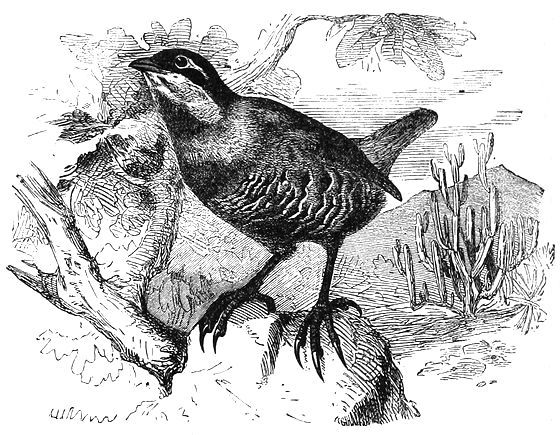
THE TAPACOLO (Pteroptochus megapodius).
THE LYRE BIRD.
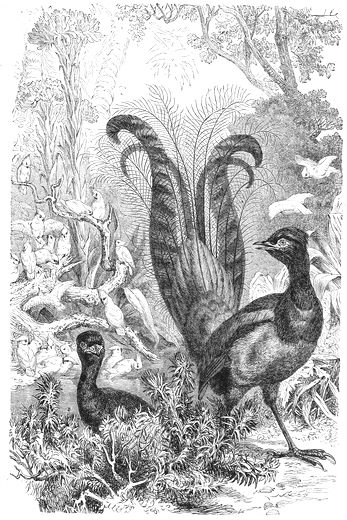
THE LYRE BIRD (Menura superba).
The LYRE BIRD (Menura superba) has, perhaps, excited more controversy among ornithologists,
respecting its classification, than any other of the remarkable members of the feathered creation
inhabiting Australia. This difference of opinion has arisen from its unusual size, and the very
peculiar formation of its tail. The body is slenderly built, the neck of moderate length, the
head comparatively large and well-formed, the wings short, the tail very long, and the tarsus
high. The beak is straight, except at the tip, which is slightly hooked, very perceptibly incised,
and broader than it is high at the base; the nostrils are large, oval, situated near the
middle of the bill, and partially covered with a skin. The first five quills in the much-arched
wing are graduated; the sixth, seventh, eighth, and ninth are the longest, and of nearly equal
size. The very beautiful lyre-shaped tail possessed by the male is composed of sixteen feathers,
whilst that of the female is of the ordinary form, and contains but twelve. The plumage of the
Menura is thick, lax, and almost hair-like on the back and rump, but prolonged into a crest on the
top of the head; the base of the beak is covered with bristles. The length of the body of the male is
fifteen inches, that of his tail twenty-three, whilst his mate does not exceed thirteen inches; the
longest feathers in her tail measuring not more than fifteen inches. The male Menura is of a deep
brownish grey on the upper part of the body, shaded with red on the rump; the throat and upper
part of the breast are red; the rest of the under side greyish brown, lightest upon the belly. The
secondary quills and outer web of the primaries are reddish brown; the tail blackish brown on the
upper side, and silvery grey beneath. The outer webs of the two lyre-shaped feathers are dark grey,
their extremities velvety black, fringed with white, the inner web striped alternately with blackish
brown and rust-red; the two centre tail-feathers are grey, the rest black. The plumage of the female
is entirely of a dirty brown, shading into grey on the belly; the young resemble the mother until
after the first moulting season. This remarkable bird, which, together with the Emeu and Kangaroo,
form the emblems or heraldic bearings of Australia, has been most carefully observed and described
by both Gould and Bennett; we shall, therefore, lay before our readers the interesting results of
their labours in the words of those naturalists:—
"The great stronghold of the Lyre Birds," says Mr. Gould, "is the colony of New South Wales,
and, from what I could learn, its range does not extend so far to the eastward as Moreton Bay;
neither have I been able to trace it to the westward of Port Phillip on the southern coast; but further
research only can determine these points. It inhabits equally the bushes on the coast and those that
clothe the sides of the mountains in the interior. On the coast it is especially abundant at the
Western Port and Illawarra; in the interior the cedar bushes of the Liverpool range, and, according to
Mr. G. Bennett, the mountains of the Tumut country are among the places of which it is a denizen.
Of all the birds I have ever met with, the Menura is by far the most shy and difficult to procure.
While among the mountains I have been surrounded by these birds, pouring forth their loud and
liquid calls for days together, without being able to get a sight of them; and it was only
by the most determined perseverance and extreme caution that I was enabled to effect this desirable
object, which was rendered more difficult by their often frequenting the almost inaccessible and
precipitous sides of gullies and ravines, covered with tangled masses of creepers and umbrageous trees.
The cracking of a stick, the rolling down of a small stone, or any other noise, however slight, is
sufficient to alarm it; and none but those who have traversed these rugged, hot, and suffocating
bushes can fully understand the anxious labour attendant on the pursuit of the Menura. Independently
of climbing over rocks and fallen trunks of trees, the sportsman has to creep and crawl
beneath and among the branches with the utmost caution, taking care only to advance while the
bird's attention is occupied in singing, or in scratching up the leaves in search of food: to watch its
action it is necessary to remain perfectly motionless, not venturing to move, even in the slightest
degree, or it vanishes from sight as if by magic. Although I have said so much on the cautiousness
of the Menura, it is not always so alert: in some of the most accessible bushes through which roads
have been cut it may frequently be seen, and even closely approached on horseback, the bird
evincing less fear of horses than of man. At Illawarra it is sometimes successfully pursued by dogs,
trained to rush suddenly upon it, when it immediately leaps upon the branch of a tree, and its
attention being exclusively attracted by the dog below barking, it is easily approached and shot.
Another successful mode of procedure is by wearing the tail of a full-plumaged male in the hat,
keeping it constantly in motion, and concealing the person among the bushes, when, the attention of
the bird being arrested by the apparent intrusion of another of its own sex, it will be attracted within
the range of the gun. If the bird be hidden from view by surrounding objects, any unusual sound,
such as a shrill whistle, will generally induce him to show himself for an instant, by causing him to
leap with a gay and sprightly air upon some neighbouring branch, to ascertain the cause of the
disturbance; advantage must be taken of this circumstance immediately, or the next moment it may
be half-way down the gully. The Menura seldom, if ever, attempts to escape by flight, but easily
eludes pursuit by its extraordinary powers of running. None are so efficient in obtaining specimens
as the naked black, whose noiseless and gliding steps enable him to steal upon it unheard or
unperceived; with a gun in his hand he rarely allows it to escape, and in many instances he will even
kill it with his own clumsy weapons. The Lyre Bird is of a wandering disposition, and, although it
probably keeps to the same jungle, it is constantly engaged in traversing it from one end to the other,
from the mountain base to the top of the gullies, whose steep and rugged sides present no obstacle
to its long legs and powerful muscular thighs. It is also capable of performing extraordinary leaps,
and I have heard it stated that it will spring ten feet perpendicularly from the ground. Among
its many curious habits, the only one at all approaching to those of the Gallinaceæ is that of forming
small round hillocks, which are constantly visited during the day, and upon which the male is
continually tramping, at the same time erecting and spreading out its tail in the most graceful manner,
and uttering its various cries; sometimes pouring forth its natural notes; at others imitating those
of other birds, and even the howling of the native dog (dingo). The early morning and evening are
the periods when it is most animated and active. Although upon one occasion I forced this bird to
take wing, it was merely for the purpose of descending a gully, and I am led to believe that it
seldom exerts this power unless under similar circumstances. It is particularly partial to traversing
the trunks of fallen trees, and frequently attains a considerable altitude by leaping from branch to
branch. Independently of a loud full note, which may be heard reverberating over the gullies for
at least a quarter of a mile, it has also an inward warbling song, the lower notes of which can only
be heard within about fifteen yards. It remains stationary whilst singing, fully occupied in pouring
forth its animated strain; this it frequently discontinues abruptly, and again commences with a low,
inward snapping noise, ending with an imitation of the loud and full note of the Satin Bird, and
always accompanied by a tremulous motion of the tail. The food of the Menura appears to consist
principally of insects, particularly of centipedes and coleoptera. I also found the remains of shelled
snails in the gizzard, which is very strong and muscular."
"I first," continues Mr. Gould, "saw these birds in the mountain range of the Tumut country.
Lately they have been very abundant among the Blue Mountain ranges bordering on the Nepean
River, above Emeu Plains, about thirty-five miles from Sydney. They are remarkably shy, very
difficult of approach, frequenting the most inaccessible rocks and gullies; and, on the slightest
disturbance, they dart off with surprising swiftness through the brakes, carrying their tail horizontally;
but this appears to be for facilitating their passage through the bushes; for when they leap or spring
from branch to branch, as they ascend or descend a tree, their tail approaches to the perpendicular.
On watching them from an elevated position playing in a gully below, they are seen to form little
hillocks or mounds by scratching up the ground around them, trampling and running flightily about,
uttering their loud, shrill call, and imitating the notes of various birds."
The following account of a young Lyre Bird was received by Mr. Gould from Ludwig Becker:—
"In the month of October, 1858, the nest of a Lyre Bird was found in the densely-wooded
ranges near the sources of the river Yarra-Yarra. It contained a bird which seemed at first to be
an old one in a sickly condition, as it did not attempt to escape, but it was soon discovered to be
a young bird of very large size as compared with its helplessness. When taken out of the nest it
screamed loudly, the note being high, and sounding like 'tching-tching.' In a short time the mother-bird,
attracted by the call, arrived, and, notwithstanding the proverbial shyness of the species, flew
within a few feet of her young, and tried in vain to deliver it from captivity, by flapping her wings
and making various rapid motions in different directions towards the captor. A shot brought
down the poor bird, and, with its mother near it, the young Menura was silent and quiet. It was
taken away, and kept at a 'mia-mia' erected in the midst of the surrounding forest.
"Its height was sixteen inches; its body covered with a brown down, but the wings and tail
were already furnished with feathers of a dark-brown colour. The head was thickly covered with a
greyish-white down, of from one to two inches in length; the eyes were hazel brown; the beak
blackish and soft; the legs nearly as large as those of a full-grown specimen, but it walked most
awkwardly, with the legs bent inwards. It rose with difficulty, the wings assisting, and, when on its
legs, occasionally ran for a short distance, but often fell, apparently from want of strength to move
the large and heavy bones of its legs properly. It constantly endeavoured to approach the camp-fire,
and it was a matter of some difficulty to keep it from a dangerous proximity to it. Its cry of
'tching-tching' was often uttered during the daytime, as if re-calling the parent bird; and when this call
was answered by its keeper feigning the note 'bullen-bullen'—the native name for the Lyre Bird, which
is an imitation of the old birds' cry—it followed the voice at once, and was easily led away by it.
It soon became very tame, and was exceedingly voracious, refusing no kind of food, but standing
ready, with widely-gaping bill, awaiting the approaching hand which held the food, consisting
principally of worms and the larvæ of ants, commonly called ants' eggs, but it did not refuse bits of
meat, bread, &c. Occasionally it picked up ants' eggs from the ground, but was never able to
swallow them, the muscles of the neck not having acquired sufficient power to effect the required jerk
and throwing back of the head. It rarely if ever partook of water. It reposed in a nest made of
moss, and lined with opossum-skin, where it appeared to be quite content. While asleep the head
was covered with one of the wings. When called 'bullen-bullen' it awoke, looked for several seconds
at the disturber, soon put its head under the wing again, and took no notice whatever of other
sounds or voices. That the young Menura remains for a long time in the nest is proved by the
manner in which it disposes of its droppings; our young captive always went backward before
dropping its dung, in order to avoid soiling the nest. It is probable that it leaves the nest in the
daytime, when the warmth of the weather invites it to do so, but that during the night it remains in
the nest; and if the weather should become cold the mother shelters her young, the nest being
large enough to contain both."
A second species of Lyre Bird, the Menura Alberti, is thus described by Mr. Gould:—
"The habits of this bird are very similar to those of the Menura superba, but having seen and
watched both on their playgrounds, I find the Menura Alberti is far superior in its powers of mocking
and imitating the cries and songs of others of the feathered race to the Menura superba. Its own
peculiar cry or song is also different, being of a much louder and fuller tone. I once listened to one
of these birds that had taken up its quarters within two hundred yards of a sawyer's hut, and he had
made himself perfect with all the noises of the homestead—the crowing of the cocks, the cackling of
the hens, the barking and howling of the dogs, and even the painful screeching of the sharpening
or filing of the saw. I have never seen more than a pair together. Each bird appears to have its
own walk or boundary, and never to infringe on the other's ground, for I have heard them day after
day in the same place, and seldom nearer than a quarter of a mile to each other. Whilst singing they
spread their tails over their heads like a Peacock, droop their wings to the ground, and at the
same time scratch and peck up the earth. They sing mornings and evenings, and more in winter
than at any other time. The young cocks do not sing until they get their full tails, which I fancy
is not until the fourth year, having shed them in four different stages. The two centre curved
feathers are the last to make their appearance. They live upon small insects, principally beetles;
their flesh is not eatable, being dark, dry, and tough, and quite unlike that of other birds. They
commence building their nests in May, lay in June, and have young in July. They generally place
their nests on the side of some steep rock, where there is sufficient room to form a lodgment, so that
no animals or vermin can approach."
The following particulars respecting this species we extract from one of Dr. Bennett's interesting
works on Australia:—"The locality it frequents, says Dr. Stephenson, 'consists of mountain ridges
not very densely covered with brush. It passes most of its time on the ground, feeding and strutting
about, with the tail reflected over the back to within an inch or two of the head, and with the wings
drooping on the ground. Each bird forms for itself three or four "corroborring places," as the
sawyers call them. These consist of holes scratched in the sandy ground, about two feet and a half
in diameter, by sixteen, eighteen, or twenty inches in depth, and about three or four hundred yards
apart, or even more. Whenever you get a sight of the bird, which can only be done with the greatest
caution, and by taking advantage of intervening objects to shelter yourself from its observation, you
will find it in one or other of these holes, into which it frequently jumps, and seems to be feeding; it
then ascends again, and struts round and round the place, imitating with its powerful musical voice any
bird it may chance to hear around it. The note of the Dacelo gigantea, or Laughing Jackass, it
imitates to perfection. Its own whistle is exceedingly beautiful and varied. No sooner does it
perceive an intruder than it flies up into the nearest tree, first alighting on the lowermost branches,
and then ascending by a succession of jumps, until it reaches the top, whence it instantly darts off
to another of its playgrounds. The stomachs of those I dissected,' continues Dr. Stephenson,
'invariably contained insects, with scarcely a trace of any other material. Now collectors of insects
know that gravel-pits and sandy holes afford them great treats, and it appears to me that one, if not
the principal use of the excavations made by this bird is to act as a trap for unwary coleopterous and
other insects, which falling in cannot ascend again, and are therefore easily secured.' Mr. Strange,
who met with this species in the cedar bushes which skirt Turanga Creek, Richmond River, says,
'Like the Menura superba, it is of a shy disposition. When alarmed or running away, it carries the
tail erect, and not drooping downward like that species. I spent ten days in the midst of cedar-brushes
in the hope of seeing something of its nidification, but did not succeed in finding any nest
with eggs. I found, however, one large, dome-shaped nest, made of sticks placed in the spur of a
large fig-tree, which the natives assured me was that of the Colevin, their name for this bird. It
resembles that of Orthonyx, except that the inside was not lined with moss, but with litter from a
large mass of parasitical plants that had fallen to the ground. The natives agree in asserting that
the eggs are only laid in cold weather, by which I apprehend they mean the spring, as I shot a young
specimen about four months old on the 24th of November which had the whole of the body still
covered with brown and greyish down. I have seen this specimen take extraordinary leaps of not
less than ten feet from the ground, on to some convenient branch, whence it continues to ascend in
successive jumps, until it has attained a sufficient elevation to enable it to take flight into the gully
below.'"
The WARBLERS (Sylviadæ) are among the smallest and most fascinating of the feathered
race. They are recognisable by their short, awl-shaped beaks, powerful feet, short, rounded wings,
long, variously formed tails, and usually silky plumage.
The SONG WARBLERS (Sylviæ), the most attractive group of this family, are all little birds,
having soft, silky, variously-coloured plumage and a slender body; the beak is slightly conical, strong
at the base, almost as broad as it is high, hooked and slightly incised at its tip; the foot is powerful
and of medium length, the toes short and strong. The wings are rounded and of moderate size, the
third and fourth quills being longer than the rest; the tail, which is composed of twelve feathers, varies
in its formation. Light grey predominates in the coloration of the plumage; but is varied with
different shades of red and brown; the adult male and female are generally but not invariably alike.
The Song Warblers principally frequent the woodland districts of the more northerly portions of
the Eastern Hemisphere, and usually prefer tracts covered with low trees and underwood to lofty
forests. They almost entirely avoid mountainous regions, even should these be thickly overgrown
with their favourite shrubs and bushes. Unlike the Thrushes, they rarely descend to seek for food
upon the surface of the ground, nor are they apparently more at their ease when on the wing, for
they frequently undertake lengthy journeys during their winter migrations, and their flight is in most
instances fluttering and heavy; some few species, however, prove exceptions to this rule, as they are
not only capable of careering with a rapid undulating course through the realms of air, but frequently,
when about to pour forth their song, soar to a considerable altitude. It is in the depths of the
thicket, however, that the members of this family best display the wonderful agility with which they
have been endowed. No tangled brake, no mass of foliage, however dense, is impervious to these
little birds. With lowered head, and wings and feet drawn in, they creep through the smallest
apertures with astonishing dexterity, and make their way with an ease and rapidity that is almost
unequalled in the whole feathered creation. Unlike the Thrush or Shrike, they never agitate their
tail and pinions when in motion; but, if angry or excited, display the crest that decks their head, and
slightly raise their wings above the back. As regards their vocal powers, they are, for the most part,
highly gifted. Their senses are keen, their intelligence remarkable, and their dispositions shy and
cautious. Although usually peaceable during the breeding season, they frequently exhibit considerable
fury and violence towards any suspected rival or enemy, that contrasts strangely with
the tenderness and devotion they display while endeavouring to win the attention of their mates, or
ministering to the wants of their little family. More than one brood is usually produced in the year,
each of which consists of from four to six eggs, of a white hue, spotted with grey or brown. The flat
and prettily-formed nest is placed amongst the bushes, or on a branch, and constructed of stalks, cottony
wool, spiders' webs, green moss, and fibres, lined with horsehair, the whole being woven together
so lightly that the eye can penetrate its interior. In some instances these fragile little structures are
fastened so insecurely on their foundations as to be liable to be dislodged by the wind. During the
summer months the Song Warblers subsist almost entirely upon insects, larvæ, caterpillars, and similar
fare, and in autumn devour large quantities of berries and fruit. They are often very destructive to
cherry-trees, and in Southern Europe do great damage to the crops of ripe figs.
The TRUE SONG WARBLERS (Curruca) are distinguished from their congeners by the
comparative length of their pointed wings, in which the third quill is longer than the rest, also by their
moderately-sized and almost or quite straight tail.
THE SPARROW-HAWK WARBLER.
The SPARROW-HAWK WARBLER (Curruca nisoria), the largest European member of this group, is
seven inches long and eleven broad; the wing measures three and a half, and the tail three inches.
Upon the upper part of the body the feathers are deep grey, usually shaded with rust-red; the under
side is greyish white, decorated with dark grey crescent-shaped spots, which are most clearly defined
in the plumage of the male bird; the quills are brownish grey, edged with a paler shade; the
tail-feathers deep grey, with light borders. The eye is bright gold colour, the beak brownish black,
and yellowish pink at its base; the foot is light grey. In the young, the crescent-shaped spots
on the breast are but slightly indicated.
This species is numerously met with in most European countries that lie between Southern
Sweden and Central Asia; it is, however, unknown in England, and is extremely rare both in Spain
and Greece. Pasture lands, abounding in shrubs and bushes, on the banks of large rivers, are
the localities it almost exclusively frequents; it never occupies lofty trees, except as temporary resting-places
during its winter migrations. In its general habits and movements the Sparrow-hawk Warbler
closely resembles most other members of its family; it flies with difficulty, and comes but seldom to
the ground, but displays the utmost agility in creeping through the densest bushes, or in hopping
from branch to branch. Its song is rich, varied, and uttered constantly, almost throughout the entire
day. The period of incubation commences as soon as the birds have returned to their usual spring
haunts, and is accompanied by repeated outbursts of jealousy and violence on the part of the male,
who not only frequently engages in fierce conflicts with his actual rivals, but flies assiduously round
his mate while she carries on the work of building their little dwelling, in order to keep the coast
clear from even a distant intruder on her privacy. The nest is usually placed in a hedge or bush,
at from two to four feet above the ground, and is in every respect similar to that above described;
the eggs, from four to six in number, are oval, with thin greyish shells, spotted with grey or olive
brown. Both parents exhibit great timidity whilst occupied in the care of their young, and quit the
nest at the first alarm of danger, the female frequently endeavouring to divert attention from her
brood by feigning to be lame or suffering. If disturbed while occupied in building, it is not uncommon
for a pair to leave the spot and re-commence their preparations elsewhere; indeed, in some instances,
an unusually timid couple have been known to desert their brood when terrified by the approach and
investigations of a stranger.
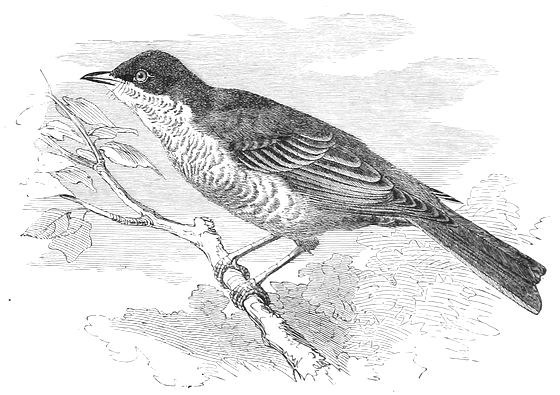
THE SPARROW HAWK WARBLER (Curruca nisoria).
THE ORPHEUS WARBLER.
The ORPHEUS WARBLER (Curruca Orphea), the European species next in size to that above
described, is six inches and a half long, and nine and a quarter broad; the wing measures three
inches, and the tail two inches and three quarters. The female is two lines smaller than her mate.
The entire upper part of the back is dark grey, shaded with brown, the top of the head and nape
are brown or greyish black, the sides of the breast light rust-red, the rest of the under-side is white;
the quills and tail-feathers are blackish brown, the outer web of the exterior tail-feathers white, as
is also a conical spot on the extremity of the inner web and on the tip of the feathers next
in order. The eye is light yellow, the upper mandible quite black, and the bare circle
around the eyes bluish grey. The female is paler than her mate, particularly about the region of
the head. This species inhabits the south of Europe, and only occasionally wanders to the central
portions of other continents. Some writers are of opinion that it remains in Greece throughout the
entire year, but this statement we are satisfied, from our own observation, is incorrect; there, as in
other southern countries of Europe, they generally appear about April, and migrate to Central Africa
and India at the beginning of autumn. Jerdon tells us that they are numerously met with in
Southern India during the winter, and we have ourselves seen them at that season in Africa, near
the Blue River. Unlike the generality of Warblers, these birds usually frequent trees rather than
underwood or bushes, and especially delight in groves of figs and olives, or pine forests. Throughout
all the well-watered and highly-cultivated districts of their native lands they are by no means
rare, but are seldom seen in the vicinity of mountains. Their voice is loud, sonorous, and agreeable.
The nest of this species is usually placed in full view, upon the bough of a tree, and is somewhat
thicker and more substantially constructed than that of most other Warblers; the interior is variously
lined, occasionally with delicate fibrils of grape-vines or similar materials. Thienenmann mentions
an instance in which fish-scales were, strangely enough, employed for this purpose. The brood
consists of five glossy eggs, of a delicate white or greenish-white colour, spotted with violet grey or
yellowish brown; the latter spots are sometimes entirely wanting. The female alone broods, while
her mate sits upon a neighbouring tree or branch, and cheers her labours with a constant flow of song.
The young are tended by both parents for some time after they are fully fledged, and go forth alone
into the world immediately after the first moulting season.
The following notice of the occurrence of this species in Yorkshire may be found in the
"Zoologist" for 1849, from the pen of Sir William Milner, of Nunappleton:—"The species was a
female, and was observed in company with its mate for a considerable time before it was shot. The
other bird had a black head, and the description I received left no doubt on my mind that it was a
male Sylvia Orphea. The bird obtained, of which I send you a description, was shot in a small
plantation near the town of Wetherby, on the 6th of July, 1848, and had the appearance of having
been engaged in incubation, from the state of the plumage." "Mr. Graham, a bird preserver of
York," continues Sir W. Milner, "hearing that a very uncommon bird had been shot, went over to
Wetherby, and fortunately obtained the specimen for my collection. This bird had the beak black
and very strong; the whole upper part of the plumage dark ash-coloured brown; the outer feather of
the tail white; the second on each side edged with dirty white, the rest of a brownish black; chin
dirty white; throat and belly brownish white; under surface of the wings and vent light brown; legs
very strong, toes and claws black. The whole length six inches three lines."
THE GREATER PETTICHAPS.
The GREATER PETTICHAPS, or GARDEN WARBLER (Curruca or Sylvia hortensis), is six inches
long, and nine and three-quarters broad; the wing measures three inches, and the tail two and
a half; the female is somewhat smaller than her mate, but resembles him in colour. The entire upper
portion of the body is olive-grey, the throat and belly are of a whitish shade, and the rest of the
under side light grey. The quills and tail are dark grey, the eye light greyish brown, the beak and
feet dull grey.
This species inhabits the whole of Southern Europe, extending in a northerly direction as far as
68° north latitude; in France and Italy it is especially numerous, but is comparatively rarely met
with in Spain, though it is known to breed in that country. It usually arrives in England and
Scotland about April, and leaves early in September. Unlike most of its congeners, the Garden
Warbler is extremely quiet and peaceful in its demeanour, and, though cautious and vigilant, by no
means timid. It usually frequents woods, gardens, and orchards, and may constantly be seen
disporting itself among the fruit trees, in utter indifference to the presence of the owners.

THE ORPHEUS WARBLER (Curruca Orphea).
Macgillivray, quoting from Sweet, says:—"It visits us in the spring, about the end of April or
the beginning of May, and its arrival is soon made known by its very loud and long song. It
generally begins very low, not unlike the song of the Swallow, but raises it by degrees, until it
resembles the song of the Blackbird, singing nearly all through the day and the greater part of the
time it stays with us, which is but short, as it leaves us again in August. In confinement it will sing
nearly all through the year, if it be treated well. In a wild state it is generally found in gardens and
plantations, where it feeds chiefly upon fruits, and will not refuse some kinds of insects; it is very
fond of the larva or caterpillar that is often found upon cabbage plants, the produce of Papilio
brassicæ, and I know no other bird of the genus that will feed on it. Soon after its arrival here the
strawberries are ripe, and it is not long before it finds them out; the cherries it will begin before they
are quite ripe, and I know not any kind of fruit or berry which is wholesome that it will refuse. It
generally tastes the plums, pears, and early apples, before it leaves us; and, when in confinement it
also feeds freely on elder, privet, or ivy berries; it is also partial to barberries."
Mr. Neville Wood has seen it "darting into the air to catch insects in the same manner as the
Spotted Fly-catcher (Muscicapa grisola), often taking its stand on a dahlia stake, watching for its prey,
darting aloft with inconceivable rapidity, with its bill upwards, catching the fly with a loud snap of the
bill, and immediately returning to its station to renew the same process with similar success."
In an extract given by Mr. Thompson, of Belfast, from the MS. of the late John Templeton,
Esq., he says:—"On the 21st of May I had the pleasure of seeing this bird, to whose haunt in my
garden I was attracted by its pleasing melody. It was not very shy, coming near enough to be
distinctly seen, but was extremely restless, flitting every moment from place to place, and only
stationary on the branch while it gave out its song. The male continued to sing until the young
were reared, when his song ceased for about a fortnight; then it was again renewed, on the
construction, I suppose, of a new nest."
"As a songster," says Yarrell, "it ranks with the Blackcap; and a good judge of the comparative
value of the songs of our birds has described that of the Garden Warbler as a continued strain of
considerable modulation, sometimes lasting for half an hour at a time without a pause. The song is
wild, rapid, and irregular in time and tone, but the rich depth is wonderful for so small a throat,
approaching in deep mellowness even to that of the Blackbird."
The nest is made in bushes and trees, at various distances from the ground, and is so slightly
constructed as to render it a matter of wonder how it can possibly support the five or six eggs that
constitute a brood. It is formed externally of strong bents, lined with finer bents, fibrous roots,
and horsehair. The situation in which it is placed is carelessly selected, and it is no uncommon
occurrence for the little structure to fall to the ground, not only during a high wind, but from the mere
weight of the parents as they enter or leave the nest. Strangely enough, though they thus appear to
adopt the most unsuitable situations for building, few birds are so capricious as to their requirements
in this respect, and it frequently happens that a pair of Garden Warblers will lay the foundation of
several nests, often within a very limited space, before they satisfy their peculiar fancies. Both
parents co-operate in the business of incubation; the male, however, only sits during the middle of
the day; the nestlings are hatched within a fortnight, and in another fortnight can leave the nest,
and climb nimbly about the surrounding branches, though unable to fly. If undisturbed, this species
breeds but once in the year.
THE LESSER WHITETHROAT.
The LESSER WHITETHROAT (Curruca garrula) does not exceed five inches and one-third in
length, and eight in breadth; the wing measures two inches and a half, and the tail two inches and
a quarter. In this species the top of the head is grey, and the back brownish grey; the wing-feathers
are of a still deeper grey, edged with a pale shade; the entire under side is white, tinted with yellowish
red on the sides of the breast; the cheek-stripes are dark grey; the exterior tail-feathers white; the
rest being only surrounded with a white border. The eyes are brown, the beak dark grey, and the
legs bluish grey.
This Whitethroat inhabits the whole of Central Europe, usually appearing in England about April;
and, according to Jerdon, is met with throughout India and in many parts of Central Asia, during the
course of its winter migrations. Woods, gardens, and orchards are its favourite resorts, and these it
boldly visits, not merely in the neighbourhood of human habitations, but in the very centre of towns
and villages.
"The food of this species," as Mr. Yarrell informs us, "is very similar to that sought for by the
Common Whitethroat—namely, insects in their various states, the smaller fruits of many different
sorts, for which it visits the gardens, and, later in the season, it feeds on the berries of the elder and
some others. It is not, however, so easy to preserve this bird in health during confinement as the
Common Whitethroat."
Colonel Sykes obtained examples in the Deccan which only differed from the English specimens
in having a reddish tint on the white of the under surface, but Mr. Blyth mentions that he has seen
this tint on specimens obtained in this country, and Mr. Yarrell quotes part of a letter received from
the Rev. W. E. Cornish, of Totnes, which says, "I have reared the Lesser Whitethroat, two males and
a female; the males had a beautiful tinge of carmine on the breast."
Mr. Hepburn, who was the first to discover this species in East Lothian, has furnished the
following notice respecting it:—"On the 7th of May, 1838, I first heard the song of the Lesser
Whitethroat (Sylvia curruca). In its habits it is shy and retiring; it loves to frequent copses and
gardens. When you approach its haunts it conceals itself in the thickest shade, where it utters its
alarm-note, distending its throat a little. One day in July, when lying in wait for Wood Pigeons in a
ditch beneath the shade of some hedgerow trees, I observed one sporting amongst the hawthorn
twigs. He once sprung into the air, caught an insect, and then began to sing in a very low voice,
ending in a very shrill, tremulous cry. House Sparrows, Hedge Chanters, Chaffinches, Wagtails,
Willow Wrens, Wood Wrens, White Throats, dart into the air in the very same way. The little
fellow ceased his song when he observed me, and sought the middle of the hedge, where he remained
till I left my place. I teased him thus for about twenty minutes. He had young ones at the time.
It was about the beginning of July that I observed that both the Greater and Lesser Whitethroats
made excursions into fields of growing wheat and beans. In the former case they settle on the stalk
near to the ear, which they diligently examine. The Wheat Fly (Cecidomyia tritici) at this season
deposits its eggs between the glumes of the corn, and we may reasonably suppose that the Whitethroats
devour this destructive insect, in doing which they must confer a great benefit on the farmer,
as far as their influence extends. After this I shall never grudge them a few currants. But this is
not all; for, besides destroying vast numbers of other insects which feed on the honey contained in
the nectary of the bean, I have seen their little mouths filled with the black or collier aphides, which
often commit much damage by adhering to the top of the field bean and sucking its juice, so that
sometimes fruit, leaves, and stem perish. It prefers the red currant to all other fruits. It departs
about the 8th or 10th of September."
"The louder notes of this bird," says Mr. Yarrell, "have nothing particular in their tone to
recommend them; but if approached with sufficient caution to prevent alarm, or when kept in confinement,
they may be heard to utter a low, soft, and pleasing whistle, which is almost incessant; so
much so as to have induced the application of the epithets of garrula and babillard, as terms of
specific distinction. The nest is usually placed upon a thick bush near the ground, and resembles
that made by other members of the family. The eggs are from four to six in number, round, and
pure white or bluish green, marked with violet-grey or yellowish-brown spots, most thickly strewn
over the broad end. Both parents assist in the process of incubation, and tend and protect their
young with the utmost care and assiduity; but, like the species already described, will often, if disturbed
when brooding, desert not merely their nest, but the eggs contained therein. We have
frequently remarked that the same self-sacrificing devotion exhibited by this species to its own
nestlings is also displayed towards the young Cuckoos that are sometimes reared involuntarily as
inmates of the little family."
THE CAPIROTE, OR BLACK-CAP.
The CAPIROTE, or BLACK-CAP (Curruca atricapilla), one of the most highly-endowed of woodland
songsters, is greyish black upon the upper parts of the body; the under side is light grey, with the
throat of a still paler shade. In the adult male the crown of the head is deep black, in the females
and young reddish brown; the eyes are brown, the beak black, and the feet dark grey. This species
is five inches and ten lines long, and eight inches broad; the wing measures two inches and a half
and the tail two and a quarter; the size of the female is the same as that of her mate. It is at
present uncertain whether the REDHEAD (Curruca ruficapilla) is to be regarded as merely a variety
of this bird, or as an entirely different species.
The Capirote is found throughout the whole of Central Europe, and during its migration visits the
southern portion of that continent; it is also very numerously met with in the Canary Islands, and has
occasionally been seen in Soudan. In most parts of Europe it generally makes its appearance about
April, and leaves again early in the autumn.
"When the Blackcap first arrives in this country, its chief food," says Mr. Sweet, "consists of
the early ripened berries of the ivy, and where these are there the blackcaps are first to be heard,
singing their melodious and varied song. By the time the ivy-berries are over, the little green larvæ
of the small moths, rolled up in the young shoots and leaves, will be getting plentiful; these then
constitute their chief food until strawberries and cherries become ripe; after that there is no fruit
or berry that is eatable or wholesome that they will refuse. When they have cleared away the elderberries
in autumn, they immediately leave us."
This species usually produces two broods in the season, and places its comparatively well-built
nest within the shelter of a thorny bush or leafy shrub. The eggs, from four to six in number, are
of an oval shape, smooth, flesh-coloured, and marked with reddish-brown spots.
"The male birds of several species of Warblers," says Mr. Yarrell, "share with their females
the task of incubating the eggs; this is particularly the case with the male Blackcap, readily known
from the female by his black head. So gratified is he, apparently, when performing this part of his
duty, that he will frequently sing while thus occupied, sometimes, perhaps, occasioning the destruction
of his hopes. A writer in the 'Magazine of Natural History' says he has several times been led to
the discovery of the eggs by the male singing while sitting. The female, when taking her turn on
the nest, is occasionally fed by her mate. Generally, however, male birds neither sit so steady,
or feed the young so assiduously, as the females."
Bolle tells us that if the nestlings lose their mother her bereaved mate will alone undertake the
care of his hungry young ones. The general habits and demeanour of the Blackcap so closely
resemble those of other members of this family that further description is unnecessary. Nevertheless,
we must allude more particularly to the peculiarities of its beautiful song, which has been described
by Mr. Yarrell:—
"The Blackcap has in common a full, deep, sweet, loud, and wild pipe, yet that strain is
of short continuance, and his motions are desultory; but when the bird sits calmly, and engaged in
song in earnest, he pours forth a very sweet but inward melody, and expresses a great variety of soft
and gentle modulations, superior, perhaps, to any of our Warblers, the Nightingale excepted. While
this species warbles the throat is wonderfully distended."
Bolle mentions a tame Capirote kept by a lady in Ciudad de los Palmas, the chief town of the
Canaries, that was the wonder and admiration of the whole neighbourhood, on account of the extraordinary
clearness with which it had learnt to repeat the words mi niño chiceritito (my darling little
pet), a phrase daily employed by its mistress, as she gave her favourite its food. Large sums were
offered by several persons, in the hope of obtaining so great a curiosity as a singing bird that could
speak, but his owner was not inclined to part with her treasure; and after tending it for several
years with the utmost watchfulness, had the grief to lose it by poison, administered, it was supposed,
by some one whose offers had been refused. When in confinement this species soon becomes tame.
Beckstein says, "A young male which I had put into a hothouse for the winter was accustomed
to receive a meal-worm from my hand every time I entered. This took place so regularly
that immediately on my arrival he placed himself near the little jar where I kept the meal-worms. If
I pretended not to notice this signal, he would take flight, and, passing close under my nose, immediately
resume his post; and this he repeated, sometimes even striking me with his wing, till I
satisfied his wishes and impatience."
THE WHITE THROAT.
THE WHITE THROAT (Curruca cinerea).
The WHITE THROAT (Curruca cinerea) is five inches and three-quarters long, and eight inches
and a quarter broad; the wing and tail each measure two inches and a half. This species is
at once recognisable by the slender body, comparatively long tail, white throat, and the reddish
border that surrounds its upper wing-covers. The head, nape, back, and rump are yellowish grey,
shaded with a faint reddish tinge; the under side is white, intermixed with reddish grey on the breast;
the quills, tail, and feathers that form the wing-covers are greyish black, the latter being moreover
broadly bordered with rust-red; the eye is brownish yellow, the upper mandible deep grey, the lower
reddish grey, and the legs greyish yellow. In the female and young birds these various colours are
not so clearly defined as in the plumage of the adult male. These Warblers are met with in North-western
Asia and throughout the larger portion of Europe, from Sweden and Russia, as far south as
the northern parts of Spain. They are numerous in Great Britain, where they arrive in about
the third week in April; and are only seen in Southern Spain and Greece during the migrating
season, when they wander even into Africa. We ourselves have shot them in Eastern Soudan, and
other naturalists have found them in the western portions of the African continent. Like other
members of their family, they display extraordinary dexterity in making their way through the
most intricate masses of foliage or the very innermost recesses of their favourite brushwood, and,
under ordinary circumstances, rarely venture forth upon the outer branches of their leafy retreats.
Despite their unusual shyness, they are, however, occasionally bold enough to extend their foraging
excursions as far as the neighbourhood of fields of corn, and in Southern Europe they especially
favour the crops of ripe maize. During their flight they generally keep near the ground, and, though
unable to continue their course for any great length of time, propel themselves through the air with
rapid and powerful strokes of their wings. The song of this species, which, though varied, is
decidedly inferior in quality to those of many of its congeners, is frequently poured forth when the
bird is on the wing, at an altitude of some twenty or forty yards above the ground, or as it rises
fluttering, or sinks with closed pinions towards the earth.
"The note of the White Throat," says Gilbert White, "which is continually repeated, and often
attended with odd gesticulations on the wing, is harsh and unpleasing. These birds seem of
pugnacious disposition, for they sing with an erected crest and attitudes of rivalry and defiance, are
shy and wild in breeding-time, avoiding frequented neighbourhoods, and haunting lonely lanes and
commons—nay, even the very tops of the Sussex Downs, where there are bushes and coverts; but
in July and August they bring their broods into gardens and orchards, and make great havoc among
the summer fruits."
"One that I possess," says Mr. Sweet, "will sing for hours together against a Nightingale, now,
in the beginning of January, and will not suffer itself to be outdone. When the Nightingale raises
its voice, it also does the same, and tries its utmost to get above it. Sometimes in the midst
of its song it will run up to the Nightingale, stretch out its neck as if in defiance, and whistle as
loud as it can, staring it in the face. If the Nightingale attempts to peck it, away it flies in an
instant, darting round the aviary, and singing all the time. These birds are easily taken in a trap
baited with a living caterpillar or butterfly. One that I caught last spring sung the third day after
being placed in confinement, and continued to sing all through the summer; but this was most
likely in consequence of a tame one being with it, which also sung at the same time."
The nest is usually constructed in thick bushes or in long grass, and is often placed quite
close to the ground, or in the most unlikely situations—the iron-work on a lamp in Portland Place
and in a gate at Hampton Court Palace are instanced by Mr. Jesse as having been employed for
this purpose. Externally, the walls of the nest are formed of grass, often interspersed with wool, and
lined with some delicate material. The eggs, from four to six, are laid at the end of April. These
differ remarkably from each other, not only as to size, but in form and hue, some being white, yellow,
grey, or greenish, while others are slate colour, yellowish brown, or yellowish green, streaked, spotted,
or marbled with various darker shades. Two broods are always produced within the season.
THE SPECTACLED WARBLER.
The SPECTACLED WARBLER (Curruca conspicillata) is five inches long and six and three-quarters
broad; the wing and tail each measure about two inches. The head of this species is dark grey;
the upper part of the body of a lighter grey, shaded with rust-red; the under side and quills are
grey; the outer web of the secondaries and of the feathers on the upper wing-covers broadly edged
with rust-red; the outer web of the exterior tail-feathers is white, almost to the root; the inner web
of all the tail-feathers is decorated with a more or less distinctly indicated triangular patch. The
light reddish-brown eye is surrounded by a white ring; the feathers above the ears are grey; the
beak flesh-pink at its base, and black at the tip; the foot is either yellowish pink or reddish grey.
The young are distinguishable from the adult birds by the pure grey colour of their breast. In this
species the fourth wing-quill is the longest. The Spectacled Warblers inhabit all of the more southern
countries of Europe, and usually remain throughout the year in their native lands. In their habits
they closely resemble the species above described, but are generally met with in districts overgrown
with low bushes and thistles. We learn from Wright that two broods are produced within the year,
the first eggs being laid about February.
THE WHITE-BEARDED WARBLER.
The WHITE-BEARDED WARBLER (Curruca leucopogon) is one of the most attractive members of
this family; the entire upper portion of the body is of a beautiful dark grey, the under side greyish
white, the throat bright rust-red, adorned with a narrow white line, which passes from the base of the
beak to the shoulders; the reddish eye is surrounded by a circle of red feathers, while those over the
ears are brown; the quills and tail-feathers are dark brown, the outer web of the exterior tail-feathers
being partially white, and the inner web decorated with a triangular white spot; the other feathers are
merely edged with white, the eyelid is light red, the beak greyish black, the upper mandible tipped
with reddish grey; the foot is also of the latter shade. The females and young are similarly coloured,
but are without the red feathers on the throat. This species is four inches and three-quarters long,
and six inches and three-quarters broad; the wing measures two inches and a quarter, and the tail
two inches and one-sixth.
The White-bearded Warblers inhabit the dwarf woods of oleanders, evergreens, cistus, and elm
that clothe some of the mountainous districts of Southern Europe and North-western Africa. Within
and around these bosky retreats they seek their favourite insect fare with the mouse-like movements
that characterise their family; but, unlike the species above mentioned, they are at little pains to
conceal themselves at the approach of a stranger, and are generally to be seen perching in pairs
upon the outer branches of their favourite shrubs, whilst they carry on their chase, now darting into
the air to snap up a passing insect, now diving within the foliage to seize an unlucky beetle or
caterpillar, as it takes its morning walk upon the leaves. The nest of this species is thicker and
much more neatly constructed than those already described; the four or five eggs that form a brood
have a dirty white shell, spotted with yellowish brown and olive green; the markings generally form a
wreath at the broad end.
THE FIRE-EYED WARBLERS.
The FIRE-EYED WARBLERS (Pyropthalma), as they have been called by Bonaparte, on account of
their bare and brightly coloured eyelids, represent a group recognisable from the True Warblers by
the comparative shortness of their very rounded wing, in which the third and fourth quills are of equal
length, and also by the long, decidedly graduated tail and thick hair-like plumage.
RÜPPELL'S WARBLER.
RÜPPELL'S WARBLER (Curruca Rüppellii) is of a dark grey on the upper parts of its body, and
white beneath; the sides are shaded with grey, the rest of the under side with a reddish tinge; the
head and entire throat are deep black, the cheek-stripes ash grey, and a streak that passes from the
base of the beak and divides the black throat from the breast is pure white. The quills and feathers
of the smaller wing-covers are brownish black, the latter bordered with white; the centre tail-feathers
are black; the second, third, and fourth marked with white on the inner web, and those at the
exterior are entirely white. The eye is light brown, the beak horn-colour, and the feet red. This
species is five inches and a half long, and eight and a half broad; the wing measures eight inches and
a half. The female is smaller and paler than her mate.
We are almost entirely without particulars as to the life of this bird, except that it inhabits
South-eastern Europe, and usually frequents the bushes that grow in sandy or barren districts. It is
numerously met with in Palestine, Asia Minor, and the islands of the Red Sea. We have also seen
it in Egypt, though it usually only visits that country during the migratory season.
THE BLACK-HEADED FIRE-EYED WARBLER.
The BLACK-HEADED FIRE-EYED WARBLER (Pyropthalma melanocephala), the most numerous
species of this group, is five inches and three-quarters long, and but seven broad; the wing measures
at most two inches and one-sixth, and the tail two inches and a half. The upper portion of the body
is greyish black, the under side white, shaded with red; the head is of velvety blackness, the throat
pure white; the wings and tail are black. The outer web of the first and the inner web of the next
tail-feathers are white; the eye is brownish yellow, and its lid brilliant red; the back blue, and the
feet reddish grey.
THE SPECTACLED WARBLER (Curruca conspicillata).
These birds inhabit the whole of Southern Europe, even to its smallest islands, and are especially
numerous in Greece, Italy, and Spain; everywhere they frequent any situation covered with shrubs
and bushes, and remain throughout the entire year within the limits of their native lands. Naumann
tells us that the song of this species, which is very varied, and consists of prolonged piping notes, is
constantly uttered both upon the wing and as the bird rises or sinks rapidly through the air.
When singing in the trees the male usually selects a prominent branch, and accompanies his
performance by agitating his tail, erecting the feathers that form his crest, and bowing his head
repeatedly; should any unusual sound occur, the bold little creature is at once on the alert to
discover the meaning of the noise, and invariably hurries to the spot to mingle in every fray or
take his part in any dispute that arises among his feathered companions. The female is not of an
inquisitive and intrusive disposition, and, as she usually remains quietly hidden among the sheltering
branches, is but seldom seen. During the breeding season, the male is even still more pugnacious
and determined. He resents all intrusions upon his privacy by approaching almost close to the
unwelcome visitor, loudly uttering his shrill, clear call with such rapidity as to make it appear but
one prolonged note. In such moments of excitement the black crest upon his head is raised aloft,
and the bare circles round the eyes gleam with fiery brilliancy. The nest, which is substantial
in its structure, is usually placed in a bush or tree, and carefully concealed from view. The four or
five eggs have a dirty white shell delicately marked with extremely fine dark specks, sometimes they
are also decorated with blue markings and a wreath of olive-brown spots at the broad end. We
have found nests containing newly-laid eggs from March to August. After the breeding season is
over the parents fly about for some time in company with their young, and occasionally they remain
associated during the winter.
THE SARDINIAN FIRE-EYED BLACK-HEAD.
The SARDINIAN FIRE-EYED BLACK-HEAD (Pyropthalma sarda), as its name implies, is a native of
Sardinia; it is likewise met with in Malta, Greece, and the neighbouring islands, also, according to
Homeyer, upon the Balearic Islands. In this species the head, nape, and back are blackish grey,
lightly tinted with red; the under side is pale grey, the throat whitish; the quills and tail-feathers are
brownish black edged with reddish grey, except the two exterior tail-feathers, which are bordered with
white on the outer web. The eye is nut brown, the bare eyelid yellowish pink, and the beak black,
except at the yellow base of the lower mandible; the foot is light grey. The colours of the female
are somewhat paler. Salvatori tells us that this interesting Warbler is one of the commonest birds
in Sardinia, and that it frequents all parts of the country, whether mountain or plain, provided the
ground is covered with bushes or heather. Homeyer speaks in the same terms of such as inhabit
the Balearic Isles, and tells us that their movements closely resemble those of mice, as they scurry
over the ground from stone to stone and shrub to shrub; now running into a hole, now closely
examining every little twig of a bush, with a rapidity and dexterity far exceeding even that of the
Wren. During the whole time the bird is in motion the tail is brandished aloft with most grotesque
effect. The voice much resembles that of a male Canary in some of its notes, while others are like
the sound of a tiny bell; the call-note is exactly similar to that of the Redbacked Shrike. The nest
is placed in thick bushes, and is formed of grass, lined with horsehair and a few feathers; the
interior is deep, and the walls very thin. The four or five eggs have a greenish-white shell, clouded
with yellowish green, or marked with spots of various shades and with black streaks; in size they
resemble those of the Goldfinch. The plumage of the young is like that of the parents, except that
the head is paler, and the eyelid only slightly touched with red. Three broods are produced within
the year, the first being laid in August. This species does not migrate.
THE PROVENCE FIRE-EYED WARBLER.
The PROVENCE FIRE-EYED WARBLER, called in England the DARTFORD WARBLER (Pyropthalma
Provincialis), a species nearly allied to the above, is dark grey on the upper portion of its body, and
deep red on the under side, streaked upon the throat with white. The quills and tail-feathers are
brownish grey, the four exterior tail-feathers having white tips; the eye is light brown, its lid bright
red; the beak black, with the exception of the base of the under mandible, which is of a reddish hue,
as is the foot. The length of this bird is from four inches and three-quarters to five inches, and its
breadth from six inches to six and a quarter. The wing measures two inches, and the tail from two
inches and a quarter to two inches and a half. This beautiful active little Warbler inhabits not only
the most southern part of Europe, but is also met with in Great Britain, Asia Minor, and North-western
Africa. Hedges, shrubs, and brushwood are its favourite haunts, and in them it is to be
seen hopping briskly about in search of insects, or perching at the end of a branch while it carols
forth its blithe song, accompanying the notes by gesticulations with its tail, and a display of the feathers
on its throat. Should its quiet retreat be disturbed by an unusual sound, the vigilant little minstrel is
at once silent, and after a momentary survey of surrounding objects from the end of a projecting
bough, promptly retires to seek safety amid the densest part of the foliage. "The male," as Mudie
informs us, "often hovers about the bushes, uttering his chirping cry, which, being rather feeble and
hurried, can scarcely be termed a genuine warble. At these times, from the thickness of the head
and neck, the long tail, and the short and rounded wings, the bird has some resemblance to a dragonfly.
A spy-glass must be used when observing him, for if one venture near he instantly drops into the
bush, where it is in vain to search for him; and the alarm-note he then utters is not unlike the cry of
some of the field-mice."
This bird was first seen in England by Pennant, who, having killed his specimens in the
neighbourhood of Dartford, gave it the name of the Dartford Warbler. Since that time it has been
found on furzy commons in several of the southern counties, and been proved to build and reside
throughout the year in this country. Colonel Montague, who met with this bird in Devonshire, gives
the following account of his search after its nest:—"Mr. Stackhouse, of Pendennis, assured me that
his brother had observed these birds for several years to inhabit furze near Truro. This information
redoubled, if possible, my ardour, and I visited a large furze bush in my neighbourhood, where I had
seen them the previous autumn, and upon close search, on the 16th of July, three old birds were
observed, two of which had young, as evidenced by their extreme clamour and by frequently appearing
with food in their bills. On the 17th my researches were renewed, and, after three hours' watching
the motions of another pair, I discovered the nest with three young; it was placed among the dead
branches of the thickest furze, about two feet from the ground, slightly fastened between the main
stems, not in a fork. On the same day a pair were discovered carrying materials for building, and,
by concealing myself in the bushes, I soon discovered the place of nidification, and, upon
examination, I found the nest was just begun. As early as the 19th the nest appeared to be finished;
but it possessed only one egg on the 21st, and on the 26th it contained four, when the nest and eggs
were secured. The nest is composed of dry vegetable stalks, particularly goose grass, mixed with
the tender dead branches of furze, not sufficiently hard to become prickly. These are put together
in a very loose manner, and intermixed very sparingly with wool. In one of these nests was a single
Partridge's feather. The lining is equally sparing, for it consists only of a few dry stalks of some
species of carex without a single leaf of the plant, and only two or three of the panicles. This thin
flimsy structure, which the eye pervades in all parts, much resembles the nest of the Whitethroat.
The eggs are also somewhat similar to those of the Whitethroat, weighing only twenty-two grains; like
the eggs of that species, they possess a slight tinge of green; they are fully speckled all over with
olivaceous brown and cinereous, on a greenish-white ground, the markings becoming more dense and
forming a zone at the larger end. The young were considered no small treasure, and were taken as
soon as the proper age arrived for rearing them by hand, which is at the time the tips of the quills
and the greater coverts of the wings expose a portion of the fibrous end. By experience grasshoppers
(which at this season of the year are to be procured in abundance) are found to be an excellent food
for all insectivorous birds; these, therefore, at first were their constant food, and, after five or six
days, a mixture of bread and milk, chopped boiled meat, and a little finely powdered hemp and rape
seed, made into a thick paste, to wean them from insect food by degrees; this they became more
partial to than even grasshoppers, but they afterwards preferred bread and milk, with pounded hemp
seed only, to every other food, the smaller house or window flies excepted. Before these birds left
their nest I put them into a pair of scales, and found that they weighed two drachms and a quarter
each. At this time they ate in one day one drachm and a quarter each, so that in two days each
consumed more than its own weight. Such a repletion is almost incredible, and doubtless greatly
beyond what the parent birds could usually supply them with, which, by observation, appeared to
consist of variety, and, not unfrequently, small Phælenæ; their growth, however, was in proportion to
the large supply of food. This interesting little family began to throw out some of their mature
feathers on each side of the breast about the middle of August, and the sexes became apparent. At
this time they had forsaken their grasshopper food, feeding by choice on the soft victuals before
mentioned. The nestling attachment of these little birds was very conspicuous towards the dusk of
the evening; for a long time after they had forsaken the nest they became restless, and apparently in
search of a roosting-place, flying about the cage for half an hour, or until it was too dark to move
with safety, when a singular soft note was uttered by one which had chosen a convenient spot for the
night, at which instant they all assembled, repeating the same plaintive cry. In this interesting
scene, as warmth was the object of all, a considerable bustle ensued, in order to obtain an inward
berth, those on the outside alternately perching upon the others, and forcing in between them;
during this confusion, which sometimes continued for a few minutes, the cuddling note was
continually emitted, and in an instant all was quiet. Nothing can exceed the activity of these little
creatures; they are in perpetual motion the whole day, throwing themselves into various attitudes and
gesticulations, erecting the crest and tail at intervals, accompanied by a double or triple cry, which
seems to express the words 'Cha! cha! cha!' They frequently take their food while suspended to
the wires with their heads downwards, and not unusually turn over backwards on the perch. The
males, of which there were three out of the four, began to sing with the appearance of their first
mature feathers, and continued in song all the month of October, frequently with scarcely any
intermission for several hours together; the notes are entirely native, consisting of considerable
variety, delivered in a hurried manner, and in a much lower tone than I have heard the old birds in
their natural haunts. This song is different from anything of the kind I ever heard, but in part
resembles that of the Stone Chat. The Dartford Warbler will sometimes suspend itself on wing over
the furze, singing the whole time, but is more frequently observed on the uppermost spray in vocal
strain for half an hour together."
The same habits were observed by "Rusticus," of Godalming, who, writing in "Loudon's
Magazine," says:—"Its habits are very like those of the little Wren; and when the leaves are off
the trees, and the chill winter winds have driven the summer birds to the olive gardens of Spain,
or across the Straits, the Furze Wren, as it is there called, is in the height of its enjoyment. I have
seen them by dozens skipping about the furze, lighting for a moment on the very point of the sprigs,
and instantly diving out of sight again, singing out their angry, impatient ditty, for ever the same.
They prefer those places where the furze is very thick, high, and difficult to get in."
The period of incubation commences early in the spring, each brood (of which there are always
two, sometimes three, in the course of the season) consisting of four or five eggs. When first fledged
the nestlings are unable to fly, and run over the ground exactly after the fashion of young mice.
Whilst the little family is in this helpless condition, the parents are constantly in a state of great
excitement and anxiety; their cry of admonition or warning is then to be heard incessantly; even
when the young are sufficiently advanced to perch upon the branches, the same cautious watchfulness
against approaching danger is maintained, and we have often amused ourselves by observing the
precipitation with which the whole group of little Blackheads disappear as the obedient nestlings hurry
to some safe shelter within the bush or tree, at the first signal from their vigilant parents. Such of
these birds as inhabit mountain ranges do not migrate; in Spain they live at an altitude of 3,000 feet
above the sea, and even when the snow begins to fall they merely come into the valleys below, and
never wander to any great distance from their native haunts.
The TREE WARBLERS (Phylloscopi) constitute a family whose members are met with
throughout the world. With the exception of one group, all are small, slender, delicately-shaped
birds, with comparatively long wings, in which the third, fourth, and fifth quills usually exceed the
rest in length. The tail is of moderate size, either quite straight or slightly incised at the extremity,
and these tarsi are of medium height. The beak is awl-shaped, slender, rather flat at its base, and
in some instances somewhat broader than it is high. The plumage is soft, and very uniform in
colour; it is usually of a pale green or brown on the back, and yellowish on the under side. All the
species with which we are acquainted principally frequent the summits of trees, but come down occasionally
to seek their insect food upon the rushes, or in the fields of corn; they seldom consume
berries, unless compelled to do so by hunger. All are active and restless, and display great agility,
both among the branches and when running over the surface of the ground; their powers of flight
are also good, their voice always agreeable, and their senses well and sometimes highly developed.
Such as inhabit Southern Europe, Asia, and Africa do not migrate, whilst those in milder latitudes
leave their native lands late in the autumn, and return to them again in the early spring. These
latter species generally breed twice during the summer, and lay from four to seven delicate white
or pale rose-red eggs, marked with dark spots. The nests of all are constructed with the utmost care.
THE FIELD TREE WARBLER, OR WILLOW WREN.
The FIELD TREE WARBLER, or WILLOW WREN (Phyllopneuste Trochilus), is a slenderly-formed bird
with long wings, in which the third and fourth quill exceeds the rest in length. The tail is of moderate
size, and slightly incised at its extremity; the beak is delicate, broad at its base, and compressed at
its tip. The lax plumage is of an olive green upon the upper parts of the body, and white on the
under side, the breast being tinged with greyish yellow; a yellowish-white stripe passes over the eyes,
and the cheek stripes are deep grey; the quills and tail-feathers are grey, edged with green, and the
lower wing-covers light yellow; the eye is brown; the beak and legs grey. After the moulting season
the under side becomes a pale yellow. This species is four inches and eleven lines long, and seven
inches four lines broad; both wing and tail measure about two inches. The sexes are alike in
colour; the young are greyish green above and yellowish-white on the throat; the rest of the under
side is white, tinted with yellow.
THE FIELD TREE WARBLER, OR WILLOW WREN (Phyllopneuste Trochilus).
The Field Tree Warblers inhabit the whole continent of Europe, a large portion of Northern
Africa, and some parts of North America. During their migrations they also occasionally visit India
and Northern Africa. For the most part, however, such as quit Northern and Central Europe for the
winter do not wander farther than its more southern countries. These birds alike frequent highlands
and lowlands, and usually pass the summer months in disporting themselves about the leafy summits
of lofty trees. In autumn, on the contrary, they come down into the brushwood and beds of reeds
or rushes, or, in Southern Europe, alight in the fields of maize in quest of food; dense forests they
appear almost entirely to avoid. The song of this species is pleasing and flute-like; its chief beauty,
however, consists in the delicacy of intonation and rapid swelling and sinking of sound in which the
male indulges, as he sits with drooping wing, inflated throat, and raised crest, upon a projecting
branch, or flutters rapidly from bough to bough, in order to attract the attention of his intended
mate; at such times the female also utters a faint twittering kind of song. Like the Tree Warblers,
these birds are particularly active among the foliage; they do not creep in the quiet mouse-like manner
above described, but flutter about with a constant brisk agitation of the tail that cannot fail to betray
their presence to an observant eye. While perched the body is usually held erect, but is kept somewhat
bowed down as the bird hops upon the ground; this latter mode of progression is accomplished
with some difficulty, each long hop, or rather leap, being followed by a succession of rapid gesticulations
with the head before another effort is made. Their flight is capable of being long sustained, but
is somewhat inelegant, and appears unsteady, as it is usually undulating and carried on by a series of
very irregular efforts. The same restless activity is also observable in the conduct of these birds
towards all their feathered companions; the slightest injury or annoyance is resented with much fury,
and even the sportive exercises in which they frequently indulge usually terminate with a series of
violent flappings and peckings given on either side, rather in downright earnest than in play. The
nest is carefully concealed in a hollow in the ground or in the trunk of some tree, and built entirely
by the female, who commences her operations by hacking at the hole or aperture till it is of the
requisite depth. The utmost caution is displayed by the anxious mother to prevent the discovery of
her future abode. For this reason she seldom works except during the early morning, and at other
times never remains near the scene of her operations. The nest itself is cone-shaped, with thick
walls, in one side of which a hole is left for entrance; dry leaves, stalks, moss, and grass are
employed for the exterior, while the interior is snugly lined with feathers, those of partridges being
usually preferred. From five to seven eggs form a brood; these are laid about May, and are oval in
shape, smooth, glossy, and white, more or less spotted with light red. During the period of
incubation the female displays much anxiety for the safety of her eggs, and even when alarmed will
not leave them until she is forcibly removed. At mid-day her mate takes his place on the nest for an
hour or two, but with this exception gives her no assistance; both parents, however, combine to
rear and protect the nestlings, and endeavour to attract the attention of any intruder on their privacy
and divert it to themselves, by hurrying to a distance and uttering cries of distress. The young are
fledged by the end of May, and a second brood is produced in June.
The LEAF WRENS (Reguloides) constitute a group inhabiting Southern Asia and the provinces
of the Himalaya. In these birds the beak is comparatively shorter than that of the true Tree-Warblers.
The wings are long and more pointed, and the legs shorter and weaker. All such
species as inhabit India frequent mountainous districts.
THE LEAF WREN.
The LEAF WREN (Reguloides Proregulus), a member of the above group, that wanders from its
native lands and appears in Europe, is greyish green on the upper portion of the body, and yellowish
white on the under side; the rump is bright green; a yellowish-green line passes over the top of the
head; and a reddish-yellow streak over the eye; the wings are also decorated with two whitish-yellow
stripes. The eye is dark brown; the beak blackish brown above, and of a yellowish shade beneath;
the foot is pale brown. The body is four inches long and six and a quarter broad; the wing
measures two inches and the tail an inch and a half. This bird is a native of Central Asia, and is
commonly met with in India and China during the winter; it has also been seen repeatedly in
Southern Europe, and more rarely in the central countries of our continent. The nest of this species
is spherical, and is constructed of fibres of various kinds woven neatly together with spiders' webs,
and fastened firmly upon a branch at a considerable height from the ground. This elegant little
abode is entered by two holes, the one at the side and the other in front; the latter, which is used
most frequently, is protected by a projecting cover.
The GARDEN WARBLERS (Hypolais), by far the most attractive group of this numerous
race, resemble their congeners in little except the colour of their plumage, and are readily
distinguishable from them by the comparative compactness of their body, length of wing (in which
the third and fourth quill are longer than the rest), and the thickness of their tarsus. The beak is
large, broad, and powerful, compressed at its margin; and the tail is incised at its extremity. The
habits and song of the Garden Warblers differ no less remarkably from those of other members of
their family; their nests are open above, and are built upon trees, instead of upon the ground;
even the eggs do not resemble those laid by other Warblers.
THE MELODIOUS WILLOW WREN.
The MELODIOUS WILLOW WREN (Hypolais hortensis or Hypolais salicaria), one of the five
species of this group known in Europe, is greenish grey on the upper portions of the body, and
light sulphur yellow beneath; the quills are pale blackish brown, edged with green on the outer web;
the tail-feathers are lighter than the quills, and are bordered on the exterior web with dirty white;
the eye is dark brown, the beak greyish brown, and reddish yellow at the base of the lower mandible;
the foot is light blue. The length of the body is five inches and a half, the breadth nine inches and
a half; the wing measures three inches and one-third, and the tail two inches. Central Europe must
be regarded as the actual home of this pretty bird, but it is also met with in the northern part of the
Continent as far as Scandinavia; it is but rarely seen in the south, where it is replaced by very similar
species. Its autumnal migrations extend as far as Africa, and are commenced unusually early in the
season, as this bird is particularly delicate and quite unable to endure the vicissitudes of climate so
prevalent on our continent at the close of the year; nor does it venture to return until the spring
is far advanced, and the trees are completely covered with their leaves. As their name implies, the
Garden Warblers almost invariably resort to cultivated districts, and prefer orchards, hedges, and
gardens. When compelled to occupy the latter situations they generally frequent such trees as skirt
the denser parts of the thicket, into whose recesses they rarely venture to penetrate, and are never
met with in forests of fir or pine, or in mountain regions. In the localities favoured by their presence
a certain limited district is selected, and to this the birds regularly return, season after season,
defending their little territory from all intrusion with the utmost courage and obstinacy. In an
instance that came under our own notice a pertinacious individual occupied the same domain for
seven successive years. The voice of this species varies considerably in quality, but is never
remarkable for sweetness; indeed, its only charm may be said to consist in the spirit and animation
with which the singer pours out his notes, as he flutters about the highest trees, or perches, with
body erect and raised crest, upon a projecting branch. When upon the ground the Melodious
Willow Wren hops with difficulty, and usually with the head and neck thrown forward; in the air, on
the contrary, it moves with rapidity and lightness. Insects of all kinds constitute its principal means
of subsistence, but it also devours fruit, and does considerable damage in the cherry orchards. It
occasionally destroys bees, and in an instance that came under our own notice the offending bird
actually beat against the hives in order to compel its unconscious victims to come out. If undisturbed
the Melodious Willow Wren breeds but once in the year, usually at the end of May or beginning of
June; the eggs, from four to six in number, are rose-red or reddish grey, veined and spotted with
black or reddish brown. The very beautiful purse-shaped nest is firmly built with grass, leaves, or
any vegetable fibres, intermixed with spiders' webs, paper, and similar materials; the interior is lined
with feathers and horsehair. The parents brood alternately, and the young are hatched within
thirteen days; the nestlings are reared upon insects, and protected most carefully from danger by the
wily stratagems above alluded to.
THE CHIFF-CHAFF.
The CHIFF-CHAFF (Hippolais or Sylvia rufa) is four inches and three-quarters long and seven
broad; the bill is brownish black, inclining to yellow at the edges; the mouth of a pale saffron-yellow
tint. The plumage below is pale lemon yellow; the belly mixed with silvery white, and
the vent and under tail-covers inclining to deep straw yellow; the quill and tail-feathers are dusky,
edged with yellow, except the exterior tail-feather on each side, which is plain. The female
resembles her mate.
This bird visits England about the end of March. It makes its nest upon the ground,
constructing it externally of dry leaves and coarse grass, with a lining of feathers. The eggs are six
in number, white, and speckled at the larger end with purplish red, and an occasional single speck
on the sides. Its double note, which is four or five times repeated, resembles the words "Chip-Chop,"
and hence its name of Chiff-Chaff. It is said to feed principally on the larvæ of the
different species of Tortrix that are rolled up in the unfolding buds of various trees, rendering good
service in devouring those insects that would otherwise destroy a great part of the fruit. If the
weather is fine and mild, these birds may be seen among the most forward trees in orchards, flying
from branch to branch and from tree to tree, chasing each other, and catching the gnats and small
flies that come in their way. In the summer they feed on the aphides which infest trees and plants,
and they are also very partial to small caterpillars, flies, and moths.
Mr. Sweet says the Chiff-Chaff is easily taken in a trap, and soon becomes tame in confinement;
one that he caught was so familiar as to take a fly from his fingers; it also learned to drink
milk out of a tea-spoon, of which it was so fond that it would fly after it all round the room, and
perch on the hand that held it without showing the least symptom of fear.
THE CHIFF-CHAFF (Hippolais rufa).
THE ASHY GARDEN WARBLER.
The ASHY GARDEN WARBLER (Hypolais cinerescens) is entirely greyish green on the upper portion,
and whitish green on the under side of the body. The eye is dark brown; the upper mandible horn
colour, and the lower one yellowish grey; the legs horn grey. The length of the bird is five inches
and seven lines, and the breadth about seven inches and ten lines; the wing measures two inches
and seven lines, and the tail two inches and three lines; the female is about one line shorter, and
from two to four lines narrower than her mate. This species inhabits Southern Europe, and is
especially numerous in the highly cultivated districts of Spain; there, as elsewhere, it frequents vineyards,
olive plantations, and fruit gardens, and ventures freely into the immediate vicinity of the
towns and villages; it appears entirely to avoid mountain ranges and rocky localities. Unlike the
Willow Wren, the Ashy Garden Warbler is socially disposed towards those of its own race, and it is
not uncommon to see the pairs not only living close to each other in the utmost harmony, but
building upon the same tree. Such as we have observed seemed entirely without fear of men, for
we have frequently known them to make their nests close to crowded thoroughfares, in small gardens,
and, in one instance, in close vicinity to a public summer-house in Valencia, that was usually
illuminated with lanterns until after midnight. The movements of these birds are similar to those
of the species last described, but their song, although monotonous and without any particular beauty,
somewhat resembles that of the Sedge Warblers. The breeding season commences about the first
week in June, and continues until the end of July. The nest, which is built on a high tree and
fastened firmly between two upright and parallel twigs, has a thick outer wall of grass, wool, stalks,
and similar materials woven together very compactly; the interior is usually about two inches deep,
and one inch and a half broad. The eggs, from three to five in number, are of an oval shape,
and have a pale grey or reddish shell, marked with dark brown or black. Both parents feed and
tend their nestlings with great care and affection. This species is sometimes seen in North-western
Africa.
The MARSH WARBLERS (Calamodytæ) are recognisable by their slender body, narrow, flat-browed
head, short rounded wing, in which the second or third quill, or both, exceed the rest in
length; moderate-sized tail, which is either rounded, graduated, or conical; and powerful foot, armed
with strong toes and large hooked claws. The beak varies somewhat in different species. The
plumage of all is compact, harsh in texture, and usually of a greyish-yellow or olive green tint. In
all the different species a light stripe passes over the region of the eye.
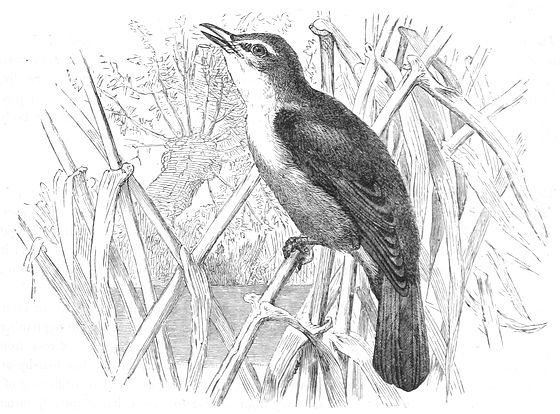
THE REED WARBLER (Acrocephalus turdoides).
The Marsh Warblers inhabit all parts of our globe, but are particularly numerous in the Eastern
Hemisphere. As their name indicates, they principally frequent marshy districts overgrown with
reeds, rushes, or long grass, and only occasionally seek their food upon bushes; they entirely avoid
mountain ranges, as the water that flows in the vicinity of the latter is too frequently agitated to suit
their requirements. All lead a somewhat retired life within the limits of their favourite haunts, but
are readily discovered by their very peculiar yet by no means unpleasing song, which is to be heard
almost throughout the entire day. They fly but little, and with an unsteady fluttering movement,
keeping the tail outspread, and always appear very unwilling to mount into the air. They hurry over
the ground with wonderful rapidity, and slip in and out of tiny crevices with a celerity that fully equals
that of a mouse. They also hop nimbly from point to point, and climb the perpendicular stems of
reeds or long grass with the utmost facility. Insects of all kinds afford them their principal means
of subsistence, and they also occasionally eat berries; worms they utterly reject. Such as inhabit
northern climates migrate at the approach of winter. The purse-like nest built by these birds is
hung from a reed or twig close to the water's edge, and most artistically constructed; its bottom
being heavy, the sides long, and the top turned inwards, so as to prevent the young from falling
out, should the unsteady little structure be exposed to a violent wind. It is a remarkable fact that
the Marsh Warblers appear to be fully aware that they may occasionally expect an unusual rise of
water in the lake or stream near which they live, and always anticipate the danger that from this
cause might accrue to the little family, by suspending the nest at a proportionate height from the
ground. The eggs are hatched by both parents, and the young tended and fed long after they are
fully fledged.
The REED WARBLERS (Acrocephalus) constitute a group possessing most of the characteristics
that distinguish this family. In these birds the beak is almost straight, or very slightly
curved at its extremity; the wings are of moderate size, the third and fourth quills exceeding the
rest in length; the exterior tail-feathers are somewhat shortened, and the foot unusually powerful.
The compact and unspotted plumage is usually olive green on the upper portion of the body, and
reddish or yellowish white beneath.
THE TRUE REED WARBLER.
The TRUE REED WARBLER (Acrocephalus turdoides) is about eight inches long and eleven broad;
the wing measures three inches and a half, and the tail four inches and a quarter. This species is
yellowish grey on the mantle, and reddish white on the under side, shaded with grey upon the
throat. The female is somewhat smaller and paler than her mate. The Reed Warblers inhabit
Europe, from South Scandinavia to Greece and Spain; in the extreme south and in Northern Africa
they are replaced by nearly allied species. Everywhere they frequent such marshy localities as are
overgrown with reeds, and are never seen in mountainous regions or woodland districts, or even upon
the trees that grow near their favourite haunts. The migratory season commences in September; but
during their wanderings, which often extend as far as Central Africa, they pass direct from one
piece of water to another, and never turn aside in their course to linger in any but marshy or well-watered
places. Shortly after the return of these birds, at the end of April or beginning of May,
their loud resonant voices are to be heard not only from sunrise to sunset, but frequently throughout
the night. The song is a strange combination of a great variety of harsh quavering notes, more
nearly resembling the croaking of the frogs whose domain they share than the notes of any of the
feathered creation. While singing the males usually perch upon a reed or twig, with drooping wing,
outspread tail, inflated throat, and open beak, and go through their noisy performance with an
energetic desire to rival every bird around them; such is the evident satisfaction they exhibit at the
result of their efforts, as to make the listener overlook the want of vocal talent, in his amusement at
the conceit of the self-complacent songsters. The nests are commenced about June, and are built
near together, suspended firmly from the reeds that overhang the surface of the pond or stream, some
four or five being drawn firmly together to make a safe support.
Like other Marsh Warblers, they display wonderful instinct in the situation they select, and
invariably build at such a height as is secure from any unusual rising of the water; indeed, it has
been repeatedly observed that in certain years the nests of the Reed Warblers were constructed at an
unusual distance from the ground, and this precaution has always been explained later in the season
by the fall of extraordinary heavy rain, that would inevitably have swept away the little structures had
they been placed in the situation ordinarily selected. The nest itself is very long in shape, with the
top turned inwards, to render the nestlings secure in a high wind. The walls are thick, formed of
grass, stalks, fibres, and wool, lined with cobwebs, horsehair, and similar materials. The eggs, four
or five in number, are of a bluish or greenish-white tint, spotted and veined with dark brown and
grey; the young are hatched in about a fortnight, should the parent be undisturbed, and are tended
with great affection, even long after they are fully fledged. The Reed Warblers, as we learn from
Dr. Bennett, are commonly met with in Australia. "One species" (Acrocephalus Australis), he tells us,
"is very numerous about the sedgy localities of the Nepean river; and although it has been denied
that any of the Australian birds are endowed with a musical voice, this bird has a very loud, pleasing
song, enlivening the places it frequents. It is a migratory species, arriving in the spring season—i.e.,
about September—and taking its departure as winter commences. It builds its nest, suspended
among the reeds, in a similar manner to its congeners in Europe; it is composed of the thin
epidermis of reeds interwoven with dried rushes. The sexes are alike. I did not see the eggs in the
nests, but they are stated to be four in number, of a greyish-white colour, thickly marked all over
with irregular blotches and markings of yellowish brown, umber brown, and bluish grey."
The large Reed Warbler of India (Acrocephalus brunnescens) is, according to Jerdon, very similar
to the European species, but differs in being something smaller in the relative size of the primaries,
the greater length of the wing, and the greater intensity of its colour.
The larger Reed Warbler is found in most parts of India in the cold weather, for it is only a
winter visitant. It extends into Assam, Aracan, and China, in some parts of which latter country it
probably breeds. It frequents high reeds and grasses, high grain fields and gardens, where it hunts
among the rows of peas, beans, and other vegetables. It clings strongly to the stalks of grain, and
makes its way adroitly through thick grass or bushes, concealing itself when observed, and being with
difficulty driven out. It feeds on small grasshoppers, ants, and other insects. "I have," continues
our author, "heard it occasionally utter a harsh, clucking kind of note."
The SEDGE WARBLERS (Calamodus) are distinguished from the birds above described
by their inferior size, and by the comparative shortness of their wings, in which the third quill
is the longest; the tail, moreover, is very decidedly rounded, and their plumage spotted.
THE SEDGE WARBLER.
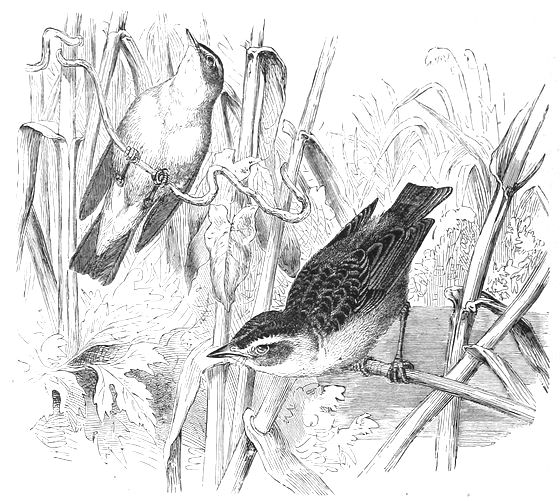
THE SEDGE WARBLER (Calomodus phragmitis).
The SEDGE WARBLER (Calamodus phragmitis) is about five inches and a half long, and eight
and a quarter broad; the wing measures two and a quarter, and the tail two inches. The plumage
on the upper portion of the body is yellowish brown, spotted with dark brown, the under side a
reddish white; a yellow streak passes over the eyes, and the posterior quills have light edges. The
eye is brown, the beak brownish black, except at its margins, and the base of the under mandible,
which are of a light yellowish red; the foot is dirty yellow. In the young, the mantle is reddish
grey and the under side reddish yellow, spotted on the region of the crop with dark grey or
brown. This species inhabits all the European countries that extend from 68° north latitude as far
as Greece and Spain, usually arriving in April and leaving again in October, when it wanders as
far as Northern Africa. In the latter continent it is often seen upon the plains covered with halfa
grass, but in Europe it always frequents such marshy districts as are overgrown with rushes, sedge,
grass, and small-leafed water plants. Its flight is very unsteady, but in other respects its movements
are unusually nimble and agile; the song is pleasing, flute-like, and very varied. Except during the
period of incubation, which commences in June, these birds usually lead a very retired life amid
the beds of grass or rushes, but at the latter season they emerge, and take up their quarters on the
surrounding trees and bushes, where they engage in a series of vocal concerts, each inspired with
the hope of outdoing its numerous rivals in the favour of some attractive female. Should any one of
the feathered competitors venture to intrude upon the same branch as the energetic singer he is at
once driven with much violence from the spot, to prevent a repetition of the offence. During the
whole time that the female broods the male bird exhibits the same anxious desire to please her, and
is often heard gaily carolling from dawn of day till far into the night. "The song," says Mudie, "is
hurried but varied, not so much in the single stave as in its having several of them, which would lead
one to imagine that there were several birds. It sings in the throat, and gives a sort of guttural twist
to all it utters." At times, in his excitement, he rises rapidly into the air, and, after hovering for a
few moments with wings raised high above the body, slowly descends or drops, like a stone, to the
spot whence he ascended. At this period of the year, not only the manner of flight, but the whole
nature of the male bird seems changed, and he exhibits a fearlessness that contrasts strangely with
his usual cautious and timid demeanour. Like other members of this family, the Sedge Warbler
subsists principally upon insects, and occasionally devours various kinds of berries. The nest, which
is placed amongst clumps of sedge, grass, or rushes, on marshy ground, at not more than a foot and a
half from its surface, is firmly suspended to the surrounding stalks, and formed of hay, stubble, roots,
and green moss, woven thickly and firmly together, and lined with horsehair, feathers, and delicate
blades of grass. The eggs, from four to six in number, are of a dirty white, more or less shaded with
green, and spotted and streaked or marbled with brownish grey. Both parents assist in the labour
of incubation, and hatch the young in about thirteen days, if undisturbed; but, if molested, they
frequently desert the nest, and at once commence preparations for another brood. At first, the female
alone appears to feel solicitude or care for her eggs, her mate usually amusing himself until they
are hatched, by singing and fluttering about throughout the entire day, and exhibiting no distress,
even should both mother and brood be removed or destroyed. No sooner, however, have the
nestlings left the shell than his interest is awakened, and he tends and protects them with anxious
care. The young quit the nest as soon as they are fledged, and run like mice about the surrounding
stalks, until they are strong enough to fly.
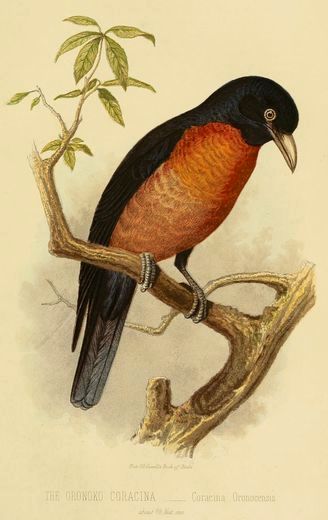
Plate 20, Cassell's Book of Birds
THE ORONOKO CORACINA ____ Coracina Oronocensis
about 5/8 Nat. size
"The Sedge Warbler," says Mr. Yarrell, "is a summer visitor to this country, arriving in April
and leaving again in September, but on one occasion a single specimen was observed near High
Wycombe, in Buckinghamshire, in winter. Immediately on its arrival it takes to thick cover by the
water-side, and is much more frequently heard than seen; though it may occasionally be observed
flitting on the uppermost twigs of the willows it inhabits, giving rapid utterance to a succession of
notes as it flies from one branch to another. White, of Selborne, appears to have first made Pennant
acquainted with this species, and, with his usual acuteness, detailed the habits of the bird, particularly
remarking its power of imitating the notes of other birds and its singing at night. The observations
of others in various localities have confirmed the accuracy of his remarks, and the Sedge Warbler, in
the situations it frequents, may be heard throughout the day, and frequently during a summer night,
imitating the notes of various birds in a somewhat confused and hurried manner; and should he
desist for a few minutes' rest, it is only necessary to throw a stone or clod of dirt among the bushes—he
will immediately commence a series of repetitions, but seldom quits his covered retreat." "The
marshy banks of the Thames, on either side of the river, where beds of reeds or willows abound,"
continues the same accurate writer, "are well stocked with this bird; although, from the wet and
muddy nature of the ground, they are not very easy to get at. In the southern and western counties
it occurs in Hampshire, Dorsetshire, Devonshire, Cornwall, and in Wales; and is a summer visitor to
the north of Ireland. It occurs also in the marshes of Essex, in Suffolk, Norfolk, Lincolnshire,
Yorkshire, Northumberland, and Lancashire, and was traced by Mr. Selby, in Sutherlandshire, to the
northern extremity of the island; it was found pretty generally distributed along the margins of the
lochs, particularly where low birchen coppice and reedy grass abounded. The well-known babbling
notes of this wakeful little songster proclaimed its presence in many unexpected situations."
The GRASSHOPPER WARBLERS (Locustella) constitute a group presenting the following
characteristics:—Their slender body is much deeper than it is broad; the awl-shaped beak, wide at
its base; the foot of moderate height, and toes long; the wings, in which the second and third quills
exceed the rest in length, are short and rounded; the tail is broad, of medium size, graduated at its
extremity, and the feathers are of unusual length. The rest of the plumage is soft and delicate,
usually of a brownish green above, with dark spots on the back and upper part of the breast. The
voice of these birds is very remarkable, the sounds they produce being very similar to the chirping
notes of the cricket or grasshopper. All frequent localities overgrown with grass or plants, and differ
as to their habits in many essential particulars from other members of the family.
THE GRASSHOPPER WARBLER.
The GRASSHOPPER WARBLER (Locustella certhiola or L. Rayii) is from four inches and three-quarters
to five inches and a half long, and from seven and a half to eight broad; the wing measures
two inches and a half, and the tail from one inch and five-sixths to two inches. Upon the upper
part of the body the plumage is olive grey or yellowish brown, decorated with oval brownish-black
spots; the throat is white, the upper breast reddish yellow spotted with dark grey, the belly whitish
or yellowish white, somewhat deeper in hue at its sides; the lower tail-covers white, with light brown
spots upon the shafts; the quills are blackish brown, with narrow yellowish-grey edges, which increase
in breadth towards the roots; the tail-feathers are of a deep greenish brown, striped with a darker
shade and surrounded by a light border; the eye is greyish brown, the beak horn grey, and the foot
light red. After the moulting season the under side is yellower than before. In the young the breast
is unspotted.
The Grasshopper Warbler is found throughout Central Europe and Central Asia. In England
it arrives about April and departs in September, and during the course of its migrations wanders
as far as China. Unlike most of its congeners, this bird does not confine itself to any particular
situation, but occupies fields and woodland districts as frequently as marshy tracts or brushwood.
Everywhere, however, it seeks the shelter of the densest foliage of the bushes, or creeps about close
to the ground beneath the overspreading leaves of plants growing by the water-side. In both
these situations it displays the utmost activity in evading pursuit; if alarmed, the tail is brandished
aloft, and the drooping wings agitated from time to time; upon the ground it runs with ease, keeping
the neck outstretched forward, and the hinder portion of the body constantly in motion. Its flight
is rapid, light, and very irregular.
"Nothing can be more amusing," says Gilbert White, "than the whisper of this little bird,
which seems close by, though at a hundred yards' distance; and when close to your ear is scarce
louder than when a great way off. Had I not been acquainted with insects, and known that the
grasshopper kind is not yet hatched, I should have hardly believed but that it had been a Locusta
whispering in the bushes. The country people laugh at you when you tell them that it is the note
of a bird. It is a most artful creature, skulking in the thickest part of a bush, and will sing at a
yard's distance, provided it be concealed. I was obliged to get a person to go on the other side of
a hedge where it haunted, and then it would run creeping like a mouse before us for a hundred
yards together, through the bottom of the thorns, yet it would not come into fair sight; but in a
morning early, and when undisturbed, it sings on the top of a twig, gaping and shivering with its
wings."
The food of this species varies somewhat with the situation it occupies, but is always of the
same description as that employed by the other members of the family. The nest, which is most
carefully concealed in a great diversity of situations, is neatly formed of green moss, or similar
materials, lined with fibres and horsehair. The eggs, from three to six in number, are of a dull
white or pale rose red, marked with reddish or brownish spots, strewn most thickly over the broad
end, and forming occasionally a slight wreath. It is probable that both parents assist in the process
of incubation. In some seasons the Grasshopper Warbler produces two broods, the first at the
beginning of May and the second at the end of June.
The BUSH WARBLERS (Drymoicæ) constitute a very extensive group, closely allied to those
above described. They are of small size, with short, rounded wings, comparatively slender and
more or less graduated tail, and moderately large and powerful feet. The beak is of medium length,
compressed at its sides, slightly curved along the culmen; the plumage is usually of sombre
appearance. Various members of this group inhabit all parts of the world, and alike frequent low
brushwood, shrubs, reeds, long grass, or beds of rushes. In all these situations they display extraordinary
agility, but their powers of flight are, without exception, feeble and clumsy. In disposition
they are sprightly, and very noisy, although almost invariably without vocal talent. Beetles, worms,
snails, and grubs constitute their principal means of support. Their nests are always remarkable for
their great beauty, some species exhibiting great artistic skill in their manner of weaving their materials
together, while the most famous members of the group, the wonderful "Tailor Birds," literally sew
leaves to each other, and employ them to enclose the actual nest, or bed for the young.
THE PINC-PINC.
The PINC-PINC (Cisticola schœnicla) is very recognisable by its short, delicate, and slightly
curved beak, long tarsi, large toes, short tail, and rounded wing, in which the fourth quill exceeds
the rest in length. The plumage of the adult is yellowish brown, the head being spotted with three
blackish and two light yellow streaks. The nape and rump are brownish and unspotted; the throat
and belly are pure white; the breast, side, and lower tail-covers reddish yellow; the quills are greyish
black, edged on the outer web with reddish yellow. The centre tail-feathers are reddish brown, the
rest greyish brown, bordered with white at the end, and decorated with a heart-shaped black spot.
The eye is brownish grey, the beak horn colour, and the foot reddish. The young are only
distinguishable from the adults by the lighter colour of the under side. This species is four inches
and a quarter long, and two and a quarter broad; the wing measures one inch and three-quarters,
and the tail an inch and a half. The female is a quarter of an inch shorter and half an inch narrower
than her mate. The Pinc-Pinc, as it is called by the Algerines, from a supposed resemblance of
those syllables to its note, is numerously met with in Central and Southern Spain, Southern Italy,
Greece, Sardinia, Algiers, and India.
"This bird," says Jerdon, "is now considered identical with the European one, and is also
spread over the greater part of Africa. It is found in every part of India, frequenting long grass,
corn and rice fields. It makes its way adroitly through the grass or corn, and often descends to the
ground to pick up insects; but I do not think that it habitually runs along, as the name given by
Franklin would imply, but it rather makes its way through the grass or reeds, partly hopping and
partly flying. When put up it takes a short jerking flight for a few yards, and then drops down into
the grass again. It feeds on ants, larvæ of grasshoppers, and various other small insects. As Blyth
remarks, 'It may commonly be observed to rise a little way into the air, as is the habit of so many
birds that inhabit similar situations, repeating at intervals a single note, "Jik! jik!"' During the
breeding season the male bird may be seen seated on a tall blade of grass, pouring forth a feeble little
song. The nest is made of delicate vegetable down, woven into the stems of a thick clump of grass,
and forming a compact and very beautiful fabric, with a small entrance near the top, and the eggs are
four or five in number, translucent white, with reddish spots. It has been noticed that whilst the
hen is laying the male bird builds the nest higher."
According to Hausmann it is quite stationary in its habits, and our own observations corroborate
this statement. In Spain it occupies low-lying places, and in Sardinia, we learn from the above-mentioned
authority that it frequents such flat parts of the sea-coast as are marshy and overgrown
with grass, but also frequently breeds and lives in fields of corn. In North-western Africa it seeks
meadows and pasture-land, and in India dwells on any spot covered with either long grass, corn, or
rice. During the breeding season the male is extremely active, and may be constantly seen flying
restlessly about, uttering its loud note, and fluttering boldly round and about any intruder on its
privacy; at other times it is somewhat timid. All kinds of caterpillars, dipterous insects, and small
snails constitute the principal food of the Pinc-Pinc; these it gathers from the leaves or seeks upon
the ground, casting forth the harder portions after the softer parts are digested. The nest, which
we have repeatedly found among long grass, reeds, and rushes, about half a foot from the ground,
is thus described by Le Vaillant:—"It is," he says, "usually placed among prickly bushes, but
sometimes on the extreme branches of trees. It is commonly very large, some apparently larger
than others, but this difference of size is only external; in the interior they are all of nearly the same
dimensions, namely, between three and four inches in diameter, while the circumference is often more
than a foot. As the nest is composed of the down of plants, it is of snowy whiteness or of a
brownish hue, according to the quality of the down produced by the surrounding shrubs. On the
outside it appears to be constructed in an irregular and clumsy manner, in conformity with the
curvatures of the branches on which it is so firmly attached (part of them passing through its texture),
that it is impossible to move it without leaving one-half behind. If, however, externally, the nest has
the appearance of being badly constructed, we shall be all the more surprised to find that so small a
bird, without other instrument than its bill, wings, and tail, should have felted vegetable down in such
a manner as to render it a fabric as united and firm as cloth of good quality. The nest itself is of a
rounded shape, with a narrow neck at its upper part, through which the bird glides into the interior.
At the base of this tubular neck there is a niche, or shelf-like appendage, like a small nest resting
against the large one, which serves as a momentary resting-place, by means of which the Pinc-Pinc
may pass more easily into the nest, a feat which, without such a contrivance, it might have some
difficulty in accomplishing, as it could not move through so small an entrance on the wing, and the
walls of the tube are so slightly formed, that the bird would injure them were it constantly to rest
upon them. This little appendage is as firmly felted as the interior. Sometimes there are two or
three of these perches. It has until lately been supposed that the female alone undertook the whole
labour of building this strange and beautiful structure, but we learn from Tristam, whose statement is
confirmed by Jerdon, that the male does considerably more than half of the work. "I had the good
luck," says Tristam, "to find a nest that was just commenced, and was able daily to observe the
whole process. The first egg was laid before the outer wall was more than an inch high, the male
continuing to labour without intermission, until by the time the nestlings were hatched the fabric was
quite firm, and full three inches in height. The eggs vary considerably in appearance; those we
found in Spain were of a uniform light blue, others again are bluish green, sparsely marked with
small or large brown, reddish, or black spots, or pure white spotted with bright red. The young are
tended by both parents with much affection; the male especially appears entirely to lay aside his
usual timidity, and will frequently follow an intruder for some distance, uttering low cries, as if to
scare him from the spot."
The proceedings of a family of young birds are most entertaining to behold, as they climb
and flutter about the grass or corn, while the busy father and mother seek food for their hungry
progeny. No sooner has one of the parents succeeded in capturing an insect than the whole flock
hurry with tails upraised to receive it, each scrambling with earnest endeavour to be first, and obtain
the coveted morsel. Should danger be at hand, the mother disappears with her young to some safe
retreat, while the father rises into the air, and flies about in his usual manner. Savi tells us that the
Pinc-Pinc breeds thrice in the year—in April, June, and August. We ourselves have found nests in
May, June, or July.
The TAILOR BIRDS (Orthotomus) constitute a remarkable group of Bush Warblers, and
are at once recognisable by their elongated body, much rounded wing, in which the fifth and sixth
quills are the longest; their short abruptly rounded or graduated tail, composed of very narrow
feathers; and by their powerful feet with high tarsi and short toes; the beak is long, straight, broad
at the base, and pointed at the tip, and in every respect admirably adapted for the sewing operations
it has to perform; the base of the bill is surrounded by a few delicate bristles; the plumage is smooth
and brightly coloured, usually green on the back and rust-red on the head.
THE LONG-TAILED TAILOR BIRD.
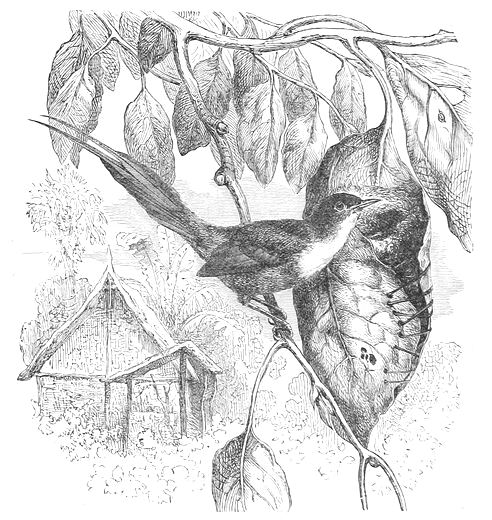
THE LONG-TAILED TAILOR BIRD (Orthotomus longicauda).
The LONG-TAILED TAILOR BIRD (Orthotomus longicauda) is of a yellowish olive-green on the
mantle, red on the crown of the head, and greyish red upon the nape; the under surface is white with
faint blackish spots upon the sides of the breast. The quills are brown edged with green, the tail-feathers
brown shaded with green, those at the exterior are tipped with white. In the male the two
centre tail-feathers are considerably prolonged. The length of this species is six inches and a half,
the wing measures two, and the tail three inches and a half; the female is not more than five inches
long, and her tail does not exceed two inches. The Tailor Birds are found throughout all parts of
India, from the Himalayas to Cape Comorin, also in Ceylon, Burmah, and the neighbouring countries,
frequenting such localities as are not entirely destitute of trees or bushes. In these situations they
usually live in pairs or small families, and pass their days in hopping nimbly from twig to twig in
search of insects, caterpillars, and larvæ, upon which they subsist. When moving over the ground
or eating they keep the tail erect, and elevate the feathers upon the head. The manner in which
they construct their strange and beautiful nest is truly wonderful. Having chosen a leaf of adequate
dimensions, the ingenious sempstress draws the edges together by means of her bill and feet, then,
piercing holes through the approximated edges, she secures them in their place by means of cotton
threads, the ends of which she ties into small bunches and thus fastens them, so as to prevent them
from slipping through. Sometimes the Tailor Bird, having picked up a fallen leaf, fastens it to one
still growing on the tree by sewing the two together in the manner above described, and thus prepares
a pensile cradle in which the nest is constructed. The interior is lined with a thick layer of cotton,
flax, and other vegetable fibres, mixed with a little hair, and on this comfortable bed the eggs are laid
and the young live secure from the attacks of monkeys or snakes. The brood consists of three or
four eggs, which are white, spotted with brownish red at the broad end.
"This bird is most common," says Jerdon, "in well-wooded districts, frequenting gardens,
hedgerows, orchards, low jungle, and even now and then the more open parts of high tree jungles.
It is usually seen in pairs, at times in small flocks, incessantly hopping about the branches of trees,
shrubs, pea rows, and the like, with a loud, reiterated call, or picking various insects, chiefly ants,
cicadellæ, and various small larvæ, off the bark and leaves, and not unfrequently seeking them on the
ground. It has the habit of raising its tail whilst feeding, and hopping about, and at times, especially
when calling, it raises the feathers, and displays the concealed black stripes on its neck. The
ordinary note of the Tailor Bird is, 'To-wee! to-wee! to-wee!' or, as it is syllabised by Layard,
'Pretty! pretty! pretty!' When alarmed or angry it has a different call. It is a familiar bird,
venturing close to houses, but, when aware that it is watched, it becomes wary and shy.
"The Tailor Bird makes its nest with cotton wool and other soft materials, sometimes also lining
it with hair, and draws together one leaf or more, generally two leaves, on each side of the nest, and
stitches them together with cotton, either woven by itself, or cotton thread picked up, and, after
passing the thread through the leaf, it makes a knot at the end to fix it. I have seen a Tailor Bird at
Saugor watch till the dirzee (native tailor) had left the verandah where he had been working, fly in,
seize some pieces of thread that were lying about, and go off in triumph with them. This was
repeated in my presence several days running. I have known many different trees selected to build
in; in gardens very often a guava-tree. The nest is generally built at from two to four feet above
the ground. The eggs are two, three, or four in number, and, in every case I have seen, were white,
spotted with reddish brown, and chiefly at the large end."
Colonel Sykes tells us that the eggs are crimson, but he has probably mistaken the nest and
eggs of Prinia socialis, which last are sometimes of a uniform brick-red. Hodgson suspects that
there are two species confounded under one name, as he has on several occasions got unspotted blue
eggs from a Tailor Bird's nest. These were probably those of Prinia gracilis, the eggs of which are
blue. Layard describes one nest "made entirely of cocoa-nut fibre, encompassed by a dozen leaves
of oleander, drawn and stitched together. I cannot call to recollection ever having seen a nest
made with more than two leaves."
THE EMU WREN.
The EMU WREN (Stipiturus malachurus), one of the most remarkable birds found in Australia,
is distinguished by the very unusual formation of the web of the six feathers that compose the tail,
a peculiarity most observable in the male. The upper part of the body is brown, striped with black;
the top of the head rust-red; the chin and throat pale blueish grey; the rest of the under side is bright
red, the quills are dark brown edged with reddish brown, and the tail-feathers dark brown; the eye
is reddish brown, and the beak and feet brown. In the female the top of the head is streaked with
black, and the region of the throat red instead of blue.
The genus Stipiturus, according to Mr. Gould, is a form entirely confined to Australia. These
birds frequent extensive grass-beds, particularly those which occur in humid situations. They run
quickly over the ground, and carry the tail erect, like the Maluri. Some slight variation occurs in
specimens from Tasmania and Southern and Western Australia, but, probably, they are all referable
to one species.
"The delicate little Emu Wren," says Dr. Bennett, "although formerly seen in great numbers in
the vicinity of Sydney, is now very rare. It was also named the Cassowary Bird by the early
colonists, from the peculiar feathers in the tail, and was first described in 1798, in the Linnæan
Transactions. It is an active little creature, running rapidly among the grass, and, from the
shortness of its wings, appears ill adapted for flight. Some years since it congregated in great
numbers in the Sydney Domain, near the Botanic Garden, but for some time not one has been seen
in that locality. This bird rarely perches on a bush at an elevation of more than three or four feet
from the ground; it is usually observed darting quickly over the long grass, and, by its activity,
readily eludes pursuit."
"This curious little bird," says Mr. Gould, "has a wide distribution, since it inhabits the whole
of the southern portion of Australia, from Moreton Bay on the east to Swan River on the west,
including Tasmania. Among the places where it is most numerous in the latter country are the
swampy grounds in the neighbourhood of Recherche Bay in D'Entrecasteaux Channel, the meadows
at New Norfolk, Circular Head, and Flinder's Island in Bass Straits. On the continent of Australia,
Botany Bay and, indeed, all portions of the country having a similar character are favoured with
its presence.
"The Emu Wren is especially fond of low, marshy districts, covered with rank high grasses and
rushes, where it conceals itself from view by keeping near the ground, and in the midst of the more
dense parts of the grass-beds. Its extremely short round wings ill adapt it for flight, and this power
is consequently seldom employed, the bird depending for progression upon its extraordinary capacity
for running; in fact, when the grasses are wet from dew or rain, its wings are rendered perfectly
unavailable. On the ground it is altogether as nimble and active; its creeping, mouse-like motions,
and the extreme facility with which it turns and bounds over the surface, enabling it easily to elude
pursuit, and amply compensating for the paucity of its powers of flight. The tail is carried in an
erect position, and is even occasionally retroverted over the back.
"The nest, which is a small ball-shaped structure, with rather a large opening on one side, is
composed of grasses lined with feathers, and artfully concealed in a tuft of grass or low shrub. One
that I found in Recherche Bay contained three newly-hatched young; this being the only nest I ever
met with, I am unable to give any description of its eggs from my own observation; but the want is
supplied by the following account of this species from the pen of Mr. E. P. Ramsay, published in the
Ibis for 1865:—
"'I had for many days visited the swamps on Long Island, where these birds are very plentiful,
in the hope of finding them breeding, but it was not till the 25th of September that I succeeded in
discovering a nest, although I had watched them for hours together for several days. While walking
along the edge of the swamp on that day a female flew from my feet out of an overhanging tuft of
grass, growing only a few yards from the water's edge. Upon lifting up the leaves of the grass which
had been beaten down by the wind, I found its nest carefully concealed near the roots, and containing
three eggs. They were quite warm, and within a few days of being hatched, which may account for
the bird being unwilling to leave the spot; for, upon my returning about five minutes afterwards, the
female was perched upon the same tuft of grass, and within a few inches of whence I had taken the
nest. The nest was of an oval form (but that part which might be termed the true nest was perfectly
round), placed upon its side; the mouth very large, taking up the whole of the under part of the
front. It was very shallow, so much so that if tilted slightly the eggs would roll out, being almost on a
level with the edge. It was outwardly composed of grass, and the young dry shoots of the reeds which
are so common in all the swamps near the Hunter River, lined with fine grass, roots, and, finally, a
very fine green moss. It was very loosely put together, and required to be moved very gently to
prevent its falling to pieces.
"'The eggs are six lines and a half long by four and a half broad, they are sprinkled all over
with minute dots of a light reddish brown, particularly at the larger end, where they are blotched with
the same colour. One of the three had no blotches, but was minutely freckled all over. The
ground-colour is a delicate white, with a blush of pink before the egg is blown.
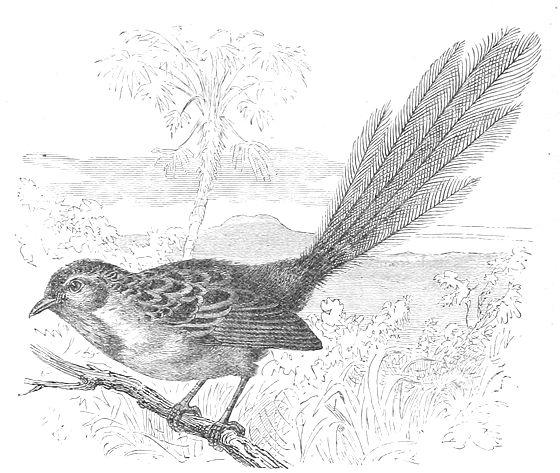
THE EMU WREN (Stipiturus malachurus).
"'The only note of the bird, besides a slight chirp when flushed and separated, is a twitter,
not unlike a faint attempt to imitate the Malurus cyaneus. While in the swamp, which at that time
was nearly dry, I observed several separate flocks; of these some were hopping along the ground,
picking up something here and there, others, whose appetites seemed appeased, were creeping along
through the reeds, about a foot from the ground, but as the reeds thickened I soon lost sight of them.
They seldom took wing except when disturbed, and not always then, seeming very averse to showing
themselves. While watching them, I observed one now and then hop to the top of a tall reed, as if
to get a glimpse at the world above. Upon coming suddenly upon a flock and following them, they
keep to the reeds just in front of you, and never take wing unless hard driven, when they separate,
and do not collect for some time.
"'The male is readily distinguished from the female by the blue colouring of the throat, and by
a somewhat greater development of the tail-feathers. The decomposed or loose structure of these
feathers, much resembling those of the Emu, has suggested the colonial name of the Emu Wren for
this species, an appellation singularly appropriate, inasmuch as it at once indicates the kind of
plumage with which the bird is clothed, and the Wren-like nature of its habits.'"
The WRENS (Troglodytæ) are small, compactly-built birds, with short wings and tails. Their
beak is small, or of medium size, thin, awl-shaped, compressed at its sides, and slightly curved at its
culmen; the feet are weak, short-toed, and the tarsi of moderate height; the wings, in which the
fourth or fifth quill is the longest, are short, rounded, and much arched; the tail very short, conical,
or slightly rounded. The plumage is usually reddish brown, marked with black. These little birds
are to be met with all over the world, but are especially numerous in Europe, Asia, and America;
everywhere they frequent the vicinity of trees or bushes, in whatever situation these are to be found,
but most commonly prefer well-watered and cultivated districts. All the various species are restless,
lively, and active; upon the ground, they hop with the utmost activity, and display a rapidity in
creeping through the most tangled brushwood that is almost unrivalled. All are endowed with
agreeable voices, and some American species sing very sweetly. The nests are generally of an oval
shape, roofed above and furnished with a small entrance at the side; the materials employed vary
considerably, according to the situations in which the nests are constructed, the places selected for
building being sometimes curiously chosen. A Wren, as we are told by the Rev. J. G. Wood, made
its nest in the body of a dead Hawk that was nailed to the side of a barn, and another in the
interior of a pump, gaining access through the spout. As these birds testify little fear of man in
South America, they are frequently provided with convenient receptacles for their nests, in order to
induce them to build upon the roofs of the houses.
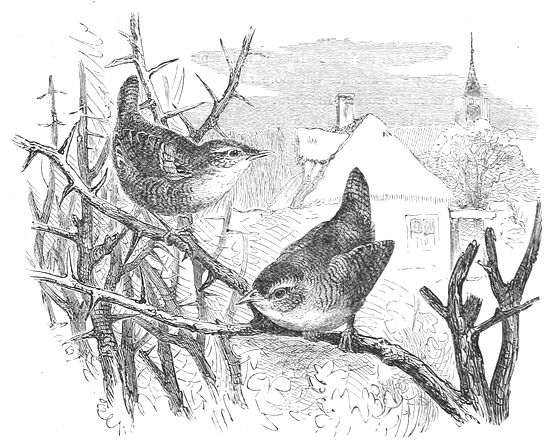
THE COMMON WREN (Troglodytes parvulus).
THE COMMON WREN.
The COMMON WREN (Troglodytes parvulus) is about four inches long, and from five inches and
a half to six inches broad; the wing measures an inch and three-quarters and the tail about an inch
and a half. Upon the upper portion of the body the plumage is reddish brown, streaked with pale
black; the under side is paler, marked with undulating dark brown lines; a brown cheek-stripe passes
across the eyes, and a narrow brownish white line above them. The centre feathers in the wing-covers
are decorated with oval white patches, touched with black; the quills are deepish grey on the
inner web, and on the outer alternately spotted or streaked with reddish yellow and black; the
tail-feathers are reddish brown, lightest at the edges, and marked with undulating dark brown lines;
the eye is brown; the beak and feet reddish grey. The female is paler than her mate, and the
young have more spots on the under side, and fewer on the back, than the old birds. The Wren
inhabits all parts of the continent of Europe, from Northern Scandinavia to the most southern
confines of Spain and Greece; in the Faroë Islands it is replaced by a very similar but much larger
species (Troglodytes borealis); and another but more spotted variety (Troglodytes Naumanni) is met
with in some parts of Central Europe. In North-western Africa and Asia Minor it is also common,
but is, we believe, never seen in other parts of Asia. Such as inhabit India are nearly allied but not
identical species. Like most members of its family, the Common Wren is lively and social,
constantly seeking the immediate vicinity of man. Its song consists of a great variety of clear piping
notes, intermingled with numerous trills, and is poured out with an energy and power that appear
really astonishing, if we consider the small dimensions of the little singer. Throughout almost the
entire year this cheerful music is to be heard; no inclemency of weather appears to daunt the brisk
but diminutive vocalist, who carols forth his joyful anticipations of the coming spring, even when the
snow-covered ground renders it impossible for him to procure a sufficient supply of food, and cold
and want have completely silenced all his feathered companions. Like those of other members of its
family, the movements of this species in the trees and on the ground are extremely agile and lively,
but its flight, even for a Wren, is weak and unsteady. So slight are its powers of endurance, that
Naumann assures us that a man can readily run it down and capture it with the hand. Indeed, a
curious practice, as we are told, "has prevailed from time immemorial in the south of Ireland, of
hunting this harmless little bird on Christmas Day. The hedges are beaten with sticks, and when
the unfortunate little creature is driven from its concealment, it is struck down with a second stick
carried by each hunter. On St. Stephen's Day the dead birds are hung by the children on an
ivy-bush decorated with bright ribbons, which they carry about with songs, and collect money to
'bury the Wren.' This cruel piece of folly is, we are happy to learn, now falling into disuse."
This pretty little bird lives principally upon insects and berries, and when these fall short, it
often ventures fearlessly into houses and outbuildings, in the hope of obtaining a meal. The situation
of the nest and the materials employed for building it vary considerably. Trinthammer mentions an
instance in which one of these birds made its nest year by year in the hut of some charcoal-burners,
following them season after season in all their wanderings; indeed, it is not uncommon for a pair to
build many times, before they have satisfied their fastidious requirements; and, strange to say, a
solitary male will often make several nests before it has selected a mate. Boenigk, who observed a
Wren attentively from April to August, tells us that the male constructed four nests before it took a
partner. After it had found a mate, both worked together at three different nests, each in succession
being left uncompleted, until at last the female, despairing of obtaining a place wherein to deposit her
eggs, deserted her capricious spouse, who consoled himself by constructing two more nests, which,
like the rest, were never employed.
"It is remarkable," says Montague, "how the materials of the Wren's nest are generally adapted
to the place: if built against the side of a hayrick, it is composed of hay; if against a tree covered
with white moss, it is made of that material; and with green moss if against a tree covered with the
same; thus instinct directs it for security." Mr. Jesse mentions that he possessed a nest "built
amongst some litter thrown into a yard, which so nearly resembled the surrounding objects that it was
only discovered by the birds flying out of it. Some of the straws that composed it were so thick
that one wondered how so small a bird could have used them." A correspondent in the Magazine
of Natural History says:—"In watching a pair of Wrens building their nest in an old road,
I noticed that one confined itself entirely to the construction of the nest, which it never left for a
moment, whilst the other was as incessantly passing and repassing with materials for the structure.
These materials, however, this helper never once attempted to put into their places; they were always
regularly delivered to the principal architect employed in constructing the building."
"I was not aware," says Mr. Weir, "it had been taken notice of by any naturalist that the
European Wrens, or at least some of this species, take possession of their nests as places of repose
during the severity of winter, until I perused a very interesting account of the habits of these little
birds by Neville Wood, Esq., who says, 'Whether the nests in which one or two broods had been
reared in the summer are tenanted every night throughout the winter by the old or the young birds is
a question more curious than easy to determine, on account of the difficulty, almost impracticability,
of catching the birds at night. This I have repeatedly endeavoured to effect without success. I am
happy to say that, after much trouble, I have so far succeeded in determining this curious question.
About nine o'clock of the evening of the 7th of March, in one of their nests which was built in a
hole in an old wall, I caught the male and female, and three of the brood. The other four of the
young birds which were also in the nest, made their escape. They were the Wrens I mentioned
formerly as having occupied the two nests which wanted the lining of feathers.'"
"I know not," says Macgillivray, "a more pleasant object to look at than the Wren; it is
always so smart and cheerful—to it all weathers are alike. The big drops of a thunder shower no
more wet it than the drizzle of a Scotch mist; and, as it peeps from beneath a bramble, or glances
from a hole in the wall, it seems as snug as a kitten frisking on the parlour rug."
"It is amusing," continues this writer, "to watch the motions of a young family of Wrens just
come abroad. Walking among furze, or broom, or juniper, you are attracted to some bush by hearing
issue from it a lively and frequent repetition of a sound which most resembles the syllable "Chit."
On going up you perceive an old Wren flitting about the twigs, and presently a young one flies off,
uttering a stifled 'Chirr,' while the parents continue to flutter about, uttering their loud 'Chit! chit!
chit!' with indications of varied degrees of excitement."
The Wren produces two broods in the course of the year, the first in April, the second in July.
The eggs, from six to eight in number, are large and round, of a pure white or yellowish white,
delicately spotted with reddish brown or blood-red, these latter markings often taking the form of
a wreath at the broad end. The male and female brood alternately for thirteen days, and cleanse the
nest and feed their hungry family with great assiduity. The young remain for a considerable time
with their parents, and generally return to pass the night in their old homes for some time after they
are fully fledged. Although largely insectivorous, these hardy little birds are enabled to brave the
severest winters, not only of our own climate but of still more northern regions. They are not
uncommon in Zetland, where their sweet notes serve greatly to enliven the dreary landscape.
The MARSH WRENS (Thryothorus) are a group of American species, distinguished from other
members of the family by their comparatively long, thin, and slightly-curved beaks.
THE CAROLINA WREN.
The CAROLINA WREN (Thryothorus Ludovicianus), according to the Prince von Wied, is five
inches long and seven broad; the wing measures two inches and one-sixth, and the tail an inch and
three-quarters. The plumage of the upper portion of the body is reddish brown, marked with
undulating lines of a deeper hue; the chin and throat are white, the rest of the lower parts yellowish
red, with black markings on the sides; a stripe over the eyes is white. The quills are blackish brown
on the inner, and striped on the outer web. The feathers of the wing-covers are tipped with white.
The eye is greyish brown; the upper mandible light grey, the lower one lead-colour, tipped with
pale brown. This species is the largest and most numerous of all the many species of Wrens
inhabiting North America; it is met with alike in mountain tracts, low-lying regions, dense forests, or
even districts near the abodes of man.
"The quickness of the motions of this little bird," says Audubon, "is fully equal to that of the
mouse. Like the latter, it appears and is out of sight in a moment; peeps into a crevice, passes
rapidly through it, and shows itself at a different place in the next instant. When satiated with food,
or fatigued with these multiplied exertions, the little fellow stops, droops its tail, and sings with great
energy a short ditty, something resembling the words 'Come to me, Come to me,' repeated several
times in quick succession, so loud, and yet so mellow, that it is always agreeable to listen to its music.
During spring these notes are heard from all parts of the plantations, the damp woods, the swamps,
the sides of creeks and rivers, as well as from the barns, the stables, and the piles of wood within
a few yards of the house. I frequently heard one of these Wrens singing from the roof of an
abandoned flat boat fastened to the shore, a short distance below the city of New Orleans. When its
song was finished, the bird went on creeping from one board to another, thrust itself through an
auger-hole, entered the boat's side at one place and peeped out at another, catching numerous spiders
and other insects all the while. It sometimes ascends to the higher branches of a tree of moderate
size, by climbing along a grape-vine, searching diligently among the leaves and in the chinks of the
bark, alighting sideways against the trunk, and conducting itself like a true Creeper."
The vocal capabilities of the Carolina Wren would appear to be respectable, and it can imitate
with tolerable accuracy the notes of other birds. "Amidst its imitations and variations," says
Nuttall, "which seem almost endless, and lead the stranger to imagine himself, even in the depth of
winter, surrounded by all the quaint choristers of the summer, there is still with our capricious and tuneful
mimic a favourite theme, more constantly and regularly repeated than the rest. This was also the
first sound that I heard from him, delivered with great spirit, though in the dreary month of January.
This sweet and melodious ditty—tsee-toot, tsee-toot, tsee-toot, and sometimes tsee-toot, tsee-toot, seet, was
usually uttered in a somewhat plaintive or tender strain, varied at each repetition with the most
delightful and delicate tones, of which no conception can be formed without experience. That this
song has a sentimental air may be conceived from its interpretation by the youths of the country, who
pretend to hear it say 'Swĕet-heart, swĕet-heart, sweet!' Nor is the illusion more than the natural truth,
for usually this affectionate ditty is answered by its mate, sometimes in the same note, at others in a
different call. In most cases it will be remarked that the phrases of our songster are uttered in threes;
by this means it will generally be practicable to distinguish its performance from that of other birds,
and particularly from the Cardinal Grosbeak, whose expressions it often closely imitates, both in power
and delivery. I shall never, I believe, forget the soothing satisfaction and amusement I derived from
this little constant and unwearied minstrel, my sole vocal companion throughout many weary miles
of a vast, desolate, and otherwise cheerless wilderness. Yet, with all his readiness to amuse by
his Protean song—the epitome of all he had ever heard or recollected—he was still studious of
concealment, keeping busily engaged near the ground, or in low thickets, in quest of his food; and
when he mounted a log or brush-pile, which he had just examined, his colour, so similar to the fallen
leaves and wintry livery of Nature, often prevented me from gaining a glimpse of the wonderful and
interesting mimic."
"The nest of the Carolina Wren," says Audubon, "is usually placed in a hole of some low,
decayed tree, or in a fence stake, sometimes even in the stable, barn, or coach-house, should it there
find a place suitable for its reception. I have found some not more than two feet from the ground
in the stump of a tree that had long before been felled by the axe. The materials employed in its
construction are hay, grasses, leaves, feathers, and horsehair, or the dry fibres of the Spanish moss;
the feathers, hair, or moss, form the lining, the coarse materials the outer parts. When the hole is
sufficiently large, the nest is not unfrequently five or six inches in depth, although only just wide
enough to admit one of the birds at a time. The number of eggs is from five to eight. They are of
a broad oval form, greyish white, sprinkled with reddish brown. Whilst at Oakley, the residence of
my friend James Perrie, Esq., near Bagon, Jura, I discovered that one of these birds was in the habit
of roosting in a Wood Thrush's nest, that was placed on a low horizontal branch, and had been filled
with leaves that had fallen during the autumn. It was in the habit of thrusting its body beneath the
leaves, and, I doubt not, found the place very comfortable. They usually raise two, sometimes three
broods in a season. The young soon come out from the nest, and, in a few days after, creep and hop
about with as much nimbleness as the old ones. Their plumage undergoes no change, merely
becoming firmer in the colouring."
THE HOUSE WREN.
The HOUSE WREN (Thryothorus platensis), a South American species, is brown on the upper
portion of the body, shading into red towards the rump. The quills and tail-feathers are finely striped
with blackish brown, the former edged with a paler shade on the inner web; a pale streak passes over
the eye; the throat is white; the region of the cheek striped with brown; the throat, breast, and belly
are pale reddish yellow, the sides of the breast being deepest in tint, and faintly streaked. The eye is
deep brown; the beak dark grey, whitish at its base; the foot reddish brown. The length of the
body is four inches and six lines, the breadth six inches; the wing measures one inch and ten lines,
and the tail an inch and a half. "This agreeable singing bird," says the Prince von Wied, "may be
regarded as replacing our Common House Sparrow about the Brazilian houses. In appearance and
habits it closely resembles the Common Wren, and is constantly to be seen hopping nimbly about the
gardens and over the roofs and fences, or creeping with astonishing quickness through tiny holes or
compact hedges. Its loud, sweet-toned voice is very similar to that of the True Warblers. The nests,
which are small and carelessly constructed, are generally built upon the house-tops, or in holes of
walls; those we saw were open above and very shallow, formed externally of stalks and grass, thickly
lined with feathers. The eggs, four in number, were rose-pink, marked with deep red."
THE FLUTE-PLAYER
The FLUTE-PLAYER (Cyphorhinus cantans), a very noted species of Wren inhabiting South
America, represents a group distinguished by the following characteristics:—The beak is strong,
compressed at its sides; the nostrils small, round, quite open, and surrounded by a skin, whereas in
other members of the family they are furnished with a covering; the wings are short and much
rounded; the tail of moderate size, and graduated at its sides; the legs are strong, and the moderate-sized
toes armed with very disproportionately powerful claws. The upper part of the plumage is
reddish brown, lightest upon the brow and top of the head. The mantle-feathers are marked with
blackish brown; the chin, throat, and front of the neck are light rust-red; the sides of the throat,
cheeks, and region of the ear black, with white shafts to the feathers; the belly and centre of the
breast are whitish yellow, the sides pale greenish brown, with dark markings. The length of
this species is five inches, the wing measures two inches and one-sixth, and the tail one inch and
one-third.
The Flute-player, as this bird is called by the Peruvians, on account of its strange and very
beautiful voice, frequents the inmost recesses of the South American forests, where it lives in parties,
and seeks for insects and berries either upon the ground or on such branches as are not more than
two feet above its surface. During the middle of the day, according to Schomburghk, its song is
rarely or never heard.
The PIPITS (Anthi) form, as it were, a connecting link between the Warblers and Larks, and
until lately were classed among the latter birds. Their body is slender; their wings, in which the third
and fourth quills are the longest, are of moderate size; the upper wing-covers often of great length;
the tail of medium size; the tarsus slender; the toes weak; and the claws very large, the hindermost,
like that of the Lark, being prolonged into a spur. The beak is thin, straight, narrow at its
base, and awl-shaped, its margins turn inwards, and are incised at the slightly-curved tip of the
upper mandible; the smooth, glossy plumage is of a brownish or greenish hue. The young
usually resemble their parents. The family of Pipits comprises a great number of species distributed
over all parts of the world, some occupying mountain tracts, and others forests, plains, or marshy
districts. All live principally on the ground, and sometimes, but rarely, they perch on the branches
of trees. Their manner of progressing on terra firma is rather by a rapid running step than by a
series of leaps, and is accompanied by considerable agitation of the whole body, and constant gentle
whisking of the tail. The flight of the Pipits is rapid, light, and undulatory, when they are desirous
of going to any considerable distance, but changes to a hovering and fluttering motion when they rise
into the air previous to singing. They are very intelligent, and their song, though simple, is agreeable;
the call is a kind of piping sound, whence the name of Pipits, by which they are distinguished.
Their principal food consists of beetles, moths, flies, snails, and aphides; some species also devour
spiders and worms, and, according to recent observations, various kinds of seeds; all seek their food
on the ground, and rarely seize their prey in the air, or by darting from the branches of trees or
bushes. The nest is loosely formed of blades of grass, portions of plants and roots, lined with wool
or hair, and is constructed on the ground. The eggs are of a dusky hue, and faintly marked with
spots and streaks. The female alone broods, but both parents assist in tending the young. Most
species lay more than once in the year.
THE MEADOW PIPIT, OR MEADOW TITLING.
The MEADOW PIPIT, or MEADOW TITLING (Anthus pratensis), is of a greenish brown, spotted
with brownish black on the upper portion of the body; the breast is light rust-red, spotted with dark
brown; the throat and belly are whitish, and a yellowish white streak passes over the eyes; the quills
are brownish black, with light edges, and the feathers of the wing-covers bordered with dull green;
the tail-feathers are brownish black, edged with olive-green, those at the exterior decorated with a
large white spot at the tip. The eye is dark brown, the beak grey, and the foot reddish grey. This
species is six inches long, and nine and a half broad; the wing measures two inches and five-sixths,
and the tail two inches and a quarter. The female is a trifle smaller than her mate.
The Meadow Pipit is known to breed in all the northern half of the European continent, and is
also met with in North-western Asia and North Africa. During the course of its journeyings in Egypt
it usually settles near the coast among marshes, or near fields that are lying under water. In the
British Isles it remains throughout the year, and is known in the lake district as the "Ling Bird," from
the constancy with which it frequents the moors overgrown with heather or ling in that part of the
country. Like the Larks it migrates in large flocks, and frequently in company with those birds,
travelling day and night; it usually makes its appearance in this country about March, leaving again
in November or December. Meadows, marsh-lands, or commons, afford the resorts it prefers, but it
generally avoids arid or barren districts. The movements and habits of this species resemble those of
other members of its family; it lives on excellent terms with birds of its own kind, but constantly
exhibits a strong desire to annoy and irritate its other feathered companions.
"When progressing from place to place," says Mr. Yarrell, "the flight of this bird is performed
by short unequal jerks, but when in attendance on its mate, and undisturbed, it rises with an equal
vibratory motion, and sings some musical soft notes on the wing, sometimes while hovering over its
nest, and returns to the ground after singing. Occasionally it may be seen to settle on a low bush,
but is rarely observed sitting on a branch of a tree, or perched on a rail, which is the common habit
of the Tree Pipit. The Meadow Pipit, when standing on a slight mound of earth, a clod, or a stone,
frequently moves his tail up and down like a Wagtail."
The nest is placed on the ground, sometimes so much sunk as to be with difficulty perceived;
sometimes sheltered by a tuft of grass. It is composed externally of stems and leaves of grass, lined
with finer grass, fibres, and hair.
W. Thompson, Esq., in his valuable communications on the natural history of Ireland, says
that "A friend at Cromac has frequently found the nest of the Meadow Pipit on the banks of
watercourses and drains, as well as on the ground in fields. One which was known to him at the
side of a drain was discovered by some bird-nesting boys, who pulled away the grass that concealed
it. On visiting it the next day he observed a quantity of withered grass laid regularly across the
nest; on removing this, which, from its contrast in colour with the surrounding grass, he considered
must have been placed there by the boys, the bird flew off the nest, and, on his returning the
following day, he found the grass similarly placed, and perceived a small aperture beneath it, by
which the bird took its departure, thus indicating that the screen, which harmonised so ill with
the surrounding verdure, had been brought thither by the bird itself. The same gentleman once
introduced the egg of a Hedge Accentor into a Meadow Pipit's nest containing two of its own eggs,
but, after a third egg was laid, the nest was 'abandoned.'" "This, however," observes Mr. Yarrell,
"was probably induced by the visits of the observer rather than by the introduction of the strange
egg, as the egg of the Cuckoo is more frequently deposited and hatched in the nest of the Meadow
Pipit than in that of any other bird."
The eggs, four or five in number, have a dirty white or dull red shell, thickly strewn with
brownish spots and streaks; they are generally hatched in thirteen days. The young leave the nest
before they can fly, but conceal themselves with such adroitness at the first alarm of danger that
they are rarely discovered. The first brood is produced in the beginning of May, and by the end of
July the nestlings are capable of providing for themselves.
THE TREE PIPIT.
The TREE PIPIT (Anthus arboreus) so closely resembles the species above described as very
frequently to be mistaken for it. It is, however, distinguishable by its superior size, the comparative
strength of its beak and tarsi, and the shortness of the much curved centre claw. The upper part
of the body is yellowish brown, or dull brownish green, darkly spotted in stripes; the rump and
under side are of one uniform tint; a stripe over the eyes, the throat, crop, sides of the breast, legs,
and lower wing-covers, are pale reddish yellow; the crop, upper breast, and sides, being spotted with
black. The stripes on the wings and edges of the shoulder-feathers are lighter than in the plumage
of the Meadow Pipit. The eye is brown, the beak greyish black, and the foot reddish grey. The
body is six inches and a half long, and ten and three-quarters broad; the wing measures three inches
and a quarter, and the tail two inches and a half. The female is considerably smaller than her mate.
During the summer the Tree Pipits frequent the woodland districts of Europe and Siberia, and in
the winter wander southward as far as the African steppes and the Himalayas; they usually arrive in
England about the third week in April. In many respects these birds resemble their congeners, but,
unlike most of them, take up their quarters in well-wooded and cultivated localities, and at once seek
shelter in trees at the approach of danger, and run along the branches with ease. They are also far
less social in their habits, and, except in the autumn, while still occupied with their young, live alone,
or associate but seldom with the other feathered denizens of their favourite woods and groves. The
song of the Tree Pipit far exceeds in its quality that of most other species; indeed, some of its loud,
clear tones will bear comparison with those of the Canary. The male sings almost incessantly from
sunrise to sunset, until the end of June, and pours out his lay from the point of some projecting
branch, from whence he rises into the air, and after hovering for a short time slowly descends and
finishes his song upon the perch he had just left. The nest is placed in a hollow in the ground, or
carefully concealed in grass and clumps of plants; it is very clumsily built, only the interior being
arranged with anything like neatness or care. The four or five eggs vary considerably both in form
and colour, the tints being either reddish, greyish, or blueish white, spotted, mottled, or streaked with
a darker shade. The female sits with such devotion that she often will not quit her eggs unless
driven from the spot. The young are most tenderly reared by the exertions of both parents, and quit
the nest before they are able to fly.
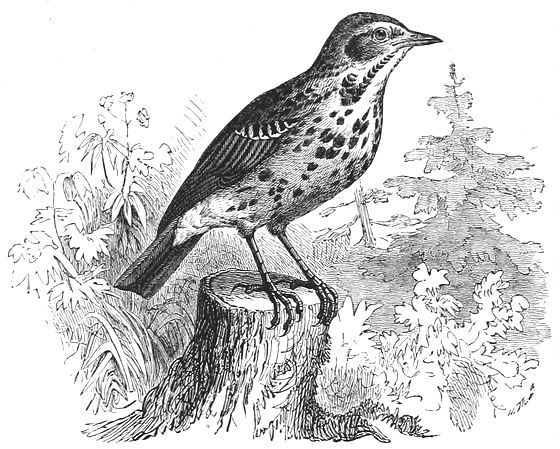
THE TREE PIPIT (Anthus arboreus).
"The Tree Pipit," says Mr. Yarrell, "is a summer visitor to this country, arriving about the
third week in April, and frequents the enclosed and wooded districts of England. It is not
uncommon around London, and I have observed it frequently in the highly-cultivated and wooded
parts of Kent. The male has a pretty song, perhaps more attractive from the manner in which it is
given than the quality of the song itself. He generally sings while perched on the top of a bush, or
one of the upper branches of an elm-tree, standing in a hedgerow, from which, if watched for a short
time, he will be seen to ascend on quivering wing about as high again as the tree, then, stretching out
his wings and expanding his tail, he descends slowly by a half-circle, singing the whole time, to the
branch from which he started, or the top of the nearest other tree; and, so constant is this habit
with him, that if the observer does not approach too near to alarm him, the bird may be seen to
perform this same evolution twenty times in half an hour, and I have witnessed it most frequently
during and after a warm May shower." "The Tree Pipit," continues Mr. Yarrell, "is found in all
the wooded and cultivated districts of the southern counties of England, but is seldom met with in
open unenclosed country. It is comparatively rare in Cornwall; not very numerous in either North
or South Wales; and some doubts are still entertained whether it extends its range to Ireland."
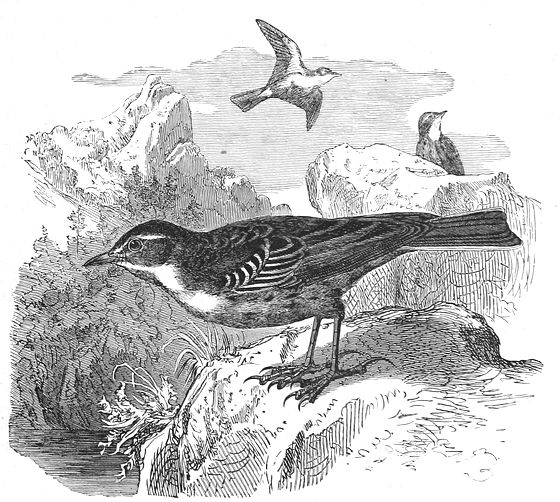
THE ROCK PIPIT (Anthus petrosus).
In a communication from Mr. Weir (who observed the birds in East Lothian) to Mr. Macgillivray,
he says:—"The Tree Pipits generally make their appearance here about the beginning of May, and
frequent the woods. They perch upon the highest branches of a tree, from which they ascend into
the air, uttering a twittering note at each extension of the wings. They send forth their song during
their descent, which they perform with wings extended and tail erected, till they again reach the tree,
where they continue a short time after perching, and then descend to the ground in the same
manner. They generally build their nests in plantations, at the root of a tree, and amongst long
grass. It is very difficult to discover them, as they are so cunningly concealed, and as the birds
generally run several yards from them before they mount into the air. The nest in which I caught
the old ones being in a park grazed by cattle, and very near a plantation, afforded me an excellent
opportunity of observing their motions. When they fed their young ones, which they did with flies,
caterpillars, and worms, they always alighted at the distance of twenty or thirty feet from their nests,
cowering, and making zig-zag windings, and now and then putting up their heads and looking around
them with the greatest anxiety and circumspection. They are seldom met with in my neighbourhood;
and, in the long space of fourteen years, I have seen only two or three of their nests."
"The Indian Tree Pipit," says Jerdon, "is very similar to its European congener, but appears
to differ slightly. It is found over all India in the cold season, for it is a winter visitant, only coming
early in October and departing about the end of April. It frequents gardens, groves, thin tree
jungle, also occasionally grain-fields, beds of woody streams, &c. It is social in its habits, many
birds being generally found together. It usually feeds on the ground on various insects, and also on
seeds, but, on being disturbed, flies up at once to the nearest tree. It now and then feeds on trees,
hopping about the upper branches, and occasionally snapping at an insect on the wing. It is said by
the natives to kill many mosquitoes, hence many of its native names. Mr. Blyth says he has seen
small parties of these birds flying over their haunts, in a restless unsettled way, now and then alighting
on a tree, uttering a slight chirp, and continuing this till nearly dark. The flesh of this species is used
by falconers as a restorative to the Bhagri, and is said to be very delicate. It is taken in numbers
for the table in Bengal and elsewhere, and sold as Ortolan."
THE ROCK PIPIT.
The ROCK PIPIT, SHORE PIPIT, or SEA TITLING (Anthus petrosus, or aquaticus), is deep olive-grey,
spotted faintly with blackish grey on the back and greyish white upon the lower portion of the
body, the sides of the breast being spotted with dark olive-brown; a light grey streak passes over the
eyes, and the wing is enlivened by the light grey borders; the eye is dark brown. This species is
from six inches and three-quarters to seven inches long, and from eleven and a quarter to eleven and
a half broad; the wing measures three inches and a half, and the tail two and three-quarters. The
claw of the hinder toe is long and very much curved. Unlike their congeners, the Rock Pipits
inhabit mountain ranges, and only descend upon the plains during their migrations. In the Swiss
Alps they are exceedingly common birds. "In spring," says Tschudi, "this species appears upon
such parts of the mountains as are free from snow, and in summer large flocks seek safety from
the violent storms that frequently break over the Alps in more sheltered situations. As winter
approaches, and the cold becomes more severe, they venture down into the plains beneath, and
occupy marsh-land and the neighbourhood of lakes or streams." In Great Britain they remain upon
the coast throughout the year, and are seldom seen at any great distance from the sea; how far north
they wander seems uncertain, for it is at present undecided whether the SHORE PIPIT (Anthus
rupestris), a bird found throughout the whole of Scandinavia, is the same, or merely a nearly allied
species. During the breeding season the Rock Pipits entirely lay aside the timidity they exhibit at
other times, and boldly approach any intruder on their privacy, flapping their wings as they fly about
him, and uttering loud and anxious cries. Their pleasing song, which is heard about the end of July,
is poured out with great rapidity, as they rise quickly into the air; and after hovering for a time, with
a gentle swimming motion, slowly descend, with wings outspread, to the spot from which they rose.
They very rarely sing when perching on the rocks or bushes. The nest is far less carefully concealed
than that of other Pipits, and is generally placed in a crevice, hole, or under a tree-root so situated
as to afford an overhanging shelter to the little family. The eggs, from four to seven in number,
have a dirty white shell, very thickly marked with various shades of brown and grey; they bear a
considerable resemblance to those of the Common House Sparrow. Tschudi tells us that on the
Alps it is not uncommon for both parents and young to perish in the heavy snow that often falls
in spring.
"Though called the Rock Pipit," observes Mr. Yarrell, "it inhabits as well low, flat shores in the
vicinity of the sea, and the neighbouring salt marshes, where it feeds on marine insects, sometimes
seeking its food close to the edge of the retiring tide. I have seen these birds very busily engaged in
the examination of sea-weed, apparently in search of the smaller crustacea. This species is readily
distinguished from the Tree and Meadow Pipit by its larger size. The hind claw is long and very
considerably curved. The localities frequented by the Rock Pipit are, however, strikingly distinguished
from those in which the other Pipits are so constantly found. I do not remember to have
seen the Rock Pipit except within a short distance of the sea-shore; and so generally is it there
distributed, that I never remember looking for it, when visiting any part of our sea-coast, without
finding it. It does not wander far inland, and is very seldom seen at any considerable distance from
the sea. It remains in this country on the coast throughout the year."
"The Rock Pipit," Mr. Lloyd tells us, "is exceedingly common on the whole coast of
Scandinavia, from Scania to North Cape. Every rocky islet, indeed," he continues, "is occupied
by a pair or two of these birds, but I do not remember having seen them in the interior of the
country.
"The fishermen in the province of Blekinge look upon the Rock Pipit as a very useful bird, for
the reason that when the water is low it repairs to the bare rocks, and feeds on the grund märla,
a little shrimp or crustacean, which is so injurious to their nets that, during a long autumnal night,
it will destroy them altogether.
"The female forms her nest on grass-grown ledges of rocks, but, though in appearance pretty
substantial, it is so fragile that it falls to pieces at the least handling. She lays from four to five
eggs of a greyish brown or greenish brown colour, marked with ash-brown spots, and usually hatches
at the beginning of May."
THE STONE PIPIT, OR FALLOW-LAND PIPIT.
The STONE PIPIT, or FALLOW-LAND PIPIT (Agrodroma campestris), the largest member of this
family, represents a group of slenderer form, and having a stronger beak and foot than those above
described. The length of this species is from six inches and three-quarters to seven inches, its
breadth ten inches and a half to ten inches and three-quarters; the wing measures three inches and a
quarter, and the tail two inches and five-sixths. The upper parts of the body are pale yellowish grey,
sparsely marked with clearly-defined dark spots; the under side is dirty yellowish white; the feathers
over the crop have dark streaks on the shafts; a light yellow line passes over the eye; and the wings
are decorated with yellowish white stripes. The young are darker, and their feathers edged with
yellow. The region of the crop is also much spotted.
The Fallow-land Pipit frequents unfruitful, arid, or stony localities, such as are avoided by other
members of the family, and is far more numerous in the southern countries of Europe than in the
northern parts of our continent. Bolle tells us that it inhabits the hottest and most barren districts
of the Canaries in very large numbers, and in the Balearic Isles it is one of the commonest birds;
we have ourselves met with it during the winter in all parts of North-eastern Africa and in Soudan.
Jerdon also mentions it as frequenting some parts of India. It is a remarkable fact that though this
species is so numerous in the Balearic Isles, it is comparatively rarely seen in Spain, except during its
migrations. In most parts of Europe it usually arrives in April and leaves for warmer regions at the
end of August; in fine weather the flocks journey by day, but if the season be unfavourable they
pursue their course principally during the night. In its movements and habits the Fallow-land Pipit
much resembles both the Larks and Wagtails. It runs upon the ground with extraordinary rapidity,
usually preferring the furrows of ploughed fields or dry ditches, when in search of food, and
frequently pauses in its labours to perch upon a stone or clod, and survey surrounding objects; while
thus quietly resting, the body is held erect and the tail lowered, but when the bird is excited, the tail
is agitated after the manner of a Wagtail. When in flight the wings rapidly open and close, the
undulatory course thus produced being diversified by a slow hovering motion, or by a direct descent
towards the earth, with pinions completely closed. Such of these birds as inhabit Europe are
extremely shy, but those occupying the Canary and Balearic Isles boldly approach the houses, and
evidently prefer to be in the immediate neighbourhood of man. The song of the Fallow-land Pipits
is extremely simple and monotonous. During the breeding season each pair takes possession of a
certain spot, from whence they drive off every intruder, and the male at once commences a series of
vocal exercises for the entertainment of his mate; these he carols forth as he soars in the air. The
nest, which consists of moss, earth, and dry leaves, lined with softer materials, is built upon the
ground. The first eggs are laid about the end of May, and in July the nestlings are fully fledged.
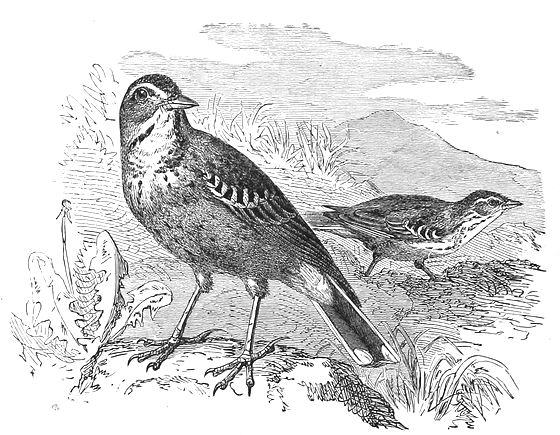
THE FALLOW-LAND PIPIT (Agrodroma campestris).
"The Stone Pipit (Agrodroma campestris)," says Jerdon, "is found in suitable places in India.
I have found it most abundant in the Deccan, at Mhoa, in Central India, and on the Eastern
Ghauts; it is rare in the Carnatic. Blyth has it from Midnapore and the North-western Provinces.
It frequents barren, open, stony land, and is never found in rich pastures. It breeds in this country
(India). In Palestine it is recorded as frequenting the lower plains and hills."
The SPURRED PIPITS (Corydalla) are recognisable by their large size, pointed wing (in
which the three first quills are of equal length), their long tail, incised at its extremity, and high
slender foot, the hinder toe of which is furnished with a claw of great length.
RICHARD'S SPURRED PIPIT.
RICHARD'S SPURRED PIPIT (Corydalla Richardii).—The mantle of this species is of a dull brown,
each feather having a light edge; the region of the cheeks, a stripe over the eye, and the entire under
side are yellowish white, shaded with grey upon the breast; the sides of the throat are white,
decorated with oval, dark brown spots; the centre quills are greyish brown, broadly shaded with light
reddish grey on the inner web; the outer web of the first quill is almost white, the rest shade
gradually into reddish yellow; the middle tail-feathers are brownish black, the others, like those of the
wing, become gradually lighter, the outer feathers being nearly entirely white. The summer plumage
is deeper in tint, and the edgings to the feathers more clearly defined than at other seasons. The eye
is brown, the upper mandible dark brown, the lower one yellow towards its base; the feet are
yellowish brown. This bird is from seven inches and a half to eight inches long, and twelve inches
and a half broad; the wing measures three inches and four-fifths, and the tail three inches and a
quarter.
The Spurred Pipits frequent Great Britain, Spain, France, Italy, Austria, Greece, and Sardinia,
but are never seen in large numbers; they are also occasionally found in Heligoland; and Jerdon
informs us that during the winter they are met with in the Himalayas, Bengal, Nepaul, Ceylon,
Burmah, and other parts of India; at the latter season, according to Swinhoe, they are also numerous
in Central China. We ourselves have never succeeded in finding the true Corydalla in either Spain
or Africa. Marshes, boggy districts, and the grassy margins of ponds or streams, are the localities to
which they resort. Jerdon tells us that they particularly frequent rice-fields, always associating in
small parties. Their flight is light, graceful, and undulating. The nest, which is very flat, and
placed in a hollow or hole in the ground, is formed of stalks woven together with fibres. The eggs,
usually laid about May, are oval, glossy, and of a delicate blueish white, spotted with blueish grey,
yellowish brown, or dark brown, and occasionally spotted and streaked with brownish grey; they
much resemble those of the Meadow or Rock Pipit. We learn from Jerdon that a large number of
these birds are sold in the markets of Calcutta, and passed off as Ortolans.
This species was first found in England by N. Vigors, Esq., in 1812, since which time a few
other specimens have been seen in different parts of the island. According to Yarrell, "The habits
of the Spurred Pipit—as far as the peculiarities of so rare a bird can be known, for it is equally scarce
on the Continent—are said to be very similar to those of other Pipits. It is mostly observed on the
ground, frequenting old pastures, where it stands very high and runs with facility, waving the tail up
and down, with a gentle airy motion, like that observed in the Wagtails, while its long hind claw, but
slightly curved, connects it with the Larks; it has, like them, an agreeable song."
The WAGTAILS (Motacillæ) are readily distinguished from the Pipits by the comparative
slenderness of their shape; their legs are high and thin, the wings of medium size, the third quill
longer than the rest, and the secondaries scarcely longer than the primaries; the tail is very long,
composed of narrow feathers, and often forked at its extremity. The beak is slender, straight, and
awl-shaped, with a ridge at its culmen, and slightly incised at its tip. The plumage is much
variegated, differs somewhat according to the sexes, and is twice moulted.
The various members of this family inhabit the eastern hemisphere, and within its limits are met
with in every latitude; most species prefer the immediate vicinity of water, but some few often seek
their food in comparatively arid situations, returning, however, within a few hours to their usual
haunts. The movements of the Wagtails are characterised by considerable liveliness and grace, they
are neither so hurried nor so rapid as those of the Pipits. Upon the ground they generally walk with
a thoughtful, deliberate bearing, bowing the head at each step, and agitating the tail so incessantly
as to entitle them to the name by which they are commonly known. Their flight is light and
undulatory, being produced by a rapid opening and closing of the wings, and their song, though by
no means powerful, is simple and pleasing. Flies, beetles, and larvæ of all kinds afford them their
principal means of subsistence; these they not only seek upon the ground, but pursue them to a
considerable distance through the air. The northern species migrate as far as Central Africa and
India; others only wander somewhat farther south, but few remain throughout the entire year in their
native land. The nest, which is carelessly formed of twigs, roots, straw, grass, moss, and dry leaves,
is lined internally with wool, or some similar material, and is constructed in holes or hollows in the
vicinity of water; if no stream or pond is at hand, a mere pool will often satisfy the requirements of
the building pairs. The eggs have a thin, finely-spotted, light grey shell. The nestlings, when first
fledged, entirely differ from the parents in their appearance.
Most species of Wagtail exhibit a decided predilection for the immediate neighbourhood of man,
whose favour they almost invariably obtain by their confiding and lively disposition.
THE WHITE WAGTAIL.
The WHITE WAGTAIL (Motacilla alba) is grey upon the mantle, the nape is of velvety blackness,
the throat and upper part of breast are also black, the rest of the under side brown, while the bridles,
cheeks, and sides of the throat are white; the quills are black, edged with whitish grey; the centre
tail-feathers are black, the rest white. The female resembles her mate, but the black patch upon her
throat is of smaller size. After the moulting season both sexes have a white patch upon the throat,
surrounded by a horseshoe-shaped black line. The young are of a dull grey above, and grey or dirty
white beneath, with the exception of a dark line on the throat. The eyes of all are deep brown, the
beak and feet black. This species is seven inches and a half long, and ten inches and two-thirds
broad; the wing measures three inches and a quarter and the tail three inches and three-quarters.
The White Wagtail is found in every part of Europe; in Africa as far as eleven degrees north
latitude; and in Asia as far south as Aden; it appears in Europe about March, and leaves again in
October or December. Like other members of its family this species frequents the neighbourhood of
water, and lives in a state of continual restlessness; even when the bird is not running to and fro, the
tail is constantly agitated. Its movements closely resemble those of other Wagtails, and its song is
agreeable but very simple. Although social as regards their own kind, these birds always exhibit a
most pugnacious and daring disposition towards the rest of their feathered companions, whatever
their size or powers; indeed, so entirely are they free from any timidity, or sense of inferiority, that
they often combine in parties, and pursue really large birds of prey, meanwhile uttering such loud
cries as warn the whole neighbourhood of the impending danger; the enemy having been routed the
party separate, after noisily expressing their pleasure at the feat they have accomplished. Insects
and larvæ afford them their principal means of subsistence; it is not uncommon to see these bold
birds seize their prey from under the very feet of the cattle as they graze, or follow the footsteps of
the ploughman as he turns up the earth. The pairing season is inaugurated by desperate battles
between the rival males, who confront each other upon the ground and fight till one or the other is
compelled to quit the field. No sooner has the victor obtained undisputed possession of his prize,
than his whole demeanour changes, and he becomes as tender and gentle as he was before fierce and
quarrelsome. Each couple takes possession of a particular spot, and within its limits make their nest,
placing it indifferently in the most diverse situations. The little structure is formed of twigs, roots,
and grass, hay, leaves, and a great variety of similar materials, and lined with wool, hair, or other
equally elastic substances. The first brood is laid in April, and consists of from six to eight eggs
of a grey or blueish white hue, thickly spotted and streaked with grey; the second batch of eggs is
produced in June. The female alone broods, but both parents assist in the business of feeding the
hungry nestlings, who grow with great rapidity, and are soon able to take care of themselves. In the
autumn young and old again assemble, and pass the night in reed-covered marshy localities, in
company with Swallows and Starlings; as the season advances these parties increase to large flocks,
which during the day fly from one ploughed field or pasture to another, always keeping in a direct
course towards their winter quarters, and, when night has set in, they rise together into the air, and,
amid loud outcries, start forth upon their long and wearisome pilgrimage.
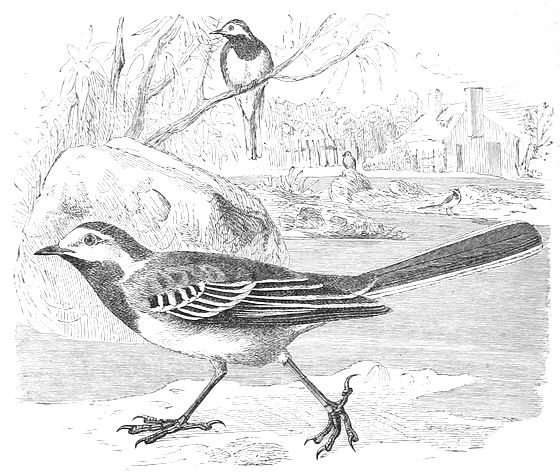
THE WHITE WAGTAIL (Motacilla alba).
"The belief expressed in the first part of this work," says Mr. Yarrell, in his third edition of his
valuable work on British Birds, "that this species is the true Motacilla alba of Linnæus, has been
verified in several instances; the coloured figures and descriptions of Swedish and other Continental
authors leave us no room to doubt, and when the subject has been further investigated, it will
probably be found that the present species is the real Motacilla alba, and therefore called the White
Wagtail. It is only a summer visitor to Britain, while many of the better known Pied Wagtails
remain with us all the year."
In the south of Sweden, where this Wagtail appears about the time the ice is breaking up, it is
called "Is Spjärna"—literally, the "kicker away of the ice." In some places it goes also by the name
of the "Kök Ärla," or the "Clod Wagtail," because it is so constantly seen amongst the clods in the
newly-ploughed fields. There is, moreover, a saying in parts of Sweden, that if the farmer commences
ploughing either before the coming or after the departure of the White Wagtail, success will
not attend his labours.
THE PIED WAGTAIL.
The PIED WAGTAIL (Motacilla Yarrelli) was formerly supposed to be identical with the bird
just described. Mr. Gould, who first decided that the two species were quite distinct, thus
discriminates between them, in a communication to the Magazine of Natural History:—"The Pied
Wagtail of England is somewhat more robust in form than the true Motacilla alba, and in its summer
dress has the whole of the head, chest, and back of a full, deep jet-black; while in the White Wagtail
(Motacilla alba), at the same period, the throat and part of the head alone are of this colour, the back
and the rest of the upper surface being of a light ash-grey. In winter the two species more nearly
assimilate in their colouring; and this circumstance has doubtless been the cause of their being hitherto
considered identical, the black back of Motacilla Yarrelli being grey at this season, although never so
light as in Motacilla alba. An additional evidence of their being distinct (but which has doubtless
contributed to the confusion) is, that the female of our Pied Wagtail never has the back black, as in
the male; this part, even in summer, being dark grey, in which respect it closely resembles the other
species."
"The Pied Wagtail of this country," says Mr. Yarrell, "though a very common bird, is deservedly
admired for the elegance of its form, as well as for the activity and airy lightness exhibited in all its
actions. It is ever in motion, running with facility by a rapid succession of steps in pursuit of its
insect food, moving from place to place by short undulating flights, uttering a cheerful chirping note
while on the wing, alighting again on the ground with a sylph-like buoyancy and a graceful fanning
motion of the tail, from which it derives its name. It frequents the vicinity of ponds and streams,
moist pastures, and the grass-plots of pleasure-grounds; may be frequently seen wading in shallow
water seeking for various aquatic insects or their larvæ; and a portion of a letter sent me lately by
William Rayner, Esq., of Uxbridge, who keeps a variety of birds in a large aviary near his parlour
window for the pleasure of observing their habits, seems to prove that partiality to other prey besides
aquatic insects, has some influence in the constant visits of Wagtails to water. "I had," says that
gentleman, "during the year 1837, several Wagtails, the pied and yellow, both of which were very
expert in catching and feeding on minnows which were in a fountain in the centre of the aviary.
These birds hover over the water, and, as they skim the surface, catch the minnow as it approaches
the top of the water in the most dexterous manner; and I was much surprised at the wariness and
cunning of some Blackbirds and Thrushes in watching the Wagtails catch the minnows, and
immediately seizing the prize for their own dinner."
The nest of our Pied Wagtail is formed of moss, dead grass, and fibrous roots, lined with hair
and a few feathers. It is sometimes placed on the bare ground on a ditch bank, sometimes in a
hole of a wall, or thatch of an outbuilding, and it is frequently fixed in the side of a wood-stack or
hay-rick; occasionally it has been found occupying a cavity in a peat-stack or a wall of turf sod, but
always in the vicinity of water. The eggs are four or five in number, white, speckled with ash-colour,
nine lines in length and seven lines in breadth.
Mr. Jesse, in his "Gleanings in Natural History," records an instance of a Water Wagtail
building her nest in one of the workshops of a manufactory at Taunton:—"The room was occupied
by braziers, and the noise produced by them was loud and incessant. The nest was built near the
wheel of a lathe, which revolved within a foot of it. In this strange situation the bird hatched four
young ones; but the male not having accustomed himself to such company, instead of feeding the
nestlings himself, as is usual, carried such food as he collected to a certain spot on the roof, from
whence it was borne by his mate to the young. It is still more remarkable that she was perfectly
familiar with the men into whose shop she had intruded, and flew in and out of it without fear. If,
by chance, a stranger or any other of the persons employed in the same factory entered the room, she
would, if in her nest, instantly quit it, or, if absent, would not return; the moment, however, that they
were gone she resumed her familiarity."
THE DHOBIN.
The DHOBIN (Motacilla Dukhunensis) is the Indian representative of the species just described.
During the summer this bird is pale grey on the back and scapulars, a supercilian streak, the nape,
wings, centre feathers of the tail, the throat, and breast, are black; the eyebrows, a spot on the wings,
the exterior tail-feathers, and belly are white, and the secondary quills are dark grey, bordered with
white. In the winter the chin, throat, and region of the eye, are white, and only a small black spot is
visible on the breast; the top of the head and nape are then grey. The eye is brown, and the beak
and feet black. The length of this species is from seven inches and a half to eight inches; the wing
measures three inches and five-eighths; and the tail four inches and three-quarters.
The Dhobin is met with throughout the whole of Ceylon and Southern and Central India, and
is very common in the Deccan; it usually makes its appearance in October, and remains till March
or April. It is at present unknown where this species breeds; and we have but little information
respecting its habits, except that it lives in close proximity to houses, frequently entering within doors
to seize the flies as they skim about the rooms; during the day it remains solitary, but in the evening
goes with its companions to the margin of some stream or other piece of water, there to pass the
night.
This bird closely resembles the Motacilla alba of Europe, but is distinguished by its great ear
patch, and by the blackness of the ear-feathers, and of the neck all round. "This Wagtail," says
Jerdon, "is found throughout Southern and Central India, extending into the North-western Provinces,
Sindh, the Punjaub, and Afghanistan. Adams, however, says that he did not see it in Peshawur,
and that the former species is the Common Wagtail of Cashmere. It is also found in Ceylon. It is
not very abundant in the extreme south of the peninsula, but is very common in the Deccan and in
Central India, coming in about the middle of October and leaving in March or April. It is a very
familiar bird, feeding close to houses, stables, and in gardens; often, indeed, entering verandahs, and
coming into an open room if not disturbed. It runs about briskly after small insects, and is very
active in catching the flies that infest the vicinity of stables and outhouses. A small party of these
birds may often be seen towards evening on the bank of a river or tank, though, when feeding, they
are usually solitary."
THE ROCK WAGTAIL.
The ROCK WAGTAIL (Motacilla Lichtensteinii) inhabits the valley of the Nile, and frequents such
parts of that river as are traversed by rocks or huge masses of stone. Its plumage is simple but
striking in its coloration; the entire mantle, sides of throat, and breast, are of a rich deep black; a
stripe over the eyes, a patch on the throat, a spot on the wing-covers, the exterior tail-feathers, and
under side are white; the eye is brown; the beak and feet black. In its movements this species
closely resembles those of its family already described, but is distinguished from them by its habit of
frequenting such portions of rock or stone as are entirely surrounded by water; in Nubia it is very
common, but is rarely met with in any but the most stony districts. According to our own
experience the Rock Wagtail lives in pairs, each couple keeping within the limits of its own domain,
and violently resenting any attempt at intrusion. Like the rest of their brethren these birds are
extremely quarrelsome, and live in a state of constant warfare with such of the northern species as
take up their winter quarters in their vicinity. The nests which we found were always situated in
holes or clefts in the rocks.
THE MOUNTAIN WAGTAIL.
The MOUNTAIN WAGTAIL (Calobates sulphurea) represents a group of Wagtails recognisable by
their comparatively short wings, long tail, and delicate beak; the sexes also differ in the coloration
of their plumage. During the spring the male is deep grey upon the back and sulphur-yellow on the
under side; the black throat is divided from the grey back by a white line, a similar streak passes
above the eyes, and the wing is enlivened by two light grey stripes; when quite old the females
resemble their mates, but the yellow under side is of a paler hue, and the black on the throat less
pale; when young, the females have only a white or dingy grey spot on the throat. The young of
both sexes are of a dull ash-grey above and yellowish grey beneath, the throat is greyish black,
spotted with blackish grey; the eye is dark brown, the beak black, and the foot horn-grey. This
species is seven inches and two-thirds in length, and its breadth is nine inches and three-quarters;
the wing measures three inches and a quarter, and the tail four inches.
The Mountain Wagtail occupies not only European mountains, but those of Asia and Africa.
It is comparatively rare in Northern Europe, but is numerously met with about the lofty peaks of its
southern portions. The great extent of country over which this species is found is the more
remarkable, because even such Mountain Wagtails as inhabit Central Europe either remain
throughout the year in their native haunts, or merely wander for a comparatively short distance
in a southerly direction. Bolle tells us that they are commonly seen in the Canary Islands; and
Jerdon informs us that they appear in India in September, leaving again about the first week in May;
this latter statement is worthy of notice from the fact that such as quit Europe at the approach of
autumn do not leave us earlier than September, and return before May. The localities to which
these birds usually resort are in the vicinity of mountain streamlets and lakes, but they are also
frequently seen about meadows or upon house-tops, and in some countries evidently prefer the society
of man. Their flight is light, rapid, and often long sustained; they move upon the ground with the
utmost ease, turning their bodies about as they run, much after the fashion of an animated dancer.
The tail is held slightly raised, in order to prevent it from getting wet, and great care is taken to
prevent any part of the plumage from being soiled. So entirely are they without fear of man, that
they not only freely venture close to his dwellings, but permit a friendly stranger to approach near to
them, without quitting the spot on which they are perched. If, however, they feel that they are
pursued, they at once become so timid as to render their capture extremely difficult. Their voice is
deceptively like that of the White Wagtail. Two broods are produced within the year, the first in
April, the second in July. During the whole period of incubation the demeanour of the male is very
restless; he flutters hither and thither, flapping with his wings, and perches from time to time upon
certain chosen spots, in order to pour out his song of rejoicing; at this season his vocal performance
possesses unusual sweetness. The nest is placed near the water in holes under roots of trees, or
amongst stones; it varies considerably both as to size and the care with which it is constructed;
the outer wall is generally formed of roots, leaves, grass, or moss; upon this is arranged a second
layer of somewhat finer materials, and the interior is neatly lined with hair, wool, or vegetable
fibres. The eggs, from four to six in number, are of a dark grey or blueish white, veined and spotted
with yellow or dark grey. The female usually broods, and exhibits such devotion to her progeny,
that, when sitting, force must be employed to remove her from the nest. The young are very
carefully nurtured.
This species is spread throughout all India and Ceylon; it is very generally met with in the hilly
and wooded parts, but is rare in the open country, especially towards the south of India, the Carnatic,
and the bare table-land; it is apparently most abundant in Bengal and the more northern districts.
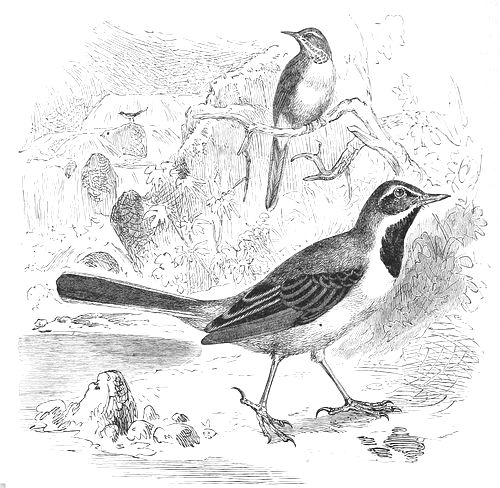
THE MOUNTAIN WAGTAIL (Calobates sulphurea).
"It occasionally," says Jerdon, "is to be seen on the banks of rivers, but is more generally
found in gardens near houses, in towns and villages, and on walks in the forest, or where there is
sufficient shelter. Mr. Blyth, who had abundant opportunities for observing it, says he has seen it
tripping over the filthiest narrow black drains between hut and hut in the native town of Calcutta.
It occasionally, though rarely, perches upon trees, and has the jerking motion of its tail more
remarkably noticeable than any other member of the entire group, for it appears unable to keep it
in repose even for a moment."
The SHEEP WAGTAILS (Budytes), a group of European birds, are recognisable from the
other members of their family by their short tail, the straight long nail on the hinder toe, and the
brilliancy of the plumage, which varies in the two sexes, insomuch that naturalists are undecided as to
whether certain species of these Wagtails are distinct or identical.
THE COW OR MEADOW WAGTAIL.
The COW or MEADOW WAGTAIL (Budytes flavus) is blueish grey upon the head and nape, the
back is olive-green, and under side bright yellow, the quills and tail are of a blackish hue, with light
borders; a pale stripe passes above the eyes, and two yellow lines across the wings; in the female
and young all the colours are fainter and greyer than in the male bird. The eye of all is dark brown,
the beak black, the base of the lower mandible light blue, and the foot black.
The Meadow Wagtail is generally found in the central and northern parts of Europe; it
frequents meadows and the banks of small streams, and feeds principally upon flies and aquatic
insects. The nest is built in holes in meadow ground, or at the foot of trees; the eggs are six in
number, with light flesh-coloured blotches. Gould supposes these birds, although not visiting
England, to be numerous on the Continent. He received one that he tells us was shot in the
neighbourhood of Paris, and in May specimens were killed in Sweden by N. C. Strickland, Esq.
From the account of this gentleman, their manners are very different from those of our Yellow
Wagtail, as they run about with the tail elevated, and the wings hanging down and spread. We have
also received the bird from the Himalaya Mountains. The first British specimen was shot near
Colchester by Mr. Henry Doubleday, who was attracted by observing a pair of birds together, long
after the time that our Common Yellow Wagtail leaves the country. In 1836 two were seen near
Edinburgh, and others have since been seen at intervals in different parts of England.
RAY'S WAGTAIL.
RAY'S WAGTAIL (Motacilla or Budytes Rayi)—the Yellow Wagtail, formerly called Motacilla flava—so
well known as a summer visitant to England, is very rare on the continent of Europe, where
the preceding species, called by Continental authors Motacilla flava, is found. Mr. Gould was the
first to point out the difference between the two, and to assign to the British species the name of
Ray's Wagtail, in memory of the distinguished naturalist by whom it was first observed.
"In Ray's Wagtail," says Yarrell, "the line over the eyes and ear-covers is yellow, and the back
of the head is, I believe, invariably the same as the back of the bird; while, in the Grey-headed
Wagtail, or Continental species, the white elongated line over the eyes and ear-covers appears to be
permanent, and the grey head is more or less conspicuous at all seasons, particularly in summer.
The females of the two species most resemble each other.
The Yellow Wagtail (B. Rayi) comes to us from the south, appearing at the end of March
or beginning of April, and leaving us in September. It frequents ploughed fields and uncultivated
ground covered with furze; it makes its nest both in arable land and fields of wheat and tares, and
does not appear so partial to water as other species. "It frequents," says Mr. Yarrell, "dry
fallows and fields of young corn, where, perched upon a clod or stone, it exhibits its rich yellow
breast to great advantage." The nest, which is placed upon the ground, is formed of dry stalks and
fibres, and lined with hair. The eggs, from four to six in number, somewhat resemble those of the
Sedge Warbler; they are of a whitish hue, mottled with various shades of brown. The young begin
to fly about the end of May, and from that time till the season for migration, may be seen following
their parents in search of food, keeping so close to the feet of cattle and sheep as to be in constant
danger. A writer quoted by Mr. Yarrell says, "I have seen whole parties of Yellow Wagtails
running and dodging close to the cows' heads, apparently catching small insects. I suppose the
cattle disturbed the flies which are the favourite food of this bird, and lodge in the grass, and which,
as they arose, were caught by the watchful Wagtail, before they could secure their retreat. The
call-note of this bird resembles that of other species, although more shrill than that of the White
Wagtail; it consists of two notes, repeated in succession, the second of which is one whole tone
lower than the other."
THE VELVET-HEADED OR SHEEP WAGTAIL.
The VELVET-HEADED or SHEEP WAGTAIL (Budytes melanocephalus) is of a rich black upon the
brow, top of the head, and region of the eye; the entire mantle is olive-colour, shaded with green;
the under side is bright sulphur-yellow; the wings and centre tail-feathers are black, with light edges;
and the wing-covers brownish black, bordered with white. The female is of an olive-green above and
pale greyish yellow on the under side; the region of the ear is black. A remarkable variety
inhabiting Great Britain is yellowish green on the top of the head and nape, but the rest of its
plumage resembles that of the above-mentioned species. Both birds are from six to six and a half
inches long, and from nine to ten broad; the wing measures from two inches and five-sixths to three
inches and a quarter, and the tail two inches.
The Sheep Wagtails appear in Europe about May, and leave again in August or September.
During the breeding season they usually frequent marshy districts, and the immediate vicinity of
water, but at other times pass almost the entire day in pasture lands, near flocks of sheep or herds of
cattle. Most members of this family breed in Greece and North Africa, but some few in the
northern parts of Europe. The flight of all is light, and often remarkably rapid; they generally
hover before alighting, or sink suddenly and directly earthward, with wings completely closed. Their
song consists of a few insignificant piping notes. Although of a social temperament, they display
during the breeding season a most quarrelsome and pugnacious disposition, pursuing and giving battle
to every small bird that ventures to approach their dwelling-place. The nest is concealed among
grass, corn, or water plants, and is usually made in a slight hollow in the ground; in form it resembles
that of a Lark or Pipit; the walls are loosely constructed with fine roots, grass, dry leaves, and moss,
and the interior lined with wool, horsehair, and feathers. The eggs, from four to six in number, have
delicate shells, of a yellowish, reddish, or greyish hue, veined, spotted, and clouded with brown,
yellow, violet, and grey. But one brood is produced in the year; the female alone undertakes the
duty of incubation, and hatches the nestlings in about three days. Both parents exhibit the utmost
anxiety about the safety of their little ones, and frequently betray their retreat by the cries of alarm
which they utter on the approach of a stranger. Young and old remain together until they start forth
on their winter excursions.
Jerdon is of opinion that from the description of B. melanocephalus of Southern Europe, there is
little doubt that it is identical with the Indian bird, which thus appears also to inhabit Northern
Africa, South-eastern Europe, and Western Africa. "In India this Wagtail comes in towards the
end of September, and does not quit the north of India, till the end of April or beginning of May.
It is exceedingly abundant in every part of India, usually assembling in considerable flocks and
feeding among cattle, picking up the insects disturbed by their feet while grazing. These birds also
frequent damp meadow ground near rivers or tanks, grain fields, where they may be often put up with
the so-called Ortolan (Calandrella brachydactyla) during the heat of the day, and, late in the season,
they may always be seen taking advantage of any shade—a tree, stone, small clump or paling, to
shelter them from the mid-day heat. Now and then a few may be seen about houses in gardens and
roads, occasionally even perching on a housetop or paling, but very rarely on trees. Many are
snared at Calcutta and elsewhere to be served up as Ortolan."
According to our own observations by far the greater number of these Wagtails pass the winter
in Central Africa, and we have also seen them constantly in Egypt at that season, wandering about
the pastures with the cattle, and even accompanying them to their drinking-places.
THE YELLOW-HEADED WAGTAIL.
The YELLOW-HEADED WAGTAIL (Budytes citreolus), a native of Central Asia, is somewhat larger
than the species above described. Its length is seven inches, its breadth ten and a half, the wing
measures three inches and a half, and the tail three inches and one-third. The summer plumage of
the male is of a bright citron-yellow on the head and entire under side; the nape and upper portion
of the back are black, the centre of the back slate-grey, and the rump brownish black. The small
feathers on the wing-covers are greyish brown, broadly edged with dark grey, the centre and large
feathers are margined with broad white borders, which alone are visible; the primaries and lower
secondaries have narrow white edges, and the upper secondaries a broad white border to the outer
web; the eight central tail-feathers are brownish black, and those at the exterior almost entirely white.
The eye is brown, the beak and feet black. The female, who is not so large as her mate, is yellow
on the brow, and greyish green on the top of the head and nape; the back is dark grey, the rump
deep slate-colour; the cheeks and under side are of paler yellow than in the male, and the white lines
on the wings narrower and more clearly defined. The young are grey above, and white shaded with
yellow on the under side. Radde informs us that some few of these birds are met with in the central
parts of Western Siberia, and that further east they become very numerous. According to Jerdon
they are found throughout India during the winter, and there, as elsewhere, frequent marsh-land or
the immediate vicinity of water.
"This species," says Jerdon, "is remarkable for the great length of the hind claw. It is found
all over India in the cold weather, being migratory, and probably breeding in North-eastern Europe
and Northern Asia. It is not very abundant, and is never found in dry places, like the Indian Field
Wagtail, but on the banks of lakes or rivers, and more particularly in swampy ground or in inundated
rice-fields, apparently affecting concealment more than others of this group. It has been obtained in
breeding plumage at Mussooree, and is then a very beautiful bird."
THE GOMARITA, OR GARDEN WAGTAIL.
The GOMARITA, or GARDEN WAGTAIL (Nemoricola Indica), has been separated from the bird
above described on account of the shortness of the claw on the hinder toe, and the peculiar
coloration of its plumage. The upper part of the body is greenish brown, the under side yellowish
white; a double band of black passes over the breast, and a white stripe above the eye; the blackish
wings are decorated with two white lines, and a third stripe passes across the base of the primary
quills; the centre tail-feather is brown, the next in succession are blackish, and those at the exterior
white, but blackish at the root, and edged with brown on the outer web. The eye is brown, the
upper mandible pale black, the lower mandible whitish; the foot is light yellow, shaded with
purplish brown. This bird is six inches and a half long, and ten broad; the wing measures three
inches and one-eighth, and the tail two inches and five-eighths.
The Garden Wagtails are found throughout India, Ceylon, China, and Japan; according to
Jerdon they are comparatively rarely seen in Southern and Central India, but are very numerous on
some of the surrounding islands. Everywhere they frequent woods, forests, shady gardens, and
plantations, living in solitude except during the breeding season, after which they remain for some
time assembled in small parties or families. These birds do not migrate, and they moult their feathers
but once in the year. Layard tells us that the Gomarita, or "Dung Spreader," as this species is called
in Ceylon, receives its name from its habit of seeking for insects in the droppings from the cattle.
"The Black-breasted Wagtail," writes Jerdon, "is found throughout the whole peninsula of
India and Ceylon, but is common nowhere; it is indeed rare in the southern provinces and in the
bare table-land of Central India, and is not recorded from the North-western Provinces nor the
Himalayas. It extends to Arracan, Burmah, Malacca, and some of the Malayan islands, where it
is much more common than in continental India. I have only procured it myself in my own
garden and on the Malabar coast. It appears not uncommonly about Calcutta, and, according
to Blyth, at all seasons. It is quite a wood-loving species, never being found in the open plains,
nor, that I have seen, about rivers, being chiefly found in shady gardens and orchards, and in roads in
the forests. It is usually solitary, and feeds on various insects. It has no seasonal change of colouring,
and appears to be found, at all events in the more northern parts of India, all the year round."
The SWALLOW WAGTAILS (Enicurus) are large and powerfully-built birds, inhabiting
India and the Malay Islands; they are easily distinguished from their European congeners, by their
comparatively strong beak, more rounded wing, in which the secondary quills are not prolonged, and
their robust feet. The beak is of moderate size, strong, straight, broad at its base, furnished with a
keel at its culmen, and gently curved at its extremity, which is slightly incised; the toes are armed
with very hooked claws, the fourth and fifth, sometimes the fifth and sixth, exceed the rest in length.
The extremity of the tail is so deeply forked that the centre feather is not more than one-third as
long as those at the exterior.
All the species of Swallow Wagtails with which we are acquainted inhabit mountain regions, and
are numerously met with in their favourite resorts among the rocks. They are always found in the
vicinity of streamlets or waterfalls, into which they frequently wade. In their habits they resemble
other members of their family, and, except after the breeding season, live alone or in pairs.
THE MENINTING.
The MENINTING (Enicurus Leschenhaulti, or Enicurus coronatus) is black upon the upper part of
the body, neck, and breast, and white upon the crest and under side; the black wings are decorated
with a broad white stripe, the outer tail-feathers are pure white, the rest black, broadly tipped with
white; the beak is black, and the foot yellow. The length of the body is about ten or eleven inches.
The Meninting is an inhabitant of the Malay Islands, where it frequents the mountain regions, and is
usually met with near shallow lakes or streams, at an elevation of from sixteen hundred to four
thousand feet above the sea. Bernstein tells us that he saw one of these birds on the Pangerango,
at an altitude of ten thousand feet, but this must be regarded as a very unusual occurrence. In
disposition this species is gentle and timid, but, if unmolested, will allow a stranger to approach
without testifying any alarm, merely flitting a few paces farther off should the intruder come too near
the spot on which it is perched. When excited the Meninting raises its crest, repeatedly jerks its
closed tail upwards, and then, spreading it like a fan, slowly lowers it. Its voice resembles that of
the White Wagtail. The nest, which is invariably placed upon the ground at no great distance from
water, is frequently made in a small hollow in the earth, this being lined with moss, upon which a
layer of half-decayed leaves is arranged to form an elastic bed for the young family. The eggs are of
a dull greenish or yellowish white, thickly marked with faint red, yellow, or light brown spots; these
often form a wreath at the broad end. We have never found more than two eggs in a nest. The
young are tended with great devotion by their parents, who, should danger be at hand, frequently
betray the presence of their brood by uttering a gentle, long-sustained note of distress. The
Meninting subsists upon worms and insects, seeking its food amongst the plants that border its
favourite streams. It is very partial to water, and frequently wades therein when pursuing its prey.
The ACCENTORS (Accentores) may be regarded as forming the connecting link between the
true Singing Birds and the strong-beaked granivorous races, more especially the Larks. They are
recognisable by their powerful body, moderate-sized or long wing, in which the third or fourth quill
exceeds the rest in length, as also by their short, broad tail, strong foot, armed with powerful toes,
and much-curved claws. The conical awl-shaped beak turns inwards at its margins, and the nostrils
are covered with a skin; the plumage is lax, and formed of feathers of a relatively large size; the
sexes are alike in appearance, but the coloration of the young differs considerably from that of the
adult birds. Only two species of Accentors can properly be regarded as European, the rest inhabit
Asia, and are generally seen hopping over the ground or flying very low, in search of the insects,
berries, or delicate seeds upon which they subsist; they never frequent lofty trees, or even tall shrubs,
except during the breeding season, when the males occasionally perch upon low branches, whilst
pouring out their, in most cases, very agreeable song. As winter approaches some species wander
southward, while others merely quit the bleakest and most exposed peaks for their rocky fastnesses.
Incubation takes place early in the spring, and two broods are generally produced in the course of
the summer. Their nests are carefully and neatly built of moss and hay, and lined with some soft
and elastic materials. The eggs, from three to six in number, are of greenish hue.
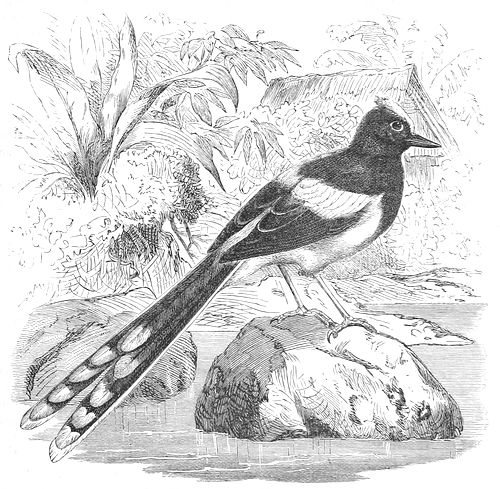
THE MENINTING (Enicurus coronatus).
The HEDGE SPARROWS, or HEDGE WARBLERS (Tharraleus, or Accentor), have a
slender body, a comparatively weak and pointed beak, short, rounded wings, in which the fourth
quill is the longest, a moderate-sized tail, straight or incised at its extremity, and a high foot.
THE HEDGE SPARROW, OR HEDGE WARBLER.
The TRUE HEDGE SPARROW, or HEDGE WARBLER (Tharraleus modularis, or Accentor modularis),
is six inches long and eight inches and one-sixth broad, the wing measures two inches and three-quarters,
and the tail two inches and one-quarter. The female is considerably smaller than her mate.
The plumage of the adult bird is of a dusky reddish brown, spotted with a still deeper shade on the
shoulder and upper part of the back; the head, fore part of the throat, and breast are brownish grey,
or slate-colour. In autumn the feathers on these parts have light edges; the belly is brownish
yellow, darkly spotted, and the rump greyish brown; the outer web of the quills is reddish brown,
striped once, in some instances twice, with a whitish hue; the tail is of an uniform greyish brown.
The eye is light brown, the beak brown, and the foot reddish. The young are reddish yellow spotted
with blackish brown on the mantle, and of a whitish hue spotted with greyish black on the centre of
the belly. The Hedge Sparrow inhabits the whole of Europe, from sixty-four degrees north latitude
as far south as the Pyrenees, Alps, and Balkan Mountains; it is only occasionally seen still farther
north, but visits Southern Europe, Northern Africa, and Western Asia, regularly during its migrations.
In Great Britain it remains throughout the entire year. For some time after their return to their
native lands the Hedge Sparrows resort to the open country, and take up their quarters on bushes
and hedges; previous to the breeding season, however, they retire to the shelter of their favourite fir
or pine woods, or, though comparatively rarely, occupy groves of leafy trees; they also exhibit a
decided preference for mountainous regions.
In Great Britain this brisk little bird is a common frequenter of gardens, orchards, or hedgerows,
where it hops nimbly and almost incessantly from twig to twig, in search of the insects, larvæ, and
seeds upon which it mainly subsists. According to Mr. Yarrell, it seldom or never touches fruit.
During the winter it is a constant visitor to our farmyards and houses, and when the weather is severe
is frequently reduced to seek a scanty supply of food from drains and gutters. All the movements of
the Hedge Warbler are equally agile and rapid; it hops with the utmost alacrity over the surface of
the ground, climbs and scrambles amid the thickest bushes with wonderful agility, and flies lightly
and gracefully, not merely from bush to bush, but sometimes high into the air. Whilst in pursuit of
food it usually prefers to keep within the shelter of the foliage, but when about to utter its short,
sweet, and somewhat plaintive song, it perches upon a projecting branch at a considerable elevation,
and, if alarmed, darts directly downwards into the innermost recesses of the brushwood or shrubs
beneath. Mudie describes the voice of the Hedge Sparrow as being particularly plaintive in tone
during the winter months, and remarks that in severe seasons it utters its peevish cry with an
apparent feeling of suffering and desolation. The song of the males is often heard as early as January;
and by the middle of February each has found a mate and retired to some quiet spot, in order to
commence building operations. The nest, which is generally finished by the end of March, is loosely
put together; it is formed exteriorly of moss and fibres, and within is neatly and carefully lined with
interwoven horsehair and wool; both parents assist in the labour of building, and have generally
completed their snug little abode by the middle of March: it is, however, exposed to danger and
observation, being placed in a bush or hedge, without, as yet, the screen of leaves, and often is
visited by the Cuckoo, with the view of depositing her progeny. The eggs, from four to six in
number, are of a blueish green colour. The first brood is hatched in April, and a second is produced
later in the season. Should the eggs be stolen from the nest, as is too frequently the case, the
female will occasionally furnish a third brood. The young are hatched in about a fortnight, both
father and mother sharing the tedium of incubation, and tending them with the utmost care and
devotion until they are strong enough to seek their own food.
THE SIBERIAN ACCENTOR.
The SIBERIAN ACCENTOR (Tharraleus montanellus) is blackish brown upon the top of the head,
bridles, and region of the eye; a broad yellowish white stripe passes over the eyebrow, and almost
encircles the head; the nape is grey, and the back reddish brown, spotted with a deeper shade; the
throat and lower tail-covers are whitish; the region of the crop and the upper part of the breast are
deeply shaded with reddish yellow, and marked with crescent-shaped black spots; the sides of the
breast are shaded with reddish yellow and reddish brown. The eye is pale yellowish brown, the
mandibles greyish black, the lower one lightest at the base, the foot is of a dirty yellowish white.
This species is from four inches and two-thirds to five inches and one-third long; the wing measures
two inches and seven lines, and the tail about two inches and six lines. This beautiful bird inhabits
Siberia, and has been found in Hungary, Dalmatia, and Italy.
THE ALPINE ACCENTOR.
The ALPINE ACCENTOR (Accentor Alpinus) represents a group of birds in appearance very
closely resembling the Larks. Their beak is slightly curved and pointed, compressed at its sides,
narrow towards its extremity, and broader than it is high at the base; the legs are stout, the toes thick,
and the claws much hooked, but blunt; the wings, in which the third quill exceeds the rest in length,
are long; the tail is short, and deeply incised; the upper portion of the body is deep grey, spotted
with brown, the under side ash-grey, marked at the sides with reddish brown; the throat is white,
slightly spotted with brown; the quills and tail-feathers are blackish brown, the latter spotted with
white; the wings are ornamented with two white lines. Both sexes are alike in colour. The young
are grey, spotted with reddish yellow; black on the back, and reddish yellow, chequered with light
and dark grey, on the under side; the wing-feathers are brown, edged with rust-red, and the wings
enlivened by two reddish yellow stripes. The tail is brown, and also tipped with reddish yellow; the
eye is light brown, the beak yellow at the base and black at the tip; the foot is brown. This species
is seven inches long and eleven and three-quarters broad; the wing measures three inches and
three-quarters, and the tail two inches and three-quarters; the female is half an inch shorter, and
three-quarters of an inch narrower than her mate.
These birds inhabit all the lofty mountains of Central and Southern Europe and Southern Asia,
and are particularly numerous upon the Alps, where they are generally met with at an altitude of from
4,000 to 6,000 feet above the sea. They are also occasional visitors to the south of Great Britain.
In winter they usually descend to the plains and valleys in search of seeds, but return to their
favourite haunts as soon as the snow has melted from the surface of the rocks; they are then to be
seen running lightly or flying from one peak to another, as they pour out their clear, melodious song,
many notes of which will bear comparison with those of the Lark itself. Their disposition appears to
be somewhat capricious; at one time they are all life and activity, at another perfectly quiescent.
Gloger explains this peculiarity by telling us that they are only brisk and lively while searching for
food, and that their change of demeanour is attributable to the process of digestion that is being
carried on as they sit erect and motionless often for a whole half hour at a time. While hopping on
the ground the Alpine Acceptor carries its tail slightly elevated, sometimes so high as to be raised
above the wings. The flight of these birds is light and rapid, and capable of being sustained for a
very considerable distance; but, under ordinary circumstances, they keep near the ground, and only
soar into the air during the breeding season. Towards man they exhibit the utmost confidence, and
are frequently to be seen hopping about close to a party of mountaineers or group of shepherds, quite
indifferent to and apparently almost unconscious of the voices and movements around them. Insects,
spiders, seeds, and berries constitute their principal food, and they devour grass seed, in particular, in
great quantities. The nest, according to Schinz, is commenced early in the spring, and is situated in
clefts or holes of the rock, or amid Alpine rose bushes; sometimes on the roofs of houses, care being
generally taken that the little structure is so placed as to be completely sheltered from wind and
weather. The nest, which is circular and semi-conical, is three inches both in diameter and in depth;
it is constructed alternately of grass and moss, and lined with wool, hair, or similar materials. The
eggs, from four to five in number, are of an oval shape, smooth, and of a blueish green. It is at
present undecided whether the female is assisted by her mate in the work of incubation. Two
broods are produced in the year, the first in May, the second in July.
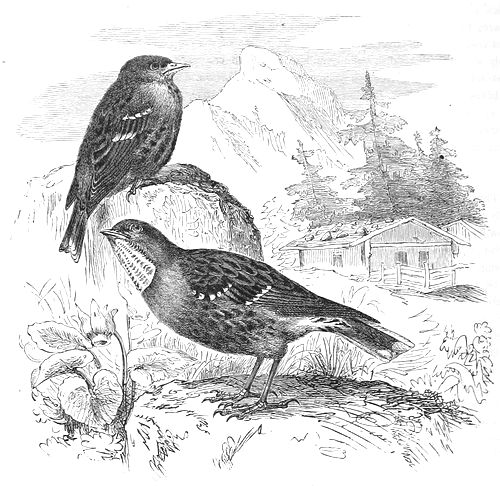
THE ALPINE ACCENTOR (Accentor Alpinus).
The TITS (Pari), although differing in many respects, resemble each other in most essential
particulars. All are of small size, with compact bodies and short limbs. The beak is conical,
straight, and short, with sharp margins, compressed at its sides and pointed at its tip; the feet are
sturdy, the toes powerful and of moderate size, and the claws comparatively large and very much
hooked. The wings, in which the fourth or fifth quill is the longest, are short and rounded; the tail
short, and either straight or very slightly incised at its extremity; occasionally it is very long, and
graduated at its sides. The plumage, which is thick, and composed of long and lax feathers, is bright
and elegant in its coloration.
Most members of this family inhabit the northern parts of the Eastern Hemisphere, some few
belong to North America, and others are natives of Asia and Africa. Opinions differ as to whether
they migrate at the approach of winter, but our own observations have convinced us that even those
frequenting northern countries never wander to any great distance from their native haunts. All are
social in their habits, and consort not only with their own kind, but also seek the company of other
species, often remaining in their society for weeks at a time. They seldom visit seed-growing
districts, but frequent woods and forests, living almost exclusively upon trees or large shrubs, climbing
and flying about the branches in what may literally be termed an incessant search for food. On the
ground their movements are clumsy, and they seldom undertake long excursions, but generally only
flit from one tree to another, feeding principally upon insects and seeds; of the former they devour
enormous quantities, as their life of restless activity renders an unusually large supply of nourishment
indispensable. The Tits may, therefore, be regarded as valuable assistants to the gardener and
farmer, richly meriting their favour and protection. Most species breed twice in the year, laying
each time from seven to twelve eggs.
The CRESTED WRENS or KINGLETS (Regulus) are recognisable by their straight, thin,
finely-pointed beak, which is broad at the base, raised at the culmen, and slightly notched at the
curved tip of the upper mandible. The feet are slender, the tarsi high, and the claws very decidedly
hooked; the wings, in which the fourth and fifth quills are the longest, are short, broad, and much
rounded; the tail is of medium size, and incised at its extremity; the plumage is thick, and composed
of large, loose feathers; the nostrils are covered with small feathers, and the corners of the mouth
with a few bristle-like hairs; the feathers on the crown of the head are generally prolonged into a
crest, and are of brilliant hue. These birds are met with throughout Europe, Asia, and North
America, and from time to time make their appearance in North-western Africa.
Their journeys are extraordinary when compared with their strength, size, and powers of flight,
but they are often exhausted before arriving at their destination. Mr. Selby has related the following
account of a large migration on the coast of Northumberland in 1822:—
"On the 24th and 25th of October, 1822, after a very severe gale, with thick fog from the
north-east (but veering, towards its conclusion, to the east and south-east), thousands of these birds
were seen to arrive upon the sea-shore and sand-banks of the Northumbrian coast, many of them so
fatigued by the length of their journey, or perhaps by the unfavourable shift of wind, as to be unable to
rise again from the ground, and great numbers were in consequence caught or destroyed. This flight
must have been immensely numerous, as its extent was traced through the whole length of the coasts of
Northumberland and Durham. There appears little doubt of this having been a migration from the
more northern provinces of Europe (probably furnished by the pine forests of Norway, Sweden, &c.),
from the circumstance of its arrival being simultaneous with that of large flights of the Woodcock,
Fieldfare, and Redwing. Although I had never before witnessed the actual arrival of the Golden-crested
Regulus, I had long felt convinced, from the great and sudden increase of the species during
the autumnal and hiemal months, that our indigenous birds must be augmented by a body of
strangers, who make these shores their winter resort."
THE GOLDEN-CRESTED WREN.
The GOLDEN-CRESTED WREN (Regulus cristatus, flavicapillus, or auricapillus) is yellowish green
on the mantle, and light grey beneath; the throat is whitish grey; the crown of the head is saffron
yellow, its sides golden yellow, decorated with a black stripe; the wings are enlivened by two light-coloured
bands. In the plumage of the female all the tints are duller, and the yellow on the head
paler than in her mate. The young are entirely without the bright colouring on the head. This
species is three inches and two-thirds long, and five inches and five-sixths broad. The wing measures
one inch and five-sixths, and the tail an inch and a half. The Golden-crested Wren is the only
member of this family found in Scandinavia, and it also breeds as far south in Europe as Greece, but
is seldom seen in Spain. Notwithstanding the apparent delicacy of these birds, they are capable of
sustaining an unusual degree of cold, and great numbers pass the entire winter in the pine forests of
Sweden. In England and Ireland they also remain throughout the whole year, but we are told that
those living in the Orkneys wander as far as the Shetland Isles when the cold sets in. A most
extraordinary circumstance that took place in 1823 is related in the Memoranda of the Wernerian
Society, namely, the total disappearance of the whole race of these birds, natives as well as
strangers, throughout Scotland and the north of England. This happened towards the end of
January, a few days previous to the continued snowstorm that was felt so severely in the northern
counties of England and the eastern parts of Scotland. The range and route of this migration are
unascertainable, but it was most probably a distant one, from the fact of not a pair having returned
to breed or pass the succeeding summer in the situations they had been known always to frequent;
nor was one of this species to be seen till the following October, about the usual time for our
receiving an annual accession of strangers to our indigenous birds. Like their congeners, these tiny,
delicate Wrens principally frequent fir and pine forests, about the branches of which they scramble
with wonderful agility, hanging head downwards from the twigs, or darting like meteors from branch
to branch, in a restless and incessant search for the insects upon which they subsist. Their voice is
gentle and twittering, and their song occasionally uttered as they hover in the air over a bush or
shrub. During the period of incubation, which frequently commences as early as February, the
males endeavour to attract the attention of their future partners by spreading the beautiful crest
upon their heads, and indulging in a variety of animated and excited movements, as they hop or
fly about the spot where the desired mate is perching. The nest is spherical, usually placed at the
extremity of a branch, beautifully constructed of moss or lichen, and in most instances snugly
lined with feathers, cotton wool, or down from plants. The eggs, from six to ten in number, have a
pale reddish white or yellowish white shell, finely spotted with red, and are scarcely larger than peas,
not exceeding six lines in length, and five in diameter. So voracious are the young, that Colonel
Montague observed the mother come thirty-six times in an hour with morsels for her craving family,
and continue her labours without intermission for sixteen hours in the day. Mr. Selby tells us that
he has seen fully-fledged young by the end of April.
THE DALMATIAN WREN.
The DALMATIAN WREN (Regulus modestus).—"The only history of this bird," says Mr. Gould,
"that we have been able to collect was that written on the label attached to it by the Baron de
Feldegg, of Frankfort, which is as follows:—'I shot this bird, which on dissection proved to be a
male, in Dalmatia, in the year 1829.' We were informed, at the same time, that it was not known to
any German ornithologists, and, consequently, had not received a specific title. This we have
ventured to give, and suggest the term modestus, in allusion to its chaste plumage and the absence of
the crest, which forms so conspicuous a feature in other species of this genus. Its most conspicuous
characters are the three yellow stripes which ornament the head; the brighter and most highly
coloured of these marks, contrary to what obtains in any other Reguli, being that over each eye, while
the coronal stripe is palest, and consists of feathers similar in length to those which cover the rest of
the head. With the exception of the stripes on the head, the whole of the upper surface is delicate
olive green, becoming abruptly paler on the rump; the quills and tail are brown, edged with pale
yellow, which is more conspicuous on the secondaries; two transverse bands of the same colour cross
the shoulders. The whole of the under surface is pale greenish white; bill and tarsi brown."
THE FIRE-CRESTED WREN.
The FIRE-CRESTED WREN (Regulus ignicapillus, or Regulus pyrocephalus) is readily distinguished
from the bird above described by a black stripe that passes across and a white stripe that passes over
the eyes. The crown of the head is fiery red, and bright-flame yellow at its sides, surrounded by a
black line, which is broader than that on the Golden-crested Wren. The two species are almost
alike in size. The Fire-crested Wren is met with in France, Germany, Italy, Greece, and Spain, and
has been seen, although very rarely, in England. In most of the above-mentioned countries it only
appears during its wanderings, but is known to breed in Greece. Such of these birds as inhabit
Europe closely resemble the species above described in their movements and habits.
According to Jerdon, "the Himalayan Fire Crest is very like the Regulus ignicapillus of
Europe, but is larger, and has the flame-coloured crest more developed. The Himalayan Fire-crested
Wren has only been found in the North-western Himalayas, and even there, apparently, it is not very
common."
THE SATRAP WREN.
The SATRAP-CROWNED WREN (Regulus satrapa), a North American species nearly resembling
its European congeners, is brownish grey upon the back, and greyish white upon the under side; the
breast is shaded with brownish yellow, the eyes are encircled by a greyish white ring, and the head
decorated on each side with a black band, edged with bright yellow, and with a broad fiery red stripe
across the crown; the quills and feathers of the wing-covers are dusky, the former edged and the
latter tipped with greenish yellow; the eye is brown, the beak black, and the feet brownish yellow.
The bird is four inches long and seven broad.
Of the American Fire-crested Wren, or Fiery-crowned Knight, Nuttall writes as follows:—"The
Regulus tricolor (or Regulus satrapa) appears associated only in pairs, which are seen on their southern
route, in this part of Massachusetts, a few days in October, and about the middle of the month, or a
little earlier or later according to the setting in of the season, as they appear to fly before the
desolating storms of the northern regions, whither they retire about May to breed. Some of these
birds remain in Pennsylvania until December or January; proceeding, probably, but little further south
during the winter. They are not known to reside in any part of New England, but retire to the same
remote and desolate limits of the farther north with an allied species, of which they have most
of the habits. They are actively engaged during their transient visits to the south in gleaning up
insects and their lurking larvæ, for which they perambulate the branches of trees of various kinds,
frequenting gardens and orchards, and skipping and vaulting from the twigs, sometimes head downwards,
like the Chicadee, with whom they often keep company, making only now and then a feeble
chirp. They appear at this time to search chiefly after spiders and dormant concealed coleopterous
or other insects; they are also said to feed on small berries and some kinds of seeds, which they
break open by pecking with the bill in the manner of the Titmouse. They likewise frequent the
sheltered cedar and pine woods, in which they probably take up their roost at night. Early in April
they are seen on their return to the north in Pennsylvania. At this time they dart among the blossoms
of the maple and elm, in company with others of their race, and appear more volatile and actively
engaged in seizing small flies on the wing, and collecting minute lurking caterpillars from the opening
leaves. On the 21st of May, 1835, I observed this species feeding its full-fledged young in a tall
pine tree on the banks of the Columbia river."
"If we compare the American Golden-crest Wren with the European, we find that they agree in
general appearance, in the proportional length of the quills and in the form of the tail, as well as in
that of the bill and legs. Their differences are the following:—
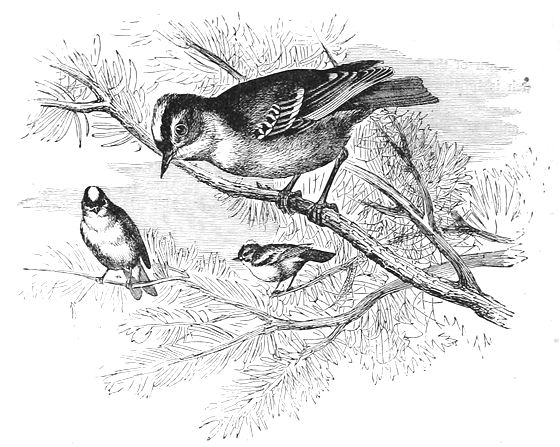
THE GOLDEN-CRESTED WREN (Regulus flavicapillus).
"Regulus tricolor is longer by half an inch than Regulus cristatus, its bill is stronger and one-twelfth
of an inch shorter, its claws are also stronger and shorter, and the flame-coloured patch on the
head is more extended and brighter. The European species never has so much grey on the neck and
back, and its lower parts are always more tinged with brownish yellow. The other differences are not
very obvious; but the difference in the size of the bill, were there no other characteristics, would be
enough, in a family of birds so closely resembling each other as the Reguli, to point out the American
as distinct from the European species.
"On the 23rd of January," continues the same writer, "I saw great numbers of these birds in the
woods near Charlestown, searching for food high in the trees as well as low down, and so careless of
us, that, although we would approach within a few feet of them, they were not in the least disconcerted.
Their feeble chirp was constantly repeated. We killed a great number of them, in hopes
of finding among them some individuals of the species known under the name of Regulus ignicapillus,
but in this we did not succeed. At times they uttered a strong querulous note, somewhat resembling
that of the Black-headed Titmouse. The young had acquired their full plumage, but the females
were more abundant than the males. At this season the yellow spot on their head is less conspicuous
than towards spring, when they raise their crest-feathers while courting. The young, shot in
Newfoundland, in August, had this part of the head of a uniform tint with that of the body. With
us they are amazingly fat, but at Newfoundland we found them the reverse."
"The Satrap Wren," says Audubon, "breeds in Labrador, where I saw it feeding its young in
August, when the species appeared already moving southward; but although it was common there
and in Newfoundland, as was the Ruby-crowned Knight, we did not succeed in our search for its
nest. It enters the United States late in September, and continues its journey beyond their limits,
as I have met with it on the borders of our most southern districts during winter. Individuals remain
in all the Southern and Western States the whole of that season, and leave them again about the
beginning of March. They generally associate in groups, composed each of a whole family, and feed
in company with Titmice, Nuthatches, and Brown Creepers, perambulating the tops of trees and
bushes, sometimes in the very depth of the forests or of the most dismal swamps, while at other times
they approach the plantations and enter the gardens and yards. Their movements are always
extremely lively and playful. They follow minute insects on the wing, seize them among the
leaves of the pines, or search for larvæ in the chinks of the branches. Like the Titmice, they
are often seen hanging to the extremities of twigs and bunches of leaves, sometimes fluttering in the
air in front of them, and are unceasingly occupied. They have no song at this season, but merely
emit now and then a low screep."
THE RUBY-CROWNED WREN.
The RUBY-CROWNED WREN (Regulus calendulus) is four inches long and six in extent of wing;
the upper parts of the head, neck, and back are olive, with a considerable tinge of yellow;
wings and tail dusky purplish brown, exteriorly edged with yellow olive; secondaries and first row of
wing-coverts edged and tipped with white, with a spot of deep purplish brown across the secondaries,
just below their coverts; the hinder part of the head is ornamented with an oblong lateral spot of
vermilion, usually almost hid by the other plumage; round the eye a ring of yellowish white; whole
under parts of the same tint; legs dark brown, feet and claws yellow, bill slender, straight not
notched, furnished with a few black hairs at the base; inside of the mouth orange. The female differs
very little in its plumage from the male, the colours being less lively, and the bird somewhat less.
"This little bird," says Wilson, "is an American species, visits us early in the spring from the
south, and is generally first found among the maple blossoms about the beginning of April; these
failing, it has recourse to those of the peach, apple, and other fruit trees, partly for the tops of the
sweet and slender stamina of the flowers, and partly for the winged insects that hover among them.
In the middle of summer I have rarely met with these birds in Pennsylvania; and as they penetrate
as far north as the country round Hudson's Bay, and also breed there, it accounts for their late arrival
here in fall. They then associate with the different species of Titmouse and the Golden-crested
Wren, and are particularly numerous in the month of October and beginning of November, in
orchards, among the decaying leaves of the apple-trees, that at that season are infested with great
numbers of small, black-winged insects, among which they make a great havoc. I have often
regretted the painful necessity one is under of taking the lives of such inoffensive, useful little
creatures, merely to obtain a more perfect knowledge of the species, for they appear so busy, so
active and unsuspecting, as to continue searching about the same twig, even after their companions
have been shot down beside them. They are more remarkably so in autumn, which may be owing to
the great number of young and inexperienced birds which are then among them; and frequently at
this season I have stood under the tree, motionless, to observe them, while they gleaned among the
low branches, sometimes within a foot or two of my head. They are extremely adroit in catching
their prey, have only at times a feeble chirp, visit the tops of the tallest trees as well as the lowest
bushes, and continue generally for a considerable time among the branches of the same tree,
darting about from place to place; appearing, when on the top of a high maple, no bigger than
humble-bees."
"Notwithstanding all my endeavours," continues our author, "I have never been able to
discover their nest, though, from the circumstance of having found them sometimes here in summer,
I am persuaded that they occasionally breed in Pennsylvania, but I know several birds no larger than
this that usually breed on the extremities of the tallest trees in the woods, which I have discovered
from their beginning before the leaves are out; many others, no doubt, choose similar situations, and,
should they delay building until the woods are thickened with leaves, it is no easy matter to discover
them. In fall they are so extremely fat, as almost to dissolve between the fingers as you open them,
owing to the great abundance of their favourite insects at that time."
The PENDULINE TITMICE (Ægithalus) are small, slenderly-formed birds, with awl-shaped
beaks, scarcely perceptibly curved at the tip; short, blunt wings, in which the third, fourth, and fifth
quills are the longest, and nearly of equal length; and moderate-sized tails, slightly incised at the
extremity. The plumage is very lax, and the males more brightly and beautifully coloured than the
females. The young differ in their appearance from both parents.
THE TRUE PENDULINE TITMOUSE.
The TRUE PENDULINE TITMOUSE (Ægithalus pendulinus) is greyish red on the upper part of its
body, on the under side whitish, shaded with rust-red on the breast; a black stripe, beginning at the
cheeks, passes across the eyes to the region of the ear; the quills and tail-feathers are blackish, with
light borders; the eye is brown, the beak of various shades of black, whitish at its margins; the feet
are black or greyish black. The female is more dusky, and has less black upon the brow and sides
of the head than her mate. In the young the black cheek-stripes are not indicated. The upper
portion of the body is reddish grey. This species is from four inches to four and a half long, and
from six to six and a half broad; the wing measures two inches and a quarter, and the tail one inch
and three-quarters.
These elegant little birds inhabit all the eastern parts of Europe and a large portion of Asia, and
their active, sprightly demeanour entitles them to a place among the most interesting members of the
family to which they belong. From morning to night they are almost incessantly in motion, climbing
nimbly among the reeds, or bopping from twig to twig, in search of the insects and larvæ upon which
they subsist. They generally, however, keep well sheltered beneath the foliage, where their presence
is constantly betrayed by the frequent utterance of their clear, chirping note. Whether this species
migrates is as yet undecided; it is, nevertheless, certain that it disappears from its native haunts about
September or October, and does not return until March.
"Proverbial as the nests of the Tits are for beauty of structure," says Mr. Gould, "none are
more remarkable and curious than that of the present species; it is constructed of the soft down of
the poplar or willow, and this substance, which closely resembles cotton wool, is woven together with
admirable ingenuity, so as to form a flask-shaped nest with a lateral opening into the internal
chamber. It is suspended at the extremity of a drooping branch of a willow, or any similar tree
hanging over the water."
We are indebted to Baldamus not only for a very complete description of the remarkable nest
made by these birds, but also for a detailed account of the mode of building it. "I have had an
opportunity," writes that naturalist, "of watching during seven weeks the daily operations of a pair of
these ingenious little builders, and have carefully examined upwards of thirty nests." He observed,
moreover, the whole process of their construction, and procured several in different stages of completion.
The situation chosen was generally in the vicinity of a swamp, and the nests were almost
invariably suspended to the innermost twigs of the branches of a willow tree, usually at an elevation
of twelve or fourteen feet from the ground, although some were at a height of from twenty to thirty
feet, and one example was obtained from the very summit of a high tree.
In building these admirable structures the two sexes seem to emulate each other in industry
and perseverance, for without this, it is difficult to conceive how such an edifice can be completed in
the short space of about fourteen days.
"The mode of proceeding in the construction of one of these nests," continues the same writer,
"is as follows:—First of all the bird begins by winding a quantity of wool, goats' hair, bast, or hempen
thread, around the selected twig, at a part where it becomes forked, and between the forks are laid
the foundations of the walls of the nest, which thus becomes securely fixed; from this basis a sort of
felt-work is prolonged into the shape of a shallow basket, in which condition it was formerly thought
to be a supernumerary nest, constructed for the accommodation of the male bird. As, however, the
work proceeds, the walls are still further produced by an accumulation of fitting materials, which now
consist of down collected from poplar and willow trees, interwoven with threads of bast, wool, and
hair, while the fibres of vegetable cotton are glued and matted together by the aid of saliva supplied
by the birds themselves. The structure now presents the appearance of a basket with thick rounded
walls, and the next part of the process is to construct the side entrance, which terminates in a small
round hole, while the other side also has a passage from below; the one with the round opening is
now provided with a tube of from one to three inches long, while the other remains open, and only
felted and smoothed down at the edges; lastly, the bottom of the inside of the nest is thickly carpeted
with loose unrolled vegetable wool, and the structure is at length completed. The nest now appears
a round ball or bag, from six to eight inches in depth, and from four to five in width, with a round
entrance like the neck of a bottle, which at first bending down soon stands out horizontally towards
the entrance, which is circular, and provided with a slightly thickened margin."
"It is impossible to confound such a nest with that of any other bird, and, therefore, we are
quite assured that the Bottle Tit has repeatedly made its nest in Germany, where deserted nests are
frequently found in winter by men employed in clearing away the reeds in various localities."
The eggs, according to Baldamus, are usually seven in number, and have a smooth, delicate, pure
white shell, which, owing to its transparency, appears pale red until it is emptied of its contents.
We are told, on good authority, that both parents assist in the process of incubation. The young are
reared principally upon small caterpillars, flies, and beetles.
The REED TITMICE (Panurus) are distinguishable by their slender body, long and much
graduated tail, moderate-sized wings, in which the fourth and fifth quills exceed the rest in length,
and their short, much-curved beak. The plumage is comparatively smooth and compact, but varies
according to the age or sex of the bird.
THE BEARDED TITMOUSE.
The BEARDED TITMOUSE (Panurus biarmicus) is light cinnamon brown on the upper part of the
body, greyish blue on the crown of the head, and light rose-red on the under side; the throat is
whitish, the region of the tail black; the brown wings are decorated with a white stripe, and edged
with a line of black. The chin of the male is covered with a beard-like tuft of soft black feathers,
about nine inches long. The plumage of the female is paler; the back is of a light shade, darkly
spotted; the lower tail-covers are pale rust-red, and the very slightly indicated beard white. The
young are almost black upon the back. The length of this species is from six inches to six and a
half, and its breadth from seven inches to seven and a half; the wing measures two inches and a half,
and the tail three inches and a quarter.
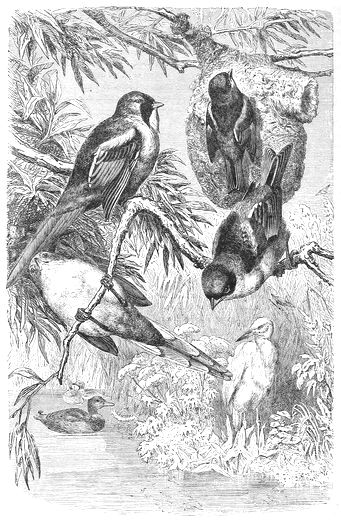
BEARDED AND PENDULINE TITS.
The Bearded Titmouse is met with in all the north-eastern parts of Europe. In Great Britain
it is but rarely seen; it is, however, comparatively numerous in Holland, South Hungary, Greece,
and a portion of Asia Minor. Everywhere it seeks the reed-covered banks of rivers, and lives in
pairs or in small families.
Dr. Leach was induced to separate this very interesting bird from the genus Parus in consequence
of its differing in several minor characters from the other species of that genus, particularly
in the situation it affects as a place of abode and nidification, constructing a nest on or near the
ground in wet and marshy places. "Its food," continues Mr. Gould, "is also very different,
consisting of the seeds of reeds, with aquatic insects and minute-shelled snails, for the trituration of
which it is provided with a strong muscular gizzard. It is more particularly abundant in the low and
marshy districts of Holland, France, and Germany. Its disposition is timid, and its manners shy and
retired, dwelling in situations both local and difficult of access, a circumstance which, until lately, has
prevented naturalists from giving any details, especially of its peculiar habits." We are indebted to
Mr. Hoy for the best account of this bird yet published, as given in the "Magazine of Natural
History," (Vol. III., page 328), from which the following is extracted:—
"The borders," says. Mr. Hoy, "of the large pieces of water in Norfolk, called 'broads,'
particularly Hickling and Horsey Broads, are the favourite places of resort of these birds; indeed,
it is met with in that neighbourhood wherever there are reeds in any quantity, with fenny land
adjoining. During the autumn and winter they are found dispersed generally in small parties
throughout the whole length of the Suffolk coast, wherever there are large tracts of reeds. I have
found them numerous in the breeding season on the skirts of Whittlesea, near Huntingdonshire, and
they are not uncommon in the fenny districts of Lincolnshire; whether they are to be met with
further north I have no means of ascertaining, but they do not appear to have been noticed north of
the Humber. They begin building in the end of April. The nest is composed on the outside of the
dead leaves of the reed and sedge, intermixed with a few pieces of grass, and invariably lined with the
top of the reed, somewhat in the manner of the nest of the Reed Wren (S. arundinacea), but not so
compact in the interior. It is generally placed in a tuft of coarse grass or rushes, near the ground, on
the margin of the dykes in the fen; sometimes fixed among the reeds that are broken down, but
never suspended between the stems. The eggs vary in number from four to six, rarely seven; they
are pure white, sprinkled all over with small purplish red spots, intermixed with a few small faint lines
and markings of the same colour—size about the same as that of the Greater Tit, but much more
rounded and shorter. Their food during winter is principally the seed of the reeds, and so intent are
they in searching for it, that I have taken them with a bird-lime twig attached to the end of a
fishing-rod. When alarmed by any sudden noise, or the passing of a hawk, they utter their shrill
musical notes, and conceal themselves among the thick bottom of the reeds, but soon resume their
station, climbing the upright stems with the greatest facility. Their manners in feeding approach
near to those of the Long-tailed Tit; they often hang with the head downwards, and occasionally
assume the most beautiful attitudes. Their food is not entirely reed-seed, for they sometimes eat
insects and their larvæ, and the very young shelled snails of different kinds, which are numerous in
the bottom of the reedlings. I have been enabled to watch their motions whilst in search of insects,
having, when there is a little wind stirring, been often within a few feet of them, quite unnoticed
among the thick reeds. Were it not for their note betraying them, they would be seldom seen. The
young, until their autumnal moult, vary in plumage from the old birds; a stripe of blackish feathers
extends from the hind part of the neck to the rump. It has been said that the males and females
keep separate during the winter, but I have always observed them in company; they appear to keep
in families until the pairing time, in the manner of the Long-tailed Tit, differing in this respect, that
you will occasionally find them congregated in large flocks, more particularly during the month of
October, when they are migrating from their breeding-places." "To the above interesting account,"
says Mr. Gould, "we may add that they are to be met with occasionally on the banks of the Thames;
from the thick reed-beds of Erith, in Kent, throughout the course of the river to Oxford; but their
visits are by no means regular, or to be calculated on with accuracy."
A contributor to Mr. Loudon's magazine saw a flock of eight or ten of these beautiful little
creatures on the wing, in a large piece of reeds near Barking Creek, Essex. "They were just
topping the reeds in their flight, and uttering in full chorus their sweetly musical note, which may be
compared to the sound of very small cymbals; it is clear and ringing, though soft, and corresponds
well with the delicacy and beauty of the form and colour of the birds. Several flocks were seen
during the same morning. Their flight was short and low, only sufficient to clear the reeds, on the
seedy tops of which, like most of their tribe, they alighted to feed, with the head or back downwards.
If disturbed, they immediately descend by running, or, rather, by dropping to the bottom of the stem,
where they creep and flit, perfectly concealed from view by the closeness of the covert and the
resembling tints of their plumage."
The LONG-TAILED TITS (Orites) have a short, compact body; long, graduated tail, incised
at the centre of its extremity; moderate-sized wings, in which the fourth and fifth quills exceed the
rest in length; a very short, much arched, and pointed beak; and delicate feet. The sexes are alike
in colour, and the young differ but slightly from their parents.
THE LONG-TAILED TITMOUSE.
The LONG-TAILED TITMOUSE (Orites caudatus) is black on the centre of the back and white on
the head; the under side is reddish white, and the wings black, their hinder quills being broadly
bordered with white; the tail is black, the three outer feathers spotted with white. The young are
pale black on the side of the head, back, and wings, and of a whitish hue on the top of the head and
on the under side of the body. The eye is dark brown in the adults, its unfeathered margin is light
red, in the young bright yellow. The beak and feet are black. This species is six inches long and
seven inches and three-quarters broad; the wing measures two inches and a half, and the tail three
inches and a half.
The Long-tailed Tit inhabits the whole of Europe, from its most northern countries as far south
as the Pyrenees and Alps, but is met with comparatively rarely in Greece and Spain. Like some
of its congeners, it prefers taking up its abode on fir and pine trees, but, if these are not attainable,
usually frequents orchards or well-cultivated woodland districts; its habits are social, and its
disposition, though equally lively and active, considerably more peaceful than that of most other
members of its family. Both sexes utter a brisk chirping note, and the male at some seasons a faint
twittering song. These birds destroy the smallest kinds of insects in enormous quantities, and thus
render inestimable service to the farmer and gardener.
"The nest of this species," says Mudie, "has always been admired as a model of neatness and
warmth. It is formed by patient and incessant labours of both birds for at least a month, if materials
are abundant, and five or six weeks when the supply is more scanty. It is placed in the fork of a
small mossy tree, or among the thick twigs of a shrub, often a hawthorn, sometimes an evergreen,
seldom more than three or four feet from the ground, and generally within cover of the sprays. Its
form resembles that of an egg placed on the broader end; in appearance and texture it is very like a
short decayed stump, that has been coated over with lichens, and is as firm in texture as it is neat
and regular in form. The main fabric is closely made of moss, taken in very small pieces, and matted
together with animal fibre, rarely with wool—as the bird does not range so far from the bushes as to
be much of a wool-gatherer—but principally with what may be called tree or bark silk, that is, the
silken cocoons that cover the chrysalides of insects and the eggs of spiders. These materials are
firmly interwoven, but, though the term is sometimes applied to them, they are not felted. The two
materials form a stronger fabric than could be made of either of them singly. The moss gives bulk
and stiffness, and the silky filaments cohesion; and, as the birds are microscopic in their vision, they
have perfect command over their short bills, and apply these materials by very small portions at a time.
The fabric is beautifully put together, and when there are twigs in the way the nest is so closely
worked upon them that it cannot be removed entire unless they are taken along with it. Externally
it is coated with lichens and liverworts, so closely worked in that not a bit falls off; the inside is
carefully lined with feathers, the quills of which are worked into the fabric. The whole nest, dome
and all, is lined in this manner, so that when finished it is secure against rain and change of
temperature. The entrance is by an aperture in the side, towards the top of the structure, and there
are in some instances two apertures, the one nearly opposite to the other, the feathers around which
are so worked into the fabric as, when not pushed aside by the birds, to form a sort of curtain. The
interior is usually of sufficient size to contain both birds during the night, and, in the case of there
being two apertures, they sit with the head of the male out at the one and the tail of the female out at
the other, so that both apertures are partially closed, and the male is ready to start out as soon as
there is light enough for hunting." The first brood is produced by the end of April, and usually
consists of from nine to twelve or occasionally fifteen eggs; these are very small, with delicate white
shells, more or less spotted with pale red; many females lay eggs that are quite white. The young
are hatched thirteen days after their birth, and during all that time the brooding mother must suffer
considerable annoyance from the unwieldy size of her tail, which is generally kept twisted round in
the most inconvenient manner: nor are the young more at their ease; at first, despite their numbers,
they manage tolerably well, but as they increase in size each struggles for the warmest place, and
pushes at his neighbour until the nest gives way, or is rent in such a manner that the troublesome tail
can be thrust out and freer space obtained.
THE CRESTED TITS (Lophophanes) are distinguished by comparatively slender beaks and
the pointed upright crest that adorns the head. India and America have species similar to those we
are about to describe.
THE CRESTED TIT.
THE CRESTED TIT (Lophophanes cristatus) is mouse-coloured on the upper portion of the body,
and greyish white on the under side; the slender graduated feathers that form the crest, the shafts of
which incline forward, are black edged with white; the region of the cheek is white; a sickle-shaped
stripe across the eyes is black, as is also a line commencing at the nape and extending to the tail; the
quills and tail-feathers are dark greyish brown, with light edges. The eye is brown, the beak black,
with pale margins, and the feet dirty light blue. The length of the body is five and its breadth
eight inches; the female is somewhat smaller than her mate. The crest of the young birds is not
quite so large, and the markings on their head more indistinct.
The Crested Tits are spread over Central Europe and North-western Asia, where they principally
frequent fir and pine forests, remaining almost throughout the entire year in their native
woods, only leaving their shelter for a short time in the spring and autumn. During the winter they
associate freely with other species, and in their company fly about in search of food. The song of
the male is chirping and insignificant, and during the breeding season is accompanied by a great
variety of gesticulation, and a constant display of the crest that adorns his head. The nests are
always placed in holes of trees, such as have a narrow entrance being preferred, and are situated at
various heights from the ground, in some instances in the deserted dwellings of other birds or of
squirrels; the exterior is formed of bits of moss, or some similar material, and lined with hair or wool
of various kinds. The eggs, eight to ten in number, are small and delicate, and of snowy white,
spotted with rust-red; both parents brood, and the young are hatched within a fortnight, and are
reared on small caterpillars. As soon as they are able to support themselves, the old pair at once
make preparations for a second family.
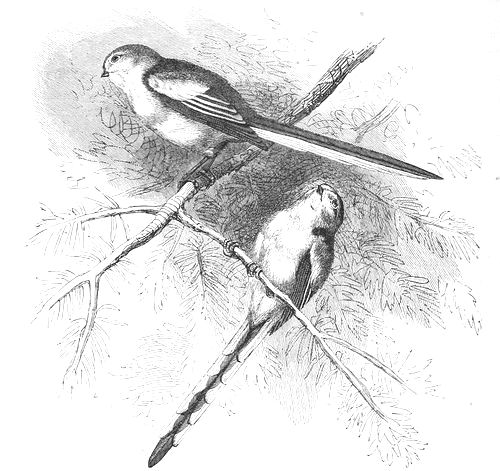
THE LONG-TAILED TITMOUSE (Orites caudatus).
Although rare in Great Britain, this species is abundant in all the northern regions of Europe,
frequenting places where juniper trees are plentiful; it is common in Germany and the Alpine
districts, and is scarce in Holland.
Colonel Montague says, "It is not uncommon amongst the large tracts of pines in the north of
Scotland, particularly in the forest of Glenmore, the property of the Duke of Gordon, from whence
we have seen it," and Sir William Jardine states that "this bird has been found in some plantations
not far distant from Glasgow, where it annually breeds."
It feeds on insects, berries, and the seeds of evergreens, and, according to M. Temminck, builds
in holes in trees, or walls.
THE TOUPET TIT.
The TOUPET TIT (Parus bicolor) is remarkable by the tuft or toupet on its head. In this very
pretty bird the sexes are so much alike as to be scarcely distinguishable; both may be described as
having the forehead black, the sides of the head brownish black; all the upper surface uniform grey,
under surface greyish white, tinged with yellowish brown on the flanks; bill black, irides dark brown,
feet lead-colour.
There can be no doubt that the northern regions of America form the true habitat of this
species; but as specimens have been undoubtedly killed in Russia, it may be classed among the
occasional visitors to the European continent; nevertheless, it is exceedingly rare in Europe, and its
presence is confined to the regions adjacent to the Arctic circle. In the works of Wilson and
Audubon its manners are described as resembling those of other members of the genus. "It moves
along the branches," says the latter, "searches in the chinks, flies to the end of the twigs, and hangs
to them by its feet, whilst the bill is engaged in detaching a beech or hazel-nut, an acorn, or a
chinquapin, upon all of which it feeds, removing them to a large branch, where, having secured them
in a crevice, it holds them by both feet, and breaks the shell by repeated blows of its beak. It
resorts to the margins of brooks to drink, and, when unable to do so, obtains water by stooping from
the extremity of a twig overhanging the stream. It appears to prefer this latter method, and is also
fond of drinking the drops of rain or dew, as they hang at the extremity of the branches." The same
author also informs us that its notes, which are usually loud and mellow, are rather unmusical than
otherwise; that it is somewhat vicious in its disposition, and occasionally attacks and destroys smaller
birds by repeated blows on the head, until it breaks the skull.
The nest is constructed of all kinds of warm materials, and is generally placed in the holes
formed by the Downy Woodpecker, or of other Woodpeckers, but it is occasionally placed in a hole
dug by the bird itself for that purpose. The eggs, six or eight in number, are pure white, with a few
red spots at the larger end.
The WOOD TITS (Parus) differ from the species above described by the unusual strength of
their conical beak, which is compressed at its sides and pointed at its tip, and by their large, stout
claws. The wings, in which the third and fourth quills exceed the rest in length, are short and
broad; the tail is long, or of medium size, and either slightly rounded or incised at its extremity.
The rich streaming plumage is often brilliantly coloured. The young resemble the mother; little
diversity, however, is observable between the sexes.
THE GREAT TIT.
The GREAT TIT (Parus major) is olive green on the upper part of its body, and pale yellow
beneath; the top of the head, the throat, a stripe that passes along the body, and another extending
from the front of the throat to the back of the head, are black; the quills and tail are bluish grey, and
the sides of the head and a stripe on the wings white. The eye is dark brown, the beak black, and
the foot lead-grey. In the young all the tints are somewhat paler. This species is five inches and
three-quarters long and nine inches broad; the wing measures two inches and three-quarters, and the
tail two inches and a half. The female is a trifle smaller than her mate. This common Tit is found
throughout Europe from sixty-five degrees north latitude (in the southern part it is comparatively
rarer), and in the whole of Central Asia, and North-western Africa. Unlike the species above
described, these birds have no especial predilection for forests, but constantly occupy woods, shrubberies,
and gardens, and not unfrequently farm-yards, where they are found to grow very bold in their
endeavours to obtain subsistence.
The summer food of the Great Tit consists of insects, together with the buds of trees and fruits,
to these it adds the crumbs scattered from the cottage door, of whatever matters they chance to
consist, whether animal or vegetable, its digestive powers being apparently adapted to great variety.
On the approach of spring it becomes noisy and restless, betaking itself to the top branches of high
trees, where it utters its harsh note for the day together; the note greatly resembles the noise made
by filing a saw, or the creaking of a gate on rusty hinges. The song of this bird, which is composed
of three distinct notes, would be agreeable were it not for the introduction of occasional harsh
grating tones, as they hop nimbly about the branches in search of food. During the breeding season
the performance is somewhat more pleasing, and the voice is in many respects not unlike that of
the Chaffinch.
"The Great Tit," says Mr. Yarrell, "will frequently kill small birds, accomplishing his purpose
by repeated blows with his sharp beak on the skull of the victim, and afterwards picking out and
eating the brains. Though more truly a feeder on insects, the Great Tit, unlike insectivorous birds in
general, does not migrate, but remains all the year round in the same district, apparently unaffected
by the very different temperature of Italy as compared with Russia, and the species is known to be
constantly resident in both countries. In England the Great Tit is seldom seen on bleak open
ground, but inhabits woods, the vicinity of gardens, or other enclosed and sheltered situations in
summer, where it occasionally feeds on small seeds. In winter it approaches nearer the habitations
of men, and may be seen in hard weather closely examining the thatch of old buildings in search of
the many small flies that harbour there. As the Great Tit is an early breeder, the lively chirping
notes of the males are heard early in February; sometimes this bird produces a sound which has
been considered to resemble the noise made in sharpening a saw; and, though this is small praise,
his notes are more remarkable for vivacity and frequent repetition than for quality of tone. The
nest, formed of moss and lined with hair and feathers, is usually placed in the hollow of a tree, or a
hole in a wall. The deserted nest of a Crow or Magpie is sometimes chosen. Several observers
have recorded the partiality so frequently evinced by this species to build its nest in or about any old
unused wooden pump, and the mass of materials collected on such occasions wherewith to construct
it. The eggs are from six to nine in number, nine lines and a half in length and seven lines in
breadth; white, spotted and speckled with pale red."
"Rusticus," of Godalming, has given an amusing account of the behaviour of one of this species
which came under his observation:—"The next object of attention was a Titmouse of the large black-headed
kind, swinging himself about like a rope-dancer, and whistling out his sing-song just like a
fellow sharpening a saw. To my surprise the gentleman entered an old Magpie's nest, to which
I had paid frequent friendly visits during the previous spring; he immediately came out again and
jumped about, sharpening his saw as before. One might almost as well handle a hedgehog as a
Magpie's nest; in this instance some cuttings of gooseberry bushes, skilfully woven into an arch above
it, rendered it rather more untempting than usual. I was meditating how to commence the attack,
when another Tit flew out in a great choler, and rated me as though I had already robbed her.
After a good deal of trouble, during which the slender fir-top was swinging about with me in the
breeze, I succeeded in obtaining a peep into the nest; there was nest within nest, the cosiest, softest,
warmest little nest, with eight delicately speckled eggs at the bottom of the Magpie's more spacious
habitation. I declined meddling with them."
THE SOMBRE TIT.
The SOMBRE TIT (Parus lugubris).—"This bird," says Mr. Gould, "does not approach the
British Islands, nor even the more temperate parts of the European Continent. Its habitat is almost
restricted to the European confines of the Asiatic border; it has, however, never been observed in
Austria, or any part of Germany, although pretty common in Dalmatia. The male and female are
alike in plumage, and may be thus described:—The whole of the upper surface is of a brownish
ash-colour, becoming deeper on the top of the head; the secondaries and tail-feathers are slightly
margined with white; throat brownish black; the cheeks and the whole of the under surface white,
slightly tinted with brownish grey; beak and feet lead-colour."
THE COLE TIT.
The COLE TIT (Parus ater).—The head, neck, and upper breast are black; the cheeks and nape
white. The length of the bird is four inches and a half, its breadth seven inches. The bill is black,
the irides hazel, the legs are lead-grey; the upper part of the plumage is greyish, the belly yellowish
white. The covers of the secondaries and those above are tipped with white, forming two bars across
the wing. In the female the white on the cheeks is less extended.
This species is generally spread over the continent of Europe, and is almost as frequent in Great
Britain as the Great Tit or the Blue Tit. It has been considered by some naturalists to be identical
with the Marsh Tit, but may at once be distinguished from that bird by the white patch on the nape
of the neck, and the white spots on the wing-covers, which are not to be found on the Marsh Tit at
any age. The Cole Tit frequents woods and plantations, especially those in which oak, birch, and
fir trees are numerous, and may be seen in company with other birds of similar habits, roving from
tree to tree in search of the small insects and seeds on which they subsist. "In the pine forests of
the Dee and Spey," says Macgillivray, "where very few birds are met with, it is pleasant to follow
a troop of these tiny creatures, as they search the tree-tops, spreading all round, fluttering and
creeping among the branches, ever in motion, now clinging to a twig in an inverted position, now
hovering over a tuft of leaves, picking in a crevice of the bark, searching all the boughs, sometimes
visiting the lowermost, and again winding among those at the very tops of the trees. In
wandering among these woods you are attracted by their shrill, chirping notes, which they continually
emit as they flutter among the branches." "In woodlands," says Mr. Hepburn, "it is
common to see it hopping along the grounds, and uttering its harsh notes, 'If hee!' 'if hee!'
It delights to examine a ditch that has just been cleaned out. I have seen it pull small earthworms
to pieces and devour them."
"It is a matter of curious inquiry," says Gilbert White, "to trace out how those species of soft-billed
birds that continue with us the winter through, subsist during the dead months. The imbecility
of birds seems not to be the only reason why they shun the rigour of our winters, for the robust
Wry-neck (so much resembling the hardy race of Woodpeckers) migrates, while the feeble little
Golden-crested Wren, that shadow of a bird, braves our severest frosts without availing himself of
houses or villages, to which most of our birds crowd in distressful seasons, while he keeps aloof in
fields and woods; but perhaps this may be the reason why they often perish, and why they are almost
as rare as any bird we know.
"I have no reason to doubt that that the soft-billed birds which winter with us subsist chiefly on
insects in their chrysalis state. All the species of Wagtails in severe weather haunt shallow streams,
near their spring-heads, where they never freeze; and, by wading, pick out the chrysalis of the genus
of Phryganeæ.
"Hedge Sparrows frequent sinks and gutters in hard weather, where they pick up crumbs and
other sweepings, and in mild weather they procure worms, which are stirring every month in the
year, as any one may see that will only be at the trouble of taking a candle to a grass-plot on any
mild winter's night. Redbreasts and Wrens in the winter haunt outhouses, stables, and barns, where
they find spiders and flies, that have laid themselves up during the cold season. But the grand
support of the soft-billed birds in the winter is that infinite profusion of chrysalids of the
Lepidoptera ordo which is fastened to the twigs of trees and their trunks, to the poles and walls of
gardens and buildings, and is found in every cranny and cleft of rock or rubbish, and even in the
ground itself.
"Every species of Titmouse winters with us. They have," continues our author, "what I call an
intermediate bill, between the hard and the soft, between the Linnæan genera of Fringilla and
Motacilla. One species alone spends its whole time in the woods and fields, never retreating for
succour, in the severest seasons, to houses and neighbourhoods, and that is the delicate Long-tailed
Titmouse, which is almost as minute as the Golden-crowned Wren, but the Blue Titmouse or Nun
(Parus cæruleus), the Cole Mouse (Parus ater), the Great Black-headed Titmouse (Fringillago), and
the Marsh Titmouse (Parus palustris), all resort at times to buildings, and in hard weather
particularly. The Great Titmouse, driven by stress of weather, much frequents houses, and in deep
snows I have seen this bird, while it hung with its back downwards (to my no small delight and
admiration) draw straws lengthwise from out the eaves of thatched houses, in order to pull out the
flies that were concealed between them, and that in such numbers that they quite defaced the thatch,
and gave it a ragged appearance.
"The Blue Titmouse, or Nun, is a great frequenter of houses, and a general devourer. Besides
insects, it is very fond of flesh, for it frequently picks bones on dunghills. It is a vast admirer of
suet, and haunts butchers' shops. It will also pick holes in apples left on the ground, and be well
entertained with the seeds on the head of a sunflower. The Blue Marsh and Great Titmice will, in
very severe weather, carry away barley and oat-straws from the sides of ricks.
"How the Wheat-ear and Whin-chat support themselves in winter cannot be so easily ascertained,
since they spend their time on wild heaths and warrens, the former especially where there are
stone-quarries. Most probable it is that their maintenance arises from the aurelia of the Lepidoptera
ordo, which furnish them with a plentiful table in the wilderness."
"That some guess may be formed of the possible extent of good or evil occasioned by small
birds," says Bishop Stanley, "we annex the result of our own observations on the precise quantity of
food consumed by certain species, either for their own support or that of their young, remarking at
the same time that the difference observed in the instances may be partly accounted for by the
different quantity of food required by young birds at different periods of their growth.
"Sparrows feed their young thirty-six times in an hour, which, calculating at the rate of fourteen
hours a day, in the long days of spring and summer, gives 3,500 times per week, a number corroborated
on the authority of another writer, who calculated the number of caterpillars destroyed in a
week to be about 3,400.
"Redstarts were observed to feed their young with little green grubs from gooseberry-trees
twenty-three times in an hour, which, at the same calculation, amounts to 2,254 times in a week, but
more grubs than one were usually imported each time.
"Chaffinches at the rate of about thirty-five times an hour for five or six times together, when
they would pause, and not return for intervals of eight or ten minutes; the food was green
caterpillars.
"The Titmouse sixteen times in an hour.
"The comparative weight consumed was as follows:—
"A Greenfinch, provided with eighty grains by weight of wheat, in twenty-four hours consumed
seventy-nine; but of a thick paste, made of flour, eggs, &c., it consumed upwards of one hundred
grains.
"A Goldfinch consumed about ninety grains of Canary seed in twenty-four hours.
THE GREAT TIT (Parus major).
"Sixteen Canaries consumed at the average rate of one hundred grains each in twenty-four
hours.
"The consumption of food by these birds, compared with the weight of their bodies, was about
one-sixth; which, supposing a man to consume food in the same proportion to his weight, would
amount to about twenty-five pounds for every twenty-four hours."
The nest, which is formed of moss and wool, lined with hair, is placed in a hole in a wall, or
the hollow of a tree, or sometimes on the ground, in cavities among the exposed roots, at the mouth
of some burrow. The eggs are from six to eight in number, and are white, spotted with pale red.
The BLUE TITS represent a group that have been separated from those mentioned above on
account of the unusual shortness of their much-curved beak and the peculiar coloration of their
plumage.
THE BLUE TIT.
The BLUE TIT (Parus cæruleus) is bluish green on the back, and blue on the head, wings, and
tail, while the under side is yellow; a white line passes from the brow to the nape, and a narrow
bluish black line divides the white cheeks from the dark head; the throat is encircled by a blue
band; the quills are slate-black, the hinder ones sky-blue on the outer web and white at the tip; the
tail-feathers are greyish blue. The eye is dark brown, the beak black, with white margins, and the
foot lead-grey. The female is less beautifully coloured than her mate, and the young somewhat paler.
This species is four inches and a half long and seven and a half broad; the wing measures two
inches and a third, and the tail about two inches.
The Blue Tits are met with over a greater extent of country than any other member of their
family. In Europe they are dispersed over the entire continent, from its most northern latitude to
the extreme south; in Northern Africa and Eastern Asia they are replaced by a very similar species.
In Great Britain, where they are extremely common, they frequent gardens, groves, or orchards, and
have been popularly supposed to do considerable damage by pecking at the buds of fruit trees; it is
much more likely, however, that these active little visitants to our orchards, when they seem thus
employed, are busily engaged in rendering us an important service, by clearing off the insects and
grubs that infest the blossoms sometimes in such large numbers as would seriously injure the crops.
"This species," says Mudie, "is perhaps more incessant than any other bird in hunting the buds and
branches of trees, especially of fruit trees near houses, for its insect prey; but it will eat any animal
matter either in a recent or putrid state, and it appears to scent animal remains at a considerable
distance, as it hovers about slaughter-houses, dog-kennels, and other places where there are scraps of
carrion. It also haunts the neighbourhood of houses, and picks bones, eats bits of fat, or any refuse
it can find, and, when opportunity favours, will even kill other birds by striking them on the head,
and then picks their bones as clean as if they were cleared by the thousand inhabitants of an ant-hill.
Dead birds are, of course, lawful prize, for which it searches under trees and hedges after severe
weather. It is, in short, a very omnivorous bird, and plays the scavenger with equal diligence and
grace. It is also very bold and familiar, and will alight among the poultry in the farm-yard or amid
the dogs in the kennel; nor does it much heed the presence of people even under the trees upon
which it is hunting." So strong is the liking of the Blue Tit for fat, that Gilbert White tells us that
he has known as many as twenty caught in one morning with a common snap mouse-trap, baited
with tallow or suet.
"When the Blue Tit," says Yarrell, "has taken possession of a hole in a wall or decayed tree,
she is not readily induced to quit it, but defends her nest and eggs with great courage and perseverance,
puffing out her feathers and hissing like an angry kitten; in some counties, indeed, she
goes by the name of 'Billy Biter' among bird-nesting boys, from a vivid remembrance of certain
impressions on their fingers. A female that had taken possession of a small wooden box hung up
against an out-building, into which she had carried abundance of material for her nest, and in the
midst of which she was then sitting upon her numerous eggs, allowed herself to be carried into a
house for examination, and when the box was replaced in its former situation, did not desert her
eggs, but hatched them and reared her young."
The nest is generally built in a hole in some tree, in many instances excavated by the building
birds themselves; and frequent and fierce are the battles that take place between the different couples,
relative to the possession of a particularly desirable spot. Within this cavity, a comfortable bed of
hair, moss, or feathers is arranged for the reception of the eggs, eight or ten in number, which are
white, with spots of rust-red, and about seven lines and a half long, and six in diameter.
Sometimes this bird selects very whimsical situations for a nest. Bishop Stanley, in his
"Familiar History of Birds," relates that "A pair of Titmice (Parus cæruleus) built their nest in
the upper part of an old pump, fixing it on the pin on which the handle worked. It happened that
during the time of building and laying the eggs the pump had not been in use; when again set going
the female was sitting, and it was naturally supposed that the motion of the pump-handle would drive
her away. The young brood were, however, hatched safely, without any other misfortune than the
loss of a part of the tail of the sitting bird, which was rubbed off by the friction of the pump-handle.
The opening for a pump-handle seems, indeed, to be a favourite spot, notwithstanding its danger, as
we knew of another pair of Titmice, who for several days persevered in inserting, close upon the
point of the handle, the materials for a nest, though every time the handle was raised they were
either crushed or forced out, till the patience of the persevering little builders was fairly exhausted."
In the "Journal of a Naturalist" is the following interesting notice of the Blue Tit:—"I was
lately exceedingly pleased in witnessing the maternal care and intelligence of this bird; the poor
thing had its young ones in the hole of a wall, and the nest had been nearly all drawn out of the
crevice by the paw of a cat, and part of its brood devoured. In re-visiting its home the bird
discovered some of its nestlings still alive, though wrapped up and hidden in the tangled moss and
feathers of their bed, and it then drew the whole of the nest back into the place from whence it had
been taken, unrolled and re-settled the remaining little ones, fed them with the usual attentions, and
finally succeeded in rearing them. The parents of even this reduced family laboured with great
perseverance to supply the wants of their progeny, one or other of them bringing a grub, caterpillar,
or some insect, at intervals of less than a minute during the day, and probably in the earlier part of
the morning more frequently. Now if we allow that they brought food to the hole every minute for
fourteen hours, and provided for their own wants also, it will admit, perhaps, a total of a thousand
grubs a day for the requirements of one, and that a diminished brood, and afford some adequate
comprehension of the infinite number requisite for the summer nutriment of our soft-billed birds,
and the great distances gone over by such as have young ones, in their numerous trips from hedge
to tree in the hours specified when they have full broods to support."
"In winter," says Macgillivray, "the Blue Tit may be occasionally seen about the farm yard,
where it finds, when other food fails, a supply of oat or wheat seeds, which it jerks from their husks
with its wedge-like bill. It also frequents the doors and dunghills, to pick up a bit of suet, or nibble
a morsel of flesh; and where carrion is kept, it is often seen to help itself to a share. Often, at this
season too, you may find it clinging to a wall, and digging at the loose plaster, to get at the insects
or pupæ concealed behind. It will even make occasional excursions into the stubble near hedges or
woods; and, in short, being in a manner omnivorous, it manages to get through the cold part of the
year as well as its neighbours. It is accused of attacking other small birds, and splitting their skulls,
but I have neither seen it do so, nor met with any other person who has; and we know how, when
any assertion of the kind, however incredible, has been made, all the ornithologists catch the cry. It
reposes in holes in walls, or among ivy, and seems to suffer less in severe frosts than most birds."
The song of the Blue Tits is a most insignificant performance, and their call-note a single shrill
chirp. In other respects, however, they are in no respect inferior to other members of their family.
In disposition they are lively, bold, and adventurous, and, were they a little larger, would probably
assail enemies twice their own size, at whom they can, as it is, only ruffle up their feathers, and
express, by vehement pecks and gesticulations, the pugnacious inclinations they cannot otherwise
indulge. During the spring they live in pairs, in the summer in families, and in autumn associate
in large flocks before commencing their winter excursions. Naumann tells us that previous to
setting forth, these flocks assemble upon the tops of trees, calling incessantly to one another, as
though each wished to induce its companions to set the example by commencing the unwonted
flight. One after another rises into the air and makes a start, but finding that the rest have not
resolution to follow, at once returns to his former perch, until at last all take flight simultaneously;
but even when once fairly off, a mere trifle, such as a hat thrown upwards, will often cause them to
drop heavily and precipitately to the ground. This unusual behaviour proceeds from the terror with
which they regard the approach of any bird of prey, as they are well aware that in flying over any
open country their inferior powers of wing place them completely at the mercy of such assailants.
For this reason, when journeying to any distance, the flocks of Blue Tits usually rise to a great height
before proceeding on their perilous journey.
THE AZURE TIT.
The AZURE TIT (Parus cyaneus) is considerably larger than the last-mentioned species. The
upper part of the body is light blue, the head and under side are white, the nape and wings deep
blue, the latter adorned with a broad white band, and tipped with white; the eye is dark brown,
the beak greyish black, and the foot lead-grey. This species is from five inches and a quarter to six
inches long, and nine and a half broad. The Azure Tit is spread over the eastern part of Siberia,
and from thence wanders annually over some portions of Europe.
"This beautiful Tit," says Mr. Gould, "is a native of Siberia, whence it frequently strays into
the northern parts of Europe, such as Russia and Poland, and it has been known to penetrate as far
south as Germany. Like the rest of its family it dwells in woods and forests, generally in the most
retired parts; it, therefore, is not to be wondered at that its history is shrouded in obscurity, when we
consider how little intercourse naturalists have had with the remote countries that it inhabits. Like
the rest of its race, the sexes of the Azure Tit offer little or no difference in the colour of the plumage.
Nothing is known respecting nest or eggs."
THE SIBERIAN TIT.
The SIBERIAN TIT (Parus Sibericus) is, like the last-mentioned species, an inhabitant of the
most northern parts of Europe and Asia. The upper surface of this bird is of a deep ash-colour,
tinged on the back with brown; the quills, secondaries, and tail-feathers edged with white; throat
black; cheeks and upper part of the chest pure white; under parts greyish white, washed with rufous
on the flanks; bill and tarsi lead-colour.
The Siberian Tit is exceedingly rare in Europe. It migrates in winter to some of the provinces
of Russia, and has been found in Sweden.
Mr. Lloyd informs us that it is plentiful in Lapland; that the greater portion are stationary all the
year round; and that at Mauno, in latitude 68° 35´, it is almost the only bird to be found during
the winter.
"The Siberian Titmouse," says M. Malm, "is not only most fearless, but possessed of an
extraordinary degree of curiosity, and I have often had the greatest enjoyment in watching its movements.
On one occasion I stood for half an hour under a thick spruce pine tree, on the look-out for
one of these birds, which I heard chattering in the branches above me, but without being able to get
sight of it. At length, however, it left its perch on the top of the tree, and, to my great astonishment,
as I was still standing at the foot of the same tree, with the gun under my arm, it descended with the
rapidity of an arrow, and took post on the barrel, near the muzzle! Here it remained a long while,
and it was not till I had driven it away with my hand that I was enabled to shoot it.
"On another occasion, when out for the purpose of shooting, my gun being charged with large
shot, I met with a Siberian Titmouse; and, whilst occupied in changing the shot, it came so very
near me that I was enabled, without difficulty, to knock it down with the ramrod of my gun. This
bird makes its nest in a hollow pine tree. The under portion of it consists of moss, which, without
any kind of arrangement, is stuffed into the hole. Above this again, is a good portion of the hair of
the lemming; at times, indeed, pieces of the skin of that animal. The eggs, which are from seven
to nine in number, are white, and marked with light red spots and blotches. In shape they resemble
those of the Common Creeper."
THE MARSH TIT.
The MARSH TIT (Parus palustris) is of a reddish grey on the upper part of the body, and
greyish white beneath; the head, as far as the nape, is deep black, the chin greyish black, and the
region of the chest white. The eye is dark brown, the beak black, and the foot lead-grey. The
body is four inches and a half long, and the span of the wings eight inches; the wing measures two
inches and a half, and the tail two inches.
The Marsh Tit inhabits the central portions of Europe. In the extreme south and north it is
replaced by nearly allied species. Everywhere this bird frequents marshy localities, low-lying
meadows, and moist woodland districts, preferring clumps of bushes or willows to lofty trees.
Such as inhabit Great Britain remain throughout the entire year, but those occupying more
northern latitudes wander farther south at the approach of winter.
Mr. Yarrell informs us that the Marsh Tit is common about London, and with the Blue, Cole,
Long-tailed, and Great Tits, has been observed in Kensington Gardens, and that these birds are
probably attracted to this spot by the insect food to be found about old trees in various stages of
decay, a London atmosphere being unfavourable to healthy vegetation.
"The Marsh Tit," he tells us, "from London westward may be traced to Cornwall and
Wales." In Ireland, according to Mr. Thompson, "this bird has been killed in the Phœnix Park near
Dublin, in the county of Kildare, in the vicinity of Belfast, and in the county of Donegal; from
London northward through Essex, Suffolk, Norfolk, and Lincolnshire." It is also abundant in
Derbyshire and Yorkshire; it is found in Durham and Northumberland; and Mr. Macgillivray saw
it near Edinburgh. In his work on "British Birds" he says:—"This species is not nearly so
common in the southern districts of Scotland as the Cole Tit, and I am not aware of its having been
met with farther north than Fifeshire. Although named the Marsh Tit, it does not confine itself to
marshy places, but examines the trees and bushes growing in the driest soil, as well as those of
swampy ground; and I have seen it alight on herbaceous plants, especially thistles. Its flight is
rapid and undulated, all its motions are quick and abrupt, and it creeps along the twigs, flutters, and
throws itself into all sorts of positions. Its food consists chiefly of insects, but in autumn and winter
it also eats the seeds of various syngenesian and other plants, and will pick at the flesh of a dead
animal. It remains all the year with us, and does not seem to shift its quarters much. Its ordinary
cry is a shrill cheep, but it also emits a variety of chattering notes, and in spring has a kind of song,
which may be expressed by the syllables 'Chicka, chicka, chee!' Towards the end of the season
the little flocks disperse, separate from the individuals of other species with which they have
associated in winter, and betake themselves to the dense woods, or to the marshy wooded borders of
streams and pools, the chief attraction to which seems to be the decayed willows, of which the
crevices afford an abundant supply of insect food."
Montague remarks that "the eggs of all the species of Titmouse whose eggs are known are
similar in colour, and only to be distinguished from each other by size and weight. Those of the
Nuthatch, Creeper, Wren, Yellow Wren, Wood Wren, and Chiffchaff all agree in their markings,
and are so like those of the Titmice that it is scarcely possible to separate them with certainty
if once mixed together. It is somewhat remarkable that all these birds breed in holes, or make a
covered nest."
The nest is usually built in hollow trees, the decayed parts of which, as Colonel Montague
informs us, it excavates artfully, carrying the chips in its bill to some distance. It always works
downwards, and makes the bottom of its excavation, intended for the reception of the nest, larger
than the entrance. The nest itself is compactly formed of moss and wool, lined with the soft seed-down
of the willow.
The first brood consists of from eight to twelve, and the second of from six to nine eggs. These
are seven lines and a half long, and six broad. The shell is white, spotted with red.
THE CAROLINA TITMOUSE.
The CAROLINA TITMOUSE (Parus Carolinensis), an American species, has the bill black, the iris
dark brown, and the feet bluish grey. The whole upper part of the head and the hind neck are pure
black, as is a large patch on the throat and fore neck. Between these patches of black there is a
band of greyish white from the base of the bill down the side of the neck, becoming broader and
greyer behind. The back and wing-coverts are ash-grey, tinged with brown; quills brown, margined
with greyish blue, as is the tail, which is more tinged with grey; lower parts greyish white, tinged with
brown; the sides more deeply tinted. The length of this bird is four inches and a half, extent of
wings six inches. The female is similar to the male, but somewhat fainter in its tints.
The Carolina Titmouse is a constant inhabitant of the Southern States of North America,
extending from the lower parts of Louisiana through the Floridas, as far as the borders of the
Roanoke River, reaching eastward as far as the State of New Jersey. In general it is found only in
the immediate vicinity of ponds and deep marshy and moist swamps; it is rarely seen during the
winter in greater numbers than one pair together, and frequently singly, whereas the Black-cap
Titmouse, which this species much resembles, moves in flocks during the whole winter, frequenting
orchards, gardens, or the hedges and trees along the roads, entering the villages, and coming to the
wood piles of the farmers, whereas the Southern species is never met with in such places at any time
of the year, and is at all seasons a shyer bird. The Carolina Titmouse breeds in the holes abandoned
by the Brown-headed Nuthatch, but we are as yet not well informed concerning either its eggs or
its nest.
THE BLACK-CAP TITMOUSE.
The BLACK-CAP TITMOUSE (Parus atricapillus), likewise an American species, has the bill
brownish black, the iris dark brown, and the feet greyish blue, as are the claws. The whole upper
part of the head and hind neck are pure black, as is a large patch on the throat and fore neck.
Between these patches of black is a band of pure white, from the base of the bill down the sides of
the neck, becoming broader behind, and encroaching on the back, which, with the wing-coverts, is
ash-grey, tinged with brown. The quills are dark greyish brown, margined with bluish white, the
secondaries being so broadly margined as to leave a conspicuous white dash on the wing. Tail same
as wings, and the feathers similarly edged; lower parts brownish white, the sides pale yellowish
brown. Length of body, five inches and a half; length of wing, three inches and seven-eighths.
The female is similar to the male.
The opinion generally entertained concerning the extensive range of the Black-cap Titmouse
has, in all probability, arisen from its great similarity to the species last described. In reality the
Black-cap is rarely observed further south than the middle portions of Maryland; westward of the
Alleghanies it extends as far as Kentucky in winter, but at the approach of spring returns northward.
Hardy, smart, restless, industrious, and frugal, the Black-cap Titmouse ranges through the forest
during the summer, and retiring to its more secluded parts, as if to ensure a greater degree of quiet,
it usually breeds there. Its numerous eggs produce a numerous progeny, and as soon as the first
brood has been reared the young range hither and thither in a body, searching for food, while their
parents, intent on rearing another family, remain concealed and almost silent, laying their eggs in the
hole deserted by some Woodpecker, or forming one for themselves. "As it has been my fortune,"
says Audubon, "to witness a pair at this work, I will state what occurred, notwithstanding the
opinion of those who tell us that the bill of a Titmouse is 'not shaped for digging.' While seated
one morning under a crab apple-tree (very hard wood). I saw two Black-cap Titmice fluttering about
in great concern, as if anxious to see me depart. By their manners I was induced to believe their
nest was near, and, anxious to observe their proceedings, I removed to the distance of about twenty
paces. The birds now became silent, alighted on the apple-tree, gradually moved towards the base
of one of its large branches, and one of them disappeared, in what I then supposed to be the hole of
a small Woodpecker, but I saw it presently on the edge with a small chip in its bill, and again
cautiously approached the tree. When three or four yards off I distinctly heard the peckings or
tappings of the industrious worker within, and saw it come to the mouth of the hole and return many
times in succession in the course of half an hour, after which I got up and examined the mansion.
The hole was about three inches deep, and dug obliquely downward from the aperture, which was
just large enough to admit the bird. I had observed both sexes at this labour, and left the spot
perfectly satisfied as to their power of boring a nest for themselves."
"The Black-cap Titmouse, or Chickadee, as it is generally named in our Eastern States, though
exceedingly shy in summer, or during the breeding season, becomes quite familiar in winter, although
it never ventures to enter the habitations of man; but in the most boisterous weather requiring
neither food nor shelter there, it may be seen amidst the snow, in the rugged paths of the cheerless
woods, where it welcomes the traveller or woodcutter with a confidence and cheerfulness far
surpassing the well-known familiarity of the Robin Redbreast of Europe. Often, on such occasions,
should you offer it, no matter how small a portion of your fare, it alights without hesitation, and
devours it without manifesting any apprehension. The sound of an axe in the woods is sufficient to
bring forth several of these busy creatures, and, having discovered the woodman, they seem to find
pleasure in his company. If, as is usually the case, he is provided with a dinner, the Chickadee at
once evinces its anxiety to partake of it, and loses no opportunity of accomplishing its object,
although it sets about it with much circumspection, as if afraid of being detected and brought to
punishment." "A woodcutter in Maine assured me," continues Audubon, "that one day he happened
to be at work, and had scarcely hung up his basket of provisions, when it was observed by a flock of
these birds, which, having gathered into it at once, attacked a piece of cold beef; but, after each
peck, he saw their heads raised above the edge, as if to guard against the least appearance of danger.
After picking until they were tired or satisfied, they left the basket, and perched directly over his fire,
but out of the direction of the smoke. There they sat enjoying themselves, and ruffling their
feathers, to allow the warmth more easy access to their skin, until he began his dinner, when they
alighted near him, and, in the most plaintive tones, seemed to solicit a portion."
"Often," continues our author, "have I watched the busy Chickadees as they proceeded from
tree to tree and from branch to branch, whether by the roadside or in the interior of the forest. The
light rustling sound of their concave wings would intimate their approach as well as their retreat,
as gaily one after another they passed onwards from one spot to another, chattering, peeping everywhere,
and determined as it were not to suffer a chink to pass without inspection. Now hanging
back downwards at the extremity of a twig, its feet almost up to its bill, one would peck at a berry or a
seed, until it had devoured it, or it had fallen to the ground. Should the latter be the case, the busy
bird would at once fly down and hammer at the fruit. To the Black-cap Titmouse the breaking of a
hazel-nut is quite a pleasure, and I have repeatedly seen the feat accomplished, not only by a bird in
its natural state, but by one kept in confinement. Courageous, and at times exceedingly tyrannical,
it will attack young birds, break their skulls, and feed upon their flesh, as I have more than once
witnessed.
"The Chickadee feeds on insects, their larvæ and eggs, as well as on every sort of small fruit or
berries, including grapes, acorns, and the seeds of various pines. I have seen it eat the seeds of the
sunflower, the pokeberry and pears, as well as flesh of all kinds. Indeed, it may truly be called
omnivorous. Often you may see them perched, as it were, upon their food, and holding it beneath
their feet while pecking it.
"The nest of this species, whether it be placed in the hole of a Woodpecker or Squirrel, or in a
place dug by itself, is seldom found at a height exceeding ten feet. Most of those which I have seen
were in low, broken, or hollowed stumps, a few feet high. The materials of which it is composed
vary in different districts, but are generally the hair of quadrupeds in considerable quantity, and
disposed in the shape of a loose bag or purse, as in most other species which do not hang their nests
outside." The eggs rarely exceed eight in number; they are five-eighths of an inch long by three-eighths
and three-quarters, rather pointed at the smaller end with minute reddish dots and markings.
The first brood are laid from the middle of April to that of May, the second two months later. "The
flight of this species," says Audubon, "like that of all American Titmice, is short, fluttering generally
from tree to tree, and is accompanied with a murmuring sound, produced by the concavity of the
wings. It is seldom seen on the ground, unless when it has followed a fruit that has fallen, or when
searching for materials for its nest. It usually roosts in its nest during winter, and in summer amid
the close foliage of firs or evergreens. In winter indeed, as well as in autumn, it is seen near the
farmhouses, and even in villages and towns, busily seeking for food among the trees."
"On seeing a cat, or other object of natural antipathy," says Mr. Nuttall, "the Chickadee, like
the peevish Jay, scolds in a loud, angry, and hoarse note, ''tshe! daigh, daigh, daigh!' Among the
other notes of this species I have heard a call like ''tshe-de-jay! 'tshe-de-jay!' the two first syllables
being a feeble chirp, with the jay strongly pronounced. The only note of this bird which can be
called a song, is one which is frequently heard at intervals in the depths of the forest at times of day
usually when all other birds are silent. We may then sometimes hear, in the midst of this solitude,
two feeble, drawling, clearly whistled and rather melancholy notes, like 'Te dizzy!' and sometimes
'Ye perrit!' and occasionally, but rarely, in the same wiry, whistling, solemn tone, 'Phebe!' On
fine days, about the commencement of October, I have heard the Chickadee sometimes for half
an hour at a time, attempt a lively petulant warble, very different from his ordinary note. On
these occasions he appears to flirt about, still hunting for his prey, in an ecstasy of delight and
vigour. But, after awhile, the usual drawling note again occurs."
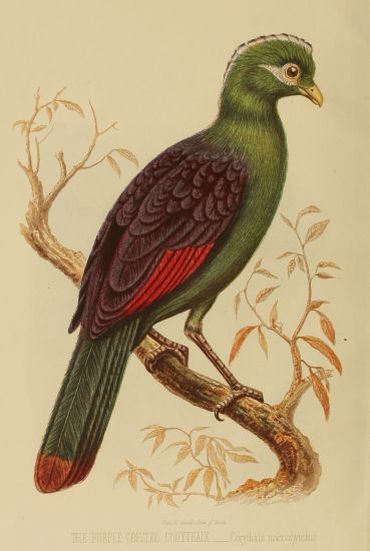
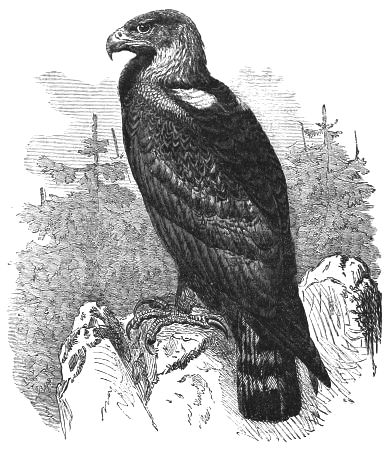
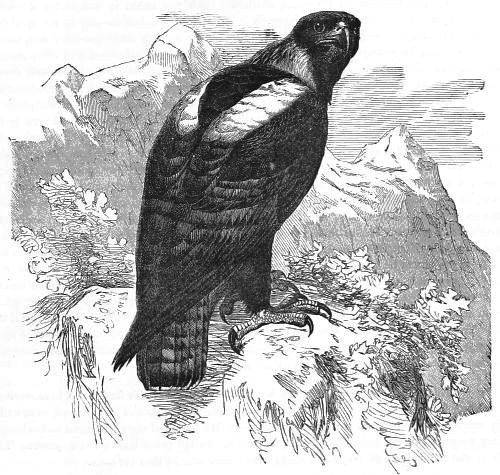
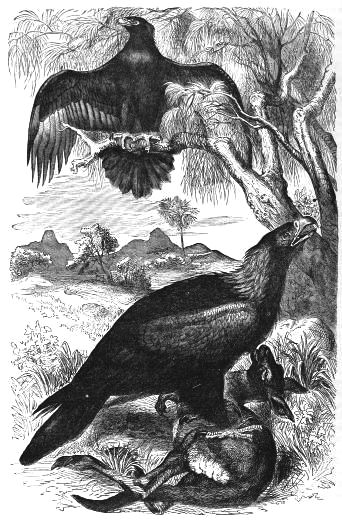
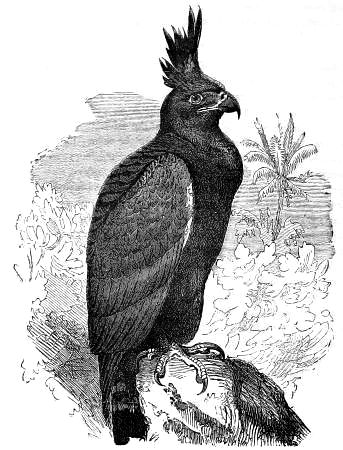
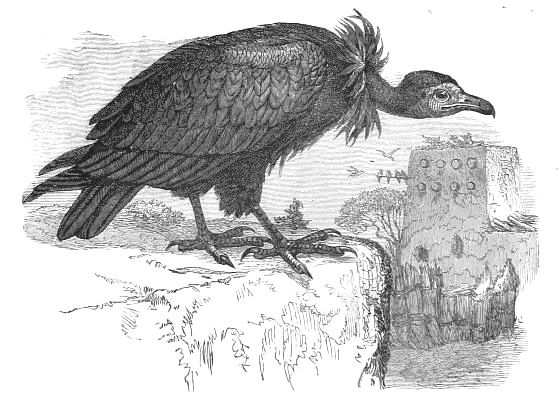
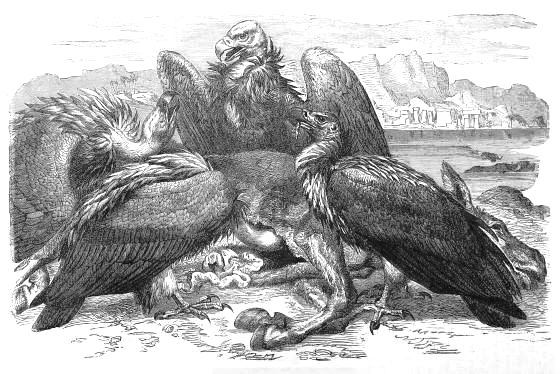

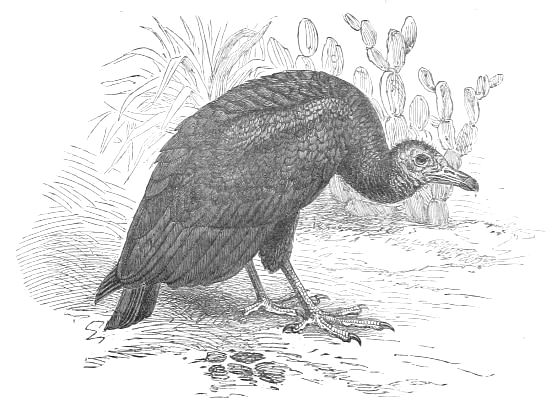

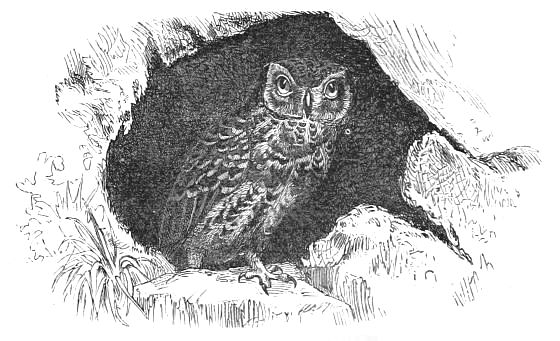
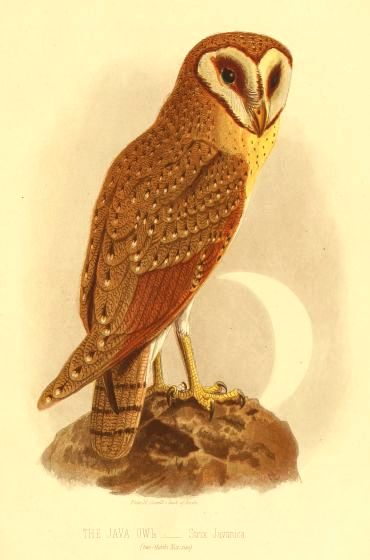

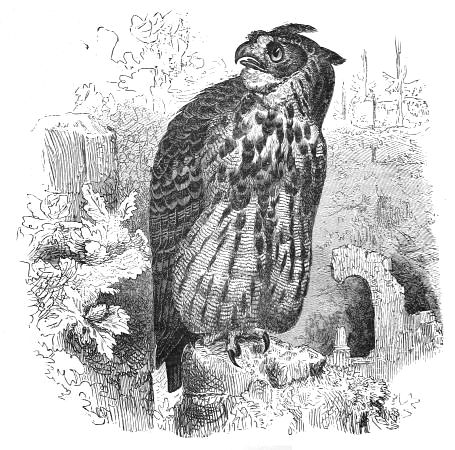
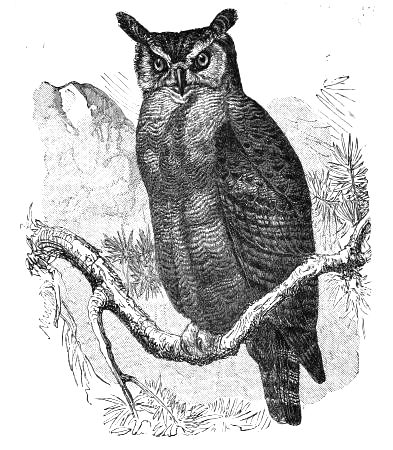
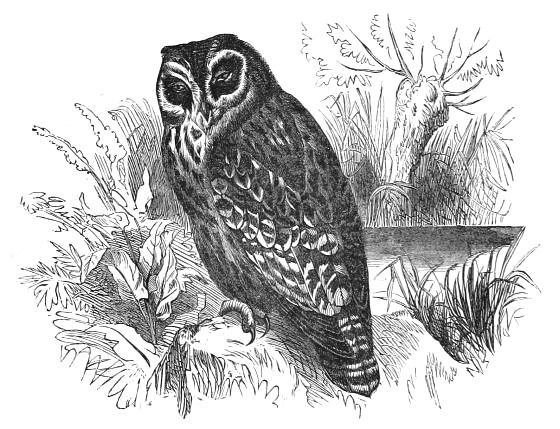
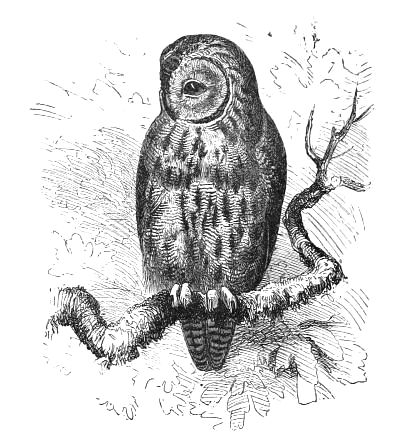
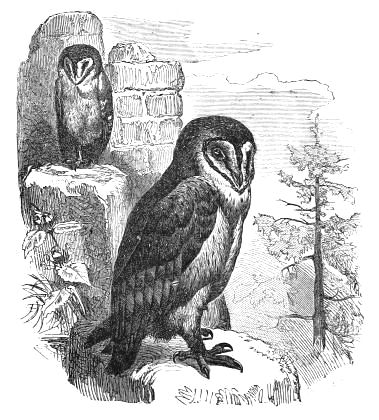
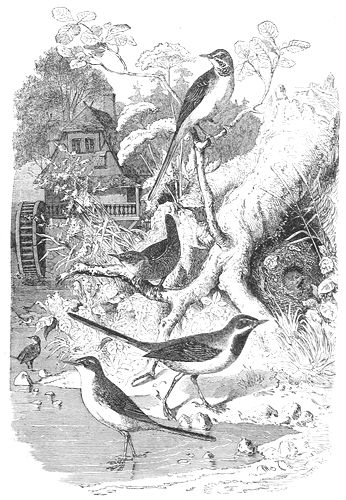
 A List of C
 The following CATALOGUES of CASSELL PETTER & GALPIN'S PUBLICATIONS can be had
from all Booksellers, or post free on application to the Publishers:—


