CARUSO’S METHOD OF VOICE PRODUCTION The Scientific Culture of the Voice
Transcriber’s Note:
New original cover art included with this eBook is granted to the public domain.
BY
P. MARIO MARAFIOTI, M.D.
PREFACE BY
VICTOR MAUREL
D. APPLETON AND COMPANY
NEW YORK :: 1922 :: LONDON
COPYRIGHT, 1922, BY
D. APPLETON AND COMPANY
PRINTED IN THE UNITED STATES Of AMERICA
TO
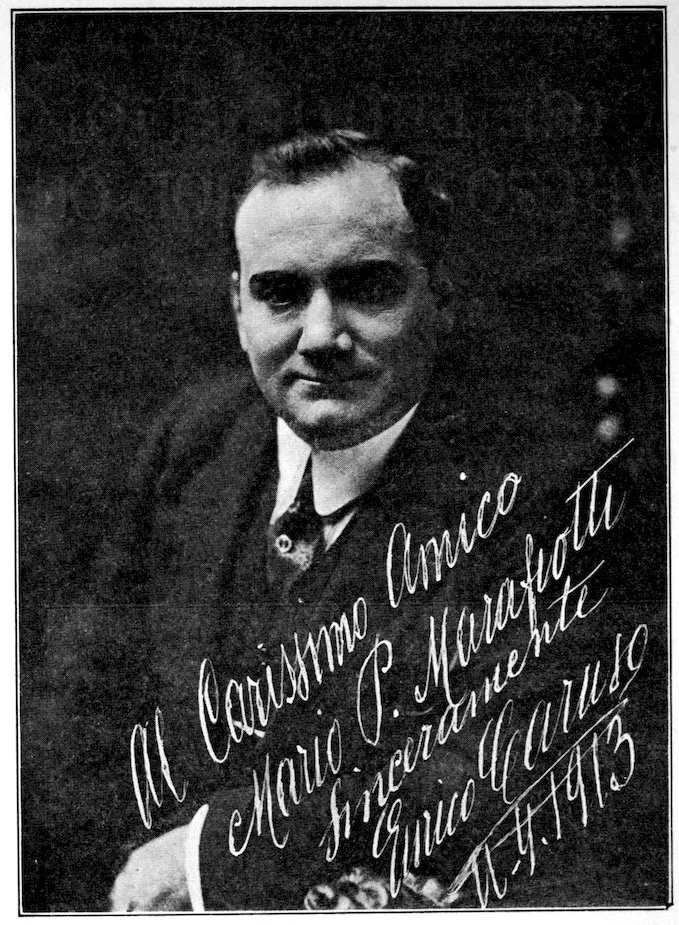
ENRICO CARUSO
WHOSE SINGING HAS BEEN
THE INSPIRATION OF THIS BOOK
vi
vii
FOREWORD
ix
This book had hardly been completed when the
sudden death of Enrico Caruso, the greatest singer
of our time, and perhaps of all time, plunged the
entire world into grief, and silenced forever the
most beautiful and phenomenal voice that the world
has known.
This work, dedicated to him in the last days of his
life, was conceived as the faithful interpretation of
his perfect and rare singing.
For over a decade and a half, I had the privilege
of associating with the great artist, not only in the
capacity of medical adviser but in the intimacy of
a wonderful friendship, and his singing was to me a
constant guide and inspiration in my investigations
of the many problems of the human voice and vocal
art.
By closely observing his method of singing, I saw
the correct application by the master himself of the
natural laws governing the mechanism of voice production,
and I had the opportunity, by testing his
ideas and principles, of ascertaining that they conformed
with those I have developed in the scientific
part of this book.
As a modest wreath of admiration and friendship
I lay this work on the grave of the great artist.
P. Mario Marafioti
xi339 West 70th Street, New York City
March 3d, 1922.
D. Appleton and Company,
New York City.
Gentlemen:
I have just received the proofs of the book,
The Scientific Culture of the Voice,” by Dr.
P. Mario Marafioti, which you are about to publish,
and I thank you for the courtesy you have shown
me in submitting the advance sheets.
Though there is little time left for me to read
and analyze in all its details a work of such importance,
I shall, however, not deprive myself of
the pleasure of sending you my impressions and
opinion on the practical value of this treatise.
As a matter of fact, for the last few years, on
several occasions, I have encouraged Dr. Marafioti
to pursue his conscientious and patient researches
in the particular branch of vocal education which
is exclusively identified with science. Indeed, I
sincerely believe that it belongs to those men of
science who have devoted themselves to the study
of the natural functions of the vocal organs, trained
xiifor an artistic purpose, to solve the so-called mysterious
vocal problem, obscured by the ignorance
and the charlatanism of incompetent teachers.
As a matter of fact, from my long practice in
singing, and from the experiences accumulated
during my career of more than forty years, one
point has come to my attention (which has been
unanimously endorsed by singers of merited fame),
namely, that dramatic singing (that is to say, artistic
singing) is the result of two distinct categories
of studies:
1. The study of the physiological causes of the
natural function of the vocal organs, which in certain
cases make the function difficult or even
impossible. This part of vocal culture constitutes
the Science of the Voice” (La Science de la Voix),
and rightly belongs to the scientists and physiologists
who have specialized in this branch of medical
research, and are equipped to remedy the shortcomings
of so delicate a function as that of the
vocal organ.
2. The pursuance of the vocal effects, that is,
their proper distribution in the musical phrase, the
manner of coloring the tones, the art of expressing
with musical tones the varied dramatic sentiments:
all these studies constitute the Science of Singing”
(La Science du Chant), and rightly belong to
the artist singers who, during their long practice in
the art, have acquired a sufficient amount of experience
to guide the young aspirants to a career
which they themselves have honored before.
xiiiThis is the thesis treated by Dr. Marafioti and
which I have so often discussed with him; a thesis
that, in my opinion, constitutes a real progress in
the development of this art, so human and universal:
The Art of Singing.
CARUSO’S METHOD OF SINGING WAS
NOT AN INDIVIDUAL SECRET WHICH
HE ALONE POSSESSED, OR WHICH
WITH HIM CEASED TO BE; IT WAS
THE MOST GLORIOUS EXAMPLE OF
NATURAL SINGING WHICH WILL REMAIN
FIXED UNTIL NATURE EXISTS NO MORE.
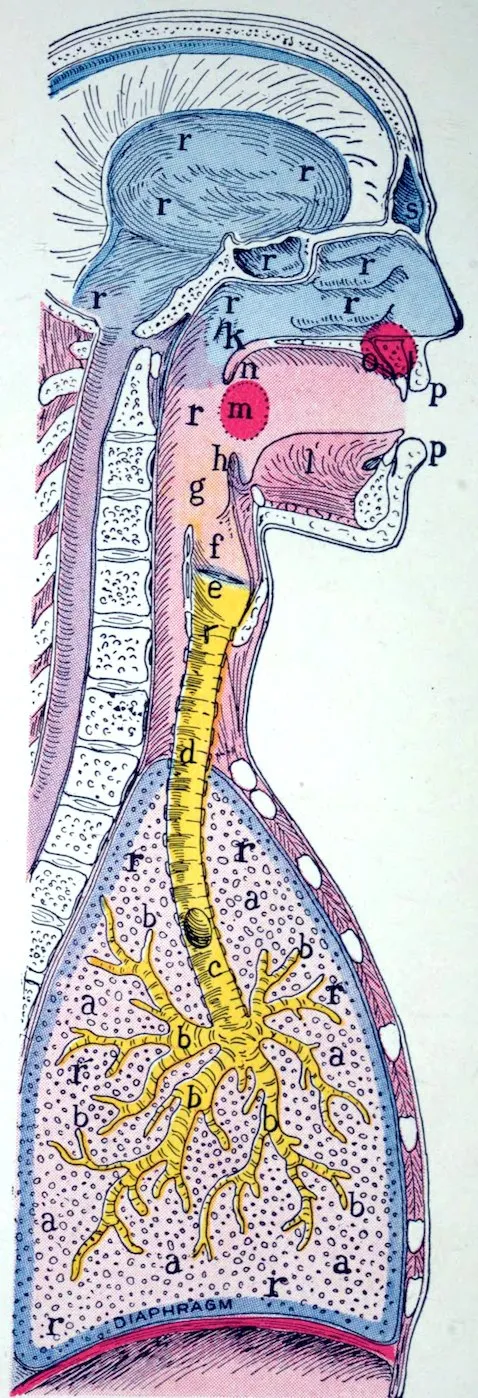
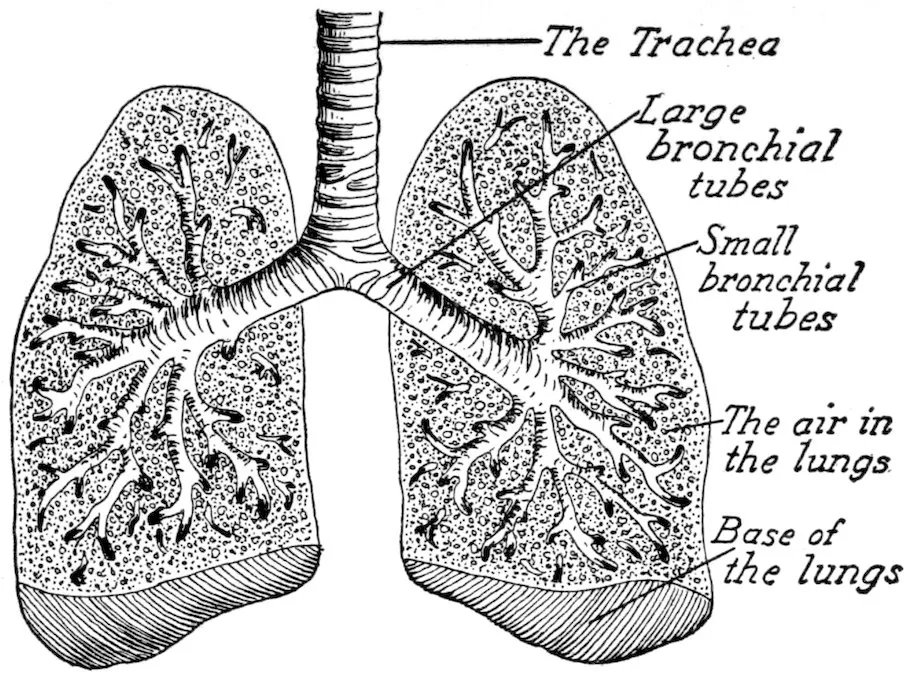
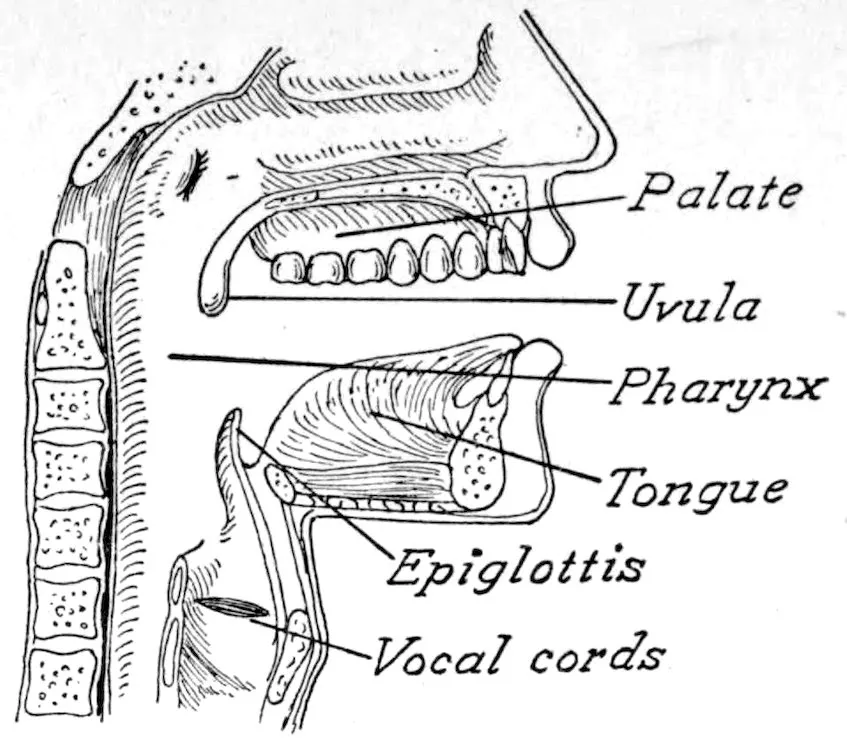
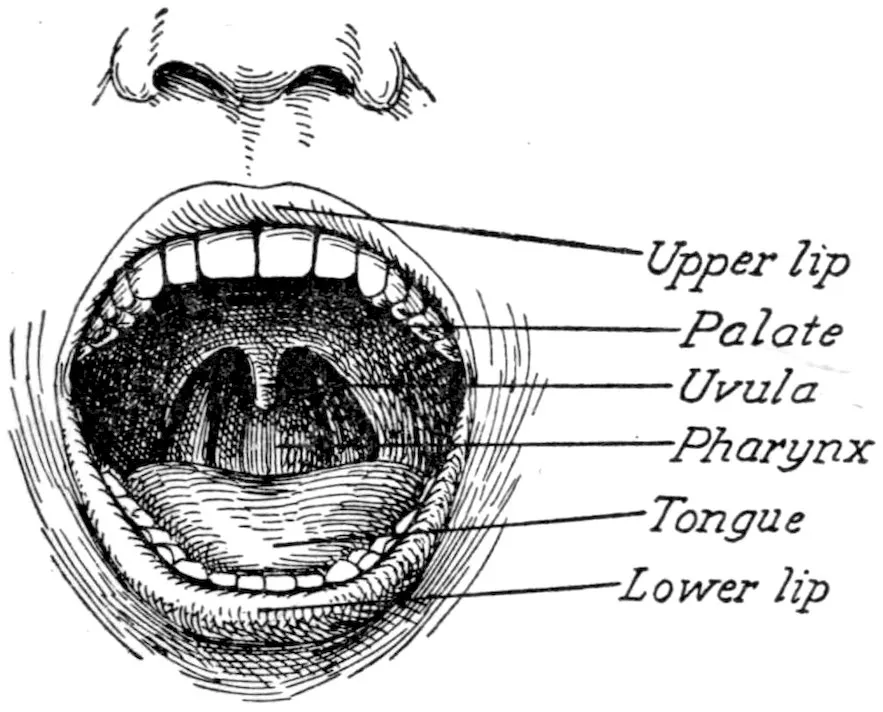
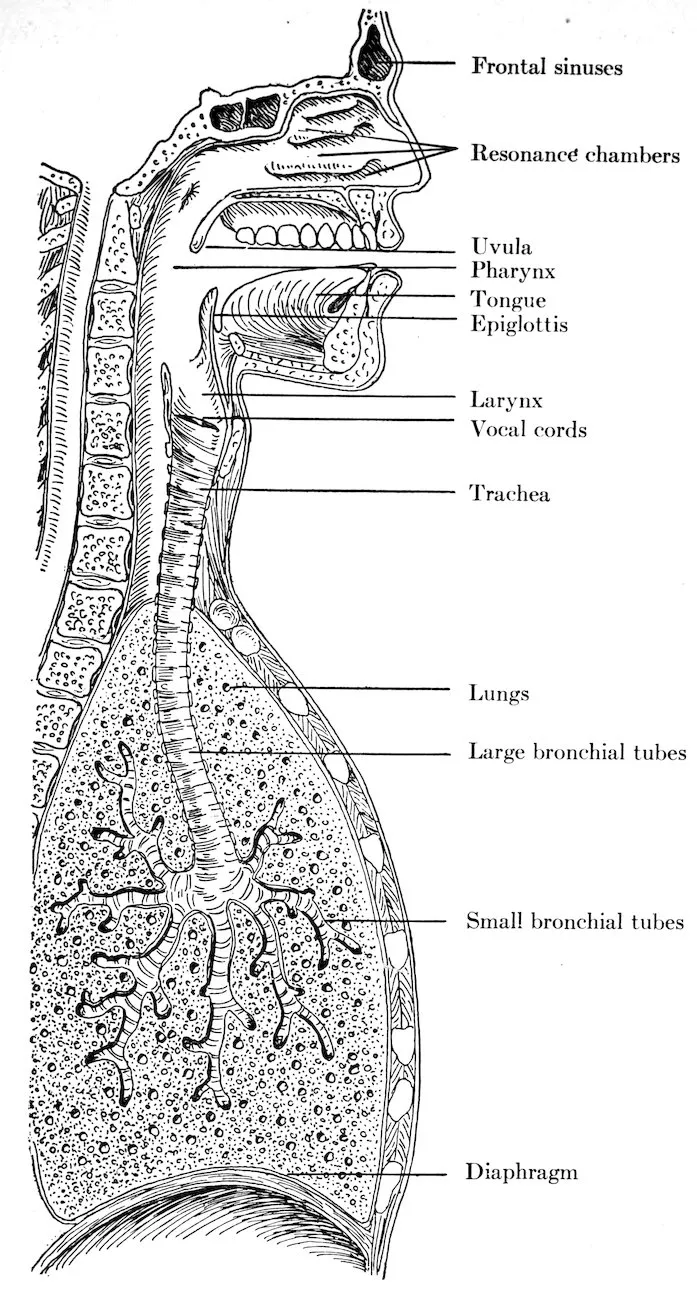
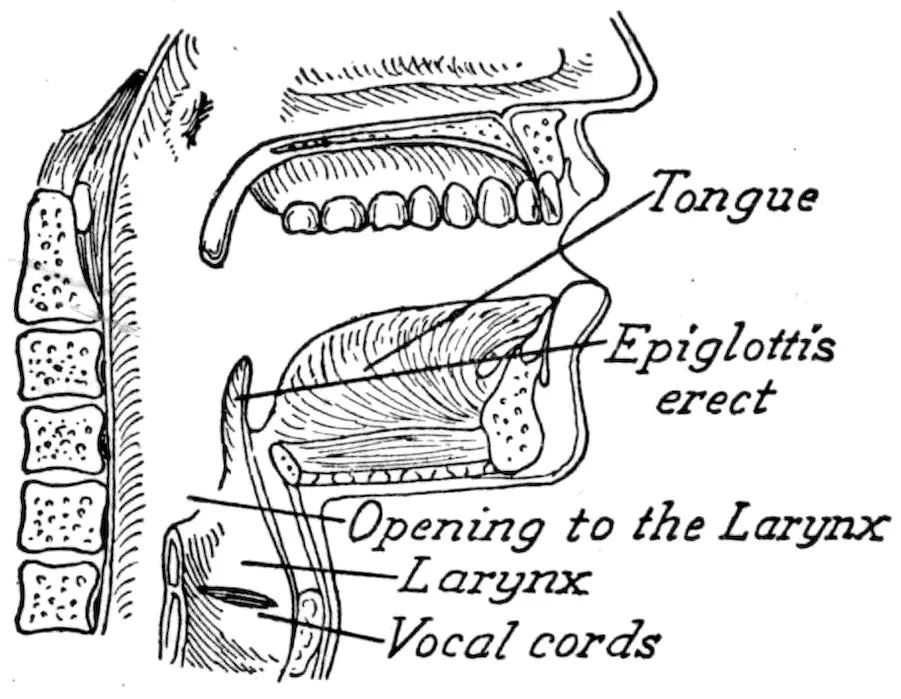
The Mechanism of Voice Production Condensed in One Illustration
a.
The Air in the Lungs which through the
b.
Small Bronchial Tubes and the
c.
Large Bronchial Tubes and the
d.
Trachea is propelled to the
e.
Larynx, putting the vocal cords in vibration and originating
SOUND.
f.
The Laryngeal Sounds which going through the
g.
Pharynx behind the
h.
Epiglottis reach the
m.
Mouth and are transformed into VOICE.
o.
The Focus or Center of Resonance of the
voice.
l.
The Tongue relaxed on the floor of the mouth.
n.
The Uvula.
k.
The opening of the Eustachian Tube.
pp.
The Lips, the megaphone of the voice.
rrr.
The head, chest and abdominal Resonating Cavities where the vocal
vibrations get the resonance of the body.
s.
The Frontal Sinuses.
The Diaphragm is shown
at the base of the lungs.
CARUSO’S METHOD OF
VOICE PRODUCTION
1
On February 26, 1873, the most magnificent exponent
of the vocal art the human race ever possessed—Enrico
Caruso—came into this world. On
August 2, 1921, at the height of his glory, his golden
voice was stilled forever; and the world, in its grief,
is still wondering what it was that Nature bestowed
on this privileged son to make him the most wonderful
source of human melody of all ages.
Scientists and voice experts vie with each other
in trying to explain the vocal phenomenon—Caruso—and,
though they differ in their conjectures, they
all agree that a voice of such rare beauty, and singing
of such effectiveness have never been paralleled
in the history of vocal art.
In their various versions, scientists endeavored
to trace the striking factors of his rare singing to
certain peculiarities of his vocal apparatus, giving
most of the credit for his wondrous voice to his vocal
2cords. This conception, however, merely follows
an impression dominating the musical world which
has always associated the miracle of Caruso’s voice
with some secret magic power of his golden throat.
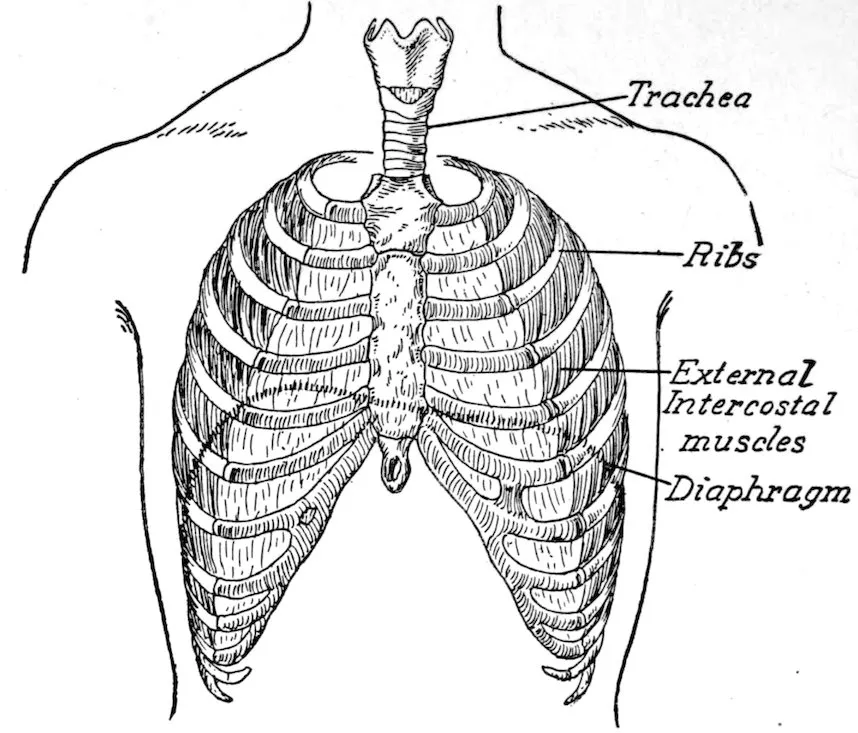
Other experts on voice believe that the principal
feature of Caruso’s singing was the striking power
of his breath, due to the exceptional strength of his
diaphragm and intercostal muscles.
A brief analysis can easily prove that the real
reasons for Caruso’s marvelous singing are not precisely
those which have been advanced. He was an
exception, not for the rarity of his vocal organs, but
for their perfect function—faultless according to
natural laws—which made him the truest exponent
of natural singing.
Singers endowed with the same and even better
vocal organs, on the whole, than Caruso are not
scarce, some of them having come under the personal
observation of the author. Singers with more
remarkable breath-power than Caruso have also existed
and still exist. (Tamagno is as yet in the
memory of the present generation, without mentioning
other living singers.) Yet it is the universal
impression that none of them can stand comparison
with Caruso as singers.
The truth is that Caruso had nothing exceptional
in his laryngeal apparatus, and the larger size of his
vocal cords or other peculiarities which have been
mentioned about his vocal organs were certainly
not the decisive elements in his phenomenal singing.
On the contrary, there were shortcomings in his
throat which were so evident that if he had had to
3rely on his vocal organs alone for his career, he
would perhaps never have become a singer at all.
As a matter of fact, Caruso himself often commented
on this, relating an early experience of his.
At the age of twenty he went to one of the most
famous laryngologists in Italy, Professor Ferdinando
Massei, of the University of Naples, to be
treated for tonsilitis at the hospital of Gesŭ e Maria.
When asked about his profession, Caruso said that
he was studying singing. The famous physician
shook his head dubiously and replied: Take up
something else, you have not the throat for singing.”
All laryngologists who had the opportunity of
treating Caruso know also that his throat was often
much congested, and that he smoked too much, although
the beauty of his voice was never impaired.
Therefore his throat was not the magic organ that
gave rise to his greatness. This strengthens our
theory that the importance given to the throat as
the organ which characterizes exceptional voices is
greatly exaggerated.
What, then, were the really striking features responsible
for Caruso’s singing?
My intimate association with the great tenor afforded
the opportunity of examining constantly all
facts relating to his voice, and the advantage of discussing
my impressions with him, accurately studying
his own point of view. I, therefore, feel justified
in expressing an opinion on this subject,
founded on close observation.
Not one, but several, qualifications, physiological
4as well as psychological, harmoniously combined in
one individual, were responsible for making Caruso
the most magnificent vocal phenomenon of the human
race. These qualifications are embodied in the
words Natural Singing.
His vocal organs, most obedient to Nature’s dictates,
were not anatomically exceptional, but in
their physiological function were the most balanced
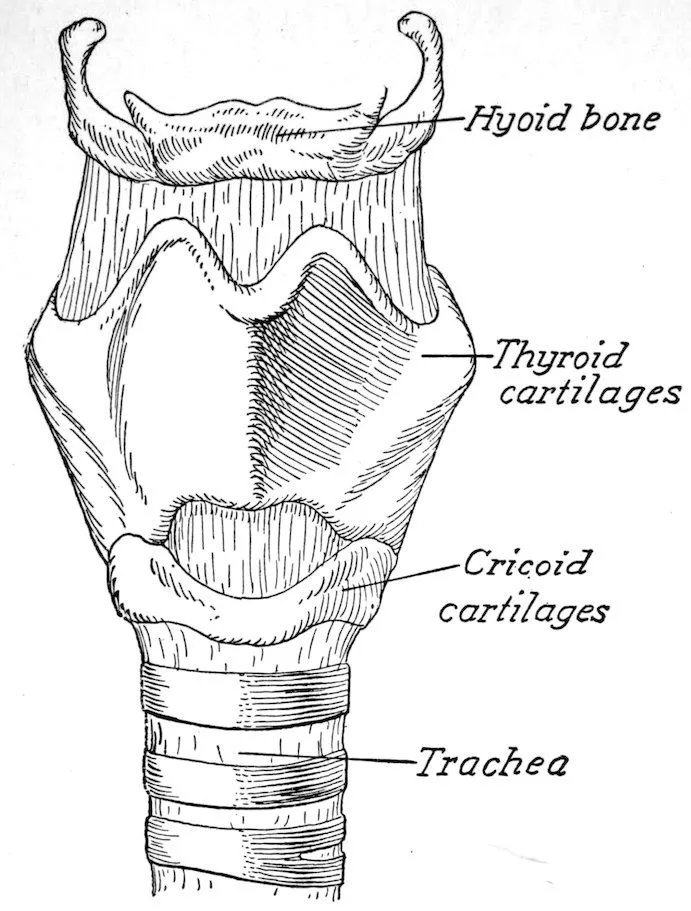
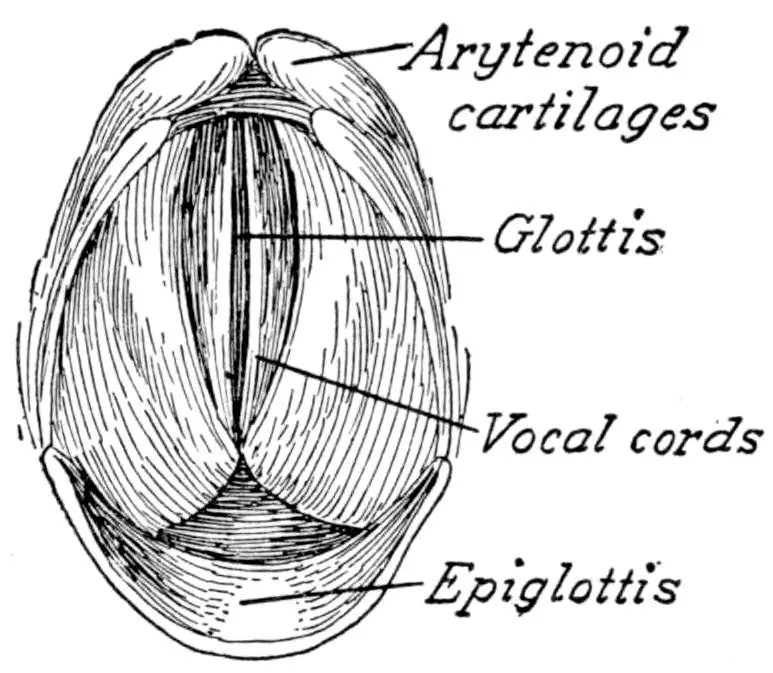
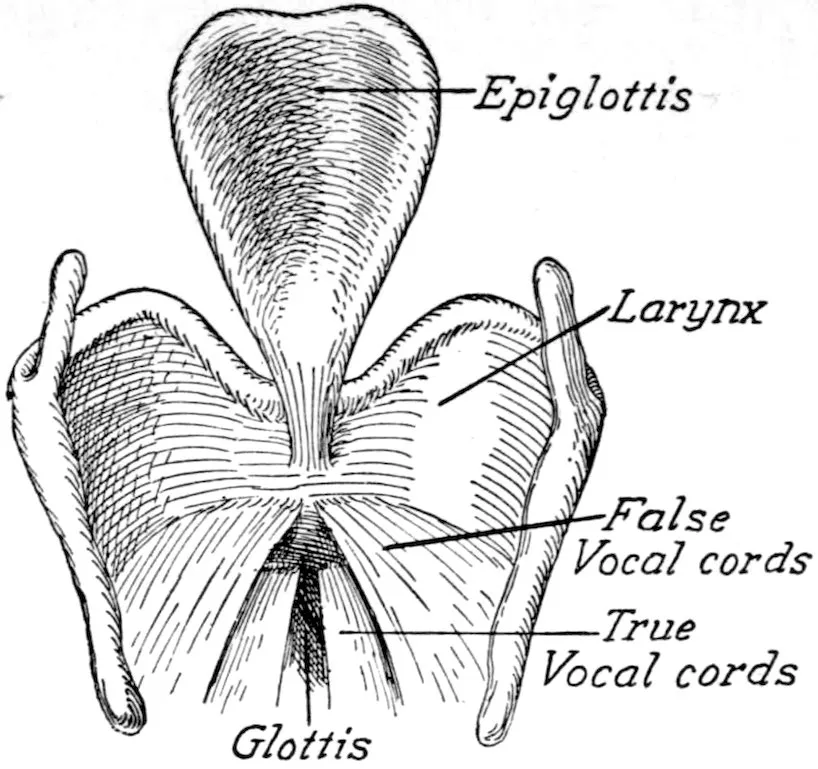
vocal machinery ever known to me. His vocal cords,
rather large and thick for a tenor, although not the
exceptional factor in the beauty of his voice, gave
him the range of a basso as well as tenor. But this
is not unusual, as tenor, baritone and basso
ranges are conventional, not scientific, divisions.
Nature creates voices, the specific qualities and
ranges of which have no such scholastic limitations.
Cases of bassos singing as tenors, and contraltos
singing coloratura are not infrequent among
singers who produce their voices properly. Caruso
had one of these rare voices, which he used according
to Nature’s dictates; thus it was not difficult
for him to sing baritone as well as tenor, if he chose
to do so. This, therefore, was not the striking feature
of his exceptional power. There have been
other tenors who could do the same, such as the
famous Lablache, who used to sing basso as well as
tenor rôles.
One peculiarity worth mentioning, however,
about his vocal cords was their rather soft consistency,
a circumstance which accounted partially for
the mellow and velvety quality of his voice. The
value of this is easily illustrated when compared to
5the marked difference in tone existing between an
E string of a violin made of steel and another made
of gut, the latter having considerably more mellowness
of tone due to its softer consistency.
In reference to the other physical factor commonly
conceded as most prominent in connection
with exceptional voices, namely, the breath, Caruso
certainly always had at his disposal the most generous
supply of air, which he supported wonderfully
by his control of the diaphragm, that was as strong
as any muscle of his body. His beautiful singing,
however, was not the result of breath-power, or
brute force, but rather of his careful and intelligent
distribution of it, which was a remarkable feature
in Caruso’s style of singing. He always employed
only the exact amount of breath required for producing
each tone, and no more; and this was responsible
for his precise intonation, his remarkable
legato, and his long-sustained tones.
Caruso almost unconsciously focused his voice in
its most exact pitch, guided by his natural instinct
of giving to each note only as many vibrations as
were scientifically required. Thus his voice, contrary
to the style of singing predominating to-day,
was never under high pressure, and, therefore,
never sharp.
The natural placement of his voice in the very
center of the masque was a most striking feature.
Its production was always based on the fundamental
tones of the voice, not on the overtones. He used
the overtones generously, but only for enriching
the fundamental tones, not for overshadowing them.
6Generally when voices are forced, the overtones
become more prominent than the fundamental
tones, resulting in singing which is similar to a
painting in which the shadows predominate over
the lines of the drawing, making the design indistinguishable.
In the singing of Caruso the fundamental
design of the voice was clear, solid, and
imposing, and its many delicate shadows were responsible
for its rare beauty, blending in velvety
softness the masculine strength of his baritone
quality.
But the exceptional physiological attributes
which Caruso possessed were the majestic freedom
of his voice production and the striking power of
resonance of his body, which he utilized to full
advantage. The former was due to his use of the
vocal organs in perfect accord with physiological
laws, his voice production being so correct, and at
the same time so natural, that for the most part
singing was for him merely talking. The massive
volume and the rare quality of his voice—its exceptional
characteristics—were due to the resonance
of the body, which was like that of a Stradivarius
violin. The much-emphasized properties of his
vocal cords, when compared to the striking feature
of the resonance of his body, had no more value
than the string of a Stradivarius when placed on
an ordinary violin. The marked inferiority of tone
of the second violin is equivalent to the difference
that the vocal cords of Caruso would produce in
the throat of another tenor.
7Therefore the magic power of his voice lay in
the correct physiological mechanism of his voice
production, on one hand, and in the remarkable
physical conformation of his body, on the other,
made up of tissues of exceptional resonant property,
acting as an immense resonating case for his
tones.
His masque, chest, and all the cavities of his
body, even in their remotest corners, were producing
sounding vibrations during the correct, free,
and expansive production of his voice.
His tongue, of remarkable flexibility, which he
could shape in any way, or keep relaxed in a concave
form on the floor of the mouth, thereby
creating, with his well-arched palate, a larger and
rounder space, added not a little to the resonance
of his singing.
His nose and frontal sinuses, markedly developed,
together with his broad and rounded chest,
were striking factors of resonance also. His entire
body, in fact, in its large and solid frame, was a
striking resonator for his voice.
Therefore all these qualifications, magnificently
combined and answering perfectly to the laws of
physiology and acoustics, made him the most wonderful
exponent of natural singing.
The psychological endowments which lent to
Caruso’s voice its intense pathos, never before
equaled, were supported by the self-assurance of
the correct mechanism of his voice production which
8gave him the advantage also of devoting all care
to the details of his singing, and to the aesthetic
beauty of his voice molded on its natural sentiment.
For him singing was a pleasure rather than a
technical struggle for effects, therefore, audiences
cried along with him or loved along with him in
his different rôles. His mind, freed from the necessity
of thinking high or low tones, was always open
to the inspiration of the words and the music he was
singing. He was the first in his class to abolish
the conventional though beautiful style of singing
of the bel canto school, refusing to bend toward the
traditional temptation of making the words slaves
to the tones. He sang the words for themselves—for
their significance—feeling and meaning them.
Hence the pathos of his voice, and his superb enunciation,
which made the audience understand and
feel every word he was singing, added much to
his superior standing when compared with other
singers.
Caruso was not a tenor, not a baritone, not a
basso; he was a singer who had the vocal characteristics
of all three combined. He had a voice which
did not recognize scholastic, conventional classifications
of registers, and ignored all limitations in its
range. He covered all the possibilities of the human
vocal apparatus with the same colorful masculine
voice, from the lowest to the highest tone of his
range. He covered all the possibilities of the human
and at the same time powerful. His voice was a
stream of gold. At the age of forty-eight, when
most singers are at the close of their careers, his
9vocal perfection was at its height, and would have
lasted however long he lived.
Caruso was a born singer, and a perfect one, by
almost divine and superhuman will. He obeyed
the call of his heart rather than technical influences,
his sentiment being his only guide in singing.
Everything in him was instinctive and intuitive.
If, at the beginning of his career, he failed to do
justice to his vocal gifts, he was unconsciously the
victim of technical influences imposed on him by
his teachers. His imperfections were due more to
psychological conditions than to the voice itself.
Surely, though, he did not fail to give the impression
that his voice was of rare beauty. When
Nature, the real master of his voice, took the lead
in his vocal career, and his mind and soul coöperated
efficiently, he no longer encountered obstacles
in his singing. His evolution as a singer and artist
shows very clearly how only lack of artistic education
and confidence had held back the natural element
which was as powerful in him at the beginning
as later.
This very element, though—the natural gift
for song—existed and still exists in many other
singers, perhaps, as well as in Caruso, but his
strong ambition, love of hard work, and intense
desire to learn and improve are very seldom combined
so conspicuously in one person.
Thus, though Nature endowed him with the rare
gift of a most beautiful voice, he owed to himself
alone the greater share of his extraordinary success
as a singer and artist.
10The age of the famous motto of Rossini, that
singing requires only voice, voice, and voice,” is
gone forever. This was perhaps applicable to the
music of his epoch. To-day, to meet the modern
psychology and progress, other qualifications are
necessary—those which made Caruso the wonder
singer of our time.
CHAPTER II THE AIM OF THIS BOOK
11
To the making of books there is no end, but the
flooding of the musical world with countless publications
on the phenomenon of Voice makes it
imperative for the author to justify this addition
to the already voluminous literature on this subject.
The vast majority of the books written in various
languages in the last thirty years have, in truth,
added practically nothing new, nor influenced to
any great degree the development and progress
of the art of singing. On the contrary, some of
them, by displaying absurd theories based on misinterpreted
physiological laws, have caused much
damage; and others by simply repeating, in more
or less varied forms the principles laid down by
such authorities as Tosi, Mancini, Porpora, Garcia,
Guillemin, Mandl and Mackenzie have not
taken into consideration that those principles can
hardly be of benefit to the critical conditions of the
singing of to-day, for the art of song has deteriorated
very much in recent years, while operatic
music has undergone a radical evolution toward
interpretation.
An old motto says: “For extreme evils, extreme
remedies.” The author, therefore, much concerned
12about the present situation, feels that the time has
come to urge a radical reform in voice education.
This reform must be founded on scientific laws,
and must direct the art of singing toward a fundamental
reconstruction better suited to the exigencies
of our times, freeing the field of singing from
both the unprogressive and empirical, though correct,
method of the old Italian school, on the one
hand, and the devastating influence of the arbitrary
methods of voice culture created by incompetent
teachers, on the other. This constitutes the aim
of this book.
No criticism, however, is leveled at the glorious
old Italian school of the bel canto; but the operatic
music of to-day differs widely from that written
generations ago. The operas of Wagner, for instance,
cannot be rejected for not following the
same structure and style as those of Pergolesi,
Glück, Mozart, Donizetti, Bellini, etc.; nor should
they be limited to few interpreters only because
they are more strenuous and difficult to sing.
Voices should be trained to such easy production
and correct technic, that the length and the intense
style of Wagner’s or any other modern composer’s
operas will not expose the vocal organs to any
dangerous strain.
We live in an epoch in which, in every branch
of human knowledge, there has been progress and
evolution from empiricism to scientific principles
and definite rules. Music itself, in its different
branches, from composition to the technic of instrumental
executions, has changed much and
13improved. Only the art of singing is still striving
in its empiric form, ruled either by doubtful traditions
or by arbitrary methods of singing, the number
of which is as large as their practical value is
small. Certainly, if one substantial and correct
method existed, there should be room for no other.
Whose fault, however, if the art of singing is
not only stagnant, but steadily deteriorating?
Some people lay the responsibility on modern
opera. It is true that modern composers write
more elaborate and complex music for singing than
their predecessors; but nobody, in truth, can blame
them for having, under the inspiration of their
genius, directed their works toward new forms of
art, which require more efficient vocal means.
It is our impression that teachers and singers
alone are to blame, if they are not able to face at
ease the new exigencies, and follow the creative
power of these geniuses in their evolution and
progress.
Now, what can be done to change the present
conditions? The author believes that by laying
down a few new scientific principles on the mechanism
of voice production and some suggestions for
a thorough reconstruction of voice culture, he has
brought out some original views which should incite
the interest of the singing field in the promotion
of a radical reform in the art of singing.
The mechanism of voice production and voice
culture cannot be properly used unless properly
taught; and the teaching must be founded on
physiological truths.
14The author is not sanguine regarding the immediate
effect of this basic reform which he suggests.
It takes a long time for truth to win its
way in any field of endeavor; but if the advancement
of his views has the effect of stimulating
discussion and of creating a mental attitude which
will lead to the revision of our preconceived notions
and to the discarding of worn-out theories, prejudices
and superstitions, his efforts will have
served some purpose.
Frequently one hears the much abused remark
from teachers, “What do scientists know about
voice? It is purely an artistic development, and
they have no right to interfere with voice culture
and the art of singing. This is the domain of the
singing teachers alone.” The majority of the public
accept this statement without discussion.
Yet it is necessary to remind these people that
every art has its origin, to a greater or less degree,
in some science. They must know that even behind
the creation of a musical composition stands the
science of harmony and counterpoint, and the
structure of its frame and proportions is purely a
scientific construction. Any one who knows a little
about Beethoven can see in his creations the most
vivid example of what science is to music.
The art of painting is based on the science of
drawing; and the imaginative power of a painter
in creating a beautiful landscape, or in reproducing
the character of a person in a portrait, has its origin
in the skill of a hand directed by the functional
power of the brain. It is, however, obvious that
15the functioning power of the brain is better known
to the psychologist than to the painter himself, and
any disorder related to that function can be detected
more readily by the former than by the latter.
Therefore, science is always of great assistance
to art.
There can be no voice without a functioning vocal
apparatus, the physiological activity of which gives
origin not only to the voice, but to the correct
mechanism of its production, which establishes the
scientific foundation of the art of singing.
Now, as no one would dispute that the specialist
of heart or brain diseases must be well acquainted
with the functions of these organs and the treatment
of their disorders, no one should doubt that
the laryngologist must have a thorough knowledge
of the functions of the vocal organs and their
physiological product—the voice—and a firmer
grasp on the subject than the untaught layman.
So, too, he surely must be more able than anybody
else to suggest the proper use of the vocal organs
for producing a correct mechanism of singing; and
whenever a disorder or deformity in voice production
develops, he can find the radical means for
restoring them to normal.
Therefore, how ludicrous is the statement that
the teaching of voice production belongs only to
one whose best asset often is limited to the knowledge
of how to run a few scales on the piano, or
how to read a score; or to those singers who, having
sung in defiance of the laws of nature during a brief
16career, are forced to give it up for the more lucrative
profession of vocal instructor.
The public must begin to discriminate between
voice culture and artistic vocal education. The correct
training and developing of the physiological
functions of the vocal organs during the process
of voice production constitutes voice culture. It
comprises a knowledge of the normal function of
the lungs, as moving power; of the larynx with the
vocal cords, as producing power; and of the mouth,
which includes the tongue, palate, lips, and the
resonance chambers, as resonating power of the
voice. To know the defective, as well as the correct,
function of all these organs which control the
mechanism of voice production constitutes such an
important factor in voice culture, that it must be
intrusted to the care of responsible experts of the
voice, well acquainted with the physiological rules
of the vocal apparatus.
The vocal education as related to music, that is,
operas, songs, etc., is purely a technical study and
an acquisition of vocal musical knowledge, which
is alike for all musical instruments. That alone
should be intrusted to music instructors, coaches,
accompanists and conductors.
In face of the alarming condition of the art of
singing at present, the author feels fully justified
in expressing his ideas on the important subject
of voice and voice culture, regardless of any prejudiced
or unfavorable criticism. All earnest music
lovers should take this stand, and encourage such
efforts.
17The problem of the responsibilities for the
actually harmful condition of voice culture must
be solved, and the responsible elements must be
denounced without fear. The reaction which may
arise from professionals, who are slaves to prejudice,
ignorance, or material interests, is to be
expected; but if it is true that good singing is
fatally deteriorating, all efforts must be combined
to discover the real cause, and what must be
done to restore the disappearing art of singing.
CHAPTER III WHO WILL READ THIS BOOK? — The Singing Teacher — The Pupils of Singing
18
In the preparation of this work the author had
constantly before him the question, who will read
this book?
As a general proposition it may be stated that
books on voice do not appeal to the general reader.
They are usually of interest only to the so-called
musical world and to the few scientific men known
as laryngologists. Those who should be particularly
interested in a book of this nature are singers,
singing teachers and students of singing.
In regard to singers, it is lamentable, but nevertheless
true, that the vast majority do not read
books on voice. Having made their “success,” and
having “arrived” (in some cases, of course, in their
own belief only), they consider it superfluous to
read anything about voice culture. A robust ego,
often an essential part of the makeup of these
individuals, makes them look with disdain on other
people’s ideas about singing, and they ignore any
new viewpoint regarding the phenomenon of the
voice, however important it may be.
Most of these singers strive for the applause of
the audience, and only for this. It cannot be
denied, though, that the average audience, lacking
discrimination, is easily satisfied, most easily enthused
19and aroused to vociferous applause by artificialities,
fireworks, and tricks. Therefore part of
the responsibility lies with the audience, as for the
vast majority of singers its applause is the verdict
of the greatness of their achievement and talent,
and satisfies all their ambitions. This class of
singers, naturally, representing the purely commercial
element of the singing field, will not read
this book.
It must be acknowledged, however, that there are
exceptions. These are the real artists, individuals
with ideals, who must not be confused with the
mass, and who are always anxious to learn in spite
of their real success.
The real artists, having a higher conception of
their art, sing for art’s sake and do not prostitute
art merely for the sake of applause. Conscious
of their mission, they hold the applause of the multitude
at its proper value, and constantly strive for
finer and better expression in their singing.
To them a new viewpoint about voice is deserving
of consideration, and they may find some interest
in the author’s views.
Bernard Shaw has said: “He who can, does;
he who cannot, teaches.” This may be aptly
applied to a condition of affairs now existing in the
vocal world.
Teaching is an art requiring great attainments,
and not every one can teach. The teacher must
20have a fundamental basic knowledge of the physiology
of the voice, not from mere hearsay, but from
actual study and work. He must know physical
principles of acoustics, and must have an elementary
anatomical and physiological knowledge of the
vocal organs. Then, too, he must be a musician,
endowed with an exceptionally fine ear, and keen
powers of communication in order to reach the
average intelligence of pupils.
Considering all these things, I contend that the
teaching of singing is a difficult profession, which
few are competent to follow. To those few I submit
my thesis, and request their constructive criticism.
There is a large class of singing teachers, however,
made up of unscrupulous intruders, whose
pernicious influence is of inestimable harm both to
the competent teachers and to the inexperienced
students. The field of teaching is kept in a degraded
and unwholesome condition by the malpractices
of these individuals who, disregarding, without
investigation, any ideas which might throw
light on the difficult problems of voice culture,
retard its progress and evolution. Their origin is
usually traced to studios where as accompanists
they have laid the only foundation for their careers.
Some of them do not even belong to the musical
field. Daring outsiders of any social strata secure
admittance to the musical world through connections
with singers or teachers, and with no other
title or support than their boldness and audacity,
gain a foothold in the free land of voice teaching
21unmolested, taking advantage of the public ignorance
and indifference. In this way they succeed
in making themselves conspicuous in the domain
of voice culture. The unfortunate result is that
they find the road to their misdeeds wide open,
while it remains closed to the really earnest and
competent professionals, who disdain to lower
themselves to undignified competition. From this
class of unscrupulous intruders the author expects
no recognition.
Enthusiastic, confident, zealous, anxious to learn,
and frequently gifted, these credulous young men
and women pay the penalty for the ignorance which
generally exists regarding voice culture.
A student of any other branch of art or science
is requested, nay, ordered, by those who have his
tuition in charge, to read all the available literature
on the particular subject taught, in order to become
familiar with the viewpoints of the various
authorities. It is the function of the teacher then
to indicate where the truth lies and where the
fallacy.
The average singing teacher, however, is not
interested in having his pupils read anything
except his own literature, from which it is only
possible to deduce what a great personage the
teacher is. Students often place implicit faith in
the ability of masters who, by flattery and falsehood,
maintain a hold on their inexperienced victims,
22until, disgusted and disheartened, the pupils
find out too late that their voices have been ruined.
It is lamentably true, however, that pupils
expect everything from their teachers, relying very
slightly upon their own efforts and responsibility
for their future; but if these conditions prevail, it is
precisely because they are ill advised.
Of these young men and women, interested in
the truth, I ask a respectful hearing.
The art of singing is in a very critical condition.
Millions have been spent, and are still being spent,
for the education of thousands of beautiful voices,
for voices of exceptional material exist to-day as
heretofore; but where are the good singers?
Yes, there are still a few of the old school who
really shine as rare stars in the firmament of song.
But when these artists have passed away, shall we
have to be dependent upon the phonographic
records for beautiful singing as memories of a
glorious past?
This pessimistic view is still, however, tinged
with hope. That precious gift, the human voice,
which more than any other medium reaches the
deeper corners of the human heart, will not be
hushed. The renaissance of the art of singing
must and will come, as surely as the dawn of tomorrow,
if we succeed in forcing open the door
for a radical reform in the singing world.
By enforcing the laws of Nature, and applying
rules based on scientific principles, thus preventing
natural voices from being deformed at the beginning
of their training, pupils may be taught to
23sing correctly, beautifully, and easily. Ease is the
sine qua non of correct singing, as singing means
nothing but expressing in musical form sentiments,
such as happiness, sorrow, love, which do not require
any physical effort to be expressed. A few
words spoken in musical rhythm, with grace, color,
and artistic expression, are more effective and convincing
than the most vociferous, senseless noises,
or rasping gutturals, forcibly and acrobatically
produced.
Therefore, singers must sing words for their
meaning, not for their tones. It is more important
for them to remember this principle than to rely
on the top notes of their voices as their strongest
artistic resource. Holding a B-flat finale for an
exaggerated length of time, to produce a sensational
effect for the sake of the audience’s applause,
is neither beautiful nor artistic. Art is truth, and
truth disdains such vulgar display.
CHAPTER IV THE DECADENCE OF THE ART OF SINGING AND ITS CAUSES; ITS RESTORATION
24
The rapid disappearance of good singers has
become so alarming in the last few years, that the
complaint so widely expressed by those who are
concerned about the future of the art of singing
seems more than justified.
The deterioration of the vocal art has affected
even the Italian school of bel canto, which, judging
from its contemporary representatives—with the
exception of a few celebrities—shows real evidence
of degeneration from the glorious old traditions.
The causes responsible for this decadence are
growing so rapidly that a solution of the problems
essential to the very life of the art of singing has
become imperative.
There is no doubt that this critical status of
affairs can be faced and successfully overcome, so
that the art of song may be restored to its original
splendor; but in reality it is a difficult task to carry
out such a program, under present conditions.
The downfall of bel canto is the result of various
and complex causes; the aim to restore it, in view of
the present conditions of the teaching field in general,
will be severely handicapped, for reasons
connected with the commercial element which predominates
it at present.
25If, however, recovery from the present unhealthy
conditions is really desired, it can be attained by
radical intervention at the very roots of the pernicious
growth—the teaching—a difficult task for any
one person to undertake, unless strongly supported
by the coöperation of all those interested in the
future of the culture of voice.
In a search for the remote causes which brought
about the decadence of bel canto, most of them can
be traced to two primary sources: one musical and
the other professional in origin. The first is related
to the evolution of singing music, on the
whole, and especially of opera; the second to the
degeneration of the artistic aims of the modern
singers, whose careers have become essentially commercial,
and who have forsaken all ideals, to
pursue solely a financial and ephemeral success,
regardless of how it is obtained. Unfortunately
this class of singers furnish the vast majority of
the teachers of to-day.
In reference to the evolution of singing music,
it must be admitted that the opera has undergone
a radical change from its former traditions and
style.
Within the last half century a new sense of life,
more intense and deep, has opened up new horizons
for the display of human emotions in all arts,
affecting music most decidedly. The different
sentiments which have started to pulsate in the
human heart have fundamentally changed the psychology
of the world, giving rise to new ideas and
feelings, much stronger, more dramatic, more complex—above
26all—more realistic. In fact, we now
live in an age in which there is no longer room for
romantic sentimentalism, and the ingenuous productions
which the preceding generations enjoyed
in opera or drama have no longer the power of
interesting the majority of modern audiences.
Therefore, this sudden and radical evolution
which has influenced our psychology—for reasons
and through circumstances which cannot be discussed
here—has been transfused and absorbed, in
a natural process of assimilation, by all the different
forms and expressions of human sentiment,
through literature, music, painting, sculpture, perhaps
principally through the theatrical and operatic
works of recent times.
By natural laws every expression of life must
be subject to the evolution and changes of human
thoughts and emotions; consequently, it is not surprising
that these new influences have changed, in
a radical form, the operatic world, its aims, productions,
style, meanings, and the taste of the public
also. Audiences of the last thirty years were getting
weary of listening to the arias and duets of
the romantic period of Rossini, Mozart, Bellini,
Donizetti, and their predecessors. Meanwhile the
field of the operatic composers has become influenced
by new waves of emotion, more intense
and much deeper, which are gradually taking a
prominent place, substituting realistic and dramatic
musical expressions for the old, conventional melodies
and rhythms.
Wagner, the pioneer genius, pressing hard with
27his gigantic evolution, the young Italian composers,
heralded by the magic seer of the human heart—Verdi,
the French, by Berlioz and Bizet—the
sparkling painters of colors and sentiment—started
the radical reform of the opera, which began to
substitute realistic musical mediums for the conventional
melodies of the romantic period.
This change has given birth to the so-called
modern truism and has had a favorable response
from the majority of audiences, exercising a very
marked influence in the evolution of the art of singing
also. This influence, however, from the standpoint
of the bel canto style, has proved decidedly
negative, though no blame whatever can be laid on
the composers of the new operatic music.
The modern Italian realistic school, whose
radical operatic evolution was prepared by Verdi’s
“Aïda” and “Otello,” conquered the field so decidedly
and in such a triumphant manner with Mascagni’s
“Cavalleria Rusticana”—followed later by
Leoncavallo’s and Puccini’s operas—that the conquest
of public favor seemed almost a spontaneous
and natural outcome. It did not take long for
these musicians to put themselves at the head of
the operatic reaction in Italy against the old
formulas and conventionalities; and while the
preceding composers of the past epoch—Rossini,
Donizetti, Bellini, and even Verdi in his first operas—were
accustomed to write their works either for
certain prima donnas, tenors, or baritones, setting
the music to their vocal ability, the modern composers,
by discarding these practices, gave a higher
28standing to their works. They began to create
operas solely for the sake of the music, regardless
of the vocal technicalities of the singers. This new
pursuit, more noble, more artistic and dignified,
started a new era in the field of Italian opera.
The same transition took place in France, principally
through Bizet’s “Carmen,” followed later
by the operas of Massenet, Charpentier, and
others, until Debussy and Dukas introduced operas
almost musically spoken, such as “Pelleas and
Melisande,” and “Ariadne and Barbe Bleue.”
This new style of music, which abolishes the
artificial virtuosity of the romantic period of opera,
has naturally been responsible for the sudden
change, and perhaps, to a certain extent, for the
decadence of the so-called bel canto, with no blame,
however, reflected on the composers but rather on
the singers.
Originally the Italian school of bel canto was
merely empirical and vague; imparted from teacher
to pupil by direct imitation, without definite rules,
except for some suggestions resulting from personal
experience. By this method the art of singing
was transmitted from one good singer to
another, and thus from generation to generation.
On the other hand, the operas suited to the taste
of the masses were limited in number, almost alike
in style, and of popular interest. It was not difficult,
therefore, to pass the traditions of their bel
canto from one singer to the next, by means of
the well-known songs and duets of these operas,
especially if the pupils were gifted with intelligence
29and artistic sense as well as with naturally beautiful
voices.
When the operatic evolution, however, initiated
by the young composers, commenced to gain a foothold
in the musical field, the amateur tenors and
prima donnas of all singing studios found themselves
suddenly confronted with new exigencies,
and, instead of applying to the teachers for assistance,
in order to make themselves fit to face these
novel conditions, they preferred rather to rely on
their own judgment, or to follow the suggestions
only of those teachers who were more condescending,
though less competent. Refusing to go
through further training as it was required, the only
thing they thought necessary was to learn from a
coach or a pianist to shout the rôles of “Pagliacci,”
“Cavalleria Rusticana,” “Bohême,” or “Tosca.”
Therefore, since this epoch, the traditional and
patient studying of six or seven years became
merely a myth in Italy.
This period marks the first intrusion into the
teaching field of unsuccessful pianists, orchestra
conductors, and coaches, who encouraged the impatient
singers in the corruption of the art of singing,
and later helped, with their incompetent
teaching, to hasten its complete decadence.
The realistic style of the modern operas, setting
up a very suggestive and temperamental ground,
stimulated the young singers to a new manner of
singing, more intense and dramatic, above all, more
sensational. Attracted by the emphatic and colorful
emotions embodied in the rôles of Radames,
30Don José, Turiddu, Rodolfo, and Cavaradossi, or
Carmen, Santuzza, Tosca, and Manon, they found
that there was so much to be displayed through the
impersonation of these intense characters that, to
sing them properly, or to exhibit sensational interpretations
by screaming them, mattered very little
in the pursuit of their personal success.
The audiences, in fact, who are usually enthused
by anything sensational, gave the stamp of an
enthusiastic approval to these first steps toward
artistic degeneration. Therefore, a logical reason
was no longer seen, nor an actual need felt, for
dedicating seven or eight years to the study of correct
voice production and artistic singing, as singers
of previous generations had been accustomed to do
when, in order to sing “Don Juan” or the “Barber
of Seville,” or “Norma,” or “Lucia,” etc., a thorough
technic and a complete ease of voice production
and artistic style had been required.
At the ages of twenty or twenty-one these self-made
singers proclaimed themselves the legitimate
interpreters of the operas of Mascagni, Puccini,
Massenet, Leoncavallo, etc., on the sole support
of their natural assets—a beautiful voice and an
explosive temperament. The result was soon evident.
They entered the operatic field with rare
and fresh vocal equipment, and the youthful
enthusiasm which such rôles can inspire, but with
inadequate preparation. Like young horses whose
instinctive enthusiasm for running is uncontrollable,
they started their race. A few years of a more or
less conspicuous career spent in lavish wastefulness
31of their natural gift by screaming sensationally
the rôles of Santuzza, Canio, Rodolfo, Mimi,
Tosca, or Butterfly, established the new standard
of the artistic career for these premature singers.
Their creed was summed up in the narrow belief
that in being able to sing the few popular modern
operas, their success was assured, and their ambition
was centered only on the applause of the
audience for their high notes, as a means of making
money quickly at any sacrifice. Art, its noble
mission, its elevating influence, the supreme satisfaction
it gives to its apostles, was completely
ignored or disregarded by this class of singers.
Some exceptions existed, but they were the raræ
aves who unfortunately have almost disappeared
at present.
After four or five years these great tenors or
prima donnas, realizing the finish of their hectic
and brief careers, were compelled to seek in the
teaching field the only means for earning a livelihood.
Thus they became the celebrated teachers
of Milan, Paris, New York, London, bringing into
the teaching field, along with their ignorance and
incompetence, the robust egotism which usually
characterizes unsuccessful singers.
From these international centers of art, the
poisonous theories which rule the schools of singing
of to-day were spread all over the world,
exercising their disastrous influence on the young
generation of singers. The Canios and Santuzzas
who had lost their beautiful voices by screaming
like street venders, posed in the musical world as
32celebrated teachers. Thanks to an elaborate campaign
of publicity they appointed themselves purveyors
of the secrets of Italian bel canto, and the
delicate mission of educating the inexperienced
pupils endowed with beautiful voices was blindly
intrusted to them.
These pupils formed the second generation of
bad singers, and later on, in their turn, became the
second and larger set of bad teachers. Certainly
what militates in their defense is the fact that they
found the field of singing already corrupted at the
commencement of their studies, and they had to
accept the erroneous doctrines of self-made
teachers, who were the ones really guilty of starting
the decadence of the art of singing. The
responsibility, therefore, for the downfall of the
traditional and glorious school must be ascribed to
those incompetent teachers who, under the false pretense
of being the legitimate representatives of the
Italian bel canto, spread all sorts of improvised and
arbitrary methods of singing throughout the world.
On the other hand, the influence over voice culture
exerted by German theories within the last
forty years, since the advent of Wagnerian operas,
marks another obstacle to the original methods of
correct singing.
I do not believe that originally a real German
school of singing existed; but if one did exist it
was molded on the cast of the Italian school bel
canto. As a matter of fact, around the early part
of the eighteenth century, Giovanni Battista
Mancini (born at Ascoli, Italy, 1716) was professor
33of singing at the Imperial Court of Vienna,
where he died in 1800.
It is otherwise known that until some time
ago German operas were written on librettos in
the Italian language, which suggests the idea that
most of the singing teachers were Italians, or had
studied the bel canto method in Italy.
Before the advent of Wagner, German composers
like Händel, Glück, Mozart, Beethoven,
etc., were writing their operatic music after the
style of the primitive Italian operas. Even the
first operas of Wagner were influenced by the
Italian school; but later, beginning with Tannhäuser
and Lohengrin, the outcome of his newly
developed art commenced to gain a foothold in the
operatic field, finally establishing the new era of
German operatic music with “Tristan,” “Meistersinger,”
and the “Ring.”
The transition from Glück, Mozart, and the
others to Wagner brought out too decided and
blunt a change, so that the soft and delicate modulations
of the voice, which most of the German
singers had been very particular to develop for
singing Glück, Mozart, Bellini, or Donizetti, were
no longer sufficient and fit material for the intense,
dramatic music of Wagner’s rôles. Consequently
the deficiency of their vocal means became evident,
and created disquietude among singers and
teachers. Every one tried to face the new exigencies
by using, unfortunately, the instinctive means
of compensation for any deficiency, namely, force.
They thought that if their voices were not efficient
34and strong enough for Wagner, there remained
but one remedy—to use them to their utmost physical
power.
Their conception was indeed erroneous. They
did not discriminate between the necessity of training
their voices into easier, more obedient and
effective mechanisms for surmounting the greater
difficulties, but utilized the simpler expedient of
forcing their production in order to obtain the
required effects. Consequently a few of their number,
whose vocal organs were physically very strong
and could withstand the strain, accomplished some
results by using more power, or, in other words,
more breath; the others failed lamentably.
From this class of singers, endowed with exceptional
physical resistance, came the German method
of singing based on an exaggerated physical efficiency,
which was adopted as the only remedy for
facing the emergency brought about by Wagnerian
music, a method strongly condemned by Wagner
himself.[1]
This method, founded on the full power of the
breath, supported by the full tension of the diaphragm
and other respiratory muscles, was later
called by some teachers physiological—a false denomination
based on a misconception of the real
laws of physiology—and which created a false
ground for the teaching of voice production in the
German schools of singing.
Thus it came about that these erroneous principles,
35based on mechanical force, established the
foundations of a method which advanced many
erroneous theories about the breathing apparatus
and the exaggerated importance of the diaphragm
in voice culture. These theories were not confined
to the German field of singing alone, but spread
all over the world, through the interpreters and
teachers of Wagner’s operatic music.
The false interpretation of the physiological
laws of voice production, started by the Germans,
later gave origin to the more elaborate singing
methods which are in vogue at present, and to which
we owe chiefly the abolition of natural voices, by
their incorrect placing and artificial production,
based almost wholly on the rules of the chest and
diaphragm power.
From these methods of voice culture originated
the characteristic type of singer—so popular nowadays—ridiculously
conceited, who takes particular
delight in asking his admirers to note the expansion
of his chest, and test the tension and power of his
diaphragm while he is breathing or singing. A
wonderful display of brute force, of course, performed
by ignorant screamers who feel proud
of their athletic achievements, and who never
seem to have observed the little nightingale who
can sing so beautifully, for hours at a stretch, his
voice carrying to great distances, but whose diaphragm
is only proportionate to his diminutive size.
Evidently the conception of the high-chested singers
is that the delicate function of singing is to be
compared with the work of a stevedore or a
36wrestler; and some of the public believe it too, and
admire them!
Thus the art of singing, during the period of
the operatic evolution, was represented on one side
by the temperamental outbursts of the Italian and
French singers, and by the athletic and diaphragmatic
efficiency of the Germans on the other. Both
sides, directed toward a false line of development,
not only failed to face the radical evolution of the
opera, but hastened the degeneration of the art of
singing to the depths that at present are a source
of constant distress and anxiety.
Now what is to be done to face this critical situation,
and restore the art of singing to a solid and
stable basis? Must we go back to the old school of
bel canto and rebuild its method, or must we resort
to a new source, and establish the foundation of
new rules so as to attain a radical reform of the
school of singing?
In principle, progress is the result of the incessant
evolution of mankind in its striving for advancement
and perfection; therefore, there is no
progress in any branch of science or art in going
back a century.
Furthermore, there are several reasons why we
cannot revive what has already been worn out in
the art of singing of the Italian school of bel canto.
First, few, even vague rules, if any, have been
left by that school which we could set as a standard
for the reform we are advocating. Second, its
traditional method, transferred from teacher to
singer, has gradually been deformed by its adaptation
37to the vocal equipment of each person, who
tried to add to it something of his own individuality
and experience; and often, instead of improving
the art of singing, brought about the opposite result
of contributing to that decadence which in recent
years has become so conspicuous throughout.
Third, the exigencies of the school of singing of
to-day are very different from those of the past,
and therefore must be faced with new equipment,
better fitted to the evolution and progress of the
present-day music.
Thirty years ago, when a surgeon was called to
diagnose a fracture, or a tumor, or to locate a bullet
in the human tissues, the only assistance for his
diagnosis was the proper valuation of the given
symptoms by means of his natural intuition and
experience. His professional prominence was then
related to his personal skill, and was the only warranty
for the importance given to his verdict,
though it was not always infallible. Later, the
X-ray discovery made it possible for any surgeon
to see into the human body and diagnose all surgical
cases. Thus the skill itself of the surgeon
of thirty years ago no longer has the same valuation,
due to the aid of the scientific discovery of the
X-ray, and no one to-day would limit a diagnosis
to the personal verdict of a surgeon without the
confirmation of the X-rays. The surgery of to-day
has a real scientific basis.
The great singers of the past, by their natural
disposition for singing, by their personal intuition,
and by imitation of good examples, were able to
38achieve perfection in the art of singing. In their
older days they were consequently competent singing
teachers—celebrities identified with the famous
school of bel canto. But, like the surgeons of their
time, they had no equipment other than their own
skill and the painstaking care to follow the intuitive
and sole method of teaching of those days, from
which they got their own consummate experience.
Would the reviving of that routine in the present
condition of the singing field be a possible or self-sufficient
solution? By no means. First, because
true exponents of the bel canto of former times
are but memories of the past, and second because
the modern repertoire requires much more power
and skill, as well as ease of voice production, in
order to face the evolution of operatic music. Then,
too, another reason—the most important one: the
competency of the old masters was in reality not
the result of a profoundly conscious knowledge of
the art of singing, which could be transmitted in
the form of definite and sound principles, but a
purely empirical method. These singers of the
past, accustomed to sing with the guidance of their
ear and the power of imitating their predecessors,
were products of both patient mastery and long
experience. Their singing was the result of a
methodical and gradual training of the vocal organs,
with no hasty influence, like the convulsive
excitement of to-day. Their method of phrasing
aimed more at a perfect production of beautiful
tones than at the attainment of psychological expression
according to the significance of the words.
39Sometimes, in fact, the words of a musical phrase
intended to emphasize hatred or contempt were expressed
by a most elaborate suavity of tone, merely
for the purpose of displaying a beautiful style of
singing. The music itself often did not urge much
discrimination between different sentiments. A
beautiful, inspiring melody sometimes served to
overshadow the psychological situation of the opera,
creating a conflict of sentiments for the sake of
beautiful singing. Certain very celebrated arias,
like the famous “Sextette” from “Lucia,” for example,
show little coherence between the melody
and the significance of the words. In some other
popular quartets, trios, or duets, the same musical
phrases were sung by different singers, all of whom
were expressing, in their words, sentiments along
different lines, and ofttimes of totally different
character, as in the above-mentioned “Sextette”
from “Lucia.” It was a psychological anachronism
of the operatic music which, however, did not vitally
affect the indiscriminate and simpler tastes of the
audiences of the past.
Yet, from a purely musical standpoint, we do
not know if the audiences were in error. It was
the period of melody’s reign; therefore it was permissible,
on the strength of the beauty of the music,
to sing with the same purity and sweetness “Spirito
gentil” from “Favorita,” or “Chi mi frena in tal
momento” from “Lucia,” regardless of the meaning
of the words. But times have changed, and
the present epoch witnesses the most radical evolution
in the operatic music as well as in the world’s
40psychology and taste. The meaning of the phrase
plays the leading rôle in modern music. Human
feelings are portrayed in their realistic form, and
human voices are intended to express, by the use
of singing words, the truth of a dramatic, romantic,
or tragic situation, no longer confining themselves
to a banal competition with flute or oboe obligato
for the mere sake of displaying the flexibility or
the purity of vocal tones.
Singers are placed on a more elevated and dignified
plane by modern composers, and intrusted with
a higher mission by making modern operas less conventional
and closer to real human sentiment.
In “Otello,” Verdi, though still a devoted apostle
of the pure Italian melody because of an elevated
sense of art, often refrains from using melodious
phrases in situations which call for rapid and realistic
developments. The invocation of Desdemona,
in fact, “Otello non uccidermi,” is expressed by
only a few notes of striking effect and conciseness.
Even the commonplace end of “Pagliacci”: “La
Commedia è finita,” or “Hanno ammazzato a compare
Turiddu” of “Cavalleria Rusticana,” have a
more effective meaning at that psychological moment
than any pompous musical phrases the old-style
operas ever possessed.
The new conception of the art of singing as the
medium for realistic emotions and situations on the
operatic stage makes us look on the school of bel
canto as an insufficient, time-worn method of singing,
just as we look on the conventional construction
and orchestration of the old operas, with the
41accompaniment of the cymbals as old-fashioned
works—precious relics of the past, unsuited to our
day.
Consequently, the art of singing and the art of
vocal culture must be uplifted from its empiric
stage, and put on the same progressive and scientific
level as all the other arts and sciences. This,
and this only, will relieve the present critical situation
of the art of singing.
In order then to bring about the radical reform
we advocate, we must begin by building up a new
method of voice culture on new foundations, more
modern and concrete, scientifically correct, basing
it on well-defined physiological laws. This will
make the method solid, logical, clear, and true
enough to be accepted by the vast majority of those
who are seriously concerned about the evolution of
the school of singing and interested in the future
of the vocal art.
We contend that the practical application and
evidence of this method has been established by no
less an authority than Enrico Caruso, who has so
wonderfully demonstrated and reinforced the natural
laws of voice production.
His singing, almost faultless, inspired us to investigate
the problems of the human voice in its
natural production, and gave birth to our conception
of voice culture, which claims for Nature alone
the right to govern the mechanism of voice production.
The arbitrary methods confined to personal
secrets—the creation of singers—and the upbuilding
42of voices by magic power, should be wiped out
as remnants of other ages. One method must be
adopted, which should cover all the modern exigencies
of voice production and styles of singing, and
safeguard very closely the full resources of Nature,
priceless in value, as suggested by science, which is
infallible. One method only for the physiological
production of the human voice, as well as for its
artistic development and mission.
CHAPTER V THE VOICE IN ITS NATURAL PRODUCTION: NEW PRINCIPLES ON THE MECHANISM OF VOICE PRODUCTION
43
The following principles regarding the mechanism
of voice production, as conceived by the author,
were examined by Enrico Caruso during the year
preceding his death, and while of much interest to
the great singer, were not accepted by him without
discrimination. On the contrary, Caruso, attracted
by the complex problems concerning the human
voice, merely because of his constant craving to
investigate and to learn, would not pass over any
point without satisfactory discussion, thus becoming
the author’s most valuable assistant and collaborator
in the preparation of this work, both by
personal supervision and through correspondence.
During the Summer of 1920, a series of letters
were exchanged between the great artist and the
author in reference to the contents of this book.
It was the author’s aim to have Caruso as an adviser
and a judge of his work, and while the great tenor
showed a decided enthusiasm for it, he was both
reserved and inquisitive at the beginning. He accepted,
in general, the Principles on the Vocal
Mechanism and the suggestions for a radical reform
in voice culture as conceived by the author, but
for his own conviction he wanted to test them
thoroughly.
44This desire is plainly expressed in the following
quotation from one of his letters, written in a
friendly form, and which were not originally intended
for publication.
The author now feels that these should be presented
in order to justify the title of this book,
offering for the reader’s examination the actual
proof, in Caruso’s own handwriting, of how closely
the basic principles of the Scientific Culture of
Voice advocated in this book were molded on
Caruso’s own ideas, and how scrupulous the great
artist was before giving them his unconditional
approval.
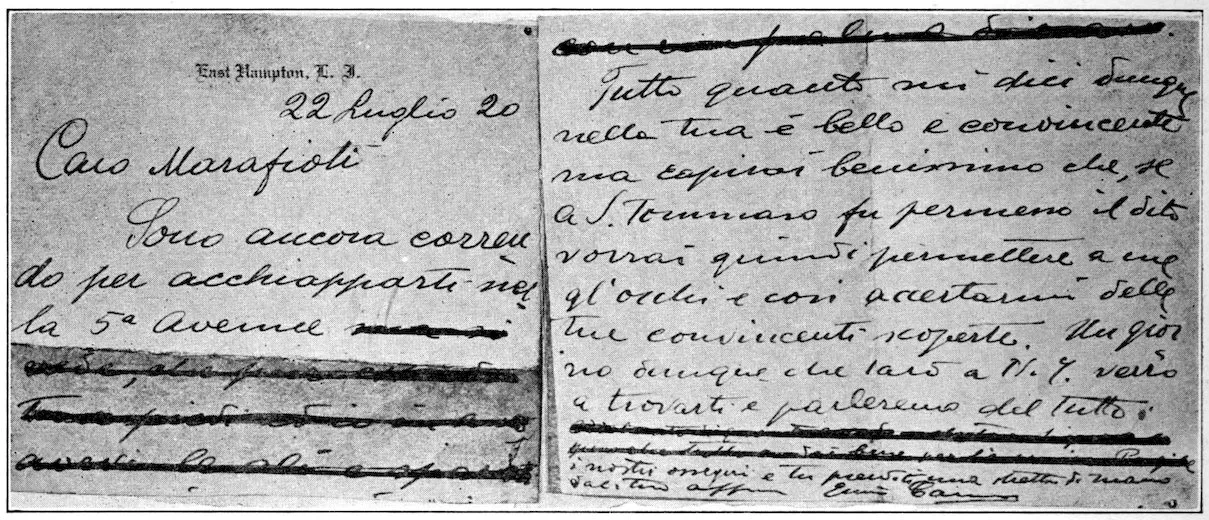
During the month of July, 1920, the author sent
to the artist a brief summary of his principles and
suggestions for a radical reform in voice culture,
which are illustrated in this book. Caruso answered
with the following note, the original of which
(written in Italian) is reproduced herewith, and
which, literally translated, reads as follows:
East Hampton, L. I.
July 22, 1920
Dear Marafioti:
I am still running after you on Fifth Avenue ... with
the object of discussing what you wrote me yesterday about
your vocal principles. What you tell me in your letter is
beautiful and convincing, but you understand very well that
if Saint Thomas was allowed to put his finger you must
permit me also to see with my own eyes and thus ascertain
for myself your convincing theories. Therefore I will be in
New York soon and will come to see you and discuss all
this....
Affectionately,
Enrico Caruso
45
Facsimile of caruso’s letter dated july 22, 1920
46Evidently Caruso felt that certain new ideas
needed practical demonstration, and only after having
made personal observation of some apparatus
which the author invented for actual evidence of
his principles did he feel reassured in his impressions
by this final and decisive proof.
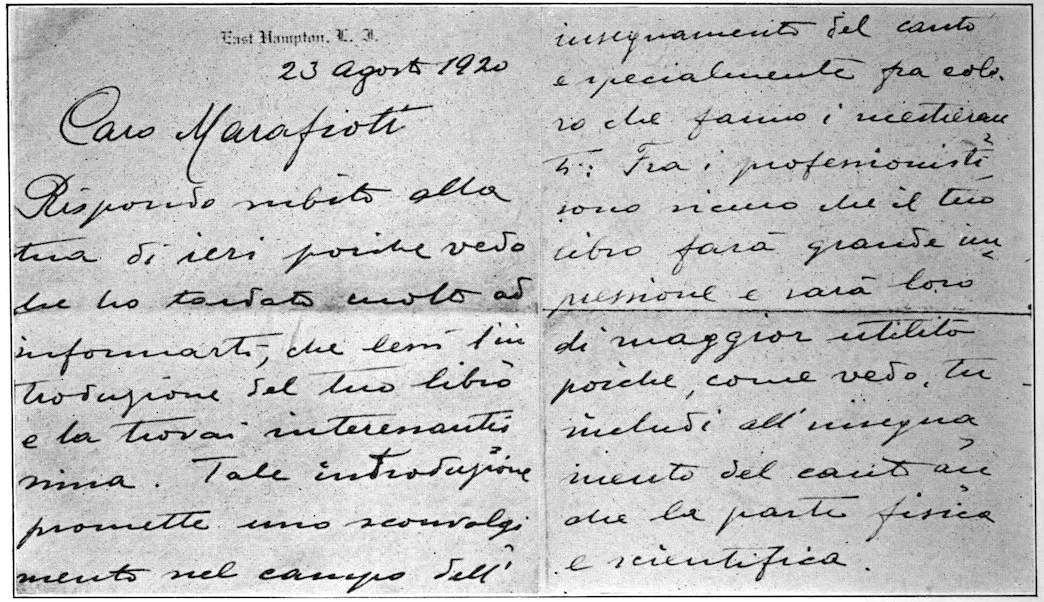
A month later the author sent to Caruso the introduction
and part of the scientific section of this
book. The following was Caruso’s answer (the
original, in Italian, of this letter is also shown
herewith):
East Hampton, L. I.
August 23, 1920
Dear Marafioti:
I am answering immediately your letter of yesterday, as
I see I have neglected to inform you that I have read the
introduction to your book and find it most interesting. Such
an introduction will cause a commotion in the field of vocal
teaching, and especially among those who are the merchants
of teaching. Among the real professionals I am sure your
book will create a deep impression, and will be of major use
to them, because, as I see, you add to the teaching of singing
also the physical and scientific issues....
47
Facsimile of caruso’s letter dated Aug. 23, 1920
48
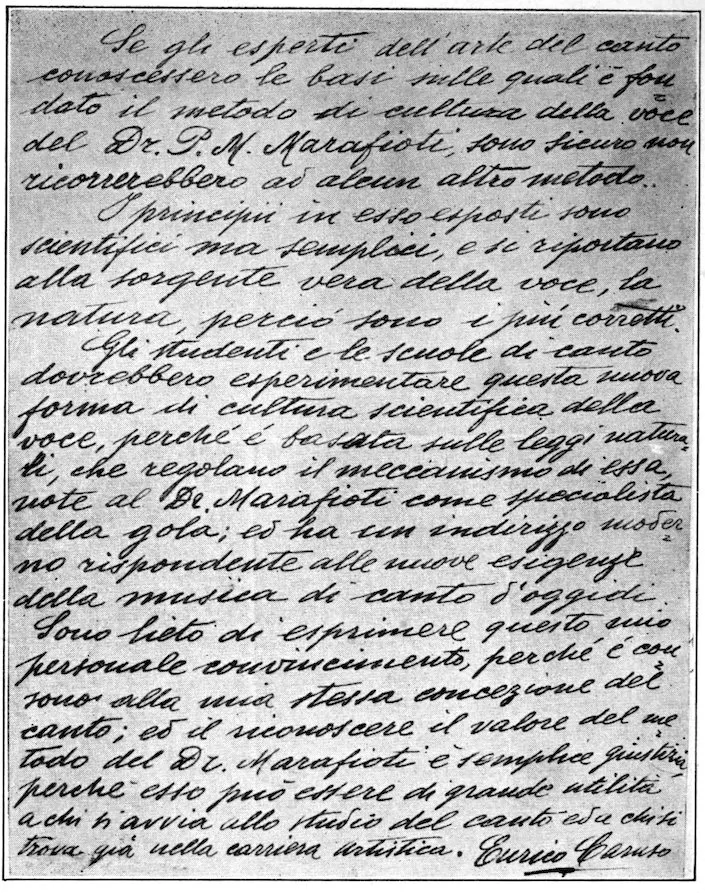
Facsimile of enrico caruso’s endorsement of this work
On October 5th the author received the following
official endorsement from Caruso for his method of
singing—The Scientific Culture of Voice49which, translated, reads as follows:[2]
October, 1920
If the experts of the art of singing knew the basis on which
Dr. P. M. Marafioti’s method of voice culture is founded, I
am sure they would not resort to any other method.
The principles it sets forth are scientific but simple, and
revert to the real source of the voice, Nature; therefore they
are the most correct.
Students and schools of singing ought to experiment with
this new form of scientific culture of the voice, because it is
based on the natural laws which rule its mechanism, known
to Dr. Marafioti as a specialist of the throat; and it has a
modern tendency, better fitted to the new exigencies of the
singing music of to-day.
I am glad to express this personal conviction of mine, for
it harmonizes with my own conception of singing; and the
recognition of the value of Dr. Marafioti’s method is but just,
because it can be of great service to those starting out in
the study of singing as well as to those who have already
entered into an artistic career.
Enrico Caruso
During the month of May, 1921, the author read
to Caruso a great part of this book, and stated his
desire to dedicate it to him.
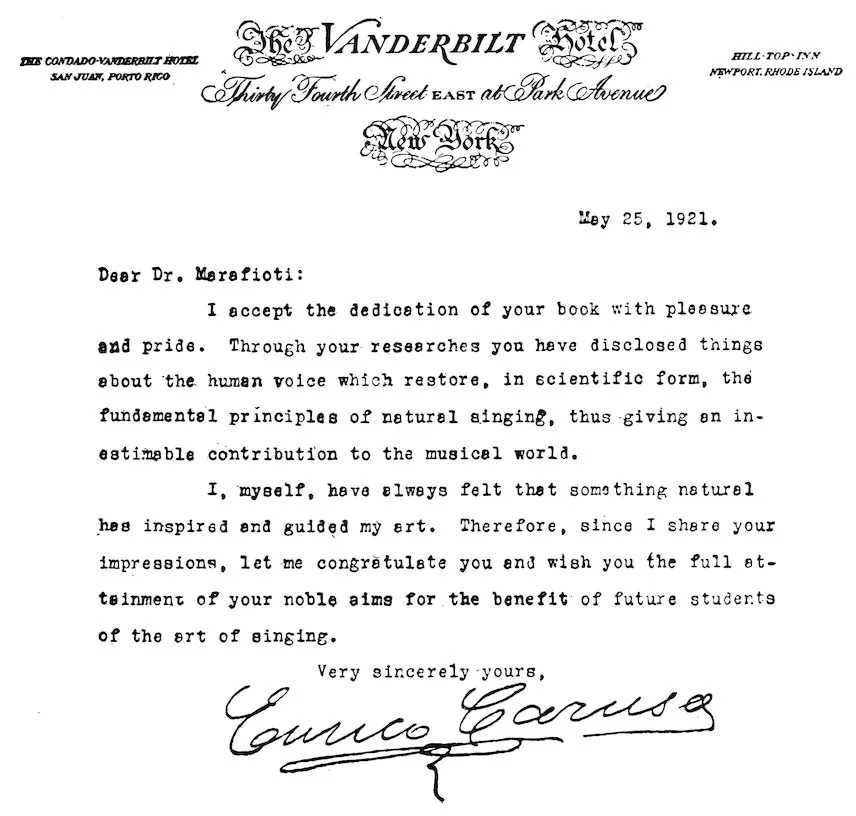
Three days before Caruso sailed for Italy, he
wrote to the author the letter published at the beginning
of this book, in which he accepted the dedication
and emphasized the point that, since he
shared the author’s impressions, he wished him the
full attainment of his aims.
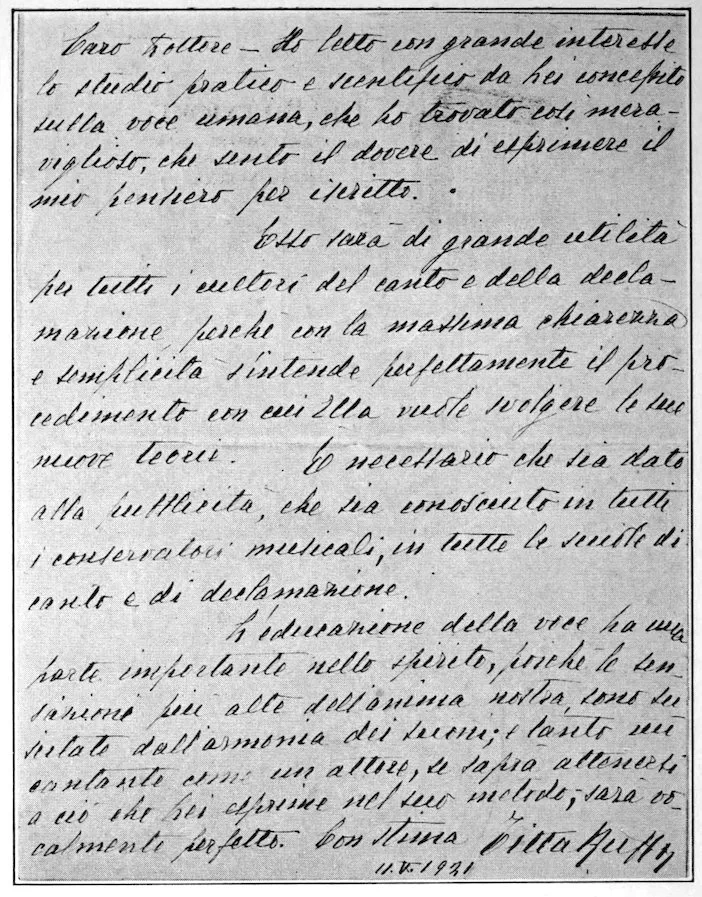
50On the strength of these personal testimonials
of Caruso, the author feels justified in his claim
that, though the method he is presenting as
Caruso’s Method of Singing has not been written
by the great singer personally, nevertheless it is
the most faithful reproduction of his own ideas,
and above all, of his “feelings” about his own singing.
No singer, especially a great singer who is
born such can explain exactly how he sings, though
he may express his “feelings” about his singing.
The following principles outline the scientific
contents of this book, on which the author bases
his Radical Reform of Voice Education. Some
suggestions will be developed later, indicating how
this reform of voice culture can be carried out practically.
The principles are:
1. Voice is Speech, and is produced by the mouth,
not by the vocal cords. The vocal cords produce
only sounds, which are transformed into vowels and
consonants by a phonetic process taking place in
the mouth, and giving origin to the voice.
2. (a) The full extension of the natural range of
the voice is produced only by using the minimum
tension of the vocal cords and the minimum breath
required for each tone. This establishes a correct
mechanism of voice production.
(b) The laryngeal sounds must be transmitted
to the mouth free of any interference; freedom is
the fundamental pillar of voice production.
3. Breath is an indispensable factor in voice
production, but it is not the essential power which
develops the voice as it is taught to-day. On the
51contrary, the function of singing develops the
breathing apparatus and its power, just as any
physiological function develops the organ from
which it takes origin. Therefore singing develops
breathing, not breathing, singing.
4. Resonance is the most important factor in
voice production. It furnishes to the voice volume
and quality, and emphasizes its loudness. To rely
on resonance rather than on force is essential for
producing a big and pleasing voice.
5. Speaking and singing are similar functions,
produced by the same physiological mechanism;
therefore they are the same vocal phenomenon.
The speaking voice is the substantial factor of
the singing voice and singing, in its very essence,
is merely speaking in musical rhythm; hence no
correct singing can exist without a correctly produced
speaking voice.
6. The pitch and the dimensions of the singing
voice—the volume, the quality and loudness—are
determined by the speaking voice. Speaking high
or low, resonant, loud or soft, in any gradation of
sentiment and shade of color, lays the ground for
singing in high or low pitch, loud, resonant or soft,
in any musical color or expression.
7. There are no registers in the singing voice,
when it is correctly produced. According to natural
laws the voice is made up of only one register,
which constitutes its entire range.
CHAPTER VI SOME SUGGESTIONS FOR A RADICAL REFORM IN VOICE CULTURE
52
To reinforce the foregoing principles, the author
advances the following suggestions which can bring
about a radical reform in the culture of the voice,
directing the art of singing toward more definite
rules, scientific, and better suited to the modern
conditions:
1. Voice culture must be natural in its basis, and
scientific in its principles—not empiric and arbitrary.
There must be only one method of singing,
founded on physiological laws, presented in practical
form.
2. The education of the voice must begin in the
elementary schools, and must first be taught to
children in the form of correct use of the speaking
voice.
We believe this to be the most important feature
in the reform of voice culture, being directed to the
very origin of what is responsible for the initial
defects and deterioration in the natural voices of
children. A school should be founded for this purpose,
where school teachers could get adequate instruction
in the natural and correct phonetic rules,
molded on classic languages, for teaching this form
of voice education.
533. Singing teachers must be new professionals,
combining scientific with artistic knowledge; a class
of voice specialists, differentiated from coaches,
accompanists, vocal musicians, etc.
4. Voice specialists must undergo a regular
course of training in scientific and musical matters
related to voice, and must be subject to examination
by a special Board of Scientific and Musical Experts,
elected or recognized by the Government.
They must get their practicing licenses from this
Board, as in the case of other professions. That
alone can protect the singing field from all kinds
of intruders, charlatans and impostors.
A survey of these principles and suggestions discloses
the extent of the author’s task. In his endeavor
to demonstrate how certain ideas about the
mechanism of voice production have been entirely
neglected or misinterpreted, and for strict adherence
to the principles laid down, which differ
considerably from the methods now taught, he must
advocate and suggest an almost opposite form of
vocal education from that which is now in vogue.
That has no relation of any sort with the completion
of the culture of the voice, as far as musicianship,
technic and style of singing are concerned.
This is a task which belongs to a class of professional
people, who represent the musicians of the
voice. These professionals—coaches, accompanists,
interpreters, etc., have the function of finishing the
artistic education of the pupil for the stage or any
other career. But the preliminary voice education
of the singing students is quite another matter, to
54which more serious and solid care should be devoted,
and in which the untaught should take no part
whatsoever.
For this purpose the author proposes a new form
of voice education which he calls the “Scientific
Culture of Voice,” based, as above stated, upon the
fundamental laws of acoustics and physiology of
the voice, and molded on the method of singing
of Enrico Caruso, who has been the living model
of the natural mechanism of voice production. This
culture must be intrusted to the specialists of the
voice who, being well equipped with the necessary
scientific and musical knowledge, fill the requirements
for competent and correct teaching.
The contents of this book, therefore, will treat
first of the voice purely as a physiological phenomenon,
from the standpoint of its natural production,
in accordance with the principles already announced,
and then of the most effective means for
accomplishing a radical reform in voice culture.
This will be carried out by an entirely original
method, based on phonetic rules molded on the
Italian language, which places and develops the
singing voice through the speaking voice.
CHAPTER VII THE HUMAN VOICE IN ITS RELATIONSHIP TO SCIENCE
55
The human voice is a physiological phenomenon
produced by the vocal apparatus.
Two branches of science—Physiology and
Acoustics—govern the human voice. Physiology,
which rules the functions of the human body, controls
the mechanism of voice production; and
Acoustics, which treats of the laws and properties
of sound, controls the physical product of the vocal
apparatus—the sound.
As a fundamental element of the art of singing,
however, voice represents a higher and more complex
factor than sound, as it constitutes the artistic
medium for expressing our thoughts and feelings
through music. Therefore, for the full exploitation
of the phenomenon—voice—the support of intellectual
assistance is required, and that is supplied
by Psychology, the science of the study of intellect
and sentiment.
Psychology lends to singing its mental contributions—its
inspiration, its emotions, its color, its
style; all artistic features which do not belong to
the voice in its simple form of physical sound.
This psychological contribution constitutes the
most precious equipment in the art of singing and
can be defined as the Sense of Singing. The sense
56of singing stands to the physical phenomenon of
voice as the painter’s conception of life and colors—which
he carries out through his imagination and
feelings—stands to his hand and brush.
We believe that the sense of singing is entirely
a natural gift, which no book or teacher can confer
upon any pupil to whom Nature has denied it.
Education may assist in developing it, but there
must be a substrata of certain mental qualities
which can be cultivated to make it possible to
achieve this fundamental factor of the art of
singing.
Therefore, the task of illustrating the contribution
of Psychology to this art will not be part of
our aim in developing this book. It is too important
to be treated briefly, in outline form, and
it is of no real value in the preliminary, though
most essential, task of teaching the mechanism of
voice production. Students of singing, however,
must note that psychology constitutes the very soul
of the art of singing, and must not neglect the
education of their minds, which comes first in the
exploitation of every art.
In regard to the physiology of the voice, in spite
of all the doctrines and books written about it, there
seems to be no clear understanding among professionals
of the laws and rules which constitute the
foundation of the physiological voice production
and culture. Many, in fact, confuse physiological
functions with physical efforts, and their misconception
goes to the extent of condemning the real
laws ruling the function of singing because they
57attribute to the term “physiological” the qualification
of effort.
In reality physiological, when related to a function,
is equivalent merely to normal. The misunderstanding
on this subject is due principally to
the fact that the greater part of the singers of our
times in producing their voices employ a power
which is the result of their maximum energy, and
they gauge it as normal, while in reality it is not.
As a matter of fact normal efficiency is produced
by the minimum of energy. A motor car running
at the speed of one hundred miles is not ruled by
its normal power, its motor being under high
pressure.
The voice produced by the maximum energy of
the vocal organs is under a strain, while the minimum
of power produces its normal efficiency. This
normal efficiency is what should be conceived as the
physiological function.
The multitudinous theories about breathing,
breathing exercises, diaphragm development, voice
building and many other complicated suggestions
related to the mechanism of the voice, show how
incorrect is the knowledge of the functions of the
vocal organs and how far these functions are
from being performed by physiological mechanism.
Voice production in reality is as simple and spontaneous
as is any other function of the human organism.
That constitutes the wonderful asset of
Nature—simplicity.
A clear conception of the function of the vocal
apparatus and the mechanism of voice production
58cannot be attained without, at least, an elementary
knowledge of the anatomy of its different organs,
and of the fundamental laws of acoustics which
rule them. But a thorough anatomical study of
the different organs of the vocal apparatus is not
really necessary for the comprehension of the principles
of voice culture. Such information may be
necessary for teachers, but it is as unnecessary for
the student to know the different muscles and cartilages
of the larynx as it is for the dancer to have
a detailed anatomical knowledge of the muscles of
the legs. Too much emphasis has been placed upon
the necessity of the study of anatomy for pupils.
We believe that the student should know only what
the mechanism of the voice is, and what the different
organs are that take part in the production of this
mechanism. The teacher should acquire a thorough
knowledge of the vocal organs, but most essentially
of their functions, in order to be able to determine
whether the pupil’s work is correct, according to
physiological rules, or whether it is incorrect because
of a faulty mechanism in the voice production.
In the next chapter an outline will be given of
those few anatomical parts which are necessary for
the study of the voice, omitting all unimportant and
complicated data.
Of the other scientific branch, concerned with the
phenomenon of the voice—acoustics—it is enough
to bear in mind a few elementary principles related
to the fundamental laws of the sounds.
Sounds are the physical result of bodies in vibration.
Vibrations are movements traveling in every
59direction, which reach our ears and are perceived
in the complex form of sounds, if periodic, of equal
duration, regular and rapid. If they are irregular
and unequal in duration, they are perceived merely
as noises.
This difference is very important because it establishes
from the very roots of the physical formation
of the voice the fact that only equal vibrations
can produce perfect sounds or tones; therefore,
equal vibrations are the fundamental asset for a
correct form of singing. That makes it very evident
how strictly the laws of acoustics are connected
with the rules of physiology in the production of
the laryngeal sound which is the seed that generates
the wonderful phenomenon of the human voice.
Therefore, the correct physiological mechanism
of voice production, by generating equal vibrations,
establishes the basic foundation for a correct and
natural method of singing. It is obvious then that
the mechanism of voice production is fundamentally
controlled by the laws of both sciences—Physiology
and Acoustics—working in harmonious coöperation.
CHAPTER VIII BRIEF OUTLINE OF THE ANATOMY OF THE VOCAL ORGANS
60
In giving a brief survey of the anatomy of the
vocal apparatus we will avoid as much as possible
scientific terms, exhibiting in simple form only
what is indispensable for singers to know about
the physiological functions of those organs which
represent the essential factors of voice production.
The mechanism of the human voice consists of
three elements: the moving power, or breathing apparatus;
the producing power, or laryngeal apparatus;
and the resonating power, or resonating apparatus.
These three elements are organized as follows:
1. The moving power consists of the lungs, the
respiratory muscles, the bronchial tubes, and the
trachea.
2. The producing power, the larynx, its muscles,
cartilages, and vocal cords.
3. The resonating power, the pharynx, the mouth,
and the chambers of resonance.
The author includes among the chamber of resonance
all the body’s cavities.
The lungs are two bellows of spongy tissue which
contain a large number of little cavities filled with
air (the air we inhale). To these cavities are joined
61numerous small tubes, called bronchial tubes, which
run into the lungs carrying the air and becoming
gradually larger in size and fewer in number. Toward
their exit from the lungs the bronchial tubes
are reduced to two—the large bronchiae, and finally
to one—the trachea (Fig. 1).
Fig. 1.—The lungs
In the second figure the lungs are contained in
a cage (the chest) which is formed by the ribs
and the intercostal muscles, attached between the
ribs. Under the lower border of the lungs, adherent
to the spinal column and to the lower six ribs, lies
a large and strong muscle called the diaphragm.
Its function, very important, though very much
exaggerated by some improperly called physiological
schools of singing, is a coördinate movement
of contraction and relaxation, which, in connection
with the movement of the other muscles of respiration,
establishes the mechanism of breathing by enlarging
62and reducing the chest and lungs to their
normal position.
Fig. 2.—The chest
The larynx, the second element of the vocal apparatus,
represents the sound box of the vocal
organs (Fig. 3) and embraces its cartilages and
muscles, and, most important, the two elastic bands
called the vocal cords.
The cartilages of the larynx, situated above the
trachea, are the following: the cricoid and thyroid,
the arytenoids and epiglottis (Fig. 4), and the two
smaller cartilages (Santorini and Wrisberg) which
are of minor importance. All of these cartilages
are joined by ligaments and muscles, which move
the larynx, and adapt the vocal cords to the different
adjustments for producing the relative
sounds.
63
Fig. 3.—The larynx
Fig. 4.—The vocal cords
The vocal cords (Fig. 4) are two elastic bands,
inside of the larynx, kept in tension during their
vibratory function by the cartilages and the muscles,
so that they can be put in vibration by the
blast of air
pushed by the
lungs and produce
the sound.
The fissure between
the vocal
cords is called
the glottis. The
vocal cords, in
a position of
rest, are relaxed
and wide open, thus leaving a larger space
for the passage of the air, which is called the glottis.
In the upper part of the larynx there exists a
very important cartilage called the epiglottis (Fig.
5). The epiglottis is flexible and is situated between
the base of the tongue and the opening of
the larynx. Its function is doubly important, since
64it acts as a protective lid to the glottis, by closing
the larynx in swallowing, so that food and drink
may pass over it without exposing the breathing
apparatus to any danger; and in singing it lends
free passage to the
sounds, from the vocal
cords to the
mouth and chambers
of resonance, by
holding itself in an
erect position, so as
to leave the larynx
wide open. The epiglottis
is attached to
the base of the
tongue and their relationship
is very important,
as together they play one of the most
essential rôles in the mechanism of voice production,
to which, unfortunately, not enough consideration
has thus far been given.
Fig. 5.—The epiglottis
The third element, the resonating power, consists
of the pharynx, the mouth, and the chambers of
resonance.
The pharynx (Fig. 6) extends from the opening
of the larynx to the opening of the posterior nasal
cavities, and includes also the uvula, which represents
the boundary between the pharynx and the
mouth. The upper part of the pharynx is called
the nasopharynx and is an important factor for the
resonance of the voice. The uvula is attached to
the soft palate and is prominent in the mechanism
65of the voice, because it has the faculty of controlling
the opening and the closing of the posterior nasal
fossae. By this function
the nasal resonance
can be improved
or checked.
Fig. 6.—The pharynx
The mouth (Fig.
7), the very important
organ of voice production,
is the cavity
which contains the
tongue—the invaluable
factor in speaking
and singing—the palate, and the lips. Above
the palate are the chambers of resonance, which
consist of the so-called masque, made up of all the
cavities, frontal sinuses, antrum, etc., of the upper
maxillary and
frontal bones.
Fig. 7.—The mouth
All of these organs
above described are
parts of one single
apparatus, which is
formed by a long
tube going from the
mouth to the lungs,
called the vocal apparatus.
This apparatus
has the mission of producing and carrying
the breath from the lungs to the vocal cords, which
puts them into vibration and produces the sounds.
From the vocal cords the sounds are carried, by
66the breath, to the mouth, where they are transformed
into voice, and to the resonance chambers,
where they get their full resonance.
The resonating power, however, is not represented
by the resonance chambers alone, but by
all the cavities of the entire body, according to the
author’s view, which will be more fully discussed
in a later chapter devoted to resonance.
In order to enable the reader to obtain a full
view of the entire vocal apparatus, the author has
condensed in the accompanying illustration (Fig.
8) all the organs that take part in the formation
of the voice. The most important of them are
specially indicated.
The illustration is a transverse section of the
vocal apparatus. Familiarity with it is of great
help in the study of the mechanism of voice production.
Therefore we recommend to the reader a
thorough examination of it, starting from the bottom
and working up. Held by the convexity of
the diaphragm are the lungs. From them originate
the small bronchial tubes, which gradually become
the two large bronchial tubes which, in their exit
from the lungs, converge into the trachea. At the
top of the trachea is the larynx, which contains the
vocal cords. At the opening of the larynx stands
the epiglottis, which is attached to the base of the
tongue. Then follows the pharynx, the uvula, the
mouth, the palate, and the resonance chambers.
67
Fig. 8.—Transverse section of the vocal apparatus
The task of demonstrating the important functions
of these organs belongs to physiology, which,
by means of its natural rules, can give the very
68correct exhibition of the mechanism of the voice.
This preliminary knowledge of the vocal apparatus
and of the fundamental laws of acoustics prepares
the ground for the development of our principles,
in reference to voice production, the aim of which
is centered, according to our conception, on closely
following the dictates of nature.
CHAPTER IX FIRST PRINCIPLE
69
Voice is speech, and is produced by the mouth,
not by the vocal cords. The vocal cords produce
only sounds, which are transformed into vowels and
consonants by a phonetic process taking place in
the mouth, and giving origin to the voice.
It is a general belief that voice is produced by
the vibrations of the vocal cords. “A column of
air, going from the lungs through the trachea to
the larynx, strikes and puts in vibration two ligaments,
and produces a sound. The ligaments are
the vocal cords, and the sound, produced by the
vibrations, is the voice.” This is the definition
given, in more or less similar form, by the majority
of writers on voice.
The author believes that a moment’s thought on
the subject will show that this definition is not
correct, as there is a marked difference between
simple sounds, as produced by the vocal cords, and
the real phenomenon of Voice.
Going back to the origin of the word Voice, in
its root it means speech (voc, in old Sanscrit, “to
say”: Vox, in Latin, “to speak”); and has been
associated, since its origin, with the qualification
of a sound uttered by the mouth in the form of
speech or song. The real essence, therefore, of the
70physical product of the vocal apparatus—the voice
as speech—was established since the birth of civilization
by means of the old classic languages.
Scientifically sound is the physical product of
equal vibrations given by any vibratory matter.
When the vibrations are produced by the vocal
cords they give origin to the laryngeal sound,
musically called tone.
Voice is a more complex phenomenon, in the
formation of which the sound is essential, but is
not the only factor, as for the formation of the
phonetic elements of the voice—the vowels and consonants—the
coöperation of other organs in addition
to the larynx are required.
As a physical phenomenon the vibrations of the
vocal cords are nothing exceptional, as they can
be produced by any sounding body—a musical instrument
as well as the human instrument, the
larynx, which in its structure is nothing but a
musical box combining the properties of both a
wind and string instrument. If two elastic strings
which are kept in the same tension as the vocal
cords are struck by a blast of air similar to that
which can put the vocal bands in vibration, they
produce a sound physically similar to that of the
vocal cords, but much different from that which
characterizes the human voice. This shows that the
vocal cords alone produce sound, not voice.
There is no physical difference between a laryngeal
sound and a violin sound; but there is a decided
difference between the violin sound and the human
voice in its real characteristics, as the former has
71no power to produce phonetic elements—words.
This demonstrates that sounds do not possess the
physiological properties required for making voice.
Therefore the laryngeal sound and the human
voice are not exactly the same thing, and although
sound is the germ from which voice develops, it is
not the voice. It stands to the voice as the seed
to the plant, which is an outgrowth of the seed but
is no longer the seed itself.
This implies that the rôle played by the vocal cords
in the formation of voice is much overestimated.
They are the leading factor in as far as the production
of the sounds is concerned; but the formation
of the voice is caused by the phonetic apparatus—the
mouth. The resonance chambers complete
this process of evolution by adding to the voice their
resonating power, with all the characteristics attached
to it—volume, quality, and loudness.
The voice, therefore, in its complete form, as
produced by the mouth, is much bigger, more resonant,
and of better quality than the original
sound from which it takes its origin. This establishes
a marked difference between the two products
of the two different phases of voice formation—the
laryngeal, which creates the sound—and the
phonetic, which creates the voice.
If, however, the principle that the vocal cords
produce only sounds and not voice is demonstrated,
it consequently becomes evident how erroneous it
is to attribute to them a function which they do not
perform, at least entirely. The vocal cords in fact
are apt to produce perfect tones, though always
72throaty and rather weak if hindered from getting
the full resonance of the resonance chambers; but
it is not in their power to produce any kind of
voice, composed of phonetic elements, vowels and
consonants, without the full coöperation of the
mouth—the real center of the voice.
John Hullah, professor of Vocal Music, in
Queen’s College, London, said: “There is no singing
without saying: that which is sung must also
be said.” This statement—the result of a logical
intuition—has great value, regardless of the fact
that it is not based on any scientific principle.
The following conclusions, which are of great
importance, follow the principle of “that which is
sung must be said”:
1. Singing, depending on saying, must rely on
voice, or words, and not on sounds.
2. The decided difference between sounds and
words brings about the result that the former, being
produced by the vocal cords, are sung in the larynx;
and the latter, being composed of vowels and consonants,
produced by the mouth, must be sung by
the mouth. This establishes, from the beginning,
the physiological rule that the voice must be placed
in the mouth.
3. Voice being produced by words, the more perfect
their formation, the more perfect is the resulting
singing voice. It is evident, then, that the
singing voice depends entirely on the speaking
voice, which establishes the important rule that for
training the singing voice correctly it is essential,
to train first, the speaking voice.
73This fact upholds the irrefutable axiom that any
method of singing based on tone and not on voice
production, in other words, based on laryngeal
production of sounds, is to be condemned, as it
tends to the abolishment of the natural beauty of
the full voice for the purpose of developing only
beautiful sounds, like the sounds of any musical
instrument. In such case the tones, being placed
in the larynx, are only slightly reinforced by the
laryngeal resonance, because they do not expand
enough to reach the masque.
A beautiful voice, in truth, must be the result
of a simultaneous collaboration of the different organs
which constitute the vocal apparatus—the
moving, the producing, and the resonating power—and
therefore cannot be confined to a laryngeal
struggle between the exaggerated efficiency of the
moving power (breath) and the strain of the producing
power (vocal cords).
Only by the complete coöperative and harmonious
work of these three powers is it possible to
obtain the desired result of producing a perfect
mechanism of singing, ruled by natural laws.
Great singers’ voices, especially natural voices,
have always been associated with the belief that
something rare exists in the anatomical structure
of their vocal apparatus—exceptional vocal cords,
for example, different from those of the generality.
The author has had the opportunity (through
his professional connection with one of the most
prominent operatic institutions in the world) of
examining and studying the vocal organs of almost
74all the greatest singers of the present day. In the
majority of them the vocal cords did not present
any striking characteristics which could establish a
marked difference when compared with the vocal
cords of people not gifted with singing voices. On
the contrary, among those singers whom he had the
opportunity of observing, were some with rather
deficient vocal organs, and often affected with
chronic congestion of the vocal cords, which, however,
did not interfere with their singing. In fact,
in a few cases the voices were exceptionally good;
Caruso was a typical example of this class.
On the other hand, the author has seen vocal
cords of exceptional character in persons who had
not the slightest notion that they could sing and
develop beautiful voices. The belief, therefore,
that the vocal cords of singers are responsible for
the power and the beauty of their voices, and are the
source of their exceptional singing, is as false as
it is popular.
In reference to our conception of the mouth as
the physiological center of the voice, illustrated in
this chapter, it may be argued that this principle
can be accepted only in regard to the speaking
voice, but does not apply to the singing voice. According
to our idea, however, speaking and singing
are similar actions; therefore there is no fundamental
difference between the speaking and the singing
voice. The reader, in the fifth and the following
principles will find this subject illustrated at length,
with the refutation of all objections that may arise.
CHAPTER X SECOND PRINCIPLE
75
1. The full extension of the natural range of the
voice is produced only by using the minimum tension
of the vocal cords and the minimum breath
required for each tone. This establishes a correct
mechanism of voice production.
2. The laryngeal sounds must be transmitted to
the mouth free of any interference; freedom is the
fundamental pillar of voice production.
When the mechanism of voice production enters
into action, the breathing apparatus, by means of
its respiratory muscles, pushes the air toward the
vocal cords and puts them in vibration. The vocal
cords, which by a coördinate function of the muscles
and cartilages of the larynx come together, because
of their elasticity adapt themselves to an indefinite
number of adjustments and give origin to a series
of different tones which constitute the range of the
voice.
The embryonic sound, resulting from the vibrations
given by the minimum of tension of the vocal
cords, put in vibration by the minimum of breath,
constitutes the lowest tone of the natural range
of the voice as produced by a correct mechanism.
76This tone is very feeble and is of no practical use
in singing, but serves to great advantage in the
mechanism of voice production, as it establishes the
deepest point of support for the consecutive tones
of the range, like the cornerstone in the foundation
of a building.
By comparing the upbuild of the natural range
of the voice with the construction of a house, we
see a great similarity in the structure of both, which
tends to show how important is the low section of
the vocal range in the production of the voice.
The foundation of a building is the underground
section which readily escapes observation; yet it
is as important as the section above ground, if not
more so, since it constitutes the real support of the
structure, and the greater its depth, the higher the
building.
In the upbuild of the voice there is a series of
tones which are of the lowest pitch, and of limited
sounding power; they nevertheless form the cornerstone
in the formation of the voice. These tones
which carry the low part of the compass of the
voice to its physiological limit can be formed only
by the minimum of breath and the minimum of
tension of the vocal cords; thus they create a
natural and easy mechanism of voice production by
establishing a preliminary adjustment of the vocal
cords which will rule throughout the entire range
of the voice.
When these preliminary low and feeble sounds
are gradually succeeded by a series of tones higher
in pitch and louder, the voice production has the
77advantage of finding itself placed on a correct basis
which will remain throughout unless the vocal
organs become affected by artificial influences capable
of changing their original adjustments.
With this mechanism the voice acquires a larger
range, because according to the laws of acoustics
the larger the size of the instrument, the less air is
used in producing sounds, and the lower is the pitch
of the resulting tone. By using little breath, therefore;
and by keeping the vocal organs in complete
relaxation, thereby enlarging the vocal instrument
to the utmost, a range of lower extension is created.
This is the lowest physiological limit of the natural
range of the voice.
Singers who carelessly cultivate the habit of
forcing their tone production from the beginning
of their training acquire a mechanism which
shortens the range of their voices, besides depriving
them of the invaluable support of the lower
part of their natural range, which is the solid foundation
in the upbuild of the singing voice. Their
voices, consequently, have no more resistance than
houses built on sand.
The natural range of the voice, therefore, constitutes
a number of progressive sounds, extending
from the lowest to the highest pitch of the
voice, when produced by a correct vocal mechanism.
To guarantee these sounds a correct formation,
it is imperative that the tension of the vocal cords
during their various adjustments, and the amount
of breath required for producing them, work in
harmonious accord. By complying with these rules
78the resulting mechanism of voice production is controlled
by the minimum tension of the vocal cords
and the minimum breath released by the lungs.
It is also obvious that the vocal cords, in increasing
their tension and shortening their length for
producing higher pitches, come under a physiological
control which guarantees that their adjustments
are made with almost unnoticeably increased
power, thus avoiding forced and sharp singing.
Therefore, to produce correct voice mechanism,
both the moving and producing power must be governed
in their coöperative work by the fundamental
law—the minimum of energy for the maximum of
efficiency, since voices based on this law are free
from effort, and nearest to perfection.
Another important factor in voice production is
the necessity for the tones to reach the mouth unhampered,
where they are to be transformed into
full voice. The laryngeal sounds must travel freely
through the larynx and pharynx with their original
number of vibrations, so that they may get the
advantage of a resonance proportional to the entire
volume of their vibrations.
This is of prime importance, for if the laryngeal
vibrations are hindered from freely taking on the
resonating power, they produce a voice of poor
quality, thin in volume and feeble.
The causes for this interference in the delivery
of the voice, though most serious, have never been
given due importance. The contraction of the
larynx and pharynx, the stiffening of the tongue
79and palate, and foremost the bending of the epiglottis
over the opening of the larynx are the aforementioned
causes which hinder the vibrations from
coming forward.
As a result of these interferences, the section of
the vocal apparatus extending from the trachea to
the lips is reduced in size, becoming narrower and
causing the most appalling defect in voice production.
According to the rules of acoustics as applied
to resonating tubes, the pitch of the tone becomes
higher as the size of the tube is reduced in width.
Therefore in the case of the vocal apparatus—the
most perfect sounding tube because of its power
of elasticity—its exaggerated contraction brings
about an alteration in the pitch of the tone. The
elastic property of the vocal apparatus which enables
it to establish a perfect control of its dimensions
should be utilized in a normal way during the
adjustments of the vocal organs in producing the
different tones of the range, avoiding any exaggeration
in the rhythm of the vocal mechanism.
As a matter of fact the adaptation of the vocal
apparatus should be so gradual as to be almost involuntary
on the part of the singer. The great
prima donna, Emmy Destinn, questioned by the
author years ago about her sensations while singing,
said: “When I sing I feel as if I have no throat.”
This statement proclaims the most wonderful and
instructive truth about voice production.
An easy mechanism of voice production enables
the larynx to produce free and full tones without
80strain, and allows it to rely on the constant coöperative
assistance of the moving power which can supply
any amount of breath necessary for producing
and carrying the sounding waves to the resonating
power.
Lowering the epiglottis over the opening of the
larynx, however, and stiffening and contracting the
tongue and palate, which bring about a partial
obstruction of the opening of the pharynx, constitute
such marked obstacles to the freedom of the
tone that they must not be overlooked.
Singing teachers and experts on voice have
neglected to illustrate the correct functioning of
these organs in voice production, due perhaps to
the fact that through a misconception of the vocal
mechanism the breathing apparatus and vocal cords
have almost monopolized their entire attention,
much to the detriment of voice culture.
Researches and publications dealing with the
breath and the function of the vocal cords are
countless; yet in spite of all the elaborated discussions
and suggestions for methods of breathing,
diaphragm development, and tone production, bad
singing prevails at present more than in any other
epoch. It now becomes imperative to establish the
exact status of the rôles played by these organs in
the mechanism of the voice, so that they may be
placed at their proper valuation in voice culture.
The epiglottis is a flexible cartilage which, by
shutting the opening of the larynx, protects the
vocal organs from such foreign bodies as food, or
drink, which would otherwise easily be carried down
81into the breathing apparatus during the inspiration.
In the process of voice production it has
the important function of keeping the laryngeal
cavity open for the free passage of the sounds on
their way from the vocal cords to the mouth.
Picturing the epiglottis as a door for the larynx,
its sole function is to remain open during the respiratory
and vocal process, and to close during the
passage of food and drink, or, in other words, during
the act of swallowing.
For our purpose, however, it is important to
illustrate its function only in relation to the voice
mechanism, in which its position, whether erect or
inclined toward the opening of the larynx, establishes
a difference of result in the voice produced
which is worthy of the most careful consideration.
Fig. 9.—The epiglottis erect
When the epiglottis stands erect (Fig. 9), or
bends toward the larynx (Fig. 10), being attached
to the base of the
tongue, it is closely
connected with all its
movements, and their
relationship, in voice
production, of decisive
consequence. In swallowing,
the epiglottis
must bend toward the
larynx, thus closing its
opening and preventing food from getting into the
breathing apparatus. The tongue helps this movement
by contracting its base and pushing the epiglottis
backward and downward. When the act of
82swallowing is over, both organs resume their former
position, the epiglottis standing erect, and the
tongue lying relaxed on the floor of the mouth
(Fig. 10). This position is the natural one for
singing; but things are merely reversed by a defective
voice production, which substitutes the
mechanism of swallowing
for that of singing.
This erroneous function
cannot be the
physiological one, as it
is evident that in order
to have the full number
of vibrations carried to
the resonating power a
large opening of the
throat—possibly the largest—must be formed.
Fig. 10.—The epiglottis turned down
The interference of these two organs is so commonplace
that very few singers escape its influence.
In most cases the tongue—the very worst enemy of
singers—is actually the responsible factor, because
by its contraction it exerts such pressure on the
epiglottis that the latter is forced down toward the
opening of the larynx. Therefore the narrow space
existing between the epiglottis and the pharynx
becomes still narrower, thus choking and preventing
a large number of vibrations from reaching the
resonance chambers. This condition starts the
original disorder, which brings about the disequilibrium
in the mechanism of voice production.
It seems that an instinctive influence—the result
of a nervous reaction or misinterpretation of the
83mechanism of voice production—prompts singers
to barricade the back of their mouth when they
begin to sing. They start by contracting their
laryngeal organs as if in self-defense against an
imaginary enemy—the sound—holding also all
parts of their body in a tense and rigid position.
The vocal cords, thus reduced in size by the contraction
of the larynx, produce forced sounds which
are greatly hampered from reaching the chambers
of resonance by the lowering of the epiglottis, and
by the contraction of the base of the tongue. Thus,
most of the sounding waves remain confined to the
larynx alone for their resonance. This implies first
that the voice is centered out of its natural focus,
the mouth, and is therefore misplaced; also that the
vibrations are prevented from getting their natural
expansion and from reaching the resonance chambers.
After this disorder takes place, it consequently
follows that the pressure of the breathing apparatus,
which acts under the same nervous influence
and erroneous conception as the mechanism of singing,
becomes more powerful. Then the vocal struggle
commences.
The larynx, reacting to the violent blast of
breath, increases its tension, and produces a voice
decidedly sharp and thin. The singer, worried
about his deficient vocal results, tries to improve
them by increasing the breath. It is like adding
more fuel to a fire that is already smothered by too
much of it. The more breath the singer adds, the
tighter the vocal organs become; the more his voice
84fails to show results, the more convinced he becomes
that he is not giving enough breath. Thus a vicious
circle is established.
Then all the resources of elaborated methods of
breathing and diaphragm support, and the most
strenuous laryngeal adjustments are put into
action. The lungs become a blowing machine, and
the vocal cords, under the violent blast of air, hardly
succeed in controlling the rhythm of their vibrations.
The congestion of the singer’s face bears
evidence of the painful efforts and the struggle he
is making. The muscles, blood-vessels, and nerves
of his neck stand out in ugly prominence, making
the performance more painful. As a climax to
these ineffectual efforts, the big and anticipated
effect bursts out and is usually embodied in a
strangled whistle very similar to that of a rusty
locomotive. Our Latin ancestors would say: “Parturiunt
montes ridiculus mus nascitur!” (“Mountains
burst and a ridiculous mouse is born.”)
This is the average spectacle which audiences are
called upon to witness in the singing of to-day,
when, because of these false methods, voices fail
by the hundreds, and singers whose natural gifts
would entitle them to a long and glorious career
are compelled to abandon singing after a few years
of painful struggle and devote themselves, in most
cases, to the profession of teaching.
Yet to say that correct singing, capable of carrying
out beautifully all human sentiments in spontaneous
form, is a very simple function, is to state
a physiological truth. It is certain that if nature
85were left alone to govern the mechanism of voice
by her physiological rules, without the profane
interference of incongruous theories and methods,
a natural form of singing based on scientific truths
would now exist, and would be the real guarantee
for correct voice culture. Students must remember
that every error at the beginning of their training
becomes a permanent habit in the future singing.
When the tone, by its complete freedom, succeeds
in getting into the domain of the resonating
power, another important factor completes its full
formation. All of its characteristics—volume,
quality, loudness, etc.—which are connected with
the property of resonance, lend to the resulting
voice their enriching power. We will treat this
great advantage later, in a special chapter, devoted
to resonance and its most important contributions
to voice production.
An original view also about the rule played by
the breath in voice culture, which is a conception
almost entirely in opposition to most theories about
the mission of the breath in singing, will be treated
at length in the following chapter.
It must be stated, however, that the freedom of
the tone represents the fundamental pillar on which
the correct mechanism of voice production is built.
CHAPTER XI THIRD PRINCIPLE
86
Breath is an indispensable factor in voice production,
but it is not the essential power which
develops the voice as it is taught to-day. On the
contrary, the function of singing develops the
breathing apparatus and its power, just as any
physiological function develops the organ from
which it takes origin. Therefore, singing develops
breathing, not breathing, singing.
The suggestion that any one who wants to learn
piano playing, dancing, skating, fencing or any
other sport should first undergo special training
for the development of his fingers, arms or legs
would undoubtedly seem preposterous. The same
false principle, nevertheless, when related to the
art of singing, does not give rise to any objection.
On the contrary, the artificial training of the
breathing apparatus for the purpose of learning
to sing is such a commonplace practice at the present
time in the teaching field that all kinds of
physical exercises for developing the muscles of
respiration and the chest are urged in most books
on voice. It would rather seem that the singing
students were being prepared for an athletic career.
The author, much interested in the teaching
methods prevailing nowadays has frequently questioned
87beginners regarding the kind of vocal exercises
they were taught in their preliminary work,
and has often been informed that their training was
confined principally to breathing maneuvers for
the development of the diaphragm and breathing
apparatus. In one instance the student, a young
man of twenty-five years, told that his teacher was
making him sing scales for an hour a day, saying:
“he, he, he,” and that peculiar exercise had been
indulged in for nine months under the supervision
of this well-known teacher in New York for the
sole purpose of strengthening the diaphragm, so
that the pupil could put his breathing apparatus
in form for further voice training.
This is by no means the strangest method advocated
by singing teachers. From another pupil we
have learned of the “umbrella method,” which consists
in opening the umbrella for the expansion of
the chest and closing it during the inspiration.
Enrico Caruso, while commenting on these methods,
told the writer of a teacher who had his pupils lie
flat on the floor and breathe while he was piling a
specific number of bricks on their chest. By increasing
their number gradually, thus putting a
severe test on the resistance of the pupil’s chest,
the teacher would measure the progress made each
time.
It seems ludicrous that grotesque performances
of this kind are still going on in the studios of
many teachers in our days of progress and evolution
when science has revolutionized our life with
the most astonishing discoveries.
88Independently, however, of these considerations,
the fact that breathing is a physiological function
brings this subject into the field of science, which
alone can establish well-defined rules of physiology
in reference to the act of singing. The rules of
physiology and no others must be in charge of the
function of breathing during the process of voice
production.
We remember having read this invaluable statement
in a book on singing: “He sings best who
attains the best results with the least expenditure
of energy.” It could be advantageously completed
by adding: “He sings the longest who forces his
voice the least.”
Breath in voice production is unquestionably a
most important factor; but its importance must
be properly appraised and considered more in the
light of breath distribution for attaining an artistic
style of singing, than in that of force. The
principal error of the many voice experts and
teachers is that they totally disregard, when it
comes to voice production, the fundamental law of
physiology that governs all human functions: “the
minimum of energy for the maximum of efficiency.”
The amount of energy developed by a human
organ in order to produce a certain action constitutes
what is called a physiological function. This
amount should be the minimum the organ can produce,
and the result should be the maximum of efficiency
as related to the energy employed. This
balanced relationship between power and efficiency
89constitutes the normal function of an active organ,
and establishes the correct mechanism of every
organic function.
Applying this principle to the physiological
mechanism of breathing in voice production, it is
evident that the minimum of breath which is capable
of putting in vibration the vocal cords and generating
sufficient sound vibrations for producing
the different tones of the vocal range, constitutes
the normal amount required for the correct function
of singing.
This establishes the fundamental relationship
between the moving power—the breath, and the
producing power—the larynx.
From this principle we derive the very important
deduction that only the normal breath has the
physiological property of producing correct tones;
in other words, scientifically, only the normal
breath can give the exact number of vibrations
necessary to produce a tone in its exact pitch, and
in its normal volume, loudness, and quality. A
surplus of breath, by increasing the number of
vibrations of the tone, alters the pitch and the aforementioned
dimensions—volume, quality, and loudness.
Another fact that has been discarded in general
is the evident danger of exposing the voice to physical
deterioration by using the breath under high
pressure, for, were it recognized, its employment
would be radically modified.
No real advantage, under any circumstances, can
result from use of the voice under high pressure,
90just as no advantage can accrue to a fencer from
using his arm under a terrific strain.
In every wind instrument, oboe, clarinet, flute,
etc., the expert player employs an amount of breath
rather small compared with that of the inexperienced
player; and the tone of the instrument is
much larger and more melodious in the former case
than in the latter. The instrument itself, if played
always under high pressure, deteriorates easily and
lasts but a few years; after some time of strenuous
use no sound can be gotten out of it unless a tremendous
amount of breath is spent. The same
happens with pianos after years of hard pounding.
In the vocal apparatus these conditions are more
manifest. In fact, by blowing forcibly into an
ordinary wooden or metal instrument its walls,
being rigid, do not react; while in the vocal instrument
the muscles and cartilages of the throat, and
above all the vocal cords can be very much affected
by the violent stroke of the blast of air. The throat
reacting becomes very tense, and the vocal cords
under the exaggerated pressure cannot produce
their vibrations normally, since their movements are
not coördinate, equal and balanced, for lack of
proper control.
When the vibrations of the vocal cords are not
equal, synchronous and balanced, they cannot,
according to the laws of acoustics, produce perfect
tones, because this condition establishes the decisive
difference between tone and noise. The voice,
therefore, produced under high pressure, approaches
in quality rather a noisy sound than a distinct
91tone and loses all the characteristics attached
to its natural beauty, besides being out of the scientifically
correct pitch. The result is that the efforts
and large expenditure of energy used by singers
serve the sole purpose of deforming and wasting
what nature provided in a correct form—the
precious gift of a beautiful voice.
From this fundamental fault many others of
psychological nature originate, all of which combine
to make of the most spontaneous and easy act
of singing a very difficult and dangerous function.
The fatal consequences are the deformity and the
deterioration of the vocal organs, which are destined
to wear out more easily than any wind instrument.
The fact that many singers force their voices with
the idea of getting better results invites this question:
Do they realize that they are forcing? Do
they foresee the disastrous consequences which they
are inviting by doing so?
Usually not. As a matter of fact any remark
made to them to the effect that they are abusing
their vocal organs is always emphatically denied;
they assure you that they are not using any force;
that their singing is the easiest and most spontaneous
action. Meanwhile they are giving full
evidence that they have not voice enough left for
making this explanation convincing—a peculiar
and unfortunate psychology! An intoxicated
person, while trying to stand on his feet, always
persists in saying, “Do you think I am drunk?”
Thus we find this class of singers always ready
92to make an emphatic show of the expansion of their
chests, and to parade around asking people to feel
with their own hands the resistance of their diaphragm;
and while their strenuous singing is a real
effort they do not hesitate to say that it comes to
them most naturally.
These singers see only the spring of their careers
and vanish before the summer.
What is responsible for this absence of self-judgment?
A little thought brings about this conclusion.
The mechanism of voice production which these
singers, by discarding natural laws, employ under
high pressure of breath, establishes from the very
outset of their voice education a false background
of rules and theories on which their psychological
conception of singing is formed. Adding to this
the faulty training which gradually deteriorates
their vocal organs by exercises of an injurious
nature, it is inevitable that the wrong foundation
becomes the natural standard of voice production
for these students who are to be the future singers.
On the other hand, the fact that they have never
been accustomed to a normal production of tones
makes them unaware of the difference between their
voice production and the correct one.
Therefore, they can never see their own defects,
just as the ragtime player, while he bangs heavily
on the piano, cannot see the difference between his
playing and the delicate touch of a refined interpreter
of Chopin.
93The real responsibility for the false conception
of the important part breath control plays in the
production of the voice rests entirely with the incompetent
teachers of to-day, whose methods are
based on erroneous principles.
The absurd and unnatural use of the breathing
apparatus, and especially the magic power centered
on the diaphragm, constitute the true cause of so
much bad singing nowadays. The few celebrities
of the singing stage we possess offer us the best
evidence against these erroneous methods.
If it were true that the power of breath and the
strength of the diaphragm play such an important
part in the mechanism of voice production, what
would happen to those who are not endowed with
such physical resources of large proportions? It
would seem that those of small stature and of delicate
structure would be deprived of great vocal
production.
Bonci, for instance, is one of our greatest and
most correct singers, whose breath has never failed
to assist him in his artistic delivery; yet everybody
knows that Bonci is not built like an athlete.
It is a strange coincidence that many coloratura
sopranos and lyric tenors who sing mostly in the
upper tones of the range and who, according to
the theories in vogue, should require a huge amount
of breath and terrific strength of the diaphragm for
the support of their sustained tones, happen to be
rather undeveloped physically and oftentimes have
not even the power of breath resistance given to
94the average person. We can cite the case of a
world-famous coloratura soprano, very frail and
delicate, who startled the musical world with an
instantaneous success, and whose breath never
failed her in the most difficult executions of her
coloratura variations. On the other hand, we could
name a large number of strongly developed singers,
with large chest expansion, whose voices are painfully
poor and insufficient. Taking into consideration
their physical appearance, their developed
lungs, muscles of respiration and all other organs
related to the vocal apparatus, these athletic specimens
could offer no excuse for the insufficiency of
their voice if it were true that voice production
depends so much on the strength of breath.
It is evidently untrue that with the aid of physical
equipment capable of producing a large amount
of breath, or with a particularly well-developed
diaphragm a singer is endowed with the indispensable
assets for good voice production. This false
theory, which unfortunately is almost universal
to-day, can hardly be defied without offending the
traditional feelings of the faithful believer in the
diaphragm’s almighty power! Furthermore, this
erroneous principle has so influenced the musical
world that even those outside the singing field, such
as some music critics and dilettanti, have set the
power of breath and the strength of the diaphragm
as a standard in appraising the value of an operatic
or concert singer. “Short of breath,” “diaphragm
support,” “strength of breath” are the usual epithets
95employed in the discussion of artists and their
singing merits.
Even the great Caruso has not escaped the application
of this false standard of judgment; he whose
phenomenally sustained tones were not the result
of a strenuous breath-power but of a marvelously
balanced distribution of it which enabled him to
indulge in his most striking effects.
The greatest singers of the past knew very little
indeed about the diaphragm and the mechanism of
voice production in general; still their names remain
revered in the memories of music lovers. I
believe that most of our best contemporary singers
have only the vaguest notion of the physical
mechanism of the voice, but they are not to be
reproached as long as their singing conforms with
natural laws.
The following incident has been related to us by
a prominent American soprano. The famous
Adelina Patti was visiting the studio of a world-renowned
singer and teacher in Paris to hear some
of his pupils. After one of the students, who had
been cautioned by the professor as to the use of his
diaphragm, had finished singing, Patti turned to
the teacher and very candidly inquired, “Well,
what is that diaphragm? I never heard of it during
my career.” This is one of the most striking remarks
made by an indisputable authority in confirmation
of our theory.
In the fields of Italy the author has heard the
peasants—while they work at picking olives or
96grapes from the ground—sing in a chorus their
popular folk songs, as is their custom. Among
them he could detect some soprano voices reaching
such high pitch that it was almost inconceivable to
imagine that human voices could attain such altitudes.
Yet these natural singers were kneeling on
the ground in a cramped position, and, judging
from the beauty and the ease of their voices, wonderful
and blessed seemed the absence of theories
and methods about the use of the diaphragm in
singing. Their voice production was physiologically
as perfect as it was unconscious, and I am
sure that the diaphragm-apostles of the teaching
fraternity of to-day would feel doubtful about their
theories had they the opportunity to hear them.
Here, in New York, a little boy eleven years of
age, born of poor parents, was discovered by an
American physician, who, while passing through
one of the streets of the lower East side, was
attracted by a beautiful voice coming from one of
the crowded tenements. The physician made inquiries
about the possessor of the beautiful voice
and was greatly astounded when he was presented
to a tiny, underdeveloped lad. The same evening
the child was presented to the writer, who, looking
at the tiny singer, concluded that the matter of his
voice had been exaggerated by the enthusiastic discoverer.
He asked the child what he could sing.
“Pagliacci, Martha, Rigoletto,” was the unexpected
answer. “Who taught you to sing?” “Caruso ...
on the phonograph,” he answered. And the child,
taking the floor like an experienced tenor, sang
97one after another of the most difficult arias from the
above-mentioned operas, with a big resonant voice,
in which the natural sentiment and pathos were not
secondary to the dramatic force and expression
suggested to the child by the powerful singing of
his teacher—Caruso.
During the wonderful and touching performance
of this little singer one could not refrain from a
sense of pity for those mighty disciples of a trained
diaphragm, who, while trying in vain to produce
perhaps one-half the amount of voice of that miniature
tenor, look almost ready to explode like rubber
balloons.
What then, is this concern about the breath?
Why the need of such long training for the artificial
development of the diaphragm?
Breathing is a natural function, independent
even of our own will. We cannot prevent breathing.
Let nature, then, take care of this function;
she will provide for it when necessity presents itself.
Let nature suggest or rather carry out her
own mechanism of breathing, and let us not attempt
to interfere with it and deform it.
We breathe all the time, whether awake, asleep
or unconscious. Our very life is dependent on this
providential function and we have no reason to
think of it. Why then should we devote so much
thought to it when singing?
Of course we must discriminate between force
of breath and skill of distribution. If more attention
and effort were given to the latter a proper
conception of the mechanism of singing would be
98obtained. The singer who after a few tones is compelled
to take another breath does not know how
to distribute his breath, even though he may be an
expert in breathing and in the art of using his
highly trained diaphragm.
On the other hand, the singer who knows how to
distribute his breath never runs short of it, and the
normal respiration furnishes him enough power
with no cause to worry about the strength of his
diaphragm or his intercostal muscles. Nature helps
him in the most exceptional instances, such as exist
in certain operatic arias where a surplus of air is
necessary to produce dramatic effects, coloratura
variations and long cadenzas. Caruso’s singing in
the “Pagliacci” aria was the typical demonstration
of this statement.
Our conception about the all important factor—the
moving power—in the mechanism of voice production
discards all theories and suggestions related
to the different types of breathing, such as the
clavicular costal or abdominal respiration because
we believe that the student of singing should not
be conscious while performing this natural function
of life. The physiological respiration, which
we employ from our birth, is the natural one, and
it must also rule our breathing when we are singing.
The beginner who applies to a teacher for assistance
in voice culture, and is put under the shameful
training of artificial means for developing his
breathing apparatus like a circus athlete, and whose
mind is fed on the absurdity that the secret of good
99singing lies in the strength of his breath and the
power of his diaphragm, is misled at the very outset
of his career, and is given a false foundation.
He invariably loses the spontaneous conception of
singing, which usually is given by nature itself as
a compliment of her gift of a beautiful voice. It
should, therefore, be left to nature to take care of
her own product—the voice—and if the student is
endowed with intelligence and a marked musical
sense he does not need any artificial help other than
a guiding hand to watch his development and to
keep him always under the control of natural laws.
The guiding hand should be the teacher and nothing
artificial should be substituted for nature itself.
The strength of the breath and its volume in
singing must be the result of a correct mechanism
of voice production; by the prolonged but normal
employment of breath the muscles of respiration
become naturally stronger and gradually increase
their power of resistance. This system alone, after
years of voice training and a singing career, will
acquire that perfect control which is one of the fundamental
pillars of correct singing. Practically the
same thing will happen as in the case of dancing,
fencing, or any other physical sport.
The physiological laws of respiration, therefore,
must be the sole rules to follow, and all false notions
about the artificial development of the respiratory
organs must be discarded as dangerous by those
who aspire to a successful vocal career.
CHAPTER XII FOURTH PRINCIPLE
100
Resonance is the most important factor in voice
production. It furnishes to the voice volume and
quality, and emphasizes its loudness. To rely on
resonancerather than on force is essential for producing
a big and pleasing voice.
To understand the phenomenon of resonance, it
is indispensable to become acquainted with the few
laws of acoustics, which are most closely related to
it. The readers, however, who desire to get a more
complete knowledge of this interesting property of
sound, can refer to any treaties on acoustics where
this subject is widely discussed.
In order to explain what resonance is, we prefer
a practical rather than a scientific illustration, since
it is more advantageous for our purpose.
A common experience—talking into a megaphone—shows
how the voice can become greatly
magnified in its characteristics—loudness, volume,
and quality. This is merely the result of a resounding
property furnished by the horn of the megaphone.
If we hold a violin string by its extremities, in
tension, against a brick wall, or an empty space,
and strike it, an almost imperceptible sound develops,
given by the vibrations of the string. If
101we put the string on an empty case—wooden,
metallic, or of some other material—the sound becomes
much louder and more resonant. The reason
is that the amount of air contained in the empty
case vibrates also under the stroke of the vibrations
transmitted by the string, thus magnifying the vibrations
in number and amplitude. The sound, so
decidedly enlarged, is the result of the string only,
in so far as the embryonic element, the vibrations,
is concerned; the case is responsible for its development
and enlargement.
The auxiliary function of the megaphone and of
the case, with their characteristic power of magnifying
the original vibrations of the sound constitutes
what we call resonance.
In the human voice the sounds, as produced by
the vocal cords, are weak and colorless, but when
magnified by the resonance furnished by the laryngopharyngeal
and oral tube, plus the resonance
chambers and body cavities, they become larger in
volume, stronger in loudness, and of softer quality.
The laryngopharyngeal cavity and the mouth—a
natural horn—as compared with the megaphone—an
artificial horn—act as a resonating apparatus
which magnifies the rudimental vibrations of the
vocal cords into full voice, just as the megaphone
makes the sounds produced into it more voluminous.
In both cases the decided improvement in
their original vibrations is due to the intervention
of the magnifying power of resonance.
Scientifically, a tone produced without resonance
is a simple sound; with resonance it becomes a compound
102or complex sound. The original sounds
produced by the vocal cords are simple, made up
of vibrations of limited sounding power. They
become complex when enriched with the resonating
power of the body cavities which gives them timbre,
volume, and loudness. We say body cavities, because
we venture to assert that the human body, in
all its cavities, acts as a big resonator for the voice.
Although a chest and masque resonance, originating
from the chest, the antrum and frontal
sinuses, are generally admitted, up to the present
time no mention has been made of the body
resonance. Nevertheless if, according to the laws
of acoustics, the vibrations travel in every direction,
provided they are not intercepted by any obstacle,
there is no reason why the sounding waves should
stop at the aforementioned cavities of the chest and
masque instead of spreading all over the body, getting
the resonance of all its other cavities—the
head, bones, abdomen, and joints combined.
What usually interferes with the transmission
of the sounding waves from the larynx to the body,
confining the radius of their expansion to the nearest
cavities is caused in most cases by a throaty production
which checks the expansion of the voice.
As a result of this false mechanism of voice production
even the amount of resonance given by the
nearest cavities is sometimes obliterated also, as the
exaggerated contraction of the throat prevents the
sounds from reaching the resonance chambers. If
this is true of the nearest cavities, it is logical to
suppose that interferences of similar nature are
103likely to prevent the vibrations from reaching the
more remote sections of the body, thus hindering
the cavities of these sections from making the valuable
contribution of their resonance.
The rigidity of the muscles of the body, for instance,
which is usually the coefficient of a forced
mechanism of voice production, and an instinctive
act with many defective singers, represents a
marked physical obstacle to the traveling of the
sound vibrations.
A simple demonstration of this can be obtained
by following closely the phenomenon of resonance
in musical instruments. A piano, for instance,
improves its tone merely by being placed on a
wooden platform, in which state its vibrations are
not confined to its strings alone, nor to its case.
They travel in every direction and are transmitted
even to the floor and walls of the room, from which
they get other vibrations and resonance, if the
material of which they are composed has resonating
power. Piling many articles of heavy material on
the piano and playing it on a tiled floor, or even
on a floor covered with thick carpets, are sufficient
causes for markedly diminishing the power of its
resonance.
All opera houses and theaters are constructed
according to the rules of the physical property of
expansion of the vibrations and their resonating
power. Architects take particular pains to obtain
the best acoustics by scientific methods, which
guarantee the free expansion of the sound waves,
so they can reach any empty space within the walls
104of the building, which are constructed of such
material and in such a shape as to produce new
vibrations, thus increasing their power of resonance.
As for the human instrument, a well-built body,
with all its strong bones and large cavities, undoubtedly
furnishes one more factor of resonance
to the resonating power, which should not be
neglected.
There are singers who stand rigidly and heavily
while singing, and their stiffness creates such an
obstacle even to the circulation of the blood, as to
be easily discernible in their spasmodic expressions,
and in the congestion of blood in their faces and
necks. These singers undoubtedly deprive the
voice of most of its resonance, because the rigidity
of their muscles and tissues prevents the spreading
of the sound vibrations from the source of their production
to the entire body, just as it prevents the
blood from running freely all through the circulating
system.
Several years ago, a prominent London doctor
startled the entire musical world by saying that
Caruso possessed musical bones.
A certain newspaper in New York solicited
interviews with some laryngologists to inquire into
the possibility of possessing musical bones. The
writer was one of those consulted, and he found it
most difficult to convince the interviewer that, although
there are in truth no musical bones, there is
a possibility of human beings possessing organs
made of tissues of exceptional resonating property,
which is dependent, perhaps, on the quality and
105constructive essence of the cells from which they
are made.
Indeed, Caruso had no musical bones; but the
writer can affirm, from personal knowledge, that
they had a power of resonance which was startling.
In fact, by tapping on his mastoid with
a finger, or, as he did himself, with his ear lobe,
a sound was produced which could be heard at a
considerable distance. This represented merely
the exceptional power of resonance of his bones,
which were composed of very fine, compact resounding
matter. This is not at all surprising when
we consider that in some musical instruments the
kind of wood from which they are made has a striking
influence on the resonance of the tones produced,
the quality and volume of which, according
to manufacturers, is even related to the number
of years of seasoning of the wood. The hypothesis
is naturally suggested that the compactness
of the cells and fibers of certain trees has the characteristic
property of lending to their wood a more
remarkable power or resonance.
Why can not this same possibility exist in the
human body? The resounding property of the
masque, head, chest, etc., which are hollow cavities
surrounded by hard compact matter, may be dependent
upon the nature of the cells, which constitute
the constructive substance of the entire
frame of the body.
This subject is worthy of a certain scientific consideration,
and should arouse at least sufficient
interest for finding out whether the privilege that
106certain races possess, of having a greater number
of beautiful voices, is not attached to some physiological
property dependent upon their method of
living, alimentation, climate, etc., which creates a
certain difference in the anatomical structure of
the tissues of their bodies.
The soil, sunshine, air, light, etc., which are
responsible for making the fibers of certain trees
hardier, drier, and of more compact matter, better
fit for the bodies of musical instruments than others
of soft and spongy nature, raised in marshy, damp
fields, constitute the characteristic conditions which
influence the different growth of those trees. Cannot
the same natural conditions have some influence
upon the physiological development of the human
tissues of the inhabitants of certain regions? By
a logical deduction, this should be so. Of course we
are not talking of beautiful voices in reference to
their phonetic and artistic qualities; as for singing,
we must not discard the fact that the more marked
aptitude of certain races for expressing their feelings
through singing is due to psychological influence,
such as musical education, environment,
temperament, and, principally, hereditary disposition.
We think, though, that even these traditional
racial qualities have at the bottom a physiological
ground, which was generated primarily by the
above-mentioned natural conditions, and evolved
gradually into a psychological form from generation
to generation, for centuries. The temperament
of the Latin races, for instance, especially the
Italians, has always been associated with a certain
107influence of the mild climate, the bright sunshine,
the clear skies, the volcanos, etc., all such elements
which seem to be responsible for some of their
characteristics and natural dispositions, and have
undoubtedly influenced the psychology of that race.
Therefore, the author’s hypothesis has some
scientific and material foundation. The human
body contributes resonance from all its cavities,
and there may exist a difference in the quantity and
the quality of resonance in different persons,
which is dependent upon the constitutional structure
and the development of their tissues, and perhaps
upon the origin of their races.
The voice has three characteristics which are
closely allied with its power of resonance: loudness,
timbre or quality, and volume. From the
combination of all of them a strong, beautiful and
resonant voice results.
A recent view, already quoted in this book, gives
to the resonance the power of producing vocal
vibrations, besides the function of magnifying
them, a function which is generally attributed to
the vocal cords alone. Thus, according to this view,
the resonance plays a more important rôle, combining
both the power of magnifying and that of
producing sound elements.
The vibrations, by their power of expansion,
spread from the vocal cords into the larynx, where
certain resonance is given to the fundamental
sounds by the ventricles of Morgagni. They then
expand through the pharynx, all over the mouth,
the resonance chambers and the entire body. In
108the resonance chambers more vibrations are produced
by those already traveling from the larynx,
all of them becoming reinforced in their dimensions
and characteristics by the resonating power. This
coördinated strength, resulting from the intensity
and amplitude of the vibrations produced by the
vocal cords and by the resonance chambers, and
their magnified resonance, is responsible for the
loudness of the voice, which constitutes the most
striking of its characteristics.
The second characteristic of the voice—the more
valuable—is the timbre or quality, which to most
experts signify the same thing. It is the author’s
view that the quality or timbre of the voice possessing
the distinct property of pleasing the ear constitutes
the most prominent characteristic in voice
production. It is worth finding out, therefore,
what physical factor gives quality to the voice.
If we strike a tone on the piano, and let the sound
fade gradually, toward the end of its vibrations, we
hear a series of lighter tones which are perfectly
harmonious with the original, though much higher
in pitch. The tone we hear so distinctly at the beginning,
which fades gradually, after a while, is the
fundamental tone, which we are playing. The
other sounds, which are concomitant tones to the
fundamental one, are the so-called overtones. The
fundamental tone is the lowest in pitch but much
stronger than the others; the overtones are higher
and much softer, and are to the tones what the
shadows in a painting are to the drawing. A well-trained
ear can detect the overtones in voices correctly
109produced, while in voices produced by a
forced mechanism only the fundamental tone can
be heard, or certain high overtones which do not
entirely harmonize with the fundamental one.
Voices produced with only fundamental tones
are poor in quality and dry, lacking the richness
in overtones; those in which incorrect overtones
prevail are disagreeable and decidedly forced.
The quality of the voice can be enriched only
through the abundance of its correct overtones.
Because of their importance, therefore it is of interest
to know their position with regard to the fundamental
tones.
The most important overtones are located on
the octave, the twelfth, the fifteenth, and the seventeenth
notes of the fundamental tone. Striking a
note on the piano, C below the staff, for example,
the first overtone is C of the next octave; the second
overtone is G above the staff, which is five notes
higher than the first and twelve notes higher than
the fundamental tone. The third overtone is high
C above the staff, fifteen notes higher than the
fundamental one; and the fourth overtone is E,
which is seventeen notes higher than the fundamental
tone; and so on.
There are higher overtones, in addition to these,
but they are difficult to detect, except with the aid
of Helmholtz resonators, and are of no help in
singing, therefore useless to discuss.
According to Helmholtz, the overtones which are
perceptible to the ear are those which determine
the quality of the voice. Their presence or absence,
110whether partial or entire together with their intensity,
decides the particular characteristic of the
organ, whether more or less metallic, and gives to
the voice its distinctive quality.
The overtones are so intimately connected with
the fundamental tone that to change their number
or intensity means to change its quality. In fact,
as we said before, a sound without overtones is soft
and sweet, but feeble, small, poor; with the lower
overtones—those classified above—the sound becomes
rich, harmonious and full, still retaining its
softness, if all overtones are produced with the same
proportional intensity.
In voice production, when the overtones over the
fifth become more prominent than the fundamental
tone, the voice becomes sharp and disagreeable.
Those overtones which should be ignored are, on
the contrary, much developed by the current
methods of singing, based essentially on the force
of the breathing apparatus, which emphasizes, by
an exaggerated number of vibrations, only the
highest overtones.
The fullness of the voice is due to the prevailing
intensity of the fundamental tone in relation to its
overtones. On the contrary, the dominating intensity
of the overtones over the fundamental tone
causes an emptiness in the voice, which is the result
of thin, small vibrations. The presence, therefore,
of the overtones, and their relative position toward
the fundamental tone, is of capital importance in
relation to the most beautiful of its characteristics—the
quality.
111The contribution of resonance to the volume of
the voice is of much greater importance than that
furnished by the moving power—the breath, or by
the size of the vocal cords—the producing power.
In musical instruments the volume of the tone is
dependent principally on the size of the case of resonance,
which is related to the amount of air it
contains, and to a certain extent also to the quality
of material of which it is made. The larger and
finer the wooden body of a violin, the larger the
volume of its tone. The tone of a violoncello is, in
fact, bigger than that of a violin, due more to its
larger case of resonance than because its strings are
thicker, although this has some bearing also on the
volume of the tone. All the foregoing proves that
the size of the vocal cords in relation to the volume
of voice is of much less importance than the amount
of resonance which can be given by the resonating
power.
As for the moving power—the breath—it cannot
be compared with the power of resonance. Increasing
the power of a violin bow for the purpose of producing
bigger tones cannot compare with the improvement
gained by giving to the violin a Stradivarius
body, so rich in resonance. The strings of
the Stradivarius, when put on another violin, fail
to give the same tone, even in the skillful hands of
the greatest virtuoso. All of this proves how important
is the rôle played by the resonance and its
physical properties in all musical instruments.
In the human instrument the volume of the voice
is related to the size of all the cavities of the body,
112the quality of its tissues perhaps having some relation
too.
The chest and resonance chambers, with the antrum
and frontal sinuses, being the nearest cavities
to the source of the voice, have a more decided influence
on its resonance so that those in whom these
organs are well developed have the best conditions
for producing the largest amount of resonance.
The shape of the palate also has a very marked
influence on the resonating power of the voice. A
well-arched palate enlarges the oral space for the
sounds, and has the same acoustic property as the
vault of a bridge where even small voices are intensely
magnified by, perhaps, new vibrations
created by the vault itself. For the same reason
the tongue has some effect on the resonance.
Titta Ruffo, the world-famous baritone, has told
the writer of a singer whose voice was mediocre, but
who could shape his tongue in a decidedly concave
position like a cradle, thus creating a larger oral
cavity for the resonance of his voice, with remarkable
results. Evidently the instinctive conception
of that singer was correct, for, by shaping his
tongue in this position, enlarging the space, he
created more resonance for his voice.
This should serve as warning to the many singers
who hold their tongues in a stiff and contracted
position, thus abolishing most of the mouth’s precious
space. The illustration in Fig. 11 gives practical
evidence of how the tongue should be shaped
to create the largest space and resonance in the oral
cavity.
113
Fig. 11.—The tongue in complete relaxation on the floor of the mouth, and in a concave position to create a larger space in the oral cavity
114All the author’s efforts in the foregoing pages
tend to show that Resonance is the most important
factor in voice production.
To rely on resonance, and not on force, must be
the aim of every singer; and to remember that the
largest amount of resonance can be obtained only
by the complete relaxation of the vocal organs, must
be the fundamental rule of any method of voice
culture. The methods in vogue, which base their
foundation on breath, that is, on force, are as erroneous
as dangerous.
CHAPTER XIII FIFTH PRINCIPLE
115
Speaking and singing are similar functions, produced
by the same physiological mechanism; therefore
they are the same vocal phenomenon.
The speaking voice acts as the substantial factor
of the singing voice and constitutes its real support.
Singing, in its very essence, is merely speaking in
musical rhythm; hence no correct singing can exist
without a correctly produced speaking voice.
Voice is speech made up of words formed of
vowels and consonants. In its complete form voice
comprises two like phases, similar and closely connected,
though slightly different in the degree of
their intensity and effect; one is related to speaking,
the other to singing.
Scientifically, however, there is no difference between
the speaking and the singing voice as physiological
phenomena, both being produced by the
same vocal organs with an identical mechanism; nor
is there any difference in their phonetic elements,
except that singing is emphasized by musical colors.
The speaking voice prepares the words for the
singing voice, which adds to them the beauty of
rhythmic melody. Vocal principles and rules referring
to one must logically apply to the other.
116The idea of claiming an intimate physiological
relationship between the speaking and the singing
voice is not new, as many writers on voice have
given more or less attention to this subject. But its
vital importance in relation to voice production has
been entirely overlooked thus far, or underestimated
to such an extent as greatly to have hampered
the progress of voice culture.
To us, however, it represents a factor of the most
essential and inestimable value, since it constitutes
the platform on which our method of producing and
placing the voice is based. It is, therefore, our
earnest desire to call the attention of voice experts
to this subject, so as to create a deeper interest in
the close connection existing between these two intimately
related forms of the same physical element
which constitutes the human voice.
Fundamentally, speaking and singing are produced
by the same physiological mechanism. They
are both formed by the coöperation of the moving,
producing, and resonating power, though the vocal
organs act with more efficiency when the singing
voice is concerned, and whether in speaking or in
singing it is to the medium of phonetic expressions—words—that
we have recourse to express our
ideas or sentiments.
In the fusion of these two elements, the speaking
voice constitutes the material part, the backbone or
the basis of the singing; consequently it cannot be
disassociated in the mechanism of singing, otherwise,
by losing its support, the latter would be deprived
of its substantial element. In fact, the
117physical phenomenon—voice—is preceded first by
the material act of speaking, and followed by the
complementary and decorative one of singing.
The sounds as produced by the vocal cords, if
prevented from being transformed into words cannot
express anything but physical tones. It is obvious
then, that in singing the psychological mission
of expressing our feelings is entrusted to words and
not to sounds, and these words can be furnished
only by the speaking voice through the myriad combinations
of vowels and consonants. Thus, since
no other element but the speaking voice is able to
produce them, it is but logical that the basis of the
singing voice is the speaking voice.
To give a practical, though rough demonstration
of the relationship of the speaking voice with the
singing voice, we must think of the former as something
material, which serves as the underlying support
for the latter and constitutes its substantial intrinsic
power during the act of singing. It may be
said that it represents the raw and solid elements
of the phenomenon—voice—to which singing adds
the psychological adornment and finish, through its
musical rhythms and colors, just as in a beautifully
finished palace the steel skeleton and brick walls
constitute the solid, material support of the building,
whereas the ornamental finish, in the form of
artistic decorations, lends style to the palatial
edifice.
Therefore, since the rôle played by the speaking
voice in the mechanism of singing is of such essential
importance, its correct production is the most
118indispensable factor and asset for creating a beautiful
singing voice. It is the corner stone on which
the foundation of correct singing is built.
In cases in which the relationship between these
two forms of the same element is disturbed, the
singing voice is always the one which suffers. In
fact, a deformed and disagreeable speaking voice
can never develop into a correct and pleasing singing
voice, because, being its intrinsic factor it cannot
avoid lending to singing its defects as well as
its beautiful characteristics, when they exist.
Cases in which the singing voice proves different
and more agreeable than the speaking voice are
those in which the latter is so falsely produced as to
be entirely deprived of all its natural qualities.
Likewise, cases in which the speaking voice is correctly
produced, and the singing voice is defective,
are those in which the latter is not molded on the
former, thereby losing all the advantages it would
derive from it.
It occasionally happens that the speaking and
singing voices are produced by the same individual
independently of each other, as in the case of
singers who unconsciously talk with one voice and
sing with an entirely different one. In such cases
either the singing voice is artificial, being composed
of only the original sounds of the vocal cords before
they are transformed into voice (a falsetto voice),
or the speaking voice is produced by a very defective
mechanism, which becomes improved during
the act of singing.
119At any rate, if the mechanism of voice production
in singing loses its fundamental relationship
with the speaking voice, it is almost impossible to
prevent the tones from being produced in the
throat, which constitutes the most appalling defect
known as throaty production.
Artists who sing with this method never succeed
in making the audience understand their
words. In fact, remarks like, “His voice is so
throaty;” “He (or she) sings so badly, in his
throat;” “I don’t understand a word he sings,” are
very frequently heard in the audience, and it is
unnecessary to emphasize that even the general impression
of the layman is that a voice produced in
the throat is entirely misplaced and ugly.
Theories or practice, therefore, which bring about
a throaty production are fallacious, and are responsible
for the worst defects in voice production.
The erroneous principle that sounds are the central
element in singing has been presented in many
books and enforced by many methods of singing,
proving a dangerous influence in voice culture.
These methods, by discarding natural production,
are compelled to resort to elaborated technicalities
in order to compensate for the deficiencies of the
voice resulting from its misplacement and faulty
production. Therefore, all the gymnastics of
the voice, and the many kinds of muscular
exercises inflicted upon pupils, with the idea
that they constitute the proper and physiological
ground for voice culture and create an efficient
120mechanism of singing are ridiculous contrivances,
fit rather for an acrobatic education than for students
of the art of singing.
In a book dedicated by a singing teacher to her
twenty-nine hundred pupils, we find this statement:
“It is a positive fact that the voice is in the throat....
When a maestro says to a pupil who emits
a bad tone, ‘Don’t sing from the throat,’ he makes
a wrong statement, as we must necessarily sing
from the throat, nature having placed the larynx
in the throat. If he were to say, ‘Don’t press or
squeeze the throat,’ he would speak more correctly.”
Evidently this singing teacher bases her remark
on the belief that the larynx is the real center of
the voice, which is not true, and makes no discrimination
whatever between sound and actual voice.
While it is true that we produce sounds with the
throat, we must not necessarily sing from the
throat, if we are to obey the laws of natural mechanism
of voice production which place the voice in
the mouth. The mere precaution not to squeeze the
throat does not prevent the defect of producing the
voice in the throat. That can be accomplished only
by giving to the throat the sole attribute of forming
the sounds and leaving to the mouth the function
of transforming them into voice. The author is
insistent on this subject, because a throaty production
destroys entirely the innate connection of the
speaking with the singing voice, thereby creating
a condition contrary to physiological laws.
The falsity of all the vocal theories identified
121with physical training is obvious. The throat has
only the physical power of producing sounds, and
even these must be the result of an easy mechanism
so as not to cause any disagreeable sensation or ill
effect to the throat of the singer. These sounds,
being only the germ of the voice, are naturally poor
tones, which cannot be compared with the resonant
phenomenon of voice as completed in its full form
in the mouth and enriched by the coöperation of
the resonance chambers.
In a résumé we wish to state emphatically that
the speaking voice, as the physical basis of the singing
voice, is also its psychological medium for expressing
emotions and consequently constitutes its
natural element for building up both a correct and
an artistic method of singing. It is merely a law
of nature that we cannot disregard the support of
the speaking voice in the production of the singing
voice. Speaking beautifully and resonantly, in
fact, is equivalent to singing, without musical
rhythm, and with less brilliancy and color. Sarah
Bernhardt, Eleonora Duse, and many other celebrated
dramatic artists have given full evidence of
this statement.
The speaking voice, when correctly and beautifully
produced, lending to singing its substantial
element in the form of words made up of vowels
and consonants, makes us think of the well-shaped
stones of a mosaic, which, being equal, smooth and
artistically arranged, make of the mosaic a perfect
work of art. The singing composed of beautifully
spoken words bends toward artistic perfection.
122Hence, going to the very root of voice production,
only by forming correct and euphonic vowels and
consonants can a correct and artistic method of
singing be established.
By making of the speaking voice the leader and
guide of the singing voice, the words become the
essential elements on which singing is built. Therefore
a singing voice molded on the speaking voice
gains the advantage of taking over all its attributes,
characteristics, and qualities.
In the singing of that master of song, Enrico
Caruso, one of the most striking features was his
rendition of the so-called “recitative” of the operas.
His “recitative”—the nearest thing to melodious
talking—was the clearest, most colorful and brilliant
display of what a valuable coöperator the
speaking voice is in singing. He gave more delight
to the world, and raised more emotions with his
musical speaking than many singers with their big
or pure tones, which, no matter how pure or big,
are far from reproducing the real human voice.
Human voice is made of vocal color expressing
human pathos, a characteristic which is absent when
producing tones, as in the case of a musical instrument.
Human pathos was the magic power of
Caruso’s voice, that voice which penetrated to the
innermost depths of the souls of all those who have
had the good fortune to hear him.
CHAPTER XIV SIXTH PRINCIPLE
123
The pitch and the dimensions of the singing
voice—the volume, the quality, and loudness—are
determined by the speaking voice. Speaking high
or low, resonant, loud or soft, in any gradation of
sentiment and shade of color, lays the ground for
singing in high or low pitch, loud, resonant or soft,
in any musical color and expression.
In a previous chapter it has been demonstrated
that fundamentally there is no difference between
the speaking and the singing voice. Likewise no
difference can exist in their dimensions.
The speaking and the singing voice being a similar
phonetic act of the same function, their pitches
and dimensions must stand in the same fundamental
relationship. The speaking voice, which
constitutes the purely physical element of the voice,
furnishes to the pitch the raw material to which
the singing voice—the artistic element—lends the
musical character and color.
By talking high or low, or in any intermediate
altitude of the speaking voice, we produce its various
pitches. If our talking is rhythmical and the
vocal vibrations are equivalent in number to those
required for producing the different notes of the
124musical scale, the pitches we determine are exactly
the same as those of the singing voice. Talking,
then, ceases to be “speech” and becomes “singing.”
It is generally agreed at present among scientists
that the pitch of the voice is determined by the number
of vibrations given by the vocal cords. These
vibrations, reinforced by the resonating power, determine
also, in addition to the pitch, the loudness,
volume, and quality of the voice, all the physical
properties called the dimensions of sound.
The author’s views on this subject are partly
different and this difference is of basic importance,
as it affects the theory we have demonstrated in our
First Principle, that voice and sound are not exactly
the same thing and consequently their pitches
are not the same either.
As in singing we aim to express our feeling
through words, it should be the concern of voice
experts to find out what the pitch of the words, that
is, voice, is rather than that of the sounds.
The sounds become voice after a phonetic transformation
in the mouth; their pitch, therefore, as
determined by the number of vibrations of the vocal
cords only, represents only the pitch of the laryngeal
sounds, in which is lacking the phonetic support
of the words. When these tones materialize
into words and are transformed into the speaking
voice, their pitches, produced by the ensemble of
physical functions that form the voice, become the
pitches of the singing voice.
It is obvious, then, that the same difference that
distinguishes the sound from the voice also exists
125between the pitch of the sound and the pitch of the
voice. This consideration is of the greatest importance
in voice production, as it devolves upon
the speaking voice the task of determining the pitch.
Dr. Scripture has already aroused doubts about
the existing theories of the pitch by demonstrating,
through experiments based on the transmission
of the vibrations of the vocal cords, that
the pitch is also determined by the vibrations of
the resonance chambers which are set in vibration
by the sound waves coming from the larynx.
Dr. Scripture’s new point of view has aroused
interest among voice experts, and we notice that
it has been indorsed by no less an authority than
Dr. Mills, who, in his book on voice, says: “To
Prof. Scripture belongs the credit of demonstrating
that the resonance chambers determine pitch
also,” and later on: “Such views have become more
widely known, and it is hoped that, as they are very
radical, they may be established by other methods.”
Dr. Scripture’s theory, however, differs from
ours in the same respect as those of other experts,
inasmuch as he too treats of the pitch and the dimensions
of the sound instead of the voice.
According to our conception, which relies on the
speaking voice for the determination of the pitch,
any of its altitudes constitutes the intrinsic basis
for the corresponding pitch of the singing voice.
The vocal cords, however, by furnishing the vibrations
for the embryonic sound, determine its pitch
in the embryonic form; the more the vibrations the
higher the sound. But the real pitch of the voice
126is established by the various altitudes reached by
the words, when the vibrations are transformed in
the mouth into voice. Speaking high or low, or
in any other degree of the range, constitutes the
true pitch; it has the true substance of voice-quality
and not the shrill characteristics of a whistling
sound.
Those who never gave much attention to the innate
similarity of the speaking and singing voice
cannot think of the possibility of an analogous
pitch quality, volume and loudness for both, having
the impression that, in speaking, voices cannot be
raised to as high a pitch as in singing, and that
loud, voluminous voices cannot be produced in
speaking. This belief is erroneous and is contradicted
both scientifically and practically.
The great variety of inflections resorted to by
great orators and dramatic artists in order to bring
out striking effects or to emphasize the meaning
of certain words is dependent upon a large range
of pitches and a richness of color and shades.[3] Talking
in falsetto, imitating the voices of singers,
women or children is nothing else than producing
the various pitches which naturally exist in our
voices but are not used.
In reality the use of different pitches in talking
is very much neglected in general, except among
the Latin races, who inherit with their languages
and their vivacious temperaments, the natural disposition
127for warmth and color in their speech; their
voices, therefore, possess naturally the flexibility of
the different pitches.
We cannot help remarking that this natural cold,
colorless and almost monotonous way of speaking
is highly detrimental when singers and dramatic artists
are concerned. The advantages of a well-modulated
speaking voice are of inestimable value
in the dramatic as well as in the lyric art, as no other
natural gift has the psychological power and influence
of a beautiful speaking or singing voice to
reach the depth of a human heart. Artists like
Tommaso Salvini, Eleonora Duse and Sarah Bernhardt
have realized it; in this country we may mention
Julia Marlowe, Julia Arthur, and a few others.
To attain superior success these artists first availed
themselves of the most important element of the
art—their voices. It is to the exceptional coloring
of her voice—her most striking asset—that Sarah
Bernhardt owes the largest share of her fame.
The various nuances of the speaking voice, with
all the gradations of its pitches, give the true expression
of life to all the emotions of human psychology—love,
sorrow or joy, without the aid of
music, but almost in the same keys as in the singing
voice. The fact that insufficient consideration is
given to the great importance of voice modulation
by the dramatic profession of this country is to be
highly regretted, as undoubtedly the lack of life,
brilliancy and expression in the speaking voices of
most of the actors on the American stage can be
ascribed as one of the main reasons for the monotony
128and the rudimentary heaviness that characterize
the American dramatic art of to-day. Educated
audiences tire of them and with good reason; nobody
cares to listen for hours at a stretch to the
monotonous and uniform voices of actors in which
the spice of the coloring and intonations given by
varying pitches is almost totally lacking, just as
very few would care to look at a sky constantly
blue or to travel through prairies monotonously flat
without a hill or a tree.
These same artists could achieve better results
by educating their voices in the use of different
pitches than by struggling for sensational effects
obtained by growling or roaring spasmodically in
their throats.
It is of great advantage, therefore, to take into
consideration the importance of cultivating the
pitches of the speaking voice, as they are of the
utmost assistance in the dramatic art and also of
inestimable value in the formation of the pitches
in the singing voice.
The dimensions of the voice—volume, quality
and loudness—like the pitch, originate with the
speaking voice and are transferred to the singing
voice. We think it preferable and more precise to
designate these dimensions as the characteristics of
the voice, because they represent the essential attributes
which differentiate voice from sound and
even one voice from another.
The characteristics of the voice, which are less
prominent in speaking merely because they are not
emphasized enough, become distinctly marked in
129singing, when the moving, producing, and resonating
power are compelled to coöperate with higher
efficiency under the strong psychological influence
of the music.
We can, therefore, consider the pitch and the dimensions
of the singing voice as determined by the
number, length, amplitude, and intensity of the vibrations
of the vocal cords augmented in number
and improved in quality by the resonating power;
but ruled entirely by the psychological influence of
the words.
This statement will meet with objections; but
it is the author’s conviction that if we were to rely
on the pitch and the dimensions of the sound as
produced by the vibrations of the vocal cords alone,
the quality, volume, and loudness of the sounds
would be proportioned to their very limited sounding
power, and would consequently be detrimental
to the voice. In other words, the voice would be
thin, poor, and insufficient, as the producing power
of the vocal cords is actually of so little value in
the emission of rich and ample sounds that it would
almost be impossible to conceive of the existence
of resonant and strong voices were the efficiency
and the strength of the vocal cords to be considered
as the only factor.
The author calls the attention of the reader to
one more point, which tends to show that the determination
of the pitch cannot be confined only to the
number of vibrations given by the vocal cords. The
idea is based on the law of acoustics relative to the
resonating tubes.
130The altitude (pitch) of a sound produced by resonating
tubes is proportional to their size; the
smaller the tube, the higher the pitch.
Applying this law to the human resonating tube
we see that as long as the sounds produced by the
vocal cords are kept within the space of the larynx,
they are ruled in their pitch only by the number of
vibrations of the vocal cords, and by the resonance
they get within that organ. But as soon as they
reach the pharynx on their way to the mouth, the
resonance chambers and the lower cavities, in their
expansion toward the chest, by getting into a tube
of larger size they undergo a physical change in
pitch, which is similar to the change in tone produced
by substituting a resonating tube of larger
size for one smaller. The pitch becomes somewhat
lower. The human resonating tube, being composed
of elastic tissues—the lungs, trachea, larynx,
pharynx—and movable tissues—the mouth with
the tongue, palate, lips—is apt to change easily in
size. By this change the original laryngeal sounds
can be altered in their pitches, becoming higher or
lower, according to the change in size to which the
vocal organs adjust themselves. This shows that
the privilege of determining the pitch of the voice
cannot belong entirely to the number of vibrations
produced by the vocal cords; there are other physical
properties of the sound, related to the other
parts of the vocal apparatus, which are concerned
also. In fact, to give a practical example, if, in
producing a tone in the human tube, we contract
the throat and close the mouth, and then gradually
131relax the former and open the latter, we hear a certain
difference in the pitch of the tone, without having
altered the number of its vibrations, however.
The same experiment can be made by singing or
whistling a tone into the cavity formed by the
palms of both hands, while they are held close together
only on their outer edges, thus creating the
largest space possible. By contracting them gradually
and reducing the space inside, or vice versa,
while producing the tone, a change of pitch is perceived
which evidently is not related to any increase
in the number of vibrations, but only to the increase
or decrease in the amount of space created by the
hands.
These experiments should induce singers not to
diminish the size and dimensions of their vocal organs,
by contracting them, if they wish to keep their
voices in their natural form. It is true that in singing
higher tones the vocal organs adjust themselves
to a smaller size, but this adjustment is almost imperceptible,
and is purely instinctive and involuntary,
and must not, therefore, be artificially exaggerated
by a conscious influence, which most of the
time is the result of an erroneous conception of
voice production.
Condensing in one illustration the relationship of
the pitch of the sound with the pitch of the voice,
we conceive of the first as the germ, from which the
second takes origin and develops. In its fundamental
essence, the pitch of the voice is the pitch of
the sound, but it is not exactly the same thing, as in
its formation are included, besides the vibrations
132produced by the vocal cords, perhaps some new
vibrations created by the resonance chambers. If no
new vibrations are created, though it is certain that
the original ones of the sound are largely emphasized
in size, length and intensity, bringing about a
decided, if not a radical, change in the dimensions
of the pitch, which becomes comparatively larger,
louder and more powerful, and all the characteristics
of the voice, such as volume, quality, and, to
a certain extent, loudness, are more prominently
displayed with it.
The following sketch gives a rough idea of this
relationship:
Fig. 12.—The relation of the pitch of the sound with the pitch of the voice
aaa.
The sound and the sound waves going through the pharynx on their way to
mouth. Pitch of sound is shown here in its original form as determined by the number of
vibrations of the vocal cords. Its dimensions exist in their embryonic form. This is the
first phase of voice production
B.
Sound, in its original pitch after reaching mouth to be transformed into voice
C.
Voice. Voice contains within itself the sound
D.
The pitch of the voice which includes the pitch of the sound, plus the vibrations
created by the resonance chambers. The volume and quality of voice are very prominent in
this second phase of voice production
E.
The vocal cords
The real conception of the pitch, then, can be
summed up as follows:
Sound is the result of the vibrations of the vocal
cords, and is confined to the laryngeal cavity. Its
133pitch is related to the number of these vibrations,
and is merely a sound pitch, lacking the dimensions
of the voice, in quality and in volume.
Voice is the result of the sound produced by the
vocal cords, reinforced through its phonetic change
into full voice, by the vibrations of the resonating
power. Its pitch is related to the vibrations of the
vocal cords, plus the vibrations of the chambers of
resonance. The embryonic sound produced in a
determined pitch, if it is transmitted freely to the
mouth, is transformed into real voice, and retains
its pitch, enriched by the resonating power of the
mouth and of the resonance chambers. The resonating
power establishes for the voice its characteristics:
volume, quality, loudness, etc., and determines
also its real pitch in every tone of its range.
All of this mechanism is ruled by the speaking voice
and transferred to the singing voice, the speaking
lending to the singing its pitches, its characteristics
or dimensions in their normal degree, and the singing
emphasizing them.
In voice culture the determination of the pitch
by the speaking voice, especially in raising the voice
to high altitudes, brings such surprising advantages
as to render worthy of consideration the adoption
of rules for making the speaking voice the guiding
element for producing high pitches in singing.
No doubt the difficult task of reaching the high
tones has always been to singers la bête noire of
their careers. Yet, we contend, this difficult problem
can be solved satisfactorily by using the speaking
voice as the medium for reaching high pitches.
134A rough demonstration can be given by this
practical experiment. After reciting a phrase distinctly
in a low pitch, sing it immediately in the
same pitch. A musically educated ear can very
easily ascertain the similarity of pitch. Then, raising
the pitch of the speaking voice to some point
at about the middle of the range of the voice, recite
and then sing the phrase in the same pitch. Finally,
raising the pitch gradually, continue up to the highest
pitch possible for the speaking voice, and place
the singing voice at the same height.
It is surprising what results can be obtained by
this process. Even the highest pitches of the singing
voice will present no difficulties when their production
is performed along the track of the speaking
voice. Singers who cannot conceive of the possibility
of reaching certain high tones will be
astonished at the results of this experiment, which
is made possible only because the singing voice is
carried to its high altitudes through the speaking
voice, by placing the pitch of the former on the
pitch of the latter.
In the first act of “Aïda,” the closing phrase of
the famous aria, “Celeste Aïda,” “Un trono vicino
al sol”—a difficult task for any tenor because of
its high pitch—if spoken first at its approximate
altitude, and then sung at the same height, proves
easy when compared with the usual rule of attempting
that pitch by means of the singing voice alone.
Thus through this method great elasticity can
be given to the singing voice in making its pitch,
while, if singers attempt to raise their voices
135merely by forcing the sounds produced by
the vocal cords, discarding the auxiliary help of the
speaking voice, they will always find great difficulty
in reaching their much coveted B flats or
high C’s.
The misconception about the pitch of the voice
is responsible for this difficulty, and by giving to
the speaking voice the task of determining the pitch
it will positively disappear. The speaking voice is
the real mold of the singing voice, in all its characteristics
and dimensions; therefore, it must also be
the factor for its different pitches.
CHAPTER XV SEVENTH PRINCIPLE
136
There are no registers in the singing voice, when
it is correctly produced. According to natural laws
the voice is made up of only one register, which
constitutes its entire range.
According to almost general understanding the
singing voice, at certain points of the natural range,
breaks into series of tones and gives origin to the
so-called registers of the voice.
Some writers contend that there are four or five
registers; but the great majority of them claim only
three, and this classification is universally adopted
by singing teachers. A few authorities, however—among
them Sir Morell Mackenzie, the well-known
English laryngologist—admit two physical changes
in voice production, while only a very small number
of voice experts agree on the existence of but one
register. It must be said that in none of these
instances are these divisions founded upon a concrete
or definite scientific truth.
The teachers who uphold the division of the voice
in three registers call them the chest, the middle,
and the head registers.
The author contends that no such division is suggested
by nature, nor is it needed in voice culture.
The breaks of the voice are the result of
137abrupt and artificial changes in the laryngeal
adjustments when the vocal organs are adapting
themselves to produce higher tones; the normal
function of these organs is then disturbed and a
defective vocal production is thus brought about.
In fact not only is this classification not essential
or necessary, but it places the mechanism of voice
production at a certain disadvantage.
If we make an incidental analysis of it we are
at first striken by the incongruous designation of
the registers as chest, head, and middle. It is
obvious that in speaking of the chest and head
registers, reference is made to the resonance obtained
by emphasizing the voice in the chest and
head cavities. What about the middle register
then? To what cavity does it allude?
The supposition that it would be a pharyngeal
register would imply that the resonance is confined
in the pharynx, which would give a throaty voice
production, the most appalling defect in singing.
Another current misunderstanding exists in reference
to the head register, which sometimes is confused
with the so-called mezza voce. There is a
substantial difference between them, which it is
important to establish a priori, so that the criticism
leveled at the head register may not be extended
to the mezza voce.
When a singer is called upon to give his entire
volume and intensity of voice in any part of its
range for dramatic effect, he carries to the higher
tones the same proportional volume and intensity
of voice with the same quality, and this constitutes
138a dramatic style of singing in full voice; it can only
be obtained by avoiding the break of the voice into
registers.
But when the meaning of the words and the style
of the music require lyric and delicate effects, only
part of the voice—the mezza voce—is employed,
being better adapted to express artistically and
truthfully the meaning of words set to lyric music.
Caruso—a dramatic as well as a lyric tenor—in
singing dramatic rôles used his full voice, in lyric
parts the same voice but in lighter form, which in
certain soft passages was very similar to a mezza
voce. His correct mechanism of voice production
made it possible for him to resort to the most perfect
lyric style of singing without changing the intrinsic
nature of his voice.
Singing in the mezza voce is then physiologically
correct since it is performed without changing the
mechanism of the full voice, with only this difference,
that less intensity is used, while the volume
and the quality of the voice remain the same.
There exists, then, a substantial difference between
the head register and the mezza voce, which
should be better understood.
The empiricism and the confusion that rule
the singing field are put in relief by these commonplace
and elementary errors; yet these are only a
few of the many examples that go to explain the
stagnant and chaotic condition of the art of singing
as it is to-day.
Sir Morell Mackenzie, who wrote the most interesting
book on the hygiene of the voice, admits,
139as previously stated, only two registers, and calls
them the long or chest, and the short or head
registers. This classification is by far more rational
than all the others, and is based on the resonance
of the chest for the long, and of the head for the
short, register.
With all due respect to so great an authority, we
venture to analyze this division as compared with
the theory of no registers, except for the natural
range; and we advance the following hypothesis:
Dr. Mackenzie defines the registers as a series of
tones of like quality produced by a particular adjustment
of the vocal cords.
According to this definition, the voice being
divided into two registers, the chest register of a
soprano singer, for instance would extend from low
C to medium E, and would be represented by a
series of tones of like quality produced by a particular
adjustment of the vocal cords.
Following this there would be another series of
tones produced by another adjustment of the vocal
cords, with tones different in dimension than in the
first series, and this would represent the head
register.
Now, what can justify this change of the vocal
cords to a second adjustment? Must it be attributed
to a natural law dictating this alteration
in the mechanism of voice production, or to an incorrect
use of the vocal apparatus, particularly of
the producing and moving power, which make this
change in the mechanism of voice production unavoidable?
140No concrete reason has been given by Dr. Mackenzie
for his classification. In fact further on he
admits that, strictly speaking, there should be a
different register for every note, which practically
coincides with the theory generally accepted, that
slight changes must take place in the vocal organs
during their progressive adjustments for the
ascending tones of the scale. But these gradual
adjustments are not the same as contended by
register advocates, according to whom the registers
are originated by marked changes in the shape of
the vocal organs in certain sections of the range
where the voice breaks. There is no objection to
having as many progressive registers as there are
notes in the range, because practically it is tantamount
to having one big register made up of as
many small registers as there are notes in the compass
of the voice, like one long chain formed by a
great number of small links.
Therefore, Dr. Mackenzie’s classification, having
no definite scientific basis, remains purely a
personal view, which, however, stands out prominently
among the many others as the most logical.
Dr. F. E. Miller, in his book The Voice, after
illustrating the theory on registers, states that the
breaks of the voice can be accounted for on scientific
grounds:
Suppose [he says] there were a man able to produce the
entire male vocal compass, from deepest bass to highest tenor.
While for every note throughout the entire compass there
would be subtle changes in the adjustment of the vocal tract
the following also would be true: that beginning with the
141lowest note and throughout the first octave of his voice, the
changes in the adjustments of the vocal tract would not alter
the general character of the adjustment for that octave; that
on entering the second octave, there would be a tendency
toward change in the general adjustment of the vocal tract;
while for the production of the remaining notes above, an
almost startling change in the adjustment of the vocal tract
would take place.
As much as we respect the opinion expressed in
the above statement, we fail to perceive the scientific
ground which justifies the necessity of the
breaks of the voice into registers.
That slight changes of the vocal tract must occur
in passing from one tone to the next, when the vocal
organs undergo different adjustments for producing
progressive pitches, has been demonstrated
by scientific experiments and is admitted by all
scientists. But that there is a tendency toward a
change in the general adjustment of the vocal tract
on entering the second octave, and that, for the production
of the remaining notes above that, a startling
change must take place in the adjustment of
the vocal organs, has not thus far been reinforced
by any scientific evidence.
And if it were true that the change in registers
must occur at a certain particular altitude of the
scale, it has not been demonstrated, up to this time,
that this altitude is the correct place. There are
singers, in fact, whose voices break in any difficult
passage, and others—very few—whose voices never
break through the entire range. We cannot think
otherwise, then, that the division of the voice into
142registers, far from being a scientific axiom, is nothing
else than an arbitrary and conventional hypothesis
of voice experts, teachers and singers, who do
not even agree among themselves as to where the
breaks of the voice should occur.
Now and then [Dr. Miller adds] in a generation there may
appear upon the scene a singer, usually a tenor, who for his
high notes is not obliged to adopt the somewhat artificial
adjustment required by the highest register, but can sing all
his tones in the easier adjustments of the lowest or middle
register. But he is a phenomenon, the exception that proves
the rule....
This privilege which Dr. Miller claims for one
singer in a generation is not so rare, we venture
to say, and is far from being exceptional. As a
matter of fact it is the rule with singers who produce
their voice correctly, and furthermore, it
should be the universal practice in voice training,
as it is in absolute conformity with the normal
physiological mechanism of the vocal organs.
Nature, as a rule, creates perfection through
simplicity; the simpler the mechanism, the smoother
and the more perfect its function; we can, therefore,
hardly credit Nature with the complications
that occur in the break of the voice into registers,
and which we maintain are only the result of improper
singing; neither can we think that Nature
would bestow upon a few chosen singers physiological
privileges which are denied to the generality.
We are rather inclined to think that as in
the case of blood circulation—the simplest and most
143wonderful function of the human system—the
natural mechanism of voice production is one and
the same for all of us.
Those singers whom Dr. Miller considers as
“phenomena” are nothing more than good singers,
conspicuous only through their scarcity and the
deficiency of the others. Their great merit lies in
the knowledge—whether conscious or unconscious—of
how to make use of their vocal organs according
to the laws of Nature.
Duprez, for instance [quotes Dr. Miller in his book] was
a phenomenal tenor; he could sing the whole tenor range in
the chest register. He could emit the ut de poitrine, which
means that he could sing tenor high C in the chest register.
But there are others: Caruso could sing basso,
baritone, dramatic and lyric tenor, without any
breaks in his voice, and we believe he was not an
exception in this. Of course, there was a slight
change in Caruso’s voice when he used to sing as
a lyric tenor, which affected only the dimensions
of his voice, molded most essentially on the significance
of the words and on the style of the music,
which, being lyric, required a lighter form of voice
than in the dramatic parts.
Lablache, the famous basso, used to sing tenor
rôles as well as basso. Emma Calvé, a rare singer
as well as exceptional artist, can sing as contralto
and coloratura in one and the same voice.
Galli-Curci uses only one register for the entire
range of her voice, which covers almost three
octaves, from G to F, and Titta Ruffo, the brilliant
144baritone, can invade very gallantly the domain of
dramatic tenors with the same voice he uses for his
entire range of baritone.
All this is not exceptional; when the vocal organs
are properly adjusted for the different tones of
the scale, every singer can acquire a voice production
without breaks in the vocal range. In the case
of many singers the changes of registers take place
so frequently that they are condemned as “bad”
singers even by people not well versed in the art
of singing; the unevenness of their voices is caused
by the continuous breaks at different points of the
range, and the fact that the popular verdict is
against them clearly shows that the public favors
those who avoid breaks in their voices. This natural
predilection of the uninformed listener is the best
proof how essential is the homogeneity of the voice
in quality and in volume.
To well-trained ears, the passing of the bow from
one string of the violin to another produces somewhat
of a peculiar and unpleasant effect which the
good violinist tries to avoid, and strives to bring
out all the tones alike in quality which procures a
more uniform and artistic effect.
This dissonance, almost unavoidable in the violin,
is only slight when compared with the disagreeable
sensation produced by singers when passing from
one register to another. The acoustic effects are
obviously against the use of various registers in the
human voice. To adapt the vocal organs to abrupt
adjustments, which are only the result of artificial
efforts to produce voices of different character in
145the same range, amounts to nothing less than the
introduction of a faulty mechanism, which interferes
with the natural production of the voice and
destroys its beauty.
The singing of the greatest tenor in the annals
of song—Caruso—gave the most striking evidence
of the advantage of avoiding register breaks, and
undoubtedly any singer who produces correctly the
entire vocal range with a uniform quality throughout,
and without any division into registers, is the
nearest specimen to perfection in voice production.
The artificial division of the voice into registers,
besides bringing about a complicated mechanism
is also impractical and disadvantageous. If we
produce, for instance, a tone of low pitch, belonging
to the chest register, the resonance of which
must be confined to the chest only, we eliminate the
valuable support of the resonance of all the other
cavities of the body and commit a grave error in
voice production. No obstacles of any kind should
check the sound waves in expanding from the
larynx throughout the entire body, so as to get the
benefit of the resonance of all its cavities; no reason,
therefore, can justify a “chest” production or any
other localization which would prevent the voice
from getting its full resonance.
The scientific explanation of the disorder of the
vocal organs, responsible for the breaking of the
voice into registers, is that the adjustments of these
organs for producing the tones are extremely
exaggerated by two factors: the first is psychological,
and is constituted by the spasmodic contraction
146of the larynx, usually at the mercy of psychological
influences, as nervousness, fright, and other
emotions, which, instead of a normal relaxation,
instill into the muscles and cartilages an exaggerated
tension; the second is physiological, and is
represented by the increase of breath which singers
feel they must force into their throats in order to
counteract the tension of the vocal apparatus, and
in the false belief that the harder they blow the
more voice they produce.
From this fatal ignorance the notion of registers
has originated probably. Singers, instinctively inclined
to magnify their voices by giving more
breath than necessary even in the lowest notes of
their range, produce tones which are forced and
also somewhat higher in pitch.
In progressing up the scale, by increasing the
breath, the tones become more forced and sharp,
and by persisting in this mechanism of forcing and
growing sharper, they eventually reach a point when
the normal resistance of the strained vocal organs
refuses to lend its assistance any longer, so that the
distressed singer is compelled to resort to artificial
means in order to compensate for the lessened
natural resources of the vocal organs. Then a sudden
constriction of the larynx, pharynx, tongue,
and soft palate combined reduce the vocal apparatus
to a considerably smaller size and render it more
apt to produce higher tones, which, however, have
no longer the dimensions and the character of the
previous ones, as we have demonstrated in a previous
chapter.
147The result is evident: the more strained and contracted
the vocal organs, the smaller the spaces of
their cavities become, and consequently the volume
of the voice produced is less; the greater the amount
of breath employed under exaggerated pressure,
the less exact is the resulting pitch of the voice
and its original quality.
It is our firm conviction, however, that were the
adjustments of the larynx but gradually employed
with no constriction of the throat to interfere with
the freedom of the tone and with the minimum
amount of necessary breath employed, a mechanism
would result which could regulate the entire range
of the voice without requiring a break into different
registers.
A rough illustration of what could be considered
a perfect range, without division of registers,
would be obtained by comparing the voice with a
ladder; the wider part is at its base, and it diminishes
in width proportionately as it nears the top. This
gradual diminishing, however, does not affect its
evenness. The identical evenness should remain
in the gradual diminishing of the range of the voice,
its lower tones, larger in volume, undergoing a
gradual and slight decrease in ascending the scale,
without this slight change, however, affecting the
quality and evenness of the voice in any altitude of
the range.
The illustrations in Figure 13 give material evidence
of the breaks of the voice, according to the
division of registers, with the last one showing the
entire range without any breaks.
148The first illustration in the group of three represents
the average compass of any high voice, that
is, a dramatic tenor or a soprano, and shows where
the usual breaks into registers occur. These breaks,
however, are not the same and not equal in number
for every voice. Some singers—the very bad ones—have
breaks at almost every other note and sometimes,
even in the same note, if long sustained,
toward the end their voices slide into a kind of a
squeezed sound, indefinite in pitch and disagreeable
in effect. A certain great singer used to call these
breaks the tails of the voice.
This traditional, time-worn divisions of the voice
into three registers is explained as follows (referring
to letters on the diagram):
a.
The chest register which gets its resonance from the chest. At the altitude of E or F the
voice breaks and gives origin to the Middle Register.
b.
The first break of the voice.
c.
The Middle register which, according to some authors, gets its resonance from the
pharynx. At the altitude of E it breaks and gives origin to the head register.
d.
The second break of the voice.
e.
The head register, which gets its resonance from the head.
The second illustration in Figure 13 shows the
defects of the voice, resulting from its breaks into
register, emphasized by colors, and referred to
herewith by letters.
Fig. 13.—Voice range with and without breaks into registers
a.149
Chest register, produced by an exaggerated power and tension.
b.
Starting point of the first break. Change in the quality and volume of the voice.
c.
Middle register, the voice becomes gradually stiff, thin and sharp.
d.
Second break. Second change of the voice, its production becoming more difficult and
forced.
e.
Head register. The voice becomes very sharp and decidedly changed in its
characteristics—volume and quality. Its loses the character of human voice, and sounds
like an instrument.
In a faulty voice mechanism, the lower tones being
produced by an exaggerated effort for the
purpose of getting more volume and resonance, the
result is that the vocal apparatus, after a series of
a few tones, cannot sustain the tension of its organs,
and collapses. The voice breaks and gives origin
to another series of tones molded on a new adjustment
of the vocal organs, which suddenly reshape
themselves into a smaller size, and produce smaller
tones. Thus, from the chest register suddenly
comes out the middle register, smaller in size (Fig.
13).
The middle register begins to show the deformities
of the characteristics of the voice, which grow
with the ascendency of its altitude. The volume
begins to diminish, and the quality becomes stiff
and sharp. From the collapse of the vocal organs
150at a certain point of the middle register, the head
register takes origin.
In the head register the deformity of the voice is
more appalling. It becomes empty and colorless
with certain singers, or very sharp, though thinner
in volume, and more like a sound than a human
voice—a kind of a big, strong falsetto. In many
instances singers cannot pronounce their words in
this register, and therefore confine their efforts to
singing tones only.
The third illustration in Figure 13 shows the full
range of the voice as performed by a natural, correct
mechanism. The lower tones, being produced
by a normal amount of breath, can reach the lowest
extension of the range, thus enabling the voice to
run from E below the staff to high C. These low
tones, however, are not strong, but rich, because
the complete relaxation of the vocal organs allows
their vibrations to expand and get the full resonance
from all the body cavities. In singing, however,
they are not used by tenors and sopranos.
By gradually ascending the scale there comes a
point where the voice becomes naturally strong,
without forcing its production, and this represents
the natural, brilliant section of the compass, which
characterizes the different voices—basso, baritone,
tenor, soprano, etc.
The rest of the range of the voice follows the
same mechanism, keeping its volume and quality
almost entirely. The slight changes which may
occur in its characteristics are related to the
gradual, slight adjustments of the vocal organs for
151higher tones, but no breaks whatever into registers
can take place.
The voice production with no registers, therefore,
is able to render the entire range in the same
form and quality, and relieves the vocal organs of
any strain, giving also the possibility of training
and developing a beautiful voice, with astonishing
results.
Were a clear conception of the natural range of
the voice to exist, nobody would bother about
registers. Musical instruments have but one register,
and require but one technique for playing at
any altitude of their range. Why should it be
essential for the human vocal apparatus—the most
complete and perfect musical instrument—to undergo
an elaborated process of breaks and sudden
adjustments for producing the voice?
An original view, of a psychological nature,
why we should supplant the theory of registers
with one of psychological intonation of the voice,
is suggested to the author by the fact that the
speaking voice through the meaning of the words
rules the singing voice and therefore must rule all
its modulations in all the altitudes of its range.
The speaking voice has no registers; yet we talk
in high and low pitch, and the modulation of our
voice, in its different pitches, is dependent upon the
psychological influence of the words.
We talk loudly, for instance, when we are excited,
angry, etc.; softly and sweetly under the
soothing influence of love, joy and tenderness; low
152on a solemn or sad occasion. All of these psychological
phases influence and rule the pitch and color
of our voice.
The changes in the character of the singing voice
should be, by analogy, related rather to these emotional
influences than to the physical mechanism of
voice production, and thus render the entire range
of the voice equal in form, provided a correct
technique is used.
These psychological changes in the altitudes of
the tones require no artificial adjustment of the
vocal organs. In recitation, for instance, when the
artist wishes to express an exquisite sentiment of
happiness, tenderness, a dream or a vision, he raises
his voice to a very high pitch (some do it very
artistically) in order to produce a light and sweet
intonation, and diminishing it at times to a mere
shadow of a voice. Human psychology could not
suggest any other inflection of voice than the high
pitch for expressing such sentiments, as for the
interpretation of dramatic feelings the medium and
low tones are indicated; and the physiological
mechanism of voice production fully obeys the
psychological suggestion, without, though, changing
the intrinsic characteristics of the voice,
irrespective of how high or low the pitch may be.
The same must occur in singing; the changes of
pitch, correctly produced, must not result in a
change of register, but merely represent the psychological
color given to the singing by the different
sentiments to be expressed. In the unsurpassed
love duet of Tristan and Isolde, for instance, it is
153the beautiful inspiration of the words more than
technical execution of the notes that communicates
its mellowness to the voices of the interpreters, and
the voice production here is less the result of a
skillful mechanical function than the corollary of
the psychological influence of the words. The
“head register” has nothing whatever to do with
the light mezza voce which is required in this duet
and is merely the attenuation of the voice under a
psychological influence, just as would be the case
if the same words were spoken.
The close relationship of the meaning of words
with the altitude of the voice is shown by the fact
that sometimes, in phrases of very dramatic portent,
high pitches of voice are used, in full power
and volume, neglecting entirely the change of the
chest register into the more adaptable head register.
In the finale of the third act of “Aïda,” for instance,
the tenor holds the words, Sacerdote, io
resto a te, in full voice, sustaining several high B’s,
which, according to the division of registers, should
be produced by the head register; but in so doing
the quality of voice would not be suited to the
meaning of the words, and would mar this powerful
dramatic situation.
To sum up, there are no physiological needs for
the break of the voice into registers; by leaving its
intonation under psychological control we can
attain any altitude in the vocal compass, without
subjecting the vocal organs to artificial efforts in
order to break the voice into unnecessary registers.
154Let psychology rule the voice within the bounds
of one register for its entire range! If singers have
drama, tragedy and poetry in their hearts, it will
show in their singing, whether tragic, dramatic or
lyric. The voice being the product of inspiration
and natural resources will certainly be the truest
and most beautiful expression of art when free
from any artificial influence or deformity like the
arbitrary break into registers.
CHAPTER XVI CARUSO’S METHOD OF SINGING AS EXPLAINED BY HIMSELF
155
The personal opinion of Caruso regarding his
vocal method and his point of view on singing in
general, besides being of the utmost interest to
singers and students of singing, constitutes so great
a moral support for this book that the author feels
justified in presenting it to the readers before entering
into the illustration of the second part of this
book.
In 1919, Caruso was requested by a musical
paper to give some personal views on singing. The
following are the principal points which he explained
in the interview and which he represented
as the guiding principles of his voice and vocal art:
“The question ‘How is it done?’ as applied to the
art of singing brings up so many different points
that it is difficult to know where to begin or how to
give a concise idea of the principles controlling the
production of the voice and their application to
vocal art.
“Every singer or singing master is popularly
supposed to have a method by following out which
he has come to fame. Yet, if asked to describe the
method, many an artist would be at a loss to do so,
156or would deny that he had any specific method, such
a subtle and peculiarly individual matter it is that
constitutes the technical part of singing. Most
singers—in fact, all of them—do many things in
singing habitually, yet so inconspicuously that they
could not describe how or why they did them....
For instance, a singer will know from trials and
experience just the proper position of the tongue
and larynx to produce most effectively a certain
note on the scale; yet he will have come by this
knowledge, not by theory and reasoning, but simply
by oft-repeated attempts, and the knowledge he
has attained will be valuable to him only, for somebody
else would produce the same note equally well,
but in quite a different way.
“So one may see that there are actually as many
methods as there are singers, and any particular
method, even if accurately set forth, might be useless
to the person who tried it. This is what I
really would reply to any one putting this question
to me—that my own particular way of singing, if
I have any, is, after all, peculiarly suited to me
only, as I have above described.
“However, there are many interesting and valuable
things to be said about the voice in a general
way....
“It may be well to speak now of a very important
point in singing—what is called the ‘attack’ of the
tone. In general this may be described as the relative
position of the throat and tongue and the
quality of voice as the tone is begun. The most
serious fault of many singers is that they attack
157the tone either from the chest or the throat. Even
with robust health the finest voice cannot resist this.
This is the reason one sees so many artists who have
made a brilliant début disappear from sight very
soon, or later on wind up a mediocre career.
Singers who use their voices properly should be at
the height of their talents at forty-five, and keep
their voices in full strength and virility up to at
least fifty. At this latter age, or close after, it
would seem well to have earned the right to close
one’s career.
“A great artist ought to have the dignity to say
farewell to his public when still in full possession
of his powers, and never let the world apprise him
of his decadence.
“To have the attack true and pure one must consciously
try to open the throat not only in front,
but from behind, for the throat is the door through
which the voice must pass, and if it is not sufficiently
open it is useless to attempt to get out a full
round tone; also the throat is the outlet and inlet
for the breath, and if it is closed the voice will seek
other channels or return stifled within.
“It must not be imagined that to open the mouth
wide will do the same for the throat. If one is well
versed in the art, one can open the throat perfectly
without a perceptible opening of the mouth, merely
by the power of respiration.
“It is necessary to open the sides of the mouth,
at the same time dropping the chin well, to obtain
a good throat opening. In taking higher notes, of
course, one must open the mouth a little wider, but
158for the most part the position of the mouth is that
assumed when smiling. It is a good idea to practice
opening the throat before a mirror and try to see
the palate, as when you show your throat to a
doctor....
“The tone once launched, one must think how it
may be properly sustained, and this is where the art
of breathing is most concerned. The lungs, in the
first place, should be thoroughly filled. A tone
begun with only half-filled lungs loses half its
authority and is very apt to be false in pitch. To
take a full breath properly, the chest must be raised
at the same moment that the abdomen sinks in.
Then with the gradual expulsion of the breath, a
contrary movement takes place.... It is this
ability to take in an adequate supply of breath and
to retain it until required that makes, or the contrary,
mars, all singing. A singer with a perfect
sense of pitch and all the good intentions possible
will often sing off the key and bring forth a tone
with no vitality to it, distressing to hear, simply
for lack of breath control.
“This art of respiration, once acquired, the
student has gone a considerable step on the road to
Parnassus....
“In the matter of taking high notes one should
remember that their purity and ease of production
depend very much on the way the preceding notes
leading up to them are sung....
“Singers, especially tenors, are very apt to throw
the head forward in producing the high notes, and
consequently get that throaty, strained voice, which
159is so disagreeable. To avoid this one should try
to keep the supply of breath down as far toward
the abdomen as possible, thus maintaining the upper
passages to the head quite free for the emission
of the voice.”[4]
In these few personal remarks on singing, expressed
by Caruso, there is more precious advice
condensed to help students and singers in their
art than could be found in many a book on voice
culture filled with abstruse doctrines and complicated
rules.
Here the great singer, in a simple and practical
form, puts down the fundamental principles of
voice production which control the art of singing.
By saying that many artists would be at a loss to
describe their methods, if they have any, and by
emphasizing that most singers do many things
through mere force of habit and so spontaneously
that they cannot describe how, Caruso has given the
clearest possible explanation of his marvelous singing.
In his statement that there is no one method
of singing, but that there are as many methods as
there are singers, and that his own particular way
of singing was peculiarly suited to himself, he established
the real truth about methods of singing in
general. As a matter of fact no two persons can
follow precisely the same routine in singing, and
not even two pupils can be taught the same method
in exactly the same way. This also shows clearly
that to try and imitate Caruso’s singing was futile
160and perhaps dangerous, as has been proven practically
by the attempts made by some tenors, to the
great injury of their own voices.
Nevertheless, if Caruso’s method of singing could
not be readily adopted by any one else, as Caruso
himself stated, the practical illustration of the
physiological rules of voice production which he
followed and on which his singing was naturally
molded are undoubtedly of inestimable value to
students and singers.
Caruso said that, although he could not explain
his method of singing, there were many interesting
and valuable things he could say about singing in
general. In describing them as he did, he reinforced
the scientific truth which he advocated by
natural intuition.
As a matter of fact, many of the personal
impressions of great singers are often the very
fundamental principles of voice production, based
on physiological laws, which they follow through
mere instinct. The physiological rules which control
the production of all voices are like the rules
of proportion and perspective governing the drawing
of a painting or the modeling of clay. They
establish the correct fundamental basis for every
individual vocal method. Therefore, while Caruso
could not illustrate for others his own method of
singing, he almost unconsciously laid down the
physiological principles of voice production by deduction
from his own experience.
The author had the rare opportunity of assisting
Caruso in teaching the only pupil he ever had—a
161person with a superb voice, but too advanced
in years to be influenced by any training. By
closely observing the method by which Caruso
taught this man, the author saw the application by
the master himself of the correct physiological rules
of voice production as propounded in this work.
These rules coincided exactly with the principles
presented by the author in this book; thus Caruso’s
opinions constitute their most valuable confirmation.
The laws of natural singing which he, the
typical model of natural singing, felt and followed
by natural instinct and inspiration, are those that
the author claims must be adopted in voice culture.
It was not in Caruso’s power to formulate his instinctive
feelings into practical rules, as he did not
have the support of scientific knowledge about voice
production, and naturally he was rather at a loss
when asked to explain his method of singing.
He was, however, deeply interested in the problems
of human voice, and in the many years of
friendly association with the author much was discussed
on this subject between the great singer,
from his personal point of view and experience,
and the author from the standpoint of his researches
on human voice.
Caruso was also much attracted by the analysis
of his own voice, and his vocal apparatus. His own
experience and the author’s scientific knowledge
coöperated in studying him as a vocal phenomenon,
trying to find the link that so closely related his
art to natural laws.
CHAPTER XVII THE RADICAL REFORM OF VOICE CULTURE THROUGH THE SPEAKING VOICE
162
In the suggestions laid down at the beginning
of this book for the purpose of reinforcing in actual
form the scientific principles of voice production
for bringing about a radical reform of voice culture,
the following is of prime importance:
Voice culture must be natural in its basis, built
upon scientific principles; not empiric or arbitrary.
There must be only one method of singing, founded
on physiological laws, taught in a practical form.
This suggestion constitutes the principal basis
for the radical reconstruction of voice education as
conceived by the author, who emphasizes the speaking
voice as the fundamental element for the thorough
education of the voice, particularly inasmuch
as it is related to the art of singing.
In applying its rules practical evidence is given
of the advantages resulting from centering on the
speaking voice all the practice required for the
training and the development of the voice, either
in talking or singing. Thus the marked difference
between this method and those existing at present
is made evident, from the very beginning.
Making the speaking voice the fundamental element
for singing is an issue which has a scientific
basis, as has already been demonstrated in this
163book; therefore, presenting this method of voice
culture as “scientific” is not claiming for it an arbitrary
qualification; it is a logical outcome, derived
from its intrinsic character.
This, however, must not suggest the idea of an
artificial method on account of its qualification as
scientific. As a matter of fact, the word “scientific”
has often been misrepresented by artificial
practices; the general impression, therefore, tends
toward that misleading belief.
But in the case of the scientific culture of voice,
science, which is reinforced principally by rules of
physiology, acoustics, and phonology, working in
harmonious coöperation, constitutes an essential
aid in discovering and estimating at their proper
value the functional laws of nature, making of them
an illustrative method of voice culture, elementary
in its structure and true in its contents.
We therefore emphasize the fact that scientific
and natural culture are, in reality, synonymous,
in order to satisfy those outside of the scientific
field who, from traditional habit, are inclined to
balk at anything which bears the stamp of scientific
in reference to the human voice. Science is knowledge
based on truth, and is very simple in its doctrines.
Nothing, in fact, is simpler than the physiology
of the vocal apparatus, which conforms with
natural laws, and which disregards all theories or
statements based on hypotheses or personal impressions,
without the support of a scientific demonstration.
While many schools of singing, by making the
164art of teaching an elaborated exploitation of exercises
better suited to physical culture than to an
art essentially emotional and intellectual, expose
the students to a strain which often fatally injures
their vocal organs, the Scientific culture of voice,
keeping very close to the natural mechanism, exploits
a simple and elementary method condensed
into a few rules. These rules are molded fundamentally
on the speaking voice and controlled most
essentially by the idea of protecting the vocal
apparatus from any strain during the act of singing.
Hence, the aim of directing the art of singing
toward a radical reform and of placing it on a firm
and scientific basis is made possible by this fundamental
change of its culture, in its very roots.
The rules governing this new form of voice culture
are summed up in the elementary principle,
of establishing proper diction as the basis for a
correct singing voice production. This naturally
embraces the correct placing and formation of the
voice, first in talking, and then its development
along the same line in singing.
Although this principle is most essentially related
to and is more important for the singing
voice, it is applied through the medium of the
speaking voice, which, constituting the backbone
or skeleton of the singing voice, supplies all its
physiological and psychological characteristics—pitch,
volume, quality, expression, etc.
The Scientific culture of voice, by developing in
detail the author’s original view of giving the
165proper phonetic production to the speaking voice
for producing the singing voice with the same
mechanism, gives the latter the advantage of finding
its words already correctly produced, of molding
its volume and quality on that of the speaking
voice, and of magnifying its resonance and expression
by the addition of its musical colors.
A big and beautiful speaking voice, in reality,
furnishes splendid material in the raw for a correspondingly
big and beautiful singing voice; the
larger amount of musical vibrations and melodious
quality of the latter representing merely an acoustic
embellishment.
In spite of its importance, very little indeed is
known about the proper production of the speaking
voice, especially as a phonetic platform for
proper singing and voice development.
It is the belief of the author, as the result of
many years of study on the mechanism of the voice,
and the experience gained through the constant
observation and care of many of the greatest
singers, that most of the failures in the singing profession
are due to the ignorance of the important
rôle played by the speaking voice in relation to the
art of singing.
The two forms of voice, the speaking and the
singing, being the same physical element, are so
closely connected that the neglect of one means
the abolition of the proper production and beauty
of the other. It is no exaggeration to state that
the proper formation of the speaking voice is the
only sine qua non condition of correct singing, as
166the latter always retains the former’s original
characteristics, whether beautiful or ugly.
The idea, therefore, of creating a system of
teaching which begins by establishing all the rules
for the production of a beautiful speaking voice,
that the singing voice may be molded on it, has
been materialized by the writer in this method,
which has been submitted to some of the greatest
singers and voice experts.
The recognition of its real value has been expressed
to the author in letters and indorsements
commending its universal use in voice culture, as
can be seen in the testimonial of Enrico Caruso,
quoted in a preceding chapter, and those of Emma
Calvé, Galli-Curci and Titta Ruffo which follow.
The preface of this book, written by no less an
authority than Victor Maurel, the artist who was
the first in the musical world to carry out the conception
that singing is merely musical speaking, is
of the most valuable support for the Scientific Culture
of the Voice.
Madame Galli-Curci, in a letter written in English,
has given her full endorsement to the principles
illustrated by the author, who has also received
a very enthusiastic letter from Madame Emma
Calvé, translated herewith from the original, which
is also reproduced.
A literal translation of the indorsement given by
Signor Titta Ruffo for The Scientific Culture of
Voice, as conceived by Dr. P. M. Marafioti, follows
on the next page.
Endorsement of Madame Emma Calvé for the
Scientific Culture of the Voice:
167Dear Doctor:
I have just read your admirable book in which you explain
with clarity a perfect method in which voice culture must be
based on new scientific principles adaptable to the exigencies
of the music of to-day. This new method, having become a
necessity because of the evolution of the modern school, which
demands above all lyrical declamation rather than the “Bel
Canto” heretofore required.
Dear doctor, you who through your science have so marvelously
known how to fathom the mystery of the voice, you
are the one designated for entering into this reform in which
you should be encouraged and highly praised.
“The sound soars to the sky,” the great poet Baudelaire
said. Thanks to you, it will raise us, I hope, to the spheres
of eternal harmony—our aim for all.
Your sincere friend,
Emma Calvé.
Endorsement of Titta Ruffo for The Scientific
Culture of the Voice:
I have read with keen interest the scientific and practical
study on human voice as conceived by you, and found it so
marvelous that I feel it my duty to express my opinion in
writing.
It will be of great help to all students of singing and
declamation because of its extreme clarity and simplicity,
which can be seen to perfection in the proceeding by which
you develop your new theories. It is necessary that it be
given out for publication, so that it may be known in all conservatories
of music, and in all schools of singing and declamation.
The education of the voice plays a very important rôle
in our intellectual life, as the most elevating emotions of our
souls are aroused by the harmony of sounds; and singers as
well as actors will be vocally perfect if they learn to abide
by the principles which you express in your method.
Titta Ruffo.
168
Facsimile of madame galli-curci’s endorsement of “the scientific culture of the voice”
170
Facsimile of madame calvé’s endorsement of “the scientific culture of the voice” (translated in text)
172
Facsimile of the original endorsement given by signor titta ruffo to “the scientific culture of the voice”
173
175
177
179From the psychological standpoint, because of
its importance, the relationship of the speaking and
the singing voice deserves far more attention than
is usually given to it. It is not the sound, in fact,
produced by the singing voice that gives the impressive
power of expression to the art of singing,
but what is said and how it is said, through the
medium of tones. Whether the sentiment the artist
wants to express be tragic, dramatic, or lyric, he
must have tragedy and drama in his soul, and
convey them through his words in order to get a
really artistic effect. Intense emotions, in singing,
cannot be expressed alone through the medium of
tones, tones being rather the medium for musical
effects and technical embellishment. They may
emphasize an expression which intensely pleases
and delights the ear, decorate the singing words
in a more beautiful manner, make the phrasing
more artistic, but they have not sufficient power to
convey a strong message of the mind or an intense
pathos of the heart, to an educated audience. If
simple tones could do that, there would be no difference
between musical instruments and human
voice, but indeed nobody can deny that the human
voice is the really supreme power and magic
medium of human souls, which alone has the
privilege of carrying with words all feelings and
thoughts, in any definite degree of expression, and
shadows of sentiment.
Therefore, if those singers (unfortunately
many) who, by blowing very hard, under high pressure
of the diaphragm, or whispering softly in their
180throats with falsetto or head voices, think that they
are expressing hate or love, sorrow or delight, they
are mistaken. Their psychology is lacking or false,
and their singing is very far from reaching the
minds and inspiring the souls of any artistic
audience. To hear tones which do not carry the
impressiveness of the meaning of the words is indeed
of very little value to a discriminating public,
who wants to know what message the singing conveys.
There are some artists, though, whose singing
never fails to reach the hearts of the audience.
Among them are a few prominent ones, who combine
all the treasures of their voices with the finest
sense of expression, and so have the privilege of
delivering to the world the most sublime and artistic
singing. Everybody, of course, is affected by the
beautiful and intense spell of their performance;
but not everybody knows of what immense value
and support to their artistic efforts is the proper
use and intelligent coöperation of their speaking
voice. When these artists sing, not one word is
lost, and the audiences cry and laugh with them,
because they understand them and are carried
away by the emotions embodied in the words they
are singing. There lies the secret of the striking
suggestion and powerful impressiveness of their
voices, and this is also what gave its magic power
to Caruso’s singing.
But how many singers make the audiences
understand even in what language they are singing?
How many have the slightest notion of this
181inestimable coöperating factor—the speaking voice—and
make valuable use of it in their art? Operagoers
could easily answer this question.
In some recent instances in New York, when
operas were produced in English, there was general
dissatisfaction and criticism because not a word
the artists were singing was intelligible to the
audience. If American audiences were more
familiar with the Italian, French, Russian, or German
languages, they would soon realize that the
same complaint could be applied to the majority
of singers singing in any language; nay, some allowance
must be made for the singing in English,
as this language is, in truth, more difficult in its
enunciation than most of the above-mentioned.
There is an intrinsic phonetic deficiency in the language
itself, of which we will treat later.
The lack of discrimination and also of interest
on the part of some audiences about this matter is
responsible for the singers’ underestimation of the
importance of singing their words, thus making it
possible to deliver properly the full message of
the music as the composer felt and intended it.
Those audiences, generally, place their interest and
center their enthusiasm only on the top notes of the
sensational singers, and real art means very little
or nothing to them.
The singers, however, or musicians who are attracted
by the importance of this subject, should
refer to the following comment by Wagner in
Actors and Singers and see what his conception of
the rôle played by diction in singing was:
182“If to-day I seek out singers for a passably correct
performance of my own dramatic works, it is
not by chance the ‘scarcity of voices’ that alarms
me, but my fear of their having been utterly ruined
by a method which excludes all sound pronunciation.
As our singers do not articulate properly,
neither for the most part do they know the meaning
of their speeches, and thus the character of
any rôle entrusted to them strikes their minds in
none but general hazy outlines, after the manner of
certain operatic commonplaces. In their consequent
frenzied hunt for something to please, they
light at last on stronger tones (Tonaccente) strewn
here and there, on which they rush with panting
breath as best they can, and end by thinking they
have sung quite ‘dramatically’ if they bellow out
the phrase’s closing note with an emphatic bid for
applause.
“Now it has been almost amazing to me, to find
how quickly such a singer, with a little talent and
good-will, could be freed of his senseless habits if
I led him in all brevity to the essentials of his task.
My compulsorily simple plan was to make him
really and distinctly speak in singing, whilst I
brought the lines of musical curvature (die Linien
der Gesangsbewegung) to his consciousness by getting
him to take in one breath, with perfectly even
intonation, the calmer, lengthier periods on which
he formerly had expended a number of gusty
respirations; when this had been well done, I left
it to his natural feeling to give the melodic lines
their rightful motion, through accent, rise and fall,
183according to the verbal sense. Here I seemed to
observe in the singer the salutary effect of the return
of an overwrought emotion in its natural current,
as if the reducing of its unnatural and
headlong rush to a proper rate of motion had spontaneously
restored him to a sense of well being;
and a quite definite physiological result of this tranquilization
appeared forthwith, namely, the vanishing
of that peculiar cramp which drives our singers
to the so-called head-note (Gaumentonn, lit.
‘palatal tone’), that terror of our singing masters,
which they attack in vain with every kind of
mechanical weapon, although the enemy is but a
simple bent to affectation, which takes the singer
past resistance when once he thinks he has no longer
to speak, but to ‘sing,’ which means in his belief
that he must do it ‘finely,’ that is, make an exhibition
of himself.”
The author feels no hesitation nor scruples in
affirming that this wonderful statement by Wagner
contains more truth and sound precepts about singing
than the dozens of books he has read on voice
culture. With his accurate analysis of the actual
conditions of the singing field, and with a touch of
sarcasm and criticism about the operatic commonplaces
prevalent among the ordinary singers, Wagner
has condensed into these few lines the most
solid, scientific, and artistic principles of the art
of singing. The real essentials also for correct and
artistic singing are so masterly outlined that they
184make all other methods for voice culture, existing
at present, unworthy of comparison.
All the physical and physiological doctrines of
teachers who are hunting for sensational phrases
and impressive words, the meaning of which is
often unfamiliar to them, but serves the purpose of
appealing to the unskilled, untaught, enthusiastic
pupils who are open to any unknown ideas, become
insignificant and ludicrous when compared with the
truth condensed in the few suggestions of Wagner
in which he leads the singer to the “essentials of
his task,” making him “really and distinctly speak
in singing,” and “restoring him to a sense of well
being, and to that definite physiological result of
tranquilization, namely, the vanishing of that
peculiar cramp which drives our singers to the so-called
head-note—that terror of our singing
masters, which they attack in vain with every kind
of mechanical weapon, although the enemy is but
a simple bent to affectation, which takes the singer
past resistance when once he thinks he has no longer
to speak, but to ‘sing.’” Much crime—unpunished
crime—is committed in the name of physiology and
presumably physical theories.
Although Wagner’s ideas, in truth, did not influence
the author’s views in reference to the contents
of this book—as the above quoted precious
document of the genius of Bayreuth came to our
knowledge when this work was almost ready for
publication—yet we feel that Wagner’s precepts,
and the principles on which we base the reform of
voice culture, coincide so closely that it is a matter
185of inestimable pride, as well as invaluable encouragement,
to us.
In the author’s mind was always imprinted the
fundamental principle that singing must first be
saying. If in his creed, which has been inspired
by prolonged observation of the decadence of the
art of singing and careful investigation into the
causes, he has been preceded by such an authority
as Wagner, he attributes the greatest of good
fortune to this coincidence, and regards Wagner’s
conception of the art of singing as the strongest
endorsement and defense for the reinforcement of
his principles.
CHAPTER XVIII THE VOICE IN ITS RELATIONSHIP TO MUSIC; THE IMPORTANCE OF THE SPEAKING VOICE IN VOICE CULTURE
186
The essence of the speaking voice, from the
physiological standpoint, and its importance as related
to the mechanism of voice production either
in talking or in singing, has been largely treated
at the beginning of this book, especially in the chapters
dealing with the principles about the relationship
of the speaking and singing voice, and the
determination of its pitch and of its dimensions,
like quality, volume, etc. (See Chapters XIII and
XIV.)
But the importance of the rôle played by the
speaking voice, from the psychological standpoint,
either in dramatic art or as psychological basis for
the singing voice, although not an integral part of
our program, as previously explained, is a matter
of such concern that it is unavoidable to enter for
a moment into the field of psychology.
When the primitive man tried to give vent to
his first emotion of joy, fear, or astonishment—most
probably an indefinite, bewildered sensation—he
cried out a sound which constituted the first
phonetic expression that vibrated in the air and
gave rise to speech. It was a psychological influence
187which inspired it, and, no doubt, the gigantic
impression which struck him—the sight of the
sun, perhaps—was the first incentive for compelling
him to express his feeling by ejaculating that
sound. This constituted the primitive form of language
spoken from which speech took origin, having
as its inspiration and incitement a psychological
sensation striving for expression. Thus it came
about that the human voice has been ruled and controlled
entirely, from its very beginning, by psychology.
“Le mot, qu’on le sache,” said Victor Hugo, “est
un être vivant ... le mot est le verbe, and le verbe
est Dieu.” “The word, it must be known, is a living
being ... the word is the verb, and the verb
is God.” Such an important mission has Victor
Hugo seen in the word that he compared it to God!
Aside from his poetic emphasis, certainly Victor
Hugo was right. There is no medium for expressing
human sentiments or feelings so high, so strong,
and so effective as to bear comparison with the
human voice. Its power of impressiveness is incommensurable,
not only in relation to the significance
of the words spoken, but at times even
independent of them, when it lies wholly and intrinsically
in the timbre and inflection of the voice
itself. Its sound is the first to strike our ears, and
to arouse our interest, which is attracted principally
by its color and quality, independent of the contents
of the words. That explains why certain
great artists—Tommaso Salvini, for instance, or
Sarah Bernhardt, or Eleonora Duse, and even the
188celebrated diseuse Yvette Guilbert—conquered the
world, often performing for audiences who were
not even familiar with their languages, but were
deeply affected by the accent, the clarity, the
beauty, the pathos, and musical color of the timbre
of their voices.
This very characteristic of the human voice exercises
a power on us even in ordinary life, to the
extent that we sometimes feel repulsion or attraction
for a person only because of his voice; sometimes
even on account of the sound of his name.
Alexander and Napoleon perhaps would not
appeal to our imaginations as they do if, instead
of their names, they had been called Prosdocimus
and Zoroastrus.
Thus it seems obvious that voices having a
melodious inflection and beautiful timbre impress
us immediately and afford us immense pleasure,
regardless of the contents of their speech.
As for the significance of the word, of which the
human voice is the supreme medium, its power of
effectiveness is far more inestimable than that of
the simple sound, which, in spite of its beauty, can
never approximate the same effectiveness on human
beings as can words.
The infant expresses his first needs and sensations
by indefinite, instinctive sounds, which possess
little power of impressiveness; but the voice of a
baby pronouncing for the first time “ma-ma,” or
“pa-pa” is a stirring emotion and triumphal feeling
well known to all parents.
189The effect which a word of sympathy can exert
on a distressed soul cannot be equaled by any other
psychological or material means. By a word, an
entire existence or a destiny can be changed; but,
that word, which possesses so much power, does not
retain its value unless the manner in which it is
delivered carries its full message. Therefore its
striking power of convincing and impressing depends
principally on how it is said, which discloses
the great importance of the euphonic enunciation
of the speaking voice, not only by itself, but even
more in connection with the singing voice.
Hence the relation of the voice and the music,
as it takes place in singing, makes even more conspicuous
the necessity of an intimate relationship
between the speaking and singing voice, and the
standing of the former toward the latter as a fundamental
basis for singing.
This relationship is discussed here purely from
the psychological standpoint, and refers principally
to the power of effect of the words in music.
Indeed, music without words has no specific
means for expressing love, hate, fear, joy, enthusiasm,
admiration, contempt, and all the shadows
of human psychology which can be represented
and portrayed so profoundly, so exquisitely and so
accurately by words alone.
Their great help in making music more effective
is made evident by certain celebrated phrases in
operas, and even by entire operas. There is no
doubt that in the instantaneous and striking success
190of “Cavalleria Rusticana”—the little masterpiece
that conquered the entire world in a few months—a
vital part was played by the impressive story of
Verga, so beautifully and effectively arranged in
libretto form by Targioni-Tozzetti. The imprecation
of Santuzza: “A te la mala Pasqua,” and the
finale: “Hanno ammazzato a compare Turiddu,”
both of which are spoken, constitute two of the
most striking and impressive points of the opera,
which no doubt swayed the audience to such spontaneous
enthusiasm that Cavalleria was marked by
immediate and triumphant success unequaled by
that of any other opera.
Thus it becomes evident that the words molded
into the music can create the most intense and
artistic musical expressions, and the coöperation of
the meaning of the words with the music is the ideal
ground for the growth of the most intense and complete
form of art—the singing music. This brings
about the logical deduction that, since singing
music is strictly dependent on the coöperation of
the voice, we must take precautions that this element,
of such essential importance, be performed
in its highest and most perfect form.
This condition mainly depends on the correct
formation of the speaking voice, as the speaking
voice in reality lies at the root of the physiological
and psychological structure of the singing voice.
At its origin, perhaps, the characteristics of the
singing voice were first suggested by the speaking
voice, which was so beautifully produced as to
strike the ears of the listeners with a musical sensation
191never previously felt, its melodious quality and
intonation affecting their emotions in an astonishing
manner, and conquering their primitive souls.
The speaking voice, therefore, is the foundation
on which the singing voice was built up; and this
imposes upon us the necessity of cultivating first
the speaking voice as the essential basis for beautiful
and correct singing.
CHAPTER XIX THE CULTURE OF THE SPEAKING VOICE AS THE NATURAL GROUND FOR THE CULTURE OF THE SINGING VOICE
192
The physical phenomenon—voice—is, in its
simpler and primitive form, originated by a few
elementary sounds, which constitute the fundamental
pillars of its phonetic structure.
The very roots of the voice are represented by
the vowels—five in the classic languages—to which
the consonants are attached as complementary elements,
thus forming the definite vocal expressions
called words. Words constitute the speaking voice.
In developing the culture of the speaking voice
in detail, both as a phonetic element and as basis
for the singing voice, the author conceived the idea
of formulating certain rules, molded on the phonological
structure of the Italian language, with the
object of creating one sole method of voice culture,
of elementary character, easy enough to be understood
by everybody and of benefit to students of
all nationalities.
This selection is based on the belief that, from
the physiological and phonological standpoint in
voice production, there is no simpler, more complete,
and beautiful language which serves so
large a variety of purposes as Italian. Among
193the reasons which fully justify this preference is
the almost universal agreement that Italian is the
most melodious and adaptable language for singing;
and this statement is not the result of personal
opinion, as dozens of books can be quoted,
which confirm this assertion and recommend the
Italian language for voice training.
Then, too, there is another reason, namely, to
establish for voice culture solely one method, with
one language as an educational element, which, if
universally accepted, would constitute an official
standard for voice training. This would materialize
the aim of having but one system of voice education
for all the singing schools, and would provide
the possibility of giving specific principles and
rules for vocal training, which, after being recognized
as the correct ones, could be applied by the
generality, just as all correct principles and rules
related to any art or science are universally recognized
and practiced. The theory of music, in all
its different branches is, in fact, taught and exercised
by only one method, with perhaps slight
variations, but, on the whole, by substantially the
same procedure. Voice education should be the
same.
In voice culture, though, voice being the only
means for its own training, it is necessary that all
the principles or rules which are laid down in regard
to its culture be centered fundamentally on
the physiological and phonetic mechanism of its
elementary form—the speaking voice.
Therefore the phonetic structure of the one language
194selected on the merits of its phonological
elements—vowels and consonants—universally
adopted and recognized for teaching, would bring
through a standardized technical medium a general
understanding on all problems related to voice culture.
It must be understood, however, that these suggestions
are intended to serve essentially in assisting
beginners and students in their vocal training,
or teachers in the practice of their profession.
As for singers, after they have acquired the correct
vocal technic, through the Italian language, any
language should be adaptable and facile for singing,
provided they conform their voices to the correct
mechanism of voice production.
The author, in fact, in emphasizing the necessity
of adopting the Italian language as a basis for voice
culture, has no idea of underestimating the importance
of other languages, though it is certain that,
among the experts on voice, there is much controversy
over the relative value of the different languages
for singing, while they unanimously agree
on the value of the adaptability of Italian.
Dr. Mills, in his book Voice Production in
Speaking and Singing, says:
“All competent to judge are agreed that Italian,
because of the abundance of vowels in its words, is
the best language in which to sing, or, at all events,
to begin with as training.”
Lilli Lehmann in How to Sing, writes:
“Without doubt the Italian language with its
195wealth of vowels is better adapted for singing than
the German language so rich in consonants, or than
any other language. The organs of speech and the
vocal apparatus, in the Italian language, are less
subjected to violent form-modifications. The numerous
vowels secure for the singer an easy connection
for the sounds, while the poor pronunciation
of the many hard consonants interrupts every
form—and tone—connection.”
As for English, although the author believes that
it is not a very flexible language for declamation,
nor a melodious, resonant and free one for singing,
because of the great number of consonants which
prevail in the composition of the words, in comparison
with the number of vowels, and the large
amount of monosyllables in which the language
abounds, yet it is his conviction that most of the
deficiency is due to the method of its pronunciation
by some English-speaking people rather than to the
language itself.
As a matter of fact, the manner of speech of the
Australians enables them to produce voices that are
superior to the English and American in quality
and flexibility, and more adaptable for vocal education,
as has been proven in the singing field likewise.
It is well to remember that Nellie Melba,
and a few other singers less conspicuous, have been
products of that country; and the author has found
from personal experience with some Australian
students of singing that there is a certain freedom
in the mechanism of their voice production which
196is dependent on their speaking voice, and is responsible
for the pleasing quality they possess, and
for their vocal possibilities.
It seems that the scarcity, if not the total absence
of English singers in the operatic field is ascribed
by some experts principally to the language and
its enunciation, though there are other reasons also.
John Hullah, Professor of Vocal Music in
Queen’s College, gives the following version of this
subject in general:
“It is generally admitted that the Anglo-Saxon
race, now the majority of the population of Great
Britain, are less gifted vocally—have the vocal
apparatus naturally in less perfection, and artificially
in worse order—than any other variety of
Indo-Europeans. As a rule, the English voice, if
not always of inferior quality, is almost always, in
intensity or capacity, inferior to (for instance) the
Italian, the German, or the Welsh. The number
of English speakers who can, without too evident
effort and for any length of time, fill our largest
interiors, or make themselves audible and intelligible
at an open-air meeting, is as small as the
number of English singers who can hold their own
against a modern orchestra, or make their presence
felt in every part of the Crystal Palace transept....
“To the foreign and unaccustomed ear the
English language sounds, as to the foreign eye the
Welsh language looks, made up of consonants, and
these hardly distinguishable from one another. As
197a rule, our speech is wanting both in resonance and
distinctness. We reduce to a minimum the sonority
of our vowels, and omit or amalgamate with one
another half of our consonants.... Certain it is,
that from the most sonorous of these—the Italian—it
is possible to compress into an intelligible sentence
many very uncouth vocables, especially when
he who uses them knows the value of ‘harsh din’
as a set-off to euphony.”
The most renowned English authority on voice,
Dr. Mackenzie, has widely illustrated the value of
the Italian language and given his ideas in reference
to the English as follows:
“The effect of living out of doors [he says], is
not confined to children; one may nearly always
recognize a person who spends much of his time
sub dio by the ringing tones of his voice. Miss
Braddon, the distinguished novelist, once told me
she has often been struck by the fine voices heard
among gamekeepers and huntsmen; and many
people must have admired the melodious, far reaching
cry of the Newhaven fishwives. I am inclined
to attribute the vocal superiority of the Italians in
some measure to this cause. Every one who has
traveled in Italy must have noticed how often
trades which in our climate have to be pursued indoors
are there carried on in the open air. Tailors,
shoemakers, tinsmiths, etc., work al fresco, making
the streets ring the while with noisy but not
unmusical chatter. The balmy atmosphere, as it
198were, coaxes the month to open wide and the
demonstrative nature of the people finds natural
vent in loud and emphatic utterance. On the other
hand, it is a common reproach to Englishmen when
they attempt the pronunciation of a foreign tongue
that they will not or cannot open their mouths but
make a rumbling, gurgling sound in their throats,
which is presently hissed or sputtered out through
the set teeth, as if the speaker were afraid to open
his mouth too wide for fear something should get
into it. This may be a wise precaution in a climate
like ours and Milton apparently attributes our
mumbling habit of speech to this cause when he
says: ‘For we Englishmen farre northerly doe not
open our mouthes in the cold air wide enough to
grace a southern tongue, but are observed by all
nations to speak exceedingly close and inward; so
that to smatter Latin with an English mouth is as
ill a hearing as law French.’ It has also been said to
be due to our reserved and undemonstrative nature
which leads us to avoid making ourselves conspicuous.
Whether this be part of our natural character
we must see ourselves as others see us to determine.
At any rate, whatever be the amount of our retiring
modesty that stays at home, our travelers do
contrive (against their will, it may be presumed)
to make themselves the observed of all observers
wherever they go. And it may be asked, is the climate
of Scotland more genial or the character of
its people more effusive than ours? Yet Scotchmen
have the gift of articulate speech; and display
considerable aptitude for acquiring the pronunciation
199of foreign languages, especially of those in
which open vowels predominate.
“Whatever be the cause of our peculiar manner of
speaking, there can be no question as to the utter
badness of it. Nor is there any reason why this
national reproach should continue. To any one who
has been fortunate enough to hear the noble tones
of some of our great orators, or the elocution of
some (alas too few) of our dramatic artists, the
notion that English is an inharmonious tongue may
well seem absurd. The music is there, but it needs
an instrument to give it voice, and the instrument
again must have a player. ‘There’s the rub.’ It is
not the vocal organs that are at fault in most cases,
but the method of using them. This, as already
said, must be taught, and, to be helpful, the teaching
must be of the right kind.”
The contents of the above quotations are of great
value to the author of this book. Although he is
not as familiar with the English spoken in England
as he is with that spoken in America, he has the
impression that the conditions of speech in this
country are more deplorable than in the country
to which Dr. Mackenzie, Prof. Hullah and others
refer.
In certain sections of the United States, in fact,
the speaking voice is decidedly deformed by typical,
peculiar inflections, and misplaced in its production,
being distinctly emphasized in the posterior
nasal cavities; while in other sections it is produced
much more euphonically, and is more adaptable
200for drama and singing. The latter sections, however,
are exceptional when compared with the
English spoken in general throughout the country;
but this exception proves that if the pronunciation
were phonetically correct, English could be made
a singing language as well as most languages,
though not to be compared with the Latin languages,
which get from the abundance of their
vowels and the proper production of their consonants
a phonetic mellowness and flexibility which
make them almost perfect.
In these languages the ease of their phonetic
production facilitates their placement in the physiological
center of the voice—the mouth—by an almost
spontaneous, natural and instinctive act.
That is responsible for the smoothness and the
melodious characteristics of the Latin languages,
which can never be approached by the Anglo-Saxon.
The author has often heard the remark that some
great singers—Caruso, for instance, or Galli-Curci,
Ruffo, Bonci, etc.—can sing as well in English as
in Italian, as far as voice production is concerned.
That is true; but their English is substantially
Italian in enunciation and accent, the vowels and
consonants being placed and produced according
to the phonetic rules of the Italian language, and
the voice emphasized according to the Italian
fashion of singing.
The disparity, in reality, between the Italian language
and the English, and more particularly
between the Italian and American, lies, at the bottom,
201in the marked difference in placing and producing
the vowels and consonants. By correctly
placing and shaping the vowels, and producing the
consonants properly, according to the phonetic
classification of the classic languages, Italian forms
its phonetic elements markedly and distinctly in the
mouth. The English-speaking people, on the contrary,
particularly the Americans, misplace these
elements, giving a decidedly guttural accentuation
and tight production. The tension of the laryngeal,
pharyngeal and oral organs during the act of utterance
is the principal cause. Vowels, when misplaced,
become deformed in shape and sound, and
by their amalgamation with misplaced consonants
produce words which are consequently phonetically
deformed, and of disagreeable resonance.
The emphasis given to the act of singing forces
these imperfections of voice production to an exaggerated
degree, and this marked fault, added to the
lack of freedom of the vocal organs, constitutes the
essential deficiency of the English language in singing.
In reference to the lack of freedom, and the
traditional New England “Yankee twang,” Dr.
Eugene C. Howe, Professor of Hygiene at
Wellesley College, startled his class of girls by declaring
that “it is due mostly to laziness of the jaw.
It is not attributed to a lack of jaw exercise, but
to an unaccountable failure to let the lower jaw
fall far enough in articulating.”
No doubt the remarks of Dr. Howe have a very
strong foundation. Americans are decidedly
202handicapped in their enunciation by several bad
habits, the predominating one of which is talking
with their mouths shut and tightened, holding their
throats, palates, and especially their tongues, in
permanent tension. That brings about a lack of
flexibility, because of the stiffness and rigidity of
the oral movements during the act of phonation.
Americans make of the natural, simple and agreeable
act of speaking a very complicated, difficult
function. We do not aim to give the impression
that we are prejudiced against the American voice
production; just the contrary. Our criticism, which
is the result of long observation and study on this
subject, and is more emphatic than that expressed
by many experts on voice, purports to call attention
to the real phonetic causes which are responsible
for these defects, and to propose a radical
reform of them.
It is a fact, regardless of how disagreeable it
may appear, that American voice production, with
few exceptions, requires much more care and attention
to restore it to a natural, easy form of speaking,
than is given at present. Americans themselves
can scarcely realize how far from natural
and easy their voice production is. If they would
look at the rigidity of their vocal organs, while talking,
especially the throat, the neck and lower jaw,
they would be convinced.
This condition is related to many causes: physiological
and psychological, but most essentially phonetic.
There are some doctors who contend that
the climate, dust and noise are responsible for the
203harshness of this country’s voices. Other causes are
attributed to a certain psychological influence. Dr.
P. Fridenberg, in a booklet entitled Every-day
Causes of Voice Deterioration, states the following:
“The commoner causes of voice defect and voice
deterioration in the average healthy individual may
be arranged in three classes, and depend on the
climatic conditions, including wind and dust; improper
use of the voice, with the factor of strain
in loud talking as it is made necessary by our noisy
environment, and, finally the lack of attention to
voice culture and voice care in our schools. Climate
is of great importance for the voice. It is impossible
to consider this phase of the subject at length....
Another and very important one is the constant
noise. In our larger cities it is impossible to
keep up a conversation out-doors without unduly
raising the voice, and on most car lines it is necessary
to shout in order to be heard. In this city the
roar of the elevated railways is added, making high
pitch and over-exertion inevitable. The amount of
effort expended is apparent when we note the facial
contortion, the intensity of oral motion, and the
loud tone heard during a sudden lull in the street
noises. Women are the worst offenders, as they
will continue to carry on a conversation at the top
of their voices, while most men will, literally, shut
up until there is a possibility of being heard without
tearing their throats out. American women have
been said to converse ‘like shrieking canaries,’ and
204this is one of the causes. Another is to be found
in the lack of attention to voice and speech in the
home and in the school. In our mixed population,
each element contributes some peculiarity or irregularity
not only of accent and pronunciation, but of
modulation, intonation, and timbre as well. Each
has some typical defect, and some have a large
number. Instead of being corrected at school, the
teachers themselves, sprung from the ranks of the
immigrant, are like the blind leading the blind.
Any one who has listened to the exercises of one
of our New York public schools will remember the
common, slovenly, and unmusical speech of the
average public school teacher. Distinction and precision
of speech are often considered affected, even
snobbish. It is a fact that nowhere is grace of speech
and voice more truly a class distinction than in this
country.... The great United States language,
and especially the variants heard in our large cities,
is a marked exception to the rule of clear and agreeable
speech. It is true that ‘elocution’ is taught in
our schools, and that there are daily recitation
exercises, but little if any heed is given to inculcating
the production of beautiful tone, and the precept
is nullified by bad example and evil communications
which corrupt good speech no less than
good manners. The schoolboy imitates the tough
and vulgar accents of the street gamin, the college
‘man’ takes as a pattern the variety actor, the professional
athlete and the ‘sport’ in diction, as well
as in intonation. The home is a correcting influence
205only in those communities in which there is homogeneity
of race, or in the mansions of the wealthy
where English governesses and maids are employed
and the children have a chance to forget the ‘American’
language.”
The author does not fully agree with Dr. Fridenberg
on the influence of climate, dust and noise on
the deterioration of American voices. These conditions
may exercise a certain influence, but not
one of overwhelming importance, for the same may
be said of other countries and cities, where they do
not exert such a deleterious influence on the speaking
voice, nor even on the singing voice. In London
and Paris these conditions are almost the same as
in New York, and the author believes that in
London the voices are somewhat more flexible and
agreeable, and in Paris they are far superior.
Milano has one of the most severe climates in the
world, and is a rather noisy city, yet it is the residence
of most singers and singing students. There
are villages in America with much better climate
and much less noise than New York; yet the
English spoken there is not better, with the exception
of some Southern states.
The third reason given by Dr. Fridenberg is,
according to our impression, the most important
one, and personally the author is almost exclusively
concerned about it as the real cause of the deterioration
of the American language. It is purely a
psychological influence that is responsible for the
206voice production of this country, inherited for the
most part, and is the logical result of its phonetic
evolution.
It is, as Dr. Fridenberg says, that this country
is the outgrowth of a mixed population, each element
contributing some peculiarity or irregularity
of accent, pronunciation, etc., each having some
typical defect, and some having a large number.
We all admit that the pioneers of this country,
and especially the vast mixed population that came
from all Europe, constitute the American masses
of to-day, who in influencing even indirectly the
American language and manner of speaking, did
not lend the most select fashion of speech and pronunciation
of their original countries. As the
author knows, and as can still be observed among
certain Italians, they do not even speak their own
national language, but a number of the various
dialects. The same condition exists among Irish,
Germans, Russians and French of the same class.
Therefore, from this mélange of common and
uneducated voices and pronunciations a pure and
euphonic American language could not readily result.
On the contrary, the few originally good
English-speaking Americans suffered from the influence
of the others who infiltrated into the
“American” language all the commonplaces of
their foreign languages, which they spoke in an
inferior and corrupted form.
Thus the American voice production, under these
evil influences, was subjected to the gradual deterioration
which constitutes, at present, the inherited
207condition of the deformed American speaking
and singing voices. Besides this physical
inheritance, is the influence exercised by the homes
and schools, as can be observed by following closely
a growing child. When he begins to perform the
function of speech, under the guidance of Nature,
he produces his words with a natural mechanism,
in which his vocal organs act without any strain and
are ruled by a normal rhythm of movements, under
an instinctive rather than an artificial control.
Gradually his ears begin to be affected by the voices
of the people around, becoming accustomed to
forced and harsh sounds. His vocal organs, by the
power of imitation, follow the deformed mechanism
of his models, until unconsciously he himself falls
into the same habits as those who involuntarily influenced
him. Commencing from the age of five,
six, or seven, his voice changes entirely, and acquires
all the characteristics and artificial defects
which are prevalent among adults.
The majority of Americans, in truth, make a
great effort in talking. They make of the simple,
natural function of speaking, which is no different
physiologically from the function of eating or
breathing, or walking, a complicated performance,
in which all the organs concerned work
to their utmost efficiency. Yet there is no
necessity for contracting the larynx, squeezing the
throat, raising the palate, and stiffening the base
of the tongue in talking. All of these unnecessary
efforts create the sensation of an obstacle in the
throat which hinders the free delivery of the speech;
208and once that sensation is perceived, instinct suggests
a manner of compensating, by augmenting
the pressure and amount of breath, which, instead
of relieving the strained function of the vocal
organs, adds a new element of artificial nature.
The average individual gets accustomed to this
mechanism, which establishes the incorrect habit of
making force the principal element in voice production;
and this effort, in the long run, results in
impairing the vocal apparatus, adding another
cause for disagreeable speaking and defective singing.
In the majority of cases that is the actual fundamental
cause of bad voice production, and is responsible
also for the lack of expansion, resonance,
and ease.
In singing, these deficiencies are the source of
innumerable difficulties, particularly since the instinctive
conception of singers is to compensate for
the lack of resonance with the force of breath—the
only help known to them—having been misdirected
by singing teachers and by the methods
of singing in vogue.
This error, however, cannot be corrected unless
we resort to radical means. We must strike at the
very origin of these deficiencies, and ascertain the
freedom of voice production by the correct physiological
and phonetic formation of its very essential
elements—the vowels and consonants—and the
natural manner of delivering them. This is the
most important and fundamental reform to be undertaken;
trying to educate pupils to the right conception
209of the natural function of talking and
singing.
Therefore, since English is phonetically rather
a difficult language, in some instances made more
so by inherited bad habits, we must try to modify
it, to smooth it, to produce it in a more natural
manner, softening the sounds of the vowels, giving
the correct phonetic articulation to the consonants,
and, above all, placing both these phonetic elements
in the organ suggested by Nature—the mouth.
At any rate, if a reform is to be suggested, it
must affect the English phonology as it now stands,
and correct it by uprooting it entirely, because that
is responsible for the existing conditions.
The materialization of this program must start
by giving to children a new phonetic culture, from
the very beginning of their education. There would
be no practical difficultly in accomplishing this, if
public opinion favored this reform. Children learn
everything easily.
There are several institutions in America concerned
about the necessity of improving the speaking
language, but the evil lies in the fact that the
promoters are in the awkward position of preaching
reforms which they themselves do not practice.
In fact, their concern is confined only to the improper
inflection of the voice and to the lack of
clarity, refinement, and distinction in talking; but
as for its correct physiological production with regard
to its phonetic elements—vowels and consonants—they
are not cognizant of its actual deficiency.
If they are, they do not think it of much
210importance, for they limit all their attention to the
English language in itself, without investigating
its defects by comparison with the classic languages.
As a matter of fact, it is certain that as long
as the vowels are produced in the throat, and the
consonants are phonetically misplaced, bringing
about a forcible function of the vocal organs, nothing
can fundamentally and substantially modify
the voice production.
As for singing, the American-spoken English
brings about defects which are more difficult to deal
with than almost any other language.
There is no exaggeration in stating that Americans,
in spite of their natural gift of beautiful
voices, which among women are so abundant, and
their inexhaustible ambition, are more handicapped
in the art of singing than anybody else, and consequently
very few good American singers exist,
as far as proper voice production is concerned. It
is true that English in itself is not an easy medium
for singing, but with the American pronunciation
it is made even more difficult.
While we are aware of the objections that this
statement will arouse, we are convinced, nevertheless,
that this is actually so.
A natural feeling of protest and a sense of reaction
are innate in all mankind. We resent being
told our faults. It is an illogical weakness which
should not affect educated people, for without criticism
there would be no exchange of thoughts nor
incentive to progress; yet it does affect individuals
211as well as communities or nations, often with evident
disadvantage.
Therefore, even after statements like those made
by Prof. Hullah, Dr. Mackenzie, Milton, etc.,
about the English and Italian languages, and those
of Dr. Mills and Lilli Lehmann in reference to
Italian for singing, to which a hundred more could
be added, resentment and objections to our view
are not unexpected. We think it proper then, to
quote an opinion disagreeing for the greater part
with ours, so as to let the reader decide impartially
which one, in reality, is of greater advantage to
American singers. It is our aim to convince people
that English, and especially “American-English”
is by no means a language fit for voice culture; it
must be understood, though, that we do not mean
for singing, in its finished form, but only for vocal
training. For this purpose we wanted the support
of all authorities who are approximately of the
same mind. We point out now an opposing view
by Leo Kofler, organist of St. Paul’s Chapel, New
York, and singing teacher also, which is quoted in
a book on voice by a foremost American laryngologist,
who shares his opinion:
“It is true, as Kofler says, that the Italian language
presents few difficulties to the singer. In
it pure vowels predominate and consonants are in
the minority, and even then many of these consonants
are vocal, while the hard aspirates of other
languages, especially German and English, are
unknown to Italian lips. But that which is easier,
212by no means is always the most artistic. Ease rarely
leads to depth. And this ease of pronunciation
may account for a lack of dramatic grandeur and
vigor in Italian and for the Italian’s method of
tonal emphasis and vehemence of gesture.[5]
“The German or the English artist has no need
for such extravagances, because the immense richness
of these languages—the great variety of
vowels and the vigorous aspirated elements—gives
to his utterance a dramatic freshness and force
which are life and nature itself.[6]
“The English language is probably the one that
has been described by foreigners as the most unfit
for singing. Greater calumny has never been
uttered. I contend for just the opposite; that
English is the very best language for an artistic
singer to use, for it contains the greatest variety
of vocal and aspirate elements, which afford an
213artistic singer the strongest, most natural and expressive
means of dramatic reality. The English
language has all the pure vowels and vocal consonants
of the Italian; and besides, it is full of rich
elements, mixed vowels, diphthongs and an army
of vigorous aspirates. I admit that it is not as
easy for singing as Italian is; but just here its true
merit and advantage arise.
“The difficulties thus forced upon the singer compel
him to study deeply and perseveringly; but the
treasures thus unearthed and placed within his
reach will amply repay for hard work.”[7]
The views of Mr. Kofler, which leave much room
for discussion, have, in recent years, been the predominant
concern of certain circles in the musical
field of America. A campaign for the worthy purpose
of standardizing the “American” language for
singing, especially in opera, has been widely
patronized by prominent figures in the musical
world. Societies have been organized, lectures delivered,
opera companies formed, and even all the
unsuccessful prima donnas, anxious to seek success
in a new field, interviewed. It was unanimously
agreed that foreign languages for singing should
be ostracized and English imposed. The result was
as follows: In some opera houses where all operas
were sung in English, most of the audiences openly
214declared their dissatisfaction and deserted the
houses. “How can anybody,” they said, “enjoy a
performance of Carmen in English, and one in
which it is impossible to understand even what they
are singing?”
As for American operas written on English
librettos, which have been given by the largest
operatic institution in this country for several years,
they also brought out evidence of the real sentiment
of the public. Their performances were criticized
by the critics and the audiences principally on account
of the language. Furthermore, in one of
these operas it was generally remarked that in the
cast which included only one foreign singer, the
others being American, this singer was the only one
whose words were intelligible to the audience. One
could barely detect that the others were singing in
English, though when the same artists were called
upon to sing in Italian they usually could make
themselves better understood.
This proves that there must be some causes related
to the voice production of American singers,
or to the language in itself, or to both, which become
more conspicuous in singing and are responsible
for these conditions. The enunciation of
American singers, with very few exceptions, is
painfully tight and so throaty that only with difficulty
can their words reach the audience. Yet it
cannot be entirely the fault of the singers. The
language, too, is responsible, to a certain extent,
as is shown in the case of the foreign singer above-mentioned,
whose singing was intelligible, certainly
215not because of his superior intelligence, but rather
because he molded his English on a foreign language
in which he was trained, and by that means
he could sing much easier in English.
It is not unpatriotic to recognize and admit the
existence of these inconveniences. It is more so
not to try to overcome them. We know of a very
prominent American prima donna—an artist more
than a prima donna—who has always refused to
sing rôles in English. We admire her frankness
and courage, though we think that if her voice had
been correctly placed and trained at the beginning
of her vocal studies by molding it on the Italian
language, she would not find English so objectionable
for singing, since, with the aid of her exceptional
intelligence, she sings in all other languages
which do not possess the phonetic difficulties of the
English.
Therefore, we claim that English can be made
a good language for singing if its training is begun
with an easier language which secures the natural
placement of the voice and the correct freedom of
its production. But we do not agree at all with
the opinions emphasized by Mr. Kofler, that
English is the very best language for an artistic
singer to use. This statement contains an exaggerated
dose of praiseworthy but not helpful
patriotism.
At any rate it is the general opinion that English
is not the best language for singing much less an
easy medium for voice training, and that the American-spoken
English is not the most pleasing
216tongue to the ear, as has been remarked most frequently
by prominent American laryngologists and
voice experts. If, therefore, singers, actors, and
speakers are handicapped in delivering their voices
properly because their vocal organs act under a difficult
mechanism, why not resort at the start of their
vocal training to an easier language, Italian, for
instance? If the formation of the English phonetic
elements is not easy and proper, why not go
to the very root of this troublesome cause and apply
a radical remedy?
These conditions suggested to the author the idea
(which, in truth, is not intended for reforming
English phonology, but only for simplifying it in
behalf of those who are directed toward a stage
career) of giving to beginners and students the
phonetic rules of a new language, thus appealing
to their imaginations in a new manner which stimulates
the upbuilding of a new conception of the
phonetic mechanism of voice production.
By this means speaking and singing can be performed
in a natural and easy manner, the voice being
placed, with the guidance of another language,
in its scientific center—the mouth. Thus singers
are enabled to avoid the long and difficult struggle
with their vocal organs, which are already accustomed
to the deformed production of the language
they have spoken since their infancy.
A new language is also more apt to train the
organs of elocution to radically different adjustments,
building up an entirely new mechanism.
The vocal organs cannot change the habitual
217rhythm of their function after having worked for
years in a certain direction; only a different element,
acting under a new influence, can easily readjust
it, and for this reason the author feels
justified in selecting the Italian language as the
most adaptable for this purpose. At any rate, this
attempt would not bring any injury to the English,
but make it smoother, softer and more suitable for
voice culture, and if coming generations gain more
possibilities in the field of singing, as a result of
the help given to their voice production by Italian
as an educational element, the experiment will have
been generously repaid, and the aim of the author
fully accomplished.[8]
In this method of scientific voice culture, illustrated
in the following chapters, the medium
adopted for all vocal exercises will be the Italian
language.
CHAPTER XX WHO SHOULD TEACH VOICE CULTURE AND HOW
218
Before illustrating the essentials of our vocal
method, we wish to make an explicit statement.
We do not believe that any method of singing, no
matter how simple, clear, and complete it may be,
is by itself an efficient medium for voice culture.
Students must be taught by competent teachers
who alone, through their knowledge and experience,
can guarantee that the work of the pupils is correct
and progressive. Thus we do believe in teachers,
but our belief is conditional.
This method of voice culture has been built on a
faithful interpretation of the natural principles
which governed the singing of Enrico Caruso, a
most valuable example and medium of comparison
for students. It will reveal to them how correct,
and how close to natural laws our method is, and
how to safeguard the physiological rules of voice
production advocated in this book. The strongest
followers of this method, however, should be the
free-minded and unprejudiced singing teachers,
those who believe in evolution, in progress, and are
earnestly concerned about the restoration of the art
of singing. We stated that we believe in teachers,
but our belief is conditional; we make reservations
about their mission and their methods of practicing
the important profession of teaching.
219According to our conception, teachers must be
the guides and advisers in the solution of the many
problems related to voice, and in the application
of the natural laws governing it. We do not believe
in teachers as creators or builders of voices.
There should no longer be room for such charlatans
in an epoch in which science controls most of human
efficiency and progress.
We do not believe in those instructors who claim
that they can benefit pupils by a few weeks of
teaching. This is only a commercial exploitation,
vastly different from the important profession of
teaching the truth about voice culture. As a matter
of fact, nobody but Nature can create, make,
or build the physiological product of the vocal
apparatus—the voice—and nobody can efficiently
assist students in their education except by years
of constant work in the pursuit of good vocal results,
and by mutual understanding.
The art of singing cannot be taught to any one,
unless the sense of music, and the call for singing,
naturally exist in his soul and blood. To be sure,
we owe to nature alone the genius for song. We
inherit it with our disposition, enthusiasm, and
natural sentiment for singing. The great number
of natural singers found among the masses of certain
gifted races, who never received any vocal instruction,
is the most striking evidence of this. Yet,
although a natural gift, our singing may not be
correct. The mechanism of voice production,
which when correct is the fundamental guarantee
not only for good singing, but for the preservation
220of the vocal organs, may be improperly performed.
That is the reason the vocal education must be intrusted
to experienced teachers who can insure the
proper production of the voice, thus guaranteeing
the required resistance of the vocal apparatus for
an extended career.
The first duty of the teacher is to ascertain how
near to natural is the singing of his pupil, and
whether or not he observes the correct rules of voice
production. He must then direct the pupil’s voice
in its full, natural form, through a progressive
development, avoiding any attempt to change it by
artificial and complicated technicalities.
The singing teacher must keep the beginner’s
mind free from poisonous theories about the breath
support, the artificial division of the voice into
registers, and the training of the diaphragm and
intercostal muscles (the strength of which must result
from years of singing and not from an
unnatural development). All these conventional
suggestions bear the stamp of scientific doctrines
but in reality are banal ideas, opposed to the
true physiological rules of voice production.
Though they seem important to the elaborate
makeup of teaching, in reality they add nothing
useful to the learning of pupils, and in many instances
prove harmful. The piano teacher does not
ask his pupils to familiarize themselves with the
physiology of their fingers, nor does he teach them
physical maneuvers for developing their muscles.
Pupils are not expected to know about doctrines;
they must sing by inspiration, free from any artificial
influence. The teacher, as a guarantee that
221his method is correct, must be acquainted with the
physiology of the vocal apparatus in general, which
calls also for a corresponding knowledge of the
anatomy of the vocal organs. It is quite unnecessary
for the pupil to know any of this, unless he
is interested in making a more profound study of
the voice from a scientific point of view. The conventional
nomenclature which is so boldly flaunted
to impress inexperienced beginners in singing
schools is most often founded on arbitrary or
imaginary beliefs, and must be condemned. The
singing teacher must be thoroughly acquainted with
the science of voice for the sake of his pupils, and
not merely to make a pompous display or superficial
doctrines for vain or commercial purposes.
The singing teacher, capable of judging how
near to natural laws is the production of his pupil’s
voice, will respect its natural production and confine
his teaching to a purely guiding influence, leaving
the gradual development of the voice to its
progressive training. The teacher who aids the
pupil in developing his voice, embellishing its
quality, extending its range, and perfecting his
style of musical phrasing, taking particular care to
avoid exaggerated and sensational effects, sets him
on the right road for securing a proper and artistic
style of singing, thus fulfilling his important mission
most efficiently.
When the pupil’s voice has certain set faults—either
natural or acquired—due to an erroneous
voice production, then another responsibility, of
more vital importance, is thrust upon the teacher.
The means of correcting voices which have deviated
222from their natural course, of working on
deformed material, deteriorated by incorrect functions
of the vocal apparatus, is a problem which
schools of teaching have thus far struggled in vain
to solve. It is evident that they must resort to
different methods.
In reference to this subject there is a perplexing
and decisive matter to be settled. Who should be
entrusted with the delicate mission of restoring to
normal a deformed voice production? To whom,
most logically, does it belong; to the laryngologist,
to the singing teacher, or to some new professional
element? This is the very vital question which must
be answered definitely.
“Under present conditions,” as Madame Galli-Curci
wrote to the author, “singing teachers know
very little about the science of voice, and scientists
know just as little about the art of singing.” That
is true. In general the scientific men who are interested
in voice are not well enough acquainted
with the musical equipment indispensable for the
culture of the singing voice; and among the singing
teachers very few exist who are at all cognizant
of the mechanism of voice production. Therefore,
neither of these two elements is eligible to undertake
the teaching of voice culture.
The vast number of teachers, whose origin may
be traced to that class of singers who, having had
short-lived careers because of their bad singing,
sought refuge in the teaching field, or those pianists
of mediocre ability and no success who tried to
commercialize their profession to better advantage,
223becoming vocal instructors, are not the experienced
men to whom the education of the voice
can be safely intrusted, especially in its preliminary
and fundamental period, which is the most essential
in voice culture, and requires a thorough knowledge
of the natural principles for its placement and production.
The same objection applies to coaches, conductors,
or any other class of musicians (to make no
mention of the unscrupulous outsiders of the
musical world) who, as a result of failure in their
own field, direct their activity to that of teaching
singing.
Another prevailing idea in the singing world is
that pupils should apply, for their voice education,
to the very best singers of the past, or to great conductors.
That is a banal error, and a dangerous
one.
A child who begins to attend school needs the
supervision of an experienced pedagogue to start
his education. If, instead, it is intrusted either to
a great literary man, or to one who presumes to
be such, the child is improperly instructed, for the
theories presented to his mentality are not suited
to his age. Everybody can see the mistake of the
medical student who aims to become a surgeon by
assisting a professor of surgery in his operations,
without first going through the preliminary studies
of anatomy, pathology, and all the other medical
branches which are the foundation and support of
surgery. In the study of singing, however, this
error is easily overlooked. Great artists or conductors
224are undoubtedly persons well fitted to assist
students in their preparatory artistic education for
the stage, inasmuch as interpretation and style of
singing are concerned. In this they excel all others.
But they are not competent in preliminary voice
culture, for many obvious reasons.
It is universally known, in fact, that most of the
greatest singers never knew how they produced
their voices. Prominent examples were Patti, who,
as we quoted before, when questioned about her
singing would say, “I know nothing about it”; and
Destinn, who could explain her physical feeling
about her voice, but not her method of singing.
Caruso himself tried to investigate his own voice,
but his analysis was fruitless. His marvelous singing
was natural, eminently natural, and his voice
production could not be governed by any conscious
influence.
If the great stars who shone in the firmament of
opera, and are teaching at present, were capable
of forgetting themselves and their artistic achievements,
and could teach beginners voice placement
and production instead of their own manner of
singing, they would perhaps be of more assistance
than experience has generally proved them to be.
Singing is a personal inspiration and act; no two
persons, perhaps, can sing in precisely the same
way, though they may have the same method. Two
voices, just as two faces, cannot be the same; therefore
two mechanisms of voice production can
operate along the same lines, but do not produce
the same results, and the possibilities of one voice
225cannot coincide exactly with those of another. The
principles are the same, but their application differs
slightly, because the vocal means used are different.
The majority of great singers of the past sang
only by natural disposition and inspiration, knowing
little or nothing about the physiology of the
voice. As teachers, consequently, they cannot
master and apply the physiological laws which are
in general unknown to them; thus their instruction
must be confined purely to a method of imitation
of their own singing, which bears no scientific support.
An unconscious self-admiration also seems
to be a weak spot in their teaching. Easily enthused
with pupils’ voices, without judging their personal
possibilities at the proper valuation, they try to
make them counterparts of their own individuality
and art. The result is that most often their teaching
proves not only unsuccessful but injurious because
it calls for work on too high a mental and
physical plane for the minds and voices of the beginners.
We remember a popular and successful lyric
soprano, widely known for the beauty of her voice,
who owes her downfall to a short course of study
with a prominent coloratura star retired from the
stage. When the ambitious young singer applied
to the great star for assistance to improve some
slight shortcomings in her high tones, the teacher
felt that in this pupil’s voice lay the very chance
to reincarnate an edition of herself. Her dream
would have been justified had the judgment been
correct. The vocal means of the young singer
226could not withstand the strain of both lyric and
coloratura soprano. The teacher, therefore, had to
resort to an artificial voice production, which
changed the original, natural voice into a series of
forced and empty head-tones. The successful
young woman went abroad with a voice of rare
beauty, which she had used to great advantage for
a few years in the large number of simple and
artistic songs suitable to her natural means, and
returned, after a few months, with the pompous
addition to her repertoire of “Casta Diva” and
other difficult arias, but not with the same voice of
soft, natural, velvety quality, which had formerly
made her prominent in the singing field. This artist
paid dearly for the tragic influence of her teacher,
for she was gradually forced to abandon her public
career.
Great artists, it appears, cannot discriminate between
their own mental and vocal attainments and
those of pupils. They cannot get away from their
personal assets, but instead strive to teach their so-called
“secrets” to their pupils, in the hopes of
making great artists of them. Meanwhile the
elementary steps of voice culture are of scarcely
any importance to them. Thorough physiological
voice production is overlooked in their imaginative
and temperamental teaching. It is a lamentable
waste of valuable energy, misdirected; it is a regrettable
handicap to the progress of the art of singing.
Therefore, who is the man to whom the fundamental
education of pupils must be intrusted? The
laryngologist?
227The teaching of laryngologists endowed with
natural musical disposition, upheld by a thorough
knowledge of the physiology of voice, could no
doubt benefit beginners and singers whose vocal
defects are the result of forcible voice production.
Since voice is the product of the physiological function
of the vocal apparatus, laryngologists, rather
than self-appointed teachers, can ascertain if the
mechanism of the vocal organs is operating
naturally and correctly, and, if not, can restore it
to its normal function by detecting the immediate
source of these defects and giving the proper assistance
to pupils, which the present-day singing
teachers cannot. But laryngologists who have sufficient
musical experience for competently doing
this work are at present very rare. Circumstances
are not in their favor. Their professional career
does not permit them to cultivate enough music;
and the general belief that voice culture must belong
only to musicians does not tempt them to enter
into the difficult enterprise of restoring to Nature
the command of voice production. They could save
the present decadence of voice culture, but not without
exposing themselves to many humiliations and
sacrifices, as their advent into the field of teaching
would throw them into competition with professional
elements, which, in most cases, are not on
equal level with their intelligence, dignity and
standing. Hence the men to whom voice culture
should be intrusted, provided they acquire more
musical competence, are definitely kept out of the
field.
228To place voice culture in the hands of an infallible
element, therefore, we must resort to a new
professional man, an expert of the voice, who must
combine all the musical requisites indispensable for
voice culture with sufficient scientific knowledge to
guarantee that singing conforms with natural laws.
This new professional man must be a product of
the singing class, selected from those students
whose natural gift—voice—is not remarkable
enough to raise hopes for a great career as a singer,
but whose talents can be utilized to better advantage
in the art of teaching. These students, though,
must be really intelligent, and endowed with general
culture, to be properly equipped to enter a
field of this importance.
These students must constitute the professional
element which the author points out as the champions
for promoting and spreading the radical
reform of voice culture, conforming with the principles
and suggestions already given. These men
must be the founders of that new class of voice
experts who will be known as Voice Specialists.
The Voice Specialist must possess a keen sense
of understanding and of criticism which will enable
him to detect the qualities and faults of his pupils.
Above all, he must have sound knowledge of the
physiology of voice, of its natural production, both
as speaking and singing voice. He must be endowed
with a fine ear in order to be able to place
the voice in its natural center, and take care of its
development under the guidance of the fundamental
laws of acoustics applied to the vocal
229apparatus. He must have a facile way of clearly
communicating his ideas to the pupil, making himself
easily understood, and must mold his teaching
according to the plane of his pupil’s intelligence.
Almost every pupil must be taught in a
different manner; the teacher must find the easiest
means of impressing his mind with the fundamental
needs of a correct method of singing.
The Voice Specialists, although not exceptional
singers, must be correct singers, in order to demonstrate
to pupils, in practical form, the correct voice
production.
To create these new and competent elements,
the author advocates a school of Voice Culture for
young teachers, which must be founded as part of
some important public musical or scientific institution.
This school should be recognized by the Government,
if the Government feels that this branch
of popular education is important enough to be
taken into consideration, and if it can foresee of
what great service it may be to the musical element
of this nation.
Private institutions, private benefactors and
many a Maecenas of art are spending millions for
the education of gifted young people. Thus far
results have been almost entirely negative. Voices
exist; ambition, too; money is lavishly expended.
What, then, is the actual obstacle?
It lies in the very roots of the elementary education
of the speaking voice, from which the real basis
of the singing voice takes origin. Therefore, the
230Voice Specialists must first be instructed in the
correct phonology of the speaking voice.
The method of singing which the author presents
in later chapters is merely a continuation of the
phonetic method for speaking. If official recognition
were given to this method by the Government,
starting its application in the elementary
schools in the form of phonetic rules, children would
learn, from the beginning, an easier and more correct
form of speaking. Consequently, those endowed
with the natural gift of a beautiful voice
would find the road to correct singing an easy one.
School teachers should be instructed along these
lines, to enable them to competently instruct
children.
It is part of the author’s program, if aided by
public approval and moral support in his attempt
to carry out the radical reform of Voice Culture,
to establish a special school for conducting the
education of those new teachers, the Voice Specialists,
who are willing to enter the teaching field
through the main door—knowledge and truth.
The Voice Specialists as we suggested at the
beginning of this book, must be subject to examination
before a special Board of Scientific and
Musical Experts, appointed or recognized by the
Government. They must get their licenses from
this Board, as in the case of any other profession.
This alone can protect the singing field from all
kinds of intruders, charlatans, and impostors.
This is the aim of the author. The rest depends
on public opinion and moral assistance.
CHAPTER XXI THE ITALIAN VOWELS AND CONSONANTS AS FUNDAMENTAL PHONETIC ELEMENTS FOR VOICE CULTURE
231
Italian is perhaps the only existing language
which has the phonetic property of pronouncing
its vowels and consonants always in the same manner.
To read Italian it is only necessary to know
the enunciation of the twenty-four letters representing
its alphabet, all of which take but a few
minutes. This constitutes the essential advantage
of the Italian language, especially for the student
of singing, who, after acquiring a thorough knowledge
of the correct pronunciation of the Italian
alphabet, finds his voice already naturally placed
in its physiological center, Italian being a naturally
placed language.
All the phonetic sounds of the English language
are included in the twenty-four letters of the
Italian alphabet, except the combination of th
which, however, is very similar to the Italian d,
pronounced with the breath reinforced a little,
while the tongue is held quite relaxed between the
teeth.
The vowels, which are the fundamental elements
in the formation of the voice, are simpler in the
Italian language than in the English, from which
they differ greatly, for they are composed of only
232five sounds, produced very smoothly in the front
part of the mouth, while the phonetic organs are
kept in relaxation. Therefore, it is of the utmost
importance to learn their correct pronunciation, because
most of the advantages of Italian, for singing,
lie in their phonetic excellence and perfection.
The vowels are five in number, and are always
uttered in the same manner, with no exceptions in
any case whatsoever.[9] Each vowel has a characteristic
shape, dependent upon the adjustments of the
organs which take part in its formation.
The first vowel is A. It has the sound of A as
in the English word father, emphasizing its pronunciation
in a broad way. It is the largest vowel,
and is open and round in shape.
It is most essential to learn the enunciation of
this vowel as perfectly as possible, because it represents
the first phonetic element from which the
other vowels can easily be derived through a simple
phonetic evolution.
For its correct production the mouth must be
opened wide, though not by a forced movement;
the throat, likewise, must be opened entirely. This
act should be spontaneous and similar to the opening
of the mouth in eating.
To be certain that this important movement is
done correctly, two conditions are indispensable:
The tongue must lie flat and completely relaxed
on the floor of the mouth (see Fig. 19), its
233tip in contact with the lower teeth or lip. The
relaxation must be almost passive, no sensation of
any sort accompanying the act of pronunciation of
this vowel. The palate must be in its normal position,
relaxed, taking no part in this phonation.
As very few people pronounce by leaving the
phonetic organs in complete relaxation, the author
thinks it better for beginners to have these rules
more than well emphasized, for they will be of the
greatest benefit in singing. To those who have
been accustomed for many years to one language,
which has very different phonetic rules, it is of great
help to exaggerate somewhat the rules of the new
language.
It is necessary also to point out that pupils, from
the very beginning of their study of this method,
must leave aside entirely the English pronunciation
in practicing the vowels and consonants, avoiding
the confusion of the two languages.
By using only Italian, and always with the correct
pronunciation of its phonetic elements, students
will acquire the habit of their permanent and
proper use.
The vowel E pronounced as in the English
words late, fate, is but an evolution of the vowel A
above-mentioned.
In this evolution, the mouth modifies its shape
slightly, becoming smaller in size, almost half the
size of A. This change is performed essentially
outside the mouth, by the upper and lower jaws
coming nearer, and making a narrower space in
the cavity of the mouth (see Fig. 15).
234The organs of phonation—the tongue, palate,
etc.—are left in almost the same position as the
vowel A, taking very little part in the change, the
tongue and palate alone being very slightly raised.
The whole difference in the size of this vowel depends
on the diminution of the oral cavity resulting
from raising the lower jaw toward the upper one.
The vowel I is enunciated like the I in machine,
and is formed by approaching the lower jaw to
the upper one as closely as possible without, however,
using any muscular tension. The size of this
vowel is the smallest of all. The vocal organs inside
the mouth are left in almost the same relaxation
as in the preceding vowels, except for a little
tension of the tongue and palate, which are raised
upward, more than in the vowel E (see Fig. 16).
The focus of the vibrations of the voice in this as
well as the other vowels must be centered precisely
inside the base of the nose, where a certain vibratory
sensation is created and can gradually be felt by
the pupil in the form of a tickling sensation, becoming
perceptible first in producing the vowel I.
The A, E and I (pronounced as in father, fate,
sneeze) are, therefore, differentiated only by the
size of the oral cavity, the A having the largest
space, the E half the amount of space, and the I
the smallest possible without contracting the phonetic
organs. The following is an illustration of
the comparative size of these vowels, the opening
of the mouth to its full extent, without any exaggeration
or effort for the A, constituting the starting
point in the formation of all of them.
235
A
Fig. 14.—The vowel a correctly produced
E
Fig. 15.—The vowel e correctly produced
I
Fig. 16.—The vowel i correctly produced
O
Fig. 17.—The vowel o correctly produced
The vowel O, which has the sound of O as in
bone, is also an evolution of A, in the formation
of which the lips play the decisive part by converging
into a rounded form, thus closing the
mouth.
Inside the mouth the phonetic organs retain the
same shape during this transition as for A, holding
their same position. This gives O the same space as
A in the mouth, and the approach of the lips forming
a megaphone improves the color of its sound,
236which gets the characteristic darkness of the O, like
a tone produced in a closed box.
U
Fig. 18.—The vowel u correctly produced
The vowel U, pronounced like the U in prune,
or like moon, is an evolution of the O, produced
simply by protruding the lips forward, without
squeezing them, as in the act
of whistling or blowing.
The phonetic organs inside
the mouth must be in complete
relaxation in the same
position as for A, and special
care must be taken not to
retract the tongue backward
in prolonging the sound of
the U.
It is of the utmost importance
to emphasize time and again that all these
sounds must be produced with the complete relaxation
of the vocal organs, without any pressure on
the part of the respiratory apparatus, with no interference
of the laryngeal organs except for the
necessary vibrations given to the sound by the vocal
cords. In other words, the breath must be normal,
the larynx almost passive, the phonetic organs in
complete freedom, particularly the tongue. The
full sound of the voice must be directed to the
mouth, with a specific focus centered in the base
of the nose where all vibrations must converge to
get the proper resonance.
An X-ray illustration showing the vowels and the
position of the tongue during their formation is
given in Figures 20 to 24.
Fig. 19.—Correct and incorrect production of the five vowels
237The shape of the mouth and the position of the
tongue in the formation of the vowels is shown by
the following X-ray illustration taken while the
vowels A E I O U were being sung by one who
took particular care to produce his voice according
to the rules of correct vocal mechanism.
Fig. 20.—Vowel A
bb. Upper and lower jaw at required distance for shaping a wide-open mouth. ttt. Tongue entirely relaxed on the floor of the mouth. The tip of the tongue extends far enough to cover the lower front teeth.
238
Fig. 21.—Vowel E
bb. The distance between the upper and lower jaw is almost half compared to the opening for the vowel A. This constitutes the difference between these two vowels. ttt. The tongue is raised upward only very slightly, but in the same position and relaxation as for the vowel A.
239
Fig. 22.—Vowel I
bb. The opening of the mouth is smaller in size compared to the vowels A and E. ttt. The tongue is raised upward toward the palate, its tip likewise extending far enough to cover the lower front teeth.
240
Fig. 23.—Vowel O
bb. The relationship of the upper and lower jaw is very similar to the vowel A, though somewhat smaller in size. ttt. The tongue is in the same relaxation and position. The marked shape of this vowel, is established by the lips, which cannot be seen in the X-Ray.
241
Fig. 24.—The vowel U
bb. The relationship of the upper and lower jaw of this vowel is very similar to the vowel E. ttt. The tongue is likewise relaxed and extends over the lower front teeth. The marked difference in the shape of this vowel is established by the protrusion of the lips, which cannot be seen in the X-Ray.
By comparing all the illustrations of the vowels already given in this book with those presented by the majority of books on voice, the readers can see the marked difference in the use of the phonetic organs (especially the tongue and lips) as suggested by this method of voice culture.
242Objection may be raised with regard to the
accuracy of our suggestions about the pronunciation
of the fundamental phonetic elements—the
vowels. What entitles us, it may be said, to assert
that the pronunciation of the Italian vowels, so
different from the English, is the right one?
The answer is a very simple one. Physiologically,
their formation corresponds to the fundamental
principle of any function, namely, the
minimum of energy for the maximum of efficiency.
The mechanism of their production, which requires
the complete relaxation of the vocal organs, entails
no waste of energy. The X-ray illustrations
already exhibited show also that phonetically, the
Italian vowels are larger in shape, therefore more
resonant, more melodious, softer and yet fuller in
volume than those of any other modern language.
Hear the Italians talk, hear the street venders
calling their wares, and you will realize the most
obvious truth.
People who had the opportunity of hearing
Caruso, whose voice nobody can deny was the most
resonant and full, as well as the most melodious
and beautiful, had practical evidence of this statement
if only the formation of his vowels ever came
to their attention.
The following photographs, taken while Caruso
was singing the five vowels, show the different
shape of his phonetic organs in the formation of
each vowel. On close examination one can almost
see the vocal vibrations, running freely all over the
masque, and localize the focus of the voice.
243
Photo by Bettini Syndicate, Inc.
Fig. 25.—Vowel A
In this illustration the great tenor is singing the vowel A, with very dramatic expression. Note how wide his mouth is open, while his lips are completely relaxed, and his tongue lies flat on the floor of the mouth, its tip in contact with the interior of the lower lip.
244
Photo by Bettini Syndicate, Inc.
Fig. 26.—Vowel E
This illustration shows Caruso singing the vowel E, with lyric expression. The mouth is half open when compared with the size of the vowel A. Note the marked relaxation of the masque and tongue which, as in A, is in contact with the interior of the lower lip.
245
Photo by Bettini Syndicate, Inc.
Fig. 27.—Vowel I
In this illustration Caruso is seen singing the vowel I. Besides the relaxation of the masque, as in the vowels A and E, and its characteristic expression which makes it almost evident where the focus of the voice is centered, his lips approach without the slightest evidence of tension.
246
Photo by Bettini Syndicate, Inc.
Fig. 28.—Vowel O
This illustration shows Caruso singing the vowel O. The prominent feature lies in the shape of the lips, which are protruded, making a megaphone for the vowel. The lips, however, are in complete relaxation.
247
Photo by Bettini Syndicate, Inc.
Fig. 29.—Vowel U
This illustration shows Caruso singing the vowel U. In this vowel the prominent rôle is played by the lips, which by protruding markedly give the shape to the vowel U.
248It is otherwise known that Italian is the natural
descendant of the classic languages—Latin and
Greek—from which it has adopted its phonetic
rules. These constitute a most valuable and precious
inheritance, and are the best asset in building
up its phonology.
All these illustrations reinforce the author’s assertion
that the Italian language forms its vowels
by a correct physiological and phonetic mechanism,
and these practical examples given by Caruso
justify the broad statement that Italian is the most
adaptable and most suitable language for singing.
Although we have already given all the rules for
the formation of the Italian vowels, we think that,
in practicing, it is advisable for pupils to associate
them with the Italian consonants, which, by their
articulation, succeed better in placing the voice in
its natural center for singing. As a matter of fact,
it is true that the sound of the voice is given by the
vowels,[10] but phonetically its placement is more distinctly
directed by the consonants. Their denomination
of Labials, Linguals, Palatins, etc., serves
to indicate the place where they are to be articulated,
and the organs which take part in their production.
The consonants, therefore, are of great
help in the correct pronunciation of the vowels, and
a sure guide for the placement of the voice.
CHAPTER XXII THE ARTICULATION OF THE ITALIAN CONSONANTS; SPEAKING EXERCISES FOR A CORRECT VOICE PRODUCTION
249
Italian molded the formation of its consonants
entirely on the Latin language. This accounts for
their correctness which, even independently of
other reasons, is confirmed by their natural, easy
production.
The consonants of the English language, on the
contrary, are the very phonetic elements which
have greatly deteriorated from their original pronunciation
in the classic languages, and do not conform
entirely with the natural laws of voice
production.
The phonetic rules of the classic languages
established certain classifications of the consonants,
based on the predominant use of the organs taking
a prominent part in their formation, which have
not been retained by the Anglo-Saxon languages,
except in a small part. This has brought about differences
in the mechanism of the vocal organs when
producing them, and it clearly shows the causes of
their deformity when compared with their original
models.
It would take too long to make a detailed comparison
between the actual formation of the English
250consonants, so different from Greek or Latin, and
therefore from Italian; but readers who are particularly
interested in this important subject may
refer to numerous books on voice where the consonants
are treated at length in their English form,
and then consult any Greek or Latin grammar to
ascertain the difference.
The Italian consonants are classified as follows:
Labials (lips), Linguals (tongue), Dentals
(teeth), Sibilants (whistling), Palatins (palate),
and Gutturals (throat. See Figs. 30–31).
Other classifications, with slight differences exist,
but for our purpose these will serve best.
The denomination of labials calls for a prevailing
use of the lips in pronouncing these consonants,
and a specific placement of the voice on the lips.
Their exact pronunciation is: Em (E pronounced
as in empty), Bi (I pronounced as in machine),
Pi, Ef, Vi (pronounced similarly).
These consonants, formed principally by the lips,
must be produced only by approaching and putting
them in contact without any muscular contraction
or pressure. The act must be natural, and without
force. This is of the greatest importance in
singing, because a production forced even in the
slightest degree in talking is always emphasized to
a much greater degree in singing.
The pronunciation of the consonants alone, however,
is not very important for this method, as they
are never disassociated from the vowels in talking
or in singing. Therefore, it is preferable for
students to become acquainted with their sounds
251when connected with vowels in forming words,
which in voice production constitute the real sounds
of the voice.
By associating the labials, M, B, P, F, V, with
the five vowels, the following syllables result:
(Read with Italian pronunciation. All exercises
should be read from left to right.)
Ma
Me
Mi
Mo
Mu
Ba
Be
Bi
Bo
Bu
Pa
Pe
Pi
Po
Pu
Fa
Fe
Fi
Fo
Fu
Va
Ve
Vi
Vo
Vu
The ordinary difficulties arising in the pronunciation
of these syllables are the following: First,
the contracting and squeezing of the lips (especially
for the P) forcing the consonants’ production,
because of the English classification of them
as explosives B and P, aspirates F and V, and resonant
M, which require a very efficient mechanism,
while in Italian no emphasis of the sort is necessary,
it being sufficient for their formation to approach
the lips and to enunciate them with the slightest
amount of breath, taking care at the same time
that the organs inside of the mouth take no part in
the act of their formation.
252
Fig. 30.—Correct articulation of the consonants in accordance with the classic languages
253
Fig. 31.—Incorrect articulation of the consonants
254Another usual difficulty is to avoid making
double vowels during the utterance of these syllables.
Many people, in saying Ma, are unconsciously
induced to pronounce Maaaa; in saying
Me, to pronounce Meeee; Mi, Miiii, etc. That
happens because, in prolonging the pronunciation
of these syllables, they drag the sound of the vowels
by pulling their tongue back toward the throat,
accomplishing actually the same act as in swallowing.
They swallow their voices.
That can be avoided by reading staccato, and
pronouncing only one vowel, like Ma, Me, Mi, Mo,
Mu, leaving the tongue relaxed all the time, and in
contact with the lower teeth.
Likewise particular pains must be taken with
their correct formation in reference to their shape,
opening the mouth and throat wide for the Ma,
and changing its size for the other syllables, according
to the rules already given.
The second set of consonants—the Linguals, N,
L, R—call for special attention in the use of the
tongue for their formation. In English these
consonants differ radically from the Italian, being
produced by raising the tongue against the palate
with a stiff movement, while in Italian the tongue
is in complete relaxation, its tip moving very gently
toward the upper teeth. Their pronunciation is
En, El, Er, the tongue relaxed touching the base
of the upper teeth. Of the three consonants the
most difficult is the R, requiring particular care in
the relaxation of the tongue, and its movement,
which must be exactly the same as in N. The palate
takes no part in the formation of these consonants.
For our purpose it is better to associate these
consonants with the vowels, as has been done with
the labials. The pronunciation must be in staccato
255form, avoiding the dragging of the vowels into the
throat.
Na
Ne
Ni
No
Nu
La
Le
Li
Lo
Lu
Ra
Re
Ri
Ro
Ru
The usual interferences to be overcome are the
stiffening and raising of the tongue against the
palate, the double vowels, the forcing of the articulation.
The third set of consonants—the dentals, D, T—are
also much different from the English, as they
are formed by leaving the tongue between the teeth
and pressing it very gently, while in English the
tongue is raised toward the front palate, exerting
a certain pressure against it. Their pronunciation
is Ti, Di, the T produced by using a little more
pressure of the teeth on the tongue than the D,
which is softer and quite similar to the English
Th.
In their connection with vowels they are:
Ta
Te
Ti
To
Tu
Da
De
Di
Do
Du
Care must be taken to prevent the same interferences
as in the labials and linguals, especially
not to stiffen the tongue or force their articulation.
The sibilants, S, Z, differ from the English inasmuch
as the English, in their articulation, hold the
tongue in tension, and the amount of breath employed
256is exaggerated.[11] In Italian, the tongue is
left in complete relaxation on the floor of the
mouth, and the amount of breath used is the smallest
necessary. The sound of the S is sweet, and
similar to the English C, as in Cinderella, the Z
being a little stronger, almost the same as in
the English word zuzu.
By relaxing the tongue, and by using a moderate
amount of breath, it is easy to get the right sound of:
Sa
Se
Si
So
Su
Za
Ze
Zi
Zo
Zu
The same care must be taken as in the preceding
paragraphs not to create double vowels, especially
for the Su and Zu, which most often are unconsciously
pronounced Suuu, and Zuuu, swallowing
the U.
The palatins, C, G, present more difficulties
than the others, as in English they are articulated
in the throat with a guttural production in which
the base of the tongue and the palate undergo a
marked contraction, the breath being forced also.
In Italian the pronunciation is approximately that
of K, as in kerosene, keen, kalendar; and G is like
that in gallant, gospel.[12] The contraction of the
257throat, palate and tongue, and the pressure of the
breath must be entirely abolished, leaving the
tongue relaxed on the floor of the mouth, the center
of the palate slightly raised, and the vibrations of
these consonants precisely focused inside the base
of the nose.
Singers who succeed in forming these consonants
in their natural place establish a wonderful guide
for their voice production, as this little center represents
exactly the focus of a physiologically and
phonetically correctly produced voice. Madame
Galli-Curci very appropriately calls it il puntino—the
little point—and claims that it is the
control of her voice placement. When she feels
the vibrations of her voice in that puntino, she
knows that the production is right.
Pupils, especially those endowed with light voices—coloratura
and lyric—must try to create some
vocalizes by using the consonant C, correctly produced,
in connection with the vowels, pronouncing
as in Ka, Ke, Ki, Ko, Ku. They will find this the
greatest help for their voice placement and the
flexibility of their voices.
The guttural consonant in Italian is Q. It is
used so seldom that it is not worth devoting any
time to it. Its pronunciation is like in English.
Summing up, we see that the mechanism of the
formation of most Italian consonants, as compared
with the English, is radically different, and the
difference lies first in their placement and the
mechanism of their formation.
The Italian followed the classification and the
258phonetic rules of the classic languages, while the
English modified and altered them, with evident
deterioration from the point of view of euphony.
That deformity brought out the necessity of forcing
the mechanism of their production, establishing
a false ground for the entire voice production,
which is based on the pressure of the breath. This
condition, of course, has been of detrimental influence
in singing (see Figs. 30, 31).
Pupils, therefore, must attach the greatest importance
to the correct formation of the consonants,
which in connection with the vowels constitute the
corner stone of correct and beautiful talking and
singing.
To make it easier for pupils to practice properly
the Italian vowels and consonants, the following
exercises are arranged in such a way that to the
syllables formed by the five vowels and a consonant,
for instance M in Ma, Me, Mi, Mo, Mu, there is
a corresponding syllable attached, made up of N
and the five vowels in succession, that is, Na, Ne,
Ni, No, Nu.
Applying this to the labials, M, B, P, F, V, we
have the following:
Ma′na
Me′ne
Mi′ni
Mo′no
Mu′nu
Ba′na
Be′ne
Bi′ni
Bo′no
Bu′nu
Pa′na
Pe′ne
Pi′ni
Po′no
Pu′nu
Fa′na, etc.
Va′na, etc.
259Linguals, N, L, R.
Na′na
Ne′ne
Ni′ni
No′no
Nu′nu
La′na
Le′ne
Li′ni
Lo′no
Lu′nu
Ra′na, etc.
Dentals, T, D.
Ta′na
Te′ne
Ti′ni
To′no
Tu′nu
Da′na
De′ne
Di′ni
Do′no
Du′nu
Sibilants, S, Z.
Sa′na
Se′ne
Si′ni
So′no
Su′nu
Za′na
Ze′ne
Zi′ni
Zo′no
Zu′nu
Palatins, C, G (pronounce c like k).
Ca′na
etc.,
etc.
Ga′na
etc.,
etc.
From this first exercise the pupil will gradually
pass to the very important one which has the purpose
of creating for the vowels alone the same pronunciation
as they have when associated with the
consonants.
The exercise is:
Man
An
A
Men
En
E
Min
In
I
Mon
On
O
Mun
Un
U
A
E
I
O
U
260
Ban
An
A
Ben
En
E
Bin
In
I
Bon
On
O
Bun
Un
U
A
E
I
O
U
The same combination of vowels with all the
other consonants must be repeated in succession.
In this exercise, when the vowels are pronounced
alone, particular care must be taken to keep
exactly the same formation as in their association
with the consonants. The vocal organs must be
used with the same mechanism, without emphasizing
the breath, without making double vowels, and
by giving each vowel its exact shape. Pupils are
usually inclined to pronounce as follows: Man—an—aaa,
Men—en—eee, etc., which is very unsatisfactory,
because it can never lead to the correct
formation of the most important vowel, the A.
All the above exercises are of great importance,
for those same syllables will form the words, or the
raw material, which will afterwards be transferred
into the method of singing for preliminary training.
By establishing the Italian phonetic rules with
the aim of creating a correct and easy medium for
voice production in talking, we have founded the
most important factor for voice culture in singing.
These same rules, brought into the field of singing
by the speaking voice, will furnish to the singing
261voice its proper, natural placement and its correct
voice production; above all it will relieve the singing
voice of the responsibility of elaborating every
physiological and phonetic function related to
voice production.
The pupil who will give due importance to the
correct formation of his vowels and consonants, and
will learn them to perfection, will gain years of
profit without struggling with tone production,
breathing exercises, and voice building.
CHAPTER XXIII SINGING METHOD OF THE SCIENTIFIC CULTURE OF VOICE; FUNDAMENTAL RULES FOR CORRECT VOICE PRODUCTION
262
The first singers of past ages knew nothing
about singing methods. Instinct suggested that
they embellish their speaking voices with musical
colors and rhythms, thus originating the primitive
forms of singing, ruled by individual methods.
These methods were merely the spontaneous outcome
of natural inspiration, sentiment and emotion,
musically expressed according to the singers’
intelligence.
A vocal method, therefore, which aims to build
up a natural form of singing, must have at its command
pupils who possess, in addition to an adaptable
speaking voice, the required inspiration, sentiment
and intelligence; and it must be applied
individually also, though molded on general fundamental
principles alike for all singers.
The aim of this method is to guarantee that the
natural equipment, the voice, is trained and developed
according to the dictates of Nature, so that
it will improve instead of deteriorating from its
original form and beauty. As for the inspiration,
sentiment, and intelligence, Nature alone can bestow
263these on pupils. Teachers, however, can
direct and develop the psychological dispositions
of pupils with advice based on their own experience.
The speaking voice—the primary element for
singing—is the basis for voice culture in this
method, which in its principles does not differ from
any other method for musical instruments.
A close examination of the modern teaching of
piano, violin, etc., makes it evident that freedom
and ease are the indispensable requisites for a thorough
and correct technique. No physical exercises
are recommended for strengthening the fingers of
a violinist or pianist; it is understood that they will
gradually develop their power by long training.
Therefore, students of singing, contrary to the general
practice, will not be requested by this method
to undergo any physical or breathing exercises for
putting the vocal organs in readiness for voice culture.
This new point of view about the breath may
surprise the majority of readers, but it is our conception
that through the normal function of singing,
which requires a specific amount of breath, the
vocal organs gradually develop, by constant use,
enough resistance for any emergency that may
arise in the vocal training of pupils. In professional
singing, of course, there is some slight difference
in the use of breath, as it frequently occurs
that a stronger amount of it is required for certain
intense musical phrases of operas of dramatic
character; but these emergencies concern only
finished singers who, after long study and practice,
264have their voices in readiness for any emergency.
Beginners have no right to attempt trials which,
in reality, are a danger to even the vocal organs
of advanced and well-trained singers. Sensational
outbursts are very commonplace among inexperienced
and enthusiastic students; but these temperamental
pupils should recall the fate of Icarus
who tried to fly with artificial wings of wax, which
melted when he flew too near the sun, so that he
fell into the sea and was drowned. Furthermore,
they must remember that the vocal organs of professional
singers who, on occasion, indulge in strenuous
efforts, are physically hardened from long
training, while the same effort on the part of beginners
brings on fatigue, and paves the way for
more disastrous consequences.
Therefore, beginners must start their course of
study as real beginners, proceeding in voice culture
as they would in learning a new language, art or
science. From the most elementary and simple
exercises they must gradually advance to more difficult
ones, never losing sight, however, of the basic
principle, that ease and freedom are the basis of
voice production.
Ease and freedom must be psychological as well
as physical, each depending so closely on the other
as to make it difficult to ascertain which is the
actual support in their coöperative mission.
A singer who is positive that he can rely on the
full control of his voice and on the normal efficiency
of his vocal organs gets from this assurance the
strongest assistance in singing—confidence and
265courage. Hence his physical freedom, the result
of his correct mechanism of voice production, becomes
the support of his mental freedom which,
relieved of the worry of safely getting through the
difficult passages, helps to make his singing technically
perfect. Thus his mind is concentrated on
the meaning of the words, which lends to his singing
impressiveness and style.
But in the absence of the support of correct voice
production, the singer feels under a nervous strain
which destroys his mental and physical freedom.
It is true, however, that some singers, by natural
disposition, are so affected by outside influences,
especially by that inexplicable sensation of stage
fright, that they lose complete control of their
voices. In some cases this abnormal psychological
state of mind influences even singers of renown
and renders them entirely helpless, though they can
otherwise fully rely on their voices. Good singers,
however, may overcome such conditions by long
training and will power; but in cases in which the
absence of confidence is due to lack of correct voice
production, no improvement can be hoped for, unless
a new method of singing, the correct one, is
adopted.
What is the correct method of singing?
The method of voice production which borrows
from the speaking voice the physiological and
psychological elements essential to the art of singing,
that is, the voice in its physical form, the
pathos, expression, clearness, and meaning of its
words, and combines them with musical rhythms,
266colors, and artistic style, is the correct method of
singing.
The Scientific Culture of Voice takes its starting
point from this conception; thus it begins where
the phonetic rules for talking end, without, however,
causing any breach, as the culture of the singing
voice is but a continuation of the speaking
voice’s proper formation.
Three conditions are practically indispensable
for achieving correct singing.
1. The amount of breath employed must be proportional
to the exact number of vibrations required
by the tones to be produced; balanced in distribution,
and under steady control.
2. The vocal apparatus must act normally, as
in talking, with no strain or abrupt adjustments
of its organs.
3. The resonating apparatus, made up of all the
cavities of the body, must be easily accessible to
the vibrations, and must not be hampered in its
free distribution of the sounding waves during their
expansion.
The first and second conditions are essential in
the production of sounds, but the resonating apparatus
is the power which lends to the voice its
volume, quality, beauty, and all its psychological
characteristics; therefore, it is the most valuable
coefficient in singing.
In a very sensible criticism, made by E. W.
Myer, about the vocal-effort school, as he calls it,
and the relaxed school, he very strongly condemns,
on one hand, the muscular school which makes of
267man a mere machine instead of a living, emotional,
thinking soul, and, on the other, he makes some
interesting comments on complete relaxation in
singing. He says that “flexible firmness without
rigidity, vitalized position, and action is the only
condition for singing, and that the tone of the relaxation
school lacks vitality.”
We agree on the whole with this statement of
E. W. Myer, but we discriminate between the conditions
ruling the singing of finished singers, and
the essentials needed for voice culture of beginners.
In voice culture we discard entirely all emotional
influence during the preliminary work of students,
in which the full relaxation of the vocal
organs is indispensable for properly placing the
voice and establishing a correct mechanism for singing.
The training of beginners, at least for the
first year, must be confined to the simplest form
of musical expression, exempt from any strong psychological
influence. This period of time is no specific;
it is related to the intelligence of the pupils,
and their conscientiousness in studying.
The correct phonetic use of the voice and its
most accurate mechanism in regard to its placement
and production must be the only aim on which they
must concentrate their minds and work. This represents
the first period of voice culture, in which
singing must have the form of musical talking,
avoiding all sustained tones and musical effects.
When the thorough technique—natural, not artificial
technique—is attained, so that a free, natural voice
268production is assured, then pupils can gradually
be led into exercises and practices of more marked
musical and psychological character. The “flexible
firmness and vitalized action” claimed by E. W.
Myer can at this period be gradually employed.
Therefore, the principle we advocate for beginners
is the complete relaxation of the vocal organs,
leaving the flexible firmness and vitalized action to
finished singers who are entitled, by reason of their
competence, to make use of all the technical dexterity
for embellishing their voices and their style
of singing.
The first condition for correct singing, as we
stated before, is related to the amount of breath
used and its distribution.
The proper amount of breath cannot be mathematically
established; if it were possible it would
perhaps solve the most perplexing problem of correct
voice production. The author, however, believes
that as long as its quantity is fully sufficient
for the support of the voice, the less breath used,
the better the singing. There are two reasons for
this:
1. The minimum of breath places the voice on
its exact pitch, producing only as many vibrations
as are required for a determined note, and not more.
The vogue of screaming which prevails at present
is principally dependent on the large amount of
breath singers use, under strong pressure. The
surplus of air is instinctively augmented in the ascending
altitudes of the scale, producing very sharp
269tones, and establishing that mechanism, so universal
nowadays, which makes of most singers strenuous,
sharp-pitched blowers.
2. The minimum of breath establishes also a
balanced function for all the other vocal organs,
besides the lungs, which take part in voice production,
that is, those forming the voice—the vocal
cords, larynx, and mouth—and those providing its
resonance—the body cavities. Therefore, the efficient
coöperation of the breath, the throat, the
mouth and the resonance cavities is primarily governed
by the balanced power of the breath.
At the beginning of the training, in order to produce
the singing voice the same amount of breath
must be used as in speaking the syllables or words
of the exercises. For instance, if the exercise is
made up of the syllables Ma, Me, Mi, Mo, Mu,
or La, Le, Li, Lo, Lu, the same amount of breath
used for pronouncing them distinctly must be used
also for singing them. To carry this out correctly
the tones must be sung in staccato rhythm, which
has the advantage of freeing the vocal organs by
using them in rapid adjustments, not allowing them
enough time to become rigid. Singing staccato
helps likewise to place the voice, for when the
syllables to be sung are first spoken correctly, in
staccato rhythm, they can easily be kept in the same
place for singing. The singer then has no chance
to drag the voice backward into the throat, as he
often does in singing sustained tones. At times
when even the attack of the tone is correct, prolonging
the sound of the vowel toward the end makes
270it throaty. A great soprano used to call this “swallowing
the little tails of the vowels.”
When the vocal organs begin to operate in complete
freedom, and pupils are thoroughly accustomed
to the correct distribution of a normal
quantity of breath, then sustained tones must enter
into the vocal training, as there is no longer danger
of a forced production.
Pupils, we repeat again, must not forget that it
is not the quantity and power of breath that is of
great importance in making voices big and beautiful.
It is, rather, its intelligent and balanced distribution,
combined with freedom in singing, and,
above all, with the largest amount of resonance
possible. They must begin their training with the
conception that singing is nothing more than
musical speech.
The posture of their bodies, therefore, must be
natural, as in talking, without artificial maneuvers,
just assuming the same attitude as in addressing
some one. That helps in getting psychological freedom
also.
The vowels and consonants being the fundamental
elements of the singing voice, correct voice
production is dependent principally on their proper
formation.
Just as in a pearl necklace the rarity of its pearls,
their size, shape, smoothness, luster, and arrangement
make the necklace beautiful and valuable, so
in the human voice the perfection of the elements
of which it is composed—vowels and consonants—by
their clear enunciation, their volume, resonance,
271quality, and smoothness, lay the ground for perfect
and artistic singing. Therefore, pupils must practice
very accurately the phonetic rules already
given for the speaking voice, and take infinite pains
with their production.
Associating the vowels with the labial consonants,
at the beginning, helps to make the voice
placement easier and more precise, the labials being
articulated by the lips.
For pupils to whom the pronunciation of the
phonetic elements proves an easy matter, it is a
good scheme to try, in the first exercises, to associate
all the vowels with the consonant L, which
though more difficult to articulate, and having a
tendency to stiffen the tongue in its production,
creates on the contrary a marked flexibility of that
muscle when correctly produced.
The flexibility of the tongue is of most essential
importance in voice production, as this organ is
decidedly the worst enemy of singers, often constituting
the most obstinate impediment to the freedom
of their voices. By an instinctive act they
usually retract the tongue toward the throat, and
keep it in tension, thus preventing the laryngeal
sounds from freely coming out and reaching the
mouth. This causes a serious interference, which
must be overcome at any cost at the beginning of
voice training, for the flexibility of the tongue
assures the freedom of voice production. Demosthenes,
the greatest orator of Ancient Greece,
thought the tongue such an important organ for
272the voice that he used to practice his orations with
a pebble in his mouth to make his tongue more relaxed
and flexible.
It is certain that in the singing of Caruso one
of the actual causes of the ease and brilliant enunciation
of his voice was the flexibility of his tongue.
It was his servant, and without constraint he could
shape it in any way he pleased. His marvelous
rendition of the “Tarantella” of Rossini was the
most striking evidence. One of his peculiarities was
his morning inspection of his vocal cords, which he
could easily examine by keeping his tongue so flat
on the floor of his mouth as to make it possible to
see his larynx in the laryngoscope without protruding
his tongue, a maneuver which is very difficult
even when performed by a laryngologist.
Before a performance the author often saw him
pull his tongue repeatedly, to make it more relaxed.
By natural instinct he put great faith in the flexibility
of this organ, and trained it so well that as
a “stunt” he used to hold the center of his tongue
concave, and curl the end and side up, forming a
cup, triangular in shape.
The tongue, in singing, must be kept in relaxation
on the floor of the mouth, except in the production
of the vowel I, in which it must be raised
slightly, though in relaxation, toward the palate,
and in the lingual consonants N, L, R, in which its
movement is indispensable for their formation (see
illustration of tongue X-ray, Fig. 27).
This method of singing, built up on the speaking
273voice, calls also for a demonstration of the use of
two other important phonetic organs—the palate
and the lips.
The palate, which when naturally conformed and
well arched, improves the resonance of the voice
remarkably by creating a larger space in the mouth,
must be in relaxation also. Exception is made during
the enunciation of the vowels A, O, U, in which
the soft palate raises the uvula but very slightly,
while the tongue is left entirely flat or concave on
the floor of the mouth, thus creating the largest
space possible. Space in the mouth proves a great
coefficient for the volume, softness and darkness of
the voice, owing to the magnified resonance.
The lips must always be left in normal relaxation,
as in talking. They are of great importance
in the formation of the vowels O and U, for, by
approaching them without squeezing, a tube is
formed in front of the mouth which acts as a megaphone
for their resonance, making these vowels
soft, dark in quality, and larger in volume.
The attention to teachers and beginners is called
to another important matter in regard to the section
of the range which must be used at the beginning
of vocal training.
The author believes it is a necessity to confine
the preliminary exercises to the lowest tones of the
range, beginning at the altitude of B or C below
the staff, and descending to its lowest part, until
the voice gradually disappears. In the case of a
soprano or tenor, if the tones are not forced this
takes place at approximately E below the staff.
274That voice production should commence in the
lowest section of the range is advisable for at least
two reasons:
1. In the low tones it is easy for pupils to employ
the normal amount of breath required to place their
voices on the exact natural pitch, while in the higher
tones it is more difficult to control this amount,
owing to a psychological influence which suggests
to singers, in general, to give more breath than is
necessary in ascending to the high sections of the
range.
2. It is important also to develop the voice (always
without forcing), first in its very low part,
which, although not used later in singing, for
physiological reasons forms the support of the
higher section of the range. It has been demonstrated
in the first part of this book that the lower
the level of the voice, the higher its range can develop;
the more correctly the vocal organs produce
the lower tones (that means without forcing), the
further can the upper range be extended, without
effort.
It is similar to the construction of a building.
The deeper the foundation, the higher the building.
In voice production this proves to be the case, because,
having trained the vocal organs to the maximum
of relaxation and freedom through the lower
tones, by keeping the same mechanism of voice production
all through the range, pupils can find no
difficulty in producing the tones at the altitude intended
by natural laws. As a rule, only artificial
interferences make the range of the voice shorter;
275therefore, the common belief that Nature creates
short voices is erroneous. Short voices are the result
of false mechanisms of voice production.
Pupils, at the beginning of their training, must
not expect to produce big tones. Their attention
and care must be concentrated only in having their
vocal organs operate in complete relaxation, and
placing the voice in its correct center, guided by
the speaking voice, which, if correctly produced,
can establish both the place and pitch of the singing
voice.
This new conception of determining the pitch of
the singing voice by that of the speaking voice is
of the greatest assistance in producing the voice,
especially in high tones. It is a fact that if pupils
hear the tone they are to sing, produced by the
piano, and succeed in saying the syllable in that
pitch, or if by mental influence they direct the pitch
of their singing to the altitude designated by the
speaking voice, the resulting tone will be easy in
production and correct in pitch. In the first part
of this book, in the chapter related to the pitch of
the voice (p. 123), this subject is amply illustrated.
Beginners and singers should, therefore, learn to
talk in any pitch, consequently enabling them to
mold every tone of their singing on the pitch of
the speaking voice. The advantages are manifold.
A habit common to beginners, and also to singers,
is that of neglecting to open the mouth sufficiently
when it is essential, as, for instance, in the vowel A,
or of opening it forcibly. Some teachers object to
the opening of the mouth. It is an error. The
276mouth is the door of the voice; it must be opened
to allow it to escape. Even instinct suggests that
the mouth be opened in producing the voice. When
a child starts to cry, which is a primitive psychological
expression, he opens his mouth wide. In singing
this must be done naturally; not forcibly. In
eating we open our mouth spontaneously and instinctively
by dropping the lower jaw; the same
must be done in opening the mouth for singing,
thus avoiding a rigid, muscular mechanism.
In the case of professional singers who wish to
learn and practice this method, we caution them
that the task is much more difficult than for real
beginners. Singers, undertaking this, must forget
and renounce entirely their previous method of
singing; they must put themselves in the place of
beginners, which is usually very difficult to do. The
more primitive an element they will become, the
more will the progressive influence of this method,
by gradually substituting new rules for voice production,
destroy their originally faulty mechanism.
Their practicing at the beginning must be colorless,
and more like musical speech. This is very important,
because the mere suggestion that they are
singing will unconsciously bring them back to their
original faults.
It will also be difficult for them to discard the
influence of the diaphragm and breath pressure;
therefore, it is a good policy for them to remain
seated while performing their exercises, as if they
were merely talking to the teacher. In this manner
they will be kept away from the unconscious
277psychological influence of their professional singing.
Fundamental voice production at the beginning
must be correct, not artistic. Gradually, after
the pressure of the breath is controlled, the voice
correctly placed, and freedom in singing is acquired,
exercises of more musical style can be
attempted, beginning with sustained tones in the
lower part of the range. This constitutes the second
phase of their new training. In the third phase,
when this method of practicing the exercises is applied
to songs or operas, they have nothing to fear,
as their solid preliminary training will have prepared
their voices for any vocal emergency.
With these general hints for correct voice production,
we have prepared the ground for our vocal
exercises.
Care must be taken that they are strictly and
constantly observed, if progress is desired. Until
pupils get the proper mechanism of voice production
they must think of nothing else, nor be influenced
by any other ambition. Later they will
realize the value of these suggestions.
CHAPTER XXIV VOCAL EXERCISES OF THE SCIENTIFIC CULTURE OF VOICE
278
The pupil, either standing in a natural pose, or
seated comfortably, avoiding all muscular rigidity,
must conduct himself as if carrying on a conversation.
In the case of professional singers who can
hardly overcome the habitual pose of the stage, it
is better to be seated, with head bowed slightly,
concentrating their mental attitude on the idea of
telling rather than singing their exercises to the
teacher.
The first series of exercises are staccato in
rhythm, and are made up of the five Italian vowels
in combination with the consonants B and M in
alternation with L, as in Ba, Be, Bi, Bo, Bu, and
La, Le, Li, Lo, Lu (Italian pronunciation).
In cases where the pupil finds that another
consonant is easier to articulate, he can use it for
a preliminary length of time.
It is understood that these syllables must be pronounced
very distinctly, observing strictly the phonetic
rules of Italian vowels and consonants as
given in Chapter XVIII, and special care must be
taken to avoid the formation of double vowels.
279Pupils, after hearing the exercises on the piano,
must first enunciate clearly the syllables to be sung,
as nearly as possible on the pitch of the tones
played; then, by using the same mechanism as in
the speaking voice, that is, the same pronunciation
and amount of breath, carry them into singing.
For practical convenience in practicing, we
emphasize again, in a brief summary, what pupils
must do in singing these exercises, according to this
method, and what they must avoid:
1. They must act as real beginners, children, in
fact, and they will learn much more quickly.
2. Give no emphasis to what they are singing,
except in regard to its correct pronunciation.
3. Have the mental suggestion of being tired;
it helps to relax.
4. Open the mouth wide by dropping, not forcing,
the lower jaw in producing the first syllable,
Ma, La, or Ba, etc. The larger the space of the
A, the greater the resonance.
5. Sing with full voice, not falsetto. Often
pupils who are self-conscious fail to give their full
voices. This must be avoided, at any cost from the
very beginning.
6. Practice before a mirror so as to be certain
that the rules are observed. Do not depend on the
ear for that; its control can be easily misleading.
7. Watch the tongue; that is of most vital importance.
Keep it in soft contact with the lower lip;
it helps its relaxation.
8. Sing the exercises in staccato rhythm for three
or four months, or more, until the voice is placed
280and produced with the vocal organs in complete
relaxation.
What pupils must avoid in singing:
1. To prepare themselves for singing.
2. To take a breath before starting, thus singing
on the breath. The breath already existing
into the lungs must be used first, then replaced by
a new supply. This establishes a natural rhythm
of breathing.
3. To attack the tone by a stroke (stroke of
glottis). It must commence exactly as in talking.
4. To sing double vowels, like Ma-a, Me-e, Mi-i,
Mo-o, Mu-u. In doing this the second vowel will
always be dragged back into the throat by the
tongue.
5. To accentuate the top notes, or the last of the
exercises. This is done by most students. The
tones must all be perfectly equal and colorless from
the first to the last exercise.
Once pupils have acquired a certain freedom and
dexterity in doing these exercises with the consonants
B, M, L, they must practice all the other
consonants of the alphabet. Thereafter start to
use the syllables La, Le, Li, Lo, Lu, in alternation
with the vowels alone, A—E—I—O—U in staccato
form, until their experience in placing the
voice is completely assured.
The above suggestions, besides being a valuable
guide in placing the voice, can correct almost any
defect in voice production, and establish the proper
vocal mechanism for beginners.
In order to acquire the full command of a correct
281voice production, available for all styles of music,
pupils must enter into the practice of sustained
tones—the most difficult achievement in the art of
good singing—only after a perfect control of the
staccato tones has been attained, and in the beginning
they must be attempted only in combination
with staccato tones. This constitutes the second
series of exercises.
The third series is made up of only sustained
tones, which, when produced correctly, commences
to take on all the musical characteristics of the
singing voice: volume, color, expression, which
gradually develop the pupils’ personal style of singing.
FACSIMILE OF MS. COPIED BY CARUSO HIMSELF AND CONTAINING HIS ORIGINAL METHOD OF TEACHING HIMSELF HOW TO SING IN ENGLISH
283
Before going into the vocal exercises
of The Scientific Culture of
Voice it may be of interest to study
closely an original manuscript written
by Caruso himself as an aid in
studying.
The importance given by Caruso
to his enunciation in singing is
shown by the care with which he
translated into English the front
page of this Neapolitan song, spelling
the English version according
to the Italian rules.
The handwriting of both the
music and the words is his own, and
the underscored words represent
the English pronunciation “Italianized.”
284This series of staccato exercises is suggested for
the purpose of making students attain the correct
enunciation of their words as the best means for
placing the singing voice through the proper formation
of the speaking voice.
When once the voice is placed, by the means of
the consonants, these same exercises must be practiced
again by using the vowels A, E, I, O, U alone,
in staccato form.
The vowels are more difficult to place, therefore
in singing them alone particular care must be
taken to enunciate them as they are enunciated
when connected with consonants as, for instance, la,
le, li, lo, lu. It would be a good practice at the
beginning to alternate, la, le, li, lo, lu with a, e, i,
o, u.
[13] VOCAL EXERCISES FOR USE IN CONJUNCTION WITH “THE SCIENTIFIC CULTURE OF THE VOICE” — FIRST SERIES—EXERCISE I A — FIRST SERIES—EXERCISE I B — FIRST SERIES—EXERCISE 2 A — FIRST SERIES—EXERCISE 2 B — FIRST SERIES—EXERCISE 2 C — FIRST SERIES—EXERCISE 3 — FIRST SERIES—EXERCISE 4 — FIRST SERIES—EXERCISE 5 — FIRST SERIES—EXERCISE 6 — FIRST SERIES—EXERCISE 7 — FIRST SERIES—EXERCISE 8 — FIRST SERIES—EXERCISE 9 — SECOND SERIES—EXERCISE 1 — SECOND SERIES—EXERCISE 2 — SECOND SERIES—EXERCISE 3 — SECOND SERIES—EXERCISE 4 — SECOND SERIES—EXERCISE 5 — THIRD SERIES—EXERCISE 1 SUSTAINED TONES
285
In singing all the exercises which follow, the singer must strive to use the
correct Italian pronunciation of the vowels and consonants.
la le li lo lu la le li lo lu la le li lo lu la le li lo lu la le li lo lu la le li lo lu etc.
This exercise starts on C, using the major triad, descending four semitones;
then on D♭︎ descending in the same manner; then on D, E♭︎ and E, descending on
the latter nine semitones to and including G below the treble staff.
la le li lo lu la le li lo lu la le li lo lu la le li lo lu la le li lo lu la le li lo lu etc.
Major triad beginning on dominant (G), followed by same triad on tonic (C);
then ascending by semitones with same figure from A♭︎ to F; then descending by
same figure reversed to G below treble staff.
When correct voice production has been attained in each of the foregoing
exercises with the consonants M, B, L, practice each of them with every consonant
of the alphabet: for example
la le li lo lu lo lo lo la la le li lo lu lo lo lo la la le li lo lu lo lo lo la la le li lo lu lo lo lo la la le li lo lu lo lo lo la la le li lo lu lo lo lo la etc.
Ascending and descending the scale, starting on the tonic (C) and ending on
the dominant (G), descending four semitones, then starting on D♭︎ and descending
in same manner, then on D, E♭︎, and E, descending in last instance a full octave
to E below the staff.
la le li lo lu lo lo lo la la le li lo lu lo lo lo la la le li lo lu lo lo lo la la le li lo lu lo lo lo la la le li lo lu lo lo lo la la le li lo lu lo lo lo la etc.
Major scale starting on dominant (G) ascending and descending a fifth; then
on tonic (C) in same manner; then a major third below (A♭︎) ascending to E♭︎, and
descending in same way progressively to E below the staff.
la le li lo lu lo lo lo la la le li lo lu lo lo lo la la le li lo lu lo lo lo la la le li lo lu lo lo lo la la le li lo lu lo lo lo la la le li lo lu lo lo lo la etc.
After thoroughly practising this exercise with the syllables la, le, li, lo, lu,
work with the other consonants of the alphabet, for example
Ba, Be, Bi, Bo, Bu
Ma, Me, Mi, Mo, Mu
Sa, Se, Si, So, Su etc.
Pronounce every syllable distinctly and clearly—this is one of the most important
features in connection with the exercise.
La la la la la la la la lo lo lo lo lo lo lo lo la la la la la la la la la lo lo lo lo lo lo lo lo la la la la la la la la la lo lo lo lo lo lo lo lo la etc.
After practising these exercises by singing the syllable Lo on the top and
descending notes, having acquired their correct production, the syllables La, Le,
Li, Lo, Lu must be substituted and practised in place of Lo.
La la la la la la lo lo lo lo lo lo la la la la la la la lo lo lo lo lo lo la la la la la la la lo lo lo lo lo lo la la la la la la la lo lo lo lo lo lo la la la la la la la etc.
When the correct production of this exercise is acquired, change the syllable
on the top and descending notes, as in exercise 3
la la la la lo lo lo lo la la la la la lo lo lo lo la la la la la lo lo lo lo la la la la la lo lo lo lo la la la la la lo lo lo lo la la la la la lo lo lo lo la etc.
When the correct production of this exercise is acquired, change the syllable
on the top and descending notes as in Exercise 3
la la lo lo lo lo la la lo lo lo lo la la lo lo lo lo la la la lo lo lo lo la la la lo lo lo la la la lo lo lo la la la lo lo lo lo la la la lo lo lo la la la lo lo lo la etc.
When the correct production of this exercise is acquired, change the syllable
on the top and descending notes as in Exercise 3
la la la la lo lo lo lo lo lo lo lo la la la la la lo lo lo lo lo lo lo lo la la la la la lo lo lo lo lo lo lo lo la etc.
Continue Exercise 8 as in Exercise 2A, also in same manner as Exercise 2B
and 2C. Voice production must be equal in volume and quality in every passage,
and pronunciation must be perfect or voice will be misplaced. Also change syllables
on top and descending notes as in Exercise 3
la la la lo lo lo la la la lo lo lo la la la lo lo lo la la la lo lo lo la la la lo lo lo la la la lo lo lo la la la lo lo lo la la la la lo lo lo la la la lo lo lo la la la lo lo lo la la la lo lo lo la la la lo lo lo la la la lo lo lo la la la lo lo lo la etc.
Use the least amount of breath possible in order to become accustomed to its
proper distribution. After each passage breathe deeply, and do not begin the next
passage before complete relaxation is obtained.
When the correct production of this exercise is acquired, change the syllable on
the top and descending notes as in Exercise 3.
la la la lo lo lo lo lo lo la la la la lo lo lo lo lo lo la la la la lo lo lo lo lo lo la la la la lo lo lo lo lo lo la la la la lo lo lo lo lo lo la etc.
la on de la la la la lo lo lo lo la la on de la la la la lo lo lo lo la la on de la la la la lo lo lo lo la la on de la la la la lo lo lo lo la etc.
In practicing this exercise, care must be taken that on the syllable de the tongue be
completely relaxed between the teeth and left there until the next bar begins.
la la la la la la la la lo lo lo lo lo lo lo lo la la la la la la la la la lo lo lo lo lo lo lo lo la la la la la la la la la lo lo lo lo lo lo lo lo la etc.
Continue this exercise, ascending first to A below the staff up to and including C below
the staff.
Continue this exercise up to C above Middle C and descend to the starting point.
The preceding exercises of the first and second series must be practiced with sustained
tones as in the above exercise.
CONCLUSION A WORD FROM A LARYNGOLOGIST TO SINGERS
303
Many books on voice and voice culture, written
by singing teachers, assume almost the proportions
of a Treaty on Physical Culture or on Laryngology
by prescribing a large number of physical exercises
or by dispensing advice of a purely medical character
regarding the hygiene of the voice and the care
of the throat.
As a laryngologist of many years’ practice, mostly
among professional singers, we cannot refrain—before
closing this book—from having our say on
these medical recommendations, coming for the
most part from outsiders to the profession.
To the question, What measures of prevention
against impairing the voice or what particular precautions
for the throat must be taken by singers,
we have only one emphatic reply, Correct singing,
above all things.
It may seem an exaggerated and severe statement,
but it is nevertheless true that in the majority
of cases when singers complain about their throat
and voice, their troubles cannot be ascribed to any
disease, but are the direct result of a wrong voice
production, the real source of worry for professional
singers. “I have caught a bad cold” is the
ready excuse to which a bad singer usually resorts,
304and which the public always accepts, while the experienced
laryngologist easily finds out that the
“cold” is nothing but habitual strain on the vocal
organs.
We may quote here the case of a coloratura
soprano, whom we kept warning for years, when
she called on us for treatment—usually after performances
or recitals—that there was nothing
wrong with her throat, except the strain of bad
singing. At last one day she became convinced
that she should change her method of singing and
acquire an easier voice production. She has never
had to consult a throat specialist since then and
her habitual after-performance colds have completely
disappeared. Of course, like all ordinary
mortals, singers are liable to suffer from colds and
sore throats, and so far science has not discovered
any special means to render them immune. In
order to guard against these indispositions they
must comport themselves as any intelligent person
does.
Singing does affect the throat, but bad singing
sets in a chronic congestion of the vocal organs
through undue strain and violent effort, just as
correct dancing does not harm the legs, while bad
dancing may deform or sprain the ankles or even
cripple the performer.
In a previous chapter we have already stated
that a strongly developed breathing apparatus or
throat is not always a determining factor in good
singing, but that correct voice production greatly
contributes to the muscular strengthening of these
305organs. The physical constitution of a singer is
independent of his natural or inherited gift for the
art, and the physical training which is indispensable
in the case of a prize fighter or an acrobat is of no
avail for the development of the vocal organs; some
great artists are and have been small and thin, some
others of lesser fame are or have been, on the contrary,
endowed with an exceptional embonpoint,
and, so far, it has been impossible to measure talent
by inches or by pounds.
The general health condition of an artist has certainly
much to do with his singing, but this is true
with the proper discharge of duties in any other
walk of life.
There are hygienic principles which govern all
the physiological functions of our system, whether
they be of a more muscular nature, like boxing,
fencing, and other sports, or more subject to
psychological control, like painting, playing, singing,
etc.
For the proper performance of our work, in both
instances, we need the assistance of hygienic rules,
so that our system may be kept in a high degree of
physiological efficiency; but there is a difference
in the hygienic rules pertaining to each of the above
cases. While it is urgent for a boxer or a fencer
to keep his muscles in continual training, it is hardly
necessary for a thinker, a writer, or anybody who
is devoted to a purely intellectual form of activity
to overtax his physical strength. As singing belongs
to this latter class of activities, all books and
methods advocating physical training for singers
306seem to consider singing more as a muscular action
than as an intellectual achievement.
We would suggest that singers take care of their
health just by following the normal rules of all
intelligent people, without exerting themselves in
any form of physical training. The vocal apparatus
is a delicate machine, and must be treated carefully
and gently; general health is its best support.
There are no medicinal preparations of any kind
that ought to be recommended to singers who are
in normal health; the beauty of their voice cannot
be enhanced or preserved by doctor’s prescriptions.
We cannot deny that the organs we make most
use of in our daily occupation are our weakest
spots, more readily exposed to the attack of adverse
conditions. It is true, in the case of most singers,
that their vocal organs are more sensitive than the
others to exposure or climatic variations. No
pharmaceutical products, however, can bring a
radical relief in such cases; singers who are compelled
by their profession to migrate from warm
lands to cold countries, from dry climates to damp
climates, must try and acclimatize themselves by
contracting open-air habits, by avoiding overheated
rooms, as well as cold and damp habitations; they
must lead a regular, wholesome life, because a profession
that is exercised mostly late at night taxes
more our vital resources than work done earlier in
the day.
Moderation must be the guiding rule: cold
baths, cold applications to the outside of the throat
for a few minutes in the morning, followed by a
307light massage of the neck to promote circulation;
but, above all, a daily practice of vocal exercises of
light nature, which act as an internal massage on the
vocal organs. These exercises must be done often
during the day, for fifteen or twenty minutes at a
time. There is no more danger to the vocal organs
in practicing even several hours a day, if the voice
production is correct, than there is to the fingers of
a pianist or a violinist, though some allowance must
be made for the vocal organs, made of delicate
tissues, which must be used with more care than the
hardened muscles of our fingers.
Here again—in closing our book—we cannot
refrain from mentioning Caruso as the most wonderful
rebuke of all the prejudices and the antiquated
rules that still govern to-day’s schools of
voice culture. The great artist was a heavy smoker
and indulged in liberties that the majority of
singers would consider as forbidden fruit.
We have never known him to use any special
preparations or to take such precautions as any ordinary
mortal would not take. A light salt solution
was his usual gargle during the performances, and
when his throat was much congested—often on
account of smoking—he used a spray of apothesine
and adrenalin, prescribed by us. But the great
singer was more fond of munching an apple between
acts than of anything else.
He was as simple in his living as in his hygienic
habits, when his vocal organs were concerned.
Alas, his premature death shows us now that he
308was perhaps over-generous with his own vitality,
and that on the altar of Art he laid down his life
as a sublime sacrifice.
His tragic death evokes in our memory the beautiful
words that the great French poet—Alfred de
Musset—wrote almost eighty years ago, at the
death of Malibran, another great singer:
Ce qu’il nous faut pleurer sur ta tombe hâtive
Ce n’est pas l’art divin, ni ses savants secrets:
Quelque autre étudiera cet art que tu créais;
C’est ton âme, CARUSO, et ta grandeur naïve,
C’est cette voix du cœur qui seule au cœur arrive,
2. It should be noted that special care has been taken to make a literal
rather than a literary translation of the original.
3. Ancient orators used to give so much coloring of speech to the inflection
of their voices that they gave the impression of singing their orations.
4. In the Musical Observer, November, 1919, taken from the
Monthly Musical Record.
5. The fact that “ease of pronunciation may account for the lack of dramatic
grandeur and vigor in Italian” makes us think of Tommaso Salvini,
the great Italian actor who played not only in Italian repertoire, but also
Shakespeare in Italian, for English as well as American audiences. The
effects of his artistic voice of which we still hear, were not lacking in dramatic
grandeur and vigor, which, on the contrary, were very prominent,
despite the fact that he possessed the easiest pronunciation.
The pianist, the dancer, the tennis player, or the acrobat, does not lack
in grandeur or vigor because of his ease in performing; and the unfortunate
horse who pulls a heavy truck along a road littered with stones is not very
much pleased with his dramatic grandeur and vigor in accomplishing it.
He is trying to go ahead until, obliged to give up for lack of strength, he
stretches himself out on the ground. Ease, after all, is not such a deadly
evil in the world as Mr. Kofler seems to think.
6. Lilli Lehmann, the great German prima donna and intelligent artist, in
a quotation already given in this chapter, shows that she is of the contrary
opinion.
7. We can appreciate the true merit of anybody compelled, because of the
difficulties of his language, to study it deeply and perseveringly; but we do
not see the benefits accruing to voice culture by training the voice through
as difficult a medium as the English language, when it can be so easily
avoided by adopting a much more convenient one.
8. This conception coincides entirely with the ideas of Wagner, as expressed
in the following: “If Italian singing is practicable in a German
throat, it can only be through acquisition of the Italian tongue.” Wagner,
Actors and Singers.
9. The classification of Italian vowels is similar to that of the Latin
and Greek. See Goodwin, Greek Grammar; Allen and Greenough, Latin
Grammar.
10. The word vowel, in fact, is derived from the Latin vocalis, the root of
which, vox, vocis, means voice. Therefore, vowel means voice.
11. Dr. Mills says that S cannot be sounded without more or less of a hissing
sound, suggesting the escape of air, which is very unpleasant to the ear;
and unfortunately these hissing sounds are very common in English, so that
the speaker or singer is called upon to use all his art to overcome this disagreeable
effect.
12. These consonants, when associated with the vowels e and i, keep
the sound of k only if written with an h between, as in che, chi, ghe,
ghi. Otherwise this sound is soft, as in chest, gem, chill, gin.