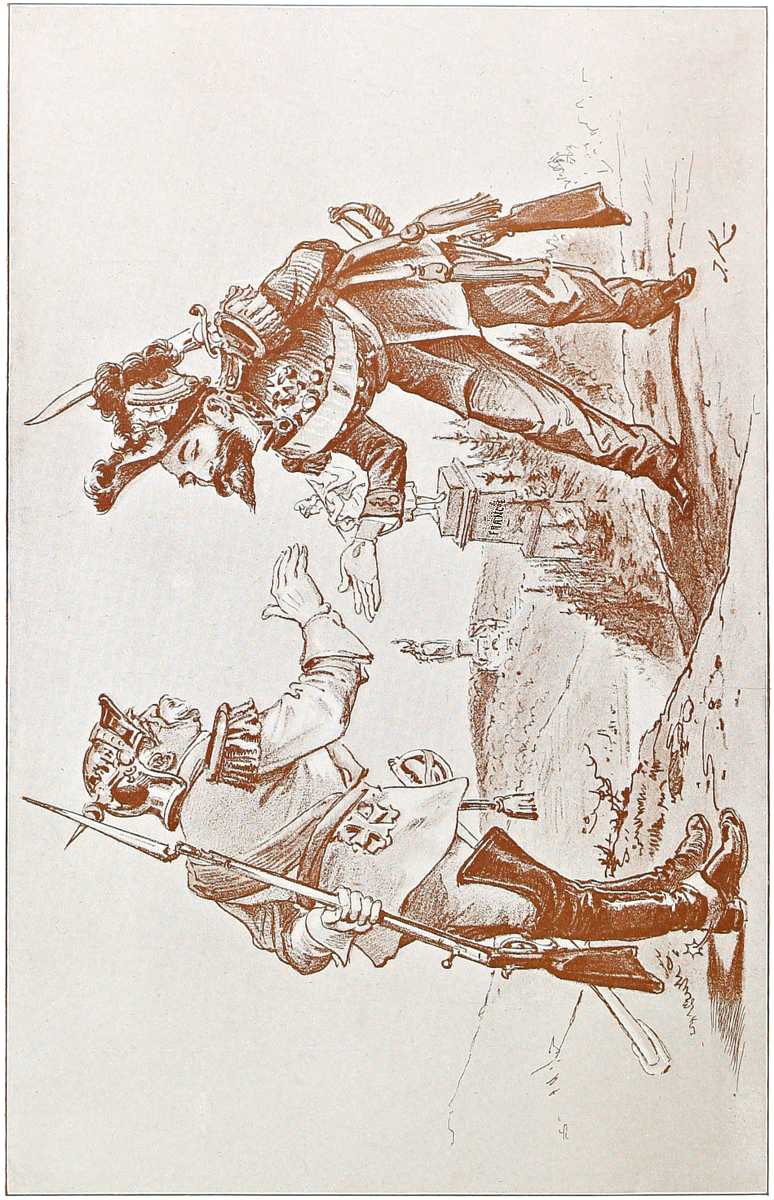
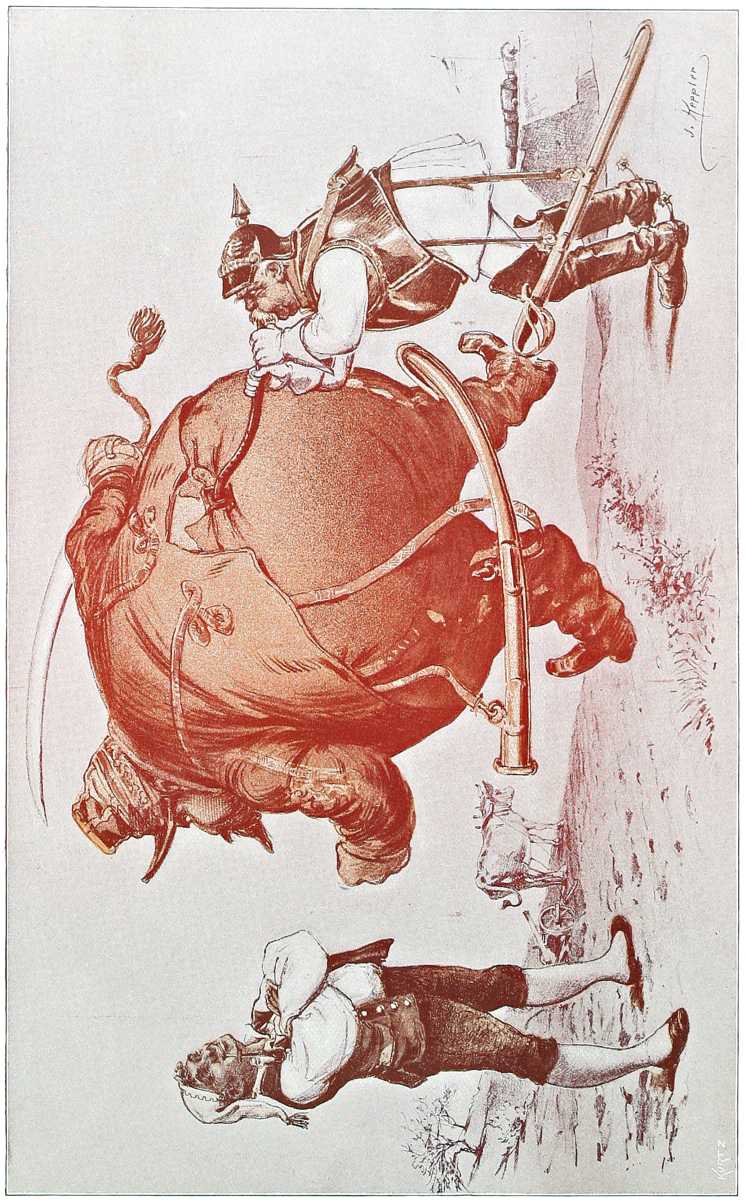
Cover created by Transcriber, using the original
cover (which contained only the artist’s signature)
and one of the inside Title pages. The result
remains in the Public Domain.
This eBook has no Table of Contents, but all of the cartoons are
listed in the Index at the end.
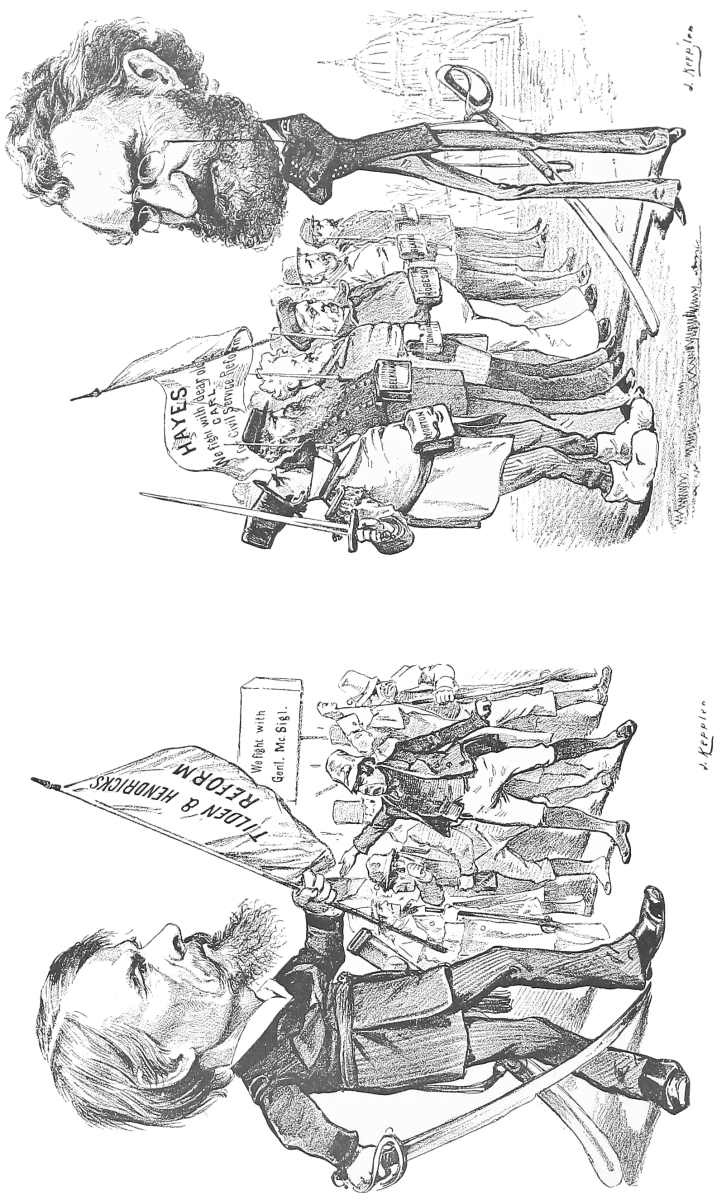
Most of the cartoons contain names and comments that
are in small print. These are important to understanding the satirical
points being made, so all of the political cartoons are larger than
normal. Clicking (or right-clicking) on any political cartoon will
display a larger, more detailed version of it, making some of the
smaller text within the cartoon more legible. Most browsers will let
you zoom in to see the images full-size or oversize.
Most of the cartoons contain names and comments that
are in small print. These are important to understanding the satirical
points being made, so all of the political cartoons are larger than
normal. You can see even larger versions of the wide cartoons by
clicking on the “(larger)” link that follows each of them. (The
tall cartoons already are larger, and the larger versions of the wide
cartoons have been turned sideways). If the larger image exceeds screen
size, many eReaders will let you expand the images to see portions of
them in more detail. The HTML version, which is available at no charge
at Project Gutenberg (http://www.gutenberg.org), contains links to
larger, higher-resolution versions of the political cartoons.
Other notes will be found at the end of this eBook.
1877–1893
Copyright, 1893, by Keppler & Schwarzmann.
300 COPIES PRINTED AND BOUND IN THIS MANNER,
OF WHICH THIS IS NO. 92.
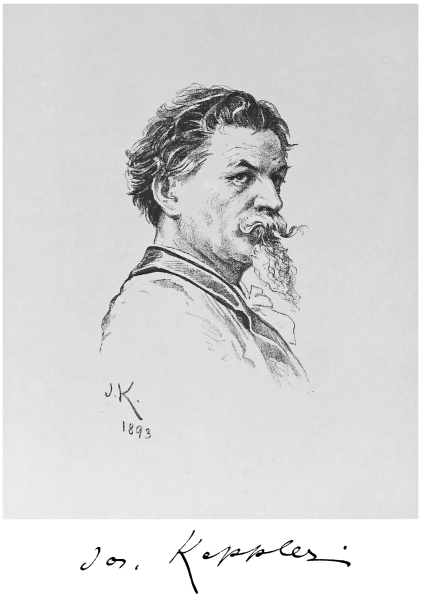
J.K. 1893
Jos. Keppler.
J. KEPPLER
A SELECTION OF
CARTOONS FROM PUCK
BY Joseph Keppler
WITH TEXT AND INTRODUCTION
BY H. C. Bunner
Keppler & Schwarzmann
NEW YORK MDCCCXCIII
INTRODUCTION.
So careless has been the popular use of the words “cartoonist” and “caricaturist,”
that to many minds they no doubt seem practically interchangeable. Yet, as a matter
of fact, not only do the two titles imply two different functions of pictorial satiric art,
but, although there is a school of that art for almost every one of the great races of civilized
men, there is but one school that positively demands the union of these two factors in
the work of its pupils. That school is the German school, and it is Mr. Joseph Keppler
who, as an American cartoonist and caricaturist, has not only imposed its canons and
traditions upon this country, but has, in so doing, placed himself at its head, both in this
country and in Europe, by virtue of a genius that has made him eminent above the generation
of his masters.
The spirit of French comic art turns distinctly—and delightfully—to caricature.
The French “cartoon”—the pictorial lampoon, that is—has but to exhibit in an exaggerated
form the objectionable characteristics of an individual, to serve its purpose and to
touch its public. It is the revelation of character, of purpose, of intellectual or moral
scope which affects, apparently, the French mind, by nature rather observant than
deductive. The Anglo-Saxon spirit, less quickly perceptive, more deliberately logical,
asks something beyond this of the man who tries to reason with it in a picture. It must
be approached by means of a fable, a parable, an allegory, something that will stand the
test of argument and comparison. Caricature, or the significant exaggeration of physical
characteristics, may or may not be an incident to this.
Few of the English cartoonists, for instance, have been caricaturists of any account.
The greatest of them all, John Tenniel, is a cartoonist pure and simple—that is, one
who draws allegories or parables. In his delightful “Alice in Wonderland” work, he
shows his power of caricature; but in his cartoons he is classically faithful to nature, save
for just sufficient accentuation to point his satiric intent. And in the United States, up
to twenty years ago, the prime idea of the cartoonist was simply to express in drawing a
figure of speech—and the more realistically the better.
If it seems a remarkable thing that the influence of one man should avail to change
the taste of a nation in such a manner, it must be remembered that the breadth and force
of the German school which Mr. Keppler introduced into this country were peculiarly
calculated to appeal to a receptive people, delighting in vigorous expression. For the
German school carries the art and mystery of cartooning far beyond any of its rivals.
The German conception of the cartoon not only involves a picture parable, it demands
that the actors of the fable shall be so drawn as to display their characters in their
lineaments, and it asks, moreover, that the allegory shall, if possible, take a distinctive
dramatic form, suggestive, at least, of action, and not merely of position.
It was not in the American nature to refuse to recognize the pregnant possibilities of
such a school of satiric art. Nor did Mr. Keppler fail to grasp the vast possibilities opened
to him by the freedom of American laws and American tradition—social and political.
This collection of Mr. Keppler’s cartoons is not by any means intended to summarize
his work during the sixteen years in which he has drawn for Puck—or it would be treble
its present size. It simply brings together such examples of his work as may now with
propriety be reprinted. This is no slight volume, yet it contains, comparatively, but a
narrow choice of the hundreds of cartoons Mr. Keppler has drawn for Puck. It is surprising
to consider that this great output is to be credited to a man who has only attained
the fullness of life; for Joseph Keppler is but fifty-five years old. He was born in
Vienna, February 1st, 1838. His early life was a struggle with poverty; but it was a
blithesome and cheerful-hearted struggle, almost romantically full of incident and adventure.
He was with equal ease an actor and an artist; and at one time, with a very
natural longing for Italy, he wandered through Styria and the Tyrol and, again, through
Hungary, making vain attempts, balked by constant misfortune, to enter the land of art.
In 1856 he settled down to serious study at the Académie des Beaux Arts of Vienna.
Although his capacity as an artist was increasing year by year, he possessed a histrionic
talent that made it hard for him to give up the stage, and as manager and actor he was
connected with the theatre even for several years after his arrival in America in 1868. His
first years in America were passed in the West; and in St. Louis he started two humorous
weeklies, Die Vehme and a too-early Puck. The gods loved both of these ventures too
well. It was in 1877 that Mr. Keppler, in association with Mr. Adolph Schwarzmann,
first introduced to the American public the school of cartooning which has now become
as much ours as Germany’s. This was through the medium of a German edition of Puck.
The English Puck was born on March 7th, 1877.
To his colleague of sixteen years’ side-by-side working time, it is a great pleasure to
claim for Joseph Keppler the masterhood in the brave art whose present form he introduced
to America, and which he has used with enduring courage and growing knowledge to
more good ends than need here be told.
March 20th, 1893.
H. C. Bunner.
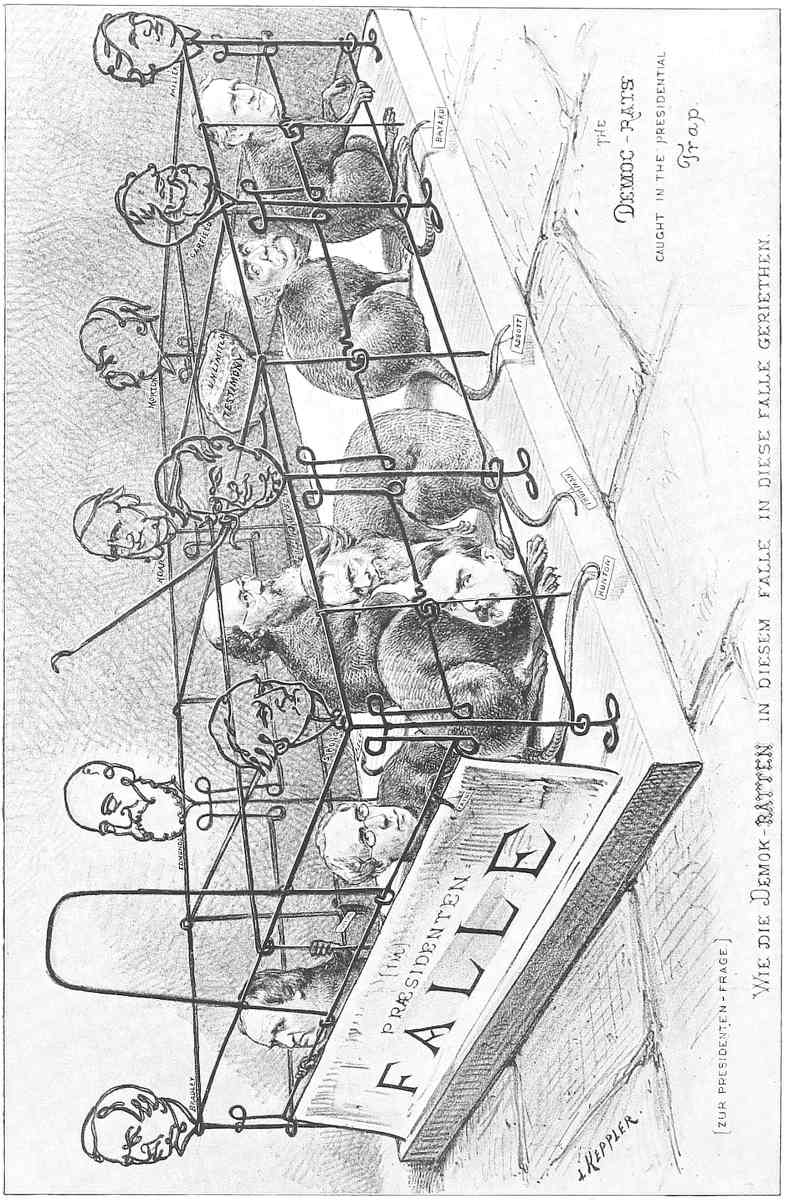
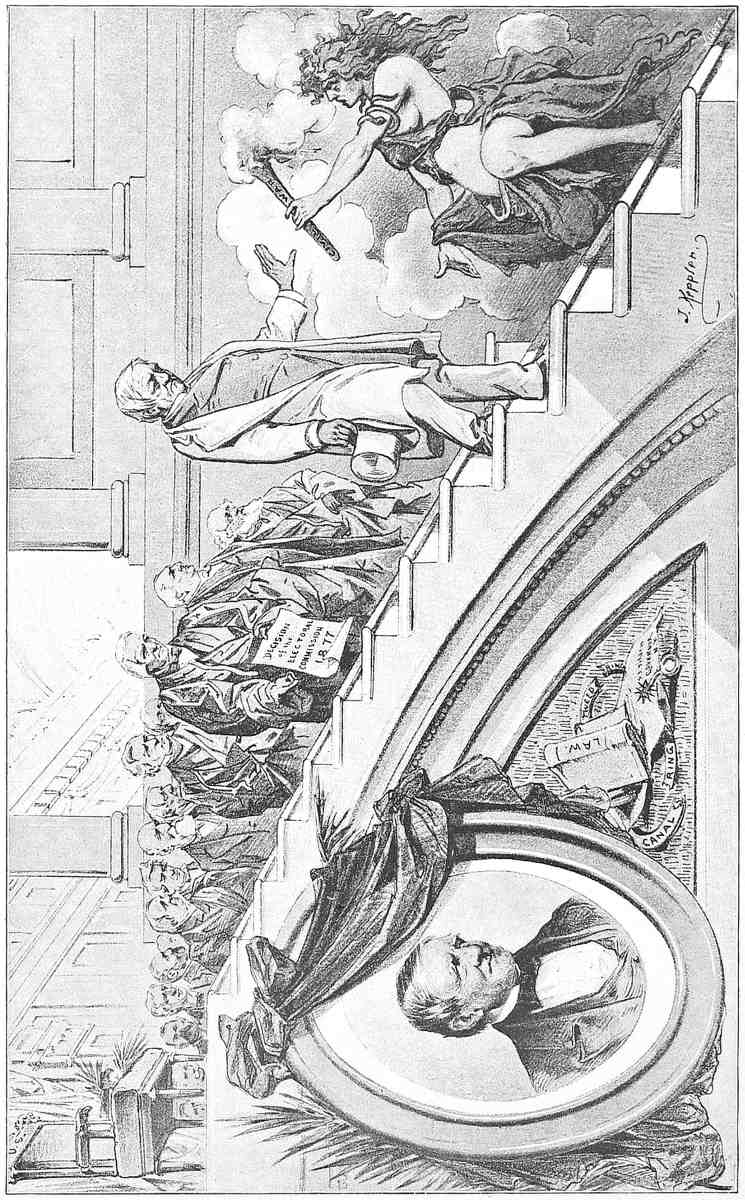
A LITTLE CHANGE; OR, POLITICS MAKES STRANGE BEDFELLOWS.
PUCK, October 4th, 1876.
These two expressive portraitures of two distinguished German-Americans, General
Sigel and the Hon. Carl Schurz, appeared in the initial number of the German Puck
(New York) as interesting specimens of Mr. Keppler’s skill as a caricaturist, pure and
simple. They had no timely significance in particular.
The idea of this cartoon is not free from guilty obligation to a small pun; yet it
depicts the situation of the Democratic Party in the last months of 1876 with considerable
aptitude and force. It appeared at the time when the Democrats in Congress had been
hoodwinked into accepting the Electoral Commission scheme, which deprived Mr. Tilden
of the Presidency, and put Mr. Hayes in the chair. Under these circumstances, it was
certainly truthful, even if it was trite, to say that the “Democ-Rats” were caught in
the political trap.
Wie die Demok-RATTEN in diesem falle in diese falle geriethen.
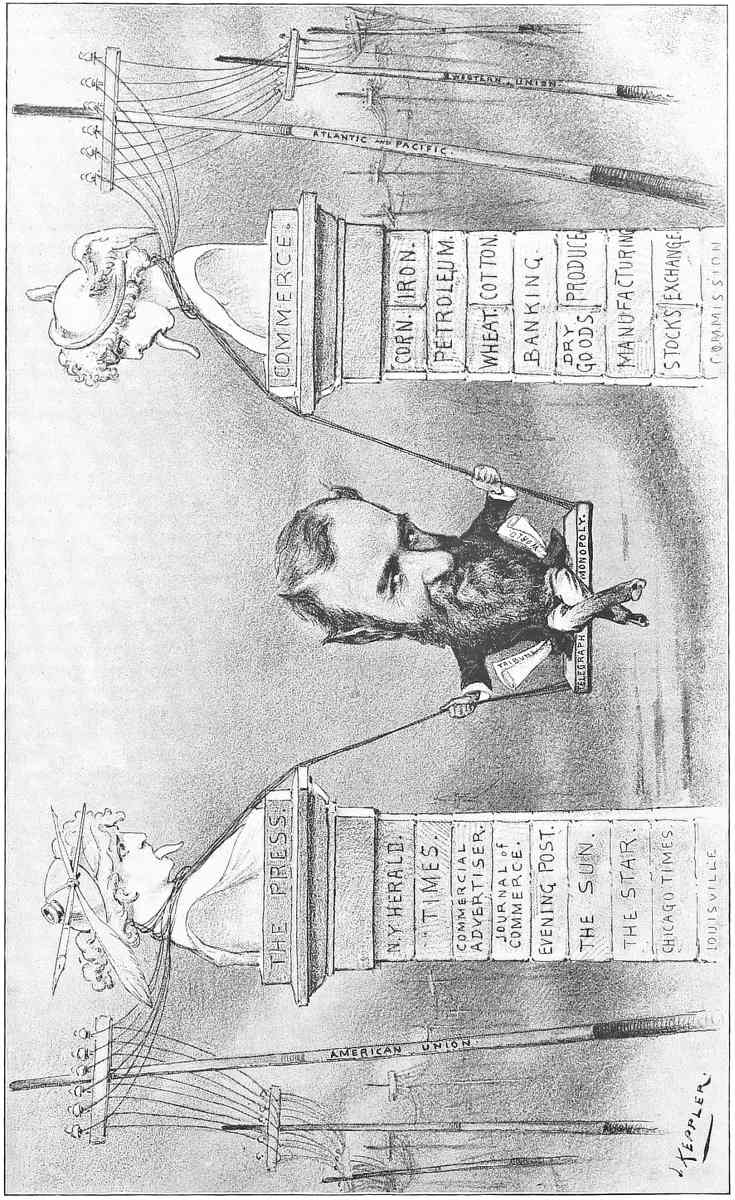
CONSOLIDATED.
PUCK, January 26th, 1881.
“The telegraph companies have been consolidated, which in simple language means
that Mr. Jay Gould controls every wire in the United States over which a telegram can
be sent,” said Puck of January 26th, 1881, and the statement was no exaggeration.
The editorial went on to express a fear that this monopoly of telegraphic facilities
might be used for stock-jobbing purposes, as it made suppression or falsification of price-quotations
not only possible, but temptingly easy. This fear was far from groundless at
the time, although it has since been removed by the enormous growth of the business of
electrical communication, which has now become a machine too huge to be readily perverted
from its proper working by any one man. It is, however, undeniable that the
Western Union wires were misused for parties and purposes in the doubtful and troublous
days immediately succeeding the Presidential election of 1884. At the time when
this cartoon was published there was a very general feeling that the federal government
ought to take charge of the whole telegraphic system. This feeling, however, changed
when the people realized that a postal telegraph scheme would practically involve the
enrollment of a new army of office-holders who would be, under our inadequate and ineffective
civil-service reform laws, merely the hirelings and henchmen of the party in power.
Although the phrase “pernicious activity” had not yet been coined to characterize the
performances of unscrupulous office-holders, the people had seen quite enough of the
thing itself to want no more of it; and the project of government interference became
unpopular. At the same time, it can not be said that Mr. Gould, who lived until 1892,
ever inspired the people with confidence or made any recognizable attempt to that end.
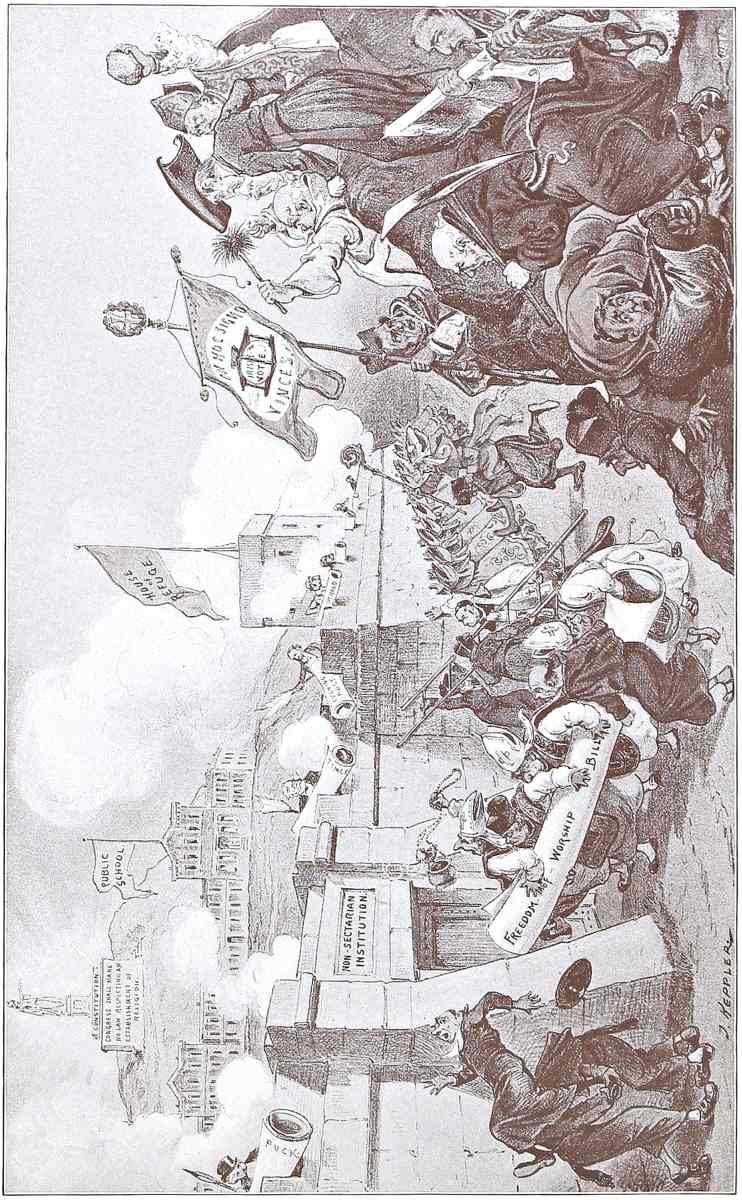
The so-called “Freedom of Worship Bill Controversy” has been carried on so many
years, through so many varying phases and under such exceptional and peculiar conditions,
that it has become most difficult of description and characterization. Its exciting
cause is a bill introduced into the New York legislature ostensibly in the interests of
what might be called sectarian fair play. On the face of it, it aims to secure to the
Catholic, confined by sickness or for other reasons in a public institution, the right to enjoy
the ministrations of his religion at the hands of a priest of the Roman Church. Its
opponents have alleged that it is calculated to go much farther than this in practical
effect, and to afford a foothold for the regular and official installment of Roman Catholic
Priests in the public institutions of the state. The bill has appeared and reappeared for
many years. It has assumed many forms, has provoked a vast amount of discussion,
and has engaged the interest of a very large, and in some respects a very peculiar, collection
of friends and enemies. Its good faith has always been questioned, and we do not
think it is expressing an ex parte opinion to say that it has always been open to question—in
view of the breadth and comprehensiveness of our American common law as applied
to the civil rights of the citizen and the equal status of all religious organizations in the
commonwealth. At the time (April 22, 1885,) when this cartoon was printed, the bill
had appeared in a form which gave good reason for the belief, in which the whole press
of New York shared, that it was a covert attack upon non-sectarian institutions.
It is to be hoped that this cause of so much contention will some day be forgotten in
the natural growth of a spirit of religious tolerance.
Loyalty and lack of moderation were equally marked as characteristic of the support
which Mr. Roscoe Conkling gave to any cause that enlisted his sympathies. The hot,
unreasoning, fanatical vehemence of the attempt which he made in 1880 to dragoon the
Republican party into nominating General Grant for a third term undoubtedly made
the third term idea far more unpopular than a more judicious advocacy might have
made it. Mr. Conkling treated the question of General Grant’s nomination almost as
though it were a matter of divine right; and although Mr. Conkling himself had a right
to be considered honest in his enthusiasm, as much could not be said for the most of his
active assistants in the management of the “Boom”—among whom were Ex-Secretaries
Belknap and Robeson, two officials who had reflected anything but credit upon General
Grant’s cabinet, Boss Shepherd, and other members of the ring that had been formed in
Washington during the Ex-President’s second administration. The artist has drawn a
parallel between the methods employed by the “Salvation Army,” which had invaded
this country a little while before, and those of the “halcyon and vociferous” Mr. Conkling—to
quote his own immortal phrase.
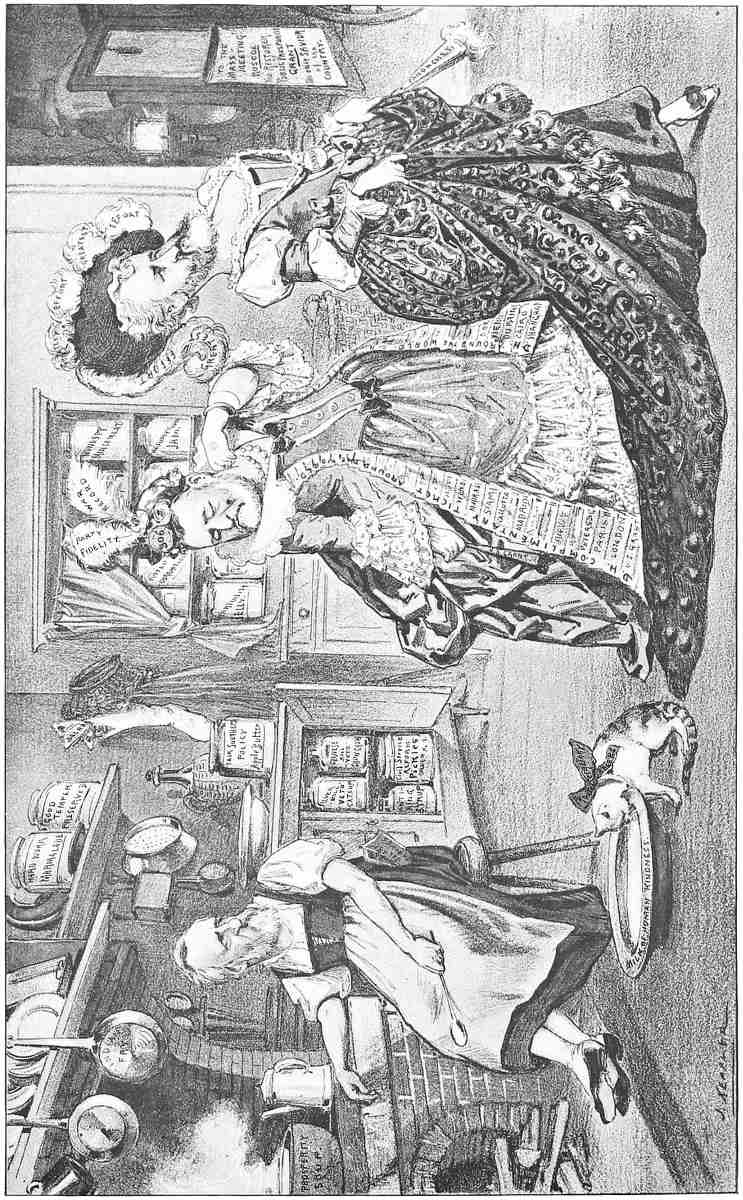
THE CINDERELLA OF THE REPUBLICAN PARTY AND HER HAUGHTY SISTERS.
PUCK, October 13th, 1880.
During the Presidential campaign of 1880, which ended in the election of Mr.
Garfield, Mr. R. B. Hayes, then the incumbent of the Presidential chair, was treated with
studied neglect and coldness by the leaders of his own party. Although General Grant
had failed to get the nomination at the Chicago convention, in spite of the vigorous efforts
of Mr. Roscoe Conkling, the ex-President and his ally were prominent in the campaign
on their own account.
“They speak at mass-meetings, they are interviewed, they write letters; they are
never out of the public eye,” says Puck of October 13th, 1880. Mr. Hayes, however,
received no pressing invitation from the party managers to assist in electing their Republican
ticket. Undoubtedly this deliberate slight was due to the extreme sensitiveness felt
by all classes of Republicans on the question of Mr. Hayes’s title to the office which he
held; and it was in its inception a creditable feeling that prompted the desire to keep him
in the background. At the same time, it was a severe, almost a cruel retribution to be
visited upon a man who had tried hard to atone for his capture of the Presidential chair
by trick and device, by giving the country an uncommonly good, and, in some respects,
decidedly courageous administration. Messrs. Grant and Conkling seemed to be solicitous
to draw attention to their complete silence concerning the outgoing administration,
and their enthusiasm in Mr. Garfield’s behalf. Although, to quote again from Puck,
“both these talkative gentlemen might have found their eloquence at a discount if Mr.
Hayes had not kept up the score of the party through the last four years.”
“His administration will be held notable, in days to come, not merely for its positive
performances, its vetos of the infamous Silver Bill and the unconstitutional Chinese Act;
but for its negative excellence. He has done his duty as he saw it. If he has made
himself ridiculous by carrying the contemptibly small social practices of a little Ohio town
into the wider sphere of life to which Fate has introduced him, it is a pardonable fault.
Let us say for him, after all, that, considering the wretched way in which he got to be
President, he has done far too well with his chances to be snubbed by men in such equivocal
positions as Messrs. Grant and Conkling.”
Mr. Conkling’s resignation to the Senate, in hope of re-election under circumstances
which would have made such a triumph a severe rebuke to President Garfield, proved to
be, as most people foresaw, the end of his political career. But, at the time, there were
plenty of people to applaud his act and to liken his resignation to a “bombshell” thrown
into the Senate. It was a sort of fireworks bombshell that destroyed nothing but itself,
but it made a great noise for the moment. Mr. T. C. Platt chose at the same time to
pop his toy balloon, and probably thought that it made part of the noise.
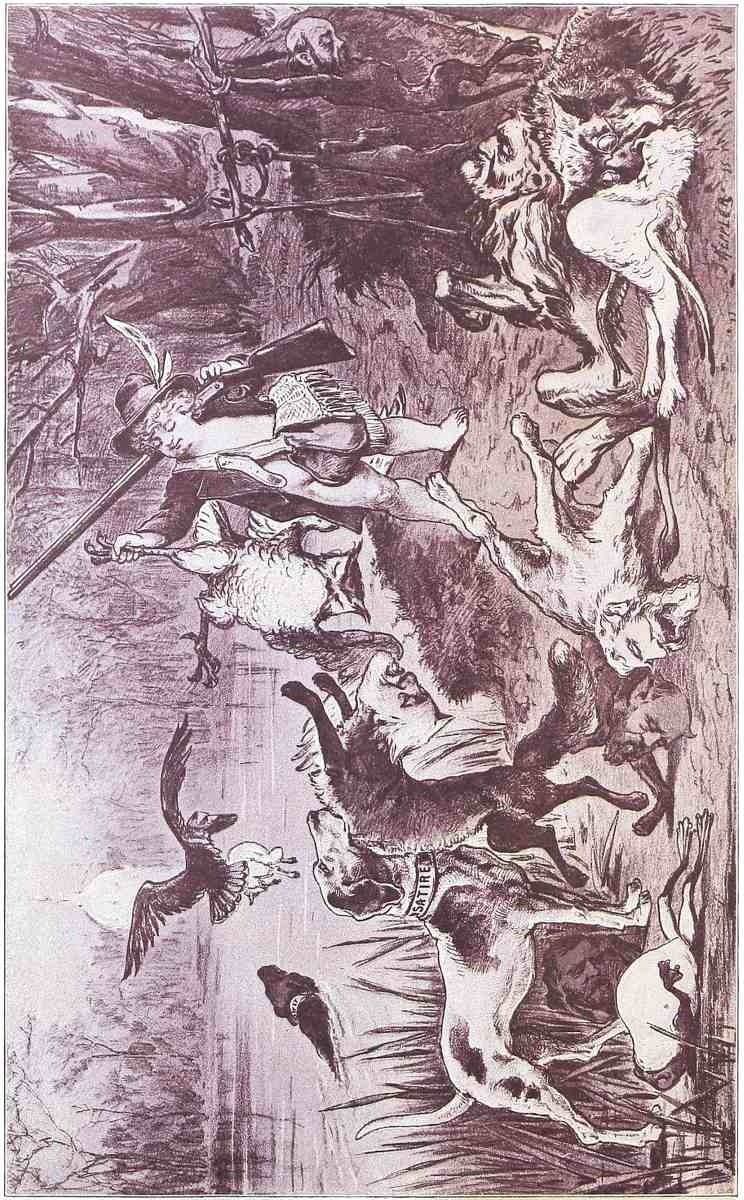
PUCK’S POLITICAL HUNTING GROUND.—HOW HE HAS MADE GAME OF THE POLITICIANS.
PUCK, January 14th, 1885.
The first cartoons were doubtless chalked on dead walls, and even when the art
reached a higher development, sticking to walls remained the cheapest and most convenient
method of publication. It is often a test of a cartoon’s worth to-day—its suitability
as a wall-decoration. It is a natural and simple impulse that moves us to pin on the wall
the picture that has pleased us. Readers of Puck who travel much in this country can
not but notice how many people delight in pasting and pinning their favorite cartoons to
the walls of their offices and workshops, and even of their dwelling-houses. A really
popular cartoon is always sure of these humble but well-meant honors; and, curiously
enough, experience has shown that next to the really telling “hit,” a playful, familiarly
puzzling trifle like “Puck’s Political Hunting-Ground,” if it is conceived with some grace
and prettiness, is the most certain of this sort of popular favor. This particular picture
was, no doubt, made attractive to many by the simple puzzle afforded by the faces of the
animals. As, however, the passing of time must make some of these faces unfamiliar, it
may be well to offer the following key—first calling attention to the fact that all the personages
introduced were at the moment, in one way or another, at odds with fortune—except
the late Mr. Jay Gould, who is figured as a bird of prey (in a general way, and with
no over-particular ornithological accuracy) comfortably bearing off a lamb. The fact
that this one figure of success is quite unconscious of the attempts of Puck’s water-dog
to catch him, may be supposed to show the usual disregard that Wealth entertains
for Wit:
The fox, of course, is the ingenious Mr. James G. Blaine. The hyena, ex-speaker
Kiefer, and the next animal of doubtful breed “Star Route” or “Soap” Dorsey. The
paw and the head seen in the reeds behind the dog belong to Brady. The lineaments of
Ben Butler may be discerned in the head of the frog, and the nature of the beast in the
distention of the belly thereof. At the other end of the cartoon, General Grant’s features,
without distortion or caricature, fit the head of the dead lion. Next to him “Secor”
Robeson lies in the similitude of a dead boar, incapable of mischief for all his glaring
eye-balls. In the foreground, Roscoe Conkling lies a dead pouter pigeon. (Caricaturists
frequently showed Mr. Conkling as a pouter pigeon, but most of them carried the analogy
too far and made a frail, spindle-shanked thing of him. In this picture the thickly
feathered legs and stout frame of the bird do not bely its sturdy original.) The owl is the
late John Kelly—and a powerful and accurate owl he was, too, in his time! The pendent
monkey is T. C. Platt, who was at that time suffering from one of the temporary eclipses
which flecked the pathway of the political adventurer with appropriate forecasts of oblivion.
THE UNIVERSAL CHURCH OF THE FUTURE—FROM THE PRESENT RELIGIOUS OUTLOOK.
PUCK, January 10th, 1883.
The times change, and we change with them. When this cartoon was designed, the
popular theological fad was the harmonization of science and religion, and the immediate
cause of its appearance was some utterance, now forgotten, but at the time considered
highly audacious, of the Reverend Heber Newton. It was, we believe, the introduction
of the practice of “slumming” which changed the current of clerical taste.
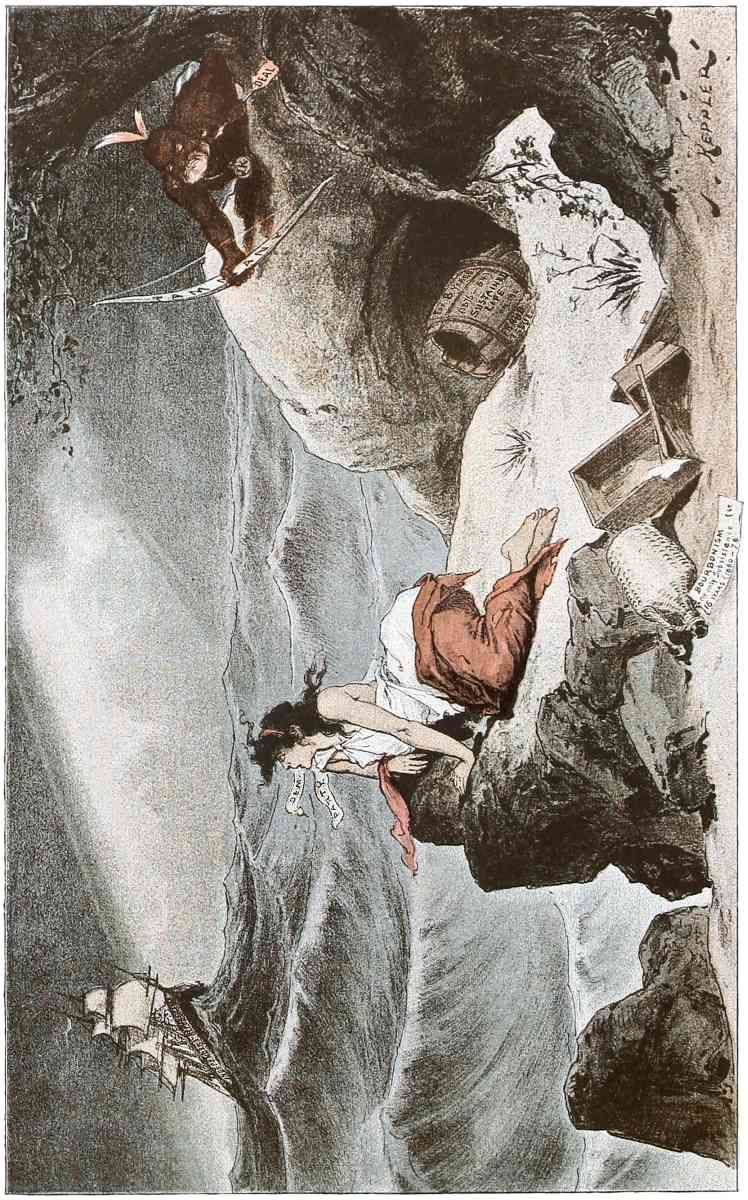
POSITIVELY LAST AWAKENING OF THE DEMOCRATIC RIP VAN WINKLE.
PUCK, October 27th, 1880.
The picture of the Democratic party as Rip Van Winkle was suggested by the fact
that in 1880, when it appeared, (Oct. 27) the party had been for just twenty years wrapt
in the sleep of political inactivity. The figure of the old sleeper is the one made familiar
by Mr. Jefferson’s wonderful interpretation. He starts up from his twenty years’ slumber
to see a spectral host flit by him, as he lies upon the mountain crag—Douglas, Greeley,
McClellan, Seymour, Tilden, and Hancock the Superb, leading the doomed line of hapless
Presidential candidates. The mean realities of life are represented by the two fiery-eyed
owls in the tree at the old man’s back—General B. F. Butler and Mr. John Kelly of
Tammany Hall, who never appeared in national politics, except as secret and mischievous
birds of prey.
Down in the right-hand lower corner of the picture a pocket-flask labelled “Bourbon”
may puzzle the reader who turns this page a generation hence. It is a sly reference to a
jest well known and well understood at the time,—it had a much earlier origin. The
Democrats were called Bourbons because it was supposed that “they never learned anything
and never forgot anything.” As it happened, Bourbon County, Kentucky, had
given its name to a brand of whiskey at that time in great favor. As whiskey was America’s
democratic drink, in the broader sense of the word, by a natural association of ideas
Bourbon whiskey was set down as the drink of the Democratic party. It was generally
known as “Bourbon” and pronounced “Burbin.”
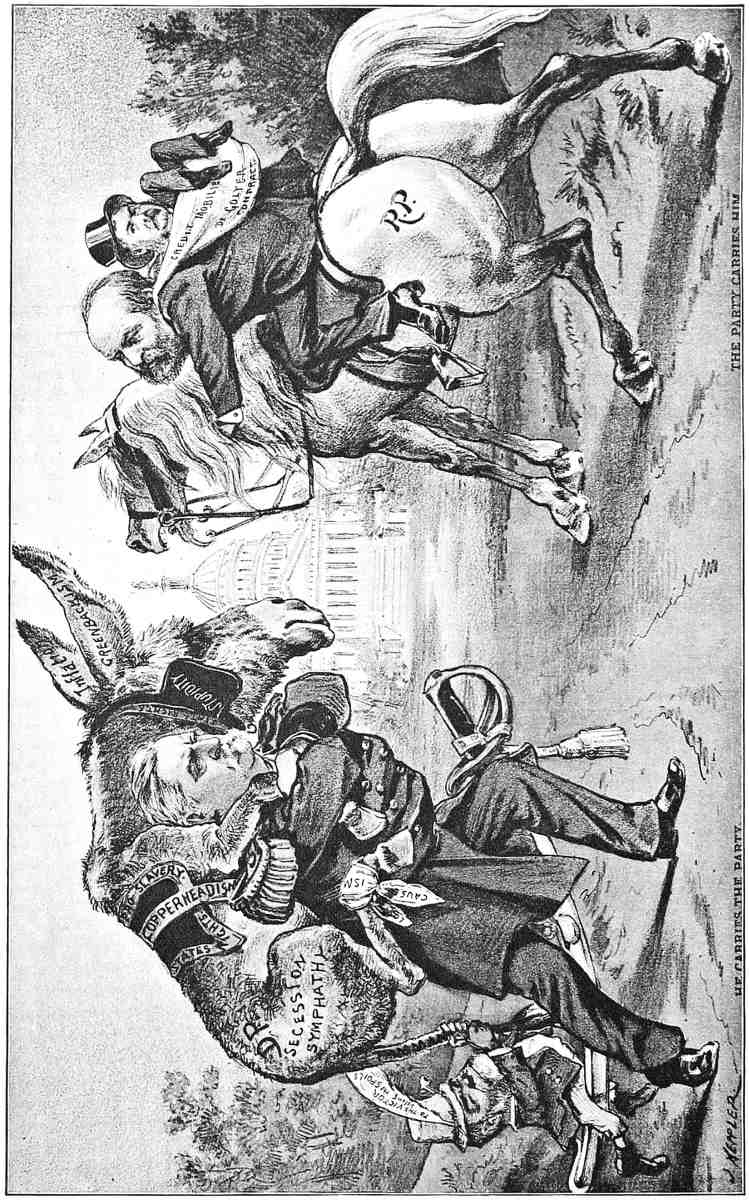
This cartoon depicts so simply and clearly the position of the two great parties and
their respective leaders in the early part of the campaign of 1880 that even at this date
it hardly calls for any elucidation whatever.
It may, however, be proper to note that the placing of Mr. Arthur as a burden upon
Mr. Garfield’s back, in the bag labeled “Credit Mobilier” and “De Golyer Contract,”
is not intended to imply that Mr. Arthur himself had any connection with these
scandals. Mr. Arthur himself undoubtedly was regarded as an incumbrance to Mr.
Garfield’s canvass because of his very unwise choice of associates among the politicians
of New York, and his singular indifference to the regard of the people with whom his
birth and breeding should naturally have led him to affiliate. In this it must be admitted
that Mr. Arthur did himself an injustice, for which, however, he amply atoned when
Mr. Garfield’s death threw upon him the responsibilities of the Chief Executive.
There are few more tragic or startling pages in our political history than those which
record Mr. Garfield’s brief career as the national leader of his party. Nominated for
President in the Chicago Convention of 1880, after the collapse of the Grant Third-Term
Movement, (although it was generally supposed that he was too firmly committed to the
interests of Senator Sherman to enter the lists on his own account,) he was elected in
November, after a somewhat heated campaign, during which much publicity was given to
his unfortunate dealings with the Crédit-Mobilier people and other objectionable speculators.
His opponent was General Hancock, a soldier and a gentleman of unblemished
reputation. He owed his defeat partly to certain utterances concerning the tariff question
which, though just in themselves, were injudicious in view of the popular sentiment of the
time; partly to the wide-spread distrust of the Democratic party that then prevailed, and
partly, as Mr. S. W. Dorsey, one of Mr. Garfield’s campaign-managers, most gratuitously
and indecently announced after election, to wholesale bribery in the State of Indiana.
(This was the notorious “Soap” Dorsey, so called from his using “soap” as a
euphemism for bribe-money.)
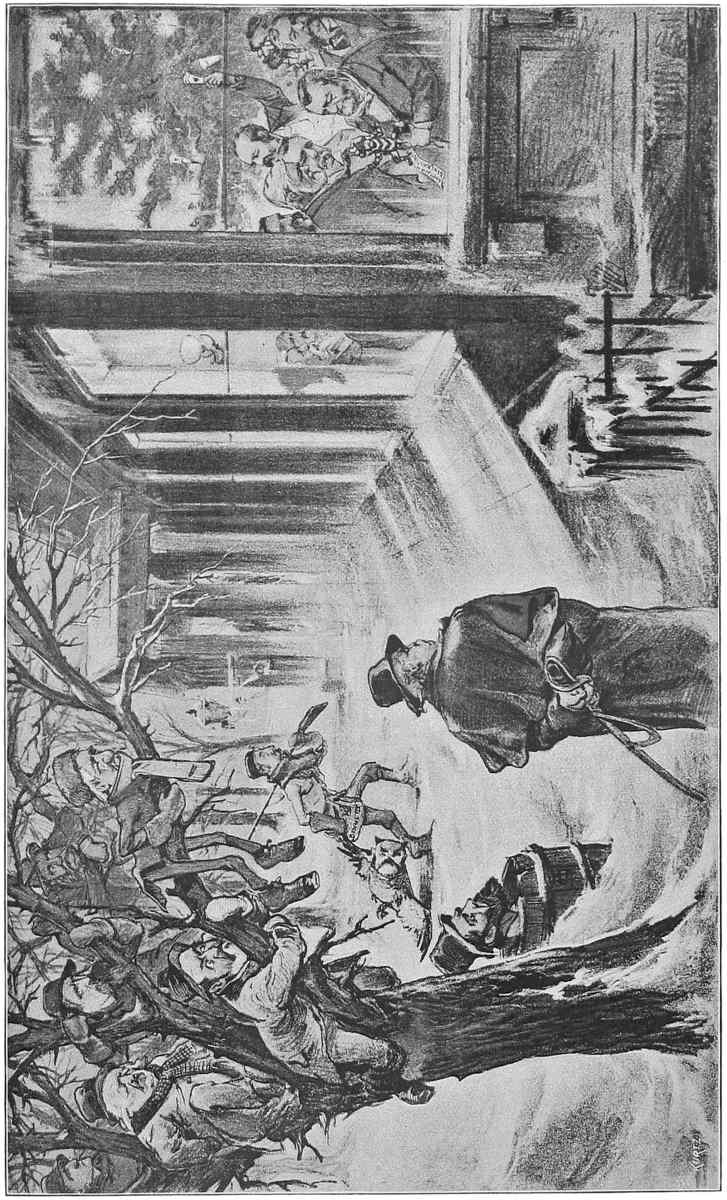
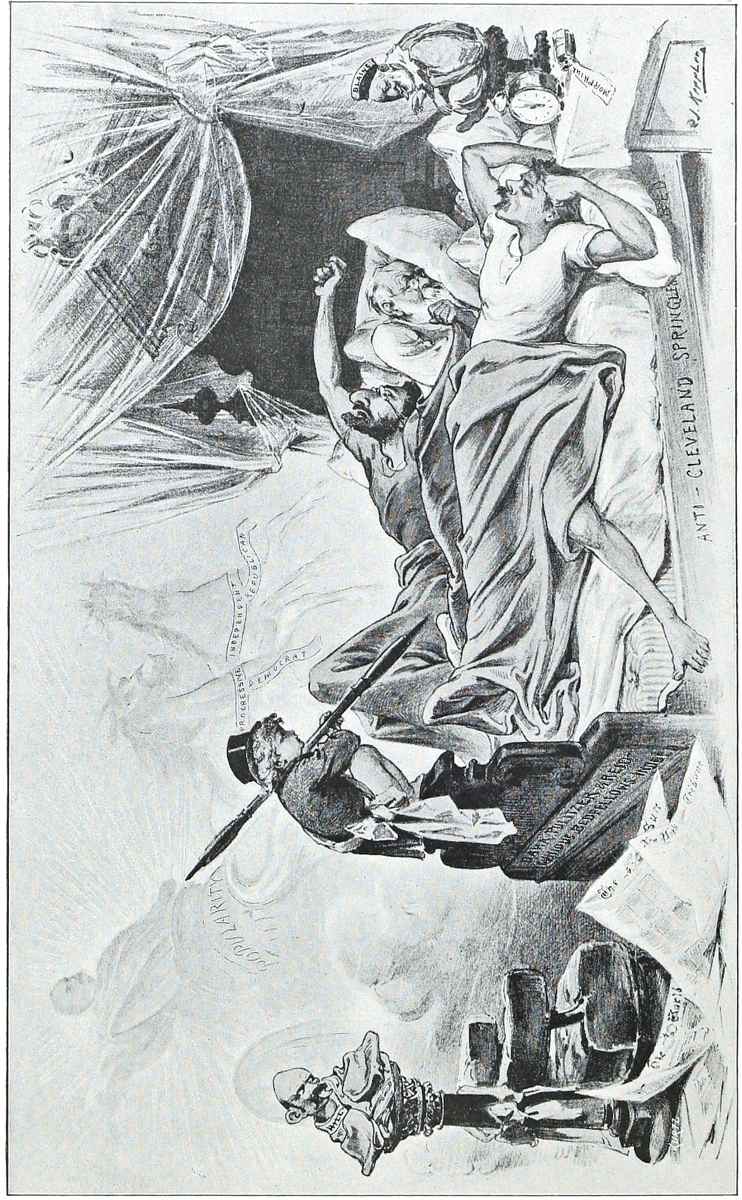
By a permissible pictorial license, the artist, in Puck of December 22nd, 1880,
represents the President-Elect as already quartered within the White House, distributing
the spoils of office as presents from a Christmas tree. Around him are the leaders of the
Republican party: General Grant, Senator John Sherman, Don Cameron, General Logan,
Vice-President Chester A. Arthur, and Carl Schurz in the foreground; James G. Blaine
and Marshall P. Jewell (the collector of the campaign-fund) in a corner. The shadow of
Roscoe Conkling’s head and of the ambrosial curl which was supposed still to linger on
his brow, is thrown upon the side of the window-casing, but from what quarter it is projected
is difficult to determine. Mr. Conkling’s attitude toward the new administration
was dubious and peculiar.
Outside, in the cold Winter night, are the Democrats gazing hungrily into the lighted
windows. The head of Mr. W. H. English, the defeated candidate for Vice-President,
rises from a barrel, supposed to represent the large fortune which alone gave him any
political standing. Mr. James Gordon Bennett appears in the character of a sportsman who
has brought down a large owl-like bird having the features of Mr. John Kelly—the New
York Herald was credited with having obtained the local victory over the Tammany
leader. “Up in a tree,” are Tilden, Wade Hampton, L. Q. C. Lamar, Chairman
Barnum of the Democratic Committee, General B. F. Butler (constructively a Democrat,
for cartoon purposes), and Thomas F. Bayard.
“To the man of statelier figure, who stands outside, but not among the shivering
crowd of malcontents,” Puck wished that year a Merry Christmas; and hoped that
there would be many Merry Christmases for him, if not in the White House, at least “in
the place where he well served the country.” The wish was vain: General Hancock
died not long after.
This simple but effective cartoon hardly requires any further elucidation than is
afforded by the date of its publication. It appeared on July 2nd, 1884, immediately after
the nomination of Mr. Blaine at the Republican Convention at Chicago, and the consequent
bolt of the Independent Republicans and so-called Mugwumps. With reference to
the appearance in the picture of Mr. John Kelly in the attitude of a hostile savage, we
need only say that the readiness of the Tammany Hall of that day to stab the Democratic
Party in the back whenever it furthered its own ends by so doing was something that was
more than suspected then, and that was conclusively proved in the first Cleveland and
Harrison campaign.
“Mr. Tilden’s death is to be regretted by his friends and by his political enemies. He
was a man of principles and ideas. He had ambitions that looked higher than to the
mere accumulation of money or the acquirement of that cheap, ephemeral power which
flatters some small souls. And beside this he had courage and independence, and the
breeding and education of a gentleman. Many were forced, by conscience and conviction,
to oppose his political aspirations; but all found him an adversary to be respected, and
a man of dignity and power. History must record of Samuel J. Tilden that he did his
best to purify a great party fallen into a frightful moral decadence in its own Capuan
stronghold,—must note his wonderful work in the cause of civic honesty and good government,
and his loyalty to his country at a time when all his affiliations must have inclined
him to disloyalty or to an indifferent neutrality. And more than this, History must
say of him that he suffered a cruel wrong with dignified fortitude, and by his wisdom and
self-restraint relieved his country from a well-grounded fear of dangerous civil disturbance.
Remembering this, it is easy for the most partisan spirit to forget much else, and
to do honor to the dead statesman and patriot.”—Puck, August 11th, 1886.
Puck for November 3d, 1880, went to press, of course, too early to receive the news
of the result of the election. Consequently the cartoonist had to content himself with
constructing this curious puzzle picture, in which may be found, with a little study, the
portraits of the Republican and Democratic candidates, as well as those of many other
prominent public men, including Mr. Roscoe Conkling, Mr. J. G. Blaine, Mr. Carl
Schurz, Mr. Marshall P. Jewell, Mr. Chester A. Arthur, General U. S. Grant, Mr. R. B.
Hayes, Mr. Samuel J. Tilden, Mr. Wm. H. English, General John A. Logan, Mr. John
Kelly, (of New York City,) General B. F. Butler, Mr. Thos. F. Bayard, and Mr. Abram
S. Hewitt.
“There is, moreover,” Puck goes on to say, “something more in that cartoon.
There is a gentle hint of a duty that we have forgotten too long, in the excitement of that
wild political fight—the duty of going back to the plain old ideal of friendly federation
which our forefathers had constantly in mind. We do not wish to talk any of the cheap
cant about clasping hands over the bloody chasm. All the hand-shaking in the world
won’t close a crevasse up. But is this nonsense to go on forever? We hope not. The
work of the campaign is done. A President is elected. There will be no need of renewing
the battle for another four years. Let us see if we can not use those four years in
making preparations for a contest on a broader basis—on points less mean, less cheap
and malicious. There is time, in these four years, for the honest men, North and South,
to come to some understanding with each other; to make up their minds as to what are
dead and what are living issues; to build up a new party, or two new parties, if need be,
and to make the Presidential election of 1884 a respectable contest, between people who,
however they may disagree on matters of principle or opinion, have all but one end in
view—a wise and honest government.”
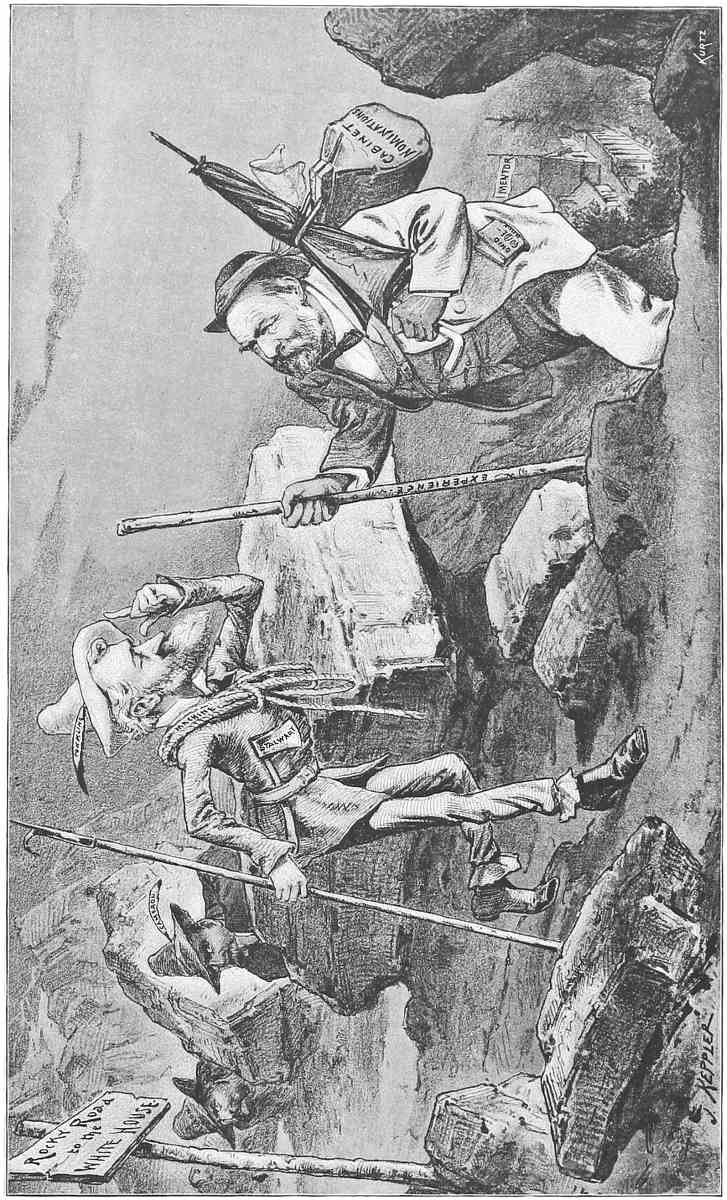
Conkling.—Want a guide, sir? Garfield.—No; thank you!
PUCK, February 2nd, 1881.
This cartoon sketches fairly the situation a month before Mr. Garfield’s inauguration
in 1881. Mr. Conkling had shown a certain willingness to lend a hand to Mr. Garfield’s
administration, and Mr. Garfield had shown no willingness whatever to accept the proffered
hand. It was not to be expected that Mr. Conkling would prove himself an unreservedly
loyal and disinterested Secretary of State, and there was little room for doubt
that the desire of Messrs. Don Cameron and J. A. Logan to hold office under the President-Elect
was of the most strictly selfish sort.
Note.—As the word “Mentor,” on the flag over the distant dwelling-house shown in this
cartoon, might be supposed to have some ulterior significance, it may be well to say that it is
simply the name of Mr. Garfield’s home and P. O. address in Ohio.
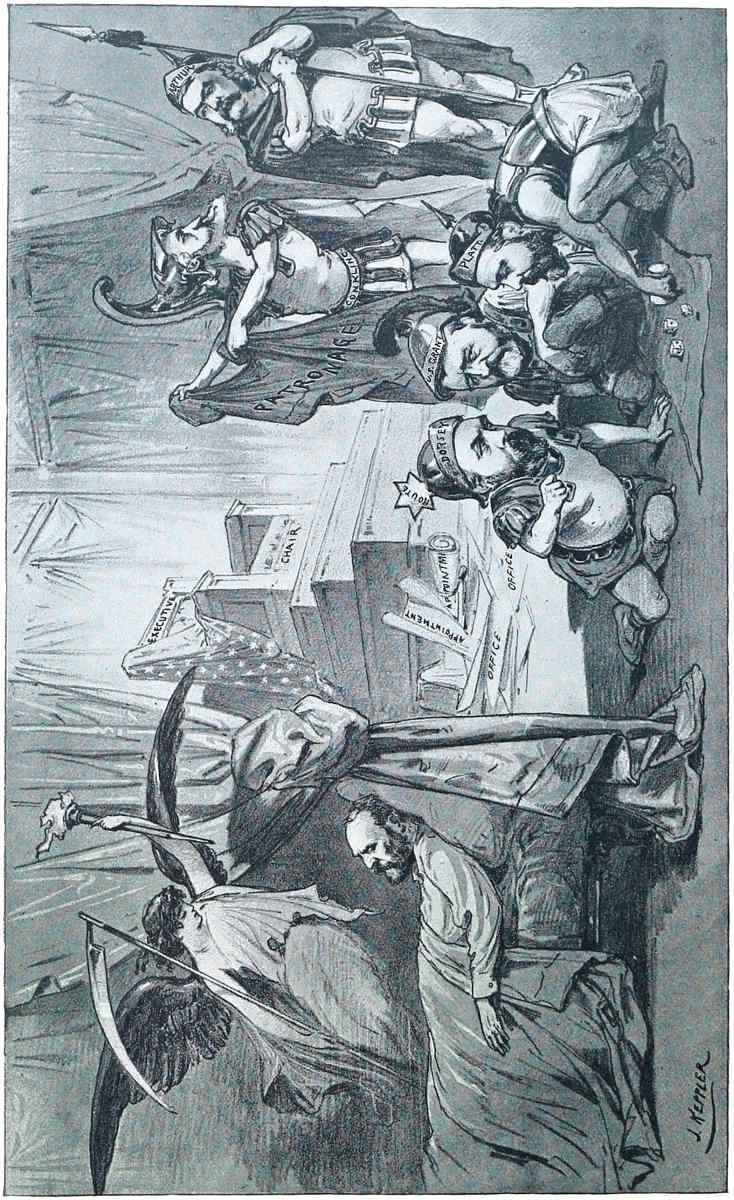
The situation, which this cartoon, published in Puck of August 31st, 1881, commemorates
after a peculiarly forcible fashion, is too unpleasant to invite further comment
than is absolutely necessary to explain it. During the latter part of the Summer of 1881,
while President Garfield lay dying from an assassin’s bullet, certain politicians of a peculiarly
coarse fibre were unwilling to wait for his death to make their arrangements for the
distribution of the spoils of office under his successor. These were not men who were
in any way concerned in shaping the course of the government in matters of statecraft or
policy; they were simply out for the spoils, as the phrase goes, and their undisguised
eagerness was scandalous under the circumstances.
Puck said at the time, with more moderation than, viewed in the light of subsequent
events, the occasion called for: “Whether presidents live or die, the game of politics
goes on. It is humiliating and deplorable, but it is nevertheless true that many professional
politicians of more or less reputation are carefully laying their plans of procedure
in the event of the decease of the dying President, We will not wrong these gentlemen
by saying that they desire his death; but it is scarcely decent to raise even a discussion
on the most trivial matter connected with mere machine politics, before the vital spark
has fled from the body of the chief magistrate. Although his presumptive, or, to use a
monarchical term, his apparent successor has acted throughout in a manly and modest
way, there are political friends of his whose demeanor has not been distinguished by the
sympathy and consideration that, at least, might be expected on such an occasion.”
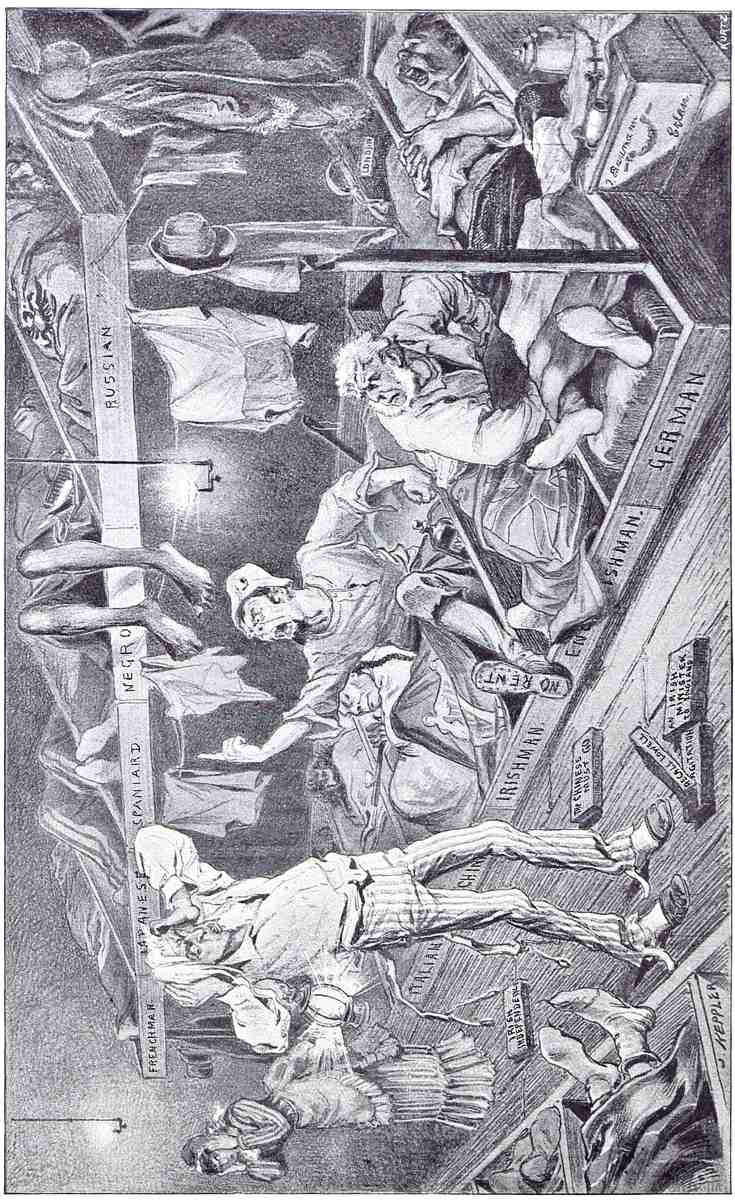
In 1882 (June 7th), when “Uncle Sam’s Lodging House” was drawn, the Irish
“patriots,” who were trying to free their country by exploding dynamite in public places,
had made this country their base of supplies, and were especially active in New York and
Chicago. Their lawlessness created much excitement, and if it had not been that there
was more bluster than performance about their pernicious liveliness they might have
involved us in a war with Great Britain, in which we should certainly have lacked the
moral support of our own conscience. These gentry did not relish the stand Puck took
in the matter, and their threats of reprisal by dynamite were frequent. The rate of letter
postage had some time previously been reduced from three to two cents.
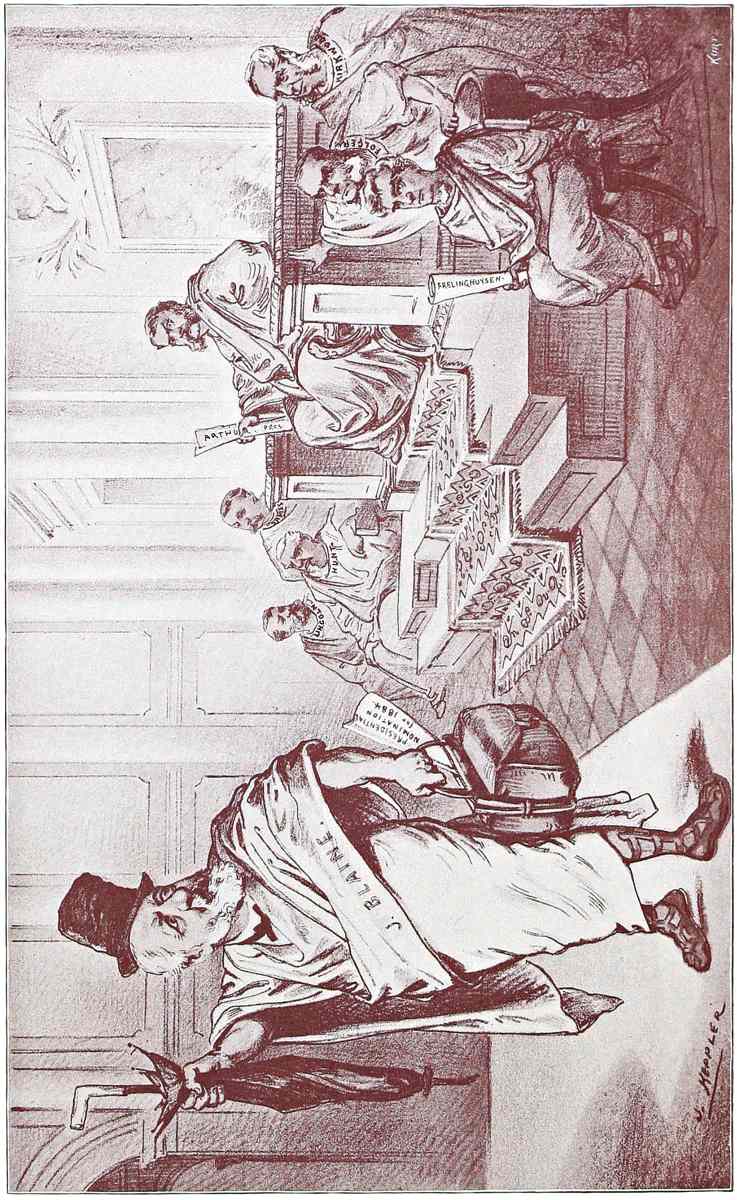
The Summer of 1882 was just changing to Fall when Mr. Blaine made a notable
speech at Portland, Me., which was generally received as an announcement of his determination
to seek the nomination for the Presidency in 1884. In this speech, which attracted
great attention, he stated with singular clearness his position in politics, affirming
the moral right of the Republican Party to a continuance in rule on the strength of its
record. This was, we believe, the first clear, frank and open enunciation of this idea in all
its naked simplicity. It has formed since then the stock in trade of many candidates and
of countless campaign orators, but the credit of putting it fairly and squarely before the
people belongs to Mr. Blaine, and it should be noted that the time he chose to express
his views was one in which most Republicans were offering apologies or explanations for
the past and present shortcomings of their party. Mr. Blaine reaped no personal benefit
from the enterprise he displayed in taking this bold stand, but he undoubtedly gave his
party a lesson in audacity by which it profited materially. It was what might be called
a “bluff,” and it was certainly a big and effective bluff. At the time when it was made its
far-sighted cleverness was under-estimated, and its insincerity was so apparent that the
reader of that day could have had little difficulty in seeing why Puck suggested to Mr.
Blaine to abandon his extreme and untenable position, and to take another, which would
have been at once more credible and more popular. It is curious that the idea with which
Mr. Blaine inspired his party should have been the means of his own undoing, and, in
some measure, of electing Mr. Harrison to the Presidency over his head.
BLAINE LEAVING THE CAPITOL.—“I GO—BUT I RETURN!”
PUCK, December 21st, 1881.
Mr. Blaine was the most highly honored of President Garfield’s cabinet officers. In
the convention that nominated Mr. Garfield he had been, next to General Grant, Garfield’s
most dangerous rival—or, perhaps it would be more correct to say that he might
have been, had the time been ripe for him to exert his full strength. So, when President
Garfield died, and Mr. Arthur, who had been an unpopular candidate for the Vice-Presidency,
succeeded to the Presidential chair, two apparent probabilities interested the
populace. It was assumed, of course, that a President must be a candidate for re-election
and under such circumstances it was thought that in all likelihood Mr. Blaine
would be far more powerful in the next convention than a President who owed his elevation
to mere accident. Thus, when Mr. Blaine made his bow and retired from the
cabinet formed by President Garfield, his very leaving seemed to imply a threat that he
would return to Washington only to assume a prouder position.
Puck of December 21st, 1881, says, discussing the possibility of Mr. Blaine’s election
to the Presidency:
“There are two or three miracles which we would gladly see worked in this country.
There is that great miracle which always seems near at hand, yet which never seems
nearer—the miracle of a great popular awakening to a healthy political life....
Is it not a disgrace, indeed, that we should talk about electing to the highest office in the
nation a man of whom an honest, unprejudiced and unbiased journal has to say that
although he is clever and strong, he has not an absolutely unblemished record?! An
absolutely unblemished record! Why, a statesman’s record should be as unblemished
as a woman’s should be. And yet it is very possible that we shall find the man of whom
this is said the very best man whom it is possible to put at the head of our Government in
1884. Is it not time for a miracle?”
It was pretty nearly time: the miracle was worked in 1884.
The New York Sun’s “bolt” of the Democratic ticket during the Cleveland Campaign
of 1884 was so characteristic, so extravagant and so funny in its fantastic futility,
that it can not be forgotten, even now. This cartoon appeared about the time that Mr.
Chas. A. Dana was running General Benj. F. Butler as a candidate for the Presidency,
and was predicting for that harlequin among political adventurers a majority over Mr.
Cleveland in the City of New York. General Butler came out of the death-struggle with
four-thousand-odd-hundred votes, in all, as his share of the suffrages of New York’s
citizens; and Mr. Dana, a day or two after the election, blithely caroled, to the somewhat
discordant accompaniment of his organ:
“We may be happy yet, You bet.”
QUALITY COUNTS.
PUCK, April 11th, 1888.
The editorial article accompanying this picture draws a curious historical parallel
between the characters of Samuel Pepys and Grover Cleveland, with a side glance at
“South Sea Bubble” Law and certain moderns who resemble him in certain ways.
After sketching Pepys’s career in the British Admiralty Office, the article closes:
“‘A man of the old way of taking pains,’ they called him in that degenerate day.
Is not that even now a good standard by which to test public service? Is all greatness
to lie in bluster, noise, braggadocio, and what we are pleased to call ‘smartness’? These
were the attributes of the men who were the official superiors of Samuel Pepys just two
centuries ago. The world has forgotten their names. But the old fashion of honest service
is still honorable. Those who have borne with us so far in this historical recital
may forgive us if we suggest a modern instance. A few weeks ago, the presiding officer
of the United States Senate told his distinguished audience that no man was so mean or
so obscure that he might not be President of the United States, now that Grover Cleveland
held that place. Mr. Grover Cleveland was a lawyer in one of our smaller cities.
He became, successively, Sheriff and Mayor of his town, Governor of his state, and
President of the United States. In every office he has done his duty ‘in the old way of
taking pains.’ He has had no hand in the corruption of political life; he has never been
the pensioner of corporate monopolies. As Sheriff, Mayor, Governor and President he
has served the people honestly and wisely, ‘in the old way of taking pains.’ To our
mind this gives him a claim to the regard and respect of the people that will not easily
be shaken by the bluster of his enemies. The people will look at the work he has done
before they decide whether or no he is President by accident—whether the Time has done
everything for him, he nothing—but what the little critic could have done too.”
There was a great stir made among the
Beasts, which could boast of the largest family.
So they came to the Lioness.
“And how many,” said they, “do you
have at a birth?”
“ONE,” said she, grimly; “but that one
is a Lion!”
Æsop’s Fables, LXVIII.
THE CAROL OF THE “WAITS.”
PUCK, December 23rd, 1885.
When Mr. Cleveland first became President in 1885, he put into practice a much
broader theory of Civil Service Reform than certain active politicians of his party had
any use for. Nor did he show any great eagerness to shower offices and honors upon
those members of his party who had proved false to him in the campaign of the previous
year. On December 23rd, 1885, Puck pictured these unfortunates as Christmas “Waits,”
standing outside the White House in the wintry cold, and raising their voices in plaintive
song:
“God rest you, merry gentlemen, May nothing you dismay; Remember us poor spoilsmen left This blessed Christmas Day.
“Since Christmas comes but once a year, Oh, let us share your Christmas cheer, And chuck one little office here On Christmas Day in the A. M.”
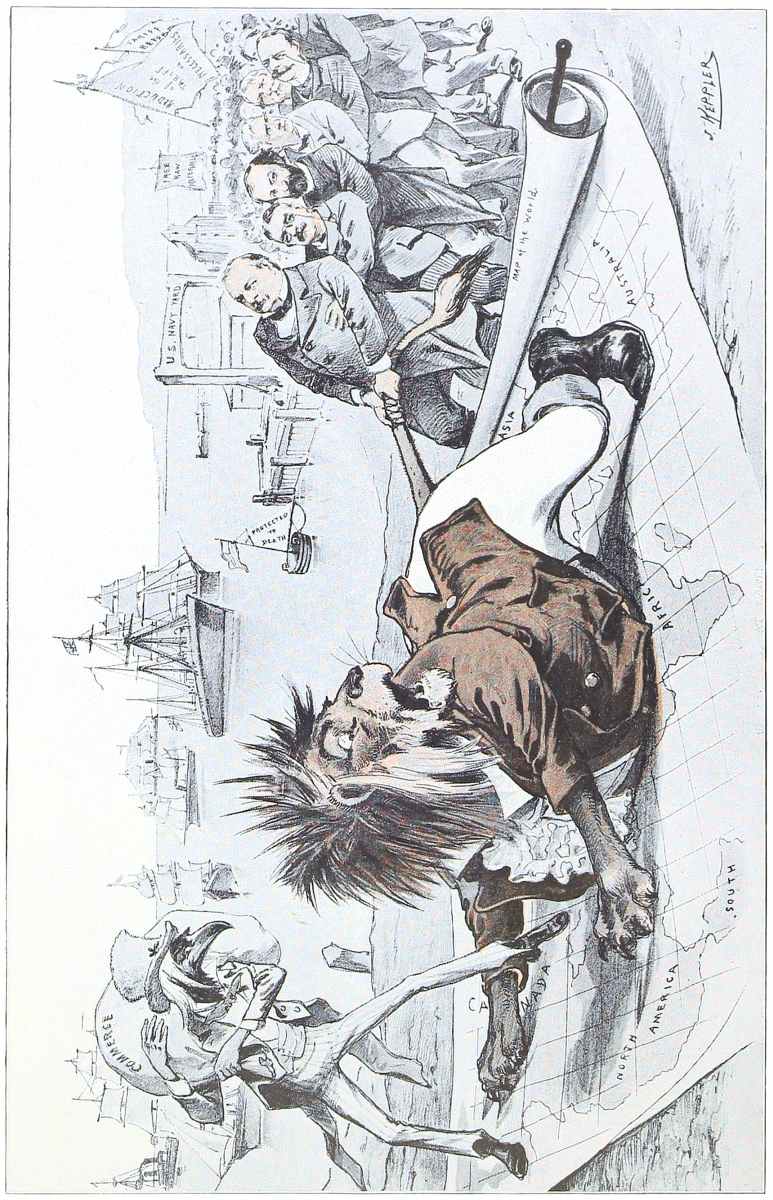
AT LAST!
PUCK, January 18th, 1888.
Another phase of the tariff question is illustrated in this cartoon, which was designed
to serve as an offset to the impudent accusations of disloyal desire to serve English
interests so frequently made by high protectionists against all those who questioned their
divine right to profit by their ingenious scheme of taxation.
Adapting Sydney Smith’s famous formula to modern American use, Puck said on
January 18th, 1888:
“You may sit down, O well-protected Average Citizen! at your protected table, in
your protected arm-chair; and button your protected coat about you, and dream that
your protective tariff is a drain on the wealth of the English. But the fact remains
that you pay every cent of the duties that you impose upon foreign goods, and that
nobody is the worse off for the increased price, except yourself. The fact remains that
you pay for goods manufactured in this country the same price which you pay for foreign-made
goods of the same grade; that price being greater than the fair price by the
amount of the duty imposed. And, above all, the disgraceful fact remains that all these
goods on which you pay a tax are brought to this country in English ships, sailing under
the English flag, which take back, on their homeward trip, your American money, O
Average Citizen! in payment of freight imported by you in English bottoms. And yet,
before we had a protective tariff, we were able to do our carrying trade for ourselves.”
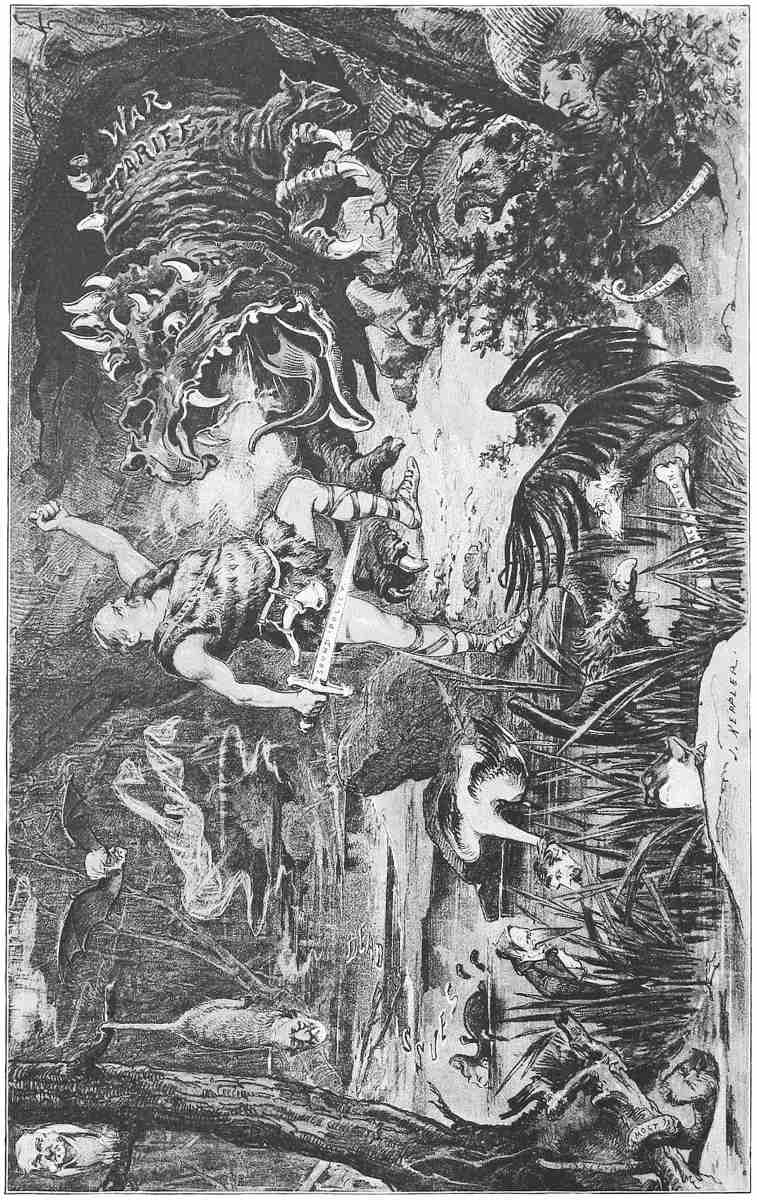
SIEGFRIED, THE FEARLESS, IN THE POLITICAL DISMAL SWAMP.
PUCK, December 28th, 1887.
When Mr. Cleveland began his now historic struggle for Tariff Reform he found that
he had to encounter more ignorance and apathy among the public at large than he had
reckoned on. In fact, he began his fight in a very mist or fog of popular misconception,
and his surroundings in these first days were such as naturally suggested the grewsome
allegory which Puck published on December 28th, 1887.
The animal-portraits in this picture are for the most part readily recognizable—J.
G. Blaine, John Sherman, Whitelaw Reid, W. M. Evarts, B. F. Butler, T. C. Platt,
(dead, but floating,) C. A. Dana and Joseph Pulitzer. The owl in the left hand upper
corner is Secretary Folger. In the corner below him is Most, the anarchist. The hedge-hog
and the wild boar on the extreme right are Jacob Sharp and J. B. Foraker. The
two tails protruding from holes in the ground are reminders of the brief period of activity
enjoyed by Mr. Henry George and his clerical ally.
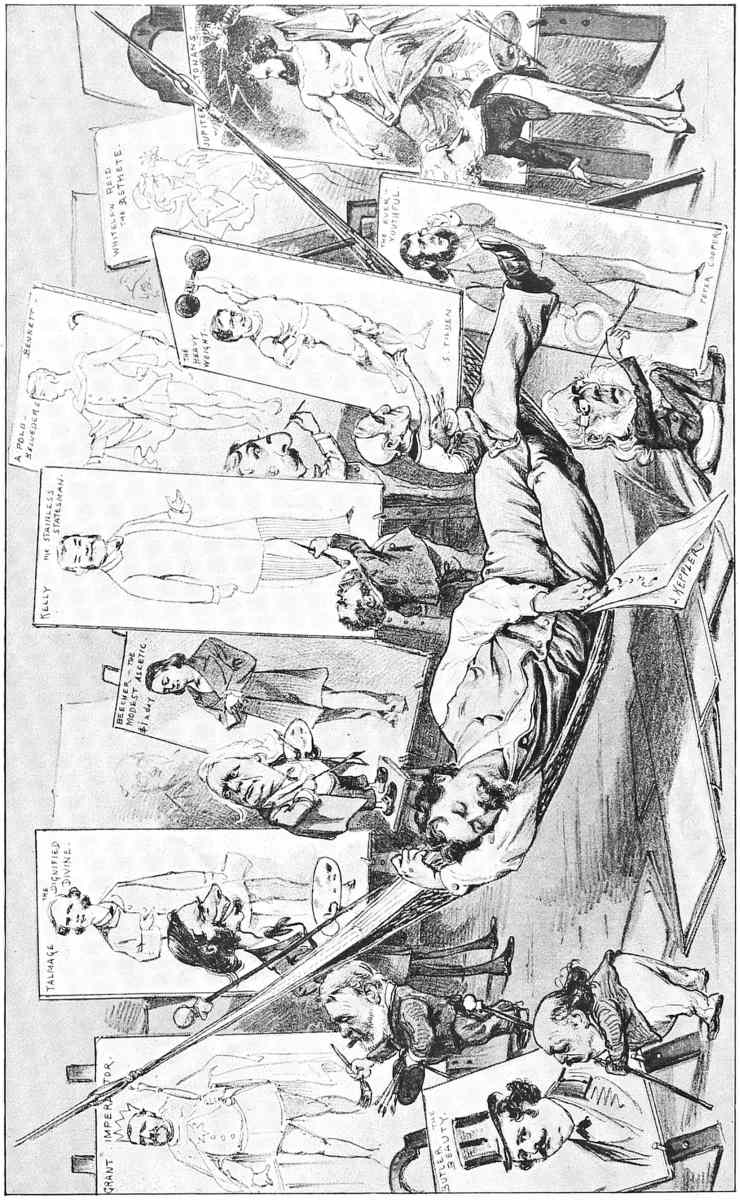
Bright as is the idea which inspires this cartoon, it inspires only the interest of reminiscence.
Puck’s chief cartoonist figures himself as falling asleep upon a hot midsummer
day, so soundly that during his slumber the subjects of his facile pencil invade his studio
and use his drawing materials to depict themselves according to their own conceit. Thus
Roscoe Conkling, practically withdrawn from active politics, portrays himself as a Jupiter
Tonans in the prime of life, and Mr. Whitelaw Reid, who was at the time accused of
dallying with æsthetic dandyism, appears as a figure somewhat like Mr. Gilbert’s Bunthorne.
Peter Cooper appears as a young and auburn-whiskered man; and Mr. Tilden,
even then in the feebleness of old age, sketches himself as an ambitious athlete. Mr. James
Gordon Bennett sketches himself as the Apollo Belvidere. A subtle pun is here intended.
Mr. Bennett was then prominent through his efforts to introduce the game of polo into
this country. The patch on his nose marks the wound he is supposed to have received in
his mysterious encounter with Mr. Frederick May, a disreputable man-about-town, with
whom Mr. Bennett was at one time intimate. Mr. John Kelly draws himself as a fashion-plate
model; and Mr. Beecher, whose lineaments age had made somewhat gross, paints
for his picture the likeness of the young man whose eloquence and originality waked a
new fire in the religious circles of the West. Mr. Talmage draws himself as he perhaps
would have liked to have people think he looked. General Grant sketches a mighty emperor
who bears his features. And that curious political tramp, General Benjamin F.
Butler, uses the canvas to straighten out his curious, ugly mug into the likeness of a good-looking
man. The picture curiously suggests what General Butler might have been had
he been anything but the queer and unpleasant thing he was.
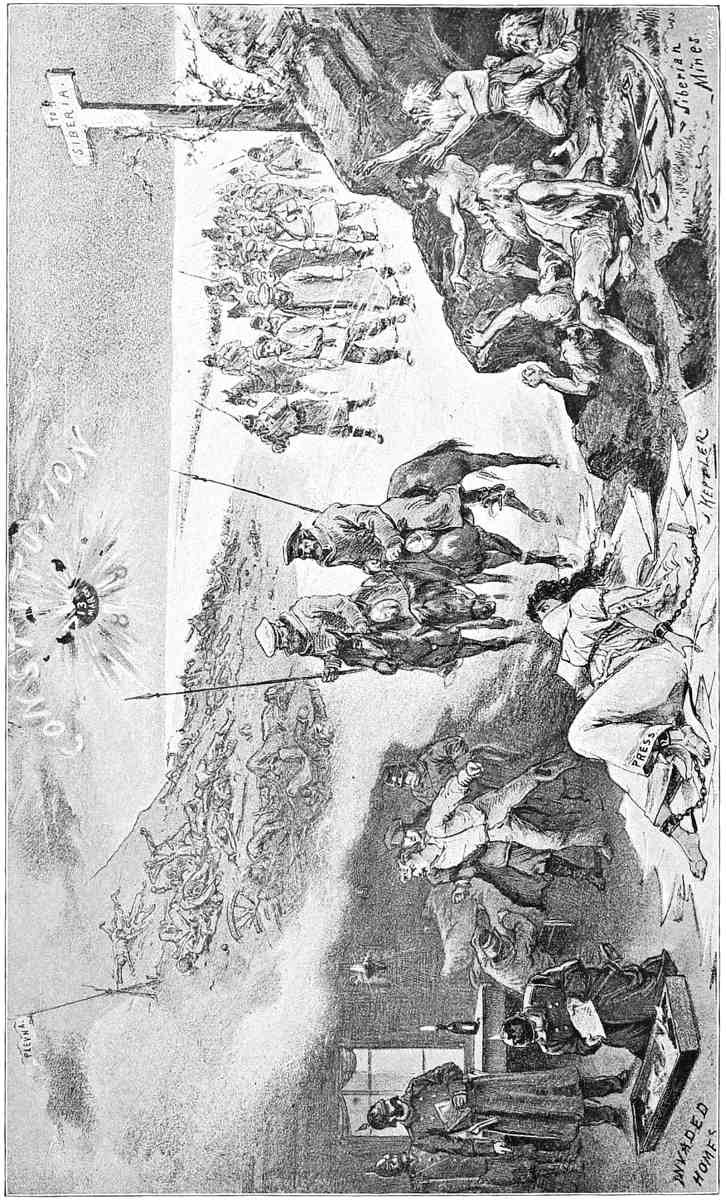
The hideous cruelties practised by the government of the Czar of Russia on all those
of his subjects who do not worship and adore the “Little Father” with single-minded
devotion and reverent awe, have more than once furnished a subject for Mr. Keppler’s
sympathetic pencil. At the time of the appearance of this cartoon, in March of 1881,
these brutalities had attracted general attention throughout the civilized world. Perhaps
they were no worse than they had been before; but there seemed to be reason to believe
that they were just then of an exceptional atrocity, the recent Russo-Turkish war having
noticeably stimulated the savage element in what one of their own artless writers calls
the “semi-barbarian race” of Russians.
THE REIGN OF PEACE.—THE MOUSE IS SAFE WHILE THE MOON SHINES.
PUCK, February 15th, 1888.
This cartoon bears date of February 15th, 1888, but it might have appeared with
very little variation at any time during the last ten or twelve years of Bismarck’s
premiership. While that great and clear light shone in the European heavens nothing
was left wholly to chance in all that quarreling, jealous congeries of states. Nothing was
done—nothing was even planned that was not in some measure suggested or shaped by
that giant will and that alert and far-seeing intelligence.
It is worth while to call attention to the logical composition of this cartoon. Observe
that it is thought out to the last point. The eye takes in at a glance the thronging, hungry
beasts of prey, the mighty luminary hanging high in the firmament and the poor little
Bulgarian rat helpless on his little rock amidstream between the frowning cliffs, yet safe
in that clear radiance so long as it deigns to shine upon him. But note the settled suggestion
of warlike possibilities conveyed by the helmet on the head of the Man in the Moon
and the curious hints of animal ferocity given by the lines under the heavy moustache,
the feline cleft in the middle, and the mane-like touches beside the cheeks. Now, looking
at the cat-like beasts of prey, observe that Prussia occupies the point of advantage,
and uses it to “stand off” the approach of Russia, who crouches on a somewhat higher
cliff, rapacious, strong, eager, yet with wary eyes half-turned upon the ever-dreadful
Prussia. Follow that furtive cat-like glance a little further and you will see that it takes
cognizance of the sly approach toward the prey which Austria is making under cover of
Germany’s position. Italy and France crawl on in the background, paying more attention
to each other than to their remote chances of individual gain. Russia and France,
you see, are on one side of the stream; the Triple Alliance of the hour on the other.
For a touch of interesting detail look at the figure of France with its fine bushy beard, its
red liberty cap, and its very conspicuous epaulettes. To one who follows the nicety of
the artist’s symbolization, this indicates that the picture was drawn at the time when
“Boulangism” was rampant in Paris. It was not the era of Thiers, the clean-shaven
statesman, or the vieux Militaire time of MacMahon, or the time of Grévy with his little
bourgeois whiskers. It was a sort of bogus-Gambetta revival, which is aptly characterized
here in features that suggest those of President Carnot, without permitting the weak
amiability of his expression to typify militant France. And—one thing more—note how
that whole picture, by means of color, composition and perspective, centres itself to your
eye in one little figure that does not occupy (by measure) the one two-hundredth part
of its space.
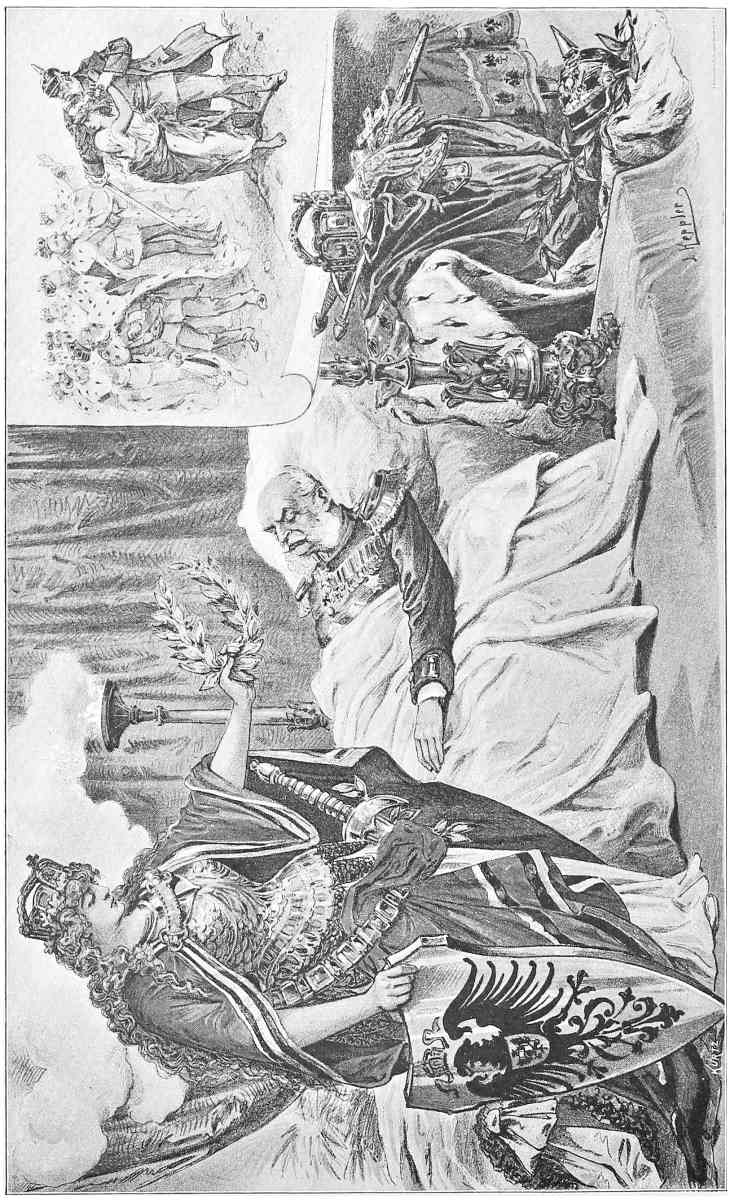
IN MEMORIAM EMPEROR WILLIAM I.—HOW HE FOUND GERMANIA, AND HOW HE LEAVES HER.
PUCK, March 21st, 1888.
“There was one King in Europe two weeks ago, one King worthy of the name, and
there is none to-day. And in this fact there is much more significance than we of
America are likely to note. To us a King is an anachronism. His name is something
that belongs to the time of fable and fairy-story. We do not quite realize that he exists;
that he is still a power. There is an intrinsic unreasonableness in the idea of his continuance,
out of the world of fiction, that inclines us to disbelieve in his very existence.
We can hardly conceive of him as anything more than a puppet—as a mere figure-head
for a governing ministry.
“But the late Emperor of Germany was a King. He was King of Prussia before he
was Emperor of Germany; and as King and Emperor he set up a standard of conduct
by which few men would care to govern their lives. He tried to be a King, having a
high conception of what a King should be, and, as far as in him lay the power, he was a
King. At least, he was a mortal who strove hard to be more than other mortals, and who
strove from a sense of duty. We may—and must—hold the effort futile; yet we may
respect the spirit that prompted it. We Americans have no use for Kings; and we have
ideas as to popular government that King Wilhelm of Prussia, later Emperor of Germany,
would never understand. But let us consider that it would be well for us if we had
a few statesmen, among those who are governing us on speculation, who would look on
their responsibilities as this dead European monarch did on his. He knew that his place
was greater than he was, and he tried to make himself fit for it. And, now that he is
dead, his people mourn a brave man gone; if they are to have Kings or Emperors to
rule them in the future, they will go far before they find a better man of his kind.”—Puck,
March 21st, 1888.
“The anarchists and socialists, and the turbulent and vicious among our German-American
fellow-citizens, were more or less miserable over the celebration of Kaiser
Wilhelm’s ninetieth birthday, last week; but decent Americans of German origin or free-born
may well have taken pleasure in drinking the old gentleman’s health. No earnest
republican can unreservedly admire even the best of emperors—or, indeed, wholly understand
the imperial idea. But, since there are emperors, it is desirable that they should
be good of their kind; and there is no kingly ruler in the world to-day who is a better
man, after his own pattern, than the white-haired old soldier who has just ended his
ninetieth year.
“And even the Anarchist who would not drink the old Kaiser’s health ought to reflect—if
an Anarchist can reflect—that he has little right to complain of the good old Kaiser
when he cries out against the government of Germany. Wilhelm is Emperor, in truth;
but in Germany there is to-day a higher than the Emperor—the Emperor’s humble
servant, the Chancellor of the Empire, a stern, shrewd, stubborn, overbearing, foxy,
sinister, loyal, fearless old man, named Bismarck, who holds the government of Germany
in the hollow of his hand, and is the one arbiter of peace and war in all Europe. It is
this original and powerful man who practically stands for Germany in her dealings with
other nations; and it is he who to-day holds the balance of power in Continental Europe.
His fame will outlive that of the honest old Emperor. Kaiser Wilhelm will figure in the
school text-books with Henry the Fourth of France and Elizabeth of England; but Bismarck’s
name will live forever in the literature of politics; and even in fiction as a type
more strong, deep and subtle than any in the annals of statecraft. We use the name of
Machiavelli in familiar comparison—but whom shall we ever compare with Bismarck?”—Puck,
March 30th, 1887.
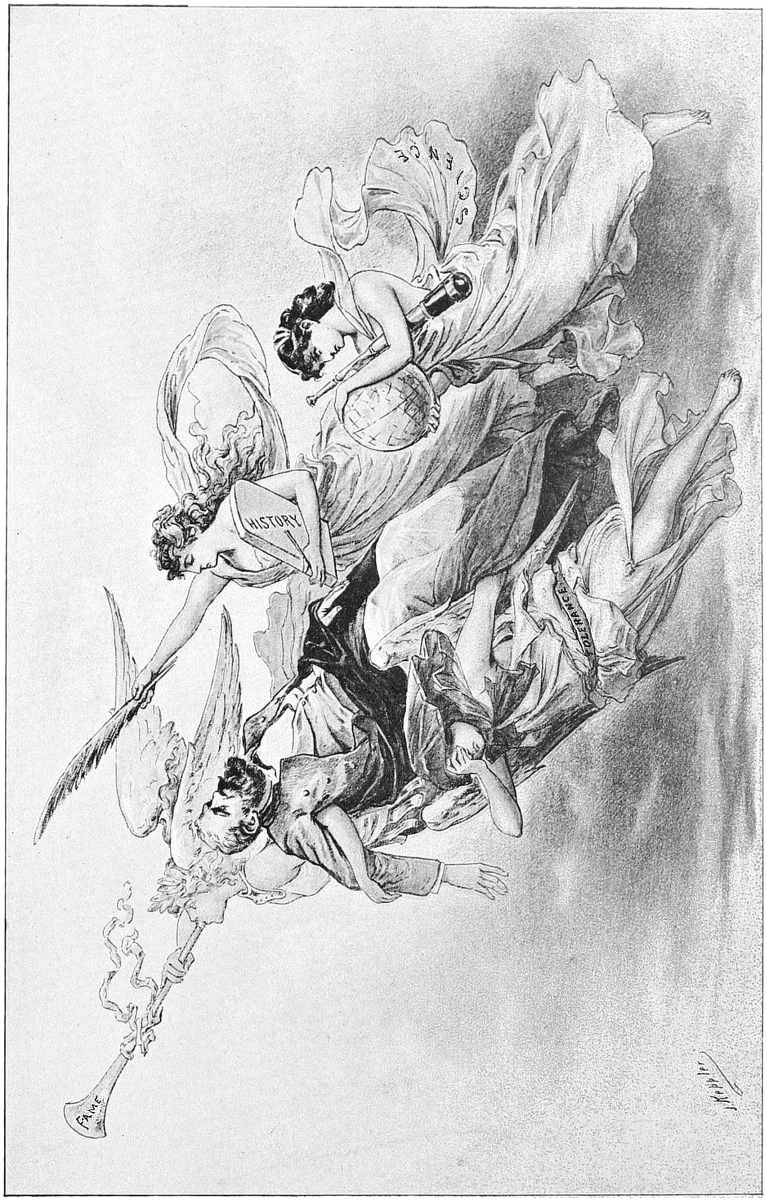
FREDERICK III. OF GERMANY—THE END OF A BRAVE LIFE.
PUCK, June 27th, 1888.
It will be well for Germany if, in the doubtful years that lie ahead of her, she has not
reason to regret the loss of the brave and high-minded man whose sad reign came to an
end two weeks ago. Frederick the Third inherited his father’s strength and his lofty
sense of duty, yet his character was made at once broader and gentler by his better
understanding of the spirit of his day. He was eminently the man for the hour, and the
courage with which he enunciated his principles and took his stand for tolerance and
modern ideas, under circumstances which might well have served as an excuse for inaction,
showed that he would not have been unequal to greater emergencies. Had he
lived, he would have made the most of peace, as his father made the most of war, and his
talent complemented that of William, and was singularly fitted to the duties from which
he was so soon taken.
“How often all Europe goes into what we slang-loving Americans call a keniption fit
over a political ‘incident!’ We don’t care to attempt an exact definition of the word
‘keniption;’ but we are quite willing to explain that an ‘incident,’ in European politics,
means a small affair of great importance. A native peasant pokes his umbrella into
a foreign ambassador’s eye—that is an incident. A foreign ambassador pokes his
umbrella into a native peasant’s eye—that also is an incident. On such incidents the
fate of nations hangs. It may be the Mortara incident, or the Benedetti incident, or, as it
is now, the Schnaebeles or Schnaebele or Schnaebelé incident, (how does he spell his
gallicised German name?) but no year can pass without its incident, over which the press
must shriek, and diplomats must excite themselves, and quarts of honest ink and ohms
of good electric force must be wasted.
* * * * *
“The incident himself—there is generally a personality to the incident—is, as a rule,
a most unimportant individual. There are exceptional cases, of course. Benedetti was
a man of importance. He had too much importance, mayhap. But he would never have
written his name in large script upon history’s page had he not been snubbed in a public
park. So is it with Schnaebeles. He is world-famous to-day, who will never do anything
else in his life that will get his name in American or English newspapers. He has
been arrested by Germany, he, a French official, and he is an incident. He is an incident
who does not amount to much, it seems; but still he is an incident. Twenty, thirty,
forty years from now, a withered, snuffy, oddly dressed old man will sit, perchance, in
front of some Paris café, sipping his eau sucrée or his syruped vermouth, and the boulevardier
who passes by will say to his friend; ‘That is Schnaebele.’
“‘And who is Schnaebele?’ the friend will inquire, wonderingly.
“‘Why, have you forgotten your history? The hero of the Schnaebele incident—in
1887—or ’78—which was it? When we were so near going to war with Germany.’
“‘Ah, bah!’ his friend will reply; ‘un marron glacé! Qu’est-ce que tu me donnes!’
“And that is what it is to be an incident.”—Puck, May 4th, 1887.
Elsewhere in these pages an attempt has been made to give some idea of the character
and significance of “German Michel.” This cartoon, which appeared at the time
of the Boulangist excitement in France, shows how Michel’s native shrewdness and
stolidity rendered him proof against the ingenious, but far from ingenuous, attempts of
Prince Bismarck to make capital for the War Department out of the disturbances in
France. The sturdy toiler, overworked and overtaxed already, showed not only a frank
unwillingness to add to his burdens, but bore himself toward the princes and potentates
that were set above him with a certain self-confident freedom of attitude which had not
been his wont of old time.
“‘German Michel’ is a typical figure of which the most remarkable characteristic is
that it has made itself absolutely inappropriate to its original purposes. It is a figure
created by the German caricaturists—a loutish, sleepy, heavy peasant, gazing on the
world with dull, uninterested eyes. It stood for the political spirit of the German people—the
spirit that existed in the years between ’48 and ’70—the spirit of indifferentism, of
hopeless submission to superior power, of acceptance of whatever state of affairs it might
please the rulers of the land to establish. It was aptly chosen. Even the possibilities of
brute force suggested by the bumpkin’s sturdy build had a deeply significant application....
But 1870 and the war changed the spiritual state of Germany, or rather, began
a process of change of which we have not yet seen the end. And now for twenty years
the German government has been educating Michel, and Michel has been educating
himself. While the government has been teaching him to read, and he has been teaching
himself various things that are useful and interesting to any good citizen and patriot,
there have been plenty of people who have devoted themselves to giving him what might
be called an underground education. Recent events in Germany show that this part of
Michel’s education has certainly not been neglected—at least, so far as the inculcation
of the beauties of socialism is concerned.... Now it is to this Michel, not to the old
Michel, to the public spirit of Germany of 1850 or 1860, that the young Emperor Wilhelm
is issuing his extraordinary ‘rescripts,’ in which he describes himself as the emissary of
God, sent to take charge of the future of the German nation (without specifying any
qualifications for the task with which the Almighty may have been pleased to endow him);
announces his intention of solving at once the everlasting problem of poverty and ignorance,
and offers to ‘shatter’ or ‘dash in pieces,’ all who oppose him in his plans. Surely,
this young man, this inexperienced youth, the son of an Emperor who reigned only on his
death-bed, the grandson of an Emperor whose best work was done before that grandson
had got well used to long breeches; this immature martinet; this quaint despot with the
narrow forehead and the eager, intolerant face—surely he is ill-fitted to meet the
subtle, secret-minded men, conscious of their growing strength, who have taken the place
of the submissive ‘Michels’ of his grandfather’s time.”—Puck, March 19th, 1890.
HE BEATS BARNUM.
PUCK, February 19th, 1890.
This is neither the place nor the time to attempt any summing up of the character of
the Rev. Dr. Talmage, of Brooklyn. In Puck’s earlier days the eccentricities of this
clergyman and his peculiar notoriety made him the especial butt of the cartoonist; and
this latter revival of a familiar figure was provoked by some uncommonly audacious performance
whereby the Reverend gentleman startled most people and shocked many on
his return from a European trip. It is unnecessary to recall the details: the cartoon is
founded on Dr. Talmage’s own utterances.
Let us note here that through all this long period of fun-making, Dr. Talmage seems
to have enjoyed the jokes upon himself even more than the general public did, and Puck
has for many years preserved a formal blessing or benediction, couched in terms of cordial
regard, and sent by the clergyman in exchange for a small cash and a large advertising
contribution to the re-construction of his tabernacle.
THE MURDERER’S STRAIGHT ROUTE TO HEAVEN.—BRINGING RELIGION INTO DISREPUTE.
PUCK, June 28th, 1882.
Many who look at this cartoon to-day may well wonder what called it forth, and
many others may have to be reminded that even so recently as ten years ago a morbid
sympathy with criminals was so common among American clergymen that it was popularly
held a reproach to the whole clerical body. It was, however, little more than a passing
phase, a sort of hysterical epidemic that prevailed among people peculiarly exposed
to emotional impulses. It seems to have died a natural death, and it has passed away
so utterly that it is practically forgotten to-day.
We do not speak, of course, of the sympathy which every minister of God should
feel for the erring and unfortunate, but of a certain maudlin enthusiasm which at one
time moved many otherwise excellent and admirable members of the clerical profession,
and brought about some startling exhibitions of misplaced sentiment. At the period of
which we speak, namely: the decade prior to the publication of this cartoon, it was no
uncommon thing to read of a clergyman, assisted by a band of female devotees, invading
a prison to spend hours, day after day, in consoling, comforting, and generally coddling
some red-handed murderer in whom they could have had no possible interest, and of
whom they never would have heard save for the notoriety of his trial. Clergymen were
found, too, to go on the gallows at the last moment, and publicly to avow their belief that
the soul of the criminal about to die was purged of all earthly sin, and that his repentance
with the noose around his neck had fully sufficed to fit him for heaven. Such shows as
these were common enough and evil enough in their influence to justify even severer condemnation
than that expressed in this vigorous cartoon.
The mania, for such we must call it, probably had its origin in the extravagant and
widely advertised efforts of the Rev. Dr. Tyng, of New York, to save Foster, the “Carhook
Murderer,” from the gallows. Foster, who was partially drunk at the time, wantonly
killed an inoffensive stranger on the 26th of April, 1871; and, after every legal resource
had been exhausted in his behalf, was hanged March 21st, 1873.
This cartoon appeared in Puck of June 28th, 1882, and its immediate occasion was
the execution of Charles Guiteau for the assassination of President Garfield, which created
a most unwholesome excitement in many quarters.
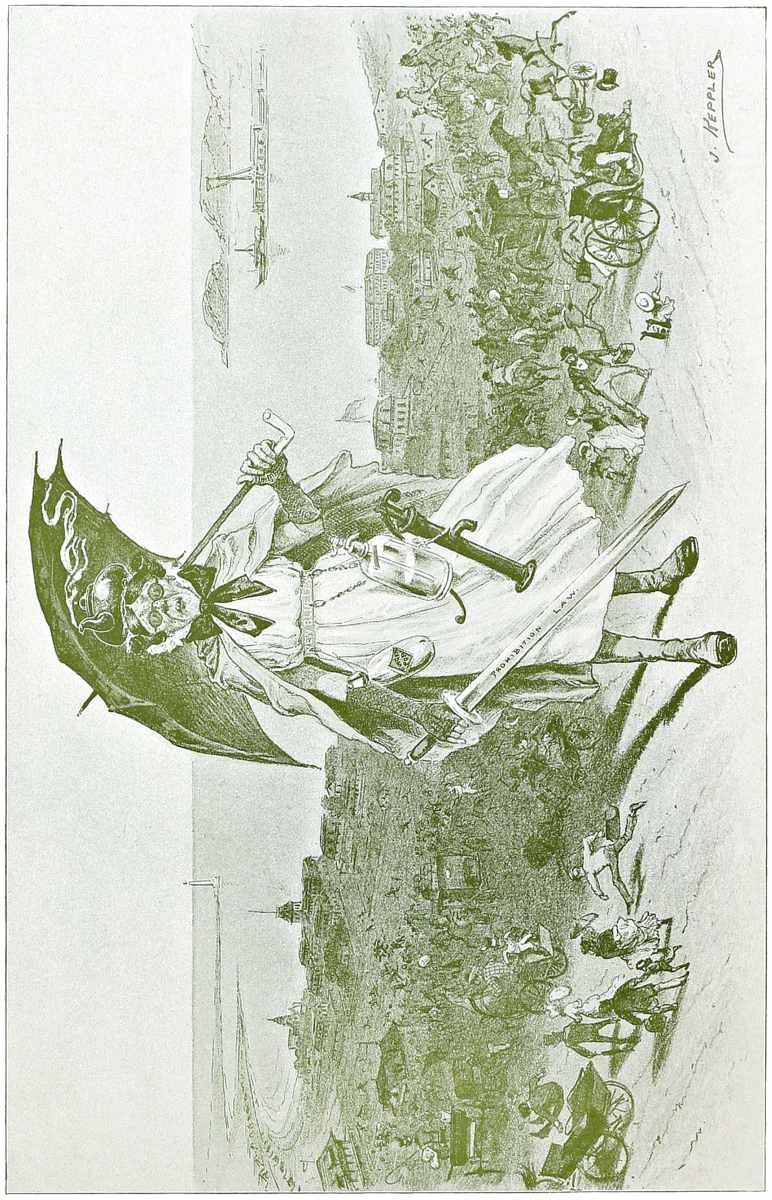
“PROHIBITION IS COMING!”
PUCK, August 4th, 1886.
“The State of Rhode Island has recently passed—to its own great surprise—a
‘prohibition law.’ The state did not really want the law. It was not passed as a matter
of principle. The Republicans voted for the law to spite the Democrats; the Democrats
to spite the Republicans. No one thought that the aggregate of votes thus cast would
make the legal majority. But so it happened. Now, the State of Rhode Island is a small
community, and, like most small communities, it is narrow, ignorant, and, save in things
material, unproductive. One of the chief sources of revenue upon which it depends is its
wonderful collection of Summer watering-places, which bring travel and traffic to the
state and put many thousands of dollars into circulation every year. These places are
supported by a civilized lot of people from the great cities—people who are accustomed
to drinking wine and beer and whatever else they fancy; and, as a rule, in moderation.
If they find that the new law interferes with their perfectly legitimate customs in this
regard, they will leave Rhode Island for some more liberal and sensible state; and Rhode
Island will be so much the poorer, and so much the wiser. No decent man will submit to
be put in the category of criminals because a few hysterical women and unbalanced men
think that the use of alcohol is as much a crime as its abuse.”—Puck, August 4th, 1886.
FIRST ANNUAL PICNIC OF THE “KNIGHTS OF LABOR”—MORE FUN FOR THE SPECTATORS THAN FOR THE PERFORMERS.
PUCK, June 21st, 1882.
The cartoon suggested by the “First Annual Picnic of the Knights of Labor” can
hardly be said to belong to Puck’s famous group of labor cartoons. Its appearance
preceded by some four years the great discussion of the labor question; and it is essentially
what is known to artists as a “situation” picture, aiming at nothing more than the
simple presentation of a fact. But it is curious to note that it was called forth by the futile
strikes in the iron mill region, and even at that early date the editorial comments accompanying
the cartoon ascribed the anomalous condition of affairs principally to the inequalities
of fortune engendered by the protective system. The comments close thus:
“It is not extravagant wages that the workman wants, it is purchasing power with the
wages he does earn.”
ARBITRATION IS THE TRUE BALANCE OF POWER.
PUCK, March 17th, 1886.
It should be distinctly stated that this cartoon is not to be regarded as having a
general or abstract application. It appeared during the first street-railway strikes in
New York; and the lesson it tries to teach was addressed especially to the corporations
which, acting as common carriers and holding valuable franchises, were putting the
public to great loss and inconvenience in carrying on a protracted struggle with their
employees, wherein there was little doubt that right and justice were entirely on the
workmen’s side.
However, this was the beginning of the great labor struggle that did so much to
clear the minds of the people on the great question of the inter-relation of Capital and
Labor. Puck’s forecast was almost prophetic. The editorial, which rebukes the greed
of the corporations, points out that the strikes which they had precipitated could only
serve to teach the workmen to abuse the right to strike; and goes on to say: “They
are not more wise, more temperate, more just than their employers. The employers,
having power, have misused it. They will likewise misuse power. What could be
expected otherwise? Where they have the upper hand, they will tyrannize. They will
strike and paralyze business, not only to enforce just demands, but to enforce unjust
demands. Their employers will use the power of money to retaliate as best they may.
A war, a veritable Civil War is begun, to which who can see the end?”
“FOR WHATSOEVER A MAN SOWETH, THAT SHALL HE ALSO REAP.”
PUCK, June 15th, 1887.
Incredible as it may seem, the hare-brained theories of Mr. Henry George as to
the communistic ownership of land received at one time a most unmerited toleration from
people who would not have been suspected of sympathy with such vagaries. That he
and his partner McGlynn did not accomplish the mischief they set out to do was no
fault of theirs. When this cartoon was drawn, June 15th, 1887, they seemed to be
perilously near to attaining their end. The reason that they failed was that, as is
usual in this country, Horse Sense ultimately triumphed over Hysteria.
THE POVERTY PROBLEM SOLVED.
PUCK, May 18th, 1887.
Mr. Henry George no doubt found his account in catering to the unruly and turbulent
in 1887, but it is doubtful if Father McGlynn, the Roman Catholic Priest who got such a
bad attack of the George doctrine that he earned for himself several years of suspension
from his priestly functions, made as much out of it as his more astute colleague. But
between them they made a great deal of noise, and Puck did what he could to counteract
their influence. With this cartoon on May 18th, 1887, appeared the following editorial
advice to the laboring man:
“Don’t be a laboring man—that is, labor, but as an employer rather than as an
employee. You have got to serve your apprenticeship to poverty—so has everybody
else, except the comparatively few who inherit large fortunes. But be diligent in your
apprenticeship, and it will be mastership in the end. Work with this one idea in view—that
some day you will have earned and saved enough to go into business for yourself.
Then you can employ some other poor man, who would else go hungry; and you can
treat him well and give him a chance to make money in his turn. That is the way of the
world. It is not a bad way, if you take it bravely and cheerfully. If you refuse to take
it in the right spirit, if you sulk and whine and call upon labor organizations to protect
you, and cry for special legislation to right wrongs which you can’t even define—why,
you will find it a pretty hard way. It is hard on shirks, idlers, skulkers, and men who do
half-hearted work. But it is a way that is as old as the rising of the sun; a way that will
be the same when the last sun sets on this world, and all the McGlynns and Georges and
Anti-Poverty Clubs in creation will not change it. It is the good old way of duty, and it
existed before Labor Leagues were thought of.”
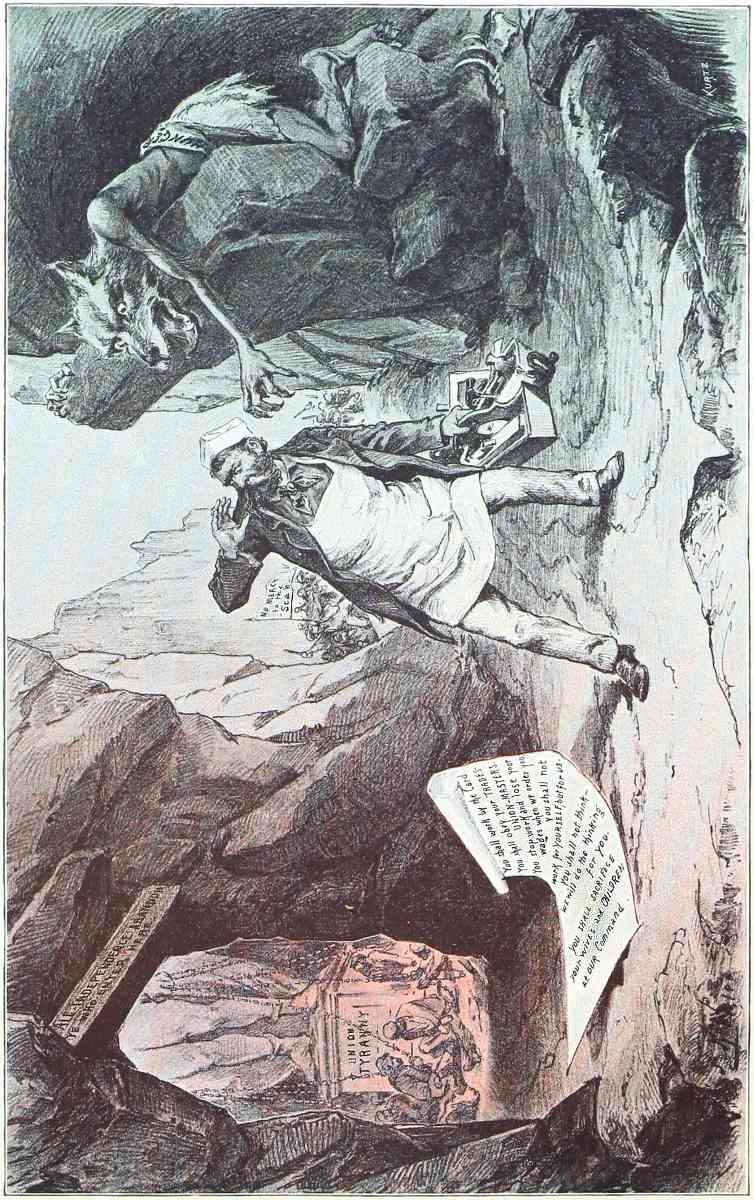
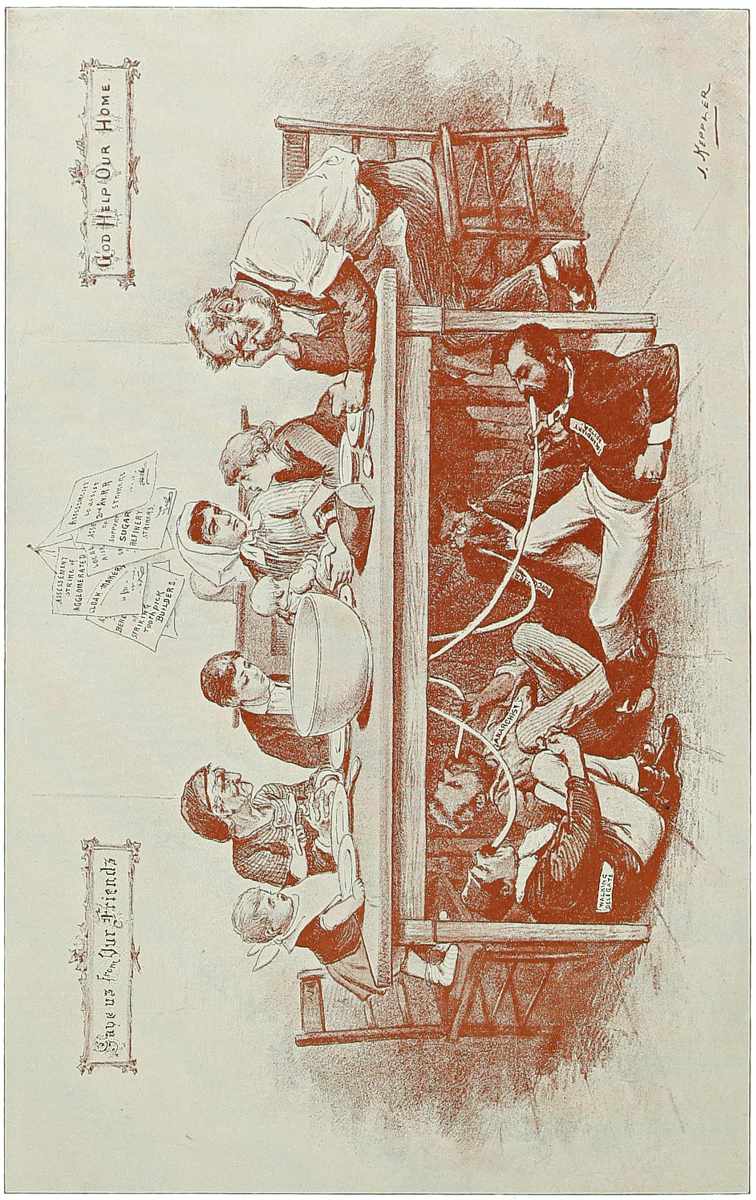
BETWEEN SLAVERY AND STARVATION.
PUCK, October 26th, 1887.
To realize the terrible truth of this picture, it is necessary to remember that trades-union
tyranny cuts both ways. At a little earlier date Puck explained the situation thus:
“We read in the papers that such and such a body of working-men has struck for
higher wages, by command of such and such a union. Popular sympathy is at once
aroused in behalf of the underpaid laborer and the benevolent union that has taken charge
of his interests. But the public does not know that the union which orders that the workman’s
pay shall be so high also orders that it shall be no higher. When the union says
to the employer: ‘You shall pay this man two dollars a day,’ it likewise says to the man:
‘You shall not receive more than two dollars a day. If you take ten cents more of your
employer, every man in the place must receive a proportionate increase in his wages, or
you must give the ten cents back. If you do not obey us, we will fine you. If you will
not pay the fine, we will turn you out of the union. We will not let you work in any office
where there are union men. If you get work in a non-union shop, we will boycott you, we
will boycott your fellow working-men, we will boycott your employers, we will boycott
every man who sells you food or gives you lodging.’”
The labor struggle of 1886 was not far advanced before the agency of the professional
agitator became apparent—to those, at least, who honestly tried to look below the surface
of things. That the whole fight was got up and kept up by these false friends
of the laboring man, and that they were the only gainers by the disorder of the time is
well known now. But it was not so well known then, and when this cartoon was put
forth it had all the interest that attaches to the bold presentation of a truth for which the
public is not prepared.
“The Suckers of the Working-man’s Sustenance” was published in Puck of May
19th, 1886. The three bearded men under the table have features which more or less
suggest those of certain professional agitators of the hour—John Most, the editor of a
dirty little paper that preached blood-and-thunder anarchy, and a couple of other scamps
of the same sort.
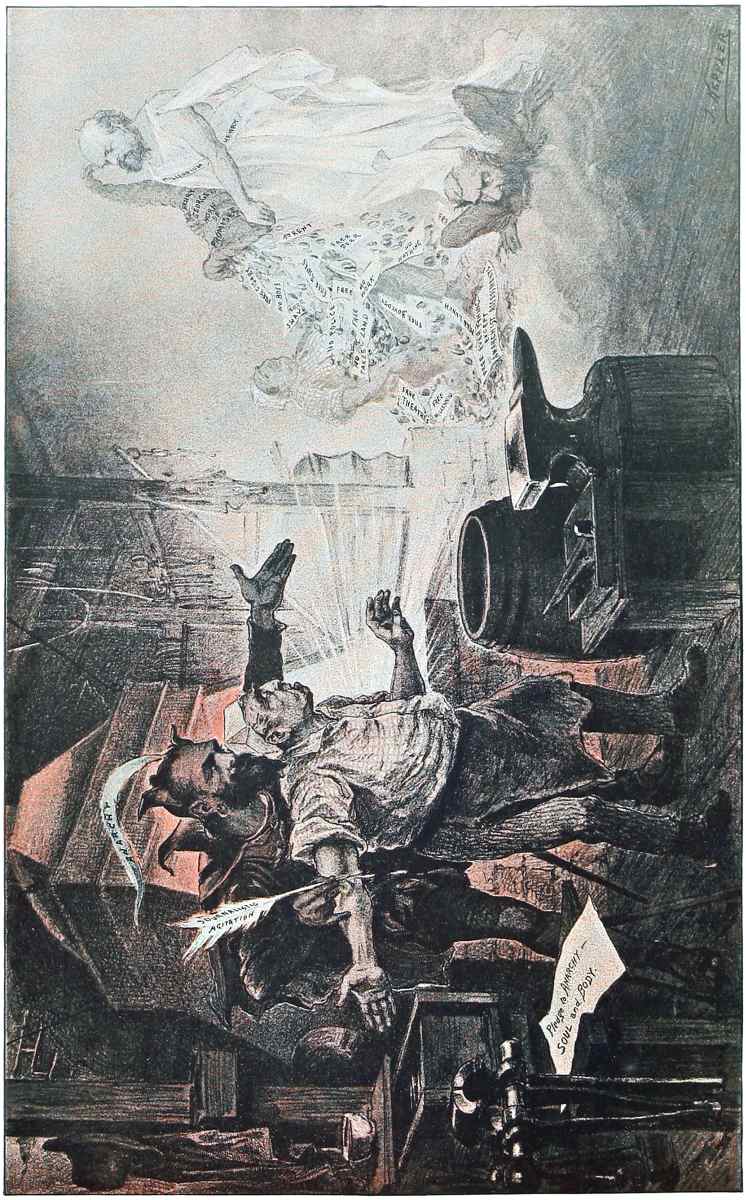
THE MEPHISTOPHELES OF TO-DAY—HONEST LABOR’S TEMPTATION.
PUCK, October 20th, 1886.
The part that Mr. Henry George played in the troublous days of 1886 was probably
profitable to himself, and to no one else. He started in with a reputation of a sincere and
high-minded philosopher somewhat in advance of his time, but the moment he got the
Socialist nomination for Mayor of New York, he turned into as frank and downright a
demagogue as ever tried to tempt a mob with promise of the pillage of the rich.
“We are sincerely pleased to see that Mr. Henry George has come out frankly and
made his canvass on the basis of an out-and-out alliance with the Anarchists. He no
longer pretends to belong among the respectable reformers; he arrays his followers
squarely and honestly against the law and the established order of things. He was a
sanguine theorist so long as he kept at book-making. Now that he has taken to talking,
he is a thorough-going, zealous demagogue of the old-fashioned sort. ‘Vote for me,’ he
cries to the lawless, the idle and the improvident, ‘and I will give you free rides and
free land; and the police shall be muzzled, and all laws that you do not like shall be
repealed. A contract shall no longer be sacred, and if any man has wealth, he shall share
it with you. The land of the rich shall be confiscated, and you may boycott to your
hearts’ content.’ It may be doubted whether this is the right way to win favor with
decent citizens; but it is Mr. George’s way of going to work.”
The series of cartoons on the labor question which Mr. Keppler contributed to Puck
during the years of 1886 and 1887 certainly attracted more attention, and probably did
more to influence public opinion than any series of pictures that ever appeared in the
paper. They were drawn at a time of great public excitement, when fools, fanatics and
unprincipled adventurers were tempting honest laboring-men into all manner of lawlessness
and improper use of physical force. The American public had for the first time
been introduced to that ugly thing, the “Boycott,” and the Anarchists were seizing the
opportunity afforded by the general agitation to spread their infernal doctrines among the
working-men. Of course, under such circumstances, the air was full of the hysterical
shrieks of the excitable people who thought that all law and order were to vanish from the
face of the earth. The value of these clear and direct pictorial expositions was great
indeed, in that time of trouble, doubt and perplexity.
Puck said of Trades-Union tyranny on April 28th, 1886: “The boycott business is
bad. But it is an extravagant, monstrous, impossible thing, that the laws of a free country
must crush out, sooner or later. This other evil flourishes in secret and strikes at the
laborer’s self-respect. It is part of such a tyranny as no employer or body of employers
ever dared to dream of establishing. Every working-man who wants to do something, to
be something in the world—something better than the spy-ridden slave of a secret
society—should rise up to fight it. There is no need of general organization for this
purpose. Wherever one brave man, or a handful of brave men, stands boldly up and
insists on every man’s natural right to make his own price for his labor, to sell it for what
he chooses to sell it for, a blow will be struck in the cause of the laboring man’s independence.
And it rests with the laboring man to work out his own salvation.”
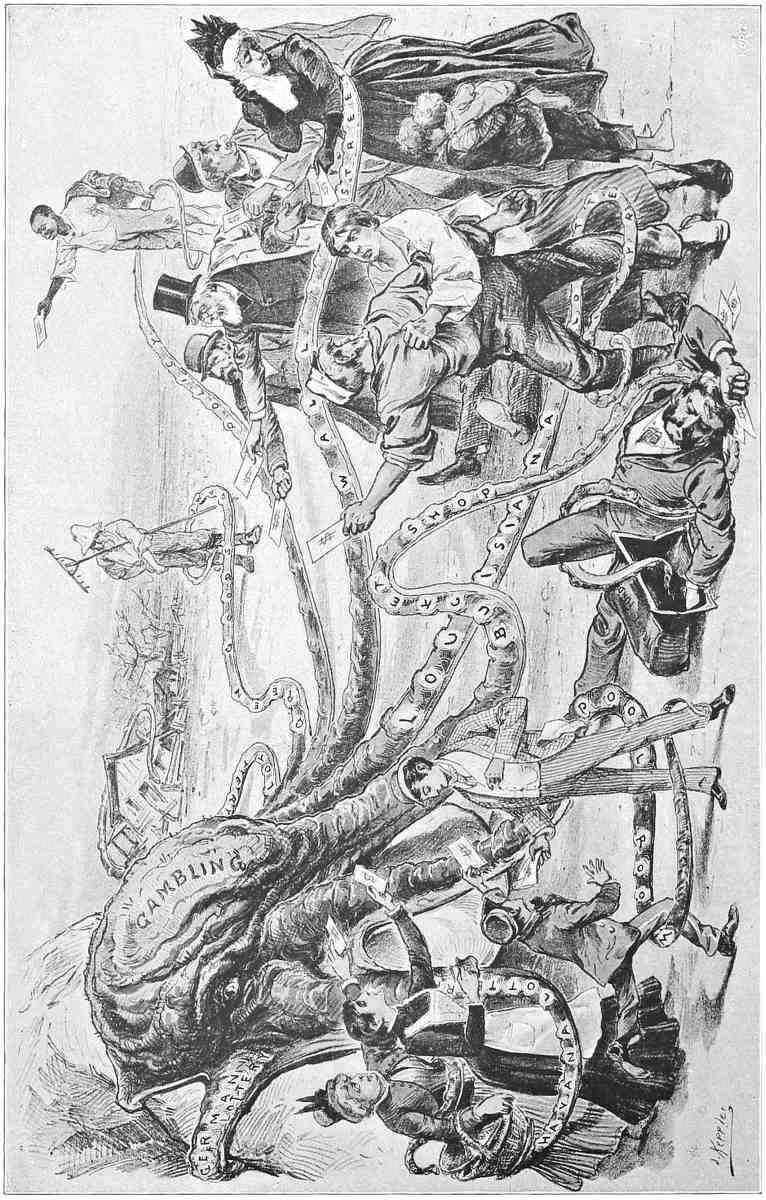
IN THE CLUTCHES OF THE MONSTER.
PUCK, May 28th, 1890.
Of all the disreputable schemes for illicit money-making that ever flourished in this
country, the Louisiana lottery is probably the most iniquitous and inexcusable. No
agency of modern times has done more to send boys to the devil, to tempt unprotected
women into squandering their subsistence, and to lure decent men from their daily duty
by the temptation of illegitimate gain. At the best, every public lottery is a danger to
the community; but of all public lotteries of modern times, the Louisiana lottery is easily
the worst and most dangerous. At no time has it enjoyed the reputation of being even
what is known as a square gambling game. An honest lottery—that is, a lottery honestly
conducted—may be profitable to the people who get it up. But the Louisiana lottery
has never earned the name of being honestly conducted in any respect. Its only
claim to respectability—and it is the thinnest sort of a claim—has lain in its employment
of two ex-confederate officers, General Jubal T. Early and General P. G. T. Beauregard
as the overseers of its drawings. The fact that they were ex-officers of the confederate
army alone gave these men a right to consideration. Personally, such adventurers
could be bought by the pound, like a side of pork, for any purpose.
This cartoon appeared at a time when the state of Louisiana was making a vigorous
attempt to rid itself of this hideous disgrace. The attempt was but partially successful.
Dauphin, the original agent of this infamous concern, is dead, but his successors’ advertisement
is still to be found in certain public prints where everybody can see it, except the
United States District Attorney.
There is a marvelous pregnancy of significance in this cartoon; as we can not but see
when we think that, at the re-assembling of Congress in December, 1887, one of the first
questions it had to confront was the question of the Surplus. The revenues of the government,
especially those coming from customs duties, were so vast that an enormous, useless,
cumbersome and dangerous surplus was steadily piling itself up in the United States
Treasury. It was the expectation of the people that Congress would pass laws reducing
the customs duties. But the only tariff legislation made by Congress between that date
and the appearance of this book has tended to increase rather than to lower these duties.
And yet, as these pages go to press, the latest report of the Secretary of the Treasury
announces that this surplus is so nearly wiped out that, unless the new administration
takes measures to the contrary, there will be a deficit within a year. This is a curious, definitive
accounting of a four years’ test of a peculiar latter-day theory of political economy.
It is not wonderful that a practical people insisted on the abandonment of the experiment.
That Mr. Cleveland during his first term was the object of more newspaper criticism
than a President usually receives was due to a combination of circumstances. He was the
first Democratic President elected in a quarter of a century; he was elected in part by
Republican or Independent votes, and he had incurred the enmity of a faction of his own
party. Nor were his ideas of the duties and responsibilities of government calculated to
please a certain numerous and noisy class of Democratic politicians who were “out for
the spoils.” On March 16th, 1887, Puck commented thus upon the situation:
“It is pretty hard for a practical politician and a strict party-man to toil away, day
after day, editing a great paper and moulding public opinion at two or three cents per
daily mould, and to see public opinion doing its own moulding all the time, in just the
way it should not. It is disheartening—it is hard on a truly great editor. And yet to
such misery are some of our most prominent moulders subjected. They toil unceasingly
to show to President Cleveland the error of his ways—giving the public an incidental
glimpse—and the more they show it to him, the less he sees it—and the less the public
sees it. He goes on and does his work as he promised to do it, and the public seems to
be thoroughly well pleased with him. But it is hard on the moulders.”
Subsequent events have proved that there was no mistake made in attributing the
Republican defeat of 1890 to the effect of the McKinley Bill. Puck of November 19th,
in enumerating various possible causes for the turn-over, says to the Republicans: “Do
not distress yourselves to decide which sort of cake gave you the stomach-ache. You have
eaten all the sorts that there were. Any one would have been enough.” Further, the
editorial tells the leaders of the defeated party that they have passed “a bill, the like
of which could not be drawn up elsewhere, unless it were in Bedlam, than in the Fifty-first
Congress. It is called the McKinley Bill; but it ought to be called ‘A Bill to Raise
Prices and to Make Life Harder for Everybody except a Few Prosperous Manufacturers.’
So mad a production was this bill that it actually put a tariff tax on tin-plates—something
that every man, woman and child uses—not because any tin-plates are made in
this country, but because some day, some man, somewhere, might wish to think of making
them! And on top of all that, to add gratuitous insult to wanton injury, you raise the
price of tobacco, so that every man can have a daily reminder that you don’t care how
hard you make life for him. Do you think of anything calculated to irritate and enrage
the citizen which you have forgotten to treat him to? Do you wonder that you will sit in
the next House with a total representation hardly more than half the size of the Democrats’
clear majority? Nobody else wonders. If the Democrats, after they have been
long in power, become half as arrogant, selfish and neglectful of duty as you became,
they will be turned out of their places, too, if the people have to fill their seats with
Farmers’ Alliance candidates.”
The Senate of the United States has been called the pleasantest club in the country,
and perhaps it is. It is certainly a very pleasant club, and it is not unfair to say that very
large entrance fees have been collected in certain State legislatures from gentlemen
whose wealth constituted their only claim to be admitted to it. But, in view of the fact
that the people of the United States pay the members of this delightful club reasonably
generous salaries for belonging to it, it may be questioned whether it does not exceed its
privileges in keeping up its indulgence in what are known as “Executive Sessions.”
There was a time in the dim and distant past when Executive Sessions were rarely secret,
and had some excuse in reason and common-sense. But it is many years now since
there has been an Executive Session that was not promptly and fully reported in every
paper that would give space to its generally unimportant doings. It is, no doubt, a
pleasant thing for a Senator to have the doors of the Senate-Chamber closed, and to
smoke his cigar in lazy comfort while the reading clerk monotonously and perfunctorily,
but as unobtrusively as possible, drones through the thousand and one articles of the
treaty to which the law-maker is supposed to be giving his statesman-like attention in
spite of the fact that its acceptance or rejection has been decided upon in party caucus
weeks or months before. But the people of the United States pay the Senator, and the
people of the United States built the gallery in the Senate Chamber, and they really have
a right to sit there at all times during his business hours. It is a right that they will sooner
or later insist upon. We do not know, however, that there is any serious objection to
letting the Senator smoke while they look at him.
PUCK’S SAMPLE SPEAKERS OF THE PARTY OF MORAL IDEAS.
PUCK, March 5th, 1890.
It is a curious fact, to which Puck has called attention more than once, that the important
post of Speaker of the House of Representatives has been peculiarly unlucky for
members of the Republican party. Between 1863 and 1890, when this cartoon appeared,
four Republicans and three Democrats had occupied the chair. The three Democrats,
Michael C. Kerr, Samuel J. Randall and John G. Carlisle, were all men of unblemished
reputation, popular in their party and well liked and thoroughly respected on the other
side of the House. They all performed their duties creditably, and retired with honor.
But to the four Republicans it proved to be a position fraught with misfortune. The
first, Schuyler Colfax, was forced into retirement by the discovery of his connection with
the terrible Crédit Mobilier iniquity. The second Republican speaker was Mr. Blaine,
and it was while he was in the chair that he became involved in the Little Rock and
Fort Smith transaction, which, more than anything else, caused his defeat for the
Presidency in 1884. The next Republican speaker was Mr. John W. Keifer—but it is
really unfair and insulting to the Republican party to call Keifer a Republican. Of Keifer
the best thing that can be said is that he was an accident and that he did not happen
again. The fourth speaker of the Republican party was Mr. Thomas B. Reed, a gentleman
of fine parts and high character, who was misled by his natural strength of will into
adopting a policy of tyrannical unfairness toward his political opponents, which earned
for him the nick-name of “Czar Reed,” and probably contributed largely to the revulsion
of feeling which produced the famous “turn-over” of November, 1890.
CONSISTENCY.
PUCK, January 21st, 1891.
The talk of the hour often renders editorial comment unnecessary at the time a cartoon
is published, though its republication may make it necessary to accompany it with a
word or two of elucidation. It seems proper to say that this picture is not meant for an
outright arraignment of the Indian policy of our government, but as a reminder that there
was no consistency in lavishing money and care upon foreign objects while far more pressing
necessities much nearer home fail to receive proper attention. There is no doubt that
for a long time our Indian Agencies have stood in need of a thorough overhauling; and
our neglect in this matter was emphasized at the time of the publication of this cartoon,
(January 21st, 1891,) by the extraordinary activity of the philanthropists who sought to
express their sympathy with famine-stricken Russia by making Uncle Sam go down into
his pocket for a relief-fund.
The first attempt of the Tammany Hall organization to swing into line with the
national democracy, and to put municipal government in New York on a business-like
basis, was received with a general incredulity that was natural enough under the circumstances.
In a sense it was a most unfortunate thing that Tammany’s sincerity in the
purpose of self-improvement was not more readily recognized by those whose opposition
to Tammany rule was based on a broad-minded and reasonable distrust of factional
control of party power. When Tammany Hall began to expel objectionable members
and to put only able and trustworthy men in charge of public affairs, that powerful
organization removed what had hitherto been the chief reproach against it. Yet the
corruption and inefficiency which had characterized Tammany’s management in the past
were but an accident of factional rule and not an organic element. This most obvious
objection to the Tammany organization being removed, the average citizen was quite
willing to accept the idea of Tammany Hall’s supremacy without reflecting at all upon
the danger of allowing a part of a party to substitute its will for that of the majority.
Unhappily—if government by faction is a dangerous and objectionable scheme, as
Puck has always contended—the most earnest and conspicuous opponents of Tammany
Hall were rather theorists than practical folk. They were not in touch with the people,
and had little knowledge of plain work-a-day life. In the common phrase, they meant
well, but they didn’t know. In the face of a most striking and remarkable advance in
efficient and economical municipal government they continued their fight against Tammany
on the same lines upon which they had begun it years before, when the organization
was undoubtedly open to the charge of gross malfeasance in office. This was a
mistake, tactically—that it was also a mistake, practically, time may show. Tammany
had little difficulty in showing that, whatever she might have done in the past, she had
now taken to governing New York uncommonly well and uncommonly cheaply. That
was enough to satisfy the minds of most citizens as to the advisability of renewing the
contract with Tammany; and in 1890 and in 1892 Tammany riveted her rule upon New
York as tight as a collar on a steamboat shaft. No matter what that rule may be, good,
bad or indifferent, it is factional rule, and as such, to Puck’s thinking, dangerous and
founded on injustice. If it ever brings mischief to New York, we must not forget that the
responsibility lies with the theorists who made opposition hopeless by persistently conducting
it upon untenable grounds.
THE RAVEN.
PUCK, August 13th, 1890.
President Garfield had the opportunity of choosing for his Secretary of State the
man who, in the national convention, had worked hard and almost successfully to secure
the nomination of another candidate. But Mr. Garfield declined Mr. Conkling’s assistance,
and lived to see his course receive the emphatic approval of his party. He chose
for his “next friend” Mr. James G. Blaine, with whom he was entirely in accord, although
Mr. Blaine had for many years been a candidate for the nomination. Four years later
Mr. Blaine got the nomination and was defeated at the polls. Four years after that, again
Mr. Blaine yielded the nomination to Mr. Harrison; and, when Mr. Harrison was
elected, became Secretary of State. Mr. Blaine made no pretence of personal regard
for Mr. Harrison or of devotion to his interests; in fact, during the last two years of Mr.
Harrison’s term of office the probability of Mr. Blaine’s opposition in the next national
convention was a constant menace to Mr. Harrison, who earnestly desired a re-nomination.
Mr. Blaine’s health, however, was far from good; and he delayed putting himself
forward as a candidate until it was entirely too late to obtain the support which he might
normally have counted upon. The cartoon shows Mr. Blaine in the gloomy and depressing
character of Poe’s “Raven,” croaking unfriendly discouragement to Mr. Harrison’s
fond dreams of future success. In a rough parody of the famous poem, Puck, on August
13th, 1890, represented President Harrison as saying of the Blaine raven “perched above
his chamber door:”
“Then this ebony bird beguiling My sad fancy into smiling, By its manner strange suggesting Little Rock and Arkansor, ‘Though thy plumes are not Elysian,’ Said I, ‘tell me with precision, Art a jimblaine or a vision? Art thou here for peace or war? Tell me, is it peace between us? Shall an end be made of war?’ Quoth the Raven, ‘Nevermore!’
“Much I marveled this confounded Fowl the question thus propounded With veracity to answer— Which was not his wont of yore. ‘But,’ I thought, ‘he is but thinking Of his own hopes, shipwrecked, sinking, As he sits there, blankly blinking, Dreaming still of ’84, Dreaming of his matchless tumble, In the year of ’84—’ Quoth the Raven, ‘Nevermore!’
“‘Prophet!’ said I, ‘thing of evil! Prophet, if you are a deevil— Whether Reed gets left, or whether Poor McKinley goes ashore— Tell me, am I Fate’s selection For a glorious re-election— Shall I join a freak collection— Shall I serve my first term o’er— Must I go to Injinap’lis? Can’t I tide two termlets o’er?’ Quoth the Raven, ‘Nevermore!’”
THE WAR OF THE OPERAS.
Italian Opera will succeed German at the Metropolitan.
—Daily Papers.
PUCK, February 11th, 1891.
Die Götterdämmerung.
Tenor.
Juchheia! Hoja! Tuba! Toobahd! Geh’ ich. Ich gehe. Gingend’weise geh’ ich! Italienische Nonsensikalische Knocken mich aus. Alles is up mit true music. Of Donizetti the day dawns. Wagner has waggled his wag. Vogner has voggled his vog.
But for the baseborn barbarians, Tinkling triumphantly tunes, Scornfullest scorn, Spurnfullest spurning is ours.
OrchestraGondempt motif.
Contralto.
Look at the long-haired loon! Limp is his ten-pound libretto! Time with his foot beats he no longer! Howling his hisses Louder than laughterful boxes! Homeless is he! Hoja! Where shall he go?
Voice of the Mountain Gumboil.
What’s the bacillus on Bloomingdale?
OrchestraDaemd-outraitch motif.
Basso Profundo.
Who has a Weinhandlung handy? Moozeek is dead.
[Dead motif.]
Who has a Weinhandlung to sell? Moozeek is dead.
[Deader motif.]
Not too far from Dairt’ Ayvennoo! Moozeek is dead.
[Slightly-decomposed motif.]
Vogner has voggled his vog.
Chorus.
Vait till the vind of the Vinter, Vistling through Verdi’s viskers, Vailfully vails for Vogner, Vailing in vain!
Trionfo da Monk’.
Chorus.
Strewing flow’rs along the way, Strewing flow’rs along the way, Thus the Duca della Monka- Tanka-Shina-Fivacenta Comes unto these halls to-day.
The Duke. [recitativo.]
From these halls a long space of period banished, I return like a wanderer, To the mansion vacated by the ignoble Teuton. Heavens! are these the portraits of my ancestors? Ha! vengeance I swear it! On this sword! By the waists of the ladies I perceive, And I observe by the anatomy of the gentlemen, The Teuton has desecrated my ancestral domain.
Soprano.
................. ................. ................. ................. .................Oh, my heart! Oh, my heart! Oh, my heart, Oh-oh-oh-oh! my heart! my heart, my hah hah hah hah hah hah hah hah hah hah hah ha-a-a-AHT!!!
WITH “HEALTH AND WEALTH AND LUCK TO ALL!” PUCK HAILS HIS READERS GREAT AND SMALL.
PUCK, December 5th, 1888.
The necessary ingredients of a Christmas punch are typified in this cartoon by four
female forms. The verses that accompanied it in the Christmas Puck for 1888 were as
follows:
“These forms divine Must in one combine For the Punch that Puck is preparing— And the dark-eyed form Is the spirit warm, With the wild Bacchante bearing.
“The sweet-faced fair Puts the sugar there, Like Charity bland and placid. And Satire’s the jade Who lends lemon aid For a dash of the needful acid.
“Calm Wisdom, too, May water the brew To temper, not quench, your laughter— Yet water comes best— With the keenest zest— Puck thinks, on the morning after.”
Punctuation, hyphenation, and spelling inconsistencies were were not
changed by Transcriber.
Simple typographical errors were corrected; unbalanced quotation
marks were remedied when the change was obvious, and otherwise left
unbalanced.
On the Title page, the copy number “92” was hand-written.
The words in some of the black-and-white cartoons were easier to
read when the illustrations retained the yellowing of aged paper than
when converted to greyscale. Some of the cartoons probably were printed
in colors that faded away by the time the source for this eBook was
scanned into digital form.
The quotation in the illustration on page 87
was re-typed by the Transcriber to make it more legible.
The page references in the Index link to
the titles and narratives of the illustrations, rather than to the
illustrations themselves. The illustrations follow the narratives, as
they did in the original book.