SEVENTEENTH-CENTURY
INNOVATIONS
“We took our coach, two coachmen and four horses,
And merrily from London made our courses.
We wheel’d the top of th’ heavy hill called Holborne
(Up which hath been full many a sinful soule borne,)
And so along we jolted past St. Gileses,
Which place from Brainford six (or neare) seven miles is.”
Taylor.
THE seventeenth century saw great changes in
vehicular design. In 1660 the first berlin
was made. Steel springs, as we have seen,
appeared a few years later in the brouette.
About this time, too, a hooded gig or calèche made its
appearance in the streets of Paris, the first of many
carriages to be built upon entirely new lines. Glass
windows and complete doors were used in the coaches,
both public and private, which became smaller, more
compact, and certainly more graceful. Improvements
were not confined to one country, but proceeded simultaneously
not only in various European countries, but
also in South America. Roads, too, were improved, and
laws for the regulation of traffic framed with some
regularity and effect.
John Evelyn in his Diary gives interesting glimpses
of such carriages and other vehicles as he saw during his
several European tours. In Brussels (1641) he was
allowed the use of Sir Henry de Vic’s coach and six,
and travelled luxuriously in it as far as Ghent. “On
the way,” he notes, “I met with divers little waggons,
prettily contrived, and full of peddling merchandize,
drawn by mastiff dogs, harnessed completely like so
many coach-horses; in some four, in others six, as in
Brussels itself I had observed. In Antwerp I saw, as I
remember, four dogs draw five lusty children in a
chariot.” When dogs were first used for the purpose of
traction does not appear, but they are still to be seen in
the Netherlands in a like capacity. A few days later, to
continue with Evelyn’s observations, he was going from
Ostend to Dunkirk “by waggon ... the journey being
made all on the sea sands.” On his return to England,
however, it is to be noticed that he rode post to Canterbury.
In 1643 he was again in Paris, mentioning “the
multitude of coaches passing every moment over the
bridge,” this being, he says, to a new spectator, “an
agreeable diversion.” In the following year, while
standing in the garden of the Tuileries, he saw “so
many coaches as one would hardly think could be maintained
in the whole city, going late as it was, towards
the course”—the fashionable rendezvous of the day—“the
circle being capable of containing a hundred
coaches to turn commodiously, and the larger of the
plantations for five or six coaches abreast.” The road
from Paris to Orleans he describes as “excellent.”
Coming to Italy, he found Milan, in spite of the narrowness
of its streets, abounding in rich coaches. In Paris
again, two or three years afterwards, the design of a
new coach so took his fancy that he determined, like his
friend Mr. Pepys, to possess one for himself. And so
on May 29th, 1652, “I went,” he writes, “to give
orders about a coach to be made against my wife’s
coming, being my first coach, the pattern whereof I
brought out of Paris.” This was probably “booted,”
but differed from the earlier coaches in having a curved
roof.
The commonest French coach of this time seems to have
been the corbillard, a flat-bottomed, half-open, half-close
coach, furnished with curtains of cloth or leather in the
front part. These were merely tied on to the supports,
and would roll up when required. Doors there were
none, but there was a “movable rail, over which a
leather screen was hung” at the back portion of the
carriage, which was about six feet long, and here were
the seats. There were also projecting movable step-seats.
Possibly Evelyn saw a newer model with a
curved bottom and door half-way up, panelled in the
lower part, but curtained above. Such a carriage was
hung low, and would have swung from side to side,
giving such passengers as were “bad sailors” a fit of
nausea.
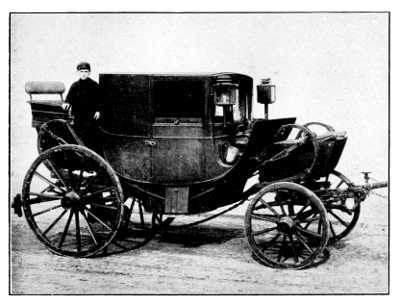
The English-designed coaches of this time, though
without glass windows, were almost completely enclosed,
and, compared with the new chariots, which were just
upon making their appearance, of a huge size. In many
of them three people could sit abreast, and seven or
eight find room for themselves. In 1641 when Charles I
passed through London on his return from Scotland, his
was the only coach in the royal procession, but seven
people, including His Majesty, were driving, apparently
in comfort, within it.
The Commonwealth produced no new carriage,
although isolated experiments were already being made.
Cromwell himself was wont to drive his own coach and
six “for recreation-sake” in Hyde Park, then as now a
fashionable resort.
“When my Lord Protector’s coach,” wrote Misson, a
Frenchman then on a visit to England, “came into the
Park with Colonel Ingleby and my Lord’s three daughters,
the coaches and horses flocked about them like some
miracle. But they galloped (after the mode court-pace
now) round and round the Park, and all that great multitude
hunted them and caught them still at the turn like
a hare, and then made a lane with all reverent haste for
them, and so after them again, and I never saw the like
in my life.”
Cromwell’s desire to play coachman once led to an
accident which might have been serious. The particulars
are given in a letter from the Dutch Ambassador to
the States-General, dated October 16th, 1654:—
“His Highness, only accompanied with secretary
Thurloe and some few of his gentlemen and servants,
went to take the air in Hyde Park, when he caused
some dishes of meat to be brought, when he had his
dinner; and afterwards had a mind to drive the coach
himself. Having put only the secretary into it,” he
whipped up “those six grey horses, which the Count of
Oldenburgh had presented unto His Highness, who
drove pretty handsomely for some time. But at last,
provoking these horses too much with the whip, they
grew unruly and ran so fast that the postillion could not
hold them in, whereby His Highness was flung out of
the coach upon the pole.... The secretary’s ankle
was hurt leaping out, and he keeps his chamber.”
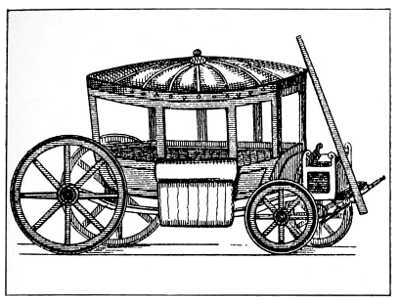
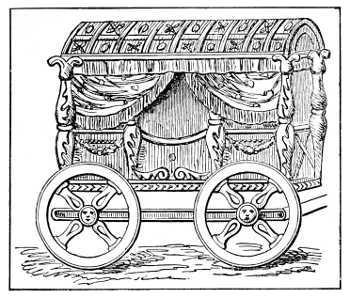
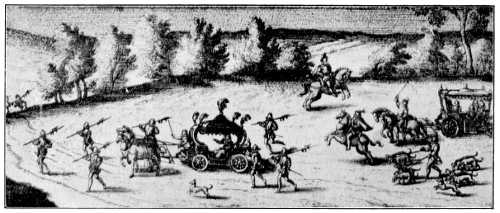
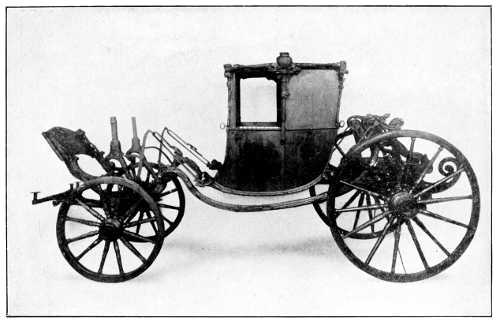
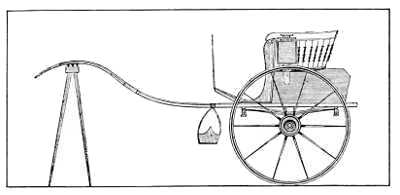
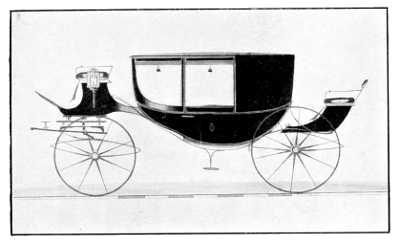
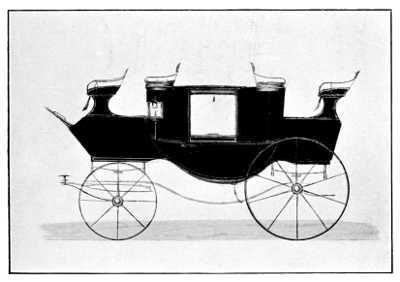
Coach in the time of Charles I
(From “Coach and Sedan Pleasantly Disputing”)
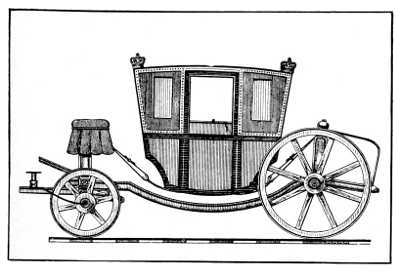
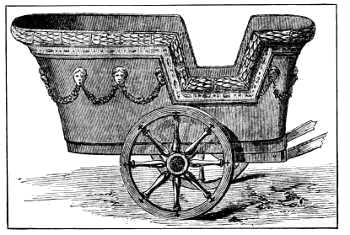
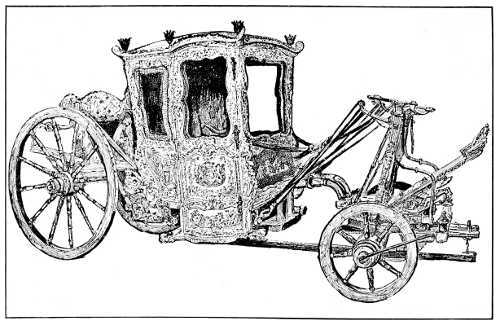
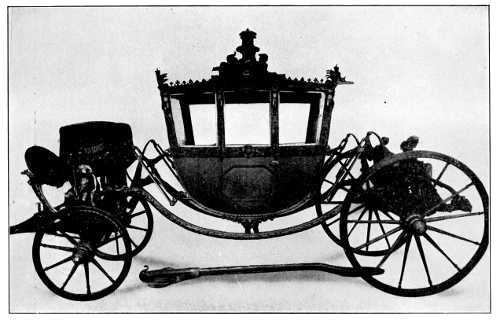
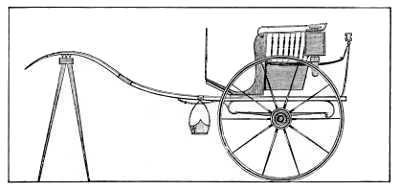
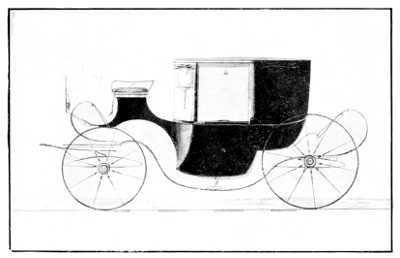
Coach in the time of Charles II
(From Thrupp’s “History of Coaches”)
“From this,” comments Sir Walter Gilbey, who
quotes the letter, “it is evident that when six horses
were used a postillion rode one of the leaders and controlled
them; while the driver managed the wheelers
and middle pair. When four horses were driven,” he
continues, “it was the custom to have two outriders,
one to ride at the leaders’ heads, and one at the two
wheelers’. In town this would be merely display, but
on a journey the outriders’ horses might replace those
of the team in case of accident, or, more frequently, be
added to them to help drag the coach over a stretch of
bad road.”
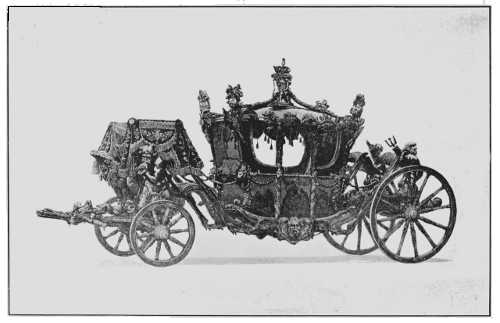
It is just possible that this coach which was overturned
by Cromwell’s faulty driving is at present in
existence, repaired, of course, and redecorated, and,
incidentally, painted by Cipriani, as Mr. Speaker’s
coach. This undoubtedly belongs to the period, and
one writer actually commits himself to the statement
that the two are identical. A commoner report assigns
the Speaker’s coach in the first place to Lenthall, Cromwell’s
Speaker. Whatever be its history, the coach is a
fine example of Jacobean work. It is of carved oak,
the body being hung upon leather braces. The workmanship,
Mr. Oakley Williams thinks,28 is Flemish.
Cipriani’s work, added late in the eighteenth century, is
still in good preservation. Five people can comfortably
sit inside. “The Speaker,” says Mr. Williams, “presumably
occupied the seat of honour alone. Opposite
him sat his Chaplain and the Sergeant-at-Arms. For
the accommodation of his other attendants ... a low
bench is arranged across the floor of the coach, with
a semicircular space for the legs of its occupants
scooped out against either door”—relic, of course, of the
boot. “The coach,” he continues, after mentioning
that the Speaker always has his own arms painted on
the side of the body, and is allowed an escort of a single
Lifeguardsman, “weighs two tons one hundredweight
and several pounds, yet for all its size it so beautifully
hung and balanced that an able-bodied man was able without
undue effort to draw it out for my inspection. Its
coach-house is one of the vaults in the inner courtyard
of the House of Lords.” Both origin and subsequent
history of this coach, however, are wrapped in an impenetrable
mystery.
Cromwell’s mishap naturally gave the Royalist writers
an opportunity for satire. Cleveland wrote the following
lines:—
“The whip again; away! ’tis too absurd
That thou should lash with whipcord now, but sword.
I’m pleased to fancy how the glad compact
Of Hackney coachmen sneer at the last act.
Hark! how the scoffing concourse hence derives
The proverb, ‘Needs must go when th’ devil drives.’
Yonder a whisper cries, ‘’Tis a plain case
He turned us out to put himself in place;
But, God-a-mercy, horses once for aye
Stood to ’t, and turned him out as well as we.’
Another, not behind him with his mocks,
Cries out, ‘Sir, faith, you were in the wrong box.’
He did presume to rule because, forsooth,
He’s been a horse-commander since his youth,
But he must know there’s a difference in the reins
Of horses fed with oats and fed with grains.
I wonder at his frolic, for be sure
Four hamper’d coach-horses can fling a brewer;
But pride will have a fall; such the world’s course is.
He [who] can rule three realms can’t guide four horses;
See him that trampell’d thousands in their gore;
Dismounted by a party but of four.
But we have done with ’t, and we may call
The driving Jehu, Phaeton in his fall.
I wish to God, for these three kingdoms’ sake,
His neck, and not the whip, had giv’n the crack.”
Evelyn met with a similar mishap, but fortunately
escaped injury. He, too, was accustomed to ride in
Hyde Park, and on one occasion is grumbling that
“every coach” there “was made to pay a shilling, and a
horse sixpence, by a sordid fellow who had purchased it
of the State, as they called it.”
Such experiments as were being made in this country
were in the direction of a safer and swifter vehicle than
those in general use. So early as 1625, one Edward
Knapp had been granted a patent for “hanging the
bodies of carriages on springs of steel.” Apparently
Knapp was wholly unsuccessful, but forty years later
Colonel Blunt, working upon similar lines, produced
several carriages which, if not entirely satisfactory in
themselves, led the way towards a wider appreciation of
the problems in question. If, as seems probable, he
was identical with the Blunt or Blount of Wicklemarsh,
near Blackheath (afterwards Sir Harry Blount), who had
travelled extensively in Turkey and elsewhere, it may be
that he had brought back with him several continental
curiosities. We hear, indeed, of a French chariot in
his possession. In 1657 the Colonel was making experiments
with a “way-wiser” or “adometer” which
exactly “measured the miles ... showing these by an
index as we went on. It had three circles, one pointing
to the number of rods, another to the miles, by 10 to
1000, with all the subdivisions of quarters; very
pretty,” opines Evelyn, “and useful.” This seems to
have been the first instrument of the kind, and is overlooked
by Beckmann in his account of such contrivances.
The Colonel’s work was brought to the
notice of the newly formed Royal Society, and a committee
was formed to investigate it. The first model
shown to this committee was of “a chariot with four
springs, esteemed by him very easy both to the rider
and the horse, and at the same time cheap.” The
Committee also examined the designs of Dr. Robert
Hooke, a distinguished member of the Society, and
Professor of Geometry at Gresham College, who “produced
the model of a chariot with two wheels and short
double springs to be driven by one horse; the chair of
it being so fixed upon two springs that the person sitting
just over or rather a little behind the axle-tree was, when
the experiment was made at Colonel Blunt’s house,
carried with as much ease as one could be in the French
chariot without at all burthening the horse.”29 Dr. Hooke
showed “two drafts of this model having this circumstantial
difference—one of these was contrived so that
the boy sitting on a seat made for him behind the chair
and guiding the reins over the top of it, drives the
horse. The other by placing the chair behind and the
saddle on the horse’s back being to be borne up by the
shafts, that the boy riding on it and driving the horse
should be little or no burden to the horse.”
The Colonel continued experimenting both with the
older coaches and a new light chariot. In 1665 Mr.
Pepys was taken to see an improvement of his on a
coach.
“I met my Lord Brouncker, Sir Frederick Murrey,
Dean Wilkins, and Mr. Hooke, going by coach to
Colonel Blunt’s to dinner.... No extraordinary dinner,
nor any other entertainment good; but afterwards to
the tryal of some experiments about making of coaches
easy. And several we tried; but one did prove mighty
easy, not here for me to describe, but the whole body of
the coach lies upon one long spring, and we all, one after
another, rid in it; and it is very fine and likely to take.”
A few months later Pepys saw the new chariot itself.
“After dinner comes Colonel Blunt in his new chariot
made with springs; as that was of wicker, where in a
while since we rode at his house. And he hath rode, he
says, now his journey, many miles in it with one horse,
and out-drives any coach, and out-goes any horse, and so
easy he says. So for curiosity, I went into it to try it,
and up the hill [Shooter’s Hill] to the heath [Blackheath],
and over the cart ruts, and found it pretty well, but not
so easy as he pretends.”
The Colonel persevered. At the beginning of the
next year the Royal Society’s committee met again at his
house to consider, says Pepys, “of the business of
chariots, and to try their new invention, which I saw
here my Lord Brouncker ride in: where the coachman
sits astride upon a pole over the horse, but do not touch
the horse, which is a pretty odde thing; but it seems it
is most easy for the horse, and, as they say, for the man
also.”
Others were also at work upon carriage improvement,
and in 1667 the Royal Society “generally approved” of
a chariot invented by a Dr. Croune. “No particulars of
the vehicle are given,” says Sir Walter Gilbey, “we
are only told that ‘some fence was proposed to be
made for the coachman against the kicking of the horse.’”
In the same year, Sir William Pen possessed a light
chariot in which Pepys drove out one day. This, he
says, was “plain, but pretty and more fashionable in
shape than any coaches he hath, and yet do not cost him,
harness and all, above £32.”
All such experiments were undoubtedly in the direction
of a light, swift carriage, such as was built about
1660 in Germany by Philip de Chiesa, a Piedmontese,
in the service of the Duke of Prussia. Indeed, it is quite
possible that Colonel Blunt either possessed, or had seen,
one of de Chiesa’s carriages, which were none other than
the famous and popular berlins.30
So far Germany had been taking the lead. Her State
coaches were the most wonderful in the world, and
her coachbuilders were designing lesser coaches for the
ordinary folk. But the berlin was the first of these lesser
carriages to catch the public fancy, and enjoy more than
a local success. Now the berlin differed in the first place
from previous carriages in having two perches instead of
the single pole, “and between these two perches, from
the front transom to the hind axle-bed, two strong leather
braces were placed, with jacks or small windlasses, to
wind them up tighter if they stretched.” The bottom
of the coach was no longer flat, and these braces of
leather allowed the body to play up and down instead of
swinging from side to side as before. Here, then, you
had an entirely new principle.
“In the Imperial mews at Vienna,” says Thrupp,
“are four coach berlins, which, I think, may belong
to this period. They are said to have been built for the
Emperor Leopold who reigned at Vienna from 1658
to 1700, and Kink describes this Emperor’s carriage as
covered with red cloth and as having glass panels; he
also says they were called the Imperial glass coaches. It
is possible that the coaches have been a little altered
from the time of their construction, but I consider that
in these four we have the oldest coaches with solid doors
and glasses all round that exist in Europe. Whether
they are identical with the Emperor Leopold’s wedding-carriages
matters much less than the influence the berlin
undoubtedly had upon the coach-building of that period.
It was the means of introducing the double perch, which,
although it is not now in fashion, was adopted for very
many carriages both in England and abroad, up to 1810.
Crane-necks to perches were suggested by the form of
the berlin perch; and as bodies swinging from standard
posts suggested the position of the C spring, so bodies
resting upon long leather braces suggested the horizontal
and elbow springs to which we owe so much. The first
berlin was made as a small vis-à-vis coach—small
because it was to be used as a light travelling carriage,
and narrow because it was to hang between the two
perches, and was only needed to carry two persons
inside. It was such an improvement in lightness and
appearance upon the cumbersome coaches that carried
eight persons, that it at once found favour, and was
imitated in Paris and still more in London.”
These early berlins were not nearly so gorgeous as
the heavier coaches which they gradually supplanted.
Red cloth and black nails had taken the place of the gilt
ornamentation and crimson hangings of the previous
generation.31 Only on festivals, we learn, the black
harness “was ornamented with silk fringe.” The
coaches used by the Emperor himself had leather traces,
but the ladies of his suite had to be content with
carriages the traces of which were made of rope.
The glass windows which were such a conspicuous
feature of the berlins, were also used in the larger
coaches, finally, as I have said, eliminating the boot.
Mr. Charles Harper thinks that the first English coach
to possess them belonged in 1661 to the Duke of York.
At first these windows seem to have caused trouble,
and there is the ludicrous incident mentioned by Pepys,
of my Lady Peterborough who “being in her glass-coach
with the glass up and seeing a lady pass by in a
coach whom she would salute, the glass was so clear
that she thought it had been open, and so ran her head
through the glass!” Lady Ashly did not like the new
invention, because, as she said, the windows were for
ever flying open while the coach was running over a bad
piece of road. Lady Peterborough’s misfortune was
tribute indeed to the maker!
In this matter of the glass it would seem that Spain
had taken the lead, and it is quite possible that Spain
invented the first two-seated chariots. In 1631, thirty
years before the first berlin was made, an Infanta of
Spain is reported to have traversed Carinthia “in a glass-carriage
in which no more than two persons could sit.”
What this was like we do not know. It may have had
rude springs, and been built from the common coach
models to a smaller measurement; it was certainly
bootless, and framed glass or mica took the place of
curtains. In France the first coaches to have glass
windows, according to M. Roubo, created something of
a Court scandal in the time of Louis XIII. The glass,
he says, was first used in the upper panels of the doors,
but was soon extended to the whole of the upper half
of the sides and front of the body, so making of the
carriage literally a glass-coach.
You may learn more of the English seventeenth-century
carriages from Pepys than from any other
writer; nor is this a matter for wonder. Pepys had a
knack of knowing just exactly what posterity would
desire to know. From his Diary, we learn incidentally
that the watermen were still endeavouring to regain
their lost prestige and custom, but by this time coaches
had enormously increased in number—in 1662 there
were nearly 2500 hackneys in London alone—and
thenceforth they are hardly heard of. To be any one,
moreover, you had to have your private coach.
Doctors, for instance, found it very well worth their
while to keep a coach, though, as Sir Thomas Browne
told his son, they were certainly “more for state than
for businesse.” On the other hand those who were
well able to keep a private carriage occasionally preferred
the use of a hackney, and sometimes at times
when they had no business to do so. Mr. Pepys, with
clear ideas upon the dignity and responsibilities of rank,
was indignant at any such foolery. He was told, he
recalls in one place, “of the ridiculous humour of our
King and Knights of the Garter the other day, who,
whereas heretofore their robes were only to be worn
during their ceremonies and service, these, as proud of
their coats, did wear them all day till night, and then
rode into the Park with them on. Nay, and he tells us
he did see my Lord Oxford and Duke of Monmouth
in a hackney-coach with two footmen in the Park, with
their robes on; which is a most scandalous thing, so as
all gravity may be said to be lost amongst us.”
The private coach, too, was the last luxury to be
given up after financial embarrassment. So we have
Lady Flippant, in Wycherley’s Love in a Wood, saying,
“Ah, Mrs. Joyner, nothing grieves me like the putting
down my coach! For the fine clothes, the fine lodgings,—let
’em go; for a lodging is as unnecessary a
thing to a widow that has a coach, as a hat to a man
that has a good peruke. For, as you see about town,
she is most probably at home in her coach:—she eats,
and drinks, and sleeps in her coach; and for her visits,
she receives them in the playhouse.” No lady’s virtue,
according to this cynical dramatist, was proof against a
coach and six.
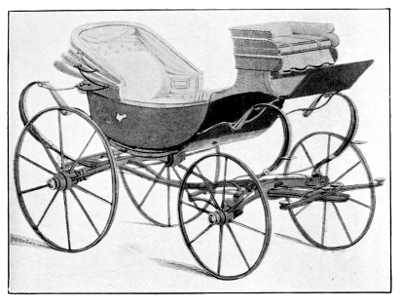
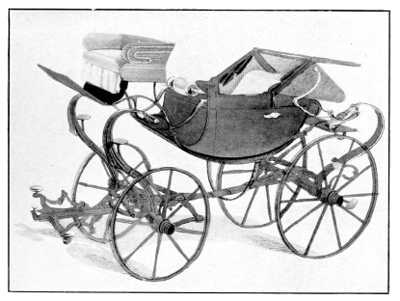
At the time of the introduction of the light, two-seated
chariots, ordinary private coaches were also
changing in shape. In Charles I’s reign they had been
both very long and very wide; in his son’s time they
became much slenderer and less unwieldy. Alterations
in this direction were possibly suggested by the ubiquitous
and most convenient sedans, and, indeed, there is
an allusion to this change of shape in Sir William
Davenant’s First Day’s Entertainment at Rutland House,
in which, during a dialogue between a Russian and a
Londoner, the foreigner says: “I have now left your
houses, and am passing through your streets; but not
in a coach, for they are uneasily hung, and so narrow
that I took them for sedans upon wheels.”
Stage-coaches, however, remained just as huge and
just as gorgeous as ever. They were built, more particularly
in Italy, in the old fashion—unenclosed and
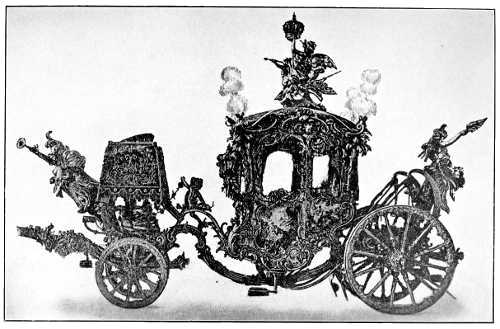
curtained. Count Gozzadini describes a State coach
built in 1629 for the marriage of Duke Edward Farnese
with the Lady Margaret of Tuscany, and as we shall see
in a moment, this differed only in the details of its
ornamentation from the State coach in which Lord
Castlemaine made his public entry into Rome sixty
years later.
The body of the Farnese coach, says Gozzadini,
“was lined with crimson velvet and gold thread, and
the woodwork covered with silver plates, chased and
embossed and perforated, in half relief. It could carry
eight persons, four on the seats attached to the doors,
and four in the back and front. The roof was supported
by eight silver columns, on the roof were eight silver
vases, and unicorns’ heads and lilies in full relief projected
from the roof and ends of the body here and
there. The roof was composed of twenty sticks, converging
from the edge to the centre, which was crowned
with a great rose with silver leaves on the outside, and
inside by the armorial bearings of the Princes of Tuscany
and Farnese held up by cupids. The curtains of the
sides and back of the coach were of crimson velvet,
embroidered with silver lilies with gold leaves. At the
back and front of the coach-carriage were statues of
unicorns, surrounded by cupids and wreathed with
lilies, grouped round the standards from which the
body was suspended; on the tops of the standards
were silver vases, with festoons of fruit, and wraught
in silver. In the front were also statues of Justice and
Mercy, supporting the coachman’s seat. The braces
suspending the body were of leather, covered with
crimson velvet; the wheels and pole were plated with
polished silver. The whole was drawn by six horses,
with harness and trappings covered with velvet, embroidered
with gold and silver thread, and with silver
buckles. It is said that twenty-five excellent silversmiths
worked at this coach for two years, and used up
25,000 ounces of silver; and that the work was superintended
by two master coachbuilders, one from Parma
and the other from Piacenza.” Lord Castlemaine’s procession
into Rome contained three hundred and thirty
coaches, of which thirteen were his own property; and
of these two were State coaches. These likewise were
not properly enclosed, and had no glass.
“They were hung,” says Thrupp, “inside and out,
with beautifully embroidered cloths, the one coach with
crimson, the other with azure-blue velvet, and gold and
silver work. The roofs were adorned with scroll work
and vases gilt; under the roof were curtains of silver
fringes, and the ambassador’s armorial bearings. The
carriage of the principal coach was adorned in front
with two large Tritons, of carved wood, gilt all over,
that supported a cushion for the coachman between
them, and from their shoulders the braces depended.
The footboard was formed by a conch shell, between
two dolphins. In the rear of the coach were two more
Tritons, supporting not only the leather braces of the
coach, but two other statues of Neptune and Cybele,
who in turn held a royal crown. Below Neptune and
Cybele, and projecting backwards, were a lion and a
unicorn, and several cupids and wreaths of flowers.
The wheels had moulded rims, and the spokes were
hidden by curving foliage carving. The second coach
had plainer wheels and fewer statues about it.”
They may have been magnificent, but they were certainly
not very beautiful. Much the same, too, might
be said of those coaches in which foreign ambassadors
made their public entry into London. In 1660 Evelyn
saw the Prince de Ligne, Ambassador-Extraordinary
from Spain, make a splendid entry with seventeen
coaches, and a month later Pepys was watching “the
Duke de Soissons go from his audience with a very
great deal of state: his own coach all red velvet covered
with gold lace, and drawn by six barbes, and attended by
twenty pages very rich in cloths.”
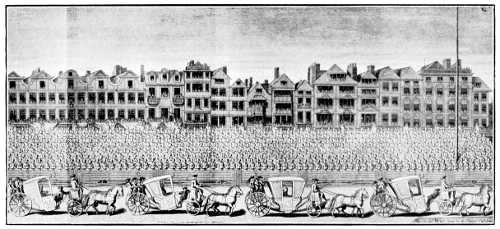
In this year, 1660, there was a proclamation against
the excessive number of hackney-coaches, and two years
later Commissioners were appointed “for reforming the
buildings, ways, streets and incumbrances, and regulating
the hackney-coaches in the city of London.” Of
this body Evelyn was sworn a member in May, 1662.
Pepys, however, never found any difficulty in obtaining
one when he desired, and, indeed, of late years, pressure
of business had made a hackney-coach an almost daily
necessity. Finally, he found it cheaper to possess one
of his own, and the story of this coach is particularly
interesting, and may be told in some detail.
Long ago, Mr. Pepys had dreamt of owning a private
coach. “Talking long in bed with my wife,” he writes
on March 2nd, 1661-2, “about our frugal life for the
time to come, proposing to her what I could and would
do, if I were worth £2000, that is, be a knight, and
keep my coach, which pleased her.” Times were bad,
however, and although Pepys enjoyed many a ride in a
friend’s coach and witnessed Colonel Blunt’s experiments,
the great idea did not mature. But one of his
particular friends, Thomas Povey, M.P., who had been
a colleague of his on the Tangier committee, himself
the owner of at least one coach, seems to have kept
Pepys’s ambitions astir. This was more especially the
case in 1665, at which time Mr. Povey had purchased
one of the new and already fashionable chariots. This
excited Pepys’s admiration. “Comes Mr. Povey’s
coach,” he records, “and so rode most nobly, in his
most pretty and best-contrived chariot in the world,
with many new contrivances, his never having till now,
within a day or two, been yet finished.” Povey was
something of an inventor himself. Evelyn calls him a
“nice contriver of all elegancies, and most formal.”
The necessary money was apparently not forthcoming
for a year or two, but in April, 1667, Pepys had a
mind “to buy enough ground to build a coach-house
and stable; for,” says he, “I have had it much in my
thoughts lately that it is not too much for me now, in
degree or cost, to keep a coach, but contrarily, that I
am almost ashamed to be seen in a hackney.” Accordingly,
Mr. Commander, his lawyer, was bidden to look
for a suitable piece of ground. The idea had now
taken definite shape, and Pepys was committed. “I
find it necessary,” he says, “for me, both in respect of
honour and the profit of it also, my expence in Hackney
coaches being now so great, to keep a coach, and therefore
will do it.” The next entry shows the first of his
disappointments:—
“Mr. Commander tells me, after all, that I cannot
have a lease of the ground for my coach-house and
stable, till a lawsuit be ended. I am a little sorry,
because I am pretty full in my mind of keeping a
coach; but yet,” he adds philosophically—the date was
June 4th, 1667—“when I think of it again, the Dutch
and French both at sea, and we poor, and still out of
order, I know not yet what turns there may be.”
So the summer passed, and “most of our discourse,”
he admits, “is about our keeping a coach the next year,
which pleases my wife mightily; and if I continue as
able as now, it will save me money.” At the beginning
of the new year Will Griffin was ordered to make fresh
inquiries about the most necessary coach-house, but
nothing seems to have been done until the autumn.
Then Pepys, more or less it would seem on the spur of
the moment, chose a coach for himself, and immediately
disliked it. No one seems to have given him the same
advice. Some ladies, for instance, Mrs. Pepys amongst
them, preferred the large old-fashioned coaches. Others
wanted the latest thing from Paris. Says Mrs. Flirt in
The Gentleman Dancing-Master: “But take notice, I will
have no little, dirty, second-hand chariot, new furnished,
but a large, sociable, well-painted coach; nor will I keep
it till it be as well-known as myself, and it comes to be
called Flirt-coach.” Her friend, Monsieur Paris, shrugs
his shoulders. “’Tis very well,” says he, “you must
have your great, gilt, fine painted coach. I’m sure they
are grown so common already amongst you that ladies
of quality begin to take up with hackneys again.” It
was felt, no doubt, that fashion in carriages as in everything
else would speedily change. Mr. Pepys must
have found considerable difficulty in making up his
mind. The new chariots were small, light and, so far
as he knew, most fashionable; but possibly they were
not quite to his taste, and equally possibly they might
not be fashionable in ten years’ time. Also they perhaps
lacked the solid dignity of the older carriages, and were
less likely to attract public attention—two important
considerations. In the end, however, he seems to have
chosen a large coach of the old style. Mr. Povey saw
it, and poor Pepys knew at once that a dreadful mistake
had been made.
“He and I ... talk of my coach,” runs the Diary
for 30th October, “and I got him to go and see it, where
he finds most infinite fault with it, both as to being out
of fashion and heavy, with so good reason, that I am
mightily glad of his having corrected me in it; and so
I do resolve to have one of his build, and with his
advice, both in coach and horses, he being the fittest
man in the world for it.”
Accordingly on the following Sunday, “Mr. Povey
sent his coach for my wife and I to see, which we liked
mightily, and will endeavour to have him get us just
such another.” Mr. Povey thought that his own coachmaker
had a replica for sale. Pepys thereupon went
down into the neighbourhood of Lincoln’s Inn Fields,
found the man, but learnt to his disgust that the coach
had been sold that very morning. At the end of the
week, however, in company with his friend, he “spent
the afternoon going up and down the coachmakers in
Cow Lane, and did see several, and last did pitch upon
a little chariott, whose body was framed, but not covered,
at the widow’s, that made Mr. Lowther’s fine coach; and
we are mightily pleased with it, it being light, and will
be very genteel and sober; to be covered with leather,
but yet will hold four. Being much satisfied with this,
I carried him to White Hall. Home, where I give my
wife a good account of the day’s work.”
Having bought the coach, it was necessary to complete
the arrangements about a coach-house, and in the
same week Pepys fared forth again for the purpose.
“This afternoon I did go out towards Sir D. Gauden’s,
thinking to have bespoke a place for my coach and
horses, when I have them, at the Victualling Office; but
find the way so bad and long that I returned, and looked
up and down for places elsewhere, in an inne, which I
hope to get with more convenience than there.”
This not proving satisfactory, Sir Richard Ford was
persuaded to lend his own coach-yard. Then follow in
quick succession the other entries:—
“28th November, 1668.—All the morning at the
Office, where, while I was sitting, one comes and
tells me that my coach is come. So I was forced
to go out, and to Sir Richard Ford’s, where I spoke
to him, and he is very willing to have it brought
in, and stand there: and so I ordered it, to my great
content, it being mighty pretty, only the horses do
not please me, and, therefore, resolve to have better.”
“29th November.—This morning my coachman’s
clothes come home and I like the livery mightily....
Sir W. Warren ... tells me, as soon as he saw my coach
yesterday, he wished that the owner might not contract
envy by it; but I told him it was now manifestly for my
profit to keep a coach, and that, after employments like
mine for eight years, it were hard if I could not be
thought to be justly able to do that.”32
“30th November.—My wife after dinner, went abroad
the first time in her coach, calling on Roger Pepys, and
visiting Mrs. Creed, and my cozen Turner. Thus ended
this month, with very good intent, but most expenseful
to my purse on things of pleasure, having furnished my
wife’s closet and the best chamber, and a coach and
horses, that ever I knew in the world; and I am put
into the greatest condition of outward state that ever I
was in, or hoped ever to be, or desired; and this at
a time when we do daily expect great changes in this
office; and by all reports we must, all of us, turn out.”
“2nd December.—Abroad with my wife, the first time
that ever I rode in my own coach, which do make my
heart rejoice, and praise God, and pray him to bless it to
me and continue it.”
“3rd December.— ... and so home, it being mighty
pleasure to go alone with my poor wife, in a coach of our
own, to a play, and makes us appear mighty great, I think,
in the world; at least, greater than ever I could, or my
friends for me, have once expected; or, I think, than
ever any of my family ever yet lived, in my memory,
but my cozen Pepys in Salisbury Court.”
“4th December.—I carried my wife ... to Smithfield,
where they sit in the coach, while Mr. Pickering,
who meets me at Smithfield and I, and W. Hewer and
a friend of his, a jockey did go about to see several
pairs of horses, for my coach; but it was late, and we
agreed on none, but left it to another time: but here I
do see instances of a piece of craft and cunning that
I never dreamed of, concerning the buying and choosing
of horses.”
There were plenty of horses to be had, it seems, but
either Mr. Pepys did not like them or he was afraid of
being cheated. “Up and down,” he is recording a week
or so later, “all the afternoon about horses, and did see
the knaveries and tricks of jockeys. At last, however,
we concluded upon giving £50 for a fine pair of black
horses we saw this day se’nnight; and so set Mr.
Pickering down near his house, whom I am much beholden
to, for his care herein, and he hath admired
skill, I perceive, in this business, and so home.” So
the horses were changed, and for a while Mr. Pepys
was obliged to revert to the despised hackney, his
“coachman being this day about breaking of my horses
to the coach, they having never yet drawn.” Towards
the end of the month the new horses were ready, and
their master made his first ride behind them on a visit
to the Temple, though later in the day he was again
using the old pair, “not daring yet to use the others
too much, but only to enter them.” Then, before the
new year, came the first mishap.
“Up, and vexed a little to be forced to pay 40s. for
a glass of my coach, which was broke the other day,
nobody knows how, within the door, while it was down;
but I do doubt that I did break it myself with my knees.”
At the beginning of February another misfortune is
recorded:—
“Just at Holborn Circuit the bolt broke, that holds
the fore-wheels to the perch, and so the horses went away
with them, and left the coachman and us; but being near
our coachmaker’s and we staying in a little ironmonger’s
shop, we were presently supplied with another.”
Accidents of this kind were continually happening.
Glasses smashed, bolts broke, and, what seems incredible,
doors were lost! Even so late as 1710, a
reward of 30s. was offered for a lost door. “Lost,”
runs this remarkable advertisement, “the side door of
a Chariot, painted Coffee Colour, with a Round Cipher
in the Pannel, Lin’d with White Cloath embos’d with
Red, having a Glass in one Frame, and White Canvas
in another, with Red Strings to the Frames.”
To return to Pepys. In a month or two another
matter connected with his coach was occupying his
attention. There were some people who did not think
that a man in the comparatively humble position of
Secretary to the Admiralty had any right to possess
a coach, even though, in its owner’s estimation, it might
be “genteel and sober.”
“To the Park,” he is recording in April, “my wife
and I; and here Sir W. Coventry did first see me and
my wife in a coach of our own; and so did also this
night the Duke of York, who did eye my wife mightily.
But I begin to doubt that my being so much seen in my
own coach at this time, may be observed to my prejudice,
but I must venture it now.”
This was no idle fear, for in a while there was printed
an ill-written and scurrilous pamphlet called Plane Truth,
or Closet Discorse betwixt Pepys and Hewer, in which the
following passage occurs:—
“There is one thing more you must be mightily sorry
for with all speed. Your presumption in your coach in
which you daily ride as if you had been son and heir to
the great Emperor Neptune, or as if you had been infallibly
to have succeeded him in his government of the
Ocean, all which was presumption in the highest degree.
First, you had upon the fore-part of your chariot, tempestuous
waves and wrecks of ships; on your left hand,
forts and great guns, and ships a fighting; on your right
hand was a fair harbour and galleys riding, with their
flags and pennants spread, kindly saluting each other,
just like P[epys] and H[ewer—his chief clerk].”
How far Pepys’s carriage was decorated is not known,
though this description does not tally in the least with
Pepys’s own. In any case, he took no notice of such
attacks, and so far from making his coach less conspicuous,
arranged to have it newly painted and varnished.
“19th April, 1669.—After dinner out again, and,
calling about my coach, which was at the coachmaker’s,
and hath been there for these two or three days, to be
new painted, and the window-frames gilt against next
May-day, went on with my hackney to White Hall.”
A few days later he gave orders for some “new sort
of varnish” to be used on the standards at a cost of
forty shillings, this being in his view very cheap.
Indeed, “the doing of the biggest coach all over,” he
learnt, “comes not above £6.” On his next visit to the
coachmaker, he was surprised to find several great ladies
“sitting in the body of a coach that must be ended tomorrow
... eating of bread and butter and drinking
ale.” His own coach had been silvered over, “but no
varnish yet laid on, so I put it in a way of doing.” A
few hours later he called back again,
“and there vexed to see nothing yet done to my coach,
at three in the afternoon; but I set it in doing, and
stood by till eight at night, and saw the painter varnish
it which is pretty to see how every doing it over do
make it more and more yellow: and it dries as fast in
the sun as it can be laid on almost; and most coaches
are, now-a-days, done so, and it is very pretty when laid
on well, and not too pale, as some are, even to show the
silver. Here I did make the workmen drink, and saw
my coach cleaned and oyled.”
And so eager was he to have it without delay that his
coachman and horses were sent to fetch it that very
evening, and on the following gala day, May 1st,
“we went alone through the town with our new liveries
of serge, and the horses’ manes and tails tied with red
ribbons, and the standards gilt with varnish, and all
clean, and green reines, the people did mightily look upon
us; and, the truth is, I did not see any coach more
pretty, though more gay, than ours all the day. But
we set out, out of humour—I because Betty, whom I
expected, was not come to go with us; and my wife
that I would sit on the same seat with her, which she
likes not, being so fine: and she then expected me to
meet Sheres, which we did in Pell Mell, and against my
will, I was forced to take him into the coach, but was
sullen all day almost, and little complaisant; the day
being unpleasing, though the Park full of coaches, but
dusty and windy, and cold, and now and then a little
dribbling of rain; and what made it worse, there were
so many hackney-coaches as spoiled the sight of the
gentlemen’s; and so we had little pleasure.”
Henceforth Mr. Pepys, in spite of sundry warnings
from his friend Mr. Povey and others, continued to use
his coach, and although perhaps as he grew older, his
coach was less brilliantly adorned, there seems no reason
to suppose that he ever regretted its purchase.
Though it is not my intention to speak in any detail
of public conveyances, a word must be said here of the
stage-coaches,33 which made their appearance on English
roads in 1640. These were large coaches, leather-curtained
at first—glass does not seem to have been
used until 1680—and capable of seating six or eight
passengers. Their chief feature was the huge basket
strapped to the back.
“There is of late,” says Chamberlayne in his well-known
Present State of Great Britain (1649), “such an
admirable commodiousness both for men and women,
to travel from London to the principal towns in the
country, that the like hath not been known in the world;
and that is by stage-coaches, wherein one may be transported
to any place sheltered from foul weather and
foul ways, free from endangering of one’s health and
one’s body by hard jogging or over-violent motion on
horseback; and this not only at the low price of about
a shilling for every five miles, but with such velocity
and speed in an hour as the foreign post can make but
in one day.”
Of course, there was opposition to these public
coaches. In 1662, when there was not a round dozen
of them, one writer was already exhorting their extinction
on the ground that simple country gentlemen and
their simple country wives could now come to London
without due occasion, and there learn all the vice and
luxury that were rampant. So in 1673, in a singular
production called The Grand Concern of England, amongst
the many proposals set forth for the country’s good,
was one “that the Multitude of Stage Coaches and
Caravans be suppressed.” One or two pamphlets of
no particular interest appeared, both for and against
these coaches, but it may be sufficient here to observe
that they steadily increased in numbers and maintained
their existence until the mail-coaches finally superseded
them.
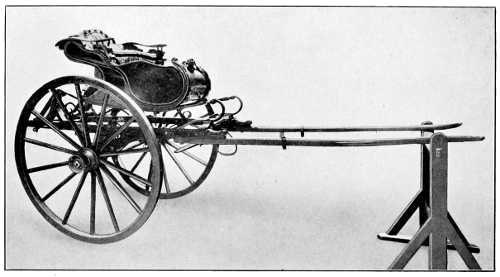
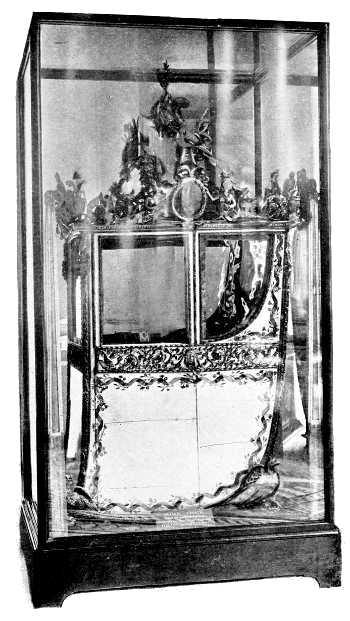
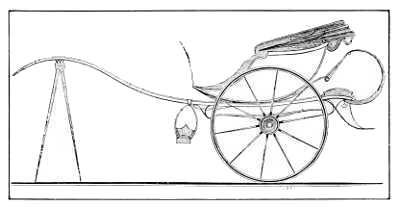
Early (?) French Gig at the South Kensington Museum
One other public carriage of this time also deserves
mention. This was the carosse à cinq sous, which appeared
in the streets of Paris in 1662. The history of this
primitive omnibus is well told by Mr. Henry Charles
Moore.34
“The leading spirits in this enterprise were the Duc
de Rouanès, Governor of Poitou, the Marquis de
Sourches, Grand Prévôt, the Marquis de Crenan, Grand
Cup-bearer, and Blaise Pascal, the author of Lettres
Provinciales. The idea was Pascal’s, but not being
sufficiently wealthy to carry it out unaided, he laid the
matter before his friend the Duc de Rouanès, who
suggested that a company should be formed to start the
vehicles. Pascal consented to this being done, and the
Duc set to work at once to prevail upon members of
the aristocracy to take shares in the venture.” After
obtaining a royal decree, “seven vehicles to carry eight
passengers each, all inside, were built, and on March 18th,
1662, they began running. The first one was timed
to start at seven o’clock in the morning, but an hour or
two earlier a huge crowd had assembled to witness the
inauguration ceremony, which was performed by two
Commissaires of the Châtelet, attired in their official
robes. Accompanying them were four guards of the
Grand Prévôt, twenty men of the City Archers, and a
troop of cavalry. The procession, on arriving at the
line of route, divided into two parts, one Commissaire
and half of the attendants proceeded to the Luxembourg,
and the others to the Porte St. Antoine. At the
latter place three of the twopenny-halfpenny coaches
were stationed, the other four being at the Luxembourg.
Each Commissaire then made a speech, in which he
pointed out the boon that carosses à cinq sous would be to
the public, and laid great stress on the fact that they
would start punctually at certain times whether full or
empty. Moreover, he warned the people that the king
was determined to punish severely any person who
interfered with the coaches, their drivers, conductors,
or passengers. The public was also warned that any
person starting similar vehicles without permission would
be fined 3000 francs, and his horses and coaches
confiscated.
“At the conclusion of his address, the Commissaire
commanded the coachmen to advance, and, after giving
them a few words of advice and caution, presented each
one with a long blue coat, with the City arms embroidered
on the front in brilliant colours. Having
donned their livery, the drivers returned to their vehicles
and climbed up to their seats. Then the command to
start was given, and the two vehicles drove off amidst a
scene of tremendous enthusiasm. The first coach each
way carried no passengers—a very unbusinesslike arrangement—the
conductor sitting inside in solitary state.
But the next two, which were sent off a quarter of an
hour after the first, started work in earnest, and it need
scarcely be said that there were no lack of passengers.
The difficulty experienced was in preventing people from
crowding in after the eight seats were occupied. At the
beginning of every journey the struggle to get into the
coach was repeated, and many charming costumes were
ruined in the crush. Paris, in short, went mad over its
carosses à cinq sous, and the excitement soon spread to
the suburbs, sending their inhabitants flocking to the
city to see the new vehicles. But very few of the
visitors managed to obtain a ride, for day by day the rush
for seats became greater. The king himself had a ride
in one coach, and the aristocracy and wealthy classes
hastened to follow his example, struggling with their
poorer brethren to obtain a seat. Many persons who
possessed private coaches daily drove to the starting-point,
and yet failed to get a drive in one for a week
or two.
“Four other routes were opened in less than four
months, but at last the fashionable craze came to an
end, and as soon as the upper classes ceased to patronise
the new coaches the middle and lower classes found that
it was cheaper to walk than to ride. The result was
that Pascal, who died only five months after the coaches
began running, lived long enough to see the vehicles
travelling to and fro, half, and sometimes quite,
empty.
“For many months after Pascal’s death the coaches
lingered on, but every week found them less patronised,
and eventually they were discontinued. They had never
been of any real utility, and were regarded by the public
much in the same light as we regard a switchback
railway.”
And, indeed, it was a century and a half before the
next omnibus was tried.
So then, at the middle of the century, when heavy
and slow stage-coaches were making their appearance
on the English country roads, and the unsuccessful
carosse à cinq sous was being tried in the streets of Paris,
the success of the berlin, the brouette, and other
chariots, was in process of remodelling men’s ideas upon
the most feasible carriage for town use. The older
coaches, as I have said, were still retained for particular
occasions, and, indeed, continued to be built with more
ornamentation than ever before. The very spokes of
the wheels were decorated, paintings appeared on the
panels, and every inch of the coach made as brilliant as
possible. France in particular possessed carriages of
the most gorgeous possible description. These were
not only entirely gilded over, but in some cases actually
bejewelled. The richest stuffs lined their interiors, and
masters painted their panels. Immense sums were
spent. There is preserved at Toulouse a carriage of
this date which shows most of these features. The
interior “is, or rather was, lined with white brocade
embroidered with a diaper of pink roses, the roof being
lined with the same, while its angles are hidden by
little smiling cupids gilded from top to toe. The
surface of the panels is, or rather was, a piece of opaque
white, exceedingly well varnished, and edged with a
thick moulding of pink roses; the foliage, instead of
being green, was highly gilded and burnished.”
But the ever-increasing traffic rendered necessary a
much smaller vehicle than these monstrosities for
general use, and this led, somewhere about 1670, to
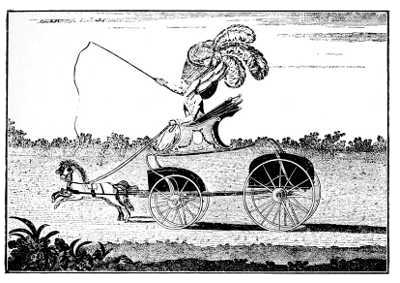
the introduction of the gig. This was a French invention,
which, while no doubt the logical outcome of the
brouette, bore resemblance to the old Roman cisium, and
led ultimately to the cabriolets, once so popular both in
France and England. Certain experiments tending
towards a gig had been made earlier in the century
with a chair fixed to a small cart. The first successful
gig was a slender, two-wheeled contrivance, “the body
little more than a shell,” says Thrupp, provided with a
hood “composed of three iron hoop-sticks joined in the
middle to fall upwards.” It was the prototype of the
calèche in France, the carriole of Norway, the calesso of
Naples, and the volante of Cuba. Gozzadini describes
one of them as “an affair with a curved seat fixed on
two long bending shafts, placed in front on the back of
the horse and behind upon the two wheels.” They
were introduced into Florence, he says, in 1672, and
“so increased in numbers that in a few years there were
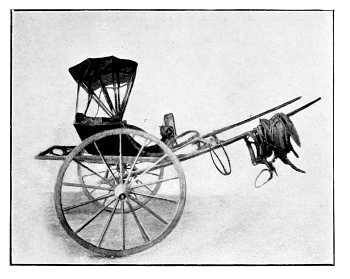
nearly a thousand in the city.” An early gig of this
kind is preserved at South Kensington. It is a forlorn-looking
vehicle. The body is curved, but there is no
hood. The seat is absurdly small and “beneath the
shafts are two long straps of leather and a windlass to
tighten them—this apparatus was, no doubt, to regulate
the spring of the vehicle to the road travelled
over.”
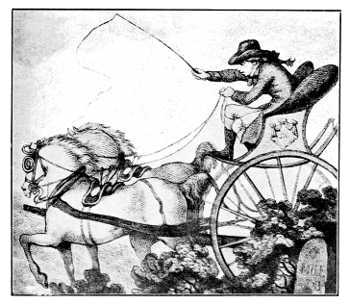
The gig speedily underwent several minor changes of
form. In France it was known as calèche35 or chaise, in
England, as calash, calesh, or chaise, in America as shay.
Unfortunately there is small mention of them in contemporary
writings, and one is left to suppose that for
some time they did not, except in certain cities, prove
serious rivals to the berlins and other four-wheeled
chariots. It may be that the berlin itself was taken as
a model from which these lighter carriages were evolved.
You had first the big double berlins for four people,
then you had a vis-à-vis for two or more persons facing
each other. Later the front part of the carriage would
be cut away for the sake of lightness. When not
covered such a vehicle as this seems to have been
known as a berlingot. Two could travel in these berlingots
sitting side by side, “while a third person might
travel uncomfortably in front on a kind of movable
seat, which was not much patronised; for it was not
only dangerous, but what was much worse in the eyes
of the grand court gentlemen who used them—ridiculous.”
There was also evolved a smaller and narrower
berlin with the front cut away and capable of holding
only one passenger, called the désobligeante. The bodies
of the ordinary chaises, which seated one or two people,
seem to have differed from those of the older berlins in
being placed partly below the frame. There were no
side doors, but one at the back which opened horizontally.
When and where all such changes were made,
however, it is impossible to say. The accounts, such
as they are, are often contradictory, and the same names
used to describe what are obviously not identical carriages.
But the two-wheeled gig having appeared there
was nothing to prevent improvements of every conceivable
sort or shape, and innumerable hybrid carriages
appeared, some of which are only known by name.
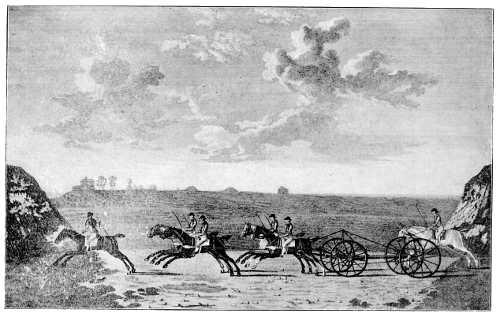
There is mention of a truly remarkable calash which
was tried in Dublin in 1685. Exactly who the inventor
was is not known, but Sir Richard Bulkeley interested
himself in the experiments, and read a paper on his
carriage before the Royal Society. Evelyn was one of
those who were present on this occasion.
“Sir Richard Bulkeley,” he says, “described to us a
model of a chariot he had invented which it was not
possible to overthrow in whatever uneven way it was
drawn, giving us a wonderful relation of what it had
performed in that kind, for ease, expedition, and safety;
there were some inconveniences yet to be remedied—it
would not contain more than one person; was ready to
take fire every few miles; and being placed and playing
on no fewer than ten rollers, it made a most prodigious
noise, almost intolerable.”
It is to be deeply regretted that there is no print of
this remarkable carriage, but further details may be
found in a letter, dated May 5th, 1685, from Sir
Richard Bulkeley himself.
“Sir William Petty,” he writes, “Mr. Molyneux,
and I have spent this day in making experiments with a
new invented calesh, along with the inventor thereof;
’tis he that was in London when I was there, but he
never made any of these caleshes there, for his invention
is much improv’d since he came from thence: it is
in all points different from any machine I have ever
seen: it goes on two wheels, carries one person, and is
light enough. As for its performance, though it hangs
not on braces, yet it is easier than the common coach,
both in the highway, in ploughed fields, cross the
ridges, directly and obliquely. A common coach will
overturn, if one wheel go on a superficies a foot and a
half higher than that of the other; but this will admit
of the difference of three feet and a half in height of
the superficies, without danger of overturning. We
chose all the irregular banks, the sides of ditches to
run over; and I have this day seen it, at five several
times, turn over and over; that is, the wheels so overturned
as that their spokes laid parallel to the horizon,
so that one wheel laid flat over the head of him that
rode in the Calesh, and the other wheel flat under him;
so much I all but once overturned. But what I have
mentioned was another turn more, so that the wheels
were again in statu quo, and the horse not in the least
disordered: if it should be unruly, with the help of
one pin, you disengage him from the Calesh without
any inconvenience. I myself was once overturned, and
knew it not, till I looked up, and saw the wheel flat
over my head; and, if a man went with his eyes shut,
he would imagine himself in the most smooth way,
though, at the same time, there were three feet difference
in the heights of the ground of each wheel. In
fine, we have made so many, and so various experiments,
and are so well satisfied of the usefulness of the invention,
that we each of us have bespoke one; they are
not (plain) above six or eight pounds a-piece.”
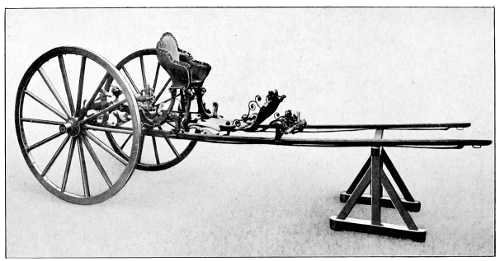
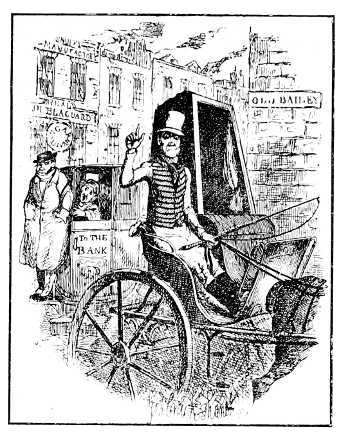
Early Italian Gig at the South Kensington Museum
Why the nobility, gentry, and worthy burgesses of
England, Scotland, and Ireland did not go and do likewise,
history hides from us. There is no further
mention of Sir Richard’s truly remarkable carriage, and
one is left to imagine that some of the Irish roads were
too bad even for its freakish agility.
On the other hand, they were probably superior to
the Scottish roads of the time, even those in the more
civilised southern districts. “It is recorded,” says
Croal, “that in 1678”—the year after the founding of
the Coach and Coach-Harness Makers’ Company in
London—“the difficulties in the way of rapid communication
were such that an agreement was made to
run a coach between Edinburgh and Glasgow, a distance
of forty-four miles, which was to be drawn by six
horses, and to perform the journey to Glasgow and
back in six days!”
Cross-country travelling, indeed, was very bad, and
the rough tracks over which the heavy stage-coaches
rumbled along would have proved too much for the
lighter chariots and gigs which were so popular in
town. I may conclude this chapter by quoting an
amusing description of such cross-country travelling at
the end of the century, taken from Sir John Vanbrugh’s
Provoked Husband. A family is going in its private
coach from Yorkshire to London:—
Lord Townley. Mr. Moody, your servant; I am glad
to see you in London. I hope all the family is well.
John Moody. Thanks be praised, your honour, they
are all in pretty good heart, thof’ we have had a power
of crosses upo’ the road.
Lady Grace. I hope my Lady has no hurt, Mr.
Moody.
John. Noa, an’t please your ladyship, she was never
in better humour: There’s money enough stirring
now.
Manly. What has been the matter, John?
John. Why, we came up in such a hurry, you mun
think that our tackle was not so tight as it should be.
Manly. Come, tell us all: pray how do they travel?
John. Why i’ the auld coach, Measter; and cause
my Lady loves to do things handsome, to be sure, she
would have a couple of cart horses clapt to th’ four old
geldings, that neighbours might see she went up to
London in her coach and six! And so Giles Joulter
the ploughman rides postilion!
......
Lord Townley. And when do you expect them here,
John?
John. Why, we were in hopes to ha’ come yesterday,
an’ it had no’ been that th’ owld wheaze-belly horse
tired; and then we were so cruelly loaden, that the two
fore-wheels came crash down at once in Waggon-Rut
Lane; and there we lost four hours ’fore we could set
things to rights again.
Manly. So they bring all their baggage with the
coach then?
John. Ay, ay, and good store on’t there is. Why,
my Lady’s gear alone were as much as filled four portmantel
trunks, besides the great deal box that heavy
Ralph and the monkey sit on behind.
Lady Grace. Well, Mr. Moody, and pray how many
are there within the coach?
John. Why, there’s my Lady and his Worship, and
the young squoire, and Miss Jenny, and the fat lap-dog,
and my lady’s maid Mrs. Handy, and Doll Tripe the
cook; that’s all. Only Doll puked a little with riding
backward, so they hoisted her into the coach-box, and
then her stomach was easy.
Lady Grace. Oh! I see ’em go by me. Ah! ha!
John. Then, you mun think, Measter, there was some
stowage for the belly, as well as th’ back too; such
cargoes of plum cake, and baskets of tongues, and
biscuits and cheese, and cold boiled beef, and then in
case of sickness, bottles of cherry-brandy, plague-water,
sack, tent, and strong beer, so plenty as made the owld
coach crack again! Mercy upon ’em! and send ’em all
well to town, I say.
Manly. Ay! and well on’t again, John.
John. Ods bud! Measter, you’re a wise mon; and for
that matter, so am I. Whoam’s whoam, I say; I’m
sure we got but little good e’er we turned our backs
on’t. Nothing but mischief! Some devil’s trick or
other plagued us, aw th’ day lung. Crack goes one
thing: Bawnce goes another. Woa, says Roger. Then
souse! we are all set fast in a sleugh. Whaw! cries
Miss; scream go the maids; and bawl! just as thof’
they were struck! And so, mercy on us! this was the
trade from morning to night.

 Grahame of Claverhouse, Viscount Dundee. By MICHAEL
BARRINGTON. With Portraits in Photogravure, Military Maps of the Campaigns,
&c. Imperial 8vo, 30s. net.
Grahame of Claverhouse, Viscount Dundee. By MICHAEL
BARRINGTON. With Portraits in Photogravure, Military Maps of the Campaigns,
&c. Imperial 8vo, 30s. net.