AN UNANSWERED QUERY
Carolyn could scarcely wait in patience for Thursday to come and the
pale lady and her baby to arrive at the island. But meanwhile there
were many things to occupy her time and to interest her.
She and mamma went to the bathing beach every afternoon, donning their
bathing suits in their room and riding over to the beach with other
hotel guests in the bus, driven by Captain Littlefield. He waited and
drove them back to the Truefelt House if the bathers did not linger too
long. The hotel bus must never miss the boats at both the Old and the
New Harbour.
Carolyn had been to the Coney Island beaches several times and was
familiar with the surf. But this Block Island beach was never crowded,
all the people on it were always kindly, friendly people, and the water
was free from any kind of rubbish.
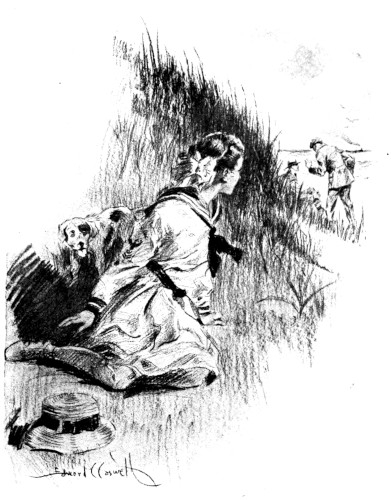
Prince was having the time of his life. He was in and out of the
water, racing on the sands, barking at the waves that chased him up
the strand, plunging into the rough little seas to bring out bits of
wood that were thrown in for him to retrieve, and otherwise behaving as
though the sea had been made particularly for him.
Of course he got into trouble. He almost always did. Prince never
could learn anything save through experience.
Once there were little schools of pinky-white jelly-fish in the surf,
and the surfman who was so wonderfully brown all over his body, and who
went without a hat no matter how hot the sun was, told everybody to
keep away from the pests because they stung all flesh that they touched.
Of course Carolyn knew enough to mind what he said; but would Prince
keep away from those very innocent looking, helpless appearing things?
No, indeed! Prince had to dash right in and try to nose the jelly-fish
out of the way. He couldn't bite them, for the moment he tried to shut
his jaws on them they slid right out from between his teeth; he could
not step on them and hold them down; and he could not easily drag them
ashore.
"That dog of yours will be sorry enough, little lady," warned the
surfman, speaking to Carolyn May.
Carolyn and her mother really had to cut their bath short that day so
as to take the dog away. By and by his muzzle was hot and feverish
and he pawed at it in a way to show that it smarted. He was a very
miserable looking dog indeed all that evening, and Carolyn went down
and begged cracked ice for him. She improvised an icebag out of her
bathing cap and tried to fix it on Prince's muzzle.
But, sting as his cheeks and lips undoubtedly did, the cracked ice did
not please the dog and he did not take kindly to the bathing cap.
"There! He always did hate a muzzle," Carolyn sighed. "He thinks
this is some kind of a muzzle. I guess I'll have to sit right here by
him all night, Mamma Cameron, and sponge off his poor nose with the ice
water."
She fell asleep doing this, and her mother picked her up and put
her into bed. Prince was all right in the morning; but he was wary
thereafter of anything floating in the surf.
One morning Carolyn rode over to the West Side with Captain
Littlefield, who went to make arrangements for the boarding of the pale
lady and her baby when they should arrive. Captain Littlefield drove
Worry alone on this journey, attached to a single-seated buckboard.
Carolyn sat beside the wooden-legged man on the seat and Prince
crouched between them, clinging on "with teeth and toenails," as the
captain said, when the buckboard bumped more than usual over the rough
road.
During the journey across the hilly island Carolyn and Captain
Littlefield became good friends. And yet, the important query that
fretted the little girl's mind was hard to come at. It seemed so
very illbred, as she had been taught, to remark upon the personal
peculiarities of "grown-ups."
Finally the subject was fairly jolted to the surface. As the buckboard
went over a particularly rugged "thank-you-ma'am" in the road, the
wooden-legged man was all but thrown off the seat and his artificial
limb waved wildly before he got his balance again.
"Oh!" cried Carolyn.
"Purt' near went overboard that time, didn't I?" he chuckled. "Tell the
truth, a feller with a wooden laig ought to be lashed with a lubber
line in a rough sea like this."
"Oh, Mr. Cap'n Littlefield!" burst forth the little girl, unable to
hold in the question any longer, "how do people get wooden legs?"
"How do they get 'em? Why, they buy 'em," said he, his eyes suddenly
twinkling.
"Oh! But I mean, why do they have to wear them?"
"To keep 'em from listin' to stab'board or port, as the case may
be—whichever side they need the timber-toe on."
"Yes. I know. But I mean," Carolyn desperately tried to explain, "how
do they come to lose their real legs so's to have to buy wooden ones?"
"Oh! Ah! I see," Captain Littlefield said with much gravity. "There's
sev'ral ways a feller might lose a laig. Why, I did see a man
once't—he was in a show at New York—that was born without laigs. They
forgot, an' just attached his ankles to his waist, as ye might say. But
he was what they call a freak."
"Yes, sir," said Carolyn, breathlessly. "But you an' Mr. Oliver
Littlefield didn't get born that way, did you?"
"Me an' Oly? I sh'd say not! Why, Oly, when he was a kid no older than
you, was the fastest runner of his age on the island. Yes-sir-ree-sir!
He didn't sport no timber-toe then. An' me—Why! when I was
apprenticed in the Navy I could go up the shrouds quicker'n a cat. I
was always first top-man on a sailing craft. Yes, indeedy! I was some
spry, leetle gal."
"Git up, Worry!"
He seemed to consider the subject closed. But Carolyn's appetite for
information was only whetted.
"Oh! But how do they lose legs, Mr. Cap'n Littlefield?" she begged.
"Wal, now! Not like lobsters lose their claws. Ye know, lobsters git to
fightin' an' shed a claw now and then. But new ones grow on. Ye often
see lobsters with one big foreclaw and a little one on t'other side."
"I'm not much acquainted with lobsters," admitted Carolyn May. "Only I
saw that big dog take one home on his tail the other day."
"Oh, yes," chuckled Captain Ozias. "That was Tulliver Hicks' lobster.
And he went over to Dave-Ed Mott's, that owns that dog, and tried to
collect for the lobster. Couldn't collect the lobster itself, for it
got battered to smash on the stones 'fore the dog fetched his moorings.
"They had quite an argument, Tulliver Hicks and Dave-Ed did, as to
whether Dave-Ed owed Tulliver for the lobster, or Tulliver owed Dave-Ed
for damage to the dog. The dog got under the barn floor and ain't come
out since; and he was a right sassy dog afore that lobster got a holt
on him."
"The poor dog!" the little girl murmured. But she was not at all
satisfied. Captain Littlefield had not given her the information she so
very much desired. She ventured again: "I didn't really s'pose folks
could lose legs and have 'em grow on again like lobsters. But how do
they lose 'em?"
"I knew a feller once't," said the captain ruminatively, "that got his
mudhook caught so't the chain parted when he tried to git it up again.
He'd anchored, ye see, right over a sunken reef. This here was down in
the Caribbean Sea and he had oughter knowed better than to go overboard
in them waters. 'Tain't safe for nobody but niggers to go over the side
thereabout. Sharks will nose right in among niggers, but they'll take a
white man ev'ry time.
"Wal, this feller counted his anchor wuth more to him than his body was
to his fam'ly, and he dropped a weighted line overboard and skinned
off his clo'es and slid down to the rocky bottom with a jackbar in his
hand. Jest as he thought, a fluke of the anchor was squeezed in under a
big scale of the reef, and he started to pry it out.
"Whilst he was workin'—and, mind you, he had to work mighty fast,
for a minute and a ha'f without air was his limit—he seen a shadow
overhead. For a second he thought 'twas the schooner driftin' over him.
But when he glanced around he seen it was a shark—a big, blunt-nosed
critter that was slantin' right down toward him, and was a'ready turned
on his side, and opening his jaws."
"Oh!" gasped Carolyn May, her eyes big with that delightful horror that
is always roused by such tales of adventure.
"Yep. Reg'lar shark, he was," said Captain Littlefield, pursing his
lips and nodding his head. "And he come down at this feller I tell ye
of, with a full head o' steam.
"Warn't no use to fight. A feller can't use a ten-pound steel bar,
under five fathom o' blue water, to punch out the teeth of a
man-eatin' shark. Nos-sir!"
Carolyn May did not understand all this. But the thrill of the story
held her just the same.
"And did he eat him?" she asked.
"Did that schooner skipper eat the shark?" responded Captain
Littlefield, his eyes twinkling. "Nop. He'd been too much of a mouthful
for the skipper. Nor the shark didn't eat all of that skipper. The
skipper dropped his bar and sprung up'ard on a slant, tryin' to go over
the head of the shark.
"But the tarnal critter whirled over and took a nip at the man as he
shot up to the surface. Crunch! Jest one bite was all that was needed.
That feller was foreshortened on one side just like 'twas done with a
pair o' sheers."
"Oh, dear me!" murmured Carolyn May. "What a wicked, wicked shark!"
"You'm right, leetle gal," agreed Captain Littlefield. "He was some
wicked. He likely swum with a school of other sharks; but 'twarn't no
Sunday School," and the sailor chuckled. "If that feller hadn't come
right up in the bight of a rope that trailed overboard, he'd never
escaped as he did. His mates hauled him in, they trimmed his laig off
neater than the shark done it, tied the arteries, an' he got over it.
'Twarn't a method of amputation that the doctors would recommend, I
guess. Anyway, that's how come of the way that feller lost his laig."
Carolyn was a good deal puzzled as well as interested.
"That wasn't you, was it, Mr. Cap'n Littlefield?" she asked. "You
didn't have your leg bit off by a shark, did you?"
"Oh, bless you, no!" said the captain. "No, indeedy."
"Was it your cousin, Mr. Oly Littlefield?"
"Oh, no!" again the sailor assured her. "Oly never seen a shark unless
it was caught in the pound nets at Dorris Cove. Ah! Well, here we be,"
he added, turning Worry in at a long lane that wound up between rocky
pastures fenced with stone, toward a little house that was set at the
very edge of the bank against which the Atlantic surf moaned. "Here's
Barzilla Ball's place, and I cal'late that's Molly Icivilla herself out
in her bean patch. If your friends—the lady and the baby—can get to
stay here, they'll be treated fine, for Molly I. Ball is as good a cook
as they make on this island, and she's well tempered."
The young woman in the sunbonnet saw the visitors coming, and left her
hoe in the garden and came up toward the house. It was a low-roofed
cottage with a great chimney in the middle of the roof which itself
sloped down almost to the top of the doorframe. The walls were of
unhewn stone quarried from the island. The house was evidently very low
ceiled, and most of the rooms were on the first floor, which was but a
step up from the ground. There was no cellar, and the loft was lighted
by one small window in either peak of the end walls.
There was a small barn, a shed, a chicken house, and drying racks for
fish in the grassy yard. Everything was very clean and neat, the grass
was the greenest grass in the world, Carolyn May thought, and the
contrast between it and the white-washed buildings was startling.
Green and white, with the blue, tumbling sea beyond and the white
froth dashing over the can-buoy half-way to Montauk Point—as
Captain Littlefield pointed out to his small passenger—and with the
blue of the sky overhead, made almost a poster-picture of the land
and sea-scape. The fresh gale with the strong tang of salt in it
expanded the little girl's lungs. Her eyes shone and her cheeks were
delightfully flushed. Miss Ball, looking at her, lost her heart to
Carolyn May at once.
"Where'd you get that little girl, Ozy Littlefield?" she asked. "She's
an off child, I warrant."
"She's stoppin' over to Truefelt's," said the captain. "How be ye,
Molly I.?"
"Fair to middlin'. How's the rheumatics in your wooden leg, Ozy?"
"I get a kink in it now and then," said the captain with gravity. "Get
any boarders yet, Molly I.?"
"No. Them folks I had last summer, the children got the measles, so
they can't travel. And I certain sure was glad. Children are all right;
but measly ones—How are you, little girl? What's your name?" and she
came closer to the buckboard to smile at Carolyn.
She was a broad-faced, stocky, good-natured girl, "rising thirty," as
the islanders would say. She was unfreckled because of the shelter
of the blue-checked sunbonnet. She had a strong, uncorseted figure
and wore a pair of men's brogans to work in. She smiled so warmly at
Carolyn May that the little girl could not help returning it with
interest, as she politely replied:
"I'm Carolyn May Cameron, and I am living with my mamma at Mrs.
Truefelt's house, and my papa is coming here Saturday to see us."
"I want to know!" was Miss Ball's observation.
"Say!" said the captain. "Ann Truefelt wants to know if you'll take in
a woman and a baby, Molly I.? The man is going to clerk for us—be our
new supercargo, as ye might say."
"I declare! Is that what you come for, Ozy? I thought you was looking
for Barzilla, and he's out in the Snatch It today."
"Swordfishin'?"
"Yes. If them auxilary engines folks so favour now don't scare all the
swordfish as far as the Georges. Now, are you sure Miz Truefelt wants I
should take these folks?"
"You got the room and the time to do it, ain't you?" demanded Captain
Littlefield.
"I s'pose so. What kind o' folks are they?"
"Oh," put in Carolyn, unable longer to keep still, "if you only would
just take the pale lady and her baby! I know they'd get well and strong
here. And you'd like 'em, too, Miss Eyeball. The baby's just as cute."
"Huh!" fairly grunted the island girl, her black eyes flashing an
accusing glance at the amused captain. "So you had to tell even this
little girl that poor joke, did you? I'm most tempted to marry the
first man that comes along so's to get shet of it. Can't understand
what my mother an' father were thinking of to put that 'I' in the
middle of my name. They were right sensible people in other ways, too.
'Peared to be, anyway."
"I cal'late," agreed Captain Littlefield, still grinning. "But how
'bout them folks to board, Molly I.?"
"When they comin'?" demanded Miss Ball, more briskly.
"Thursday."
"And you know 'em, do you, little girl?" she asked Carolyn, smiling
again.
"Oh, yes'm. And you will just love the baby!"
"Shouldn't wonder. Well, you bring 'em over, Ozy. I'll have the place
rid up and ready for 'em." Then she said to Carolyn: "Don't you want a
drink of milk, little girl? And a slice of warm loaf with sweet butter
on it?"
It was mid-forenoon, and it seemed a long time since breakfast and a
longer time still to lunch.
"Oh, yes, ma'am," the little girl cried, and she hopped down gaily from
the buckboard, with Prince leaping and barking beside her.
"I don't know about that dog," said Miss Ball. "Does he bite?"
"Only other dogs if they pitch on him—and his food," declared Carolyn
earnestly. "He never eats humans."
"Well, I sh'd hope not!" chuckled Miss Ball.
She led the little girl (and of course, Prince) into the kitchen. Out
of this opened a small milk-room with shelves of rough-hewn stone. She
skimmed a pan of milk by drawing the leathery sheet of yellow cream
together with two spoons and lifting it bodily into the waiting cream
jar. Then she poured the milk into a tall glass pitcher where it almost
foamed over.
It was cool and sweet when Carolyn put her lips to the glass Molly Ball
handed her. On the corner of the kitchen table the island girl set the
great steamed brown "loaf," a slice of which she buttered and placed
before her little guest. Bakery brown bread was well enough known to
the little city girl; but this was made of windmill ground cornmeal and
rye meal, and had a flavour that she had never tasted before.
Prince likewise approved of Miss Ball's cooking, for he sampled a well
buttered piece of the loaf.
"I see he only acts savage at his food," said the island girl,
complacently feeding Prince bits of buttered loaf with her fingers.
"He's a nice dog."
Naturally Carolyn's heart warmed toward her for that opinion. Miss
Molly "Eyeball" seemed a very delightful acquaintance indeed. She was
one of those persons, like the pale lady, to whom Carolyn May was
immediately drawn.
The little girl peeped out of the kitchen door at Captain Littlefield
smoking his pipe, shrugged far down in the seat of the buckboard, with
his wooden leg sticking almost straight up into the air. She whispered
to the island girl:
"Oh, say! Do you know how Mr. Cap'n Littlefield lost his leg? Say! do
you?"
"Why, no. I don't know that. When he came home here to the island to
settle down he had that wooden leg and he'd had it, they say, some
years. He's told enough yarns about it to fill a book; but I don't
b'lieve anybody ever got the rights of it from him. Ozy Littlefield can
be as close-mouthed as a clam if he wants to be."
"Oh, dear!" sighed the disappointed little girl. "And don't you know
how the other Mr. Littlefield lost his leg?"
"Oly Littlefield? Land's sake! He says he was powder-monkey with
Farragut, runnin' the Mississippi blockade in the Civil War, and lost
it then. That would make him 'bout eighty years old, if he was a day,"
said Miss Ball. "But anybody can see he ain't more'n sixty or so.
I guess Oly Littlefield is a dog-awful story-teller—that's what I
guess. But everybody on the island seems to have forgot—if they ever
knew—just when and how Oly come by that wooden laig.
"I can't remember when Oly didn't have it, 'cept the time he lay down
an' fell asleep over on Dicken's Point, and some of the West Side
school children stole the laig and Oly stayed there all night before
he was found. He roared for help half the night, but the folks at
Dickenses thought it was a seal roarin' on the rocks, and paid no
'tention to him till daybreak."
Carolyn May shook her head in much disappointment. The mystery of
the wooden legs seemed just as puzzling—and quite as unlikely to be
solved—as ever.