It was when she came in sight of the Parlow
place on Monday afternoon, she and Prince,
that Carolyn May bethought her of the very
best person in the world with whom to advise upon
the momentous question which so troubled her.
Who could be more interested in the happiness of
Miss Amanda than Mr. Parlow himself? If his
daughter had loved Uncle Joe and still loved him,
it seemed to Carolyn May as though the carpenter
should be very eager, indeed, to help overcome the
difficulty that lay between the two parted lovers.
The little girl had been going to call on Miss
Amanda. Aunty Rose had said she might, and Miss
Amanda had invited her “specially.”
But the thought of taking the old carpenter into
her confidence and advising with him delayed that
visit. Mr. Parlow was busy on some piece of cabinet
work, but he nodded briskly to the little girl when
she came to the door of the shop and looked in.
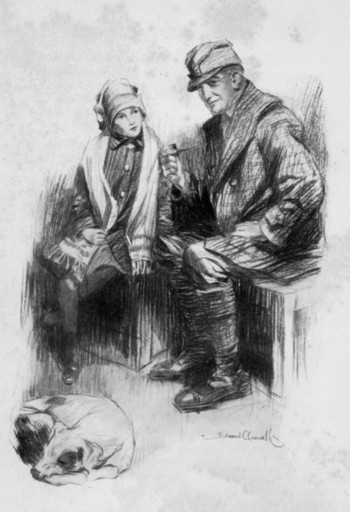
“Are you very busy, Mr. Parlow?” she asked
him after a watchful minute or two.
“My hands be, Car’lyn May,” said the carpenter
in his dry voice.
121
“Oh!”
“But I kin listen to ye—and I kin talk.”
“Oh, that’s nice! You can talk when you are
sawing and fitting things, can’t you? Not like when
you are nailing. Then your mouth’s full of nails—like
Mrs. Gormley’s is full of pins when she’s fitting
you.”
“Miz Gormley never fitted me to nothin’ yet,”
returned Mr. Parlow grimly, “less ’twas a suit of
gossip.”
Carolyn May did not notice this remark, nor
would she have understood it. She thought Chet
Gormley’s mother a very interesting woman, indeed.
She always knew so much about everybody.
Just now, moreover, Carolyn May had something
else in her mind; so she ignored Mr. Parlow’s remark
about the seamstress. She asked in a half-whisper:
“Mr. Parlow, did you hear about what happened
yesterday?”
“Eh?” he queried, eyeing her quizzically.
“Does anything ever happen on Sunday?”
“Something did on this Sunday,” cried the little
girl. “Didn’t you hear about the snake?”
“What d’ye mean—snake? The old original
snake—that sarpint ye read about in the Scriptures?”
demanded the carpenter, ruffling up his grey
hair till it looked like the topknot of a very cross
cockatoo.
“Oh, no, Mr. Parlow!” and then little Carolyn
122
May explained. She told the story with such earnestness
that he stopped working to listen, watching her
with as shrewd, sharp eyes as ever a real cockatoo
possessed.
“Humph!” was his grunted comment at the end.
“Well!”
“Don’t you think that was real exciting?” asked
Carolyn May. “And just see how it almost brought
my Uncle Joe and your Miss Amanda together.
Don’t you see?”
Mr. Parlow actually jumped. “What’s that you
say, child?” he rasped out grimly. “Bring Mandy
and Joe Stagg together? Well, I guess not!”
“Oh, Mr. Parlow, don’t you think that would be
just be-a-you-ti-ful?” cried the little girl with a lingering
emphasis upon the most important word.
“Don’t you see how happy they would be?”
“I’d like to know who told you they’d be happy?”
he demanded crossly.
“Why! wouldn’t they be? If they truly love each
other and could get over being mad?”
“Humph!” growled Mr. Parlow, “you let their
‘mad’ alone. ’Tain’t none of your business.” Mr.
Parlow was really all ruffled up, just as though he
were angry at Carolyn May’s suggestion. “I don’t
know as anybody’s pertic’lar anxious to see that
daughter of mine and Joe Stagg friendly again. No
good would come of it.”
Carolyn May looked at him sorrowfully. Mr.
Parlow had quite disappointed her. It was plain to
123
be seen that he was not the right one to advise with
about the matter. The little girl sighed.
“I really did s’pose you’d want to see Miss
Amanda happy, Mr. Parlow,” she whispered.
“Happy? Bah!” snarled the old man, setting
vigorously to work again. He acted as if he wished
to say no more, and let the little girl depart without
another word.
Carolyn May really could not understand it—at
least, she could not immediately. It seemed the
most natural thing in the world for Mr. Parlow to
wish to see his daughter happy and content.
And the little girl knew that Miss Amanda was
not happy. As she became better and better acquainted
with the woman whom she thought so beautiful
she was more and more convinced that the carpenter’s
daughter was not of a cheerful spirit.
Mr. Jedidiah Parlow did not seem to care in the
least. That must be, Carolyn May told herself,
because he was under the influence of the Dark Spirit
himself. He was always looking down. Like Mr.
Stagg, the old carpenter was immersed in his daily
tasks and seldom thought of anything else.
“Why, he doesn’t even know what it means to be
happy!” thought Carolyn May. “He never looks
up, or out, or away from his carpenter’s bench.
Dear me! of course he isn’t interested in Uncle Joe
and Miss Amanda’s being in love.”
That Mr. Parlow might have a selfish reason for
desiring to keep his daughter and Joseph Stagg apart
124
did not enter the little girl’s mind. She was too
young to appreciate such a situation as that might
suggest.
After that Sunday walk, however, Carolyn May
was never so much afraid of her uncle as before.
Why, he had even called Prince “good dog”!
Truly, Mr. Joseph Stagg was being transformed—if
slowly.
He could not deny to himself that, to a certain
extent, he was enjoying the presence of his little niece
at The Corners. If he only could decide just what
to do with the personal property of his sister Hannah
and her husband down in the New York apartment.
Never in his life had he been so long deciding a
question. He could not bring himself to the point
of writing the lawyer either to sublet the furnished
apartment or to sell the furniture in it. Nor could
he decide to go down himself to sort over Hannah’s
little treasures, put the remainder in an auction room,
and close up the apartment.
He had really loved Hannah. He knew it now,
did Joseph Stagg, every time he looked at the lovely
little child who had come to live with him at The
Corners. Why! just so had Hannah looked when
she was a little thing. The same deep, violet eyes,
and sunny hair, and laughing lips——
Mr. Stagg sometimes actually found a reflection
of the cheerful figure of “Hannah’s Car’lyn” coming
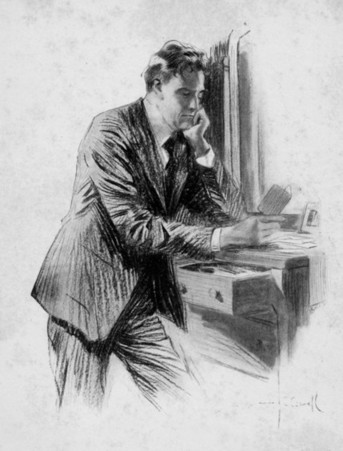
between him and the big ledger over which he
spent so many of his waking hours.
125
Once he looked up from the ledger—it was on a
Saturday morning—and really did see the bright
figure of the little girl standing before him. It was
no dream or fancy, for old Jimmy, the cat, suddenly
shot to the topmost shelf, squalling with wild abandon.
Prince was nosing along at Carolyn May’s
side.
“Bless me!” croaked Mr. Stagg. “That dog of
yours, Car’lyn May, will give Jimmy a conniption
fit yet. What d’you want down here?”
Carolyn May told him. A man had come to the
house to buy a cow, and Aunty Rose had sent the
little girl down to tell Mr. Stagg to come home and
“drive his own bargain.”
“Well, well,” said Mr. Stagg, locking the ledger
in the safe, “I’ll hustle right out and tend to it.
Don’t see why the man couldn’t have waited till
noontime. Hey, you, Chet!”
Chet Gormley was not down in the cellar on this
occasion. He appeared, wearing a much soiled
apron, and with very black hands, having been sorting
bolts.
“Here I am, Mr. Stagg,” said the boy cheerfully.
“Mornin’, Car’lyn May. And how’s our
friend?” and he ventured to pat Prince’s head,
having become well acquainted with the dog by
this time.
“Never mind that dog, Chet,” said Mr. Stagg.
“You pay attention to me. Look out for the store.
Don’t have any fooling. And——”
126
“Oh, uncle! may I stay, too? Me and Prince?”
cried Carolyn May. “We’ll be good.”
“Pshaw! Yes, if you want to,” responded Mr.
Stagg, hurrying away. He did not wish to be
bothered with her just then. He desired to walk
rapidly.
Chet went to wash his hands and remove the
apron. If he was to act as clerk instead of chore
boy, he certainly must “dress the part.” Besides,
he did not want to be so dirty in Carolyn May’s presence.
It seemed to Chet Gormley as though a boy
must look his very best to be worthy of companionship
with the radiant little vision that Mr. Stagg
referred to as “Hannah’s Car’lyn.”
“My! your uncle’s changin’ more and more, ain’t
he?” remarked Chet, the optimistic. “He does
sometimes almost laugh, Car’lyn. I never see the
beat of it!”
“Oh, is he?” cried the little child. “Is he looking
up more? Do you think he is, Chet?”
“I positively do,” Chet assured her.
“And he hasn’t always got his nose in that old
ledger?”
“Well—I wouldn’t say that he neglected business,
no, ma’am,” said the boy honestly. “You see, we
men have got to think of business mostly. But he
sure is thinkin’ of some other things, too—ya-as,
indeedy!”
“What things, Chet?” Carolyn May asked
anxiously, hoping that Uncle Joe had shown some
127
recovered interest in Miss Amanda and that Chet
had noticed it.
“Why—well—Now, you see, there’s that house
you used to live in. You know about that?”
“What about it, Chet?” the little girl asked
rather timidly. “Do you mean where I lived with
my mamma and papa before they—they went
away?”
“Yes. That’s the place.”
“It was an apartment,” explained Carolyn May.
“Yep. Well, Mr. Stagg ain’t never done nothin’
about it. He ain’t sold it, nor sold the furniture, nor
nothin’. You know, Car’lyn May, your folks didn’t
leave you no money.”
“Oh! Didn’t they?” cried Carolyn May, greatly
startled.
“No. You see, I heard all about it. Mr. Vickers,
the lawyer, came in here one day, and your uncle read
a letter to him out loud. I couldn’t help but hear.
The letter was from another lawyer and ’twas all
about you and your concerns. I heard it all,” said
the quite innocent Chet. He had never been taught
that it was wrong to listen to other people’s private
matters and to repeat them.
Carolyn May’s lips expressed a round “O” of
wonder and surprise. Like his mother, Chet Gormley
did not have to be urged when he was telling a
bit of news. He was too deeply interested in it
himself.
“And Mr. Vickers says: ‘So the child hasn’t
128
anything of her own, Joe?’” Chet went on. “And
your uncle says: ‘Not a dollar, ’cept what I might
sell that furniture for,’ And he hasn’t sold it yet,
I know. He just can’t make up his mind to do it,
it seems.
“My maw says Mr. Stagg always was that way—that
he hates to let go of anything he once gets in
his hands. But it ain’t that, I tell her,” declared
Chet. “It’s just that he can’t make up his mind to
sell them things that was your mother’s, Car’lyn
May,” added the boy, with a deeper insight into
Mr. Stagg’s character than one might have given him
credit for possessing.
But Carolyn May had heard some news that impressed
her more deeply than this idiosyncrasy of
Joseph Stagg’s. It made her suddenly quiet, and
she was glad a customer came into the store just
then to draw Chet Gormley’s attention.
The child had never thought before about how
the good things of life came to her—her food,
clothes, and lodging. She had never heard much
talk of ways and means at home between her father
and mother. When she had come to her uncle, if
she had thought about it at all, she had supposed
her parents had left ample means for her support,
even if Uncle Joe did “take her home and look out
for her,” as she had suggested to him at their first
interview.
But, now, Chet Gormley’s chattering had given
her a new view of the facts of the case. There had
129
been no money left to spend for her needs. Uncle
Joe was just keeping her out of charity!
“And Prince, too,” thought the little girl, with a
lump in her throat. “He hasn’t got any more home
than a rabbit! And Uncle Joe don’t really like
dogs—not even now.
“Oh, dear me!” pursued Carolyn May. “It’s
awful hard to be an orphan. But to be a poor
orphan—just a charity one—is a whole lot worse,
I guess.
“Of course, uncles aren’t like little girls’ real
parents. Papas and mammas are glad, I guess, to
pay for clothes and food and schoolbooks, and
everything. But if a little girl is only a charity
orphan, there aren’t really any folks that want to
support her. I wonder if I ought to stay with Uncle
Joe and Aunty Rose and make them so much
trouble?”
The thought bit deep into the little girl’s very
impressionable mind. The idle chatter of the not
very wise, if harmless, Chet Gormley was destined
to cause Carolyn May much perturbation of spirit.
She did not remain at the store until her uncle
returned. Chet urged her to stay and go home with
him for dinner when Mr. Stagg came back, but the
little girl did not feel that she could do this. She
wished to be alone and to think over this really tragic
thing that faced her—the ugly fact that she was a
“charity child.”
“And you’re a charity dog, Prince Cameron,”
130
she said aloud, looking down at the mongrel who
walked sedately beside her along the country road.
“I don’t expect you ever thought of it. You never
did have any money, and you don’t really know who
your parents are. You began being a charity dog
so early that it hasn’t never mattered to you at all—that’s
how I s’pose it must be.
“And, then, you were always loved. Papa loved
you, and so did mamma; and, of course, I always
loved you to death, Princey!” she cried, putting both
arms suddenly around the dog’s neck.
“I—I guess that’s where it must be,” pursued
Carolyn May. “If persons are only loved, it doesn’t
matter if they are charity. The love takes all the
sting out of being poor, I guess. But I don’t know
if Uncle Joe just does love me or not.”
The little girl had loitered along the road until
it was now dinner time. Indeed, Aunty Rose would
have had the meal on the table twenty minutes
earlier. Mr. Stagg had evidently remained at The
Corners to sell the cow and eat dinner, too—thus
“killing two birds with one stone.”
And here Carolyn May and Prince were at Mr.
Parlow’s carpenter shop, just as the old man was
taking off his apron preparatory to going in to his
dinner. When Miss Amanda was away nursing, the
carpenter ate at a neighbour’s table.
Now, Miss Amanda appeared on the side porch.
“Where are you going, little girl?” she asked,
smiling.
131
“Home to Aunty Rose,” said Carolyn May
bravely. “But I guess I’m late for dinner.”
“I didn’t know but something had happened,”
said Mr. Parlow, going, heavy-footed, up the porch
steps, “when I seen Joe Stagg hikin’ by more’n two
hour ago.”
Carolyn May told about the man wanting to buy
the cow. Mr. Parlow sputtered something from
the depths of the wash-basin about the buyer “payin’
two prices for the critter, if he bought her of Joe
Stagg,” but his daughter hastened to cover this by
saying:
“Don’t you want to come in and eat with us,
Carolyn May? Your own dinner will be cold.”
“Oh, may I?” cried the little girl. Somehow,
she did not feel that she could face Uncle Joe just
now with this new thought that Chet Gormley’s
words had put into her heart. Then she hesitated,
with her hand on the gate latch.
“Will there be some scraps for Prince?” she
asked. “Or bones?”
“I believe I can find something for Prince,”
Miss Amanda replied. “I owe him more than one
good dinner, I guess, for killing that snake. Come
in, and we will see.”
The little girl at once became more cheerful. She
washed her hands and face at the pump bench, as
had Mr. Parlow. She found his big spectacles for
him (Miss Amanda declared he always managed to
lose them when he took them off); and Carolyn May
132
wiped the lenses, too, before the carpenter set them
on his nose again.
“There! I believe I kin see good for the first
time to-day,” he declared. “I reckon I could have
seen my work better all the forenoon if I’d had my
specs polished up that-a-way. You air a spry young’un,
Carolyn May.”
With this heart-warming word of approval, they
went in to dinner. Miss Amanda was already “dishing up.”
Unlike the custom at the Stagg house, the
Parlows ate in the dining-room. The kitchen was
small.
It seemed quite like old times to Carolyn May.
Miss Amanda’s way of setting the table and serving
the food was like her mamma’s way. There were
individual bread-and-butter plates, and a knife for
one’s butter and another for one’s meat, and several
other articles of table furnishings that good Aunty
Rose knew nothing about.
Carolyn May thought that Miss Amanda, in her
house dress and ruffled apron, with her sleeves turned
back above her dimpled, brown elbows, was prettier
than ever. Miss Amanda had retained her youthfulness
to a remarkable degree. Although she was
quiet, there was a sparkle in her brown eyes, and a
brisk note in her full, contralto voice that charmed
the little girl. Her cheerful observations quite enlivened
Carolyn May again.
Even Mr. Parlow proved to be amusing when he
was “warmed up.”
133
“So you didn’t want to go home with Chet Gormley
for dinner, eh?” he repeated. “Mebbe you
thought Chet wouldn’t leave nothin’ for anybody
else to eat?”
“Oh, no, Mr. Parlow, it wasn’t that!” Carolyn
May said, shaking her head.
“But it might ha’ been,” chuckled the carpenter,
“if you’d ever seen Chet eat.”
“Now, father!” admonished Miss Amanda.
“Never did see him eat, did you?” pursued the
carpenter, still chuckling.
“No, sir.”
“Wal, he’s holler to his heels, and it’s an all-fired
long holler, at that! Chet worked for Deacon Allbright,
out on the South Road, ’fore he went to
Stagg’s store. He only worked there part of a season,
for he an’ the deacon couldn’t get along—no
more’n twin brothers,” declared Mr. Parlow.
“Fust place, the deacon is rayther near—has
enough on the table to eat, but jest enough, an’ that’s
all. One o’ them tables where there ain’t no scrapin’s
for ary cat or dog when the folks is through.
But, to hear Deacon Allbright ask a blessin’ on it,
you’d think ev’ry meal was a banquet.
“Wal, Chet was a boy, an’ he was tearin’ hungry,
I reckon, when he got to the table, and the deacon’s
long-winded prayers was too much for Chet’s appetite.
With the dinner dished up and his plate full,
that poor hungry little snipe had to wait while the
deacon filled his mouth with big words.
134
“An’ one day at dinner, when they had some visitors,”
chuckled Mr. Parlow, “it got too much for
Chet Gormley. Ha’f-way through the deacon’s
blessin’ the boy began to eat. I spect he couldn’t
help it. The deacon didn’t have his eyes shut very
tight, an’ he seen him, and frowned.
“But that didn’t make no manner o’ odds to Chet.
He’d got a taste, and his appetite was whetted. He
begun mowin’ away like a good feller. With righteous
indignation, the deacon cleared his throat, and
then ended his long prayer with this:
“An’ for what we air about to receive, and for
what Chet Gormley has already received, let us be
truly grateful.”
Carolyn May laughed politely, but she could sympathise
with poor Chet. He did look hungry, he
was so long and lathlike. So they chatted throughout
the meal, and the little girl began to feel better
in her mind.
“I think you are lovely, Miss Amanda,” she said
as she helped wipe the dishes after the carpenter
had gone back to the shop. “I shall always love
you. I guess that anybody who ever did love you
would keep right on doing so till they died! They
just couldn’t help it!”
“Well, now, that is a compliment!” laughed Miss
Amanda. “You think if I once made friends I
couldn’t lose them?”
“I’m sure they’d always love you—just the same,”
repeated Carolyn May earnestly. She had Uncle
135
Joe in mind now. “How could they help doing it?
Even if—if they didn’t darest show it.”
“What’s that?” asked Miss Amanda, looking at
her curiously.
“Yes, ma’am. Maybe they wouldn’t darest show
it,” said the little girl confidently. “But they’d just
have to love you. You must be a universal fav’rite,
Miss Amanda.”
“Indeed?” said the woman, laughing again, yet
with something besides amusement expressed in her
countenance. “And how about you, Chicken Little?
Aren’t you universally beloved, too?”
“Oh, I don’t expect so, Miss Amanda,” said the
child. “I wish I was.”
“Why aren’t you?”
“I—I—Well, I guess it’s just because I’m not,”
Carolyn May said desperately. “You see, after all,
Miss Amanda, I’m only a charity child.”
“A what?” gasped Miss Amanda, almost dropping
the salad dish she was herself wiping. “What
are you, child?”
“I’m charity,” Carolyn May repeated, having
hard work to choke back the tears. “You know—my
papa and mamma—didn’t—didn’t leave any
money for me.”
“Oh, my child!!” exclaimed Miss Amanda.
“Who told you that?”
“I—I just heard about it,” confessed the little
visitor.
“Not from Aunty Rose Kennedy?”
136
“Oh, no, ma’am.”
“Did that—Did your uncle tell you such a
thing?”
“Oh, no! He’s just as good as he can be. But,
of course, he doesn’t much like children. You know
he doesn’t. And he just ’bominates dogs!
“So, you see,” added the child, “I am charity.
I’m not like other little girls that’s got papas and
mammas. Course, I knowed that before, but it
didn’t ever seem—seem so hard as it does now,”
she confessed, with a sob.
“My dear! my dear!” cried Miss Amanda, dropping
on her knees beside the little girl, “don’t talk
so! I know your uncle must love you.”
“Do you s’pose so?” queried Carolyn May, trying
not to cry.
“He must! How could he help loving you?
Immersed as Joseph Stagg is in business and his own
selfish projects, he cannot be so hard-hearted as not
to love his only sister’s child.”
Carolyn May clutched at her, suddenly and
tightly.
“Oh, Miss Mandy!” she gasped, “don’t you
s’pose he loves other folks, too? You know—folks
he’d begun to love ever so long ago?”
The woman’s smooth cheeks burned suddenly,
and she stood up.
“I’m ’most sure he’d never stop loving a person,
if he’d once begun to love ’em,” said Carolyn May,
with a high opinion of the faithfulness of Uncle
137
Joe’s character. “But how do I know he ever has
loved me the least tiny bit?”
Miss Amanda was evidently impressed by this
query. How could the child be sure? Mr. Stagg
was not in the habit of revealing his deeper thoughts
and feelings to the world. And, yet, if she would
but admit it, Amanda Parlow believed that she, if
any person could, rightly measured the hardware
dealer’s character.
She sat down in a low rocking-chair and drew
Carolyn May into her lap. The little girl sobbed a
bit, but rested her head quietly on the woman’s
bosom.
“Do you want to know if your Uncle Joe loves
you?” she asked Carolyn May at last. “Do you?”
“Oh, I do!” cried the little girl.
“Then ask him,” advised Miss Amanda. “That’s
the only way to do with Joe Stagg, if you want to get
at the truth. Out with it, square, and ask him.”
“Oh, Miss Mandy! would you dare?” gasped
Carolyn May.
“It doesn’t matter what I’d dare,” said the other
drily. “You go ahead and ask him—and ask him
point-blank.”
“I will do it,” Carolyn May said seriously.
Afterwards she wondered if that were not the way,
too, to settle the difficulty between Uncle Joe and
pretty Miss Amanda.
After the child had gone the woman went back
into the little cottage, and her countenance did not
138
wear the farewell smile that Carolyn May had
looked back to see.
Gripping at her heart was the old pain she had
suffered years before, and the conflict that had
scared her mind so long ago was roused again.
Time, if not the great physician for all wounds,
surely dulls the ache of them. Miss Amanda’s emotions
had been dulled during the years which had
passed since she and Joseph Stagg had broken their
troth. Carolyn May—surely with the best intentions
in the world—had rasped this wound. The
woman sat in the kitchen rocker and wrung her hands
tightly as she thought.
How peacefully, how beautifully, her life had begun!
She had bloomed into young womanhood and
had met every prospect of happiness on its threshold.
She had loved and had been loved. She had
been as sure of her lover’s heart in those days as she
was of her own.
Then had come the crash of all her hopes and
all her believing. Too proud to demand an explanation
of her lover, too much her father’s daughter
to show Joseph Stagg what she really felt and suffered,
Amanda Parlow had gone her way, not steeling
her heart to tenderness, but striving to satisfy its
longings with a work which, after all, she realised
was a thankless task.
She lavished her sympathy on the afflicted; but,
deep in her soul, she felt no satisfaction in this. She
felt that the higher qualities of her nature were not
139
developed. She craved that satisfaction in life which
a woman finds in a home, in a husband, and in little
children.
“Oh, Joe! Oh, Joe! How could you?” she
moaned, rocking herself to and fro. “How could
you?”