Larger versions of most illustrations may be seen by right-clicking them
and selecting an option to view them separately, or by double-tapping and/or
stretching them.
Cover image created by Transcriber by combining the
cover and part of the title page in the original
book. The result is granted to the Public Domain.
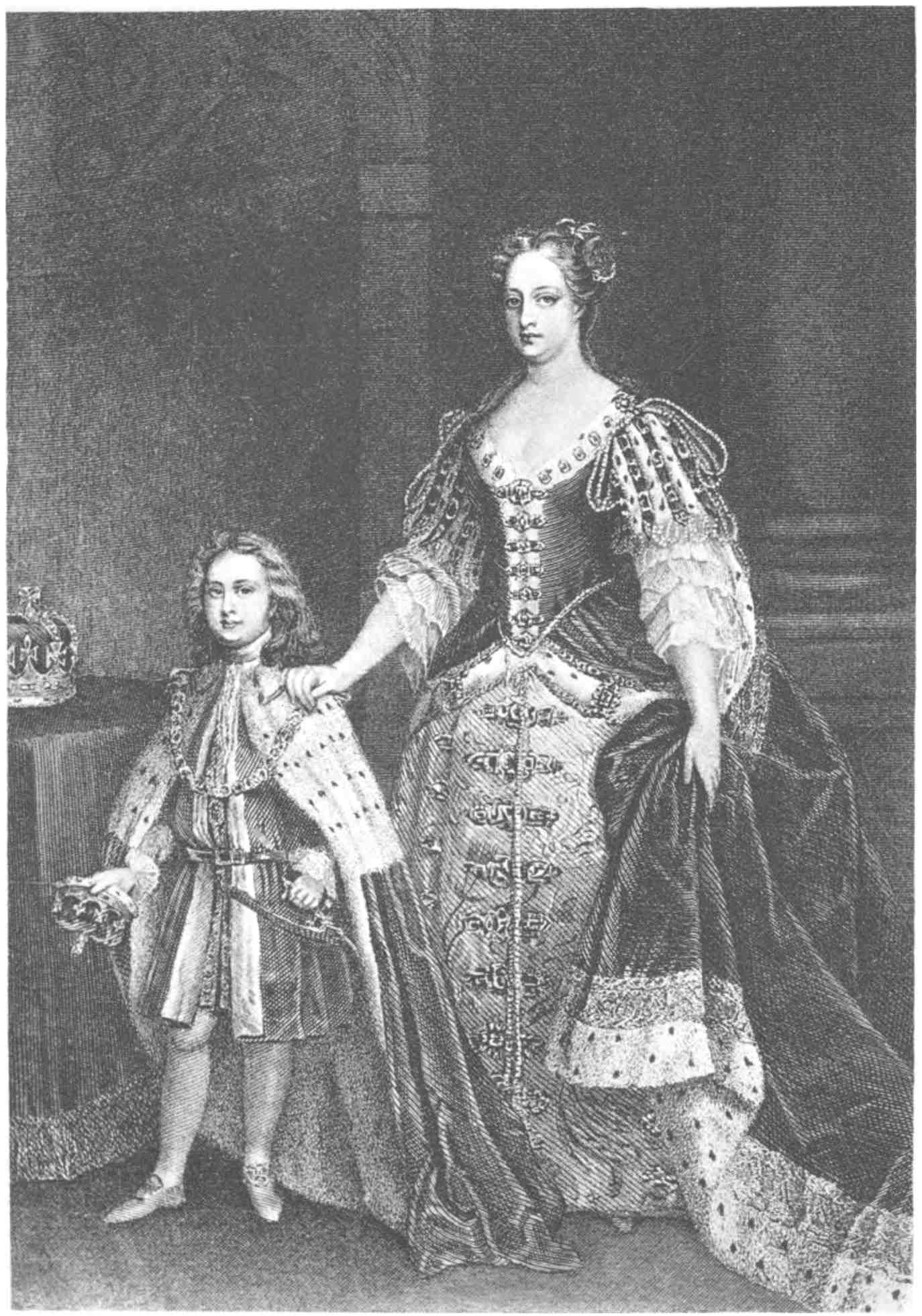
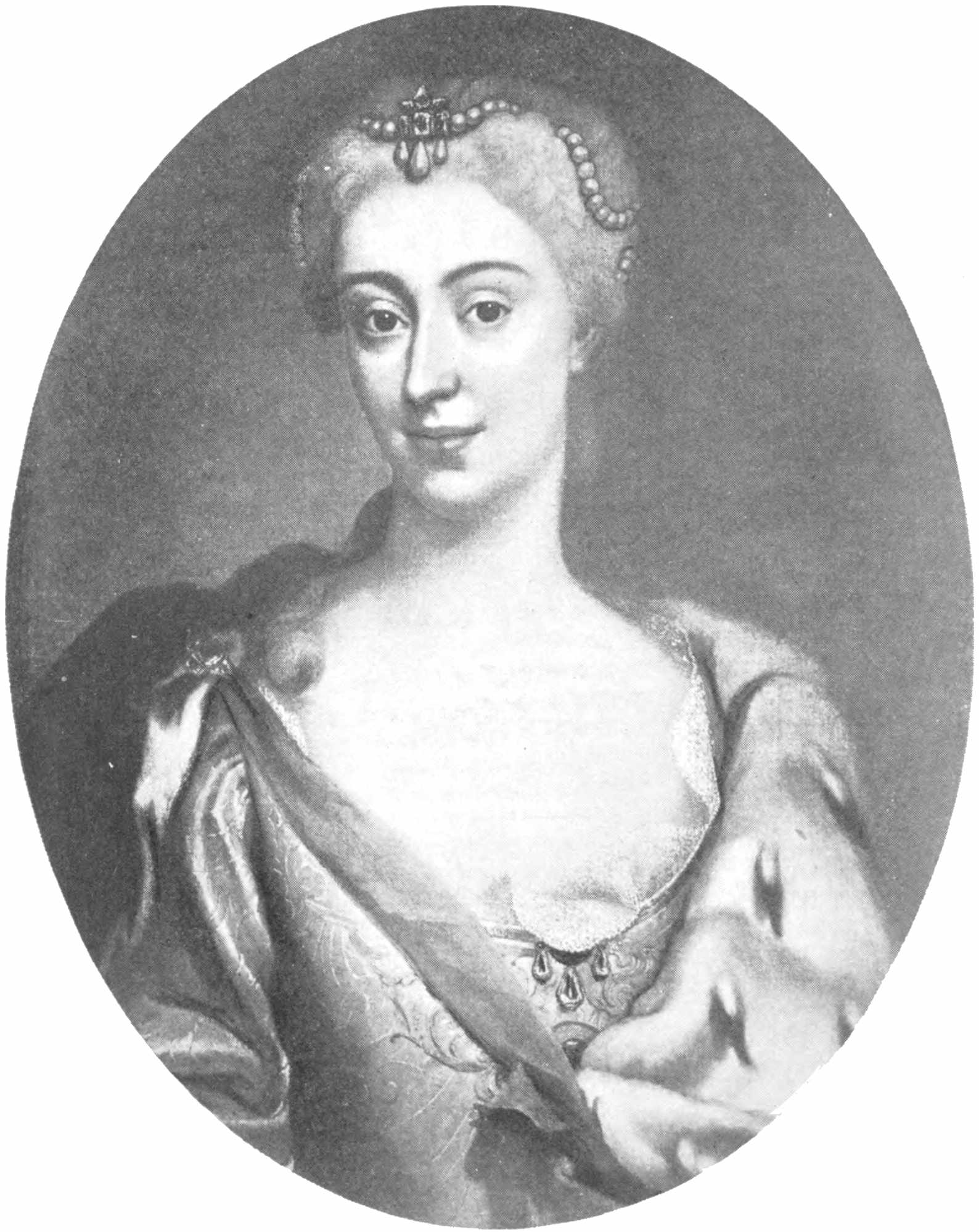
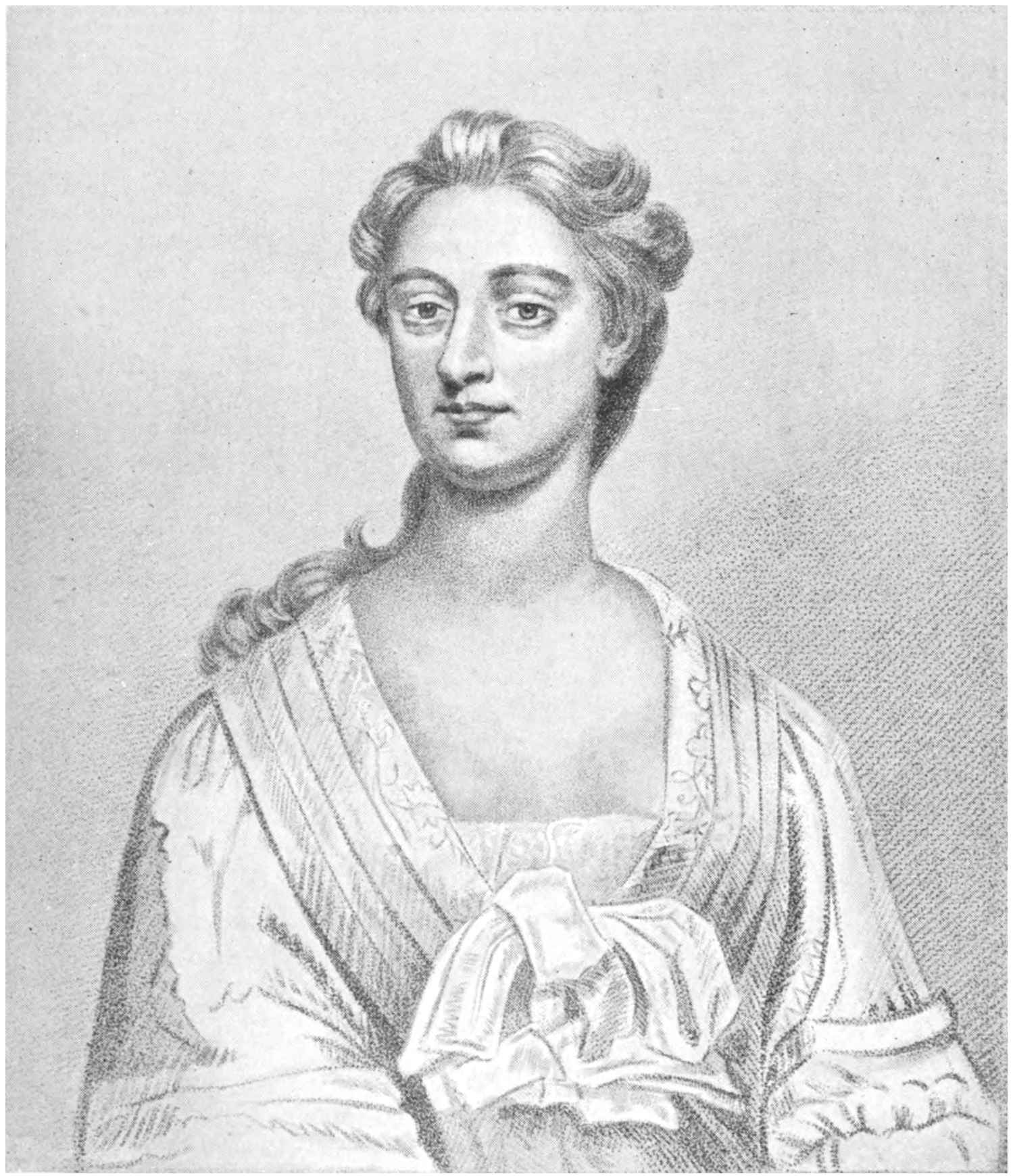
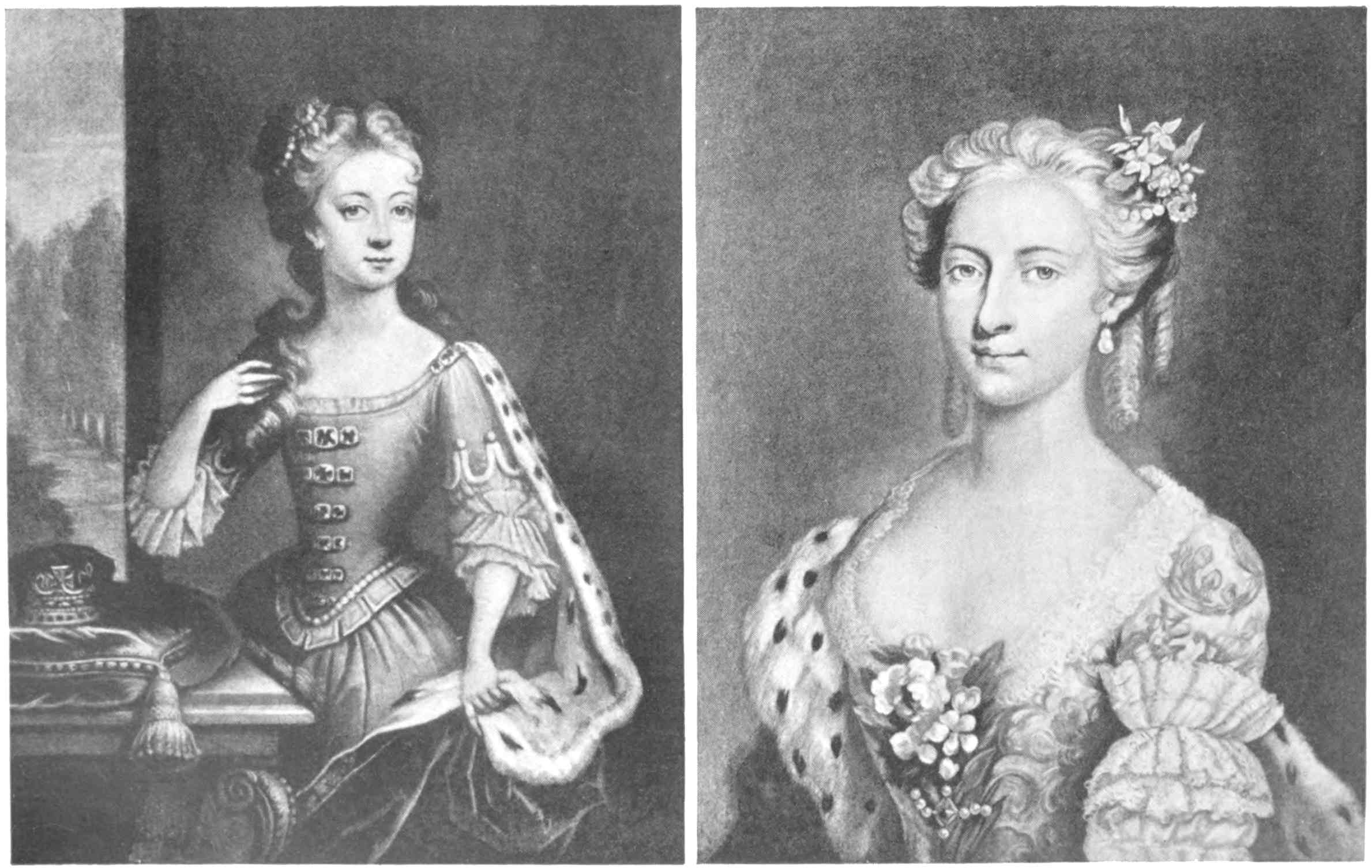
Queen Caroline,
and the Duke of Cumberland.
Walter L. Colls Ph. Sc.
Caroline the Illustrious Queen-Consort of George II. and
sometime Queen-Regent
A Study of her Life and Time
BY
W. H. WILKINS, M.A., F.S.A. AUTHOR OF “THE LOVE OF AN UNCROWNED QUEEN”
WITH ILLUSTRATIONS
IN TWO VOLUMES
VOL. II.
LONGMANS, GREEN, AND CO. 39 PATERNOSTER ROW, LONDON
NEW YORK AND BOMBAY
1901
CHAPTER I. THE NEW REIGN. 1737. — FOOTNOTES TO BOOK III, CHAPTER I:
The news of George the First’s death reached
England four days after he had breathed his last at
Osnabrück. A messenger, bearing sealed despatches
from Lord Townshend, arrived at Sir
Robert Walpole’s house in Arlington Street at noon
on Wednesday, June 14th. He was told that the
Prime Minister was at Chelsea, and he at once
repaired thither. He found the great man at dinner.
Walpole was thunderstruck at the news, for the old
King was of so strong a constitution that, despite
his occasional fainting fits, every one expected him
to live to a green old age, as his mother had done
before him. His sudden death, too, might mean the
end of the Prime Minister’s political career. But
there was no time for vain regrets—the King was
dead, long live the King. So ordering his horse
to be saddled, Walpole rode off at full speed to
Richmond, where George Augustus then was, to
announce the tidings and pay homage to his new
Sovereign. The day was hot, and so furiously did
he ride that he killed, his son tells us, two horses
between Chelsea and Richmond; but then his son
was given to exaggeration.
Walpole arrived at Richmond Lodge about
three o’clock, and requested to be shown at once
into the royal presence. The Duchess of Dorset,
who was in waiting, said it was impossible, as the
Prince had undressed and gone to bed after dinner
according to his custom, and the Princess was resting
also, and no one dared disturb them. But
Walpole explained that his business brooked of no
delay, and the duchess went to wake them. The
King (as he must now be called), very irate at
being disturbed, came into the ante-chamber in haste
with his breeches in his hand—he was one of those
princes who are fated to appear ridiculous even at
the greatest moments of their lives. Walpole fell
on one knee, kissed the hand holding the breeches,
and told his Majesty that his royal sire was dead,
and he was King of England. “Dat is von big
lie,” shouted King George the Second, as he had
shouted at the Duke of Roxburgh on a memorable
occasion some time before. But Walpole, unlike
the duke, showed no resentment at being given
the lie, and for all answer produced Townshend’s
despatch, which gave particulars of the late King’s
death. George snatched the letter from him and
eagerly conned it; but his face did not relax as he
read, nor did his manner unbend towards the Prime
Minister. Walpole uttered some words of formal
condolence, but they were ungraciously ignored.
After an awkward pause, he asked the King his
pleasure with regard to the Accession Council, the
Proclamation, and other matters necessary to be done
at once, naturally expecting that he should be commanded
to attend to them. “Go to Chiswick, and
take your directions from Sir Spencer Compton,”
said the King curtly, and turned his back as an
intimation that the interview was at an end. George
the Second then went to tell the great news to his
Queen, and the crestfallen Minister withdrew, to go,
as ordered, to Compton.
Walpole’s reflections on his ride to Chiswick
must have been bitter indeed. Well might he exclaim,
as his fallen rival, Bolingbroke, had done
under a similar reverse: “What a world is this and
how does Fortune banter us!” For years he had
been Prime Minister with almost absolute power,
enjoying to the full the confidence of his Sovereign.
Suddenly he was stripped of every shred of authority,
and dismissed (for the King’s bidding him go to
Compton was tantamount to a dismissal) without
the slightest consideration, like a dishonest servant.
Walpole knew that George the Second owed him
a grudge for not having kept his promises at the
reconciliation, and disliked him, as he disliked all
who enjoyed the late King’s favour. But the
Prime Minister hoped that time and Caroline’s influence
would put things right. He did not know
that Pulteney had repeated certain remarks he had
incautiously made soon after the reconciliation, when
Pulteney asked him what terms he had got for
the Prince of Wales. Walpole answered with a
sneer: “Why, he is to go to court again, and he
will have his drums and guards, and such fine
things”. “But,” said Pulteney, “is the Prince to
be left Regent as he was when the King first left
England?” Walpole replied, “Certainly not, he
does not deserve it, we have done more than
enough for him; and if it were to be done again,
we would not do so much”.1 George the Second’s
little mind resented slights of this kind more than
greater wrongs, and he now took his revenge.
Sir Spencer Compton, to whom the disconcerted
Minister sadly made his way, had been Speaker
of the House of Commons, Treasurer of the Prince
of Wales’s Household, and Paymaster of the Army.
Compton was much more of a courtier than a
politician. He was a man of the mediocre order
of ability that often makes a good and safe official;
he knew all about forms, procedure, and precedents,
but he was not a leader of men, and he was quite
unprepared for, and quite unequal to, the great
position now thrust upon him. Walpole, who knew
the man with whom he had to deal, felt towards
Compton no personal resentment. He acquainted
him briefly with George the First’s death, gave
him the new King’s commands, and added on his
own behalf: “Everything is in your hands; I
neither could shake your power if I would, nor
would if I could. My time has been, yours is
beginning; but as we all must depend in some
degree upon our successors, and as it is always
prudent for these successors, by way of example, to
have some regard for their predecessors, that the
measure they mete out may be measured to them
again—for this reason I put myself under your protection,
and for this reason I expect you will give it.
I desire no share of power or business, one of your
white sticks,2 or any employment of that sort, is all
I ask, as a mark from the Crown that I am not
abandoned to the enmity of those whose envy is the
only source of their hate.”3
Though Compton was astonished at the news,
he did not conceal his delight at the unexpected
honour that had fallen upon him. Walpole’s speech
flattered his vanity, and perhaps also touched his
heart; he grandiloquently promised him his protection,
and, thinking he had nothing to fear from
the fallen statesman, took him into his confidence
and consulted him as to how he should proceed.
The two Ministers then drove together to Devonshire
House to see the Duke of Devonshire, President of
the Council, and arrange for an immediate meeting
of the Privy Council. At forms Compton was an
adept, but when it came to the speech that had to
be put into the King’s mouth he was nonplussed.
He took Walpole aside, and asked him, as he
had composed all the speeches of the late King,
to compose this one also. Walpole pretended to
demur, but as Compton persisted, he consented and
withdrew to a private room in Devonshire House
to draft the speech, while Compton set off to do
homage to the King and Queen. Walpole must
have chuckled over his task, for if the precedent-loving
Compton had only consulted the back folios
of the Gazette he would have found plenty of models
for the King’s speech; but he was so fussed with
forms and ceremonies, and so elated with the sense
of his new importance, that he was incapable of
thinking coherently.
The King and Queen had driven up from Richmond
in the afternoon, and were now arrived at
Leicester House. The great news had spread
abroad, and all London was flocking to Leicester
Fields. When Compton arrived there, the square
was so thronged with people who had assembled to
cheer their Majesties that the coaches and chairs
of the mighty, who were hurrying to pay their court,
could scarce make way through the crowd. Inside
Leicester House the walls were already hung with
purple and black, and the Queen appeared in “black
bombazine”; but these were the only signs of
mourning, all else wore an aspect of rejoicing and
congratulation. The new King and Queen held a
court, the rooms were thronged with the great
nobility and high officials, and persons of divers
parties and creeds struggled up and down the stairs,
all anxious to kiss their Majesties’ hands, and to
profess their loyalty and devotion. The Queen,
who had a keen sense of irony, must have smiled
to herself when she contrasted the crowded rooms
before her with the thinly attended receptions which
Leicester House (except on great occasions such as
birthdays) had witnessed during the past few years.
This was the proudest hour of Caroline’s life.
She had reached the summit of her ambition, she
had become Queen. But the mere show of
sovereignty did not content her, she was determined
to be the power behind the throne greater
than the throne. It was not enough for her that
she had become Queen through her husband, she
was determined to rule through him also. Did this
inscrutable woman, we wonder, in this her hour of
glory, recall the parallel Leibniz had drawn long before,
when the prospects of the House of Hanover
were darkest, between her and England’s greatest
Queen, Elizabeth? May-be, for, like Elizabeth, Caroline
determined to have her Cecil. She knew there
was but one man in England capable of maintaining
the Hanoverian dynasty upon the throne in peace,
and that one was Walpole. She had been dismayed
when the King told her that he had sent for Compton,
for she knew Compton’s weakness. But, like
a wise woman she did not attempt to thwart her
husband in the first heat of his resentment against
his father’s favourite minister, who had been, willingly
or unwillingly, the late King’s mouthpiece for many
slights to him, and perhaps, too, she thought it would
be good for Walpole to be taught a lesson. She
bided her time.
Compton at once had audience of the King.
When he came out from the royal closet he
walked across the courtyard to his coach between
lines of bowing and fawning courtiers, all anxious
to bask in the rays of the rising sun. They knew
full well what this audience portended. Compton,
greatly flattered by this homage, drove back to
Devonshire House, where he found that the man
whom he had superseded had finished the King’s
speech. Compton was graciously pleased to approve
the draft; he took it and copied it in his own handwriting.
He then again repaired to Leicester House
to present it to the King. On this occasion he was
accompanied by the Duke of Devonshire and other
privy councillors, including Walpole, who were to
be present at the Accession Council. George the
Second liked the speech well enough, but found
fault with one paragraph and desired that it should
be altered. Compton wished it to stand, for he knew
not how to change it, but the King was obdurate
and very testy at being opposed. Compton was
then so incredibly foolish, from the point of view of
his own interest, as to ask Walpole to go to the
King’s closet and see what he could do. Walpole
went, nothing loath, and improved the occasion by
declaring to the King his willingness to serve him
either in or out of office. This was the Queen’s
opportunity. According to some, it was she who
suggested that Walpole should be sent for; she
certainly suggested to the King that perhaps he
had been a little hasty, and it would be bad for his
affairs to employ a man like Compton, who had
already shown himself inferior in ability to the
Minister whom he was to succeed. But Caroline
could do no more at this juncture than suggest,
and leave the leaven to work in the King’s mind.
George the Second held his Accession Council
that same night at Leicester House. He read his
speech to his faithful councillors in which he lamented
“the sudden and unexpected death of the King, my
dearest father,” he spoke of his “love and affection”
for England and declared his intention of preserving
the laws and liberties of the kingdom, and
upholding the constitution as it stood. If he felt
any relenting towards Walpole it was not visible in
his manner. Compton took the first place, and the
man who had hitherto dominated the councils of the
King, and was still nominally Prime Minister, was
completely ignored by the new Sovereign. The
office-seekers were not slow to follow the lead. For
the next few days Leicester House was crowded
every day, but whenever Walpole appeared the
courtiers shrank away from him as though he had
the plague. Walpole himself, though he knew the
utter weakness of Compton, had no hope of being
continued in office, and hourly expected to receive
the King’s command to give up the seals. “I shall
certainly go out,” he said to his friend Sir William
Yonge, after the Council, “but let me advise you
not to go into violent opposition, as we must soon
come in again.” Yonge quickly had experience of
going out, for he was dismissed the next day, the
King had always hated him and called him “stinking
Yonge”; Lord Malpas, Walpole’s son-in-law,
was dismissed also. But the public announcement
of the Prime Minister’s dismissal tarried unaccountably—unaccountably
that is to those who were
not behind the scenes.
The Queen’s influence was now beginning to
tell. At first she persuaded the King to delay, for
she knew that if he delayed he would reflect, and
if he reflected he would change his mind. She
reminded him of the trouble a change of Ministers
would involve before he was comfortably seated on
the throne, and she knew the King hated trouble.
The King objected to Walpole’s notorious greed
for gold, but the Queen met this by saying that,
with so many opportunities of amassing wealth, he
must by this time have become so rich that he
would want no more, and this, in a lesser degree,
applied to his colleagues. “The old leeches,” she
cynically added, “will not be so hungry as the new
ones, and will know their business much better.”
The critical situation of foreign affairs was another
of the arguments used by the Queen in favour of
Walpole, for no one had the same grasp of the
tangled skeins of foreign policy as he. The
European courts, which did not understand the
working of the English Constitution, might become
alarmed at a sudden change of Ministry
and imagine that it foretold a change in England’s
foreign policy, thus creating a general distrust,
which would be dangerous to the reigning dynasty,
more especially as there was always the fear of
secret negotiations going on between James and
the Roman Catholic courts of Europe. This was
particularly true of France, with whom it was of the
utmost importance to maintain good relations at the
present juncture. Whilst Caroline was thus arguing,
as luck would have it, Horace Walpole, the
Prime Minister’s brother, who was ambassador to
France, arrived in England with a letter which his
diplomacy had obtained from Cardinal de Fleury,
pledging his master to maintain the treaties France
had entered into with the late King, and to show
goodwill towards George and ill-will to James. All
these considerations told. But the most cogent argument
which the Queen urged, and the one which had
undoubtedly the most weight with the King, was
the settlement of the Civil List. The new Civil
List, Caroline reminded the King, was pressing,
but a change of Ministers was not. There was
nobody so able as Walpole to secure for them a
handsome increase of the Civil List, for, as the old
King said, he “could turn stones into gold”. Why
then let private resentment lead to personal inconvenience?
Nothing was done during the King’s stay at
Leicester House, and in the eyes of the world
Compton was still first in the King’s favour. At
the end of the week the Court moved to Kensington,
and by that time the Queen had worked so well that
the King sent for Walpole, and asked him about the
Civil List. The new monarch mentioned a sum
so large that Walpole was staggered, accustomed
though he was to Hanoverian rapacity; but he
showed nothing of his feeling in his face, and promised
to do his utmost to serve his Majesty. He
then had an audience of the Queen, who confided to
him that Compton’s estimate had by no means satisfied
the King’s demands, and he had proposed that
she should have only a poor £60,000 a year.
Walpole at once grasped the situation. He declared
that he would obtain a jointure for her
Majesty of £100,000 a year, which was £40,000
more than Compton had proposed, and he would force
Parliament to meet the King’s wishes. It was said
that Walpole bought his influence with the Queen for
this extra £40,000 a year, but that was not wholly
true. Quite apart from money, Caroline had wit
enough to see that the interests of the House of
Hanover could best be served by Walpole, and of
all English statesmen he was the one who could
most be trusted to frustrate the Jacobites—for the
rival claims of the Stuarts were an ever present
danger to the Hanoverian family until 1745. She
was, of course, not averse to receiving something
in return for her support, and Walpole, it must be
admitted, paid, or rather made the nation pay, for
it handsomely. In addition to the Queen’s £100,000
a year, Somerset House and Richmond Lodge were
made over to her. Her income was double what
any queen-consort had enjoyed before, and more
than any has been granted since.
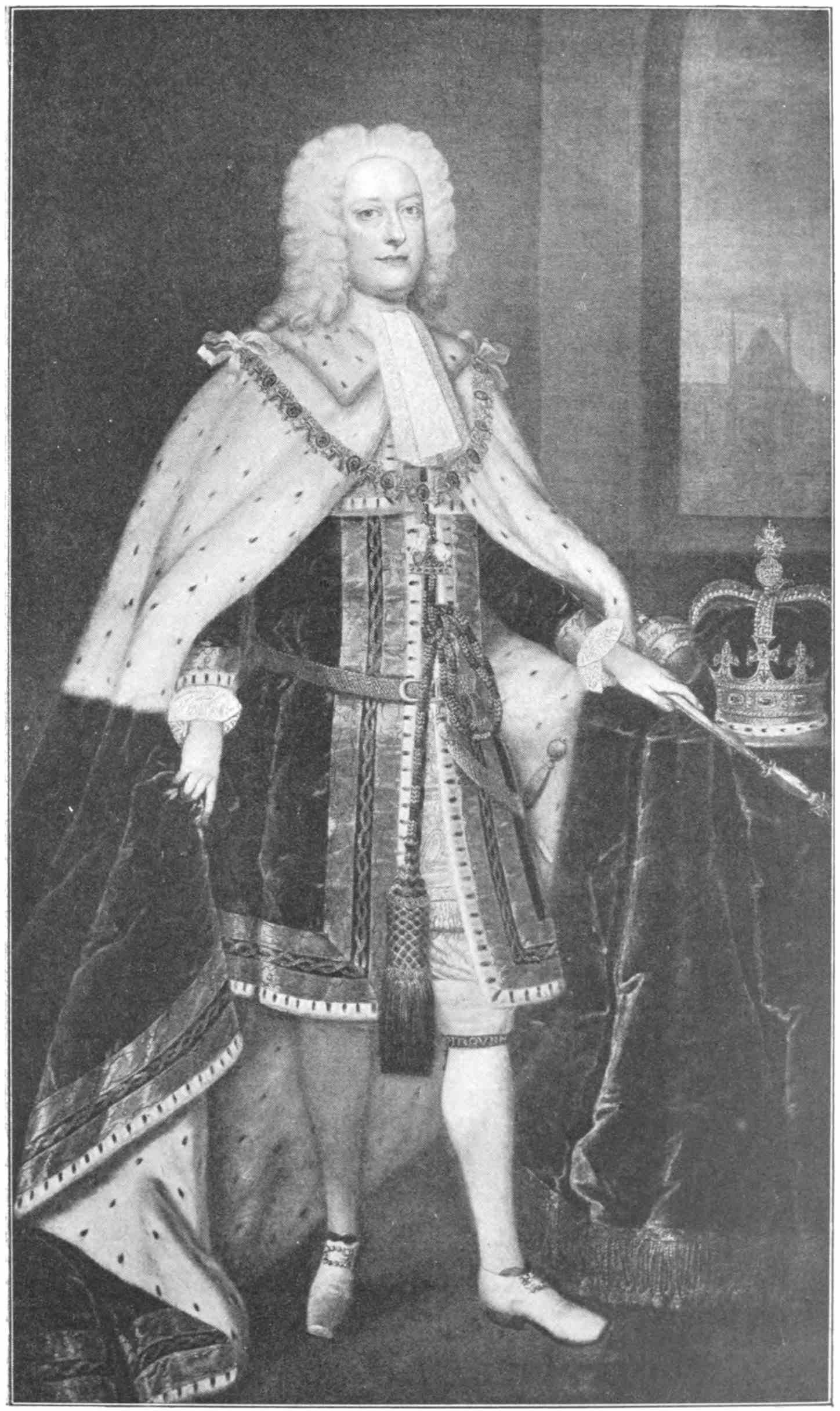
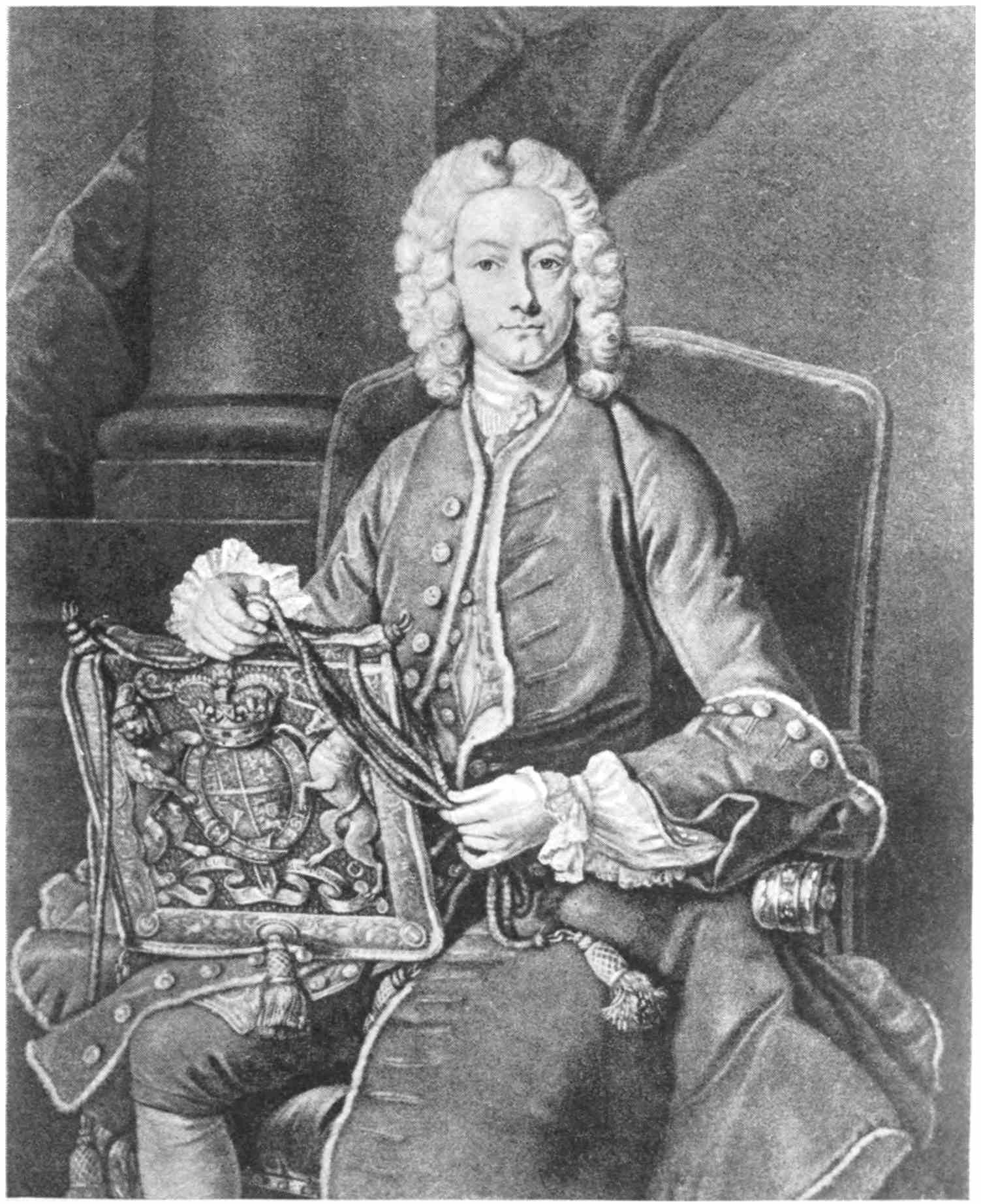
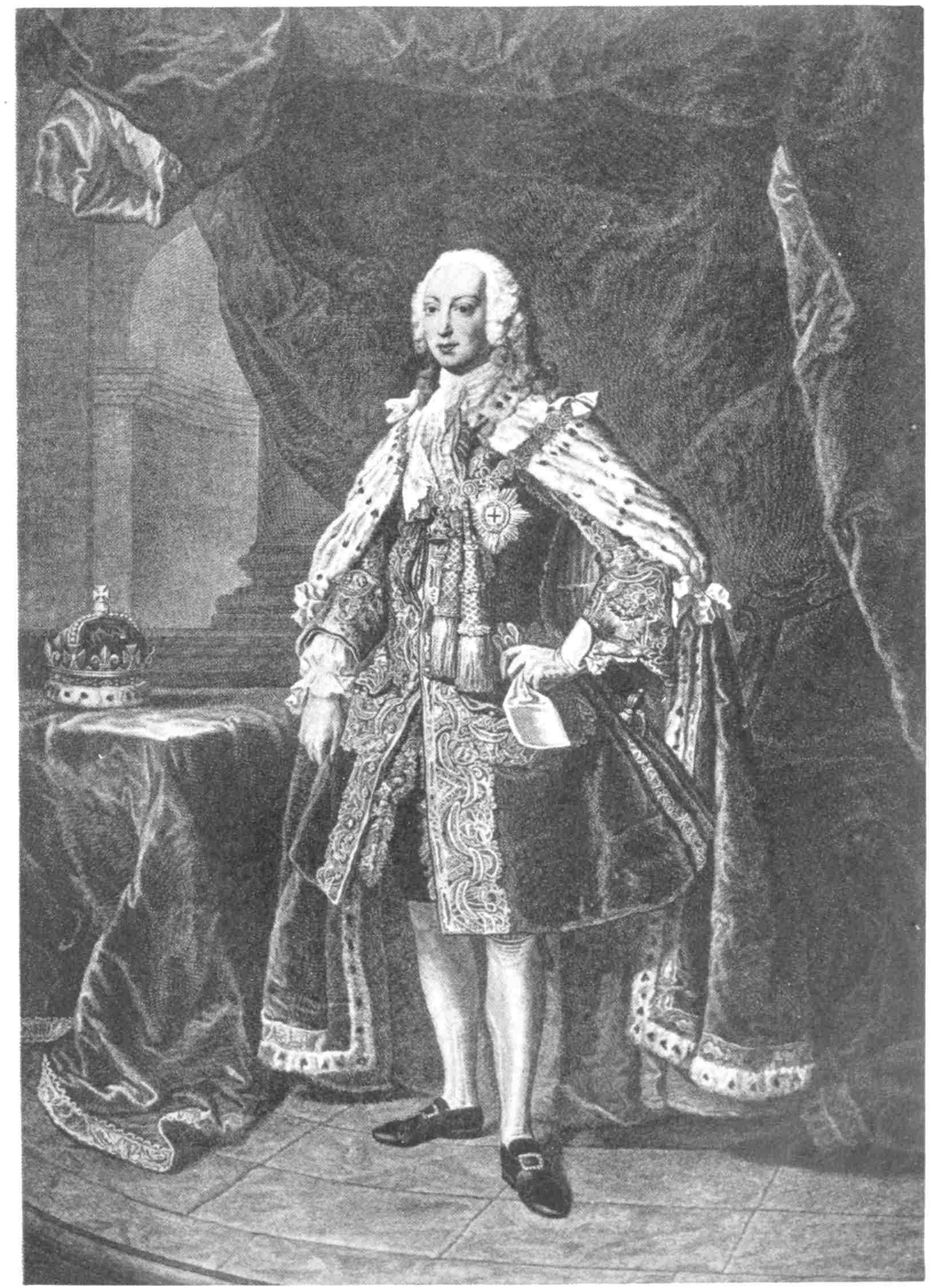
KING GEORGE II.
From the Painting by John Shackleton in the National Portrait Gallery.
Walpole now realised that all that lay between
him and power was a question of money. He therefore
went next morning to the King with carefully
prepared estimates. He proposed that his Majesty’s
Civil List should consist primarily of the £700,000 a
year paid to the late King; £100,000 more, which
had been paid directly to the Prince of Wales in the
last reign, but which would now be vested in the
King to make what allowance he pleased to his
eldest son; and a further increase of £130,000 a year
arising out of certain funds. In all, therefore, the
King would receive the enormous sum of more
than £900,000 a year. This George agreed
to, for though he would have liked more, he had
the sense to see that it was impossible to get it.
The Queen had impressed upon him that Walpole
was the only man who could carry such a large
increase through the House of Commons. Pulteney
and other Opposition politicians were ready to promise
more to gain office, but their promises were nothing
worth, for they had neither the ability nor the power
to carry a large grant through Parliament. The
King therefore took Walpole by the hand, and said
that he had considered the matter, and intended
to continue him in office on the understanding that
he would carry through the Civil List, at the sum
named. He added significantly: “Consider, Sir
Robert, what makes me easy in this matter will
prove for your ease too; it is for my life it is to be
fixed, and it is for your life”.
Matters thus being settled, the Queen that
night at the drawing-room made known her approval
of Walpole in a characteristic manner. Lady
Walpole had come to court to pay her respects to
the King and Queen, but she could not make her
way to the royal daïs, for the lords and ladies turned
their backs on the wife of the fallen Minister (as
they considered him), and refused to yield her place.
By dint of much struggling she managed to reach
the third row, where she was espied by the Queen,
who, beckoning to her, called out: “There, I
am sure, I see a friend.” The crowd in front immediately
divided, and Lady Walpole performed
her obeisance in the sight of the wondering court.
The King and Queen smiled, and chatted with her
some little time. All the courtiers noted it, and,
“as I came away,” said Lady Walpole afterwards,
“I might have walked over their heads had I
pleased”. Thus Compton’s brief dream of authority
vanished, and Walpole’s tenure in power was
assured. The crowd of placemen who had surrounded
Compton transferred their attentions once
more to Walpole, and the former was now as much
deserted as the latter had been. The most
extraordinary part of the whole affair was that,
though Compton’s friends, chief among whom were
Mrs. Howard, the Duke of Argyll and Lord
Chesterfield, were plunged into despondency by
his fall, Compton himself heeded little these vicissitudes,
and was content to be given, by way of
compensation, a place about the court, the garter,
and a peerage under the title of Earl of Wilmington.
If the man had not been such a fool, he might
almost have passed for a philosopher.
When Parliament met a week later it was seen
by all the world that Walpole retained his old place.
It was Walpole who proposed and carried through
Parliament the bloated Civil List. Such was the
Minister’s power that no one in the House of
Commons dared raise his voice against it except
Shippen the Jacobite, who was known as “Downright
Shippen” for his outspokenness. He had
been sent to the Tower in 1717 for proclaiming in
the House of Commons the obvious truth that
George the First “was a stranger to our language
and constitution”; yet, avowed Jacobite though
Shippen remained, Walpole never repeated this
error. Walpole had a great respect for him and used
to say he was the only man in Parliament whose
price he did not know. Shippen on his part declared:
“Robin and I are two honest men, he is
for King George and I am for King James, but
these men in long cravats only desire place under
King George or King James”. Parliament, having
duly passed the Civil List, was dissolved by the
King in person, who had one great advantage over
his father in that he was able to read his speeches
in English, albeit with a broad German accent.
Walpole now had it all his own way. All the old
King’s Ministers were kept in office, even the Duke
of Newcastle whom the King had especially hated—all,
that is, except Lord Berkeley, who was forced
to resign in consequence of the Queen having found
in the late King’s cabinet a paper (of which mention
has already been made) containing a plan to kidnap
the Prince of Wales and send him off to America.
Berkeley, who had drawn up the document, found
it convenient to withdraw to the Continent. No
other changes of importance were made. Malpas
was reinstated; Yonge had to remain out of office
for a little time longer, but was eventually given
a small post.
The Jacobites had always expected that the
death of George the First would, in some way,
benefit the Stuart cause—in what way it is not
clear, for George the Second when Prince of
Wales was less unpopular than his father. But
the Jacobites hugged the hope that the death of
the first Hanoverian king would plunge the country
into confusion, and so it might have done, if
George the First had not been so inconsiderate
as to die at a moment when the Jacobites were
in great confusion themselves. For the last two or
three years James’s little court had been distracted
by internal jealousies and intrigues. Lord Mar,
who superseded Bolingbroke, had, notwithstanding
all his services, been superseded by Hay, whom
James appointed his Secretary of State and created
Earl of Inverness. Hay had a wife, who shared in
these barren honours, which, it was said, she had done
much to win. Her brother, Murray, James created
Earl of Dunbar. This trio, of whom the lady was
the most arrogant, entirely governed James, who,
like a true Stuart, was swayed by favourites. They
created great dissatisfaction at his court. It was
not long before his consort, Clementina, who was
a princess of great beauty and virtue, but extremely
high-spirited, had cause to complain of the insolence
of Inverness and his wife. It was said that Lady
Inverness was James’s mistress, and colour was lent
to the rumour by the fact that Clementina insisted
upon her dismissal from her court. James refused,
and she withdrew from her husband’s palace and
retired to the convent of St. Cecilia at Rome. A
long correspondence ensued between James and
Clementina, but she declined to return unless Lady
Inverness was dismissed, and so brought about a
virtual separation. This domestic scandal did great
harm to the Stuart cause among the Roman Catholic
princes of Europe, all of whom warmly espoused
Clementina’s side. The Emperor, who was her
kinsman, was highly displeased, the Queen of Spain,
who was her friend, was indignant, the Jacobites
in England were divided amongst themselves, and
in Scotland James’s followers fell off everywhere in
numbers and in zeal. The strongest representations
were made to James from every side, but for a long
time he turned a deaf ear to them all. At last, after
protracted negotiations, he accepted Inverness’s
resignation and Lady Inverness went with her husband.
Clementina agreed to leave her convent and
rejoin her husband who was then at Bologna. She
was actually on the road when the news arrived of
George the First’s death. Immediately all domestic
considerations were swallowed up in the political
necessities of the moment.
Seeing the advisability of being nearer England
at this crisis, James set out from Bologna on the
pretext of meeting his consort, but turning back
half-way, he posted with all speed to Lorraine. As
soon as he arrived at Nancy in Lorraine he sent a
messenger to Atterbury, who was acting as his
agent in Paris, another to Lord Orrery, his agent
in London, and a third to Lockhart at Liège, who
was acting as his agent for Scotland. James had
no lack of courage, and was anxious to set out
for the Highlands at once, though he had neither
a settled scheme nor promise of foreign aid. But
the news he received from the north of the Tweed
was discouraging, and the despatches from England
were worse. Lord Strafford wrote to him4
saying that the tide in favour of the “Prince and
Princess of Hanover,” as he called them, was too
strong at present for the Jacobites to resist, and it
would be better to wait until dissatisfaction broke
out again, which he anticipated would not be long.
“I am convinced,” he wrote, “that the same violent
and corrupt measures taken by the father will be
pursued by the son, who is passionate, proud, and
peevish, and though he talks of ruling by himself,
he will just be governed as his father was. But his
declarations that he will make no distinction of
parties, and his turning off the Germans make him
popular at present.” Strafford, like many others,
made the mistake of leaving Queen Caroline out of
his calculations.
It was impossible for James to stay in Lorraine,
for the French Government, at the instigation of
Walpole, ordered the Duke of Lorraine to expel the
“Pretender” from his territory. The duke, who was
only a vassal of France, was forced to obey, and urged
his unwelcome guest to leave Lorraine within three
days. So James withdrew under protest. “In my
present situation,” he wrote to Atterbury, “I cannot
pretend to do anything essential for my interest, and
all that remains is that the world should see that
I have done my part.”5 It must be admitted that
he was ready to do it bravely.
James first sought refuge in the Papal State of
Avignon, but here again the relentless English
Government, acting through the French, managed to
hunt him out, and the following year the heir of our
Stuart Kings was forced to return a fugitive to Italy.
He was joined by Clementina and afterwards lived
harmoniously with her. Unfortunate in all else,
James was at least fortunate in his consort, for all
authorities unite in praising her grace and goodness,
her talents and charity.
The immediate danger of a Jacobite rising was
thus warded off, but so long as James and his two
sons lived the House of Hanover could not enjoy
undisputed title to the throne of England. In
these early days, as Caroline knew well, it behoved
the princes of the new dynasty to walk warily and
court the popular goodwill, for there was always
an alternative king in James, who by a turn of
Fortune’s wheel might find himself upon the throne
of his fathers. Though the official world and most
of those in high places were all for the Hanoverian
succession, and though Walpole had the means to
corrupt members of Parliament and buy constituencies
as he would, yet the heart of the people remained
very tender towards the exiled royal family and felt
a profound compassion for their misfortunes.
The excitement consequent on the new reign
continued for some months, and the King, not
having had time to make himself enemies, was,
to outward semblance, popular. A good deal was
due to interested motives. The court was crowded
with personages struggling for place. Lord Orrery
wrote to James inveighing bitterly against “the
civility, ignorance and poor spirit of our nobility
and gentry, striving who shall sell themselves at the
best price to the court, but resolved to sell themselves
at any”. Yet he is constrained to add:
“There do not appear to be many discontented
people”.6 Pope, too, who was now quite out of favour
at court, wrote to a friend that the new reign “has
put the whole world into a new state; but,” he adds
enviously, “the only use I have, shall, or wish to
make of it, is to observe the disparity of men from
themselves in a week’s time; desultory leaping and
catching of new modes, new manners and that
strong spirit of life with which men, broken and disappointed,
resume their hopes, their solicitations,
their ambitions”. The political Jeremiahs of the
time bewailed the wholesale trafficking in places,
and the universal corruption. The King himself
did not set a high example of public or private
honesty; he had wrung the highest sum he could
from Parliament for his Civil List, and at one of his
early Councils he distinguished himself by an act
which can only be described as dishonest. The
timid and time-serving Archbishop of Canterbury,
old Dr. Wake, produced the late King’s will,
which had been entrusted to him, and handed it to
George, fully expecting him to open it and read
it to the Council. The King took it without a
word, put it into his pocket, and walked out of the
room. The Archbishop was so taken aback at
this proceeding, that neither he nor the other
privy councillors present raised a word in protest.
George probably burnt the will after reading it,
in any case it was never seen again. But the old
King, who probably feared that some such fate
would befall his testament, had taken the precaution
to make a second copy, which he entrusted to the
safe keeping of his cousin, the Duke of Wolfenbüttel.
The duke soon intimated this fact to the new King
of England, and at the same time hinted that he
had no wish to make matters disagreeable (which
he could easily do if he wished, for the King and
Queen of Prussia were furious), if his silence
were made worth his while. George took the
hint, and despatched a messenger to Wolfenbüttel
promising the duke a subsidy. In return the
messenger brought back the duplicate of the will,
and this too was destroyed.
The only excuse that can be urged for the King’s
conduct, which probably defrauded among others his
sister, the Queen of Prussia, and his son Prince
Frederick, was that George the First had treated the
will of his consort, Sophie Dorothea of Celle, in the
same way, to the detriment, it was suspected, of both
his son and his daughter. George the Second also,
when Electoral Prince of Hanover, had reason to believe
that his father had unjustly deprived him of a
substantial inheritance which had been left him by
his maternal grandfather, the Duke of Celle. The
burning of wills seems to have been a peculiarity
of the Hanoverian family at this time, for a year
or two later, Frederick, Prince of Wales, accused
his father of destroying the will of his uncle
Ernest Augustus Duke of York and Bishop of
Osnabrück. He died a year after his brother,
George the First, and both Prince Frederick and
the Queen of Prussia declared that they would have
largely benefited by his death had it not been for the
chicanery of George the Second. Queen Caroline
always stoutly denied this imputation, and maintained
that the Duke of York had nothing to leave,
except £50,000 which he left to his nephew King
George, and his jewels which he bequeathed to
his niece the Queen of Prussia, to whom they were
immediately sent. But neither the King nor the
Queen of Prussia were satisfied with this explanation,
and they also had a further dispute with
George about the French possessions of his mother,
Sophie Dorothea, which she had inherited through
her mother, Eléonore d’Olbreuse, who was descended
from an ancient Huguenot family of Poitou.
The person who probably lost most by the destruction
of George the First’s will was the Duchess
of Kendal, but she did not venture to lift her voice in
protest. George the Second no doubt felt that she
had amassed more than she deserved during the late
King’s lifetime, and if he allowed her to remain in
peaceable possession of her plunder it was as much
as she had any right to expect. The duchess
seems to have thought so too, but her daughter,
Lady Walsingham, who was also the late King’s
daughter, was not so complaisant. When a few
years later Lord Chesterfield married her in the
belief that she was a great heiress (in which hope he
was disappointed), she confided to him that George
the First had left her £40,000 in his will, which
had never been paid. Lord Chesterfield, who was
then out of favour at court and had no hope of
regaining it, instituted, or threatened to institute,
legal proceedings to recover the legacy. The case
never came into court, for half the sum, £20,000, was
offered, and accepted, as a compromise.
The aged Duchess of Kendal was the only
person in the world who really mourned the late
King. Within a week of his death George the First
was as completely forgotten as though he had never
been; the only reminder of his reign was the official
mourning. The Duchess of Kendal had accompanied
him on his last journey, but, being indisposed
by the sea voyage, she had tarried at the Hague a day
to recover, and, like Lord Townshend, was following
the King on the road to Hanover, when a
messenger rode up to her coach with the tidings of
his death. The duchess was overwhelmed with
grief; she beat her breast, tore her hair, and rent
the air with her cries. But her sorrow did not get
the better of her prudence, for, not being sure of the
reception that awaited her from the new King, she
resolved to remove herself from his Hanoverian
dominions, and repaired to the neighbouring territory
of Wolfenbüttel. Her fears proved to be groundless,
for Queen Caroline harboured towards the
ex-mistress no feelings of ill-will, and it followed
that the King did not either. On the contrary,
Caroline had liked the duchess, who, unlike Lady
Darlington, was no mischief-maker, and had personally
interceded with George the First, though unsuccessfully,
to restore her children to the Princess.
Moreover she was such an old-established institution
that Caroline had come to look upon her almost in
the light of the late King’s wife. The Queen
wrote the following letter to her within a fortnight
of George the First’s death:—
“Kensington, June 25th, 1727.
“My first thought, my dear Duchess, has been
of you in the misfortune that has befallen us; I
know well your devotion and love for the late King,
and I fear for your health; only the resignation which
you have always shown to the divine will can
sustain you under such a loss. I wish I could convey
to you how much I feel for you, and how
anxious I am about your health, but it is impossible
for me to do so adequately. I cannot tell you how
greatly this trouble has affected me. I had the honour
of knowing the late King, you know that to know
him was sufficient to make one love him also. I
know that you always tried to render good service
to the King (George II.); he knows it too, and will
remember it himself to you by letter. I hope you
realise that I am your friend, it is my pleasure and
my duty to remind you of the fact and to tell you
that I and the King will always be glad to do all we
can to help you. Write to me, I pray you, and give
me an opportunity to show how much I love you.—Caroline.”
It is impossible to accept literally these expressions
of affection. Allowing for exaggeration they
do credit to Caroline’s heart, but the letter was
probably dictated as much by prudence as by
sympathy, for the Duchess of Kendal was then at
Wolfenbüttel, and the Duke of Wolfenbüttel had
the duplicate of the late King’s will. Caroline was
anxious to avoid a family scandal, for she knew by
experience how bad these things were for the
dynasty, and in the negotiations which passed
between George the Second and the duke it is
probable that the Duchess of Kendal played a
part, though it is improbable that she received any
portion of the subsidy. That matters were amicably
arranged is shown by the fact that a few months
later the duchess returned to England, and took up
her abode at Kendal House, Twickenham, where
she lived in comfortable retirement until the end of
her days. She no longer appeared at court, but
the King and Queen would never permit her to be
molested in any way—so she may be said to have
enjoyed their protection. She made a cult of her
George’s memory, dressing always as a widow and
wearing the deepest weeds. She was of a pious, not
to say superstitious, turn of mind, and declared that
George the First had told her that his devotion was
so great that he would return to her even after death.
So one day when a raven hopped in at the window
the bereaved duchess took it into her head that this
was the reincarnation of the dead King. She captured
the bird, put it into a golden cage, kept it always
by her, and provided for it in her will. Her death
took place in 1743, at the advanced age of eighty-five
years. Her wealth was divided among her
German relations, and Kendal House was converted
into a tea garden and afterwards pulled down.
CHAPTER II. THE QUEEN AND WALPOLE. — FOOTNOTES TO BOOK III, CHAPTER II:
George the First was buried at Herrenhausen in
accordance with his expressed wish. His funeral
did not take place until some three months after
his death, and the new King was represented at
it by his uncle the Duke of York. His decision
not to go to Hanover for his father’s obsequies
gave rise to much satisfaction in England, and this
combined with his summary dismissal of the Hanoverian
favourites was quoted as a proof of his
English predilections.
The court mourning came to an end soon after
the funeral, and preparations were pushed forward
with all speed for the coronation. George the
Second determined that it should be a pageant
from which no splendid detail was missing. The
King and Queen ordered robes of extraordinary richness,
but Caroline was badly off for jewels. Queen
Anne had possessed a great number of beautiful
gems, but Schulemburg, Kielmansegge, and the other
German favourites had so despoiled Anne’s jewel-chest,
that nothing was left for the new Queen but
a solitary pearl necklace. Caroline, however, rose
to the occasion and gathered together for the coronation
not only all her personal jewels which went
to make her crown, but many more. When the
great day arrived she appeared, we are told, wearing
“on her head and shoulders all the pearls she could
borrow from ladies of quality from one end of the
town, and on her petticoat all the diamonds she
could hire of the Jews and jewellers at the other”.
The coronation of King George the Second
and Queen Caroline took place on October 11th,
1727, with all the solemnity suitable for the occasion,
and more than the usual magnificence. The day
was gloriously fine, and multitudes of people lined
the gaily decorated streets. Caroline was the first
Queen Consort to be crowned at Westminster
Abbey since Anne of Denmark, consort of James
the First, from whose daughter Elizabeth the
House of Hanover derived its title to the British
Crown. The coincidence was hailed as a propitious
omen. The Queens-Consort subsequent to Anne
of Denmark had been Roman Catholics, and Anne
and Mary the Second were Queens-Regnant. Caroline
was determined that she would not be relegated
to the background, and, so far as circumstances
permitted, the ceremonial at this coronation followed
more closely that of William and Mary than
of James the First and Anne of Denmark. Yet
Mary was a Queen-Regnant who placed all her
power in her husband’s hands; Caroline was a
Queen-Consort who took all her power from her
husband’s hands. No two women could be more
unlike.
On the day of the coronation the King and
Queen set out from St. James’s Palace before nine
o’clock in the morning. The King went to Westminster
Hall direct. The Queen, who put on
everything new for the occasion “even to her shift,”
was carried down through St. James’s Park in her
chair to Black Rod’s Room in the House of Lords.
There she was vested in her state robes, and waited
until the officials came to escort her to Westminster
Hall. She took her place there by the King’s side at
the upper end of the hall, seated like him in a chair
of state under a golden canopy; the Queen’s chair
was to the left of the King’s. The ceremony of presenting
the sword and spurs was then gone through,
and the Dean and Canons of Westminster arrived
from the Abbey bearing the Bible and part of the regalia.
The King’s regalia was St. Edward’s crown,
borne upon a cushion of cloth of gold, the orb with
the cross, the sceptre with the dove, the sceptre with
the cross, and St. Edward’s staff. The Queen’s
regalia consisted of her crown, her sceptre with the
cross, and the ivory rod with the dove. All these
were severally presented to their Majesties, and
then delivered to the lords who were commissioned
to bear them.
At noon a procession on foot was formed
from Westminster Hall to the Abbey. A way had
been raised for the purpose, floored with boards,
covered with blue cloth, and railed on either side.
The procession was headed by a military band,
and began with the King’s herbwoman and her
maids who strewed flowers and sweet herbs. It was
composed in order of precedence from the smallest
officials (even the organ blower was not forgotten)
up to the great officers of state. The peers and
peeresses wearing their robes of state and carrying
their coronets in their hands walked in this
procession in order mete, from the barons and
baronesses up to the dukes and duchesses. The
Lord Privy Seal, the Archbishop of York and the
Lord High Chancellor followed. Then, after an
interval of a few paces came the Queen, preceded
by her crown which was borne by the Duke of St.
Albans. The Queen was supported on either side
by the Bishops of Winchester and London, and she
majestically walked alone “in her royal robes of
purple velvet, richly furred with ermine, having a
circle of gold set with large jewels upon her Majesty’s
head, going under a canopy borne by the
Barons of the Cinque Ports, forty gentlemen pensioners
going on the outsides of the canopy, and the
Serjeants of arms attending”.7 The Queen’s train
was borne by the Princess Royal and the Princesses
Amelia and Caroline, who were vested in purple
robes of state, with circles on their heads; their
coronets were borne behind them by three peers.
The princesses were followed by the four ladies of
the Queen’s Household, the Duchess of Dorset, the
Countess of Sussex, Mrs. Herbert and Mrs. Howard.
Immediately after the Queen’s procession came the
Bishop of Coventry bearing the Holy Bible on a
velvet cushion. Then, under a canopy of cloth of
gold, walked “His Sacred Majesty, King George
II., in his royal robes of crimson velvet, furred with
ermine and bordered with gold lace, wearing on his
head a cap of estate of crimson velvet, adorned with
large jewels, and turned up with ermine”. The
King was supported on either side by bishops, and
his train was borne by four eldest sons of noblemen
and the Master of the Robes, and he was followed by
a numerous and splendid company of officials. At
the great west door of the Abbey the procession
was met by the Archbishop of Canterbury, the Dean
of Westminster and other ecclesiastical dignitaries.
It moved slowly up the nave to the singing of an
anthem.
The King and Queen seated themselves on
chairs of state, facing the altar, and the coronation
service, which is really an interpolation in the office
of Holy Communion, began. The Archbishop proceeded
with the Communion service until the Nicene
Creed, after which a special sermon was preached by
the Bishop of Oxford. The sermon over, the King
subscribed the Declaration against Transubstantiation
and took the Coronation Oath.
The King then approached the altar, and knelt
to be crowned. He was anointed by the Archbishop
of Canterbury upon his head, his breast, and the
palms of his hands. He was presented with the spurs,
girt with the sword, and vested with the armills and
the imperial pall; the orb with the cross was placed in
his left hand, and the ring was put upon the fourth
finger of his right hand. The Archbishop also
delivered to the kneeling King the sceptre with the
cross, and the rod with the dove, and, assisted by
the other bishops present, “put the crown reverently
upon His Majesty’s head, at which sight all the
spectators repeated their loud shouts, the trumpets
sounded, and upon a signal given the great guns in
the Park and the Tower were fired. The peers
then put on their coronets.” When the shouts
ceased the Archbishop proceeded with the divine
office. He delivered the Bible to the King and
read the benedictions. “His Majesty was thereupon
pleased to kiss the Archbishops and Bishops
as they knelt before him one after another.” Then
the Te Deum was sung and the King was lifted
upon his throne and the peers did their homage.
During this ceremony medals of gold were given
to the peers and peeresses, and medals of silver
were thrown among the congregation.
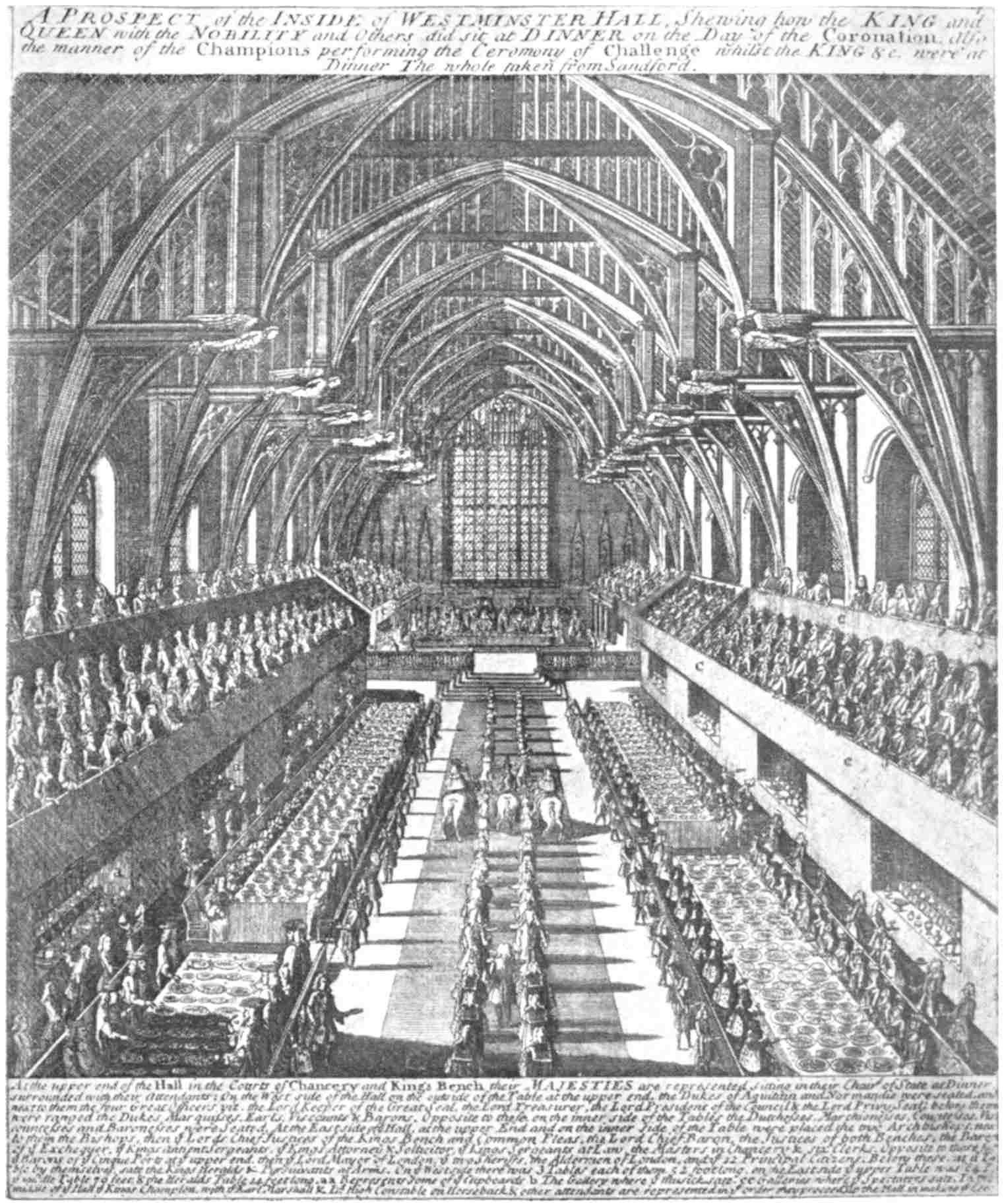
THE CORONATION BANQUET OF GEORGE II. AND QUEEN CAROLINE.
The Queen now advanced for her coronation.
“Her Majesty, supported by the Bishops of London
and Winchester, knelt at the steps of the altar, and,
being anointed with the holy oil on the head and
breasts, and receiving the ring, the Archbishop
reverently set the crown upon her Majesty’s head,
whereupon the three princesses and the peeresses
put on their coronets, and her Majesty having
received the sceptre with the cross and the
ivory rod with the dove, was conducted to her
throne.”
The King and Queen then made their oblations
and received the Holy Communion.
When the long service was over their Majesties
proceeded to St. Edward’s Chapel, where the King
was arrayed in a vesture of purple velvet, but the
Queen retained her robes of state. Their Majesties,
wearing their crowns, then returned on foot to
Westminster Hall, and the long train of peers and
peeresses, all wearing their coronets, followed.
In Westminster Hall the King and Queen took
their seats on a daïs at a high table across the upper
end of the hall; the three princesses sat at one end
of this table. The nobility and other persons of
quality bidden to the feast seated themselves at
tables running down the hall, and the coronation
banquet began. After the first course had been
served, the King’s Champion, who enjoyed that
office by virtue of being Lord of the Manor of
Scrivelsby in Lincolnshire, entered. He was completely
armed in a suit of white armour and was
mounted on a “goodly white horse richly caparisoned”.
The Champion carried a gauntlet in his
right hand, and his helmet was adorned with a plume
of feathers—red, white, and blue. Approaching
their Majesties’ table the Champion proclaimed his
challenge in a loud voice:—
“If any person of what degree soever, high or
low, shall deny or gainsay Our Sovereign Lord King
George II., King of Great Britain, France and
Ireland, Defender of the Faith, etc., and next
heir to Our Sovereign Lord King George I., the
last King deceased, to be the Right Heir to the
Imperial Crown of this Realm of Great Britain,
or that he ought not to enjoy the same; here is
his Champion who saith that he lyeth and is a
false Traytor, being ready in person to combat with
him and in this quarrel will adventure his life against
him on what day soever he shall be appointed.”
Then the Champion cast down his gauntlet,
which, when it had lain some few minutes, was
picked up by a herald and re-delivered to him. The
Champion went through this performance three
times, and after the third he made a low obeisance
to the King. Whereupon the cup bearer brought
to the King a gold bowl of wine with a cover, and
his Majesty drank to the Champion and sent him
the bowl by the cup bearer. The Champion, still
on horseback, put on his gauntlet, received the bowl
and drank from it, and after making a second reverence
to their Majesties, departed from the hall,
taking with him the bowl and cover as his fee. As
soon as the Champion had gone out, the heralds,
after three obeisances to the King, proclaimed his
style as follows in Latin, French and English:
“Of the Most High, Most Mighty and Most
Excellent Monarch George II., by the Grace of God
King of Great Britain, France and Ireland, Defender
of the Faith.”
These ceremonies over the King and Queen proceeded
with their dinner. “The whole solemnity,”
we read, “was performed with the greatest splendour
and magnificence, and without any disorder;
and what was most admired in the hall were the
chandeliers, branches and sconces, in which were
near two thousand wax candles, which being lighted
at once, yielded an exceeding fine prospect.” Their
Majesties did not leave Westminster Hall until
eight o’clock in the evening, when they returned to
St. James’s Palace to rest after their labours. But
their loyal subjects prolonged the rejoicings far into
the night with bonfires, illuminations, ringing of
bells, and other demonstrations of joy.
Lady Mary Wortley Montagu, who was present
at the coronation, wrote a lively account of the
scene, though she was more concerned with the
deportment of her friends and acquaintances than
with details of the ceremonial. She comments on
the “great variety of airs” of those present. “Some
languished and others strutted,” she writes, “but a
visible satisfaction was diffused over every countenance
as soon as the coronet was clapped on the
head. But she that drew the greater number of
eyes was indisputably Lady Orkney. She exposed
behind a mixture of fat and wrinkles, and before a
very considerable protuberance which preceded her.
Add to this the inestimable roll of her eyes, and
her grey hairs, which by good fortune stood directly
upright, and ’tis impossible to imagine a more delightful
spectacle. She had embellished all this
with considerable magnificence, which made her
look as big again as usual; and I should have
thought her one of the largest things of God’s
making, if my Lady St. John had not displayed
all her charms in honour of the day. The poor
Duchess of Montrose crept along with a dozen
black snakes playing round her face, and my Lady
Portland, who has fallen away since her dismissal
from Court,8 represented very finely an Egyptian
mummy embroidered over with hieroglyphics.”9
The magnificence of the coronation was the talk
of the town for a long time. As London was very
full of persons of quality who had come from far
and near to attend it, the theatre of Drury Lane
seized the opportunity to give a highly ornate
performance of King Henry the Eighth, with the
coronation of Anne Boleyn at the end of the play,
a scene on which £1,000 (an unheard of sum to
spend upon mounting a scene in those days) was
expended. The scene at Drury Lane rivalled in
mock splendour the ceremonial at the Abbey. All
the town flocked to see it, both those who had been
present at the real coronation and those who had
not. The King and Queen and the young princesses
came more than once, and graciously expressed their
approval. “The Coronation” was repeated in the
provinces for a year or two later.
The City of London was not backward in
showing its loyalty to George the Second; an
address was presented to the King, and the Lord
Mayor’s Show was conducted on a scale of unprecedented
splendour. The King and Queen attended
in state the banquet at the Guildhall, and some idea
of the entertainment may be gathered from the fact
that two hundred and seventy-nine dishes adorned
the feast, and the cost amounted to £5,000.
When the excitement and loyal emotions called
forth by the coronation had subsided the English
people were better able to take the measure of their
second King from Hanover. The process of disillusion
soon set in. George the Second had even
fewer good qualities than his father. On the
battlefield, like all princes of his house, he had
shown physical courage, though he had no claim to
generalship. He had a certain shrewdness and a
vein of caution which kept him from committing
any flagrant errors, however foolishly he might talk.
But this was the most that could be said in his
favour. He was vain and pompous, mean, spiteful
and avaricious. All he cared for, it was said, was
“money and Hanover”. He neither spoke nor
acted like a King, and his small mind was incapable
of rising to the height of his position. If he were
straightforward it was because he was too stupid
to dissemble, and if he seldom lied it was because
it involved too great a strain upon his narrow
imagination. On the surface it would be impossible
to imagine two persons more unsympathetic
than the King and Queen, yet the fact remains
that they were devoted to one another. George
knew that his consort was absolutely loyal to his
interests, and in the great loneliness that surrounds
a throne he could appreciate the benefit
of having one disinterested person whom he could
trust and in whom he could confide. In his heart
of hearts he knew that his Queen was infinitely his
superior, though he would never admit it to himself,
to her, or least of all to the world. Yet in public
affairs she swayed him as she would.
From the time that Caroline became Queen,
until her death, she governed England with Walpole;
she did not merely reign but she ruled, and
though she was only Queen Consort, admitted by
the English Constitution to no share in affairs of
state, yet practically she was Queen Regnant, and
a more powerful one than any England had known
except Elizabeth. Caroline regarded Elizabeth as
her great exemplar, and resembled her in many
ways—in her love of dominion, her jealousy of any
rival near her throne, her diplomatic abilities, her
breadth of view in matters of religion, her contempt
for trivialities, and her superiority to mere convention.
She differed from Elizabeth in that she had
a good heart, and though she loved to rule, she
was neither tyrannical nor despotic. Elizabeth exercised
her power directly, appropriating even the
credit due to her Ministers; Caroline’s power was
indirect and found its way through tortuous channels.
The extent of her power, though suspected, was
never fully realised during her lifetime, except by
a few persons such as Lord Hervey, who came into
daily contact with her, and of course Walpole.
Caroline had to be careful not to arouse the King’s
jealousy, for, like many weak men, he loved the
outward semblance of authority, and this the Queen
was more than ready to yield him. The King could
have all the show provided she had the substance.
The Queen and Walpole soon came to an
understanding, and in the governing of the King and
the kingdom they worked in accord. The Prime
Minister discussed fully with her affairs of state, and
together they planned what should be done. When
everything was settled between them, Caroline
undertook to bring the King round to their way
of thinking. This process generally took place in
private, but sometimes, if the matter were urgent,
Caroline and Walpole would play into each other’s
hands in another way. The Prime Minister would
have a conference with the Queen over-night, and
the next morning, when he was summoned by the
King, Caroline would, as if by accident, enter the
royal closet. She would make a deep obeisance
and humbly offer to withdraw. The King would
tell her to stay; she would take a chair, occupy
herself with knotting or something of the kind, and
apparently take no interest in the conversation.
The King would ask her opinion. “I understand
nothing of politics, your Majesty knows all,” she
would modestly answer. Delighted with this tribute
to his powers George would press for an answer to
his question, and then the game of hoodwink would
begin. From certain secret signs agreed upon
between her and Walpole, the Queen spoke or was
silent, gave a qualified opinion or expressed herself
plainly. It was all so well managed that neither
the King nor other ministers present, if there were
any, noticed the least thing. Walpole played with
his hat, fidgeted with his sword, took snuff, pulled
out his pocket handkerchief or plaited his shirt
frill: each detail of this dumb show had its secret
meaning. This farce was played not once but
many times, over and over again, and though the
means were sorry enough, the end was the good
of the nation. The personal rule of the monarch
as it had existed in the days of the Stuarts was
gone for ever; still the King was a force to be
reckoned with, and, in foreign politics especially,
Walpole would have found the choleric little George
a terrible stumbling-block in his path had it not been
that the Queen bent him to her will. The King
would often announce his intention of doing something
incredibly foolish, she would apparently agree
with him, yet before long she would bring him
round to her point of view, though it was in flat
contradiction to his first declaration. When the
King set his face against a certain plan of the Prime
Minister’s or a certain appointment, Walpole would
leave the matter in the Queen’s hands, and by and
by the King would suggest to him the very policy
or appointment he had opposed, as though it were
an idea of his own. Caroline talked her sentiments
into her husband’s mind and he reproduced them
as faithfully as words talked into a phonograph.
In public the Queen was always obedient, and her
manner to the King was submission itself. “She
managed this deified image,” says Lord Hervey,
“as the heathen priests used to do the oracles of
old, when, kneeling and prostrate before the altars
of a pageant god, they received with the greatest
devotion and reverence those directions in public
which they had before instilled and regulated in
private. And as these idols consequently were
only propitious to the favourites of the augurers,
so nobody who had not tampered with our chief
priestess ever received a favourable answer from
our god; storms and thunder greeted every votary
that entered the temple without her protection;
calms and sunshine those who obtained it.” The
most farcical thing about it was that the little
domestic tyrant took all this homage as his due,
and to hear him talk his courtiers might think that
he was as despotic as the Cæsars and as autocratic
as the Tsar. On one occasion his mind ran back
over English history (with which, by the way, he
was imperfectly acquainted), and he recalled his
predecessors on the throne and contrasted them
unfavourably with himself. To quote the same
authority: “Charles I.,” he said, “was governed
by his wife; Charles II. by his mistresses; James
II. by his priests; William III. by his men; and
Queen Anne by her women-favourites. His father,
he added, had been by anyone that could get at
him. And at the end of this compendious history
of our great and wise monarchs, with a significant,
satisfied, triumphant air, he turned about smiling to
one of his auditors, and asked him—‘And who do
they say governs now?’”
The courtier, we may be sure, was too discreet
to say, but ill-affected persons blurted out the truth,
and the disaffected journals, from the Craftsman
downwards, railed at Walpole for having bought
the Queen, and at the King for being governed by
her. This was repeated over and over again in
ribald verse of which the following will serve as a
specimen:—
You may strut, dapper George, but ’twill all be in vain;
We know ’tis Queen Caroline, not you, that reign—
You govern no more than Don Philip of Spain.
Then if you would have us fall down and adore you,
Lock up your fat spouse, as your dad did before you.
The Queen and Walpole were always striving to
keep these lampoons away from the King, but
some one about the court, probably in the apartments
of Mrs. Howard, told him of the existence of
this one, and he was exceedingly annoyed. He
asked Lord Scarborough if he had seen it. Scarborough
admitted that he had. George then asked
him who had shown it to him, but he said he had
pledged his honour not to tell. The King flew
into a passion, and said: “Had I been Lord Scarborough
in this situation and you King, the man
would have shot me, or I him, who had dared to
affront me, in the person of my master, by showing
me such insolent nonsense”. Scarborough replied
that he had not said it was a man who had shown it
to him, which made the King, who regarded this as
a pitiful evasion, angrier than ever. By way of
showing his independence the King for some time
after was more than usually testy with the Queen,
contradicting her flatly before all the court whenever
she ventured an opinion, snubbing her unmercifully,
pooh-poohing her wishes, and generally treating her
with almost brutal rudeness. The Queen received
this with meekness, and abased herself before the
King more than ever. But all the while her power
increased.
Soon after the coronation the country was
plunged into a general election. The Jacobites
came off very badly at the polls, and the Tories
little better. Even with the aid of the malcontent
Whigs, the Opposition made a poor muster in point
of numbers, and when the new Parliament met in
January, 1728, the Ministerial majority was even
greater than in the last reign. Walpole had won
all along the line. The result no doubt was largely
due to the way in which the Government had bought
owners of pocket boroughs, and to the wholesale
bribery wherewith its agents seduced the voters;
under such a system of corruption it was impossible
for the voice of the nation to make itself effectually
heard. Even many of those members of Parliament
who were returned to the House of Commons in
opposition to Walpole were eventually bought by
him. “Every man has his price” was his cynical
maxim, and he acted upon it so thoroughly that his
name became a byword for corruption. True, the
standard of political morality was not high in those
days, the party in power, whether Whig or Tory,
frequently abused the public trust and misused
the public money. But it remained for Walpole
to bring organised corruption to such a pitch that
it paralysed popular government, and placed the
balance of power, neither in the Sovereign, nor in
the people, but in the hands of a Whig oligarchy.
Such an oligarchy was at this period synonymous
with Walpole himself, for the great Minister brooked
no rivals in the King’s (or rather in the Queen’s)
councils. “Sir Robert,” said the shrewd old Sarah
of Marlborough, “likes none but fools and such as
have lost all credit.” His earlier Administrations
had included a few strong men, but one by one they
had to go, unable to work with so jealous and
domineering a chief. By bribery Walpole also reduced
Parliament to such a condition of impotence
that it was hardly more to be reckoned with than
the King. The Prime Minister had really no one
to consider but the Queen, with whom he had a
perfect understanding.
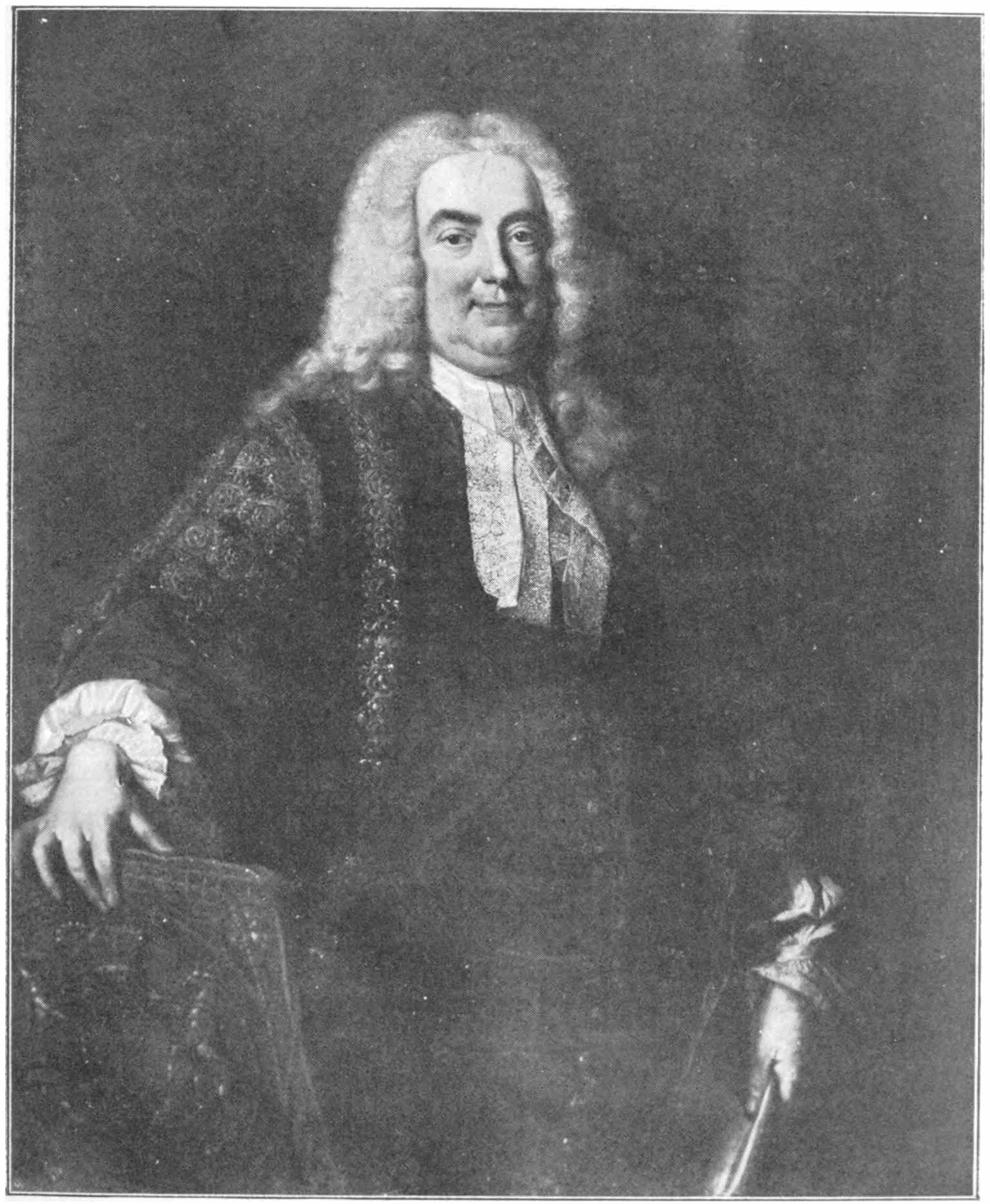
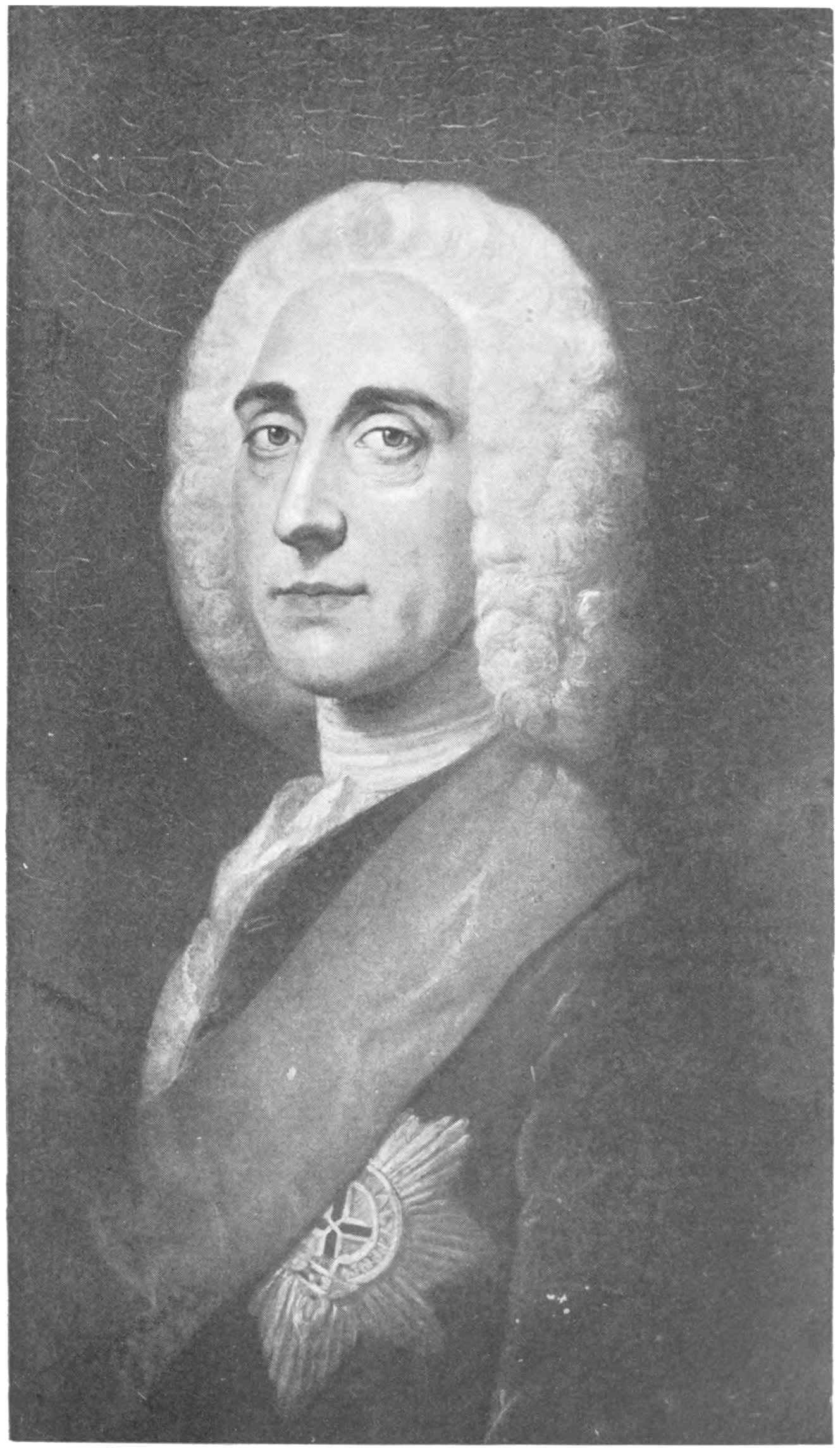
SIR ROBERT WALPOLE.
From the Painting by J. B. Van Loo in the National Portrait Gallery.
Thus did Caroline and Walpole rule England.
The means whereby they ruled were tainted at the
source; the end may, or may not, have justified the
means, but at this distance of time, when the fierce
controversies which gathered around Walpole’s
policy have passed into history, it must be admitted
that the results were good. England was sick unto
death of internal and external strife, what she needed
was a strong hand at the helm and a settled government,
and under Caroline and Walpole she secured
both, and ten years of peace abroad and plenty at
home in addition. This long peace enabled England
to recover herself within her borders; British
credit, which had sunk to zero, rose higher than it
had been for years, trade and commerce increased,
land went up in value, wheat became cheaper, and
everywhere signs of prosperity were manifest. By
degrees, and it was here that Caroline’s tact came
in, the different classes of the community were reconciled
to the Hanoverian dynasty; the Church
and the country squires held out the longest, but
though they retained a tender sentiment for the
exiled Stuarts they came in some vague way to
connect their material prosperity with the maintenance
of the Hanoverian régime. This result was
not achieved without some loss, chiefly to be found
in the lowering of the old ideals. The clergy, from
causes on which we shall dwell more fully later, became
indifferent, and the Church sank into apathy;
the country gentry lost, together with their old
passionate loyalty to the King, some of their sense
of personal responsibility towards their poorer neighbours,
and took a lower view of their duties to
the State. Much of the grossness and selfishness
which disfigured the eighteenth century was due to
an excess of material prosperity, and a consequent
lowering of ideals in our national life.
Very soon the King, who when Prince of Wales
had always posed as English in all his sentiments,
began his father’s game of sacrificing English interests
to those of Hanover. So subservient was
the new House of Commons, and so unscrupulous
were Walpole’s tactics, that only eighty-four members
were found to vote against a proposal to pay
£280,000 to maintain Hessian troops for the benefit
of Hanover; and the subsidy of £25,000 a year for
four years to the Duke of Wolfenbüttel, in return
for his promise to furnish troops for a similar
purpose, was passed with very little opposition. The
maintenance of the Hessian troops was part of the
price Walpole had to pay the King for preferring
him to Compton, and the Duke of Wolfenbüttel’s
subsidy was hush-money pure and simple, paid for
his handing over the late King’s will.
Though the Opposition was weak in numbers,
and suffered from a lack of cohesion in its different
groups, it was strong in the quality of its individual
members. Pulteney headed the opposition to Walpole
in the House of Commons, more especially
that part of it which included the malcontent Whigs
and the more moderate Tories who supported the
Hanoverian succession. It was Bolingbroke who
built up this party, and he invented for it the name
of “Patriots”. Carteret, and later Chesterfield, were
among its leading lights, but Pulteney was the chief.
This remarkable man was in the prime of life, and
endowed with natural and acquired advantages. He
was of good birth, and the owner of great wealth;
he had a handsome person, a dignified manner and
a cultured mind. His wit and scholarship almost
rivalled Bolingbroke’s, and as an orator he had few
equals, and no superior, in his generation. Pulteney’s
abilities as a statesman were of the highest order;
he had been a colleague of Walpole in earlier days,
and stood by him in many a hard fought fight. He
had therefore the strongest claims for place. But
Walpole, jealous of Pulteney’s powers, passed him
over for Cabinet office and offered him a minor post
in the Government, and a peerage. The latter was
refused, the former accepted for a time, but Pulteney
soon resigned and went into active opposition. He
joined forces with Bolingbroke, and the first fruit
of their union was the Craftsman, a journal which
fiercely attacked Walpole and his policy, the second
was the formation of the Patriots’ party. Bolingbroke,
though still excluded from the House of
Lords, was able through the medium of the Craftsman
to address himself to the wider constituency of the
nation. His articles against his lifelong enemy were
masterpieces of damaging criticism and polished
invective. Besides Bolingbroke, the ablest political
writers of the day contributed to the Craftsman.
The most remarkable feature of the Opposition
was the fact that it included men who, though
differing widely among themselves, were united in
common hatred of Walpole. There became practically
only two parties in the State, those who were
for Walpole and those who were against him; and
the differences between malcontent Whig and Tory,
Jacobite and Hanoverian, sank into comparative
insignificance. Thus Pulteney and Carteret were
staunch Hanoverians and Whigs, Barnard was a
Hanoverian Tory, Wyndham a Tory with Jacobite
leanings, and Shippen a Jacobite out and out;
Bolingbroke stood among these parties, partaking
a little of them all, and concentrating into himself
the essence of their hatred of Walpole.
No English Minister has ever been hated more
than Walpole and none has had abler foes. The combination
of two such master-minds as Bolingbroke and
Pulteney would, under ordinary circumstances, have
broken down any Minister. But the circumstances
were not ordinary, and no statesman was more successful
than Walpole in overcoming his enemies.
His success was largely due to the steady support he
received from the Queen. To her wise counsels was
also something due. Walpole now refrained from
violent measures against his political opponents, even
under intense provocation. Hitherto in English
politics the party in power had consistently persecuted
the party in the minority. But now a new era set
in; it was possible to oppose a powerful Minister
and yet not be sent to the Tower or impeached as
a traitor. This more generous policy may be directly
traced to Queen Caroline, for Walpole in George
the First’s reign had been anything but conciliatory,
and no Minister had urged more fiercely than he the
impeachment, the exile, and even the death of his
political opponents. It was he who had clamoured
for the execution of the Jacobite peers. But Caroline
now exercised a restraining hand. During her ten
years of queenship great freedom of speech was
allowed in Parliament and outside it, and the widest
liberty was given to the press. Impeachment, fining
and imprisonment of politicians in opposition to the
Government were things unheard of, and Caroline
was careful to conciliate, or to endeavour to conciliate,
such members of the Opposition as were
loyal, or professed themselves to be loyal, to the
Hanoverian dynasty. She remained on good terms
with John, Duke of Argyll, who had been the
King’s favourite when he was Prince of Wales, but
who had now gone into the cold shade of Opposition,
and resigned all his offices about the court. She
even received Pulteney much against Walpole’s wish,
and she had a smile and a gracious word for many
of the Patriots when they came her way, always
excepting Bolingbroke, whom she never would admit
to the least atom of her favour. In Caroline’s
wise policy may be seen the germs of that strict
impartiality which the Sovereign ought to show
towards prominent statesmen, whether they are in
office or in opposition. This has now become almost
an unwritten law of the English Constitution.
In a far lesser degree Caroline’s influence may
also be traced in the way in which Walpole, though
possessing the power to force through Parliament any
measure he would, refrained from running counter
to the popular will, when that will was unmistakably
declared. True, here his own inherent statesmanship
came in, and counselled moderation. But
Caroline also had theories about the popular will
and civil liberty which she had acquired in her
youth from Sophie Charlotte of Prussia, the “Republican
Queen,” and this at least may be claimed
for her, that she taught Walpole the art of making
his concessions gracefully. Her love of liberty in
matters of religion showed itself in the zeal with
which she urged indulgence to Protestant dissenters;
the time was not supposed to be ripe for the repeal
of the penal laws against them, but annual Acts
of Indemnity were passed which practically gave
them the relief they desired, and drew the fangs
of the Test and Corporation Acts. Caroline’s
power was most noticeable in the dispensing of
patronage; it is not too much to say that in
all the ten years she was Queen no important
appointment, either in Church or State, was made
without her having some voice in it. In this transition
period the judicious distribution of patronage
influenced largely the future of the nation, and
the Queen, who saw further ahead than most of her
contemporaries, was fully conscious of its importance.
Thus this princess, who little more than a decade
before was a stranger to the English laws and constitution,
was able to shape and guide the destinies
of England.
7 “A particular account of the solemnities used at the Coronation
of His Sacred Majesty King George II. and of his Royal Consort
Queen Caroline on Wednesday the 11th October, 1727,” London,
1760. From the pamphlet the other particulars of the coronation
are taken.
8 She had been appointed governess to the three eldest princesses
by George I., but was dismissed by Queen Caroline.
9 Lady Mary Wortley Montagu’s Letters and Works. Edited by
Lord Wharncliffe.
CHAPTER III. THE COURT OF QUEEN CAROLINE. — FOOTNOTES TO BOOK III, CHAPTER III:
The court of King George the Second and Queen
Caroline was conducted on a larger scale than
any court England had known since the days of
Charles the Second, though it lacked much of
the gaiety and more of the grace that enlivened
and adorned the court of the Merry Monarch.
George the Second was a great lover of show, but
he had neither wit nor good taste, and when he
assumed the crown he seemed to think that he
ought also to assume a stiffness and pomposity of
manner to maintain his regal dignity. Like all
German princes he was a great stickler for
etiquette, and he modelled his court not only on
Versailles, which then served as a pattern for all
the courts of Europe, but imported to it some of the
dulness of Herrenhausen, and further regulated it
with strict regard to English precedents in previous
reigns. The court officials were often very hard put
to it to unearth them. But the King was exceedingly
precise and resented the most trifling
breach of etiquette as a reflection on his royal
dignity. He was a great authority on dress and ceremonial;
he could tell to a hair’s-breadth the precise
width of the gold braid which should adorn the coat
of a gentleman of the bedchamber, and recall with
accuracy the number of buttons required for the
vest of a page of the backstairs. The Queen encouraged
and applauded his bent in this direction;
it occupied his mind and left her free to arrange
with Walpole the weightier affairs of the nation.
Leicester House was given up and the court
made St. James’s Palace its headquarters in London.
All the Hanoverian mistresses and favourites who
had occupied apartments there during the last
reign were turned out without ceremony. The
court of Queen Caroline was more select than that
of George the First. Drunkenness was still a venial
offence, but it was not approved of in the royal
presence, and women of notoriously ill repute were
no longer received at St. James’s. When the
court was at St. James’s, drawing-rooms were held
several times a week, public days as they were
called, and the King and Queen gave frequent
audiences besides. Court balls often took place,
and at the evening drawing-rooms cards and high
play were still in vogue. Every movement of the
King and Queen in public was made the occasion
of ceremonial; they attended divine service at
the Chapel Royal in state; they walked in St.
James’s Park followed by a numerous suite, the
way kept clear by guards; they seldom drove
out unless preceded by an escort; their visits to the
theatre or opera were always announced beforehand,
and their coming and going made the occasion of a
spectacle. The people, with whom the pomp and
circumstance of Royalty is always popular, loved
these sights mightily, and all classes were pleased
that there was once more a court in London.
The King and Queen also revived the custom of
dining in public on Sundays. One of the large
state rooms of St. James’s Palace was set apart
for the occasion, and at a flourish of trumpets the
King and Queen and the Royal Family entered and
sat down to table in the centre of the room surrounded
by the officers of the household. The
courses were served with much ceremony on bended
knee. The table was decked with magnificent plate
and a band played during dinner. The enclosure
was railed around, and the public were admitted
by ticket, and allowed to stand behind the barriers
and watch the royal personages eat, a privilege of
which they freely availed themselves. After dinner
the King and Queen withdrew to their apartments,
their going, as their coming, being made the occasion
of a procession.
One of the first acts of the new King and Queen
was to make a tour of the royal palaces, which had
been practically closed to them since their rupture
with George the First. The old King had disliked
Windsor and rarely went there, its grandeur oppressed
him, and he and his German mistresses
felt out of their element in a place steeped in
traditions essentially English. George the Second
did not care for Windsor any more than his
sire, and excused himself from going there often
on the ground that it was too far from London.
He visited the castle chiefly for the purpose of
hunting in the forest. But Caroline loved royal
Windsor greatly, and used to go there during the
King’s absences at Hanover. In one of the
recesses of the picture gallery, now the library,
she arranged an extensive and valuable collection
of china; the collection was afterwards dispersed,
but some of the china remains at Windsor Castle
until this day, and is the only relic of Queen
Caroline’s occupation.10
The King and Queen paid their first visit to
Windsor in the autumn of 1728, and great preparations
were made to welcome them to the royal
borough. “Last Saturday,” we read, “when their
Majesties arrived at Windsor, the Mayor, aldermen,
and capital burgesses were ready in their formalities
to receive them, and the balconies were hung with
tapestry and vast crowds of spectators, but their
Majesties came the Park way. The King and
Queen walked in the Park till dinner time. The
next day their Majesties dined in public, when all
the country people, whether in, or out of, mourning,
were permitted to see them.”11 On this occasion
George the Second assumed his stall in St. George’s
Chapel as Sovereign of the Order of the Garter,
and made his offering at the altar. The Queen,
with the Duke of Cumberland, the Princess Royal,
and the Princesses Caroline, Mary and Louisa, were
present, and the Queen was seated under a canopy
erected on the south side of the choir. A ball was
given in the evening. The royal pair hunted the
stag in Windsor Forest frequently during the visit,
and on one occasion remained out until nine o’clock
at night, and on another hunted all day through the
rain, chasing the stag as far as Weybridge. The
Queen followed the hounds in a chaise with one
horse, in the same way that Queen Anne used to
hunt in Windsor Forest. During their sojourn at
Windsor the King and Queen received one Mrs.
Joy, “a widow lady in the ninety-fourth year of
her age, who had kissed Charles the First’s hand;
she was very graciously received”.12 The Queen
celebrated her first visit to Windsor by giving £350
at Christmas for releasing insolvent debtors confined
in the town and castle gaol—her favourite form of
charity. The prisoners, to the number of sixteen,
were set free.
Kensington was George the Second’s favourite
palace, as it had been his father’s. King George
the First rebuilt the eastern front and added the
cupola. He also improved the interior, notably
by making the grand staircase. Then, as now,
Kensington Palace was an irregular building with
little pretence to beauty and none to grandeur.
But our first Hanoverian kings loved it; its
homeliness reminded them of Herrenhausen. The
Kensington promenades were now revived, and
the King and Queen accompanied by the Royal
Family would pace down the walks between an
avenue of bowing and smiling courtiers. Throughout
this reign, and far into the next, Kensington
Gardens formed a fashionable resort, and with
the promenades are associated many of the great
names of the eighteenth century. People were
admitted to the gardens by ticket obtainable through
the Lord Chamberlain. Thus the promenades
developed into a sort of informal court and were
much resorted to by persons who did not attend
drawing-rooms and levées in the ordinary way,
as well as by those who did. The King and the
Queen on these morning walks would make many
a person happy by singling him out from the crowd
with a bow, a smile, or the honour of a few words;
or, on the other hand, they would plunge many
an aspirant to Court favour into gloom by ignoring
him. The origin of these promenades may be
traced to the daily walks of the Electress Sophia
in the gardens of Herrenhausen, when she used
to give audience to her supporters. Like the old
Electress, her grandson and his Queen were great
walkers. The little King used to walk very fast,
with a curious strutting step, and generally forged
ahead, leaving his taller and stouter consort to pant
along behind him. In a political skit of the day
there is an amusing reference to Caroline’s custom
of dropping behind her husband. It is headed:
“Supposed to be written on account of three gentlemen
being seen in Kensington Gardens by the King and
Queen while they were walking”. It was written
either by Pulteney or Chesterfield, and these two
were doubtless represented in it, the third being
Wyndham or Bolingbroke. “The great river
Euphrates” is the Serpentine, which Caroline created
out of a string of ponds. It runs:—
“Now it came to pass in the days of Nebuchadnezzar,
the King of Babylon, in the eighth month,
of the sixth year, the beginning of hay harvest,
that the King and Queen walked arm in arm
in the gardens which they had planted on the
banks of the river, the great river Euphrates, and
behold there appeared on the sudden three men,
sons of the giants. Then Nebuchadnezzar the King
lifted up his voice and cried: ‘Oh men of war, who
be ye, who be ye, and is it peace?’ They answered
him not. Then spake he and said: ‘There is
treachery, oh my Queen, there is treachery,’ and
he turned his face and fled. Now when the Queen
had seen what had befallen the King she girt up
her loins and fled also, crying: ‘Oh my God!’ So
the King and Queen ran together, but the King
outran her mightily, for he ran very swiftly; neither
turned he to the right hand nor the left, for he was
sore afraid where no fear was, and fled when no man
pursued.”
The King and Queen probably saw Pulteney,
Chesterfield and Bolingbroke coming towards them,
and as they were no doubt just then opposing some
pet measure of Walpole and of the court, the King
not wishing to receive their salutations, and not caring
to ignore them, turned on his heel, and, followed
by the Queen, hurried off as fast as he could.
Richmond Lodge had now become Caroline’s
personal property, and the Queen continued to be
very fond of it, and spent large sums of money in
enlarging the gardens. Soon after Caroline became
Queen she gave £500 for railing and improving
Richmond Green, and we read: “A subscription
is set on foot among the inhabitants of the town
of Richmond for erecting the effigy of her Majesty
in the middle of the green”.13 But this intention
was apparently never carried out. The Queen also
had a cottage at Kew where she often drove to
breakfast from Richmond. She gave the use of it to
her favourite, Mrs. Clayton, afterwards Lady Sundon.
HAMPTON COURT, TEMP. GEORGE II.
Hampton Court, more than any other royal
palace, has memories of Queen Caroline, and many
of its rooms remain to this day much as she left them.
The Queen’s dressing-room is almost the same as it
was one hundred and seventy years ago; her high
marble bath on one side of the room may still be
seen, and on the other side is the door that led to
her private chapel. Under Caroline’s supervision
Hampton Court was altered in many ways, and in
some improved. The great staircase was completed
and decorated; the Queen’s presence chamber and
the guard chamber were altered in a way characteristic
of the early Georgian period. The public
dining room, which is one of the finest rooms in the
palace, was also redecorated, and the massive chimney-piece
of white marble which bears the arms of George
the Second was placed in it. Nor did the Queen confine
her alterations only to the palace. She had a
passion for gardening, especially landscape gardening,
and the grounds of Hampton Court were considerably
changed under her supervision. It was she who
substituted wide sweeping lawns for the numerous
fountains and elaborate flower beds which until then
had ornamented the great fountain garden. Her
alterations in many respects were severely criticised.14
Both the King and the Queen had pleasant memories
of the place where they had celebrated their
only regency when Prince and Princess of Wales.
The summer after the coronation they came to
Hampton Court for some time, and, as long as the
Queen lived, a regular practice was made of spending
at least two months there every summer. From
Hampton Court the King did a great deal of stag
hunting; he was especially fond of the pleasures of
the chase and would not forego them on any
account. His enthusiasm was not shared by the
lady members of the royal household. “We hunt,”
writes Mrs. Howard from Hampton Court to Lady
Hervey, “with great noise and violence, and have
every day a very tolerable chance to have a neck
broke;”15 and her correspondent, writing of the
same subject, declares her belief that much of Mrs.
Howard’s illness was due to this violent riding.
The following is a description of one of these expeditions:—
“On Saturday their Majesties, together with
their Royal Highnesses the Duke (of Cumberland)
and the Princesses, came to the new park by
Richmond from Hampton Court and diverted themselves
with hunting a stag, which ran from eleven to
one, when he took to the great pond, where he
defended himself for half an hour, when he was
killed. His Majesty, the Duke, and the Princess
Royal hunted on horseback, her Majesty and the
Princess Amelia in a four-wheeled chaise, Princess
Caroline in a two-wheeled chaise, and the Princesses
Mary and Louisa in a coach. Her Majesty was
pleased to show great condescension and complaisance
to the country people by conversing with them,
and ordering them money. Several of the nobility
attended, amongst them Sir Robert Walpole, clothed
in green as Ranger. When the diversion was over
their Majesties, the Duke, and the Princesses
refreshed themselves on the spot with a cold collation,
as did the nobility at some distance of time
after, and soon after two in the afternoon returned
to Hampton Court.”16
The Queen always accompanied the King in
her chaise, but she cared nothing for the sport.
She took with her her vice-chamberlain, Lord
Hervey, “who loved hunting as little as she did,
so that he might ride constantly by the side of
her chaise, and entertain her whilst other people
were entertaining themselves by hearing dogs bark,
and seeing crowds gallop”.17 The King cared only
for stag-hunting and coursing; he affected to despise
fox-hunting, though the sport was very popular
among his subjects. Once, when the Duke of
Grafton said he was going down to the country to hunt
the fox, the King told him that: “It was a pretty
occupation for a man of quality, and at his age to be
spending all his time in tormenting a poor fox, that
was generally a much better beast than any of those
that pursued him; for the fox hurts no other animal
but for his subsistence, while those brutes who hurt
him did it only for the pleasure they took in hurting.”
The Duke of Grafton said he did it for his health.
The King asked him why he could not as well walk
or ride post for his health; and added, if there was
any pleasure in the chase, he was sure the Duke
of Grafton can know nothing of it; “for,” added his
Majesty, “with your great corps of twenty stone
weight, no horse, I am sure, can carry you within
hearing, much less within sight, of the hounds.”18
At Hampton Court, as at St. James’s, the
King and Queen dined in public on Sundays, and
the people came in crowds to see the sight. On
one of these occasions an absurd incident took
place. “There was such a resort to Hampton
Court last Sunday to see their Majesties dine,”
writes a news-sheet, “that the rail surrounding
the table broke, and causing some to fall, made
a diverting scramble for hats and wigs, at which
their Majesties laughed heartily.”19 On private
evenings at Hampton Court the only amusement
was cards, but now and then the King and
Queen held drawing-rooms, in the audience chamber.20
Often in summer, when the nights were
fine, the Queen and her ladies would go out and
walk in the gardens. We may picture her pacing
up and down the avenues of chestnut and lime in
the warm dusk, or viewing from the gardens the
beautiful palace bathed in the moonbeams. So
little is changed to-day that it requires no great
effort of the imagination to re-people Hampton
Court with the figures of the early Georgian
era.
One of the most prominent personages at the
Court of Queen Caroline was her favourite, Lord
Hervey, whom she had now appointed her vice-chamberlain,
and who enjoyed her fullest confidence.
The Queen delighted to have him about her at all
times, and would converse with him for hours
together, asking him questions about a hundred
and one things, and laughing at his clever talk.
Lord Hervey was a man of considerable wit and
ability, and undoubtedly an amusing companion.
But he was a contemptible personality, diseased
in body and warped in mind, incapable of taking
a broad and generous view of any one or anything;
ignorant of lofty ideals and noble motives himself,
he was quite unable to understand them in others,
and always sought some sordid or selfish reason
for every action. The Queen, however, overlooking
his faults, with which she must have been
familiar, and his effeminacies and immoralities, of
which she could not have been ignorant, believed
that he was a faithful servant to her, and trusted
him in no ordinary degree. As a sign of her
favour she increased his salary as vice-chamberlain
by £1,000 a year, allowed him considerable
patronage, which was worth a good deal more,
and made him many valuable presents. She
treated him rather as a son than as a subject.
“It is well I am so old,” she used to say (she was
fourteen years Hervey’s senior), “or I should be
talked of over this creature.” No one, however,
ever talked scandal of her Majesty, though some
doubted her judgment in choosing her friends,
and it must be confessed that she was unwise in
admitting Hervey to so many of her secrets.
Notwithstanding that she heaped favours upon
him, he repaid her with ingratitude, and when she
was dead endeavoured to befoul her memory. But
to the Queen’s face he was a fawning and accomplished
courtier, and expressed the greatest zeal
in her service.
Hervey had a nimble and superficial pen, and
sometimes employed himself in writing anonymous
pamphlets in defence of the Government and
Court against members of the Opposition. A
great many of these anonymous pamphlets were
showered upon the town at this time, and Pulteney
chancing to come across one of them,
entitled Sedition and Defamation Displayed, which
attacked him and Bolingbroke in no measured
terms, thought it was from Lord Hervey’s pen (it
afterwards turned out to be not so), and wrote a
violent answer, also anonymous, called A Proper
Reply to a Late Scurrilous Libel. This pamphlet
abused Walpole, and by implication the Court, and
applied several opprobrious epithets to Hervey,
speaking of him by his nickname “Lord Fanny,”
describing him as “half-man and half-woman,” and
dwelling malignantly on his peculiar infirmities.
The pamphlet was warmly resented at court. Like
many who set no bounds to their own malice,
Hervey was extremely sensitive to attack, and
wishing to curry favour with the King and Queen
he wrote to Pulteney to know if he were the author
of the pamphlet. Pulteney answered that he would
inform him on that point if Hervey would tell him first
whether he was the writer of Sedition and Defamation
Displayed. Hervey sent back word to say
that he had not written the pamphlet, and again
demanded an answer to his question. Pulteney
returned a defiant message saying that “whether or
no he was the author of the Reply he was ready to
justify and stand by the truth of every word of it,
at what time and wherever Lord Hervey pleased”.
This was tantamount to a challenge, and Hervey,
though not given to duelling, could not in honour
ignore it. A duel was arranged. “Accordingly,”
writes an eye-witness,21 “on Monday last, between
three and four in the afternoon, they met in Upper
St. James’s Park, behind Arlington Street, with
their two seconds, who were Mr. Fox and Sir J.
Rushout. The two combatants were each of them
slightly wounded, but Mr. Pulteney had once so
much the advantage of Lord Hervey that he would
have infallibly run my lord through the body if
his foot had not slipped, and then the seconds
took the occasion to part them. Upon which Mr.
Pulteney embraced Lord Hervey, and expressed
a great deal of concern at the accident of their
quarrel, promising at the same time that he would
never personally attack him again, either with his
mouth or his pen. Lord Hervey made him a
bow without giving him any sort of answer, and,
to use a common expression, thus they parted.”
Sir Charles Hanbury Williams wrote some lines
on this duel, in which, addressing Pulteney, he
says:—
Lord Fanny once did play the dunce,
And challenged you to fight;
And he so stood to lose his blood,
But had a dreadful fright.
Among minor figures about the court two of
the most familiar were Lord Lifford and his sister,
Lady Charlotte de Roussie. They were the children
of a Count de Roussie, a French Protestant who
came over to England with William of Orange in
1688, and was created by him Earl of Lifford in the
peerage of Ireland. They were typical courtiers of
the baser sort, and would perform the meanest
offices and indulge in the grossest flattery in order
to win some rays of the royal favour. They were
not popular with any of the English people about
the court. Hervey tells us: “They had during
four reigns subsisted upon the scanty charity of the
English Court. They were constantly, every night
in the country and three nights in the town, alone
with the King or Queen for an hour or two before
they went to bed, during which time the King
walked about and talked to the brother of arms,
or to the sister of genealogies, whilst the Queen
nodded and yawned, till from yawning she came
to nodding, and nodding to snoring. These two
miserable Court drudges, who were in a more constant
waiting than any of the pages of the backstairs,
were very simple and very quiet, did nobody any
hurt, nor anybody but His Majesty any pleasure,
who paid them so ill for all their assiduity and
slavery that they were not only not in affluence, but
laboured under the disagreeable burdens of small
debts, which £1,000 would have paid, and had not
an allowance from the Court, that enabled them
to appear there even in the common decency of
clean clothes. The King nevertheless was always
saying how well he loved them, and calling them
the best people in the world, but though he never
forgot their goodness he never remembered their
poverty.”
Another foreign dependent was Schütz, a Hanoverian.
Pope, who had lost the favour of the
Court, was very bitter upon those who retained
it; in one of his ballads he sings:—
Alas! like Schütz I cannot pun,
Like Grafton court the Germans,
Tell Pickenbourg how slim she’s grown,
Like Meadows run to sermons.
Hervey satirises Schütz’s dulness as follows:—
And sure in sleep no dulness you need fear
Who, ev’n awake, can Schütz and Lifford bear.
And again—
Charlotte and Schütz like angry monkeys chatter,
None guessing what’s the language or the matter.
While in another of his satires occur these lines:—
There is another Court booby, at once hot and dull,
Your pious pimp Schütz, a mean Hanover tool.
A personage of quite a different order to the
foregoing was Henrietta Louisa, Countess of Pomfret,
the authoress of the correspondence with Lady
Hertford. Lady Pomfret was the granddaughter on
the paternal side of Judge Jefferies, on the maternal
of the Earl of Pembroke, and on the strength of
the latter claimed descent from Edward the First.
Lady Pomfret accepted the post of lady of the bedchamber,
but she was of a different type to many
of the Queen’s ladies. She was a matron of
unimpeachable virtue, the mother of six lovely
daughters—all beauties—of whom, perhaps, the best
known was Lady Sophia Fermor, afterwards Lady
Carteret. Lady Pomfret had a keen sense of her
dignity, and she affected a knowledge of literature
and the fine arts. The celebrated “Pomfret Letters,”
much admired in their day, are packed with platitudes,
and so dull that they leave no doubt as to
the correctness of her principles. Lady Pomfret
was considered by many of her contemporaries to
be a prodigy of learning; she seems rather to have
been a courtly Mrs. Malaprop. She once declared
that “It was as difficult to get into an Italian coach
as for Cæsar to take Attica”—by which she meant
Utica. On another occasion some one telling her
of a man “who talked of nothing but Madeira, she
asked gravely what language that was”. But despite
her eccentricities she had sterling qualities, and was
as much a credit to the court as her daughters
were its ornaments.
The Queen’s household was numerous, and included
the Mistress of the Robes, the Duchess of
Dorset, six ladies of the bedchamber, all countesses;
six bedchamber women and six maids of honour.
The two most prominent members of it were two
bedchamber women, Mrs. Clayton, the Queen’s
favourite, and Mrs. Howard, the King’s favourite,
who hated one another thoroughly.
Mrs. Clayton had now great influence with the
Queen, more indeed than any one except Walpole,
with whom she came frequently into collision. She
was an irritating woman with an overwhelming sense
of self-esteem. Horace Walpole calls her “an absurd
pompous simpleton”. Lord Hervey credits her
with all the virtues, and declares that she possessed
an excellent understanding and a good heart. She
undoubtedly possessed cunning and ability, which
she used to such advantage that she ultimately procured
for her stupid husband a peerage, as Viscount
Sundon, and she foisted a large family of needy
relatives on to the public service. She acted as a
sort of unofficial private secretary to the Queen and
became the medium of all manner of communications
to her mistress. Many of the letters written to her
were really addressed to Caroline. Walpole heartily
disliked Mrs. Clayton and tried in vain to shake
her influence with the Queen. Her ascendency
was inexplicable to him for years, but at last he
thought that he had discovered the reason. When
Lady Walpole died, the Queen asked him many
questions about his wife’s last illness and persistently
referred to one particular malady from which, in
point of fact, Lady Walpole had not suffered. The
Prime Minister noticed it, and when he came home
he said to his son: “Now, Horace, I know by the
possession of what secret Lady Sundon has preserved
such an ascendant over the Queen”. Whether
her influence was wholly due to this cause is open
to question, for she stood in high favour before her
mistress’s malady began. But for long years Caroline
suffered from a distressing illness of which she
would rather have died than have made it known,
and Mrs. Clayton was one of the few who knew her
secret.
All the maids of honour except Miss Meadows
had changed since the King and Queen were last at
Hampton Court, but these young ladies were still of
a lively temperament. One evening in the darkness
several of them played at ghost, and stole out into the
gardens and went round the palace rattling and knocking
at the windows. Lady Hervey, who had heard
of these frolics, writes to Mrs. Howard: “I think
people who are of such very hot constitutions as to
want to be refreshed by night walking, need not
disturb others who are not altogether so warm as
they are; and it was very lucky that looking over
letters till it was late, prevented some people being
in bed, and in their first sleep, otherwise the infinite
wit and merry pranks of the youthful maids might
have been lost to the world.”22
But, however lively may have been the young
maids of honour, one member of the Queen’s
household found Hampton Court dull under the new
reign and its glory departed. Writing to Lady
Hervey Mrs. Howard says:—
“Hampton is very different from the place you
knew; and to say we wished Tom Lepell, Schatz
and Bella-dine at the tea-table, is too interested to be
doubted. Frizelation, flirtation and dangleation
are now no more, and nothing less than a Lepell
can restore them to life; but to tell you my opinion
freely, the people you now converse with” (books)
“are much more alive than any of your old acquaintances.”23
Mrs. Howard had a good reason to be dispirited,
for the new reign had proved a sad disappointment
to her. She had expected, and so had
her friends, that the King’s accession to the throne
would bring her an increase of power, wealth and
influence, which would have helped to compensate
her for the equivocal position she occupied, a position
which, as she was a modest woman, could not have
been altogether congenial to her. “No established
mistress of a sovereign,” says Horace Walpole,
“ever enjoyed less brilliancy of the situation than
Lady Suffolk.” The only benefit she received
was a peerage for her brother, Sir Henry Hobart,
and at the end of a long and trying career at court
she managed to amass a sum, not indeed sufficient
to give her wealth, but to save her from indigence.
The Queen once said that Mrs. Howard
received £1,200 a year from the King all the time
he was Prince of Wales, and it was increased to
£3,200 a year when he became King. He also gave
her £12,000 towards building her villa at Marble
Hill, near Twickenham, besides several “little dabs”
both before and after he came to the throne. But
this represented all that Mrs. Howard gained, if
indeed she gained so much; patronage or influence
she had none, and those who placed their trust
in her found themselves out of favour. After
a while the courtiers began to find out that it
was more profitable to pay their suit to Mrs. Clayton,
who had the ear of the Queen, than to Mrs.
Howard, who had not the ear of the King. Yet
the King still continued to visit Mrs. Howard for
some three or four hours every evening, at nine
o’clock, “but with such dull punctuality that he
frequently walked up and down the gallery for ten
minutes with his watch in his hand if the stated
minute was not arrived”.24 The Queen was doubtless
glad to get rid of him for a time, but Mrs.
Howard must have suffered sadly from the tedium
of entertaining her royal master on these daily visits,
and certainly deserved more than she got in the
way of recompense. She had, as one puts it, “the
scandal of being the King’s mistress without the
pleasure, the confinement without the profit”. The
Queen took care that the profit was strictly limited.
The King was so mean that at one time he even
suggested, indirectly, that the Queen should pay
Mrs. Howard’s husband out of her privy purse for
keeping himself quiet. This was too great a tax even
on Caroline’s complaisance and in one of her bursts
of confidence she told Lord Hervey that when
Howard insisted on his wife returning to him,
“That old fool, my Lord Trevor, came to me from
Mrs. Howard, and after thanking me in her name for
what I had done, proposed to me to give £1,200 a
year to Mr. Howard to let his wife stay with me;
but as I thought I had done full enough, and that it
was a little too much not only to keep the King’s
guenipes” (in English trulls) “under my roof, but to
pay them too, I pleaded poverty to my good Lord
Trevor, and said I would do anything to keep so
good a servant as Mrs. Howard about me, but that
for the £1,200 a-year I really could not afford it”.
So Howard’s silence was bought out of the King’s
pocket, and Mrs. Howard’s maintenance was partly
provided by him, and partly by the Queen, who
gave her a place in her household and so threw a
veil of respectability over the affair.
Mrs. Howard found that she gained so little
by the King’s accession, that she wished to retire
from court, but was not allowed to do so. Meanwhile
all her nominations were refused. She seems
to have shown her resentment in divers ways. Her
refusal to kneel during the ceremony of the Queen’s
dressing was perhaps one manifestation of it. With
regard to her uprising and retiring, her dressing
and undressing, Queen Caroline followed the custom
which had been observed by all kings and queens of
England until George the First, who refused to be
bound by precedent in this matter. Caroline performed
the greater part of her dressing surrounded
by many persons. The Queen, who had a great
idea of what was due to her dignity, desired that
the bedchamber-woman in waiting should bring the
basin and ewer and present them to her kneeling.
Mrs. Howard objected to this, and, considering the
peculiar relations which existed between her and the
King, her objection was natural enough. But the
Queen insisted. “The first thing,” said Caroline to
Lord Hervey later, “this wise, prudent Lady Suffolk”
[Mrs. Howard] “did was to pick a quarrel with me
about holding a basin in the ceremony of my dressing,
and to tell me, with her little fierce eyes, and cheeks
as red as your coat, that positively she would not do
it; to which I made her no answer then in anger,
but calmly, as I would have said to a naughty child,
‘Yes, my dear Howard, I am sure you will; indeed
you will. Go, go! fie for shame! Go, my good
Howard; we will talk of this another time.’”
Mrs. Howard went, and in her dilemma wrote to
Dr. Arbuthnot to inquire of Lady Masham, who had
been at one time bedchamber-woman to Queen
Anne, whether this disputed point was really according
to precedent. She got little comfort from Lady
Masham, who through Arbuthnot replied:—
“The bedchamber-woman came into waiting
before the Queen’s prayers, which was before her
Majesty was dressed. The Queen often shifted in
a morning; if her Majesty shifted at noon, the bedchamber-lady
being by, the bedchamber-woman gave
the shift to the lady without any ceremony, and the
lady put it on. Sometimes, likewise, the bedchamber-woman
gave the fan to the lady in the
same manner; and this was all that the bedchamber-lady
did about the Queen at her dressing.
“When the Queen washed her hands the page of
the backstairs brought and set down upon a side-table
the basin and ewer, then the bedchamber-woman
set it before the Queen, and knelt on the
other side of the table over against the Queen, the
bedchamber-lady only looking on. The bedchamber-woman
poured the water out of the ewer upon the
Queen’s hands.
“The bedchamber-woman pulled on the Queen’s
gloves when she could not do it herself.25
“The page of the backstairs was called in to put
on the Queen’s shoes.
“When the Queen dined in public the page
reached the glass to the bedchamber-woman, and she
to the lady in waiting.
“The bedchamber-woman brought the chocolate,
and gave it without kneeling.
“In general, the bedchamber-woman had no dependence
on the lady of the bedchamber.”26
As Mrs. Howard was not a lady of the bedchamber
but bedchamber-woman only, she found
that the Queen had asked of her nothing more
than etiquette required, and after a week of indecision
she yielded the point, and knelt with the basin
as commanded. Horace Walpole, who was fond of
imputing base motives to others, says that the Queen
delighted in subjecting her to such servile offices,
though always apologising to her “good Howard”.
But there is no evidence to show that the Queen
was capable of such petty spite; she required nothing
more than the duties the office involved, however
menial they may seem now. The Queen, who bore no
malice, soon forgave Mrs. Howard this little display
of temper, for she told Lord Hervey: “About a
week after, when upon maturer deliberation, she had
done everything about the basin that I would have
her, I told her I knew we should be good friends
again; but could not help adding, in a little more
serious voice, that I owned of all my servants I had
least expected, as I had least deserved it, such treatment
from her, when she knew I had held her up at
a time when it was in my power, if I had pleased,
any hour of the day to let her drop through my
fingers—thus——.”
HENRIETTA HOWARD (COUNTESS OF SUFFOLK).
The Queen’s morning toilet was generally made
by her the occasion of an informal levée, and to it she
would command all those whom she wished to see
on any subject. While her head was being tired a
group would be standing around her, and in the ante-chamber
divines rubbed shoulders with poets, and
learned men with politicians and court ladies. On
the Queen’s toilet table would be found not only
the requisites for dressing but a heap of other
things—a sermon, a new book, a poem in her
praise, a report as to her gardens and building
plans, a pile of letters on every conceivable
subject, and the memorandum of a minister. All
these she would deal with quickly and characteristically.
She would also on these occasions have
retailed to her the latest news, or engage a
philosopher and a divine in a dispute upon some
abstract question, and would put in a word in
the interval of having her head tired and washing
her hands. Prayers would be read to her in an
adjoining room while she was dressing, in order to
save time. The door was left a little ajar so that the
chaplain’s voice might be heard. The bedchamber-woman
was one day commanded to bid the chaplain,
Dr. Maddox, afterwards Bishop of Worcester, to
begin his prayers, but seeing a picture of a naked
Venus over the fald-stool, the divine made bold to
remark: “And a very proper altar piece is here,
madam!” On another occasion the Queen ordered
the door to be closed for a minute, and then, not
hearing the chaplain’s voice, she sent to know why
he was not going on with his prayers. The
indignant clergyman replied that he refused to
whistle the word of God through the keyhole. This
latter anecdote is sometimes told of Queen Anne,
though, as she was always very devout in her
religious observances, it is far more likely to be
true of Queen Caroline. It is borne out by the
following passage, which occurs in “a dramatic
trifle” which Lord Hervey wrote to amuse the
Queen, entitled The Death of Lord Hervey or a
Morning at Court. The scene is laid in the Queen’s
dressing-room. “The Queen is discovered at her
toilet cleaning her teeth, with Mrs. Purcell dressing
her Majesty’s head, and the princesses, and ladies
and women of the bedchamber standing around her.
The Litany is being said in the next room”:—
First Parson (behind the scenes): “From pride,
vain glory and hypocrisy, from envy, hatred and
malice, and all uncharitableness”.
Second Parson: “Good Lord deliver us!”
Queen: “I pray, my good Lady Sundon, shut a
little that door; those creatures pray so loud, one
cannot hear oneself speak.” [Lady Sundon goes to
shut the door.] “So, so, not quite so much; leave
it enough open for those parsons to think we may
hear, and enough shut that we may not hear quite
so much.”
The King seldom honoured these morning
levées of his Queen with his presence, for he
disliked cosmopolitan gatherings, but sometimes
he would strut in and clear out the crowd with
scant ceremony. On one occasion he came into
the room while the Queen was dressing, and seeing
that his consort’s bosom was covered with a kerchief,
he snatched it away, exclaiming angrily to
Mrs. Howard who was in waiting: “Is it because
you have an ugly neck yourself that you love to
hide the Queen’s”? The Queen’s bust was said by
sculptors to have been the finest in Europe.
The Queen was pleased with Mrs. Howard’s
submission in the matter of the basin, and by way of
marking her appreciation, she did her the honour of
dining with her at her new villa at Marble Hill—that
famous villa of which Lords Burlington and
Pembroke designed the front, Bathurst and Pope
planned the gardens, and Swift, Gay and Arbuthnot
arranged the household. But the Queen would
allow Mrs. Howard no political influence. Compton
and Pulteney, Bolingbroke and other Opposition
leaders who had trusted to her found that they had
leant on a broken reed. Indeed Mrs. Howard’s
goodwill seemed fatal to all her friends. It was
through her, unwittingly, that Lord Chesterfield lost
the favour of the Queen, though Walpole’s jealousy,
and the remembrance the Queen had of his mocking
her in the old days at Leicester House, had something
to do with it.
Chesterfield, who had been appointed in the last
reign Ambassador at the Hague, came over to England
some little time after King George the Second
ascended the throne to see his friends and pay his
respects to their Majesties. He at once repaired
to Walpole, who said to him jealously: “Well, my
Lord, I find you have come to be Secretary of
State”. Lord Chesterfield declared that he had
no such ambition, but he said: “I claim the Garter,
not on account of my late services, but agreeably
with the King’s promise to me when he was Prince
of Wales; besides, I am a man of pleasure, and the
blue riband would add two inches to my size”.
The King kept his word, and Chesterfield was
given the Garter, and also the sinecure of High
Steward of the Household. All would have gone
well with him if he had not been so unfortunate
as to get again into the Queen’s bad books. “The
Queen,” says Horace Walpole, “had an obscure
window at St. James’s that looked into a dark
passage, lighted only by a single lamp at night,
which looked upon Mrs. Howard’s apartment.
Lord Chesterfield, one Twelfth-night at Court, had
won so large a sum of money that he thought
it imprudent to carry it home in the dark, and
deposited it with the mistress. Thus the Queen
inferred great intimacy; thenceforward Lord Chesterfield
could obtain no favour from Court.” The
sum which Lord Chesterfield was said to have won
on this occasion was £15,000, which gives some
idea of the high play then in vogue. But he lost
far more than he gained—the Queen’s goodwill,
without which no statesman could hold place in
the councils of the King.
10 After Queen Caroline’s death George II. rarely went to
Windsor, and so neglected the Castle that when George III.
ascended the throne it was found to be in a ruinous condition.
14 Most of them, both in the palace and the gardens, were carried
out by Kent, an unworthy successor to Sir Christopher Wren. Some
of Kent’s work at Hampton Court is very incongruous and inferior.
15 Accidents were not infrequent at these hunting parties. For
instance, we read in the newspapers of the day:—
“25th August, 1731.—The Royal Family were hunting, and in
the chase a stag started upon the Princess Amelia’s horse, which,
being frightened, threw her.
“28th August, 1731.—The Royal Family hunted in Richmond
Park, when the Lord Delaware’s lady was overturned in a chaise,
which went over but did no visible hurt.”
20 The canopy of crimson silk under which Caroline stood is still
affixed to the wall of the Queen’s audience chamber at Hampton
Court—or was there until lately.
21 Thomas Pelham to Lord Waldegrave, 30th June, 1730.
22 Lady Hervey to Mrs. Howard, 7th July, 1729. Suffolk Correspondence.
24 Walpole’s Reminiscences. Mrs. Howard was lodged at Hampton
Court in the fine suite of rooms until recently occupied by the late
Lady Georgiana Grey.
26 Dr. Arbuthnot to Mrs. Howard, 29th May, 1728. Suffolk
Correspondence.
CHAPTER IV. THE ROYAL FAMILY. 1728. — FOOTNOTES TO BOOK III, CHAPTER IV:
Frederick Louis, the eldest son of George the
Second, still remained at Hanover, though now direct
heir to the throne of England, and his father made
no sign. Remembering perchance what a thorn he,
when Prince of Wales, had been in his father’s side,
the King was afraid lest his heir should treat him
likewise, and the Queen, whose affection had gone
to her younger son, William, Duke of Cumberland,
agreed with her husband as to the advisability of
keeping their first-born away from England as long
as possible. This is more extraordinary when it is
remembered that the policy of George the First in
keeping Frederick at Hanover was, in the early
part of his reign, one of his son’s grievances against
him, and he and the Princess frequently urged, both
in private and public, that their son should be brought
to England. But after the birth of William, Duke of
Cumberland, they completely changed their minds,
and were as anxious to keep Frederick at Hanover
as they had formerly been to have him in England.
They would have liked to supplant the elder brother
by the younger, who was born on British soil—to
give Prince Frederick Hanover only, and reserve
the throne of England for Prince William. They
forgot that the English crown was not theirs to
give. In the latter days of George the First’s reign
Walpole urged upon the old King the advisability
of bringing his grandson to England, and George
would, it was said, have brought him back with
him after his last visit to Hanover. But his death
on the road thither changed all this.
Neither the King nor the Queen had any affection
for their eldest son, who had grown up a stranger
to them, and of whom they received unfavourable
accounts. On the other hand, it is only fair to
say that Lady Mary Wortley Montagu, who was
by no means given to flattering any one, were he
prince or peasant, on her visit to Hanover in 1716
spoke strongly in Frederick’s favour. She writes:
“Our young Prince, the Duke of Gloucester, has
all the accomplishments that it is possible to
have at his age, with an air of sprightliness and
understanding, and something so very engaging
and easy in his behaviour that he needs not the
advantage of his rank to appear charming. I had
the honour of a long conversation with him last
night before the King came in. His governor
retired on purpose, as he told me afterwards, that
I might make some judgment of his genius by
hearing him speak without constraint, and I was
surprised by the quickness and politeness that appeared
in everything that he said, joined to a person
perfectly agreeable, and the fine fair hair of the
Princess.”
The fact that Frederick had grown up under his
grandfather’s influence prejudiced his parents against
him, more especially when they heard that he espoused
the old King’s side in the family quarrel.
On the other hand, his father’s tardiness in summoning
him to England after his accession and his
refusal to pay the debts he had made at Hanover
created a bad feeling on Frederick’s part towards
his parents. Thus matters stood for more than
a year after the coronation, despite the representations
of Walpole and the clamours of the
Opposition, who attacked the Government for not
forcing the King’s hand in this matter. The
Privy Council represented the dangers that would
ensue from suffering the heir to the throne to
remain so long away from the country over which
he would one day, under Providence, reign. The
King listened very unwillingly, but while he was
hesitating an incident occurred which hastened his
decision.
Prince Frederick, it will be remembered, was
betrothed, more or less formally, to Princess Wilhelmina
of Prussia, and his grandfather had promised
that the nuptials should be solemnised when he
next came to Hanover, but his death postponed the
marriage. George the Second and Caroline, though
they did not absolutely refuse the alliance, declined
to be bound by the late King’s word, and stipulated
that their daughter Amelia should marry the Crown
Prince of Prussia as a compensation. The Queen of
Prussia was more than willing, but the King of
Prussia did not want Amelia for a daughter-in-law
any more than the King and Queen of England
wanted Wilhelmina, and so matters came to a standstill,
to the despair of Queen Sophie Dorothea. “I
will not have a daughter-in-law,” said the King of
Prussia to his Queen, “who carries her nose in the
air and fills my Court with intrigues as others are
already doing. Your Master Fritz [the Crown
Prince] shall soon get a flogging at my hands; and
then I will look out for a marriage for him.”27 The
Crown Prince was quite ready to marry Amelia or
any one else, if it would give him some independence
and protection from his father’s ill-usage. Prince
Frederick at Hanover declared himself in love with
Wilhelmina, whom he had never seen, but Wilhelmina
was anything but in love with Frederick. Her mother
had so dinned him into her ears, and had given
her such accounts of him, that she had grown to
dislike him. “He is a good-natured prince,” the
Queen said to her daughter; “kind-hearted, but
very foolish; if you have sense enough to tolerate
his mistresses, you will be able to do what you like
with him.” Wilhelmina declared that this was not
the ideal husband of her young dreams; she wanted
some one whom she could look up to and respect,
and she certainly could not respect Frederick.
Prince Frederick’s vanity was piqued at the delay
and he was indignant at his father’s neglect, so, early
in the year 1728, he determined to take matters into
his own hands. He sent Lamotte, a Hanoverian
officer, on a secret mission to Berlin to Sastot, one of
the Queen’s chamberlains. When Lamotte reached
Berlin he went to Sastot and said: “I am the
bearer of a most important confidential message.
You must hide me somewhere in your house, that
my arrival may remain unknown, and you must
manage that one of my letters reaches the King.”
Sastot promised, but asked if his business were good
or evil. “It will be good if people can hold their
tongues,” replied the Hanoverian, “but if they
gossip it will be evil. However, as I know you are
discreet, and as I require your help in obtaining an
interview with the Queen, I must confide all to you.
The Prince Frederick Louis intends being here in
three weeks at the latest. He means to escape
secretly from Hanover, brave his father’s anger,
and marry the Princess. He has entrusted me with
the whole affair, and has sent me here to find out
if his arrival would be agreeable to the King and
Queen, and if they are still anxious for this marriage.
If she is capable of keeping a secret and has no
suspicious people about her, will you undertake to
speak to the Queen on the subject?”28
The same evening the chamberlain went to
Court and confided to the Queen the weighty
communication with which he was entrusted. The
Queen was overjoyed, and the next day communicated
the glad news to her daughter. “‘I shall at
length see you happy, and my wishes realised at
the same time; how much joy at once,’ cried the
Queen. ‘I kissed her hands,’ said Wilhelmina,
‘which I covered with tears.’ ‘You are crying,’
my mother exclaimed. ‘What is the matter?’
I would not disturb her happiness, so I answered:
‘The thought of leaving you distresses me more
than all the crowns of the world could delight me.’
The Queen was only the more tender towards me in
consequence, and then left me. I loved this dear
mother truly, and had only spoken the truth to
her. She left me in a terrible state of mind. I was
cruelly torn between my affection for her, and my repugnance
for the Prince, but I determined to leave
all to Providence, which should direct my ways.”29
The Queen held a reception the same evening,
and, as ill-luck would have it, the English
envoy Bourguait came. The Queen, forgetting
her prudence, and thinking the plan was well
matured, actually confided to him the Prince’s
project. Bourguait, overwhelmed with astonishment,
asked the Queen if it were really true.
“Certainly,” she replied, “and to show you how
true it is, he has sent Lamotte here, who has
already informed the King of everything.” “Oh!
why does your Majesty tell me this? I am
wretched, for I must prevent it!” exclaimed the
envoy. Greatly dismayed, the Queen asked him
why. “Because I am my Sovereign’s envoy;
because my office requires of me that I should
inform him of so important a matter. I shall send
off a messenger to England this very evening.
Would to God I had known nothing of all this!”
The Queen entreated him not to do so, but he was
firm, and despatched the messenger to England.
Thus did Queen Sophie Dorothea defeat the scheme
for which she had toiled many years at the very
moment of its fruition.
On receipt of the news George the Second sent
Colonel Lorne to Hanover, with commands to bring
the Prince over to England without an instant’s
delay. When Lorne arrived at Hanover a few days
later he found Prince Frederick giving a ball at
Herrenhausen. He gave the King’s message, and
acted with so much despatch that at the end of the
ball the Prince, escorted by Lorne, and attended
by only one servant, quitted Hanover for ever.
His plot had failed; there was nothing else to be
done. The rage and disappointment when the news
of the Prince’s departure reached the Court of Berlin
was very great. The King blustered and swore,
called Wilhelmina “English canaille,” and beat her
and her brother in a shocking manner; the Queen
broke down and took to her bed; Wilhelmina
fainted away. But it was all to no purpose; not
only her marriage, but the double marriage scheme,
vanished into thin air.30
Frederick did not find a warm welcome awaiting
him from his parents. The Prince landed in
England the first week in December (1728), and
made his way to London; he arrived at St. James’s
without any ceremony, and was smuggled up the
backstairs as though he had been a pretender rather
than the heir-apparent to the crown. “Yesterday,”
we read, “His Royal Highness Prince Frederick
came to Whitechapel about seven in the evening,
and proceeded thence privately in a hackney coach
to St. James’s. His Royal Highness alighted at
the Friary, and walked down to the Queen’s backstairs,
and was there conducted to her Majesty’s
apartment.”31
It must have been a strange meeting between
mother and son. The Queen received him amiably;
the succession could not be altered, so she determined
to make the best of him, but the King was very
harsh. George had an unnatural and deep-rooted
aversion to his eldest son, whom he regarded as
necessarily his enemy. This peculiarity was hereditary
in the House of Hanover for some generations,
for the Sovereign and his first-born were always at
war with one another. Some pity must be extended
to the young Prince, who never had a fair chance.
He was only twenty-two years of age when he came
to England, and he found himself among strangers
and enemies in a country of which he knew nothing.
He was very shy and frightened at first, and his
father’s manner did not tend to reassure him.
Lord Hervey says that, “Whenever the Prince
was in the room with him (the King) it put one
in mind of stories that one has heard of ghosts
that appear to part of the company but are
invisible to the rest; and in this manner, wherever
the Prince stood, though the King passed him ever
so often, or ever so near, it always seemed as if the
King thought the Prince filled a void of space”.
The Prince did not dine in public at St. James’s the
Sunday after his arrival, but the Queen suffered him to
hand her into her pew at the Chapel Royal, and this
was his first appearance before the English Court.
But, however much his parents might slight him, the
fact remained that he was, by Act of Parliament, heir
to the throne, and, through the insistence of the
Privy Council, the King soon after his arrival created
him Prince of Wales. But he was careful not to
give him the allowance of £100,000 a year which
had been voted by Parliament for the Prince of
Wales in the Civil List. True, Parliament had given
the King control over the Prince’s income, and he
exercised it by giving him only a small allowance.
The young Prince quickly made friends, some of
them not of a very desirable character. He had
been taught to speak English fairly well, and he
had pleasant manners. He had inherited from his
mother a taste for letters, and he also possessed the
art of dissimulation and a love of intrigue. He had
not the slightest affection for either of his parents—how
could he have?—and he soon began to deceive
them, a task in which he found plenty to help him.
Lady Bristol in one of her letters gave a very
flattering account of him as being “the most
agreeable young man it is possible to imagine,
without being the least handsome, his person little,
but very well made and genteel, a loveliness in his
eyes that is indescribable, and the most obliging
address that can be conceived.” The poets praised
him; and one sycophant rhapsodised over him as
follows:—
Fresh as a rose-bud newly blown and fair
As op’ning lilies: on whom every eye
With joy and admiration dwells. See, see
He rides his docile barb with manly grace.
Is it Adonis for the chase arrayed
Or Britain’s second hope?
The first hope presumably was the King, the
other hopes were the rest of the royal children.
They were not a lovable family, nor was there any
love lost among them. They disliked one another
thoroughly, but, with the exception of Frederick,
they were all devoted to their mother, and they all
united, Frederick included, in disliking their father,
who on his part disliked them. The King had
rarely a kind word for any of his children, and in
his old age he admitted it. “I know I did not love
my children,” he said. “When they were young I
hated to have them running about the room.” Caroline,
on the other hand, was devoted to all her
children, except the Prince of Wales, whom long
absence had estranged from her. One of her first
acts after becoming Queen was to dismiss the state
governess, and have her daughters educated under
her immediate supervision. She was a Spartan
mother, and a firm believer in the proverb: “Spare
the rod, spoil the child”. The Duchess of Marlborough
relates how on one occasion when she went
to see the Queen, then Princess of Wales, she found
her chastising little Prince William, who was roaring
and kicking lustily. The Prince was looking on complaisantly.
The duchess tried to soothe the youthful
delinquent. “Ah, see,” cried George Augustus,
“you English are none of you well-bred, because
you were not whipped when you were young.”
“Umph!” quoth her Grace. She afterwards said,
“I thought to myself, I am sure you could not have
been whipped when you were young, but I choked
it in”.
Anne, Princess Royal, was now in her twentieth
year. She had little beauty, and her figure was short
and squat, but she had fair abilities and several
accomplishments; she could paint well, speak three
languages, and was an excellent musician. Her
favourite recreation was the opera, and she loved to
get professional singers and players around her, and
practise with them. She was vain and ambitious,
and once told her mother that she wished she had
no brothers, so that she might succeed to the throne.
On the Queen’s reproving her, she said: “I would
die to-morrow to be Queen to-day”. Unfortunately
for her ambition, heirs to thrones or reigning monarchs
were in no wise attracted to her, and so far no
eligible candidate for her hand had come forward.
The Queen also once rebuked her for her lack of
consideration to her ladies. She noticed one morning
that she kept her lady standing for a long
time, conversing with her on some trifling matter,
while she herself remained seated. In the evening
Anne came to her mother to read to her and was
about to sit down. “No, my dear,” said the
Queen, “you must not sit down at present, I
intend to keep you standing for as long a time
as you kept Lady —— in the same position this
morning.”
The second daughter, Princess Amelia, or Emily,
as she was more generally called, was better looking
than her sister and far cleverer. In her youth she
had considerable pretensions to beauty, and her
ready wit made her the most popular of the princesses.
“The Princess Amelia,” writes Lady
Pomfret enthusiastically to Mrs. Clayton, “is the
oddest, or at least one of the oddest princesses
that ever was known; she has her ears shut to
flattery and her heart open to honesty. She has
honour, justice, good-nature, sense, wit, resolution,
and more good qualities than I have time to tell
you, so mixed that (if one is not a devil) it is impossible
to say she has too much or too little of any;
yet all these do not in anything (without exception)
make her forget the King of England’s daughter,
which dignity she keeps up with such an obliging
behaviour that she charms everybody. Do not
believe her complaisance to me makes me say one
silible more than the rigid truth; though I confess
she has gained my heart and has added one more
to the number of those few whose desert forces one’s
affection.”32
This paragon of a princess had been the destined
bride of the Crown Prince of Prussia afterwards
Frederick the Great, but as the double
marriage scheme fell through she continued single.
Several minor German princes offered themselves,
but she did not think them worthy of her acceptance.
Yet she was far from indifferent to admiration, and
had a liking for men’s society. She was of a masculine
turn of mind, and her happiest hours were
passed in the hunting field, and the stables and
kennels. She liked to spend much time with her
horses and discuss their points minutely with the
grooms, and one Sunday she shocked the good
people of Hampton Court by going to church in a
riding costume with a dog under each arm. She
shared her father’s passion for hunting, and was a
far better rider than he. She used to hunt in a
costume which was masculine rather than feminine,
and rode hard and fearlessly, followed by her favourite
groom, Spurrier. There is a curious portrait of
her in a round hunting cap and laced scarlet coat,
which makes her look like a man. She had flirtations
with the Duke of Newcastle and the Duke
of Grafton; that with the latter was serious. It
went on for a long time, and the Princess seems
really to have been attached to him, though he was
much older than she.
THE PRINCESS AMELIA.
(SECOND DAUGHTER OF GEORGE II.)
The Duke of Grafton, the Lord Chamberlain,
was a grandson of Charles the Second, and had the
personal beauty and charm of manner characteristic
of the Fitzroys. He made no secret of his attentions
to the Princess, and she received them with a great
deal of favour. Queen Caroline was annoyed at
what she considered was the duke’s presumption
in aspiring to be her daughter’s lover. She also
resented his familiar manner towards herself; he
frequently addressed her as though he were her
equal, and indeed he considered himself to be a scion
of royalty. He once told her that he believed it
was not in her nature to love any one, to which she
replied: “But I love the King”. He answered:
“By God, ma’am, I do not know, but if I were
King of France I would soon find out whether you
did or not”. He used to tease her also with the
tale that she was in love with some German
prince before her marriage to the Electoral Prince
of Hanover, and ended by saying: “God, ma’am,
I wish I could see the man you could love”. As
she could not repress him, Caroline affected to
treat these familiarities as a joke, but she secretly
resented them. She did her best to put an end to
the intimacy between her daughter and the duke,
but without much effect. The Princess Amelia
and the duke would go a-hunting together two
or three times a week, and frequently rode away
from the rest of the party. On one occasion at
Windsor their attendants lost them altogether, and
they did not return to the castle until long after it
was dark. It was said that they had gone together
to a private house in Windsor forest and there
remained. The King was absent from England at
the time this happened, but the Queen was highly
incensed, and soundly rated Amelia on her imprudence.
She would have complained to the King
about the Duke of Grafton, but Walpole dissuaded
her from doing so. The duke would not have cared,
and it would have done the princess harm.
The year after the King’s accession to the
throne Princess Amelia went to Bath to drink the
waters, attended by Lady Pomfret. Royal visits
to Bath were as yet few and far between, indeed
the only royal personages who had visited Bath
before the Princess were Queen Anne (before she
came to the throne) with her husband Prince George
of Denmark.33 Princess Amelia was received by the
Mayor and Corporation in full state, and a hundred
young men on horseback met her coach at the
North Gate and formed an escort to her lodgings.
Bath had already become a gay and fashionable
place, and many persons of quality and of no
quality at all, who suffered from gout, rheumatism,
the results of dissipation, or that mysterious ailment
which the ladies of the eighteenth century called
“vapours,” flocked thither to drink the waters and
kill the time. The pump room and assembly-rooms
were “elegantly fitted” and a band played
daily. Breakfast parties were much the vogue at
“one and twenty pence a piece,” and the forenoon
was passed in drinking the waters and listening
to the concert. In the afternoon there were the
bowling greens and the promenade in the gardens
skirting the river, the toy shops and the coffee-houses
where the beau monde loitered, drinking
“dishes of tea” and eating Bath buns. In the evening
there were cards and dancing—and there was
scandal all day long. Bath was then under the
reign of “King” Nash, who had become its arbiter
elegantiarum. Opinions differ as to the services
Nash rendered to Bath. Some say he made the
place; others that he merely cloaked the grossness
and licentiousness of the fashionable world there by
throwing over it a garb of mock ceremony. Certainly
Bath was a hotbed of gambling, and many undesirable
characters were attracted thither simply by the
high play.
Princess Amelia’s arrival caused quite a flutter
in the gay world of Bath. She took the waters in
the morning, and after drinking them strolled in
Harrison’s walks, all the men and women of fashion
following after her or keeping within a respectful
distance. But there was one who would not pay
her homage, and she was Lady Wigtown, a Jacobite
peeress. One day in the public garden Lady Wigtown
met the Princess face to face, and without
taking the slightest notice of her, she pushed aside
the ladies-in-waiting and walked past. Of this incident
Lady Pomfret writes to Mrs. Clayton: “Lady
Frances Manners asked me if I knew my Lady
Wigtown (a Scottish countess). I said I had never
heard of her in my life, and believed she had not
yet sent to the Princess; upon which both she and
the Duchess of Rutland smiled, and said: ‘No,
nor will, I can tell you; for seeing the Princess
coming to the pump the morning before, she had
run away like a Fury for fear of seeing her; and
declares so public an aversion for the King, etc.,
that she would not go to the ball made on the
Queen’s birthday; and some of that subscription
money remaining, the company had another ball,
which she denied going to, and told all the people
it was because the Queen’s money made it’.”34
These balls began at six o’clock in the evening,
and were under the direction of Beau Nash, who
commanded that they should be over by eleven at the
latest. When the first stroke of the hour sounded
the Beau waved his wand, and the music ceased,
though it were in the middle of a dance. Once the
Princess Amelia objected to this summary ending.
“One more dance, Mr. Nash; remember I am
Princess.” “Yes, madam, but I reign here and my
law must be kept.”
It was creditable to the Princess Amelia that
Lady Wigtown’s rudeness made no difference to
her courtesy to the other Jacobites and Roman
Catholics, of whom just then Bath was full. Acting
under instruction from her mother, she had a gracious
word and a smile for all of them who came her
way. Among others were the unfortunate Lord
Widdrington and his lady. Lord Widdrington was
one of the Jacobite peers condemned to death for
the part they had taken in the rising of ’15, but he
was ultimately pardoned, though his estates were
forfeited. He brought his broken health and ruined
fortunes to Bath, where he was living in comparative
poverty when the Princess Amelia came there.
The Princess noticed Lady Widdrington in the
Pump Room, and asked who she was. When she
was told she talked to her, walked with her, and
generally took much notice of her. “Her kindness,”
writes Lady Pomfret, “had such an effect upon all
that sort [Jacobites] in this city that is hardly to be
imagined, and they all speak of the Princess Amelia
as of something that has charmed them ever since.”
But another lady in waiting, Mrs. Tichburne, was
perturbed lest the Princess’s graciousness to a
“rebel’s wife” should be misunderstood, and Lady
Pomfret thought well to ask Mrs. Clayton to explain
matters to the Queen. She need not have troubled,
for the Princess had only done as the Queen wished.
It is a pity that we cannot take leave of the
Princess Amelia with this pleasing illustration of
her amiability. But truth compels us to add that
as she grew older her character sadly deteriorated.
She developed into a hard, mean, inquisitive woman,
and was often insolent without provocation. Perhaps
this was due to the crossing of her young
affections, and her nature, driven back upon itself,
grew warped in the cramped atmosphere of the
court. In later life Bath continued to be a favourite
resort of the Princess Amelia, for here she could
indulge in her love of cards and scandal without
let or hindrance; she used to play night after night
for very high stakes, refreshing herself with pinches
of snuff during the game. One night when she was
playing in the public card room at Bath an old general,
who was seated next her, ventured to take a
pinch of snuff out of her box, which stood by him
on the table. She haughtily stared at him without
making any remark, and then beckoning to her
footman, ordered him to throw the snuff in the
fire and bring her a fresh box. Little peculiarities
like this did not tend to make her popular, and
she grew to be generally disliked. She lived far
into the reign of her nephew George the Third, and
died unmarried.
The third daughter, Princess Caroline, was of
a very different disposition to her elder sisters; she
had no beauty, and suffered from delicate health,
but she had much quiet goodness and unobtrusive
piety. When she was a child her parents used to
say of her: “Send for Caroline, and then we shall
know the truth”. She was the Queen’s favourite
daughter, and was greatly attached to her. Constantly
with her mother, she was thrown a good
deal into the companionship of Lord Hervey, and
conceived for him a deep and lasting love, a most
unfortunate attachment, as Lord Hervey was by no
means a worthy object for her devotion, even if he
had been able to requite it properly, which he could
not, as he was married to the beautiful Lepel. Her
attachment flattered his vanity, and he must have
secretly encouraged it. The hopelessness of her
passion made no difference to the gentle Princess;
she continued to cherish it until Lord Hervey’s
death, and even after his death she testified her
devotion to his memory by showing great kindness
to his children. After she lost her mother
she became a confirmed invalid, and spent her life
in retirement and works of benevolence. She died
unmarried.
William, Duke of Cumberland, the second
surviving son of George the Second and Caroline,
was at the time they came to the throne a boy,
and had not yet developed those unamiable qualities
he displayed in later life, which earned for him
undying infamy as “the butcher of Culloden”. He
was a precocious youth, very grave and solemn in
his demeanour, not caring to play like other boys,
but preferring to mope in a corner over a book, or
to gaze at uniforms and military evolutions—for
quite early in life he showed a strong predilection
for the army. Some characteristic anecdotes are
related of his early years. When a child he was
taken on one of his birthdays to see his grandfather,
George the First. The King asked him at
what time he got up in the morning; the young
duke replied: “When the chimney-sweepers are
about”. The King asked: “Vat are de chimney-sweepers”?
“Have you been so long in England,”
said his grandson, “and do not know what a
chimney-sweep is? Why, he is like that man
there;” and he pointed to Lord Finch, afterwards
Earl of Winchelsea and Nottingham, who was in
attendance. Lord Finch, like the rest of his family,
“the black funereal Finches,” had a very swarthy
complexion, and after this he was generally known
by the nickname of “The Chimney Sweep”. On
another occasion, after a display of temper, his
mother ordered the duke to be locked up in his
room. When he came out he was downcast and
sullen. “William,” inquired the Queen, “what have
you been doing?” “Reading,” he said shortly.
“Reading what?” “The Bible.” “And what
did you read there?” “About Jesus and Mary.”
“And what about them?” asked the Queen.
“Why,” replied William, “that Jesus said to Mary:
‘Woman, what hast thou to do with me?’”
Lady Strafford has left an account of the Duke
of Cumberland’s birthday reception, a sort of children’s
party which represents the young prince in
a more amiable light:—
“My love” (her son, Lord Wentworth), she
writes, “is perfectly well and vastly delighted with
his Court ball. I took him to Court in the morning,
and the Queen cried out: ‘Oh! Lord Wentworth!
how do you do? you have mightily grown! My
lady, he is prodigiously well dressed. I hope you
will let him come to our ball to night.’ After the
drawing-room was over the duke had a levée in his
own room, so I desired my brother to take him
there, and the duke told him he hoped he would
do him the favour to come at night. But as a great
misfortune Lady Deloraine fell in labour, and was
just brought to bed of a dead son; so they could
not have the room they used to dance in (it being
next to hers), so they had a bad little room and they
did not dance French dances. Princess Amelia
asked Lord Wentworth to dance one with her,
and afterwards the duke gave him Lady Caroline
Fitzroy for his partner. They had a supper of cold
chicken, tongue, jelly and sweetmeats, but they were
(served) in an odd manner, for they had neither
knives nor plates, so that well as my love loves
eating, he says he ate but a leg of a chicken, for he
says he did not (think) it looked well to be pulling
greasy bones about in a room full of princesses;
the way of getting rid of the bones was the children
threw them out of the window. The King
was present to see them dance, but not the
Queen. The ball ended about half an hour after
ten. The duke was quite free and easy, and extremely
civil.”
Of the two younger princesses, Mary and Louisa,
there is little to be said, as they were children
during their mother’s lifetime. Mary, like her sister
Caroline, was of a soft and gentle disposition. Some
years after her mother’s death she was married to
Frederick, Hereditary Prince of Hesse-Cassel, an
obstinate, ill-tempered prince, who treated his wife
with cruelty and infidelity, and her life was a very
unhappy one. She survived her husband a few
years.
Princess Louisa, the youngest of them all, was by
far the most beautiful of Queen Caroline’s daughters,
and inherited her mother’s abilities and accomplishments.
She married Frederick, Crown Prince of
Denmark, and in due time became Queen of Denmark.
Her married life was not altogether happy,
but she had her mother’s philosophy and made
the best of it. She died of the same illness as
Queen Caroline, and curiously enough from the
same cause—concealing the nature of her malady
until it was too late.
Though the King enjoyed an enormous Civil
List he was exceedingly mean to his children. To
his daughters, though three of them had now grown
up, he gave little or nothing. Anne and Amelia
were often in need of pocket-money, and not above
borrowing of the people about the court. Their
dress allowance was exceedingly small, and if their
mother had not helped them, they would scarcely
have been able to make a presentable appearance
at their father’s drawing-rooms. There is a curious
old paper extant,35 endorsed “Mrs. Powis,” who was
probably dresser to the Princesses, which gives
some idea of their wardrobe. The following extracts
may be quoted:—
“What was delivered yearly for each Princess
(Anne, Amelia and Caroline):
“Winter Clothes:—
Two coats embroider’d, one trim’d or rich stuff, and one velvet or
rich silk without.
Three coats brocaded or damask.
A damask night-gown.
Two silk under petecoats, trim’d with gold or silver.
“Summer Clothes:—
Three flower’d coats, one of them with silver.
Three plain or stripped lastrings.
One night-gown and four silk hoops.
Shoes: a pair every week.
Gloves: sixteen dozen in the year; 18s. per dozen.
Tans: no allowance, but they did not exceed eight guineas per
annum.
Mouslines and lawns were bought as wanted, no settled price.
“Sundries:—
No certain allowance for ribbons or artificial flowers.
Powder, patches, combs, pins, quilted caps, band boxes, wax, pens
and paper, came to about £40 per annum for the three princesses,
paste for hands and pomatum came from the apothecary, Mr.
Tagar, and did not come into my bill.
I paid the tire woman 129 guineas a year.
I paid for tuning the harpsichord, food for their birds, and many
other little things belonging to their Royal Highnesses, which
were too trifling to mention, which whilst the Duke was with
them came to £50 per annum.
Their Royal Highnesses had each a page of honour and gentleman
usher at £100 sallary.
Each one had a dresser at £50, and one chambermaid, I do not
know at what sallary.
Also one page of the backstairs.
The Princesses used the Queen’s coaches, footmen and grooms.”
The Princesses led singularly idle, purposeless
lives; Anne and Amelia chiefly occupied themselves
with card-playing and the petty intrigues of the
court, and the way their father treated them led
them early to lie and practise the arts of dissimulation.
Even Princess Caroline, when we have
credited her with all the virtues, remains a colourless
nonentity. The Princesses always appeared at court
festivities and took part in whatever was going on,
and the Queen would often relax some of the stiffness
of etiquette for the benefit of the young people. For
instance, sometimes after the evening drawing-rooms
she would turn the function into a ball. We read:—
“On Monday night His Royal Highness the
Prince of Wales and the Princess Royal opened a
ball at Court with a minuet, and afterwards they
danced several set dances with several of the quality
till between four and five o’clock next morning.
Her Majesty was richly dressed, and wore a
flowered muslin hood with an edging. The Princess
Royal had the like, which makes it believed that
muslins will come into fashion. There never was
seen so great an appearance, either for number or
magnificence as on the like occasion.”36
Nor was the King to be outdone in the splendour
of his attire; indeed he outshone the Queen,
for he loved dress and display far more. We read:
“His Majesty appeared in a suit of crimson velvet
with gold buttons and button holes, sleeves faced
with rich tissue, and a waistcoat of the same.”
The great days at court were the royal birthdays.
The birthdays of the Prince of Wales and
all the royal children were duly celebrated. The
Queen’s birthdays were always largely attended, and
so were the King’s at the beginning of the reign.
But after his visits to Hanover he became very unpopular,
and he noted with ire that not only was the
attendance meagre at his drawing-rooms, but there
were no new clothes for the occasion. If any of the
great nobility absented themselves from the drawing-rooms
for any time, as some occasionally thought fit
to do, they were generally conciliated by the Queen
and persuaded to put in an appearance again. The
birthday drawing-rooms were chiefly remarkable for
the splendour of the clothes, every one appearing in
his best, and even the royal footmen being arrayed
in new liveries. “There was his Majesty in scarlet
and gold,” writes a correspondent; “the Duke of
Cumberland in blue trimmed with silver; the
Princess Anne in silver and colours of yellow; the
Princess Louisa in a dark green velvet, embroidered
in gold; my Lady Browne in scarlet, with great
roses not unlike large silver soup plates, made in an
old silver lace, and spotted all over her gown.”
But these were great occasions; in the ordinary
way the private life of the court was dull, even in
these early days of the reign, and there was little
doing except ombre or quadrille. Peter Wentworth,
who was now one of the Queen’s equerries and was
sometimes in attendance on the Prince of Wales
and sometimes on the Princess Royal, gives a fair
description of how the Royal Family spent their
evenings. Writing to his brother Lord Strafford,
he says:—
“The quadrille table is well known, and there is
a large table surrounded by my master (the Prince
of Wales), the Princesses, the Duke of Cumberland,
the bedchamber ladies, Lord Lumley, and all
the belle-assemblée, at a most stupid game, to my
mind, lottery ticket. £100 is sometimes lost at this
pastime. The maids play below with the King in
Mrs. Howard’s apartment, and the moment they
come up, the Queen starts up and goes into her
apartment.... T’other night Lord Grantham and
the Queen had a dispute about going to a room
without passing by the backstairs; she bade him
go and see; he did, and came back as positive as
before. ‘Well,’ says she, ‘will you go along with
me if I show you the way?’ ‘Yes, madam,’ says
he. Up she starts, and trots away with one candle,
and came back triumphant over my Lord Grantham.
The belle-assemblée was in an uproar, thinking the
King was ill, when I told them ’twas a wager between
the Queen and my Lord Grantham.”37
The Queen was fond of these little jokes, for
on another occasion we find Peter Wentworth
writing: “Sunday, in the evening the Queen commanded
me to order her a chaise and one horse, and
a coach and six to follow, for Monday, at six o’clock
in the morn, and six Life Guards and two Grenadiers,
and your humble servant a-horseback, which
was to be kept a great secret. When I had put
her Majesty into her chaise with Princess Mary, she
bid me ride and tell the Colonel of the Guard not
to beat the drum as she passed out [of St. James’s].
We drove to the foot ferry at Kew, where there
was a barge of four oars which carried her Majesty,
Princess Mary, Mrs. Purcell and I to the Queen’s
house at Kew. The whole joke of keeping this a
secret was upon Lord Lifford, who had said ’twas
impossible for her Majesty to go out at any time
but he should know it. When we came there,
therefore, the Queen sent for the other Princesses,
Lord Hervey and Lord Lifford to breakfast with
her. Lord Hervey, Princess Caroline and Princess
Louisa came before ten; the Queen, Mrs. Purcell
and I walked twice round the garden before they
came. We had a fine breakfast, with the addition
of cherries and strawberries we plucked from the
garden, some of which the Queen gave me with her
own hand; and said to Lord Hervey C’est un très
bon enfant, and repeated it several times, Lord
Hervey assenting. I never suspected she spoke of
me, which she, perceiving, said in English: ‘We
are speaking of you; you know I love you, and
you shall know I love, I do really love you’. I
made low bows, but had not the impromptu wit
nor assurance to make any other answer.”38
And again:—
“On Saturday when the Queen was at Kew,
the Blue Horse Guards in stocks stood sentry there.
As she goes up the court she says to Lord Lifford
and me: ‘I’ll lay you what you will he of the right
is a Scotsman, and he of the left an Englishman and
a Yorkshireman’. When she came up to them, she
asked him of the right, who was a handsome young
fellow and a gentleman volunteer: ‘What countryman
are you?’ ‘A Scotsman, your Majesty.’
‘What’s your name?’ ‘Hamilton.’ ‘Of what
family?’ ‘The dukes of that name.’ ‘How long
have you been in the regiment?’ ‘Ever since it
has been the Duke of Argyll’s.’ Then she turns
to t’other man, and asks what countryman he was?
‘An Englishman, your Majesty.’ ‘Your name?’
‘Hill.’ ‘What county?’ ‘Yorkshire.’ The Queen
was pleased and so was I, for I would always have
her pleased, and turned about to my lord and me,
and said: ‘N’est-ce pas que j’ay dit vray? Je
connais bien la physiognomie.’”
30 Wilhelmina states in her Memoirs that the whole thing was a
plot of George II., who wished to find an excuse for keeping his son
away from England altogether, but the candour of the Queen of
Prussia spoilt it all. But there is nothing to support this statement.
32 The Countess of Pomfret to Mrs. Clayton, 22nd April, 1728.
Sundon Correspondence.
33 Thackeray says in his Four Georges: “As for Bath, all history
went and bathed and drank there; George II. and his Queen,” etc.
In point of fact, neither George II. nor Queen Caroline went to
Bath. Princess Amelia went in 1728; the Prince of Orange in 1734,
the Prince and Princess of Wales in 1738, and Princesses Caroline
and Mary in 1840.
34 The Countess of Pomfret to Mrs. Clayton, Bath, 6th May
1728.
37 The Hon. Peter Wentworth to the Earl of Strafford, 10th
August, 1730.
38 The Hon. Peter Wentworth to the Earl of Strafford, London
3rd June, 1735.
CHAPTER V. CAROLINE’S FIRST REGENCY. 1729. — FOOTNOTES TO BOOK III, CHAPTER V:
In May, 1729, the King, who had been for some
time anxious to visit his Hanoverian dominions,
which he had not seen since 1714, got a short Act
passed through Parliament appointing the Queen to
act as Regent in his absence. The King’s visit to
Hanover was very unpopular with his English subjects,
who hoped that they had heard of the last
of these journeys when George the First died. As
Prince of Wales, George the Second had always
declared that he loved England far better than
Hanover, but this was only in opposition to his
father, and soon after he ascended the throne he
avowed himself strongly Hanoverian in his tastes
and found fault with everything in England. In
this mood the best thing for him to do was to
return to his own country for a time, and Walpole
no doubt was glad to get him out of the
way, while the Queen eagerly grasped at the authority
which the deed of regency granted her. But
she showed none of this eagerness to the King,
and when he announced his intention of leaving
England she deplored his absence with tears, and
received his commission on her knees with all due
humility. The King gave the royal assent to the
Act of Regency on May 14th, and three days
later he set out for Hanover, accompanied by a
numerous retinue, and Lord Townshend as Minister
in attendance.
The Queen appointed the Speaker of the House
of Commons, Onslow, to be her Chancellor during
her Regency, and Keeper of the Great Seal. She
held her first Council as Regent five days after the
King left. It was reported in the London Gazette
as follows:—
“At the Court at Kensington the 22nd day of
May, 1729.
“Present.
“The Queen’s Most Excellent Majesty,
“His Royal Highness the Prince of Wales,
Archbishop of Canterbury, Lord Chancellor, Lord
Privy Seal, Lord Steward, Lord Chamberlain, Duke
of Somerset, Duke of Bolton, Duke of Rutland,
Duke of Argyll, Duke of Montrose, Duke of Kent,
Duke of Ancaster, Duke of Newcastle, Earl of
Westmoreland, Earl of Burlington, Earl of Scarborough,
Earl of Coventry, Earl of Grantham, Earl
of Godolphin, Earl of Loudoun, Earl of Findlater,
Earl of Marchmont, Earl of Ilay, Earl of Uxbridge,
Earl of Sussex, Viscount Lonsdale, Viscount Cobham,
Viscount Falmouth, Lord Wilmington, Mr.
Speaker, Mr. Chancellor of the Exchequer, Master
of the Rolls, Sir Paul Methuen, and Henry Pelham,
Esq.
“The King’s Commission appointing Her Most
Excellent Majesty the Queen Regent over this
Kingdom, by the Style and Title of Guardian of
the Kingdom of Great Britain, and His Majesty’s
Lieutenant within the same during His Majesty’s
absence, was this day by Her Majesty’s command,
opened and read in His Majesty’s Most Honourable
Privy Council, after which His Royal Highness the
Prince of Wales, and all the Lords and others of the
Council who were present, had the honour to kiss
Her Majesty’s hand.”
Caroline entered with manifest enjoyment upon
the duties of her office, and discharged them with
great ability; she had so long known the essence of
power that it was easy for her to adapt herself to
its outward manifestation. Townshend, who was
jealous of Walpole’s favour with the Queen, endeavoured
to induce the King to modify her powers
as Regent, and urged him to send a despatch to
that effect from the Hague, but the King, though
he listened, declined to do so; in fact, he knew
better than any one else that his interests were
safe in his consort’s hands.
LETTER OF QUEEN CAROLINE TO THE KING OF FRANCE.
The Queen-Regent had the power of opening and
proroguing Parliament, signifying the royal assent to
acts and measures, appointing bishops, and of making
other important appointments; she also received the
foreign ambassadors and envoys as though she were
the King, and corresponded with foreign sovereigns.
Queen Caroline was especially careful to cultivate
and strengthen the good understanding between
England and France, and she wrote several letters
to the King of France, and sent him a present of
a dozen hogsheads of perry and cider.39
The most important negotiation in foreign affairs
was the Treaty of Seville, which was practically
concluded during Caroline’s regency, though it was
not signed until a little later (November 9th,
1729). This treaty terminated the long dispute
between England and Spain. By its provisions,
English trade to America, which had been interrupted,
was restored. England was given back
all that Spain had captured during the war, and
the Asiento Treaty (or contract for supplying
negroes, of establishing certain factories, and of
sending one ship to the South Sea) was confirmed
to the South Sea Company. But the most important
feature of the treaty was that Gibraltar was tacitly
relinquished by Spain. It would be too much to
claim for Caroline the credit of the cession of Gibraltar
to England, but there is no doubt that her
wise and temperate counsels, and her anxiety not
to give needless offence to Spanish susceptibilities
by mentioning the fortress by name, materially aided
William Stanhope, the English plenipotentiary at
Madrid, in conducting the difficult and delicate
negotiations which resulted in the Treaty of Seville.
Gibraltar was a question which touched Spanish
pride very nearly, and to see a fortress on its own
shores held and garrisoned by England was as great
a humiliation to Spain as England’s possession of
Calais had once been to France.
Time had been, and not so long before, when
English Ministers advised the recession of Gibraltar
to Spain, and George the First had written a letter
which contained a promise to restore the fortress at
some future time. This letter had been written
upon the advice of Townshend and Carteret in 1721,
and so lately as 1728 we find that Townshend was
still in favour of the cession of Gibraltar. Writing to
Poyntz he declared: “What you proposed in relation
to Gibraltar is certainly very reasonable, and is exactly
conformable to the opinion which you know I have
always entertained concerning that place; but you
cannot but be sensible of the violent and almost
superstitious zeal which has of late prevailed among
all parties of this kingdom against any scheme for the
restitution of Gibraltar upon any conditions whatsoever.”40
If the matter had rested with Townshend,
who had obtained the ear of the King during his
absence at Hanover, Gibraltar would probably have
been ceded to Spain.
To Caroline, therefore, acting in conjunction with
Walpole, the credit is due of having retained it for
England. True, Gibraltar was not mentioned by
name in the Treaty of Seville, though the Opposition
clamoured for its explicit mention. But the Queen
and the Prime Minister were firm; they were content
with the kernel and troubled not about the
husk. The result justified their wisdom. The
treaty was ultimately ratified without conditions, and
Gibraltar henceforth became a recognised possession
of England.
In this, as in all other matters, the Queen worked
in close accord with Walpole, and by way of showing
the Opposition how little she heeded their attacks,
she publicly marked her favour of the Prime Minister
by going to dine with him, accompanied by the
Prince of Wales and all the Royal Family, at his
house at Chelsea, where a magnificent entertainment
was provided for her Majesty. The Queen and
the Royal Family dined in one room, and the rest
of the party in another, Walpole himself waiting on
his illustrious guest. Nor did the Queen neglect
the ceremonial side of her office; she kept great
state whilst she was at St. James’s, and on the
anniversary (June 11th) of the King’s Accession
she held a court at St. James’s which was one of
the most largely attended of the reign. She also
frequently honoured the nobility with her presence
at their entertainments.
At Windsor Caroline kept much company, availing
herself of the King’s absence to go there. At
Windsor she felt Queen of England indeed; she
occupied the rooms which had been used by the
late Queen Anne, and her favourite sitting room
was the closet wherein Anne first heard of the
great victory of Blenheim, in which hung the
banner annually presented by the Duke of Marlborough,
and now by his daughter, who was duchess
in her own right. Caroline held drawing-rooms in
the state apartments, of which the finest were the
magnificent St. George’s Hall and the ball room,
hung with tapestry representing the seasons of the
year. The celebrated collection of beauties by
Sir Peter Lely, afterwards removed to Hampton
Court, adorned one of the state apartments, and
the private chapel had some exquisite carved work
by Grinling Gibbons. Here Caroline attended
divine service, and, seated in the royal closet hung
with crimson velvet, listened to lengthy discourses
from Dr. Samuel Clarke, or some other favourite
divine.
It was from Windsor on a notable occasion that
she drove to honour the Earl and Countess of
Orkney with a visit to their beautiful seat at
Clieveden. “Yesterday,” writes Peter Wentworth,
“the Queen and all the Royal Family went to
dine and supper at Clieveden. How they were
diverted I know not, but I believe very well, for
they did not come home until almost four in the
morning.”41 According to all accounts the entertainment
was very successful, but Lady Orkney’s
anxieties as a hostess seem to have weighed heavily
upon her, for we find her writing a long letter a few
days later to Mrs. Howard, expressing her “anguish”
because some little things had gone wrong. Perhaps,
Lady Orkney only wanted a more particular
expression of the Queen’s satisfaction. Her letter
may be quoted as an expression of the fulsome
servility to royal personages then in vogue even
among the high nobility.
“Clieveden, August 5th, 1729.
“Madam,
“I give you this trouble out of the anguish
of my mind, to have the Queen doing us the honour
to dine here, and nothing performed in the order it
ought to have been! The stools which were set
for the Royal Family, though distinguished from
ours, which I thought right, because the Princess
Royal sits so at quadrille, put away by Lord
Grantham,42 who said there was to be no distinction
from princes and princesses and the ladies. He
directed the table-cloths so that there must be two to
cover the table; for he used to have it so; in short,
turned the servants’ heads. They kept back the
dinner too long for her Majesty after it was dished,
and was set before the fire, and made it look not
well dressed, the Duke of Grafton saying they
wanted a maître d’hôtel. All this vexed my Lord
Orkney so—he tells me he hopes I will never
meddle more, if he could ever hope for the same
honour; which I own I did too much, as I see by
the success, but having done it for the late King,43
and was told that things were in that order, that it
was as if his Majesty had lived here, I ventured it
now, but I have promised not to aim at it more.
“But what I have said shows the greater goodness
in the Queen to be so very easy. I have seen
condescension in princesses, but none that ever
came up to her Majesty: nay, not all the good
you have ever said could make me imagine what I
saw and heard. We all agreed her Majesty must be
admired; and, if I may use the term, it was impossible
to see her and not love her.
“If you hear of these mismanagements, pray be
so good as to say the house was too little for the
reception of the Queen, and so many great princes
and princesses, who, without flattery, cannot be but
respectedly admired. I thought I had turned my
mind in a philosophical way of having done with
the world, but I find I have deceived myself; for
I am vexed and pleased with the honours I have
received. I know from your discretion you will
burn this, and I hope will always believe me, etc.,
From Windsor the Queen returned to Kensington,
which she made her headquarters for the
rest of the summer, paying visits occasionally to
Hampton Court, Richmond, and Windsor, for the
purpose of hunting. The best idea of the social
side of her regency may be gathered from the
letters that Peter Wentworth wrote during this
period to Lord Strafford.45 They throw curious
sidelights on the manners of the time. To quote
seriatim:—
“Kensington, July 25th, 1729.
“I have been at Richmond again with the Queen
and the Royal Family, and I thank God they are
all very well. We are to go there to-day, and the
Queen walks about there all day long. I shall be
no more her jest as a lover of drink at free cost,
not only from her own observation of one whom she
sees every morning at eight o’clock, and in the evening
again at seven, walking in the gardens, and in
the drawing-room till after ten, but because she has
my Lord Lifford to play upon, who this day
sen’night got drunk at Richmond. His manner of
getting so was pleasant enough; he dined with my
good Lord Grantham, who is well served at his
table with meat, but very stingy and sparing in his
drink, for as soon as his dinner is done he and his
company rise, and no round of toasts. So my lord
made good use of his time whilst at dinner, and
before they rose the Prince [of Wales] came to them
and drank a bonpêre to my Lord Lifford, which he
pledged, and began another to him, and so a third.
The Duke of Grafton, to show the Prince he had
done his business, gave him (Lord Lifford) a little
shove, and threw him off his chair upon the ground,
and then took him up and carried him to the Queen.
Sunday morning she railed at him before all the Court
upon getting drunk in her company, and upon his
gallantry and coquetry with Princess Amelia, running
up and down the steps with her. When somebody
told him the Queen was there and saw him,
his answer was: ‘What do I care for the Queen?’
He stood all her jokes not only with French impudence,
but with Irish assurance. For all you say I
don’t wonder I blushed for him and wished for half
his stock. I wonder at her making it so public.
Nobody has made a song; if Mr. Hambleton will
make one that shall praise the Queen and the Royal
Family’s good humour, and expose as much as he
pleases the folly of Lord Grantham and Lord Lifford,
I will show it to the Prince, and I know he won’t tell
whom he had it from, for I have lately obliged him
with the sight of Mrs. Fitzwilliam’s litany, and he
has promised he will not say he had it from me. So
I must beg you to say nothing of this to Lady
Strafford, for she will write it for news to Lady
Charlotte Roussie, and then I shall have Mrs. Fitz.
angry with me, and the Prince laughing at me for
not being able to be my own councillor, as I fear
you laugh now. But if you betray me I make a
solemn vow I never will tell you anything again.
“The Queen continues very kind and obliging
in her sayings to me, and gave me t’other day an
opportunity to tell her of my circumstances. As we
were driving by Chelsea she asked me what that
walled place was called. I told her Chelsea Park,
and in the time of the Bubbles ’twas designed for
the silkworms.46 She asked me if I was not in the
Bubbles. With a sigh, I answered: ‘Yes, that, and
my fire had made me worse than nothing’. Some
time after, when I did not think she saw me, I was
biting my nails. She called to me and said: ‘Oh fie!
Mr. Wentworth, you bite your nails very prettily’.
I begged her pardon for doing so in her presence, but
said I did it for vexation of my circumstances, and
to save a crown from Dr. Lamb for cutting them.
She said she was sorry I had anything to vex me,
and I did well to save my money. The Prince told
her I was one of the most diligent servants he ever
saw. I bowed and smiled as if I thought he bantered
me. He understood me, and therefore repeated
again that he meant it seriously and upon
his word he thought that the Queen was happy in
having so good a servant. I told him ’twas a great
satisfaction to me to meet with his Royal Highness’s
approbation. He clapped his hand upon my shoulder
and assured me that I had it.
“As we went to Richmond last Wednesday our
grooms had a battle with a carter that would not go
out of the way. The good Queen had compassion
for the rascal and ordered me to ride after him and
give him a crown. I desired her Majesty to recall
that order, for the fellow was a very saucy fellow,
and I saw him strike the Prince’s groom first, and if
we gave him anything for his beating ’twould be an
example to others to stop the way a purpose to
provoke a beating. The Prince approved what I
said, for he said much the same to her in Dutch, and
I got immortal fame among the liverymen, who are
no small fools at this Court. I told her if she would
give the crown to anybody it should be to the
Prince’s groom, who had the carter’s long whip
over his shoulders. She laughed, but saved her
crown.”
“Kensington, August 14th, 1729.
“The Queen has done me the honour to refer
me for my orders to her Royal Highness Princess
Anne, and what is agreed by her will please her
Majesty; the height of my ambition is to please
them all. I flatter myself I have done so hitherto,
for Princess Anne has distinguished me with a
singular mark of her favour, for she has made me a
present of a hunting suit of clothes, which is blue,
trimmed with gold, and faced and lined with red.
The Prince of Wales, Princess Anne, the Duke of
Cumberland, Princess Mary and Princess Louisa
wear the same, and looked charming pretty in
them. Thursday se’nnight, Windsor Forest will
be blessed with their presence again, and since the
forest was a forest it never had such a fine set of
hunters, for a world of gentlemen have had the
ambition to follow his Royal Highness’s fashion.
“On Saturday last at Richmond Park, Major
Sylvine made his appearance by the Queen’s chaise,
and she did him the honour to take notice of him,
telling him she was glad to see he could hunt. He
thought to be witty upon me by telling her Majesty
I took such delight in waiting that he thought it a
pity to deprive me of that pleasure. My good and
gracious Queen answered him to my satisfaction
and to his mortification, for she said: ‘Does he? So
’tis a sign he loves me, and I love him the better
for’t.’ He replied he hoped her Majesty did not
think the worse of him. She had the goodness to
say ‘No,’ but repeated again that she loved me
the better. Princess Amelia, who was in the chaise
with her, turned her head from Sylvine and smiled
most graciously upon me, which I could answer in
no other way than by low bows to mark the sense of
the great honour that was done me. And for my
life I could not forbear getting behind the chaise
to triumph over and insult the major, telling him
he had got much by being witty upon me, which
Princess Amelia heard, and laughed again upon
me.”
“Kensington, August 21st, 1729.
“Yesterday the Queen and all the Royal Family
dined at Claremont,47 and I dined with the Duke (of
Newcastle) and Sir Robert (Walpole), etc. The
Prince of Wales came to us as soon as his, and
our, dinner was over, and drank a bumper of rack-punch
to the Queen’s health, which you may be
sure I devotedly pledged, and he was going on with
another, but her Majesty sent us word that she was
going to walk in the garden, so that broke up the
company. We walked till candle-light, being entertained
with very fine French horns, then returned
to the great hall, and everybody agreed never was
anything finer lit.
“Her Majesty and Princess Caroline, Lady
Charlotte Roussie and Mr. Schütz played their
quadrille. In the next room the Prince had the
fiddles and danced, and he did me the honour
to ask me if I could dance a country-dance. I
told him ‘yes’; and if there had been a partner
for me, I should have made one in that glorious
company—the Prince with the Duchess of Newcastle,
the Duke of Newcastle with Princess Anne,
the Duke of Grafton with Princess Amelia, Sir
Robert Walpole with Lady Catherine Pelham,
who is with child—so they danced but two dances.
The Queen came from her cards to see that sight,
and before she said it, I thought he (Sir Robert
Walpole) moved surprisingly genteelly, and his
dancing really became him, which I should not have
believed if I had not seen, and, if you please, you
may suspend your belief until you see the same.
Lord Lifford danced with Lady Fanny Manners;
when they came to an easy dance my dear duke
took her from my lord, and I must confess it became
him better than the man I wish to be my friend,
Sir Robert, which you will easily believe. Mr.
Henry Pelham48 danced with Lady Albemarle, Lord
James Cavendish with Lady Middleton, and Mr.
Lumley with Betty Spence.
“I paid my court sometimes to the carders, and
sometimes to the dancers. The Queen told Lord
Lifford that he had not drunk enough to make
him gay, ‘and there is honest Mr. Wentworth has
not drunk enough’. I told her I had drunk her
Majesty’s health; ‘And my children’s too, I hope?’
I answered ‘Yes’. But she told me there was
one health I had forgot, which was the Duke and
Duchess of Newcastle’s, who had entertained us so
well. I told her I had been down among the coachmen
to see they had obeyed my orders to keep
themselves sober, and I had had them all by the
hand, and could witness for them that they were
so, and it would not have been decent for me to
examine them about it without I had kept myself
sober, but now that grand duty was over, I was at
leisure to obey her Majesty’s commands. There
stood at the farther end of the room a table with
bottles of wine for the dancers to drink, and I went
and filled a bumper of burgundy and drank the
duke’s and duchess’s health to Mr. Lumley, and
told him I did it by her Majesty’s command, and
then I went to the dancers, and he to the Queen,
and told her I had done so. When I came to her
again she told me she was glad I had obeyed her
commands, and I thanked Mr. Lumley for the
justice he had done me in telling it to the Queen,
which drew this compliment from him, that he
should always be ready to do me justice, or any
service in his power. I beg my son may have no
occasion to grieve that I have now and again taken
a glass too much, for in my cups I shall call upon
Mr. Lumley to remember me, and ’tis through these
merry companions, or through rich friends that
services are done for people.
“The Queen and the Prince have invited themselves
to the Duke of Grafton’s hunting seat, which
lies near Richmond, Saturday. He fended off for
a great while, saying his house was not fit to receive
them, and ’twas so old he was afraid ’twould
fall upon their heads. But his Royal Highness,
who is very quick at good inventions, told him
he would bring tents and pitch them in his garden,
so his Grace’s excuse did not come off; the thing
must be Saturday.
“I have sent you enclosed a copy of my letter
I wrote to Lord Pomfret, which will explain to you
how I am made secretary to the Queen,49 and before
dinner, under pretence to know if I had taken her
Majesty’s sense aright, her Royal Highness (the
Princess Royal) being by when I received the
orders, I desired leave to show it her. She smiled
and said: ‘By all means let me see it’. She kept
it till she had dined, read it to the Queen, her
brothers and sisters, and then sent for me from the
gentlemen ushers’ table, and gave it to me, again
thanked me, and said it was very well writ, and
she saw too that I could dine at that table without
being drunk at free cost.”
“Kensington, September 2nd, 1729.
“Yesterday when the Queen was just got into
her chaise there came a messenger who brought
her a packet of letters from the King with the good
news that his Majesty was very well. He had
left him at the play this day se’nnight. It also said
the guards of Hanover were not to march, for all
differences were accommodated between the King
and the King of Prussia, so that I hope now the
match will go forward50 and that we shall soon have
the King here. The Queen opened the letter and
read it as she went along; the Princess [Anne] and
the Duke [of Cumberland] were riding on before, and
neither saw nor heard anything of this. Therefore I
scoured away from the Queen to tell them the good
news, and then I rode back and told the Queen what
I had done, and that I had pleasure to be the
messenger of good news. She and they thanked
me and commended what I had done. I have sent
you a copy of the orders I have been given to-day
that you may see we go in for a continual round of
pleasure.”
“Kensington, September 16th, 1729.
“There was one Mr. W(entworth) who had
a very agreeable present from the Queen. As he
went over with her in the ferry boat Saturday s’ennight
she gave a purse to Princess Anne, and bade
her give it to Mr. W(entworth). Then she told
him she wished him good luck, and in order that
she might bring it to him, she had given him silver
and gold, a sixpence, a shilling, and a half-guinea.
He took the purse, and gave her Majesty a great
many thanks. ‘What,’ said she, ‘will you not look
into’t?’ His answer was: ‘Whatever comes from
your Majesty is agreeable to him;’ though if he
had not felt in the purse some paper, he could not
have taken the royal jest with so good a grace.
There was a bank bill in’t, which raised such a
contention between him and his wife that in a
manner he had better never have had it. He was
willing to give her half, but the good wife called in
worthy Madam Percade to her assistance, and she
determined to give a third to her.
“All this was told the Queen the next day, and
caused a great laugh, but put poor Mr. W(entworth)
upon the thought of soliciting the great Lord L(ifford)
for a sum of £15 he had forgotten to pay him in
the South Sea. When the chase was over the
Prince clapped Mr. W(entworth) on the back and
wished him joy of his present, and told him now he
would never be without money in his pocket. He
replied if his Highness had not told him so publicly
of it, it might have been so, but now his creditors
would tease every farthing from him.”
THE ALTSTADT, HANOVER.
The King who had been at Hanover five months
now made ready to return to England.51 He had
greatly enjoyed his visit to the Electorate, and had
given several fêtes, including a farewell masquerade
in the gardens of Herrenhausen, where the hedges
of clipped hornbeam acted as screens and the grass
as a carpet; the whole scene was illuminated by
coloured lights.52 The King followed at Hanover
the same clockwork rule he had established in England.
“Our life is as uniform as that of a monastery,”
wrote one of the King’s English retinue who was
lodged at the Leine Schloss. “Every morning at
eleven and every evening at six we drive in the heat
to Herrenhausen through an enormous linden avenue;
and twice a day cover our coats and coaches with
dust. In the King’s society there is never the least
change. At table, and at cards, he sees always the
same faces, and at the end of the game retires into
his chamber. Twice a week there is a French
theatre; the other days there is a play in the
gallery. In this way, were the King always to stop
in Hanover, one could take a ten years’ calendar
of his proceedings, and settle beforehand what his
time of business, meals, and pleasure would be.”
It was during this visit of George the Second to
Hanover that his dispute with the King of Prussia
came to a crisis. The King of England resented
the King of Prussia’s connivance at his son
Frederick’s disobedience, but he could hardly make
that the ostensible pretext for a quarrel, so he
raked up the old grievance of the Prussians having
kidnapped some of his tall Hanoverians for
the Potsdam regiment of guards, and so violent
grew the altercation, and so insulting were the
messages of the King of Prussia, that the choleric
little George sent him word challenging him to
single combat at any place he would name, and
leaving him the choice of weapons. It would have
been a boon to Europe in general, and to England
and Prussia in particular, if these two royal combatants
had met and killed one another as they
threatened to do, but unfortunately such a desirable
consummation was prevented by Lord Townshend,
whose remonstrances resulted in a compromise
being patched up between the illustrious cousins.
In fact, so amicably were matters settled that pretended
negotiations were again set on foot for the
marriage of the Prince of Wales with Wilhelmina.
The Prince professed himself most eager for the
match, and wrote to Hotham, the special envoy
at Berlin: “Please, dear Hotham, get my marriage
settled, my impatience increases daily, for I am
quite foolishly in love”. Wilhelmina, however,
says that she did not credit these romantic sentiments,
and she thought they were due rather
to obstinacy than love. Her father was quite
indifferent as to whether the Prince of Wales’s
desire to wed his daughter proceeded from love
or obstinacy; all he wished was that Wilhelmina
should be taken off his hands, and given a suitable
establishment. King George had the same feeling
about Amelia, whom he still desired to marry to the
Crown Prince. The King of Prussia’s answer to
this was: “I will agree to my son’s marriage if he
is made Regent of Hanover, and allowed to direct
the management of the electorate till my death, and
if provision is made for his maintenance”. These
terms were, of course, impossible, and the matter
came to an end.
The King quitted Hanover with regret, and
commanded that everything should remain at
Herrenhausen precisely the same as when he was
there. The pomp and circumstance of the electoral
court suffered no abatement in his absence; the
splendid stables containing eight hundred horses
were maintained at their full strength, and the
chamberlains, court marshals, and others continued
to receive their full salaries. The King appointed
no regent over the electorate in his absence; his
uncle, the Duke of York was dead, and his son,
the Prince of Wales, was now in England, so he
placed the government of the electorate in the hands
of a council of regency, and as a substitute for his
own most gracious presence at the levées the King’s
portrait as Elector was placed upon the vacant
throne in the state room at Herrenhausen. Every
Saturday a levée was held as though the Elector
(for they did not officially recognise the King of
England at Hanover) had been there, and the
courtiers assembled and made their bow to the
picture on the chair of state just as though it had
been the Elector himself. This absurd ceremony
continued through George the Second’s reign, except
when he was at Hanover.
The King landed at Margate on September
11th, and at once posted to London, where his
Queen and Regent was eagerly expecting him. So
anxious was she that when the outriders came on
ahead to Kensington Palace to announce that the
King was nearing London, the Queen set out on foot,
accompanied by all her children, and walked from
Kensington, through Hyde Park, down Piccadilly
to St. James’s Park where she met the King’s
coach. The King stopped, alighted, and heartily
embraced his consort in the sight of all the people.
Then he helped her back into the coach, when
they drove off to Kensington together amid the
cheers of the populace, followed by other coaches
containing the King’s suite and the princes and
princesses. The devotion which the Queen showed
to the King and the evident affection he bore her
are the best features (one might almost say the only
good features), of the Court of England at this period.
Peter Wentworth, who writes to his brother of
this royal meeting, says: “The King is happily
arrived.... You see I am got into the prints by
the honour the Queen did me, alone of all her servants,
to send me to meet the King. I was the only
gentleman servant with her when she walked, Monday
se’nnight, with all her royal children, from
Kensington Gardens quite to the island of St.
James’s Park. Passages there are better told than
writ, which I design myself the honour to do very
soon—though I find virtue retires no more to
cottages and cells, but secure of public triumph
and applause, she makes the British Court her
imperial residence.”
The next day, at a meeting of the Privy Council,
the Queen, kneeling, delivered her commission of
regency back into the King’s hands, and rendered
him an account of her stewardship.
43 On the 5th September, 1724, King George I., attended by many
of the nobility and gentry, dined with Lord Orkney at Clieveden,
where he was magnificently entertained.
45 These letters are preserved in the Manuscript Department of
the British Museum. Some of them have been published in the Wentworth
Papers, but many of those quoted here have never been printed.
47 Claremont was one of the seats of the Duke of Newcastle.
48 The Right Hon. Henry Pelham, son of Lord Pelham and
brother of Thomas Pelham, Duke of Newcastle, whose title had
been revived in his favour by George the First.
49 This was probably a practical joke played on Peter Wentworth,
as he never held the office of secretary to the Queen.
50 The double marriage scheme which had cropped up again for
a brief space.
51 Thackeray inaccurately says that “in the year 1729 he (King
George II.) went over two whole years, during which time Caroline
reigned for him in England, and he was not in the least missed by
his British subjects”. The King was only away from March to
September, 1729, and then returned to England, where he remained
until 1732, when he again went to Hanover.
CHAPTER VI. THE QUEEN AND THE NATION. 1729–1732. — FOOTNOTES TO BOOK III, CHAPTER VI:
Soon after the King’s return from Hanover, matters
came to a crisis between Townshend and Walpole.
Ill-feeling had existed for some time, and the Treaty
of Seville served to irritate it. The King, who
had a great regard for a minister who had served
him long and faithfully, was reluctant to let Townshend
go, but the Queen, who saw in him an obstacle
to her plans, was anxious to be quit of him, and
when once she made up her mind, it was not long
before she got what she wanted. She suspected
that Townshend was in league with Mrs. Howard,
and she could not forgive his having endeavoured
to curtail her powers as Regent. Moreover, Townshend,
who had always treated her with scant
respect, had so far forgotten himself as to make
a scene in her presence.
One evening, when the court was at Windsor,
the Queen asked Townshend where he had dined
that day, and he told her with Lord and Lady
Trevor. Walpole, who was standing by, said with
his usual coarse pleasantry: “My Lord, madam, I
think is grown coquet from a long widowhood, and has
some design upon my Lady Trevor’s virtue, for his
assiduity of late in that family is grown to be so
much more than common civility, that, without this
solution, I know not how to account for it.” That
Walpole was only joking was evident from the fact
that Lady Trevor, besides being a most virtuous
matron, was very old, and exceedingly ugly. But
Townshend, who was eager to take offence, flew
into a passion, and replied with great warmth: “No,
sir, I am not one of those fine gentlemen who find
no time of life, nor any station in the world, preservatives
against follies and immoralities that are
hardly excusable when youth and idleness make us
most liable to such temptations. They are liberties,
sir, which I can assure you I am as far from taking,
as from approving; nor have I either a constitution
that requires such practices, a purse that can support
them, or a conscience that can digest them.” He
went white to the lips as he said this, his voice
shook, and he trembled with rage, and was ready
to spring at Walpole. His answer was intended to
be offensive. Walpole led a notoriously immoral
life, and had lately made himself the talk of the
town by his amour with Maria, or Moll, Skerrett,
and the caricatures and ballads of the day teemed
with the coarsest allusions to this intrigue. But
Walpole kept his temper, and, with a shrug of his
shoulders, answered Townshend quietly: “What,
my Lord, all this for my Lady Trevor!” Townshend
would have retorted with heat, but the Queen, who
was exceedingly uneasy at the scene, turned the
subject with a laugh, and began to talk very fast
about something else.
A variety of causes conspired to aggravate
Townshend’s jealousy of his brother-in-law and
former friend. Walpole put the case bluntly by saying
that “so long as the firm was Townshend and
Walpole things went all right, but the moment it
became Walpole and Townshend things went all
wrong;” but this was not all the truth. Walpole
had built a magnificent house at Houghton in Norfolk,
which completely overshadowed Townshend’s
at Rainham, in the same county. At Houghton he
gave frequent entertainments, to which politicians
and place-hunters flocked in great numbers, turning
their backs on Townshend. Walpole kept a sort of
public table, which was much frequented by the
country gentlemen, and the house was always full.
Scenes of the wildest revelry were enacted at
Houghton, and Walpole’s hospitality often degenerated
into drunken orgies disfigured by licence of conduct
and coarseness of speech. His annual parties
in the shooting season were said to cost as much as
£3,000. “The noise and uproar,” says Coxe, his
panegyrist, “the waste and confusion were prodigious.
The best friends of Sir Robert Walpole in vain
remonstrated against the scene of riot and misrule.
As the Minister himself was fond of mirth and
jollity, the conviviality of their meetings was too
frequently carried to excess, and Lord Townshend,
whose dignity of deportment and decorum of
character revolted against these scenes, which he
called the bacchanalian orgies of Houghton, not
infrequently quitted Rainham during their continuance.”53
To Houghton Walpole often brought his mistress,
Maria Skerrett, whom he maintained openly,
notwithstanding that his wife was still alive. He
had one daughter by her.54 Maria Skerrett’s origin
was uncertain, though it was not so obscure as
her enemies made out; she was a friend of Lady
Mary Wortley Montagu, and her contemporaries
have testified to her good heart. But she was an
immoral woman of great licence of speech and
behaviour, and it is doubtful whether Walpole was
her first lover. He gave her £5,000 down, and a
large allowance. The Prime Minister’s conduct in
this matter gave great disgust to Townshend and
the stricter of his supporters. The Queen, however,
made light of it, saying that she “was glad if he
had any amusement for his leisure hours,” but she
couldn’t understand how he could care for a woman
who evidently loved him only for his money. While
of Skerrett, she said: “She must be a clever woman
to have made him believe she cares for him on any
other score; and to show you what fools we all are
in some point or other, she certainly has told him
some fine story or other of her love and her passion,
and that poor man avec ce gros corps, ces jambes
enflées, et ce vilain ventre believes her. Ah! what
is human nature!”
As the differences between Walpole and Townshend
extended not only to their political relations
but to their private life, it was not long before
matters came to a crisis. They were dining one
night with Colonel Selwyn and his lady in Cleveland
Row, opposite St. James’s Palace, and after
dinner, when Walpole, as usual, had drunk too
much wine, a dispute arose in which the Prime
Minister so far lost his usual good humour as to
reply to a taunt of Townshend’s by shouting: “My
Lord, for once there is no man’s sincerity whom I
so much doubt as your Lordship’s”. Townshend,
who was of a hasty temperament, sprang at
Walpole and seized him by the throat; the Prime
Minister laid hold of his antagonist in turn, they
struggled together and clapped hands on their
swords. The whole party was in an uproar; Mrs.
Selwyn shrieked and ran out of the house to summon
the palace guard, but she was stopped by
Henry Pelham, who entreated her not to make a
scandal, and used the same argument with the two
Ministers. After a time they were pacified a little,
and a duel was prevented; but the quarrel was too
serious to be patched up.
Townshend shortly after resigned his office in
the Government and withdrew to Rainham; he
embarked no more in politics, but spent the rest
of his days in improving agriculture. His retirement
meant more than appeared on the surface,
for he had considerable influence with the King.
It involved also the ascendency of the Queen
and the defeat of Mrs. Howard, whose friend he
was. Henceforward there was no one to thwart
the influence of the Queen and Walpole. William
Stanhope, who had been created Lord Harrington
for his services in connexion with the Treaty of
Seville, was now made Secretary of State. He was
an admirable diplomatist but a poor speaker, and
though he made but an indifferent figure in Parliament,
his moderation, prudence and sagacity made
him a very useful minister. Lord Harrington and
the Duke of Newcastle were now the only persons
of any importance in the Government except its
chief.
Thomas Pelham, Duke of Newcastle, was one
of the greatest noblemen of his time by sheer force
of his wealth. He had an enormous rent roll, he
maintained princely establishments, he spent freely
on display, yet he was unable to attach to himself
a single friend. “The Duke of Newcastle,” writes
one who knew him, “hath spent half a million and
made the fortunes of five hundred men, and yet
is not allowed to have one real friend.”55 But the
fact that he scattered lavish sums at elections to
support the Hanoverian succession, owned a large
number of boroughs and had vast patronage, sufficed
to give him many apparent friends, from the King
downwards. He was a poor speaker, he was weak
and mean-spirited, and his ignorance of matters connected
with his office was almost incredible. On one
occasion the defence of Annapolis was recommended
to him. “Ah!” he said after some reflection, “to
be sure, Annapolis ought to be defended; of course,
Annapolis must be defended. By the by, where is
Annapolis?” As we have seen, the King when
Prince of Wales had the strongest aversion to him,
but now the duke stood high in office. Yet the
King does not seem to have loved him. “You
see,” he said to one of his friends, “I am compelled
to take the Duke of Newcastle to be my minister,
though he is not fit to be a chamberlain in the
smallest court of Germany.” But, however poor
the duke’s capacity might be, he had great wealth
and influence, and then, as now, men of his type
were foisted on the public service to the detriment
of the nation.
For the first time since the accession of the House
of Hanover to the throne, the Government had respite
from Jacobite intrigues. The Treaty of Seville
(1729) and the second Treaty of Vienna (1731)
established friendly relations between the English
Government and all the European powers, so that
none of them, not even Roman Catholic countries
like Spain and Austria, could any longer lend outward
support to James. Moreover the Jacobite
party lost, almost at the same time, all their greatest
men. Lord Mar died at Aix-la-Chapelle. The
Duke of Wharton, who, while pretending loyalty
to his master, had been negotiating for a return to
England, died in Spain in comparative poverty, and
so closed his career of splendid infamy. Bishop
Atterbury, the ablest of all, had fallen out of favour
with James, chiefly because of his wish to bring up
the young Prince Charles Edward in the faith of
the Church of England. When James saw the folly
of alienating him it was too late. Atterbury died a
few weeks after he had sent to James a copy of his
vindication of the charges brought against him by
Lord Inverness, and the Jacobite cause lost its wisest
friend.
James was so unpopular in England at this
time, even among his own supporters, that societies
were formed to discuss the propriety of transferring
their allegiance to his son, Prince Charles Edward,
and reports were persistently circulated that the
young Prince was to be taken from his father’s
guardianship and brought up in the religion of
the Church of England. This plan was at first
supported by Bolingbroke, who did his utmost to
bring it about, and it gained so much credence that
in 1733 Sir Archer Croft declared in the House of
Commons that “The Pretender was the more to be
feared because they did not know but that he was
then breeding his son a Protestant”.56 Had this been
true it would have been the severest possible blow
for the Hanoverian family. It would have done
away with their reason for occupying the throne, and
though they could not have been expected to abdicate
of their own free will, yet the personal unpopularity
of the King after the Queen’s death was so great
that the rising of ’45 would probably have had a
different ending. But it was not true, for in matters
of religion James was as great a bigot as his father,
and Atterbury’s death put an end to all such plans.
The Duchess of Buckingham often went to
Paris to have conferences with Atterbury on this
question, and the Bishop used his influence with
her to prevent the Duke of Berwick from giving
a Roman Catholic tutor to her son, the young duke.
The duchess pretended that her interviews with
Atterbury were wholly connected with her son’s
education, but Walpole knew that was only a pretext
to hide her Jacobite intrigues. The duchess had a
great position in England as head of the Jacobite
ladies; she was in fact a sort of Jacobite Duchess of
Marlborough, and a rival of that illustrious dowager,
whom in arrogance and pride she strongly resembled.
Like her she possessed enormous wealth, and Buckingham
House vied in magnificence with Marlborough
House across the park. Both the duchesses disliked
and despised the Hanoverian family, though from
different reasons, and both masked their dislike, and
occasionally did the King and Queen the honour, as
they considered it, of attending their drawing-rooms.
The two duchesses were on friendly terms, but occasionally
had their differences. The Duchess of
Buckingham lost her son, and his remains were
brought from Rome to be interred in Westminster
Abbey with great pomp. She sent to her neighbour
across the park, the Duchess Sarah, to ask the loan
of the funeral car which had borne the body of the
great Duke of Marlborough to St. Paul’s. Sarah
spurned this request with contumely: “It carried
my Lord Marlborough,” she sent word to say, “and
it shall never be used for any meaner mortal.” “I
have consulted the undertaker,” wrote back the other
duchess, “and he tells me I can have a finer for
twenty pounds.”
The Duchess of Buckingham made frequent journeys
to Paris and Rome to intrigue in favour of
the Stuarts, of whom she considered herself one; she
paid visits to Cardinal Fleury at Versailles, but according
to a contemporary57 she got nothing from
the cardinal but compliments and civil excuses, and
was laughed at both in Paris and Rome for her
pompous manner of travelling, in which she affected
the state of a princess of the blood royal. On her
visits to Paris she always made a pilgrimage to
the church in which the unburied body of James
the Second lay, and prayed and wept over it.
Horace Walpole says, with a characteristic touch
of malice, that despite this outward show of grief
she allowed the royal pall to rot itself threadbare
through her parsimony. It is more likely that
sentiment prevented her from having it repaired.
To Sir Robert Walpole, who knew all her intrigues
almost before she embarked upon them, and who
treated her as a person of no importance, she
made extraordinary overtures to induce him to
join with her in effecting the restoration of the
Stuarts. She knew that Walpole was very fond of his
daughter by Maria Skerrett, and she hinted to him
that it might be possible to wed her to Prince Charles
Edward if he would embrace the Stuart cause.
She asked him if he remembered what Lord Clarendon’s
reward had been for helping to restore the
royal family; Sir Robert affected not to understand,
and she said: “Was he not allowed to match his
daughter to the Duke of York?” Walpole smiled
and changed the subject. The King had not the
same patience with the Duchess of Buckingham’s
eccentricities as his Prime Minister, and would
probably have taken some action against her had
not Caroline counselled the wiser policy of ignoring
her Grace’s quixotic proceedings; but on one occasion
the duchess was really frightened lest the King
should discover her little plots. She had quitted
England without having obtained the requisite
permission, and she wrote to Walpole from Boulogne:
“I know there is a usual form, as I take it only to
be esteemed, of any peer’s asking permission of the
King (or Queen in the present circumstance) to go
out of the kingdom, but even that ceremony I
thought reached not to women, whose being in and
out of their country seemed never to be of the least
consequence”. In the same letter she alludes to
her intrigues, and speaks of them as “nonsensical
stories” not worthy of credence. Walpole took her
letter to the Queen, who was then Regent, and they
laughed over it together, but they let “Princess”
Buckingham, as they called her, alone.
THE PRINCESS CLEMENTINA (CONSORT OF PRINCE JAMES FRANCIS EDWARD
STUART).
From the Painting in the National Portrait Gallery
While the Stuarts were losing ground Caroline
was working hard and incessantly to make the
Hanoverian family acceptable to the English
nation. By birth a foreign princess, one who did
not arrive upon these shores until well into middle
life, she could not boast that she was “entirely
English” like Queen Anne, but it is remarkable,
considering the great and obvious disadvantages
under which she laboured, how well she succeeded in
impressing her personality upon the English people.
She was careful to express herself in public in
warm admiration of the laws, customs and constitution
of this country; she often declared that
England owed everything to its liberties. Yet
sometimes when the King abused England, as he
invariably did after a visit to Hanover, speaking of
the English people as “king-killers” and “republicans,”
and grumbling at their riches as well as their
rights, she would fall into his vein, and rail against
the limited powers of the Crown, which rendered
the King “a puppet of sovereignty” and a servant
of Parliament. It is probable that she chafed against
the limitations to the power of the Sovereign, for
she was a woman who loved to rule; but in theory
she was all for liberty and tolerance. But whatever
her predilections, she clearly understood, and
acquiesced in, the only possible terms by which the
Hanoverian family were allowed to reign in England.
As she could not increase the limited power
of the Crown in political matters, she determined to
increase its unlimited influence in other directions,
and to this end she encouraged everything which
helped to promote the well-being and prosperity of
the people, especially those movements which had
a national origin. This was especially the case with
home industries. For example, we read:—
“On Saturday last a considerable body of dealers
in bone-lace from the counties of Bucks, Northampton
and Bedford, waited upon her Majesty with a
petition on behalf of their manufacture, and carried
with them a parcel of lace to show the perfection
they had brought it to, and when her Majesty
showed her royal intention to encourage the British
manufacturer by receiving them very graciously,
and bought a considerable quantity of lace for
the use of the Royal Family, and several ladies
followed her example, the said dealers in lace
had the honour to kiss her Majesty’s hand.”58 And
again: “On Wednesday last some of the Trustees
for Georgia and Sir Thomas Loombe waited upon
her Majesty with the Georgia silk, which is to be
wove into a piece for her Majesty’s wear, from a
beautiful pattern which her Majesty chose, and she,
in a most gracious manner, expressed satisfaction
at the British Colonies having produced so fine a
silk.”59
She was quick to encourage English inventions
and enterprise. For instance: “On Monday Mr.
Clay, the inventor of the machine watches in the
Strand, had the honour of exhibiting to her
Majesty at Kensington his surprising musical
clock, which gave uncommon satisfaction to all
the Royal Family present, at which time her
Majesty, to encourage so great an artist, was
pleased to order fifty guineas to be expended for
numbers in the intended raffle, by which we hear
Mr. Clay intends to dispose of this said beautiful
and most complete piece of machinery.”60 And
again: “On Tuesday a most beautiful hat,
curiously made of feathers in imitation of a fine
Brussels lace, was shown to her Majesty, who, for
the encouragement of ingenuity, being the first of
the kind ever made in England, was so good as to
purchase it, and afterwards presented it to the
Princess of Wales.”61
There was very little social legislation during
Walpole’s tenure of power, the great Minister going
on the principle of letting things alone; but a few
useful reforms were passed from time to time, and
in all of them the Queen took a warm interest. One
was effected at the instance of the Duke of Argyll,
who brought in a bill that all proceedings of the
courts of justice should be conducted in English
instead of Latin as heretofore. “Our prayers,”
said the Duke of Argyll, “are in our native tongue,
so that they are intelligible; and why should not
the laws wherein our lives and properties are concerned
be so, for the same reason?” The measure
was carried, notwithstanding the fact that most of the
lawyers strongly opposed the change; Lord Raymond,
for instance, declared that if the bill were
passed the law must likewise be translated into
Welsh, since in Wales many understood no English.
Another reform was the purging of the Charitable
Corporation from gross abuses. This corporation
had been formed for the relief of the industrious
poor by lending them small sums of money at
legal interest, but had drifted into malpractices and
extortionate usury; penalties were now inflicted
upon the malefactors, and the whole system was
reformed.
The Queen’s private charities were very numerous.
She would never refuse a supplicant who
sought her aid, in whatever rank of life he might
be, and though her income was large, she spent all
of it, chiefly upon others. She had no sense of the
value of money, and with her to have was to spend,
or to give away, not always very wisely perhaps,
but always cheerfully. The journals of the period
teem with notices of her liberality; but, even so,
they did not represent a tithe of her charities, for
she gave away much in secret, of which the public
never knew. The following extracts from newspapers,
taken almost at random, will serve to show
how wide was her sympathy, and how generous her
impulses:—
“Twelve French Protestants, who were made
slaves on account of their religion, having lately
been released from the jails of France on the representation
of their Britannic Majesties, and having
arrived here, a charitable collection is making for
them, towards which the Queen has given £1,000.”62
“Her Majesty has been graciously pleased to
give and bestow the sum of £500, as a mark of her
royal bounty and charity, towards the relief of the
sufferers in the late dreadful fire at Gravesend in
Kent.”63
“We hear that her Majesty has ordered a sum
of money to relieve poor housekeepers and other
families in necessity.”64
“Thursday last week, the wife of the drummer at
Woolwich, lately brought to bed of three children,
waited on the Queen, and her Majesty ordered her
fifty guineas.”65
“Mr. James Brown, one of the pages of the
presence to her Majesty, having been ill of the
palsy this year, and now lying incapable of doing
his duty, her Majesty has been pleased to order
that he should be paid his salary of £40 per annum
during his life.”66
“On Tuesday last, her Majesty, together with the
Duke and the three Princesses, paid a visit to Mrs.
Simpson, whose husband is one of the keepers of
Bushey Park. She is 106 years old, being born
in the town of Cardigan in the year 1625, is now in
good health, and has all her senses, except hearing,
perfect. Her Majesty after expressing herself pleased
with the manner of life by which she had preserved
herself to this good old age, made her a present of
a purse of gold.”67
“As soon as her Majesty heard of the misfortune
of the country girl’s breaking both her thigh bones
by the overturning of a cart near Hampton Court,
she sent some ladies to enquire the truth of it, and
being satisfied thereof, her Majesty was graciously
pleased to order one guinea a week to be paid for
her lodging, nurse and diet, and directed the surgeon
to take particular care of the girl, and her Majesty
would pay him.”68
“Her Majesty being informed of the great benefit
the inhabitants of the city and liberties of Westminster
received from the infirmaries established
there for the relief of such of their poor as are sick
and lame, has been graciously pleased to send to
each such infirmary a bounty of £100 to promote
so useful a charity.”69
“We hear that her Majesty has lately given to
the hospital near Hyde Park Corner, the sum of
£100.”70
“Last Saturday when the Royal Family returned
from hunting, her Majesty was told by Lady Deloraine
that the Princess Louisa had been pleased to
stand godmother to the twins of Mrs. Palairet, wife
of her Highness’s writing master. Whereupon her
Majesty ordered the mother and children to be brought
to her, when her Majesty, finding that Mrs. Palairet
intended to suckle them both herself, was graciously
pleased with the courage and tenderness of the
mother in undertaking the hard task, and ordered
her a purse of guineas.”71
“Last Sunday a great number of the widows of
the Navy, whose husbands died before August,
1732, and were unprovided, waited on the Queen
at Kensington with their humble address of thanks
for the provision they lately received upon their
humble petition presented to her Majesty on Sunday,
29th April.”72
“Her Majesty going through Hammersmith was
pleased to order ten guineas for the poor haymakers,
who were very numerous on the road.”73
“Her Majesty has been graciously pleased to send
fifty guineas towards the relief of the unhappy sufferers
by the late fire in Cecil’s Court in St. Martin’s
Lane.”74
“Her Majesty has been pleased to declare her
royal intention of bestowing £5,000 towards building
and endowing a hospital for foundling children.”75
“Her Majesty has been pleased to order the royal
gardens at Richmond to be free to all in the same
manner as those at Kensington are when the Royal
Family does not reside there, so that the walks are
full of company every evening to the great advantage
of the town and the neighbourhood.”76
“Her Majesty has been pleased to grant a charter
and to give a donation to the governors of the
infirmary at Hyde Park Corner, to establish themselves
into a corporation, the same to be called St.
George’s Hospital.”77
Queen Caroline was a constant and generous
patron of learning; she twice gave donations of
£1,000 to Queen’s College, Oxford, and she tried
in many ways to advance the interests of education.
Science, especially medical science, found in her
a warm supporter. Under the guidance of Sir
Hans Sloane, President of the Royal Society, she
lent her aid to any movement to promote the health
of the people, and any doctor or man of science who
distinguished himself was sure of receiving notice
and encouragement from her. Perhaps her most
notable achievement in the advancement of science
was the support which she gave to Lady Mary
Wortley Montagu, who, on her return from the East,
introduced inoculation as a safeguard against smallpox
into England. This beneficent discovery was
opposed with great clamour by the clergy, the more
ignorant of the doctors, and the middle and lower
classes, and Lady Mary would certainly have failed
had not Caroline stood by her side from first to last.
She and her husband and children were inoculated,
and by her example and determination she prevailed
on the higher classes and the more enlightened
people to be inoculated also, and so make the practice
general.
Queen Caroline held firmly to the principle that
the welfare of the people should be the first care of
princes, and she strove in every way to ameliorate
their lot. Parliament did little for them in Caroline’s
day, the era of social legislation had scarcely begun
to dawn. The wars of nations, the conflicts of
dynasties, the strife of creeds absorbed all energies,
and in the noise and heat thus engendered the needs
of the people were thrust aside and forgotten. The
condition of the poor not only in the large towns,
but in the country districts, was deplorable in the
extreme. Many of them were sunk in ignorance and
vice, and treated like beasts of burden. There was
much talk about the liberties of the nation, but the
lower classes of the people were little better than
serfs. Neither Whig nor Tory did anything for
them; they had no votes and the politician passed
them by. Under such conditions the influence of
one woman, however highly placed, could do little.
Let it be recorded that in an epoch when the duty of
man to his fellow-man was least understood, when
the national selfishness was greatest and the national
ideals were lowest, Queen Caroline did what she
could.
54 This daughter was eventually given the rank of earl’s daughter,
and married Mr. Churchill, a son of General Churchill. Walpole
married Maria Skerrett after his wife’s death, but she died soon
after her marriage.
CHAPTER VII. THE QUEEN AND LITERATURE. — FOOTNOTES TO BOOK III, CHAPTER VII:
Queen Caroline is distinguished from the other
Queens-Consort of England as the one who took
a genuine interest in literature; in this respect she
surpassed all our Queens-Regnant as well, though
Elizabeth, and in a far lesser sense Anne, showed
an appreciation of letters. The age of Elizabeth
has been called the golden age of English literature:
the reign of Anne the Augustan period.
There can be no doubt as to the correctness of
the first of these designations; the second is open
to cavil. But though the English writers who
flourished during the early part of the eighteenth
century could not compare in loftiness or genius
to the writers of the reign of Elizabeth, yet they
formed a galaxy of talent—talent amounting in
some instances to positive genius—which England
has never witnessed since. This galaxy shone
throughout the reigns of Anne and George the First,
but soon after Caroline came to the throne its brilliance
began to wane. Some of the greatest writers were
dead, and others had already given their best work
to the world.
It must be admitted that Queen Caroline’s
judgment in literature was not always as sound as
her interest was genuine—in English literature at
least. Her imperfect knowledge of the English
language had something to do with this; one
can hardly master the literature of a country if one
does not begin to speak its language until middle
life. In French and German literature she was
far better equipped. She had read much and
widely of them both, and of her favourite studies
of metaphysics, philosophy and theology had perhaps
taken in more than she could assimilate. Her
correspondence with learned and scientific men kept
her abreast of the best thought of the time, and no
work of conspicuous merit made its appearance in
Europe without Caroline’s coming, directly or indirectly,
in touch with its author. When Voltaire,
for instance, visited England he received ready help
and generous appreciation at Caroline’s hands.
Voltaire came to England in 1726, after his
quarrel with the Duke de Sully. Some months’
detention in the Bastille, followed by an order to
quit Paris, had driven him into exile. In the
warmth of his welcome to England he found a
balm for his wounded feelings, and he stayed in
this country more than two years. He found in
England many congenial spirits, and delighted
in the freedom of discussion and latitude of opinion
everywhere prevalent, from the Court downwards,
especially in the brilliant literary circle where he
foregathered. He warmly admired the religious and
civil liberty of England, and testified his admiration
in his Lettres Philosophiques, also called Lettres
sur les Anglais. He wrote in England his Tragedy
of Brutus, and here also he brought out, in
1728, the first edition of his poem La Henriade.
To Caroline, who often received him at Leicester
House as Princess of Wales, and who welcomed
him with equal cordiality at court when she became
Queen, he dedicated this edition of La Henriade.
The dedication, in English, ran as follows:—
“To the Queen.
“Madam—It was the fate of Henry the Fourth
to be protected by an English Queen. He was
assisted by the great Elizabeth, who was in her age
the glory of her sex. By whom can his memory be
so well protected as by her who resembles so much
Elizabeth in her personal virtues?
“Your Majesty will find in this book bold,
impartial truths; morality unstained with superstition;
a spirit of liberty, equally abhorrent of rebellion
and of tyranny; the rights of kings always asserted,
and those of mankind never laid aside.
“The same spirit in which it is written gave me
the confidence to offer it to the virtuous Consort of a
King who, among so many crowned heads, enjoys
almost alone the inestimable honour of ruling a
free nation; a King who makes his power consist
in being beloved, and his glory in being just.
“Our Descartes, who was the greatest philosopher
in Europe before Sir Isaac Newton appeared,
dedicated the Principles to the celebrated
Princess Palatine Elizabeth; not, said he, because
she was a princess (for true philosophers respect
princes, and never flatter them); but because of all
his readers she understood him the best, and loved
truth the most.
“I beg leave, Madam (without comparing myself
to Descartes), to dedicate La Henriade to your
Majesty upon the like account, and not only as the
protectress of all arts and sciences, but as the best
judge of them.
“I am, with that profound respect which is due
to the greatest virtue as well as the highest rank,
may it please your Majesty, your Majesty’s most
humble, most dutiful, and most obliged servant,
“Voltaire.”
Even if we allow for flattery, and Voltaire was
not given to flattering princes, this dedication is a
remarkable tribute to Caroline’s mental powers and
her interest in the arts. Voltaire must have known
of her friendship with Sir Isaac Newton; he had
probably heard of her admiration for Queen Elizabeth;
and he skilfully wove allusions to both in his
dedication.
The first edition of La Henriade was sold to
subscribers at one guinea a copy, and had a great
success. The Queen herself solicited subscriptions
for it among her friends, and the edition was soon
exhausted. Nor did her interest stop here. She
persuaded the King to give Voltaire a present of
two thousand crowns, equal to £500, and she added
to this a further present of £200 from her privy
purse, and sent Voltaire her portrait.
English men of letters were not so fortunate as
Voltaire in winning the favour of the court. When
she was Princess of Wales Caroline made welcome
any literary man of eminence to Leicester House
whatever his creed or party, Papist or Arian, Jacobite,
Whig or Tory. George the First’s contempt for
literature made her graciousness the more marked,
and perhaps it was her affability and eagerness
to please that gave rise to expectations which were
later unfulfilled. For it is certain that many eminent
writers of prose and verse expected great
things when Caroline became Queen; and it is
equally certain that they were grievously disappointed.
Whether with all the goodwill in the
world, and all the power, the Queen could have
satisfied every one of them may be doubted, for the
literary mind is not prone to underrate its merits.
As events turned out she could do little or nothing
for any man of letters, unless he were eligible for
preferment in the Church. She found herself as
Queen in a position of less freedom and greater responsibility.
She was as anxious as ever to befriend
literary men, but in this respect she found herself
thwarted by the King and opposed by Walpole; her
difficulties too were increased by the fact that nearly
every writer of talent was either openly or secretly
hostile to the Government.
For this hostility Walpole was to blame; he
had inaugurated a new policy. During the reign
of William and Anne, and even in the reign of
George the First while Townshend and Stanhope
were Prime Ministers, literary men were courted and
caressed by those in authority. In short it has
been well said that “though the Sovereign was
never an Augustus every minister was a Mæcenas”.
Lucrative places were found for many writers in
departments of the civil service, and others were
aided to enter Parliament or diplomacy.
But when Walpole became Prime Minister in
1721 he changed all this, and set his face like a
flint against employing literary men in the public
service in any capacity whatsoever. In this he was
supported by George the First, and his successor
George the Second, who both despised literature and
never opened a book. The number of readers was
far more limited then than now (though perhaps they
were more discriminating), and writing books was
consequently less lucrative. When men of talent
and genius saw the avenues of patronage and of
usefulness in the State suddenly closed to them by
the Prime Minister, it is no wonder that they placed
their pens at the service of the Opposition, led as it
was by two men so appreciative of the claims of literature
as Bolingbroke and Pulteney. But Walpole
did not heed, and for twenty years followed the
same policy. “No writer need apply” was written
over every door that led to preferment in the State.
But in the long run the writers had their revenge,
and his neglect of the pamphleteers was one of the
chief causes that led to Walpole’s fall.
Queen Caroline had promised so fair when
Princess of Wales, and her influence over her husband
was known to be so great, that many literary
men looked forward to her coming to the throne as
likely to bring about a revival of the Augustan age
of Queen Anne. They were bitterly disappointed
when they found her in close accord with the Minister
who had slammed the door of patronage in their
faces, and many considered that she had betrayed
them. They forgot that in an alliance like that
between the Queen and Walpole each had to
yield something, and the Queen yielded some of
her interest in letters for the larger interests she
had at stake. It was a pity that with so real a
desire to help literature Caroline was able to do so
little. It was a still greater pity that after she became
Queen her relations with some of the greatest
English men of letters, like Swift, Gay and Pope,
were strained to breaking point. The fault was
not all on her side, and in some cases the breach
was inevitable, but it was none the less unfortunate.
MRS. CLAYTON (VISCOUNTESS SUNDON).
Swift, who had fallen with Bolingbroke in 1714,
visited England in 1726, for the first time since the
death of Queen Anne, probably with the object of
effecting a reconciliation with the reigning dynasty.
He made the acquaintance of Mrs. Howard through
his friends Pope and Gay, and was introduced by
her to Caroline, then Princess of Wales. Writing
years later to the Duchess of Queensberry, who hated
Caroline, Swift declared that “a nameless person”
(the Queen) “sent me eleven messages before I would
yield her a visit”. This was surely an exaggeration,
and it was written at a time when Swift, having
lost all hope of preferment from the Queen, was
paying his court to the duchess. Swift no doubt
was quite as ready to have an audience as Caroline
was to grant him one. He began the conversation
by saying that he knew the Princess loved to see
odd persons, and having seen a wild boy from
Germany, he supposed she now had a curiosity
to see a wild dean from Ireland. Caroline laughed,
and found in his genius an excuse for the lack of
courtly manners. He came several times to Leicester
House.
Swift returned to Ireland well pleased with
his reception, though no definite promise of what
he desired, English preferment, had been given
him. He came again to England early the following
year, 1727, as it proved for the last time.
His coming was heralded by the publication of his
famous satire, Gulliver’s Travels. Caroline read the
book with delight, and when the author presented
himself at Leicester House welcomed him most
graciously. She accepted from him a present of
Irish poplins, and promised him a medallion of herself
in return. Swift was also a constant and
welcome guest in the apartments of Mrs. Howard,
and met there, besides many men of letters, politicians
of the stamp of Townshend and Compton. He was
in England at the time of George the First’s death,
and kissed the hands of the new King and Queen.
For a time he was full of hope, but his expectations
received a shock when he found Walpole, “Bob the
poet’s foe,” confirmed in power. He went back to
Ireland, cast down but not dismayed, and waited
there for the summons that never came.
For some time the dean placed faith in Mrs.
Howard, and more especially in the Queen’s graciousness.
He knew also the Queen’s views on Church
matters, and his unorthodoxy, which had hindered
Anne from making him a bishop, would, he thought,
be a point in his favour with Caroline. His commanding
literary abilities ought certainly to have given him
a strong claim upon her consideration. But Swift,
the friend of Bolingbroke, was disliked by Walpole,
and Caroline distrusted every one who was intimate
with Bolingbroke. Moreover Swift thought, like so
many others, that the way to the King’s favour lay
through his mistress rather than his wife, and on
both his visits to England he paid great court to
Mrs. Howard, visiting her frequently, flattering her,
telling her some of his best stories, and writing her
some of his wittiest letters. Caroline, who knew of
this friendship, resented it, and though she gave the
great dean audience, and was affable to him as she
was to every one, she made a mental note against
his name, and never helped him to realise his wish
of obtaining English preferment. She had never
promised to give it to him, but she had promised to
send him her medallion. Swift, who for some time
after his return to Ireland, kept up a correspondence
with Mrs. Howard, wrote to her recalling the
Queen’s promise.
“First, therefore,” he writes, “I call you to
witness that I did not attend on the Queen until I
had received her repeated messages, which, of
course, occasioned my being introduced to you. I
never asked anything till, upon leaving England for
the first time, I desired from you a present worth a
guinea, and from her Majesty one worth ten pounds,
by way of a memorial. Yours I received, and the
Queen, upon taking my leave of her, made an
excuse that she had intended a medal for me, which
not being ready, she would send it me the Christmas
following: yet this was never done, nor at all
remembered when I went back to England the next
year, and attended her as I had done before. I
must now tell you, madam, that I will receive no
medal from her Majesty, nor anything less than her
picture at half-length, drawn by Jervas; and if he
takes it from another original, the Queen shall at
least sit twice for him to touch it up. I desire you
will let her Majesty know this in plain words,
although I have heard I am under her displeasure....
“Against you I have but one reproach, that
when I was last in England, and just after the present
King’s accession, I resolved to pass that summer in
France, for which I had then a most lucky opportunity,
from which those who seemed to love me
well, dissuaded me by your advice. And when I
sent you a note, conjuring you to lay aside the
character of a courtier and a favourite upon that
occasion, your answer positively directed me not to
go at that juncture; and you said the same thing
to my friends who seemed to have power of giving
me hints, that I might reasonably have expected a
settlement78 in England, which, God knows, is no
great ambition considering the station I should leave
here, of greater dignity, which might easily have
been managed to be disposed of as the Crown
pleased....
“I wish her Majesty would a little remember
what I largely said to her about Ireland, when
before a witness she gave me leave, and commanded
me to tell here what she spoke to me upon that
subject, and ordered me, if I lived to see her in
her present station, to send her our grievances,
promising to read my letter, and do all good offices
in her power for this most miserable and most loyal
kingdom, now at the brink of ruin, and never so
near as now.
“As to myself, I repeat again that I have asked
nothing more than a trifle as a memorial of some
distinction, which her Majesty graciously seemed to
make between me and every common clergyman;
that trifle was forgot according to the usual method
of princes, although I was taught to think myself
upon a footing of obtaining some little exception.”79
Whether Mrs. Howard laid this letter before the
Queen, as the dean evidently intended her to do, or
spoke to the Queen on the subject, is not known;
in any case Swift would have done better to have
written directly to the Queen herself, or if that were
impossible, to have chosen some more congenial
channel of communication than Mrs. Howard. The
Queen was jealous of her influence, and Mrs.
Clayton, who disliked Swift, had been taught to
think that ecclesiastical recommendations were
especially within her province. For Mrs. Howard
to have asked the Queen for the meanest curacy for
one of her favourites would have been resented. So
it came about that after Swift had waited a few
years longer, heart-sick with deferred hope, he
turned on Mrs. Howard as well as her mistress,
though in the former case he was not only ungrateful
but unjust, for the poor lady had not the
power, though she had the will, to help him. But
Swift in his Irish exile could not be expected to
know the true inwardness of affairs at Court. “As
for Mrs. Howard and her mistress,” he wrote, “I
have nothing to say but that they have neither
memory nor manners, else I should have had some
mark of the former from the latter, which I was
promised about two years ago; but since I made them
a present it would be mean to remind them.” He was
extremely sensitive to slights, and he resented the
Queen’s forgetfulness about the medal almost as
much as the fact that she omitted him from her
list of preferments. Years after, in a poem which
he wrote on his own death, the old grievance of the
medals crops up again:—
From Dublin soon to London spread,
’Tis told at Court “the Dean is dead,”
And Lady Suffolk in the spleen
Runs laughing up to tell the Queen.
The Queen, so gracious, mild and good,
Cries: “Is he gone? ’tis time he should.
He’s dead, you say—then let him rot;
I am glad the medals were forgot.
I promised him, I own; but when?
I only was the princess then;
And now the consort of a King,
You know, ’tis quite another thing.”
Swift never forgave the Queen’s neglect, and for
years, until her death, Caroline was the subject of
his sharpest satirical attacks. But his satire failed
to move her, any more than his presents and compliments
had done. The great dean was left to drag
out the remainder of his days in Ireland, embittered
by disappointment and darkened by despair. Probably
Walpole interposed his veto also. It was
felt that such a firebrand was safer in Ireland, and
his presence in England might seriously embarrass
the Government. No doubt there was something
to be said from that point of view. But the way
in which those in authority neglected this great
genius, until baffled ambition drove him to drink
and madness, will ever remain one of the most
tragic pages in the history of literature.
Gay, like Swift, also had a grievance against the
Queen, though if Swift had any reason on his side,
Gay certainly had none. Caroline had frequently
showed him kindness when Princess of Wales, and
had promised to help him when it was in her power.
This promise she redeemed within a few weeks
of the King’s accession. She laughingly told Mrs.
Howard that she would now take up the “Hare
with many friends”—an allusion to one of Gay’s
fables—and she offered him the post of gentleman
usher to the little Princess Louisa, a sinecure with
a salary of £200 a year, which would be equivalent
to £400 in the present day. There was little
else that the Queen could offer him: the public
service was now closed to writers, and as Gay was
not in holy orders, he could not be provided for in
the Church. This appointment, she thought, would
secure him from want, and give him leisure for his
pen. But Gay, whose head was quite turned by
the adulation of foolish women, not only refused the
Queen’s offer, but resented it as an insult. Soon
after he was taken up by the Duke and Duchess of
Queensberry, who were among his kindest friends.
The Duchess of Queensberry was one of the
most beautiful and graceful women of her day; she
was a daughter of Lord Clarendon, and therefore
cousin of the late Queen Anne. She was of a
haughty disposition, and considered herself quite
equal, if not superior, to the princes of the House
of Hanover. The fact that Gay had been slighted
(as he considered) by Queen Caroline was enough
to make her champion his cause more warmly. Gay
soon declared war against the court and the Government
in his famous Beggars’ Opera, which teemed
with topical allusions and covert political satire. The
character of “Bob Booty,” for instance, was understood
to be Sir Robert Walpole, and was especially
a butt for ridicule. The Beggars’ Opera took the
town by storm; it enjoyed not only an unprecedented
run in London, but was played in all the
great towns of England, Ireland and Scotland. It
became a fashionable craze; ladies sang the favourite
songs and carried about fans depicting incidents
and characters in the piece; pictures of the actress,
Miss Fenton, who played the leading part, were
sold by the thousand, and songs and verses were
composed in her honour; she became a popular
toast and a reigning beauty, and finally married the
Duke of Bolton, who ran away with her. But the
Queen and Walpole resented the covert sarcasm in
the play, and when Gay, encouraged by the success
of The Beggars’ Opera, wrote a sequel called Polly,
and had it ready for rehearsal, the Duke of Grafton,
Lord Chamberlain, acting under the orders
of the King, who was instigated by the Queen,
refused to license the performance. It was said
that Walpole was satirized in Polly under a thin
disguise as a highwayman, but whatever the reason,
the prohibition of the play only made it more
popular. If it could not be played it could be read,
and every one who had a grudge against Walpole,
or the court, bought it when it came out in
book form. The Duchess of Marlborough gave
£100 for a single copy, and the Duchess of Queensberry
solicited subscriptions for it within the very
precincts of St. James’s, and at a drawing-room went
round the room and asked even the officers of the
King’s household to buy copies of the play which
the King had forbidden to be played. The King
caught her in the act, and asked what she was doing?
She replied: “What must be agreeable, I am sure,
to one so humane as your Majesty, for I am busy
with an act of charity, and a charity to which I do
not despair of bringing your Majesty to contribute”.
The King guessed what the charity was, and talked
the incident over with the Queen, who so resented
the duchess’s action, which she rightly guessed was
aimed more particularly at herself, that the King’s
vice-chamberlain was sent to request her not to
appear at court again. The vice-chamberlain’s
message was verbal; but the duchess immediately
wrote a spirited reply:—
“The Duchess of Queensberry is surprised and
well pleased that the King hath given her so agreeable
a command as to stay from Court, where she
never came for diversion, but to bestow a great
civility on the King and Queen; she hopes that by
such an unprecedented order as this is, that the
King will see as few as he wishes at his Court,
particularly such as dare to think or speak truth. I
dare not do otherwise, and ought not, nor could
have imagined that it would not have been the very
highest compliment that I could possibly pay the
King to endeavour to support truth and innocence
in his house, particularly when the King and Queen
both told me that they had not read Mr. Gay’s play.
I have certainly done right, then, to stand by my
own words rather than his Grace of Grafton’s, who
hath neither made use of truth, judgment, nor honour,
through this whole affair, either for himself or
his friends.”
The duchess told the vice-chamberlain to take
the letter to the King at once; the vice-chamberlain
read it, and thought it so disrespectful that he
begged her to reconsider the matter. Thereupon
she sat down and wrote a second letter which was even
worse, so he took the first after all. The King was
beside himself with passion when he received it, and
uttered the most appalling threats. But the duchess
went about unharmed, and laughed him to scorn.
She was glad to have this opportunity of showing
her contempt for the “German Court,” as she called
it, and her husband supported her action by resigning
his office of Vice-Admiral of Scotland. Poor
Mrs. Howard was the only sufferer, for Gay and
the duchess were both her friends, and she therefore
got the full brunt of the King’s ill temper. Most
people took the duchess’s part, thinking that the
court had been impolitic in noticing her action on
behalf of Gay, who became for the moment a popular
martyr. “He has got several turned out of their
places,” wrote Arbuthnot to Swift, “the greatest
ornament of the Court banished from it for his sake,
and another great lady (Mrs. Howard) in danger of
being chassée likewise, about seven or eight duchesses
pushing forward like the ancient circumcelliones in
the church to see who shall suffer martyrdom on
his account first; he is the darling of the city.”80
Gay certainly did not suffer from the Lord
Chamberlain’s action, for the subscriptions to
Polly brought him in £1,200, whereas by The
Beggars’ Opera, with all its success, he had only
gained £400. Therefore, as Dr. Johnson says,
“What he called oppression ended in profit”.
The Queen’s difference with Pope arose out of
the political exigencies of the hour. Unlike Swift
and Gay he expected nothing from her, and had
therefore no disappointment. As a Roman Catholic
he was debarred from all places of honour and emolument,
though in the reign of George the First
Secretary Craggs offered him a pension of £300
a year, to be paid from the secret service money.
Pope had been a familiar figure at Leicester House
and Richmond Lodge. He was a great friend of
Mrs. Howard, and a favourite with the maids of
honour. Caroline, as Princess of Wales, had shown
him many courtesies, and recognised his genius and
admired his work. But Pope’s friendship with
Bolingbroke and hatred of Walpole necessarily led
to a breach between him and the Queen. As Mrs.
Howard’s influence waned and Walpole’s became
greater, Pope came no more to court, and had
nothing for the Queen but sneers and ridicule.
His famous quarrel with Lord Hervey also did
much to widen the breach, for the Queen naturally
took her favourite’s side. A friend of Lord Hervey’s
in the House of Commons spoke of Pope as “a
lampooner who scattered his ink without fear or
decency”. This was true of both combatants, who
showed in a most unamiable light in this sordid
quarrel. The origin of the feud is involved in obscurity,
but Lady Mary Wortley Montagu was
undoubtedly in part responsible for it.
Lady Mary, since her return from Constantinople
in 1718, had occupied a unique position in society.
She was a chartered libertine, her conversation grew
broader with advancing years, and her wit had
more licence. Between her and Lord Hervey there
existed one of those curious friendships which may
sometimes be witnessed between an effeminate man
and a masculine woman, and there seems no doubt
that it was of the kind which is known as “Platonic,”
for, after Lord Hervey’s death, when his eldest son
sealed up and sent Lady Mary the letters she had
written to his father, assuring her that he had not
looked at them, she wrote to say that she almost
regretted he had not, as it would have proved to
him what most young men disbelieved, “the possibility
of a long and steady friendship subsisting
between two persons of different sexes without the
least mixture of love”.
Lady Mary took a house at Twickenham not
far from Pope’s beautiful villa, and, though she was
warned not to have anything to do with “the wicked
wasp of Twickenham,” she renewed her friendship
with the poet, and became as intimate with him as
before. “Leave him as soon as you can” wrote
Addison to her, “he will certainly play you some
devilish trick else.” But Lady Mary took no heed,
perhaps the danger of the experiment tempted her,
and she fooled the little poet to the top of his bent.
Pope, with all his genius, had an undue reverence
for rank; he was flattered by the notice which this
clever woman extended to him, and he genuinely
admired her wit and vivacity. Lady Mary’s house
was the rendezvous of many of the courtiers and wits
of the day, and here Pope often met Lord Hervey.
Lady Mary delighted in the homage the poet gave
to her ungrudgingly; it flattered her vanity that
such a genius should be at her feet. She wrote to him
effusive letters, and in one of them declared that he
had discovered the philosopher’s stone, “since by
making the Iliad pass through your poetical grasp
into an English form, without losing aught of its
original beauty, you have drawn the golden current
from Patoclus to Twickenham”. Pope also wrote
her the most extravagant epistles. In one, referring
to her portrait, which had been painted by Sir
Godfrey Kneller, he says: “This picture dwells
really at my heart, and I made a perfect passion of
preferring your present face to your past”. Again
he tells her, “I write as if I were drunk; the pleasure
I take in thinking of your return transports
me beyond the bounds of common decency”.
After a time Lady Mary began to grow rather
weary of her poet, but he, on the contrary, became
even more arduous, and was at last led into making
her a passionate declaration of love. She received it
by laughing in his face. Pope was keenly sensitive
to ridicule, his deformity made him more so than
most men; he was of a highly strung disposition,
and Lady Mary’s outburst of hilarity was a thing
he could neither forget nor forgive. He withdrew
deeply mortified and offended. His vanity could not
understand how the beautiful Lady Mary could reject
him with such disdain if another had not stolen her
from him. He formed the idea that Lord Hervey
was his rival, and against him therefore directed all
his malice, spleen and hatred. A scurrilous paper war
began. Lord Hervey dabbled in poetry, not of great
merit, and Pope savagely attacked it. Speaking of
one of his own satires, against which he pretended a
charge of weakness had been brought, he says:—
The lines are weak, another’s pleased to say,
Lord Fanny spins a thousand such a day.
And again:—
Like gentle Fanny’s was my flow’ry theme
A painted mistress, or a purling stream.
Hervey, who thought his namby-pamby verses really
poetry, was stung to the quick by this contemptuous
allusion, and, smarting under the satire, was foolish
enough to retaliate upon Pope in a poor effusion
addressed “To the Imitator of the Satires of the
Second Book of Horace”. It runs:—
Thus, whilst with coward hand you stab a name,
And try at least t’ assassinate our fame;
Like the first bold assassin’s be thy lot;
And ne’er be thy guilt forgiven, or forgot;
But as thou hat’st, be hated by mankind,
And with the emblem of thy crooked mind
Marked on thy back, like Cain, by God’s own hand,
Wander, like him accursed, through the land.
In the same poem Pope was told:—
None thy crabbed numbers can endure
Hard as thy heart, and as thy birth obscure.
This brutal allusion to Pope’s physical infirmities and
his birth stung the most sensitive of poets to the
quick. In this duel of wits, Hervey had chosen
verse as his weapon, forgetting that in this line his
adversary had no equal, and Pope seized the advantage.
Hervey had set him an unworthy example,
which he did not hesitate to follow, and he raked up
everything which approached physical hideousness,
weakness, or deformity in the person and mind of
his adversary. According to Lord Hailes, “Lord
Hervey, having felt some attacks of epilepsy, entered
upon and persisted in a very strict regimen, and
thus stopped the progress and prevented the effects
of that dreadful disease. His daily food was a small
quantity of ass’s milk and a flour biscuit. Once
a week he indulged himself with eating an apple;
he used emetics daily. Lord Hervey used paint to
soften his ghastly appearance.” All these weaknesses
were seized upon by Pope, and put into a poem
wherein Lord Hervey was satirized as “Sporus”.
Let Sporus tremble! what! that thing of silk!
Sporus, that mere white curd of ass’s milk!
Satire or sense, alas! can Sporus feel?
Who breaks a butterfly upon a wheel?
Yet let me flap this bug with gilded wings,
This painted child of dirt that stinks and stings;
Whose buzz the witty and the fair annoys,
Yet wit ne’er tastes, and beauty ne’er enjoys:
So well-bred spaniels civilly delight
In mumbling of the game they dare not bite.
Eternal smiles his emptiness betray
As shallow streams run dimpling all the way
Whether in florid impotence he speaks
And, as the prompter breathes, the puppet squeaks;
Or, at the ear of Eve, familiar toad
Half froth half venom, spits himself abroad:
In puns or politics, in tales or lies
Or spite, or smut, or rhymes, or blasphemies;
His wit all see-saw between that and this,
Now high, now low, now master up, now miss,
And he himself one vile antithesis.
Amphibious thing! that acting either part,
The trifling head, or the corrupted heart;
Fop at the toilet, flatterer at the Board,
Now trips a lady and now struts a lord.
Eve’s tempter thus the Rabbins have expressed,
A cherub’s face and reptile all the rest;
Beauty that shocks you, parts that none will trust,
Wit that can creep, and pride that licks the dust.
Coxe, alluding to the portrait of Sporus, writes:
“I never could read this passage without disgust
and horror, disgust at the indelicacy of the allusions,
horror at the malignity of the poet in laying the
foundation of his abuse on the lowest species of
satire, personal invective, and what is still worse,
sickness and debility”. This condemnation is true
of Pope’s verses on Hervey, but it is equally true
of Hervey’s verses on Pope—and it was Hervey
who began the personal abuse.
Lady Mary did not escape either. Pope depicted
her as a wanton, scoffed at her eccentricities,
and hinted that she conferred her favours on “a
black man,” the Sultan Ahmed of Turkey.
JOHN, LORD HERVEY.
Pope also addressed a prose letter to Lord
Hervey, which was, if possible, more bitter and
vindictive than his character of “Sporus”. He
thought very highly of his letter, which Wharton
styles “a masterpiece of invective”. To one of
his friends Pope wrote: “There is woman’s war
declared against me by a certain lord; his weapons
are the same which women and children use—a pin
to scratch, and a squirt to bespatter. I writ a sort
of answer, but was ashamed to enter the lists with
him, and after showing it some people, suppressed
it; otherwise it was such as was worthy of him and
worthy of me.” The reason Pope gives for suppressing
this letter, which was not published until
after his death, though privately shown to many,
was not the true one. Queen Caroline got hold
of a copy of the epistle, and it was at her express
desire that Pope withheld it. She feared lest it
should render her favourite contemptible in the eyes
of the world, and though she was greatly incensed
against Pope, she dissembled her anger, and used
her influence to end this wordy war, in which there
could be no doubt that Pope was the victor.81
But though Caroline was unfortunate in her relations
with Swift, Gay and Pope, men whose writings
shed a lustre on her era, she was the means of
helping other writers who were eminent in a different
way. Butler, the author of the Analogy, and Berkeley,
who wrote The Minute Philosopher, she preferred to
high office in the Church. For other writers who
were not in holy orders she did what she could.
She befriended Steele at a time when, to use his
own words, he was “bereft both of limbs and
speech”.82 She had often befriended him before in
the course of his chequered career. She reprieved
Savage, the natural son of that unnatural mother the
Countess of Macclesfield, when he lay under sentence
of death. And after his wonderful poem, The
Bastard, was written, she helped him again with
a pension of £50 from her privy purse. She
patronised Somerville, author of The Chase, no
mean poet in the opinion of Dr. Johnson; and she
sought to support that luckless playwright William
Duncombe. It was one of her sayings that “genius
was superior to the patronage of princes,” but she
had a great sympathy for literary endeavour, however
humble. But her patronage of minor writers
was more often dictated by the kindness of her heart
than by the soundness of her judgment. An instance
of this was afforded by her patronage of Stephen
Duck, whose fate has been not inaptly compared to
that of Burns—without the genius.
Stephen Duck was the son of a peasant in Wiltshire,
and worked as a day labourer and thresher
on a farm at Charlton. He must have had some
ability and a good deal of application, for when his
day’s work was done, he taught himself the rudiments
of grammar and a smattering of history and
science. These labours bore fruit in poetry; but
the poems remained unpublished until Duck reached
the age of thirty, when he had the good fortune
to attract the notice of a country clergyman named
Spence, who not only lent him books, but found
the means for him to print some of his poems in
pamphlet form, including The Thresher’s Labour, a
poem descriptive of his own life, and The Shunamite.
These poems found their way into the hands of
Lord Tankerville and Dr. Alured Clarke, Prebendary
of Winchester, who thought so highly of
their merits that they got up a subscription to aid
the author. Dr. Alured Clarke did more; he
wrote to his friend Mrs. Clayton telling her the
story of Duck’s life, and begging her to bring his
poems before the notice of the Queen. By this
time Duck had quite a little coterie of admirers in
his own county, who, as Dr. Alured Clarke wrote,
thought “the thresher, with all his defects, a
superior genius to Mr. Pope”.83
Caroline was much interested in the fact that
these poems were written by a poor thresher, and
when the court was at Windsor she commanded that
Duck should be brought there. She was so pleased
with his manner and address that she settled a small
annual pension on him, and in 1733 made him one
of the yeomen of the guard. Dr. Alured Clarke,
by this time one of the royal chaplains, and Mrs.
Clayton acted as the sponsors of the poet, whose
work now became well-known. The most extravagant
ideas were formed concerning it, some
considering The Thresher’s Labour superior to
Thomson’s Seasons, and others declaring that the
author of The Shunamite was the greatest poet of
the age. Thus encouraged, Duck wrote more
poems, and the Queen’s patronage secured for
them a large sale. Naturally many were in praise
of his generous benefactress. Duck in due time
took holy orders, to which he had always a leaning—he
was ordained, as a literate, by the Bishop of
Salisbury. Shortly after his ordination, the Queen
appointed him keeper of Merlin’s Cave, a fanciful
building she had erected at Richmond. Both
Merlin’s Cave and Duck came in for a great deal
of satire from “the epigrammatic Mæcenases,” as Dr.
Alured Clarke calls them, who regarded both the cave
and the patronage of the poet as proofs of the Queen’s
folly rather than her wisdom. Pope wrote:—
Lord! how we strut through Merlin’s Cave, to see
No poets there, but Stephen, you and me.
Swift, writhing under neglect, penned a very caustic
epigram:—
The thresher Duck could o’er the Queen prevail:
The proverb says, “No fence against a flail,”
From threshing corn he turns to thresh his brains
For which her Majesty allows him grains,
Though ’tis confessed that those who ever saw
His poems, think them all not worth a straw.
Thrice happy Duck! employed in threshing stubble
Thy toils were lessen’d and thy profits doubled.
Close by Merlin’s Cave the Queen raised another
quaint conceit known as the “Hermitage,” in which
she placed busts of Adam Clarke, Newton, Locke
and other dead philosophers. These busts excited
the ire of living worthies. Swift in his Elegant
Extractswrote:—
Lewis, the living genius fed
And rais’d the scientific head:
Our Queen, more frugal of her meat,
Raises those heads that cannot eat.
This drew forth the following repartee, addressed
to Swift:—
Since Anna, whom bounty thy merits had fed,
Ere her own was laid low, had exalted your head,
And since our good Queen to the wise is so just,
To raise heads from such as are humbled in dust,
I wonder, good man, that you are not envaulted;
Pr’y thee, go and be dead, and be doubly exalted.
Whereto the dean wittily replied:—
Her Majesty never shall be my exalter;
And yet she would raise me I know, by—a halter.
Stephen Duck’s poetry was popular in its
day, but it owed its popularity to the favour of
the Queen rather than to its intrinsic merit. His
talent was not sufficient to overcome the defects of
his early education. Duck realised this far more
than his friends, and he was keenly sensitive to the
satire which great writers like Swift and Pope
thought it worth their while to pour upon him. The
Queen remained his constant friend, and preferred
him successively to a chaplaincy at Kew and the
rectory of Byfleet in Surrey. But Duck was not
a happy man; his education began too late in life,
and he could never accommodate himself to his
altered circumstances. He ended his career by
committing suicide, a few years after the death of
his royal patroness.
81 In his Memoirs Lord Hervey makes no mention of his quarrel
with Pope or his duel with Pulteney, and slips over the years 1730–1733
without a line of comment. This seems to show that he was
not proud of either of these achievements.
83 Dr. Alured Clarke to Mrs. Clayton, Winchester, 18th August,
1730.
CHAPTER VIII. THE EXCISE SCHEME. 1732–3. — FOOTNOTES TO BOOK III, CHAPTER VIII:
In May, 1732, the King made his second visit to
Hanover, and was absent from England four months.
He invested the Queen with full powers of Queen-Regent
as before. George the Second’s visit to
Hanover was again exceedingly unpopular with the
nation, but he was determined to go, and it was
useless to thwart him. This, Caroline’s second
regency, was uneventful, though in it she managed
to do something to advance the cause of prison
reform. Knowing the injustices and anomalies of
the criminal law, the Queen’s influence was all on
the side of mercy. She showed a particular distaste
to signing death warrants in her capacity as Regent,
and whenever she could possibly do so she pardoned
the criminals. For instance, we read: “On Tuesday
the report of the four criminals who received
sentence of death at the late Sessions at the Old
Bailey was made to her Majesty in Council by Mr.
Sergeant Raby, and her Majesty was graciously
pleased to show mercy and pardon them”. In the
reform of the prison system the Queen took a direct
interest. She was always anxious, when it was in
her power, to release prisoners, and to make penalties
easier for debtors and other offenders,84 and she
was determined that something should be done
to remedy the deplorable condition of the public
prisons.85 She had taken up this question the year
after the King’s accession to the throne, and during
her regency an inquiry was instituted, which laid
bare a frightful system of abuses; gaolers and
warders connived at the escape of rich prisoners,
and subjected poor ones, who could not pay their
extortionate demands, to every sort of cruelty, insult
and oppression.
The reports of the Select Committees of the
House of Commons teem with such cases. One
report stated that “The Committee saw in the
women’s sick ward many miserable objects lying,
without beds, on the floor, perishing with extreme
want; and in the men’s sick ward yet much worse....
On the giving of food to these poor wretches
(though it was done with the utmost caution,
they being only allowed at first the smallest quantities,
and that of liquid nourishment) one died;
the vessels of his stomach were so disordered and
contracted, for want of use, that they were totally
incapable of performing their office, and the unhappy
creature perished about the time of digestion.
Upon his body a coroner’s inquest sat (a thing
which, though required by law to be always done,
hath for many years been scandalously omitted in
this gaol), and the jury found that he died of want.
Those who were not so far gone, on proper nourishment
being given them, recovered, so that not above
nine have died since the 25th March last, the day
the Committee first met there, though, before, a
day seldom passed without a death; and upon the
advancing of the spring not less than eight or ten
usually died every twenty-four hours.”86 The prison
referred to was a London prison, but in the provinces
matters were no better. There was, for example,
a petition to the House of Commons, 1725,
from insolvent debtors in Liverpool gaol, stating
that they were “reduced to a starving condition,
having only straw and water at the courtesy of the
sergeant”.87 The Queen was horrified and indignant
at these revelations, and she repeatedly urged on
Walpole the reformation of the prison system, and
the revision of the criminal code. But Walpole was
averse to any legislation unless it was demanded
by political exigencies, and the utmost the Queen
achieved was a more vigorous inspection of prisons
and the punishment of gaolers detected in cruelty.
In September the King returned from Hanover
and took over the reins of government, an easy task,
for Walpole and the Queen had managed so well
that this was a period of peace abroad and prosperity
at home.
Walpole was now at the zenith of his power;
in the country everything was quiet, in the Cabinet
all his colleagues were submissive. He enjoyed the
fullest confidence of the King and Queen, and he
had apparently complete ascendency in both Houses
of Parliament. The Opposition, though able and
active, both in Parliament and out of it, were unable
to lessen the Ministerial majority. “What can you
have done, sir, to God Almighty to make him
so much your friend?” exclaimed an old Scottish
Secretary of State at this time to Walpole. The
Prime Minister’s ascendency might have continued
serenely had he not the following year (1733) been
so unwise as to depart from his policy of letting
sleeping dogs lie. He brought forward his celebrated
excise scheme. To explain it briefly, Walpole proposed
to bring the tobacco and wine duties under the
law of excise, and so ease the land tax. This land
tax, ever since the Revolution of 1688, had borne
the great burden of taxation, and during the wars of
Marlborough had risen to as much as four shillings
in the pound. In consequence of the peace and
prosperity enjoyed by the nation the last few years
it has been reduced to two shillings in the pound,
and Walpole’s proposed changes would have the
effect of further reducing it or abolishing it altogether.
Walpole hoped by this means to conciliate the landowners
and country gentlemen, who considered that
they had to bear an unfair share of the burdens of
the State. Customs had always been levied on
wine and tobacco, and the change proposed had
regard chiefly to the method of collection. An
active system of smuggling was carried on, and
connived in and winked at by many people, so
that the duties on wine and tobacco fell very far
short of the estimates. Under Walpole’s scheme this
system of wholesale smuggling would be to a great
extent stopped, and he estimated that the excise
duties would rise by one-sixth, which would be
more than sufficient to meet the deficit caused by
easing the land tax. He had the hearty support
of the court, for the King’s Civil List depended to
some extent on the duties on tobacco and wine,
and if they were increased, the royal income would
increase also.
Walpole at first was confident that he would
be able to carry this scheme through without
much opposition, but as soon as its purport became
known, even before it was introduced into
Parliament, it was evident that the Prime Minister
had seriously miscalculated public opinion. Both
in and out of Parliament the opposition to any
extension of the excise was tremendous; the
whole nation rose against it. The people persisted
in regarding the proposed extension as the
first step in a scheme of general excise, in which
every necessary of life would be taxed, and the
liberties of the subject interfered with by excise
officers coming into private houses whenever they
pleased. It was in vain for Walpole to vow that
“no such scheme had ever entered his head”; it
was in vain to reason or expostulate. Popular
indignation burned to a white heat, and there were
plenty of able men ready to fan the flame. The
Craftsman declared that the Prime Minister’s
scheme would ruin trade, destroy the liberties of
the people, abrogate Magna Charta, and make the
Crown absolute. The Jacobites and the Tories,
though largely drawn from the landed classes who
were to be benefited by this scheme, rejected with
contumely the proffered “bribe” as they called it.
Not only every Jacobite and every Tory, but all the
discontented Whigs, all the politicians who had
wished for office and had not obtained it, all the
peers and members of Parliament whom Walpole at
different times had insulted and aggrieved, precipitated
themselves on this opportunity of attacking him.
The Prime Minister was also betrayed in the
house of his friends; there were several great
peers holding minor offices under the Crown who
were secretly hostile to Walpole, though they had
hitherto masked their animosity. They now seized
this opportunity to undermine him. Among them
were the Dukes of Argyll, Montrose, and Bolton,
the Earls of Stair and Marchmont, and Lords
Chesterfield and Clinton. These malcontents held
a secret meeting, and determined to send Lord
Stair to the Queen, to set forth to her the unpopularity
of the excise scheme, and the danger which
the Crown ran in supporting it. Lord Stair had
fought in Marlborough’s campaign, and for many
years had served his country with great credit as
ambassador to France. Walpole had treated him
shabbily in recalling him from Paris when he came
into collision with Law, the financier, and for a long
time there had been a great deal of ill-feeling.
When the Duke of Queensberry resigned, Walpole
sought to make amends by giving the ex-ambassador
the post of Vice-Admiral of Scotland; this post Lord
Stair still held, but he had not forgotten his resentment
against Walpole.
The Queen gave Lord Stair an audience one
evening in her cabinet in Kensington Palace. He
burst forth into violent invective against the Prime
Minister, saying: “But, madam, though your
Majesty knows nothing of this man but what he
tells you himself, or what his creatures and flatterers,
prompted by himself, tell you of him, yet give me
leave to assure your Majesty that in no age, in no
reign, in no country, was ever any Minister so
universally odious as the man you support....
That he absolutely governs your Majesty nobody
doubts, and very few scruple to say; they own you
have the appearance of power, and say you are
contented with the appearance, whilst all the reality
of power is his, derived from the King, conveyed
through you, and vested in him.”
He then referred to a personal grievance he had
against Walpole, in that Lord Isla, brother of the
Duke of Argyll, had been preferred before him, and
given important appointments which he (Lord Stair)
ought to have filled. He quoted this as a proof of
Walpole’s power over the Queen, and said: “For
what cannot that man persuade you to, who can
make you, madam, love a Campbell? The only
two men in this country who ever vainly hoped or
dared to attempt to set a mistress’s” (Mrs. Howard’s)
“power up in opposition to yours were Lord Isla and
his brother, the Duke of Argyll; yet one of the
men who strove to dislodge you by this method
from the King’s bosom is the man your favourite
has thought fit to place the nearest to his.” This,
however, was a little too much for the Queen, who
was extremely sensitive of any mention of the
peculiar relations which existed between Mrs.
Howard and the King. She sharply rebuked Lord
Stair, and desired him to remember that “he was
speaking of the King’s servant, and to the King’s
wife”. Lord Stair therefore said no more on that
point, but proceeded forthwith to the excise scheme,
declaring that it would be impossible to force the
measure through the Lords, though corruption
might carry it through the Commons. He added
that even if it were possible to carry it into law,
“yet, madam, I think it so wicked, so dishonest,
so slavish a scheme, that my conscience would no
more permit me to vote for it than his” (Walpole’s)
“ought to have permitted him to project it”. The
Queen again interrupted him by crying out: “Oh,
my lord, don’t talk to me of your conscience; you
make me faint!” This so nettled Lord Stair that
he spoke plainer than ever.
When he had quite talked himself out, it was
the Queen’s turn to let Lord Stair know her mind,
which she did with a vigour and directness that left
nothing to be desired.
“You have made so very free with me personally
in this conference, my lord,” she said, “that I
hope you will think I am entitled to speak my mind
with very little reserve to you; and believe me,
my lord, I am no more to be imposed upon by
your professions than I am to be terrified by your
threats.” She then reminded Lord Stair of the
part he had played in supporting the Peerage Bill
in the last reign, which, she held, was against the
interests of the Prince of Wales and the liberties
of the people, and went on to say: “To talk therefore
in the patriot strain you have done to me on
this occasion can move me, my lord, to nothing but
laughter. Where you get your lesson I do not want
to know. Your system of politics you collect from
the Craftsman, your sentiments, or rather your professions,
from my Lord Bolingbroke and my Lord
Carteret—whom you may tell, if you think fit, that
I have long known them to be two as worthless men of
parts as any in this country, and whom I have not
only been often told are two of the greatest liars and
knaves in any country, but whom my own observation
and experience have found so.”88
All this the Queen said, and much more to the
same effect, which convinced Lord Stair that she
would do nothing against Walpole, so he took his
leave saying: “Madam, you are deceived, and the
King is betrayed”. He went back to the malcontent
peers to tell them of the interview, from which
he was fain to confess he had no results to show;
but he boasted that he had at least told the Queen
some home truths which she would not be likely to
forget.
Finding that Walpole was determined, despite
remonstrance, to introduce his excise scheme, and
was supported by the King and Queen, the Opposition
organised a popular agitation against it. The
whole country was flooded with pamphlets, and
meetings were everywhere held. Disaffection to
the Government ran like wildfire throughout the
land, and from all parts of the kingdom the cry
was: “No slavery, no excise, no wooden shoes”—this
last was aimed at the German tendencies of the
court. Public agitation rose to a greater height
than it had done since the Jacobite rising of 1715.
The city of London and nearly every borough in
England held meetings to protest against the scheme,
and passed resolutions commanding their representatives
to oppose any extension of the excise in
any form whatever. The agitation went on for
months, increasing in volume and in violence, though
the scheme was yet in embryo, and the measure had
not been laid before Parliament. The more timid
among Walpole’s supporters took alarm and urged
him to abandon the contemplated measure. But
the Prime Minister, who during these years of almost
absolute power had become a dictator, refused to
listen. He paid little heed to the press, and declared
that the whole agitation was a got-up job. If he
yielded to clamour in this matter he would have to
do so in others and would be left, he said, with only
the shadow of power.
PHILIP STANHOPE, EARL OF CHESTERFIELD.
From the Painting in the National Portrait Gallery.
Walpole introduced his Excise Bill into Parliament
on March 14th, 1733, in a speech conspicuous
for its moderation. He stoutly denied the report that
he intended to propose a general excise. He sketched
the details of his measure as one which affected solely
the duties on tobacco and wine and sought to put
down smuggling. “And this,” he wound up, “is the
scheme which has been represented in so dreadful
and terrible a light—this the monster which was
to devour the people and commit such ravages over
the whole nation.” The Prime Minister’s eloquence
was of no avail; his denials were not believed, his
moderation was regarded as a sign of weakness.
The Opposition rose in their wrath and denounced
the measure root and branch. Pulteney mocked,
Barnard thundered, Wyndham stigmatised excises
of every kind as “badges of slavery”. And the
cheers which greeted these denunciations within the
House were caught up by the multitude outside.
The doors of Westminster were besieged by frenzied
crowds hostile to the excise who cheered every
member of Parliament opposed to the Bill, and
hooted and yelled at every one who favoured it. To
these Walpole incautiously alluded in his reply,
“Gentlemen may give them what name they think
fit; it may be said they come hither as humble
supplicants, but I know whom the law calls sturdy
beggars”. The Opposition seized on this unlucky
phrase as showing the arrogant Minister’s indifference
to the poverty of the people, and his desire to
deny their right of petition. Through the rest of
his political career Walpole never heard the last of
the “sturdy beggars”. The expression so exasperated
the mob that the same night, when, after
thirteen hours’ debate, Walpole was leaving the
House, some of the “sturdy beggars” made a rush
at him and would have torn him to pieces had not
his friends interposed and carried him off in safety.
The King and Queen were intensely interested in
the progress of the measure. Indeed it was said that
if their being sent back to Hanover had depended
on the fate of this Bill they could not have been
more excited. Walpole’s friends fell off one by one,
and new enemies declared themselves every day.
Yet still the King and Queen stood by their favourite
Minister undismayed. Violent personal attacks were
made upon Walpole during the debate, to which the
Prime Minister vigorously retorted. The King
delighted to hear of these retorts, and would rap
out vehement oaths and cry with flushed cheeks
and tears in his eyes: “He is a brave fellow; he
has more spirit than any man I ever knew”. The
Queen would join in these acclamations.
Thus matters went on for nearly a month, things
going from bad to worse, majorities in Parliament
getting smaller and smaller, supporters falling off
one by one, and the popular ferment growing
higher and higher. Petitions against the Bill poured
in from all the large towns, that of the Common
Council of London being the most violent of all.
And the paper war raged unceasingly. “The
public,” says Tindal, “was so heated with papers
and pamphlets that matters rose next to a rebellion.”89
But despite dwindling majorities and
popular clamour, Walpole remained stubborn. At
last, when the storm was at its worst, it was the
Queen who saw the hopelessness of contending
against it. In despair she asked Lord Scarborough,
who had always been a personal friend of the King
and herself, and who now threatened to resign his
office, what was to be done. He replied: “The Bill
must be dropped, or there will be mutiny in the
army. I will answer for my regiment,” he added,
“against the Pretender, but not against the excise.”
Tears came into the Queen’s eyes. “Then,”
said she, “we must drop it.”90
The resolution was arrived at none too soon.
On April 9th, after a furious debate in the House,
Walpole went to St. James’s and had a conference
with the King and Queen. It was then agreed to
drop the Bill, though it was resolved not to make
the intention known for a day or two longer. Walpole
then had a private interview with the Queen,
and offered to resign. It was necessary, he said,
that some one should be sacrificed to appease the
fury of the populace, and it was better that he should
be the one. The Queen knew well what he meant,
for she had so identified herself with Walpole’s
policy that half the attacks of the Opposition on the
Prime Minister were really veiled attacks upon her.
But she refused to listen to such a suggestion and
upbraided Walpole for having thought her “so mean,
so cowardly, so ungrateful,” as to accept of such an
offer, and she assured him that as long as she lived she
would not abandon him. Walpole then made a similar
proposition to the King, but George the Second
replied in much the same words as the Queen
had done. Both the King and Queen were greatly
distressed at the turn events had taken. The Queen
wept bitterly, but put a bright face on the matter in
public, and held her evening drawing-room as usual.
She was, however, so anxious, that she was forced
to pretend a headache and the vapours, and break
up the circle earlier than usual.
The next day, April 10th, was the crucial day.
The City of London, headed by the Lord Mayor
in full state, petitioned Parliament against the Bill,
and the citizens attended in such numbers that
the string of coaches ran from Westminster all the
way to Temple Bar. When the division was taken
that night, it was found that the Government had a
majority of only sixteen votes, which was a virtual
defeat. The Opposition were wildly excited over
their victory, which they confidently hoped would
involve Walpole’s fall and disgrace. Lord Hervey,
who had been sent down to the House to report progress,
hastened back to the King and Queen to tell
them the bad news. The tears ran down the Queen’s
cheeks, and for some time she could not speak.
The King cross-questioned Hervey as to who were
the members who had seceded from the Government
ranks and helped to swell the Opposition
figures, and as he heard the names, he commented
on them one by one in expressions such as: “A
fool!” “An Irish blockhead!” “A booby!” “A
whimsical fellow!” and so forth. But though the
King might swear and the Queen might weep, it
was clear that the game was up, and the sooner they
acted upon their intention of abandoning the Bill
the better.
Walpole, too, fully realised this at last, and
the howls of public execration that pursued him
might well have daunted even his stout heart. If
there is any truth in Frederick the Great’s story, it
was on this eventful night that Walpole escaped
from the infuriated crowd around Westminster
disguised under an old red cloak, and shouting
“Liberty, liberty; no excise!” and made his way
to St. James’s to acquaint the King and Queen of
the result of the division. He found the King armed
at all points; he had donned the hat he wore at
Malplaquet and was trying the temper of the sword
he had fought with at Oudenarde. He was ready to
put himself at the head of his guards and march
out upon his rebellious and mutinous subjects. But
Walpole besought him to be calm and vowed it was
a “choice between abandoning the Excise Bill or
losing the crown”. But this story is probably
apocryphal. What is certain is that Walpole, the
evening of the division, had a small gathering of his
staunchest supporters at his house in Arlington
Street. After supper he got up and said: “Gentlemen,
this dance it will no further go”; and announced
his intention of sounding a retreat on the morrow, no
doubt to their relief.
On the morrow, April 11th, the House of
Commons was crowded from end to end, and the
people thronged not only the approaches to Westminster,
but forced their way into the lobby. Walpole
got up in the House and announced his
intention of postponing the measure for two months.
This, though a virtual confession of defeat, was not
enough for the Opposition, who made a great uproar,
and the chamber resounded with hissings, howlings
and shouts, which were taken up by the mob outside,
and the threatening murmurs of the multitude could
be distinctly heard within the House itself, rising
and falling like the surge of the sea. So violent
and threatening was the mob that at the close of
the debate it was suggested to Walpole that he
should make good his escape from the House by
the back way. But the Prime Minister said he would
not shrink from danger, and, surrounded by a body
of chosen supporters, he made his way through a
lane of constables. In the lobby there was great
jostling and hustling, and many blows were struck.
Several of Walpole’s supporters were struck and
wounded, but the Minister himself managed to get
through unhurt, found his coach and got safely
home.
The scenes in the streets of London that night
were unparalleled; the whole city seemed to be on
foot; the guards were called out and put under
arms; magistrates were ready to read the Riot
Act; and bodies of constables were drafted in all
directions. Had the Bill not been dropped it is
certain that a fearful riot would have broken out,
and London might have presented scenes almost
parallel to those witnessed in Paris nearly a century
later. But since the excise was abandoned the
excitement of the populace found vent in jubilations.
The Monument was illuminated, bonfires were
lighted in the streets (and within a day or two, as
the news travelled, in every town in England), nearly
all the houses were lighted up, and at Charing Cross
Walpole and a fat woman, representing the Queen,
were burnt in effigy, amid the howls and shrieks of
the multitude.
Walpole was not a man to do things by halves,
and having found that public opinion was dead
against him on the excise, he determined to drop
the scheme altogether. When, in the next session,
Pulteney endeavoured to fan the flame of opposition
by insinuating that it would be revived, in some
form, Walpole out-manœuvred him by frankly confessing
his failure. “As to the wicked scheme,” he
said, “as the honourable gentleman was pleased to
call it, which he would persuade us is not yet laid
aside, I for my own part can assure this House I am
not so mad as ever again to engage in anything that
looks like an excise, though in my own private
opinion I still think it was a scheme that would
have tended very much to the interests of the
nation.”91 This frank confession of defeat prevented
the Opposition from harping any longer on the
iniquity of the excise. But it reasonably gave
them hope that a Minister who, by his own confession,
had brought forward a scheme which had
been rejected with contumely by the nation should
constitutionally be compelled to resign. Popular
execration had been directed not only against the
scheme but against its author, and it was a Pyrrhic
victory indeed which routed the host but left the
commander in possession of the field. But Queen
Caroline was as good as her word; she determined
never to part with Walpole as long as she
lived, and the King echoed her sentiments. In
vain did the Opposition invoke the sacred ark of
the Constitution; they only broke themselves against
the rock of the Queen’s influence.
The group of peers who held office under the
Crown and yet had arrayed themselves against Walpole,
in the confident hope that he would be forced to
resign, now found themselves in a peculiarly difficult
position. The King and Queen were indignant with
them, nor did Walpole treat them with magnanimity.
He forgave the repugnance of the nation to his
scheme; he could not forgive the repugnance of his
colleagues. Always domineering and impatient of opposition,
he now gave his vengeance full swing. Lord
Chesterfield, who held the office of Lord Steward
of the Household, was the first to feel his resentment.
Chesterfield was going up the great staircase
of St. James’s Palace two days after the Excise Bill
was dropped, when an attendant stopped him from
entering the presence chamber, and handed him a
summons requesting him to surrender his white staff.
In this might be seen also the hand of the Queen.
The same day Lord Clinton, lord of the bedchamber,
Lord Burlington, who held another office, the Duke
of Montrose and Lord Marchmont, who held sinecures
in Scotland, and Lord Stair were dismissed.
Other peers were also deprived of their commissions,
including the Duke of Bolton and Lord Cobham.
Thus did Walpole triumph over his enemies.
84 Last Friday her Majesty was most graciously pleased to extend
her mercy to William Bales, under order for transportation for
fourteen years, who sometime since was condemned on the Black
Act.—Daily Gazetteer, 26th July, 1736.
Her Majesty has been pleased to pardon the three following condemned
to transportation for fourteen years—viz., Thomas Ricketts,
for stealing a silver hilted sword, and Thomas Morris and John
Pritchard, for housebreaking.—Daily Gazetteer, 7th August, 1736.
The day before the Court removed from Windsor to Richmond
her Majesty gave £80 for discharging poor debtors confined in the
town jail.—Daily Post, 19th October, 1730.
85 Petitions have lately been presented to her Majesty from insolvent
debtors confined in the prisons of this city, the numbers of
whom are so great that several have died lately of the prison distemper,
and others through want.—Craftsman, 18th May, 1728.
86 Second Report of the Select Committee, presented 14th May
1729.
CHAPTER IX. FREDERICK, PRINCE OF WALES. — FOOTNOTES TO BOOK III, CHAPTER IX:
There was another and more dangerous enemy
whom Walpole could not touch, and of whose dislike
he was at this time not fully aware—the Prince of
Wales. Throughout the excise agitation the Prince
had silently and stealthily worked against his parents
and the Prime Minister. He had now become
more familiar with the position of affairs in England,
and had learnt the importance of his position in
the state.
The Prince was a constant source of trouble to
the King, nor was the blame wholly on Frederick’s
side. The Queen urged the advisability of giving
the Prince a separate establishment, and went to
look at a house for him in George Street, Hanover
Square, but the King stubbornly refused to give
the necessary money, and so Frederick had perforce
to live with his parents in apartments in one of the
palaces, and to be a daily recipient of his father’s
slights. Such a position would have been trying
for the most virtuous and dutiful of sons, and the
Prince was neither virtuous nor dutiful. Moreover,
though Parliament granted the King £100,000 for
the Prince of Wales, yet Frederick received only
a small allowance from his father, and even that was
uncertain. Under these circumstances he quickly
accumulated debts, which the King refused to pay.
The Queen interceded for him, but in vain, and she
received no gratitude from her son, who resented, as
far as he dared, her being appointed Regent in the
King’s absence instead of himself. As he was entirely
dependent on his father for money, he did not
venture to make a public protest, but he cherished a
grudge against his mother for superseding him.
With all these grievances, Frederick soon
followed his father’s example of caballing against
his sire, and he found plenty of sympathy from those
who were in opposition to the court and the Government.
He had not been long in England before
an opportunity was afforded him of playing to the
popular gallery by an unpopular demand of the
Crown to Parliament to make good a pretended deficiency
in the Civil List of £115,000; it was really a
veiled form of making the King a further grant. The
measure was violently opposed by the Opposition,
but Walpole succeeded in carrying it through the
House of Commons. A great deal of ill-feeling
against the court was produced in the country by
this extortionate demand, and the Craftsman did
its best to fan the flame of discontent. The Prince
of Wales, who was exceedingly sore at his father’s
meanness towards him, pretended to disapprove
of the King’s conduct in making this demand,
and was inconsiderate enough to say so to certain
personages, and his words, repeated from mouth
to mouth, did not lose in the journey. Pulteney and
Bolingbroke, and other prominent members of the
Opposition, quoted with approval what the Prince
had said, and condoled with him on the way in
which he was treated by his father. The rumour
of this reaching the King’s ears incensed him the
more against his son, but he could not act merely
on hearsay. He had no tangible ground of complaint
against him, for the Prince was cautious.
Another cause which drew the Prince towards
the Opposition was his liking for literature and talent.
He seems to have had a genuine taste for les belles
lettres, he wrote poetry in French and English,
some of it not absolutely indifferent.92 The cleverest
writers sided with the Opposition and the polished
periods of Bolingbroke, the eloquence of Wyndham,
and the wit of Chesterfield and Pulteney, all
appealed to him. Bolingbroke, especially, gained
influence with the Prince, and in time became his
political mentor. Apart from the political aspect
of the union, there seems to have been a sincere
friendship between the two. Soon after Frederick
came to England, Bolingbroke made overtures to
him, to which the Prince responded graciously, and
the first interview between them, a secret one,
took place by appointment at the house of a mutual
friend. Bolingbroke who was the first to arrive, was
shown into the library, and was passing the time
by turning over the leaves of a bulky tome. The
Prince entered the room unannounced. The book
fell to the floor, and in his haste to bend the knee,
Bolingbroke’s foot slipped, and had not the Prince
stepped forward to support him he would have fallen
to the ground. “My lord,” said Frederick, with
exquisite tact, as he raised him, “I trust this may
be an omen of my succeeding in raising your fortunes.”
The Prince had charming manners, which he
inherited from his mother, and he had other gifts
which won for him popularity, notably his generosity,
which verged on extravagance. He had that easy
and affable address which sits so well on a royal
personage, and he was popular with the people. It
pleased them to see the heir apparent walking about
the streets unguarded, and followed only by a servant.
And Frederick had always a bow and a smile for the
meanest of his father’s subjects who recognised him.
The Prince’s chief favourite and counsellor was
George Budd Doddington, a curious man, whose
geniality and vanity were in marked contrast to his
political intrigues. He was the nephew of Doddington,
one of the wealthiest land owners in England,
whose sister had made a mésalliance with one Bubb,
an apothecary of Carlisle. On the death of Bubb,
his widow was forgiven, and her son George succeeded
to his uncle’s vast estates, and assumed the
name of Doddington by royal licence. As he owned
two boroughs, he entered the House of Commons
and attached himself to Walpole, but on being refused
a peerage by that statesman he turned against
him. He made the acquaintance of the Prince of
Wales soon after his arrival in England, and threw
in his lot with him. Doddington was a useful
friend to the Prince in many ways, for, in addition
to his social qualities and knowledge of men, his
wealth was of use. Doddington not only placed
his purse at the Prince’s service, but suffered himself
to become the butt of Frederick’s not very
refined jests and practical jokes. “He submitted,”
says Horace Walpole, “to the Prince’s childish
horseplay, being once rolled up in a blanket and
trundled downstairs. Nor was he negligent of paying
more solid court by lending his Royal Highness
money.” Frederick once observed to some of his
boon companions: “This is a strange country, this
England. I am told Doddington is reckoned a
clever man, yet I got £5,000 out of him this morning;
he has no chance of ever seeing it again.” But
Doddington was keenly alive to the social distinction
which the Prince’s friendship conferred upon him,
and no doubt received what he considered an equivalent
for the money.
In the Prince’s next move for popularity Doddington
played a passive part. He was generally
understood to represent the Prince in the House
of Commons, and when therefore he declined to
speak in the House in favour of the excise, it was
regarded as a proof of the Prince’s lukewarmness;
and when another favourite, Townshend, who was
the groom of the bedchamber to the Prince, actually
voted against the scheme, it was understood that
the Prince was hostile to it. Wyndham emphasised
this in one of his attacks on Walpole. He denounced
corruption and tyranny, and recalled certain
unworthy king’s favourites of former times: “What
was their fate?” he asked. “They had the misfortune
to outlive their master, and his son, as soon as he
came to the throne, took off their heads.” The
Prince of Wales was sitting under the gallery
listening to the debate, and the allusion was cheered
to the echo by the Opposition. The Prince’s attitude
was further shown by his exceeding graciousness
to Lord Stair, who had told the Queen his
mind, and to Lord Chesterfield, who had offended
her past forgiveness.
The King was exceedingly angry, and threatened
to turn Townshend out of the little appointment
he held under the Prince, but Walpole counselled
letting him alone. Walpole would have punished
Doddington had he dared, for he regarded him
as the chief instigator of the Prince’s rebellious
conduct. This was most unfair, for Doddington’s
advice was always on the side of caution, and his
influence had more than once prevented the Prince
from rising in open revolt against his parents.
Walpole forgot for the moment that behind the
Prince was one much greater than Doddington
whose enmity never slept, and that one was
Bolingbroke. Though debarred from his seat in the
House of Lords, and unable to raise his voice or
vote, Bolingbroke yet, by his genius for intrigue, the
vigour of his political writings and his consummate
power of organisation, had done more than any man
to stir up public feeling against the excise, and to
bring Walpole within measurable distance of his
fall. Most of the Opposition were puppets moved
by this master mind, Wyndham was his mouthpiece,
even Pulteney at this time was wholly under
his spell. And under the ordinary working of the
Constitution, Bolingbroke would have led his hosts to
victory had not the King and Queen, unconstitutionally,
it must be admitted, retained their Prime
Minister.
Meanwhile, though the Prince was proving himself
a thorn in the side of his father and the Government,
and though the Opposition championed his
cause with fervour, he could not get his allowance
increased, and he sank deeper and deeper into debt.
It came to the ears of old Sarah, Duchess of
Marlborough, that the Prince was in pecuniary distress,
and she bethought herself of a scheme which
would at once gratify her ambition and wound the
feelings of the King and Queen. She asked the
Prince to honour her with a visit to Marlborough
House, and, when he came, she offered him the
hand of her favourite granddaughter, Lady Diana
Spencer, in marriage, and promised to give him
£100,000 as her portion. Lady Diana was a
young lady of much wit and beauty, and the Prince,
partly because he wanted the money, and partly
because he knew the alliance would anger his
father and mother beyond measure, accepted the
offer. All arrangements were made. The day of
the marriage was actually fixed, and the Prince was
to be secretly wedded to Lady Diana by Duchess
Sarah’s chaplain in the duchess’s private lodge in
Windsor Great Park. The Royal Marriage Act,
which made illegal the marriage of a member of the
royal family without the consent of the reigning
monarch, was not then in existence, and the
marriage, if it had been contracted, would have
been valid, and impossible to annul, except perhaps
by a special Act, which would have had no chance
of passing through Parliament. There would have
been nothing objectionable about the marriage
except its secrecy, for Lady Diana Spencer (who
afterwards became Duchess of Bedford) was by
birth and fortune, as by wit and beauty, far superior
to the petty German princess whom the Prince
afterwards married. But Walpole got to hear of
the plot in time, and was able to prevent the
marriage. It is a pity that it did not take place,
for the subsequent interview of the parents with
old Duchess Sarah on the one side and Queen
Caroline on the other would have been one of the
most interesting in history.
An early and congenial marriage might have
been the saving of the Prince of Wales. Like his
father and grandfather he affected a reputation for
gallantry, and he was always involved in affairs
of a more or less disreputable nature. In pursuit
of adventures of this kind he behaved more like a
schoolboy than a prince arrived at years of discretion.
Peter Wentworth gives an account of one
of his absurd escapades. He writes:—
“Thursday morning, as the King and Queen
were going to their chaise through the garden, I
told them the Prince had got his watch again. Our
farrier’s man had found it at the end of the Mall with
the two seals to’t. The Queen laughed and said:
‘I told you before ’twas you who stole it, and now
’tis very plain that you got it from the woman who
took it from the Prince, and you gave it to the
farrier’s man to say he had found it, to get the
reward’. (This was twenty guineas, which was
advertised with the promise of no questions being
asked.) I took her Majesty’s words for a very
great compliment, for it looked as if she thought
I could please a woman better than his Highness.
Really his losing his watch, and its being brought
back in the manner it has been, is very mysterious,
and a knotty point to be unravelled at Court, for
the Prince protests he was not out of his coach in
the park on the Sunday night it was lost. But by
accident I think I can give some account of this
affair, though it is not my business to say a word of
it at Court, not even to the Queen, who desired me
to tell her all I knew of it, with a promise that she
would not tell the Prince. (And I desire also the
story may never go out of Wentworth Castle again.)
My man, John Cooper, saw the Prince that night
let into the park through St. James’s Mews alone,
and the next morning a grenadier told him the
Prince was robbed last night of his watch and
twenty-two guineas and a gold medal by a woman
who had run away from him. The Prince bid the
grenadier run after her and take the watch from
her, which, with the seals, were the only things he
valued; the money she was welcome to, he said,
and he ordered him, when he had got the watch,
to let the woman go. But the grenadier could not
find her, so I suppose in her haste she dropped it at
the end of the Mall, or laid it down there, for fear of
being discovered by the watch and seals, if they
should be advertised.”93
The Prince also followed his forbears’ example
in setting up an accredited mistress. His first
intrigue was with Miss Vane (the beautiful Vanilla),
daughter of Lord Barnard, and one of the Queen’s
maids of honour, who, it was wittily said, “was
willing to cease to be one on the first opportunity”.
Miss Vane had many admirers. Lord Harrington
was one of them, and Lord Hervey declared himself
to be another. But Lord Hervey was fond of
posing as a gallant, and his testimony on the subject
of his conquests is of little worth. Miss Vane had
a good deal of beauty, but little understanding, and
her levity and vanity led her into a fatal error.
About a year after the Prince had come to England
she gave birth to a son in her apartments in St.
James’s Palace, and the child was baptised in the
Chapel Royal, and given the name of Fitz-Frederick
Vane, which was, of course, tantamount to explaining
to all the world that the Prince of Wales was
its father, a fact which the Prince in no wise sought
to deny.
Queen Caroline at once dismissed Miss Vane
from her service, and sharply reprimanded the
Prince, telling him that in future he must carry on
his intrigues outside the circle of her household.
No such scandal had occurred since the disgrace of
Miss Howe. Miss Vane’s family likewise cast her
off. The Prince took a house for her, and made
her an allowance. But the unfortunate girl soon had
experience of the fickleness of men in general, and of
princes in particular. Frederick neglected her, and
began to pay marked attentions to Lady Archibald
Hamilton. Lady Archibald was no longer young,
she was five and thirty, and the mother of ten children,
and, unlike Miss Vane, she had no great
beauty. But she was clever and intriguing, and
soon gained great ascendency over her royal lover,
whose attentions to her became of the most public
description. “He,” says Lord Hervey, “saw her
often at her own house, where he seemed as welcome
to the master as the mistress; he met her often at
her sister’s; walked with her day after day for
hours together tête-à-tête in a morning in St.
James’s Park; and whenever she was at the drawing-room
(which was pretty frequently) his behaviour
was so remarkable that his nose and her ear were
inseparable.”
Miss Vane had small chance with so clever a
rival, and Lady Archibald urged the Prince to get
rid of her. In this the Queen concurred, for she
resented the indiscretion of her ex-maid of honour,
and as there was some thought of marrying the
Prince at this time, she thought it best that he
should be clear of affairs of this kind. She did not
reflect, or did not know, that by getting rid of Miss
Vane she was merely paving the way for a far more
dangerous woman to take her place. The Prince
was easily persuaded to part with Miss Vane. He
sent Lord Baltimore, one of his lords in waiting, to
her with a message desiring her to go abroad for
two or three years, and leave her son to be educated
in England. If she complied the Prince was willing
to allow her £1,600 a year for life, the sum he had
given her annually since she had been dismissed
from court; if she refused, the message wound up
by saying that: “If she would not live abroad she
might starve for him in England”. The unfortunate
young lady was much hurt by the matter and
manner of the communication. She declined to
send any answer by Lord Baltimore, on the ground
that she must have time to think. Lord Hervey
says that she then sent for him, and asked him as a
friend to advise her what was best to be done. He
and Miss Vane composed a letter to the Prince, in
which the betrayed lady was made to say to her
betrayer:—
FREDERICK, PRINCE OF WALES.
“Your Royal Highness need not be put in mind
who I am, nor whence you took me: that I acted
not like what I was born, others may reproach me;
but you took me from happiness and brought me
to misery, that I might reproach you. That I have
long lost your heart I have long seen, and long
mourned: to gain it, or rather to reward the gift
you made me of it, I sacrificed my time, my youth,
my character, the world, my family, and everything
that a woman can sacrifice to a man she loves; how
little I considered my interest, you must know by
my never naming my interest to you when I made
this sacrifice, and by my trusting to your honour,
when I showed so little regard, when put in balance
with my love to my own. I have resigned everything
for your sake but my life; and, had you loved
me still, I would have risked even that too to please
you; but as it is, I cannot think, in my state of
health, of going out of England, far from all friends
and all physicians I can trust, and of whom I stand
in so much need. My child is the only consolation I
have left; I cannot leave him, nor shall anything
but death ever make me quit the country he is in.”
When Frederick received this letter, instead of
being touched by its pathos, he flew into a rage,
and swore that the minx could never have written
it, and he would be revenged on the rascal who
helped her to concoct it. He took all his friends
into his confidence, and Miss Vane took all hers,
and the matter soon became the principal topic of
conversation at court, from the Queen and the
Princesses downwards. Miss Vane gained much
sympathy by repeating the Prince’s brutal message,
that “if she would not live abroad she might for
him starve in England”. Everybody sympathised
with her, and everybody blamed the Prince, who
thereupon threw over Lord Baltimore, and declared
that he had never sent such a message; he must
have been misunderstood. On hearing this, Miss
Vane, acting on the advice of Pulteney, who was
thought by many to have written for her the first
letter, and other friends, wrote a more submissive
letter to the Prince. In it she declared that she
had certainly received the message from Lord Baltimore,
though she could hardly believe that it came
from the Prince’s lips. It was for him to show
whether he had said those words or not. If he had
not, she felt sure he would treat her fairly; if he
had, then all the world would know how she had
been ill-treated and betrayed.
Meanwhile the affair from being the gossip of
the court became the talk of the town, and ballads
and pamphlets on the fair Vanilla were everywhere
circulated, under such titles as “Vanilla on the
Straw,” “Vanilla, or the Amours of the Court,”
“Vanessa, or the Humours of the Court of Modern
Gallantry,” etc. The Prince seeing that he could
not abandon the lady without considerable discredit,
at last agreed to settle on her £1,600 a year for life,
to give her the house in Grosvenor Street which
she had occupied since she had been dismissed from
court, and to allow her son to remain with her—in
short, he yielded all her terms.
Poor Miss Vane did not long enjoy her fortune.
Perhaps she really loved her faithless wooer; she
died at Bath soon after, her friends said of a broken
heart. Her child died about the same time. The
Queen and Princess Caroline declared that the
Prince showed more feeling at the loss of this child
than they had thought him capable of possessing.
Perhaps it was remorse.
The two elder Princesses, Anne and Amelia,
were always quarrelling with their brother. Amelia
at first pretended to be his friend, and then betrayed
him to the King. When the Prince found this out
he hated her, and when the King discovered it he
despised her; so she became disliked by both.
Anne, Princess Royal, was at perpetual feud with
her brother, and their strife came to a head, strangely
enough, over music. The Princess had been instructed
by Handel, and helped him by every means
in her power. When Handel took over the management
of the opera at the Haymarket, the Princess
induced the King and Queen to take a box there,
and to frequently attend the performances. All
those who wished to be in favour with the court
followed suit and the Haymarket became a fashionable
resort. The Prince saw in this an opportunity
of annoying his sister, and of showing disrespect
to the King and Queen. He affected not to care
about Handel’s music, and set to work to organise
a series of operas at the theatre in Lincoln’s Inn
Fields. Party feeling ran very high just then, and
seeing that the Prince of Wales was so much
interested in the opera at Lincoln’s Inn Fields,
many of the Opposition, and all those who had a
grudge against the court, made a point of attending
the opera there, and it soon became a formidable
rival to the Haymarket. Instead of ignoring this,
the King and Queen took the matter up, and made
it a personal grievance. They patronised Handel
more than ever, and made it a point that their
courtiers should do the same. Thus it came about
that all those who appeared at the Haymarket were
regarded as the friends of the King and Queen, and
all those who attended Lincoln’s Inn Fields were
looked upon as the Prince’s friends.
Opposition is always popular, and the Prince
managed to gather around him the younger and
livelier spirits among the nobility, and the most
beautiful and fashionable of the ladies of quality.
Certainly Lincoln’s Inn Fields was much more
patronised, and the King and Queen and the Princess
Royal would often go to one of Handel’s operas
at the Haymarket and find a half empty house.
This gave Lord Chesterfield an opportunity of
uttering one of his witticisms. One night when
he came to Lincoln’s Inn Fields he told the Prince
that he had just looked in at the Haymarket, but
found nobody there but the King and Queen, “and
as I thought they might be talking business I came
away,” he said; a joke which vastly pleased the
Prince, and greatly incensed the court. Referring
to the large attendance of peers at Lincoln’s Inn
Fields, the Princess Royal said, with a sneer, that
she “expected in a little while to see half the House
of Lords playing in the orchestra in their robes and
coronets”. Conscious of failure she felt extremely
bitter against her brother, and abused him roundly.
But the Prince had won and could afford to laugh at
his sister’s invectives. The court was so deplorably
dull, he said, that all those with any pretensions to
wit, beauty or fashion refused to follow its lead, and
looked to him, the heir to the throne, as their natural
leader, notwithstanding the way in which he was
treated by the King and Queen.
Certainly the private life of the Court was far
from lively. The clockwork regularity of the King,
both in business and in pleasure, and the limited
range of his amusements and interests tended to
make his court appallingly dull—in contrast to the
old days at Leicester House. Mrs. Howard, whose
little parties had once been so popular, now withdrew
more and more to herself. She would probably
have retired from court altogether had it not been
that by the death of her brother-in-law, her husband
became Earl of Suffolk. As she was now a countess
she could no longer hold the inferior position of
bedchamber-woman, and placed her resignation in
the Queen’s hands, who, however, met the case by
making her Mistress of the Robes, and so retaining
her about the court. Lady Suffolk had no longer
to perform the duties at the Queen’s toilet which
had given her so much umbrage, and her position
became pleasanter in consequence of the change.
We find her writing to Gay a little later: “To
prevent all future quarrels and disputes I shall let
you know that I have kissed hands for the place of
Mistress of the Robes. Her Majesty did me the
honour to give me the choice of lady of the bedchamber,
or that which I find so much more agreeable
to me that I did not take one moment to
consider it. The Duchess of Dorset resigned it for
me; and everything as yet promises more happiness
for the latter part of my life than I have yet had the
prospect of. Seven nights’ quiet sleep and seven
easy days have almost worked a miracle in me.”94
Even Lord Hervey complained bitterly at this
time of the monotony of his daily round. He was
dissatisfied, and considered that his services to the
Government and the Crown should be repaid by
some more considerable appointment than the one
he held, which most people thought equal to his
abilities, and was certainly in excess of his deserts.
But Walpole, who knew how useful Hervey was as
go-between, would not remove him from his post
about the Queen, notwithstanding his representations.
Chafing under this refusal Lord Hervey
wrote the following letter to his friend Mrs. Clayton,
another courtier and favourite who could sympathise
with him in his ennui. It gives anything but a
flattering picture of the royal circle:—
“I will not trouble you with any account of our
occupations at Hampton Court. No mill-horse ever
went in a more constant track, or a more unchanging
circle, so that by the assistance of an almanack for
the day of the week, and a watch for the hour of
the day, you may inform yourself fully, without any
other intelligence but your memory, of every transaction
within the verge of the Court. Walking,
chaises, levées, and audiences fill the morning; at
night the King plays at commerce and backgammon,
and the Queen at quadrille, where poor Lady Charlotte
(de Roussie) runs her usual nightly gauntlet—the
Queen pulling her hood, Mr. Schütz sputtering
in her face, and the Princess Royal rapping her
knuckles, all at a time. It was in vain she fled
from persecution for her religion: she suffers for
her pride what she escaped for her faith; undergoes
in a drawing-room what she dreaded from the
Inquisition, and will die a martyr to a Court, though
not to a Church.
“The Duke of Grafton takes his nightly opiate of
lottery, and sleeps as usual between the Princesses
Amelia and Caroline; Lord Grantham strolls from
one room to another (as Dryden says) like some
discontented ghost that oft appears, and is forbid to
speak, and stirs himself about, as people stir a fire,
not with any design, but in hopes to make it burn
brisker, which his lordship constantly does, to no
purpose, and yet tries as constantly as if he had ever
once succeeded.
“At last the King comes up, the pool finishes,
and everybody has their dismission: their Majesties
retire to Lady Charlotte and my Lord Lifford; the
Princesses to Bilderbec and Lony; my Lord Grantham
to Lady Frances and Mr. Clark; some to
supper, and some to bed; and thus (to speak in
the Scripture phrase) the evening and the morning
make the day.”95
Lord Hervey may have been prejudiced, but
independent testimony comes from Lady Pomfret,
who was then in attendance at court. She writes:
“All things appear to move in the same manner as
usual, and all our actions are as mechanical as the
clock which directs them.”96
92 One stanza of his poem addressed to Sylvia (the Princess of
Wales) ends thus:—
“Peu d’amis, reste d’un naufrage,
Je rassemble autour de moi,
Et me ris d’ l’étalage
Qu’a chez lui toujours un Roi!”
93 The Hon. Peter Wentworth to Lord Strafford, London, 1734.
94 Lady Suffolk to Gay, Hampton Court, 29th June, 1731. Suffolk
Correspondence.
95 Lord Hervey to Mrs. Clayton, Hampton Court, 31st July, 1733.
Sundon Correspondence.
96 The Countess of Pomfret to Mrs. Clayton, Hampton Court.
Sundon Correspondence.
CHAPTER X. CAROLINE AND THE CHURCH. — FOOTNOTES TO BOOK III, CHAPTER X:
In no sphere was Caroline’s influence more marked
than in Church affairs; she held the reins of ecclesiastical
patronage in her hands, and during her
ten years’ reign as Queen Consort or Queen-Regent
no important appointment was made in the Church
without her consent and approval. George the
Second was a Protestant of the Lutheran type, not
so much from conviction, for he never troubled to
inquire into religious matters, as from education and
environment. He had no liking for the Church of
England, but as his office compelled him to conform
to it, he did so without difficulty. The
established Church was to him merely a department
of the civil service of which he was the head. He
always accepted the Queen’s recommendations,
and was as a rule indifferent about ecclesiastical
appointments.
Walpole was quite as Erastian as the King and
even less orthodox. He had no religious convictions,
and did not make pretence to any; provided
the bishops were his political supporters, he cared
nothing for their Church views; they might disbelieve
in the Trinity, but they must believe in him;
they might reject the Athanasian Creed (or the
Apostles’ Creed too for that matter), but they must
profess the articles of the Whig faith. In those
days the High Church clergy were Tory, and
the Low Church were Whig; therefore Walpole
appointed Low Church bishops, but he had as little
liking for the one school of thought as the other.
A thorough-going sceptic himself, he had a contempt
for the latitudinarian clergy, regarding them
as men who sought to reconcile the irreconcilable.
But he cared nothing about their views; all he
asked was that they should keep their heterodox
opinions to themselves and not write pamphlets or
preach sermons which stirred up strife in the Church,
and made trouble for the Government. Early in
his political career the Sacheverel disturbance had
given him a wholesome dread of arousing the odium
theologicum, and he determined never to repeat the
mistake he made then, but to let the Church severely
alone. In his ecclesiastical patronage he was guided
chiefly by Dr. Gibson, Bishop of London, and he
preferred to appoint safe men, not particularly
distinguished in any way, except when he deferred
to the wishes of the Queen, who kept an eye on all
Church appointments.
Caroline might be described as an unorthodox
Protestant. Theology interested her greatly, but
her inquiries carried her into the shadowy regions
of universalism, and the refined Arianism of her
favourite chaplain, Dr. Samuel Clarke. She no
more believed in an infallible Bible than in an
infallible Pope. The Protestant Dissenters, whom
she favoured with her patronage, would have recoiled
in horror from her broad views had they known
them, and would have denounced her with little less
fervour than they denounced popery and prelacy.
But Caroline took care that they should not know
her views, and however freely she might express
herself to Dr. Clarke and Mrs. Clayton, and at her
metaphysical discussions, she kept a seal upon her
lips in public. By law it was necessary that she
should be a member of the established Church, and
she was careful always to scrupulously conform to
its worship. She had prayers read to her every
morning by her chaplains; on Sundays and holy
days she regularly attended the services in one of
the Chapels Royal. So particular was she that, one
Sunday when the King and Queen were too ill to
go to church and had to keep their beds, the chaplain
came and read the service to them in their bedroom.
The Queen made a point of receiving the Holy
Communion on the great festivals of the Church’s
year, such as Easter and Christmas; and Lady
Cowper comments on the devoutness of her behaviour
on these occasions. Paragraphs like the
following figured at regular intervals in the Gazette:
“On Christmas Day the King and Queen, the
Prince of Wales, the Princess Royal, the Princesses
Amelia and Caroline, with several of the nobility
and other persons of distinction, received the sacrament
in the Chapel Royal of St. James’s”.97
Nor were the lesser festivals of the Church
overlooked: “On the Feast of the Epiphany their
Majesties, the King and Queen, the Prince of
Wales, and the three eldest Princesses, went to the
Chapel Royal, preceded by the King’s Heralds and
Pursuivants-at-Arms, and heard divine service. His
Grace the Duke of Manchester carried the sword of
state to and from chapel for their Majesties, and his
Majesty and the Prince of Wales made their offerings
at the altar, of gold, frankincense, and myrrh,
according to annual custom.” The ending of the
day was of a more secular nature. “At night their
Majesties played at hazard with the nobility for the
benefit of the groom porter; and ’twas said the
King won six hundred guineas, the Queen three
hundred and sixty, Princess Amelia twenty, Princess
Caroline ten, the Duke of Grafton and the Earl of
Portmore several thousand.” Even King Charles
the Martyr, the latest addition to the prayer-book
kalendar, was not forgotten by the family who were
keeping his grandson from the throne, for we read:
“Yesterday being the anniversary of the martyrdom
of King Charles the First, their Majesties and the
Royal Family attended divine service, and appeared
in mourning, as is usual on that day”.98
Thus it will be seen that in the matter of outward
conformity to the rites of the established Church the
Queen gave no occasion for cavil. She gave large
sums to Church charities, such as £500 at a time
to the Corporation of the Sons of the Clergy; she
endowed livings and restored churches, such as
Richmond, Greenwich and Kensington, presenting
to Greenwich a fine peal of bells, and to Kensington
a new steeple. She even feigned an interest in
missionary work, and listened patiently to Berkeley
when he expounded to her his scheme for establishing
a missionary college in Bermuda in connection
with the Society for the Propagation of the Gospel.
She did little to forward it, and he somewhat
ungratefully declared that his visits to her had been
so much waste of time, and called her discussions
“useless debates”. Yet, though the Queen did little
to convert his heathens, she remembered Berkeley
later, and obtained for him the deanery of Down.
But, with all her outward conformity, Caroline
never understood the peculiar position of the Church
of England, nor did she trouble to understand it.
Once, soon after she came to England, Dr. Robinson,
then Bishop of London, who was opposed to
Dr. Samuel Clarke’s views, waited upon her to
endeavour to explain the Church’s teaching, but he
met with a repulse. Lady Cowper says: “This
day the Bishop of London waited on my mistress,
and desired Mrs. Howard to go into the Princess
and say that he thought it was his duty to wait upon
her, as he was Dean of the Chapel, to satisfy her
on any doubts and scruples she might have in regard
to our religion, and explain anything to her which
she did not comprehend. She was a little nettled
when Mrs. Howard delivered this message, and
said: ‘Send him away civilly; though he is very
impertinent to suppose that I, who refused to be
Empress for the sake of the Protestant religion, do
not understand it fully’.” Caroline’s words show
how little she realised, or sympathised with, the
position of the Church of England; it was to her
a Protestant sect—that and nothing more. The
Church of Laud, Juxon, Andrewes, Sancroft and
Ken, the via media between Roman Catholicism
and Protestantism, did not appeal to her; in fact
she viewed it with dislike. She made no pretence
to impartiality in her patronage, or to holding the
balance even between the different parties in the
Church; all her bishops were more or less of her
way of thinking. She would have made Dr.
Samuel Clarke Archbishop of Canterbury when
Archbishop Wake died, had it not been for Bishop
Gibson’s temperate remonstrance. He told her that
though Clarke was “the most learned and honest
man in her dominions, yet he had one difficulty—he
was not a Christian”. To do Clarke justice, he
never desired a bishopric, and he had doubts about
the propriety of accepting one. Moreover, he preferred
his unique position at the court, where he was,
unofficially, the keeper of the Queen’s conscience.
It must be admitted that the Queen in her distribution
of ecclesiastical patronage always recognised
the claims of scholarship and learning, and she took
infinite pains to discover the most deserving men.
Among the divines to whom she gave high preferment,
besides Berkeley, were the learned Butler and
the judicious Secker, many years later Archbishop of
Canterbury. Secker, when he was Queen’s chaplain,
mentioned to Caroline one day the name of Butler,
the famous author of The Analogy between Natural
and Revealed Religion. The Queen said she had
thought that he was dead; Secker said: “No,
madam, not dead but buried”. The Queen took
the hint, and soon after appointed Butler Clerk of
the Closet. He was thus brought into contact with
her, and she delighted exceedingly in his psychological
bent, and would command him to come to
her, on her free evenings, from seven to nine, to
talk philosophy and metaphysics. She caused his
name to be put down for the next vacant bishopric,
and on her death-bed she commended Butler particularly
to the King, who carried out his wife’s
wishes and made him Bishop of Durham.
Dr. Thomas Sherlock, a man eminent for his
talents and learning, was much liked by the Queen.
She appointed him to the see of Bangor, and later
translated him to Salisbury in succession to his
rival Hoadley. For some time Sherlock filled
much the same position with the Queen that
Gibson, Bishop of London, did with Walpole.
He was the Queen’s favourite bishop, and she
intended to translate him to London when Archbishop
Wake should die, and Gibson, whom
Whiston used to call “the heir apparent to Canterbury,”
should be advanced to the primacy by Walpole.
Between these two eminent prelates, Sherlock
and Gibson, there existed a most unchristian spirit
of jealousy, and Gibson besought Walpole not to
allow Sherlock to succeed him in the bishopric of
London. Alas! for the mutability of temporal
things: when at last Wake died, it was not Gibson,
but a comparatively unknown bishop, Potter of
Oxford, who succeeded him in the primacy. Before
that time arrived Gibson fell out of favour with
Walpole, and Sherlock with the Queen, for the
part they played in securing the rejection of the
Quakers’ Relief Bill. Walpole had yielded to the
clamour of the Church party so far as to refuse
to repeal the Test and Corporation Acts, but by
way of compensation to the dissenters he wished
to carry a bill for the relief of Quakers. It was
a point of conscience with the Quakers to refuse
to pay tithes unless compelled to do so by
legal force. This force was always applied, and
they paid. All they asked for now was that the
legal proceedings against them should be made less
costly. Walpole was willing to give them this
relief and the Queen supported him, but the bishops,
headed by Gibson and seconded by Sherlock, elated
by their recent victory over the Nonconformists,
rose against it to a man, and though the Bill was
carried in the Commons it was rejected by the
Lords. The King was highly indignant and denounced
the whole bench of bishops as “a parcel
of black, canting, hypocritical rascals”. Walpole’s
resentment was especially levelled against Gibson,
and the Queen’s against Sherlock. The Queen sent
for the latter bishop and trounced him in terms
which recall those which Queen Elizabeth was
said to address to her recalcitrant prelates: “How
is it possible,” said Caroline to Sherlock, “you
could be so blind and so silly as to be running
a race of popularity with the Bishop of London
among the clergy, and hope you would rise upon
the Bishop of London’s ruins (whom you hate
and wish ruined) when you were going hand in
hand with him in these very paths which you hoped
would ruin him?... Are you not ashamed not to
have seen this, and to have been at once in this
whole matter, the Bishop of London’s assistant and
enemy—tool and dupe?” She told the crestfallen
prelate that in the present temper of the King and
Prime Minister he could hope for neither London
nor Canterbury, and advised him to go to his diocese
and try to live it down. As their dioceses were
the last places where Queen Caroline’s bishops
were generally to be found, this was equivalent to a
sentence of banishment. Many years later Sherlock
succeeded Gibson as Bishop of London.
The Queen’s chief adviser in Church matters
was her favourite, Mrs. Clayton. Mrs. Clayton had
no pretence to learning, and was ignorant of the
rudiments of theology—though, like many women
of her type, she loved to pose as an authority
on theological questions. She had imbibed the
Arian principles then fashionable at court, and
could repeat parrot-wise the shibboleth of her party.
As she held much the same views as the Queen
(though without her saving graces of learning
and common sense), they often settled between
them who should succeed to the vacant deaneries
and bishoprics. Walpole came often in conflict with
Mrs. Clayton over Church appointments, for she
was always urging the Queen to prefer extreme
men of heterodox views who gave much trouble to
the Government by their indiscreet utterances. At
last, after several experiences of the vagaries of
these bellicose divines, Walpole remonstrated so
strongly that Mrs. Clayton’s recommendations were
chiefly confined to the Irish Church. Here for
years she appointed practically whom she would.
The influence of the Queen’s woman of the bedchamber
was well known to aspiring divines, and she
was overwhelmed with letters from parsons and prelates
pining for preferment. Many of these letters
(preserved in the Sundon correspondence) are couched
in the most cringing tone, and are full of the grossest
flattery. The deans and bishops in esse or in posse
generally followed up their letters by making her little
presents; for instance, we find the Bishop of Cork
sending her a dozen bottles of “green usquebaugh,
sealed with the figure of St. Patrick on black wax,”
and another prelate a suit of fine Irish linen.
Among Mrs. Clayton’s Irish protégés was Dr.
Clayton, a kinsman of her husband, for whom she
procured, despite the protest of the Primate of
Ireland, the bishopric of Clogher. Bishop Clayton
made several attacks on the doctrine of the Trinity,
and once proposed in the Irish House of Lords
to abolish from the prayer-book the Nicene and
Athanasian Creeds, in a speech of which one of his
colleagues remarked, “it made his ears tingle”.
Dr. Clayton was not much of a scholar, and less
of a theologian, and he adapted his views to
meet the approval of his patroness. The letters
of this spiritual pastor to Queen Caroline’s woman
of the bedchamber are models of subserviency.
Once Mrs. Clayton rebuked him for a sermon he
had preached on the death of Charles the First, which
seemed to her to praise the King overmuch. He
at once wrote to express his regret, and said he
would tone it down by adding “bred up with notions
of despotic government under the pernicious influence
of his father”. He placed his patronage,
like his opinions, at her disposal, and kept her
informed of everything that went on in Ireland—acting,
in fact, as a sort of spy in the court interest.
His complaisance was rewarded by his patroness,
who caused him to be successively advanced to the
wealthier sees of Killala and Cork. Most effusive
was his gratitude: “Mrs. Clayton cannot command
what I will not perform,” he writes, and again:
“Could you but form to yourself the image of
another person endued with the same steadiness
of friendship, liveliness of conversation, soundness
of judgment, and a desire of making everybody
happy that is about her, which all the world can
see in you, but yourself, you would then pardon my
forwardness in desiring to keep up a correspondence....
If I am free from any vice, I think it is that of
ingratitude.”99
Bishop Clayton’s view of the rules that should
govern ecclesiastical preferment are worth quoting.
The particular candidate he was recommending was
a son of the Earl of Abercorn, who had taken holy
orders. “What occurs to me at present,” he writes to
Mrs. Clayton, “is the consideration of ecclesiastical
preferments in a political view. It has not been
customary for persons either of birth or fortune, to
breed up their children to the Church, by which
means, when preferment in the Church is given by
their Majesties, there is seldom any one obliged
but the very person to whom it is given, having no
relatives either in the House of Lords or Commons
that are gratified or are kept in dependence thereby.
The only way to remedy which is by giving
extraordinary encouragements to persons of birth
and interest whenever they seek for ecclesiastical
preferment, which will encourage others of the same
quality to come into the Church, and may thereby
render ecclesiastical preferments of the same use to
their Majesties as civil employments.”100 Of the
higher interests of the Church or of religion, it will
be noted, this servile prelate makes no mention;
but the fear of the world and the bedchamber
woman was always before his eyes.
Mrs. Clayton had a large number of poor and
obscure relatives, many of whom benefited at the
expense of the Church. One of her nieces, Dorothy
Dyves, whom she had made a maid of honour to
the Princess Royal, fell in love with the Princess’s
young chaplain, the Reverend Charles Chevenix, who
was not unmindful of the avenues to preferment thus
opened to him. Mrs. Clayton at first refused her
consent: she did not consider a poor chaplain good
enough for her niece, but Chevenix made the
following appeal to her:—
“My salary as chaplain to her Royal Highness
will, I hope, be thought a reasonable earnest of
some future preferment, and, could I ever be happy
enough to obtain your protection, I might flatter
myself that I should one day owe to your goodness
what I can never expect from my own merit—such
a competency of fortune as may make Miss Dyves’s
choice a little less unequal. My birth, I may venture
to add, is that of a gentleman. My father long
served, and at last was killed, in a post where he
was very well known—a post that is oftener an
annual subsistence than a large provision for a family,
and that small provision was unfortunately lost in
the year ’20. One of my brothers is now in the
army, a profession not thought below people of the
first rank; another, indeed, keeps a shop, but I hope
that circumstance rather deserves compassion than
contempt.”101
Mrs. Clayton was touched by the frankness of
this appeal, but the shop remained an obstacle for
some time. At last she gave her consent. Chevenix
married Dorothy Dyves, and then it was only a
question of a little time for the chaplain to blossom
into a bishop. He was in due course advanced to
the see of Killaloe, and afterwards to the richer one
of Waterford. Truly Mrs. Clayton was, as her
niece describes her, one of the most “worthy and
generous of aunts”. No one could be more mindful
of family claims. Her patronage was not entirely
ecclesiastical, though she made the Church her
speciality; she found for her brother-in-law a comfortable
post in the civil service; she obtained for
her nephews good military and civil appointments,
and her nieces were all made maids of honour.
Lord Pembroke sent her a valuable present—a
marble table—and obtained something for a poor
relative. Lord Pomfret gave her a pair of diamond
ear-rings, worth £1,400; a very good investment,
for he got in return the lucrative appointment of
Master of the Horse. Mrs. Clayton, or Lady Sundon
as she had then become, was very proud of these
diamond ear-rings, and appeared with them at one
of the Queen’s drawing-rooms. This roused the
ire of old Sarah, Duchess of Marlborough, who had
once filled a similar position with Queen Anne.
“How can that woman,” said Duchess Sarah in a
loud voice, so that all around might hear, “how
can that woman have the impudence to go about
with that bribe in her ear?” “Madam,” replied
Lady Mary Wortley Montagu, who was standing
by, “how can people know where there is wine to
be sold, unless there is a sign hung out?”
It can well be imagined that a system of
ecclesiastical patronage conducted on these lines did
not result in advantage to the Church. Walpole
appointed bishops for purely political reasons, Mrs.
Clayton for monetary and family consideration,
the Queen because their views coincided with her
own. Yet the Queen, though sometimes misled by
her favourites, who traded on her ignorance of the
English Church, honestly tried to appoint the best
men according to her lights. The learning and
ability of her bishops were undeniable; their only
drawback was that they did not believe in the
doctrines of the Church of which they were appointed
the chief pastors. Without entering into
theological controversy, it may be safely laid
down that those who direct an institution ought
to believe in the institution itself. This is precisely
what most of Caroline’s bishops did not do;
their energies were directed into other channels,
and their enthusiasms reserved for other pursuits.
Some of her bishops, notably those who were
appointed to sees in Ireland and Wales, never went
near their dioceses at all, while others treated the
cardinal doctrines of Christianity with tacit contempt,
if not open unbelief. The indifference of the
bishops filtered down through the lower ranks of
the clergy, and gradually influenced the whole tone
of the established Church; if the bishops would
not do their duty they could hardly blame their clergy
for failing in theirs. Moreover, the policy of the
Whig Government, in packing the Episcopal Bench
solely with its own partisans, resulted in the bishops
being out of touch with their clergy, for the majority
of the parsons, especially in the country districts, were
Tory, and clung to their political faith as firmly as
to their religious convictions.
BENJAMIN HOADLEY, BISHOP OF WINCHESTER.
From a Painting by Mrs. Hoadly in the National Portrait Gallery.
At no period of her history has the Church of
England been in greater danger than she was
from her own bishops and clergy in the reign
of George the Second. On the one hand was a
party embittered by defeat, shut out from all hope
of preferment, and inflamed by a spirit of intolerance
in things political and ecclesiastical; on the
other was a party just as intolerant in reality, but
hiding its intolerance under the cloak of broad and
liberal views, and with leaders using the intellect
and learning they undoubtedly possessed, to subvert,
or at least to set aside, the doctrines of the
Church they had sworn to believe. Indifference in
practice quickly succeeded indifference in belief, and
herefrom may be traced most of the ills which
afflicted the Church of England during the eighteenth
century. It was no wonder, when the established
Church was spiritually dead, that earnest-minded men,
disgusted at this condition of things, and hopeless
of remedying it, set up religious bodies of their
own. The growth of Methodism in the eighteenth
century was directly due to the shortcomings of the
Church, which had lost its hold on the masses
of the people. The year after Queen Caroline’s
death, in 1738, John Wesley returned from Georgia,
and, aided by his brother Charles, began the mission
which was attended with such marvellous results.
True, the Wesleys, in words at least, never wavered
in their adherence to the Church of England, but the
discouragement they met with from the bishops and
the often ill-directed zeal of their followers led in
time to the inevitable separation, which was followed
later by schisms among the Methodists themselves.
One of the most typical of the Georgian bishops
was Hoadley, who became successively Bishop of
Bangor, Hereford, Salisbury and Winchester, “cringing
from bishopric to bishopric”. Hoadley’s career
was a striking illustration of the superiority of mind
over body. When he was an undergraduate at
Cambridge he had an illness which crippled him
for life; he was obliged to walk with a crutch, and
had to preach in a kneeling posture. His appearance
was exceedingly unprepossessing, but he completely
overcame these natural disadvantages by
the sheer force of his will. He had taken up the
Church as a profession, and from the professional
point of view he certainly succeeded in it; but
he does not seem to have believed in the teaching
of the Church whose principles he had nominally
accepted. He was a conformist simply because it
paid him to conform. Even a favourable biographer
writes: “So far indeed was Hoadley from adhering
strictly to the doctrines of the Church that it is a
little to be wondered at on what principles he continued
throughout life to profess conformity”.
Hoadley early threw in his lot with the Whig
party, and in Queen Anne’s reign was looked upon as
the leader of the Low Church divines, and a staunch
upholder of Whig principles. He did not obtain any
considerable preferment until George the First came
to the throne, when he was made a royal chaplain,
and soon after advanced to the bishopric of Bangor.
He did not once visit his bishopric during the whole
of his six years tenure of the see, but remained
in London, as the leader of the extreme latitudinarian
party, which, since the Princess of Wales’s
patronage, had become the fashionable one, and
offered the best prospects of promotion. He therefore
broke with the orthodox section of the Low
Church party, who came to regard him with little
less dislike than High Churchmen. Hoadley’s love
of polemics soon brought him into conflict with
Convocation, and led to what was known as the
“Bangorian controversy”. The bishop had preached
a sermon before King George the First on “The
nature of the Kingdom or Church of Christ,” in which
he denied that there was any such thing as a visible
Church of Christ, or Church authority. Convocation
censured the sermon, and would have proceeded to
further measures against the recalcitrant bishop
had not the Government, by an arbitrary exercise
of power, suspended it altogether. Convocation
thus prorogued was not summoned again until the
middle of the reign of Queen Victoria. It would
weary and not edify to enter into the details of this
dreary Bangorian controversy; the tracts and pamphlets
written upon it numbered nearly two hundred,
and the heat and bitterness were such as only a
religious dispute could engender.
Hoadley did not heed his ecclesiastical enemies,
for he had staunch friends at court; he enjoyed not
only the favour of the King and the Princess of
Wales, but had the ear of Mrs. Clayton, soon to
become a dispenser of patronage. His letters to
her are some of the most fulsome preserved in her
correspondence. “I compare you in my thoughts,”
he writes, “with others of the same kind, and I
see with pleasure, so great a superiority to the
many, that I think I can hardly express my sense
of it strongly enough. Compared with them therefore,
I may justly speak of you as one of the
superior species, and you will supply the comparison
if I do not always express it, and not think me
capable of offering incense, which I know you are
not capable of receiving.”102
In 1721 Hoadley was translated from Bangor to
the richer see of Hereford, and two years later to
Salisbury, which was wealthier still. At Salisbury he
so far remembered his episcopal duties as to deliver a
primary charge to his clergy, a poor composition. He
was not content with Salisbury, and cast envious eyes
upon the rich see of Durham, which then maintained
a prince-bishop. Walpole, who disliked him
as being a protégé of Mrs. Clayton’s, passed him
over in favour of Dr. Talbot, Bishop of Oxford.
Hoadley owed much of his influence with the
Whig party to the fact that he had always shown himself
very friendly to Dissenters, and was in favour of
abolishing the iniquitous Test and Corporation Acts
and other disabilities under which they laboured;
the animosity of his enemies arose quite as much
from this fact as from their dislike of his opinions.
The Protestant Nonconformists were the backbone of
the Whig party, and the staunchest supporters of the
House of Hanover; they therefore, not unnaturally,
expected, in return for their great political services,
that the disabilities which pressed upon them should
be removed. From time to time they gained certain
points, and the Acts were rendered practically innocuous
by annual indemnities; but still they disfigured
the Statute Book, and to this the Dissenters rightly
objected. In 1730 a determined attempt was made
by the Dissenters throughout England to secure
the repeal of the Corporation and Test Acts, and
they resolved to present a monster petition to
Parliament praying that the matter should be proceeded
with forthwith. This action put the Government
into a position of considerable difficulty, and
it was entirely opposed to Walpole’s policy of
letting sleeping dogs lie. Though both he and
the Queen (we will leave the King out of the
question, as he does not count) had the fullest sympathy
with the aspirations of Dissenters; yet they
saw that to raise this question at the present time
would be to fan the smouldering embers of religious
controversy, and would put new heart and strength
into the Opposition. The clergy of the established
Church, almost to a man, would be against them, and,
with a general election impending, that would mean
that the Government would have an active enemy in
every parish and hamlet in the kingdom. Such a
reform, though just and reasonable in itself, would
have the effect of alienating a number of the Government’s
lukewarm supporters, and would give an
opportunity for the Roman Catholics to assert themselves
and claim relief also, for they were far more
cruelly oppressed than the Protestant Dissenters.
Walpole knew that Hoadley had influence with
the Dissenters, and he and the Queen talked it
over, and resolved to ask Hoadley to see the heads
of the dissenting party and endeavour to persuade
them not to bring forward their petition. As Walpole
had given offence to Hoadley by refusing him
Durham, the Queen undertook this delicate mission.
She sent for the bishop, and used all her eloquence
to bring him round to her way of thinking. She
dwelt on her admiration of his principles and
writings; she said it was in his power to be
of great use to the Government, and to place her,
the Queen, under a personal debt of gratitude,
which she would be slow to forget. She pointed
out the danger that would arise from the
religious question being raised at the present
time, and she therefore desired him to ask the
Dissenters to postpone their request. Hoadley
demurred a good deal, possibly because the hint
of promotion was not definite enough, and pointed
out that as he had always urged the repeal of the
offending Acts, he could hardly turn round now
and eat his words. But he said he would feel the
popular pulse, and if it appeared that the present
was an inopportune moment for raising the question,
he would endeavour to persuade the Dissenters to
postpone it to a more convenient season.
Soon after this interview a report was promulgated
by Walpole to the effect that “the Queen
had sent for the Bishop of Salisbury and convinced
him that this request of the Dissenters was so
unreasonable that he had promised her not to
support it”. This report had the very opposite
effect to what was intended. It caused the
Dissenters to be suspicious of their friend, and
consequently tended to nullify any advice he might
give them. The bishop went to Walpole in a rage
and said he could be of no service in the matter
whatever, and that so far from persuading the Dissenters
from bringing forward their petition, he
should now encourage them to do so. Walpole
tried to soothe Hoadley by fair words, but finding
him not amenable to them, he gave him a strong
hint that if he persisted in his intention, he would
ruin any chances of promotion he might have from
the Government or the Queen. This brought the
bishop to his bearings; he had more conferences
with the Queen on the subject, and was ultimately
bought over to complaisance by the promise of the
next reversion of the see of Winchester. The Dissenters
fell into a trap. From all over England they
sent delegates to London, who on their part entrusted
the negotiations with the Government to a committee
of London Nonconformists. As this committee was
composed of tradesmen in the City, or lawyers eager
for promotion, Walpole was able to buy them over
singly and collectively, and so, betrayed by the
bishop and their delegates, the Dissenters went to
the wall.
Hoadley had the misfortune to please neither the
Government nor the Dissenters, for neither trusted
him; but he probably did not mind, as he received
what he worked for—the see of Winchester. Soon
after his translation to Winchester he proceeded, after
the approved fashion of Mrs. Clayton’s favourites, to
show his independence and disburden his soul, by
publishing a pamphlet called A Plain Account of the
Nature and End of the Sacrament of the Lord’s
Supper. This set the clergy by the ears, and they
promptly started a heresy hunt, to the great discomfiture
of the Government responsible for Hoadley’s
promotion.
An answer was written to the pamphlet by Dr.
Brett, in which Hoadley was attacked with violence
and bitterness. The King, who objected to Hoadley,
asked the Queen what she thought of Brett’s
answer, which he had much enjoyed reading,
not because of the nature of the controversy, for
which he cared little, but because of the personal
abuse of a prelate whom he disliked. The Queen,
who was very much annoyed at Hoadley’s indiscretion,
however much she might agree with
his opinions, began to explain her views on the
subject of the controversy. But the King cut
her short testily, and told her, “She always loved
talking of such nonsense and things she knew
nothing of;” adding, that “if it were not for such
foolish persons loving to talk of those things when
they were written, the fools who wrote upon them
would never think of publishing their nonsense, and
disturbing the Government with impertinent disputes
that nobody of any sense ever troubled
himself about.” Walpole had evidently entered his
protest too, aimed not only at Hoadley but at Mrs.
Clayton. The Queen, who made it a rule never
to oppose her liege in anything, bowed assent and
said: “Sir, I only did it to let Lord Hervey know
that his friend’s book had not met with that general
approbation he had pretended”.
“A pretty fellow for a friend,” said the King,
turning to Hervey, who was standing by. “Pray,
what is it that charms you in him? His pretty
limping gait?” (and then he acted the bishop’s
lameness) “or his nasty, stinking breath?—phaugh!—or
his silly laugh, when he grins in your face
for nothing, and shows his nasty rotten teeth?
Or is it his great honesty that charms your lordship—his
asking a thing of me for one man, and,
when he came to have it in his own power to
bestow, refusing the Queen to give it to the very
man for whom he had asked it? Or do you
admire his conscience that makes him now put
out a book that, till he was Bishop of Winchester,
for fear his conscience might hurt his preferment,
he kept locked up in his chest? Is his conscience
so much improved beyond what it was when he
was Bishop of Bangor, or Hereford, or Salisbury
(for this book, I hear, was written so long ago)?
Or was it that he would risk losing a shilling
a-year more whilst there was nothing better to
be got than what he had? My lord, I am very
sorry you choose your friends so ill; but I cannot
help saying, if the Bishop of Winchester is your
friend, you have a great puppy and a very dull
fellow, and a great rascal for your friend. It is a
very pretty thing for such scoundrels, when they
are raised by favour so much above their desert, to
be talking and writing their stuff, to give trouble to
the Government that has shown them that favour;
and very modest, and a canting hypocritical knave
to be crying, ‘The Kingdom of Christ is not of this
world,’ at the same time that he, as Christ’s ambassador
receives £6,000 or £7,000 a year. But
he is just the same thing in the Church that he is in
the Government, and as ready to receive the best
pay for preaching the Bible, though he does not
believe a word of it, as he is to take favours from
the Crown, though, by his republican spirit and
doctrine, he would be glad to abolish its power.”103
Having delivered himself of this lengthy exordium,
the King stopped and looked at the Queen,
as much as to say who dare gainsay him. She had
not been able to get a word in edgeways, but by
smiling and nodding she tried to signify her approval
of everything her lord and master said.
This is the only instance on record we have of
the King’s direct interest in ecclesiastical affairs, for,
during the Queen’s lifetime, Church patronage remained
in her hands, and even after her death her
expressed wishes were carried out. But when all
these were fulfilled, many aspiring divines, since the
Queen and Lady Sundon were no longer available,
paid their court to the King’s mistress, Madame de
Walmoden, afterwards Countess of Yarmouth, and,
for the rest of George the Second’s reign, the royal
road to bishoprics ran through the apartments of the
mistress.
CHAPTER XI. THE MARRIAGE OF THE PRINCESS ROYAL. 1733–1734. — FOOTNOTES TO BOOK III, CHAPTER XI:
Soon after the withdrawal of the excise scheme
the King sent a message to Parliament with the
news that his eldest daughter, the Princess Royal,
was betrothed to the Prince of Orange. The match
was not a brilliant one, for the Prince was deformed,
not of royal rank, and miserably poor. But the
“Prince of Orange” was still a name to be conjured
with among the Whigs and the Protestant supporters
of the dynasty generally, and the announcement
was popular, as a further guarantee of the Protestant
succession. The Government regained some of the
credit they had lost over the excise scheme and
Parliament willingly voted the Princess a dower of
£80,000, which was double the sum ever given
before to a princess of the blood royal.
The Princess Royal had no affection for her betrothed,
whom she had never even seen, but she was
exceedingly anxious to be married. It was said at
court that the King of France had once entertained
the idea of asking her hand in marriage for
the Dauphin, but her grandfather, George the First,
would not listen to it on account of the difference of
religion. There was no evidence to support this
story, and it was certain that since George the Second
had ascended the throne no suitor of any importance
had come forward; so that, despite his drawbacks,
the Prince of Orange was the best husband that
could be got. Indeed, it seemed as though it were
a choice between him and no husband at all. The
Prince of Wales was exceedingly indignant with his
sister for getting married before him, and so obtaining
a separate establishment, a thing for which he
had hitherto asked in vain. He need not have
envied her, for she was making a match that would
satisfy neither her love nor her ambition.
The Queen showed no enthusiasm for the marriage,
and the negotiations were unduly prolonged.
Months passed before everything was settled, and it
was November before the Prince of Orange set out
for England and his intended bride. A royal yacht
was sent to escort him to English shores, and,
according to a journal: “The person who brought
the first news of the Prince of Orange being seen
off Margate was one who kept a public house there;
who, upon seeing the yacht, immediately mounted
his horse and rode to Canterbury, where he took
post horses and came to St. James’s at eleven
o’clock on Monday night. Her Majesty ordered
him twenty guineas and Sir Robert Walpole five.
Twenty he hath since laid out on a silver tankard,
on which his Majesty’s arms are engraved.”104
Probably this messenger was the only person
who had reason to rejoice at the arrival of the Prince
of Orange. The Prince was lodged in Somerset
House, and many of the nobility went to wait upon
him there, hoping by paying him their court to
please the King. They little knew that the King
and Queen were in their hearts opposed to the
match, and had only yielded to it from political
exigencies, and the impossibility of finding any other
suitable suitor for their daughter. The Queen sent
Lord Hervey to Somerset House with orders to
come back and tell her “without disguise what sort
of hideous animal she was to prepare herself to see”.
The Prince was not nearly so bad as he had been
painted, for though he was deformed, he had a
pleasant and engaging manner. The Queen seemed
more interested in the appearance of the future
bridegroom than the bride herself, for the Princess
Royal, when she heard of the arrival of her lover,
continued playing the harpsichord with some of the
opera people as though nothing had happened.
“For my part,” said the Queen, “I never said
the least word to encourage her in this marriage
or to dissuade her from it.” The King, too, left
the Princess at liberty, but as she was determined
to marry some one, and as the Prince, though not a
crowned King, was the head of a petty state, she said
that she was willing to marry him.105 The King then
remembered his duty as a father, and not too nicely
warned his daughter of the Prince’s physical unattractiveness,
but she said she was resolved, if he were
a baboon, to marry him. “Well, then, marry him,”
retorted the King in a huff, “and you’ll have baboon
enough I warrant you.”
The wedding was arranged to take place immediately
after the arrival of the bridegroom elect,
but as ill-luck would have it the Prince fell sick of
a fever, and for some months lay dangerously ill.
During the whole time of his sickness none of the
Royal Family went to visit him, or took any notice of
him, by command of the King, who wished to inculcate
the doctrine that before his marriage to the Princess
the Prince of Orange was nobody, and could only
become somebody through alliance with the Royal
Family. The Prince, though he must have felt this
neglect, behaved with great good sense, and as soon
as he was able to go out, he went to St. James’s
Palace to pay his respects as if nothing had happened.
He had an interview with his future bride, and
stayed to dinner with the princesses informally.
When the King heard of it he was very angry,
and forbade them to receive him any more without
his permission. The occasion did not arise, for a
few days later the Prince of Orange went to Bath
for a cure, and did not return to London until a
fortnight before his wedding.
The marriage took place on March 14th, 1734.
The Princess Royal, who had maintained an impassive
front throughout her engagement, neither
evincing pleasure at the Prince’s arrival, nor sorrow
at his illness, showed the same impassive demeanour
at her wedding. The ceremony took place at night
in the Chapel Royal, St. James’s. A covered gallery
of wood was built outside, through which the procession
had to pass. This gallery gave great offence
to old Sarah, Duchess of Marlborough, who could
see it from her windows of Marlborough House.
It had been erected when the wedding was first
settled to take place, four months before, and she
was indignant at its being left standing so long.
“I wonder,” she said, “when neighbour George
will remove his orange chest.” On the night of
the wedding, the “orange chest” was illuminated
from end to end, and accommodated four thousand
people who were favoured with tickets to see the
processions pass. At seven o’clock in the evening
the bridegroom with his attendants was waiting in
the great council chamber of St. James’s, the bride
with her ladies was ready in the great drawing-room,
and the King and Queen, with the rest of the Royal
Family were assembled in the smaller drawing-room.
Three processions were then marshalled, that of the
bridegroom, that of the bride, and that of the King
and Queen. The Chapel Royal was upholstered
for the occasion more like a theatre than a place
of worship, being hung with velvet, gold and silver
tissue, fringes, tassels, gilt lustres, and so forth.
The Prince of Orange was magnificently clad in
gold and silver, and as he wore a long wig that
flowed down his back and concealed his figure,
he made a more presentable appearance than was
expected. The Princess Royal was also gorgeously
attired; she wore a robe of silver tissue, and her
ornaments included a necklace of twenty-two immense
diamonds; her train, which was six yards
long, was supported by ten bridesmaids, the daughters
of dukes and earls, who were also clad in silver
tissue. The Queen and her younger daughters
were visibly affected during the ceremony, and could
not restrain their tears at the sacrifice they considered
the Princess was making. The King, who had shown
himself very restive before the wedding, behaved very
well on the day, but the Prince of Wales, though he
was tolerably civil to the bridegroom, could not
bring himself to be cordial to the bride.
At twelve o’clock, the Prince and Princess of
Orange supped in public with the Royal Family, and
after the banquet, which lasted two hours, came the
most curious part of the ceremony. The English
Court had borrowed a custom from Versailles, and
a most trying one it must have been for the bride and
bridegroom. As soon as the Prince and Princess of
Orange had retired, the whole court were admitted to
see them sitting up in bed—that is to say, the courtiers
passed through the room and made obeisance. The
bridegroom, now that he had doffed his fine clothes
and peruke, did not look his best, but the bride
maintained her self-possession, even under this
ordeal. Referring next morning to the sight of the
princely pair in bed, the Queen exclaimed: “Ah!
mon Dieu! quand je voiois entrer ce monstre
pour coucher avec ma fille, j’ai pensé m’évanouir;
je chancelois auparavant, mais ce coup là m’a
assommée.”
The Princesses bewailed the fate of their sister
quite as much as their mother. Princess Amelia
declared that nothing on earth would have induced
her to marry such a monster. Their lamentations
were wasted. The Princess of Orange, to her
credit be it said, determined to make the best of
her husband, and she behaved towards him in a
most dutiful manner, and made his interests her
own.
The Prince and Princess of Orange stayed in
England for six weeks after their marriage, and
the Prince bade fair to become a popular hero. For
the time, he quite outshone the Prince of Wales
as the idol of the hour. This was very noticeable
at the theatre; when the Prince of Wales came into
the house he was received with but moderate
applause, but the instant the Prince of Orange
appeared the whole theatre rang with shouts and
cheers. The King, too, noticed these signs of
popular feeling and became jealous, and anxious
to send his son-in-law back to Holland as soon as
possible. The King was exceedingly unpopular,
and the “Prince of Orange” was an ominous name
in England to a royal father-in-law. The City of
London, the University of Oxford, and many towns
presented addresses on the occasion of the marriage
of the Princess Royal, which, though couched in
complimentary language, yet contained many covert
sarcasms. They dwelt so much on the services
rendered to England by a Prince who bore the
name of Orange, and expressed so fervently the
hope that this Prince might follow his great namesake’s
example, that it almost seemed as if they
wished him to depose his father-in-law, as William
of Orange had deposed King James. The address
of the City of London, for example, was thus paraphrased:—
Most gracious sire behold before you
Your prostrate subjects that adore you—
The Mayor and citizens of London,
By loss of trade and taxes undone,
Who come with gratulations hearty
Altho’ they’re of the Country Party,
To wish your Majesty much cheer
On Anna’s marriage with Mynheer.
Our hearts presage, from this alliance,
The fairest hopes, the brightest triumphs;
For if one Revolution glorious
Has made us wealthy and victorious.
Another, by just consequence,
Must double both our power and pence:
We therefore hope that young Nassau,
Whom you have chose your son-in-law,
Will show himself of William’s stock,
And prove a chip of the same block.
ANNE, PRINCESS ROYAL, AND THE PRINCE OF ORANGE.
The King was exceedingly restive under these
historical parallels, and became more and more
anxious to speed the parting guest. Therefore, at
the end of April the Prince and Princess of Orange
embarked at Greenwich for Holland. The parting
of the Princess with her family was most affecting—except
with her brother the Prince of Wales, who
did not trouble to take leave of her at all. Her
mother and sisters wept bitterly over her, the King
“gave her a thousand kisses and a shower of tears,
but not one guinea”. Yet, such is human nature,
after a few weeks the Princess was as much forgotten
at the English Court as though she had never existed.
Another familiar figure disappeared from the
Court a few months later (in November, 1734),
namely, Lady Suffolk, better known as Mrs.
Howard. She had often wished to resign her
office, but her circumstances for one reason did not
admit of her doing so, and for another the Queen
always persuaded her to remain, lest a younger and
less amenable lady might take her place. The
King, who had long since tired of her, resented this
action on the part of the Queen. “I do not know,”
he said, “why you will not let me part with a deaf old
woman of whom I am weary?” Mrs. Howard was
weary too, and had come to loathe her bonds. But
what brought matters to a crisis cannot be certainly
stated, it was probably a combination of events.
The year before, shortly after he succeeded to the
earldom, Lord Suffolk died, and Lady Suffolk was
left a widow, for which no doubt she was devoutly
thankful. She was now free to marry again; and if
she did not she possessed a moderate competency,
which would enable her to live in a position befitting
her rank. Lady Suffolk was friendly with many
members of the Opposition, including Bolingbroke,
who was of all persons most disliked at court. It
was said by her enemies that she had a political intrigue
with him, and had met him at Bath. Coxe tells
a story which seems to show that the Queen was at
the bottom of Lady Suffolk’s retirement. “Lord
Chesterfield,” he says, “had requested the Queen
to speak to the King for some trifling favour; the
Queen promised, but forgot it. A few days afterwards,
recollecting her promise, she expressed
regret at her forgetfulness, and added she would
certainly mention it that very day. Chesterfield
replied that her Majesty need not give herself that
trouble, for Lady Suffolk had spoken to the King.
The Queen made no reply, but on seeing the King
told him she had long promised to mention a trifling
request to his Majesty, but it was now needless,
because Lord Chesterfield had just informed her
that she had been anticipated by Lady Suffolk.
The King, who always preserved great decorum
with the Queen, and was very unwilling to have it
supposed that the favourite interfered, was extremely
displeased both with Lord Chesterfield and his
mistress. The consequence was that in a short
time Lady Suffolk went to Bath for her health, and
returned no more to Court.”
It is possible that some such incident occurred,
but it could not have been the immediate cause
of Lady Suffolk’s retirement, as she held office
for more than a year after Lord Chesterfield was
dismissed in consequence of voting against the
excise. It is true she went to Bath, and probably
met Bolingbroke there too, but it is unlikely
that she had a political intrigue with him. On
her return to court, the King seems first to have
ignored her, and then to have insulted her publicly.
This was the last straw, and Mrs. Howard determined
to resign at once. The Duke of Newcastle
wrote to Walpole: “You will see by the newspapers
that Lady Suffolk has left the Court. The
particulars that I had from the Queen are, that last
week she acquainted the Queen with her design,
putting it upon the King’s unkind usage of her. The
Queen ordered her to stay a week, which she did,
but last Monday had another audience, complained
again of her unkind treatment from the King, was
very civil to the Queen, and went that night to her
brother’s house in St. James’s Square.”106
The Duke of Newcastle’s statement is borne out
by a curious manuscript, entitled “Memorandum
of the conversation between Queen Caroline and
Lady Suffolk, upon Lady Suffolk’s retiring from
her Majesty’s service, 1734”.107 This memorandum
was probably jotted down by Lady Suffolk soon
after her interview with the Queen, and runs as
follows:—
Lady Suffolk: “Madam, I believe your Majesty
will think that I have more assurance than ever
anybody had to stay so long in your family, after
the public manner his Majesty has given me of his
displeasure. But I hope, when I tell you that it
occasioned my not waiting sooner upon your
Majesty, you will not think it was owing to assurance.
I have always had, and I hope I have always
shown, the greatest duty and attention for everything
that relates to your Majesty, and I could not think
it was proper, whilst you were so indisposed, to
trouble you with anything relating to me, but I come
now, Madam, to beg your leave to retire.”
The Queen: “You surprise me. What do you
mean? I do not believe the King is angry. When
has he shown his displeasure? Did I receive you
as if you were under mine?”
Lady Suffolk: “No, madam. If your Majesty
had treated me in the same manner as his Majesty
did, I never could have had the assurance to appear
again in your presence.”
The Queen: “Child, you dream. I saw the
King speak to you; I remember now.”
Lady Suffolk: “Yes, madam, and his words
marked more strongly his displeasure than his
silence, before and since.”
The Queen: “Tell me, has the King really
never been down with you since your return?”
Lady Suffolk: “No, madam. Will your Majesty
give me leave to tell what has passed?...”108
The Queen: “Upon my word I did not know
it.”
Lady Suffolk: “I hope you take nothing ill of
me....”
The Queen: “Come, my dear Lady Suffolk, you
are very warm, but believe me I am your friend,
your best friend. You do not know a court. It is
not proper of me to say this, but indeed you do not
know a court.”
Lady Suffolk: “I am very sensible that I do
not, and feel I do not; I have had a most convincing
proof that I am ignorant. But I am afraid,
madam, if I have not got knowledge in twenty
years I never shall now.”
The Queen: “Why don’t you talk to your
friends? I always do so. Indeed you cannot judge
this for yourself.”
Lady Suffolk: “Madam, if twenty years’ service
has not been able to prevent me from falling a
sacrifice to my enemies, would your Majesty have
me, by calling in my friends, make them answerable
for the measure I shall take, and involve them in
my ruin?”
The Queen: “Child, your enemies want to get
you out, and they will be the first to drop you. Oh!
my dear Lady Suffolk, you do not know, when you
are out, how different people will behave.”
Lady Suffolk: “Madam, the first part of what
your Majesty says I am very sure of, but really,
madam, I do not understand the second part, and if
some people may show me it was the courtier and
not me that was liked, I cannot say that to keep
such acquaintances will be any argument to me to
stay at Court. Madam, such are better lost than
kept.”
The Queen: “You are very warm.”
Lady Suffolk: “Madam, I beg if, in talking to
your Majesty, I say one word that does not mark
the respect both to his and your Majesties, you will
be pleased to tell me; for, madam, I come fully
determined to take my leave, with the same respect,
submission and duty, as I have behaved for twenty
years. Your Majesty has often told me that I have
never failed in anything for your service in any of
those places that you have honoured me with.
Madam, I do not know how far your Majesty may
think it respectful to make this declaration, but I
beg that I may for a moment speak of the King
only as a man that was my friend. He has been
dearer to me than my own brother, so, madam, as a
friend I feel resentment at being ill-treated, and
sorry to have lost his friendship; but as my King
and my master I have the greatest submission to his
pleasure, and wish I knew what I was accused of,
for I know my innocence. But, madam, I know it
must be some horrid crime.”
The Queen: “Oh! fie! you commit a crime!
Do not talk so.”
Lady Suffolk: “Madam, as I know his Majesty’s
goodness, his justice, his warmth of friendship, I
know he could not for anything else punish me so
severely.”
The Queen: “I daresay that if you have a little
patience the King will treat you as he does the
other ladies. I suppose that would satisfy you.”
Lady Suffolk: “No, madam. Why, did you
never see him show what you call ‘respect’ to the
Duchess of R—— and to Lady A——? Madam,
I believe and I hope they are ladies of more merit
than I, and possibly in every respect of greater
consequence than I am; but in this case is very
different. They have not lived twenty years conversing
every day with his Majesty, nor had the
same reason to think themselves honoured with his
friendship as I have had till now; nor has it been
in his power to give the public so remarkable an
instance of his displeasure of them. Consider,
madam, I have been absent seven weeks, and
returned sooner than was proper for my health to
do my duty in my place to your Majesty, and to
show my respect to his Majesty on his birthday.”
The Queen: “I heard that you were at the Bath,
and that you did not design to come back; but I did
not mind such reports.”
Lady Suffolk: “I heard, too, madam, that I
was not to come back, and that my business was
done at Court. I knew, madam, that I had a
mistress who had often told me that she was perfectly
satisfied with my services. I felt I had a king, and
master, and a friend, (whom I could not, nor ever will,
suspect of injustice) who would not punish me without
I was guilty, and I knew, madam, I had done
nothing. But still these reports must now make me
think his Majesty’s public neglect could not escape
any bystanders, and I know it was remarked, for my
brother came on Thursday morning and asked if it
were true that the King took no notice of me since
I came from the Bath.”
The Queen: “Well, child, you know that the King
leaves it to me. I will answer for it that all will be
as well with you as with any of the ladies, and I am
sure you can’t leave my service then.”
Lady Suffolk: “Really, madam, I do not see
how it is possible for me to continue in it. I have
lost what is dearer to me than anything in the world.
I am to be put upon the footing of the Duchess of
R—— or Lady A——, and so by the public thought
to be forgiven of some very grave offence because I
have been your servant twenty years. No, madam,
I never will be forgiven an offence that I have not
committed.”
The Queen: “You won’t be forgotten. This is
indeed the G.L. (sic) why I am forgiven.”
Lady Suffolk: “Madam, your Majesty and I
cannot be named together. It is a play of words for
your Majesty, but it is a serious thing for me.”
The Queen: “Why, child, I am the King’s subject
as well as you.”
Lady Suffolk: “Madam, what I mean is what I
cannot make your Majesty understand unless you are
pleased to lay aside the Queen and put yourself in
my place for some moments. After twenty years to
be ill-treated without knowing your crime, and then
stay upon the foot of the Duchess of A——!”
The Queen: “Upon my word, Lady Suffolk,
you do not consider what the world will say. For
God’s sake, consider your character. You leave me
because the King will not be more particular to you
than to others.”
Lady Suffolk: “Madam, as for my character,
the world must have settled that long ago, whether
just or unjust, but, madam, I think I have never
been thought to betray his Majesty, or to have done
any dishonest thing by any person whatever, and I
defy my greatest enemies (your Majesty owns I have
such) to prove anything against me, and I cannot
and will not submit to anything that may make that
believed of me.”
The Queen: “Oh! fie! Lady Suffolk, upon my
word that is a very fine notion out of Celia, or some
other romance.”
Lady Suffolk: “This may not be a very great
principle, but I think it is a just one, and a proper
one for me to have.”
The Queen: “I will send you down one. Come,
you love figures. Let me persuade you two-thirds.
Go down and think of this. There are people who
want to get you out of Court; they will be the first
to drop you.”
Lady Suffolk: “Madam, I consult nobody in
this; there is no occasion.”
The Queen: “You cannot judge for yourself.
Let me prevail. Put yourself in somebody’s hands
and let them act for you. Indeed you are so warm
you are not fit to act for yourself.” (Repeated the
same as I said before.) “Nor indeed very respectful.
But you will repent it. I cannot give you leave
to go.”
Lady Suffolk: “If anybody could feel as I feel,
and could be so entirely innocent as to let me be
the only sufferer for the advice they give, I might
follow the method your Majesty proposes, but as
that is impossible, I must beg leave to act for
myself. I wish I might know what I am accused
of. In my absence I have been ruined in his
Majesty’s favour. At the Bath I have a thousand
witnesses of my behaviour. I know my own innocence.
Nobody dare tell me that to my knowledge
I have ever failed in my duty in any manner.”
The Queen: “You are very G. L. (sic). Not
dare to tell you you have been guilty!”
Lady Suffolk: “No, madam, for the Princess and
the duke could justify my behaviour, Lord —— and
many more; what I meant was as regards to myself.
But I cannot think that any wretch is so
abandoned to all shame as to stand having the ——
(pardon the word) before such a number as was
there.”
The Queen: “Pray how did you live at the
Bath?”
(Here I told all. Who B. denied, and what
happened to Lord B. No parties distinguishable
to me.)
The Queen: “Lady Suffolk, pray consider, be
calm.”
Lady Suffolk: “Madam, I beg your Majesty
will give me permission to retire. Indeed I have
not slept since I came back to your house, and
believe I never shall under this suspicion of guilt.
Madam, will you give me leave to speak?”
The Queen: “Do.”
Lady Suffolk: “I am here by your Majesty’s
command. Your Majesty should look upon me when
I assert my innocence. Your Majesty knows what
I am accused of.”
The Queen: “Oh! oh! Lady Suffolk, you want
to get it out of me.”
Lady Suffolk: “Madam, I do want to face
the accusation; I am not afraid; I know it would
be to the confusion of my accusers.”
The Queen: “I will not give you leave to go,
I tell you plainly. If you go to-day you go without
my consent.”
Lady Suffolk: “Madam, I beg you to think of
my unhappy situation. I own after what passed,
that the next time I saw his Majesty, I should have
dropped down if I had not gone out.”
The Queen: “Well, Lady Suffolk, will you
refuse me this? Stay a week longer, won’t you;
stay this week at my request.”
Lady Suffolk: “Yes, madam, I will obey you,
but as I am under his Majesty’s displeasure, your
Majesty will not expect my attendance, or that I
come again to receive your commands.”
The Queen: “Yes, I do, and I will see you
again, because you will come again.”
Lady Suffolk: “I will obey your Majesty.”
The Queen: “Harkee, Lady Suffolk, you will
come up as you used to do.”
Lady Suffolk stayed her week and then, despite
the arguments of the Queen, she resigned her
appointment, and left the court for ever. She was
forty-eight years of age, and had fairly earned
her retirement. She was not of a nature to live
long alone, and the following year she married George
Berkeley, fourth son of Charles, second Earl of
Berkeley, a man not distinguished for fortune or
good looks, but who, nevertheless, made her a
very good husband. The King was in Hanover
when he heard of Lady Suffolk’s marriage, and had
already given her a successor. He received the
news very philosophically, and wrote to the Queen:—
“J’étois extrêmement surpris de la disposition
que vous m’avez mandé que ma vieille maîtresse a
fait de son corps en mariage à ce vieux goutteux
George Berkeley, et je m’en réjouis fort. Je ne
voudrois pas faire de tels présens à mes amis; et
quand mes ennemis me volent, plut à Dieu que ce
soit toujours de cette façon.”
The King probably called Berkeley his enemy
because he was a member of the Opposition. Berkeley
died a few years after his marriage with Lady
Suffolk, but she survived him for more than twenty
years. She lived, in dignified retirement, at her
villa at Marble Hill, and retained, until the end of
her life, the charm of manner and amiability, which
had won her many friends. Horace Walpole used
to visit her in her old age, and gleaned from
her much material for his famous Memoirs. She
died in 1767, in her eightieth year, having survived
George the Second seven years.
CHAPTER XII. THE MARRIAGE OF THE PRINCE OF WALES. 1734–1735. — FOOTNOTES TO BOOK III, CHAPTER XII:
The Court and the Government acquired some little
popularity over the marriage of the Princess Royal,
but it soon vanished before the fierce assaults
of the Opposition (or Patriots, as they called themselves)
in Parliament. The first session of 1734
was the last session under the Septennial Act, and
the Patriots strained every nerve to discredit the
Government with the country. A determined effort
was made to repeal the Septennial Act and revive
triennial parliaments. This had always been a
favourite scheme of Wyndham and the Tories,
though Pulteney, the leader of the Patriots, had in
1716 voted for the Septennial Act. But Bolingbroke’s
influence compelled Pulteney to eat his
words though he sacrificed his political consistency
in doing so. The debate in the House of Commons
on the repeal of the Septennial Act was almost as
exciting as the debates on the excise, and, if possible,
a higher level of eloquence was maintained. Pulteney’s
speech, as was natural under the circumstances,
was brief and embarrassed, but Wyndham
surpassed himself and would have carried off the
honours of the debate had it not been for Walpole’s
great speech in reply. Walpole, stung out
of his usual indifference by the taunts levelled at
him in the Craftsman, and knowing whose hand
had penned those scathing words and whose master
mind had organised this attack, launched against
Bolingbroke, under the name of an “anti-minister,”
a tremendous philippic. After sketching the “anti-minister”
in no covert terms he continued:—
“Suppose this fine gentleman lucky enough to
have gained over to his party some persons of really
fine parts, of ancient families and of great fortunes;
and others of desperate views, arising from disappointed
and malicious hearts; all these gentlemen,
with respect to their political behaviour, moved by
him, and by him solely, all they say, in public or
in private, being only a repetition of the words he
has put into their mouths and a spitting out of that
venom he has infused in them; and yet we may
suppose this leader not really liked by any, even of
those who so blindly follow him, and hated by all
the rest of mankind. We will suppose this anti-minister
to be in a country where he really ought
not to be, and where he could not have been but by
the effect of too much goodness and mercy, yet endeavouring
with all his might, and all his art, to
destroy the fountain whence that mercy flowed....
Let us further suppose this anti-minister to
have travelled, and at every Court where he was,
thinking himself the greatest minister, and making
it his trade to reveal the secrets of every Court he
had before been at, void of all faith and honour, and
betraying every master he ever served.”
Walpole’s outburst was undoubtedly provoked
by Bolingbroke, but it was none the less cowardly
thus to attack a man who could not answer him.
It was Walpole who had prevented Bolingbroke
from fighting openly, who had shut him out from
the Senate, and thus forced him to employ any
weapons that came to his hand. Yet even now he
feared his power. A large minority supported the
repeal of the Septennial Act, and in the general
election that followed, though Walpole employed
every means to corrupt the constituencies and spent
no less than £60,000 of his own private fortune besides,
the Government majority was largely reduced.
Still Walpole won and it is difficult to see how he
could have done otherwise considering the resources
at his command. The Queen took the keenest
interest in the struggle, and her joy at the result
showed how keen had been her apprehensions.
“On the whole,” wrote Newcastle soon after the
general election, “our Parliament is, I think, a good
one, but by no means such a one as the Queen and
Sir Robert imagine.”109
But the Patriots, who had indulged in high hopes
over the result of this appeal to the country, were
frankly disappointed. They were further discouraged
by the resolution of Bolingbroke to leave
England for a time—a resolution which was ascribed
to different causes. Some said that money matters
had to do with it, others that it was due to differences
between Bolingbroke and Pulteney, or to the retirement
of Lady Suffolk from court, or, most unlikely
reason of all, to Walpole’s denunciation of him in
the House of Commons. The probable reason was
that Bolingbroke owned himself beaten, and threw
up the cards. He had led his hosts within sight
of victory with consummate skill, but victory was
denied him. Walpole had a new lease of power for
seven years, and who could tell what seven years
would bring? There was nothing more to be done.
So Bolingbroke retired to his beautiful château of
Chanteloup in Touraine for a while, and devoted
himself to literature. “My part is over,” he wrote
to Wyndham, “and he who remains on the stage
after his part is over deserves to be hissed off.”110
The King and Queen, no less than the Government,
rejoiced over Bolingbroke’s departure, but their
rejoicings were premature, for he had left his sting
behind him. The Prince of Wales was deeply grieved
at the loss of his political mentor. Before leaving
Bolingbroke had given him a piece of advice—to
bring his grievances formally before the House of
Commons, and ask that the £100,000 a year voted
for him should be settled on him by Parliament.
Bolingbroke could not have advised anything
more calculated to embarrass the court and the
Government, as he knew full well. If the Prince
carried out his advice he would make the Government
unpopular, by forcing them to appear opposed
to a popular demand; he would compel those politicians
who hitherto had sat on the fence to declare
themselves definitely in favour of either father or
son, and he would drag the differences of the Royal
Family into the light of day, and do grievous harm
to the dynasty. The Prince was ready to act
upon Bolingbroke’s advice, but his more cautious
friends, like Doddington, dissuaded him, and he
did not know how to proceed alone. But he threatened
to do so, and the mere threat sufficed to
throw the King and Queen into an extraordinary
state of agitation. The Queen still retained some
little influence over her son, the relations between
them had not yet been strained to breaking point;
her influence over her husband was boundless,
and she was able, by preaching at the one and
pleading with the other, to avert the threatened
crisis. She assured the Prince that if he carried
matters to extremities he would gain nothing, and
she besought the King not to drive the Prince to
extreme measures. The King, therefore, on the
principle of buying off his Danes, reluctantly made
over a certain sum, which sufficed for the Prince’s
immediate necessities, and the crisis was for the
moment averted. But it was only for the moment.
This year (1735) the King paid his triennial
visit to Hanover. He appointed the Queen to act
as Regent as before, a step which gave great
umbrage to the Prince of Wales, who on this occasion
did not trouble to disguise his feelings, and for
the first time showed open disrespect to his mother’s
authority.
On this visit of the King to Hanover he began
his liaison with Amelia Sophia de Walmoden, the
wife of Baron de Walmoden, a Hanoverian. This
lady’s youthful charms soon made him forget the
retirement of Lady Suffolk, and her influence over
him quickly became greater than Lady Suffolk’s had
ever been. The new mistress had a good deal of
beauty, and considerable powers of fascination;
she flattered the King to the top of his bent, and
made him believe he was the only man she had ever
loved, or ever could love, in spite of the fact that
she had one, if not two, other intrigues going on
at the same time. She was cautious, and avoided
making enemies by not trespassing in matters outside
her province.
The Queen in England was soon made aware
that there was some disturbing influence at work.
The King’s letters to her became shorter, and he
usurped at Hanover some of the prerogatives which
belonged to her as Regent, such as signing commissions,
and so forth. He also, through his
minister in attendance, Lord Harrington, cavilled
at many of the acts of the Queen-Regent, a thing
he had never done before. In this perhaps Harrington’s
jealousy of Walpole had some share.
Harrington knew that, by embarrassing the Queen,
he also embarrassed her chief adviser. Therefore,
between the jealousy of her son at home and
the irritability of her husband abroad, Caroline’s
third Regency was anything but a pleasant one.
But she suffered no word of complaint to escape
her lips, and pursued her usual policy of trying to
increase the popularity of the Crown and strengthen
the hands of Walpole and the Government. She
was afraid to keep up much state, lest the King in
his present mood should be jealous, so she removed
the court to Kensington, where she lived very
quietly, holding only such drawing-rooms as were
absolutely necessary. These she held rather from
policy than from pleasure, her object being to conciliate
the powerful Whig peers who were still
dissatisfied with the Government.
The Queen found interest and relaxation in
improving her house and gardens at Richmond.
In addition to a dairy and menagerie, which she
had established in the park, she erected several
buildings, more or less ornamental, in the gardens,
of which the most peculiar was the one known as
“Merlin’s Cave”. This extraordinary edifice was
approached through a maze of close alleys and
clipped hedges. The Craftsman ridiculed it, and
declared that it looked like “an old haystack
thatched over”. A gloomy passage led to a large
circular room, decorated with several allegorical
figures, of which we glean the following account:—
“The figures her Majesty has ordered for
Merlin’s Cave are placed therein, namely: (1)
Merlin at a table with conjuring books and mathematical
instruments, taken from the face of Mr.
Ernest, page to the Prince of Wales; (2) King
Henry the Seventh’s Queen, and (3) Queen Elizabeth,
who came to Merlin for knowledge; the former
from the face of Mrs. Margaret Purcell, the latter from
Miss Paget’s; (4) Minerva, from Mrs. Poyntz’s; (5)
Merlin’s secretary, from Mr. Kemp’s, one of his
Royal Highness the Duke’s grenadiers; and (6) a
witch, from a tradesman’s wife at Richmond. Her
Majesty has ordered also a choice collection of
English books to be placed therein.”111
The people were much interested in Merlin’s
Cave, and as soon as it was finished the Queen
threw it open to the public on certain days, and
crowds applied for admission. Similar imitations of
this pleasure house sprang up all over the country,
despite its doubtful taste. So pleased was the
Queen with the cave that she erected another house
hard by, and called it “The Hermitage”. It was
built to resemble a rude building overgrown with
moss, and was entered, incongruously, by an
enormous gilt gateway. Merlin’s Cave, the Hermitage,
and the improvements in the house and
gardens at Richmond were expensive luxuries, so
expensive that the Queen was unable to pay for
them out of her income. But Walpole humoured
her in these hobbies, and made her several little
grants from the Treasury, of which no one was
the wiser.
In October the time arrived for the King to tear
himself away from Hanover and his Walmoden. It
was necessary for him to be back in London by
October 30th to keep his birthday. He delayed
until he could delay no longer, and, when he had at
last to tear himself away, he promised his mistress
that under any circumstances he would be with her
next year by May 29th. The Walmoden, between
smiles and tears, publicly pledged her royal lover a
happy return on May 29th, at a farewell banquet
the night before his departure. It was a rash promise
for the King to make, for he had hitherto only
visited Hanover once in three years; and even so,
not without protest from his English advisers.
George the Second set out from Hanover
on Wednesday, October 22nd, and arrived at
Kensington the following Sunday. The Queen,
who had long been expecting him, received the
news just after she returned from morning chapel.
She at once summoned her court, and went on foot
to meet him at the great gate. When the King
stepped out of his coach she stooped and kissed
his hand, and he gave her his arm and led her
into the palace. It was only on the occasion of
a return from Hanover that the King offered the
Queen his arm; he probably did so in consideration
of her holding the office of Regent, which she had
not yet resigned into his hands. The King held a
small reception immediately after his arrival, but
the Queen, who saw that he was ill, soon dismissed
the company. The King had in fact tired himself
by travelling too fast, and for the next few days
he was exceedingly unwell; he was also exceedingly
irritable, and every one who came near him,
from the Queen downwards, incurred his wrath.
He loudly lamented his beloved Hanover and
abused England. “No English or even French
cook could dress a dinner; no English confectioner
set out a dessert; no English player could act; no
English coachman could drive or English jockey
ride, nor were any English horses fit to be drove or
fit to be ridden; no Englishman knew how to come
into a room, nor any English woman how to dress
herself.”112 All this and much more from the King of
England!
The Queen had to bear the brunt of his ill-humour,
and, what was worse, had to endure the
fear that her influence over him was on the wane.
His manner towards her had completely changed;
nothing she could say, or do, was right, in little
things or great. Among other trifles he noticed
that the Queen had taken some bad pictures out
of one of the rooms at Kensington, and replaced
them by good ones. The King, who knew nothing
of art, and cared less, for the mere sake of finding
fault, made this a pretext for thwarting his wife.
He peremptorily ordered Lord Hervey to have the
new pictures taken away and the old ones replaced.
This was impossible, for some of the pictures had
been destroyed and others sent to Windsor. But
Lord Hervey did not dare tell the King so; he
demurred a little and asked the King if he would
allow two Vandykes at least to remain, to which
George answered: “I suppose you assisted the
Queen with your fine advice when she was pulling
my house to pieces and spoiling all my furniture:
thank God, at least she has left the walls standing!
As for the Vandykes, I do not care whether they
are changed or no, but for the picture with the dirty
frame over the door, and the three nasty little children,
I will have them taken away and the old ones
restored; I will have it done too to-morrow morning
before I go to London, or else I know it will not be
done at all.” “Would your Majesty,” said Lord
Hervey, “have the gigantic fat Venus restored
too?” “Yes, my lord; I am not so nice as your
lordship. I like my fat Venus much better than
anything you have given me instead of her.”
Lord Hervey says that he thought that “if his
Majesty had liked his fat Venus as well as he used
to do, there would have been none of these disputations”.
He told the Queen next morning what had
passed. She pretended to laugh but was evidently
annoyed, and began to wonder how she could obey
the King’s commands. “Whilst they were speaking
the King came in, but by good luck, said not one
word of the pictures: his Majesty stayed about five
minutes in the gallery; snubbed the Queen, who
was drinking chocolate, for being always stuffing;
the Princess Emily for not hearing him; Princess
Caroline for being grown fat; the Duke [of Cumberland]
for standing awkwardly; Lord Hervey for
not knowing what relation the Prince of Sultzbach
was to the Elector Palatine: and then carried the
Queen to walk, and be resnubbed, in the garden.”
The Queen was very much perturbed by the
King’s altered behaviour towards her, and she took
Sir Robert Walpole into her confidence, and asked
him what was to be done. Walpole spoke to her
with a frankness positively brutal. He told her
that since the King had tasted “better things,”
presumably the Walmoden, it could not be other
than it was; he reminded the Queen that she was
no longer young, and said that “she should no
longer depend upon her person, but her head, for
her influence, as the one would now be of little use
to her, and the other could never fail her.” No
woman likes to be told that her personal charms
are gone, and Walpole made this advice the more
unpalatable by recommending the Queen to send
for Lady Tankerville, a good looking but stupid
woman, to fill the place left vacant by Lady Suffolk.
He told the Queen that it was absolutely necessary
that the King should have some one to amuse him,
“as he could not spend his evenings with his own
daughters after having tasted the sweets of passing
them with other people’s”; therefore, it would be
much better that he should have some one chosen
by the Queen than by himself. Lady Deloraine,
who was the other likely candidate for the royal
favour, and whom the King had often noticed
when she was governess to the young Princesses,
Walpole regarded as a dangerous woman, and
therefore preferred Lady Tankerville.
The Queen resented this advice in her heart,
and was deeply hurt; but on the surface she took
it well enough, laughing the matter off as was her
wont. She was not above making some bitter
jokes upon the situation in which she found herself.
When she was dressed for the King’s birthday
drawing-room, she pointed to her head-dress and
said: “I think I am extremely fine too, though un
peu à la mode; I think they have given me horns.”
Whereupon Walpole burst into a coarse laugh, and
said he thought the tire-woman must be a wag.
The Queen laughed too, but flushed angrily.
At this same birthday drawing-room the King
noticed that it was poorly attended, and those who
came were indifferently dressed, a sure sign of his
unpopularity. The King, unpopular before, had
disgusted his English subjects by his long stay in
Hanover, and by the new ties he had formed there,
for the people had had enough of German mistresses
under George the First. Many of the great noblemen,
even the officers of state, showed their
resentment in a diplomatic manner by absenting
themselves from court and retiring into the country.
This made the King angrier than ever, and his
manner towards the Queen, who was the only person
upon whom it was safe for him to vent his displeasure,
became harsher than before. She bore it uncomplainingly,
until one morning when he was unreasonable
beyond endurance she said half in jest, though
with tears in her eyes, that she would get Walpole
to put in a word in her favour, as nothing she now
did was right. The King flew into a passion, and
asked her what she meant by such complaints. “Do
you think,” he said, “I should not feel and show
some uneasiness for having left a place where I was
pleased and happy all day long, and being come to
one where I am as incessantly crossed and plagued?”
This was a little too much for the Queen, who for
once lost her self-control and turned upon her tormentor.
“I see no reason,” she said, “that made
your coming to England necessary; you might have
continued there, without coming to torment yourself
and us: since your pleasure did not call you, I am
sure your business did not, for we could have done
that just as well without you, as you could have
pleased yourself without us.” Thereupon the King,
who was as much astonished as Balaam was when
his ass spake, went out of the room, and banged
the door.
The King endeavoured to propitiate the Queen
by making her a present of some horses from
Hanover. This was a poor sort of gift, as by
it he charged the expense of the horses on her
establishment, and used them himself; most of his
presents were of this nature. As she did not accept
the gift with becoming gratitude, he fell foul of
Merlin’s Cave, which had just been completed.
The Queen told him that she heard the Craftsman
had abused her hobby. “I am very glad of it,”
said the King, “you deserve to be abused for such
childish silly stuff, and it is the first time I ever
knew the scoundrel in the right.” This conversation
took place in the evening, when the King was
always peculiarly irascible. He formerly spent two
or three hours of an evening in Lady Suffolk’s
apartments, snubbing and worrying her, but since
that lady had retired, and no one as yet was found
to take her place, he had perforce to spend it with
his wife and daughters, and vent his ill-humour on
them. The same evening that he abused Merlin’s
Cave, he found fault with the Queen for giving
away money to servants when she went to visit the
nobility in London. The Queen defended herself
by saying that it was the custom, and appealed to
Lord Hervey, who said it was true that such largess
was expected of her Majesty. The King retorted:
“Then she may stay at home as I do. You do not
see me running into every puppy’s house, to see his
new chairs and stools. Nor is it for you,” said he,
turning to the Queen, “to be running your nose
everywhere, and trotting about the town to every
fellow that will give you some bread and butter,
like an old girl that loves to go abroad, no matter
whether it be proper or no.” The Queen, who was
knotting, flushed, and tears came into her eyes, but
she answered nothing. Lord Hervey somewhat
officiously said that the Queen had a love of
pictures, whereat the King turned to the Queen
and poured forth a flood of abuse in German. She
made no reply, but knotted faster than ever until
she tangled her thread and snuffed out one of the
candles in her agitation, whereupon the King,
falling back into English, began to lecture her
on her awkwardness. This may be taken as a
specimen of the way the Royal Family spent their
evenings for some weeks after the King’s return
from Hanover.
From a hundred little things, the Queen feared
that her day was over. The King always used to stay
with her till eleven o’clock in the morning, before
beginning the business of the day; but now he
hurried off soon after nine o’clock, in order that he
might write love letters to Madame de Walmoden.
He was a great letter-writer, especially of love
letters, an art in which he excelled, and probably
inherited from his mother, Sophie Dorothea.
AUGUSTA, PRINCESS OF WALES, AT THE TIME OF HER MARRIAGE.
The only matter in which the King seemed to
be at one with his consort, at this time, was in
blaming the Prince of Wales, who took the occasion
of his father’s return to renew his demands. He
had for a long time absented himself from the King’s
levées, but he was prevailed upon by Doddington
to appear at one. His appearance, as the King
suspected, foreshadowed a definite demand, which
was not long in coming. The Prince requested
that he should have his full income of £100,000 a
year, a separate establishment, and be married. It
was no use ignoring Frederick, he only became
more troublesome, so the King determined to yield
the point, which would cost him least money, and
get him married at once. He sent his son a formal
message, by five of the Cabinet Council, to say that,
if the Prince liked, he would ask for him the hand
of the Princess Augusta of Saxe-Gotha. She was
the daughter of the Duke of Saxe-Gotha, and the
King had met her, as if by accident, on his last visit
to Hanover, with a view to seeing if she would be
a suitable wife for his son. It was not a gracious
way of meeting the Prince’s wishes, but Frederick
answered with great propriety, that whoever his
Majesty thought a proper match for his son would
be agreeable to him. One of the most irritating
features of the Prince’s conduct was that he was
always polite and circumspect to the King and
Queen in public, and disrespectful and disobedient
in private. He followed up his answer by asking
how much money he was to get. When the
King, reluctantly, promised to disgorge £50,000 a
year, the Prince expressed great dissatisfaction, but,
on the principle of half a loaf being better than no
bread, he determined to accept the sum as an instalment,
and let the marriage go forward.
Lord Delaware was therefore despatched to
Saxe-Gotha to complete the negotiations which had
been already set on foot, and bring the bride over
to England. These negotiations took some little
time, and the young Princess naturally wished to
pay her farewells before setting forth to an unknown
husband and an unknown land; but the King was
so impatient to return to his Walmoden that after a
week or two he sent word to Delaware to say that
if the Princess could not come by the end of April
the marriage must either be put off till the next
winter, or solemnised without him, as to Hanover
he would go. This message had the effect of
hastening matters. The Princess Augusta landed
at Greenwich on Sunday, April 25th, 1735, and
stayed the night at the palace there. She had the
promise of beauty and the charm that always goes
with youth. At this time she looked, as she was,
an overgrown girl, tall and slender, and somewhat
awkward in her movements, but her pleasant expression
and engaging manner soon won her popularity.
The poets in their odes of welcome endowed the
youthful pair with all the graces, as for example:—
That pair in Eden ne’er reposed
Where groves more lovely grew;
Those groves in Eden ne’er enclosed
A lovelier pair than you.
The Prince of Wales went down to Greenwich
to meet his bride-elect, and was much pleased with
her. The next day she showed herself to the people
on the balcony of the palace, and was warmly
received. The young Princess was only seventeen
years of age; she was quite alone, unaccompanied
by any relative, and could not speak a word of
English. Yet she was allowed to remain at Greenwich
forty-eight hours after her landing in England
without any one of the Royal Family going near her
except the Prince. She was treated with the same
neglect as the Prince of Orange had been treated.
The excuse put forward on behalf of the King and
Queen was that until she was Princess of Wales
there was no rule of precedence to guide them as to
how she should be received. They were no doubt
jealous of the pretensions which the Prince of Wales
put forward; but in any case, even if they could not
have gone themselves to welcome her, they might
have sent one of the Princesses to befriend the
young and inexperienced girl in what must necessarily
have been a difficult and delicate position.
The Prince endeavoured to make amends for this
neglect by paying his betrothed great attention. He
came to Greenwich again the next day and dined
with his future bride. “He afterwards,” we are told,
“gave her Highness the diversion of passing on the
water as far as the Tower and back in his barge,
finely adorned, preceded by a concert of music.
Their Highnesses afterwards supped in public.”113
The next morning the Princess was escorted
from Greenwich in one of the royal coaches to
Lambeth, and thence she proceeded down the river
to Whitehall in a barge. At Whitehall she landed,
and was carried through St. James’s Park in a sedan
chair to the garden entrance of St. James’s Palace,
where the Prince of Wales, who had preceded her,
was waiting. The Prince led his betrothed up to
the great drawing-room, where the King and Queen
and all the court were ready to receive her, and
curious to see what she was like. The King had
been waiting more than an hour, for the Princess
was late, and he was consequently impatient, and
not in the best of tempers, but the young girl by
her tact overcame any awkwardness that might
have attended her reception. She prostrated herself
at the King’s feet, and made a similar obeisance
to the Queen. Her behaviour throughout this
trying ceremony was marked by such propriety and
discretion, that she immediately created a favourable
impression, and did away with any prejudice against
her.
The Princess was not allowed much time to rest
after her journey, for the marriage was arranged to
take place that night, at nine o’clock in the Chapel
Royal, St. James’s. Before the ceremony the King
and Queen, to avoid vexed questions of precedence,
dined in private, but the Duke of Cumberland
and the Princesses were commanded to dine with
the Prince and his betrothed. Unfortunately the
harmony of this family party was marred by quarrels
over minute questions of ceremony. The King,
with a view to overcoming any difficulties, had
ordered the Duke and the Princesses to go “undressed,”
that is, informally, and in other clothes
than those they were to wear later at the wedding.
The Prince resented this as a slight upon himself
and his bride, and in return began disputing as to
where, and how, his brother and sisters should sit at
dinner. He demanded that they should be seated
upon stools without any backs, whilst he and
his bride occupied armchairs at the head of the
table; also that he and his bride should be served
on bended knee, while the others should be waited
upon in the ordinary manner. The King and
Queen had anticipated some of those difficulties, and
had coached the Princesses beforehand in what they
were to do. So they flatly refused to go into the
room where dinner was served until the stools had
been carried away and chairs put in their places,
but they so far yielded the other point as to order
their personal servants to wait upon them in the
usual manner. Thus the wedding dinner passed
off, if not exactly harmoniously, without any more
childish disputes, though the Princesses went without
their coffee as it was offered to them by a servant
of the bride. The dinner, and the altercations
in connection with it, occupied the best part of the
afternoon, and the bride had scarcely time to dress
for the wedding.
The wedding procession was formed at eight
o’clock, and it took some time to marshal. The
peers and peeresses, and other personages invited to
the wedding, met in the great drawing-room of St.
James’s, and then walked in order of precedence to
the chapel. The Bishop of London performed the
marriage ceremony, and the joining of hands was
made known to the public by the firing of guns in
St. James’s Park. The following extract from a
contemporary print gives the best account of the
ceremony:—
“Her Highness was in her hair, wearing a crown
with one bar, as Princess of Wales, set all over with
diamonds; her robe likewise, as Princess of Wales,
being of crimson velvet, turned back with several
rows of ermine, and having her train supported by
four ladies, all of whom were in virgin habits of
silver, like the Princess, and adorned with diamonds
not less in value than from twenty to thirty thousand
pounds each. Her Highness was led by his Royal
Highness the Duke of Cumberland, and conducted
by His Grace the Duke of Grafton, Lord Chamberlain
of the Household, and the Lord Hervey, Vice-Chamberlain,
and attended by the Countess of
Effingham, and the other ladies of her household.
The marriage service was read by the Lord Bishop
of London, Dean of the Chapel; and, after the same
was over, a fine anthem was performed by a great
number of voices and instruments. When the procession
returned, his Royal Highness led his bride;
and coming into the drawing-room, their Royal Highnesses
kneeled down and received their Majesties’
blessing. At half-an-hour after ten their Majesties
sat down to supper in ambigu, the Prince and the
Duke being on the King’s right hand, and the
Princess of Wales and the four Princesses on the
Queen’s left. Their Majesties retiring to the apartments
of the Prince of Wales, the bride was
conducted to her bedchamber, the bridegroom
to his dressing-room, where the Duke undressed
him, and his Majesty did his Royal Highness
the honour to put on his shirt. The bride was
undressed by the Princesses, and, being in bed in
a rich undress, his Majesty came into the room,
the Prince following soon after in a night-gown of
silver stuff, and cap of the finest lace. The Quality
were admitted to see the bride and bridegroom
sitting up in bed surrounded by all the Royal
Family.”114
The King had grumbled because there were few
new clothes at his birthday drawing-room, but no
such complaint could be made on this occasion, for
the splendour and richness of the costumes had
never been excelled. The Georgian beau was a
gorgeous being; the men seemed to outshine the
ladies. We read:—
“His Majesty was dressed in a gold brocade,
turned up with silk, embroidered with large flowers
in silver and colours, as was the waistcoat; the
buttons and stars were diamonds. Her Majesty
was in plain yellow silk, robed and faced with pearls,
diamonds, and other jewels of immense value. The
Dukes of Grafton, Newcastle, and St. Albans, the
Earl of Albemarle, Lord Hervey, Colonel Pelham
and many other noblemen, were in gold brocades
of from three to five hundred pounds a suit. The
Duke of Marlborough was in a white velvet and
gold brocade, upon which was an exceedingly rich
point d’Espagne. The Earl of Euston and many
others were in clothes flowered or sprigged with
gold; the Duke of Montagu in a gold brocaded
tissue. The waistcoats were universally brocades,
with large flowers. ’Twas observed most of the
rich clothes were the manufacture of England, and
in honour of our own artists. The few which were
French did not come up to these in richness, goodness,
or fancy, as was seen by the clothes worn by
the Royal Family, which were all of the British
manufacture. The cuffs of the sleeves were
universally deep and open, the waists long, and
the plaits more sticking out than ever. The ladies
were principally in brocades of gold and silver, and
wore their sleeves much lower than hath been done
for some time.”115
After her marriage the Princess of Wales maintained
the favourable impression she created at
first, a notable feat considering that she had been
brought up in the seclusion of her mother’s country
house in Saxe-Gotha, and had come to a Court
far more splendid than any she could have ever
dreamed of. Walpole, who noted how she had won
the King’s approval and gained the Prince’s esteem,
declared that these “were circumstances that spoke
strongly in favour of brains which had but seventeen
years to ripen”. Lord Waldegrave testified that
the Princess distinguished herself “by a most decent
and prudent behaviour, and the King, notwithstanding
his aversion to his son, behaved to her
not only with great politeness, but with the appearance
of cordiality and affection”. Even old Sarah,
Duchess of Marlborough, who hated Queen Caroline,
and generally had a bad word to say for every one,
relented in favour of the Princess, declaring that
she “always appeared good-natured and civil to
everybody”. The Princess’s subsequent conduct
justified these praises, and she showed herself as
the years went by to be a clever woman, with
considerable force of character.
At first her position was exceedingly difficult in
consequence of the strained relations between the
Prince and his parents. She necessarily saw more
of the Queen than of the King, and though the
Queen’s kindness to her never wavered, there was
always a barrier of reserve between them, for the
Prince had now come to dislike his mother even
more than his father. Just before his marriage the
Queen had had a difference with her son over the
question whether Lady Archibald Hamilton was, or
was not, to be one of the ladies in waiting to the
Princess; the Prince wishing her to be appointed,
and the Queen declaring that it was not proper
that the Prince’s mistress should be one of his
wife’s household. She was undoubtedly right, but
the Prince might have retorted, and he probably
did, that he was only following precedent, since
Lady Suffolk had filled a similar position in the
household of his parents. The matter was compromised
by only three ladies in waiting being
appointed by the Queen, and the Princess was left
free to nominate one other when she arrived. The
Prince gained such an ascendency over his wife
that the first thing she did was to appoint Lady
Archibald Hamilton, who soon became her constant
companion. Lady Archibald was not a wise adviser
to the young Princess even in minor matters, or
perhaps she deliberately set about to make her look
ridiculous. The Princess was quite ignorant of the
customs of the English Court, and was imbued by
her husband with a strong sense of what was due
to her as Princess of Wales. Either at his bidding
or Lady Archibald’s suggestion, she took to walking
in Kensington Gardens with two gentlemen-ushers
going before her, a chamberlain leading her by the
hand, a page holding up her long train, and her
maids of honour and ladies in waiting following
behind. The Queen met this grotesque procession
one morning when she was out on her walks, and
burst into peals of laughter. The poor Princess of
Wales, who was not conscious of having done anything
wrong, begged to know the reason of her
Majesty’s merriment, whereupon the gentle Princess
Caroline so far forgot her gentleness as to tell her
sister-in-law, tartly, that it was ridiculous for her to
walk out like a tragedy queen, when she was merely
taking the air privately in the gardens.
If the King and Queen had thought to pacify
their eldest son by yielding to his wish to be married,
they quickly found themselves mistaken. The Prince
accepted this concession only as an instalment, and
immediately began to ask for more. He did not consider
his demand for a separate establishment met
by his being given apartments in the royal palaces,
and he refused to be contented with anything less
than the full sum voted for him by Parliament.
The King stoutly refused to yield more and expressed
himself very forcibly on, what he called, his
son’s ungrateful conduct. Thus baffled, the Prince
began to raise money right and left by giving bills
and bonds payable on the death of his father and
his own accession to the throne, and the money-lenders
were willing to advance him money on these
conditions at an extortionate rate of interest. When
the King heard of this he became greatly frightened
lest the rapacity of the usurers should cause them to
hasten his death by assassination. The Queen feared
for the King’s safety too, and had long talks with
Walpole and Lord Hervey on the subject. Lord
Hervey, who hated the Prince, offered to bring forward
a bill in the House of Lords making it a capital
offence for any man to lend money on the consideration
of the King’s death, but Walpole wisely pooh-poohed
the idea. He strongly objected to bringing
the disputes of the Royal Family before the public,
and told the Queen he could see no way of keeping
the Prince in order except through the good influence
of the Princess of Wales. The Queen then tried to
discuss matters with the Princess, but, coached by
her husband, she would not listen. She was very
sorry she said, but her Majesty must excuse her,
she must decline to take any part in the controversy.
Whatever her husband did was right in
her eyes and it was her duty to obey him, whom
she had sworn to obey. This drew from the Queen
the expression: “Poor creature, if she were to spit
in my face I should only pity her for being under
such a fool’s direction, and wipe it off”. She pitied
the Princess rather than blamed her, and allowed
this little incident to make no difference to her
behaviour towards her. The Princess no doubt
had done wisely and the Prince showed his appreciation
by treating his wife with courtesy and
kindness, and the marriage, which had begun inauspiciously,
turned out better than any one expected.
109 Duke of Newcastle to Horace Walpole, 24th May, 1734.
CHAPTER XIII. CAROLINE’S LAST REGENCY. 1736. — FOOTNOTES TO BOOK III, CHAPTER XIII:
The Prince of Wales’s marriage over, the King
became very impatient to return to Hanover. The
pledge he had given to Madame Walmoden last
year, that he would be with her on May 29th, had
become known to Walpole, who swore to the Queen
that the King should not go if he could prevent it.
The Quakers’ Bill was just then before Parliament
and the bishops were giving a great deal of trouble
to the Government in the House of Lords; the King’s
departure for Hanover again so soon would be another
source of embarrassment. But neither Walpole’s protests
nor the Queen’s more diplomatic representations
were of any avail with the King. “I am sick to death
of all this foolish stuff,” said the Defender of the Faith
to the Queen one day when she was speaking to
him about the bishops’ action in the House of
Lords, “and wish with all my heart that the devil
may take all your bishops and the devil take your
minister, and the devil take the parliament, and the
devil take the whole island, provided I can get out
of it and go to Hanover.”
After this there was clearly nothing more to be
said, and in the middle of May the King set out for
Hanover, this time taking Horace Walpole with
him as minister in attendance instead of Harrington,
whom the Queen and Walpole determined
should never go with the King to Hanover again.
He again appointed the Queen Regent, and sent
a message to the Prince of Wales telling him that
wherever the Queen-Regent resided, there would
be apartments provided for himself and the Princess.
The Prince resented this message, which forced
him, he said, to move his household at the Queen’s
pleasure, and made him practically a prisoner in her
palace. That was perhaps an exaggeration, but the
order was evidently designed to prevent the Prince
and Princess setting up a court of their own in the
King’s absence. The Prince considered that his
marriage gave him an additional claim to be
appointed Regent instead of the Queen. He therefore
tried in many small ways to set her authority as
Regent at defiance, and he trumped up the excuse
of the Princess’s indisposition to hinder him from
occupying the same house as the Queen according
to the King’s command. The Queen, who suspected
that this was only an evasion, came up from Richmond,
where she had removed after the King left,
to London to find out if the Princess of Wales were
really ill. But her intention was baffled, for when
she arrived she was told that the Princess was in
bed and could not receive her, and when the Queen
insisted on being shown to her daughter-in-law’s
chamber, she found the room so dark that she could
scarcely see her, and had to return to Richmond no
better informed than when she set out. Shortly
afterwards the Queen removed to Hampton Court,
and with some little delay the Prince and Princess
followed, and had their suite of apartments allotted
them there.
The Prince of Wales did not attend the Council
when the Queen broke the seals of the King’s commission
making her Regent; he pretended that he
had mistaken the hour. He tried by every possible
means to discredit the Queen-Regent’s authority, and
to cultivate popularity at the expense of his parents.
It was fairly easy for him to pit himself against his
father, for the King’s conduct in going to Hanover
two years running, his affaire with the Walmoden,
and the fact that he had left unfilled several commissions
in the army because, people said, he wished
to pocket the pay himself, had made him more
unpopular than ever. Some measure of this unpopularity
reflected itself upon the Queen, though
she, poor woman, was the greatest sufferer by the
King’s intrigue with the Walmoden. The Princess
of Wales also suddenly discovered that she had
scruples about receiving the Sacrament according
to the rites of the Church of England, and declared
that she was a Protestant and a Lutheran.
This move, which was probably made by command
of the Prince in order to gain the goodwill of the
Dissenters, gave a great deal of annoyance to the
Queen, for the bishops and clergy were up in arms
about it, talked loudly of the Act of Succession, and
declared that if the Princess would not conform to
the rites of the Church of England she would have
to be sent back again to Saxe-Gotha. The Queen
spoke to the Prince on the subject, but he declared
that he could do nothing, for when he reasoned to
his wife she only wept and talked of her conscience.
However, the threat of being sent back to Saxe-Gotha
effectually abolished the Princess’s scruples;
she dried her tears and attended the services at the
chapel at Hampton Court like the rest of the Royal
Family. Yet even when they came to church the
Prince and Princess of Wales managed to show
disrespect to the Queen’s office as Regent. They
arranged always to come late, so that the Princess
had to push past the Queen in the royal pew, an
uncomfortable proceeding so far as the Queen was
concerned, for she was stout and the pew was narrow.
Moreover, the arrival of the Prince and Princess and
a numerous suite half-way through the service was
exceedingly disturbing, so, after bearing with it two
or three Sundays, the Queen sent word that if the
Princess came late she must make her entry by another
door. The Princess, however, persisting, the
Queen ordered a servant to stand at the main entrance
of the chapel after she had gone in and not permit
any one to pass until the service was over, which
would have the effect of sending the Princess round
to another door, or of keeping her out of the chapel
altogether. The Prince, however, was equal even
to this, for he told the Princess that if she was not
ready to go into chapel with the Queen she was not
to go at all, and so neatly avoided yielding the point.
The Queen, notwithstanding all these studied
slights and petty insults, was determined not to
quarrel with her son, and regularly asked the Prince
and Princess to dine with her once or twice a week,
and sometimes invited them to music and cards
in the gallery at Hampton Court in the evening.
The Princess came now and then to these latter
functions, the Prince never, though they both were
obliged to come to dinner when the Queen asked
them. These dinners could not have been pleasant
to either side; they certainly were not to the Queen,
who, after they were over, used to declare that the
dulness of her daughter-in-law and the silly jokes of
her son gave her the vapours, and she felt more
tired than “if she had carried them round the garden
on her back”.
Meanwhile the King at Hanover was enjoying
himself with his enchantress, who had presented
him with a fine boy, which it suited her purpose to
declare was his son.116 The King, who was now fifty-three
years of age, firmly believed her, and his affections
became riveted to Madame Walmoden more
firmly than ever. Yet he might well have doubted,
for the lady had many friends to console her in his
absence, and a suspicious incident occurred this
summer even while George was at Hanover. The
King was staying, according to his custom, at Herrenhausen,
and Madame Walmoden was living in the
apartments set apart for her by the King in the Leine
Schloss. She spent most of her time with the King
at Herrenhausen, returning to the Leine Schloss at
night, where she was sometimes visited by the King.
The Leine Schloss was very different then to what
it is now, for it was fronted by extensive gardens on
both banks of the Leine, the gardens through which
poor Sophie Dorothea used to steal, disguised, to
Königsmarck’s lodgings. The Walmoden’s bedchamber
was on the garden side of the palace, and
one night a gardener chancing to walk round the
palace in the small hours found a ladder placed immediately
under Madame Walmoden’s window. The
man thought this must be the attempt of a burglar,
who had come to steal the lady’s jewels, and
made a careful search round the garden. He presently
discovered a man hiding behind a bush,
whom he immediately seized, and, shouting for the
guard, had him placed under arrest. To every one’s
astonishment, the prisoner proved to be no thief, but
an officer in the Austrian service, named Schulemburg,
a relative of the Duchess of Kendal’s, who
was on a visit to Hanover in connection with some
diplomatic mission. Schulemburg protested against
the indignity put upon him, which he said would be
resented not only by himself, but by his master, the
Emperor, and made such a fuss that the captain of
the guard released him at once.
Before the morning the story was all over the
palace, and Madame Walmoden, who had been
aroused in the night, was in a great state of agitation.
But her woman’s wit came to her aid. As
early as six o’clock the next morning she ordered
her coach and drove off to Herrenhausen to give
her version of the affair to the King before any one
else could tell him. George was still a-bed when
the lady arrived, but being a privileged personage
she passed the guards and made her way to his
bedside. She threw herself upon her knees, and
besought the King, between her tears and sobs, to
protect her from gross insult, or allow her to retire
from his court for ever; she declared that she
loved him not as a king but as a man, and for his
own sake alone, but wicked envious people, who
were jealous of the favour he had shown her, were
plotting to ruin her. The King, astonished at this
early visit, rubbed his eyes, and asked what it all
meant. She then told him about the ladder, and
declared that it must have been placed there by
design of a certain Madame d’Elitz with intent to
ruin her with the King. This Madame d’Elitz was
also a Schulemburg, a niece of the old Duchess of
Kendal. She was credited with having had intrigues
with three generations of the Hanoverian family,
the old King, George the First, the present King,
George the Second, and Frederick, Prince of Wales,
before he came over to England. This was probably
an exaggeration, but it is certain that she was
the mistress of George the Second before he
deserted her for the superior charms of the Walmoden.
So the story had at least the element of
plausibility. At any rate the King accepted it, and
ordered the captain of the guard to be put under
arrest for having released Schulemburg, and sent
word that he should again be apprehended. But
Horace Walpole, the English Minister in attendance,
fearing that this might involve the King in a quarrel
with the Emperor, sent Schulemburg word privately
to make speed out of Hanover, which he did
forthwith.
All sorts of versions were given of this ladder
incident, which quickly became known in London,
and was much discussed by Queen Caroline and her
court. The King wrote long letters to the Queen
in England, telling her all about the affair, and
asking her to judge it impartially for him, as he was
so fond of the Walmoden that he could not judge it
otherwise than partially, and if she were in doubt
he asked her to consult le gros homme, Sir Robert
Walpole, “who,” he said, “is much more experienced,
my dear Caroline, in these affairs than you,
and less prejudiced than myself in it”. But whatever
was the Queen’s opinion the King remained devoted
to his Walmoden, and refused to believe any evil of
her. Whether Caroline really consulted Walpole or
not it is impossible to say; but though she laughed
about the incident in public she wept many bitter tears
in private, and her patience was well-nigh exhausted.
Caroline had no easy part to play in this, her
fourth and most eventful, regency. Her health had
been failing for some time, and now was an ever-present
trouble. The knowledge of the King’s
infatuation, and the fear that her influence over him
was waning, preyed upon her mind, and she was
further harassed by the covert rebellion against her
authority carried on by the Prince of Wales. All
these were troubles from within, but those from
without were also serious. The King was never so
unpopular as now, and his unpopularity reflected itself
upon the Government. There were discontents and
disorders in different parts of the country; a riot broke
out in the west of England because of the exportation
of corn, and so violent were the farmers that in
many districts the military had to be called out to
quell the tumult. Another disturbance took place
at Spitalfields among the weavers, who objected to
Irishmen working there because they were willing to
accept lower wages and could accustom themselves
to a lower standard of living than Englishmen. A
riot broke out and many Irish were killed and others
wounded. Huge mobs assembled, and again the
Queen-Regent had to command that soldiers should
be called out, which had the effect of diverting the
rage of the weavers from the Irish to the court.
They now began to curse the Germans even more
loudly than they execrated the Irish, and from cursing
the Germans they proceeded to cursing the King and
Queen, and shouting for James the Third. Eventually
the soldiers quelled the riots, but not without
bloodshed, and the discontent was all the more
active for being driven below the surface.
Another source of dissatisfaction with the people
was the Gin Act, which had been passed with the
object of abating the vice of drunkenness, and
especially the drinking of gin by the lower classes.
Gin drinking at that time was the popular habit, and
was carried to such a degree that the drunkenness
of the mob and the depraved and debased condition
of public morals became a crying scandal. The
sale of gin was carried to such an extent in the
taverns that a newspaper of the time informs us:
“We hear that a strong-water shop was lately
opened in Southwark with this inscription on the
sign:—
The Gin Act was passed with a view to putting
a stop to this sale, but without success, and the
truth that people cannot be made sober by Act of
Parliament was proved up to the hilt. The only
result was to encourage a gang of informers who became
the pest of the country. The Act came into
force on September 29th, 1736, and as the date
approached ballads and lamentations of “Mother
Gin” were sung about the streets, the signs of the
liquor shops were everywhere put into mourning,
and mock ceremonies on the funeral of “Madam
Gin” were carried out by the mob. To quote from
the journals: “Last Wednesday, September 29th,
several people made themselves very merry with the
death of ‘Madam Gin,’ and some of both sexes
got soundly drunk at her funeral, of which the mob
made a formal procession with torches.”118
All over the country it was the same, and the
Act was practically abortive. The selling of gin
was carried on just the same, sometimes publicly in
the shops, more often by hawkers who sold it about
the streets in flasks and bottles under fictitious
names. Some of these names were odd enough,
such as “Cuckold’s Comfort,” “Make-Shift,” “The
Ladies’ Delight,” “Colic and Gripe water,” and so
forth. Sometimes the gin was coloured with a
drop or two of pink fluid, and sold in bottles,
labelled: “Take two or three spoonfuls of this four
or five times a day, or as often as the fit takes
you”. The Act was repealed seven years later;
but the whole of its unpopularity now fell upon
Walpole and the Queen-Regent, especially on the
latter, who certainly had urged its passing, as she
wished to abate the crying scandal of drunkenness.
The Prince of Wales, in his quest for popularity,
sided with the people, and was said to have been
seen drinking gin publicly in one of the taverns the
very day the Act came into force.
The most serious riot of all took place, not
in London or the provinces, but in Edinburgh.
Scotland, though quelled for a time after the abortive
rising of 1715, was still restless under Hanoverian
rule, and it needed but a spark to set the discontent
in a blaze. Scotland had never been reconciled to
the Act of Union, and the jealousy of any interference
from England was strongly resented, even
by many of those who refused to acknowledge
James as their King. The Porteous Riots served
to bring matters to a climax. These riots had their
origin in a small matter. Two smugglers, named
Robertson and Wilson, were arrested by the
officers of the Crown for robbing a collector of
customs, and lay in the Tolbooth, or city gaol of
Edinburgh, under sentence of death. Hanging was
the punishment for smuggling in those days, but
practically the severity of the sentence rendered the
Act inoperative, and smuggling was winked at by
many honest Scots who regarded these imposts as
an unjust aggression upon their ancient liberties.
But in this case the Government determined to
make an example. Great sympathy was felt for the
prisoners by the people, and files were secretly conveyed
to them from outside to aid their escape. The
prisoners freed themselves from their manacles, and
cut through a bar of the window. Wilson insisted
on going first, but as he was a stout man he got
fixed in the opening, and there remained, unable
to move backwards or forwards. In this plight he
was found in the morning, and the escape of the
prisoners was defeated. Wilson was seized with
self-reproach at the thought that, if it had not been
for his wilfulness, Robertson, who was a younger
and slimmer man, would have been saved, and he
determined to do something to help him.
It was the custom in those days for condemned
prisoners to be taken to the Tolbooth church the
Sunday before their execution, and be preached at.
Robertson and Wilson went as was customary, escorted
by guards, but as they were coming out
Wilson attacked the guards unexpectedly, and cried
to Robertson to escape. In the confusion the latter
managed to do so; he jumped over the pews, and was
aided by the sympathetic congregation. The generous
conduct of Wilson excited great popular sympathy,
but Captain John Porteous, who was in
command of the city guard, a rough and brutal man,
especially resented the saving of one prisoner by the
other, and determined that Wilson’s execution should
take place the next day. In this decision he was
hastened by a rumour that Wilson would be rescued
from the gallows by the mob. He ordered a double
guard around the scaffold, and was said to have forced
the unfortunate victim to wear handcuffs much too
small for him as he went to the place of execution,
though the latter showed him his bruised and
bleeding wrists, and protested against this barbarity.
“It signifies little,” said Porteous brutally, “your
pain will soon be at an end.” Wilson answered him
in words that were afterwards remembered: “You
know not how soon you yourself may have occasion
to ask the mercy which you are now refusing to a
fellow-creature. May God forgive you!”
THE OLD TOLBOOTH, EDINBURGH, TEMP. 1736.
From an old Print
Wilson was hanged by the neck on the gibbet
erected in the Grassmarket, and the execution passed
off quietly enough, though an enormous and threatening
crowd had assembled. But when the body had
hung on the gibbet for some time, some of the mob
began to throw stones at the guards and a rush was
made for the scaffold to cut down the body, either
to give it decent burial or to see if it could be resuscitated.
Porteous, who was a violent-tempered man
and was said to be half-drunk, ordered the soldiers
to fire upon the crowd and even stimulated them by
snatching a musket from a soldier and firing it himself.
Several persons were wounded, and six or
seven killed on the spot. The firing was the signal
for a general tumult; Porteous and his soldiers
withdrew with difficulty to the guard-house, pursued
by execrations and volleys of stones. Local
feeling was wholly against Porteous; he was arrested
for ordering the soldiers to fire upon the citizens,
several of whom had taken no part in the tumult.
His trial took place before the High Court of Justice
in Edinburgh, and he was found guilty and condemned
to death. He was to be hanged on September 8th,
1736, and meanwhile lay in the Tolbooth. He
appealed to London, and the Queen-Regent in
Council, taking into consideration the provocation
which Porteous had received, ordered his reprieve.
When this reprieve arrived at Edinburgh from
the Secretary of State’s Office, under the hand of
the Duke of Newcastle, the agitation that arose was
almost beyond belief. The people, who had been
thirsting for the death of Porteous, were like tigers
baulked of their prey, and determined to take the
law into their own hands. There is little doubt
that the Lord Provost and city authorities were
aware of what was going to take place, and also the
General in command of the troops at the Castle.
They did nothing to prevent it, for their sympathies
were with the people. The night after the Queen’s
reprieve arrived in Edinburgh, a fierce mob arose
as if by magic, armed with pikes, bayonets, Lochaber
axes, and any arms they could find, and headed
by a man dressed in woman’s clothes. The rioters
made themselves masters of the gates of the city,
disarmed the guard, and marched to the Tolbooth,
with shouts of “Porteous! Porteous!” The unhappy
man within, who was entertaining a party
of boon companions on the cheerful news of his
reprieve, saw the glare of the torches, heard the
cries, and recognised in them the shout of his doom.
His friends made off as fast as they could, the
turnkeys were seized with panic and ran away, and
many prisoners escaped. Porteous concealed himself
in the chimney of his cell. For some time the
old door of the Tolbooth, which was of stout oak,
heavily clamped with iron, resisted the onslaughts
of the rioters, but at last they burned it down, and
leaping over the embers rushed into the prison in
search of their prey. The miserable man was soon
discovered, dragged from the chimney, carried outside
and hanged in the sight of the mob from an
improvised gibbet made of a barber’s pole. The
crowd then dispersed as suddenly and mysteriously
as it had assembled; the method and precision with
which the ringleaders carried out their work, and the
celerity with which they dispersed, showed there
was method in this rough justice, and that it was
rather the result of a conspiracy than an ordinary
riot. The next morning not a sign remained of
the night’s dread work except the body of Porteous
hanging from the pole.
When the news reached London the Queen was
furious at the insult which she conceived had been
especially aimed at her authority as Regent, and
gave vent to language which for vigour would have
done credit to her exemplar, Queen Elizabeth. For
the only time on record Caroline thoroughly lost
her temper. She hastily summoned a council and
proposed the wildest measures. The charter of
Edinburgh, she said, must be withdrawn, the
Provost must be incapacitated from ever holding
office again, the commander of the garrison must
be cashiered, and fines and imprisonment were to
be the order of the day. The Duke of Argyll
endeavoured to put in a moderating word on behalf
of his countrymen. The Queen turned on him with
fury, and said that sooner than brook such an insult
she would make Scotland a hunting ground. “In
that case, madam,” said the duke with a bow, “I
will take leave of your Majesty, and go down to my
own country to get my hounds ready.” Caroline
recognised the covert threat in the duke’s words,
and adjourned the council. Fortunately her anger
was not of a kind to last long, and wiser counsels
prevailed. The Scottish peers defended their
countrymen in the House of Lords, and in the end
a compromise was arrived at, by which the City of
Edinburgh had to pay a nominal fine of £2,000,
and the Provost was disgraced.
It was on the Porteous Riots that Sir Walter
Scott wrote his celebrated novel, The Heart of
Midlothian. He introduces Queen Caroline in
connection with Jeannie Deans, who walked all
the way from Edinburgh to London to plead the
cause of her sister, Effie Deans, who was sentenced
to death according to Scottish law for concealing
the birth of her illegitimate child. The father
of this child, according to Scott’s romance, was
Robertson, the prisoner who had escaped, and who
was supposed to have headed the mob against
Porteous. Of course, in a novel a good deal of
fiction is reared on a slender basis of fact, and Scott
makes some little mistakes. For example, in the
Queen’s interview with Jeannie Deans he makes
Lady Suffolk be in attendance, instead of Lady
Sundon (Mrs. Clayton), whereas Lady Suffolk had
left the court two years before; he also places the
Queen’s palace at Richmond, where the interview
took place, in Richmond Park, whereas it was in
Richmond Gardens. But this much at least is true,
and may be quoted as one of the many instances of
the Queen’s kindness of heart. A certain Scottish
peasant woman named Helen Walker actually did
walk from Edinburgh to London, to plead with the
Queen-Regent on behalf of her sister, then lying
under sentence of death in the Tolbooth in Edinburgh.
The sister, who was called Isabella, or
Tibbie Walker, had secretly given birth to an
illegitimate child, which shortly afterwards died, and
by the Scottish law of those days she was adjudged,
by wilfully concealing her condition, to have been
guilty of its death. At the trial of this wretched
girl, her sister Helen, a rigid Presbyterian, was
unwillingly the principal witness against her sister.
When she was asked whether Tibbie, whom she
dearly loved, had ever made known to her the fact
of her condition, she refused to perjure herself by
saying that she had, saying: “It is impossible for
me to swear a falsehood”; and thus gave away her
sister’s sole chance of release. According to the
Scottish law, six weeks had to elapse between the
sentence and the execution, and in that time Helen
Walker got up a petition praying the Queen for her
sister’s reprieve, signed by some of the principal
residents in Edinburgh, and armed with this she
made her way to London on foot. Arrived there she
presented herself, clad in tartan plaid and country
attire, before John, the great Duke of Argyll, who
was regarded in Scotland as a protector of the poor.
To him she made appeal. The Duke of Argyll told
the whole story to the Queen, who was so much
touched at the girl’s honesty in refusing to perjure
herself, and her sisterly devotion in making this
long pilgrimage, that she granted the pardon at
once, and Helen Walker returned with it to Edinburgh
in time to save her sister. She had trusted
“in the Almighty’s strength,” she said. Whether
the Queen gave audience to Helen Walker or not
is uncertain (it would have been characteristic of
her if she had done so), but the other facts of the
case are well authenticated.
These exciting public events kept the Queen-Regent
busy throughout the summer and early
autumn, and gave her less time to think about her
private troubles. But when the time drew near
for the King to return to England, and he still lingered
at Hanover, she became anxious; and when he
wrote to say that he could not be back in England for
his birthday, October 30th, as he had always done
before, her tolerance and endurance began to give
way. She took his absence on his birthday as a
personal slight to herself, a sign to all the world
that her influence over him had waned, owing to
his passion for another. Her letters to the King,
which were usually of great length, giving him full
details of everything which took place, now became
fewer and shorter, and no doubt abated proportionately
in warmth.
Walpole and the Queen had hitherto affected
to treat the King’s affair with Madame Walmoden
as a joke, but now they recognised that it was
beyond a joke and might become a public danger
as it already was a public scandal. They therefore
put affectation aside and looked the matter in the
face. Walpole repeated, with even greater frankness,
the views he had expressed on the subject
some time before, and he told the Queen that she
could no longer keep the King to her side by the
arts and charms she had employed when she was a
younger woman. He therefore recommended that
she should maintain her influence by accepting the
situation and making the best of it. Since the King
would not live anywhere long without his Walmoden,
the Queen must go so far as to ask him to bring her
to England. The Queen wept bitterly when the
Prime Minister gave her this advice, but at last
declared that she would do as he suggested. Walpole,
profligate and cynical though he was, had his
doubts at first whether the Queen, as a wife and a
woman, would carry her complaisance thus far. Two
or three days after, when he met her walking in the
gardens at Richmond, she taxed him with not believing
that she would keep her promise. Walpole
replied: “Madam, your Majesty in asking if I
disbelieved you, would put a word into my mouth
so coarse that I could not give it place even in my
thoughts, but if you oblige me to answer this question
I confess I feared”. “Well,” replied the Queen,
“I understand what ‘I feared’ means on this occasion.
To show you that your fears were ill-founded
I have considered what you said to me, and am determined
this very day to write to the King just as
you would have me, and on Monday when we meet at
Kensington you shall see the letter.” Accordingly
Caroline wrote the letter and despatched it to her
faithless husband, assuring him that she had nothing
but his happiness at heart, and urging him to bring
the Walmoden to England if such a step would
conduce to it. Heaven knows what mortification
and anguish the Queen suffered before she brought
herself to write that letter. She has been greatly
blamed by the moralists for writing it, but the great
excuse that can be urged for her is that her action
was strongly dictated by political expediency, for
the King’s prolonged absence at Hanover was
bringing his throne into peril.
The Queen went further in her abasement, and
even considered the possibility of taking Madame
Walmoden into her personal service in the same
position that Lady Suffolk had occupied, and so
throwing an air of respectability over the arrangement.
But from this Walpole dissuaded her,
pointing out that it would deceive no one, and
defeat its object, for the world would be scandalised
if the Queen made the King’s mistress one
of her servants, which he said was a different thing
from the King’s making one of the Queen’s servants
his mistress, as had been done in the case
of Lady Suffolk—a nice distinction. The King was
delighted with his Queen’s complaisance, and soon
sent her an answer many pages long, in which he
praised her to the skies. He said that he wished to
be everything that she would have him to be, but she
knew his nature, and must make allowances for it.
“Mais vous voyez mes passions ma chère Caroline!
Vous connaissez mes foiblesses, il n’y a rien de caché
dans mon cœur pour vous, et plût à Dieu que vous
pourriez me corriger avec la même facilité que vous
m’approfondissez! Plût à Dieu que je pourrais vous
imiter autant que je sais vous admirer, et que je
pourrais apprendre de vous toutes les vertus que
vous me faites voir, sentir, et aimer!” The King
then gave for the Queen’s delectation a detailed
description of the Walmoden’s personal charms,
over which Caroline must have made a wry
face. He desired that Lady Suffolk’s lodgings
should be made ready for her, as she would avail
herself of the Queen’s kind permission to make her
home in England. The Queen showed the King’s
letter to Walpole, and said: “Well now, Sir Robert,
I hope you are satisfied. You see this minion is
coming to England.” But Walpole shook his head,
and said that he did not believe she would come,
for she was afraid of the Queen. He had probably
received advices from his brother Horace
at Hanover telling him that Madame Walmoden
was not such a fool as they thought her. His
surmise proved correct, for, though the Queen made
ready the lodgings, the Walmoden thought discretion
the better part of valour, and remembering
the fate of Lady Suffolk, wisely elected to stay at
Hanover.
The question whether Madame Walmoden would
come or not agitated the court, especially the Queen’s
household. Some declared that it would be an
outrage and do infinite harm; others inclined to the
opinion that it would be better to bring her over,
for if she kept the King so long in Hanover,
thus exasperating the English people, he would go
there once too often, and the nation would never let
him come back. The scandal gradually filtered down
through the court to the people. They did not understand
why the King’s absence should be so prolonged,
and sought a cause. No one wanted him back for
his own sake, but it was said that trade suffered
because the King was not in London, and the disaffected
seized upon his predilection for Hanover
as a pretext for their disaffection. Many honest
people pitied the Queen, a virtuous matron, they
declared, who should not be used so ill, and they
thought it was ridiculous for the King at his age,
close on sixty, with a wife and family, to be playing
the gallant, when he ought to be setting an example
to the nation. The most extraordinary bills and
satires were printed and posted up in different parts
of the town; one ran to this effect:—
“It is reported that his Hanoverian Majesty
designs to visit his British dominions for three
months in the spring.”
On the gate of St. James’s Palace a more daring
bill was posted:—
“Lost or strayed out of this house a man who
has left a wife and six children on the parish; whoever
will give any tidings of him to the church-wardens
of St. James’s parish, so that he may be
got again, shall receive four shillings and sixpence
reward. N.B.—This reward will not be increased,
nobody judging him to deserve a crown.”
One day in the City an old broken-down horse
was turned out with a ragged saddle on its back,
and a woman’s pillion stuck up behind it. On the
horse’s forehead was fastened this inscription: “Let
nobody stop me, I am the King’s Hanoverian
equipage going to fetch his Majesty and his w——
to England.”
In the autumn the Queen removed her court from
Hampton Court to Kensington. The King sent her
word from Hanover that she could go to St. James’s
if she liked, but as she was afraid of arousing his
jealousy by keeping too much state, or perhaps
because she did not care to show herself much in
public under present circumstances, she declined, and
only went to St. James’s to celebrate the King’s
birthday. The displeasure at his absence was very
marked at the birthday drawing-room; the attendance
was meagre, and the clothes positively shabby.
The Queen affected to notice nothing unusual, but
the Prince of Wales openly expressed his approval
of these signs of dissatisfaction, and deliberately
played on his sire’s unpopularity to make himself
more popular. But though the Queen was outwardly
calm she was inwardly much concerned, and she
made representations so urgent to the King that
at last he gave the long-deferred orders for the
royal yacht to set out for Holland.
On December 7th (1736), after giving a ball
and a farewell supper at Herrenhausen, the King
tore himself away from Hanover and his Walmoden.
He arrived four days later at Helvoetsluys, where
the yacht was awaiting him. His daughter, the
Princess of Orange, lay in a very perilous child-bed
at the Hague, and had urgently asked her
father to come and see her on his way home,
but the King would not leave his mistress a few
hours sooner so as to give himself time to visit his
daughter.
It was soon known in London that the King
had set out from Hanover, and the Queen anxiously
awaited his return, she being the only person in
England who really cared whether he came back or
not. But a great storm arose at sea, which lasted for
many days, and the King came not, nor any tidings
of him, though a hundred messages a day passed
between St. James’s Palace, where the Queen was,
and the Admiralty. No one knew whether the King
had embarked at Helvoetsluys or not; but it was
thought certain that, if he had embarked, his vessel
must go down, as no ship could withstand the tremendous
seas then running. As the days went by and
no news came, the suspense at court became great.
Wagers were freely laid on whether the King was
drowned or not; many people opined that he was,
and the wish was often father to the thought. The
Prince of Wales went about everywhere, showing
himself freely to the people. When the Queen’s
anxiety was at its worst he gave a dinner to the
Lord Mayor and Aldermen, and made them a
speech, which was loudly praised. The Queen,
who was greatly incensed that the Prince should
give this dinner at such a time, asked particulars
about it the next morning, and when she was told
how well it had passed off, and how popular the
Prince was becoming, she exclaimed: “My God,
popularity always makes me sick, but Fritz’s popularity
makes me vomit. I hear that yesterday, on
his side of the house, they talked of the King’s
being cast away with the same sang-froid as you
would talk of a coach being overturned, and that
my good son strutted about as if he had been
already King.”
Walpole and his friends about the court were
much exercised as to what would happen to the Queen
if the King were really drowned, and the Prince
ascended the throne. Walpole declared that “he
(the Prince) would tear the flesh off her bones with
hot irons,” so much did he hate his mother. Lord
Hervey, on the other hand, thought that he would
probably make use of the Queen’s great knowledge
and experience in the management of affairs, and
her position would not become so intolerable as
some imagined. The Princess Caroline differed
from him. “My good lord,” she said, “you must
know very little of him if you believe that, for in
the first place, he hates mamma, in the next, he
has so good an opinion of himself that he thinks he
wants no advice, and of all advice, no woman’s.”
She said also that the moment he was King “she
would run out of the house, au grand galop”. But
the Queen declared that she would not budge an
inch before she was compelled to go.
This uncertainty continued for more than a
week, and one morning the Prince of Wales, with
a satisfaction he could ill conceal, came to the
Queen with the news that he had received a letter
from a correspondent near Harwich saying that the
night before guns had been heard at sea, signals of
distress, and part of the fleet that escorted the King’s
yacht had been dispersed. The poor Queen passed
a day of the greatest anxiety and depression, but at
night a King’s messenger, who had been three days at
sea, and had landed by a miracle at Yarmouth, arrived
at the palace with a letter from the King, telling the
Queen that he had not yet stirred out of Helvoetsluys.
Directly the Queen read the letter she cried
out to the whole court: “The King is safe! the
King is safe!” with a joy that showed how greatly
she had feared.
The Queen’s satisfaction did not last long. A
few days later, the wind having calmed, it was
understood that the King had embarked. Suddenly
the gales arose fiercer than before, and everybody
thought that he was at sea and in great danger.
No word of the King reached the court for ten
days more, and then a vessel that had set out with
the King from Helvoetsluys, and continued with
the fleet until the storm arose, brought news that
the royal yacht had been seen to tack about, but
whether to return to the harbour or not it was
impossible to say. The tempests continued to rage
with unabated violence, and from accounts that
reached the court of guns of distress and shipwrecks,
there seemed little doubt that the King
by now was at the bottom of the sea. The Queen
lost all hope and broke down and wept bitterly. In
the Prince’s apartments everything wore a subdued
air of excitement; messengers ran to and fro, and it
was said that the Prince already considered himself
King of England. The Queen, hearing this, roused
herself and determined to put a bold face on the
matter, and on Sunday December 26th, she went
to the Chapel Royal as usual. She had not been
in chapel more than half an hour when a letter
arrived from the King telling her that it was true
he had set out from Helvoetsluys, but owing to the
violence of the tempest he had put back again, with
great difficulty, into port, where he still was detained
by contrary winds. It afterwards transpired
that the King had insisted on going forward, and
only the good sense of the admiral in command of
the fleet, who flatly refused to obey orders, saved
his life.
The Queen now wrote to the King, telling him
all her hopes and fears and sufferings. She also
told him of the Prince’s conduct when it was
thought that he was drowned, and how the different
courtiers and Ministers behaved. The King
wrote a letter of great length in answer, full of
the most passionate tenderness. He no longer
dilated on the charms of the Walmoden, but on
those of the Queen, expressing his impatience to
rejoin her, and depicting her as “a perfect Venus”.
The Queen could not forbear showing this letter to
Walpole, who had told her so frankly that her beauty
had gone, and said: “Do not think because I show
you this that I am an old fool and vain of my person
and charms of this time of day”. But it was evident
that she was very much pleased.
There was no popular enthusiasm about the
King’s safety, and one of the topical jests was “How
is the wind with the King? Like the nation against
him.” While the King was still away, waiting at
Helvoetsluys for the wind to change, a great fire
broke out at the Temple and the Prince of Wales
went at midnight to help extinguish it. He was
hailed by the crowd with shouts of “Crown him!
Crown him!!” and the same cry was heard when
he appeared at the theatre. However, any immediate
question of crowning him was put at rest
by the return of the King, who arrived at St.
James’s on January 15th, 1737, after a detention
at Helvoetsluys of five weeks and an absence
from England of more than eight months. The
Queen, accompanied by all her children, including
the Prince of Wales, went down to the courtyard
of the palace to receive him as he alighted from
his coach. The King embraced her with great
affection, and then gave her his arm to conduct
her upstairs. A council was held the same day and
the Queen surrendered into the King’s hands her
office of Regent.
116 This son, according to some authorities, came over to England
with Madame Walmoden, afterwards Countess of Yarmouth, after
the Queen’s death, and was generally known at court as “Master
Louis”. But according to Lord Hervey the child died within a year
of its birth.
117Old Whig, 26th February, 1736. This inscription was afterwards
introduced by Hogarth in his caricature of Gin Lane.
CHAPTER XIV. THE PRINCE AND THE PATRIOTS. 1737. — FOOTNOTES TO BOOK III, CHAPTER XIV:
The King’s narrow escape from drowning really
seemed to have given him a lesson, for he behaved
much better on his return to England than he had
done before he went to Hanover. He treated the
Queen with great affection and respect, and praised
her frequently before all the court. He no longer
abused England and extolled Hanover, and he
did not so much as mention Madame Walmoden.
Perhaps the state of his health had something to
do with his change of conduct; he had contracted a
chill on his journey home, which soon after his return
developed into a low fever. For some time
the King was very unwell; he kept to his own
apartments and saw no one but the Queen and,
when it was absolutely necessary, Walpole. Exaggerated
rumours soon spread abroad concerning
his condition, though the King himself, the Queen
and the Princesses made light of it. Still the
King grew no better, and at last the Ministers became
anxious, and Walpole taxed the Queen with
concealing the King’s true state of health, an imputation
which she indignantly denied. The Prince
of Wales and his friends declared that the King’s
constitution had quite broken up, and, even if he
recovered from this illness, it was unlikely that he
would long survive. This was a little too much for
the King, and by way of showing that he was not
dead yet, he roused himself from his lethargy,
quitted his chamber and resumed his levées. It
was noticed that he looked pale and thin, and it was
generally thought he would not live long, though,
as a matter of fact, he grew better every day after
he quitted his chamber.
The King’s ill-health had the result of bringing
the Prince of Wales more prominently before the
public. It was felt by many courtiers and politicians
that his coming to the throne was only a question of
a little time, and they were anxious to stand well
with him. The alliance between the Prince and the
Patriots now became closer, and the Prince gave
the Opposition his open support in return for their
championing his grievances, which he was determined
to have redressed by fair means or foul. He
had written, or caused to be written, l’Histoire
du Prince Titi, in which his wrongs were set forth
in detail, and the King and Queen abused under
transparent pseudonyms. Translations of this work
were circulated about this time, and gave great
offence at the court, but they influenced to some
extent popular feeling in his favour. The Prince
took the leaders of the Opposition into his confidence,
especially rising men like Pitt and Lyttelton.
Perhaps it was these younger and more fiery spirits
who urged him to act upon the advice of Bolingbroke,
and set the King at defiance, though it was
generally supposed that Chesterfield prompted him.
Certain it was that the Prince saw in his father’s
illness an opportunity of bringing his claims before
Parliament, and determined to delay no longer.
The Prince requested the leaders of the Opposition
to raise the question in the House of Commons.
Some were at first reluctant, but influenced no doubt
by the King’s ill-health, Pulteney at last consented
to bring forward the question, and Wyndham and
Barnard agreed to support him.
When the King and Queen heard the news they
were thrown into an extraordinary state of agitation.
The King was beside himself with rage; the Queen
declared that all these disputes would kill her. The
Government, too, were in a difficult position. The
Prince’s demand that he should have his,£100,000
a year, and a dowry for the Princess was, on the
face of it, reasonable, and, what was more important,
popular; Ministers could not be sure of their majority,
and might suffer defeat. Walpole endeavoured
to effect a compromise, and after great difficulty
induced the King to send a message to the Prince
the day before the motion came on in the House,
saying that he was prepared to settle,£50,000 a
year on him absolutely, and to give the Princess a
dowry. The Prince declined to consider the
message, saying that the matter was in other hands.
The next day, February 22nd (1737), Pulteney
brought forward his motion in a moderate speech,
basing his main argument on precedent, and the
right of the heir-apparent to the Crown to enjoy a
sufficient and settled income. Walpole in his reply
laid stress upon the King’s message to the Prince
the previous day, as showing how far the King was
anxious to meet his son’s wishes. He held that
Parliamentary interference between father and son
would be highly indecorous. In the end the Prince’s
claims were rejected by a majority of thirty. This
small majority would really have been reduced to a
minority if forty-five Tories with Jacobite leanings
had not left the House in a body, unwilling to give
any vote in favour of the heir of Hanover, even
though by doing so they would defeat the Government.
THE PRINCESSES MARY AND LOUISA.
(DAUGHTERS OF GEORGE II.)
The King and the Queen were overjoyed at the
Prince’s defeat, and, in the first flush of victory, the
King was inclined to follow up his advantage by
turning his son immediately out of St. James’s
Palace in the same way as (he might have remembered,
but did not) his father had turned him out.
Walpole dissuaded the King from taking so extreme
a step, and then proceeded to urge him to make
good his promise to settle a jointure on the Princess,
and make over, £50,000 a year to his son absolutely.
To this the King now demurred, though Walpole
pointed out to him that the victory in the House of
Commons had only been gained on the understanding
that the King would carry out his pledges. The
difficulty was complicated by the Prince continuing
impenitent. So far from being downcast by his
defeat in the House of Commons, he called a
council of all his friends, and it was resolved to
raise the question anew in the House of Lords,
Lord Carteret undertaking to bring forward the
motion, and Chesterfield to support it. Here, too,
he lost, but public sympathy was undoubtedly with
him, and to prevent the scandal from growing, Walpole,
Newcastle, and indeed all the King’s Ministers,
urged the necessity of a settlement. One was
eventually made, though not until much later, by
the King settling £50,000 a year on the Prince
absolutely, together with £10,000 a year from the
Duchy of Cornwall, and Parliament making up the
rest by giving an unusually large jointure to the
Princess of Wales.
The King and Queen were much disgusted at
what they considered the Government’s half-heartedness,
and included in their displeasure the Whigs
generally, who had certainly wavered in their devotion
to the court when they heard that the King’s
health was so bad. “If the Whigs can be so little
depended upon in the King’s interest,” said the
Queen, “we might as well send for the Tories, who
are only too willing to come; the King has only to
beckon to them.” She did not mean what she said,
but Walpole became alarmed. His majority was not
so large that he could pose any longer as a dictator,
or afford to dispense with the Queen’s favour and
support. He knew that Lady Sundon was intriguing
against him, and that she had had several
interviews with Lord Carteret. Carteret now expressed
his great regret at having championed the
Prince’s cause; he said he was driven into it against
his better judgment; he was full of the Queen’s
praises, and vowed that he would do anything to
serve her. He declared that he had great influence
over the Opposition leaders, especially Pulteney and
Wyndham, and could bring them to the Queen’s side
if she would only make the sign. All this was duly
repeated by Lady Sundon to the Queen, who listened
but did nothing. She never intended to do anything,
but she thought it well to bring Walpole to
his bearings, and in this she quickly succeeded.
Walpole came to her, and told her that he had
heard of Carteret’s overtures, and warned her not
to trust him. The Whigs he urged were the
natural support of the Hanoverian family, which
was certainly true, since they had brought them over
to England, and the Tories were but a broken reed.
Caroline agreed with all he said, but fell back upon
the lukewarm support which the Whigs had given
the King. Even Walpole, she said, had regarded
the Prince’s conduct in too favourable a light.
Walpole told her that he had only striven to bring
the Prince to reason, but he now owned that he had
made a mistake. The Queen, he said, should never
again have cause to complain of him on that score,
he saw that the Prince must be overcome. The
Queen said she only wanted him to assure her on
that point, and she dismissed him with many assurances
that she would never cease to support him.
The immediate result of this reconciliation was to
strengthen the alliance between the Prince and the
Patriots, who now saw in Frederick their only hope
of ever gaining office.
These events took place quite early in the
Session, but when Parliament rose the King said
nothing about going to Hanover as Ministers had
feared. In truth he was afraid to go, for he knew
that Frederick would seize upon it as a pretext for
some fresh intrigue, and the country was hardly in
a humour to brook another prolonged absence. So
he rarely mentioned the name of Hanover and never
that of Walmoden. Most people about the court
thought that the King had forgotten her for Lady
Deloraine, to whom he showed great attention,
paying her visits in her apartments for a long time
together, as he had done to Lady Suffolk in the old
days. He also insisted on her sitting next him at
the commerce table, and often walked with her
tête-à-tête in the gardens. Lady Deloraine, who had
great beauty but little discretion, was inclined to
boast of her triumphs, for she said to Lord Hervey:
“Do you know the King has been in love with me
these two years?” Lord Hervey, who was afraid
to invite dangerous confidences, merely smiled and
said: “Who is not in love with you?” Walpole
came across her one day, standing in the hall at
Richmond with a baby in her arms, and said to her:
“That is a very pretty boy, Lady Deloraine; whose
is it?” She replied: “Mr. Windham’s (her husband’s)
upon my honour. But,” she added with a
significant laugh, “I will not promise whose the
next shall be.” She moreover told several people
that the King had been importunate a long time,
but that she had held out from motives of virtue,
which were not at all appreciated, as her husband,
she was sure, did not care.
Whether there was anything between Lady
Deloraine and the King or not, the Queen followed
her usual policy of ignoring the intrigue. She
knew what her husband was, and made allowances.
Perhaps, too, she was glad that he should seek
distraction from Madame Walmoden, though she
knew that he had not forgotten her. Walpole had
told her of an incident which showed how the King
still esteemed his Hanoverian mistress above Lady
Deloraine. He ordered Walpole one day to buy a
hundred lottery tickets, and to charge the amount,
£1,000, to the secret service fund instead of his
civil list. Walpole did as he was bid and told
Hervey of this iniquitous transaction, which he said
was for the benefit of the King’s favourite. Hervey
thought he meant Lady Deloraine and expressed
his surprise at the largeness of the sum, saying he
“did not think his Majesty went so deep there”.
Walpole replied: “No, I mean the Hanover
woman. You are right to imagine he does not go
so deep to his lying fool here. He will give her a
couple of the tickets and think her generously used.”
The relations between the Prince of Wales and
his parents went from bad to worse as the months
wore on, but they were not even yet strained to
breaking point. Acting on the advice of his supporters
the Prince still occasionally attended levées
and drawing-rooms. The King treated him as
though he were not in the room; the Queen, though
she recognised his presence, did not speak to him
more than was absolutely necessary, and in private
she declared that she was afraid to do so lest he
should distort her words. The Prince still resided
in his father’s house, making his headquarters at
St. James’s Palace. But when the King and Queen
moved to Hampton Court for the summer he had
perforce to go there too, but much against his will.
Though he and the Princess lived under the same
roof as the King and Queen they saw little of them,
and only met them in public.
In July the Prince wrote a letter to the Queen
announcing that the Princess was with child. The
Queen congratulated him and the Princess on the
auspicious event, and asked the latter some maternal
questions about her condition. To all these the
Princess made the same answer—“I do not know”.
The Queen had doubts, which were shared by her
daughters, as to whether the Princess was really
pregnant. Both she and the King considered the
Prince quite capable of palming off a spurious child
on them, and their prejudices against him were so
strong that they half believed he was plotting to do
so. They had no wish that the Princess of Wales
should bear children; it was generally thought that
she would not. If she did it would destroy the
remaining chance that their beloved younger son,
William, might one day succeed to the crown. The
Prince, who resented these suspicions, wished that
his wife should be confined at St. James’s, but the
King determined that the event should take place at
Hampton Court. The Queen declared that “at
her labour I positively will be, let her lie in where
she will,” but again expressed herself sceptical about
the Princess being confined at all, as she could see
no signs of it. The Prince, on the other hand, who
knew and resented these suspicions, vowed that his
mother should not be present at the birth, and that
the child should be born at St. James’s. He kept
his word.
The court was then at Hampton Court for the
summer, and the Prince and Princess of Wales were
there occupying their own suite of apartments. On
Sunday, July 31st, the Princess dined in public
with the King and Queen, but on retiring to her
apartments she was seized with pain, and symptoms
of premature confinement became manifest. Notwithstanding
the danger, which perhaps the Prince
did not realise, as the Princess’s confinement was
not expected for two months, he determined that she
should at once be secretly removed to St. James’s.
He ordered his coach to be brought round quickly.
It was nearly dark, and the Prince’s apartments were
in another wing of the palace to those of the King
and Queen, so they were able to make their exit
without being seen. The poor Princess was carried
downstairs, though she begged her husband to let
her remain where she was, and Lady Archibald
Hamilton added her entreaties, but to no effect.
The Prince obstinately insisted on his wife getting
into the coach with Lady Archibald and one of
her women. The Prince got in after them, and
gave the order to drive with all speed to St. James’s,
and once outside the gates of Hampton Court they
went at full gallop towards London. The Princess
moaned in agony, but the Prince kept saying:
“Courage, courage,” telling her by way of consolation
that it would all be over in a minute. They
arrived at St. James’s Palace about ten o’clock:
there was nothing ready for them, as they were
not expected. The Princess, shrieking with pain,
was carried upstairs and put to bed, and, there being
no sheets in the palace, a pair of table-cloths had to
make shift instead. Within half-an-hour she was
prematurely delivered of a girl child.119
Meanwhile at Hampton Court, the King and
Queen, all unsuspecting, passed their evening as
usual: the King played commerce below stairs with
Lady Deloraine and the maids of honour; the
Queen and the Princess Amelia played quadrille
above; the Princess Caroline and Lord Hervey had
their nightly game of cribbage. The party broke
up, and all retired at eleven, without having heard
a whisper of what had been going on in the Prince
of Wales’s apartments. The King and Queen had
gone to bed and to sleep, when about half-past one
they were aroused by the arrival of a courier from
St. James’s Palace with a message that brooked no
delay. The Queen, startled at being aroused at so
unusual an hour, asked whether the palace was on
fire, but Mrs. Tichburne, her dresser, in fear and
trembling explained that the Prince of Wales had
sent to let their Majesties know that the Princess
was in labour. The Queen jumped up immediately
and cried out: “My God! My night-gown, I’ll go
to her this moment.” “Your night-gown, madam,”
said the worthy Tichburne, “aye, and your coaches
too; the Princess is at St. James’s.” “Are you
mad?” exclaimed the Queen, “or are you asleep,
my good Tichburne? you dream.” Then Mrs.
Tichburne told the whole tale of the Princess’s flight,
so far as she understood it. The King raged and
swore, and began to abuse the Queen, saying:
“You see, now, with all your wisdom, how they
have outwitted you. This is all your fault. There
will be a false child put upon you, and how will
you answer for it to all your children? This has
been fine care and fine management for your son,
William; he is mightily obliged to you; and as
for Anne, I hope she will come over and scold you
herself; I am sure you deserve anything she can
say to you.”
The Queen made no answer, but dressed quickly,
ordered her coach, and set out for London at once,
accompanied by the Princesses Amelia and Caroline,
and attended by some of the lords in waiting. She
arrived at St. James’s Palace about four o’clock,
left her coach, and those who came with her, at the
outer gate, walked alone across the courtyard and
made her way upstairs as fast as she could. At the
top of the stairs she met the Prince in his night-gown.
He dutifully kissed her hand and cheek,
and then with scarcely concealed malice told her
that she was too late, the Princess had given birth
to a daughter. The Queen expressed neither surprise
nor annoyance, but asked why the news of
the child’s birth had not been sent to her before
she started from Hampton Court. The Prince said
that he had written letters to the King and Queen
directly he could; the messenger was already on
the road and she would doubtless find them on her
return. The Queen made no further remark, but
asked to see the mother and child. The Prince
then conducted her into the Princess’s chamber.
The Queen kissed the Princess and wished her joy,
but expressed her fear that she had suffered greatly.
The Princess dutifully replied: “Not at all; it is
nothing”. Lady Archibald Hamilton brought the
child, which was wrapped up in an old red mantle
and some napkins, no proper clothes having yet been
found for it, nor any nurse. The Queen kissed the
babe and said: “The good God bless you, poor
little creature; you have come into a troublesome
world”.
The Prince then began a long account of what
had happened. The Queen listened to him without
interruption, but when he had quite finished, she
said that it was a miracle the Princess and the child
had not been killed. She added that he and his
wife were a couple of young fools who could not
have been aware of the danger they ran, and then
she turned to Lady Archibald and said: “But for
you, my Lady Archibald, who have had ten children,
that with your experience, and at your age, you
should suffer these people to act with such a madness,
I am astonished; and wonder how you could,
for your own sake as well as theirs, venture to be
concerned in such an expedition”. To this Lady
Archibald made no reply, except to turn to the
Prince and say: “You see, sir”. The Queen then
embraced the Princess, wished her good-bye, and
told her that if there was anything she wanted she
had only to name it and it would be done. The
Princess, who had evidently been coached in her
part, from between her table-cloths thanked her
Majesty, but said she wanted nothing. The Prince
waited on his mother down the stairs, still in his
night-gown, and would have escorted her to her
coach, had she not insisted that he should not
accompany her out of doors in such a plight. The
Queen walked across the courts by herself to where
the coaches were waiting. She told the Princesses
that she had no doubt the child was genuine, but
she added: “If instead of this poor, little, ugly she-mouse
there had been a brave, large, fat, jolly boy,
I should not have been cured of my suspicions”.
As soon as the Queen had set out from Hampton
Court the King sent express messengers to Walpole
and Lord Harrington, requesting them to hasten to
St. James’s to be present at the birth of the Prince’s
child. They went thither with all speed, but like
the Queen arrived too late. Walpole returned to
Hampton Court in the course of the morning, and
had a conference with the King and Queen. He
agreed that the insult was intolerable, and must be
punished. Walpole had learnt his lesson, and was
now wholly against the Prince. So far from
attempting to moderate the King’s ire he rather
sought to inflame it, and declared that if the King
and Queen did not conquer him he would conquer
them. After much discussion and much strong
language, the King sent the Prince a written message,
complaining of the “deliberate indignity”
offered to him and the Queen, which he “resented
in the highest degree”. The King was for taking
more drastic measures at once, but Walpole persuaded
him to defer them until the Princess was out
of danger, and then strike. The King would gain
by waiting a little he said, for as soon as it was
known that the Prince had been guilty of this
grievous act of folly his popularity would wane. In
this he was right, for no sooner did the news get
abroad than the public, to a man, condemned the
Prince’s conduct in risking his wife’s life and that of
his unborn child, in order to insult his father and
mother. His friends who had supported him
through thick and thin in his endeavour to get a
separate grant from Parliament were unable to find
an excuse for this rash and inconsiderate step, though
they urged in palliation the Prince’s natural pique
at the surveillance to which he had been subjected,
and his ignorance of the danger the Princess
had run.
The Prince, who soon became aware that he had
made a false step, called a council of his chief supporters,
including Carteret, Chesterfield and Pulteney,
who frankly told him that he had put himself in the
wrong, and the best thing he could do would be to
patch up a reconciliation with the King and Queen.
In view of this the Prince, a few days later, thought
he would go to Hampton Court to pay his respects
to the King and Queen, but the King, having got
ear that he was coming, sent him a message saying
he would not see him. Thereupon ensued a lengthy
correspondence, in which the Prince would not own
himself in the wrong. He expressed himself deeply
grieved at having aroused the King’s anger, but insinuated
that the Queen was really responsible for
the strained relations between himself and his father.
He thus struck a note which was taken up by the
Prince’s court, and afterwards by the great body of
his supporters. Afraid to strike at the King directly,
they threw all the blame upon the Queen, who they
declared had first artfully inflamed the King’s anger
against his son, and now tried to keep him inflexible.
It was a cowardly thing to do, as well as unjust, for
the Queen had always been on the side of peace;
but the Prince hated his mother because the King
had appointed her Regent instead of him, and the
Opposition hated the Queen because she had shown
herself, through storm and shine, the firm supporter
of Walpole. In pursuance of this policy, when the
Queen, nine days after her daughter-in-law’s confinement,
paid her another visit at St. James’s, the
Prince treated his mother with marked discourtesy;
he avoided meeting her at the main entrance, and
only received her at the door of the Princess’s bedchamber;
he refused to speak a word to her during
the whole visit, though the Queen was in the room
with him and her daughter-in-law more than an
hour. He could not help escorting her to her coach
when she left, but did it all in dumb show; yet when
they reached the coach door, and he saw that a considerable
crowd had assembled, he knelt down in
the muddy street and kissed her hand with every
demonstration of respect. At this hyprocrisy, as
Horace Walpole says, “her indignation must have
shrunk into contempt.”120 The Queen was deeply
wounded by her son’s treatment, and after that she
paid no more visits to St. James’s.
These acts irritated the King beyond endurance,
and even the Queen was stung out of her usual calm
by the attacks made upon her. But anger and
strong language availed nothing. The Prince was
heir to the throne, and an heir to a throne is never
without friends. In Frederick’s case his friends
were all the Patriots; even Carteret, finding his overtures
to the Queen led to nothing, had gone back
to him. The triumph of the Prince would mean the
triumph of the Opposition too, the defeat of the
King and Queen, the defeat of the Government.
Walpole knew this, and realised that if any reconciliation
were brought about he would probably have
to go. It was obviously to the advantage of the
Royal Family that these quarrels should end, and
Lord Hardwicke, the Lord Chancellor, earnestly
strove to bring about a reconciliation. But Walpole
advised the King against it, an easy task, for the
King’s inclination was all for revenge. Another
message, an ultimatum, was therefore composed and
sent by the King, denouncing the Prince’s conduct in
the strongest terms, and ending, “It is my pleasure
that you leave St. James’s with all your family”.121
This was equivalent to a total separation.
The Prince received the King’s message without
comment, and, as the orders were peremptory, two
days later he and the Princess removed from St.
James’s Palace to Kew. All communications between
the two courts were now broken off, and shortly afterwards
the Prince took up his residence at Norfolk
House, St. James’s Square, which immediately became
a rival court and the centre of the Opposition,
much as Leicester House had been in the reign of
George the First.122 The court of Norfolk House,
though small in numbers, was not without brilliancy.
The Prince had wit and pleasing manners and was
ably seconded by his young and beautiful consort.
His love of letters attracted many of the ablest writers,
and his political views drew around him the rising
men among the Tories. The Prince of Wales’s
court became a focus of all the talents and a
rallying place of the younger Tories, and as time
went on, it influenced considerably the course of
English politics. A generation was growing up in
the Tory party which knew not the Stuarts, and
saw a way of overthrowing the Whig ascendency,
not by the forcible restoration of James, but in
the peaceable accession of Frederick. They were
doomed to wander many years in the wilderness of
opposition before their dreams came true; and the
Whig domination was at last beaten down, not by
Frederick, but by his son. But at this time Frederick’s
accession to the throne seemed comparatively near
at hand. It was in view of his future reign, and as a
satire on his father’s, that Bolingbroke composed his
magnificent essay, The Ideal of a Patriot King,
a sublime conception of government, but impossible
to be acted upon, because it presupposed the existence
of a monarch of almost superhuman wisdom
and virtues. Such an ideal could not be realised
in Frederick, nor was it realised in his son, George
the Third.
119 The Princess thus born was afterwards Duchess of Brunswick,
and died in London, March, 1813.
120 Walpole’s Reminiscences, vol. iv. He repeats the same story in
his Memoirs, vol. i. Horace Walpole confuses the Queen’s second
visit with her first, otherwise his account tallies with that of Lord
Hervey—Memoirs, vol. ii.
121 Message of the King to the Prince of Wales, 10th September,
1737.
122 The parallel became closer when Frederick Prince of Wales
removed to Leicester House.
CHAPTER XV. THE QUEEN’S ILLNESS AND DEATH. 1737. — FOOTNOTES TO BOOK III, CHAPTER XV:
The Queen’s health had been breaking for some
time past, and nothing but her strength of will and
determination not to yield kept her up. She had
never really enjoyed good health since she became
Queen. The last ten years had been a continual
struggle against physical weakness; in the news-sheets
of the day mention is frequently made of the
Queen’s indisposition, and nearly always from a
different cause. The list of her ailments and the
barbarous and violent remedies resorted to makes
one wonder how she survived so long—gout, ague,
rash, pleurisy, chills, colic—everything, in short, but
her secret, and most dangerous, malady was recorded.
But the Queen seldom retired for more than a day
or two, she would never admit that she was really ill,
and was extremely angry if any one said that she was
so. The King disliked to have sick people about him,
and resented the Queen’s ailments as though they
were invented for his special annoyance. Caroline
was aware of this peculiarity on the part of her
spouse, and would endure agonies rather than let
him suspect that anything was wrong with her.
She was a great sufferer from gout, which sometimes
crippled her so much that she could not move without
pain, but so absolute was her devotion to the King,
that she would plunge her swollen legs into ice-cold
water, in order that she might not fail to accompany
him on his daily walks. These desperate remedies
no doubt did her infinite harm. But she had another
malady too, which “false delicacy,” as some described
it, though it would be more correct to say
“wifely devotion,” made her conceal. At the birth
of her youngest child, Princess Louisa, in 1724,
Caroline suffered a slight internal rupture. Her
husband noticed it at the time, but she said it was
nothing, and would pass. Later he taxed her with
it again, and advised her to consult a doctor, but
she again denied it, this time with so much vexation,
declaring that he sought a pretext for neglecting
her, that the King promised never to mention it
again. For a time the malady seemed to grow
better, or, at any rate, to remain dormant, but of late
it had been troubling her again, and neglect and
concealment made it go from bad to worse.
The Queen took infinite pains to hide the nature
of her illness, frequently consulting doctors, and yet
leaving them in ignorance of her real malady. For
years, amid the splendours of her court, in the
plenitude of her power, Caroline had carried with her
this dread secret, and maintained a smiling face to the
world. From time to time she must have suffered
agonies, but she bore them with Spartan heroism.
It was only during the King’s absences at Hanover
that she indulged in the luxury of a collapse, and then
she ascribed her weakness to the gout, or any cause
but the real one. She held drawing-rooms as usual,
but more than once she had to be wheeled into the
presence-chamber in a chair, physically unable to
stand. Of one of these breakdowns Peter Wentworth
writes:—
“The Queen has been so ill. I went every day
to the backstairs and had the general answer that
she was better, but I knew when they told me true
and when not, and was often in great pain for my
good Queen, but it is not the fashion to show any
at Court. The first day that she came out into her
drawing-room she told a lady, whom I stood behind,
that she had really been very bad and dangerously
ill, but it was her own fault, for she had a fever a
fortnight before she came from Kensington, but she
kept it a secret, for she resolved to appear on the
King’s birthday. She owned she did wrong, and
said she would do so no more, upon which I made
her a bow, as much as to say, I hoped she would do
as she then said. I believe she understood me for
she smiled upon me.”123
In some way the Queen connected the decline of
her influence over the King, and his passion for the
Walmoden, with the failing of her physical health,
and she struggled against it to the death. It is no
exaggeration to say that she would have died rather
than let her malady become known—in fact her concealment
of it led to her death. This secret anxiety
gnawing always at her heart, combined with the
worries she had to endure from without and within,
told upon her strength. For the last two or three
years she had been on the rack daily, a martyr to
physical and mental anguish. The infidelity of the
King, the unfilial conduct of the Prince of Wales,
the hard work inseparable from her position, and the
effort at all costs to keep a brave front to the world,
told upon her health, until at last she could bear
the strain no longer. It was in vain that she sought
relaxation in her best-loved pursuits; the haunting
fear never left her day or night.
Soon after the Prince of Wales had been
turned out of St. James’s Palace the King and
Queen removed there from Hampton Court, and
remained over the King’s birthday (October 30th).
The Queen busied herself much this autumn in
fitting up a new library which she had built in the
stable yard of St. James’s, on the site now occupied
by Stafford House. It was a large handsome building
constructed on the most approved principles.
The Queen was now furnishing it with cases and
books; she had ordered busts of philosophers and
learned men to be placed in the corridor, and had
requested the English ambassadors abroad to collect
for her the best Spanish, French and Italian books
to make her collection as complete as possible.
When all was finished she hoped to hold there
the intellectual tournaments in which she delighted,
and make the library serve the double purpose of a
lecture room. She used to go there nearly every
day to personally superintend the work, and it was
in this library on the morning of Wednesday, November
9th, that she finally broke down.
The Queen was giving some directions to the
workmen when suddenly she was seized with violent
internal pains. She made her way back to St. James’s
Palace as quickly as she could, and went to bed.
At two o’clock there was to be a drawing-room; the
King proposed that it should be postponed, but
the Queen, who did not wish it to be known that
she was ill, declared that she felt much better, got
up, dressed, and went to the drawing-room. She
smiled and bowed as usual, and even chatted to
some of the company, though she was suffering
extremely, and could scarcely stand. The King
noticed nothing amiss, and went on talking for a
long time about some new farce that was the
fashion of the hour. At last he dismissed the court,
reminding the Queen, who was by this time in
agony, that she had not spoken to the premier
duchess, the Duchess of Norfolk. The Queen, as
she was going out, went to the duchess, and apologised
for the omission with her usual graciousness.
On returning to her room she again went to bed.
THE PRINCESS CAROLINE.
(THIRD DAUGHTER OF GEORGE II.)
The King thought it was only a temporary
indisposition, in which belief she humoured him,
and he went off in the evening to play cards with
Lady Deloraine, after having sent for the German
court physician to look after the Queen. Every
hour the Queen became worse, but she was still
bent on concealing the cause of her illness, and
declared that she had the colic. She asked Lord
Hervey, who was in attendance, what she should
do to ease her pain. Lord Hervey, who was a
chronic invalid, and made himself a worse one by
taking quack nostrums, recommended her a concoction
called “snake root”. But the German physician
would not let her take it, and, as the Queen was
now in a high fever, he called in another doctor.
In ignorance of her malady, the doctors dosed
their unfortunate patient with a number of horrible
decoctions, such as “Daffy’s Elixir,” “Sir Walter
Raleigh’s Cordial,” usquebaugh, and so forth,
and then, as the only effect of these remedies was
to make her violently sick, they sent for Ranby,
the surgeon, who bled her into the bargain. The
Princess Caroline, who had sat with her mother
all day, now declared herself seized with rheumatic
pains, and Lord Hervey, who was in his element,
dosed her with another nostrum called “Ward’s
Pill,” which, it is not surprising to hear, made her
worse. The King came back at his usual hour,
and was much upset at finding the Queen so ill.
By way of showing his anxiety he lay on her bed
all night, outside the coverlet, with the result that he
spoilt his night’s rest and hers too.
The Queen was again bled in the morning
(Thursday), and the fever having abated a little it
was thought that she was better. But she knew that
she was not, for she said to the Princess Caroline, who
was suffering from the effects of the pill: “Poor Caroline,
you are very ill too; we shall soon meet again
in another place”. At her request the King held a
drawing-room as usual, and the Princess Amelia took
her mother’s place at court. So the day wore on.
Towards the evening the Queen got worse, and in her
agony cried aloud to the Princess Caroline: “I have
an ill which nobody knows of”. But, as she gave no
particulars, this was regarded merely as a vague
statement. Two more physicians were called in, and
further added to the illustrious patient’s discomfort
by ordering blisters and aperients, both without
effect. The King was now greatly concerned, and
sat up all night with his wife.
The next morning (Friday) it was impossible to
conceal any longer the fact that the Queen was
seriously ill. The news reached the ears of the
Prince of Wales, who was then at Kew, and he
immediately hurried up to London to inquire after
the Queen. The King had an idea that something
of the kind would happen, and gave strict orders
that if the Prince came he was not to be admitted.
About an hour after the King had thus expressed
himself, the Prince sent Lord North to St. James’s
with a message saying that he was much grieved to
hear of the Queen’s illness, and asking to be
allowed to come and see her. But the King not only
refused to let him come, but returned an answer
requesting him to send no more messages to St.
James’s. “This,” said he, “is like one of the scoundrel’s
tricks, it is just of a piece of his kneeling down
in the dirt before the mob to kiss her hand at the
coach door, when she came from Hampton Court to
see the Princess, though he had not spoken one
word to her during the whole visit. I always hated
the rascal, but now I hate him worse than ever. He
wants to come and insult his poor dying mother, but
she shall not see him.” Later in the day, the Queen,
who had no knowledge of what had passed, said to
the King that she wondered the Prince had not
asked to see her yet, as she felt sure that he would
do so, because it would look well before the world.
The King then told her of what had passed and how
he had forbidden the Prince to come, or send any
more messages, though, he added, if the Queen really
wished to see her son she could do so. But the
Queen emphatically declared that she had no such
wish, and the incident ended. The Prince continued
to send messengers to inquire throughout his mother’s
illness.
The next day (Saturday) the Queen grew worse
every hour, yet she still, with a stubbornness which
it is impossible to understand, concealed the true
nature of her malady. Towards evening the King,
who was greatly worried, whispered to her that he
believed her illness came from rupture, but she
denied it with great warmth and peevishness. However,
the King sent for the surgeon, Ranby, and
confided his fears to him. Ranby at once examined
the Queen, and even then she carried her desire
for concealment so far as to declare that she felt the
pain in a different part of her body to that where it
really was. But the surgeon was no longer to be deceived,
and having discovered the rupture, he took the
King aside and told him of it, adding that the Queen
was in the utmost danger. The Queen started up in
bed in a state of great excitement, but when the
surgeon told her bluntly that it was no longer possible
to conceal the truth, she turned her face to the wall
and wept silently—these were the only tears she
shed throughout her illness. As there was no
time to be lost, two more surgeons were called
in, and the same evening an operation was performed.
It did not give relief, nor did the doctors
hold out much hope, concealment and neglect had
made the ill past remedy.
The Queen passed a troubled night, and early
the next morning (Sunday) she complained that
her wound gave her great pain. The surgeons
were summoned, and discovered that it had already
begun to mortify. The dreaded news was immediately
conveyed to the King, and it was feared
the Queen could not live many hours. The King
came at once, followed by the Duke of Cumberland
and the Princesses Amelia, Caroline, Mary and
Louisa. The Queen took leave of her weeping
husband and children, and asked them not to leave
her until she died. To the Princess Caroline she
commended the care of her younger children, and
she bade her son William be a support to his
father, and try to make up for the sorrow and
vexation caused by his elder brother. Of the King
she took a most affectionate farewell, telling him that
he knew all her thoughts, and thanking him for his
love and trust of her. She commended to his care
all those who were dependent on her, from the
highest to the lowest. She then drew from her
finger the ruby ring he had given her at the Coronation,
and put it upon his, saying: “This is the
last thing I have to give you: naked I came to you,
naked I go from you. I had everything I ever
possessed from you, and to you everything I have
I return.” She added one word of advice, which
she said she had often given to him when she was in
health—that after her death he should marry again.
At this the King burst into sobs and tears, and
vowed he would not, saying: “Non! Non! j’aurai
des maîtresses”.124 The Queen replied wearily: “Mon
Dieu! cela n’empêche pas”.125 It was the only hint of
reproach that ever crossed her lips, if we except that
other bitter cry wrung from her in the extremity of
her anguish years before: “I have never lived a
day without suffering”. Perhaps the King felt some
pangs of remorse, for he wept over her bitterly;
kissed her again and again, and uttered many endearing
words. He had reason to weep, for he was
losing the only being in the world who loved him,
and loved him with a devotion that was as absolute
as it was unaccountable.
After this trying scene the Queen fell into a doze
and it was thought that she would pass away in her
sleep, but, to every one’s surprise, she woke up
feeling better. She now declared her belief that
she would last until Wednesday, saying that all the
great events of her life had happened on that day;
she had been born on a Wednesday, married on a
Wednesday, had her first child on a Wednesday,
heard the news of the late King’s death on a Wednesday,
and had been crowned on a Wednesday,
and therefore she would die on a Wednesday. This
was the only little touch of superstition in her character.
Later in the day the surgeons again examined
the wound, and, finding that the mortification had
not spread, declared that perhaps after all she would
recover.126 This revived hope in all breasts but that of
the Queen, who knew it to be only a reprieve. “My
heart will not break yet,” she said.
Her reprieve gave her time to see her trusted
friend and minister, Sir Robert Walpole, who arrived
in haste on Monday morning from Houghton,
whither he had gone ten days previously to bury his
wife. In consequence of his mourning he had not
been sent for officially, but when he heard the news
of the Queen’s danger he came as fast as post horses
could bring him. The Queen had asked for him
once or twice, and when the King heard that Walpole
had arrived, and was in the ante-chamber, he at
once gave him audience. Walpole was in great
disorder and distress, for he had been travelling hard
and fast. Despite his great bulk, he knelt down
awkwardly and kissed the King’s hand, and with
tears, asked: “How is the Queen?” The King
said: “Come and see yourself, my good Sir Robert,”
and carried him off to the Queen’s bedside.
The interview was very short, but the Queen’s words
were to the point. “My good Sir Robert, you see
me in a very indifferent situation. I have nothing
to say to you but to recommend the King, my
children, and the kingdom to your care.”127
The Queen lingered throughout Monday and
Tuesday, and even the dreaded Wednesday, in much
the same condition. On Thursday a change took
place for the worse and she suffered much pain, but
she bore it all without a murmur and had a smile
and a cheery word for many. She even joked at
Ranby, the surgeon, when he was dressing her
wound, saying: “Before you begin, let me have a
full view of your comical face”; and whilst he was
cutting her she said: “What would you give now
to be cutting up your wife?”128 The Queen underwent
many of these cuttings, but she bore all with
great fortitude, and if sometimes a groan escaped
her she would beg the surgeons not to heed and
even apologised to them for some peevish expressions.
Her patience and courage were marvellous,
and her mind remained calm and collected.
All this time the chaplain’s services had not
been required. Several of the bishops remarked
on it, and many about the court whispered that it
was not right that the Queen should remain without
the consolations of religion. At last representations
were made to Walpole, who irreligiously shrugged
his shoulders. But he asked the Princess Amelia
to acquaint the King and Queen with what was
being said, and suggested that the Archbishop of
Canterbury (Dr. Potter) should be sent for. The
Princess Amelia, who knew her mother’s views on
religious matters, at first demurred to taking the
message, but afterwards went to the King, who went
to the Queen, who immediately consented. The
Archbishop came, and continued afterwards to pray
by her bedside, morning and evening. But the
prayers of the Archbishop were far from satisfying
the scruples of the orthodox, who further required
that her Majesty should receive the Holy Communion.
How far the Archbishop spoke to the Queen on
this solemn subject it is impossible to say. The
matter was one between the royal sufferer and her
God. Caroline was, in the wide sense of the word,
a religious woman, one whose religion was not on
her lips but in her life; she had a firm faith in God
and trust in His mercy, but she was not, and never
had been, an orthodox Christian. In health, because
she conceived it to be her duty as Queen-Consort,
she had scrupulously conformed to the rites of the
Church of England, but now, in the presence of death,
she felt it necessary to be sincere in her convictions
and dispense with them. The Archbishop, who
was a godly and tolerant prelate, and who knew the
Queen’s views, probably forbore to press her on the
matter, and we may take it for granted that the
Queen did not receive the last sacrament. It was
rumoured about the court that the Archbishop had
celebrated the Communion of the Sick in the royal
chamber, but at the last moment the Queen refused
to receive. When the Archbishop came out of the
room he was surrounded by courtiers and ladies in
waiting in the ante-chambers, who eagerly asked
him, “My Lord, has the Queen received?” The
Archbishop eluded the question, and rebuked them
by saying “The Queen is in a very heavenly disposition”.
Some, more officious than the rest, told
him that it was his duty to reconcile the Queen to
the Prince of Wales. The Archbishop replied that,
whenever the Queen had spoken to him about the unhappy
divisions in the Royal Family, she had spoken
with such good sense that it would be impertinent
for him to offer her advice on the subject. By some
authorities it is stated that the Queen, at the last,
forgave the Prince, and one goes so far as to declare
that “She sent her blessing and forgiveness to her
son, and told Sir Robert [Walpole] that she would
have sent for him with pleasure, but prudence forbade
the interview as it might irritate and embarrass
the King”.129 On the other hand Hervey is silent on
this point, though he makes the Queen several times
during her illness express resentment against her
son, which was perhaps natural, as his insults were
very recent. Her enemies afterwards declared that
she refused the Prince her forgiveness, though he
sent again and again to humbly beseech her blessing.
There is a conflict of testimony here, and the
Queen may well have the benefit of the doubt, for
all her life she had laboured in the cause of peace,
and striven to prevent discord in the Royal Family.
The Queen still lingered on, her brain and faculties
clear till the last. But the King’s mind was
giving way under the strain. He was conscious of
this to some extent, for he told his pages that if he
were unreasonable in chiding and swearing at them
they were not to mind it. Lord Hervey, in his
grim and ghastly account of the Queen’s deathbed,
mocks at the lamentations of the King, and jeers
at his behaviour. Yet there is every reason to
believe that his grief was absolutely sincere, and
in the presence of so great a sorrow these gibes
should surely have been stilled. It was all very
human and very pitiful. The King was not one
of those who could suffer and be still, his grief was
noisy and garrulous, and he talked incessantly
during those trying days to all whom he met of
the Queen’s many virtues and the great and irreparable
loss her death would be to him and the
nation. He said the same to his wife over and over
again, and they babbled their love together with
tears and broken words. She knew now that she
was first with him, had always been first with
him, and their love was as fresh and fragrant
as when he wooed her in the rose-gardens of Ansbach
long ago. Yet, evidently overwrought by long
watching and emotion, the King would sometimes
break off in the middle of his vows of love and
devotion to chide her in the old peevish fashion.
Her pain made her very restless, and she complained
that she could not sleep. “How the devil should
you sleep,” burst forth the King, “when you will
never lie still a moment?” or again, when the
Queen at his bidding lay perfectly still, the King
would rail at her for looking straight before her,
“like a calf waiting for its throat to be cut”. But
Caroline knew better than to blame him for these
rough words, which were more welcome to her
than sweetest music. Her wifely obedience never
failed, even at the last. The doctors said that her
strength must be kept up, so the King was always
forcing down her throat all sorts of food and drink.
The poor Queen would swallow whatever he wished,
and when he thanked her, she would say: “It is
the last service I can do you”. But her stomach
was not so complaisant, and she could only retain
the food for a few minutes. Then she would bravely
try again. For her own sake she wished not to
live; for his she would fain have done so.
So the days wore on, the Queen almost apologising
for being so long in dying. Thursday,
Friday and Saturday passed without change, but on
Sunday (November 20th, 1737), the eleventh day
of her illness, she grew weaker every hour. About
ten o’clock in the evening the end came quietly and
suddenly. Her last word was Pray. The King
was with her when she passed away, and in an agony
of grief he kissed the face and hands of the dead
Queen.
123 The Hon. Peter Wentworth to the Earl of Strafford, London,
December 10th, 1734.
124 George the Second kept his word. He never married again,
though he survived the Queen thirty-three years. But within a year
of Caroline’s death he brought Madame de Walmoden over to
England, and later created her Countess of Yarmouth.
125Vide Hervey’s Memoirs. Also letter of Colonel William Douglas
to Lord Carlisle, 12th November, 1737 (Carlisle MSS.).
126 Letter of Lady A. Irwin to Earl of Carlisle, 17th November,
1737 (Carlisle MSS.).
127 Hervey’s Memoirs. According to another account, she said:
“I hope you will never desert the King, but continue to serve him
with your usual fidelity,” and pointing to her husband, she added:
“I recommend his Majesty to you”. Mahon’s History, vol. ii. Vide
also Horace Walpole’s Reminiscences.
128 Letter of Hon. Peter Wentworth to the Earl of Strafford, 1st
December, 1737. Ranby was then seeking a divorce.
129 Coxe’s Life of Walpole. Horace Walpole also makes a statement
to the same effect, though not so definite.
CHAPTER XVI. ILLUSTRISSIMA CAROLINA. — FOOTNOTES TO BOOK III, CHAPTER XVI:
Queen Caroline’s funeral took place on the evening
of Saturday, December 17th (1737), in Westminster
Abbey. It was her special request that her obsequies
should be as quiet and simple as possible,
and the King respected her wish, though he commanded
a general mourning, and arranged every
detail of the ceremonial. During the month that
elapsed between the Queen’s death and her funeral,
the body, encased in a lead coffin and an outer
one of English oak, rested in the chamber wherein
she died, which was transformed into a chapelle
ardente for the time being. The walls were hung
with purple and black, and tall tapers burned night
and day around the bier. The doors were guarded
by gentlemen pensioners, with their axes reversed,
and the King allowed no one to enter the room
except himself and those who watched by the
body.
The night before the funeral a brief service was
held in the death chamber by the Archbishop of
Canterbury, which the King, the Duke of Cumberland,
and the Princesses Amelia, Caroline, Mary,
and Louisa attended. This was the King’s farewell
of all that was mortal of his Queen, for he was too
ill, and too much overcome by grief to attend her
funeral. The service over, the coffin was privately
conveyed by torchlight from St. James’s Palace to
the Princes’ Chamber adjoining the House of Lords.
Here the late Queen’s pages watched all night, and
were joined in the morning by her Majesty’s maids
of honour. The body lay in state all that day,
guarded by twenty gentlemen pensioners.
At six o’clock in the evening the funeral procession
started from the Princes’ Chamber, and passed
through Old Palace Yard to the great north door
of Westminster Abbey, by means of a covered way
lined throughout with black. Though the funeral
was officially described as private, the procession
was a long one, and included the Ministers, the court
officials, the physicians who attended the Queen in
her last illness, all those who held places in her household,
and many peers. Sir Robert Walpole followed
his royal mistress to her last resting-place. The
Queen’s Chamberlain carried her crown on a black
velvet cushion, and walked immediately before the
coffin, which was borne by ten yeomen of the guard,
and covered “with a large pall of black velvet, lined
with black silk, with a fine holland sheet, adorned
with ten large escutcheons painted on satin, under a
canopy of black velvet”.130 Six dukes acted as pall
bearers, and ten members of the Privy Council bore
the canopy; in an equal line on either side marched
the gentlemen pensioners with their arms reversed.
Behind the coffin walked the Princess Amelia as
chief mourner. She was supported by the Duke of
Grafton and the Duke of Dorset, and her train was
born by the Duchess of St. Albans and the Duchess
of Montagu. The Princess Amelia was followed by
a long train of ladies, including nearly all the
duchesses and a large number of other peeresses,
the late Queen’s ladies of the bedchamber, maids
of honour, and bedchamber women. The chief
mourner and all the ladies wore long veils of black
crape. The Dean and Canons of Westminster,
wearing their copes, and the choir, augmented by
the choir boys of the Chapel Royal in their habits of
scarlet and gold, bearing wax tapers in their hands,
met the coffin at the north door of the Abbey, and
the procession wended its way through the north and
south aisles to Henry the Seventh’s Chapel, the choir
chanting the while the psalm Domine refugium.
The coffin was rested by the side of the open grave,
hard by the tomb of Henry the Seventh, and the
burial service was proceeded with up to the committal
prayers. The Garter King of Arms then stepped
forward and proclaimed the late Queen’s style and
titles in a loud voice.
“Thus it hath pleased Almighty God to take out
of the transitory life to His Divine mercy the late
most high, most mighty, and most excellent princess,
Caroline, by the Grace of God Queen-Consort of the
most high, most mighty, and most excellent monarch
George the Second, by the Grace of God King of
Great Britain, France, and Ireland, Defender of the
Faith, whom God bless and preserve with long life,
health and honour, and all worldly happiness.”
Then the choir sang the beautiful anthem which
Handel had composed especially for the occasion:—
“The ways of Zion do mourn, and she is in
bitterness: all her people sigh and hang down their
heads to the ground. How are the mighty fallen!
she that was great among the nations and princess of
the provinces. How are the mighty fallen! When
the ear heard her, then it blessed her: and when the
eye saw her, it gave witness of her. How are the
mighty fallen! she that was great among the nations
and princess of the provinces. She delivered the poor
that cried: the fatherless and him that had no helper.
Kindness, meekness, and comfort were in her tongue.
If there was any virtue, and if there was any praise,
she thought on those things. Her body is buried in
peace, but her name liveth for evermore.”131
When the last notes of the anthem had died away,
the procession returned to the north door of the
Abbey in the same order as it had come. The coffin
under its canopy, with tall tapers burning on either
side, was left in the Chapel. Later a short service
was held privately, when it was lowered to the vault
and placed in the large stone sarcophagus prepared
for it.
HENRY VII.’S CHAPEL, WESTMINSTER ABBEY, TEMP. 1737.
The King remained inconsolable for many
months. He saw no one at first but his daughters,
and when he was compelled to see Walpole, or
some other Minister, on important business, he could
talk of nothing but his loss and the great qualities
of the late Queen. Many thought that he would
not long survive her; he seemed completely broken
down. The genuineness of his sorrow showed itself
in various ways. By her will the Queen had left
everything to him, but it transpired that she had little
to leave except her house at Richmond, her jewels,
and the obligations she had incurred by her charities.
When her heart was touched by cases of poverty,
sickness or sorrow, she would not only relieve immediate
necessities, but often grant pensions for life.
These pensions it was found amounted to nearly
£13,000 a year. The King took the full burden on
his own shoulders. “I will have no one the poorer
for her death but myself,” he said. He also paid
the salaries of every member of her household until
he could otherwise provide for them.
One morning, soon after the Queen’s death, he
woke early and sent for Baron Borgman, one of his
Hanoverian suite. When he came the King said,
“I hear you have a picture of the Queen, which she
gave you, and that it is a better likeness than any
in my possession. Bring it to me here.” Borgman
brought it to the King, who said it was very like
her Majesty, and burst into tears. “Put it,” he
said presently, “upon that chair at the foot of my
bed, and leave me until I ring the bell.” Two hours
passed before he rang, and then he was quite calm.
“Take the picture away,” he said to its owner, “I
never yet saw a woman worthy to buckle her shoe.”
Some little time later, he was playing cards one
evening with his daughters. Some queens were
dealt to him, and no sooner did he pick up the
cards and perceive them than he burst into tears,
and was unable to go on with the game. Princess
Amelia guarded against a repetition of the scene the
following night by privately ordering all the queens
to be taken out of the pack.
The King was very morbid in his grief, and
much given to dwelling upon the material aspect of
death. He was very superstitious and a firm believer
in ghouls and vampires. Lord Wentworth gives an
illustration of this in a letter he wrote to his father,
Lord Strafford, shortly after the Queen’s funeral.
“Saturday night, between one and two o’clock,
the King waked out of a dream very uneasy, and
ordered the vault, where the Queen is, to be broken
open immediately, and have the coffin also opened;
and went in a hackney chair through the Horse
Guards to Westminster Abbey, and back again to
bed. I think it is the strangest thing that could be.”
In a subsequent letter he refers to it again: “The
story about the King was true, for Mr. Wallop
heard of one who saw him go through the Horse
Guards on Saturday night with ten footmen before
the chair. They went afterwards to Westminster
Abbey.”
Thirty-three years later George the Second was
buried by his Queen’s side, and as a last proof of
his devotion he left orders that one side of her coffin
should be removed, and one side of his taken away,
so that their bones should mingle, and in death be
not divided.132
Caroline was widely mourned by all classes of
her husband’s subjects. Even those disaffected
to the House of Hanover admitted the high
qualities of the Queen, and the Jacobites tempered
their judgment, when they remembered that she had
always been on the side of mercy. Only from the
Prince of Wales’s household and from those who
supported him came any discordant note, and it
must be admitted that some of these were very
discordant indeed. In the eighteenth century personal
and political hatreds were carried beyond the
grave, and some of the epigrams and mock epitaphs
composed by the Queen’s enemies after her death
form anything but pleasant reading. The fact that
she did not see the Prince of Wales during her last
illness was seized upon as a pretext for attacking her
memory.
And unforgiving, unforgiven dies!
cried Chesterfield with bitter sarcasm, while Pope
with more subtle irony wrote:—
Hang the sad verse on Carolina’s urn,
And hail her passage to the realms of rest.
All parts perform’d, and all her children blest!
But these outbursts were overwhelmed in the spontaneous
tribute of affection and respect paid to the
dead Queen on all sides. Her loss was felt to be
a national calamity. “The Lord hath taken away
His anointed with a stroke,” cried a preacher, “the
breath of our nostrils is taken away. The great
princess is no more under whose shadow we said
we should be safe, and promised ourselves lasting
peace—she, whom future generations will know as
Caroline the Illustrious.”133 And indeed the Queen’s
pre-eminent qualities fit her for no lesser epithet.
Caroline’s character was formed on bold and
generous lines, and her defects only served to bring
into stronger relief the purity of her life, the loftiness
of her motives and the excellence of her wisdom.
She was a good hater but a true friend, patient
under suffering, strong in adversity, fond of power,
yet using it always for the good of others. In the
words which Frederick the Great applied to her
early mentor the Queen of Prussia, “She had a
great soul”.
131 This same anthem was sung at the memorial service in Westminster
Abbey for Queen Victoria.
132 The large stone sarcophagus which contains the remains of
George the Second and Queen Caroline stands in the middle of a
vault below Henry the Seventh’s chapel in Westminster Abbey. This
vault was used only for the family of George the Second. But many
years after it was opened to admit the coffin of a child of the Duke
of Cumberland. In 1837, when the duke became King of Hanover,
he decided to remove this coffin to Hanover, and the vault was
again opened. The two sides that were withdrawn from George
the Second’s and Queen Caroline’s coffin respectively, were then
seen, standing against the wall at the back of their sarcophagus.
133 Sermon preached on the death of Queen Caroline by the Rev.
Dr. Crowe, chaplain in ordinary to his Majesty, and Rector of St.
Botolph’s, Bishopsgate.
THE END.
APPENDIX. A LIST OF AUTHORITIES. — UNPUBLISHED MSS. — PUBLISHED WORKS.
The despatches of George Louis, Elector of Hanover, to Privy
Councillor von Eltz, and the replies thereto, 1705. Preserved
in the Royal Archives, Hanover.
The despatches of Poley, sometime English Envoy at the Court
of Hanover, 1705. State Paper Office, London.
The despatches of Howe (who succeeded Poley as English Envoy
at Hanover), 1706–7. State Paper Office, London.
The despatches of D’Alais (who succeeded Howe as English
Envoy at Hanover), 1714. State Paper Office.
Bromley’s despatches to Harley, Envoy-Extraordinary to the Court
of Hanover, and Harley’s replies thereto, 1714. State Paper
Office, London.
The memorial of the Electress-Dowager and the Elector of
Hanover to Queen Anne, and the Queen’s reply to the
memorial, 1714. State Paper Office, London.
The despatches of Lord Clarendon, Envoy-Extraordinary to the
Court of Hanover, 1714.
Sundry documents, preserved in the Archives of the Castle of
Ansbach, relating to the Margraves and the castle, which
need not be specified.
Letters from the Hon. Peter Wentworth to his brother Lord
Strafford, 1711–1737. MSS. Department, British Museum.
(A few of these were published in 1883.)
Notes of a conversation with Queen Caroline by Lady Suffolk,
1734. MSS. Department, British Museum.
A Memorandum of the Princesses’ dresses, etc. MSS. Department,
British Museum.
La Correspondance de Leibniz avec l’Electrice Sophie de Brunswick-Lüneburg.
Vol. III.
Geschichte der Deutschen Höfe, Vehse. Vol. XVIII.
Geschichte von Sachsen, Böttiger Flathe. Vol. II.
Biographische Denkmaler Varnhagen. Vol. IV.
Lady Mary Wortley Montagu’s Letters and Works. Edited by
Lord Wharnecliffe.
The Diary of Mary, Countess Cowper, Lady of the Bedchamber
to the Princess of Wales, 1714–1720.
Lord Hervey’s Memoirs of the Reign of George the Second. Edited
by John Wilson Croker.
Lord Mahon’s History of England from the Peace of Utrecht,
Vols. I. and II.
Coxe’s Life of Sir Robert Walpole, Vols. I. and II.
The Dictionary of National Biography, Vol. IX.
Horace Walpole’s Reminiscences and Works.
The History of Hampton Court Palace. Orange and Guelph
Times, Vol. III., by Ernest Law.
Notes on the Personal Union between England and Hanover, by
Dr. A. W. Ward.
Greater London, by Edward Walford.
The Memoirs of Wilhelmina, Margravine of Baireuth. Translated
by H.R.H. the Princess Christian.
The Lockhart Memoirs.
Colley Cibber’s Apology for My Life.
The Historical Register, 1718.
Parliamentary History, Vols. VIII. and IX.
The Criticks: Being Papers of the Times, 1718.
The Political State of Great Britain, Vol. VIII.
Sundry Reports of the Historical MSS. Commission, including
Earl de la Warr’s MSS. preserved at Buckhurst, the Duke
of Marlborough’s MSS. at Blenheim, and the Earl of Carlisle’s
MSS. at Castle Howard.
The Wentworth Papers, 1705–1739.
The Suffolk Correspondence: Letters to and from Henrietta,
Countess of Suffolk.
Hervey’s Letter Books, 1651–1750.
Kemble’s State Papers and Correspondence.
House of Commons’ Journal, Vol. XX.
The Etough Papers.
The Sundon Correspondence. Memoirs of Viscountess Sundon,
by Mrs. Thomson.
The Earl of Bristol’s Letter Book, 1651–1750.
La Correspondance Secrète du Comte de Broglie.
Les Mémoires de Berwick, Vol. II.
The Transactions of the Society of Antiquaries in Scotland, Vol. I.
Macpherson’s Stuart Papers, Vol. II.
Dr. King’s Anecdotes of My Own Times.
The Correspondence of Elizabeth Charlotte, Duchess of Orleans.
An Essay Towards the Character of Queen Caroline, by Dr.
Alured Clarke.
Wright’s England under the House of Hanover.
Maby’s Life of Chesterfield.
Jesse’s Memoirs.
Our Hanoverian Kings, by B. C. Skottowe.
Epitaphium Reginae Carolinae, 1737.
A Particular Account of the Solemnities used at the Coronation of
His Sacred Majesty King George II., and his Royal Consort
Queen Caroline, on Wednesday, 11th October, 1727. London,
1760.
Ceremonial Proceedings at the Private Interment of Queen Caroline,
1737.
Dix Années de la Cour de George II., by Vicomte Frolois. Paris,
1760.
The London Gazette, 1714–1737 (official).
Sundry news-sheets and journals 1714–1737, including: The
Gentleman’s Magazine, The Daily Courant, The Leiden
Gazette, The Freeholder, The Craftsman, The Daily Post,
The Weekly Journal, The Daily Journal, The Flying Post,
Mist’s Journal, Brice’s Weekly Journal, The Stamford Mercury,
The County Journal, The Daily Advertiser, Fog’s Weekly
Journal, Reed’s Weekly Journal, The General Evening Post,
Hooker’s Miscellany, The Old Whig, etc.
Punctuation, hyphenation, and spelling were made
consistent when a predominant preference was found
in the original book; otherwise they were not changed.
Simple typographical errors were corrected; unbalanced
quotation marks were remedied when the change was
obvious, and otherwise left unbalanced.
Illustrations in this eBook have been positioned
between paragraphs and outside quotations. In versions
of this eBook that support hyperlinks, the page
references in the List of Illustrations lead to the
corresponding illustrations.
The index was not checked for proper alphabetization
or correct page references.