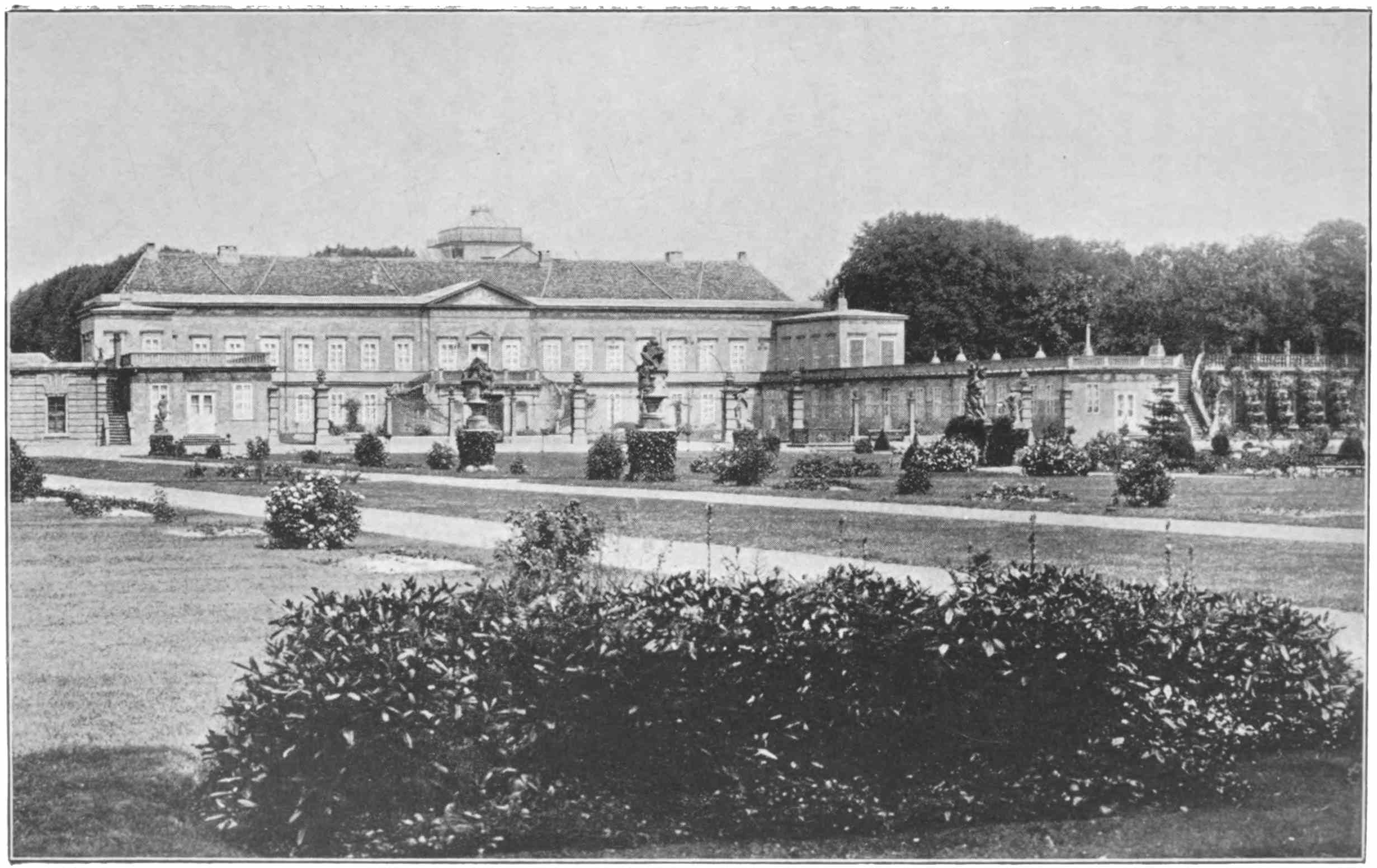
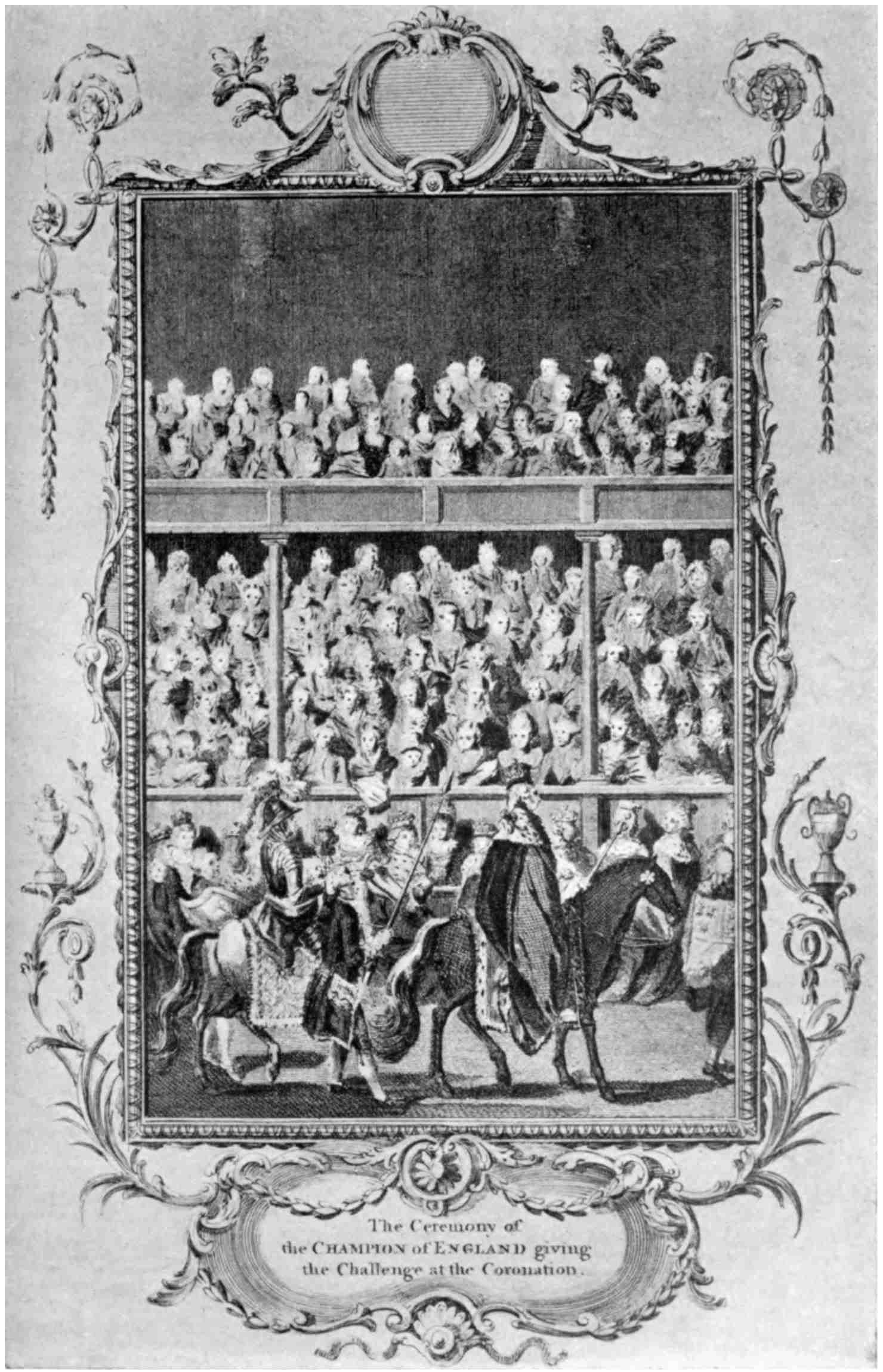
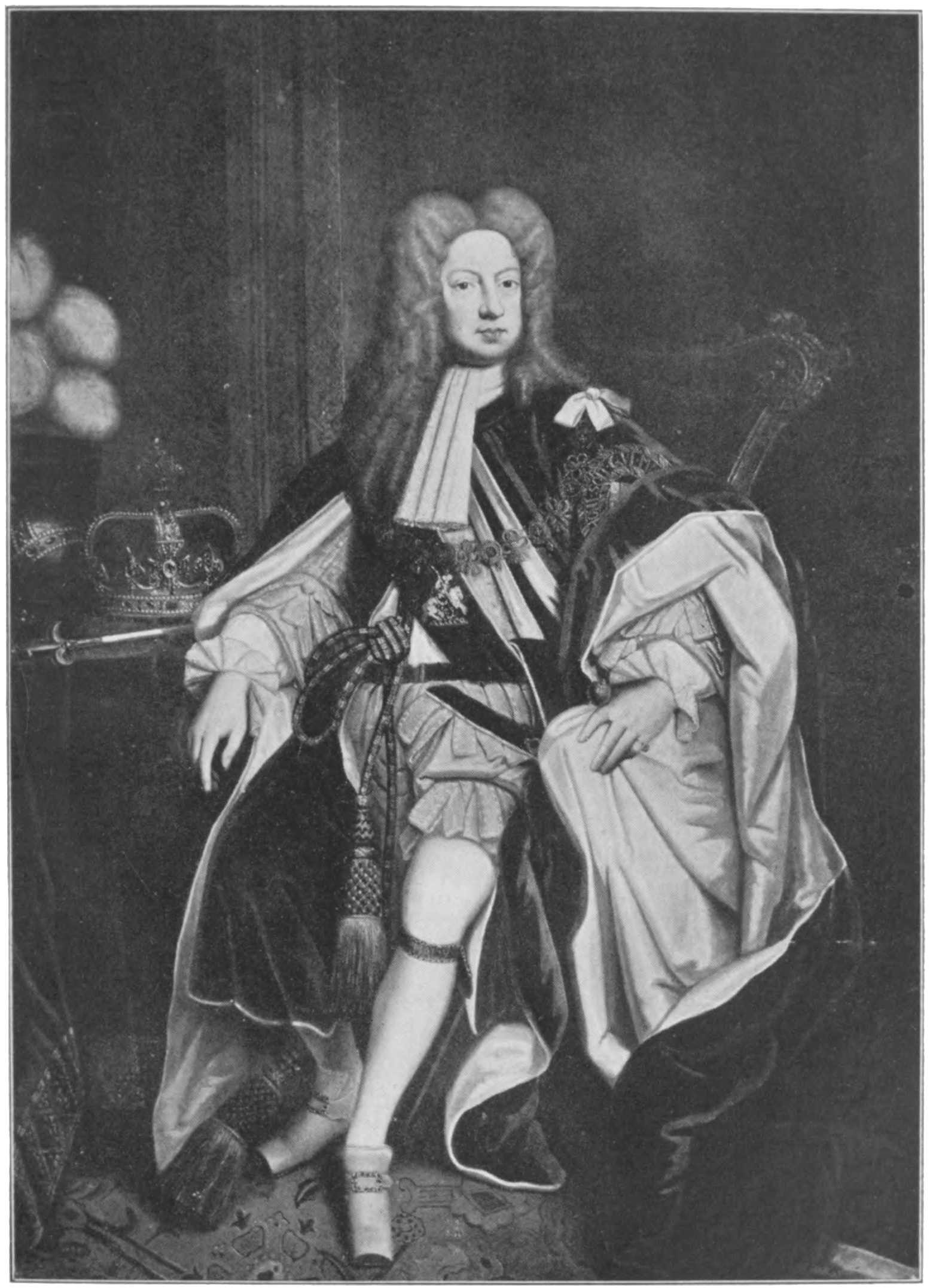
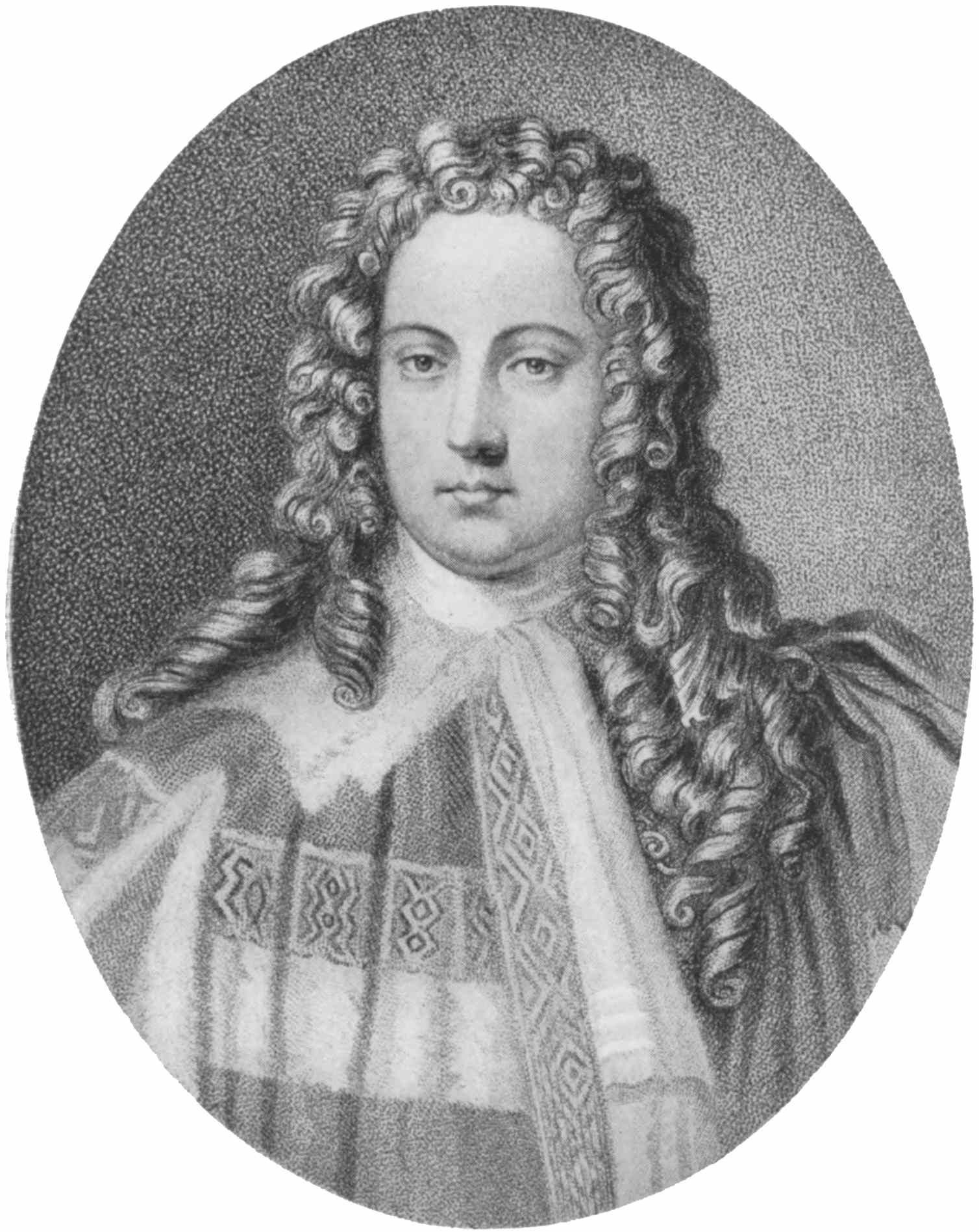
Larger versions of most illustrations may be seen by right-clicking them
and selecting an option to view them separately, or by double-tapping and/or
stretching them.
Cover image created by Transcriber by combining the
cover and part of the title page in the original
book. The result remains in the Public Domain.
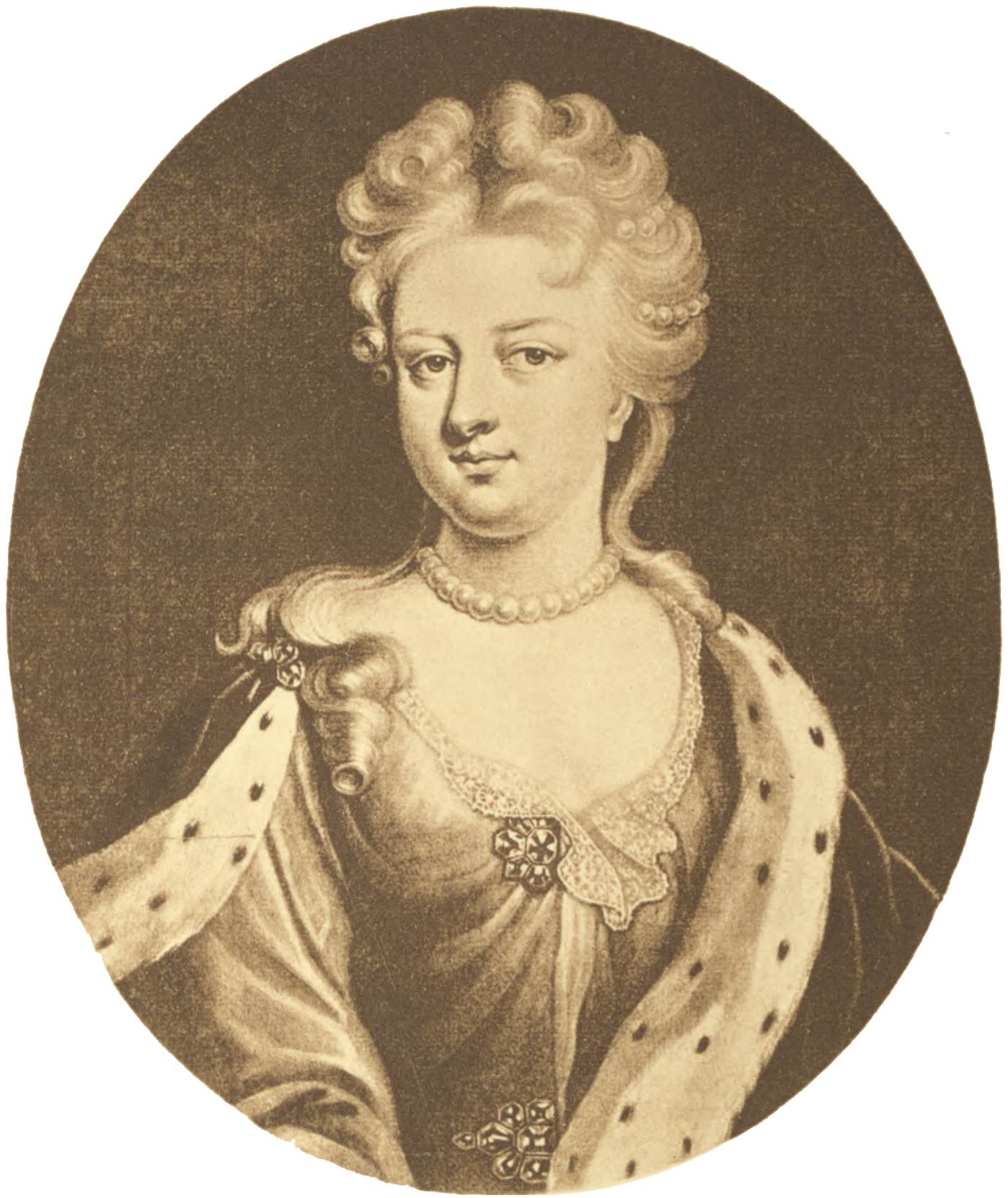
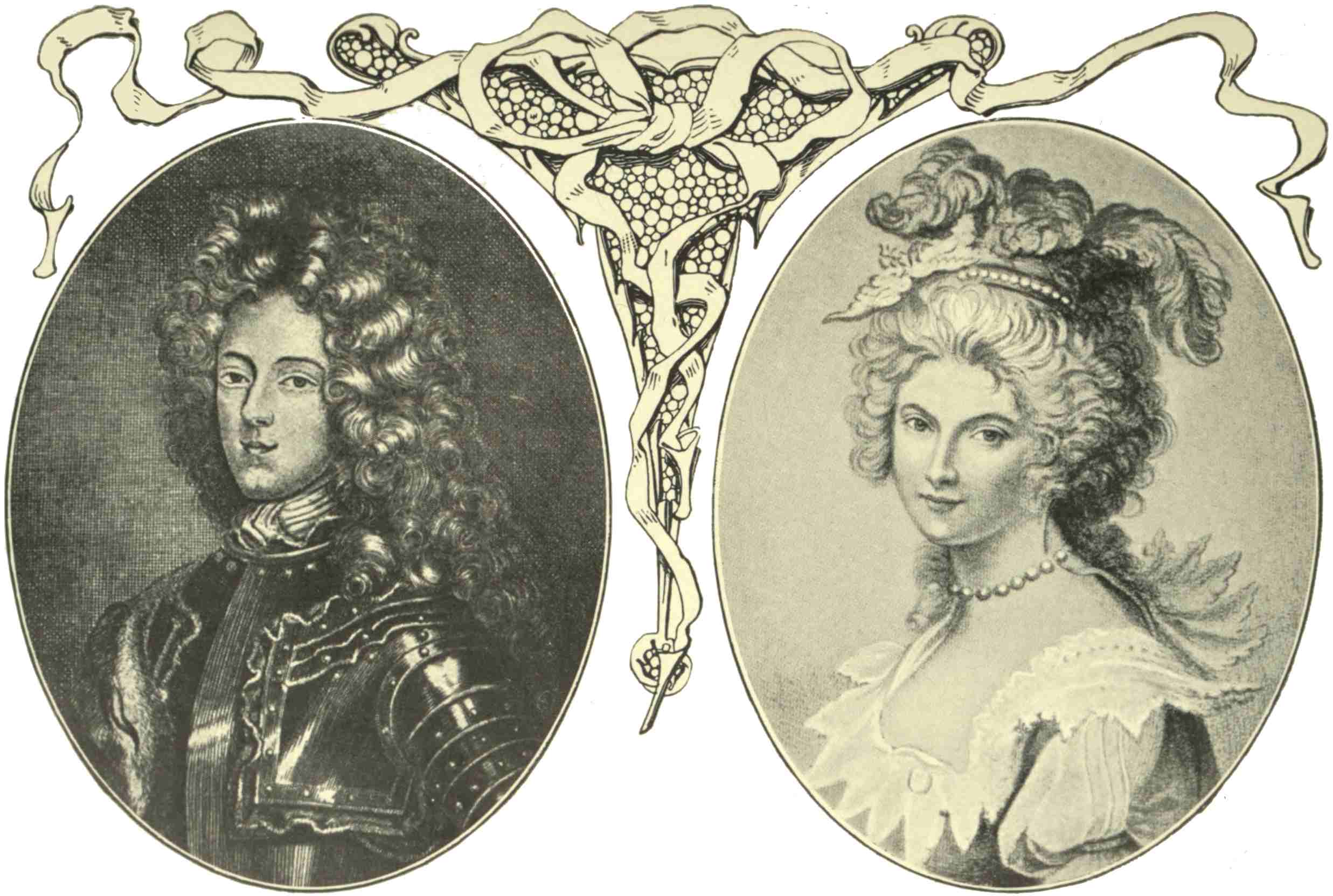
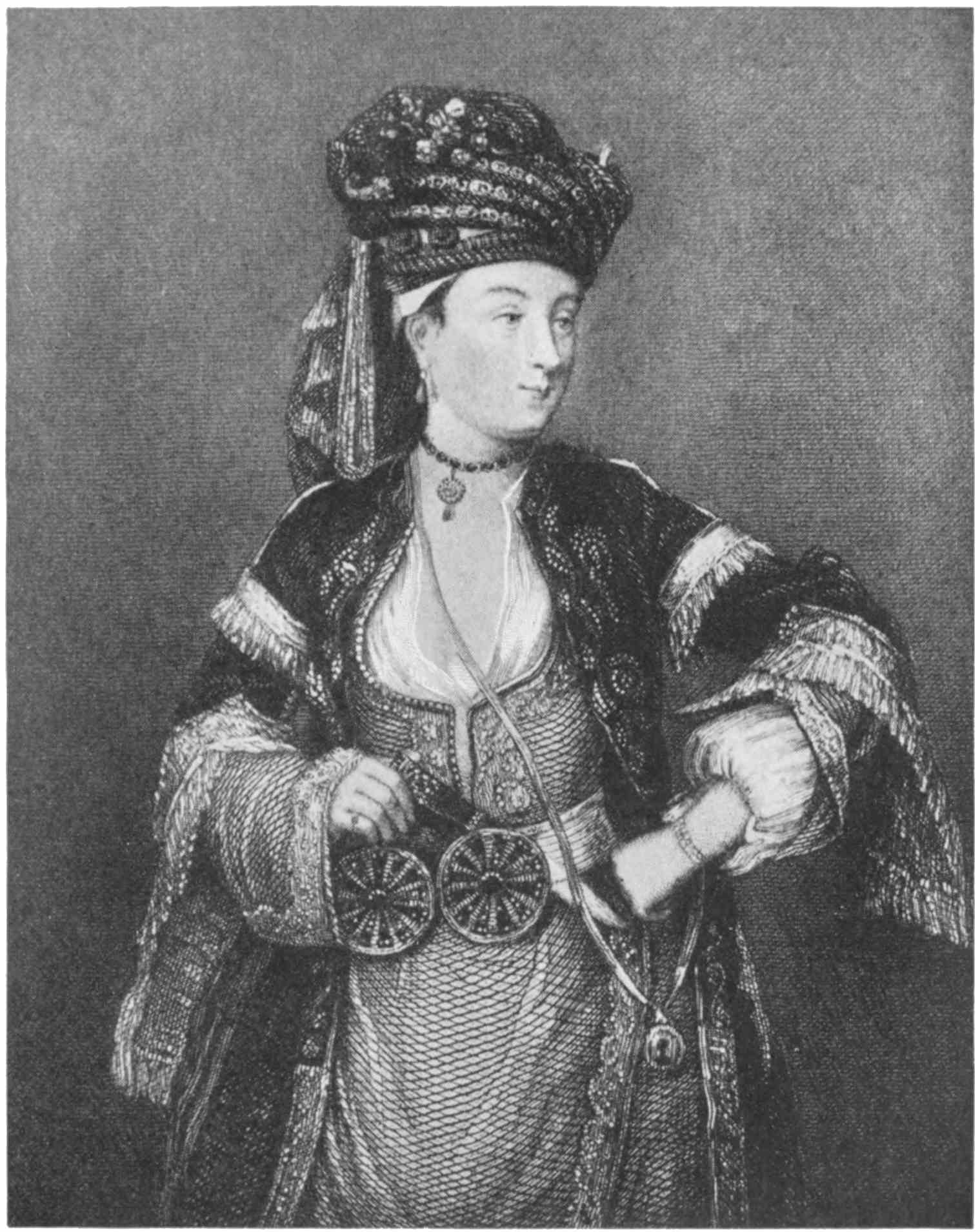
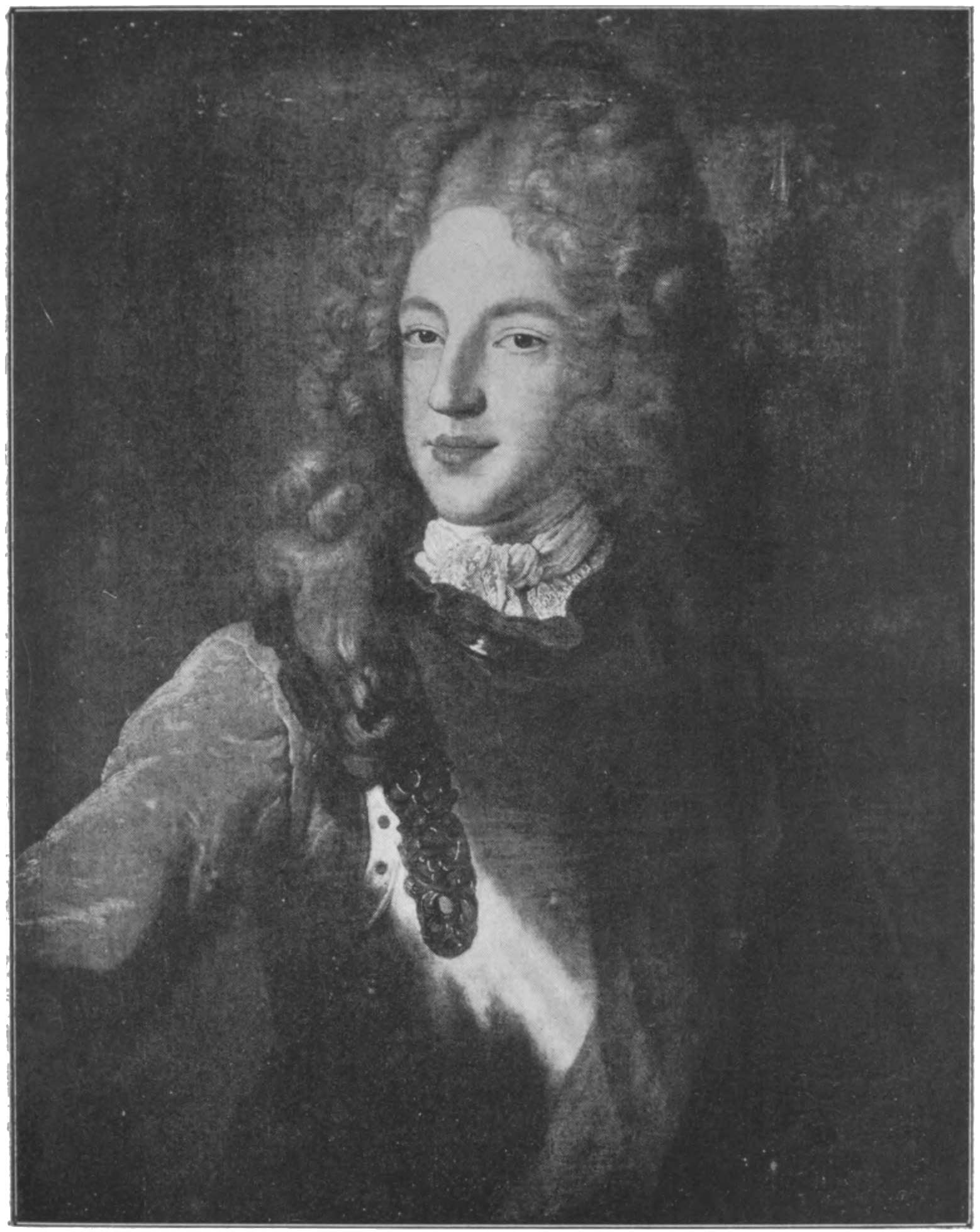
Caroline, Princess of Wales.
Walter L. Colls, Ph. Sc.
Caroline the Illustrious Queen-Consort of George II. and
sometime Queen-Regent
A Study of her Life and Time
BY
W. H. WILKINS, M.A., F.S.A. AUTHOR OF “THE LOVE OF AN UNCROWNED QUEEN”
WITH ILLUSTRATIONS
IN TWO VOLUMES
VOL. I.
LONGMANS, GREEN, AND CO. 39 PATERNOSTER ROW, LONDON
NEW YORK AND BOMBAY
1901
TO THE COUNTESS OF WARWICK
La beauté est le partage des uns, l’intelligence celui des autres; la réunion
de ces dons ne se rencontre que chez certains mortels favorisés des dieux.
Leibniz to Queen Caroline.
PREFACE. — FOOTNOTE TO PREFACE:
It is characteristic of the way in which historians
have neglected the House of Hanover that no life
with any claim to completeness has yet been
written of Caroline of Ansbach, Queen-Consort of
George the Second, and four times Queen-Regent.
Yet she was by far the greatest of our Queens-Consort,
and wielded more authority over political
affairs than any of our Queens-Regnant with the
exception of Elizabeth, and, in quite another sense,
Victoria. The ten years of George the Second’s
reign until her death would be more properly called
“The Reign of Queen Caroline,” since for that
period Caroline governed England with Walpole.
And during those years the great principles of
civil and religious liberty, which were then bound
up with the maintenance of the Hanoverian dynasty,
were firmly established in England.
Therefore no apology is needed for attempting
to portray the life of this remarkable princess, and
endeavouring to give some idea of the influence
which she exercised in her day and upon her generation.
The latter part of Caroline’s life is covered
to some extent by Lord Hervey’s Memoirs, and we
get glimpses of her also in Horace Walpole’s works
and in contemporary letters. But Lord Hervey’s
Memoirs do not begin until Caroline became Queen,
and though he enjoyed exceptional facilities of
observation, he wrote with an obvious bias, and
often imputed to the Queen motives and sentiments
which were his rather than hers, and used her as
the mouthpiece of his own prejudices and personal
animosities.
Of Queen Caroline’s life before she came to
England nothing, or comparatively nothing, has
hitherto been known,1 and very little has been
written of the difficult part which she played as
Princess of Wales throughout the reign of George
the First. On Caroline’s early years this book
may claim to throw fresh light. By kind permission
of the Prussian authorities I am able to
publish sundry documents from the Hanoverian
Archives which have never before been given to the
world, more especially those which pertain to the
betrothal and marriage of the princess. The
hitherto unpublished despatches of Poley, Howe
and D’Alais, English envoys at Hanover, 1705–14,
give fresh information concerning the Hanoverian
Court at that period, and the despatches of Bromley,
Harley and Clarendon, written during the eventful
year 1714, show the strained relations which existed
between Queen Anne and her Hanoverian cousins
on the eve of the Elector of Hanover’s accession to
the English throne.
In order to make this book as complete as possible
I have visited Ansbach, where Caroline was
born, Berlin, the scene of her girlhood, and Hanover,
where she spent her early married years. I have
searched the Archives in all these places, and have
further examined the records in the State Paper
Office, London, and the Manuscript Department of
the British Museum. A list of these, and of other
authorities quoted herein, published and unpublished,
will be found at the end of this book.
In The Love of an Uncrowned Queen (Sophie
Dorothea of Celle, Consort of George the First) I
gave a description of the Courts of Hanover and
Celle until the death of the first Elector of Hanover,
Ernest Augustus. This book continues those studies
of the Court of Hanover at a later period. It brings
the Electoral family over to England and sketches the
Courts of George the First and George the Second
until the death of Queen Caroline. The influence
which Caroline wielded throughout that troublous
time, and the part she played in maintaining the
Hanoverian dynasty upon the throne of England,
have never been fully recognised. George the First
and George the Second were not popular princes;
it would be idle to pretend that they were. But
Caroline’s gracious and dignified personality, her
lofty ideals and pure life did much to counteract the
unpopularity of her husband and father-in-law, and
redeem the early Georgian era from utter grossness.
She was rightly called by her contemporaries
“The Illustrious”. If this book helps to do tardy
justice to the memory of a great Queen and good
woman it will not have been written in vain.
W. H. WILKINS.
1 Dr. A. W. Ward’s sketch of Caroline of Ansbach in the Dictionary
of National Biography contains some facts concerning this period of her
life, but they are necessarily brief.
CHAPTER I. ANSBACH AND ITS MARGRAVES. 1683–1696. — FOOTNOTE TO BOOK I, CHAPTER I:
Wilhelmina Caroline, Princess of Brandenburg-Ansbach,
known to history as “Caroline of Ansbach,”
Queen-Consort of King George the Second of Great
Britain and Ireland, and sometime Queen-Regent,
was born in the palace of Ansbach, a little town in
South Germany, on March 1st, 1683. It was a year
memorable in the annals of English history as the
one in which Lord Russell and Algernon Sidney
were brought to the block, who by their blood
strengthened the long struggle against the Stuarts
which culminated in the accession of the House of
Hanover. The same year, seven months later, on
October 30th, the ill-fated Sophie Dorothea of Celle,
consort of George the First, gave birth to a son at
Hanover, George Augustus, who twenty-two years
later was destined to take Caroline of Ansbach to
wife, and in fulness of time to ascend the throne of
England.
The Margraves of Brandenburg-Ansbach were
far from wealthy, but the palace wherein the little
princess first opened her eyes to the light was one
of the finest in Germany, quite out of proportion to
the fortunes of the petty principality. It was a vast
building, four storeys high, built in the form of a
square, with a cloistered court-yard, and an ornate
façade to the west. Yet large as it was, it did not
suit the splendour-loving Margraves of later generations,
and the palace as it stands to-day, with its
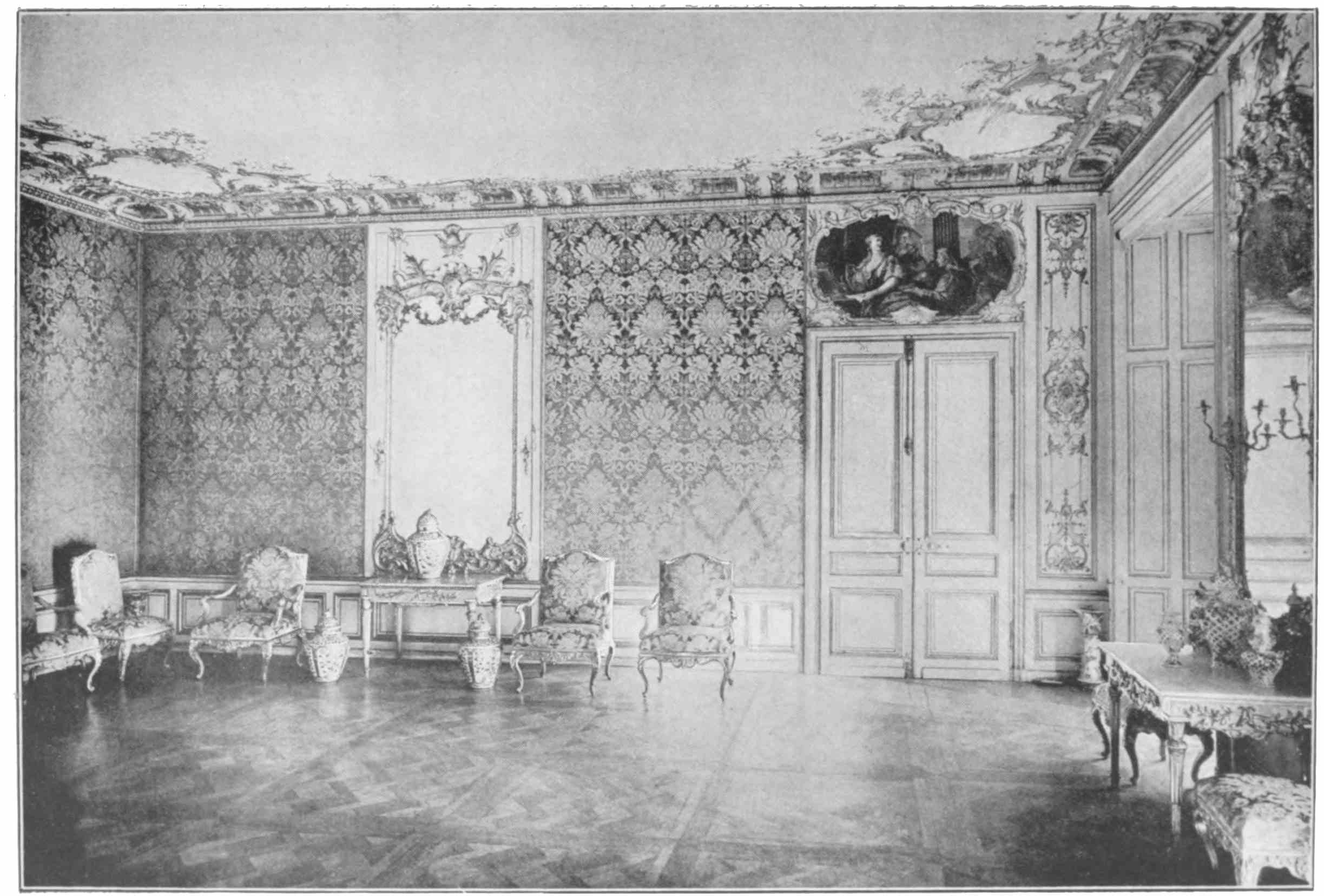
twenty-two state apartments, each more magnificent
than the other, is a veritable treasure-house of
baroque and rococo art. Some of the interior decoration
is very florid and in doubtful taste; the
ceiling of the great hall, for instance, depicts the
apotheosis of the Margrave Karl the Wild; the
four corners respectively represent the feast of the
Bacchante, music, painting and architecture, and in
the centre is a colossal figure of the Margrave, in
classical attire, clasping Venus in his arms. The
dining-hall is also gorgeous, with imitation marbles,
crystal chandeliers, and a gilded gallery, wherefrom
the minstrels were wont to discourse sweet music
to the diners. The porcelain saloon, the walls lined
with exquisite porcelain, is a gem of its kind, and
the picture gallery contains many portraits of the
Hohenzollerns. But the most interesting room is
that known as “Queen Caroline’s apartment,” in
which the future Queen of England was born; it was
occupied by her during her visits to Ansbach until her
marriage. This room is left much as it was in Caroline’s
day, and a canopy of faded green silk still marks
the place where the bed stood in which she was born.
The town of Ansbach has changed but little
since the seventeenth century, far less than the
palace, which successive Margraves have improved
almost out of recognition. Unlike Würzburg and
Nuremberg, cities comparatively near, Ansbach has
not progressed; it has rather gone backward, for since
the last Margrave, Alexander, sold his heritage in
1791, there has not been a court at Ansbach.2
A sign of its vanished glories may be seen in the
principal hotel of the place, formerly the residence of
the Court Chamberlain, a fine house with frescoed
ceilings, wide oak staircase, and spacious court-yard.
The Hofgarten remains the same, a large park, with
a double avenue of limes and oaks, beneath which
Caroline must often have played when a girl. The
high-pitched roofs and narrow irregular streets of
the town still breathe the spirit of mediævalism, but
the old-time glory has departed from Ansbach, and
the wave of modern progress has scarcely touched it.
The little town, surrounded with low-lying meadows,
wears an aspect inexpressibly dreary and forsaken.
The honest burghers of Ansbach, who took a
personal interest in the domestic affairs of their
Margraves, feeling that as they prospered they
would prosper with them, could not, in their most
ambitious moments, have imagined the exalted
destiny which awaited the little princess who was
born in the palace on that March morning. The
princesses of Ansbach had not in the past made
brilliant alliances, and there is no record of any one
of them having married into a royal house. They
were content to wed the margraves, the burgraves,
the landgraves, and the princelets who offered themselves,
to bear them children, and to die, without
contributing any particular brilliancy to the history
of their house.
The margravate of Ansbach was one of the
petty German princedoms which had succeeded in
weathering the storm and stress of the Middle Ages.
At the time of Caroline’s birth, any importance
Ansbach might have possessed to the outer world
arose from its connection with the Brandenburgs
and Hohenzollerns, of which connection the later
Margraves of Ansbach were alternately proud and
jealous. Ansbach can, with reason, claim to be the
cradle of the Hohenzollern kingdom. For nearly
five hundred years (from 1331 to 1806) the princedom
of Ansbach belonged to the Hohenzollerns,
and a succession of the greatest events of Prussian
history arose from the union of Prussia and Brandenburg
and the margravate of Ansbach. It is not
certain how, or when, the link began. But out of
the mist of ages emerges the fact, that when the
Burgrave Frederick V. divided his possessions into
the Oberland and Unterland, or Highlands and
Lowlands, Ansbach was raised to the dignity of
capital of the Lowland princedom, and a castle was
built. The Margrave Albert the Great, a son of the
Elector Frederick the First of Brandenburg, set up
his court at Ansbach, decreeing that it should remain
the seat of government for all time. Albert the
Great’s court was more splendid and princely than
any in Germany; he enlarged the already beautiful
castle, he kept much company and held brilliant
tournaments, and he founded the famous order of
the Knights of the Swan. The high altar, elaborately
carved and painted, of the old Gothic
church of St. Gumbertus in Ansbach remains to
this day a monument of his munificence, and on the
walls of the chancel are the escutcheons of the
Knights of the Swan, and from the roof hang
down the tattered banners of the Margraves.
The succeeding Margraves do not call for any
special notice; after the fashion of German princes
of that time, they spent most of their days in
hunting, and their nights in carousing. They were
distinguished from their neighbours only by their
more peaceful proclivities. Two names come to us
out of oblivion, George the Pious, who introduced
the Reformation into Franconia, and George
Frederick, who was guardian to the mad Duke
Albert Frederick of Prussia, and who consequently
managed Prussian affairs from Ansbach. With his
death in 1602 the elder branch of the Margraves
expired.
Caroline’s father, the Margrave John Frederick,
was of the younger branch, and succeeded to the
margravate in 1667. John Frederick was a worthy
man, who confined his ambitions solely to promoting
the prosperity of his princedom, and concerned himself
with little outside it. When his first wife died,
he married secondly, and rather late in life, Eleanor
Erdmuthe Louisa, daughter of the Duke of Saxe-Eisenach,
a princess many years his junior, by whom
he had two children, a son, William Frederick, and
a daughter, Caroline, the subject of this book. There
is a picture of Caroline’s parents in one of the state
rooms of the castle, which depicts her father as a
full-faced, portly man, with a brown wig, clasping
the hand of a plump, highly-coloured young woman,
with auburn hair, and large blue eyes. It is easy
to see that Caroline derived her good looks from
her mother. Her father died in 1686, and was
succeeded by his son, George Frederick, who was
the offspring of the first marriage.
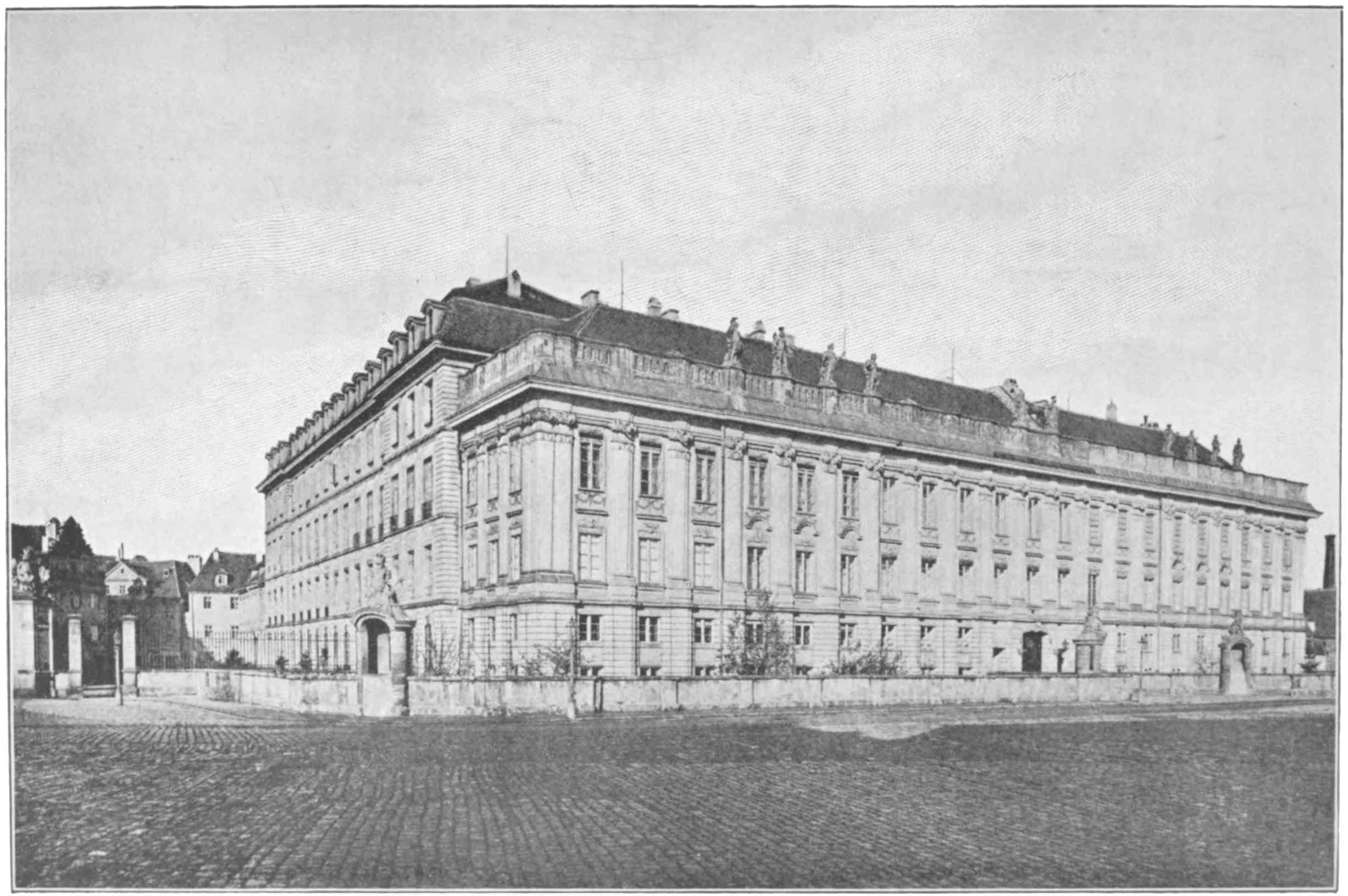
THE CASTLE OF ANSBACH.
As the Margrave George Frederick was a lad
of fourteen years of age at the time of his father’s
death, the Elector Frederick the Third of Brandenburg
acted as his guardian, and for the next seven
years Ansbach was under the rule of a minor. As
the minor was her stepson, who had never shown any
affection for his stepmother or her children, the position
of the widowed Margravine Eleanor was not
a pleasant one. She was friendly with the Elector
and Electress of Brandenburg, and looked to them
for support, and on the eve of her stepson’s majority
she went to Berlin on a long visit, taking with her
the little Princess Caroline, and leaving behind at
Ansbach her son, William Frederick, who was
heir-presumptive to the margravate. The visit was
eventful, for during it Eleanor became betrothed to
the Elector of Saxony, John George the Fourth.
The betrothal arose directly out of the newly
formed alliance between the Electors of Brandenburg
and Saxony. At the time of his meeting with
the young Margravine Eleanor the Elector of Saxony
was only twenty-five years of age. Nature had
endowed him with considerable talents and great
bodily strength, though a blow on the head had
weakened his mental powers, and his manhood did
not fulfil the promise of his youth. Before he
succeeded to the electorate of Saxony he had conceived
a violent passion for Magdalen Sybil von
Röohlitz, the daughter of a colonel of the Saxon
guard, a brunette of surpassing beauty, but so ignorant
that her mother had to write her love letters
for her. Magdalen gained complete sway over the
young Elector, and she, in her turn, was the tool of
her ambitious and intriguing mother. The Elector
endowed his favourite with great wealth, gave her
a palace and lands, surrounded her with a little
court, and honoured her as though she were his
consort. The high Saxon officials refused to bow
down to the mistress, more especially as she was
said to be in the pay of the Emperor of Austria,
whereas the popular policy in Saxony at that time
was to lean towards Brandenburg.
The Elector of Brandenburg and his consort
the Electress Sophie Charlotte came to Torgau
in 1692 to strengthen the alliance between the
electorates. The two Electors formed a new
order to commemorate the entente, which was
called the “Order of the Golden Bracelet”.
The Saxon Ministers hoped by this friendship
to draw their Elector from the toils of his mistress
and of Austria, and they persuaded him
to pay a return visit to the Court of Berlin.
While there the Elector of Saxony met the young
widow the Margravine Eleanor, and became betrothed
to her, to the great joy of the Elector and
Electress of Brandenburg. The wedding was
arranged to take place a little later at Leipzig,
and for a time everything went smoothly; it seemed
that the power of the mistress was broken, and
she would have to retire. But when the Elector
of Brandenburg and the Electress Sophie Charlotte
accompanied the Margravine Eleanor to Leipzig for
the wedding, they found the Elector of Saxony in
quite another frame of mind, and he insulted his
future wife by receiving her in company with his
mistress. The negotiations had to begin all over
again, but after a great deal of unpleasantness and
many delays, the Elector of Saxony married, very
ungraciously and manifestly under protest, the
unfortunate Eleanor.
The Elector of Saxony’s dislike to his wife, and
his reluctance to live with her, had been so marked
even before marriage, that many wondered why the
Margravine was so foolish as to enter upon a union
which held out so slender a promise of happiness.
But in truth she had not much choice; she had very
little dower, she was anxious to find a home for
herself and her daughter Caroline, and she was
largely dependent on the Elector of Brandenburg’s
goodwill; she was, in short, the puppet of a political
intrigue. She returned with the Elector of Saxony
to Dresden, where her troubles immediately began.
The mistress had now been promoted to the rank
of a countess. The Electress’s interests were with
Brandenburg, and the Countess’s with Vienna, and,
apart from their domestic rivalries, their political
differences soon led to friction. The Elector openly
slighted and neglected his wife, and things went
from bad to worse at the Saxon Court; so much
so, that the state of morals and manners threatened
to culminate in open bigamy. The Countess von
Röohlitz, prompted by her mother, declared her
intention of becoming the wife of the Elector
though he was married already, and though she
could not take the title of Electress, and the Elector
supported her in this extraordinary demand. He
gave her a written promise of marriage, and caused
pamphlets to be circulated in defence of polygamy.
It was vain for the Electress to protest; her life
was in danger, attempts were made to poison her,
and at last she was compelled to withdraw from
the Court of Dresden to the dower-house of Pretsch,
taking her daughter Caroline with her. The mistress
had won all along the line, but in the supreme hour
of her triumph she was struck down by small-pox
and died after a brief illness. The Elector, who
was half-crazed with grief, would not leave her
bedside during the whole of her illness. He, too,
caught the disease, and died eleven days later. He
was succeeded by his brother, Augustus Frederick,
better known as “Augustus the Strong,” and Eleanor
became the Electress-dowager of Saxony.
In the autumn of the same year (1694) the
Elector and Electress of Brandenburg paid a visit
to the Electress Eleanor, whose health had broken
down, and assured her of their support and affection,
as indeed they ought to have done, considering
that they were largely the cause of her troubles.
At the same time the Elector and Electress promised
to look after the interests of the little Princess
Caroline, and to treat her as though she were
their own daughter.
The next two years were spent by the young
princess with her mother at Pretsch. It was a
beautiful spot, surrounded by woods and looking
down the fertile valley of the Elbe, and hard by was
the little town of Wittenberg, one of the cradles of
the Reformation. Luther and Melancthon lived at
Wittenberg; their houses are still shown, and it was
here that Luther publicly burned the Papal bull; an
oak tree marks the spot. Caroline must often have
visited Wittenberg; she was about twelve years of
age at this time, and advanced beyond her years,
and it may be that much of the sturdy Protestantism
of her later life was due to her early associations
with the home of Luther and Melanchthon.
In 1696 Caroline was left an orphan by the death
of her mother, and was placed under the care of
her guardians, the Elector and Electress of Brandenburg,
at Berlin.
2 The last of the Margraves of Brandenburg-Ansbach, Christian
Frederick Charles Alexander, was born at Ansbach in 1736. He
was the nephew of Queen Caroline, and married first a princess
of Saxe-Coburg, and secondly the Countess of Craven (née Lady
Elizabeth Berkeley), who called herself the “Margravine of Ansbach
and Princess Berkeley”. Having no heirs he sold his Margravate
to the King of Prussia in 1791, and came to live in England with
his second wife. He bought Brandenburg House, and was very
beneficent and fond of sport, being well known on the turf. He died
at a ripe old age in the reign of George IV. In 1806 Ansbach was
transferred by Napoleon from Prussia to Bavaria, an act which was
confirmed by the Congress of Vienna in 1815, and with Bavaria it
has since remained. Occasionally some members of the Bavarian
royal family visit Ansbach and stay at the palace, but it has long
ceased to be a princely residence.
CHAPTER II. THE COURT OF BERLIN. 1696–1705. — FOOTNOTES TO BOOK I, CHAPTER II:
The Court of Berlin, where Caroline was to spend
the most impressionable years of her life, was queened
over at this time by one of the most intellectual and
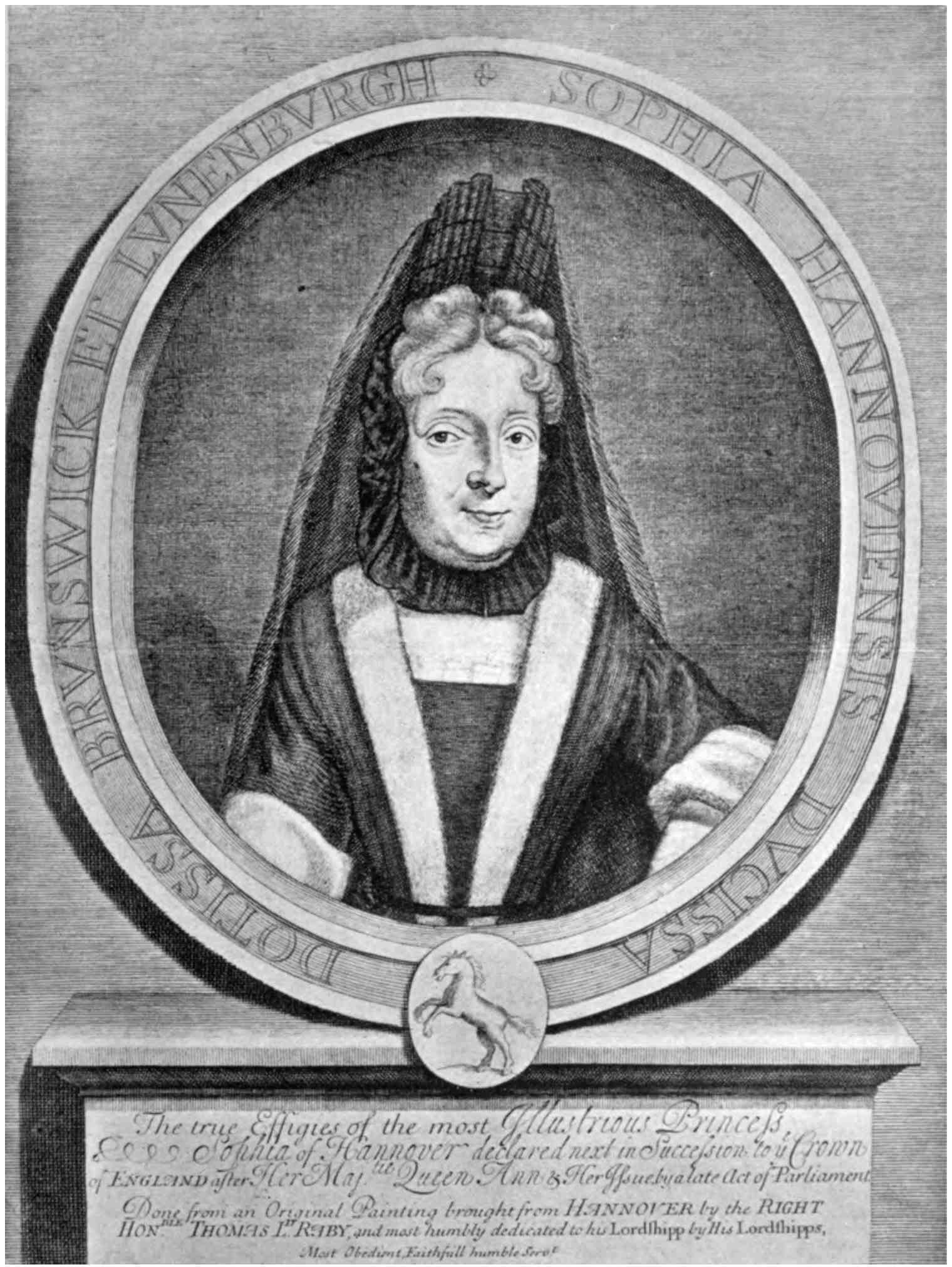
gifted princesses in Europe. Sophie Charlotte,
Electress of Brandenburg, who in 1701, on her
husband’s assumption of the regal dignity, became
first Queen of Prussia, was the daughter of that remarkable
woman, the Electress Sophia of Hanover,
and granddaughter of the gifted and beautiful
Elizabeth, Queen of Bohemia, daughter of James
the First of England. These three princesses—grandmother,
mother and daughter—formed a trinity
of wonderful women.
Like her mother and grandmother, Sophie
Charlotte inherited many traits from her Stuart
ancestors; Mary’s wit and passion, James the First’s
love of metaphysical and theological disputations,
were reproduced in her, and she possessed to no
small degree the beauty, dignity and personal charm
characteristic of the race, which even the infusion of
sluggish German blood could not mar. Her mother
had carefully trained her with a view to her making
a great match some day; she was an accomplished
musician, and a great linguist, speaking French,
English and Italian as fluently as her native tongue,
perhaps more so. She had read much and widely, an
unusual thing among German princesses of that age.
Sophie Charlotte’s religious education was hardly
on a level with her secular one, as the Electress
Sophia, in accordance with her policy of making
all considerations subservient to her daughter’s future
advancement, decided to bring her up with an open
mind in matters of religion and in the profession
of no faith, so that she might be eligible to marry
the most promising prince who presented himself,
whether he were Catholic or Protestant. As a
courtly biographer put it: “She (Sophie Charlotte)
refrained from any open confession of faith until her
marriage, for reasons of prudence and state, because
only then would she be able to judge which religion
would suit best her condition of life”.
Despite this theological complaisance, several
eligible matches projected with Roman Catholic
princes fell through, and the young princess’s
religion was finally settled on the Protestant side,
for when the Electoral Prince of Brandenburg, son
of the Great Elector, came forward as a suitor,
Sophia eagerly accepted him for her daughter,
notwithstanding that he was a widower, twelve years
older than his bride, deformed, and of anything but
an amiable reputation. These drawbacks were
trifles compared with the fact that he was heir to
the most powerful electorate of North Germany.
The wedding took place at Hanover in September,
1684, and the bride and bridegroom made their state
entry into Berlin two months afterwards. A few
years later Sophie Charlotte gave birth to a son,
Frederick William, who was destined to become
the second King of Prussia and the father of
Frederick the Great. Four years later the Great
Elector died; and with her husband’s accession she
became the reigning Electress of Brandenburg and
later Queen of Prussia.
The salient points of Sophie Charlotte’s character
now made themselves manifest. The Court of
Berlin was a brilliant one, and modelled on that of
the King of France, for the King of Prussia refused
to dispense with any detail of pomp or ceremony,
holding, like the Grand Monarque, that a splendid
and stately court was the outward and visible sign
of a prince’s power and greatness. He had a
passion for display, and would spend hours debating
the most trivial points of court etiquette. This
was weariness of the soul to the Queen, for she
cared nothing for the pomp and circumstance of
sovereignty. She was careful to discharge her
ceremonial duties, but she did so in the spirit of
magnificent indifference. “Leibniz talked to me
to-day of the infinitely little,” she wrote once to her
friend and confidante, Marie von Pöllnitz. “Mon
Dieu, as if I did not know enough about that.”
The young Queen had arrived at a great position,
but her heart was empty; she tolerated her husband,
but she felt towards him nothing warmer than a
half-contemptuous liking. The King, on his part,
was proud of his beautiful and talented consort,
though he was rather afraid of her. It would have
been easy for Sophie Charlotte, had she been so
minded, to have gained great influence over her
husband, and to have governed Brandenburg and
Prussia through him, but though her intellect was
masculine in its calibre, unlike her mother, she had
no love of domination, and cared not to meddle with
affairs of state. These things were to her but
vanity, and she preferred rather to live a life of
intellectual contemplation and philosophic calm; the
scientific discoveries of Newton were more to her
than kingdoms, and the latest theory of Leibniz than
all the pomp and circumstance of the court.
The King made her a present of the château of
Lützenburg, later called after her Charlottenburg,
just outside Berlin, and here she was able to gratify
her love of art and beautiful things to the utmost.
The gardens were laid out after the plan of
Versailles, by Le Nôtre, with terraces, statues and
fountains. Magnificent pictures, beautiful carpets,
rarest furniture of inlaid ebony and ivory, porcelain
and crystal, were stored in this lordly pleasure-house,
and made it a palace of luxury and art. The
King thought nothing too costly or magnificent
for his Queen, though he did not follow her in
her literary and philosophic bent, and Lützenburg
became famous throughout Europe, not only for
its splendour, for there were many palaces more
splendid, but because it was the chosen home of its
beautiful mistress, and the meeting-place of all the
talents. At Lützenburg, surrounded by a special
circle of intellectual friends, the Queen enjoyed the
free interchange of ideas, and discussed all things
without restraint; wit and talent, and not wealth and
rank, gave the entrée there. At Lützenburg she
held receptions on certain evenings in the week, and
on these occasions all trammels of court etiquette
were laid aside, and everything was conducted without
ostentation or ceremony. Intellectual conversations,
the reading of great books, learned discussions,
and, for occasional relaxation, music and theatricals,
often kept the company late into the night at
Lützenburg, and it frequently happened that some
of the courtiers went straight from one of the
Queen’s entertainments to attend the King’s levée,
for he rose at four o’clock in the morning. To
these reunions came not only the most beautiful and
gifted ladies of the court, but learned men from
every country in Europe, philosophers, theologians,
both Roman Catholic and Protestant, representatives
of literature, science and art, besides a number of
French refugees, who did not appear at court in the
ordinary way. Since the revocation of the Edict
of Nantes, Berlin had become a rallying-place for
Huguenots, many of them men of intellectual
eminence and noble birth, who were banished from
their native land. They were made especially welcome
at Lützenburg, where everything was French
rather than German. At Sophie Charlotte’s reunions
French only was spoken, and so elegant
were the appointments, so perfect was the taste, so
refined and courteous were the manners, so brilliant
the wit and conversation, that one of the most
celebrated of the Huguenot nobility declared that
he felt himself once again at Versailles, and asked
whether the Queen of Prussia could really speak
German.
To Lützenburg came the eloquent Huguenot
preacher, Beausobre; Vota, the celebrated Jesuit
and Roman Catholic controversialist; Toland, the
English freethinker; Papendorf, the historian; Handel,
the great musician, when he was a boy; and last
and among the greatest, the famous Leibniz. Hither
came often, too, on many a long visit, the Electress
Sophia of Hanover, “the merry débonnaire princess
of Germany,” who, like her daughter, delighted in
theological polemics, and philosophic speculations.
Sophie Charlotte’s principles were exceedingly
liberal, so much so that she became known as
“the Republican Queen,” and her early religious
training, or rather the lack of it, was very noticeable
in the trend of thought she gave to her gatherings.
She would take nothing for granted, she submitted
everything to the tribunal of reason; her eager and
active spirit was always seeking to know the truth,
even “the why of the why,” as Leibniz grumbled
once. Her mother, the Electress Sophia, would
seem to have been a rationalist, with a strong dash
of Calvinism. Sophie Charlotte went a step farther;
she was nothing of a Calvinist, but rather leant to
the theories of Descartes. “My mother is a clever
woman, but a bad Christian,” said her son once, and
that was true if he meant a dogmatic Christian,
though Leibniz had a theory for reconciling Christianity
and reason, which especially commended
itself to her. She took a keen interest in theological
polemics, and whenever any clever Jesuit came her
way, she delighted in nothing so much as to get
him to expound his views, and then put up one of
her chaplains to answer him. In this way she set the
Jesuit Vota disputing with the Protestant Brensenius,
and the orthodox Huguenot Beausobre with the
freethinking sceptic Toland. Nor were these arguments
confined to theological subjects; scientific,
philosophic and social questions—everything, in
short, came within the debatable ground, and on
one occasion we hear of a long and animated
argument on the question whether marriage was, or
was not, ordained for the procreation of children!
The Queen presided over all these intellectual
tournaments, throwing in a suggestion here or raising
a doubt there; she was always able to draw the
best out of every one, and thanks to her tact and
amiability, the disputes on thorny questions were
invariably conducted without unpleasantness.
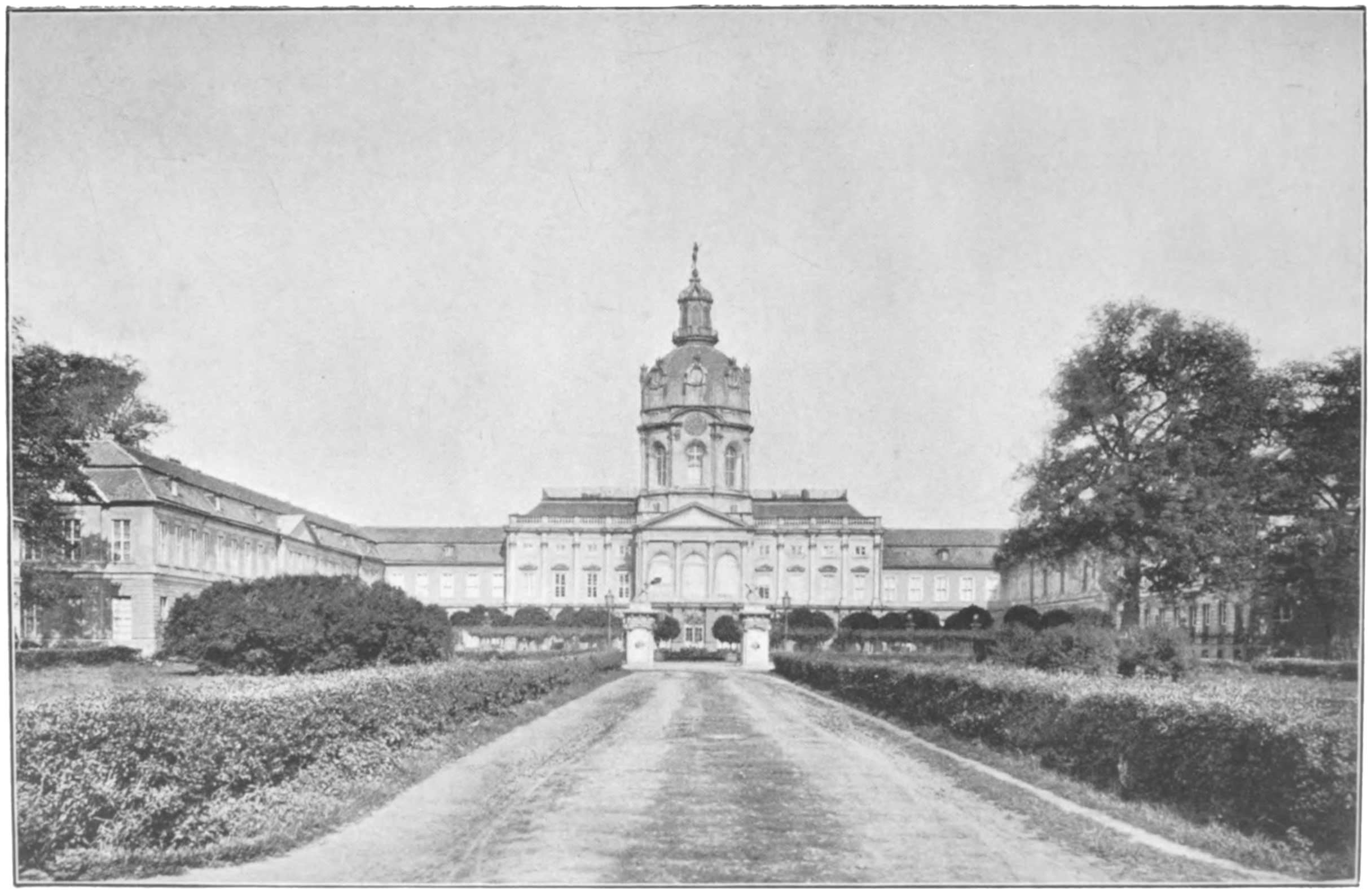
LÜTZENBURG (CHARLOTTENBURG).
This was the home in which Caroline spent the
greater part of nine years, and we have dwelt
upon it because the impressions she received and
the opinions she formed at Lützenburg, during her
girlhood influenced her in after years. The King
of Prussia was Caroline’s guardian, and after
her mother’s death, Sophie Charlotte assumed a
mother’s place to the little princess, who had now
become an orphan and friendless indeed. Her step-brother
was ruling at Ansbach, and Caroline was
not very welcome there; indeed she was looked
upon rather as an encumbrance than otherwise,
and the only thing to be done was to marry her
off as quickly as possible. There seems to have
been some idea of betrothing her, when she was
a mere child, to the Duke of Saxe-Gotha, but
she could hardly have been in love with him, as
Horace Walpole relates, for the Duke married some
one else when Caroline was only thirteen years of
age.
Sophie Charlotte caused her adopted daughter
to be thoroughly educated, and carefully trained in
the accomplishments necessary to her position.
Caroline’s quickness and natural ability early made
themselves manifest. Sophie Charlotte had no
daughter of her own, and her heart went out to
the young Princess of Ansbach, who returned her
love fourfold, and looked up to her with something
akin to adoration. Her admiration led to a remarkable
likeness between the two in speech and gesture;
nor did the likeness end here. Caroline was early
admitted to the reunions at Lützenburg, and permitted
to listen to the frank and free discussions
which took place there. Such a training, though it
might shake her beliefs, could not fail to sharpen her
wits and enlarge her knowledge, and there is abundant
evidence to show that in later life she adopted
Sophie Charlotte’s views, not only in ethics and
philosophy, but in conduct and morals. But she
was more practical and less transcendental than
the Queen of Prussia, and, like the Electress
Sophia, she loved power, and took a keen interest
in political affairs.
In this manner Caroline’s girlhood passed. We
may picture her walking up and down the garden
walks and terraces of Lützenburg hearing Leibniz
expound his philosophy, or sitting with the Queen
of Prussia on her favourite seat under the limes
discussing with her “the why of the why”. She
was the Queen’s constant companion and joy, and
when, as it sometimes happened, she was obliged to
leave Berlin for a while to pay a visit to her brother
at Ansbach, Sophie Charlotte declared she found
Lützenburg “a desert”.
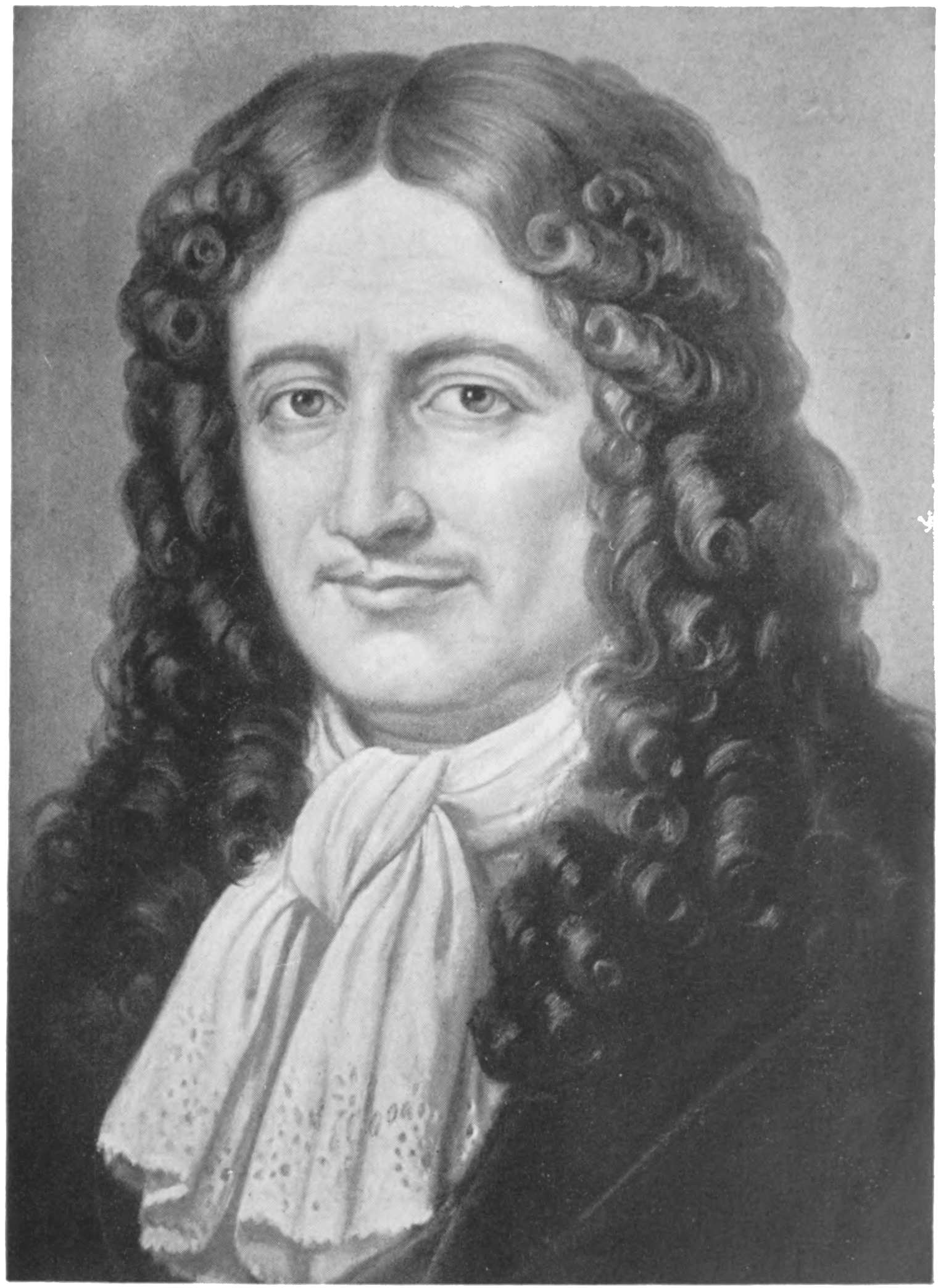
Leibniz, Sophie Charlotte’s chosen guide,
philosopher and friend, is worthy of more than
passing notice, since his influence over the Princess
Caroline was second only to that of the Queen of
Prussia herself. In Caroline’s youth, Gottfried
Wilhelm Leibniz was a prominent figure at Berlin,
whither he frequently journeyed from Hanover.
He was one of the most learned men of his time,
almost equally eminent as a philosopher, mathematician
and man of affairs. He was born in
1646 at Leipzig, and after a distinguished university
career at Jena and Altdorf, he entered the service
of the Elector-Archbishop of Mainz, and, as he
possessed the pen of a ready writer, he was employed
by him to advance his schemes. The
Archbishop later sent him to Paris, nominally with
a scheme he had evolved for the re-conquest of
Egypt, really with the hope of distracting Louis the
Fourteenth’s attention from German affairs, so that
Leibniz went in a dual capacity, as a diplomatist and
as an author. In Paris the young philosopher became
acquainted with Arnauld and Malebranche. From
Paris he went to London, where he met Newton,
Oldenburg and Boyle. His intimacy with these
distinguished men stimulated his interest in mathematics.
In 1676, when he was thirty years of age,
Leibniz quitted the service of Mainz and entered
that of Hanover. For the next forty years his
headquarters were at Hanover, where he had
charge of the archives, and worked also at politics,
labouring unceasingly with his pen to promote
the aggrandisement of the House of Hanover,
especially to obtain for it the electoral dignity.
Leibniz’s work threw him much in contact with the
Electress Sophia, with whom he became a trusted
and confidential friend, and whose wide views were
largely coloured by his liberal philosophy.
Leibniz had a positive passion for work, and
in these, the most active years of his life, he not
only laboured at political affairs, but worked hard
at philosophy and mathematics, turning out book
after book with amazing rapidity. At the suggestion
of the Electress Sophia, he concerned himself with
theology too, and strove at one time to promote
the reunion of the Catholic and Protestant creeds,
his principal correspondent being Bossuet. The
English Act of Parliament, vesting the succession
to the throne of England in the Electress Sophia
and the heirs of her body, being Protestant, put
a summary stop to these labours. Henceforth there
was no more coquetting with Roman Catholicism at
Hanover. The Electress Sophia, Calvinist though
she was, affected to manifest an interest in the
Church of England, and especially favoured the
English Protestant Nonconformists.
To consult archives for his history of the
Brunswick-Lüneburg family, which he had been
commanded to write, Leibniz travelled to Munich,
Vienna, Rome and other cities. At Rome, the
Pope, impressed by his great learning and controversial
ability, offered him the custodianship of
the Vatican library, if he would become a Roman
Catholic, but Leibniz declined the offer. Apart
from the fact that it involved submission to the
Roman Church, it did not offer him a sufficiently
wide field for his ambition. It is impossible to
withhold some pity from this great scholar. He
was one of those who put their trust in princes;
he was greedy of money, honours and worldly
fame; he loved the atmosphere of courts, and to
have the ear of those who sit in high places, and
so he deliberately prostituted his giant brain to
writing panegyrics of the princes of paltry dukedoms,
when he might have employed it to working
out some of the greatest problems that interest
mankind.
His worldly prospects at this time largely depended
on the Queen of Prussia. Sophie Charlotte
had known him at Hanover, and she invited him to
Lützenburg. Through his influence she induced the
King of Prussia to found the Academy of Science
in Berlin, and to make Leibniz its first president.
At his suggestion also, similar societies were founded
in St. Petersburg, Dresden and Vienna, under the
immediate patronage of the reigning monarchs, who
were thus able to pose as patrons of the arts and
sciences. Leibniz received honours from all of them,
and the Emperor created him a baron of the empire.
Leibniz often met the Princess of Ansbach at the
Queen of Prussia’s reunions, and he noted how high
she stood in the favour of his royal mistress. He
became attracted to her by her wit and conversation,
which were unusual in a princess of her years.
He spoke of her in glowing terms to the Electress
Sophia, who later made acquaintance with the young
princess at Berlin, and she, too, was charmed with
her talents and beauty. Leibniz, who was much at
Berlin in those days, kept his venerable mistress at
Hanover acquainted with the movements of the
princess. We find him, for instance, writing to
tell the Electress that Caroline had returned to
Berlin after a brief visit to Ansbach, and of the
Queen’s pleasure at seeing her again. The Electress
Sophia replied from Herrenhausen, desiring him to
assure Caroline of her affection, and adding, “If it
depended on me, I would have her kidnapped, and
keep her always here”. This seems to show that,
even at this early date, Sophia had it in her mind
that she would like Caroline to marry her grandson,
George Augustus.
In the autumn of 1704 the Electress Sophia
paid a long visit to her beloved daughter, and spent
two months with her at Lützenburg. The King of
Prussia had great respect for his mother-in-law; she
agreed with him in his love of pageantry, and, like
him, was a great stickler for points of etiquette.
But she had a larger mind, and was not content
with the mere show of sovereignty: she loved the
substance—domination and power. The Queen of
Prussia received her mother with every demonstration
of joy, and the festivities of Lützenburg were
set going in her honour. Leibniz and Beausobre
were there, and many intellectual tournaments took
place. The Princess Caroline was there too, whom
Sophia observed with especial interest. Caroline
was now in her twenty-first year, and had blossomed
into lovely womanhood; her features were regular,
she had abundant fair hair, large blue eyes, a tall
and supple figure and a stately bearing. The fame
of her beauty and high qualities had travelled through
Europe. True she was dowerless, the orphan
daughter of a petty prince of no importance, but
her guardian was the King of Prussia, and she was
known to be the adopted daughter of his Queen.
Thus it came about that her hand was sought by
some of the most powerful princes in Europe, notably
by the Archduke Charles, titular King of Spain,
and heir to the Emperor, whom he later succeeded.
The idea of this marriage had long been in the air,
but in 1704 it took definite shape, and the Elector
Palatine, who was interested in the matter from
political reasons, solicited Caroline’s hand for the
Archduke. Negotiations were proceeding while
the Electress Sophia was at Lützenburg. We find
Leibniz writing from there:—
“Apparently the Electress remains here until
November, and will stay as long as the Queen is
here. Two young princesses, the hereditary Princess
of Cassel and the Princess of Ansbach, are also
here, and I heard them sing the other night, a little
divertimento musicale, the latter taking the part of
‘Night,’ the former that of ‘Aurora,’ the equinox
adjusting the difference. The Princess of Cassel
sings very tunefully; the Princess of Ansbach has a
wonderful voice. Every one predicts the Spanish
crown for her, but she deserves something surer
than that crown is at present, though it may become
more important; besides, the King of Spain (the
Archduke) is an amiable prince.”3
The predictions were a little premature, for the
Archduke’s wooing did not progress satisfactorily.
As Leibniz said, the prospects of the Spanish crown
were somewhat unsettled, though they were sufficiently
dazzling to tempt a less ambitious princess
than Caroline, and she was always ambitious. Her
heart was free, but if it had not been, she had well
learned the lesson that hearts are the last things to
be taken into account in state marriages. A more
serious difficulty arose in the matter of religion.
In order to marry the titular King of Spain it was
necessary for Caroline to become a Roman Catholic,
and this she could not make up her mind to do.
Perhaps she had inherited the Protestant spirit of
her famous ancestor, George the Pious; perhaps
the influences of Wittenberg were strong upon her.
She was certainly influenced by the liberal views of
the Queen of Prussia and the arguments she had
heard at the reunions at Lützenburg. She was all
for liberty of conscience in matters of faith, and
shrank from embracing a positive religion, and of
all religions Roman Catholicism is the most positive.
Besides, it would seem that, though indifferent to
most forms of religion, she really disliked Roman
Catholicism, and all through her life she was
consistent in her objection to it. Her guardian,
the King of Prussia, though a Protestant himself,
could not sympathise with her scruples. In his
view young princesses should adapt their religion
to political exigencies, and so he made light of
her objections, and urged her to marry the King of
Spain. Her adopted mother, Sophie Charlotte,
maintained a neutral attitude: she was loath to part
with her, but she refused to express an opinion
either way. But the Electress Sophia, who was
nothing if not Protestant, since her English prospects
were wholly dependent on her Protestantism,
greatly desired Caroline as a wife for her grandson,
George Augustus, and did all she could to influence
her against the match. She writes from Lützenburg:
“Our beautiful Princess of Ansbach has not
yet resolved to change her religion. If she remains
firm the marriage will not take place.”4
Meanwhile Caroline, perhaps with an idea of
gaining time, or forced into it, consented to receive
the Jesuit priest Urban, and allow him to
argue with her. The Electress Sophia again writes:
“The dear Princess of Ansbach is being sadly
worried. She has resolved to do nothing against
her conscience, but Urban is very able, and can
easily overcome the stupid Lutheran priests here.
If I had my way, she would not be worried like
this, and our court would be happy. But it seems
that it is not God’s will that I should be happy
with her; we at Hanover shall hardly find any one
better.”5 The result of these interviews was uncertain,
for the Electress Sophia writes a few days
later: “First the Princess of Ansbach says ‘Yes’
and then ‘No’. First she says we Protestants have
no valid priests, then that Catholics are idolatrous
and accursed, and then again that our religion is
the better. What the result will be I do not know.
The Princess is shortly leaving here, and so it must
be either ‘Yes’ or ‘No’. When Urban comes to
see the Princess the Bible lies between them on the
table, and they argue at length. Of course, the
Jesuit, who has studied more, argues her down, and
then the Princess weeps.”6
The young Princess’s tears lend a touch of
pathos to this picture. Be it remembered that she
was absolutely alone, poor, orphaned, dependent on
the favour of her guardians, one of whom was
strongly in favour of this match. If she consented,
she would violate her conscience, it is true, but she
would gain honour, riches and power, all of which
she ardently desired. The powerful pressure of the
King of Prussia, the most persuasive arguments of
the Jesuit, and the subtle promptings of self-interest
and ambition were all brought to bear on her. It
says much for Caroline’s strength of character that
she did not yield, and shows that she was of no
common mould. That she refused definitely is
shown by the following letter which the Electress
Sophia wrote on her return to Hanover to Leibniz,
whom she had left behind her at Lützenburg:
“Most people here applaud the Princess of Ansbach’s
decision, and I have told the Duke of Celle that
he deserves her for his grandson. I think the
Prince (George Augustus) likes the idea also, for
in talking with him about her, he said, ‘I am very
glad that you desire her for me’. Count Platen (the
Prime Minister), to whom I mentioned the matter,
is not opposed, but does not wish it so much.”7
Leibniz had something to do with Caroline’s
decision, and he drafted the letter for her in which
she declined further negotiations. The King of
Prussia was angry, and roundly cursed Hanoverian
interference, as he called it; indeed, he made things
so uncomfortable that Caroline thought it advisable
to leave Berlin for Ansbach until her guardian
should become more amiable. Her step-brother
was dead, and her own brother was now Margrave.
From Ansbach we find her writing to Leibniz
at Berlin:—
“I received your letter with the greatest pleasure,
and am glad to think that I still retain your friendship
and your remembrance. I much desire to show
my gratitude for all the kindness you paid me at
Lützenburg. I am delighted to hear from you that
the Queen and the court regret my departure, but
I am sad not to have the happiness of paying my
devoirs to our incomparable Queen. I pray you on
the next occasion assure her of my deep respect.
I do not think the King of Spain is troubling himself
any more about me. On the contrary, they are
incensed at my disinclination to follow the advice
of Father Urban. Every post brings me letters
from that kind priest. I really think his persuasions
contributed materially to the uncertainty I felt during
those three months, from which I am now quite
recovered. The Electress (Sophia) does me too
much honour in remembering me; she has no more
devoted servant than myself, and I understand her
pleasure in having the Crown Prince (of Prussia) at
Hanover.”8
The Crown Prince of Prussia, Frederick William,
had spent a good deal of time at the Hanoverian
Court when a boy. His grandmother, the Electress
Sophia, had wished to educate him at Hanover
with her other grandson, George Augustus, but
Frederick William was of a quarrelsome disposition,
and pummelled George Augustus so unmercifully
that they had to be separated. Their hatred for
one another lasted through life. Frederick William
was a headstrong and violent youth, with ungovernable
passions; even when a boy it was dangerous
to thwart him in any way. The boy was father to
the man. As the Crown Prince grew up, his
mother had occasion to reproach him again and
again for his unenviable qualities, among which
avarice, rudeness and lack of consideration for others
were prominent.
The Queen of Prussia would have liked Caroline
as a wife for her son, but the King had other
and more ambitious views. He was not, however,
opposed to the idea, in case all his other plans fell
through. Neither Caroline nor the Crown Prince
had any inclination for each other, and the scheme
never took any definite shape, though it might have
done so had the Queen lived. Meanwhile it was
resolved to send Frederick William on a tour of
foreign travel, in the hope that a greater knowledge
of the world would improve his manners and morals.
The Queen felt the parting keenly, for she truly
loved her son (her only child), and though indifferent
about other matters, she was keenly practical in
anything that concerned his interest. After he
had gone there was found a sheet of notepaper on
her writing-table at Lützenburg, on which she had
drawn a heart and underneath had written the date
and the words “Il est parti”.
It is probable that this parting preyed upon the
Queen of Prussia’s health, which was never strong,
and made her more anxious to visit her mother. In
January, 1705, she set out for Hanover, notwithstanding
the opposition of the King and the severity of
the weather. The long journey was too much for
her. At Magdeburg she broke down, and had to
take to her bed; but she rallied, and again took
the road. After she had reached Hanover she
seemed to conquer her illness, a tumour in the
throat, by sheer force of will. In a few days,
however, dangerous symptoms developed, and she
became rapidly worse. Doctors were called in,
and it was soon recognised that there was no
hope left.
When the news was broken to the Queen, with
the greatest composure and without any fear of death
she resigned herself to the inevitable. Her death-bed
belongs to history. A great deal of conflicting
testimony has gathered around her last hours, but
probably the account given by Frederick the Great,
who had exceptional opportunities of knowing the
truth, is a correct one. The French chaplain at
Hanover, de la Bergerie, came to offer his ministrations,
but she said to him: “Let me die without
quarrelling with you. For twenty years I have
devoted earnest study to religious questions; you
can tell me nothing that I do not know already, and
I die in peace.” To her lady-in-waiting she exclaimed:
“What a useless fuss and ceremony they
will make over this poor body”; and when she saw
that she was in tears, she said, “Why do you weep?
Did you think I was immortal?” And again: “Do
not pity me. I am at last going to satisfy my
curiosity about the origin of things, which even
Leibniz could never explain to me, to understand
space, infinity, being and nothingness; and as for
the King, my husband—well, I shall afford him the
opportunity of giving me a magnificent funeral, and
displaying all the pomp he loves so much.” Her
aged mother, broken down with grief, was ill in an
adjoining room, and unable to come to her; but to
her brothers, George Louis (afterwards George the
First, King of England) and Ernest Augustus, she
bade an affectionate farewell. The pastor reminded
her tritely that kings and queens were mortal
equally with other men. She answered, “Je le
sais bien,” and with a sigh expired.
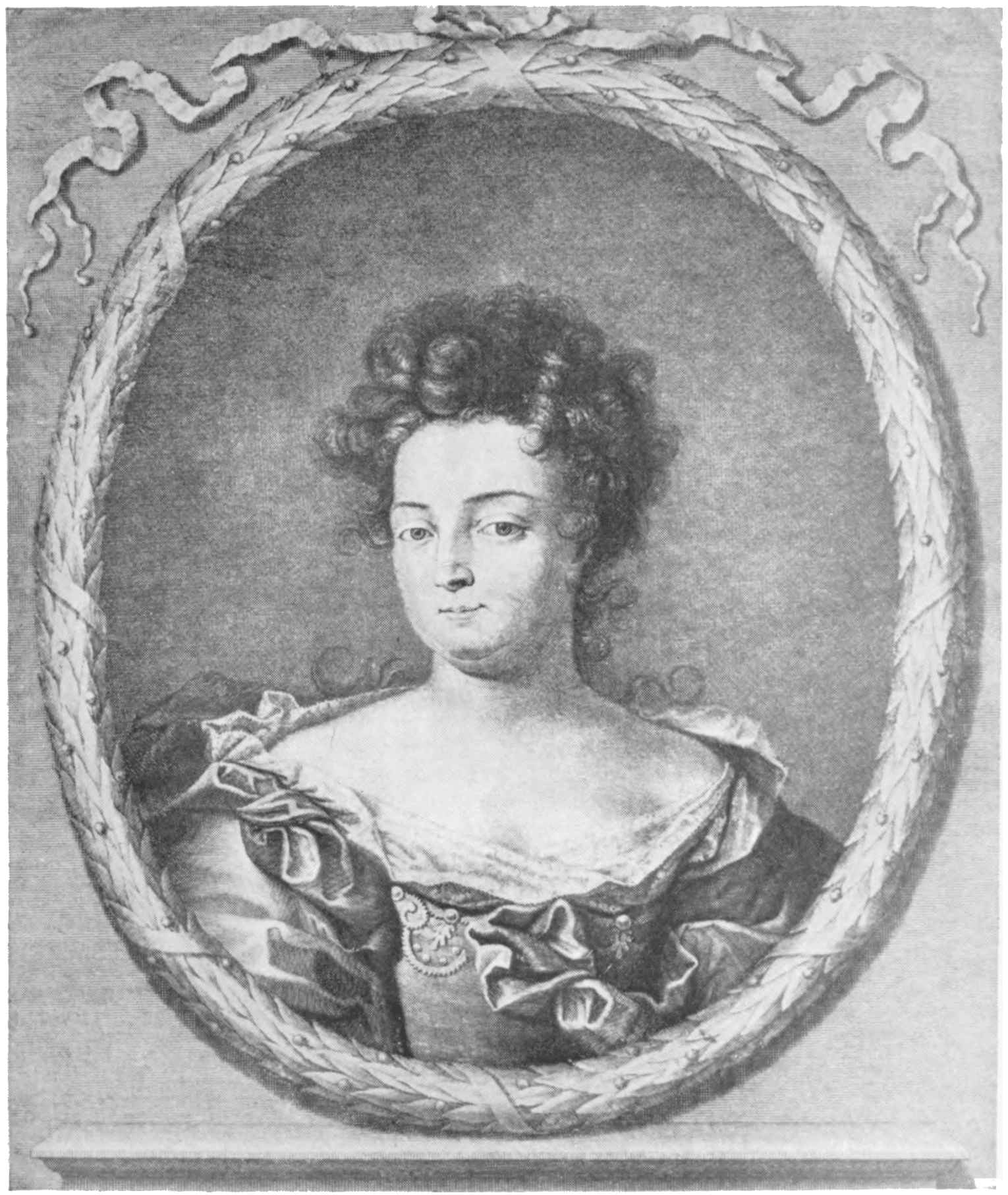
SOPHIA CHARLOTTE, QUEEN OF PRUSSIA.
From the Original Portrait by Wiedman.
Sophie Charlotte was in her thirty-seventh year
when she died, and at her death a great light went
out. She would have been a remarkable woman
under any conditions; she was doubly remarkable
when we remember her time and her environment.
In her large brain and generous sympathies, her
love of art and letters, and her desire to raise the
intellectual life of those around her the first Queen
of Prussia strongly resembled one of her successors
who has recently passed away—the late Empress
Frederick. She resembled her also in that during
her lifetime she was often misrepresented and misunderstood,
and her great qualities of head and
heart were not fully appreciated until after her
death.
3 Leibniz to State Minister du Cros, Lützenburg, 25th October,
1704.
4 The Electress Sophia to the Raugravine Louise, Lützenburg,
21st October, 1704.
5 The Electress Sophia to the Raugravine Louise, Lützenburg,
27th October, 1704.
6 The Electress Sophia to the Raugravine Louise, Lützenburg,
1st November, 1704.
7 The Electress Sophia to Leibniz, Hanover, 22nd November,
1704.
8 Princess Caroline of Ansbach to Leibniz, Ansbach, 28th
December, 1704.
CHAPTER III. THE WOOING OF THE PRINCESS. 1705. — FOOTNOTES TO BOOK I, CHAPTER III:
The Queen of Prussia’s death was one of the great
sorrows of Caroline’s life. She was at Ansbach
when Sophie Charlotte died, slowly recovering from
a low fever. The sad news from Hanover plunged
her into the deepest grief, and seriously hindered
her convalescence. Leibniz, who had also lost his
best friend in the Queen, wrote to Caroline to
express his grief and sympathy; he also took this
opportunity to explain his views on the Divine
scheme of things.
“Your Serene Highness,” he writes, “having
often done me the honour at Lützenburg of listening
to my views on true piety, will allow me here to
revert to them briefly.
“I am persuaded, not by light conjecture, that
everything is ruled by a Being, whose power is
supreme, and whose knowledge infinite and perfect.
If, in this present state, we could understand the
Divine scheme of things, we should see that everything
is ordered for the best, not only generally
but individually, for those who have a true love of
God and confidence in His goodness. The teachings
of Scripture conform to reason when they say that
all things work together for good to those who love
God. Thus perfect love is consummated in the joy
of finding perfection in the object beloved, and this
is felt by those who recognise Divine perfection in
all that it pleases God to do. If we had the power
now to realise the marvellous beauty and harmony
of things, we should reduce happiness to a
science, and live in a state of perpetual blessedness.
But since this beauty is hidden from our eyes, and
we see around us a thousand sights that shock us,
and cause temptation to the weak and ignorant, our
love of God and our trust in His goodness are
founded on faith, not yet lost in sight or verified by
the senses.
“Herein, madam, may be found, broadly speaking,
the three cardinal virtues of Christianity: faith, hope
and love. Herein, too, may be found the essence
of the piety which Christ taught—trust in the
Supreme Reason, even where our reason fails without
Divine grace to grasp its working, and although
there may seem to be little reason in it. I have often
discussed these broad principles with the late Queen.
She understood them well, and her wonderful insight
enabled her to realise much that I was unable to
explain. This resignation, this trust, this merging
of a tranquil soul in its God, showed itself in all her
words and actions to the last moment of her life.”9
Caroline’s answer to this letter shows that she
had not yet arrived at the heights of Leibniz’s
philosophy: “Heaven,” she says, “jealous of our
happiness, has taken away from us our adored and
adorable Queen. The calamity has overwhelmed
me with grief and sickness, and it is only the hope
that I may soon follow her that consoles me. I
pity you from the bottom of my heart, for her loss
to you is irreparable. I pray the good God to add
to the Electress Sophia’s life the years that the
Queen might have lived, and I beseech you to
express my devotion to her.”10
To add to Caroline’s troubles, the Elector Palatine
showed signs at this time of reviving his favourite
project of marrying her to the King of Spain, notwithstanding
her definite refusal the year before.
He probably thought, as the death of Queen Sophie
Charlotte had materially affected for the worse
the position and prospects of her ward, that the
young Princess could now be induced to reconsider
her decision. The King of Prussia was of this
opinion too, and his tone became threatening and
peremptory; he had no objection to keeping
Caroline as a possible bride for his son in the last
resort, but it would suit his political schemes better
to see her married to the future Emperor. But
Caroline found an unexpected ally in her brother,
the young Margrave of Ansbach, who resented, as
much as he dared, the interference of the King of
Prussia, and told his sister that she was not to do
violence to her convictions, and that she might
make her home with him as long as she pleased.
Thus fortified, Caroline stood firm in her resistance,
though by so doing she refused the most brilliant
match in Europe.
With the spring things grew brighter; Caroline
could not mourn for ever, and thanks to a strong
constitution, youth and health asserted themselves,
and she quite recovered her beauty and her vivacity.
The Ansbach burghers knew all about her refusal
of the future Emperor, and they honoured her for
her courage and firmness, and were proud of their
beautiful young princess, whom the greatest prince
in Europe had sued in vain. Caroline interested
herself in many schemes of usefulness in her brother’s
principality, and went in and out among the people
displaying those rare social gifts which stood her in
good stead in later years. Perhaps this was the
happiest period of her life, and though she was at
Ansbach only for a short time, she always retained
an affection for the place of her birth, and an interest
in the fortunes of her family. Yet she must have
felt the contrast between quiet little Ansbach and
the brilliant circle at Berlin; her energetic and
ambitious temperament was not one which could
have long remained content with an equivocal
position in a petty German Court, and she must
have wondered what the future had in store for
her.
Caroline was not destined to regret her refusal
of the Imperial diadem. “Providence,” as Addison
put it later, “kept a reward in store for such exalted
virtue;” and her “pious firmness,” as Burnet
unctuously called her rejection of the future Emperor,
“was not to go unrequited, even in this life”.11 In
June, the fairest month of all the year at little Ansbach,
when the trim palace garden was full of roses, and
the lime trees in the Hofgarten were in fragrant
bloom, the Electoral Prince George Augustus
of Hanover came to see and woo the beautiful
princess like the Prince Charming in the fairy tale.
George Augustus was not exactly a Prince Charming
either in appearance or character, but at this time he
passed muster. He was a few months younger than
Caroline, and though he was short in stature, he was
well set up, and had inherited some of his mother’s
beauty, especially her large almond-shaped eyes.
The court painters depict him as by no means an
ill-looking youth, and the court scribes, after the
manner of their kind, described him as a prince
of the highest qualities, with a grace of bearing and
charm of manner. Flatterers as well as detractors
unite in declaring him to be possessed of physical
courage, as daring and impulsive, and often prompted
by his heart. George Augustus had his defects, as
we shall see later; they developed as the years went
on, but they were not on the surface now, and it
was only the surface that the young Princess saw.
The wooing of Caroline was full of romance and
mystery; even the bare record of it, as related in
the state papers and despatches of the day, cannot
altogether keep these elements out. The Elector
George of Hanover determined that his son should
visit Ansbach in disguise, and, under a feigned
name, see and converse with the Princess, so that
he might find out if he could love her, if she were
likely to love him, and whether she was really so
beautiful and charming as rumour had described
her. The Elector knew by bitter experience the
misery of a state marriage between an ill-assorted
husband and wife, and he determined to spare his
son a similar fate. Extraordinary care was taken to
preserve the Prince’s incognito, and to prevent his
mission being known before everything was settled.
There was an additional reason for this secrecy, as
the King of Prussia would certainly try to prevent
the marriage if he got to know of it in time.
Prince George Augustus rode out of Hanover at
night, no one knew whither, but his absence from
the court was soon remarked, and the quidnuncs
were all agog. The English Envoy at Hanover,
Poley, writes home as follows:—
“Our Electoral Prince went out of town at about
twelve o’clock at night, attended only by the Baron
von Eltz (who had formerly been his governor and
is one of these Ministers) and one valet-de-chambre.
This journey is a mystery of which I know nothing,
but it seems probable that he will make use of the
Princess of Hesse’s passing through Celle to view
incognito a Princess of that family who is thought
to come with her. There is a Princess of Saxe-Zeith,
also, said to be the most beautiful in Germany....
In what concerns the Prince’s own inclination
in this business, his Highness hath not hitherto
appeared so much concerned for the character and
beauty of any young lady he hath account of, as the
Princess of Ansbach. The mystery of this journey
at least will soon be discovered. There is in this
court a real desire of marrying the prince very
soon.”12
Meanwhile George Augustus, in accordance with
the Elector’s plan, had arrived at Ansbach. He
professed to be a young Hanoverian noble travelling
for pleasure, who expected to meet at Nuremberg
some travelling companions from Westphalia, but
as they had failed to appear, he found Nuremberg
dull, and came on to Ansbach to see the town and
visit its court. He and his companion, Baron von
Eltz, presented introductions from Count Platen, the
Hanoverian Prime Minister, commending them to the
good offices of the Margrave. They were received
at the palace and treated with all hospitality; they
were invited to supper, and joined the circle afterwards
at music and cards. George Augustus, in the
guise of a Hanoverian nobleman, was presented to
the Princess Caroline, and conversed with her for
some time. According to his subsequent declarations
he was so much charmed with her that he fell in
love at first sight. She far exceeded all that rumour
had declared. It may be presumed that he kept
his ardour in check, and Caroline had no idea who
he was. But whether she had an inkling or not,
she betrayed no sign, and played her part to perfection.
After a few days’ sojourn at Ansbach the
young prince departed, apparently to Nuremberg
to meet his friends, in reality to hasten back to
Hanover to tell his father that he was very much
in love. Here again we quote Poley:—
“The Prince Electoral is returned and gone to
Herrenhausen. He was about two hours with the
Elector alone, and the Elector’s appearing afterwards
in good humour at table makes it to be imagined
that there hath nothing happened but what he
is well pleased with. Some with whom I am
acquainted are positively of opinion that his Highness
hath been at Ansbach, and that he declared
his design himself in person, and hath been very
well received, and that we shall soon see some
effects of it; others think it is a Princess of
Hesse.”13
But no explanation of the Prince’s expedition
was forthcoming, and the Elector went off to
Pyrmont to take the waters, leaving the Hanoverian
Court in mystification. The secret was well kept;
even the Electress Sophia was not informed, notwithstanding
that this was her darling scheme.
The Elector had contempt for women’s discretion;
he often declared that he could not trust a woman’s
tongue, and he knew that his mother was a constant
correspondent with the greatest gossip in Europe,
her niece, Elizabeth Charlotte, Duchess of Orleans.
Matters being thus far advanced at Hanover,
Eltz was again despatched to Ansbach. “He hath
disappeared secretly,” writes the lynx-eyed Poley,
who was still much mystified. When Eltz returned
to Ansbach, he kept up his disguise and told the
Margrave that he had just returned from Nuremberg,
where he had left his young friend. The Elector
of Hanover’s secret instructions to Eltz, and the
Envoy’s letters to the Elector (preserved in the
Hanoverian archives) explain what followed, and
the whole of the negotiations at Ansbach. It will
be well to quote them in full:—
The Elector of Hanover to Privy Councillor von Eltz.
“Hanover, June 17th, 1705.
“Whereas, it is already known to our trusty
Envoy, that our son, the Electoral Prince, has seen
the Princess of Ansbach, and is seized with such an
affection and desire for her, that he is most eager
to marry her without delay: We therefore should
gladly rejoice to see such a union take place, and
hope that the Princess may be equally favourably
disposed. It is necessary, however, that her inclinations
be assured first of all, and, should she consent
to this alliance, it is our wish that the marriage
contracts may be agreed upon without unnecessary
delay.
“We therefore instruct our Envoy to betake
himself, secretly and incognito, to the Court of
Ansbach. On arriving there he must feign surprise
that his friends from Westphalia, who had
arranged to meet him at Nuremberg on their way
to Italy, had not yet arrived. Moreover, he must
say that the young friend who had accompanied
him the last time he was at Ansbach having been
unexpectedly called home, he, our Envoy, found the
time of waiting so long at Nuremberg that he
returned to Ansbach, and would consider it a special
favour if he might be allowed to pass a few more
days at that Court.
“Having made this explanation, our Envoy
should seek an opportunity of conversing alone with
the Princess, and should say to her privately, when
no one else is within hearing, that he had matters of
importance to bring before her notice, and certain
proposals to make, which he hoped would not prove
disagreeable to her. He must therefore beg her to
name a convenient time and opportunity to grant
him an interview alone, but in such a manner as
to cause no comment. He should also ask her,
particularly, not to confide to any one the request he
had made, the more especially because the Princess
would subsequently see that the matter was of so
delicate a nature as to require absolute secrecy for
the present.
“When our Envoy is admitted to the Princess,
he must explain to her that the young friend who
accompanied him on his last visit to the Court of
Ansbach was our son, the Electoral Prince, who
had been so much impressed with the reports of the
Princess’s incomparable beauty and mental attributes
that he arranged to appear incognito, and have the
honour of seeing and speaking with the Princess
without her knowing his electoral rank and station.
As he had succeeded in doing this, and had found
that the reports were more than verified, our son is
so charmed and delighted with her that he would
consider it the height of good fortune to obtain her
for his wife, and has asked our permission to seek
this end. As we, the Elector, have always held the
Princess in highest esteem and repute, we are not a
little rejoiced to hear that our son cherished these
sentiments towards her, and we should be even
more glad if he could attain the object of his
mission.
“Our Envoy must then declare to the Princess
who he himself is, and by whose authority he has
come, and he must sound her as to whether she be
free from all other engagements, and if so he must
discover if her heart be inclined towards our son.
Our Envoy, however, must mention, but not in such
a way as to suggest that the Princess of Ansbach is
a pis aller for our son, that this matter would have
been broached sooner on our side, if negotiations
for our son’s marriage had not been going on in
Sweden, as was perhaps known in Ansbach, the
result of which had necessarily to be awaited. Besides
we had previously to make sure whether the
Princess of Ansbach was likely to entertain the King
of Spain’s suit.
“If the Princess should reply that she is engaged
to another, or if she should behave in such a way as
to lead our Envoy to suppose that she was desirous
of avoiding the proposal of marriage from our son,
our Envoy is charged to beg the Princess not to
make the slightest mention of the matter to any one,
and, under pretext that he has received news that
his travelling companions have at last reached
Nuremberg, he is to take leave of the Court of
Ansbach, and return hither at once as secretly as
he left.
“But should the Princess, in answer to our
Envoy’s proposition, declare, as we hope she will,
that she is free from any other matrimonial engagement,
and is inclined to an alliance with our House,
our Envoy will inquire of the Princess, first, whether
she would agree to his having an audience with her
brother, the Margrave, and then, on behalf of our
son, he will ask her hand in marriage. Also,
because this matter must be formally dealt with,
and a contract of marriage drawn up, he must find
out what trustees, persons well disposed towards the
marriage, he shall ask the Margrave to nominate, or
whether the Princess would prefer herself to nominate
them. The Princess will probably require time to
consider the matter, in which case our Envoy will
request her to think over the question by herself.
Should the Princess delay in coming to a decision,
our Envoy, in the most polite and delicate manner
possible, will remind her that he must guard in every
way against the Princess having any kind of communication
with the Court of Berlin until such time
as this project of marriage is so far established as to
prevent any possibility of its being upset; and to
this end our Envoy will most strongly urge that only
trustworthy persons favourably disposed towards this
marriage be employed in the drawing up of the
contract. Our Envoy will point out that any communication
on this subject with the Court of Berlin
would only create difficulties and loss of time. Our
Envoy knows full well that the sooner our son is
married the better. It is, therefore, most important to
prevent any whisper reaching Berlin, and to keep in
ignorance all those persons who would surely speak
against this marriage, and seek to delay it, in the
hope of eventually preventing it altogether. Our
Envoy can suggest to the Princess that an explanation
could easily be given to the Court of Berlin
later (with apologies for not having acquainted it
before), to the effect that she was so hard pressed
by our Envoy for a decision, she could not well
refrain from accepting at once, the more especially
as it was an offer she had no reason to refuse. Her
brother, the Margrave, could say that he knew
nothing of the matter until the Princess announced
that she had chosen our son.”
Privy Councillor von Eltz to the Elector of
Hanover.
“Ansbach, June 23rd, 1705.
“On arriving here yesterday evening I went at
once to the Court, and was presented to the Margrave
and her Highness the Princess, under the name of
‘Steding,’ by Court Marshal von Gerleheim. I
was most graciously received by them both. The
Princess commanded me to be shown to her private
apartments, and gave me audience in her own
chamber. There was no one else present, except
at first Fräulein von Genninggen, who stood discreetly
apart, and with her back turned to us; she
afterwards, at my suggestion, left the room. I then
took the opportunity to carry out the mission with
which I had been graciously entrusted by your
Electoral Highness. I asked first whether her
Highness was free of all other matrimonial engagements,
and in that event whether she was favourably
disposed to the Electoral Prince’s suit?
“Her Highness at first seemed to be surprised
and agitated. But she soon composed herself, and
said that I could rest assured that she was entirely
free from any engagements, as the negotiations
between herself and the King of Spain had been
completely broken off. Nevertheless, she added,
my proposition came to her very unexpectedly, as
(I quote her own words) ‘she had never flattered
herself that any one in Hanover had so much as
thought about her’. That they should have done
so, she could only ascribe to the will of God and
the goodness of your Electoral Highness, and she
hoped that you would not find yourself deceived in
the favourable opinion you had formed of her from
what others had told you. This much, at least, she
would admit, that she would infinitely prefer an
alliance with your Electoral House to any other;
and she considered it particular good fortune to be
able to form fresh and congenial ties to compensate for
the loss she had suffered by the death of the high-souled
Queen of Prussia, and of her own step-brother.
In the meantime, as she was absolutely dependent
on her brother, the present Margrave, she could
not formally give her consent to my proposal until
she had spoken with him on the subject. But she
did not doubt that he would consider your Electoral
Highness’s request in a favourable light, and would
willingly give his consent in all things as she wished.
“Having expressed my profound thanks to her
Highness for her favourable reception of my proposal,
I then strongly urged upon her the most
absolute secrecy, especially with regard to the too
early announcement of this betrothal to the Court
of Berlin. Her Highness at once declared that this
was the very request she herself had been on the
point of making to me, as the King of Prussia took
upon himself to such an extent to command her to
do this, that and the other, that her brother and
she were obliged to be very circumspect, and to
be careful of everything they said and did. Her
brother, the Margrave, would most certainly be
discreet, and the Princess was glad that Privy
Councillor von Breidow was even now going to
Berlin to represent the Court of Ansbach at the
funeral of the late Queen.14 Her Highness also
undertook to inquire of her brother what settlements
she should ask for, and who should be entrusted
with the drawing up of the marriage contract, at
the same time remarking that she had complete
trust in Councillor von Voit, who, although he had
originally advised her to accept the proposal of the
King of Spain, yet, when she could not make up her
mind to change her religion, had not turned against
her, and was still her friend, and deeply attached to
her brother. In conclusion, her Highness said that
it would be best for me to retain the name of
Steding for the present, and to come to Court in
that name whenever I wished to drive out with her.
Thereupon, so as not to create remark by too long
an interview, and also to be able to expedite this
despatch, I returned to my lodging at once. Tomorrow
I shall repair to Court again and learn what
his Highness the Margrave has to say, whereupon
I shall not fail to send my report.”
Privy Councillor von Eltz to the Elector of
Hanover.
“Ansbach, June 25th, 1705.
“As the Princess of Ansbach promised, and as
I mentioned in my despatch of the day before
yesterday, her Highness made known my mission
to her brother, the Margrave, the same evening,
and received his consent, which he gave with great
pleasure. They thereupon sent a joint message
by an express courier to the Landgrave of Hesse-Darmstadt
begging him to be good enough to repair
hither without delay; the Princess asked the Landgrave
to come in order that he might be an adviser
to her and her brother, and help to determine the
question of her appanage and her settlements. These
will probably be easily settled. There is not likely to
be any difference between the Princess and her
brother on the question of settlements, except that
he wishes to give up to her everything left to her
by the will of the deceased Margrave, and she
declines to accept so much from him.
“Meanwhile, though my credentials have not
yet arrived, acting on the Princess’s advice, I had
a special audience with the Margrave, and thanked
him for his favourable reply, urging at the same
time despatch in the matter. Further, I asked that
Councillor Voit might act as one of the trustees.
To all these requests he replied most politely, and
assured me that he considered your Electoral Highness’s
request as an honour to his House and a piece
of good fortune to his family, and he was deeply
obliged to your Electoral Highness for it, and would
endeavour at all times to show your Electoral Highness
devotion and respect.
“Court Councillor Serverit, who is here, and
who was private secretary to the late Margrave,
and is still intimate with the Princess, received a
letter yesterday from Court Councillor Metsch,
wherein he says he has been summoned by both
the Emperor and the Elector Palatine, who have
commissioned him to make a final representation
on behalf of the King of Spain, and he therefore
must earnestly request Court Councillor Serverit
to repair to some place, such as Nuremberg, where
he could meet and confer with him. But her
Highness, the Princess, ordered Court Councillor
Serverit to reply by special courier to Court
Councillor Metsch that it was not worth his trouble
to journey to Nuremberg or anywhere else, as she
held firmly to the resolution she had already formed,
all the more as the matter was no longer res integra.
Thus your Electoral Highness has chosen the right
moment to send me here, not only on account of
this message, but also because of the absence of
Privy Councillor von Breidow; and if only the
courier will bring me the necessary instructions and
authorisation from your Electoral Highness with
regard to the marriage contract, as everything is in
readiness, the matter can be settled at once. I
also hope that the Princess will not long delay
her departure from Ansbach, and will not break
her journey to Hanover anywhere but at Eisenach.
It is true she told Councillor Voit, when at my
suggestion he mentioned to her that I was pressed
for time, that she had no coaches or appanage ready,
and the Councillor also gave me to understand that
the Margrave would need time to make proper
arrangements for the journey. But I, on the other
hand, pointed out that your Electoral Highness
cared for none of these things, and needed nothing
else but to see the Princess in person, and hoped
as soon as possible to receive her. Whereupon the
Councillor assured me that her Highness would
not take it amiss if I pressed the matter somewhat
urgently, and that he would do all in his power to
help me. I now only await the courier.... I
have so much good to tell concerning the Princess’s
merits, beauty, understanding and manner that your
Electoral Highness will take a real and sincere
pleasure in hearing it.”15
The courier from Hanover duly arrived at Ansbach
bringing the Elector’s warrant, which gave
Eltz full powers to arrange the marriage contract
and settle the matter of the impending alliance
between “our well-beloved son, George Augustus,
Duke and Electoral Prince of Brunswick-Lüneburg,
and our well-beloved Princess Wilhelmina Caroline,
Princess of Brandenburg in Prussia, of Magdeburg,
Stettin and Pomerania, of Casuben and Wenden,
also Duchess of Crossen in Silesia, Electress of
Nuremberg, Princess of Halberstadt, Minden and
Cannin, and Countess of Hohenzollern, etc., etc.,”
as Caroline was grandiloquently described. Her
long string of titles contrasted with her lack of
dowry, for she brought to her future consort
nothing but her beauty and her talents, which,
however, were more than enough.
QUEEN CAROLINE’S ROOM IN THE CASTLE OF ANSBACH.
The preliminaries being settled, Count Platen
was told by the Elector, who was still at Pyrmont,
to acquaint the Electress Dowager with what had
been done. The Electress expressed her surprise
that “the whole matter had been kept secret from
her,” but she was so overjoyed at the realisation
of her hopes that she waived her resentment at
the lack of courtesy with which she had been
treated.16 As the “Heiress of Great Britain” the
marriage of her grandson, who was in the direct
line of succession to the English throne, was a
matter in which she had certainly a right to be
consulted. But as it all turned out exactly as she
would have wished, she put aside her chagrin and
prepared to give the bride a hearty welcome.
The betrothal soon became an open secret, and
the Duke of Celle, George Augustus’s maternal
grandfather, was formally acquainted with the good
news, and came to Hanover to offer his congratulations.
Poley adds the following significant note:
“During the Duke of Celle’s being here, the
Duchess of Celle goes to stay with her daughter,
and probably to acquaint her with her son’s
marriage”.17 This daughter was the unfortunate
wife of the Elector, Sophie Dorothea, the family
skeleton of the House of Hanover, whom her husband
had put away and kept a prisoner at Ahlden.
This was the only notification of the marriage made
to her, and she was not allowed to send a letter
to her son or to his future wife.
A few days later the good news was publicly
proclaimed. Poley writes: “On Sunday, the 26th,
just before dinner, the Elector declared that there
was concluded a treaty of marriage between his
son the Electoral Prince and the Princess of Ansbach,
and the Prince received the compliments of
the court upon it, and at dinner there were many
healths drunk to his good success. So that the
mystery is now at an end which hath hitherto been
concealed with so much care.... The Prince’s
clothes are now making, and the comedians have an
order to be in readiness to act their best plays, of
which they have already given in a list, though it is
thought the mourning for the Emperor may delay
the wedding some weeks longer if the Prince’s
impatience does not make him willing to hasten
it. The Electress told me on Sunday night that
the Elector had left the Prince entirely to his
own choice, and the Electress herself hath a very
great kindness for her, and since her last visit to
Berlin, the Princess of Ansbach hath been always
talked of at this court as the most agreeable
Princess in Germany.”18
After this there was no long delay, and everything
was done to hasten forward the marriage.
The Princess of Ansbach only asked for time to
make necessary preparations for departure, and
agreed to waive all unnecessary ceremony. At
Hanover it was settled that the Electoral Prince
and Princess should have the apartments in the
Leine Schloss formerly occupied by Sophie Dorothea
of Celle when Electoral Princess, and the same
household and establishment allotted to them—“nothing
very great,” remarks Poley.
The air was full of wedding preparations when
the rejoicing was suddenly marred by the death of
the aged Duke of Celle, who died of a chill caught
hunting. The Princess of Ansbach, accompanied
by her brother, the Margrave, had actually started
on her journey to Hanover when the news of this
untoward event reached her, and the Electoral
Prince had gone to meet her half-way. As all
arrangements were completed for the wedding, and
delays were dangerous owing to the jealousy of the
Courts of Vienna and Berlin, it was decided to
suspend the mourning for the Duke of Celle for a
few days, and to celebrate the marriage on the
arrival of the bride.
George Augustus and Caroline were married
quietly on September 2nd, 1705, in the chapel of
the palace of Hanover. The only account of the
marriage is to be found in Poley’s despatch: “The
Princess of Ansbach and the Margrave, her brother,
arrived here, and were received with all the expressions
of kindness and respect that could be desired.
The marriage was solemnised the same evening
after her coming, and yesterday there was a ball,
and in the evening there will be a comedy for her
entertainment, and there are the greatest appearances
of entire satisfaction on all sides. The Court
left off their mourning, and has appeared these three
days in all the finery which the occasion requires,
and the Marquess of Hertford, Mr. Newport, Mr.
Onslow, Mr. Austin, and some other English gentlemen,
who are come hither to have their share of the
diversions, have made no small part of the show.”19
Thus early did Caroline make the acquaintance of
representatives of the English nation over which,
with her husband, she was one day to reign.
9 Leibniz to the Princess Caroline of Ansbach, Hanover, 18th
March, 1705.
10 Letter of Princess Caroline to Leibniz, Ansbach, 2nd April,
1705.
11 Gay, in his Epistle to a Lady, also alludes to this incident:—
14 The Queen of Prussia was not buried until six months after
her death, and her funeral, as she had anticipated, was conducted
on a scale of great magnificence. Von Breidow was an Ansbach
official in the pay of Prussia.
15 These documents (in German) are preserved in the Royal
Archives at Hanover. They have never before been published.
16 An account of this interview is given in a letter from the Count
von Platen to the Elector of Hanover; Hanover, 9th July, 1705
(Hanover Archives.)
CHAPTER IV. THE COURT OF HANOVER. 1705–1706. — FOOTNOTES TO BOOK I, CHAPTER IV:
The Court of Hanover at the time of Caroline’s
marriage was one of the principal courts of North
Germany, not equal in importance to that of Berlin,
or in splendour to that of Dresden, but second to
no others. During the reign of the first Elector,
Ernest Augustus, and his consort, the Electress
Sophia, Hanover had gained materially in power
and importance. The town became the resort of
wealthy nobles, who had before divided their attentions
between Hamburg and Brunswick. Handsome
public buildings and new houses sprang up on
every side, and outside the walls, especially towards
Herrenhausen, the borders of the city were extending.
Few of the houses were large, for the wealthy
Hanoverian nobility resided for the most part at
their castles in the country, and only came to the
capital now and then for the carnival or the opera,
which was one of the best in Germany, or to pay
their respects to the Elector.
The Hanover of that day, after the model of
German mediæval cities, was a town with walls and
gates. The old town within the walls was composed
of rough narrow streets, and timbered, gabled
houses with high sloping roofs. Some of these old
houses, such as Leibnizhaus, a sandstone building
of the seventeenth century, still remain, and so do
the old brick Markt Kirche, the Rathhaus, and
other quaint buildings characteristic of mediæval
Germany; they make it easy to conjure up the
everyday life of the old Hanoverian burghers.
Caroline found that Hanover was a more important
place than Ansbach, and everything was on a
larger scale. For instance, it possessed three palaces
instead of one, the small Alte Palais, since Sophie
Dorothea’s disgrace seldom used, the Leine Schloss,
a huge barrack of a palace on the banks of the
Leine, and last, but not least, Herrenhausen, about
two miles without the walls, approached by a magnificent
double avenue of limes. The grounds of
Herrenhausen were designed in imitation of
Versailles, and, though the palace itself was plain
and unpretending, the beauty of the place consisted
in its great park, full of magnificent limes,
elms, chestnuts and maples, and in its garden, one
hundred and twenty acres in extent, laid out in
the old French style with terraces, statues and
fountains, and fenced about with maze-like hedges
of clipped hornbeam. The Electress Sophia loved
Herrenhausen greatly, though since her widowhood
she had been relegated to one wing of it by her son
the Elector. He would not permit her any share
in the government of the electorate, and she had
therefore ample time to devote herself to her philosophic
studies. But she also employed her active
mind in looking after her English affairs, in which
she was deeply interested. The fact that she was
in the direct line of the English succession attracted
to Herrenhausen many English people of note, and
it became a rallying-point of those who favoured the
Hanoverian succession.
The Electress Sophia was the widow of Ernest
Augustus, first Elector of Hanover. She was a
great princess in every sense of the word, and with
her husband had raised Hanover from a petty
dukedom to the rank of an electorate. She was the
granddaughter of King James the First of England;
the daughter of the Princess Elizabeth of England,
Queen of Bohemia; the sister of Prince Rupert,
who had fought for the royal cause throughout the
great rebellion; the niece of Charles the First, and
first cousin to Charles the Second and to James the
Second, the old King who had lately died in exile at
St. Germains.20 By Act of Parliament the succession
to the throne of England was vested in the Electress
Sophia and the heirs male of her body being Protestant,
and according to this Act the only life between
her and the British crown was that of the reigning
Queen, Anne, who was childless and in bad health.
Sophia was inordinately proud of her English ancestry,
and though she had never been in England,
or had seen any of her English relatives since
Charles the Second mounted the throne of his ancestors,
she was much more English than German
in her habits, tastes and inclinations. She had unbounded
admiration for “her country,” as she called
it, and its people; she spoke the language perfectly,
and kept herself well acquainted with events in England.
She even tried to understand the English
Constitution, though here, it must be admitted, she
was sometimes at fault. She had her mother’s soaring
ambition: “I care not when I die,” said she, “if
on my tomb it be written that I was Queen of
England”. In her immediate circle she loved to be
called “the Princess of Wales,” though, of course,
she had no right to the title, and she frequently
spoke of herself by the designation which was
afterwards inscribed upon her tomb, “The heiress
of Great Britain”.
When Caroline came to Hanover, this wonderful
old princess, though over seventy years of age, was
in full possession of her physical and mental faculties.
Her step was firm, her bearing erect, and there was
scarcely a wrinkle on her face, or a tooth out of
her head. She read and corresponded widely, and
spoke and wrote in five languages, each one perfectly.
Notwithstanding her many sorrows (she had lost
four sons and her dearly-loved daughter), vexations
and deprivations, she maintained a cheerful and
lively disposition, largely due to a perfect digestion,
which even a course of solid German dinners—for
she was a hearty eater and drinker—could not upset.
One of her rules was never to eat nor walk alone, and
she imputed her sound health largely to her love of
company and outdoor exercise. Like her illustrious
descendant, Queen Victoria, she never passed a day
without spending many hours in the open air; she
sometimes drove, but more often walked for two or
three hours in the gardens of Herrenhausen, pacing
up and down the interminable paths, and talking the
whole time in French or English to her companions.
In this way she gave audience to many Englishmen
of note, from the great Marlborough downwards,
and it is on record that she tired out many of
them.
Her eldest son, George Louis (later George the
First of England), who succeeded his father, Ernest
Augustus, as Elector of Hanover in 1698, was in all
respects different to his mother, who had inherited
many characteristics of the Stuarts. He in no wise
resembled them; he seemed to have harked back to
some remote German ancestor, for, while his father,
Ernest Augustus, was a handsome, genial, pleasure-loving
prince, with a courtly air, and a genius for
intrigue, the Elector George was ungraceful in
person and gesture, reserved and uncouth in speech,
and coarse and unrefined in taste. He was profligate,
and penurious even in his profligacy. Unlike his
mother, he had no learning, and unlike his father,
he had no manners. On the other hand he was
straightforward; he never told a lie, at least an
unnecessary one; he had a horror of intrigue and
double-dealing, and he had great personal courage,
as he had proved on many a hard-fought field. His
enemies said that he was absolutely devoid of human
affection, but he had a sincere liking for his sister,
Sophie Charlotte, Queen of Prussia, and a good
deal of affection for his daughter, and what proved
to be a lasting regard for his unlovely mistress,
Ermengarda Melusina Schulemburg. The care he
took that his son should make a love match also
shows him to have possessed some heart. But few
found this out; most were repelled by his harsh
manner.
The Electress Sophia was not happy in her
children; “none of them ever showed the respect
they ought to have done,” writes her niece, Elizabeth
Charlotte, Duchess of Orleans. Of all her seven
children, only three were now living: George the
Elector, who disliked her; Maximilian, a Jacobite
and Roman Catholic, in exile and open rebellion
against his brother; and Ernest Augustus, the
youngest of them all. Of her grandson, George
Augustus, we have already spoken, and he, too,
frequently treated her with disrespect. There remained
his sister, the Princess Sophie Dorothea, a
young princess of beauty and promise, whose matrimonial
prospects were engaging the attention of the
old Electress.
Such was the electoral family of Hanover which
Caroline had now joined. There was one other
member of it, poor Sophie Dorothea of Celle,
consort of the Elector, but she was thrust out of
sight, divorced, disgraced, imprisoned, and now
entering on the eleventh year of her dreary captivity
in the castle of Ahlden, some twenty miles from
Hanover. Caroline had doubtless heard of the
black business in the old Leine Schloss that July
night, 1694, when Königsmarck mysteriously disappeared
coming from the Princess’s chamber, for
the scandal had been discussed in every court in
Europe. But there is nothing to show that she
expressed any opinion on the guilt or innocence of
her unhappy mother-in-law, whether she took her
husband’s view, who regarded his mother as the
victim of the Elector’s tyranny, or the view of the
Electress Sophia, who could find no words bad
enough to condemn her. Caroline was much too discreet
to stir the embers of that old family feud, or to
mention a name which was not so much as whispered
at Herrenhausen. But one thing may be noted in
her favour; she showed many courtesies to the
imprisoned Princess’s mother, the aged Duchess of
Celle, who, since her husband’s death, had been
forced to quit the castle of Celle, and now lived in
retirement at Wienhausen. The favour of George
Augustus and Caroline protected the Duchess of Celle
from open insult, but history is silent as to whether
the Duchess attempted to act as a means of communication
between them and her imprisoned daughter.
Caroline’s bright and refined presence was sorely
needed at the Hanoverian Court, which had changed
for the worse since George had assumed the electoral
diadem. Under the rule of the pleasure-loving
Ernest Augustus and his cheerful spouse Sophia,
their court had been one of the gayest in Germany,
and splendid out of proportion to the importance of
the electorate. The Elector George kept his court
too; he maintained the opera and dined in public, after
the manner of Louis the Fourteenth, but he was as
penurious as Ernest Augustus had been extravagant,
and he cut down every unnecessary penny. The
Duchess of Orleans, who cordially disliked all the
Hanoverian family except her aunt, the Electress
Sophia, writes about this time: “It is not to be
wondered at that the gaiety that used to be at
Hanover has departed; the Elector is so cold that
he turns everything into ice—his father and uncle
were not like him”.
This was a prejudiced view, for the Court of
Hanover was still gay, though its gaiety had lost
in wit and gained in coarseness since the accession
of the Elector George. A sample of its pleasures
is afforded in the following description, written by
Leibniz, of a fête given at Hanover a year or two
before Caroline’s marriage.21 The entertainment was
modelled on Trimalchio’s banquet, and suggests a
parallel with the grossest pleasures of Nero and
imperial Rome. Leibniz writes:—
“A fête was given at this Court recently and
represented the famous banquet described by Petronius.22
The part of our modern Trimalchio was
played by the Raugrave, and that of his wife,
Fortunata, by Fräulein von Pöllnitz, who managed
everything as did Fortunata of old in the house
of her Trimalchio. Couches were arranged round
the table for the guests. The trophies displayed of
Trimalchio’s arms were composed of empty bottles,
and there were very many devices, recording his fine
qualities, especially his courage and wit. As the
guests entered the banqueting hall, a slave called
out, ‘Advance in order,’ as in ancient time, and they
took their places on the couches set apart for them.
Eumolpus (Mauro) recited verses in praise of the
great Trimalchio, who presently arrived carried on
a litter, and preceded by a chorus of singers and
musicians, including huntsmen blowing horns, drummers
and slaves, all making a great noise. As
the procession advanced, Trimalchio’s praises were
sung after the following fashion:—
À la cour comme à l’armée
On connait sa renommée;
Il ne craint point les bâtards,
Ni de Bacchus ni de Mars.
“After the procession had made several turns
round the hall, Trimalchio was placed on his couch,
and began to eat and drink, cordially inviting his
guests to follow his example. His chief carver
was called Monsieur Coupé, so that by calling out
‘Coupé’ he could name him, and at the same time
command him to carve, like the carver Carpus in
Petronius, to whom his master called Carpe, which
means much the same as coupez. In imitation, too, a
pea-hen was brought in sitting on her nest full of eggs,
which Trimalchio first declared were half-hatched, but
on examination proved to contain delicious ortolans.
Little children carried in pies, and birds flew out from
them, and were caught again by the fowlers. An
ass was led in bearing a load of olives. Several
other extraordinary dishes enlivened the banquet
and surprised the spectators; everything was copied
strictly from the Roman original. There was even
a charger, with viands representing the twelve signs
of the Zodiac, and Trimalchio gave utterance to
some very amusing astrology. Fortunata had to be
called several times before she would sit down to
table—everything depended on her. Trimalchio
being in an erudite mood, had the catalogue of his
burlesque library brought to him, and, as the names
of the books were read out, he quoted the finest
passages, and criticised them. The only wine was
Falerno, and Trimalchio, who naturally preferred
Hungarian to any other, controlled himself out of
respect to his guests. It is true, as regards his
personal necessities, he put no constraint upon himself....
Finally, after moralising on happiness and
the vanity of things in general, he sent for his will
and read it aloud; in it he left orders how he was to
be buried, and what monument was to be erected to
his memory. He also announced what legacies he
would leave, some of them very funny, and he freed
his slaves, who during the reading of the will were
grimacing and howling in lamentable fashion.
During the banquet he granted full liberty to
Bacchus, pretending to be proud of having even
the gods in his power. Some of the slaves donned
caps, the sign of liberty. When their master drank
these same slaves imitated the noise of the cannon,
or rather of Jove’s thunder....
“But in the midst of these festivities the Goddess
of Discord cast down her apple. A quarrel
forthwith arose between Trimalchio and Fortunata,
whereupon he threw a goblet at her head, and there
ensued a battle royal. At last peace was restored,
and everything ended harmoniously. The procession,
with the singers, dancers, horns, drums and
other instruments of music, closed the banquet as it
had been opened. And to say nothing of Fortunata,
Trimalchio certainly surpassed himself.”
The fact that such a revel as this could take
place under princely patronage shows the grossness
of the age in general and Hanover in particular.
But a good deal of the coarseness at the Hanoverian
Court was due to the fact that it was, at this time,
reigned over by mistresses who had not the saving
grace of refinement. The Electress Sophia was
old, and her taste for court entertainments had
dulled, and even if it had not, the Elector was too
jealous to permit her to take the lead. His daughter,
Sophie Dorothea, was too young to have any influence.
The advent of the Electoral Princess
supplied the elements that were lacking, beauty and
grace, and a sense of personal dignity and virtue.
GEORGE II. AND QUEEN CAROLINE AT THE TIME OF THEIR MARRIAGE.
Caroline was in every way fitted to queen it
over a much larger court than Hanover. Like her
adopted mother, the Queen of Prussia, Caroline’s
intellect was lofty, and she scorned as “paltry”
many of the things in which the princesses of her
time were most interested. The minutiæ of court
etiquette, scandal, dress, needlework and display
did not appeal to her; some of these things were
all very well as means to an end, but with Caroline
emphatically they were not the end. Her
natural inclination was all towards serious things;
politics and the love of power were with her a
passion. She had little opportunity of indulging her
taste in this respect at Hanover, for the Elector gave
no woman a chance of meddling in politics at his
court, and her husband, the Electoral Prince, professed
to be of the same mind. So Caroline had
for years to conceal the qualities which later made
her a stateswoman, and the consummate skill with
which she did so proved her to be an actress and
diplomatist of no mean order. She had more liberty
to follow her literary and philosophical bent, for both
the Elector and his son hated books, were indifferent
to religion, and treated philosophers and their theories
with open contempt; these questions were all very
well for women and bookmen, but they could not
be expected to occupy their lofty minds with such
trifles. Caroline, therefore, and the Electress
Sophia, who was even more learned than her
daughter-in-law, were able to indulge their tastes in
this respect with comparative freedom, and they
enjoyed many hours discussing philosophy with
Leibniz or arguing on religious questions with
learned divines. They kept themselves well abreast
of the intellectual thought of the time, and even
tried in some small way to hold reunions at Herrenhausen,
after the model of those at Charlottenburg,
but in this Caroline had to exercise a good deal of
discretion, for her husband, like the Elector, though
grossly illiterate, was jealous lest his wife’s learning
should seem to be superior to his own. Much of
Caroline’s reading had to be done in secret, and the
discussions in which she delighted were carried on
in the privacy of the Electress Sophia’s apartments.
Within the first few years of her marriage
Caroline found that she had need of all her
philosophy, natural or acquired, whether derived
from Leibniz or inherent in herself, to accommodate
herself to the whims and humours of her fantastic
little husband. She quickly discovered the faults and
foibles of his character, she was soon made aware
of his meanness, his shallowness and his petty
vanity, of his absurd love of boasting, his fitful
and choleric temper, and his incontinence. George
Augustus had inherited the bad qualities of both his
parents, and the good qualities of neither, for he had
not his father’s straightforwardness, nor his mother’s
generous impulses. He was a contemptible character,
but his wife never manifested any contempt
for him; her conduct indeed was a model of all
that a wife’s should be—from the man’s point of
view. The little prince would rail at her, contradict
her, snub her, dash his wig on the ground, strut
up and down the room, red and angry, shouting at
the top of his voice, but, unlike her mother-in-law,
Sophie Dorothea, Caroline never answered her
husband; she was always submissive, always dutiful,
always the patient Griselda. The result justified
her wisdom. George Augustus became genuinely
attached to his wife, and she preserved his affection
and kept her influence over him. Shortly after her
marriage she was attacked by small-pox; it did
not seriously impair her beauty, but for many days
her life was in danger. Her husband was beside
himself with anxiety; he never left her chamber
day or night, and caught the disease from her, thus
risking his life for hers. Caroline never forgot this
proof of his devotion. She was shrewd enough to
see from the beginning, what so many wives in
equal or less exalted positions fail to see, that her
interests and her husband’s interests were identical,
and that as he prospered she would prosper with
him, and, on the other hand, everything which hurt
him or his prospects would react on her too. She
realised that she could only reach worldly greatness
through him, and ambition coloured all her life.
The rôle of the injured wife would do her no
good, either in her husband’s eyes or in those of
the world, so she never played the part, though
in all truth he early gave her cause enough. Her
life was witness of the love she bore him, a love that
was quite unaccountable. From the first moment
of her married life to the last, she was absolutely
devoted to him; his friends were her friends and
his enemies her enemies.
Caroline was soon called upon to take sides in
the quarrel between the Electoral Prince and the
Elector, which as the years went by became intensified
in bitterness. As to the origin of this
unnatural feud it is impossible to speak with certainty;
some have found it in the elder George’s
cruel treatment of his wife, Sophie Dorothea,
which the son was said to have strongly resented.
This may be partly true, for though the young
Prince was only a boy when his mother was first
imprisoned, he was old enough to have loved her,
and he had sufficient understanding to sympathise
with her wrongs, as her daughter did. Besides,
he often visited his maternal grandparents at
Celle, and though the old Duke was neutral,
the Duchess warmly espoused her daughter’s
cause, and hated George Louis and his mother,
Sophia, who were her worst enemies. She may
have instilled some of these sentiments into her
grandson, for his treatment of his grandmother,
the Electress Sophia, left much to be desired,
though she was devoted to him, and always ready
to plot with him against his father. All these
currents of emotion, and cross-currents of jealousy
and hatred were in full flood at the Hanoverian
Court when Caroline arrived there, and she must
have found it exceedingly difficult to steer a straight
course among them. She at once decided to throw
in her lot with her husband, and to make his cause
hers. She soon, therefore, came to be viewed with
disfavour by her father-in-law.
In all matters, except those which militated
against her husband’s interests, Caroline endeavoured
to please the Elector. George openly
maintained three mistresses, and he expected that
the Electoral Princess should receive them and treat
them with courtesy. Caroline raised no difficulties
on this score, and made the best of the peculiar
circumstances she found around her. The subject
is not a pleasant one, but it is impossible to give
a true picture of the Hanoverian Court and ignore
the existence of these women, for they influenced
considerably the trend of affairs, and occupied
positions only second to the princesses of the
electoral family.
Of the Elector’s favourites, Ermengarda Melusina
Schulemburg was the oldest, and the most
accredited. She was descended from the elder
branch of the ancient but impoverished house of
Schulemburg; her father had held high office in
the Court of Berlin, her brother found a similar
place in the service of the Venetian Republic.
Melusina having no dower and no great charm,
except her youth, made her way to Hanover about
1690, in the hope of improving her fortunes,
honourably or dishonourably as chance offered.
Melusina attracted the attention of George Louis,
Prince of Hanover, as he was then called. He
made her an allowance, and procured for her a
post at court as maid of honour (save the mark)
to his mother, the Electress Sophia. Schulemburg’s
appearance was the signal for furious quarrels between
George Louis and his unhappy consort, who,
though she detested her husband, was jealous of
his amours. But her protests were useless, and
only served to irritate the situation. After Sophie
Dorothea’s divorce, Schulemburg lived with George
Louis to all intents and purposes as his wife, and
when he succeeded to the electorate, her position
became the more influential. It was not easy to
understand how she maintained her sway; it was
certainly not by her person. She was very tall, and
in her youth had some good looks of the passive
German type, but as the years went by she lost the
few pretexts to beauty that she possessed. Her
figure became extremely thin, in consequence of
small-pox she lost all her hair, and was not only
marked on the face but wore an ugly wig. She
sought to mend these defects by painting and
ruddling her face, which only made them worse;
her taste in dress was atrocious. Schulemburg was
a stupid woman, with a narrow range of vision,
and her dominant passion was avarice; but she
was undoubtedly attached to her protector, and
remained faithful to him—not that any one ever
tempted her fidelity. She had an equable temper,
and she was no mischief maker. Lady Mary Wortley
Montagu says of her: “She was so much of his
(George’s) own temper that I do not wonder at
the engagement between them. She was duller
than himself, and consequently did not find out
that he was so.”
As the years went by Schulemburg’s ascendency
was threatened by another and even less attractive
lady, Kielmansegge, née Platen, whom the Elector
had elevated to a similar position. Her mother,
the Countess Platen, wife of the Prime Minister,
had been for years mistress of his father, Ernest
Augustus. She had destined her daughter for a
similar position, but at first it seemed that her
plans were foiled by the young countess contracting
a passion for the son of a Hamburg merchant
named Kielmansegge, whom she married under
circumstances that gave rise to scandal. After
her mother’s death she separated from her husband,
returned to Hanover, and gave herself up to
pleasure. She was exceedingly extravagant in her
personal tastes, and soon squandered the sum of
£40,000 left her by her mother. She was of a
sociable disposition, and having many admirers was
not disposed to be unkind to any. George Augustus,
who hated her, declared that she intrigued with every
man in Hanover, and this being reported to her,
she sought an audience of the Electoral Princess,
and denied the imputation, producing, as a proof of
her virtue, a certificate of moral character signed
by her husband, whom she had now deserted.
Caroline laughed, and told her “it was indeed a
bad reputation which rendered such a certificate
necessary”. Kielmansegge was clever, and a good
conversationalist, and she maintained her somewhat
precarious hold over the Elector by amusing him.
She had more wit and cunning than Schulemburg,
but her morals were worse, and her appearance was
equally unattractive, though in another way. Her
wig was black, whereas Schulemburg’s was red, and
she was of enormous and unwieldy bulk, whereas
Schulemburg was lean to emaciation. Schulemburg
had to heighten her charms by rouge; Kielmansegge,
on the other hand, was naturally so highly coloured
that she sought to tone down her complexion by
copious dressings of powder; the effect in either
case was equally unlovely. The Electress Sophia
mocked at them both, and had nicknames for them
both; Schulemburg she called “The tall malkin,”
and used to ask the courtiers what her son could
see in her. Kielmansegge she dubbed “The fat
hen”.
There remained yet another of these ladies—the
beautiful Countess Platen, a sister-in-law of Madame
Kielmansegge, and wife of Count Platen the
younger. The family of Platen seem to have
formed a sort of hereditary hierarchy of shame.
When the young countess first appeared at court
after her marriage, in the height of her beauty, the
Elector took little notice of her. And as the Elector’s
favour was counted a great honour among the Hanoverian
ladies, Countess Platen was deeply mortified
at this ignoring of her charms. She determined on
a bold stroke of policy—she sought an audience of
his Highness, and with tears in her eyes besought
him not to treat her so rudely. The astonished
Elector declared that he was ignorant of having
done anything of the kind, and added gallantly that
she was the most beautiful woman at his court.
“If that be true, sir,” replied the countess, weeping,
“why do you pass all your time with Schulemburg,
while I hardly receive the honour of a glance from
you?” The gallant George promised to mend his
manners, and soon came to visit her so frequently
that her husband, objecting to the intimacy, separated
from her, and left her wholly to the Elector. The
Countess Platen was the best loved of all the Elector’s
favourites, but, like Kielmansegge, she was not faithful
to him. Among the Englishmen who came to
Hanover about this time was the younger Craggs,
son of James Craggs, a Whig place-hunter of the
baser sort. According to Lady Mary Wortley
Montagu, the elder Craggs had been at one time
footman to the Duchess of Norfolk, and was employed
by her in an intrigue she had with King
James the Second. He acquitted himself with so
much secrecy and discretion that the duchess recommended
him to the Duke of Marlborough, who
employed him for purposes of political and other
intrigues. Thus, by trading on the secrets of the
great and wealthy, Craggs at length acquired a
fortune and entered parliament. His son James
Craggs was an exceeding strong, good-looking
youth, with great assurance and easy manners,
though Lady Mary declares that “there was a
coarseness in his face and shape that had more the
air of a porter than a gentleman”. But coarseness
was no drawback at the Court of Hanover, and the
Countess Platen soon became enamoured of the
well-favoured young Englishman, and introduced
him to the notice of the Elector, who, ignorant or
careless of the intrigue, showed him a good deal of
favour, and promised him a good appointment if
ever he became King of England. George amply
redeemed this promise later, and young Craggs
was one of the few Englishmen admitted to his
private circle.
Since the passing of the Act of Succession in
1700 under King William, and Lord Macclesfield’s
mission to Hanover in 1701, when he presented a
copy of the Act to the Electress Sophia, and since
the recognition by Anne of the status quo on her
accession in 1702, the English prospects of the
electoral family had sensibly improved, and the
Hanoverian succession had quitted the region of
abstract theories to enter the realm of practical
politics. The time-servers in England showed
their sensible appreciation of this by turning their
attention from St. Germains to Hanover. Marlborough,
the arch time-server of them all, was
at Hanover at the end of 1704, and Prince Ernest
Augustus, the youngest son of the Electress Sophia,
had fought under him in one of his campaigns.
Marlborough was said at one time to have entertained
the project of marrying his third daughter to
the Electoral Prince as a return for his powerful aid
to the electoral family, but the scheme fell through,
if it were ever seriously considered. It might have
been, for Marlborough’s support was very valuable.
Party feeling ran very high in England, and there
was a strong Jacobite faction which heavily discounted
the prospects of the Hanoverian succession.
At the beginning of her reign, Anne, apprehensive
that the Jacobites might become too powerful and
shake her position on the throne, to which her
title was none too sure, leant, or appeared to lean,
in the direction of Hanover. The question was
complicated, too, by the fact that the Scottish
Parliament had rejected the Bill for the Hanoverian
succession with every mark of contempt, and had
passed a measure which seemed to settle the succession
of the Scottish crown upon the Duke of
Hamilton. At least, it excluded the House of
Hanover as aliens, and for a time there was the
anomaly that though the Electress Sophia might
have succeeded to the throne of England, she could
not have worn the crown of Scotland, and the
kingdoms would again have become divided. It
was largely to end these complications that the
Act of Union between England and Scotland was
brought forward, and one of its most important
clauses was that the succession of the crown of
Scotland, like that of England, should be vested in
the Electress Sophia, and her heirs, being Protestant,
a clause which was hotly debated. An Act was also
passed to naturalise the electoral family.
Elated by these successes, the next move of the
Whigs was to suggest to the Electress Sophia that
she should come over to England on a visit, in
order that the people might see “the heiress of
Great Britain,” and so strengthen their affection to
her person. If she could not come, they suggested
that her son or her grandson should take her place.
The Electress Sophia would gladly have visited
England with the Electoral Prince and the Electoral
Princess, but she was far too shrewd to make the
journey at the bidding of a faction, and, while
expressing her willingness, she stipulated that the
invitation must come from the Queen herself. That
invitation was never given, for Anne had a positive
horror of seeing her Hanoverian successors in
England during her lifetime. She declared that
their presence would be like exposing her coffin
to her view before she was dead. The electoral
family were very well to use as pawns to check the
moves of the Jacobites, but to see them in London
would be more unpleasant to her than the arrival
of James himself. The Whigs, despite the Queen’s
opposition, were determined to bring them over if
possible, and they talked of giving the old Electress,
should she come, an escort into London of fifty
thousand men, as a warning to the Queen, whose
leanings towards her brother they suspected, not to
play fast and loose with the Protestant succession.
The Whig agent at Hanover was instructed to
sound the Elector, but, to his credit be it said,
George would have nothing whatever to do with
the scheme. He hated intrigues of all kinds, and
cared very little about the English succession,
except as an influence to help his beloved electorate.
He felt that he could never be sure of
England, and he was too practical to miss the substance
for the shadow.
Hanover was certainly a substantial possession.
It became the fashion later in England to deride it
as an unimportant electorate, and George as a petty
German prince. But for years before George the First
ascended the throne of England, Hanover had been
gradually increasing in influence, and was a factor
to be reckoned with in the great political issues of
western and northern Europe. William of Orange
recognised its importance, Louis the Fourteenth made
frequent overtures to it, and the Emperor sought to
conciliate it.23 By the death of his uncle, the Duke of
Celle, George became the ruler of all the Brunswick-Lüneburg
dominions, and gained considerably
in wealth and influence. He had not his mother’s
ambition, and he was loath to imperil his prosperous
and loyal electorate and an assured position
for an insecure title to a throne beset with dangers
and difficulties. He shared with Europe the belief
that the English were a fickle and revolutionary
people. Within living memory they had risen in
rebellion, beheaded their king and established a
republic. Then they had forsaken the republic and
restored the monarchy. In the following reign
they had had a revolution, driven their king into
exile, and brought over a Dutch prince to reign
over them. Undoubtedly they were not to be
trusted, and what they might do in the future no
one could say.
At the time of Caroline’s marriage the English
prospects of the electoral family were bright.
Though the visit to England was for the moment
postponed, Anne was compelled to temporise, for
the Whigs carried everything before them. Poley
the English envoy was recalled, and Howe, who
was in favour with the Whigs, was sent over to
Hanover in his place. The Electress was given
to think that the invitation would shortly come, and
Caroline thought the same. All things English were
in high favour at Hanover at this time. Howe
celebrated the Queen’s birthday by a dance, which
was honoured not only by George Augustus and
Caroline, but also by the Electress Sophia. Howe
writes:—
“The Queen’s birthday happening to be upon
the Wednesday, I thought it proper to keep it the
next day, and accordingly I invited ten or twelve
couples of young people to dance at night. The
Electoral Prince and Princess with the Margrave,
her brother, and the young Princess of Hanover
hearing of it, told me the night before that they
would come and dance. Half an hour before the
ball began, they brought me word that the Electress
was also coming. The Electress gave the Queen’s
health at supper, and stayed till two o’clock.”24
The same year the bells at Hanover rang out
to celebrate the wedding of Princess Sophie Dorothea
with her first cousin, Frederick William, Crown
Prince of Prussia. This marriage was one after
the Electress Sophia’s own heart, and it at once
gratified her ambition and appealed to her affections.
The young Princess had a good deal of beauty, an
equable temper, and a fair share of the family obstinacy;
she had something of her mother’s charm,
but not much of her grandmother’s commanding
intellect. The Electress Sophia had busied herself
for some time with matrimonial schemes on Sophie
Dorothea’s behalf. There had been a project for
marrying her to the King of Sweden, but it fell
through, and though it had been known for a long
time that Frederick William loved his pretty Hanoverian
cousin, there were obstacles in the way,
notably the opposition of the King of Prussia, who
had no desire to draw the bonds between Prussia
and Hanover any closer. He was angry at having
been outwitted in the matter of the Electoral Prince’s
marriage to the Princess of Ansbach. After the
Queen of Prussia’s death, the King busied himself
to find a suitable bride for his son, but Frederick
William rejected one matrimonial project after another,
and obstinately declared that he would wed
his cousin, Sophie Dorothea, and none other. Knowing
the violence of his temper, and the impossibility
of reasoning with him, his father had to give way,
which he did with the better grace as he was anxious
to secure the future of the dynasty. The marriage
was celebrated at Hanover in 1706. The King
of Prussia seized the opportunity to gratify his love
of pageantry, and the festivities were prolonged for
many days.
They were graced, too, by the presence of a
special embassy from England, with Lords Halifax
and Dorset at its head. Queen Anne had been
compelled by the Whig administration to send them
over to Hanover to present to the Electress Sophia
a copy of the recent Act of Parliament naturalising
the electoral family in England. The mission was
a very welcome one to the old Electress, and she
gave the English lords a formal audience at Herrenhausen,
when after delivering his credentials Lord
Halifax proceeded to address her in a set speech.
In the middle of the address, the Electress started
up from her chair, and backing to the wall remained
fixed against it until the ceremony ended. Lord
Halifax was much mystified by this unusual proceeding,
and eventually discovered that the Electress
had in her room a portrait of her cousin, James, her
rival to the throne. She suddenly remembered it
was there, and fearing the Whig lords (Halifax
was a noted Whig leader) would suspect her of
Jacobitism if they saw it, she adopted this means
of hiding it. It was the fashion among the Whigs
to call James the “Pretender,” and to pretend to
doubt his legitimacy, but the Electress Sophia knew
that he was as truly the son of James the Second as
George was her own, and though she was eager to
wear the crown of England, she would not stoop to
such a subterfuge to gain it, preferring to base her
claim on the broader and surer ground of the will
of the people, and the interests of the Protestant
religion.
Lord Halifax was accompanied on this mission
by Sir John Vanburgh in his official capacity of
Clarenceux King of Arms, who invested the
Electoral Prince with the insignia of the Garter.
Another and more famous Englishman, Joseph
Addison, came with Halifax as secretary to the
mission. It was on this occasion Addison first saw
Caroline, his future benefactress, and he expressed
himself enthusiastically concerning her beauty and
talents.
The presence of the English mission added in
no small degree to the brilliance of the wedding
festivities, which after tedious ceremonial at last
came to an end, and the bride and bridegroom
departed for Berlin. It was not a peaceful domestic
outlook for Sophie Dorothea, nor did it prove so;
but she and her husband were sincerely attached to
one another, and despite many violent quarrels and
much provocation on either side, they managed
to live together until their union was broken by
death. Seven years after his marriage, by the
death of his father, Frederick William ascended
the throne, and Sophie Dorothea became the
second Queen of Prussia. But what will cause
her name to be remembered throughout all generations
is that she was the mother of Frederick the
Great.
20 Short genealogical table showing the descent of his Majesty
King Edward VII. from James I., the Electress Sophia and Caroline
of Ansbach:—
James I.
|
Elizabeth, Queen of Bohemia.
|
Sophia, Electress of Hanover.
|
George I.
|
George II. = Caroline of Ansbach.
|
Frederick, Prince of Wales.
|
George III.
|
Duke of Kent.
|
Queen Victoria.
|
Edward VII.
21 Letter of Leibniz to the Princess of Hohenzollern-Heckingen,
Hanover, 25th February, 1702. Some passages in this letter are
omitted as unfit for publication.
22 Nero is satirised under the name of Trimalchio by Petronius
Arbiter in the Satyricon, and the description of his banquet is gross in
the extreme. A comparison of Petronius’s account of the banquet in
the Satyricon with Leibniz’s description of the fête at Hanover will
show how closely the Electoral Court followed the Roman original.
23 Dr. A. W. Ward, the greatest English authority on Hanoverian
history, has brought this point out clearly in his Notes on the
Personal Union between England and Hanover.
CHAPTER V. THE HEIRESS OF GREAT BRITAIN. 1706–1713. — FOOTNOTES TO BOOK I, CHAPTER V:
Queen Anne’s invitation to the electoral family still
tarried in the coming. Meanwhile the old Electress,
despite her assurances to the Queen, was listening to
the suggestions put forward by the English Whigs,
through their emissaries in Hanover. Her favourite
plan was, that though she herself, as heiress to the
throne, could not visit England without an express
invitation from the Queen, yet the Electoral Prince
and Caroline might do so. She seems thus to have
prompted her grandson to court popularity with the
English at the expense of his father. The Elector
placed little faith in Queen Anne, who he considered
was merely playing him off against her brother,
James. He had soon an opportunity of showing
his displeasure publicly. An important event took
place in the electoral family, which had a direct
bearing upon the English succession; Caroline, on
February 5th, 1707, more than a year after her
marriage, gave birth to the much wished-for son
and heir. Howe, the English envoy, writes: “This
Court having for some time past almost despaired of
the Princess Electoral being brought to bed, and
most people apprehensive that her bigness, which
has continued for so long, was rather an effect of
a distemper than that she was with child, her Highness
was taken ill last Friday at dinner, and last
night, about seven o’clock, the Countess d’Eke, her
lady of the bedchamber, sent me word that the
Princess was delivered of a son.”25
Considering that, according to Act of Parliament,
the infant now born was in the direct line of succession
to the English crown, it was extraordinary that
the English envoy should not have been present at
the birth, or the event notified to him with proper
ceremony; the more extraordinary when it is remembered
that this was an age much given to
inventing fables about the births of princes, and
the lie that a surreptitious child had been introduced
into the Queen Mary Beatrice’s bedchamber in a
warming pan was largely relied upon by the Whigs
to upset the Stuart dynasty.
THE ELECTRESS SOPHIA OF HANOVER.
This was not the only affront which the Elector
put upon Queen Anne’s representative. The infant
prince was christened a few days later in the Princess’s
bedchamber, and given the name of Frederick
Louis. The Electress Sophia was present at the
ceremony, but no invitation was sent to the English
envoy, nor was he allowed to see either the Princess
or the infant until ten days later, and he writes home
that he considers such proceedings “unaccountable”.
After repeated representations, he was admitted to
the Princess’s chamber, and writing home he mentions
the fact, and says that he found “the women
all admiring the largeness and strength of the child”.
That these proceedings were directly due to the
Elector may be gathered from the English envoy’s
next despatch, which also shows that thus early there
was bad feeling between the father and the son.
“Being at the Court,” he writes, “the other day,
the Prince Electoral took me away from the rest of
the company, and making great professions of duty
to the Queen, he desired me that I would represent
all things favourably on his side, and he was not the
cause that matters were arranged at the Princess’s
lying-in and the christening of the child with so
little respect to the Queen, and so little regard to
England. For my part I have taken no notice of
it to any of them, but I think the whole proceeding
has been very extraordinary. Wherever the fault
is, I won’t pretend to judge.”26
There is little doubt that the Elector George had
learned of the Electress Sophia’s and his son’s intrigues,
and had determined to show his independence
and his indifference to the English succession
in this manner. He might have been more polite
without any sacrifice of principle. But Queen Anne
had to swallow the affront, and after the birth of
Prince Frederick she was forced to create Prince
George Augustus, Baron Tewkesbury, Viscount
Northallerton, Earl of Milford Haven, Marquis and
Duke of Cambridge, and to give him precedence
over the whole peerage. The patent of the dukedom
was sent over to the English envoy at
Hanover, with instructions that he was to deliver it
with ceremony. The Whigs had, however, reckoned
without the Elector, who was jealous of these English
honours to his son, and regarded them as a proof of
his mother’s desire to oust him from the succession.
When Howe notified to the Elector that the patent
had arrived, and asked for an opportunity to deliver
it in due form, the Elector did not condescend to
reply, but sent his footman to bring it to the palace.
The envoy very properly refused to deliver the
Queen’s patent to such a messenger, and explained
with some indignation that it was “the highest gift
the Queen had to bestow”. To this representation
no answer was returned, and Howe writes home
complaining of the “delay and disrespect” with
which the Queen’s gift was treated, and states that
though he pressed repeatedly for a public audience,
the Ministers could not decide upon giving him one,
and he adds: “They would have me think it is the
Elector’s jealousy of the Prince that would have it
otherwise; the Electress is much concerned”.27
This difficulty continued for some time, but it
was finally got over by the Electoral Prince receiving
the patent privately from the English envoy,
and the Prince, on the occasion of its presentation,
made “many expressions of duty and gratitude for
the great honour and favour the Queen had been
pleased to show him. He also made many excuses,
and desired me to represent that it was not his fault
the receiving of the patent was not performed in the
most respectful manner.”28
Anne again had to ignore the Elector’s affront,
though she did not hesitate to quote it to the Whigs
as an additional reason why she should not invite
any member of the Hanoverian family to England,
and, by way of marking her displeasure in a diplomatic
manner, she recalled Howe, and replaced him
by D’Alais, who was in every way his predecessor’s
inferior; he could not speak or write the English
language, and was the less likely to have any direct
communication with the disaffected in England.
Still Anne was compelled to disguise her dislike,
and when Caroline gave birth to a daughter,29 the
Queen became godmother to the infant, who was
named after her, though she contrived to distil a
drop of bitterness into the cup by nominating the
Duchess of Celle, who was hated by the Electress
Sophia, to act as her proxy.
Though the Queen was successful, now on one
pretext, now on another, in preventing the arrival of
any member of the electoral family in England,
the fact remained that the Hanoverian succession
was the law of the land, and the Queen’s bad health
made it likely that in all human probability that
succession would not long be delayed. These considerations
led many eminent Englishmen to cultivate
good relations with the Court of Hanover, and caused
many well-born adventurers, too, who had not been
particularly successful at home, to journey to Herrenhausen
with the object of ingratiating themselves
with the electoral family against the time when they
should come into their kingdom. Among these
worldly pilgrims were the Howards, husband and
wife. Henrietta Howard was the eldest daughter
of a Norfolk baronet, Sir Henry Hobart, and had
married, when quite young, Henry Howard, third
son of the Earl of Suffolk, a spendthrift who possessed
no patrimony, and probably married her
because of her fortune of £6,000, a fair portion for
a woman in that day. £4,000 of this sum was
settled on Mrs. Howard, the rest her husband
quickly got rid of. He was a good-looking young
fellow, but dissipated and drunken, with no principles,
and a violent temper. It soon became
evident that he and his wife could not afford to live
in England as befitted their station, and Howard’s
character was so well known that he could not
obtain any appointment at home; they therefore resolved
to repair to Hanover, where living was much
cheaper than in England, and throw in their fortunes
with the electoral family.
Mrs. Howard, at the time of her arrival in
Hanover, had pretensions to beauty; she was of
medium height and a good figure, with pretty
features and a pleasing expression. Her greatest
beauty was her abundant light brown hair, as fine as
spun silk. This she is said to have sacrificed, either
to pay the expenses of the journey or to defray
the cost of a dinner the Howards gave to certain
influential Hanoverians after their arrival. They
were often in great straits for money, even at
Hanover. They took lodgings in the town, and
duly paid their court to the “heiress of Great
Britain” at Herrenhausen. The Electress Sophia
was delighted with Mrs. Howard; she was English
and well-born, which constituted a sure passport to
her favour; she was pleasant and amiable, and,
though not the prodigy of intellect some of her
admirers subsequently declared her to be, she was
well-informed and well-read, much more so than the
Hanoverian ladies. She soon became a welcome
guest in the apartments of the Electress Sophia and
the Electoral Princess, where she could even simulate
an interest in the philosophy of Leibniz. Mrs.
Howard possessed in a consummate degree the
artfulness which goes to make a successful courtier,
and she knew exactly how far flattery should go.30
Caroline grew to like her, and appointed her one of
her dames du palais; she found in Mrs. Howard a
companion naturally refined in speech and conduct,
and thus a welcome change to the coarseness of
many of the Hanoverian ladies.
But the Howards had not come all the way to
Hanover to figure at the coteries of the Electress
and the Electoral Princess. They sought more
substantial rewards, and these they knew rested
with the princes rather than the princesses of the
electoral house. George Augustus, whose vanity
led him to desire a reputation for gallantry, which
had mainly rested on hearsay, was early attracted
to Mrs. Howard, and before long spent many hours
in her society. The acquaintance soon ripened into
intimacy, and the lady found herself not only the
servant of the Electoral Princess, but also the friend
of the Electoral Prince. If we bear in mind the
laxity of the manners and morals of courts in
general at this time, and the Hanoverian Court
in particular, it is puerile to regard this intimacy
as “Platonic,” as some have described it. George
Augustus was not of a nature to appreciate intellectual
friendship between man and woman; and
such friendships were not understood at the Court
of Hanover, where Mrs. Howard, though not
occupying the position of accredited mistress to the
Electoral Prince, as Schulemburg did to the Elector
(for she would probably have objected to such
publicity), came to be universally so regarded.
The fact that, despite her intimacy with George
Augustus, she continued to be received by the
Electress Sophia, and was still admitted to the
society of the Electoral Princess, goes for nothing.
Both Princesses were women of the world, and both
had been reared in courts not conspicuous for their
morality. The Electress Sophia had for years
tolerated, nay more, had recognised and received
the Countess Platen as the mistress of her husband,
the late Elector, and Schulemburg as the mistress
of her son, the present Elector. Her daughter,
Sophie Charlotte, had followed the same policy
towards the mistress of her husband, the King of
Prussia, and Caroline, who had spent her childhood
in the corrupt Court of Dresden, her girlhood at
Berlin, and had married into the family of Hanover,
was not likely to take a different line. If she had
been tempted to do so, she had the fate of her
unhappy mother-in-law before her eyes, who, largely
in consequence of her lack of complaisance, was
now dragging out her life in dreary Ahlden. At
Hanover even the court chaplain would probably
have found excuses for these irregularities; he
would have pleaded that princes were not like
other men, and as they were obliged to make
marriages of policy, they were not amenable to
the laws that govern meaner mortals. Caroline’s
was not wholly a marriage of policy; there is abundant
evidence to prove that she was attached to her
husband, and he, so far as it was in his nature to
be so, was devoted to her. But he must have been
very tiresome sometimes, with his boasting and
strutting, his silly vanity and absurd stories, his
outbursts of temper and his utter inability to understand
or sympathise with the higher side of her
nature, and she was doubtless glad when he transferred
some of his society to Mrs. Howard, provided
always that Mrs. Howard kept her place. To do
Mrs. Howard justice, she showed no desire to vaunt
herself, or take advantage of the intimacy. She
must indeed have been content with very small
things, for the Electoral Prince, like his father, was
mean; but had he been generous, he had at this time
neither money to give nor patronage to bestow,
the rewards were all in the future. The Electress
Sophia was pleased rather than otherwise with her
grandson’s intimacy with Mrs. Howard: “It will
improve his English,” she is reported to have said.
Regarding such affairs as inevitable she thought he
could not have chosen better than this lady, who
had a complaisant husband, and whose conduct to
the world was a model of propriety, verging on
prudishness.
Caroline, at any rate, accepted the situation with
philosophy. She knew her husband’s weaknesses
and made allowance for them. She had greater
things to occupy her mind than his domestic irregularities,
for, though outwardly indifferent to the
English succession, she was in reality keenly concerned
about it. She did not dare to show her
interest too prominently, for the Electoral Prince
had his own views on the subservience of women
generally, and wives in particular, and was jealous
of his wife taking any public part in politics, lest it
should be said that she governed him, as in fact
she did. To better qualify herself for her future
position, Caroline took into her service a girl from
England, but born in Hanover, named Brandshagen,
who read and talked English with her daily. It is
a pity that she did not engage a native-born Englishwoman
while she was about it, as such a teacher
might have corrected the future Queen’s English,
which was impaired by a marked German accent
until the end of her life.
Queen Anne showed her interest in Caroline,
or at least her knowledge of her existence, by
frequently sending her “her compliments” through
the English envoy, and, a little tardily, she sent
over a present to Hanover for her godchild, the
Princess Anne, and a letter full of good wishes.
Within the next few years Caroline gave birth
to two more daughters, Amelia and Caroline.31 The
Queen of England sent neither gifts nor letters on
the occasion of their birth, nor took any notice of
them. For the state of political parties had now
changed in England, and with the change the need
of conciliating the Hanoverian family had receded
into the background.
The popular feeling expressed at the time of
Sacheverell’s trial had shown the Queen that the
nation was weary of the Whigs, and when the new
Parliament met in November, 1710, it was found
that the Tory party largely predominated, and
sweeping changes were made in the Ministry.
Harley, Earl of Oxford, became Lord Treasurer,
and stood highest in the Queen’s confidence; St.
John, shortly afterwards created Viscount Bolingbroke,
became Secretary of State; and the Duke of
Ormonde, a noted Jacobite, was appointed to the
Lord-Lieutenancy of Ireland. Anne had broken at
last with the imperious Duchess of Marlborough,
and had taken a new favourite, one Abigail Hill,
afterwards Lady Masham, whose interest was all for
the Tories. Marlborough still retained command
of the army, but resigned all the places held by his
duchess, and absented himself from court.
It is difficult to follow Anne’s mind at this time,
or the tortuous policy of her Ministers with regard
to the Hanoverian succession, since one act contradicted
another, and one utterance was at variance
with the next. There must have been some hard
lying on both sides, and there was certainly no
standard of political honour, morality or truth. The
Queen’s health was bad, and her life uncertain, and
the policy of most of her Ministers was dictated by
the wish to stand well with both claimants to the
throne, so that they might be on the safe side
whatever happened. Such, at least, was the policy
of Oxford, who was personally in favour of the
Hanoverian succession, yet corresponded with
Marshal Berwick for the restoration of the Stuart
dynasty, on condition of Anne retaining the crown
for life, and due security being given for religious
and political freedom. Marlborough, on the other
hand, while corresponding with St. Germains, did
not scruple to approach the Electress Sophia with
assurances of absolute devotion, and to denounce
Oxford and Bolingbroke as traitors desirous of
placing James on the throne of England. Marlborough
frequently visited Hanover, and in return
for his support, and also because he favoured the
continuance of the war between the Allies and
France, the Elector upheld Marlborough’s command
of the English army in Flanders.
England, however, was weary of the war, which
had been dragging on for years, and had cost her
thousands of men and millions of money, without
her having any direct interest in it, however advantageous
its prosecution might be to the Elector
of Hanover and others. The Tory Ministry, upon
reflection, determined to withdraw England from
the Allies, and to make peace with France, partly,
no doubt, because this policy would be the means
of breaking the power of Marlborough. The death
of the Emperor Joseph, which occurred in 1711,
furnished an excuse for England to reconsider
her position and to begin negotiations for peace.
Queen Anne addressed a personal letter to the
Electress Sophia, and sent it by Lord Rivers,
praying her to use her influence to promote the
peace of Europe. But the Electress was much
hurt by the Queen’s behaviour, and the fact that,
after all these years of effort, neither she nor any
member of her House had yet been invited to
England, and she replied very coldly. The interests
of Hanover were all in favour of the prosecution of
the war, and of England continuing her share, or
more than her share, of the burden, so the Elector
departed from his usual policy of abstention in
English affairs, to oppose both the Queen and her
Ministers. He even went so far as to instruct his
envoy, Bothmar, who had come over to London
with Marlborough, to present a memorial against
the peace. This was regarded as an unwarrantable
interference on the part of a foreign prince with
English affairs, and both the Queen and the House
of Commons were extremely indignant. The House
of Lords, which had a Whig majority, supported
Marlborough and the Elector, but the Queen, to
overcome their opposition, created twelve new
peers, and, supported by popular feeling, triumphed
all along the line. Bothmar was denounced by
Bolingbroke as a “most inveterate party man,” and
the Queen insisted on his recall. Marlborough was
dismissed from all his employments, and retired to
Antwerp in disgrace. England withdrew from the
Allies, and the Peace of Utrecht was signed, after
protracted negotiations, on March 31st, 1713. There
is no need to enter here into the question of its
merits or demerits; it will suffice to say that the
peace was undoubtedly popular in England, and,
when proclaimed, was hailed by the people with
demonstrations of joy.
LEIBNIZ.
The popular enthusiasm looked ominous for the
Hanoverian succession. The Elector had departed for
once from his wise policy of abstention, and the result
was disastrous. England left Hanover to shift for
itself; moreover, it emphatically resented Hanoverian
interference. The Act guaranteeing the succession
to the Electress Sophia and her heirs still remained
on the Statute Book, but in the present temper of
the House of Commons and the nation it might be
repealed any day. The gravity of the situation was
fully realised at the Electoral Court; the coveted
crown of England seemed to be receding into the
distance. The Elector shrugged his shoulders and
said nothing, but the Electress Sophia and the
Electoral Prince were greatly exercised by the
untoward turn of events, and put their heads
together to see what could be done. Caroline was
also very anxious—how much so is shown by the
letters which passed between her and Leibniz at
this time. Leibniz, who was at Vienna, wrote to
Caroline to send her his good wishes for Christmas,
and at the same time to condole with her on the
outlook in England. His letter runs as follows:—
“Vienna, December 16th, 1713.
“I have not troubled your Highness with letters
since I left Hanover, as I had nothing of interest
to tell you, but I must not neglect the opportunity
which this season gives me of assuring your Highness
of my perpetual devotion, and I pray God to
grant you the same measure of years as the
Electress enjoys, and the same good health. And
I pray also that you may one day enjoy the title of
Queen of England so well worn by Queen Elizabeth,
which you so highly merit. Consequently I wish
the same good things to his Highness, your consort,
since you can only occupy the throne of that great
Queen with him. Whenever the gazettes publish
favourable rumours concerning you and affairs in
England, I devoutly pray that they may become
true; sometimes it is rumoured here that a fleet is
about to escort you both to England, and a powerful
alliance is being formed to support your claims. I
have even read that the Tsar is only strengthening
his navy in order to supply you with knights of the
round table. It is time to translate all these
rumours into action, as our enemies do not sleep.
Count Gallas, who is leaving for Rome in a few
days, tells me that well-informed people in England
think that the first act of the present Tory Ministry
will be to put down the Whigs, the second to confirm
the peace, and the third to change the law of
succession. I hear that in Hanover there is strong
opposition to all this; I hope it may be so, with all
my heart.”
To this Caroline replied:—
“Hanover, December 27th, 1713.
“I assure you that of all the letters which this
season has brought me yours has been the most
welcome. You do well to send me your good
wishes for the throne of England, which are sorely
needed just now, for in spite of all the favourable
rumours you mention, affairs there seem to be going
from bad to worse. For my part (and I am a
woman and like to delude myself) I cling to the
hope that, however bad things may be now, they
will ultimately turn to the advantage of our House.
I accept the comparison which you draw, though
all too flattering, between me and Queen Elizabeth
as a good omen. Like Elizabeth, the Electress’s
rights are denied her by a jealous sister with a bad
temper (Queen Anne), and she will never be sure
of the English crown until her accession to the
throne. God be praised that our Princess of Wales
(the Electress Sophia) is better than ever, and by
her good health confounds all the machinations of
her enemies.”
25 Howe’s Despatch, Hanover, 5th February, 1707. The son now
born was Frederick Louis, later Prince of Wales, the father of
George III.
29 Anne; born in 1709. She was afterwards Princess Royal of
England, and married in 1733 the Prince of Orange.
30Vide Swift’s character of Mrs. Howard, Suffolk Correspondence.
31 Princess Amelia was born in 1710, Princess Caroline in 1713.
They both died unmarried.
CHAPTER VI. THE LAST YEAR AT HANOVER. 1714. — FOOTNOTES TO BOOK I, CHAPTER VI:
The history of the last year of Queen Anne’s reign,
with its plots and counter plots, strife of statesmen
and bitter party feuds, has often been written, so far
as England is concerned. But comparatively little
is known of how this eventful year, so important
in fortunes of the dynasty, passed at Hanover.
Every one, both in England and Hanover, felt that
a crisis was imminent, yet no one, on either side
of the water, prepared for it. The Queen’s death
was likely to be accelerated by her own mental
struggles with regard to the succession to her crown,
and by the fierce quarrels and jealousies that raged
among her advisers. The rival ministers could
scarce forbear coming to blows in her presence, the
rival claimants to her throne were eager to snatch
the sceptre from her failing hand almost before she
was dead. James, flitting between Lorraine and St.
Germains, was in active correspondence with his
friends in England waiting for the psychological
moment to take action. Over at Herrenhausen, the
aged Electress watched with trembling eagerness
every move at the English Court, straining her ears
for the summons which never came. Though she
knew it not, in these last months she and Anne
were running a race for life.
The news that came to Sophia from England
was bad, as bad as it could be. The Tories were in
power, and what was worse, the Jacobite section of
the Tories, headed by Bolingbroke and Ormonde,
were gaining swift ascendency over Oxford, who
still, outwardly at any rate, professed himself in
favour of the Hanoverian succession, and so, for
that matter, did Bolingbroke too. The Queen, it
is true, continued to profess her friendship to the
House of Hanover, but her professions were as
nothing worth. As her health failed, her conscience
reproached her with the part she had played towards
her exiled brother. There was another consideration
which weighed with her more than all the rest,
one that does not seem to have been given due weight
in the criticisms which have been passed on her
vacillating conduct, either from the Hanoverian or
the Jacobite point of view. Like her grandfather,
Charles the First, Anne was fervently attached to the
Church of England; her love for it was the one fixed
point in her otherwise tortuous policy. Like Charles
the First, she saw the English Church through the
medium of a highly coloured light, as a reformed
branch of the Church Catholic, and as the via media
between Protestantism and Popery. Her love for
the Church was a passionate conviction, and her zeal
for its welfare was shown by many acts throughout
her reign. The excuse urged by her friends for her
conduct to her father was that she had been actuated
by zeal for the Church, which was in danger at his
hands.
The question now presented itself again. How
would the Church fare with a Roman Catholic as
her successor? James, it was true, spoke fair, and
declared his determination to maintain the Church
of England in all its rights and privileges as by law
established, but the Queen remembered that King
James the Second had promised the same, and had
persecuted the Church beyond measure. The people
had not forgotten the expulsion of the Fellows of
Magdalen, or the committal of the seven bishops
to the Tower. Would not her brother also, in the
same spirit of blind bigotry, seek to destroy one of
the strongest bulwarks of the throne? “How can
I serve him, my lord?” she once asked Buckingham.
“You know well that a Papist cannot enjoy this
crown in peace. All would be easy,” she continued,
“if he would enter the pale of the Church of
England.”32 But that was what James would not
do. On the other hand, the Church would gain
little, and probably suffer much, if its temporal Head
were the Electress Sophia, a German Calvinist, with
a strong bias towards rationalism, as was shown by
her patronage of the sceptic Toland and others of the
same way of thinking. In truth, some sympathy
must be extended to Queen Anne, and those of her
many subjects who thought with her. It is no
wonder they were undecided how to act, for they
were between the Scylla of Popery and the Charybdis
of Calvinism.
Yet the impassioned appeal which James had
addressed to his sister that she would prefer “your
own brother, the last male of our name, to the
Electress of Hanover, the remotest relation we
have, whose friendship you have no reason to
rely on, or to be fond of, and who will leave the
government to foreigners of another language, and
of another interest,”33 could not fail to awaken a
responsive echo in the Queen’s heart. Other considerations
weighed too. She was by temperament
superstitious, and as her health failed and she saw
herself like to die, childless, friendless and alone, she
came to think that the restoration of the crown to
her brother was the only atonement she could make
for the wrong she, his best-loved child, had done her
father. This sentiment of Queen Anne’s was well
understood, and for the most part approved, by the
Courts of Europe, with whom, almost without exception,
the Hanoverian claims were unpopular, and
considered to have little chance of success. The
ambitions of the Electress Sophia met with no
sympathy, and the idea of her becoming Queen of
England was scouted as preposterous. Even her
beloved niece and confidante, the Duchess of
Orleans, gave her cold comfort. “Queen Anne,”
she wrote to her, “must be well aware in her heart
of hearts that our young king is her brother; I feel
certain that her conscience will wake up before her
death, and she will do justice to her brother”.34
Neither the Electress Sophia nor the Duchess
of Orleans realised that the crown of England
was not in the Queen’s gift, or that there was a
power behind the throne greater than the throne.
If this power had been vested in the people,
there is little doubt that James would have
come into his own. In 1714 the fickle tide to
popular feeling seemed to be flowing in his favour.
For the last year or two the birthday of James
had been celebrated as openly as if he had been
de facto and not de jure the heir to the crown, and
his adherents were to be found everywhere—in
the Army, in the Navy, in the Church, in both
Houses of Parliament, and even in the councils
of the Queen herself. But as a result of the Revolution
Settlement of 1688, the balance of power
rested, not with the people, nor with the Queen, nor
even with her chosen advisers, but with the Whig
oligarchy. The Electress Sophia did not appreciate
fully the extent of this power; indeed it
was impossible for any one who had not a close
acquaintance with English politics to do so, but
she was shrewd enough to see that with the Whigs
was her only hope.
The situation became so desperate that she
determined to depart for once from her policy of
outward abstention from English politics, and to
take action independent of the Queen. The Whigs
represented to her that the presence in England
of some member of her family was imperatively
necessary at this juncture. She agreed with them,
and the Electoral Prince was most eager to go,
and so was the Electoral Princess Caroline. A
good deal has been written about the honourable
conduct of the House of Hanover in refusing to
embarrass Queen Anne, and certainly its conduct in
this respect contrasted most favourably with that of
William of Orange towards James the Second. But
though this was true of the Elector George, who
would do nothing behind the Queen’s back, it could
hardly be held to apply to the Electress Sophia and
her grandson. The Elector, had he been consulted,
would certainly have opposed the idea of the Electoral
Prince going to England before himself, as he
would have regarded it as another intrigue to supplant
him in the favour of the English by his son;
so it was decided not to consult him at all. The
Electress Sophia, George Augustus and Caroline
put their heads together, and with the advice of
certain Whig emissaries who were at Hanover,
and of Prince Eugene of Savoy and Leibniz,
they resolved that the Electress should order
Schütz, the Hanoverian Envoy in England, to
demand the writ for the Electoral Prince to take
his seat in the House of Lords as Duke of Cambridge.
As they knew that it would be useless
to make such a request of the Queen, to whom it
ought to have been made, Schütz was instructed
to apply direct to the Lord Chancellor, in the
hope that, when the knowledge of his demand got
abroad, the Whig Lords would take the matter
up, and make such a point of it that the Queen
would be forced to give way. They little knew
the strength of her resistance, for her determination
to reign alone amounted to a mania. She
would infinitely have preferred James’s coming
to that of George Augustus, if she had to endure
the presence of one claimant or the other.
The demand was duly made. What followed
is best told in the despatch which Bromley, the
Secretary of State, wrote to Harley, a relative of
Lord Oxford, who had been sent to Hanover a
few days previously. Rumours had reached the
Queen’s ears that intrigues were on foot there, and
Harley had been despatched to find out the state
of feeling and temporise matters. But before he
arrived at Hanover the Electress’s orders had been
given to Schütz, and the move which Anne hoped
to prevent had been made. Bromley wrote:—
“Baron Schütz went to the Lord Chancellor,
and said he was ordered by the Electress Sophia
to demand a writ for the Duke of Cambridge to
take his seat in Parliament, to which his Lordship
answered that his writ was sealed with the writs of
the rest of the peers, but he thought it his duty to
acquaint the Queen before he delivered it. Her
Majesty was very much surprised to hear that a
writ should be demanded for a prince of her blood,
and whom she had created a peer, to sit in Parliament
without any notice taken of it to her, and her
Majesty looks upon Mr. Schütz’s manner of transacting
this affair to be so disrespectful to her, and
so different from any instructions he could possibly
have received from the Electress, that she thinks
fit you should immediately represent it to the
Electress, and to his Electoral Highness, and let
them know it would be very acceptable to her
Majesty to have this person recalled, who has
affronted her in so high a degree.”35
On receipt of this despatch Harley had an interview
with the Elector, who assured him that he had
given no instructions to Schütz, and he had acted
without his knowledge or approval. The Electress
Sophia took refuge in an evasion: “It is said that
Madame l’Electrice wrote a letter to Schütz only to
inquire whether the Duke of Cambridge might not
have a writ as well as other peers”.36 So writes Harley
home. He was charged with the less ungrateful task
of making the Queen’s compliments to the Electress
and her family, and of asking them to state what they
wanted. The Electress Sophia’s hopes were raised
again by Harley’s request, and she and the Elector
jointly drew up a memorial to the Queen setting
forth their wishes. The Elector was very angry
with his mother and his son, but where his interests
were concerned he sank family differences. The
memorial,37 which did not err on the side of ambiguity,
may thus be summarised:—
First. That the “Pretender” be forced to retire
to Italy, seeing the danger that existed to the Protestant
succession by his being allowed to remain so
long in Lorraine.
Secondly. That the Queen should take measures
to strengthen her Army and Fleet against an
invasion of England in the interests of the “Pretender,”
and for the better security of her Royal
person and the Protestant succession.
Thirdly. That the Queen should grant to those
Protestant princes of the Electoral House, who had
not yet got them, the usual titles accorded to princes
of the blood of Great Britain.38
The Elector and Electress also expressed themselves
strongly in favour of the establishment of
some member of the electoral family in England.
Harley promised to present the memorial to the
Queen, and added that her answer to the several
points would be sent by special envoy. He then
departed from Hanover.
Meantime intrigue ran high in England. Bolingbroke
had managed to persuade the Queen that
Oxford had privily encouraged the demand of the
writ for the Electoral Prince. The Queen, excited
by this, began to have doubts whether Harley, his
relative, was to be trusted, and whether he was not
betraying her interests at the Hanoverian Court.
So, to make matters more explicit, she wrote a
letter with her own hand to the Electress Sophia,
reiterating in the strongest and most peremptory
terms her objection to having any member of the
electoral family in her dominions during her lifetime.
Similar letters were also sent to the Elector
and the Electoral Prince. The wording of them
was generally ascribed to Bolingbroke.
When Anne’s letters arrived at Hanover they
created a feeling of consternation at Herrenhausen,
at least in that wing of the palace which was occupied
by the Electress Sophia. She, her grandson and
Caroline were depressed beyond measure at the
failure of their scheme, and incensed that the
Queen should address them in so unceremonious a
manner. A few days previously Leibniz, who was
then at Vienna, had written to Caroline, saying:—
“God grant that the Electoral Prince may go
to London soon, and that all possible success may
attend him. I trust that your Highness may either
accompany him or follow him immediately. Well-informed
people here are persuaded that, in the
event of his Highness going to London, the Corporation
would not fail to make him a present, even
if the Queen and Parliament did nothing. But if,
against the expectation of the nation and the hopes
of all well-affected people, the project comes to
nothing, or if it be thought at Hanover that the
Prince’s going would not yet be wise, it will be
necessary to take great care to attribute the cause
of the delay to the English Ministers’ public and
ill-founded resentment. In that case the nation in
the end will force them to consent to the Prince’s
coming. But if the English Court can make the
nation believe that there is dislike of, or indifference
to, England at the Court of Hanover, it will have
a bad effect, and the last state will be worse than
the first.”39
To this communication Caroline now replied,
and her letter shows how keenly the Queen’s letters
had been taken to heart:—
“Alas! It is not the Electoral Prince’s fault that,
as desired by all honest folk, he has not gone to
London before now. He has moved heaven and
earth in the matter, and I have spoken about it
very strongly to the Elector. We were in a state
of uncertainty here until yesterday, when a courier
arrived from the Queen with letters for the Electress,
the Elector and the Electoral Prince, of which
I can only say that they are of a violence worthy
of my Lord Bolingbroke. The Electoral Prince is
now in despair about going to take his seat in
the English Parliament, as he had hoped. I do not
know how the world will judge of the policy which
keeps us still at Hanover. I do not so much regret
the loss we personally may suffer, as that we may
seem to have abandoned for the moment the cause
of our religion, the liberty of Europe and so many
of our brave and honest friends in England. I have
only the consolation of knowing that everything
possible has been done by the Prince to obtain the
Queen’s permission. The Electress joined him
in this, and they now both intend to send the
letters they have received from the Queen to their
friends in England. I can find no comfort anywhere
beyond the belief that Providence orders all
things for our good. In fact I may say that never
has any annoyance seemed to me so keen and insupportable
as this. I fear for the health of the
Electoral Prince, and perhaps even for his life.”40
There was another life, more valuable than
that of the Electoral Prince, trembling in the
balance. The day after Caroline wrote this letter
was a fatal day to the Electress Sophia. She, the
“Heiress of Britain,” had felt the Queen’s rebuff
far more than her grandson or Caroline; her
haughty spirit resented the manner in which she
was addressed by her royal cousin of England, and
her wounded pride and her thwarted ambition combined
to throw her into an extraordinary state of
agitation, which at her age she was unable to
bear. Mollineux, an agent of the Duke of Marlborough
who was at Hanover at the time, declared
later that the shock of “these vile letters has broken
her heart and brought her in sorrow to the grave”.
The Queen of England’s letter was delivered to
the Electress on Wednesday evening about seven
o’clock when she was playing cards. She got up
from the card-table, and when she had read the letter,
she became greatly agitated, and went out and walked
up and down the garden for about three hours.
The next morning she was not very well, but though
still very much annoyed she recovered during
the day, and on Friday she had apparently
regained her composure. Meanwhile she determined
that the Queen’s letters to herself and her
grandson should be published, so that the world
in general, and her friends in England in particular,
might know the true state of affairs. The Elector
refused to join them in this, and withheld the
Queen’s letter to himself. She dined in public
with the Elector that day as usual, and late in the
afternoon went out for her walk in the garden of
Herrenhausen with the Electoral Princess and her
suite. She began to talk to Caroline about the
letters, and gradually became more and more
excited, walking very fast. The most trustworthy
account of what followed is given in the following
despatch of D’Alais, the English envoy:—
“The Electress felt indisposed on Wednesday
evening, but she was better on Friday morning,
and even wrote to her niece, the Duchess-dowager
of Orleans. The same evening, about seven o’clock,
whilst she was walking in the garden of Herrenhausen,
and going towards the orangery, those with
her perceived that she suddenly became pale, and
she fell forwards in a fainting fit. The Electoral
Princess and the Countess von Pickenbourg, who
were with her, supported her on either side, and the
chamberlain of her Electoral Highness helped them
to keep her from falling. The Elector, who was
in the garden hard by, heard their cries, and ran
forward. He found her Electoral Highness unconscious,
and he put some poudre d’or in her mouth.
Servants were promptly called, and between them
they carried the Electress to her room, where she
was bled. But she was already dead, and only a few
drops of blood came out. The Electress was in the
eighty-fourth year of her age. The doctors say that
she has died of apoplexy. On the Saturday night
they carried her body into the chapel of the château.”41
Thus died one of the greatest princesses and
most remarkable women of her time. The Electress
Sophia was a worthy ancestress of our good
Queen Victoria, whom in some respects, notably her
devotion to duty, and her large and liberal way
of looking at things, she closely resembled. No
English historian has yet done justice to the eventful
life of Sophia of Hanover, who missed, by a
bare two months, becoming Queen of England. It
was largely in consequence of her able policy, maintained
throughout a critical period, no less than her
Stuart descent, that her descendants came to occupy
the English throne.
The Electress Sophia’s death was soon known
in England, but no official notice was taken of
it until Bothmar arrived to announce it formally
in July. The choice of Bothmar for this mission
shows that the Elector George, now heir-presumptive,
was manifesting more interest in the
English succession. Bothmar had been in England
before, and was by no means a favourite with
Bolingbroke and the Tories. At the same time,
through Bothmar, George caused a fresh instrument
of Regency to be drawn up in the event of the
Queen’s death, containing his nominations of the
Lords of the Regency. This document was entrusted
to Bothmar, and the seals were to be broken
when the Queen died. On receiving the Elector’s
notification of his mother’s death, Queen Anne
commanded a general mourning, and very reluctantly
inserted George’s name in the prayer-book as
next heir to the throne in place of that of the
late Electress Sophia. The death of the Electress
came to the Queen as a relief. She regarded her
as one embarrassment the less, for she had heard
of her cousin George’s indifference to the English
succession, and she anticipated comparatively little
trouble from him. Sophia’s death also enabled her
to ignore some awkward points in the memorial,
which had now reached her by the hands of Harley,
such as had reference to the Electress’s English
household and pension. But though Sophia was
dead, the memorial had to be answered. A reply
was drawn up in writing, and the Earl of Clarendon,
the Queen’s first cousin, of whose attachment to her
person she had no manner of doubt, was despatched
as Envoy Extraordinary to Hanover—the second
special mission within a few months.
The Queen’s answer to the Hanoverian memorial
ran as follows:—
“That her Majesty has used her instances to
have the Pretender removed out of Lorraine, and
since the last addresses of Parliament has repeated
them, and has writ herself to the Duke of Lorraine
to press it in the strongest terms. This her Majesty
hath done to get him removed, but it can’t be
imagined it is in her power to prescribe where the
Pretender shall go, or by whom he shall be received.
His being removed out of France is more than was
provided for by the Peace at Ryswick. Correspondence
with the Pretender is by law high treason,
and it is her Majesty’s interest and care to have this
law strictly executed.
“The vain hopes entertained at Bar-le-Duc and
the reports thence are not to be wondered at. Her
Majesty thinks herself fully secured, as well by
treaties as by the duty and affection of her people,
against all attempt whatsoever. Besides these
securities, her Majesty has a settled militia and
such other force as her Parliament, to whose
consideration she has referred that matter, judged
sufficient for the safety of her kingdom. And it
cannot be unknown that a standing army in time
of peace, without consent of Parliament, is contrary
to the fundamental laws of this realm. Her Majesty
is so far from being unfurnished with a fleet that
she has at this time more ships at sea, and ready to
be put to sea, than any other power in Europe.
“Her Majesty looks upon it to be very unnecessary
that one of the Electoral family should
reside in Great Britain to take care of the security
of her Royal person, of her kingdom, and of the
Protestant succession, as expressed in the memorial.
This, God and the laws have entrusted to her
Majesty alone, and to admit any person into a share
of these cares with her Majesty would be dangerous
to the public tranquillity, as it is inconsistent with
the constitution of the monarchy.
“When her Majesty considers the use that has
been endeavoured to be made of the titles she has
already conferred, she has little encouragement to
grant more. Granting titles of honour in the last
reign to persons of foreign birth gave such dissatisfaction
to the nation as produced a provision in
the Act of Parliament whereby the succession is
established in the Electoral House, that when the
limitation in that Act shall take effect, no person born
out of the kingdom of England, Scotland and Ireland,
or the dominions thereunto belonging, though naturalised
or made a denizen (except such as are born of
English parents), shall be capable to be of the Privy
Council, or a member of either House of Parliament,
or to enjoy any office or place of trust, or to have a
grant of land, tenements or hereditaments from the
crown to himself, or to any other in trust for him.”42
Clarendon arrived at Hanover on July 26th,
1714, imbued with a strong sense of the importance
of his mission, and requested an audience at once.
But he found, to his surprise, that the Elector was
in no hurry to receive him, and could not see him
for more than a week. At last he had audience.
The account of that interview and what followed is
best given in his own words:—
“On Saturday last I had my first audience of
the Elector at noon at Herrenhausen. He received
me in a room where he was alone; a gentleman of
the Court came to my lodgings here, with two of
the Elector’s coaches, and carried me to Herrenhausen.
I was met at my alighting out of the coach
by Monsieur d’Haremberg, Marshal of the Court,
and at the top of the stairs by the Chevalier Reden,
second chamberlain (the Count de Platen, great
chamberlain, being sick); he conducted me through
three rooms, to the room where the Elector was,
who met me at the door, and being returned three
or four steps into that room, he stopped, and the
door was shut. I then delivered my credentials to
him, and made him a compliment from the Queen,
to which he answered that he had always had the
greatest veneration imaginable for the Queen, that
he was always ready to acknowledge the great
obligations he and his family have to her Majesty,
and that he desired nothing more earnestly than to
entertain a good correspondence with her....
“I then delivered to him the Queen’s answer to
his memorial, and the other letter, and I spoke upon
all the heads contained in my instructions, and in
your letter of the 22nd of June, O.S. When I told
him that, as the Queen had already done all that
could be done to secure the succession to her crown
to his family, so she expected that if he had any
reason to suspect designs are carrying on to disappoint
it, he should speak plainly upon that subject,
he interrupted me and said these words: ‘I have
never believed that the Queen cherished any designs
against the interests of my family,’ and ‘I am not
aware of having given her Majesty any reason to
suspect that I wished to do anything against her
interests, or which might displease her in any
way. I love not to do such things. The Queen
did me the honour to write to me, and ask me to let
her know what I thought would be of advantage to
the succession. We gave a written memorial to Mr.
Harley to which I have yet had no reply.’ I told
him I had just then had the honour to deliver him
an answer to the memorial, and that if, when he had
perused that answer, he desired to have any part
explained, I did believe I should be able to do it
to his satisfaction. Then I proceeded to speak
upon the other points, and when I came to mention
Schütz’s demanding the writ for the Duke of
Cambridge, he said these words: ‘I hope that the
Queen does not believe that it was done by my
commands. I assure you it was done unknown to
me; the late Electress wrote to Schütz without my
knowledge to ask him to find out why the Prince
had not received his writ, which she believed was
sent to all peers, and instead of that he demanded
the writ even without the Electress’s commands. I
would do nothing to annoy the Queen to whom we
owe so many obligations.’ My speaking to him
and the answers he made took up something above
an hour.
HERRENHAUSEN.
“Then I had audience of the Electoral Prince
and of Duke Ernest, the Elector’s brother, in the
same room, and then of the Electoral Princess.
After that I had the honour to dine with them all, and
after dinner, here in the town, I had audience of the
Electoral Princess’s son and three daughters. At
dinner the Elector seemed to be in very good
humour, talked to me several times, asked many
questions about England, and seemed very willing
to be informed. It is very plain that he knows
very little of our Constitution, and seems to be
sensible that he has been imposed upon. The
Electoral Prince told me he thought himself very
happy that the Queen had him in her thoughts, that
he should be very glad if it were in his power to
convince the Queen how grateful a sense he had of
all her favours. Duke Ernest said the Queen did
him a great deal of honour to remember him, that
he most heartily wished the continuance of her
Majesty’s health, and hoped no one of his family
would ever be so ungrateful as to forget the very
great obligations they all had to her. The Electoral
Princess said she was very glad to hear the Queen
was well, she hoped she would enjoy good health
many years, that her kindness to this family was so
very great that they could never make sufficient
acknowledgments for it. Thus I have acquainted
you with all that passed at the first audience.”43
We find Clarendon writing again a few days
later: “The Elector has said to some person here
that I have spoken very plain, and he can understand
me, and indeed I have spoken plain language
on all occasions. I hope that will not be found a
fault in England.”44
Clarendon soon had reason to regret his speaking
so “very plain,” for at the very hour when the
English envoy was haranguing the Elector, Queen
Anne was dead. The sword so long suspended had
fallen at last. The Queen had frequently declared
in the course of the last month that the perpetual
contentions of her Ministers would cause her death.
She had striven to end the bitter strife between
Oxford and Bolingbroke by compelling the former
to give up the Treasurer’s staff, which he did on
Tuesday, July 27th. Thus Oxford had fallen;
Bolingbroke had triumphed, but his triumph was
not to last long. The same night a council was
called at nine o’clock in the evening, over which the
Queen presided; but the removal of Oxford seemed
only to add fuel to the flames. The partisans of
the displaced Minister and those of Bolingbroke,
regardless of the presence of the Queen, her weakness,
the consideration due to her as a woman, and
the respect due to her office, violently raged at one
another until two o’clock in the morning, and the
scene was only closed by the tears and anguish of
the Queen, who at last swooned and had to be
carried out of the council chamber. Another
council was called for the next day; the recriminations
were as fierce as before, nothing was settled,
and the council was again suspended by the alarming
illness of the Queen.
A third council was summoned for the Friday.
The Queen wept, and said, “I shall never survive
it”. And so it proved, for when the hour appointed
for the council drew nigh, the royal victim, worn
out with sickness of mind and body, and dreading
the strife, was seized with an apoplectic fit. She
was carried to bed, and her state was soon seen to
be hopeless. The news of the Queen’s illness got
known to Bolingbroke and his friends first, probably
through Lady Masham, and they hurried to the
palace. Lady Masham burst in upon them from
the royal chamber in the utmost disorder, crying:
“Alas! my lords, we are undone, entirely ruined—the
Queen is a dead woman; all the world cannot
save her”. The suddenness of this blow stunned
the Jacobites; they had been so eager to grasp at
power that they had killed their best friend. All
was confusion and distracted counsel. The Duke
of Ormonde declared that if the Queen were conscious,
and would name her brother her successor,
he would answer for the soldiers. But the Queen
was not conscious, and they hesitated to take a
decisive step. Atterbury, Bishop of Rochester, was
all for action, and then and there offered to go forth
in full pontificals and proclaim King James at Charing
Cross and the Royal Exchange. But the others
resolved to temporise and call a formal council for
the morrow to see what could be done. Meantime
the Queen was sinking, and her only intelligible
words were: “My brother! Oh! my poor brother,
what will become of you?” There is no doubt
that Bolingbroke, Ormonde and Atterbury, had
they been given time, would have tried to obtain
from the Queen the nomination of James as her
successor, and have acted accordingly, but time was
not given them. The favourable moment passed,
and the Whigs, and those Tories who favoured the
Hanoverian succession, were alert.
Before the assembled council could get to
business next morning, the door opened, and the
Dukes of Argyll and Somerset entered the room.
These two great peers, representing the Whigs
of Scotland and England respectively, announced
that though they had not been summoned to the
council, yet, on hearing of the Queen’s danger,
they felt bound to hasten thither. While Bolingbroke
and Ormonde sat silent, fearing mischief,
afraid to bid the intruding peers to retire, the Duke
of Shrewsbury rose and welcomed them, and asked
them to take seats at the council table. It was then
clear to the Jacobites that the presence of Argyll
and Somerset was part of a concerted plan with
Shrewsbury. The plan rapidly developed. On
the motion of Somerset, seconded by Argyll,
Shrewsbury was nominated Lord Treasurer, but
he declined the office unless the Queen herself
appointed him. The council then sought audience
with the dying Queen. She was sinking fast, but
she retained enough consciousness to give the white
wand into the hands of Shrewsbury, and bade him,
with the sweet voice which was her greatest charm,
to “use it for the good of my people”. Then indeed
the Jacobites knew that all was over, for
Shrewsbury was a firm adherent of the House
of Hanover. Bolingbroke and Ormonde withdrew
in confusion, and the “best cause in the world,”
as Atterbury said, “was lost for want of spirit”.
The Whig statesmen were not slow to follow
up their advantage. They concentrated several
regiments around and in London, they ordered the
recall of troops from Ostend, they sent a fleet
to sea, they obtained possession of all the ports,
and did everything necessary to check a rising or
an invasion in favour of James. Craggs was despatched
to Hanover to tell the Elector that the
Queen was dying, and the council determined to
proclaim him King the moment the Queen’s breath
was out of her body. They had not long to wait.
The Queen died early next morning, August 1st,
and on the same day the seals of the document
drawn up by George appointing the Council of
Regency were broken in the presence of the
Hanoverian representative, Bothmar. Without delay
the heralds proclaimed that “The high and
mighty Prince, George, Elector of Brunswick and
Lüneburg, is, by the death of Queen Anne of blessed
memory, become our lawful and rightful liege lord,
King of Great Britain, France and Ireland, Defender
of the Faith”. The people heard the proclamation
without protest, and some even were
found to cry, “God save King George”.
The moment the Queen died two more messengers
were despatched to Hanover, one, a State
messenger, to Lord Clarendon, the other, a special
envoy, Lord Dorset, to do homage to the new
King on behalf of the Lords of the Regency, and
to attend him on his journey to England. Hanover
was in a state of great excitement. Craggs had
arrived on August 5th, bringing the news of the
Queen’s serious illness. The messenger to Lord
Clarendon arrived next day late at night, and found
that the envoy was not at his lodgings, but supping
with a charming lady. But the news brooked of no
delay, and seeking out Clarendon, the messenger
handed him his despatches, which ordered him to
acquaint George with the death of the Queen.
There could be no more unwelcome tidings for
Lord Clarendon. “It is the only misfortune I had
to fear in this world,” he exclaimed. Anne was
his first cousin, and all his hopes were bound up
with Bolingbroke and the Jacobite Tories, whose
day, he shrewdly guessed, was now over. He
forthwith called his coach, and late though the hour
was, drove off to Herrenhausen, which he reached
at two o’clock in the morning. George was asleep
when Clarendon arrived, but the envoy dared to
penetrate into his chamber, and, falling on his knees
by the bedside, “acquainted his Majesty that so
great a diadem was fallen to him,” and asked his
commands. “He told me I had best stay till he
goes, and then I was dismissed.”45
George’s curtness is explained by the fact that
he had heard the great news already. Eager though
Clarendon was, another had been before him. On
August 1st Bothmar had despatched his secretary,
Godike, in hot haste to Hanover, who had reached
Herrenhausen earlier the same evening (August 5th).
Still, Clarendon could claim the honour of being
the first Englishman to bend the knee to King
George. It availed him little in the future, for
George never forgave him his “plain speaking,”
and Clarendon, finding all avenues of public advancement
closed to him, retired into private life.
Lord Dorset arrived at Hanover the next day,
bringing the news of George the First’s proclamation
and despatches from the Lords of the Regency informing
the King that a fleet had been sent to escort him
from Holland to England, where his loyal subjects
were impatiently awaiting his arrival. Soon Hanover
was thronged with English, all hastening to pay
their homage to the risen sun of Hanover, and to
breathe assurances of loyalty and devotion. George
received them and their homage with stolid indifference.
He showed no exultation at his accession
to the mighty throne of England, and was careful
not to commit himself by word or deed. His policy
at this time was guided, not by anything that the
Lords of the Regency might say or do, but by the
secret despatches which his trusted agent, Bothmar,
was forwarding him from England. Had Bothmar
informed him that his proclamation was other
than peaceable, or that rebellion was imminent, it
is probable that George would never have quitted
Hanover. But as he was apparently proclaimed
with acclamation, there was no help for it but to go.
“The late King, I am fully persuaded,” writes Dean
Lockier soon after the death of George the First,
“would never have stirred a step if there had been
any strong opposition.”
George Augustus and Caroline had shown themselves
eager to go to England, but when the great
news came, they were careful to dissemble their
eagerness, lest the King, mindful of their intrigues,
should take it into his head to leave them behind
at Hanover. Apparently he came to the conclusion
that they would be less dangerous if he took them
with him; so he commanded George Augustus to
make ready to depart with him, and told Caroline
to follow a month later with all her children except
the eldest, Prince Frederick Louis. Leibniz hurried
back from Vienna on hearing of Anne’s death, and
prayed hard to go to England, but he was ordered
to stay at Hanover and finish his history of the
Brunswick princes. This was a bitter disappointment,
and in vain Caroline pleaded for him. The
King knew that she and the late Electress had
employed him in their intrigues, and he was determined
to leave so dangerous an adherent behind.
Leibniz had sore reason to regret the loss of the
Electress Sophia.
If his loyal subjects in England were impatient
to receive him, the King was not equally impatient
to make their acquaintance. He had a good deal
to do at Hanover before leaving, and he refused to
be hurried, however urgent English affairs might
be. He conferred some parting favours on his
beloved electorate, and vested its government in
a council presided over by his brother, Ernest
Augustus. George left Hanover with regret, comforting
his bereaved subjects with assurances that he
would come back as soon as he possibly could,
and that he would always have their interest at
heart. Both of these promises he kept—at the
expense of England.
A month after the Queen’s death the new King
departed for the Hague, without any ceremony.
He took with him a train of Hanoverians, including
Bernstorff, his Prime Minister, and Robethon,
a councillor, two Turks, Mustapha and Mahomet, and
his two mistresses, Schulemburg and Kielmansegge.
The former was even more reluctant than her master
to quit Hanover, and feared for the King’s safety.
But George consoled her with the grim assurance
that “in England all the king-killers are on my
side,” and like the others she came to regard
England as a land of promise wherein she might
enrich herself. Kielmansegge was eager to go to
England, but she did not find it so easy, as she was
detained at Hanover by her debts, which George
would not pay. After some difficulty she managed
to pacify her creditors by promises of the gold she
would send them from his Majesty’s new dominions;
they let her go, and she caught up the King at the
Hague. The Countess Platen did not accompany
him. Lady Mary Wortley Montagu says that this
was due to the enmity of Bernstorff, who hated her
because she had obtained the post of cofferer for
her favourite, the younger Craggs. “Bernstorff was
afraid that she might meddle in the disposition of
places that he was willing to keep in his own hands,
and he represented to the King that the Roman
Catholic religion that she professed was an insuperable
bar to her appearance in the Court of England,
at least so early; but he gave her private hopes
that things might be so managed as to make her
admittance easy, when the King was settled in his
new dominions.”
George was warmly welcomed at the Hague,
where he stayed a fortnight, transacting business,
receiving Ministers and Ambassadors, and waiting
for the remainder of his Hanoverian suite to join
him. At the Hague he determined that Bolingbroke
should be dismissed from all his offices, and
appointed Lord Townshend Secretary of State in
his place. On September 16th George embarked
at Oranje Polder, in the yacht Peregrine, and, accompanied
by a squadron of twenty ships, set sail for
England.
33 Letter of James to Queen Anne, May, 1711. In this letter he
styles himself “The Chevalier St. George”. It is to be noted that he
does not speak of the Electress Sophia as a foreigner, but only of her
descendants.
34 Letter of Elizabeth Charlotte, Duchess of Orleans, to the
Electress Sophia, 12th January, 1714.
35 Despatch of Bromley to Harley, 16th April, 1714.
37 Memorial of the Electress Dowager of Brunswick-Lüneburg,
and the Elector of Hanover to Queen Anne, 4th May, 1714.
38 This would apply to the Elector, the Electoral Prince, Prince
Ernest Augustus, brother of the Elector, and the young Prince
Frederick, son of the Electoral Prince. It would exclude Prince
Maximilian, brother of the Elector, who had become a Roman
Catholic.
39 Letter of Leibniz to the Electoral Princess Caroline, Vienna,
24th May, 1714.
40 The Electoral Princess Caroline to Leibniz, Hanover, 7/17th
June, 1714.
41 D’Alais’s Despatch (translation), Hanover, 12th June, 1714.
This has not before been published.
42 The Queen’s Answer to the Memorial of their Electoral Highnesses
the late Electress Dowager and the Elector of Hanover,
June, 1714.
43 Clarendon’s Despatch, Hanover, 7th August, 1714. The
Elector’s words are translated from the French.
CHAPTER I. THE COMING OF THE KING. 1714. — FOOTNOTES TO BOOK II, CHAPTER I:
George the First landed at Greenwich on Saturday,
September 18th, 1714, at six o’clock in the evening.
The arrival of the royal yacht was celebrated by
the booming of guns, the ringing of bells, the flying
of flags, and the cheers of a vast crowd of people,
who had assembled along the riverside. A great
number of privy councillors and lords, spiritual and
temporal, hurried down to Greenwich, eager to
kneel in the mud, if need be, and kiss the hand of
the new sovereign. This was not the first visit of
George to England; he had come here thirty-four
years before, as a suitor for the hand of Queen
Anne, then Princess Anne of York, whose throne
he was now to fill. On that occasion his barque
was left stranded all night at Greenwich, and no one
was sent from Charles the Second’s court to meet him
or bid him welcome. If he had any sense of the irony
of events, he must have been struck by the contrast
between then and now, when he landed on the same
spot, and gazed at the servile crowd of place-hunters
who elbowed and jostled their way into the royal
presence. Tories and Whigs were there, and
Jacobites too, all fervent in their expressions of
loyalty, which George knew how to value for what
they were worth. He wished them and their lip
service far away, for he was both tired and cross;
he had had a rough voyage, and the yacht had been
detained some hours off Gravesend by a thick fog.
He dismissed them all with scant ceremony and went
to bed.
The next day, Sunday, King George held his first
levée, at which he particularly noticed Marlborough
and the Whig Lords, but ignored Ormonde and
Lord Chancellor Harcourt altogether, and barely
noticed Oxford, “of whom your Majesty has heard
me speak,” said Dorset in presenting him. Bolingbroke
was not received at all. The Whigs were
jubilant; it was evident that the King had no
intention of conciliating the Tories. As it was
Sunday, a great many citizens came down from
London by road and water to catch a glimpse of
the new King, and in the afternoon a large crowd
assembled outside the palace of Greenwich and
cheered for hours. To quote one of the journals
of the day: “His Majesty and the Prince were
graciously pleased to expose themselves some time
at the windows of their palace to satisfy the impatient
curiosity of the King’s loving subjects”.46
On the morrow, Monday, George the First
made his public entry into London, and his “loving
subjects” had ample opportunity of seeing their
Sovereign from Hanover, whose “princely virtues,”
in the words of the Address of the loyal Commons,
“gave them a certain prospect of future happiness”.
It was king’s weather. The September sun was
shining brightly when at two o’clock in the afternoon
the procession set out from Greenwich Park.
It was not a military procession after the manner of
royal pageants in more recent years, though a
certain number of soldiers took part in it, but it was
an imposing procession, and more representative of
the nation than any military display that could have
been devised. In it the order of precedence set
forth by the Heralds’ Office was strictly followed.
The coaches of esquires came first, but as no
esquire was permitted to take part in the procession
who could not afford a coach drawn by six
horses and emblazoned with his arms, it could not
fully represent the untitled aristocracy of England.
Then followed the knights bachelors in their coaches,
with panels painted yellow in compliment to the King,
though in truth he was of a very different calibre to the
last foreign monarch who affected that colour, William
of Orange. Then came the Solicitor-General and
the Attorney-General, and after them the baronets
and younger sons of barons and viscounts. Then
followed the majesty of the law as represented by
the Barons of the Exchequer, his Majesty’s Judges,
the Lord Chief Justice, and the Master of the Rolls.
The Privy Councillors, such as were not noble, came
next, and then the eldest sons of barons, the younger
sons of earls, the eldest sons of viscounts, and, all
by himself, the Speaker of the House of Commons,
in wig and gown. The barons and the bishops came
next, fully robed, followed by the younger sons of
dukes, the eldest sons of marquesses, the earls, the
Lord Steward, the two lords who jointly held the
office of Earl Marshal, the eldest sons of dukes, the
marquesses, the Lord Great Chamberlain, the dukes,
the Lord Chamberlain, the Lord President of the
Council, the Lord High Treasurer, the Archbishop
of York and the Lord Chancellor. From some unexplained
cause the Archbishop of Canterbury was
absent.
Then, the climax and focus of all this splendour,
came King George himself and Prince George
Augustus in an enormous glass coach, decorated
with gold, emblazoned with the royal arms, and
drawn by eight horses with postillions. The Duke
of Northumberland, the Gold Staff, and Lord
Dorset, who had now been made a gentleman of
the bedchamber, were on the front seat. The
King leaned forward and bowed to the cheering
crowds from time to time, with his hand upon his
heart, but his countenance showed never a smile.
The Prince, on the other hand, was all smiles, but
having been commanded by his royal sire not to
bow, he had perforce to sit upright, and content
himself with smiling. Immediately after the royal
coach came other coaches bearing the King’s suite
of faithful Hanoverians, including his two mistresses
en titre, Schulemburg and Kielmansegge, whose
quaint appearance was the signal of some ribald
remarks from the mob, which, fortunately for the
German ladies, they did not understand. The whole
of the way was lined with cheering crowds, and men
and boys climbed up the trees along the route to
wave flags and shout “God save the King”.
As the procession entered London cannon
roared from the Tower. There was a temporary
halt in Southwark, where the Lord Mayor and City
Fathers, in brave array, were drawn up to meet the
King. The Recorder stepped up to the royal coach
and read a long speech, in which he assured his
Majesty of the impatience with which the citizens
of London, and his subjects generally, awaited “his
Royal presence amongst them to secure those invaluable
blessings which they promised themselves
from a Prince of the most illustrious merit”. The
King listened stolidly, and bowed his head from
time to time, or gave utterance to a grunt, which
presumably was intended to convey the royal approval,
but as George understood barely a word of
English, the loyal address could hardly have been
intelligible to him. The procession then moved
slowly over London Bridge, through the City, by
St. Paul’s, where four thousand children sang “God
save the King,” and so wended its way to St.
James’s. The roadway was lined with troops, and
people looked down from windows and balconies,
shouted and threw flowers; flags waved and
draperies hung down from nearly every house,
triumphal arches crossed the streets, the bells of the
churches were ringing, and the fountains ran with
wine. But the King throughout the day remained
stolid and unmoved; the English crowd might
shout for King George as loud as they pleased, but
he knew full well in his heart that, given the same
show and a general holiday, they would have shouted
as loud for King James.
It was eight o’clock in the evening before the
procession broke up at St. James’s Palace, and even
then the festivities were not over, for bonfires were
lighted in the streets and squares, oxen roasted
whole, and barrels of beer broached for the people,
who enjoyed themselves in high good humour until
the small hours of the morning. The day was not
to end without some blood being spilled. A dispute
took place that night at St. James’s between one
Aldworth, the Tory member of Parliament for
Windsor, and Colonel Chudleigh, a truculent Whig.
The colonel called Aldworth, who had been in the
royal procession, a Jacobite. Aldworth resented
this as an insult, and, both being the worse for
wine, the quarrel grew. Nothing would settle it
but to fight a duel with swords, and the pair set
off at once with seconds to Marylebone Fields.
Aldworth was killed, “which is no great wonder,”
writes an eye-witness, “for he had such a weakness
in both his arms that he could not stretch them,
and this from being a child it is suppos’d not to be
a secret to Chudleigh”.47
The King and Prince slept that night in St.
James’s Palace. Did the ghosts of their Stuart
ancestors mock their slumbers?
The next day King George held a levée, which
was largely attended, and the day after he presided
over a meeting of the Privy Council, when George
Augustus was created Prince of Wales. In the
patent the King declared that his “most dear son
is a Prince whose eminent filial piety hath always
endeared him to us”. Yet, though the Prince was
nominally a member of the Privy Council, the King
was careful not to allow him the slightest influence
in political affairs, or to admit him to his confidence
or to that of his Ministers.
We get glimpses of the King during the first
few weeks of his reign in contemporary letters of the
period. We find him and the Prince supping with
the Duke of Marlborough, whose levées were more
largely attended than ever, and whose popularity
was far greater than that of his royal guests. The
duke improved the occasion by offering to sell the
Prince of Wales Marlborough House, and showed
him how easily it might be joined to St. James’s
Palace by a gallery; the King would not hear of
it.48 We also find the King supping at Madame
Kielmansegge’s with Lady Cowper, for whom he
evinced undisguised, if not altogether proper admiration,
and the lovely Duchess of Shrewsbury, whose
conversation, if we may believe Lady Cowper,
“though she had a wonderful art of entertaining
and diverting people, would sometimes exceed the
bounds of decency”. On this occasion she entertained
his Majesty by mocking the way the King
of France ate, telling him that he ate twenty things
at a meal, and ticking them off on her fingers.
Whereupon the astute Lady Cowper said: “Sire,
the duchess forgets that he eats a good deal more
than that”. “What does he eat, then?” said the
King. “Sire,” Lady Cowper answered, “he devours
his people, and if Providence had not led your
Majesty to the throne, he would be devouring us
also.” Whereupon the King turned to the duchess
and said, “Did you hear what she said?” and he
did Lady Cowper the honour of repeating her
words to many people, which made the Duchess of
Shrewsbury very jealous.
The Duchess of Shrewsbury was by birth an
Italian, the Marchesa Paleotti, and scandal said that
she had been the duke’s mistress before she became
his wife. The Duchess of Marlborough made many
slighting remarks about her when she first appeared
at Queen Anne’s Court, where she was coldly received.
But after the Hanoverian accession she
came to the front and stood high in the favour of
King George, who loved a lady who was at once
lively and broad in her conversation. Lady Wentworth
declared that “the Duchess of Shrewsbury
will devour the King, for she will not let any one
speak to him but herself, and she says she rivals
Madame Kielmansegge”. Be that as it may, the
King found great pleasure in her society, and often
went to her little supper parties to play “sixpenny
ombre”. She had a great advantage over the
English ladies in that she could speak admirable
French. The King later obtained for her a post in
the household of the Princess of Wales, not without
some reluctance on the part of the Princess.
The King lost no time in forming his Government.
All the members, with the possible exception
of Lord Nottingham, the President of the Council,
who, despite his leaning to High Church principles,
had long been identified with the Whigs, were of
the Whig party. Lord Townshend was confirmed
in Bolingbroke’s place as chief Secretary of State,
and must henceforth be regarded as Prime Minister.
He was not a statesman of first-rate ability, but he
was a just man and free from the prevailing taint
of corruption; his considerable position among the
Whigs had been strengthened by his marriage with
Robert Walpole’s sister. Robert Walpole was given
the minor appointment of Paymaster-General to the
Forces, but he was promoted the following year to
the post of First Lord of the Treasury and Chancellor
of the Exchequer. The second Secretary of
State, James Stanhope (afterwards Earl Stanhope),
was a much stronger personality than Townshend;
he had shown himself a dashing soldier, and he was
an accomplished scholar.
These three men were the dominant Ministers in
the Government. The Duke of Shrewsbury, who had
been more instrumental than any man in England
in bringing George over from Hanover, resigned
the Treasurer’s staff, and the Treasury was placed
in commission, with Lord Halifax at its head.
Shrewsbury was appointed Lord Chamberlain,
Lord Cowper became Lord Chancellor, and the
Duke of Argyll commander of the forces in Scotland.
Marlborough was again entrusted with the
offices of Commander-in-Chief and Master of the
Ordnance; the King was afraid to overlook him,
but it was evident that he did not trust him, and so
gave him only the shadow of power. Events
showed that his instinct was right, for even now,
while holding high office under the Hanoverian
dynasty, Marlborough lent a large sum of money to
James, which must materially have helped forward
the Jacobite rising a year later. Like most English
politicians of that day, he was uncertain whether
Stuart or Guelph would ultimately triumph, and,
having no fixed principles, he determined to be well
with both sides.
Perhaps the most important of the King’s actions
at this time was his selection of seven great officers
of state, to form the Cabinet Council of the
Sovereign. It created a precedent which has lasted
to this day, though now the Cabinet, swollen in
numbers, has lost much of its former collective
authority. Another and equally important precedent
was set by George the First. At his first council, he
frankly told his Ministers that he knew very little
about the English Constitution, and he should
therefore place himself entirely in their hands, and
govern through them. “Then,” he added, “you will
become completely answerable for everything I do.”
In pursuance of this policy, and also because he
could speak no English, the King determined not
to preside over the meetings of his council, as all
previous English monarchs had done, and from the
beginning of his reign until now, Cabinet Councils
have been held without the presence of the Sovereign.
Of course the King retained some influence in the
councils of the realm, especially with regard to
foreign policy, but this power was exercised by
George the First, largely by indirect methods, on
which we shall presently have occasion to dwell.
The King, however, showed himself by no means
a man to be ignored; he was a shrewd if cynical
judge of character, and though by no means clever,
he avoided many pitfalls into which a more brilliant
man might have fallen. He had always to be
reckoned with. He kept the appointments in his
own hands, and his care to exclude the great Whig
Lords from his Government, in favour of younger
men with less influence, showed that he was determined
not to be dictated to. But his policy of
forming his first Administration entirely of Whigs
made him of necessity the King, not of the whole
nation, but of a faction. George the First was not a
great statesman, and his little knowledge of English
affairs made it difficult for him to include in his
first Government some of the more moderate among
the Tories. Coalition Governments had failed under
William the Third and Anne, and were hardly likely
to succeed under George the First. But the total
exclusion of the Tories from office undoubtedly had a
bad effect upon the nation at large. There were many
Tories who were loyal to the Hanoverian succession;
there were others who were determined to uphold
the monarchy and the Church, even though the
monarch was a German prince with, to them,
scarce a shadow of title to the throne. These men,
who represented a large and influential class of the
community, were now left without any voice in the
councils of the nation. The immediate result was
to drive many waverers over to Jacobitism, and to
render others apathetic in upholding the new dynasty.
Many office-seekers at first paid their court to
the Prince of Wales, but they soon perceived that
the King allowed him no voice in appointments,
except the purely personal ones of his own
household. The Prince thus early found interested
friends among the English nobility who were willing
to urge his claims to a larger share in the regality—for
a consideration. His love of intrigue induced
him to lend a ready ear, and he soon had a trustworthy
ally in the person of his consort Caroline,
who had now set out from Hanover.
“The Princess, Consort to his Royal Highness
the Prince of Wales,” writes a Hanoverian gazette,
“having received letters from the Prince whereby
he desires her to follow him immediately to England,
has resolved to send her baggage forward next
Saturday for Holland, and on Monday following
two of the Princesses, her daughters, will set out
at the Hague, and she herself will depart Thursday
following, in order to go to England. The Duchess
of Celle is expected at Herrenhausen to-morrow
night, and the Duchess of Wolfenbüttel the next
day, to take their leave of her Royal Highness.”49
Caroline arrived at the Hague a few days later,
and was formally received by the Earls of Strafford
and Albemarle and their countesses, and by the
deputies who were appointed by the States of Holland
to welcome her and attend her during her stay.
She was accompanied by two of her children, the
Princesses Anne and Amelia; the youngest, Princess
Caroline, had been left behind on account of indisposition,
and her eldest child, Prince Frederick, by
command of the King remained at Hanover.
Caroline was in the highest spirits at the realisation
of her hopes, and began with zest to play her
new rôle of Princess of Wales. That night, tired
from her long journey, she supped in private, but
the next morning she received a deputation from
the States-General, and in the afternoon, the weather
being fine, she drove in the Voorhout, or fashionable
promenade, attended by a numerous train of coaches.
In the evening the Princess held a drawing-room,
which was largely attended by all the persons of
distinction at the Hague. On the morrow she gave
audience to the French Ambassador and other
foreign ministers, and to many lords and ladies,
who, we are told, “could not enough applaud the
agreeable reception they found, and the admirable
presence of mind of her Royal Highness. The two
Princesses, her daughters, were not less the subject
of admiration for the excellent behaviour they
showed, much above what their age could promise,
one being but three and a half and the other but
five years old.”50
The Princess of Wales stayed at the Hague
three days, and then set out for Rotterdam, Lord
Strafford, the English envoy at the Hague, attending
her part of the way. At Rotterdam the Princess
embarked on the royal yacht, Mary, and, escorted
by a squadron of English men-of-war, set sail for
England. Her coming was eagerly awaited in
London. To quote again: “By the favourable wind
since the embarkation of Madam the Princess of
Wales, it is not doubted that her Royal Highness,
with the Princesses, her daughters, will soon safely
arrive. The whole conversation of the town turns
upon the charms, sweetness and good manner of
this excellent princess, whose generous treatment
of everybody, who has had the honour to approach
her, is such that none have come from her without
being obliged by some particular expression of her
favour.”51
The Princess of Wales landed at Margate at
four o’clock on the morning of October 15th, and
was met there by the Prince, who, accompanied by
the Duke of Somerset and the Duke of Argyll, had
travelled by coach from London to welcome her. The
Prince and Princess slept that night at Rochester,
and on Wednesday, in the afternoon, they made a
progress through the city of London to St. James’s.
The Tower guns were fired as they came over
London Bridge, and those in the park when they
arrived at St. James’s Palace. At night there were
illuminations and bonfires, and other demonstrations
of joy.
It was at once made manifest that the policy of
the Prince and Princess of Wales was to please everybody.
They were ready of access, and courteous to
all with whom they came into contact. “I find all
backward in speaking to the King, but ready enough
to speak to the Prince,” writes Peter Wentworth.52
The night after her arrival the Princess made her
first appearance at the English Court. Wentworth
writes: “The Princess came into the drawing-room
at seven o’clock and stayed until ten. There was
a basset table and ombre tables, but the Princess
sitting down to piquet, all the company flocked
about to that table and the others were not used.”
She charmed all who were presented to her by her
grace and affability. The next morning the Prince
and Princess took a walk round St. James’s Park,
with the Duchess of Bolton, the Duchess of Shrewsbury
and Lady Nottingham in attendance. The
Mall was then the fashionable promenade, and they
were followed by a large concourse of people. It
was jealously noted that the Princess talked much
to Lady Nottingham, whose High Church views
were well known, and it was rumoured that she
would make her the governess of her children, a
post for which Lady Nottingham must surely have
been qualified by experience, as she had given birth
to no less than thirty children of her own. For the
next few days the Princess of Wales appeared at
the drawing-rooms every evening, and received in
her own apartments as well; indeed she complained
that she was so beset that she had scarcely time to
get her clothes together for the coronation.
The Ceremony of
the Champion of England giving
the Challenge at the Coronation
The coronation of George the First took place
on October 20th, 1714, and was largely attended,
it being remarked that no such a gathering of
lords, spiritual and temporal, had been seen since
the Conquest. As the ceremony marked the inauguration
of a new line of kings, it was determined
to celebrate it with unusual splendour. The Jacobites
prayed for rain, but the day broke fine and cloudless.
The King drove down to Westminster in a State
coach early in the morning, and retired to the Court
of Wards until the peers and Court officials were
put in order by the heralds. They then came in long
procession to Westminster Hall, where George the
First received them seated under a canopy of state.
The sword and spurs were presented to the King,
the crown and other regalia, the Bible, chalice and
paten, and were then delivered to the lords and
bishops appointed to carry them. The procession
to the Abbey was formed in order of precedence.
The Prince of Wales followed the Lord Great
Chamberlain, wearing his robes of crimson velvet,
furred with ermine; his coronet and cap were borne
before him on a crimson velvet cushion. No place
was found in the procession for the Princess of
Wales, but a chair was placed for her in the Abbey,
under a canopy near the sacrarium. The King
walked immediately after the officials bearing the
regalia, in his royal robes of crimson velvet, lined
with ermine, and bordered with gold lace, wearing
the collar of St. George, and on his head the cap
of estate of crimson velvet turned up with ermine
and adorned with a circle of gold enriched with
diamonds. He was supported on either side by
the Bishops of Durham and Bath and Wells, and
walked under a canopy borne by the Barons of the
Cinque Ports. He was not a majestic figure despite
the bravery of his attire.
When the King arrived at the Abbey, the
Archbishop of Canterbury began the Coronation
service with the Recognition. The King stood
up in his chair, and showed himself to the people
on every four sides, and the Archbishop went
round the chair, calling out at each corner: “Sirs,
I here present to you King George, the undoubted
King of these realms. Wherefore all you who are
come this day to do your homage, are you willing
to do the same?” The people shouted, “God save
King George,” and the trumpets sounded. Then
his Majesty made his first oblation, and the lords
who bore the regalia presented them at the altar,
the Litany was sung, and the Communion service
proceeded with as far as the Nicene Creed, when
the Bishop of Oxford preached what can only be
described as a fulsome sermon from the text: “This
is the day which the Lord hath made; we will
rejoice and be glad in it”. After the sermon the
ceremonial proceeded. The King repeated and
signed the declaration against Roman Catholicism,
also made at their coronation by William and
Mary, and by Anne, which was the reason of his
presence there that day. He took the coronation
oath, in which he swore to the utmost of his power
“to maintain the Laws of God, the true profession
of the Gospel, and the Protestant Reformed Religion
established by Law”. This done, he seated himself
in King Edward’s chair, which was placed facing the
altar. He was anointed, presented with the spurs,
girt with the sword, vested with his purple robes,
and having received the ring, the orb and the
sceptres, was crowned about two o’clock, amid loud
and repeated acclamations, the drums beating, the
trumpets sounding, and the cannon blaring. The
Prince of Wales and the other peers then put on
their coronets. The Bible was presented to the
King by the Archbishop of Canterbury, and his
Majesty sat on his throne and received the homage
of the Prince of Wales and the lords, spiritual and
temporal. The second oblation was made, the
King received the Holy Communion, and at the
close of the office retired to King Edward’s chapel.
He was there revested in his robes of velvet, but
now wore his crown, the procession was re-formed,
and he returned to Westminster Hall. The
coronation banquet followed, the King having
on his left the Prince of Wales. It was all over
by seven o’clock, when the King returned to St.
James’s.53
Several amusing incidents occurred at the coronation
of George the First. It was attended by men of
all parties, Tories, Whigs and even Jacobites were
present, and their emotions varied according to their
views. George was crowned “King of France,”
and in proof of this nominal right, two hirelings, a
couple of players in fact, attended to represent the
Dukes of Picardy and Normandy. They wore
robes of crimson velvet and ermine, and each held
in his hand a cap of cloth of gold. They did
homage to the King with the other peers, and when
the nobles put their coronets on their heads, the
sham dukes clapped their caps on too. This part
of the performance afforded much amusement to the
Jacobites, who remarked derisively that the sham
peers were worthy of the sham king. On the
other hand, Lady Cowper, who was a thoroughgoing
Whig, writes: “I never was so affected with
joy in all my life; it brought tears into my eyes, and
I hope I shall never forget the blessing of seeing our
holy religion preserved, as well as our liberties and
properties”. But her pious joy did not prevent her
commenting on the ill-behaviour of her rival, Lady
Nottingham, who, not content with pushing Lady
Cowper aside, taking her place and forcing her to
mount the pulpit stairs in order to see, “when the
Litany was to be sung, broke from behind the rest
of the company, where she was placed, and knelt
down before them all, though none of the rest did,
facing the King and repeating the Litany. Everybody
stared at her, and I could read in their
countenances that they thought she overdid her
High Church part.”54
Bolingbroke was present, and did homage to the
King, who, not having seen him before, asked the
Lord Chamberlain who he was, whereupon Bolingbroke
turned round, faced the throne, and made three
very low obeisances. He was more complaisant
than many of the Jacobite peers and peeresses, who,
though they were present, could hardly conceal their
feelings. For instance, when the Archbishop went
round the throne demanding the consent of the
people, Lady Dorchester, who was an ardent Jacobite
(for she had been mistress of James the Second, and
raised to the peerage as the price of her dishonour),
asked the lady next her: “Does the old fool think
anybody here will say ‘no’ to his question, when
there are so many drawn swords?” Owing to the
King’s ignorance of English, and to the high officials
standing near him knowing neither German nor
French, the ceremonies incident upon his coronation
had to be explained to him through the medium of
such Latin as they could muster. This circumstance
gave rise to the jest that much bad language passed
between the King and his Ministers on the day of
his coronation. The King’s repetition of the anti-Catholic
declaration was so impaired by his German
accent as to be unintelligible, and he might have been
protesting against something quite different for all
that loyal Protestants could know. But if George did
not understand the English language, he understood
who were his enemies, and when Bishop Atterbury
came forward, as in duty bound, to stand by the
canopy, the King roughly repulsed him. The King
had hitherto shown stolid indifference to everything
prepared in his honour, determined not to be surprised
into any expression of admiration, but when the peers
shouted and put on their coronets, even his German
phlegm was moved, and he declared that it reminded
him of the Day of Judgment.
It is probable that the new-born interest in the
House of Hanover reached its height at George the
First’s coronation, but even on that day all was not
quite harmony. There were Jacobite riots in Bristol,
Birmingham and Norwich. In London, though all
passed off quietly, the loyalty of the mob showed
signs of change; affronts were offered to the King,
and shouts were heard of “Damn King George”.
If we may believe Baron Pöllnitz, there was one
present at Westminster Hall who openly refused to
acknowledge George the First as king on the very day
of his coronation. When the champion, armed from
head to foot in mail, rode into the banqueting hall,
and, in a loud voice, challenged any person who did
not acknowledge George as King of England, a
woman threw down her glove, and cried that his
Majesty King James the Third was the only lawful
owner of the crown, and the Elector of Hanover
was a usurper. But this story is unsupported by any
other authority. Everything goes to show that for
the first few months, until the English people came
to know more of their Hanoverian King, there was
little open opposition. The Jacobites were for the
moment dumfoundered by the ease and smoothness
of the change, while the Tories, divided amongst
themselves, were in hopeless confusion. Even Louis
the Fourteenth, that bulwark of Jacobite hopes,
acknowledged George as King of England. The
great mass of the nation acquiesced in the new
régime, but without enthusiasm, and were willing
to give it a fair trial. But the Whigs made
amends for the lack of general enthusiasm, and
were jubilant at the turn of events, which had exceeded
their most sanguine hopes.
A month or two later the Government appointed
“A day of public thanksgiving for his Majesty’s
happy and peaceable accession to the crown,” and
the King, with the Prince and Princess of Wales,
and all the great officers of state, attended a special
service in St. Paul’s Cathedral, where a Te Deum
was sung and a sermon preached by the Bishop of
Gloucester. Everything passed off harmoniously,
and the royal procession was loudly acclaimed on its
way to and from St. Paul’s. Truly the stars in their
courses were fighting for the House of Hanover.
52 Peter Wentworth to Lord Strafford, 18th October, 1714.
53 A long and detailed account of the coronation of George I. is
given in The Political State of Great Britain, vol. viii., pp. 347 et seq.,
from which these particulars are taken.
CHAPTER II. THE COURT OF THE FIRST GEORGE. 1714–1715. — FOOTNOTES TO BOOK II, CHAPTER II:
Caroline’s duties as Princess of Wales began almost
from the first hour of her arrival in England. The
Court of George the First lacked a Queen, and all
that the presence of a Queen implies. The King’s
unhappy consort, Sophie Dorothea, whose grace,
beauty and incomparable charm might have lent
lustre to the Court of St. James’s, and whose innate
refinement would have toned down some of the
grossness of the early Hanoverian era, was locked
up in Ahlden. Caroline had to fill her place as
best she could; she laboured under obvious disadvantages,
for no Princess of Wales, however
beautiful and gifted, and Caroline was both, could
quite take the place of Queen, and in Caroline’s
case her difficulties were increased by the jealousy
of the King, who viewed with suspicion every act
of the Prince and Princess of Wales to win popularity
as directed against himself. Caroline at first
managed by tact and diplomacy to avoid the royal
displeasure, and she would probably have continued
to do so had it not been for the inept blundering of
the Prince of Wales, who, in his efforts to gain the
popular favour, was apt to overdo his part. But at
first the Princess kept him in check, and gave the
King no tangible excuse for manifesting his disapproval.
“The Princess of Wales hath the genius,”
quoth Lady Mary Wortley Montagu, who hated her,
“to fit her for the government of a fool,” forgetting
that she was really paying a tribute to Caroline’s
powers, for fools are proverbially difficult to govern,
especially so vain and choleric a fool as little George
Augustus.
The Princess of Wales possessed that consummate
art which enabled her to govern without in
the least appearing to do so, and so effectually did
she hoodwink even those admitted to the inner
circle of the Court, that many were disposed at
first to treat her as a mere cypher, knowing that
she had no influence with the King, and thinking
she had none with her husband. But others, more
shrewd, paid her their court, recognising her abilities,
and realising that in the future she might become
the dominant factor in the situation. Even now
she was the first lady of the land, and whatever
brilliancy George the First’s Court possessed during
the first two or three years of his reign was due to
her. From the beginning she was the only popular
member of the royal family. Her early training
at the Court of Berlin stood her in good stead at
St. James’s and she was well fitted by nature to
maintain the position to which she had been called.
She still retained her beauty. She was more than
common tall, of majestic presence; she had an exquisitely
modelled neck and bust, and her hand was
the delight of the sculptor. Her smile was distinguished
by its sweetness and her voice rich and low.
Her lofty brow, and clear, thoughtful gaze showed that
she was a woman of no ordinary mould. She had
the royal memory, and, what must have been a very
useful attribute to her, the power of self-command;
she was an adept in the art of concealing her feelings,
of suiting herself to her company, and of occasionally
appearing to be what she was not. Her love of art,
letters and science, her lively spirits, quick apprehension
of character and affability were all points
in her favour. She had, too, a love of state, and
appeared magnificently arrayed at Court ceremonials,
evidently delighting in her exalted position and fully
alive to its dignity.
The Prince and the Princess of Wales had a
great advantage over the King in that they were
able to speak English; not very well, it is true,
but they could make their meaning plain, and
understood everything that was said to them. In
her immediate circle Caroline talked French, though
she spoke English when occasion served. When
she was excited she would pour forth a volley of
polyglot sentences, in which French, English and
German were commingled. The Prince and Princess
of Wales loudly expressed their liking for
England and things English: “I have not a drop
of blood in my veins dat is not English,” exclaimed
the Prince, and Lady Cowper relates how she
went to dinner at Mrs. Clayton’s, and found her
hostess in raptures over all the pleasant things the
Prince had been saying about the English: “That
he thought them the best, handsomest, the best-shaped,
best-natured and lovingest people in the
world, and that if anybody would make their court
to him, it must be by telling him that he was like
an Englishman”. And she adds, “This did not at
all please the foreigners at our table. They could
not contain themselves, but fell into the violentest,
silliest, ill-mannered invective against the English
that was ever heard.”55 Caroline, too, was full of
England’s praises, and on one occasion forcibly
declared that she would “as soon live on a dunghill
as return to Hanover”. All these kind expressions
were duly repeated, and greatly pleased the people,
and the popularity of the Prince and Princess of
Wales grew daily.
Places in the household of the Princess of Wales
were greatly sought, and as there was no Queen-Consort,
they assumed unusual importance. Among
the earliest appointments to the Princess’s household
were those of the Duchesses of Bolton, St. Albans
and Montagu to different positions; the Countesses
of Berkeley, Dorset and Cowper as ladies of the
bedchamber; and Mrs. Selwyn, Mrs. Pollexfen,
Mrs. Howard and Mrs. Clayton as bedchamber
women. Some of these names call for more than
passing comment. The Duchess of Bolton was
the natural daughter of the unfortunate Duke of
Monmouth, by Eleanor, daughter of Sir Richard
Needham, and all of Monmouth’s blood had good
reason to hate James the Second and his descendants.
The Duchess of St. Albans was an heiress in her own
right, and the duchess of the Protestant Whig duke,
who was a natural son of Charles the Second, by
Eleanor Gwynne; he also had suffered many affronts
from James the Second. The Duchess of Montagu
was a daughter of the Duke of Marlborough. The
Countesses of Berkeley and Dorset were both the
ladies of great Whig lords. Lady Cowper was the
wife of the new Lord Chancellor; she came of a good
Durham family, the Claverings, and had married Lord
Cowper with a suddenness and secrecy that had never
been satisfactorily explained. Rumour said that as
Molly Clavering her reputation had not been unblemished,
and she was spoken of familiarly by the
rakish part of the town. We find her denying this
gossip with a vigour which tempts us to believe that
there must have been something in it. But it is certain
that after her marriage to Lord Cowper she was a
virtuous matron of highly correct principles, and devotedly
attached to her husband and children. Like
her lord she had fixed her hopes upon the Hanoverian
succession. She tells us how “for four years past I
had kept a constant correspondence with the Princess,
now my mistress. I had received many, and
those the kindest letters from her,” which shows not
only the interest which Caroline, while yet Electoral
Princess, took in English affairs, but also the astuteness
of some of the Whig ladies, who were anxious
to take time by the forelock, and pay their court
to the powers that might be. Very soon after the
Princess’s arrival, Lady Cowper was rewarded by
being given this post in her household, and for some
years she stood high in Caroline’s favour. If we
may believe her, she also enjoyed the favour of
Bernstorff and of the King, for she tells us how
she rejected Bernstorff’s addresses, and of her
virtuous discouragement of the King’s overtures.
Among the Princess of Wales’s women of the
bedchamber two names stand out pre-eminent, those
of Mrs. Howard and Mrs. Clayton. The first came
over from Hanover with her husband in the train
of the Princess of Wales as a dame du palais, and
Caroline further showed her complaisance to her
husband’s favourite by consenting to her appointment
in her household. Howard was consoled by
being made a gentleman usher to the King. In
England, as at Hanover, Mrs. Howard behaved
with great discretion, and was exceedingly popular
at Court and much liked by the other ladies of the
household (except Mrs. Clayton), who, however
much they might quarrel among themselves, never
quarrelled with her. Mrs. Clayton, née Dyves, was
a lady of obscure origin. She married Robert
Clayton, a clerk of the Treasury and a manager of
the Duke of Marlborough’s estates. Clayton was a
dull man and his wife ruled him completely. He
would never have risen in the world had not his wife
been a friend and correspondent of Sarah, Duchess
of Marlborough. The duchess, through Bothmar’s
influence, procured a post in the Princess’s household
for Mrs. Clayton. She became a favourite with the
Princess, and gradually exercised influence over her,
especially agreeing with her mistress in her views on
religion. She was a woman of considerable ability,
and of no ordinary share of cunning.
In addition to these ladies Caroline surrounded
herself with a bevy of maids of honour, most of
them still in their teens, all well born, witty and
beautiful, who lent great brightness to her Court.
Of these beautiful girls Mary Bellenden came first.
She was the daughter of John, second Lord Bellenden,
and was one of the most attractive women of
her day. She was celebrated for her beauty, and
especially for her wit and high spirits, which nothing
could damp. She was the delight and ornament of
the Court; the palm, Horace Walpole tells us, was
given “above all for universal admiration to Miss
Bellenden. Her face and person were charming,
lively she was even to étourderie, and so agreeable
that she was never afterwards mentioned by her
contemporaries but as the most perfect creature they
had ever seen.”
With Mary Bellenden was her sister (or cousin),
Margaret Bellenden, who was only a little less lovely,
but of a more pensive type of beauty. Another maid
of honour was Mary Lepel, the daughter of General
Lepel, and if we may believe not only courtiers like
Chesterfield and Bath, but independent critics like
Gay, Pope and Voltaire, she was one of the most
charming of women. She was of a more stately style
of beauty than Mary Bellenden, her spirits were not
so irrepressible, but she had vivacity and great good
sense, which, together with her rare power of
pleasing, won for her the admiration of all. Chesterfield
writes of her: “She has been bred all her life
at Courts, of which she has acquired all the easy
good breeding and politeness without the frivolousness.
She has all the reading that a woman should
have, and more than any woman need have; for she
understands Latin perfectly well, though she wisely
conceals it. No woman ever had more than she
has le ton de la parfaitement bonne compagnie,
les manières engageantes et le je ne sçais quoi qui
plaît”.
Pretty Bridget Carteret, petite and fair, a niece
of Lord Carteret, was another maid of honour.
Prim, pale Margaret Meadows was the oldest of
them all, and did her best to keep her younger
colleagues in order. She had a difficult task with
one of them, giddy Sophia Howe. This young lady
was the daughter of John Howe, by Ruperta, a
natural daughter of Prince Rupert, brother of the
old Electress Sophia; perhaps it was this relationship
which led the Princess of Wales to appoint
Sophia as one of her maids of honour. She was
exceedingly gay and flighty, very fond of admiration,
and so sprightly that she was laughing all the
time, even in church. Once the Duchess of St.
Albans chid her severely for giggling in the Chapel
Royal, and told her “she could not do a worse
thing,” to which she saucily answered: “I beg
your Grace’s pardon, I can do a great many worse
things”.
In these early days the Hanoverian family were
especially anxious to show their conformity to the
Church of England, and the King and the Prince
and Princess of Wales made a point of regularly
attending the Sunday morning service at the Chapel
Royal, St. James’s, attended by a numerous following.
The Princess of Wales brought in her train a
whole bevy of beauties, who were not so attentive
to their devotions as they ought to have been, for
the Chapel Royal soon became the fashionable resort
of all the beaux of the town, and a great deal of
ogling and smiling and tittering went on, especially
during the sermon. At last Bishop Burnet complained
to the Princess of the ill-behaviour of her
maids of honour. He dared not complain to the
King, as his Majesty was the most irreverent of
all, habitually going to sleep through the sermon,
or carrying on a brisk conversation in an audible
voice. In justification he could have pleaded that
Burnet’s prosy homilies were exceptionally long, and
he did not understand a word of them. The Princess
expressed her contrition to the Bishop and rebuked
her ladies, but as the gallants still continued to come
and to gaze, she at last consented to Burnet’s suggestion
that the pew of the maids of honour should
be boarded up so high that they could not see over
the top. This excited great indignation on the part
of the imprisoned fair and their admirers, and in
revenge one of the noblemen about the Court, it
was said Lord Peterborough, wrote the following
lines:—
Bishop Burnet perceived that the beautiful dames
Who flocked to the Chapel of hilly St. James
On their lovers alone their kind looks did bestow,
And smiled not on him while he bellowed below.
To the Princess he went, with pious intent,
This dangerous ill to the Church to prevent.
“Oh, madam,” he said, “our religion is lost
If the ladies thus ogle the knights of the toast.
These practices, madam, my preaching disgrace:
Shall laymen enjoy the first rights of my place?
Then all may lament my condition so hard,
Who thrash in the pulpit without a reward.
Then pray condescend such disorders to end,
And to the ripe vineyard the labourers send
To build up the seats that the beauties may see
The face of no bawling pretender but me.”
The Princess by rude importunity press’d,
Though she laugh’d at his reasons, allow’d his request;
And now Britain’s nymphs in a Protestant reign
Are box’d up at prayers like the virgins of Spain.
Rhyming was the vogue in those days, and all
fair ladies had poems composed in their honour. Of
course King George and the Prince and Princess of
Wales were not forgotten by the bards. The poet
Young hailed the King on his arrival as follows:—
Welcome, great stranger, to Britannia’s Throne,
And let thy country think thee all her own.
Of thy delay how oft did we complain;
Our hope reached out and met thee on the main.
With much more in the same strain. The Prince
of Wales was celebrated by Congreve in his song on
the Battle of Oudenarde:—
Not so did behave young Hanover brave
On this bloody field, I assure ye;
When his war-horse was shot he valued it not,
But fought still on foot like a fury.
It was unfortunate that the Prince, on having
this effusion quoted to him, asked, “And who might
Mr. Congreve be?” This ignorance gives us the
measure of the House of Hanover respecting everything
English, for Congreve was the most celebrated
dramatist of his day. Addison summoned his muse
to extol the Princess of Wales. He assured her
that
She was born to strengthen and grace our isle,
and speaks of her:—
With graceful ease
And native majesty is formed to please.
The Royal Family were very much in evidence
at first. They were anxious, no doubt, to impress
their personalities upon the English people, and they
lost no opportunity of showing themselves in public.
In pursuance of this policy, soon after the coronation,
the King and the Prince and Princess of Wales,
together with the young Princesses Anne and Amelia,
went to see the Lord Mayor’s Show, attended by
the great officers of state, many of the nobility and
judges, and a retinue of Hanoverians, including, no
doubt, though they were not specified in the official
lists, Schulemburg and Kielmansegge. The royal
family took up their position in a balcony over
against Bow Church, with a canopy of crimson
velvet above them; the Prince of Wales sat on
the King’s right hand, the Princess on his left, and
the two young Princesses were placed in front. The
royal party and their Hanoverian suite were highly
delighted with the show, which far exceeded anything
of the kind they had seen before, and when it
was over, the King offered to knight the owner of
the house from whose balcony he had looked down
upon the procession. But the worthy citizen was
a Quaker, and refused the honour, much to the
astonishment of his Majesty. After the procession
the Sheriffs and Aldermen came to escort the royal
family to the Guildhall, where a magnificent feast
was prepared. The Lord Mayor, Sir William
Humphreys, knelt at the entrance of the Guildhall
and presented the City sword to the King, who
touched it, and gave it back to his good keeping.
The Lady Mayoress, arrayed in black velvet, with
a train many yards long, came forward to make
obeisance to the Princess of Wales. It was a moot
point, and one which had occasioned much discussion
between the Princess and her ladies-in-waiting,
whether she should kiss the Lady Mayoress or
not; but some one remembered that Queen Anne
had not done so, and so the Princess determined to
be guided by this recent precedent. The Lady
Mayoress, however, fully expected to be saluted
by the Princess, and advanced towards her with
this intent, but finding the kiss withheld, she, to
quote Lady Cowper, “did make the most violent
bawling to her page to hold up her train before the
Princess, being loath to lose the privilege of her
Mayoralty. But the greatest jest was that the King
and the Princess both had been told that my Lord
Mayor had borrowed her for the day only, so I had
much ado to convince them of the contrary, though
she by marriage was a sort of relation of my Lord’s
first wife. At last they did agree that if he had
borrowed a wife, it would have been another sort
of one than she was.”
The King soothed the Lady Mayoress’s wounded
feelings by declaring that she should sit at the same
table with him, and harmony being restored, the
royal party proceeded to the banqueting hall, which
was hung with tapestry and decked with green
boughs. The Lord Mayor, on bended knee, presented
to the King the first glass of wine, which,
it was noted with satisfaction, his Majesty drank at
one gulp, and then again asked if there was any
one for him to knight. Apparently knighthoods were
not in the programme, but the King showed his
appreciation of the civic hospitality by making the
Lord Mayor a baronet, an honour that dignitary
had striven hard to obtain, for he had been zealous
in suppressing Jacobite libels, and sending hawkers
of ribald verses and seditious ballad singers to prison.
The King was also very gracious to Sir Peter King,
the Recorder, and told him to acquaint the citizens
of London with “these my principles. I never
forsake a friend, and I will endeavour to do justice
to everybody.” When the banquet was ended there
was a concert, and late in the evening the royal
party departed, expressing themselves much pleased
with their reception.
The Prince and Princess of Wales showed themselves
continually in the West End, and in places
where the quality of the town most did congregate.
At first they walked in St. James’s Park every day,
attended by a numerous suite, and followed by a
fashionable, and would-be-fashionable, crowd. But
after a time the Princess, who was as fond of outdoor
exercise and fresh air as the old Electress Sophia,
declared that St. James’s Park “stank of people,”
and she migrated to Kensington, driving thither by
coach, and then walking in the gardens. Kensington
was at that time in the country, and separated from
the town by Hyde Park and open fields. The palace,
a favourite residence of William and Mary and Queen
Anne, was the plainest and least pretending of the
royal palaces, though Wren was supposed to have
built the south front. But the air was reckoned
very salubrious, and the grounds were the finest
near London. The gardens were intersected by
long straight gravel walks, and hedges of box and
yew, many of them clipped and twisted into quaint
shapes. Pope made fun of them, and gave an
imaginary catalogue of the horticultural fashions of
the day, such as: “Adam and Eve in yew, Adam
a little shattered by the fall of the Tree of Knowledge
in a great storm, Eve and the Serpent very
flourishing”. “St. George in box, his arm scarce
long enough, but will be in condition to stick the
dragon by next April.” “An old Maid of Honour
in wormwood.” “A topping Ben Jonson in laurel,”
and so forth.
As soon as the Princess of Wales took to walking
at Kensington, the gardens became a fashionable
promenade. The general public was not admitted
except by ticket, but persons of fashion came in
great throng. The poets now began to sing of
Kensington and its beauties. Tickell gives a picture
of these promenades in the following lines:—
Where Kensington, high o’er the neighb’ring lands,
Gleams through the shades. She towering o’er the rest,
Stands fairest of the fairer kind confess’d;
Form’d to gain hearts that Brunswick cause denied
And charm a people to her father’s side.
The Kensington promenades were only a small
part of the busy Court life of the day. Almost
every evening drawing-rooms were held at St.
James’s Palace, at which were music and cards.
The latter became the rage in season and out of
season, and high play was the pastime of every one
at Court. On one occasion at the Princess’s court
the Prince was “ill of a surfeit” and obliged to keep
his bed, so that the ordinary levée could not be held.
But he was not to be cheated of his game, and the
ladies in waiting were summoned, tables were placed,
and they were all set to play at ombre with the
lords of the Prince’s bedchamber. And on another
occasion Lady Cowper writes of the King’s drawing-room
at St. James’s: “There was such a Court I
never saw in my life. My mistress and the Duchess
of Montagu went halves at hazard and won six
hundred pounds. Mr. Archer came in great form
to offer me a place at the table, but I laughed and
said he did not know me if he thought I was capable
of venturing two hundred guineas at play, for none
sat down to the table with less.” Deep drinking
went with the high play. One George Mayo was
one night turned out of the royal presence “for
being drunk and saucy. He fell out with Sir
James Baker, and in the fray pulled him by the
nose.”
KING GEORGE I.
From the Painting by Sir Godfrey Kneller in the National Portrait Gallery.
The Court was no longer exclusive as in the
days of Queen Anne, almost every one of any station
came who would, and in the crowded rooms there
was a good deal of pushing and hustling to get
within sight of the Royal Family. The Venetian
ambassadress, Madame Tron, a very lively lady,
was so hustled one night that she kept crying, “Do
not touch my face,” and she cried so loud that the
King heard her, and turning to a courtier behind
him said: “Don’t you hear the ambassadress? She
offers you all the rest of her body provided you don’t
touch her face.” A pleasantry truly Georgian.
These crowded drawing-rooms were a great change
to what St. James’s was in Queen Anne’s time,
where, according to Dean Swift, who gives us an
account of one of her receptions, “the Queen looked
at us with a fan in her mouth, and once a minute
said about three words to some one who was near
her. Then she was told dinner was ready and went
out.” Now every event in the Royal Family was
made the pretext for further gaiety. “This day,
30th October” [1714], writes Lady Cowper, “was
the Prince’s birthday; I never saw the Court so
splendidly fine. The evening concluded with a ball,
which the Prince and Princess began. She danced
in slippers very well; the Prince better than anybody.”
The King and the Prince and Princess of Wales
were very fond of the theatres. In the gazettes of
the time frequent mention is made of their being
present at the opera to hear Nicolina sing or witnessing
a play at Drury Lane. We find the Royal Family,
together with a great concourse of the nobility, at a
masquerade and ball at the Haymarket,57 which was
attended by all the town, and the company was
numerous rather than select. It was the pleasure of
the royal personages to don mask and domino and go
down from their box and mingle freely with the
company. It was on this occasion, probably, that a fair
Jacobite accosted the King. “Here, sirrah, a bumper
to King James.” “I drink with all my heart to the
health of any unfortunate prince,” said his Majesty,
and emptied his glass, without disclosing his identity.
Caroline said she liked to go to the play to improve
her English, and her taste was very catholic, ranging
from Shakespeare to the broadest farce. She rather
scandalised the more sober part of her Court by witnessing
a comedy called “The Wanton Wife,” which
was considered both improper and immoral; it had
been recommended to her by the chaste and prudish
Lady Cowper, of all matrons in the world. The
Duchess of Bolton often recommended plays to the
King. She was very lively and free in her conversation,
making many droll slips of the tongue when
she talked French, either designedly or by accident.
At one of the King’s parties she was telling him how
much she had enjoyed the play at Drury Lane the
night before; it was Colley Cibber’s “Love’s Last
Shift”. The King did not understand the title, so
he said, “Put it into French”. “La dernière
chemise de l’amour,” she answered, quite gravely,
whereat the King burst out laughing.
The Royal Family were also assiduous in honouring
with their presence the entertainments of the
great nobility, provided they were Whig in politics.
We hear of their being at a ball at the Duchess of
Somerset’s, a dinner at the Duchess of Shrewsbury’s,
a supper at my Lady Bristol’s, and so on. At Lady
Bristol’s the King was never in better humour, and
said “a world of sprightly things”. Among the
rest, the Duchess of Shrewsbury said to him: “Sir,
we have a grievance against your Majesty because
you will not have your portrait painted, and lo! here
is your medal which will hand your effigy down to
posterity with a nose as long as your arm”. “So
much the better,” said the King, “c’est une tête de
l’antique”. But the virtuous Lady Cowper adds:
“Though I was greatly diverted, and there was a
good deal of music, yet I could not avoid being
uneasy at the repetition of some words in French
which the Duchess of Bolton said by mistake, which
convinced me that the two foreign ladies” (presumably
Schulemburg and Kielmansegge) “were
no better than they should be”. A good many
ladies “who were no better than they should be”
attended the drawing-rooms of George the First,
and their conversation was very free. Old Lady
Dorchester, the mistress of James the Second, came
one night, and meeting the Duchess of Portsmouth,
mistress of Charles the Second, and Lady Orkney,
mistress of William the Third, exclaimed, “Who
would have thought that we three whores should have
met here!” It was certainly an interesting meeting.
The Princess of Wales was in great request as
godmother at the christenings of children of the high
nobility. Apparently this form of royal condescension
was somewhat expensive, for there was a lively
dispute among the Princess’s ladies as to the sum she
ought to give the nurses at christenings. When she
stood godmother to the Duchess of Ancaster’s child
she and the Prince sent thirty guineas, which was
thought too little, though, on inquiry into precedent,
it was found that King Charles the Second never gave
more on such occasions than five guineas to an esquire’s
nurse, ten to a baron’s, twenty to an earl’s, and then
raised five guineas for every degree in the peerage.
Sometimes the Royal Family acted as sponsors to the
children of humbler personages. On one occasion
the King stood as godfather and the Princess of
Wales as godmother to the infant daughter of
Madame Darastauli, chief singer at the opera.
Though they frequently attended christenings, there
is not a single record in the Gazette of any of
the Royal Family having honoured a wedding, or
having been present at a funeral, even of the most
distinguished personages in the realm. Christenings
and funerals were then the great occasions in family
life. If my lord died it was usual for his bereaved
lady to receive her friends sitting upright in the
matrimonial bed under a canopy. The widow,
the bed and the bedchamber (which was lighted
by a single taper) were draped with crape, and the
children of the deceased, clad in the same sable
garments, were ranged at the foot of the bed. The
ceremony passed in solemn silence, and after sitting
for a while the guests retired without having uttered
a word.
The London to which Caroline came was a very
different London to the vast metropolis we know
to-day. Its total population could not have exceeded
seven hundred thousand, and between the City of
London proper and Westminster were wide spaces,
planted here and there with trees, but for the most
part waste lands. The City was then, as now,
the heart of London, and the centre of business
lay between St. Paul’s and the Exchange, while
Westminster had a life apart, arising out of the
Houses of Parliament. The political and fashionable
life of London collected around St. James’s and
the Mall. St. James’s Park was the fashionable
promenade; it was lined with avenues of trees, and
ornamented with a long canal and a duck-pond. St.
James’s Palace was much as it is now, and old
Marlborough House occupied the site of the present
one, but on the site of Buckingham Palace stood
Buckingham House, the seat of the powerful Duke
of Buckingham, a stately mansion which the duke
had built in a “little wilderness full of blackbirds
and nightingales”. In St. James’s Street were the
most frequented and fashionable coffee and chocolate
houses, and also a few select “mug houses”. Quaint
signs, elaborately painted, carved and gilded, overhung
the streets, and largely took the place of numbers;
houses were known as “The Blue Boar,”
“The Pig and Whistle,” “The Merry Maidens,”
“The Red Bodice,” and so forth.
It was easy in those days to walk out from
London into the open country on all sides. Marylebone
was a village, Stepney a distant hamlet, and
London south of the river had hardly begun.
Piccadilly was almost a rural road, lined with shady
trees, and here and there broken by large houses
with gardens. It terminated in Hyde Park, then a
wild heath, with fields to the north and Kensington
to the west. Bloomsbury, Soho and Seven Dials
were fashionable districts (many old mansions in
Bloomsbury are relics of the Queen Anne and early
Georgian era), though the tide of fashion was already
beginning to move westward. Grosvenor Square
was not begun until 1716, and Mayfair was chiefly
known from the six weeks’ fair which gave it its
name. One feature of the London of the early
Georges might well be revived in these days of
crowded streets and increasing traffic. The Thames
was then a fashionable waterway, and a convenient
means of getting from one part of London to
another. Boats and wherries on the Thames were
as numerous and as fashionable as gondolas at
Venice, and the King, the Prince and Princess of
Wales, and many of the nobility, had their barges in
the same way that they had their coaches and sedan-chairs,
and often “took the air on the water”.
London, though quainter and more interesting
then than now, had its drawbacks. Fogs had scarcely
made their appearance, but the ill-paved streets, except
for a few lamps which flickered here and there,
were in darkness, and link boys were largely employed.
After dark the streets were dangerous for
law-abiding citizens. The “Mohocks,” who were the
aristocratic prototypes of the “Hooligans” of our
day, had been to some extent put down, but many
wild young bloods still made it their business at
night to prowl about the streets molesting peaceable
citizens, insulting women and defying the Watch, who,
drunken and corrupt, often played into their hands.
Conveyances were difficult to procure; the old and
dirty hackney coaches were few, and dear to hire.
There were sedan-chairs, but they had not yet come
into general use, and were the privilege of the few
rather than of the many. The town must have been
very noisy in those days, a babel of cries went up
from itinerant musicians, ballad-singers, orange girls,
flower girls, beggars, itinerant vendors, rat-catchers,
chair-menders, knife-grinders and so forth. Idle and
disreputable persons stood in the gutters, and shook
dice boxes at the passers-by and pestered them to
gamble. Drunkenness was common, and accounted
for the many fights and brawls that took place in
the streets.
In the fashionable world dinner was taken in the
middle of the day, or from two to four o’clock, and
supper was the pleasanter and more informal meal.
Card parties and supper parties generally went together.
There were lighter hospitalities also; and
among the less wealthy many pleasant little gatherings
were held in the evening around coffee and
oranges. Ladies of quality passed most of their
afternoons going from house to house drinking tea,
which at the high prices then asked was a luxury.
Men of fashion idled away many hours in the coffee
and chocolate houses, of which some of the most
famous were White’s Chocolate House (now the well-known
club), the Cocoa Tree, also in St. James’s
Street, Squire’s near Gray’s Inn Gate, Garraway’s
in ’Change Alley and Lloyd’s in Lombard Street.
Clubs were in their infancy when George the First was
king. A few had come into being, but they were
chiefly literary or political societies, such as the brief-lived
Kit-Cat Club, which was devoted to the House
of Hanover, and flourished in Queen Anne’s reign, or
the October Club, chiefly formed of Jacobite squires.
There was also the Hellfire Club, a wild association
of young men, under the Duke of Wharton, which
did its best to justify the name.
London lived more out of doors at the beginning
of the eighteenth century than it does now; we read
of fêtes in the gardens and parks, the ever popular
fairs, pleasure parties on the Thames in the summer,
and bonfires in the squares and on the ice in winter,
and many street shows.
Any picture of social life of the period would
lack colour which did not give some idea of the
quaint dress of the day. Men thought as much
about dress as women, and though it is impossible
to follow all the vagaries of fashion as shown in the
waxing and waning of wigs, the variations of cocked
hats, coats, gold lace and sword hilts, yet we may
note that men of fashion began to wear the full-bottomed
peruke in the reign of George the First, and
their ordinary attire consisted of ample-skirted coats,
long and richly embroidered waistcoats, breeches,
stockings, and shoes with buckles, and three-cornered
hats. The beaux or “pretty fellows” of the day
blazed out into silks and velvets, reds and greens, and
a profusion of gold lace; they were distinguished not
only by the many-coloured splendour of their attire,
but by their scents of orange flower and civet, their
jewelled snuff-boxes, their gold or tortoise-shell
rimmed perspective glasses, and especially for their
canes, which were often of amber, mounted with gold,
the art of carrying which bespoke the latest mode.
The ladies, naturally, were no whit behind the men
in the variety and novelty of their attire. They
bedecked themselves with the brightest hues, and
their hair, piled up or flowing, with head-dresses high
or low, as fashion decreed, arranged in ringlets or
worn plain or powdered, went through as many
fluctuations as their lords’ big-wigs, periwigs and
perukes. The fan played a large part in conversation
and flirtation, and patches and powder were arranged
with due regard to effect. Muffs were a prodigious
size. It is impossible for the mere man to give a
particular description of the silks, velvets, jewels,
laces, ribbons and feathers which formed part of the
equipment of a lady of quality, or to follow the
mysteries of commodes, sacks, négligés, bedgowns and
mob-caps. But the walking dresses, if we may judge
from the fashion plates, seem to have left an extraordinary
amount of bosom exposed, to have been very
tight in the waist, and to have carried an enormous
number of flounces. The hoop, which gradually developed
through the Georgian era, was the most monstrous
enormity that ever appeared in the world of fashion.
The lady who wore a hoop really stood in a cage,
and when she moved, she did not seem to walk, for
her steps were not visible, but she was rather wafted
along. So stepped fair ladies from their sedan-chairs,
or floated down the avenues of Kensington and
Hampton Court. Servants wore clothes almost as
fine as their masters and mistresses, and aped their
manners and their vices. All great mansions supported
throngs of idle servants in gorgeous liveries,
and my lady often had her negro boy, who waited
on her, clad in scarlet and gold, with a silver collar
around his neck.
Society in the early Georgian era, though marred
by excess in eating and drinking and by coarseness
in conversation, which the example of the King
had made fashionable, was characterised by a spirit
of robust enjoyment. Judging from the letters,
journals, plays, poems and caricatures of the period,
social life was exceedingly lively and varied, though
too often disfigured by bitter party animosities,
scurrilous personal attacks and brutal practical jokes.
The tone was not high. The beaux and exquisites
were given to drunkenness, vice and gambling; the
belles and ladies of quality to scandal, spite and
extravagance, to a degree unusual even among the
rich and idle, and the marriage vow seemed generally
to be held in light estimation. But we
should not be too hasty in assuming that the early
Georgian era was necessarily much worse than the
present day. If there was more grossness there
were fewer shams. Its sins were very much on the
surface; it indulged in greater freedom of manners
and licence of speech, and many leaders of society,
from the King downwards, led lives which were
notoriously immoral; but there were plenty of honest
men and virtuous women in those days as now,
probably more in proportion, only we do not hear so
much about them as the others. In many respects
life was purer, simpler and more honest than it is
to-day, beliefs were more vital, and the struggle for
existence far less keen.
Such was the London to which Caroline came,
and such was the society which she, as the first lady
in the land, might influence for good or evil. Let it
be recorded that in her own life and conduct she
did what she could to set a good example. She was
a good wife and a good mother, no word of scandal
was ever whispered against her, and in her own
circle she strove to encourage the higher and
intellectual life, and to purify and refine some of the
grosser elements around her. More than that she
could not do, for it must be remembered that the
duty of moral responsibility was not greatly accounted
of in the days of the early Georges.
CHAPTER III. THE REACTION. 1715. — FOOTNOTES TO BOOK II, CHAPTER III:
As the tide of popular feeling seemed flowing in
favour of the new King, the Government took
advantage of it to dissolve Parliament, which had
now sat for nearly six months since the death of
Queen Anne. This Parliament behaved with dignity
and circumspection at a crisis of English history.
The majority of the members of the House of
Commons were Tory, but, despite a certain element
of Jacobitism, they had shown their loyal acquiescence
in the Hanoverian succession in a variety
of ways. They had voted to George the First a
civil list of £700,000 per annum, of which £100,000
was for the Prince of Wales; they had even agreed,
though with wry faces, to pay £65,000 which the
King claimed as arrears due to his Hanoverian
troops. The Tories had certainly earned more consideration
from the King than they received. But
the fiat had gone forth that there was to be no commerce
with them, and Ministers were determined to
obtain a Whig majority. To this end they not only
employed all the resources of bribery and corruption
by lavish expenditure of secret service money, but
were so unconstitutional as to drag the King into
the arena of party politics. In the Royal Proclamation
summoning the new Parliament, the King was
made to call upon the electors to baffle the designs
of disaffected persons, and “to have a particular regard
to such as showed a fondness to the Protestant
succession when it was in danger”. This was perhaps
to some extent justified by a manifesto which
James had issued the previous August from Lorraine,
in which he spoke of George as “a foreigner ignorant
of the language, laws and customs of England,” and
said he had been waiting to claim his rights on the
death “of the Princess our sister, of whose good
intentions towards us we could not for some time
past well doubt”. This manifesto compromised the
late Queen’s Ministers, and the Government determined
to challenge the verdict of the country upon it.
The Jacobites were quite willing to meet the
issue. Riots broke out at Birmingham, Bristol,
Chippenham, Norwich and other considerable towns
in the kingdom. In the words of the old Cavalier
song, it was declared that times would not mend
“until the King enjoyed his own again,” and James’s
health was drunk at public and private dinners by
passing the wine glass over the water bottle, thus
transforming the toast of “The King,” into “The
King over the water”. The hawkers of pamphlets
and ballads openly vended and shouted Jacobite
songs in the streets, and many of them were prosecuted
with great severity. Two forces, opposite
enough in other ways, the Church and the Stage,
were found to be united against the Government, and
a Royal Proclamation was issued commanding the
clergy not to touch upon politics in their sermons,
and forbidding farces and plays which held Protestant
dissenters up to ridicule.
The violence of the Jacobites played into the
hands of the Government and considerably embarrassed
the moderate section of the Tory party,
who, under the leadership of Sir Thomas Hanmer,
were opposed to the restoration of a Roman Catholic
prince, and were willing to support the monarchy as
represented by the House of Hanover, provided that
they had some voice in the government of the
country. But the Whigs pressed home their advantage,
and raised the cry of “No Popery,” with which
they knew the nation as a whole thoroughly agreed.
The Tories could only fall back on their old cry,
“The Church in danger,” declaring that George
the First was not a bonâ-fide member of the Church
of England, but a Protestant Lutheran, and pointing
to the fact that he had brought with him his
Lutheran chaplain. But this was clearly inconsistent,
for though the King was not a sound Churchman,
he was not a man to make difficulties about
religious matters, and he had unhesitatingly conformed
to the Church of England, and had attended
services in the Chapel Royal and received the
sacrament, together with the Prince and Princess of
Wales. The Church would be obviously in far
greater danger from a Roman Catholic prince who
refused to acknowledge the validity of Anglican
sacraments or orders, and who regarded the Church
of England as heretical.
The result of the General Election was a foregone
conclusion, for though only a year or two before
the people in many parts of England had shown
themselves well disposed towards a Stuart restoration,
they were easily led by those in authority. The
mob is always ready to shout with the stronger,
and in this instance the Whigs and the Hanoverians
had clearly shown themselves the stronger. There
had been an improvement in trade and a good
harvest, and this told in favour of the new régime.
In short the great mass of the people were utterly
weary of political strife and revolutions; all they
wanted was to be left to live their lives, and do their
work in peace, and, provided they were not overtaxed,
or their liberties and religion menaced, they were
quite indifferent whether a Stuart or a Guelph reigned
over them. Outside London and the great cities
politics did not affect the people one way or another,
but prejudice goes for something, and there is no
doubt that the people of England, by an overwhelming
majority, were prejudiced against the Roman
Catholic religion, and a Roman Catholic claimant to
the throne, after their experience of James the Second
was naturally regarded with suspicion. The English
people knew little as yet about George from Hanover,
and cared less; the only thing they knew was that
he was not a Roman Catholic, and that was in his
favour. They sighed too for a settled form of
government, and this the Hanoverian succession
seemed to promise them.
When the new Parliament met in March, the
Whigs had an overwhelming majority in the House
of Commons. The King opened Parliament in
person, but as he was unable to speak English, his
speech was read by Lord Chancellor Cowper. In it
George the First was made to declare that he was
“called to the throne of his ancestors,” and he would
uphold the established constitution of Church and
State. It was soon evident that the Whigs meant
to follow up their victory at the polls by persecuting
their opponents. In the House of Lords the Address
contained the words “to recover the reputation of
this kingdom,” and Bolingbroke made his last speech
in Parliament in moving an amendment to substitute
the word “maintain” for the word “recover,” which,
he eloquently objected, would cast a slur upon the
reign of the late Queen. Of course the amendment
was lost. The temper of the new Parliament was
soon made manifest, and threats of impeachment were
the order of the day. At one time it seemed likely
that Atterbury, Bishop of Rochester, would be impeached,
for Walpole declared in the House of
Commons that, “Evident proofs will appear of a
meeting having been held by some considerable
persons, one of whom is not far off, wherein it was
proposed to proclaim the Pretender at the Royal
Exchange”. This, of course, was an allusion to the
hurried meeting which had been held in Lady
Masham’s apartments when the Queen lay dying,
and Atterbury’s offer to go forth and proclaim James.
But all the Ministers were not so zealous as Walpole,
and more moderate counsels prevailed; they were
afraid of arousing the old cry of “The Church in
danger,” and Atterbury was left alone. But Bolingbroke
in the House of Lords sat and heard that he
and some of his late colleagues were to be impeached
of high treason.
Bolingbroke affected to treat the threat with
contempt, and for some days he went about in
public as usual, saying that he was glad to be quit
of the cares of office, and to be able to devote
his leisure to literature. On the evening of March
26th (1715), he ostentatiously showed himself in a
box at Drury Lane, discussed plans for the morrow,
and laughed and talked with his friends. When the
performance was over, he went back to his house,
disguised himself as a serving man in a large coat
and a black wig, and stole off under cover of the
darkness to Dover, whence he crossed in a small
vessel to France. It was said that Bolingbroke’s
flight, a grave mistake, was largely determined by
Marlborough, who, being anxious to get him out of
the way, pretended he had certain knowledge that
it was agreed between the English Ministers and
the Dutch Government that he was to be beheaded.
A Committee of Secrecy was now formed to
examine into the conduct of the last Ministry of
Queen Anne with regard to the Treaty of Utrecht
and James’s restoration. This committee consisted
of twenty-one members, all Whigs, and when at
safe distance he saw the list, Bolingbroke must have
known that he had little chance of a fair trial, for the
chairman of the committee was his bitter enemy,
Robert Walpole. The Tories in Parliament still
believed, or pretended to believe, that matters would
not be carried to extremities, and talked much of
the clemency of the King, but they were mistaken.
When the committee reported it was found that
Oxford, Ormonde and Bolingbroke were to be
impeached of high treason, and Strafford, who was
one of the plenipotentiaries at Utrecht, was accused
of high crimes and misdemeanours. Ormonde was
living at Richmond in great state, and, since his
dismissal, had ostentatiously ignored the House of
Hanover. He was very popular with the people,
and had powerful friends in both Houses of Parliament,
many of whom urged him to seek an audience
of the King at once, and throw himself on the royal
clemency. Others wished him to go to the west of
England, and stir up an insurrection in favour of
James. Ormonde did neither. Like Bolingbroke,
he was seized with panic, and determined to fly to
France. Before he went he visited Oxford and
besought him to escape also. Oxford refused, and
Ormonde took leave of him with the words: “Farewell,
Oxford, without a head,” to which the latter
replied: “Farewell, duke, without a duchy”.
Of the threatened lords Oxford was now the
only one who remained. He was in the House of
Lords to hear his impeachment, and when it was
moved that he should be committed to the Tower,
he made a short and dignified speech in his defence.
He was escorted to the Tower by an enormous
crowd, who cheered loudly for him and the principles
he represented. The cheers were ominous to the
Government, and showed that the Whigs in their
lust for vengeance had shot their bolt too far.
These impeachments were in fact merely the result
of party animosity, and could not be justified on
broad grounds. The Treaty of Utrecht, whether bad
or good, had been approved by two Parliaments, and
the responsibility for it therefore rested not upon
the ex-Ministers, but upon the nation, which had
sufficiently punished those Ministers when it drove
them from power. From the report of the committee
it seemed that the impeached lords had
contemplated the restoration of James as a political
possibility, but they had left no evidence to show
that they had determined to restore him. On the
contrary, both before and after the proclamation of
the new King, they had made professions of loyalty
to the House of Hanover.
It is impossible to say what George the First
thought of these impeachments, probably he understood
the principles of political freedom better than
his Ministers. But the people had not yet divested
themselves of the idea of the political responsibility
of the King, and the persecuting spirit of the
Ministers provoked a reaction not only against the
Government, but against the monarch. The cheers
which at first greeted the King’s appearance in
public now gave place to hoots and seditious cries.
For this unpopularity the King himself was
largely responsible. The result of the election made
him feel surer of his position on the throne, and he
no longer troubled to conceal his natural ungraciousness.
Unlike the Prince and Princess of Wales,
he made no effort to court popularity or to feign
sentiments he did not feel, and he openly expressed
his dislike of England and all things English; he
disliked the climate and the language, and did not
trust the people. His dissatisfaction expressed itself
even in the most trivial things. Nothing English
was any good, even the oysters were without flavour.
The royal household were at their wits’ end to know
what could be the matter with them, until at last
some one remembered that Hanover was a long
way from the sea, and that the King had probably
never eaten a fresh oyster before he came to England.
Orders were given that they should be kept
until they were stale, and the difficulty was solved—the
King expressed himself satisfied and enjoyed
them. But his other peculiarities were not so
easily overcome. Notwithstanding that Parliament
had been so liberal with the civil list, George
showed himself extremely penurious in everything
that related to his English subjects. “This is a
strange country,” he grumbled once; “the first
morning after my arrival at St. James’s I looked
out of a window and saw a park with walks and a
canal, which they told me was mine. The next
day Lord Chetwynd, the ranger of my park, sent
me a brace of my carp out of my canal, and I was
told I must give five guineas to Lord Chetwynd’s
man for bringing my own carp, out of my own canal,
in my own park.” A reasonable complaint, it must
be admitted, but his niggardliness had not always
the same excuse. For example, it had been the
custom of English sovereigns on their birthdays to
give new clothes to their regiment of Guards, and
George the First grudgingly had to follow precedent,
but he determined to do it as cheaply as possible,
and the shirts that were sent to the soldiers were so
coarse that the men cried out against them. Some
even went so far as to throw them down in the
court-yard of St. James’s Palace, and soon after,
when a detachment was marching through the city
to relieve guard at the Tower, the soldiers evinced
their mutinous disposition by pulling out their undergarments
and showing them to the crowd, shouting
derisively, “Look at our Hanoverian shirts”. The
King’s miserliness did not extend to his Hanoverians.
When his Hanoverian cook came to him and declared
that he must go back home, as he could not control
the waste and thefts that went on in the royal
kitchen, the King laughed outright, and said:
“Never mind, my revenues now will bear the
expense. You rob like the English, and mind you
take your share.” The King also wished to shut up
St. James’s Park for his private benefit, and when he
asked Townshend how much it would cost to do
so, the Minister replied, “Only three crowns, sire”.
Whereat the King remarked it was a pity, as it
would make a fine field for turnips.
George the First had nothing of majesty in his demeanour
or appearance. He disliked uniforms, and
generally appeared in a shabby suit of brown cloth,
liberally besprinkled with snuff. He was a gluttonous
eater and frequently drank too much. When he
came to England his habits were set, and he was too
old to change them even if he had the will to do so,
which he had not. The English people might take
him, or leave him, just as they pleased. He had never
made any advances to them, and he was not going
to begin now. George’s abrupt manner and coarse
habits must have been a severe test to the loyalty of
his courtiers, who had been accustomed to the grace
and dignity of the Stuarts. Certainly not his most
fervent supporters could pretend that he ruled by
right Divine, nor was it possible to revive for him
the old feeling of romantic loyalty which had hitherto
circled around the persons of the English kings.
Yet in fairness it must be said that behind his rude
exterior he had some good qualities, but they were
not those which made for popularity.
His great error as King of England was that he
wantonly added to his unpopularity by the horde of
hungry Hanoverians, “pimps, whelps and reptiles,”
as they were called in a contemporary print, whom
he brought over with him, and who at once set to
work to make themselves as unpleasant as possible.
Much of the King’s regal authority was exercised
through what has been called “The Hanoverian
Junta,” three Ministers who came in his suite, Bothmar,
Bernstorff and Robethon. Bothmar’s position
in England immediately before Queen Anne’s death
had been difficult and delicate, and he was hated by
Bolingbroke and the Tories, a hatred which, when
his royal master came into power, he was able to
repay fourfold. His knowledge of English affairs was
unrivalled by any other Hanoverian. As George
became more acquainted with his new subjects,
Bothmar ceased to be so useful, but at first his
influence was paramount, and he amassed a large
fortune from the bribes given him by aspirants to
the royal favour. Bernstorff had been prime minister
in Hanover since the death of Count Platen, and
for many years previously had held the position
of chief adviser to the Duke of Celle. He had
earned George’s goodwill by prejudicing the Duke
of Celle against his daughter, Sophie Dorothea—indeed
Bernstorff may be said to have contributed
to the Princess’s ruin, and he was even now largely
responsible for her strict and continued imprisonment.
In foreign affairs Bernstorff gained considerable
influence, and worked for the aggrandisement
of Hanover at the expense of England, with the full
consent and approval of the King. He found his
schemes, however, thwarted by Townshend on many
occasions, and so he too directed his surplus energies
to the sale of places. Robethon was a Frenchman of
low birth. He had been at one time private
secretary to William of Orange, and had been employed
by the Elector of Hanover in carrying on
a confidential correspondence with England—“a
prying, impertinent, venomous creature,” Mahon calls
him, “for ever crawling in some slimy intrigue”.
He, too, was most venal, and seized every opportunity
of enriching himself.
These three men brought with them two women,
who were familiar figures at the Court of George the
First. One was a Mademoiselle Schütz, a niece of
Bernstorff, and probably a relative of the envoy
who had been recalled by order of Queen Anne.
She was of pleasing appearance, but made herself
exceedingly offensive to the English ladies by giving
herself great airs, and wishing to take precedence
even of countesses. She also was a bird of prey,
but as she had little influence, her opportunities of
plunder were limited, and she seems mainly to have
occupied herself with borrowing jewels from English
peeresses, wherewith to bedeck her person, and forgetting
to return them. By the time she went back
to Hanover, it was computed that she carried off
with her a large box of treasure obtained in this
way. The other woman was Madame Robethon,
wife of the secretary aforesaid, who, being of mean
birth, squat figure, and harsh, croaking voice, was
generally known in court circles as La Grenouille,
or “The Frog”.
But the avarice of all these was as nothing compared
with that of the mistresses, Schulemburg and
Kielmansegge, who were now nicknamed the “Maypole”
and the “Elephant” respectively. These
ladies were sumptuously lodged in St. James’s Palace,
but their suites of rooms were situated far apart, with
King George between them, a wise precaution, as
they hated one another with an intense and jealous
hatred. Of the two, Schulemburg had immeasurably
more influence, and, consequently, far greater opportunities
of amassing a fortune. She was brazen
and shameless in her greed for gold. When, as
a protest against the arrest of his son-in-law Sir
William Wyndham in 1715, the Duke of Somerset,
the proudest nobleman in England, and the premier
Protestant duke, resigned the Mastership of the
Horse, Schulemburg had the impudence to propose
that the office should be left vacant and the revenues
given to her. To every one’s disgust, the King
consented and handed over to her the profits of this
appointment, amounting to £7,500 a year. Schulemburg
was a veritable daughter of the horse-leech,
always crying “Give, give,” and it says very little
for English morals or honesty to find that, much
as she was despised, her apartments at St. James’s
Palace were crowded by some of the first of the
Whig nobility, and not only they, but their wives
and daughters paid the mistress their court.
The Princess of Wales always treated Schulemburg
with politeness, and recognised the peculiar
relationship which existed between her and the
King. Towards Kielmansegge she was not so
complaisant, and when, shortly after her arrival in
England, that lady prayed to be received by the
Princess, Caroline sent word to say that “in these
matters things go by age, and she must, therefore,
receive the oldest first,” namely, Schulemburg.
Caroline had a strong dislike to Kielmansegge,
whom she regarded as a most mischievous woman,
and declared that “she never even stuck a pin in
her gown without some object”. Kielmansegge did
not get nearly so many perquisites as her companion
in iniquity. Incidentally she secured a prize, such
as a sum of £500 from one Chetwynd for obtaining
for him an appointment in the Board of Trade,
with the additional sum of £200 per annum as
long as he held it. This was rather a heavy tax
upon his salary, but as the appointment was a
sinecure, and Chetwynd quite incompetent to fill it
even if it had not been, he was content to get it on
any terms. The indignation of the people was
especially directed against these two women. The
English people had been accustomed by the Stuarts
to royal mistresses; they could forgive the Hanoverian
women their want of morals, and even their
avarice had they kept it within bounds; but they
could not forgive their lack of beauty, and when they
set out in the King’s coaches to take the air, they
were often greeted with jeers and yells. On one of
these occasions, when the crowd was more than
usually offensive, Schulemburg, who had picked up a
little English by this time, thrust her painted face out
of the window of the coach and cried: “Goot pipple
what for you abuse us, we come for all your goots?”
“Yes, damn ye,” shouted a fellow in the crowd,
“and for all our chattels too.”
LADY MARY WORTLEY MONTAGU.
(IN EASTERN DRESS.)
There were two more members of this strange
household who incurred their share of odium, the
King’s Turks, Mustapha and Mahomet, who alone
were admitted into the royal bedchamber to dress
and undress the monarch—duties which until this
reign had been performed by English officers
of the household appointed by the King. These
Turks, although occupying so humble a position,
were paid much court to, and were able to acquire
a considerable sum of money by doing a trade in
minor appointments about the royal household, such
as places for pages, cooks, grooms, and so forth.
The King, who disliked state and ceremonial,
after the first year of his reign appeared at the
drawing-rooms at St. James’s only for a brief time,
leaving the honours to be done by the Princess of
Wales. He liked best to spend his evenings quietly
in the apartments of one of his mistresses, smoking
a pipe and drinking German beer, or playing ombre
or quadrille for small sums. To these parties few
English were ever invited. “The King of England,”
says the Count de Broglie, “has no predilection for
the English nation, and never receives in private
any English of either sex.”58 But to this rule there
were two notable exceptions. One was the younger
Craggs, and the other Lady Mary Wortley Montagu,
whose beauty and vivacity, and free and easy manners
and conversation, made her peculiarly acceptable to
Schulemburg and the King.
Lady Mary Wortley Montagu, who was the eldest
daughter of the wealthy and profligate Duke of
Kingston, was one of the most remarkable women
of her time. Her upbringing had given an impetus
to her natural originality; she had lost her mother
when she was a child, and had grown up under the
care of her father, who made much of her, but who
was far from a judicious guardian. As a girl Lady
Mary was allowed to run wild among the stables
and kennels, but her sense and thirst for knowledge
prevented her from abusing her freedom. She read
widely anything and everything, taught herself Latin,
and acquired a thorough knowledge of Greek and
French. Her father was very proud of her, and
proposed her as a toast to the famous Kit-Cat club,
at one of their festive gatherings at a tavern in the
Strand. The members demurred on the ground
that they had never seen her. “Then you shall!”
said the duke with an oath, and he forthwith sent his
man home to say that Lady Mary was to be dressed
in her best and brought to him at once. The child,
for she was then only eight years old, was received
with acclamations by the assembled company whom
she delighted with her ready answers; her health
was drunk with enthusiasm, and her name engraved
upon the glasses. Lady Mary afterwards declared
that this was the proudest moment of her life; she
was passed from the knee of a poet to the arms of a
statesman, and toasted by some of the most eminent
men in England. While she was still quite young
Lady Mary fell in love with Edward Wortley
Montagu, who was a young man of good presence,
good family, well mannered and well educated. She
was never much in love with him, and she showed
herself quite alive to his defects, but she clung to
him with a curious persistency. The old duke
peremptorily forbade the marriage, but after many
difficulties Wortley Montagu persuaded Lady Mary
to elope with him, and they were privately married
by special licence.
When George the First came to the throne
Wortley Montagu, who was a Whig, obtained,
through the patronage of his powerful friends, a
lordship of the Treasury. The duties of his office
brought him to London, and his wife came with
him. Her wit, beauty and originality made a
sensation at the early drawing-rooms of George
the First. With all her charms there was in Lady
Mary a vein of coarseness, the result no doubt
of her upbringing, which made her particularly
sympathetic to the coarse and sensual King.
He talked with her, admired her French, and admitted
her into his special intimacy, though there is
nothing to show that he entertained any feelings
for her beyond those of paternal friendship for a
young and beautiful girl, for she was then little more.
But the Prince of Wales, who fancied himself a
great gallant, soon began to pay her marked attention.
His admiration was open and confessed, and
one evening when she appeared at Court radiant in
her beauty and splendidly attired, he was so struck
with admiration that he called to the Princess, who
was playing cards in the next room, to come and
see how beautifully Lady Mary was dressed. The
Princess, though the most complaisant of wives,
objected to being interrupted in her game to look
at the beauty of another woman, and so with a shrug
of her shoulders she merely answered: “Lady Mary
always dresses well,” and went on with her cards.
It was soon found impossible by the courtiers at
St. James’s to maintain the favour of both the King
and the Prince; they had to choose between one
and the other, and Lady Mary was no exception to
the rule. The favour shown her by the King soon
earned her the dislike of the Prince of Wales, a
matter about which she was indifferent, as she had
no liking for him. She distrusted him, and declared
that “he looked on all men and women he saw as
creatures he might kick or kiss for his diversion”.
Of the two she preferred his sire, whom she credited
with being passively good-natured. She, alone
among English ladies, enjoyed the card parties and
beer-drinkings in the King’s private apartments,
with Schulemburg and Kielmansegge. She and the
younger Craggs, who could talk French and German
well, and who was rather a favourite of Schulemburg’s,
often went to make a four at cards with Schulemburg
and the King, and passed many a pleasant evening,
according to their tastes, in this wise.
Lady Mary relates an amusing incident which
happened at one of these royal parties. She was
commanded to appear one evening, and went as in
duty bound, but she explained to Schulemburg that
she had a particular reason for wishing to leave
early, and prayed her to ask the King’s leave.
George, who disliked to have his parties broken
up, remonstrated, but finding the lady anxious to
go, gave her leave to depart. But when she rose
he returned to the point, saying many other complimentary
things, which she answered in a fitting
manner, and finally managed to leave the room.
The rest may be quoted: “At the foot of the great
stairs she ran against Secretary Craggs just coming
in, who stopped her to inquire what was the matter—was
the company put off? She told him why she
went away, and how urgently the King had pressed
her to stay longer, possibly dwelling on that head
with some small complacency. Mr. Craggs made
no remark, but, when he had heard all, snatching her
up in his arms as a nurse carries a child, he ran
full speed with her up-stairs, deposited her within
the ante-chamber, kissed both her hands respectfully
(still not saying a word), and vanished. The pages,
seeing her returned, they knew not how, hastily
threw open the inner doors, and, before she had
recovered her breath, she found herself again in
the King’s presence. ‘Ah! la re-voilà,’ cried he
extremely pleased, and began thanking her for her
obliging change of mind. The motto on all palace
gates is ‘Hush!’ as Lady Mary very well knew.
She had not to learn that mystery and caution ever
spread their awful wings over the precincts of a
Court, where nobody knows what dire mischief
may ensue from one unlucky syllable babbled about
anything, or about nothing, at a wrong time. But
she was bewildered, fluttered, and entirely off her
guard; so, beginning giddily with, ‘O Lord, sir,
I have been so frightened!’ she told his Majesty
the whole story exactly as she would have told it to
any one else. He had not done exclaiming, nor his
Germans wondering, when again the door flew open,
and the attendants announced Mr. Secretary Craggs,
who, but that moment arrived it should seem,
entered with the usual obeisance, and as composed
an air as if nothing had happened. ‘Mais comment
donc, Monsieur Craggs,’ said the King, going up to
him, ‘est-ce que c’est l’usage de ce pays de porter des
belles dames comme un sac de froment?’ ‘Is it the
custom of this country to carry about fair ladies like
a sack of wheat?’ The Minister, struck dumb by
this unexpected attack, stood a minute or two not
knowing which way to look; then, recovering his
self-possession, answered with a low bow, ‘There is
nothing I would not do for your Majesty’s satisfaction’.
This was coming off tolerably well; but
he did not forgive the tell-tale culprit, in whose
ear, watching his opportunity when the King turned
from them, he muttered a bitter reproach, with a
round oath to enforce it, ‘which I durst not resent,’
continued she, ‘for I had drawn it upon myself;
and, indeed, I was heartily vexed at my own
imprudence’.”59
It was a peculiarity of George I. that he had
no friends in the world, not even his Hanoverian
minions and mistresses, who followed him here from
interested motives, with the exception of Schulemburg.
The English, even those who were admitted
to his intimacy, like Lady Mary Wortley Montagu,
had little good to say of him. “In private life he
would have been called an honest blockhead,” she
writes, “and Fortune, which made him a King, added
nothing to his happiness, only prejudiced his honesty
and shortened his days.”60 If this were the case with
people who were near him and benefited by his
favours, how can it be wondered that he was unpopular
with his subjects at large? There was
nothing to be spread abroad in his favour, not one
gracious act, not one gracious word or kindly speech.
The more his subjects knew of him the more they
disliked him, and the reaction was soon setting in full
flood. The foreign policy of the Government, which
was directly influenced by the King and Bernstorff,
tended to increase George’s unpopularity. The
quarrel with Sweden on the purely Hanoverian
question of Bremen and Verden, and the despatch
of an English fleet to the Baltic, brought home to
the nation the fact that it would be liable to be
constantly embroiled in continental quarrels for the
sake of Hanover.
The King, like his Hanoverians, considered his
tenure of the English throne a precarious one.
“He rather considers England as a temporary possession
to be made the most of while it lasts than
as a perpetual inheritance to himself and his family,”
wrote the French ambassador; and, says Lady
Mary Wortley Montagu, “the natural honesty
of his temper, joined with the narrow motives of a
low education, made him look upon his acceptance
of the crown as an act of usurpation which was
always uneasy to him”. At any rate, George was too
honest to feign a belief in James being a pretended
son of James the Second, and he knew, but for the
accident of his Protestantism, that he had no claim
to the English crown. To benefit Hanover at the
expense of England was the keynote of his policy,
and when the nation began to be aware of it, the
tide of discontent ran higher and higher, and Jacobite
plots were reported in all directions. There were
riots on the King’s birthday, the crowds wore
turnips in their hats in derision of George’s wish
to turn St. James’s Park into a turnip field,
effigies of dissenting ministers were burned, and
their chapels wrecked. James’s health was publicly
drunk on Ludgate Hill and in other places; the
mob loudly shouted “Ormonde” and “No George,”
and the following doggerel was sung in the
streets:—
If Queen Anne had done justice George had still
O’er slaves and German boobies reigned,
On leeks and garlic still regaled his feast,
In dirty dowlas shirts and fustians dressed.
Disaffection spread everywhere, and recruiting
for James went on even among the King’s guards.
In many quarters there was something like a panic,
but the King went about as usual, indifferent
to danger. England, he frankly owned, had disappointed
him, and perhaps he did not greatly care
whether he was sent back to Hanover or not. So
things continued through the summer and autumn,
until in November they came to a crisis, and mounted
messengers galloped south with the news that James’s
standard had been unfurled in the Highlands.
59 Lady Mary Wortley Montagu’s Letters and Works, edited by
Lord Wharnecliff.
60 Lady Mary Wortley Montagu’s Letters and Works, edited by
Lord Wharnecliff.
CHAPTER IV. THE WHITE ROSE. 1715–1716. — FOOTNOTES TO BOOK II, CHAPTER IV:
James Francis Edward Stuart, known to the
Jacobites as King James the Third of England and
Ireland and the Eighth of Scotland, to the Tories as
the Chevalier de St. George (a title he had himself
assumed when Anne was living), and to the Whigs as
the “Old Pretender,” was now twenty-seven years of
age, having been born in June, 1688, at St. James’s
Palace. The birth of this son, so long desired, was
the immediate cause of his father’s ruin. James the
Second was well advanced in years, and no children
had been born to him by his second wife, Mary of
Modena, except such as had died in infancy. His
persecuting zeal in favour of Roman Catholicism had
given great offence to his subjects, even to those who
were most loyal to his throne and person, but they had
made up their minds to bear with him, in the confident
hope that, when he died, his crown would devolve on
his daughter Mary, wife of William of Orange, and
then on his daughter Anne, both of whom were
devoted members of the Church of England. These
hopes were ruined by the birth of this son, who would
be educated in his father’s faith, and brought up under
the narrow and tyrannical influences which already
menaced the laws and liberties of the realm. It was
this feeling of bitter disappointment which led to the
absurd legend that the King and Queen had leagued
with the Jesuits to impose a supposititious child upon
the nation, and so ensure the maintenance of the
Roman Catholic faith. It was gravely stated, and
even credited, by many who should have known
better, that the infant Prince had been introduced
into the royal bedchamber in a warming-pan; and
for nearly a century later little tin warming-pans
were sometimes worn by the Whigs in their buttonholes
to show their contempt for Jacobite pretensions.
More care should have been taken by the King to
secure the attendance of the great officers of state
at the birth of the Prince, but there was abundant
evidence to prove that the child was really and truly
the King’s son. The young Prince’s sojourn in the
land of his birth was of brief duration, for, a few
months after he was born, the greater part of the
nation rose against the King, and in December of the
same year, after the landing of William of Orange,
the Queen fled from England to France, taking with
her her infant son. She was followed a week or two
later by the King.
The royal fugitives were received with every mark
of honour by Louis the Fourteenth, the magnificent
palace of St. Germains was placed at their disposal,
and a handsome pension was given them wherewith
to maintain a numerous court. Prince James grew
up surrounded by Jesuit priests and fugitive Jacobites.
The influences of St. Germains were bigoted and
reactionary, and a profound melancholy brooded over
all, an atmosphere more likely to produce a seminarist
than a man of action. Otherwise, unlike George
the First, James received an English education; he
could speak and read English fluently, and he was
taught to love the land of his birth, and to believe
himself the heir to its throne by right divine.
William the Third made overtures to the old King
to adopt the Prince and educate him in England, but
as this involved not only the recognition of the usurper,
but also that the Prince should be brought up in the
faith of the Church of England, William’s offer was
contemptuously refused. If Prince James had become
a member of the Church of England (and
many attempts were made to win him over on the
part of those attached to his cause), he would have
succeeded to the throne of England almost without
protest, and the Hanoverian family would never
have stood in his way. But the old King flatly
refused to listen to such a thing, and after his father’s
death, when James had come to man’s estate, he,
to his honour, refused to forsake his religion even
to gain the crown of England, being of a contrary
opinion to the Protestant Henry of Navarre, who
was easily converted to Roman Catholicism, holding
that “Paris was well worth a mass”.
Prince James had certain natural advantages in
his favour. He was every inch a Stuart, he was tall
and well made, with graceful, dignified manners,
and his face wore the expression of haunting Stuart
melancholy with which Vandyck has made us
familiar. But for a certain vacuity of countenance,
and a lack of fire and animation, he would have
been counted handsome. But his character was
colourless, he lacked ambition and determination; he
had no initiative, and not feeling enthusiasm himself,
he could not inspire it in others. He was something
of a fatalist, and early made up his mind that misfortune
was his portion. Much of this was due to
temperament, but training was responsible for more.
On the death of his father, James was proclaimed
King of England by Louis the Fourteenth with all
ceremony at St. Germains, and the French King
helped to fit out for him the abortive expedition of
1706, when he took leave of him with these words:
“The best thing I can wish you is that I may never
see your face again”. He saw it very quickly, for the
expedition came to naught, and soon after Louis was
so involved in his own affairs that he was unable to
render further material assistance to the Stuart cause.
James fought with the French army in Flanders,
where he served with the household troops of Louis,
distinguishing himself with bravery at Oudenarde
and Malplaquet. He thus took arms against the
English, not a wise thing for a prince to do who one
day hoped to wear the English crown, but gratitude
no doubt led him to place his sword at Louis’s
disposal. By a coincidence, the Electoral Prince
George Augustus fought at Oudenarde too, but on
the side of the English, and thus the two claimants
to the throne had opposed one another in battle.
The Treaty of Utrecht, which contained a clause
providing for the removal of James from French
dominions, was a blow to him, but before the
treaty was signed he had anticipated the inevitable
by removing to the neutral territory of Lorraine,
where he was well received by the duke. In Lorraine
he remained during the critical period immediately
before and after the death of Queen Anne, trying in
vain to induce the French King to help him. But
Louis the Fourteenth refused to give active assistance,
holding that the initiative ought rather to come from
his friends in England. James had therefore to
content himself with a manifesto and correspondence
with his English supporters, who, unable to agree
among themselves upon a plan of action, looked to
him in vain to give them a lead.
This was the position of affairs when Bolingbroke
arrived in France. He was prostrated on a bed of
sickness for the first few weeks, and while in this
condition received a visit from an emissary of James,
who was then holding his small court at Barr.
Bolingbroke hesitated. If his enemies had shown
any sign of relenting, or if there had been any hope
that he might, at some future time, be taken into the
service of King George, he would not have committed
himself to the Stuart cause, for he had
absolutely no sympathy with Roman Catholicism or
absolutism, and he despised not only many of the
principles but the personal character of James. But,
while he hesitated, news came that he had been
attainted, his property confiscated, and his name
erased from the roll of the House of Lords. It was
then, as he afterwards expressed it, “with the smart
of a Bill of Attainder tingling in every vein,” that he
hastened to James, and, full of revenge, accepted the
seals of office from his hand.
Bolingbroke began to repent of this step almost
at once. Speaking of the first interview he had with
his new master, he said: “He talked to me like a
man who expected every moment to set out for
England or Scotland, but who did not very well
know for which”. James’s little court afforded
ample field for Bolingbroke’s satire. Like his rival,
George the First, James had his mistresses, but, unlike
George, he allowed them a voice in political affairs,
and told them all his secrets. Bolingbroke soon
found that their influence was much greater than his.
Advices received from England told James of the
discontent and disaffection which were rapidly ripening
there, and Louis the Fourteenth seemed more
inclined to lend active aid to an expedition. Bolingbroke
counselled judicious delay. He knew—none
better—that the golden chance of a Stuart restoration
passed when he hesitated to act upon Atterbury’s
advice to proclaim James when Queen Anne lay
dying. But that chance had gone and the only
thing that remained was to wait for the inevitable
reaction in favour of the Stuarts, which George’s ungracious
personality was fast helping to bring about.
But James and his advisers were eager for action.
Ormonde, it was understood, would head the rising
in the west, Mar would raise the flag in Scotland, and
at the same time James was to make his appearance
in Scotland and himself take the field. Such was the
plan for the expedition of ’15: like all other plans it
read very well on paper, but scarcely was it set
afoot than the misfortunes which dogged the steps
of the Stuarts came thick and fast.
The first blow was the death of Louis the Fourteenth,
the most powerful friend the Jacobite cause
ever had. “When I engaged,” said Bolingbroke later,
“in this business, my principal dependence was on his
personal character, my hopes sank as he declined,
and died when he expired.” The Duke of Orleans,
who succeeded him as Regent, leaned rather to the
dynasty now established in England, and thought
that the interests of France would be best served by
keeping friends with it. He refused to help James
in any way, and even acted against him by preventing
the sailing of certain vessels which were intended
for an expedition to England. The second blow
was the arrival of Ormonde, a fugitive from England—he
the powerful and popular leader, who,
according to the paper plan, was to raise the standard
in the west. His appearance in France showed
Bolingbroke that the attempt was hopeless and the
expedition must be postponed. He had great difficulty
in persuading James to this, for, as he was
ignorant of English affairs, he desired to set off at
once. Bolingbroke succeeded in stopping him, and
sent a messenger to Scotland imploring Mar to wait
awhile. The messenger arrived too late.
Mar, acting on his own initiative, had already
set up James’s standard in the Highlands, and the
heather was afire. The Highland clans were flocking
in daily, and under these circumstances it was
impossible that either James or Ormonde could
remain inactive; to do James justice he was only
too eager to be gone. Ormonde left Barr and
sailed from the coast of Normandy for Devonshire.
On October 28th James himself set out from Lorraine
with the intention of making his way to
Scotland as quickly as possible, but his unfortunate
habit of admitting women into his confidence betrayed
his secret, and every move he made was
known—almost before he made it—to Lord Stair,
the English ambassador in Paris, and he was thwarted
at every turn. While hiding in Brittany the first
news of ill-success was brought to him by Ormonde,
who now returned to France after an abortive
attempt to land at Plymouth. He found nothing
prepared and no signs of a rising in the west. This,
however, did not daunt James, who, after many
delays, at last embarked at Dunkirk on a small vessel,
and sailed for the coast of Scotland.
We must now go back a few weeks, and see
what had been passing on the other side of the
channel.
John Erskine, eleventh Earl of Mar, who had
raised the standard of James in Scotland, was a man
of great courage and some ability, but he acted too
much upon impulse, and as a general he was unskilful,
and lacking in decision and command. Like
many other public men during the reign of Anne,
he vacillated between Whig and Tory, and on the
accession of George the First he professed his devotion
to the House of Hanover. But George refused
to listen, and Mar threw in his fortunes with James.
On August 1st, 1715, Mar attended one of the
levées at St. James’s to disarm suspicion, and the
next day he set off in disguise for the Highlands.
On August 27th he summoned a great hunting match
to which all the principal Jacobites were invited.
The Marquesses of Huntly and Tullibardine, eldest
sons of the Dukes of Gordon and Athol, the Earls
of Southesk, Marischal, Seaforth, Errol, Traquair,
Linlithgow, the Chief of Glengarry and several
other Highland chieftains assembled. Mar addressed
them in a long and eloquent speech, in which he
lamented his own past error in having helped
forward “that accursed treaty,” the Union, and
declared that the time was now ripe for Scotland
to regain her ancient independence under her rightful
Sovereign, King James. All present pledged themselves
to the Stuart cause, and then the assembly
broke up, each member returning to his home to
raise men and supplies.
PRINCE JAMES FRANCIS EDWARD STUART (THE CHEVALIER DE ST. GEORGE).
From the Picture in the National Portrait Gallery.
On September 6th, at Kirkmichael, a village
near Braemar, Mar formally raised the standard of
James. As the pole was planted in the ground the
gilt ball fell from the top of the flagstaff, and the
superstitious Highlanders regarded this as an ill-omen,
though the flag was consecrated by prayer.
Mar’s little band at that time numbered only sixty
men, but the news of his action was noised abroad,
and the rising spread like wildfire. The white
cockade, the Stuart emblem, was assumed by clan
after clan. James was proclaimed at Brechin, Aberdeen,
Inverness and Dundee, and many of the leading
noblemen of Scotland flocked to his standard. In a
very short space of time the whole country north of
the Tay was in the hands of the Jacobites, and, by
the time Mar marched into Perth, on September
16th, his army had swollen to five thousand men.
In another part of Scotland a plot had been made
to capture Edinburgh Castle, and if it had been
successful the whole of Scotland would probably
have submitted to James. Lord Drummond, with
some eighty Highlanders, had bribed three soldiers of
the garrison, and it was determined to scale the castle
rock at a point where one of their friends would be
sentinel on September 9th, at nine o’clock at night.
When they had obtained possession of the castle,
cannon was to be fired, and in response to this
signal fires were to be kindled on the heights on
the opposite coast of Fife, and these beacons,
spreading northward from mountain to mountain,
would inform Mar at Perth that Edinburgh had
fallen, and be the signal for him immediately to push
southward. Unfortunately, one of the conspirators
told his brother, who told his wife, and the secret being
entrusted to a woman soon ceased to exist. The
woman sent an anonymous letter to the Lord Justice
telling him of the plot. The letter did not reach him
until ten o’clock of the very night the castle was to
be taken, so that had the conspirators been punctual,
and begun operations at nine o’clock as they had
planned, they would probably have succeeded. But
they were drinking at a tavern, and did not bring
the ladders to the castle rock until nearly two hours
later. The delay proved ruinous, for scarcely had
the soldiers begun to draw up the ladders than the
officers of the garrison were aroused by an express
telling them of the plot. The garrison was at once
alarmed, and the Jacobite sentinel, seeing that all
was over, fired his piece and called down to those
below. The conspirators immediately made off, and
most of them escaped, only four being taken. Thus
women and wine, always the two most baleful
influences in Jacobite plans, defeated this scheme.
There was great alarm in England when the news
of Mar’s action travelled south. The persecuting
policy of the Whigs had driven many moderate men
over to the Jacobite cause, and the personal unpopularity
of the King had taken the heart out of
his adherents. So far as could be judged on the
surface, popular feeling all over England was in
favour of James. Mysterious toasts were proposed
at dinners, like “Job,” whose name formed the
initial letters of James, Ormonde and Bolingbroke;
or “Kit,” because in the same way it stood for King
James the Third; or the “Three B’s,” which was a
synonym for the “Best Born Briton,” James, who had
the advantage over George the German in having
been born in England. The University of Oxford
was especially disaffected, and burst forth into white
roses, though owing to the time of the year they had
mostly to be made of paper. The friends of the
Hanoverian succession felt something like panic,
which penetrated to the royal palaces, and even to
the immediate entourage of the King and the Prince
and Princess of Wales. The Hanoverian Ministers
and mistresses were in great alarm, and Schulemburg
renewed her former fears, and urged the King to
pack up without ado, and make haste to Hanover
for, as she had always said, the English were a false
and fickle people, who chopped off their kings’ heads
on the least pretext. And this was the view
generally taken in Europe. “The English are so
false,” wrote the Duchess of Orleans, “that I would
not trust them a single hair, and I do not believe
that they will long put up with a King who cannot
speak their language”. She expressed herself in
favour of an amicable settlement of the dispute by
allowing James to keep Scotland, and George England,
and her views probably represented those of
the Court of France. But George the First remained
unmoved, and scorned the idea of flight or compromise;
perhaps he knew that the worst that would
happen to him was that he would be sent back to
Hanover under safe escort by his Stuart cousin, and
he would not have been wholly sorry. The Prince
and Princess of Wales also showed courage, and
went about everywhere as usual, unattended by any
but the ordinary escort.
The Government were in a tight place; they had
only eight thousand soldiers in Great Britain, and with
this slender force they had to grapple with conspiracies,
open disaffection and threatened landings
in many places; moreover, they had to keep the
peace, which was in hourly danger of being broken.
Disturbances in London were so many and so great
that it was thought advisable to form a camp in
Hyde Park, and a large body of troops were established
there and many pieces of cannon. These
troops were reviewed by the King, the Prince of
Wales and the Duke of Marlborough, and the
establishment of the camp certainly had effect, for it
not only quelled the rising spirit of disaffection, but
frightened those lawless spirits who found in a time
of national disquiet an opportunity to rob, murder
and outrage.
The Government, advised in military matters by
Marlborough, acted promptly and vigorously. The
Habeas Corpus Act was suspended, and the Riot
Act was frequently read. Six thousand Dutch
troops were sent for, twenty-one new regiments
were raised, and a reward of £100,000 was offered
for seizing James alive or dead. The principal
Jacobites, and even those Tories who without any
suspicion of Jacobitism opposed the Government,
were arrested; Lords Lansdowne and Dupplin and
other noblemen were sent to the Tower, and six
members of the House of Commons, including
Sir William Wyndham, were also imprisoned.
Wyndham had great influence in the western
counties, and his arrest was followed up by troops
being marched into that quarter of the kingdom,
and Bristol and Plymouth were garrisoned. Thus
Ormonde’s attempt, as we have seen, was forestalled.
The University of Oxford also felt the iron hand of
power; several suspected persons were seized, and a
troop of horse was quartered there. On the other
hand, the University of Cambridge testified its loyalty
to the House of Hanover, which the King rewarded
later by a valuable gift of books to the university
library. This gave rise to Dr. Trapp’s Oxford
epigram:—
Our royal master saw, with heedful eyes,
The wants of his two Universities,
Troops he to Oxford sent, as knowing why
That learned body wanted loyalty;
But books to Cambridge gave, as well discerning
How that right loyal body wanted learning.
Sir William Browne smartly retorted for Cambridge:—
The King to Oxford sent a troop of horse,
For Tories know no argument but force,
With equal care to Cambridge books he sent,
For Whigs admit no force but argument.
The Duke of Argyll, Commander-in-Chief of
the royal forces in Scotland, was despatched thither
with all speed. He arrived at Stirling in the middle
of September, and a camp was formed. At the beginning
he had only about fifteen hundred men under
his command, including the famous Scots Greys,
and his prospect of getting more was not bright.
He could not therefore attempt at first any forward
movement. If Mar had then marched from
Perth and surrounded Argyll at Stirling, the result
might have been very different. But the whole of
the history of the Stuart cause is a record of “ifs”
and “might-have-beens.”
The vigorous action of the Government crushed
the rising in the bud in the greater part of England.
However disaffected the Jacobites might be, and
however numerous, they had no concerted plan of
action, and their efforts to communicate with one
another were checked by the vigilance of the Government.
This was certainly the case in the south, but
the mailed arm of the Government took longer to
reach the north, and Lancashire and Northumberland
contained many Roman Catholics who were
Jacobites to a man, besides others who were lukewarm
in the Hanoverian succession. When Forster,
a wealthy Northumberland squire, and a member
of the Church of England, and Lord Derwentwater,
a young nobleman of great influence, and a zealous
Roman Catholic, heard that the Government had
issued orders for their arrest, they both determined
to rise in arms rather than surrender, and on October
7th they proclaimed King James at Warkworth.
They were soon joined by a number of Roman
Catholic noblemen across the border, including Lord
Kenmure and the Earls of Nithisdale, Wintoun and
Carnwath. These reinforcements from the south-west
of Scotland found that the Northumbrian
Jacobites were more imposing in names than in
numbers, and the combined forces did not amount
to much more than five hundred horse. Forster
was placed in command, and by Mar’s orders he
marched to Kelso, where he was joined by Brigadier
Macintosh with a large company of foot soldiers.
Macintosh urged an advance upon Edinburgh, which,
as it lay between the forces of Forster and Macintosh
and those of Mar, would probably have capitulated;
but Forster, a fox-hunting squire, who had no military
knowledge, and little courage or ability, overruled
him, and determined upon an invasion of Lancashire.
After a good deal of discussion between the
Scots and the English, a senseless march began
along the Cheviots. The Jacobite forces received
no assistance from the Roman Catholics of Cumberland
and Westmoreland, and many of the Scots
deserted; but on arriving in Lancashire, Forster
picked up a number of ill-armed and undisciplined
recruits, who were more a hindrance than a help.
He entered Lancaster without resistance, and proceeded
to Preston. At Preston he was soon surrounded
by the royal forces, according to Berwick,61
not exceeding one thousand men, but, small or great,
they were sufficient to frighten Forster, who retired to
bed instead of to battle. When presently routed out
by his officers, he was so disheartened that he sent
to propose a capitulation. When the news of this
cowardly surrender became known, many of the
Jacobite soldiers were filled with the fiercest indignation.
“Had Mr. Forster,” says an eye-witness,
“appeared in the street, he would have been slain,
though he had had a hundred lives.” The Scots
threatened to rush on the royal troops with drawn
swords, but the leaders saw that it was now too late,
and prevailed on their followers to lay down their
arms. Among those who surrendered were Lords
Derwentwater, Widdrington, Nithisdale, Wintoun,
Carnwath, Kenmure and Nairn, also Forster and
the representatives of many ancient families in the
north of England.
While all this had been taking place south of
the Tweed, Mar still persevered in his policy of
inaction in Scotland. Every day’s delay meant that
Argyll was getting stronger, and every day’s delay
also tended to exasperate and discourage Mar’s
followers. If Mar had only been a general of
moderate capacity, or even a stout-hearted man, he
could have become master of Scotland while he was
lingering in Perth. As Sir Walter Scott has put it:
“With a far less force than Mar had at his disposal,
Montrose gained eight victories and overran Scotland;
with fewer numbers of Highlanders, Dundee
gained the battle of Killiecrankie; and with about
half the troops assembled at Perth, Charles Edward,
in 1745, marched as far as Derby and gained two
victories over regular troops. But in 1715, by one of
those misfortunes which dogged the House of Stuart
since the days of Robert the Second, they wanted a
man of military talent just at the time when they
possessed an unusual quantity of military means.”62
On November 10th Mar, goaded into action by
the expostulations of his followers, marched from
Perth. The next day he was joined by Gordon and
some of the western clans, and his combined force
amounted to upwards of ten thousand men. Argyll,
hearing of Mar’s approach, advanced from Stirling,
and the two forces met in battle on Sunday,
November 13th, at Sheriffmuir. The Highlanders
fought with great gallantry and courage. After a
prolonged fight, the result of the battle was uncertain;
neither army could claim a victory, for each had
defeated the left wing of the other. The Duke of
Argyll lost more men, but on the other hand he
captured more guns. The bolder spirits among the
Highland leaders urged Mar to renew the conflict,
but timid counsels prevailed. Mar retired to Perth
and resumed his former inactivity. Despatches were
sent to James, who was then waiting in Brittany,
describing Sheriffmuir as a great victory, and so it
was reported in Paris.
It was at this juncture that James came to Scotland.
He sailed from Dunkirk in a small vessel of
eight guns, accompanied by six adherents disguised
as French naval officers. He landed at Peterhead
on December 22nd, 1715. He passed through
Aberdeen incognito and went to Fetteresso, the seat
of the Earl Marischal. Here Mar hastened to meet
him and do him homage. The first act of James
was to create Mar a duke. His next was to constitute
a Privy Council, and issue proclamations
under the style and title of James VIII. of Scotland
and III. of England, and his coronation was appointed
to take place on January 23rd, 1716, at
Scone. The magistrates of Aberdeenshire and the
clergy of the Episcopal Church of Scotland presented
James with enthusiastic addresses of welcome. Thus
returned the grandson of Charles the First to the
land of his birth.
On January 2nd, 1715, James began his journey
southwards. He made a state entry into Dundee,
and was received with acclamation. He then
went to Scone Palace, where he established his
court with all the ceremonial and etiquette appertaining
to royalty. Active preparations were made
for his coronation, and ladies stripped themselves of
their jewels and ornaments that a crown might be
made for the occasion. But the Stuart cause was
not to be redeemed by the empty parade of royalty,
but by vigour and action in the field, and that, alas!
was lacking. Mar’s delay and inaction had been
fatal, and before James landed in Scotland his cause
was almost lost. Time had been given Argyll to
call up reinforcements, and the six thousand Dutch
troops summoned by the Government had arrived,
and were in full march to Scotland.
James could hardly be blind to the fact that his
cause was desperate, but if it had not been, his was
not a personality to inspirit his followers. His
speech to his council, which was circulated about
this time, contained a characteristic note of fatalism,
though it did not lack dignity: “Whatsoever shall
ensue,” he said, “I shall leave my faithful subjects
no room for complaint that I have not done the
utmost they could expect from me. Let those who
forget their duty, and are negligent for their own
good, be answerable for the worst that may happen.
For me it will be no new thing if I am unfortunate.
My whole life, even from my cradle, has shown a
constant series of misfortunes, and I am prepared, if
so it please God, to suffer the threats of my enemies
and yours.” Mar spoke of James as “the first
gentleman I ever knew,” but when their long-expected
King came among his nobles and chieftains
at Perth, he frankly disappointed them. “I must
not conceal,” wrote one of his followers later, “that
when we saw the man whom they called our King,
we found ourselves not at all animated by his
presence, and if he was disappointed in us, we were
tenfold more so in him. We saw nothing in him
that looked like spirit. He never appeared with
cheerfulness and vigour to animate us. Our men
began to despise him; some asked if he could speak.
His countenance looked extremely heavy. He cared
not to go abroad amongst us soldiers, or to see us
handle our arms or do our exercise.”63
If James had acted with spirit, if he had shown
belief in himself and his cause, and had taken
measures promptly and decisively, there was a chance
that, even at the eleventh hour, he might have
redeemed his fortunes. His Highlanders were more
than willing to fight, and only wanted a man to lead
them. When it was rumoured that Argyll was
advancing, James’s council sat in deliberation the
whole night, but came to no resolution. “What
would you have us do?” said a member of it next
day to a tumultuous crowd that had gathered in
the street. “Do!” cried a Highlander. “What did
you call us to arms for? Was it to run away? What
did the King come hither for? Was it to see his
people butchered by hangmen, and not strike one
stroke for their lives? Let us die like men, and not
like dogs.”64 Another added that if James were
willing to die like a Prince, he would find that there
were ten thousand men in Scotland who were not
afraid to die with him. There was another factor in
the situation which might have been worked in favour
of the Stuart cause, had James but known it, and
that was the lukewarmness of Argyll. If Mar
delayed, Argyll wavered and procrastinated too,
and sent excuse after excuse to the Government in
London for not advancing. Sentiment goes for
something, and the spectacle of the true heir of
Scotland’s ancient monarchs striving to regain the
throne of his hereditary kingdom may well have
influenced a Scottish nobleman like Argyll, who at
one time in his career had shown himself not disinclined
to espouse the interest of James. The
Government certainly suspected him, for they sent
him peremptory orders to advance, and later showed
their opinion more clearly by depriving him of the
command in Scotland.
When Argyll found that the Government were
determined, the Dutch troops were marching, and
Mar remained inactive, he made virtue of necessity
and ordered an advance. He had given James’s
cause every chance, but it was impossible to help
those who would not help themselves. Directly
Argyll’s advance became known, James’s council determined
on a retreat from Perth. The Highlanders
obeyed in sullen silence, or with muttered mutiny,
which would have broken into active rebellion, if
they had not been told that the army was only
retreating to the Highlands in order that it might
better attack Argyll. The retreat was by way of
the Carse o’ Gowrie and Dundee to Montrose.
During the march Mar told James that all hope was
lost, and urged him to fly to France. James resisted
this proposal, and only consented to it when told that
his presence would help no one, and increase his
adherents’ danger. At Montrose a French vessel
was lying in the harbour, and on the evening of
February 4th James secretly left his lodging.
Accompanied by Mar, he went to the water side,
pushed off in a small boat, and embarked on the
vessel for France.
James left behind him a letter addressed to
Argyll, enclosing a sum of money, all that he had
left, desiring that it might be given to the poor
people whose villages he had been obliged to burn
on his retreat, so that, “I may at least have the
satisfaction of having been the destruction of none,
at a time when I came to free all”.65 The Highlanders
were indignant and discouraged at the flight of their
King, but as Argyll’s advancing army was close on
their heels, they marched to Aberdeen, their numbers
getting fewer and fewer as they went along, and
from Aberdeen they retired into their Highland
fastnesses, dispersing as they went. Very few were
taken prisoners, partly because of Argyll’s lack of
vigilance, and partly because of the inaccessible
nature of the country. The men, safe in their
obscurity, went back to their homes, the chiefs hid
for a time until the storm blew over, or made good
their escape to the Continent.
Thus ended the rising of 1715, and putting aside
sentiment (and it must be admitted that sentiment
was all on the side of James), it probably ended for
the best. From the personal point of view England
would have gained little by a change of King.
James was a more attractive personality than
George, but he had his failings and his vices too.
His mistresses would have been French instead of
German, and more beautiful, but little less rapacious.
His advisers, instead of being hungry Hanoverians,
would have been French and Italian Jesuits, quite
as objectionable, and far more dangerous. From
the national point of view, the cause of civil and
religious liberty would have sustained a severe
check. But when all this is admitted, the fact
remains that James was the heir of our ancient
kings. It is impossible to withhold sympathy from
those who, so long as he and his sons lived, refused
allegiance to the House of Hanover, or to the many
more whose sentiments, though they acquiesced in
the established order of things, were expressed in
the epigram of John Byrom:—
God bless the King, God bless our faith’s Defender,
God bless—no harm in blessing—the Pretender;
But who Pretender is, and who is King,
God bless us all! that’s quite another thing.
By the death of James’s younger son Henry
Benedict, Cardinal York, at Rome, in 1807, these
dynastic disputes came to an end. By the accession
of Queen Victoria, in 1837, the reigning dynasty
gained a lustre before denied it, and became consecrated
in the hearts and affection of the English
people. And this holds equally good of his present
gracious Majesty, King Edward the Seventh, who
is a lineal descendant of King James the First, and
has inherited many of the generous and lovable
characteristics of the Stuarts.
63 True account of the proceedings at Perth, by “A Rebel,” 1716.
64 True account of the proceedings at Perth, by “A Rebel,” 1716.
65 The original letter is printed in Chambers’s History.
CHAPTER V. AFTER THE RISING. 1716. — FOOTNOTES TO BOOK II, CHAPTER V:
When James landed in France he proceeded to St.
Germains, but the Regent declined to receive him,
and desired him to withdraw to Lorraine. Instead
of doing so, he went for a time to Versailles, to “a
little house,” according to Bolingbroke, “where his
female ministers resided”. Here James gave Bolingbroke
audience, and received him graciously. “No
Italian ever embraced the man he was going to
stab with a greater show of affection and confidence,”
wrote Bolingbroke after. The next morning
Bolingbroke received a visit from Ormonde, who
handed him a paper in James’s writing, which curtly
intimated that he had no further occasion for his
services, and desiring him to give up the papers of
the secretary’s office. “These papers,” Bolingbroke
said contemptuously, “might have been contained in
a small letter case.” The reason of James’s extraordinary
conduct to the man who was his ablest
adherent has always remained a mystery. Some
said it was because of Bolingbroke’s not raising
supplies, others that James had never trusted him,
and in some way blamed him for the failure of his
enterprise, others that it was due to the influence
of James’s woman advisers and the jealousy of Mar.
It was probably a combination of all these. Lord Stair
has another reason: “They use poor Harry (Bolingbroke)
most unmercifully, and call him knave and
traitor, and God knows what. I believe all poor
Harry’s fault was, that he could not play his part
with a grave enough face; he could not help laughing
now and then at such kings and queens.”66
Be the reason what it may, Bolingbroke never
forgave the insult, and when the Queen-Mother, Mary
Beatrice, sent him a message later saying that his
dismissal was against her advice and without her
approval, and expressing the wish that he would
continue to work for her son’s cause, he returned
an answer saying that he hoped his arm would rot
off and his brain fail if he ever again devoted either
to the restoration of the Stuarts. Henceforth he
concentrated his energies on getting his attainder
reversed and returning to England.
The Jacobite rising had a painful sequel in
England in the punishment of its leaders. In Scotland
no men of note were taken. But in England
many fell into the hands of the Government at the
surrender of Preston. These were treated with
great severity, some of the inferior officers were
tried by court martial and shot forthwith. The
leaders were sent to London, where they met with
every possible ignominy. They came into London
with their arms tied behind their backs, seated on
horses whose bridles had been taken off, each led by
a soldier. “The mob insulted them terribly,” says
Lady Cowper, “carrying a warming-pan before
them, and saying a thousand barbarous things, which
some of the prisoners returned with spirit; the chief
of my father’s family was amongst them; he was
about seventy years old. Desperate fortune drove
him from home in hopes to have repaired it. I did
not see them come into town, nor let any of my
children do so. I thought it would be an insulting
of my relations I had there, though almost everybody
went to see them.” Lords Derwentwater, Kenmure,
Nithisdale, Widdrington, Nairn, Carnwath and
Wintoun were impeached. All these, except
Wintoun, who was sent to trial, pleaded guilty and
threw themselves on the King’s mercy, and sentence
of death was pronounced on them. The peers
were all confined to the Tower, but Forster and
Macintosh were thrust into Newgate, and both of
them eventually managed to make their escape.
Great interest was felt in the fate of the six
Jacobite peers. In the interval which passed between
their being found guilty and the day fixed for
their execution, every effort was made by their friends
to obtain their pardon. Ladies of the highest rank
used their influence, either directly with the King, or
indirectly with his Ministers. Lord Derwentwater’s
case especially excited compassion; he was little
more than a boy, greatly beloved for his virtues in
private life, his open-hearted liberality, and his high
standard of honour. His young countess, dressed
in the deepest mourning, and supported by the
Duchesses of Bolton and Cleveland, and a long train
of peeresses all clad in black, sought an audience of
the King, and prayed him on her knees to have
mercy. The young wife pleaded, with justice, that
her lord had taken no action in the rising until forced
to do so by the news that a writ was issued for his
arrest, but neither her tears nor her prayers, nor those
of the ladies who knelt before him, availed anything
with the King. He returned an evasive answer, and
said the matter was in the hands of his Ministers.
Lady Nairn also pleaded for her husband to the
King, without moving him. But the most intrepid
of all these devoted wives was Lady Nithisdale,
who determined to save her lord though she
should die for it. The King refused to see her, but
she found a way into his presence. The manner in
which she effected this and the brutal way in which
he repulsed her is best told in her own words:—
“My lord,” she says, “was very anxious that a
petition might be presented, hoping that it would at
least be serviceable to me. I was in my own mind
convinced that it would answer no purpose, but as I
wished to please my lord, I desired him to have it
drawn up, and I undertook to make it come to the
King’s hand, notwithstanding all the precautions the
King had taken to avoid it. So the first day I heard
that the King was to go to the drawing-room, I
dressed myself in black, as if I had been in mourning,
and sent for Mrs. Morgan, the same who had accompanied
me to the Tower, because, as I did not know
his Majesty personally, I might have mistaken some
other person for him. She stayed by me and told
me when he was coming. I had also another lady
with me, and we three remained in a room between
the King’s apartments and the drawing-room, so that
he was obliged to go through it, and as there were
three windows in it, we sat in the middle one that I
might have time enough to meet him before he could
pass. I threw myself at his feet, and told him in
French that I was the unfortunate Countess of
Nithisdale, that he might not pretend to be ignorant
of my person. But perceiving that he wanted to go
on without receiving my petition, I caught hold of
the skirt of his coat that he might stop and hear me.
He endeavoured to escape out of my hands, but I
kept such strong hold that he dragged me upon my
knees from the middle of the room to the very door
of the drawing-room. At last one of the blue
ribbands who attended his Majesty took me round
the waist, whilst another wrested the coat out of my
hands. The petition which I had endeavoured to
thrust into his pocket fell down in the scuffle, and I
almost fainted away through grief and disappointment.”
The Archbishop of Canterbury, many of the
Bishops, and the whole of the Tory party were in
favour of mercy, and some of the Whigs urged it
too. The Princess of Wales did everything in her
power to obtain pardon for the condemned lords,
especially for Lord Carnwath. “The Princess has
a great mind to save Lord Carnwath,” writes Lady
Cowper. “She has desired me to get Sir David
Hamilton to speak to him to lay some foundation
with the King to save him, but he will persist in
saying he knows nothing.” And again: “Sir David
Hamilton followed me with a letter for the Princess
from Lord Carnwath. I told her of it, and said
if she had not a mind to receive it, I would take
the fault upon myself. She took the letter and
was much moved in reading it, and wept and said:
‘He must say more to save himself,’ and bade Sir
David Hamilton go to him again and beg of him for
God’s sake to save himself by confessing. ‘There
is no other way, and I will give him my honour
to save him if he will confess, but he must not
think to impose upon people by professing to know
nothing, when his mother goes about talking as
violently for Jacobitism as ever, and says that her
son falls in a glorious cause.’” Lord Carnwath
confessed, and was reprieved as the Princess promised.
Caroline pleaded hard for the others.
Though her interests were all in the other camp,
she had much sympathy for the Jacobites, and a
great pity for the exiled James. But she was
able to effect little either with the King or his
Ministers. Lord Nairn was saved by the friendship
of Stanhope, who had been at Eton with him.
Stanhope threatened to resign office unless Nairn
were reprieved, and the other Ministers had to give
way.
Walpole took the lead against mercy, and declared
in the House of Commons that he was “moved
with indignation to see that there should be such
unworthy members of this great body who can
without blushing open their mouths in favour of
rebels and parasites”. To stifle further remonstrance,
he moved the adjournment of the House until
March 1st, it being understood that the condemned
peers would be executed in the interval. He only
carried his resolution by a narrow majority of seven,
but it sufficed. Lord Nottingham, in the House
of Lords, although a member of the Government,
carried an Address to the King pleading for a
reprieve for the condemned lords. This gave great
offence at Court, for the King strongly objected
to being brought into the matter, and wished to
throw all the responsibility of the executions upon
his Ministers. Nottingham was compelled to resign
office, but his interposition had some effect. The
King sent an answer to the Address, in which he
merely stated that “on this and on other occasions
he would do what he thought most consistent with
the dignity of his crown and the safety of his
people”. But Ministers were so far moved that
they called a council that night, and announced not
only the reprieve of Carnwath and Nairn, which had
already been decided on, but also of Widdrington.
Then to cut short further agitation they decreed
that the execution of Derwentwater, Nithisdale and
Kenmure should take place at once.
The news of Nottingham’s action in the House
of Lords, though not the meeting of the Cabinet,
was quickly known to the condemned lords in the
Tower, but it gave them little hope. Lady Nithisdale,
who had no hope of the King’s clemency,
determined, if possible, to effect her lord’s escape.
That same night, accompanied by a woman who
was in her confidence, she went to the Tower. The
guards were lenient with regard to the visitors of
those condemned to death, and she had free access
to her husband’s room. Lady Nithisdale represented
that her companion was a friend who wished to take
a last farewell of the condemned man. She and
her companion were left alone with him, and then
divested themselves of sundry female garments which
they had concealed about their persons. Presently
the other woman left. Lady Nithisdale dressed her
lord up in woman’s clothes, painted his cheeks, and
put on him a false front of hair. She then opened
the door, and, accompanied by her husband who
held his handkerchief before his face as though
overcome with grief, walked past the guards. It
was dusk, and Lord Nithisdale’s disguise was so
complete that he got safely outside the Tower, and
hid with his wife that night in a small lodging
hard by.67
Nithisdale’s escape became known within an
hour or two after he left the Tower, and the news
ran like wildfire round the town. In the apartments
of the Princess of Wales there was the liveliest
satisfaction, but as to the way the King received
it, testimony is divided. Some said that George
laughed good humouredly, and even said he was
glad, but Lady Nithisdale has a different tale to
tell. According to her, “Her Grace of Montrose
said she would go to Court to see how the news
of my lord’s escape was received. When the news
was brought to the King, he flew into an excessive
passion and said he was betrayed, for it could not
have been done without some confederacy. He
instantly despatched two persons to the Tower to
see that the other prisoners were well secured.”
On the other hand, no very vigilant efforts were
made to recapture Nithisdale. The fugitives remained
in their hiding for two days, and then
Nithisdale went to the Venetian ambassador’s—one
of the servants had been bribed to help him, of
course unknown to the ambassador. There Nithisdale
put on the Venetian livery and travelled down
to Dover. At Dover he made his escape across
the Channel, and his wife soon joined him. They
eventually went to Rome, where they lived until
a ripe old age.
LORD NITHISDALE’S ESCAPE FROM THE TOWER.
From an old Print.
Derwentwater and Kenmure were not so fortunate.
They were led out to execution on Tower
Hill early on the morning of February 24th—the
morning after Nithisdale’s escape. An immense
concourse of people had assembled, and the scaffold
was covered in black. The young and gallant
Derwentwater died first. As he was a Roman
Catholic he was refused even a priest to attend his
last moments, and he ascended the scaffold alone.
When he had knelt some minutes in prayer, he rose
and read a paper in a clear voice, in which he declared
that he deeply repented having pleaded guilty,
and he acknowledged no King but James the Third as
his lawful Sovereign. He concluded: “I intended to
wrong nobody, but to serve my King and country,
and that without self-interest, hoping by the example
I gave, to induce others to do their duty, and God,
who knows the secrets of my heart, knows that I
speak the truth”. As he laid his head down on
the block he noticed a rough place, and he bade the
executioner chip it off, lest it should hurt his neck.
Then he exclaimed, “Lord Jesus, receive my soul,”
the appointed signal, and the executioner severed
his head with one blow. Kenmure was executed
immediately after. His demeanour was firm, like
that of Derwentwater, and he also said that he
repented of his plea of guilty, and died a loyal
subject of King James. As Kenmure was a
Protestant, he was attended by two clergymen in
his last moments, as well as by his son and some
friends.
Of the impeached peers there remained now
only Lord Wintoun, who had refused to plead guilty,
and his trial did not come off until March (1716). He
was said to be of unsound mind, and a plea for mercy
was put forward by his friends on that ground, but
he showed great cunning at his trial. He was condemned
and sent back to the Tower, but he found
a means of making his escape some time afterwards,
and there is little doubt that his flight was winked
at by the Government. The reprieves of Carnwath
and Nairn were followed by their pardon; Forster
also escaped from Newgate, walking out in daylight.
The executions of Derwentwater and Kenmure had
shocked the public conscience. The Tories were
loud in their condemnation of the violence and
severity of the Government. “They have dyed the
royal ermines in blood,” wrote Bolingbroke. Nor
did the King escape odium, but rather drew it upon
himself by having the bad taste to appear at
the theatre on the evening of the very day of the
execution of the condemned lords. It is difficult
to say whether he endeavoured to exert his royal
prerogative of mercy, or how far he was able to
do so, when the most powerful of his Ministers were
crying for blood. On a subsequent occasion, when
urged by Walpole to extreme measures against the
Jacobites, he stoutly refused, saying, “I will have
no more blood or forfeitures”. He would have
strengthened his position if he had refused before.
The penalty of treason in those days was death, but
it could hardly be maintained that Derwentwater
and Kenmure had been guilty of ordinary treason,
since it was founded on a loyal attachment to the
undoubted heir of the ancient Kings of Scotland and
England.
The Government had put down the rising with
an iron hand. They had driven James from the
country; they had imprisoned, shot and beheaded
his adherents, and now the time was drawing nigh
when, according to the Constitution, they would have
to appeal to the country, and obtain the country’s
verdict upon their work. In accordance with the
Triennial Bill of 1694, Parliament having sat for
almost three years would have soon to be dissolved,
and the judgment of the nation passed upon the
rival claims of James and the Hanoverian dynasty.
The omens were not propitious. The country was
seething with discontent, and eager to revenge the
severities of the Government. On the anniversary
of Charles the Second’s restoration green boughs
were everywhere to be seen, white roses were worn
openly in the streets, and Jacobite demonstrations
were held, more or less openly, all over the country.
The Princess of Wales was the only member of
the Royal Family who kept her popularity. She had
won goodwill by having been on the side of mercy,
and she maintained it by many little acts of grace.
The winter that had passed was the coldest known
for years. The Thames was frozen over from
December 3rd to January 21st,68 and oxen were
roasted and fairs held upon the ice. The long-continued
frost occasioned much distress among the
watermen and owners of wherries and boats. The
Princess, who often used the Thames as a waterway,
ordered a sum of money to be distributed among
them, and got up a subscription. Her birthday was
made the occasion of some rejoicing. We read that
the Society of Ancient Britons was established in
her honour, and the stewards of the society and
many Welshmen met at St. Paul’s, Covent Garden,
where a service was held in the Welsh tongue. My
Lord Lumley also, one of the young beaux attached
to the Court, “had a load of faggots burned before
his father’s (Lord Scarborough’s) door in Gerard
Street, and gave three barrels of ale and beer, and a
guinea to his servants, to drink the health of the
Princess”.69 The Prince shared his consort’s popularity,
in a lesser degree, chiefly because he was known
to be hated by the King. But one night at Drury
Lane he was shot at by a half-witted man. The
bullet missed the Prince, but hit one of the guards,
who in those days used to stand sentinel at the back
of the royal box. There was great confusion and
uproar. Some one shouted “Fire!” the ladies
shrieked and climbed over the boxes, the actors
came down from the stage, and there was an ugly
rush in the pit. Only the Prince remained unmoved,
and kept his seat. His example had the effect of
reassuring the audience; the man was arrested, and
the play proceeded. The Prince and Princess did
not allow this unpleasant incident to make any difference
to them, and they went about as freely among
the people as before, though they might well have
been afraid in the excited state of public feeling.
Indignation was especially directed against the
King and his mistresses, and the flood of scurrilous
pamphlets and abusive ballads grew greater and
greater. So hostile became the crowd that a society,
called “Ye Guild of Ye Loyall Mug Houses,” was
formed to protect the King from personal violence
and insult. It was composed mostly of young bloods
from the coffee-houses who used to fight the Jacobites
when they used expressions detrimental to the Royal
Family, and as both sides were spoiling for a fight,
street rows were frequent. Even women were
not safe from violence, and it is noteworthy that
nearly all the women who took part in politics were
on the side of the exiled James. Addison was
hired to write against these “she-Jacobites,” as he
called them in the Freeholder—poor stuff most of it
was, too, and justified Swift’s sneer about Addison
“fair-sexing” it. “A man,” writes Addison, “is
startled when he sees a pretty bosom heaving with
such party rage as is disagreeable even in that sex
which is of a more coarse and rugged make. And
yet, such is our misfortune, that we sometimes see
a pair of stays ready to burst with sedition, and
hear the most masculine passions expressed in the
sweetest voices.” It will hardly be believed that
these effusions were highly inflammatory. Yet on
one occasion, while the Freeholder was running its
brief-lived course, a Whig, seeing a young lady
walking down St. James’s Street with a bunch of
white roses on her bosom, sprang out of his coach,
tore off the roses and trampled them in the mud,
and lashed the young lady with his whip. She was
rescued by the timely appearance of some Jacobite
gentry, who carried her home in safety, but a street
fight, assuming almost the proportions of a riot, was
the consequence.
These things, it may be urged, were merely
straws, yet straws show the way the wind blows,
and Ministers saw enough to be sure that it was not
blowing in their favour. They were afraid to face
the country. They therefore brought forward the
Septennial Act, which repealed the Triennial Act,
and enacted that Parliament should sit, if the
Government thought fit, for the space of seven
years. The Bill was carried through both Houses
and became the law of the land. The action of the
Government in thus shirking an appeal to the
country certainly lent colour to the Jacobite contention,
that the nation, as a whole, was in favour of the
return of the Stuarts, and that it desired nothing so
much as to send George and the Hanoverian family
back to Hanover at the earliest opportunity. Allowing
for Jacobite exaggeration, it seems probable that
the people who, less than three years before, had
voted in favour of the Hanoverian succession, would
now, had an opportunity been given them, have
voted against it. These violent vacillations of public
opinion may be used as an argument against popular
government. But the Whigs posed as the party of
popular government, and if it be admitted, as they
declared, that the people have a right to choose their
King, it is difficult to see how the Whigs could
logically have been justified in maintaining upon
the throne a prince who was not supported by the
suffrages of the people. But such speculation is
merely academic. For good or evil the Septennial
Act was passed, and its passing, far more than the
failure of James’s expedition, fixed the House of
Hanover upon the throne. That was one result,
and perhaps the most important. Another was that
it gave an impetus to the bribery and corruption by
which Walpole, and those who succeeded him, were
able to buy majorities in the House of Commons
and the constituencies, and thus for more than a
century prevented the voice of the nation making
itself effectively heard. It led to the establishment,
not of government by the people, for the people,
but of a Whig oligarchy, who were able to hold
place and power in spite of the people.
The immediate result of the Septennial Act was
one which Ministers had hardly reckoned with.
The rising being quelled, and this Act, which
seemed to make his occupation of the throne certain
for the next few years, safely passed, the King
announced his intention of revisiting his beloved
Hanover, from which he had now been exiled long.
It was in vain that Ministers pointed out to George
the unpopularity which would attend such a step, and
the dangers that might ensue. The King’s impatience
was not to be stemmed, and he told them
frankly that, whether they could get on without him
or not, to Hanover he would go. To enable him to
go, therefore, the restraining clause of the Act of
Settlement had to be repealed, and a Regent or
a Council of Regency appointed. The first was
easily managed by the docile House of Commons;
the second was more difficult. It was naturally
assumed that the Prince of Wales would be
appointed by the King to act as Regent in his
absence. But to this the King objected. It was
already an open secret about the Court that the King
and the Prince hated one another thoroughly, and
the King was especially jealous of the efforts which
the Prince and Princess of Wales were making to gain
popularity. The Prince looked forward with eagerness
to the regency, and he and the Princess already
reckoned on the increased importance it would give
them. The King, who did not trust his son, refused
to entrust him with the nominal government of the
kingdom unless other persons, whom he could trust,
were associated with him in the regency, and
limited his power by a number of petty restrictions.
The Prime Minister, Townshend, however, declared
that he could find no instance of persons being joined
in commission with the Prince of Wales, or of any
restrictions on the regency, and that the “constant
tenor of ancient practice could not conveniently be
receded from”.
The King, therefore, had grudgingly to yield
his son the first place in his absence, but instead
of giving him the title of Regent, he named him
“Guardian of the Realm and Lieutenant,” an office
unknown in England since the days of the Black
Prince. He also insisted that the Duke of Argyll,
the Prince of Wales’s trusted friend and adviser,
whom he suspected of aiding and abetting him in
his opposition to the royal will, should be dismissed
from all his appointments about the Prince. The
Prince bitterly resented this, and Townshend supported
the Prince, thereby incurring the disfavour
of the King. The Princess of Wales also threw
herself into the quarrel, and the bitterness became
intensified. “The Princess is all in a flame, the
Prince in an agony,” writes Lady Cowper, and she
adds, “I wish to give them advice. They are all
mad, and for their own private ends will destroy
all.” But resistance was of no avail, the King
was obdurate, and in the end the Prince declared
himself “resolved to sacrifice everything to please
and live well with the King, so will part with the
Duke of Argyll”.
The King, having gained his point, and made
matters generally unpleasant for his son and his
Ministers, relented sufficiently to pay a farewell visit
to the Princess of Wales. She told him that he
looked ill, and he laughed and said, “I may well
look ill, for I have had a world of blood drawn from
me to-day,” and then he explained that he had given
audience to more than fifty people, and every one
of them had asked him for something, except the
Lord Chancellor. He held a drawing-room on
the evening of his departure. “The King in mighty
good humour,” writes Lady Cowper. “When I
wished him a good journey and a quick return, he
looked as if the last part of my speech was needless,
and that he did not think of it.”
George set out for Hanover on July 9th,
1716, accompanied by Stanhope, as Minister in
attendance, Bernstorff, who was to help him in certain
schemes for the benefit of Hanover and the detriment
of England, and a numerous retinue, chiefly
Hanoverian, which included Schulemburg, Kielmansegge
and the Turks.
The King-Elector was received at Hanover with
demonstrations of joy, and a succession of fêtes was
carried out in his honour. There was plenty of
money at Hanover now—English money—and the
Hanoverians could have as many entertainments as
they desired without thinking of the expense. The
King’s brother, Ernest Augustus, welcomed him on
the frontier. He had acted as Regent entirely to
George’s satisfaction, and he showed it by creating
him Duke of York. The King’s grandson, Frederick,
was also there, and he had held the courts and
levées at Herrenhausen in the King’s absence. It
was not a good training. He was a precocious
youth, showing signs, even at this early age, of
emulating his father and grandfather in their habits
and vices. He already gambled and drank, and
when his governor sent a complaint against him
to his mother in England, she good-naturedly took
his part. “Ah,” she wrote, “je m’imagine que ce
sont des tours de page.” The governor replied,
“Plût à Dieu, madame, que ce fûssent des tours
de page! Ce sont des tours de laquais et de
coquin.” His grandfather thought him a most
promising prince, and created him Duke of Gloucester,
as a sign of his approval.
The return of the King brought many people
to Hanover—ministers, diplomatists and princes all
came to pay their respects, and to see if they could
not arrange matters in some way for their own
benefit. Lady Mary writes: “This town is neither
large nor handsome, but the palace capable of holding
a greater Court than that of St. James’s. The King
has had the kindness to appoint us a lodging in one
part, without which we should be very ill-accommodated,
for the vast number of English crowds the
town so much it is very good luck to get one
sorry room in a miserable tavern.... The King’s
company of French comedians play here every night;
they are very well dressed, and some of them not
ill actors. His Majesty dines and sups constantly
in public. The Court is very numerous, and its
affability and goodness make it one of the most
agreeable places in the world.”70 To another correspondent
she writes more critically: “I have now
got into the region of beauty. All the women have
literally rosy cheeks, snowy foreheads and bosoms,
jet eyebrows and scarlet lips, to which they generally
add coal black hair. These perfections never leave
them until the hour of their deaths, and have a very
fine effect by candle-light. But I could wish them
handsome with a little more variety. They resemble
one of the beauties of Mrs. Salmon’s Court of Great
Britain,71 and are in as much danger of melting away
by approaching too close to the fire, which they, for
that reason, carefully avoid, though it is now such
excessive cold weather that I believe they suffer
extremely by that piece of self-denial.”72 She much
admired Herrenhausen. “I was very sorry,” she
writes, “that the ill weather did not permit me to
see Herrenhausen in all its beauty, but in spite of
the snow I think the gardens very fine. I was
particularly surprised at the vast number of orange
trees, much larger than any I have ever seen in
England, though this climate is certainly colder.”73
The King mightily diverted himself at Hanover,
passing much time in the society of his mistress,
Countess Platen, whom he now rejoined after two
years’ separation, and holding a crowded Court every
night. Lady Mary, too, had a great success, and
some of the English courtiers thought that she ran
Countess Platen hard in the King’s favour. Lord
Peterborough, who was in the King’s suite, declared
that the King was so happy at Hanover, that “he
believed he had forgotten the accident which happened
to him and his family on the 1st August,
1714”.
66 The Earl of Stair (English ambassador in Paris) to the elder
Horace Walpole, 3rd March, 1716.
67 A full account of Lord Nithisdale’s escape from the Tower
is given in a letter written by Lady Nithisdale to her sister, Lady
Traquair. It may be read in the Transactions of the Societies of
Antiquaries of Scotland, vol. i., pp. 523–38. These particulars are
taken from it.
72 Lady Mary Wortley Montagu to the Lady Rich, Hanover,
1st December, 1716.
73 Lady Mary Wortley Montagu to the Countess of Mar, Blankenburg,
17th December, 1716.
CHAPTER VI. THE GUARDIAN OF THE REALM. 1716. — FOOTNOTES TO BOOK II, CHAPTER VI:
If the King were happy at Hanover, no one regretted
him in England, least of all the “Guardian of the
Realm” and the Princess of Wales, who delighted
in the authority and importance which his absence
gave to them. They were gracious to every one,
kept open house, and lived from morning to night
in a round of gaiety, playing the part of king and
queen in all but name. In July they moved from
St. James’s to Hampton Court, making a progress
up the river in state barges hung with crimson and
gold, and headed by a band of music. At Hampton
Court they remained all the summer, and lived there
in almost regal state, holding a splendid court daily.
They occupied Queen Anne’s suite of rooms, the
best in the palace, but they were not magnificent
enough for their Royal Highnesses, so they had
them redecorated. The ceiling of their bedchamber
was painted by Sir James Thornhill, and was an
elaborate work of art, depicting Aurora rising out of
the ocean in her golden chariot, drawn by four
white horses, and attended by cupids; below were
allegorical figures of Night and Sleep. In the cornice
were portraits of George the First, of Caroline, of
the Prince of Wales, and of their son Frederick.74
During their brief months of semi-sovereignty at
Hampton Court, everything the Prince and Princess
did was done on a grand scale. They determined
to show how brilliant a Court they could hold, and
how gracious they could be; their object being to
bring out in sharp contrast the difference between
their regency and their father’s reign. They
gathered around them a galaxy of wit and beauty;
the youngest, wealthiest and most talented among
the nobility, the wittiest among men of learning
and letters, the fairest and youngest of the women
of quality, all came to Hampton Court in addition
to the lively and beautiful ladies of the Princess’s
household.
The days passed in a prolonged round of gaiety,
which reads almost like a fairy tale, and Caroline
was the centre and the soul of the festive scene.
It was the finest summer England had known
for years, and the Court spent much time in the
open air. Often on the bright August mornings
the Prince and Princess would “take the air upon
the river” in barges richly carved and gilt, hung
with curtains of crimson silk, and wreathed with
flowers. They were rowed by watermen clad in
the picturesque royal liveries, and were accompanied
by young noblemen about the Court, and a bevy of
ladies and maids of honour. So they drifted away
the golden hours with flow of laughter, and lively
talk, an epigram of Pope’s or a pun of Chesterfield’s
enlivening the conversation. Or the oars would be
stilled for a while, and they would float idly down
the stream to the music of the Prince’s string band.
Sometimes they would tarry under the trees, while
the lords and ladies sang a glee, or pretty Mary
Bellenden obeyed the Princess’s commands and
favoured the company with a ballad, or my Lords
Hervey and Bath recited some lines they had
composed overnight in praise of the Princess, or her
ladies.
Every day the Prince and Princess dined in
public, that is, in the presence of the whole Court;
the royal plate was produced for the occasion, and
the banquet served with a splendour which rivalled
the far-famed Versailles. Dinner was prolonged
well into the afternoon, for dinner was a serious
matter in the eighteenth century in England, and
the Hanoverian love of eating and drinking had
tended to make it a heavier meal still. When
dinner was over the Prince would undress and
retire to bed for an hour or two, according to
German custom; but the Princess, after a brief
rest, arose to receive company, and to gather all
the information she could from the men of all ranks
whom she received. Her reception over, she would
retire to write letters, for she kept up a brisk correspondence
with many, and especially with that indefatigable
letter-writer, Elizabeth Charlotte, Duchess
of Orleans, “Madame,” who since the death of the
Electress Sophia had bestowed many letters upon
Caroline. Their correspondence extended over a
number of years, until Madame’s death in 1722.
Madame was fond of dwelling on the past, and in
her letters to Caroline she recalls much of the gossip
of the Court of Louis the Fourteenth, and dwells upon
the iniquities of her enemy, Madame de Maintenon,
whom she invariably designates “the old toad”.
Like Caroline, she was an exile from the fatherland,
and condoles with her on the loss of favourite German
dishes. “Sausages and ham suit my stomach best,”
she writes. And on another occasion she reminds
her, “There have been few queens of England who
have led happy lives, nor have the kings of that
country been particularly fortunate”.
A perspective View of the Pavilions belonging to the Bowling Green at the End of the
Terras Walk at Hampton Court.
(TEMP. GEORGE I.)
As the afternoon wore on, the Prince, having
slept off his dinner, arose from bed, and took the
Princess out for a walk of two or three hours in
the gardens, among the fountains and trim flower
beds, beneath the shady chestnuts and limes, or
along the side of the canals which Dutch William
had made. They were both very fond of outdoor
exercise, and these perambulations formed a part
of their daily lives. The members of the Court
would follow, the maids of honour, as usual, surrounded
by a crowd of beaux. By-and-by the
company would repair to the bowling-green at the
end of the terrace by the river side, and the Prince
would play a game of bowls with the gentlemen of
the Court, while the Princess and her ladies looked
on from the pavilions. These pavilions, at each
corner of the bowling-green, were comfortably furnished,
and in them the company would play cards,
chat and drink coffee and tea until it was dusk.
The Princess, as often as not, would then start off
on another walk, attended by one or two of her
ladies. One night, when it was very dark, and the
rain came on suddenly, the Countess of Buckenburg
(sometimes called Pickenbourg), one of the Hanoverian
ladies, who was very stout, tripped and sprained
her ankle as she was hurrying home, and after that
accident the Princess did not stay out so late.
This same Countess of Buckenburg, like the
other “Hanoverian rats,” had the bad taste to
abuse the English whose hospitality she was enjoying.
One night at supper she had the impudence
to declare before several of the ladies-in-waiting
that, “Englishwomen do not look like women of
quality, they make themselves look as pitiful and
sneaking as they can; they hold their heads down
and look always in a fright, whereas foreigners hold
up their heads and hold out their breasts, and make
themselves look as great and stately as they can,
and more noble and more like quality than you
English”. Whereto Lady Deloraine sarcastically
replied: “We show our quality by our birth and
titles, madam, and not by sticking out our bosoms”.75
Sometimes in the evening the Prince and Princess
would sup in public, and after supper there
would be music, or cards, or dancing, but more
often they passed the evening in private, or what
was known as private in Court parlance, for they
were never alone. Caroline would have little gatherings
in her own apartments, to which she would ask
a few privileged friends, such as the aged Duchess
of Monmouth, “whom the Princess loved mightily,”
who would tell her racy tales of the Court of Charles
the Second with all the life and zest of youth. Or Dr.
Samuel Clarke and a few other learned men would
be bidden, and there would be discussions on metaphysics
or theology, after the manner of Lützenburg
in the old days. Dr. Samuel Clarke, at that time
the rector of St. James’s, Westminster, was regarded
as the first of English metaphysicians, and was the
founder of the so-called “intellectual school”. His
writings were widely read by rationalists, both within
and without the Church of England, but he gave
offence to the extreme men on both sides. He
became intimate with Caroline soon after her arrival
in England, and she had weekly interviews with him.
At her request he entered upon a controversy with
Leibniz (who was still at Hanover hoping to come
to England) upon the nature of time and space,
which Leibniz said were imaginary, but which Clarke
maintained were real, and a necessary consequence
of the existence of God. They also had a correspondence
on free will. These letters of Leibniz
and Clarke were read out at Caroline’s reunions,
and the Princess, who took the liveliest interest in
the controversy, conducted a discussion upon these
abstruse questions in which her learned guests took
part. Her intellectual life was lived wholly apart
from her husband. The Prince, too, had his social
suppers in private, but no learned men were bidden,
nor were there any metaphysics or theology. In
fact, on the evenings when the Prince and Princess
did not receive in the magnificent Queen’s Gallery,
there were little parties going on all over the palace.
Mrs. Howard’s pleasant supper parties were often
honoured by the Prince. The maids of honour used
to speak of her rooms as the “Swiss Cantons,” and
of Mrs. Howard as “The Swiss,” on account of the
neutral position which she occupied between conflicting
interests at Court. Mrs. Howard’s social
talents, despite her deafness, were very great, and
her goodness of heart and freedom from the spite
and jealousy all too common at court made her
little parties extremely popular.
This bright summer at Hampton Court was
looked back upon in after years by those who had
taken part in it as the pleasantest time in their
lives: “I wish we were all in the Swiss Cantons
again,” sighs Mary Bellenden, after her marriage,
and many years later Molly Lepell, then Lady
Hervey, fondly recalls Hampton Court, in answering
a letter Mrs. Howard had written to her from there:
“The place your letter was dated from recalls a
thousand agreeable things to my remembrance, which
I flatter myself I do not quite forget. I wish I could
persuade myself that you regret them, or that you
could think the tea-table more welcome in the morning
if attended, as formerly, by the Schatz (a pet
name given to Molly Lepell).... I really believe
frizelation (flirtation) would be a surer means of
restoring my spirits than the exercise and hartshorn
I now make use of. I do not suppose that name
still subsists; but pray let me know if the thing
itself does, or if they meet in the same cheerful
manner to sup as formerly. Are ballads and epigrams
the consequence of these meetings? Is good sense
in the morning, and wit in the evening, the subject,
or rather the foundation, of the conversation? That
is an unnecessary question; I can answer it myself,
since I know you are of the party, but, in short, do
you not want poor Tom, and Bellenden, as much as
I want ‘Swiss’ in the first place, and them?”
Nothing could be happier than the long golden
days at Hampton Court, but there was a serpent
even in this paradise, and that was Bothmar, who
was there nearly all the time, playing the spy and
reporting the growing popularity of the Prince and
Princess to the King in Hanover. George the First
had told him to keep his eye on the Prince, “to keep
all things in order, and to give an account of everything
that was doing”. Politics, too, intruded to break
the harmony. The Prince and Princess seemed
determined to be of no party—or rather to create
one of their own. They received malcontent Whigs,
Tories, and even suspected Jacobites at Hampton
Court; and Argyll, though dismissed from his offices
by the King’s command, still stood high in their
favour. Townshend and Walpole, the two most
powerful Ministers, complained greatly at first: “By
some things that daily drop from him” (the Prince),
wrote Walpole to Stanhope in Hanover, “he seems
to be preparing to keep up an interest of his own in
Parliament, independent of the King’s.... We are
here chained to the oar, working like slaves, and are
looked upon as no other.”76 It was felt that something
must be done by the Government to gain the
Prince’s confidence and to counteract Argyll’s influence,
and therefore Townshend determined to go
oftener to Hampton Court and ingratiate himself
with the Prince. At first he made the mistake of
leaving the Princess out of his calculations, “even
to showing her all the contempt in the world,” while
he paid a good deal of attention to Mrs. Howard.
As he got to know the Prince’s household better, he
discovered that the Prince told everything to the
Princess, and she, without seeming to do so, influenced
him as she wished. Lady Cowper says
that she and her husband, the Lord Chancellor,
pointed out to Townshend “how wrong his usage of
the Princess was, and how much it was for his interest
and advantage to get her on their side”. But
Lady Cowper was apt to claim credit to herself when
it was not due. Townshend was sufficiently astute
to find out for himself the way the wind blew, and
to trim his sails accordingly. Before long he stood
high in the favour of the Prince and Princess, and
had anxious discussions with them, for the King at
Hanover had begun his favourite game of trying
to drag England into war for the benefit of the
electorate. Townshend, knowing how unpopular
this would be, and dreading its effect upon the
dynasty, opposed it with such vigour that he incurred
the resentment of the King, more especially
as he frequently quoted the Prince of Wales as being
at one with the Government in this matter. The
friction became so great that Lord Sunderland, who
was a favourite of the King, was despatched to Hanover
by the Government to confer with Stanhope.
Sunderland, knowing the King’s sentiments
towards Caroline, had also treated her with scant
courtesy. Before setting out for Hanover, he came
to Hampton Court to take his leave. The Princess
received him in the Queen’s Gallery, a magnificent
room with seven large windows looking on to the
Great Fountain Garden.77 During the interview
some political question arose, probably to do with
the message to be sent to the King at Hanover.
The Princess gave her opinion freely, and Sunderland
answered her as freely. They became so
excited that they paced up and down the gallery,
and the conversation grew so loud and heated that
the Princess desired Sunderland to speak lower, or
the people in the garden would hear. Whereupon
he rudely answered: “Let ’em hear”. The Princess
replied: “Well, if you have a mind, let ’em; but
you shall walk next the windows, for in the humour
we both are, one of us must certainly jump out of the
window, and I am resolved it shan’t be me”. This
is the first instance we have of Caroline’s openly
taking a hand in politics, though she had long done
so secretly, always upholding her husband against
the King.
Late in October the Prince and Princess of
Wales left Hampton Court for St. James’s Palace,
returning by water in state barges in the way they
had come. “The day was wonderfully fine, and
nothing in the world could be pleasanter than the
passage, nor give one a better idea of the riches and
happiness of this kingdom,” writes Lady Cowper.
The brief vice-reign was nearing its end. A few
days after they returned from Hampton Court the
Princess fell ill in labour, and her danger was
increased by a quarrel between her English ladies
and the German midwife. “The midwife had
refused to touch the Princess unless she and the
Prince would stand by her against the English
‘Frows,’ who, she said, were ‘high dames,’ and had
threatened to hang her if the Princess miscarried.
This put the Prince in such a passion that he swore
he would fling out of window whoever had said so, or
pretended to meddle. The Duchesses of St. Albans
and Bolton happened to come into the room, and
were saluted with these expressions.”78 The courtiers’
mood then changed, and they all made love to the
midwife, including the Prime Minister, Townshend,
who “ran and shook and squeezed her by the hand,
and made kind faces at her, for she understood no
language but German”. The upshot of this dispute
was that the poor Princess, after being in
great danger for some hours, gave birth to a dead
Prince.
As soon as the Princess had recovered, the
Prince set out on a progress through Kent, Sussex
and Hampshire, though without his consort, who
was too weak to accompany him. His progress
was a royal one, and he played the part of a king,
receiving and answering addresses from Jacobites
and others, and being greeted everywhere by the
acclamation of the people, who lit bonfires, held
holiday, and gave themselves up to feastings and
merriment wherever he appeared. He also increased
his popularity by several acts of grace, such
as dispensing with passports between Dover and
Calais.79 All this coming to the King’s ears made
him determined to end it.
The King’s differences with his English Ministers,
and especially with Townshend, had now reached an
acute stage. The cession of Bremen and Verden
by the King of Denmark to Hanover, on condition
that England should join the coalition against
Sweden and pay the sum of £150,000, was a matter
of certain benefit to Hanover, which had for years
been casting covetous eyes on these provinces, but
could be by no possibility of service to England.
But the King and his Hanoverian Junta had set
their hearts on it, and were ready to drag England
into war with Sweden and Russia, and waste English
blood and treasure. The English Government had
so far yielded to the King’s wishes as to despatch a
squadron the previous year to the Baltic, ostensibly
to protect English trade, but really to compel
Sweden to forego her claims to Bremen and Verden.
But Sweden found a powerful ally in Peter the
Great. George at Hanover strongly resented the
Tsar’s interference, and sent Bernstorff to Stanhope
with a plan “to crush the Tsar immediately, to seize
his troops, his ships, and even to seize his person, to
be kept till his troops shall have evacuated Denmark
and Germany”. These were brave words, but easier
said than acted upon, for Russia was a great and a
rising power, and however much George and his
Hanoverians might bluster and threaten, they could
do nothing without the English Government. Stanhope
wisely referred the matter to his colleagues in
England.
When Stanhope’s despatch reached London it
gave great uneasiness to the Cabinet. Townshend
was determined not to declare war, and speaking in
the name not only of the other Ministers but of the
Prince of Wales, he strongly represented to the
King the dangers of his policy, and insisted that
peace ought to be made with Sweden, even at some
sacrifice, and a rupture with Russia avoided. This
made the King very angry, especially when he
learned from Bothmar of the friendship between the
Prime Minister and the Prince of Wales. He was
convinced that they were in league against him,
Townshend unwittingly lent colour to this in another
despatch, wherein he asked the King to fix a date
for his return from Hanover, or, if he could not
return, to grant a discretionary power to the Prince
of Wales to open Parliament. This was the last
straw. Reluctant though the King was to leave
Hanover, he was determined that the Prince of
Wales should have no increase of power. He
peremptorily dismissed Townshend, and made Stanhope
Prime Minister in his place, a hasty action
which he soon after modified by appointing Townshend
Lord Lieutenant of Ireland.
The fall of Townshend was in part due to the
treachery of Stanhope and Sunderland, but was
chiefly the work of the Hanoverian Ministers and
mistresses. Bothmar and Bernstorff were anxious
to obtain English peerages and sit in the House
of Lords, which would involve a repeal of the Act
of Settlement, for that act would not allow aliens, even
if naturalised, to become peers. This Townshend refused,
as well as Schulemburg’s demand to become
an English peeress. He had also earned the Hanoverians’
hatred by repeatedly complaining of the
scandal attending the sale of offices. Loudly therefore
did they rejoice at his downfall, but they gained
little by the change. Stanhope had neither the power,
nor the will, to repeal the Act of Settlement, but he
was so far complaisant as to permit the King to
make Schulemburg a peeress of Ireland with the
titles of Baroness of Dundalk, Countess of Dungannon
and Duchess of Munster. This did not
satisfy the lady, who wished to become a peeress
of Great Britain, but the King pacified her by saying
that in these things it was necessary to proceed by
degrees. Kielmansegge also requested to be created
a peeress, but for the present she was left out in the
cold. The remaining mistress, Platen, was quieted
by a large grant from the King’s privy purse (English
money of course), and as she had no wish to
meddle in English politics, she was content to stay
in Hanover, and await the King’s comings and
goings, which he assured her would be more frequent
henceforth.
Leibniz, another suppliant for the royal favour,
was not so fortunate. On this, the King’s first visit
to Hanover after his accession, he renewed his
prayers to be allowed to come to England. Caroline
had held out hope to him, and it had formed the
subject of many letters between them. But Leibniz
could not have chosen a worse moment to approach
the King. George was furious with the Prince and
Princess, and he remembered that Leibniz had aided
them and the Electress Sophia to cabal against him
in the old days. He was determined that they
should not have so able an advocate in England, so
he repulsed Leibniz with brutal rudeness, and turned
his back upon him at a levée at Herrenhausen. This
treatment broke the old man’s heart; he went back
to his house in Hanover, and never left it again.
He died a few weeks later, neglected and alone.
The King took no notice of his death, the courtiers
followed suit, and only his secretary followed him
to his grave. “He was buried,” said an eye-witness,
“more like a robber than what he really was, an
ornament to his country.” Leibniz had worked
harder than any man for the House of Hanover,
and this was his reward. Truly his career was an
object-lesson of the old truth, “Put not your trust in
princes”.
During the King’s stay at Hanover an important
treaty was concluded with France. The Jacobite
rising had made it desirable that James should quit
Lorraine, and the Regent of France was willing to
enter into an alliance with England. A treaty was
signed between England and France on November
28th, 1716. The Dutch subsequently entered into
this alliance, which became known as the Triple
Alliance. In consequence of this treaty James was
forced to quit Lorraine, and went to Italy, where he
resided, sometimes at Rome, and sometimes at
Urbino. Soon after his arrival at Rome he contracted
a marriage by proxy with the Princess Clementina,
a granddaughter of John Sobieski, the late King
of Poland, a princess remarkable for her beauty and
grace. The Princess set out for Italy, where the full
marriage was to take place; but the British Government,
having knowledge of her movements, meanly
prevailed on the Emperor of Austria to detain her
at Innsbrück. She was kept there nearly three
years, and James was left waiting for his bride.
LEIBNIZHAUS, HANOVER.
(Where Leibniz Died.)
74 This room, with its beautifully painted ceiling, may still be seen
at Hampton Court.
76 Walpole’s Letters to Stanhope, 30th July and 9th August, 1716.
77 This room was also redecorated by order of the Prince and
Princess of Wales, and the fine tapestry which still adorns the walls
was placed there about this time.
CHAPTER VII. THE ROYAL QUARREL. 1716–1718. — FOOTNOTES TO BOOK II, CHAPTER VII:
George the First landed at Margate at the end of
November. It was the King’s intention to open
Parliament immediately, and to settle scores with the
Prince of Wales, who now retired into comparatively
private life. But his mind was diverted for the moment
by the discovery of a fresh Jacobite plot for the invasion
of Scotland by twelve thousand Swedish
soldiers. The affair was planned by Gortz, the
Swedish Prime Minister, and the headquarters of the
plot were found to be at the Swedish legation in
London. Gyllenborg, the Swedish envoy, was
arrested, and his papers seized, despite his protest
that the law of nations was being violated. The
King of Sweden, Charles the Twelfth, was communicated
with, but as he would neither avow nor
disavow Gortz, the envoy was kept in durance for
a while, and then sent across the Channel, and set
at liberty in Holland.
The King opened Parliament on February
20th, 1717, and a schism in the Ministry soon
became apparent. Townshend voted against the
supplies required for the Swedish difficulty, and
Walpole, who was very lukewarm in the matter, also
headed a revolt against Sunderland and Stanhope,
who, he considered, had betrayed Townshend and
English interests. For this Townshend was dismissed
from the Lord Lieutenancy of Ireland and
all his offices. The next morning Walpole resigned
his places as First Lord of the Treasury and Chancellor
of the Exchequer, though the King expressed
great regret at parting with him. Horace Walpole
(the elder) gives the following account of the scene:
“When my brother waited upon the King to give
up the seal as Chancellor of the Exchequer, his
Majesty seemed extremely surprised, and absolutely
refused to accept it, expressing himself in the kindest
and strongest terms, that he had no thoughts of
parting with him; and, in a manner begging him
not to leave his service, returned the seal, which
my brother had laid upon the table in the closet,
into his hat, as well as I remember, ten times.
His Majesty took it at last, not without expressing
great concern, as well as resentment, at my brother’s
perseverance. To conclude this remarkable event,
I was in the room next to the closet waiting for
my brother, and when he came out, the heat, flame
and agitation, with the water standing in his eyes,
appeared so strongly in his face, and, indeed, all
over him, that he affected everybody in the room;
and ’tis said that they that went into the closet
immediately, found the King no less disordered.”80
The Ministry was then reconstituted. Stanhope
remained Prime Minister, and was shortly raised to
the peerage. Sunderland and Addison were made
Secretaries of State, and James Craggs achieved his
ambition by becoming Secretary for War.
The dismissal of Townshend was very unpopular
with the nation at large. It was felt that he had
stood up for England’s interests, and his fall was
regarded as proof that the Hanoverians had gained
the upper hand. Stanhope’s Ministry was at first
nicknamed the “German Ministry”. The Prince
and Princess of Wales, who had sided with Townshend,
shared his popularity, and in consequence
became more disliked by the King. The new
Ministry redeemed itself to some extent by what
was known as the Act of Grace, which set free
many Jacobites, who, until now, had been languishing
in prison. They also reduced the army by ten
thousand men. On the other hand, they pressed
forward laws against the Roman Catholics, laws so
severe that it was said, if all Roman Catholics were
not Jacobites, the Government did their best to
make them so. They also suppressed Convocation,
nominally on account of the Hoadley, or Bangorian,
controversy, really because the clergy showed
themselves opposed to the Whig ascendency.
Convocation, thus silenced, did not meet again until
the reign of Queen Victoria. This severity towards
Roman Catholics and the Church of England was
contrasted by indulgence towards Protestant Dissenters,
and the Schism Act was repealed. The
King and the Prince and Princess of Wales strongly
favoured its repeal—it was the only domestic legislation
in which the King showed any interest
throughout his reign.
The trial of Harley, Lord Oxford, who had
now been two years in the Tower, took place at
the end of June, in Westminster Hall. Oxford was
conducted from the Tower and placed at the bar
with the axe before him. The whole body of the
peerage were present, the House of Commons, the
King, the Prince and Princess of Wales, and the
ambassadors. Public excitement had cooled down
since Oxford was committed to the Tower, and
Walpole, his greatest enemy, was no longer in office.
After a dispute about the procedure, and a quarrel
between Lords and Commons, the trial was adjourned,
and when it was resumed, as no prosecutors put in
an appearance, Oxford was set at liberty. He took
no part in politics after his release, but retired
into private life, and died some years later, almost
forgotten.
The relations between the King and the Prince
of Wales had gradually become more and more
strained. They rarely addressed one another in
public, seldom met in private, and the Prince’s
friends were regarded by the King as his enemies.
This ill-feeling, which had been simmering for nearly
a year, culminated in an open quarrel on an occasion
which should rather have conduced to domestic
harmony. In November (1717) the Princess gave
birth to a son, and as this was the first prince of
Hanoverian blood born on British soil, the event
was regarded with great satisfaction. To quote the
official notice:81 “On Saturday, the 2nd instant, a little
before six o’clock in the evening, her Royal Highness
the Princess of Wales was safely delivered of a
Prince in the Royal Palace of St. James’s; there
being then present in the room his Royal Highness
the Prince of Wales, the Lord Archbishop of Canterbury,
the Duchesses of St. Albans, Montagu and
Shrewsbury, the Countess of Dorset, the Lady
Inchinbroke, the Lady Cowper, being the ladies
of her Royal Highness’s bedchamber; the Duchess
of Monmouth, the Countess of Grantham, the Countess
of Picbourg (the Governess of their Highnesses
the young Princesses), all the women of her Royal
Highness’s bedchamber, and Sir David Hamilton and
Dr. Steigerdahl, physicians to her Royal Highness.
Their Royal Highnesses despatched the Lord Hervey
to Hampton Court to acquaint his Majesty with it,
and to make their compliments, and his Majesty was
pleased to send immediately the same evening the
Duke of Portland with his compliments to their
Royal Highnesses. Her Royal Highness’s safe delivery
being soon made public by the firing of the
cannon in St. James’s Park and at the Tower, a
universal joy was seen that evening among all sorts of
people throughout London and Westminster, of which
the greatest demonstrations were shown by ringing of
bells, illuminations and bonfires.”
The christening of this infant gave rise to an
open rupture. The Prince, anxious to invest the
occasion with every dignity, asked the King and his
uncle the Duke of York to stand as godfathers. The
King consented, but, at the eleventh hour, commanded
the Duke of Newcastle to stand in the place
of the Duke of York. The Duke of Newcastle was
a mean-spirited and ill-favoured nobleman, whose
eccentricities rendered him the laughing-stock of
the Court, and he had made himself especially
obnoxious to the Prince and Princess of Wales. All
this the King knew full well, and to appoint him
godfather to the Prince’s child was a studied insult.
The Prince of Wales was furious, but his royal sire
refused to give way, and the christening took place,
as arranged, in the bedroom of the Princess of Wales
at St. James’s. The Princess remained in bed, not
so much because she was unable to get up, as because
it was the custom. The Prince of Wales and the Princess’s
ladies-in-waiting were grouped on one side of
the bed, the King, the Duke of Newcastle and the
godmother on the other. The Archbishop of Canterbury,
standing at the foot of the bed, baptised
the infant, and gave him the names of George
William. There was an air of suppressed excitement
in the royal bedchamber throughout the
ceremony, the Prince with difficulty restraining his
indignation. No sooner was the service over and
the King retired from the room, which he did before
the concluding prayers, than the Prince ran round
the bed, and going up to the duke shook his fist in
his face, and shouted in great rage: “You are von
rascal, but I shall find you”. There was a great
scene; the Archbishop, who had scarcely closed his
book, remonstrated, the Princess half rose from her
bed, the ladies huddled together in a fright and the
pages tittered. The duke, who considered himself
grossly insulted, went at once to report what had
happened to the King; the Prince, meanwhile, regardless
of his wife’s condition, stamped and strutted
about the room, swearing that he would be revenged
for the indignity put upon him.
The King too was greatly enraged, regarding
the attack upon the duke as an insult offered to
himself, and Schulemburg and Kielmansegge were
greatly shocked by this filial disrespect. The duke
believed, or pretended to believe, that the Prince
had said: “I will fight you,” and so had practically
challenged him to a duel. The long smouldering
resentment of the King burst into a flame; he had
more self-control than his son, he did not stamp
about and make scenes, but his anger was more
deadly. When he had relieved his feelings by a
few round oaths, he gave orders that the Prince
was to be put under arrest. The Princess declared
that if her husband were arrested she would be
arrested too, and so he remained the night in his
wife’s chamber under guard. “What was my
astonishment,” says Mrs. Howard, “when going to
the Princess’s apartment next morning the yeomen
in the guard chamber pointed their halberds at my
breast, and told me I must not pass. I urged that
it was my duty to attend the Princess, but they said,
‘No matter, I must not pass that way’.”
The news of the disturbance ran through the
Court, and soon was noised abroad over the town.
The frequenters of the coffee-houses and mug-houses
talked of nothing else, and the Jacobites, who
saw in this quarrel another proof of the unfitness of
the House of Hanover to reign over them, were
greatly elated. The Prime Minister went to the
King and represented that something must be done,
as the present situation was clearly impossible; the
heir to the throne could not be kept shut up in his
room as if he were a recalcitrant schoolboy, and the
absurdity of the situation was increased by the fact
that the Princess was locked up with him. The
King was for sending them both to the Tower, but
more moderate counsels prevailing, he ordered them
to quit St. James’s Palace forthwith. No time was
given them to pack up their effects, and so getting
together what they most needed, the Prince and
Princess left the palace before the day was over,
and sought temporary shelter in Lord Grantham’s
house in Albemarle Street. The Princess swooned
on arriving at Lord Grantham’s, and continued for
some days in a serious condition. It had been
represented to the King that the Princess of Wales,
being hardly yet over her confinement, was not in a
fit state to be moved, and he sent her word that if she
liked to separate herself from her husband, and hold
no communication with him, she might remain with
her children. But she sent back a defiant message,
saying that whither he went she would go, and that
“her children were not as a grain of sand compared
to him”. The maids of honour were all in tears, and
it must have been a melancholy procession that
made its way up St. James’s Street between seven
and eight o’clock that November evening. All the
ladies of the Princess’s household were greatly depressed,
except Mary Bellenden, whose high spirits
were equal even to this sad flitting, if we may believe
the Excellent New Ballad:—
But Bellenden we needs must praise,
Who, as down stairs she jumps,
Sings “O’er the hills and far away,”
Despising doleful dumps.
The King would take no further advice from
his Ministers, and determined to do exactly what
he pleased. On the evening of the next day he
commanded the Dukes of Roxburgh, Kent and
Kingston to go to the Prince and demand an explanation
of his conduct. The Prince was not at
all in a mood to make an explanation, and was quite
as obstinate, and much more excited than his royal
sire. He stated that he had not said he would fight
the Duke of Newcastle, but he declared, “I said I
would find him and I vill find him, for he has often
failed in his respect to me, particularly on the late
occasion, by insisting on standing godfather to my
son when he knew it was against my vill”. The
Duke of Roxburgh reminded the Prince that Newcastle
had not thrust himself forward, but merely
acted as godfather because the King commanded
him, whereupon the choleric little George Augustus
said roundly: “Dat is von lie,” and assumed the
patriotic rôle, declaring that he was an English
Prince, and all Englishmen had a right to choose
the godfathers for their children, and he should
insist on his rights as an Englishman, and allow no
one to abuse him or ill-treat him, not even the King
himself, and much more to the same effect. So the
three dukes went back empty-handed. Roxburgh,
who considered himself insulted by being given the
lie by the Prince, refused to have anything more
to do with the matter.
The Prince’s fits of anger, however, were apt to
be shortlived, and the Princess pointed out that it
would be both unwise and impolitic for him to put
himself in the wrong by taking up an unyielding
position. Acting on her advice, therefore, within the
next day or two he wrote a letter to the King, in
which he said he hoped that: “Your Majesty will
have the goodness not to look upon what I said, to
the duke in particular, as a want of respect to your
Majesty. However, if I have been so unhappy as
to offend your Majesty contrary to my intention, I
ask your pardon, and beg your Majesty will be
persuaded that I am, with the greatest respect, your
Majesty’s most humble and most dutiful son and
servant.” But the King took no account of this
letter. He said that professions were one thing and
performance was another, and he had had enough of
the Prince and Princess’s professions in the past “to
make him vomit”. If the Prince were sincere in
his desire for pardon, he must show his sincerity by
signing a paper which he had drawn up. This
paper ordained, among other conditions, that the
Prince should give up to the King the guardianship
of his children, and that he should cease to hold any
communication “with, or have in his service, any
person or persons distasteful to the King”. This
the Prince, and the Princess with him, absolutely
refused to sign, and made up their minds for the
worst. On the Sunday following, a notice having
been sent them that they would not be admitted to
the Chapel Royal, they with all their suite attended
divine service in St. James’s parish church and
received the Holy Communion.
The King, enraged at their disobedience, now
resolved to make his son feel the full weight of
his royal displeasure. He could not take away
without the consent of Parliament, the Prince’s allowance
of £100,000 a year (though he endeavoured
to do so), and he could not prevent him from
succeeding to the throne; but he did everything
that he could to humiliate his son, and to wound
the Princess. They were deprived of their guard
of honour and all official marks of distinction. A
formal notification was made by the King’s order
to the foreign ambassadors and envoys that if they
visited the Prince they would not be received
at St. James’s. All peers and peeresses, privy
councillors and their wives, and official persons
received similar notices. Orders were sent to all
persons who had employment both under the King
and the Prince to quit the service of one or the
other, and the ladies whose husbands were in the
King’s service were likewise to quit the Princess’s.82
This applied to Mrs. Howard, whose husband had
a little appointment under the King, but she
refused to leave her mistress, and so separated from
her husband. But all were not so decided as Mrs.
Howard, and this order gave great alarm to the
time-servers, who had now to make up their minds
whether to be well with the father or the son.
“Our courtiers,” writes a scribe, “are reduced to
so hard a dilemma that we may apply to them what
the Spanish historian says of those in his day, when
the quarrel happened between Philip II. of Spain
and his son, Don Carlos. ‘Our courtiers,’ says he,
‘looked so amazed, so thunderstruck, and knew so
little how to behave themselves, that they betrayed
the mercenary principles upon which they acted by
the confusion they were in. Those who were for
the Prince durst not speak their minds because the
father was King. Those who were for the King
were equally backward because the son would be
King; these because the King might resent; those
because the Prince might remember.’”83
But the cruellest blow was depriving the Prince
and Princess of their children. The three young
Princesses, Anne, Amelia and Caroline, were kept at
St. James’s Palace. Even the infant prince, to whom
the Princess had just given birth, was taken, literally,
from his mother’s arms. The King was very bitter
against the Princess, whom he denounced as “Cette
diablesse Madame la Princesse,” and at first refused
her permission to see her children. In the case
of the unfortunate infant, who had unwittingly been
the cause of all this trouble, the restriction was
fatal, for, deprived of his mother’s breast, he pined
away. When the doctors found that the child was
in a precarious condition, they informed the King,
and recommended that his mother should be sent
for, but as the King was obdurate, they applied to
the Ministers, who, moved by the tears and anguish
of the Princess, and conscious of the effect it would
have on public opinion if the child died without its
mother’s care, insisted that she should be admitted,
and the King had to give way. The Princess was
allowed to come to St. James’s Palace to see her
child, but the King found her presence under the
same roof as himself so unpleasant that he sent the
infant to Kensington, notwithstanding its dangerous
condition. This move was fatal. The child immediately
became worse, and when on the morrow
it was seen that he was dying, the Prince and
Princess both set off to Kensington Palace, and
remained with the young prince until he died that
same evening about eight o’clock. “His illness,”
says the Gazette, “began with an oppression upon
his breast, accompanied with a cough, which increasing,
a fever succeeded with convulsions, which put an
end to this precious life.” The child was buried
privately by night in Henry the Seventh’s chapel in
Westminster Abbey, and public sympathy went out
greatly to the bereaved mother, not only in England,
but in all the courts of Europe, where the scandal
excited curiosity and derision. The Duchess of
Orleans writes: “The King of England is really
cruel to the Princess of Wales. Although she has
done nothing, he has taken her children away from
her. Where could they be so well and carefully
brought up as with a virtuous mother?”84 And
again: “The Princess assures me that her husband
did everything in his power to conciliate the King’s
good graces; he even begged his pardon, and owned
that he had been to blame as humbly as if he had
been addressing himself to God Almighty”.85 And
again: “The poor Princess is greatly to be pitied.
There must be something else at the bottom of all
this, when everything is given a double meaning.
They say that the King is himself in love with the
Princess. I do not believe this, for I consider that
the King has in no ways a lover-like nature; he
only loves himself. He is a bad man, he never had
any consideration for the mother who loved him
so tenderly, yet without her he would never have
become King of England.”86
CAROLINE, PRINCESS OF WALES, AND HER INFANT SON, PRINCE GEORGE WILLIAM.
From an old Print.
The excitement created by this quarrel did not
abate for many months. The Jacobites exultingly
quoted the well-known text about a house divided
against itself. Any number of skits and pasquinades,
some of them exceedingly scurrilous, were circulated
in connection with it. The most popular was that
called An Excellent New Ballad, from which we
have already quoted one verse, and may give a few
more, omitting the coarsest:—
God prosper long our noble King,
His Turks and Germans all;
A woeful christ’ning late there did
In James’s house befal.
To name a child with might and mane
Newcastle took his way,
We all may rue the child was born,
Who christ’ned was that day.
His sturdy sire, the Prince of Wales,
A vow to God did make,
That if he dared his child to name
His heart full sore should ake.
But on the day straight to the Court
This Duke came with a staff;
Oh, how the Prince did stamp and stare,
At which the Duke did laugh.
Hereat the Prince did wax full wroth
Ev’n in his father’s hall;
“I’ll be revenged on thee,” he said,
“Thou rogue and eke rascal.”
The Duke ran straightway to the King,
Complaining of his son;
And the King sent three Dukes more
To know what he had done.
The King then took his grey goose quill
And dipt it o’er in gall,
And by Master Vice-Chamberlain
He sent to him this scrawl:
“Take hence yourself, and eke your spouse,
Your maidens, and your men,
Your trunks, and all your trumpery,
Except your children.”
Then up the street they took their way,
And knocked up good Lord Grantham,
Higledy-pigledy they lay,
And all went rantum scantum.
Now sire and son had played their part;
What could befal beside?—
Why, the babe took this to heart,
Kick’d up his heels, and died.
God grant the land may profit reap
From all this silly pother,
And send these fools may ne’er agree
Till they are at Han-o-ver.
As the Prince of Wales was now forbidden to
live in any of the royal palaces, it became necessary
for him to set up a house for himself and his
consort. He remained at Lord Grantham’s for a
short time, and then took Savile House in Leicester
Fields, and moved his effects thither from St.
James’s. But Savile House was too small for
his requirements, so he took the house adjoining,
Leicester House, from Lord Gower, at a rent of
£500 a year, established a communication between
it and Savile House, and with the Princess of
Wales took up his residence there on Lady Day,
1718.
82 Several authorities say that the King inserted a notice in
the London Gazette. But I can find no such notice in the Gazette—the
King’s orders were not published.
CHAPTER VIII. LEICESTER HOUSE AND RICHMOND LODGE. 1718–1719. — FOOTNOTES TO BOOK II, CHAPTER VIII:
Leicester House, “the pouting place of princes,”
as Pennant wittily called it, is chiefly known in
history as the residence of two successive Princes
of Wales of the Hanoverian dynasty who were at
feud with the head of the House, but it has other titles
to fame. It was built in the reign of James the First
by Lord Leicester, the famous ambassador, as his
town house, and in subsequent reigns it became the
residence, for short or long periods, of many celebrated
personages, such as the patriot, Algernon
Sidney, the Queen of Bohemia, during the last years
of her life, Peter the Great, on his visit to England,
and Prince Eugene of Savoy. It was situated on
the north side of Leicester Fields, as the square was
then called, and stood a little way back from the
road, with gardens behind it. It was a long, two-storied
house, shut off from the square by a large
court-yard, and in front of the court-yard, on either
side of the entrance gate, was a low range of
shops. Inside, the house was large and spacious,
with a fine staircase, and handsome reception rooms
on the first floor, but externally it was ugly, and the
neighbourhood was hardly an ideal place for a royal
residence. Leicester Fields was an ill-lighted and
not very well-kept district; in the previous reign it
had an evil reputation as being a favourite place for
duelling, and that band of wild bloods, the Mohocks,
had raced about it after nightfall, wrenching knockers
and slitting noses, to the terror of all peaceable
citizens.
But when the Prince and Princess of Wales
repaired to Leicester House, Leicester Fields soon
became the fashionable part of the town. At night
it was crowded with coaches and sedan-chairs, bearers
and runners, linkmen with flambeaux and gorgeously
liveried footmen. Lords and men of fashion in
gold-laced coats, with enormous periwigs, and ladies
in hoops and powder, tripped across the court-yard
of Leicester House at all hours of the day and far
into the night, for the Prince and Princess of Wales
kept a brilliant court here, especially in the first
years of their occupation. The discontented among
the politicians, especially the Whigs, rallied around
the Prince. “The most promising of the young lords
and gentlemen of that party,” says Horace Walpole,
“and the prettiest and liveliest of the young ladies,
formed the new Court of the Prince and Princess of
Wales. The apartment of the bedchamber woman-in-waiting
became the fashionable evening rendezvous
of the most distinguished wits and beauties.” A
drawing-room was held every morning, and three
times a week receptions took place in the evening,
which were thronged by the most elegant beaux,
the most accomplished wits, and the most beautiful
of the ladies of quality. Balls, routs and
assemblies were the order of the day, or rather
of the night, at Leicester House, and on the
evenings when there were none of these entertainments,
the Prince and Princess showed themselves
at the theatre, the opera, or some other public resort,
always followed by a splendid suite. Leicester
House became a synonym for brilliancy, and if it
was the wish of the Prince and Princess to outshine
the old King’s court, they quickly achieved it. The
fashion they set of a court of pleasure was soon
followed by many of the nobility, who sought to
excel each other in the splendour of their entertainments.
At no time had the social life of London been
more brilliant, or more varied, than in these early
days at Leicester House. Lord Chesterfield, that
most polished of courtiers, writes of this period:
“Balls, assemblies and masquerades have taken the
place of dull, formal visiting-days, and the women
are more agreeable triflers than they were designed.
Puns are extremely in vogue, and the licence very
great. The variation of three or four letters in a
word breaks no squares, in so much that an indifferent
punster may make a very good figure in
the best companies.” He was as ready with puns
as Lord Hervey was with epigrams, or Lord Bath
with verses.
Lord Chesterfield—he was Lord Stanhope then,
but we use the title by which he was afterwards
famous—was about twenty-five years of age. He
had proved himself at Cambridge an accomplished
classical scholar, and on leaving the university he
made the then fashionable tour of Europe. He
wasted a good deal of money gaming at the Hague—a
vice to which he was much given—and then
went to Paris, where, as he was young, handsome
and wealthy, he achieved a great success. “I shall
not give you my opinion of the French,” he writes,
“as I am very often taken for one; and many a
Frenchman has paid me the highest compliment
he thinks he can pay to any one, which is, ‘Sir,
you are just like one of us’. I talk a great deal;
I am very loud and peremptory; I sing and dance
as I go along; and, lastly, I spend a monstrous deal
of money in powder, feathers, white gloves, etc.”
When he came back to England he was appointed
a gentleman of the bedchamber to the Prince of
Wales, and at the court of Leicester House he was
one of the most shining ornaments. Johnson speaks
of him as “a wit among lords and a lord among
wits”. He warmly espoused the cause of the
Prince against his father, and he often delighted
the Princess by ridiculing the dull court of the
King, and especially the mistresses, whom he
described as “two considerable specimens of
the King’s bad taste and strong stomach”. The
Princess was mocking one day at Kielmansegge’s
painted face. “She looks young—if one may
judge from her complexion,” she said, “not more
than eighteen or twenty.” “Yes, madam,” replied
Chesterfield, “eighteen or twenty stone.” And then
he went on to say: “The standard of his Majesty’s
taste, as exemplified in his mistress, makes all ladies
who aspire to his favour, and who are near the
suitable age, strain and swell themselves, like the
frogs in the fable, to rival the bulk and the dignity
of the ox. Some succeed, and others—burst.”
Whereat the Princess and her ladies laughed
heartily. But Chesterfield’s wit was a two-edged
sword, which he sometimes directed against the
Princess herself, mimicking her gestures and her
foreign accent the moment her back was turned.
She soon became aware through her ladies, who,
of course, told tales, that she was mocked at by
him, and once she warned him, half in jest and
half in earnest. “You have more wit, my lord,
than I,” she said, “but I have a bitter tongue, and
always repay my debts with exorbitant interest”—a
speech which he had later reason to remember.
Of course he denied, with exquisite grace, that he
could possibly have dared to ridicule the most
charming of princesses, but Caroline did not trust
him. His sarcasms made him many enemies,
though his great object, he declares, when a young
man, was “to make every man I met like me, and
every woman love me”.
Charles Mordaunt, Earl of Peterborough, the
soldier and statesman, also came to Leicester House
from time to time. His days of adventure were now
over, so he had leisure to indulge in his love of
gallantry and the arts. He tempered his wit with a
vein of philosophy. He affected a superiority over the
ordinary conventions of life, and never lost an opportunity
of showing his contempt for fops and fools.
One day, seeing a dancing-master picking his way
along with pearl-coloured silk stockings, he was so
irritated at the sight of this epicene being, that he
leaped out of his coach and ran at him with drawn
sword, driving the man and his stockings into the
mud. As this was an age of over-dressed beaux,
Peterborough would sometimes show his disregard
for outward appearances by going to the opposite
extreme. Mary Lepel, then Lady Hervey, wrote
once from Bath: “Lord Peterborough is here, and
has been so some time, though, by his dress one
would believe he had not designed to make any
stay; for he wears boots all day, and as I hear, must
do so, having brought no shoes with him. It is a
comical sight to see him with his blue ribbon and
star and a cabbage under each arm, or a chicken
in his hand, which, after he himself has purchased
from market, he carries home for his dinner.”87 If
we may believe the Duchess of Orleans, Peterborough
was in love with the Princess of Wales, and
often told her so, but she certainly did not encourage
him. Her conduct was a model in this respect,
notwithstanding that the King about this time spread
many injurious reports against her: “He will get
laughed at by everybody for doing this,” says the
Duchess, “for the Princess has a spotless reputation”.88
A more frequent figure at Leicester House than
Peterborough was John, Lord Hervey, eldest son
of the first Earl of Bristol, who was a gentleman
of the bedchamber to the Prince, and a great
favourite with the Princess of Wales. He was
considered an exquisite beau and wit, and showed
himself in after life to be possessed of considerable
ability, both as writer89 and orator. He was an
accomplished courtier, and possessed some of the
worst vices of courtiers; he was double-faced,
untrustworthy and ungrateful. He had a frivolous
and effeminate character; he was full of petty
spite and meannesses, and given to painting his face
and other abominations, which earned for him the
nickname of “Lord Fanny”. He is described by some
of the poets of the time as a man possessed of great
personal beauty; the Duchess of Marlborough was
of an opposite opinion. “He has certainly parts
and wit,” she writes, “but is the most wretched,
profligate man that ever was born, besides ridiculous;
a painted face, and not a tooth in his head.” Despite
his affectations and his constitutional ill-health, he
had great success with the fair sex, and two or three
years later he wedded one of the beauties of Leicester
House, the incomparable Mary Lepel.
The eccentric Duchess of Buckingham, “mad
with pride,” was also wont to attend the drawing-rooms
at Leicester House, not because she had any
affection for the Prince and Princess of Wales—on
the contrary, she hated the Hanoverian family, and
was always plotting against them—but because she
thought that by going she would annoy the King. She
was the acknowledged daughter of James the Second,
by Katherine Sedley, Countess of Dorchester, and she
was inordinately proud of her Stuart ancestry, though
Horace Walpole, who was among her enemies,
declares that her mother said to her: “You need
not be so vain, daughter, you are not the King’s
child, but Colonel Graham’s”. Graham’s daughter,
the Countess of Berkshire, was supposed to be very
like the duchess, and he himself was not unwilling
to claim paternity, though she stoutly denied the
suggestion. “Well, well,” said Graham, “kings are
all powerful, and one must not complain, but certainly
the same man was the father of those two women.”
On the other hand, James the Second always
treated the duchess as his child, bestowed upon
her the rank and precedence of a duke’s daughter,
and gave her leave to bear the royal arms with
a slight variation. She first married James, Earl
of Anglesey, and later became the third wife of the
magnificent John Sheffield, Duke of Buckingham, and
survived him. At Buckingham House the wealthy
duchess lived in semi-regal state, and she made
journeys to Paris, which were like royal progresses,
to visit the church where lay the unburied body of
James the Second, and to weep over it. She refused
to visit Versailles unless the French Court received
her with the honours due to a princess of the blood
royal, which, of course, were not granted her. She
had her opera box in Paris decorated in the same
way as those set apart for crowned heads, and she
sometimes appeared at the opera in London in royal
robes of red velvet and ermine. On one occasion,
when she wished to drive through Richmond Park,
she was told by the gatekeeper that she must not
pass as the road was reserved for royalty. “Tell
the King,” she cried indignantly, “that if it is reserved
for royalty, I have more right to go through it than
he has.” She was inordinately vain, and had a great
love of admiration and society, always wishing to
see and be seen.
But if the court of the Prince and Princess of
Wales had consisted only of duchesses, young
noblemen and beautiful women of fashion, it would
have been much like any other court. What gave
Leicester House its peculiar distinction was the
presence of poets, writers and learned men, who
were drawn thither by the Princess. The Prince,
like his father, had a great contempt for men of
letters, and for literature generally. He did not love
“boetry,” as he called it, and once when Lord
Hervey was composing a poem he said to him
testily that such an occupation was unbecoming to
a man of his rank; he should leave the scribbling of
verses to “little Mr. Pope”. But Caroline thought
differently, and she endeavoured at Leicester House
to set up a court modelled upon the one she had
known in her early years at Lützenburg, and she held,
as far as she could, the same réunions. Learned and
scientific men were more familiar figures at courts in
those days than now. Louis the Fourteenth had set
the fashion among royal personages for appreciating
“learned incense”. In the latter part of the seventeenth
and the early part of the eighteenth century
the more famous writers were to be met as a matter
of course in the highest social and political circles,
and the position of men of letters never stood higher
in England than during the reign of Anne. Tories
and Whigs vied with one another in winning over
to their side the ablest writers of the day. It is not
contended that this advanced the higher interests
of literature, but an age which produced Pope,
Addison, Swift, Congreve, Defoe, Gay and Steele
(to name only a few) cannot be considered barren.
There was an intimate link between diplomacy and
letters. Matthew Prior, in return for scribbling some
indifferent verses, rose to become ambassador at
Paris; Addison, who undertook a good deal of
diplomatic work, became eventually Secretary of
State; Gay had dabbled in diplomacy; and Steele,
from being a trooper in the Guards, was advanced
to a lucrative position in the Civil Service. Many
men of letters, at the advice of their patrons, took
Holy Orders, and the Church was regarded as a
convenient way of providing for their necessities;
Swift was an instance of this, and many another
besides. The press, as we understand it to-day,
was then only in its infancy; but in the patronage
extended by statesmen and noble lords who wished
to play the part of Mæcenas to pamphleteers, playwrights,
poetasters and so forth, we see the first recognition
of what is now known as the power of the
press. When George the First ascended the throne,
nearly all the cleverest pamphleteers were Tories or
Jacobites, and the King was indifferent whether they
were so or not. But Caroline saw the necessity
of employing some able writers on the side of
the dynasty, and so counteracting the Jacobite
publications. In pursuance of this policy, after the
Jacobite rising, Addison was employed by the
Government to write up, in The Freeholder, the
Hanoverian succession and Whig policy, and he
was rewarded shortly after by a lucrative appointment.
His social ambition led him to marry the
Dowager Countess of Warwick, a haughty virago,
who treated him more like a lackey than a husband.
Both Addison and the countess were often to be
seen at Leicester House.
Pope, who had just had his famous quarrel with
Addison, often came to Leicester House, and was
on friendly terms with Mrs. Howard and many of
the maids of honour. He was probably brought
before the notice of the Princess of Wales by
Lady Mary Wortley Montagu before she left for
Constantinople. He had already achieved fame by
his Rape of the Lock and his Pastorals, and he had
published the first four books of his translation of the
Iliad. He was a Roman Catholic, had entered upon
his career as a Tory with a leaning to Jacobitism;
his patrons had been Oxford, Harcourt and Bolingbroke,
all fallen statesmen now. But these things
made no difference to Caroline, who quickly recognised
the poet’s genius, and with her genius stood
before every other consideration.
Gay, the poet, found his way here too, careless,
good-humoured, popular with every one. He had
first made Caroline’s acquaintance at Hanover,
whither he went as secretary to Lord Clarendon
on his special mission just before the death of
Queen Anne. He wrote to Swift from there,
speaking of himself as strutting in silver and blue
through the clipped avenues of Herrenhausen,
perfecting himself in the diplomatic arts “of
bowing profoundly, speaking deliberately, and
wearing both sides of my long periwig before”.
He was a very necessitous poet, always in difficulties,
and he hit upon a plan of making a little
money, and at the same time winning the favour of
the Court. He wrote a long poem to the Princess
of Wales, in which he mingled her praises with his
necessities. The only practical result of this effusion
was that Caroline went to Drury Lane to honour the
first performance of Gay’s next effort, which he described
as a tragi-comi-pastoral-farce, “What d’ye
call it?” a burlesque on the plays of the time; it was
a failure, notwithstanding this distinguished patronage.
Gay at this time was a far greater social success
than a literary one, and the maids of honour
especially delighted in his sunny, cheery presence.
Tickell, the poet-laureate, a favourite of Addison,
also paid his court to the Princess, and wrote odes
to the Royal Family, notably his Royal Progress, but
Caroline did not care for him, despite his fulsome
verses. Voltaire and Swift did not come until later,
towards the end of the reign. Arbuthnot, the
fashionable physician and the friend of Chesterfield,
Pulteney and Mrs. Howard, was often seen at
Leicester House, though he no longer held a
position at court, and through him Caroline made
the acquaintance of many of the rising writers of the
day. Arbuthnot was the “friend, doctor and adviser
of all the wits”. Pope wrote of him in dedicating
one of his volumes:—
Friend of my life, which did not you prolong,
The world had wanted many an idle song.
Of course the broad-viewed Dr. Samuel Clarke
came to Leicester House to continue Caroline’s
weekly discussions on metaphysical, theological and
philosophical subjects. He brought with him many
of his way of thinking, notably Whiston, who had
been compelled to resign his Cambridge professorship
in consequence of having written a book to
show that the accepted doctrine of the Trinity
was erroneous. He then came to live in London,
and started a society for promoting what he called
“Primitive Christianity”. This society held weekly
meetings at his house in Cross Street, Hatton
Garden, and it is very likely that Caroline sometimes
attended these gatherings incognito. Whiston
was extremely plain-spoken, and often at the Princess’s
discussions used her roughly, treating her
remarks with contempt; but Caroline took his
reproofs good-humouredly, and helped him all she
could.
Newton, an old man then, came sometimes to
Leicester House, carried across in his chair from
his house in St. Martin’s Street, hard by. Caroline
had a great veneration and love for him, and she
always gave him the first place at her gatherings,
and listened with reverence to all he had to say.
She often saw Newton in private, and consulted him
about the education of her children. It was Caroline
who made the remark, absurdly credited to George
the First, that it was the greatest glory of the House
of Hanover to have such subjects as Newton in one
country and Leibniz in another.
These intellectual friendships were the delight
of Caroline’s life, yet she had frequently to interrupt
them to amuse her pompous little husband, and enter
into the brilliant inanities of the court. She combined
with these higher joys a keen sense of
more material pleasures, and she loved music and
the dance and the gaming table as much as any of
her courtiers. These grave, learned and scientific
men did not follow the Princess to her crowded
saloons, but her assemblies always contained a
sprinkling of the more famous men of letters. Literature
became the fashion of the hour, and Leicester
House had quite a literary atmosphere. Of course
all the witty young noblemen and poets set their
talents to work to praise the charms of the Princess
and her ladies. “Characters” were all the vogue, and
every lady, from the Princess down to the youngest
maid of honour, had her character elaborately
written in prose, or was immortalised in verse. If
all the poetry written about Caroline and her ladies
were collected, it would fill a large volume.
The most be-rhymed of all the beauties after
the Princess was Mary Lepel. The honours were
divided between her and Mary Bellenden; an old
ballad runs:—
What pranks are played behind the scenes,
And who at Court the belle—
Some swear it is the Bellenden,
And others say la Pell.
After Mary Lepel married Lord Hervey, Voltaire,
who met her during his visit to England, celebrated
her beauty in English verse, as follows:—
Hervey, would you know the passion
You have kindled in my breast?
Trifling is the inclination
That by words can be expressed.
In my silence see the lover;
True love is by silence known;
In my eyes you’ll best discover,
All the power of your own.
Gay wrote of her:—
Youth’s youngest daughter, sweet Lepel.
Miss Lepel was married secretly to Lord Hervey,
and when her marriage became known, Lords
Chesterfield and Bath indited a string of verses, and
sent them to her under the name of a begging poet.
The young lady sent the usual fee, and when the
authorship was disclosed she was much “miffed,” not
at the licence of the verses, to which she might well
have objected, but to being “bit,” to use the fashionable
slang of the period. Some of the verses are
unquotable, others run as follows:—
Bright Venus yet never saw bedded
So perfect a beau and a belle,
As when Hervey the handsome was wedded
To the beautiful Molly Lepel.
So powerful her charms, and so moving,
They would warm an old monk in his cell,
Should the Pope himself ever go roaming,
He would follow dear Molly Lepel.
Had I Hanover, Bremen, and Verden,
And likewise the Duchy of Zell!
I’d part with them all for a farthing,
To have my dear Molly Lepel.
Should Venus now rise from the ocean,
And naked appear in her shell,
She would not cause half the emotion,
That we feel for dear Molly Lepel.
Old Orpheus, that husband so civil,
He followed his wife down to hell,
And who would not go to the devil,
For the sake of dear Molly Lepel.
In a bed you have seen banks of roses;
Would you know a more delicate smell,
Ask the fortunate man who reposes
On the bosom of Molly Lepel.
Or were I the King of Great Britain
To choose a minister well,
And support the throne that I sit on,
I’d have under me Molly Lepel.
Mary Bellenden rivalled Mary Lepel in loveliness.
Gay writes of her in his Ballad of Damon and Cupid:—
So well I’m known at Court
None ask where Cupid dwells;
But readily resort,
To Bellenden’s or Lepel’s.
And again he mentions her and her sister Margaret
in his Welcome to Pope from Greece:—
Madge Bellenden, the tallest of the land,
And smiling Mary, soft and fair as down.
Like many of the Princess’s young ladies, Mary
Bellenden was often in want of money. On one
occasion she writes to Mrs. Howard from Bath: “Oh
Gad, I am so sick of bills; for my part I believe I
shall never be able to hear them mentioned without
casting up my accounts—bills are accounts, you know.
I do not know how your bills go in London, but I
am sure mine are not dropped, for I paid one this
morning as long as my arm and as broad as my ——.
I intend to send you a letter of attorney, to enable
you to dispose of my goods before I may leave
this place—such is my condition.”90
LEICESTER HOUSE, LEICESTER SQUARE, TEMP. GEORGE I.
The Prince of Wales, who was early attracted by
Mary Bellenden’s charms, made addresses to her
which she did not reciprocate. The Prince was not
accustomed to having his advances slighted, and
knowing that Mary Bellenden had her little bills, as
a hint by no means delicate, he sat down one evening
by her side, and taking out his purse began to count
his money. The lively Bellenden bore it for a
while, but when he was about to tell his guineas
all over again, she cried: “Sir, I cannot bear it;
if you count your money any more, I will go out
of the room”. This remonstrance had so little
effect that he proceeded to press his attentions
upon her, and jingled the gold in her ear. Thereupon
she lost her temper and knocked the purse out
of his hand, scattering the guineas far and wide,
and ran out of the room. In other ways, too, she
showed her disapproval of his advances, for, writing
later to Mrs. Howard, about a new maid of honour,
she says: “I hope you will put her a little in the
way of behaving before the Princess, such as not
turning her back; and one thing runs mightily in
my head, which is, crossing her arms, as I did to
the Prince, and told him I was not cold, but I liked
to stand so”.91 Mary Bellenden had a great bulwark
to her virtue in the fact that she was deeply in love
with Colonel John Campbell, many years later the
Duke of Argyll, who was then one of the Prince’s
grooms of the bedchamber. The Prince discovered
that she was in love, though he did not know with
whom, and, so far from showing resentment, he told
her that if she would promise not to marry without
his knowledge, he would do what he could for her
and her lover. But Mary Bellenden distrusted the
Prince’s good faith, and a year or two later secretly
married Campbell. The Prince did not dismiss
Colonel Campbell from court, but he never forgave
Mary, and whenever she came to a drawing-room,
he would whisper reproaches in her ear, or shake
his finger at her and scowl. The lady did not
care, as she had married the man she loved.
Even the prudish Miss Meadows found a poet,
for Doddington in one of his trifles couples her name
with that of Lady Hervey:—
As chaste as Hervey or Miss Meadows,
and Pope, in some lines addressed to Sophy Howe,
introduces Meadows in no amiable light:—
What is prudery?
’Tis a beldam
Seen with wit and beauty seldom,
’Tis a fear that starts at shadows;
’Tis (no ’tisn’t) like Miss Meadows;
’Tis a virgin hard of feature,
Old and void of all good nature,
Lean and fretful; would seem wise
Yet plays the fool before she dies.
’Tis an ugly envious shrew
That rails at dear Lepel and you.
Sophia Howe, whose wild spirits were responsible
for many lively scenes at Leicester House,
often figured in verse. Gay alludes to her giddiness
when he says:—
Perhaps Miss Howe came there by chance,
Nor knows with whom, nor why she comes along.
This young lady’s flightiness is shown in her
letters. She thought no life worth living except
the life at court, and when she was in the country
on a visit to her mother, she wrote to Mrs. Howard:
“You will think, I suppose, that I have had no
flirtation since I am here; but you will be mistaken;
for the moment I entered Farnham, a man, in his
own hair, cropped, and a brown coat, stopped the
coach to bid me welcome, in a very gallant way;
and we had a visit, yesterday, from a country clown
of this place, who did all he could to persuade me
to be tired of the influence and fatigue of a court
life, and intimated that a quiet country one would
be very agreeable after it, and he would answer
that in seven years I should have a little court of
my own. I think this is very well advanced for
the short time I have been here.”92 And again,
when she was anxious to return to Leicester House,
she writes: “Pray, desire my Lord Lumley93 to send
the coach to Godalming next Wednesday, that I
may go off on Thursday, which will be a happy day,
for I am very weary of The Holt, though I bragged
to Carteret94 that I was very well pleased.... If
my Lord Lumley does not send the coach, he never
shall have the least flirtation more with me. Perhaps
he may be glad of me for a summer suit next year
at Richmond, when he has no other business upon
his days. Next Wednesday the coach must come,
or I die.... One good thing I have got by the
long time I have been here, which is, the being more
sensible than ever I was of my happiness in being
maid of honour; I won’t say God preserve me so
neither, that would not be so well.”95
Alas! poor Miss Howe did not long remain a
maid of honour. Soon after these letters were
written she was betrayed into a fatal indiscretion;
she was expelled from court, and died a few years
later of a broken heart. Her fall made a great
sensation in the Princess’s household, so great that
it shows that such cases were uncommon, for however
much the maids of honour might flirt, and
however free might be their wit and conversation,
like their mistress, they kept their virtue intact. Poor
Sophia’s betrayer was Anthony Lowther, brother
of Lord Lonsdale; he was base enough not to marry
her. Sir Charles Hanbury Williams, in a poem
written nearly twenty years later, introduces the tale
of this unfortunate girl’s ruin:—
Poor girl! she once was thought extremely fair,
Till worn by love, and tortured by despair.
Her pining cheek betray’d the inward smart;
Her breaking looks foretold a breaking heart.
At Leicester House her passion first began,
And Nunty Lowther was a proper man:
But when the Princess did to Kew remove,
She could not bear the absence of her love,
But flew away....
Mrs. Howard was the most be-rhymed of the
more mature ladies. Lord Peterborough penned
her praises in both prose and verse. Perhaps the
best known of his effusions is the poem beginning:—
I said to my heart, between sleeping and waking,
“Thou wild thing that always art leaping or aching,
What black, brown, or fair, in what clime, in what nation,
By turns has not taught thee a pit-a-pat-ation,”
and ending:—
Oh wonderful creature! a woman of reason!
Never grave out of pride, never gay out of season;
When so easy to guess who this angel should be,
Would one think Mrs. Howard ne’er dreamt it was she?
Pope, who held her in high esteem, coins a compliment
even out of her deafness:—
When all the world conspires to praise her
The woman’s deaf, and does not hear.
And Gay:—
Now to my heart the glance of Howard flies.
Mrs. Howard continued to be the recipient of
the Prince’s attentions in the intervals of his
unsuccessful overtures to Lady Mary Wortley
Montagu, Mary Bellenden and others; yet she
conducted herself with so much discretion, and was
so popular, that every one about the court, from
the Princess downwards, conspired to ignore the
liaison existing between them. But Mrs. Howard’s
spendthrift husband was so inconsiderate as to interrupt
this harmony. He held the post of a
gentleman of the bedchamber to the King, and
under the new rule the ladies whose husbands
were in the King’s service were to quit the service
of the Princess. Mrs. Howard had refused, but
Howard now insisted that his wife should leave
Leicester House and return to him. Howard’s
action was instigated by the King, who saw in this
an opportunity of annoying the Prince and Princess
of Wales. Mrs. Howard again refused to obey,
and the aggrieved husband went one night, half-tipsy,
to Leicester House, and noisily demanded his
wife. He was promptly turned out by the lackeys,
but the scandal went abroad. Howard then adopted
a loftier tone, and made an appeal to the Archbishop
of Canterbury, beseeching his Grace to
use his influence to induce his wife to return to
her lawful spouse. Thereon the aged Archbishop
wrote a lengthy letter to the Princess, pointing out
the obligations of the married state, the duties of
the wife and the privileges of the husband, as laid
down by St. Peter and St. Paul, and asking her
to send Mrs. Howard back to her husband. The
Princess took no notice of this homily, and Mrs.
Howard remained where she was.
Howard, therefore, went to Leicester House
and forced himself into the Princess’s presence.
He made a great scene—he declared that he
would have his wife even if he had to pull her out
of the Princess’s coach. Caroline spiritedly told
him “to do it if he dared”. “Though,” she said
years later, when relating this scene to Lord
Hervey, “I was horribly afraid of him (for we
were tête-à-tête) all the while I was thus playing
the bully. What added to my fear on this occasion
was that as I knew him to be so brutal, as well
as a little mad, and seldom quite sober, so I did
not think it impossible that he might throw me
out of the window.... But as soon as I got near
the door, and thought myself safe from being
thrown out of the window, je pris mon grand ton
de Reine, et je disois, ‘I would be glad to see
who should dare to open my coach door and take
out one of my servants....’ Then I told him that
my resolution was positively neither to force his
wife to go to him, if she had no mind to it, nor
to keep her if she had.” Howard blustered and
swore without any respect for the Princess’s presence,
and declared that he would go to the King.
Whereupon the Princess said: “The King has
nothing to do with my servants, and for that
reason you may save yourself the trouble.” So
Howard took his leave.
Poor Mrs. Howard was in great alarm, as she
dreaded to return to her husband, who had neglected
her and used her cruelly. Some of the lords about
Leicester House formed a guard to protect her
against forcible abduction, and when the Prince’s
court moved from Leicester House to Richmond for
the summer, as etiquette did not permit her to travel
in the same coach as the Princess, it was arranged
that she should slip away quietly, and so evade her
husband. Therefore, on the day the court set out,
the Duke of Argyll and Lord Islay, who were her
great friends, conveyed Mrs. Howard very early in
the morning to Richmond in a private coach. But
this state of affairs could not continue. If Howard
carried the matter into the law courts, he could
force his wife to return to him, willy-nilly, and the
spectacle of the Prince and Princess of Wales defying
the law by detaining her was not one which
could be allowed. Therefore, after a good deal of
negotiation, the matter was settled by Howard’s
allowing his wife to remain in the Prince’s household
in return for the sum of £1,200 a year, paid
quarterly in advance. He had never really wished
her to come back, and the whole dispute at last
narrowed itself into an attempt to extort money on
the one hand, and to withhold it on the other—a
dispute far from creditable to any one concerned
in it.
As the royal palaces of Windsor, Hampton
Court and Kensington were now closed to the
Prince and Princess of Wales, it was necessary that
they should have some country house, and Richmond
was fixed upon as their summer residence.
Richmond Lodge, situated in the little, or old park
of Richmond, had been the residence of Ormonde
before his flight, and he had lived here in great
luxury. “It is a perfect Trianon,” says a contemporary
writer; “everything in it, and about it,
is answerable to the grandeur and magnificence of
its great master.” The house itself was not very
large; it is described as “a pleasant residence for
a country gentleman,” but the gardens were beautiful.
Ormonde’s estates were forfeited for high
treason, and Richmond Lodge came into the market.
The Prince of Wales bought it for £6,000 from the
Commissioners of the Confiscated Estates Court,
though not without difficulty, for the King endeavoured
to prevent his obtaining it.
Richmond was much more in the country then
than now, and there were very few houses between
it and Piccadilly, except Kensington Palace. The
road thither was lonely, and infested with highwaymen
and dangerous characters. At night it was
very unsafe. Bridget Carteret, one of the maids
of honour, when attending the Princess on one of
these journeys, had her coach stopped by highwaymen,
and was forced to give up all her jewels.96
The Princess gave her a diamond necklace and
gold watch in place of the trinkets she had lost.
There were other drawbacks, too, for we read:
“Richmond Lodge having been very much pestered
with vermin, one John Humphries, a famous rat
physician, was sent for from Dorsetshire by the
Princess, through the recommendation of the
Marchioness of Hertfordshire, who collected together
five hundred rats in his Royal Highness’s
Palace, which he brought alive to Leicester House
as a proof of his art in that way”.97 He must have
been a veritable Pied Piper of Hamelin.
Richmond Lodge soon became quite as gay as
Leicester House; a great number of the nobility
drove down by road on their coaches, or came by
water in their barges, during the summer months.
Lady Bristol, who was one of the Princess’s ladies,
writes from here: “Yesterday there was a horse race
for a saddle, etc., the Prince gave; ’twas run under
the terrace wall for their Royal Highnesses to see it.
There was an infinite number of people to see them
all along the banks; and the river full of boats with
people of fashion, and that do not come to court,
among whom was the Duchess of Grafton and Mr.
and Mrs. Beringer. They all stayed, until it was
late, upon the water to hear the Prince’s music,
which sounded much sweeter than from the shore.
Every one took part in the Prince and Princess’s
pleasure in having this place secured to them when
they almost despaired of it, and though such a trifle,
no small pains were taken to disappoint them.”98
From Richmond the Prince and Princess of
Wales hunted several days in the week, going out
early in the morning and coming back late in the
afternoon, riding hard all day over a rough country.
It was a peculiarity of the Prince’s court that all
its pleasures were in excess. The hunt was largely
attended, and many of the maids of honour rode to
hounds; some of them would have shirked this violent
exercise had they dared, but the Prince would not
let them off. Pope writes: “I met the Prince, with
all his ladies on horseback, coming from hunting.
Mrs. Bellenden and Mrs. Lepel took me under their
protection (contrary to the laws against harbouring
Papists), and gave me dinner, with something I
liked better, an opportunity of conversation with
Mrs. Howard. We all agreed that the life of a
maid of honour was of all things the most miserable,
and wished that every woman who envied it had
a specimen of it. To eat Westphalia ham in a
morning, ride over hedges and ditches on borrowed
hacks, come home in the heat of the day with a
fever, and (what is worse a hundred times), with a
red mark on the forehead from an uneasy hat; all
this may qualify them to make excellent wives for
fox-hunters, and bear abundance of ruddy complexioned
children. As soon as they can wipe off
the sweat of the day, they must simper an hour, and
catch cold in the Princess’s apartment; from thence
(as Shakspeare has it), to dinner with what appetite
they may, and after that, till midnight, walk, work
or think, which they please.”
Richmond boasted of springs of water which were
supposed to have health-giving properties. As soon
as the Prince and Princess of Wales settled in the
place, the value of these wells greatly increased, and
the number of ills they were declared to cure was
quite extraordinary. A pump-room and an assembly-room
were built, ornamental gardens were laid out,
and a great crowd of people of quality flocked thither,
nominally to drink the waters, really to attach themselves
to the Prince’s court. Balls, bazaars and
raffles were held in the assembly-rooms, and an
enterprising entrepreneur, one Penkethman, built a
theatre on Richmond Green, and to his variety
entertainments the Prince and Princess were wont to
resort. Thus we read: “On Monday night last Mr.
Penkethman had the honour to divert their Royal
Highnesses, the Prince and Princesses of Wales,
at his theatre at Richmond, with entertainments of
acting and tumbling, performed to admiration; likewise
with his picture of the Royal Family down from
the King of Bohemia to the young princesses, in
which is seen the Nine Muses playing on their
several instruments in honour of that august family”.99
Caroline grew very fond of Richmond. She
interested herself closely in the prosperity of the
village, and in the welfare of its poorer inhabitants,
aiding the needy, and subscribing liberally to the
schools and charities. In later years she always
came back to Richmond as to home, and though
her grandson George the Third, who resented her
attitude to his father Frederick Prince of Wales,
tried to destroy every sign of her occupation, it still
remains identified with her memory.
87 Letter of Lady Hervey to the Countess of Suffolk, Bath, 7th
June, 1725.
88 Letter of the Duchess of Orleans to the Raugravine Louise,
Paris, 28th July, 1718.
89 He was the author of the famous Memoirs of the Reign of
George II.
90 Mary Bellenden (Mrs. John Campbell) to Mrs. Howard, Bath,
1720.
CHAPTER IX. THE RECONCILIATION. 1718–1720. — FOOTNOTES TO BOOK II, CHAPTER IX:
The life of the Princess of Wales at this time was
apparently an endless round of pleasure. Her days
were full of interest and movement, and in the eyes
of the world she seemed perfectly happy. But she
had her secret sorrow, and a good deal of her
gaiety was forced to please her husband. He came
first with her, but she was a devoted mother, and
there is abundant evidence to show that Caroline
felt acutely the separation from her children. The
King would not allow them to visit their parents,
nor would he suffer the Prince to come and see
them, and upon the occasions when the Princess
was admitted to St. James’s or Kensington, to visit
her children, he at first refused to receive her. She
went whenever she could spare an hour from her
exacting duties at Leicester House, but she had
always to obtain leave from the King. In spite of
this separation the little princesses kept their love
for their parents, and always greeted their mother
with demonstrations of joy when she came, and cried
bitterly when she went away. “The other day,”
writes the Duchess of Orleans, “the poor little
things gathered a basket of cherries and sent it to
their father, with a message that though they were
not allowed to go to him, their hearts, souls and
thoughts were with their dear parents always.”100
Every effort was made by the Prince and Princess
to obtain their children, and the law was set in
motion, but after tedious delays and protracted
arguments, the Lord Chief Justice, Parker, gave it
as his opinion that the King had the sole right to
educate and govern his grandchildren, and their
parents had no rights except such as were granted
to them by the King. This monstrous opinion was
upheld by nine other judges. It was strongly opposed
by the Lord Chancellor, Cowper, who soon
afterwards found it advisable to resign the Chancellorship.
The King appointed the complaisant
Parker in his room, and further rewarded him by
creating him Earl of Macclesfield.
The King’s hatred of his son grew greater as
time went on; everything that took place at
Leicester House and Richmond Lodge was reported
to him by spies in the Prince’s household,
and the brilliancy and popularity of the Prince’s
court were regarded as signs of impenitent rebellion.
George the First had the reputation of being an easy-natured
man, slowly moved to wrath, and not vengeful
to his Jacobite opponents. But his domestic
hatreds were extraordinarily intense. He pursued his
unfortunate wife with pitiless vindictiveness, and his
hatred of her son was only one degree less bitter.
To such an extent did it go, that he drew up a
rough draft of an Act of Parliament whereby the
Prince, on succeeding to the throne of England,
should be forced to relinquish Hanover. This
project, which would have been the best possible
thing for England, perished still-born, for even the
time-serving Parker told the King it was impracticable.
George then went so far as to receive
without rebuke a proposal which Lord Berkeley had
the audacity to make, namely, that the Prince should
be spirited off quietly to America. Though the
King did not dare act upon it, this plan was put
on paper, and after George the First’s death, Caroline,
in searching a cabinet, came across the document.
Though the nation as a whole cared little about
the disputes of the Royal Family, this unnatural strife
between father and son was well known, and formed
a common subject of conversation. As time went
on and the quarrel showed no signs of healing, it
began to tell seriously against the dynasty. In
Parliament the subject was never touched upon,
but there was always a dread that it might crop
up during debate. On one occasion, when the
Prince of Wales was present in the House of
Lords, Lord North rose to take notice, he said,
“of the great ferment that is in the nation”—and
then paused. The Prince looked very uncomfortable,
and the whole House was in a flutter, but
Lord North went on to add, “on account of the
great scarcity of silver,” a matter to which Sir Isaac
Newton, as Master of the Mint, was giving serious
attention.
Caroline was sensible of the harm this disunion
was doing the dynasty, and tried to keep up appearances
as far as she could. When the first soreness
was over, she attended occasionally the King’s
drawing-rooms (the Prince, of course, never went),
and by addressing him in public forced him to make
some sort of answer to her remarks. At first it was
thought that the Princess’s appearance at the King’s
drawing-rooms foreshadowed a reconciliation. The
subsidised organs in the press hailed it as imminent.
One scribe wrote: “It is with extreme joy that
I must now congratulate my country upon the near
prospect there is of a reconciliation between his
Majesty and his Royal Highness. The Princess
of Wales’s appearance at court can forebode no
less. A woman of her consummate conduct and
goodness, and so interested in the issue, is such
a mediator as one could wish in such a cause.
And when it is known that she has been in long
conference with the King, there can be no doubt
but she has first won upon the Prince to make
that submission without which ’tis absurd to think
of healing the breach.”101 A petition was also drawn
up praying the Princess to act as mediator, which
ran as follows:—
“To her Royal Highness the Princess of Wales.
“The petition of several loyal subjects,
Englishmen and Protestants,
“Humbly sheweth,
“Whereas the difference between his
Majesty and the Prince is of such a nature,
as not easily to be decided by any subjects;
neither can a Ministry presume to intercede
with all the freedom requisite to the determination
of it: That by this means it still
continues to the unspeakable detriment of
the public, the deep sorrow of the well
affected to your Royal Highness’s family;
and the fresh hope and merriment of the
disloyal, who were otherwise reduced to the
saddest despair. That in such a dismal
conjecture we can apply to none so proper
as your Royal Highness to assuage these
jealousies and reduce both parties to a reunion.
Your petitioners therefore beg and
entreat your Royal Highness to put in
practice that persuasive eloquence by which
you are distinguished, and to employ all your
interest for this purpose; before the breach
be made too wide to admit of a cure, and
we involved in irretrievable confusion.
“And your Royal Highness’s petitioners
will ever pray, etc.”
The Princess was both unable and unwilling to
mediate in the way suggested, for her sympathies
were wholly with her husband. The situation was
still exceedingly strained; the King only received
the Princess formally and under protest. Caroline
probably went to the King’s Court in the hope of
softening his heart, and of being allowed to have her
children. She was also anxious that her son Prince
Frederick, Duke of Gloucester, should be brought
over from Hanover, for he was growing up a stranger
to her, and the accounts which reached her of his
manners and morals were far from reassuring. The
malcontent Whigs also considered this a grievance,
on the ground that the young Prince should early
become acquainted with the country over which he
would one day reign. But the King was obdurate.
He held that his prerogative gave him absolute
power over all the royal children without reference
to their parents, and quoted as a precedent Charles
the Second’s authority over the daughters of the
Duke of York.
Caroline was deeply wounded by this refusal, and
shed many bitter tears. But it made no difference
to her policy of keeping up appearances at all cost.
Outside her immediate circle she ignored the fact
that there was a difference in the Royal Family, and
was careful always to speak of the King in public
with great respect. She paid several visits to seats
of the principal nobility and gentry near London—we
read of her supping with General Harvey at
Mitcham, dining with Lord Uxbridge at Drayton,
and so forth—and tried in all ways to maintain the
credit of the dynasty with the people. When, therefore,
a low fellow insulted her and spat in her face
one day as she was crossing Leicester Fields in her
chair, he was nearly torn to pieces by the crowd,
who resented this gross insult upon a woman, and
the only popular member of the Royal Family. The
man was handed over to the authorities for punishment,
who certainly did not spare the rod if we may
judge from the following account:—
“On Thursday morning last, Moore the chairman,
who insulted the Princess, was whipped,
pursuant to his sentence, from Somerset House to
the end of the Hay market. ’Twas observed that
during the performance of this corporal exercise
(in which the executioner followed his work pretty
close), he wore about his neck, tied to a piece of red
string, a small red cross; though he needed not to
have hung out that infallible sign of his being one
of the Pope’s children, since none but an inveterate
Papist would have affronted so excellent a Protestant
Princess, whom her very worst enemies cannot
charge with a fault. The respect her Royal Highness
has among all parties was remarkable in the general
cry there was all the way he pass’d of ‘Whip him,’
‘Whip him’; and by the great numbers of people
that caressed and applauded the executioner after
his work was over, who made him cry, ‘God bless
King George’ before he had done with him.”102
The King’s court became duller and duller after
the departure of the Prince and Princess of Wales.
Official personages were bound to attend, but the
general circle of the nobility absented themselves,
and all the youth, wit and beauty of the town
migrated to Leicester House or Richmond. Sometimes
not more than six ladies attended the royal
drawing-rooms at St. James’s. The first year of
the breach the King spent the summer at Hampton
Court, accompanied by his mistresses Schulemburg
and Keilmansegge, who had now, thanks to the
complaisance of Stanhope and his “German Ministry,”
been transformed into English peeresses, under
the titles of Duchess of Kendal and Countess of
Darlington respectively. No doubt they took their
“nieces” with them, as they called their illegitimate
daughters by the King. The Duchess of Kendal’s
“niece,” Melusina, was now grown up, and some
years later married Lord Chesterfield. Lady Darlington’s
“niece,” Charlotte, was younger, and she,
too, in time made an equally good match, marrying
Lord Howe.103 These ladies have left no trace of
their occupation of Hampton Court, unless it be the
“Frog Walk,” which is said to be a corruption of
Frau or Frow walk, so called because the German
mistresses used to pace up and down it with George
the First. But they made their reign infamous by
driving the eminent architect, Sir Christopher Wren,
from the office of Surveyor-General, at the age of
eighty-six, and after a lifetime spent in the public
service. The King was instigated to this shameful
act by the Duchess of Kendal. Wren had refused
to allow her to mutilate Hampton Court with her
execrable taste, and in revenge she sold his place to
one William Benson.
MARY, COUNTESS COWPER.
From the Original Portrait by Sir Godfrey Kneller.
Under the unlovely auspices of the dull old King
and his duller mistresses, Hampton Court was a very
different place to what it had been during the summer
of the Prince of Wales’s regency. “Our gallantry
and gaiety,” writes Pope to Lady Mary Wortley Montagu,
“have been great sufferers by the rupture of the
two Courts, here: scarce any ball, assembly, basset-table
or any place where two or three are gathered
together. No lone house in Wales, with a rookery,
is more contemplative than Hampton Court. I walked
there the other day by the moon, and met no creature
of quality but the King, who was giving audience all
alone to the birds under the garden wall.”104 The
King tried to remedy this state of affairs by commanding
the Drury Lane Company to come down
to Hampton Court and give performances there.
The magnificent Great Hall was fitted up as a
theatre, and seven plays were performed, of which
the favourite was King Henry the Eighth. Steele
wrote a prologue, and Colley Cibber tells us that
the King greatly enjoyed these plays, “as the
actors could see from the frequent satisfaction in
his looks at particular scenes and passages”.105 In
that case the King must have read translations
beforehand, as he knew no English—certainly not
Shakespeare’s English. The expenses of each representation
amounted to only £50, but the King
was so delighted that he gave the company £200 in
addition, which the grovelling Cibber declares was
“more than our utmost merit ought to have hoped
for”.106 Basking as he did in the sunshine of the
royal favour, Colley Cibber was a stout upholder
of the House of Hanover, and a contemner of the
House of Stuart. In his comedy The Non-Juror,
he roundly abused the Jacobites, and his dedication
of it to the King will remain as one of the most
fulsome dedications of a fulsome age. It began:
“In a time when all communities congratulate your
Majesty on the glories of your reign, which are
continually arising from the prosperities of your
people, be graciously pleased, dread Sire, to permit
the loyal subjects of your theatre to take this occasion
of humbly presenting their acknowledgements for
your royal favour and protection”.
Apparently George liked this gross flattery, for
he often went to see Cibber’s plays at Drury Lane.
The King hated ceremony, so he dispensed with
his coach when he went to the theatre, and set out
from St. James’s Palace in a sedan-chair, with his
guards and the beef-eaters marching alongside, and
two other sedan-chairs carried behind him, which
contained the Duchess of Kendal and Lady Darlington
respectively. The King would not occupy
the royal box, but would choose another in some
less prominent position, and would sit far back,
behind his two mistresses, taking a pinch of snuff
now and then, and laughing at their jokes. None
of the English officers of the household were admitted
to this box, and the King entered and left
the theatre by a private door. Once, when going
to the theatre in his chair, the King was shot at
by a youth named James Shepherd, but the bullet
was very wide of the mark. The lad was condemned
to be hanged. On account of his youth, Caroline
interceded for him, but without success. He died
declaring James to be his only King. Concerning
this incident, the Duchess of Orleans writes: “The
Princess of Wales has told me about the young man
that the King has caused to be killed. The lad was
only eighteen years of age, but the King is not in
the least ashamed of what he has done; on the
contrary, he seems to think that he has done a noble
action. I fear the King will come to a bad end.
His quarrel with the Prince of Wales gets worse
every day. I always thought him harsh when he
was in Germany, but English air has hardened him
still more.”107
Domestic differences had prevented the King
from seeing Hanover for nearly two years; but
in May, 1719, his impatience could no longer be
restrained, and, despite the remonstrances of his
Ministers, he determined to pass the summer in his
German dominions. He so far relented towards the
Princess of Wales as to send her word that she
might spend the summer at Hampton Court with
her children. The Princess returned a spirited reply
to the effect that unless her husband could go with
her she would not go. On this occasion a Council
of Regency was established, in which no mention
whatever was made of the Prince. The Prince and
Princess of Wales were not even allowed to hold
levées and drawing-rooms during the King’s absence;
and his Majesty, by a notice in the Gazette, decreed
that these functions should be held by the three
young princesses, his grandchildren. The Prince
and Princess showed their indignation by leaving
town at once for Richmond.
The King then set out for Hanover, taking with
him Stanhope as Minister in attendance, and accompanied
by the Duchess of Kendal. It was perhaps
on this journey to Hanover that the following incident
took place, which deserves to be quoted, as offering
one of the few incidents George the First gave of
good taste: “On one of his journeys to Hanover
his coach broke down. At a distance in view was
a château of a considerable German nobleman. The
King sent to borrow assistance; the possessor came,
conveyed the King to his house, and begged the
honour of his Majesty accepting a dinner while his
carriage was repairing; and in the interim asked
leave to amuse his Majesty with a collection of
pictures which he had formed in several tours to
Italy. But what did the King see in one of the
rooms but an unknown portrait of a person in the
robes, and with the regalia, of a sovereign of Great
Britain. George asked him whom it represented.
The nobleman replied, with much diffident but decent
respect, that in various journeys to Rome he had
been acquainted with the Chevalier de St. George,
who had done him the honour of sending him that
picture. ‘Upon my word,’ said the King instantly,
‘’tis very like to the family’.”108
The hopes of James and his little Court at Rome
now began to revive. The prolonged strife between
George the First and his son helped to play the game
of the Jacobites; and their agents throughout Europe
did not hesitate to exaggerate the facts of the unseemly
quarrel, and to declare that England was
weary of the Hanoverian family (which it was) and
eager for a Stuart restoration (which it was not).
Mar had been urging Charles the Twelfth of Sweden
to send an expedition to Scotland, and Charles was
inclined to listen, when his sudden death put an
end to James’s hopes. But Spain espoused his
cause. Spain was then governed by Cardinal
Alberoni. By birth the son of a working gardener,
he had begun life as a village priest, and had
gradually, by virtue of his many abilities and
extraordinary knowledge of men, raised himself
from poverty and obscurity to the proud position
of a cardinal of the Church and first minister of
Spain. Philip, the King, was old and feeble, and
entirely ruled by his Queen, and the Queen was
governed by Alberoni. The trust was not ill-placed,
for the Cardinal’s administrative abilities were great.
Under his direction trade revived, public credit was
increased, a new navy was fitted out, and the army
was reorganised. “Let your Majesty remain but
five years at peace,” said he to the Spanish King,
“and I will make you the most powerful monarch in
Europe.” Unfortunately for his plans Alberoni was
of a restless, intriguing disposition. He disliked the
trend of England’s foreign policy, and therefore
entered into correspondence with James at Rome,
and employed agents to foment dissensions in
England. The English Government met this with
vigorous measures, and a new treaty was concluded
with France and the Emperor, which, after the
accession of the Dutch, was known as the Quadruple
Alliance. Stanhope went to Madrid to see if he
could smooth matters with Alberoni, but he did
not succeed. The Spanish troops had landed in
Sicily, and to prevent the loss of the island, Admiral
Byng was despatched to the scene of action with
twenty ships of the line. On July 31st, 1718, a
naval fight took place between the English and
the Spaniards, which resulted in the defeat of the
latter. In revenge Alberoni fitted out an armament
of five ships to support James. This little fleet was
to land on the coast of Scotland, but in the Bay
of Biscay it was overtaken by a tempest, and only
two of the frigates reached Scotland, having on board
the Earls Marischal and Seaforth and the Marquis
of Tullibardine, with some arms and three hundred
Spanish soldiers. They were joined by a few
Highlanders, but, after an insignificant skirmish
with the King’s troops, were dispersed.
Meantime James had arrived at Madrid, in
response to a special invitation from Alberoni,
where he was received with royal honours as King
of England, and magnificently lodged in a palace
set apart for him and his suite. But when the
news of the complete failure of the expedition
reached Madrid some months later, Alberoni
realised that James was a very expensive guest,
and his presence at Madrid was a hindrance to
the peace with England that he already wished
to make. James, too, was anxious to leave, and a
pretext was afforded by the escape of the Princess
Clementina, whom he had wedded by proxy. She
had at last escaped from Innsbrück, where she had
been detained nearly three years. She stole away
by night in the disguise of a Scottish maid-servant,
and after a long and perilous journey on horseback
arrived safe in Venetian territory. On the receipt
of this news James took his leave of the Court of
Spain, and returned to Rome, where his long-deferred
marriage was duly solemnised and consummated.
While these events were taking place, King
George had remained at Hanover, heedless of the
discontent in England. He returned to London
in November, 1719, and a few days later opened
Parliament in person. Caroline, true to her policy
of keeping up appearances, waited upon the King
to congratulate him upon his safe return, and he
gave her audience, but controversial matters were not
touched upon, and though rumours of reconciliation
arose from the interview they were rumours merely.
On the contrary, the principal Government measure
was aimed indirectly at the Prince of Wales. Stanhope
brought forward the Peerage Bill, to limit
the royal prerogative in the creation of new peerages.
The Prince of Wales had made use of some
rash and unguarded expressions as to what he
would do when he came to the throne, and the
King was induced by jealousy of his son to consent
to this limitation of his royal prerogative. The
measure was strongly opposed in both Houses,
but the head and front of the opposition was
Walpole, who had identified himself with the
opposition court of Leicester House. He made an
eloquent speech in the House of Commons against
the measure, with the result that it was defeated
by a large majority. The Government did not
resign, but they saw the advisability of conciliating
Walpole and the malcontent Whigs, and a political
reconciliation took place. Walpole and Townshend
accepted minor offices in the Government.
Walpole’s accession to the Ministry took the
heart out of the Whig opposition, with which the
Prince of Wales had more or less identified himself.
Having failed to upset the Government, Walpole
cast in his lot with them. He set to work with such
goodwill that, though for a time he held a subordinate
office, he soon became the most powerful
member of the Government; he was already the
man with the greatest authority in the House of
Commons. From this time may be dated Walpole’s
alliance with Caroline, and he henceforth played a
prominent part in her life.
Robert Walpole, the third son of a Norfolk
squire, Walpole of Houghton, was born in 1676.
His family had belonged to the landed gentry of
England since the days of William the Conqueror,
but they had never distinguished themselves in any
way. Walpole was educated at Eton, where he
had as his school-fellow his future rival, Bolingbroke,
and thence proceeded to King’s College,
Cambridge. On quitting the university he went
back to Houghton with a view to becoming a country
squire as his father was. The future statesman spent
his days at cattle fairs and agricultural shows, with
fox-hunting and hard drinking thrown in by way of
recreation. Old Squire Walpole was of a very
hospitable turn of mind, and kept open house to his
neighbours, who often assembled around his jovial
board. “Come, Robert,” he used to say, “you shall
drink twice to my once; I cannot permit my son, in
his sober senses, to be a witness of the intoxication
of his father.” Walpole was married at the age
of twenty-five to the beautiful and accomplished
Catherine Shorter, a daughter of John Shorter, of
Bybrook, Kent. His domestic life was not a model
one, both husband and wife arranging to go much
as they pleased. Walpole, like his enemy Bolingbroke,
was profligate and fond of wine and women,
and his young wife also had her intrigues. She had
one particularly with Lord Hervey, and her second
son (Horace Walpole the younger) was said to be
really the son of Lord Hervey. He closely resembled
the Herveys in his tastes, appearance and
manner; especially in his effeminacy, which was
characteristic of the men of the Hervey family.
He was quite unlike his reputed father, Walpole,
who was a burly county squire, with a loud voice,
heavy features and no refinement of manner or
speech. Walpole’s wife also (so Lady Cowper
says) had an intrigue with the Prince of Wales, and
Walpole was cognisant of it, if he did not even lend
himself to it, with a view to obtaining the goodwill
of the Prince. Both Robert Walpole and his wife
were often at Leicester House.
Soon after his marriage Walpole succeeded to the
family estate, with a rent-roll of some two thousand a
year. He was elected a member for Castle Rising,
and he sat in the two last Parliaments of William the
Third. In 1702 he was returned as member for
Lyme Regis, in the first Parliament of Queen Anne,
a borough which he continued to represent for nearly
forty years. He quickly made his mark in the House
of Commons, and his history from this time onward
is to a great extent the history of his country. He
was a Whig by conviction and education; he had a
passion for work, and a fixed ambition which carried
him step by step to the highest offices in the State.
His zeal in furthering the Whig cause early won for
him the hatred of the Tories, and at the instigation
of Bolingbroke, when the Tories came into power,
Walpole was charged with corruption and other
misdemeanours, and thrown into the Tower. It was
perhaps the best thing that could have happened
to him, for it called public attention to his personality,
and awoke the admiration of his friends. So
crowded was his room in the Tower that it resembled
a levée; some of the first quality of the town went
there, including the Duke and Duchess of Marlborough.
His confinement in the Tower was not a
long one. On the accession of George the First
Walpole’s attachment to Whig principles and the
House of Hanover was rewarded by his being given
a place in the Administration of Lord Townshend,
who had married his sister. The rest has been told.
Walpole’s first step after he rejoined Stanhope’s
Government was to bring about a reconciliation
between the Prince of Wales and the King, and
to this end he addressed himself to the Princess of
Wales. During the winter of 1719 Walpole had
often been twice a day at Leicester House, and he
realised, what many were still ignorant of, the great
and increasing influence which the Princess exercised
over her husband. Moreover, the Princess had
recently received the King’s compliments on her
birthday for the first time for two years. To the
Princess, therefore, Walpole first went with the
suggestion of reconciliation, and begged her to
induce the Prince to write a submissive letter to
the King. Caroline was willing to do all she could
to bring about a reconciliation, but she stipulated for
one thing above all others—that her children should
be returned to her. This Walpole promised, though
he must have known at the time that he had no power
to make such a promise. The Prince at first blustered
and swore, and said that nothing would induce him
to make any overtures to the King, and he stipulated
that he should have the Regency again, the entrée
of the royal palaces, his guards, and, of course, the
custody of his children. Walpole told him he would
do what he could, and he so “engrossed and monopolised
the Princess to a degree of making her deaf
to everything that did not come from him”.109 He
then went to the King and told him that the Prince
was anxious to submit himself.
The King at first was obdurate, and refused to
see his son under any circumstances whatever.
“Can’t the Whigs come back without him,” he
grumbled to Sunderland. Then he said he would
receive him, provided he were brought back “bound
hand and foot”. When conditions were hinted,
the King at once said that he would have nothing
more to do with the matter, and was only persuaded
to reconsider his words by his Ministers representing
that, unless he could meet them half-way, they
would not be able to get his debts paid, which by
this time had amounted to £600,000 in excess of
the ample Civil List. As the King kept practically
no court in England, most of the money must have
been spent in Hanover, or given to his Hanoverian
minions and mistresses. Ministers argued that a
reconciliation would do something to restore public
credit, and the long quarrel had seriously affected
the popularity of the Royal Family. The Prince was
also amenable to this argument, as he, too, was in
debt some £100,000, the result, no doubt, of the
state he had kept up at Leicester House. Walpole
gave the Prince to understand that this sum would
be paid, and by way of showing his goodwill, he
put him and the Princess in the way of making a
little money in South Sea stock.
The Princess was prepared to let everything go
if she could only have her children back again, and
the Bishop of Norwich went down on his knees to
Townshend and Walpole, and swore that the Princess
should have her children. She said: “Mr.
Walpole, this will be no jesting matter to me; you
will hear of this, and my complaints, every day and
hour, and in every place, if I have not my children
again”. Walpole suggested that the Princess should
make overtures to the Duchess of Kendal, who had
more influence than any one with the King, and even
to this crowning humiliation the Princess stooped,
but all to no purpose; the King absolutely refused
to agree to any such stipulation. He had become
attached, after his fashion, to the three princesses,
and he knew that to retain them would be the surest
way of wounding the feelings of his daughter-in-law.
The Prince, unlike the Princess, was not obdurate
on this point, and he was quite willing to let his
daughters go for what he considered more substantial
benefits. Walpole promised to pay his debts if he
would yield this point, and gave him some more
South Sea stock; to the Princess he declared that
the King was inexorable, and that she must leave
everything in his hands, and all would be well.
The Princess wept, and said that she was betrayed,
and the Prince had been bribed, but her tears and
lamentations were all to no effect. It was on this
occasion she uttered the exceeding bitter cry: “I
can say since the hour I was born, I have not lived
a day without suffering”.
Matters having gone thus far, the Prince wrote
the required letter, which was delivered to the King
on St. George’s Day, April 23rd, 1720. On its
receipt Craggs was sent back with a message to the
Prince to say that the King would see him. The
Prince at once took his chair and went to St. James’s
Palace, where the King gave him audience in his
closet. The Prince expressed his grief at having
incurred his royal sire’s displeasure, thanked him
for having given him leave to wait upon him once
more, and said that he hoped all the rest of his life
would be such as the King would have no cause
to complain of. The King was much agitated and
very pale, and could not speak except in broken
sentences, of which the Prince said the only intelligible
words were: “Votre conduite, votre conduite”.
The audience was over in five minutes, and the
Prince then went to see his daughter, the Princess
Anne, who was ill of small-pox in another part of
the palace. He then set out on his way back to
Leicester House, with this difference, that whereas
he had come in a private manner, he now departed
with the beef-eaters and a guard around his chair,
and amid the shouts of the crowd that had assembled
outside the palace gates. In Pall Mall he met the
Princess, who was on her way to visit her daughter.
She had not been told that the King had sent for
her husband, and she was much startled to see him
there, thinking he had a bad account of the Princess
Anne. He said he had seen the King, and told her
the great news. They returned together to Leicester
House. “He looked grave,” said Lady Cowper of
the Prince, “and his eyes were red and swelled as
one has seen him on other occasions when he was
mightily ruffled. He dismissed all the company at
first, but held a drawing-room in the afternoon.”
By that time the royal guards were established at
the gates of Leicester House, and the square was
full of coaches. Inside “there was nothing but
kissing and wishing of joy”. The Prince was so
delighted that he embraced Lady Cowper five or
six times, whereat the Princess burst into a laugh,
and said: “So, I think you two always kiss on
great occasions”. The Ministers came to offer their
congratulations, including the younger Craggs, who
was supposed to have inflamed the King’s mind
against the Prince, and to have called the Princess
an opprobrious name. He now protested to her
that he had done nothing of the kind, offering to
swear it on his oath. She replied: “Fie! Mr.
Craggs; you renounce God like a woman that’s
caught in the fact”.
The King received Caroline the next day when
she went to visit her daughters at St. James’s. He
gave her a longer audience than he had given his
son, for they went into his closet and stayed there an
hour and ten minutes. When the Princess at length
came out of the royal closet, she told her attendants
that she was transported at the King’s “mighty kind
reception”. But Walpole had another version of the
interview, to the effect that the King had been very
rough with her and had chidden her severely. He
told her she might say what she pleased to excuse
herself, but he knew very well that she could have
made the Prince behave better if she had wished, and
he hoped henceforth that she would use her influence
to make him conduct himself properly. These private
interviews over, it was decided to celebrate the
reconciliation in a public manner. The Ministers
gave a dinner to celebrate the Whig and the royal
reconciliation at one and the same time; the King
held a drawing-room at St. James’s, to which the
Prince and Princess went with all their court. The
King would not speak to the Prince nor to any of his
suite, except the Duchess of Shrewsbury, who would
not be denied. When she first addressed him he
took no notice, but the second time she said: “I am
come, Sir, to make my court, and I will make it,” in
a whining tone of voice, and then he relented so far
as she was concerned. But otherwise the drawing-room
could hardly be described as harmonious. “It
happened,” writes Lady Cowper, “that Lady Essex
Robartes was in the circle when our folks came in,
so they all kept at the bottom of the room, for fear
of her, which made the whole thing look like two
armies in battle array, for the King’s court was all at
the top of the room, behind the King, and the Prince’s
court behind him. The Prince looked down, and
behaved prodigious well. The King cast an angry
look that way every now and then, and one could not
help thinking ’twas like a little dog and a cat—whenever
the dog stirs a foot, the cat sets up her
back, and is ready to fly at him.”
The reconciliation thus patched up was a hollow
one, but it served to hoodwink the public, and it
depressed the Jacobites, who had been saying everywhere
that even outward harmony was impossible.
Neither side was satisfied; the King was indignant
at having to receive the Prince at all, and unwilling
to make concessions. He would not grant the
Prince and Princess the use of any of the royal
palaces, and refused to let them come back to live
under the same roof with him. He gave them
leave to see the three princesses when they liked,
but he refused to part with them, and the Ministers
conveniently ignored the payment of the Prince’s
debts, which indeed were not settled until he came
to the throne. All that the Prince and Princess regained
were the royal guards and the honours paid
officially to the Prince and Princess of Wales, the
leave to come to court when they wished, and
permission to retain the members of their household,
which at one time the King had threatened
to discharge en bloc. But the great gain to the
Government, and to the House of Hanover, was
that a formal notification of the reconciliation was
sent to foreign courts, and a domestic quarrel, which
had become a public scandal, and threatened to
become a public danger, was officially at an end.
100 The Duchess of Orleans to the Raugravine Louise, St. Cloud,
30th June, 1718.
101The Criticks: Being papers upon the times, London, 10th February,
1718.
102Weekly Journal or British Gazeteer, 18th April, 1719.
103 Lady Chesterfield had no children, but Lady Howe became
mother of the celebrated admiral, Earl Howe.
CHAPTER X. THE SOUTH SEA BUBBLE. 1720. — FOOTNOTES TO BOOK II, CHAPTER X:
In June, soon after the reconciliation, the King,
attended by Stanhope, set out for Hanover. He
had intended to make a longer stay than usual, for
everything appeared prosperous and peaceful when
he left England. The Ministry was in the plenitude
of its power, the Whigs were reconciled, the wound
in the Royal Family was healed, or at least skinned
over, and the Jacobites were in despair. But this
proved to be merely the calm before the storm. In
a few months the storm burst with unprecedented
violence, and the King’s visit was cut short by an
urgent summons from the Government, who, like
the nation, were plunged into panic and dismay by
the collapse of the South Sea Bubble.
The South Sea Bubble was one of the most
glittering bubbles that ever dazzled the eyes of
speculators. The South Sea Company had been established
by Harley, Lord Oxford, in 1711, to relieve
taxation. The floating debts at that time amounted to
nearly ten millions, and the Lord Treasurer wished
to establish a fund to pay off that sum. The interest
was secured by making permanent the duties on wine,
vinegar, tobacco, and certain other commodities;
and creditors were attracted by the promise of a
monopoly of trade with the Spanish coasts of
America. This scheme was regarded by friends
of the Government as a masterpiece of finance, and
it was sanctioned both by Royal Charter and Act
of Parliament. The leading merchants thought
highly of the scheme, and the nation saw in it an
El Dorado. People recalled the discoveries of
Drake and Raleigh, and spoke of the Spanish coasts
of America as though they were strewn with gold
and gems. The Peace of Utrecht ought to have
done something to destroy these illusions, for instead
of England being granted free trade with the Spanish
colonies in America, Spain only gave England the
Asiento treaty, or contract for supplying negro slaves,
the privilege of annually sending one ship of less
than five hundred tons to the South Sea, and
establishing certain factories. The first ship of the
South Sea Company, the Royal Prince, did not sail
until 1717, and the next year war broke out with
Spain, and all British goods and vessels in Spanish
ports were seized. Nevertheless, the South Sea
Company flourished; its funds were high, and it was
regarded as a sort of rival to the Bank of England.
At the close of 1719 Stanhope’s Administration
was anxious to buy up and diminish the irredeemable
annuities granted in the last two reigns, and
amounting to £800,000 per annum. Competing
schemes to effect this were sent in by the South
Sea Company and the Bank of England, and the
two corporations tried to outbid one another; they
went on increasing their offers until at last the
South Sea Company offered the enormous sum of
£7,500,000, which the Government accepted. The
South Sea Company had the right of paying off
the annuitants, who accepted South Sea stock in
lieu of Government stock, and two-thirds of them
agreed to the offer of eight and a quarter years’
purchase. There seemed no shadow of doubt in
any quarter that this was a most satisfactory solution
of the difficulty. The South Sea Company was
everywhere regarded as prosperous.
Throughout the summer of this year, 1720, speculation
was in the air. The example of John Law’s
Mississippi scheme in Paris had created a rage for it.
Law was a Scottish adventurer, who had some years
before established a bank in Paris, and afterwards
proceeded to form a West Indian company, which
was to have the sole privilege of trading with the
Mississippi. It was at first an enormous success,
and Law was one of the most courted men in
Europe. “I have seen him come to court,” says
Voltaire, “followed humbly by dukes, by marshals
and by bishops.” He became so arrogant that he
quarrelled with Lord Stair, the English ambassador,
and the fact that Lord Stair was recalled shows
how great was the financier’s power. A great
number of Frenchmen amassed large fortunes, and
Law’s office in the Rue Quincampoix was thronged
from daybreak to night with enormous crowds. One
little hunchback in the street was said to have earned
no less than 50,000 francs by allowing eager speculators
to use his hump as their desk!
As soon as the South Sea Bill had received the
royal assent in Parliament, the South Sea Company
opened large subscriptions, which were filled
up directly. For no reason whatever, its trade,
which did not exist, was regarded as a certain
road to fortune. The whole of London went mad
on the South Sea, and in August the stock, which
had been quoted at 130 in the winter, rose to
1,000. Third and fourth subscriptions were
opened, the directors pledging themselves that,
after Christmas, their dividends should not be less
than 50 per cent. Nothing was talked of but the
South Sea, and it was gratefully remembered that
Oxford, the fallen Minister, had started it. “You
will remember when the South Sea was said to
be Lord Oxford’s bride,” wrote the Duchess of
Ormonde to Swift. “Now the King has adopted
it and calls it his beloved child, though perhaps
you may say, that if he loves it no better than
his son, it may not be saying much.”110
If operations had been confined to the South
Sea Company ruin might have been averted, or
at least postponed, but the town was seized with
the lust for speculation. A variety of other bubbles
were started simultaneously, and so great was the
infatuation that they were seized upon by an eager
public. To give the Government its due, it had
striven to prohibit such undertakings, describing
them in a proclamation as “mischievous and dangerous”.
But the proclamation was not worth the
paper it was written on, and immediately after the
King’s departure for Hanover, the Prince of Wales
himself lent his name as governor of a Welsh copper
company. “It is no use trying to persuade him,”
declared Walpole, whose own hands were far from
clean, “that he will be attacked in Parliament,
and the ‘Prince of Wales’s Bubble’ will be cried
in ’Change Alley.” The Prince eventually withdrew,
but not until the company was threatened
with prosecution, and he had netted a profit of
£40,000. The Duchess of Kendal and Lady
Darlington were also deeply pledged, and with the
examples of such exalted personages before them,
the greed of the people at large cannot be wondered
at. ’Change Alley repeated the scene in the Rue
Quincampoix; it was crowded from morning to
night, and so great was the throng that the clerks
had to set up tables in the streets. The whole
town seemed to turn into ’Change Alley. In the
mad eagerness for speculation all barriers were
broken down; Tories, Whigs and Jacobites, Roman
Catholics, Churchmen and Dissenters, nobility, squires
from the country, clergymen, ladies of quality and
ladies of no quality at all, all turned gamblers, and
rushed to ’Change Alley. The news-sheets of
the day were full of nothing else, and the theatres
reflected the popular craze. To quote a topical
ballad:—
Here stars and garters do appear,
Among our lords the rabble;
To buy and sell, to see and hear,
The Jews and Gentiles squabble.
Here crafty courtiers are too wise
For those who trust to fortune;
They see the cheat with clearer eyes,
Who peep behind the curtain.
Our greatest ladies hither come,
And ply in chariots daily;
Oft pawn their jewels for a sum
To venture in the Alley.
Young harlots, too, from Drury Lane,
Approach the ’Change in coaches
To fool away the gold they gain
By their impure debauches.
At Leicester House, and in all the great houses,
lords and ladies talked of nothing but reports, subscriptions
and transfers, and every day saw new
companies born, almost every hour. Fortunes were
made in a night, and people who had been indigent
rose suddenly to great wealth. Stock-jobbers and
their wives, Hebrew and Gentile, were suddenly
admitted to the most exclusive circles, and aped the
manners and the vices of the aristocracy who courted
them for what they could get. They drove in
gorgeous coaches, decked with brand-new coats of
arms, which afforded much opportunity for ridicule.
Only the mob, who hooted them in the streets, was
not complaisant.
THE SOUTH SEA BUBBLE.
From an old Cartoon.
Some of the companies hawked about were for
the most preposterous objects, such as companies
“To make salt water fresh,” “To build hospitals for
bastard children,” “For making oil from sunflower
seeds,” “For fattening of hogs,” for “Trading in human
hair,” for “Extracting silver from lead,” for “Building
of ships against pirates,” for “Importing a number of
large jackasses from Spain,” for “A wheel with a perpetual
motion,” and, strangest of all, for “An undertaking
which shall in due time be revealed”.111 For
this last scheme the trusting subscribers were to pay
down two guineas, “and hereafter to receive a share
of one hundred, with the disclosure of the object”.
So gullible was the public, that one thousand subscriptions
were paid in the course of the morning.
The projector levanted in the evening, and the
object of the undertaking was revealed.
The disenchantment was not long in coming.
The South Sea directors, jealous of all who came in
opposition to their schemes, began legal proceedings
against several bogus companies, and obtained orders
and writs of scire facias against them. These companies
speedily collapsed, but in their fall they
dragged down the fabric of speculation on which
the South Sea Company itself was reared. The
spirit of distrust was excited, and holders became
anxious to convert their bonds into money. By the
end of September South Sea stock had fallen from
1,000 to 150. The panic was general. Money was
called up from the distant counties to London, goldsmiths
were applied to, and Walpole used his influence
with the Bank of England—but all to no purpose, so
great was the disproportion between paper promises
and the coin wherewith to pay. Public confidence
had been shaken, and could not be restored. The
news of the crash in Paris, caused by the failure of
Law’s Mississippi scheme, completed the general
ruin. Everywhere were heard lamentations and
execrations. The Hebrew stock-jobbers and their
wives made their exit from English society as
suddenly as they had entered it, and for at least a
century were no more seen in noble mansions.
Though a few persons had managed to amass large
fortunes by selling out in time—Walpole was one of
them, selling out at 1,000—thousands of families
were reduced to utter beggary, and thousands more
within measurable distance of it. A great cry of
rage and resentment went up all over the country,
and this cry was raised not only against the South
Sea directors, but against the Government, the
Prince of Wales, and even the King himself. There
was a very general feeling that some one ought to be
hanged, and public indignation was directed chiefly
against the heads of the Treasury, the South Sea
directors, and the German Ministers and mistresses,
who were suspected of having been bribed with large
sums to recommend the project. So threatening
was the outlook against them that the Hanoverian
following, at least that part of it which the King
had left behind in England, were in a great panic,
and in their fright gave utterance to the wildest
schemes. One suggested to the Prince of Wales
the resignation of the Royal Family, and flight to
Hanover; another that it would be well to bribe
the army, and proclaim an absolute power; and
yet another advised the Government to apply to
the Emperor for foreign troops. But such mad
plans, though proposed, were never seriously considered
by the English Ministers, who, at their wits’
end what to do next, sent to the King at Hanover
urging his immediate return. George landed at
Margate on November 9th, but so far from his
presence having any effect on the falling credit of
the South Sea funds, they dropped to 135 soon after.
Parliament met on December 8th thirsting for
vengeance. It was thought that the South Sea
directors could not be reached by any known laws,
but “extraordinary crimes,” one member of Parliament
declared, “called for extraordinary remedies,”
and this was the temper of the House of Commons.
A Secret Committee was appointed to inquire into
the affairs of the South Sea Company, and while
this committee was sitting a violent debate took
place in the House of Lords, when the Duke of
Wharton, the ex-president of the Hell-Fire Club,
vehemently denounced the Ministry, and hinted that
Lord Stanhope, the Prime Minister, was the origin
of all this trouble, and had fomented the dissension
between the King and the Prince of Wales. He
drew a parallel between him and Sejanus, who made
a division in the Imperial family, and rendered the
reign of Tiberius hateful to the Romans. Stanhope
rose in a passion of anger to reply, but after he had
spoken a little time he became so excited that he
fell down in a fit. He was relieved by bleeding, and
carried home, but he died the next day. He was
the first victim, and the greatest, of the South Sea
disclosures.
The Prime Minister was happy, perhaps, in the
moment of his death, for when the committee reported,
a tale of infamous corruption was disclosed.
It was found that no less than £500,000 fictitious
South Sea stock had been created, in order that the
profits might be used by the directors to facilitate the
passing of the Bill through Parliament. The Duchess
of Kendal, it was discovered, had received £10,000,
Madame Platen another £10,000, and two “nieces,”
who were really illegitimate daughters of the King,
had also received substantial sums. Against them
no steps could be taken. But among the members
of the Government who were accused of similar
peculations were the younger Craggs, Secretary of
State, his father, the Postmaster-General, Charles
Stanhope, Aislabie and Sunderland. The very day
this report was read to Parliament the younger
Craggs died; he was ill with small-pox, but his
illness was no doubt aggravated by the anxiety of
his mind. A few weeks later his father poisoned
himself, unable to face the accusations hurled
against him. Charles Stanhope was acquitted by
the narrow majority of three. Aislabie was convicted;
he was expelled from Parliament, and sent
to the Tower, and the greater part of his property
forfeited. There were bonfires in the city to celebrate
the event. Sunderland was declared to be
innocent, but the popular ferment against him was
so strong that he was unable to continue at the
head of the Treasury, and resigned. Some months
later he died so suddenly that poison was rumoured,
but the surgeons, after a post-mortem examination,
declared that it was heart disease. The South Sea
directors were condemned in a body, disabled from
ever holding any place in Parliament, and their combined
estates, amounting to above £2,000,000, were
confiscated for the relief of the South Sea sufferers.
They were certainly punished with great severity;
some of them at any rate were innocent of the
grosser charges brought against them, but public
opinion thought that they were treated far too
leniently. The “Cannibals of ’Change Alley,” as
they were called, were, if we may believe the
pamphlets of the day, fit only for the common
hangman.
In the Ministry now reconstituted the chief
power was placed in the hands of Robert Walpole,
who became, and remained for the next twenty
years, the first Minister of State. The hour had
brought the man. It was felt by everyone, even
by his enemies, that there was only one man who
could restore the public credit, and he was Walpole.
Nevertheless, when he brought forward his scheme,
into the details of which it is unnecessary to enter,
many were dissatisfied. It was, of course, impossible
to satisfy everybody, though Walpole’s scheme was
the best that could be devised, and as far as possible
did justice to all parties. The proprietors of the
irredeemable annuities were especially dissatisfied,
and roundly accused Walpole of having made a
collusive arrangement with the Bank of England,
and concerted his public measures with a view to
his personal enrichment. The accusation may have
been true, but whether it was so or not, the fact
remains that he was the only man who stood between
the people and bankruptcy, and carried the nation
through this perilous crisis.
The general election of the following year, 1722,
gave the Government an overwhelming majority,
and made Walpole master of the situation, with
almost unlimited power.
A great man, as great as or greater than Walpole,
died at this time—John, Duke of Marlborough.
His career lies outside the scope of this book, it
belongs to an earlier period, but this at least may
be said: whatever his faults, his name will always
remain as that of one of the greatest of Englishmen.
He had had a paralytic stroke in 1716, so that he had
retired from active politics for some time, and his
death made no difference to the state of affairs. He
left an enormous fortune to his widow, Duchess Sarah,
who survived him more than twenty years. So great
was her wealth that she was able in some degree to
control the public loans, and affect the rate of interest.
She was a proud, imperious, bitter woman, but devoted
to her lord, and though she had many offers of
marriage, especially from the Duke of Somerset
and Lord Coningsby, she declared that she would not
permit the “Emperor of the World” to succeed to
the place in her heart, which was ever devoted to
the memory of John Churchill. Marlborough was
buried with great magnificence at Westminster
Abbey, but none of the Royal Family attended the
funeral, though the Prince and Princess of Wales
and the little princesses viewed the procession from
a window along the line of route. The King did
not even show this mark of respect to the dead hero,
who, at one time, had he been so minded, could have
effectually prevented the Elector of Hanover from
occupying the throne of England.
The confusion and discontent which followed the
South Sea crash were favourable to the Jacobites,
and the unpopularity of the King was increased
by the recent revelations of the rapacity of his
mistresses. “We are being ruined by trulls, and
what is more vexatious, by old, ugly trulls, such as
could not find entertainment in the hospitable
hundreds of old Drury,”112 wrote a scribbler, who for
this effusion was sentenced to fine and imprisonment
by the House of Commons. Moreover, at this time
the Jacobites were further elated by the news that
James’s Consort had given birth to a son and heir
at Rome in 1722, who was baptised with the names
of Charles Edward Lewis Casimir, and became in
after years the hero of the rising in 1745. A second
son, Henry Benedict, Duke of York, and afterwards
cardinal, was born in 1725. James’s little court
seemed to be living in a fool’s paradise, for this
year (1722) James issued an extraordinary manifesto
in which he gravely proposed that George should
restore to him the crown of England, and he in
return would make him King of Hanover, and give
him a safe escort back to his German dominions.
A new plot was set afoot by the Jacobites for
the landing of five thousand foreign troops under
Ormonde, and to this end they opened negotiations
with nearly every court in Europe. The
Regent of France revealed this to the English
ambassador.
Walpole, being now in the fulness of his power,
determined to make the plot a pretext for striking
at his old foe Atterbury, who was by far the
ablest and most powerful of the Jacobites left in
England. Atterbury was seated in his dressing-gown
in the Deanery of Westminster one morning
when an Under-Secretary of State suddenly entered
and arrested him for high treason. His papers were
seized, and the aged prelate was hurried before the
Privy Council, who proceeded to examine him. He,
however, would say nothing, answering a question
put to him in the words of the Saviour: “If I tell
you, ye will not believe, and if I also ask you, ye
will not answer me, nor let me go”.113 At the conclusion
of the investigation he was committed to
the Tower, a measure which excited the strongest
commiseration; his age, his talents, his long service
in the Church, and his blameless life, all being
remembered in his favour. On the ground of ill-health,
and he was really very ill at the time, he was
publicly prayed for by most of the clergy in the
churches of London and Westminster. His usage
while in the Tower was disgraceful to the Minister
who prompted it.
Atterbury himself said, when summoned many
months later before the House of Lords to stand his
trial: “I have been under a very long and close
confinement, and have been treated with such severity,
and so great indignity, as I believe no prisoner in the
Tower, of my age and function and rank, ever was;
by which means, what strength and use of my limbs
which I had when I was first committed in August
last, is now so far declined, that I am very unfit to
make my defence against a Bill of such an extraordinary
nature. The great weakness of body and
mind under which I labour; such usage, such hardships,
such insults as I have undergone might have
broken a more resolute spirit, and much stronger
constitution than falls to my share.” Notwithstanding
his bodily infirmities, Atterbury made a most able
and eloquent defence, which lasted more than two
hours, in which he referred to his well-known contempt
of ambition or money, and his dislike of the Roman
Catholic religion. Atterbury was found guilty of high
treason, deprived of all his benefices, and sentenced to
be exiled for life. The aged bishop was taken back
to the Tower, where he bade farewell to his friends,
including Pope, whom he presented with his Bible.
The poet was a Roman Catholic, but he kept it as
a cherished treasure until the last day of his life.
Two weeks later Atterbury was taken under guard
to Dover, and sent across the Channel. A great
crowd of sympathisers attended his embarkation,
and a vast number of boats followed him to the
ship’s side. The first news which greeted the
venerable exile at Calais was that Bolingbroke had
received the King’s pardon, and had just arrived
at Calais on his return to England. “Then I am
exchanged,” exclaimed Atterbury, with a smile.
“Surely,” wrote Pope of this irony of events, “this
nation is afraid of being overrun with too much
politeness, and cannot regain one great genius but
at the expense of another.”114
Bolingbroke’s exile had lasted nine years. Ever
since he had broken with James he had lived
only for one thing—to get back to England. His
first wife died in 1718, and soon after he privately
married the Marquise de Villette, a niece of Madame
de Maintenon. The lady, who was rich, talented
and handsome, was entirely devoted to Bolingbroke;
her wealth was at his disposal, she entered into his
literary tastes, and sought to further his political
ambitions. She even went so far as to change her
religion lest her being a Roman Catholic should
prejudice him further with the Court of England.
The marriage was kept a secret for a long time,
and Lady Bolingbroke, as Madame de Villette,
came over to England to see what she could do
to bring her lord back again. She was received
by George the First and at Leicester House.
It was thought very likely that she would gain the
goodwill of the Princess of Wales, whose views
of philosophy, religion and literature had much in
sympathy with those of Bolingbroke; and in Voltaire
they had a friend in common. But in some way
Madame de Villette failed at Leicester House;
perhaps she overdid her part, perhaps Walpole
had effectually prejudiced the Princess against his
rival. Caroline believed that Bolingbroke had betrayed
James, and said later that Madame de
Villette had told her that Bolingbroke had only
entered James’s service to be of use to the English
Government and so earn his pardon. “That
was, in short,” said Caroline, “to betray the Pretender;
for though Madame de Villette softened
the word, she could not soften the thing; which
I owned was a speech that had so much villainy
and impudence mixed in it, that I could never
bear him nor her from that hour; and could hardly
hinder myself from saying to her: ‘And pray,
Madam, what security can the King have that
my Lord Bolingbroke does not desire to come
here with the same honest intent that he went to
Rome?115 Or that he swears he is no longer a
Jacobite with more truth than you have sworn
you are not his wife?’”
Having failed with the Princess of Wales,
Madame de Villette next addressed herself to the
Duchess of Kendal through her “niece,” the
Countess of Walsingham, with such good effect
that for a bribe of £12,000 the duchess persuaded
the King to let Bolingbroke return to
England. The duchess hated Walpole for having
thwarted her on more than one occasion in some
favourite scheme, and her hatred gave her zest to
urge the King to grant a pardon to the Minister’s
great rival and bitterest foe. It says much for
the duchess’s influence over the King that she
was able to obtain it at a time when Walpole
was in the zenith of his power. The pardon,
however, at first amounted to little more than a
bare permission for Bolingbroke to return to
England. His attainder remained in force, his
title was still withheld, and he was incapable of
inheriting estates, and precluded from sitting in
the House of Lords, or holding any office. But
Walpole had to acquiesce in his return, and no
sooner had the pardon passed the great seal than
Bolingbroke came back to England, and at once set
to work to get his remaining disabilities removed.
HENRY ST. JOHN, VISCOUNT BOLINGBROKE.
He was unfortunate in the moment of his return,
for the King and Bolingbroke’s friend at court,
the Duchess of Kendal, had already set out for
Hanover with Townshend and Carteret, and Walpole
was carrying on the Government alone.
Bolingbroke at first made overtures to Walpole
for peace between them, and, if we may believe
Horace Walpole (the younger), even went to dine
with him at Chelsea. But this effort was too much for
the fallen statesman; he choked over the first morsel
at dinner, and was obliged to retire from the room.
After remaining in England some months, during
which he renewed his political friendships, especially
with Sir William Wyndham and Lord Harcourt,
Bolingbroke went to Aix-la-Chapelle, hoping to
obtain permission to pay his respects to the King
at Hanover. Failing in this, he returned to Paris,
where, on the sudden death of the Regent, he gave
valuable information against the Jacobites to the
elder Horace Walpole, then ambassador, by way
of showing his devotion to the House of Hanover,
but though Horace Walpole made use of Bolingbroke’s
information, he treated him ungraciously.
The King remained in Hanover some time, and
later in the year, 1723, went to Berlin on a visit to
his son-in-law, King Frederick William of Prussia,
and his daughter, Queen Sophie Dorothea.
The Court of Berlin was very different to what
it had been in the days of the splendour-loving King
Frederick and his brilliant consort, Sophie Charlotte.
The penurious habits which Sophie Charlotte
had lamented in her son when he was a youth had
now developed into sordid avarice, and his boorish
manners into a harsh and brutal despotism. At
the Prussian Court economy was the order of the
day, and in the State everything was subservient to
militarism. The misery and squalor of the King of
Prussia’s household are graphically told in the Memoirs
of his daughter Wilhelmina.116 The half-mad
King was subject to fits of ungovernable fury, in
which he sometimes kicked and cuffed his children,
starved them, spat in their food, locked them up,
and cursed and swore at them. His Queen, except
for the beatings, was subject to much the same treatment,
and the home life was made wretched by
perpetual quarrels.
Queen Sophie Dorothea had much beauty and
considerable ability, and despite her frequent disputes
with her husband, she was, after her fashion, much
attached to him, and he to her. But she had a
love of intrigue and double-dealing, and she was
incapable of going in the straight way if there was
a crooked one. She was a woman of one idea,
and this idea she clung to with an obstinacy and
tenacity which nothing could weaken. For years—almost
from the moment of the birth of her children—she
had become enamoured of what was afterwards
known as the “Double Marriage Scheme,” a scheme
to unite her eldest daughter Wilhelmina, to Frederick,
Duke of Gloucester (afterwards Prince of Wales),
and her son, Frederick William (afterwards Frederick
the Great), to the Princess Amelia, second daughter
of the Prince and Princess of Wales. By continual
arguments, and perpetual intrigues, she had brought
her husband round to her way of thinking, and she
had also worked upon her father, George the First,
to the extent of gaining his consent to the marriage
of the Princess Amelia, when she should be old
enough, to the Crown Prince Frederick.
But King George did not approve of the idea
of marrying his grandson Frederick to Wilhelmina;
Lady Darlington had given him a bad account of
her. “She said that I was laide à faire peur and
deformed,” writes Wilhelmina indignantly, “that I
was as bad as I was ugly, and that I was so violent
that my violence often caused me to have epileptic
fits.” Wilhelmina declared that Lady Darlington
maliciously spread these falsehoods because she
knew the young princess was exceedingly clever, and
she did not want any more clever women about
the English Court; Caroline was more than enough
for her. But Lady Darlington was not the only
opponent: the Princess of Wales also did not favour
the double marriage scheme so far as Wilhelmina was
concerned, and the Prince of Wales did not favour
it at all. He hated his cousin and brother-in-law,
the King of Prussia; he had hated him as a boy, and
he hated him more when he was a rival for the hand
of Caroline. He also disliked his sister, for whom
he had never a good word. But at this time, what
the Prince and Princess of Wales might think about
the marriage of their children was of no importance
to the Queen of Prussia. What King George
thought was a different matter, and, acting on the
advice of the Duchess of Kendal, who had been
brought round to favour the scheme by a judicious
expenditure of money, she implored her father to
come to Berlin and see Wilhelmina for himself,
as the best way of answering Lady Darlington’s
malicious fabrications.
To Berlin accordingly George the First came.
He arrived at Charlottenburg on the evening of
October 7th, where the King and Queen and the
whole court were assembled to welcome him. Wilhelmina
was presented to her grandfather from England.
“He embraced me,” she says, “and said nothing
further than ‘She is very tall; how old is she?’
Then he gave his hand to the Queen, who led
him to her room, all the princes following. No
sooner had he reached her room than he took a
candle, which he held under my nose, and looked at
me from top to toe. I can never describe the state
of agitation I was in. I turned red and pale by turns;
and all the time he had never uttered one word.”
Presently the King left the room to confer with his
daughter, and Wilhelmina was left alone with the
English suite, including my Lords Carteret and
Townshend, who at once began their inspection by
talking to her in English. She spoke English
fluently, and after she had talked to them for more
than an hour, the Queen came and took her away.
“The English gentlemen,” said Wilhelmina, “said
I had the manners and bearing of an English
woman; and, as this nation considers itself far
above any other, this was great praise.”
King George, however, remained undemonstrative.
Wilhelmina calls him “cold-blooded,”
and so “serious and melancholy” that she could
never muster up courage to speak to him all the
time he was at Berlin. There was a great banquet
in the evening, though King Frederick William must
have sorely grudged the expense. “The Queen,”
says Wilhelmina, “kept the conversation going. We
had already sat for two hours at table when Lord
Townshend asked me to beg my mother to get up
from the dinner-table as the King was not feeling
well. She thereupon made some excuse, saying
he must be tired and suggested to him that dinner
was over. He, however, several times declared
that he was not the least tired, and to prevent
further argument on the subject, she laid down her
napkin and got up from her chair. She had no
sooner done so than the King began to stagger.
My father rushed forward to help him, and several
persons came to his aid, and held him up for a while,
when he suddenly gave way altogether, and had he
not been supported, he would have had a dreadful
fall. His wig lay on one side, and his hat on the
other, and they had to lay him down on the floor,
where he remained a whole hour before regaining
consciousness. Every one thought he had had a
paralytic stroke. The remedies used had the desired
effect, and by degrees he recovered. He was
entreated to go to bed, but would not hear of it
till he had accompanied my mother back to her
apartments.”
The rest of the visit was spent in fêtes, balls
and so forth, but a good deal of business was transacted
also, and the preliminaries for the double
marriage were settled before King George left
Berlin for Göhr, a hunting-place near Hanover.
110 The Duchess of Ormonde to Swift, 18th August, 1720.
111The Political State of Great Britain gives a list of these bubbles,
in July, 1720, amounting to 104.
115 This was a mistake, as Bolingbroke never went to Rome. He
entered James’s service at Barr and quitted it at Versailles.
116The Memoirs of Wilhelmina, Margravine of Baireuth. Carlyle
drew largely on these Memoirs for the first two volumes of his
Frederick the Great. But the book has since been admirably translated
into English by H.R.H. the Princess Christian, and the
quotations which follow are taken from her translation.
CHAPTER XI. TO OSNABRÜCK! 1723–1727. — FOOTNOTES TO BOOK II, CHAPTER XI:
After the reconciliation of the Royal Family the Princess
of Wales resumed the place she had occupied at
the King’s court in the early days of the reign, but
in a modified degree. She was restored to her position
and precedence, and she regularly attended the
drawing-rooms at St. James’s, and would make a
point of addressing the King in public and so compel
him to answer her. After a while the King relented
towards her, and asked her to take the lead at ombre
and quadrille, as she used to do, and her card-table
was surrounded by courtiers as in former days. But
he maintained his resentment against his son, to
whom he seldom addressed a syllable in public, and
rarely received him in private. The King’s quarrel
from the first had been with the Prince of Wales
rather than with the Princess, and Caroline incurred
his displeasure only because she insisted on siding
with her husband against her father-in-law. George
the First had always recognised her character and
abilities, and he knew how great her influence was
over the Prince. It was because she would not use
this influence to further the King’s ends that he disliked
her, but he liked talking to her, or rather listening
to her talk, for he was a man of few words himself.
During the sermon in the Chapel Royal, he often
discussed public men and questions with her, a favour
he never extended to his son. The King was so
surrounded by favourites and mistresses that the
royal pew was the only place where Caroline could
be sure of an uninterrupted conversation with him,
an opportunity of which she freely availed herself,
often to the discomfiture of the preacher, for the
King would sometimes raise his voice very loud.
On one of these occasions the Princess and the King
were discussing Walpole. “Voyez quel homme,”
said the King, “he can convert even stones into
gold”; an appreciation Caroline noted at the time,
and tested later when need arose.
Walpole now carried everything before him. He
was the King’s first Minister, and enjoyed his unbounded
confidence; he was practically dictator in
the Government, and his word was law in the House
of Commons. But he no longer stood high in the
favour of the Prince of Wales; he had not been
able, or he had not been willing, to fulfil the promises
he had made at the reconciliation. The Prince
disliked him because his debts were still unpaid,
because he was given no share in the Regency, and
because Walpole had “betrayed him,” as he said,
“to the King”. The Princess, too, owed him a
grudge, because he had not restored her children
to her, and because on more than one occasion he
had spoken of her with great disrespect. In the
matter of invective Caroline, however, was able to
repay the debt with interest, Walpole’s gross bulk,
coarse habits, and immoral life all lending barbs to
her satire. Despite these amenities, there was a
tacit understanding between the Princess and Walpole.
Though in adverse camps each respected
the other’s qualities; Walpole saw in Caroline a
woman far above the average in intellect and ability,
the tragedy of whose life was that she was married
to a fool; while the Princess needed not the King’s
recommendation to discover the great abilities of the
powerful Minister.
Though Caroline frequently pressed Walpole
on the subject of her children, he always pleaded
that he could do little, the King was inexorable,
and the Princesses Anne, Amelia and Caroline
remained until the end of the reign in the King’s
household under the care of their state governess,
Lady Portland. The Princess, however, gained
concessions as time went by; in addition to the free
access to her daughters at all times guaranteed at
the reconciliation, they were allowed to visit her at
Leicester House and Richmond, and sometimes to
appear at the opera with her in the royal box.
The enforced separation made no difference to the
affection the princesses bore to their mother, but
they gradually assimilated some of the contempt
for their father which was freely expressed at the
King’s court, and in later years they (except the
gentle Caroline) often spoke of him with disrespect.
During the next few years the Princess of Wales
gave birth to three more children, one son, William
Augustus, Duke of Cumberland, at whose birth there
were great rejoicings, and who was ever his mother’s
favourite child, and two daughters, Mary and Louisa.117
The Prince of Wales was anxious to have another
son, and when the courtiers came to congratulate him
on the birth of the Princess Louisa, he said testily,
“No matter, ’tis but a daughter”. These children
were all born at Leicester House, and remained under
the care of their parents, the King only claiming the
elder children, Frederick, Duke of Gloucester, who
was still at Hanover, and the three eldest princesses.
The younger family helped Caroline to bear the
separation from her elder children.
As George the First grew old his court became
duller; not even Caroline could infuse much life into
it, or restore the gaiety of the early days of the
reign. Many causes contributed to this. One was
the depression brought about by the bursting of the
South Sea Bubble. The after-effects were felt for
a long time, and many of the nobility, who had lost
heavily, retired to their country seats to retrench,
and had perforce to give up the pleasures of town.
As Lord Berkeley wrote in 1720: “So many undone
people will make London a very melancholy place
this winter. The Duke of Portland is of that number,
and indeed was so before.”118 London continued
depressed for some years. The Prince and Princess
of Wales did their best to make society a little
brighter, but they did not throw themselves into
court festivities with the same zest as of yore. They
were older, their taste for pleasure had lost its keenness,
and the novelty of the first Hanoverian reign
had quite worn off.
The glory of Leicester House had to a great
extent departed also; the reconciliation robbed it of
its attractiveness as a centre of opposition, and now
that the Prince and Princess went to St. James’s
again, all the royal festivities took place there.
Moreover, the courtiers who had thrown in their
lot with the Prince of Wales frankly owned themselves
disappointed; in spite of all the Prince’s loud
boasting and defiance, the reconciliation was little
short of an unconditional surrender. Events clearly
proved that they had overrated his influence, and
underrated the King’s power. The King had won
all along the line; he was likely to live to a green
old age, perhaps even to outlive the Prince, and the
sycophants were anxious to bask in the royal favour
again and catch some sprinklings from the fountain
of honour. So they turned their backs on Leicester
House, which, in truth, was not so attractive as it
had been, for it had lost some of its brightest ornaments.
The beautiful Bellenden was married, and
in the Prince’s disfavour; the fair Lepel had wedded
Lord Hervey, and retired to the country, where she
occupied herself in writing tedious letters to Mrs.
Howard and others, which, though they bear witness
to the correctness of her principles, almost make one
doubt the sparkling wit with which her contemporaries
have credited her. Perhaps marriage had
exercised a sobering influence, though she showed
not the slightest affection for her husband. Poor
Sophia Howe was dying in obscurity of a broken
heart. The maids of honour who had taken the
place of these had not the esprit and beauty of
their predecessors. But the popularity of the Princess
of Wales continued unabated, and Leicester House
was always crowded at her birthday receptions.
Thus in 1724 we read:—
“Sunday last, being St. David’s Day, the
birthday of the Princess of Wales, the Stewards of
the Societies of Ancient Britons, established in
honour of the said anniversary, went and paid their
duty to their Royal Highnesses at Leicester House,
where they had a most gracious reception, and their
Royal Highnesses were pleased to accept of the leek.
On Monday the court at Leicester House, to congratulate
her Royal Highness the Princess of Wales
on her birthday, was the most splendid and numerous
that has been known, the concourse being so great
that many of the nobility could not obtain admittance
and were obliged to return without seeing the Prince
and Princess. The Metropolitans of Canterbury
and York, together with most of the other bishops,
met at the Banqueting House at Whitehall, and
proceeded thence in their coaches to Leicester
House. The Lord High Chancellor in his robes,
and such of the Judges as are in town, went also
thither to pay their compliments, as did most of the
foreign Ministers, particularly the Morocco Ambassador;
but they who were thought to surpass all in
dress and equipage were the Duchesses of Buckingham
and Richmond, the Earl of Gainsborough and
the Countess of Hertford. At one o’clock the guns
in the park proclaimed the number of her Royal
Highness’s years, and at two their Royal Highnesses
went to St. James’s to pay their duty to his Majesty,
and returned to Leicester House to dinner, and at
nine at night went again to St. James’s, where there
was a magnificent ball in honour of her Royal
Highness’s birthday.”119
In 1725 the rejoicings were if possible more
general; there were bonfires and illuminations in the
principal streets of London and Westminster, and
several of the nobility illuminated their mansions.
For instance: “Monday last, the anniversary of the
birthday of the Princess of Wales was celebrated by
his Grace the Duke of Leeds in a very extraordinary
manner in his house upon Mazy Hill, near Greenwich,
there being planted before his Grace’s door
three pyramids, which consisted of a great number
of flambeaux, and two bonfires, one between each
pyramid, besides which the house was very finely
illuminated on the outside, the novelty of which
drew a great concourse of people to the place, where
the Royal Family’s health, together with those of
the Ministers and State, were drunk with universal
acclamations, to which end wine was served to the
better sort and strong beer to the populace.”120 In
1726 we are told: “There was the most splendid
and numerous Court at Leicester Fields that has
ever been known; a great number of ladies of
quality were forced to return home without being
able to procure access to the Princess”.121 And in
1727: “The English at Gibraltar celebrated the
1st March, being her Royal Highness’s birthday, in
a very extraordinary manner, the ordnance of the
garrison and the men-of-war discharging vast
quantities of shot at the Spaniards, and there was
also a most numerous and shining Court at Leicester
House”.122 Certainly no such honours have been
paid to any Princess of Wales as those paid yearly
to Caroline, and the record of them shows that she
succeeded in impressing her personality upon the
nation, even when she occupied a difficult and
subordinate position.
The Prince and Princess of Wales had to be
very careful to avoid arousing afresh the hostility
of the King. The Prince was never again admitted
to any share in the Regency, but when the King
was away at Hanover they indulged in some little
extra state, which was immediately put down on his
return. At one time they contemplated a visit to
Bath for the Princess to take the waters, and thence
to make a semi-state progress through Wales, but
the plan was frustrated by the King’s jealousy.
They sought to make themselves popular with all
classes. We read of their attending a concert at
the Inner Temple and a ball at Lincoln’s Inn, and
on one Lord Mayor’s Day, when the civic procession
went on the Thames to Westminster by barges, the
Prince and Princess of Wales and their little son,
Prince William, witnessed the show from Somerset
Gardens. “Some barges rowed up to the wall, and
the liverymen offering wine to their Royal Highnesses,
they accepted the same, and drank prosperity
to the City of London, which was answered by acclamations
of joy.”123 One year the Prince and Princess
of Wales, attended by many of their court, went
to St. Bartholomew’s Fair, and enjoyed themselves
heartily among the booths and roundabouts, mingling
with the crowd, and staying there until a late hour
at night.
The King did not behave generously to his
daughter-in-law; all his gold and jewels went to his
mistresses, but when he came back from one of his
last visits to Hanover, he brought with him a
curious specimen of humanity, called the “wild
boy,” whom he gave to the Princess. Great
curiosity was excited in Court circles by this
strange present. We read: “The wild boy, whom
the King hath presented to the Princess of Wales,
taken last winter in the forest by Hamelin, walking
on all fours, running up trees like a squirrel, feeding
on twigs and moss, was last night carried into the
drawing-room at St. James’s into the presence of
the King, the Royal Family and many of the nobility.
He is supposed to be about twelve or thirteen, some
think fifteen, years old, and appears to have but
little idea of things. ’Twas observed that he took
most notice of his Majesty, whom he had seen
before, and the Princess giving him her glove, he
tried to put it on his own hand, and seemed much
pleased with a watch which was held to strike at his
ear. They have put on him blue clothes lined with
red, and red stockings, but the wearing of them
seems extremely uneasy to him. He cannot be got
to lie on a bed, but sits and sleeps in a corner of the
room. The hair of his head grows lower on the
forehead than is common. He is committed to the
care of Dr. Arbuthnot, in order to try whether he
can be brought to the use of speech and made a
sociable creature. He hath begun to sit for his
picture.”124
Caroline may possibly have had some influence
with the King in delaying the Queen of Prussia’s
cherished scheme of the double marriage. An
incident also contributed to delay it. There had
always been jealousy between the Hanoverian
Government and the Court of Berlin, and a very
trifling matter served to stir up bad blood. The
King of Prussia had formed a regiment of giants
in which he took great pleasure and pride. In
order to get men of the necessary height and
size, he had to seek for recruits all over Europe,
and his recruiting sergeants often took them by
force. King George had sent his son-in-law some
tall Hanoverians, and would have sent him some
more, but when the King was absent in England
the Hanoverian Government threw difficulties in
the way. Frederick William’s recruiting sergeants,
chancing to light upon some sons of Anak in
Hanoverian territory, carried them off by force.
This made a great turmoil at Hanover; the men
were demanded back, the King of Prussia refused,
and the relations between Berlin and Hanover
became strained. When King George came to
Hanover again, in 1726, the King and Queen
of Prussia paid him a visit, the King to smooth
matters with his father-in-law, and the Queen to
settle the details of the proposed alliance. King
George, however, wished to postpone the marriage
on the ground that the parties were too young;
Wilhelmina was then only fifteen years of age, and
the Duke of Gloucester seventeen. But the Queen
of Prussia pointed out that the precocious youth
had already set up a mistress of his own, and therefore
the plea of youth was unavailing. George then
excused himself on the ground that the English
Parliament had not yet been consulted about the
marriage, but he gave the Queen a definite promise
that, when he came to Hanover again, the marriage
should be celebrated. He never came again—alive.
The Queen of Prussia had to be content with
this promise, and she probably felt that she could
afford to wait, as she had won over to her side
the Duchess of Kendal, whose influence was all-powerful
with the King. The Duchess, who had
now been created Princess of Eberstein, enjoyed in
her old age a powerful position, and she was paid
court to, not only by the Queen of Prussia, but
directly or indirectly by the most powerful monarchs
of Europe. She was in correspondence with the
Emperor at Vienna, and no doubt receiving money
from him on the plea of furthering his interests, and
she was in indirect communication with the King
of France. The curious correspondence between
Louis the Fifteenth and his Ambassador at the Court
of St. James’s, Count de Broglie, reveals how much
importance was attached to gaining her influence.
In one of his despatches the envoy says:—
“As the Duchess of Kendal seemed to express a
desire to see me often, I have been very attentive to
her; being convinced that it is highly essential to the
advantage of your Majesty’s service to be on good
terms with her, for she is closely united to the three
Ministers125 who now govern.”126 And again: “The
King visits her every afternoon from five till eight,
and it is there that she endeavours to penetrate the
sentiments of his Britannic Majesty, for the purpose
of consulting the three Ministers, and pursuing the
measures which may be thought necessary for accomplishing
their designs. She sent me word that she
was desirous of my friendship, and that I should
place confidence in her. I assured her that I would
do everything in my power to merit her esteem and
friendship. I am convinced that she may be advantageously
employed in promoting your Majesty’s
service, and that it will be necessary to employ her,
though I will not trust her further than is absolutely
necessary.”127 The King of France was quite convinced
that it was necessary to gain her friendship, for he
writes: “There is no room to doubt that the Duchess
of Kendal, having a great ascendency over the King
of Great Britain and maintaining a strict union with
his Ministers, must materially influence their principal
resolutions. You will neglect nothing to acquire
a share of her confidence, from a conviction that
nothing can be more conducive to my interests.
There is, however, a manner of giving additional
value to the marks of confidence you bestow on her
in private, by avoiding in public all appearances
which might seem too pointed; by which you will
avoid falling into the inconvenience of being suspected
by those who are not friendly to the duchess;
at the same time a kind of mysteriousness in public
on the subject of your confidence, will give rise to
a firm belief of your having formed a friendship
mutually sincere.”128
These backstair intrigues of France with the
Duchess of Kendal probably helped forward the
defensive alliance which England concluded at Hanover
with France and Russia, commonly known as
the Treaty of Hanover, a treaty in which English
interests were sacrificed for the benefit of Hanover.
“Thus Hanover rode triumphant on the shoulders
of England,” wrote Chesterfield of it. Yet bad
as it was from the English point of view, its
provisions did not altogether satisfy the grasping
Hanoverians, and Walpole was blamed by them
for not having done more for them. Walpole had
long realised that the duchess was a force to be
reckoned with. “She is in effect as much Queen
of England as ever any was,” he said of her once,
and he declared the King “did everything by her.”
He soon had occasion to feel her power.
The Duchess of Kendal resented Walpole’s
influence with his master. It was a peculiarity of
this strange creature that she was jealous of any
one who enjoyed the confidence of the King, were
he man or woman; she had been largely responsible
for the fall of Townshend in the early days of the
reign, she had been a thorn in the side of Stanhope,
and she now directed her energies to undermining
the power of Walpole. At first she did not make
any impression, for the King was fond of “le gros
homme,” as he called his Prime Minister. He
made him a Knight of the Bath, an order which
he revived, and afterwards gave him the Garter,
the highest honour in the power of the Sovereign.
He openly declared that he would never part
with him. In his favour he even broke his rule
of not admitting Englishmen to his private intercourse,
and spent many an evening with Walpole
at Richmond, where he had built a hunting lodge. He
would drive down there to supper, and he and the
Prime Minister would discuss politics over a pipe,
and imbibe large bowls of punch, for they both
habitually drank more than was good for them. The
Duchess of Kendal became jealous of these convivial
evenings, and bribed some of the King’s Hanoverian
attendants to repeat to her what passed, and to
watch that the King did not take too much punch.
But the effort was not very successful, for the servants
could not understand what was said. Walpole could
speak no German and little French, and so he and
George conversed mainly in Latin, the only language
they had in common. Walpole used afterwards to
say that he governed the kingdom by means of bad
Latin.
The Duchess of Kendal gained an able ally in
Bolingbroke, who had now returned again to England,
and through the influence of the duchess had
gained the restoration of his title and estates, though
not his seat in the House of Lords. “Here I am
then,” he wrote to Swift, “two-thirds restored, my
person safe, and my estate, with all the other property
I have acquired or may acquire, secured to
me; but the attainder is kept carefully and prudently
in force, lest so corrupt a member should come again
into the House of Lords, and his bad leaven should
sour that sweet untainted mass.” Bolingbroke now
entered into an alliance with the opposition in
the House of Commons, and intrigued with the
Duchess of Kendal to oust Walpole from the King’s
favour. Had they been given time, they might have
succeeded. The Duchess of Kendal presented to
the King a memorial, drawn up by Bolingbroke, on
the state of political affairs, and she persuaded him
to grant the fallen statesman a private audience.
Walpole declared years later that the King showed
him the memorial, and it was at his suggestion that
George the First consented to receive Bolingbroke.
During the whole time Bolingbroke was closeted
with the King, Walpole stated that he was waiting
in the ante-chamber, and when the audience was
over, he asked the King what Bolingbroke had
said. The King replied indifferently: “Bagatelles,
bagatelles”. But the fact that the King, who had
dismissed Bolingbroke from office, and refused to
receive him in 1714, when he first came to England,
(though that was before his attainder), now consented
to give him a special audience looked ominous for his
great rival. Bolingbroke boasted that the King was
favourably inclined to him, and only deferred making
him Prime Minister until his return from Hanover,
where he was soon setting out. But he could have
had no grounds for the latter statement, though what
he and the Duchess of Kendal might have achieved
in time it is impossible to say.
Since the King’s visit to Hanover the previous
summer, his divorced wife, Sophie Dorothea, had
died at Ahlden (November 13th, 1726), after
thirty-three years’ captivity in her lonely castle,
where she had never ceased from the first hour
of her imprisonment to demand release. Prince
Waldeck arrived in England with secret despatches
giving an account of the ill-fated princess’s last
moments, and the Courts of Hanover and Berlin
assumed mourning, for the deceased Princess was
the mother of the Queen of Prussia, and by birth
Princess of Celle. It would have suited the King
better to ignore the death of his hated consort
altogether, but he was unable to do so after the
public notice that had been taken of it by the
Court of Berlin. So he had a notice inserted
in the London Gazette to the effect that the
“Duchess of Ahlden” had died at Ahlden on the
date specified. He countermanded the court mourning
at Hanover, and he would not allow the Prince
and Princess of Wales to assume mourning for their
mother, or make any allusion to her death. He
himself, the very day he received the news, went
ostentatiously to the theatre, attended by his
mistresses. But he was superstitious, and therefore
a good deal worried by remembering a prophecy
that he would not survive his wife a year.
It was rumoured that the King morganatically
married the Duchess of Kendal soon after Sophie
Dorothea’s death, and that the Archbishop of York
performed the ceremony privately. But there was
nothing to prove the rumour, and the duchess was
never acknowledged as the King’s wife, either morganatically
or otherwise. She always assumed airs
of virtue and respectability, and was regular in her
attendance of the services at the Lutheran Chapel
Royal, though one of the pastors in years gone by
had refused to administer the sacrament to her, on
the ground that she was living with the King in
unrepentant adultery. He was soon replaced by
another more complaisant. It is exceedingly unlikely
that a morganatic marriage took place, for the King,
shortly after the death of his ill-treated consort, took
to himself another mistress, who in time might have
proved a formidable rival to the old-established
favourites. On this occasion he selected an Englishwoman,
Anne Brett, a bold and handsome brunette,
who was the daughter of the divorced Countess of
Macclesfield by her second husband, Colonel Brett.
Anne demanded a coronet as the price of her
complaisance and the old King was so enamoured
that he promised her everything she wished. He
lodged her in St. James’s Palace, gave her a handsome
pension, and promised the title and coronet
on his return from Hanover. He set out thither on
June 3rd, 1727, accompanied by the Duchess of
Kendal, and Lord Townshend as Minister in attendance.
Mistress Brett was left in possession of the field,
for Lady Darlington had ceased to count, and she
soon gave the court a taste of her quality. Her
apartments adjoined those of the King’s granddaughters,
Anne, Amelia and Caroline, and Mistress
Brett ordered a door leading from her rooms to the
garden to be broken down. The Princess Anne
ordered the door to be blocked up again, whereat
Mistress Brett flew into a rage, and told the
workmen to pull down the barriers. But she had
met her match in the Princess Anne, who, haughty
and determined beyond her years, immediately sent
other men to enforce her orders. When the dispute
was at its height, news came from Hanover that the
King was dead. Anne Brett was turned out of
St. James’s Palace, her coronet vanished into air,
and she was more than content, some years later,
to marry Sir William Leman, and retire into
obscurity. The King’s death foiled more than
Anne Brett’s expectations; it shattered Bolingbroke’s
hopes to the dust, and postponed indefinitely the
double marriage scheme so dear to the heart of the
Queen of Prussia.
The King had landed in Holland four days after
leaving Greenwich, and he set out to accomplish the
overland journey to Hanover, apparently in his usual
health. The Duchess of Kendal stayed behind
at the Hague to recover from the crossing, which
always made her ill. Attended by a numerous
escort, the King reached Delden, on the frontier of
Holland, on June 9th. Hard by he paid a visit
to the house of Count Twittel, where he ate an
enormous supper, including several water-melons.
His suite wished him to stay the night at Delden,
but after resting there a few hours to change horses,
he set off again at full speed in the small hours of
the morning. According to Lockhart it was here
that the letter was thrown into the King’s coach
which had been written by the ill-fated Sophie
Dorothea, upbraiding her husband with his cruelty,
and reminding him of the prophecy that he would
meet her at the divine tribunal within a year and a
day of her death.129 Whether it was the letter, or the
supper, or a combination of both, it is impossible to
say, but soon after leaving Delden the King became
violently disordered and fell forward in a fit. When
he partly recovered, his attendants again urged
him to rest, but he refused. The last stage of the
journey was accomplished in furious haste, the King
himself urging on the postilions and shouting: “To
Osnabrück, to Osnabrück!” Osnabrück was reached
late at night, but by that time the King was
insensible. His brother, the Duke of York, Prince-Bishop
of Osnabrück, came out to meet him. The
King was borne into the castle, and restoratives
were applied, but he never recovered consciousness,
and breathed his last in the room where he had been
born sixty-seven years before.
Thus died the first of our Hanoverian Kings.
To judge him impartially we must take into consideration
his environment and the age in which
he lived. So viewed, there is something to be
said in extenuation, something even in his favour.
His profligacy was common to the princes of his
time, his coarseness was all his own. He was a
bad husband, a bad father, bad in many relations of
life, but he was not a bad king. He kept his compact
with England, he was strictly a constitutional
monarch, he respected the rights of the people, and
his views on civil and religious liberty were singularly
enlightened. His excessive fondness for Hanover
was an undoubted grievance to his English subjects,
but, on the other hand, it did him honour, as it showed
that he did not forget his old friends in the hour of
prosperity. Though as King of England he was a
stranger in a strange country, and surrounded by
faction and intrigue, he played a difficult part with
considerable skill. The great blot upon his reign
was the execution of the Jacobite peers; the great
stain upon his private life, the vindictive cruelty
with which he hounded his unfortunate wife to madness,
and death. For the first he was only partly
responsible, the second admits of no palliation. Yet
with all his failings he was superior to his son, who
now succeeded him as King George the Second.
GEORGE II.=CAROLINE OF ANSBACH.
|
+—————+
|
+—Frederick Lewis, Prince of Wales,
| b. at Herrenhausen, 1707.
| M., 1736, Princess Augusta of Saxe-Gotha,
| d., 1751.
| Had issue, George III. and others.
|
+—Anne, Princess Royal,
| b. at Herrenhausen, 1709.
| M., 1733, Prince of Orange, d. 1759.
|
+—Amelia Sophia Eleanora, b. at Herrenhausen,
| 1710, d. 1786, unmarried.
|
+—Caroline Elizabeth, b. at Herrenhausen, 1715.
| d. 1757, unmarried.
|
+—George William, b. 1717, at St. James’s Palace,
| died in infancy.
|
+—William Augustus, Duke of Cumberland,
| b. at Leicester House, 1721,
| d. 1765, unmarried.
|
+—Mary, b. at Leicester House, 1722.
| M., 1740, Frederick of Hesse Cassel, d. 1772.
|
+—Louisa, b. at Leicester House, 1724.
| M., 1743, King of Denmark, d., 1751.
118 Wentworth Papers. Lord Berkeley to Lord Strafford, 12th
November, 1720.
119The Weekly Journal or British Gazetteer, 7th March, 1724.
Punctuation, hyphenation, and spelling were made
consistent when a predominant preference was found
in the original book; otherwise they were not changed.
Simple typographical errors were corrected; unbalanced
quotation marks were remedied when the change was
obvious, and otherwise left unbalanced.
Footnotes, originally at the bottoms of pages, have been
sequentially renumberd and placed at the ends of the
chapters in which they appear.
Illustrations in this eBook have been positioned
between paragraphs and outside quotations. In versions
of this eBook that support hyperlinks, the page
references in the List of Illustrations lead to the
corresponding illustrations.
The index was not checked for proper alphabetization
or correct page references.