The Palace at Neuwied now became lonely
and dreary. Immediately after the funeral
of Prince Otto, the princely pair had left
for Baden-Baden with Princess Elizabeth.
They did not return till the summer, and, as usual, went
to live on the heights of Monrepos. The landscape lay
stretched out before them in the full glory of summer;
the birds chirped and sang in the beech-woods; on the
hills, under the lime-trees, everything was awakened to
new life, and pointed to a future where sorrows and
partings are no more. Many months passed before a
monument could be placed over the grave. But Princess
Elizabeth took care that it was not without its
adornment. Every morning before six she mounted the
hill, and with the flowers which were sent from Neuwied
to Monrepos every evening, she transformed the resting-place
of her brother into a carpet of flowers. Often she
knelt for hours under the dome formed by the limes in
order to arrange the leaves and flowers very artistically.
The silence about her was only disturbed by the hum
of the bees and the solemn sound of the church bells,
which reached her on the height from the valley below.
For eleven years Prince Otto had been the centre of all
love and care. After this season of sorrow and suffering
it was necessary again to recover strength to begin
life afresh by means of active work.
With all the powers of her eager nature Princess
Elizabeth now threw herself into teaching. At that
time a Baroness Bibra was living at a farm near, with
her two little nieces. A lame boy, Rudolf Wackernagel,
had been taken in at the Castle on account of his weak
health. With these three children the young Princess
had arranged a school. She displayed so much patience,
perseverance, and talent for imparting knowledge, that
her mother watched her work with quiet contentment.
She brought the little Wackernagel on so well that he
took a good place in the College at Basle. Her time
was fully occupied. She gave lessons for three hours;
for three hours she was allowed to read to her father
and rejoice in his presence; for four or five hours she
practised on the piano. This irresistible craving for
occupation, which was to set free her inner feelings and
lighten her sorrow for her brother, seemed too great a
mental strain for so young a creature. But Princess
Elizabeth bore up against it with great cheerfulness, and
writes to her brother:—
“Monrepos, 29th January 1862.—I am so happy because
the child loves me and likes to be with me. A
short time ago I said that I had a vocation for teaching,
and would willingly become a governess, and now this
duty thrusts itself suddenly and unexpectedly upon me,
with the anxious question, ‘Are you capable of teaching
and training a child? Are you sufficiently in sympathy
with him to understand his nature, and yet to treat
him consistently?’ I regard this new duty in a very
serious light, and take great pains with the lessons,
which are a great pleasure to me, for the little boy
is so very lively and intelligent.”
“Monrepos, 10th August 1862.—Generally ‘Rudi’
is very eager to learn, and when he is not I make a
cross face; then he gets red and his thoughts are concentrated
again. It is naturally my greatest wish to
fulfil this arduous and yet to me so dear a duty in such
a manner that I may build a good and firm foundation
for coming years, for I know only too well how much
harm can be done if the elements are badly taught.
Oh! condition of a governess. You never found such
a representative before. Respect comes of itself, learning
goes like bread and butter, and the whole world is
a bagpipe. Who can plague themselves for ever? It is
good to be merry sometimes. All goes successfully;
love is there too, and so one lives in Elysium. Joy,
lovely spark of the gods—but here I remember the
musical fête at Cologne. How heavenly it was! You
cannot have the least idea of it! To hear the Ninth
Symphony of Beethoven with a chorus at the end—
‘Spark from the fire that gods have fed,
Joy—thou Elysian child divine,
Fire-drunk, our airy footsteps tread,
O Holy One! thy holy shrine.’
Words cannot convey it, and I cannot describe it to
you. Child of man, it was divine! When I think of it
I seem to be lost in endless space, for melodies and
harmonies rush upon me, which can make the most unfeeling
tremble and raise the soul to God. I should
like to fall on my knees and give thanks that some of
us human beings have been chosen to divine God. Yes,
we may often appear wretched and miserable, and might
almost be ashamed to belong to that worm, mankind;
still, there are moments in this life when we may feel
ourselves great and blissfully exclaim, ‘Heavenly Father,
we draw nigh to Thee; we are Thy children!’ Good-bye
now, thou child of God, thou man, who, with the
full strength of his youth, must be answerable for his
actions, and is also to endeavour to attain to the god-head.
Oh! be strong, feel the divine spark tremble
within you, and strive to follow the flame with the full
power of heavenly inspiration!—I remain firm at your
side, with my warmest love,
“Your little Sister.”
The state of health of the Prince of Wied necessitated
another sojourn in Baden-Baden. There the winter of
1862–1863 was passed. In order to introduce Princess
Elizabeth to society their house was opened to a larger
circle.
To her Brother.
“Baden, 23rd November 1862.
“We are now going to keep open house on Mondays;
not regular soirees by invitations, which are always stiff,
but we have once for all told the people we know that
we are at home on Monday evenings from eight o’clock,
so that whoever likes may come. I think that will be
charming! At mamma’s side, and as daughter of the
house, I shall learn how to associate with people, to entertain
them, and to be amiable. I am looking forward to
it very much.”
* * * * *
Princess Elizabeth’s first ball was at the Court of
Carlsruhe, but she found no real pleasure in such amusements.
Her beloved friend, Marie von Bibra, lay on her
deathbed. “My heart seemed torn! My brother had
died within the year; my friend was struggling with
death. And then people were surprised at my being
serious and philosophising.” At that time she drove
twice a week to the Grand Duchess of Baden at Carlsruhe,
to take lessons on the piano from Kalliwoda, and
she learned flower-painting from Frau Schoedter. During
this time in Baden-Baden there must have been a
question of marriages for the Princess, for there is a
poem in her journal which ends with these verses:—
A maiden wise would liever
Live free for evermore,
Since, once herself to promise
Brings pain and peril sore.
Only the love that’s deepest
Gives gladness, gives content;
When true love does not touch her
Her looks aside are bent.
And happy is that maiden
At home, unterrified;
With glances shy she gazes
On the great world outside.
Baden, 23rd December 1862.
Translated by Sir Edwin Arnold.
On the 20th of February 1863 Marie von Bibra had
died, “quietly and gently as she had lived.” Elizabeth
wrote many poems at that time entitled “On Sorrow,”
her tears flowing fast the while.
To her Brother.
“Baden, 21st March 1863.
“It certainly is a good thing that we first learnt to
know the serious side of life, for now we do not long for
or expect anything of it, but only think of that which we
have to do. I, for my part, expect much sorrow and
many tears; they came to me early, and it probably will
continue to be so. One loved one after the other is
taken away. Each year demands its sacrifice! At how
many graves shall I have to stand till I am old? I do
not think that I shall die early. I feel much power in
me and an intense longing for work. I only wish to fill
my little place, to accomplish my humble duties, so that,
when I die, I may not feel that I have lived in vain.
The feeling of having work to do is so pleasant to me;
I do not think I could be happy without it. To have
stern duties which occupy one from morning till night
is the greatest happiness.
“At my Confirmation I felt so strong that no struggle
seemed too hard. I thought I could do everything.
Since then I have done nothing, and have only had to
suffer, which I did not at all expect. I have become
much quieter now. I can sit still and think of the dear
departed ones, whilst I never could rest for a moment
before. Happily I have not much time for thinking.
When I have taught for three hours and practised four
hours, I have to entertain papa and mamma in the
evening. We read after tea. Lately we read ‘Fiesco.’
Now I am reading ‘Tasso’ aloud, but I do not think
it so beautiful as ‘Iphigenia.’ The language is beautiful—quite
Goethe.”
* * * * *
Professor Geltzer with his family and Prince William
were expected on a visit to the princely family at Baden-Baden,
and Princess Elizabeth writes to her brother:—
“Baden, 10th April 1863.—Ten people who love
one another together! What love will glow from every
eye! Pray, dear, try to get them all to come. Mamma
and I are talking about it all day. I am quite confused
with joy! Only three more days and then we shall be
together and all in all to each other. Oh! with my
whole heart and with the deepest love I will hang about
you, my pride, my joy, the support on which I will
lean, when you are morally strong and firm. Only
realise how I love you, so passionately, and yet my love
is so deep and still in the holiest corner of my heart.
Yes, there you are enshrined, my brother and my friend.
The stronger and firmer you are, the deeper is my love.
“Your little Sister.”
When they returned to Monrepos in the spring,
Marie’s gentle words could no longer quiet the restless
spirit, and the want of this faithful friend lay heavy on
the life and soul of the young Princess. The arrival
of the Grand Duchess Hélène of Russia, who came to
Monrepos on a visit this summer, seemed to her like
a ray of sunshine. She was a near relation of the
Princess of Wied, and sister of the Duchess Pauline of
Nassau, the much-honoured stepmother of the Princess.
The Grand Duchess was much attracted by the simple
and natural manner of the Princess Elizabeth; she was
also pleased with her thorough learning and her original
thoughts. It was a wish of the Grand Duchess to take
the charming girl with her on her travels, to which her
parents did not object. Elizabeth rejoiced at the news,
for a great love and admiration for her distinguished
aunt had taken her heart by storm, and she was more
than happy to see the world under the auspices of this
remarkable woman.
So she travelled with the Grand Duchess Hélène to
the Lake of Geneva in the autumn of 1863, where they
lived in Ouchy, at the Hôtel Beaurivage. These were
happy weeks; it was the first dolce far niente which
the Princess had known, the first time that she was
among utter strangers. Wherever the Grand Duchess
settled, she was soon surrounded by a circle of interesting
people. Our young Princess was quite carried away
by this talented society, the magnificence of nature
around her, and the excursions on the blue lake and in
the surrounding valleys. Intense in her joys as in her
sorrows, she felt herself, as she then said, “like a bird
freed from its cage.”
On the 21st of October 1863 she writes to her
mother from Beaurivage:—“I never thought that one
could enjoy such a long time without a cloud to hide
the sunshine for one day. I wish I could return with
my pockets full of sunshine and warm you up. I am
daily thrown with distinguished people—as if I did not
have that at home too!—but their talent shows itself
in a different manner, and I pay more attention to it.
There is no stiffness in our society, but it is always
aristocratic. The witty sayings of cultivated people are
so pleasant to hear. I love my aunt more every day;
I am happy to be near her, and when she is in the
room I only think of her! And, do you know, I like
to be grateful; it is a warm feeling.”
Princess Elizabeth had always exercised an irresistible
fascination on all that came near her by the grace and
charm of her mind. But her young niece became so
beloved and so necessary to the Grand Duchess that she
entreated her parents to allow her to accompany her to
St. Petersburg for the winter. The Princess of Wied
answered, “All the sacrifices which it costs her parents
to be separated from so beloved a daughter must disappear
before the advantages which such a time would
offer our child.” A short stay was made at Wiesbaden
on the way to St. Petersburg in order to take leave of
her parents. Princess Elizabeth was not to see her
father again! It was a separation for life! As the
Prince was gazing after her, when she was gone, he
remarked to his wife, “There she goes, in her simplicity,
and I am quite sure she will return to us as simple
as she leaves us.” These words were to be entirely
realised. Professor Knauss sketched a portrait of her
at Berlin; then they went north without stopping.
St. Petersburg as a town did not make a great impression
on her. “The similarity and uniformity of the
masses of houses destroy the proportions,” she writes to
her mother. The agreeable young Princess was cordially
welcomed by the Emperor Alexander II. and the whole
Imperial family: “Tout le monde est sous son charme,”
the Grand Duchess Alexandra Josephanna wrote to the
Princess of Wied. She had found her nearest relations
in the family of Prince Peter of Oldenburg, for his wife,
Princess Thérèse, who was a Princess of Nassau, was her
mother’s sister. She met the young Princesses of Oldenburg
and Leuchtenberg almost daily. Yet with all
this, an extraordinary shyness had taken hold of Princess
Elizabeth. An expression of painful embarrassment
overspread her expressive features. The unconstrained
manner which had so delighted every one at Ouchy had
disappeared. She felt strange in her new and brilliant
surroundings. The grandeur of life at St. Petersburg,
with its ceaseless dinners, balls, and other entertainments,
tired and seemed to dazzle her. Her imagination was
much excited by all these new impressions, but her nerves
suffered under them. To calm this restless spirit, the
Grand Duchess had arranged a regular plan for the
day, and had instituted Shakespeare evenings with the
Princesses of Oldenburg and Leuchtenberg, at which the
parts were divided and read in the original English.
At that time the Grand Duchess Hélène wrote to the
Princess of Wied:—“Elizabeth makes a sympathetic
impression on all at St. Petersburg. Her open and
cheerful glance refreshes those that are worn and weary,
and youth becomes more joyous in her company. Her
day is filled up with music, reading, the study of
Russian, and the time she spends with me. I have also
entreated her always to have a good book in reading.
To heighten her interest and get her to work herself, I
advised her to write out parts and make comments upon
it for you. Be it here or in another centre of the great
world, we must remember that we deteriorate, if we do
not try to get away from the frivolity that surrounds us
by serious thinking and reading.”
Let us hear Princess Elizabeth describe her life in the
Northern capital in her own words:—
To her Brother.
“St. Petersburg, 2nd December 1863.
“After one has seen London and Paris, St. Petersburg
does not make a great impression upon one. Palaces
never impress me, and we also have carpets and silk
furniture. Still, there are great dimensions in everything
here, and that is agreeable. The only palace which I
think pleasant to live in is the one I inhabit. I spend
almost all my time in two dear rooms. Either in the
library, where I read Ranke’s English History and the
South German Newspaper till eleven o’clock every morning,
or I am in my bedroom, which is hardly larger than
our rooms in Monrepos. As I have a dressing-room
next door, this is really my little sanctum and boudoir,
in which I keep all my pictures and keepsakes. Next
to this room is another, in which there is one of Erard’s
grand pianos and a harmonium. There I practise for
two hours every day. On Mondays and Thursdays I am
in the Museum from one to three, and have drawing-lessons
from models. On Tuesdays, Thursdays, and
Saturdays, from half-past twelve to half-past one, I learn
Russian. On Sundays (but that will be altered) I have
a music-lesson from—you will see I am a most fortunate
being—from Rubinstein! Dinner is at six. The
evenings vary much. On Mondays is the Opera. On
Tuesdays, Eugenia von Leuchtenberg (a cousin of Uncle
Oscar’s), Thecla (Princess of Oldenburg), and some other
girls and I meet, and we read Shakespeare (a family
Shakespeare naturally), each taking a character. Yesterday
we read ‘King Lear.’ That is magnificent! To-day
I went to a school to hear a most interesting lecture on
Chateaubriand. I spend many evenings with my aunt,
and often I have one lady or another to tea with me.
Sometimes there is a concert on a Thursday. Oh! it
really is wonderful how these people play! Lately I
heard a piece from ‘Orpheus’ by Glück, and the Symphony
in A Minor by Mendelssohn. I was in such raptures
that I did not seem to belong to this world. Interesting
people often come to dinner, but never more than
three or four. You can fancy how pleasant it is. The
other day the old natural historian, Baer, came—a very
distinguished and amiable German. My heart seemed to
beat loud when he spoke of Holstein and Prussia. I
get quite excited when I think of it, for, you must know,
I silently glow for Schleswig-Holstein here. My aunt is
very good to me, and I am daily becoming more attached
to Fräulein Rahden. She is quite a mother to me, and
that is what I long for more and more, and often so
deeply. Still, I am really happy here. I rest myself,
and am really very well. I usually go to bed at midnight
and get up at cock-crow, but that only takes place
after eight o’clock.”
* * * * *
At the beginning of this time, Anton Rubinstein had
undertaken her musical education. When the Princess
was expecting him, a great excitement took possession
of her, which almost took away her breath. She looked
up to her master with such veneration that she lost all
courage in the consciousness of her own small talent.
She says about Rubinstein’s playing:—“It was as if the
piano disappeared under his power; then again as if it
were the music of the spheres, or a lovely fairy tale.
His playing has a delicacy and a poetry which are really
fascinating. His genius is displayed in the fact that the
power and brilliancy of his playing seem but accessories,
or are so grand that one is cowed before them as by a
wonder of nature, and yet would like to sing in the intensity
of joy. I never heard anything like it. His
playing has a magic spell which seems to me like the
bloom on a grape or the dew on the flowers. They
render them twice as beautiful.”
Of all the enjoyments which were offered to her in St.
Petersburg, the most deep and lasting impression was
made upon her by the performance of the Court singers.
She was quite overcome by the artistic rendering, and
the wonderful harmony of their songs, in the celebrated
concerts led by Livow, as well as during the service in
the chapel of the Winter Palace.
Christmas-time brought unexpected happiness. Prince
Nicholas of Nassau had arrived. He also lived in the
Palais Michel as the guest of his aunt, the Grand
Duchess Hélène. Part of her German home seemed to
have arrived in St. Petersburg with the appearance of
this beloved uncle, and in the daily intercourse with
him, for he had often spent months in the house of her
parents from her childhood upward.
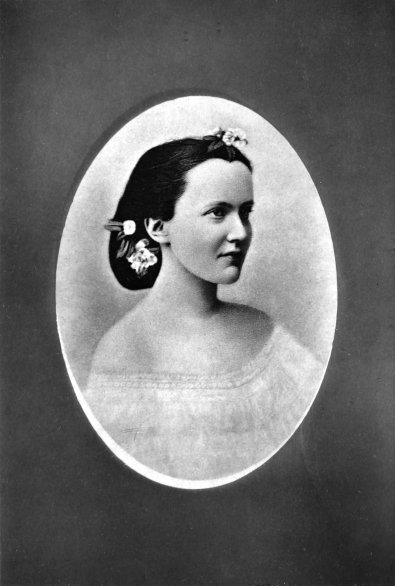
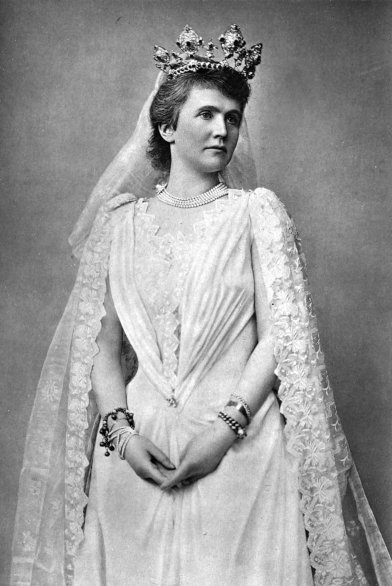
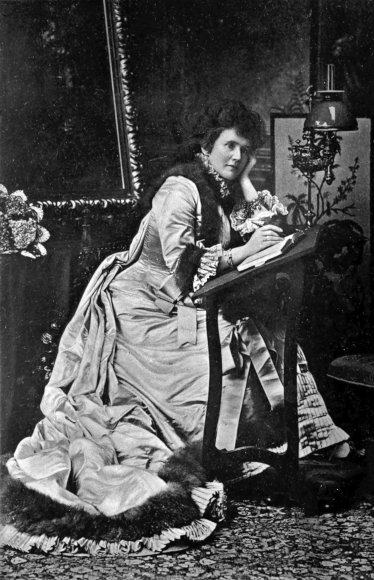
Woodbury Compy.
ELIZABETH,
PRINCESS OF WIED.
She was proud of her German home on the German
river. Because of these patriotic feelings she was always
called “la petite Allemagne” in Ouchy by the octogenarian
Count Kisseleff. In St. Petersburg also she
openly and freely confessed her love for her Fatherland.
Many a playful battle did she engage in with the
young Grand Dukes. “For, you know,” she wrote to
her mother, “my heart only glows for Germany!”
On the 25th of December 1863 she writes to her
parents:—“When I thank you for the signs of your
love, I really go much deeper and thank you for something
else: something so high, so true, and so holy, that
I cannot whisper it even, though it makes me so unboundedly
happy. This beautiful feeling is that we
love one another so much, so very much, that one can
breathe peace to the other through his peace, joy through
his joy.... It is the blessing of my life that God
sends me so much love. My sympathies are ever widening,
and my heart does not seem able to contain the
fulness of the sunbeams! I can never requite you, but
may perhaps impart my feelings to others, if God wills!”
The unwholesome climate of St. Petersburg and the
over-straining of her nerves soon showed themselves to
have a detrimental effect on the health of the till then
so blooming Princess. She could take but little part
in the festivities of Christmas-time, and on the 1st of
January 1864 she became alarmingly ill of a nervous
gastric fever. The Grand Duchess surrounded her with
motherly love and care. The Grand Duchess Catherine
and the lady-in-waiting, Baroness Edith von Rahden,
nursed and watched her unceasingly. But weeks went
by, and she still lay in bed. It was the first illness she
had ever had. Till now, when she had reached her
twentieth year, she had never tasted any medicine. As
soon as she was released from pain and could occupy
herself, she became absorbed in the book of “The Unconscious
Life of the Soul,” which her father had sent
her as a Christmas present. She writes from her bed:—“There
is such great humility in the preface, combined
with the power of assurance. Then I recognised
my father in the first three pages by his manner of
demonstrating his arguments. What a different sort of
reading it is when the language is as familiar to us as
our own, when we see the idea before us which we have
absorbed as the very breath of our life! I am glad that
papa has sent me the book just now. As I read, I see
his face before me, and seem to be really talking to him.”
On the 16th of January 1864 she wrote to her
father:—“How often a feeling of pride comes over me
that I have my father’s writings in my hands, and then
a glow of happiness, because every word has come from
your pen and from your inmost heart! For your soul
was prepared by the wonderful experiences of fifty years,
and the mind could communicate to her unhindered, and
tell her what it will about itself and its nature. It is
such a beautiful idea, that the indwelling Spirit of God
educates the soul and gives to it as much as it requires.
Not a word more. It makes one very humble, and
awakes in one a longing to keep the soul so pure (by
withstanding its natural earthly temptations), that God
may find it worthy of having many things revealed to it!
But how is it with the mind and the soul of Christ?
That is the mystery of His godly and yet human nature;
His soul must have been so pure, so much above earthly
things, that God could tell it all things.
“I am getting on well now, and enjoy these quiet
days in which I can collect my thoughts. I think they
will keep me out of the stream of society, for they see
that it tires me. There will be between forty and fifty
balls before the Carnival, when they will rush about for
a week—the so-called ‘folles journées.’ But do not be
anxious. That is not in my line. It is very odd, but
I read ninety pages of philosophy yesterday, and felt so
rested, that all were surprised to see me look so well.
But if only two or three ladies begin to gossip about
all the noise and bustle going on, I fall to pieces like
a withered leaf. To my joy, I notice what a strong constitution
I have, for real thinking refreshes me, while
excitement of the nerves makes me ill. Yes, my beloved
ones, I feel every day how wonderfully you have
educated me, and what you have given me for life—a
great treasure, the hoard of the Nibelungen, which also
lies in the Rhine; but I know the spot, and draw from
it every day.
Your Child.”
On the 18th of January 1864 she writes:—“I am
becoming so philosophical now, so quiet and sensible,
that it is a real pleasure. If only it remains thus! I
really do not know why I should be so anxious, that
I see the dark side of everything, and am convinced
that everything must go wrong. And all goes right—and
without my troubling.”
On the 20th of January:—“You cannot think what
a sense of repose has come over me, and a power of
work and concentration at the same time, which I have
not had since last year. I can control my thoughts
much better and keep them on the same track. But
the book is too beautiful, and I absorb it. It has come
to my quiet room and my peaceful heart at the right
time. Here it can influence me strongly, and no one
hinders it.”
On the 25th of January, for her mother’s birthday:—
“We are all there, you dear mother, with our love and
our childish longings, and have our arms tightly round
you, so that you may lead us, and we guide you. For
in our weakness and dependence in you lies our strength.
The feeling that we love you makes you strong. You
must be strong, that we may not fall. Oh! my beloved
mother, what strength is there in love! It overcomes
time and space. In love lies the idea of eternity, and
love alone can understand eternity, which we cannot
grasp. I feel that we seem to become more and more
intimate, and that is very natural. How anxiously I
used to bar all the doors of my heart! Now I open them
all wide, very wide, and, of course, you are at home
everywhere! I feel more strongly than ever that if ever
anything should separate me from you I should become
as dry and colourless as a withered leaf in winter.”
Princess Elizabeth now felt stronger, and began her
life with the Grand Duchess again. She was, however,
suddenly seized by a relapse of the illness she had just
had. It was a sad and anxious time for the Princess
of Wied, and these days of trial were almost more than
she could bear, for the Prince of Wied lay on his deathbed,
and his strength was slowly ebbing away. She
writes:—“My child is ill at a great distance from me,
and, for the first time, I am not there to nurse her. I
know she is in God’s care, and nursed by loving and
faithful people. But that does not take the load of
anxiety off my heart.”
When the mild spring weather came, on the 1st of
March the young Princess was allowed to go out in the
fresh air.
To her Brother.
“St. Petersburg, 2nd March 1864.
“I have been wonderfully dissipated this winter! I
was at a little ball the Emperor gave before Christmas,
and at a small dancing-party here at the end of January.
Next week is the Carnival, at which my presence will be
doubtful, and then everything, even the theatre, comes
to an end. Is it not really quite wonderful that I have
not become frivolous in all this whirl of society! And
now I have been seventeen days in bed, ‘pour combler
les plaisirs;’ it really is an anxious matter.
“But now I must leave off this jesting tone and
tell you that I really like to be here, surrounded by
the most touching affection and in the society of many
amiable and talented people. And then the music that
I can hear here!—this is the only thing for which I am
for ever craving. I do not care for the balls, and my
good time comes in Lent; then comes one concert after
another—all splendid music. To crown it all, Frau
Schumann arrived yesterday. I have seen her already.
She was in Düsseldorf and Baden, and can tell me of
all my dear friends. If Heaven but grants me a little
health, I can now pick up again what I have missed, and
blissfully breathe in music.
“This illness often seemed unbearable to me, because
I never seemed to get better. It was so difficult to be
patient,—and then the home-sickness! When I am well
I can overcome it, but in illness I long for mamma as a
little child. It was rather a difficult ordeal, but it must
have been good for me, if only to teach me anew to be
still. God wished to see whether I had not forgotten
this lesson. Alas! I had done so, and that made it so
hard to bear.”
It seemed as if Princess Elizabeth would now soon get
strong. But the news of her father’s death reached her
in a few days. The Prince of Wied had passed a winter
of acute suffering at Baden. When free from pain he
had dictated an essay “On the Mystery of Human Individualities.”
He had written to his daughter for the
last time shortly before his death, and answered some
questions she had made about his book, “The Unconscious
Life of the Soul.” His strength was waning
slowly, and on the 5th of March 1864 he had ceased to
suffer. The mortal remains were brought up to Monrepos,
a large procession following, and lie under the
lime-trees, beside those of his son, who died so early.
The Princess of Wied wrote his epitaph in the following
words:—
“Made perfect through Suffering, and patient in Hope,
Of a fearless Spirit and strong in Faith,
His mind turned towards Heavenly things,
He searched for truth and a knowledge of God.
What he humbly sought in Life
He, being set free, has now found in the Light.”
Princess Elizabeth had been passionately attached to
her father, and owed much of her intellectual progress to
him. Her sorrow at his loss was increased because she
had not been able to be near him during his last days.
Still, no complaint passed her lips. She bore her sorrow
with great resignation and self-control, which made a
deep and touching impression on all about her. She
wished to be strong in order to support and comfort her
mother, and this thought supported her—“We will fill
the desolate rooms with our love, and find our happiness
in each other.” She wrote to her: “As a tree that has
been felled leaves a light space in the forest, so a light
remains after the death of a great man!” And so her
father, whom she had loved and admired with all her heart,
appeared to her as a bright example. She tried to think
and to act as he would have wished. She formed her
opinions in the large-hearted manner that her father
had done, and with his able and generous disposition
towards all; never, therefore, immediately condemning
the opinions of others, but first sifting them thoroughly.
The following poem was written at this time:—
“They have carried him out, who was mine,
All so still!
And ’tis wrought—so I dare not repine—
By Thy will!
Must all the dear ones, then, on earth
That I have,
Like this whom I love so, go forth
To the grave?
Till I steal, in my heart’s agony,
All alone,
To the place where my dead treasures lie,
And make moan.”
—Translated by Sir Edwin Arnold.
Soon after this, on the 20th of April, the Princess
Louise of Wied died. She had reached the age of
ninety-two years, and was much loved and mourned at
Neuwied, on account of her charity to the poor.
The presence of her uncle, Prince Nicholas of Nassau,
was a great comfort to Princess Elizabeth in her sorrow;
but he had to return home, and she could not go with
him, though she had a great longing to be with her
mother. The Grand Duchess Hélène intended to travel
to Germany in the spring, and wished to bring back the
young girl to her mother herself. So she had to wait
patiently without murmuring.
Clara Schumann came to St. Petersburg early in
March, and lived in the Michailow Palace. As Rubinstein
could not continue her musical instruction, Princess
Elizabeth took lessons of Clara Schumann, and writes:—“And
I gazed meanwhile into the beautiful and sad
eyes, and thought of all that this woman had suffered,
and of the courage with which she had battled her way
through life.... It must be very consoling to be old,
for then a great feeling of repose comes over us, for
which I often long. Every day, I strive for internal
peace, which is so soothing, but I must obtain it by
many storms and much strife.... Even my aunt said
the other day, ‘One can see that you were not made
for life in the grand monde.’ I am only myself in solitude;
the bustle of the world makes me feel frightened
and shy. You, my beloved mother, are the only being
that has as much patience with me as God Himself,
who is not surprised at anything I do or say, to whom
I can tell everything, and who always understands me.
And I think you can feel what great happiness still is
mine, as I have such a mother!”
As Princess Elizabeth did not now join the large
parties on account of her mourning, the highest intellectual
interests became the favourite topics of the
circle round the Grand Duchess Hélène. The famous
member of the Academy, Baer, Count Keyserlingk,
Privy Councillor Brevern, Henselt the musician, and
many other of the learned and distinguished men were
in and out of the Palais Michel, to the great joy of
the young girl, who was so thirsty for knowledge.
The Grand Duchess Hélène had announced herself
at Moscow for Easter. Her niece was allowed to accompany
her, and saw Eastern magnificence and architecture
for the first time there. On the 4th of May 1864 she
writes from Moscow:—“We are in Moscow, that old
patriotic town, with its houses of one or two stories,
green roofs, and four hundred churches, which are all
aglow with the brightest colours. The dimensions of
the streets are so enormous that one does not know
where the street ends and the open space begins. It
is too curious! The town, with its one-storied houses
and their surrounding gardens, is quite countrified,
almost like a village, and yet it is beautiful. You
only see little houses, which are very gay, and still
gayer churches. These are bright blue, with light green
roofs or domes, or red, green, and blue, all brightly
mixed. I think Moscow is only beautiful in bright
sunshine, when the hundreds of domes are glistening
and throwing their rays on the green roofs. In the
Kremlin I saw the treasures of the Church, as also
the treasury and armoury in which all the crowns are
kept. I am most interested by the antiquity of these
things and their historical recollections. There is also
kept the enormous silver caldron in which the holy oil
is prepared and consecrated. Every three years it is
made to simmer for three days and mixed with sweet-scented
herbs, whilst prayers are unceasingly offered;
then it is consecrated and blessed in the church, and
is now called le saint crême. Forty to fifty pots are
then filled with it. This oil is much prized far and
near, as it is used for the consecration of churches, as
well as at births and deaths. The many and different
ways in which people try to make themselves holy
touch me much; and even if we are inclined to ask
what is the use of this oil and holy water, we must
admit that it displays a childish craving to be purified,
and a firm faith in the power of prayer, which
can consecrate everything. I find so much cheerfulness
and childish faith in the rites of the Greek Church, and
less superstition than in the Roman Catholic, but none
of the earnestness of ours. It strikes me, too, that
our Church in her noblest form—as I speak of the
others in their noblest form—is eminently suited to
the German character. We have all a tendency to
be absorbed in thought, to muse on our own nature,
and to seek to attain to a knowledge of God through
our own inmost hearts.”
After her return from a most interesting excursion to
the monastery of St. Sergius, Princess Elizabeth says in
a letter to her mother:—“The monastery is wide, low,
and massive, like all Byzantine churches, and partly
gloomy, or too bright for our taste. Everything in the
Byzantine churches is bright and cheerful, and the
religion is also a cheerful one. It is the religion of the
Resurrection. Good Friday is hardly kept at all, whereas
Easter is kept for a week. They are naturally cheerful,
and even the monks look bright and uncultivated. They
differ entirely from the hollow-cheeked ascetic monks of
the West, nor have their monasteries the same influence
as our monasteries.”
Princess Elizabeth was quite delighted with the expedition
to Moscow. She was charmed with the palace
of the Grand Duchess, with the large garden adjoining,
and the daily life was more like that of a family party.
Everything reminded her of Monrepos. She felt herself
unrestrained, at home; her health was restored, and she
fully enjoyed every pleasure. Attended by the ladies-in-waiting,
she was sent by the Grand Duchess to visit the
many charitable institutions, and behaved with so much
assurance that it appeared as if she were in the habit of
inspecting and examining. On getting into the train
on her return journey she exclaimed, “Those were happy
days,” as she gazed back at the old city of the Czars.
The time of her stay at St. Petersburg was coming to
an end. For her future life it was to be a time of great
importance. She had become accustomed to life at a
great Court, had learnt to know the rites and ceremonies
of the Greek Church, and her social and intellectual
sphere had widened during her stay with the Grand
Duchess Hélène. In a letter which she wrote as reigning
Princess of Roumania six years later she dwells upon
this as follows:—“I feel every day what a blessing my
intercourse with my aunt and her circle of friends was
for my whole life. In my present position it is of untold
value to me.”
Early in June the Grand Duchess brought her niece
back to Germany. The Princess of Wied awaited her
daughter at Leipsic. What a sorrowful meeting it was!
And the return to the desolate Monrepos was hardly to
be borne. Her deep sorrow for the loss of her father,
which she had had to keep back, now broke out with
all its power. Wherever she looked she seemed to see
him, and she thought she could not live without him.
She longed for his words of teaching, which had brought
her to think for herself; for the old habits, which always
had him for their object and centre.
To her Brother.
“Monrepos, 20th August 1864.
“Alas! you will not receive this letter on your birthday.
But it was quite impossible for me to write to
you, as papa’s grave was being finished. Yesterday the
stone was put up on his favourite place. Both are quite
beautiful. When the wall of papa’s grave was finished,
I filled it up myself, and during all those days mamma
and I were there from early morning to evening. I
helped to carry the stones and to shovel the earth, so
that my arms are quite tired to-day. The stone, which
marks his favourite view, bears the inscription—
‘On all the hill-tops
Is rest,
In all the tree-tops
Thou perceivest
Hardly a breath;
The birds are silent in the wood.
Wait but a little; soon
Thou, too, wilt be at rest.’
It is of grey marble, and surrounded by great pieces of
rock. We built up these rocks very artistically yesterday.
I worked till I was nearly dead. We planted ivy
between the rock, and a heavy rain came to the help of
the young plants in the night, so that they are fresh
and green.”
* * * * *
Since the death of her husband, the Princess of Wied
had spent summer and winter at Monrepos. Here she
had arranged a very cosy room for her daughter, who
soon loved it on account of its quiet and retirement.
Photographs and engravings from great masters and
portraits of those dearest to her adorned the walls.
From the windows she gazed upon the wide valley,
encircled by its mountains, the shining Rhine, and many
towns and villages. On leaving her room she gazed into
the depths of the mighty forest of beech-trees, which
resounded with the song of birds. She spread crumbs
and seeds before her door and window, and flocks of
feathered guests assembled around her. Lost in thought,
she watched the happy, careless ways of the birds, and
lived in the world her fancy created, becoming quite
apathetic after the terrible shocks she had lately gone
through. Her anxious mother gladly allowed Princess
Elizabeth to accompany the Grand Duchess to Ouchy
in the autumn. A great change came over her there.
She writes: “Unknown to me, a different spirit came
over me and aroused me from my melancholy, into
which, however, I relapsed all the deeper afterwards.”
From the autumn of 1864 to the New Year a young
Swiss girl spent many months at Monrepos. Maria von
Sulzer was a very amiable girl, and the depth of her
mind and her ideal tenderness had soon won her the
heart of the young Princess. They were like two sisters
together, and shared all their interests. The intercourse
with her young friend had put fresh life into Princess
Elizabeth. A stay at Arolsen varied the winter. There,
after the birth of five daughters, the princely house of
Waldeck had welcomed their first son. Princess Elizabeth
had the pleasure of carrying her little cousin, the
hereditary Prince of Waldeck, at his baptism.
To her Brother.
“Monrepos, 10th March 1865.
“The Castle of Neuwied is so melancholy that I do
not like to look at it any more. Each closed window
reminds me of some one that is dead. It will be a good
thing when it again echoes with youthful steps and the
voices of children who know nothing of the old sorrows
and sufferings, and think that their little feet are the
first to tread the ground, and that it never was otherwise
than they know it. If only the old walls could
tell their histories! Your children shall once listen
astonished when Aunt Elsa tells them how she lived
there—laughed and wept; and that she once was just
as small and had just the same thoughts as they, or
perhaps different ones, but they were very beautiful.
How she thought that a maiden was something very
wonderful till she became one herself, and yet remained
exactly what she was before!
“Uncle Max told me of his youth yesterday, and how
six horses were often brought round to the door. He
and his brothers swung themselves upon them, and they
galloped away laughing and cheering. Then he gave a
melancholy look at the desolate house, and tears came
into his eyes. Our youth was different, more serious and
sadder; but then our manhood and womanhood will be
different, rich and blessed and full of power and love.”
To her Brother.
“Monrepos, 18th November 1865.
“For I must confess to you that I am, like papa, a
most sociable person, and know nothing more charming
than an agreeable salon where, besides, good music
is being performed. My greatest wish is once to possess
so much money that I can always have a circle of artists
and savants about me, and make it as pleasant as possible
for them in my house. I should not pretend to be clever
myself, for I cannot do that at all, but only try to bring
out the good qualities of every one, which makes all feel
happy.”
* * * * *
Meanwhile the widowed Princess of Wied made use of
her practical talents by attending to the affairs of her
son, who had not yet attained his majority. Prince
William had left the College at Basle, and was now to
start on a journey to the East (1865–1866). His
mother had asked the Crown Prince of Prussia to recommend
a military gentleman to her to accompany the
Prince on his travels. He named his friend and playfellow,
General Mischke, who was then a captain. The
architect, Professor Kachel, who afterwards became
Director of the Schools of Art in Carlsruhe, was the
Prince’s scientific companion. Accompanied by these
two gentlemen the Prince travelled through Italy to
Egypt. There he met Prince Anton of Hohenzollern,
and they proceeded together on their journey through
Syria and Palestine, Constantinople and Greece. In
Athens, however, they received orders to join the army,
and hurried back to Germany, where the Prince of
Wied was attached to the staff of the Crown Prince.
The war with Austria was soon over, but Prince
Anton of Hohenzollern was not to see his country
again. He died of his wounds soon after the battle of
Königgratz.
During the months of February and March 1866
Princess Elizabeth was at Wiesbaden, on a visit to her
uncle, the Duke of Nassau. Here she took singing
lessons and learnt to play the zither, and was very happy.
In May the Princess of Wied visited her relations at
Braunfels, Laubach, and Schlitz, with Princess Elizabeth.
The young Princess was charmed with the fine castles
surrounded by the fresh green of the woods. She often
said—“The mediatised Princes have the best of and lead
the happiest lives. I should never wish for more than a
castle in a wood, where I could do much good, and receive
the friends I love. That is the most enviable fate.”
In the autumn of 1866 Princess Elizabeth again
accompanied the Grand Duchess Hélène on her travels,
and this time they went to Ragaz, and whilst there they
saw much of General von Moltke, then at the height of
his glorious career. He joined in their games of bowls
in the morning, and various jeux d’esprit of an evening,
with the utmost amiability and simplicity, and Princess
Elizabeth became much attached to this so eminent and
distinguished man. Whilst discussing the political situation
they spoke of Prince Charles of Hohenzollern, who
had been chosen as Sovereign Prince of Roumania shortly
before the outbreak of the war between Prussia and
Austria. A few years before this General von Moltke
had made a scientific journey through Silesia with the
Crown Prince and Prince Charles. “That young Prince
of Hohenzollern will make his mark and become talked
about” were then the prophetic words of the Field-Marshal.
The Grand Duchess had finished her cure. They
were to leave Ragaz in a few days. Princess Elizabeth
was to return to Monrepos, but a letter from her mother
changed her plans. Her favourite cousin, Catherine of
Oldenburg, had died at Venice. The sufferings of her
mother, Princess Thérèse, increased after the death of her
lovely daughter, and the doctors urged a sojourn in the
south of Italy upon her. She besought her sister, the
Princess of Wied, to allow Princess Elizabeth, for whom
she had conceived a great affection in St. Petersburg, to
accompany her. Although it was hard for the young
Princess to extend the separation from her mother for
many months, her resolution was soon taken. She
hoped to find scope for her energies in this family circle.
In September 1866 they travelled to Rome, where they
remained a short time, and to Naples. At first Princess
Thérèse had taken an apartment in an hotel for many
months. But though they kept away from all society,
it was noisy and uncomfortable on account of the traffic
in the crowded streets. Princess Elizabeth, who was
accustomed to a quiet room and quiet hours, felt it
particularly. Her cousins too were always surrounding
her, and did not leave her a moment’s peace. “I gave
myself up to melancholy reflections,” she writes to her
mother. But all changed for the better when they
took a villa on the Pausilipp. Here she took up her
regular occupations, and writes: “I have work, much
work; for those that seek it, find it. The beauties of
nature and the mild air constantly renew my strength.”
She now gave her cousin, Thesa of Oldenburg, lessons in
German, English, and arithmetic, and says: “My intentions
are good and true, and a blessing may perhaps rest
upon them. Nor shall I be melancholy any more, when
I am in the treadmill of regular work.” Her poems
written at this time are mostly grave and full of religious
thoughts, but sometimes the brightness of youth overpowers
her, and cheerful, happy songs flow from her pen.
To her Mother.
“Naples, Santa Brigitta, 19th January 1867.
“Yesterday we moved here. The sirocco has been
blowing for some days, and the wild waves of the sea
are foaming. The seagulls are skimming between the
spray, which is thrown up to a great height, and last
night the storm shook our house. The clouds are low,
and cover the peaks of Vesuvius, while wind and rain
beat through our windows and make weird music.
The sea is green and grey, the white foam shines like
phosphorus. It is just what I like. I should love to
go out alone in the storm to let it rage about me, to
sing a wild song to the waves, which nobody listens
to or hears, and which remains my own, though I sing
it loudly. Then I should come home as quiet as a lamb,
and listen to the storm no more. Now the bank of
clouds is rolled away, and a rosy light spreads itself
quietly over the foaming, angry sea. It spreads itself
further and further from the horizon to our feet, soothing
and shining, and brings happy thoughts to my heart.
If that would learn to be still it could also command the
storm, and in its depths it is still. For through all, my
quiet home is the anchor which holds me fast, the
haven which receives me when my sails are rent. Man
belongs to nature, and is her greatest and completest
work, and therefore we love and have confidence in men,
even when they are passionate and excited.”
* * * * *
“20th January.—As we woke to-day upon our hill,
the sun shone upon the sea, which is like a sheet
of glass. The doors and windows are wide open, and
the soft air of May pervades me and our rooms, and
brings in happy and cheerful thoughts. It has wakened
all my pleasure in life and power of work. When I
raise my head the mighty Vesuvius is spread before me,
and its peaks lost in the clouds. To the left I look
down to the town, which shines below me in the sun.
The sea spreads itself to my right, with the sharp points
of the Island of Capri. For the first time Naples
appears to me magically beautiful, for the first time
I can gaze undisturbed upon the grand beauty of nature
here. Peace, which I have not felt for a long time,
steals into my heart. I feel as if I could swing myself
into the light air as if I had a hundred wings which
drew me to the sun, as if new life came to me. It is
worth battling with the storm to feel such heavenly
peace. Even the waves of the sea are hushed as though
they feared to break the stillness. Everything seems
to me to call, ‘Peace, Peace.’ It is too beautiful
for words, and the joy is too deep; it is like a song of
thanksgiving, a golden dream from which we would
not wake. My little cousin walks up and down in the
next room and hums a tune. The beautiful world has
had a good influence upon her also, for the clouds
which lay upon her brow have vanished. I should
like to write nothing more than the perpetual refrain,
Peace has returned. A fly is buzzing at my window
as though it were midsummer, and a bird is chirping in
the distance. I allow nature to charm me and to caress
me like her spoiled child. Do not fear my becoming
dreamy and idle: I am only dreaming with you. The
instant the pen leaves my hand the cares of daily life
surround me with a thousand claims, which have all
to be satisfied. I may not dream long, so grant me
these few moments. I only draw myself up like a
wave before it rushes onwards and gathers strength
for the work which I have taken in hand. I never
forget for a moment that I have two hours’ lessons to
give to this spoilt child the day after to-morrow. I
am quite prepared for it. I feel that though she may
learn more from any schoolmaster than from me, I can
perhaps influence her mode of thought by these lessons,
which will be of more use to her than the deepest
learning. I try to teach her, what you taught, to love
people for whom you have no sympathy. If I do not
marry, I shall pass my examination as a teacher. To
that I have made up my mind. Tell Pastor Harder
that I have never lost sight of this object, though I am
driven hither and thither. For I must accomplish this,
which has been in my mind for years. And though I
sometimes feel that I am presumptuous and arrogant,
I usually think the contrary. ‘Your vocation is what
calls you’ is all that I have remembered of Brentano’s
fairy tales, and what calls me is teaching. I wait in
patience. If I have understood it wrongly, it will be
made clear to me. Here I have that lot assigned to
me. I teach for ten hours a week, and am present at all
the lessons given. Tell the Pastor that I am constantly
repeating his good maxims, and hope to prove myself
his worthy scholar.”
We see that Princess Elizabeth is ambitious in the
best sense of the word. “Thus she is impelled to
teach, for in teaching lies great power.”
“Naples, 5th February 1867.—Aunt Thekla has died,
and Uncle Max has died. It is worth while to have
lived as he did, and he does not die unmourned. Indeed
it was a beautiful death, which one might wish to
have after so rich a life. I pray God that I may die
mourned after a life of labour, even though I should
have no children and grandchildren. The life of Uncle
Max was rich and full of interest. I think it was
beautiful.”
“Naples, 3rd April 1867.—Sometimes I feel so old,
but not sorrowful—no! quite the contrary. I should
like to be much, much older, to have the duties and the
rights of an old maid. I often feel as if I had had a
mist before my eyes lately. The happiness to have
spent time and strength where they are most needed
is too great. I am not at all afraid of that dreadful
word ‘old maid.’ I share it with many whom I have
often envied for their strong though quiet influence.
Work is what I must and will have, and then all can
say of me, ‘That is a happy girl.’ The time is soon
over. It has gone by quickly, very quickly. God
knows that I had the wish to do some good, to
accomplish something, and have some influence. I see
no results, but that I did not expect. Perhaps a
little trace may be left behind. I am not so proud as
to think that I can carry all before me like a mountain
torrent. Perhaps I am but a little drop, but if Heaven
has let me fall on the right place, I can joyfully become
absorbed by the sunbeams!”
In May 1867 Princess Elizabeth was overjoyed to
return to Monrepos. “She returned to her quiet
home in the forest and became a child once more.”
But it was not for long. The amiable niece had
become necessary to the Grand Duchess Hélène, and
she was constantly enticing her away from home.
In August we find her again in Carlsbad with her
aunt. The Grand Duchess was very unwell, and Princess
Elizabeth had to receive the ladies and gentlemen
who came to pay their respects. She writes as follows
about her impressions and the people who frequented
there:—
“Carlsbad, 2nd August 1867.—I have in these last
days made the acquaintance of some people with whom
I am so enchanted that I am constantly wishing you
were here. First comes Frau Arnemann, a Norwegian
lady, with bright black eyes, which fascinate one. She
has always been with artists, and her life has been
rich but sad. Her impressions of people are quite
extraordinarily correct, and I have often seen astonishing
proofs of her clairvoyance. She is quite magnetic.
Frau Arnemann introduced the painter Piloty to us, a
very amiable and refined person. We go into raptures
over Italy together. Then we have got to know the
great singer, Frau Unger-Sabatier, who is here with
her pupil and niece, Fräulein Regan. Frau Unger-Sabatier
is a perfect artist, wise and clear-headed, with
the sacred fire and yet not too much of the fervour of
the dilettanti. Her great pleasure is to train young
singers. Her niece, Fräulein Regan, is twenty-three.
Her voice is like a flute, and she sings to wonderful
perfection. She is also a very cultivated girl, who
speaks French and Italian not only well but beautifully,
and understands and renders the songs perfectly. I
feel myself drawn to her as to a magnet.”
Her intercourse with Edith von Rahden was also a
great pleasure to the Princess. She says of her: “Edith
has become more mild and gentle than ever, and esteems
every one, irrespective of their position towards herself.”
“I know how to be grateful for every happy hour, and what
greater happiness is there than to be treated as a friend
by a woman of experience.” Later the Princess Elizabeth
writes to her mother: “If ever I made up my mind to a
marriage, I should like to have a settled home, a house
on my own property, and not to begin a wandering life,
which never takes firm root anywhere. I do not now
seek my vocation where it seems difficult and troublesome,
and have no other wish than to live quietly and
work where I can.”
Among the gentlemen who were about the Grand
Duchess at that time was Walujeff, a Russian Minister,
Tolstoi, Rouher, Piloty, Count Keyserlingk, the Curator
of the University of Dorpat, and the Privy Councillor
Von Brevern, “who is of a refined and very sensitive
nature. His kindness brings thoughts to me which I
should scarcely like to mention.”
Meanwhile Maria von Sulzer had married her cousin,
and had come to Monrepos in the summer in a very
suffering state. There her strength declined visibly.
Feeling that her death was near, she had a great longing
to return home. Shortly afterwards the Princess
of Wied received news of her death. We read in the
journal of Princess Elizabeth of the 4th of September:—“Maria
Sulzer has died. Death is but an old friend to
me, a serious friend, and yet kind, if one knows how to
meet him. Heaven sends me countless blessings every
day. Indeed I cannot repine. For my life is rich and
full, which I constantly repeat to myself. And if all the
loved ones were to be taken, it would still be blessed a
thousandfold, for still all are mine. Even if the flowers
fade, we do not forget that they once bloomed, and
that we enjoyed their sweet perfume. Indeed my heart
bleeds, but still I am abundantly blessed.”
We find the following poem on the death of this
beloved friend:—
“Draw you nearer,
Let weeping cease;
In her chamber
All is peace.
Angels hovered
Softly o’er her;
In the night
Away they bore her.
Death o’er her senses
Did softly creep;
Saved her a parting,
Wrapped her in sleep.
Flowers of beauty
Wreathe her around;
Drowsily chiming
The sweet bells sound.
Draw you nearer,
Let weeping cease;
In her chamber
All is peace.”
From Carlsbad the Grand Duchess travelled with her
great niece to the great Exhibition at Paris. There
Princess Elizabeth had arrived unwell; she suffered
from a bad throat and momentary deafness. Consequently
she could not enjoy the great sights with her
usual freshness. The reception at the Tuileries, visits
to the Exhibition, to the Louvre and the neighbouring
castles, seemed like a dream to her. Under the impression
of this deafness, and inclining as ever to
melancholy thoughts, she writes to her mother—“I have
often thought in these last days that one can well do
without occupation in old age. Then we can sit in our
arm-chair, lost in thoughts, quite still, and without prejudice.
One can think sweetly of the dead, and tell
those around one of our past life as a curiosity. I fancy
it very beautiful. I would not change now, for I would
taste of life with all it brings, and hope to toil and
endeavour. But all the time I shall look forward to the
peace of old age.”
The suffering state of the Grand Duchess Hélène
necessitated another sojourn in Ragaz, but she would
not let her niece leave her side. It was the end of
September before they arrived, and few visitors were
there. This quiet they found very refreshing after the
noisy bustle and moral tension of Paris. The young
Princess became quite herself again. Her restless mind
immediately undertook new work.
“Last night,” she writes on the 22nd September 1867,
“I was telling Fräulein von Rahden so much about our
lost little brother (Prince Otto) that she exclaimed—‘His
life must be written. It will be a great blessing for all
who read it.’ She told me to write as fully as possible,
and said that what was written in the greatest simplicity
must, if it comes from the heart, find an echo in the
hearts of others. I have wished to do this for years,
and felt that I ought to do it, and found it too difficult.
I really think that the moment has come now. I should
like to add a detailed memoir to our archives.
“I have just come from the little church, in which I
heard a beautiful sermon. Pfarrer Steiger preached from
Jer. ix. 24, ‘For in these things I delight, saith the
Lord.’ It was full of enthusiasm, and suitable to my
state of mind, which was rather sad, as many memories
awake here in Ragaz. And then this good man brought
God’s healing, conquering, and inspiring love so near to
us that I nearly wept for joy. It was too beautiful. I
seemed to hear Maria Sulzer’s voice saying to me, ‘Lay
yourself in the arms of God.’ I have already thought
of writing prayers for our church, but I am not sufficiently
advanced. Perhaps I shall be able to do so
when I am writing Otto’s Memoirs.”
“Ragaz, 30th September.—Thinking of our little
services, I have written the enclosed prayers. Perhaps
you can use them. I have also begun Otto’s Memoirs,
and have written to Nana (Prince Otto’s English nurse)
and begged her to give me details of his earliest childhood,
‘If with all your hearts ye truly seek Me, ye
shall ever surely find Me, saith the Lord.’ I should like
to inscribe this text on every page. I should like to
seek and find Him. I have never really loved Him. Frau
Arnemann says: ‘God is drawing me to Him through
all that I love, and whom He has taken to Himself.’
How gladly I will let myself be drawn! This winter I
shall stay at home, and look forward to it much. I
have my hands full of business too, for when I have
finished my translation of Carlyle I have a new plan.
Frau Arnemann always wished me to write a book for
children. Only I cannot think of anything suitable.
I can only write about what I have lived through and
felt.”
After many fine days, during which walks of three or
four hours were undertaken, a sudden and lasting fall of
snow had induced the Grand Duchess to leave Ragaz.
Princess Elizabeth now returned home. She spent the
winter quietly and happily with her mother at Monrepos.
“I look back upon this time with particular pleasure,”
she writes; “I think of the dreamy hours spent in the
little room, of the endless conversations on deep subjects
with Fräulein Lavater, and of the evenings when our
spinning wheels hummed and my brother read aloud to
us.” In the summer of 1868 she travelled to Sweden
on a visit to her royal relations. She calls Sweden the
land of poetry; and the magnificence of nature there,
and the beautiful legends which are attached to every
stone, inspired her fancy. She liked to be in the north,
and delighted in Stockholm. The magnificent town is
enthroned like a queen of the waters on her islands
between the lake and the sea. It is surrounded by
many oaks of a hundred years’ growth, which are the
masts and pennons of the ships, and historical treasures
of all sorts. “We made a wonderful expedition to the
Malarsee. The Duke of Ostgothland, the present King
Oscar II., had taken a ship, and we glided on the shining
sea between a hundred emerald isles to the curious
old castle of Grypsholm. What added immensely to the
charm of our voyage were the songs of the Swedish
officers, whom my uncle invited for our amusement.
These gentlemen sing nearly the whole day, and songs
varied according to the places we passed. Their voices
were as clear as bells, whispering mysteriously or
sounding loud in the uncontrollable joy of youth. My
uncle had the tombs of the kings in the Riddersholmskirche
open for us to see. Each dynasty has a
separate vault. I laid my hand upon the coffins of
Gustav Adolph and Karl XII., but could not help
shuddering before these open graves. The drive
through the country to Helsingborg was very fine. We
passed more than a hundred seas. The red wooden
houses and the castles built of red tiles are picturesquely
situated between the huge blocks of stone of volcanic
origin with which the whole country is strewn. These
blocks are covered with beech and fir trees. We spent
a night in Toncoping, and wandered through the bright
wooden town, by the shining Wettersee, at five in the
morning.”
With the facility peculiar to her, Princess Elizabeth
learnt Swedish, and could soon read “Tegner’s Frithjofsage”
and the beautiful poems of Runeberg in the
original. The Princess of Wied had spent three months
in Sweden with her daughter. On the way back they
visited Copenhagen and Friedrichsborg, and stayed some
days with their relations at Arolsen. There Princess
Elizabeth was a peculiar favourite of her cousins of
Waldeck, and her appearance at Arolsen gave the signal
to endless rejoicings.
Princess Elizabeth had scarcely returned to Monrepos
with her mother when the Grand Duchess Hélène called
her niece to her side at Heidelberg. In November of
1868 she spent three most enjoyable weeks there. The
recollections of this time were so deep and lasting that
Princess Elizabeth, then Princess of Roumania, mentions
it nine years after with such life and freshness as if
years and great changes had not come over her meanwhile.
We will here give that part of a letter written
from Bucharest in May 1877:—
“How beautiful it must now be in Heidelberg!
Have I not spent almost the happiest three weeks of my
life there with my aunt and so many distinguished people.
A gathering of great thinkers, Kirchhoff, Friedreich,
Bluntschli, Treitschke, Gervinus, and Helmholtz in
one drawing-room! Besides which Joachim with his
heavenly violin, and Frau Joachim with her voice like a
mountain torrent. An evening for the gods! and then
those walks with Fräulein von Rahden, those dreams in
the ruins. How they seemed to teem with life and
flitting forms, with banquets and fair women. Indeed
those were visions worthy of the gods! Of course we
were often wet through, but I think the rain belongs to
Heidelberg as the dew to flowers. You should read the
‘Trompeter’ together, that suits there, ‘Frau Aventiure,’
and ‘Gaudeamus.’ One must become as jolly as the
students, drink wine and lounge, in order to be in the
right spirit for Heidelberg: then it is a magic circle, a
land of dreams, such as weary wayfarers may long for.
You breathe so freely in the warm damp air.”
With these bright impressions the year 1868 closed.
The next year was to be one of great importance for
Princess Elizabeth. But although her immediate future
shaped itself in an unexpected manner, it found her
prepared for it as to an object towards which the genius
of her life was tending. We have interwoven many
extracts of Princess Elizabeth’s letters in the course of
our narrative, because a natural and unsought for likeness
of her is thus developed. Her words are a picture
of her inner and outer life according to the impression
made upon her mind at the time. She describes the
effects of what she experienced more than the causes,
but these effects are not problematic states of mind, but
strong and lasting impressions, which take root in a
nature rich in refined feelings, and increase its wealth.
And there is one theme which traverses this inner life
and shows itself even there, where it is not openly
mentioned—an all pervading principle, which has the
strength to avoid and to overcome the two dangers
which beset the life of a daughter of a Prince. One
danger is that she may give herself up to the enjoyment
of her exalted rank; the other that intellectual pursuits
are undertaken in a dilettanti spirit and become superficial.
There is only one safeguard to these two dangers,
and that is duty and labour. The duty of a Prince is
to rule—that is the highest form of education. Now
we read in the letters of Princess Elizabeth even there,
where she does not say so in so many words: “I wish
to have a profession.” She meant the profession of
a teacher, and she received one of a Princess and a
Queen!