THE AFTERNOON LANDSCAPE. Poems and
Translations. $1.00.
THE MONARCH OF DREAMS. 18mo, 50 cents.
MARGARET FULLER OSSOLI. In the American
Men of Letters Series. 16mo, $1.50.
HENRY W. LONGFELLOW. In American Men of
Letters Series. 16mo, $1.10, net. Postage 10 cents.
PART OF A MAN’S LIFE. Illustrated. Large 8vo,
$2.50, net. Postage 18 cents.
LIFE AND TIMES OF STEPHEN HIGGINSON.
Illustrated. Large crown 8vo, $2.00, net. Postage
extra.
CARLYLE’S LAUGH AND OTHER SURPRISES.
12mo, $2.00, net. Postage 15 cents.
EDITED WITH MRS. E. H. BIGELOW.
AMERICAN SONNETS. 18mo, $1.25.
HOUGHTON MIFFLIN COMPANY Boston and New York
CARLYLE’S LAUGH AND OTHER SURPRISES
BY
THOMAS WENTWORTH HIGGINSON
BOSTON AND NEW YORK
HOUGHTON MIFFLIN COMPANY The Riverside Press Cambridge
MDCCCCIX
COPYRIGHT, 1909, BY THOMAS WENTWORTH HIGGINSON
ALL RIGHTS RESERVED
Published October 1909
NOTE
The two papers in this volume which bear the
titles “A Keats Manuscript” and “A Shelley
Manuscript” are reprinted by permission from
a work called “Book and Heart,” by Thomas
Wentworth Higginson, copyright, 1897, by
Harper and Brothers, with whose consent the
essay entitled “One of Thackeray’s Women”
also is published. Leave has been obtained
to reprint the papers on Brown, Cooper, and
Thoreau, from Carpenter’s “American Prose,”
copyrighted by the Macmillan Company, 1898.
My thanks are also due to the American
Academy of Arts and Sciences for permission
to reprint the papers on Scudder, Atkinson,
and Cabot; to the proprietors of “Putnam’s
Magazine” for the paper entitled “Emerson’s
Foot-Note Person”; to the proprietors of the
New York “Evening Post” for the article on
George Bancroft from “The Nation”; to the
editor of the “Harvard Graduates’ Magazine”
for the paper on “Göttingen and Harvard”;
and to the editors of the “Outlook” for the
papers on Charles Eliot Norton, Julia Ward
Howe, Edward Everett Hale, William J. Rolfe,
and “Old Newport Days.” Most of the remaining
sketches appeared originally in the “Atlantic
Monthly.”
None of the many sketches of Carlyle that
have been published since his death have brought
out quite distinctly enough the thing which
struck me more forcibly than all else, when in
the actual presence of the man; namely, the
peculiar quality and expression of his laugh. It
need hardly be said that there is a great deal
in a laugh. One of the most telling pieces of
oratory that ever reached my ears was Victor
Hugo’s vindication, at the Voltaire Centenary
in Paris, of that author’s smile. To be sure,
Carlyle’s laugh was not like that smile, but it
was something as inseparable from his personality,
and as essential to the account, when
making up one’s estimate of him. It was as individually
characteristic as his face or his dress,
or his way of talking or of writing. Indeed,
it seemed indispensable for the explanation of
all of these. I found in looking back upon my
first interview with him, that all I had known
of Carlyle through others, or through his own
books, for twenty-five years, had been utterly
defective,—had left out, in fact, the key to his
whole nature,—inasmuch as nobody had ever
described to me his laugh.
It is impossible to follow the matter further
without a little bit of personal narration. On visiting
England for the first time, in 1872, I was
offered a letter to Carlyle, and declined it. Like
all of my own generation, I had been under some
personal obligations to him for his early writings,—though
in my case this debt was trifling
compared with that due to Emerson,—but his
“Latter-Day Pamphlets” and his reported utterances
on American affairs had taken away
all special desire to meet him, besides the ungraciousness
said to mark his demeanor toward
visitors from the United States. Yet, when I
was once fairly launched in that fascinating
world of London society, where the American
sees, as Willis used to say, whole shelves of his
library walking about in coats and gowns, this
disinclination rapidly softened. And when Mr.
Froude kindly offered to take me with him for
one of his afternoon calls on Carlyle, and further
proposed that I should join them in their
habitual walk through the parks, it was not in
human nature—or at least in American nature—to
resist.
We accordingly went after lunch, one day in
May, to Carlyle’s modest house in Chelsea,
and found him in his study, reading—by a
chance very appropriate for me—in Weiss’s
“Life of Parker.” He received us kindly, but
at once began inveighing against the want of
arrangement in the book he was reading, the
defective grouping of the different parts, and
the impossibility of finding anything in it, even
by aid of the index. He then went on to speak
of Parker himself, and of other Americans whom
he had met. I do not recall the details of the
conversation, but to my surprise he did not say
a single really offensive or ungracious thing. If
he did, it related less to my countrymen than to
his own, for I remember his saying some rather
stern things about Scotchmen. But that which
saved these and all his sharpest words from being
actually offensive was this, that, after the
most vehement tirade, he would suddenly pause,
throw his head back, and give as genuine and
kindly a laugh as I ever heard from a human
being. It was not the bitter laugh of the cynic,
nor yet the big-bodied laugh of the burly joker;
least of all was it the thin and rasping cackle
of the dyspeptic satirist. It was a broad, honest,
human laugh, which, beginning in the brain,
took into its action the whole heart and diaphragm,
and instantly changed the worn face
into something frank and even winning, giving
to it an expression that would have won
the confidence of any child. Nor did it convey
the impression of an exceptional thing that had
occurred for the first time that day, and might
never happen again. Rather, it produced the
effect of something habitual; of being the channel,
well worn for years, by which the overflow
of a strong nature was discharged. It cleared
the air like thunder, and left the atmosphere
sweet. It seemed to say to himself, if not to
us, “Do not let us take this too seriously; it
is my way of putting things. What refuge is
there for a man who looks below the surface in a
world like this, except to laugh now and then?”
The laugh, in short, revealed the humorist; if
I said the genial humorist, wearing a mask of
grimness, I should hardly go too far for the impression
it left. At any rate, it shifted the ground,
and transferred the whole matter to that realm
of thought where men play with things. The
instant Carlyle laughed, he seemed to take the
counsel of his old friend Emerson, and to write
upon the lintels of his doorway, “Whim.”
Whether this interpretation be right or wrong,
it is certain that the effect of this new point of
view upon one of his visitors was wholly disarming.
The bitter and unlovely vision vanished;
my armed neutrality went with it, and there I
sat talking with Carlyle as fearlessly as if he
were an old friend. The talk soon fell on the
most dangerous of all ground, our Civil War,
which was then near enough to inspire curiosity;
and he put questions showing that he
had, after all, considered the matter in a sane
and reasonable way. He was especially interested
in the freed slaves and the colored troops;
he said but little, yet that was always to the
point, and without one ungenerous word. On the
contrary, he showed more readiness to comprehend
the situation, as it existed after the war,
than was to be found in most Englishmen at
that time. The need of giving the ballot to the
former slaves he readily admitted, when it was
explained to him; and he at once volunteered
the remark that in a republic they needed this,
as the guarantee of their freedom. “You could
do no less,” he said, “for the men who had
stood by you.” I could scarcely convince my
senses that this manly and reasonable critic was
the terrible Carlyle, the hater of “Cuffee” and
“Quashee” and of all republican government.
If at times a trace of angry exaggeration showed
itself, the good, sunny laugh came in and cleared
the air.
We walked beneath the lovely trees of Kensington
Gardens, then in the glory of an English
May; and I had my first sight of the endless
procession of riders and equipages in Rotten
Row. My two companions received numerous
greetings, and as I walked in safe obscurity by
their side, I could cast sly glances of keen enjoyment
at the odd combination visible in their
looks. Froude’s fine face and bearing became
familiar afterwards to Americans, and he was irreproachably
dressed; while probably no salutation
was ever bestowed from an elegant passing
carriage on an odder figure than Carlyle. Tall,
very thin, and slightly stooping; with unkempt,
grizzly whiskers pushed up by a high collar,
and kept down by an ancient felt hat; wearing
an old faded frock coat, checked waistcoat,
coarse gray trousers, and russet shoes; holding
a stout stick, with his hands encased in very
large gray woolen gloves,—this was Carlyle.
I noticed that, when we first left his house, his
aspect attracted no notice in the streets, being
doubtless familiar in his own neighborhood;
but as we went farther and farther on, many
eyes were turned in his direction, and men
sometimes stopped to gaze at him. Little he
noticed it, however, as he plodded along with
his eyes cast down or looking straight before
him, while his lips poured forth an endless
stream of talk. Once and once only he was
accosted, and forced to answer; and I recall
it with delight as showing how the unerring
instinct of childhood coincided with mine, and
pronounced him not a man to be feared.
We passed a spot where some nobleman’s
grounds were being appropriated for a public
park; it was only lately that people had been
allowed to cross them, and all was in the rough,
preparations for the change having been begun.
Part of the turf had been torn up for a road-way,
but there was a little emerald strip where
three or four ragged children, the oldest not over
ten, were turning somersaults in great delight.
As we approached, they paused and looked shyly
at us, as if uncertain of their right on these premises;
and I could see the oldest, a sharp-eyed
little London boy, reviewing us with one keen
glance, as if selecting him in whom confidence
might best be placed. Now I am myself a child-loving
person; and I had seen with pleasure
Mr. Froude’s kindly ways with his own youthful
household: yet the little gamin dismissed
us with a glance and fastened on Carlyle. Pausing
on one foot, as if ready to take to his heels
on the least discouragement, he called out the
daring question, “I say, mister, may we roll
on this here grass?” The philosopher faced
round, leaning on his staff, and replied in a
homelier Scotch accent than I had yet heard
him use, “Yes, my little fellow, r-r-roll at discraytion!”
Instantly the children resumed their
antics, while one little girl repeated meditatively,
“He says we may roll at discraytion!”—as if
it were some new kind of ninepin-ball.
Six years later, I went with my friend Conway
to call on Mr. Carlyle once more, and found the
kindly laugh still there, though changed, like all
else in him, by the advance of years and the
solitude of existence. It could not be said of him
that he grew old happily, but he did not grow
old unkindly, I should say; it was painful to see
him, but it was because one pitied him, not by
reason of resentment suggested by anything on
his part. He announced himself to be, and he
visibly was, a man left behind by time and waiting
for death. He seemed in a manner sunk
within himself; but I remember well the affectionate
way in which he spoke of Emerson, who
had just sent him the address entitled “The
Future of the Republic.” Carlyle remarked,
“I’ve just noo been reading it; the dear Emerson,
he thinks the whole warrld’s like himself;
and if he can just get a million people together
and let them all vote, they’ll be sure to vote
right and all will go vara weel”; and then came
in the brave laugh of old, but briefer and less
hearty by reason of years and sorrows.
One may well hesitate before obtruding upon
the public any such private impressions of an
eminent man. They will always appear either too
personal or too trivial. But I have waited in vain
to see some justice done to the side of Carlyle
here portrayed; and since it has been very commonly
asserted that the effect he produced on
strangers was that of a rude and offensive person,
it seems almost a duty to testify to the very
different way in which one American visitor
saw him. An impression produced at two interviews,
six years apart, may be worth recording,
especially if it proved strong enough to outweigh
all previous prejudice and antagonism.
In fine, I should be inclined to appeal from all
Carlyle’s apparent bitterness and injustice to
the mere quality of his laugh, as giving sufficient
proof that the gift of humor underlay all else
in him. All his critics, I now think, treat him
a little too seriously. No matter what his labors
or his purposes, the attitude of the humorist
was always behind. As I write, there lies before
me a scrap from the original manuscript of his
“French Revolution,”—the page being written,
after the custom of English authors of half
a century ago, on both sides of the paper; and
as I study it, every curl and twist of the handwriting,
every backstroke of the pen, every substitution
of a more piquant word for a plainer
one, bespeaks the man of whim. Perhaps this
quality came by nature through a Scotch ancestry;
perhaps it was strengthened by the accidental
course of his early reading. It may be
that it was Richter who moulded him, after all,
rather than Goethe; and we know that Richter
was defined by Carlyle, in his very first literary
essay, as “a humorist and a philosopher,” putting
the humorist first. The German author’s
favorite type of character—seen to best advantage
in his Siebenkäs of the “Blumen, Frucht,
und Dornenstücke”—came nearer to the actual
Carlyle than most of the grave portraitures yet
executed. He, as is said of Siebenkäs, disguised
his heart beneath a grotesque mask, partly for
greater freedom, and partly because he preferred
whimsically to exaggerate human folly
rather than to share it (dass er die menschliche
Thorheit mehr travestiere als nachahme). Both
characters might be well summed up in the
brief sentence which follows: “A humorist in
action is but a satirical improvisatore” (Ein
handelnder Humorist ist blos ein satirischer
Improvisatore). This last phrase, “a satirical
improvisatore,” seems to me better than any
other to describe Carlyle.
II A SHELLEY MANUSCRIPT
A SHELLEY MANUSCRIPT
Were I to hear to-morrow that the main
library of Harvard University, with every one
of its 496,200 volumes, had been reduced to
ashes, there is in my mind no question what
book I should most regret. It is that unique,
battered, dingy little quarto volume of Shelley’s
manuscript poems, in his own handwriting and
that of his wife, first given by Miss Jane Clairmont
(Shelley’s “Constantia”) to Mr. Edward
A. Silsbee, and then presented by him to the
library. Not only is it full of that aroma of fascination
which belongs to the actual handiwork
of a master, but its numerous corrections and
interlineations make the reader feel that he is
actually traveling in the pathway of that delicate
mind. Professor George E. Woodberry had
the use of it; he printed in the “Harvard University
Calendar” a facsimile of the “Ode to
a Skylark” as given in the manuscript, and has
cited many of its various readings in his edition
of Shelley’s poems. But he has passed by
a good many others; and some of these need, I
think, for the sake of all students of Shelley,
to be put in print, so that in case of the loss or
destruction of the precious volume, these fragments
at least may be preserved.
There occur in this manuscript the following
variations from Professor Woodberry’s text of
“The Sensitive Plant”—variations not mentioned
by him, for some reason or other, in his
footnotes or supplemental notes, and yet not
canceled by Shelley:—
“Three days the flowers of the garden fair
Like stars when the moon is awakened, were.”
III, 1-2.
[Moon is clearly morn in the Harvard MS.]
“And under the roots of the Sensitive Plant.”
III, 100.
[The prefatory And is not in the Harvard MS.]
“But the mandrakes and toadstools and docks and darnels
Rose like the dead from their ruined charnels.”
III, 112.
[The word brambles appears for mandrakes in the
Harvard MS.]
These three variations, all of which are interesting,
are the only ones I have noted as uncanceled
in this particular poem, beyond those
recorded by Professor Woodberry. But there
are many cases where the manuscript shows, in
Shelley’s own handwriting, variations subsequently
canceled by him; and these deserve
study by all students of the poetic art. His ear
was so exquisite and his sense of the balance of
a phrase so remarkable, that it is always interesting
to see the path by which he came to
the final utterance, whatever that was. I have,
therefore, copied a number of these modified
lines, giving, first, Professor Woodberry’s text,
and then the original form of language, as it appears
in Shelley’s handwriting, italicizing the
words which vary, and giving the pages of Professor
Woodberry’s edition. The cancelation or
change is sometimes made in pen, sometimes in
pencil; and it is possible that, in a few cases,
it may have been made by Mrs. Shelley.
“Gazed through clear dew on the tender sky.”
“Gazed through its tears on the tender sky.”
I, 36.
“The beams which dart from many a star
Of the flowers whose hues they bear afar.”
“The beams which dart from many a sphere
Of the starry flowers whose hues they bear.”
I, 81-82.
“The unseen clouds of the dew, which lie
Like fire in the flowers till the sun rides high,
Then wander like spirits among the spheres
Each cloud faint with the fragrance it bears.”
“The unseen clouds of the dew, which lay
Like fire in the flowers till dawning day,
Then walk like spirits among the spheres
Each one faint with the odor it bears.”
I, 86-89.
“Like windless clouds o’er a tender sky.”
“Like windless clouds in a tender sky.”
I, 98.
“Whose waves never mark, though they ever impress.”
“Whose waves never wrinkle, though they impress.”
I, 106.
“Was as God is to the starry scheme,”
“Was as is God to the starry scheme.”
I, 4.
“As if some bright spirit for her sweet sake
Had deserted heaven while the stars were awake.”
“As some bright spirit for her sweet sake
Had deserted the heaven while the stars were awake.”
II, 17-18.
“The freshest her gentle hands could pull.”
“The freshest her gentle hands could cull.”
II, 46.
“The sweet lips of the flowers and harm not, did she.”
“The sweet lips of flowers,” etc.
II, 51.
“Edge of the odorous cedar bark.”
“Edge of the odorous cypress bark.”
II, 56.
“Sent through the pores of the coffin plank.”
“Ran through,” etc.
III, 12.
“Between the time of the wind and the snow.”
“Between the term,” etc. [probably accidental].
III, 50.
“Dammed it up with roots knotted like water-snakes.”
“Dammed it with,” etc.
III, 69.
“At noon they were seen, at noon they were felt.”
“At noon they were seen & noon they were felt.”
III, 73.
[“&” perhaps written carelessly for “at.”]
“Their decay and sudden flight from frost.”
“Their decay and sudden flight from the frost.”
III, 98.
“To own that death itself must be.”
“To think that,” etc.
III, 128.
These comparisons are here carried no further
than “The Sensitive Plant,” except that
there is a canceled verse of Shelley’s “Curse”
against Lord Eldon for depriving him of his
children,—a verse so touching that I think it
should be preserved. The verse beginning—
“By those unpractised accents of young speech,”
opened originally as follows:—
“By that sweet voice which who could understand
To frame to sounds of love and lore divine,
Not thou.”
This was abandoned and the following substituted:—
“By those pure accents which at my command
Should have been framed to love and lore divine,
Now like a lute, fretted by some rude hand,
Uttering harsh discords, they must echo thine.”
This also was erased, and the present form substituted,
although I confess it seems to me both
less vigorous and less tender. Professor Woodberry
mentions the change, but does not give the
canceled verse. In this and other cases I do not
venture to blame him for the omission, since
an editor must, after all, exercise his own judgment.
Yet I cannot but wish that he had carried
his citation, even of canceled variations,
a little further; and it is evident that some
future student of poetic art will yet find rich
gleanings in the Harvard Shelley manuscript.
III A KEATS MANUSCRIPT
A KEATS MANUSCRIPT
“Touch it,” said Leigh Hunt, when he
showed Bayard Taylor a lock of brown silky
hair, “and you will have touched Milton’s self.”
The magic of the lock of hair is akin to that
recognized by nomadic and untamed races in
anything that has been worn close to the person
of a great or fortunate being. Mr. Leland, much
reverenced by the gypsies, whose language he
spoke and whose lore he knew better than they
know it, had a knife about his person which was
supposed by them to secure the granting of any
request if held in the hand. When he gave it
away, it was like the transfer of fairy power
to the happy recipient. The same lucky spell
is attributed to a piece of the bride’s garter, in
Normandy, or to pins filched from her dress, in
Sussex. For those more cultivated, the charm
of this transmitted personality is best embodied
in autographs, and the more unstudied and unpremeditated
the better. In the case of a poet, nothing
can be compared with the interest inspired
by the first draft of a poem, with its successive
amendments—the path by which his thought
attained its final and perfect utterance. Tennyson,
for instance, was said to be very indignant
with those who bore away from his study certain
rough drafts of poems, justly holding that
the world had no right to any but the completed
form. Yet this is what, as students of
poetry, we all instinctively wish to do. Rightly
or wrongly, we long to trace the successive
steps. To some extent, the same opportunity is
given in successive editions of the printed work;
but here the study is not so much of changes
in the poet’s own mind as of those produced
by the criticisms, often dull or ignorant, of his
readers,—those especially who fail to catch a
poet’s very finest thought, and persuade him to
dilute it a little for their satisfaction. When I
pointed out to Browning some rather unfortunate
alterations in his later editions, and charged
him with having made them to accommodate
stupid people, he admitted the offense and
promised to alter them back again, although,
of course, he never did. But the changes in an
author’s manuscript almost always come either
from his own finer perception and steady advance
toward the precise conveyance of his own
thought, or else from the aid he receives in this
from some immediate friend or adviser—most
likely a woman—who is in close sympathy with
his own mood. The charm is greatest, of course,
in seeing and studying and touching the original
page, just as it is. For this a photograph is the
best substitute, since it preserves the original
for the eye, as does the phonograph for the ear.
Even with the aid of photography only, there is
as much difference between the final corrected
shape and the page showing the gradual changes,
as between the graceful yacht lying in harbor,
anchored, motionless, with sails furled, and the
same yacht as a winged creature, gliding into
port. Let us now see, by actual comparison, how
one of Keats’s yachts came in.
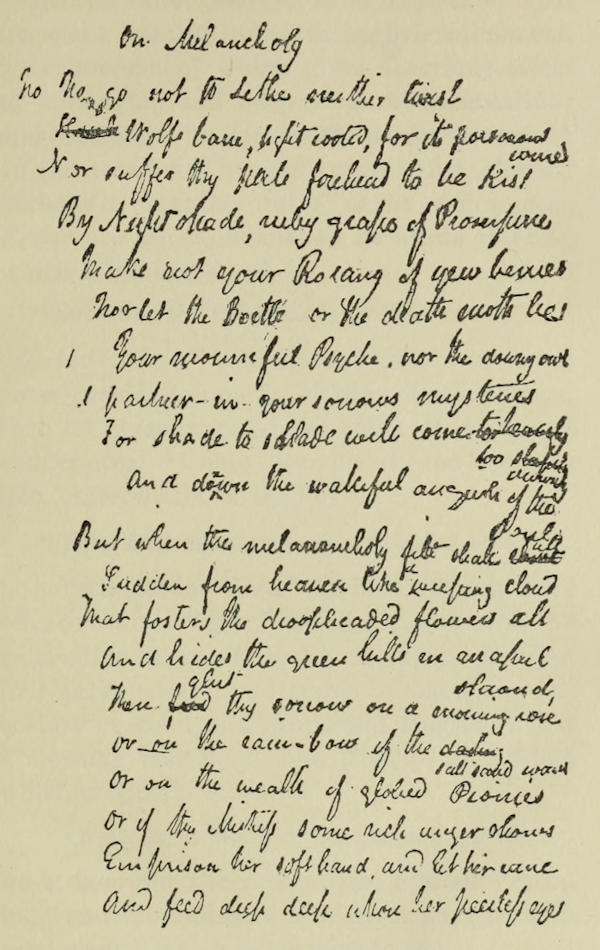
There lies before me a photograph of the first
two stanzas of Keats’s “Ode on Melancholy,”
as they stood when just written. The manuscript
page containing them was given to John
Howard Payne by George Keats, the poet’s
brother, who lived for many years at Louisville,
Kentucky, and died there; but it now belongs
to Mr. R. S. Chilton, United States Consul at
Goderich, Ontario, who has kindly given me a
photograph of it. The verses are in Keats’s well-known
and delicate handwriting, and exhibit a
series of erasures and substitutions which are
now most interesting, inasmuch as the changes
in each instance enrich greatly the value of the
word-painting.
To begin with, the title varies slightly from
that first adopted, and reads simply “On Melancholy,”
to which the word “Ode” was later prefixed
by the printers. In the second line, where
he had half written “Henbane” for the material
of his incantation, he blots it out and puts
“Wolfsbane,” instantly abandoning the tamer
suggestion and bringing in all the wildness and
the superstition that have gathered for years
around the Loup-garou and the Wehr-wolf.
This is plainly no amendment suggested afterward
by another person, but is due unmistakably
to the quick action of his own mind. There is
no other change until the end of the first stanza,
where the last two lines were originally written
thus:—
“For shade to shade will come too heavily
And drown the wakeful anguish of the soul.”
It is noticeable that he originally wrote “down”
for “drown,” and, in afterward inserting the r,
put it in the wrong place—after the o, instead
of before it. This was a slip of the pen only;
but it was that word “heavily” which cost him
a struggle. The words “too heavily” were next
crossed out, and under them were written “too
sleepily”; then this last word was again erased,
and the word “drowsily” was finally substituted—the
only expression in the English language,
perhaps, which could have precisely indicated
the exact shade of debilitating languor
he meant.
In the other stanza, it is noticeable that
he spells “melancholy,” through heedlessness,
“melanancholy,” which gives a curious effect
of prolonging and deepening the incantation;
and this error he does not discover or correct.
In the same way he spells “fit,” “fitt,” having
perhaps in mind the “fytte” of the earlier poets.
These are trifles, but when he alters the line,
which originally stood,—
“But when the melancholy fit shall come,”
and for “come” substitutes “fall,” we see at
once, besides the merit of the soft alliteration,
that he gives more of the effect of doom and
suddenness. “Come” was clearly too business
like. Afterwards, instead of—
“Then feed thy sorrow on a morning rose,”
he substitutes for “feed” the inexpressibly more
effective word “glut,” which gives at once the
exhaustive sense of wealth belonging so often
to Keats’s poetry, and seems to match the full
ecstasy of color and shape and fragrance that
a morning rose may hold. Finally, in the line
which originally stood,—
“Or on the rainbow of the dashing wave,”
he strikes out the rather trite epithet “dashing,”
and substitutes the stronger phrase “salt-sand
wave,” which is peculiar to him.
All these changes are happily accepted in
the common editions of Keats; but these editions
make two errors that are corrected by
this manuscript, and should henceforth be
abandoned. In the line usually printed,—
“Nor let the beetle, nor the death-moth be,”
the autograph text gives “or” in the place of
the second “nor,” a change consonant with the
best usage; and in the line,—
“And hides the green hill in an April shroud,”
the middle word is clearly not “hill,” but “hills.”
This is a distinct improvement, both because it
broadens the landscape and because it averts
the jangle of the closing ll with the final words
“fall” and “all” in previous lines.
It is a fortunate thing that, in the uncertain
destiny of all literary manuscripts, this characteristic
document should have been preserved
for us. It will be remembered that Keats himself
once wrote in a letter that his fondest
prayer, next to that for the health of his brother
Tom, would be that some child of his
brother George “should be the first American
poet.” This letter, printed by Milnes, was
written October 29, 1818. George Keats died
about 1851, and his youngest daughter, Isabel,
who was thought greatly to resemble her uncle
John, both in looks and genius, died sadly at the
age of seventeen. It is pleasant to think that we
have, through the care exercised by this American
brother, an opportunity of coming into
close touch with the mental processes of that
rare genius which first imparted something
like actual color to English words. To be
brought thus near to Keats suggests that poem
by Browning where he speaks of a moment’s
interview with one who had seen Shelley, and
compares it to picking up an eagle’s feather on
a lonely heath.
IV MASSASOIT, INDIAN CHIEF
MASSASOIT, INDIAN CHIEF
There was paid on October 19, 1907, one of the few tributes ever
openly rendered by the white races to the higher type of native Indian
leaders. Such was that given by a large company at Warren,
Rhode Island, to Massasoit, the friendly Indian Sachem who had
first greeted the early Pilgrims, on their arrival at Plymouth in 1620.
The leading address was made by the author of this volume.
The newspaper correspondents tell us that,
when an inquiry was one day made among
visitors returning from the recent Jamestown
Exposition, as to the things seen by each of
them which he or she would remember longest,
one man replied, “That life-size group in the
Smithsonian building which shows John Smith
in his old cock-boat trading with the Indians.
He is giving them beads or something and
getting baskets of corn in exchange.”[1] This
seemed to the speaker, and quite reasonably,
the very first contact with civilization on the
part of the American Indians. Precisely parallel
to this is the memorial which we meet to dedicate,
and which records the first interview in
1620 between the little group of Plymouth
Pilgrims and Massasoit, known as the “greatest
commander of the country,” and “Sachem
of the whole region north of Narragansett
Bay.”[2]
“Heaven from all creatures hides the book
of fate,” says the poet Pope; and nothing is
more remarkable in human history than the
way in which great events sometimes reach
their climax at once, instead of gradually working
up to it. Never was this better illustrated
than when the Plymouth Pilgrims first met the
one man of this region who could guarantee
them peace for fifty years, and did so. The circumstances
seem the simplest of the simple.
The first hasty glance between the Plymouth
Puritans and the Indians did not take place, as
you will recall, until the newcomers had been
four days on shore, when, in the words of the
old chronicler, “they espied five or sixe people
with a Dogge coming towards them, who were
savages: who when they saw them ran into the
Woods and whistled the Dogge after them.”
(This quadruped, whether large or small, had
always a capital letter in his name, while
human savages had none, in these early narratives.)
When the English pursued the Indians,
“they ran away might and main.”[3] The next
interview was a stormier one; four days later,
those same Pilgrims were asleep on board the
“shallope” on the morning of December 8, 1620
(now December 19), when they heard “a great
and strange cry,” and arrow-shots came flying
amongst them which they returned and one
Indian “gave an extraordinary cry” and away
they went. After all was quiet, the Pilgrims
picked up eighteen arrows, some “headed with
brass, some with hart’s horn” (deer’s horn),
“and others with eagles’ claws,”[4] the brass
heads at least showing that those Indians had
met Englishmen before.
Three days after this encounter at Namskeket,—namely,
on December 22, 1620 (a date
now computed as December 23),—the English
landed at Patuxet, now Plymouth. (I know these
particulars as to dates, because I was myself
born on the anniversary of this first date, the
22d, and regarded myself as a sort of brevet
Pilgrim, until men, alleged to be scientific,
robbed me of one point of eminence in my life
by landing the Pilgrims on the 23d). Three
months passed before the sight of any more
Indians, when Samoset came, all alone, with his
delightful salutation, “Welcome, Englishmen,”
and a few days later (March 22, 1621), the great
chief of all that region, Massasoit, appeared on
the scene.
When he first made himself visible, with
sixty men, on that day, upon what is still known
as Strawberry Hill, he asked that somebody
be sent to hold a parley with him. Edmund
Winslow was appointed to this office, and
went forward protected only by his sword and
armor, and carrying presents to the Sachem.
Winslow also made a speech of some length,
bringing messages (quite imaginary, perhaps,
and probably not at all comprehended) from
King James, whose representative, the governor,
wished particularly to see Massasoit. It
appears from the record, written apparently by
Winslow himself, that Massasoit made no particular
reply to this harangue, but paid very
particular attention to Winslow’s sword and
armor, and proposed at once to begin business
by buying them. This, however, was refused,
but Winslow induced Massasoit to cross a brook
between the English and himself, taking with
him twenty of his Indians, who were bidden
to leave their bows and arrows behind them.
Beyond the brook, he was met by Captain
Standish, with an escort of six armed men,
who exchanged salutations and attended him to
one of the best, but unfinished, houses in the
village. Here a green rug was spread on the
floor and three or four cushions. The governor,
Bradford, then entered the house, followed by
three or four soldiers and preceded by a flourish
from a drum and trumpet, which quite delighted
and astonished the Indians. It was a deference
paid to their Sachem. He and the governor
then kissed each other, as it is recorded,
sat down together, and regaled themselves with
an entertainment. The feast is recorded by the
early narrator as consisting chiefly of strong
waters, a “thing the savages love very well,” it
is said; “and the Sachem took such a large
draught of it at once as made him sweat all the
time he staied.”[5]
A substantial treaty of peace was made on
this occasion, one immortalized by the fact that
it was the first made with the Indians of New
England. It is the unquestioned testimony of
history that the negotiation was remembered
and followed by both sides for half a century:
nor was Massasoit, or any of the Wampanoags
during his lifetime, convicted of having
violated or having attempted to violate any of
its provisions. This was a great achievement!
Do you ask what price bought all this? The
price practically paid for all the vast domain
and power granted to the white man consisted
of the following items: “a pair of knives and a
copper chain with a jewel in it, for the grand
Sachem; and for his brother Quadequina, a
knife, a jewel to hang in his ear, a pot of strong
waters, a good quantity of biscuit and a piece
of butter.”[6]
Fair words, the proverb says, butter no parsnips,
but the fair words of the white men had
provided the opportunity for performing that
process. The description preserved of the Indian
chief by an eye-witness is as follows: “In his
person he is a very lusty man in his best years,
an able body, grave of countenance and spare of
speech; in his attire little or nothing differing
from the rest of his followers, only in a great
chain of white bone beads about his neck; and
at it, behind his neck, hangs a little bag of
tobacco, which he drank, and gave us to drink
(this being the phrase for that indulgence in
those days, as is found in Ben Jonson and other
authors). His face was painted with a sad red,
like murrey (so called from the color of the
Moors) and oiled, both head and face, that he
looked greasily. All his followers likewise were
in their faces, in part or in whole painted, some
black, some red, some yellow, and some white,
some with crosses and other antic works; some
had skins on them and some naked: all strong,
tall men in appearance.”[7]
All this which Dr. Young tells us would have
been a good description of an Indian party under
Black Hawk, which was presented to the President
at Washington as late as 1837; and also,
I can say the same of such a party seen by
myself, coming from a prairie in Kansas, then
unexplored, in 1856.
The interchange of eatables was evidently at
that period a pledge of good feeling, as it is
to-day. On a later occasion, Captain Standish,
with Isaac Alderton, went to visit the Indians,
who gave them three or four groundnuts and
some tobacco. The writer afterwards says:
“Our governor bid them send the king’s kettle
and filled it full of pease which pleased them
well, and so they went their way.” It strikes
the modern reader as if this were to make pease
and peace practically equivalent, and as if the
parties needed only a pun to make friends. It
is doubtful whether the arrival of a conquering
race was ever in the history of the world marked
by a treaty so simple and therefore noble.
“This treaty with Massasoit,” says Belknap,
“was the work of one day,” and being honestly
intended on both sides, was kept with fidelity
as long as Massasoit lived.[8] In September, 1639,
Massasoit and his oldest son, Mooanam, afterwards
called Wamsutta, came into the court at
Plymouth and desired that this ancient league
should remain inviolable, which was accordingly
ratified and confirmed by the government,[9] and
lasted until it was broken by Philip, the successor
of Wamsutta, in 1675. It is not my
affair to discuss the later career of Philip, whose
insurrection is now viewed more leniently than
in its own day; but the spirit of it was surely
quite mercilessly characterized by a Puritan minister,
Increase Mather, who, when describing
a battle in which old Indian men and women,
the wounded and the helpless, were burned
alive, said proudly, “This day we brought five
hundred Indian souls to hell.”[10]
But the end of all was approaching. In 1623,
Massasoit sent a messenger to Plymouth to say
that he was ill, and Governor Bradford sent Mr.
Winslow to him with medicines and cordials.
When they reached a certain ferry, upon Winslow’s
discharging his gun, Indians came to him
from a house not far off who told him that
Massasoit was dead and that day buried. As
they came nearer, at about half an hour before
the setting of the sun, another messenger came
and told them that he was not dead, though
there was no hope that they would find him living.
Hastening on, they arrived late at night.
“When we came thither,” Winslow writes,
“we found the house so full of men as we could
scarce get in, though they used their best diligence
to make way for us. There were they in
the midst of their charms for him, making such
a hellish noise as it distempered us that were
well, and therefore unlike to ease him that was
sick. About him were six or eight women, who
chafed his arms, legs and thighs to keep heat
in him. When they had made an end of their
charming, one told him that his friends, the
English, were come to see him. Having understanding
left, but his sight was wholly gone, he
asked who was come. They told him Winsnow,
for they cannot pronounce the letter l, but ordinarily
n in place thereof. He desired to speak
with me. When I came to him and they told
him of it, he put forth his hand to me, which
I took. When he said twice, though very inwardly:
‘Keen Winsnow?’ which is to say ‘Art
thou Winslow?’ I answered: ‘Ahhe’; that is,
‘Yes.’ Then he doubled these words: ‘Matta
neen wonckanet nanem, Winsnow!’ That is to
say: ‘Oh, Winslow, I shall never see thee again!’
Then I called Hobbamock and desired him to
tell Massasowat that the governor, hearing of
his sickness, was sorry for the same; and though
by many businesses he could not come himself,
yet he sent me with such things for him
as he thought most likely to do good in this
extremity; and whereof if he pleased to take, I
would presently give him; which he desired,
and having a confection of many comfortable
conserves on the point of my knife, I gave him
some, which I could scarce get through his
teeth. When it was dissolved in his mouth, he
swallowed the juice of it; whereat those that
were about him much rejoiced, saying that
he had not swallowed anything in two days
before.”[11]
Then Winslow tells how he nursed the sick
chief, sending messengers back to the governor
for a bottle of drink, and some chickens from
which to make a broth for his patient. Meanwhile
he dissolved some of the confection in
water and gave it to Massasoit to drink; within
half an hour the Indian improved. Before the
messengers could return with the chickens,
Winslow made a broth of meal and strawberry-leaves
and sassafras-root, which he strained
through his handkerchief and gave the chief,
who drank at least a pint of it. After this his
sight mended more and more, and all rejoiced
that the Englishman had been the means of
preserving the life of Massasoit. At length the
messengers returned with the chickens, but
Massasoit, “finding his stomach come to him,
... would not have the chickens killed, but
kept them for breed.”
From far and near his followers came to see
their restored chief, who feelingly said: “Now I
see the English are my friends and love me;
and whilst I live I will never forget this kindness
they have showed me.”
It would be interesting, were I to take the
time, to look into the relations of Massasoit
with others, especially with Roger Williams;
but this has been done by others, particularly
in the somewhat imaginative chapter of my old
friend, Mr. Butterworth, and I have already
said enough. Nor can I paint the background of
that strange early society of Rhode Island, its
reaction from the stern Massachusetts rigor,
and its quaint and varied materials. In that
new state, as Bancroft keenly said, there were
settlements “filled with the strangest and
most incongruous elements ... so that if a
man had lost his religious opinions, he might
have been sure to find them again in some village
in Rhode Island.”
Meanwhile “the old benevolent sachem,
Massasoit,” says Drake’s “Book of the Indians,”
“having died in the winter of 1661-2,” so
died, a few months after, his oldest son, Alexander.
Then came by regular succession, Philip,
the next brother, of whom the historian Hubbard
says that for his “ambitious and haughty
spirit he was nicknamed ‘King Philip.’” From
this time followed warlike dismay in the colonies,
ending in Philip’s piteous death.
As a long-deferred memorial to Massasoit
with all his simple and modest virtues, a tablet
has now been reverently dedicated, in the presence
of two of the three surviving descendants
of the Indian chief, one of these wearing his
ancestral robes. The dedication might well
close as it did with the noble words of Young’s
“Night Thoughts,” suited to such an occasion:—
“Each man makes his own stature, builds himself:
Virtue alone outbuilds the Pyramids;
Her monuments shall last when Egypt’s fall.”
V JAMES FENIMORE COOPER
JAMES FENIMORE COOPER
“Cooper, whose name is with his country’s woven
First in her ranks; her Pioneer of mind.”
These were the words in which Fitz-Greene
Halleck designated Cooper’s substantial precedence
in American novel-writing. Apart from
this mere priority in time,—he was born at Burlington,
New Jersey, September 15, 1789, and
died at Cooperstown, New York, September 14,
1851,—he rendered the unique service of inaugurating
three especial classes of fiction,—the
novel of the American Revolution, the Indian
novel, and the sea novel. In each case he wrote
primarily for his own fellow countrymen, and
achieved fame first at their hands; and in each
he produced a class of works which, in spite of
their own faults and of the somewhat unconciliatory
spirit of their writer, have secured a permanence
and a breadth of range unequaled in English
prose fiction, save by Scott alone. To-day
the sale of his works in his own language remains
unabated; and one has only to look over the catalogues
of European booksellers in order to
satisfy himself that this popularity continues, undiminished,
through the medium of translation.
It may be safely said of him that no author of
fiction in the English language, except Scott,
has held his own so well for half a century after
death. Indeed, the list of various editions and
versions of his writings in the catalogues of
German booksellers often exceeds that of Scott.
This is not in the slightest degree due to his
personal qualities, for these made him unpopular,
nor to personal manœuvring, for this he
disdained. He was known to refuse to have his
works even noticed in a newspaper for which
he wrote, the “New York Patriot.” He never
would have consented to review his own books,
as both Scott and Irving did, or to write direct
or indirect puffs of himself, as was done by
Poe and Whitman. He was foolishly sensitive
to criticism, and unable to conceal it; he was
easily provoked to a quarrel; he was dissatisfied
with either praise or blame, and speaks evidently
of himself in the words of the hero of “Miles
Wallingford,” when he says: “In scarce a circumstance
of my life that has brought me in the
least under the cognizance of the public have I
ever been judged justly.” There is no doubt
that he himself—or rather the temperament
given him by nature—was to blame for this,
but the fact is unquestionable.
Add to this that he was, in his way and in what
was unfortunately the most obnoxious way, a
reformer. That is, he was what may be called
a reformer in the conservative direction,—he
belabored his fellow citizens for changing many
English ways and usages, and he wished them
to change these things back again, immediately.
In all this he was absolutely unselfish, but utterly
tactless; and inasmuch as the point of
view he took was one requiring the very greatest
tact, the defect was hopeless. As a rule, no
man criticises American ways so unsuccessfully
as an American who has lived many years
in Europe. The mere European critic is ignorant
of our ways and frankly owns it, even if
thinking the fact but a small disqualification;
while the American absentee, having remained
away long enough to have forgotten many things
and never to have seen many others, may have
dropped hopelessly behindhand as to the facts,
yet claims to speak with authority. Cooper
went even beyond these professional absentees,
because, while they are usually ready to praise
other countries at the expense of America,
Cooper, with heroic impartiality, dispraised all
countries, or at least all that spoke English. A
thoroughly patriotic and high-minded man, he
yet had no mental perspective, and made small
matters as important as great. Constantly reproaching
America for not being Europe, he
also satirized Europe for being what it was.
As a result, he was for a time equally detested
by the press of both countries. The English,
he thought, had “a national propensity to blackguardism,”
and certainly the remarks he drew
from them did something to vindicate the charge.
When the London “Times” called him “affected,
offensive, curious, and ill-conditioned,”
and “Fraser’s Magazine,” “a liar, a bilious
braggart, a full jackass, an insect, a grub, and
a reptile,” they clearly left little for America
to say in that direction. Yet Park Benjamin
did his best, or his worst, when he called Cooper
(in Greeley’s “New Yorker”) “a superlative
dolt and the common mark of scorn and contempt
of every well-informed American”; and
so did Webb, when he pronounced the novelist
“a base-minded caitiff who had traduced his
country.” Not being able to reach his English
opponents, Cooper turned on these Americans,
and spent years in attacking Webb and others
through the courts, gaining little and losing
much through the long vicissitudes of petty
local lawsuits. The fact has kept alive their
memory; but for Lowell’s keener shaft, “Cooper
has written six volumes to show he’s as good
as a lord,” there was no redress. The arrow
lodged and split the target.
Like Scott and most other novelists, Cooper
was rarely successful with his main characters,
but was saved by his subordinate ones. These
were strong, fresh, characteristic, human; and
they lay, as I have already said, in several different
directions, all equally marked. If he did not
create permanent types in Harvey Birch the
spy, Leather-Stocking the woodsman, Long
Tom Coffin the sailor, Chingachgook the Indian,
then there is no such thing as the creation of
characters in literature. Scott was far more profuse
and varied, but he gave no more of life to
individual personages, and perhaps created no
types so universally recognized. What is most
remarkable is that, in the case of the Indian especially,
Cooper was not only in advance of the
knowledge of his own time, but of that of the
authors who immediately followed him. In Parkman
and Palfrey, for instance, the Indian of
Cooper vanishes and seems wholly extinguished;
but under the closer inspection of Alice Fletcher
and Horatio Hale, the lost figure reappears, and
becomes more picturesque, more poetic, more
thoughtful, than even Cooper dared to make
him. The instinct of the novelist turned out
more authoritative than the premature conclusions
of a generation of historians.
It is only women who can draw the commonplace,
at least in English, and make it fascinating.
Perhaps only two English women have
done this, Jane Austen and George Eliot; while
in France George Sand has certainly done it
far less well than it has been achieved by Balzac
and Daudet. Cooper never succeeded in it for
a single instant, and even when he has an admiral
of this type to write about, he puts into
him less of life than Marryat imparts to the
most ordinary midshipman. The talk of Cooper’s
civilian worthies is, as Professor Lounsbury has
well said,—in what is perhaps the best biography
yet written of any American author,—“of
a kind not known to human society.” This
is doubtless aggravated by the frequent use of
thee and thou, yet this, which Professor Lounsbury
attributes to Cooper’s Quaker ancestry,
was in truth a part of the formality of the old
period, and is found also in Brockden Brown.
And as his writings conform to their period in
this, so they did in other respects: describing
every woman, for instance, as a “female,” and
making her to be such as Cooper himself describes
the heroine of “Mercedes of Castile”
to be when he says, “Her very nature is made
up of religion and female decorum.” Scott himself
could also draw such inane figures, yet in
Jeanie Deans he makes an average Scotch
woman heroic, and in Meg Merrilies and Madge
Wildfire he paints the extreme of daring self-will.
There is scarcely a novel of Scott’s where
some woman does not show qualities which
approach the heroic; while Cooper scarcely
produced one where a woman rises even to the
level of an interesting commonplaceness. She
may be threatened, endangered, tormented, besieged
in forts, captured by Indians, but the
same monotony prevails. So far as the real interest
of Cooper’s story goes, it might usually
be destitute of a single “female,” that sex
appearing chiefly as a bundle of dry goods to
be transported, or as a fainting appendage to
the skirmish. The author might as well have
written the romance of an express parcel.
His long introductions he shared with the
other novelists of the day, or at least with Scott,
for both Miss Austen and Miss Edgeworth are
more modern in this respect and strike more
promptly into the tale. His loose-jointed plots
are also shared with Scott, but Cooper knows as
surely as his rival how to hold the reader’s attention
when once grasped. Like Scott’s, too, is
his fearlessness in giving details, instead of the
vague generalizations which were then in fashion,
and to which his academical critics would
have confined him. He is indeed already vindicated
in some respects by the advance of the art
he pursued; where he led the way, the best
literary practice has followed. The “Edinburgh
Review” exhausted its heavy artillery upon him
for his accurate descriptions of costume and
localities, and declared that they were “an epilepsy
of the fancy,” and that a vague general
account would have been far better. “Why
describe the dress and appearance of an Indian
chief, down to his tobacco-stopper and button-holes?”
We now see that it is this very habit
which has made Cooper’s Indian a permanent
figure in literature, while the Indians of his predecessor,
Charles Brockden Brown, were merely
dusky spectres. “Poetry or romance,” continued
the “Edinburgh Review,” “does not descend
into the particulars,” this being the same fallacy
satirized by Ruskin, whose imaginary painter
produced a quadruped which was a generalization
between a pony and a pig. Balzac, who
risked the details of buttons and tobacco pipes
as fearlessly as Cooper, said of “The Pathfinder,”
“Never did the art of writing tread
closer upon the art of the pencil. This is the
school of study for literary landscape painters.”
He says elsewhere: “If Cooper had succeeded
in the painting of character to the same extent
that he did in the painting of the phenomena
of nature, he would have uttered the last word
of our art.” Upon such praise as this the reputation
of James Fenimore Cooper may well
rest.
VI CHARLES BROCKDEN BROWN
CHARLES BROCKDEN BROWN
When, in 1834, the historian Jared Sparks
undertook the publication of a “Library of
American Biography,” he included in the very
first volume—with a literary instinct most
creditable to one so absorbed in the severer
paths of history—a memoir of Charles Brockden
Brown by W. H. Prescott. It was an appropriate
tribute to the first imaginative writer
worth mentioning in America,—he having been
born in Philadelphia, Pennsylvania, on January
17, 1771, and died there of consumption
on February 22, 1810,—and to one who was
our first professional author. He was also the
first to exert a positive influence, across the
Atlantic, upon British literature, laying thus
early a few modest strands towards an ocean-cable
of thought. As a result of this influence,
concealed doors opened in lonely houses, fatal
epidemics laid cities desolate, secret plots were
organized, unknown persons from foreign lands
died in garrets, usually leaving large sums of
money; the honor of innocent women was constantly
endangered, though usually saved in
time; people were subject to somnambulism and
general frenzy; vast conspiracies were organized
with small aims and smaller results. His books,
published between 1798 and 1801, made their
way across the ocean with a promptness that
now seems inexplicable; and Mrs. Shelley, in her
novel of “The Last Man,” founds her whole
description of an epidemic which nearly destroyed
the human race, on “the masterly delineations
of the author of ‘Arthur Mervyn.’”
Shelley himself recognized his obligations to
Brown; and it is to be remembered that Brown
himself was evidently familiar with Godwin’s
philosophical writings, and that he may have
drawn from those of Mary Wollstonecraft his
advanced views as to the rights and education
of women, a subject on which his first book,
“Alcuin,” offered the earliest American protest.
Undoubtedly his books furnished a point
of transition from Mrs. Radcliffe, of whom he
disapproved, to the modern novel of realism, although
his immediate influence and, so to speak,
his stage properties, can hardly be traced later
than the remarkable tale, also by a Philadelphian,
called “Stanley; or the Man of the World,” first
published in 1839 in London, though the scene
was laid in America. This book was attributed,
from its profuse literary quotations, to Edward
Everett, but was soon understood to be the work
of a very young man of twenty-one, Horace
Binney Wallace. In this book the influence of
Bulwer and Disraeli is palpable, but Brown’s concealed
chambers and aimless conspiracies and
sudden mysterious deaths also reappear in full
force, not without some lingering power, and
then vanish from American literature forever.
Brown’s style, and especially the language put
by him into the mouths of his characters, is perhaps
unduly characterized by Professor Woodberry
as being “something never heard off the
stage of melodrama.” What this able critic does
not sufficiently recognize is that the general
style of the period at which they were written
was itself melodramatic; and that to substitute
what we should call simplicity would then have
made the picture unfaithful. One has only to
read over the private letters of any educated
family of that period to see that people did not
then express themselves as they now do; that
they were far more ornate in utterance, more
involved in statement, more impassioned in
speech. Even a comparatively terse writer like
Prescott, in composing Brown’s biography only
sixty years ago, shows traces of the earlier
period. Instead of stating simply that his hero
was a born Quaker, he says of him: “He was
descended from a highly respectable family,
whose parents were of that estimable sect who
came over with William Penn, to seek an asylum
where they might worship their Creator
unmolested, in the meek and humble spirit of
their own faith.” Prescott justly criticises Brown
for saying, “I was fraught with the apprehension
that my life was endangered”; or “his
brain seemed to swell beyond its continent”;
or “I drew every bolt that appended to it”; or
“on recovering from deliquium, you found it
where it had been dropped”; or for resorting to
the circumlocution of saying, “by a common
apparatus that lay beside my head I could produce
a light,” when he really meant that he had
a tinder-box. The criticism on Brown is fair
enough, yet Prescott himself presently takes us
halfway back to the florid vocabulary of that
period, when, instead of merely saying that his
hero was fond of reading, he tells us that “from
his earliest childhood Brown gave evidence of
studious propensities, being frequently noticed
by his father on his return from school poring
over some heavy tome.” If the tome in
question was Johnson’s dictionary, as it may
have been, it would explain both Brown’s style
of writing and the milder amplifications of his
biographer. Nothing is more difficult to tell, in
the fictitious literature of even a generation or
two ago, where a faithful delineation ends and
where caricature begins. The four-story signatures
of Micawber’s letters, as represented by
Dickens, go but little beyond the similar courtesies
employed in a gentlewoman’s letters in
the days of Anna Seward. All we can say is
that within a century, for some cause or other,
English speech has grown very much simpler,
and human happiness has increased in proportion.
In the preface to his second novel, “Edgar
Huntley,” Brown announces it as his primary
purpose to be American in theme, “to exhibit
a series of adventures growing out of our own
country,” adding, “That the field of investigation
opened to us by our own country should
differ essentially from those which exist in Europe
may be readily conceived.” He protests
against “puerile superstition and exploded manners,
Gothic castles and chimeras,” and adds:
“The incidents of Indian hostility and the
perils of the western wilderness are far more
suitable.” All this is admirable, but unfortunately
the inherited thoughts and methods of
the period hung round him to cloy his style,
even after his aim was emancipated. It is to be
remembered that almost all his imaginative
work was done in early life, before the age of
thirty, and before his powers became mature.
Yet with all his drawbacks he had achieved his
end, and had laid the foundation for American
fiction.
With all his inflation of style, he was undoubtedly,
in his way, a careful observer. The
proof of this is that he has preserved for us
many minor points of life and manners which
make the Philadelphia of a century ago now
more familiar to us than is any other American
city of that period. He gives us the roving Indian;
the newly arrived French musician with
violin and monkey; the one-story farmhouses,
where boarders are entertained at a dollar a
week; the gray cougar amid caves of limestone.
We learn from him “the dangers and
toils of a midnight journey in a stage coach in
America. The roads are knee deep in mire,
winding through crags and pits, while the
wheels groan and totter and the curtain and
roof admit the wet at a thousand seams.” We
learn the proper costume for a youth of good
fortune and family,—“nankeen coat striped
with green, a white silk waistcoat elegantly
needle-wrought, cassimere pantaloons, stockings
of variegated silk, and shoes that in their
softness vie with satin.” When dressing himself,
this favored youth ties his flowing locks
with a black ribbon. We find from him that
“stage boats” then crossed twice a day from
New York to Staten Island, and we discover
also with some surprise that negroes were freely
admitted to ride in stages in Pennsylvania,
although they were liable, half a century later,
to be ejected from street-cars. We learn also
that there were negro free schools in Philadelphia.
All this was before 1801.
It has been common to say that Brown had
no literary skill, but it would be truer to say
that he had no sense of literary construction.
So far as skill is tested by the power to pique
curiosity, Brown had it; his chapters almost
always end at a point of especial interest, and
the next chapter, postponing the solution, often
diverts the interest in a wholly new direction.
But literary structure there is none: the plots
are always cumulative and even oppressive;
narrative is inclosed in narrative; new characters
and complications come and go, while important
personages disappear altogether, and
are perhaps fished up with difficulty, as with
a hook and line, on the very last page. There is
also a total lack of humor, and only such efforts
at vivacity as this: “Move on, my quill! wait
not for my guidance. Reanimated with thy
master’s spirit, all airy light. A heyday rapture!
A mounting impulse sways him; lifts
him from the earth.” There is so much of
monotony in the general method, that one novel
seems to stand for all; and the same modes of
solution reappear so often,—somnambulism,
ventriloquism, yellow fever, forged letters, concealed
money, secret closets,—that it not only
gives a sense of puerility, but makes it very
difficult to recall, as to any particular passage,
from which book it came.
VII HENRY DAVID THOREAU
HENRY DAVID THOREAU
There has been in America no such instance
of posthumous reputation as in the case of
Thoreau. Poe and Whitman may be claimed as
parallels, but not justly. Poe, even during his
life, rode often on the very wave of success,
until it subsided presently beneath him, always
to rise again, had he but made it possible.
Whitman gathered almost immediately a small
but stanch band of followers, who have held by
him with such vehemence and such flagrant
imitation as to keep his name defiantly in evidence,
while perhaps enhancing the antagonism
of his critics. Thoreau could be egotistical
enough, but was always high-minded; all was
open and aboveboard; one could as soon conceive
of self-advertising by a deer in the woods
or an otter of the brook. He had no organized
clique of admirers, nor did he possess even
what is called personal charm,—or at least only
that piquant attraction which he himself found
in wild apples. As a rule, he kept men at a distance,
being busy with his own affairs. He left
neither wife nor children to attend to his memory;
and his sister seemed for a time to repress
the publication of his manuscripts. Yet this
plain, shy, retired student, who when thirty-two
years old carried the unsold edition of his
first book upon his back to his attic chamber;
who died at forty-four still unknown to the
general public; this child of obscurity, who
printed but two volumes during his lifetime,
has had ten volumes of his writings published
by others since his death, while four biographies
of him have been issued in America (by Emerson,
Channing, Sanborn, and Jones), besides
two in England (by Page and Salt).
Thoreau was born in Boston on July 12, 1817,
but spent most of his life in Concord, Massachusetts,
where he taught school and was for
three years an inmate of the family of Ralph
Waldo Emerson, practicing at various times the
art of pencil-making—his father’s occupation—and
also of surveying, carpentering, and
housekeeping. So identified was he with the
place that Emerson speaks of it in one case as
Thoreau’s “native town.” Yet from that very
familiarity, perhaps, the latter was underestimated
by many of his neighbors, as was the
case in Edinburgh with Sir Walter Scott, as
Mrs. Grant of Laggan describes.
When I was endeavoring, about 1870, to persuade
Thoreau’s sister to let some one edit his
journals, I invoked the aid of Judge Hoar, then
lord of the manor in Concord, who heard me patiently
through, and then said: “Whereunto?
You have not established the preliminary point.
Why should any one wish to have Thoreau’s
journals printed?” Ten years later, four successive
volumes were made out of these journals
by the late H. G. O. Blake, and it became a
question if the whole might not be published.
I hear from a local photograph dealer in Concord
that the demand for Thoreau’s pictures
now exceeds that for any other local celebrity.
In the last sale catalogue of autographs which
I have encountered, I find a letter from Thoreau
priced at $17.50, one from Hawthorne valued
at the same, one from Longfellow at $4.50 only,
and one from Holmes at $3, each of these being
guaranteed as an especially good autograph letter.
Now the value of such memorials during
a man’s life affords but a slight test of his permanent
standing,—since almost any man’s
autograph can be obtained for two postage-stamps
if the request be put with sufficient ingenuity;—but
when this financial standard can
be safely applied more than thirty years after
a man’s death, it comes pretty near to a permanent
fame.
It is true that Thoreau had Emerson as the
editor of four of his posthumous volumes; but
it is also true that he had against him the vehement
voice of Lowell, whose influence as a critic
was at that time greater than Emerson’s. It will
always remain a puzzle why it was that Lowell,
who had reviewed Thoreau’s first book with cordiality
in the “Massachusetts Quarterly Review,”
and had said to me afterwards, on hearing him
compared to Izaak Walton, “There is room for
three or four Waltons in Thoreau,” should have
written the really harsh attack on the latter
which afterwards appeared, and in which the
plain facts were unquestionably perverted. To
transform Thoreau’s two brief years of study
and observation at Walden, within two miles of
his mother’s door, into a life-long renunciation
of his fellow men; to complain of him as waiving
all interest in public affairs when the great
crisis of John Brown’s execution had found him
far more awake to it than Lowell was,—this
was only explainable by the lingering tradition
of that savage period of criticism, initiated by
Poe, in whose hands the thing became a tomahawk.
As a matter of fact, the tomahawk had
in this case its immediate effect; and the English
editor and biographer of Thoreau has stated
that Lowell’s criticism is to this day the great
obstacle to the acceptance of Thoreau’s writings
in England. It is to be remembered, however,
that Thoreau was not wholly of English
but partly of French origin, and was, it might
be added, of a sort of moral-Oriental, or Puritan
Pagan temperament. With a literary feeling
even stronger than his feeling for nature,—the
proof of this being that he could not, like many
men, enjoy nature in silence,—he put his observations
always on the level of literature,
while Mr. Burroughs, for instance, remains
more upon the level of journalism. It is to be
doubted whether any author under such circumstances
would have been received favorably
in England; just as the poems of Emily Dickinson,
which have shafts of profound scrutiny
that often suggest Thoreau, had an extraordinary
success at home, but fell hopelessly dead in
England, so that the second volume was never
even published.
Lowell speaks of Thoreau as “indolent”;
but this is, as has been said, like speaking of
the indolence of a self-registering thermometer.
Lowell objects to him as pursuing “a seclusion
that keeps him in the public eye”; whereas it
was the public eye which sought him; it was
almost as hard to persuade him to lecture (crede
experto) as it was to get an audience for him
when he had consented. He never proclaimed
the intrinsic superiority of the wilderness, as
has been charged, but pointed out better than
any one else has done its undesirableness as a
residence, ranking it only as “a resource and
a background.” “The partially cultivated country
it is,” he says, “which has chiefly inspired,
and will continue to inspire, the strains of poets
such as compose the mass of any literature.”
“What is nature,” he elsewhere says, “unless
there is a human life passing within it? Many
joys and many sorrows are the lights and shadows
in which she shines most beautiful.” This
is the real and human Thoreau, who often
whimsically veiled himself, but was plainly
enough seen by any careful observer. That he
was abrupt and repressive to bores and pedants,
that he grudged his time to them and frequently
withdrew himself, was as true of him as of
Wordsworth or Tennyson. If they were allowed
their privacy, though in the heart of England,
an American who never left his own broad continent
might at least be allowed his privilege
of stepping out of doors. The Concord school-children
never quarreled with this habit, for
he took them out of doors with him and taught
them where the best whortleberries grew.
His scholarship, like his observation of nature,
was secondary to his function as poet
and writer. Into both he carried the element
of whim; but his version of the “Prometheus
Bound” shows accuracy, and his study of birds
and plants shows care. It must be remembered
that he antedated the modern school, classed
plants by the Linnæan system, and had necessarily
Nuttall for his elementary manual of
birds. Like all observers, he left whole realms
uncultivated; thus he puzzles in his journal
over the great brown paper cocoon of the Attacus
Cecropia, which every village boy brings
home from the winter meadows. If he has not
the specialized habit of the naturalist of to-day,
neither has he the polemic habit; firm beyond
yielding, as to the local facts of his own Concord,
he never quarrels with those who have
made other observations elsewhere; he is involved
in none of those contests in which palæontologists,
biologists, astronomers, have wasted
so much of their lives.
His especial greatness is that he gives us
standing-ground below the surface, a basis not
to be washed away. A hundred sentences might
be quoted from him which make common observers
seem superficial and professed philosophers
trivial, but which, if accepted, place the
realities of life beyond the reach of danger.
He was a spiritual ascetic, to whom the simplicity
of nature was luxury enough; and this, in
an age of growing expenditure, gave him an
unspeakable value. To him, life itself was a
source of joy so great that it was only weakened
by diluting it with meaner joys. This was the
standard to which he constantly held his contemporaries.
“There is nowhere recorded,” he
complains, “a simple and irrepressible satisfaction
with the gift of life, any memorable praise
of God.... If the day and the night are such
that you greet them with joy, and life emits a
fragrance, like flowers and sweet-scented herbs,—is
more elastic, starry, and immortal,—that
is your success.” This was Thoreau, who died
unmarried at Concord, Massachusetts, May 6,
1862.
VIII EMERSON’S “FOOT-NOTE PERSON,”—ALCOTT
EMERSON’S “FOOT-NOTE PERSON,”—ALCOTT
The phrase “foot-note person” was first introduced
into our literature by one of the most
acute and original of the anonymous writers in
the “Atlantic Monthly” (July, 1906), one by
whose consent I am permitted to borrow it
for my present purpose. Its originator himself
suggests, as an illustration of what he means,
the close relation which existed through life
between Ralph Waldo Emerson and his less
famous Concord neighbor, Amos Bronson Alcott.
The latter was doubtless regarded by
the world at large as a mere “foot-note” to his
famous friend, while he yet was doubtless the
only literary contemporary to whom Emerson
invariably and candidly deferred, regarding him,
indeed, as unequivocally the leading philosophic
or inspirational mind of his day. Let this
“foot-note,” then, be employed as the text for
frank discussion of what was, perhaps, the most
unique and picturesque personality developed
during the Transcendental period of our American
literature. Let us consider the career of one
who was born with as little that seemed advantageous
in his surroundings as was the case
with Abraham Lincoln, or John Brown of Ossawatomie,
and who yet developed in the end an
individuality as marked as that of Poe or Walt
Whitman.
In looking back on the intellectual group
of New England, eighty years ago, nothing is
more noticeable than its birth in a circle already
cultivated, at least according to the standard of
its period. Emerson, Channing, Bryant, Longfellow,
Hawthorne, Holmes, Lowell, even Whittier,
were born into what were, for the time
and after their own standard, cultivated families.
They grew up with the protection and stimulus
of parents and teachers; their early biographies
offer nothing startling. Among them
appeared, one day, this student and teacher,
more serene, more absolutely individual, than
any one of them. He had indeed, like every boy
born in New England, some drop of academic
blood within his traditions, but he was born in
the house of his grandfather, a poor farmer in
Wolcott, Connecticut, on November 29, 1799.
He went to the most primitive of wayside
schools, and was placed at fourteen as apprentice
in a clock factory; was for a few years
a traveling peddler, selling almanacs and trinkets;
then wandered as far as North Carolina
and Virginia in a similar traffic; then became
a half-proselyte among Quakers in North Carolina;
then a school-teacher in Connecticut;
always poor, but always thoughtful, ever gravitating
towards refined society, and finally coming
under the influence of that rare and high-minded
man, the Rev. Samuel J. May, and
placing himself at last in the still more favored
position of Emerson’s foot-note. When that
took place, it suddenly made itself clear to the
whole Concord circle that there was not one
among them so serene, so equable, so dreamy,
yet so constitutionally a leader, as this wandering
child of the desert. Of all the men known
in New England, he seemed the one least likely
to have been a country peddler.
Mr. Alcott first visited Concord, as Mr.
Cabot’s memoir of Emerson tells us, in 1835,
and in 1840 came there to live. But it was as
early as May 19, 1837, that Emerson wrote to
Margaret Fuller: “Mr. Alcott is the great man.
His book [‘Conversations on the Gospels’]
does him no justice, and I do not like to see it....
But he has more of the Godlike than any
man I have ever seen and his presence rebukes
and threatens and raises. He is a teacher....
If he cannot make intelligent men feel the presence
of a superior nature, the worse for them;
I can never doubt him.”[12] It is suggested by
Dr. W. T. Harris, one of the two joint biographers
of Alcott, that the description in the last
chapter of Emerson’s book styled “Nature,”
finished in August, 1836, was derived from a
study of Mr. Alcott, and it is certain that there
was no man among Emerson’s contemporaries
of whom thenceforward he spoke with such habitual
deference. Courteous to all, it was to Alcott
alone that he seemed to look up. Not merely
Alcott’s abstract statements, but his personal
judgments, made an absolutely unique impression
upon his more famous fellow townsman. It
is interesting to notice that Alcott, while staying
first in Concord, “complained of lack of
simplicity in A⸺, B⸺, C⸺, and D⸺
(late visitors from the city).” Emerson said approvingly
to his son: “Alcott is right touchstone
to test them, litmus to detect the acid.”[13]
We cannot doubt that such a man’s own judgment
was absolutely simple; and such was
clearly the opinion held by Emerson, who,
indeed, always felt somewhat easier when he
could keep Alcott at his elbow in Concord.
Their mutual confidence reminds one of what
was said long since by Dr. Samuel Johnson,
that poetry was like brown bread: those who
made it in their own houses never quite liked
the taste of what they got elsewhere.
And from the very beginning, this attitude
was reciprocated. At another time during that
same early period (1837), Alcott, after criticising
Emerson a little for “the picture of vulgar
life that he draws with a Shakespearian boldness,”
closes with this fine tribute to the intrinsic
qualities of his newly won friend: “Observe
his style; it is full of genuine phrases
from the Saxon. He loves the simple, the natural;
the thing is sharply presented, yet graced
by beauty and elegance. Our language is a fit
organ, as used by him; and we hear classic
English once more from northern lips. Shakespeare,
Sidney, Browne, speak again to us, and
we recognize our affinity with the fathers of
English diction. Emerson is the only instance
of original style among Americans. Who writes
like him? Who can? None of his imitators,
surely. The day shall come when this man’s
genius shall shine beyond the circle of his own
city and nation. Emerson’s is destined to be
the high literary name of this age.”[14]
No one up to that time, probably, had uttered
an opinion of Emerson quite so prophetic as
this; it was not until four years later, in 1841,
that even Carlyle received the first volume
of Emerson’s “Essays” and said, “It is once
more the voice of a man.” Yet from that
moment Alcott and Emerson became united,
however inadequate their twinship might have
seemed to others. Literature sometimes, doubtless,
makes strange friendships. There is a
tradition that when Browning was once introduced
to a new Chinese ambassador in London,
the interpreter called attention to the fact that
they were both poets. Upon Browning’s courteously
asking how much poetry His Excellency
had thus far written, he replied, “Four
volumes,” and when asked what style of poetic
art he cultivated, the answer was, “Chiefly the
enigmatical.” It is reported that Browning
afterwards charitably or modestly added, “We
felt doubly brothers after that.” It may have
been in a similar spirit that Emerson and his
foot-note might seem at first to have united
their destinies.
Emerson at that early period saw many defects
in Alcott’s style, even so far as to say that it
often reminded him of that vulgar saying, “All
stir and no go”; but twenty years later, in 1855,
he magnificently vindicated the same style, then
grown more cultivated and powerful, and, indeed,
wrote thus of it: “I have been struck with the
late superiority Alcott showed. His interlocutors
were all better than he: he seemed childish
and helpless, not apprehending or answering
their remarks aright, and they masters of their
weapons. But by and by, when he got upon a
thought, like an Indian seizing by the mane and
mounting a wild horse of the desert, he overrode
them all, and showed such mastery, and took up
Time and Nature like a boy’s marble in his hand,
as to vindicate himself.”[15]
A severe test of a man’s depth of observation
lies always in the analysis he gives of his neighbor’s
temperament; even granting this appreciation
to be, as is sometimes fairly claimed, a
woman’s especial gift. It is a quality which certainly
marked Alcott, who once said, for instance,
of Emerson’s combination of a clear voice with
a slender chest, that “some of his organs were
free, some fated.” Indeed, his power in the
graphic personal delineations of those about him
was almost always visible, as where he called
Garrison “a phrenological head illuminated,”
or said of Wendell Phillips, “Many are the
friends of his golden tongue.” This quality I
never felt more, perhaps, than when he once said,
when dining with me at the house of James T.
Fields, in 1862, and speaking of a writer whom
I thought I had reason to know pretty well:
“He has a love of wholeness; in this respect far
surpassing Emerson.”
It is scarcely possible, for any one who recalls
from his youth the antagonism and satire called
forth by Alcott’s “sayings” in the early “Dial,”
to avoid astonishment at their more than contemptuous
reception. Take, for example, in the
very first number the fine saying on “Enthusiasm,”
thus:—
“Believe, youth, that your heart is an oracle; trust
her instinctive auguries; obey her divine leadings;
nor listen too fondly to the uncertain echoes of your
head. The heart is the prophet of your soul, and
ever fulfils her prophecies; reason is her historian;
but for the prophecy, the history would not be....
Enthusiasm is the glory and hope of the world.
It is the life of sanctity and genius; it has wrought
all miracles since the beginning of time.”
Or turn to the following (entitled: “IV. Immortality”):—
“The grander my conception of being, the nobler
my future. There can be no sublimity of life without
faith in the soul’s eternity. Let me live superior
to sense and custom, vigilant alway, and I shall experience
my divinity; my hope will be infinite,
nor shall the universe contain, or content me.”
Or read this (“XII. Temptation”):—
“Greater is he who is above temptation, than
he who, being tempted, overcomes. The latter but
regains the state from which the former has not
fallen. He who is tempted has sinned. Temptation
is impossible to the holy.”
Or this (“LXXXVIII. Renunciation”):—
“Renounce the world, yourself; and you shall
possess the world, yourself, and God.”
These are but fragments, here and there. For
myself, I would gladly see these “Orphic Sayings”
reprinted to-morrow, and watch the astonishment
of men and women who vaguely recall
the derision with which they were first greeted
more than sixty years ago.
When it came to putting into action these
high qualities, the stories relating to Mr. Alcott
which seem most improbable are those which are
unquestionably true, as is that of his way of dealing
with a man in distress who came to beg of
him the loan of five dollars. To this Alcott replied,
after searching his pockets, that he had
no such bank-note about him, but could lend him
ten dollars. This offer was accepted, and Alcott
did not even ask the borrower’s name, and could
merely endure the reproach or ridicule of his
friends for six months; after which the same
man appeared and paid back the money, offering
interest, which was refused. The debtor
turned out to be a well-known swindler, to whom
this trusting generosity had made a novel and
manly appeal.
Truth and honesty are apt to be classed in
men’s minds together, but the power of making
money, or even of returning it when loaned, is
sometimes developed imperfectly among those
who are in other respects wise and good. A curious
illustration of this may be found in the
published memoirs of Mr. Alcott (i, 349), but
it is quite surpassed by the following narrative,
hitherto unpublished, of a subsequent interview,
even more picturesque, and apparently with the
self-same creditor. I take it from his MS. Diary,
where it appears with the formality of arrangement
and beauty of handwriting which mark
that extraordinary work.
(MAMMON)
April, 1839. Thursday, 18th.—
Things seem strange to me out there in Time and
Space. I am not familiar with the order and usages
of this realm. I am at home in the kingdom of the
Soul alone.
This day, I passed along our great thoroughfare,
gliding with Emerson’s check in my pocket, into
State Street; and stepped into one of Mammon’s
temples, for some of the world’s coin, wherewith to
supply bread for this body of mine, and those who
depend upon me. But I felt dishonored by resorting
to these haunts of Idolaters. I went not among them
to dig in the mines of Lucre, nor to beg at the doors
of the God. It was the hour for business on ’Change,
which was swarming with worshippers. Bevies of devotees
were consulting on appropriate rites whereby
to honor their divinity.
One of these devotees (cousin-german of my wife)
accosted me, as I was returning, and asked me to
bring my oblation with the others. Now I owed
the publican a round thousand, which he proffered
me in days when his God prospered his wits; but
I had nothing for him. That small pittance which I
had just got snugly into my fob (thanks to my friend
E⸺) was not for him, but for my wife’s nurse,
and came just in time to save my wife from distrusting
utterly the succors of Providence. I told my man,
that I had no money; but he might have me, if he
wanted me. No: I was bad stock in the market;
and so he bid me good-day. I left the buzz and hum
of these devotees, who represent old Nature’s relation
to the Appetites and Senses, and returned,
with a sense of grateful relief, from this sally into
the Kingdom of Mammon, back to my domicile
in the Soul.
There was, however, strangely developed in
Alcott’s later life an epoch of positively earning
money. His first efforts at Western lectures began
in the winter of 1853-54, and he returned in
February, 1854. He was to give a series of talks
on the representative minds of New England,
with the circle of followers surrounding each; the
subjects of his discourse being Webster, Greeley,
Garrison, Margaret Fuller, Theodore Parker,
Greenough, and Emerson; the separate themes
being thus stated as seven, and the number of
conversations as only six. Terms for the course
were three dollars. By his daughter Louisa’s testimony
he returned late at night with a single dollar
in his pocket, this fact being thus explained
in his own language: “Many promises were not
kept and travelling is costly; but I have opened
the way, and another year shall do better.”[16] At
any rate, his daughter thus pathetically described
his appearance at this interview, as her mother
wrote to a friend: “He looked as cold and thin
as an icicle; but as serene as God.”[17]
There is an almost dramatic interest in transferring
our imaginations to the later visit he
made westward, when he was eighty-one years
old, between October, 1880, and May, 1881. He
then traveled more than five thousand miles,
lectured or held conversations at the rate of
more than one a day, Sundays included, and
came back with a thousand dollars, although
more than half of his addresses had been gratuitous.
For seven years after this he was the
nominal dean of the so-called “School of Philosophy”
in Concord, and for four years took
an active part in its lectures and discussions.
His last written works were most appropriately
two sonnets on “Immortality,” this being the
only theme remaining inexhaustibly open.
Perhaps no two persons in the world were in
their intellectual method more antipodal—to
use one of Alcott’s favorite phrases—than
himself and Parker, though each stood near to
Emerson and ostensibly belonged to the same
body of thinkers. In debate, the mere presence
of Parker made Alcott seem uneasy, as if yielding
just cause for Emerson’s searching inquiry,
“Of what use is genius, if its focus be a little
too short or too long?” No doubt, Mr. Alcott
might well be one of those to whom such criticism
could fitly be applied, just as it has been
used to discourage the printing of Thoreau’s
whole journal. Is it not possible that Alcott’s
fame may yet be brought up gradually and
securely, like Thoreau’s, from those ample and
beautifully written volumes which Alcott left
behind him?
Alcott doubtless often erred, at first, in the
direction of inflation in language. When the
Town and Country Club was organized in Boston,
and had been, indeed, established “largely
to afford a dignified occupation for Alcott,” as
Emerson said, Alcott wished to have it christened
either the Olympian Club or the Pan
Club. Lowell, always quick at a joke, suggested
the substitution of “Club of Hercules” instead
of “Olympian”; or else that, inasmuch as the
question of admitting women was yet undecided,
“The Patty-Pan” would be a better name. But
if Alcott’s words were large, he acted up to them.
When the small assaulting party was driven
back at the last moment from the Court House
doors in Boston, during the Anthony Burns
excitement, and the steps were left bare, the
crowd standing back, it was Alcott who came
forward and placidly said to the ring-leader,
“Why are we not within?” On being told that
the mob would not follow, he walked calmly
up the steps, alone, cane in hand. When a revolver
was fired from within, just as he had
reached the highest step, and he discovered
himself to be still unsupported, he as calmly
turned and walked down without hastening a
footstep. It was hard to see how Plato or
Pythagoras could have done the thing better.
Again, at the outbreak of the Civil War, when
a project was formed for securing the defense
of Washington by a sudden foray into Virginia,
it appears from his Diary that he had been at
the point of joining it, when it was superseded
by the swift progress of events, and so abandoned.
The power of early sectarian training is apt
to tell upon the later years even of an independent
thinker, and so it was with Alcott. In his
case a life-long ideal attitude passed back into
something hard to distinguish from old-fashioned
Calvinism. This was especially noticeable
at the evening receptions of the Rev. Joseph
Cook, who flattered Alcott to the highest degree
and was met at least halfway by the seer
himself. Having been present at one or two of
these receptions, I can testify to the disappointment
inspired in Alcott’s early friends at his
seeming willingness to be made a hero in an
attitude quite alien to that of his former self.
The “New International,” for instance, recognizes
that “in later years his manner became
more formal and his always nebulous teaching
apparently more orthodox.” Be this as it may,
the man whom Emerson called “the most extraordinary
man and highest genius of the
time,” and of whom he says, “As pure intellect
I have never seen his equal,” such a man
needed only the fact of his unprotected footsteps
under fire up the stairs of the Boston
Court House to establish him in history as a
truly all-round man,—unsurpassed among those
of his own generation even in physical pluck.
IX GEORGE BANCROFT
GEORGE BANCROFT
George Bancroft, who died in Washington,
D. C., on January 17, 1891, was born at Worcester,
Massachusetts, October 3, 1800, being the
son of Aaron and Lucretia (Chandler) Bancroft.
His first American ancestor in the male line was
John Bancroft, who came to this country from
England, arriving on June 12, 1632, and settling
at Lynn, Massachusetts. There is no evidence
of any especial literary or scholarly tastes in his
early ancestors, although one at least among
them became a subject for literature, being the
hero of one of Cotton Mather’s wonderful tales
of recovery from smallpox. Samuel Bancroft,
grandfather of the great historian, was a man
in public station, and is described by Savage as
“possessing the gift of utterance in an eminent
degree”; and the historian’s father, Rev. Aaron
Bancroft, D. D., was a man of mark. He was
born in 1755, fought at Lexington and Bunker
Hill when almost a boy, was graduated at Harvard
College in 1778, studied for the ministry,
preached for a time in Nova Scotia, was settled
at Worcester in 1788, and died there in 1839.
He was a member of the American Academy
of Arts and Sciences, was an Arminian in
theology, and in later life was President of the
American Unitarian Association. He published
various occasional sermons, a volume of doctrinal
discourses, and (in 1807) a “Life of Washington,”
which was reprinted in England, and
rivaled in circulation the larger work of Marshall,
which appeared at about the same time.
He thus bequeathed literary tastes to his thirteen
children; and though only one of these
reached public eminence, yet three of the daughters
were prominent for many years in Worcester,
being in charge of a school for girls, and
highly esteemed; while another sister was well
known in Massachusetts and at Washington as
the wife of Governor (afterwards Senator) John
Davis.
George Bancroft was fitted for college at
Exeter Academy, where he was especially noted
for his fine declamation. He entered Harvard
College in 1813, taking his degree in 1817. He
was the classmate of four men destined to be
actively prominent in the great anti-slavery
agitation a few years later,—Samuel J. May,
Samuel E. Sewall, David Lee Child, and Robert
F. Wallcut,—and of one prospective opponent
of it, Caleb Cushing. Other men of note in the
class were the Rev. Stephen H. Tyng, D. D.,
the Rev. Alva Woods, D. D., and Samuel A.
Eliot, afterwards Treasurer of the College and
father of its recent President. Mr. Bancroft
was younger than any of these, and very probably
the youngest in his class, being less than
seventeen at graduation. He was, however,
second in rank, and it happened that Edward
Everett, then recently appointed Professor of
Greek Literature in that institution, had proposed
that some young graduate of promise
should be sent to Germany for purposes of
study, that he might afterwards become one of
the corps of Harvard instructors. Accordingly,
Bancroft was selected, and went, in the early
summer of 1818, to Göttingen. At that time the
University had among its professors Eichhorn,
Heeren, and Blumenbach. He also studied at
Berlin, where he knew Schleiermacher, Savigny,
and Wilhelm von Humboldt. At Jena he saw
Goethe, and at Heidelberg studied under Schlosser.
This last was in the spring of 1821, when
he had already received his degree of Ph. D. at
Göttingen and was making the tour of Europe.
At Paris he met Cousin, Constant, and Alexander
von Humboldt; he knew Manzoni at
Milan, and Bunsen and Niebuhr at Rome. The
very mention of these names seems to throw
his early career far back into the past. Such
experiences were far rarer then than now, and
the return from them into what was the village-like
life of Harvard College was a far greater
change. Yet he came back at last and discharged
his obligations, in a degree, by a year’s
service as Greek tutor.
It was not, apparently, a satisfactory position,
for although he dedicated a volume of poems
to President Kirkland, “with respect and affection,”
as to his “early benefactor and friend,”
yet we have the testimony of George Ticknor
(in Miss Ticknor’s Life of J. G. Cogswell) that
Bancroft was “thwarted in every movement by
the President.” Mr. Ticknor was himself a professor
in the college, and though his view may
not have been dispassionate, he must have had
the opportunity of knowledge. His statement
is rendered more probable by the fact that he
records a similar discontent in the case of Professor
J. G. Cogswell, who was certainly a man
of conciliatory temperament. By Ticknor’s account,
Mr. Cogswell, who had been arranging the
Harvard College Library and preparing the catalogue,
was quite unappreciated by the Corporation,
and though Ticknor urged both him and
Bancroft to stay, they were resolved to leave,
even if their proposed school came to nothing.
The school in question was the once famous
“Round Hill” at Northampton, in which enterprise
Cogswell, then thirty-six, and Bancroft,
then twenty-three, embarked in 1823. The latter
had already preached several sermons, and
seemed to be feeling about for his career; but
it now appeared as if he had found it.
In embarking, however, he warbled a sort of
swan-song at the close of his academical life, and
published in September, 1823, a small volume
of eighty pages, printed at the University Press,
Cambridge, and entitled “Poems by George Bancroft.
Cambridge: Hilliard & Metcalf.” Some
of these were written in Switzerland, some in
Italy, some, after his return home, at Worcester;
but almost all were European in theme,
and neither better nor worse than the average
of such poems by young men of twenty or thereabouts.
The first, called “Expectation,” is the
most noticeable, for it contains an autobiographical
glimpse of this young academical Childe
Harold setting forth on his pilgrimage:—
“’Twas in the season when the sun
More darkly tinges spring’s fair brow,
And laughing fields had just begun
The summer’s golden hues to show.
Earth still with flowers was richly dight,
And the last rose in gardens glowed;
In heaven’s blue tent the sun was bright,
And western winds with fragrance flowed;
’Twas then a youth bade home adieu;
And hope was young and life was new,
When first he seized the pilgrim’s wand
To roam the far, the foreign land.
“There lives the marble, wrought by art.
That clime the youth would gain; he braves
The ocean’s fury, and his heart
Leaps in him, like the sunny waves
That bear him onward; and the light
Of hope within his bosom beams,
Like the phosphoric ray at night
That round the prow so cheerly gleams.
But still his eye would backward turn,
And still his bosom warmly burn,
As towards new worlds he ’gan to roam,
With love for Freedom’s Western home.”
This is the opening poem; the closing words
of the book, at the end of the final “Pictures
of Rome,” are in a distinctly patriotic strain:—
“Farewell to Rome; how lovely in distress;
How sweet her gloom; how proud her wilderness!
Farewell to all that won my youthful heart,
And waked fond longings after fame. We part.
The weary pilgrim to his home returns;
For Freedom’s air, for Western climes he burns;
Where dwell the brave, the generous, and the free,
O! there is Rome; no other Rome for me.”
It was in order to train these young children
of the Republic—“the brave, the generous,
and the free”—that Bancroft entered upon
the “Round Hill” enterprise.
This celebrated school belonged to that class
of undertakings which are so successful as
to ruin their projectors. It began in a modest
way; nothing could be more sensible than the
“Prospectus,”—a pamphlet of twenty pages,
issued at Cambridge, June 20, 1823. In this
there is a clear delineation of the defects then
existing in American schools; and a modest
promise is given that, aided by the European
experience of the two founders, something like
a French collège or a German gymnasium might
be created. There were to be not more than
twenty pupils, who were to be from nine to
twelve on entering. A fine estate was secured
at Northampton, and pupils soon came in.
Then followed for several years what was
at least a very happy family. The school was
to be in many respects on the German plan:
farm life, friendly companionship, ten-mile rambles
through the woods with the teachers, and
an annual walking tour in the same company.
All instruction was to be thorough; there was
to be no direct emulation, and no flogging.
There remain good delineations of the school
in the memoirs of Dr. Cogswell, and in a paper
by the late T. G. Appleton, one of the pupils.
It is also described by Duke Bernard of Saxe-Weimar
in his “Travels.” The material of the
school was certainly fortunate. Many men afterwards
noted in various ways had their early
training there: J. L. Motley, H. W. Bellows,
R. T. S. Lowell, F. Schroeder, Ellery Channing,
G. E. Ellis, Theodore Sedgwick, George C.
Shattuck, S. G. Ward, R. G. Shaw, N. B. Shurtleff,
George Gibbs, Philip Kearney, R. G. Harper.
At a dinner given to Dr. Cogswell in 1864, the
most profuse expressions of grateful reminiscence
were showered upon Mr. Bancroft, though
he was then in Europe. The prime object of
the school, as stated by Mr. Ticknor, was “to
teach more thoroughly than has ever been taught
among us.” How far this was accomplished can
only be surmised; what is certain is that the
boys enjoyed themselves. They were admirably
healthy, not having a case of illness for sixteen
months, and they were happy. When we
say that, among other delights, the boys had a
large piece of land where they had a boy-village
of their own, a village known as Cronyville, a
village where each boy erected his own shanty
and built his own chimney, where he could
roast apples and potatoes on a winter evening
and call the neighbors in,—when each boy had
such absolute felicity as this, with none to molest
him or make him afraid, there is no wonder
that the “old boys” were ready to feast their
kindly pedagogues forty years later.
But to spread barracks for boys and crony
villages over the delightful hills of Northampton
demanded something more than kindliness;
it needed much administrative skill and some
money. Neither Cogswell nor Bancroft was a
man of fortune. Instead of twenty boys, they
had at one time one hundred and twenty-seven,
nearly fifty of whom had to be kept through the
summer vacation. They had many Southern
pupils and, as an apparent consequence, many
bad debts, Mr. Cogswell estimating a loss of
two thousand dollars from this cause in a single
year; and sometimes they had to travel southward
to dun delinquent parents. The result of
it all was that Bancroft abandoned the enterprise
after seven years, in the summer of 1830;
while Cogswell, who held on two years longer,
retired with health greatly impaired and a financial
loss of twenty thousand dollars. Thus ended
the Round Hill School.
While at Round Hill, Mr. Bancroft prepared
some text-books for his pupils, translating Heeren’s
“Politics of Ancient Greece” (1824) and
Jacobs’s Latin Reader (1825),—the latter going
through several editions. His first article in the
“North American Review,” then the leading
literary journal in the United States, appeared
in October, 1823, and was a notice of Schiller’s
“Minor Poems,” with many translations. From
this time forward he wrote in almost every volume,
but always on classical or German themes,
until in January, 1831, he took up “The Bank
of the United States,” and a few years later
(October, 1835), “The Documentary History of
the Revolution.” These indicated the progress
of his historical studies, which had also begun at
Round Hill, and took form at last in his great
history. The design of this monumental work
was as deliberate as Gibbon’s, and almost as
vast; and the author lived, like Gibbon, to see
it accomplished. The first volume appeared in
1834, the second in 1837, the third in 1840, the
fourth in 1852, and so onward. Between these
volumes was interspersed a variety of minor essays,
some of which were collected in a volume
of “Literary and Historical Miscellanies,” published
in 1855. Bancroft also published, as a
separate work, a “History of the Formation of
the Constitution of the United States” (1882).
While at Northampton, he was an ardent
Democrat of the most theoretic and philosophic
type, and he very wisely sought to acquaint
himself with the practical side of public affairs.
In 1826 he gave an address at Northampton,
defining his position and sympathies; in 1830
he was elected to the Legislature, but declined
to take his seat, and the next year refused a
nomination to the Senate. In 1835 he drew up
an address to the people of Massachusetts, made
many speeches and prepared various sets of
resolutions, was flattered, traduced, caricatured.
From 1838 to 1841 he was Collector of the Port
of Boston; in 1844 he was Democratic candidate
for Governor of Massachusetts, but was
defeated,—George N. Briggs being his successful
antagonist,—although he received more
votes than any Democratic candidate before
him. In 1845 he was Secretary of the Navy
under President Polk. In all these executive
positions he may be said to have achieved success.
It was, for instance, during his term of
office that the Naval Academy was established
at Annapolis; it was he who gave the first order
to take possession of California; and he who,
while acting for a month as Secretary of War,
gave the order to General Taylor to march into
Texas, thus ultimately leading to the annexation
of that state. This, however, identified
him with a transaction justly censurable, and
indeed his whole political career occurred during
the most questionable period of Democratic
subserviency to the slave power, and that weakness
was never openly—perhaps never sincerely—resisted
by him. This left a reproach
upon his earlier political career which has,
however, been effaced by his literary life and
his honorable career as a diplomatist. In 1846
he was transferred from the Cabinet to the
post of Minister Plenipotentiary to Great Britain,
where he contrived to combine historical
researches with public functions. In 1849 he
returned to this country—a Whig administration
having been elected—and took up his residence
in New York. In February, 1866, he was
selected by Congress to pronounce a eulogy on
President Lincoln, and in the following year he
was appointed Minister to Prussia, being afterwards
successively accredited to the North German
Confederation and the German Empire.
In these positions he succeeded in effecting
some important treaty provisions in respect to
the rights of naturalized German citizens residing
in Germany. He was recalled at his own
request in 1874, and thenceforward resided in
Washington in the winter, and at Newport,
Rhode Island, in summer.
Dividing his life between these two abodes,
he passed his later years in a sort of existence
more common in Europe than here,—the well-earned
dignity of the scholar who has also been,
in his day, a man of affairs, and who is yet too
energetic to repose upon his laurels or waste
much time upon merely enjoying the meed of
fame he has won. In both his winter and summer
abodes he had something of the flattering
position of First Citizen; he was free of all
sets, an honored member of all circles. His
manners were often mentioned as “courtly,”
but they never quite rose to the level of either
of the two classes of manner described by
Tennyson:—
“Kind nature is the best, those manners next
That fit us like a nature second-hand;
Which are indeed the manners of the great.”
Neither of these descriptions exactly fitted
Mr. Bancroft; his manners were really of the
composite sort, and curiously suggestive of
the different phases of his life. They were
like that wonderful Japanese lacquer-work, made
up of twenty or thirty different coats or films,
usually laid on by several different workmen.
There was at the foundation the somewhat formal
and literal manner of the scholar, almost
of the pedagogue: then one caught a glimpse
of an executive, official style, that seemed to
date from the period when he ordered California
to be occupied; and over all there was a varnish
of worldly courtesy, enhanced by an evident
pleasure in being admired, and broken by an
occasional outburst of rather blunt sincerity.
But he matured and mellowed well; his social
life at Washington was more satisfactory to
himself and others than that he led in New
York; he had voluntarily transplanted himself
to a community which, with all its faults and
crudities, sets intellect above wealth, and readily
conceded the highest place to a man like Bancroft.
Foreign ministers came accredited to him
as well as to the government; he was the friend
of every successive administration, and had as
many guests as he cared to see at his modest
Sunday evening receptions. There he greeted
every one cordially, aided by a wife amply gifted
in the amenities. He was kind to everybody,
and remembered the father or grandfather of
anybody who had any such ancestors whom it
was desirable to mention. In summer, at Newport,
it was the same; his residence was like
that described by his imagination in one of his
own early poems—
“Where heaven lends her loveliest scene,
A softened air, a sky serene,
Along the shore where smiles the sea.”
Unlike most Newport “cottages,” his house
was within sight of the ocean; between it and
the sea lay the garden, and the “rose in Kenmure’s
cap” in the Scottish ballad was not a
characteristic more invariable than the same
flower in Mr. Bancroft’s hand or buttonhole.
His form was familiar, too, on Bellevue Avenue,
taking as regularly as any old-fashioned
Englishman his daily horseback exercise. At
the same time he was one of the few men who
were capable, even in Newport, of doing daily
the day’s work; he rose fabulously early in the
morning, and kept a secretary or two always
employed. Since John Quincy Adams, there has
not been among us such an example of laborious,
self-exacting, seemingly inexhaustible old
age; and, unlike Adams, Mr. Bancroft kept his
social side always fresh and active, and did not
have, like the venerable ex-President, to force
himself out in the evening in order “to learn
the art of conversation.” This combination,
with his monumental literary work, will keep
his memory secure. It will possibly outlive that
of many men of greater inspiration, loftier aims,
and sublimer qualities.
Mr. Bancroft, as an historian, combined some
of the greatest merits and some of the profoundest
defects ever united in a single author.
His merits are obvious enough. He had great
enthusiasm for his subject. He was profoundly
imbued with that democratic spirit without
which the history of the United States cannot
be justly written. He has the graphic quality
so wanting in Hildreth, and the piquancy whose
absence makes Prescott too smooth. He has a
style essentially picturesque, whatever may be
its faults. The reader is compelled to admit that
his resources in the way of preparation are
inexhaustible, and that his command of them
is astounding. One must follow him minutely,
for instance, through the history of the War for
Independence, to appreciate in full the consummate
grasp of a mind which can deploy military
events in a narrative as a general deploys
brigades in a field. Add to this the capacity
for occasional maxims to the highest degree
profound and lucid, in the way of political philosophy,
and you certainly combine in one man
some of the greatest qualities of the historian.
Against this are to be set very grave faults.
In his earlier editions there was an habitual
pomposity and inflation of style which the
sterner taste of his later years has so modified
that we must now condone it. The same heroic
revision has cut off many tame and commonplace
remarks as trite as those virtuous truisms
by which second-rate actors bring down the applause
of the galleries at cheap theatres. Many
needless philosophical digressions have shared
the same fate. But many faults remain. There
is, in the first place, that error so common with
the graphic school of historians,—the exaggerated
estimate of manuscript or fragmentary
material at the expense of what is printed and
permanent. In many departments of history
this dependence is inevitable; but, unfortunately,
Mr. Bancroft was not, except in the very
earliest volumes of his history, dealing with
such departments. The loose and mythical period
of our history really ends with Captain John
Smith. From the moment when the Pilgrims
landed, the main facts of American history are
to be found recorded in a series of carefully
prepared documents, made by men to whom the
pen was familiar, and who were exceedingly
methodical in all their ways. The same is true
of all the struggles which led to the Revolution,
and of all those which followed. They were the
work of honest-minded Anglo-Saxon men who,
if they issued so much as a street hand-bill, said
just what they meant, and meant precisely what
they said. To fill the gaps in this solid documentary
chain is, no doubt, desirable,—to fill
them by every passing rumor, every suggestion
of a French agent’s busy brain; but to substitute
this inferior matter for the firmer basis is wrong.
Much of the graphic quality of Mr. Bancroft’s
writing is obtained by this means, and this portends,
in certain directions, a future shrinkage
and diminution in his fame.
A fault far more serious than this is one
which Mr. Bancroft shared with his historical
contemporaries, but in which he far exceeded
any of them,—an utter ignoring of the very
meaning and significance of a quotation-mark.
Others of that day sinned. The long controversy
between Jared Sparks and Lord Mahon grew out
of this,—from the liberties taken by Sparks in
editing Washington’s letters. Professor Edward
T. Channing did the same thing in quoting the
racy diaries of his grandfather, William Ellery,
and substituting, for instance, in a passage cited
as original, “We refreshed ourselves with meat
and drink,” for the far racier “We refreshed
our Stomachs with Beefsteaks and Grogg.”
Hildreth, in quoting from the “Madison Papers,”
did the same, for the sake not of propriety, but
of convenience; even Frothingham made important
omissions and variations, without indicating
them, in quoting Hooke’s remarkable
sermon, “New England’s Teares.” But Bancroft
is the chief of sinners in this respect;
when he quotes a contemporary document or
letter, it is absolutely impossible to tell, without
careful verifying, whether what he gives us
between the quotation-marks is precisely what
should be there, or whether it is a compilation,
rearrangement, selection, or even a series of
mere paraphrases of his own. It would be easy
to illustrate this abundantly, especially from the
Stamp Act volume; but a single instance will
suffice.
When, in 1684, an English fleet sailed into
Boston harbor, ostensibly on its way to attack
the Dutch settlements on the Hudson, it left
behind a royal commission, against whose mission
of interference the colonial authorities at
once protested, and they issued a paper, as one
historian has said, “in words so clear and dignified
as to give a foretaste of the Revolutionary
state papers that were to follow a century
later.” If ever there was a document in our pre-Revolutionary
history that ought to be quoted
precisely as it was written, or not at all, it was
this remonstrance. It thus begins in Bancroft’s
version, and the words have often been cited
by others. He says of the colony of Massachusetts:
“Preparing a remonstrance, not against
deeds of tyranny, but the menace of tyranny,
not against actual wrong, but against a principle
of wrong, on the 25th of October, it thus addressed
King Charles II.” The alleged address
is then given, apparently in full, and then follows
the remark, “The spirit of the people corresponded
with this address.” It will hardly be
believed that there never was any such address,
and that no such document was ever in existence
as that so formally cited here. Yet any
one who will compare Bancroft’s draft with the
original in the Records of Massachusetts (volume
iv, part 2, pages 168-169) will be instantly
convinced of this. Bancroft has simply taken
phrases and sentences here and there from a
long document and rearranged, combined, and,
in some cases, actually paraphrased them in his
own way. Logically and rhetorically the work
is his own. The colonial authorities adopted
their own way of composition, and he adopted
his. In some sentences we have Bancroft, not
Endicott; the nineteenth century, not the seventeenth.
Whether the transformation is an improvement
or not is not the question; the thing
cited is not the original. An accurate historian
would no more have issued such a restatement
under the shelter of quotation-marks than an
accurate theologian would have rewritten the
Ten Commandments and read his improved
edition from the pulpit. And it is a curious fact
that while Mr. Bancroft has amended so much
else in his later editions, he has left this passage
untouched, and still implies an adherence
to the tradition that this is the way to write
history.
It is also to be noted that the evil is doubled
when this practice is combined with the other
habit, already mentioned, of relying largely
upon manuscript authorities. If an historian
garbles, paraphrases, and rearranges when he
is dealing with matter accessible to all, how
much greater the peril when he is dealing with
what is in written documents held under his
own lock and key. It is not necessary to allege
intentional perversion, but we are, at the very
least, absolutely at the mercy of an inaccurate
habit of mind. The importance of this point is
directly manifested on opening the leaves of
Mr. Bancroft’s last and perhaps most valuable
book, “The History of the Constitution.” The
most important part of this book consists, by
concession of all, in the vast mass of selections
from the private correspondence of the period:
for instance, of M. Otto, the French Ambassador.
We do not hesitate to say that, if tried by
the standard of Mr. Bancroft’s previous literary
methods, this mass of correspondence, though
valuable as suggestion, is worthless as authority.
Until it has been carefully collated and compared
with the originals, we do not know that
a paragraph or a sentence of it is left as the
author wrote it; the system of paraphrase previously
exhibited throws the shadow of doubt
over all. No person can safely cite one of these
letters in testimony; no person knows whether
any particular statement contained in it comes
to us in the words of its supposed author or of
Mr. Bancroft. It is no answer to say that this
loose method was the method of certain Greek
historians; if Thucydides composed speeches
for his heroes, it was at least known that he
prepared them, and there was not the standing
falsehood of a quotation-mark.
A drawback quite as serious is to be found
in this, that Mr. Bancroft’s extraordinary labors
in old age were not usually devoted to revising
the grounds of his own earlier judgments, but
to perfecting his own style of expression, and to
weaving in additional facts at those points which
especially interested him. Professor Agassiz
used to say that the greatest labor of the student
of biology came from the enormous difficulty
of keeping up with current publications
and the proceedings of societies; a man could
carry on his own observations, but he could not
venture to publish them without knowing all
the latest statements made by other observers.
Mr. Bancroft had to encounter the same obstacle
in his historical work, and it must be owned
that he sometimes ignored it. Absorbed in his
own great stores of material, he often let the
work of others go unobserved. It would be easy
to multiply instances. Thus, the controversies
about Verrazzano’s explorations were conveniently
settled by omitting his name altogether;
there was no revision of the brief early statement
that the Norse sagas were “mythological,”
certainly one of the least appropriate
adjectives that could have been selected; Mr.
Bancroft never even read—up to within a few
years of his death, at any rate—the important
monographs of Varnhagen in respect to Amerigo
Vespucci; he did not keep up with the publications
of the historical societies. Laboriously
revising his whole history in 1876, and almost
rewriting it for the edition of 1884, he allowed
the labors of younger investigators to go on
around him unobserved. The consequence is
that much light has been let in upon American
history in directions where he has not so much
as a window; and there are points where his
knowledge, vast as it is, will be found to have
been already superseded. In this view, that cannot
be asserted of him which the late English
historian, Mr. J. R. Green, proudly and justly
claimed for himself: “I know what men will
say of me—he died learning.” But Mr. Bancroft
at least died laboring, and in the harness.
Mr. Bancroft was twice married, first to Miss
Sarah H. Dwight, who died June 26, 1837, and
in the following year to Mrs. Elizabeth (Davis)
Bliss. By the first marriage he had several children,
of whom John Chandler (Harvard, 1854)
died in Europe, and George (Harvard, 1856)
has spent most of his life in foreign countries.
X CHARLES ELIOT NORTON
CHARLES ELIOT NORTON
It is a tradition in the city of Cambridge,
Massachusetts, that Howells used to exult, on
arriving from his Western birthplace, in having
at length met for the first time, in Charles Eliot
Norton, the only man he had ever seen who
had been cultivated up to the highest point of
which he was capable. To this the verdict of all
Cambridge readily assented. What the neighbors
could not at that time foresee was that the
man thus praised would ever live to be an octogenarian,
or that in doing so he would share
those attractions of constantly increasing mildness
and courtesy which are so often justly
claimed for advancing years. There was in him,
at an earlier period, a certain amount of visible
self-will, and a certain impatience with those
who dissented from him,—he would not have
been his father’s son had it been otherwise. But
these qualities diminished, and he grew serener
and more patient with others as the years went
on. Happy is he who has lived long enough to
say with Goethe, “It is only necessary to grow
old to become more indulgent. I see no fault
committed which I have not committed myself.”
This milder and more genial spirit increased
constantly as Norton grew older, until it served
at last only to make his high-bred nature more
attractive.
He was born in Cambridge, November 16,
1827, and died in the very house where he was
born, October 21, 1908. He was descended, like
several other New England authors, from a
line of Puritan clergymen. He was the son of
Professor Andrews Norton, of Harvard University,
who was descended from the Rev. John
Norton, born in Ipswich, Massachusetts, in 1651.
The mother of the latter was the daughter of
Emanuel Downing, and the niece of Governor
John Winthrop. Mrs. Bradstreet, the well-known
Puritan poetess, was also an ancestress
of Charles Norton. His mother, Mrs. Caroline
(Eliot) Norton, had also her ancestry among
the most cultivated families in New England,
the name of Eliot having been prominent for
successive generations in connection with Harvard
College. His parents had a large and beautiful
estate in Cambridge, and were (if my memory
serves me right) the one family in Cambridge
that kept a carriage,—a fact the more impressed
upon remembrance because it bore the initials
“A. & C. N.” upon the panels, the only instance
I have ever seen in which the two joint proprietorships
were thus expressed. This, and
the fact that I learned by heart in childhood
Wordsworth’s poem, “The White Doe of Rylstone,
or The Fate of the Nortons,” imparted
to my youthful mind a slight feeling of romance
about the Cambridge household of that name,
which was not impaired by the fact that our
parents on both sides were intimate friends,
that we lived in the same street (now called
Kirkland Street), and that I went to dancing-school
at the Norton house. It is perhaps humiliating
to add that I disgraced myself on the
very first day by cutting off little Charlie’s front
hair as a preliminary to the dancing lesson.
The elder Professor Norton was one of the
most marked characters in Cambridge, and,
although never a clergyman, was professor in
the Theological School. It was said of him by
George Ripley, with whom he had a bitter contest,
that “He often expressed rash and hasty
judgments in regard to the labors of recent or
contemporary scholars, consulting his prejudices,
as it would seem, rather than competent
authority. But in his own immediate department
of sacred learning he is entitled to the praise of
sobriety of thought and profoundness of investigation”
(Frothingham’s “Ripley,” 105). He was
also a man of unusual literary tastes, and his
“Select Journal of Foreign Periodical Literature,”
although too early discontinued, took distinctly
the lead of all American literary journals
up to that time.
The very beginning of Charles Norton’s career
would seem at first sight singularly in contrast
with his later pursuits, and yet doubtless
had formed, in some respects, an excellent preparation
for them. Graduating at Harvard in
1846, and taking a fair rank at graduation, he
was soon after sent into a Boston counting-house
to gain a knowledge of the East India trade.
In 1849 he went as supercargo on a merchant
ship bound for India, in which country he traveled
extensively, and returned home through
Europe in 1851. There are few more interesting
studies in the development of literary
individuality than are to be found in the successive
works bearing Norton’s name, as one
looks through the list of them in the Harvard
Library. The youth who entered upon literature
anonymously, at the age of twenty-five, as
a compiler of hymns under the title of “Five
Christmas Hymns” in 1852, and followed this
by “A Book of Hymns for Young Persons”
in 1854, did not even flinch from printing the
tragically Calvinistic verse which closes Addison’s
famous hymn, beginning “The Lord my
pasture shall prepare,” with a conclusion so
formidable as death’s “gloomy horrors” and
“dreadful shade.” In 1855 he edited, with Dr.
Ezra Abbot, his father’s translations of the Gospels
with notes (2 vols.), and his “Evidences
of the Genuineness of the Gospels” (3 vols.).
Charles Norton made further visits to Europe
in 1855-57, and again resided there from 1868
until 1873; during which time his rapidly expanding
literary acquaintanceships quite weaned
his mind from the early atmosphere of theology.
Although one of the writers in the very first
number of the “Atlantic Monthly,” he had no
direct part in its planning. He wrote to me
(January 9, 1899), “I am sorry that I can tell you
nothing about the primordia of the ‘Atlantic.’
I was in Europe in 1856-57, whence I brought
home some MSS. for the new magazine.” It
appears from his later statement in the Anniversary
Number that he had put all these manuscripts
by English authors in a trunk together,
but that this trunk and all the manuscripts were
lost, except one accidentally left unpacked, which
was a prose paper by James Hannay on Douglas
Jerrold, “who is hardly,” as Norton justly says,
“to be reckoned among the immortals.” Hannay
is yet more thoroughly forgotten. But this inadequate
service in respect to foreign material
was soon more than balanced, as one sees on
tracing the list of papers catalogued under Norton’s
name in the Atlantic Index.
To appreciate the great variety and thorough
preliminary preparation of Norton’s mind, a
student must take one of the early volumes of
the “Atlantic Monthly” and see how largely
he was relied upon for literary notices. If we
examine, for instance, the fifth volume (1860),
we find in the first number a paper on Clough’s
“Plutarch’s Lives,” comprising ten pages of
small print in double columns. There then follow
in the same volume papers on Hodson’s
“Twelve Years of a Soldier’s Life in India,”
on “Friends in Council,” on Brooks’s “Sermons,”
on Trollope’s “West Indies and the
Spanish Main,” on “Captain John Brown,” on
Vernon’s “Dante,” and one on “Model Lodging-Houses
in Boston.” When we remember
that his “Notes of Travel and Study in Italy”
was also published in Boston that same year,
being reviewed by some one in a notice of two
pages in this same volume of the “Atlantic,”
we may well ask who ever did more of genuine
literary work in the same amount of time. This
was, of course, before he became Professor in
the college (1874), and his preoccupation in
that way, together with his continuous labor
on his translations of Dante, explains why there
are comparatively few entries under his name
in Atlantic Indexes for later years. Again, he
and Lowell took charge of the “North American
Review” in 1864, and retained it until 1868,
during which period Norton unquestionably
worked quite as hard as before, if we may
judge by the collective index to that periodical.
It is to be noticed, however, that his papers
in the “North American” are not merely graver
and more prolonged, but less terse and highly
finished, than those in the “Atlantic”; while
in the development of his mind they show
even greater freedom of statement. He fearlessly
lays down, for instance, the following
assertion, a very bold one for that period: “So
far as the most intelligent portion of society at
the present day is concerned, the Church in
its actual constitution is an anachronism. Much
of the deepest and most religious life is led
outside its wall, and there is a constant and
steady increase in those who not only find the
claims of the Church inconsistent with spiritual
liberty, but also find its services ill adapted
to their wants.... It becomes more and more
a simple assemblage of persons gathered to go
through with certain formal ceremonies, the
chief of which consists in listening to a man
who is seldom competent to teach.” It must
be remembered that the expression of such
opinions to-day, when all his charges against
the actual Church may be found similarly
stated by bishops and doctors of divinity, must
have produced a very different impression when
made forty years ago by a man of forty or
thereabouts, who occupied twenty pages in
saying it, and rested in closing upon the calm
basis, “The true worship of God consists in
the service of his children and devotion to the
common interests of men.” It may be that he
who wrote these words never held a regular
pew in any church or identified himself, on the
other hand, with any public heretical organization,
even one so moderate as the Free Religious
Association. Yet the fact that he devoted his
Sunday afternoons for many years to talking
and Scripture reading in a Hospital for Incurables
conducted by Roman Catholics perhaps
showed that it was safer to leave such a man
to go on his own course and reach the kingdom
of heaven in his own way.
Norton never wrote about himself, if it could
be avoided, unless his recollections of early
years, as read before the Cambridge Historical
Society, and reported in the second number of
its proceedings, may be regarded as an exception.
Something nearest to this in literary self-revelation
is to be found, perhaps, in his work
entitled “Letters of John Ruskin,” published
in 1904, and going back to his first invitation
from the elder Ruskin in 1855. This was on
Norton’s first direct trip to Europe, followed by
a correspondence in which Ruskin writes to
him, February 25, 1861, “You have also done
me no little good,” and other phrases which
show how this American, nine years younger
than himself, had already begun to influence
that wayward mind. Their correspondence was
suspended, to be sure, by their difference of
attitude on the American Civil War; but it is
pleasant to find that after ten months of silence
Ruskin wrote to Norton again, if bitterly.
Later still, we find successive letters addressed
to Norton—now in England again—in this
loving gradation, “Dear Norton,” “My dearest
Norton,” “My dear Charles,” and “My dearest
Charles,” and thenceforth the contest is won.
Not all completed, however, for in the last years
of life Ruskin addressed “Darling Charles,”
and the last words of his own writing traced in
pencil “From your loving J. R.”
I have related especially this one touching
tale of friendship, because it was the climax
of them all, and the best illustration of the
essential Americanism of Norton’s career.
He indeed afforded a peculiar and almost
unique instance in New England, not merely
of a cultivated man who makes his home for
life in the house where he was born, but of one
who has recognized for life the peculiar associations
of his boyhood and has found them still
the best. While Ruskin was pitying him for
being doomed to wear out his life in America,
Norton with pleasure made his birthplace his
permanent abode, and fully recognized the
attractions of the spot where he was born.
“What a fine microcosm,” he wrote to me
(January 9, 1899), “Cambridge and Boston and
Concord made in the 40’s.” Norton affords in
this respect a great contrast to his early comrade,
William Story, who shows himself in his
letters wholly detached from his native land,
and finds nothing whatever in his boyhood
abode to attract him, although it was always
found attractive, not merely by Norton, but by
Agassiz and Longfellow, neither of whom was
a native of Cambridge.
The only safeguard for a solitary literary
workman lies in the sequestered house without
a telephone. This security belonged for many
years to Norton, until the needs of a growing
family made him a seller of land, a builder of
a high-railed fence, and at last, but reluctantly,
a subscriber to the telephone. It needs but
little study of the cards bearing his name in
the catalogue of the Harvard Library to see
on how enormous a scale his work has been
done in this seclusion. It is then only that one
remembers his eight volumes of delicately
arranged scrap-books extending from 1861 to
1866, and his six volumes of “Heart of Oak”
selections for childhood. There were comparatively
few years of his maturer life during which
he was not editor of something, and there was
also needed much continuous labor in taking
care of his personal library. When we consider
that he had the further responsibility of being
practically the literary executor or editor of
several important men of letters, as of Carlyle,
Ruskin, Lowell, Curtis, and Clough; and that
in each case the work was done with absolute
thoroughness; and that even in summer he became
the leading citizen of a country home and
personally engaged the public speakers who
made his rural festals famous, it is impossible
not to draw the conclusion that no public man
in America surpassed the sequestered Norton
in steadfastness of labor.
It being made my duty in June, 1904, to
read a poem before the Harvard Phi Beta
Kappa, I was tempted to include a few verses
about individual graduates, each of which was
left, according to its subject, for the audience
to guess. The lines referring to Norton were
as follows:—
“There’s one I’ve watched from childhood, free of guile,
His man’s firm courage and his woman’s smile.
His portals open to the needy still,
He spreads calm sunshine over Shady Hill.”
The reference to the combined manly and
womanly qualities of Norton spoke for itself,
and won applause even before the place of residence
was uttered; and I received from Norton
this recognition of the little tribute:—
Ashfield, 2 July, 1904.
My dear Higginson,—Your friendly words
about me in your Phi Beta poem give me so much
pleasure that I cannot refrain from thanking you
for them. I care for them specially as a memorial of
our hereditary friendship. They bring to mind my
Mother’s affection for your Mother, and for Aunt
Nancy, who was as dear an Aunt to us children at
Shady Hill as she was to you and your brothers and
sisters. What dear and admirable women! What
simple, happy lives they led! No one’s heart will
be more deeply touched by your poem than mine.
One most agreeable result of Norton’s Cambridge
boyhood has not been generally recognized
by those who have written about him. His
inherited estate was so large that he led a life
absolutely free in respect to the study of nature,
and as Lowell, too, had the same advantage,
they could easily compare notes. In answer to
a criticism of mine with reference to Longfellow’s
poem, “The Herons of Elmwood,” on my
theory that these herons merely flew over Elmwood
and only built their nests in what were
then the dense swamps east of Fresh Pond, he
writes to me (January 4, 1899): “I cannot swear
that I ever saw a heron’s nest at Elmwood. But
Lowell told me of their nesting there, and only
a few weeks ago Mrs. Burnett told me of the
years when they had built in the pines and of
the time of their final desertion of the place.”
To this he adds in a note dated five days later:
“As to the night-herons lighting on pines, for
many years they were in the habit of lighting
and staying for hours upon mine and then flying
off towards the [Chelsea] beach.” This taste
accounts for the immense zest and satisfaction
with which Norton edited a hitherto unknown
manuscript of the poet Gray’s on natural history,
with admirable illustrations taken from
the original book, seeming almost incredibly
accurate from any but a professional naturalist,
the book being entitled, “The Poet Gray as a
Naturalist with Selections from His Notes on
the Systema Naturæ of Linnæus with Facsimiles
of Some of his Drawings.”
In the Charles Eliot Norton number of the
“Harvard Graduates’ Magazine” commemorating
his eightieth birthday, Professor Palmer,
with that singular felicity which characterizes
him, says of Norton: “He has been an epitome
of the world’s best thought brought to our own
doors and opened for our daily use.” Edith
Wharton with equal felicity writes from Norton’s
well-known dwelling at Ashfield, whose
very name, “High Pasture,” gives a signal for
what follows:—
“Come up—come up; in the dim vale below
The autumn mist muffles the fading trees,
But on this keen hill-pasture, though the breeze
Has stretched the thwart boughs bare to meet the snow,
Night is not, autumn is not—but the flow
Of vast, ethereal and irradiate seas,
Poured from the far world’s flaming boundaries
In waxing tides of unimagined glow.
“And to that height illumined of the mind
He calls us still by the familiar way,
Leaving the sodden tracks of life behind,
Befogged in failure, chilled with love’s decay—
Showing us, as the night-mists upward wind,
How on the heights is day and still more day.”
But I must draw to a close, and shall do this
by reprinting the very latest words addressed
by this old friend to me; these being written
very near his last days. Having been away from
Cambridge all summer, I did not know that he
had been at Cambridge or ill, and on my writing
to him received this cheerful and serene answer,
wholly illustrative of the man, although the very
fact that it was dictated was sadly ominous:—
Shady Hill, Cambridge, Mass., 6 October, 1908.
My dear Higginson,—Your letter the other day
from Ipswich gave me great pleasure....
It had never occurred to me that you were associated
with Ipswich through your Appleton relatives.
My association with the old town, whose
charm has not wholly disappeared under the hard
hoof of the invader, begins still earlier than yours,
for the William Norton who landed there in 1636
was my direct ancestor; and a considerable part of
his pretty love story seems to have been transacted
there. I did not know the story until I came upon
it by accident, imbedded in some of the volumes of
the multifarious publications of our historical society.
It amused me to find that John Norton, whose
reputation is not for romance or for soft-heartedness,
took an active interest in pleading his brother’s
cause with Governor Winthrop, whose niece, Lucy
Downing, had won the susceptible heart of W. N.
My summer was a very peaceful and pleasant one
here in my old home till about six weeks ago, when
I was struck down ... which has left me in a condition
of extreme muscular feebleness, but has not
diminished my interest in the world and its affairs.
Happily my eyes are still good for reading, and I
have fallen back, as always on similar occasions,
on Shakespeare and Scott, but I have read one or
two new books also, the best of which, and a book
of highest quality, is the last volume of Morley’s
essays.
But I began meaning only to thank you for your
pleasant note and to send a cheer to you from my
slower craft as your gallant three-master goes by it
with all sails set....
Always cordially yours,
C. E. Norton.
XI EDMUND CLARENCE STEDMAN
EDMUND CLARENCE STEDMAN
The sudden death of Edmund Clarence Stedman
at New York on January 18, 1908, came
with a strange pathos upon the readers of his
many writings, especially as following so soon
upon that of his life-long friend and compeer,
Aldrich. Stedman had been for some years an
invalid, and had received, in his own phrase,
his “three calls,” that life would soon be ended.
He was born at Hartford, Connecticut, on
October 8, 1833, and was the second son of
Colonel Edmund Burke Stedman and his wife
Elizabeth Clement (Dodge) Stedman. His great-grandfather
was the Reverend Aaron Cleveland,
Jr., a Harvard graduate of 1735, and a man of
great influence in his day, who died in middle
life under the hospitable roof of Benjamin Franklin.
Stedman’s mother was a woman of much
literary talent, and had great ultimate influence
in the training of her son, although she was
early married again to the Honorable William
B. Kinney, who was afterwards the United
States Minister to Turin. Her son, being placed
in charge of a great-uncle, spent his childhood
in Norwich, Connecticut, and entered Yale at
sixteen, but did not complete his course there,
although in later life he was restored to his
class membership and received the degree of
Master of Arts. He went early into newspaper
work in Norwich and then in New York, going
to the front for a time as newspaper correspondent
during the Civil War. He abandoned
journalism after ten years or thereabouts, and
became a member of the New York Stock Exchange
without giving up his literary life, a
combination apt to be of doubtful success.
He married, at twenty, Laura Hyde Woodworth,
who died before him, as did one of his
sons, leaving only one son and a granddaughter
as his heirs. His funeral services took place at
the Church of the Messiah on January 21, 1908,
conducted by the Reverend Dr. Robert Collyer
and the Reverend Dr. Henry van Dyke.
Those who happen to turn back to the
number of the “Atlantic Monthly” for January,
1898, will read with peculiar interest a remarkable
paper entitled “Our Two Most Honored
Poets.” It bears no author’s name, even in the
Index, but is what we may venture to call, after
ten years, a singularly penetrating analysis of
both Aldrich and Stedman. Of the latter it is
said: “His rhythmic sense is subtle, and he
often attains an aerial waywardness of melody
which is of the very essence of the lyric gift.”
It also remarks most truly and sadly of Stedman
that he “is of those who have suffered the
stress of the day.” The critic adds: “Just now
we felt grateful to Mr. Aldrich for putting all
this [that is, life’s tragedies] away in order that
the clarity and sweetness of his art might not
suffer; now we feel something like reverence for
the man [Mr. Stedman] who, in conditions which
make for contentment and acquiescence, has not
been able to escape these large afflictions.” But
these two gifted men have since passed away,
Aldrich from a career of singular contentment,
Stedman after ten years of almost constant
business failure and a series of calamities relating
to those nearest and dearest.
One of the most prominent men in the New
York literary organizations, and one who knew
Stedman intimately, writes me thus in regard
to the last years of his life: “As you probably
know, Stedman died poor. Only a few days ago
he told me that after paying all the debts hanging
over him for years from the business losses
caused by ⸺’s mismanagement, he had not
enough to live on, and must keep on with his
literary work. For this he had various plans, of
which our conversations developed only a possible
rearrangement of his past writings; an
article now and then for the magazines (one, I
am told, he left completed); and reminiscences
of his old friends among men of letters—for
which last he had, during eight months past,
been overhauling letters and papers, but had
written nothing. He was ailing, he said—had
a serious heart affection which troubled him for
years, and he found it a daily struggle to keep
up with the daily claims on his time. You know
what he was, in respect of letters,—and letters.
He could always say ‘No’ with animation;
but in the case of claims on his time by poets
and other of the writing class, he never could
do the negative. He both liked the claims and
didn’t. The men who claimed were dear to
him, partly because he knew them, partly because
he was glad to know them. He wore
himself quite out. His heart was exhausted by
his brain. It was a genuine case of heart-failure
to do what the head required.”
There lies before me a mass of private letters
to me from Stedman, dating back to November 2,
1873, when he greeted me for the first time in a
kinship we had just discovered. We had the same
great-grandfather, though each connection was
through the mother, we being alike great-grandchildren
of the Reverend Aaron Cleveland, Jr.,
from whom President Grover Cleveland was also
descended. At the time of this mutual discovery
Stedman was established in New York, and
although I sometimes met him in person, I can
find no letters from him until after a period of
more than ten years, when he was engaged in
editing his Library of American Literature. He
wrote to me afterwards, and often with quite
cousinly candor,—revealing frankly his cares,
hopes, and sorrows, but never with anything
coarse or unmanly. All his enterprises were confided
to me so far as literature was concerned,
and I, being nearly ten years older, felt free to
say what I thought of them. I wished, especially,
however, to see him carry out a project
of translations from the Greek pastoral poetry
of Theocritus, Bion, and Moschus. The few
fragments given at the end of his volumes had
always delighted me and many other students,
while his efforts at the “Agamemnon” of Æschylus
dealt with passages too formidable in
their power for any one but Edward FitzGerald
to undertake.
After a few years of occasional correspondence,
there came a lull. Visiting New York
rarely, I did not know of Stedman’s business
perplexities till they came upon me in the following
letter, which was apparently called out
by one of mine written two months before.
71 West 54th Street, New York, July 12th, ’82.
My Dear Colonel,—I had gone over with “the
majority” [that is, to Europe], when your friendly
card of May 9th was written, and it finally reached
me at Venice. In that city of light, air, and heavenly
noiselessness, my son and myself at last had
settled ourselves in ideal rooms, overlooking the
Grand Canal. We had seclusion, the Molo, the Lagoon,
and a good café, and pure and cheap Capri
wine. Our books and papers were unpacked for the
first time, and I was ready to make an end of the
big and burdensome book which I ought to have
finished a year ago. Dis aliter visum! The next
morning I was awakened to receive news, by wire,
of a business loss which brought me home, through
the new Gothard tunnel and by the first steamer.
Here I am, patching up other people’s blunders, with
the thermometer in the nineties. I have lived through
worse troubles, but am in no very good humor. Let
me renew the amenities of life, by way of improving
my disposition: and I’ll begin by thanking you for
calling my attention to the error in re Palfrey—which,
of course, I shall correct. Another friend has
written me to say that Lowell’s father was a Unitarian—not
a Congregationalist. But Lowell himself
told me, the other day, that his father never would
call himself a Unitarian, and that he was old-fashioned
in his home tenets and discipline. Mr. L.
[Lowell] was under pretty heavy pressure, as you
know, when I saw him, but holding his own with
some composure—for a poet. Again thanking you,
I am,
Always truly yrs.,
E. C. Stedman.
This must have been answered by some further
expression of solicitude, for this reply came,
two months later,—
University Club, 370 Fifth Avenue, New York, Sunday, Sept. 16, 1883.
My dear Higginson,—There is a good deal, say
what you will, in “moral support.” I have proved
it during the last few weeks: ’twould have been
hard to get through with them, but for just such
words as yours. And I have had them in such abundance
that, despite rather poor displays of human
nature in a sample of my own manufacture, I am
less than ever a pessimist.
As for that which Sophocles pronounced the father
of meanness—πενία—both my wife and myself have
been used to it nearly all our lives, and probably
shall have, now, to renew our old acquaintance with
it. Though somewhat demoralized by a few years of
Philistine comfort—the Persicos apparatus, &c.—I
think we shall get along with sufficient dignity.
We have suffered more, however, than the money-loss,
bad as that is. And hence we are doubly grateful
to those who, like yourself, send a cheery voice
to us at just this time.
Ever sincerely yrs.,
Edmund C. Stedman.
During the next few years we had ample correspondence
of a wholly literary and cheerful
tone. He became engaged upon his Library of
American Literature with a congenial fellow
worker, Miss Ellen Hutchinson, and I was only
one of many who lent a hand or made suggestions.
He was working very hard, and once wrote
that he was going for a week to his boyhood
home to rest. During all this period there was,
no doubt, the painful business entanglement in
the background, but there was also in the foreground
the literary work whose assuaging influence
only one who has participated in it can
understand. Then came another blow in the
death of his mother, announced to me as follows:—
44 East 26th St., New York, Dec. 8th, 1889.
My dear Higginson,—Yes: I have been through
a kind of Holy Week, and have come out in so
incorporeal a state that I strive painfully, though
most gratefully, to render thanks to some, at least,
of my beautiful mother’s friends and mine who have
taken note of her departure. I have always wished
that she and you could know more of each other—though
nothing of yours escaped her eager taste and
judgment, for she was not only a natural critic, but
a very clanswoman, with a most loyal faith in her
blood and yours. Most of all, she was a typical woman,
an intensely human one, to the last, though
made of no common clay. She was of an age to die,
and I am glad that her fine intelligence was spared
a season of dimness. Still, I have suffered a loss,
and doubtless one that will last a lifetime.
Sincerely yours,
E. C. Stedman.
The laborious volumes of literary selections
having been completed, there followed, still
under the same pressure, another series of
books yet more ambitious. His “Victorian
Poets” (1875, thirteenth edition 1887) was followed
by the “Poets of America” (1885), “A
Victorian Anthology” (1895), and “An American
Anthology” (1900). These books were
what gave him his fame, the two former being
original studies of literature, made in prose;
and the two latter being collections of poetry
from the two nations.
If we consider how vast a labor was represented
in all those volumes, it is interesting to
revert to that comparison between Stedman
and his friend Aldrich with which this paper
began. Their literary lives led them apart; that
of Aldrich tending always to condensation, that
of Stedman to expansion. As a consequence,
Aldrich seemed to grow younger and younger
with years and Stedman older; his work being
always valuable, but often too weighty, “living
in thoughts, not breaths,” to adopt the delicate
distinction from Bailey’s “Festus.” There is
a certain worth in all that Stedman wrote, be
it longer or shorter, but it needs a good deal of
literary power to retain the attention of readers
so long as some of his chapters demand. Opening
at random his “Poets of America,” one may
find the author deep in a discussion of Lowell,
for instance, and complaining of that poet’s
prose or verse. “Not compactly moulded,”
Stedman says, even of much of Lowell’s work.
“He had a way, moreover, of ‘dropping’ like
his own bobolink, of letting down his fine passages
with odd conceits, mixed metaphors, and
licenses which, as a critic, he would not overlook
in another. To all this add a knack of coining
uncouth words for special tints of meaning,
when there are good enough counters in
the language for any poet’s need.” These failings,
Stedman says, “have perplexed the poet’s
friends and teased his reviewers.” Yet Lowell’s
critic is more chargeable with diffuseness than
is Lowell himself in prose essays, which is saying
a good deal. Stedman devotes forty-five
pages to Lowell and thirty-nine even to Bayard
Taylor, while he gives to Thoreau but a few
scattered lines and no pretense at a chapter.
There are, unquestionably, many fine passages
scattered through the book, as where he keenly
points out that the first European appreciation
of American literature was “almost wholly due
to grotesque and humorous exploits—a welcome
such as a prince in his breathing-hour
might give to a new-found jester or clown”;
and when he says, in reply to English criticism,
that there is “something worth an estimate in
the division of an ocean gulf, that makes us
like the people of a new planet.”
Turning back to Stedman’s earlier book, the
“Victorian Poets,” one finds many a terse passage,
as where he describes Landor as a “royal
Bohemian in art,” or compares the same author’s
death in Florence at ninety, a banished man,
to “the death of some monarch of the forest,
most untamed when powerless.” Such passages
redeem a book from the danger of being forgotten,
but they cannot in the long run save it from
the doom which awaits too great diffuseness in
words. During all this period of hard work, he
found room also for magazine articles, always
thoroughly done. Nowhere is there a finer analysis,
on the whole, of the sources of difficulty
in Homeric translation than will be found in
Stedman’s review of Bryant’s translation of
Homer, and nowhere a better vindication of a
serious and carefully executed book (“Atlantic
Monthly,” May, 1872). He wrote also an admirable
volume of lectures on the “Nature and
Elements of Poetry” for delivery at Johns
Hopkins University.
As years went on, our correspondence inevitably
grew less close. On March 10, 1893,
he wrote, “I am so driven at this season, ‘let
alone’ financial worries, that I have to write
letters when and where I can.” Then follows
a gap of seven years; in 1900 his granddaughter
writes on October 25, conveying affectionate
messages from him; two years after, April 2,
1903, he writes himself in the same key, then
adds, “Owing to difficulties absolutely beyond
my control, I have written scarcely a line for
myself since the Yale bicentennial [1901]”;
and concludes, “I am very warmly your friend
and kinsman.” It was a full, easy, and natural
communication, like his old letters; but it was
four years later when I heard from him again
as follows, in a letter which I will not withhold,
in spite of what may be well regarded as its
over-sensitiveness and somewhat exaggerated
tone.
2643 Broadway, New York City, Evening, March 20th, 1907.
My dear Kinsman,—Although I have given
you no reason to be assured of it, you are still just
the same to me in my honor and affection—you
are never, and you never have been, otherwise in
my thoughts than my kinsman (by your first recognition
of our consanguinity) and my friend; yes,
and early teacher, for I long ago told you that it
was your essays that confirmed me, in my youth, in
the course I chose for myself.
I am going on to Aldrich’s funeral, and with
a rather lone and heavy heart, since I began life
here in New York with him before the Civil War,
and had every expectation that he would survive
me: not wholly on the score of my seniority, but
because I have had my “three calls” and more, and
because he has ever been so strong and young
and debonair. Health, happiness, ease, travel, all
“things waregan,” seemed his natural right. If I,
too, wished for a portion of his felicities, I never
envied one to whom they came by the very fitness
of things. And I grieve the more for his death, because
it seems to violate that fitness.
Now, I can’t think of meeting you on Friday
without first making this poor and inadequate
attempt to set one thing right. Your latest letter—I
was, at least, moved by it to address myself
at once to a full reply, but was myself attacked
that day so sorely by the grippe that I went to bed
before completing it and was useless for weeks;
the letter showed me that you thought, as well you
might, that I had been hurt or vexed by something
you had unwittingly done or written. I can say little
to-night but to confess that no act, word, or writing,
of yours from first to last has not seemed to contain
all the friendship, kindness, recognition, that I
could ever ask for.... Perhaps I have the ancestral
infirmity of clinging to my fealties for good and
all; but, as I say, you are my creditor in every way,
and I constantly find myself in sympathy with your
writings, beliefs, causes, judgments.—Now I recall
it, the very choice you made of a little lyric of mine
as the one at my “high-water” mark gave me a fine
sense of your comprehension—it seemed to me
a case of rem acu tetigit. I am thoroughly satisfied
to have one man—and that man you—so quick to
see just where I felt that I had been fortunate....
For some years, I venture to remind you, you
have seen scarcely anything of mine in print. Since
1900 I have had three long and disabling illnesses,
from two of which it was not thought I could recover.
Between these, what desperate failure of
efforts to “catch up.” Oh, I can’t tell you, the
books, the letters, the debts, the broken contracts.
Then the deaths of my wife and my son, and all
the sorrows following; the break-up of my home,
and the labor of winding up so much without aid.
But from all the rack I have always kept, separated
on my table, all your letters and remembrances—each
one adding more, in my mind, to the explanation
I had not written you....
Your attached kinsman and friend,
Edmund C. Stedman.
Stedman came from Mount Auburn to my
house after the funeral of Aldrich, with a look
of utter exhaustion on his face such as alarmed
me. A little rest and refreshment brought him
to a curious revival of strength and animation;
he talked of books, men, and adventures, in
what was almost a monologue, and went away
in comparative cheerfulness with his faithful
literary associate, Professor George E. Woodberry.
Yet I always associate him with one of
those touching letters which he wrote to me
before the age of the typewriter, more profusely
than men now write, and the very fact that we
lived far apart made him franker in utterance.
The following letter came from Keep Rock,
New Castle, New Hampshire, September 30,
1887:—
“You are a ‘noble kinsman’ after all, of the sort
from whom one is very glad to get good words,
and I have taken your perception of a bit of verse
as infallible, ever since you picked out three little
‘Stanzas for Music’ as my one best thing. Every
one else had overlooked them, but I knew that—as
Holmes said of his ‘Chambered Nautilus’—they
were written ‘better than I could.’ By the way, if
you will overhaul Duyckinck’s ‘Encyclopedia of
Literature’ in re Dr. Samuel Mitchill, you will see
who first wrote crudely the ‘Chambered Nautilus.’”
Two years after, he wrote, April 9, 1889:—
“The newspapers warn me that you are soon to
go abroad.... I must copy for you now the song
which you have kindly remembered so many years.
In sooth, I have always thought well of your judgment
as to poetry, since you intimated (in ‘The
Commonwealth,’ was it not?) that these three stanzas
of mine were the thing worth having of my seldom-written
verse. I will write on the next page
a passage which I lately found in Hartmann (a
wonderful man for a pessimist), and which conveys
precisely the idea of my song.”
To this he adds as a quotation the passage
itself:—
“The souls which are near without knowing it, and
which can approach no nearer by ever so close an
embrace than they eternally are, pine for a blending
which can never be theirs so long as they remain
distinct individuals.”
The song itself, which he thought, as I did,
his high-water mark, here follows. Its closing
verse appears to me unsurpassed in American
literature.
STANZAS FOR MUSIC
(From an Unfinished Drama)
Thou art mine, thou hast given thy word;
Close, close in my arms thou art clinging;
Alone for my ear thou art singing
A song which no stranger hath heard:
But afar from me yet, like a bird,
Thy soul, in some region unstirred,
On its mystical circuit is winging.
Thou art mine, I have made thee mine own;
Henceforth we are mingled forever:
But in vain, all in vain, I endeavor—
Though round thee my garlands are thrown,
And thou yieldest thy lips and thy zone—
To master the spell that alone
My hold on thy being can sever.
Thou art mine, thou hast come unto me!
But thy soul, when I strive to be near it—
The innermost fold of thy spirit—
Is as far from my grasp, is as free,
As the stars from the mountain-tops be,
As the pearl, in the depths of the sea,
From the portionless king that would wear it.
XII EDWARD EVERETT HALE
EDWARD EVERETT HALE
The life of Edward Everett Hale has about
it a peculiar interest as a subject of study. The
youngest member of his Harvard class,—that
of 1839,—he was also the most distinguished
among them and finally outlived them all. Personal
characteristics which marked him when a
freshman in college kept him young to the end
of his days. When the Reverend Edward Cummings
came to Dr. Hale’s assistance in the
South Congregational Church, he was surprised
to find practically no young people in the parish,
and still more surprised to know that their pastor
was ignorant of the fact. These parishioners
were all young when Dr. Hale took them in
charge, and to him they had always remained
so, for he had invested them with his own fresh
and undying spirit.
Probably no man in America, except Beecher,
aroused and stimulated quite so many minds
as Hale, and his personal popularity was unbounded.
He had strokes of genius, sometimes
with unsatisfying results; yet failures never
stood in his way, but seemed to drop from his
memory in a few hours. An unsurpassable
model in most respects, there were limitations
which made him in some minor ways a less
trustworthy example. Such and so curiously
composed was Edward Everett Hale. He was
the second son of a large family of sons and
daughters, his parents being Nathan and Sarah
Preston (Everett) Hale, and he was born in
Boston, April 3, 1822. His father was the editor
of the leading newspaper in Boston, the “Daily
Advertiser,” and most of his children developed,
in one way or another, distinct literary tastes.
The subject of this sketch had before him, as
a literary example and influence, the celebrated
statesman and orator whose name he bore, and
who was his mother’s brother.
My own recollections of him begin quite
early. Nearly two years younger than he, I was,
like him, the youngest of my Harvard class,
which was two years later than his. My college
remembrances of him are vivid and characteristic.
Living outside of the college yard, I was
sometimes very nearly late for morning prayers;
and more than once on such occasions, as I
passed beneath the walls of Massachusetts
Hall, then a dormitory, there would spring
from the doorway a tall, slim young student
who had, according to current report among
the freshmen, sprung out of bed almost at the
last stroke of the bell, thrown his clothes over
the stairway, and jumped into them on the
way down. This was Edward Everett Hale;
and this early vision was brought to my mind
not infrequently in later life by his way of
doing maturer things.
The same qualities which marked his personal
appearance marked his career. He was
always ready for action, never stopped for trifles,
always lacked but little of being one of the
heroes or men of genius of his time. Nor can
any one yet predict which of these will be the
form finally taken by his fame. His capacity for
work was unlimited, and he perhaps belonged
to more societies and committees than any man
living. In this field his exhaustless energy had
play, but his impetuous temperament often
proved a drawback, and brought upon him the
criticism of men of less talent but more accurate
habits of mind. No denominational barriers
existed for him. Ready to officiate in all
pulpits and welcome in all, he left it unknown
to the end of his life whether he did or did not
believe in the Bible miracles, for instance. Nor
did anybody who talked with him care much.
His peculiar and attractive personality made
him acceptable to all sorts of people and to men
of all creeds; for his extraordinary versatility
enabled him in his intercourse with other minds
to adapt his sympathy and his language to the
individual modes of thought and belief of each
and all of them.
Some of his finest literary achievements were
those which he himself had forgotten. Up to
the last degree prolific, he left more than one
absolutely triumphant stroke behind him in
literature. The best bit of prose that I can possibly
associate with him was a sketch in a newspaper
bearing the somewhat meaningless title
“The Last Shake,” suggested by watching the
withdrawal of the last man with a hand-cart
who was ever allowed to shake carpets on Boston
Common. He was, no doubt, a dusty and
forlorn figure enough. But to Hale’s ready imagination
he stood for a whole epoch of history,
for the long procession of carpet-shakers who
were doing their duty there when Percy marched
to Lexington, or when the cannonade from
Breed’s Hill was in the air. Summer and winter
had come and gone, sons had succeeded their
fathers at their work, and the beating of the
carpets had gone on, undrowned by the rising
city’s roar. At last the more fastidious aldermen
rebelled, the last shake was given, and Edward
Everett Hale wrote its elegy. I suppose
I kept the little newspaper cutting on my desk
for five years, as a model of what wit and sympathy
could extract from the humblest theme.
Another stroke was of quite a different character.
Out of the myriad translations of Homer,
there is in all English literature but one version
known to me of even a single passage which
gives in a high degree the Homeric flavor.
That passage is the description of the Descent
of Neptune (Iliad, Book XIII), and was preserved
in Hale’s handwriting by his friend
Samuel Longfellow, with whom I edited the
book “Thalatta,”—a collection of sea poems.
His classmate, Hale, had given it to him when
first written, and then had forgotten all about it.
Had it not been printed by us there, it might,
sooner or later, have found its way into that still
unpublished magazine which Hale and I planned
together, when we lived near each other in
Worcester, Massachusetts,—a periodical which
was to have been called the “Unfortunates’
Magazine,” and was to contain all the prose and
verse sent to us by neighbors or strangers with
request to get it published. I remember that
we made out a title-page between us, with a
table of contents, all genuine, for the imaginary
first number. Such a book was to some
extent made real in “Thalatta,” and the following
is Hale’s brilliant Homeric translation:—
THE DESCENT OF NEPTUNE
There sat he high retired from the seas;
There looked with pity on his Grecians beaten;
There burned with rage at the God-king who slew them.
Then rushed he forward from the rugged mountain;
He beat the forest also as he came downward,
And the high cliffs shook underneath his footsteps;
Three times he trod, his fourth step reached his sea-home.
There was his palace in the deep sea-water,
Shining with gold and builded firm forever;
And there he yoked him his swift-footed horses
(Their hoofs are brazen, and their manes are golden)
With golden thongs; his golden goad he seizes;
He mounts upon his chariot and doth fly;
Yea, drives he forth his steeds into the billows.
The sea-beasts from the depths rise under him—
They know their King: and the glad sea is parted,
That so his wheels may fly along unhinder’d.
Dry speeds between the waves his brazen axle:—
So bounding fast they bring him to his Grecians.
Earlier than this, in his racy papers called
“My College Days,” we get another characteristic
glimpse of Hale as a student. The Sunday
afternoon before being examined for admission
to college, he reports that he read the first six
books of the Æneid (the last six having already
been mastered) at one fell swoop,—seated meantime
on the ridge-pole of his father’s house!
More firmly than on any of these productions
Hale’s literary fame now rests on an anonymous
study in the “Atlantic Monthly,” called
“The Man without a Country,” a sketch of
such absolutely lifelike vigor that I, reading it
in camp during the Civil War, accepted it as
an absolutely true narrative, until I suddenly
came across, in the very midst of it, a phrase so
wholly characteristic of its author that I sprang
from my seat, exclaiming “Aut Cæsar aut nullus;
Edward Hale or nobody.” This is the story
on which the late eminent critic, Wendell P.
Garrison, of the “Nation,” once wrote (April
17, 1902), “There are some who look upon it
as the primer of Jingoism,” and he wrote to me
ten years earlier, February 19, 1892, “What
will last of Hale, I apprehend, will be the phrase
‘A man without a country,’ and perhaps the
immoral doctrine taught in it which leads to
Mexican and Chilean wars—‘My country, right
or wrong.’”
Be this as it may, there is no doubt that
on this field Hale’s permanent literary fame
was won. It hangs to that as securely as does
the memory of Dr. Holmes to his “Chambered
Nautilus.” It is the exiled hero of this story
who gives that striking bit of advice to boys:
“And if you are ever tempted to say a word or
do a thing that shall put a bar between you and
your family, your home and your country, pray
God in his mercy to take you that instant
home to his own heaven!”
President James Walker, always the keenest
of observers, once said of Hale that he took
sides upon every question while it was being
stated. This doubtless came, in part at least,
from his having been reared in a newspaper
office, or, as he said more tersely, having been
“cradled in the sheets of the ‘Advertiser,’”
and bred to strike promptly. His strongest and
weakest points seem to have been developed in
his father’s editorial office. Always ready to
give unselfish sympathy, he could not always
dispense deliberate justice. One of his favorite
sayings was that his ideal of a committee was
one which consisted of three persons, one of
whom should be in bed with chronic illness,
another should be in Europe, and he himself
should be the third. It was one of his theories
that clergymen were made to do small duties
neglected by others, and he did them at a formidable
sacrifice of time and in his own independent
and quite ungovernable way. Taking
active part for the Nation during the Civil War,—so
active that his likeness appears on the
Soldiers’ Monument on Boston Common,—he
did not actually go to the war itself as chaplain
of a regiment, as some of his friends desired;
for they justly considered him one of the few
men qualified to fill that position heartily,
through his powerful voice, ready sympathy,
and boundless willingness to make himself useful
in every direction.
A very characteristic side of the man might
always be seen in his letters. The following
was written in his own hurried handwriting in
recognition of his seventy-seventh birthday:—
April 8, ’99.
Dear Higginson,—Thanks for your card. It
awaited me on my return from North Carolina last
night.
Three score & ten as you know, has many advantages,—and
as yet, I find no drawbacks.
Asa Gray said to me “It is great fun to be 70
years old. You do not have to know everything!”
I see that you can write intelligibly.
I wish I could—But I cannot run a Typewriter
more than a Sewing-Machine.
Will the next generation learn to write—any
more than learn the alphabet?
With Love to all yours
Truly & always
E. E. Hale.
This next letter was called out by the death
of Major-General Rufus Saxton, distinguished
for his first arming of the freed slaves:—
Washington, D. C., Feb. 29, 1908.
Dear Higginson,—I have been reading with the
greatest interest your article on Gen. Saxton.
It has reminded me of an incident here—the
time of which I cannot place. But I think you can;—and
if you can I wish you would write & tell me
when it happened—and perhaps what came of it.
I was coming up in a street [car] when Charles
Sumner came in & took a seat opposite me—The
car was not crowded.
Every one knew him, and he really addressed
the whole car—though he affected to speak to me.
But he meant to have every one hear—& they
did. He said substantially this,—
“The most important order since the war began
has been issued at the War Department this morning.
“Directions have been given for the manufacture
of a thousand pair of Red Breeches. They are to
be patterned on the Red Trousers of the Zouaves—and
are to be the uniform of the First Negro Regiment.”
He surprised the car—(as he meant to).
Now, 1. I cannot fix the date, can you?
2. Were the negro troops or any regiment of
them ever clothed in the Zouave Uniform?
I remember there was a “Zouave” Regiment
from New York City—
[I had the pleasure of informing him that my
regiment, which he mentions, had been the only
one disfigured by the scarlet trousers, which were
fortunately very soon worn out and gladly banished.
This was in August, 1862.]
It may be well enough to end these extracts
from his correspondence with one of those bits
of pure nonsense in which his impetuous nature
delighted. This was on occasion of his joining
the Boston Authors’ Club:—
Roxbury, Mass., April 10, 1903.
Dear Higginson,—One sometimes does what
there is no need of doing. What we call here a
Duke of Northumberland day is a day when one
does what he darn chooses to do, without reference
to the obligations of the social order. Such is
to-day.
Did you ever hear the story of the graduate who
never advanced in his studies farther than that
Pythagorean man did who never could learn more
than the first letters of the alphabet? I am reminded
of it by the elegant monogram of our
Club.
This young fellow’s friends were very eager to
get him through the university, so they sent him
out from Boston in a
C A B
After two days he came
B A C
He then went to Cambridge on a three years’
course by taking electives which didn’t require
him to repeat the alphabet.
He learned to smoke
B A C C A
and at the end of the time the College made him
A B
His friends then sent him to the Cuban War, and
he came out a Field Marshal, so that he was able to
become a member of the
A B C F M
This was all I knew about him till this morning
I have learned that after publishing his military
memoirs he became a member of the
B A C
[Boston Authors’ Club]
I am sorry to say that he already drank the
Lager which was furnished him by the AMERICAN
BOTTLING COMPANY
So no more at present from your old companion
in arms,
Edward E Hale
A B 1839.
These letters give a glimpse at the more impetuous
and sunny aspects of his life. Turning
again to its severer duties, it is interesting to
notice that in conducting the funeral services
of Mr. F. A. Hill, the Secretary of the State
Board of Education, Dr. Hale said in warm
praise of that able man: “He lived by the
spirit; I do not think he cared for method.”
The same was Hale’s own theory also, or, at
any rate, his familiar practice. He believed, for
instance, that the school hours of a city should
be very much shortened, yet never made it
clear what pursuits should take their places;
for it was the habit of his fertile brain to formulate
schemes and allow others to work them
out. Many of his suggestions fell to the ground,
but others bore rich fruit. Among these latter
are the various “Lend a Hand” clubs which
have sprung up all over the country, not confining
themselves to sect or creed, and having
as their motto a brief verse of his writing.
He went to no divinity school to prepare himself
for preaching, and at one time did not
see clearly the necessity of preliminary training
for those who were to enter the pulpit. If his
friends undertook laboriously to correct any
inaccuracies in his published writings, he took
every such correction with imperturbable and
sunny equanimity, and, taxed with error, readily
admitted it. His undeniable habit of rather
hasty and inaccurate statement sprang from his
way of using facts simply as illustrations. They
served to prove his point or exemplify the principle
for which he was contending. To verify
his statements would often have taken too much
time, and from his point of view was immaterial.
It is hard for the academic mind, with
its love of system, to accept this method of
working, and his contemporaries sometimes
regretted that he could not act with them in
more business-like ways. They were tempted
to compare his aims and methods to those of
Eskimo dogs, each of which has to be harnessed
separately to the sledge which bears the
driver, or else they turn and eat each other up.
When it came to the point, all of yesterday’s
shortcomings were forgotten next morning by
him and every one else, in his readiness to be
the world’s errand-boy for little kindnesses.
But in the presence, we will not say of death,
but of a life lived for others, which is deathless,
the critic’s task seems ungenerous and
unmeaning. This man’s busy existence may
not always have run in the accepted grooves,
but its prevailing note was Love. If the rushing
stream sometimes broke down the barriers of
safety, it proved more often a fertilizing Nile
than a dangerous Mississippi.
Followed and imitated by multitudes, justly
beloved for his warmth of heart and readiness
of hand, he had a happy and busy life, sure to
win gratitude and affection when it ended, as it
did at Roxbury on June 10, 1909. The children
and the aged loved him almost to worshiping,
and is there, after all, a better test?
XIII A MASSACHUSETTS GENERAL, RUFUS SAXTON
A MASSACHUSETTS GENERAL, RUFUS SAXTON
Complaint has sometimes been made of
Massachusetts that the state did not provide a
sufficient number of officers of high grade for
the regular army during the Civil War. Be that
as it may, one of the most eminent of such officers
has just died, being indeed one whose actual fame
may yet outlast that of all the others by reason
of its rare mingling of civil and military service.
General Rufus Saxton was born at Greenfield,
Massachusetts, on October 19, 1824, graduated
at the military academy in 1849, was made brevet
second lieutenant, Third United States Artillery,
July 1, 1849, second lieutenant, Fourth
Artillery, September 12, 1850, and captain and
assistant quartermaster, May 13, 1861. He was
chief quartermaster on the staff of General Lyon
in Missouri and subsequently on that of General
McClellan in western Virginia, and was on the
expeditionary corps to Port Royal, South Carolina.
In May and June, 1862, he was ordered
north and placed in command of the defenses
at Harper’s Ferry, where his services won him
a medal of honor; after which he was military
governor of the Department of the South, his
headquarters being at Beaufort, South Carolina;
this service extended from July, 1862, to May
18, 1865, when he rose to be colonel and brevet
brigadier-general of volunteers. He was mustered
out of the volunteer service January 15,
1866, but rose finally to be colonel and assistant
quartermaster-general in the regular army,
March 10, 1882. He retired from active service
October 19, 1888, having been made on that
date a brigadier-general on the retired list. This
is the brief summary of what was, in reality, a
quite unique career.
The portion of this honorable life upon which
his personal fame will doubtless be founded is
that from 1862 to 1865, when he was military
governor of the Department of the South. In
this capacity he first proved possible the distribution
of the vast body of free or fugitive slaves
over the Sea Islands, which had been almost
deserted by their white predecessors. This feat
was accompanied by what was probably in the
end even more important,—the creation of black
troops from that centre. The leadership in this
work might have belonged under other circumstances
to Major-General Hunter, of Washington,
District of Columbia, who had undertaken
such a task in the same region (May 3, 1862);
but General Hunter, though he had many fine
qualities, was a thoroughly impetuous man;
whimsical, changeable, and easily influenced by
his staff officers, few of whom had the slightest
faith in the enterprise. He acted, moreover,
without authority from Washington, and his
whole enterprise had been soon disallowed by
the United States government. This was the
position of things when General Saxton, availing
himself of the fact that one company of this
Hunter regiment had not, like the rest, been
practically disbanded, made that the basis of a
reorganization of it under the same name (First
South Carolina Infantry). This was done under
express authority from the War Department,
dated August 25, 1862, with the hope of making
it a pioneer of a whole subsequent series of slave
regiments, as it was. The fact that General Saxton
was a Massachusetts man, as was the colonel
whom he put in charge of the first regiment,—and
as were, indeed, most of the men prominent
from beginning to end in the enlistment
of colored troops,—gave an unquestioned priority
in the matter to that state.
It must be remembered that this was long
before Governor Andrew had received permission
to recruit a colored regiment, the Fifty-Fourth
Massachusetts, whose first colonel was
Robert Gould Shaw, a young hero of Boston
birth. The fact that this was the first black regiment
enlisted at the North has left a general
impression in Massachusetts that it was the
first colored regiment; but this is an error of
five months, General Saxton’s authority having
been dated August 25, 1862, and that of Governor
Andrew January 26, 1863. The whole
number of black soldiers enlisted during the war
was 178,975 (Heitman’s “Historical Register,”
page 890), whose whole organization may fairly
be attributed, in a general way, to the success
of General Saxton’s undertaking. In making
this claim, it must be borne in mind that the
enlistments made by General Butler at almost
precisely the same time in New Orleans consisted
mainly of a quite exceptional class, the
comparatively educated free colored men of
that region, the darkest of these being, as General
Butler himself once said, “of about the
same complexion as the late Daniel Webster.”
Those New Orleans regiments would hardly
have led to organizing similar troops elsewhere,
for want of similar material. Be this as
it may, the fact is that these South Carolina
regiments, after their number was increased by
other colored regiments from various sources,
were unquestionably those who held the South
Carolina coast, making it possible for Sherman
to lead his final march to the sea and thus practically
end the war. As an outcome of all this,
General Saxton’s name is quite sure to be long
remembered.
It is fair now to recognize the fact that this
combination of civil and military authority was
not always what Saxton himself would have
selected. There were times when he chafed
under what seemed to him a non-military work
and longed for the open field. It is perhaps characteristic
of his temperament, however, that at
the outset he preferred to be where the greatest
obstacles were to be encountered, and this
he certainly achieved. It must be remembered
that the early organizers and officers of the
colored troops fought in a manner with ropes
around their necks, both they and their black
recruits having been expressly denied by the
Confederate government the usual privileges of
soldiers. They had also to encounter for a
long time the disapproval of many officers of
high rank in the Union army, both regular
and volunteer, this often leading to a grudging
bestowal of supplies (especially, strange to
say, of medical ones), and to a disproportionate
share of fatigue duty. This was hard indeed
for Saxton to bear, and was increased in his
case by the fact that he had been almost the
only cadet in his time at West Point who was
strong in anti-slavery feeling, and who thus
began with antagonisms which lasted into actual
service. To these things he was perhaps oversensitive,
and he had to be defended against this
tendency, as he was, by an admirable wife and
by an invaluable staff officer and housemate,
Brevet Major Edward W. Hooper, of Massachusetts,
who was his volunteer aide-de-camp and
housemate. The latter was, as many Bostonians
will remember, of splendid executive ability,
as shown by his long subsequent service as
steward and treasurer of Harvard University;
a man of rare organizing power, and of a cheerfulness
which made him only laugh away dozens
of grievances that vexed General Saxton.
As an organizer of troops General Saxton’s
standard was very high, and he assumed, as
was proper, that a regiment made out of former
slaves should not merely follow good moral examples,
but set them. As all men in that day
knew, there was a formidable variation in this
respect in different regiments, some of the volunteer
officers whose military standard was the
highest being the lowest in their personal habits.
General Saxton would issue special orders from
time to time to maintain a high tone morally in
the camp, as he did, indeed, in the whole region
under his command. He was never in entire
harmony with General Gillmore, the military
commander of the department, whose interest
was thought to lie chiefly in the artillery service;
and while very zealous and efficient in
organizing special expeditions for his own particular
regiments, Saxton kept up, as we thought
at the time, a caution beyond what was necessary
in protecting the few colored regiments
which he had personally organized. When the
Florida expedition was planned, which resulted
in the sanguinary defeat at Olustee, he heartily
disapproved of the whole affair. This he carried
so far that when my own regiment was ordered
on the expedition, as we all greatly desired,
when we had actually broken camp and marched
down to the wharf for embarkment in high exultation,
we were stopped and turned back by
an order, just obtained by General Saxton from
headquarters, countermanding our march and
sending us back to pitch our tents again. It
was not until some days later had brought the
news of the disastrous battle, and how defective
was the judgment of those who planned it, that
General Saxton found himself vindicated in our
eyes. The plain reason for that defeat was that
the Confederates, being on the mainland and
having railway communications, such as they
were, could easily double from the interior any
force sent round by water outside. This was
just what had been pointed out beforehand by
General Saxton, but his judgment had been
overruled.
General Saxton was a man of fine military bearing
and a most kindly and agreeable face.
Social in his habits, he was able to go about
freely for the rest of his life in the pleasant
circle of retired military men and their families
in Washington. He and his wife had always the
dream of retiring from the greater gayety of the
national metropolis to his birthplace at Deerfield,
Massachusetts. Going there one beautiful
day in early summer, with that thought in
mind, they sat, so he told me, on the peaceful
piazza all the morning and looked out down
the avenue of magnificent elms which shade
that most picturesque of village streets. During
the whole morning no wheels passed their
place, except those belonging to a single country
farmer’s wagon. Finding the solitude to
be somewhat of a change after the vivacity
of Washington, they decided to go down to
Greenfield and pass the afternoon. There they
sat on a hotel piazza under somewhat similar circumstances
and saw only farmers’ wagons, two
or three. Disappointed in the reconnoissance,
they went back to Washington, and spent the
rest of their days amid a happy and congenial
circle of friends. He died there February 23,
1908. To the present writer, at least, the world
seems unquestionably more vacant that Saxton
is gone.
XIV ONE OF THACKERAY’S WOMEN
ONE OF THACKERAY’S WOMEN
Some years since, there passed away, at Newport,
Rhode Island, one who could justly be
classed with Thackeray’s women; one in whom
Lady Kew would have taken delight; one in
whom she would have found wit and memory
and audacity rivaling her own; one who was at
once old and young, poor and luxurious, one of
the loneliest of human beings, and yet one of
the most sociable. Miss Jane Stuart, the only
surviving daughter of Gilbert Stuart, the painter,
had dwelt all her life on the edge of art without
being an artist, and at the brink of fashion
without being fashionable. Living at times in
something that approached poverty, she was
usually surrounded by friends who were rich
and generous; so that she often fulfilled Motley’s
famous early saying, that one could do
without the necessaries of life, but could not
spare the luxuries. She was an essential part of
the atmosphere of Newport; living near the
“Old Stone Mill,” she divided its celebrity
and, as all agreed, its doubtful antiquity; for
her most intimate friends could not really guess
within fifteen years how old she was, and
strangers placed her anywhere from sixty to
eighty. Her modest cottage, full of old furniture
and pictures, was the resort of much that
was fashionable on the days of her weekly
receptions; costly equipages might be seen
before the door; and if, during any particular
season, she suspected a falling off in visitors,
she would try some new device,—a beautiful
girl sitting in a certain carved armchair beneath
an emblazoned window, like Keats’s Madeline,—or,
when things grew desperate, a bench
with a milk-pan and a pumpkin on the piazza,
to give an innocently rural air. “My dear,” she
said on that occasion, “I must try something:
rusticity is the dodge for me”; and so the piazza
looked that summer like a transformation scene
in “Cinderella,” with the fairy godmother not
far off.
She inherited from her father in full the
Bohemian temperament, and cultivated it so
habitually through life that it was in full flower
at a time when almost any other woman would
have been repressed by age, poverty, and loneliness.
At seventy or more she was still a born
mistress of the revels, and could not be for five
minutes in a house where a charade or a mask
was going on without tapping at the most private
door and plaintively imploring to be taken
in as one of the conspirators. Once in, there
was nothing too daring, too grotesque, or too
juvenile for her to accept as her part, and successfully.
In the modest winter sports of the
narrowed Newport circle, when wit and ingenuity
had to be invoked to replace the summer
resources of wealth and display, she was an indispensable
factor. She had been known to
enact a Proud Sister in “Cinderella,” to be the
performer on the penny whistle in the “Children’s
Symphony,” to march as the drum major
of the Ku-Klux Klan with a muff for a shako,
and to be the gorilla of a menagerie, with an
artificial head. Nothing could make too great
a demand upon her wit and vivacity, and her
very face had a droll plainness more effective
for histrionic purposes than a Grecian profile.
She never lost dignity in these performances,
for she never had anything that could exactly
be described by that name; that was not her
style. She had in its stead a supply of common
sense and ready adaptation that took the place,
when needed, of all starched decorum, and quite
enabled her on serious occasions to hold her
own.
But her social resources were not confined to
occasions where she was one of an extemporized
troupe: she was a host in herself; she had
known everybody; her memory held the adventures
and scandals of a generation, and these
lost nothing on her lips. Then when other resources
were exhausted, and the candles had
burned down, and the fire was low, and a few
guests lingered, somebody would be sure to say,
“Now, Miss Jane, tell us a ghost story.” With
a little, a very little, of coy reluctance, she would
begin, in a voice at first commonplace, but presently
dropping to a sort of mystic tone; she
seemed to undergo a change like the gypsy
queen in Browning’s “Flight of the Duchess”;
she was no longer a plain, elderly woman in an
economical gown, but she became a medium, a
solemn weaver of spells so deep that they appeared
to enchant herself. Whence came her
stories, I wonder? not ghost stories alone, but
blood-curdling murders and midnight terrors, of
which she abated you not an item,—for she was
never squeamish,—tales that all the police
records could hardly match. Then, when she
and her auditors were wrought up to the highest
pitch, she began to tell fortunes; and here also
she seemed not so much a performer as one
performed upon,—a Delphic priestess, a Cassandra.
I never shall forget how she once made
our blood run cold with the visions of coming
danger that she conjured around a young married
woman on whom there soon afterwards
broke a wholly unexpected scandal that left her
an exile in a foreign land. No one ever knew, I
believe, whether Miss Stuart spoke at that time
with knowledge; perhaps she hardly knew herself;
she always was, or affected to be, carried
away beyond herself by these weird incantations.
She was not so much to be called affectionate
or lovable as good-natured and kindly; and with
an undisguised relish for the comfortable things
of this world, and a very frank liking for the
society of the rich and great, she was yet constant,
after a fashion, to humbler friends, and
liked to do them good turns. Much of her amiability
took the form of flattery,—a flattery
so habitual that it lost all its grossness, and
became almost a form of good deeds. She was
sometimes justly accused of applying this to
the wealthy and influential, but it was almost as
freely exercised where she had nothing to gain
by it; and it gave to the humblest the feeling
that he was at least worth flattering. Even if
he had a secret fear that what she said of him
behind his back might be less encouraging, no
matter: it was something to have been praised
to his face. It must be owned that her resources
in the other direction were considerable, and
Lord Steyne himself might have applauded
when she was gradually led into mimicking
some rich amateur who had pooh-poohed her
pictures, or some intrusive dame who had
patronizingly inspected her humble cot. It could
not quite be said of her that her wit lived to
play, not wound; and yet, after all, what she
got out of life was so moderate, and so many
women would have found her way of existence
dreary enough, that it was impossible to grudge
her these trifling indulgences.
Inheriting her father’s love of the brush, she
had little of his talent; her portraits of friends
were generally transferred by degrees to dark
corners; but there existed an impression that
she was a good copyist of Stuart’s pictures, and
she was at one time a familiar figure in Boston,
perched on a high stool, and copying those of
his works which were transferred for safe-keeping
from Faneuil Hall to the Art Museum. On
one occasion, it was said, she grew tired of the
long process of copying and took home a canvas
or two with the eyes unpainted, putting them
in, colored to please her own fancy, at Newport.
Perhaps she invented this legend for her
own amusement, for she never spared herself,
and, were she to read this poor sketch of her,
would object to nothing but the tameness of its
outlines.
XV JOHN BARTLETT
JOHN BARTLETT
In every university town such as Cambridge,
Massachusetts, there is an outside circle, beyond
the institution itself, of cultivated men
who may or may not hold its degrees, but who
contribute to the intellectual atmosphere. One
of the most widely known and generally useful
of these at Cambridge—whether in his active
youth or in the patient and lonely seclusion of
his later years—was John Bartlett, best known
as the author of the dictionary entitled “Familiar
Quotations.”
He was born in Plymouth, June 14, 1820,
was educated in the public schools of that town,
and in 1836 entered the bookbinding establishment
connected with the University bookstore
in Cambridge, under John Owen, who was
Longfellow’s first publisher. In the next year
Bartlett became a clerk in the bookstore, and
soon showed remarkable talent for the business.
In 1846 Mr. Owen failed, and Bartlett
remained with his successor, George Nichols,
but became himself the proprietor in 1849. He
had shown himself in this position an uncommonly
good publisher and adviser of authors.
He had there published three editions of his
“Familiar Quotations,” gradually enlarging the
book from the beginning. In 1859 he sold out
to Sever & Francis. In 1862 he served as volunteer
naval paymaster for nine months with
Captain Boutelle, his brother-in-law, on board
Admiral DuPont’s dispatch-boat. In August,
1863, he entered the publishing house of Little,
Brown & Co., nominally as clerk, but with the
promise that in eighteen months, when the existing
partnership would end, he should be taken
into the firm, which accordingly took place in
1865. The fourth edition of his “Familiar Quotations,”
always growing larger, had meanwhile
been published by them, as well as an édition
de luxe of Walton’s “Complete Angler,” in the
preparation of which he made an especial and
exceptionally fine collection of works on angling,
which he afterwards presented to the Harvard
College Library. His activity in the Waltonian
sport is also commemorated in Lowell’s
poem, “To Mr. John Bartlett, who had sent me
a seven-pound trout.” He gave to the Library
at the same time another collection of books
containing “Proverbs,” and still another on
“Emblems.”
After his becoming partner in the firm, the
literary, manufacturing, and advertising departments
were assigned to him, and were retained
until he withdrew altogether. The fifth and
sixth editions of his “Quotations” were published
by Little, Brown & Co., the seventh and
eighth by Routledge of London, the ninth by
Little, Brown & Co. and Macmillan & Co. of
London, jointly; and of all these editions between
two and three hundred thousand copies
must have been sold. Of the seventh and eighth
editions, as the author himself tells us, forty
thousand copies were printed apart from the
English reprint. The ninth edition, published
in 1891, had three hundred and fifty pages
more than its predecessor, and the index was
increased by more than ten thousand lines. In
1881 Mr. Bartlett published his Shakespeare
“Phrase-Book,” and in February, 1889, he retired
from his firm to complete his indispensable
Shakespeare “Concordance,” which Macmillan
& Co. published at their own risk in London
in 1894.
All this immense literary work had the direct
support and coöperation of Mr. Bartlett’s wife,
who was the daughter of Sidney Willard, professor
of Hebrew in Harvard University, and
granddaughter of Joseph Willard, President of
Harvard from 1781 to 1804. She inherited from
such an ancestry the love of studious labor;
and as they had no children, she and her husband
could pursue it with the greatest regularity.
Both of them had also been great readers
for many years, and there is still extant a manuscript
book of John Bartlett’s which surpasses
most books to be found in these days, for
it contains the life-long record of his reading.
What man or woman now living, for instance,
can claim to have read Gibbon’s “Decline and
Fall” faithfully through, four times, from beginning
to end? We must, however, remember
that this was accomplished by one who began
by reading a verse of the Bible aloud to his
mother when he was but three years old, and
had gone through the whole of it at nine.
There came an event in Bartlett’s life, however,
which put an end to all direct labors, when
his wife and co-worker began to lose her mental
clearness, and all this joint task had presently
to be laid aside. For a time he tried to continue
his work unaided; and she, with unwearied
patience and gentleness, would sit quietly beside
him without interference. But the malady
increased, until she passed into that melancholy
condition described so powerfully by his neighbor
and intimate friend, James Russell Lowell,—though
drawing from a different example,—in
his poem of “The Darkened Mind,” one of
the most impressive, I think, of his poems.
While Bartlett still continued his habit of reading,
the writing had to be surrendered. His
eyesight being erelong affected, the reading
also was abandoned, and after his wife’s death
he lived for a year or two one of the loneliest
of lives. He grew physically lame, and could
scarcely cross the room unaided. A nervous
trouble in the head left him able to employ a
reader less and less frequently, and finally not
at all. In a large and homelike parlor, containing
one of the most charming private libraries in
Cambridge,—the books being beautifully bound
and lighting up the walls instead of darkening
them,—he spent most of the day reclining on
the sofa, externally unemployed, simply because
employment was impossible. He had occasional
visitors, and four of his old friends formed what
they called a “Bartlett Club,” meeting at his
house one evening in every week. Sometimes
days passed, however, without his receiving a
visitor, he living alone in a room once gay with
the whist-parties which he and Lowell had formerly
organized and carried on.
His cheerful courage, however, was absolutely
unbroken, and he came forward to meet every
guest with a look of sunshine. His voice and
manner, always animated and cheerful, remained
the same. He had an inexhaustible store of
anecdotes and reminiscences, and could fill
the hour with talk without showing exhaustion.
Seldom going out of the house, unable to take
more than very short drives, he dwelt absolutely
in the past, remembered the ways and deeds of
all Cambridge and Boston literary men, speaking
genially of all and with malice of none. He had
an endless fund of good stories of personal experience.
Were one to speak to him, for instance,
of Edward Everett, well known for the elaboration
with which he prepared his addresses,
Bartlett would instantly recall how Everett
once came into his bookstore in search of a
small pocket Bible to be produced dramatically
before a rural audience in a lecture; but in this
case finding none small enough, he chose a
copy of Hoyle’s “Games” instead, which was
produced with due impressiveness when the
time came. Then he would describe the same
Edward Everett, whom he once called upon
and found busy in drilling a few Revolutionary
soldiers who were to be on the platform during
Everett’s famous Concord oration. These he
had drilled first to stand up and be admired at
a certain point of the oration, and then to sit
down again, by signal, that the audience might
rather rise in their honor. Unfortunately, one
man, who was totally deaf, forgot the instructions
and absolutely refused to sit down, because
the “squire” had told him to stand up. In a
similar way, Bartlett’s unimpaired memory held
the whole circle of eminent men among whom
he had grown up from youth, and a casual visitor
might infer from his cheery manner that
these comrades had just left the room. During
his last illness, mind and memory seemed
equally unclouded until the very end, and almost
the last words he spoke were a caution to
his faithful nurse not to forget to pay the small
sum due to a man who had been at work on his
driveway, he naming the precise sum due in
dollars and cents.
He died at Cambridge, Massachusetts, on
the morning of December 3, 1905, aged eighty-five.
Was his career, after all, more to be pitied
or envied? He lived a life of prolonged and
happy labor among the very choicest gems of
human thought, and died with patient fortitude
after all visible human joys had long been laid
aside.
XVI HORACE ELISHA SCUDDER
HORACE ELISHA SCUDDER
It has been generally felt, I think, that no disrespect
was shown to John Fiske, when the
New York “Nation” headed its very discriminating
sketch of him with the title “John Fiske,
Popularizer”; and I should feel that I showed
no discourtesy, but on the contrary, did honor
to Horace Elisha Scudder, in describing him
as Literary Workman. I know of no other man
in America, perhaps, who so well deserved that
honorable name; no one, that is, who, if he had
a difficult piece of literary work to do, could be
so absolutely relied upon to do it carefully and
well. Whatever it was,—compiling, editing,
arranging, translating, indexing,—his work was
uniformly well done. Whether this is the highest
form of literary distinction is not now the
question. What other distinction he might have
won if he had shown less of modesty or self-restraint,
we can never know. It is true that
his few thoroughly original volumes show something
beyond what is described in the limited
term, workmanship. But that he brought such
workmanship up into the realm of art is as certain
as that we may call the cabinet-maker of
the Middle Ages an artist.
Mr. Scudder was born in Boston on October
16, 1838, the son of Charles and Sarah Lathrop
(Coit) Scudder, and died at Cambridge, Massachusetts,
on January 11, 1902. He was a graduate
of Williams College, and after graduation
went to New York, where he spent three years
as a teacher. It was there that he wrote his first
stories for children, entitled “Seven Little People
and their Friends” (New York, 1862). After
his father’s death he returned to Boston, and
thenceforward devoted himself almost wholly
to literary pursuits. He prepared the “Life and
Letters of David Coit Scudder,” his brother, a
missionary to India (New York, 1864); edited
the “Riverside Magazine” for young people
during its four years’ existence (from 1867 to
1870); and published “Dream Children” and
“Stories from My Attic.” Becoming associated
with Houghton, Mifflin, and Company, he edited
for them the “Atlantic Monthly” from 1890
to 1898, preparing for it also that invaluable
Index, so important to bibliographers; he also
edited the “American Commonwealths” series,
and two detached volumes, “American Poems”
(1879) and “American Prose” (1880). He published
also the “Bodley Books” (8 vols., Boston,
1875 to 1887); “The Dwellers in Five Sisters’
Court” (1876); “Boston Town” (1881); “Life
of Noah Webster” (1882); “A History of the
United States” for schools (1884); “Men and
Letters” (1887); “Life of George Washington”
(1889); “Literature in School” (1889); “Childhood
in Literature and Art” (1894), besides
various books of which he was the editor or
compiler only. He was also for nearly six years
(1877-82) a member of the Cambridge School
Committee; for five years (1884-89) of the
State Board of Education; for nine years (1889-98)
of the Harvard University visiting committee
in English literature; and was at the
time of his death a trustee of Williams College,
Wellesley College, and St. John’s Theological
School, these making all together a quarter of
a century of almost uninterrupted and wholly
unpaid public service in the cause of education.
After May 28, 1889, he was a member of the
American Academy, until his death. This is
the simple record of a most useful and admirable
life, filled more and more, as it went on,
with gratuitous public services and disinterested
acts for others.
As a literary workman, his nicety of method
and regularity of life went beyond those of
any man I have known. Working chiefly at
home, he assigned in advance a certain number
of hours daily as due to the firm for which he
labored; and he then kept carefully the record
of these hours, and if he took out a half hour for
his own private work, made it up. He had special
work assigned by himself for a certain time
before breakfast, an interval which he daily
gave largely to the Greek Testament and at
some periods to Homer, Thucydides, Herodotus,
and Xenophon; working always with the
original at hand and writing out translations
or commentaries, always in the same exquisite
handwriting and at first contained in small thin
note-books, afterwards bound in substantial
volumes, with morocco binding and proper lettering.
All his writings were thus handsomely
treated, and the shelves devoted to his own
works, pamphlet or otherwise, were to the eye
a very conservatory and flower garden of literature;
or like a chamberful of children to whom
even a frugal parent may allow himself the
luxury of pretty clothes. All his literary arrangements
were neat and perfect, and represented
that other extreme from the celebrated
collection of De Quincey in Dove Cottage at
Grasmere, where that author had five thousand
books, by his own statement, in a little room
ten or twelve feet square; and his old housekeeper
explained it to me as perfectly practicable
“because he had no bookcases,” but
simply piled them against the walls, leaving
here and there little gaps in which he put his
money.
In the delicate and touching dedication of
Scudder’s chief work, “Men and Letters,” to
his friend Henry M. Alden, the well-known New
York editor, he says: “In that former state of
existence when we were poets, you wrote verses
which I knew by heart and I read dreamy tales
to you which you speculated over as if they were
already classics. Then you bound your manuscript
verses in a full blue calf volume and put
it on the shelf, and I woke to find myself at the
desk of a literary workman.” Later, he says of
himself, “Fortunately, I have been able for the
most part to work out of the glare of publicity.”
Yet even to this modest phrase he adds acutely:
“But there is always that something in us which
whispers I, and after a while the anonymous
critic becomes a little tired of listening to the
whisper in his solitary cave, and is disposed to
escape from it by coming out into the light even
at the risk of blinking a little, and by suffering
the ghostly voice to become articulate, though
the sound startle him. One craves company for
his thought, and is not quite content always
to sit in the dark with his guests.”
The work in which he best achieves the purpose
last stated is undoubtedly the collection
of papers called by the inexpressive phrase
“Men and Letters”; a book whose title was
perhaps a weight upon it, and which yet contained
some of the very best of American
thought and criticism. It manifests even more
than his “Life of Lowell” that faculty of keen
summing up and epigrammatic condensation
which became so marked in him that it was
very visible, I am assured, even in the literary
councils of his publishers, two members of
which have told me that he often, after a long
discussion, so summed up the whole situation
in a sentence or two that he left them free to
pass to something else. We see the same quality,
for instance, in his “Men and Letters,” in
his papers on Dr. Mulford and Longfellow.
The first is an analysis of the life and literary
service of a man too little known because of
early death, but of the rarest and most exquisite
intellectual qualities, Dr. Elisha Mulford,
author of “The Nation” and then of “The Republic
of God.” In this, as everywhere in the
book, Mr. Scudder shows that epigrammatic
quality which amounted, whether applied to
books or men, to what may be best described
as a quiet brilliancy. This is seen, for instance,
when, in defending Mulford from the imputation
of narrowness, his friend sums up the
whole character of the man and saves a page of
more detailed discussion by saying, “He was
narrow as a cañon is narrow, when the depth
apparently contracts the sides” (page 17). So in
his criticism called “Longfellow and his Art,”
Scudder repeatedly expresses in a sentence what
might well have occupied a page, as where he
says of Longfellow, “He was first of all a composer,
and he saw his subjects in their relations
rather than in their essence” (page 44). He is
equally penetrating where he says that Longfellow
“brought to his work in the college no
special love of teaching,” but “a deep love of
literature and that unacademic attitude toward
his work which was a liberalizing power” (page
66). He touches equally well that subtle quality
of Longfellow’s temperament, so difficult to delineate,
when he says of him: “He gave of himself
freely to his intimate friends, but he dwelt,
nevertheless, in a charmed circle, beyond the
lines of which men could not penetrate” (page
68). These admirable statements sufficiently indicate
the rare quality of Mr. Scudder’s work.
So far as especial passages go, Mr. Scudder
never surpassed the best chapters of “Men and
Letters,” but his one adequate and complete
work as a whole is undoubtedly, apart from his
biographies, the volume entitled “Childhood
in Literature and Art” (1894). This book was
based on a course of Lowell lectures given by
him in Boston, and is probably that by which he
himself would wish to be judged, at least up
to the time of his excellent biography of Lowell.
He deals in successive chapters with Greek,
Roman, Hebrew, Mediæval, English, French,
German, and American literary art with great
symmetry and unity throughout, culminating,
of course, in Hawthorne and analyzing the portraits
of children drawn in his productions. In
this book one may justly say that he has added
himself, in a degree, to the immediate circle
of those very few American writers whom he
commemorates so nobly at the close of his
essay on “Longfellow and his Art,” in “Men
and Letters”: “It is too early to make a full
survey of the immense importance to American
letters of the work done by half-a-dozen great
men in the middle of this century. The body of
prose and verse created by them is constituting
the solid foundation upon which other structures
are to rise; the humanity which it holds
is entering into the life of the country, and no
material invention, or scientific discovery, or institutional
prosperity, or accumulation of wealth
will so powerfully affect the spiritual well-being
of the nation for generations to come” (page 69).
If it now be asked what prevented Horace
Scudder from showing more fully this gift of
higher literature and led to his acquiescing,
through life, in a comparatively secondary function,
I can find but one explanation, and that a
most interesting one to us in New England, as
illustrating the effect of immediate surroundings.
His father, so far as I can ascertain, was one of
those Congregationalists of the milder type who,
while strict in their opinions, are led by a sunny
temperament to be genial with their households
and to allow them innocent amusements. The
mother was a Congregationalist, firm but not
severe in her opinions; but always controlled by
that indomitable New England conscience of
the older time, which made her sacrifice herself
to every call of charity and even to refuse, as
tradition says, to have window curtains in her
house, inasmuch as many around her could not
even buy blankets. Add to this the fact that
Boston was then a great missionary centre, that
several prominent leaders in that cause were of
the Scudder family, and the house was a sort of
headquarters for them, and that Horace Scudder’s
own elder brother, whose memoirs he wrote,
went as a missionary to India, dying at his post.
Speaking of his father’s family in his memoir,
he says of it, “In the conduct of the household,
there was recognition of some more profound
meaning in life than could find expression in
mere enjoyment of living; while the presence
of a real religious sentiment banished that
counterfeit solemnity which would hang over innocent
pleasure like a cloud” (Scudder’s “Life
of David Coit Scudder,” page 4). By one bred in
such an atmosphere of self-sacrifice, that quality
may well be imbibed; it may even become a
second nature, so that the instinctive demand
for self-assertion may become subordinate until
many a man ends in finding full contentment in
doing perfectly the appointed work of every day.
If we hold as we should that it is character, not
mere talent, which ennobles life, we may well
feel that there is something not merely pardonable,
but ennobling, in such a habit of mind.
Viewed in this light, his simple devotion to modest
duty may well be to many of us rather a
model than a thing to be criticised.
XVII EDWARD ATKINSON
EDWARD ATKINSON
Edward Atkinson, a member of the American
Academy of Arts and Sciences since March
12, 1879, was born in Brookline, Massachusetts,
on February 10, 1827, and died in Boston on
December 11, 1905. He was descended on his
father’s side from the patriot minute-man, Lieutenant
Amos Atkinson, and on the maternal side
from Stephen Greenleaf, a well-known fighter of
Indians in the colonial period; thus honestly inheriting
on both sides that combative spirit in
good causes which marked his life. Owing to the
business reverses of his father, he was prevented
from receiving, as his elder brother, William Parsons
Atkinson, had received, a Harvard College
education, a training which was also extended
to all of Edward Atkinson’s sons, at a later day.
At fifteen he entered the employment of Read
and Chadwick, Commission Merchants, Boston,
in the capacity of office boy; but he rapidly rose
to the position of book-keeper, and subsequently
became connected with several cotton manufacturing
companies in Lewiston, Maine, and elsewhere.
He was for many years the treasurer
of a number of such corporations, and in 1878
became President of the Boston Manufacturers’
Mutual Insurance Company. Such business was
in a somewhat chaotic state when he took hold
of it, but he remained in its charge until his
death, having during this time organized, enlarged,
and perfected the mutual insurance of
industrial concerns. In 1855 he married Miss
Mary Caroline Heath, of Brookline, who died in
December, 1907. He is survived by seven children,—Mrs.
Ernest Winsor, E. W. Atkinson,
Charles H. Atkinson, William Atkinson, Robert
W. Atkinson, Miss C. P. Atkinson, and Mrs.
R. G. Wadsworth.
This gives the mere outline of a life of extraordinary
activity and usefulness which well merits
a further delineation in detail. Mr. Atkinson’s
interest in public life began with a vote for Horace
Mann in 1848. Twenty years after, speaking at
Salem, he described himself as never having been
anything else than a Republican; but he was one
of those who supported Cleveland for President
in 1884, and whose general affinities were with
the Democratic party. He opposed with especial
vigor what is often called “the imperial policy,”
which followed the Cuban War, and he conducted
a periodical of his own from time to time, making
the most elaborate single battery which the
war-party had to encounter.
From an early period of life he was a profuse
and vigorous pamphleteer, his first pamphlet being
published during the Civil War and entitled
“Cheap Cotton by Free Labor,” and this publication
led to his acquaintance with David R. Wells
and Charles Nordhoff, thenceforth his life-long
friends. His early pamphlets were on the cotton
question in different forms (1863-76); he wrote
on blockade-running (1865); on the Pacific Railway
(1871); and on mutual fire insurance (1885),
this last being based on personal experience as
the head of a mutual company. He was also,
during his whole life, in print and otherwise, a
strong and effective fighter for sound currency.
A large part of his attention from 1889 onward
was occupied by experiments in cooking
and diet, culminating in an invention of his own
called “The Aladdin Oven.” This led him into
investigations as to the cost of nutrition in different
countries, on which subject he also wrote
pamphlets. He soon was led into experiments
so daring that he claimed to have proved it possible
to cook with it, in open air, a five-course
dinner for ten persons, and gave illustrations of
this at outdoor entertainments. He claimed that
good nutrition could be had for $1 per week, and
that a family of five, by moderate management,
could be comfortably supported on $180 per year
(Boston “Herald,” October 8, 1891). These surprising
figures unfortunately created among the
laboring-class a good deal of sharp criticism, culminating
in the mistaken inquiry, why he did not
feed his own family at $180 a year, if it was so
easy? I can only say for one, that if the meals
at that price were like a dinner of which I partook
at his own house with an invited party,
and at which I went through the promised five
courses after seeing them all prepared in the garden,
I think that his standard of poverty came
very near to luxury.
Mingled with these things in later years was
introduced another valuable department of instruction.
He was more and more called upon
to give addresses, especially on manufactures,
before Southern audiences, and there was no
disposition to criticise him for his anti-slavery
record. Another man could hardly be found
whose knowledge of manufacturing and of insurance
combined made him so fit to give counsel
in the new business impulse showing itself
at the South. He wrote much (1877) on cotton
goods, called for an international cotton exposition,
and gave an address at Atlanta, Georgia,
which was printed in Boston in 1881.
Looking now at Atkinson’s career with the
eyes of a literary man, it seems clear to me
that no college training could possibly have
added to his power of accumulating knowledge
or his wealth in the expression of it. But the
academic tradition might have best added to
these general statements in each case some
simple address or essay which would bring out
clearly to the minds of an untrained audience the
essential points of each single theme. Almost
everything he left is the talk of a specially
trained man to a limited audience, also well
trained,—at least in the particular department
to which he addresses himself. The men to
whom he talks may not know how to read or
write, but they are all practically versed in the
subjects of which he treats. He talks as a miner
to miners, a farmer to farmers, a cook to cooks;
but among all of his papers which I have examined,
that in which he appears to the greatest
advantage to the general reader is his “Address
before the Alumni of Andover Theological
Seminary” on June 9, 1886. Here he speaks
as one representing a wholly different pursuit
from that of his auditors; a layman to clergymen,
or those aiming to become so. He says
to them frankly at the outset, “I have often
thought [at church] that if a member of the congregation
could sometimes occupy the pulpit
while the minister took his place in the pew,
it might be a benefit to both. The duty has
been assigned to me to-day to trace out the connection
between morality and a true system of
political or industrial economy.”
He goes on to remind them that the book
which is said to rank next to the Bible toward
the benefit of the human race is Adam Smith’s
“Wealth of Nations,” and that the same Adam
Smith wrote a book on moral philosophy, which
is now but little read. He therefore takes the
former of Smith’s books, not the latter, as his
theme, and thus proceeds:—
“I wonder how many among your number ever
recall the fact that it has been the richest manufacturers
who have clothed the naked at the least cost
to them; that it is the great bonanza farmer who
now feeds the hungry at the lowest price; that Vanderbilt
achieved his great fortune by reducing the
cost of moving a barrel of flour a thousand miles,—from
three dollars and fifty cents to less than seventy
cents. This was the great work assigned to him,
whether he knew it or not. His fortune was but an
incident,—the main object, doubtless, to himself,
but a trifling incident compared to what he saved
others.”[18]
He then goes on to show that whatever may
be the tricks or wrongs of commerce, they lie
on the surface, and that every great success is
based upon very simple facts.
“The great manufacturer [he says] who guides
the operations of a factory of a hundred thousand
spindles, in which fifteen hundred men, women, and
children earn their daily bread, himself works on a
narrow margin of one fourth of a cent on each yard
of cloth. If he shall not have applied truth to every
branch of construction and of the operation of that
factory, it will fail and become worthless; and then
with toilsome labor a hundred and fifty thousand
women might try to clothe themselves and you, who
are now clothed by the service of fifteen hundred
only.
“Such is the disparity in the use of time, brought
into beneficent action by modern manufacturing
processes.
“The banker who deals in credit by millions
upon millions must possess truth of insight, truth
of judgment, truth of character. Probity and integrity
constitute his capital, for the very reason that
the little margin which he seeks to gain for his
own service is but the smallest fraction of a per
cent upon each transaction. I supervise directly or
indirectly the insurance upon four hundred million
dollars’ worth of factory property. The products
of these factories, machine-shops, and other works
must be worth six hundred million dollars a year.
It isn’t worth fifty cents on each hundred dollars
to guarantee their notes or obligations, while ninety-nine
and one half per cent of all the sales they make
will be promptly paid when due.”[19]
He elsewhere turns from viewing the factory
system with business eyes alone to the consideration
of it from the point of view of the laborer.
There is no want of sympathy, we soon
find, in this man of inventions and statistics.
He thus goes on:—
“The very manner in which this great seething,
toiling, crowded mass of laboring men and women
bear the hardships of life leads one to faith in humanity
and itself gives confidence in the future. If
it were not that there is a Divine order even in
the hardships which seem so severe, and that even
the least religious, in the technical sense, have faith
in each other, the anarchist and nihilist might be a
cause of dread.
“As I walk through the great factories which are
insured in the company of which I am president,
trying to find out what more can be done to save
them from destruction by fire, I wonder if I myself
should not strike, just for the sake of variety, if
I were a mule-spinner, obliged to bend over the
machine, mending the ends of the thread, while I
walked ten or fifteen miles a day without raising my
eyes to the great light above. I wonder how men
and women bear the monotony of the workshop and
of the factory, in which the division of labor is carried
to its utmost, and in which they must work year
in and year out, only on some small part of a fabric
or an implement, never becoming capable of making
the whole fabric or of constructing the whole
machine.”[20]
We thus find him quite ready to turn his varied
knowledge and his executive power towards
schemes for the relief of the operative, schemes
of which he left many.
Mr. Atkinson, a year or two later (1890),
wrote a similarly popularized statement of social
science for an address on “Religion and Life”
before the American Unitarian Association. In
his usual matter-of-fact way, he had prepared
himself by inquiring at the headquarters of different
religious denominations for a printed
creed of each. He first bought an Episcopal
creed at the Old Corner Bookstore for two
cents, an Orthodox creed at the Congregational
Building for the same amount, then a Methodist
two-cent creed also, a Baptist creed for five
cents, and a Presbyterian one for ten, Unitarian
and Universalist creeds being furnished him
for nothing; and then he proceeds to give some
extracts whose bigotry makes one shudder, and
not wonder much that he expressed sympathy
mainly with the Catholics and the Jews, rather
than with the severer schools among Protestants.
And it is already to be noticed how much
the tendency of liberal thought, during the last
twenty years, has been in the direction whither
his sympathies went.
As time went on, he had to undergo the test
which awaits all Northern public men visiting
the Southern States, but not met by all in so
simple and straightforward a way as he. Those
who doubt the capacity of the mass of men in
our former slave states to listen to plainness of
speech should turn with interest to Atkinson’s
plain talk to the leading men of Atlanta, Georgia,
in October, 1880. He says, almost at the
beginning: “Now, gentlemen of the South, I
am going to use free speech for a purpose and
to speak some plain words of truth and soberness
to you.... I speak, then, to you here and
now as a Republican of Republicans, as an Abolitionist
of early time, a Free-Soiler of later date,
and a Republican of to-day.” And the record
is that he was received with applause. He goes
on to say as frankly: “When slavery ended, not
only were blacks made free from the bondage
imposed by others, but whites as well were redeemed
by the bondage they had imposed upon
themselves.... When you study the past system
of slave labor with the present system of
free labor, irrespective of all personal considerations,
you will be mad down to the soles of your
boots to think that you ever tolerated it; and
when you have come to this wholesome condition
of mind, you will wonder how the devil you
could have been so slow in seeing it. [Laughter.]”
Then he suddenly drops down to the solid
fact and says: “Are you not asking Northern
men to come here, and do you not seek Northern
capital? If you suppose either will come
here unless every man can say what he pleases,
as I do now, you are mistaken.” Then he goes on
with his speech, rather long as he was apt to
make them, but addressing a community much
more leisurely than that which he had left at
home; filling their minds with statistics, directions,
and methods, till at last, recurring to the
question of caste and color, he closes fearlessly:
“As you convert the darkness of oppression
and slavery to liberty and justice, so shall you
be judged by men, and by Him who created all
the nations of the earth.”
After tracing the course and training of an
eminent American at home, it is often interesting
to follow him into the new experiences of
the foreign traveler. In that very amusing book,
“Notes from a Diary,” by Grant Duff (later Sir
Mountstuart Elphinstone Grant Duff), the author
writes that he came unexpectedly upon a
breakfast (June, 1887), the guests being “Atkinson,
the New England Free Trader, Colonel
Hay, and Frederic Harrison, all of whom were
well brought out by our host and talked admirably.”
I quote some extracts from the talk:—
“Mr. Atkinson said that quite the best after-dinner
speech he had ever heard was from Mr.
Samuel Longfellow, brother of the poet. An
excellent speech had been made by Mr. Longworth,
and the proceedings should have closed,
when Mr. Longfellow was very tactlessly asked
to address the meeting, which he did in the
words: ‘It is, I think, well known that worth
makes the man, but want of it the fellow,’ and
sat down.” After this mild beginning we have
records of good talk.
“Other subjects [Grant Duff says] were the hostility
of the Socialists in London to the Positivists
and to the Trades Unions; the great American fortunes
and their causes, the rapid melting away of
some of them, the hindrance which they are to political
success; and servants in the United States, of
whom Atkinson spoke relatively, Colonel Hay absolutely,
well, saying that he usually kept his from
six to eight years....
“Atkinson said that all the young thought and
ability in America is in favor of free trade, but that
free trade has not begun to make any way politically.
Harrison remarked that he was unwillingly,
but ever more and more, being driven to believe
that the residuum was almost entirely composed
of people who would not work. Atkinson took the
same view, observing that during the war much was
said about the misery of the working-women of
Boston. He offered admirable terms if they would
only go a little way into the country to work in his
factory. Forty were at last got together to have the
conditions explained—ten agreed to go next morning,
of whom one arrived at the station, and she
would not go alone!”
On another occasion we read in the “Diary”:
“We talked of Father Taylor, and he [Atkinson]
told us that the great orator once began a sermon
by leaning over the pulpit, with his arms folded,
and saying, ‘You people ought to be very good, if
you’re not, for you live in Paradise already.’
“The conversation, in which Sir Louis Malet took
part, turned to Mill’s economical heresies, especially
that which relates to the fostering of infant industries.
Atkinson drew a striking picture of the highly
primitive economic condition of the South before
the war, and said that now factories of all kinds are
springing up throughout the country in spite of the
keen competition of the North. He cited a piece
of advice given to his brother by Theodore Parker,
‘Never try to lecture down to your audience.’
This maxim is in strict accordance with an opinion
expressed by Hugh Miller, whom, having to address
on the other side of the Firth just the same
sort of people as those amongst whom he lived at
Cromarty, I took as my guide in this matter during
the long period in which I was connected with the
Elgin Burghs.
“Atkinson went on to relate that at the time of
Mr. Hayes’s election to the presidency there was
great danger of an outbreak, and he sat in council
with General Taylor and Abraham Hewitt, doing
his best to prevent it. At length he exclaimed:
‘Now I think we may fairly say that the war is over.
Here are we three acting together for a common
object, and who are we? You, Mr. Hewitt, are the
leader of the Democratic party in New York; I am
an old Abolitionist who subscribed to furnish John
Brown and his companions with rifles; you, General
Taylor, are the last Confederate officer who
surrendered an army, and you surrendered it not
because you were willing to do so, but, as you yourself
admit, because you couldn’t help it.’”
The publication which will perhaps be much
consulted in coming years as the best periodical
organ of that party in the nation which was
most opposed to the Philippine war will doubtless
be the work issued by Mr. Atkinson on
his own responsibility and by his own editing,
from June 3, 1899, to September, 1900, under
the name of “The Anti-Imperialist.” It makes
a solid volume of about 400 octavo pages, and
was conducted wholly on Atkinson’s own responsibility,
financially and otherwise, though a
large part of the expense was paid him by volunteers,
to the extent of $5,657.87 or more, covering
an outlay of $5,870.62, this amount being
largely received in sums of one dollar, obtained
under what is known as the chain method. For
this amount were printed more than 100,000
copies of a series of pamphlets, of which the
first two were withdrawn from the mail as
seditious under President McKinley’s administration.
A more complete triumph of personal
independence was perhaps never seen in our
literature, and it is easy to recognize the triumph
it achieved for a high-minded and courageous
as well as constitutionally self-willed
man. The periodical exerted an influence which
lasts to this day, although the rapidity of political
change has now thrown it into the background
for all except the systematic student of
history. It seemed to Mr. Atkinson, at any rate,
his crowning work.
The books published by Edward Atkinson
were the following: “The Distribution of
Profits,” 1885; “The Industrial Progress of the
Nation,” 1889; “The Margin of Profit,” 1890;
“Taxation and Work,” 1892; “Facts and
Figures the Basis of Economic Science,” 1894.
This last was printed at the Riverside Press, the
others being issued by Putnam & Co., New York.
He wrote also the following papers in leading
periodicals: “Is Cotton our King?” (“Continental
Monthly,” March, 1862); “Revenue
Reform” (“Atlantic,” October, 1871); “An
American View of American Competition”
(“Fortnightly,” London, March, 1879); “The
Unlearned Professions” (“Atlantic,” June,
1880); “What makes the Rate of Interest”
(“Forum,” 1880); “Elementary Instruction in
the Mechanics Arts” (“Century,” May, 1881);
“Leguminous Plants suggested for Ensilage”
(“Agricultural,” 1882); “Economy in Domestic
Cookery” (“American Architect,” May,
1887); “Must Humanity starve at Last?”
“How can Wages be increased?” “The Struggle
for Subsistence,” “The Price of Life” (all
in “Forum” for 1888); “How Society reforms
Itself,” and “The Problem of Poverty” (both in
“Forum” for 1889); “A Single Tax on Land”
(“Century,” 1890); and many others. When
the amount of useful labor performed by the men
of this generation comes to be reviewed a century
hence, it is doubtful whether a more substantial
and varied list will be found credited
to the memory of any one in America than
that which attaches to the memory of Edward
Atkinson.
XVIII JAMES ELLIOT CABOT
JAMES ELLIOT CABOT
Our late associate, Elliot Cabot, of whom I
have been appointed to write a sketch, was to
me, from my college days, an object of peculiar
interest, on a variety of grounds. He was distantly
related to me, in more than one way,
through the endless intermarriages of the old
Essex County families. Though two years and
a half older, he was but one year in advance
of me in Harvard College. He and his chum,
Henry Bryant, who had been my schoolmate,
were among the early founders of the Harvard
Natural History Society, then lately established,
of which I was an ardent member; and I have
never had such a sensation of earthly glory as
when I succeeded Bryant in the responsible
function of Curator of Entomology in that august
body. I used sometimes in summer to encounter
Cabot in the Fresh Pond marshes, then
undrained, which he afterwards described so delightfully
in the “Atlantic Monthly” in his paper
entitled “Sedge Birds” (xxiii, 384). On these
occasions he bore his gun, and I only the humbler
weapon of a butterfly net. After we had left
college, I looked upon him with envy as one of
the early and successful aspirants to that German
post-collegiate education which was already
earnestly desired, but rarely attained, by the
more studious among Harvard graduates. After
his return, I was brought more or less in contact
with him, at the close of the “Dial” period,
and in the following years of Transcendentalism;
and, later still, I was actively associated
with him for a time in that group of men who
have always dreamed of accomplishing something
through the Harvard Visiting Committee,
and have retired from it with hopes unaccomplished.
Apart from his labors as Emerson’s
scribe and editor, he seemed to withdraw himself
more and more from active life as time
went on, and to accept gracefully the attitude
which many men find so hard,—that of being,
in a manner, superseded by the rising generation.
This he could do more easily, since he left
a family of sons to represent in various forms
the tastes and gifts that were combined in him;
and he also left a manuscript autobiography,
terse, simple, and modest, like himself, to represent
what was in its way a quite unique
career. Of this sketch I have been allowed to
avail myself through the courtesy of his sons.
James Elliot Cabot was born in Boston
June 18, 1821, his birthplace being in Quincy
Place, upon the slope of Fort Hill, in a house
which had belonged to his grandfather, Samuel
Cabot, brother of George Cabot, the well-known
leader of the Federalists in his day. These
brothers belonged to a family originating in the
Island of Jersey and coming early to Salem,
Massachusetts. Elliot Cabot’s father was also
named Samuel, while his mother was the eldest
child of Thomas Handasyd Perkins and Sarah
Elliot; the former being best known as Colonel
Perkins, who gave his house and grounds on
Pearl Street toward the foundation of the Blind
Asylum bearing his name, and also gave profuse
gifts to other Boston institutions; deriving
meanwhile his military title from having
held command of the Boston Cadets. Elliot
Cabot was, therefore, born and bred in the
most influential circle of the little city of that
date, and he dwelt in what was then the most
attractive part of Boston, though long since
transformed into a business centre.
His summers were commonly spent at Nahant,
then a simple and somewhat primitive seaside
spot, and his childhood was also largely passed
in the house in Brookline built by Colonel Perkins
for his daughter. Elliot Cabot went to
school in Boston under the well-known teachers
of that day,—Thayer, Ingraham, and Leverett.
When twelve years old, during the absence of
his parents in Europe, he was sent to a boarding-school
in Brookline, but spent Saturday and
Sunday with numerous cousins at the house of
Colonel Perkins, their common grandfather,
who lived in a large and hospitable manner,
maintaining an ampler establishment than is to
be found in the more crowded Boston of to-day.
This ancestor was a man of marked individuality,
and I remember hearing from one of his grandchildren
an amusing account of the scene which
occurred, on one of these Sunday evenings,
after the delivery of a total abstinence sermon
by the Rev. Dr. Channing, of whose parish
Colonel Perkins was one of the leading members.
The whole theory of total abstinence
was then an absolute innovation, and its proclamation,
which came rather suddenly from Dr.
Channing, impressed Colonel Perkins much as
it might have moved one of Thackeray’s English
squires; insomuch that he had a double
allowance of wine served out that evening to
each of his numerous grandsons in place of
their accustomed wineglass of diluted beverage,
and this to their visible disadvantage as
the evening went on.
Elliot Cabot entered Harvard College in 1836
as Freshman, and though he passed his entrance
examinations well, took no prominent rank in
his class, but read all sorts of out-of-the-way
books and studied natural history. He was also
an early reader of Carlyle’s “Sartor Resartus,”
then just published; and was, in general, quite
disposed to pursue his own course in mental
culture. He belonged to the Hasty Pudding
Club and to the Porcellian Club, but spent
much time with his classmates, Henry Bryant
and William Sohier, in shooting excursions,
which had then the charm of being strictly
prohibited by the college. The young men
were obliged to carry their guns slung for concealment
in two parts, the barrels separated
from the stock, under their cloaks, which were
then much worn instead of overcoats. This
taste was strengthened by the example of
Cabot’s elder brother, afterwards Dr. Samuel
Cabot, an ornithologist; and as the latter was
then studying medicine in Paris, the young
men used to send him quantities of specimens
for purposes of exchange. Dr. Henry Bryant
is well remembered in Boston for the large
collection of birds given by him to the Boston
Natural History Society.
Soon after his graduation, in 1840, Elliot
Cabot went abroad with the object of joining
his elder brother in Switzerland, visiting Italy,
wintering in Paris, and returning home in the
spring; but this ended in his going for the winter
to Heidelberg instead, a place then made
fascinating to all young Americans through the
glowing accounts in Longfellow’s “Hyperion.”
They were also joined by two other classmates,—Edward
Holker Welch, afterwards well
known in the Roman Catholic priesthood, and
John Fenwick Heath, of Virginia, well remembered
by the readers of Lowell’s letters. All of
these four were aiming at the profession of the
law, although not one of them, I believe, finally
devoted himself to its practice. Migrating afterwards
to Berlin, after the fashion of German
students, they were admitted to the University
on their Harvard degrees by Ranke, the great
historian, who said, as he inspected their parchments,
“Ah! the High School at Boston!”
which they thought showed little respect for
President Quincy’s parchment, until they found
that “Hoch Schule” was the German equivalent
for University. There they heard the lectures
of Schelling, then famous, whom they
found to be a little man of ordinary appearance,
old, infirm, and taking snuff constantly, as if to
keep himself awake. Later they again removed,
this time to Göttingen, where Cabot busied himself
with the study of Kant, and also attended
courses in Rudolph Wagner’s laboratory. Here
he shared more of the social life of his companions,
frequented their Liederkränze, learned
to fence and to dance, and spent many evenings
at students’ festivals.
Cabot sums up his whole European reminiscences
as follows: “As I look back over my
residence in Europe, what strikes me is the
waste of time and energy from having had no
settled purpose to keep my head steady. I seem
to have been always well employed and happy,
but I had been indulging a disposition to mental
sauntering, and the picking up of scraps,
very unfavorable to my education. I was, I
think, naturally inclined to hover somewhat
above the solid earth of practical life, and thus
to miss its most useful lessons. The result, I
think, was to confirm me in the vices of my
mental constitution and to cut off what chance
there was of my accomplishing something worth
while.”
In March, 1843, he finally left Göttingen for
home by way of Belgium and England, and
entered the Harvard Law School in the autumn,
taking his degree there two years later, in 1845.
Renewing acquaintance with him during this
period, I found him to be, as always, modest
and reticent in manner, bearing unconsciously
a certain European prestige upon him, which so
commanded the respect of a circle of young
men that we gave him the sobriquet of “Jarno,”
after the well-known philosophic leader in
Goethe’s “Wilhelm Meister.” Whatever he
may say of himself, I cannot help still retaining
somewhat of my old feeling about the mental
training of the man who, while in the Law
School, could write a paper so admirable as
Cabot’s essay entitled “Immanuel Kant”
(“Dial,” iv, 409), an essay which seems to me
now, as it then seemed, altogether the simplest
and most effective statement I have ever
encountered of the essential principles of that
great thinker’s philosophy. I remember that
when I told Cabot that I had been trying to
read Kant’s “Critique of Pure Reason” in an
English translation, but could not understand
it, he placidly replied that he had read it twice
in German and had thought he comprehended
it, but that Meiklejohn’s translation was beyond
making out, so that I need not be discouraged.
After graduating from the Law School, he
went for a year into a law office in Boston, acting
as senior partner to my classmate, Francis
Edward Parker, who, being a born lawyer, as
Cabot was not, found it for his own profit to
sever the partnership at the end of a year,
while Cabot retired from the profession forever.
His German training had meanwhile
made him well known to the leaders of a new
literary enterprise, originating with Theodore
Parker and based upon a meeting at Mr. Emerson’s
house in 1849, the object being the organization
of a new magazine, which should be, in
Theodore Parker’s phrase, “the ‘Dial’ with
a beard.” Liberals and reformers were present
at the meeting, including men so essentially diverse
as Sumner and Thoreau. Parker was,
of course, to be the leading editor, and became
such. Emerson also consented, “rather
weakly,” as Cabot says in his memoranda, to
appear, and contributed only the introductory
address, while Cabot himself agreed to act as
corresponding secretary and business manager.
The “Massachusetts Quarterly Review” sustained
itself with difficulty for three years,—showing
more of studious and systematic work
than its predecessor, the “Dial,” but far less
of freshness and originality,—and then went
under.
A more successful enterprise in which he was
meanwhile enlisted was a trip to Lake Superior
with Agassiz, in 1850, when Cabot acted as secretary
and wrote and illustrated the published
volume of the expedition,—a book which was
then full of fresh novelties, and which is still
very readable. Soon after his return, he went
into his brother Edward’s architect office in
Boston to put his accounts in order, and ultimately
became a partner in the business, erecting
various buildings.
He was married on September 28, 1857,
to Elizabeth Dwight, daughter of Edmund
Dwight, Esq., a woman of rare qualities and
great public usefulness, who singularly carried
on the tradition of those Essex County women
of an earlier generation, who were such strong
helpmates to their husbands. Of Mrs. Cabot it
might almost have been said, as was said by
John Lowell in 1826 of his cousin, Elizabeth
Higginson, wife of her double first cousin,
George Cabot: “She had none of the advantages
of early education afforded so bountifully
to the young ladies of the present age; but she
surpassed all of them in the acuteness of her
observation, in the knowledge of human nature,
and in her power of expressing and defending
the opinions which she had formed.”[21] Thus
Elliot Cabot writes of his wife: “From the
time when the care of her children ceased to
occupy the most of her time, she gradually became
one of the most valuable of the town
officials, as well as the unofficial counselor of
many who needed the unfailing succor of her
inexhaustible sympathy and practical helpfulness.”
Cabot visited Europe anew after his marriage,
and after his return, served for nine years as a
school-committee-man in Brookline, where he
resided. He afterwards did faithful duty for six
years as chairman of the examining committee
of Harvard Overseers. He gave for a single
year a series of lectures on Kant at Harvard
University, and for a time acted as instructor
in Logic there, which included a supervision of
the forensics or written discussions then in
vogue. The Civil War aroused his sympathies
strongly, especially when his brother Edward
and his personal friend, Francis L. Lee, became
respectively Lieutenant-Colonel and Colonel of
the 44th Massachusetts Volunteer Infantry.
Elliot Cabot himself enlisted in a drill club, and
did some work for the Sanitary Commission.
He also assisted greatly in organizing the Museum
of Fine Arts and in the administration of
the Boston Athenæum.
Though a life-long student, he wrote little
for the press,—a fact which recalls Theodore
Parker’s remark about him, that he “could
make a good law argument, but could not address
it to the jury.” He rendered, however, a
great and permanent service, far outweighing
that performed by most American authors of
his time, as volunteer secretary to Ralph Waldo
Emerson, a task which constituted his main
occupation for five or six years. After Emerson’s
death, Cabot also wrote his memoirs, by
the wish of the family,—a book which will
always remain the primary authority on the
subject with which it deals, although it was
justly criticised by others for a certain restricted
tone which made it seem to be, as it
really was, the work of one shy and reticent
man telling the story of another. In describing
Emerson, the biographer often unconsciously
described himself also; and the later publications
of Mr. Emerson’s only son show clearly
that there was room for a more ample and
varied treatment in order to complete the work.
Under these circumstances, Cabot’s home
life, while of even tenor, was a singularly happy
one. One of his strongest and life-long traits
was his love of children,—a trait which he
also eminently shared with Emerson. The
group formed by him with two grandchildren
in his lap, to whom he was reading John Gilpin
or Hans Andersen, is one which those who
knew him at home would never forget. It was
characteristic also that in his German copy of
Kant’s “Critique of Pure Reason,” already
mentioned, there were found some papers covered
with drawings of horses and carts which
had been made to amuse some eager child.
Akin to this was his strong love of flowers,
united with a rare skill in making beautiful
shrubs grow here and there in such places as
would bring out the lines and curves of his
estate at Beverly. Even during the last summer
of his life, he was cutting new little vistas on
the Beverly hills. His sketches of landscape in
water-color were also very characteristic both
of his delicate and poetic appreciation of nature
and of his skill and interest in drawing. In
1885, while in Italy, he used to draw objects
seen from the car window as he traveled; and
often in the morning, when his family came
down to breakfast at hotels, they found that he
had already made an exquisite sketch in pencil
of some tower or arch.
His outward life, on the whole, seemed much
akin to the lives led by that considerable class
of English gentlemen who adopt no profession,
dwelling mainly on their paternal estates, yet
are neither politicians nor fox-hunters; pursuing
their own favorite studies, taking part from
time to time in the pursuits of science, art, or
literature, even holding minor public functions,
but winning no widespread fame. He showed,
on the other hand, the freedom from prejudice,
the progressive tendency, and the ideal proclivities
which belong more commonly to Americans.
He seemed to himself to have accomplished
nothing; and yet he had indirectly aided
a great many men by the elevation of his tone
and the breadth of his intellectual sympathy.
If he did not greatly help to stimulate the
thought of his time, he helped distinctly to enlarge
and ennoble it. His death occurred at
Brookline, Massachusetts, on January 16, 1903.
He died as he had lived, a high-minded, stainless,
and in some respects unique type of American
citizen.
XIX EMILY DICKINSON
EMILY DICKINSON
Few events in American literary history have
been more curious than the sudden rise of
Emily Dickinson many years since into a posthumous
fame only more accentuated by the
utterly recluse character of her life. The lines
which formed a prelude to the first volume of
her poems are the only ones that have yet come
to light which indicate even a temporary desire
to come in contact with the great world of readers;
for she seems to have had no reference, in
all the rest, to anything but her own thought
and a few friends. But for her only sister, it is
very doubtful if her poems would ever have
been printed at all; and when published, they
were launched quietly and without any expectation
of a wide audience. Yet the outcome
of it was that six editions of the volume were
sold within six months, a suddenness of success
almost without a parallel in American literature.
On April 16, 1862, I took from the post-office
the following letter:—
Mr. Higginson,—Are you too deeply occupied
to say if my verse is alive?
The mind is so near itself it cannot see distinctly,
and I have none to ask.
Should you think it breathed, and had you the
leisure to tell me, I should feel quick gratitude.
If I make the mistake, that you dared to tell me
would give me sincerer honor toward you.
I inclose my name, asking you, if you please, sir,
to tell me what is true?
That you will not betray me it is needless to ask,
since honor is its own pawn.
The letter was postmarked “Amherst,” and
it was in a handwriting so peculiar that it
seemed as if the writer might have taken her
first lessons by studying the famous fossil bird-tracks
in the museum of that college town. Yet
it was not in the slightest degree illiterate, but
cultivated, quaint, and wholly unique. Of punctuation
there was little; she used chiefly dashes,
and it has been thought better, in printing these
letters, as with her poems, to give them the
benefit in this respect of the ordinary usages;
and so with her habit as to capitalization, as the
printers call it, in which she followed the Old
English and present German method of thus
distinguishing every noun substantive. But the
most curious thing about the letter was the
total absence of a signature. It proved, however,
that she had written her name on a
card, and put it under the shelter of a smaller
envelope inclosed in the larger; and even
this name was written—as if the shy writer
wished to recede as far as possible from view—in
pencil, not in ink. The name was Emily
Dickinson. Inclosed with the letter were four
poems, two of which have since been separately
printed,—“Safe in their alabaster chambers”
and “I’ll tell you how the sun rose,”
besides the two that here follow. The first comprises
in its eight lines a truth so searching
that it seems a condensed summary of the
whole experience of a long life:—
“We play at paste
Till qualified for pearl;
Then drop the paste
And deem ourself a fool.
“The shapes, though, were similar
And our new hands
Learned gem-tactics,
Practicing sands.”
Then came one which I have always classed
among the most exquisite of her productions,
with a singular felicity of phrase and an aerial
lift that bears the ear upward with the bee it
traces:—
“The nearest dream recedes unrealized.
The heaven we chase,
Like the June bee
Before the schoolboy,
Invites the race,
Stoops to an easy clover,
Dips—evades—teases—deploys—
Then to the royal clouds
Lifts his light pinnace,
Heedless of the boy
Staring, bewildered, at the mocking sky.
“Homesick for steadfast honey,—
Ah! the bee flies not
Which brews that rare variety.”
The impression of a wholly new and original
poetic genius was as distinct on my mind at
the first reading of these four poems as it is now,
after half a century of further knowledge; and
with it came the problem never yet solved, what
place ought to be assigned in literature to what
is so remarkable, yet so elusive of criticism.
The bee himself did not evade the schoolboy
more than she evaded me; and even at this day
I still stand somewhat bewildered, like the boy.
Circumstances, however, soon brought me in
contact with an uncle of Emily Dickinson, a
gentleman not now living: a prominent citizen
of Worcester, Massachusetts, a man of integrity
and character, who shared her abruptness and
impulsiveness, but certainly not her poetic temperament,
from which he was indeed singularly
remote. He could tell but little of her, she
being evidently an enigma to him, as to me. It
is hard to say what answer was made by me,
under these circumstances, to this letter. It is
probable that the adviser sought to gain time
a little and find out with what strange creature
he was dealing. I remember to have ventured
on some criticism which she afterwards called
“surgery,” and on some questions, part of which
she evaded, as will be seen, with a naïve skill
such as the most experienced and worldly coquette
might envy. Her second letter (received
April 26, 1862) was as follows:—
Mr. Higginson,—Your kindness claimed earlier
gratitude, but I was ill, and write to-day from my
pillow.
Thank you for the surgery; it was not so painful
as I supposed. I bring you others, as you ask,
though they might not differ. While my thought is
undressed, I can make the distinction; but when I
put them in the gown, they look alike and numb.
You asked how old I was? I made no verse, but
one or two, until this winter, sir.
I had a terror since September, I could tell to
none; and so I sing, as the boy does of the burying
ground, because I am afraid.
You inquire my books. For poets, I have Keats,
and Mr. and Mrs. Browning. For prose, Mr.
Ruskin, Sir Thomas Browne, and the Revelations.
I went to school, but in your manner of the phrase
had no education. When a little girl, I had a friend
who taught me Immortality; but venturing too
near, himself, he never returned. Soon after my
tutor died, and for several years my lexicon was my
only companion. Then I found one more, but he
was not contented I be his scholar, so he left the
land.
You ask of my companions. Hills, sir, and the
sundown, and a dog large as myself, that my father
bought me. They are better than beings because
they know, but do not tell; and the noise in the
pool at noon excels my piano.
I have a brother and sister; my mother does not
care for thought, and father, too busy with his briefs
to notice what we do. He buys me many books, but
begs me not to read them, because he fears they
joggle the mind. They are religious, except me, and
address an eclipse, every morning, whom they call
their “Father.”
But I fear my story fatigues you. I would like
to learn. Could you tell me how to grow, or is it
unconveyed, like melody or witchcraft?
You speak of Mr. Whitman. I never read his
book, but was told that it was disgraceful.
I read Miss Prescott’s “Circumstance,” but it
followed me in the dark, so I avoided her.
Two editors of journals came to my father’s house
this winter, and asked me for my mind, and when
I asked them “why” they said I was penurious,
and they would use it for the world.
I could not weigh myself, myself. My size felt
small to me. I read your chapters in the “Atlantic,”
and experienced honor for you. I was sure you
would not reject a confiding question.
Is this, sir, what you asked me to tell you? Your
friend,
E. Dickinson.
It will be seen that she had now drawn a
step nearer, signing her name, and as my
“friend.” It will also be noticed that I had
sounded her about certain American authors,
then much read; and that she knew how to
put her own criticisms in a very trenchant way.
With this letter came some more verses, still
in the same birdlike script, as for instance the
following:—
“Your riches taught me poverty,
Myself a millionaire
In little wealths, as girls could boast,
Till, broad as Buenos Ayre,
You drifted your dominions
A different Peru,
And I esteemed all poverty
For life’s estate, with you.
“Of mines, I little know, myself,
But just the names of gems,
The colors of the commonest,
And scarce of diadems
So much that, did I meet the queen,
Her glory I should know;
But this must be a different wealth,
To miss it, beggars so.
“I’m sure ’tis India, all day,
To those who look on you
Without a stint, without a blame,
Might I but be the Jew!
I’m sure it is Golconda
Beyond my power to deem,
To have a smile for mine, each day,
How better than a gem!
“At least, it solaces to know
That there exists a gold
Although I prove it just in time
Its distance to behold;
Its far, far treasure to surmise
And estimate the pearl
That slipped my simple fingers through
While just a girl at school!”
Here was already manifest that defiance of
form, never through carelessness, and never
precisely from whim, which so marked her.
The slightest change in the order of words—thus,
“While yet at school, a girl”—would
have given her a rhyme for this last line; but
no; she was intent upon her thought, and it
would not have satisfied her to make the change.
The other poem further showed, what had already
been visible, a rare and delicate sympathy
with the life of nature:—
“A bird came down the walk;
He did not know I saw;
He bit an angle-worm in halves
And ate the fellow raw.
“And then he drank a dew
From a convenient grass,
And then hopped sidewise to a wall,
To let a beetle pass.
“He glanced with rapid eyes
That hurried all around;
They looked like frightened beads, I thought;
He stirred his velvet head
“Like one in danger, cautious.
I offered him a crumb,
And he unrolled his feathers
And rowed him softer home
“Than oars divide the ocean,
Too silver for a seam—
Or butterflies, off banks of noon,
Leap, plashless as they swim.”
It is possible that in a second letter I gave
more of distinct praise or encouragement, as her
third is in a different mood. This was received
June 8, 1862. There is something startling in
its opening image; and in the yet stranger
phrase that follows, where she apparently uses
“mob” in the sense of chaos or bewilderment:
Dear Friend,—Your letter gave no drunkenness,
because I tasted rum before. Domingo comes
but once; yet I have had few pleasures so deep as
your opinion, and if I tried to thank you, my tears
would block my tongue.
My dying tutor told me that he would like to live
till I had been a poet, but Death was much of mob
as I could master, then. And when, far afterward,
a sudden light on orchards, or a new fashion in the
wind troubled my attention, I felt a palsy, here,
the verses just relieve.
Your second letter surprised me, and for a moment,
swung. I had not supposed it. Your first gave
no dishonor, because the true are not ashamed. I
thanked you for your justice, but could not drop the
bells whose jingling cooled my tramp. Perhaps the
balm seemed better, because you bled me first. I
smile when you suggest that I delay “to publish,”
that being foreign to my thought as firmament to fin.
If fame belonged to me, I could not escape her; if
she did not, the longest day would pass me on the
chase, and the approbation of my dog would forsake
me then. My barefoot rank is better.
You think my gait “spasmodic.” I am in danger,
sir. You think me “uncontrolled.” I have no tribunal.
Would you have time to be the “friend” you
should think I need? I have a little shape: it
would not crowd your desk, nor make much racket
as the mouse that dens your galleries.
If I might bring you what I do—not so frequent
to trouble you—and ask you if I told it clear,
’twould be control to me. The sailor cannot see the
North, but knows the needle can. The “hand you
stretch me in the dark” I put mine in, and turn away.
I have no Saxon now:—
As if I asked a common alms,
And in my wandering hand
A stranger pressed a kingdom,
And I, bewildered, stand;
As if I asked the Orient
Had it for me a morn,
And it should lift its purple dikes
And shatter me with dawn!
But, will you be my preceptor, Mr. Higginson?
With this came the poem since published in
one of her volumes and entitled “Renunciation”;
and also that beginning “Of all the sounds dispatched
abroad,” thus fixing approximately the
date of those two. I must soon have written to
ask her for her picture, that I might form some
impression of my enigmatical correspondent. To
this came the following reply, in July, 1862:—
Could you believe me without? I had no portrait,
now, but am small, like the wren; and my hair is bold
like the chestnut bur; and my eyes, like the sherry
in the glass, that the guest leaves. Would this do
just as well?
It often alarms father. He says death might occur
and he has moulds of all the rest, but has no mould
of me; but I noticed the quick wore off those things,
in a few days, and forestall the dishonor. You will
think no caprice of me.
You said “Dark.” I know the butterfly, and the
lizard, and the orchis. Are not those your countrymen?
I am happy to be your scholar, and will deserve
the kindness I cannot repay.
If you truly consent, I recite now. Will you tell
me my fault, frankly as to yourself, for I had rather
wince than die. Men do not call the surgeon to commend
the bone, but to set it, sir, and fracture within
is more critical. And for this, preceptor, I shall bring
you obedience, the blossom from my garden, and
every gratitude I know.
Perhaps you smile at me. I could not stop for that.
My business is circumference. An ignorance, not of
customs, but if caught with the dawn, or the sunset
see me, myself the only kangaroo among the beauty,
sir, if you please, it afflicts me, and I thought that
instruction would take it away.
Because you have much business, beside the
growth of me, you will appoint, yourself, how often
I shall come, without your inconvenience.
And if at any time you regret you received me, or
I prove a different fabric to that you supposed, you
must banish me.
When I state myself, as the representative of the
verse, it does not mean me, but a supposed person.
You are true about the “perfection.” To-day
makes Yesterday mean.
You spoke of “Pippa Passes.” I never heard anybody
speak of “Pippa Passes” before. You see my
posture is benighted.
To thank you baffles me. Are you perfectly powerful?
Had I a pleasure you had not, I could delight
to bring it.
Your Scholar.
This was accompanied by this strong poem,
with its breathless conclusion. The title is of my
own giving:—
THE SAINTS’ REST
Of tribulation, these are they,
Denoted by the white;
The spangled gowns, a lesser rank
Of victors designate.
All these did conquer; but the ones
Who overcame most times,
Wear nothing commoner than snow,
No ornaments but palms.
“Surrender” is a sort unknown
On this superior soil;
“Defeat” an outgrown anguish,
Remembered as the mile
Our panting ancle barely passed
When night devoured the road;
But we stood whispering in the house,
And all we said, was “Saved!”
[Note by the writer of the verses.] I spelled ankle wrong.
It would seem that at first I tried a little—a
very little—to lead her in the direction of rules
and traditions; but I fear it was only perfunctory,
and that she interested me more in her—so
to speak—unregenerate condition. Still, she
recognizes the endeavor. In this case, as will be
seen, I called her attention to the fact that while
she took pains to correct the spelling of a word,
she was utterly careless of greater irregularities.
It will be seen by her answer that with her usual
naïve adroitness she turns my point:—
Dear Friend,—Are these more orderly? I
thank you for the truth.
I had no monarch in my life, and cannot rule
myself; and when I try to organize, my little force
explodes and leaves me bare and charred.
I think you called me “wayward.” Will you help
me improve?
I suppose the pride that stops the breath, in the
core of woods, is not of ourself.
You say I confess the little mistake, and omit the
large. Because I can see orthography; but the ignorance
out of sight is my preceptor’s charge.
Of “shunning men and women,” they talk of hallowed
things, aloud, and embarrass my dog. He and
I don’t object to them, if they’ll exist their side.
I think Carlo would please you. He is dumb, and
brave. I think you would like the chestnut tree
I met in my walk. It hit my notice suddenly, and I
thought the skies were in blossom.
Then there’s a noiseless noise in the orchard that
I let persons hear.
You told me in one letter you could not come to
see me “now,” and I made no answer; not because
I had none, but did not think myself the price that
you should come so far.
I do not ask so large a pleasure, lest you might
deny me.
You say, “Beyond your knowledge.” You would
not jest with me, because I believe you; but, preceptor,
you cannot mean it?
All men say “What” to me, but I thought it a
fashion.
When much in the woods, as a little girl, I was
told that the snake would bite me, that I might pick
a poisonous flower, or goblins kidnap me; but I went
along and met no one but angels, who were far shyer
of me than I could be of them, so I haven’t that
confidence in fraud which many exercise.
I shall observe your precept, though I don’t
understand it, always.
I marked a line in one verse, because I met it
after I made it, and never consciously touch a paint
mixed by another person.
I do not let go it, because it is mine. Have you
the portrait of Mrs. Browning?
Persons sent me three. If you had none, will you
have mine?
Your Scholar.
A month or two after this I entered the volunteer
army of the Civil War, and must have
written to her during the winter of 1862-63
from South Carolina or Florida, for the following
reached me in camp:—
Amherst.
Dear Friend,—I did not deem that planetary
forces annulled, but suffered an exchange of territory,
or world.
I should have liked to see you before you became
improbable. War feels to me an oblique place.
Should there be other summers, would you perhaps
come?
I found you were gone, by accident, as I find systems
are, or seasons of the year, and obtain no cause,
but suppose it a treason of progress that dissolves
as it goes. Carlo still remained, and I told him.
Best gains must have the losses’ test,
To constitute them gains.
My shaggy ally assented.
Perhaps death gave me awe for friends, striking
sharp and early, for I held them since in a brittle
love, of more alarm than peace. I trust you may
pass the limit of war; and though not reared to
prayer, when service is had in church for our arms,
I include yourself.... I was thinking to-day, as I
noticed, that the “Supernatural” was only the Natural
disclosed.
Not “Revelation” ’tis that waits,
But our unfurnished eyes.
But I fear I detain you. Should you, before this
reaches you, experience immortality, who will inform
me of the exchange? Could you, with honor, avoid
death, I entreat you, sir. It would bereave
Your Gnome.
I trust the “Procession of Flowers” was not a
premonition.
I cannot explain this extraordinary signature,
substituted for the now customary “Your
Scholar,” unless she imagined her friend to be
in some incredible and remote condition, imparting
its strangeness to her. Swedenborg
somewhere has an image akin to her “oblique
place,” where he symbolizes evil as simply an
oblique angle. With this letter came verses,
most refreshing in that clime of jasmines and
mockingbirds, on the familiar robin:—
THE ROBIN
The robin is the one
That interrupts the morn
With hurried, few, express reports
When March is scarcely on.
The robin is the one
That overflows the noon
With her cherubic quantity,
An April but begun.
The robin is the one
That, speechless from her nest,
Submits that home and certainty
And sanctity are best.
In the summer of 1863 I was wounded, and
in hospital for a time, during which came this
letter in pencil, written from what was practically
a hospital for her, though only for weak
eyes:—
Dear Friend,—Are you in danger? I did not
know that you were hurt. Will you tell me more?
Mr. Hawthorne died.
I was ill since September, and since April in
Boston for a physician’s care. He does not let me
go, yet I work in my prison, and make guests for
myself.
Carlo did not come, because that he would die in
jail; and the mountains I could not hold now, so I
brought but the Gods.
I wish to see you more than before I failed. Will
you tell me your health? I am surprised and anxious
since receiving your note.
The only news I know
Is bulletins all day
From Immortality.
Can you render my pencil? The physician has
taken away my pen.
I inclose the address from a letter, lest my figures
fail.
Knowledge of your recovery would excel my
own.
E. Dickinson.
Later this arrived:—
Dear Friend,—I think of you so wholly that I
cannot resist to write again, to ask if you are safe?
Danger is not at first, for then we are unconscious,
but in the after, slower days.
Do not try to be saved, but let redemption find
you, as it certainly will. Love is its own rescue;
for we, at our supremest, are but its trembling emblems.
Your Scholar.
These were my earliest letters from Emily
Dickinson, in their order. From this time and
up to her death (May 15, 1886) we corresponded
at varying intervals, she always persistently
keeping up this attitude of “Scholar,” and
assuming on my part a preceptorship which it
is almost needless to say did not exist. Always
glad to hear her “recite,” as she called it, I
soon abandoned all attempt to guide in the
slightest degree this extraordinary nature, and
simply accepted her confidences, giving as
much as I could of what might interest her in
return.
Sometimes there would be a long pause, on
my part, after which would come a plaintive letter,
always terse, like this:—
“Did I displease you? But won’t you tell me
how?”
Or perhaps the announcement of some event,
vast in her small sphere, as this:—
Amherst.
Carlo died.
E. Dickinson.
Would you instruct me now?
Or sometimes there would arrive an exquisite
little detached strain, every word a picture, like
this:—
THE HUMMING-BIRD
A route of evanescence
With a revolving wheel;
A resonance of emerald;
A rush of cochineal.
And every blossom on the bush
Adjusts its tumbled head;—
The mail from Tunis, probably,
An easy morning’s ride.
Nothing in literature, I am sure, so condenses
into a few words that gorgeous atom of life and
fire of which she here attempts the description.
It is, however, needless to conceal that many
of her brilliant fragments were less satisfying.
She almost always grasped whatever she sought,
but with some fracture of grammar and dictionary
on the way. Often, too, she was obscure, and
sometimes inscrutable; and though obscurity
is sometimes, in Coleridge’s phrase, a compliment
to the reader, yet it is never safe to press
this compliment too hard.
Sometimes, on the other hand, her verses
found too much favor for her comfort, and she
was urged to publish. In such cases I was sometimes
put forward as a defense; and the following
letter was the fruit of some such occasion:
Dear Friend,—Thank you for the advice. I
shall implicitly follow it.
The one who asked me for the lines I had never
seen.
He spoke of “a charity.” I refused, but did not
inquire. He again earnestly urged, on the ground
that in that way I might “aid unfortunate children.”
The name of “child” was a snare to me, and I hesitated,
choosing my most rudimentary, and without
criterion.
I inquired of you. You can scarcely estimate the
opinion to one utterly guideless. Again thank you.
Your Scholar.
Again came this, on a similar theme:—
Dear Friend,—Are you willing to tell me what
is right? Mrs. Jackson, of Colorado [“H. H.,” her
early schoolmate], was with me a few moments this
week, and wished me to write for this. [A circular
of the “No Name Series” was inclosed.] I told her
I was unwilling, and she asked me why? I said I
was incapable, and she seemed not to believe me
and asked me not to decide for a few days. Meantime,
she would write me. She was so sweetly noble,
I would regret to estrange her, and if you would be
willing to give me a note saying you disapproved it,
and thought me unfit, she would believe you. I am
sorry to flee so often to my safest friend, but hope
he permits me.
In all this time—nearly eight years—we
had never met, but she had sent invitations like
the following:—
Amherst.
Dear Friend,—Whom my dog understood could
not elude others.
I should be so glad to see you, but think it an
apparitional pleasure, not to be fulfilled. I am uncertain
of Boston.
I had promised to visit my physician for a few
days in May, but father objects because he is in the
habit of me.
Is it more far to Amherst?
You will find a minute host, but a spacious welcome....
If I still entreat you to teach me, are you much
displeased? I will be patient, constant, never reject
your knife, and should my slowness goad you, you
knew before myself that
Except the smaller size
No lives are round.
These hurry to a sphere
And show and end.
The larger slower grow
And later hang;
The summers of Hesperides
Are long.
Afterwards, came this:—
Amherst.
Dear Friend,—A letter always feels to me like
immortality because it is the mind alone without
corporeal friend. Indebted in our talk to attitude
and accent, there seems a spectral power in thought
that walks alone. I would like to thank you for your
great kindness, but never try to lift the words which
I cannot hold.
Should you come to Amherst, I might then succeed,
though gratitude is the timid wealth of those
who have nothing. I am sure that you speak the
truth, because the noble do, but your letters always
surprise me.
My life has been too simple and stern to embarrass
any. “Seen of Angels,” scarcely my responsibility.
It is difficult not to be fictitious in so fair a place,
but tests’ severe repairs are permitted all.
When a little girl I remember hearing that remarkable
passage and preferring the “Power,” not
knowing at the time that “Kingdom” and “Glory”
were included.
You noticed my dwelling alone. To an emigrant,
country is idle except it be his own. You speak
kindly of seeing me; could it please your convenience
to come so far as Amherst, I should be very
glad, but I do not cross my father’s ground to any
house or town.
Of our greatest acts we are ignorant. You were
not aware that you saved my life. To thank you in
person has been since then one of my few requests....
You will excuse each that I say, because no
one taught me.
At last, after many postponements, on August
16, 1870, I found myself face to face with
my hitherto unseen correspondent. It was at
her father’s house, one of those large, square,
brick mansions so familiar in our older New
England towns, surrounded by trees and blossoming
shrubs without, and within exquisitely
neat, cool, spacious, and fragrant with flowers.
After a little delay, I heard an extremely faint
and pattering footstep like that of a child, in the
hall, and in glided, almost noiselessly, a plain,
shy little person, the face without a single good
feature, but with eyes, as she herself said, “like
the sherry the guest leaves in the glass,” and
with smooth bands of reddish chestnut hair.
She had a quaint and nun-like look, as if she
might be a German canoness of some religious
order, whose prescribed garb was white piqué,
with a blue net worsted shawl. She came toward
me with two day-lilies, which she put in a childlike
way into my hand, saying softly, under her
breath, “These are my introduction,” and adding,
also under her breath, in childlike fashion,
“Forgive me if I am frightened; I never see
strangers, and hardly know what I say.” But
soon she began to talk, and thenceforward continued
almost constantly; pausing sometimes
to beg that I would talk instead, but readily
recommencing when I evaded. There was not
a trace of affectation in all this; she seemed to
speak absolutely for her own relief, and wholly
without watching its effect on her hearer. Led
on by me, she told much about her early life,
in which her father was always the chief figure,—evidently
a man of the old type, la vieille
roche of Puritanism,—a man who, as she said,
read on Sunday “lonely and rigorous books”;
and who had from childhood inspired her with
such awe, that she never learned to tell time
by the clock till she was fifteen, simply because
he had tried to explain it to her when she was
a little child, and she had been afraid to tell him
that she did not understand, and also afraid to
ask any one else lest he should hear of it. Yet
she had never heard him speak a harsh word,
and it needed only a glance at his photograph
to see how truly the Puritan tradition was preserved
in him. He did not wish his children,
when little, to read anything but the Bible; and
when, one day, her brother brought her home
Longfellow’s “Kavanagh,” he put it secretly
under the pianoforte cover, made signs to her,
and they both afterwards read it. It may have
been before this, however, that a student of her
father’s was amazed to find that she and her
brother had never heard of Lydia Maria Child,
then much read, and he brought “Letters from
New York,” and hid it in the great bush of old-fashioned
tree-box beside the front door. After
the first book, she thought in ecstasy, “This,
then, is a book, and there are more of them.”
But she did not find so many as she expected,
for she afterwards said to me, “When I lost the
use of my eyes, it was a comfort to think that
there were so few real books that I could easily
find one to read me all of them.” Afterwards,
when she regained her eyes, she read Shakespeare,
and thought to herself, “Why is any
other book needed?”
She went on talking constantly and saying,
in the midst of narrative, things quaint and
aphoristic. “Is it oblivion or absorption when
things pass from our minds?” “Truth is such
a rare thing, it is delightful to tell it.” “I find
ecstasy in living; the mere sense of living is
joy enough.” When I asked her if she never
felt any want of employment, not going off the
grounds and rarely seeing a visitor, she answered,
“I never thought of conceiving that I
could ever have the slightest approach to such
a want in all future time”; and then added,
after a pause, “I feel that I have not expressed
myself strongly enough,” although it seemed to
me that she had. She told me of her household
occupations, that she made all their bread, because
her father liked only hers; then saying
shyly, “And people must have puddings,” this
very timidly and suggestively, as if they were
meteors or comets. Interspersed with these
confidences came phrases so emphasized as to
seem the very wantonness of over-statement,
as if she pleased herself with putting into words
what the most extravagant might possibly think
without saying, as thus: “How do most people
live without any thoughts? There are many
people in the world,—you must have noticed
them in the street,—how do they live? How
do they get strength to put on their clothes in
the morning?” Or this crowning extravaganza:
“If I read a book and it makes my whole body
so cold no fire can ever warm me, I know that
is poetry. If I feel physically as if the top of
my head were taken off, I know that is poetry.
These are the only ways I know it. Is there
any other way?”
I have tried to describe her just as she was,
with the aid of notes taken at the time; but this
interview left our relation very much what it
was before;—on my side an interest that was
strong and even affectionate, but not based on
any thorough comprehension; and on her side a
hope, always rather baffled, that I should afford
some aid in solving her abstruse problem of life.
The impression undoubtedly made on me was
that of an excess of tension, and of something
abnormal. Perhaps in time I could have got
beyond that somewhat overstrained relation
which not my will, but her needs, had forced
upon us. Certainly I should have been most
glad to bring it down to the level of simple truth
and every-day comradeship; but it was not
altogether easy. She was much too enigmatical
a being for me to solve in an hour’s interview,
and an instinct told me that the slightest attempt
at direct cross-examination would make
her withdraw into her shell; I could only sit
still and watch, as one does in the woods; I
must name my bird without a gun, as recommended
by Emerson.
After my visit came this letter:—
Enough is so vast a sweetness, I suppose it never
occurs, only pathetic counterfeits.
Fabulous to me as the men of the Revelations
who “shall not hunger any more.” Even the possible
has its insoluble particle.
After you went, I took “Macbeth” and turned to
“Birnam Wood.” Came twice “To Dunsinane.” I
thought and went about my work....
The vein cannot thank the artery, but her solemn
indebtedness to him, even the stolidest admit,
and so of me who try, whose effort leaves no
sound.
You ask great questions accidentally. To answer
them would be events. I trust that you are
safe.
I ask you to forgive me for all the ignorance I had.
I find no nomination sweet as your low opinion.
Speak, if but to blame your obedient child.
You told me of Mrs. Lowell’s poems. Would
you tell me where I could find them, or are they
not for sight? An article of yours, too, perhaps the
only one you wrote that I never knew. It was about
a “Latch.” Are you willing to tell me? [Perhaps
“A Sketch.”]
If I ask too much, you could please refuse. Shortness
to live has made me bold.
Abroad is close to-night and I have but to lift
my hands to touch the “Heights of Abraham.”
Dickinson.
When I said, at parting, that I would come
again some time, she replied, “Say, in a long
time; that will be nearer. Some time is no
time.” We met only once again, and I have no
express record of the visit. We corresponded
for years, at long intervals, her side of the intercourse
being, I fear, better sustained; and
she sometimes wrote also to my wife, inclosing
flowers or fragrant leaves with a verse or two.
Once she sent her one of George Eliot’s books,
I think “Middlemarch,” and wrote, “I am
bringing you a little granite book for you to
lean upon.” At other times she would send
single poems, such as these:—
THE BLUE JAY
No brigadier throughout the year
So civic as the jay.
A neighbor and a warrior too,
With shrill felicity
Pursuing winds that censure us
A February Day,
The brother of the universe
Was never blown away.
The snow and he are intimate;
I’ve often seen them play
When heaven looked upon us all
With such severity
I felt apology were due
To an insulted sky
Whose pompous frown was nutriment
To their temerity.
The pillow of this daring head
Is pungent evergreens;
His larder—terse and militant—
Unknown, refreshing things;
His character—a tonic;
His future—a dispute;
Unfair an immortality
That leaves this neighbor out.
THE WHITE HEAT
Dare you see a soul at the white heat?
Then crouch within the door;
Red is the fire’s common tint,
But when the vivid ore
Has sated flame’s conditions,
Its quivering substance plays
Without a color, but the light
Of unanointed blaze.
Least village boasts its blacksmith,
Whose anvil’s even din
Stands symbol for the finer forge
That soundless tugs within,
Refining these impatient ores
With hammer and with blaze,
Until the designated light
Repudiate the forge.
Then came the death of her father, that
strong Puritan father who had communicated
to her so much of the vigor of his own nature,
and who bought her many books, but begged
her not to read them. Mr. Edward Dickinson,
after service in the national House of Representatives
and other public positions, had become
a member of the lower house of the
Massachusetts legislature. The session was unusually
prolonged, and he was making a speech
upon some railway question at noon, one very
hot day (July 16, 1874), when he became suddenly
faint and sat down. The house adjourned,
and a friend walked with him to his lodgings
at the Tremont House, where he began to pack
his bag for home, after sending for a physician,
but died within three hours. Soon afterwards, I
received the following letter:—
The last afternoon that my father lived, though
with no premonition, I preferred to be with him,
and invented an absence for mother, Vinnie [her
sister] being asleep. He seemed peculiarly pleased,
as I oftenest stayed with myself; and remarked,
as the afternoon withdrew, he “would like it to not
end.”
His pleasure almost embarrassed me, and my
brother coming, I suggested they walk. Next morning
I woke him for the train, and saw him no
more.
His heart was pure and terrible, and I think no
other like it exists.
I am glad there is immortality, but would have
tested it myself, before entrusting him. Mr. Bowles
was with us. With that exception, I saw none. I
have wished for you, since my father died, and had
you an hour unengrossed, it would be almost priceless.
Thank you for each kindness....
Later she wrote:—
When I think of my father’s lonely life and
lonelier death, there is this redress—
Take all away;
The only thing worth larceny
Is left—the immortality.
My earliest friend wrote me the week before he
died, “If I live, I will go to Amherst; if I die,
I certainly will.”
Is your house deeper off?
Your Scholar.
A year afterwards came this:—
Dear Friend,—Mother was paralyzed Tuesday,
a year from the evening father died. I thought
perhaps you would care.
Your Scholar.
With this came the following verse, having
a curious seventeenth-century flavor:—
“A death-blow is a life-blow to some,
Who, till they died, did not alive become;
Who, had they lived, had died, but when
They died, vitality begun.”
And later came this kindred memorial of one
of the oldest and most faithful friends of the
family, Mr. Samuel Bowles, of the Springfield
“Republican”:—
Dear Friend,—I felt it shelter to speak to
you.
My brother and sister are with Mr. Bowles, who
is buried this afternoon.
The last song that I heard—that was, since the
birds—was “He leadeth me, he leadeth me; yea,
though I walk”—then the voices stooped, the arch
was so low.
After this added bereavement the inward life
of the diminished household became only more
concentrated, and the world was held farther
and farther away. Yet to this period belongs
the following letter, written about 1880, which
has more of what is commonly called the objective
or external quality than any she ever
wrote me; and shows how close might have
been her observation and her sympathy, had
her rare qualities taken a somewhat different
channel:—
Dear Friend,—I was touchingly reminded of
[a child who had died] this morning by an Indian
woman with gay baskets and a dazzling baby, at
the kitchen door. Her little boy “once died,” she
said, death to her dispelling him. I asked her what
the baby liked, and she said “to step.” The prairie
before the door was gay with flowers of hay, and
I led her in. She argued with the birds, she leaned
on clover walls and they fell, and dropped her.
With jargon sweeter than a bell, she grappled buttercups,
and they sank together, the buttercups the
heaviest. What sweetest use of days! ’Twas noting
some such scene made Vaughan humbly say,—
“My days that are at best but dim and hoary.”
I think it was Vaughan....
And these few fragmentary memorials—closing,
like every human biography, with
funerals, yet with such as were to Emily
Dickinson only the stately introduction to a
higher life—may well end with her description
of the death of the very summer she so
loved.
“As imperceptibly as grief
The summer lapsed away,
Too imperceptible at last
To feel like perfidy.
“A quietness distilled,
As twilight long begun,
Or Nature spending with herself
Sequestered afternoon.
“The dusk drew earlier in,
The morning foreign shone,
A courteous yet harrowing grace
As guest that would be gone.
“And thus without a wing
Or service of a keel
Our summer made her light escape
Into the Beautiful.”
XX JULIA WARD HOWE
JULIA WARD HOWE
Many years of what may be called intimacy
with Mrs. Julia Ward Howe do not impair one’s
power of painting her as she is, and this for two
reasons: first, because she does not care to be
portrayed in any other way; and secondly,
because her freshness of temperament is so inexhaustible
as to fix one’s attention always on
what she said or did not merely yesterday, but
this morning. After knowing her more than
forty years, and having been fellow member
or officer in half-a-dozen clubs with her, first
and last, during that time, I now see in her, not
merely the woman of to-day, but the woman
who went through the education of wifehood
and motherhood, of reformer and agitator, and
in all these was educated by the experience of
life.
She lived to refute much early criticism or
hasty judgment, and this partly from inward
growth, partly because the society in which she
moved was growing for itself and understood
her better. The wife of a reformer is apt to
be tested by the obstacles her husband encounters;
if she is sympathetic, she shares his
difficulties, and if not, is perhaps criticised by
the very same people for not sharing his zeal.
Mrs. Howe, moreover, came to Boston at a time
when all New Yorkers were there regarded with
a slight distrust; she bore and reared five children,
and doubtless, like all good mothers, had
methods of her own; she went into company,
and was criticised by cliques which did not
applaud. Whatever she did, she might be in
many eyes the object of prejudice. Beyond all,
there was, I suspect, a slight uncertainty in
her own mind that was reflected in her early
poems.
From the moment when she came forward in
the Woman Suffrage Movement, however, there
was a visible change; it gave a new brightness
to her face, a new cordiality in her manner,
made her calmer, firmer; she found herself
among new friends and could disregard old
critics. Nothing can be more frank and characteristic
than her own narrative of her first
almost accidental participation in a woman’s
suffrage meeting. She had strayed into the
hall, still not half convinced, and was rather reluctantly
persuaded to take a seat on the platform,
although some of her best friends were
there,—Garrison, Phillips, and James Freeman
Clarke, her pastor. But there was also Lucy
Stone, who had long been the object of imaginary
disapproval; and yet Mrs. Howe, like every
one else who heard Lucy Stone’s sweet voice
for the first time, was charmed and half won by
it. I remember the same experience at a New
York meeting in the case of Helen Hunt, who
went to such a meeting on purpose to write a
satirical letter about it for the New York “Tribune,”
but said to me, as we came out together,
“Do you suppose I could ever write a word
against anything which that woman wishes to
have done?” Such was the influence of that
first meeting on Mrs. Howe. “When they requested
me to speak,” she says, “I could only say,
I am with you. I have been with them ever since,
and have never seen any reason to go back from
the pledge then given.” She adds that she had
everything to learn with respect to public speaking,
the rules of debate, and the management
of her voice, she having hitherto spoken in
parlors only. In the same way she was gradually
led into the wider sphere of women’s congresses,
and at last into the presidency of the
woman’s department at the great World’s Fair
at New Orleans, in the winter of 1883-84, at
which she presided with great ability, organizing
a series of short talks on the exhibits, to be
given by experts. While in charge of this, she
held a special meeting in the colored people’s
department, where the “Battle Hymn” was
sung, and she spoke to them of Garrison, Sumner,
and Dr. Howe. Her daughter’s collection
of books written by women was presented to
the Ladies’ Art Association of New Orleans,
and her whole enterprise was a singular triumph.
In dealing with public enterprises in all parts
of the country she soon made herself welcome
everywhere. And yet this was the very woman
who had written in the “Salutatory” of her first
volume of poems:—
“I was born ’neath a clouded star,
More in shadow than light have grown;
Loving souls are not like trees
That strongest and stateliest shoot alone.”
The truth is, that the life of a reformer always
affords some training; either giving it
self-control or marring it altogether,—more
frequently the former; it was at any rate eminently
so with her. It could be truly said, in
her case, that to have taken up reform was a
liberal education.
Added to this was the fact that as her children
grew, they filled and educated the domestic
side of her life. One of her most attractive
poems is that in which she describes herself as
going out for exercise on a rainy day and walking
round her house, looking up each time at
the window where her children were watching
with merry eagerness for the successive glimpses
of her. This is the poem I mean:—
THE HEART’S ASTRONOMY
This evening, as the twilight fell,
My younger children watched for me;
Like cherubs in the window framed,
I saw the smiling group of three.
While round and round the house I trudged,
Intent to walk a weary mile,
Oft as I passed within their range,
The little things would beck and smile.
They watched me, as Astronomers,
Whose business lies in heaven afar,
Await, beside the slanting glass,
The reappearance of a star.
Not so, not so, my pretty ones!
Seek stars in yonder cloudless sky,
But mark no steadfast path for me,—
A comet dire and strange am I.
...
And ye, beloved ones, when ye know
What wild, erratic natures are,
Pray that the laws of heavenly force
Would hold and guide the Mother star.
I remember well that household of young
people in successive summers at Newport, as
they grew towards maturity; how they in turn
came back from school and college, each with
individual tastes and gifts, full of life, singing,
dancing, reciting, poetizing, and one of them,
at least, with a talent for cookery which delighted
all Newport; then their wooings and
marriages, always happy; their lives always
busy; their temperaments so varied. These
are the influences under which “wild erratic
natures” grow calm.
A fine training it was also, for these children
themselves, to see their mother one of the few
who could unite all kinds of friendship in the
same life. Having herself the entrée of whatever
the fashion of Newport could in those days
afford; entertaining brilliant or showy guests
from New York, Washington, London, or Paris;
her doors were as readily open at the same time
to the plainest or most modest reformer—abolitionist,
woman suffragist, or Quaker; and
this as a matter of course, without struggle. I
remember the indignation over this of a young
visitor from Italy, one of her own kindred, who
was in early girlhood so independently un-American
that she came to this country only through
defiance. Her brother had said to her after one
of her tirades, “Why do you not go there and
see for yourself?” She responded, “So I will,”
and sailed the next week. Once arrived, she
antagonized everything, and I went in one day
and found her reclining in a great armchair,
literally half buried in some forty volumes of
Balzac which had just been given her as a birthday
present. She was cutting the leaves of the
least desirable volume, and exclaimed to me, “I
take refuge in Balzac from the heartlessness
of American society.” Then she went on to denounce
this society freely, but always excepted
eagerly her hostess, who was “too good for it”;
and only complained of her that she had at that
moment in the house two young girls, daughters
of an eminent reformer, who were utterly
out of place, she said,—knowing neither how to
behave, how to dress, nor how to pronounce.
Never in my life, I think, did I hear a denunciation
more honorable to its object, especially
when coming from such a source.
I never have encountered, at home or abroad,
a group of people so cultivated and agreeable
as existed for a few years in Newport in the
summers. There were present, as intellectual
and social forces, not merely the Howes, but
such families as the Bancrofts, the Warings,
the Partons, the Potters, the Woolseys, the
Hunts, the Rogerses, the Hartes, the Hollands,
the Goodwins, Kate Field, and others besides,
who were readily brought together for any
intellectual enjoyment. No one was the recognized
leader, though Mrs. Howe came nearest to
it; but they met as cheery companions, nearly
all of whom have passed away. One also saw
at their houses some agreeable companions
and foreign notabilities, as when Mr. Bancroft
entertained the Emperor and Empress of Brazil,
passing under an assumed name, but still attended
by a veteran maid, who took occasion
to remind everybody that her Majesty was a
Bourbon, with no amusing result except that
one good lady and experienced traveler bent
one knee for an instant in her salutation. The
nearest contact of this circle with the unequivocally
fashionable world was perhaps when Mrs.
William B. Astor, the mother of the present
representative of that name in England, and
herself a lover of all things intellectual, came
among us.
It was in the midst of all this circle that the
“Town and Country Club” was formed, of
which Mrs. Howe was president and I had the
humbler functions of vice-president, and it was
under its auspices that the festival indicated in
the following programme took place, at the always
attractive seaside house of the late Mr.
and Mrs. John W. Bigelow, of New York. The
plan was modeled after the Harvard Commencement
exercises, and its Latin programme, prepared
by Professor Lane, then one of the highest
classical authorities in New England, gave
a list of speakers and subjects, the latter almost
all drawn from Mrs. Howe’s ready wit.
Q · B · F · F · F · Q · S
Feminae Inlustrissimae
Praestantissimae · Doctissimae · Peritissimae
Omnium · Scientarvum · Doctrici
Omnium · Bonarum · Artium · Magistrae
Dominae
Necnon · Omnibus · Sodalibus
Societatis · Urbanoruralis
Feminis · et · Viris · Ornatissimis
Aliisque · Omnibus · Ubicumque · Terrarum
Quibus · Hae · Litterae · Pervenerint
Salutem · In · Domino · Sempiternam
Quoniam · Feminis · Praenobilissimis
Dominae · Annae · Bigelow
Dominae · Mariae · Annae · Mott
Clementia · Doctrina · Humanitate · Semper · Insignibus
Societatem · Urbanoruralem
Ad · Sollemnia · Festive · Concelebranda
Invitare · Singulari · Benignitate · Placuit
Ergo
Per · Has · Litteras · Omnibus · Notum · Sit · Quod
Comitia · Sollemnia
In · Aedibus · Bigelovensibus
Novi Portus
Ante · Diem · Villi Kalendas · Septembres
Anno · Salutis · CIↃ · IↃ · CCC · L XXXI
Hora Quinta Postmeridiana
Qua · par · est · dignitate · habebuntur
Oratores hoc ordine dicturi sunt, praeter eos qui
ualetudine uel alia causa impediti excusantur.
I. Disquisitio Latina. “De Germanorum lingua et
litteris.” Carolus Timotheus Brooks.
II. Disquisitio Theologica. “How to sacrifice an
Irish Bull to a Greek Goddess.” Thomas Wentworth
Higginson.
III. Dissertatio Rustica. “Social Small Potatoes;
and how to enlarge their eyes.” Georgius Edvardus
Waring.
IV. Thesis Rhinosophica. “Our Noses, and What
to do with them.” Francisca Filix Parton, Iacobi Uxor.
V. Disquisitio Linguistica. “Hebrew Roots, with a
plan of a new Grubbarium.” Guilielmus Watson Goodwin.
VI. Poema. “The Pacific Woman.” Franciscus Bret
Harte.
VII. Oratio Historica. “The Ideal New York Alderman.”
Iacobus Parton.
Exercitationibus litterariis ad finem perductis, gradus
honorarii Praesidis auspiciis augustissimis rite conferentur.
Mercurii Typis
I remember how I myself distrusted this
particular project, which was wholly hers.
When she began to plan out the “parts” in advance,—the
Rev. Mr. Brooks, the foremost of
German translators, with his Teutonic themes;
the agricultural Waring with his potatoes; Harte
on Pacific women; Parton with his New York
aldermen, and I myself with two recent papers
mingled in one,—I ventured to remonstrate.
“They will not write these Commencement
orations,” I said. “Then I will write them,”
responded Mrs. Howe, firmly. “They will not
deliver them,” I said. “Then I will deliver
them,” she replied; and so, in some cases, she
practically did. She and I presided, dividing
between us the two parts of Professor Goodwin’s
Oxford gown for our official adornment, to enforce
the dignity of the occasion, and the Societas
Urbanoruralis, or Town and Country Club,
proved equal to the occasion. An essay on
“rhinosophy” was given by “Fanny Fern”
(Mrs. Parton), which was illustrated on the
blackboard by this equation, written slowly by
Mrs. Howe and read impressively:—
“Nose + nose + nose = proboscis
Nose - nose - nose = snub.”
She also sang a song occasionally, and once
called up a class for recitations from Mother
Goose in six different languages; Professor
Goodwin beginning with a Greek version of
“The Man in the Moon,” and another Harvard
man (now Dr. Gorham Bacon) following up
with
“Heu! iter didilum
Felis cum fidulum
Vacca transiluit lunam.
Caniculus ridet
Quum talem videt
Et dish ambulavit cum spoonam.”
The question being asked by Mrs. Howe
whether this last line was in strict accordance
with grammar, the scholar gave the following
rule: “The conditions of grammar should
always give way to exigencies of rhyme.” In
conclusion, two young girls, Annie Bigelow
and Mariana Mott, were called forward to receive
graduate degrees for law and medicine;
the former’s announcement coming in this
simple form: “Annie Bigelow, my little lamb,
I welcome you to a long career at the ba-a.”
That time is long past, but “The Hurdy-Gurdy,”
or any one of the later children’s books
by Mrs. Howe’s daughter, Mrs. Laura Richards,
will give a glimpse at the endless treasury of
daring fun which the second generation of that
family inherited from their mother in her
prime; which last gift, indeed, has lasted pretty
well to the present day. It was, we must remember,
never absolutely out of taste; but it
must be owned that she would fearlessly venture
on half-a-dozen poor jokes for one good
one. Such a risk she feared not to take at
any moment, beyond any woman I ever knew.
Nature gave her a perpetual youth, and what
is youth if it be not fearless?
In her earlier Newport period she was always
kind and hospitable, sometimes dreamy and
forgetful, not always tactful. Bright things
always came readily to her lips, and a second
thought sometimes came too late to withhold
a bit of sting. When she said to an artist who
had at one time painted numerous portraits of
one large and well-known family, “Mr. ⸺,
given age and sex, could you create a Cabot?” it
gave no cause for just complaint, because the
family likeness was so pervasive that he would
have grossly departed from nature had he left it
out. But I speak rather of the perils of human
intercourse, especially from a keen and ready
hostess, where there is not time to see clearly
how one’s hearers may take a phrase. Thus
when, in the deep valley of what was then her
country seat, she was guiding her guests down,
one by one, she suddenly stopped beside a rock
or fountain and exclaimed,—for she never premeditated
things,—“Now, let each of us tell
a short story while we rest ourselves here!”
The next to arrive was a German baron well
known in Newport and Cambridge,—a great
authority in entomology, who always lamented
that he had wasted his life by undertaking so
large a theme as the diptera or two-winged insects,
whereas the study of any one family of
these, as the flies or mosquitoes, gave enough
occupation for a man’s whole existence,—and
he, prompt to obedience, told a lively little
German anecdote. “Capital, capital!” said our
hostess, clapping her hands merrily and looking
at two ladies just descended on the scene. “Tell
it again, Baron, for these ladies; tell it in English.”
It was accordingly done, but I judged
from the ladies’ faces that they would have
much preferred to hear it in German, as others
had done, even if they missed nine tenths
of the words. Very likely the speaker herself
may have seen her error at the next moment,
but in a busy life one must run many risks.
I doubt not she sometimes lost favor with a
strange guest, in those days, by the very quickness
which gave her no time for second thought.
Yet, after all, of what quickness of wit may
not this be said? Time, practice, the habit of
speaking in public meetings or presiding over
them, these helped to array all her quick-wittedness
on the side of tact and courtesy.
Mrs. Howe was one of the earliest contributors
to the “Atlantic Monthly.” Her poem
“Hamlet at the Boston” appeared in the second
year of the magazine, in February, 1859, and
her “Trip to Cuba” appeared in six successive
numbers in that and the following volume. Her
poem “The Last Bird” also appeared in one
of these volumes, after which there was an interval
of two and a half years during which her
contributions were suspended. Several more
of her poems came out in volume viii (1861),
and the “Battle Hymn of the Republic” in
the number for February, 1862 (ix, 145). During
the next two years there appeared six numbers
of a striking series called “Lyrics of the Street.”
Most of these poems, with others, were included
in a volume called “Later Lyrics”
(1865). She had previously, however, in 1853,
published her first volume of poems, entitled
“Passion Flowers”; and these volumes were at
a later period condensed into one by her daughters,
with some omissions,—not always quite
felicitous, as I think,—this definitive volume
bearing the name “From Sunset Ridge” (1898).
Mrs. Howe, like her friend Dr. Holmes, has
perhaps had the disappointing experience of
concentrating her sure prospects of fame on a
single poem. What the “Chambered Nautilus”
represents in his published volumes, the “Battle
Hymn of the Republic” represents for her.
In each case the poet was happy enough to
secure, through influences impenetrable, one
golden moment. Even this poem, in Mrs.
Howe’s case, was not (although many suppose
otherwise) a song sung by all the soldiers. The
resounding lyric of “John Brown’s Body”
reached them much more readily, but the “Battle
Hymn” will doubtless survive all the rest
of the rather disappointing metrical products
of the war. For the rest of her poems, they are
rarely quite enough concentrated; they reach
our ears attractively, but not with positive mastery.
Of the war songs, the one entitled “Our
Orders” was perhaps the finest,—that which
begins,—
“Weave no more silks, ye Lyons looms,
To deck our girls for gay delights!
The crimson flower of battle blooms,
And solemn marches fill the night.”
“Hamlet at the Boston” is a strong and noble
poem, as is “The Last Bird,” which has a flavor
of Bryant about it. “Eros has Warning” and
“Eros Departs” are two of the profoundest;
and so is the following, which I have always
thought her most original and powerful poem
after the “Battle Hymn,” in so far that I ventured
to supply a feebler supplement to it on a
late birthday.
It is to be remembered that in the game of
“Rouge et Noir” the announcement by the
dealer, “Rouge gagne,” implies that the red
wins, while the phrase “Donner de la couleur”
means simply to follow suit and accept what
comes.
ROUGE GAGNE
The wheel is turned, the cards are laid;
The circle’s drawn, the bets are paid:
I stake my gold upon the red.
The rubies of the bosom mine,
The river of life, so swift divine,
In red all radiantly shine.
Upon the cards, like gouts of blood,
Lie dinted hearts, and diamonds good,
The red for faith and hardihood.
In red the sacred blushes start
On errand from a virgin heart,
To win its glorious counterpart.
The rose that makes the summer fair,
The velvet robe that sovereigns wear
The red revealment could not spare.
And men who conquer deadly odds
By fields of ice and raging floods,
Take the red passion from the gods.
Now Love is red, and Wisdom pale,
But human hearts are faint and frail
Till Love meets Love, and bids it hail.
I see the chasm, yawning dread;
I see the flaming arch o’erhead:
I stake my life upon the red.
This was my daring supplement, which appeared
in the “Atlantic Monthly” (Contributors’
Club) for October, 1906.
LA COULEUR
“I stake my life upon the red!”
With hair still golden on her head,
Dame Julia of the Valley said.
But Time for her has plans not told,
And while her patient years unfold
They yield the white and not the gold.
Where Alpine summits loftiest lie,
The brown, the green, the red pass by,
And whitest top is next the sky.
And now with meeker garb bedight,
Dame Julia sings in loftier light,
“I stake my life upon the white!”
Turning to Mrs. Howe’s prose works, one
finds something of the same obstruction, here
and there, from excess of material. Her autobiography,
entitled “Reminiscences,” might
easily, in the hands of Mr. M. D. Conway, for instance,
have been spread out into three or four
interesting octavos; but in her more hurried
grasp it is squeezed into one volume, where
groups of delightful interviews with heroes
at home and abroad are crowded into some
single sentence. Her lectures are better arranged
and less tantalizing, and it would be
hard to find a book in American literature
better worth reprinting and distributing than
the little volume containing her two addresses
on “Modern Society.” In wit, in wisdom, in
anecdote, I know few books so racy. Next to
it is the lecture “Is Polite Society Polite?” so
keen and pungent that it is said a young man
was once heard inquiring for Mrs. Howe after
hearing it, in a country town, and when asked
why he wished to see her, replied, “Well, I
did put my brother in the poorhouse, and now
that I have heard Mrs. Howe, I suppose that I
must take him out.” In the large collection
of essays comprised in the same volume with
this, there are papers on Paris and on Greece
which are full of the finest flavor of anecdote,
sympathy, and memory, while here and there
in all her books one meets with glimpses of
Italy which remind one of that scene on the
celebration of the birthday of Columbus, when
she sat upon the platform of Faneuil Hall, the
only woman, and gave forth sympathetic talk
in her gracious way to the loving Italian audience,
which gladly listened to their own sweet
tongue from her. Then, as always, she could
trust herself freely in speech, for she never spoke
without fresh adaptation to the occasion, and
her fortunate memory for words and names is
unimpaired at ninety.
Since I am here engaged upon a mere sketch
of Mrs. Howe, not a formal memoir, I have felt
free to postpone until this time the details of
her birth and parentage. She was the daughter
of Samuel and Julia Rush (Cutler) Ward, and
was born at the house of her parents in the
Bowling Green, New York city, on May 27,
1819. She was married on April 14, 1843, at
nearly twenty-four years of age, to Dr. Samuel
Gridley Howe, whom she had met on visits
to Boston. They soon went to Europe,—the
first of many similar voyages,—where her
eldest daughter, Julia Romana, was born during
the next spring. This daughter was the
author of a volume of poems entitled “Stray
Clouds,” and of a description of the Summer
School of Philosophy at Concord entitled “Philosophiæ
Quæstor,” and was the founder of a
metaphysical club of which she was president.
She became the wife of the late Michael
Anagnos, of Greek origin, her father’s successor
in charge of the Institution for the Blind, and
the news of her early death was received with
general sorrow. Mrs. Howe’s second daughter
was named Florence Marion, became in 1871
the wife of David Prescott Hall, of the New
York Bar, and was author of “Social Customs”
and “The Correct Thing,” being also
a frequent speaker before the women’s clubs.
Mrs. Howe’s third daughter, Mrs. Laura E.
Richards, was married in the same year to
Henry Richards, of Gardiner, Maine, a town
named for the family of Mr. Richards’s mother,
who established there a once famous school,
the Gardiner Lyceum. The younger Mrs. Richards
is author of “Captain January” and other
stories of very wide circulation, written primarily
for her own children, and culminating in
a set of nonsense books of irresistible humor
illustrated by herself. Mrs. Howe’s youngest
daughter, Maud, distinguished for her beauty
and social attractiveness, is the wife of Mr.
John Elliott, an English artist, and has lived
much in Italy, where she has written various
books of art and literature, of which “Atalanta
in the South” was the first and “Roma
Beata” one of the last. Mrs. Howe’s only
son, Henry Marion, graduated at Harvard University
in 1869 and from the Massachusetts
Institute of Technology in 1871, is a mining
engineer and expert, and is a professor in the
School of Mines at Columbia University. His
book on “The Metallurgy of Steel” has won
for him a high reputation. It will thus be seen
that Mrs. Howe has had the rare and perhaps
unequaled experience of being not merely herself
an author, but the mother of five children,
all authors. She has many grandchildren, and
even a great-grandchild, whose future career
can hardly be surmised.
There was held, in honor of Mrs. Howe’s
eighty-sixth birthday (May 27, 1905), a meeting
of the Boston Authors’ Club, including a little
festival whose plan was taken from the annual
Welsh festival of the Eistedfodd, at which every
bard of that nation brought four lines of verse—a
sort of four-leaved clover—to his chief.
This being tried at short notice for Mrs. Howe,
there came in some sixty poems, of which I
select a few, almost at random, to make up the
outcome of the festival, which last did not
perhaps suffer from the extreme shortness of
the notice:—
BIRTHDAY GREETINGS, LIMITED
Why limit to one little four-line verse
Each birthday wish, for her we meet to honor?
Else it might take till mornrise to rehearse
All the glad homage we would lavish on her!
John Townsend Trowbridge.
THE “NONNA” OF MAGNA ITALIA
Within the glow shed by her heart of gold,
Warm Southern sunshine cheers our Northern skies,
And pilgrim wanderers, homesick and a-cold,
Find their loved Italy in her welcoming eyes.
Vida D. Scudder.
FIVE O’CLOCK WITH THE IMMORTALS
The Sisters Three who spin our fate
Greet Julia Ward, who comes quite late;
How Greek wit flies! They scream with glee,
Drop thread and shears, and make the tea.
E. H. Clement.
Hope now abiding, faith long ago,
Never a shadow between.
White of the lilacs and white of the snow,
Seventy and sixteen.
Mary Gray Morrison.
In English, French, Italian, German, Greek,
Our many-gifted President can speak.
Wit, Wisdom, world-wide Knowledge grace her tongue
And she is only Eighty-six years young!
Nathan Haskell Dole.
How to be gracious? How to be true?
Poet, and Seer, and Woman too?
To crown with Spring the Winter’s brow?
Here is the answer: this is Howe.
Mary Elizabeth Blake.
If man could change the universe
By force of epigrams in verse,
He’d smash some idols, I allow,
But who would alter Mrs. Howe?
Robert Grant.
Lady who lovest and who livest Peace,
And yet didst write Earth’s noblest battle song
At Freedom’s bidding,—may thy fame increase
Till dawns the warless age for which we long!
Frederic Lawrence Knowles.
Dot oldt Fader Time must be cutting some dricks,
Vhen he calls our goot Bresident’s age eighty-six.
An octogeranium! Who would suppose?
My dear Mrs. Julia Ward Howe, der time goes!
Yawcob Strauss (Charles Follen Adams).
You, who are of the spring,
To whom Youth’s joys must cling,
May all that Love can give
Beguile you long to live—
Our Queen of Hearts.
Louise Chandler Moulton.
H ere, on this joyous day of days,
O deign to list my skill-less praise.
W hate’er be said with tongue or pen
E xtolling thee, I cry “Amen.”
Beulah Marie Dix.
Mrs. Howe was not apprised of the project
in advance, and certainly had not seen the
verses; but was, at any rate, ready as usual,
and this sketch may well close with her cheery
answer:—
MRS. HOWE’S REPLY
Why, bless you, I ain’t nothing, nor nobody, nor much,
If you look in your Directory you’ll find a thousand such.
I walk upon the level ground, I breathe upon the air,
I study at a table and reflect upon a chair.
I know a casual mixture of the Latin and the Greek,
I know the Frenchman’s parlez-vous, and how the Germans speak;
Well can I add, and well subtract, and say twice two is four,
But of those direful sums and proofs remember nothing more.
I wrote a poetry book one time, and then I wrote a play,
And a friend who went to see it said she fainted right away.
Then I got up high to speculate upon the Universe,
And folks who heard me found themselves no better and no worse.
Yes, I’ve had a lot of birthdays and I’m growing very old,
That’s why they make so much of me, if once the truth were told.
And I love the shade in summer, and in winter love the sun,
And I’m just learning how to live, my wisdom’s just begun.
Don’t trouble more to celebrate this natal day of mine,
But keep the grasp of fellowship which warms us more than wine.
Let us thank the lavish hand that gives world beauty to our eyes,
And bless the days that saw us young, and years that make us wise.
XXI WILLIAM JAMES ROLFE
WILLIAM JAMES ROLFE
The “man of one book” (homo unius libri)
whom St. Thomas Aquinas praised has now
pretty nearly vanished from the world; and
those men are rare, especially in our versatile
America, who have deliberately chosen one department
of literary work and pursued it without
essential variation up to old age. Of these,
Francis Parkman was the most conspicuous
representative, and William James Rolfe is perhaps
the most noticeable successor,—a man
who, upon a somewhat lower plane than Parkman,
has made for himself a permanent mark
in a high region of editorship, akin to that of
Furnivall and a few compeers in England. A
teacher by profession all his life, his especial
sphere has been the English department, a
department which he may indeed be said to
have created in our public schools, and thus
indirectly in our colleges.
William James Rolfe, son of John and Lydia
Davis (Moulton) Rolfe, was born on December
10, 1827, in Newburyport, Massachusetts, a rural
city which has been the home at different times
of a number of literary and public men, and is
still, by its wide, elm-shaded chief avenue and
ocean outlook, found attractive by all visitors.
Rolfe’s boyhood, however, was passed mainly in
Lowell, Massachusetts, where he was fitted for
college in the high school. He spent three years
at Amherst College, but found himself unable
to afford to remain any longer, and engaged in
school-teaching as a means of immediate support.
A bankrupt country academy at Wrentham,
about twenty-five miles from Boston,
was offered to him rent free if he would keep
a school in it, and, for want of anything better,
he took it. He had to teach all the grammar
and high school branches, including the fitting
of boys for college, and his pupils ranged from
ten years old to those two or three years older
than himself. He was the only teacher, and
heard from sixteen to twenty classes a day. Besides
these, which included classes in Latin,
French, Greek, and German, he had pupils out
of school in Spanish and Italian, adding to all
this the enterprise, then wholly new, of systematically
teaching English with the study
of standard writers. This was apparently a
thing never done before that time in the whole
United States.
So marked was the impression made by his
mode of teaching that it led to his appointment
as principal of the pioneer public high schools at
Dorchester, Massachusetts. He there required
work in English of all his pupils, boys and girls
alike, including those who had collegiate aims.
At this time no English, as such, was required
at any American college, and it was only since
1846 that Harvard had introduced even a preliminary
examination, in which Worcester’s
“Elements of History and Elements of Geography”
were added to the original departments
of Latin, Greek, and mathematics. Rolfe’s boys
enjoyed the studies in English literature, but
feared lest they might fail in the required work
in classics unless they were excused from English.
To relieve their anxiety and his own, their
teacher wrote to Professor Felton, afterwards
President of Harvard, telling him what his boys
were doing in English, and asking permission
to omit some portion of his Greek Reader then
required for admission. Professor Felton replied,
in substance, “Go ahead with the English
and let the Greek take care of itself.” As
a result, all four of the boys entered Harvard
without conditions, and it is worth noticing that
they all testified that no part of their preparatory
training was more valuable to them in college
than this in English. It is also noticeable
that the late Henry A. Clapp, of Boston, long
eminent as a lecturer on Shakespeare, was one
of these boys.
In the summer of 1857 Mr. Rolfe was invited
to take charge of the high school at Lawrence,
Massachusetts, on a larger scale than the Dorchester
institution, and was again promoted after
four years to Salem, and the next year to be
principal of the Cambridge high school, where
he remained until 1868. Since that time he has
continued to reside in Cambridge, and has
devoted himself to editorial and literary work.
His literary labors from 1869 to the present
day have been vast and varied. He has been one
of the editors of the “Popular Science News”
(formerly the Boston “Journal of Chemistry”),
and for nearly twenty years has had charge
of the department of Shakespeareana in the
“Literary World” and the “Critic,” to which
he has also added “Poet-Lore.” He has written
casual articles for other periodicals. In 1865
he published a handbook of Latin poetry with
J. H. Hanson, A. M., of Waterville, Maine. In
1867 he followed this by an American edition
of Craik’s “English of Shakespeare.” Between
1867 and 1869, in connection with J. A. Gillet, he
brought out the “Cambridge course” in physics,
in six volumes. In 1870 he edited Shakespeare’s
“Merchant of Venice” with such success
that by 1883 he had completed an edition of
all the plays in forty volumes. It has long been
accepted as a standard critical authority, being
quoted as such by leading English and German
editors. He was lately engaged in a thorough
revision of this edition, doing this task after
he had reached the age of seventy-five. He has
also edited Scott’s complete poems, as well as
(separately) “The Lady of the Lake” and “The
Lay of the Last Minstrel”; an édition de luxe
of Tennyson’s works in twelve volumes, and
another, the Cambridge Edition, in one volume.
He has edited volumes of selections from Milton,
Gray, Goldsmith, Wordsworth, and Browning,
with Mrs. Browning’s “Sonnets from the
Portuguese.” He is also the author of “Shakespeare
the Boy,” with sketches of youthful life
of that period; “The Satchel Guide to Europe,”
published anonymously for twenty-eight years;
and a book on the “Elementary Study of English.”
With his son, John C. Rolfe, Ph. D.,
Professor of Latin in the University of Pennsylvania,
he has edited Macaulay’s “Lays of
Ancient Rome.” He has published a series of
elementary English classics in six volumes. He
has also supervised the publication of the “New
Century édition de luxe” of Shakespeare in
twenty-four volumes, besides writing for it a
“Life of Shakespeare” which fills a volume of
five hundred and fifty pages, now published separately.
It is safe to say that no other American,
and probably no Englishman, has rivaled
him for the extent, variety, and accuracy of his
services as an editor.
This work may be justly divided into two
parts: that dealing mainly with Shakespeare,
and that with single minor authors whose complete
or partial work he has reprinted. In Shakespeare
he has, of course, the highest theme to
dwell on, but also that in which he has been preceded
by a vast series of workmen. In these his
function has not been so much that of original
and individual criticism as of judiciously compiling
the work of predecessors, this last fact
being especially true since the printing of the
Furness edition. It is in dealing with the minor
authors that he has been led to the discovery,
at first seeming almost incredible, that the
poems which most claimed the attention of the
world have for that very reason been gradually
most changed and perverted in printing. Gray’s
“Elegy in a Country Churchyard,” for instance,
has appeared in polyglot editions; it has been
translated fifteen times into French, thirteen
into Italian, twelve times into Latin, and so on
down through Greek, German, Portuguese, and
Hebrew. No one poem in the English language,
even by Longfellow, equals it in this respect.
The editions which appeared in Gray’s own
time were kept correct through his own careful
supervision; and the changes in successive
editions were at first those made by himself,
usually improvements, as where he changed
“some village Cato” to “some village Hampden,”
and substituted in the same verse “Milton”
for “Tully” and “Cromwell” for “Cæsar.” But
there are many errors in Pickering’s edition,
and these have been followed by most American
copies. It may perhaps be doubted whether
Dr. Rolfe is quite correct in his opinion where
he says in his preface to this ode, “No vicissitudes
of taste or fashion have affected its
popularity”; it is pretty certain that young
people do not know it by heart so generally as
they once did, and Wordsworth pronounced its
dialect often “unintelligible”; but we are all
under obligation to Dr. Rolfe for his careful
revision of this text.
Turning now to Scott’s “Lady of the Lake,”
which would seem next in familiarity to Gray’s
“Elegy,” we find scores of corrections, made
in Rolfe’s, of errors that have crept gradually
in since the edition of 1821. For instance, in
Canto II, l. 685, every edition since 1821 has
had “I meant not all my heart would say,” the
correct reading being “my heat would say.” In
Canto VI, l. 396, the Scottish “boune” has
been changed to “bound” and eight lines below,
the old word “barded” has become “barbed”;
and these are but a few among many examples.
When we turn to Shakespeare, we find less
direct service of this kind required than in the
minor authors; less need of the microscope. At
any rate, the variations have all been thoroughly
scrutinized, and no flagrant changes have come
to light since the disastrous attempt in that
direction of Mr. Collier in 1852. On the other
hand, we come to a new class of variations,
which it would have been well perhaps to have
stated more clearly in the volumes where they
occur; namely, the studied omissions, in Rolfe’s
edition, of all indecent words or phrases. There
is much to be said for and against this process
of Bowdlerizing, as it was formerly called; and
those who recall the publication of the original
Bowdler experiment in this line, half a century
ago, and the seven editions which it went
through from 1818 to 1861, can remember with
what disapproval such expurgation was long regarded.
Even now it is to be noticed that the
new edition of reprints of the early folio Shakespeares,
edited by two ladies, Misses Clarke and
Porter, adopts no such method. Of course the
objection to the process is on the obvious ground
that concealment creates curiosity, and the
great majority of copies of Shakespeare will be
always unexpurgated, so that it is very easy to
turn to them. Waiving this point, and assuming
the spelling to be necessarily modernized,
it is difficult to conceive of any school edition
done more admirably than the new issue of Mr.
Rolfe’s volumes of Shakespeare’s works. The
type is clear, the paper good, and the notes and
appendices are the result of long experience.
When one turns back, for instance, to the old
days of Samuel Johnson’s editorship, and sees
the utter triviality and dullness of half the annotations
of that very able man, one feels the
vast space of time elapsed between his annotations
and Dr. Rolfe’s. This applies even to
notes that seem almost trivial, and many a suggestion
or bit of explanation which seems to a
mere private student utterly wasted can be fully
justified by cases in which still simpler points
have proved seriously puzzling in the school-room.
It has been said that every Shakespeare
critic ended with the desire to be Shakespeare’s
biographer, although fortunately most of them
have been daunted by discouragement or the
unwillingness of booksellers. Here, also, Mr.
Rolfe’s persistent courage has carried him
through, and his work, aided by time and new
discoveries, has probably portrayed, more fully
than that of any of his predecessors, the airy palace
in which the great enchanter dwelt. How
far the occupant of the palace still remains
also a thing of air, we must leave for Miss Delia
Bacon’s school of heretics to determine. For
myself, I prefer to believe, with Andrew Lang,
that “Shakespeare’s plays and poems were
written by Shakespeare.”
XXII GÖTTINGEN AND HARVARD A CENTURY AGO
GÖTTINGEN AND HARVARD A CENTURY AGO
“Whene’er with haggard eyes I view
This dungeon that I’m rotting in,
I think of those companions true
Who studied with me at the U-
niversity of Göttingen,
niversity of Göttingen.”
To the majority of Harvard graduates the
chief association with Göttingen is Canning’s
once-famous squib, of which this is the first
verse, in the “Anti-Jacobin.” But the historical
tie between the two universities is far too
close to be forgotten; and I have lately come
into possession of some quite interesting letters
which demonstrate this. They show conclusively
how much the development of Harvard
College was influenced, nearly a century ago, by
the German models, and how little in comparison
by Oxford and Cambridge; and as the letters
are all from men afterwards eminent, and
pioneers in that vast band of American students
who have since studied in Germany, their youthful
opinions will possess a peculiar interest.
The three persons through whom this influence
most came were Joseph Green Cogswell,
Edward Everett, and George Ticknor, all then
studying at Göttingen. It happens that they
had all been intimate in my father’s family, and
as he was very much interested in the affairs of
the college,—of which he became in 1818 the
“Steward and Patron,” and practically, as the
Reverend A. P. Peabody assures us,[22] the Treasurer,—they
sent some of their appeals and arguments
through him. This paper will consist
chiefly of extracts from these letters, which
speak for themselves as to the point of view in
which the whole matter presented itself.
It will be well to bear in mind the following
details as to the early history of these three
men, taking them in order of age. Cogswell
was born in 1786, graduated (Harvard) in 1806,
was tutor in 1814-15 (having previously tried
mercantile life), and went abroad in 1816. Ticknor
was born in 1791, graduated (Dartmouth)
in 1807, went to Germany in 1815, and was
appointed professor of Modern Languages at
Harvard in 1817. Everett was born in 1794,
graduated (Harvard) in 1811, and went abroad
on his appointment as Greek professor (Harvard)
in 1815.
The first of these letters is from George
Ticknor, and is a very striking appeal in behalf
of the Harvard College Library, which then
consisted of less than 20,000 volumes, although
the largest in the United States, with perhaps
one exception.
Göttingen, May 20, 1816.
As you have talked a good deal in your letter about
the college and its prospects, I suppose I may be
allowed to say a few words about it in reply, though
to be sure I have already said more than was perhaps
proper in one like myself, who am not even a
graduate there, and shall very probably get no
other answer to what I may venture to say hereafter
than that I should do better to mind my
books, and let those who are intrusted with the
affairs of ye (sic) college take care of them. I cannot,
however, shut my eyes on the fact, that one
very important and principal cause of the difference
between our University and the one here is the
different value we affix to a good library, and the
different ideas we have of what a good library is.
In America we look on the Library at Cambridge
as a wonder, and I am sure nobody ever had a
more thorough veneration for it than I had; but it
was not necessary for me to be here six months
to find out that it is nearly or quite half a century
behind the libraries of Europe, and that it is much
less remarkable that our stock of learning is so
small than that it is so great, considering the means
from which it is drawn are so inadequate. But what
is worse than the absolute poverty of our collections
of books is the relative inconsequence in which we
keep them. We found new professorships and build
new colleges in abundance, but we buy no books;
and yet it is to me the most obvious thing in the
world that it would promote the cause of learning
and the reputation of the University ten times more
to give six thousand dollars a year to the Library
than to found three professorships, and that it
would have been wiser to have spent the whole sum
that the new chapel had cost on books than on a
fine suite of halls. The truth is, when we build up
a literary Institution in America we think too much
of convenience and comfort and luxury and show;
and too little of real, laborious study and the means
that will promote it. We have not yet learnt that
the Library is not only the first convenience of a
University, but that it is the very first necessity,—that
it is the life and spirit,—and that all other
considerations must yield to the prevalent one of
increasing and opening it, and opening it on the
most liberal terms to all who are disposed to make
use of it. I cannot better explain to you the difference
between our University in Cambridge and the
one here than by telling you that here I hardly say
too much when I say that it consists in the Library,
and that in Cambridge the Library is one of the
last things thought and talked about,—that here
they have forty professors and more than two hundred
thousand volumes to instruct them, and in
Cambridge twenty professors and less than twenty
thousand volumes. This, then, you see is the thing
of which I am disposed to complain, that we give
comparatively so little attention and money to the
Library, which is, after all, the Alpha and Omega
of the whole establishment,—that we are mortified
and exasperated because we have no learned men,
and yet make it physically impossible for our scholars
to become such, and that to escape from this
reproach we appoint a multitude of professors,
but give them a library from which hardly one and
not one of them can qualify himself to execute the
duties of his office. You will, perhaps, say that
these professors do not complain. I can only answer
that you find the blind are often as gay and
happy as those who are blessed with sight; but
take a Cambridge professor, and let him live one
year by a library as ample and as liberally administered
as this is; let him know what it is to be forever
sure of having the very book he wants either
to read or to refer to; let him in one word know
that he can never be discouraged from pursuing any
inquiry for want of means, but on the contrary let
him feel what it is to have all the excitements and
assistance and encouragements which those who
have gone before him in the same pursuits can
give him, and then at the end of this year set him
down again under the parsimonious administration
of the Cambridge library,—and I will promise you
that he shall be as discontented and clamorous as
my argument can desire.
But I will trouble you no more with my argument,
though I am persuaded that the further progress of
learning among us depends on the entire change of
the system against which it is directed.
The next extract is from a letter of Cogswell’s,
and gives a glimpse at the actual work done by
these young men:—
Göttingen, March 8, 1817.
I must tell you something about our colony at
Göttingen before I discuss other subjects, for you
probably care little about the University and its host
of professors, except as they operate upon us. First
as to the Professor (Everett) and Dr. Ticknor, as
they are called here; everybody knows them in this
part of Germany, and also knows how to value them.
For once in my life I am proud to acknowledge
myself an American on the European side of the
Atlantic: never was a country more fortunate in its
representation abroad than ours has been in this
instance; they will gain more for us in this respect
than even in the treasures of learning they will carry
back. Little as I have of patriotism, I delight to
listen to the character which is here given of my
countrymen; I mean as countrymen, and not as
my particular friends: the despondency which it
produces in my own mind of ever obtaining a place
by their sides is more than counterbalanced by the
gratification of my national feelings, to say not a
word of my individual attachment. You must not
think me extravagant, but I venture to say that the
notions which the European literati have entertained
of America will be essentially changed by G. and
E.’s [Ticknor’s and Everett’s] residence on the
Continent; we were known to be a brave, a rich,
and an enterprising people, but that a scholar was
to be found among us, or any man who had a desire
to be a scholar, had scarcely been conceived.
It will also be the means of producing new correspondences
and connections between the men of
the American and European sides of the Atlantic,
and spread much more widely among us a knowledge
of the present literature and science of this
Continent.
Deducting the time from the 13th of December
to the 27th of January during which I was confined
to my room, I have been pretty industrious; through
the winter I behaved as well as one could expect.
German has been my chief study; to give it a relief
I have attended one hour a day to a lecture in
Italian on the Modern Arts, and, to feel satisfied
that I had some sober inquiry in hand, I have devoted
another to Professor Saalfeld’s course of
European Statistics, so that I have generally been
able to count at night twelve hours of private study
and private instruction. This has only sharpened
not satisfied my appetite. I have laid out for myself
a course of more diligent labors the next semester.
I shall then be at least eight hours in the lecture
rooms, beginning at six in the morning. I must contrive,
besides, to devote eight other hours to private
study. I am not in the least Germanized, and yet it
appalls me when I think of the difference between
an education here and in America. The great evil
with us is, in our primary schools, the best years for
learning are trifled and whiled away; boys learn
nothing because they have no instructors, because
we demand of one the full [work?] of ten, and because
laziness is the first lesson which one gets in
all our great schools. I know very well that we
want but few closet scholars, few learned philologists,
and few verbal commentators; that all our
systems of government and customs and life suppose
a preparation for making practical men,—men
who move, and are felt in the world; but all
this could be better done without wasting every
year from infancy to manhood. The system of
education here is the very reverse of our own: in
America boys are let loose upon the work when
they are children, and fettered when they are sent
to our college; here they are cloistered, too much
so I acknowledge, till they can guide themselves,
and then put at their own disposal at the universities.
Luther’s Reformation threw all the monkish
establishments in the Protestant countries into
the hands of the Princes, and they very wisely appropriated
them to the purposes of education, but
unluckily they have retained more of the monastic
seclusion than they ought. The three great schools
in Saxony, Pforte, Meissen, and ⸺ are kept in
convents, and the boys enjoy little more than the
liberty of a cloister. They are all very famous, the
first more particularly; out of it have come half
of the great scholars of the country. Still they
are essentially defective in the point above named.
Just in the neighborhood of Gotha is the admirable
institution of Salzmann, in a delightfully pleasant
and healthy valley; his number is limited to thirty-eight,
and he has twelve instructors,—admits no
boy who does not bring with him the fairest character:
when once admitted they become his children,
and the reciprocal relation is cherished with
corresponding tenderness and respect. I should
like to proceed a little farther in this subject, but
the bottom of my paper forbids.
The following is from Ticknor again, and
shows, though without giving details, that the
young men had extended their observations beyond
Göttingen:—
Göttingen, November 30, 1816.
Dear Sir,—On returning here about a fortnight
since, after a journey through North Germany which
had occupied us about two months, I found your
kind letter of August 4 waiting to welcome me. I
thank you for it with all my heart, and take the first
moment of leisure I can find in the busy commencement
of a new term, to answer it, that I may soon
have the same pleasure again.
You say you wish to hear from me what hours of
relaxation I have, and what acquaintances I make,
in this part of the Continent. The first is very easily
told, and the last would not have been difficult before
the journey from which I have just returned;
but now the number is more than I can write or you
willingly hear. However, I will answer both your
inquiries in the spirit in which they are made.
As to relaxation, in the sense of the word in which
I used to employ it at home,—meaning the hours
I lounged so happily away when the weariness of
the evening came, on your sofa, and the time I used
to pass with my friends in general, I know not how
or why, but always gayly and thoughtlessly,—of
this sort of relaxation I know nothing here but the
end of an evening which I occasionally permit myself
to spend with Cogswell, whose residence here
has in this respect changed the whole color of my
life. During the last semester, I used to visit occasionally
at about twenty houses in Göttingen, chiefly
as a means of learning to speak the language. As
the population here is so changeable, and as every
man is left to live exactly as he chooses, it is customary
for all those who wish to continue their intercourse
with the persons resident here to make a
call at the beginning of each semester, which is considered
a notice that they are still here and still
mean to go into society. I, however, feel no longer
the necessity of visiting for the purpose of learning
German, and now that Cogswell is here cannot
desire it for any other purpose; have made visits
only to three or four of the professors, and shall,
therefore, not go abroad at all. As to exercise, however,
I have enough. Three times a day I must
cross the city entirely to get my lessons. I go out
twice besides, a shorter distance for dinner and a
fourth lesson; and four times a week I take an
hour’s exercise for conscience’ sake and my mother’s
in the riding-school. Four times a week I make
Cogswell a visit of half an hour after dinner, and
three times I spend from nine to ten in the evening
with him, so that I feel I am doing quite right
and quite as little as I ought to do in giving up the
remaining thirteen hours of the day to study, especially
as I gave fourteen to it last winter without
injury.
The journey we have lately taken was for the
express purpose of seeing all the universities or
schools of any considerable name in the country.
This in a couple of months we easily accomplished,
and of course saw professors, directors, and schoolmasters—men
of great learning and men of little
learning, and men of no learning at all—in shoals.
This is from Cogswell again, and is certainly
a clarion appeal as to the need of thoroughness
in teaching and learning:—
Göttingen, July 13, 1817.
I hope that you and every other person interested
in the College are reconciled to Mr. Everett’s
plan of remaining longer in Europe than was at first
intended, as I am sure you would be do you know
the use he makes of his time, and the benefit you
are all to derive from his learning. Before I came
to Göttingen I used to wonder why it was that he
wished to remain here so long; I now wonder he
can consent to leave so soon. The truth is, you all
mistake the cause of your impatience: you believe
that it comes from a desire of seeing him at work
for and giving celebrity to the College, but it arises
from a wish to have him in your society, at your
dinner-tables, at your suppers, your clubs, and your
ladies, at your tea-parties (you perceive I am aiming
at Boston folks): however, all who have formed
such expectations must be disappointed; he will find
that most of these gratifications must be sacrificed
to attain the objects of a scholar’s ambition. What
can men think when they say that two years are
sufficient to make a Greek scholar? Does not everybody
know that it is the labor of half a common life
to learn to read the language with tolerable facility?
I remember to have heard little Drisen say, a few
days after I came here, that he had been spending
eighteen years, at least sixteen hours a day, exclusively
upon Greek, and that he could not now read
a page of the tragedians without a dictionary. When
I went home I struck Greek from the list of my
studies; I now think no more of attaining it than I
do of becoming an astrologer. In fact, the most
heart-breaking circumstance attending upon human
knowledge is that a man can never go any farther
than “to know how little’s to be known”; it fills,
then, the mind of scholars with despair to look
upon the map of science, as it does that of the traveler
to look upon the map of the earth, for both see
what a mere speck can be traveled over, and of that
speck how imperfect is the knowledge which is acquired.
Let any one who believes that he has penetrated
the mysteries of all science, and learnt the
powers and properties of whatever is contained in
the kingdoms of air, earth, fire, and water, but just
bring his knowledge to the test; let him, for example,
begin with what seems the simplest of all
inquiries, and enumerate the plants which grow
upon the surface of the globe, and call them by
their names, and, when he finds that this is beyond
his limits, let him descend to a single class and
bring within it all that the unfathomed caves of
ocean and the unclimbed mountains bear; and as
this is also higher than he can reach, let him go
still lower and include only one family, or a particular
species, or an individual plant, and mark his
points of ignorance upon each, and then, if his pride
of knowledge is not humbled enough, let him take
but a leaf or the smallest part of the most common
flower, and give a satisfactory solution for many
of the phenomena they exhibit. But, you will ask,
is Göttingen the only place for the acquisition of
such learning? No, not the only, but I believe far
the best for such learning as it is necessary for Mr.
E. to fit him to make Cambridge in some degree a
Göttingen, and render it no longer requisite to
depend upon the latter for the formation of their
scholars: it is true that very few of what the Germans
call scholars are needed in America; if there
would only be one thorough one to begin with, the
number would soon be sufficient for all the uses
which could be made of them, and for the literary
character of the country. This one, I say, could
never be formed there, because, in the first place,
there is no one who knows how it is to be done;
secondly, there are no books, and then, by the
habits of desultory study practiced there, are wholly
incompatible with it. A man as a scholar must be
completely upset, to use a blacksmith’s phrase; he
must have learnt to give up his love of society and
of social pleasures, his interest in the common
occurrences of life, in the political and religious
contentions of the country, and in everything not
directly connected with his single aim. Is there any
one willing to make such a sacrifice? This I cannot
answer, but I do assure you that it is the sacrifice
made by almost every man of classical learning in
Germany, though to be sure the sacrifice of the enjoyments
of friendly intercourse with mankind to letters
is paying much less dear for fame here than the
same thing would be in America. For my own part I
am sorry I came here, because I was too old to be
upset; like a horseshoe worn thin, I shall break as
soon as I begin to wear on the other side: it makes
me very restless at this period of my life to find that
I know nothing. I would not have wished to have
made the discovery unless I could at the same time
have been allowed to remain in some place where I
could get rid of my ignorance; and, now that I must
go from Göttingen, I have no hope of doing that.
The following from Edward Everett carries
the war yet farther into Africa, and criticises
not merely American colleges, but also secondary
schools:—
Göttingen, September 17, 1817.
You must not laugh at me for proceeding to business
the first thing, and informing you in some
sort as an argument, that, if I have been unreasonable
in prolonging my stay here, I have at least
passed my time not wholly to disadvantage,—that
I received this morning my diploma as Doctor of
Philosophy of this University, the first American,
and as far as I know, Englishman, on whom it has
ever been conferred. You will perhaps have heard
that it was my intention to have passed from this
University to that of Oxford, and to have spent
this winter there. I have altered this determination
for the sake of joining forces with Theodore Lyman
at Paris this winter; and as he proposes to pass the
ensuing summer in traveling in the South of France,
I shall take that opportunity of going to England.
It is true I should have liked to have gone directly
from Göttingen to Oxford, to have kept the thread
as it were unbroken, and gone on with my studies
without any interruption. But I find, even at Paris,
that I have no object there but study; and Professor
Gaisford, at Oxford, writes me that it is every
way better that I should be there in summer, as the
Library is open a greater part of the day. Meanwhile,
I try to feel duly grateful to Providence and
my friends at home to whom I owe the opportunity
of resorting to the famous fountains of European
wisdom. The only painful feeling I carry with me
is that I may not have health, or strength, or ability
to fulfill the demands which such an opportunity
will create and justify. More is apt to be expected
in such cases than it is possible to perform; besides
that, after the schoolmaster is prepared for his duty,
all depends upon whether the schoolboy is also
prepared for his. You must not allow any report to
the contrary to shake your faith in my good-will in
the cause. Some remarks which I committed to
paper at the request of my brother upon the subject
of a National University,—an institution which by
exciting an emulation in our quarter would be the
best thing that could happen to Cambridge,—have,
I hear, led some good men to believe that I was
for deserting the service at Cambridge still more
promptly than I had done at Boston,—a suggestion
certainly too absurd to have been made, or to need
to have been contradicted. However, still more
important than all which national or state universities
can do themselves immediately, is the necessity
we must impose on the schools of reforming and
improving themselves, or, rather, are the steps we
must take to create good schools. All we have are
bad, the common reading and writing ones not
excepted; but of schools which we have to fit
boys for college, I think the Boston Latin School
and the Andover Academy are the only ones that
deserve the name, and much I doubt if they deserve
it. There is much truth in the remark so constantly
made that we are not old enough for European perfection,
but we are old enough to do well all it is
worth while to do at all; and if a child here in eight
years can read and speak Latin fluently, there is no
reason why our youth, after spending the same time
on it, should know little or nothing about it. Professional
education with us commences little or no
earlier than it does here, and yet we approach it in
all departments with a quarter part of the previous
qualification which is here possessed. But also it is
the weakness of mankind to do more than he is
obliged to. The sort of obligation, to be sure, which
is felt, differs with different spirits, and one is content
to be the first man in his ward, one in his town,
one in his county, another in his state. To all these
degrees of dignity the present education is adequate;
and we turn out reputable ministers, doctors,
lawyers, professors, and schoolmasters,—men
who get to be as wise at ye (sic) age of threescore
as their fathers were at sixty, and who transmit the
concern of life to their children in as good condition
as they took it themselves. Meanwhile, the
physical and commercial progress of ye (sic) country
goes on, and more numerous doctors and more
ministers are turned out, not more learned ones, to
meet it. I blushed burning red to the ears the other
day as a friend here laid his hand upon a newspaper
containing the address of the students at Baltimore
to Mr. Monroe, with the translation of it. It was
less matter that the translation was not English;
my German friend could not detect that. But that
the original was not Latin I could not, alas! conceal.
It was, unfortunately, just like enough to very
bad Latin to make it impossible to pass it off for
Kickapoo or Pottawattamy, which I was at first inclined
to attempt. My German persisted in it that
it was meant for Latin, and I wished in my heart
that the Baltimore lads would stick to the example
of their fathers and mob the Federalists, so they
would give over this inhuman violence on the poor
old Romans. I say nothing of ye (sic) address, for
like all [illegible] it seems to have been ye (sic) object,
in the majority of those productions, for those
who made them to compliment, not the President,
but themselves. It is a pity Dr. Kirkland’s could
not have been published first, to serve as a model
how they might speak to the President without
coldness on one side and adulation on the other,
and of themselves without intrusion or forwardness.
The following letter transfers Edward Everett
to Oxford, and gives in a somewhat trenchant
way his unfavorable criticisms on the
English universities of that day. He subsequently
sent his son to Cambridge, England,
but it was forty years later:—
Oxford, June 6, 1818.
I have been over two Months in England, and
am now visiting Oxford, having passed a Week in
Cambridge. There is more teaching and more learning
in our American Cambridge than there is in
both the English Universities together, tho’ between
them they have four times Our number of
Students. The misfortune for us is that our subjects
are not so hopeful. We are obliged to do at
Cambridge [U. S.] that which is done at Eton and
Westminster, at Winchester, Rugby, and Harrow,
as well as at Oxford and Cambridge. Boys may go
to Eton at 6, and do go often at 8, 10, and of Necessity
before 12. They stay there under excellent
Masters, 6 Years, and then come to the University.
Whereas a smart clever boy with us, will learn out,
even at Mr. Gould’s, in 4 Years, and it was the boast
of a very distinguished Man Named Bird [Samuel
Bird, H. C., 1809], who was two Years before me
at Cambridge, that he had fitted in 160 days. And
I really think that I could, in six months teach a
mature lad, who was willing to work hard, all the
Latin and Greek requisite for admission.
This letter from Cogswell refers to George
Bancroft, who was subsequently sent out by
Harvard College, after his graduation in 1817,
that he might be trained for the service of the
institution.
Göttingen, May 4th, 1819.
It was truly generous and noble in the corporation
to send out young Bancroft in the manner I
understand they did; he will reward them for it. I
thought very much of him, when I had him under
my charge at Cambridge, and now he appears to
me to promise a great deal more. I know not at
whose suggestion this was done, but from the wisdom
of the measure, I should conclude it must be
the President’s; it is applying the remedy exactly
when it is most wanted, a taste once created for
classical learning at the College, and the means
furnished for cultivating it, and the long desired
reform in education in my opinion is virtually
made; knowledge of every other kind may be as
well acquired among us, as the purposes to which
it is to be applied demand. We are not wanting in
good lawyers or good physicians, and if we could
but form a body of men of taste and letters, our
literary reputation would not long remain at the
low stand which it now is.
It appears from a letter of my father’s, fourteen
years later (November 21, 1833), that,
after four years abroad, Mr. Bancroft’s college
career was a disappointment, and he was evidently
regarded as a man spoiled by vanity
and self-consciousness, and not commanding a
strong influence over his pupils. My father wrote
of these two teachers:—
Cambridge, Mass., 21 Nov., 1833.
Cogswell at New York to negotiate. He is much
better fitted for a City. He loves society, bustle,
fashion, polish, and good living. He would do best
in some Mercantile House as a partner, say to Bankers
like Prime, Ward, and King. He was at first a
Scholar, a Lawyer in Maine. His wife dying,—sister
to Dr. Nichols’ wife (Gilman),—Mr. C. went
abroad. Was supercargo, then a residing agent of
Wm. Gray’s in Europe, Holland, France, and Italy;
was a good Merchant; expensive in his habits, he
did not accumulate; tired of roving, he accepted
the office of Librarian here. He would not manage
things under control of others, and so left College
and sat up Round Hill School. His partner, Bancroft,—an
unsuccessful scholar, pet of Dr. Kirkland’s,
who like Everett had four years abroad,
mostly Germany, and at expense of College,—came
here unfit for anything. His manners, style
of writing, Theology, etc., bad, and as a Tutor only
the laughing butt of all College. Such an one was
easily marked as unfit for a School.
From whatever cause, he remained as tutor
for one year only (1822-23), leaving Cambridge
for the Round Hill School.
It would be curious to dwell on the later
influence upon the college of the other men
from whom so much was reasonably expected.
Ticknor, the only one who was not a Harvard
graduate, probably did most for Harvard of
them all, for he became professor of Modern
Languages, and introduced in that department
the elective system, which there became really
the nucleus of the expanded system of later days.
Everett, when President, actually set himself
against that method when the attempt had been
made to enlarge it under Quincy. Cogswell was
librarian from 1821 to 1823; left Harvard for
the Round Hill School, and became ultimately
the organizer of the Astor Library. Frederic
Henry Hedge, who had studied in Göttingen as
a schoolboy and belonged to a younger circle, did
not become professor until many years later.
But while the immediate results of personal
service to the college on the part of this group
of remarkable men may have been inadequate,—since
even Ticknor, ere parting, had with
the institution a disagreement never yet fully
elucidated,—yet their collective influence both
on Harvard University and on American education
was enormous. They helped to break
up that intellectual sterility which had begun
to show itself during the isolation of a merely
colonial life; they prepared the way for the
vast modern growth of colleges, schools, and
libraries in this country, and indirectly helped
that birth of a literature which gave us Irving,
Cooper, Bryant, and the “North American
Review”; and culminated later in the brilliant
Boston circle of authors, almost all of whom
were Harvard men, and all of whom had felt the
Harvard influence.
XXIII OLD NEWPORT DAYS
OLD NEWPORT DAYS
It was my good fortune, after discharge from
the army during the Civil War, to dwell for a
time under the hospitable roof of Mrs. Hannah
Dame, in Newport, Rhode Island. Passing out of
the front door one day, just as its bell rang, I saw
before me one of the very handsomest men I
had ever beheld, as I thought. He wore civilian
dress, but with an unmistakable military air, and
held out to me a card of introduction from a fellow
officer. He had been discharged from the army
on the expiration of his term of service with
the regiment he had commanded in Frémont’s
Mountain Department. Being out of employment
for a time, and unsettled, as many of us
were at that period, he came back to his early
training as a market gardener, and, having made
the professional discovery that most of the cabbages
eaten in Boston were brought from New
York, while nearly all the cauliflowers sold in
New York were sent thither from Boston, he
formed the plan of establishing a market garden
midway between the two cities, and supplying
each place with its favorite vegetable.
This he did successfully for ten years, and then
merged the enterprise in successive newer ones.
In these he sometimes failed, but in the last one
he succeeded where others had failed yet more
completely, and astounded the nation by bringing
the streets of New York into decent cleanliness
and order for the first time on record.
This man was Colonel George Edward Waring.
One of his minor achievements was that of
organizing, at his house in Newport, the most
efficient literary circle I ever knew, at a time
when there were habitually more authors
grouped in that city than anywhere else in
America. But before giving a sketch of these
persons, let me describe the house in which he
received them. This house had been made internally
the most attractive in Newport by the
combined taste of himself and his wife, and was
for a time the main centre of our simple and
cordial group. In his study and elsewhere on
the walls he had placed mottoes, taken partly
from old English phrases and partly from the
original Dutch, remembered almost from the
cradle as coming from his Dutch maternal
grandfather. Thus above his writing-desk the
inscription read, Misérable à mon gré qui n’a
chez soi où estre à soi (Alas for him who hath
no home which is a home!). Under the mantelpiece
and above the fireplace was the Dutch Eigen
haasd iss goud waard (One’s own hearth is worth
gold). In the dining-room there was inscribed
above the fireplace, “Old wood to burn, Old
wine to drink, Old friends to trust.” Opposite
this was again the Dutch Praatjes vullen den
buik neit (Prattle does not fill the box). On two
sides of the room there were, “Now good digestion
wait on appetite, and health on both,” and
also “In every feast there are two guests to be
entertained, the body and the soul.” In almost
every case the lettering of these mottoes was
made into a decoration with peacock’s feathers,
and formed a series of charming welcomes
quite in harmony with the unfailing cordiality
of the host and the fine and hearty voice of the
hostess.
It was at this house that there were to be
found gathered, more frequently than anywhere
else, the literary or artistic people who were
then so abundant in Newport,—where no other
house was to be compared with it except that
of Mrs. Howe, who then lived in the country,
and had receptions and a world of her own.
We had, for instance, Dr. J. G. Holland, now
best known as the original founder of the “Century
Magazine,” then having but a fugitive literary
fame based on books written under the
name of Timothy Titcomb and entitled “Bitter-Sweet”
and “Kathrina, Her Life and Mine.”
He was personally attractive because of his
melodious voice, which made him of peculiar
value for singing on all boating excursions.
There was Edwin P. Whipple, a man reared in
business, not literature; but with an inexhaustible
memory of books and a fertile gift for producing
them, especially those requiring personal
anecdote and plenty of it. There was Dr. O. W.
Holmes, who came to Newport as the guest of
the Astor family, parents of the present English
author of that name. At their house I spent
one evening with Holmes, who was in his most
brilliant mood, at the end of which he had
talked himself into such an attack of asthma
that he had to bid adieu to Newport forever,
after an early breakfast the next morning.
There was the Reverend Charles T. Brooks,
a man of angelic face and endless German translations,
who made even Jean Paul readable and
also unbelievable. There was Professor George
Lane, from Harvard, a man so full of humor
that people bought his new Latin Grammar
merely for the fun to be got out of its notes.
There was La Farge, just passing through the
change which made a great artist out of a book-lover
and a student of languages. He alone on
this list made Newport his home for years, and
reared his gifted and attractive children there,
and it was always interesting to see how, one
by one, they developed into artists or priests.
There was George Boker, of Philadelphia, a
young man of fortune, handsome, indolent, as
poetic as a rich young man could spare time to
be, and one whose letters now help to make
attractive that most amusing book, the “Memoirs
of Charles Godfrey Leland.” There was
my refined and accomplished schoolmate and
chum, Charles Perkins, who trained himself
in Italian art and tried rather ineffectually to
introduce it into the public schools of Boston
and upon the outside of the Art Museum. There
was Tom Appleton, the man of two continents,
and Clarence King, the explorer of this one,
and a charming story-teller, by the way. Let
me pause longer over one or two of these many
visitors.
One of them was long held the most readable
of American biographers, but is now being
strangely forgotten,—the most American of all
transplanted Englishmen, James Parton, the
historian. He has apparently dropped from our
current literature and even from popular memory.
I can only attribute this to a certain curious
combination of strength and weakness
which was more conspicuous in him than in
most others. He always appeared to me the
most absolutely truthful being I had ever encountered;
no temptation, no threats, could
move him from his position; but when he came
in contact with a man of wholly opposite temperament,
as, for instance, General Benjamin
F. Butler, the other seemed able to wind Parton
round his fingers. This would be the harder
to believe had not Butler exerted something of
the same influence on Wendell Phillips, another
man of proud and yet trustful temperament.
Furthermore, Parton was absolutely enthralled
in a similar way through his chief object
of literary interest, perhaps as being the man
in the world most unlike him, Voltaire. On the
other hand, no one could be more devoted to
self-sacrifice than Parton when it became clear
and needful. Day after day one would see him
driving in the roads around Newport, with his
palsy-stricken and helpless wife, ten years older
than himself and best known to the world as
Fanny Fern,—he sitting upright as a flagstaff
and looking forward in deep absorption, settling
some Voltairean problem a hundred years older
than his own domestic sorrow.
I find in my diary (June 25, 1871) only this
reference to one of the disappointing visitors
at Newport:—
“Bret Harte is always simple and modest.
He is terribly tired of ‘The Heathen Chinee,’
and almost annoyed at its popularity when better
things of his have been less liked”—the
usual experience of authors.
I find again, May 15, 1871: “I went up last
Wednesday night to the Grand Army banquet
[in Boston] and found it pleasant. The receptions
of Hooker and Burnside were especially
ardent. At our table we were about to give
three cheers for Bret Harte as a man went up
to the chief table. It turned out to be Mayor
Gaston.” This mistake, however, showed Harte’s
ready popularity at first, though some obstacles
afterwards tended to diminish it. Among these
obstacles was to be included, no doubt, the San
Francisco newspapers, which were constantly
showered among us from the Pacific shores
with all the details of the enormous debts which
Bret Harte had left behind him, and which he
never in his life, so far as I could hear, made
a serious effort to discharge. Through some
distrust either of my friendship or of my resources,
he never by any chance even offered, I
believe, to borrow a dollar of me; but our more
generous companion, George Waring, was not
so fortunate.
Another person, of nobler type, appears but
imperfectly in my letters, namely, Miss Charlotte
Cushman. I find, to be sure, the following
penetrating touches from a companion who had
always that quality, and who says of Miss Cushman,
in her diary: “She is very large, looks like
an elderly man, with gray hair and very red
cheeks—full of action and gesture—acts a dog
just as well as a man or woman. She seems large-hearted,
kind, and very bright and quick—looks
in splendid health. She will be here for this
month, but may take a house and return.” This
expectation was fulfilled, and I find that the
same authority later compared Miss Cushman
in appearance to “an old boy given to eating
apples and snowballing”; and, again, gave this
description after seeing Miss Cushman’s new
house: “The wildest turn of an insane kaleidoscope—the
petrified antics of a crazy coon—with
a dance of intoxicated lightning-rods
breaking out over the roof.” This youthful impulsiveness
was a part of her, and I remember
that once, as we were driving across the first
beach at Newport, Miss Cushman looked with
delight across the long strip of sand, which the
advancing waves were rapidly diminishing, as
the little boys were being driven ashore by them,
and exclaimed, “How those children have enjoyed
running their little risk of danger! I know
I did when I was a boy,” and there seemed nothing
incongruous in the remark, nor yet when
she turned to me afterwards and asked, seriously,
whether I thought suicide absolutely unpardonable
in a person proved to be hopelessly
destined to die of cancer,—a terror with which
she was long haunted. Again, I remember at
one fashionable reception how Miss Cushman
came with John Gilbert, the veteran actor, as
her guest, and how much higher seemed their
breeding, on the whole, than that of the mere
fashionables of a day.
Kate Field, who has been somewhat unwisely
canonized by an injudicious annotator, was
much in Newport, equally fearless in body and
mind, and perhaps rather limited than enlarged
by early contact with Italy and Mrs. Browning.
She would come in from a manly boating-trip
and fling herself on the sofa of the daintiest
hostess, where the subsequent arrival of the
best-bred guests did not disturb her from her
position; but nothing would have amused her
more than the deification which she received
after death from some later adorers of her own
sex.
I find the following sketches of different
Newport visitors in a letter dated September
2, 1869:—
“We had an elder poet in Mr. [William Cullen]
Bryant, on whom I called, and to my great surprise
he returned it. I never saw him before. There is
a little hardness about him, and he seems like one
who has been habitually bored, but he is refined
and gentle—thinner, older, and more sunken than
his pictures—eyes not fine, head rather narrow
and prominent; delicate in outline. He is quite
agreeable, and ⸺ chatted to him quite easily.
I saw him several times, but he does not warm one.
“At Governor Morgan’s I went to a reception for
the [General] Grants. He is a much more noticeable
man than I expected, and I should think his
head would attract attention anywhere, and Richard
Greenough [the sculptor] thought the same—and
so imperturbable—without even a segar! Mrs.
Grant I found intelligent and equable.... Sherman
was there, too, the antipodes of Grant; nervous
and mobile, looking like a country schoolmaster.
He said to Bryant, in my hearing, ‘Yes, indeed!
I know Mr. Bryant; he’s one of the veterans!
When I was a boy at West Point he was a veteran.
He used to edit a newspaper then!’
“This quite ignored Mr. Bryant’s poetic side,
which Sherman possibly may not have quite enjoyed.
Far more interesting than this, I thought,
was a naval reception where Farragut was given
profuse honors, yet held them all as a trivial
pleasure compared to an interview with his early
teacher, Mr. Charles Folsom, the superintendent of
the University Printing-Office at Cambridge. To him
the great admiral returned again and again, and we
saw them sitting with hands clasped, and serving
well enough, as some one suggested, for a group of
‘War and Peace,’ such as the sculptors were just
then portraying.”
Most interesting, too, I found on one occasion,
at Charles Perkins’s, the companionship
of two young Englishmen, James Bryce and
Albert Dicey, both since eminent, but then
just beginning their knowledge of this country.
I vividly remember how Dicey came in rubbing
his hands with delight, saying that Bryce had
just heard a boarder at the hotel where he was
staying say Eurōpean twice, and had stopped to
make a note of it in his diary. But I cannot allow
further space to them, nor even to Mr. George
Bancroft, about whom the reader will find a
more ample sketch in this volume (page 95). I
will, however, venture to repeat one little scene
illustrating with what parental care he used to
accompany young ladies on horseback in his
old age, galloping over the Newport beaches.
On one of these occasions, after he had dismounted
to adjust his fair companion’s stirrup,
he was heard to say to her caressingly, “Don’t
call me Mr. Bancroft, call me George!”
In regard to my friend, Mrs. Julia Ward
Howe and her Newport life, I have written so
fully of her in the article on page 287 of this
volume that I shall hardly venture it again.
Nor have I space in which to dwell on the further
value to our little Newport circle of such
women as Katharine P. Wormeley, the well-known
translator of Balzac and Molière and the
author of “Hospital Transports” during the
war; or of the three accomplished Woolsey
sisters, of whom the eldest, under the name of
“Susan Coolidge,” became a very influential
writer for young people. She came first to
Newport as the intimate friend of Mrs. Helen
Maria Fiske Hunt, who was more generally
known for many years as “H. H.” The latter
came among us as the widow of one of the
most distinguished officers whom the West
Point service had reared. She was destined in
all to spend five winters at Newport, and entered
upon her literary life practically at that
time. She lived there as happily, perhaps, as she
could have dwelt in any town which she could
christen “Sleepy Hollow,” as she did Newport;
and where she could look from her window upon
the fashionable avenue and see, she said, such
“Headless Horsemen” as Irving described as
having haunted the valley of that name.
After her second marriage she lived far away
at the middle and then at the extreme western
part of the continent, and we met but few times.
She wrote to me freely, however, and I cannot do
better than close by quoting from this brilliant
woman’s very words her description of the manner
in which she wrote the tale “Ramona,” now
apparently destined to be her source of permanent
fame. I do not know in literary history so
vivid a picture of what may well be called spiritual
inspiration in an impetuous woman’s soul.
The Berkeley, February 5, 1884.
I am glad you say you are rejoiced that I am
writing a story. But about the not hurrying it—I
want to tell you something— You know I have
for three or four years longed to write a story that
should “tell” on the Indian question. But I knew
I could not do it, knew I had no background—no
local color for it.
Last Spring, in So. Cal. [Southern California]
I began to feel that I had—that the scene laid
there—& the old Mexican life mixed in with just
enough Indian, to enable me to tell what had happened
to them—would be the very perfection of
coloring. You know I have now lived six months in
So. Cal.
Still I did not see my way clear; got no plot;
till one morning late last October, before I was
wide awake, the whole plot flashed into my mind—not
a vague one—the whole story just as it stands
to-day: in less than five minutes: as if some one
spoke it. I sprang up, went to my husband’s room,
and told him: I was half frightened. From that
time till I came here it haunted me, becoming
more and more vivid. I was impatient to get at it.
I wrote the first word of it Dec. 1st. As soon as
I began it seemed impossible to write fast enough.
In spite of myself, I write faster than I would write
a letter. I write two thousand to three thousand
words in a morning, and I cannot help it. It racks
me like a struggle with an outside power. I cannot
help being superstitious about it. I have never done
half the amount of work in the same time. Ordinarily
it would be a simple impossibility. Twice
since beginning it I have broken down utterly for
a while—with a cold ostensibly, but with great
nervous prostration added. What I have to endure
in holding myself away from it, afternoons, on the
days I am compelled to be in the house, no words
can tell. It is like keeping away from a lover, whose
hand I can reach!
Now you will ask what sort of English it is I write
at this lightning speed. So far as I can tell, the
best I ever wrote! I have read it aloud as I have
gone on, to one friend of keen literary perceptions
and judgment, the most purely intellectual woman
I know—Mrs. Trimble. She says it is smooth,
strong, clear—“Tremendous” is her frequent epithet.
I read the first ten chapters to Miss Woolsey
this last week—she has been spending a few
days with me ... but she says, “Far better than
anything you ever have done.”
The success of it—if it succeeds—will be that
I do not even suggest my Indian history till the
interest is so assured in the heroine—and hero—that
people will not lay the book down. There is
but one Indian in the story.
Every now & then I force myself to stop & write
a short story or a bit of verse: I can’t bear the
strain: but the instant I open the pages of the other
I write as I am writing now—as fast as I could
copy! What do you think? Am I possessed of a demon?
Is it a freak of mental disturbance, or what?
I have the feeling that if I could only read it
to you, you would know. If it is as good as Mrs.
Trimble, Mr. Jackson & Miss Woolsey think, I
shall be indeed rewarded, for it will “tell.” But I
can’t believe it is. I am uneasy about it—but try
as I may, all I can, I cannot write slowly for more
than a few moments. I sit down at 9.30 or 10, &
it is one before I know it. In good weather I then
go out, after lunching, and keep out, religiously till
five: but there have not been more than three
out of eight good days all winter:—and the days
when I am shut up, in my room from two till five,
alone—with my Ramona and Alessandro, and cannot
go along with them on their journey, are maddening.
Fifty-two last October and I’m not a bit steadier-headed,
you see, than ever! I don’t know whether
to send this or burn it up. Don’t laugh at me whatever
you do.
Yours always,
H. J.
XXIV A HALF-CENTURY OF AMERICAN LITERATURE
A HALF-CENTURY OF AMERICAN LITERATURE (1857-1907) — I — II — III
The brilliant French author, Stendhal, used
to describe his ideal of a happy life as dwelling
in a Paris garret and writing endless plays and
novels. This might seem to any Anglo-American
a fantastic wish; and no doubt the early
colonists on this side of the Atlantic Ocean,
after fighting through the Revolution by the
aid of Rochambeau and his Frenchmen, might
have felt quite out of place had they followed
their triumphant allies back to Europe, in 1781,
and inspected their way of living. We can
hardly wonder, on the other hand, that the accomplished
French traveler, Philarète Chasles,
on visiting this country in 1851, looked through
the land in despair at not finding a humorist,
although the very boy of sixteen who stood
near him at the rudder of a Mississippi steam-boat
may have been he who was destined to
amuse the civilized world under the name of
Mark Twain.[23]
That which was, however, to astonish most
seriously all European observers who were
watching the dawn of the young American
republic, was its presuming to develop itself
in its own original way, and not conventionally.
It was destined, as Cicero said of ancient Rome,
to produce its statesmen and orators first, and
its poets later. Literature was not inclined to
show itself with much promptness, during and
after long years of conflict, first with the Indians,
then with the mother country. There
were individual instances of good writing: Judge
Sewall’s private diaries, sometimes simple and
noble, sometimes unconsciously eloquent, often
infinitely amusing; William Byrd’s and Sarah
Knight’s piquant glimpses of early Virginia
travel; Cotton Mather’s quaint and sometimes
eloquent passages; Freneau’s poetry, from which
Scott and Campbell borrowed phrases. Behind
all, there was the stately figure of Jonathan
Edwards standing gravely in the background,
like a monk at the cloister door, with his treatise
on the “Freedom of the Will.”
Thus much for the scanty literary product;
but when we turn to look for a new-born statesmanship
in a nation equally new-born, the fact
suddenly strikes us that the intellectual strength
of the colonists lay there. The same discovery
astonished England through the pamphlet works
of Jay, Lee, and Dickinson; destined to be
soon followed up with a long series of equally
strong productions, to which Lord Chatham
paid that fine tribute in his speech before the
House of Lords on January 20, 1775. “I must
declare and avow,” he said, “that in all my
reading and observation—and it has been my
favorite study—I have read Thucydides and
have studied and admired the master-states of
the world—for solidity of reasoning, force of
sagacity, and wisdom of conclusion, under such
a complication of difficult circumstances, no nation,
or body of men, can stand in preference
to the general Congress of Philadelphia.” Yet
it is to be noticed further that here, as in other
instances, the literary foresight in British criticism
had already gone in advance of even the
statesman’s judgment, for Horace Walpole,
the most brilliant of the literary men of his
time, had predicted to his friend Mason, two
years before the Declaration of Independence,
that there would one day be a Thucydides in
Boston and a Xenophon in New York.
It is interesting to know that such predictions
were by degrees shadowed forth even among
children in America, as they certainly were
among those of us who, living in Cambridge as
boys, were permitted the privilege of looking
over whole boxes of Washington’s yet unprinted
letters in the hands of our kind neighbor, Jared
Sparks (1834-37); manuscripts whose curved
and varied signatures we had the inexhaustible
boyish pleasure of studying and comparing; as
we had also that of enjoying the pithy wisdom
of Franklin in his own handwriting a few years
later (1840), in the hands of the same kind and
neighborly editor. But it was not always recognized
by those who grew up in the new-born
nation that in the mother country itself a period
of literary ebb tide was then prevailing. When
Fisher Ames, being laid on the shelf as a Federalist
statesman, wrote the first really important
essay on American Literature,—an essay
published in 1809, after his death,—he frankly
treated literature itself as merely one of the
ornaments of despotism. He wrote of it, “The
time seems to be near, and, perhaps, is already
arrived, when poetry, at least poetry of transcendent
merit, will be considered among the
lost arts. It is a long time since England has
produced a first-rate poet. If America had not
to boast at all what our parent country boasts
no longer, it will not be thought a proof of the
deficiency of our genius.” Believing as he did,
that human freedom could never last long in a
democracy, Ames thought that perhaps, when
liberty had given place to an emperor, this
monarch might desire to see splendor in his
court, and to occupy his subjects with the cultivation
of the arts and sciences. At any rate,
he maintained, “After some ages we shall have
many poor and a few rich, many grossly ignorant,
a considerable number learned, and a few
eminently learned. Nature, never prodigal of
her gifts, will produce some men of genius,
who will be admired and imitated.” The first
part of this prophecy failed, but the latter part
fulfilled itself in a manner quite unexpected.
The point unconsciously ignored by Fisher
Ames, and by the whole Federalist party of
his day, was that there was already being
created on this side of the ocean, not merely a
new nation, but a new temperament. How far
this temperament was to arise from a change
of climate, and how far from a new political
organization, no one could then foresee, nor is
its origin yet fully analyzed; but the fact itself
is now coming to be more and more recognized.
It may be that Nature said, at about that time,
“‘Thus far the English is my best race; but
we have had Englishmen enough; now for another
turning of the globe, and a further novelty.
We need something with a little more buoyancy
than the Englishman: let us lighten the structure,
even at some peril in the process. Put in
one drop more of nervous fluid and make the
American.’ With that drop, a new range of promise
opened on the human race, and a lighter,
finer, more highly organized type of mankind
was born.” This remark, which appeared first
in the “Atlantic Monthly,” called down the
wrath of Matthew Arnold, who missed the
point entirely in calling it “tall talk” or a species
of brag, overlooking the fact that it was
written as a physiological caution addressed
to this nervous race against overworking its
children in school. In reality, it was a point of
the greatest importance. If Americans are to
be merely duplicate Englishmen, Nature might
have said, the experiment is not so very interesting,
but if they are to represent a new
human type, the sooner we know it, the better.
No one finally did more toward recognizing
this new type than did Matthew Arnold
himself, when he afterwards wrote, in 1887,
“Our countrymen [namely, the English], with
a thousand good qualities, are really, perhaps,
a good deal wanting in lucidity and flexibility”;
and again in the same essay, “The whole
American nation may be called ‘intelligent,’
that is to say, ‘quick.’”[24] This would seem to
yield the whole point between himself and
the American writer whom he had criticised,
and who happened to be the author of this present
volume.
One of the best indications of this very difference
of temperament, even to this day, is the way
in which American journalists and magazinists
are received in England, and their English compeers
among ourselves. An American author
connected with the “St. Nicholas Magazine”
was told by a London publisher, within my
recollection, that the plan of the periodical was
essentially wrong. “The pages of riddles at
the end, for instance,” he said, “no child would
ever guess them”; and although the American
assured him that they were guessed regularly
every month in twenty thousand families or
more, the publisher still shook his head. As
to the element of humor itself, it used to be
the claim of a brilliant New York talker that
he had dined through three English counties on
the strength of the jokes which he had found
in the corners of an old American “Farmer’s
Almanac” which he had happened to put into
his trunk when packing for his European trip.
From Brissot and Volney, Chastellux and
Crèvecœur, down to Ampère and De Tocqueville,
there was a French appreciation, denied
to the English, of this lighter quality; and this
certainly seems to indicate that the change in
the Anglo-American temperament had already
begun to show itself. Ampère especially notices
what he calls “une veine européenne” among
the educated classes. Many years after, when
Mrs. Frances Anne Kemble, writing in reference
to the dramatic stage, pointed out that the
theatrical instinct of Americans created in them
an affinity for the French which the English,
hating exhibitions of emotion and self-display,
did not share, she recognized in our nation this
tinge of the French temperament, while perhaps
giving to it an inadequate explanation.
The local literary prominence given, first to
Philadelphia by Franklin and Brockden Brown,
and then to New York by Cooper and Irving,
was in each case too detached and fragmentary
to create more than these individual fames, however
marked or lasting these may be. It required
time and a concentrated influence to constitute
a literary group in America. Bryant and Channing,
with all their marked powers, served
only as a transition to it. Yet the group was
surely coming, and its creation has perhaps
never been put in so compact a summary as
that made by that clear-minded ex-editor of
the “Atlantic Monthly,” the late Horace Scudder.
He said, “It is too early to make a full
survey of the immense importance to American
letters of the work done by half-a-dozen great
men in the middle of this century. The body
of prose and verse created by them is constituting
the solid foundation upon which other
structures are to rise; the humanity which it
holds is entering into the life of the country,
and no material invention, or scientific discovery,
or institutional prosperity, or accumulation
of wealth will so powerfully affect the spiritual
well-being of the nation for generations to
come.”
The geographical headquarters of this particular
group was Boston, of which Cambridge
and Concord may be regarded for this purpose
as suburbs. Such a circle of authors as Emerson,
Hawthorne, Longfellow, Lowell, Whittier,
Alcott, Thoreau, Parkman, and others had never
before met in America; and now that they have
passed away, no such local group anywhere
remains: nor has the most marked individual
genius elsewhere—such, for instance, as that
of Poe or Whitman—been the centre of so
conspicuous a combination. The best literary
representative of this group of men in bulk
was undoubtedly the “Atlantic Monthly,” to
which almost every one of them contributed,
and of which they made up the substantial opening
strength.
With these there was, undoubtedly, a secondary
force developed at that period in a remarkable
lecture system, which spread itself
rapidly over the country, and in which most of
the above authors took some part and several
took leading parts, these lectures having much
formative power over the intellect of the nation.
Conspicuous among the lecturers also were
such men as Gough, Beecher, Chapin, Whipple,
Holland, Curtis, and lesser men who are now
collectively beginning to fade into oblivion.
With these may be added the kindred force of
Abolitionists, headed by Wendell Phillips and
Frederick Douglass, whose remarkable powers
drew to their audiences many who did not agree
with them. Women like Lucretia Mott, Anna
Dickinson, and Lucy Stone joined the force.
These lectures were inseparably linked with
literature as a kindred source of popular education;
they were subject, however, to the limitation
of being rather suggestive than instructive,
because they always came in a detached way
and so did not favor coherent thinking. The
much larger influence now exerted by courses
of lectures in the leading cities does more to
strengthen the habit of consecutive thought
than did the earlier system; and such courses,
joined with the great improvement in public
schools, are assisting vastly in the progress of
public education. The leader who most distinguished
himself in this last direction was, doubtless,
Horace Mann, who died in 1859. The influence
of American colleges, while steadily
maturing into universities all over the country,
has made itself felt more and more obviously,
especially as these colleges have with startling
suddenness and comprehensiveness extended
their privileges to women also, whether in the
form of coeducation or of institutions for women
only.
For many years, the higher intellectual training
of Americans was obtained almost entirely
through periods of study in Europe, especially
in Germany. Men, of whom Everett, Ticknor,
Cogswell, and Bancroft were the pioneers, beginning
in 1818 or thereabouts, discovered that
Germany and not England must be made our
national model in this higher education; and
this discovery was strengthened by the number
of German refugees, often highly trained men,
who sought this country for political safety.
The influence of German literature on the
American mind was undoubtedly at its highest
point half a century ago, and the passing away
of the great group of German authors then
visible was even more striking than have been
the corresponding changes in England and
America; but the leadership of Germany in
purely scientific thought and invention has kept
on increasing, so that the mental tie between
that nation and our own was perhaps never
stronger than now.
In respect to literature, the increased tendency
to fiction, everywhere visible, has nowhere
been more marked than in America. Since the
days of Cooper and Mrs. Stowe, the recognized
leader in this department has been Mr. Howells;
that is, if we base leadership on higher standards
than that of mere comparison of sales.
The actual sale of copies in this department of
literature has been greater in certain cases than
the world has before seen; but it has rarely
occurred that books thus copiously multiplied
have taken very high rank under more deliberate
criticism. In some cases, as in that of Bret
Harte, an author has won fame in early life by
the creation of a few striking characters, and
has then gone on reproducing them without
visible progress; and this result has been most
apt to occur wherever British praise has come
in strongly, that being often more easily won
by a few interesting novelties than by anything
deeper in the way of local coloring or permanent
delineation.
IV
It is sometimes said that there was never yet
a great migration which did not result in some
new form of national genius; and this should
be true in America, if anywhere. He who lands
from Europe on our shores perceives a difference
in the sky above his head; the height
seems greater, the zenith farther off, the horizon
wall steeper. With this result on the one
side, and the vast and constant mixture of races
on the other, there must inevitably be a change.
No portion of our immigrant body desires to
retain its national tongue; all races wish their
children to learn the English language as soon
as possible, yet no imported race wishes its
children to take the British race, as such, for
models. Our newcomers unconsciously say with
that keen thinker, David Wasson, “The Englishman
is undoubtedly a wholesome figure to
the mental eye; but will not twenty million
copies of him do, for the present?” The Englishman’s
strong point is his vigorous insularity;
that of the American his power of adaptation.
Each of these attitudes has its perils.
The Englishman stands firmly on his feet, but
he who merely does this never advances. The
American’s disposition is to step forward even
at the risk of a fall. Washington Irving, who
seemed at first to so acute a French observer
as Chasles a mere reproduction of Pope and
Addison, wrote to John Lothrop Motley two
years before his own death, “You are properly
sensible of the high calling of the American
press,—that rising tribunal before which the
whole world is to be summoned, its history to
be revised and rewritten, and the judgment of
past ages to be canceled or confirmed.” For
one who can look back sixty years to a time
when the best literary periodical in America
was called “The Albion,” it is difficult to realize
how the intellectual relations of the two
nations are now changed. M. D. Conway once
pointed out that the English magazines, such
as the “Contemporary Review” and the “Fortnightly,”
were simply circular letters addressed
by a few cultivated gentlemen to the fellow
members of their respective London clubs.
Where there is an American periodical, on the
other hand, the most striking contribution may
proceed from a previously unknown author, and
may turn out to have been addressed practically
to all the world.
So far as the intellectual life of a nation exhibits
itself in literature, England may always
have one advantage over us,—if advantage it
be,—that of possessing in London a recognized
publishing centre, where authors, editors,
and publishers are all brought together. In
America, the conditions of our early political
activity have supplied us with a series of such
centres, in a smaller way, beginning, doubtless,
with Philadelphia, then changing to New York,
then to Boston, and again reverting, in some
degree, to New York. I say “in some degree”
because Washington has long been the political
centre of the nation, and tends more and more
to occupy the same central position in respect
to science, at least; while Western cities, notably
Chicago and San Francisco, tend steadily
to become literary centres for the wide regions
they represent. Meanwhile the vast activities
of journalism, the readiness of communication
everywhere, the detached position of colleges,
with many other influences, decentralize literature
more and more. Emerson used to say that
Europe stretched to the Alleghanies, but this
at least has been corrected, and the national
spirit is coming to claim the whole continent
for its own.
There is undoubtedly a tendency in the United
States to transfer intellectual allegiance, for a
time, to science rather than to literature. This
may be only a swing of the pendulum; but its
temporary influence has nowhere been better
defined or characterized than by the late Clarence
King, formerly director of the United
States Geological Survey, who wrote thus a little
before his death: “With all its novel modern
powers and practical sense, I am forced to admit
that the purely scientific brain is miserably
mechanical; it seems to have become a splendid
sort of self-directed machine, an incredible
automaton, grinding on with its analyses or
constructions. But for pure sentiment, for all
that spontaneous, joyous Greek waywardness
of fancy, for the temperature of passion and the
subtler thrill of ideality, you might as well look
to a wrought-iron derrick.”
Whatever charges can be brought against the
American people, no one has yet attributed to
them any want of self-confidence or self-esteem;
and though this trait may be sometimes unattractive,
the philosophers agree that it is the
only path to greatness. “The only nations which
ever come to be called historic,” says Tolstoi in
his “Anna Karenina,” “are those which recognize
the importance and worth of their own institutions.”
Emerson, putting the thing more
tersely, as is his wont, says that “no man can
do anything well who does not think that what
he does is the centre of the visible universe.”
The history of the American republic was really
the most interesting in the world, from the
outset, were it only from the mere fact that
however small its scale, it yet showed a self-governing
people in a condition never before
witnessed on the globe; and so to this is now
added the vaster contemplation of it as a nation
of seventy millions rapidly growing more and
more. If there is no interest in the spectacle of
such a nation, laboring with all its might to build
up an advanced civilization, then there is nothing
interesting on earth. The time will come when
all men will wonder, not that Americans attached
so much importance to their national development
at this period, but that they appreciated
it so little. Canon Zincke has computed that in
1980 the English-speaking population of the
globe will number, at the present rate of progress,
one thousand millions, and that of this
number eight hundred millions will dwell in the
United States. No plans can be too far-seeing,
no toils and sacrifices too great, in establishing
this vast future civilization. It is in this light,
for instance, that we must view the immense
endowments of Mr. Carnegie, which more than
fulfill the generalization of the acute author of
a late Scotch novel, “The House with Green
Shutters,” who says that while a Scotchman
has all the great essentials for commercial success,
“his combinations are rarely Napoleonic
until he becomes an American.”
When one looks at the apparently uncertain,
but really tentative steps taken by the trustees
of the Carnegie Institution at Washington,
one sees how much must yet lie before us in
our provisions for intellectual progress. The numerical
increase of our common schools and universities
is perhaps as rapid as is best, and the
number of merely scientific societies is large,
but the provision for the publication of works
of real thought and literature is still far too
small. The endowment of the Smithsonian Institution
now extends most comprehensively
over all the vast historical work in American
history, now so widely undertaken, and the
Carnegie Institution bids fair to provide well for
purely scientific work and the publication of its
results. But the far more difficult task of developing
and directing pure literature is as yet
hardly attempted. Our magazines tend more
and more to become mainly picture-books, and
our really creative authors are geographically
scattered and, for the most part, wholesomely
poor. We should always remember, moreover,
what is true especially in these works of fiction,
that not only individual books, but whole schools
of them, emerge and disappear, like the flash of
a revolving light; you must make the most of
it while you have it. “The highways of literature
are spread over,” said Holmes, “with the
shells of dead novels, each of which has been
swallowed at a mouthful by the public, and is
done with.”
In America, as in England, the leading literary
groups are just now to be found less
among the poets than among the writers of
prose fiction. Of these younger authors, we have
in America such men as Winston Churchill,
Robert Grant, Hamlin Garland, Owen Wister,
Arthur S. Pier, and George Wasson; any one
of whom may at any moment surprise us by doing
something better than the best he has before
achieved. The same promise of a high standard
is visible in women, among whom may be named
not merely those of maturer standing, as Harriet
Prescott Spofford, who is the leader, but
her younger sisters, Mary Wilkins Freeman,
Edith Wharton, and Josephine Preston Peabody.
The drama also is advancing with rapid steps,
and is likely to be still more successful in such
hands as those of William Vaughn Moody,
Ridgely Torrence, and Percy McKaye. The
leader of English dramatic criticism, William
Archer, found within the last year, as he tells
us, no less than eight or nine notable American
dramas in active representation on the stage,
whereas eight years earlier there was but one.
Similar signs of promise are showing themselves
in the direction of literature, social science,
and higher education generally, all of which
have an honored representative, still in middle
life, in Professor George E. Woodberry. Professor
Newcomb has just boldly pointed out that we
have intellectually grown, as a nation, “from the
high school of our Revolutionary ancestors to
the college; from the college we have grown
to the university stage. Now we have grown to
a point where we need something beyond the
university.” What he claims for science is yet
more needed in the walks of pure literature, and
is there incomparably harder to attain, since it
has there to deal with that more subtle and
vaster form of mental action which culminates
in Shakespeare instead of Newton. This higher
effort, which the French Academy alone even
attempts,—however it may fail in the accomplished
results,—may at least be kept before us
as an ideal for American students and writers,
even should its demands be reduced to something
as simple as those laid down by Coleridge
when he announced his ability to “inform the
dullest writer how he might write an interesting
book.” “Let him,” says Coleridge, “relate
the events of his own life with honesty, not disguising
the feeling that accompanied them.”[25]
Thus simple, it would seem, are the requirements
for a really good book; but, alas! who is
to fulfill them? Yet if anywhere, why not in
America?