When they got ashore they found themselves
surrounded by the sights and
sounds of the city, and they were so taken up
with them that they could not say much to
each other. Thompson kept close at Carl’s
side all the way, for he was afraid that if he
became separated from him he would get lost
among the drays and pedestrians. Carl knew
right where he was going, and in process of
time reached the bank. He entered as though
he had a perfect right there, and once on the
inside he found himself confronted by a long
line of men who had come there on business—brokers’
clerks who had come there to get
their boxes, and others to get their checks
cashed—and, standing his friends up against
a desk, fell into the rear and patiently waited
until his turn came. Then he handed out the
letter he had found in his father’s will and inquired
if Mr. Morphy was anywhere about.
“Yes, sir,” said the cashier. “He is in
his private office.”
“Will you be kind enough to send that
letter in to him?” said Carl; and then he left
the line and took his stand beside his companions.
“When he comes out and asks me in I
want you to go with me,” he said to them in
a low tone.
Carl saw the clerk who had the letter in
his possession vanish through a rear door, and
while he was thinking about it Mr. Morphy
came out. He glanced hastily at the men,
and then advanced and took Carl by the
hand.
“I am glad to see you, Mr. Preston,” said
he, with a touch of sadness in his tones. “I
am sorry that your father is not here with
you. Come into the office.”
“I shall have to ask these men to go also,”
said Carl.
“Certainly. Bring them right along.”
When he got into the office he put out
chairs for them, but every thing was so neat
and elegant that Thompson did not want to
sit down; but he kept a close watch of Carl,
and seeing that the latter promptly seated
himself, he finally followed his example.
“I have not read your father’s letter yet,”
said the president, “and if you will excuse
me I will do it now. I have only read that
he is dead, but I can hardly realize it. Did
he die suddenly?”
“It was sudden enough when it came, but
I suppose he lingered along as all men do who
are suffering from that disease,” answered
Carl. “It seems he thought that the letter
would tell who I was.”
“Oh, I would have known you anyway.
If I see a man’s face once, I can always remember
him.”
The president then went on reading the
letter, and when he got through he was ready
for business.
“I suppose you want some money,” he said
briskly. “Make out a check for what you
want and you can have it.”
Carl took the paper and the pen that were
passed over to him and speedily made out his
check for ten thousand dollars. The president
looked at it to make sure that it was all
right, and went into the room where the cashier
was. When he came out he had a big roll of
bills in his hands.
“I suppose you want to pay the terms of
the will with this, and so I have got it in
small bills,” said he.
“That is all right,” said Carl. “Thank
you, I don’t want to go over it. I wish you
would count out fifteen hundred dollars and
give it to my cousin here, Claude Preston.
He comes in for one share.”
The president complied, and when Claude
had taken the money (he never said “Thank
you!” for it, either) Carl turned to Thompson.
“I want you to make room about your
clothes to stow this money in,” said he.
“Then I shall feel safe.”
Thompson, without saying a word, got upon
his feet, and thrusting his hands one after the
other into the inside pockets of his coat,
brought out two big navy revolvers, which he
laid upon the desk. Mr. Morphy looked on
with surprise and remarked that Carl intended
to have his money defended, at any rate.
“Yes; the people here in St. Louis are all
strangers to me, and I shall feel a good deal
safer when I get back to my ranch,” said
Carl, rising to his feet. “One does not know
when he is safe.”
“That is a fact,” said Mr. Morphy; “and
let me tell you one thing right here: Don’t
make any friends at all. If a man comes to
you and appears cordial and inquires after
your health, go away from him and let him
entirely alone. He is friendly to your money,
but he is not at all friendly to you.”
“I’ll bear that in mind,” said Carl, for he
was not very well posted in regard to all the
tricks that sharpers make use of to trap innocent
victims. “We thank you for your kindness.”
Mr. Morphy bowed, accompanied them to
the front door, and saw them start toward their
boat. Claude said nothing at all, for he was
almost overwhelmed by the sight of the eight
thousand dollars that Thompson had in his
bosom. He saw that his shirt stuck out until
a person would think he was wonderfully developed
about the chest. He imagined how
he would feel if that money was his own.
“I wish I had some place to carry these
revolvers,” said the foreman anxiously. “I
have got to carry them in my hip pockets,
and every one who comes up behind me can
see them.”
“That shows that you are ready to defend
what you have in your shirt,” said Carl with
a laugh. “But that is all in your favor.
There is a law against carrying concealed
weapons, but yours are not concealed. Every
one who looks at you knows that you have
them.”
At this moment, as if to show that Carl was
right in his surmises, a policeman came along,
and after taking a look at Thompson, turned
and gave him another look as he passed. He
saw the butts of the navy revolvers sticking
out of his pockets, and then smiled at Carl
and passed on as if he thought it was all right.
“There, Thompson, that cop saw your pistols
and never said a word to you,” said he.
“What cop?” asked Thompson in surprise.
“Why, that policeman. Your revolvers
are not concealed, and so he took no notice
of it.”
“Then I am all right,” said the foreman,
immensely relieved. “I supposed that he
would arrest me for having those weapons
about me. Oh, yes, I am all right.”
“Well, boys, here is your boat, and I presume
you will go aboard of her,” said Claude,
as they arrived upon the levee. “I believe I
will take leave of you right here.”
“What are you going to do with that
money you have in your pocket?” asked
Carl. “You ought to put it in the bank,
where it will be safe.”
“I will attend to that the first thing I do.
I will bet you that nobody will get it out of
me. Good-by.”
Thompson drew a long breath of relief,
while Carl held out his hand to his cousin.
He did not say that he was sorry to have him
go away where he might never see him again,
because he wasn’t. He hoped that, Claude
having got away from the ranch, things would
go on as smoothly as they had done before he
came there. But Claude, although he shook
his cousin’s hand heartily, was not yet done
with him by any means. He had his eye on
that wad of money that Thompson carried in
his shirt, and he did not intend to see the last
of Carl until he had the handling of some of it.
“If you are going away before I have time
to show you some of the sights of the city, I
don’t know but I might as well bid you good-by
now as some other time,” said Claude, drawing
his left hand hastily across his eyes. “You
have been mighty good to me since I have
been out there on the ranch with you——”
“Oh, that is all right,” said Carl, who did
not care to listen to any words which he knew
Claude did not mean. “We treated you as we
would anybody else who came there, and no
better. Good-by, and good luck to you.”
When Claude had taken leave of his cousin
he turned to say a word to Thompson, but
that fellow had put his hands behind him.
He was not going to take leave of him as Carl
had done. Claude saw in a moment that he
could not say anything to the foreman, so he
turned on his heel and walked away.
“I am surprised at you,” said Carl, when
Claude had passed on out of hearing. “Were
you not sorry to see him go?”
“No, I was not,” said Thompson emphatically.
“I have been in constant hot water
ever since he has been on the ranch. I told
you at the start that I did not think you would
like Claude, and I hit it, did I not?”
“You put your hands behind you because
you did not want to bid me good-by, did you?”
said Claude, turning about in his walk to grit
his teeth at the foreman. “Well, I will bet
you that before night you cannot shake hands
with anybody. I will get a couple of men
after you who will leave you in the river.”
Carl did not intend to go on board his old
vessel until he had been the length of the
levee and had satisfied himself that there was
no boat getting ready to sail before she did.
It was not necessary that he should go on
every one he saw to make inquiries. Some
of them had their destinations printed on
canvas and hung up on their hurricane-deck
railings—for example, “For Vicksburg,”
“For Cairo,” and for “New Orleans”—but
he had yet to see one that was to sail up the
river.
“I guess we had better go aboard our old
boat and take our chances,” said Carl, after he
had grown weary of examining the steamers.
“Those officers are like old friends to us, and
somehow I feel safer in their presence than I
would anywhere else.”
“That is what I say,” answered Thompson.
“If I was back at the ranch I tell you you
would have to get somebody else to come with
you.”
Carl laughed and led the way aboard their
own boat, where they secured a couple of
chairs and sat down to wait until the steamer
was ready to sail. They had already left their
luggage (each one of them had a valise) in
the hands of the porter, and when they saw
the clerk go into his office Carl thought he
would pay his passage and get a better room
than they had in coming down. Thompson
kept close at his side wherever he went. The
presence of so large an amount of money made
him terribly uneasy, and he did not want to
let Carl out of his sight.
“You are going back with us,” said the
clerk, after Carl had told him the object of
his visit. “We will go up to-morrow, and
she will be the first one out. We are to take
on some army rations for those fellows at Fort
Scully, and it won’t be any trouble at all for
you to wait three or four days until that little
boat comes down. Five dollars, please.”
“But you see we don’t want to wait,” said
Carl, pulling out his ten dollars. “We are
impatient to get back to our ranch as soon as
possible.”
“I thought you were ranchmen the first
time I saw you,” said the clerk. “You have
lively times out there with the bears and
mountain lions and all the other things. Do
you live far from the river?”
“Well, it is a good piece. You see we are
not used to the ways of the city, and when we
get out there we are at home.”
Their passage was soon paid, their valises
secured from the porter and placed in their
new room, and the two went back to their
chairs on the boiler deck. When the bell
rang for dinner they went in, and scarcely had
they seated themselves in their chairs again
when they discovered two men coming up the
stairs. They were both well dressed and were
evidently going somewhere on business, for
they had valises in their hands. They looked
all around as if searching for somebody, and
then one of them ventured to address Carl.
“I beg your pardon, sir, but can you tell
me when this boat sails?” said he, politely.
Remembering what Mr. Morphy had said
to him in regard to making friends with
strangers, Carl did not act as he usually did
when he was approached by persons with
whom he was not acquainted. He looked up
and simply said.
“You will find the clerk in his office.”
“So he is,” said the man. “So he is. Come
on, Bob, and we’ll soon see how much it is
going to cost us to go up to Fort Scully.”
“There are a couple of men that we want
to keep out of the way of,” said Carl, gazing
after the passengers as they walked into the
cabin. “They are going up our way, but we
will not make friends with them, or with anybody
else.”
“Why, I took that man for a gentleman,”
said Thompson. “He begged your pardon
before he spoke to you.”
“That may be; but some of the biggest
rascals there are agoing can be gentlemen
when they please.”
Thompson believed the boy to be mistaken,
although he tried to be governed by him in
all his movements. He saw the men pay their
fare, and then one walked off toward the
farther end of the cabin, while the other came
out and took a chair on the boiler deck. He
cast a quick searching glance at both of them
(Thompson thought he knew what he had in
his bosom to make his shirt stick out that
way), and then drew back and placed his feet
on the railing.
“Thank goodness I have my fare paid to
my journey’s end,” said the man. “Have
you been up the river lately?”
“Only a few days ago,” said Carl shortly.
“Is there much water up there?”
“Not much.”
“The reason I am so anxious in inquiring
is that I have wasted a week in my trip up
here, and am impatient to get to Fort Scully
to see about some property I have there. Are
you acquainted in Fort Scully?”
“I don’t know that I am,” replied Carl,
and then he arose to his feet and went into
the cabin, closing the door after him; but he
was not in time to shut out Thompson, who
stuck close to him. The cabin was entirely
deserted, and the two men were in no danger
of being overheard.
“Did you notice what that man said about
his property?” asked Carl. “If I had inquired
into it, I should have found that he
had a check on some bank to a large amount,
and he would want to borrow some money on
it. I declare that man is coming in. Let us
go to our own room.”
If the man was going to follow them up,
he opened the cabin just in time to see the
door of their state-room close behind them;
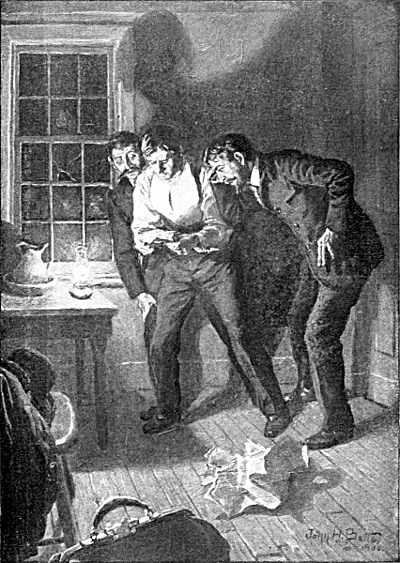
but when they got there, Carl, who was leading
the way, suddenly stopped. They had
taken particular notice of the way they left
their valises when they brought them there.
They had put them under the lower bunk, out
of the way; but here they were in the middle
of the room, and the contents of each were
scattered all over the floor. In addition to
this, the outside door, which opened onto the
guards, was closed but not fastened. In two
jumps Carl reached the door, pulled it open,
and looked up and down the guards; but
there was no one in sight.