FRENCH ENTRY INTO PORTUGAL—BLOCKADE OF ENGLAND—FLIGHT OF
THE PORTUGUESE ROYAL FAMILY—THE PENINSULAR WAR—FLIGHT OF
KING JOSEPH.
On October 18 or 19 Junot entered Portugal, and then it
was that John Bull began to fear for his stock of port wine.
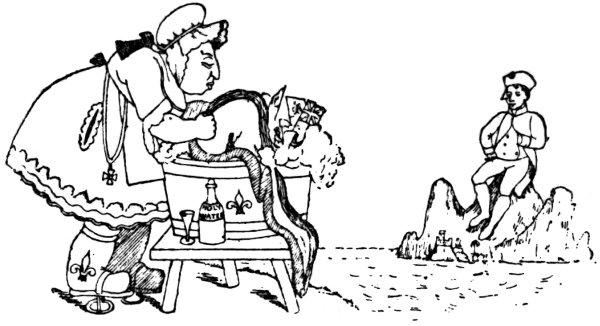
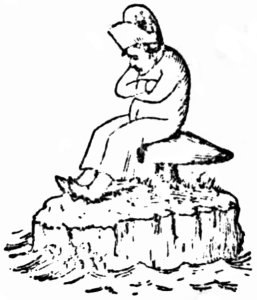
This is very amusingly put in a picture: ‘In Port, and Out
of Port, or news from Portugal,’ which is the title of a caricature
by Woodward (November 10, 1807), and it represents
Bonaparte seated on a pipe of ‘Genuine Old Port.’
With folded arms he thus speaks: ‘Now Master Jean Bull—more
news for you. You’ll soon be out of Port.’ A
miserable-looking ‘Portugee’ approaches John Bull, with
cap in hand, saying: ‘I be, d’ye see, de poor Portuguese.
Vat he mean be de Port Wine; which he will be glad to
change for your bag of guineas dere—begar—but dat is
mine—between ourselves.’ John Bull, who is sitting down,
smoking, with a jug of ale and a huge bagful of guineas
by his side, replies: ‘D—n him, and his Port too—I am
snug in Port, and while I have the port holes of my wooden
walls, and a glass of home brew’d ale, his conquests shall
never trouble me.’
Napoleon, in a decree dated from Hamburg, November
10, and also in another dated Milan, December 27, again
declared England in a state of blockade, and he made all
under his sway to cease all connection with that country,
as far as commercial matters were concerned; and this is
how the caricaturist met it:—
‘Blockade against Blockade, or John Bull a Match for
Boney’ (Ansell, November 1807), shows the different sides
of a ‘Wall of Blockade.’ John Bull is well victualled, and
has a fine surloin of beef, and a full tankard, &c.; and he
says: ‘Now Master Boney, we shall see which will hold
out the longest, my wall against yours. Aye, aye, I can
see you. I have left a peep hole. I believe you will soon
be glad to change your Soup Maigre for my Roast beef.’
Boney, with only a basin of Soup Maigre before him, looks
very disconsolate: ‘Who could have thought that he would
build a wall also—I really think I had better have left him
alone—Some how I don’t relish this Soup Maigre.’
‘The Continental Dockyard,’ by Woodward (November
27, 1807), shows a very tumbledown erection, called ‘The
Gallic Storehouse for English Shipping,’ but it contains
none. It only holds the ‘Yaw Mynheer,’ the ‘Don Diego,’
the ‘Swede,’ the ‘Dane,’ and the ‘Napoleon,’ on which a
number of shipwrights are engaged, being driven to their
task by Napoleon, with drawn sword. He thus addresses
the master shipwright: ‘Begar you must work like de
Diable, ve must annihilate dis John Bull.’ The unlucky
foreman replies: ‘Please you, my Grand Empereur, ’tis no
use vatever. As fast as ve do build dem, he vas clap dem
in his storehouse over de way.’ Accordingly, we see in
‘John Bull’s Storehouse’ a large collection of captured
vessels from the Armada—‘Portobello,’ ‘Camperdown,’
‘St. Vincent,’ ‘Nile,’ and ‘Trafalgar.’ John Bull and a
number of sailors enjoy this cheering sight. Says he to
them: ‘I say my lads, if he goes on this way we shall be
overstocked.’ And a sailor remarks: ‘What a deal of
pains some people take for nothing.’
I. Cruikshank (December 20, 1807) gives us ‘The
Bear, the Monkey, the Turkey, and the Bull, or the true
cause of the Russian war.’ Bonaparte, as the French
Monkey, is leading the Russian Bear by a collar and chain,
and thus addresses him: ‘The case is this, if you will make
war against that overgrown Bull over the way, you shall
have a slice of that fine Turkey! and the Eastern Star.’
The Turkey is represented as saying: ‘I wish I was well
out of their clutches, but I am afraid they will have me at
last.’ The Eastern Star appears on the horizon, and represents
the Indies. A Bull, on the opposite coast, is in a
menacing attitude, and bellows forth: ‘You had better
beware, for, remember the old adage—When you play
with a Bull, take care of his horns.’
‘John Bull refreshing the Bear’s Memory’ is by I.
Cruikshank (December 20, 1807), and shows the former
worthy opening an enormous volume, his journal, and thus
addressing a crowned bear, who has a collar round his
neck inscribed ‘This bear belongs to Napoleon,’ and who
regards the book through an enormous pair of spectacles.
‘So you say, Master Bruin, that my visit to Denmark has no
parallel in History—do be so good as to turn your spectacles
to this page, and refresh your memory.’ And he points
to a page of his journal, in which is written: ‘The Great,
the Magnanimous, Catherine of Russia seized upon one
third of the Kingdom of Poland, and kept it to herself.
These peaceful Danes seized on the City of Hamburgh.’
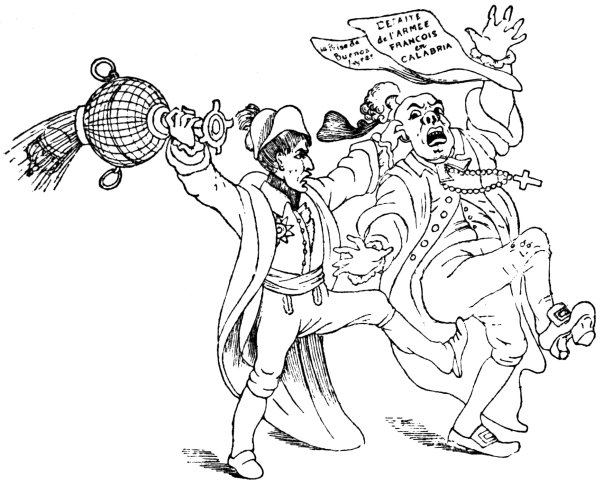
On January 1, 1808, I. Cruikshank published ‘Boney
stark mad, or more Ships, Colonies, and Commerce.’ It
shows the fleet in the Tagus, and the British Admiral (Sir
Sidney Smith) calling out through his speaking-trumpet,
‘Bon jour, Monsieur, if you would like a trip to the Brazils,
I’ll conduct you there with a great deal of pleasure; perhaps
you would like a taste of Madeira by the way.’ This
is to Talleyrand, on whom Bonaparte is venting his rage,
kicking him, and tearing off his wig, saying: ‘Stop them,
stop them. Murder, fire! Why did you not make more
haste, you hopping rascal? now, all my hopes are blasted,
my revenge disappointed, and—I’ll glut it on you—Monster—Vagabond—Villain!!!’
The explanation of this caricature is, that as the French
army was marching direct to Lisbon, the whole of the Portuguese
Royal family embarked for the Brazils, on November
29, under convoy of a British squadron.
‘Delicious Dreams! Castles in the Air! Glorious
Prospects! vide an Afternoon Nap after the Fatigues of
an Official Dinner,’ is by Gillray (April 10, 1808), and
shows the Cabinet asleep, a punch-bowl on the table, and
full and empty bottles all around. They are so quiet that
the mice are licking the Treasury plates. Behind Castlereagh’s
chair is a cat (Catalani). Mr. Perceval sleeps with
his arms on the table; the Duke of Portland in the chairman’s
seat; Lord Liverpool with his back to the table;
Canning, negligently lolling back in his chair, uses Lord
Melville, who is under the table, as a footstool. The
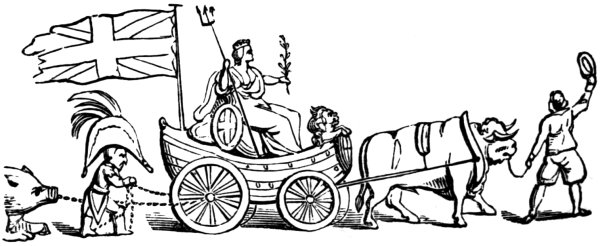
delicious dream they see has for its background the Tower
of London, before which passes Britannia seated on a
triumphal car, fashioned somewhat like a ship, and drawn
by a bull; and, behind the car, chained to it, come, first,
Bonaparte, the Russian Bear, Prussia, Austria, and Spain.
‘The Corsican Tiger at Bay’ (Rowlandson, July 8,
1808) shows Napoleon as a Tiger (or rather, as the artist
has depicted him, a leopard), with his fore-feet on four
Royal Greyhounds, whilst a pack of Patriotic Greyhounds
are rushing to attack him. John Bull, standing on the
white cliffs of Albion, presents his gun at him, singing the
nursery rhyme—
‘There was a little man,
And he had a little gun,
And his bullets were made of lead——
D—me, but we’ll manage him amongst us.’ The Russian
Bear and Austrian Eagle are chained together; but Austria
thus proposes: ‘Now, Brother Bruin, is the time to break
our chains.’ The Dutch frog, too, joins in the chorus: ‘It
will be my turn to have a slap at him next.’
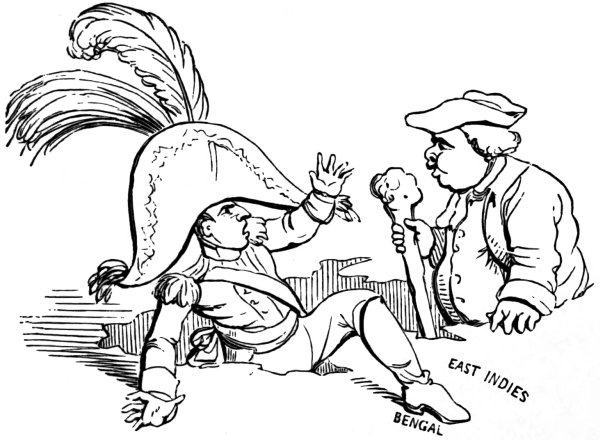
‘Boney Bothered, or an unexpected meeting’ (Ansell,
July 9, 1808). This shows Boney having gone right
through the world, and, coming out on the other side,
planting his foot on the East Indies, at Bengal; but he is
utterly astonished to find John Bull there also, armed with
his redoubtable oaken cudgel. ‘Begar,’ says he, ‘Monsieur
Jean Bull again! Vat! you know I was come here?’
To which John Bull, from whose pocket peeps a bundle of
Secret Intelligence, replies, ‘To be sure I did—for all your
humbug deceptions. I smoked16 your intentions, and have
brought my Oak Twig with me, so now you may go back
again.’
We now come to a period of our history which is interesting
to all of us—the Peninsular War. Napoleon had
turned his attention to Spain, and the Spanish king had
abdicated, and been sent to Fontainebleau, with ample
allowances. Joseph Bonaparte had been chosen king of
Spain, and Murat had his kingdom of Naples. But the
Spanish nation did not acquiesce in these arrangements.
They broke into open revolt, the English helping them
with arms and money, and, on June 6, the Supreme Junta
formally declared war against Napoleon. This much is
necessary to explain the following caricature:—
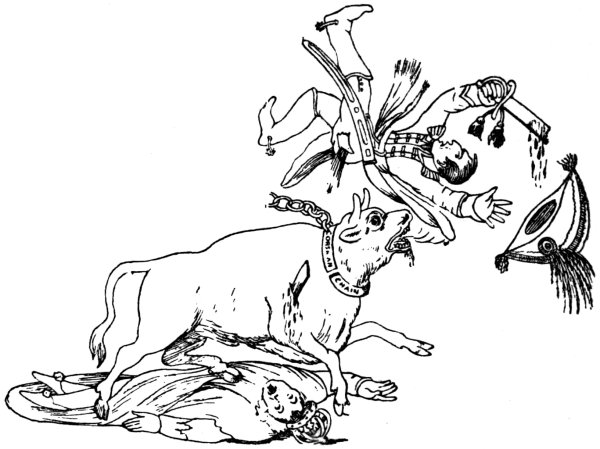
Gillray (July 11, 1808) drew ‘The Spanish Bull fight,
or the Corsican Matador in danger,’ and kindly tells us
that ‘The Spanish Bull is so remarkable for Spirit, that,
unless the Matador strikes him dead at the first blow, the
Bull is sure to destroy him.’ In the Theatre Royale de
l’Europe sits George the Third, a trident in one hand, his
spy-glass in the other, keenly watching the exciting fight,
as also are the delighted sovereigns of Europe, the Pope,
the Sultan of Turkey, and the Dey of Algiers. The
Spanish Bull has broken the Corsican chain and collar
which bound him, and, trampling on his king, has gored
and tossed the Matador, Napoleon, whose sword is broken
in an ineffectual attempt to despatch the animal. On the
ground are three wounded bulls—Prussian, Dutch, and
Danish—bellowing for help.
Woodward gives us a capital caricature in ‘The Corsican
Spider in his web’ (July 12, 1808). Napoleon is there
represented as a bloated spider, ‘Unbounded ambition,’
and he is just swallowing a Spanish fly. There are plenty
of flies in his web—Austrian, Dutch, Portuguese, Hanoverian,
Etrurian, Prussian, Hamburg, Italian, Venetian,
and small flies innumerable. The Pope fly is just being
entangled, and says, ‘I am afraid I shall be dragg’d in.’
‘The Russian Fly’ has touched the fatal web, and exclaims,
‘I declare I was half in the web before I made the
discovery.’ In fact, the only two that are as yet free from
the baneful mesh is the Turkish fly, who thinks, ‘I am afraid
it will be my turn next,’ and the British fly, who, well and
hearty, calls out, ‘Ay, you may look, master Spider, but I
am not to be caught in your web.’
To understand the next caricature, which, though dated
July 27, must have been published somewhat later, we
must note that Joseph Bonaparte entered Madrid, in state,
on July 20, but, ominously, without any welcome from the
people: although money was scattered broadcast, none but
the French picked it up. He knew little of what was
going on—how Moncey had been obliged to raise the
siege of Valencia, and that Dupont had surrendered at
Baylen. This latter piece of news he did not receive till
the 26th or 27th of July; when he learned also that Castaños,
with constantly increasing forces, was marching towards
Madrid, he left that city for Vittoria.
A broadside caricature (artist unknown, July 27, 1808)
shows Joseph leaving Madrid, his crown falling off, heading
his troops, who are carrying off heaps of treasure. It is
headed ‘Burglary and Robbery!!! Whereas on the night
of the 20th of July last, a numerous gang of French
Banditti entered the City of Madrid, and burglariously
broke into the Royal Palace, National Bank, and most of
the Churches thereof, murdering all who opposed them in
their infamous proceedings.
‘The said banditti remained in Madrid until the 27th
of the said month, and then suddenly departed, laden
with immense booty, having stolen from thence several
waggon-loads of plate, and every portable article of
value, taking the road to France; all patriotic Spaniards
are hereby requested to be aiding, and assisting, in the
apprehension of all, or any, of the said robbers; and,
whoever apprehends all, or any, of them, shall receive
the thanks, and blessings, of every well-disposed person
in Europe.
‘The said Banditti were headed by Joe Nap, a ferocious
ruffian of the following description:—He is about five feet
seven inches high, of a meagre, squalid aspect, saffron-coloured
complexion. He was, when he escaped, habited
in a royal robe, which he is known to have stolen from the
King’s Wardrobe at Naples. He is a brother of the noted
thief who has committed numberless robberies all over
Europe, murdered millions of the human race, and who was
latterly at Bayonne, where it is supposed he tarried, for the
purpose of receiving the stolen goods which his brother was
to bring from Spain.’
The war, in aid of Spain, against France, was now taken
up in earnest, and Sir Arthur Wellesley was sent to Spain
with a large body of troops, whilst reinforcements were to
come from other quarters.
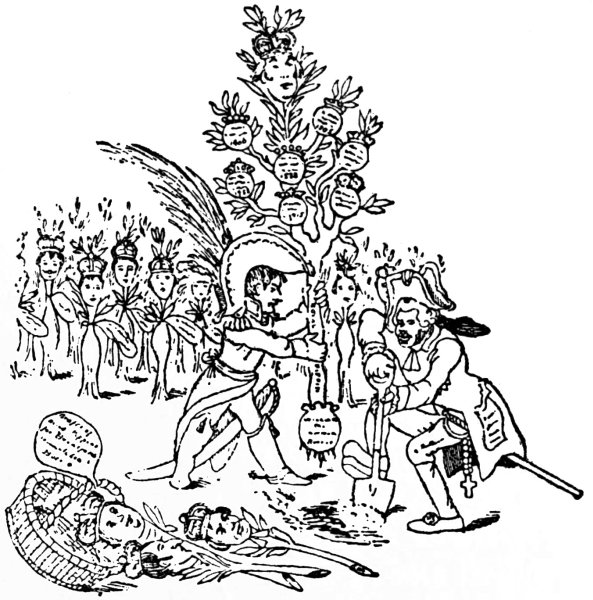
Almost one of the last of Gillray’s political caricatures,
and a very good one it is, is ‘Apotheosis of the Corsican
Phœnix’ (August 2, 1808). It has an imaginary quotation
from a supposed ‘New Spanish Encyclopædia, edit. 1808.
When the Phœnix is tired of Life, he builds a Nest upon
the mountains, and setting it on Fire by the wafting of his
own Wings, he perishes Himself in the Flames! and from
the smoke of his Ashes arises a new Phœnix to illumine
the world!!!’ This very graphic etching shows, on the
summit of the Pyrenees, a globe, which is the nest of the
Phœnix—Napoleon, with orb and sceptre, but, his crown
falling off, he has fanned all Europe into a blaze with his
wings. Around his neck is a ‘cordon d’honneur’ of
daggers, and, amid the smoke which rises from the pyre, is
seen a dove with olive branch, having on its wings ‘Peace
on earth.’
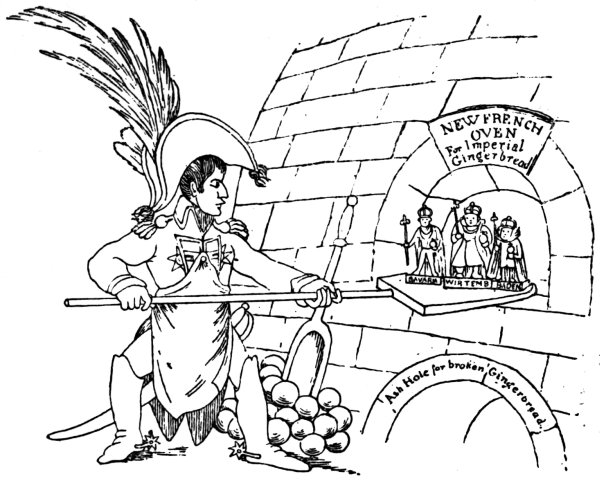
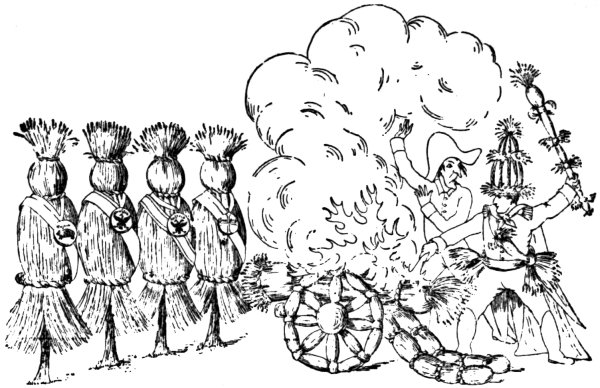
I. Cruikshank still kept up the idea of Tiddy-Doll in
‘The Oven on Fire—or Boney’s last Batch entirely
spoiled!!!’ (August 24, 1808.) He is on his knees, with
arms outspread in consternation, for, in putting Dupont, on
a ‘peel,’ into the oven—‘Spain and Portugal’—flames
burst out, labelled Asturian Legions, Army of Portugal,
Biscay, Catalonian Army, Army of Galicia, Andalusian
Army, Army of New and Old Castille, British Army and
Fleet, Estramadurean Army, Leon, Army of Valencia,
Murcia, and Army of Granada; whilst in the centre of the
flames is the legend ‘A people United can never be conquered.’
Poor Dupont exclaims, ‘Oh Nap, Nap! what is
this? Instead of a King, you’ve only made me a Dup(e)ont.’
Bonaparte himself cries out, ‘Zounds, I shall be overwhelmed
with this Patriotic Blaze. I did not think there
was a single spark left, but I find there is more than all
the Engines of France can extinguish.’ Talleyrand, who
stands by his kneading-trough, which is labelled ‘State
Prison,’ rests quiet, and says, ‘Aye Aye, I told you that you
would burn your fingers at that batch of Ginger-bread—but
I have nothing to do with it. I am only a Jailor, so
there is an end to all my glory.’
We have seen the European monarchs sitting down to a
game of quadrille. Ansell (August 1808) gives us its conclusion.
Spain has suddenly arisen, and, upsetting the table,
seizes Napoleon by the throat, accusing him of foul play:
‘I tell you, you are a Scoundrel, and if you do not restore
my King, whom you have stolen from the other table, and
reinstate Ponto—by the honor of a Spanish Patriot, I will
strangle you.’ Trembling Bonaparte replies, ‘Don’t be so
boisterous, I only borrowed him, merely to make up the
pack.’ The Pope is on the floor, and the stolid Dutchman,
with his hat in hand, says, ‘Donder and Blixens, I be
quite tired of de game. Yaw! Yaw! now is de time for
me to rise.’ At the other table all take a lively interest in
the squabble. George the Third rises from his seat and
grasps his ‘heart of oak’ stick, saying, ‘What! what! a
dust, eh? so much the better. Boney got the worst of the
game. I must lend a hand.’ Russia, with hand on sword,
turns in his chair, remarking that ‘Now is the time to rub
off the rust of Tilsit.’ Prussia rises, exclaiming, ‘If I don’t
take advantage of the present opportunity, I shall indeed
be a Prussian Cake.’ Austria reaches his hat and sword
from its peg on the wall, and says, ‘Ah! Ah! the game
has taken a different turn from what I expected, I must
not be idle.’
The next caricature relates to the bad success of Napoleon’s
arms. The raising the siege of Saragossa, the defeat
of Vimiera, and the Convention of Cintra, by which the
French were to evacuate Portugal, were not facts likely to
be relished in France.
‘The Fox and the Grapes’ is another of Woodward’s
(September 15, 1808), where the Corsican Fox interviews
the Gallic Cock. The former says, ‘Believe me, my dear
Doodle doo, you would not like them—I found them so
sour that I absolutely could not touch them,’ in answer to
the Cock’s query—‘But my good friend, you promised to
bring me home some Spanish Grapes and Portugal plums:
where are they?’
‘Prophecy explained’ is by Rowlandson (September
17, 1808), and the text taken is from the Revelation of
St. John (chap. xvii. verse 10): ‘And there are seven
kings, five are fallen, and one is, and the other is not yet
come, and when he cometh he must continue but a short
space.’ The five that are fallen are the Kings of Würtemberg,
Saxony, Holland, Bavaria, and Prussia, and these
have fallen into a ‘Slough of Disgrace and Ridicule.’ The
‘one that is,’ it is needless to say, is Napoleon; and the
‘one that continued but a short space,’ is King Joseph, who,
having been chased beyond the Pyrenees, has his crown
snatched from him. There are many other caricatures
on this subject of the flight of Joseph, but, although interesting,
they hardly come within the scope of personal satire
on Napoleon.
Rowlandson gives us (September 20, 1808) ‘Napoleon
the little in a Rage with his great French Eagle!!’
Napoleon, with his sword drawn, and his hands clenched,
is in a terrible rage with his brother Joseph, who, under
the guise of a crowned eagle, is limping along with one
leg in a sling. Napoleon thus addresses him: ‘Confusion
and Destruction—what is this I see? Did I not command
you not to return till you had spread your Wing of Victory
over the whole Spanish Nation?’ And the poor bird
meekly replies: ‘Aye, its fine talking Nap, but if you had
been there, you would not much have liked it—The
Spanish Cormorants pursued me in such a manner, that
they not only disabled one of my legs, but set me a
moulting in such a terrible way that I wonder I had not
lost every feather; besides, it got so hot, I could not bear
it any longer.’
There is a caricature (September 24, 1808) of ‘A hard
passage, or Boney playing Base on the Continent.’ He is
here represented as playing on the bass viol from the score
of the ‘Conquest of Spain and Portugal.’ His task seems
hard, and he exclaims: ‘Plague take it! I never met with
so difficult a passage before. But, if I can once get over
the Flats, we shall do pretty well, for you see the Key will
then change into B sharp.’ A muzzled Russian bear is
trying to play on the French horn, and says: ‘Why that
is Natural enough, brother Boney, though this French horn
of yours seems rather out of order.’