New York: D. Appleton & Company
New York: George H. Doran Company
Boston: Little, Brown, and Company
PRINTED IN THE UNITED STATES OF AMERICA
COPYRIGHT, 1924,
BY GRANT OVERTON
First Printing, September, 1924.
Press of
J. J. Little & Ives Company
New York, U. S. A.
Bound in Interlaken-Cloth
“Let’s Give Him a Book.”
“He’s Got a Book.”
THIS BOOK IS DEDICATED TO
ALL THOSE WHO, THOUGH HAVING
ONE BOOK, SOMETIMES ENJOY ANOTHER
Preface Being a True Account of How a Priceless Cargo Was Delivered to a Desert Islander
How that I, Robinson Crusoe, came to be wrecked
with others of the ship’s company on a Desert
Island, all being lost save my unworthy self, hath
in a precise manner been narrated by one D. Defoe
in the book he saw fit to entitle with my name; but
his ending is indifferent. For novels like Defoe’s
must have the Happy Ending, so styled. Yet is the
truth often happier far than fiction. Being no hand
to invent a tale, I am content to set down in this
place events as I humbly took part in them.
Let me declare, then, that here on my Desert
Island I for long suffered great loneliness and consequent
distress of soul. This went on many days.
Howbeit, while sunk very low in my spiritual state
and with expectation nearly gone, a huge ship passing
near labored painfully with a storm by the mercy
of God being compelled to throw overboard—or, as
they say at sea, to jettison—the greater part of her
cargo. And being thus lightened she stood away
from the Island and went on her course safely. The
same storm cast upon the shore the rich treasure
wherewith she had been laden, so many wooden
boxes or cases, packed tightly and well-lined, which
for the most part were washed up undamaged and,
within, scarcely dampened except it may be for an
inch or two. Coming down to the shore the morning
after I stood transfixed with astonishment at the
sight of something lying on the sand. It was a book.
When I had a little recovered from my amaze, my
joy and ecstasy knew no way to communicate itself,
and almost immediately, my eye falling on the cases
strewn along the beach, I capered with delight. I
brake open the boxes, one after the other fast as I
could work. All, all, were brimmed with the newest
books!
Since that day I have not lacked instruction and
entertainment, and deem that Providence, at trifling
expense to the maritime insurers, hath rescued me
from boredom forevermore. And this I deem the only
rescue worth a fingersnap in this life of ours, and one
that a great majority of people do never accomplish.
My days and nights have been and yet are filled with
most various delights, my walks are taken with a
great company of authors and my conversations are
held with them.
With such profit and satisfaction do I read that
more than once, being sighted by a vessel which then
stood by to take me off my Island, I have waved the
sailors to proceed without me, which they have done
with doubt and difficulty; yet finally I have convinced
them of my meaning, they proceeding with
their voyage, I with mine....
1. The Knightliness of Philip Gibbs — i — ii — iii — iv — v — vi — vii — BOOKS BY PHILIP GIBBS — Fiction : — Historical : — Essays : — SOURCES ON PHILIP GIBBS
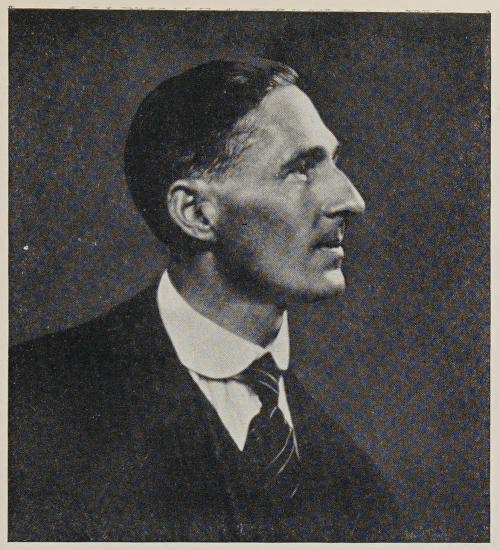
Then one said: “Rise, Sir Philip——” but the
terms in which the still young man received ennoblement
were heard by none; for all were drawn by
his face in which austerity and gentleness seemed
mingled. A pale young man with a nicotine-stained
third finger whom Arnold Bennett had once warned
authors against (he asks you to lunch and drives a hard
bargain over the coffee). A good reporter for Alfred
Harmsworth, Lord Northcliffe. A war correspondent
with seven-league boots. A man standing on a platform
in Carnegie Hall which rings with riot “looking
like a frightfully tired Savonarola who is speaking
in a trance.” His thin, uncompromising nose; the jut
of the chin; the high cheekbones and the hollow cheeks,
long upper lip and mouth with drawn-in, straight corners
(yet a compassionate mouth); the deep-set eyes;
the ears placed so far back, and the raking line of the
jaw—if these were all he might be nothing better than
a fine breed of news hound with “points.” They are
nothing; but the clear shine of idealism from eye and
countenance is the whole man. Great Britain had
knighted a reporter, but Philip Gibbs had been born
to knighthood.
For when chivalry would have died, he first succored
and then revived it; when men wished to forget,
he compelled them to remember. He actually proves
what men have forgotten how to prove, and so have
turned into a copybook maxim. Perhaps the reason
his pen is mightier than any sword is because he wields
it as if it were one.
In the eyes of the world he is the D’Artagnan of
Three Musketeers who are also three brothers. They
are Philip (Hamilton) Gibbs, Cosmo Hamilton
(Gibbs), and A(rthur) Hamilton Gibbs, the mutations
of name arising from choice and even from a certain
literary necessity; for an author’s name should be distinctive
and is usually better not to be too long. The
father, Henry Gibbs, was an English civil servant, a
departmental chief in the Board of Education. The
mother had been Helen Hamilton. The family at one
time consisted of six boys and two girls. Henry Gibbs
had “a delicate wife, an unresilient salary, and his
spirit of taking chances had been killed by heavy responsibility,
the caution and timidity growing out of
a painful knowledge of the risks and difficulties of life,
and the undermining security of having sat all his
working years in the safe cul-de-sac of a government
office.”[1] It was the office in which Matthew Arnold
worked and in which an obscure temporary clerk, W. S.
Gilbert, stole moments to compose some verse called
Bab Ballads. Henry Gibbs was a famous after-dinner
speaker and it was certainly he who preserved the
Carlyle House for London, but the nature of the case
forbade him to encourage the marked adventurous
strain in his boys.
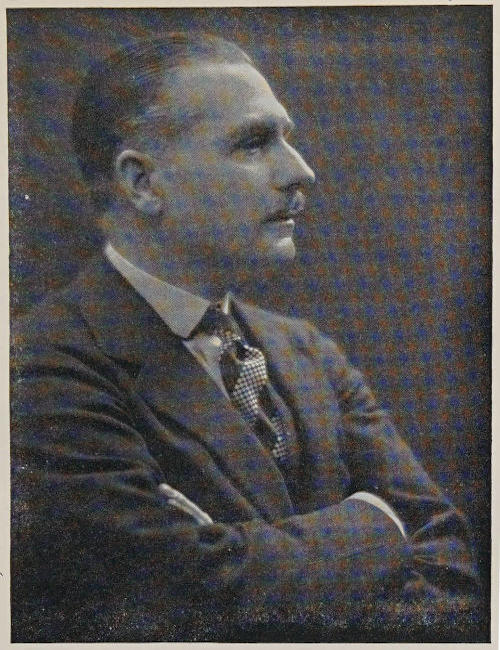
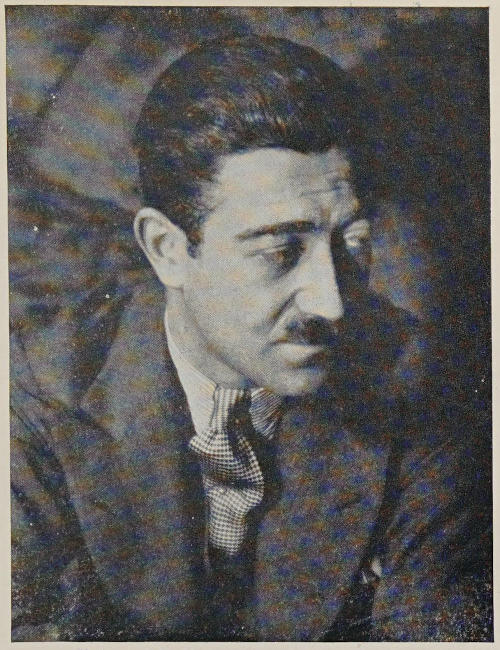
PHILIP GIBBS
Copyright by Underwood & Underwood.
Philip Gibbs was educated privately and was an
editor before he was 21. He was, in fact, only 19 when
he became “educational editor” for the large English
publishing firm of Cassell at a salary of a hundred and
twenty pounds a year. “With five pounds capital and
that income, I married”—Agnes Rowland, daughter
of the Rev. W. J. Rowland—“with an audacity which
I now find superb. I was so young, and looked so much
younger, that I did not dare to confess my married
state to my official chief, who was the Right Honorable
H. O. Arnold-Forster, in whose room I sat, and one
day when my wife popped her head through the door
and said ‘Hullo!’ I made signs to her to depart.
“‘Who’s that pretty girl?’ asked Arnold-Forster,
and with shame I must confess that I hid the secret of
our relationship.”[2]
He was both timid and bashful; yet like many men
of his stamp, he was to show on many occasions a lion-like
courage. A hundred and a thousand times he was
to pass as close to death as a man may pass and yet
live; in general, he was to be quite as badly scared as
a chap can be in such circumstances; and without exception
he was to persist in what he was doing, for
there was and is in him something stronger than fear.
Philip Gibbs’s earlier career differed little from that
of Arnold Bennett or the first years of dozens of
Englishmen who have made their start in Fleet Street.
After several years with Cassell, he applied for and got
a job as managing editor of a large literary syndicate.
In this post he bought Bennett’s early novel, The
Grand Babylon Hotel, and other fiction and articles
to be sold to newspapers in Great Britain and the colonies.
While with Cassell he had written his first book,
Founders of the Empire, a historical text still used in
English schools. As a syndicate editor he wrote articles
on every conceivable subject, particularly a weekly
essay called “Knowledge is Power.” But his job was
outside of London, for which he hankered; and finally
he wrote to Alfred Harmsworth, who was later to
become Lord Northcliffe and who had founded the
Daily Mail. The result was a job under a brilliant
journalist, Filson Young, whom Gibbs succeeded a few
months later as editor of Page Four in the Mail (devoted
to special articles). Here he learned all about
the new journalism and had a chance to observe Northcliffe
closely. In the seventh chapter of his Adventures
in Journalism, Philip Gibbs gives a brief but
well-etched portrait of the man who transformed the
character of the English newspaper. Northcliffe’s
genius, his generosity, his ruthlessness—which was
often the result of indifference and sometimes sprang
from fatigue and bad temper—are very well conveyed
in a half dozen pages. Gibbs suffered the fate of
nearly all this man’s temporary favorites. When he
was dismissed from the Daily Mail he went for a few
months to the Daily Express before beginning what
was to be a long association with the Daily Chronicle.
His connection with the Chronicle was broken by
the sad experiment of the Tribune, a newspaper
founded by a melancholy young man named Franklin
Thomasson as a pious carrying out of his father’s
wishes. As literary editor of this daily, Philip Gibbs
bought work by Rudyard Kipling, Joseph Conrad and
Gilbert K. Chesterton, but the paper as a whole was
dull and doomed. When it went down, Philip Gibbs
thought he saw a chance to throw off the bondage of
offices. He took his wife and little son and retreated
to a coast-guard’s cottage at Littlehampton. “There,
in a tiny room, filled with the murmur of the sea, and
the vulgar songs of seaside Pierrots, I wrote my novel,
The Street of Adventure, in which I told, in the guise
of fiction, the history of the Tribune newspaper, and
gave a picture of the squalor, disappointment, adventure,
insecurity, futility, and good comradeship of
Fleet Street.” There was need of money, but the
novel cost Gibbs more than it earned. His narrative
had not disguised sufficiently either the newspaper or
members of its late staff. The point is a little difficult
for American readers to take in, and rests on English
libel law, which is quite different from the American.
In England, “the greater the truth, the greater the
libel.” A libel action was instituted, and although it
was finally withdrawn, the bills of costs were heavy
and the sale had been killed. But when published in
the United States after the war, The Street of Adventure
had a very good success.
“I knew after that the wear and tear, the mental distress,
the financial uncertainty that befell a free lance
in search of fame and fortune, when those mocking
will-o’-the-wisps lead him through the ditches of disappointment
and the thickets of ill luck. How many
hundreds of times did I pace the streets of London in
those days, vainly seeking the plot of a short story, and
haunted by elusive characters who would not fit into
my combination of circumstances, ending at 4,000
words with a dramatic climax! How many hours have
I spent glued to a seat in Kensington Gardens, working
out literary triangles with a husband and wife and the
third party, two men and a woman, two women and a
man, and finding only a vicious circle of hopeless imbecility!
At such times one’s nerves get ‘edgy’ and
one’s imagination becomes feverish with effort, so that
the more desperately one chases an idea, the more
resolutely it eludes one.”[3]
Yet he counts himself, on the whole, to have been
lucky. He was able to earn a living and to give time
and labor to “the most unprofitable branch of literature,
which is history, and my first love.” Years later
he was to have a thrill of pleasure at seeing in the windows
of Paris bookshops his Men and Women of the
French Revolution, magnificently illustrated with reproductions
of old prints. He wrote the romantic life
of George Villiers, First Duke of Buckingham, and
discovered in the murder of Sir Thomas Overbury “a
plot with kings and princes, great lords and ladies,
bishops and judges, poisoners, witch doctors, cut-throats
and poets,” the incomparable material for his
King’s Favorite. These books brought him only a few
hundred dollars apiece, though perhaps more in reputation
and friendships.
He returned to journalism, eventually, as special
correspondent and descriptive writer for the Daily
Chronicle. He was rather frequently in charge of the
Paris office and had all sorts of adventures in that city,
both those derived from saturating himself in French
history and others incident to his daily work. After
the Portuguese revolution he was sent to Portugal to
explore the condition of those political prisoners that
the republicans had in some cases interred alive. His
greatest feat was the revelation of Dr. Cook’s fraud in
claiming the discovery of the North Pole. This was
a triumph of sheer intuition, in the first instance, and
both dogged persistency and remarkable courage were
necessary before Philip Gibbs could be proved right.
It began with a late start, twenty-four hours behind
the other correspondents. When Gibbs got to Copenhagen,
the vessel bringing Dr. Cook had not arrived,
owing to fogs. Through a chance meeting in a restaurant
with Mrs. Rasmussen, wife of the explorer, Gibbs
got to Elsinore and aboard a launch which was putting
out to meet the delayed ship. Thus he was the only
English-speaking person present at the first interview,
on shipboard. As it happened, Dr. Cook had not yet
acquired that magnificent poise and aplomb which he
was to display from the moment he set foot ashore.
His eyes evaded Gibbs, he explained that he had no
papers to prove his claim and not even a diary, and
when pressed for some sort of written record or notes
he exclaimed: “You believed Nansen and Amundsen
and Sverdrup. They had only their story to tell.
Why don’t you believe me?” Later Cook had a
moment of utter funk, hiding in his cabin. It passed
quickly and after that he was outwardly all that a hero
should be.
But Gibbs had had his chance. His seven-column
story to the Daily Chronicle caused him to be denounced
everywhere and even put him in jeopardy of
his life in Copenhagen; yet a few weeks were to show it
to be one of the greatest exclusive newspaper stories,
“beats” or “scoops,” ever written.
In September, 1912, war started in the Balkans.
Gibbs went as a correspondent and this experience,
lamentable and laughable, comical and extremely repellent,
was his first direct preparation for work soon
to follow. The year following he had occasion to go
to Germany and study the state of mind, popular and
official, toward England. He was, therefore, exceptionally
well fitted to be a correspondent at the front
when the World War began. It would be impossible
as well as improper to try to abbreviate here the story
of his experience told so brilliantly and with so much
movement (and with far too much modesty) in his
Adventures in Journalism. At the outset of the war
no newspaperman had any official standing. The correspondent
was unrecognized—or it would be more
accurate to say that he was recognized only as a
dangerous nuisance, subject to arrest at sight. Gibbs
and two other very distinguished newspapermen, H. M.
Tomlinson and W. M. Massey, worked together for
weeks and months and were three of a small group of
correspondents who risked their lives constantly in the
war zone and their liberty on every occasion when they
stepped out of it. There came a time when the game
seemed to be up. “I had violated every regulation. I
had personally angered Lord Kitchener. I was on the
black books of the detectives at every port, and General
Williams solemnly warned me that if I returned
to France I would be put up against a white wall, with
unpleasant consequences.”[4] The solution came with
the appointment of five official war correspondents, of
whom Gibbs was one from first to last. These men
covered the war, not for one newspaper but for the
newspapers of Great Britain and America. They were
attached to General Headquarters and among the men
of distinction who were assigned to them as friends,
advisers and censors was C. E. Montague, editor of
the Manchester Guardian and author of Disenchantment,
Fiery Particles, A Hind Let Loose, etc., a meditative
writer of exquisite prose who, at the outbreak of
the war, had dyed his white hair black, enlisted as a
private, served in the trenches, reached the rank of
sergeant, finally surviving when the dugout which
sheltered him was blown up....
After the war the five correspondents received
knighthood, and Philip Gibbs is properly Sir Philip
Gibbs, K. B. E. (Knight of the British Empire). On
journalistic commissions he visited Ireland and Asia
Minor and revisited most of the countries of Europe,
including Russia. He came to America twice to lecture
on the war and conditions resulting from it, and
his book, People of Destiny, is a critical but admiring
account of America as he found it. Pope Benedict
XV., against all precedent, accorded Gibbs an interview
on the reconstruction of Europe and this interview
was naturally printed in all the principal newspapers
of the world. He had become, more truly than any
other man has ever been, more fully than any other
man is, the world’s reporter. His title was splendidly
established by his summarizing book on the war, Now
It Can Be Told, and was strikingly reëmphasized with
his novel, The Middle of the Road, concerning which
a few words are in order.
Although Philip Gibbs had published, in 1919, a
novel, Wounded Souls, which contains much of the
message of The Middle of the Road, the world was not
ready for what he had to tell. He therefore set to work
on a canvas which he determined should include all
Europe. His visits to Ireland, France, Germany and
even Russia had placed at his disposal an unparalleled
mass of authentic firsthand material. He knew, better
than most, what existed, and what lay immediately
ahead. Using fiction frankly as a guise to present
facts, both physical facts and the facts of emotion and
attitude, he wrote his story.
When the novel was published in England and the
United States at the beginning of 1923 it leaped into
instant and enormous popularity. This was partly the
result of prophetic details, such as this speech of one of
the characters (from page 317 of The Middle of
the Road):
“‘France wants to push Germany into the mud,’
said Dorothy. ‘Nothing will satisfy her but a march
into the Ruhr to seize the industrial cities and strangle
Germany’s chance of life.’”
When the novel was published the French invasion
of the Ruhr had just begun.
There was a sense of larger prophecy that hovered
over the story. But even more of the instant success
of the book was due to the terrible picture it painted,
minute yet panoramic, ghastly but honest. People sat
up, literally, all night to finish the book. People read
it with tears running from their eyes, with sobs; they
went about for days afterward feeling as if a heavy
blow had stunned them, a blow from which they were
only slowly recovering. Although every effort was
made in advance of publication to insure attention for
the book, it is doubtful whether such effort counted at
all in the book’s success. For none who read it failed
to talk about it in a way that fairly coerced others to
become Philip Gibbs’s readers. Month after month the
sale of this book rolls on. It is not, as a piece of literary
construction or considered as literary art, a good
novel; it is something much bigger than that—a piece
of marvelous reporting and a work of propaganda
charged to the full with humane indignation and pity
and compassion.
As if he had found his field at last in the roomy
spaces and manifold disguises of the novel, Philip
Gibbs followed The Middle of the Road with a very
keenly-observed study of young people. Heirs Apparent
deals with the generation which was too young
to take any active part in the World War but which
has come to a somewhat unformed maturity since. The
gayety of the novel does not prevent the author, with
his usual thoroughness, from presenting the more serious
aspects of his young people’s misbehavior. There
is incidentally an exactly drawn study of that newer,
sensational journalism which Philip Gibbs tasted under
Northcliffe and which is familiar enough, though on
the outside only, to most Americans. But the delightful
thing about Heirs Apparent is the author’s
unfailing sympathy with his youngsters; and the
optimism of the ending—the book closes with a character’s
cry: “Youth’s all right!”—is the sincere
expression of Philip Gibbs’s own perfect faith.
The tales in his new volume, Little Novels of Nowadays,
are brothers to The Middle of the Road. What
proportion of these stories is fact and what fiction is
irrelevant, since in atmosphere and emotion all are
true. Each of these poignant pieces is a document of
the calamitous war more significant to humanity than
the treaty sealed at Versailles. Whether in Russia or
stricken Budapest or flaming Smyrna or some far-off
corner of lonely starvation, Philip Gibbs has seen all,
felt all ... and can convey all.
In fine, a bigger man than any of his books. One of
the greatest reporters the press has ever had, one of the
half-dozen—if so many—best masters of descriptive
writing now alive. A chap who suffered nervous
breakdowns prior to 1914 and who turned to iron in
the moment of crisis. A militant pacifist because he
has really seen war waged. A lover and fighter for
justice, and a preacher of mercy. There is about him,
despite the abolition of miracle and the rapid transformation
of the world into a factory and a machine,
some of that lost radiance of a day when men set forth
to conquer in the name of their faith, or to spread a
gospel which might redeem the world.
1908
The Individualist
1908
The Spirit of Revolt
1909
The Street of Adventure
1910
Intellectual Mansions, S. W.
1911
Oliver’s Kind Women
1912
Helen of Lancaster Gate
1913
A Master of Life
1914
Beauty and Nick
In England: The Custody of the Child
1920
Wounded Souls
In England: Back to Life
1922
Venetian Lovers
1923
The Middle of the Road
1924
Heirs Apparent
1924
Little Novels of Nowadays
1899
Founders of the Empire
1906
The Romance of Empire
1906
Men and Women of the French Revolution
1908
The Romance of George Villiers, First Duke of Buckingham
1909
King’s Favorite
1912
Adventures of War with Cross and Crescent
1915
The Soul of the War
1917
The Battles of the Somme
1918
The Struggle in Flanders
First title: From Bapaume to Passchendaele
1919
The Way to Victory
In England: Open Warfare
1920
Now It Can Be Told
In England: Realities of War
1920
People of Destiny
1921
More That Must Be Told
In England: The Hope of Europe
1924
Adventures in Journalism
1903
Knowledge Is Power
1905
Facts and Ideas
1913
The Eighth Year: A Vital Problem of Married Life
1913
The New Man: A Portrait of the Latest Type
His Adventures in Journalism is autobiographical in the
best sense of the word, and only needs to be supplemented by
the formal particulars in Who’s Who (England). There are
interesting references in Cosmo Hamilton’s Unwritten History.
For a not wholly friendly reference, see Clement K. Shorter’s
page in The Sphere, London, for 6 October 1923. Mr. Shorter
was one of a few who believed themselves libelled in The
Street of Adventure, and he has had various literary feuds.
Address: Sir Philip Gibbs, Ladygate, Punch Bowl Lane,
Dorking, England.
2. The Trail Blazers — i — ii — iii — GOING OUT?
These paths are strange and exciting. One leads
into the midst of wild beasts, another into the
depths of the sea. A third goes laboriously some few
feet underground and erases three thousand years in
three months. One or two, keeping to the present, are
sources of innocent merriment; several employ the
mode of fiction to vivify fact; and at least one is a
continuous pageant in colors of the American West.
There is no order in which these paths are to be
taken; you may go half across the world to follow
one, or you may begin by merely stepping outside your
door. America or Arabia, ferns or fishes, dogs or diggings,
history, hunting ... outdoor books are the
best of indoor sports.
The alphabet is an immense convenience and I start
with Adventurousness and America. For some time
Joseph Lewis French has been busy selecting from
various American authors the best accounts of the discovery
of gold in California, the days of the pony express
and the stage coach, the cowboy, the trapper, the
guide, the bad man, and other phases of our history.
He has drawn upon the works of Francis Parkman,
Mark Twain, Bret Harte, Hamlin Garland, Bayard
Taylor, General George A. Custer, Owen Wister, Theodore
Roosevelt, Emerson Hough and a good many
others in the task. Mr. French calls his book The Pioneer
West: Narratives of the Westward March of
Empire, and Hamlin Garland has written a foreword
for it. Also Remington Schuyler has done illustrations
in color. As an anthology, the volume has no exact
parallel in my knowledge. The nuggets it contains are
otherwise for the most part found with considerable
difficulty in half a hundred somewhat inaccessible
places. It is, for example, not easy to find what you
want in either Parkman or Roosevelt without risking
a long hunt; and books by other earlier writers, even
one so perfectly well-known as Bayard Taylor, are
often hard to come by. It is no wonder that Mr. Garland
calls The Pioneer West a real service in recovery.
Mr. French spreads a satisfactory panorama before the
reader, for his selected narratives run from the time of
Lewis’s and Clark’s discovery of Oregon down to the
last of the Indian uprisings.
A projected alliance between the Hudson’s Bay
Company and the Russian American Fur Company led,
in 1867, to a great piece of foolishness on the part of
an American Secretary of State. Congress was induced
to pay some millions of dollars to purchase a fancy
refrigerator and everyone was scornful of “Seward’s
folly.” Edison Marshall has taken the phrase for the
title of his new novel dealing with that period in Alaskan
history. Seward’s Folly relates how Major Jefferson
Sharp, late of the army of the Confederate States
of America, was sent to Sitka by Seward. Major Sharp
liked an aristocratic society, and he found it in Sitka
where Russians, Englishmen, Americans and Indians
were colorfully combined. He also encountered, in
Molly Forest and her uncle, two Americans undisturbed
by any doubts as to the superiority of American
character and the value of American ideas of liberty
and opportunity.
The fact that Major Sharp was still loyal to the
spirit of the Confederacy and had no intention of serving
the Union did not tend to simplify matters. He
was, however, no scoundrel; and he came to recognize,
beneath the glitter of Alaskan surfaces, much
that his nature could not countenance. Mr. Marshall
has managed an extremely good story. But he has
brightened a portion of history in doing so.
William Patterson White’s The Twisted Foot and
B. M. Bower’s The Bellehelen Mine are novels of the
cattle rancher and the miner, respectively. Mr.
White’s story has almost every ingredient of an exciting
yarn—a love interest, an independent young
woman who doesn’t believe in explanations, a mystery,
an open enemy, a set of foes whose methods are mean
and underhanded, and a couple of young men who
think quick and shoot quick. The impetuous Buff
Warren, cowboy, is sent to drive off the range a family
of “nesters.” He finds that the father is blind and
that the family is making a very brave fight against
severe odds. He also meets Gillian Fair. Instead of
putting the Fairs off the range, Buff takes them under
his protection. This means the loss of his job, and
when, by a trick, he gets himself made deputy sheriff,
his state of mind is not helped by the fact that all clues
to a bandit who is terrorizing the region seem to lead
to Gillian Fair.
B. M. Bower tells of a silver mine named by a prospector
after his two baby daughters, one of whom,
grown to womanhood, is the heroine of The Bellehelen
Mine. Helen Strong, left alone to carry out plans
that she and her father had made together, returns to
Goldfield and assembles a crew from among her
father’s old miners. It is the beginning of an unanticipated
battle, for the Western Consolidated is determined
to make Helen Strong sell out.
The Bellehelen Mine is to an extent a departure
from the author’s previous books, a story of mine-working
and not of ranch life. But it should be realized
that B. M. Bower, or Mrs. Cowan, has been for
some years a mine owner and manager. It would be
surprising if she did not use this phase of her experiences
in her fiction. She lives at El Picacho Mine, Las
Vegas, Nevada; and after twenty years of writing
Western fiction it is high time she gave us a mining
story.
B. M. Bower is a woman but by no means a tenderfoot.
Mary Roberts Rinehart’s account of her tenderfootage,
in The Out Trail, is the most amusing record
of a woman in the West on my shelf of recent books.
But the most amusing record of America in general is,
I think, Cobb’s America Guyed Books, that series of
small volumes with drawings by John T. McCutcheon,
a book to each State. These attach themselves with
a burr-like tenacity to the memory in a series of epigrams.
You remember that Irvin S. Cobb said of
New York City: “So far as I know, General U. S.
Grant is the only permanent resident,” and of Indiana:
“Intellectually, she rolls her own,” and of Kansas:
“A trifle shy on natural beauties, but plenty of moral
Alps and mental Himalayas.” Such priceless remarks
are more to be cherished—and are more cherished—than
State mottoes; but the Guyed Books have a claim
to respect as well as affection. Each presents, along
with various State demerits, partly humorous and
partly real, the honest claim of the people of one section
to be considered as individual, characterizable,
with a personality not lost in the American mass. And
Mr. Cobb has not failed to give the people of each
State credit for State achievement.
Yet, because they contain humor, the Guyed Books
will always be classed as works of humor. A little
leaven is a dangerous thing. On the other hand, a
little knowledge leaveneth the whole lump. Donald
Ogden Stewart has that little knowledge, and the
result is the perfection of his new work, Mr. and Mrs.
Haddock Abroad. It is the fault of authors of books
of family life that they almost always know too
much. Mr. Stewart (as reviewers say) has avoided
this shortcoming. And in fiction, as in any other game,
the element of surprise is invaluable. Surprise, conjecture,
suspicion—especially suspicion! It was because
she was above suspicion that Caesar’s wife was
not well received in the best Roman circles. Mr. and
Mrs. Haddock Abroad would have helped her....
But, all seriousness for once aside, Mr. Stewart’s
treatise on the American family unit is masterly. It
will give Americans a new status in Paris. There are
many irrelevances and illustrations throughout the
book.
Five—usually five and a fraction—per cent. of the
people in any community are confirmed fishermen. The
greatest living authority on fishes is David Starr Jordan,
for so many years president of Leland Stanford
Junior University. He is the author of the most important
book on its subject, a piscatorial Bible, in fact,
which now appears in a new revised edition. It has
forty-six chapters, and 673 illustrations, of which
eighteen are full-page plates in color. It is by Dr. Jordan,
now a man past seventy. Its title is Fishes. It
has no other title, and no subtitle. It needs none.
This marvellous book makes the heart leap as the
trout leaps. Nothing so delightful or complete is
found elsewhere. One may know nothing about
fishes—I don’t—and yet turn these pages in a perfect
enchantment. I suppose, in a way, it is the emotion of
a first youthful visit to the Aquarium, but an emotion
incredibly magnified. Dr. Jordan speaks of his volume
with what must seem to the reader a ridiculous modesty.
He says it is a non-technical book that may still
be valuable to those who are interested in the study of
fishes as science. He says his chief aim has been “to
make it interesting to nature-lovers and anglers, and
instructive to all who open its pages. The fishes used
as food and those caught by anglers in America are
treated fully, and proportionate attention is paid to
all the existing as well as all extinct families of fishes.”
This may be true, but it no more explains the book
than a conjuror’s account explains his magic.
Beginning with the fish as a form of life, Dr. Jordan
goes through every attribute of fishes and then, in an
incomparable sequence, tells what we know of each
species. There are chapters like that on the distribution
of fishes which seem to transform the world in
somewhat the fashion in which Jules Verne’s Captain
Nemo transformed it; other chapters, like that on the
fish as food, are of vital importance; and such a chapter
as that on the mythology of fishes (including the
sea serpent) have a charm irresistible and without
equal. At length one plunges into the sea, swimming
through a myriad of sea creatures whose very names—elasmobranchii
or shark-like fishes, the salmonidae, the
mailed-cheek fishes, the dactyloscopidae—are as curious
and as evocative as those strange shapes that float
in green water behind aquarium glass.
Dr. James A. Henshall’s Book of the Black Bass, an
acknowledged masterpiece, is practically a new book
as the result of rewriting and enlargement. Nearly all
the illustrations, including those in color, are new. In
addition to a complete scientific and life history of the
fish, Dr. Henshall gives the last word regarding tools
and tackle for catching what is “inch for inch and
pound for pound the gamest fish that swims.”
Let us continue for a little with the authorities on
these very special subjects of sport. Dr. William A.
Bruette is one on dogs. He is well-known as the editor
of Forest and Stream, and various particular books on
the dog—or perhaps I should say, on particular dogs—preceded
The Complete Dog Book. There is not an
opportunity for anything of its sort to follow it unless
some one may be moved to write a canine encyclopædia
in some number of volumes. For The Complete
Dog Book—illustrated with photographs, of course—describes
the dogs of the world and very fully describes
all the breeds recognized by the American Kennel
Club. It is, throughout, a carefully comparative description,
giving the standards for judging each breed
and the good and bad points of each. The care of
dogs in health and their treatment in disease, as well as
their training and general management are gone over
in detail; but Dr. Bruette’s prime service is his wisdom
on the subject of buying puppies. Here are the
pages which will save the reader most, both in dollars
and disappointment.
Birds are hard to learn, not easy to observe, and
must be taken largely on trust for an acquaintance. On
the other hand, if you will take George Henry Tilton’s
The Fern Lover’s Companion with its 188 illustrations,
go over it carefully, use its glossary of terms and
keep an eye about you in your walks, you may learn
the names and the chief characteristics of our most
common ferns in a single season. There is about ferns
something of the fascination there is in fishes—a great
variety of form, and forms of exquisite coloration and
beauty of pattern. Mr. Tilton’s handbook is progressive;
if consulted attentively, it can be followed from
beginning to end without confusion or the need of
going again over the same ground. Ground in the
book, I mean!
When it comes to covering ground, Charles C. Stoddard’s
Shanks’ Mare is a superior article. This book
about walking—really, about the joys of walking—moves
without haste and with an easy rhythm of prose
and sentiment. It is one of the few books that have
the impelling quality of fine spring weather. As Stewart
Edward White said: “That is the main thing—to
get ’em out.” The remark occurred in a letter to Dr.
Claude P. Fordyce, a letter which forms the introduction
to Dr. Fordyce’s capital book on Trail Craft. “I
am glad you are publishing the book,” wrote Mr.
White. “All your articles on the out-of-doors life have
seemed to me practical, sensible, and the product of
much experience, plus some discriminative thought.”
He followed his words about getting people out of
doors with: “If, in addition, you can give them hints
that will, through their interest or comfort, keep ’em
out, the job is complete.” Trail Craft will do a finished
job for a good many who read it. Dr. Fordyce
has the considerable advantage of knowing American
wildernesses; he writes with equal knowledge of practical
mountaineering and desert journeys; tenting,
motor camping, the use of balloon silk in camp, camera
hunting, medical improvization, even the possibilities
of leather working for the outdoor man are included in
Trail Craft.
What percentage of American vacations are now
accomplished with the aid of the automobile must be
left for the census of 1930 to determine; but it is
large, and will be larger then. In fact, motor camping
is a distinct department of a magazine like Outers’
Recreation, attended to along with other editorial
duties by F. E. Brimmer, whose Autocamping is rather
more necessary than the Blue Book. For a missed road
is remediable, but a non-existent hotel isn’t. Besides,
a hotel isn’t camping.
Having lived outdoors with his family, including
small children, for as long as five consecutive months,
Mr. Brimmer has met most of the contingencies you
will have to meet. Autocamping is the difference between
a vacation and a disaster.
Here are two short works of fiction by one of the
best living storytellers whose subjects are drawn from
sport. A Wedding Gift, by John Taintor Foote, is
annotated by its subtitle, “A Fishing Story.” Mr.
Foote’s Pocono Shot needs no recommendation to those
who know his fine dog story, Dumb-Bell of Brookfield.
A Wedding Gift is the tale of a confirmed fisherman,
aged forty, who marries a young and beautiful girl.
The story is told by a friend whose wedding gift to
the pair consisted of hand-painted fish plates each with
a picture of a trout rising to take a fly. The bride had
packed three trunks with frilly clothes in expectation
of a honeymoon at Narragansett. She was wrong. She
was taken to the Maine woods.
The narrative of what followed is of such a character
that the fisherman’s friend, having heard him out
and remembering the dozen plates, each with a trout
painted on it, does not wait to meet the bride.
A Wedding Gift is pure amusement, if you like, but
Pocono Shot is written with an emotion that the reader
feels whether he cares for dogs or not. It has also—owing,
perhaps, to its being told in the first person—an
accent of reality. The dog of the story is a black
and white setter, the best bird dog in the Pocono Hills,
and better on a scent than any hound in the country
round about. It was this aptitude which got Pocono
Shot into trouble; tracking a man who had caused the
death of a girl, the setter received a terrible axe wound
from the fugitive’s father. The dog is marked by a
great shoulder scar. We make acquaintance with his
history at this point, step back for a little to learn
his career, go with him in the field and find out for
ourselves his extraordinary qualities, and then follow
him to his reunion with the master who had shot to
kill when the setter’s life was imperilled.
Surely the most exciting trail blazed in our day was
the short and obscure one leading a few feet underground
which took Howard Carter and Lord Carnarvon
into Tut-Ankh-Amen’s royal chamber. The second
volume of Howard Carter’s and A. C. Mace’s The
Tomb of Tut-Ankh-Amen, now impending, will round
out the record of a discovery which exists, and is likely
to remain, without parallel. The odds against a similar
find are too great for anyone but a mathematician
to calculate, and would be meaningless in any calculation.
The first volume of The Tomb of Tut-Ankh-Amen
surpassed most other official and authentic
records of its sort simply because the authors forgot
they were archæologists and—told the story. In the
presence of that priceless gift of fortune, standing
where they had stood and breaching a blank wall to
find it the threshold of the inner chamber with its
nested gold shrines, who could have thought of anything
but the supreme human and dramatic values of
that scene and fateful moment? Not Howard Carter,
certainly. He remembered then the six long and barren
years of unrewarded searching, the first faint hint
that he might be on the right track, the mounting excitement
chilled at regular intervals by the worry of
doubt and the littleness of disappointed hopes. Yet
here lay a king of Egypt, his body cased in gold and
his tomb and its seals protected by his gods. It was
a story that could not be told except in all its simplicity.
One could no more dress it up in lore and
learning than permit the excesses of emotional description.
The Tomb of Tut-Ankh-Amen is the modern romance
of the conquistador.
While we are on the path of adventure in strange
lands I want to draw attention to a book which
transcends the interests of sportsmen. A fourteen-year-old
boy, a circus trainer of animals, Dr. W. T.
Hornaday, of the New York Zoo, Courtney Ryley
Cooper, the novelist, and in fact persons of all ages and
occupations will find themselves utterly absorbed in the
pages of A. Blayney Percival’s A Game Ranger’s Note
Book. This handsome book, illustrated with photographs,
has been arranged and edited by E. D. Cuming
from the great mass of observations, both written and
verbal, made by Mr. Percival during nearly thirty
years spent in Africa, of which about twenty-two were
passed in the Game Department of what is now the
Kenya Colony. It opens with seven chapters on the
lion, followed by one or more chapters apiece on the
leopard; cheetah, serval and caracal (one chapter);
hunting dogs; hyænas; elephant; rhinoceros; hippopotamus;
buffalo; giraffe; swine; zebra, and antelope.
Most of Mr. Percival’s material about the antelope has
had to be reserved for a separate volume, so copious is
it. The book closes with chapters on hunting and
photographing big game. It is utterly untechnical, extremely
modest, occasionally humorous, and as meaty
with thrills as with information about animal characteristics
and habits. A Game Ranger’s Note Book deserves
as a pendant in reading Fred L. M. Moir’s After
Livingstone, a story of adventure and hunting when
big game were more numerous than now. The story
is told by one of two brothers, business men who were
pioneer traders in Africa. It has plenty of bush fighting
and Mr. Moir witnessed scenes of savage life that
will probably never come within the experience of
white men again.
Birds of America, edited by T. Gilbert Pearson, John Burroughs,
Herbert K. Job and others. Three volumes. Describes
and pictures 1,000 species. Over 300 species shown in color
from New York State Museum drawings. Eggs of 100 species
in actual size and colors.
The Outdoorsman’s Handbook, by H. S. Watson and Capt.
Paul A. Curtis, Jr. Tested wisdom on hunting, camping,
fishing and woodcraft. Indexed.
Lake and Stream Game Fishing, by Dixie Carroll. The
author was at the time of his death recently probably the best
known fisherman in the United States.
Goin’ Fishin’, by Dixie Carroll. Pungently written and
especially good on the subject of baits. Equally interesting to
the expert and the occasional angler.
Streamcraft: An Angling Manual, by Dr. George Parker
Holden. Endorsed by Stewart Edward White and pronounced
by Henry van Dyke “the best of all modern books
on the science of trout-fishing.”
Casting Tackle and Methods, by O. W. Smith. Forty years’
experience condensed by the fishing editor of Outdoor Life
and author of Trout Lore.
The Salt Water Angler, by Leonard Hulit, is an invaluable
and complete compendium of information for salt water
fishermen.
In the Alaska-Yukon Gamelands, by J. A. McGuire. The
story of an expedition to gather museum specimens far off the
beaten routes. Probably the best authority on the game resources
of the territory.
Fishing with a Boy, by Leonard Hulit. The tale of a city
man in search of health with, incidentally, much about the
ways of the humbler fishes.
Jist Huntin’, by Ozark Ripley. Stories told by an expert
guide who has fished and hunted from Alaska to the Gulf of
Mexico.
Breaking a Bird Dog, by Horace Lytle. Altogether unique
is this fascinating account of the process of training, from the
author’s actual experiences.
What Bird is That? by Frank M. Chapman. The most
recent Chapman bird book. Handily divided according to
season; every bird pictured in colors.
Handbook of Birds of Eastern North America, by Frank M.
Chapman. A standard work, invaluable to the bird lover.
3. The Art of Melville Davisson Post — i — ii — iii — iv — v — vi — BOOKS BY MELVILLE DAVISSON POST — SOURCES ON MELVILLE DAVISSON POST
Who that read in the Saturday Evening Post of
18 July 1914 a short story called “The Doomdorf
Mystery” forgets it now? No one, I think; and
it was a very short story, and it appeared over ten years
ago. The magazine which published it—if one had
read no others—has published 2,500 short stories since.
“The Doomdorf Mystery” is one in a thousand, literally.
The creature, Doomdorf, in his stone house on the
rock brewed a hell-brew. “The idle and the vicious
came with their stone jugs, and violence and riot
flowed out.” On a certain day two men of the country
rode “through the broken spine of the mountains” to
have the thing out with Doomdorf. “Randolph was
vain and pompous and given over to extravagance of
words, but he was a gentleman beneath it, and fear
was an alien and a stranger to him. And Abner was
the right hand of the land.”
About the place were two persons, a circuit rider
who had been rousing the countryside against Doomdorf
and who had called down fire from heaven for
the creature’s destruction. A little faded woman was
the other.
In his chamber, the door bolted from the inside according
to custom, Doomdorf lay shot to death.
The circuit rider asseverated that heaven had answered
his prayer. The little, frightened, foreign
woman showed a crude wax image with a needle thrust
through its heart. She had killed Doomdorf by sorcery.
Randolph exclaimed with incredulity. Murder had
been done; he was an officer of justice. But Abner
pointed out that when the shot was fired, by evidence
of Doomdorf’s watch, the circuit rider was on his way
to the place, the woman on the mountain among the
peach trees. The door was bolted from the inside, the
dust on the casings of the two windows was undisturbed
and the windows gave on an hundred-foot
precipice as smooth as a sheet of glass. Had Doomdorf
killed himself? And then got up and put the
gun back carefully into the two dogwood forks that
held it to the wall? Says Abner: “The murderer of
Doomdorf not only climbed the face of that precipice
and got in through the closed window, but he shot
Doomdorf to death and got out again through the
closed window without leaving a single track or trace
behind, and without disturbing a grain of dust or a
thread of cobweb.... Randolph, let us go and lay
an ambush for this assassin. He is on the way here.”
This masterly tale, so far as the explanation is concerned,
could doubtless have been chanced upon by
Melville Davisson Post in those old records which he,
a lawyer, would need to consult. Its kernel or nubbin
could spring from the simplest scientific knowledge,
the acquisition of any boy in high school. Its marvellous
art is another affair. One might have the explanatory
fact and make no more of it than a curious
coroner’s case. One could narrate it without any use
of imagination and the result would be a coincidence
without meaning.
The manner of Doomdorf’s assassination depends
very greatly upon coincidence. But given the series
of coincidences, it was due to the operation of a natural
law. Mr. Post had, initially, two difficulties to overcome.
The first was fiction’s rule of plausibility. The
second was art’s demand for emotional significance, a
more-than-meets-the-eye, a meaning.
Truth is stranger than fiction dares to be. Truth
compels belief, fiction must court it. To overcome the
handicap imposed by the manner of Doomdorf’s killing
with its conspiracy of chances, Mr. Post plunges
his reader[5] at once into coincidences far more improbable—the
presence on the scene of the circuit rider, the
double confession of circuit rider and the woman to
having killed Doomdorf. He storms the reader’s
stronghold of unbelief, the wall is breached, and no
Trojan Horse is necessary later to bring his secret into
the city. In fiction, there is no plausibility of cause and
effect outside human behavior. The implausible (because
unmeaning) manner of Doomdorf’s death is superbly
supported by two flanks, the behavior of the
evangelist and the behavior of a terrified, superstitious
and altogether childlike woman.
Art’s demand for meaning requires much more than
a certain plausibility of occurrence. The manner of
Doomdorf’s death need not have been dependent on his
evildoing; it must be made to seem so. The glass water
bottle standing on the great oak table in the chamber
where he slumbered and died could as easily have held
water as his own raw and fiery liquor. There are two
kinds of chance or coincidence in the world. One kind
is meaningless; our minds perceive no cause and effect.
The other kind is that in which we see a desired cause
and effect. The writer of fiction must avoid or overcome
the first kind if he is to write plausibly and acceptably;
but upon his ability or inability to discern
and employ the second kind depends his fortune as an
artist.
In other particulars “The Doomdorf Mystery” exemplifies
the artistry of the author. If I have not emphasized
them, it is because they are cunning of hand
and brain, craftsmanship, things to be learned, technical
excellences which embellish but do not disclose
the secret of inspiring art. The story is compactly
told; tension is established at once and is drawn more
tightly with every sentence; and the element of drama
is much enhanced by the forward movement. Doomdorf
is dead, but “Randolph,” says Abner, “let us go
and lay an ambush for this assassin. He is on the way
here.” Not what has happened but what is to happen
constitutes the true suspense. The prose style, by
its brevity and by a somewhat Biblical diction, does
its part to induce in the reader a sense of impending
justice, of a divine retribution upon the evildoer. But
it is also a prose that lends itself to little pictures, as
of the circuit rider, sitting his big red-roan horse, bare-headed,
in the court before the stone house; or of the
woman, half a child, who thought that with Doomdorf’s
death evil must have passed out of the world;
or of Doomdorf in his coffin with the red firelight from
the fireplace “shining on the dead man’s narrow, everlasting
house.” The comparative loneliness, the wildness,
and the smiling beauty of these mountains of
western Virginia are used subtly in the creation of that
thing in a story which we call “atmosphere” and the
effect of which is to fix our mood. The tale is most
economically told; the simplest and fewest means are
made to produce an overwhelming effect. I have dwelt
on it at length because it so perfectly illustrates the
art of Melville Davisson Post, so arrestingly different
from that of any of his contemporaries—different, perhaps,
from anyone’s who has ever written.
Mr. Post is one of the few who believe the plot’s
the thing. He has said: “The primary object of all
fiction is to entertain the reader. If, while it entertains,
it also ennobles him this fiction becomes a work
of art; but its primary business must be to entertain
and not to educate or instruct him. The writer who
presents a problem to be solved or a mystery to be untangled
will be offering those qualities in his fiction
which are of the most nearly universal appeal. A story
should be clean-cut and with a single dominating germinal
incident upon which it turns as a door upon a
hinge, and not built up on a scaffolding of criss-cross
stuff. Under the scheme of the universe it is the tragic
things that seem the most real. ‘Tragedy is an imitation,
not of men, but of an action of life ... the incidents
and the plot are the end of a tragedy.’[6] The
short story, like any work of art, is produced only by
painstaking labor and according to certain structural
rules. The laws that apply to mechanics and architecture
are no more certain or established than those
that apply to the construction of the short story. ‘All
art does but consist in the removal of surplusage.’[7]
And the short story is to our age what the drama was
to the Greeks. The Greeks would have been astounded
at the idea common to our age that the highest form
of literary structure may omit the framework of the
plot. Plot is first, character is second.”[8]
Mr. Post takes his stand thus definitely against what
is probably the prevailing literary opinion. For there
is a creed, cardinal with many if not most of the best
living writers, which says that the best art springs
from characterization and not from a series of organized
incidents, the plot;—which says, further, that if
the characters of a story be chosen with care and presented
with conviction, they will make all the plot that
is necessary or desirable by their interaction on each
other. An excellent example of this is such a novel
as Frank Swinnerton’s Nocturne or Willa Cather’s
A Lost Lady. Yet it is not possible to refute Mr.
Post by citing such books for he could easily point to
other novels and stories if modesty forbade him to
name his own work. Though there cannot and should
not be any decision in this matter, for both the novel
of character and the novel of incident are proper vehicles,
it is interesting to consider plot as a means to
an end.
The Greeks used plot in a manner very different
from our use today. At a certain stage toward the
close of a Greek tragedy the heavens theoretically
opened and a god or goddess intervened, to rescue
some, to doom others of the human actors. The purpose
was to show man’s impotence before heaven, but
also to show his courage, rashness, dignity and other
qualities in the face and under the spell of overwhelming
odds. The effect aimed at by the spectacle of
Greek tragedy was one of emotional purification, a
purging away in the minds of the beholders of all petty
and little things, the celebrated katharsis as it was
called.[9] To the extent that modern fiction aims to
show man’s impotence in the hands of destiny or fate,
his valiance or his weak cowering or his pitiful but
ineffectual struggle, the use of plot in our day is identical
with that of the Greeks. One may easily think
of examples in the work of Thomas Hardy, Joseph
Conrad, and others. The trend has been toward pessimism
as an inscrutable destiny has replaced a set of
scrutable, jealous, all-too-human deities in the Olympian
pantheon.
With Edgar Allan Poe the attempt was begun—indeed,
was successfully made, for the time being, at
least—to replace the divine with a human agency. Although
the Greek drama had perished, all through the
Middle Ages and afterward the effort had kept up
to preserve the essence of miracle as an invaluable
element in human drama. There were both miracles
and miracle plays. In place of the Greek deus ex
machina, “the god from the machine” with his interventions
in human affairs, the world had its Francis of
Assisi and its Joan of France. But for whatever reason
the divine agency was gradually discredited, the
force called Providence or destiny came increasingly
to be ignored, and even so great a dramatist-poet as
Shakespeare, unable or unwilling to open the heavens
to defeat Shylock, could only open a lawbook instead.
What men do not feel as a force in their lives cannot
safely be invoked in an appeal to their feelings, and
Poe, a genius, knew it. In some of his stories he used
in place of the Greek deus ex machina the vaguely
supernatural, impressive because vague. In other
stories he took the human intelligence, sharpened it,
and in the person of Monsieur Dupin made it serve his
purpose. M. Dupin, not being a god, could not be
omniscient; as the next best thing, Poe made his detective
omniscient after the event. If the emotional
effect of a Dupin remorselessly exposing the criminal
is not as ennobling as retributive justice administered
by a god from Olympus, or wrought by Christian miracle,
the fault is not Poe’s. It is we who limit the
terms of an appeal.
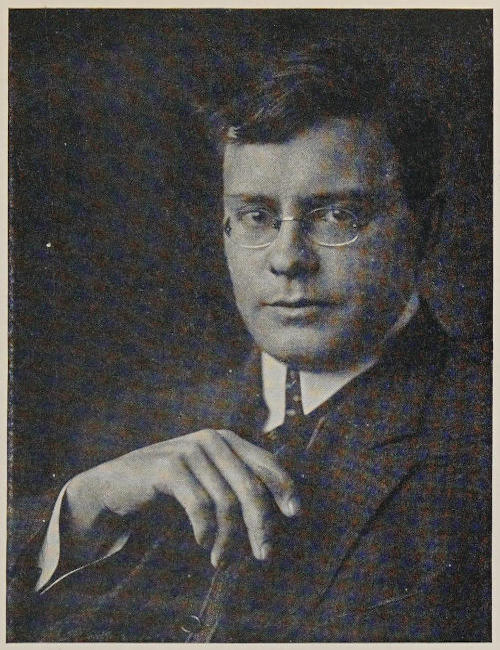
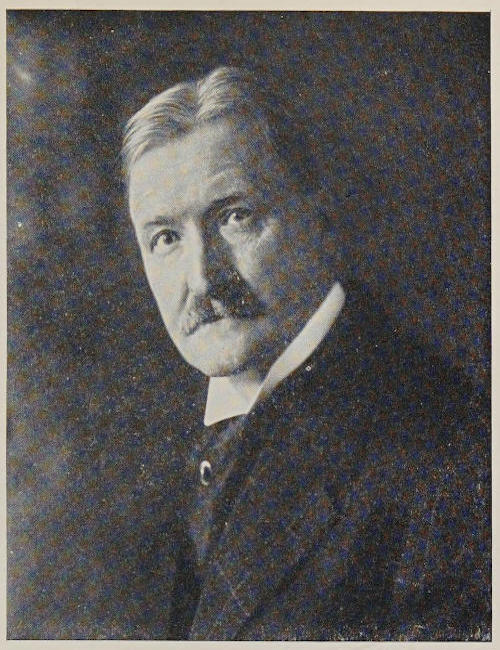
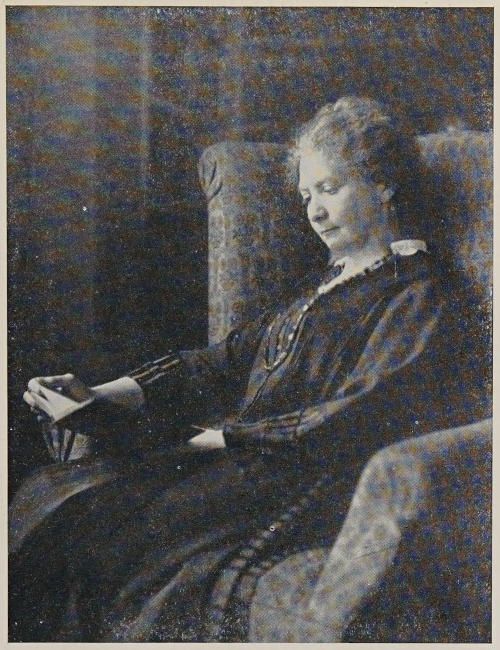
MELVILLE DAVISSON POST
Copyright by The Amon Studio, Clarksburg, W. Va.
Mr. Post has himself commented on the flood of
detective stories that followed Poe’s “until the stomach
of the reader failed.” Disregarding merely imitative
work, let us have a look at such substitutes as have
been managed for divinity and fate. We commonly
call one type of story a detective story simply because
the solution of the mystery is assigned to some one
person. He may be amateur or professional; from the
standpoint of fictional plausibility he had, in most
cases, better be a professional. Poe had his M. Dupin,
Gaboriau, his M. Lecoq; Conan Doyle, his Sherlock
Holmes. Mr. Post has Abner, his M. Jonquelle, prefect
of police of Paris; his Sir Henry Marquis of Scotland
Yard; his Captain Walker, chief of the United
States Secret Service. If we are looking for Mr. Post’s
difference from Poe and others we shall not find it
here. The use of a detective is not inevitable; when
there is none we call the tale a mystery story. The
method of telling is not fixed; and it is doubtful if
anyone will surpass the extreme ingenuity and plausibility
of Wilkie Collins in a book like The Moonstone,
where successive contributed accounts by the actors
unfold the mystery at last. One of the few American
writers whose economy of words suggests a comparison
with Mr. Post was O. Henry. And O. Henry was also
a believer in plots, even if the plot consisted, as sometimes
it did, in little more than a few minutes of
mystification.
Poe had replaced the god from the machine with
the man from the detective bureau, but further progress
seemed for some time to be blocked. All that anyone
was able to do was to produce a crime and then
solve it, to build up a mystery and then explain it.
This inevitably caused repetition. The weakness was
so marked that many writers tried to withhold the
solution or explanation until the very end, even at
the cost of making it confused, hurried, improbable.
Even so, no real quality of drama characterized the
period between the crime at the commencement and
the disclosure at the finish of the tale. I do not know
who was the first to discover that the way to achieve
drama was to have the crime going on, to make the
tale a race between the detective and the criminal. The
method can, however, be very well observed in Mary
Roberts Rinehart’s first novel, The Circular Staircase
(1908); and of course it is somewhat implied in the
operations of Count Fosco in Wilkie Collins’s The
Woman in White, many years earlier. But this discovery
constituted the only technical advance of any
importance since Poe. As a noticeable refinement upon
this discovery Melville Davisson Post has invented
the type of mystery or detective-mystery tale in which
the mysteriousness and the solution are developed together.
Not suitable for the novel, which must have
action, this formula of Mr. Post’s is admirable for the
short story, in which there is no room for a race with
crime but only for a few moments of breathlessness
before a dénouement.
This refinement of Mr. Post’s whereby repetition is
avoided, the development of the mystery and its solution
side by side, is usually hailed as his greatest
achievement. I happen to think that he has in certain
of his tales achieved something very much greater. It
seems to me that in some of his work Mr. Post has put
the deus ex machina back in place, has by a little lifted
the mere detective story to the dignity of something
like the old Greek tragedy, and in so doing has at least
partially restored to the people the purge of pity and
the cleansing of a reverent terror.
For whatever tribute one may pay him on the technical
side, and every book of his increases the tribute
that is his due, the thing that has remained unsaid is
his use of plot for ennobling the heart and mind of
the reader. He is right, of course, when he says that
the primary business of the writer must be to entertain;
but more rightly right when he adds that it is
possible to do the something more in a work which
may aspire to be called a work of art. Anna Katharine
Green once wrote: “Crime must touch our imagination
by showing people like ourselves but incredibly transformed
by some overwhelming motive.” The author
of The Leavenworth Case and all those other novels
which have entertained their hundreds of thousands,
despite appalling technical shortcomings which she
never ceased to struggle with but was never able to
overcome, was one of the terribly few to command our
respect and our admiration in this crucial affair. She
was one of the few with whom plot was never anything
but a means to an end, and that end, the highest. Of
others, it is easy to think at once of O. Henry; it is in
this that I would compare him with Mr. Post, and not
in any lesser detail such as the power to tell a story
with the fewest possible words. All the emphasis that
has been put on short story construction in America, all
the trumpeting that has proclaimed American writers
as the masters of the short story on the technical side
will ultimately go for nothing if the fact is lost sight
of that a short story is a cup to be brimmed with feeling.
And as to the feelings poured into these slender
chalices, by their effects shall ye know them.
There is a curious parallel between Mr. Post and
another contemporary American writer, Arthur Train.
Both began as lawyers, and both showed unusual ability
in the practice of the law. Both are the authors
of books in which the underlying attitude toward the
law is one of that peculiar disdain which, perhaps, only
an experienced lawyer can feel. Mr. Train’s stories
of Ephraim Tutt display an indignation that is hot
enough under their surface of weathered philosophy
and levity and spirit of farce. But as long ago as 1896
Mr. Post had published The Strange Schemes of Randolph Mason,
his first book of all and one that must
detain us a moment.
His career up to that time may be dealt with briefly.
Born in Harrison County, West Virginia, 19 April
1871, the son of Ira Carper Post and Florence May
Davisson Post, he was graduated (A.B.) from West
Virginia University in 1891 and received his LL.B.
from the same institution the year following. He was
very shortly admitted to the bar of the Supreme Court
of West Virginia, of the United States Circuit Court
of Appeals, and of the Supreme Court of the United
States. He served as a Presidential elector and secretary
of the Electoral College in 1892. A young man
not yet twenty-five, he conceived that “the high ground
of the field of crime has not been explored; it has not
even been entered. The book stalls have been filled
to weariness with tales based upon plans whereby the
detective or ferreting power of the State might be
baffled. But, prodigious marvel! No writer has attempted
to construct tales based upon plans whereby
the punishing power of the State might be baffled.”
And he reflected that the true drama would lie in a
duel with the law. He thereupon created the figure
of Randolph Mason, a skilled, unscrupulous lawyer
who uses the law to defeat the ends of justice. Of
these stories the masterpiece is probably “The Corpus
Delicti.” Well-constructed, powerful, immensely entertaining,
surely these dramas are of the essence of
tragedy, surely they replace Poe’s detective with somebody
far more nearly approaching the Greek god from
the machine. In considering the effects of these remarkable
tales we can hardly lose sight of their moral
purge of pity and terror, their sense of the law man
makes as a web which man may slip through or break
or brush aside. Why, a true god from the machine,
Mr. Post implies, is not necessary to us; we can destroy
ourselves; heaven has only to leave us alone.
This, in its turn, produces the much stronger secondary
effect: the cry for a true god to order and reward and
punish us.
Uncle Abner (1918) has been well contrasted with
The Strange Schemes of Randolph Mason. “He has
demonstrated that wrong may triumph over man-made
laws, which are imperfect after all the centuries; but
that right must win under the timeless Providence of
God.”[10] In Uncle Abner the deus ex machina is fully
restored. When it was known how Doomdorf had
died, “Randolph made a great gesture, with his arm
extended. ‘It is a world,’ he said, ‘filled with the mysterious
joinder of accident!’ ‘It is a world,’ replied
Abner, ‘filled with the mysterious justice of God!’”
Mr. Post married, in 1903, Ann Bloomfield Gamble,
of Roanoke, Virginia. Mrs. Post died in 1919. The
political career which seemed possibly to be opening
before him in his twenties has been neglected for one
more fascinating as an author; although he has served
as a member of the board of regents of State Normal
schools, as chairman of the Democratic Congressional
Committee for West Virginia in 1898, and
as a member of the advisory committee of the
National Economic League on the question of
efficiency in the administration of justice (1914-15).
He lives at The Chalet, Lost Creek, R.
F. D. 2, West Virginia, rides horseback and enjoys
the company of his dog, and reads the classics. He is
the author of other books besides Uncle Abner which
reveal his love for the West Virginia countryside and
his power to make his stories take root and grow in that
setting. Of his Dwellers in the Hills (1901) Blanche
Colton Williams says, in Our Short Story Writers:
“To read it is to ride in memory along a country road
bordered by sedge and ragweed; to note the hickories
trembling in their yellow leaves; to hear the partridges’
call, the woodpecker’s tap, and the ‘golden belted bee
booming past’; to cross the stream fringed with bulrushes;
to hear men’s voices ‘reaching half a mile to
the grazing steers on the sodded knobs’; to meet a
neighbor’s boy astride a bag of corn, on his way to the
grist mill; to stop at the blacksmith’s, there to watch
the forging of a horseshoe; or at the wagoner’s to assist
in the making of a wheel; to taste sweet corn pone
and the striped bacon, and to roast potatoes in the
ashes....”
With the exchange of West Virginia for Kentucky,
this is also the background and the mood of The Mountain
School-Teacher (1922), but this short novel is
an allegory of the life of Christ. A young schoolteacher
appears in a mountain village. We first see
him striding up a trail on the mountain, helping a
little boy who is having trouble with an ox laden with
a bag of corn. In the village the schoolteacher finds
men and women of varied character. Some welcome
him, and they are for the most part the poor and lowly;
some regard him with suspicion and hate. The action
parallels the life of Christ and is lived among people
who are, despite nineteen centuries, singularly like the
people of Christ’s time. In the end comes the trial
of the schoolteacher on trumped-up charges. “If He
came again,” the author seems to say, “it would happen
as before.”
Such fiction does not come from a man who is primarily
interested in railroads and coal, education and
politics, nor from one whose final interest is to provide
entertaining fiction.
In recent books Mr. Post has allowed his fiction to
follow him on his travels about the earth. The Mystery
at the Blue Villa (1919) has settings in Paris,
Nice, Cairo, Ostend, London, New York and Washington;
the war of 1914-18 is used with discretion as
an occasional background. Mr. Poe’s mysticism can
be quickly perceived in certain stories; the tragic quality
is ascendant in such tales as “The Stolen Life”
and “The Baron Starkheim”; and humor is not absent
from “Lord Winton’s Adventure” and “The Witch
of Lecca.” A story of retributive justice will be found
in “The New Administration.” The scenes of most
of the episodes in The Sleuth of St. James’s Square
(1920) are in America; the central figure about whom
all the cases turn is Sir Henry Marquis, chief of the
investigation department of Scotland Yard. The material
is extremely colorful—from all over the world,
in fact. Monsieur Jonguelle, Prefect of Police of
Paris (1923) has the same characteristics with the difference
of the central figure and with various settings.
The reader will observe in these books that the narrative
standpoint is altered from story to story; to take
Monsieur Jonquelle, some of the tales are related by
the chief character, some by a third person, some by
the author. The reason for the selection inheres in
each affair and is worth some contemplation as you go
on. Walker of the Secret Service (1924) is pivoted
upon a character who appears in “The Reward” in
The Sleuth of St. James’s Square.
This new book of Mr. Post’s is a brilliant example
of his technical skill throughout; it has also a special
interest in the fact that the first six chapters are really
a compressed novel. Walker, of the U. S. Secret
Service, is introduced as a mere boy of vigorous
physique who falls under the influence of two expert
train robbers. The several exploits he had a share
in are related with a steady crescendo of interest. At
the end of the sixth chapter we have a clear picture
of the fate of the two chiefs he served. The peculiar
circumstances in which young Walker was taken into
the Secret Service are shown; and the rest of the book
records some of the famous cases he figured in. The
motivation is that of Uncle Abner. “‘Crime always
fails. There never was any man able to get away with
it.... Sooner or later something turns up against
which he is wholly unable to protect himself ... as
though there were a power in the universe determined
on the maintenance of justice.’”
Two of the most striking stories, “The Expert Detective”
and “The ‘Mysterious Stranger’ Defense,”
are developed from courtroom scenes—indeed, “The
Expert Detective” is a single cross-examination of a
witness. Probably this tale and one called “The Inspiration”
must be added to the shorter roll of Mr.
Post’s finest work, along with “The Corpus Delicti”
and “The Doomdorf Mystery.”
The general method has been said, correctly, to combine
the ratiocination of Poe’s stories with the dramatic
method of the best French tellers of tales. The
details of technique will bear and repay the closest
scrutiny. But in certain stories Melville Davisson
Post has put his high skill to a larger use than skill
can accomplish; for those of his accomplishments an
endowment and not an acquisition was requisite.
When one says that of the relatively few American
writers with that endowment in mind and heart he
was able to bring to the enterprise in hand a skill
greater than any of the others, one has indeed said all.
1896
The Strange Schemes of Randolph Mason
1897
The Man of Last Resort
1901
Dwellers in the Hills
1909
The Corrector of Destinies
1910
The Gilded Chair
1912
The Nameless Thing
1918
Uncle Abner, Master of Mysteries
1919
The Mystery at the Blue Villa
1920
The Sleuth of St. James’s Square
1922
The Mountain School-Teacher
1923
Monsieur Jonquelle, Prefect of Police of Paris
1924
Walker of the Secret Service
Mr. Post’s own two articles on the short story are of the
highest value, not only to an understanding of his method, but
as a contribution to the theory of literary structure—a contribution,
unlike most, allied to and realized in practice.
His first article appeared under the title, “The Blight,” in
the Saturday Evening Post for 26 December 1914. A shorter
article on “The Mystery Story” appeared in the same magazine,
27 February 1915.
In April, 1924, while in New York for a short time Mr.
Post dictated the following notes which amplify a little his
written articles:
“The modern plan for the mystery or detective story can
no longer follow the old formula invented by Poe and adopted
by Gaboriau, Conan Doyle, etc. All life has grown quicker,
the mind of the reader acts more quickly, our civilization is
impatient at delays. In literature, and especially literature of
this type, the reader will not wait for explanations. All
explanations must be given to him in advance of the solution
of the mystery.
“It became apparent upon a very careful study of the
mystery story that something must be done to eliminate the
obvious and to get rid of the delay in action and the detailed
and tiresome explanation in the closing part. It occurred to
me that these defects could be eliminated by folding together
the arms of the Poe formula. Instead of giving the reader
the mystery and then going over the same ground with the
solution, the mystery and its solution might be given together.
The developing of the mystery and the development toward
the solution would go forward side by side; and when all the
details of the mystery were uncovered the solution also would
be uncovered and the end of the story arrived at. This is
the plan which I followed in my later mystery-detective stories—the
Uncle Abner series, Monsieur Jonquelle, and Walker of
the Secret Service. This new formula, as will at once be seen,
very markedly increases the rapidity of action in a story, holds
the reader’s interest throughout, and eliminates any impression
of moving at any time over ground previously covered.
“It requires a greater care and more careful technique, for
every explanation which the reader must receive in order to
understand either the mystery or the solution must be slipped
into the story as it proceeds without any delay in its action.
There can be no pause for explanation. Each explanation
must be a natural sequence and a part of the action and movement.
The reader must never be conscious that he is being
delayed for an explanation, and the elements of explanation
must be so subtly suggested that one receives them as he
receives the details of a landscape in an adventure scene,
without being conscious of it.
“In undertaking to build up a story on this modern formula,
one must first have a germinal or inciting incident upon
which the whole story may turn as upon a hinge. Out of this
controlling incident, the writer must develop both the mystery
and its solution and must present them side by side to the
reader in the direct movement of the story to the end. When
the mystery is finally explained, the story is ended. There
can be no further word or paragraph; there can be no added
explanation. If a sufficient explanation has not preceded this
point, the story has failed. If the reader has been compelled
to pause at any point in the story long enough to realize that
he is receiving an explanation, the story has failed.
“But it will not be enough if the writer of the mystery-detective
story is able cleverly to work out his story according
to this formula. He must be able to give this type of story
the same literary distinction that can be given to any type of
story. To do this he has only to realize a few of the primary
rules of all literary structure. He must remember that everything,
every form of character, has a certain dignity. This
dignity the writer must realize and respect. Flaubert told
Maupassant that in order to be original he had only to look
at the thing which he wished to describe long enough and
with such care that he saw in it something which no one
had seen in it before. That rule ought to be amended to require
the writer to look at every character and every situation
long enough and with sufficient care to realize the dignity in
it—that element of distinction which it invariably possesses
in some direction—and when he has grasped that, to respect
and convey it in his story.
“It may as well be said that no one form of literary structure
is superior to another. The story dealing with the life
and action of our highest types does not in itself result in any
better literature than the story dealing with the lowest or
most abandoned types; nor are physical adventures to be
graded below metaphysical adventures. The mystery-detective
story may be structurally so excellent and its workmanship so
good that it is the equal of any form of literature.
“The obvious is at the base of all boredom. The thing
that provides our perpetual interest in life is that the events
lying just ahead of us cannot be determined. It is the mystery
in the next moment, the next hour, the next day that we live
to solve. If by any mental process we could ascertain the
arrival of events ahead, no human being could endure the
boredom of life. Something of this mystery, this uncertainty,
must be caught up for the reader in the short story if his
interest is to abide to the end. The skill of the author in preserving
this uncertainty and mystery in events—in this imitation
of life—will indicate the place to be assigned to him
in the art he has undertaken.”
To an interviewer (by letter) who asked for the principal
events of his life, Mr. Post once made a suitably whimsical
answer:
“I was born like the sons of Atreus in the pasture land of
horses. I was reared by a black woman who remembered her
grandmother boiling a warrior’s head in a pot. I was given
a degree by a college of unbeautiful nonsense. I have eaten
dinner with a god. And I have kissed a princess in a land
where men grind their wheat in the sky.”
4. Jeffery Farnol’s Gestes — i — ii — iii — iv — v — vi — BOOKS BY JEFFERY FARNOL — SOURCES ON JEFFERY FARNOL
A geste is a great exploit or an heroic achievement;
the thing that has today pretty generally
dwindled to a gesture. But although the fiction of
Jeffery Farnol is full of gestures—of ladies who cry,
“La!” and of ladies who swoon; of gentlemen who
draw swords as naturally as they draw breath, or even
more so—the succession of his work is a series of gestes.
For one point, he followed his bent in the teeth of literary
fashion and scored, at the outset, an enormous
popular success. For another point, he kept his head
when success was upon him. Although a favorite scene
in his stories is one full of lightning fence, swifter
guard and dexterous riposte, the true portrait of the
author is decidedly different: It shows him in the
patient and laborious attitudes of his own Black
George, in the toil the young Farnol was himself committed
to for a period in his youth, the heavy work of
the forge and the foundry, the slow heating to malleability
and the shape hammered out before cooling.
After The Broad Highway had captured the fancy of
England and America, in an incautious moment Farnol
the smith, Farnol the patient artificer, contracted to
furnish his next tale as a serial in an American magazine.
The editor blithely began publication with only
part of the manuscript in hand. Dissatisfied with his
work, the author at one stage tore up ten completed
chapters. For several months he worked under pressure.
In the end he kept the editor supplied. The experience
did not lead him into the misconception that
his smithy was a Ford factory. Nor has the fact that
he can write one kind of tale ever led him to suppose
that he ought to succeed with another variety; he followed
The Definite Object with Our Admirable Betty.
It is surprising to reflect that he made his first hit by
reviving a species of romance when romance of that
species, and of pretty nearly every species, was justly
considered to have breathed its last; but it is vastly
more surprising to realize that he has continued to
succeed by the same tactics. Almost ten years later
another young man, similarly self-willed, was to score
an equal success in America (though not in England)
by the same sort of reckless behavior, only the title of
the book was to be Main Street and not The Broad
Highway. But Sinclair Lewis, although unaware of
his advantage, was setting a fashion, not defying one.
Both Mr. Lewis’s novel and Mr. Farnol’s were the
products of that kind of saturation which, while it
cannot be relied upon to produce enduring literature,
can nearly always be counted upon to produce literary
phenomena. Such a phenomenon, certainly, was the
Kentish tale of Peter Vibart, Charmian, the Tinker,
Black George, and the Ancient, appearing as a book
early in 1911 and rolling rapidly up to a sale of
500,000 copies in England and America. And though
perhaps not a portent, as Main Street has been a portent,
it was a sign of far more significance than the
appearance on the scene of a new individual writer.
But let us tell the story of that story in orderly fashion.
It begins with two little boys in their nightshirts
listening furtively but eagerly outside the door of a
room in which their father was reading aloud to their
mother, whose eyes were on her needle. The book was
The Count of Monte Cristo. The name of the older
boy—he was eight—was John Jeffery Farnol; of the
younger, who was to fall in the Boer War, Ewart
Farnol. The family had removed from Birmingham,
where Jeffery was born, to Lee, in Kent. The reading
proceeded until a sneeze betrayed the boys. But after
that they were admitted for an extra hour to the evening
readings. The senior Farnol read excellently,
varying his voice to suit the characters. He made the
stories live, for Jeffery at least. From Cooper, Scott,
Dickens, Dumas, Thackeray and Stevenson heard at
home, Jeffery became a schoolboy who invented tales
to entertain his fellows; in particular he started a story
which he carried on for three months, winding it up
with the close of term. When he had finished school
he wanted to become a writer, but as there was not
money to send him to one of the universities, his father
thought the ambition foolish, and at 17 the boy was
set to work in Birmingham with a firm of engineers
and brassfounders. Manual labor at the forge was
varied by a great deal of fighting with fists. He was
short and thickset; he spent the lunch hour either telling
stories to the other men, “stories from the classics,”
as he says, “vividly touched up, no doubt, or making
a rough drawing of some scowling diffident sitter.” As
he sat drawing one noon, a man of the crowd looking
over his shoulder remarked: “Ah, that’s all very well,
but drawing ain’t manliness.” A test of manliness,
inquiry developed, was the feat of a chap who had
climbed up the inside of the big chimney. Farnol laid
five shillings to half a crown that he could duplicate
the deed. Says one account: “The chimney towered
up, one hundred and twenty feet of blackness, choked
with the soot of four years and with insecure stanchions,
several of them broken.” He fastened his
handkerchief at the top for all to see; it is easy to believe
that the worst of the thing was the climb down
with soot tumbling in his eyes. The men refused to
pay their bets, he had to fight one of them, though sick
and giddy, and was beaten. But a climax was near at
hand. Farnol kept a note-book in which he was forever
jotting down ideas and impressions. The foreman
most reasonably objected to these interruptions of
work. There were blows. Leaving the foreman “reclining
in a daze against an anvil”—the words aren’t
Farnol’s—the last Farnol saw of the place was his
handkerchief fluttering from the chimney top.
“No good for work, always writing.” How singularly
right the foreman’s verdict had been, some
years were required to prove. For a time Farnol stayed
at home and wrote stories, poems, whatnot. A few
stories got printed. His father was unimpressed, except
by the unanimity of family relatives in declaring
that he was encouraging Jeffery to grow into an idle
fellow. It seemed as if something might be constructed
from his son’s natural aptitude for drawing. Jeffery
began the study of line and figure drawing under Loudon
at the Westminster Art School. He found everybody
else at the school so much more clever that he
became discouraged.
“I think I’ll write.”
“You can’t write,” said his father. “You’ve not
had a University education.”
He went into his father’s business, but as he continued
to write stories, and as some of them continued
to get accepted, this arrangement was a failure. At
this time his favorite recreation was cycling. “All the
highroads and byroads of Kent, Surrey and Sussex became
familiar to me. I wheeled between the flowery
hedgerows and quenched my thirst at the wayside taverns.
It was then, while watching villagers wending
their way to church, that I first saw the Ancient.
There he was, tall hat, smock-frock, shrewd, wrinkled
face, and gnarled hands grasping his knobbly staff just
as I have described him in The Broad Highway. And
that was the first inception of the book, though it was
not until several years afterward that it came to be
written.” Black George was fashioned out of his
own time spent at the Birmingham forge.
Farnol wasn’t yet twenty-one when he married
Blanche Hawley, daughter of F. Hughson Hawley, a
New York artist. The pair set out for America. The
bride of seventeen had been sent to England on a visit.
It was hoped that Mr. Hawley would take the news
well. It was also hoped that Jeffery might sell stories
more successfully in the United States. He had a
negligible amount of money. The seven, and more
than seven, lean years were beginning.
Mr. Hawley received them well. In an interview
a year ago[11] Mr. Farnol, recalling the New York
period, is quoted as saying:
“I hadn’t a cent in the world. My wife had paid
for the wedding ring and the honeymoon, and it seemed
to me that after that it was up to me to do something.
It has been said that her father remained adamant
when we arrived, but that isn’t true. I’m expecting a
knock on the bean from him when he reads that. On
the contrary, I found him a delightful old cove, and
we were forgiven.
JEFFERY FARNOL
Photograph by E. Hoppé, London.
“After that I went to work, living alone in a room
at Thirty-eighth Street and Tenth Avenue. One night,
about 3 o’clock in the morning, I came across a man
down by the river whose face was all covered with
blood.
“‘What’s the matter?’ I asked him.
“‘I’m dying, kid, I’m dying!’ he told me.
“I took him home and fixed him up. It turned out
that he was the leader of a notorious gang. I’ve never
known a finer chap than he. I’ve found out in this
life that if you scratch deep enough you’ll always find
true worth.
“About a week after that night he came around and
took me to a notorious saloon. He took me into the
back room and introduced me to the bunch. Several
of them have gone to the chair since, but they were
good fellows.[12] I’ve gone into that saloon without a
nickel in my pocket, and looking it. I’ve had one of
the gang say to me: ‘Stony up against it, kid? Will
a fiver help?’ and before I could know what happened
the gang would have taken up a collection of
$25 and given it to me.[13]
“My wife was living with her family at that time,
but often she would come to bring me baskets with
chicken and all sorts of delightful little delicacies.
The neighborhood was a terrible one in those days,
and I was afraid at first to have her come there. I
told some of the boys about it. They told me never to
worry again. They arranged that an unseen bodyguard
should follow her from the street car and escort
her to my room and back again when she was ready
to leave.... She believed in me even then when
it meant more to me than anything in the world. People
don’t know it, but I am naturally a timid man.
She gave me confidence in myself, and with it came the
ability to succeed.”
The room at Thirty-eighth Street and Tenth Avenue
was a studio, “dismal, rat-haunted,” where a job
as a painter of theatrical scenery compelled him to
spend a great many of his nights and days. In intervals
of scene-painting he began The Broad Highway.
“I met O. Henry several times in the offices of Ainslee’s
Magazine. I think it was Will Irwin who introduced
us. O. Henry was unusually taciturn for an
American, and I—well, I am an Englishman. So
though we saw each other frequently, never more than
‘How d’ ye do’ passed between us.
“The pleasantest recollections I have of those old
days was the time I spent in dabbling in painting and
theatricals at the old Astor Theatre. One day a down-and-out
young man got past the doorkeeper and
strolled on the stage. ‘I’ve got a fortune here in my
pocket,’ he said. ‘We all have that,’ I replied.
“The young fellow said he had been a cub reporter
in Chicago, but now he was hungry and looking for a
job. Finally he got the attention of the producer at
the theatre. He pulled out a manuscript and began
reading. The producer at first paid no attention, but
gradually became more and more interested. When
the first act had been read the producer said, ‘All right,
I’ll take it.’ The starving dramatist was Eugene
Walter and the manuscript was that of ‘Paid in
Full.’”[14]
Farnol wrote in the studio and also at Mr. Hawley’s
home, in Englewood, New Jersey. When The
Broad Highway was the best seller, Mr. Hawley
rounded out the picture of the New York period.[15]
“Farnol,” he said, “is a dreamer and a bookworm, and
has just about as much practical idea of time and
money as that type is popularly supposed to have.
He kept right on writing, and night was the time he
had to do it. Many a time when I’ve been detained
late with a press of work I’d get home at midnight
or thereabouts to find a light supper waiting for me
and Jeffery up working, only waiting to be called to
entertain me while I ate. For he is the most entertaining
talker I’ve ever known and loves to talk. His
natural speech is the phraseology in The Broad Highway.[16]
It has become natural to him through many
years of living with the characters in the books of that
period he loves so well. And he is a born storyteller.
He always kept us sitting overtime at meals, just as
he used to keep me sitting up till 2 or 3 o’clock in the
morning on the occasion of the midnight suppers.
When he gets to spinning a yarn, whether telling it or
writing it, he loses all knowledge of the flight of time.
Often when I’ve come down to breakfast before catching
my early train to New York I’ve found him just
finishing his night’s work, fresh and enthusiastic. Even
when his days are full of leisure he likes best to work
at night. Then, he says, his brain is clearer, and there
are no interruptions. His power of concentration and
absorption is the most marvellous thing I’ve ever encountered.
I remember once taking him to the Players
Club with me for luncheon. After luncheon he wandered
into the library and was delighted to see the
work of Aphra Behn, an early writer I’d never heard
of, but belonging to his favorite period and well known
to him. I left him there renewing her acquaintance
with delight. I forgot all about him, but chancing to
go back for dinner, on entering the library to my
amazement I saw him sitting there in exactly the same
posture in which I’d left him hours before. He didn’t
know whether ten minutes or as many hours had
elapsed.”
Farnol succeeded in selling a number of short
stories and had some work as an illustrator. He wrote
two light romances, My Lady Caprice and The Money
Moon, which magazines bought. For two years he
put all his spare time on The Broad Highway, the
history of which is among the curiosities of book publishing.
Like Main Street a decade later, The Broad Highway
was possibly conceived and certainly executed in
a spirit of revolt. Such rebellions are common, and the
only wisdom that can be uttered in respect of them is
embodied in that proverb which says that one man’s
meat is another man’s poison. Editors and publishers
endeavor to give the public what the public wants.
The public, very naturally, never knows what it wants
until it tastes it. The public is like a husband sitting
down to his wife’s dinner. He may like everything
or nothing; he may enormously relish the unexpected,
placed before him with inward perturbation and in a
spirit of desperate doubt. He may pounce with appetite
upon, and sing loudly the praise of, some dish
denounced by him and refused by his palate the week
before. If a writer attempt to please editors or publishers,
who, in turn, are attempting to please their
publics, he will be successful with the entrepreneurs
and possibly with the audiences. And his temperament
may make such a course the very best thing. If
his temperament is otherwise, sooner or later he will
please himself; and if he can then get published a
large public may just possibly discover that he greatly
pleases them.
The completed manuscript of The Broad Highway
was submitted to the Century Company and Charles
Scribner’s Sons in New York, both of whom failed to
come to terms and returned it shortly. It was then
submitted to Dodd, Mead & Company, who indicated
a conditional acceptance and asked the author to come
in and discuss possible changes. The firm’s readers
offered their suggestions and Farnol took notes. The
principal result was that he cut 20,000 words out of
the book, which still remained of 200,000-word length,
or twice the length of the usual “full-length” novel.
The alterations were not enough to give the publisher
the necessary confidence; the year was 1907, the year
of the money panic; and the manuscript was finally
returned to Farnol with a definite declination. The
reasons were sound: There had been a bad slump in
Wall Street, the book was formidably long, the author
was unknown, the interest of the tale might be almost
wholly for English readers. But there was another
reason in the nature of the novel to which a few words
should be devoted.
Robert Louis Stevenson had died in 1894. His work
spawned a school of historical fiction, much of it
pseudo-historical, which had dominated the American
book market for years. The public taste did not discriminate
during that decade between the good and the
bad; To Have and To Hold and When Knighthood
Was in Flower were equally hailed as masterpieces and
alike elevated to the top of the heap. From that day,
indeed, dates the name and the peculiarity of the “best
seller.” The term remains, but it has only in very recent
years begun to undergo a transformation of meaning,
the idea of relativity having crept in. With a
truer perception and a better sense of proportion, we
now tend to speak of a book as a best seller in its class,
or in relation to the literary merit of the work or the
record of the author or generally with an eye to what
sale could be expected in the circumstances. The fact
of a sale in so many figures remains; but the estimation
in which the fact is held is quite different. A sale
of 20,000 copies that would have passed unregarded
twenty years ago is now likely to be accounted as of
the greatest significance.
What was fundamentally the trouble in 1907 was
not to be stated with vigor until 1914, when Frank
Swinnerton’s critique of Stevenson[17] was to appear
with such concluding sentences as these: “Stevenson
... created a school which has brought romance to
be the sweepings of an old costume-chest.... If
romance rests upon no better base than this, if romance
is to be conventional in a double sense, if it
spring not from a personal vision of life, but is only
a tedious virtuosity, a pretence, a conscious toy, romance
as an art is dead. And if it is dead, Stevenson
killed it.” Such, even in 1907, was in various quarters
uneasily felt to be the fact. In 1907, it is true,
George Meredith was spending his declining years in
poetry, and Thomas Hardy was at work on The Dynast;
but The Way of All Flesh had been published
four years earlier, Shaw’s plays were being staged, the
dead George Gissing was at last coming into attention,
Mr. Galsworthy had just given us The Man of
Property, Mr. Wells was brewing Tono-Bungay, and
Mr. Bennett was at work on The Old Wives’ Tale.
If the lid of the costume-chest was still raised, it had
every appearance of being propped most insecurely.
All cogent and immediate reasons aside, the publisher
of books had every psychological and intuitive reason
for doubting the appeal of a volume of 500 closely
printed pages, much of it in dialect and all of it concerned
with Kentish scenes of a hundred years earlier.
To return to The Broad Highway: An actor with
whom the author had become acquainted at the Astor
Theatre was about to play an engagement in Boston,
and offered to show the manuscript to friends in the
office of Little, Brown and Company. Farnol waited
for some word in vain; after several months he learned
that the actor had returned to New York, and sought
him out. The actor had visited the publishing house
but had completely forgotten the manuscript.... It
was taken from the bottom of his trunk, where it had
lain all the while, and Farnol was minded, first to sell
it, with all rights, for $500. Mr. Hawley said Farnol
would do no such thing, “if I have to buy it myself.”
Farnol’s next impulse was to burn the cumbersome
bundle. He finally gave it to his wife, and Mrs. Farnol
sent it to her husband’s mother in England. Shirley
Byron Jevons, at that time editor of The Sportsman,
was the next to see it. He took it to the publishing
house of Sampson Low, Marston & Company,
introducing it with: “Here is another Lorna Doone”—Blackmore’s
novel having been the firm’s greatest fiction
success. The publishing house accepted the book
and had drawn an agreement with Mr. Jevons as Mr.
Farnol’s agent when the author appeared unexpectedly.
In fact, Farnol, discouraged by his fortunes in America,
had simply got on the boat with his wife and
little daughter. A new agreement was drawn with him
direct, and signed. Then, but some time before the
book was set up in type, the publisher showed it to
Clement K. Shorter, editor of The Sphere, whose
devotion to the work of George Borrow was well
known. Mr. Shorter’s account of the incident embodies
an interesting estimate of the book:[18]
“I read The Broad Highway with avidity, and recognized
at once—as who would not have done?—that
here was a striking addition to picaresque romances,
that the author had not read Don Quixote, Gil Blas
and the best stories by Defoe and Fielding for nothing,
nor had he walked along the broad highways of England
without observation and profit any more than
had the creator of Lavengro and Romany Rye. For the
vast multitude of readers of each epoch the dictum of
Emerson stands: ‘Every age must write its own books.’
It is of no use for the pedantic critic to affirm, with
pontifical fervor, that Cervantes and Le Sage and
Defoe are masters of literature and that our contemporaries
are but pigmies in comparison. The great
reading public of any age will not be bullied into reading
the authors who have reached the dignity of
classics. The writer who can catch some element of
the spirit of the ‘masters’ and modernize it is destined
to win the favor of the crowd. And thus Mr. Jeffery
Farnol has entered into his kingdom.... The Broad
Highway sold in hundreds of thousands. It is a breezy,
healthy book, as unpretentious as it is sincere. Neither
its author nor his friends need to worry themselves
as to whether it is a masterpiece of literature. For
our day, at least, it has added to the stock of harmless
pleasures. To the critic who complains that ‘it is but
an exercise in archæology,’ and that the author ‘has
never felt what he has written but has gathered it up
from books, one can reply in the language of Goldsmith’s
Mr. Burchell, ‘Fudge.’ It is still possible in
England, in spite of its railway trains and its mechanical
development, to feel the impulse which inspired
Charles Dickens, George Borrow and all the masters
of the picaresque romance, who have in days gone by
traveled with delight through the countryside, seeking
adventures and finding them. ‘I felt some desire,’
says Lavengro, ‘to meet with one of those adventures
which, upon the roads of England, are as plentiful
as blackberries in autumn.’ Mr. Farnol has a talent
for recreating such adventures, and he is perfectly
frank with his readers, anticipating a certain type of
criticism. ‘Whereas the writing of books was once a
painful art,’ he makes Peter Vibart say in The Broad
Highway, ‘it has of late become a trick very easy of
accomplishment, requiring no regard for probability
and little thought, so long as it is packed sufficiently
full of impossible incidents through which a ridiculous
heroine and a more absurd hero duly sigh their
appointed way to the last chapters. Whereas books
were once a power, they are of late degenerated into
things of amusement, with which to kill an idle hour,
and be promptly forgotten the next.’”
The letter killeth, but the spirit giveth life. On
a famous occasion the late Maurice Hewlett tore to
shreds the historicity of the work of James Branch
Cabell, and Mr. Cabell completely lost his temper.
Mr. Farnol’s hero in Beltane the Smith “finds himself
in an England which from the internal evidence of
friars, bowmen, arms and armor we might vaguely
describe as Edwardian (Edward I., II., III.)—the
pikes he appears to have borrowed from a later period.
And yet it is not Edwardian either; for there is no
hint of a king in it all, and never, never was there
such an anarchical England, save in the reign of
Stephen of Blois.”[19] Mr. Farnol’s Latin, says J. P.
Collins, “gives one the shivers. He mixes his thee’s
and his ye’s, and precisians may murmur at his forms
of archaic diction. But ... if Farnol makes a slip
in the way of detail, or lapses into excess, he preserves
the most important thing, and that is atmosphere.”[20]
Everyone will recall Scott’s inaccuracies in Ivanhoe,
of which the most serious was the depiction of a state
of feeling between the Saxons and Normans existing
a century earlier than the time of the novel.
Mr. Shorter has made us longer; it remains to say
that The Broad Highway, accepted in England, was
offered by the English publisher in America, in one
instance to Dodd, Mead & Company, who again declined
it. Little, Brown and Company were the acceptors,
learning for the first time of the actor’s
delinquency a few years earlier. The book was published
on both sides of the ocean and sprang into instant
success. In the midst of the smother of applause,
appeals, money and golden prospects Mr. Farnol had
a moment. He ejaculated: “Just think! I’ve lost four
years of my life!”[21]
He was 33—ten years older than it has been done,
and thirty years younger than it has been done, also.[22]
Mr. Henry Sydnor Harrison achieved Queed at 31,
Sinclair Lewis was 35 when Main Street appeared.
On the whole, the four years seem not an excessive
price to have paid for a coup, nor thirty-three years
long to have found oneself. The point was neither in
the success nor the time taken to reach it; it was in Mr.
Farnol’s ability to keep his head on his shoulders.
This he proceeded to do; although he sold, while yet
unwritten, the serial rights to his next work, pressure
upon him did not prevent his destroying ten unsatisfactory
chapters, as has been related, and although as
he said at the time, “I really cannot blame the magazine
people,” he was emphatic in saying, “I never wish
to undergo such an experience again.”[23] Two years
elapsed after the publication of The Broad Highway
before the appearance of The Amateur Gentleman;
and except for the publication of a piece of work written
before The Broad Highway[24] and his effort to help
in the war (Great Britain at War), he has had only
nine books brought out in the dozen years since he
raised the curtain. And of these one, The Geste of
Duke Jocelyn, a romance in prose, blank verse and
rhyme, is a novelty written for his daughter, Gillian,
published because what had entertained one girl might
very conceivably entertain others. Mr. Farnol’s
method of keeping his head on his shoulders has been
to practise industry without becoming industrial. Although
homesick at first on his return to England, he
settled in Kent, at Lee, with a den at the top of the
house where he could work from midnight to breakfast.
Old English books lined two walls of this refuge;
another wall was given up to a collection of old pistols
and sabres; and on the desk there usually lay a
dictionary of slang dated 1812. More recently the
Farnols have lived at the seashore at Brighton, but
the winters are generally spent at Ospedaletti, which
is on the Italian Riviera.
Except for a short visit to report for the London
Daily Mail the fight between Jack Dempsey and
Georges Carpentier in 1921,[25] Mr. Farnol had not
revisited America until autumn, 1923. At that time
visitors met a shortish man, anything but a figure of
romance, whose outstanding trait was his genuine
friendliness, “a friendliness which is not an affectation
with which he tries to put strangers at their ease, but
an actual part of him.”[26] To see him rehearse and
enact, rather than merely outline, his next novel was
an exceptional experience, for at such times he suits
his voice to his characters and displays a considerable
range of dramatic skill. Interviewers developed evidences
of a struggle in the romancer’s mind between
the type of woman he writes about and the types more
usual today; however, chivalry, or perhaps the romantic
vision, enabled him to come through the ordeal by
newsprint without dishonor. He denied the possibility
of platonic love and friendships. “After a certain
point, such friendships are bound to be no longer
platonic. Mark me! I know they wouldn’t be in my
case, anyway.”[27] A subject he did not tire of discussing
was the wonder of America.[28] To several who
talked with him he expressed the intention of writing
another novel about New York City.[29] “New York
should be called ‘The City of Great Adventures,’” he
said, with characteristic enthusiasm, “because anything
might happen in New York.”[30]
More expressive of the man is the story of how his
slightest novel came to be published. He was discussing
with his mother the advisability of bringing
out work written before The Broad Highway. “Look
here,” he said to her, “why not rout out Mr. Tawnish?
You have been very good to me, and I can never properly
repay you, but if you can do anything with Mr.
Tawnish you shall have it.” The tale—one that reminds
most readers of Tarkington’s Monsieur Beaucaire—was
taken out of a drawer, touched up and
added to, and accepted for book publication. The
advance royalties, constituting a generous gift, were
handed over to Mrs. Henry Farnol. This was in the
autumn of 1913.
In an article appearing at the height of Mr. Farnol’s
first success, Henry Keats wrote: “The Broad
Highway has seemed to the critics to invite comparison
with so many different masters of the English novel—George
Borrow, Blackmore, Le Sage, Dickens, Stevenson,
Thackeray, to mention a few—that I asked him
about his ‘foster-father.’ Mr. Farnol smiled. ‘I would
not know my own literary parent if I met him out here
in the broad highway of Kent,’ he exclaimed. Judging
from his subsequent confessions, the creator of Peter
Vibart and Charmian is under greater indebtedness to
Laurence Sterne than to any of the immortals named
above. And that was owing to the friend of his ‘boyish
ambitions,’ to whom The Broad Highway is dedicated.
Mr. Shirley Byron Jevons was the first, some
years since, to call Mr. Farnol’s attention to the supreme
difficulty of writing a book dealing with
the abstract, citing, as a rare example of success in
that line, Sterne’s Tristram Shandy. A copy of
that unusual book was speedily procured by Mr.
Farnol, and he recalls as though an impression
of yesterday the manner in which he was ‘enthralled’
by its pages. ‘Then,’ he adds, ‘I went on
to The Spectator and The Tatler, the reading of which
showed me how great is the loss of those who are unacquainted
with the Queen Anne essayists.’”[31] This
settles the matter of style.
Certain books by Mr. Farnol—The Honourable Mr.
Tawnish, Great Britain at War, and The Geste of
Duke Jocelyn, each outside the true succession of his
work—have been incidentally characterized. A descriptive
note on his principal novels may perhaps fittingly
conclude this account.
The Broad Highway (1911) has probably already
been sufficiently described, as it must be familiar to
many who may read these lines. The Amateur Gentleman
(1913) has for hero Barnabas, son of a retired
and famous boxing champion of England. Having
come into a legacy, the young man resolves to journey
to London to become a gentleman. The period is that
of the Prince Regent. There is a rapid series of adventures
on the journey; Barnabas meets Cleone, the
heroine; he acquires a valet and establishes himself
with the quality, and the fashionable world loses him,
for he returns home again. Beltane the Smith (1915)
concerns a golden-haired giant and matchless swordsman
whose odyssey of adventure is lived in a much
earlier England. The Definite Object (1917) is the
story of a young New Yorker whose wealth has taken
from him all incentive to action. For want of a definite
object in life he is toying with the thought of
suicide when he surprises a youthful burglar in the act
of entering his rooms. Then, as “Mr. Geoffrey,” he
takes up lodgings with the housebreaker in the old
Hell’s Kitchen district of New York—which was the
region between Thirty-fourth and Forty-second Streets
and west of Sixth Avenue. Our Admirable Betty
(1918) is a return to the dimension of The Broad
Highway and The Amateur Gentleman. Black Bartlemy’s
Treasure (1920) and Martin Conisby’s Vengeance
(1921) are tales of piracy and the Spanish
Main, the second novel completing the first. Peregrine’s
Progress (1922) more closely than any other
book approximates the scenes and action of The Broad
Highway; it is laid in Kent, it relates a boy’s adventurings
on the road and by the roadside, and it reintroduces
the Tinker. Sir John Dering (1923) keeps
to the same period. A skilled swordsman who has incurred
the enmity of the Lady Herminia Barrasdaile
is forced to fight duel after duel which she has instigated
in the hope that he will meet his death.
The dictum of Mr. Shorter best fits the case of this
friendly writer and honest workman. We have already
quoted the words: “The great reading public of any age
will not be bullied into reading the authors who have
reached the dignity of classics. The writer who can
catch some element of the spirit of the ‘masters’ and
modernize it is destined to win the favor of the
crowd.” The love of a fairy tale, delight in action,
pleasure in such characterizations as Black George, the
Tinker, and the Ancient—picturesque; in outline
broadly simple—have been potent. Stevenson was
dead; the good as well as the bad of his legacy had
been swallowed up in a flood wherein the sound could
no longer be distinguished from the meretricious; what
we loosely call realism was in the ascendant. Years
were to go by before “realism” could be seen to be
the necessary clearing of paths to an exploration of
the romantic impulse more intelligent as well as more
subtle. In the meantime an age-old thirst found these
draughts to quench itself. On the porch of the “Bull”
at Sissinghurst the readers of Mr. Farnol have sat for
many an afternoon, washing the dust from their throats
with a pleasant ale and enjoying the surprising procession
of knights, scholars, gipsies, gallants, pirates
and simple maids and ladies of fashion which has
passed before them, coming from and returning to a
world without end, truly.
1907
My Lady Caprice
In England: The Chronicles of the Imp
1911
The Broad Highway
The Money Moon. Earlier, in point of composition, than The Broad Highway.
1913
The Amateur Gentleman
1913
The Honourable Mr. Tawnish. Earlier, in point of composition, than The Broad Highway.
1915
Beltane the Smith
1917
The Definite Object
1918
Great Britain at War
In England: Some War Impressions
1918
Our Admirable Betty
1920
The Geste of Duke Jocelyn
1920
Black Bartlemy’s Treasure
1921
Martin Conisby’s Vengeance
1922
Peregrine’s Progress
1923
Sir John Dering
The Novels of Jeffery Farnol. Booklet published by Little,
Brown & Company, Boston, 1923.
The Country of “The Broad Highway,” by Henry C. Shelley.
The Book News Monthly, October, 1912.
Jeffery Farnol’s Life and Career, by Herbert F. Jenkins.
The Book News Monthly, September, 1911.
How I Began, by Jeffery Farnol. Booklet published by
Sampson Low, Marston & Company, Ltd., London. The
text is reprinted from T. P.’s Weekly of 14 February 1913.
Love Still Ruling Motive in Life of the Modern Youth and
Maiden. Interview by Marguerite Dean in The Evening
World, New York, 28 June 1921. Note especially: “As a
matter of fact I knew a charming fellow who did, in real life,
just what my hero did in The Definite Object—took a little
girl from the New York slums, educated her, loved and married her.”
Other references will be found in the footnotes to the text
of this chapter. They do not include, by any means, all the
interviews in newspapers.
5. Adults Please Skip [32] — i — ii — iii — iv — AND HERE ARE A FEW OTHERS
Not that age has anything to do with it. A man is
as young as he feels and a woman is as young
as her imagination keeps her. The idea of never growing
up is a mistake. Everyone wants to grow up, but
that’s no reason for not keeping youthful.
There’s something in fellows like Irvin S. Cobb and
Owen Johnson and Ralph Henry Barbour which is
just as good at forty as at fourteen—maybe better.
And there’s something in books like Little Women that
you keep coming back to....
S’pose we’d better begin with the Bedtime Story
Man. Half the children in the United States of
America are willing to call it a day when Thornton W.
Burgess says the word. Mr. Burgess owes his success
to the fact that he was born in a place called Sandwich
in the State of Massachusetts. It made him realize
that something was needed “between the dark and the
daylight,” as Longfellow said. Having splendid eyesight
and some excellent connections, he was able to
enter the best animal circles, and early met Peter
Rabbit, Lightfoot the Deer, and loads of others. The
way to meet them is by all means under Mr. Burgess’s
auspices, in The Burgess Animal Book for Children.
Sammy Jay, Bob White and the feathered companions
who have more or less dealings with Striped Chipmunk
and Johnny Chuck are introduced in The Burgess Bird
Book for Children. It is a point of honor with Mr.
Burgess always to let his animal friends tell their own
stories. Louis Agassiz Fuertes illustrates these books
with pictures in full colors. For example, he shows
fifty-eight birds in all their glory. The Burgess Bird
Book for Children brought cries of joy from Dr. W. T.
Hornaday, who is America’s leading naturalist and who
presides over more animals at the New York Zoo than
went into the ark with Noah. But wait! Here’s a
third volume to put with these two, The Burgess
Flower Book for Children, also illustrated in color and
black and white and showing 103 flowers. You should
see the color pictures, for instance, of the yellow
adder’s-tongue and the wild columbine! Let it be
stressed: the books by Burgess are the most popular and
most successful published for little children. Their
interest and joy is communicable to the child of four
years—and they are read and re-read by boys and girls
up to twelve, and sometimes by their elders.
Rose Fyleman, with Fairies and Chimneys, The
Fairy Flute, and The Fairy Green, won some time ago
chief honors as the children’s poet; and now she seems
to be on the path to distinguished honors for her prose
stories. The Rainbow Cat, whose color scheme included
orange hind legs and a red, red tail, gave the
greatest satisfaction, and so will Forty Good Night
Tales, in which errant fairies explain themselves. But
probably the most ambitious book is the new Rose
Fyleman’s Fairy Book. Rose Fyleman for fairies, as
the advertisers would say.
Did you see Number One Joy Street, ever? At any
rate, you will see Number Two Joy Street, won’t you?
Like the first book, it has a jolly cover and endpapers,
and plenty of illustrations in color and otherwise. The
collection of prose and verse for boys and girls in
Number Two Joy Street is from writers whose names
will make even older people prick up their ears—Gilbert
K. Chesterton, Walter de la Mare, A. A.
Milne, Hilaire Belloc, Hugh Walpole, Laurence
Housman and Rose Fyleman are some of them. With
such an array of contributors, you will have very hard
work to keep your copy of this book for your very own.
It will be necessary to speak nicely but firmly to older
people.
You will also need to explain that you must be left
alone with Edna Geister’s new book, What Shall We
Play. Grownups are almost certain to think that they
ought to stick around and tell you how to go about
the fifty best games in this book. They are wrong.
Miss Geister herself says so. She says she took the
very best out of her hundreds of inspirations for play
and took pains to explain them so that children can
play them without help or direction, and at sight. Let’s
Play is another one of her game books written especially
for boys and girls. It Is To Laugh is a little
more grown-up (not a great deal).
The Velveteen Rabbit, by Margery Williams, has
remarkable pictures. As you look at William Nicholson’s
drawings (they were made on stone, which gives
them their peculiar texture) you can really see the
sawdust hero come to life and leap for joy! We will
come in a moment to other books with glorious pictures,
but first let us see if we have one or two more books
for four and five and six years. Yes. Here is Mother
Hubbard’s Wonderful Cupboard, by Maude Radford
Warren and Eve Davenport, who also wrote Tales
Told by the Gander and Adventures in the Old
Woman’s Shoe. The scheme in each of these books is
the delightful one of continuing the Mother Goose
stories. Mother Goose, with her unfinished tales, is
extremely tantalizing. Probably the good woman told
all she knew, but it is by no means enough. For instance,
she appeared to know nothing of the circumstances
in which Mother Hubbard acquired her dog.
They were highly interesting. You see, she needed
some one to work for and be interested in, and as no
child was available she took Diccon, who was a trained,
performing dog attached to a circus, but so ill that
his owner thought he wouldn’t live long anyway.
C. A. Federer has made the many illustrations, some
of them in color.
The Wiggly Weasel and Other Stories, by Mabel
Marlowe, is another book with many pictures that is
full of the fun of clever animals, brownies, and their
kin.
Perhaps you take part in plays? Then, if you are
young enough, I think you will be enthusiastic over
the seven gay masques in The Magic Sea Shell and
Other Plays, by John Farrar. There is probably a
place in the garden that looks as though a play were
about to begin there, or a spot down the meadow or a
roomy chimney-corner in the house. Home-made
music and costumes, please!
For seriousness, and in moments when you want to
know more about the world you live in, and how men
came to live in it, anyway, the two most helpful books
are likely to be Frederic Arnold Kummer’s The First
Days of Man and The First Days of Knowledge.
These relate the true fairy story of Creation and man’s
coming-to-know. Moreover, it is told in such a way
that any boy and most girls can make for themselves
the simple tools that man first began by making.
I spoke of books with pictures. If you are so lucky
as to have the Fairy Tales by Hans Andersen, illustrated
by Kay Nielsen, or those other books for which
he made the illustrations, The Twelve Dancing Princesses
and East of the Sun and West of the Moon, I
hope you will say a word to your older friends about
this artist. They are likely to be as ecstatically happy
as yourself, in the contemplation of the pictures, but
not to know what it is they admire. Then you must
tell them that Kay Nielsen is a Dane, the son of an
actor and a famous actress, who was brought up in a
home where the rich furnishings and beautiful colors
came from Constantinople and the East. He went to
London and saw drawings by Aubrey Beardsley in
which all the lines combined elegance, suavity (or
great smoothness), power (or sureness and ease), and
a certain austerity (bareness, simplicity). And so, by
what he had seen and by the nature received from his
parents, he became a great artist who could do fiery
work with an occasional effect of grim strength; but in
these pictures you know he is riotously playful with
his lines and his colors alike.
Edmund Dulac and Arthur Rackham are other great
artists who have done much of their finest work in illustrating
children’s books. You may have Hawthorne’s
A Wonder Book, illustrated by Rackham, or Edmund
Dulac’s Fairy Book, or Stories From the Arabian
Nights, The Sleeping Beauty and Other Fairy Tales,
or Stories from Hans Andersen, each with Dulac’s pictures.
Perhaps the most wonderful of all Dulac’s
books is the edition of Shakespeare’s comedy of The
Tempest.
You are old enough to be thinking about going away
to school. You can’t get too many school stories. In
particular, you are keen for a new book by Ralph
Henry Barbour. Nobody writes better school sport
books! The Fighting Scrub, Mr. Barbour’s latest, is
a picture of life at a famous New England school; and
the fellows and the incidents of the tale are just as
actual as the setting. Clif Bingham and Tom Kemble
are boys everyone can recognize among his friends, and
while Loring Dean, a cripple confined to a wheel-chair,
is a new character in a story of boys, his splendid head-work
in planning a forward pass play that makes the
winning touchdown for the school is proof that a boy
need not be an athlete to count.
There are some very pretty points about The Fighting
Scrub. It has been usual to write only about a
fellow who “made the team.” The scrub team has
been an unsung, unhonored aggregation on which the
first team sharpened its teeth. Mr. Barbour’s hero is
only a scrub; but even a scrub has been known to play
in the big game and with crucial results. Here’s another
thing: people have begun to recognize the fact
that we are in danger of losing sight of football and
other games as sport, and of thinking only of winning.
Nothing could show better than the history of Clif
Bingham and Tom Kemble in The Fighting Scrub
that the real joy of football lies in the spirit in which
you play. Every fellow can see himself in Clif or
Tom or Loring Dean.
Again, there are thousands of boys who will be able
to see themselves in Joe Kenton, the hero of Mr. Barbour’s
Follow the Ball. Joe is a fellow who is far
from having things all his own way, but he is a sticker.
He has to earn the money to get through school, and
that never made it easier to make a record in athletics.
But he shows up well, and Follow the Ball has baseball,
skating, hockey and camping in its pages as well
as football.
The proved classics in the way of school stories are
assuredly Owen Johnson’s. It is sixteen years since
the first publication of his first book of Lawrenceville
stories, but Hickey Hicks, Dink Stover, Doc Macnooder,
Hungry Smeed, the Gutter Pup, the Tennessee
Shad and Lovely Mead are as “generally and specifically
bully” as when Booth Tarkington hailed them.
Mr. Johnson’s success in The Prodigious Hickey, The
Varmint and The Tennessee Shad is as great as
Mr. Tarkington’s own in Penrod; immeasurably
greater than Kipling’s effort in Stalky & Co.
It is true to say that the Lawrenceville stories blend
speed, surprise, mischief and humor with a smoothness
and a perfection untouched by anything else of their
sort. They avoid the utter priggishness and complacency
of Tom Brown’s School Days, while having the
same positive value of a real school, under its own
name and with its own tradition, as their background.
“The only real prep school story ever written,” said
George Ade, crisply, after reading The Varmint.
Why? No doubt the fact that the Lawrenceville stories
are semi-autobiographical has much to do with it.
For Johnson was a Lawrenceville boy in the 1890s;
there is extant a picture showing him with the original
(but somewhat older) Brian de Boru Finnegan, Turkey
Reiter, the Old Roman, and the Prodigious Hickey.
Johnson himself it was who held the skeleton while
Hickey attached it to a rope hung from a ventilator.
Johnson sat on the roof when Old Ironsides—afterward
a New York real estate broker—slid off and got
filled with gravel. It was Johnson who experienced the
agony of muffing a ball and being attacked by the
whole baseball team, which he has described as the
Varmint’s first discouraging experience with Lawrenceville
athletics.
And after a dozen years, Mr. Johnson recently
returned to the Lawrenceville scene in Skippy
Bedelle, which tells how Skippy planned to invent a
foot regulator for bathtubs and of certain deplorable
experiments which were to produce mosquito-proof
socks. Skippy Bedelle is largely the story of a sentimental
progression and includes the first dress suit and
Skippy’s first girl.
In the days when professional ballplayers still had
mustaches and you could give people a thrill by riding
down the post-office steps on a high-wheel bicycle, Irvin
S. Cobb was goin’ on fourteen. And in Goin’ on Fourteen,
his new book with pictures by Worth Brehm, the
artist for Tarkington’s Penrod stories, Cobb has cut a
few cross-sections out of a year in the life of an average
boy. Now without in any respect being literal reminiscences,
these chapters accurately and joyously reflect
a scene and a period and a boy most unmistakably
American. For Johnny Custer, otherwise John C.
Calhoun Custer, Jr., is neither Tom Sawyer nor Penrod
Schofield—though perhaps more like Tom and Huck
Finn than Penrod—but he is as instantly recognizable
and as entirely “boy” as either. And Johnny Custer
was his own trained investigator; he did not depend
upon others to tell him what would happen in untried
circumstances, no, sir! The account of how he and Mr.
Simons short-circuited the fowls of a chicken fancier
should be read with caution; it is likely to leave you in
the same condition of happy helplessness in which it
left Johnny.
Albert Payson Terhune, like John Taintor Foote,[33]
writes a capital dog story, and Mr. Terhune’s stories
of collies, Buff and Lad and the others, are known
wherever the dog has his due. In The Heart of a Dog,
Terhune’s new book, there are one or two tales in which
a collie is not the hero, but Lad and Buff and Treve
and Lochinvar Bobby are familiar friends of the breed
which Mr. Terhune himself raises and takes prizes
with. Marguerite Kirmse has made the eight pictures
in color and others in black and white. This is another
book that grown-ups will borrow and neglect to
return, if you don’t watch out.
Every boy and girl knows how hard it is to find a
good, readable history. The difficulty was pointed out
to Sidney Dark, who set to work at once to do something
about it. And so far he has done magnificently,
producing, in The Book of Scotland for Young People,
The Book of England for Young People, and The
Book of France for Young People, three histories
more clear and interesting to boys and girls of ten to
sixteen than any similar accounts. (I do not even except
Charles Dickens’s A Child’s History of England,
which is one-sided in spots.) Each of Mr. Dark’s
books has sixteen illustrations from famous paintings
of historic scenes.
There is an Everyman’s Library—why not an
Everychild’s Library? Well, one has been begun. It
is called The Beacon Hill Bookshelf and already eight
volumes are to be had. One of them, The Boy Whaleman,
has never been published before; the others are
all established favorites stamped with the approval of
librarians and parents as well as of children themselves.
But even the old ones are printed from new type and
all the books are illustrated in color by well-known
artists—five to eight color plates apiece.
The first book on The Beacon Hill Bookshelf is the
book that still is first on children’s bookshelves everywhere
throughout America. It is the book which, in a
recent wide competition conducted by The Bookman,
led all other “juveniles.” Its author was Louisa M.
Alcott, and its title is Little Women: or Meg, Jo,
Beth and Amy. Nowadays when you ask people like
Hugh Walpole and Frank Swinnerton what American
books they have read they have a way of recalling at
once that Louisa M. Alcott was one of the first, and—without
prejudice to other writers—has remained one
of the most memorable. The Beacon Hill Little
Women has pictures by Jessie Willcox Smith, and is
properly companioned in the series by its sequel,
Little Men: Life at Plumfield with Jo’s Boys. Reginald
Birch has done the pictures for Little Men.
Of the other six books, I must draw your attention
especially to two: the one which is published for the
first time and one by John Masefield. George F.
Tucker’s The Boy Whaleman has a place in the series
because it deals with the experiences of an American
lad more than sixty years ago—almost as far back as
Richard Henry Dana’s Two Years Before the Mast.
Based on fact, Mr. Tucker’s book is a thrilling account
of a New Bedford boy’s three years’ voyage on a whaling
ship.
Mr. Masefield’s book, Martin Hyde, the Duke’s
Messenger, is illustrated by T. C. Dugdale, and is a
spirited story of a boy who served the Duke of Monmouth
in his attempt to gain the throne of James II.
The tale is therefore one of the Monmouth Rebellion,
as the rebellion of 1685 in England is most often
called. Owing to the distinction with which Mr.
Masefield writes, this book is one of the very best of
adventure stories for boys’ or girls’ reading.
Besides the four books of which I have tried to tell
something, the Beacon Hill Bookshelf also holds these
four to date:
What Katy Did, by Susan Coolidge. This is the
most popular of Susan Coolidge’s books, the story of
a girl who would not let illness and invalidism keep
her from doing things.
The Story of Rolf and the Viking’s Bow, by Allen
French. Rolf avenges his father’s murder and earns
the viking’s bow in a story with incidents drawn from
the Icelandic sagas.
Nelly’s Silver Mine, by Helen Hunt Jackson. This
book by the author of Ramona is as popular today as
forty years ago. It is the story of Rob and Nelly,
twins in New England, who take a long journey to a
new home in Colorado, where Nelly finds the mine of
the title.
A Daughter of the Rich, by Mary E. Waller. The
story is a great favorite with girls, who never fail to
be interested in the account of a year spent on a farm
in Vermont by a rich young city girl. Elizabeth
Shippen Green Elliott has made the pictures in color.
Billy Mink, by Thornton W. Burgess, illustrated in color
by Harrison Cady. The first volume in a new series of Burgess
books which deals with the animals living in and around
the Smiling Pool. For boys and girls of four to twelve.
Ruffs and Pompoms, by Beulah King, illustrated by Maurice
Day. Finney Foo, the clown doll in the toy shop, goes out
into the world to find a smile for the little Chinese Lady and
has the strangest adventures that ever happened to a toy. For
boys and girls of six to ten.
The Valley of Color-Days, by Helen B. Sandwell, illustrated
in color by Alice Bolam Preston. The strange adventures
of Jane and David, who were taken in charge by Burr,
the fairy, while their parents were away for a few days. For
boys and girls of six to ten.
Round the Year in Pudding Lane, by Sarah Addington,
illustrated by Gertrude Kay. Twelve original and whimsical
tales of the adventures that happened to the Mother Goose
children who lived in Pudding Lane. For boys and girls of
six to twelve.
The Goblin’s Glen: A Story of Childhood’s Wonderland,
by Harold Gaze, illustrated in color by the author. Ruth and
Norman and their Uncle Hal are taken by the fairies to
unusual regions—the heart of Japan, Cloudland, the Arctic
Circle and the Happy Isles. For boys and girls of seven to
twelve.
The Friends of Diggeldy Dan, by Edwin P. Norwood, illustrated
in color by A. Conway Peyton. The wonderful circus
clown and his animal friends go to visit the king of Jungleland.
For boys and girls of seven to twelve.
Fifty New Poems for Children. Here are verses about the
things every child knows, such as dandelions, swallows, the
wind, and the scissors-grinder, mixed with poems about the
things of every child’s wish and fancy—cloud houses, magic
wall-paper, goblins and ring-a-ring fairies. The poets include
Robert Graves, Katharine Tynan, Eleanor Farjeon, Edith
Sitwell, Wilfrid Blair and Madeleine Nightingale.
Egyptian Tales of Magic, by Eleanor Myers Jewett, illustrated
in color by Maurice Day. The oldest stories in the
world, full of magic and mystery, which make the kings and
sailors and priests and peasants of ancient Egypt come alive
again before our eyes. For boys and girls of ten to fifteen.
Medicine Gold, by Warren H. Miller. A story of adventure,
of big game hunting and fishing and life in the open in the
great north woods. Indians figure in the story and there is an
exciting mystery ingeniously solved. Mr. Miller is known as a
writer of boys’ fiction and of outdoor books for boys.
Scott Burton in the Blue Ridge, by Edward G. Cheyney.
You can read this book alone or as the fourth of a series about
a young forester. Assigned to government service in North
Carolina, Scott plays an exciting part in the settlement of a
mountaineers’ feud. The author has worked with the United
States Forestry Service and is a professor in and director of
the University of Minnesota College of Forestry.
Rat’s Castle, by Roy Bridges. The fascination of pirate
gold hangs in the background of a slashing, well-told story.
Fourteen Years a Sailor, by John Kenlon. The Chief of
the New York Fire Department tells the picturesque story of
his boyhood and young manhood on deep water, including
shipwreck on the desolate Crozet Islands.
The Listening Man, by John A. Moroso. A companion
volume to the author’s Cap Fallon: Fire Fighter. This book
shows how a retired detective of the New York City force still
takes an interest in and aids in solving mysteries and in
bringing criminals to justice. Cap Fallon is one of the characters.
Mr. Moroso is a novelist who, as a New York newspaper
reporter, covered many big police stories.
The Boy Scout’s Own Book, edited by Franklin K.
Mathiews. This gathers into one volume those articles and
stories from Volumes I-IV of The Boy Scouts Year Book
having to do particularly with Scouting. A book of especial
interest to boys who expect to become Scouts. Joseph A.
Altsheler, Henry van Dyke, Robert E. Peary, Dr. Grenfell
and Warren H. Miller are a few of the authors represented
in the book.
The Boy Scouts Year Book (1924), edited by Franklin K.
Mathiews. This year’s book features fiction, though the
special article and handicraft features are well maintained.
Dan Beard’s how-to-make-it articles, and stories by P. G.
Wodehouse, Homer Croy, Dr. W. T. Hornaday, Joseph B.
Ames, Richard Connell, Raymond L. Spears and William
James are included.
David Blaize of King’s, by E. F. Benson. The story of
David Blaize, hero of Mr. Benson’s David Blaize and David
Blaize and the Blue Door, at Cambridge.
The Story Key to Geographic Names, by O. D. von Engeln
and Jane McKelway Urquhart. Takes geography out of the
boredom of lists and figures and tells the stories back of place
names.
And for Parents—
New Roads to Childhood and Roads to Childhood: Views
and Reviews of Children’s Books, both by Anne Carroll Moore,
supervisor of work with children in the New York Public
Library; and A Century of Children’s Books, by Florence V.
Barry.
6. The Twentieth Century Gothic of Aldous Huxley — i — ii — iii — iv — v — vi — BOOKS BY ALDOUS HUXLEY — SOURCES ON ALDOUS HUXLEY
In that closing chapter, classical in its quality, which
rounds off his Antic Hay, Aldous Huxley writes:
“Shearwater sat on his stationary bicycle, pedalling
unceasingly like a man in a nightmare.... From
time to time his dog-faced young friend, Lancing, came
and looked through the window of the experimenting
chamber to see how he was getting on.... The sweat
poured off him and was caught as it rained down in a
water proof sheet, to trickle down its sloping folds into
a large glass receptacle....
“Lancing expounded to the visitors all the secrets.
The vast, unbelievable, fantastic world opened out as
he spoke. There were tropics, there were cold seas
busy with living beings, there were forests full of horrible
trees, silence and darkness. There were ferments
and infinitesimal poisons floating in the air. There
were leviathans suckling their young, there were flies
and worms, there were men, living in cities, thinking,
knowing good and evil. And all were changing continuously,
moment by moment, and each remained all
the time itself by virtue of some unimaginable enchantment....
“In his hot box Shearwater sweated and pedalled.
He was across the channel now; he felt himself safe.
Still he trod on; he would be at Amiens by midnight if
he went on at this rate. He was escaping, he had escaped.
He was building up his strong light dome of
life. Proportion, cried the old man, proportion! And
it hung there proportioned and beautiful in the dark
confused horror of his desires, solid and strong and
durable among his broken thoughts. Time floated
darkly past.”
This is not the Aldous Huxley, you will say, of
Limbo, or of Crome Yellow, nor even of the collection
of tales called Mortal Coils. No, it isn’t. The
intelligent child, the studious Oxford youth, the young
man in maiden meditation fancy free, have gone somewhere.
(We need not mind where.) The person that
emerges in their place has a mind vaulted and full of
pointed arches. His thoughts are lighted through
stained glass, glass that singularly resembles the colored
microscopic slides with which Grandfather Huxley
was intently preoccupied. It is a Gothic mind with
a special twentieth century illumination through the
windows of applied science; the lighting is not very
satisfactory nor is the source entirely congruous; but
this mind-place is one of many and singular pleasures.
A sense of airy spaciousness exists, and there is a comfortable
feeling that one is not too closely observed,
except by God. The delight of sanctuary would be
perfect if one were not forced to go outside, now and
then. However, there is the sense of escaping, of having
escaped—from Grandfather, with his courage and
his science and his controversies; from Aunt Humphry
Ward with her formula for writing novels; from Laforgue
and the French school; from Oxford and the
English school; from Applied Religion; and this goes
some way to compensate for the necessity of living in
London and struggling to build up a strong light dome
of life with stories, critiques, poems, books, essays,
feuilletons.
To understand Aldous Huxley’s work it is only
necessary to have been born too late. This includes
practically everybody. But to appreciate his writing
requires more of a background than is possessed by
those who would make a cult of him. He has nothing
to do with cults, though perhaps something with literary
cultures. His roots are very far back, the smallest
at least as far back as the Elizabethans. Not many
can identify the passage in Marlowe from which are
taken the two lines on the titlepage of Antic Hay.
There is more than a suspicion that the grandson of
T. H. Huxley is acquainted with Greek and Latin
literature and with the spectacles of the Renaissance.
But the alcoves of the Bodleian Library are well-lined
and not too much frequented. The truth is that
Huxley is the child of the nineteenth century far more
than of the twentieth, or the seventeenth, or even the
first. And the nineteenth century is so much in the
foreground as to be most unfamiliar ground for many
readers of today. Their backgrounds are too far back,
and their foreground is too far forward; the scene is
lost in the middle. One of the most significant facts
about Aldous Huxley is his almost indiscriminate fondness
for the works of Charles Dickens, just as another
in his nephewship to Mrs. Humphry Ward. Consider
his two grandfathers. The renowned scientist, T. H.,
whose name is still anathema to the simple fundamentalist,
was yet a human, an all too human creature,
who, as he told Henry Holt, tried vegetarianism but
had to abandon it because he found he could no longer
think. The father of Julia Arnold (who became Mrs.
Leonard Huxley, Aldous’s mother) was the subject of
considerable conversion and re-conversion by the
Church of England and the Church of Rome. Julia
Arnold was a niece of Matthew Arnold, whose doctrine
of sweetness and light wasn’t wasted on a desert air—was,
indeed, caught up and echoed with diminishing
but sympathetic outcries. As for Mary Arnold, who
became Mrs. Humphry Ward, the author of Robert
Elsmere was by taste and temperament a scholar
whose true monument is possibly her encyclopædia articles
on theologians in Spain.
What, then, is the character of a man barely thirty
whose horoscope belongs to 1894? His sisters and his
cousins and his aunts are not to be left out of the
reckoning any more than those of W. S. Gilbert’s
admiral. Brought up to admire Wordsworth, Mr.
Huxley has lived to enjoy him;[34] a child of eminent
Victorians, he has a perspicacious eye for the limitations
of Lytton Strachey as a biographer.[35] The inner
truth, of course, is something more important than
these details of taste, which might be accidental. The
inner truth is itself an accident—quite possibly an accident
in design. And it is due to the shape of Huxley’s
head, not the outer shape but the shape inside—as we
have said, all curious vaultings, pointed arches, mediæval,
constructed for all the rites of a ceremonious
mysticism but constrained by the circumstances of his
era and the exigencies of daily living to be used rather
as a laboratory than a cathedral. One must eat. When
Grandfather Huxley gave over eating meat, he was
unable to think, and his grandson, obliged to use a
beautiful brain in journalism and letters, can hardly
dedicate it to worship.
“Worship.” The word may seem strange to be used
in speaking of the author of Antic Hay, in which there
is much genial blasphemy; but what the careless
reader may not see is the bitter cry beneath the surface
of a stony contempt. The cry is there, nor is it always
embittered. “God as a sense of warmth about the
heart, God as exultation, God as tears in the eyes, God
as a rush of power or thought—that was all right,”
reflected Theodore Gumbril Junior. “But God as
truth, God as 2 plus 2 = 4—that wasn’t so clearly all
right.”[36] And a few moments later the young man is
recalling, with passion and pain, the death of his
mother. Those familiar with the story of the two
dwarfs, Sir Hercules and Filomena, in Crome
Yellow[37] know what pathos and tenderness Huxley can
command in a narrative of entire simplicity undisturbed
by the self-conscious tendency of much of his
work. For it is true, as Michael Sadleir said some
time ago, that there are (have been?) several Huxleys.[38]
But although the artificer in words who is
“almost omnipresent” will never vanish, the “amateur
in garbage, pierrot lunaire, the cynic in ragtime, the
fastidious sensualist” are numbered of days. The
young man in his twenties who provoked “consternation
and respect” knows as well as Mr. Sadleir that he
has no time to waste. His position is clear, being that
of a man whose time is being wasted, not by himself
but by others; and a man whose impatience is becoming
very great. The portrait of Coleman in Antic Hay
is perhaps the most concentrated expression of that
... impatience. Of the several attitudes assumed in
the world today by gifted writers whose core of feeling
is mystical, Huxley’s, I think, has the most courage
to commend it. Mr. Sinclair Lewis clicks the shutter
of a mental camera; Mr. James Branch Cabell tries to
glue our eyes to a series of romantically-colored stereoscopic
slides; Mr. Joseph Hergesheimer paints in oils;
Mr. James Joyce uses chalk on the sidewalks or even
on the walls of less advertised, but not less public,
places. Huxley, however, has learned from Dickens
the art of caricature. As he draws, his really vast
erudition comes crowding through the aisles of his
strange and beautiful mind. Like little imps, like
twisted gargoyles come to life, figures of the past fling
themselves on the haft of his pen, to move it this way
and that. A heavier stroke here, to show the semblance
of a satyr; this curve a little thinned by pity; a blot
here for the spirit made flesh.... So you have gradually
assembled his company, grotesque, exaggerated,
wretched, bizarre, inhuman-human, like drawings by
Cruikshank or Phiz, like illustrations to a new
Nicholas Nickleby, or Pickwick, repulsively true, their
meaninglessness carrying their deepest meaning. That
meaning is so significant that only a mystic can be
expected to grasp it. It goes back to the struggle between
paganism and Christianity which led into what
we call the Dark Ages. Mr. Huxley has looked at his
world and seen with disgust—but also with anguish
and pity—how the wheel has come full circle, how for
the mystical mind a Dark Age is again come upon us.
Must, then, the old and crucial warfare be waged all
over again? If we are to worship at Greek shrines, he
will remind us that Priapus was the god of gardens.
And he quotes the Latin of Odo of Cluny[39] to show how
excess breeds counter-excess. The whole point with
Huxley is his perfect grasp of the historical analogy
to the present mood and tense—or tension. He is
savage in his picture of London, the modern city, in
Antic Hay; unsparing in his representation of the
manifestations of the spirit we affect—jazz, prevailing
dances, rages in new art, stupidities in experimental
science. Possibly his comprehension of the last is his
most relentlessly hostile view; he is the grandson of a
scientist, a very great thinker, pathetically dependent
upon a flesh diet for intellectual accomplishment.
Grandfather’s thinking, though possibly not futile,
seems to have got no farther than the God of 2 plus
2 = 4. For such a God, the grandson has little use;
for such an age as impends over us, he has even less.
This young man has been everywhere and seen
everything. He writes, not that he who runs may read,
but that he who reads may run. He subtly, but more
and more urgently, invites us to flee—the wrath to
come? No, the madness already here. Does his generation
fancy itself as pagans and revel in its paganism?
He will show them their precedents and quote
for them their texts—which they may ponder before
passing out to the vomitorium. One might divide
Aldous Huxley’s work to date into two classes: and if
one class is juvenilia, most certainly the other division,
led by Antic Hay, is Juvenalia. The Goth laid
waste, even as this young Goth from Oxford is laying
waste; and then the Goth built churches. They are
the incomparable, those edifices. The son of the
Arnolds and the Huxleys, the Oxford scholar, the pupil
of London, is preparing for us his twentieth century
Gothic.
“Huxley, Aldous Leonard, writer,” recites Who’s
Who, “born 26 July 1894; third son of Leonard
Huxley, whom see, and Julia Arnold; married,
1919, Maria Nys; one son. Educated at Eton and
Balliol College, Oxford. Worked on the editorial staff
of the Athenæum, 1919-1920; dramatic critic of the
Westminster Gazette, 1920-1921. Publications: The
Burning Wheel, 1916; The Defeat of Youth, 1918;
Limbo, 1920; Leda, 1920; Crome Yellow, 1921;
Mortal Coils, 1922. Recreation: reading. Club:
Athenæum.”
A short private letter dated 13. vii. 22 adds one or
two details. “I was educated very conventionally at
Eton & at Oxford (the only break in the process being
two or three years of partial blindness, from 17 to 19½,
when I learned to read Braille embossed writing). I
took English Literature at Oxford, under the professorship
of the late Sir Walter Raleigh. I have worked on
a good many papers—doing literary journalism, art
criticism, music criticism & dramatic criticism. I am a
close student of French literature & have many acquaintances
in Paris. I travel as much as I can—which
is not nearly so much as I should like. My ideal at
the moment is to be completely idle for three years—but,
alas, I see no prospect of its being fulfilled!” The
letter also says, in answer to a specific inquiry about
Mortal Coils: “Mortal Coils, like Crome Yellow, was
chiefly written in Italy last summer (tho’ there are two
stories in it of considerably earlier date)—in extreme
heat by the Mediterranean.”
Here is a reminiscence of Huxley written in June,
1922:
“Aldous Huxley had tea with me at the Savoy in
February, 1922, when London was being raided by a
series of particularly nasty fogs. All the salt exhaled
by the neighboring sea is sucked in by these fogs, which
apply it patiently to the eyes of London, causing the
people sore eyes and a weary outlook. Out of one of
these fogs Huxley stepped into the writing room of the
hotel, where I instantly recognized him. He is very
tall and thin, walks with a visible stoop, and looks
about him with the uncertainty of those who are new
to the extreme of near-sightedness. One of his eyes
is almost all white.
“He is very much interested in America and professes
to envy us our exuberance and Henry L.
Mencken, which seems to me sheer affectation. He
also entertains the view that the invasion of Europe
by American soldiery during the late war has caused
a revolution in European social intercourse, which is a
little more reasonable. I have made a complete record
of this conversation in a manuscript book of mine entitled
‘In Georgian England,’ which is unlikely ever to
find a publisher.
“About him personally I know only what one can
gather from a purely impersonal discussion. He has a
slight income, and that was why he was leaving for
Italy with his wife, and that was why he was very
anxious about an American market, and that was why
he was writing some plays which, judging by some play
work of his I saw, must be pretty bad. But it should
interest you to know that at a luncheon of young Oxford
poets to which I was invited he was referred to
several times as the most learned man in England.”[40]
Huxley’s personal appearance and agreeable manner
have been frequently described[41] and his conversational
gift is not aptly epitomized by that very famous English
novelist who recently said of him: “He looks
clever. He says nothing—he has no need to say anything.
It suffices for him to sit silent, looking clever.”
The same novelist, a very penetrating analyst of literary
powers, added: “But this young man is almost the
only ‘white hope’ in English literature at present.”
Huxley is at his best, conversationally, in a small company.
One of his close friends is Frank Swinnerton
whose judgment of Huxley’s gifts as a writer strongly
confirms the novelist’s estimate just quoted.
The Burning Wheel (1916) and The Defeat of
Youth (1918) were volumes of poems, as was Leda
(1920). Only Leda has been published in America.
Although it is not ten years since the appearance of
Mr. Huxley’s first book, the first (London) editions of
all of them are held at a premium by dealers and
collectors. One may pay, for a particular item, anywhere
from ten to fifteen pounds in some instances—or
certainly not less than $60 or $75 in New York.
A first edition of a new Huxley is something to put
aside carefully. The distinction is unusual among
living writers and, in the case of a man under thirty,
possibly unique.
The title poem of Leda is an affair of nearly 600
lines, iambic pentameter with an occasional variant,
written in rhymed couplets as a continuous narrative
with the occasional “paragraphing” usual in narrative
blank verse. The subject is the classical myth of
Jupiter’s disguise as a swan:
Couched on the flowery ground
Young Leda lay, and to her side did press
The swan’s proud-arching opulent loveliness ...
And over her the swan shook slowly free
The folded glory of his wings, and made
A white-walled tent of soft and luminous shade
To be her veil and keep her from the shame
Of naked light and the sun’s noonday flame.
The poems which follow, including the “First Philosopher’s
Song,” are among the earliest and most perfect
expressions of Huxley’s perception of the futility of
science:
But oh, the sound of simian mirth!
Mind, issued from the monkey’s womb,
Is still umbilical to earth.
The deliberate attempt, with a delicate savagery, to
hold the mirror up to his generation was begun in
“Frascati’s”:
Bubble-breasted swells the dome
Of this my spiritual home,
From whose nave the chandelier,
Schaffhausen frozen, tumbles sheer.
We in the round balcony sit,
Lean o’er and look into the pit
Where feed the human bears beneath,
Champing with their gilded teeth.
What negroid holiday makes free
With such priapic revelry?
What songs? What gongs? What nameless rites?
What gods like wooden stalagmites?
What steam of blood or kidney pie?
What blasts of Bantu melody?
Ragtime.... But when the wearied Band
Swoons to a waltz, I take her hand.
And there we sit in blissful calm,
Quietly sweating palm to palm.
A number of poems written in prose form—though
without the special effects of Amy Lowell’s “polyphonic
prose” in Can Grande’s Castle—follow. Of
these “Soles Occidere et Redire Possunt” is the only
one arranged as verse. Preceded by a short foreword it
offers us the record of a day in the life of John Ridley.
“Ridley was an adolescent, and suffered from that instability
of mind ‘produced by the mental conflict
forced upon man by his sensitiveness to herd suggestion
on the one hand and to experience on the other’ (I
quote from Mr. Trotter’s memorable work on Herd
Instinct).” It is a study in “the anguish of thinking
ill of oneself”:
“Misery,” he said, “to have no chin,
Nothing but brains and sex and taste:
Only omissively to sin,
Weakly kind and cowardly chaste.”
But of these prose poems the most significant is
“Gothic,” fashioned around the nursery couplet:
Upon Paul’s steeple stands a tree
As full of apples as can be.
From the opening sentence: “Sharp spires pierce upwards,
and the clouds are full of tumbling bells” to the
evocative closing image—“he had it in turn as an alms
from the grave knight who lies with crossed legs down
there, through the clouds and the dizzy mist of bell-ringing,
where the great church is a hollow ship, full of
bright candles, and stable in the midst of dark tempestuous
seas”—the piece is a true glimpse into that
mind which no more resembles the other minds of its
day than St. Paul’s resembles a shop on Bond Street.
Much unwisdom has been uttered concerning Huxley’s
prose. The applausive enthusiasm of the ordinary
Huxley devotee may be dismissed without comment;
superficiality (not to say shallowness) may call
for pity but certainly not for censure. A misapprehension
of what the author was doing in Antic Hay,
though common enough and a more serious matter, will
rectify with time. A comparison of such poetry as
“Leda” to Keats is better ignored than made the subject
of delicate differentiation; but what shall we say
of these? “The wittiest man, after Beerbohm, now
writing in English.”[42] “His humor is hot as well as
shining.”[43] “He is finished and fastidious, sophisticated
and diverting.”[44] “There’s no doubt about it.
Huxley is brilliant.”[45] Mr. Clement K. Shorter, in
the London Sphere, pronouncing Mortal Coils the best
book Huxley had yet written, said: “There’s a great
deal of brilliancy in it, although one or two of the
stories are too chaotic for my taste, and one, ‘Nuns at
Luncheon,’ is too morbid. The best are ‘The Gioconda
Smile’ and ‘The Tillotson Banquet.’... One thing is
clear, that Mr. Aldous Huxley has a career in front of
him and some of his gifts are hereditary.... Mrs.
T. H. Huxley had distinct gifts as a poet, and I have
a volume of her verse I highly value. The son, Mr.
Leonard Huxley, is a man of varied talent and the
editor of the Cornhill Magazine. Mr. Aldous Huxley’s
talents have taken a widely different turn, but
they should carry him far.” If they are to carry him
much farther, one grieves for Mr. Shorter, already
lagging a little. It was commonly remarked that
Crome Yellow derived from Peacock—a modernized
Headlong Hall with the slap-stick eliminated and the
addition of overtones on the (then) current sex motif.
Let us glance at the prose and test some of these
characterizations.
Limbo opens with a novelette, “Farcical History of
Richard Greenow,” the account of a young man whose
mental hermaphroditism explained the fact that in certain
states he was Pearl Bellairs, a highly sentimental
novelist. The lady takes increasing possession of his
faculties; he dies, a conscientious objector to war
service, engaged in writing perfervid patriotic appeals
to the girls and women of England. “Happily Ever
After” deals with an inveterate feminine propensity
toward the disguise of love by allurements. “Eupompus
Gave Splendour to Art by Numbers” is a historical
precedent offered to Cubists and other innovators in
art. “Happy Families,” “Cynthia,” and “The Death
of Lully” are all studies in the immature, adolescent
attitude toward sex and love; and “The Bookshop” is
a study in pity.
In Mortal Coils, “The Gioconda Smile” deals with
Miss Spence, who poisons her rival quite vainly. “Permutations
Among the Nightingales,” in form a play,
is a study in promiscuity. “The Tillotson Banquet,”
though longer, is of the same genre as “The Bookshop”
in Limbo. “Green Tunnels” is the episode of a young
girl’s heartbreaking disappointment. “Nuns at Luncheon”
is the effective portrait of a writer of fiction whose
god of realism identifies himself to the worshipper only
in his aspect of brute. The original, like most Huxley
originals, is a composite. For Mr. Huxley is not so
much engaged in hitting heads as in hitting what is in
the heads.
The novels, Crome Yellow and Antic Hay exhibit
the same characteristics and underlying intention as the
shorter pieces; they have the added value of unity of
form (in Crome Yellow, of time and place as well).
Crome Yellow is more varied in its emotional presentation
as well as lenient; Antic Hay is sterner, more
peremptory—the rapier driven home. But where is
the likeness in all this or in any of this, to Max Beerbohm?
Mr. Huxley is witty—incidentally. His
humor, described as “hot as well as shining,” is no
more humor than the work of Mark Twain in The
Mysterious Stranger. No doubt his prose is a “finished”
prose; but “fastidious, sophisticated and diverting”!
The picture conjured up by such adjectives is
one of an elegant trifler. Yet hardly a man writing
can use such uncompromising, Old-Testamentary
speech; and if the bulk of Huxleyana is diversion, then
Savonarola should be considered with reference to his
possibilities as a vaudeville entertainer. And “brilliant.”
It is a word from the outermost darkness,
spreading darkness around.
Perhaps as a result of these singular misapprehensions,
the remark was general, when Huxley’s book of
essays, On the Margin, appeared, that here was a volume
which might be the work of any gifted young man.
Not quite. The display of learning was rather too
great for gifted young men to manage, as it were, without
parade. Yet the very ones who made the comment—and
this writer must number himself among them—could
have learned more concerning what a conventional
biographer would love calling “the real Aldous
Huxley” from a re-perusal of On the Margin than
from any other of his books. Said one reviewer: “Mr.
Huxley can be fantastic enough, though his is never
the fantasy of the cloudy dreamer, but the fantasy of a
thinker whose mind is enchanted by the logical development
of a happy thought; but his clarity was never
better shown than in this collection.... Even in his
lesser marginalia, he has a winning and graceful conversational
manner, whether he be commenting on a
quaint book, on pantomime songs, on the contrast between
amorous poetry (of the second class) in French
and in English, or upon boredom as a literary inspiration
through the ages.... The one thing which Mr.
Huxley cannot stand is mistiness and insincerity; and
what he means by clarity and sincerity he amply shows
in his essays on Edward Thomas, Sir Christopher
Wren, Ben Jonson, Chaucer, and the centenary of
Shelley’s death.”[46] Here is a greater degree of percipience
than has been shown since Mr. Sadleir offered
his criticism (now perhaps obsolescent, but penetrating
at the time). In fact, the essay on “Sir Christopher
Wren” in On the Margin is the single most self-illuminatory
bit of writing Mr. Huxley has offered us. Like
the great architect of London, Aldous Huxley is a designer
who prizes in his work a quality peculiar and
individualizing; and as with Wren, the quality is not
æsthetic but moral.
It is explicit, for all its unobtrusiveness, in the title
story of his new collection, Young Archimedes and
Other Sketches. Comedy and irony in various proportions
are the material of five of the six tales, but the
principal story, in length a novelette, is a charming
narrative of a child in Italy, a child with a beautiful
forehead and eyes that could flash ripples like the
sunshine on clear pale lakes. The young Guido showed
an extraordinary penchant for music; but when he was
a little older, like Archimedes, his mind turned to the
theorems of mathematics; it was evident that his genius
was larger. The tragedy of his life in the hands of a
grasping woman is told with an affectionate sadness.
Undoubtedly this piece of his fiction, austere and
tender, will give to thousands of readers a new conception
of Aldous Huxley. They will perhaps see that
the mind of the child, Guido, is a miniature of the mind
of the one who writes about him; and that there is
even a profound likeness between both those minds
and the one of which Emerson wrote:
The hand that rounded Peter’s dome,
And groined the walls of Christian Rome,
Wrought in a sad sincerity....
1916
The Burning Wheel. Published in England only.
1918
The Defeat of Youth. Published in England only.
1920
Limbo
1920
Leda
1921
Crome Yellow
1922
Mortal Coils
1923
On the Margin
1923
Antic Hay
1924
Young Archimedes and Other Sketches
In England: Little Mexican and Other Stories.
In addition to the sources referred to in the text of the chapter
or in footnotes, the reader should consult the Reader’s
Guide to Periodical Literature for the years since 1920.
7. In Every Home: A Chapter for Women — i — ii — iii — iv — v — BOOKS FOR THE HOMEMAKER
In addressing this chapter to you, I do what I can to
notify other men that they may find it uninteresting.
Indeed, as you and I know, if all the truth were
told they would find it, many of them, most unpalatable
reading. There are things we need not go into,
such as the indubitable fact that the success of the
home depends solely upon the woman. A man may
contribute to it, but he cannot make it; and whatever
his behavior, if the woman is steadfast, he cannot absolutely
wreck it. The home is a form of government
and a form of human society. We are familiar with
the larger forms of government men have tried, the
best of them only partly successful. But the home has
been a complete success, times innumerable. Men may
call it a benevolent despotism, but the fact remains.
It is perhaps significant that the government of the
home is not conducted by the use of the Australian or
the Massachusetts ballot. Women have accepted the
vote and will use it; but their grasp of certain essentials
of society is more clear than men’s, and if the ballot
cannot safeguard the home, and the health and welfare
and opportunity of children, then government will
have to be transformed into something that will.
But this is understood; my purpose is simply to tell
of a few books which are, in type, indispensable to the
homemaker. The types are really only two: the cook
book and the handbook of motherhood. It so happens
that there is one volume of each type so complete, so
thoroughly tested, so practically perfect that it stands
alone on an eminence above all others of its sort—and
the best of the others make no pretensions to do
more than add wings, columns, buttresses, and chapels
to the main edifice. If I could talk about The Boston
Cooking-School Cook Book and The Care and Feeding
of Children in the same breath, I should do so. I can,
anyway, talk about them in the same chapter!
The Boston Cooking-School Cook Book, by Fannie
Merritt Farmer, first appeared in 1896 and was most
recently revised last year. It has over 800 pages and
still is a volume of little more than ordinary size, no
thicker than a rather long novel. The 122 illustrations
are so treated as to be intelligible—and if you have
ever tried photographing food, you will appreciate
what this means. The pictures have been used to show
what the words of the text could not make so clear;
one sees at a glance the differences between kidney
lamb chops, rib chops and French chops, or the precise
effect of capon in aspic, rather elaborately garnished
with cooked yolks and whites of eggs cut in fancy
shapes, pistachio nuts, and truffles.
The book opens with a simple scientific account of
the kinds of food (food being “anything which nourishes
the body”) and follows with a chapter on cookery
including invaluable timetables. After a chapter on
beverages with its recipes there are chapters on everything
from bread to ice cream, from soup to jam and
jelly-making and drying fruits. Then comes a long
selection of menus, a chapter on food values with the
necessary tables, and a forty-eight page index which
has all the utility of an absolute, all-inclusive bill-of-fare.
The chief thing, of course, is that every teaspoonful
and every direction in the book is exact, and standard.
Nor, without going into the more recondite French
cookery, or into special Italian, Spanish, German and
other foreign dishes, is it possible to think of any dish
which The Boston Cooking-School Cook Book omits.
The variety of each kind of dish is often extraordinary.
For example, I have just counted seventy hot puddings.
In every case there is first the table of ingredients,
then the simple directions. If a personal word
will add anything to the force of what has been said,
I will say that the superb cook who honored me by
becoming my wife tells me that in no case when following
The Boston Cooking-School Cook Book formula
has she failed to cook with success.
Specialized, or partly specialized, cook books are
many, and one of the best and most recent is Fannie
Fox’s Cook Book, by Fannie Ferber Fox, with the
assistance of Lavinia S. Schwartz. Mrs. Fox is a
sister of Edna Ferber, and the novelist has written an
introduction for Fannie Fox’s Cook Book which has
all the richly human interest of her own fiction. In a
paragraph which need hurt no feelings, Miss Ferber
points out the tendency to over-emphasis in one or another
direction which characterizes the cookery of most
lands; and she gives with humorous eloquence her personal
tribute to the toothsome torte, that cake of rich
and crumbling particles which is included in Mrs.
Fox’s recipes. This is a cook book that covers all kinds
of foods but is distinctive by its preservation of the
finest recipes from Jewish cookery.
Another valuable addition to the kitchen bookshelf
is Bertha E. L. Stockbridge’s Practical Cook Book,
in which a notable feature is the great number of
practical suggestions for menus.
The Care and Feeding of Children appeared in 1894
and was also revised last year. More than a million
mothers have used it, and beyond question it has saved
thousands of lives in infancy. Within the last half-dozen
years, a generation which was raised on the book
has, in turn, begun to raise its own children with its aid.
It constituted its author, Dr. L. Emmett Holt, the
foremost authority on babies in America; and as the
years passed he returned to the book, in its various
revisions, the fruit of a wonderful experience which its
prestige had brought to him. Physicians have for years
bought The Care and Feeding of Children in quantity
to present to their patients. The hundreds of questions
that every mother must have answered are all
answered in this marvelous work. Bathing, nursing,
artificial feeding, changes in food, substitutes for milk,
under-nourishment, health habits, weaning, diet after
weaning, the training of older children, children’s diseases—nothing
is left out. This, to be sure, is largely
possible because of the nation-wide and prolonged use
of the book, and the constant additions and slight reconstructions
it has undergone. The book has always
been kept of handy size and at a low price. The
thought of what Dr. Holt’s book has done and is doing
tempts to eloquence; but the only eloquence which is
tolerable is the eloquence of the immense fact. We
talk about services to humanity; but the writing and
publishing of this book was possibly the greatest service
to humanity in our time.
The Home Care of Sick Children, by Dr. Emelyn
Lincoln Coolidge, is likely to be as helpful to mothers
who have the care and feeding of sick children as Dr.
Holt’s book has been to mothers generally. Dr.
Coolidge lived for many years in the Babies’ Hospital,
New York, and worked there under the personal direction
of Dr. Holt. As editor of the department on
babies of the Ladies’ Home Journal she has had an
enormous correspondence with mothers throughout
America and even in foreign countries. And The
Home Care of Sick Children has one great merit: it
does not stop where most other books of its kind stop,
with: “Give a dose of castor oil, and call a doctor.”
It tells in every instance what a mother can and should
do, and it invariably tells when to call the doctor in.
Not only does it avoid calling the doctor unnecessarily,
but it gives many detailed instructions that a physician
generally has not time to give. Recipes to tempt the
sick child’s appetite, amusement, clothing and the hygiene
of the sick-room are all dwelt upon.
There is a book with which it would be wise to
precede Dr. Holt’s. Healthy Mothers is by Dr. S.
Josephine Baker, consulting director, Children’s Bureau,
United States Department of Labor, an authority
on babies, whose articles regularly appear in
the Ladies’ Home Journal and who is constantly
asked for advice by women throughout the country.
Healthy Mothers deals almost entirely with the
mother’s care of herself, and tells explicitly how she
may best meet her responsibility to her baby, how she
may have better health for herself, and the finer mental
attitude that comes with physical well-being. The
relation of a mother to her unborn child implies a
responsibility greater than that entailed in any other
human relationship. It is very largely within the
power of the mother to determine not only her own
condition and future health, but to decide whether or
not her baby is to be healthy and strong. Healthy
Mothers, without going into technical discussion, sufficiently
explains the general course of pregnancy and
childbirth so that the mother may have an intelligent
understanding of how to care for herself, safeguard
her child, and make every requisite preparation.
And the growing child? Child Training, by Angelo
Patri, is the book for parents who look unhappily at
the child and ask themselves despondently: “What in
the world makes him do that?” Or, “What is the
matter with her now?” Or, “Why does he disobey
me?” Or, “Why does she have such bad manners?”
Or, “Why doesn’t he study?” And, at one or another
time, practically all parents are faced with these
questions.
Angelo Patri has been training children, and helping
fathers and mothers to train them, for twenty-five
years. He is principal of Public School 45, New York.
This school faces a garden centered about a sun dial
and fed by a tiny greenhouse. Across the street is a
whole block given over to a playground, its cinder
floor padded firm by the play-winged feet of thousands
of children who play on it every day. The school is
unusual in having a great variety of shops and workrooms
as well as the usual classrooms; a swimming
pool; and a library. It is constantly visited by teachers
from all over the world, men and women who are
anxious to see the principal and talk with him. Some
of them have heard him talk to audiences, big and little;
some have read his widely published articles on
children; others merely know of the remarkable way
in which he has brought home and school together, so
that parents constantly come to him to work out the
problem of their child.
There are about two hundred chapters or sections—chapterettes,
rather—in Angelo Patri’s Child Training.
Each of them is so short that it can be read in five
minutes or less. Each carries pointed wisdom about
the child, and not only for the father or mother but
for the uncle, aunt, teacher, or anyone having to do
with children. Very often the point is conveyed by
an anecdote—there are a good many smiles and
chuckles in the book. But Mr. Patri can speak out
with definiteness. Perhaps his finest wisdom is shown
in a point that he makes more than once: children do
certain things that bother us because it is time for them
to do these things. When this is true, Mr. Patri is
bent on showing just what should be done to help the
youngster over a hard place. Talks to Mothers is another
treasury of Mr. Patri’s helpful wisdom.
Another new book on child training which will appeal
to all those who believe in the power of suggestion
is Auto-Suggestion for Mothers, by R. C. Waters,
lecturer in English to the Nancy School of Applied
Psychology. This is a practical book on the application
of Emil Coué’s method. The technique to be used
is explained clearly and simply. The possibilities of
Coué’s method of auto-suggestion when applied to the
correction of habits, to disease, to education and play
are set forth and examples are cited. Auto-Suggestion
for Mothers has been translated into French by Mme.
Coué and has been adopted by the Coué School as a
text.
Every home should have one or more books on keeping
well. The old family medical book, a chamber of
horrors, has been made obsolete by a few general books
with, thank heaven, a greatly different emphasis. But
among recent books on the art of keeping well, I know
of none more satisfactory than Dr. S. M. Rinehart’s
The Commonsense of Health. Dr. Rinehart, who is
the husband of Mary Roberts Rinehart, was a general
practitioner in Pittsburgh for over twenty years. Later
he was in charge of tuberculosis hospitals in western
Pennsylvania, and during the war he was put in charge
of all army tuberculosis hospitals in the United States.
Recently he has been in the United States Public
Health Service. His book is wholly popular in character,
cheerful, good-natured, and not in the least
afraid of an occasional joke. It is precisely the thing
for general reading by both sexes at all ages. Common
and worrisome ailments, such as colds, are dealt with,
as well as certain fairly common and serious diseases,
like pneumonia and tuberculosis. But the range of the
book is wide, and there are discussions of nerves, how
hard one should work, and besetting fears. The information
is sound and the style is entertaining. One
class of unfortunate will be particularly helped by the
book—the unhappy man or woman termed by Dr.
Rinehart a “symptom hunter.” We each know at least
one!
I cannot close this chapter without a short word
about books and the home. You who make the home,
you women who are overwhelmingly the book readers
of America, know how necessary books are to make the
home complete. Read yourself, and discuss what you
read. Never urge or compel a child to read a book.
If you read the right books and talk about them afterward
(they ought to move you to talk about them)
the boy or girl will read them also. Buy books. In
general, never buy them in “sets.” You ought to know
an author, even a classic author, a little better than to
have to do that. Keep abreast of the new books—one
of the easiest things in the world to do, and one of the
most fascinating. It is fair that you should ask that
at least as much money go into the purchase of books
for the home as goes into the purchase of magazines,
or radio apparatus, or as is expended in mere diversions
such as the picture shows. Last year thirty cents per
person was spent for books in America—far too little.
You can change all that, and no simple change that I
can think of will pay you better.
Choice Recipes for Clever Cooks, by Lucy G. Allen. More
than 500 original recipes for those who already know how to
cook and appreciate the best in food and flavor. By the
director of the Boston School of Cookery. Illustrated.
Table Service, by Lucy G. Allen. A concise exposition of
the waitress’s duties by the director of the Boston School of
Cookery. New revised edition, with illustrations and diagrams.
The Candy Cook Book, by Alice Bradley. A new edition,
revised, containing over 300 recipes and covering the subject
completely. By the principal of Miss Farmer’s School of
Cookery. Illustrated.
One-Piece Dinners, by Mary D. Chambers. Recipes for
dinners where the meat, vegetables and other accessories are
cooked all together and make a complete, well-balanced and
sufficient meal. Directions are also given for optional salads
and fruit desserts. Illustrated.
Cooking for Two: A Handbook for Young Housekeepers,
by Janet McKenzie Hill. Instructions for young housekeepers
and a collection of practical recipes for two, grouped according
to food values. Fully illustrated.
Colette’s Best Recipes: A Book of French Cookery, by Marie
Jacques. This new cook book, by a Breton whose culinary
achievements have won her renown in France, contains recipes
for the most delicious and palate-tickling dishes, from French
consomme to the French pastries, of crispness or creaminess
unsurpassed. Illustrated.
The Science of Eating, by Alfred W. McCann. A comprehensive
book by an authority on foods; what to eat and why.
What to Eat and How to Prepare It, by Elizabeth A.
Monaghan. This combines very definite information on food
values with many recipes and instructions for cooking.
What to Drink, by Bertha E. L. Stockbridge. Recipes for
several hundred beverages—ades, punches, fizzes, shrubs, milk
drinks, icecreams, sundaes, sherbets, etc.
Food and Cookery for the Sick and Convalescent, by Fannie
Merritt Farmer. A book for those whose duty it is to care
for the sick, and of equal importance to those who see in
correct nutrition the way of preventing much of the illness
about us. Important chapters on infant and child feeding
and suggestions as to diet in special diseases. By the author
of The Boston Cooking-School Cook Book. Illustrated.
Canning, Preserving and Jelly Making, by Janet McKenzie
Hill. “Aims to present the latest ideas on the subject using
the methods found to be simplest and shortest by the experiments
of the U. S. Department of Agriculture, State universities,
and cooking experts.”—Booklist of the American Library
Association. Illustrated.
Marketing and Housework Manual, by S. Agnes Donham.
Clear and concise information on these everyday subjects.
Spending the Family Income, by S. Agnes Donham. “A
guide to wise use of the family or personal income by means
of a carefully thought-out and tested budget. Principles are
laid down which apply equally well to large and small incomes.”—Booklist
of the American Library Association. Illustrated
with eight pages of charts in color.
The Prospective Mother, by J. Morris Slemons, M.D.
Written especially for women who have no knowledge of
medicine by a physician who has made this subject his specialty.
Food, exercise, clothing, the adaptation of daily work, and
recreation are fully covered.
Healthy Babies, by S. Josephine Baker, M.D., Consulting
Director, Children’s Bureau, U. S. Department of Labor. The
methods and advice given are intended to be used in keeping
babies well, from the minute they are born until they are past
the babyhood stage. The book shows how mother-love can be
directed into the wisest and sanest channels. It contains three
sets of baby record forms. Illustrated.
Healthy Children, by S. Josephine Baker, M.D., Consulting
Director, Children’s Bureau, U. S. Department of Labor.
Deals with the period of childhood between babyhood and
school age. As its purpose is to accentuate health, it shows
the mother how she may give the child of pre-school age the
same health care available for the baby. Illustrated.
The Mothercraft Manual, by Mary L. Read. A young
mother’s guide written by the former director of the School of
Mothercraft, Peoria. Some of the chapters are on heredity
and eugenics, the care and feeding of children, home nursing,
education of the child, games, toys, and story telling for
children. Illustrated.
Nutrition and Growth in Children, by William R. P. Emerson,
M.D. Dr. Emerson has won nation-wide recognition by
his pioneer work in organizing nutrition clinics in American
cities. His study of the mal-nourished child is of the highest
importance alike to the mother, the social worker and the public
official. Illustrated.
How to Know Your Child, by Miriam Finn Scott. “A book
that should be in every home where there are children. It is
comprehensive and authoritative, and represents years of experience
and study by a foremost expert. The very best
manual on its subject obtainable at any price.”—Ladies’ Home
Journal.
A Text-Book of Nursing, by Clara S. Weeks-Shaw. A book
on home nursing which gives the non-professional nurse full
directions for the hygiene of the sick-room, bathing, observance
of symptoms, medicines and their administration, disinfection,
surgical nursing, the care of sick children, etc. Illustrated.
Sewing and Textiles, by Annabel Turner. All the stitches,
seams and finishes which go to make up the fundamentals of
good sewing. Patching, sewing and darning are taught on
samplers, but otherwise the methods are applied on useful garments.
Materials are also studied and tests for shoddy are
given. The author is instructor in home economics in the
University of Wisconsin.
Tinkering With Tools, by Henry H. Saylor. Comment on
tools and their care, with many suggestions as to their use for
those who like to set their hands to such crafts as woodworking,
painting, plumbing, masonry, electric wiring, etc. With illustrations
and diagrams.
8. A Great Impersonation by E. Phillips Oppenheim — i — ii — iii — iv — BOOKS BY E. PHILLIPS OPPENHEIM — SOURCES ON E. PHILLIPS OPPENHEIM
The other evening I picked up a novel called The
Lighted Way, which, although it was published
in May, 1912, I hadn’t chanced ever to read. The
page blurred slightly before my eyes, I think, because
in going back over it some of the names and particulars
seemed entirely changed. But this, as I took it in first,
was the way it ran:
“Mr. E. Phillips Oppenheim, sole proprietor of the
firm of E. Phillips Oppenheim & Nobody, wholesale
entertainers of London and Europe, paused suddenly
on his way from his private office to the street. There
was something which until that second had entirely
slipped his memory. It was not his title, for that,
tastefully chosen, was already under his arm. Nor
was it the Plot, for that, together with the first chapter,
was sticking out of his overcoat pocket, the shape
of which it completely ruined. As a matter of fact,
it was more important than either of these—it was a
commission from his conscience.
“Very slowly he retraced his steps until he stood
outside the glass-enclosed cage where twelve of the
hardest-worked clerks in London bent over their ledgers
and invoicing. With his forefinger—a fat, pudgy
forefinger—he tapped upon a pane of glass, and an
anxious errand boy bolted through the doorway.
“‘Tell Mr. Reader to step this way,’ his employer
ordered.
“Mr. Reader heard the message and came hurrying
out. He was an undersized man, with somewhat
prominent eyes concealed by gold-rimmed spectacles.
He was possessed of extraordinary zest for the details
of the business, and was withal an expert and careful
adviser. Hence his hold upon the confidence of his
employer.
“The latter addressed him with a curious and altogether
unusual hesitation in his manner.
“‘Mr. Reader,’ he began, ‘there is a matter—a little
matter—upon which I—er—wish to consult you.’
“‘Those American serial rights——’
“‘Nothing to do with business at all,’ Mr. Oppenheim
interrupted, ruthlessly. ‘A little private matter.’
“‘Indeed, sir?’”
Now as I say, at this point I went back and found
to my bewilderment at first, but perfect satisfaction
afterward, that Mr. Oppenheim seemed to be Mr.
Weatherley, a worthy provisioner; the title, an umbrella;
the Plot, a copy of the London Times; and the
alarming commission from Mr. Oppenheim’s conscience,
a possibly no less embarrassing commission
from Mr. Weatherley’s wife. Thereupon everything
went smoothly and excitingly through thirty-seven
chapters. But afterward it occurred to me that perhaps,
after all, my blunder, visual or mental, was not
an unnatural one. Who has not had in his mind’s
eye a picture of Mr. Oppenheim with a Plot, or Plots,
bulging from his pockets, and with as many titles in
his mental wardrobe as most men have neckties? And
what one of his readers has not felt himself, time and
again, personally summoned by the author to the consideration
of a matter—a little matter—a quite private
matter just then upon the author’s conscience....
It is the secret of Mr. Oppenheim’s success, not detected
as such by his readers, very probably not a trifle
of which he himself is consciously aware. This engaging
gift of confiding something, this easy air, this
informality of his beginnings, disarms us and interests
us as could no elaborately staged effort to arrest our
attention and intrigue our minds. Even when he
commences his story dramatically with such a confrontation
as that which opens his The Wrath to Come,
the air of naturalness is upon the scene. And the
source of this effect? It comes from the fact that
Mr. Oppenheim is imparting to you all that he himself
knows at the given moment. Yes, literally. For
our notion of him as a man with plots distending his
pockets is entirely a mistaken notion. He has no
plots; at least, he has no ready-made plots; he does
not, so to say, plot his plots. “Just the first chapter,
and an inkling of something to follow,” was his answer
to some one who asked him how much of his leading
character he saw when he began a novel.[47] What
other method, when you stop to reflect upon it, would
be possible for the author of eighty-six published
novels? Certainly no one could map out his tales,
even in essentials, and then write them to that number,
not if he were to do the plots one by one, as occasion
arose. He would be a slave, and the book, as written,
would soon come to be lifeless. Nor, by such a method,
would thirty-eight years afford time. In thirty-eight
years the pace would be lost. Only spontaneity is
capable of guaranteeing such a record as stands to Mr.
Oppenheim’s credit. “Two or three people in a
crowded restaurant may arouse my interest, and the
atmosphere is compelling. I start weaving a story
around them—the circumstances and the people gradually
develop as I go on dictating to my secretary the
casual thoughts about them that arose in me while I
was looking at them and their surroundings. First of
all I must have a congenial atmosphere—then the rest
is easy.”[48] And again:
“Writing for the movies is a ghastly business. I
speak from experience. I shall never do it again. The
picture people came to me and said, ‘Next time you
have a novel in your head, why not, instead of writing
80,000 words, write a 5,000-word synopsis and
let us have it? Then write your novel from the synopsis.’
“Well, they paid well and I did it. I wrote the
synopsis first and then set to work on the novel. I have
never had a harder job in my life. Some writers, no
doubt, do sketch out their plots beforehand, but I never
work that way. When I start a story I never know
just how it is going to end. All I have to start with
is an idea. As I go along the idea grows and develops.
So do the characters. I sort of live with them through
the story and work out their salvation as it goes along.
It is like a game.
“But when you write for the movies you have to
reverse the process. In my case, it is fatal. Novels,
even the kind that I write—and they are solely for
amusement—must have some soul, something that
gives them a human quality. This the author puts
into the story as he goes along. When, however, he
writes a synopsis and then sits down to enlarge and
expand it into a novel, the spell is broken. He has
a cold and rigid plan to follow. It nearly killed me
to novelize my first scenario.”[49]
He dictates his novels, revising the sheets as they
come from the typewriter, sometimes re-dictating a
passage or chapter. In summer he works outdoors; in
winter he may pace up and down his study. “Many a
time, earlier in life, when I used to write my stories
with my own hand, I have found that my ideas would
come so much faster than my fingers could work that
I have prayed for some more speedy method of transmission.
My present method is not only an immense
relief to me, but it enables me to turn out far more
work than would have been possible by any other
means.”[50] Story-writing, he believes, is an original
instinct, “just as it is an original instinct with a sporting
dog to sniff about in every bush he passes for a
rabbit. One writes stories because if one left them
in the brain one would be subject to a sort of mental
indigestion. As to plots, there are only about a score
in the world, and when you have used them all, from
A to Z”—which he pronounced “Zed,” for this was
in an after-dinner speech—“you can turn around and
use them from Z to A.”[51] A favorite illustration with
him is taken from a day’s walk in London. “You can
take the same walk every day in the year and you
will meet a different crowd of people. These people
contain the backgrounds of 365 stories a year.” One
person a day will keep the typewriter in play, for “I
create one more or less interesting personality, try to
think of some dramatic situation in which he or she
might be placed, and use that as the opening of a
nebulous chain of events.”
What he said of himself at 55 is still, two years
later, true without abatement. “Even if, like one of
the heroes of fiction, I should make a million dollars
out of a ten-cent piece in Wall Street, I should still
continue to write stories so long as I can sit in an easy
chair and my voice will carry as far as my secretary
before a typewriter.” Which is reminiscent of Hugh
Walpole’s remark in conversation the same year, that
he was perfectly sure if a beam fell on his head and
made him imbecile, he would continue to write novels
for the pleasure of writing them.
Mr. Oppenheim was born in 1866 and went from
school into his father’s leather business at Leicester—but
he had started writing stories before that. He
began to write them at fifteen, and showed his first to
the headmaster of the school, “who, instead of giving
me the birching I deserved, wished me luck and encouraged
me to persevere.” The leather business was
successful and was bought up by Blumenthals, a large
American and Paris leather firm, who appointed young
Oppenheim their director at Leicester. “His experience
in that trade,” asserts Mr. A. St. John Adcock in
his Gods of Modern Grub Street,[52] “has proved immensely
useful to him. It has not only helped him
to material for his tales, but it was through the American
head of Blumenthals that he had his chief
incentive to the writing of the type of story that has
brought him such success as a novelist. This gentleman
introduced him to the proprietor of the Café de
Rat Mort, the once famous Montmartre haunt, for Oppenheim
was frequently in Paris on the affairs of his
leather company, and at the Café he acquired his taste
for the mysteries of those international intriguings and
rascalities that figure so largely in several of his books,
for the proprietor used to tell him all manner of thrilling
yarns about political and international adventurers,
some of whom had been among his customers, and his
listener formed a habit of weaving stories around the
more striking personalities in the cosmopolitan crowd
that he met in the Dead Rat.”
He was eighteen years old when his first short story
was published, and only twenty when his first novel
appeared. Before he was thirty he married Miss Elsie
Hopkins, of Chelsea, Massachusetts. Mr. Oppenheim
and his wife called their cottage in Sheringham, Norfolk,
“Winnisimmet,” which was the Indian name of
her Massachusetts home town. The house overlooked
the North Sea. Perhaps this detail, as much as another,
led the author to the construction in the years
before the world war of that series of stories in which,
as an element of his plots, Mr. Oppenheim kept repeating
Germany in the rôle of the villain. Legend
has it that during the war itself his name was on the
list of Britons to be shot if captured, although lists of
that sort are usually myths. “There was one period,”
he has commented since, “in the autumn of 1918, when
a well-directed bomb upon the Ministry of Information
might have cleared the way for the younger novelists
at the expense of Arnold Bennett, John Buchan,
Dion Calthrop, E. Temple Thurston, Hugh Walpole
and myself.”[53] He visited America in 1911 and again
in 1922, when Mrs. Oppenheim came with him. On
the latter occasion he made by far the wittiest comment
of any visitor in reply to the usual question: what he
thought of prohibition. “My only fear,” with a smile,
“is that it may make me a drunkard.”[54] Those who
met the victim of this reasonable dread saw a sturdy,
broad-shouldered figure developed by air and outdoor
exercise; and those who played golf with him respected
his handicap of seven strokes only. His large, florid
face seemed to kindle into laughter from the constant
humorous gleam in his blue eyes. Among his own
titles he confessed to a fondness for A Maker of History,
The Double Life of Mr. Alfred Burton, The
Great Impersonation and—perhaps influenced a little
by its then impending publication—The Great Prince
Shan. At this time he was subjected to one of those
sets of questions from the answers to which one may
construct a totally wrong picture of the person. However,
we may note that his idea of happiness was tied
up with his work, and that he gave as his notion of
unhappiness, “No ideas.” His particular aversion, he
said, was fog.[55] Fog? Yet he has said: “I would be
perfectly content to spend the rest of my days in London.
Half a dozen thoroughfares and squares in London,
a handful of restaurants, the people whom one
meets in a single morning, are quite sufficient for the
production of more and greater stories than I shall
ever write.”[56] He describes himself as no great traveller;
he has, though, been in most European countries,
and he pretty regularly spends his winters at his villa
in Cagnes on the Riviera. He divides his time in
England between the house in Norfolk and his rooms
in London.
Mr. Oppenheim does not take himself seriously in
the rôle of prophet. “Large numbers of people have
noted the fact that in certain of my earlier novels I
prophesied wars and world events that actually did come
to pass. In The Mysterious Mr. Sabin, I pictured the
South African Boer war seven years before it occurred.
In The Mischief Maker, The Great Secret, and A
Maker of History I based plots upon the German
menace and the great war that did actually occur.
The romance of secret diplomacy has enthralled me
for years. In writing my novels I have had no particular
advance knowledge of world affairs. I have
reasoned to myself, ‘This nation is aiming toward this,’
and ‘That nation is aiming toward that’; then I have
invented my puppets representing these conflicting ambitions
and set them in action. It was the story first
of all that appealed to me, and not any burning desire
to express political convictions and lay bare great
conspiracies.”[57]
He takes himself seriously only in the rôle of entertainer,
of storyteller. “If you tell him you like
his books,” says Gerald Cumberland, in Written in
Friendship, “he is frankly pleased; but if you pay him
high-flown compliments he will begin to yawn.” There
need be no paying of compliments in a consideration
of Mr. Oppenheim’s work, but no analysis of his
method could fairly withhold considerable praise. We
have spoken of his confidential, easy manner with the
reader as a secret of his toward establishing plausibility
for the things he is about to tell. But there is
more to be noted. Like the best writers of his sort
among his countrymen—and like far too few Americans
in the same field—he is unhurried. He is never
afraid to pause for the amplification of sentiment, the
communication of the moment’s feeling, a bit of characterization
or a passage of pure description. And
these are the matters which give an effect of rondure,
and not infrequently touches of charm, to a story of
whatever sort. At the moment I can think of only one
American—Hulbert Footner—who has had the wisdom,
or perhaps the temperament, to follow British
practice in this by no means negligible affair of workmanship;
and it is significant that Mr. Footner, an
American, has so far had a better reception in England
than in his own country. Apparently we value this
certain leisureliness when it comes to us from abroad,
for Mr. Footner, re-exported to us, is making distinct
headway. What the American writer generally does
is to accelerate his action to the pitch of implausibility
(if he only knew it). This does very well, and
may be indispensable, for all I know, with the readers
of a certain type of American magazines; unfortunately
the habitual buyers and readers of books demand
something more careful.
The other interesting point of excellence in Oppenheim’s
work derives from his method of spontaneity.
He once said: “The lure of creation never loses its
hold. Personally I cannot account for the fact. Perhaps
it springs from the inextinguishable hope that
one day there will be born the most wonderful idea
that has ever found its way into the brain of a writer
of fiction.”[58] For the creator, the superlative never
arrives; but certainly for the reader Mr. Oppenheim
has materialized more than one wonderful idea. The
Great Impersonation, deservedly one of his most successful
books, is a fairly recent illustration. But I
would like to call particularly to attention an earlier
story, both for what seems to me to be its astonishing
merit and for its interesting light on the method of
spontaneity which is Oppenheim’s special technique.
This is The Way of These Women, now ten years old.
That it still sells is evidence that its merit is recognized;
that one never hears mention of it in any offhand
mention of its author’s work shows that the recognition
is by no means wide enough.
Sir Jermyn Annerley, a young man of fine taste and
high honor, though certainly inclined toward priggishness,
is a playwright of the intellectual type. Sybil
Cluley, the actress who has aroused London by her
performance in Jermyn’s drama, comes to Annerley
Court as his weekend guest. They are to discuss his
new play in which Sybil is to appear. Aynesworth,
Marquis of Lakenham and Jermyn’s second cousin,
chances to pay a visit at the same time. Another distant
cousin of Jermyn’s, Lucille, who has divorced a
French nobleman, is Jermyn’s hostess. Lucille is in
love with Jermyn. During the visit Jermyn surrenders
to his love for Sybil; they announce their engagement
to the others. Sybil is obviously afraid of Lakenham
to a degree not to be accounted for by his reputation
for excesses, and after some time Lakenham confirms
and shares with Lucille his knowledge of a discreditable
episode in Sybil’s career before her success
on the stage.
Lakenham is murdered at Annerley Court. Suspicion
points directly to Sybil, but Lucille has aided
Sybil and Jermyn in the removal of very incriminating
evidence. As the price for protecting Sybil, Lucille
requires Jermyn to marry her within two months.
The story is developed with admirable intervals and
suspense. The point of the first quarter of the book
is Lakenham’s knowledge of something in Sybil’s past,
and Lucille’s determination to fight Sybil for Jermyn.
Then Lakenham is killed. Almost half the book lies
between the murder and its solution. It is evident
that as he wrote Mr. Oppenheim saw (what he may
not have grasped at the beginning) that Lucille was
his most striking character. As the novel proceeded he
became absorbed in the possibilities Lucille offered; if,
as may well be the case, he vaguely contemplated solving
the murder and bringing Sybil and Jermyn happily
together for a quick “curtain,” he deliberately
abandoned so conventional and easy an ending. Jermyn
and Lucille are married under the hateful
terms Lucille has imposed as the price of Sybil’s safety.
It is this that lifts The Way of These Women out
of the run of Mr. Oppenheim’s work. Did Sybil kill
Lakenham? If she did not, who did she think killed
him? If Lucille used fraud with Jermyn, why not
annul the marriage for fraud and bring down the curtain?
(And in putting these questions I decline responsibility
for your wrong inferences as to the
answers.) In any case, the solution of the murder
would seem to end the story. But something larger
and more fateful, something of very near universal
significance, had by this time lodged in Mr. Oppenheim’s
mind. The “wonderful idea” had come. The
last quarter of The Way of These Women is the material,
intrinsically, for a very great novel. And Mr.
Oppenheim handles it with touches of greatness. He
could, of course, by slashing off most he had already
written, by adopting some such technical device as W.
B. Maxwell used in The Devil’s Garden, have made
it a masterpiece, for his knowledge of his theme and
his appreciation of its character are plain to be seen.
I do not know whether this novel has ever been dramatized,
but it is incredible that it should not have been
dramatized; the possibilities of Lucille are greater than
those of Camille, for they are less artificial and they
are not either sentimental or cheap. Why did Mr.
Oppenheim not rework it; why did he let it go as the
book is, a mixture? Of several possible extenuations,
I think the best is that by leaving it alone he probably
was able to take the reader who sought merely
to be entertained into a very high place whither that
reader could not have been lured directly. And it is
an elevation to which the writer of ready-made plots
never leads.
Note: The reader is referred to the bibliography by Mr.
Hulings C. Brown appearing in the Boston Evening Transcript
for 5 May 1923. Mr. Brown’s arrangement of the titles is
alphabetical (including both English and American titles).
His list includes Mr. Oppenheim’s five serials of book length,
not given below because not published in book form. Mr.
Brown also gives the publisher (except in a few cases where
no record exists). In the list below books that have been
published in America are starred; those that have been published
in America and were recorded by Mr. Brown as in
print are double-starred. Books written under the pseudonym
“Anthony Partridge” are so indicated.
1887
Expiation
1894
A Monk of Cruta
1895
**A Daughter of the Marionis. First title in America was To Win the Love He Sought.
1895
The Peer and the Woman
1896
False Evidence
1896
A Modern Prometheus
1896
*The Mystery of Mr. Bernard Brown
1896
The Wooing of Fortune
1897
The Amazing Judgment
1898
*As a Man Lives. First title in America was The Yellow House.
1898
A Daughter of Astrea
1898
*Mysterious Mr. Sabin
1899
*Mr. Marx’s Secret
1899
The Postmaster of Market Deighton
1899
**The Man and His Kingdom
1900
*A Millionaire of Yesterday
1900
*The World’s Great Snare
1901
**The Survivor
1902
**A Sleeping Memory
In England: The Great Awakening
1902
*Enoch Strone
In England: Master of Men
1903
*The Traitors
1903
**A Prince of Sinners
1903
**The Yellow Crayon
1904
**Anna the Adventuress
1904
**The Betrayal
1905
**A Maker of History
1905
**The Master Mummer
1906
*A Lost Leader
1906
The Tragedy of Andrea
1907
**The Malefactor
In England: Mr. Wingrave, Millionaire
1907
*Berenice
1908
*The Avenger
In England: The Conspirators
1908
**The Great Secret
In England: The Secret
1908
*The Distributors, “by Anthony Partridge”
In England: Ghosts of Society. Another title in America was The Plunderers
1908
*Passers-By, “by Anthony Partridge”
1909
*The Governors
1909
**The Missioner
1909
**Jeanne of the Marshes
1909
*The Kingdom of Earth, “by Anthony Partridge”
In England: The Black Watcher
1910
*The Long Arm of Manister
In England: The Long Arm
1910
**The Illustrious Prince
1910
**The Lost Ambassador
In England: The Missing Delora
1911
*The Moving Finger
In England: A Falling Star
1911
*The Golden Web, “by Anthony Partridge”
1911
**Havoc
1912
**Peter Ruff and the Double Four
In England: The Double Four
1912
**The Lighted Way
1912
*Those Other Days (short stories)
1912
*The Court of St. Simon, “by Anthony Partridge”
1913
**The Mischief Maker
1913
*For the Queen (short stories)
1913
Mr. Laxworthy’s Adventures
1913
**The Tempting of Tavernake
In England: The Temptation of Tavernake
1914
The Amazing Partnership
1914
*The Double Life of Mr. Alfred Burton
1914
**The Way of These Women
1915
*An Amiable Charlatan
In England: The Game of Liberty
1915
**Mr. Grex of Monte Carlo
1915
*The Black Box
1915
**A People’s Man
1916
The Mysteries of the Riviera
1916
**The Vanished Messenger
1917
**The Hillman
1917
**The Kingdom of the Blind
1918
**The Double Traitor
1918
**The Cinema Murder
In England: The Other Romilly
1918
**The Pawns Count
1918
**The Zeppelin’s Passenger
In England: Mr. Lessingham Goes Home
1919
**The Wicked Marquis
1919
**The Curious Quest
1920
**The Great Impersonation
1920
**The Box with the Broken Seals
In England: The Strange Case of Mr. Jocelyn Thew
1920
**The Devil’s Paw
1920
Aaron Rod, Diviner
1920
Ambrose Lavendale, Diplomat
1920
Hon. Algernon Knox, Detective
1921
**Jacob’s Ladder
1921
**The Profiteers
1921
**Nobody’s Man
1922
**The Great Prince Shan
1922
**The Evil Shepherd
1923
**The Seven Conundrums
1923
**The Mystery Road
1923
**Michael’s Evil Deeds
1924
**The Wrath to Come
1924
**The Passionate Quest
In addition to those referred to in the text and in footnotes,
the reader is urged to consult the full-page interview and
account appearing in the Boston Evening Transcript for 8
March 1924 (“Oppenheim the Master Maker of Plots,” by
James Walter Smith). This is by all odds the best and most
interesting single article. It quotes Mr. Oppenheim’s amanuensis
as saying that he dictates 5,000 words a day on good
days and about 4,000 words on an average day—a phenomenal
speed. “In summer he dictates out of doors and I take it
down in my note-book. In winter, he dictates direct to the
machine. He likes a low easy-chair while working. It’s
amazing to me how sure he is in his dictation, and what a
grip he has on his plots. Occasionally he has two or more
stories moving at the same time, but no matter what the
number of characters or of the places where the action occurs,
he rarely becomes confused. When he is held up, sometimes
by a trifling detail, or by the more important one of getting
a character out of a difficulty, he simply says: ‘Three dots’
... like that, and moves on. This may happen several times
in the course of a sitting, and I usually can divine, as the
story proceeds, when I’m going to hear that ‘three dots.’ When
the dictation is finished, he goes out for a game of golf, perhaps.
Then next day he takes up the typescript where the
suspension points appear and unerringly fills in the bits which
bothered him. This would be easy if the case were single,
but where there are several ‘three dot’ cases it demands skill
and concentration to get out of the bunker.”
9. G. Stanley Hall, Psychologist — i — ii — iii — iv — v — BOOKS BY G. STANLEY HALL — SOURCES ON G. STANLEY HALL
In describing a novel course he gave at Clark University
and which he called psychogenesis—the
birth and evolution of the soul—G. Stanley Hall remarks
in his autobiography, Life and Confessions of a
Psychologist: “Interest, like steam in an engine, must
be developed over a large surface, although when put
to work it has to be applied to a small one.” That is
true of this chapter. The large surfaces of Dr. Hall’s
long and unusual career can be depended on, I think,
to develop interest in my reader; although whether
that interest will apply itself to psychology, methods
of teaching, child study, or the central figure of the
Christian faith is uncertain and perhaps immaterial.
A developed interest, before passing on to any of these
things, does well to linger for some time on the man
himself, who had so many vicissitudes and whose account
of his life, outside and inside, is the best of a
certain type since Benjamin Franklin’s, which it most
nearly resembles.
Both Franklin and Dr. Hall were Yankees; both
were much abroad and transcended their Puritan beginnings
on the intellectual side, though in the sphere
of conduct each was a tree inclined as the twig had
been bent. Both were zestful of every human experience;
each alike, though for a somewhat differing
purpose, has gone far and deep in the matter of self-examination,
writing down his confessions and conclusions
for the world to read. If Franklin is more
clear and practical and personal, Dr. Hall takes the
reader to greater levels and to vistas of
“fresh woods and pastures new.”
His Life and Confessions of a Psychologist is a book
of more than ordinary account simply for this reason.
It has distinct faults. Its material is a little diffuse
and not too well organized; it is far from lucid in
places and lapses into technical language where it need
not do so. In addition, Dr. Hall’s particular interests
are allowed to override the literary, and sometimes
the human, interest. The introductory chapter perplexes
and dismays the ordinary reader with a series
of conclusions couched in scientific lingo; the second
chapter repels him with its dullness. Yet, if he persist,
he will soon find himself unable to stop until the
book is finished; certain chapters and parts of chapters
will absorb his whole attention; and in the end
he will have a sense of having had glimpses into many
mansions, all spacious; of having come in touch with
largeness and nobility of soul.
Granville Stanley Hall, who died on 24 April 1924,
was born 1 February 1846 in Ashfield, Massachusetts.
His father was of impetuous temperament, his mother
a rather submissive and devoutly pious woman. There
were three children, all brought up on a farm. From
the first, Stanley Hall was keenly interested in animals.
But he was also one of those boys whose imagination
is strongly exercised by the figures of frost
on a windowpane, the broken march of clouds across
the sky, the shapes and images seen in dancing firelight
and the visions excited by musical sounds. He
was sensitive and both brave and timid; pacifistic by
temper, he could persist in a course once taken. He
was essentially a lonely child, as such children often
are, and this loneliness was to become more pronounced
as he grew older, developing a habit of isolation
which was to be his salvation in the greatest crisis
in his career.
His schooling culminated in Williams College,
which gave him his A. B. in 1867. He was a classmate
of Hamilton Wright Mabie. Mark Hopkins—he
of whom it was said that “a university was Mark
Hopkins on one end of a log and a student on the
other”—was president of the college and also “professor
of moral and intellectual philosophy.” An important
friendship of this time was with Charles Eliot
Norton.
A single year in New York followed. Young Hall
was a student at the Union Theological Seminary, but
he was also twenty-one, in New York for the first
time, full of a healthy curiosity and bound to satisfy
it. He went to the theatre as well as all manner of
churches and was one of a number employed by the
City Missionary Society to invite women of the street
to attend the midnight mission. Through the friendly
act of Henry Ward Beecher money was provided for
Hall to go abroad and study, the lender being Henry
Sage, the benefactor of Cornell University. It was
already apparent that Hall had no vocation to the
ministry. He dreamed of becoming a professor. Darwin,
Spencer and Tyndall, Renan, Strauss, Emerson
and Carlyle had profoundly influenced him. In the
summer of 1868 he went to Germany, first to the
University of Bonn and then to that of Berlin. Here
he dabbled in all manner of subjects, from theology
to surgery and mental clinics. On his return to
America he wished to teach the history of philosophy
but was unable to lest he should, in the opinion of a
college president, “unsettle men and teach them to
hold no opinions.”
Private tutoring was followed by a spell of teaching
at Antioch College, Yellow Springs, Ohio. It was at
this time that the first volume of Wundt’s Physiological
Psychology was published. In a sense, psychology
as we know it began with this work, so definite in its
experiments and conclusions. Here was something one
could lay hold of! Hall read it, was amply fascinated,
and left Antioch, resolved to go to Leipzig and
study under Wundt. But at Cambridge he was met
by the offer of an instructorship at Harvard and
stopped to teach for a year, going on to Leipzig in
1876. He spent a year in Berlin, some time in Paris
and England, and came home to resume his friendship
with William James and others, to lecture on education
under Harvard auspices, and to cast about. He
was much in debt and had no prospects. He had married.
Having spent three years in Germany between
the ages of 22 and 25, and three more from 32 to 35,
“the narrow, inflexible orthodoxy, the Puritan eviction
of the joy that comes from amusements, from life, the
provincialism of our interests, our prejudice against
continental ways of living and thinking, the crudeness
of our school system, the elementary character of
the education imparted in our higher institutions of
learning—all these seemed to me depressing, almost
exasperating. I fairly loathed and hated so much
that I saw about me that I now realize more clearly
than ever how possible it would have been for me to
have drifted into some, perhaps almost any, camp
of radicals and to have come into such open rupture
with the scheme of things as they were that I should
have been stigmatized as dangerous, at least for any
academic career, where the motto was Safety First.”
But he must teach or go back to the farm.
Luck was with him. In 1881 he was invited to lecture
on psychology at the Johns Hopkins University,
toward which all ambitious young professors were
looking wistfully. He was then asked to teach a half
year after which he was appointed full professor for
five years at a salary then very generous. The seven
fat years—for he remained until 1888—had begun.
The great Gilman was president of the university,
Gildersleeve taught Greek and Rowland taught physics;
Simon Newcomb, astronomy; Spencer, Huxley,
Kelvin, Matthew Arnold, James Bryce, Freeman the
historian, James Russell Lowell, Dr. S. Weir Mitchell,
and William James were visitors and, for the most
part, lecturers. Among Dr. Hall’s pupils were John
Dewey, J. McKeen Cattell, Joseph Jastrow, James H.
Hyslop and one young man who took a long Sunday
afternoon walk with the professor “in which he debated
with me the question of majoring in psychology,
although I felt that his mind was already made
up not to do so, for his previous studies and his Southern
instincts and family traditions already inclined him
too strongly toward the historical and political field.”
This was Woodrow Wilson. “Had he chosen psychology,”
comments Dr. Hall, “he might never have been
President; but, on the other hand, if he had, he might
have learned to do better teamwork and have been
more ready to compromise and concede.”
When he was just forty-two Dr. Hall’s lean years
began—lean in the sense that he gave up highly congenial
work and surroundings and a maximum salary
which was offered him to embark on a new and untried
enterprise, in which he was to endure a degree of distress
and anxiety and an amount of difficulty and
odium hard to describe. The history of his relations
with Clark University, first publicly told in Chapter
VII of his Life and Confessions of a Psychologist,
is likely without a parallel. Certainly it throws more
light on human nature than any psychologist could
hope to do by a lifetime of experiment and reasoning.
Briefly, this was what happened:
Jonas Gilman Clark (1815-1900), a successful
wagonmaker, had made a fortune in California in 1849
by selling mining implements. He was one of the
active Vigilantes and a friend of Leland Stanford.
After attaining importance in San Francisco he moved
to New York and increased his wealth by dealing in
real estate; but with the passage of years he returned
to his native county in Massachusetts. The example
of Leland Stanford, his own childlessness, and a desire
to do something for his native county led him to resolve
to found Clark University in Worcester, Massachusetts.
Dr. Hall was asked to be president and
accepted the post.
Mr. Clark immediately gave a building and grounds
and his note for $600,000 for the university, with a
note of $100,000 for a library. This, a total value
of something like $1,000,000, was the largest single
gift that had ever been made to education in New
England. The outlook was of unprecedented brilliance,
for Mr. Clark’s expressed intention was to leave
all his wealth to the institution, and his fortune was
variously estimated at from $8,000,000 to $18,000,000
or even $20,000,000. The founder readily agreed
to Dr. Hall’s suggestion that he, Dr. Hall, spend a
year abroad studying the universities of the world.
Surely no one has ever had an opportunity equalling
the year which followed. Dr. Hall omitted to visit no
university of importance in Europe. The mere recital
of the places he saw is impressive enough; when the
imagination tries to take in the educational panorama
unrolled before his eyes the task becomes impossible.
One small cloud darkened the horizon. Mr. Clark
had instructed him to bring to this side several of the
best German professors. Dr. Hall was put in a painful
situation by engaging Von Holst of Freiburg and
then having his act disowned. He did not suspect
that it was to be only the first of a series of bitter
and terrible disappointments.
Clark was opened as a university for graduate students
only with few pupils but high hopes and splendid
prospects on 2 October 1889. A few simple
figures, as Dr. Hall remarks, give the key to the near-tragedy
that followed. “During the first year we spent
for salaries and equipment, $135,000; the second year,
Mr. Clark contributed $50,000 above the income of the
$600,000 that had actually been transferred to the
board of trustees, making a total income of $92,000;
the third year, he gave $26,000, making it $68,000;
the fourth year, $12,000, making it $54,000; and the
fifth and subsequent years of his life he gave nothing,
so that the whole institution subsisted upon the income
of its funds, namely, the $600,000 for the University
and $100,000 for the library.” What was wrong?
Mr. Clark couldn’t or wouldn’t say. He seems to
have been a singularly inarticulate individual.
Whether he lost heavily in the misfortunes that overtook
the British firm of Baring Brothers, or on his
own account, remains uncertain. It may be that he
had, all along, much less money than was supposed;
or it may be that a university cost more than he expected.
There was consternation over his dwindling
annual gifts and a deeper anxiety over his failure to
add to the permanent endowment. Collectively and
individually the trustees implored him to say what
the university might expect; at least, they would know
where they stood; but Mr. Clark remained silent. “He
sanctioned every engagement and knew exactly the
liabilities we were incurring, and the optimistic view,”
says Dr. Hall, “was that he could not possibly bring
men here or start departments and then fail to sustain
them.” It was too optimistic. Men were let go because
there was no money to keep them. After a personal
quarrel with a professor, Clark compelled the
board to request the man’s resignation, which they did.
The founder would smilingly listen to instructors who
asked for supplies, refer them to Dr. Hall, and then
order Dr. Hall to deny the requests. A personal tragedy
at the beginning of this time befell Dr. Hall as
he was convalescent from an attack of diphtheria so
severe that for weeks he could not speak, but had to
write on a slate. He had been sent to the country
when, one night, through an accident in a gas fixture,
his wife and the younger of his two children, aged six,
were smothered to death.
“As the second year drew to a close and the trustees
fully realized that Mr. Clark would almost certainly
not maintain expenditures on the basis on which
they had been begun, and as there was already much
discontent in the faculty, their anxiety focused on
the future, and I was instructed to do everything possible
not to alienate Mr. Clark to such a degree that
he would bestow elsewhere the remainder of his fortune,
still believed to be very large. To this end I
must, with what grace and tact I could, accept the situation;
and when asked, as I often was when I was
trying to get his wishes carried through with the faculty
as a whole or individually, whether it was my
will or the founder’s that I was trying to enforce, must
give them to understand it was my own and thus shield
Mr. Clark. This was most humiliating to my honor
and even to my conscience but the situation demanded
nothing less, for the entire future of the institution
seemed to hang upon this.” The foreseen result was
a faculty revolt; a majority of the staff offered their
resignations because they had lost confidence in Dr.
Hall. The trustees left the affair in Dr. Hall’s hands,
but as those hands were tied by the necessity of keeping
a close secret the financial situation and by the necessity
of “shielding” Clark from censure, he could explain
but lamely.
At this point President Harper of the new University
of Chicago came to Worcester, secretly engaged
a majority of the faculty at double the Clark salaries,
and then tried to hire Dr. Hall for a salary larger than
he was receiving. Under Dr. Hall’s threat to make
the facts public and to appeal to John D. Rockefeller
himself—Mr. Rockefeller being Chicago’s backer—Harper
receded a little. Dr. Hall managed to salvage
a few of his men from the raid. Clark University was
now reduced to living on the four per cent. income
from its $600,000 and waiting for its founder to die,
“when it would be clear to us whether we must close
up, live along feebly, or enter upon the realization of
our large and high initial hopes by finding that, after
all, he had vast means and had not diverted them to
other sources.”
Andrew Carnegie promised $100,000 if an equal
amount were raised; when only $37,000 could be
raised and Mr. Carnegie was told why he dropped
the condition and gave his $100,000 outright. Somehow,
the next half dozen years were got through.
There was a continuous false position for Dr. Hall
and continuous and heavy censure to be borne. He
had to suppose that the end would justify the means;
and the end, when it came, gave him only partial satisfaction.
Clark had got to spend a good deal of time
in Europe, perhaps as an aid to his disgusting reticence.
He was at outs with the trustees, all men of
distinction and all sustaining Dr. Hall as well as they
could. The founder was also in disagreement with
Dr. Hall over a collegiate department, which he wanted
and which Dr. Hall—one would think, very
naturally, in the acutely trying circumstances—didn’t
want. The tenth anniversary of Clark was celebrated
with a brave spirit in 1899. It was that darkest hour
before the dawn. The perverse Clark died the year
following leaving a nasty will with five codicils and
expensive litigious possibilities, most of which were
realized. In the last of the codicils Clark revoked certain
strictures upon Dr. Hall contained in the will itself.
However, a collegiate department was provided
and university and college came at once into possession
of nearly the whole estate, the rest to follow at Mrs.
Clark’s death. Dr. Hall, who had been teaching and
lecturing and worrying, was free at last from his scapegoat
rôle. Four years later he was to publish in two
volumes his masterly study of Adolescence; and every
few years after that were to see an important book
come from his hands. He was in his fifties and at last
comparatively free and unhampered. Not only his
interest in child study but his wide knowledge of
methods of teaching (pedagogy), of psychology and
philosophy, of the vast amount of experimental work
in hand everywhere and his novel conceptions of the
soul’s progress were to bear fruit.
He had always been interested in genetics—beginnings.
His psychology, as it matured in a long lifetime
of study and reflection, is different from the
psychology of other men chiefly in this respect. The
one word of science which always had the power to
fire Dr. Hall’s imagination is “evolution.” Let not
the fundamentalist rage, at this point of this chapter,
nor the reader imagine a vain thing. It is greatly
doubtful if, deep in his heart, G. Stanley Hall cared
two sticks about Darwinian evolution as such. But
evolution as an idea was to him a psychic reality.
Let me explain, as well as I can, in the simplest
terms.
A psychic reality is something in which one’s faith
is so strong that one neither needs nor wishes proofs.
It is what you firmly believe; what you believe in so
firmly that, so far as you are concerned, it exists.
The thing may not exist, but if it did you would order
your life just as you do now. Those who live under
the shadow of such a belief need no umbrella of evidence
spread over them.
To take an important and timely instance: One
of the main points in Dr. Hall’s work, Jesus, the
Christ, in the Light of Psychology (1917) bears directly
on the controversy now active between the fundamentalists
and the liberals. That dispute has been
hottest on two points: the virgin birth of Christ and
the Resurrection. Dr. Hall holds that both sides are
living and disputing in a pre-psychological age; that
they are both right in all that they affirm, wish and
mean, and are both wrong in all that they deny. He
says that both the virgin birth and the Resurrection
are psychic realities to great numbers of people. He
believed in both himself. As a scientist familiar with
physiology, the issues offered as many obstacles to his
mind as they can possibly offer to any human mind.
Nevertheless, he believed; to him the virgin birth and
the Resurrection are both psychic realities. “There
are psychic realities that are truer than fact, and I
wonder if it would not degrade rather than spiritualize
faith if we were to discover a motion picture of the
Resurrection.”
Now whether Darwin was right or not, whether the
law of natural selection is true, false or meaningless,
“evolution” is the word to cover Dr. Hall’s idea of
what has happened and what is happening to the spirit
of man. Although he studied under Wundt, he
thought it unfortunate that one whose influence has
been so farreaching was trained in physics and physiology
chiefly. Biology, says Dr. Hall, would have
given Wundt and his disciples less positiveness; they
would have been less set on explaining all things of
the spirit by occurrences in and to the body; and the
idea of growth and change would have been more elastic
and more hopeful. Again, Dr. Hall was one of
the few American psychologists of standing who had
gone deeply and impartially into the discoveries of
Freud and the whole field of modern psychoanalysis.
What are his conclusions on this fascinating development
of science?
Freud has himself said that there are three great
culture epochs marked for us, so far, by what we call
science. The first dawned with Copernicus’s discovery
that the sun, not the earth, was the center of our
universe. The second was initiated by Darwin. The
third is Freud’s own work. Dr. Hall was by no means
an extreme or convinced Freudian, but seemed inclined
to believe that Freud’s estimate of his work
may not be much out of the way. Copernicus revolutionized
our ideas of space; Darwin transformed the
concept of time; Freud is dealing with our idea of
eternity. For the world that Freud may be said to
have discovered, the world of the unconscious, is a
piece of eternity and the only piece that science can
lay claim to having captured. If it exists at all, it
exists and has existed forever.
In the main the Freudian theories seemed to Dr.
Hall “genetic and vital.” They put beginnings
farther back than we have been used to put them;
many of the explanations really do explain, and Dr.
Hall was convinced that they saved several of the
most gifted of his pupils from mental wreck. “If the
Freudian claims of the all-dominance of sex were excessive,
as they certainly seem to me to be, it was only
a natural reaction to the long taboo and prudery that
would not look facts in the face. If the gross and
morbid phenomena here were taken as the point of departure,
the conclusions here drawn were from a solid
and wide basis of clinical facts which no one could
dispute, however much they might criticize the methods
and interpretations.” There was, however, always the
danger of measuring the normal mind and spirit by
standards got from studying abnormal minds. And
Dr. Hall did not believe in the methods of healing
practised by Freudian physicians. Such psychoanalytic
treatment, he thought, leaves the patient often unduly
sexually-minded. Where a cure or real benefit
results, he believed, it is not the result of a confession
of dreams, etc., tortured into this or that meaning.
It is because the patient has come to the conclusion
that he is a dead giveaway, that everybody sees
in him what the psychoanalyst sees; shame, dread, and
modesty assert themselves and make him do better.
But the emphasis of Freud’s teachings is on feeling.
It is not a psychology of muscular twitchings as that
of Wundt and his followers tended to be. There is
a theory, brilliantly expounded by William James
and called the Lange-James theory, which explained
that we feel sorry because we cry. There is also what
is called the psychophysic law, which says that a sensation
is increased by a constant amount when the
stimulus is increased by a constant multiplication. But
the psychophysic law broke down at extremes. For
example, a very slight increase in tickling doubles
and redoubles the sensation felt; it almost seems as if
the law were then the other way about. And the sorry-because-we-cry
theory cannot be proved where thoughts
only are in question. A. murders B. Very likely he
murders him in thought before he does so in fact.
Now possibly the murder-in-thought is preceded by
some microscopic or passing changes in A.’s brain. But
it is yet to prove, and it is very likely unprovable. In
the same way, men are now engrossed with their dawning
discoveries about the glands of the human body.
As Dr. Hall pointed out, the attempt is now well under
way to make psychology a mere matter of secretions.
The thyroid gland does this, the pituitary gland controls
that. The thing will be carried too far and we
shall have to retrace many of our steps and, to some
extent, start all over again toward fresh conclusions.
We make these mistakes, said Dr. Hall, because we
are too eager to find a solution for the mystery of the
soul. We want to believe that the mind can be understood
from the body. But the explanation of the mind
must be sought in the things of the mind. It is likely
that history, for example, with its record of human
institutions, throws at least as much light on the
human mind that made the institutions as anything we
can get in a dissecting room. Like James Harvey Robinson,
Dr. Hall was unhappy over the increasing tendency
of psychologists and other students to go off in
a corner and never thereafter to relate what they are
doing to the rest of knowledge. The genetic nature
of everything bearing on the mind is constantly overlooked.
Why? Well, men have fallen into a habit
of thinking that psychology must be handled as fossil
bones are handled. From a thigh bone found in the
ground we can reconstruct, perhaps, the entire skeleton
of some prehistoric animal. It is not possible, however,
from this experiment or that to reconstruct, infer
or measure the mind. This is because the mind is creative,
or, at least, reproductive. It can only be studied
from what it begets. The child’s revolt from the
parent both explains and is explained by the historic
revolutions and revolts against authority. Hysteria
is an escape from some intolerable reality. Certain men
have a dread of being shut in by beliefs and opinions
because earliest man had a dread of being shut in his
cave in the rocks. But every man must have something
to believe in, though it change from time to time,
because his remote ancestor, when challenged, sought a
wall at his back. What, then, is the hope of being
exact or final in psychology? None. Would it be
desirable to be exact or final? No.
The reader may inquire: What about the tests that
are increasingly popular for everything from marriage
to hunting the proper job? Dr. Hall refrained from
using the short and ugly word. I will use it for him:
they are bunk. But I will quote his own recorded experience
with them.
“Some fifty years ago as an impecunious student I
paid $5 to have my bumps charted at the Fowler and
Wells phrenological institute, then on lower Broadway.
Mr. Sizer, who did the job, told me that he
would rather feel for five minutes through a cat-hole
the skull of a girl he thought of marrying than court
her five years. His findings were so pleasing to my
self-esteem that two or three years later I went again,
with even more satisfaction, so that I had the exhilarating
sense that in the interim I had ‘every day and in
every way’ been growing wiser and abler.
“Some thirty years later I chanced to meet the great
Cheiro, handsome, magnetic, and in his day the pet
of the New York ‘Four Hundred,’ and I submitted my
palm to him. But this time with very depressing results.
He found my life-line so broken that I should
have been dead about that time; the line of intellect
was very faint, indicating low mentality; by my wealth
line I ought to be rich (and from his fee he probably
thought me so). I was an incorrigible bachelor[59] and
my character was a complex of incongruities. In a
word, my hand gave the flat lie to what my bumps
had said.
“Lombroso has several score of physical and psychic
traits which he deems characteristic of criminals, and
of these I was found to have seven more or less well
developed. At the Bernheim Institute in Paris I had
my finger-tips taken and interpreted. Later yet a
Blackfordist tested me on all the, I think, twenty-one
points in that system and at the close asked me if it
was worth $10. It was. In Portland, Oregon, I found
an expert who had worked years with the MacAuliffe-Sorel
group of anthropologists. I began to psychoanalyze
myself but, finding the task too hard, called in
an expert to finish the work, with results which nothing
would ever tempt me to tell.
“Still far too ignorant of the one I ought to know
best, I took all the Yerkes army tests and the dozen
or so shorter series devised for adults, and even put
myself through the Binet-Simon series and their modifications
by Terman; also the de Sanctis fool-finding
series and at least a score of the tests for special avocations.
In fact my friends have spoken rather slightingly
of my passion for collecting and trying out tests,
of which I have some hundreds. Judged by the Edison
stunts, I was a near-moron, and in the Stenquist
series much below the average; while I cannot even
yet understand the Royce Ring. Some college entrance
tests would bar me from entering the freshman
class, while in many of the simpler ones my intelligence
quotient indicated a mental age of at least 100.
“In Harman’s test of the higher mental processes
and the Bonser reasoning test, for example, I was surpassed
by a girl of eleven. The results of all seem,
thus, so confusing that I recall the chameleon which,
when placed on a red cloth turned red, on blue, green
and yellow, turned these colors, but when placed on a
bit of Scotch plaid died trying to make good.”
Time-limit tests are not only the hardest but tend
to discredit the slow-but-sure type of person who really
does so much of the world’s best work. The tests
merely test a kind of superficial mental quickness.
They do not, and cannot be made to, exclude accidental
advantages due to special experience or special
knowledge. We have no way of testing the testers,
some of whom have only enough brains to ask questions
and write down other people’s answers. There
is no way of testing native ability. Persons old enough
to take the tests have acquired much of their abilities
from experience; and there is no way of separating
what they were born with from what they have learned
or acquired.
Dr. Hall says, on the other hand, that the tests he
found trustworthy in estimating a young man’s chances
for success are these:
1. Health. It is true that Darwin fought neurasthenia
all his life, that Nietzsche was always fighting
megalomania, that Spencer was everlastingly coddling
himself, that Stevenson contended with tuberculosis.
But health was required to make the fight—great,
excessive vital force—and particularly was the
psychic health exceptional and the psychic force strong
so to have held off the bodily enemy while great work
was done. “The study of 200 biographies shows that
the list of great original minds who were supernormal
in health is about fourteen times as large as the list
of great invalids.”
2. Second breath. Corresponds to “second wind”
in athletics. A state of mental exaltation, inspiration
or ease, often coming after we have worked long and
hard and past our usual hour of sleep at night. No one
is likely to succeed who does not learn while young
to tap this mental reservoir.
3. The ability to pass quickly and easily from one
extreme of feeling to the other. What is called the
“pleasure-pain scale” extends all the way from despair
and suicide up to the most transcendent happiness.
Settled moods of long duration are bad. If the
soul cannot run up and down the scale frequently,
swiftly and flexibly it will have its pressures relieved
in some other way, usually by setting up a dual personality—jekyll-hydeism,
insanity, etc.
4. Sympathy. Confucius called it “reciprocity”;
Buddha, pity; Aristotle, friendship; Plato, friendship;
Jesus, love; Paul, charity; Adam Smith and
Darwin, sympathy; Comte, altruism; Renan, the enthusiasm
of humanity; Kropotkin, mutual aid;
Matthew Arnold, humanism; Giddings, consciousness
of mankind; Trotter, the herd instinct. It is a power
to feel for others and must be sufficiently strong to influence
action at times.
5. Love of nature. This is the root. There are
many flowers—poetry, music, literature, art of whatever
form, religion. The mind first feels love and awe,
then worship, then a desire for cold, outward study—the
order is always the same. But in spite of the
mind’s insistence on going to extremes, the feeling
must be kept alive and must be adequately fed.
6. Sublimation. Teeth, lips and tongue were
created or developed to eat with; we have made them
serve us to speak with, also. The senses first served to
warn us of danger and to find and test food; we now
use them in a thousand ways. Anger began as blind
rage, but we have gone some way to control and direct
it. We cannot be too angry if we are angry aright.
As for love, which began on the physical plane, “every
real interest sets a back-fire to lust.”
7. Activity as against passivity. Although a given
person or nation may be predominantly active or passive,
doers or knowers, leaders or led, the two forces
must be controlled and balanced for success. Do not
make the mistake of thinking that activity is all to the
good; energy without intelligence is worthless.
8. Loyalty or fidelity. In the first instance, this
is loyalty to oneself, creating self-respect. The various
loyalties to parents, husband or wife, children, friends,
country, etc., follow.
These tests cannot be applied to large groups. They
are tests of the individual. They cannot be made
within set time limits. They cannot be made by asking
a man or woman questions and writing down the
answers. They require observation in favorable circumstances
and these cannot always be secured by prearrangement.
But they are the only tests worth
making. They require in the tester something which
psychology requires very much, in Dr. Hall’s estimation,
in many psychologists—common sense.
Dr. Hall’s attitude toward educational theory and
practice was derived from his special interest in child
study. “In the nature of childhood itself and its
different stages of development,” he says, “must be
found the norm for all the method and matter of
teaching.” One very general defect of our schools is
that the teacher does not teach enough, but gives, or
is required to give, too much attention to setting, hearing,
and marking lessons. He thought the weakest spot
in the American system to be from about the fourth to
the ninth grades. Drill and authority can really do
most with the child just at this stage. Whatever may
be the possibilities eugenics offers in the future, it is
a far-off future; for a long time to come we must depend
on education to make the best of our child-material.
Although it was necessary to exclude religious
teaching from the schools, it should be restored as soon
as a gradually widening tolerance makes that possible.
Education without it lacks heart and soul. “Protestant
though I am, I would far rather a child of mine
should be trained to be a good Catholic, Jew, or even
Buddhist, Confucianist, or Mohammedan than allowed
to grow up with no religion at all and made an early
skeptic toward all faiths. Not absolute truth but efficiency
for the conduct of life is the supreme criterion
of all values here. The highest interpretation of the
most vital human experiences must always take the
religious form.”
Motion pictures have more cultural possibilities,
wrote Dr. Hall, than anything since the invention of
printing; but we have not learned to develop them.
Broadcasting may have similar possibilities; but the
educational value of our newspapers has deteriorated.
The general problem of education as stated by Dr.
Hall is somewhat as follows:
Over-population and a use of the earth’s resources
so wasteful that we can now date the exhaustion of
many of them are the first term of the problem. There
is not now in the world one one-hundredth of the
wealth necessary to satisfy the demand for it. “As
civilization advances, it costs not only more money
but more time and effort to keep people happy.” And
“the average individual wants all that is coming to
him now and here, and uses every means in his power
(fair and sometimes foul) to get it. Thus he plunges
on toward the bankruptcy of his hopes in their present
form.” Wise minds realize that either men must restrict
their desires, which is not likely, or must transform
and redirect them—in technical language, must
sublimate them, or find more internal surrogates for
their gratification. Our industrial system is less than
200 years old. Our political institutions are only a
few thousand years old. The mind of man is far, far
older. Such men as James Harvey Robinson would
adapt the mind of man to these juvenile institutions
or phases of knowledge. Dr. Hall said the adjustment
will have to be the other way about. It does seem
likely. If it is to be made, psychology must make it.
“I know,” he wrote, “no class of men quite so hard-boiled
and uninteresting and, indeed, unintelligent
outside the hard and fast and often narrow limits of
their own interests as the American millionaires. Each
man has a normal amount of wealth as he has a normal
weight of body on which he can best thrive. If I were
sentenced to be rich now I should grow neurotic over
insurance risks, problems of competition, fluctuation
of prices and markets, labor problems, anxieties about
special legislation, tariff rates, new fields of fruitful
investment, and perhaps efforts to reform our present
industrial system.”
In his own case, Dr. Hall found happiness through
his work, which has never included that “curse of the
industrial world today,” having to do, for pay, work
that he hated. For it must be remembered that the
false situation at Clark University was more than offset
by the delight he had as a teacher of graduate students.
But, work aside, perhaps the next greatest
source of happiness and satisfaction to him has been
the trait which Walt Whitman perfectly phrased when
he exclaimed:
“In me the caresser of life, wherever moving.”
For this psychologist and teacher, who was also for
some time president of the New England Watch and
Ward Society, a voluntary censorship which asserts
itself chiefly over books and plays and in opposition
to the social evil, always had “a love for glimpsing at
first hand the raw side of life. I have never missed
an opportunity to attend a prize fight if I could do so
unknown and away from home. Thrice I have taken
dancing lessons from experts sworn to secrecy, and tried
to learn the steps of ancient and some of the tabooed
modern dances—just enough to know the feel of them—up
to some six years ago, although I have always
been known as a non-dancer.” In Paris, London,
Vienna, Berlin, New York and San Francisco he found
guides to take him through the underworld by night.
In an institution for the blind, he blindfolded himself
for an entire day; he learned the deaf mute alphabet;
he had seen three executions, visited morgues, revival
meetings, anarchist meetings. Paupers, criminals,
wayward children, circus freaks were among his hobbies.
“I believe that such zests and their indulgence
are a necessary part of the preparation of a psychologist
or moralist who seeks to understand human nature
as it is.” And as, probably, it will continue to
be for a while to come.
1874
Hegel as the National Philosopher of Germany. Translated from the German of Dr. Karl Rosenkrans
1881
Aspects of German Culture
1883
Methods of Teaching History
1886
Hints Towards a Select and Descriptive Bibliography of Education (with John M. Mansfield)
1904
Adolescence: Its Psychology, and Its Relations to Physiology, Anthropology, Sociology, Sex, Crime, Religion and Education. Two volumes
1906
Youth, Its Education, Regimen, and Hygiene. An abridgement of Adolescence
1907
Aspects of Child Life and Education
1911
Educational Problems. Two volumes
1912
Founders of Modern Psychology
1917
Jesus, the Christ, in the Light of Psychology. Two volumes
1920
Morale: The Supreme Standard of Life and Conduct
1920
Recreations of a Psychologist. Stories, reminiscences and sketches
1922
Senescence: The Last Half of Life
1923
Life and Confessions of a Psychologist
1923
Jesus, the Christ, in the Light of Psychology. One volume edition
Note: An extended list of articles, some of them popularly-written,
will be found in the bibliography appended to Life
and Confessions of a Psychologist.
His autobiographical Life and Confessions of a Psychologist
is of the first importance.
How You Can DO More and BE More, by Bruce Barton.
An interview with G. Stanley Hall. In the American Magazine
for November, 1923.
“Stanley Hall: A Memory,” by A. E. Hamilton in the
American Mercury for July, 1924.
Article by Dr. Joseph Jastrow on Dr. Hall in the Literary
Review of The Evening Post, New York, 28 June 1924.
10. The Mode in New Fiction — i — ii — iii — NEW AND VARIED FICTION
If only books were like hats and gowns it would simplify
matters a good deal. I could say: “Ostrich
feathers are being much used,” or “Egotism is usually
the center of the design.” But although there is an
observable tendency to buy books like clothes, because
some novel or other is all the rage, the tendency grows
weaker from year to year, I think; and if in the title
of this chapter I use the word “mode” it is phrasemaking.
Phrasemaking has its excuse in convenience, but it
must be abandoned in the discussion of some of the
fiction I am going to talk about. Among these books
just one is a first novel. Because it has this distinction,
because of its human quality, and because it borders a
theme of great significance, I want to speak at once
of Marjorie Barkley McClure’s High Fires. Mrs.
McClure, the daughter of a Detroit clergyman, has laid
her story principally in that city, in the period from
1905 to about the present. Angus Stevenson is a minister
of the gospel who sticks by the letter of a somewhat
rigid, old-fashioned creed. His sons and his
daughter are young people of today. They cannot see
why they should not do what other boys and girls
of their age are doing. But their father will not for
one moment countenance such things as dancing and
card-playing and Sunday baseball.
The struggle is tempered and made human by Angus
Stevenson’s goodness. He loves his children; especially
is his daughter the apple of his eye. But he
cannot sacrifice one inch of his principles. They are
just as effectual in one direction as another. He voluntarily
reduces his own salary when it seems to him that
the act is called for. If he is intolerant, he is Christ-like.
Of several crises, the one that cuts into him most
deeply is his daughter’s falling in love with a young
man whom Angus Stevenson is constrained to regard
as an atheist and an infidel. I have said that he loves
his children; I should add that even when they are most
rebellious against their father, they love him no less.
The intensity and depth of Mrs. McClure’s portrait of
Angus Stevenson fully realizes the feeling on all sides.
You are made to see and to acknowledge the claim to
justice of conflicting creeds, the rare courage and noble
faith and life-long devotion of the father, the right to
happiness and a certain self-fulfillment of the children.
I know scarcely a novel of this year in which the human
element is so strong; none in which it is stronger; none
in which the lessons of a right feeling are more clearly
conveyed or are more capable of a direct application in
the lives of ordinary Americans.
Here lies the flesh that tried
To follow the spirit’s leading;
Fallen at last, it died,
Broken, bruised and bleeding,
Burned by the high fires
Of the spirit’s desires.
Mrs. McClure’s novel is of interest, too, for its evidence
that religion is quickening in the American mind.
I am using “religion” in the sense of personal faith,
which is at the present hour having a difficult time
with established creeds, on the one hand, and life’s
machinery of motion on the other. There were evidences
before High Fires was published, in the huge
sale of a new life of Christ and in the fundamentalist-liberal
controversy in the churches, that something
deeply disquieting was coming to the surface. Almost
simultaneously with the publication of High Fires, a
first novel by Lyon Montross, Half Gods, by means of
the highly realistic presentation of American small
town life, tried to disclose the trouble. Mr. Montross’s
story implied what is probably true: the wine of a
strong belief in anything is no longer fermented in
most of us; we half-worship, or, at best, only worship
half-heartedly.
Now the business of a novelist, or his art, is, as
Joseph Conrad said, “a form of imagined life clearer
than reality.” It is to show you something more
plainly than life shows it you; a good novel is a beacon,
not a bonfire. Thus in the new novel by Margaret
Culkin Banning (the most ambitious work she has so
far done), the heroine, after a life of vicissitudes,
comes to realize that she is, in the Scriptural phrase
of the title, but a “handmaid of the Lord.” Veronica
is a sensitive girl brought up in depressing though
scarcely unusual circumstances. She marries a man
whose business career takes her to a social height, both
in America and, for a time, in England. Her church,
which should mean so much to her constantly, affects
her life only at intervals. When the crash comes she
finds herself separated from her husband by his struggle
to keep afloat. She goes back to her home town.
It seems as though she were back where she had started,
with little difference except in the perplexity of an
uncomprehended experience. So it is that finally she
comes to a measure of understanding, to an unquiet
peace. She sees that things will go on, though not in
her way nor in any way of her choosing. A Handmaid
of the Lord, like High Fires and Half Gods, does
something to get at the trouble that is in us.
To show what is, including what is wrong, is the
novelist’s object; to show what came right is also
sometimes possible. Dealing with the subject of religion,
it has taken that very able novelist, Compton
Mackenzie, three books in sequence to show the history
of Mark Lidderdale. The Altar Steps gave the
young man’s background and the story of his life up
to his ordination in the Church of England. In The
Parson’s Progress we see him as a priest of the English
Church constantly beset by doubts and difficulties.
These are by no means solved when the third novel of
the trilogy, The Heavenly Ladder, opens; but they
find their solution as it ends. Mark, as a convert in
Rome, finds a happiness that Mr. Mackenzie has expressed
with the utmost simplicity and with a restrained
but lofty fervor.
With a simplicity different but equally honest,
Ralph Connor writes his novels of men in a newer
country. “Imagine,” he said, when asked to tell briefly
about his new book, “a man of vitality and power who
has given and taken heavy blows in the struggle of
human life, who finds himself cornered by forces he
cannot subdue. Suddenly he realizes that his back is
against the wall, that no further retreat is possible.
Spiritually, mentally, physically there is a last stand
to be made—a hold on the essentials of life to be
groped for and seized. It is this last stand, this fighting
chance that I have made the theme of Treading the
Winepress.” The scenes of the story are laid in Nova
Scotia.
If there is no single preoccupation common to the
new fiction of other authors, readers will be highly
content to find thoroughly characteristic new work by
such favorites as Joseph C. Lincoln, Hugh Walpole,
Mary Roberts Rinehart, Arnold Bennett, Bertrand W.
Sinclair, Susan Ertz, Robert Hichens, and Ruth Comfort
Mitchell.
Both Joseph C. Lincoln and Hugh Walpole—and
different as they are—seem to me to have surpassed
themselves. Mr. Lincoln’s Rugged Water is not basically
different from his other Cape Cod novels. Perhaps
in the loose chronology of his stories it is more
nearly contemporaneous with Cap’n Eri than with his
more recent books. It is a story of a Coast Guard
Station in the days when the Coast Guard was the
Life Saving Service. The chief character is Calvin
Homer, Number One man of the crew, brave, honest,
and shy of women. In temporary command of the
Station, he does gallant rescue work which should
place him in line for promotion to Keeper of the Station.
But in the same storm, Benoni Bartlett, of a
nearby Station, stands out more conspicuously as the
sole survivor of a brave crew. Benoni is made Keeper
over Homer.
These two men, Benoni Bartlett and Homer; Myra
Fuller, to whom Homer became engaged before he
quite knew what was happening; Norma Bartlett,
daughter of the former Keeper and the young woman
with whom Homer eventually discovers himself to be
in love, are the main persons of the novel. It is difficult
to regard them as Mr. Lincoln’s real subject,
for the life of the Station and the drama of shipwreck
asserts itself constantly in pages that teem with humor
and with other qualities of human nature less easy of
superficial exhibition.
In other words, the largeness of what he is essentially
dealing with has seized upon Mr. Lincoln, and
without the sacrifice of his lesser drama, or any of the
picturesqueness that has made him so beloved, he has
caught something of the loneliness of the Station, the
whisper and thunder of the surf, the struggle of men
in an “overmatched littleness” under a black sky in
the tempest of waters. To me, these captures make
Rugged Water the best novel he has written.
As for Mr. Walpole in The Old Ladies, my verdict,
arrived at on different grounds, is equally affirmative
and emphatic. Here is a short novel to stand beside
Edith Wharton’s Ethan Frome. There is bleakness
as well as sunniness about the story; no haze; no
sentimentality, though sentiment a-plenty and a deep,
clear feeling. Three women, Lucy Amorest, May
Beringer, and Agatha Payne, all seventy, live together
in the top of a “rain-bitten” old house in Polchester.
All are very poor. Lucy has a cousin who may leave
her money, and a son in America from whom she has
not heard for a couple of years. May Beringer, close
to penury, is a weak, stupid, kind creature always
terrified of life. Agatha Payne is sensual and strong.
There has never, in my knowledge, been a picture more
honest or more terribly pathetic of what old age sometimes
means. Mr. Walpole has not evaded an inch of
the truth or the tragedy; and the measured happiness
accorded at last to Lucy Amorest comes not in the
least as a concession toward a “happy ending” but
solely as a reprieve of pity for her—and for the reader
also.
The stories in Mary Roberts Rinehart’s Temperamental
People represent her most recent work and have
a unity as interesting as their wide range. Each shows
the force of temperament—that quality in people
which makes the drama of life. But who are the
temperamental people? A queen, a cowboy, a famous
singer, a wife, a great sculptor and a business man’s
secretary are some of them. People as diverse as life;
but all of them have temperament, and each story is a
revelation of human emotion in action. As one of the
characters says (it is the opening of the story of the
sculptor, “Cynara”): “I suppose once in every creative
life there comes the sublime moment, the consecrated
hour when, not from within but from without there
comes the onrush of true greatness.” These records of
that moment and that hour are among the best things
Mrs. Rinehart has done.
The title of Arnold Bennett’s new collection, Elsie
and the Child and Other Stories, should be notice
enough to the thousands who revelled in Riceyman
Steps that the new book is one they may not miss.
Yes, it is Elsie, the humble but lovable heroine of
Clerkenwell, who figures again in this volume. It will
be remembered that at the close of Riceyman Steps,
Elsie, about to marry Joe, weakly consented to go to
work as a servant for Mrs. Raste, while Joe (it was
arranged) should resume his rôle as Dr. Raste’s handy
man. This was due to the pleading of young Miss
Raste; Elsie was never one to resist children. And so
“Elsie and the Child” begins approximately where
Riceyman Steps left off. It is a novelette in length, a
most satisfactory morsel left over from the novel’s
feast. With the very first page the feeling of Riceyman
Steps in its more blissful moments is restored to
the reader. The dozen shorter tales in the book are all
from Mr. Bennett’s most recent work.
Bertrand W. Sinclair’s The Inverted Pyramid is
work of such proportions and of a sufficient dignity to
take him quite out of the group of “Western” writers.
This is not to rate down the cowboy story, but it is to
recognize that such work as Mr. Sinclair’s is something
far more consequential. The inverted pyramid of the
title is the social structure of a family set up by entailed
wealth. Hawk’s Nest, on Big Dent, just off
the coast of Vancouver Island, is the home of the
Norquay family, founded in 1809 by a roving pioneer
fur trader who obtained the immense tract of land
from the Indians for a pittance. He held it intact and
it has come down unspoiled to the fifth generation of
Norquays—Dorothy, Roderick, Phil and Grove. Luck
and ability has aggregated a huge fortune from the
natural resources of the estate, which Roderick’s
grandfather converted into a corporation, seventy per
cent. of income going to the oldest son, the rest being
divided among the others.
In the fifth generation various destinies open before
the three brothers. Money, in the sense of finance
(money plus power); love; the call of adventure; the
quest of romance exert themselves on the three. The
very structure of the family, however, makes it quite
impossible that the destinies of one should not react
in an exceptional degree upon the others. The responsibility
for the maintenance of family standing, financial,
social, moral, is interlocking. The old question:
“Am I my brother’s keeper?” was never asked under a
colder compulsion to return an affirmative answer:
yes, because he is a fellow director on the board.
I have said nothing about the daughter, Dorothy,
and will only say that her rôle in the novel is important.
It is enough, I think, to indicate the largeness
and the serious character of The Inverted Pyramid,
and to hail it as a sign that Mr. Sinclair will give us
other books as good or even better, to stand with this,
his finest so far.
Susan Ertz’s Nina is at once more brilliant and
more profound than her Madame Claire (a novel
which sells better today than when it was first published).
Nina is the study of a girl whose love, once
given, cannot be revoked by any act or will of her own.
Brought up by her aunt, Nina Wadsworth falls in love
with Morton Caldwell, adopted as a boy by that same
aunt. Morton is extraordinarily handsome, good-hearted,
and hopelessly susceptible to women. Tony
Fielding has the qualities of fidelity and devotion
which Morton lacks. Henri Bouvier, the son of a
French family in England, is a playmate in childhood.
Miss Ertz deals directly only with Nina and Morton
after their marriage; what has gone before is cleverly
reflected in the scenes put before the reader. As in
Madame Claire, a delightful feature is the points of
view from which the story is told. Much of it is seen
through the eyes of Henri, grown to manhood, French
in his ideas, sophisticated, and almost equally sympathetic
and discreet. His comments, both spoken and
unspoken, are delicious. They do much to enliven a
situation at bottom profoundly tragic by reason of
Morton’s limitations as a husband and Nina’s tenacious
love.
The novel is as unusual as it is competent, and the
unusualness springs from the author’s competence.
And when I say competence, I am not thinking only of
the writing, which is admirable, but of the wisdom in
human nature which underlies the tale. Every woman
will be charmed with this novel because it is veracious
in its feminine psychology, as most novels by men are
not—and as most novels by women would be if women
could avoid sentimentality as cleanly as Miss Ertz
does. Yes, women will be engrossed by Nina because
they will find in it those accents and indications which
are their tests of the reality of men and women in
intimate relation to each other, especially in the relations
of love and marriage.
The depths of feminine psychology have been delicately
sounded many times by Robert Hichens, whose
new novel, After the Verdict, is of great length and
painstaking detail. Here also we have an extremely
dramatic story. Clive Baratrie, as the story opens, is
on trial for the murder of Mrs. Sabine, a woman older
than himself with whom he had a prolonged affair that
began when Clive was a patient in her nursing home
after the war. The young man is engaged to marry
Vivian Denys, a girl of his own age, a splendid, fresh,
outdoor person and one of the best tennis players in
England. Miss Denys has stuck to Clive through his
ordeal, and after his acquittal they are married.
Clive’s mother, who lives to see him acquitted and for
some time afterward, is the only other person of first
importance in the 500-odd pages.
Is Clive guilty or innocent? He has been acquitted,
true. And if innocent, of what avail to him? Must
not his whole life be lived under the dark shadow of
the crime? Must he not suffer as surely one way as the
other? One goes four-fifths of the way through this
novel in a state of tortured suspense. One does not
know what to think as to Clive’s guilt or innocence, nor
is there a definite clue in his uncertain behavior. The
fact, when revealed, stuns by its impact. Mr. Hichens
tells me that he had long had it in mind to study a man
resting under the cloud of a murder charge; but he had
another and greater thing in mind. “I wanted,” he
says, “to show that in such a marriage as Clive’s and
Vivian’s an absolute sincerity must exist between the
two people.” But it is the studies of the women in
After the Verdict which will impress and entrance the
reader.
SUSAN ERTZ
Ruth Comfort Mitchell, whose popular novels have
been of a light character, has also been led to a study
of a woman capable of ordering her world and ruling
it. The title of her new novel, A White Stone, is from
the second half of the seventeenth verse in the Book
of Revelation: “To him that overcometh will I give
to eat of the hidden manna, and will give him a white
stone, and in the stone a new name written, which no
man knoweth saving he that receiveth it.” To Joyce
Evers, the white stone at first was her diamond engagement
ring. Later it is the great rock on the mountain
where she takes her woes for quieting and consolation.
It is long before she finds the unseen, intangible white
stone of the mystical passage. A homely little girl, she
had been the center of a marvelous romance when
Duval, one of the world’s great pianists, asked her to
marry him. In the chapters which show the gradual
increase in Joyce of that power which is to be her
salvation, Ruth Comfort Mitchell has done much abler
work than in any story of hers before. Two somewhat
unusual characters—Hannah Hills Blade, a novelist,
and Chung, a Chinese servant—do a good deal to differentiate
A White Stone from the run of novels.
Chung is picturesque and is an excellent example of
a certain fresh invention which is felt throughout the
book. There is a strongly-written love story.
In an interesting article on the work of Concha
Espina,[60] Mr. James Fletcher Smith speaks of Dulce
Nombre as “such a notable novel that it cried for instant
translation.” The translation has been accomplished
and under the title, The Red Beacon, this
impressive story is now available to English readers.
(The Spanish title is the name of the heroine, simply—Dulce
Nombre de Maria, Sweet Name of Mary, which
was shortened by use to Sweet Name.)
Who is Concha Espina? The question does us no
credit, but our general lack of information about European
writers makes a brief answer necessary. Concha
Espina was born at Santander, Spain, in 1877. She
is therefore of the Northern seaboard and the mountain
country. The Red Beacon, for instance, is laid in the
Cantabrian Mountains. Concha Espina’s title to be
considered the foremost living woman novelist of her
country seems to be undisputed. Possibly her two
finest works are The Red Beacon and an earlier novel,
La Esfinga Maragata (The Maragatan Sphinx; it was
brought out in English as Mariflor). Although she
has lived for some years in Madrid, Concha Espina remains
unmistakably a Northerner. She married very
young and went to South America (Chile) where affairs
went badly and where she began writing as a
newspaper correspondent to earn money.
The Red Beacon is a dramatic and somewhat tragic
story of the people of her native region. Dulce
Nombre, the heroine, is the daughter of a miller and
the godchild of an hidalgo or nobleman, Nicolas
Hornedo. Nicolas’s interest serves to educate her
above her own station but not up to his; yet when she
falls in love with a countryman, a lad named Manuel,
Nicolas, distressed, aids a rich man in buying the
young fellow off and getting him out of the country.
The rich man, much older than Dulce Nombre, succeeds
in getting her in marriage. His hope is that she
will come to love him, but she does not. The marriage
is the beginning of a long ordeal for the girl, an ordeal
of waiting which nothing can hasten nor prevent. The
story proceeds with well-sustained interest to a crisis
supervening some years later, when with her husband’s
death Dulce Nombre is again confronted with a difficult
choice and a situation provocative of final despair.
But happiness is in her destiny; Concha Espina shows
us how it is realized at last.
A story written with an intimate knowledge of the
heroine and with great, though restrained, feeling. It
will be of more than ordinary interest to watch its reception
by American readers.
A Conqueror Passes, by Larry Barretto. An after the war
story—perhaps the best of them all—showing the reactions in
business and social life of the returned soldier, restless, discontented,
missing the excitement and tension of war. Told
without either hysterics or despairing cynicism. A noteworthy
book and a first novel by a writer who deserves close attention.
The Book of Blanche, by Dorothy Richardson. The love
story, half earthly, half spiritual, of a beautiful violinist and a
hospital surgeon; unique for its word pictures of the psychic
phenomena of anæsthesia, and introducing a new American
novelist of brilliance.
Blue Blood, by Owen Johnson. The story of a reckless
society girl who sold herself to save her father’s honor—then
waited in suspense for the order to deliver herself.
Pandora Lifts the Lid, by Christopher Morley and Don
Marquis. An extravagant, light romance which opens with
the kidnapping of six daughters of the rich from a girl’s seminary
on Long Island and continues with a dashing yacht.
Semi-Attached, by Anne Parrish. A more serious novel than
A Pocketful of Poses, but told with the same lively sense of
the humorous moments in life. The story of a delightful girl
who had to be converted to the idea of marriage.
The Show-Off, by William Almon Wolff, from the play by
George Kelly. Aubrey Piper, the show-off, with his wing
collar and bow tie, flower in his button-hole and patent leather
shoes, is a character who will appeal universally because we
all know him and laugh at him in everyday life. A realistic
American novel, a satire that is full of humor and pathos.
Rôles, by Elizabeth Alexander. What happened when a
discontented wealthy young wife changed places with her
double, a hard-working actress—the kind of story one reads
at a sitting, anxious to find out “how it will all come out,”
and very much surprised by the dénouement. Witty.
Deep in the Hearts of Men, by Mary E. Waller. A story
of the deeper human interests, especially of a man’s coming
into spiritual light out of darkness, its scenes laid chiefly in a
New Hampshire manufacturing town and the coal fields of
West Virginia.
Tomorrow and Tomorrow, by Stephen McKenna. A novel
of English inner political circles after the war, in which some
of the characters of the author’s famous novel, Sonia, make
their final appearance.
Humdrum House? by Maximilian Foster. An exciting mystery
story with both serious and farcical complications. You
won’t, however, for a considerable time know which is which!
The Brute, by W. Douglas Newton. A mystery-adventure
story of rapid movement with scenes in South America and a
beautiful and wealthy English girl as the heroine. By a
novelist who writes with more than ordinary skill in characterization.
The Thirteenth Letter, by Natalie Sumner Lincoln. Opens
with a strange midnight marriage followed soon by a mysterious
murder, and centers around the disappearance of a
famous diamond worth $250,000. The author is an experienced
hand in stories of this type, and the final solution depends
upon a remarkable cipher.
The Laughing Rider, by Laurie Yorke Erskine. William
O’Brien Argent, otherwise Smiling Billy Argent, is the central
figure of this romantic adventure story which runs from the
Texas plains to the Canadian Northwest.
A City Out of the Sea, by Alfred Stanford. The story of
Michael Ballard, who is a lawyer for the people of New
York’s waterfront, and who is attached to them because he
finds them “hard and fair and wild.” His growth through
certain violent episodes until the love of a beautiful woman
matures his personality and power as an artist is the theme.
The novel is the work of a young writer whose work is
stamped with distinction. The story suggests Jack London,
but is written with more finesse if with no less power.
Cuddy of the White Tops, by Earl Chapin May. An
exhilarating tale of a college boy who discovers, on his father’s
death, that the family fortune is all invested in a circus. He
quits college and takes charge of the show—and finds he has a
three-ring performance on his hands. Good love story.
After Harvest, by Charles Fielding Marsh. An English
love story of the wind-swept Norfolk country, contrasting
with, but of the same type as, Sheila Kaye-Smith’s Sussex
stories. In Priscilla, John Thirtle of Brent Fen Farm, and
the shepherd, Reuben Gladden, the author exhibits something
common to all humanity and clearly expressed in the simple
lives and deep passions of country folk.
Many Waters, by Elinor Chipp. A love story of present-day
New England which begins when Marian Pritchard, Mark
Wetherell, and Donald Callender are playmates. Marian,
however, and Mark as well have a great ordeal to undergo
before achieving mutual happiness.
The Quenchless Light, by Agnes C. Laut. A novel based
on the lives of the Christian Apostles, vividly written, and of
the general type of Sienkiewicz’s Quo Vadis and F. Marion
Crawford’s Via Crucis.
Low Bridge and Punk Pungs, by Sam Hellman. Mirth-provoking
stories for bridge fiends and mah-jongg fans by
the newest popular American humorist. With pictures by
Tony Sarg.
11. Cosmo Hamilton’s Unwritten History — i — ii — iii — iv — v — BOOKS BY COSMO HAMILTON — SOURCES ON COSMO HAMILTON
Cosmo! He meets ’em one and all,
The Douglas Fairbanks in his hall,
The Lloyd George in his den!
Cosmo! He meets ’em low and high;
He holds ’em with his glittering eye
And draws ’em with his pen.
...
Cosmo! He meets ’em in the flesh!
All his celebrities are fresh!
No has-been like Frank Harris!
He keeps his contacts up to date!
Cosmo! The great and the near-great
From Hollywood to Paris!
—Keith Preston in the Chicago Daily News.
He was the brother to whose early literary
success Philip Gibbs looked up with admiration;
while Philip Gibbs grew more and more to look like
an ascetic, “a tired Savonarola,” Cosmo Hamilton
(Gibbs) continued to be impressively good-looking, so
that today he is not infrequently called the handsomest
of male authors. And his looks are no deception,
for in ease, urbanity, savoir faire few authors
excel him—perhaps none. He can make an agreeable
speech, talk interestingly, write a play or a novel with
dexterity and a finished effect. It is true that in his
lively memoirs, Unwritten History, he has embedded
an occasional groan about the labors of authorship, and
tells of one instance in which an indolent writer was
led back to the paths of virtuous industry. But for all
that, in his own case, it has probably never been as
hard work as sometimes it seemed to himself; while as
for anyone else, the association of Cosmo Hamilton
with toil must forever be an act of mental violence.
No! No photograph exists showing him with the
dampened towel binding his brows, the cup of strong
black coffee at his lips. It is even doubtful if, were
one produced, any but Sir Arthur Conan Doyle would
accept its authenticity.
The fact that he made a success so young—he was
scarcely twenty-one when his first novel was published—and
the fact that this success was immediately followed
by others more marked is, no doubt, as much
responsible as anything. But the feeling that he
managed easily what most men contrive with the most
desperate struggle is not lessened by such words as
these of his brother’s:
“Among my literary friends as a young man,” writes
Philip Gibbs in his Adventurers in Journalism,[61] “was,
first and foremost—after my father, who was always
inspiring and encouraging—my own brother, who
reached the heights of success (dazzling and marvelous
to my youthful eyes) under the name of Cosmo
Hamilton.[62] After various flights and adventures, including
a brief career on the stage, he wrote a book
called Which Is Absurd, and after it had been rejected
by many publishers, placed it on the worst possible
terms with Fisher Unwin. It made an immediate hit,
and refused to stop selling. After that success he went
straight on without a check, writing novels, short
stories, and dramatic sketches which established him
as a new humorist, and then, achieving fortune as well
as fame, entered the musical comedy world with ‘The
Catch of the Season,’ ‘The Beauty of Bath,’ and other
great successes, which he is still maintaining with unabated
industry and invention. He and I were close
‘pals,’ as we still remain, and, bad form as it may
seem to write about my brother, I honestly think there
are few men who have his prodigality of imagination,
his overflowing storehouse of plots, ideas, and dramatic
situations, his eternal boyishness of heart—which
has led him into many scrapes, given him hard
knocks, but never taught him the caution of age, or
moderated his sense of humor—his wildness of exaggeration,
his generous good nature, or the sentiment
and romance which he hides under the laughing mask
of a cynic. In character he and I are poles apart, but
I owe him much in the way of encouragement, and his
praise has always been first and overwhelming when I
have made any small success. As a young man I used
to think him the handsomest fellow in England, and I
fancy I was not far wrong.”
COSMO HAMILTON
Photograph by Lewis Smith, Chicago.
When Cosmo Hamilton was eighteen, he hid himself
in Dieppe, France, for a month. It was necessary to
convince his family, and most particularly his father,
that he meant to write and could make some kind of
figure at writing. There, in the Hotel of the Chariot
of Gold, he did the story, Which Is Absurd, and saw
occasionally Edward VII., then Prince of Wales, who
was enjoying a vacation as plain Mr. Smith. After
he had lost money he could ill spare one night, a dazzling
person with large violet eyes told him to follow
her, and he did with a five-franc piece, winning back
all he had lost and 100 francs besides. She was Lily
Langtry. Back in London and waiting for the publication
of his story, he seized on a novel of Robert
Barr’s and made it into a four-act play. Compton
Mackenzie’s father, the actor, Edward Compton,
played it in the English provinces for a year (after
drastic alterations) and it made enough money to enable
Hamilton to take rooms in London. Whereupon,
for a while, everything he wrote came back with a rejection
slip.
Which Is Absurd, whatever its demerits, had the
quality of provocation. An evening paper, reviewing
it, asked: “Who is Cosmo Hamilton?” and answered:
“Either a very bitter old man who is bankrupt of every
hope, or an unkissed girl in a boarding school who
ought to be spanked with a brush.” Now with the
fewest exceptions, book reviews do not sell books; but
this is the type of review that infallibly sells a book.
And shortly Mr. Hamilton found himself writing for
the Pall Mall Gazette, along with Mrs. Humphry
Ward, Alice Meynell, and others well-known and doing
a syndicated London letter which required his
presence in the high places.
His play, “The Wisdom of Folly,” lived two weeks,
and after a spell as editor of a short-lived weekly paper
he became one of a brilliant company of contributors
to the World. William Archer as dramatic critic,
Richard Dehan as fictionist, Robert Hichens as dialogist,
Gilbert Frankau, Philip Gibbs and Max Beerbohm
were some of the staff. Before Cosmo Hamilton
was thirty he was to become editor of this paper. But
meanwhile a variety of fates awaited him. He dramatized
Kipling’s The Story of the Gadsbys in a
fashion satisfactory to the author; had a close shave
from dishonor as one of the directors of a speculative
mineral exploration enterprise which had trapped various
well-known names to aid it; and faced bankruptcy.
This last adventure resulted from the failure
of his first wife, the actress, Beryl Faber, in a theatrical
season; and after Mr. Hamilton had taken on the
debts he retired to the country to cope with them by
writing.
What then occurred was dramatic enough, as life has
a fashion of being. A telegram came from a man
Hamilton didn’t know. It read: “Kindly see me tomorrow
twelve o’clock Savoy Hotel Charles Frohman.”
Mr. Hamilton kept the appointment, which
marked the beginning of a long association with the
famous American theatrical manager. In five consecutive
years there was no time when one or more of his
plays was not running in London. Probably the best-remembered
is “The Belle of Mayfair,” in which Edna
May was succeeded by Billie Burke, and which ran for
three years.
At a time when he most urgently needed money,
Mr. Hamilton had had a series of conversations with
an actor manager known on both sides of the Atlantic.
This man needed a new play and Hamilton had the
necessary idea, but there was a difficulty. “If I were
prepared to give him all the best scenes, all the best
lines and build the play not round the boy and girl but
all about himself, make him suffer as the boy was to
suffer, love as the girl was to love, and, as he was to be
a clergyman, undergo a momentary shattering of faith
which would give him a first-class opportunity to show
how supremely he could touch the tragic note, a check
on account of royalties would be paid at once and a
contract signed.” Mr. Hamilton refused, thereby
sacrificing all future chances in this quarter, but “when
that play was offered to the public in 1911 word for
word as I had described it to the man who subsequently
forgot my face, it was called ‘The Blindness of Virtue.’
Can’t you imagine how I love to say that it has
been running ever since?”[63]
It was first written as a novel, however, under that
title. The novel was well-received and when Mr.
Hamilton’s younger brother, Arthur Hamilton Gibbs,
came down from Oxford for some golf he suggested
that a play be done from the novel. Cosmo’s reply
can be imagined, but the old idea took instant hold, and
the manuscript of the play was ready precisely when
an actor who had taken the lease of the Adelphi Theatre,
meeting Hamilton on the street, asked: “Why don’t
you make a play of The Blindness of Virtue?” C. H.’s
reply was to hand him the typed play.
This novel and play mark a decisive point in the
author’s career. It appeared in 1911 and the following
year Mr. Hamilton made his first visit to America. On
his return he was inevitably asked: “Are you going to
use your novels for the ventilation of vital questions or
are you going to revert to the entertaining novel of
society life?” He answered: “I believe that I have
now lived long enough, suffered enough, observed
enough and studied enough to try and rise a little
above the level of a merely entertaining writer,—one
content to give his readers satirical pictures of men and
women of the world, their surroundings, their little
quarrels and their little love affairs. I believe that I
have it in me to put into my work something that is
of value apart from any pretensions to literary merit
that it may have; that will cause the people who read
it to ask themselves whether the world and the social
system is as perfect as they imagined it to be, if they
ever thought about these things. I don’t think I can
better describe my intentions than by saying that I am
going to write human stories for human beings and
no longer light sketches of people who are afraid to
think and do not desire to remember their great and
grave responsibilities.”
Book, play and motion picture must have made
everyone familiar with The Blindness of Virtue as a
sermon on sex education powerfully implied by the
engrossing story of an innocence that was merely ignorance.
A glance at Mr. Hamilton’s succeeding novels
will show how consistently he has stuck to his determination
not to write mere light fiction.
The Door That Has No Key (1913) is a story of
married life. A man has given a woman his name but
has never found the key to her mind. The Miracle of
Love (1915) is the story of an English duke with a
conscience and a sense of duty. He faces the necessity
of marrying for money in order to restore family
fortunes, although he is already in love with a girl
whom it is quite impossible for him to marry, even
though he sacrifice, for her sake, title and estates. The
Sins of the Children (1916) is more strictly in succession
to The Blindness of Virtue. This is a novel of
American family life illustrating the danger to young
people coming from ignorance of sex truths, and showing
that the children’s sins are principally due to the
failure of parents to tell them what they should know.
Scandal (1917) is an exceptionally good illustration
of Cosmo Hamilton’s ability to write a dramatically
interesting story, freighted with moral and ethical
teachings, but fictionally buoyant, and with the story
uppermost all the time. Beatrix Vanderdyke is the
beautiful daughter of wealthy parents. She is also
the typical American spoiled child. A flirtation in
which she throws conventions aside gives the occasion
for scandalous talk; and to enable her to cope with the
situation she asks Pelham Franklin, an acquaintance,
not to show her up when she announces that he and she
have been secretly married. Franklin has his own idea
as to the lesson she needs; he at once acknowledges her
as his wife and proceeds to treat her as if she were.
It is the way, with such a girl, to a happy ending.
Who Cares (1919) is the story of a boy and girl,
high-spirited, healthy, normal and imaginative, flung
suddenly upon their own resources, buying their own
experiences, and coming finally out of a serious adventure
hurt and with a price to pay, but not damaged because
of the inherent sense of cleanness that belongs
to both. His Friend and His Wife (1920) describes
the tragic repercussions in tranquil homes of one moral
misstep. The Blue Room (1920) is the story of a
young man whose reformation took place too late to
avoid giving a shock of keen mental anguish to his
prospective bride on the eve of their marriage. These
two people achieve happiness not without scars, and
the novel is a sharp stroke at the double standard of
morality or sex ethics.
The Rustle of Silk (1922) is a presentation of political
and social life in after-war London. Lola
Breezy, a reincarnation in a shabby, lower middle class
environment of the famous and alluring Madame de
Breze of eighteenth century France, lifts herself out
of her surroundings by sheer force of personality and
becomes the friend and confidante of England’s Home
Secretary, the “coming” statesman.
Another Scandal (1923) is an extension of Scandal
and deals with Beatrix Vanderdyke and Pelham
Franklin after their marriage. Mr. Hamilton, describing
the genesis of the novel, explains: “Here was this
astounding creature, Beatrix, not only married but
about to have a baby. Sentimental cynic that I am, I
hoped that she had settled down. At the same time,
I dreaded a tangent. I hadn’t long to wait. Hardly
had Franklin II. time enough to open his eyes when
Beatrix suffered the inevitable reaction, finding that
the ‘girl stuff,’ as she had an irritating way of calling
that pathetic-tragic-romantic thing in her, had not
worked itself out.” There is some extremely sound
philosophy on the whole subject of marriage in this
novel.
Scandal, like The Blindness of Virtue, made an effective
play; the number who will recall Francine
Larrimore in the rôle of Beatrix Vanderdyke is large.
Rather better, except for those who have the empty
prejudice against reading plays, than any of Mr.
Hamilton’s novels is his Four Plays (1924), containing
“The New Poor,” “Scandal,” “The Silver Fox,”
and “The Mother Woman.” It is amusing to read the
note in connection with “The Mother Woman”:
“Misproduced in New York under the title of ‘Danger’
in 1922.” Mr. Hamilton, in a long experience
with the theater, has suffered much and most of it with
sportsmanship and cheerfulness; he is entitled to this
calm and rather deadly comment.
“The New Poor” is social satire, a comedy in which
actors impersonate the servants; but the other three
plays are in line with Mr. Hamilton’s recent novels.
“The Silver Fox” is a comedy of marriage and divorce;
but unquestionably the most powerful play of the
collection is “The Mother Woman.” Dealing with
the question of children in a marriage which is a social
contract rather than a sacrament, at least, from the
wife’s viewpoint, its strength lies in the hardness and
the consistency with which the wife is characterized.
In its thesis the play bears wholly in one direction—not
a weakness in the theatre, of course; but Mr.
Hamilton has the wisdom to give Violet Scorrier good
speeches and to let her walk off the stage, at the end
of the last act, unchanged, unchanging, and satisfied
with her unshared ego.
The history of these plays and various others, together
with much of the history of his novels will be
found in Mr. Hamilton’s extremely readable Unwritten
History. This, if it must be classed, can only be
put into the list of informal and anecdotal autobiographies.
It has all the good humor, the respect for human
interest and the relative disregard for the claims of
mere importance which should pervade a book of its
sort. In other words, it has the exhilaration of talk
devoted to one’s liveliest recollections, with no special
regard for chronology and with only the spur of mood.
And the mood? It is throughout humorous, even self-humorous,
democratic and impartial. Mr. Hamilton
does not go out of his way to express his opinions, but
neither does he dodge a natural comment when the occasion
comes. You gather, for example, his very definite
and not favorable view of David Lloyd George.
The book is exceptional for its range of portraits. In
anything from a sentence or two to several pages there
is something about Kipling, Barrie, Conrad, Sinclair
Lewis, Coningsby Dawson, Gilbert K. Chesterton,
Heywood Broun and W. J. Locke among writers; the
King and Queen, Lord Roberts, Colonel E. M. House,
Mr. Asquith, Admiral Beatty, J. Pierpont Morgan,
Lord Balfour, Melville Stone and the Prince of Wales
among the figures of public life; John Drew, Owen
Davis, Pinero, Augustus Thomas, George Arliss, William
Archer, Mary Pickford, Douglas Fairbanks,
Charlie Chaplin and Granville Barker among the people
of the theater. The twelve caricatures, particularly
those of Bernard Shaw, Charles Frohman, George
Grossmith, Sir Martin Harvey, Mr. Lloyd George and
Lytton Strachey are the first public disclosure of
Cosmo Hamilton’s decided talent as an artist.
But perhaps the interest and engaging quality of
Unwritten History can best be shown by quoting, not
an anecdote of some personage, but some such incident
as that of the first trip Mr. Hamilton made to this
side:
“Before the ship had left Southampton I was flattered
by the attention of an extremely good-looking,
athletic, well-groomed youngish man, who insisted on
walking the deck with me. He took the trouble to let
me know, very shortly after we had broken the ice, that
although that trip was not his maiden one he had only
made the Western crossing once. But when, an hour
before the bugle sounded for dinner, the purser
touched me on the arm as I was following him into the
smoking-room and murmured the one word ‘card-sharp,’
I still went on utterly disbelieving this brutal
summing up of a delightful man’s profession. Those
were the old bad days when America was free, and
never dreamed of interfering with the rights of foreign
vessels, and so we had a sherry and bitters together in
what is now an easy though a criminal way of encouraging
an appetite. After which, his hand closing
familiarly on a box of dice, he suggested with a naïve
smile that we should kill an awkward half an hour by
throwing for five pound notes, and I saw, in a disappointed
flash, the reason of his flattery. The purser
was right, as pursers have a knack of being. And so
as much to retrieve myself from his obvious assumption
that I was an ‘easy mark,’ as to be able to continue a
pleasant acquaintanceship without having again to
back out of future invitations of the same expensive
sort, I made ready to dodge a knockout blow and told
him that I not only had no spare fivers to lose but had
a peculiar aversion to losing them to a card-sharp.
After a second or two of extreme surprise at my character
reading and temerity he burst out laughing, and
we walked the deck together with perfect affability
during the whole of the rest of the voyage. He was
one of the most interesting men that I have ever met,
a student of Dickens and Thackeray with a strong
penchant for the Brontës, and as devoted a lover of
Italy as Lucas is, with much of the same feeling for its
beauty and its treasures. At no cost at all I greatly
enjoyed his company and when, six months later, I met
him by accident in Delmonico’s, with the ruddy color
that comes from sea air and shuffleboard, I was
charmed by his eager acceptance of my invitation to
dine. In the meantime he had read Duke’s Son and
although he liked my story very much and said so
generously enough, at the same time assuring me that
he was not much of a hand at modern books, he wound
up by regretting that I had not met him before I wrote
about cheating at cards, because he could have put me
right on several points. He died fighting gallantly,
and probably as humorously, in the war.”
Readers of Unwritten History may look upon a photograph
of Mr. Hamilton’s home, an English cottage of
that idyllic air which seems to be the special property
of all English cottages belonging to all English authors.
Mr. Hamilton and a young son (now somewhat
older) are on the brick steps that lead to the house,
for the cottage is on a hill. Beside the steps and in
front of the house is what we call an “old-fashioned
garden”—flowers and plants in a profuse, unordered
growth, with the tall spikes of flowering hollyhocks
making the garden three-dimensional. Mr. Hamilton’s
second marriage, after the death of Beryl Faber, was
with a Californian; and he now resides here rather
more than abroad, although he endeavors to spend his
summers in England and on the Continent. In the
war, of course, he was in service, first with the anti-aircraft
corps (when he was finally detailed to
Sandringham, for the protection of the King and
Queen during their stay) and then as a British publicist
and propagandist in America. American audiences
like him, and he reciprocates.
There is, indeed, about him personally a simplicity,
directness and fundamental unsophistication that may
be perceived in his fiction but which is missed by the
casual reader and auditor and observer and acquaintance.
Accident, marked talents and a variety of surface
tastes and social interests have constantly brought
him into what has been well described as “the
world where one bores oneself to death unless one is in
mischief.” But both boredom and mischief are impossible
if one continues, as C. H. has continued, to
care only for the same handful of essentials. One
thinks of him, for example, as the very antithesis of
W. L. George. Less poetic than his brother, Philip
Gibbs, he has his share of the same moral earnestness
(a family trait) and gifts as great or greater as a
storyteller, especially a story of drama all compact.
Which Is Absurd
Adam’s Clay
Brummell
Duke’s Son (also adapted as a play in French, written with Mme. Pierre Burton, and produced in Paris under the title, “Bridge”)
Plain Brown—A Summer Story
The Infinite Capacity
Keepers of the House
1911
The Blindness of Virtue
1912
The Outpost of Eternity
1912
A Plea for the Younger Generation
1913
The Door That Has No Key
1915
The Miracle of Love
1916
The Sins of the Children
1917
Scandal
1919
Who Cares?
1920
His Friend and His Wife
1920
The Blue Room
1922
The Rustle of Silk
1923
Another Scandal
1924
Unwritten History (autobiographical)
1924
Four Plays: The New Poor, Scandal, The Silver Fox, and The Mother Woman
Unwritten History, by Cosmo Hamilton. Autobiographical
throughout. A list of Mr. Hamilton’s plays will be found on
page 351 of his Four Plays, to which the plays in the volume
must be added. The history of most of them is given in
Unwritten History.
“Cosmo Hamilton, the Man.” Booklet published (1923)
by Little, Brown and Company.
“Cosmo Hamilton: His Ambitions and His Achievements.”
Booklet published (1916) by Little, Brown and Company.
Reference is made in a footnote to the text of this chapter
to Philip Gibbs’s Adventures in Journalism.
12. Lest They Forget — i — ii — iii — iv — v — The Truth at Last!
In the short preface to his Eminent Victorians, Mr.
Lytton Strachey speaks of the great biological tradition
of the French, of “their incomparable éloges,
compressing into a few shining pages the manifold existences
of men.” And he speaks of biography as “the
most delicate and humane of all the branches of the
art of writing.” The tribute of a distinguished master
of biographical literature was recalled to me as I read
André Maurois’s Ariel, The Life of Shelley, so ably
translated by Ella D’Arcy. Here are a comparatively
few, but gloriously shining pages. This biography has
burst upon us with an effect as surprising and luminous
as Shelley himself. It is written on gauze and its
transparency shows opaline colors. The picture it
gives us is of Matthew Arnold’s “beautiful and ineffectual
angel beating his wings in a luminous void”; but
I should delete the word “ineffectual.” If Shelley was
ineffectual, then the soul goes out of the world.
It needed a Frenchman, perhaps, to do the subject
justice. Mr. Strachey, as Aldous Huxley has remarked,
is congenitally incapable of penetrating the
mystical mind. André Maurois was already known to
some English and American readers by the humorous
and profound novels studying an inarticulate English
army officer. No one who read The Silences of Colonel
Bramble can have forgotten its delicate portraiture.
But such fiction was a pastime beside Ariel.
I could, of course, quote the praise of Arnold Bennett
and other acute judges, but it seems to me a lame thing
to do. Nor is there space to quote from Maurois’s
book, and it hurts me not to be able to transcribe some
things he has written. Any attempt to convey the
quality of his book reduces me to despair; and yet I
am used—perhaps too well used—to such attempts.
Maurois is gleeful, tender, ironical; he recalls in his
delicate but firm art Mr. Strachey more than anyone
else, but he is more sympathetic, and so more just, than
Strachey. This perhaps is because he has that side
which Strachey, with his Voltaire-like intellect, quite
lacks. Shelley’s pathetic youth, his three-cornered
marriage, his elopement with Mary Godwin, his few
life-long friendships, his strange contacts with Byron,
the brief happiness in Italy and the ultimate, tragic
release of the captive soul to its flight in immortality—all
these are told with a sense of proportion and an
effect unsurpassable. The incidental portrait of Byron
is more clear than any—yes, any!—of the ponderous
biographies that have saluted his centenary.
Besides the large number of sketches and impressions
of Woodrow Wilson embedded in various recent books,
there have already been published several biographies;
but The True Story of Woodrow Wilson, by David
Lawrence, seems to me distinctly the best of these, and
probably the best immediate life of Wilson we shall
have. Mr. Lawrence sat under Mr. Wilson when
Wilson was professor of jurisprudence and politics at
Princeton; he was with him at the time of nomination
for Governor of New Jersey; he knew intimately the
dissension at Princeton over the Wilson policies as
President of the University; and from the time of Mr.
Wilson’s nomination for the Presidency of the United
States, Mr. Lawrence saw him continuously and at
close range. For the younger man had quickly become
one of the most brilliant of the Washington correspondents.
His daily despatches then, as now, appeared
in newspapers throughout America. He was in
Washington, covering the White House, during Mr.
Wilson’s terms; went with him on his campaign tours;
went with him through Europe and watched him at
Versailles; and finally was with him on the tour on
which Mr. Wilson suffered the physical collapse leading
to his death. The result of this prolonged contact
is a book in which nothing relevant is omitted or
evaded. Mr. Lawrence begins with a striking chapter
summarizing the paradoxical qualities of the war President—in
some respects the most satisfactory portrait
yet painted. He continues with the same impartiality
and a frankness which no one else has ventured; and
not the least valuable feature is the correspondent’s
ability to throw light on certain public acts of Wilson
which have heretofore gone unexplained.
One or two other volumes in which the political interest
is predominant deserve mention while our minds
are on recent history. Maurice Paleologue was the last
French ambassador to the Russian Court, serving about
two years, from 3 July 1914 to mid-1916. The three
volumes of his An Ambassador’s Memoirs constitute
the most interesting account we have had of the imperial
decline, chiefly because M. Paleologue, with all
the genius of French writing, pictures the slow downfall
with a kind of terrible fidelity. The despairing
vividness of this history is mitigated by many delightful
asides on aspects of Russian character and psychology,
art and life, written with an equal brilliance
and a keen enjoyment.
Twelve Years at the German Imperial Court, by
Count Robert Zedlitz-Trützschler, is by the former
controller of the household of William II., then German
Emperor. Its predominant interest is its gradually
built up character portrait of the ex-Emperor in
the days of his power. I say “gradually built up,” for
the book consists simply of private memoranda made
by Zedlitz-Trützschler through the years of his service.
It seems that the unhappy Count felt keenly the inability
to say what he thought or to express his real feelings
with safety to anybody. At first, like every one
else, he was fascinated by his royal and imperial master.
As he says in his preface: “There is a tendency today
to underrate the intellect of the Emperor very seriously.
There can be no dispute that his personality
was a dazzling one.... He could, whenever it
seemed to him worth while, completely bewitch not
only foreign princes and diplomats, but even sober men
of business.” The spell waned because William lost
interest. Zedlitz-Trützschler’s book is the soberest and
in some respects the frankest book about William that
I have seen. Its publication has put the author in hot
water with his family and all his class.
Charles Hitchcock Sherrill’s The Purple or the Red,
based on personal interviews with Mussolini of Italy,
Horthy of Hungary, Primo de Riveira of Spain and
other statesmen, as well as most of the surviving
European monarchs, contains much interesting material
about after-war Europe. It is ultra-conservative in
its political attitude, but General Sherrill makes an
effective case for his idea that the Crown, in European
countries, has served as a rallying point for patriotism
and by its place above factions has been a bulwark
against revolution with bloodshed.
Two very exceptional autobiographies are Sir Arthur
Conan Doyle’s Memories and Adventures and Constantin
Stanislavsky’s My Life in Art. Both are ample,
lavishly illustrated volumes; and far apart as are the
lives they record, I hesitate to say that either exceeds
the other in charm.
The creator of Sherlock Holmes is a big, amiable
man, a person of great simplicity of manner and almost
naïve in his enjoyment of people, places and events.
His book is inevitably one of a very wide popular appeal,
the more so as Sir Arthur is entirely without
conceit. In Memories and Adventures he tells of his
education at Stoneyhurst, in Germany, and in Edinburgh,
where he got his doctor’s degree. He relates his
early medical experiences and tells of his first attempts
at writing. A memorable voyage to West Africa as a
ship’s surgeon, his earlier religious ideas and beliefs
and the changes they underwent, and his marriage are
all dealt with.
Then comes the story of his first real success as an
author, made with the novel, A Study in Scarlet. He
had resounding subsequent successes with Micah
Clarke, The Sign of the Four, and The White Company.
The creation of Sherlock Holmes was a great
milestone in Conan Doyle’s life. This is without question
the most famous character in English fiction.
Visits to America and Egypt and political adventures
are chronicled. There are reminiscences and anecdotes
of Roosevelt, George Meredith, Kitchener, Lloyd
George, Balfour, Mr. Asquith, Henry Irving, Kipling,
Bernard Shaw, Barrie and many others, living and
dead, sprinkled through these extremely readable chapters.
The closing chapter is devoted to the author’s
amazing experiences in psychical research; and it must
be said for him that he writes more persuasively of his
experiences and beliefs in this affair than anyone else
has ever managed to do. Altogether Memories and
Adventures will engross anyone who opens it.
Very different, with its own style and an accent of
enthusiasm throughout, is Constantin Stanislavsky’s
My Life in Art. This man has been the stage director
of the Moscow Art Theater since its establishment in
1898; and although that theater is now known throughout
the world, and is frequently hailed as the world’s
foremost playhouse, Stanislavsky’s reputation outside
Russia has naturally been confined to the circles of
dramatic art. His autobiography depended for its
American publication wholly on the intrinsic interest
of what he had to tell. You may infer that that interest
is considerable. It is.
I spoke of the book’s style. It is peculiar, individual;
sincere and unskilled, awkward and yet masterful;
admirable because so evidently a part of the author.
Born in 1863, the son of a wealthy Russian merchant
family and the grandson of a French actress, Stanislavsky
as a boy showed stage talents in family theatricals;
and though he later slaved over accounts in his
father’s counting-house, his nights were nights of feverish
absorption in the theater. His birth placed him in
the thick of the social and intellectual life of Moscow,
for he belonged to the class which has created the arts
of Russia. At twenty-five he became director of the
Society of Art and Literature, a group of young people
with serious ideas about the stage and a great dissatisfaction
with the current Russian theater. When
Stanislavsky met Nemirovich-Danchenko, the Moscow
Art Theater was founded.
The first half of My Life in Art is therefore chiefly
personal, a rich slice of Russian life with plum-like
impressions and reminiscences of Rubinstein, Tolstoy,
Tommaso Salvini the elder and other great artists of
that time. The second half deals with the Moscow
Art Theater, in which Stanislavsky made for himself
a reputation as one of Russia’s greatest actors, particularly
in the rôles of Othello, Brutus, and Ivan the
Terrible. This part of My Life in Art is crammed
with material of interest and value not only to those
who follow the theater but to all whose great interest is
art. Chekhov, Tolstoy, Maeterlinck and others in person
are delightfully mixed with interpretative experience
in their plays and in the plays of Shakespeare,
Molière, Pushkin and other immortals. The book
closes with a description of the present work of the
Moscow Art Theater, including the Soviet régime in
Russia and the visit to America.
At last we have a biography of Clyde Fitch, achieved
in that most satisfactory of ways, by means of his letters.
Mr. Montrose J. Moses and Miss Virginia
Gerson, who edited the memorial edition of Clyde
Fitch’s plays, have been engaged for some time in collecting
the Fitch letters and the result of their labor
is now published in one volume. Clyde Fitch and His
Letters reflects well a personality which people never
forgot, since meeting him was, as some one said, like
meeting a figure in fiction. Fitch had a genius for
friendship. His letters were always unstudied, without
pretension to literary style, and brimful of a
strongly impressionist reaction to the place or the
event. He dashed them off as the spirit prompted—on
board ship, by an open window of a Continental
hotel, on the terraces of his country house; notes of
appreciation, notes of invitation, long, impulsive descriptions
of European festivities (some processional in
Spain or some picturesque account of Venetian gondoliering).
They breathe, these letters, of his warm association
with the novelist, Robert Herrick; they show
a light-hearted friendship with Maude Adams and
Kate Douglas Wiggin; they show interchanges of appreciation
between Fitch and William Dean Howells.
Again, the reader sees the evidence of the personal concern
and interest Fitch showed in the actors and actresses
engaged for his plays. From the incipient idea
of a plot for a play to the play’s first night, the letters
enable the reader to follow breathlessly the climb of
Clyde Fitch to the position of America’s most successful
playwright. But he remained a simple, unaffected sort
of person.
One cannot say more, I suppose, than that from the
day when Richard Mansfield asked him to write “Beau
Brummell” to the day of Clyde Fitch’s death, when
he had taken “The City” abroad for a final polishing
which death prevented, Clyde Fitch and His Letters is
full of the live rush of the man. A very sane and
fundamentally enthusiastic attitude was his toward
American life, and those who read the book will not
miss that part of it.
Of two books by women, one, Sunlight and Song,
by Maria Jeritza, is the great singer’s autobiography;
while Frances Parkinson Keyes’s Letters from a Senator’s
Wife is autobiographical only incidentally.
Mme. Jeritza is not only the foremost feminine personality
in grand opera in America today, but by her
concert tours she has become known throughout the
United States. Her Sunlight and Song is a book
pretty certain to interest everyone who has heard her—or
heard of her. It is written with directness, in a
thoroughly popular vein, and is utterly free from affectations
or pose. An Austrian by birth, she sang in
Olmütz while in her teens, living on the hope of an
engagement in Vienna. At length she came to the capital
and waited her turn in the trying-out of voices.
She was engaged for the municipal opera and afterward
for the Court Opera House. Her rôles from
operas by Richard Strauss and Puccini were rehearsed
under the personal direction of the composers; she met
Caruso and dozens of other musical celebrities; she
sang before and met the Emperor; and in 1921 she
came to America. One of the most interesting bits of
her book concerns a rehearsal of “Tosca” at which she
slipped and fell. She sang “Vissi d’arte” where she lay,
exciting Puccini’s enthusiasm. He exclaimed that always
he had needed something to make the aria stand
out and command attention; and this did it! When
it was announced that Jeritza was to sing in “Tosca”
in New York, there was a noticeable wave of hostility
from those who associated the rôle exclusively with
Geraldine Farrar. It vanished after she had appeared.
Among the photographs with which Jeritza’s book
is illustrated are many extremely beautiful pictures of
the singer in her various rôles. The chapters on “How
an Opera Singer Really Lives,” “Studying with Sembrich,”
“Singing for the Phonograph,” and “Some
Guest Performances” will especially repay students of
the voice.
The book by Mrs. Keyes, wife of the United States
Senator from New Hampshire, is in a class by itself.
Letters from a Senator’s Wife consists entirely of actual
letters written to old friends who were some distance
away from Washington and who had a full
feminine curiosity about life there. Taken as they
stand, Mrs. Keyes’s letters form a pretty complete
record of social and political life in the capital as seen
from the inner official circle. Beginning with her first
impressions of Washington, Mrs. Keyes goes on to
describe the Harding inauguration, the burial of the
Unknown Soldier, the arms conference, the agricultural
conference in 1922 and the industrial conference in
1923; the dedication of the Lincoln Memorial; the
presentation of a gram of radium to Madame Curie;
the diplomatic and New Year’s receptions at the White
House; the convention of women’s organizations at
which Lady Astor was conspicuous; dinners, teas, an
afternoon cruise as Mrs. Harding’s guest on the Mayflower
and social affairs innumerable.
The result is a picture of Washington exactly as a
woman in Mrs. Keyes’s place would be privileged to
see it; women readers will have a sense of participating
in the things described. It is, I should say, exclusively
a woman’s book; but no one who appreciates
the average woman’s enjoyment of social detail will
underestimate what Mrs. Keyes has accomplished.
But in addition to telling the reader what she would
have to do, whom she would meet, and what functions
she would attend if she were in the Washington circle,
the book does really constitute an attractive record of
current history in the making and as made. Women
who read it can scarcely fail to become more intelligent
than before.
Fortunately Maurice Francis Egan, one of the most
beloved of Americans, lived to complete for us his
Recollections of a Happy Life. The author of Everybody’s
St. Francis, Ten Years Near the German Frontier,
Confessions of a Book-Lover and other volumes
had a scroll of memories which began in Philadelphia
in the 1850s and which included political and social
Washington in the Civil War period. In Recollections
of a Happy Life the New York of the Henry George
era is touched in with delightful anecdotes of Richard
Watson Gilder and the group that surrounded him;
there is a crisp picture of Indiana where Dr. Egan was
professor of English at Notre Dame; and the book
fairly launches itself with a full record of life in Washington
and of the author’s close association with Presidents
McKinley, Roosevelt, Taft and Wilson, under
the last three of whom Dr. Egan held the post of
Minister to Denmark. Scholar, poet, critic, and most
winning of companions, Dr. Egan’s autobiography reflects
a good deal of America in the past half-century
as well as his own varied experiences here and abroad.
Of even more definitely literary interest is C. K. S.
An Autobiography, by Clement K. Shorter. An indefatigable
book collector whose library is rich in first
editions, original manuscripts, and autograph letters,
Mr. Shorter is probably best known as an editor and
dramatic critic. He has had thirty years in each rôle,
and still writes weekly causeries which carry, on occasion,
a provocative sting. George Meredith, Stevenson,
Andrew Lang, Thomas Hardy, and Gissing each are
the subject of a chapter founded primarily on personal
impressions of the man.
Such personal impressions, mixed with estimates of
the writer’s work, form the substance of The Literary
Spotlight, edited, with an introduction, by John
Farrar, editor of The Bookman. These anonymous
literary portraits have been aptly called “Mirrors of
Literature.” The anonymity has made possible a great
deal of frankness, humor, and penetration worth having,
and Mr. Farrar has added bibliographies, biographical
facts and such data as make the volume
handy for reference. Edna Ferber, Sinclair Lewis, F.
Scott Fitzgerald, Floyd Dell, Mary Johnston, Edwin
Arlington Robinson and others of high contemporary
interest are presented.
Robert Louis Stevenson: A Critical Biography, by John A.
Steuart. Two volumes. This new biography, by an English
writer, will throw much new light on Stevenson. From unpublished
documents in Edinburgh and elsewhere, and from
several people who knew Stevenson, Mr. Steuart has obtained
facts never before printed—so the portrait he draws is somewhat
different from those which have already appeared. This
biography will be of much interest to the many admirers of
Stevenson’s work who are not afraid to see the man as he
actually was in his strength and his weakness, his gaiety and
his gloom. Photogravure frontispieces.
The Truth at Last, by Charles Hawtrey, edited, with an
introduction, by W. Somerset Maugham. The amusing,
frankly self-revealing memoirs of a famous English actor,
well remembered in America for his tours in “A Message from
Mars” and “The Man from Blankley’s.” Illustrated.
Forty Years in Washington, by David S. Barry. Reminiscences
of Presidents, Cabinet members, Senators and Congressmen,
by the Sergeant-at-Arms of the Senate, who was
Washington correspondent of The Sun, New York, when
Charles A. Dana was its editor. Illustrated.
The Life of Olive Schreiner, by S. C. Cronwright-Schreiner.
The biography, by her husband, of the brilliant author of
Dreams and The Story of an African Farm, a woman of
extraordinary personality who was not only a writer of genius
but a pioneer advocate of woman’s freedom. Illustrated.
Remembered Yesterdays, by Robert Underwood Johnson.
Mr. Johnson’s reminiscences are unusually entertaining and
novel, and their diversity is exceptional. As a stripling he
went to New York to join the staff of Scribner’s Monthly,
afterward known as the Century Magazine, with which he
was connected for forty years, as associate editor and as
editor-in-chief. Highly interesting are his touch-and-go
reminiscences of famous Americans and foreign visitors, his
anecdotes of travel abroad, and the account of his service as
Ambassador to Italy in Wilson’s second term. The portraits
of American men of letters from the Civil War to the present
are vividly drawn. No recent volume of American recollections
keeps the reader in a more tolerant and gracious atmosphere.
Illustrated.
Three Generations, by Maud Howe Elliott. A charming
book of reminiscences by the daughter of Julia Ward Howe,
covering the life and events of the past six decades. After
her marriage to John Elliott, the artist, she lived for long
periods in Rome, and to her salon came hosts of travelers and
world-famous celebrities. It is a volume of memoirs of international
interest and a fascinating account of the most
interesting people in the world, in literature, art, drama,
diplomacy and society, covering sixty years of “glorious life.”
Illustrated.
Poincaré: The Man of the Ruhr, by Sisley Huddleston.
Raymond Poincaré, twice French Prime Minister and wartime
President of the French Republic, has been the storm
center of Continental politics in connection with the French
occupation of the Ruhr. The author gives a vivid account
of his career, his strength and his limitations, brightly written,
with a considerable spice of wit. Frontispiece.
A Woman’s Quest: The Life of Marie E. Zakrzewska,
M.D., edited by Agnes C. Vietor. The story of a woman
whose courage and perseverance probably did more than was
accomplished by any other single person to open the medical
profession to women. Dr. Zakrzewska was born in 1829, of
Polish-German ancestry, and came to America when she was
twenty-four. She had already, in Germany, made her way
against bitter and unceasing opposition; in America she was
to find herself without any standing at all. After a period
of struggle she met Dr. Elizabeth Blackwell who gave her
encouragement and in the face of every imaginable difficulty,
Marie Zakrzewska studied medicine at Cleveland. She was
refused admission at Harvard, but met Emerson, William
Lloyd Garrison, Theodore Parker and other noted men and
women. Eventually she founded the New England Hospital
for Women and Children. Her autobiography is of profound
interest and considerable historical importance.
The Life of Anne Boleyn, by Philip W. Sergeant. A full
and carefully documented biography of the mother of Queen
Elizabeth, written with charm of style and sincerity, and
constituting a vindication of Anne. Its view of her is therefore
exactly antithetical to the one advanced in the first essay
in Post Mortem: Essays, Historical and Medical, by C.
MacLaurin.
Robert Owen, by Frank Podmore. The incomparable story
of the shop boy who became a rich and famous inventor of
machines that revolutionized the cotton mills, a mill owner,
and a business builder—but whose eager spirit caused him to
found an Utopia in America, to work for labor betterment
and world peace, to question religious creeds and to become
a spiritualist. Few lives show so well the industrial and
intellectual transformation that went on in the nineteenth
century.
The Truth About My Father, by Count Leon L. Tolstoi.
By the one son who sympathized with his father to the extent
of accepting his doctrines and endeavoring to work them out.
The author says that his mother was the source of his father’s
greatest happiness and the real author of his greatness; in
old age, a will, secretly made under the influence of Tchertkoff,
came between the parents (more as a matter of deceit than of
the alienation of property).
The Manuscript of St. Helena, translated by Willard
Parker. This is the document mentioned in Napoleon’s will.
He disavowed it as his work. It must, however, have been
inspired if not dictated by him. It reads like a private diary,
telling of Napoleon’s life and achievements in a terse, clear
style and showing him as he saw and judged himself. The
document was published in French in 1817 but has never
before been translated into English.
The Letters of Madame, 1661-1708, by Elizabeth-Charlotte
of Bavaria, edited and translated by Gertrude Scott Stevenson.
“Madame” was the usual way of referring to Elizabeth-Charlotte,
Princess Palatine, a sturdy, outspoken German
girl who, at nineteen, was married to Philippe, Duc d’Orleans,
only brother of Louis XIV. of France. Philippe was thirty-one,
effeminate, extravagant, and debauched; suspected of
complicity in the supposed poisoning of his first wife.
“Madame” was the most prodigious letter writer of an age
fond of correspondence, a keen observer, and much franker
than most others dared to be. Her letters are not only a great
source for historians but breath-taking reading in themselves.
The picture of the court of Louis XIV. is unmatched except
in the pages of Saint-Simon.
David Wilmot, Free Soiler, by Charles Buxton Going.
At last we have an adequate account of the author of the
Wilmot Proviso, offered in 1846 and barring slavery in territory
acquired from Mexico—the chief political issue from
then to the Civil War, and the chief instrument in creating
the Republican Party. Lincoln wrote that he had voted for
the Wilmot Proviso more than forty times while he was in
Congress, and on becoming President he offered Wilmot a
place in his Cabinet.
Servant of Sahibs, by Ghulam Rassul Galwan, with an
introduction by Sir Francis Younghusband. Written in quaint
English by a man who accompanied Younghusband and who
has worked for many years in the service of English and
American travelers in the Himalayas, Central Asia, and Tibet.
An adventurous and novel book which will delight everyone
who cares for Kipling’s fiction or for tales of India.
Nell Gwyn, by Lewis Melville. Her career from orange
girl to King’s favorite; her youthful troubles, her lovers, her
stage success, her rivals in royal favor, her vast popularity
and later years in Pall Mall. Illustrated in color.
13. That Literary Wanderer, E. V. Lucas — i — ii — iii — iv — v — BOOKS BY E. V. LUCAS — Anthologies: — Biography: — Books for Children: — Edited Works: — Entertainments: — Essays: — Selected Writings: — Travel: — And also (Written with C. L. Graves): — SOURCES ON E. V. LUCAS
For a man whose air is so leisurely—whose literary
air, that is, gives every aspect of leisure—Edward
Verrall Lucas has written a perplexingly large number
of books. Perhaps he is the living witness of the efficacy
of making haste slowly. If one were a murderer,
for example, one would do well to move away without
haste (circumstances at all permitting) from the
scene of his crime. How often is haste, or even the
appearance of haste, fatal! In the unchanging words
of the changing Fire Commissioners of the City of
New York, in case of murder, walk, do not run, to
the nearest exit.
Mr. Lucas’s murder was committed at the outset
of his career and he has been traveling from it by
easy stages ever since. After close on thirty years, the
dark moment may be said to be below the horizon.
But in his literary youth he called in and slew his
first book, a volume of poems. And although the
number and variety of his books since is such that he
has had to put them, for the reader’s guidance, under
eight classifications, he has still to give us a book of
his own verse.
What, then, has he given us? What not were more
quickly answered. His ten novels, being of a special
character, he very fittingly designates as Entertainments,
his thirteen volumes of Essays slightly outnumber
his books in any other class; he has compiled
eight Anthologies and written eight Books For
Children; has four collections of Selected Writings,
two Edited Works and five works of Biography
to his account; and is the author of seven books of
Travel, the well-known “Wanderer” series. The
most scholarly of his fifty-seven books—total as above—is
The Life of Charles Lamb, which is definitive.
The most popular must be A Wanderer in London and
More Wanderings in London, unless it be his first published
book of all, the anthology called The Open
Road, put forth in 1899 and republished in England
and America in 1923. The most amusing—? There
could be no agreement, though it is possible that later
a majority might decide upon his newest novel, Advisory
Ben.
(Something is wrong with the reckoning. For the
total of fifty-seven and the eight classes do not contain
the little treatise on Vermeer of Delft, with its
charming reproductions of paintings by Vermeer.
There is, besides, no way at hand of accounting for at
least fifty-seven more books in which Mr. Lucas has
had some hand[64]—as, for one instance, the English
edition of Christopher Morley’s Chimneysmoke, where
Lucas provided the striking preface. However!)
Very evidently the work of E. V. Lucas must be
examined in categories and by considering one or two
examples under several of the heads; and then, perhaps,
the glimpse of his personality afforded us may
be lit from within as well as without. It will perhaps
clear the ground if we point out in preliminary
that Mr. Lucas is one of the editors of Punch and has
for long been a publisher’s reader and adviser for the
English publishing firm of Methuen & Company, Ltd.—a
house of much distinction. He has done much
journalistic work. As would be inferred from Vermeer
of Delft, he is something of a connoisseur of painting,
and as will be shown he is much more distinctly a
connoisseur of literary curiosities.
In providing his “entertainments,” as he terms his
novels, Mr. Lucas has had in mind a structure always
consistent, always graceful, generally amusing but of
very real strength. His fictions may be compared to
trellises set up with care to support as a rule no more
serious burden than rambler roses or some other innocent
vine. But it has occasionally happened that
the trellis has been climbed upon by a plant of more
rugged growth and heavier weight, and the trellis has
never failed to sustain the spreading story. It might
be apter to say that the plant has sometimes put forth
an unexpected flower—instead of the unpretending
rambler blossom a rose more disdainful—and still the
frame has seemed eminently in keeping with the whole
design. For there is this about such brightly elaborated,
cheerfully artificial story structures: like the
trellis they are never concealed, though completely hid,
their outline or form remains exposed to every eye;
yet both the eye and the mind receive them naturally.
The truth is, of course, that their absence or apparent
absence would throw us off. A climbing vine unsupported
and unformed, its tendrils thrown about distractedly
and frozen in mid-air, would freeze us with
repulsion. And an ingenious, expanding, flowering tale
without its evident slight pretexts, its amiable excuse
of ingenuity, would be an equal monstrosity. Even
artifice may be an art.
Characteristic is the device employed by Mr. Lucas
in his most recent book of this sort, Advisory Ben.
Benita Stavely is an attractive girl who struggles with
cooks and other domestic matters until her father remarries,
when she finds herself free to select an occupation.
She starts an advisory bureau to assist harassed
householders. The Beck and Call, as her office is
styled, soon justifies Ben’s venture by its popularity.
It is approached through a bookshop below and to it
come all manner of persons for counsel as to dogs,
cooks, birthday presents and matrimony. The bookshop
is kept by two young men. Ben’s crowning performance
before she says “Yes” to one of the young
men in the bookshop is the finding and furnishing in
three weeks of a large house for a rich American. Now
there are present in this engaging novel the two requisites
of Mr. Lucas’s art as a fictioner: first, the amiable
pretext or excuse for the tale, the slight but bright
invention, which is of course the notion of The Beck
and Call itself, and second, the strength, erectile, tensile
and otherwise in the elaborated structure. For
although the scheme of the story is slender and the
design of a gay simplicity, the situations developed by
Ben’s venture sometimes enable the author to touch
considerable depths of human feeling. But the airy
scheme, the graceful trellis, does not break. I do not
mean that no strength is due to the character portrayal;
much is due to it. Obviously, if Ben were a flitter-brain,
if Mr. Lucas could give her no depth of feeling
or not enough personal sincerity, his story would
crash. But Ben without The Beck and Call would
be Ben without opportunities to enable us to realize
her quality. An idea is at the bottom of all.
The same virtue of idea or scheme is the technical
triumph of The Vermilion Box, in which Mr. Lucas
uses the familiar red letter box of England as his device.
He says, secretly, Open Sesame, and the mail
box opens to give us a series of letters between friends,
acquaintances, lovers, relatives who are all entangled
in the web of the World War. “Through these documents
we meet the boy who will falsify his age, so
eager is he to serve his country; the ‘slacker’ who is
eager to serve his country by staying at home and
drawing a salary for being secretary to a league to
enforce economy—but finds the office routine very irksome
to his artistic spirit. We meet the unoccupied
clubman who has nothing to do but listen to rumors
of spies in the Cabinet and disaffection in the field—and
who writes of his discoveries to the papers; the
old ladies who work and save, and who wait for war
office telegrams telling the fate of the sons they have
given to England. And then we meet the young English
officer who, jokingly, ran an advertisement asking
women to correspond with him: who realized the bad
taste of his joke when a bereaved mother sent him the
letter she had partly written to her soldier son when
the news of his death came, but who thanked the fates
for his folly when it brought the acquaintance of Portia
Grey.... But this is much more than a love tale
told in letters; behind that and behind the often occurring
and charming humor of the book there is a
seriously conceived and accurately painted picture of
public opinion and feeling. A correspondent has been
telling of a clergyman friend who has enlisted as a
combatant, but who intends to resume his clerical
duties after the war is over. The writer has composed
some verses satirizing the view that Christianity is
something thus to be put off or on, as circumstances
dictate:
“‘Three or four men to whom I have shown these
verses have complimented me on the effort which they
make to get at the truth. But none of these men
would sign a document calling for a close time for the
creeds until the war is over, or suggesting that our
archbishops were not at the moment earning their not
inconsiderable salaries. That is one of the odd things
about England—that private conscience and the public
conscience are so different. In France a typical
private individual’s view of things is, when multiplied
indefinitely, also the view of the State. Not so here,
where as individuals we practice or subscribe to many
liberties which would not be good for the general
public.’”[65]
Verena in the Midst also employed effectively the
device of interchanged letters to develop the tale, and
surely not even the expedient of The Beck and Call
in Advisory Ben is more well-conceived than the tale
of the adventures of Uncle Cavanagh in giving away
his wife’s property (Genevra’s Money). There are
bits about the Barbizon school of painting and there is
a surprising deal about religious concepts in Genevra’s
Money, but I have yet to hear it said that this informative
and speculative matter obtrudes itself or overweights
the book. It dwells comfortably alongside the
high comedy of Uncle Giles (whose sole intellectual
accomplishment is the verdict, general and specific,
upon persons he doesn’t understand: “He’s a nasty
feller”) because Mr. Lucas had the courage, not of
his convictions but of his ingenuity.
That he has convictions can scarcely be doubted by
the careful reader; the nature of them can scarcely
be missed by the thoughtful one. They may now and
then be stated more plainly in his books of essays, for
the nature of the essay exacts that, but they cannot
be put with more poignancy. In the excellent Introduction
to his Essays of To-Day: An Anthology, (itself
a worthy essay), Mr. F. H. Pritchard reminds us of
Montaigne’s instruction that an essay must be “consubstantial”
with its author, of Mr. Gosse’s dictum
that its style must be “confidential,” and adds—what
is true and striking—that the lyric and the essay are
both “the most intimate revelations of personality that
we have in literature.” He adds: “The difference,
indeed, is one of temperature.”[66] But the material, or
at least its base, is identical.
It would not be difficult—it would, in fact, be ignobly
easy—to indicate this essay of Mr. Lucas’s as
typical of his power of pathos, that one as showing the
exercise of comedy, another as the evidence of a controlled
irony which is his. So one might make a swift
and triumphant recapitulation of the gifts and qualities
of a literary personality among the most rounded
of its time. But I had rather not be facile, for the sake,
if possible, of going more surely. “Most of the other
essays are exceedingly light in texture,” observes
Arnold Bennett, in a comment on One Day and Another.
“They leave no loophole for criticism, for their
accomplishment is always at least as high as their
ambition. They are serenely well done.” But—“it
could not have been without intention that he put
first in this new book an essay describing the manufacture
of a professional criminal.”[67] Nor, I think,
was it without intention that Giving and Receiving
closes with that quietly-expressed but piercing account
of a bullfight, “Whenever I See a Grey Horse....”
The word “whimsical” has come to have a connotation
exclusively buoyant or cheerful, although the habit
of fancy—it is far more habit than gift—may be indulged
in any direction congenial to one’s nature. Mr.
Lucas is whimsical enough in the series of tiny fables
(“Once Upon a Time”) composing the last section of
Cloud and Silver. But one of his “whimsies” is savage
in its scorn of the hunters of pheasants, another
calmly reckons the totals of five years’ expenditure on
cloak-room fees for a hat and stick, and a third of the
twenty, called “Progress,” is so brief it is better quoted
than characterized:
“Once upon a time there was a little boy who asked
his father if Nero was a bad man.
“‘Thoroughly bad,’ said his father.
“Once upon a time, many years later, there was
another little boy who asked his father if Nero was a
bad man.
“‘I don’t know that one should exactly say that,’
replied his father: ‘we ought not to be quite so sweeping.
But he certainly had his less felicitous moments.’”
This, like much of Mr. Lucas’s expression in the
essay, is far too perfect to be spoiled by an embroidery
of analytical adjectives. Mr. Llewellyn Jones very
properly cites the opening paragraph of the essay, “Of
Plans for One More Spring” (Cloud and Silver) as
a fine illustration of “what an emotional effect Mr.
Lucas can achieve from the simplest materials.”[68] The
essay was written in February, 1915:
“It is much on my mind just now that I must not
waste a minute of the spring that is coming. We have
waited for it longer than for any before, and the world
has grown so strange and unlovely since spring was
here last. Life has become so cheap, human nature has
become so cruel and wanton, that all sense of security
has gone. Hence this spring must be lived, every
moment of it.”
It will be found that in his moments of most entire
abandonment to comedy Mr. Lucas is clearly engrossed
in the problem of human nature. “The Battle
of the Mothers,” in Giving and Receiving, is laughable
throughout; but the recollection is deepened by the
very gentleness of the satire. An Archdeacon enters
a Club and explains to friends that he has been on
a motor tour with his mother, who is ninety-one and
“in the pink of condition” and delights in motoring.
“‘Well,’ said the testy man, ‘you needn’t be so
conceited about it. You are not the only person with
an elderly mother. I have a mother too.’
“We switched round to this new center of surprise.
It was even more incredible that this man should have
a mother than the Archdeacon. No one had ever suspected
him of anything so extreme, for he had a long
white beard and hobbled with a stick.”
The highly diverting dialogue ensuing would be
forgotten as quickly as read were it not the quintessence
of that amiable self-conceit common to us all.
A similar effect is the secret of “The Snowball,” in
Luck of the Year, where a man wonders what to do
with a good luck chain letter—pooh-poohs it, figures its
rapid and enormous multiplication in a week, ponders
the letter’s promise of good fortune, begins to jot
down the names of nine friends, reaches toward the
wastebasket, draws back his hand—. Occasionally,
indeed, these essays of Mr. Lucas’s compose themselves
perfectly as short stories; if, as I suppose, the
work of Katherine Mansfield and others has taught
us that a short story need not be the jack-in-box plot.
Such, in Luck of the Year, is “The Human Touch,”
which deals with a single horse cab driver among the
battalions of taxicabs. “When the express arrived
he galvanized his horse and began to make alluring
signs and sounds as the passengers emerged; but one
and all repulsed him.” Equally a short story, and
a very good one, is “A Study in Symmetry,” in Adventures
and Enthusiasms, where the conceit of a painter
of portraits is gently punctured.
I suppose such pieces as “Scents,” in Luck of the
Year; “Davy Jones,” in Adventures and Enthusiasms;
and “Signs and Avoirdupois,” in Giving and
Receiving are essays in the strict sense of Mr. Pritchard’s
definition that I have quoted. Certainly the
catalogue at the close of “Scents” is an “intimate revelation
of personality” and it borders on the lyrical:
“What are the most delicious scents? Every one
could make a list. Rupert Brooke made one in one of
his poems; but it was not exhaustive. I know what
mine would contain, even if it failed to include all.
Sweet-briar in the air, so vague and elusive that search
cannot trace the source. Pine trees in the air on a
hot day. Lime blossoms in the air. (‘Such a noisy
smell!’ as a small child said, thinking of the murmur
of bees that always accompanies it.) Brake fern
crushed. Walnut leaves crushed. Mint sauce.
Newly split wood in a copse. Any kind of gardener’s
rubbish fire. An unsmoked brier pipe. Cinnamon.
Ripe apples. Tea just opened. Coffee just
ground. A racing stable. A dairy farm. A shrubbery
of box. Cedar pencils. Cigars in the box. A
hot day on the South Downs when a light wind brings
the thyme with it. The under side of a turf. A
circus.
“And I have said nothing of flowers!”
Taste. It is underlying quality with Lucas, after
all. I do not say “catholicity of taste,” for it seems
to me redundant. A taste which should allow itself
to be fenced in would soon shrivel and die for lack
of exercise; for what is taste but the faculty of selection
constantly exerted and how can one have it except
by its unremitting use? Like all other qualities
abstracted into words, such as honor, integrity, virtue,
and the rest, taste itself is no abstraction. A man
cannot have honor, except as he shows he has it, nor
virtue except as he behaves virtuously in this or that
situation; and his possession of taste must depend
upon what he chooses in thoughts, words, actions and
objects. I say what he chooses, and leave the how to
the psychologists, who have still a few years, or perhaps
centuries, to spend on investigation of this very
nice problem.
His taste, then, distinguishes Mr. Lucas as a connoisseur
of literary curiosities, which, when taste is
shown, become also human concerns. “The Innocent’s
Progress,” in Adventures and Enthusiasms, a
description of an obsolete book of manners for the
young, is a lesser example of Mr. Lucas’s taste; his
candid rejection of English slang, because it is undescriptive,
and acceptance of American slang because
it applies and illustrates is the application of excellent
taste to a strictly contemporary point.[69]—and no
test of taste is more exacting. The essays on “Breguet,”
the great French watch-maker, in Giving
and Receiving, and on Hans Christian Andersen[70] and
John Leech[71] are to many readers of more importance
than a modern topic, like “Telephonics.”[72] For while
taste must choose, and help us to choose, among the
things of the hour, its service in the rescue of the past
is an education in taste as well as an enrichment of
the present.
Mr. Lucas (to illustrate) never practised his literary
connoisseurship to a more humane and generous
end than when he gave us, in 1916, The Hausfrau
Rampant. This, like his edition of Charles and
Mary Lamb, is an edited work. Julius Stinde (1841-1905),
a native of Holstein, Germany, was originally
a chemist and the author of an elaborate treatise on
Wasser und Seife (Water and Soap), to which he
affixed the name of his charwoman, Frau Wilhelmine
Buchholz, as author. Later it occurred to Stinde to
write a satire on the typical middle-class Berlin family
with marriageable daughters; he elevated Frau
Wilhelmine to the ranks of the bourgeoisie and began
a book, or rather a series of books, which became as
popular in Germany as Dickens in England. England,
France and America all uttered praise of The
Buchholz Family in the 1880s, and with good reason.
The work, outside of Germany, had been lost sight
of for nearly thirty years when Lucas, rendered sleepless
by a struggle with mosquitoes one night in Venice,
came upon the first volume of the English translation
in his landlord’s library. The quality was such as
to make him hunt up the other three English volumes;
and from the work as a whole he selected the most
entertaining passages, “joining them together with
some explanatory cement.” This is The Hausfrau
Rampant. It was, of course, with a purpose that Mr.
Lucas published The Hausfrau Rampant at a time
when feeling in England and America ran high
against the country of Stinde. The purpose will be
obvious to anyone reading Lucas’s Introduction to the
book. No imaginable eloquence could be so effective
as the word portrait of Herr Stinde there presented.
The possession of taste carries its own courage with it.
E. V. LUCAS
One could go on, as it were, indefinitely, but with
Mr. Lucas as guide never indefinably. Such an anthology
as The Open Road knows what many an
anthology never knows—readers who return to it
again and again because it is inclusive without being
indiscriminate. The impressions of India, Japan, and
America in Roving East and Roving West are among
the most valuable any traveler has put down because
they are single impressions and because, with Mr.
Lucas, to see is to choose, as with a painter. It is
when he comes to consider work where a fine talent
has already seen and chosen, as in his Vermeer of
Delft, that he becomes singularly luminous; with the
ground cleared, he can give his enthusiasm rein. His
Wanderer books on London, Paris, Venice, Florence
and Holland are digressive in the sense that the longest
way ’round is the shortest way home—in other words,
the associations of a scene are the shortest cut to
enabling us really to see it. And now Mr. Lucas
has united his taste for fine painting with his Wanderer’s
talent: Little Wanderings Among the Great
Masters, in six illustrated volumes, and A Wanderer
Among Pictures: A Guide to the Great Galleries of
Europe, with its many reproductions of famous masterpieces,
are his new volumes. The set of six, dealing
with Michelangelo, Leonardo da Vinci, Frans
Hals, Murillo, Chardin and Rembrandt, are the best
brief popular accounts I know, blending as they do
essential biographical facts and the elements of esthetic
enjoyment of the artists’ work. One hopes the
little volumes may be added to by a similar treatment
of other great painters. A Wanderer Among
Pictures is, of course, a thing far more ambitious, a
compact treasure delicately plundered from collections
in fifteen of Europe’s chief cities. But how delicious
to have these great paintings described by one
who knows how to write and who has a gift for conveying
such beauty with literary art and verbal simplicity!
But a few words must be said about E. V. Lucas,
the man.
“A youngish fifty, perhaps,” wrote Robert Cortes
Holliday, meeting him in 1919 or 1920 in Chicago.
“Rather tall. A good weight, not over heavy. Light
on his feet, like a man who has taken his share in
active field games. Something of a stoop. A smile,
good, natural, but sly. Dark hair, shot with gray.
Noble prow of a nose. Most striking note of all, that
ruddy complexion, ruddy to a degree which (as I
reflect upon the matter) seems to be peculiar to a
certain type of Englishman.”[73] Mr. Lucas spent
several days in Chicago on this visit, but only about
four persons knew it at the time. Mr. Holliday noted
that Lucas studied his menu card “with deep attention”
and was particular about the service of the
dinner when it came. He was not on a lecture tour
and inquired about recent literary visitors from England,
appearing to be “much amused at the number
of them.” He punned twice, badly, spoke admiringly
of American humor and especially of the work of
Don Marquis,[74] and spoke of the number of American
words “which mean so much, and mean nothing
at all, like ‘cave-man’ and ‘mother love.’” It also
appeared that Lucas could do no writing in a hotel
room.
Like nearly all authors, he has an inexhaustible
store of gossip about other authors.
His biographical sketch in Who’s Who (the information
for which is supplied by the subject) omits all
the usual personal data, such as the date and place of
birth, parentage, schooling, etc. It even omits his
recreations, which most Englishmen are careful to give.
There are his name and his occupations—“writer and
publisher’s reader”—followed by a partial list of his
books, his address in London and the rich array of his
clubs, which include the Athenæum, the Garrick, the
Burlington Fine Arts and the National Sporting Club.
This outdoes Mr. Galsworthy, who mentions the year
of his birth, though the Athenæum is his only club.
“He has a kind of mischievous cruelty in his dissection
of humanity,” a distinguished novelist once remarked,
speaking of Lucas’s conversation. “But he is
extremely good company,” came in the next breath.
This observer added: “I always think that the best
picture of Lucas’s character is to be found in Bennett’s
Books and Persons.” Here it is:
“Mr. Lucas is a highly mysterious man. On the
surface he might be mistaken for a mere cricket enthusiast.
Dig down, and you will come, with not too
much difficulty, to the simple man of letters. Dig
further, and, with somewhat more difficulty, you will
come to an agreeably ironic critic of human foibles.
Try to dig still further, and you will probably encounter
rock. Only here and there in his two novels does
Mr. Lucas allow us to glimpse a certain powerful and
sardonic harshness in him, indicative of a mind that has
seen the world and irrevocably judged it in most of its
manifestations. I could believe that Mr. Lucas is an
ardent politician, who, however, would not deign to
mention his passionately held views save with a pencil
on a ballot-paper—if then!... Immanent in the
book is the calm assurance of a man perfectly aware
that it will be a passing hard task to get change out
of him!”[75]
And here is more testimony, to the same general
effect:
“E. V. Lucas always reminds me of Kipling’s ‘cat
that walked by itself.’ He knows everybody, but I
have often wondered whether anybody really knows
him. He is an amazingly busy man—the assistant editor
of Punch, the literary director of Methuen’s, the
writer of almost countless charming and distinguished
essays, to say nothing of novels and travel books. As
a writer he has the appealing urbanity of Charles
Lamb, of whom he has written far and away the best
biography in the language. But I do not think that
there is much of Lamb’s urbanity in E. V. Lucas the
man, the gentle-voiced, modern, rather weary man of
the world. The humor of the Lucas essays is sunny
and kindly. The humor of Lucas himself is cynically
tolerant.
“I have said that Lucas knows everybody. The
only circles into which he never goes are literary circles.
Where professional writers are gathered together, there
you will never find E. V. Lucas. He prefers actors
and prize-fighters. There is a story that Lucas once
gave a dinner party at the Athenæum Club to which
he invited Georges Carpentier and Harry Tate. I do
not altogether disbelieve that story, but a bishop
ought to have been included in the dinner party to
make it complete.
“Lucas loves cricket, and is a good man to dine
with. His talk is stimulating and his taste in wine
perfection.”[76]
Possibly E. V. Lucas’s closest personal friends
among writers in America—certainly his closest temperamental
affinities—are Don Marquis and Christopher
Morley. Occupationally, as the sociologist
would say, he is allied with such fellow editors as E.
T. Raymond and A. A. Milne and with such publishers’
literary advisers as—not to go back to George
Meredith, who read for Chapman and Hall—Frank
Swinnerton, who reads for Chatto & Windus, and J. D.
Beresford, reader for Collins.
For a full list of books written, compiled, edited by and
contributed to by Mr. Lucas, write to Methuen & Co., Ltd.,
36 Essex Street, London, W.C. 2. About 130 titles are comprised.
1899
The Open Road
1903
The Friendly Town
1907
The Gentlest Art
1908
Her Infinite Variety
1909
Good Company
1910
The Second Post
1914
Remember Louvain
1923
The Best of Lamb
1905
The Life of Charles Lamb
1907
A Swan and Her Friends
1907
The Hambledon Men
1913
The British School
1921
The Life and Work of E. A. Abbey, R.A.
1922
Vermeer of Delft
1924
Little Wanderings Among the Great Masters. Six volumes
1897
A Book of Verses for Children
1903
The “Original Verses” of Ann and Jane Taylor
1906
Forgotten Tales of Long Ago
1907
Another Book of Verses for Children
1908
Runaways and Castaways
1908
Anne’s Terrible Good-Nature
1910
The Slowcoach
——
More Forgotten Stories
1903
The Works of Charles and Mary Lamb
1916
The Hausfrau Rampant
1906
Listener’s Lure
1908
Over Bemerton’s
1910
Mr. Ingleside
1912
London Lavender
1914
Landmarks
1916
The Vermilion Box
1920
Verena in the Midst
1921
Rose and Rose
1922
Genevra’s Money
1924
Advisory Ben
1906
Fireside and Sunshine
1907
Character and Comedy
1909
One Day and Another
1911
Old Lamps for New
1913
Loiterer’s Harvest
1916
Cloud and Silver
1917
A Boswell of Baghdad
1918
Twixt Eagle and Dove
1919
The Phantom Journal
1920
Adventures and Enthusiasms
1921
Roving East and Roving West
1922
Giving and Receiving
1923
Luck of the Year
1911
A Little of Everything
1911
Harvest Home
1916
Variety Lane
1919
Mixed Vintages
1904
Highways and Byways in Sussex
1905
A Wanderer in Holland
1906
A Wanderer in London
1909
A Wanderer in Paris
1912
A Wanderer in Florence
1914
A Wanderer in Venice
1916
More Wanderings in London
In England: London Revisited
1924
A Wanderer Among Pictures: A Guide to the Great Galleries of Europe
1903
Wisdom While You Wait
“Unless my judgment is much at fault, there has written
in English, since the death of R. L. Stevenson, no one so proficient
in the pure art of the essayist as Mr. E. V. Lucas,”
says Edmund Gosse at the beginning of his “The Essays of
Mr. Lucas,” in his volume, Books on the Table. This essay on
an essayist should be consulted either in Mr. Gosse’s own
volume (page 105) or in F. H. Pritchard’s Essays of To-Day:
An Anthology, in which it is included (page 249). No more
authoritative or more charmingly stated estimate of Mr. Lucas
as an essayist is known to me.
In addition to the sources referred to in the text of the
chapter or in footnotes, the reader should consult the Reader’s
Guide To Periodical Literature for the years since 1913
and the files of The Bookman (London) for the years since
1908.
14. American History in Fiction — I. Emerson Hough — II. Joseph A. Altsheler — III. Thomas Dixon — IV. Stephen Crane — BOOKS BY EMERSON HOUGH — SOURCES ON EMERSON HOUGH — BOOKS BY JOSEPH A. ALTSHELER — SOURCES ON JOSEPH A. ALTSHELER — BOOKS BY THOMAS DIXON — SOURCES ON THOMAS DIXON — BOOKS BY STEPHEN CRANE — SOURCES ON STEPHEN CRANE — BOOKS BY EVERETT T. TOMLINSON — SOURCES ON EVERETT T. TOMLINSON — BOOKS BY ELMER RUSSELL GREGOR — BOOKS BY FREDERICK TREVOR HILL — BOOKS BY BERNARD MARSHALL
The use of history in fiction is at once an aid and
a handicap to the writer. Where he is using historical
persons, he may count upon a certain delight of
recognition from some or all of his readers; offset by
disappointment if the portrait doesn’t closely resemble
a preconceived ideal. The use of an historical period
is on the whole far more satisfactory, and an exact
setting is the most satisfactory of all. For fiction is
written to express a sense of meaning and to convey
a feeling. Like all forms of faith, it creates its own
facts. And, as in some other types of illumination,
the most effective treatment of historical figures and
occurrences by the fictioner is often—indirect lighting.
The three writers I am going to talk principally
about in this chapter have certain resemblances and
a marked divergence. Although two of them are no
longer alive, their audiences were never greater than
now. All three belong to the South and West, and
two of them wrote novels which have been transformed
into motion pictures of enormous influence and success.
The third is usually spoken of as a writer for
boys, although the boys who read him are, many of
them, long past their teens. Both Emerson Hough and
Thomas Dixon wrote books which are partly or mainly
propaganda. Joseph A. Altsheler, avoiding any suggestion
of such a thing, was remarkable for the accuracy
of historical detail in his stories. Perhaps the
most striking quality in common among these three
writers—I won’t undertake to give it a name—is the
fact that each, on more than one occasion, has had his
huge audience waiting in line to get his book.
The author of The Covered Wagon was born in
Newton, Iowa, 28 June 1857, and died 30 April 1923,
when the motion picture fashioned from his novel was
the sensation of Broadway—indeed, of America. The
first class graduated from the little Iowa high school
had three members, Hough being one. (It is perhaps
not out of place to say that he pronounced his surname
“Huff”). After a brief experience teaching a country
school, the boy entered Iowa State University and was
graduated with the class of 1880. “I had a university
education, perfectly good and perfectly worthless,”
he said in later years. His father, Joseph Bond
Hough, had been a Virginia schoolmaster, and saw
education in terms of a classical course leading to one
of the professions. The young man read law in Newton
and was admitted to the bar there.
Life began for him then. He went to White Oaks,
New Mexico, half a cow town and half a mining camp,
about eighty miles west of Socorro in the mountain
region between the Rio Grande and the Pecos Rivers.
Mr. Hough’s North of 36 has been attacked as lacking
in authenticity because, when he came to White Oaks,
“the frontier epoch had ended.” To which the novelist
William MacLeod Raine has made reply: “Interesting,
if true. Particularly interesting to me, because
it was in 1881 that my father brought his family into
the Southwest from England and went into the cattle
business (with side lines of tie-making and lumbering).
The nearest village was 30 miles away. I and
my small brothers used to ride twenty miles to get the
mail once a week. That outpost of civilization my
memory can make the setting of a score of dramatic
incidents. The frontier was not a hard and fast condition
which can be defined as having vanished on a
specific date. Civilization lapped forward here and
there, leaving pockets which did not yield to its influence
for many years.” And Hough himself said
simply: “In this rugged field, among these splendid
and sterling men, in an atmosphere not too law-abiding,
but always just and broad, I got my first actual
impression of life; learned to respect a man for what
he really is.”
He became a sportsman from the first—the practice
of law in White Oaks was not exacting—and all his
life he was a great hunter and traveler. His father
failed in business and something had to be done to
make a living for the family. Journalism seemed to
be Emerson Hough’s only chance; he had already sold
fugitive pieces. After a little time in Des Moines and
work on a newspaper in Sandusky, Ohio, he got, in
1889, the job of looking after the Chicago office of
Forest and Stream. The job paid $15 a week. But
he combined with it work for daily newspapers and for
a newspaper syndicate. Most of his writing had to
do with sport.
There were some bitter times. But, in fact, nearly
all his life until within a few years of his death was
to be a mixture of hardships and happiness. The hardships
concerned money, except those physical hardships
he endured out of doors in what were undoubtedly
the happiest hours of his life. Out of doors
journalism took him into almost every State of the
Union and almost every Province of Canada; to
Alaska, also. Sometimes he used to wonder if he had
ever slept thirty consecutive nights under one roof.
Desperately worried at times, he would say with a
sigh of relief: “It is impossible to fret over things when
you are wading a trout stream, following a good dog,
or riding a good horse.” Within five years of his death
intimate friends saw him, suffering from ill health,
in tears over uncertainties regarding his work and discouraging
certainties regarding his income; yet he
lived through the swift, dramatic turn of his fortunes
to taste the satisfaction of his very great ambition and
to reap a substantial part of the money reward.
EMERSON HOUGH
Photograph by Moffett, Chicago.
In 1895 he explored the Yellowstone Park in winter,
going on skis, and an Act of Congress protecting
the Park buffalo was due to this adventure. By speech
and by his writings he did much all his life to aid the
protection and study of wild life and to support the
system of national parks. The America he had known
in the flush of his youth was really a passion with
him. One day after he had finished a series of short
stories on the old trails for his out of doors department
in the Saturday Evening Post the editor, George
Horace Lorimer, suggested that he take either the
Overland or the Oregon trail as the subject of a novel.
The suggestion was in itself the most magnificent of
trails to such a mind as Hough’s. He wrote, then,
The Covered Wagon.
His first book, The Singing Mouse Stories, which
had to do with out of doors, appeared when he was
38; he was forty when, in 1897, he married Charlotte
A. Cheesbro, of Chicago, and published The Story of
the Cowboy, praised by Theodore Roosevelt. His first
novel came three years later, and with his second, The
Mississippi Bubble (1902), he attracted nation-wide
attention. It is amusing to recall that he made five
copies of The Mississippi Bubble and despatched them
simultaneously to five publishers, each of whom sent
an acceptance.
When he died, Mr. Hough left several completed
books. Three of them were novels and the first of
these, Mother of Gold, has just been published. A
story of the present day, woven around the old legend
of the lost mine of Montezuma, it has to a curious
degree the pioneer zest and spirit of Hough’s romances
of earlier times.
Of his earlier novels, The Mississippi Bubble and
Fifty-four Forty or Fight are the ones that seem likely
to be read longest; of his later novels probably The
Magnificent Adventure (1915), dealing with the
Lewis and Clark expedition and with Aaron Burr’s
daughter as its heroine, The Covered Wagon, and
North of 36, the story of the Texas cattle trail, have
the best chance of permanence—always premising that
work as yet unpublished may take its place with these.
To Anne Carroll Moore, supervisor of work with
children in the New York Public Library, I am indebted
for the best picture of what Joseph A. Altsheler’s
work signifies. Both at the time of his death
and since, he was and has been and is the most popular
author of books for boys in America. He is more popular
than James Fenimore Cooper, to whose work his
own is probably most closely allied. He wrote over
again, as Miss Moore has pointed out, the tales of
our pioneer life and struggle “with a fresh sense of
their reality.” His “deep love of nature, the ability
to select from historical sources subjects of strong
human interest, a natural gift for storytelling, and
great modesty” were other qualities which the youthful
reader senses and appreciates. “Boys who clamor for
Altsheler,” says Miss Moore, “read history and biography
as a natural and necessary accompaniment. Nor
do they neglect Tom Sawyer and Huckleberry Finn, or
The Boys’ Life of Mark Twain. Never in the history
of writing for boys has an author attained universal
popularity on so broad a foundation of allied interests
in reading.”[77]
Cooper wrote when American history was brief; another
century and the breadth of a continent unrolled
itself before Altsheler, who set about in quiet patience
to make all that spaciousness and all those crowding
events intelligible for the American boy. And because
in modesty and patience he had gone far to achieve
just that—taking the average boy into the wilderness,
as Miss Moore says, “so that he may realize his heritage
in the history of his country and take his place
there more intelligently”—his death is a sharp loss.
Miss Moore has told how, on 7 June 1919, boys came
all day long to the New York Public Library, some
with clippings from the newspapers telling of their
favorite’s death. There they could look upon a full
set of all his works, and his picture. Said a 17-year-old:
“He looks young in that picture but he could have
lived all through American history—he makes it so
true. You couldn’t do better than to read his books.
You can even answer some of the Regents’ questions
out of Altsheler’s books. I read every one of them
and I got an A-1 mark for history.”
Eyes roved along the shelves over the volumes of the
Young Trailers’ Series, the Texan Series, the French
and Indian War Series, the Civil War Series, and the
rest. They picked out individual titles—always simple
and always touched with the imagination of a man
who knew supremely how to kindle the youthful mind.
Altsheler, indeed, surpassed himself in the titles of the
eight books of his Civil War Series, a beautiful crescendo:
The Guns of Bull Run
The Guns of Shiloh
The Scouts of Stonewall
The Sword of Antietam
The Star of Gettysburg
and then the point of rest, on a great chord, followed
by a resolution and a final cadence:
The Rock of Chickamauga
The Shades of the Wilderness
The Tree of Appomattox
—guns, scouts, sword, star, rock! The words sing.
Then the shades of anguish, weariness, impending defeat,
and at last the peace of the spreading tree....
Joseph Alexander Altsheler was born at Three
Springs, Kentucky, 29 April 1862. As a boy he would
lie on his back in the woods of the Daniel Boone country
and dream of the pioneers until they came to have
as strong a fascination for him as the myths of Greece
have had for other minds. There were not many
books, but he heard over and over again the stories of
woodsmen and fighters, for he was descended on his
mother’s side from Virginia and Kentucky borderers.
And as a boy he knew personally Civil War veterans,
both blue and gray, such as General Simon Bolivar
Buckner, General Don Carlos Buell, and General
Frank Wolford. The one writer who captivated him
completely and to whom he afterward said he owed the
most was Francis Parkman.
He was educated at Liberty College, Glasgow, Kentucky,
and at Vanderbilt University, Nashville, Tennessee.
Then he went to work on the Louisville Evening
Post. A year later he moved over to Henry Watterson’s
Courier-Journal, for which he became the
political reporter and legislative correspondent at
Frankfort, the State capital.
After service as city editor of the Courier-Journal
and as an editorial writer, he joined the staff of the
World, New York. He covered the World’s Fair in
Chicago and the events attending the dethronement of
Liliuokalani in Hawaii, and then became editor and
manager of the tri-weekly edition of the World, a job
he continued to hold until his death. His first book
of consequence was The Sun of Saratoga (1897),
which still sells. The first of his boys’ books, so-called,
was The Young Trailers (1906), written when his own
son was eleven or twelve years old. But he made it
a practice never to allow thought of the age of his
readers to affect his treatment of a subject; and while
this accounts for the number of older readers who
enjoy his books, it probably also goes far to account for
the success of his books with boys. He never wrote
down to them.
His accuracy and his sense of reality are beyond
praise. But the finest tribute to him is the fact that,
as Miss Moore testifies, he is the only author whom
older boys absolutely insist on having, for whose books
they wait in line in the library, refusing to be put off
with other titles.
Although Thomas Dixon’s new novel, The Black
Hood (1924), is a story of the Ku Klux Klan of 1870,
and so a companion volume to The Clansman (1905),
it is customary to speak of The Leopard’s Spots
(1902), The Clansman, and The Traitor (1907) as
a trilogy of the Reconstruction period at the South.
Of those who admired this series perhaps the best
known and certainly the most unqualifiedly enthusiastic
was Max Nordau, who hailed the novels as undoing
the work of Harriet Beecher Stowe and giving
the deferred answer to Uncle Tom’s Cabin. Similarly,
The One Woman (1903), Comrades (1909), and The
Root of Evil (1911) are grouped together as a trilogy
of Socialism, pleading for the development of individual
character and opposing the Socialistic remedies
for the ills of society.
Thomas Dixon was born at Shelby, North Carolina,
11 January 1864, the son of the Reverend Thomas
Dixon and Amanda Elizabeth (McAfee) Dixon. The
father was a Baptist clergyman. At 19 the son was
graduated from Wake Forest College, North Carolina,
with a scholarship admitting him as a special student
in history and politics at Johns Hopkins University.
A year later he became a student at the Greensboro
(North Carolina) Law School. About the same time
he was elected to the North Carolina legislature. He
got his law degree, dabbled in politics, was admitted
to practice in the North Carolina and United States
courts, including the United States Supreme Court, had
a part in two conspicuous murder trials of the day, and
then, before he was 23, and some months after marrying
Harriet Bussey, of Columbus, Georgia, resigned
from the legislature to enter the Baptist ministry.
He held a pastorate for a year in Raleigh, North
Carolina, and for a year in Boston before coming to
the People’s Temple in New York. He preached in
New York for ten years, 1889-1899. At the same time
he became a lyceum lecturer and he continued to lecture
until 1903. His outspokenness in the pulpit was
coupled with a certain disregard of clerical custom;
for example, he enjoyed going hunting. He began to
publish books of sermons at least as early as 1891. He
was 35 when he quitted the pulpit and turned to
fiction.
Three of his novels are centered upon outstanding
figures of the Civil War. The Southerner (1913) is
constructed about Lincoln, The Victim (1914), about
Jefferson Davis; The Man in Gray (1921), about Robert
E. Lee. A Man of the People is a Lincoln play;
The Fall of a Nation depicts the conquest of the
United States by the Imperial Nation. Such a novel
as The Way of a Man is more or less related to the
novels dealing with Socialism; The Sins of the Father,
a study of the results of miscegenation, belongs with
The Clansman group.
It was in 1915, ten years after the sensational success
of The Clansman, that David Wark Griffith produced
his film based on the novel under the title, “The Birth
of a Nation.”
The new novel of the Klan, The Black Hood, is concerned
with the time when the original Ku Klux Klan
had accomplished the work for which it was organized
and was becoming more or less of a menace to the liberty
of the Southerners among whom it flourished. Mr.
Dixon’s hero opposes the Klan’s methods as being false
to the spirit in which the Klan was founded. He is
successful in his stand after many exciting adventures.
There is a romantic interest interwoven in the story.
The author of The Red Badge of Courage has lately
been the subject of a brilliant biography. Mr. Thomas
Beer’s Stephen Crane: A Study in American Letters
has the color and the abiding fascination of its subject,
if sometimes a trifle too cryptic and oracular. The
point of The Red Badge of Courage is its record of
war as the experience of the individual, any war in
any age. The book, a product of purely imaginative
experience by a youth of twenty-two to twenty-four,
lights up its single theme as completely as a Verrey
flare exposes some small corner of a battle. Reading
either Crane’s work or Mr. Beer’s study, one can no
more doubt that Crane was a genius. He had the intense,
piercing, personal vision of the isolated, unexplained
(and unexplainable) artist. Such a figure is
not to be produced by any sedulous process of education;
it is not a triumphant burbank of literary cultivation.
Although people remember, or, at least, generally
have heard of, The Red Badge of Courage, there
is a sharp need for republication of most of Crane’s
work in a good edition; for The Open Boat and The
Bride Comes to Yellow Sky are of the utmost importance,
the first on the evidence of Joseph Conrad, the
second on the evidence of Stephen Crane. If one were
asked to pick the American authors of most interesting
significance to literature at large, one would do well,
I think, to let both Poe and Hawthorne wait at one
side while one weighed carefully Herman Melville,
Walt Whitman, and Stephen Crane.
Other authors whose use of American history in fiction
has interested huge audiences are Everett T. Tomlinson,
Elmer Russell Gregor, Frederick Trevor Hill
and Bernard Marshall. It is perhaps natural that
their fiction should be spoken of, as Altsheler’s is often
spoken of, as “stories for boys.” There is conclusive
evidence, however, that about half of the readers of
Altsheler are adults; and the percentage of adult readers
for the books by Mr. Tomlinson, Mr. Gregor, Mr.
Hill and Mr. Marshall is heavy. This might be inferred
easily enough from the simple fact that between
1,250,000 and 1,500,000 copies of Mr. Tomlinson’s
books have been sold.
Everett T. Tomlinson, born in 1859, had a boyish
passion for natural history and another for baseball.
From Williams College he went into teaching, becoming
headmaster of a boys’ school, where he still played
ball. For twenty-three years he was pastor of a church
in Elizabeth, New Jersey. He was appointed a member
of the New Jersey Public Library Commission
when it was formed in 1901, and became its chairman
in 1921. His first book appeared thirty years ago.
Besides many fictions, such as The Mysterious Rifleman
and Scouting on the Border, he is the author of a
Young People’s History of the American Revolution
and such books as Places Young Americans Want to
Know and Fighters Young Americans Want to Know.
His new book (1924) is called Pioneer Scouts of
Ohio.
Elmer Russell Gregor, born in 1878, was graduated
from a military academy and spent twenty-four hours
in the drygoods business, six months in real estate, and
more successful periods as a farmer and stock raiser,
and in lumbering, quarrying and mining. His real
job since 1910 has been writing, but, as he says, his
hobbies are Indians (foremost), ornithology, natural
history, forestry, hunting and fishing, and breeding
prize-winning dogs, chickens and pigeons, so “you see
I don’t have much time for work.” He lives in Southport,
Connecticut, but has traveled much and “my
circle of intimate acquaintances includes cowboys,
‘sour-doughs’ (miners), Injuns, mountaineers, and
lumberjacks—all good fellows.” The books that have
been most popular with his readers are stories of
young Indian chiefs, divided into two series, the
Western Indian Stories and the Eastern Indian Stories,
and, most recently, the Jim Mason series, which follows
the fortunes of a white frontiersman in the days
of the French and Indian wars. Captain Jim Mason
(1924) is his latest work.
Frederick Trevor Hill, born in 1866, a graduate of
Yale and a graduate in law at Columbia, on the staff
of General Pershing and cited by Pershing, is the
author of very widely-known books on the law, both
as fact and as material for fiction. His interest in
American history has led him to study the three or four
outstanding figures in such books as On the Trail of
Grant and Lee, On the Trail of Washington, and
Washington The Man of Action. Why, it may be
asked, two books on the Father of his country? And
the response must be that On the Trail of Washington
is, as the subtitle explains, “a narrative of Washington’s
boyhood and manhood, based on his writings and
other authentic documents,” and is concerned with the
growth of early years; whereas Washington The Man
of Action is an attempt to portray the mature man as
he really was, not as the plaster saint of his earliest
biographers.
Bernard Marshall was born on a farm twenty miles
south of Boston, one of a family fond of books and
music. Having resolved to be a writer, he thought he
could play in orchestras and make a living until he had
his foothold as an author. Thereupon twenty years
were passed as a musician, a legal stenographer, a
writer of technical articles and in advertising work.
Then, after trying to help build ships to win the war,
Mr. Marshall settled in Berkeley, California, a half
mile from the university, and began to write historical
romances, Walter of Tiverton, Cedric the Forester, and
The Torch Bearers. The last two and his new
American historical romance, Redcoat and Minute
Man, form a Liberty Series, showing three crucial
points in the history of the Anglo-Saxon struggle for
popular liberties, Magna Charta (Cedric the Forester),
Oliver Cromwell (The Torch Bearers), and the American
Revolution (Redcoat and Minute Man).
1895
The Singing Mouse Stories
1897
The Story of the Cowboy
1900
The Girl at the Half-Way House
1902
The Mississippi Bubble
1903
The Way to the West
1904
The Law of the Land
1905
Heart’s Desire
1906
The King of Gee Whiz
1906
The Story of the Outlaw
1907
The Way of a Man
1909
Fifty-Four Forty or Fight
1909
The Sowing
1910
The Young Alaskans
1911
The Purchase Price
1912
John Rawn—Prominent Citizen
1913
The Lady and the Pirate
1913
The Young Alaskans in the Rockies
1914
The Young Alaskans on the Trail
1915
The Magnificent Adventure
1916
The Man Next Door
1917
The Broken Gate
1918
The Young Alaskans in the Far North
1918
The Way Out
1919
The Sagebrusher
1919
The Web
1922
The Covered Wagon
1923
North of 36
1924
Mother of Gold
The Men Who Make Our Novels, by George Gordon. Moffat,
Yard and Company. Page 140 et seq. This book now
published by Dodd, Mead and Company.
Autobiographical article in the American Magazine: 1918
or earlier.
Editorial article in the Saturday Evening Post, April or
May, 1923.
“A Defense of the American Tradition,” by William MacLeod
Raine, in the Author and Journalist, Denver, Colorado,
1923.
The Young Trailers Series: Frontier Life in the Revolution.
Two boys, Henry Ware and Paul Cotter, and three
scouts are the chief characters:
The Young Trailers
The Forest Runners
The Free Rangers
The Eyes of the Woods
The Keepers of the Trail
The Riflemen of the Ohio
The Scouts of the Valley
The Border Watch
The French and Indian War Series. The period is from
1754 to 1763 and the central characters are Robert Lennox,
an American boy; Tayoga, an Onondaga Indian; and David
Willet, a hunter:
The Hunters of the Hills
The Shadow of the North
The Rulers of the Lakes
The Masters of the Peaks
The Lords of the Wild
The Sun of Quebec
The Texan Series. Three stories of the Texas struggle
for independence, with an American boy, Ned Fulton, in the
foreground:
The Texan Star
The Texan Scouts
The Texan Triumph
The Civil War Series. The principal battles of the Civil
War are covered. In four of the stories Dick Mason, who
fights for the North, is the leading character; in the other
four his cousin, Harry Kenton, fighting on the Southern side,
is featured:
The Guns of Bull Run
The Guns of Shiloh
The Scouts of Stonewall
The Sword of Antietam
The Star of Gettysburg
The Rock of Chickamauga
The Shades of the Wilderness
The Tree of Appomattox
Indian Wars of the West and Southwest. Not a series:
Apache Gold
The Last of the Chiefs (Custer’s defeat)
The Quest of the Four (Mexican War)
The Great West Series:
The Great Sioux Trail
The Lost Hunters
The World War Series. John Scott, a young American
in Germany when the war opens, and Phillip Lannes, a young
French friend, are the central figures:
The Guns of Europe
The Hosts of the Air
The Forest of Swords
Historical Romances. More definitely for older readers.
Not in series:
A Soldier of Manhattan (French and Indian War)
The Sun of Saratoga (Burgoyne’s surrender)
The Wilderness Road (Pioneers west of the Alleghenies)
My Captive (Revolutionary romance)
A Herald of the West (War of 1812)
In Circling Camps (Civil War)
The Last Rebel
The Candidate (the romance of a political campaign)
“Joseph A. Altsheler and American History,” by Anne
Carroll Moore. Pamphlet published by D. Appleton & Company.
Article by Anne Carroll Moore in The Bookman for November,
1918. Reprinted in Roads to Childhood, by Anne Carroll
Moore.
“Some Worthwhile Books,” by Robert Page Lincoln in
The Review.
“A Kentucky Writer of Historical Novels,” by John Wilson
Townsend, in the Lexington (Kentucky) Leader for 18 May
1912.
1891
Living Problems in Religion and Social Science
1894
Sermons on Ingersoll
1897
The Failure of Protestantism in New York
1902
What Is Religion?
1902
The Leopard’s Spots
1903
The One Woman
1905
The Clansman
1905
The Life Worth Living
1907
The Traitor
1909
Comrades
1911
The Root of Evil
1912
The Sins of the Father
1913
The Southerner (Abraham Lincoln)
1914
The Victim (Jefferson Davis)
1915
The Foolish Virgin
1916
The Fall of a Nation
1918
The Way of a Man
1920
A Man of the People. Play. (Abraham Lincoln)
1921
The Man in Gray (Robert E. Lee)
1924
The Black Hood
“The Men Who Make Our Novels,” by George Gordon,
page 249. Moffat, Yard and Company (now published by
Dodd, Mead and Company).
Articles on the photoplay, “The Birth of a Nation,” made
from The Clansman are too numerous to be cited. The reader
may consult the Readers’ Guide to Periodical Literature
for 1915-16.
1895
The Red Badge of Courage
Stephen Crane: A Study in American Letters, by Thomas
Beer. Alfred A. Knopf: 1923.
(For more complete list, see Who’s Who in America: 1924-25)
1908
Scouting with Mad Anthony
1915
Places Young Americans Want to Know
1916
The Trail of the Mohawk Chief
1917
The Story of General Pershing
1918
Fighters Young Americans Want to Know
1920
The Pursuit of the Apache Chief
1920
Scouting on the Border
1921
The Mysterious Rifleman
1921
Young People’s History of the American Revolution
1923
Scouting on the Old Frontier
1923
Stories of the American Revolution
1924
Scouting in the Wilderness
1924
The Pioneer Scouts of Ohio
“The Historical Story for Boys,” by Everett T. Tomlinson.
Booklet published by D. Appleton & Company.
Who’s Who in America.
Jim Mason Stories. The hero is a young frontiersman.
1923
Jim Mason, Backwoodsman
1923
Jim Mason, Scout
1924
Captain Jim Mason
Western Indian Stories. The hero is White Otter, a
young Sioux chief:
1917
White Otter
1920
The War Trail
1922
Three Sioux Scouts
Eastern Indian Stories. The hero is Running Fox, a
young chief of the Delawares:
1918
Running Fox
1920
The White Wolf
1922
Spotted Deer
(For more complete list, see Who’s Who in America)
1909
On the Trail of Washington
1911
On the Trail of Grant and Lee
1914
Washington the Man of Action
1921
Cedric the Forester
1923
The Torch Bearers
1923
Walter of Tiverton
1924
Redcoat and Minute Man
15. The Fireside Theatre — i — ii — ii — iii
As the cost of the theater mounts up—the price of
seats, the price of achieving Broadway productions—the
Fireside Theater audience is steadily recruited.
If there has existed a prejudice against
reading plays, it is melting. The mere force of conditions
would tend to destroy such a prejudice. The
path to Broadway becomes steadily more difficult and
the path away from Broadway narrower—all because
it costs too much to produce a play on Broadway, and
far too much to take the play, once so produced, on
the road. Soon the Broadway theater will survive as
the horse survives; and Broadway productions, inspired
by the same motives as the production of horse races,
will be nobly upheld by the same justificatory excuse—it
will be argued that they improve the breed of plays.
It does no harm to have a few horse shows or to
have a few Broadway productions; but the truth must
be stated that the theater in America no longer depends
upon the amusement business in the vicinity of Forty-second
Street. To an extent never before equaled,
plays are now published in America regardless of their
production; are bought and read; are read aloud for
an exceptional evening’s entertainment; and are acted
under license, and with payment of very moderate fees,
by people to whom a play is a play and not a pair of
high-priced tickets.
For amateur actors, many of them amazingly capable,
there are now available plays of every length
and of every conceivable variety of type, settings, and
casts; of extreme, moderate and very slight demands
upon the actors’ skill; tragic, comedic, farcical. And
for readers of plays there are certain immutable advantages
that have been pointed out before but will
bear stressing again, such as that the performance
always begins on time, and at your chosen time, and
that the actors, being your own creatures, are always
ideal.
I shall try to speak first of some anthologies of plays,
then of plays by individual authors, and finally of a
few books about the drama and the theater.
First I would put Montrose J. Moses’s ample
works. His Representative British Dramas: Victorian
and Modern is not only a complete history of the
British stage, from the beginning of the nineteenth
century to 1914; it presents the complete texts of
twenty-one English and Irish plays superbly representative
of its century. Representative Continental
Dramas: Revolutionary and Transitional does much
the same thing for Europe as a whole. Eight European
countries are represented in this anthology, which
contains the complete texts of fifteen plays, with a
general survey of the development of Continental
drama and individual bibliographies. But the greatest
demand is for anthologies of one-act plays; a demand
richly met by the following standard works:
Representative One-Act Plays by American Authors,
compiled by Margaret G. Mayorga, contains the complete
texts of twenty-four, all of which have been
produced in Little Theaters. Among the dramatists
included are Percy Mackaye, Stuart Walker, Jeannette
Marks, George Middleton, Susan Glaspell, Eugene
O’Neill, and Beulah Marie Dix.
Fifty Contemporary One-Act Plays edited by Frank
Shay and Pierre Loving, is an international selection
of astonishing variety and exceptional merit.
Twenty Contemporary One-Act Plays—American,
edited by Frank Shay, is an anthology which affords
variety of choice for acting and ample variety for the
reader.
Barrett H. Clark’s Representative One-Act Plays by
British and Irish Authors contains complete texts of
twenty one-act plays. Some of the authors are Pinero,
Jones, Arnold Bennett, Yeats, Oscar Wilde, Granville
Barker and Lord Dunsany. Mr. Moses is the compiler
of Representative One-Act Plays by Continental Authors.
Maeterlinck, Arthur Schnitzler, Strindberg,
Andreyev, Franz Wedekind, Sudermann, von Hofmannsthal,
Lavedan are some of the playwrights
whose work is included; and the book is equipped with
bibliographies.
Frank Shay is the compiler of Twenty-Five Short
Plays: International, in which is much exotic work—plays
from Bengal and Burma, China and Japan and
Uruguay, as well as from countries with whose drama
we have more contact. But as an example of Mr.
Shay’s selections we may note, from among the writers
whose work is fairly familiar, that Austria is represented
by a Schnitzler piece, Italy by one of Robert
Bracco’s comedies, Hungary by Lajos Biro’s “The
Bridegroom,” Russia by an example of Chekhov and
Spain by Echegaray.
I may at this point advantageously call attention to
Mr. Shay’s One Thousand and One Plays for the Little
Theatre, and his new One Thousand and One Longer
Plays—not anthologies, but exhaustive lists. The
plays are listed alphabetically by authors and by
organizations, and the title, nature of the work,
number of men and women characters, publisher, and
price of each play is given.
Certain other books, though offering a number of
one-act plays, have too few inclusions to be described
as anthologies. Such are One-Act Plays from the Yiddish,
translated by Etta Block and presenting half a
dozen effective pieces; Three Modern Japanese Plays,
translated by Yozan T. Iwasaki and Glenn Hughes,
and showing the direct result of Western influences on
the Japanese theatre; and Double Demon and Other
One-Act Plays, by A. P. Herbert and others, one of
the British Drama League series.
Colin Campbell Clements, whose Plays for a Folding
Theatre is known to most amateurs, has a new
book this season called Plays for Pagans, containing
five entertaining short plays, all easy of stage production.
Another such group is to be found in Garden
Varieties, by Kenyon Nicholson, six plays, most of
them farcical and amusing.
Certain other one-act plays I shall speak of later
in this chapter. But the record of excellent anthologies
is not yet completed. A Treasury of Plays for
Children, by Mr. Moses, provides fourteen dramas
with the abundance of incident and action which young
people demand but with considerable literary merit
besides. Mr. Shay, again, is the compiler of A Treasury
of Plays for Women, eighteen in all, requiring only
women to cast or containing only such male characters
as may easily be enacted by women; and also of A
Treasury of Plays for Men, twenty-one altogether,
which men may stage without feminine help. A Treasury
of Plays for Men also offers a working library list
for the Little Theater and a bibliography of other anthologies.
In coming to the work of individual playwrights, I
am afraid the method of conscientious enumeration
must to a great extent go on. Granville Barker’s work
is almost too well-known to require special comment.
His plays, some one of which is almost certain to be
found in any comprehensive anthology, are published
in seven volumes, each a single drama except the Three
Short Plays. Anatol, to be sure, is simply Mr. Barker’s
splendid version of Arthur Schnitzler’s gay satire
on a gilded youth of Vienna. Probably Waste, at
once intimate in its discussions and intensely serious,
is the best-known drama by Barker; but The Madras
House, with its humors of feminine psychology, and
The Voysey Inheritance, that fine study of middle-class
English family life, are both popular. The
others are The Marrying of Ann Leete, at once a comedy
and a satire, and the three-act play called The Secret
Life, a play of present-day England touched with
philosophy and mysticism and occasional cynicism, but
of the same distinctive quality as Barker’s other work.
Three plays by Lewis Beach have been published.
A Square Peg presents the tragic results of a mother’s
unflinching rule of her family. The Goose Hangs
High is a comedy of family loyalty and affection which
brings the younger generation face to face with its
elders; it has been a success of the last New York season.
But the one to which I want to direct attention
especially is Ann Vroome, a play in seven scenes giving
the story of a girl’s long wait for happiness when she
postpones marriage to care for her parents. This play
has a very fine acceleration of dramatic interest, of
emotional intensity; and its literary quality is of a
high order. It is evident that Mr. Beach does nothing
badly.
The history of Owen Davis has been told many
times, but I do not suppose its impression of the extraordinary
is ever lessened. He wrote, for years, melodramas
of the “Nellie, the Beautiful Cloak Model”
order; I am by no means sure he did not write “Nellie.”
In those days he supplied the theaters of the Bowery
and other avenues no better as to art if less notorious.
It should be said that however cheap were these works,
they were infinitely more respectable and of a better
moral character than some pretentious affairs playing
uptown. Mr. Davis had two reasonable purposes—to
learn play writing and to make necessary money.
When he had accomplished both, being still a young
man, he turned to work of a different description. His
play, The Detour (1921), the story of a woman’s
never-dying aspiration and hope, was one of the finest
things of its season. Clear-cut, dramatic, with comedy
and pathos interwoven, it depicted mental and
spiritual force pitted against solely material ambition
in a way that those who saw or read it did not forget.
The evidence was clear that a new American dramatist
of the first rank had been born. Icebound (1922), had
immediate attention and very marked critical praise,
crowned by the award to it of the Pulitzer Prize by
Columbia University as the best American play of the
year.
The most successful American playwright of his day,
Clyde Fitch was also one of the ablest. The Memorial
Edition of the Plays of Clyde Fitch, edited, with introductions,
by Montrose J. Moses and Virginia Gerson,
and published in four volumes is a gallant and important
affair. The edition is definitive and contains three
plays that were never before in print, “The Woman
in the Case,” “Lovers’ Lane,” and that most important
of the Fitch plays, “The City.” The fourth volume
of this edition contains Mr. Fitch’s address on “The
Play and the Public.”[78]
The four volumes of Representative Plays by Henry
Arthur Jones, edited, with historical, biographical, and
critical introductions, by Clayton Hamilton, assemble
in a splendid library edition the most interesting work
of the British dramatist. Henry Arthur Jones wrote
some sixty or seventy plays, printed mainly in pamphlet
form—“scrips”—for the use, primarily, of actors,
professional and amateur. These Mr. Hamilton
sifted, at the same time making an effort to indicate
the range and variety of Jones’s work. As a consequence,
Representative Plays opens with a celebrated
old-time melodrama, “The Silver King,” and illustrates
the stages in the author’s progress until he arrived,
in the composition of “The Liars,” at a really
great accomplishment as a master of modern English
comedy. Mr. Hamilton’s introductions carry the
reader’s attention from play to play along a continuous
current of historical, biographical and critical
comment. Probably the best-known inclusions are the
plays in the third volume: “Michael and His Lost
Angel,” “The Liars,” “Mrs. Dane’s Defence,” and
“The Hypocrites.”
Of Cosmo Hamilton’s Four Plays I have already
made mention[79] and perhaps I should have spoken of
Percival Wilde when dealing with one-act plays. Mr.
Wilde’s work is itself an anthology of the one-act play.
This New Yorker was for a while in the banking business;
on the publication of his first story he received
so many requests to allow its dramatization that he
thought he would investigate the drama himself.
That was not more than a dozen years ago; yet now
Percival Wilde is commonly said to have had more
plays produced—or rather, to have had a greater number
of productions—in American Little Theaters than
any other playwright.
His books to date (of this sort) are five. Eight
Comedies for Little Theatres contains “The Previous
Engagement,” “The Dyspeptic Ogre,” “Catesby,”
“The Sequel,” “In the Net,” “His Return,” “The
Embryo,” and “A Wonderful Woman.” Then there
are his other collections—Dawn, and Other One-Act
Plays of Life Today (six), A Question of Morality,
and Other Plays (five), and The Unseen Host, and
Other War Plays (five), and The Inn of Discontent
and Other Fantastic Plays (five).
George Kelly, a young American born in a suburb
of Philadelphia, had the daring to satirize the Little
Theater movement in America in “The Torch-Bearers,”
which had a New York success. In this past
season his play, The Show-Off, has not only been a
memorable success but has perhaps had more unqualified
praise than any drama in years. “I might as
well begin boldly and say that The Show-Off is the
best comedy which has yet been written by an American,”
writes Heywood Broun in his preface to the
published play; and this does not much exaggerate
the note of the general chorus. The committee
named to recommend a play for the award of
the annual Pulitzer Prize selected The Show-Off;
and the overruling of their choice by the Columbia
University authorities was the subject of considerable
controversy not entirely free from indignant feeling.
What is this play? “A transcript of life, in three
acts,” the titlepage truthfully calls it. The chief
character, Aubrey Piper, liar, braggart, egoist, is almost
dreadfully real. It is perhaps possible, however
depressing, to regard him as a symbol of all mankind,
bringing us to realize the toughness of human fiber, as
Mr. Broun suggests. But it seems to me much more
likely that the play’s great merit and supreme interest
lies in another point that Mr. Broun makes: there is
no development of character in Aubrey, but only in
ourselves, the audience, who come to know him progressively
better, and finally to know him to the last
inescapable dreg. Most critics have tended, I think,
to overlook the splendid characterization of Mrs.
Fisher, Aubrey’s perspicacious and unrelenting mother-in-law.
The play is too true for satire, too serious for
comedy, too humanly diverting for tears. It is certainly
not to be missed.
The Lilies of the Field, a comedy by John Hastings
Turner, author of several novels, including that very
engaging story, Simple Souls, is one of the British
Drama League series and will probably have a New
York production this season. The desire of twin
daughters of an English village clergyman to become
the wives of young men met in London—young men
who toil not, neither do they spin except at dances—produces
the complications, which are both entertaining
and somewhat satirical. Of the other British
Drama League plays, The Prince, by Gwen John,
deals with Queen Elizabeth, and is “a study of character,
based on contemporary evidence,” while Laurence
Binyon’s Ayuli is drama in verse, telling a picturesque
story of Eastern Asia. Mr. Binyon has made
studies of Oriental art and his drama is of quite exceptional
literary quality.
Of novel interest is The Sea Woman’s Cloak and
November Eve, a volume containing two plays by the
American writer, Amelie Rives (Princess Troubetzkoy),
that are as Irish as work by Lady Gregory,
Yeats, or J. M. Synge. “The Sea Woman’s Cloak”
is based on an old legend of Ganore’s mating with a
mortal; “November Eve” tells how Ilva, who is fairy-struck,
saves a soul the godly folk won’t risk their own
souls to save.
Dragon’s Glory, a play in four scenes by Gertrude
Knevels, is based on an old Chinese legend, and makes
very amusing reading and a most actable comedy.
Yow Chow has purchased the finest coffin in China
(“Dragon’s Glory”) and the action of the piece centers
about this treasure, in which the estimable Yow Chow
reposes until a crisis which is the climax of the play.
The two series known respectively as the Modern
Series and the Little Theatre Series consist of plays
published in pamphlet form at a low price for the
convenience of amateur theatrical organizations. Included
in these series are separate plays by such authors
as Booth Tarkington, Christopher Morley, Edna St.
Vincent Millay, Eugene O’Neill, Stuart Walker,
Floyd Dell, Rupert Brooke, and others, to a present
total of thirty titles. The Modern Series, edited by
Frank Shay, has two particularly striking new titles
in Lord Byron and Autumn.
Lord Byron, a play in seven scenes by Maurice
Ferber, is of the genre of Drinkwater’s Abraham
Lincoln and Mr. Eaton’s and Mr. Carb’s Queen Victoria.
Byron is one of the most dramatic of the possible
subjects for a biographical play, and Mr. Ferber’s
work will undoubtedly be frequently staged and very
much read at this time of the Byron centenary.
Autumn, in four acts, by Ilya Surguchev, translated
by David A. Modell, is the picture of jealousy between
a young wife and an adopted daughter. “This is one
of the strongest plays I have ever read,” says Frank
Shay. It is our first introduction to the work of the
Russian author and part of its novelty consists in the
last act, which “achieves a monotony that is real and
genuine. It does not bring husband and wife together
in happiness, but shows that there is nothing else for
them to do but to go on.”
But the other new titles in the Modern Series deserve
brief mention. Words and Thoughts, by Don
Marquis, presents John and Mary Speaker, who utter
the usual banalities of the world, and John and Mary
Thinker, who utter their true and less pleasant
thoughts. John L. Balderston’s A Morality Play for
the Leisure Class pictures a rich collector’s boredom
in heaven when he finds that his treasures there have
no monetary value. There is an O. Henry twist to
the ending. Walter McClellan’s The Delta Wife is a
genre play of the Mississippi River mouth, in type
resembling Hell-Bent fer Heaven. The Lion’s
Mouth, by George Madden Martin and Harriet L.
Kennedy, deals with the relations of blacks and
whites. A white doctor ignores a black child in
his efforts to save a white baby. An old mammy
has an invaluable herb cure; but finding that the
doctor cares nothing for her grandson’s life, she
refuses to save the white infant. Wilbur Daniel
Steele’s The Giant’s Stair is a study in mood and atmosphere,
like many of his short stories. Before the
play opens a man has been murdered. A terrific storm
is raging. The scene is between the widow and her
demented sister and the sheriff. Action! by Holland
Hudson is a swift-moving, melodramatic comedy.
The son of a silk dealer returns from selling airplanes
to protest that the life of a silk salesman is dull. His
objections are interrupted by the entry of two silk loft
burglars and two bootleggers—followed by Federal
officers and policemen with drawn weapons.
The new titles in the Little Theatre Series, edited
by Grace Adams, include Edna St. Vincent Millay’s
Aria da Capo and her The Lamp and the Bell.
Edna St. Vincent Millay’s work is known throughout
America. The Lamp and the Bell, a Shakespearean
play written for a Vassar College anniversary, has
for its theme woman’s friendship, and is very nearly
unique among compositions for an occasion in having
solid literary and dramatic merit. Its fresh, vigorous,
creative quality is enriched by some lovely lyrical inclusions.
Aria da Capo, Miss Millay’s bitterly ironic,
beautiful and interesting one-act fantasy, has been
played, one is tempted to believe, everywhere; and
will for years be played again and again. No contemporary
Pierrot and Columbine composition excels
it, if, indeed, any matches it.
Mary MacMillen’s Pan or Pierrot is a play for
children, to be acted out of doors. And I must again
call attention to John Farrar’s charming plays for children
in The Magic Sea Shell.
Books about the theater are various, of course,
ranging from æsthetic studies down to the most practical
handbook for amateurs. Of the latter, I should
certainly put first Barrett H. Clark’s How to Produce
Amateur Plays, now in a new and revised edition.
This manual is as nearly indispensable to amateur
actors as anything can be. It tells how to choose a
play, how to organize, the principles of casting, and
the methods of rehearsing. It gives very necessary
information about the stage itself, lighting, scenery
and costumes, and makeup. There is also a list of
good amateur plays and information about copyright
and royalty.
Another book that will be particularly welcomed
by schools and social organizations is Claude Merton
Wise’s Dramatics for School and Community, which
covers much the same fields as Mr. Clark’s work.
I have already spoken of Percival Wilde’s astonishing
success as an author of one-act plays; it makes
his book on The Craftsmanship of the One-Act Play
the last word on the subject. But the special value of
Mr. Wilde’s book is that it considers everything having
to do with the construction of the one-act play from
the point of view of the stage director as well as that
of the author.
Granville Barker’s The Exemplary Theatre, though
by one of the best-known men of the group interested
in and influencing modern dramatic theory and esthetics,
is preëminently a practical book. It considers
the theater as a civic institution and has a valuable
chapter on the inner and outer organization of a repertory
theater; but the chapters on a director’s duties,
choosing the best plays, training the company, scenery
and lighting, and audiences are of widespread
applicability.
A mention of books about the theater is fated to
omit many excellent volumes, but can scarcely fail to
include a series of books which give a complete circumspection
of contemporary drama. The most recent
volume in the series is The Contemporary Drama
of Russia, by Leo Wiener, professor of Slavic languages
and literature at Harvard. This entirely new
study is likely to create a commotion, for it belies
utterly the conclusions generally arrived at as to the
relative value of the work of such playwrights as
Chekhov, Gorki, Andreyev, Solugub, Evreinov and
others, and it brings into prominence many names
never heard of before outside of Russia. Its picture
of the origin and development of the Moscow Art
Theater is not the one of popular legend, and should
probably be narrowly compared with that given by
Constantin Stanislavsky in his My Life in Art[80] and
with other accounts. Professor Wiener has relied,
however, upon letters, theatrical annals, and other
contemporary records. His bibliographies contain
fairly full accounts of plays from Ostrovski to the
present, lists of books and articles on the contemporary
Russian drama, and lists of all English translations of
plays.
The Contemporary Drama of England, by Thomas
H. Dickinson, covers adequately the history of the
English stage since 1866. Ernest Boyd’s The Contemporary
Drama of Ireland presents the Irish literary movement
and the work of Irish dramatists. The
Contemporary Drama of Italy, by Lander MacClintock,
traces the development of the modern Italian
theater from its inception down to the present day,
and has interesting chapters on Gabriele d’Annunzio
and the writers now popular in Italy. Frank W.
Chandler’s The Contemporary Drama of France, a
longer work than the three preceding, presents a survey
and interpretation of French drama for three
decades, from the opening of the Theatre-Libre of
Antoine to the conclusion of the world war.
16. A Reasonable View of Michael Arlen — i — ii — iii — iv — v — BOOKS BY MICHAEL ARLEN — SOURCES ON MICHAEL ARLEN
There is a book called These Charming People.
In making this statement I pause for an uncertain
time. It is necessary to allow a little interval for
readers—quite as necessary as it is for the orator to
give his audience its innings. Readers do not create
the same interruption for a writer, and that is in itself
a pity. That fact defeats much writing; for the writer
has rushed on before the reader’s mind has had a
chance to seethe a little and settle, passing on to a
comparatively calm acceptance of the next assertion.
But you can take anybody’s word for These Charming
People—anybody’s, that is, who has read it; and
the number of persons who have read it is very large
and increases steadily. The truth is, this book and its
author have become fashionable; and when a book
and an author have become fashionable, some persons
will go to any length. Now it is known that Michael
Arlen is the author of These Charming People, but
who knows who Michael Arlen may be? Is there a
View of Michael Arlen? In the favorite adjective of
one of Mr. Arlen’s characters, is there a reasonable
view of the presumptively charming person?
Yes.
The main perspective is before us. Looking down
it, we discern that two years (and less than two years)
ago, nobody in America who was anybody in America
(or anywhere else) had heard of Michael Arlen. I
will not conceal the dark fact that two books of his, entitled
A London Venture and The Romantic Lady, had
been published in America.
However, two years ago (as I write) there was
published in America a novel called “Piracy.” No
reason existed why people should buy it and read it,
apart from the usual totally inadequate one of the
book’s merits. Yet people did buy it and read it.
People said: “This is rather nice!” “Piracy” sold.
It had absolutely nothing to do with the Spanish
Main. If it took life—and perhaps it did take a life
or two, socially speaking—it did so, in Mrs. Wharton’s
words describing the methods of old New York
society, “without effusion of blood.”
And early this year (1924) there was published a
book called These Charm—Exactly.
Well, it was so gay, so well-mannered, so witty, so
far more than so-so that women of the most varied
taste (and even strong prejudices) raved over it, and
men of the most invariable taste bought as many as
six to a dozen copies to give away to their friends.
The success of Michael Arlen’s new novel, The
Green Hat, has thus been rendered a mere matter of
dispersing the good news. It will not do to broadcast
it; one must be a little particular in matters of this
sort. At the most, it is permitted casually to mention
the fact that a new novel by Michael Arlen is about.
Quite of course, one cannot decently say more than
that The Green Hat is a well-polished affair; for still
more of course, it isn’t the hat but the head beneath it
which counts.
The head belongs to Michael Arlen.
(As far as The Green Hat goes, the woman of the
green hat was Iris March, “enchanting, unshakeably
true in friendship, incorrigibly loose in love,” as the
disturbed reviewer for the London Times puts it.
“Everything she does has an unnatural elegance and
audacity,” he went on. But what had she done? She
had broken a good many hearts before marriage and
one afterward; she had turned a lover into a husband
and then into a cynic; and what she did to Napier
Harpenden and his young wife should have been unpardonable.
Should. “It is with a sense of having
been cheated that we witness her final whitewashing.”
You see how upset he is, though one cannot say he is
outraged, can one, when he talks about a lady like
that?...)
Londoners apparently know him as a dark, handsome,
suave person who circulates in Mayfair. Travellers
away from London report his presence at the
correct season in Paris, Monte Carlo, and Biskra (not
to mention the Riviera). He is outwardly one of the
gay rout. He is inwardly—— Well, I don’t know
whether he would want me to mention.
Librarians (some librarians) are relentless persons,
however charming. They ferret. They discover
things, and then they root them out. Or at any rate,
they make Records. Among other things of which
they make Records are the True Names of Authors.
Was Mr. Tarkington, in infancy, Newton Booth Tarkington?
Then it goes on the librarian’s card. Was
Joseph Conrad born Teodor Jozef Konrad Korzeniowski?
Then no well-trained librarian ever completely
ignores the fact. An author, in the circumstances,
cannot take too much pains to be born and
christened aright.
Occasionally the librarians make a grievous mistake—as
when they identified Rebecca West as Regina
Miriam Bloch. Caught in this astounding error, I
believe they have now insisted that she is Cecily Fairfield.
Yet they must be aware that both in England
and America the law permits anyone to change his
name at will. If he be consistent in the change, and
if he use the new name and induce those who know
him to use it, it becomes his lawful name. The sole
purpose of going to court about a change of name is
to make it a matter of public record—important when
the title to property comes up for search. Rebecca
West is—simply Rebecca West.
All this is to a point, for already the librarians have
rushed to affix to Michael Arlen the name Dikran
Kuyumjian. Not only do they tack this name on him,
they give it preference. I have before me a clipping
from a periodical which is widely relied upon by
librarians in making their records and buying their
books. And this periodical begins a notice of These
Charming People as follows:
Kuyumjian, Dikran (Michael Arlen, pseud.)
Where they got it, goodness, or rather badness, only
knows. I suppose they chanced to learn that Michael
Arlen is of Armenian blood. I have nothing to say
against Dikran Kuyumjian as an excellent Armenian
name. But I imagine Mr. Arlen may have something
to say to the founders, editors and reporters of this
periodical. I can only hope that, as his English is
polite and polished, and as they appear to be versed
in a foreign tongue, he will say it in Armenian.
Of course, the fact that he is an Armenian lends a
joyous piquancy to one of the tales in These Charming
People. You remember the one where Mr. Michael
Wagstaffe impersonated greatly? It is called “The
Man With the Broken Nose,” and as your copy of the
book has been borrowed and never returned, I will
quote it for you:
“The dark stranger walked silently but firmly. He
was a tall young man of slight but powerful build;
his nose, which was of the patrician sort, would have
been shapely had it not once been broken in such a
way that forever after it must noticeably incline to
one side; and, though his appearance was that of a
gentleman, he carried himself with an air of determination
and assurance which would, I thought, make
any conversation with him rather a business. There
was any amount of back-chat in his dark eyes. His
hat, which was soft and had the elegance of the well-worn,
he wore cavalierly. Shoes by Lobb.
“At last a picture rose before our eyes, a large picture,
very blue. Now who shall describe that picture
which was so blue, blue even to the grass under the
soldiers’ feet, the complexions of the soldiers’ faces
and the rifles in the soldiers’ hands? Over against
a blue tree stood a man, and miserably blue was his
face, while the soldiers stood very stiffly with their
backs to us, holding their rifles in a position which gave
one no room to doubt but that they were about to
shoot the solitary man for some misdemeanor. He
was the loneliest looking man I have ever seen.
“‘Manet,’ said Tarlyon.
“The dark young stranger was absorbed; he pulled
his hat a little lower over his left eye, so that the
light should not obtrude on his vision....
“‘Come on,’ I whispered to Tarlyon, for we seemed
to be intruding—so that I was quite startled when the
stranger suddenly turned from the picture to me.
“‘You see, sir,’ he said gravely, ‘I know all about
killing. I have killed many men....’
“‘Army Service Corps?’ inquired Tarlyon.
“‘No, sir,’ snapped the stranger. ‘I know nothing
of your Corps. I am a Zeytounli.’
“‘Please have patience with me,’ I begged the
stranger. ‘What is a Zeytounli?’
“He regarded me with those smoldering dark eyes;
and I realized vividly that his nose had been broken
in some argument which had cost the other man more
than a broken nose.
“‘Zeytoun,’ he said, ‘is a fortress in Armenia. For
five hundred years Zeytoun has not laid down her
arms, but now she is burnt stones on the ground. The
Zeytounlis, sir, are the hill-men of Armenia. I am an
Armenian.’
“‘Oh, I’m so sorry,’ Tarlyon murmured.
“‘Why?’ snarled the Armenian.
“‘Well, you’ve been treated pretty badly, haven’t
you?’ said Tarlyon. ‘All these massacres and
things....’
“The stranger glared at him, and then he laughed
at him. I shall remember that laugh. So will Tarlyon.
Then the stranger raised a finger and, very gently, he
tapped Tarlyon’s shoulder.
“‘Listen,’ said he. ‘Your manner of speaking bores
me. Turks have slain many Armenians. Wherefore
Armenians have slain many Turks. You may take it
from me that, by sticking to it year in and year out
for five hundred years, Armenians have in a tactful
way slain more Turks than Turks have slain Armenians.
That is why I am proud of being an
Armenian. And you would oblige me, gentlemen, by
informing your countrymen that we have no use for
their discarded trousers, which are anyway not so good
in quality as they were, but would be grateful for some
guns.’
“He left us.
“‘I didn’t know,’ I murmured, ‘that Armenians
were like that. I have been misled about Armenians.
And he speaks English very well....’
“‘Hum,’ said Tarlyon thoughtfully. ‘But no one
would say he was Armenian if he wasn’t, would he?’”
One of the six most famous American men novelists
wrote about Michael Arlen a year or so ago, as
follows:
“He is one of the phenomena of our time. You
may or may not like phenomena”—this seems a little
gratuitous. “But anyway, you probably like an original
story, so in Michael Arlen’s case you can compromise
on that. He himself does not compromise on
anything, though he did once say that ‘discretion is
the better part of literature.’ Since then, however, his
novel, ‘Piracy,’ in which half London society figures,
has run into many editions. The other half is no
doubt wondering what he will say next.
“Michael Arlen is 25 years old; and, having served
the usual terms at an English public school and University
he is, so he says, entirely self-educated. There
was also a war. And yet, though no human eye has
ever seen him at work, he has written four successful
books.
“The first, which he published at the age of twenty,
was his memoirs and confessions, for he thought that
he would be done with them at the beginning. Many
people thought that the book, A London Venture,
was by George Moore under a pseudonym; some papers
stated the fact with authority. Since then he has
been more frequently compared to Guy de Maupassant.
MICHAEL ARLEN
Photograph by Maurice Beck and Helen Macgregor, London.
“Michael Arlen believes in working hard and living
hard. He lives in Mayfair. Most of the summer he
spends between Deauville and Biarritz, and most of
the winter he may be found on the Riviera. The
spring he spends in Venice. He also likes dancing and
baccarat, and is a tournament tennis player.
“It is his considered opinion that if one had no
enemies one would have no time to do any writing at
all. So he has collected quite a number, whom he
embitters by the amount of good work he does, while
he amuses himself and his friends by never appearing
to do any at all. That is, of course, a pose; but it is
not a pose that everyone has the ability to wear. Try
it and see.
“The New Statesman has called him ‘the romantic
comedian of our time’; adding that he has no present
equal in ‘the dandysme of the soul.’ While the Daily
Telegraph has said of him: ‘He concerns himself
with people who are bored to death unless they are in
some sort of mischief. The ladies carry their frailty
as the gentlemen carry their drink—like gentlemen.
Michael Arlen writes with the truculence of a Mohawk
and the suavity of a Beau Nash....’
“This young man is among the last of those who
believe that manners are worth while as manners. The
chivalry of daily life is to him the king of indoor
sports. And he has written that ‘a gentleman is a
man who is never unintentionally rude to anyone.’”[81]
Now who is the famous American novelist who
could have written thus and thus of Mr. Arlen? Tell
it not in Gath; publish it not in Main Street, Ascalon.
We are not allowed to reveal his chaste identity. If
he had an Armenian name, perhaps....
As a matter of fact, Michael Arlen was born in a
Bulgarian village on the Danube. When he was five
years old his parents decided to move to England.
After he had been at an English public school the usual
term of years he went to Switzerland to learn English.
He was then seventeen. After he had been seventeen
for some months, his parents called him back to Manchester,
where they lived. He got as far as London.
His parents then abandoned him with rather less than
the customary shilling. He started to write. His first
book, A London Venture, was a book of confessions,
as at eighteen he had nothing else to write about. His
confessions confessed little except poverty and loneliness.
He was foreign, young, careless of literary cliques,
stayed up dancing all night and worked all day. London
got to hear about him. He got a name in Fleet
Street by never going to see an editor in his office.
Michael Arlen always asked the editor to come outside
and face him over a cocktail.
The Romantic Lady arrived, greatly disappointing
the publishers, as she was a book of short stories.
Arlen said she would get on and she did, in moderation.
“Piracy” was perhaps the book of a young man who
had lived hard and fought hard, with his tailors. It
enabled him to pay them; but it was Arlen’s opinion
that he had not yet begun to write. In an interview
he said that so far he had been playing scales in
public. These Charming People came on, but the
author was writing his big novel, The Dark Angel, and
gave little heed to anything else. The Dark Angel
took him a year. He destroyed it. He realized that
it was not the advance on “Piracy” which he and the
most intelligent part of his public expected. The
Green Hat more nearly satisfies him.
But already there is a word minted. “These Charming
People,” observes Mr. Philip Page, in some nondescript
London newspaper cutting, “is very Arlenesque.”
Mr. Page preferred it to “Piracy”—and it is indeed
better work—although he missed the fun which
“Piracy” afforded “of celebrity spotting, and the satisfaction
of being able to say to myself, with a glowing
feeling of being in the swim: ‘Here is Lady Diana
Cooper!’ or ‘Here is Mr. Eddie Marsh!’” It is to be
feared that most Americans cannot have Mr. Page’s
warm sensation of culture, but in our uncultured way
it is quite possible for us to enjoy such a portrait as
the following, from “Piracy”—for we have him in
America, too:
“The poetry Pretty Leyton discovered was often
good, for his was a delicate and conservative taste;
but it would have been easier to appreciate the good
if one could only have discovered it among the bad,
for his was also a delicate and kindly nature. While
as for the young poets, of whom many called and all
were chosen, he was continually begging his women
friends, particularly Lois and Virginia, not to be ‘too
cruel’ to them, for they were so sensitive and worthwhile.
To see and speak to Pretty Leyton in a
crowded room was really very comforting, sometimes—which
was just as well, since he was always in every
room that happened to be crowded, saying: ‘Isn’t it
a marvellous party?’ He gave all his women friends
beautifully bound copies of Tristram Shandy, which
he said was the only book.”
And now—what shall I say? I could quote the
processional of admiring, envious and rapturous adjectives
applied to Mr. Arlen’s work. I could quote
other notes of his fashionable progress as a person as
well as a writer; but it would be repetitious. Besides,
you will prefer to form your own adjectives and perfect
your own legend; which is right and proper, and
ever so charming of you. Kindly note that the correct
name and address is Mr. Michael Arlen, 14, Queen
Street, Mayfair, London, W. 1. Ask to be put through
to Grosvenor 2275. But only in the Season, only in
the Season.
1920
A London Venture
1921
The Romantic Lady
1923
“Piracy”: A Romantic Chronicle of These Days
1924
These Charming People
1924
The Green Hat: A Romance for a Few People
Review of These Charming People by Arthur Waugh in
the Daily Telegraph, London, for 6 July 1923.
Curtis Brown, Curtis Brown Ltd., 6, Henrietta Street, Covent
Garden, London, W. C. 2.
17. Palettes and Patterns in Prose and Poetry — i — ii — iii — iv
Was it Emerson who said of the poems by Emily
Dickinson that they were “poetry pulled up by
the roots, with the earth and dew clinging to them”?
I can’t be sure, for someone has culpably made off with
my copy of Thomas Bailey Aldrich’s Ponkapog
Papers, in which there is a pleasant essay on Emily
Dickinson. Aldrich, of course, said in his meticulous
way that poetry should not be pulled up by the roots;
but modern feeling does not agree with him, holding
the bit of earth and the sparkle of dewy freshness evidence
incontrovertible that the flower is authentic and
not mere paper or wax. Emily Dickinson lived from
1830 to 1886, a recluse who in her lifetime wrote over
600 poems, hardly any of which were published until
after her death. And then?
Ah, but the estimation in which she is held, and a
sequence of fame, steadily grows. Almost forty years
after her death, she is more read and more delighted in
than ever. “A mystic akin only to Emerson,” W. P.
Dawson, the English critic, says in his own anthology.
“Among American poets I have named two—Poe and
Emily Dickinson.” And a reviewer for the London
Spectator said not long ago: “Mr. Conrad Aiken in his
recent anthology of American poets calls Emily Dickinson’s
poetry ‘perhaps the finest by a woman in the
English language.’ I quarrel only with his ‘perhaps.’”
Splendid news, therefore, that we now have a new
one-volume edition of her work! The Complete
Poems of Emily Dickinson contains all the verse which
appeared in Poems, First Series, in Poems, Second
Series, and in Poems, Third Series, and also those in
the book brought out as recently as 1914, The Single
Hound. The total body of Emily Dickinson’s work
is therefore presented, and all in a new and proper
arrangement, making the edition definitive. Emily
Dickinson’s niece and biographer, Martha Dickinson
Bianchi, has written an introduction for the work.
Having begun, in spontaneity and pleasure, with
poetry, let us stick to it a while. Here are three more
volumes by women poets, sisters, the Brontës, no less.
Clement K. Shorter has edited them and C. W. Hatfield
has provided the bibliographies and notes. They
are The Complete Poems—of Charlotte Brontë, of
Anne Brontë, of Emily Jane Brontë, respectively.
Each is a first complete collection, and each contains
a large percentage of poems never before published.
I need not say anything of the romance investing the
lives of these three women. Shut in a lonely parsonage
in bleak moorland country, haunted by ill health and
destined to die young, they made their lives one of
the most extraordinary adventures in the history of the
literary spirit. Their verse, of course, shows the
Byronic influence.
The indefatigable J. C. Squire has been busy compiling
an A Book of American Verse with ingratiating
results. Himself a poet, an editor who selects new
verse and a critic, Mr. Squire has ranged over the
whole field of American literature from its beginnings
and has been at once personal and catholic in his inclusions.
His most recent collection of his own work,
Essays on Poetry, includes short papers on Matthew
Arnold, Thomas Hardy, A. E. Housman, W. B.
Yeats, and some others.
Walter de la Mare: A Biographical and Critical
Study, by R. L. Mégroz, is the first book devoted to
the life and writings of this poet and prose writer of
such marked distinction. Mr. Mégroz says that the
purpose of his volume is “to show the poet of dream
in a human light and in relation to the rest of society.”
It is difficult to think of a living writer of more interest
for such a study than the author of the Memoirs
of a Midget, the close friend of Rupert Brooke, and
the poet of happiest childhood as well as of soberly
reflective and tranquil age. Mr. Mégroz’s book has
the charm of its subject, and more.
One need not be a professor or scholar in the technical
sense to write a good book on English literature,
and the proof of it, if a fresh one be needed, is T.
Earle Welby’s A Popular History of English Poetry.
Mr. Welby is an amateur, unless his amateur standing
may have been impaired by his articles in the London
Saturday Review and his other book, a critical study
of Swinburne. A Popular History of English Poetry
is said to be the only one-volume book of its sort, but
whether it is or not, it is remarkably welcome. Its
survey runs from Chaucer (there is even a prefatory
chapter on pre-Chaucer) to Meredith and Hardy and
Masefield and de la Mare. And it deserves the adjective
in front of the word “History” in its title.
Anyone who knows or cares about poetry at all can
read with delighted ease and will learn something in
every chapter. Mr. Welby has both a fertile knowledge
and a light touch. His judgments are neither
vague characterizations nor conventional utterances;
he has taste and he has an opinion, and he gives you
each.
To leave the poets for the moment but to keep in the
sense of an exquisite color and form: Echo de Paris,
by Laurence Housman, is a bit of severely ornamented
reminiscence which I think of first when now I think
of decorative prose—not so much because of its own
brief perfection as because of its subject. Oscar
Wilde’s influence is not a negligible thing in a contemporary
literature which embraces Cabell, Hergesheimer,
Elinor Wylie, Carl Van Vechten, and others,
both American and English, who value words somewhat
as James Huneker valued them, for their sound,
shape, smell and taste. I take from the London Times
a description of Echo de Paris:
“At the end of September, 1899, three friends are
sitting in a café near the Place de l’Opera. They are
awaiting a guest for luncheon, and from their amicable
chatter we learn that it is Wilde who is expected.
Presently he appears, and while they take their aperitifs
holds his audience with that marvelous conversation
which long before had made him legendary. It
is substantially the record of an actual conversation,
Mr. Housman tells us, for he was the host on this
occasion. Apart from the actuality of the setting, he
has imagined a dramatic incident which he believes,
though symbolical, will represent the existing emotional
situation. As Wilde talks, with an apparent
indifference to his personal disaster, another man is
seen coming along the street. He advances toward the
group, all of whom he knows well, especially Wilde,
who befriended him before his imprisonment, but,
after clearly recognizing them, passes on without a
sign. Wilde continues to weave his unwritten stories;
but he has been deeply hurt and gracefully disentangles
himself from a luncheon which, faced with the spectators
of his pain, would have been more than even
he could bear.
“The difficulty of producing a reasonable imitation
of Wilde’s conversation has been overcome so successfully
that we sometimes feel that one of his essays is
being read by one of the characters in his comedies—there
is that combination of verbal wit and bold intellectual
paradox. In these pages we are made to feel
something of the reality on which his reputation was
built.”
Judges so diverse as Sinclair Lewis, James Branch
Cabell, and Carl Van Vechten have uttered words of
extreme praise for Elinor Wylie’s Jennifer Lorn. I
don’t know of a recent work before which one feels an
equal impotence of the descriptive faculty. This novel
of an eighteenth century exquisite and his bride is as
brightly enameled as the period it deals with; every
paragraph is lacquered. You have perhaps stood long
before some Eastern carpet with old rose, cream, ivory
and dark blue in enigmatical patterns, your eye delighting
in its intricacy. Have you tried afterward to
tell someone about it? Then, precisely, you know the
difficulty of reporting Jennifer Lorn. It is worth
noting, though, that the novel does not merely purvey
an eighteenth century story; it seeks to purvey it, with
delicate, inner irony in the eighteenth century manner.
The adroit printing and binding in simulation of an
eighteenth century format was inevitable, perhaps; but
it was not so inevitable that it should be so delightfully
well-done.
An autobiography would seem to belong in Chapter
12 of this book; I saved out Thomas Burke’s autobiographical
volume because the spirit of it, and the
color of his writing, seemed to place it here. He calls
it The Wind and the Rain; it is the most intimate book
he has ever written, and the best since Limehouse
Nights (from some standpoints it is better than that
work). In The Wind and the Rain, Thomas Burke
returns to Limehouse, telling of his boyhood and
youth, of the squalor of his early years, of the loneliness
and hunger of his City days, of the moments of
spiritual exaltation that came to him at night in
London streets. He recalls his friendship with old
Quong Lee, a storekeeper in the Causeway; his one-room
house with an Uncle; his adventures in the
kitchen of the Big House at Greenwich where his
Uncle worked; his rapturous hours in the street; his
four wretched years in an orphanage; his running
away and being sheltered by the queer woman in the
queer house; his first job; his friendship with a girl
of thirteen and its abrupt end; his discovery of literature
and pictures and music; his first short story accepted
when he was still an office-boy; and then his
first success. This somewhat long recitation speaks
for itself and will kindle the imagination of anyone
who ever read Thomas Burke or saw Griffith’s film,
“Broken Blossoms.”
Hugh Walpole’s critical study of Anthony Trollope
is welcome both because a good account of Trollope is
needed and because Walpole’s own work used to be
likened to that of the author of Barchester Towers.
I believe the comparison is pretty well obsolete—Mr.
Walpole is now rather the object than the subject of
comparisons—but those who know Walpole best have
long known of his very definite interest in Trollope
and his gradual acquisition of materials for a survey of
Trollope’s work. The Anthony Trollope by Walpole
is a book to set beside Frank Swinnerton’s Gissing and
R. L. Stevenson; we have a right to hope that the
fashion will spread among the novelists; and I should
like nothing better than to record a similar book by
Arnold Bennett, even if, as is very probable, he would
consent to do one only on a French subject—in which
case he would probably select Stendhal.
But this leads directly to the whole subject of literary
discussions. It is too big to deal with here, and
yet I can’t drop it without some reference to the two
most provocative books of the sort in recent memory.
Dr. Joseph Collins is a well-known New York neurologist
whose literary hobby has been cultivated in
private during a number of years. It was the rich
pungency of his conversation which first led to insistences
that he write a book about authors. He did.
The Doctor Looks at Literature, with its praise of
Proust and its incisiveness regarding D. H. Lawrence,
its appreciation of Katherine Mansfield and its penetrating
study of James Joyce, was something new,
sparkling, resonant and simply not to be missed. Dr.
Collins’s second book, Taking the Literary Pulse, is as
strongly brewed and as well-flavored. I find it even
more interesting because it deals to a much greater
extent with American writers—Sherwood Anderson,
Edith Wharton, Amy Lowell and others—and because
of the uncompromised utterance in the first chapter on
literary censorship, a subject which most discussion
merely muddles.
Of collections of essays, I have no hesitation in
putting first the anthology by F. H. Pritchard, Essays
of To-Day. Not only are the inclusions amply representative
of the best work by contemporary English
essayists, but to my mind Mr. Pritchard has supplied,
in his Introduction, one of the most inspiring essays
of the lot. He writes, naturally, about the essay as
a form of art, and shows quite simply how the essay
and the lyric poem are “the most intimate revelations
of personality that we have in literature.” His wisdom
is equaled by a power of expression which can
best be intimated by quoting a few of his words regarding
the lyric:
“Ordered by the strict limitations of rhythm, and
obedient to the recurrences of rime and meter, the
unruly ideas are fashioned into a lyric, just as scattered
particles, straying here and there, are drawn together
and fused into crystalline beauty. The difference,
indeed, is one of temperature”—the difference between
lyric and essay. “The metal bar, cold or lukewarm,
will do anywhere, but heat it to melting-point
and you must confine it within the rigid limits of the
mold or see it at length but an amorphous splash at
your feet.”
Then follow thirty-four selections, each prefaced
by a short biographical note on its author. Youth and
old age, reminiscences, the spirit of place and of
holiday, and various interrelations between life and
letters are the subjects. Kenneth Grahame, Joseph
Conrad, Maurice Hewlett, E. V. Lucas, Robert Lynd,
W. B. Yeats, Hilaire Belloc, Rupert Brooke, C. E.
Montague, E. Temple Thurston, Alice Meynell,
George Santayana, Gilbert K. Chesterton and Edmund
Gosse are some of the writers who achieve inclusion;
and the variety of the essays is great—irony, humor,
romantic feeling, delight in places and sadness all have
their moment.
Such a collection, one feels, cannot but lead the
reader to books by some of the authors represented;
and I hope such readers will not miss Robert Lynd’s
The Blue Lion. Here are some chapters dealing apparently
with children, birds, flowers, taverns and the
like, but animated by that interest in, sympathy for
and appreciation of human nature which is the field of
the essay’s most fertile cultivation.
It is, to a great extent, the field which Robert
Cortes Holliday has occupied himself with since the
day of his Walking-Stick Papers; and while the title
of his new book is Literary Lanes and Other Byways,
the “other byways” are frequently the most engaging
to tread. Mr. Holliday, for example, has been interviewing
the ancient waiters on the subject of the
golden years at a lost Delmonico’s; and he has also
become an authority on nightwear. But there is
plenty of contact between life and literature in
Literary Lanes. One essay is devoted to the subject
of the vamp in literature; another to books as presents;
another harvests bons mots from the inner circles
of celebrated wits; “and,” as Mr. Holliday would say,
“and so on.”
Stephen McKenna’s By Intervention of Providence
is a felicitous blend of diary, essay and short story,
written by this novelist during an extended visit to
the West Indies. The atmosphere of the West India
islands is conveyed with some care, while the digressions
to the essay or the short story are anecdotal,
philosophical, and frequently humorous. “From day
to day,” Mr. McKenna explains, “I set down whatever
fancy tempted me to write. The result can only be
called ‘Essays’ in the Johnsonian sense of that word.
I desire no more accurate definition of what is in part
a series of letters, in part a journal, in part vagrant
reminiscences, in part idle reflection, in part stories
which I do not ask the reader to believe.” But the
potpourri, however unusual, will be welcomed alike by
the traveler and the arm-chair tourist.
The return to poetry must not be deferred longer.
And first let me speak of John Farrar’s book of verse,
The Middle Twenties, which is more than usually interesting
because it is the first collection of his serious
work in a half dozen years. There has been none since
his book, Forgotten Shrines. I do not forget Songs
for Parents, but that is somewhat of a piece with his
book of plays for children, The Magic Sea Shell, and
it is likely it would continue popular for this reason
alone. His work as an editor and an anthologist, with
many other activities, have tended to obscure Farrar
the poet, and have certainly taken time and energy
the poet could ill spare. But I know that much of the
hardest work Mr. Farrar has done these past few years
has been upon the verse in The Middle Twenties.
The result ought to satisfy him, though probably it
won’t; he is not easily pleased with his own work.
But all the poems in The Middle Twenties keep to a
high level and the volume has more than variety, it
has positive and effective contrast. Whether he is
most successful in the “Amaryllis” group, gay and
rollicking, or in the savage pain and passion of “The
Squaw” is for the reader’s own decision. But from
the flaming “Ego,” the opening poem, to the fine understanding
of such work as “War Women” the book
affords a range of subject, treatment, and emotional
feeling which leaves no reader indifferent.
Nellie Burget Miller’s In Earthen Bowls explains
its title in these lines which open the book:
So here we have our treasure in an earthen bowl,
Distorted, marred, and set to common use:
And some will never see beyond the form of clay,
And some will stoop to peer within and softly say,
“There is a wondrous radiance prisoned there,
And I heard the stir of an angel’s wing.”
Such a volume makes its candid appeal to the audience—very
large—which asks insistently for poems of
a simple sincerity and a direct relation to daily lives.
Their lives are the earthen bowls in which they want
to be able to see the suggestion of something radiant
and feel the stir of something divine. In the fifty-seven
poems in her book, Mrs. Miller has not tried to
build an imaginary world, but has appealed to the love
of nature, and to the feelings of happiness and grief,
for her lyrical expression. The evidence of her success
has been recorded in several ways. She has, for
one thing, been made the chairman of the literary division
of the National Federation of Women’s Clubs.
She has also been chosen poet laureate of her State,
Colorado.
Essentially the same qualities of mood and appeal
characterize Martha Haskell Clark’s book, The Home
Road. Mrs. Clark has been a contributor of verse to
Harper’s and Scribner’s magazines and to several of
the enormously popular women’s magazines, so-called.
Her poems are concerned, as her title indicates, chiefly
with the longing, often wistful and sometimes delightful,
for an old home or fireside, old friends and holidays
and memories. The language is as simple as the
feeling. Curtis Hidden Page, professor of English at
Dartmouth and compiler of English Poets of the Nineteenth
Century, writes the preface to The Home Road.
Here is an anthology of recitations! Grace Gaige’s
Recitations—Old and New for Boys and Girls seems
to me of more than ordinary interest, because the
author is the buyer of books for one of the largest
stores in the world. It is a store of so widespread
a reputation that one thinks of it as constantly creating
book readers from the mere fact of its having
a book department. And certainly Miss Gaige is in
an unequaled position to know what, in the way of a
book, people want. Well, she does. And having
found no present-day book that quite met the problem,
she has made one. Her Recitations—Old and New
for Boys and Girls has a foreword by Christopher
Morley and contains poems dealing with every imaginable
subject. They are divided into sections in a
natural grouping: poems about and for children, poems
about fairies, about birds and other animals, about
flowers and seasons; humorous poems, patriotic poems,
holiday poems—I can’t remember them all. But
despite the classification, the range is so great that
over 200 poems had to go under “Miscellaneous.”
You are sure to find it there, if nowhere else!
How were they chosen? With just three things in
mind, (1) their interest, (2) their proved popularity,
and (3) their special fitness for recitation. The triple
crown of the collection is the threefold index, of authors,
of titles, and of first lines. And although people
want poems for recitation, and though these poems
are for recitation, there is nothing to debar this mammoth
anthology as a book for reading. As such, it will
be found a work of the utmost satisfaction.
A book that particularly deserves inclusion in this
chapter is the new illustrated edition of Jay William
Hudson’s novel, Abbé Pierre. The great success of
this charming story is of the kind that goes steadily on,
year after year; and while our present-day taste is
rather against the illustration of novels, a book of this
character (like David Harum) can be greatly enhanced
by the right pictures. Mr. Hudson has got
exactly the thing, I think, in the sixteen pencil drawings
and the endpapers by Mr. Edwin Avery Park.
This artist will also become familiar to readers by his
work in collaboration with Maitland Belknap in
Princeton Sketches. Mr. Park traveled in the parts
of France where the scenes of Abbé Pierre are laid and
has caught both the spirit and character of place and
tale. His drawings have been rather carefully reproduced
as half-tones, and with other details of the
book’s new dress, make a volume of a sort in entire
keeping with the novel’s quality.
18. Coming!—Courtney Ryley Cooper—Coming! — i — ii — iii — iv — v — vi — BOOKS BY COURTNEY RYLEY COOPER — SOURCES ON COURTNEY RYLEY COOPER
What I need at the moment is not a chapter but
a billboard on which to paste with great splashy
gestures a three-sheet announcement: “Coming!—The
Literary Lochinvar—Coming!” Both words and pictures—yes,
and muted notes from the steam calliope—are
requisite to herald adequately the author of Under
the Big Top. If I tell the story of Courtney Ryley
Cooper, fiction, even his own fiction, will seem colorless
beside it. Therefore read no further. The lights
are off and a beam flung from the projection room
high overhead shows us——
Scene. Large white canvas mushrooms growing
closely together and obviously attracting swarms of
the human ant. Animals in gaudy cages, the living
skeleton, lemonade, spangles and paper hoops. Close-up.
Fifteen-year-old boy, at once timid and bold,
interviewing the master of destinies. Caption: “Boy,
water the elephants!”
Scene. Amphitheatre within the largest of the
tents. Several thousand faces that are all one face and
that have even less significance than one face and that
emit a crackling, collective sound. Clowns, masked by
perpetually surprised looks painted on noses, mouths
and eyebrows, in ballooning white costumes, rolling
and tumbling about the arena. Thwack! Close-up.
Fifteen-year-old ecstatic over the time of his life,
working hard. Caption: “Spare the slap-stick and
spoil the child.”
Scene. Office of the Denver Post, twelve years
later. Enter Buffalo Bill, white hair pigtailed and
everything. He strides up to the city editor. Caption:
“Whar’s that reporter fellow——”
Flash. “Film not broken, but we have just been
informed that all motion picture rights in the career
of Courtney Ryley Cooper are reserved to Mr. Cooper.
Please keep your seats.”
He was born in Kansas City, Missouri, 31 October
1886, the son of Baltimore Thomas Cooper and Catherine
(Grenolds) Cooper. He is a descendant of the
Calverts, Lords of Baltimore, and of other settlers
of Maryland and Virginia. He ran away from school
in Kansas City to become water-boy and clown in a
circus. He also became an actor, bill distributor,
property man and song and dance artist with bad
repertory companies playing “East Lynne,” “In Old
Kentucky,” “The James Boys in Missouri” and other
classics of the road.
He has been a newsboy, a trucker, a glove salesman,
a monologist in vaudeville, a circus press agent, a
newspaper man, and general manager of the world’s
second largest circus.
He began writing at 24, a play, “the world’s worst
play,” he says. It was produced in Kansas City “and
I had to sit and watch the darned thing for two
weeks.” Then he began to write magazine stories.
So great has been his output that at least five pen
names have been necessary. They are Barney Furey,
William O. Grenolds, Jack Harlow, Frederick Tierney
and Leonard B. Hollister. He has written as much
as 45,000 words of fiction in three days—or days and
nights. As a newspaper man he has written eight
columns (1,200 words to the column) in two hours.
For such excesses he naturally pays in an inability to
walk, eat or sleep for some immediate time afterward.
It might be supposed that the work so turned out would
be mere machine-made stuff, but this is not true. However,
the ability to write at such speed has necessitated
a small staff to gather the writer’s material.
There are several reasons why Mr. Cooper could
never gather it all himself. He married, in 1916,
Genevieve R. Furey, of Los Angeles, and they have
a pleasant home in Idaho Springs, Colorado. Mr.
Cooper gets his recreation in the mountains round
about. But the stuff for the hundreds of stories he
has written of circus life and jungle animal life cannot
be renewed except from elsewhere. It cannot be
renewed and added to sufficiently except—almost literally—from
everywhere. After all, Mr. Cooper has
contributed stories to more than half a hundred magazines.
And if he were to stop writing to gather
material——!
“I have a little circus all my own,” he explains. He
knows nearly everything that is happening in all the
big shows. He keeps up an uninterrupted correspondence
with circus people and he has five persons
on his payroll at all times. One is a man who makes
a specialty of circus pictures. Another is a lion trainer
who has trained as many as thirty lions in one den.
Whenever he has some unusual incident of animal
behavior to report, he writes to Cooper. A third member
of the little staff is an all-round animal man,
menagerie superintendent and “bullman.” A fourth
is a highly educated woman with ten years’ experience
in training lions, tigers, leopards and elephants. Mr.
Cooper pays her a salary and she takes “assignments,”
just as if she were a reporter—which, in fact, she is
in this work. She is a reporter on animals, their training,
and their characteristics. The fifth employee is
a circus clown who sends a regular monthly letter reporting
things that happen under the big top.
There is, besides, a large number of volunteer correspondents,
friends of long standing.
Mr. Cooper has used his material both directly, in
the form of articles, and in stories. While he was on
his way from clown to general manager of the circus,
he became deeply interested in jungle animals and discovered
a great many human traits (or traits parallel,
if you prefer) in them. He himself, it must be
remembered, has been in the training dens with leopards,
lions, tigers and pumas; and he has been in with
as many as six lions and tigers at one time.
He looks, in certain poses, remarkably like Eric von
Stroheim, and the camera sometimes brings out the
multitude of his freckles. He is bald and enjoys
baldness. Better company is not to be had, and this
is only partly due to the innumerable anecdotes at
his command. Many of these grow out of his association
with Buffalo Bill, whose personal secretary he
was for a while and whose biographer (with Buffalo
Bill’s widow, Mrs. W. F. Cody) he became. There
is, for example, the story of the time when Cooper
contracted with a clipping bureau for newspaper notices.
They were to be ten cents each. They arrived—a bale—and
with them a bill for $134.90. With a
single exception, they consisted of 1,348 clippings
about the Buffalo baseball team, which was much to
the fore owing to the temporary existence of the Federal
League.
Cooper also told this story at a Dutch Treat Club
luncheon in New York:
“Colonel Cody arrived home unexpectedly early one
morning. Going to his wife’s bedroom window he
tapped on the glass, calling: ‘It’s all right; let me in.’
‘Go away,’ said Mrs. Cody. ‘This is Buffalo Bill’s
house, and I’m his wife, and I can shoot, too.’ Buffalo
Bill, sore, remounted his horse and rode off to
a neighboring saloon. Eventually he returned home,
galloping up the driveway and on to the veranda of
the house, letting out Whoops the While. As he reached
the door a gentle voice greeted him from behind it:
‘Is that you, Willie dear?’”
In 1918 Mr. Cooper enlisted as a private in the
United States Marines. Very shortly he was commissioned
as a second lieutenant and sent to France
to collate historical matter for the Marine Corps.
He has a very exceptional talent for handling people
in masses, and has sometimes been requisitioned by
motion picture people and others who had spectacles
to produce. As the talent is coupled with a talent
for creative organization at least equal, the life of a
writer represents a deliberate sacrifice of money on
Cooper’s part. For example:
Wild West shows, rodeos and bucking horse contests
are one of his hobbies. A few years ago he ran the
first Annual Round-up at Colorado Springs. In three
days the show took in $19,800 gate money. And the
whole show, from the announcement, building of
grandstands to seat 8,000 persons, hiring of cowboys,
wild horses, bucking broncos, steers for bulldogging,
advertising and everything else, was put on in less
than three weeks. Overtures piled in on Cooper to
go into the business in other places. In the end, he
refused contracts for $150,000 for two years’ work.
His books have been of two principal kinds, novels
of the West and the two volumes, Under the Big Top
and Lions ’n’ Tigers ’n’ Everything! that spring from
the circus. The novels are The Cross-Cut, The White
Desert, and The Last Frontier, in that order. Are
they simply the usual “Westerns”? No. There is
in The Cross-Cut that quality of humor, that enjoyment
of a capital hoax, which first cut out from the
stampeding herd of Western stories Owen Wister’s
The Virginian. Almost everyone, recalling Mr. Wister’s
novel, thinks of the opening scene in which the
cowboys, like Little Buttercup in Mr. Gilbert’s “Pinafore,”
“mixed those babies up.” That affair, so
refreshingly different in its realism and sense of scandalous
fun from the sentimental heroics of other Western
tales, is easily recalled when most other incidents
of The Virginian are forgotten. Similarly one recalls
with fresh amusement the ruse whereby ’Arry
’Arkins got the Blue Poppy mine unwatered. Messrs.
Fairchild and ’Arkins had very little capital; but by
a convincing effect of drowning in the mine, the
whole community was stirred to rescue the presumed
corpse of ’Arkins; machinery that the two men could
not have hired was set to work pumping, and by the
time the hoax was revealed, the mine was dry.
The White Desert has nothing to do with sand and
alkali but is a story of the bleak, white stretches of
the Continental Divide, where the world is a world
of precipices, blue-green ice, and snow-spray carried
on the beating wings of never-resting gales. It is the
tale of a lumber camp and of a highly dramatic, last
ditch struggle. Mr. Cooper admits that the first
chapters were from an experience of his own. On the
Berthoud Pass, 11,300 feet high, his speedster broke
down. Now safety speed on the roads thereabouts
is possibly fifteen miles an hour. The grades sometimes
run as high as eighteen and twenty per cent.
With no windshield, no gears to aid his brakes, no
goggles and a sprained steering gear, Mr. Cooper was
towed on these mountain roads by a largely liquored
gentleman in a truck at a speed of twenty-five miles
an hour. Mr. Cooper was bald before this happened....
Essentially, The Cross-Cut and The White Desert
are stories; The Last Frontier, with no sacrifice of
story interest, can stake a claim of more importance.
Like certain novels of Emerson Hough’s[82] and Hal G.
Evarts’s, this is an accurate and alive presentation of
American history in the guise of fiction. The period
is 1867-68 when, as an aftermath of the Civil War,
many impoverished families sought the unsettled frontier
lands. The Kansas-Pacific Railway, a link between
East and West, was under construction, its
every mile contested by the Indians. It was the period
when Buffalo Bill made his reputation as a buffalo
hunter and Indian scout; when General Custer nearly
wore himself out hunting Indians; when the Battle
of Beecher’s Island aroused the nation. Buffalo Bill,
Custer, and the building of the railroad are the true
subjects of this fine romance which ends when the
great stampede has failed. “The buffalo were gone.
Likewise the feathered beings who had striven to use
them as a bulwark and had failed—enfiladed by
scouts, volleyed by cavalry, their bodies were strewn
in the valley with the carcasses of the buffalo.”
Within months Custer was to come back, and in triumph.
The “golden-haired general” was to ride to
the battle of Washita “at the head of the greatest
army of troops ever sent against the red man....
There would be other frontiers—true. But they would
be sectional things, not keystones, such as this had
been.”
These novels, in their order, mark a growth in the
writer’s stature; and Mr. Cooper, like others who show
growth, has humility as well as ambition. The thing
he has in mind to do, possibly in his next novel, is
more difficult than anything he has done—an attempt
to take a few contemporary lives and view them in
the perspective that history affords. This, of course,
is very hard to do. Certainly Sinclair Lewis did not
do it in Main Street, and no amount of exact, faithful,
realistic detail accomplishes it. It can only be
done by simplifying one’s material so that a few humble
people are seen as typifying human endeavor. But
if the effort is successful, the result will mean as much
in one century as in another, and the work will live.
Mr. Cooper’s two books based on the circus accomplish
something that no one else, so far as I know,
has even attempted. They make a permanent and
fascinating record of a truly American institution.
Under the Big Top presents the circus as a whole,
although five of the eleven chapters are concerned with
the circus animals. Lions ’n’ Tigers ’n’ Everything
is wholly about the menagerie.
The first of these books is a curious illustration of
the breach ordinarily existing between literature and
life. Although, in the complexities of a surface civilization,
the circus may hold less significance for Americans
today than fifty or forty or even twenty years
ago, most of us were brought up to go to the circus.
Or, at any rate, went. The formative influence of
the circus on American character is incalculably great.
Yet neither literature nor formal education took any
cognizance of the circus tent. Public officials, as
Mr. Cooper points out, very generally took into consideration
the educational value of circus animals
when fixing license fees. But that was about all the
notice of value the circus got. Where were books
on the circus? When was the circus reckoned with
by the professional analysts of American character?
How far has present-day American advertising acknowledged
its immense debt to the traveling show?
What Matthew Arnold or James Bryce coming to our
shores to examine American character and lacking,
possibly, the wisdom of the serpent acquired the Wisdom
of the circus? And our psychologists busied with
delicate tests on the nerve-endings of frogs; were they
dumb-bells so long? They were. They went not to
the circus, the sluggards; they examined not its ways.
Yet it would be true to say that the circus is the
one most typical American institution. Between the
American circus and the traveling shows of other lands
no comparison is possible. In size, in variety, in
achievements of audacity, devotion and courage, the
American big tent show has no rival. It is, to begin
with, playing around in a country which is to most
other countries as a ten-acre field is to a city lot. Its
self-reliance must be complete. Its morale, especially
in the days of its greatest importance, has had to be
high and unwavering; for otherwise-excellent people
have been its unrelenting foes. At the same time the
circus has been something much more than a spectacle;
frequently it has been a coöperative enterprise.
Mr. Cooper gives some idea of the innumerable occasions
on which the American small boy, judiciously
and fairly rewarded with a free ticket, has pulled the
circus out of some insuperable physical difficulty. The
circus was the original discoverer of the most important
element in American psychology, the love of
bigness and display, the admiration for achievement
in size. It was the circus which first put in firm practice
the important principle of human nature which
time merely refines upon: the desire to be bunked:
and the circus drew the correct line between bunk
and bunco and with the fewest exceptions steered clear
of bunco.
Now in Under The Big Top, Mr. Cooper, who naturally
knows circuses, gayly gives the whole show
away—a process which a good show can come out of
with colors flying. And the circus does. The gist of
the book, the real why of the circus, will be found in
that rousing final chapter written upon the text:
RAIN OR SHINE
THE WORLD’S GREATEST SHOW
WILL POSITIVELY APPEAR
Here are stories of that ultimate sheer persistence
which is the spirit of the circus and, pretty nearly,
the history of the nation to which it belongs.
The chapters on animals in Under the Big Top led
directly to Mr. Cooper’s Lions ’n’ Tigers ’n’ Everything,
which is the menagerie inside out. In the course
of long study of caged and captive jungle creatures,
and aided by the continuous study of his staff-helpers,
Mr. Cooper has found no human emotion which
these animals do not exhibit at some time or other in
appropriate circumstances. “I have seen jealousy,
insanity, hallucination, the highest kind of love including
mother love, the fiercest brand of hate, trickery,
cunning and revenge. I have seen gratitude. The
only desire I will exclude as not being common to humans
and animals is the desire for money. There is
a corresponding animal desire, however. It is horse
meat. Horse meat is the currency of the animal kingdom.”[83]
The extraordinary instance of Casey, a giant, black-faced
chimpanzee[84] captured in infancy in the Cape
Lopez district of Africa, has suggested to Mr. Cooper
that something most remarkably approaching a man
could be bred from a monkey in as few as four generations.
Not a physical likeness, but mental, is the
prospect. Enough apes of Casey’s type would be
necessary to avoid inbreeding, and the first generation
born in captivity would have to be subjected to wholly
human contacts.[85] About 150 years would be required
for the experiment.
But Lions ’n’ Tigers ’n’ Everything is a book of
fact, not of theories. It is most valuable, perhaps, in
its contrast between the old and new methods of animal
training. Mr. Cooper shows in the first chapter
the transformation that has come about:
“The circus animal trainer of today is not chosen
for his brutality, or his cunning, or his so-called
bravery. He is hired because he has studied and knows
animals—even to talking their various ‘languages.’
There are few real animal trainers who cannot gain
an answer from their charges, talking to them as
the ordinary person talks to a dog and receiving as
intelligent attention. Animal men have learned that
the brute isn’t any different from the human; the
surest way to make him work is to pay him for his
trouble. In the steel arena today ... the animals
are just so many hired hands. When they do their
work, they get their pay.... The present-day
trainer doesn’t cow the animal or make it afraid of
him.... The first thing to be eliminated is not
fear on the part of the trainer, but on the part of the
animal!... Sugar for dogs, carrots for elephants,
fish for seals, stale bread for the polar bears, a bit
of honey or candy for the ordinary species of bear,
pieces of apple or lumps of sugar for horses; every
animal has his reward for which he’ll work a hundred
times harder than ever he did in the old and almost
obsolete days of fear.” With lions, tigers and leopards
the trainer, imitating their own sound that expresses
satisfaction, can convey to them his satisfaction
with their work. And there is catnip. “To a
house cat, catnip is a thing of ecstasy. To a jungle
cat it holds as much allurement as morphine to a dope
user, or whisky to a drunkard. The great cats roll in
it, toss it about their cages, purr and arch their backs,
all in a perfect frenzy of delight.”
Does this new method of animal training seem to
remove from the circus menagerie most of its adventure
and romance? Does Mr. Cooper’s account of the
“Wallace act,” in which a lion impersonates an untameable
lion and fights its trainer, seem to sickle
over all such performances a hopeless theatricalism?
The answer may be found in the pages of Lions ’n’
Tigers ’n’ Everything, a chronicle of breathlessness if
ever there was one. Here are stories of Mabel Stark,
Captain Ricardo, Bob McPherson and many others to
make the hair curl: stories of animals that remembered
and men that forgot, of trained dogs and untrained
leopards, of animal nature and—best of all—of human
nature. How much better, this book, than the
fiction which attempts to approach animals from the
imaginative side! With a low bow in the direction
of Mr. Kipling, it may be pointed out that the ordinary
child’s sole contact with the beasts of the jungle
is through the circus menagerie or the zoo. As captive
animals are utterly different from wild, it is in terms
of the captive existence that the child reasonably
craves to know and appreciate them (I say “child,”
but in this matter we are all children, regardless of
age). But no one who reads Lions ’n’ Tigers ’n’
Everything will ever see an animal act again without
an observation at least twice as intelligent or an interest
at least doubly great.
The Eagle’s Eye (with William J. Flynn, then Chief of the U. S. Secret Service)
1919
Dear Folks at Home (with Kemper F. Cowing)
1919
Memories of Buffalo Bill (with Mrs. William F. Cody)
1921
The Cross-Cut
1922
The White Desert
1923
The Last Frontier
1923
Under the Big Top
1924
Lions ’n’ Tigers ’n’ Everything
Several are referred to in footnotes to the text of the chapter.
The usual record will be found in Who’s Who in America,
and there is Mr. Cooper himself (address, Idaho Springs,
Colorado).
19. Edith Wharton’s Old New York — i — ii — iii — A NOTE ON EDITH WHARTON
Willa Cather once made a significant confession,
to the effect that nothing which had happened
to her after the age of twenty seemed to matter
as material for her fiction. On the whole, the statement
is strongly borne out by her work; and there is
reason to believe that it is true of other women writers.
Dangerous as the path of generalization may be, I am
persuaded that in such cases as Miss Cather, Zona
Gale, Edna Ferber and Edith Wharton, all or nearly
all of the writer’s best work is traceable to contacts
and impressions in those young years which alone
seem to hold an inextinguishable spark for the tinder
of imagination. And in the instance of Mrs. Wharton
one has only to consider her early life in relation
to some of her fiction to feel that she could echo Miss
Cather.
For whatever the high merit of much of her fiction,
its finished irony, its polished strength, its assurance
and ease, where is the work of hers, leaving aside
Ethan Frome, which has the robust vitality of her
pictures of old New York? It is not a question of
accuracy in historical detail; various slips have been
charged up against The Age of Innocence. Well, the
fact that Keats confused Cortez with Balboa has never
diminished the splendor of a famous sonnet. Vitality
has little to do with structure or detail, and everything
to do with the artist’s feeling for what he is
modelling, painting or writing about. Who can read
The Age of Innocence, or the four novelettes grouped
under the general title Old New York (False Dawn,
The Old Maid, The Spark, and New Year’s Day) and
doubt that it is a return to first loves?
As everyone knows, or should know, she was born
in New York in 1862, Edith Newbold Jones; and
her mother was a Rhinelander. One grandparent was
a Stevens, another a Schermerhorn.[86] In the period
before her marriage at the age of twenty-three to Edward
Wharton, of Boston, and in spite of much time
spent abroad, she was herself one of those sensitive
souls who “in those days were like muted keyboards,
on which Fate played without a sound,” who found
themselves inextricably and by no means unhappily
enmeshed in a “cautious world built up on the fortunes
of bankers, India merchants, shipbuilders and
ship-chandlers,” a world where everybody “lived in
a genteel monotony of which the surface was never
stirred by the dumb dramas now and then enacted underneath.”[87]
In this society the girl and young woman
had need of imaginative sympathy as well as sharpened
perceptions if she were ultimately to comprehend
what went on. For few can comprehend such things
as the affair of Ellen Olenska and Newland Archer,[88]
or such behavior as Lizzie Hazeldean’s[89] at the time.
Innocence of mind is not in question here, nor observations;
it is simply that one has to be older, to have had
one’s own experiences, and to be able to relate what
one has seen to what one has come to know from life.
Then and only then can comprehension come in terms
of that sympathy which Mrs. Wharton beautifully
defines as a “moved understanding.” One is no longer
shackled by exact memory and one is animated by the
same strong feeling, in the flood-tide of which one
takes the past and fashions from it a story serviceable
in meaning for mankind.
It is tempting to speculate whether Mrs. Wharton
could have written The Age of Innocence in present-day
New York. The thing seems improbable. Not
even in the shelter of the National Arts Club, with
a window overlooking Gramercy Park, or in one of the
old Chelsea houses, does the feat look the least likely.
Living in France she could quite readily cross the Atlantic
in recollection, sit in a shabby red and gold box
at the old Academy of Music and listen to Christine
Nilsson singing in “Faust.” “She sang, of course,
‘M’ama!’ and not ‘He loves me!’ since an unalterable
and unquestioned law of the musical world required
that the German text of French operas sung by Swedish
artists should be translated into Italian for the
clearer understanding of English-speaking audiences.”
Newland Archer would be in the club box with other
men, of whom Sillerton Jackson would be the undisputed
social authority. He would sit at the back but
Where he could see directly across the house in the
box opposite the “young girl in white with eyes ecstatically
fixed on the stage-lovers,” May Welland.
“It was only that afternoon that May Welland had
let him guess that she ‘cared’ (New York’s consecrated
phrase of maiden avowal).” And then? Mrs. Wharton
is not the one to avoid the delicious opening offered
to review Newland Archer’s confused but hopeful
visions. His masculine pride, a tender reverence
he felt for her “abysmal purity,” the simple vanity
which led him to wish May to be as worldly-wise and
eager to please as the married woman of his acquaintance
(“without, of course, any hint of the frailty
which ... had disarranged his own plans for a whole
winter”)—these elements of Newland Archer’s feeling
are pieced together easily enough now from dozens of
young men one grew up with and dozens of young
couples one looked on at....
The infatuation of Newland Archer for Ellen Olenska
would be gradual, handicapped by the efforts of
his sympathy, unaided by any quality of imagination,
“to picture the society in which the Countess Olenska
had lived and suffered, and also—perhaps—tasted
mysterious joys.” The constraint, like an enormous
enveloping pressure, as if everyone in the old New
York society lived in the remotest depths of the sea,
would overcome both Ellen Olenska and Newland
Archer. But, as Mrs. Wharton realized—one feels
that it is these two moments for which she wrote—the
time would come when Newland would look at
his wife and wish she were dead, and the time would
come when he would sit as the victim of tribal ceremony.
“Archer, who seemed to be assisting at the scene
in a state of odd imponderability, as if he floated somewhere
between chandelier and ceiling, wondered at
nothing so much as his own share in the proceedings.
As his glance traveled from one placid well-fed face
to another he saw all the harmless-looking people engaged
upon May’s canvas-backs as a band of dumb
conspirators, and himself and the pale woman on his
right as the center of their conspiracy. And then it
came over him, in a vast flash made up of many broken
gleams, that to all of them he and Madame Olenska
were lovers, lovers in the extreme sense peculiar to
‘foreign’ vocabularies. He guessed himself to have
been, for months, the center of countless silently observing
eyes and patiently listening ears, he understood
that, by means as yet unknown to him, the
separation between himself and the partner of his
guilt had been achieved, and that now the whole tribe
had rallied about his wife on the tacit assumption that
nobody knew anything, or had ever imagined anything,
and that the occasion of the entertainment was simply
May Archer’s natural desire to take an affectionate
leave of her friend and cousin.
“It was the old New York way of taking life ‘without
effusion of blood’: the way of people who dreaded
scandal more than disease, who placed decency above
courage, and who considered that nothing was more
ill-bred than ‘scenes,’ except the behavior of those
who gave rise to them.
“As these thoughts succeeded each other in his mind
Archer felt like a prisoner in the center of an armed
camp. He looked about the table, and guessed at the
inexorableness of his captors from the tone in which,
over the asparagus from Florida, they were dealing
with Beaufort and his wife. ‘It’s to show me,’ he
thought, ‘what would happen to me—’ and a deathly
sense of the superiority of implication and analogy
over direct action, and of silence over rash words,
closed in on him like the doors of the family vault.”
Here, indeed, is the novel of character at its finest.
One does not have to praise the character novel in a
day when the turn of critical taste has caused it to be
esteemed above everything. As we know this type of
fiction it has passed through several mutations since
Jane Austen gave it existence by her novels. Men
have seized upon Miss Austen’s lesson and have
wrought so prodigiously with it, as in Vanity Fair, in
The Egoist, and in The Old Wives’ Tale, that nothing
is easier than to forget that the whole business
originated in a woman’s mind. But the novel of character
is even yet distinctly feminine. It ignores the
mysterious and unknown. It says that whatever may
be the Unknowable, there is much we do and can
explore and know. It baffles the typically masculine
effort to reason with the mind, and yields at a touch
to the typically feminine approach by sympathy and
intuition, by thinking, as it were, not with the mind
but with the nervous system. Among the many perversions
to which it has been subjected none is more
hopeless than a sort of conscientious, wholly masculine
realism, a placid apprehension of surfaces, such
as triumphed in the work of William Dean Howells.
Mr. George Moore said in malice that Henry James
went abroad and read the great Europeans, while Mr.
Howells stayed at home and read Henry James. It
would be at least as true to suggest that Mrs. Wharton,
for whatever time she was his “pupil,” chose Mr.
James to escape from Mr. Howells. At home was
dignity and dullness; abroad was the author of The
Portrait of a Lady busy with highly-disguised melodrama.
Who—least of all, a woman like Mrs. Wharton—could
hesitate?
The four novelettes grouped under the title, Old
New York, are doubtless as works of art more perfect
than The Age of Innocence, for in each case Mrs.
Wharton has selected a subject as a painter might,
with a feeling for the effect in certain lights and with
a wish to avoid so far as possible the air of having
“composed” her figures in their background. The
extreme artificiality and rigidity of the society she
writes about demands that at least one or two persons—the
one or two in the foreground—shall possess a
movement apparently unstudied. Therefore her task
has been finely and ruthlessly to cut away the richly
rambling growth of her recollections, the profusion
in this direction or that; it has been to isolate a single
crucial situation, or to expose behind the dried leaves
and the withered roses of mid-century sentimentality
and correctitude the reality of a heart that beat in
its pathetic moment of terror or of despairing courage.
These are exquisite stories; I do not think it an exaggeration
to say they are the finest things Mrs. Wharton
has ever done with the exception of Ethan Frome.
Indeed, they have something that no work of hers
but Ethan Frome has in the same degree, the mood
of stirred comprehension and compassionate pity,
joined to something that no work of hers but The Age
of Innocence has, a rapturously perfect setting.
False Dawn (The ’Forties) begins at a country
house which overlooked Long Island Sound at a point
now shabby with cliff-dwellings and gas tanks. “Hay,
verbena and mignonette scented the languid July day.
Large strawberries, crimsoning through sprigs of mint,
floated in a bowl of pale yellow”—and young Lewis
Raycie, who has hard work to down his punch (“perfumed fire”)
is twenty-one and ready for the Grand
Tour. The more tender-hearted of his sisters has a
habit of going out furtively at daybreak to take comforts
to poor Mrs. Poe, the very sick wife of an atheistical
poet. The son, secretly in love with an ineligible
girl, runs across in his travels John Ruskin, and
buys Italian primitives instead of the Raphael and
conventional “masters” desired by his father. For this
he is cut off from a fortune and left with the collection.
We have a glimpse of him and his wife and
little girl embraced in poverty while the pictures are
exhibited to a New York still totally unready for
them. Lewis Raycie, his wife and child are dust when
the “dawn” comes.
In The Old Maid (The ’Fifties) Mrs. Wharton
deals with a situation so dramatic that I feel the shocking
unfairness of disclosing it prematurely to the
reader. Although Delia Lovell, wife of James Ralston,
and Charlotte Lovell are actually cousins, one
comes to think of them as sisters. The faithful but
unsparing presentation of what, essentially, is comprised
in motherhood grows out of the most intimate
glimpses of husband, wife, lover and mistress. “Afterward:
why, of course, there was the startled puzzled
surrender to the incomprehensible exigencies of the
young man to whom one had at most yielded a rosy
cheek in return for an engagement ring; there was
the large double-bed; the terror of seeing him shaving
calmly the next morning, in his shirt-sleeves,
through the dressing-room door; the evasions, insinuations,
resigned smiles and Bible texts of one’s Mamma;
the reminder of the phrase ‘to obey’ in the glittering
blur of the Marriage Service; a week or a month
of flushed distress, confusion, embarrassed pleasure;
then the growth of habit, the insidious lulling of the
matter-of-course, the dreamless double slumbers in the
big white bed, the early morning discussions and consultations
through that dressing-room door which had
once seemed to open into a fiery pit scorching the brow
of innocence. And then, the babies; the babies who
were supposed to ‘make up for everything,’ and didn’t—though
they were such darlings, and one had no
definite notion as to what it was that one had missed,
and that they were to make up for.”
Although The Spark is subtitled The ’Sixties, it is
more truly a tale of the ’Sixties reflected in the ’Nineties.
Hayley Delane, whose “harsh head stood out
like a cliff from a flowery plain,” is the supremely
good-natured, stupid husband. It is only by slow
degrees that the young man who tells the story comes
to understand that while Delane is intellectually no
different from the other men of his social set, he is
morally far in advance of them. Parenthetically, it
is interesting to note Mrs. Wharton’s use of the young
man as narrator not only in this story but in New
Year’s Day, and to compare it with Willa Cather’s use
of the same device in My Antonia and A Lost Lady.
The Spark is a story devoted to the exploration of
character, an obscure but fascinating task resumed at
intervals over the years. The secret of Delane’s character
leads back, curiously and astonishingly, to his
brief contact as a youth with “an old fellow in Washington”
who visited the sick in the army hospitals.
Otherwise Delane has never heard of Walt Whitman.
I withhold the ironic and perfect ending.
A sample of Mrs. Wharton’s zestful writing comes
in the first sentence of New Year’s Day (The ’Seventies):
“‘She was bad ... always. They used to meet
at the Fifth Avenue Hotel,’ said my mother, as if the
scene of the offense added to the guilt of the couple
whose past she was revealing.”
Her son’s mind flashes back to an incident when
he was a boy of twelve watching, with older people,
the rapid and unbecoming rush of folk from the Fifth
Avenue Hotel, which was on fire. With her admirable
technique, Mrs. Wharton at once slips quietly
back to the incident itself, and we follow Lizzie
Hazeldean in her progress from the scene of so much
confusion—a flight, but a controlled flight. This
story holds a surprise for the reader, who will not be
likely to surmise Mrs. Hazeldean’s true feeling any
more than Henry Prest did. The scene between these
two, meeting for the first time after Charles Hazeldean’s
death, is incomparably well done.
Surely these four novelettes will be read a half-century
hence with as much appreciation as today!
For such work, for such New York primitives, one
feels there can be no false dawn. I have no doubt
that the immediate effect, only partly traceable to
the presence in the background of some of the same
persons, like Mrs. Manson Mingot and Mr. Sillerton
Jackson, will be to set everyone to re-reading The Age
of Innocence. Which is entirely as it should be, for
they will find that novel fresher, livelier, more wistful
and even more beautifully satisfactory today than
four years ago.
For a full list of Edith Wharton’s books and for reference
to several important discussions of her work, see the chapter
on her in either Authors of the Day or American Nights
Entertainment.
The Age of Innocence is a story of New York society in the
’Seventies. It was published in 1920, receiving the Pulitzer
Prize, awarded by Columbia University, as the best American
novel of its year (over Sinclair Lewis’s Main Street). The
four novelettes called Old New York were published in 1924
(separate volumes, or set) and are:
False Dawn (The ’Forties)
The Old Maid (The ’Fifties)
The Spark (The ’Sixties)
New Year’s Day (The ’Seventies)
20. Not Found Elsewhere — i — ii — iii — iv — v
Certain books which have seemed not to drop
naturally into the scheme of my other chapters
are to be discussed in this; but that does not mean
an entire lack of relation among them. I shall first
say something about books dealing with Europe; then
something about books on American subjects. Both
these groups are mainly of an historical character.
There will then remain for our attention a few books
of a somewhat diverse but distinctive character.
Easily the most important of the European studies
is promised in a two-volume work by the Earl of Birkenhead
with the title, The Inner History of British
Politics, 1906-1922, to appear early in 1925. The
author first came to general attention as Frederick E.
Smith, an Ulster lawyer. As Sir Frederick E. Smith
he was Attorney-General under Mr. Lloyd George and
later, as Viscount Birkenhead, he was Lord High
Chancellor. When he retired from office with Lloyd
George he was made an Earl. With Sir Andrew Carson,
he was generally held to have been responsible for
the gun-running in Ulster when an Irish civil war
seemed in prospect in 1914; and he does not disclaim
the rôle.[90] On this and other accounts he is in some
quarters one of the best-hated men in British public
life.
But he is also one of the most direct, uncompromising
and candid. He is also much more open in his
disillusion than most English public men have ventured
to be—or actually were. None of the rosy
colors of Mr. Lloyd George’s auroral intellect have
any place in Birkenhead’s thinking. His literary
style is the somewhat encumbered one of the lawyer;
but if it is a little tortuous, it is precise, and leaves his
meaning not vague. His “Inner History” of events
between 1906 and 1922 will be most bitterly attacked,
as biased, partial, misrepresentative of men
and purposes. But the reader will do well to form
his own judgment; and in any event it will be necessary
to wring from the attacks, as you wring water
from a cloth, the large amount of emotionalism with
which they are certain to be saturated.
Birkenhead has, of course, certain advantages in
preparing his work. Lloyd George has spoken in one
book[91] and Asquith has given his account of the pre-war
period.[92] Various other actors in the striking
political events that began just before the Asquith
Ministry and continued until Mr. Lloyd George’s defeat
have been heard from. The material at Birkenhead’s
disposal is far more complete than the record
of history so entirely contemporary has ever been.
Arthur Hamilton Gibbs is a brother of Philip Gibbs
and of Cosmo Hamilton.[93] At the beginning of the
war he was just out of hospital and had gone home
to England to recuperate his strength. He was under
a strict injunction not to ride a horse for six months.
In one month he had enlisted as a private in the British
Army and was training as a cavalryman. After
service in France he was commissioned, eventually becoming
Major Gibbs. He also saw a long period of
that morale-destroying inaction which was the lot of
certain units sent to the Bulgarian front. His final
period, in France, coincided with the great German
drive of March, 1918.
Out of this experience he wrote a book, Gun Fodder,
published in 1919, when the world, in sheer reaction,
wouldn’t look at a war book. Yet Arthur Symons
called Gun Fodder one of the six best books about
the war. And people on this side, like Christopher
Morley, who have a faculty for personally discovering
the exceptional book, read it and talked about it.
When Gun Fodder was republished this year (1924)
it took its place as one of the very few books of war
experience that will last—that have lasted—for more
than the war’s own hour.
It is the only war book I shall bring to your notice;
but there are one or two after-war books which deserve
your attention. The Awakening of Italy: The
Fascista Regeneration, by Luigi Villari, will of course
actively interest those who may have read the chapter
on Italy in Charles H. Sherrill’s The Purple or the
Red[94] but many will go to it directly in an effort to
grasp the significance of Mussolini and Fascism. They
will find a singularly clear and even luminous account,
as little encumbered with unfamiliar detail as a full
account can be. But they will also find a story full
of drama, yet told without any of the rhetoric or
verbal excess and floridity which one might expect in
a book on Italian politics written by an Italian. Villari
is frankly an admirer and partisan of Fascism,
and his opinion of Mussolini as a great leader is plain-spoken;
but he is neither a mere enthusiast nor an
indiscriminating historian. The defects of Fascism
he records as he sees them. He does not contend that
there are not grave problems ahead of Italy. But, as
he says, “the mass of the people, both among the educated
classes and the ignorant, are more interested in
results than in theories, and no one who compares
the state of Italy today with that of the days before
Fascismo’s advent to power can for a moment deny
the enormous improvement in every field. ‘Ora si
vive,’ the people say, ‘mentre prima non si viveva
piu.’ (‘Now we live, whereas before life was not possible.’)...
One has the feeling that the country
is really moving forward rapidly and surely, and shaking
off the shackles of the bad traditions by which it
had been bound for centuries.”
The Prime Ministry of Ramsay MacDonald in
Great Britain makes particularly timely An Outline of
the British Labor Movement, by Paul Blanshard. This
is a short history, just what its title states, an “outline”
conveying exactly what the American reader
desires to know about the British Labor Party. The
author is a young American with training in the field
of social and political study. His book was written
from material gained in England and its authenticity
is attested in the introduction provided for it by
Arthur Henderson, the Labor leader.
Tons of books have been written about Russia and
sovietism; yet I expect there will be general agreement
with me when I say that only one other man
(now dead) was so qualified to write on the subject
as Leon Trotzky. There can certainly be no denying
the high interest of Leon Trotzky’s Problems of Life.
The Soviet Minister of War gives a pretty complete
view of the new Russia from the inside. It will possibly
come as a surprise that the new Russia is more
interested in home life, recreations, literature and the
arts than in economics and politics. From the viewpoint
of Trotzky, the foundation of the home rests
on the mutual attachment of husband and wife—as
always—but must be secured by the liberation of both
in economic directions. Most especially must the wife
and mother be aided by communal kitchens and relief
from the effective slavery of cooking, washing, and
other ordeals by fire and water. The ten chapters of
Problems of Life are discussions of the problems
deemed vital in Russian reconstruction. Such chapter
titles as “Not by Politics Alone Does Man Thrive,”
“Reconstruction Requires Introspection,” “From the
Old Family to the New,” and “Mind and Little
Things” give the angle of vision.
I might as well confess frankly that I am fascinated
by William A. Ganoe’s The History of the United
States Army. Therefore, if you feel it necessary, discount
by a percentage for enthusiasm what I may say.
These will still remain solid, incontestable merits.
This is the first history of our army ever to have been
written; and it has been written with a strong story
sense, so that it reads like a story. It covers in a single
volume the whole period from 1775 to 1923. Dates
have been placed in the margin, and reference to sources
are omitted so as not to interrupt the reader. There
is a chronological account of a soldier’s life in the
American Revolution, and the first picture of the
period of military decadence after the Revolution.
The truth about General von Steuben seems to have
been arrived at for the first time. What the army
did and did not do in the War of 1812 is told. There
is a good picture of the life of the soldier in peace
times, when he becomes the nation’s most important
builder. The view of the Civil War is somewhat new
and certainly impartial. For the first time, this book
gives us a complete account of our Indian wars in
chronological shape.
I think there is a great deal of truth in the assertion
that one cannot know American history without
having read this book. Much that has heretofore
been withheld from general knowledge is told for the
first time. And there are picturesque matters which
are far from being affairs of general knowledge—for
example, the fact that the construction of the Union
Pacific Railroad was due to the army and army training,
or the fact that General Winfield Scott, single-handed,
saved the country three times from war.
Who is William A. Ganoe? A West Pointer commissioned
in the regular army in 1907 who has served
in Cuba, Hawaii, and various parts of the United
States. He was instructor, and afterward assistant
professor of English, and finally adjutant for four
years at West Point. He was in command of a company
in the first series of training camps when we
entered the war, and head of a board of officers formed
to edit the Infantry Drill Regulations after the war.
He is now head of the military history section at the
U. S. Infantry School at Fort Benning, Georgia. He
has written for the Atlantic Monthly (“Ruggs—R.O.T.C.”),
Scribner’s, and the Yale Review. He has,
of course, had access to various records and historical
confirmations not available to the non-army writer.
A History of the United States Navy had already
been written by Edgar Stanton Maclay, and readers
will welcome Mr. Maclay’s A History of American
Privateers, which truly supplements the earlier work.
For during the Revolution the number of privateers
was about four times that of regular naval vessels; and
the part played by the privateer in the War of 1812
has never been minimized by any historian. From before
the Revolution to after the War of 1812 hundreds
of respected men made their livings—and their fortunes—by
sailing as licensed pirates with full powers
to capture any ships of unfriendly countries. Men
who were unable to go bought shares in the privateers
and often, when a rich prize was captured, reaped an
incredible dividend. So slight was the difference in
practice between privateering and plain piracy, so
enormous was the profit in both, that it is not surprising
to learn that every once in a while a privateersman,
having waited in vain for a “lawful” prey, attacked a
ship of his own nation, or any first comer. The classic
instance is that of Captain Kidd, sent out as a privateersman,
hung as a pirate.
It goes without saying that Mr. Maclay’s book is
romantic; it couldn’t be anything else. Its interest is
equally the interest of authentic history and daring
adventure; its value always that of fact. There are
plenty of books giving the history of our merchant
marine; Mr. Maclay had done a history of the navy;
here he has filled the gap between by telling what is
perhaps the most exciting story of the three.
If there is one thing more important than the American
Constitution, it is the United States Supreme
Court. Charles Warren, formerly assistant Attorney-General
of the United States, and author of A History
of the American Bar, is a person with a remarkable
capacity for hard work in research. He has that
other priceless gift, the ability to digest what he has
learned and to present it clearly but without the sacrifice
of opulence. For this double reason his The
Supreme Court in United States History, occupying
to some extent the same field as Beveridge’s Life of
John Marshall, is the only work worthy to be put
beside Senator Beveridge’s masterpiece. The award
of the $2,000 Pulitzer Prize for the year’s best book
on the history of the United States, made annually
or less often by Columbia University, quite naturally
fell to Mr. Warren after publication of his three-volume
history. “This book,” Mr. Warren says in his
preface, “is not a law book. It is a narrative of that
section of our national history connected with the
Supreme Court, and is written for laymen and lawyers
alike. As words are but ‘the skin of a living
thought,’ so law cases as they appear in the law reports
are but the dry bones of very vital social, political
and economic contests. This book is an attempt
to restore, in some degree, their contemporary surroundings
to the important cases decided by the Supreme
Court.”
In other words, this is the first history of the one
most tremendous factor in American government, and
it is written from a non-legal standpoint. After its
publication Chief Justice William H. Taft and Justices
Day, Van Devanter, McReynolds and Clarke
joined by personal letters of praise the great voice of
critical commendation which was heard from all over
the country. Chief Justice Taft spoke particularly
of the enormous labor involved in the reading of early
American newspapers, necessary if Mr. Warren were
to get the contemporary view and feeling on Supreme
Court decisions. “I consider that you have put the
profession, and indeed the whole country, under a
heavy debt,” the Chief Justice concluded. But I
submit that Mr. Warren’s perfect readability is the
chief item of our indebtedness.
I spoke of the Constitution: books upon it are much
in demand these days. One which has had a wide
sale and praise from high sources is Thomas James
Norton’s The Constitution of the United States: Its
Sources and Its Application. Mr. Norton writes for
the layman and his book has had a somewhat extensive
use in Americanization work. One of those heartiest
in praise of it has been the Hon. James M. Beck,
Solicitor General of the United States, who says: “I
know of no book which so completely and coherently
explains our form of government, and I hope, indeed,
for the welfare of our country that it may have the
wide circulation which it so richly merits.” The generosity
of this is the more appreciable when we consider
that Mr. Beck’s own book, The Constitution of
the United States, appearing about the same time, and
founded on his Gray’s Inn lectures in London, was
in more or less degree a rival for readers’ attention.
But it is apparent that people read, if they read at
all, not one but several books on the Constitution; for
Mr. Beck’s volume, rewritten and considerably expanded,
is just being republished as The Constitution
of the United States: Yesterday, Today—Tomorrow?
James Myers’s Representative Government in Industry
and Sterling Denhard Spero’s The Labor Movement
in a Government Industry are volumes that, because
of their specialized character, are more related
to Mr. Blanshard’s An Outline of the British Labor
Movement. But they are both on American subjects.
Mr. Myers is executive secretary of the board of operatives
of the Dutchess Bleachery, Inc., at Wappingers
Falls, New York. This bleachery is an “industrial
democracy,” or partnership enterprise, operated by the
employees. Mr. Myers’s book has therefore a great
advantage over most books of its sort: it records an
actual experiment in successful operation, not somebody’s
theories as to what ought to work. Mr. Spero’s
book is adequately described by its subtitle, “a study
of employee organization in the Postal Service.” After
a short survey of unionism in the civil service, Mr.
Spero gives the full record of its history among the
United States postal employees. The book is not
propaganda for any organization or group, but the
work of an impartial historian with no axe to grind.
Are new books on Lincoln justified? Yes. We are
only beginning to get those of enduring value, aside
from certain contemporary records. “The Lincoln
papers, rich in letters to Lincoln, many of them quite
as important to the biographer as those written by him,
have not yet been released, nor will they be available
for a number of years,” points out Daniel Kilham
Dodge, in the preface to his Abraham Lincoln—Master
of Words, “and the Hay Diary, a source of the
utmost importance, is still in manuscript form, to be
consulted only by special permission of the Harvard
Library authorities.” These are only two of the
known important items. Mr. Dodge’s own new book
is entirely confined to one phase of Lincoln’s life,
though a phase of the greatest interest. Was he an
orator? Was the Gettysburg address composed briefly
on the train, in effect an impromptu? Just what was
Lincoln’s genius for effective utterance?
Mr. Dodge has uncovered some interesting facts,
and brought others into valuable juxtaposition. Lincoln
was no natural born orator. All his life he was
unable to make an extempore speech. On the day
Richmond fell, Lincoln dispersed an enthusiastic
crowd before the White House, telling them to come
the next day when he would have a speech ready.
He kept his promise. It was his last speech before his
assassination.
The young Lincoln modeled himself on Henry Clay.
His earliest speeches often contained the purple
patches not entirely dissociable from Southern oratory.
The Lincoln humor, notorious in conversation,
was extremely rare in his speeches; another evidence
that when he spoke his words were studied. He simply
could not express himself gracefully—or effectively—on
short notice. The evidence is that the
Gettysburg address was as carefully prepared as anything
else. Mr. Dodge has made an onerous examination
of contemporary newspapers and sources to find
out if anyone really did perceive the speech’s classic
line and immense stature. Only about three voices
were raised in acclaim.
Abraham Lincoln—Master of Words is worth adding
to the Lincoln shelf. But its lesson is distinctly
that such eloquence as Lincoln had came from toil and
care and thought—perhaps was achieved only because,
so often, the need for utmost sincerity in expression,
the grave consequence of an issue impending, came to
his aid.
It was Edmond Rostand who once said that the only
Vice was inactivity (l’inertie), the only virtue, enthusiasm.
Douglas Fairbanks long ago adopted this
as his watchword. But enthusiasm is peculiarly a
trait of youth. How keep this youthful enthusiasm?
The answer to this question is the whole subject of
Fairbanks’s new book, Youth Points the Way. “You
may have all the machinery for a successful life,” says
the actor, “education, health, intellect, and still fail to
find the true zest in life because your machinery lacks
the vital electric spark—enthusiasm.” It is necessary
to think hard, work hard, play hard and live enthusiastically.
Fresh air and exercise are “the only medicine
I ever take.” Mr. Fairbanks rises in time to see
the sun rise and chases his breakfast to the top of a
California mountain. “Keep in motion; that is the
main thing, and it matters little whether you do stunts
on a flying ring or only chin yourself on an upper
berth.”
How is a young man to get a start in life? That,
Douglas Fairbanks says, depends entirely on what sort
of a person he is; but one thing he must do, “dive in.”
Fairbanks himself, on graduating from college, borrowed
a thousand dollars and went to Europe. His
start in life came through the strenuous way he had to
work to pay that money back.
Youth Points the Way is the book of a man who
has kept in motion and who believes that to cease
moving is to die. Some people stop after failure, some
after success. Fairbanks says that either is fatal.
Were he writing a scientific treatise, and not a popular,
partly autobiographical, inspirational book with many
anecdotes and considerable humor, he could find very
important evidence in the work of physicists, physiologists,
and others to prove that he is right.
Perhaps you think that so much motion will disturb
your blood pressure (of which you have heard a good
deal, and about which you are secretly worried at
times). Well, no; at least, only beneficially. If you
would like to know the truth about blood pressure—the
subject of much ignorance and much uninformed
discussion—you may as well read the new book by
Lewellys F. Barker, M.D., LL.D., and Norman Brown
Cole, M.D. Although Drs. Barker and Cole are members
of the Johns Hopkins faculty, their book is
equally serviceable for the physician and the general
reader. Technical expressions are avoided, and a very
complete glossary helps the ordinary reader where
a medical name must be used for exactness. But the
book should remove all sorts of misconceptions. Blood
pressure is just as normal as breathing. It has certain
general averages related to age and condition; marked
departures from these are the danger signal. Heredity,
the wear and tear of modern life, the use of alcohol,
tobacco and coffee may produce exceptional blood
pressures. Development of high blood pressure is a
process rather than a disease; the symptoms develop
rather late in its course; and preventive measures must
be taken early. Blood Pressure gives, in plain, comprehensible
English, the information that anyone interested
in longevity, or even in normal length of life,
would like to have.
About 500 years ago there lived a Turk named
Nasr-ed-Din, which means “Victory of the Faith.”
He became a teacher and a magistrate in the district
of Angora. As a teacher he was called “Khoja,”
which means “Teacher” and is a title of respect and
honor. He was the author of a series of Æsop-like
fables which have come down as perhaps the most
authentic and indigenous piece of Turkish literature.
There is not much Turkish literature which is not an
imitation of, or a borrowing from, Persian or Arabic.
The Khoja, or Nasr-ed-Din’s stories, is today as popular
and as universally read and repeated as ever.
The work has finally been translated into English
with the title, The Khoja: Tales of Nasr-ed-Din.
Henry D. Barnham is the translator, and Sir Valentine
Chirol, an authority on Turkey and the East, provides
an entertaining and instructive foreword. Although
the wisdom in these fables is generally for young and
old, it can scarcely be illustrated except by quotation.
I select for that purpose, and on account of its brevity,
a fable for grown-ups:
“The Khoja had two wives. He gave each of them
a blue shell as a keepsake, telling each not to let anyone
see it. One day they came in together and asked
him, ‘Which of us do you love best? Who is your
favorite?’
“‘The one,’ he answered, ‘who has my blue shell.’
“Each of the women took comfort. Each one said
in her heart, ‘’Tis I he loves best,’ and looked with
scornful pity upon the other.
“Clever Khoja! That is the way he managed his
wives!”
For contrast, we may pick up Sixty Years of
American Humor: A Prose Anthology, edited by
Joseph Lewis French. Here are selections, and the
best selections, from the best American humorous
writers, from Artemus Ward to the absolutely contemporary
Sam Hellman, of “Low Bridge” reputation.
The selections from Josh Billings remind us that he
relied for some of his effect on misspelling, just as
Ring Lardner does today. Edward Eggleston’s “The
Spelling-Bee”; Mark Twain’s “The Jumping Frog of
Calaveras”; Bill Nye’s “Skimming the Milky Way”;
and Eugene Field’s “The Cyclopeedy” are representative
inclusions. More recent humorists for whom Mr.
French has found place are Finley Peter Dunne,
George Ade, Thomas L. Masson, George Horace
Lorimer, Stephen Leacock, Don Marquis, Irvin S.
Cobb, Ellis Parker Butler, George Fitch, Montague
Glass, Christopher Ward, Robert C. Benchley and
Harry Leon Wilson. Sixty Years of American Humor
provides considerably more than the ordinary humorous
book’s quantity of diversion to the square inch.
But I come at last to the two books whose claim to
inclusion in this chapter is most undeniable—two
books of which it can truthfully be said, not only that
they are not found elsewhere, but that they contain a
thousand things not to be found elsewhere.
John Bartlett’s Familiar Quotations is so wonderful
in its completeness and its resourcefulness that although
it went without revision for twenty-three years,
it remained the best book of its kind and no more
recent work was able to displace it. It has now been
revised and enlarged by Nathan Haskell Dole, so that
the new quotations included are from nearly 200 of
the more important writers of the last few decades,
not included before, among them Stevenson, Swinburne,
Kipling and Mark Twain. This, then, is the
book without which newspapermen, editors, writers,
public speakers, scholars, librarians, and many, many
households could not exist—at least, the households
could not exist in harmony. It is the book which saves
you from saying, “fresh fields and pastures new”; that
tells you it should be “fresh woods,” and that the line
is Milton’s. Is it possible that in this book of 1,400
pages, citing from nearly 1,000 authors, and with its
quotations indexed and cross-indexed under their various
outstanding words, so that the index has almost
50,000 entries—is it possible that there is some phrase
you half-recall and yet cannot find? It is just possible.
If it occurs, there is something left for you yet to
do. You may try Frank J. Wilstach’s A Dictionary
of Similes (the new and enlarged edition).
Mr. Wilstach’s social register of similes is the only
book of reference of its kind. Since its original publication,
in 1916, A Dictionary of Similes, with its
17,000 quaint figures of speech, has become pretty nigh
indispensable for writers, speakers, teachers and students.
One hundred pages have been added in the
new edition, as Mr. Wilstach says that similes should
be kept fresh, like oysters. And the figures of speech
themselves? They are drawn from the writings of a
great number of authors, from Chaucer and Shakespeare,
through English and American literature, to
O. Henry and Irvin S. Cobb. The arrangement is
alphabetical under subject headings. I have nothing
against the 16,999 other comparisons in the book,
though personally I shall always maintain that the
best simile in the world is Irvin S. Cobb’s “no more
privacy than a goldfish.” I have looked for hours in
Mr. Wilstach’s masterpiece in search of a suitable comparison
for A Dictionary of Similes.
Well, I cannot find one.
21. Frank L. Packard Unlocks a Book — i — ii — iii — iv — v — vi — BOOKS BY FRANK L. PACKARD. — SOURCES ON FRANK L. PACKARD
From his home on the shore of the St. Lawrence,
Frank L. Packard sent word that the title was
The Locked Book. No details. The Locked Book remained
a locked book until the manuscript arrived.
One had a vision of Mr. Packard going to his safe and
turning the combination and swinging open the door
and taking out the story, complete, released only in its
entirety. Knowing his work, one has similar visions
of the tales he has written unlocking themselves and
stepping, full-statured, into his mind. Mr. Packard,
one of the most disconcerting of men, would not be
himself disconcerted by such apparitions. His is a
personality full of outward contradictions and inward
reconcilements. There is something gruff, even ferocious,
in his speech and manner on many occasions;
it melts every other moment into a really exquisite
urbanity. He is alarmingly direct, dreadfully uncompromising—and
he is the soul of hospitality and
gentleness, a person of stainless honor. He assumes
rudeness like a mask and his blue eyes and the look in
them give him quite away with an utter transparency.
His coat is rough, fuzzy, scratchy, yet his heart is on
the sleeve of it. And his fiction? Full half of it
moves in the “underworld” and is peopled with criminals;
yet the thing that most markedly distinguishes
Frank L. Packard from all other writers of mystery-adventure
stories is his belief in a moral order.
Immanuel Kant and Sherlock Holmes are commingled
in him; and, though he may invent plots he really believes
in miracles.
He is, as everyone must know, the author of The
Miracle Man, a novel which George M. Cohan made
into a successful play and which, as a motion picture,
made millions of dollars for various persons not including
the author.... A moral order has some advantages
over a money order.
Frank Lucius Packard was born of American parents
at Montreal on 2 February 1877 and was graduated
from McGill University in 1897. The following year
he took a postgraduate course in engineering at L’Institut
Montefiore, University of Liége, Belgium. He
engaged in engineering work in the United States for a
number of years and when, in 1906, he began writing
for various magazines, his first tales were railroad
stories. On the Iron at Big Cloud (1911), The Wire
Devils (1918), which tells of the work of a band of
expert telegraphers and masters of the art of cipher
codes, and The Night Operator (1919) are best characterized
in Mr. Packard’s own Foreword to The
Night Operator:
“Summed up short, the Hill Division is a vicious
piece of track; also, it is a classic in its profound contempt
for the stereotyped equations and formulæ of
engineering. And it is that way for the very simple
reason that it could not be any other way. The mountains
objected, and objected strenuously, to the process
of manhandling. They were there first, the mountains,
that was all, and their surrender was a bitter
matter.
“So, from Big Cloud, the divisional point, at the
eastern fringe of the Rockies, to where the foothills of
the Sierras on the western side merge with the more
open, rolling country, the right of way ... sweeps
through the rifts in the range like a freed bird from
the open door of its cage; clings to canyon edges where
a hissing stream bubbles and boils eighteen hundred
feet below; burrows its way into the heart of things in
long tunnels and short ones; circles a projecting spur
in a dizzy whirl, and swoops from the higher to the
lower levels in grades whose percentages the passenger
department does not deem it policy to specify in its
advertising literature, but before which the men in the
cabs and the cabooses shut their teeth and try hard to
remember the prayers they learned at their mothers’
knees. Some parts of it are worse than others, naturally;
but no part of it, to the last inch of its single-tracked
mileage, is pretty—leaving out the scenery,
which is grand. That is the Hill Division.”
So much for the setting.
“And the men who man the shops, who pull the
throttles on the big, ten-wheel mountain racers, who
swing the picks and shovels in the lurching cabs, who
do the work about the yards, or from the cupola of a
caboose stare out on a string of wriggling flats, boxes
and gondolas, and, at night time, watch the high-flung
sparks sail heavenward, as the full, deep-chested notes
of the exhaust roar an accompaniment in their ears,
are men ... whose hearts are big and right.”
The human values of these early stories of Packard’s
are as sturdy today as when they were first written;
whatever their shortcomings, a lack of vitality
was not one of them. The man who was to become a
chef of plots began by simply pitching the fat of
human nature in the fire of dramatic incident. His
first stories are like steaks; and if they are hastily and
simply cooked, they are not cooked up. Thick, rich
cuts from the flanks of actual life, burned a little at the
edges, perhaps, they still are tender with juices and
flavor. They nourish directly. Their protein is the
example of courage, from the story of a train newsboy
who averted a wreck to the tale of how Martin Bradley
saved the Rat River Special.
In 1910 Mr. Packard married Marguerite Pearl
Macintyre, of Montreal, and the next year saw the
publication of his first book, On the Iron at Big Cloud.
In 1912 he wrote his first novel, Greater Love Hath
No Man. The novel was written in Lachine, a city
eight miles from Montreal, where Packard had settled
and where his home is now. The outline of the story
is as follows:
“Varge, the hero, was a foundling brought up by
Dr. and Mrs. Merton as if he had been their own son.
Their real son, Harold, kills his father in a quarrel,
and begs Varge to disappear so that it will seem that
he is the actual murderer. Varge goes further than
that. He does not run away, but publicly shoulders
the guilt for the sake, not of Harold, but of Mrs.
Merton, whose heart would break if she knew that
her son had killed his father. Varge believes he owes
them this act of sacrifice in return for the life-long
kindness of his benefactors. The story thereafter is
the story of this sacrifice; his life in prison, where as a
trusty he meets the warden’s daughter, Janet Rand;
his love for Janet which both impels him to escape and
to give himself up again—and finally his freedom as
Harold Merton, dying, confesses the truth.”[95]
Here was a novel on the theme of sacrifice, a theme
which had already been persistent and noticeable in
Frank L. Packard’s short stories, and a theme which
was to recur later, but interwoven with another idea
of equal strength and beauty. The discovery of that
other idea—its discovery, that is, in the necessary
terms of a story—was to come in the same year in
which Greater Love Hath No Man was published.
If you journey directly north from Montreal, you will
find yourself after a while in mountainous country
with summits of less height than many on the North
American continent. Nevertheless the Laurentian
Mountains have a distinction more interesting than
altitude; they are geologically the oldest formation—older
than the Adirondacks, the Alleghanies, the Rockies;
older than the plains. They are fundamental and
as unchanging as the capacity to wonder and the will
to believe in the heart of that higher insect, Man. In
1913 Packard was in the Laurentians and there and
at Lachine he was engaged in writing a novel which he
purposed calling “The Wrong Right Road.” When it
was finished it appeared as a complete novel in Munsey’s
Magazine for February, 1914. A set of advance
proofs was sent to George M. Cohan, who bought the
dramatic rights and changed the title. The book was
arranged to appear immediately and Mr. Cohan at
once set to work to fashion the play.
The scene of Packard’s story was the village of
Needley, Maine. In Needley, says an outline,[96] “lives
an old man—deaf, dumb and almost blind—known as
the Patriarch. For many years, through the exercise
of faith, he has cured the people in the neighborhood
of their simple ailments. An article about him finds
its way into a New York City newspaper which comes
under the eye of the celebrated ‘Doc’ Madison, a quick-witted
and ingenious confidence man, who at once
evolves a scheme to make the Patriarch’s home a shrine
to which Doc will entice all ailing humanity from far
and near, and then pluck the golden hoard through his
trickery.
“Among Doc’s disciples is a clever and beautiful
girl named Helena Vail. Another is a dope fiend, Pale
Face Harry, an artful dodger with a hacking cough.
The faker that Doc Madison selects to take the star
part in setting the procession of ailing ones in motion
is called the Flopper. The Flopper has an uncanny
control over his joints by which he can, with a single
gesture, convert himself into a loathsome cripple,
twisted and broken, begging in the streets, shattered in
body and soul; truly a spectacle to soften the hardest
heart. Doc Madison rounds up his little band of efficient
scoundrels, takes them to Needley, Maine, and
plants them on the sweet-souled Patriarch, whose faith
in his own powers to heal is merely his faith in the
influence upon man’s soul and body of love and goodness
and belief in all that is worth while. Helena
forces herself upon him as his grandniece, and becomes
his trusted confidante. The Flopper crawls from the
train through the dust of the street to the Patriarch’s
threshold. Here the old man, practically blind, surrounded
by a crowd of visitors and devotees from all
over the country, stretches out his thin hands, and the
Flopper rises from the earth a new man. At the same
moment a crippled child, helpless from birth and
staggering along on crutches, throws his artificial supports
from him and cries aloud: ‘I can walk!’”
This supreme moment of The Miracle Man—book,
play and picture—leads to the wreck of Doc Madison’s
scheme; the crooks are self-defeated by the advent of a
power they cannot understand. A valley has been
exalted, a mountain and hill have been made low, the
crooked has been made straight....
And Mr. Packard had made the discovery of his
second idea, the theme of regeneration which is so
much the most powerful manifestation known to
human lives. In finding it he had unlocked more than
a book, or a striking play, or an extraordinary motion
picture. The camera version of this simple tale did
indeed make lasting reputations for Thomas F.
Meighan, Betty Compson and Lon Chaney, as well as
enhance the reputation of the late George Loan
Tucker, whom Mr. Meighan prodded into directing the
picture; money rolled in upon the picture’s backers in
a tidal wave; the success of “The Birth of a Nation”
was outdone, nor has any film since surpassed the record
set by Packard’s story. These phenomena are picturesque—staggering,
if you like. But they came
afterward; they had little to do with the author, who,
perhaps, could have used some of the money but to
whose work these successes could have no true relevance.
What Mr. Packard had unlocked was an inwardness
in himself, the fullness of his own mind. He
was, perhaps, never to write well in the sense of writing
with literary distinction; he was to become a
master of plot and of incident, and to do stories in
which characterization was to suffer from the very rush
of action and the galvanization of suspense. But he
was never to write a book in which the emotion was
cheap or the immanent morality less than uncompromising.
And with his themes of sacrifice and regeneration,
intertwined, he was to arrest, enthrall and convince
the thousands.
The next book was The Belovéd Traitor (1916.
And please make three syllables of the adjective).
Jean Laparde and Marie-Louise are fisher folk in a
French village and are affianced. Jean, who is always
modeling little figures in clay, is a genius. A wealthy
American named Bliss discovers him. Jean is sent to
Paris to study and his great gift ultimately causes a
sensation. Bliss’s daughter makes him her conquest,
for adulation has turned the sculptor’s head and he has
forgotten Marie-Louise. Jean and Myrna Bliss sail
for America where they are to be married at the Bliss
home. Marie-Louise in her great loneliness decides to
go to America. On shipboard, in the steerage one
night, Jean sees Marie-Louise. His love for her returns,
and with it repentance for the way he has used
her. It is now a question of both sacrifice and regeneration.
Regeneration comes first; and the apparent
sacrifice is canceled by a far greater success; for on
his return to France, Jean’s work reflects the new sincerity
of his life and love.
Consider The Sin That Was His (1917). Here
regeneration leads to sacrifice, or willingness to sacrifice,
and the story develops with a power which makes
Packard’s first novel, Greater Love Hath No Man,
appear weak and insufficiently motivated. Raymond
Chapelle, alias Three-Ace Artie, a gambler, is banished
from the Yukon. Later, in a little village in
French Canada, in order to save himself from the
consequences of a murder which he has not done, but
in which circumstantial evidence would insure his
conviction, he masquerades as Father Aubert, a young
priest who had been hurt. The story shows the conditions
that force Raymond to continue the rôle of
Father Aubert; tells how he loves Valerie; how he
converts an old hag named Mother Blondin and becomes
the idol of the parish; how, finally, the real
Father Aubert becomes the victim of that same circumstantial
evidence which Raymond has tried to escape.
When the real priest is tried and sentenced to death
Raymond’s assumed rôle has so wrought upon him that
he confesses the false part he has played—which, in
the situation, involves taking the death sentence upon
himself. Mother Blondin, his convert, who is really
guilty of the murder, in turn saves him.
Again: From Now On (1920) tells the story of
Dave Henderson, who succumbs to temptation and
steals $100,000. He succeeds in hiding the money
before he is caught, convicted and sentenced to five
years in the penitentiary. When he is released both
the bookmaker who had employed him, and who is an
inherent crook, and the police take up his trail. But
it is a woman’s love and his love for her which finally
bring Dave Henderson to the point of returning the
money. Regeneration. A sacrifice.
In Pawned (1921)—a story of pawned people, not
pawned things—the father of Claire sacrifices his
rights and privileges as a father in the effort toward
regeneration. Ultimately he sacrifices his life to free
her from a man more dissolute, and far more evil, than
himself. Regeneration fails, but redemption takes its
place. It is John Bruce, to save whose life Claire has
risked everything, who is regenerated. The novel is
an extraordinary achievement in plot construction, the
precursor of The Four Stragglers in that respect; for
Doom of the Night (1022) was earlier in point of
composition.
In order to trace connectedly through a succession
of novels the dual themes of sacrifice and regeneration
which are Packard’s forte, we have omitted mention
of his best-known figure, Jimmie Dale. He was introduced
with The Adventures of Jimmie Dale (1917),
carried through The Further Adventures of Jimmie
Dale (1919) and not necessarily finished with Jimmie
Dale and the Phantom Clue (1922). Mr. Packard
began to write these tales of his gentleman burglar in
1914 and it is a tribute to his skill as a storyteller that,
ten years afterward, people read The Adventures of
Jimmie Dale with a conviction that he will never do
better stories.
Jimmie Dale is a rich young man, the inheritor of a
fortune made in manufacturing safes. “It had begun
really through his connection with his father’s business—the
business of manufacturing safes that should defy
the cleverest criminals.... It had begun through
that—but at the bottom of it was his own restless,
adventurous spirit. He had meant to set the police
by the ears.”[97] What he had been doing was to force
safes as a burglar might force them. The police would
find no theft, “in the last analysis they would find
only an abortive attempt at crime.” Partly “as an
added barb,” partly “that no innocent bystander of
the underworld, innocent for once, might be involved,”
he had made a habit of pasting conspicuously in sight
(on the safe’s dial, generally) a diamond- or lozenge-shaped
paper wafer, prepared with adhesive on one
side and handled with tweezers to avoid leaving a
finger print. The succession of crimes without theft
became known as the work of the Gray Seal. Then,
one night, he had been caught while at work in Maiden
Lane, New York. He had wrapped a string of pearls
around his wrist in a facetious moment and discovery
had compelled him to a desperate dash without time to
leave the jewelry behind. Not until the next day had
he known that his detector was a woman. “The first
letter from her had started by detailing his every move
of the night before—and it had ended with an ultimatum:
‘The cleverness, the originality of the Gray
Seal as a crook, lack but one thing,’ she had naïvely
written, ‘and that one thing is a leading string to guide
it into channels worthy of his genius.’ In a word, she
would plan the coups, and he would act at her dictation
and execute them—or else how did twenty years
in Sing Sing for that little Maiden Lane affair appeal
to him?”
Cold consideration convinced Jimmie Dale that not
even his own father (then alive) would believe in his
innocence. “And then had followed those years in
which there had been no temporizing, in which every
plan was carried out to the last detail, those years of
curious, unaccountable, bewildering affairs ... until
the Gray Seal had become a name to conjure with.”
In all this time Jimmie Dale, though communicated
with by letter and telephone, had never been able to
trace or identify his directress. A year before the book
opens she had written: “Things are a little too warm,
aren’t they Jimmie? Let’s let them cool for a year.”
Mr. Packard opens, in masterly fashion, at this
point; it is the technique of Conan Doyle in the case
of Sherlock Holmes (to quote no other examples).
One establishes one’s detective or criminal—or other
exceptional character who tests plausibility—by raising
the curtain on him in full career. The way to
begin is—not to plunge, but just to slip casually into
the middle of things. At first our interest is centered
on Jimmie Dale’s successive adventures—extremely
well-constructed—but as the book develops, the importance
and interest of the woman back of Jimmie
Dale asserts itself. Jimmie Dale is led into a series
of adventures strictly on her behalf; and what has
been in effect a chain of connected short stories becomes
virtually a novel. But one characteristic stands
out in every chapter. Other writers have shown,
though only rarely, an equal ingenuity; no one that I
can now recall has shown the same fundamental concerns,
the same intense preoccupation under his melodramatic
structure. For the exploits of Jimmie Dale,
those bizarre and disconnected enterprises to which he
is ordered, are Robin Hood exploits, rightings of
wrongs, crimes of form and philanthropies of intention.
So, later, are the struggles into which Jimmie
Dale is precipitated on behalf of the woman whom,
no longer mysterious, he deeply loves. Simply, Frank
L. Packard is a man who cannot abide the spectacle
of a world unless it is the philosopher’s world, erected
about the steel framework of a moral order. He indulges
in crime for morality’s sake.
In algebra, as you may remember, one equation
suffices if you are solving to find a single unknown
quantity; two are necessary if two unknown quantities
are to be ascertained; and so on. Given three unknown
quantities and only two equations, the affair
is hopeless. In a perfectly constructed mystery story,
the reader is solving for several unknown quantities—for
x and for y and possibly for z—but always with
one too few equations.
When he came to write The Four Stragglers (1923)
Mr. Packard had had a considerable experience in
handling plots. The first eight pages of the book
show three men huddled together under a bombardment
in France. Their talk reveals them as former
confederates in crime in London. There is a fourth
man lying very still on the ground, apparently dead
or dying. To make sure, one of the three shoots him.
The group is in pitch darkness except for occasional
flares. One of these, coming shortly, lights the scene
fully. All three look at the spot where a murdered
man should be lying. No man is there.
The story opens three years later, in London. We
see the three confederates, a varied, effectively contrasted
three, reassembled and active. We follow
them in a thrilling operation. The main thread now
begins to spin. Just as the three have planned to cease
operations and take a vacation they come to know of
the existence of a treasure hid and watched over by a
madman on one of the islands or keys off the Florida
coast. The knowledge comes to each one separately,
except that B and C each knows that A knows it. And
the fourth man, D?
One of the excellences of The Four Stragglers is
the economy of means; there is not a character in the
book who is not indispensable to the action. There is,
too, an effect of a Monte Cristo tale, due probably to
the treasure quest, the island, and the hiding-place
devised by the madman’s cunning. The suspense is
not only sustained but is steadily intensified; and the
book has some scenes very exceptional in their bizarre
character. Take this, which is imaginative and not
merely inventive. The setting is an aquarium at
night, brilliantly lighted, but with the window shades
tightly drawn down:
“Locke blinked a little in the light as he stepped
forward. It reflected bewilderingly from the glass
faces of the tanks that were everywhere about. He
joined the old man in the center of the aquarium.
Here there was an open space from which the tanks
radiated off much after the manner of the spokes of a
wheel. A heavy oriental rug was on the tiled floor,
and ranged around the table were a number of big easy
chairs.
“From under his dressing gown now the old man
took a package that was wrapped in oiled silk, and laid
it on the table.
“‘Money!’ he cried out abruptly. He suddenly
commenced to titter again. ‘Did I not tell you I was
being followed, always being followed? Well, last
night they followed a wrong scent.... They were
there—they are always there—watching—eyes are
always watching.’ He broke into his insane titter
again....
“Subconsciously Locke was aware that the old
maniac was still talking, the crazed words rising in
shrieks of passionate intensity—but he was no longer
paying any attention to the other. He was staring
again at the glass tank, behind and a little to one side
of the old madman, that contained the sea-horse. It
was only a small and diminutive thing, but, unless he
were the victim of an hallucination, it had taken on an
extraordinary appearance. It seemed to possess human
eyes; to assume almost the shape of a face—only there
was a shadow across it. The water rippled a little.
The sea-horse moved to the opposite corner of the
tank—but the eyes remained in exactly the same spot.”
The reader of The Four Stragglers will say, with
entire truth: “There is no principal motif of either
regeneration or sacrifice here.” No, but there is another
motif which Frank L. Packard has reiterated
with an equal persistence—punishment for evildoing.
The story has, furthermore, a distinctly more ironical
quality than Mr. Packard, in his warm indignation at
moral disorder, in his determined institution of a moral
order, has generally been able to fall back upon. If
the wages of sin is death, as his story reminds us, the
reward of greed is defeat and the possession of money
as money is a grim futility. It is a sharp lesson from
one who has learned it—how? I think of the fortunes
made by The Miracle Man and feel a Jimmie Dale
smile on my lips (“his lips thinned”; “a mirthless
smile was on his lips”) as it occurs to me that Mr.
Packard could easily have learned it from simply
watching others learn it at his expense. The bill for
the lesson, so presented, does not seem unreasonable.
Frank L. Packard and his wife and boys live in a
particularly pleasant, and rather a roomy, house set
back from the avenue which winds along the north
bank of the St. Lawrence at Lachine. In the summer
Mrs. Packard and the children may go to Kennebunkport
in Maine or some other spot on the seashore.
Then will the husband and father spend all the hours
of daylight at the Royal Montreal Golf Club, the
oldest golf club on this continent, with a clubhouse
whose very wide veranda is 300 feet long and whose
two eighteen-hole courses are a test of good playing.
In the evening he likes to get in three friends, including
M. Henri B——, a notary of an old Quebec family,
for bridge. Monsieur B—— and his friend, the writer,
are likely to have exchanges in French, even though
Packard insists that his French is somewhere short of
perfection and less good, even, than in his youth when
he was a student at Liége. If Robert H. Davis, editor
of Munsey’s Magazine, or some other old friend from
New York is a house guest he will be golfed by day
and admitted to the bridge game by night. There are,
also, occasions for talk ... and there are superlative
meals, whether at the Royal Montreal, the University
Club in Montreal, or at the Packard house. Not only
these meals, but the hours between the meals, are made
more grateful to many a visitor by the fact that the
Province of Quebec is not dry. In fact, the Province
is in the liquor business, to the exclusion of all private
selling. By establishing government shops where
liquor is sold in bottles only, the Province has abolished
the saloon and made unnecessary a Provincial
income tax.
A few years ago Robert H. Davis used to be able to
lure Packard up North on camping and hunting expeditions
in which a truly incredible degree of hardship
was endured in the name of recreation and healthful
exercise. But lately Packard has refused to go. He
is content to take his healthful exercise at the Royal
Montreal and have a little physical comfort with it.
He is not tall. He has a weathered face, blue eyes,
and a grim-looking mouth that is never through smiling.
He has been pretty much around the world.
Back in 1912 (I think) he sailed from Montreal to
Cape Town and then went on to Melbourne and
Sydney in Australia. From there he stepped over to
Auckland, New Zealand, and investigated Maoriland.
He continued through the Pacific, visiting Tonga,
Samoa, Fiji and Hawaii. At Samoa he went from
Apia to one of the smaller islands, where he lived for
a couple of weeks in a chief’s hut in native fashion.
Again, in 1923, he went to South America.
Twelve years Mr. Packard waited while an idea
that he came upon in the course of his round the world
trip took shape. The Locked Book is in characteristics
somewhat like The Four Stragglers. It begins with a
yacht drifting, disabled, in Malay waters and proceeds
without hesitation to the moment when Kenneth
Wayne finds on a barbaric altar a book bound in
leather, very old, clasped by the design of a dragon
in thick brass, and locked in a strange fashion. The
dragon’s tail and mouth meet over the edges and the
tail is solidly brazed into the mouth. One cannot
move the covers by the fraction of an inch. It seems
probable that the book holds the secret of a Rajah’s
treasure in gold and jewels.... The reader, after
the first flush of enjoyment has passed, will be distinctly
interested in analyzing Mr. Packard’s methods
in the plot and his use of the plot as a vehicle for
effects more important.
He believes in having a story. If you ask him to
write something about fiction he will emphasize two
things: the story and the character of the story, the
moral character, that is, and the “moral responsibility”
of those who write.[98] And once, certainly, his sense of
drama and his sense of the ideal fused in a story of
such simplicity and force and elevation as to be intrinsically
a work of art. No faults of execution can
take away that core of beauty from Frank L. Packard’s
legend of The Miracle Man.
1911
On the Iron at Big Cloud
1913
Greater Love Hath No Man
1914
The Miracle Man
1916
The Belovéd Traitor
1917
The Adventures of Jimmie Dale
1917
The Sin That Was His
1918
The Wire Devils
1919
The Further Adventures of Jimmie Dale
1919
The Night Operator
1920
From Now On
1920
The White Moll
1921
Pawned
1922
Doors of the Night
1922
Jimmie Dale and the Phantom Clue
1923
The Four Stragglers
1924
The Locked Book
In addition to those cited in the text of the chapter: Robert
H. Davis, 280 Broadway, New York, N. Y.
22. All Creeds and None — i — ii — iii — iv
This ought to be the most interesting chapter in
this book. For it deals with the subject of belief.
Belief is of many kinds—religious, scientific, philosophical—but
when one ceases to believe in anything
at all, one dies.
In Chapter 10, I tried to indicate how the interest
in religious belief has already begun to reflect itself in
current fiction. In this chapter I am to deal with books
which vary profoundly but are all straightforward
efforts to express a belief held to be worth while. For
the difficulty is not a lack of things to believe in, but a
choice among them, a reconciliation (sometimes) of
one with another; and very often a search for the thing
that will mean more than life itself.
Can anything mean more than life itself? Yes.
Men and women have sacrificed their lives for such.
Are the terms of belief capable of a common expression,
acceptable to all men and women? No; at
least, not yet.
Is it even necessary to know what one believes, in
the sense of being able to give it a satisfactory expression?
No; not if one lives it.
Can anything be achieved by reading books on belief?
Yes. I suppose you may show surprise if I say
that disagreement is often more useful than agreement.
But agreement leading to a placid inactivity is against
the very principle of life itself.
Disagreement causes thought. Thinking always enlarges
our living. For what we then do is done more
consciously, more knowingly, than before. To that
extent—and in no other way is it possible—we live
more fully.
Which among the books to follow you ought to read
or in what order they are for your reading, no one like
myself can determine, for an answer depends on your
belief, tastes, the extent of your reading and the extent
of your thinking. Such a book as L. P. Jacks’s
Religious Perplexities is safely commendable to anyone,
anywhere. But such studies as Lord Balfour’s
Theism and Thought, full of refinements and instinct
with intellectual subtlety, are for the scholarly taste.
Dr. E. Y. Mullins’s Christianity at the Crossroads is
fundamentalist in its position. Dr. Joseph A. Leighton’s
Religion and the Mind of Today is the work of a
churchman who is also a philosopher and a teacher;
it adopts the liberal attitude. And a number of these
books concern themselves with health, the mind, the
will and the spirit—those factors which so often determine
not only belief, but the possibility of believing
in anything.
If I start with Ernest Renan’s Life of Jesus, a work
now many years old, I do so because this Frenchman’s
extraordinary book remains undisplaced by the current
great success of Papini’s Life of Christ, but also
because the popularity of Papini’s book shows where
the average interest lies. For when men begin contending
about the forms of creeds and the facts behind
phrases which have become sacred formulas, the instinct
of the ordinary man is to go straight to the
essentials and the beginnings. Let doctors argue the
Virgin Birth; he rather asks himself what sort of Man
was this Son born of Mary. It is the assertion of this
instinct, joined to the timely appearance of the Life
of Christ with its undeniable interest and eloquence,
which made the success of Papini’s volume. Such a
success is fleeting. Like other converts and re-converts
to Catholicism, Papini exhibited a marked tendency
toward a belief that little had happened in the
centuries preceding his accession. Not so, Renan. To
go from the Italian to the Frenchman is to pass from
painted scenery to the clear air and the sublime altitude
of mountain peaks. There is something beyond
eloquence, and Renan has it. With him both reflection
and emotion are controlled; they lift him high and
sustain him there. “Disastrous to Reason the day
when she should stifle religion!” exclaimed this author
of the Life of Jesus, adding: “Religions are false
when they attempt to prove the infinite, to define it,
to incarnate it; but they are true when they affirm it.
The greatest errors they import into that affirmation
are nothing compared to the value of the truth which
they proclaim. The simplest of the simple, provided
he practice heart-worship, is more enlightened as to
the reality of things than the materialist who thinks
he explains everything by chance or by finite causes.”
Renan was repeatedly called an atheist; but none
of the books discussed in this chapter are atheistic. I
should present any which were, but I think it significant
that none is. Lord Balfour’s Theism and
Thought, a strictly philosophical treatise in sequence
to his Theism and Humanism, is a deliberate attempt
to consider whether theism—that is, belief in God—is
necessary or good. And every Balfourian conclusion is
in favor of theism. Dr. L. P. Jacks, with his marvelous
simplicity of expression, deals in Religious Perplexities
with the two questions that every man asks:
Why am I here? Why am I, and not some other, here
and now? But the answer to both of these questions,
stated as Dr. Jacks states it, for men of every sort,
Christian and non-Christian, presupposes a God.
The three most recent books by Dr. Jacks vary
considerably. The Lost Radiance of the Christian
Religion is simply an address in which he makes a moving
appeal for the recapture of Christian joyousness.
Realities and Shams is a series of essays produced by
reflection on events of the last nine years, continuous
in the thread of their thought, which is the few and
simple tests to tell the genuine from the false; and
Dr. Jacks applies these tests to some public affairs.
A Living Universe is directly related to Religious
Perplexities; its point is that education without religious
feeling is lifeless, just as a universe in which
education does not proceed is a dead universe.
Such books as Realities and Shams and A Living
Universe are directly related to Felix Adler’s Hibbert
lectures, now published under the title, The Reconstruction
of the Spiritual Ideal. The distinguished
founder of the Ethical Culture Society has never been
one to deal with abstractions. In this book he brings
his spiritual ideal to bear upon the problem of marriage,
the labor problem, and the problem of a society
of nations. The essence of his teaching, which employs
both Jewish and Christian ideals of holiness, is
his conception of a “weft of souls” in which each individual
soul has intrinsic worth but all share in, and
contribute to, a spiritual commonwealth. He strongly
opposes attacks on the permanency of marriage, and
for marriage itself he insists on a loftier standard.
The problem of labor seems to him one of perfecting
personal relations in industry, though it be necessary
to reshape industry to achieve it. And though provisional
solutions of the problem of a society of nations
seem to Dr. Adler inadequate and futile, he is at
pains to establish the principle on which such a society
can, he thinks, be founded.
Religion and the Mind of Today, by Joseph A.
Leighton, asks for careful definition. The author is a
priest of the Protestant Episcopal Church. He is now
professor of philosophy in the Ohio State University,
the author of Man and the Cosmos and of an introductory
book on philosophy used in many colleges.
Dr. Leighton, in a sense, offers himself as living evidence
that acceptance of modern science is not inconsistent
with a deep and satisfying religion expressed
in a formal creed. His book consists of three parts.
The first studies the indispensable rôle of religion in a
civilization, and aims to show the relation of religion
to culture and its function in human society. The second
part is a study of Christianity; it argues the superior
ethics of Jesus to other systems of ethics; and
endeavors to apply Christian ethics to problems of
modern life. The third part of the book is on the
validity of religion. Dr. Leighton finds religious
belief entirely compatible with scientific discovery.
He also, in special chapters, does his best to clear such
religious problems as the nature of faith, the origin
of the universe, the incarnation of Christ, the efficacy
of prayer, and the immortality of the soul.
His work, which is general, leads me directly to the
new book by Shailer Mathews and others, which is
specific. If there is one thing which can be said about
Contributions of Science to Religion, it is that the
book gets down to bed rock. Dr. Mathews, dean of
the Divinity School of the University of Chicago, one
of the best known educators and editors in America,
conceived the idea of getting representative scientists
to tell compactly of those portions of the world, or life,
which were their special provinces: He wanted to see
what the resulting picture would be like. He asked
bluntly: “After the scientists have explained the construction
of the universe, the earth and man, is there
any room left for God?” He felt, as he says in the
opening sentence of this book, that “a man’s religion
must not give the lie to the world in which he lives.”
And he also felt, as he says in his introduction, that
“if scientific knowledge could really destroy faith in
God it would do so—and it should do so.”
He got thirteen chapters by some very distinguished
men, to which he prefixed a chapter of his own, then
writing a final summarizing chapter; and this is the
book. Among the scientist contributors are W. E.
Ritter, director of the Scripps Marine Biological
Laboratory of the University of California, who writes
on the scientific method of reaching truth; Robert A.
Millikan, the physicist who was the first to succeed in
isolating an electron; and Edwin S. Frost, director of
the Yerkes Observatory. The arrangement of chapters
is ingenious and even dramatic. For example, one
goes from the contemplation of invisible atoms made
up of electrons to that of a universe, made up of
electrons infinitesimally small but containing bodies
many million times the size of our sun.
There is neither religion nor theology in these thirteen
scientific chapters, which may be read, and can
most profitably be read, by anyone who seeks simply a
bird’s-eye view of what science has found out. Dr.
Mathews sums up ably; yet his case is practically
stated in Professor Ritter’s remark that “seeing God
in the Universe is no more difficult than seeing electrons
there.”
But in praising this striking and admirable volume,
I fully recognize that its very sharpness and definiteness
make it extremely provocative—though therefore
all the more interesting. To the mind purely mystical,
Contributions of Science to Religion must remain all
beside the point; and to Dr. Mathews’s assertion that
“a man’s religion must not give the lie to the world in
which he lives,” the mystic will reply that that, precisely,
is what his religion is for. And with many the
question does not take the form in which Dr. Mathews
puts it, but rather the form in which Dr. E. Y. Mullins,
president of the Southern Baptist Theological
Seminary, puts it in his Christianity at the Crossroads:
“Will Christianity continue its redemptive work in the
world, or will it cool into a reform movement, without
redemptive power?” So asked, the answer may well
be different. Dr. Mullins argues—and without appeal
to authority of any kind—that the Christian religion
is free and autonomous, and that efforts to transform
it have failed. And if it is to be Christianity against
a new religion, he has no doubt as to where the victory
will lie.
Sir Oliver Lodge’s Making of Man has something in
common with the books I have discussed and some
relation to the books I am coming to; but first I wish
to ward off a misconception. Sir Oliver’s views of an
after life, his experiments and speculations are well-known;
but Making of Man is not in any sense a
spiritualist volume. It is a study in evolution; a short,
simple account of physical science which the author
then relates, so far as our knowledge permits, to the
history of the soul. His own special beliefs are kept
out of the way; his point is that what we know from
physics and other branches of science makes immortality
of the soul an irresistible conclusion. As he
says: “It is beginning to seem possible that the conservation
of matter and energy may have to be supplemented
by the conservation of life and mind.... I
feel sure of this: that the Universe is a much completer
whole than we had imagined. Every kind of real existence
is permanent; and our activities do not cease
when we change our instrument.” The book is brief,
very sincere, and of interest to readers of every class
and shade of opinion.
In Evolution: the Way of Life, Vernon Kellogg,
the zoölogist, has written a book designed for the general
reader who wants exact but simply expressed
knowledge concerning the theory. The author has
been at pains to tie up his discussion to the evolution
we all can see in ourselves and in the Nature about us.
This is decidedly a book to clear up and make definite
the reader’s conception of what evolution is and is not,
and of its significance to mankind.
The two remaining impersonal books I have to present
are both purely scientific, though almost startlingly
diverse; and then I shall go on to speak of
books distinctly personal to the reader.
And first I offer a work of science keenly interesting
to the general reader. George Grant MacCurdy of
Yale is known wherever anthropology is known. For
many years he has been gathering the materials for a
history of man before recorded history begins. The
interest of pre-history, as the subject is called, needs
no emphasis. Its appeal has been shown by the success
of such books as Henry Fairfield Osborne’s Men of the
Old Stone Age and by the fascination most readers
confess to feeling for the earlier chapters of H. G.
Wells’s An Outline of History. But pre-history,
sketched by Wells, dealt with partially by Osborne,
had never been fully written in a single, up-to-date
work. Dr. MacCurdy has done it in the two volumes
of his Human Origins: A Manual of Pre-History.
Human Origins is a great book. It must be remembered
that all we know about prehistoric man is the
discovery of the last hundred years, discovery that has
come thick and fast, but which has remained scattered.
I shall say nothing about the work involved
in writing Human Origins; its immensity is apparent.
But it is sheer luck that we have in Dr. MacCurdy a
writer whose imagination and sense of the dramatic
turn the whole affair into a superlative story.
Man, emerging as a distinct species, entered upon
the Old Stone age, testified to by flint implements
which we can just begin to see bear evidences of
human shaping. The Old Stone Age lasted a long
while. During it, in intervals of thousands of years,
ice swept down over Europe and North America in
four successive glaciations. The three warm intervals
between these four ice epochs are the lower, middle,
and upper paleolithic periods. In each, prehistoric
man made some rude advance toward better tools and
weapons. He even progressed in art to the extent of
painting on cave walls. Then the ice came down
again, and for thousands of years man lost nearly all
the gain he had made.
He reappears in the New Stone Age using chipped
and polished flints, mining the flints in certain places,
working them in certain places. Pottery-making began,
and some idea of weaving was gained. Religious
ideas were first entertained. Fire was conquered and
put to man’s use, the wheel was invented, animals were
domesticated. Then came the Bronze Age, with its
discovery of how to smelt copper, tin, gold, silver.
The Iron Age arrived when man had acquired sufficient
skill in smelting this more durable metal and
could use it to replace all others in things of hard use.
Approximately 400 illustrations, of a fascination at
least equal to the text, appear in the two volumes of
Human Origins.
If the new book on Haunted Houses did not bear
the name of so distinguished a scientist as M. Camille
Flammarion, it would find no place, I am afraid, in
this chapter. M. Flammarion is fully aware of the
skepticism he must encounter, and is at pains to refute
it as fully as possible in his book. But great as
the interest of this controversy is, I think most readers
will find the mere subject irresistible, and I am certain
that everyone, even he who pooh-poohs all the evidence,
will be captivated by the strange stories to be
read in Haunted Houses. Dwellings that are variously
authenticated for their troublesome character are
discussed in chapter after chapter—a chateau at Calvados,
a habitation in Auvergne, the house of La Constantine,
a parsonage, a teacher’s house, the fantastic
villa of Comedada at Coimbra in Portugal, the maleficent
ceiling at Oxford, Pierre Loti’s mosque at
Rochefort. And after so much, a chapter providing
“A General Excursion Among Haunted Houses”!
Flammarion then classes the phenomena as of two
kinds—those associated with the dead and those not so attributable.
But he is no mere credulous believer
in haunting. He devotes a chapter to houses spuriously
haunted. His book concludes with a search for
causes and an assertion, or reassertion, of belief in
certain evidence; “the unknown of yesterday is the
truth of tomorrow.” It is interesting to note that
there has been legal recognition of haunted houses.
Two of the personal books before me are by Dr.
James J. Walsh, medical director of Fordham University’s
School of Sociology, professor of physiological
psychology at Cathedral College, and author of
that remarkable history of fakes and faith-wrought
miracles, Cures. In Health Through Will Power, Dr.
Walsh is dealing with a subject which, more than any
other one thing, has been made the foundation of new
and powerful religious sects. But Dr. Walsh’s interest
is in the application and the uses of will power in
the individual.
He therefore shows the preventive and curative
power of the will in such universal ailments as coughs
and colds, intestinal disorders, rheumatism, and the
like. But most importantly he shows the rôle of the
will in dealing with mental disturbances and in a
therapeutic application to bad habits as diverse as
self-pity, yielding to pain or succumbing to sentimentalism
in sympathy, and irregular and insufficient
exercise.
Health Through Will Power is untechnical. Anyone
can read and understand it.
Success in a New Era, Dr. Walsh’s other book,
shows that the application of the will is the most important
factor in achieving success of any kind. Is
education important? Yes, but “it is not for lack of
knowledge but for lack of will power that men fail to
accomplish what they want to. Men have powers or
energies far beyond what they usually think, and the
men who use them up to something like their capacity
make a success of life.”
Next to will power comes work; and work must be
offset by recreation, though proper recreation calls for
the expenditure of mental or physical energy as great
as work.
I am not sure that Dr. Walsh’s warning about reading
is needed in America. “Reading,” he says, “requires
the least mental labor of almost any pursuit,
and hardly a person but sooner or later finds himself
putting off something that ought to be done by pretending
that he is accomplishing more by his reading.
Reading in itself is excellent, but it is vastly overused
to excuse the inaction of weak and lazy people.” No
doubt; but of 961 people I personally know well, 857
spend every evening listening to the radio, attending
a moving picture, or playing cards and dancing. Of
the remaining 104, only eighty-one read.
Yet Dr. Walsh is dead right when he says that “the
best good habit in the world is the proper use of time”—though
the acquisition of more hours in a day would
be helpful—and his Success in a New Era is a singularly
honest and helpful book, free from even one
patent formula for attaining “success.”
The Foundations of Personality, by Abraham
Myerson, M.D., though on more general lines, is of no
less value. Dr. Myerson analyzes the elements of
character—which is not, of course, the same thing as
mind. Character is intimately related to mind, as the
brain and body are intimately related. Character may
be affected by both the mind and the body; it is not
dependent on either. Dr. Myerson describes the general
types of character, the tradition of each and its
social heredity; and he follows the energies of men as
they expend themselves in instinct and emotion and
intelligence. Although a physician and a psychologist,
he writes from the standpoint of one who deeply
shares the everyday aspirations and conflicts of his
fellows. His comments on the influences exerted upon
character, and on the expression of character in work,
play, humor, sex and religion are of acute interest.
His book’s great practical value is dual: it helps
toward self-understanding and it gives a good deal of
help toward insight into the characters of others—a
matter which usually has an important part in determining
our own success or failure in life.
Simpler than The Foundations of Personality because
of a much narrower scope is Arthur Holmes’s
Controlled Power: A Study of Laziness and Achievement.
This popularly-written book by a professor of
psychology is almost a handbook on the subject of
laziness, its causes and cure. For not all laziness
comes from the same cause, and not all apparent laziness
is laziness in fact. There is such a thing as the
indolence of genius, well-illustrated by Professor
Holmes in the cases of Dr. Samuel Johnson, Oliver
Goldsmith, and the naturalist, John Muir. There is
the languor of youth, when the rapid growth of the
body may produce a kind of inertia either physical or
mental. The aversion of the normal boy to study is
easily explained, Professor Holmes holds. What people
have done much they like much to do; and what
they have done little they like little to do. What
the human race has not done very long is hard for individuals
of the race to do. The human race has hunted
and fished for thousands of years; it has studied for a
very few centuries, and studied in the mass for only
about one century. Of course the boy will prefer to
hunt or fish!
Controlled Power is so entirely readable that one
feels as if it should be put in the hands of every parent
and school teacher. Its wisdom could do much for
them, as well as for the child.
Teachers and many parents could read advantageously
also The Normal Mind, by William H.
Burnham, professor of pedagogy and school hygiene in
Clark University. If our knowledge of what we call
mental hygiene shows us anything, it shows us that
most people do not utilize the brains they have. The
whole purpose of mental hygiene is to teach how to
make the most of one’s inborn ability. The power to
think with clearness means usually the throwing off of
bad mental habits.
Professor Burnham, teaching at G. Stanley Hall’s
institution and with a background of many years’
experience and observation, has produced a book which
most satisfactorily compends what we know about
mental hygiene to date. His presentation of the
school task, of mental attitudes, of suggestion and
mental hygiene, of success and failure and discipline,
offers in practical form the wisdom we have regarding
mental health and how to attain it.
Twelve Tests of Character, by the Reverend Harry
Emerson Fosdick, D.D., has amply proven its popularity;
indeed, it has for months been among the ten
best-selling books of non-fiction throughout America.
Dr. Fosdick’s tests are tests of character in action, not
conventional qualities nor abstract traits. Written
with reference to Christian teaching, the book is
nevertheless one of extreme popular appeal. Nothing
of the sort has more “rush” of style and pointedness,
more irresistibility in brushing aside objections and
obstacles. Undoubtedly the wealth of illustrative instances
and anecdotes has greatly enhanced its
popularity.
But my chapter runs too long. I have saved for the
end, and will not quit leaving unmentioned, Albert
Payson Terhune’s Now That I’m Fifty. Is Mr. Terhune’s
outspokenness a bit brutal? I do not think so.
He is fifty and knows whereof he writes; why should
he not tell what he knows? Is it cruel to say that one
should have money, such money as he can acquire, with
which to meet fifty? No, it is common sense. Is it
bitter to point out, with unmistakable instances, that
fifty cannot do the things that twenty does? Most
decidedly not; for Mr. Terhune points out those other
things that twenty cannot do, and that fifty can.
Fifty cannot run five miles; twenty can. Very well;
when Mr. Terhune was in his twenties and tried to
work a few hours at night after the work of the day,
he went all to pieces. But now, at fifty, he can work
better than ever before in his life; longer hours, harder
work; and come out of it smiling. In fact, in Now
That I’m Fifty he practically says: “Look at the things
I used to be able to do and can do no longer; and thank
the Lord I can’t!” This little book of Terhune’s, not
much more than an extended essay, is so honest, so
merry, so frank and so mellow that I think fifty can
safely put it in the hands of those who aspire to be
fifty.
23. J. C. Snaith and George Gibbs — i — ii — BOOKS BY J. C. SNAITH — SOURCES ON J. C. SNAITH — BOOKS BY GEORGE GIBBS — SOURCES ON GEORGE GIBBS
Certain novelists there are who, if they chance
upon worthy material, need ask odds of no writer
of fiction now living. I think at once of two Englishmen
in this class, and one of them is John Collis
Snaith. In such books as The Coming and The Undefeated
he has had material of the first order and has
wrought greatly with it. And at all times he is a
novelist and entertainer of much more than ordinary
competence.
The outstanding matters about J. C. Snaith are
several. The first is his steady productivity through
twenty years; for the number of novelists who sustain
their work so long is not large. The second, and a
more important matter, is Snaith’s striking variety.
As Henry Sydnor Harrison, the author of Queed, has
said, Snaith “is absolutely his own man, always doing
his own things in his own way and refusing to be deterred;
and this quality gives to his published works
a remarkable range.” I wonder how many realize
what courage, and even what sacrifice, such a course
entails? Not many, probably. But the simple fact
is that we all insist on putting a storyteller in a particular
compartment in our minds. Let a man please
us with a tale of a certain kind and we reject a tale
from him of any other kind. This is very discouraging
to the novelist, who, after all, is not producing Ford
cars. As readers of fiction we should select a good
chassis and give our novelist complete rope on the
custom-built body.
J. C. Snaith was born of Yorkshire folk in Nottinghamshire,
1876. As a youth he played for his county
in cricket, football and hockey. His health became
impaired and he had to give up athletics. He lives
down on the North Shore at Skegness but spends some
time in London (where he may be found in a goodly
company of novelists at the Garrick Club). But
whether in the country or in town, as he says: “Outside
of my work, I have no story to tell. I am always submerged
in a novel. My life has been singularly uneventful.
It seems to begin and end in the writing of
novels. I study them continually and each one I write
is in the nature of an experiment. In my humble
opinion, the art of novel writing is in a state of continual
development. To me a good novel is a mental
tonic, exhilarating, educative, humanizing.”
It will be to the point, then, with this modest man
to give, chiefly, some sketch of his work. His first
novel, Broke of Covenden (1904) is such a portrait
of the English squire as no one else, I think, has given
us. Those who were delighted by Sheila Kaye-Smith’s
The End of the House of Alard, and those who count
as a great experience Galsworthy’s The Forsyte Saga
should lose no time in reading Broke of Covenden.
Richard Mansfield longed for a play from Snaith’s
novel so that he might act as Broke. Well, it is not
too late to fashion the play for some one like Lionel
Barrymore.
William Jordan, Junior (1907) shares with The
Coming (1907) first place in Snaith’s own estimate of
the comparative merit of his novels. The two have a
certain remarkable likeness. Jordan is a poet of “universal
power given to no other person in the modern or
the ancient world”; an utterly unworldly youth and
man; a symbol of the artist or prophet or poet who
comes with a message for all mankind and who finds
mankind unready to listen—who is, besides, caught in
the coil of a life he does not understand and to which
he has no real relation. The Coming, exquisite and
powerful, suggests in its principal figure the reappearance
of Jesus Christ in England during the
World War. These novels are therefore really expressions
of the human spirit done with extraordinary force
and unusual directness. They are, however, unsentimental,
reticent, quiet in tone and they do accomplish
in terms of the novel with many accents of realistic
detail what men have generally been driven to express
in fable, allegory, legend or poem—in other
words, with a pretty complete divorce from everyday
actuality. Snaith never quite sacrifices that. It is his
distinction (unique, I think) to have been able in these
two books to take a lofty and sublime subject and
bring it to earth without shearing its wings.
The same effect is partly realized in The Sailor
(1916), supposed to have been suggested by the career
of John Masefield; but here the whole treatment is
more markedly realistic and perhaps more open to a
charge of sentimentality. Yet The Sailor by virtue of
its extreme realism (except the short period on shipboard,
which bears only the most fantastic relation to
such an actual experience) is richer than either
William Jordan, Junior or The Coming in the elements
of popular interest and appeal. If it at moments
approaches hysteria, so did A. S. M. Hutchinson’s
If Winter Comes; if Henry Harper’s rise taxes
ready belief, the drama of his upward struggle from
dirt and obscurity to freedom and success and power
is a drama on which the reader’s interest hangs breathlessly
throughout.
Many, and with justice, consider The Undefeated
(1919) the best novel Snaith has written. Certainly
this can be said for it: Appearing at a time when the
public utterly refused to read “war books,” this simple
story of a little English greengrocer and his family in
time of war became a best seller without any perceptible
delay. Even today, perhaps, The Undefeated
is most abidingly in demand of all the Snaith novels.
“The kind of person Snaith writes about is the kind of
person that fascinates me and that I try to write about.
How I wish I could do it with his big simplicity!”
exclaimed Edna Ferber, when she had finished the
book. “A thing of finest spirit. It is one of the few
works of fiction I have been able to read through since
August, 1914,” was Tarkington’s comment, and other
authors were not silent. Among an hundred novels
and would-be novels and fact-books about the war, all
loud as so many shrieks, this quiet voice could make
itself heard. For among many merits in The Undefeated
the greatest was the restraint with which Snaith
wrote; and he contrived both by tone and by speech to
say what H. G. Wells and others, alike in pulpits and
on soapboxes, could never seem to utter.
There is another Snaith, the man of amusement who
entertains himself and the reader with light fiction.
Sometimes it is an engaging romance on the order of
his Araminta; again it is a divertissement of youth,
like The Principal Girl; most recently it is the
friendly fun, by no means unalloyed with admiration,
of There Is a Tide. The title is taken, of course,
from the familiar, “There is a tide in the affairs of
men which, taken at the flood leads on to fortune.”
Mame Durrance, of Cowbarn, Iowa, aided by an aunt’s
legacy, and weaponed with her own pluck, seeks her
fortune first in New York and then in London. As
Miss Amethyst Du Rance, European correspondent of
the home-town newspaper, she seems destined to fail in
her object. But when her affairs are most discouraging
she finds friendship with Lady Violet Trehem, and the
gayest pages in Snaith’s novel record Mame’s adventures
in English society. Mr. Snaith obviously likes
his heroine. He avoids burlesque and his comedy is a
laugh with, and not a laugh at. The impossible type
of ending is dexterously avoided; and if there is any
fault to find it is with the author’s prodigious and incredible
assimilation of American slang. He really
knows it, though perhaps he doesn’t discriminate with
nicety between last year’s and this; but the result is a
little like a cook unfamiliar with garlic and using it
for the first time.
The main delight in Snaith’s work is unchanging—it
is the delight of adventurousness. One may not know
in what precise field his new novel will take one, but
one goes with him in the certain and satisfactory
knowledge that the exploration will be a finished job.
“To me a good novel is exhilarating, educative, humanizing.”
All three qualities mark his own work.
Like J. C. Snaith, George Gibbs became a novelist
for the love of writing novels, and like Robert W.
Chambers he is both novelist and painter-illustrator.
I say “for love of writing novels” when perhaps I
ought to say for love of telling stories; and then the
likeness with Mr. Chambers could be extended. The
love of telling stories may seem to lie at the base of
any novelist’s career; but there are certainly differences.
But what one has in mind in the case of Mr.
Gibbs is a certain natural activity rather than a
studied, deliberate and conscious choice.
He began to write very young, doing newspaper articles
of a popular cast on scientific and naval topics.
Then his work as an illustrator became more important.
For a long while he illustrated his own stories
and novels, as well as those of other men. As his skill
in fiction developed and a really large audience grew
up for the novels, Mr. Gibbs let illustration drop into
the background. However, in recent years he has
turned again after a ten-year interval to painting in
oils. Now that his footing as a writer is secure, he
says that to turn from a novel to painting rests him.
But at first he wrote only in late afternoon and evenings
when the light was too bad for work at the easel.
George Gibbs was born 8 March 1870 at New Orleans,
the son of Benjamin Franklin Gibbs and Elizabeth
Beatrice (Kellogg) Gibbs. The father was an
officer in the United States Navy and died at Trieste
while serving as fleet surgeon of the European squadron.
Part of the son’s schooling was got near Geneva,
Switzerland, and afterward he was entered at the
United States Naval Academy where he generally
neglected trigonometry in favor of a sketch book and
the writing of verses. On leaving Annapolis he entered
the night classes of the Corcoran School of Art
and the Art Students’ League, Washington, D. C.
“My days,” he says, “were devoted to writing very
poor short stories which steadily went the rounds of
all the magazines of the country, only to be returned.
I got in debt and began to write special articles for
New York newspapers with sufficient luck to finish my
art courses.” He came to Philadelphia before he
was 30. Cyrus H. K. Curtis had just bought the
Saturday Evening Post and Gibbs got work as an
illustrator. In 1901 he married Maud Stovell Harrison
of Philadelphia and he has been a Philadelphian
ever since, living in Rosemont and having an office on
Chestnut Street and appearing now and then in the
agreeable company gathered at the Franklin Inn Club.
His first book was a collection of boys’ stories on
great naval heroes. Then he wrote a long, leisurely
French historical novel, In Search of Mademoiselle.
After another of the same sort he struck his metier
with The Medusa Emerald. With his next novel but
one, The Bolted Door, he became an author whose
work goes to press early and often. The book went
through a dozen editions and Mr. Gibbs, like Robert
W. Chambers, decided that illustration was not the
better part of valor.
He was frankly glad. “Inventing plots, people and
situations is a thousand times more interesting than
drawing scenes,” he says. He had long since discovered
that when one does both writing and painting
different personalities are exercised. And he had in
his own case an amusing experience which should
greatly console those authors who have suffered from
what seem to them the vagaries of the illustrators of
their work. Mr. Gibbs soon found that he could not
illustrate his own stories perfectly!
“When I approached my stories to illustrate them
it always seemed as though they had been written by
another person. I got the trained illustrator’s idea
from a situation. It never worked out exactly like the
picture I had in mind when I wrote the passage. Before
I begin a story, I can see every character’s face
and how he will move and what he will be doing at
various climaxes. But when I come to paint him, I
don’t give it.”
A George Gibbs novel is characterized by a certain
substance and power which make a comparison with
the most successful work of Robert W. Chambers
rather too natural and too easy to be trusted. Mr.
Chambers, by his own admission, has always written
the story which, at the moment, it amused him to
write. Mr. Gibbs, with an equal equipment, has become
steadily more intent on his work, both in
the choice of subjects and in the treatment. He has
never been without an interest in and a respect for
character; and even in novels which are essentially
novels of intrigue and suspense, like The Yellow Dove,
the characterization is far from superficial. When he
has a descriptive passage to write he takes his time to
find the words, and his work shows the painstaking.
Perhaps Mr. Chambers of some years ago and Mr.
Gibbs of today are most alike in their distinct flair for
the absorbing, even the fashionable, subject. Mr.
Gibbs, perhaps owing to his painter’s side, is unrestricted
by place or social stratification. The Yellow
Dove opens with excellent Cockney talk; The Secret
Witness moves with assurance in central Europe; The
Golden Bough details an American soldier’s adventures
in Germany; The Black Stone has scenes in
Arabia; The Splendid Outcast is vivid with bits of the
Paris underworld; The House of Mohun chronicles the
rise and fall of an American family stranded between
its town house and its Long Island estate; and the
heroine of Fires of Ambition is a red-haired Irish girl,
an obscure employee of an obscure cloak and suit
concern.
A change in Mr. Gibbs’s work, the result of a definite
intention which he avowed at the time, can be
seen beginning with Youth Triumphant (1921). It
resulted from a wish to do novels more truly representative
of American life than any he had done.
He had come to feel, as Swinnerton expresses it, that
romance should spring from a personal vision of life
and not merely from that kind of romantic material
which has been so much used and which has only the
makeshift value of stage properties. The deepening
treatment is noticeable in The House of Mohun. It
is continued in Fires of Ambition, where Mary Ryan,
having conquered life, asks herself: “What are these
things I have fought for? What are they in comparison
with the love I might have had?” Most observable
is the maturer study of character and destinies in
George Gibbs’s latest and most competent novel,
Sackcloth and Scarlet.
This is the history of two sisters of whom the older,
Joan, is a responsible person and the younger, Polly,
begins in weakness and progresses toward destruction.
The development is smooth and unhurried and the
characterization has a certain skill and a gradual intensity
which is scarcely to be found in Mr. Gibbs’s
earlier books. The scene moves to Brittany, to Washington
and to Atlantic City as the story proceeds; and
in each case the novelist establishes his people firmly
in the new setting. There is very little artifice and
what there is works quite simply and directly to show
the interrelation of just the three most important people.
And yet, in an ordered fashion, the book does
bring up very momentous questions—such a question
as the difference between motherliness and motherhood,
and the graver question of accident and destiny
in the existence of a child.
In his fiction George Gibbs has now come to have
more points of resemblance and contact, perhaps, with
Arthur Train and Rupert Hughes than with other contemporary
American novelists. He can, at any rate,
be depended upon for sincere and ambitious work,
executed by a practiced hand.
1904
Broke of Covenden
1906
Henry Northcote
1907
William Jordan, Junior
1909
Araminta [republished 1923]
1910
Fortune
1910
Mrs. Fitz
Lady Barbarity
Anne Feversham
1912
The Principal Girl
1914
An Affair of State
1915
The Great Age
1916
The Sailor
1917
The Coming
1918
Mary Plantagenet
The Time Spirit
1919
The Undefeated
In England: Love Lane
1920
The Adventurous Lady
1922
The Council of Seven
1923
The Van Roon
1924
There Is a Tide
Excellent descriptive notes on many of Mr. Snaith’s novels
will be found on page 155 et seq. of R. Brimley Johnson’s
Some Contemporary Novelists (Men), published by Leonard
Parsons, London.
An appreciative review of The Sailor forms a short chapter
in S. P. B. Mais’s Some Modern Authors (Dodd, Mead &
Company). See page 133 et seq.
“J. C. Snaith,” by W. M. Parker, in The Bookman (London)
for April, 1922.
1900
Pike and Cutlass: Hero Tales of Our Navy
1901
In Search of Mademoiselle
1903
American Sea Fights. Portfolio of colored drawings
1905
The Love of Monsieur
1907
The Medusa Emerald
1909
Tony’s Wife
1911
The Bolted Door
1911
The Forbidden Way
1912
The Maker of Opportunities
1913
The Silent Battle
1913
Madcap
1914
The Flaming Sword
1915
The Yellow Dove
1916
Paradise Garden
1917
The Secret Witness
1918
The Golden Bough
1919
The Black Stone
1920
The Splendid Outcast
1921
The Vagrant Duke
1921
Youth Triumphant
1922
The House of Mohun
1923
Fires of Ambition
1924
Sackcloth and Scarlet
“Illustrates His Own Books” (article and interview), The
Sun, New York, 18 February 1911.
“George Gibbs on His Work.” Interview by Francis Hill
in the Philadelphia Public Ledger. Date uncertain: 1912 or
1913.
“George Gibbs, a Novelist, and His Ideas.” Interview by
Theodocia F. Walton in the Philadelphia Press, 21 March
1920.
Who’s Who in America.
Note: George Gibbs’s prowess as a painter in oils deserves
a special note. He has painted some splendid nudes which
have been widely exhibited, in particular one called “The
Gold Screen” which has been at the Corcoran Gallery in Washington,
the Chicago Institute of Fine Arts, the St. Louis Gallery,
the Pennsylvania Academy of Fine Arts and other exhibitions.
He has done some striking marines which have
been shown at the Pennsylvania Academy and the Corcoran
Gallery and are now (April, 1924) on view in Baltimore. He
has become a portrait painter much in demand with more commissions
offered him than he cares to accept.
In painting as in fiction his effort has been to achieve a
steady progression into more serious and more ambitious work;
and the difference between some early illustration of his and
“The Gold Screen” is scarcely greater than between his first
few novels and such work as The House of Mohun or Sackcloth
and Scarlet.
24. Mary Johnston’s Adventure — i — ii — iii — iv — v — BOOKS BY MARY JOHNSTON — SOURCES ON MARY JOHNSTON
There lives in the city of New York a large,
blond man who knows many authors and editors
and publishers and who goes between them. That is
his business, and yet, in spite of this dreadful occupation
he is a merry man with a childlike countenance
and a cheerful and carefree manner. Insouciant words
bubble from his lips while his head rolls round on his
shoulders; his invariable air is one of entire helplessness
even in propitious circumstances; his tone is a
tone of gay despair. His attitude toward all authors
is fatherly and tender, and so is his attitude toward
editors and publishers; he as much as admits that
literature is a deplorable affair all around, and his
expressive eye and accent say: “Courage! We shall
yet make the best of this situation. You, who are
about to buy, salute us.” At times a strange gleam
comes into his face and on more than one such occasion
I have heard him murmur that some day he will
turn publisher and bring out two books which were
published, indeed, but not read. And one of those
books is Michael Forth, by Mary Johnston.
Miss Johnston was read before the publication of
Michael Forth and she has been read since. Her best
work of one kind lies before it; her best work of another
and more significant kind has followed it.
Michael Forth is simply a chrysalis, escaping notice,
from which was to come, in place of the writer of
superb historical romances like To Have and To Hold
and historical novels like The Long Roll and Cease
Firing, an author as strange as William Blake, a
woman whose proper company in American literature
is Emily Dickinson, Emerson, Thoreau, Whitman,
Margaret Fuller and Melville.
“She is a mystic bent upon the expressive embodiment
of what eye hath not seen and ear hath not
heard until she saw and heard it,” concludes an anonymous
writer.[99] The account of Mary Johnston’s adventure
given by this writer is as unsatisfactory as
secondhand versions of a mystical experience must
necessarily be. Miss Johnston may or may not write
the story; Emerson said that “the highest cannot be
spoken,” and, most certainly, it cannot with adequacy
be written. Miss Johnston has made some attempt to
put her adventure on paper, but the result so far discourages
her. In what follows I am merely trying to
convey the quality of her strange experience. I have
not her sanction for what I say; I had rather not make
the trial. But there is really no escape. If we are to
understand the growth of the writer we must have
some notion of the thing that befell.
The child was not strong, and her Scots grandmother
first, an aunt afterward, taught her. She grew up in
the village of Buchanan, Botetourt County, Virginia,
still in the 1870’s a place of canalboats and the stagecoach.
Major John William Johnston was a Confederate
veteran, a lawyer and ex-member of the Virginia
Legislature. Naturally the house was not without
books. Mary Johnston found the histories particularly
engrossing. Then the family moved to Birmingham,
Alabama, and this daughter was sent to school at
Atlanta. She was then sixteen. In a few months her
health compelled her to return home where, a year
later, her mother died. As she was the eldest of several
children the direction of the household fell to her.
She suffered intermittently from illness for many
years. In her twenties and while living in a New
York apartment she began a romance of colonial Virginia
in the seventeenth century, writing much of it in
a quiet corner of Central Park, so as to be outdoors.
She had been writing short stories which editors sent
back to her and which she burned on the first rejection.
It is said that the late Walter H. Page, at the time
with Houghton Mifflin Company, discovered her.[100]
The historical romance, Prisoners of Hope (1898)
became her first book and was successful; her second
novel, To Have and To Hold (1900) was a record-making
best seller and had literary merits most exceptional
in the flood of historical fiction then running.
Miss Johnston traveled considerably in Europe in
quest of better health. After the death of her father
she lived for some time at 110 East Franklin Street,
Richmond. Then she built a home, “Three Hills,”
near Warm Springs, Virginia, where she has lived
since. Knowing that her Civil War novels, The Long
Roll and Cease Firing, owe much to Major Johnston’s
analyses and recollections, some Southerners have said
that Mary Johnston’s father was at least equally responsible
with her for the splendid performance in her
earlier novels. They quite misunderstand the nature
of the inspiration he undoubtedly gave her. Of direct
help—which is what these people really have in mind—he
gave much, as she has acknowledged; it was, however,
unimportant. Direct help can as well be got
from books. If today you tell Miss Johnston how
well you liked such a novel of hers as Lewis Rand
(1908), she will probably respond: “Of course you
realize that the picture of those times is idealized.”
In other words, although hers is one of those natures
which must seek the ideal, possess and be possessed by
it, the conception of the ideal has completely changed.
Where once she found it in the bright glints of an
earlier American day, now she finds it in our day and
every day, past or present or to be—the pure silver
of the human spirit that runs in a deep if irregular
vein through the worn old rock of human destiny.
For she is like silver herself, like old silver choicely
patterned. The small, oval face and pointed chin are
serene in expression beneath a fine forehead and crisp
hair with a great deal of its blackness still in it. Her
manner is reposeful, friendly, unaffected and sympathetic.
She talks readily about anything and everything
but you have a feeling that she is also, at moments,
somewhere else—this quite without any sacrifice
or lessening of her hereness and attentiveness. I now
come to the personal experience which, to be intelligible
to most of us, must be put in a crude and simple
kind of paraphrase.
If one has suffered much from illness and pain, one
is very likely to have occasional moments in which one
returns to life newly-washed, like the world in trembling
freshness and sunlight on a morning after storm.
If one stands on a Virginia hill, or a hill anywhere,
one may sometimes have a distinct awareness that the
length and breadth and depth round about and below
are only a kind of length and breadth and descent to a
creature measuring them with his legs; even the eye
seems to declare that genuine dimensions are elsewhere.
Stand on the hill one day, return to it one, five or ten
years afterward, standing in the same place. It is
quite possible that nothing has changed in the scene
about you. A certain time has passed, but you, to
yourself, haven’t changed. You have grown a little
older, but the essential you is not anybody else. Suddenly
you realize that time is not a dimension, either,
any more than the length and breadth round about
or the drop to the valley below; and that as long as
you are you and no one else, the day, the year or the
century would make no genuine difference. The only
distance or direction lies between the unchanging you
and somebody else. You are really no farther from
Balboa discovering the Pacific from a Panama summit
than if you were standing beside him now sharing the
discovery; the direction is from your spirit to his, from
his to yours, and the distance is neither lessened nor
increased by race, nationality, religion, leagues or
centuries.
That is, instead of merely acquiring the notion of
the fourth dimension of mathematics, you have come to
see that all the so-called dimensions, length, breadth,
height, time and imaginable others are merely conveniences
of earthly existence, or necessities of earthly
existence, like eating and breathing.
As you stand on the hill, you are alone and yet not
alone. The physical you is alone, as always; but the
unchanging you is one of a company whom you can
identify only to the extent of what you may have read
or heard about them. In the company will be Francis
of Assisi, Joan of Arc, Spinoza, Ludwig van Beethoven,
Cardinal Newman, William Blake, Walt Whitman—to
mention a few of various times and countries—as
well as countless others.
Then will follow the strangest part of the experience
and the part most difficult to put in words. It is,
however, something of which some intimation comes
even to the humblest pair of lovers, just as it is the
passionate fulfillment of the great, the immortal lovers
of legend.
There is a feeling so intense that it can find coherent
expression only in poetry which holds it securely
in the rigid mold of metre and rhyme; there is
another feeling, or degree of feeling either more intense
or more delicate which can communicate itself
only in a language of cunningly-related sounds which
we call music. And there is even a pitch of feeling
greater than these, higher and very tranquil and most
piercing in its intensity and loveliness. This feeling
has only one expression—love. The object of that
love is immaterial to it. That object may be, outwardly,
the body of the beloved. It may be a person
or an idea. It may be anything. The effects of this
feeling are almost infinitely various. You will find
some of them described in William James’s Varieties
of Religious Experience. The feeling itself is a religious
feeling but it may not expend itself on a religious
object. The feeling made Francis of Assisi the
Clown of God. It brought visions to Joan of Arc and
put her at the head of a victorious army. Under its
influence Beethoven wrote symphonies, Blake made
pictures, and Whitman wrote Leaves of Grass. Sometimes,
when the effects are tranquil, we say that the
Lover has found peace—to which has sometimes been
added a phrase of further description, “the peace that
passeth understanding.”
Nearly all these aspects of a continuous human experience
came to Mary Johnston. There was the not
unusual preliminary circumstance of invalidism.
There was the loss of a father, much-loved. There
were the Virginia hills she walked upon and there was
frequent solitude. The sense of passing the boundaries
of time and space was facilitated by two things:
first, her devotion to history, and second, her strongly-developed
novelist’s imagination. Shortly after she
was forty, therefore, she came to a day when, for an
hour or part of an hour, she had access to a state of
knowledge, of sympathy, of understanding which is
so sane that it infuses its sanity into every act of living
and so joyous that those to whom the experience is
vouchsafed can throw aside every lesser joy. After
that first experience Mary Johnston waited for it to
renew itself, and gradually what had come as a miracle
remained as a human faculty; so that since then she
has acquired the apparent power or privilege of leaning
out from the gold bar of Heaven, of letting earth slip
without loosing herself from earth. You know how
your mind will pass behind the stars while your feet
yet continue to tread firm soil as you go on walking.
That is a feeble likeness to the thing.
It was bound to affect her writing, and perhaps the
first traces of it are in The Witch (1914), but it was
clearly apparent in Foes (1918), where, as I have said
before this, “upthrusting through the surface of a
stirring historical adventure, we had the evidence of
the author’s breathless personal adventure.” It is one
thing to be by temperament a mystic; quite another to
become, as Miss Johnston had now become, a mystic
by the witness of some inner illumination. In some
cases the change has brought with it a proselyting spirit
of great fervor; in Miss Johnston’s there was a complete
absence of any such missionary zeal. All the
same she could not go on writing novels in which the
picture of some bygone time was idealized simply for
the sake of a charming picture. Foes has been correctly
described as “a dramatic story of eighteenth century
Scotland with a lasting feud, a long chase, and a
crescendo of hatred and peril.” But it is also a story
of sublime forgiveness, as much so as John Masefield’s
The Everlasting Mercy. In Michael Forth (1919)
and Sweet Rocket (1920) there was, as in certain
novels of Herman Melville’s, notably Pierre, more
transcendentalism than story. It was inevitable that
she should be inarticulate for a while, but it was only
for a while. For in 1922 appeared her story, Silver
Cross, a tale of England in the time of Henry VII.
and of two rival religious establishments. Silver
Cross was both beautiful and intelligible. For the
prose style I like best Stewart Edward White’s word,
“stippling.” It has also been said of what was to
be her mode of utterance for a book or two: “Written
in a clipped sort of prose stripped of ‘a’ and ‘an’
and ‘the’ and other particles as well as articles, the
text is a highly mannered English replete with cadenced
sentences and animated by nervous rhythms.
The very diction bears poetic surcharges, and the
whole effect on the reader is to distill in his soul a
delicate enchantment or else to exasperate him to
death.”[101] The core of the tale is irony, irony directed
at religious bigotry and religious intolerance; it lies
there at the base of the flower and from it the reader
may make his own bitter honey. Or, if he have no
stomach for that, he may take his satisfaction and
pleasure in the rich sound of ecclesiastical trumpets,
the green England, the pageant of a simple world
unrolled before him.
In the same year with Silver Cross Miss Johnston’s
1492 was published. The book is, of course, the
story of Columbus, told with the accurate historical
coloring and the poetic feeling one would expect of
the author; but it uses a technical device which, while
not novel, is deserving of attention from the analyst
of fiction. This is the employment as narrator of the
story of Jayme de Marchena, a fictional person, represented
as a Jew who has been banished from Spain
under the decree of exile promulgated by Ferdinand
and Isabella. Miss Johnston makes of him a man
of philosophical mind, an “obscure Spinoza” whose
thoughts are a constant commentary on the voyage
from Palos and the succeeding voyages. Thus, without
distorting history or creating an imaginary portrait
of the Genoese sailor and discoverer, the book (in form
a novel) gives us one of the great events in human
affairs in a perspective that neither history nor biography
affords. Again what we have is the vision
of one standing on a hilltop, alone and yet not alone—of
one who is at the same instant standing in the night
watches on the deck of a caravel and listening to the
cry from the man on lookout....
The fine opening of Miss Johnston’s poem might
serve as an evocation, except in the detail of the
lighthouses, for her novel, Croatan (1923). The mere
fact of her return to the Virginia of colonial days
must have served to entice many readers to this book—who
were held, I think, by the tale itself, once they
had begun it. The legend of Raleigh’s lost colony of
Roanoke and of a first white child born in Virginia,
“Virginia Dare,” is skilfully utilized for a romance
quite the most perfect Miss Johnston had imagined.
The story of the three young people who grew up
together in the forest—English girl, Spanish boy and
Indian youth—is one of many overtones deftly
sounded. Is Miss Johnston proclaiming a creed of
racial tolerance and interracial understanding? Then
the proclamation is made pianissimo and with muted
strings, not with brass instruments. And the forest
scenes—what delicious notes from oboes!
It is very natural to contrast Mary Johnston and
Ellen Glasgow, both Virginians and both novelists of
distinction as well as contemporaries. Their very
agreeable personalities are, however, markedly different.
Miss Glasgow is a product of her background
and her time, as much so, for example, as Edith Wharton;
Miss Johnston has a great deal more likeness to,
let us say, Miss May Sinclair. Where Miss Glasgow
tends to concern herself with Virginia of the last half
century, Miss Johnston, from going back to the beginnings
of her State, is quite as likely to plunge
effortlessly forward into the farthest imaginable future.
For a witness of what she can do in that direction
one does well to read such a short story as “There
Were No More People,”[103] dealing with the extinction
of man and the slow emergence of “a creature who
must be classed among aves. He was small, two-footed,
feathered and winged.... Slowly, taking
aeons to do it, he put out, in addition to his wings,
rudimentary arms that grew, taking a vast number of
generations to accomplish it, into true arm and hand.
At the same time he began, very, very slowly, to
heighten and broaden his skull. Man would have
thought him—as he would have thought man—a
strange looking creature.... It took time, but at
last there dawned self-consciousness. The old vehicle
for sensation, emotion, memory and thought that had
been called man was gone. But sensation, emotion,
memory and thought are eternals, and a new vehicle
has been wrought. It is not a perfect vehicle. In
much it betters man, but it is not perfect. The new
Thinker resembles the old in that he knows selfishness
and greed and uses violence.... It remains to be
seen if he can outwear and lay aside all that and remain—as
man could not remain.”
MARY JOHNSTON
Copyright, E. L. Mix.
Carl Van Doren’s words about Miss Johnston, in
his Contemporary American Novelists, 1900-1920,
that she brings to the legends and traditions of the
Old Dominion no fresh interpretations, have been made
obsolete by Croatan, and are, of course, so far as they
are made applicable to legends in general, denied by
her last half dozen novels. It is most true, though, that
Miss Johnston is an historian and a scholar in her
tastes. To the series of fifty volumes interlocking to
form a complete American history, and published by
the Yale University Press under the general title, The
Chronicles of America, Miss Johnston contributed the
volume on Pioneers of the Old South. The book deals
with Maryland, the Carolinas and Georgia as well, but
Virginia is, of course, the principal subject. The
period is 1607-1735 and Miss Johnston’s short account
is an admirable piece of writing, concise, accurate, uncontroversial;
alive with crisp human portraits and
touched with poetry and imagination in its occasional
descriptive passages.
Miss Johnston’s new novel, to be published late in
1924, under the title, The Slave Ship, is a story of the
American slave trade in the eighteenth century. David
Scott, a prisoner after the battle of Culloden, is sold
into slavery on the American plantations. The cruelty
with which he is treated hardens his conscience, so that
when he escapes he goes without much hesitation or
scruple into a slave ship and then into slave trading.
The novel follows with intensity and compassion the
career which takes him from this most abominable
traffic to an understanding of what it means. The
novel is, therefore, a story (like Foes) of one who
journeyed on the road to Damascus. But I recall no
story which pictures with more vividness and power
the Middle Passage of infamous memory. The Slave
Ship is notable, too, for the greater suavity of Miss
Johnston’s prose style; the “a’s,” “an’s,” and “the’s”
are recovered and there are less tangible changes—all
for the better.
“Nothing can be done but by being greater than
the thing to be done” is a piece of wisdom uttered in
Miss Johnston’s fable, “The Return of Magic.”[104] A
writer is, or should be, capable of growth in two directions—as
an artisan and as a source of emotion to be
communicated in terms of beauty. The number who
show growth in either fashion is not large; the number
who grow both ways is very small. Five years ago I
had occasion to survey the work of thirty-five American
women novelists, three of whom have since died.
One or two others have produced no new work in the
period since. With the most liberal disposition toward
the thirty or so others, it does not seem to me that
more than a half dozen show growth either as writers
or artists. Possibly three have produced work in these
five years indicative of a mind enlarging as the hand
serving it has grown more certain. Mary Johnston is
one of the three.[105]
1898
Prisoners of Hope.
In England: The Old Dominion
1900
To Have and To Hold
In England: By Order of the Company
1902
Audrey
1904
Sir Mortimer
1907
The Goddess of Reason. Poetic drama.
1908
Lewis Rand
1911
The Long Roll
1912
Cease Firing
1913
Hagar
1914
The Witch
1915
The Fortunes of Garin
1917
The Wanderers
1918
Foes
In England: The Laird of Glenfernie
1919
Michael Forth
1920
Sweet Rocket
1922
Silver Cross
1922
1492
In England: Admiral of the Ocean-Sea
1923
Croatan
1924
The Slave Ship
Besides those referred to in the text of the chapter and in
footnotes, the following are suggested:
The Women Who Make Our Novels, by Grant Overton.
Moffat, Yard, 1918, 1919, 1922; Dodd, Mead, 1924. There
is a chapter on Miss Johnston.
“Silver Cross, by Mary Johnston.” Circular published by
Little, Brown and Company, 1922.
Carl Brandt, Brandt & Kirkpatrick, 101 Park Avenue, New
York, N. Y.
[8] The quotations from. Mr. Post are collated from the chapter on him
in Blanche Colton Williams’s Our Short Story Writers (Dodd Mead).
[9] See Gilbert Murray’s Euripides and His Age in the Home University
Library (Holt).
[10] Blanche Colton Williams in the chapter on Mr. Post in Our Short
Story Writers.
[11] The Evening Telegram, New York, 21 October 1923, page 20.
[12] Identified by a correspondent of the Boston Herald (18 October
1923) as Dago Frank, Lefty Louie, Whitey Lewis, Gyp the Blood—figures
in the Becker case.
[13] “Tammany ruled through the corner saloon,” Farnol is quoted as
saying, in an interview appearing in the New York Tribune, 19
October 1923. “Dear me, yes, we used to vote ever so many times.
I always went out with my Hell’s Kitchen gang, and we voted for
Tammany as often as we were told, changing our coats and going in
time and time again. That was when we were voting against
Jerome.
“I’ve surprised my American friends by saying I thought prohibition
was a good thing. I’ve seen too much tragedy and sordidness, too
many babies born of drunken parents. I used to love my cups as well
as anybody, and I used to say that regeneration could not be forced
on a drunkard by law, but now I think the law will help give him
his start anyway.”
[15] Interview in The Sun, New York, 21 October 1911, page 16.
[16] “‘B’gad, no!’ Yes, Mr. Farnol talks that way. He has had his
characters do it for so long that it comes to him naturally and is in
nowise an affectation.”—The Evening Telegram, New York, 21 October
1923, page 20.
“Glasses are a part of his expressive equipment, as much as
‘dammit man’ is, and probably more so than a vest which seems to
have acquired a habit of coming unbuttoned.”—Interview by John
Anderson in The Evening Post, New York, 23 October 1923, page 12.
[17]R. L. Stevenson: A Critical Study, by Frank Swinnerton. Pages
189, 190.
[18] The Book News Monthly, Philadelphia, November, 1915.
[19] A writer in the London Times, quoted in the Boston Evening
Transcript, 24 November 1915.
[20] “The Romance of Jeffery Farnol,” by J. P. Collins. The Bookman,
New York, July, 1920.
[21] Quoted by Henry C. Shelley in his article, “Jeffery Farnol and
‘The Broad Highway,’” in The Independent, New York, 7 September
1911.
[22] Rudyard Kipling was 23 when Plain Tales from the Hills was
brought out in Calcutta; recognition came a few years later. Mr. F.
Scott Fitzgerald wrote This Side of Paradise at 23. William De
Morgan was well past sixty when Joseph Vance made its success.
[23] Interview in the Boston Sunday Globe, 28 May 1912 (London
correspondence printed without a date line).
[25] “A better selection than Mr. Farnol the Daily Mail could not
have made,” said W. B. (“Bat”) Masterson, in The Morning Telegraph,
New York, 24 July 1921. “Mr. Farnol’s narrative was not
only interesting, but for the most part extremely thrilling. I would
like to give the whole story as Mr. Farnol wrote it.” He does, however,
quote the salient passages of Farnol’s story.
[26] Interview by John Anderson in The Evening Post, New York,
23 October 1923, page 12.
[27] Interview in The Evening Telegram, New York, 21 October 1923,
page 20.
[28] “An Attic Salt-Shaker,” by W. Orton Tewson in The Public
Ledger, Philadelphia, 3 November 1923.
[29] Interviews in The Evening Telegram, New York, 21 October
1923, page 20; in The New York Tribune, 19 October 1923; in The
Boston Herald, 18 October 1923. The Definite Object (1917) is laid
in New York.
[30] Interview by Fay Stevenson in The Evening World, New York,
24 October 1923.
[31] “Jeffery Farnol at Home,” by Henry Keats, The Book News
Monthly, September, 1911.
[32] Several of the prime favorites among authors of books for boys
and girls are discussed in Chapter 14.
[62] “In a spirit of youthful independence, I had lopped off my father’s
patronymic.”—Unwritten History, by Cosmo Hamilton, page 8. The
father, Mr. Gibbs, had opposed Cosmo’s literary ambitions. See also
the chapter on Philip Gibbs in this book.
[63]Unwritten History, by Cosmo Hamilton, page 89.
[64] As long ago as 1916, writing of Lucas’s work, Mr. Llewellyn
Jones, literary editor of The Chicago Evening Post, said: “It sounds
incredible, but Mr. Lucas has put his name—as author, editor or
introducer—on about 108 titlepages.” See pamphlet, “E. V. Lucas:
Novelist, Essayist, Friendly Wanderer,” published at the time by
George H. Doran Company, New York.
[65] See pamphlet, “E. V. Lucas: Novelist, Essayist, Friendly Wanderer,”
published in 1916, the excerpt being taken from Mr. Llewellyn
Jones’s article therein.
[66] “The metal bar, cold or lukewarm, will do anywhere, but heat it
to melting-point and you must confine it within the rigid limits of
the mold or see it at length but an amorphous splash at your feet.”
This vivid metaphor of Mr. Pritchard’s is surely one of the most
inspired explanations and justifications of poetic form ever set down.
It can hardly be cited except by the supporters of traditional verse
forms, as in a preceding sentence of his eloquent passage Mr.
Pritchard speaks of “rime” and “metre” as well as of rhythm.
[67]Books and Persons, page 153. The notice first appeared in The
New Age, London, 7 October 1909.
[68] See pamphlet, “E. V. Lucas: Novelist, Essayist, Friendly Wanderer.”
[69] “Of Slang—English and American,” in Cloud and Silver.
[70] “The True Wizard of the North,” in Adventures and Enthusiasms.
[71] “Thackeray’s Schoolfellow,” in Adventures and Enthusiasms.
[73]Men and Books and Cities, by Robert Cortes Holliday, pages 196-197.
[74] See also “Stories and Humorists,” in Roving East and Roving
West, page 136 et seq., and also “Chicago,” in the same volume. Mr.
Holliday’s full account is in Men and Books and Cities, pages 196-203,
inclusive, and also page 206.
[75]Books and Persons, pages 153-154. First appeared as a notice
of Mr. Lucas’s One Day and Another in The New Age, London, 7
October 1909.
[76] A writer in John o’ London’s Weekly, London. Reprinted in the
Boston Evening Transcript of 3 March 1923.
[77] Article by Anne Carroll Moore in The Bookman for November,
1918. Reprinted in her Roads to Childhood.
[78] See Chapter 12 for an account of Clyde Fitch and His Letters, by
Mr. Moses and Miss Gerson.
[81] Yes, in These Charming People; but it is a remarkable coincidence
that the identical mot appeared conspicuously in Donald Ogden
Stewart’s Perfect Behavior, published in America in autumn, 1922.
(These Charming People appeared in England in early summer, 1923.)
[83] “Animals Love, Hate and Become Angry, Just Like Human Beings,
Says Expert.” Interview by Jane Dixon in The Evening Telegram,
New York, 23 January 1922.
[84] W. T. Hornaday, curator of the New York Zoölogical Gardens,
is quoted in Lions ’n’ Tigers ’n’ Everything as saying: “Casey was
a mystery. I am frank to say that I could not put my finger on his
exact classification. Of course, he was an ape. But just what kind—that
is the question.”
[85] “He’d Make a Man of a Monkey—and in Four Generations.”
Feature article in The Gazette Times, Pittsburgh, Pennsylvania, 7
May 1922.
[86] See the chapter on Mrs. Wharton either in Authors of the Day
or American Nights Entertainment (both Grant Overton).
[87] The quotations are from the first two pages of The Old Maid.
[90] “I admit most fully that I myself proceeded with Lord Carson
to great lengths—and would even have proceeded to greater—in
order to prevent the forcible inclusion of the Northern provinces in
a Parliament sitting at Dublin.”—The Earl of Birkenhead in
America Revisited (1924) page 40.
[91]Where Are We Going? (1923), by the Right Hon. David Lloyd
George.
[92]The Genesis of the War (1923), by the Right Hon. Herbert H.
Asquith.
[105] It must be premised that “growth” in an artist is a term upon
which agreement as to definition is probably impossible. Nevertheless
it is loosely used by all of us to denote a certain progression in the
work of such a writer as Henry James or Thomas Hardy. It may
or may not, I suspect, mean greater or more enduring work, but it
almost invariably must mean work of a more marked idiosyncrasy,
more stamped with the personality of the author, and probably written
with a noticeable idiom of style. Subject is hardly a safe test.
INDEX OF PRICES
NOTE: Prices given are net and are subject to change. Inquiry
should be made of a bookseller for titles not listed.
Addington, Sarah,
Round the Year in Pudding Lane, $2.00
Adler, Felix,
The Reconstruction of the Spiritual Ideal, $1.50
Alcott, Louisa M.,
Little Men: Life at Plumfield with Jo’s Boys, $1.50
Little Women: or Meg, Jo, Beth and Amy, $1.50
Alexander, Elizabeth,
Rôles, $2.00
Allen, Lucy G.,
Choice Recipes for Clever Cooks, $2.00
Table Service, $1.75
Altsheler, Joseph A.,
Apache Gold, $1.75
Border Watch, The, $1.75
Candidate, The, $1.75
Eyes of the Woods, The, $1.75
Forest Runners, The, $1.75
Forest of Swords, The, $1.75
Free Rangers, The, $1.75
Great Sioux Trail, The, $1.75
Guns of Bull Run, The, $1.75
Guns of Europe, The, $1.75
Guns of Shiloh, The, $1.75
Herald of the West, A, $1.75
Hosts of the Air, The, $1.75
Hunters of the Hills, The, $1.75
In Circling Camps, $1.75
Keepers of the Trail, The, $1.75
Last of the Chiefs, The, $1.75
Last Rebel, The, $1.75
Lords of the Wild, The, $1.75
Lost Hunters, The, $1.75
Masters of the Peaks, The, $1.75
My Captive, $1.75
Quest of the Four, The, $1.75
Riflemen of the Ohio, The, $1.75
Rock of Chickamauga, The, $1.75
Rulers of the Lakes, The, $1.75
Scouts of Stonewall, The, $1.75
Scouts of the Valley, The, $1.75
Shades of the Wilderness, The, $1.75
Shadow of the North, The, $1.75
Soldier of Manhattan, A, $1.75
Star of Gettysburg, The, $1.75
Sun of Saratoga, The, $1.75
Sun of Quebec, The, $1.75
Sword of Antietam, The, $1.75
Texan Scouts, The, $1.75
Texan Star, The, $1.75
Texan Triumph, The, $1.75
Tree of Appomattox, The, $1.75
Young Traders, The, $1.75
Arlen, Michael,
The Green Hat, $2.50
These Charming People, $2.50
“Piracy,” $2.50
Asquith, Herbert Henry,
The Genesis of the War, $6.00
Baker, S. Josephine, M.D.,
Healthy Babies, $1.25
Healthy Children, $1.25
Healthy Mothers, $1.25
Balderston, John L.,
A Morality Play for the Leisure Class, 50c
Balfour, Arthur James,
Theism and Thought, $4.00
Theism and Humanism, $1.75
Banning, Margaret Culkin,
A Handmaid of the Lord, $2.00
Barbour, Ralph Henry,
The Fighting Scrub, $1.75
Follow the Ball, $1.75
Barker, Granville,
Anatol, $1.50
Exemplary Theatre, The, $2.00
Madras House, The, $1.50
Marrying of Ann Leete, The, $1.50
Secret Life, The, $1.50
Three Short Plays: Rosco, Vote by Ballot, Farewell to the Theatre, $1.50
Voysey Inheritance, The, $1.50
Waste, $1.50
Barker, Lewellys F., M.D., and Cole, N. B., M.D.,
Blood Pressure, $1.25
Barnham, Henry D.,
The Khoja: Tales of Nasr-ed-Din, $2.50
Barretto, Larry,
A Conqueror Passes, $2.00
Bartlett, John,
Familiar Quotations, $4.50
Barry, David S.,
Forty Years in Washington, $3.50
Barry, Florence V.,
A Century of Children’s Books, $2.00
Beach, Lewis,
Ann Vroome, $1.50
A Square Peg, $1.50
Goose Hangs High, The, $1.50
Beck, James M.,
The Constitution of the United States: Yesterday, Today—Tomorrow? $3.00
Bennett, Arnold,
Elsie and the Child, $2.50
Riceyman Steps, leather, $2.50; cloth, $2.00
Benson, E. F.,
David Blaize of King’s, $2.00
Binyon, Laurence,
Ayuli, $1.50
Birkenhead, Earl of
The Inner History of British Politics, Vol. I, $6.00
Block, Etta,
One-Act Plays from the Yiddish, $2.00
Bower, B. M.,
The Bellehelen Mine, $2.00
Boyd, Ernest,
The Contemporary Drama of Ireland, $2.50
Bradley, Alice,
The Candy Cook Book, $1.75
Bridges, Roy,
Rat’s Castle, $1.75
Brimmer, F. E.,
Autocamping, $2.00
Bruette, W. A.,
The Complete Dog Book, $3.00
Buck, Charles E.,
The Business Letter-Writer’s Manual, $3.00
Burgess, Thornton W.,
Billy Mink, $1.50
Burgess Animal Book for Children, The, $3.00
Burgess Bird Book for Children, The, $3.00
Burgess Flower Book for Children, $3.00
Burke, Thomas,
The Wind and the Rain, $2.00
Burroughs, John, and Others,
Birds of America
Carroll, Dixie,
Goin’ Fishin’, $3.00
Lake and Stream Game Fishing, $3.00
Carter, Howard, and A. C. Mace,
The Tomb of Tut-Ankh-Amen, $5.00
Chambers, Mary D.,
One-Piece Dinners, $2.00
Chandler, Frank W.,
The Contemporary Drama of France, $2.50
Chapman, Frank M.,
Handbook of Birds of Eastern North America, $4.00
What Bird Is That?, $1.50
Chesterton, G. K., and Others,
Number Two Joy Street, $2.50
Cheyney, Edward G.,
Scott Burton in the Blue Ridge, $1.75
Chipp, Elinor,
Many Waters, $2.00
Clark, Barrett H.,
How to Produce Amateur Plays, $1.75
Representative One-Act Plays by British and Irish Authors, $3.00
Clark, Martha Haskell,
The Home Road, $1.25
Clements, Colin Campbell,
Plays for a Folding Theatre, $2.00
Plays for Pagans, $2.00
Cobb, Irvin S.,
Goin’ on Fourteen, $2.50
Cobb’s America Guyed Books: Indiana, Kansas, Kentucky, Maine, New York, North Carolina, each 50 cents
Cody, Louisa F., and Cooper, Courtney Ryley,
Memories of Buffalo Bill, $2.50
Connor, Ralph,
Treading the Winepress, $2.00
Coolidge, Emelyn L., M.D.,
The Home Care of Sick Children, $1.25
Coolidge, Susan,
What Katy Did, $1.75
Cooper, Courtney Ryley,
Cross Cut, The, $2.00
Last Frontier, The, $2.00
Lions ’n’ Tigers ’n’ Everything, $2.00
Under the Big Top, $2.00
White Desert, The, $2.00
Crane, Stephen,
Red Badge of Courage, The, $2.00
Cronwright-Schreiner, S. C.,
The Life of Olive Schreiner, $5.00
Curtis, Capt. Paul A., Jr.,
The Outdoorsman’s Handbook, $1.50
Dark, Sidney,
The Book of England for Young People, $2.50
The Book of France for Young People, $2.50
The Book of Scotland for Young People, $2.50
Davenport, Eve, and Maude Radford Warren,
Mother Hubbard’s Wonderful Cupboard, $2.50
Adventures in the Old Woman’s Shoe, $2.50
Tales Told by the Gander, $2.50
Davis, Owen,
Icebound, $1.50
The Detour, $1.50
de la Mare, Walter, and Others,
Number Two Joy Street, $2.50
Dickinson, Emily,
The Complete Poems of Emily Dickinson, $3.50
Dickinson, Thomas H.,
The Contemporary Drama of England, $2.50
Dixon, Thomas,
Black Hood, The, $2.00
Fall of a Nation, The, $2.00
Foolish Virgin, The, $2.00
Man in Gray, The, $2.00
Man of the People, A, $1.75
Sins of the Father, The, $2.00
Southerner, The, $2.00
Way of a Man, The, $2.00
Dodge, Daniel Kilham,
Abraham Lincoln, Master of Words, $1.50
Donham, S. Agnes,
Marketing and Housework Manual, $2.00
Spending the Family Income, $1.75
Doyle, A. Conan,
Memories and Adventures, $4.50
Dulac, Edmund (Illustrator),
Tales from Hans Andersen, $3.50
Edmund Dulac’s Fairy Book, $3.75
Shakespeare’s Comedy of “The Tempest,” $3.50
The Sleeping Beauty and Other Fairy Tales from the Old French, $3.50
Egan, Maurice Francis,
Recollections of a Happy Life, $5.00
Elliott, Maud Howe,
Three Generations, $4.00
Emerson, William, R.P., M.D.,
Nutrition and Growth in Children, $2.50
Erskine, Laurie Yorke,
The Laughing Rider, $1.75
Ertz, Susan,
Madame Clair, $2.00
Nina, $2.00
Espina, Concha,
The Red Beacon, $2.00
Fairbanks, Douglas,
Youth Points the Way, $1.25
Farmer, Fannie Merritt,
Boston Cooking School Cook Book, The, $2.50
Food and Cookery for the Sick and Convalescent, $2.50
Farnol, Jeffery,
Amateur Gentleman, The, $2.00
Beltane, the Smith, $2.00
Black Bartlemy’s Treasure, $2.00
Broad Highway, The, $2.00
Definite Object, The, $2.00
Geste of Duke Jocelyn, The, $2.00
Great Britain at War, $1.25
Honourable Mr. Tawnish, The, $1.25
Martin Conisby’s Vengeance, $2.00
Our Admirable Betty, $2.00
Peregrine’s Progress, $2.00
Sir John Dering, $2.00
Farrar, John,
The Middle Twenties, $1.50
The Magic Sea Shell and Other Plays for Children, $1.50
The Literary Spotlight, $2.50
Ferber, Maurice,
Lord Byron, a Play, 50c
Flammarion, Camille,
Haunted Houses, $3.00
Foote, John Taintor,
A Wedding Gift, $1.00
Dumbbell of Brookfield, $2.00
Pocono Shot, $1.25
Fordyce, Claude P.,
Trail Craft, $2.50
Foster, Maximilian,
Humdrum House? $1.75
Fox, Fannie Ferber,
Fannie Fox’s Cook Book, $2.50
French, Allen,
The Story of Rolf and the Viking’s Bow, $2.00
French, Joseph Lewis,
The Pioneer West: Narratives of the Western March of Empire, $2.50
Sixty Years of American Humor: A Prose Anthology, $2.50
Fyleman, Rose,
Forty Good-Night Tales, $2.00
Fairies and Chimneys, $1.25
Rose Fyleman’s Fairy Book, $3.50
The Rainbow Cat, $2.00
The Fairy Flute, $1.25
The Fairy Green, $1.25
Gaige, Grace,
Recitations, $2.50
Galwan, Ghulam Rassul,
Servants of Sahibs, $2.50
Ganoe, Major W. A.,
The History of the United States Army, $5.00
Gaze, Harold,
The Goblin’s Glen: A Story of Childhood’s Wonderland, $2.00
Geister, Edna,
What Shall We Play, $2.50
The Fun Book, $1.25
Let’s Play, $1.25
It Is To Laugh, $1.25
Gibbs, A. Hamilton,
Gun Fodder, $2.50
Gibbs, George,
Black Stone, The, $2.00
Fires of Ambition, $2.00
Golden Bough, The, $2.00
House of Mohun, The, $2.00
Madcap, $2.00
Maker of Opportunities, The, $2.00
Sackcloth and Scarlet, $2.00
Secret Witness, The, $2.00
Splendid Outcast, The, $2.00
Vagrant Duke, The, $2.00
Yellow Dove, The, $2.00
Youth Triumphant, $2.00
Gibbs, Philip,
Heirs Apparent, $2.00
Little Novels of Nowadays, $2.00
Middle of the Road, The, $2.00
Going, Charles Buxton,
David Wilmot, Free Soiler, $6.00
Gregor, Elmer Russell, Stories, each $1.75
Captain Jim Mason,
Jim Mason, Backwoodsman,
Jim Mason, Scout,
Running Fox,
Spotted Deer,
Three Sioux Scouts,
War Trail, The,
White Otter,
White Wolf, The.
Hall, G. Stanley,
Adolescence, $10.00
Aspects of Child Life and Education, $2.00
Educational Problems, $10.00
Founders of Modern Psychology, $3.00
Jesus, the Christ, in the Light of Psychology, $7.50
Life and Confessions of a Psychologist, $5.00
Morale, $3.00
Recreations of a Psychologist, $2.50
Senescence: The Last Half of Life, $5.00
Youth, $2.00
Hamilton, Cosmo,
Another Scandal, $2.00
Blindness of Virtue, The, $2.00
Blue Room, The, $2.00
Door That Has No Key, The, $2.00
Four Plays: The New Poor, Scandal, The Silver Fox, The Mother Woman, $2.50
His Friend and His Wife, $2.00
Miracle of Love, The, $2.00
Rustle of Silk, The, $2.00
Scandal, $2.00
Sins of the Children, The, $2.00
Unwritten History, $4.00
Who Cares, $2.00
Hawtrey, Charles,
The Truth at Last, $5.00
Hellman, Sam,
Low Bridge and Punk Pungs, $1.25
Henderson, Helen W.,
A Loiterer in London, $5.00
A Loiterer in Paris, $5.00
A Loiterer in New England, $5.00
A Loiterer in New York, $5.00
Henshall, James A., M.D.,
The Book of the Black Bass, $4.50,
Bass, Pike, Perch and Other Game Fishes, $3.00
Herbert, A. P., and Others,
Double Demon and Other One-Act Plays, $2.00
Hichens, Robert,
After the Verdict, $2.00
Last Time, The, $2.00
Hill, Frederick Trevor,
On the Trail of Grant and Lee, $2.00
On the Trail of Washington, $2.50
Washington, the Man of Action, $6.00
Hill, Janet McKenzie,
Canning, Preserving and Jelly Making, $1.75
Cooking for Two: A Handbook for Young Housekeepers, $2.25
Holden, Dr. George Parker,
Streamcraft: An Angling Manual, $2.50
Holliday, Robert Cortes,
Literary Lanes and Other Byways, $2.00
Walking-Stick Papers, $2.00
Holmes, A.
Controlled Power: A Study of Laziness and Achievement, $1.75
Holt, L. Emmett, M. D.,
The Care and Feeding of Children, $1.25
Hough, Emerson,
Broken Gate, The, $2.00
Covered Wagon, The, $2.00
Girl at the Half-Way House, The, $2.00
Man Next Door, The, $2.00
Magnificent Adventure, The, $2.00
Mother of Gold, $2.00
North of 36, $2.00
Story of the Cowboy, The, $2.00
Way Out, The, $2.00
Housman, Laurence,
Echo de Paris, $1.00
Huddleston, Sisley,
Poincaré: The Man of the Ruhr, $2.50
Hudson, Holland,
Action, 50 cents
Hudson, William Jay,
Abbé Pierre, illustrated gift edition, $3.00
Abbé Pierre, regular edition, $2.00
Hulit, Leonard,
Fishing with a Boy, $2.00
Salt Water Angler, The, $3.50
Huxley, Aldous,
Antic Hay, $2.00
On the Margin, $2.00
Young Archimedes and Other Sketches, $2.00
Crome Yellow, leather, $2.50; cloth, $2.00
Mortal Coils, $2.00
Leda and Other Poems, $2.00
Limbo, $2.00
Iwasaki, Y. T., and Hughes, Glen,
Three Modern Japanese Plays, $1.50
Jacks, L. P.,
A Living Universe, $1.00
Religious Perplexities, $1.00
Realities and Shams, $1.50
The Lost Radiance of the Christian Religion, 50 cents
Jackson, Helen Hunt,
Nelly’s Silver Mine, $2.00
Ramona, $2.00
Jacques, Marie,
Colette’s Best Recipes: A Book of French Cookery, $2.00
Jeritza, Maria,
Sunlight and Song, $3.00
Jewett, Eleanor Myers,
Egyptian Tales of Magic, $2.00
Job, Herbert K., and Others,
Birds of America, 3 vols., $17.50
John, Gwen,
The Prince, $1.50
Johnson, Owen,
Blue Blood, $1.75
Prodigious Hickey, The, $1.75
Skippy Bedelle, $1.75
Tennessee Shad, The, $1.75
Varmint, The, $1.75
Johnson, Robert Underwood,
Remembered Yesterdays, $5.00
Johnston, Mary,
Croatan, $2.00
1492, $2.00
Silver Cross, $2.00
Slave Ship, The, $2.00
Jones, Henry Arthur,
Representative Plays, 4 Vols., $10.00
Jordan, David Starr,
Fishes, $7.50
Kellogg, Vernon,
Evolution, $2.00
Kelly, George,
The Show-Off, A Play, $1.75
Kenlon, John,
Fourteen Years a Sailor, $2.00
Keyes, Frances Parkinson,
Letters From a Senator’s Wife, $2.50
King, Beulah,
Ruffs and Pompoms, $2.50
Knevels, Gertrude,
Dragon’s Glory, 50 cents
Kummer, Frederic Arnold,
The First Days of Man, $2.00
The First Days of Knowledge, $2.00
Laut, Agnes C.,
The Quenchless Light
Lawrence, David,
The True Story of Woodrow Wilson, $2.50
Leighton, Joseph A.,
Man and the Cosmos, $4.50
Religion and the Mind of Today, $3.00
Lincoln, Joseph,
Cap’n Eri, $2.00
Rugged Water, $2.00
Lincoln, Natalie Sumner,
The Thirteenth Letter, $2.00
Little Theatre Short Plays Series,
Ten titles, each 50 cents
Lodge, Sir Oliver,
Making of Man, $2.00
Lucas, E. V.,
Advisory Ben, $2.00
Little Wanderings Among the Great Masters: Michelangelo, Leonardo da Vinci, Frans Hals, Murillo, Chardin, Rembrandt, each, $1.50
Giving and Receiving, $2.00
Roving East and Roving West, $2.00
Adventures and Enthusiasms, $2.00
The Hausfrau Rampant, $1.75
Cloud and Silver, $1.75
Genevra’s Money, $2.00
Luck of the Year, $2.00
Lynd, Robert,
The Blue Lion, $2.50
Lytle, Horace,
Breaking a Bird Dog, $2.00
MacClintock, Lander,
The Contemporary Drama of Italy, $2.50
Maclay, Edgar Stanton,
A History of American Privateers, $3.00
MacCurdy, George Grant,
Human Origins, $10.00
Mackenzie, Compton,
The Altar Steps, $2.50
The Parson’s Progress, $2.50
The Heavenly Ladder, $2.50
MacMillen, Mary,
Pan and Pierrot, 50 cents
McCann, Alfred W.,
The Science of Eating, $3.00
McClellan, Walter,
The Delta Wife, 50 cents
McClure, Marjorie Barkley,
High Fires, $2.00
McGuire, J. A.,
In the Alaska-Yukon Gamelands, $2.50
McKenna, Stephen,
By Intervention of Providence, $2.50
Tomorrow and Tomorrow, $2.00
McMillen, Wheeler,
The Farming Fever, $1.50
Marlowe, Mabel,
The Wiggly Weasel and Other Stories, $1.25
Marquis, Don,
Words and Thoughts, 50 cents
Marquis, Don, and Christopher Morley,
Pandora Lifts the Lid, $2.00
Marsh, Charles Fielding,
After Harvest, $2.00
Marshall, Bernard,
Cedric, the Forester, $2.50
Red Coat and Minute Man, $2.50
Torch Bearers, The, $2.50
Walter of Tiverton, $1.75
Marshall, Edison,
Seward’s Folly, $2.00
Martin, George Madden, and Kennedy, Harriet L.,
The Lion’s Mouth, 50 cents
Masefield, John,
Martin Hyde, the Duke’s Messenger, $2.00
Mathews, Shailer,
Contributions of Science to Religion, $3.00
Mathiews, Franklin K.,
The Boy Scouts Own Book, $1.75
The Boy Scouts Year Book, $2.50
Maurois, André,
Ariel, the Life of Shelley, $2.50
May, Earl Chapin,
Cuddy of the White Tops, $1.75
Mayorga, Margaret G.,
Representative One-Act Plays by American Authors, $3.00
Mégroz, R. L.,
Walter de la Mare, $2.50
Melville, Lewis,
Nell Gwyn, $7.50
Millay, Edna St. Vincent,
Aria da Capo, 50 cents
The Lamp and the Bell, 50 cents
Miller, Nellie Burget,
In Earthen Bowls, $1.50
Miller, Warren H.,
Medicine Gold, $1.75
Mitchell, Ruth Comfort,
The White Stone, $2.00
Modern Plays Series,
Thirty-eight titles, each, 50c
Monaghan, Elizabeth A.,
What to Eat and How to Prepare It, $1.50
Montross, Lynn,
Half Gods, $2.00
Moore, Anne Carroll,
Joseph A. Altsheler and American History, Free
New Roads to Childhood, $2.00
Roads to Childhood: Views and Reviews of Children’s Books, $2.00
Morley, Christopher, and Don Marquis,
Pandora Lifts the Lid, $2.00
Moroso, John A.,
Cap Fallon, Fire Fighter, $1.75
The Listening Man, $1.75
Moses, Montrose J.,
A Treasury of Plays for Children, $3.00
Representative British Dramas: Victorian and Modern, $4.50
Representative Continental Dramas: Revolutionary and Transitional, $4.50
Representative One-Act Plays by Continental Authors, $3.00
Moses, Montrose J., and Gerson, Virginia,
Clyde Fitch and His Letters, $4.00
Mott, A. S., Editor,
Fifty New Poems for Children, $1.00
Mullins, E. Y.,
Christianity at the Crossroads, $1.75
Myerson, Abraham,
The Foundations of Personality, $2.25
Newton, W. Douglas,
The Brute, $2.00
Nicholson, Kenyon,
Garden Varieties, $2.00
Nielsen, Kay (Illustrator),
Fairy Tales by Hans Andersen, $6.00
East of the Sun and West of the Moon, $3.50
The Twelve Dancing Princesses, $3.50
Norwood, Edwin P.,
The Friends of Diggeldy Dan, $1.75
Norton, Thomas J.,
The Constitution of the United States: Its Sources and Its Application, $2.00
Oppenheim, E. Phillips,
A Maker of History, $2.00
Great Impersonation, The, $2.00
Great Prince Shan, The, $2.00
Great Secret, The, $2.00
Michael’s Evil Deeds, $2.00
Mystery Road, The, $2.00
Passionate Quest, The, $2.00
Seven Conundrums, The, $2.00
Way of These Women, The, $2.00
Wrath to Come, The, $2.00
Overton, Grant,
Authors of the Day, $2.50
Cargoes for Crusoes, 50 cents
Packard, Frank L.,
Doors of the Night, $1.75
Four Stragglers, The, $2.00
Jimmie Dale and the Phantom Clue, $1.75
Locked Book, The, $2.00
The Adventures of Jimmie Dale, $1.75
The Night Operator, $1.75
Park, E. A., and Belknap, M. B.
Princeton Sketches, $2.00
Parker, Willard,
The Manuscript of St. Helena, $2.00
Parrish, Anne,
Semi-Attached, $2.00
A Pocketful of Poses, $2.00
Patri, Angelo,
Child Training, $2.00
Talks to Mothers, 50 cents
Pearson, T. Gilbert,
Birds of America, $17.50
Percival, A. Blayney,
A Game Ranger’s Note Book, $5.00
Podmore, Frank,
Robert Owen, $5.00
Post, Melville Davisson,
Monsieur Jonquelle, Prefect of Police of Paris, $2.00
Mountain School-Teacher The, $1.50
Mystery at the Blue Villa, The, $1.75
Sleuth of St. James’s Square, The, $2.00
Uncle Abner, Master of Mysteries, $2.00
Walker of the Secret Service, $1.75
Pritchard, F. H.,
Essays of Today: An Anthology, $2.00
Rackham, Arthur (Illustrator),
Hawthorne’s Wonder Book, $3.50
Read, Mary L.,
The Mothercraft Manual, $2.00
Renan, Ernest,
Life of Jesus, $2.50
Richardson, Dorothy,
The Book of Blanche, $2.00
Rinehart, Mary Roberts,
The Out Trail, $2.50
Temperamental People, $2.00
The Breaking Point, $2.00
Rinehart, S. M., M.D.,
The Commonsense of Health, $2.50
Ripley, Ozark,
Jist Huntin’, $2.00
Rives, Amelie,
The Sea Woman’s Cloak and November Eve, $2.50
Sandwell, Helen B.,
The Valley of Color-Days, $2.50
Saylor, Henry H.,
Tinkering with Tools, $2.00
Sergeant, Philip W.,
The Life of Anne Boleyn, $5.00
Schreiner, Olive,
Dreams, $1.50
Story of an African Farm, $2.00
Scott, Miriam Finn,
How to Know Your Child, $2.00
Shay, Frank,
Fifty Contemporary One-Act Plays, $5.00
Treasury of Plays for Men, A, $3.00
Treasury of Plays for Women, A, $3.00
Twenty Contemporary One-Act Plays—American, $3.75
Twenty-Five Short Plays—International, $4.00
1001 Plays for the Little Theatre, $1.00
Shorter, Clement K.,
C. K. S., An Autobiography, $3.50
The Complete Poems of Charlotte Brontë, leather, $7.50; cloth, $3.00
The Complete Poems of Anne Brontë, leather, $7.50; cloth, $3.00
The Complete Poems of Emily Jane Brontë, leather, $7.50; cloth, $3.00
Sinclair, Bertrand W.,
The Inverted Pyramid, $2.00
Slemons, J. Morris, M.D.,
The Prospective Mother, $2.00
Smith, O. W.,
Casting Tackle and Methods, $3.00
Snaith, J. C., Novels, each $2.00
Adventurous Lady, The,
Araminta,
Coming, The,
Council of Seven, The,
Sailor, The,
There Is a Tide,
Time Spirit, The,
Undefeated, The,
Van Roon, The.
Squire, J. C.,
A Book of American Verse, $2.50
Essays on Poetry, $2.50
Stanford, Alfred,
A City Out of the Sea, $2.00
Stanislavsky, Constantin,
My Life in Art, $6.00
Steele, Wilbur Daniel,
The Giant’s Stair, 50 cents
Steuart, J. A.,
Robert Louis Stevenson: A Critical Biography, $8.00
Stewart, Donald Ogden,
Perfect Behavior Abroad, $2.00
Perfect Behavior, $2.00
A Parody Outline of History, $2.00
Stevenson, Gertrude Scott,
The Letters of Madame, 1661-1708, by Elizabeth-Charlotte of Bavaria, $5.00
Stockbridge, Bertha E. L.,
The Practical Cook Book, $2.00
What to Drink, $1.50
Stoddard, Charles Coleman,
Shanks’ Mare, $2.50
Surguchev, Ilya,
Autumn, 50 cents
Swinnerton, Frank,
R. L. Stevenson, $2.00
George Gissing, $2.00
Terhune, Albert Payson,
Now That I’m Fifty, $2.00
The Heart of a Dog, $3.00
Tilton, George Henry,
The Fern Lover’s Companion, $3.00
Tolstoi, Count Leon L.,
The Truth About My Father, $2.00
Tomlinson, Everett T.,
Fighters Young Americans Want to Know, $2.00
Mysterious Rifleman, The, $1.75
Pioneer Scouts of Ohio, The, $1.75
Places Young Americans Want to Know, $1.75
Pursuit of the Apache Chief, The, $1.75
Scouting in the Wilderness, $1.75
Scouting on the Border, $1.75
Scouting on the Old Frontier, $1.75
Historical Story for Boys, The, Free
Scouting with Mad Anthony, $1.75
Story of General Pershing, The, $1.75
Stories of the American Revolution, $2.00
Trail of the Mohawk Chief, The, $1.75
Young People’s History of the American Revolution, $2.50
Trotzky, Leon,
Problems of Life, $4.00
Trützschler, Count Zedlitz,
Twelve Years at the German Imperial Court, $5.00
Tucker, George F.,
The Boy Whaleman, $2.00
Turner, Annabel,
Sewing and Textiles, $2.25
Vietor, Agnes C.,
A Woman’s Quest: The Life of Marie E. Zakrzewska, M. D., $3.00
Villari, Luigi,
The Awakening of Italy: The Fascista Regeneration, $2.50
Von Engeln, O. D., and Urquhart, J. McK.,
The Story Key to Geographic Names, $2.00
Waller, Mary E.,
A Daughter of the Rich, $2.00
Deep in the Hearts of Men, $2.00
Walpole, Hugh,
The Old Ladies, $2.00
Anthony Trollope, $2.50
Walsh, James J., M. D.,
Cures, $2.00
Health Through Will Power, $2.00
Success in a New Era, $1.25
Warren, Charles,
The Supreme Court in United States History, 3 vols., $18.00
Warren, Maude Radford,
See Davenport, Eve, and Maude Radford Warren
Waters, R. C.,
Auto-Suggestion for Mothers, $2.00
Watson, H. S.,
The Outdoorsman’s Handbook, $1.50
Weeks-Shaw, Clara S.,
A Text-Book of Nursing, $2.50
Welby, T. Earle,
A Popular History of English Poetry, $1.75
Wharton, Edith,
Old New York, The Set, 4 vols., $5.00
False Dawn, $1.25
The Old Maid, $1.25
The Spark, $1.25
New Year’s Day, $1.25
The Age of Innocence, $2.00
White, William Patterson,
The Twisted Foot, $2.00
Wiener, Leo,
The Contemporary Drama of Russia, $2.50
Wilde, Percival,
A Question of Morality and Other Plays, $1.50
The Craftsmanship of the One-Act Play, $3.00
Dawn, and Other One-Act Plays of Life Today, $1.50
Eight Comedies for Little Theatres, $1.50
The Inn of Discontent, and Other Fantastic Plays, $1.50