On the 1st of May, 1774, the anchor-ice, which for so
many months had silver-plated the river's bed with
frosted crusts, was ripped off and dashed into a million gushing
flakes by the amber outrush of the springtide flood.
On that day I had laid my plans for fishing the warm
shallows where the small fry, swarming in early spring, attract
the great lean fish which have lain benumbed all winter
under their crystal roof of ice.
So certain was I of a holiday undisturbed by school-room
tasks that I whistled up boldly as I sat on my cot bed, sorting
hooks according to their sizes, and smoothing out my
feather-flies to make sure the moths had not loosened wing
or body. It was, therefore, with misgiving that I heard
Peter and Esk go into the school-room, stamping their feet
to make what noise they were able, and dragging their horn-books
along the balustrade.
Now we had no tasks set us for three weeks, for our schoolmaster,
Mr. Yost, journeying with the post to visit his
mother in Pennsylvania, had been shot and scalped at
Eastertide near Fort Pitt—probably by some drunken Delaware.
My guardian, Sir William Johnson, who, as all know, was
Commissioner of Indian Affairs for the Crown, had but
recently returned from the upper castle with his secretary,
Captain Walter Butler; and, preoccupied with the lamentable
murder of Mr. Yost, had found no time to concern himself
with us or our affairs.
However, having despatched a messenger with strings
and belts to remonstrate with the sachems of the Lenni-Lenape—they
being, as I have said, suspected of the murder—we
discovered that Sir William had also written to
Albany for another schoolmaster to replace Mr. Yost; and
it gave me, for one, no pleasure to learn it, though it did
please Silver Heels, who wearied me with her devotion to
her books.
So, hearing Esk and fat Peter on their way to the school-room,
I took alarm, believing that our new schoolmaster
had arrived; so seized my fish-rod and started to slip out of
the house before any one might summon me. However, I
was seen in the hallway by Captain Butler, Sir William's
secretary, and ordered to find my books and report to him
at the school-room.
I, of course, paid no heed to Mr. Butler, but walked defiantly
down-stairs, although he called me twice in his
cold, menacing voice. And I should have continued triumphantly
out of the door and across the fields to the river
had not I met Silver Heels dancing through the lower hallway,
her slate and pencil under her arm, and loudly sucking
a cone of maple sugar.
"Oh, Michael," she cried, "you don't know! Captain
Butler has consented to instruct us until the new schoolmaster
comes from Albany."
"Oh, has he?" I sneered. "What do I care for Mr. Butler?
I'm going out! Let go my coat!"
"No, you're not! No, you're not!" retorted Silver Heels,
in that teasing sing-song which she loved to make me mad
withal. "Sir William says you are to take your ragged old
book of gods and nymphs and be diligent lest he catch you
tripping! So there, clumsy foot!"—for I had tried to trip
her.
"Who told you that?" I answered, sulkily, snatching at
her sugar.
"Aunt Molly; she set me to seek you. So now who's
going fishing, my lord?"
The indescribable malice of her smile, her sing-song
mockery as she stood there swaying from her hips and licking
her sugar-cone, roused all the sullen obstinacy in me.
"If I go," said I, "I won't study my books anyway. I'm
too old to study with you and Peter, and I won't! You will
see!"
Sir William's favourite ferret, Vix, with muzzle on, came
sneaking along the wall, and I grasped the lithe animal and
thrust it at Silver Heels, whereupon she kicked my legs with
her moccasins, which did not hurt, and ran up-stairs like a
wild-cat.
There was nothing for me but to go to the school-room. I
laid my rod in the corner, pocketed the ferret, dragged my
books from under the library table, and went slowly up the
stairs.
At sixteen I was as wilful a dunce as ever dangled feet in
a school-room, knowing barely sufficient Latin to follow
Cæsar through Gaul, loathing mathematics, scorning the
poets, and even obstinately marring my pen-writing with a
heavy backward stroke in defiance of Sir William and poor
Mr. Yost.
As for mythology, my tow-head was over-crammed with
kennel-lore and the multitude of small details bearing upon
fishing and the chase, to accommodate the classics.
Destined, against my will, for Dartmouth College by my
guardian, who very well understood that I desired to be a
soldier, I had resolutely set myself against every school-room
accomplishment, with the result that, at sixteen, I presented
an ignorance which should have shamed a lad of ten, but did
not mortify me in the least.
And now, to my dismay and rage, Sir William had set me
once more in the school-room—and under Mr. Butler, too!
"Master Cardigan," said Mr. Butler when I entered the
room, "Sir William desires you to prepare a recitation upon
the story of Proserpine."
I muttered rebelliously, but jerked my mythology from the
pile of books and began to thumb the leaves noisily. Presently
tiring of dingy print, I moved up to the bench where
sat the children, Peter and Esk, a-conning their horn-books.
Silver Heels pulled a face at me behind her French grammar
book, and I pinched her arm smartly for her impudence.
Then, casting about for something to do, I remembered the
ferret in my pocket, and dragged it out. Removing the silver
bit I permitted the ferret to bite Peter's tight breeches, not
meaning to hurt him; but Peter screeched and Mr. Butler
birched him well, knowing all the while it was no fault of
Peter's; yet such was the nature of the man that, when angry,
the innocent must suffer when the guilty were beyond his
wrath.
I had remuzzled the ferret, and Peter was smearing the
tears from his cheeks, when Sir William came in, very angry,
saying that Mistress Molly could hear us in the nursery, and
that the infant had fallen a-roaring with his new teeth.
"I did it, sir," said I, "and Mr. Butler punished Peter—"
"Silence!" said Sir William, sharply. "Put that ferret out
the window!"
"The ferret is your best one—Vix," I answered. "She
will run to the warren and we shall have to dig her out—"
"Pocket her, then," said Sir William, hastily. "Who gave
you leave to pouch my ferrets? Eh? What has a ferret
to do in school? Eh? Idle again? Captain Butler, is he
idle?"
"He is a dunce," said Mr. Butler, with a shrug.
"Dunce!" echoed Sir William, quickly. "Why should he
be a dunce when I have taught him? Granted his Latin
would shame a French priest, and his mathematics sicken a
Mohawk, have I not read the poets with him?"
Mr. Butler, a gentleman and an officer of rank and fortune,
whose degraded whims led him now to instruct youth
as a pastime, sharpened a quill in silence.
"Gad," muttered Sir William, "have I not read mythology
with him till I dreamed of nymphs and satyrs and capered
in my dreams till Mistress Molly—but that's neither here
nor there. Micky!"
"Sir," I replied, sulkily.
Then he began to question me concerning certain gods and
demi-gods, and I gaped and floundered as though I were no
better than the inky rabble ruled over by Mr. Butler.
Sir William lounged by the window in his spurred boots
and scarlet hunting-coat, and smelling foul of the kennels,
which, God knows, I do not find unpleasant; and at every
slap of the whip over his boots, he shot me through and
through with a question which I had neither information nor
inclination to answer before the grinning small fry.
Now to be hectored and questioned by Sir William like a
sniffling lad with one eye on the birch and the other on Mr.
Butler, did not please me. Moreover, the others were looking
on—Esk with ink on his nose, Peter in tears, a-licking his
lump of spruce, and that wild-cat thing, Silver Heels—
With every question of Sir William I felt I was losing
caste among them. Besides, there was Mr. Butler with his
silent, deathly laugh—a laugh that never reached his eyes—yellow,
changeless eyes, round as a bird's.
Slap came the whip on the polished boot-tops, and Sir
William was at it again with his gods and goddesses:
"Who carried off Proserpine? Eh?"
I looked sullenly at Esk, then at Peter, who put out his
tongue at me. I had little knowledge of mythology beyond
what concerned that long-legged goddess who loved hunting—as
I did.
"Who carried off Proserpine?" repeated Sir William.
"Come now, you should know that; come now—a likely lass,
Proserpine, out in the bush pulling cowslips, bless her little
fingers—when—ho!—up pops—eh?—who, lad, who in Heaven's
name?"
"Plato!" I muttered at hazard.
"What!" bawled Sir William.
I felt for my underlip and got it between my teeth, and
for a space not another word would I speak, although that
hollow roar began to sound in Sir William's voice which always
meant a scene. His whip, too, went slap-slap! on his
boots, like the tail of a big dog rapping its ribs.
He was perhaps a violent man, Sir William, yet none outside
of his own family ever suspected it or do now believe it,
he having so perfect a control over himself when he chose.
And I often think that his outbursts towards us were all pretence,
and to test his own capacity for temper lest he had lost
it in a long lifetime of self-control. At all events, none of
us ever were the worse for his roaring, although it frightened
us when very young; but we soon came to understand that it
was as harmless as summer thunder.
"Come, sir! Come, Mr. Cardigan!" said Sir William,
grimly. "Out with the gentleman's name—d'ye hear?"
It was the first time in my life that Sir William had
spoken to me as Mr. Cardigan. It might have pleased me had
I not seen Mr. Butler sneer.
I glared at Mr. Butler, whose face became shadowy and
loose, without expression, without life, save for the fixed
stare of those round eyes.
Slap! went Sir William's whip on his boots.
"Damme!" he shouted, in a passion, "who carried off that
slut Proserpine?"
"The Six Nations, for aught I know!" I muttered, disrespectfully.
Sir William's face went redder than his coat; but, as it
was ever his habit when affronted, he stood up very straight
and still; and that tribute of involuntary silence which was
always paid to him at such moments, we paid, sitting awed
and quiet as mice.
"Turn the children free, Captain Butler," said Sir William,
in a low voice.
Mr. Butler flung back the door. The children followed
him, Esk bestowing a wink upon me, Peter grinning and
toeing in like a Devon duck, and that wild-cat thing, Silver
Heels—
"You need not wait, Captain Butler," said Sir William,
politely.
Mr. Butler retired, leaving the door swinging. Out in the
dark hallway I fancied I could still see his shallow eyes shining.
I may have been mistaken. But all men know now
that Walter Butler hath eyes that see as well by dark as by
the light of the sun; and none know it so well as the people
of New York Province and of Tryon County.
"Michael," said Sir William, "go to the slate."
I walked across the dusty school-room.
"Chalk!" shouted Sir William, irritated by my lagging
steps.
I picked up a lump of chalk, balancing it in my palm as
boys do a pebble in a sling.
Something in my eyes may have infuriated Sir William.
The next moment he had me by the arm, then by the collar,
whip whistling like the chimney wind—and whistling
quite as idly, for the blow never fell.
I freed myself; he made no effort to hold me.
"Keep your lash for your hounds!" I stammered.
He did not seem to hear me, but I planted myself in a
corner and cried out that he dare not lay his whip on me,
which was a shameful thing to taunt him with, for he had
promised me never to lay rod to me; and I knew, as all the
world knows, that Sir William Johnson had never broken
his word to man or savage.
But still I faced him, now hurling safe defiance, now muttering
revenge, until the scornful rebuke in his eyes began
to shame me into silence. Tingling already with self-contempt,
I dropped my head a little, not so low but what I
could see Sir William's bulk motionless before me.
Presently he said, as though to himself: "If the boy's a
coward, no man can lay the sin to me."
"I am not a coward!" I burst out, all a-quiver again, "and
I ask your pardon, sir, for daring you to lay whip on me,—knowing
your promise!"
Sir William scowled at me.
"To prove it," I went on, desperately, still trembling at
the word "coward," "I will give you leave to drive a fish-hook
through my hand and cut it out with your knife; and
I'll laugh at the pain—as did that Mohawk lad when you cut
the pike-hook out of his hand!"
"What the devil have I to do with your fish-hook and your
Mohawks!" shouted Sir William, with a hearty oath.
Mortified, I shrank back while he fumed and cracked his
whip and swore I was doomed to folly and a most vicious
future.
"You assume the airs of a man," he roared—"you with
your sixteen unbirched years—you with your gross ignorance
and grosser impudence! A vicious lad, a bad, undutiful,
sullen lad, ever at odds with the others, never diligent
save with the fishing-rod—a lazy, quarrelsome rustic, a swaggering,
forest-running fellow, without the polish or the presence
of a gentleman's son! Shame on you!"
I set my teeth and shut both eyes, opening one, however,
when I heard him move.
"I'll polish you yet!" he said, with an oath; "I'll polish
you, and I'll temper you like the edge on a Mohawk hatchet."
"One red belt," I added, impudently, meaning that I defied
him.
"Which you will cover with a white belt before the fires in
this hearth are dead," he answered, gulping down the disrespect.
He laid his heavy hand on the door, then, turning, he
bade me write with the chalk on the slate the history of
Proserpine in verse, and await his further pleasure.
Sir William had shut the school-room door upon me. I
listened. Had he locked it I should have kicked the panelling
out into the hallway.
Standing there alone in the school-room beside the great
slate, I read in dull anger the names of those who, tasks
ended, were now free of the hateful place; here Esk had
left his name above his sum, all smears; here fat Peter had
written seven times, "David did die and so must I."
With a bit of buckskin I dusted these scrawls from the
slate, slowly, for I was not yet of a mind to begin my task.
I opened the window behind me. A sweet spring wind was
blowing. Putting up my nose to scent it, I saw the sky
bluer than a heron's egg, and a little white cloud a-sailing
up there all alone.
That year the snow had gone out in April, and the same
day the blue-birds flew into the sheep-fold. Now, on this
second day of May, robins were already running over the
ground below the school-room window, a-tilting for worms
like jack-snipes along the creek.
Folding my arms to lean on the sill, I could see a corner
of the northern block-house, with a soldier standing guard
below in the sunshine, and I peppered him well with spit-balls,
he being a friend of mine.
His mystified anger brought but temporary pleasure to
me. Behind me lay that villanous slate, and my task to
deal with the ravishment of that silly creature, Proserpine—and
that, too, in verse! Had it been my long-legged Diana
with her view-halloo and her hounds and shooting her arrows
like a Huron squaw from the lakes! But no!—my business
lay with a puny, cowslip-pulling maid who had strayed from
the stockade and got her deserts, too, for aught I know.
Leaning there in the breezy casement I tried to forget
the jade, attentively observing the birds and the young fruit-trees,
Sir William's pride. Now that the snow had melted I
could see where mice, working under the crust in midwinter,
had fatally girdled two young apple-trees; and I was sorry,
loving apples as I do.
For a while my mind was occupied in devising a remedy
against girdling; then the distant sparkle of the river caught
my eye, and straightway my thoughts slipped into their
natural channel, smoothly as the river flowed there in the
sunshine; and I laid my plans for the taking of that bull-trout
who had so grossly deceived and flouted me the past
year—ay, not only me, but also that master of the craft,
Sir William himself.
Thinking of Sir William, my lagging thoughts drifted
back again to my desk. It madded me to pine here, making
rhymes, while outside the sweet wind whispered: "Come out,
Michael—come out into the green delight!"
Now Sir William had bidden me, not only to write my
verses, but also to bide here awaiting his good pleasure.
That meant he would return by-and-by. I had no stomach
for further quarrels. Besides, I was ashamed of my disrespect
and temper, and indeed, selfish, idle beast that I was,
I did truly love Sir William because I knew he was the
greatest man of our times—and because he loved me.
Resolved at last to accomplish some verses as proof of a
contrite and diligent spirit, I set to work; and this is what
I made:
"Proserpine did roam the hills,
Intent on culling daffydills;
Alas, in gleeful girlish sport,
She wandered too far from the fort,
Forgetting that no belt of peace,
Bound the people of Pluto from war to cease;
Alas, old Pluto lay in wait,
To ambush all who stayed out late;
And with a dreadful war-whoop he
Ran after the doomed Proserpine—"
Absorbed in my task, and, moreover, considerably affected
by the piteous plight of the maid, I stepped back from the
slate and for a moment conceived a generous idea of introducing
somebody to rescue Proserpine and leave Pluto
damaged—perhaps scalped. Reflection, however, dissuaded
me from such a liberty, not that I found the anachronism at
all discordant, for, living all my life in a family where Indians
were oftener seen than white men, my hazy notions
concerning classic myths were inextricably mixed with the
reality of my own life, and were also gayly coloured by the
legends I learned from my red neighbours. So, lazy dunce
that I was, with but a fraction of my attention fixed on my
tasks, mythology to me was but a Græco-Mohawk medley of
jumbled fables, interesting only when they concerned war
or the chase.
Still I did not feel at liberty to rescue Proserpine in my
verses or plump a war-arrow into Pluto. Besides I knew it
would enrage Sir William.
As I stood there, breathing hard, resolved to finish the
wretched maiden quickly and let the metre go a-limping,
behind me I heard the door stealthily open, and I knew that
long-legged wild-cat thing, Silver Heels, had crept in, her
moccasins making no noise.
I pretended not to notice her, knowing she had come to
taunt me; and, for a space, she stood behind me, very still.
Clearly, she was reading my verses, and I became angry.
Not to show it, I made out to whistle and to draw a picture
of a fish on the slate. Then she knew I had seen her and
laughed hatefully.
"Oh," said I, "if there is somebody come a-prying, it
must be Silver Heels!" And I turned around, pretending
amazement at the justness of my hazard.
"You saw me," she answered, disdainfully.
"It is your hour for the stocks," I hinted.
"I won't go," she retorted.
To secure that grace of carriage and elegance of presence
necessary for a young lady of quality, and to straighten her
back, which truly was as straight as a pine, Sir William and
Mistress Molly were accustomed to strap her to a pine plank
and lock her in the stocks for an hour at noon, forbidding
Peter, Esk, and me to tickle the soles of her feet.
It was noon now; I could hear the guard changing at the
north block-house, tramp! tramp! tramp! across the stony way.
"If you don't go to the stocks now," I said, "you'll be
sorry when you do go."
"If you tickle my feet, you great booby, I'll tell Sir
William," she retorted, balancing defiantly from one heel to
the other.
"Will you go, Silver Heels?" I insisted.
"My name isn't Silver Heels," she observed, still coolly
tilting back and forth on heels and toes. "Call me by my
right name and perhaps I'll go—and perhaps I won't. So
there, Mr. Micky Dunce!"
"If I call you Felicity Warren, will you go?" I inquired
cautiously.
"There! you have called me Felicity Warren!" she cried
in triumph.
"I didn't," said I, in a temper; "I only said that there
was such a person. But you are not that person! Anyway,
you toe in like a Mohawk. Anyway, you're half wild-cat, half
Mohawk."
"It's a lie!" she flashed; "I'm all white to the bones of
my body!"
It was true. Indeed, she was kin to Sir William and niece
to Sir Peter Warren, but, to torment her, we feigned to believe
her one of Mistress Molly's brood, half Mohawk; and
it madded her. Besides, had not the Mohawks dubbed her
Silver Heels, a year ago, when, with naked flying feet, she
had beaten us all in the foot-race before Sir William and
half the people of the Six Nations?
The prize had been a Barlow jack-knife, which, before
the race, I had looked upon as mine. Besides, I had rashly
given my old knife to Esk, and that left me without a blade
to notch whistles.
"You are a Mohawk," I said, resentfully; "also you are
a cat-child beneath notice. When you are hungry you cry,
'Miau! Eso cautfore!'—like Peter."
"I don't!" she said, stamping her moccasin.
"Anyway," said I, disdaining to torment her further, "the
guard is changed these ten minutes, and Sir William will
come to find you here a-prying. Esogee cadagcariax," I
added, incautiously.
"Who is Mohawk, now!" she cried, clapping her hands.
"Bah, Mister Micky, it is spoon-meat you require to make
you run the faster after jack-knives!"
This outrageous taunt ruffled me, the more for her laughter.
I attempted to hold my head in the air and look down at the
presumptuous child, but it appeared she had grown very fast
in the past months since the race, and I was disturbed to find
her eyes already on a straight line with mine, though she was
but fifteen and I sixteen.
"I'm as high as you," she said.
"I can jump and touch the ceiling," said I; and did so.
She strove in vain, then called me dunce, and vowed what
brains I had were in my feet. For that, and because she
pushed me, I seized the chalk and wrote high on the slate:
"Silver Heels is Mohock she toes in like ducks."
She caught up the buckskin to wipe out the taunt, jostling
me till the ferret in my pocket jumped out and ran round
and round the room.
I jostled her; then she gave me a blow and a quick shove,
whereupon I stumbled, pulling her to the floor to rub her
face with chalk. She twisted and turned, kicking and striking
while I rubbed chalk into her skin, till of a sudden she
coiled up and bit me clean through the hand.
I was on my feet with a bound; she also, all white in the
face and her eyes aflame.
The blood began welling up, running into my palm and
along the fingers to the floor. At that same instant I heard
the door of the nursery open, and I knew that Sir William
was coming through the hall to the school-room.
From instinct I thrust my wounded hand into my breeches-pocket.
"Don't tell!" whispered Silver Heels, in a fright; "don't
tell—and here is the jack-knife."
She thrust it into my right hand, then sped across the
floor to the open window, and over the sill, dropping light
as a cat on the grass below.
My first impulse was to follow her and give her such a
spank as Mistress Molly administered the day she trounced
her for pushing Peter into the creek. However, it was already
too late; Sir William came quickly along the hall, and
I had scarce time to step to the slate when he marched in.
Sir William had changed his clothing for the buckskin
hunting-shirt and breeches which he was accustomed to wear
when angling. He carried, too, that light, seasoned rod, fashioned
for him by Thayendanegea, and on his bosom he wore
a bouquet of gayly coloured feather-flies, made by Mistress
Molly during the winter.
He approached the slate whereon my verses stared white
and unfinished; and at first his brows knitted and he said,
"Fudge, fudge, fudge!" Then of a sudden he sat down on
the bench, clapping his hand to his brow.
"Oh Lord!" said he, and fell a-laughing, while I, hot,
ashamed, and a little dizzy, my breeches-pocket being full
of blood, gnawed my lips and glowered askance.
"The Lord's will be done," said he, taking breath. "Who
am I to ordain, when He who fashioned yon tow-head designed
it to hold neither Latin nor the classics?"
"It pleases you to laugh, sir," I muttered.
"Pleases me! Pleases me, quotha! Lad, it stabs me like
a French dirk, nor can I guard the thrust in tierce! I have
been wrong. A friar is not made with a twisted rope nor a
man hanged with words. If you are not born a scholar, 'twas
the mint-mark I could not read aright; and no blame to you,
lad, no blame to you. Micky boy! Shall we leave Cæsar to
go marching with his impedimenta and his Tenth Legion?
Shall we consign the hypothenuse of all triangles to those
who mend pens from the quills of wild-geese which better
men have brought down with a single ball?"
I was regarding him wildly, uncertain of his meaning.
"Shall we," cried Sir William, heartily, "bid the nymphs
and dryads farewell forever, lad, and save our learning for
Roderick Random and a bowl of cider and the bitter nights
of December?"
His meaning was dawning upon me slowly, for what with
the pain of my hand and the dizziness, I was perhaps more
stupid than usual.
"No," said Sir William, with a thump of his fist on his
knee, "the college which my Lord Dartmouth has endowed
is a haven for those who seek it, not a prison for men to be
driven to."
He paused.
"I should have sought it," he said, dropping his head.
"No wilderness, no wintry terrors, neither French scalping
parties nor the savages of all the Canadas could have kept
me from instruction had I, in my youth, been favoured by
the opportunity I offer you."
I gazed at him in silence while the blood, overrunning
my leather pocket, ran down to my knee-buckles.
"I was poor, without means, without counsel, save for the
letters Sir Peter Warren wrote me. I traded for my daily
bread; I read Ovid by lighted pine splinters; I worked—God
knows I worked my flesh to the bone."
He sat, fingering the bunch of scarlet feather-flies in his
breast.
"Our Lord gives us according to our needs—when we take
it," he said, without irreverence. "I could have gone to
England, to Oxford; I had saved enough. I did neither; I
did not take the instruction I wished for, and God did not
teach me Greek in my dreams," he added, bitterly.
The blood was now stealing down my stocking towards my
shoe. I turned the leg so he could not observe it.
"Come, lad," he said, brightening up; "learning lies not
always between thumbed leaves. I only wish that you bear
yourself modestly and nobly through the world; that you
keep faith with men, that your word once given shall never
be withdrawn.
"This is the foundation. It includes courage. Further
than that, I desire you, once a purpose formed and a course
set, to steer fearlessly to the goal.
"I know you to be brave and honest; I know you to be
a very Mohawk in the forest; I believe you to be merciful
and tender underneath that boy's thoughtless and cruel
hide.
"As for learning, I can do no more for you than I have
done and have offered to do. If it pleases you, you may go
to England, and learn the arts, bearing, and deportment
you can never acquire here with us. No? Well, then, stay
with us. I want you, Micky. We Irish are fond of each
other—and I am an old man now—I am nigh sixty years,
Michael—sixty years of battle. I would be glad of rest—with
those I love."
My heart was very soft now. I looked at Sir William with
an affection I had never before understood.
"There is one last thing I wish to add," he said, gravely,
almost sadly. "Perhaps I may again refer to it—but I pray
that it may not be necessary."
I sat up and rubbed my eyes to clear them from the sickly
faintness which stole upward from my throbbing hand.
"It is this," he continued, in a low voice. "If it ever
comes to you to choose between his Majesty our King and—and
your native land—which God forbid!—go to your
closet and kneel down, and stay there on your knees, hours,
days!—until you have learned your own heart. Then—then—God
go with you, Michael Cardigan."
He rose, and his face was years older. Slowly the colour
came back into his cheeks; he fumbled with the brass-work
on his fish-rod, then smiled.
"That is all," he said; "let Pluto chase Proserpine to hell,
lad; and a devilish good place they say it is for those who
like it! Where is that ferret? What! Running about unmuzzled!
Hey! Vix! Vix! Come here, little reptile!"
"I'll catch her, sir," said I, stumbling forward.
But as I laid my hand on Vix the floor rose and struck
me, and there I lay sprawling and senseless, with the blood
running over the floor; and Sir William, believing me bitten
by the ferret, pouched the poor beast and lifted me to a
bench.
He must have seen my hand, however, for, when a cup of
cold water set me spluttering and blinking, I found my
hand tied up in Sir William's handkerchief and Sir William
himself eying me strangely.
"How came that wound?" he said, bluntly.
I could not reply—or would not.
He asked me again whether the ferret bit me, and I was
tempted to say yes. Treachery was abhorrent to me; I hated
Silver Heels, but could not betray her, and it was easy to
clap the blame on Vix.
"Sir?" I stammered.
"I asked what bit you," he said, icily.
I tried to say Vix, but the lie, too, stuck in my throat.
"I cannot tell you," I muttered.
"Then," said Sir William, with a strange smile of relief,
"I shall not force you, Michael. May I honourably ask you
how you come by this jack-knife?"
I shook my head. My face was on fire.
"Very well," he said. "Only remember that you are a
man, now—a man of sixteen, and that I have to-day treated
you as a man, and shall continue. And remember that a
man's first duty is to protect the weaker sex, and his second
duty is to endure from them all taunts, caprice, and torments
without revenge. It is a hard lesson to learn, Micky, and
only the true and gallant gentleman can ever learn it."
He smiled, then said:
"Pray find our little Silver Heels and return to her the
jack-knife, which was her wampum-belt of faith in the
honour of a gentleman."
And so he walked away, smoothing the fur of the red-eyed
ferret against his breast.
When Sir William left me in the school-room, he left
a lad of sixteen puffed up in a glow of pride. To be
treated no longer as a fractious child—to be received at last
as a man among men!
And what would Esk say? And Silver Heels, poor little
mouse harnessed in the stocks below?
I had entered the school-room that morning a lazy, sullen,
defiant lad, heavy-hearted, with chronic resentment against
the discipline of those who had sent me into a hateful trap
from the windows of which I could see the young, thirsty
year quaffing spring sunshine. Now I was free to leave the
accursed trap forever, a man of discretion, responsible before
men, exacting from other men the same courtesies, attentions,
and considerations which I might render them.
What a change had come to me, all in one brief May morning!
As I stood there, resting my bandaged hand in the
palm of the other, looking about me to realize the fortune
which set my veins tingling, a great tide of benevolent condescension
for the others swept over me, a ripple of pity and
good-will for the hapless children whose benches lay in a row
before me.
I no longer detested Silver Heels. I walked on tiptoe to
her bench. There lay her slate and slate-pen; upon it I read
a portion of the longer catechism. There, too, lay her quill
and inky horn and a foolscap book sewed neatly and marked:
Felicity Warren
1774
HER BOOKE.
Poor child, doomed for years still to steep her little fingers
in ink-powder while, with the powder I should require hereafter,
I expected to write fiercer tales on living hides with
plummets cast in bullet-moulds!
Cramped with importance, I cast a contemptuous eye upon
my poem which embellished the great slate, and scoured it
partly out with the buckskin.
"My books," said I, to myself, "I will bestow upon Silver
Heels and Esk;" and I carried out my philanthropic impulse,
piling speller, reader, and arithmetic on Esk's bench; my
Cæsar, my pair of globes, my compass, and my algebra I laid
with Silver Heels's copy-book, first writing in the books, with
some malice:
SILVER HEELS HER GIFT BOOKE FROM
MICHAEL CARDIGAN
BE DILIGENT AND OF GOOD THRIFT
KNOWLEDGE IS POWER.
For fat Peter, because I allowed Vix to bite his tight
breeches, I left a pile of jacks beside his horn-book, namely,
a slate-pen, three mended quills, a birchen box of ink-powder,
a screw to trade with, two tops and an alley, pumice, a rule,
and some wax.
Peter, though duck-limbed and half Mohawk, wrote very
well in the Boston style, and could even copy in the Lettre
Frisée—a poor art in some repute, but smelling to my nose of
French flummery and deceit.
Having bestowed these gifts with a light heart, I walked
slowly around the room, and I fear my walk was somewhat
a strut.
I knew my small head was all swelled with vain imaginings;
I saw myself in a flapped coat and lace, fingering the
hilt of a sword at my hip, saluted by the sentries and the
militia; I saw myself riding with Sir William as his deputy;
I heard him say, "Mr. Cardigan, the enemy are upon us!
We must fly!"—and I: "Sir William, fear nothing. The
day is our own!" And I saw a lad of sixteen, with sword
pointing upward and one hand twisted into Pontiac's scalp-lock,
smile benignly upon Sir William, who had cast himself
upon my breast, protesting that I had saved the army, and
that the King should hear of it.
Then, unbidden, the apparition of Mr. Butler rose into my
vain dreaming, and, though I am no prophet, nor can I claim
the gift of seeing behind the veil, yet I swear that Walter
Butler appeared to me all aflame and bloody with scalps
bunched at his girdle—and the scalps were not of the red
men!
Now my imagination smoking into fire, I saw myself dogging
Mr. Butler with firelock a-trail and knife loosened, on!
on! through fathomless depths of forest and by the still deeps
of shadowy lakes, fording the roaring tumble of rivers,
swimming silent pools as otters swim, but tracking him, ever
tracking Captain Butler by the scent of his reeking scalps.
There was a dew on my eyebrows as I waked into sense.
Yet again I fell straightway to imagining the glories of my
young future. Truly I painted life in cloying colours; and
always, when I accomplished gallant deeds, there stood Silver
Heels to observe me, and to marvel, and to stamp her little
moccasins in vexation that I, the pride and envy of all men,
applauded, courted, nay, worshipped—I, the playmate she had
in her silly ignorance flouted, now stood so far beyond her
that she dared not twitch the skirt of my coat nor whisper,
"Sir Michael, pray condescend to notice one who passes her
entire life in admiring your careless exploits."
Perhaps I would smile at her—yes, I certainly should speak
to her—not with familiarity. But I would be magnanimous;
she should receive gifts, spoils from wars, and I would select
a suitable husband for her from the officers of my household
who adored me! No, I would not be hasty concerning a husband.
That would be foolish, for Silver Heels must remain
heart-whole and fancy-free to concentrate her envious admiration
upon me.
In a sort of ecstasy I paraded the school-room, the splendour
of my visions dulling eyes and ears, and it was not until
he had called me thrice that I observed Mr. Butler standing
within the doorway.
The unwelcome sight cleared my brains like a dash of
spring-water in the face.
"It is one o'clock," said Mr. Butler, "and time for your
carving lesson. Did you not hear the bugles from the
forts?"
"I heard nothing, sir," said I, giving him a surly look,
which he returned with that blank stare of the eyes, noticeable
in hawks and kites and foul night birds surprised by
light.
"Sir William dines early," he said, as I followed him
through the dim hallway, past the nursery, and down stairs.
"If he has to wait your pleasure for his slice of roast, you
will await his pleasure for the remainder of the day in the
school-room."
"It is not true!" I said, stopping short in the lower hallway.
"I am free of that ratty pit forever! And of the old
ferret, too," I added, insolently.
"By your favour," said Mr. Butler, "may I ask whether
your erudition is impairing your bodily health, that you leave
school so early in life, Master Cardigan?"
"If you were a real schoolmaster," said I, hotly, "I would
answer you with a kennel lash, but you are an officer and
a gentleman." And in a low voice I bade him go to the devil
at his convenience.
"One year more and I could call you out for this," he
said, staring at me.
"You can do it now!" I retorted, angrily, raising myself
a little on my toes.
Suddenly all the hatred and contempt I had so long choked
back burst out in language I now blush for. I called him a
coward, a Huron, a gentleman with the instincts of a pedagogue.
I heaped abuse upon him; I dared him to meet me;
nay, I challenged him to face me with rifle or sword, when
and where he chose. And all the time he stood staring at me
with that deathly laugh which never reached his eyes.
"Measure me!" I said, venomously; "I am as tall as you,
lacking an inch. I am a man! This day Sir William freed
me from that spider-web you tenant, and now in Heaven's
name let us settle that score which every hour has added to
since I first beheld you!"
"And my honour?" he asked, coldly.
"What?" I stammered. "I ask you to maintain it with
rifle or rapier! Blood scours tarnished names!"
"Not your blood," he said, with a stealthy glance at the
dining-room door; "not the blood of a boy. That would rust
my honour. Wait, Master Cardigan, wait a bit. A year runs
like a spotted fawn in cherry-time!"
"You will not meet me?" I blurted out, mortified.
"In a year, perhaps," he said, absently, scarcely looking at
me as he spoke.
Then from within the dining-hall came Sir William's
roar: "Body o' me! Am I to be kept here at twiddle-thumbs
for lack of a carver!"
I stepped back in an instant, bowing to Mr. Butler.
"I will be patient for a year, sir," I said. And so opened
the door while he passed me, and into the dining-hall.
"I am sorry, sir," said I, but Sir William cut me short
with:
"Damnation, sir! I am asking a blessing!"
So I buried my nose in my hollowed hand and stood up,
very still.
Having given thanks in a temper, Sir William's frown relaxed
and he sat down and tucked his finger-cloth under his
neck with an injured glance at me.
"Zounds!" he said, mildly; "hell hath no fury like a fisherman
kept waiting. Captain Butler, bear me out."
"I am no angler," said Mr. Butler, in his deadened voice.
"That is true," observed Sir William, as though condoling
with Mr. Butler for a misfortune not his fault. "Perhaps
some day the fever may scorch you—like our young kinsman
Micky—eh, lad?"
I said, "Perhaps, sir," with eyes on the smoking joint before
me. It was Sir William's pleasure that I learn to carve;
and, in truth, I found it easy, save for the carving of a goose
or of those wild-ducks we shot on the great Vlaie.
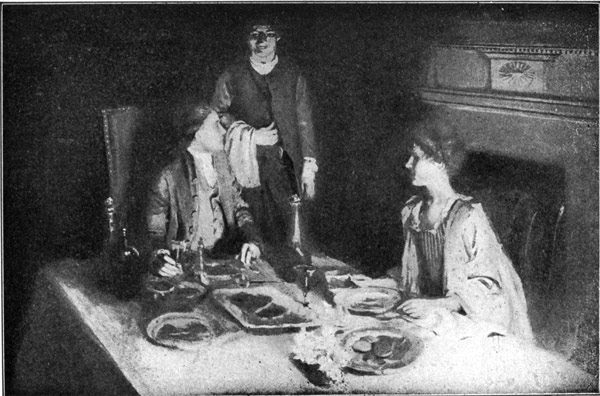
We were but four to dine that day: Sir William, Mr. Butler,
Silver Heels, and myself. Mistress Molly remained in
the nursery, where were also Peter and Esk, inasmuch as
they slobbered and fouled the cloth, and so fed in the play-room.
Colonel Guy Johnson remained at Detroit, Captain John
Johnson was on a mission to Albany, Thayendanegea in
Quebec, and Colonel Claus, with his lady, had gone to Castle
Cumberland. There were no visiting officers or Indians at
Johnson Hall that week, and our small company seemed lost
in the great dining-hall.
Having carved the juicy joint, the gilly served Sir William,
then Mr. Butler, then Silver Heels, whom I had scarcely noticed,
so full was I of my quarrel with Mr. Butler. Now, as
Saunders laid her plate, I gave her a look which meant, "I
did not tell Sir William," whereupon she smiled at her plate
and clipped a spoonful from a dish of potatoes.
"Good appetite and good health, sir," said I, raising my
wine-glass to Sir William.
"Good health, my lad!" said Sir William, heartily.
Glasses were raised again and compliments said, though
my face was sufficient to sour the Madeira in Mr. Butler's
glass.
"Your good health, Michael," said Silver Heels, sweetly.
I pledged her with a patronizing amiability which made her
hazel-gray eyes open wide.
Now, coxcomb that I was, I sat there, dizzied by my new
dignity, yet carefully watching Sir William to imitate him,
thinking that, as I was now a man, I must observe the carriage,
deportment, and tastes of men.
When Sir William declined a dish of jelly, I also waved
it away, though God knew I loved jellies.
When Sir William drank the last of the winter's ale, I
shoved aside my small-beer and sent for a mug.
"It will make a humming-top of your head," said Sir
William. "Stick to small-beer, Micky."
Mortified, I tossed off my portion, and was very careful not
to look at Silver Heels, being hot in the face.
Mr. Butler and Sir William spoke gravely of the discontent
now rampant in the town of Boston, and of Captain John
Johnson's mission to Albany. I listened greedily, sniffing for
news of war, but understood little of their discourse save
what pertained to the Indians.
Some mention, indeed, was made of rangers, but, having
always associated militia and rangers with war on the Indians,
I thought little of what they discussed. I even forgot
my new dignity, and secretly pinched a bread crumb into the
shape of a little pig which I showed to Silver Heels. She
thereupon pinched out a dog with hound's ears for me to
admire.
I was roused by Sir William's voice in solemn tones to Mr.
Butler: "Now, God forbid I should live to see that, Captain
Butler!" and I pricked up my ears once more, but made
nothing of what followed, save that there were certain disloyal
men in Massachusetts and New York who might rise
against our King and that our Governor Tryon meant to
take some measures concerning tea.
"Well, well," burst out Sir William at length; "in evil
days let us thank God that the fish still swim! Eh, Micky?
I wish the ice were out."
"The anchor-ice is afloat, and the Kennyetto is free, sir,"
I said, quickly.
"How do you know?" asked Sir William, laughing.
I had, the day previous, run across to the Kennyetto to
see, and I told him so.
He was pleased to praise my zeal and to say I ran like a
Mohawk, which praise sounded sweet until I saw Silver
Heels's sly smile, and I remembered the foot-race and the
jack-knife.
But I was above foot-races now. Others might run to
amuse me; I would look on—perhaps distribute prizes.
"Some day, Sir William, will you not make me one of
your deputies?" I asked, eagerly.
"Hear the lad!" cried Sir William, pushing back his chair.
"On my soul, Captain Butler, it is time for old weather-worn
Indian commissioners like me to resign and make way
for younger blood! And his Majesty might be worse served
than by Micky here; eh, Captain Butler?"
"Perhaps," said Mr. Butler, in his dead voice.
Sir William rose and we all stood up. The Baronet, brushing
Silver Heels on his way to the door, passed his arm
around her and tilted her chin up.
"Now do you go to Mistress Mary and beg her to place
you in the stocks for an hour; and stay there in patience
for your body's grace. Will you promise me, Felicity?"
Silver Heels began to pout and tease, hooking her fingers
in Sir William's belt, but the Baronet packed her off with
his message to Mistress Molly, and went out to the portico
where one of his damned Scotch gillies attended with gaff,
spear, and net-sack.
"Oho," thought I, "so it's salmon in the Sacondaga!"
And I fell to teasing that he might take me, too.
"No, Micky," he said, soberly; "it's less for sport than for
quiet reflection that I go. Don't sulk, lad. To-morrow, perhaps."
"Is it a promise, sir?" I cried.
"Perhaps," he laughed, "if the cards turn up right."
That meant he had some Indian affair on hand, and I fell
back, satisfied that his rod was a ruse, and that he was really
bound for one of the council fires at the upper castle.
So he went away, the sentry at the south block-house presenting
his firelock, and I back into the hall, whistling, enchanted
with my new liberty, yet somewhat concerned as to
the disposal of so vast an amount of time, now all my own.
I had now been enfranchised nearly three hours, and had
already used these first moments of liberty in picking a
mortal quarrel with Mr. Butler. I had begun rashly; I admitted
that; yet I could not regret the defiance. Soon or
late I felt that Mr. Butler and I would meet; I had believed
it for years. Now that at last our tryst was in sight, it
neither surprised nor disturbed me, nor, now that he was
out of my sight, did I feel impatient to settle it, so accustomed
had I become to waiting for the inevitable hour.
I strolled through the hallway, hands in pockets, whistling
"Amaryllis," a tune that smacked on my lips; and so came
to the south casement. Pressing my nose to the pane, I
looked into the young orchard where the robins ran in the
new grass; and I found it delicious to linger in-doors,
knowing I was free to go out when I chose, and none to cry,
"Come back!"
In the first flush of surprise and pleasure, I have noticed
that the liberated seldom venture instantly into that freedom
so dearly desired. Open the cage of a thrush that has sung
all winter of freedom, and lo! the little thing, creeping out
under the sky, runs back to the cage, fearing the sweet freedom
of its heart's desire.
So I; and mounted the stairway, seeking my own little
chamber. Here I found Esk and Peter at play, letting down
a string from the open window, baited with corn, and the
pullets jumping for it with great outcry and flapping of
wings.
So I played with them for a while, then put them out, and
bolted the door despite their cries and kicks.
Sitting there on my cot I surveyed my domain serenely,
proud as though it had been a mansion and all mine.
There were my books, not much thumbed save Roderick
Random and the prints of Le Brun's Battles of Alexander.
Still I cherished the others because gifts of Sir William or
relics of my honoured father—the two volumes called An Introduction
to Sir Isaac Newton's Philosophy; two volumes of
Chambers's Dictionary; all the volumes of The Gentleman's
Magazine from 1748; Titan's Loves of the Gods—an immodest
print which I hated; my beloved "Amaryllis," called
A New Musical Design, and well bound; and last a manuscript
much faded and eaten by mice, yet readable, and it
was a most lovely song composed long since by a Mr. Pepys,
the name of which was "Gaze not on Swans!"
My chamber was small, yet pleasing. Upon the walls I had
placed, by favour of Sir William, pictures of the best running-horses
at Newmarket, also four prints of a camp by Watteau,
well executed, though French. Also, there hung above
the door a fox's mask, my whip, my hunting-horn, my spurs,
and two fish-rods made for me by Joseph Brant, who is called
Thayendanegea, chief of the Mohawk and of the Six Nations,
and brother to Aunt Molly, who is no kin of mine,
though her children are Sir William's, and he is my kinsman.
In this room also I kept my black lead-pencil made by
Faber, a ream of paper from England, and a lump of red
sealing-wax.
I had written, in my life, but two letters: one three years
since I wrote to Sir Peter Warren to thank him for a sum
of money sent for my use; the other to a little girl named
Marie Livingston, whom I knew in Albany when Sir William
took me for the probating of papers which I do not yet
understand.
She wrote me a letter, which was delivered by chance, the
express having been scalped below Fonda's Bush, and signed
"your cozzen Marie," Mr. Livingston being kin to Sir William.
I had not yet written again to her, though I had meant
to do so these twelve months past. She had yellow hair
which was pleasing, and she did not resemble Silver Heels in
complexion or manner, having never flouted me. Her father
gave me two peaches, some Salem sweets called Black Jacks,
and a Delaware basket to take home with me, heaped with
macaroons, crisp almonds, rock-candy, caraways, and suckets.
These I prudently finished before coming again to Johnson
Hall, and I remember I forgot to save a sucket for Silver
Heels; and her anger when I gave her the Delaware basket
all sticky inside; and how Peter licked it and blubbered while
still a-licking.
Thus, as I sat there on my cot, scenes of my life came
jostling me like long-absent comrades, softening my mood
until I fell to thinking of those honoured parents I had never
seen save in the gray dreams which mazed my sleep. For
the day that brought life to me had robbed my honoured
mother of her life; and my father, Captain Cardigan, lying
with Wolfe before Quebec, sent a runner to Sir William
enjoining him to care for me should the chance of battle
leave me orphaned.
So my father, with Wolfe's own song on his lips:
"Why, soldiers, why
Should we be melancholy boys?
Why, soldiers, why?
Whose business 'tis to die—"
fell into Colonel Burton's arms at the head of Webb's regiment,
and his dying eyes saw the grenadiers wipe out the
disgrace of Montmorency with dripping bayonets. So he
died, with a smile, bidding Webb's regiment God-speed, and
sending word to the dying Wolfe that he would meet him a
minute hence at Peter's gate in heaven.
Thus came I naturally by my hatred for the French, nor
was there in all France sufficient wampum to wipe away the
feud or cover the dear phantom that stood in my path as I
passed through life my way.
Now, as I sat a-thinking by the window, below me the
robins in all the trees had begun their wild-wood vespers—hymns
of the true thrush, though not rounded with a thrush's
elegance.
The tree-shadows, too, had grown in length, and the afternoon
sun wore a deeper blazonry through the hill haze in the
west.
Fain to taste of the freedom which was now mine, I went
out and down the stairs, passing my lady Silver Heels
strapped to a back-board and in a temper with her sampler.
"Oh, Micky," she said, "my bones ache, and Mistress
Molly is with the baby, and the key is there on that brass
nail."
"It would be wrong if I released you," said I, piously,
meaning to do it, nevertheless.
"Oh, Micky," she said, with a kind of pitiful sweetness
which at times she used to obtain advantages from me.
So I took the key and unlocked the stocks, giving her feet
a pinch to let her know I was not truly as soft-hearted as
she might deem me, nor too easily won by woman's beseeching.
And now, mark! No sooner was she free than she gave
me a slap for the pinch and away she flew like a tree-lynx
with the pack in cry.
"This," thought I, "is a woman's gratitude," and I
locked the stocks again, wishing Silver Heels's feet were in
them.
"Best have it out at once with Mistress Molly," thought I,
and went to the nursery. But before I could knock on the
door, Mistress Molly heard me with her ears of a Mohawk,
and came to the door with one finger on her lips.
Truly the sister of Thayendanegea was a stately and
comely lady, and a beauty, too, being little darker than
some French ladies I have seen, and of gracious and noble
presence.
Bearing and mien were proud, yet winning; and, clothed
always as befitted the lady of Sir William Johnson, none
who came into her presence could think less of her because
of her Mohawk blood or the relation she bore to Sir William—an
honest one as she understood it.
She ruled the Hall with dignity and with an authority
that none dreamed of opposing. At table she was silent,
yet gracious; in the nursery she reigned a beloved and devoted
mother; and if ever a man's wife remained his sweetheart
to the end, Molly Brant was Sir William's true-love
while his life endured.
"Why did you release Felicity from the stocks, Michael?"
said she, in a whisper.
So her quick Indian ear had heard the click of that lock!
"I had come to tell you of it, Aunt Mary," said I.
She looked at me keenly, then smiled.
"A sin confessed is half redressed. I had meant to release
Felicity some time since, but the baby had fretted herself
to sleep in my arms and I feared to put her down. But,
Michael, remember in future to ask permission when you
desire to play with Felicity."
"Play with Felicity!" I said, scornfully. "I am past the
playing age, Aunt Molly, and I only released her because I
thought her back ached."
Mistress Molly looked at me again, long and keenly.
"Little savage," she said, gently, "mock at my people no
more. I should chide you for misusing Peter, but—I will
say nothing. You make my heart heavy sometimes."
"I do honour and love you, Aunt Molly!" I said; "it was
not that I mocked at Peter, but his breeches were so tight
that I wondered if Vix could bite him. I shall now go to
the garden and allow Peter to kick my shins. Anyway, I
gave him all my quills and a plummet and a screw."
She laughed silently, bidding me renounce my intention
regarding Peter, and so dismissed me, with her finger on her
lips conjuring silence.
So I pursued my interrupted way to the garden where the
robins carolled in every young fruit-tree, and the blue
shadows wove patterns on the grass.
Peter and Esk were on the ground playing at marbles,
with Silver Heels to judge between them.
Esk, perceiving me, cried out: "Knuckle down at taws,
Micky! Come on! Alleys up and fen dubs!"
"Fen dubs your granny!" I replied, scornfully, clean
forgetting my new dignity. "Dubs all, and bull's-eyes up
is what I play, unless you want to put in agates?" I added,
covetously.
Esk shook his head in alarm, muttering that his agates
were for shooters; but fat Peter, sprawling belly down at
the ring, offered to put up an agate against four bull's-eyes,
two agates, and twelve miggs, and play dubs and span in a
round fat.
The proposition was impudent, unfair, and thoroughly
Indian. I was about to spurn it when Silver Heels chirped
up, "Micky doesn't dare."
"Put up your agate, Peter," said I, coolly, ignoring Silver
Heels; and I fished the required marbles from my pocket and
placed them in the ring.
"My shot," announced Peter, hurriedly, crowding down on
the line, another outrage which, considering the presence of
Silver Heels, I passed unnoticed.
Peter shot and clipped a migg out of the ring. He shot
again and grazed an agate, shouting "Dubs!" to the derision
of us all.
Then I squatted down and sent two bull's-eyes flying, but,
forestalled by Peter's hysterical "Fen dubs!" was obliged
to replace one. However, I shot again and it was dubs all,
and I pocketed both of my agates and Peter's also.
This brought on a wrangle, which Silver Heels settled in
my favour. Then I sat down and, with deadly accuracy,
"spun," from which comfortable position, and without spanning,
I skinned the ring, leaving Peter grief-stricken, with
one migg in his grimy fist.
"You may have them," said I, condescendingly, dropping
my spoils into Silver Heels's lap.
She coloured with surprise and pleasure, scarcely finding
tongue to say, "Thank you, Micky."
Peter, being half Indian, demanded more play. But I was
satiated and, already remembering my dignity, regretted the
lapse into children's pastimes. I quieted Peter by giving
him the remainder of my marbles, explaining that I had renounced
such games for manlier sport, which statement,
coupled with my lavish generosity, impressed Peter and Esk,
if it had not effect upon Silver Heels.
I sat down on the stone bench near the bee-hives and drew
from my pocket the jack-knife given me by Silver Heels as
a bribe to silence.
"Come over here, Silver Heels," I said, with patronizing
kindness.
"What for?" she demanded.
"Oh, don't come then," I retorted, whereat she rose from
the grass with her skirt full of marbles and came over to
the stone bench.
After a moment she seated herself, eying the knife askance.
I had opened the blade. Lord, how I hated to give it back!
"Take it," said I, closing the blade, but not offering it to
her.
"Truly?" she stammered, not reaching out her hand, for
fear I should draw it away again to plague her.
I dropped the knife into her lap among the marbles, thrilling
at the spectacle of my own generosity.
She seized it, repeating:
"King, King, double King!
Can't take back a given thing!"
"You needn't say 'King, King, double King,'" said I,
offended; "for I was not going to take it back, silly!"
"Truly, Michael?" she asked, looking up at me. Then
she added, sweetly, "I am sorry I bit you."
"Ho!" said I, "do you think you hurt me?"
She said nothing, playing with the marbles in her lap.
I sat and watched the bees fly to and fro like bullets; in
the quiet even the hills, cloaked in purple mantles, smoked
with the steam of hidden snow-drifts still lingering in
ravines where arbutus scents the forest twilight.
The robins had already begun their rippling curfew call;
crickets creaked from the planked walk. Behind me the
voices of Peter and Esk rose in childish dispute or excited
warning to "Knuckle down hard!" Already the delicate
spring twilight stained the east with primrose and tints of
green. A calm star rose in the south.
Presently Silver Heels pinched me, and I felt around to
pinch back.
"Hush," she whispered, jogging my elbow a little, "there
is a strange Indian between us and the block-house. He has
a gun, but no blanket!"
For a moment a cold, tight feeling stopped my breath, not
because a strange Indian stood between me and the block-house,
but because of that instinct which stirs the fur on
wild things when taken unawares, even by friends.
My roughened skin had not smoothed again before I was
on my feet and advancing.
Instantly, too, I perceived that the Indian was a stranger
to our country. Although an Iroquois, and possibly of the
Cayuga tribe, yet he differed from our own Cayugas. He
was stark naked save for the breech-clout. But his moccasins
were foreign, so also was the pouch which swung
like a Highlander's sporran from his braided clout-string,
for it was made of the scarlet feathers of a bird which
never flew in our country, and no osprey ever furnished
the fine snow-white fringe which hung from it, falling
half-way between knee and ankle.
Observing him at closer range, I saw he was in a plight:
his flesh dusty and striped with dry blood where thorns had
brushed him; his eyes burning with privation, and sunk deep
behind the cheek-bones.
As I halted, he dropped the rifle into the hollow of his left
arm and raised his right hand, palm towards me.
I raised my right hand, but remained motionless, bidding
him lay his rifle at his feet.
He replied in the Cayuga language, yet with a foreign intonation,
that the dew was heavy and would dampen the
priming of his rifle; that he had no blanket on which to lay
his arms, and further, that the sentinels at the block-houses
were watching him with loaded muskets.
This was true. However, I permitted him to advance no
closer until I hailed a soldier, who came clumping out of the
stables, and who instantly cocked and primed his musket.
Then I asked the strange Cayuga what he wanted.
"Peace," he said, again raising his hand, palm out; and
again I raised my hand, saying, "Peace!"
From the scarlet pouch he drew a little stick, six inches
long, and painted red.
"Look out," said I to the soldier, "that is a war-stick! If
he shifts his rifle, aim at his heart."
But the runner had now brought to light from his pouch
other sticks, some blood-red, some black ringed with white.
These he gravely sorted, dropping the red ones back into
his pouch, and naïvely displaying the black and white rods
in a bunch.
"War-ragh-i-ya-gey!" he said, gently, adding, "I bear
belts!"
It was the title given by our Mohawks to Sir William, and
signified, "One who unites two peoples together."
"You wish to see Chief Warragh," I repeated, "and you
come with your pouch full of little red sticks?"
He darted a keen glance at me, then, with a dignified gesture,
laid his rifle down in the dew.
A little ashamed, I turned and dismissed the soldier, then
advanced and gave the silent runner my hand, telling him
that although his moccasins and pouch were strange, nevertheless
the kin of the Cayugas were welcome to Johnson
Hall. I pointed at his rifle, bidding him resume it. He
raised it in silence.
"He is a belt-bearer," I thought to myself; "but his message
is not of peace."
I said, pleasantly:
"By the belts you bear, follow me!"
The dull fire that fever kindles flickered behind his
shadowy eyes. I spoke to him kindly and conducted him to
the north block-house.
"Bearer of belts," said I, passing the sentry, and so
through the guard-room, with the soldiers all rising at attention,
and into Sir William's Indian guest-room.
My Cayuga must have seen that he was fast in a trap, yet
neither by word nor glance did he appear to observe it.
The sun had set. A chill from the west sent the shivers
creeping up my legs as I called a soldier and bade him kindle
a fire for us. Then on my own responsibility I went into
the store-room and rummaged about until I discovered a
thick red blanket. I knew I was taking what was not mine;
I knew also I was transgressing Sir William's orders. Yet
some instinct told me to act on my own discretion, and that
Sir William would have done the same had he been here.
A noise at the guard door brought me running out of
the store-room to find my Cayuga making to force his way
out, and the soldiers shoving him into the guest-room again.
"Fall back!" I cried, my wits working like shuttles; and
quickly added in the Cayuga tongue: "Cayugas are free
people; free to stay, free to go. Open the door for my
brother who fears his brother's fireside!"
There was a silence; the soldiers stood back respectfully;
a sergeant opened the outer door. But the Indian, turning
his hot eyes on me, swung on his heel and re-entered the
guest-room, drawing the flint from his rifle as he walked.
I followed and laid the thick red blanket on his dusty
shoulders.
"Sergeant," I called, "send McCloud for meat and drink,
and notify Sir William as soon as he arrives that his brothers
of the Cayuga would speak to him with belts!"
I was not sure of the etiquette required of me after this,
not knowing whether to leave the Cayuga alone or bear him
company. Tribes differ, so do nations in their observance of
these forms. One thing more puzzled me: here was a belt-bearer
with messages from some distant and strange branch
of the Cayuga tribe, yet the etiquette of their allies, our
Mohawks, decreed that belts should be delivered by sachems
or chiefs, well escorted, and through the smoke of council
fires never theoretically extinguished between allies and
kindred people.
One thing I of course knew: that a guest, once admitted,
should never be questioned until he had eaten and slept.
But whether or not I was committing a breach of etiquette
by squatting there by the fire with my Cayuga, I did not
know.
However, considering the circumstances, I called out for
a soldier to bring two pipes and tobacco; and when they
were fetched to me, I filled one and passed it to the Cayuga,
then filled the other, picked a splinter from the fire, lighted
mine, and passed the blazing splinter to my guest.
If his ideas on etiquette were disturbed, he did not show it.
He puffed at his pipe and drew his blanket close about his
naked body, staring into the fire with the grave, absent air of
a cat on a wintry night.
Now, stealing a glance at his scalp-lock, I saw by the fire-light
the stumps of two quills, with a few feather-fronds
still clinging to them, fastened in the knot on his crown.
The next covert glance told me that they were the ragged
stubs of the white-headed eagle's feathers, and that my
guest was a chief. This set me in a quandary. What was a
strange Cayuga chief doing here without escort, without
blanket, yet bearing belts? Etiquette absolutely forbade a
single question. Was I, in my inexperience, treating him
properly? Would my ignorance of what was due him bring
trouble and difficulty to Sir William when he returned?
Suddenly resolved to clear Sir William of any suspicion
of awkwardness, and at the risk of my being considered
garrulous, I rose and said:
"My brother is a man and a chief; he will understand
that in the absence of my honoured kinsman, Sir William
Johnson, and in the absence of officers in authority, the
hospitality of Johnson Hall falls upon me.
"Ignorant of my brother's customs, I bid him welcome,
because he is naked, tired, and hungry. I kindle his fire;
I bring him pipe and food; and now I bid him sleep in peace
behind doors that open at his will."
Then the Cayuga rose to his full noble height, bending his
burning eyes on mine. There was a silence; and so, angry
or grateful, I knew not which, he resumed his seat by the
fire, and I went out through the guard-room into the still,
starry night.
But I did not tarry to sniff at the stars nor search the
dewy herbage for those pale blossoms which open only on
such a night, hiding elf-pearls in their fairy petals. Straightway
I sought Mistress Molly in the nursery, and told her
what I had done. She listened gravely and without comment
or word of blame or praise, which was like all Indians. But
she questioned me, and I described the strange belt-bearer
from his scalp-lock to the sole of his moccasin.
"Cayuga," she said, softly; "what make was his rifle?"
"Not English, not French," I said. "The barrel near the
breech bore figures like those on Sir William's duelling
pistols."
"Spanish," she said, dreamily. "In his language did he
pronounce agh like ahh?"
"Yes, Aunt Molly."
She remained silent a moment, thoughtful eyes on mine.
Then she smiled and dismissed me, but I begged her to tell
me from whence my Cayuga came.
"I will tell you this," she said. "He comes from very,
very far away, and he follows some customs of the Tuscaroras,
which they in turn borrow from a tribe which lives
so far away that I should go to sleep in counting the miles
for you."
With that she shut the nursery door, and I, no wiser than
before, and understanding that Mistress Molly did not mean
I should be wiser, sat down on the stairs to think and to
wait for Sir William.
A moment later a man on horseback rode out of our stables
at a gallop and clattered away down the hill. I listened for
a moment, then thought of other things.
At late candle-light, Sir William still tarrying, I went to
the north block-house, where Mr. Duncan, the lieutenant
commanding the guard, received me with unusual courtesy,
the reason of which I did not at the time suspect.
"An express from Sir William has at this moment come
in," said he. "Sir William is aware that a belt-bearer from
Virginia awaits him."
"How could Sir William, who is at Castle Cumberland,
know that?" I began, then was silent, as it flashed into my
mind that Mistress Molly had sent an express to Sir William
as soon as I had told her about the strange Cayuga. That
was the galloping horseman I had heard.
Pondering and perplexed, I looked up to find Mr. Duncan
smiling at me.
"I understand," said he, "that Sir William is pleased to
approve your conduct touching the strange Cayuga."
"How do you know?" I asked, quickly, my heart warming
with pleasure.
"I know this," said Mr. Duncan, laughing, "that Sir
William has left something for you with me, a present, in
fact, which I am to deliver to you on the morrow."
"What is it, Mr. Duncan?" I teased; but the laughing
officer shook his head, retiring into the guard-room and pretending
to be afraid of me.
The soldiers, lounging around the settles, pipes between
their teeth, looked on with respectful grins. Clearly, even
they appeared to know what Sir William had sent to me
from Castle Cumberland.
As I stood in the guard-room, eager, yet partly vexed,
away below in the village the bell in the new stone church
began to ring.
"What is that?" I asked, in surprise.
The soldiers had all risen, taking their muskets from the
racks, straightening belts and bandoleers. In the stir and
banging of gun-stocks on the stone floor, my question perhaps
was not heard by Mr. Duncan, for he stood silent, untwisting
his sword knots and eying the line which the sergeant,
who carried the halberd, was forming in the room.
A drummer and a trumpeter took station, six paces to the
right and front; the sergeant, at a carry, advanced and saluted
with, "Parade is formed, sir."
"'Tention!" sang out Mr. Duncan. "Support arms! Carry
arms! Trail arms! File by the left flank! March!"
And with drawn claymore on his shoulder he passed out into
the starlight.
I followed; and now, standing by the block-house gate, far
away in the village I heard the rub-a-dub of a drum and a
loud trumpet blowing.
Nearer and nearer came the drum; the trumpet ceased.
And now I could hear the tramp, tramp, tramp of infantry
on the hill's black crest.
"Present arms!" cried Mr. Duncan, sharply.
A dark mass which I had not supposed to be moving, suddenly
loomed up close in front of us, taking the shape of a
long column, which passed with the flicker of starlight on
musket and belt, tramp, tramp, tramp to the ringing drum-beats.
Then our drum rattled and trumpet sang prettily, while
Mr. Duncan rendered the officer's salute as a dark stand of
colours passed, borne furled and high above the slanting
muskets.
Baggage wains began to creak by, great shapeless hulks
rolling in on the black ocean of the night, with soldiers
half asleep on top, and teamsters afoot, heads hanging
drowsily and looped raw-hides trailing.
The last yoke of oxen passed, dragging a brass cannon.
"'Tention!" said Mr. Duncan. "Support arms! Trail
arms! 'Bout face! By the right flank, wheel! March!"
Back into the block-house filed the guard, the drummer
bearing his drum flat on his hip, the trumpeter swinging his
instrument to his shoulder-knots.
Mr. Duncan sent his claymore ringing into the scabbard,
wrapped his plaid around his throat, and strolled off towards
the new barracks, east of the Hall.
"What troops were those, sir?" I asked, respectfully.
"Three companies of Royal Americans from Albany," said
he. Then, noticing my puzzled face, he added, "There is to
be a big council fire held here, Master Cardigan. Did you
not know it?"
"No," said I, slowly, reluctant to admit that I had not
shared Sir William's confidence.
"Look yonder," said Mr. Duncan.
Far out in the pale starlight, south and west of the Hall,
I saw fires kindled, one by one, until the twinkle of their
lights ran for a mile across the uplands. On a hill in the
north a signal fire sent long streamers of flame straight up
into the sky; other beacons flashed out in the darkness, some
so distant that I could not be certain they were more than
sparks of my imagination.
"It is the Six Nations gathering," said Mr. Duncan. "We
expect important guests."
"What for?" I asked.
"I don't know," said Mr. Duncan, gravely. "Good-night,
Mr. Cardigan."
"Good-night, sir," I said, thoughtfully; then cried after
him, "and my present, Mr. Duncan?"
"To-morrow," he answered, and passed on his way a-laughing.
I walked quickly back to the Hall, where I encountered
Esk and Peter, well bibbed, cleaning the last crumb from
their bowls of porridge.
"Did you see the soldiers?" cried Esk, tapping upon his
bowl and marching up and down the hallway.
"Look out of the back windows," added Peter. "The
Onondaga fires are burning on the hills."
"Oneidas," corrected Esk.
"Onondagas," persisted Peter, smearing his face with his
spoon to lick it.
"Where is Silver Heels?" I asked.
Mistress Molly came into the hall from the pantry, keys
jingling at her girdle, and took Peter by his sticky fingers,
bidding Esk follow.
"Bed-time," she said, with her pretty smile. "Michael,
Felicity is being dressed by Betty. If Sir William does not
return, you will dine with Felicity alone; and I expect you
to conduct exactly like Sir William, and refrain from kicking
under the table."
"Yes, Aunt Molly," said I, delighted.
Esk and Peter, being instantly hustled bedward, left lamenting
and asserting that they too were old enough to
imitate Sir William.
Silver Heels, with her hair done by Betty, and a blue sash
over her fresh-flowered cambric, passed them on the stairs
coming down, pausing to wish Mistress Molly good-night,
and to slyly pinch fat Peter.
"Felicity," said Mistress Molly, "will you conduct as
befits your station?"
"Oh la, Aunt Molly!" she answered, with that innocent, affected
lisp which I knew was ever the forerunner of mischief.
She made her reverence, waiting on the landing until she
heard the nursery door close, then flung both legs astride
the balustrade and slid down like a flash.
"Have you seen the soldiers, Micky?—and the fires on
the hills?" she cried. "To-morrow all the officers will be
here, and I am to wear my hair curled, and my pink dress
and tucker, with separate sleeves of silver gauze!"
We sat down on the stairs together as friendly and polite
as though we never quarrelled; and she chattered on, smoothing
her bib-apron with those silky hands of hers: "Betty
rolled up my hair till I feared she meant to scalp me, and
so told her.
"She coaxed me to endure, and called me her little Miss
Honey-bee, but would not promise me a comfit; so I ran
away before my cap was tied on. Micky, go and put on
your silk breeches and lace cuffs and we will be gay and
grand to dine!"
I ran to my chamber, bathed and dressed in all my finery,
meaning to lord it in the dining-hall should Sir William not
return.
And thus it fell out; for, when I descended the stairs,
there was my lady Silver Heels parading before the pier-glass,
and a gillie throwing open the doors of the dining-hall.
So that night Silver Heels and I supped alone together in
the great hall, Mr. Butler having hurriedly ridden to his
home, and Sir William not yet returned, though two hours
past candle-light.
The hall was quiet and vast, and Silver Heels seemed exceedingly
small, sitting in the big chair at the other end of
the table. So I had the gillie lay her plate beside mine.
A single pair of candles lighted our supper, and those not
of the best, for they smoked as the wind stirred the curtains.
"Do you not know what is due to quality?" said I, sternly,
to the gillie—a raw yokel scented with whiffs of the stables.
The kilted oaf gaped at me.
"Do you not see it is dark here?" I said.
"'Tis far lichter than ye wud expeck for sae big a room,
sir," said the gillie, with a foolish grin.
"Young Bareshanks," I retorted; "do you bring instantly
a dozen wax candles and light them, idiot, in a seemly row!
Also fetch Sir William's sherry and Madeira, and take away
those pot-house pewters!"
The gillie made out to do as he was bidden, and I should
have felt very grand and contented at being obeyed without
questions had I not perceived him, through the buttery
window, wink at the pantry-lad and put his mottled Scotch
muzzle into my small-beer.
When the dozen waxen candles stood in a ring, all twinkling,
and the decanters flanked me right and left, I bade the
gillie leave us, mistrusting he might bear tales to Sir William
touching our behaviour at table. But the dunce loitered,
trimming wicks, and casting sidewise looks at me.
"Will you be gone?" said I, in a passion.
"Maister Michael," he whined; "ye'll no be soopin' till the
blessing's said? Sir William gave us a grand discoorse this
noon dinner, sir, verra suitable words, sir."
Mortified at my forgetfulness, I rose; so did Silver Heels,
the candle-light sparkling under her half-closed lashes, for
she ever kept one eye on duty.
In a rage I said grace before meat, then glared at the gillie.
"Aave heerd waur, sir," quoth he; "but aa never sleep the
nicht without ma blessing, and aa'l no begin noo!"
"Get out, you Scotch loon," said I, "or I'll let this bottle
fly with my blessing!"
He ran for it, at which Silver Heels and I laughed heartily
until she spilled her wine on her knees, which spoiled her
temper.
When the echoing of our laughter had died away in the
dark corners of the room, an unaccustomed depression fell
upon me. I peered up at the stags' shaggy heads, set around
the wall; their dark glazed eyes reflected the little candle
flames like fiery eyeballs of living bucks. The stillness in the
familiar room troubled me.
Something of this Silver Heels also experienced, but the
novelty of playing the grand lady with her sherry and her
tea set her tongue a-swinging, clip-clap! She shrugged her
shoulders and tossed her chin, pretending to trifle with a
dish of cakes, vowing she had no appetite; but her hunger
could not long withstand the pastry, and she ate all the
suckets and cakes before I either perceived or prevented it.
Distressed at her greediness, I removed the caraways from
the plate and pouched them to eat at my pleasure, whereupon
she kicked my shins under the table.
But she would still play my Lady Languish, sighing and
protesting she could not touch another morsel, and her cheeks
full the while. Too, she drank of both sherry and Madeira,
which was forbidden by Sir William, and became over-loud
in speech until her humour changed to a fit of upbraiding me,
and ended in the sulks.
I remember we had a brandied syrup, of which she also
took too much, it making her pettish and sleepy; and after
supper, when we sat together on the stairs, she harped ever
on the same string, reproaching me for playing the high and
mighty, whereas all could plainly see I was nothing but a
boy like Esk and Peter and need give myself no plumes.
"My legs," she said, drowsily, "can touch the floor from
the third stair as well as yours;" and she stretched them
down to prove it, falling short an inch.
"If you are no longer a child," said I, "why do they harness
you to the back-board and make you wear pack-thread
stays?"
This madded her.
"You shall see," she said, in a temper, "you shall see me in
flowered caushets, silk stockings, and shoes of Paddington's
make, which befit my station and rank! You shall see me
in padusoy and ribbons and a hat of gauze! I shall wear
pompadour gloves and shall take no notice of you, with your
big hands and feet, pardieu!"
"Nor I of you," said I, "tricked out in your silly flummery."
And I drew a caraway from my pocket and bit deep.
"Yes, you will," said Silver Heels; "give me a caraway,
piggy."
Sitting there in the dark, nibbling in silence, I could hear
the distant stir of the convoy at the barracks, and wondered
why the soldiers had come. Surely not because of danger to
us at the Hall, for we had our Mohawks, our militia, and yeoman
tenantry at beck and call. Besides, who would dare
threaten Sir William Johnson, the greatest man in the
colonies, and very dearly esteemed by our King?
"They say," said Silver Heels, "that there are men in
Boston who have even defied the King himself."
"Never fear," said I, "they'll all hang for it."
"Would you like to fight for the King?" she asked, civilly,
and without a trace of that mockery which left a sting, much
as I pretended to despise it.
I said I should like to very much; that my father had died
for his King, and that I should one day avenge him.
I would have said more, perhaps boasted, for Silver Heels
was inclined to listen; but black Betty came down-stairs, her
double ear-rings a-jingle, calling her "li'l Miss Honey-bee"
to come to bed.
Silver Heels stood up, rubbing her eyes and stretching. I
could not help noticing that she seemed to be growing very
tall.
"Good-night, Micky," she said, with her mechanical curtsey,
and took Betty's black hand.
Although there was now nobody to bid me retire, I went
to my chamber gladly, for, what with the excitement of the
morning, the arrival of the Cayuga, and, later, the soldiers—and
also, I think, Sir William's sherry—my head was tired
and confused.
I slept none too soundly. Dreams came crowding around
my pillow; visions of Mr. Butler chasing Silver Heels awoke
me.
I sat up in my bed and parted the curtains. Through the
window I could see the watchful eyes of Indian fires glimmering
from hill and hollow, and over all the little stars, all
awake, watching the sleeping world.
A cock began crowing somewhere down in the village, although
no tint of dawn appeared. But the crickets had
ceased, and the stars grew paler, and that silence which is
the dawn's true herald warned me to sleep again ere the
red sun should steal over the edge of the world and catch
me waking.
Then I slept soundly, and the sly sun had painted many a
figure on my walls ere I waked to hear the bugle playing at
the barracks, and Sir William's hounds baying in their
kennels.
Dub! dub! rub-a-dub-dub! Dub! dub! rub-a-dub-dub!
The guard was changing at the block-house, while I, all
shivers, dashed cold water over me from head to foot and
rubbed my limbs into a tingle.
How sweetly came the matins of the robins! A kennel-lad,
standing in the sunshine by the stables, wound his hunting-horn
till the deep-jowled hounds drowned all with their
baying.
In breeches and shirt I leaned from the open window
to smell the young year, and saw Silver Heels's head at the
next window, her hair in her eyes, and bare arms propping
her chin.
She put out her tongue at me, but I bade her good-morning
so civilly that she smiled and asked me if I had slept well.
"No," said I; "dreams disturbed me."
"It was the cakes and sherry," she observed, with a grimace.
"I also dreamed, and screamed until Betty came and
rocked me in her arms. Which proves," she added, "that we
are both too young to dine and wine imprudently. I am
coming in to tell you what I dreamed. Open the door."
She entered, bundled in a wool blanket, and sat cross-legged
on the bed, chattering of her dreams, how, in her
sleep, she saw me mammocked by savages, among them
Peter, who had grown big and sly and fierce like a fat bear
cub in December.
Meanwhile I made of my hair a neat queue and tied it;
then put on my buckskin vest with flaps, and my short hunting-shirt
over it.
"Are you going to fish?" asked Silver Heels, enviously.
"If Sir William does," said I. "He sent me a present
from Castle Cumberland last night. I doubt not that it
may be a new fish-rod for salmon."
Presently she went away to be dressed by Betty, and I
hastened down the stairs, impatient to find Mr. Duncan and
have my present; nay, so fast and blindly did I speed that,
swinging around the balustrade, I plumped clean into Sir
William, coming up.
"What's to do! What's to do!" he exclaimed, testily. "Is
there no gout in the world, then, wooden feet!"
"Oh, Sir William! My present from Castle Cumberland!"
I stammered. "Is it a salmon-rod?"
"Now the wraith of old Isaac pinch ye!" said Sir William,
half laughing, half angry. "What the devil have I to do
with your presents and your fish-rods? Presents! Gad! It's
a new algebra you need!"
"You promised not to," said I, stoutly.
"Did I?" said Sir William, with a twinkle in his eyes.
"So I did, lad; so I did! Well, perhaps it is not an algebra
book after all."
"Then let us go to Mr. Duncan and get it now," I replied,
promptly.
"You may not want my present when you see it," argued
Sir William, who did ever enjoy to plague those whom he
loved best.
But I pulled him by the hand, and he pretended to go with
reluctance and many misgivings.
At the door of the north block-house, Mr. Duncan rendered
Sir William the officer's salute, which Sir William returned.
"Mr. Duncan," said he, "have you knowledge hereabouts of
a certain present sent in your care for Mr. Cardigan here?"
"Now that you mention it, sir," replied Mr. Duncan,
gravely, "I do dimly recall something of the sort."
"Was it not a school-book?" inquired Sir William.
"It was a parcel," replied Mr. Duncan, dubiously; "belike
it hid a dozen good stout Latin books, sir."
I endured their plaguing with rising excitement. What
could my present be?
"Take him in, Mr. Duncan," said Sir William at last.
"And," to me, "remember, sir, that you forget not your
manners when you return to me, for I shall await you here
at the door."
Cramping with curiosity, I followed Mr. Duncan into his
own private chamber, which connected with the guard-room.
But I saw no parcels anywhere; in fact, there was nothing
to be noticed save an officer's valise at the foot of Mr. Duncan's
bed.
"It is for you," he said; "open it."
At the same moment I perceived my own name painted on
the leather side, and the next instant I had stripped the lid
back. Buff and gold and scarlet swam the colours of the
clothing before my amazed eyes; I put out a trembling hand
and drew an officer's vest from the valise.
"Here are the boots, Mr. Cardigan," said the lieutenant,
lifting a pair of dress boots from behind a curtain. "Here
is the hat and sword, too, and a holster with pistols."
"Mine!" I gasped.
"By this commission of our Governor," said Mr. Duncan,
solemnly, drawing from his breast a parchment with seal
and tape. "Mr. Cardigan, let me be the first to welcome you
as a brother officer."
I had gone so blind with happy tears that I scarce could
find his kind, warm hand outstretched, nor could I decipher
the commission as cornet of horse in the Royal Border Regiment
of irregulars.
He mercifully left me then, and I stood with head pinched
in my fingers, striving to realize what had arrived to me.
But I did not tarry long to gape and devour my uniform
with my eyes. One after another my hunting-shirt, vest,
leggings, shoon, flew from me. I pulled on the buff breeches,
and laced them tight, drew on the boots, set the vest close
and buttoned it, then put on coat and hat, and lastly tied
my silver gorget.
What I could see of myself in Mr. Duncan's glass left me
dazed with admiration. I set my sword belt, hung the sword
with one glove in the hilt, and so, walking on air, I passed
the guard-room with all the soldiers at stiff attention, and
came to Sir William.
He looked up sharply, without the familiar smile. But my
wits were at work and I stopped short at three paces, heels
together, and gave the officer's salute.
Sir William's lips twitched as he rendered the salute, then,
casting his ivory cane on the grass, he stepped forward with
arms outstretched, and I fell into them like a blubbering
schoolboy.
To those contented and peaceful people who have never
known that gnawing desire for the noblest of all professions,
the soldier's, I can only say that I was contented. To those
who themselves have known the longing it is needless to describe
my happiness and pride, my gratitude to those who
had honoured me, my impetuous thirst for service, my resolve
to set heart and soul towards high ideals and thoughts, my
solemn boyish prayers that I might conduct nobly in the
eyes of all men, for God and King and country.
Something of my thoughts may have disclosed themselves
in my face as Sir William laid both hands on my shoulders,
for he looked at me a long while with kindly, steady eyes.
His countenance was serene and benign when he spoke in
that clear voice whose harmony and perfect cadence has
charmed a thousand council fires, and turned feverish spleen
and hatred into forbearance and reconciliation.
"My boy," he said, "the key to it all is faith. Keep faith
with all men; keep faith with thyself. This wins all battles,
even the greatest and last!"
Very soberly we returned to the Hall, where a small company
were assembled for breakfast—Mistress Molly, Major
Wilkes of the battalion which arrived the night before, Captains
Priestly, Borrow, and McNeil, of the same regiment, my
friend Lieutenant Duncan of the militia, and Silver Heels.
When Sir William and I entered the Hall the officers came
to pay their respects to the Baronet, and I, red as a Dutch
pippin, crossed the room to where Mistress Molly stood with
Silver Heels.
Bending to salute her hand, cocked hat crushed under one
arm, I discharged my duties with what composure I could
command; but Mistress Molly put both arms around me and
kissed me on both cheeks.
"I knew all about it," she whispered. "We are very
proud, Sir William and I. Be tender and faithful. It is all
we ask."
Dear, dear Aunt Molly! While life lasts can I ever forget
those sweet, grave words of love, spoken to a boy who
stood alone on the threshold of life?
Slowly I turned to look at Silver Heels, all my vanity,
conceit, and condescension vanished.
She had turned quite pale; her eyes seemed set and fascinated,
and she wished me happiness in a low voice, as
though uncertain of her own words.
Chilled by her lifeless greeting, I returned to Sir William,
who presented me to the guests with unconcealed pride:
"My kinsman, Mr. Cardigan, gentlemen; Captain Cardigan's
only son!"
The officers, all in full dress, brilliant with the red, green,
and gold of the Royal Americans, greeted me most kindly,
some claiming acquaintance with my honoured father, and all
speaking of his noble death before Quebec.
Before we sat at table, they gave me a standing toast, all
touching glasses with me, and Sir William, smiling, with one
arm around my shoulder.
So we sat down to breakfast, a breakfast I, being excited,
scarcely tasted; but I listened with all my ears to the discourse
touching the late troubles in New York and Massachusetts,
concerning the importation of tea by the East India
Company. The discussion soon became a monologue, for
the subject was one which Sir William understood from A
to Zed, and his eloquence upon it had amazed and irritated
people of more importance than our Governor Tryon himself.
"Look you," said Sir William, in his clear voice like a
bell; "look you, gentlemen; I yield to no man in loyalty
and love to my King; but this I know and dare maintain
here or at St. James: that his Majesty whom I serve and
honour is misled by his ministers, and neither he nor they
suspect the truth concerning these colonies!"
The officers were all attention, some leaning forward to
lose no word or inflection; Mistress Molly poured the roundly
abused tea, and her gentle dark eyes ever stole proudly
towards Sir William.
"Gentlemen," said Sir William, blandly, "you all are
aware that since last December the Atlantic Ocean is become
but a vast pot of cold tea."
The laughter which followed sounded to me a trifle strained,
as well it might be, considering the insolence of the people
who had flung this defiance into the King's ocean.
"Very well," said Sir William, with that tight crease running
around his jaw which meant his mind was made up.
"This is the true history of that trouble, gentlemen. Judge
for yourselves where lies the blame." And, leaning back in
his chair, one hand lifted, he began:
"That damned East India Company, floundering about
with the non-importation pill in its gullet, found itself owing
the government fourteen hundred thousand pounds, with
seventeen million pounds of unsold tea on its hands.
"Nobody likes bankruptcy, so off go the East India gentlemen
with their petition to Parliament for permission to
export their tea to America, free of duty, and so put it in the
power of the company to sell tea here cheaper than in England.
And now I ask you, gentlemen, whether in all these
broad colonies there are not some few men whose motives
are other than sordid?
"Your answers must be 'yes!'—because the colonists themselves
so answered when they burned the Gaspee!—when they
gathered at Griffin's wharf and made tea enough for the
world to drink!—when John Lamb set his back to the portcullis
of the fort and the tea commissioners ran like rabbits!
"God forbid that I, a humble loyal subject of my King,
should ever bear out the work of rebels or traitors. But I
solemnly say to you that the rebels and traitors are not the
counterfeit Indians of Griffin's wharf, not the men who fired
the Gaspee aflame from sprit to topmast, not that man who
set his back to the fort in New York! But they are those
who whisper evil to my King at St. James—and may God
have mercy on their souls!"
In the silence which followed, Sir William leaned forward,
his heavy chin set on his fists, his eyes looking into the future
which he alone saw so clearly.
None durst interrupt him. The officers watched him silently—this
great man—this great Irishman who had been
the sole architect of his own greatness; this great American
who saw what we, even now, cannot see as clearly as did he.
There he sat, dumb, eyes on vacancy; a plain man, a
Baronet of the British realm, a member of the King's Council,
a major-general of militia, and the superintendent of the
Indian Department in North America.
A plain man; but a vast land-holder, the one man in
America trusted blindly by the Indians, a man whose influence
was enormous; a man who was as simple as a maid, as
truthful as a child, as kind as the Samaritan who passed not
on the other side.
A plain man, but a prophet.
There was a step at the door; Mr. Duncan spoke in a low
tone with the orderly, then returned to Sir William.
"The Indian belt-bearer is at the block-house, sir," he said.
Sir William rose. The officers made their adieux and left.
Only Sir William, Mistress Molly, Silver Heels, and I remained
in the dining-hall.
The Baronet looked across at Mistress Molly, and a sad
smile touched his eyes.
She took Silver Heels by the hand and quietly left the
room.
"Michael," said Sir William; "listen closely, but remain
silent concerning what this belt-bearer has to say. My honour
is at stake, my son. Promise!"
"I promise, sir," said I, under my breath.
The next moment the door behind me opened and the
Indian stole into the room.
I now for the first time obtained a distinct view of the
stranger as he stepped forward, throwing the blanket from
him, and stood revealed, stark naked save for clout and
pouch, truly a superb figure, and perfect, in the Greek sense,
barring that racial leanness below knee and calf, and the
sinewy feet planted parallel instead of diverging, as in our
race.
But so splendid was his presence that Sir William, standing
to receive him, unconsciously raised his chin and squared
his shoulders as though bracing for a trial of strength with
this tall red forester from the West.
For a space they stood face to face in silence; then the
belt-bearer, looking warily around at the empty room, asked
why Chief Warragh received his brother alone.
"My brother comes alone," replied Sir William, with emphasis.
"It is the custom of the Cayuga to send three with
each belt. Does my brother bear but a fragment of one
belt? Or does he think us of little consequence that he
comes without attestants?"
"I bear three belts," said the Indian, haughtily. "Nine
of my people started from the Ohio; I alone live."
Sir William bowed gravely; and, motioning me to be seated,
drew up an arm-chair of velvet and sat down, folding his
arms in silence.
Then, for the first time in my life, I sat at a figurative
council fire and listened to an orator of those masters of
oratory, the peoples of the Six Nations.
Dignified, chary of gesture, clean, yet somewhat sad and
over-grave of speech, the Cayuga, facing the Baronet, related
briefly his name, Quider, which in Iroquois means
Peter; his tribe, which was the tribe of the Wolf, the totem
being plain on his breast. He spoke of his journey from the
Ohio, the loss of the eight who had started with him; all
dying from the small-pox within a week. He spoke respectfully
of Sir William as the one man who had protected the
Six Nations from unjust laws, from incursions, from white
men's violence and deception. He admitted that Sir William
was the only man in America who to-day retained the absolute
trust and confidence of the Indians, adding that it was
for this reason that he had come.
And then he began his brief speech, drawing from his
pouch a black belt of wampum:
"Brother: With this belt we breathe upon the embers
which are asleep, and we cause the council fire to burn in
this place and on the Ohio, which are our proper fireplaces.
With this belt we sweep this fireplace clean, removing from
it all that is impure, that we may sit around it as brothers."
(A belt of seven rows.)
"Brother: The unhappy oppression of our brethren by
Colonel Cresap's men, near the Ohio carrying-place, is the
occasion for our coming here. Our nation would not be at
rest, nor easy, until they had spoken to you about it. They
have now spoken—with this belt!"
(A black and white belt.)
"Brother: What are we to do? Lord Dunmore will not
hear us. Colonel Cresap and his men, to whom we have done
no harm, are coming to clear the forest and cross our free
path which lies from Saint Sacrement to the Ohio, and which
path our brother's belts, which we still possess, have long
since swept clear. What shall we do? Instead of polishing
our knives we have come to our brother Warragh. Instead
of seeking our kin the Mohawk and the Oneida with painted
war belts to throw between us and them, we come to our
brother and ask him, by this belt, what is left for us to do?
Our brothers have taught us there is a God. Teach us He
is a just God—by this belt!"
(A black belt of five rows.)
During this speech Sir William sat as still as death, neither
by glance nor gesture nor change of colour betraying the surprise,
indignation, and alarm which this exposure of Colonel
Cresap's doings caused him.
As for me, I, of course, vaguely understood the breach of
faith committed by Colonel Cresap in invading the land of
our allies, and the danger we might run should this Cayuga
chief go to our Mohawks and Oneidas with war-belts and
inflammatory appeals for vengeance on Cresap and his men.
That he had instead come to us, braving all dangers, losing
indeed all his comrades, on this mission of peace, most splendidly
attested to the power and influence of Sir William
among these savages whose first instinct is to draw the
hatchet and begin the horrid vengeance which they consider
their right when unjustly molested.
It is seldom the custom to reply to a speech before the
following day. Custom and tradition rule among the Six
Nations. Deliberation and profound reflection they give to
all spokesmen who petition them, and they require it in
turn, regarding with suspicion and contempt a hasty reply,
which, they consider, indicates either premeditated treachery,
or a shallow mind incapable of weighty and mature reflection.
I was prepared, therefore, when Sir William, holding in
his right hand the three belts of wampum, rose and thanked
the Cayuga for his talk, praising him and his tribe for resorting
to arbitration instead of the hatchet, and promising
an answer on the morrow.
The Cayuga listened in silence, then resuming his blanket
turned on his heel and passed slowly and noiselessly from
the room, leaving Sir William standing beside the arm-chair,
and me erect in the embrasure of the casement.
Now, for the first time in my life, I saw a trace of physical
decline in my guardian. His hand, holding the belts, had
fallen a-trembling; he made a feeble gesture for me to be
seated, and sank back into his arm-chair, listless eyes on the
floor, absently running his fingers over the polished belts.
"At sixty," he said, as though to himself, "strong men
should be in that mellow prime to which a sober life conducts."
After a moment he went on: "My life has been sober
and without excess—but hard! very hard! I am an old man;
a tired old man."
Looking up to meet my eyes, he smiled, watching the sympathy
which twitched my face.
"All these wars! All these wars! Thirty years of war!"
he murmured, caressing the belts and letting them slip
through his fingers like smooth shining serpents. "War with
the French, war with the Maquas, the Hurons, the Shawanese,
the Ojibways! War in the Canadas, war in the Carolinas,
war east and west and north and south! And—I am tired."
He flung the slippery belts to the floor, where they twisted
and coiled up in a heap.
"I have worked with my hands," he said. "This land
has drunk the sweat of my body. I have not spared myself
in sickness or in health. My eyes are dim; I have used them
by day, by starlight, by the glimmer of moons long dead, by
candle-wood, by torch, by the flicker of smoke from green
fires.
"My arms are tired; I have hewn forests away; my limbs
ache; I have journeyed far through snow, through heat, from
the Canadas to the Gulf—all my life I have journeyed on
business for other men—for men I have never seen, and shall
never see—men yet to be born!"
There came a flush of earnest colour into his face. He
leaned forward towards me, elbow resting on the table, hand
outstretched.
"Why, look you, Michael," he said, with childlike eagerness;
"I found a wilderness and I leave a garden! Look at
the valley! Can England grow such grain? Look at Tryon
County! Look at this Province of New York? Ay—look
farther—wherever my Indians have set their boundaries!
There are roads, lad, roads where I found runways; turnpikes
where I followed Mohawk trails; mills turning where
the wild-cat squatted, fishing with big flat paws! Lad, you
cannot recall it, yet this village was but a carrying-place
when I came. Look at it; look from the window, lad! Is it
not fair and pretty to the eye? One hundred and eighty
families! Three churches, counting my new stone church;
a free school, a court-house, a jail, barracks—all built by me;
stores with red and blue swinging signs, bravely painted, inns
with the good green bush a-swing! Listen to the cock-crows;
listen to the barking! Might it not be a Devonshire town?
Ah—I forgot; you have never seen old England."
Smiling still, kind eyes dreaming, his head sank a little,
and he clasped his hands in his lap.
"Lad," he said, softly, "the English hay smells sweet, but
not so sweet as the Mohawk Valley hay to me. This is my
country—my country first, last, and all the time. I am too
old to change where in my youth I took root among these
hills. To transplant me means my end."
The sunlight stole into the room through leaded diamond-panes
and fell across his knees like a golden robe. The
music from the robins in the orchard filled my ears; soft
winds stirred the lace on Sir William's cuffs and collarette.
Presently he roused, shaking the dream from his eyes;
and, watching him, it seemed to me I could see the very tide
of life swelling flesh and muscle into new vigour. The colour
came back into his face and hands; the light grew in his eyes.
"Come!" he said, in a voice that had lost its tremour.
"Life has but one meaning—to go on, ever on, lad! 'Tis
a long doze awaits us at the journey's end." And he fumbled
for his snuff-box and lace hanker, blowing a vigorous blast
and exclaiming, "Aha! Ho!" in deep tones which, when
very young, awed me.
I bent and picked up the three belts, placing them on the
table near him.
"Thank you, Michael," he said, heartily; "and I must
say that in this matter of the Cayuga, you have conducted
admirably. Mr. Duncan has told me all; it was wisely done.
Had you received the Cayuga with less welcome or more
suspicion, or had you met him haughtily, I do not doubt that
he would have made mischief for me among my Mohawks."
"He had war-sticks painted red, in his pouch, sir," I replied.
"No doubt! No doubt! And a red war-belt, too, belike!
They were meant for my Mohawks had he met with a rebuff
here. Oh, I know them, Michael, I know them. A painted
war-belt flung between that Cayuga and the sachems of my
Mohawks would have set the whole Six Nations—save, perhaps,
the Oneidas—a-shining up rifle and hatchet for Cresap
and his men!"
Sir William struck the mahogany table with clinched fist.
"Damn Cresap!" he bawled, in one of his familiar fits of
fury—fits which were never witnessed outside his family circle.
"Damn the fatuous fool to go a-meddling with the
Cayugas in their own lands, held by them in solemn covenant
forever inviolate! What does the sorry ass want? A border
war, with all this trouble betwixt King and colonies hatching?
Does Colonel Cresap not know that a single scalp taken from
the Cayugas will set the Six Nations on fire—ay, the Lenape,
too?"
Sir William slapped the table again with the flat of his
hand.
"Look, Michael; should war come betwixt King and colonies,
neither King nor colonies should forget that our frontiers
are crowded with thousands of savages who, if adroitly
treated, will remain neutral and inoffensive. Yet here is
this madman Cresap, on the very eve of a struggle with the
greatest power in the world, turning the savages against the
colonies by his crazy pranks on the Ohio!"
"But," said I, "in his blindness and folly, Colonel Cresap
is throwing into our arms these very savages as allies!"
Sir William stopped short and stared at me with cold,
steady eyes.
"Michael," said he, presently, "when this war comes—as
surely it will come—choose which cause you will embrace, and
then stand by it to the end. As for me, I cannot believe that
God would let me live to see such a war; that He would leave
me to choose between the King who has honoured me and
mine own people in this dear land of mine!"
He raised his head and passed one hand over his eyes.
"But should He in His wisdom demand that I choose—and
if the sorrow kills me not—then, when the time comes, I
shall choose."
"Which way, sir?" I said, in a sort of gasp.
But he only answered, "Wait!"
Stupefied, I watched him. It had never entered my head
that there could be any course save unquestioned loyalty to
the King in all things; that there could be any doubt or
hesitation or pondering or praying for light when it came
time to choose between King and rebel.
I now recalled what Sir William had said to me in the
school-room. Putting this with what he now said, or left
unsaid, together with his anger at Colonel Cresap for endangering
the peace betwixt the Indians and the colonies, I
came to the frightened conclusion that Sir William's loyalty
might be questioned. But by whom? Who in America was
great enough to call Sir William to account? Not Governor
Tryon; not Lord Dunmore; not General Gage.
Feeling as though the bottom had fallen out of something,
I sat there, my fascinated eyes never leaving Sir
William's sombre face.
What then were these tea-hating rebels that Sir William
should defend them at breakfast and in the faces of half a
dozen of his Majesty's officers? I knew nothing of the troubles
in Massachusetts save from soldiers' talk or the gossip
of the townsmen, most of them being tenants of Sir William.
I had heard vaguely about one turbulent fellow named Hancock,
and a mischief-making jack-at-all-trades called Franklin.
I knew that the trouble concerned taxes, but as all this
bother appeared to be about a few pennies, and as I myself
never wanted for money, I had little sympathy for people
who made such an ado about a shilling or two. Moreover, if
the King needed money, the idea of not placing one's all at
his Majesty's disposal seemed contemptible to me. It is true
that I had never earned a farthing in all my life, and so had
nothing to offer my sovereign, save what fortune my father
had left in trust for me. It is also true that I knew nothing
of the value of money, having neither earned it nor wanted
for it.
Something of these thoughts may have been easily read in
my face, for Sir William said, with some abruptness:
"It is not money; it is principle that men fight for."
I was startled, although Sir William sometimes had a way
of rounding out my groping thoughts with sudden spoken
words which made me fear him.
"Well, well," he said, laughing and rising to stretch his
cramped limbs; "this is enough for one day, Michael. Let
the morrow fret for itself, lad. Come, smile a bit! Shall
we have a holiday, perhaps the last for many a month? Nay,
do not look so sober, Micky. Who knows what will come?
Who knows; who knows?"
"I shall stand by you, sir, whatever comes," said I.
But Sir William only smiled, drawing me to him, one arm
about me.
"Suppose," said he, "that you and I and Mr. Duncan and
Felicity and Peter and Esk take rods and bait and go a-fishing
in the Kennyetto by Fonda's Bush!"
"A peg-down fishing match!" cried I, enchanted.
"Ay, a peg-down match, and the prize whatever the victor
wills—in reason. What say you, Michael?"
I was about to assent with enthusiasm when something occurred
to me and I stopped.
"May I wear my uniform, sir?" I asked.
"Gad!" cried Sir William, in a fit of laughter. "'Tis a
bolder man than I who dare separate you from your uniform!"
"Then I'll carry my pistols and go a-horse!" said I, delighted.
The Baronet, hands clasped behind him, nodded absently.
That old gray colour came into his face again, and he lifted
a belt from the table and studied it dreamily, picking at the
wampum which glowed like a snake's skin in the sunshine.
To Fonda's Bush it is a good ten miles. I rode Sir William's
great horse, Warlock, who plunged and danced at
the slap of my sword-scabbard on his flanks, and wellnigh
shook me from my boots.
"Spare spur, lad! Let him sniff the pistols!" called Sir
William, standing up in the broad hay-wagon to observe me.
"He will quiet when he smells the priming, Michael."
I drew one of my pistols from the holster and allowed Warlock
to sniff it, which he did, arching his neck and pricking
forward two wise ears. After this the horse and I understood
each other, he being satisfied that it was a real officer
he bore and no lout pranked out to shame him before other
horses.
The broad flat hay-wagon, well bedded and deep in rye-straw,
was filled with the company on fishing bent; Peter
and Esk already disputing over their lines, red quills, and
bob-floats; Silver Heels, in flowered cotton damask and hair
rolled up under a small hat of straw, always observing me
with lowered, uncertain eyes; Mr. Duncan, in fustian coat
and leggings, counting out fish-hooks; Sir William, in yellow-and-brown
buckskin and scarlet-flowered waistcoat, singing
lustily:
"A-Maying!
A-Maying!
Oh, the blackthorn and the broom
And the primrose are in bloom!"
Behind the wagon, with punch-jugs swinging on his saddle-bags,
like John Gilpin rode young Bareshanks the Scot, all
a-grin; while upon either side of the wagon two mounted
soldiers trotted, rifles slung and hangers sheathed.
Thus we set out for Fonda's Bush, which is a vast woods,
cut into a hundred arabesques by the Kennyetto, a stream
well named, for in the Indian language it means "Snake-with-its-tail-in-its-mouth,"
and, although it flows for forty
miles, the source of it is scarce half a mile from the mouth,
where it empties into the great Vlaie near to Sir William's
hunting-lodge.
In the wagon Sir William turned to the windows and
waved his hat at Mistress Molly, who stood behind the nursery
curtains and kissed her fingers to him. And, as the
wagon with its escort rolled off with slow wheels creaking,
Mr. Duncan struck up:
"Who hunts, doth oft in danger ride;
Who hawks, lures oft both far and wide;
Who uses games, may often prove
A loser; but who falls in love,
Is fettered in fond Cupid's snare;
My angle breeds me no such care."
And Sir William and Mr. Duncan ended the song:
"The first men that our Saviour dear
Did choose to wait upon him here,
Blest Fishers were,—"
The shrill voices of Esk and Peter joined in, then were
hushed as Silver Heels's dainty song grew from the silence
like a fresh breeze:
"For Courts are full of flattery
As hath too oft been tried;
The City full of wantonness,
And both be full of Pride:
Then care away,
And wend along with me!"
So singing on their rye-straw couches, the swaying wagon
bore them over the hilly road, now up, now rattling down-hill
among the stones to ford some ice-clear brook, and away
again across the rolling country, followed by Gillie Bareshanks,
stone bottles flopping, and the trotting soldiers holding
their three-cornered hats on with one hand, bridle-rein
in t'other.
I galloped ahead, pistol poised, frowning at woodlands
where I pretended to myself danger might hide, examining
all wayfarers with impartial severity; and I doubt not that,
seeing me in full uniform and armed, my countenance filled
them with misgivings; indeed, some called out to know if the
news from Boston was bad, if the Indians meant mischief
hereabouts, or if the highwayman, Jack Mount, was abroad.
"Plague on your pistols!" shouted Sir William, as I waited
at a ford for the wagon. "Gad! Michael, your desperate deportment
is scaring my tenants along the way! Smile as
you gallop, in Heaven's name! else they'll take you for Jack
Mount himself!"
Somewhat mortified by Sir William's roar of laughter, I
trotted on in silence, returning my pistol to its holster, and
buckling the flap.
We now entered the slashings of the forest which is called
Fonda's Bush, "bush" meaning land not yet cleared of
woods. The sweet, moist shadow of the forest cooled me; I
made Warlock stop, for I love to listen and linger in a woodland's
quiet.
Here the field-birds which had sung everywhere by the
roadside were silent, as they always are on the borders of
deep forests. Slow hawks sailed along the edge of the woods;
out in the clearing a few finches twittered timidly in the
sunshine, but here among the hushed ranks of giant trees
nothing stirred save green leaves.
But the solitude of forest depths is no solitude to those
who know when and where to watch and listen. Faint sounds
came to savant ears: the velvet rustle of a snake brushing
its belly over soft mosses; the padded patter of the fox-hare;
the husky quhit! quhit! of that ashy partridge whose eye is
surmounted by a scarlet patch, and whose flesh is bitter as
hemlock. Solitude! Nay, for the quick furry creatures
that haunt water-ways live here, slipping among bowlders,
creeping through crevices; here a mink with eyes like jet
beads; here a whiskered otter peering from a cleft; now a
musk-rat squatting to wash his face; now a red martin
thrashing about in the thick tree-top like a mammoth squirrel
at frolic.
If this be solitude, with the stream softly talking in that
silly babble which is a language, too; if this be solitude,
with the shy deer staring and the tiny wood-mouse in the
windfall scraping busily; if this be solitude, then imprison
me here, and not in the cities, where solitude is in men's
hearts!
Five miles still lay before us over the moist, springy forest
road, an excellent and carefully constructed thoroughfare
which had been begun by Sir William and designed for a
short and direct route to those healing springs of Saratoga
which he loved, twenty-eight miles northeast of us. But this
route had never been continued east of Fonda's Bush, partly
because the winding Kennyetto interfered too often, demanding
to be bridged a dozen times in a mile, partly because an
easier though longer route had been surveyed by the engineer
officers from Albany, and was already roughly marked as far
as the Diamond Hill, from which, in clear weather, the Saratoga
lake may be seen.
The road we travelled, therefore, came to an abrupt end
on the banks of the Kennyetto; and here, in a sunny clearing
which was a sugar-bush lately in use, the wagon and its
passengers halted, and I dismounted, flinging my bridle to
one of the soldiers.
"Souse the stone jugs in the stream!" called out Sir William
to young Bareshanks, who came bumping up with his
bottles a-knocking and his hat crammed on his ears.
Peter and Esk wriggled out of the straw, fighting over a
red and blue bob-float, and fell with a thump upon the moss,
locked in conflict. Whereupon Sir William fetched them a
clip with his ivory cane across their buttocks, which brought
them up snivelling, but reconciled.
Meanwhile Mr. Duncan had gone to the bank of the stream
with six sharp pegs, all numbered; and presently Sir William
joined him, where they consulted seriously concerning the
proper ground, and took snuff and hummed and hawed with
much wagging of heads and many eye-squints at the sky and
water.
At last, the question being settled, Mr. Duncan set the six
pegs ten yards apart and pushed them noiselessly down into
the bank, while Sir William removed his hat and placed in
the crown six bits of birch-bark with numbers written on
each.
"Now, then, young wild-cats," he said, frowning at Esk
and Peter, "and you, Felicity, you, too, Mr. Duncan, and
Michael, also, come and draw lots for pegs. Zounds! Peter!
Ladies first, sir! Now, Felicity!"
Silver Heels placed one hand over her eyes and groped in
the hat until her fingers clutched a square of bark. Then she
drew it out.
"Number six!" she said, shyly.
"Last peg to the left," announced Sir William. "Who
next? Draw, Mr. Duncan!"
"Me! Me!" shouted Peter and Esk, charging at the hat
and tearing their numbers from it.
Then Mr. Duncan drew, and then I drew number five.
"Get ready!" commanded Sir William, fumbling with his
fish-rod. "Michael, take care of Felicity!"
Now the rules for a peg-down fishing match are few and
simple. Each contestant must fish from the position which
his peg indicates, and he must not leave his peg to fish elsewhere
until the match is ended. Furthermore, he must fish
courteously and with due regard for his neighbour's rights,
employing no unfair means to attract fish to his own bait or
to drive them from his neighbour's. The contestant securing
the largest number of fish is the winner; he who bags the
largest single fish is adjudged worthy of a second prize; he
who secures the choicest individual fish receives a crown of
young oak leaves.
At the words, "Take your stations!" we trooped to our
pegs. Silver Heels was on the extreme left, I next, then Sir
William, then Mr. Duncan, then Peter, and, last of all, Esk.
"Fish!" cried Sir William, and swung his rod from the
wrist, sending a green and gray and scarlet feather-fly out
into the water.
Silver Heels held her hook out to me and I garnished it
with a bit of eel's skin and red flannel. My own line I baited
with angle-worm, and together we cast out into the slow, deep
current.
Farther along I heard Esk and Peter cast out with some
heedless splashing, which was the occasion of mutual recrimination
until Sir William silenced them.
Yet almost immediately fat Peter caught a fish, which is
like all Indians. However, it was but a spiny sun-fish with
blue and scarlet and yellow gills. Still it made Peter's
score one.
"Does that count?" asked Silver Heels, turning up her
nose. "See! Peter hath another one—a sun-fish, too! Pooh!
Anybody can catch sun-fish."
"Better catch 'em then," said Sir William, laughing, and
drawing his fly over the water to recover it for another cast.
Splash!—and Peter had a third sun-fish; and in another
moment Esk jerked a fourth from the water, secured his
prize with a scowl at Peter, and hurriedly rebaited, muttering
and breathing thickly.
Then Mr. Duncan's yellow float bobbed under, once, twice,
then bobbed so fast that the water dimpled all around and
the little rings, spreading, succeeded each other so quickly
that the wavelets covered the yellow float.
"A barbel-pout," quoth Mr. Duncan, coolly, and sure
enough up came the bluish-black fish and flapped and
squeaked, now on its white belly, now on its back, grinning
with its gummy, whiskered maw agape and its three dagger
fins ready to stab and poison him who rashly grasped it.
"Silver Heels," said I, politely; "you are having a nibble."
"Oh, so I am!" she cried, and drew a lovely blue and silver
frost-fish to the surface, only to lose it by over-haste, and
cry out in her vexation.
I explained to her how to strike the hook before pulling in,
and she thanked me very modestly. There was a new and
humble tone in her voice, delicate and grateful flattery to me,
due, as I knew perfectly well, to my uniform. Nor did the
tribute savour of any after-sting of jealousy or resentment
for my new honours.
She recognized that I had climbed high in a single day,
leaving the rounds of childhood behind forever; and she
knew, too, which I did not, that she also was climbing the
ladder very swiftly, a little behind me now, yet confident,
and meaning to rejoin and pass me ere I dreamed of such a
thing.
About this time Sir William hooked and landed a great
pink and white Mohawk chub, which had risen silently from a
black pool and had sucked in his feather-fly.
"Tush!" said Sir William. "I'll not count that!" And
with a slack and a snip! he unhooked the fish, which at once
slowly sank back into the black channel. Whereupon Sir
William smoothed out his fly, and took snuff, singing merrily:
"You bade us make no noise, sir," spoke up Esk, reproachfully.
"So I did, lad! So I did! But not with thy mouth.
Shout all day, and never a trout budges. Stamp thy feet—ay,
brush but a stone in passing, and it's farewell, master
troutling! Ho! What was that?"
A spattering and splashing arose from Peter's peg, and all
turned to see the fat little Mohawk dragging a trout from
the water and up the bank, where he fell upon the bouncing
fish, whooping like the savage he was.
"Clearly," mused Sir William, "my eye has lost its cunning,
and my arm its strength. So passes the generation that
was born with me! Heigh-ho! Well done, Peter boy!"
Silver Heels was doomed to ill-fortune. She lost a second
frost-fish, and was ready to weep. So I laid my rod on the
bank, leaving the baited hook in the water, and went over to
her, for she seemed discouraged, having broken her hook and
quill.
"Fen dubs!" shouted Peter, from the other end of the
line. "You can't do that, Michael! I'm ahead of you all,
and it is not fair!"
"Mind your business," said I, sitting down beside Silver
Heels; and truly enough he did, for, before I was seated,
Peter jumped up, struggling with a fat white perch, which he
landed, yelling and dancing in his vanity.
"Never you mind, Silver Heels," said I, tying a plated
hook on her line, and covering it with a long silvery strip of
skin and pin-feathers from a pullet's neck. "Now do as I
say; toss the bait down stream, so! Now draw it slowly till
it spins like a top."
Ere I could end my instructions I saw the nose of a great
gold-green pike close after her bait.
"Slack!" I whispered. "He has it!"
She held the rod still. There came a twitch, more twitches,
but so gentle you would have vowed 'twas a tender-mouthed
minnow lipping the line.
"He gorged it," I muttered; "strike hard!"
"A log!" wailed Silver Heels, as she felt the rod stagger
when the hook, deeply struck, embedded barb and shank.
But it was no log, for instantly the great fish shot into the
air, and lay a-wallowing and thrashing in mid-stream.
"A chain-pike!" cried Sir William, briskly. "Do you net
him, Michael, else Felicity will take a swim she has not bargained
for!"
I ran to Sir William, who thrust the net at me, and back
again as fast as my legs could move to Silver Heels, who had
dropped the rod and now, sprawling on the moss, lay a-pulling
at the line which was cutting her tender fingers.
"No fair!" bellowed fat Peter, jealously. "Let her bag
her own game as I do! Hi-yi! Another trout!"
But spite of Peter's clamour and Esk's injured howls, I
netted the floundering pike and flung it among the bushes,
where young Bareshanks gaffed it and held it aloft.
There it hung, all spray and green and gold, marked with
the devil's chain pattern; and its wolf-jaws gaping, lined
with teeth.
"Oh, Michael," quavered Silver Heels, staring at her captive.
She moved a little nearer to the fish, plucking up her
skirts with her fingers, and bending forward, alarmed, amazed
at the fierce, dripping creature.
"Ugh! There's blood on it!" she whispered, taking fast
hold of my arm.
"Is it not a noble prize!" I urged, eagerly. But she
shook her head and turned away, holding me tightly by the
sleeve.
"Are you not proud?" I persisted, irritably. "It is the
biggest fish any have yet caught. You will gain second
prize, silly! What's the matter with you, anyhow!" I added,
in a temper.
"I can't help it," she said, tremulously; "I'm not a man,
and it frightens me to kill. I shall fish no more. Ugh—the
blood!—and how it quivered when the gillie gaffed it! I
could cry my eyes out for the life I took so lightly!"
I was disgusted and hurt, too, for I had thought to please
her. I drew my sleeve from her fingers, but she only stood
there like a simpleton harping on one string:
"Oh, the brave fish! Oh, the poor brave fish! I hurt it!—I
saw blood on it, Michael."
"Ninny," said I; "there is blood on your fingers, too,
where the line cut, and you've wiped it on my sleeve!"
She looked at her bleeding fingers in a silly, startled fashion,
then held them out to me so pitifully that I could do no
less than wipe them clean and bind them in my handkerchief,
though it was my best, and flowered and laced at that.
"I don't care," she said, a-pouting at the water; "you
told me that when you shot wild things it saddened you, too."
I pretended not to hear, yet it was true. And in sooth, to
this day I never draw trigger on beast or bird that I do not
thrill with pity.
I know not what fierce, resistless passion it may be that
sets my nostrils quivering like a pointer's when I chase wild
things—what savage craving drives me on, on, on! till the
flash of the gun and the innocent death leave me standing
sad and staring.
Could I but keep from the woods—but I cannot. And it
were vainer to argue with a hound on a runway, or with the
west wind in October, than with me.
I went to my rod, which I saw nodding its tip in the water,
and found an eel fast to the bait, yet not hooked, so summoned
Bareshanks to rid me of the snaky thing and strolled
sulkily over to Sir William.
The Baronet had enticed and prettily netted a plump lake
salmon, by far the choicest fish taken; so, the match being
ended, and luncheon served under the pines, Silver Heels
plaited a wreath of red-oak, and crowned Sir William for
his third prize.
Peter with his motley string of fish, some two dozen brace
in all, and mostly trout at that, clamoured for the first prize,
which was a Barlow-knife like the one Silver Heels had
gained in the foot-race a year ago; and he clutched his prize
and straightway fell a-hacking the wagon till Sir William
collared him.
Silver Heels received the other reward, a gold guinea; and
she placed it in her bosom, and kissed Sir William heartily.
"Faith," said the Baronet, "you had best kiss your cousin
yonder, who saved you from a bath in the brook with your
pike!"
Silver Heels came up to me, laying both hands on my
shoulders, and held up her lips. I kissed her maliciously and
praised her skill, vowing that she was a very Huron for
slaughter, which boorish jest set her face a sorrowful red.
Meanwhile young Bareshanks had laid a clean cloth upon
the moss, and there was pot-pie and roast capon, and a dish
of apples and gingerbread. Ale, too, and punch chilled in the
brook, and small-beer for the children, with a few drops of
wine to drink Sir William's health.
With a cup of ale in one hand and a slice of cold capon
on a trencher of bread, I munched and drank and rallied
Silver Heels because of her pity for the pike; but she did not
like it, yet ventured no retort, such as was formerly her custom.
Presently, Sir William having done scant justice to pot-pie
and ale, called for his rod and flies, and he and Mr. Duncan
lighted their pipes and strolled off along the stream to
lure those small plump salmon which abound in the Kennyetto's
swiftest reaches.
Peter lay on the moss, a-stuffing himself Indian fashion
until it hurt him to eat more, and he howled and licked his
gingercake, lamenting because he could not contain it. So
I grasped his heels and dragged him to the wagon, tossing
him up in the straw to lie like a sucking pig and squeal his
fill.
Bareshanks and the soldiers now fell upon the feast, and
Silver Heels and I withdrew to play at stick-knife and
watch Esk that he tumbled not into the water while turning
flat rocks for cray-fish.
Seated there on the deep moss at stick-knife with the cold
song of the stream in our ears, we conducted politely as
became our quality, I asking pardon for plaguing her concerning
the pike, she granting pardon and praising my skill
in taking such a monster fish. That glow of amiability
which suffuses man when he has fed, warmed me into a
most friendly state of mind, and I permitted Silver Heels
to win at stick-knife, and I drew the peg without protest.
Fat Peter had fallen asleep; Esk, nipped by a cray-fish,
waddled to the wagon, and rolling himself into a ball like a
raccoon, joined Peter in dreams of surfeit.
In a distant glade the soldiers and young Bareshanks
played at cards; the horses, tethered near, snorted in their
feed-bags, and whisked their tails at the gnats and forest
flies.
A hush fell upon the woods, stiller for the gossip of the
stream. Ringed pigeons in the trees overhead made low,
melodious love; far in the forest dusk the hermit-bird sang,
but so faint, so distant, that the whisper of leaves stirring
effaced the hymn of the gray recluse.
"I had not thought that you were so nearly a man to be
appointed cornet of horse," said Silver Heels, digging into
the moss with her knife.
"And you," said I, magnanimously, "are almost a woman."
But I said it from courtesy, not because I believed it.
"Yes," she replied, indifferently, "maids may wed at sixteen
years."
"Wed!" I repeated, laughing outright.
"Ay. Mother was a bride at sixteen."
I was silent in my effort to digest such an absurd idea.
Silver Heels marry in another year! I looked at the frail
yet full arm, half bared, the slender neck, the round, clear
hazel eyes, the faintly smiling mouth, which was the mouth
of a child. Silver Heels wed? The idea was grotesque. It
was also displeasing.
Not to rebuff her with scorn, I said: "Indeed, you are quite
a woman. Perhaps in a year you will be one! Who knows?—for
a year is such a long, long time, Silver Heels."
"It is a very long time," she admitted.
"And to love, one must be quite old," said I.
"Yes, that is true," she conceded, reluctantly; "but not
always."
After a silence she said, "Michael, I have a secret."
The mere idea that Silver Heels possessed a secret which
she had not at once revealed to me produced a complicated
sensation in my breast. I was conscious of a sudden and
wholly involuntary respect for Silver Heels, a hearty resentment,
and a gnawing curiosity to learn the secret.
"Will you promise never, never to tell?" she asked, raising
her eager eyes to me.
Again resentment and hurt pride stung me, but curiosity
prevailed, and I promised, with pretended indifference, to
soothe my weak loss of self-respect.
"Well, then," she said, lowering her voice, "I am sure
that Mr. Butler is in love with me."
"Mr. Butler!" I cried out, in angry derision. "Why, he's
an old man! Why, he's nearly thirty!"
Angry incredulity choked me, and I sat scowling at Silver
Heels and striving to reconcile her serious mien with such a
tomfool speech.
"If you shout my secret aloud," she said, "I shall tell
you no more, Micky."
Again, troubled and astonished at her sincerity, I expressed
my disbelief in a growl.
"He keeps me after school hours," she said; "once he
would caress my hand, but I will have none of it. He sometimes
speaks of the future, and certainly does conduct in
most romantic manners, vowing he will wait for me, declaring
that I must love him one day, that I am no longer a
child, that he has adored me since I was but twelve."
"How long has this gone on?" I said, my face cold and
twitching with rage.
"These three months," said Silver Heels, without embarrassment.
"And—and you never told me!"
She shook her head frankly.
"No, you were but a lad, and you could not understand
such things."
For a moment I felt so small that I could have yelled aloud
my vexation. What! I too young to be told the secrets of
this chit of a child with her ridiculous airs and pretensions!
"But now that you are become a man," she continued,
serenely, "I thought to tell you of this, because it tries my
patience, yet pleases me, too, sometimes."
Boiling with fury and humiliation, I gave her a piece of
my mind. I said that Mr. Butler was a sneak, a bully, and
an old fool in his dotage to make love to a baby. I told her
it did sicken me to hear of it; that there was no truth in it
but vain imaginings, and that she had best confess to Sir
William how this gentleman school-teacher did teach her his
knowledge withal!
She listened, frowning and digging up moss with her knife.
"He is not old," she said, firmly; "thirty years is but a
youth's prime, which you will one day comprehend."
Such condescension wellnigh finished me. I could find
neither tongue nor words to speak my passion.
"He is a gentleman of rank and station," she said, primly.
"If he chooses to protest his solicitous regard for me, I can
but courteously discourage him."
"You little prig!" I exclaimed, grinding my teeth. "I
will teach this fellow Butler to abuse Sir William's confidence!"
"I have your promise not to reveal this," said Silver Heels,
coolly.
I groaned, then remembering that Mr. Butler had partly
promised me a meeting, I caught Silver Heels by both hands
and looked at her earnestly.
"I also have a secret," said I. "Promise me silence, and
you shall share it."
"Truly?" she asked, a little pale.
"Truly, a secret. Promise. Silver Heels."
"I promise," she whispered.
Then I told her of my defiance, of the meeting which Mr.
Butler had half pledged me, and I swore to her that I would
kill him, eye to eye and hilt to hilt; not alone for his contempt
and insults to me, but for Sir William's honour and
for the honour of my kinswoman. Felicity Warren.
"The beast!" I snarled. "That he should come a-suing
you without a word to Sir William! Do gentlemen conduct
in such a manner towards gentlewomen? Now hear me! Do
you swear to me upon your oath and honour never to stay
again after school, never to listen to another word from this
sneaking fellow until you are sixteen, never to receive his
addresses until Sir William speaks to you of him? Swear
it! Or I will go straight to Mr. Butler and strike him in
the face!"
"Micky, what are you saying? Sir William knows all
this."
Taken aback, I dropped her hands, but in a moment seized
them again.
"Swear!" I repeated, crushing her hands. "I don't care
what Sir William says! Swear it!"
"I swear," she said, faintly. "You are hurting my
fingers!"
She drew her hands from mine. Where the fishing-line
had cut a single drop of blood had been squeezed out again.
"First you bind my hand, then you tear it," she said,
without resentment. "It is like all men—to hurt, to heal,
then wound again."
I scarcely heard her, being occupied with my anger and
my designs against Mr. Butler. Such hatred as I now felt
for him I never had conceived could be cherished towards any
living thing. My right hand itched for a sword-hilt; I
longed to see him facing me as I never had craved for anything
in this world or the next. And to think that Sir William
approved it!
Unconsciously we had both risen, and now, side by side,
we were moving slowly along the stream, saying nothing, yet
in closer communion than we had ever been.
Little by little the hot anger cooled in my veins, leaving
a refreshing confidence that all would come right. Such passions
are too powerful for young hearts. Anger and grief
heal their own wounds quickly when life is yet new.
With my sudden, astonished respect for Silver Heels came
another sentiment, a recognition of her rights as an equal,
and a strangely solicitous desire to control and direct her
enjoyment of these rights. It is the instinct of chivalry,
latent in the roughest of us, and which, in extreme youth,
first manifests as patronage. Thus, walking with Silver
Heels I unburdened my heart, telling her that I too had been
in love, that the object of my respectful passion was one
Marie Livingston, who would undoubtedly be mine at some
distant date. I revealed my desire to see Silver Heels suitably
plighted, drawing a pleasing portrait of an imaginary
suitor who should fill all requirements.
To this she replied that she, too, had desired a suitor resembling
the highly attractive portrait I had painted for
her; that she found a likeness between that portrait and her
secret ideal, and that she should be very glad to encounter
the portrait in the flesh.
It hurt me a little that she had not recognized in me many
of the traits I had painted for her so carefully, and presently
I disclosed myself as the mysterious original of the portrait.
"You!" she exclaimed, in amazement. Then, not to hurt
me, she said it was quite true that I did resemble her ideal,
and only lacked years and titles and wealth and reputation
to make me desirable for her.
"I believe, also," she said, "that Aunt Molly means that
we marry. Betty says so, and she is wiser than a black cat."
"Well," said I, "we can't marry, can we, Silver Heels?"
"Why, no," she said, simply; "there's all those things you
lack."
"And all those things which you lack," said I, sharply.
"Now, Marie Livingston—"
"She is older than I!" cried Silver Heels.
"And those things I lack come with years!" I retorted.
"That is true," she answered; "you are suitable for me
excepting your years, which includes all you ought to be."
"Suppose you wait for me?" I proposed. "If I wed not
Marie Livingston, I will wed you, Silver Heels."
I meant to be generous, but she grew very angry and
vowed she would rather wed young Bareshanks than me.
"I don't care a fig," said I; "I only meant you to be
suitably wed one day, and was even willing to do so myself
to save you from Captain Butler. Anyway I'll kill him next
year, so I don't care whether you marry me or not."
"A sorry match, pardieu!" she snapped, and fell a-laughing.
"Michael, I will warn you now that I mean to wed a
gentleman of rank and wealth, and wear jewels which will
blind you! And I shall wed a gallant gentleman of years,
Michael, and scarred with battles—not so to disfigure a pleasing
countenance, but under his clothes where none can see—and
I shall be 'my lady!'—mark me! Michael, and shall be
well patched and powdered as befits my rank! I shall strive
to be very kind to you, Michael."
Her cheeks were aflame, her eyes daring and bright. She
picked up her skirt and mocked me in a curtsey, then
marched off, nose in the wind, to join Sir William and Mr.
Duncan, who were returning along the bank with a few
brace of fish.
The sun had dropped low behind the trees ere we were prepared
to depart. Bareshanks brought around my horse, and
I mounted without difficulty this time.
As the wagon moved off Mr. Duncan started a hymn of
Watts, which all joined, the soldiers and young Bareshanks
also singing lustily, it being permitted for servants to aid
in holy song.
So among the woods and out into the still country, with
the sun a red ball sinking through saffron mist and the new
moon aslant and dim overhead.
As I rode, the whippoorwill called after me from the darkening
woods; the crickets began from every tuft, and far
away I heard the solitary hermit at vespers in the still pines.
It was night ere the lights of Johnstown glimmered out
against the hill-side where, on the hillock called Mount Johnson,
the candles in our windows spun little rings of fire in
the evening haze.
As we passed through the village, the good people turned
to smile and to doff their hats to Sir William, thinking not
less of him for riding with his flock in the straw-lined wagon,
and on they went; I pulling rein at the blacksmith's, as Warlock
had cast a shoe on the stony way below.
While the smith was at his forge I dismounted and stood
in the fire-glow, stroking Warlock's velvet nose, and watching
the fiery flakes falling from the beaten metal.
And as I stood, musing now on Silver Heels, now on Mr.
Butler, came one a-swaggering by the shop, and bawling
loudly a most foolish lilt:
"Diddle diddle dumpling,
My son John
Went to bed with one shoe on;
One shoe off and one shoe on;
Diddle diddle dumpling,
My son John!"
Perceiving me in full uniform the songster halted and
saluted so cheerfully that I rendered his salute with a smile.
He was drunk but polite; a great fellow, six feet two at
least, all buckskin and swagger and raccoon cap, with tail
bobbing to his neck, a true coureur-de-bois, which is the term
for those roaming free-rifles whose business and conduct will
not always bear investigation, and who live by their wits as
well as by their rifles.
"A fine horse, captain," quoth he, with good-natured,
drunken freedom, which is not possible for gentlemen to
either ignore or resent. "A fine horse, sir, and, by your
leave, worthy of his master!" And he stood swaying there
heel and toe, with such a jolly laugh that I laughed too, and
asked the news from Canada.
"Canada!" he roared, in his voice of a giant. "I've not
sniffed priest or Jesuit these six months! Do you take me
for a Frenchy, captain?"
At that moment another man who had been pushing his
nose against the window of a bake-shop crossed the street
and joined the giant in buckskin, saluting me carelessly as
he came up.
He was short and meagre and weasel-eyed, sharp-muzzled,
and dingy as a summer fox. He was also drunk, yet his
mouth was honest, and I judge not from such things, nor yet
by the eye, but by men's lips and how they rest one upon the
other, and how they laugh.
Waiting there for my horse, I paced up and down the doorway,
sometimes glancing at the motley pair in their fringed
buckskins, who were fondly embracing one another, sometimes
watching the towns-people, passing before the lighted
windows. There were soldiers strolling, two by two, lingering
at bake-shops to sniff the ovens; there were traders, come to
town to solicit permits from Sir William for the Canadas.
At times the tall, blanketed form of a Mohawk passed like a
spectre with the red forge light running along his rifle
barrel, followed by his squaw, loaded with bags of flour, or a
haunch of salted beef, or a bale of pelts crackling on her
back.
My pair of buckskin birds, loitering before the tavern, had
been observed and mistaken for French trappers by half a
dozen soldiers of the Royal Americans, who were squatting
in a row on the tavern porch, and a volley of chaff was fired
at short range.
"Mossoo! Oh, Mossoo! I say, Mossoo! How's Mrs. Parleyvoo
and the little Parleyvoos? What's the price of cat-stew
in Canada? Take that cat-tail off your cap, Mossoo!"
The big ranger gave them a drunken stare, then burst into
a laugh.
"Why, it's some of those lobster-backs. Hello! Old red-bellies!
They're going to give another tea-party in Boston, I
hear. Didn't they invite you?"
"Come across the street and we'll give you a tea-party,
you damned Yankee!" cried the soldiers, unbuckling their
leather belts and swinging them.
"Come over here and we'll drum the rogue's march on
you!" shouted the little ranger, planting his legs wide apart
and drawing the ramrod from his long rifle.
A watchman with rattle, pike, and lanthorn came hobbling
up, threatening to sound his call. A group of towns-people
gathered behind him, protesting against the disturbance.
But the two rangers flourished their ramrods and taunted
the soldiers with inquiries which I did not understand at
the time, such as: "How's Bully Tryon and his blood-pudding?"
"I learn that Tommy Gage has the gout; too much
Port-Bill; he needs bleeding, does Tommy Gage!"
Then the big ranger, addressing soldiers, watchman, and
towns-people as "bloody-backs," "cow-rumps," and "scratch-wigs,"
advised them all to pickle their heads and sell them in
Albany, where cabbage was much esteemed among the Dutchmen.
"Come up to the barracks and we'll show you what pickling
is," shouted the soldiers, wrathfully.
"Come out in the woods and I'll show you something to
beat pickled pig!" replied the little ranger, cheerfully.
Behind me I heard the trample of hoofs; the smith was
backing Warlock out into the street. I paid him; he held
my stirrup, and I mounted, walking my horse out between
the soldiers, the people, and the two rangers.
"Come, boys," said I, pleasantly, "this town is no place
for brawls. Let it end here—do you understand?—or Sir
William shall learn of it!"
The soldiers had stepped forward to salute, the two rangers
laughed scornfully, flung their rifles over their shoulders,
and passed on into the darkness with noiseless, moccasined
stride.
Waiting to see that the crowd dispersed without disorder,
far down the dim street I heard the two rangers break out
into a foolish catch:
"Who comes here?
A grenadier!
What d'ye lack?
A pot o' beer!
Where's your penny?
I forgot—
Get you gone, you red-coat sot!"
A most uncomfortable sensation came over me, although
I did not fully understand that "red-coat" was a reproach.
But the loose laughter, the disrespectful tone, the devil-may-care
swagger of these fellows disturbed me. What had they
meant by "lobster-back" and "Tommy Gage" and "Bully
Tryon?" Surely they could not have referred to General
Gage of Boston or to our Governor! Did they mean Sir
William's son, John, by their "diddle dumpling?" What
quarrel had they with the King's soldiers? They had been
courteous enough to me, unless they intended their song as
an insult.
The blood stung my face; I put Warlock to a gallop and
overtook the pair. They were arm in arm, swaggering along,
ogling the towns-people, jostling the crowd, sometimes mocking
the bare shanks of a Highlander, sometimes hustling an
Indian, or tweaking the beard of a Jew peddler, now doffing
their caps to some pretty maid, now digging the ribs of a
sober Quaker, and ever singing of "diddle diddle dumpling"
or of the grenadier and his pot of beer.
Such license and freedom displeased me. I had never before
observed it in our town or among those who came to
the Hall. However, I now saw that I could not with dignity
notice either their boorish gallantry, their mischief, or the
songs they were pleased to bawl out in the street.
I therefore passed them in silence, and, loosening bridle,
set Warlock at a gallop for home.
I did not comprehend it at the time; indeed, the whole matter
passed from my mind ere the lights of the Hall broke
out in the blue night. Yet the scene I had witnessed was my
first view of the unrest which tormented the whole land, the
first symptom of that new fever for which no remedy had yet
been found.
It was not yet dawn, though a few birds sang in the darkness
around us, as Sir William and I set off for the
Cayuga's lodge, which stood beyond the town on a rocky
knoll, partly cleared of trees.
The air was cold and without fragrance, for in our country
it is the sun that draws the earth's sweetness in early spring.
The stars lighted us through the streets of Johnstown,
empty of life save for the muffled watchman dozing in his
own lanthorn glow, who roused as he heard us, and shook
his damp cloak. And far behind us we heard his sing-song:
"Four o'clock! A cold, fair morn, and all well!"
One inn there was, where the dim bush swung wet and
sleek as a clinging bat, and where stale embers of the night's
revelry still flickered; for, behind the lighted windows, men
were singing, and we heard them as we passed:
"Oh, we're all dry
Wi' drinking on't—
We're all dry
Wi' drinking on't.
The piper kissed
The fiddler's wife;
And I can't sleep
For thinking on't!"
"Starbuck's Inn," muttered Sir William, grimly. "He's
a Boston man; they drink no tea there."
And, as we strode on in the darkness, behind us, from the
lighted hostelry, came a husky echo of that foolish catch:
"Diddle diddle dumpling,
My son John—"
So I knew that my buckskin birds were still chirping
among us.
But now we were on the stony way and the town sank
below us as we climbed towards Quider's lodge, knee-deep in
dewy thistles.
The spark of a tiny council fire guided us. Coming nearer
we smelled black birch burning, and we saw the long thread
of aromatic smoke mounting steadily to the paling stars.
We passed a young basswood-tree from which hung a flint,
symbol of the Mohawks. From another chestnut-sapling
dangled the symbol of the Cayugas, a pipe. All at once we
saw Quider, standing motionless before his lodge.
Sir William drew flint and tinder from his pouch, and
sent a spark flying into the dry tobacco of his pipe. He drew
it to a long glow, twice, and passed it, through the smoke of
the fire, to Quider.
I saw the Cayuga's face then. It was a strange red, yet it
was not painted. He seemed ill; his eyes glittered like the
eyes of a lynx.
And now, as the Indian sank down into his blanket before
the fire, Sir William produced a belt from the folds of his
cloak and held it out. The belt was black with two figures
woven in white on it. The hands of the figures were clasped
together. It was a chain-belt.
"Brother," he said, slowly: "The clouds which hang over
us prevent us from seeing the sun. It is, therefore, our business,
with this belt, to clear the sky. And we also, with this
belt, set the sun in its proper course, so that we may be
enabled to see the narrow path of peace."
(Gives the belt.)
"Brother: We have heard what you have said about Colonel
Cresap; we believe he has been misled, and we have rekindled
the council fire at Johnstown with embers from
Onondaga, with embers from the Ohio, with coals from our
proper fireplace at Mount Johnson.
"We uncover these fires to summon our wisest men so that
they shall judge what word shall be sent to Colonel Cresap,
to secure you in your treaty rights which I have sworn to
protect by these strings!"
(A bunch of strings.)
"Brother: By this third and last belt I send peace and
love to my brethren of the Cayuga; and by this belt I bid
them be patient, and remember that I have never broken my
word to those within the Long House, nor yet to those who
dwell without the doors."
(A large black belt of seven rows.)
Then Sir William drew from his girdle a belt of wampum,
so white that, in the starlight, it shimmered like virgin
silver.
"Who mourns?" asked Sir William, gently, and the Indian
rose and answered: "We mourn—we of the Cayuga—we
of three clans."
"What clans shall be raised up?" asked Sir William.
"Three clans lie stricken: the Wolf, the Plover, the Eel.
Who shall raise them?"
"Brother," said Sir William, gravely. "With this belt I
raise three clans; I cleanse their eyes, their ears, their
mouths, their bodies with clean water. With this belt I clear
their path so that no longer shall the dead stand in your way
or in ours."
(The belt.)
"Brother: With these strings I raise up your head and
beg you will no longer sorrow."
(Three strings.)
"Brother: With this belt I cover the graves."
(A great white belt.)
In the dead stillness that followed the northern hill-tops
slowly turned to pink and ashes. The day had dawned.
When again we reached the village cocks were crowing in
every yard; the painted weather-vanes glowed in the sun;
legions of birds sang.
From Starbuck's Inn stumbled forth a blinking, soiled, and
tipsy company, linking arms, sidling, shoving, lurching, and
bawling:
"Oh, we're all dry
Wi' drinkin' on't!"
And I plainly saw my two coureurs-de-bois, boozy as
owls, a-bussing the landlord's greasy wench while mine host
pummelled them lustily, foot and fist.
So on through the cold shadowy street and out into the
sun-warmed road again, and at last to the Hall where, on
the sunny porch, stood Silver Heels, hair in her eyes, her
naked white feet in moccasins, washing her cheeks in the
dew.
"Tut! tut!" cried Sir William, sharply. "What foolishness
is this, Felicity? Off to bed! with your bare legs!"
"Betty said that beauty grew with dew-baths at dawn,"
said Silver Heels, coolly. "I have bathed my limbs and my
body in the grass and I'm all over leaves."
"Betty's a fool! Be off to bed!—you little baggage!" cried
Sir William. And away up-stairs scampered Silver Heels,
dropping both moccasins in her flight.
"Betty! Betty!" fumed Sir William. "I'll Betty her, the
black witch!" And he stamped off to the nursery, muttering
threats which I knew would never be fulfilled.
That day Sir William sat in his library writing with Mr.
Butler, so there was no school, and Peter, Esk, Silver Heels,
and I went a-fishing in the river. And I did not wear my
uniform, for fear of soiling.
All day long, as we sat in the grass to watch our poles
a-quiver, horsemen from our stables passed us, galloping east
and south, doubtless bearing letters from Sir William to
Albany and New York—and farther south, perchance—for
there came one rider with six soldiers in escort, and two led
horses well packed, all trotting and clattering away towards
the Fort Pitt trail.
That day was the last of the old days for us; but how could
we suspect that, as we waded in the shallows there, laughing,
chattering, splashing each other, and quarrelling to our
hearts' content. The familiar river, which every freshet
changed just enough to sharpen our eyes for new pools,
slipped over its smooth golden stones, inviting our dusty feet.
Up to our knees we moved in the ice-cold stream, climbing
out on the banks at times to warm our legs in the sun, and
lie deep in the daisies, winking at the swallows in the sky.
We played all our old games again—but that we played
them for the last time, none of us suspected. I held a buttercup
under Silver Heels's snowy chin to prove her love for
cheese; I played buzzing bee-songs on grass-blades; I whittled
whistles for Peter and Esk; I skipped flat stones; I coloured
Silver Heels's toes yellow with dandelion juice so she
should ever afterwards wade in gold—this at her own desire.
Twice those tiny spotted lady-beetles perched on my hand,
and Silver Heels, to ward off threatening evil, took them on
the pink tip of her little finger, repeating:
"Lady-bird, Lady-bird, fly away home!
Thy lodge is afire! thy babies will burn!"
Which she said would save me from torture at the stake
some day.
The late sun settled in the blue ashes of the western forests
as we pulled on our stockings and moccasins and gathered up
our strings of silvery fish.
For a whole day I had carefully forgotten that I was anything
but a comrade to these children; but I did not know
how wise I had been to lay by, in my memory, one more perfect
day ere the evil days came and the years drew nigh
wherein, God wot! I found no pleasure.
Silver Heels and I walked back together through the evening
glow, and I remember that the windows of our house were
all on fire from the sun as we climbed the hill under the
splendour of the western sky.
As we came through the orchard I saw Sir William sitting
on the stone seat near the bee-hives. His chin had fallen on
his chest, both hands rested on his cane, and over his body
fell the glory of the red sky.
He heard us as we came through the orchard, and he
raised his head to smile a welcome. But there was that in
his eyes which told me to stay there with him after the
others had trooped in to be fed, and I waited.
Presently he said: "Quider is sick. Did you discover anything
in his face that might betoken—a—a fever?"
"His eyes," I said.
"Was he blotched? My sight is dim these years."
"His face was over-red," I answered, wondering.
Sir William said nothing more. After a little while he
rose, leaning on his cane, and passed heavily under the fruit-trees
towards the house.
That night came our doctor, Pierson, galloping from the
village with an urgent message for Sir William. Later I
saw soldiers set out with bayonets on their muskets, and,
with them, the doctor, leading his horse.
In the morning we knew that the small-pox had seized the
Cayuga, and that our soldiers patrolled Quider's lodge to
warn all men of the black pest.
The days which followed were busy days for us all—days
fraught with bustle and perplexity—hours which hurried on,
crowding one on another like pages turning in a book—turning
too swiftly for me to cipher the ominous text.
All Sir William's hopes of averting war were now centred
in the stricken Cayuga. He and I haunted the neighbourhood
of Quider's lodge, staring for hours at the silent hut in the
clearing, or, rambling by starlight, we watched the candle
burning in the lodge door as though it were the flame of
life, now flaring, now sinking in its socket.
On such rambles he seldom spoke, but sometimes he leaned
on my shoulder as we walked, and his very hand seemed burdened
with the weight of his cares.
Once, however, when from the sentinels we learned that
Quider might live, Sir William appeared almost gay, and
we walked to a little hill, all silvery in the light of the young
moon, and rested on a rock.
"Black Care rides behind the horseman, but—I have dismounted,"
he said, lightly. "Quider will live, I warrant
you, barring those arrows of outrageous fortune of which
you have doubtless heard, Michael."
"What may those same arrows be marked with?" I asked,
innocently.
"With the totem of Kismet, my boy."
I did not know that totem, and said so, whereupon he fell
a-laughing and pinched my cheek, saying, "Are there no
people in the world but the Six Nations of the Long House?"
I answered cautiously: "Oe-yen-de-hit Sar-a-ta-ke," meaning,
"there are favourable signs (of people) where the tracks
of (their) heels may be seen. I have not travelled; there may
be other tracks in the world."
"Ten-ca-re Ne-go-ni," replied Sir William, gravely. "He
scatters His people everywhere, Michael. The world lies outside
of the Long House!"
"I shall say to the world I come from Ko-lan-e-ka, and
that I am kin to you, sir," said I, dropping easily into that
intimate dialect we children often used together, or in the
family circle.
"The world will say: 'He comes from Da-o-sa-no-geh, the
place without a name; let him return to The-ya-o-guin, the
Gray-Haired, who sent him out so ignorant.'"
"Do you say that, sir, because I am ignorant of the
poets?" I asked.
"Even women know the poets in these days," he said,
smiling. "You would not wish to know less than your own
wife, would you?"
"My wife!" I exclaimed, scornfully.
"Why, yes," said Sir William, much amused; "you will
marry one day, I suppose."
After a moment I said:
"Is Silver Heels going to marry Mr. Butler?"
"I hope so," replied Sir William, a little surprised. "Mr.
Butler is a gentleman of culture and wealth. Felicity has
no large dower, and I can leave but little if I provide for all
my children. I deem it most fortunate that Captain Butler
has spoken to me."
"If," said I, slowly, "Silver Heels and I are obliged to
marry somebody, why can we not marry each other?"
Sir William stared at me.
"Are you in love with Felicity?" he asked.
"Oh no, sir!" I cried, resentfully.
"Is she—does she fancy she is in love with you?" insisted
Sir William, in growing astonishment.
"No! no!" I said, hastily, for his question annoyed and
irritated me. "But I only don't want her to marry Mr.
Butler; I'd even be willing to marry her myself, though I
once saw a maid in Albany—"
"What the devil is all this damned nonsense?" cried Sir
William, testily. "What d'ye mean by this idiot's babble?
Eh?"
The expression of my face at this outburst first disconcerted,
then sent him into a roar of laughter. Such startled
and injured innocence softened his impatience; he carefully
explained to me that, as Felicity had no fortune, and I barely
sufficient to sustain me, such a match could but prove a
sorry and foolish one for Silver Heels and for me.
"If you were older," he said, "and if you loved each other,
I should, perhaps, be weak enough not to interfere, though
wisdom prompted. But it is best that Felicity should wed
Mr. Butler, and that as soon as may be, for I am growing old
very fast, older than I care to confess, older than I dare believe.
This I say to you, for I have come to trust you and
to lean on you, Michael; but you must never hint to others
that I complain of age or feebleness. Do you understand?"
"Yes, sir," I answered, soberly.
"Besides," said Sir William, with a forced smile, "I have
much to do yet; I mean to accomplish a deal of labour before
I—well, before many weeks. Come, lad; we must not grope
out here seeking unhappiness under these pretty stars. We
are much to each other; we shall be much more—eh? Come,
then; Quider will live, spite of those same slings and arrows
of which you know not the totem marks."
As we descended the hill through shadowy drifts of spice-fern,
Sir William looked long and hopefully at the candle
burning in Quider's hut.
"Ho-no-we-eh-to," he murmured; "I have given him white
belts—ho-way-ha-tah-koo!—they shall disinter him, though
he lie dead. He came, bearing wampum; shall his spirit go
out bearing a quiver—o-tat-sheh-te?—hoo-sah-ha-ho?"
"So-yone-wes; sa-tea-na-wat; he has a long wampum belt;
he holds it fast, sir," I said, cheerfully mixing the tongues of
the Six Nations to piece out my symbol.
So we went home, comforted and hopeful; but the morrow
brought gravest tidings from Quider's lodge, for the Cayuga
had fallen a-raving in his fever, and it was necessary to tie
him down lest he break away.
Weighed down with anxiety concerning what Colonel Cresap
might be doing on the Ohio, dreading an outbreak which
must surely come if the Cayuga belts remained unanswered,
Sir William, in his sore perplexity, turned once more to me
and opened his brave heart.
"I know not what intrigues may be afoot, what double intrigues
revolve within, what triple motives urge the men who
have despatched Colonel Cresap on this adventure. But I
know this, that should Cresap's colonials in their blindness
attack my Cayugas, a thousand hatchets will sparkle in these
hills, and the people of the Long House will never sit idle
when these colonies and England draw the sword!"
Again that cold, despairing amazement crept into my heart,
for I could no longer misunderstand Sir William that his
sympathies were not with our King, but with the provinces.
He appeared to divine my troubled thoughts; I knew it by
the painful smile which passed like a pale light from his eyes,
fading in the shadowy hollows which care and grief had dug
in his good, kind face.
"Learn from others, not from me, what acid chemistry is
changing the heart of this broad land to stone," he said.
"I cannot understand, sir," I broke out, "why we should
warn Colonel Cresap. Is it loyalty for us to do so?"
Sir William turned his sunken eyes on me.
"It is loyalty to God," he said.
The solemn peace in his eyes awed me; the ravage which
care had left in his visage frightened me.
He spoke again:
"I may have to answer to Him soon, my boy. I have
searched my heart; there is no dishonour in it."
We had been sitting on the bed in my little chamber. The
window was open, the breeze fluttered the cotton curtains, a
spicy breeze, laden with essence of the fern which covers our
fields, and smells like bay-leaves crushed in one's palm.
The peace of Sabbath brooded over all, a cow-bell tinkled
from the pasture, birds chirped. Sir William rose to stand
by the window, and his gaze softened towards the sunlit
meadows where buttercups swayed with daisies, and blue
flower-de-luce quivered in the wind.
"God!" he muttered, under his breath. "That this sweet
peace on earth should be assailed by men!"
Again into my breast came that strange uneasiness which
this month of May had brought to us along with the robins
and the new leaves, and which I began to breathe in with the
summer wind itself—a vague unrest, a breathless waiting—for
what?—I did not know.
And so it went on, Sir William and I walking sometimes
alone together on the hill-sides, speaking soberly of that
future which concerned our land and kin, I listening in silence
with apprehension ever growing.
Often during that week came Mohawk sachems and chiefs
of the Senecas and Onondagas to the Hall, pestering Sir
William with petty disputes to judge between them. Sometimes
it was complaint against drunken soldiers who annoyed
them, sometimes a demand for justice, touching the old matters
of the moonlight survey, in which one, Collins, did
shamefully wrong the Mohawks by stealing land; and William
Alexander, who is now Lord Sterling, and William Livingston
did profit thereby—guiltily or innocently, I know not.
But these troubles Sir William settled impartially and
with that simple justice which made fraud loathsome, even
to frauds.
I do remember how he scourged and scored that villain
German, Klock, for making the Mohawks drunk to rob
them of their lands by cunning; and I recall how he summoned
Counsellor John Chambers to witness justice between
Mr. Livingston and the Mohawks:
"Billy Livingston," said Sir William, "bear this message
to Billy Alexander, that the land belongs not to him or to
you, but to my Mohawks! It is enough that I say this to
you, for you are my old comrades and honoured friends, and I
am assured you will relinquish all title to what is not your
own. But, by God! Billy, if you do not, I shall spend every
penny of my own on lawyers to drive you out—every farthing,
though it beggars me!"
This was but one of many scenes at which I was present.
Why Sir William always called me to bear him company in
such private matters, I could not at once comprehend. Little
by little, however, I saw that it was because of his trust in
me, and his desire that I should know of such affairs; and
his love and confidence made me proud. Was I not the only
person in the world who knew his sentiments and his desire
to stop Colonel Cresap on the Ohio, lest, in ignorance, he
should turn the entire Six Nations against the colonies?
Had he not told me, sadly, that he could not speak of
this plan even to his own son, Sir John Johnson, lest his
son, placing loyalty to the King before obedience to his
father, should thwart Sir William, and even aid Colonel
Cresap to anger the Cayugas, and so injure the cause of the
colonies?
He told me, too, that he could not confide in Mr. Butler
or in his father, Colonel John Butler; neither dared he trust
his sons-in-law, Colonel Claus or Colonel Guy Johnson, although
they served as his deputies in Indian affairs.
All of these gentlemen were, first of all, loyal to our King,
and all of them, clearly foreseeing a struggle between King
and colonies, would not raise a finger to prevent Colonel
Cresap from driving the Six Nations as allies into the King's
arms.
"What I am striving for," said Sir William to me, again
and again, "is to so conduct that these Indians on our frontiers
shall take neither one side nor the other, but remain
passive while the storm rages. To work openly for this is
not possible. If it were possible to work openly, and if
Quider should die, I would send such a message to my Lord
Dunmore of Virginia as would make his bloodless ears burn!
And they may burn yet!"
At my expression of horrified surprise Sir William hesitated,
then struck his fist into the open palm of his left
hand.
"Why should you not know it?" he cried. "You are the
only one of all I can trust!"
He paused, eying me intently.
"Can I not trust you, dear lad?" he said, gently.
"Yes, sir," I cried, in an overwhelming rush of pity and
love. "You are first in my heart, sir—and then the King."
Sir William smiled and thought awhile. Then he continued:
"You are to know, Michael, that Lord Dunmore, Governor
of Virginia, is, in my opinion, at the bottom of this. He it
is who, foreseeing the future, as do all thinking men, has sent
the deluded Cresap to pick a quarrel with my Cayugas, knowing
that he is making future allies for England. It is vile!
It is a monstrous thing! It is not loyalty, it is treason!"
He struck his pinched forehead and strode up and down.
"Can Dunmore know what he is doing? God! The horror
of it!—the horror of border war! Has Dunmore ever seen
how savages fight? Has he seen raw scalps ripped from
babies? Has he seen naked prisoners writhing at the stake,
drenched in blood, eyeless sockets raised to the skies?"
He stood still in the middle of the room. There was a
sweat on his cheek-bones.
"If we must fight, let us fight like men," he muttered,
"without fear or favour, without treachery! But, Michael,
woe to the side that calls on these savages for aid! Woe to
them! Woe! Woe! For the first scalp taken will turn this
border into such a hell of blood and flame as the devil himself
in his old hell never dreamed of!"
This outburst left me stunned. Save for Sir William, I
knew not where now to anchor my faith. Our King already
in these few days had become to my youthful mind a distant
wavering shadow, no longer the rock to which loyal
hearts must cling—unquestioning. And it is ever so; old
faiths fall when hearts question, and I know not whether
hearts be right or wrong to strive so hard for the answer
which is their own undoing.
Still, however, in that distant England which I had never
seen, the King, though fading to a phantom in my heart, yet
loomed up still a vast and mighty shape, awful as the threatening
majesty of a dim cloud on the world's edge, behind
which lightning glimmers.
Now the dark pages turning in the book of fate were
flying faster than young eyes could mark. First to the
Hall came Thayendanegea, brother to Mistress Molly, and
embraced us all, eagerly admiring my uniform with an Indian's
frank naïveté, caressing Silver Heels's curly pate and
praising her beauty, and fondling Esk and Peter with Albany
sweets till I forbade them to approach, for their stickiness
did disgust me.
I had always been greatly attached to Thayendanegea, for
he was a frank, affectionate youth, though a blooded Mohawk,
and possessing the courtesy, gentleness, and graces of true
quality.
Clothed like an English gentleman, bearing himself like
a baronet, he conducted to the admiration and respect of all,
and this though he was the great war-chief of the Mohawks,
and already an honoured leader in the council of the Six
Nations.
He never became a sachem, but remained always the most
respected and powerful leader in the Long House. Even
Huron and Delaware listened when he spoke. He never
treated the Lenni-Lenape as women, and for this reason they
listened always willingly to the voice of Joseph Brant, called
Thayendanegea.
Now, though Sir William had hitherto trusted Brant in
all things, I noticed he spoke not to Brant of Quider's mission,
though Mr. Butler had already scented a mystery in
the Cayuga's visit, and often asked why Quider had never
spoken his message; for he was not aware that both message
and answer had been delivered long ago.
That week there were three council fires at the Lower
Castle, which Brant and Mr. Butler attended in company
with a certain thin little Seneca chief called Red Jacket, a
filthy, sly, and sullen creature, who was, perhaps, a great
orator, but all the world knew him for a glutton and a coward.
Brant despised him, and it was Brant, too, who had given
to Red Jacket that insulting title, "The Cow-Killer," which
even the Mohawk children shouted when Red Jacket came to
Johnson Hall after the council fires had been covered at the
Lower Castle.
Our house had now been thronged with Indians for a week.
Eleven hundred Mohawks, Cayugas, Senecas, Onondagas,
and a few Tuscaroras lay encamped around us, holding long
talks with Red Jacket, Mr. Butler, and Brant; but Sir William
attended no fires, and very soon I discovered the reason.
For suddenly Sir John Johnson arrived at the Hall, and with
him Colonel Daniel Claus and his lady from Albany, which
abrupt advents began a stir and bustle among us that increased
as, day by day, new guests arrived at our house.
Johnson Hall, Colonel Guy Johnson's house, and the house
of Colonel John Butler were now crowded to overflow with
guests. Sachems and chiefs of the Oneidas arrived, officers
from the Royal Americans and from the three regiments of
militia which Tryon County maintained, officers from my
own troop of irregular horse quartered at Albany, and whom
I now met for the first time; and finally, in prodigious state,
came our Governor Tryon from New York, with a troop of
horse which, for beauty of clothing and impudence of deportment,
I had never seen equalled.
The house rang with laughter and the tinkle of glasses
from morning until night; on the stairs there swept a continuous
rush and rustle of ladies' petticoats like the wind
blowing through corn. Ladies filled the house; there were
maids and lackeys and footmen and chair-bearers and slaves
thronging porch and hallway, new faces everywhere, new
uniforms, new gowns, new phrases, new dishes at table, new
airs at the spinet, new songs.
"Tiddle tinkle" went our spinet all day and night, with
some French ladies from Saint Sacrement a-singing la-la-la.
As by a magic touch the old homely life had vanished, old
faces disappeared, old voices were silent. I looked in vain
for Silver Heels, for Peter, for Esk. They were drowned in
this silken sea.
And now, piling confusion on confusion, comes from the
south my Lord Dunmore from Virginia, satin-coated, foppish,
all powder and frill, and scented like a French lady.
But oh, the gallant company he brought to Johnson Hall—those
courtly Virginians with their graces and velvet voices,
with their low bows and noiseless movements, elegant as
panthers, suave as Jesuits, and proud as heirs to kingdoms all.
Some lodged at the inns in town, some with us, some with
Sir John Johnson, and others with Colonel Butler. But they
all thronged our house, day and night, till I was like to stifle
with the perfumes and scented clothes of our white guests
and the wild-animal aroma of the Indians.
For two days, indeed, I saw little of the company, for I
lodged at the block-house with Mr. Duncan, keeping an eye
on the pest-hut where lay the stricken Cayuga; this by Sir
William's orders, though warning me to approach the hut no
nearer than the sentries, and that with my hanker to my
nose and a lump of sulphur in my mouth.
As for Silver Heels, I saw her but twice, and then she disappeared
entirely. I was sorry for her, believing she had
been cooped within the limits of nursery and play-room; but
I had my pity for my pains, as it turned out.
It came about in this way: I had been relieved of duties
at the block-house to receive reports of Quider's sickness, as
it was now believed certain that the Cayuga must die; and
I had been ordered to dress in my new uniform, to accompany
Sir William to a review of our honest Tryon County militia,
now assembling at Johnstown and Schenectady.
It was early morning, with the fields all dewy and a west
wind blowing the daisies into furrows, when I left my chamber,
booted, hair powdered in a club and tied with black, and
my new silver gorget shining like the sun on my breast. I
was in dress uniform, scarlet coat, buff smalls, sash and
sword glittering, and I meant to cut a figure that day which
people might remember. But Lord! Even on the staircase
I found myself in a crowd of officers all laces and sashes and
gold brocade, and buttons like yellow stars dancing on cuff
and collar. My uniform was but a spark in the fire; I was
obscured, nay snuffed out in the midst of the Virginians with
their flame-colored scarfs and cockades, and the New York
officers of the Governor's dragoon guard, gorgeous as the
drummers of the French grenadiers.
Smothered by the hot air, the perfumes and pomatum on
stock and queue, the warm cloying odour of dressed leather
and new gloves of kid-skin, I made my way into the hall,
but found it packed with ladies, all a-fanning and rustling,
with maids tying on sun-masks and pinning plumes to rolls
of hair that towered like the Adirondacks, all vegetation
and birds.
Hat under arm, hand on hilt, I did bow and smile and beseech
for a free passage to the fresh air, and it made me
think of edging through the barn-yard with the feathered
flock crowding and ruffling a thousand feathers. And as I
threaded my way, minding my steps as well I might, it was:
"Oh, la! My lady's skirt!" and "Lud! The lad's spur's in
the lace!" "My mantua!" "Ah! my scarf's a-trail on the
creature's sword!" "Grand dieu! et ma robe, monsieur!"
Standing at last in the portico with the fresh wind in my
face, I perceived Sir William, attended by Sir John and
Colonel Claus, inspecting the guard at the north block-house,
and I made haste to join them, running fast, to the danger of
my powdered hair, which scattered a small snowy cloud in
the wind.
"Gad! The lad's powdered like a Virginian!" said Sir
William, laughing and drawing me to him, pinching my ears
and chin. Then he dusted the powder from my shoulders
and turned me around, muttering to himself, "A proper officer,
damme! a well-groomed lad; eh, Jack?"
"Yes," said Sir John, with his slow, reserved eyes shifting
from my hat to my spurs. He gave me a damp finger to
press, then his indifferent gaze wandered to the meadows
below, where the brown and yellow uniforms of Colonel Butler's
militia regiment spread out like furrows of autumn
leaves.
I paid my respects to Colonel Claus, who honoured me with
a careless nod, and passed before me to greet Colonel John
Butler and his son, Captain Walter Butler.
The Butlers were of a stripe; there was the blank fixed
eye of the night-bird in father and son, the deathly grimace
to do duty as a smile, the mechanical observances of polite
company, the compliments, the bows, the carriage of gentlemen,
but back of it something lifeless, something slow and
terrifying in voice and step—God knows what I mean! Yet
often and often it came to me that inside their bodies something
was lying dead—their souls, perhaps.
I stood behind Sir William, drawing on my gloves of kid-skin,
observing the officers as they came up to join the staff,
and stand and watch the two remaining regiments marching
into the meadow below. These regiments were clothed in
brown, green, and scarlet, one wearing green coats, t'other
bright red with yellow facings, an over-gaudy effect and disturbing
to my senses like the sounds of a spinet when Peter
pounded on the keys.
They had built a gayly painted wooden pavilion in the
meadow for the ladies and Governor Tryon and my Lord
Dunmore, and now came the coaches and calashes burdened
with beauty and tickled and tricked out in ribbons, and
the Virginians all a-horse, caracoling beside the vehicles, a
brave, bright company, by Heaven!—for they rode perfectly
and with a gracious carelessness which contrasted favourably
with the stiff, solid gallop of our Governor Tryon's dragoon
guard.
Behind us the grooms were bringing up our mounts, and I
slyly looked for Warlock, doubting lest he be 'portioned to
some horseless guest. But there the dear fellow stood, ears
pointed straight at me, and snorting for the caress of my
hand on his muzzle.
"Mount, gentlemen!" said Sir William, briskly, setting
toe to the stirrup held by young Bareshanks; and up into our
saddles we popped, while the trumpet blew from the block-house,
and down in the meadow the long painted drums
boomed out the salute.
As we entered the meadow at a trot I caught a good, quick
picture of the pavilion with its flags, its restless rows of
ladies unmasking, fluttering kerchiefs and fans and scarfs;
and my Lord Dunmore all over gold and blue, blinking like
a cat in the sun, and the crimson of the Governor's mantle,
clasped with gilt, falling from his solid epaulets. This I
saw clearly, but as we broke into a gallop across the clover,
the colours ran like tinted fires; the dull reds and blues of the
Indians, the shimmer on gorgets and buckles, the rippling
flags; yet it seemed as I flew past that I had seen a face up
there which I knew well yet did not know, like those familiar
eyes that look at us in dreams. Surely it was not Silver
Heels. But there was no time for speculation now. Rub-a-dub-dub!
Bang! Bang! Our brigade band was marching
past with our head groom playing a French horn very badly,
and old Norman McLeod a-fifing it, wrong foot foremost,
which caused Sir William to mutter "damn!" and rub his
nose in mortification.
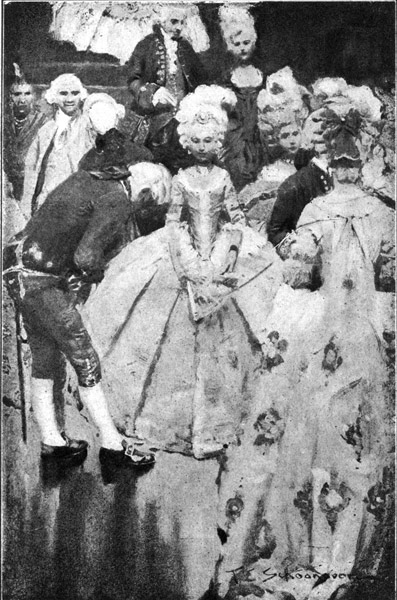
"'SILVER HEELS!' I STAMMERED"
"Hay-foot! Straw-foot!" simpered a cornet of dragoons
behind me, and I turned on him, and gave him a look.
"Did you say you were hungry?" I whispered, backing my
horse gently against the horse of the insolent cornet.
"Hungry?" he stammered.
"You mentioned hay, sir," I said, fiercely.
He turned red as a pippin but did not reply.
Swallowing my anger and my shame for our militia yokels,
I glared at the head of Colonel Butler's regiment, now passing,
and was comforted, for the clod-hoppers marched like
regulars with a solid double rank of fifers shrilling out
"Down, Derry, down!" as smart as you please.
After them came the green-coated varlets, with a good
round stench of the stables from their ranks, yet footing it
proudly, and their fifes ringing a barbarous tune which is
lately somewhat in vogue among us, the same being called
"Yankee Doodle."
Followed our three companies of Royal Americans, drums
beating "The Huron," a most warming march and loudly
applauded by the long lines of country folk and Indians,
sitting on the stone walls; and after them the inharmonious
regiment in yellow and red, with two men drunk and a dog-fight
in the rear, soberly observed by my Lord Dunmore, who
laid a bet with our Governor, and lost on the spotted dog,
they say.
There was a sham battle of the troops, too; half a gill to
every fifth man, and fifty pounds for the cannon on the hill,
which cost Sir William a pretty penny, our Governor refusing
to allow for the powder burned. However, it was a fine
pageant, and pleased all; and I was sorry when the last cartridge
was spent and the brigade band played, "God Save the
King."
We followed Sir William to the pavilion, dismounting
there to ascend the stairs and pay our respects to the Governor
and to Lord Dunmore.
"Come with me, Michael," said Sir William, wiping his
face with his hanker till it glistened; and I followed the
Baronet into the enclosure.
Lord Dunmore was tricked out like a painted actor, neither
old nor young, but too white and pink and without any red
blood in him, as far as I could see. He wore a wig—it was
said he possessed twenty and valued at six thousand pounds—and
his fingers, which I could see through the lace on his
cuffs, were like white bird's claws loaded with jewels.
When Lord Dunmore saw Sir William he fell a-tapping
his snuff-box and bobbing and smiling, nor did he rise until
we had made our way to him.
"Lud! Lud!" he said, and fell a-simpering, with hands
raised in feigned amazement at the magnificence of the review.
"Lud! Lud! Sir William! A gallant fête! A brave
defilé! Militia, not regulars, you say! Vive Dieu, Sir William,
a most creditable entraining! Permettez—mes compliments
le plus distinguée!"
"My aide-de-camp, Lord Dunmore," said Sir William,
bluntly; "your Lordship will remember Captain Cardigan
who died before Quebec? His son, my Lord!—and my dear
kinsman, Michael Cardigan, cornet in the Borderers."
"Strike me!" simpered Lord Dunmore. "Strike me, now,
Sir William! He has his father's eyes—Vrai Dieu! Curse
me, if he has not his father's eyes, Sir William!"
At this remarkable discovery I bowed and said it was an
honour to be considered like my father in any particular.
"Burn me!" murmured his Lordship, in an ecstasy at my
natural response. "Burn me, Sir William, what a wit he
has, now!" And he peeped at me, squeezing his eyes into
two weak slits, and laid his snuff-box against his nose. Lord!
What a false face he pulled at me!
Apparently surfeited with admiration, he invited Sir William
to take snuff with him, then turning to Governor Tryon,
who had just come into the stall, he fell to smirking and exclaiming
and vapouring about God knows what, until I, weary
and cloyed, glanced around me at the crowd on the seats
above us.
There were a hundred pair of bright eyes fixed on us, and
without vanity I perceived a few to meet mine, but the faces
were not distinct, and I found it disconcerting.
Then a deep, pleasant voice sounded close beside me,
and looking around, I saw our Governor Tryon smiling at
me.
"I knew your father," he said; "it was a privilege, Mr.
Cardigan, and one I take advantage of to address the son of
so gallant a gentleman."
I replied warmly and gratefully, yet with military deference,
and I saw Sir William observing me, well pleased at my
bearing.
"In these times," said the Governor, clasping his cloak
over his epaulets, "it is a pleasure to meet with modest loyalty
in the younger generation. Loyal to parent, loyal to
King! I predict we shall hear from you, Mr. Cardigan."
"Please God, sir," I replied, blushing scarlet; for into my
mind crept that wavering doubt which, since Sir William had
talked with me, haunted me like a shadow.
The Governor passed by with his clanking dragoons, among
them the young jackanapes who had presumed to sneer at
our yeomanry, and we delivered a pair of scornful glances
at each other which crossed like broadswords.
And now my Lord Dunmore's boudoir on wheels drove up,
and his purring Lordship minced off in the midst of his flame-coloured
Virginians, for all the world like a white cat dancing
through hell fire.
The ladies were rising, tying on sun-masks, standing in
rows between the seats, and the officers loitered and whispered
and played with their snuff-boxes, while the silent Mohawk
chiefs looked on, standing like statues till the crowd gave
them their liberty.
One lady there was, in a mask and silvery cloak, who looked
at me so long through the eye-holes that I felt my heart
begin a-beating; and another, too, in mask and rose mantle,
who lifted the linen a trifle, displaying a fresh, sweet, smiling
mouth. This one in rose turned twice to look at me, and it
amused me to feel my heart go a-bumping at my ribs so loud,
for she did truly resemble Marie Livingston.
Sir William and Colonel Claus had joined Lord Dunmore
in his coach; Sir John and Colonel Butler attached themselves
to our Governor Tryon. I, abandoned, rode back to
the Hall with a company of Virginians and dragoons, wondering
if ever I might acquire such horsemanship as the
Southerners displayed.
Coming to the Hall, I met Sir William, whose smiling face
grew haggard at sight of me, and he drew me apart, asking
of news from Quider.
"He is not yet dead, sir," I replied, my heart aching for
Sir William.
For a moment he stood staring at the ground, then bidding
me report to Mr. Duncan at the block-house, walked away to
disguise his anxious visage again with the oldest mask in the
world—a smile.
That night Sir William provided two great banquets for
our guests, one at the court-house in Johnstown, the other at
Johnson Hall.
The splendid banquet at the court-house was given to all
the visiting officers except Lord Dunmore, Governor Tryon,
and their particular aides. To it were invited the Virginians,
the New-Yorkers, the important Mohawk, Seneca, and Onondaga
sachems, and chiefs of the Long House. Also were
bidden the officers of our Royal Americans, such officers of
the Border House as had come with Governor Tryon, and all
gentlemen of distinction who had brought their ladies.
Colonel Claus and his lady presided as host and hostess,
representing Sir William and Mistress Molly, and our brigade
band played in the gallery during the banquet, and later
on the portico of the court-house, where a great crowd of
people had collected to cheer.
The other banquet was given at the same hour in our
house, to honour Lord Dunmore and Governor Tryon.
There were gathered in the hallway and on the stairs a
vast company of ladies and gentlemen when I came down
from my little chamber to wait on Sir William. Here was
the great Earl of Dunmore in a ring of fluttering ladies,
peering, bobbing, tapping his snuff-box, preening the lace on
his cuffs—and I thought he resembled one of those irksome
restless birds from the Canaries in a painted cage.
There was our Governor Tryon in purple silk from head to
foot, with the broad sash and star on his breast, leaning over,
hands clasped behind his back, to whisper jest or flattery to
a young girl who tapped at him with her fan. There was my
kinsman, Sir John Johnson, with his indifferent eyes and
ungracious carriage, and old Colonel Butler watching the
gay company as hawks, from sheer habit, watch peacocks,
meaning no attack. There also strolled my impudent dragoon
lad who had offended at the pavilion, and I will not deny
he appeared to be an elegant and handsome officer, possessing
those marked characteristics of fashion and assurance which
one observes in all gentlemen from the city of New York.
Making my way carefully amid rustling petticoats and a
forest of painted fans all waving like the wings of a swarm
of moths drawn by the candle-light, I passed Mistress Molly
on the arm of Sir William, touching my lips to her pretty
fingers, which she held out to me behind her back.
Next I encountered Mr. Butler and honoured him with a
scowl, which displayed my country breeding, it being the
fashion among quality to greet one's enemy with more elaborate
courtesy than one accords to friends.
People passed and repassed with laughter and whisper,
and the scented wind from their fans swept my cheek.
Suddenly it seemed as though the voice of Silver Heels
sounded in my ears, and for a moment I stared about me,
astonished that she should be here. But I could not find her.
Then her voice sounded again, clear as a pebbled spring in
all that chatter, and turning, I saw it came from a young girl
standing behind me. She was very delicate and pretty in
her powder and patches, truly somewhat pale and lacking in
plumpness, but with a pair of great hazel eyes like Silver
Heels's, and the child's full lips. Certainly she had Silver
Heels's voice, and her trick of widening her eyes, too, for now
she perceived me, and—
"Why, Micky!" she cried.
"Silver Heels!" I stammered, striving to believe my eyes.
What miracle of miracles had set her to grow tall and turn
into a woman in a single week?
I stared almost piteously at her, trying to find my own
familiar comrade in this whispering shower of silk and ribbon,
this delicate stranger, smiling breathlessly at me with
sparkling teeth set on the edge of her painted fan.
In her triumph she laughed that laugh of silver which
sounded ever of woodlands and birds, the same laugh, the
same gray eyes, and the same satin fingers laid on my
wrist.
"Silly," she whispered, "I told you so. And it has come
true; my gown is silk, my stockings silk, my shoes are Paddington's
make and silken to the soles!"
"How did you grow?" I gasped.
"Have I grown? Oh, my gown and shoes count, too, and
my hair rolled by Betty till I vowed she meant to scalp me!
See my egrettes! Are they straight, Micky?"
Ere I could attempt to compose my thoughts, comes mincing
my impudent dragoon, who seemed to know her, for he
brought her a ribbon to tie above her elbow, explaining it
was a new conceit from New York.
"It's this way," he explained, utterly ignoring my presence;
"I tie this bow of blue above your elbow, so!—with
your gracious consent. Now for a partner to lead you to
the table I seek some gentleman and tie a blue bow to his
sword-hilt."
"Pray tie it to Mr. Cardigan's," said Silver Heels, mischievously.
"I have much to say to him for his peace of
mind."
The dragoon and I, face to face, regarded each other with
menacing composure.
"To deprive you of such an honour, sir," said he, coolly, "I
protest reduces me to despair; but the light blue bows have
already been awarded, Mr. Cardigan."
Instinctively I glanced at his own sword-hilt, and there
fluttered a light blue ribbon. At the same moment I perceived
that Silver Heels had been perfectly aware of this.
Mortified as I was, and stinging under the dragoon's impudence,
I controlled myself sufficiently to congratulate him
and courteously deplore my own ill fortune, without a
grimace, though it stuck in my throat to say it.
"Let not your lady hear that!" said Silver Heels, with
her fan hiding her lips. "How do you know, sir, which
partner fate and Mr. Bevan may allot you?"
Mr. Bevan and I regarded each other in solemn hostility.
"May I have the honour of attaching this ribbon to your
hilt, sir?" he asked, stiffly.
"You may, sir," said I, still more stiffly, "if it is necessary."
He tied a red bow-knot to my hilt; we bowed to each other,
then with a smile and a word to Silver Heels which I did not
catch, he saluted us again and strolled off with his nose in
the air and his hands full of ribbons of every hue—the fop!
"Who is that pitiful ass?" I said, turning to Silver Heels.
"Why, Michael!" she protested, reproachfully, yet smiling,
too.
"Oh, if he's one of your friends, I ask indulgence," said
I, mad enough to pluck the blue knot from her arm.
"Truly, Michael," she sniffed, "you are still very young."
She seated herself by the big clock; I sat beside her, sullenly,
and for a time I peered at her sideways. Verily, the
impossible had overtaken us; she appeared to be fully as
tall as half the ladies gathered around us; her self-possession
and obvious indifference to me completed my growing discomfort.
I looked at her small, silk-covered toes pushing out
under her petticoat.
"Is the dandelion juice on them yet?" I asked, with piteous
playfulness.
"Don't talk like that!" she said, sharply, drawing her feet
in. And with that petulant movement the playmate I had
so often bullied, slipped away from me forever, leaving in
her place a dainty thing of airs and laces to flout me, whom I
knew not, but whom I meant to be avenged on; for at moments,
as I sat there, I could have yelled aloud in my vexation.
Lord! how they all ogled her, and came a-mincing, gentlemen
and ladies, old and young, and I heard whispers around
me that she was a beauty and would be rich one day. My
Lord Dunmore, too, came a-dancing pit-pat! till I thought to
hear his bones creak inside his white silk; and the dragoon
jackanapes was there, having tied up everything with his
ribbons save his own long ears, and it infuriated me to see
him standing guard protector over Silver Heels, with jealous
smiles for all who approached.
Now what the devil had seized all these gentlemen to set
them smirking and vapouring over Silver Heels, I did not
know, or rather, I knew perfectly well, because it was as
plain as a Mohawk moccasin on a spotted trail that Silver
Heels had suddenly become a beauty. Even I could see that.
Granted her bosom lacked somewhat in fulness, granted a
childish leanness of arm and neck, granted even a pallor
which adorned her not, and which, to tell the truth, I knew
came from fright, there was something in the frail moulding
of her that drew eyes, something in the arm's slim contours
that touched even me.
I might have taken a pride in her, had not all these bobbing
pigeons come crowding about to share openly my unconfessed
admiration. But they bowed and strutted and posed
and flattered, pressing closer until she was shut from my
sight by a circle of coat-skirts, tilted swords, and muscular
calves in silken stockings.
Presently our fiddlers and bassoons started the "Huron;"
there was a flutter to find ribbons that matched, and a world
of bustle and laughter, with gentlemen and ladies comparing
colours and bowing and curtseying without regard to neighbors'
toes and petticoats—the tittering popinjays!
Truly, if this mode of choosing one's lady prevailed in
New York, I at least found it smacked something of silliness
and French frivolity.
I had now been crowded up against our tall clock in the
hall, and stood there striving to get a glimpse of Silver Heels,
completely forgetting that somewhere in the crush a lady
with a scarlet ribbon on her arm might be waiting for me.
And doubtless I should have remained there, gnawing my
lip, till doomsday, had not Silver Heels espied me and come
fluttering through the crowd with:
"Oh, Micky! Have you seen your lady? Your old friend
Marie Livingston! But she is wedded now; she is that pretty
Mrs. Hamilton from Saint Sacrement. Oh, you lucky boy!
All the officers are raving over her! But I asked her if she
remembered you, and she said she didn't, so there!"
"Silver Heels," I began, with the first appealing glance I
had ever bestowed on a woman; "Silver Heels, I want to
tell you something."
I do not believe she was listening, or perhaps the chatter
around us drowned my voice, which was husky and over-fond,
for she cried: "You must not detain me, Michael. Mr. Bevan
is waiting for me."
And with that she was gone into the whirl, leaving me
high and dry against my clock, and furious over I knew not
what. For truly I myself did not know what it was I had
been about to say to Silver Heels. As for this Mrs. Hamilton,
it madded me to hear of her. I had long forgotten Marie
Livingston—save as a name to goad Silver Heels withal.
Mrs. Hamilton, forsooth! What the foul fiend had I to do
with another man's wife, whether Hamilton or Smith or
Jones I cared not, while that ape of a New-Yorker had set
himself in my rightful place beside Silver Heels! And what
stabbed deepest was that Silver Heels found pleasure in his
foolish company—ay, plainly preferred him to me—the ungrateful
minx! I prayed fervently she might live to repent
it. I pictured her remorse when she came to her senses. And
in a moment more I had slipped into one of my waking
dreams wherein justice was dealt out by the jugful all around,
and I emerged from some scenes of carnage, calm, triumphant,
gently forgiving Silver Heels the accumulated sins of
her misspent life.
Sullenly dreaming there under the tall clock, and happening
to lift my eyes towards heaven for some of its spare vengeance,
I perceived on the stairs that same lady who had half
raised her sun-mask at the review—I mean the one in the
rose mantle, not the other in the silvery cloak, whom I now
knew had been Silver Heels.
Down the stairs rustled my lady of the rose mantle, finger-tips
playing a tattoo over the mahogany balustrade, and on
her lips a smile, as I fancied, though later I came to know
that it was only the natural expression of her mouth. Something
in my memory stirred at that smiling face.
Now she was looking straight at me, with that delicate
curve of her lips which sets men thinking, and at the same
moment I perceived that she wore my colours. Marie Livingston!
I should never have known her; so we were quits,
the affected minx! This was Mrs. Hamilton!—this bright-eyed
girl with her smooth rose-petal skin and her snowy hand
on the balustrade. Could I be mistaken? Surely she wore
my colours! I glanced at the knot on my sword-hilt, then
pressed through the throng to the stairway. Now at last I
could pay Silver Heels in her own wampum, and I meant to
do it under her very nose.
I met Mrs. Hamilton at the foot of the stairs, but she did
not appear to see me. Truly she was a miracle of innocence
not to have perceived her colours on my hilt, or perhaps she
was over-timid. So I addressed her reassuringly and made
her a bow that I knew must be impressive. However, I found
her less confused than I, for she insisted on matching ribbons
very carefully, which hurt my pride somewhat. But when she
could no longer doubt that our ribbons matched, she made me
a whimsical reverence, and took my arm with a smile, and a
cool: "Oh, I faintly recall you now, Mr. Cardigan. How
you have grown!"
Out into the wilderness of silver and candle-light we
passed, fiddle and bassoon a-playing with might and main,
and we stood behind our chairs while my Lord Dunmore
chattered a blessing, then seated ourselves amid a gale of
whispers.
Through the flare of the candles I saw Brant and Sir John
Johnson near us, and also that filthy Indian, Red Jacket, both
hands already in a dish of jelly, a-gobbling and grunting to
himself, which sent Lord Dunmore into peals of shrill laughter,
though Sir William took no notice. Presently I perceived
Silver Heels and Mr. Bevan, nearly opposite to us,
and strove to catch her eye. But Silver Heels took small
notice of me; her cheeks had gone red with her first sip of
wine, and she sat there rosy and silent, head a little lowered,
while that insufferable coxcomb whispered into her ear, and
smirked, and played with his wine-glass till the very sight
of the man sickened me.
Stung to the quick by her indifference to my presence,
smarting in my fancied isolation, I resolved to show her that
I cared not a whit for her or her dragoon. So I loosened my
tongue and set it wagging so smartly that I think I astonished
Mrs. Hamilton, who had been observing Mr. Bevan
with her fixed smile. At any rate, she gave me a long, pleasant
stare, and presently her fixed smile became very sweet
and pretty, although I thought a trifle mocking.
"Is it not amusing?" she said, coolly; "here you sit with
me, when you would give your tow-head to be prattling into
Mistress Warren's ears; and here sit I at twiddle-thumbs,
devising vengeance on Mr. Bevan, who belongs to me!"
Perplexed and disconcerted, I found no words to answer
such an amazing sally. It shamed me, too. Perhaps my
countenance had betrayed me, but her confession concerning
Mr. Bevan was a bold one, and not at all to my taste.
"I thought you had a husband," said I, with boyish bluntness.
She coloured up like fire for a moment, and I was sorry I
spoke, but I had my pity for my pains, for the next instant
she was laughing at me as though I were a ninny, and I
could discover no reason for her mirth.
"Please tell me your Christian name," she said, sweetly.
"I really do desire to recall it."
"My name is Michael," said I, suspiciously.
"Was it not Saint Michael who so soundly spanked the
devil?" she asked, with her innocent smile. "Truly, Mr.
Cardigan, you were well named to chastise the wicked with
such sturdy innocence!"
I fumed inwardly, for I had no mind to be considered a
gaby among women.
"I am perfectly aware, madam, that it is the fashion for
charming women to turn boys' heads," said I, "and I wish
you might turn Mr. Bevan's head till you twisted it off his
neck!"
"I'd rather twist yours," she said, looking up from her
plate of broiled troutlings.
"Twist it off?" I asked, curiously.
"I—I don't know. Look at me, Mr. Cardigan."
I met her pretty eyes.
"No, not quite off," she said, thoughtfully. "You are a
nice boy, but not very bright. If you were you would pay
me compliments instead of admonition. Perhaps you will
after the Madeira. Perhaps you will even make love to me."
"I will do it before the Madeira," said I. "You are certainly
the prettiest woman in Johnson Hall to-night, and if
you've a mind for vengeance on your faithless dragoon yonder,
pray take me for the instrument, Mrs. Hamilton."
"Hush!" she said, with a startled smile. "I may take you
at your word."
"I am taking you at yours," said I, recklessly, and loud
enough for Silver Heels to hear.
In the dull din of voices around us I heard Silver Heels's
laugh, but the laugh was strained, and I knew she was looking
at me and listening.
"I don't know what you mean," said Mrs. Hamilton, reddening,
"but I know you to be a somewhat indiscreet young
man who handles a woman as he would a club to beat his
rival to the earth withal."
"I mean," said I, in a low voice, "to make love to you and
so serve us both. Look at me, Mrs. Hamilton."
"I will not," she said, between her teeth.
"Tell me," I pleaded, "what is your Christian name. I do
really wish to know, Mrs. Hamilton."
Spite of the angry red in her cheeks she laughed outright,
glanced sideways at me, and laughed again, so blithely that
I thought I had truly never seen such careless ripened healthy
beauty in any woman.
"My name is Marie Hamilton, of Saint Sacrement, please
you, kind sir," she lisped, with an affected simper which set
us both a-laughing again.
"If you ever had your heart stormed you had best prepare
for no quarter now!" I said, coolly.
"Insolent!" she murmured, covering her bright cheeks
with her hands, and giving me a glance in which amusement,
contempt, curiosity, and invitation were not inharmoniously
blended.
The Madeira had now turned my blood to little rivers of
fire, I being but lately enfranchised from the children's pewters
and small-beer; but yet I am so made that never then
nor since have the delicate vapours of wines stifled such wits
as I possess. It is my conscience only that wine dulls.
So amid the low tumult, the breezy gush of whispers, the
laughter, and the crystal tinkle of silver and glass, I made
indiscreet, clear-headed love to Mistress Marie Hamilton, retreating
under her cruel satire, rallying in the bright battery
of her eyes, charging the citadel of her heart with that insincere
and gay abandon which harasses, disconcerts, and
piques a woman who understands better how to repel true
passion.
"In what school have you been taught to make love, sir?"
she said, at last, breathless, amused, yet exasperated.
"In the school of necessity, madam," I replied.
"I pray you teach something of your art to Mr. Bevan,"
said she, spitefully, over her fan's silk edge.
"I am teaching him now," said I.
It was true. The dragoon was staring at Mrs. Hamilton in
undisguised displeasure. As for Silver Heels, she observed
us with a scornful amazement which roused all the cruelty
in me, though I knew I was losing her innocent belief in me
and tearing my respectability to shreds under her clear gray
eyes.
For a bud from Mrs. Hamilton's caushet I threw away the
pure faith of my little comrade; for a touch of her hand I
blighted her trust; and laughed as I did it.
Only once was Mrs. Hamilton off her guard, when my
earnest acting had suddenly become real to me—a danger, I
have since found, that no actors are too clever to escape
sometimes.
"If for one moment you could be in earnest," she ventured,
with a smile.
I was on guard again before she finished, and she saw it,
but was too wise to betray regret or anger for her mistake.
"Pray, cease," she said; "you weary me, Mr. Cardigan.
The coldest among us reflect fire, even though it be as false
as the dead fires of the moon. You are prettily revenged; let
us have peace."
Now the healths flew thick and fast from Sir William and
Lord Dunmore, the titled toast-masters, and we drank his
Majesty George the Third in bumpers which set the Indians
a-howling like timber wolves at Candlemas.
Indeed, our forest of lights might have served for the
Romish feast itself.
Toast followed toast in a tempest of cheers, through which
the yelps of the Indians sounded faintly. I saw Brant take
a silver plate and a solid candle-stick from under Red
Jacket's shirt, while that great orator, very drunk, sat a-hacking
the cloth with a table-knife. I saw my Lord Dunmore, all
in white silk and blazing with stars, rise to pledge the ladies,
and stand swaying and leering and gumming his glass till it
upset on his chin, and the jewels in his lace front dripped
wine.
Mistress Molly we pledged with a shout, and she returned
our courtesy with gentle gravity, but her eyes were for Sir
William alone.
Then Lord Dunmore gave:
"Our lovely heiress, Mistress Warren!" ending in a hiccough,
and poor Silver Heels, pale as a white blossom, half
rose from her seat as though to fly to Mistress Molly.
Red Jacket was on his feet now, slavering and mouthing
and hacking at the air, and Brant and I dragged him out
into the garden where his squaw took charge, leading him
lurching and howling down the hill. Before I returned, the
ladies were in the hallway and the card-room, the gentlemen
following in groups from the table, some shamefully unsteady
of leg, and feebly scattering snuff in amiable invitation to
their neighbours.
But Sir William had disappeared, and I hunted vainly for
him until I encountered Mrs. Hamilton, who directed me to
the library, whither, she averred, Sir William, Governor
Tryon, and Lord Dunmore had retired.
"State secrets, Master Michael," she added, saucily. "You
had best find Mr. Bevan and start those same lessons we have
discussed."
"Let me instruct him by proxy," said I, drawing her under
the stairs, and ere she could protest or escape, I kissed her
lips three separate times.
She was in tears in an instant, which I had not counted
on, and it needed my most earnest acting to subdue her indignation.
I had my arm around her, and my coat was all powder and
rouge, when something made me look around. There was
Silver Heels going towards the pantry with Betty, doubtless
to pouch some sweets for her black nurse. Her head was
steadily lowered, her lashes rested on her cheeks, but face and
neck and bosom were glowing in a deep colour, and I knew she
had perceived us, and that she despised us with all the
strength of her innocent soul.
Stunned with the conviction that I had gone too far, I
made out to play my miserable farce to an end and led Mrs.
Hamilton out where Mr. Bevan could pounce upon her, which
he did with an insolence that I had little spirit to notice or
resent.
Then I hastened to the pantry where Silver Heels stood
before the rifled dishes, hands to her face, and black Betty
a-petting her. But at sight of me she turned scarlet and
shrank back, nor would she listen to one word.
"What yoh done to mah li'l Miss Honey-bee?" exclaimed
Betty, wrathfully, shaking her turban till the rings in her
big ears jingled like sledge-bells in December. "I done
'spec' yoh, Mars Ca'digan, suh! Yaas, I 'spec' yoh is lak all
de young gemmen!"
Then the old witch began a-crooning over Silver Heels
with deadly glances at me:
"Doan yoh cyah, li'l Miss Honey-bee, doan yoh mind
nuff'n! Huh! Had mah s'picions 'bout dat young Mars
Ca'digan. Doan yoh mind him no moh'n a blue-tail fly!"
"Very well," said I, angrily, "you can do as you choose,
and think what you like. As for your fool of a dragoon, Mrs.
Hamilton will settle him, and if she doesn't I will."
My foolish outburst seemed to rouse a panther in Silver
Heels, and for a moment I believed she meant to strike me.
But the storm swept over, leaving her with limbs a-quiver
and eyes wet.
"You have spoiled my first pleasure," she said, in a low,
trembling voice. "You have conducted like a clown and a
libertine where all beheld you making shameful love to a
wedded woman! Oh, Betty, Betty, send him away!" she
sobbed, burying her head in the black woman's breast.
"Silver Heels," I said, choking, "can you not understand
that it is I who wish to wed you?"
Again the panther blazed in her gray eyes, but her lips
were bloodless as she gasped: "Oh, the insult! Betty—do
you hear? He would marry me out of pity! That is twice
he has said it!"
"I said it before because I would not have you marry Mr.
Butler," said I, wincing at her scorn. "But I say it now
because—because—I love you, Silver Heels."
All her horror of me was in her eyes. I saw it and set my
teeth hard, hopeless now forever, even of her careless affection.
And so I left her there, with Betty's arms around her, and
the hot scorn in her eyes. But as I went away, chilled with
self-contempt and mortification, heedless, utterly careless
what I did to further degrade myself in her eyes, came black
Betty a-waddling to pluck me by the sleeve and whisper:
"Doan yoh go to wed wif nobody, Mars Ca'digan, suh!
Doan yoh go foh to co't nobody. Mah li'l chile—mah li'l
Miss Honey-bee ain't done growed up yet, suh. Bime-by
she'll know moh'n she 'specs 'bout gemmens, suh."
But my evil nature was uppermost, and I laughed and
bade Betty mind her own affairs, leaving her there grumbling
and mumbling about "fool boys" and "li'l fool Honey-bees,"
till the clatter and din from the card-room shut her
voice from my ears.
When I came to the library the door stood partly open,
and I could see a party of gentlemen lounging within,
and somewhat boisterous over their wine and filberts; so
thinking no harm to enter, I walked in and sat down on the
arm of a leather chair by the window.
Nobody had observed me, however, and I was on the point
of respectfully making known my presence to Sir William,
when I saw Walter Butler rise and shut the door, taking the
additional precaution to lock it. Turning to rejoin the company
around the table, his dark golden eyes fell upon me, and
he stood still, one hand tightening on the back of his chair.
"Well?" inquired Sir William, testily, looking up at Mr.
Butler. "When you are seated, sir, I will continue, unless I
weary the company."
"If Mr. Cardigan has been here all this time, I, for one,
was not aware of it," observed Mr. Butler, coldly, never taking
his unblinking eyes off me.
I began to explain to Sir William that I had but that
moment came in, when he interrupted querulously, and motioned
Mr. Butler to be seated.
"Tush! tush! Let be, let be, Captain Butler! My young
kinsman has my confidence, and it is time he should know
something of what passes in his own country."
"At sixteen," observed my Lord Dunmore, with a maudlin
chuckle, "I knew a thing or two, I'll warrant you—curse me
if I didn't, Sir William!"
Sir John Johnson regarded me without interest; Colonel
Claus never even troubled to give me a glance, but I saw the
hawk's eyes of Walter Butler watching me steadily.
"To resume," began Sir William, but Lord Dunmore broke
out:
"At sixteen I had outlived you all—pierce me if I hadn't,
now, Sir William! Scratch me raw! if I hadn't put a finger
in the world's pudding, a-stirring the plums at sixteen, by
God!"
"Doubtless, my Lord," said Sir William, dryly. "And
now, gentlemen, concerning our show of force here, I have
only to say—and I say it with all respect and submission to
Governor Tryon—that I do not believe it will produce that
salutary effect on the discontented in New York and Boston
which Governor Tryon expects."
"Gad! I do expect it!" said Tryon, briskly. "Look you,
Sir William, you and your militia dominate the county, and
these rascals must be brought to understand it. Trust me,
messires, the damned Yankees will know of this militia display
before the post rides into Boston!"
"Add our Mohawks to the militia," observed Walter Butler,
in a colourless voice.
Sir William's jaw was set hard, but he said nothing.
"Add the whole Six Nations," suggested Lord Dunmore,
leering at Sir William; "come, now! curse me blind! but we
shall have the whole Six Nations, and that filthy little Red
Jacket to boot."
"My Lord," replied Sir William, "if it lay with your
Lordship you would have Red Jacket against you."
This blunt rebuke almost sobered Lord Dunmore for a
moment, and he asked Sir William what he meant.
"I mean," said the Baronet, "that you mocked this powerful
chief, Red Jacket, at my table to-night, and he knew it.
That is not the way to gain allies, my Lord."
"The drunken, guzzling son of a slut!" bawled Lord Dunmore,
"d'ye think I care what the bandy-legged little beast
thinks?"
"I only know," replied Sir William, curtly, "that if your
Lordship has so conducted in Virginia, the King cannot look
for any Indian support in that colony."
"Oh, choke me, Sir William, but that's too bad now!—pinch
me blue if it isn't!" protested Lord Dunmore in a pet.
Then a subtle smirk settled on his waxen cast of a face and
he winked his weak eyes at Walter Butler, a proceeding observed
by me and by Sir William.
Not for a moment now did I doubt that Lord Dunmore
had set Colonel Cresap to drive the Cayugas into a hatred
for the colonies, nor did I doubt but that Walter Butler knew
of this plan, perhaps had even connived at it.
Sir William, too, had come to some quick conclusion, for
I saw the crease deepen around his jaws, and his steady eyes
strike fire. But he said nothing to interrupt Lord Dunmore,
who had now launched into a gust of incoherent words and
protestations and hiccoughs, to which all listened sneeringly
until his voice ended with a hollow buzz inside his wine-glass.
There came a silence, broken by the clear sarcastic tones
of Sir William.
"I beg permission to submit to Governor Tryon the opinion
of a country Baronet—for what that opinion may be
worth."
"With pleasure," said Governor Tryon, cordially, looking
up from the plate of nuts he was picking.
"And this is my opinion," continued Sir William, "that,
firstly, the disaffected classes in Boston and New York will
not care a fig for our conference here, nor for our show of
militia; that, secondly, if they should once entertain a suspicion
that England, in the event of war, proposes to employ
savages as allies to subdue rebellion, we would have to-morrow
the thirteen colonies swarming like thirteen hives to
sting us all to death—ay—and there would not be an Indian
left twixt here and the Ohio!"
"What would become of them?" piped up Lord Dunmore,
so innocently that I saw Governor Tryon pass his hand over
his mouth to conceal a smile. But Walter Butler's passionless
voice was sounding now, and I saw Sir William turn his
head to lose no gesture or shade of meaning.
"It is come to the point where either the rebels are to
win over the Indians, or where we must take measures to
secure their services. I am not in a position to inform you,
gentlemen, as to the actual existing conditions in the Indian
Department. That, Sir William can do better than any one
in America. Therefore, I beg Sir William to kindly make it
clear to us what chances we have to win the support of the
Six Nations—in the event of a rebel rising against the King's
authority."
The tangled knot was cut, the cat had sprung from the bag.
Yet nobody by glance or word or gesture appeared to be
aware of it.
Sir William's manner was perfectly composed, though that
deep crease binding his chin deepened, and his brows bent in
towards his nose as he rested his chin on his hand and spoke,
eyes fixed on his wine-glass:
"Captain Butler believes that it has come to this: that
either those in authority or the disaffected must seek allies
among these savage hordes which hang like thunder-clouds
along our frontiers. Gentlemen, I am not of that opinion.
I have said openly, and I care not who knows it, that if war
must come between England and these colonies, let it be a
white man's war; in mercy, let it be a war between two civilized
peoples, and not a butchery of demons!
"I do believe—and I say so solemnly and before God—that
it is possible to so conduct that these savages will remain
neutral if war must come. Ay, more! I will answer for
them!"
He lifted his eyes and looked straight at Lord Dunmore,
raising his voice slightly, but betraying no passion.
"And, gentlemen, as I am his Majesty's intendant of Indian
affairs in North America, I shall now do all that I can
to pacify my wards, to keep them calm and orderly in the
event of a war which I, for one, regard with horror. Were I
to do otherwise, I must account to my King for a trust betrayed,
and I must answer also to Him whom King and subject
alike account to."
On Walter Butler's lips a sneer twitched; my Lord Dunmore
wiped his bleared eyes with a rag of lace and stared at
everybody with drunken gravity.
"I know not," said Sir William, slowly, "what true loyalty
may be if it be not to save the honour of our King, and rebuke
those who seek to tarnish it. And if there are now those
among his counsellors or deputies who urge him to seek these
savages as allies, I say it is a monstrous thing and an inspiration
from hell itself."
He swung on his elbow and fixed his eyes on Walter Butler.
"You, sir, know something of border war. How then can
you propose to let loose these Indians on the people of our
colonies?"
"Lest they let loose these same savages on us," replied Mr.
Butler, calmly.
Sir William frowned.
"You do not know the colonists, Mr. Butler," he said.
"What marvel then that my Lord North should misunderstand
them, and think to buy their loyalty with tuppence
worth o' tea?"
"Come, come, Sir William!" cried Governor Tryon, laughing,
and plainly anxious to break the tension ere sharp words
flew. "Did I not know you to the bone, sir, I should deem
it my duty to catechise you concerning the six articles of
loyalty!"
"I, too, i' faith!" squeaked Lord Dunmore. "Skewer me!
Sir William, but you talk like a Boston preacher—ay—that
you do, and—"
"Have done, sir!" cut in Sir William, with such bitter
contempt that the faces of all present sobered quickly. Even
Governor Tryon glanced uneasily at Lord Dunmore to see
how he might swallow such a pill, but that nobleman only
blinked stupidly and sucked his thin lips, too drunk to
understand how like a lackey he had been silenced.
Sir John Johnson and Colonel Claus, deputies to Sir
William in the Indian Department, exchanged puzzled
glances. But I noticed that Mr. Butler never took his eyes
from Sir William's darkening visage.
"There is one more matter," said the Baronet, "that I may
be pardoned for introducing here amid all the perplexities of
the times; but it is a matter touching on my own stewardship,
and as that concerns my King, I deem it necessary to
broach it."
He turned again deliberately on Lord Dunmore.
"It has come to my knowledge that certain unauthorized
people are tampering with a distant tribe of my Cayuga Indians.
I know not, nor do I care, what the motives of these
men may be, but I protest against it, and I shall do all in
my power—without infringing on the rights or laws of a
sister colony—to protect my Cayugas from unlawful aggression!"
"Damme!" gurgled Lord Dunmore, passing his jewelled
hand over his befuddled head. "Damme, Sir William, d'ye
mean to accuse me? Curse me! Skewer me! Claw me raw!
but it is not fair," he snivelled. "No, it is not fair! Take
your hands off my sleeve and be done a-twitching it, Captain
Butler! Damme! I never set Cresap on. Will ye have
done a-pinching my arm, Captain Butler?"
The ghastly humour of the exposure, the ludicrous self-conviction
of his tipsy Lordship—for nobody had mentioned
Cresap—the startling disclosure, too, of Walter Butler's interest
in the plot—for that it was a plot no longer could anybody
doubt—cast a gloom over the company.
Every man present understood what Cresap's aggression
meant; no man there dared acknowledge a desire for Cresap's
success.
Then Sir William's sarcastic voice pierced the silence.
"I trust your Lordship would not believe that any gentleman
present could harbour suspicions of a foul conspiracy
between your Lordship and Captain Butler, to incite my
Cayugas to attack white men!"
Walter Butler's slow eye rested on Lord Dunmore, on Sir
William, and then on me. But his bloodless visage never
changed.
"Gentlemen, gentlemen, let us have harmony here at any
cost," protested Governor Tryon, half in jest, half in earnest.
"God knows I have discord enough in New York town
without seeking it among the loyalists of this county. Nobody
believes that my Lord Dunmore is seeking trouble with
your tame Indians, Sir William. If this fellow Cresap, who
is a notorious malcontent, too, be imposing on the Cayugas,
I doubt not that my Lord Dunmore will recall him and deal
with him severely."
"No, I won't! Claw my vitals if I do!" snapped his Lordship,
in the drunken sulks, and straightway fell a-squabbling
with Walter Butler, who had again laid a hand on his arm.
For Captain Butler knew his treachery had been discovered,
and his shameless impudence in openly attempting
to muzzle his noble partner in conspiracy passed all bounds
of decency.
I saw the angry light glimmer in Sir William's eyes, and
I knew it boded no good to Walter Butler, as far as his hope
of Silver Heels was concerned. A fierce happiness filled me.
So now, at last, Sir William was discovering the fangs in his
pet snake!
Lord Dunmore had succeeded in reversing a decanter of
port over himself and Colonel Claus, and the latter, mad as
a wet cat, left the room swearing audibly, while his playful
Lordship threw a few glasses after him and then collapsed
in a soiled heap of silk and jewels, feebly calling on "Billy
Tryon" to try and "conduc like er—er—gen'l-m'n, b' God!"
Sir William was steadily staring at Walter Butler; I, too,
had my eye on him; and, when he left the table to saunter
towards the door, Sir William rose immediately to follow
him, and I after Sir William.
He saw us coming as he opened the door, and surveyed us
with cool effrontery as we joined him in the hallway.
"I shall not require your services hereafter as my secretary,
Captain Butler," said Sir William. "Will you kindly
hand your keys to me?"
"At your command, Sir William," replied Mr. Butler,
drawing the keys from his pocket and presenting them with
an ironical inclination.
The man's careless self-possession was marvellous considering
he was facing the man he had so vilely betrayed.
"Mr. Butler," said Sir William, with reddening face, "I
consider myself released from my consent to your union with
my kinswoman, Miss Warren!"
"As to that, sir," observed Captain Butler, cynically, "I
shall take my chances."
I heard what he said, but Sir William misunderstood him.
"It is your mischance, sir, to put no harsher interpretation
on it. But my decision is irrevocable, Mr. Butler, for
I have destined Miss Warren to a loyal man, my kinsman,
Michael Cardigan!"
The spasm that jerked Mr. Butler's mouth into that ghastly
grimace I knew so well, was not lost on Sir William.
"I'll take that chance, too," said Mr. Butler, bowing.
"What do you mean, sir?" demanded Sir William, steadying
his voice with an effort.
But Walter Butler only replied with such glare at me that
Sir William involuntarily turned to find me, rigid, behind
him. The next moment Captain Butler passed noiselessly
out into the starlight, wrapping his black cloak around
him.
Sir William followed him mechanically to the door, and I
at his heels, burning for a quarrel with Walter Butler, and
awaiting only for Sir William to return to the library, and
leave me free to follow and insult Mr. Butler for the treacherous
villain he had proved himself.
But Sir William, seeing me slinking out, laid a hand on
my shoulder and spun me sharply round on my heels to
look into my eyes.
"Now what the devil are you up to?" he broke out, half
divining the truth. "Michael! Michael! Don't be a fool!
Are there not fools enough here to-night?"
"No, sir," I answered, sheepishly.
"That is not the way to serve me, lad," said Sir William,
roughly. "Have I not sorrow enough without seeing you
carried in here with a hole in your breast, you meddlesome
ass?"
"I have a certain score to clean off," I muttered.
"Oh," observed Sir William, coldly, "a selfish quarrel—eh?
I was a fond old fool to think I might count on you."
Tears started to my eyes; I could have bitten my tongue
off.
"You can count on me, sir," I said, choking out the
words. "I meant no harm; I am not selfish, sir; I care only
for you."
"I know it, lad," he said, kindly. "And mind, I do not
rebuke your spirit; I only ask you to learn discretion. This
is no time to settle private matters. No man in America
has that right now, because every man's life belongs to the
country!"
"On which side, sir?" I faltered.
Sir William was silent for a while. Presently he took my
arm and we walked out under the stars.
"My boy," he said, sadly, "I cannot answer you, but I
can place matters in a clear light for you. The decision
must remain with yourself."
Then he told me how the Boston people had been taxed
without their consent, but I could not see why they should
not cheerfully give their all to their King, and I said so.
"Very well," replied Sir William, gravely. "Let us approach
the matter from your personal view. Here are you,
young, vigorous, of good lineage, and sure to succeed to your
uncle's title and estate some day. You are, at sixteen, an
officer of his Majesty's border cavalry; you have every prospect
of promotion; the King remembers your father, Governor
Tryon is your friend. And I, Michael, have decided
to leave you, in my testament, sufficient to maintain you
handsomely should you desire to marry Felicity before your
uncle's death. That, my boy, is the King's side.
"Now suppose, from a high motive of duty, you should suddenly
resolve to embrace the cause of the plain people. Could
you renounce your commission in the King's army to shoulder
a firelock, perhaps a stable-fork, in the ranks of your countrymen?
Could you give up ease, hopes, position? Could you
give up your friends and kinsmen? Could you give up what
sum I may leave you in my will? For Sir John would never
let a penny of my money go to a rebel. Could you give up,
if need be, the woman you loved? Think, and be not in
haste to answer. For that is the other side to embrace, with
perhaps a hangman's rope at the end."
"Am I to answer you to-night, sir?" I asked.
"God forbid!" he said, solemnly.
"I will say this," said I; "that where my heart is, I
would follow in rags. And my heart is with you, sir."
He stood still, drawing me closer, but said nothing more,
for there came running out of the darkness an officer with
naked claymore shining in the starlight, and when he drew
near we saw it was Mr. Duncan.
"The Indian is gone!" he panted. "Gone away crazed
with fever! The doctor lies in the hut with a broken
shoulder; Quider crushed it in his madness!"
Sir William swayed as though struck.
"The sentries chased him to the woods," continued poor
Duncan, out of breath; "but he ran like a panther and—we
had your orders not to fire. He will die, anyhow; the doctor
says he will seek some creek or pond and die in the water
like a poisoned rat. They are bringing the doctor now."
Up out of the shadow loomed two soldiers, forming a litter
with their muskets, on which sat our doctor, Pierson, head
hanging. And when Sir William came to him he looked up
with a sick grimace and shook his head feebly.
"He broke those ropes as though they had been worsted,"
he said. "I tried to hold him down, but he had the strength
of delirium, Sir William. I want that fat surgeon of the
Royal Americans to set this bone," he added, weakly, and
fell a-groaning.
Mr. Duncan started on a run for the barracks; the soldiers
and the injured man passed on towards the guard-house, and
Sir William stood staring after them.
Presently he said, aloud, "God's will be done on my poor
country!"
We walked back to the house together. Some of the guests
were leaving, but the card-room was still crowded, and in
the library my Lord Dunmore lay on the carpet cursing and
vomiting and shrieking that no man should put him to bed,
and that he meant to crack another bottle or a dozen heads.
Here and there, out through the orchard, drunken Indians
lurched lodgeward, followed by their patient squaws; here
and there sedan-chairs passed, the grunting bearers stepping
lively in the brisk night wind.
Below the hill, in Johnstown, the court-house windows
were still twinkling with lights, and when the wind set our
way, we could hear the distant strains of the brigade band
playing for the dancers.
Sir William entered the hallway of his house and looked
around. In a corner of one window sat Mrs. Hamilton and
Mr. Bevan, somewhat close together; in another window
were gathered Colonel Claus and his lady and Sir John
Johnson, whispering. Brant, surrounded by a bevy of fine
ladies, was turning over the pages of a book and answering
questions in polite monosyllables, for he had a quiet contempt
for those who regarded him as a curiosity, though
susceptible enough to real homage.
"And out of all my house," murmured Sir William, in a
bitter voice, "not one whom I can trust—not one!—not one!"
After a moment I plucked at his sleeve, reproachfully.
"Yes—I know—I know, my boy. But I need a man now—a
man of experience, a man in bodily vigour, a man in devotion."
"You need a man to go to Colonel Cresap," I whispered.
For the first and only time in my life I saw that I had
startled Sir William.
"Let me go, sir?" I entreated, eagerly. "If I am keen
enough to read your purpose, I am not too stupid to carry it
out. I know what you wish. I know you cannot trust your
message to paper, nor to a living soul except me. I know
what to say to Colonel Cresap. Let me serve you, sir, for I
do long so to help you?"
We had fallen back to the porch again while I was speaking,
Sir William holding me so tightly by the elbow that his
clutch numbed my arm.
"I cannot," he muttered, under his breath. "To-morrow
Dunmore will set his spies to see that Cresap remains undisturbed.
The Ohio trails will be watched for a messenger
from me. Who knows what Dunmore's and Butler's men
might do to carry out their designs on my Cayugas?"
"Dare they attack an officer in uniform?" I asked, astonished.
"What is there to prevent a shot in ambush? And are
there no renegades in Johnstown to hire?" replied Sir William,
bitterly. "Why, the town's full of them, lad; men as
desperate as Jack Mount himself."
"But I know the woods! You, yourself, sir, say I am a
very Mohawk in the woods!" I pleaded. "I fear no ambush,
though the highwayman Jack Mount himself were after me.
Have I not been twice to the Virginia line with Brant? Do
you think I could fail to reach Cresap with the whole forest
as plain to me as the Stony Way below this hill? And remember
I carry no papers to be stolen. I could first go with
belts to the Cayugas, and tell the truth about Quider and his
party. Then I would deliver the belts as you delivered them
to Quider. Then I would find Cresap and show him what
a fool he is."
"And so serve the enemies of the King?" said Sir William,
looking keenly at me.
"And so serve you, sir," I retorted, in a flash. "Are you
an enemy to the King?"
"But, my boy," said Sir William, huskily, "do you understand
that you must go alone on this mission?"
I sprang forward and threw my arms around him with a
hug like a young bear.
"Then I'm going! I'm going!" I whispered, enchanted,
while he murmured brokenly that he could not spare me and
that I was all he had on earth.
But I would not be denied; I coaxed him to my little bedroom,
lighted the candle, and made him sit down on my cot.
Then I explained excitedly my purpose, and to prove that I
knew the trails, I sharpened my treasured Faber pencil and
made a drawing for him, noting every ford and carrying-place—which
latter I proposed to avoid—and finally hazarded
a guess as to the exact spot where Colonel Cresap might be
found.
Also, in pantomime and whispers, I rehearsed the part I
meant to play before the Cayugas, making the speeches that
Sir William had made to Quider, as nearly as I could remember,
and delivering each belt in dumb show and with
all the dignity I could command, till I came to the last,
which, by mistake, I spoke of as a red instead of black
belt.
"Wait," interrupted Sir William, who had become deeply
interested; "what is 'black' in the Mohawk tongue?"
"Kahonji," I replied, promptly.
"And in Onondaga?"
"Osuntah, sir."
"And in Cayuga?"
I hesitated, then blushed, for I did not know.
"Sweandaea," said Sir William, gravely; "how are you
to bear my peace-belts if you know not the red of war from
the black of good intent?"
"I should have said 'Hot-Kwah-Weyo'—good-red, not
war-red," I replied, so naïvely that Sir William laughed outright.
"With such resourceful impudence," he said, "you cannot
be misunderstood among the Six Nations. It eases my mind
to find you quick and ingenious in a tight place, lad. But,
Michael, have a care to use no Delaware words, for that
would render my Cayugas suspicious."
I promised eagerly, and we sat down together to go over
the trail, mile by mile, computing the circles I should be
obliged to take to avoid the carrying-places where spies were
most to be feared.
"Dunmore rides South in a week," said Sir William.
"But he will not wait till he reaches Virginia before he sends
out his emissaries to urge Cresap on. You must beat them,
lad, and go afoot at that."
"I can go the faster," said I. "Horses are useless in the
Pennsylvania bush until you reach Crown Gap. I take it
that Lord Dunmore's men, being Virginians, will go mounted,
and that gives me double time to reach Cresap."
And so we sat there together on the bed, planning, suggesting
precautions, counting the dangers and mischances
only to discount them with confidence in my knowledge of
woodcraft, and the night wore on till my candle sank into a
lake of wax, trailing a long, flaring flame.
"There is one thing I have thought of," said I, soberly.
"It is this: if I am going out as an enemy to the King, I
cannot for shame aid me by wearing the King's uniform.
Therefore, with your approval, sir, I will go in my buckskins,
unless you believe that, by this journey of mine, I will benefit
our King."
"Then," said Sir William, slowly, "you must go in your
buckskins, lad."
The moment had come; I was face to face with it now.
"Am—am I to resign my commission in the Border Horse,
sir?" I faltered. The prospect of the sacrifice choked my
speech, and my heart swelled with a grief that sent the water
to my eyes in spite of me.
Sir William considered me in silence, then broke out:
"No, no! Not yet. Who knows but what this war may
never break over us! No, no, my boy! Your errand is an
errand of justice and mercy. I send you as my own messenger.
It is my duty to protect my Cayugas, and it is
yours to obey me. You may, for the present at least, retain
your commission and your sword with honour. It is Dunmore
and Butler we are fighting now, not our King."
"I shall go in my buckskins, anyhow," I said, cheerfully,
and thankful that the evil moment had been put off—that
evil moment which I now understood was surely coming for
us both. He knew it, too; his face was loose and seamed and
gray and haggard; the light of the candle's smoky wick,
swimming in wax, threw ghastly shadows over brow and
cheeks.
As we sat there, my hand in his, staring at the phantoms
of that ominous future, I heard Silver Heels come running
up the stairs and stop at my door, calling out to Sir William.
When I opened the door she drew back scornfully, but,
catching a glimpse of Sir William within, she marched past
me and perched herself on Sir William's knees, both arms
around his neck.
What she whispered to him I could not hear, but he promptly
shook his head in refusal, and presently it came out that
she was teasing to be allowed to go with a certain fat dame,
Lady Shelton, and make a month's stay with her at Pittsburg.
"I do so long to go," pleaded Silver Heels. "I have never
been anywhere, you know. And we are to have such rare
pleasures at the June running races, and there will be horses
from Virginia and Maryland and New York, and we are to
have dancing every evening and a dinner given for me! Oh,
dear! Oh, dear! I want to go so much! I truly do, sir, and
I should be so happy and so thankful to you—"
"In Heaven's name, stop your chatter, Felicity!" cried Sir
William, striving to undo her arms from his neck, but she
only kissed him and clung so tightly and reproachfully that
he gave up in sheer fatigue.
"Oh, go, then! Go, you little witch! And mind you take
Betty with you! And mind that Aunt Mary provides for
you ere you go!"
Silver Heels embraced him rapturously with a little shout
of delight, and sped away to the nursery without a glance at
me. What did I care? I had begun to dislike her cordially;
I could afford to, now that she in her turn disliked Mr. Bevan.
I had also the savage satisfaction of remembering that she
was free of Walter Butler forever, and I observed her departure
grimly. As for Sir William's new desire to see us
wedded, I had not at all made up my mind. Besides, Silver
Heels despised me, and I would not endure that.
Presently Sir William rose and walked out into the hallway,
saying, with affected carelessness: "Then you will start
before dawn, Michael?"
"Yes, sir," said I, cheerfully.
"I shall be in the library when you go. Stop there a moment."
His voice was quivering, but he did not flinch, and I heard
him descending the stairs towards the nursery where Mistress
Molly was saying: "What is all this about Felicity's journeying
to Pittsburg, Sir William? Why, the child has no clothes
that befit her rank and station, dear, and the expense—"
"Tush! Who cares for the expense? If she's going she's
got enough to start with, and I'll send to New York, my dear.
Of course I know our little maid must outshine the rest o'
them, Molly. Make a list for York, and I'll send it by Billy
Tryon."
Their voices were shut out with the nursery door closing,
and I stole back through the dark entry into my room and
lighted another candle.
In the feverish delight of preparation, I gave little thought
to Silver Heels. Excitement at the nearness of my departure
proved a lively antidote for sorrow—nay, the fever of anticipation
burnt out regret and seared with its caustic the frail
unopened bud of romance.
Silver Heels? Silver Heels? What did I care now? Let
her live to regret it all—after I had gone! Let her live to
marvel at my mysterious disappearance, and vainly seek to
solve it until I returned, loaded with glory and importance.
Then I might see her at Fort Pitt. But what did I care?
She couldn't marry Walter Butler; the dragoon Bevan belonged
to Mrs. Hamilton; and now she was going to Pittsburg
to see the races and be rid of both Butler and Bevan. So all
was right everywhere; let the world spin on! As for me, I
was off for glory and the green delight of the woodlands that
I loved.
I made up my pack on the bed: a blanket, four pairs of
Mohawk moccasins, a change of flannels, a spare shirt, and
three pairs of knitted socks. Down in the store-room I found
corn-meal, salt, and pork, and tied each in its sack. Powder
and ball were to be had in the guard-house, so I ran across
the grass and into the block-house where Wraxall, our sottish
Johnstown barber, stood shaving Mr. Duncan.
"Better join me in a midnight shave!" he called out, as I
darted past and unhooked the keys of the magazine from the
brass nail over the fireplace.
When I returned with the powder and bullets I weighed
them in the guard-house scales and gave Mr. Duncan a
written receipt for them.
"Come! come! Mr. Cardigan," he said, "would you kill
deer in May? What the deuce do you want of all this powder?
Nobody has dug up any war-hatchets that I know of."
Wraxall, who was strapping his razor, looked at me curiously.
I ignored Mr. Duncan's banter and plumped myself
into the chair where he had been sitting.
"A close shave for Mr. Cardigan!" said Mr. Duncan, holding
his dripping face over the barber's basin. "Unless," he
added, politely, "the gentleman desires you to leave his
mustachios à la Française."
My face being as smooth as a girl's, the barber sneered,
but I bade him lather me deep and have a care to follow
grain. I cared not a whit for Mr. Duncan's mirth, I was
too happy, and when Wraxall had scraped me well, I ordered
him to shear off my hair.
"Piteous Heaven!" exclaimed Mr. Duncan. "Nay, barber!—spare
that queue!"
"Off it drops!" said I, briskly. "Now get the hair-powder
out, and trim my hair to a crop, Wraxall! Whew! man,
don't breathe on me, you malt-worm! I don't want to get
drunk, I want a cropped head!"
"Shaved for a wig, sir?" demanded Wraxall, sulkily, fiddling
with his shears.
"No, no," I replied, hastily, while Mr. Duncan roared with
laughter; "I don't desire a shaved pate, my friend. Cut it
à la coureur-de-bois!"
"Do you expect to take the King's highway with Jack
Mount?" asked Mr. Duncan. But I refused to be drawn out,
and finally he went away with his curiosity on tenter-hooks
and none the wiser.
When Wraxall had shorn me and removed the powder from
my hair, I gathered up my ammunition and provisions and
hastened back to the house. The place was dark save for a
light in the library. I felt my way up the stairs and into my
chamber, where I first filled bullet-pouch and powder-horn,
then rolled the spare ammunition and provisions into my
pack and buckled the load tightly.
Now, rapidly undressing, I donned a new hunting-shirt
and leggings, first making sure that the fringe had not been
weakened by mice, to leave me without cords should I need
them. Over my shoulders I slung powder-horn and bullet-pouch,
slipped hatchet and hunting-knife into the clout
pockets, and then took my rifle from the corner and unwrapped
the deer-hide case.
Thrice I tested the flint, pouring a little powder into the
pan, and thrice the pan flashed, and the ball of vapour shot
up to the ceiling. So all was ready. I lingered only to
buckle my money-belt under my shirt, pouch a dozen new
flints and a case of wadding, then hoisted my pack to my
shoulders, strapped it on the hips, blew out the candle, and
stole into the hallway, trailing my rifle.
Passing the door of Silver Heels's chamber, my heart suddenly
grew tender and I hesitated. But the memory of her
many misdeeds hardened it immediately, and I went on,
tasting contentedly of a perverse resentment which smacked
pleasantly of martyrdom. All asses, they say, are born to
martyrdom.
I crept past the nursery without accident, but barked my
shins on the stocks in the hallway. Yet Mistress Molly did
not awake—or was it that she knew what errand I was bound
on? Perhaps. Still, to this day I do not know whether or
not Sir William had confided in her. God rest her! I never
saw her again.
I went softly through the lower hall, through the card-room,
and tapped at the library door. It was opened without
a sound.
We gazed silently at each other for a long time. I, for one,
could not trust myself to speak. All the joy and exhilaration
of adventure had suddenly left me; I felt the straps of
my pack straining my shoulders, but the burden on my back
was not as heavy as my heart's full load.
He seemed so old, so tired, so gray; his eyes had acquired
that peering look which one notices in faces scored by care.
What a blight had come upon him in these few weeks! Where
was that ruddy glow, that full swell of muscle as he moved,
that clear-eyed, full-fronted presence that I knew so well!
How old his hands appeared under the cuff's limp lace; how
old his loose face, all in ashy seams; how old his slow eyes—how
old, old, old!
He rose as though his back, instead of mine, bore the burden,
and together, without a word, we passed through the
dark house and out to the porch. Dawn silvered the east,
but the moon in its first quarter lay afloat in the western
clouds, and a few stars looked down through a sky caked with
frosted fleece.
He embraced me in silence, holding me a long time to his
breast, yet never a word was said, and never a sound fell on
the night air save my desperate gulps to crush back the sob
that strained in my throat.
Presently I was conscious that I had left him, and was
running fast through the darkness, blind as a bat for the
tears, breathless, too, for, as I halted and turned to look
back, far away against the dawn I saw our house as a black
mass, with a single candle twinkling in the basement. So I
knew Sir William still kept his vigil in the library.
The streets of Johnstown were dark, save for the rare
lanthorns of the watchmen, but there seemed to be many
people abroad, most of them noisy and quarrelsome. To tell
the truth, I had never before seen so much swaggering and
drunkenness in Johnstown, and I marvelled at it as I hastened
on. Once, as I passed a tavern, two men, journeying in
opposite directions, hailed each other with a new phrase:
"Greeting, friend! God save our country!" At which a
drunken soldier from the tavern bawled out: "God save our
country—eh? That's the Boston rebels' password! God
save the King and damn the country!—you yellow-bellied
Whigs!"
A small crowd gathered, but I hastened on; yet behind me
I heard oaths and blows and cries of: "Lobster! Tory!
Kill the red-coat!" And everywhere along the street windows
were raised and men looked out, some shouting:
"Rebel!" "Traitor!" or "Bloody-back!" "Tea-sot—toss-pot!"
and some called for the watch.
Many people began to rush hither and thither. A little
peddler got under my feet and fell sprawling and squealing
till I picked him up and set him on his legs. He was a
small Hebrew man, Saul Shemuel, who came a-peddling
often to our servants; but in his terror he did not know me,
and he fled madly into Rideup's Tavern with a soldier after
him, vowing he'd have one rebel scalp even though it were
a Jewish one.
I had no time to linger, yet behind me I heard a sharp
fight begin at Rideup's Tavern, which is another pot-house
much frequented by Boston men. Presently as I climbed the
hill I heard the drums at the guard-house beating the alarm,
and I knew the fray would soon end with the patrol's arrival
from their barracks.
But what had come over our staid towns-people and farmers
and tenants that they should damn each other for rebels
and Tories? It amazed me to see old neighbours shaking
their fists out of windows and cursing one another with such
extraordinary and unnecessary fury.
Truly, if in our village this question of tuppence worth o'
tea drove men mad, what wonder Sir William and Governor
Tryon should frown and shake their heads over a pinch o'
snuff?
But I was to leave all this trouble behind me now. Already
the misty wilderness loomed up in the south, vague as a
ghostly vision in the moon's beams. Ah, my woods!—my
dear, dear woods! One plunge into that dim, sweet shadow
and what cared I for King or rebel or any woman who ever
lived?
My first three weeks in the woods were weeks of heaven.
Never had I seen the forest so beautiful, never had the
soft velvet lights clothed the wilderness with such exquisite
mystery. Along the stony beds of lost ravines I passed and
saw the frosty bowlders lie like silver mounds in the dawn,
glimmering through steaming waters. I passed at eventide
when the sunset turned the cliffs to crumbling crags of gold,
and I saw massed mountain peaks reflected in pools where
the shadows of great fish moved like clouds.
I ate and drank and slept in the dim wood stillness undisturbed;
I waked when my guide, the sun, flamed through the
forest, and I followed in his lead, resting when he hung circling
in the noonday heavens, following again when he resumed
the sky-trail towards the west, seeking my couch when
he lay down below the world's blue edge to fold him in the
blanket of the night.
Twice came the rain, delicately perfumed showers shaking
down through a million leaves, leaving frail trails of vapour
errant through the trees, and powdered jewels on every leaf.
And I lived well on that swift trail where the gray grouse
scuttled through the saplings, and in every mossy streamlet
the cold, dusky troutlings fought for the knot of scarlet
yarn on my short hand-line. Once I saw bronzed turkeys,
all huddled in a brood at twilight, craning and peering from
their tree-perch; but let them go, as I had meat to spare.
Once, too, at dawn, I heard a bull-moose lipping tree-buds,
and lay still in my blanket while the huge beast wandered
past, crack! crash! and slop! slop! through the creek, his
hide all smeared with clay and a swarm of forest flies whirling
over him. Lord, how rank he did smell, but for all that
I was glad the wind set not the other way, for it is sometimes
the toss of a coin what your bull-moose will do, run or fight
at sight; nor is it even doubtful in September, when the
moose-cow wallows and bawls across the marshes for her
antlered gallant on the ridge.
I saw but one moose, for there are not many in our forests,
though they say the Canadas do swarm with them, and also
with elks and caribous.
There were few birds to be seen except near rivers: a blue-gray
meat-bird here and there whining in the hemlocks, a
great owl huddled on a limb, and sometimes a troop of black-cheeked
chickadees that came cheerfully to hand for a crumb
of corn. Squirrels were everywhere—that is, everywhere
except through the pine belts, and there I had to make out
with the bitter flesh of those villain partridges which feed on
spruce-tips. I'd as soon eat a hawk in winter or dine on slices
of fried spruce-gum, for truly there is more nourishment in
a moccasin than in these ignoble birds dressed up like toothsome
partridges.
I had not met a soul on the trail, nor had I found any
fresh signs save once, and that was the print of a white man's
moccasin on the edge of a sandy strip near the head-waters
of the Ohio, which is called the Alleghany, north of Fort Pitt.
This foot-mark disturbed me, although it was three days
old and pointing north. But that signified nothing, for the
man who made it had come in a canoe, yet I could find no
sign that a canoe had been beached there, nor, indeed, any
further marks of moccasins, and I made moderate haste to
get under cover, as I am timid about things I cannot account
for.
Reason enough, moreover, for if there were no signs except
that single imprint, it was clear that the man who left that
mark was wading the river because he wished to leave no
trail. And who is not suspicious of those who appear to be at
pains to conceal their tracks?
There is something terrifying in the sudden apparition of
a fellow-creature in the woods. When one has been living
alone in the forest solitude, day after day, perhaps even
craving company, I know nothing so shocking as the unexpected
sight of another man in the wilderness.
Why this is so, why fear, caution, and anger are invariably
the primal instincts, I do not fully understand.
Sometimes, lying perdu, I have seen the tasselled ears of
a wild-cat flatten at first sight of a stranger cat; I have seen
the wolverine snarl hideously as he winded a strange comrade;
I have seen the solitary timber-wolf halt, hair on end
and every hot fang bared, where a brother wolf had crossed
his trail an hour before.
So I; for as I slunk away from that foot-mark in the sand-willows,
I found myself priming my rifle and looking behind
me with all the horror of a Robinson Crusoe, though I had
miles of country to avoid the unknown man withal.
Early that morning, having crossed, as nearly as I could
make out, the boundary between our Province of New York
and the Province of Pennsylvania, I had approached, somewhat
nearer than I meant to, the carrying-place on the Alleghany,
which lies directly in the Fort Pitt trail.
Now, at mid-day, the sun heating the forest, I found my
pack very heavy and my shirt wet with exertion, but dared
not halt until I had circled around that carrying-place. So
I toiled on, the very rifle in my hand heavy as lead, and my
eyes nearly blinded with the sweat that poured from my
hair and neck, bathing me in a sort of stinging coolness.
My stomach, too, was asking the hour, and the green-eyed
deer-flies whirled over me, fierce for blood, for I durst not
lag even to wash my face in oil of pennyroyal.
It was only when at last above the trees in the east I perceived
the blue peak of a mountain that I knew I was safe
enough; for the peak in the east belonged to the Alleghany
range, and I had steered a fine circle without losing a mile.
However, I jogged on along a runway made hard by the
hoof of countless deer herds, until I came to a thread of
water curving through the moss like a sword-blade on green
velvet. Here I knelt, let go my pack, and rolled over on the
moss, dog-tired.
Hands clasped on my empty stomach I lay looking up at
the sky through the matted leaves that thatched my forest
roof, too tired even to drink. But the accursed deer-flies drove
me to water as they drive the deer, and I drank my fill and
smeared me with pennyroyal and tallow, face and wrists.
For the first time since I had entered the wilderness I
made no fire, but munched a cold breast of partridge and
drove it into my stomach with bits of ash-cake, drinking a
mouthful between bites to moisten the dry cheer. I ate very
slowly, my eyes making their mechanical circuit of the silent
trees, my ears ever flattened for a noise behind me.
Silence breeds silence; man's movements in the woods are
soft and cat-like where caution is an instinct. I speak of
true woodsmen—those who know the solitary life—not of
loud and careless men who swagger into God's woodland
mysteries as to a tavern tap-room.
Now, as I sat there, crumbs on my knees yet unbrushed, a
sudden instinct arose in me that I had been followed; nay,
not so sudden, either, for the vague idea had been slowly
taking shape since I had seen that sign in the river-bed
among the willows.
I had absolutely no reason for believing this; the foot-print
was three days old and it pointed north. Yet, at the mere
thought, the skin on my neck began to roughen and my nose
gave little twitches. Unconsciously I had already risen,
priming my rifle, and for a moment, I stood there, ankle
deep in moss. Then, moved by no impulse of my own, I
swear, I lifted my pack and passed swiftly along the little
brook towards the main trail. Presently, through the willows
to the right, I caught a glimpse of a shallow stream
rushing noiselessly over a sand bottom, and on the other side
of the stream I saw a notched tree, the Fort Pitt trail!
Now I deliberately made a string of plain foot-tracks along
the sandy stream, pointing towards the shallowest spot.
Here I forded, and made more tracks in the mud, entering
the Fort Pitt trail. I ran down this trail till I came to a
brier, and on the thorns of a spray which crossed the broad,
hard trail, I left a few strings from my fringed hunting-shirt.
Then I began to walk backward till I reached the spot
where I had entered the trail from the sandy stream. I
backed down this bank, forded the shallows, then, instead of
coming out on the sand, I waded up stream to my little
thread of a brook, and up that brook till I found a great log
choking it. And behind this log I squatted, panting, and
astonished at my own performance.
Yet, even now, I could not find reason to blush at my
timid precautions, for that feeling of being followed still
haunted me. It was neither a coward's panic nor a cool
man's alarm; it was something that drove me to cover my
tracks. The white hare does it when unpursued by hounds;
the grouse do it when no pointer follows—why? I know
no more than the white hare or the grouse.
From my form among the ferns, rabbit-like I huddled with
palpitating flanks and nose atwitch in the wind. Nothing
stirred save those sad, deformed leaves that drift earthward,
dead ere spring is fled. Bubble! bubble! dripped the stream,
its tiny waterfall full of voices, now clear, now indistinct,
but always calling sweetly, "Michael! Michael! Michael!"
And if your name be not Michael, nevertheless it will call
you by your name. And the voice is ever the voice of the
best beloved.
Alert, sniffing the air, I still could hear the voice of Silver
Heels, down under the waterfall, and sometimes she called
through laughter, "Michael!" and sometimes far away like
a wind-blown cry, and sometimes like a whisper close to my
face.
So rang her voice as an old song in my ears, the while my
eyes scanned the dappled tree-trunks of a silvery beechwood,
east and west, and through a long vista where, across a sunny
streak of water, the Fort Pitt trail ran southwest.
The sun had spanned an hour's length on the blue dial of
the sky, yet nothing moved in the woods. Still, strangely,
I felt no impatience, no desire to chide myself for good time
lost in groundless watchfulness. One by one the tall trees
shed young leaves too early dead; the voices in the waterfall
made low melody; the white sun-spots waned and glowed,
mottling the silvered tree-trunks, lacing the water with a
paler fretwork.
I sat now with my cheek on the cool, moist log, my rifle in
my lap, watching the trees along the Fort Pitt trail. And,
as I watched, I saw a man come out on the sandy bank of
the stream and kneel down where my tracks crossed to the
water's edge.
I was not astonished, but all over me my flesh moved, and
without a sound I sank down behind my log into a soft ball
of buckskin.
The man was Walter Butler. I knew him, though God
alone knows how I could, for he wore the shirt of a Mohawk
and beaded leggings to the hips, and at that distance might
have been an Indian. He bore a rifle, and there was a hatchet
in his beaded belt, and on his head he wore a round cap of
moleskin under which his black, coarse hair, freed from the
queue, fell to his chin.
He crouched there, examining my tracks with closest attention
for full a minute, then rose gracefully and followed,
tracing them up to the Fort Pitt trail.
Here I saw two other men come swiftly through the trees
to meet him, but, though they gesticulated violently and
pointed down the stream, they spoke too low for me to hear
a single whisper.
Suddenly, to my horror, a canoe shot across my line of
sight and stopped as suddenly, held by the setting-pole in
midstream. It contained a white man, who leaned on the
setting-pole, silently awaiting the result of the conference on
the bank above.
The conference ended abruptly; I saw two of the men start
south towards Fort Pitt, while Butler came hastily down to
the water's edge and waded out to the canoe.
He boarded the frail craft from the bow, straddling it
skilfully and working his way to his place. Then the two
setting-poles flashed in the sunshine and the canoe shot out
of sight.
My mind was working rapidly now, but, at first, anger succeeded
blank perplexity. What did Captain Butler mean by
following me through the forests? The answer came ere the
question had been fully formed, and I knew he hated me and
meant to kill me.
How he had learned of my mission, whether he had actually
learned of it, or only suspected it from my disappearance,
concerned me little. These things were certain: he was Lord
Dunmore's emissary as I was the emissary of Sir William;
he was bound for Cresap's camp as was I; and he intended
to intercept me and kill me if that meant the winning of
the race. Ay, he meant to kill me, anyhow, for how could he
ever again appear in Johnstown if I lived to bear witness to
his treachery?
I must give up my visit to the Cayugas for the present. It
was to be a race now to Cresap's camp, and, though they had
their canoe to speed withal, the advantage lay on my side;
for I was seeking no man's life, whereas they must soon find
that they had over-run their scent and would spend precious
time in ambushes. Besides, they doubtless believed that
somewhere I had a canoe hid, and that would keep them
hanging around the carry-trails while I made time by circling
them.
One thing disturbed me: two of them had gone by water
and two by the Fort Pitt trail, and this threw me hopelessly
into the wilderness without the ease of a trodden way.
Slowly I resumed my pack, reprimed my rifle, and turned
my nose southward, bearing far enough west to keep out of
earshot from the river and the trail.
At first I had looked upon Fort Pitt as a hospitable wayside
refuge, marking nine-tenths of my journey towards
Cresap's camp. But now I dared not present myself there,
with Walter Butler hot on my trail, armed not only with
hatchet and rifle, but also doubtless with some order of Lord
Dunmore which might compel the officers at Fort Pitt to
hand me over to Butler on his mere demand.
For, although Fort Pitt was rightfully on Pennsylvania
soil, it had long been claimed by Virginia, and it was a Virginia
garrison that now held it. Thus, should I stop there, I
should be under the laws of Virginia and under the claw-thumb
of Dunmore or anybody who might claim authority to
represent him.
There is, I have been told, a vast region which lies between
the Alleghany Mountains and the Mississippi, a desolate
wilderness save for a few British garrisons at Natchez, at
Vincennes, and at Detroit. These troops are placed there in
order to establish the claim of our King to the region lately
wrested from the French. Fort Pitt commanded the gateway
to this wilderness, and the Ohio flowed through it; and for
years Virginia and Pennsylvania had disputed for the right
to control this gateway. Virginia held it by might, not right.
Through it Daniel Boone had gone some years before; now
Cresap had followed; and who could doubt that the Governor
of Virginia had urged him on?
But the march of Cresap not only disturbed Sir William
in his stewardship; it angered all Pennsylvania, and this is
the reason:
The Virginians under Cresap went to settle, and to keep
the Indians at a distance; the Pennsylvanians, on the other
hand, went only to trade with the Cayugas, and they were
furious to see Cresap's men spoil their trade. This I learned
from Sir William on our evening walks about Quider's hut;
and I learned, too, that Fort Pitt was a Virginia fortress on
Pennsylvania soil, guarded not only against the savages, but
also against the Pennsylvanians, who traded powder and shot
and rifles with the Cayugas, and thus, according to my Lord
Dunmore practically incited the savages to resist such philanthropists
as himself.
Clearly then, no emissary of Sir William would be welcomed
at Pittsburg fortress or town; and I saw nothing for
it but to push on through the gateway of the west, avoiding
Butler's men as best I could, and seeking the silly, deluded
Cresap under the very nose of my Lord Dunmore.
My progress was slow; at times I sank between tree-roots,
up to the thighs in moss; at times the little maidens of the
flowering briers bade me tarry in their sharp, perfumed embrace.
Now it was a wiry moose-bush snare that enlaced my
ankles and sent me sprawling, pack and all; now the tough
laurel bound me to the shoulders in slender ropes of blossoms
which only my knife could sever. Tired out while yet the
sun sent its reddening western rays deep into the forest, I
knelt again, dropped my pack under a hemlock thicket, and
crawled out to a heap of rocks which overhung a ravine.
The sunlight fell full in my face and warmed my body
as I crept through a mat of blueberry bushes and peered over
the edge of the crag down into the ravine.
A hundred feet below the Alleghany flowed, a glassy stream
tinted with gold, reflecting forest and cliff and a tiny triangle
of cobalt sky. Its surface was a mirror without a flaw,
save where a solitary wild-duck floated, trailing a rippled
wake, or steered hither and thither, craning its green neck
after water-flies and gnats.
How still it was below; how quiet the whole world was—quieter
for the hushed rumour of the winds on some far
mountain spur.
The little blue caps which every baby peak had worn all
day were now changed for night-caps of palest rose; the
wild plum's bloom dusted every velvet mountain flank, the
forest was robed in flowing purple to its roots, which the still
river washed in sands of gold.
Below me a brown hawk wheeled, rising in narrowing
spirals like a wind-blown leaf, higher, higher, till of a sudden
its bright eye flashed level with mine and it sheered
westward with a rush of whistling feathers. I watched it
drifting away under the clouds into the sunset, with a silly
prayer that wings might be fastened to my tired feet, as
Minnomonedo, leaning out from the centre of heaven, dipped
the first bird in Mon-o-ma, the Spirit Water, which was also
I-ós-co, the Water of Light. "Te-i-o! Te-i-o!" I murmured,
"On-ti-o—I-é nia, oh, Mon-a-kee!"
For God knows—and forgives—that, at sixteen, I was but
an Algonquin in superstition, fearing Minnomonedo and
seeking refuge in that God whom I did not dread.
In towns and cities the savage legends which I had imbibed
with my first milk vanished from my mind completely,
leaving no barriers to a calm worship of the Most High. But
in the woods it was different; every leaf, every blossom represented
links in those interminable chains of legends with
which I had been nourished, and from which nothing but
death can entirely wean me.
To me, the birds that passed, the shy, furry creatures that
slipped back into the demi-light, the insects, the rocks, water,
clouds, sun, moon, and stars were comrades with names and
histories and purposes, exercising influences on each other
and on me, and calling for an individual and intimate recognition
which I cared not to disregard in the forest, though I
might safely forget them amid the crowded wastes of civilization.
I do not mean to say that I credited the existence of such
creatures as the wampum bird, nor did I believe that the first
belt was made of a quill dropped to earth from the fearsome
thing. This was nonsense; even at night I dared mock at it.
But still every human being knows that, in the midnight
wilderness, strange things do pass which no man can explain—strange
beasts move, strange shapes dance by elf-fires,
and trees talk aloud, one to another. If this be witchcraft,
or if it be but part of a life which our vast black forests hide
forever from the sun, I know not. Sir William holds that
there are no witches, yet I once heard him curse a Huron
hag for drying up his Devon cattle with a charm. We
Christians know that a red belt lies ever between God and
Satan. And I, as a woodsman, also know that, if there be
demons in Biskoona, a thousand bloody belts lie for all time
twixt Minno and Mudjee, call them what you will, and their
voices are in the passing thunder and in the noises of the
eight great winds.
Sprawling there on the warm rocks like a young panther
in the sun, ears attuned to the faintest whisper of danger, I
gnawed a strip of dried squirrel's flesh and sucked up the
water from a dripping mossy cleft, sweet cheer to an empty
belly.
As for fire, that was denied me by my sense, though I knew
that the coming night would stiffen me. But I cared little
for that: what occupied my thoughts was how to obtain food
when a single shot might bring Butler and his trackers hot
on the scent ere the rifle smoke had blown clear of the trees.
It was not always that one might knock down a stupid
partridge with a stick, nor yet were there trout in every
water-crack. I looked down at the darkening river, where
the wild mallard still circled and darted its neck after unseen
midges; and my mouth watered, for he was passing
plump, this Southern lingerer, fresh from the great gulf.
"If he be there in the morning," thought I, "perhaps I
may risk a shot and take to my heels." For had I not
thrown Butler and his crew from my trail as easily as I brush
a bunch of deer-flies from my hunting-shirt? And if I could
do it once, I could repeat the trick in a dozen pretty ways of
my own knowledge and of Thayendanegea's invention. Still
I knew he was no forest blunderer, this Butler man; he had
proved that in the Canadas; and I did not mean to be over-confident
nor to rock caution to sleep in my first triumph.
And Lord!—how I hated him and wished him evil, waking,
sleeping, in sickness and in health, ay, living or dead, I wished
him evil and black mischance on his dark soul's flight to
the last accounting. So, with thoughts of hatred and revenge,
I saw the cinders of the sun go out behind the forest and the
web of night settling over the world. Wrapped in my blanket,
curled up in a bed of blueberry, I folded my hands over my
body like a chipmunk and said a prayer to the God whom I
did not fear. After that I reprimed my rifle, covering flint
and pan to keep out the dew, settled the stock in a crevice
near my head, and lay down again to watch for the full
moon, whose yellow light was already soaring up behind a
black peak in the east. And all night long I lay on that
borderland of sleep which men in danger dare not traverse
lest a sound find them unready. Slumbering, again and again
I saw the moon through slitted lids, yet I rested and slept
a sweet wholesome sleep which renewed my vigour by its very
lightness.
Long before the sun had done painting the sky-scenes for
his royal entry, I had brushed the dew from cap and blanket,
primed my rifle afresh, and cautiously crawled to the cliff's
brink.
Mist covered the river; I could not have seen a canoe had
it been floating under my own crag; neither could I see my
wild duck, though at times I heard his drowsy quack somewhere
below, and the answering quack of his mate, now rejoining
her lord and master. Perhaps a whole flock had come
in by night.
Now, the intense stillness of early morn did not reassure
me, nor did the careless quacking of the ducks convince me
that the river and shore were untenanted save for them.
Many a drowsing mallard has been caught by a lean fox or
knocked on the head with a paddle. I had no mind to creep
down and risk a shot at a shadow on the misty water, not
knowing what else that mist might conceal. However, I was
fiercely hungry, and I meant to have a duck. So, shivering,
I undressed, and, stark naked, I picked my way down the
clefts to the base of the cliff and slipped into the water like
a mink.
The water was warmer than the air; I swam without a
splash, straight towards the quacking sound, seeing nothing
but the blank fog as yet, but meaning to seize the first duck
by the legs if he were asleep, or by his neck if he dived.
Now, although I made no sound in the water, all around
me I felt the presence of live creatures stirring, and soon
there began a peevish sound of half-awakened water-fowl, so
that I knew I was near to a flock of them.
Suddenly, right in my face, a duck squawked and flapped;
I grasped at the bird, but held only a fistful o' feathers. In an
instant the mist around me rang with strong wings beating
the water, and with a whistling roar the flock drove past,
dashing me with spray till I, smothered and choked, flung up
my arm towards a floating tree-trunk. To my horror the log
rolled completely over, and out of it two men fell, shrieking,
on top of me, for the log I had grasped was a bark canoe, and
I had spilled out my enemies on my own head.
We all went down, but I sank clear of the unseen men and
rose again to swim for my life. They came to the surface
behind me; I could see their shadowy heads over my shoulder,
for the mist was lifting.
They were shouting now, evidently to others on the opposite
bank, but my way led not thither, and I swam swiftly
for the foot of my cliff, missing it again and again in the
fog, until I found it at last, and ran panting and dripping up
the cleft.
When I reached my rifle I leaned over the crag to look, but
the river gorge remained choked with vapour, though here
above all was bright gray dawn. The shouting below came
clearly to my ears, also the splashing. I judged that the
two men had thrown their arms over the capsized canoe, and
thus, hands clasped, were making out to keep afloat; for in
this manner only can a capsized canoe serve two men.
Drying my bruised feet and dripping skin in my blanket, I
hastened to dress and strap on my pack, keeping a restless
eye on the gulf below. When I was prepared, the sun, pushing
up behind the peaks in the east, was already scattering
the mist into long, thin clouds, and at intervals I made out
the canoe floating bottom up, close inshore, and I heard the
wrecked men paddling with their hands.
Presently Walter Butler's voice sounded from the bank,
cautioning the swimming men to proceed slowly, and inquiring
what was the cause for their upsetting.
They replied that a deer, swimming the river, had planted
one foot in their bow while they slept, and so overturned the
canoe. But I knew that Walter Butler would not be long in
discovering the tracks of my naked feet in the shore-sands
where I had landed while searching for my cliff, so I prepared
to leave without further ado, though angrily tempted
to make a target of the phantom group below.
So, with a stomach stayed with a mouthful of corn and
water, I started silently westward, meaning to make a circle,
and, hiding my tracks, recross the river to take advantage of
their sure pursuit by travelling on the Fort Pitt trail until
again hunted into the forest.
Munching my corn as I plodded on, I still kept a keen lookout
behind, though in the forest one can seldom see but a
rod or two, and sometimes not even a yard except down the
vista of some woodland stream.
It was useless to attempt to cover my tracks, for I could
neither avoid breaking branches in the tangle, nor keep from
leaving foot-prints on the soft moss which even a Boston
schoolmaster might read a-running. But I could trot along
the tops of fallen logs like a partridge, and use every watercourse
that wound my way, so breaking my trail for all save
a hound or an Indian. And this I did to check the pursuit
which I knew must begin sooner or later.
It began even sooner than I expected, and almost caught
me napping, for, resting a moment to scrutinize a broad
stretch of barren ground, around which I had just circled in
order to keep cover, I saw a man creeping among the rocks
and berry-scrub, doubtless nosing about for my trail. A
moment later another man moved on the eastern edge of the
mountain flank, and at the same time, far up the river, I
saw the canoe floating.
That was enough for me, and I started on a dog-trot down
the slope and along the river-bed, plunging through willows
and alders till I came to a bend from which the naked
shoulder of the mountain could not be seen.
Thayendanegea had taught me to do what people thought
I would be likely to do, but to accomplish it so craftily that
they would presently think I had done something else.
When at length those who pursued me should find my trail
on the southern border of the open scrub-land, they would
have no difficulty in following me down the long incline to
the river where I now stood, ankle-deep in icy water. I had
halted exactly opposite to the mouth of a rocky stream, and
it was natural that I should ford the rapids here and continue,
on the other bank, up that stream to hide my trail.
They would expect me to do it, so this I did, and ran up the
bed of the stream for a few rods, carelessly leaving a tiny
dust line of corn-meal on the rocks as though in my headlong
flight my sack had started a seam.
Then I turned around and waded down the brook again to
the river, out to the shallow rapids, and so, knee-deep, hastened
southward again to put the next bend between me and
the canoe.
I was making but slow progress, for my sack galled me,
the slippery, wet buckskin leggings chafed knee and ankle
raw, and my soaked hunting-shirt glued its skirts to my
thighs, impeding me at every stride. My drenched moccasins
also left wet tracks on the Fort Pitt trail, which I knew the
sun could not dry out for hours yet; but I did not believe
that Butler and his crew would come up in time to see
them.
I was mistaken; scarcely half an hour had passed ere their
accursed canoe appeared bobbing down the rapids, paddles
flashing in the sun; and I took to the forest again at a lively
gait, somewhat disturbed, though my self-confidence permitted
no actual anxiety to assail me.
I now played them one of Brant's tricks, which was to
change moccasins for a brand-new pair of larger size, and
soled with ridged bear-hide. I also reversed them, toe pointing
to the rear, and they made a fine mark on the moss.
Every twenty paces I stooped to brush up the pile of the
velvet moss and so obliterate my tracks for the next twenty
paces.
In this manner I travelled for three hours without sign of
pursuit, and had it not been for my pack I could have jogged
on till night. But my galled shoulders creaked for mercy,
and I struggled out once more into the Fort Pitt trail and
stood panting and alert, drenched with sweat.
The trail had been trodden within the hour; I saw fresh
sign of two different moccasins, and of a coarse boot of
foreign style, all pointing southward. The moccasins were
like one pair I had in my pack, of Albany make; the wearer
of the boots toed in. These things I noticed quicker than I
could relate them, and instinctively I changed my moccasins
for the third time, and ran on, stepping carefully in the
tracks of him who wore the Albany moccasins, and keeping
a sharp eye ahead.
I had run nearly half a mile, and was beginning to look
about for a vantage spot to rest on, when a turn in the trail
brought me out along the river.
I scanned the stream thoroughly, and discovered nothing
to balk at, but I could not see the opposite bank very plainly
because the forest rose from the water's edge, and all was
dusky where the low-arched branches screened the shore.
Under this a canoe might lie, or might not; there was no
means of telling. I sniffed at the dusky screen of leaves, but
had my sniffing for my trouble, as nothing moved there.
It was clear I could not remain in the Fort Pitt trail with
at least two of the Butler crew behind me. Should I take to
the tangled forest again? My shoulders begged me not to,
but my senses jogged me to the prudent course. However,
at certain times in men's careers, when body and mind
clamour for different answers, a moment comes, even to the
most cautious, when a risk smacks as sweet as a banquet.
One of those moments was coming now; I knew the risk
of traversing that open bit of trail, but the hazard had a winy
flavour withal, and besides it was such a few feet to safety—such
a little risk. And I trotted out on the open trail.
Instantly a shot echoed in the gorge, and the pack on my
back jerked. I never made such a jump in all my life before,
for I had cleared the open like a scared fawn, and now stood
glued to a tree, peering at the blue cloud of smoke which
trailed along the opposite shore.
There it was!—there came their accursed canoe like a live
creature poking its painted snout out of the leafy screen, and
I cocked and primed my rifle and waited.
There were two men in the canoe; one paddled gingerly,
the other had reloaded his rifle and was now squatting in the
bow. But what astonished and enraged me was that I knew
the men, Wraxall the barber, and Toby Tice, perfectly well.
They were, moreover, tenants of Sir William, living with
their families in Johnstown, and their murderous treachery
horrified me.
I had never shot at a man; I raised my rifle and held them
on the sights for a moment, but there was no fever of the
chase in me now, only a heart-sick horror of taking a neighbour's
life.
In a choked and shaky voice I hailed them, warning them
back; my voice gave them a start, for I believe they thought
me hard hit.
"Go back, you clowns!" I called. "Shame on you, Toby
Tice! Shame on you, Wraxall! What devil's work is this?
Are you turned Huron then with your knives and hatchets
and your Seneca belts? Swing that canoe, I say! Au large!
Au large!—or, by God, I'll drill you both with one ball!"
Suddenly Wraxall fired. Through the blue cloud I saw
Tice sweep au large, and I stepped out to the shore and shot
a ripping hole through their canoe as it heeled.
Wraxall was reloading desperately; Tice started to send
the canoe towards me once more, but suddenly catching
sight of the leaking bottom, dropped on his knees and tried
to draw the ripped flaps together.
Behind my tree I tore a cartridge open, rammed in a palmful
of buckshot, primed, and fired, tearing the whole bow
out of their flimsy bark craft. The canoe stood up like a
post, stern in the air, and Wraxall lay floundering, while Tice
shrieked and fell sprawling into the river, head first, like a
plunging frog, paddles, poles, and rifle following.
They were swimming my way now, but I shouted to them
to sheer off, and at rifle point warned them across the river
to land where they might and thank God I had not driven
them to the bottom with an ounce of buck.
I was still watching them to see they landed safely, and
had half turned to take the trail again, when, almost under
my feet, a human hand shot up above the river-bank and
seized my ankle, tripping me flat. The next moment a man
leaped up from the shore where he had been crouching, but
as I lay on my back I gave him a violent kick in the face
and rolled over out of reach. Before I could grasp my rifle,
his hatchet flew, pinning one flap of my hunting-shirt to the
ground; and I wrenched the hatchet free and hurled it back
at him, so that the flat of the blade smacked his face, and he
dropped into the water with a scream.
Shaking all over, I rose and lifted my rifle, instinctively
repriming. But the sight of the man in the mud, crawling
about, gasping and blowing bloody bubbles, made me sick,
and the next moment I turned tail and ran like a rabbit.
As I sped down the trail, over my shoulder I saw Walter
Butler, planted out in the shoals of the river, taking steady
aim at me, and I seized a tree and checked my course as his
bullet sang past my face. Then I ran on, setting my teeth
and vowing to repay that shot when my life was my own to
risk again.
It was late in the afternoon when I turned once more from
the trail and limped into the forest; and I was now close
enough to exhaustion to feel for the first time in my life a
touch of that desperation which makes a fury out of a cornered
creature, be it panther or mouse.
For I had not been able to shake off pursuit, double and
twist as I might. They were distant, it is true, but they
plodded tirelessly, unerringly. Again and again I saw them
on the rocks, on the vast arid reaches of the mountains,
heads down to the trail, jogging along with horrid patience.
Once I doubled on them so close that I could see one of the
band with his face tied up in a rag, doubtless the fellow who
had tasted of his own toothsome hatchet. Walter Butler I
could also distinguish, ever in the lead, rifle trailing. Only
one among the others bore a rifle. I had certainly upset
their canoe to good advantage. But now I began to repent me
that I had not shot them in the water when I had the chance;
for truly I was in a sorry condition to proceed farther,
through forest or on trail; my limbs at times refused their
service, and a twig tripped me when I needs must leap a log.
I fired my first long shot at them as they were entering a
ravine below me, and I missed, for my hands were unsteady
from my labouring breath. Yet I should have marked a deer
where I pleased at that range.
This shot, however, delayed them, and they now advanced
more slowly and cautiously, alert for another ambush. An
hour later I gave them a second shot. My aim was wavering;
my bullet only made one man duck his head.
I was fighting for time now. If I could keep on until dark
I had no fear for the morrow. To tell the truth, I had no
actual fear then; it seemed so impossible that these Johnstown
yokels really meant to take my life, even if they caught
me—this ass of a Toby Tice whom I had tipped for holding
my stirrup more than once. And Wraxall, the red-headed
barber sot, who had shaved me in the guard-house! How
many times had he snatched off his greasy cap to me, as he
loafed in tavern doors, sweating malt like a hop-vat!
But the nearness of Walter Butler was a very different
affair. Even when I was but a toddling child at Mistress
Molly's knee the sight of Walter Butler ever sent me fearfully
hiding behind the first apron I could snatch at. Year
by year my distrust and aversion deepened, until I had come
to look forward serenely to that mortal struggle between us
which I knew must come. But I had never expected it to
come like this.
As I crept once more into the forest my hatred for this
man gave me new strength, and I staggered on, searching for
a vantage coign where I might take another shot at the
grotesque crew. Up and up I crawled, faintly alarmed at my
increasing weakness, for now, when a vine tripped me, I
could scarce make out to rise again. In vain I whipped and
spurred my lagging strength with stinging memories of all
the scores I should wipe out with one clean bullet through
Butler's head; it was nigh useless; I could barely move, and
how was I to shoot with my brier-torn hands shaking so I
could neither hold them still nor close my swollen fingers on
the trigger? I needed rest; an hour would have sufficed to
steady the palsy of exhaustion. If only the night would come
quickly! But there were two hours of daylight yet, two long
hours of light in which to track my every step.
I caught a distant glimpse of them far below me, searching
the ravine and river-bank. How they had been lured off to
the river I know not, but it gave me a brief chance for breath,
though not for a shot; and I rested my face on my rifle-stock
and closed my eyes.
I had been kneeling behind a granite rock in a bare waste
of blueberry-scrub, close to the edge of the woods; and presently
as I attempted to rise I fell down, and began to claw
around like a blind kitten. Stand up I could not, and worst
of all, I had little inclination to attempt it, the bed of rough
bushes was so soothing, and the granite rock invited my
heavy head. All over me a sweet numbness tingled; I tried to
think, I strove to rouse. In vain I heard a sing-song drowsing
in my ears: "They will kill you! They will kill you!"
but there was no terror in it. What would it be, I wondered—a
hatchet?—a knife at the throat like the deer's coup-de-grâce?
Maybe a blow with a rifle-stock. What did I
care? Sleep was sweet.
Then a quiver swept through me like an icy wind; with a
pang I remembered my mission and the wampum pledges,
the boast and the vow to Sir William. Darkness crowded
me down; my head reeled, yet I rose again to my knees,
swaying and clutching at the rock which I could barely see.
All around a thick night seemed to hem me in; I groped
through a chilly void for my rifle; it was gone. Panic-stricken
I staggered up, drenched with dew, and I saw the
moon staring at me over a mountain's ghostly wall.
Slowly I realized that I had slept; that death had passed
me where I lay unconscious in the open moorland. But how
far had death gone?—and would he not return by moonlight,
stealthily, casting no shadow? Ay, what was that
under the tree there, that shape watching me?—moving, too,—a
man!
As I shrank back my heel struck my rifle. In an instant I
was down behind the rock to prime with dry powder, but to
my horror I found flint missing, charge drawn, pan raised,
and ramrod sticking helplessly out of the barrel. The shock
stunned me for a moment; then I snatched at knife and
hatchet only to find an empty belt dangling to my ankles.
In the impulse of fury and despair, I crouched flat with
clinched fists, trembling for a spring; and at the same instant
a tall figure rose from the bushes at my elbow, laughing
coolly.
"Greeting, friend," he said; "God save our country!"
Speechless and dazed, I turned to face him, but he only
leaned quietly on a long rifle and pinched his chin and
chuckled.
"There are some gentlemen yonder looking for you, young
man," he said. "I sent them south, for somehow I thought
you might not be looking for them."
Weakness had dulled my wits, but I found speech presently
to ask for my knife and hatchet.
He laid his head on one side and contemplated me in
mock admiration.
"Now! Now! Let us go slow, friend," he said. "Let us
converse on several subjects before you begin bawling for
your playthings. In the first place your manners need polish.
I said to you, 'Greeting, friend; God save our country!' and
you make me no polite reply."
Something in the big fellow's impudence and careless
good-humour struck me as familiar. I had heard that voice
before, and under pleasant circumstances, it seemed to me;
somewhere I had seen him standing as he was standing now,
in his stringy buckskins and his coon-skin cap, with the
fluffy tail falling like a queue.
"If you please," I said, weakly, "give me my hatchet and
knife and receive my thanks. Come, my good fellow, you
detain me, and I have far to travel."
"Well, of all impudence!" he sneered. "Wait a bit, my
young cock o' the woods. I don't know you yet, but I mean
to ere you go out strutting o' moonlight nights."
"Will you give me my hatchet?" I asked, sharply, edging
towards him.
Before the words left my lips he snatched my rifle from me
and stepped back, putting the rock between us.
"Now," he said, grimly, "you come into camp and take
supper with me, or I'll knock your head off and drag you in
by the heels!"
Aching with fatigue and mortification, I stood there so
perfectly helpless that the great oaf fell a-laughing again,
and, with a shrug of good-humoured contempt, handed me
back my rifle as though I were an infant.
"Don't grind your teeth at me," he chuckled. "Come to
the camp, lad. I mean no harm to you. If I did, there's men
yonder who'd slit your pipes for the pleasure, I warrant."
He took a step up the slope, looked around in the moonlight
encouragingly, then abruptly returned to my side and
passed his great arm around me.
"I'm dog-tired," I said, weakly, making an effort to walk;
but my knees had no strength in them, and I must have fallen
except for his support.
Up, up, up we passed through the foggy moonlight, he
almost dragging me, and my feet a-trail behind. However,
when we reached the plateau, I made out to stumble along
with his aid, though I let him relieve me of my rifle, which
he shouldered with his own.
After a minute or two I smelled the camp-fire, but could
not see it. Even in the darkest night a fire amid great trees
is not visible at any considerable distance.
My big companion, striding along beside me, had been constantly
muttering under his breath, and presently I distinguished
the words he was singing:
—"One shoe off, one shoe on,
Diddle diddle dumpling, my son John—"
"I know you," I said, abruptly.
He dropped his song and glanced around at me.
"Oh, you do, eh? Well, I mean to know you, too, so don't
worry, young man."
"I won't," said I, scarcely able to speak.
Presently I saw a single tree in the darkness, all gleaming
red, and in a moment we entered a ruddy ring of light, in the
centre of which great logs burned and crackled in a little sea
of whistling flames.
I was prepared to encounter the other coureur-de-bois, and
there he was, ferret-face peering and sniffing at us as we approached.
However, beyond a grunt, he paid me no attention,
and presently fell to stirring something in a camp-pot which
hung from cross-sticks over a separate bed of coals.
There was a third figure there, seated at the base of a
gigantic pine tree; a little Hebrew man, gathering his knees
in his arms and peeping up at me with watery, red-rimmed
eyes; Saul Shemuel!—though I was too weary to bother my
head as to how he came there. As I passed him he looked
up, but he did not appear to know me, though he came every
spring to Sir William for his peddling license, and sometimes
sold us children gaffs and ferret-muzzles and gilt chains
for pet dogs.
He bade me good-evening in an uncertain voice, and peered
up at me continually; and although I doubted that even Sir
William could have recognized me now, I feared this Jew.
The big man brought me a bowl of broth and spread a
blanket for me close to the blaze. I do not recollect drinking
the broth, but I must have done so, for shortly a delicious
warmth enveloped me within and without, and that is the
last I remembered that night.
It was still dark when I awoke; the fire had become a
pyramid of coals. By the dull glow I saw two figures
moving; one of them presently crossed the dim, crimson
circle and sat down beside me, fists clasped under his massive
chin, rifle balanced on his knees.
"I am awake," I whispered. "Is there any trouble?"
Without moving a muscle of his huge frame, the forest
runner said: "Don't come into the fire-ring. There's a man
been prowling yonder, a-sniffing our fire, for the last four
hours."
I drew myself farther into the darkness, looking about me,
shivering and rubbing my stiffened limbs.
"How do you feel?" he asked, without turning his head.
I told him I felt rested, and thanked him so earnestly for
his great kindness to me that he began to laugh and chuckle
all to himself and drag his great chin to and fro across his
knuckles.
"Consider yourself fortunate, eh?" he repeated, rising to
come into the thicket and squat on his haunches beside me.
"Yes," said I, wondering what he found so droll in the
situation.
"Ever hear of Catamount Jack?" he inquired, after a
moment.
"Yes; you mean Jack Mount, the highwayman? But you
are mistaken; the man who follows me is not Jack Mount,"
I replied, smiling.
"Sure?"
"Oh yes," I said, bitterly; "I ought to know."
"What do you know about Jack Mount?" he asked.
"I? Nothing—that is, nothing except what everybody
knows."
"Well, what does Mister Everybody know?" he inquired,
sneeringly.
"They say he takes the King's highway," I replied.
"There's a book about him, printed in Boston."
"With a gibbet on the cover," interrupted the big fellow,
impatiently. "Oh, I know all that. But don't they say he's
a rebel?"
"Why, yes," I replied; "everybody knows he set fire to
the King's ship, Gaspee, and started the rebels a-pitching tea
overboard from Griffin's Wharf."
I stopped short and looked at him in amazement. He was
Jack Mount! I did not doubt it for one moment. And there
was the famous Weasel, too—that little, shrivelled comrade
of his!—both corresponding exactly to their descriptions
which I had read in the Boston book, ay, read to Silver
Heels, while her gray eyes grew rounder and rounder at the
exploits of these so-called "Minions of the Moon."
"Well," asked the forest runner, with a chuckle, "do you
still think yourself lucky?"
I managed to say that I thought I was, but my lack of
enthusiasm sent the big fellow into spasms of smothered
laughter.
"Now, now, be sensible," he said. "You know you've a
belt full of gold, a string of good wampum in your sack, and
as pretty a rifle as ever I saw. And you still think yourself
in luck? And you're supping with Jack Mount? And the
Weasel's watching everything from yonder hazel-bunch?
And Saul Shemuel's pretending to be asleep under that pine-tree?
Why, Mr. Cardigan, you amaze me!" he lisped, mockingly.
So the little Hebrew had recognized me after all. I swallowed
a lump in my throat and rose to my elbow. With Jack
Mount beside me, Walter Butler prowling outside the fire-ring,
and I alone, stripped of every weapon, what in Heaven's
sight was left for me to do? Truly, I had jumped into that
same fire which burns below all frying-pans, and presently
must begin a-roasting, too.
"So they say I take the King's highway, eh?" observed
Mount, twiddling his great thumbs over his ramrod and
digging his heels into the pine-needles.
"They say so," I replied, sullenly.
He burst out petulantly: "I never take a rebel purse!
The next fool you hear call me a cut-purse, tell him that to
stop his mouth withal!" And he fell a-muttering to himself:
"King's highway, eh? Not mine, not his, not yours—oh
no!—but the King's. By God! I'd like to meet his Majesty
of a moonlight on this same highway of his!"
He turned roughly on me, demanding what brought me into
the forest; but I shook my head, lips obstinately compressed.
"Won't tell, eh?" he growled.
An ugly gleam came into his eyes, but died out again as
quickly; and he shrugged his giant's shoulders and spat out
a quid of spruce-gum he had been chewing.
"One thing's plain as Shemuel's nose yonder," he said,
jerking a big thumb towards the sleeping peddler; "you're
a King's man if I'm a King's highwayman, and I'll be cursed
if you go free without a better accounting than a wag o'
your head!"
Cade Renard, the Weasel, had come up while Mount was
speaking, and his bright little eyes gleamed ruby red in the
fire-glow as he scanned me warily from head to toe.
"What's his business?" he inquired of Mount. "I've
searched his pack again, and I can't find anything except
the wampum belts."
At this naïve avowal I jumped up angrily, forgetting fear,
demanding to know by what right he dared search my pack;
but the impassive Weasel only blinked at Mount and chewed
a birch-leaf reflectively.
"What is he, Jack?" he asked again, turning towards me,
as though I had been some new kind of bird.
"Don't know," replied Mount; "not worth the plucking,
anyhow. Take his wampum belts, all the same," he added,
with a terrific yawn.
"If you are a patriot," I said, desperately, "you will leave
me my belts and meddle only with your own affairs."
Both men turned and looked at me curiously.
"You are no patriot," said Mount, after a silence.
"Why not?" I persisted.
"Ay—ay—why and why not?" yawned Mount. "I don't
know, if you won't tell. The devil take you, for aught I
care! But you won't get your belts," he added, slyly, watching
me askance to note the effect of his words.
"Why not?" I repeated, choking down my despair.
"Because you'll talk with your belts to some of these
damned Indians hereabouts," he grinned, "and I want to
know what you've got to say to them first."
"I tell you that my belts mean no harm to patriots!" I repeated,
firmly. "You say I am no patriot. I deny it; I am
a better patriot than you, or I should not be in this forest
to-day!"
"You are not a patriot," broke in Cade Renard; "you
have proved it already!"
"You say that," I retorted, "because Jack Mount, the highwayman,
gives me the Boston greeting—'God save our
country!'—and I do not reply? What of it? I'm at least
patriot enough not to pretend to be one. I am patriot
enough not to rob my own countrymen. I can say 'God
save our country!' as well as you, and I do say it, with better
grace than either of you!"
The men exchanged sullen glances.
"That password is not fit for spies," said Mount, grimly.
"Spy? You take me for a spy?" I cried, in astonishment.
"Well, if you are the famous Jack Mount, you've duller wits
than people believe."
"I've wit enough left to keep an eye on you," he roared,
starting towards me; but the Weasel laid his little, rough
claw on the giant's arm, and at the same moment I saw a
dark figure step just within the outer fire-ring, holding up
one arm as a sign of peace. The man was Walter Butler. I
dropped back softly into the shadow of the thicket.
Slowly Jack Mount strolled around the rim of the fire-circle,
rifle lying in the hollow of his left arm. He halted a
few paces from Butler and signed for him to remain where
he stood. There was no mistaking that signal, for it was a
Mohawk sign, and both men understood that it meant
"Move and I shoot!"
"Well, Captain Butler," he drawled, "what can I do for
you?"
"You know me, sir?" replied Butler, without the faintest
trace of surprise in his colourless voice.
"Ay, we all know you," replied Mount, quickly; "even in
your Iroquois dress."
"May I inquire your name, sir?" asked Butler, with that
deathly grimace which was his smile.
"You may inquire, certainly you may inquire," said
Mount, cordially. "You may inquire of my old friend, the
moon. Gad, she knows me well, Captain Butler!"
After a silence Butler said: "You unintentionally misled
me last evening, friend. The man I follow did not cross the
river as you supposed."
"Really?" cried Mount, smiling.
There came another silence, then Butler spoke again:
"I am here on business of my Lord Dunmore; I am here to
arrest a young man who is supposed to lie hidden in your
camp. I call on you, sir, whoever you are, to aid me in
execution of the law."
"The law! Gad, she's another acquaintance o' mine, the
jade!" said Mount, laughing. "I suppose you bring that
pretty valentine of hers—what some people call a warrant—do
you not, Captain Butler?"
"I do," said Butler, moving forward and holding out a
paper. Mount took it, and, while he read it, he deliberately
shoved Butler back with his elbow to where he had been
standing, crowded him back before his huge, outstretched
arm, coolly scanning the warrant the while. And Butler
could not avoid the giant save by retreating, step by step,
beyond the dull red circle, and out against the sky-line, where
a bullet could scarcely miss him.
Mount was now contemplating the warrant in deep admiration.
He held it out at arm's-length, cocking his head
on one side; he held it upside down; he turned it over; he
scanned it sideways.
"Oh, Cade!" he called out, cheerily. "'Tis the same old
valentine! Gad, Captain Butler, we have seen them in
every one o' the thirteen colonies—my friend yonder, and I!"
"You are doubtless a sheriff, sir," observed Butler, patiently.
"No," said Mount; "no, not exactly what you could call
a sheriff, Captain Butler; but I have had much business with
sheriffs. I owe them more than I can ever repay," he added,
sentimentally.
"Then you will understand, sir, the necessity of aiding the
law," suggested Butler, holding out his hand for the warrant.
But Mount quietly pocketed the paper and began to whistle
and reprime his rifle.
"May I trouble you for that paper?" asked Butler, with
his chilling, sinister politeness.
There was a pause. Butler's eyes stole around the camp-fire,
but only the little Hebrew was now visible, for I lay in
the shadow and the Weasel had ominously vanished.
"You do not mean to retain this warrant, sir?" demanded
Butler, raising his sneering voice, and searching the thickets
for some sign of the ambushed Weasel.
"Oh, Captain Butler," said Mount, with a gigantic simper,
"how can I resist you? Pray tell me who this bad young
Michael Cardigan may be, and what he has done to get his
name on this valentine?"
"It is a matter of treason," retorted Butler, sharply.
"Come, my good man, have done with silly chatter and aid
me to my duty in the King's name!"
Mount burst into a shout of laughter. "That's it! In the
King's name! I've heard that, too,—oh yes, I've heard that
o' moonlight nights!"
Butler observed him in astonishment, but Mount held his
sides and roared in his mirth: "Comes friend Butler with
his warrant, tripping it through the woods, and singing of
the King like a titmouse on a stump. Ay, singing to me to
help him take a stout fellow in the King's name! Ha! Ha!
Ha! This funny Mr. Sheriff Butler!" Then, in a flash, he
wheeled on Butler, snarling, every tooth bared: "Damn
you, sir, do you take me for your lackey or the King's hangman?
To hell with you, sir! To hell with your King, sir!
Did you hear me? I said, to hell with your King!"
Butler's face paled in the waning fire-light. Presently he
said, in his slow, even tones: "I shall take care that your
good wishes reach the King's ears. Pray, sir, honour me with
your name and quality, though I may perhaps guess both."
"No need to guess," cut in the big fellow, cheerfully. "I'm
Jack Mount; I burned the Gaspee, I helped dump his Majesty's
tea into Boston harbour, and I should be pleased to do
as much for the King himself. Tell him so, Captain Butler;
tell my Lord Dunmore he can have a ducking, too, at
his lordship's polite convenience."
Butler glared at him, but Mount raised his coon-skin cap
and bowed mockingly. "Charmed, sir, charmed," he simpered.
"Pray, permit me to present my comrade, Sir Cade
Renard, of the backwood aristocracy, sometimes called the
Weasel. He's so shy, sir. Friend Weasel, come out from behind
that stump and bring your rifle; step up beside me and
make a very fine bow to his Majesty's deputy-sheriff. Tell
the kind gentleman what good men we are, Cade, and how
proud we feel to entertain him."
The Weasel sauntered up and performed a slow, wriggling
bow.
"Minions of the moon, sir," he said; "and so charmed to
receive you, or anything you have of value. Your scalp, now,
might bring five shillings at Baton Rouge, or is that but a
scratch wig you wear, sir?"
"Will you deliver me my warrant and my prisoner?" demanded
Butler, with a ghastly smile.
"No!" said Mount, abruptly changing his manner. "Make
a new trail, you Tory hangman! March!" And he gave him
a prod with his rifle.
Never had I seen such ferocity expressed on any human
face as I saw now on Mr. Butler's.
He backed out into the brush, at the point of Mount's long
rifle; then the red fire-glow left him, and he was gone into
the darkness of early morning. Presently the Weasel stole
after him.
Mount came swaggering back, pausing to drop the warrant
on the hot coals as he passed. Renard returned in a few
minutes, took his rifle, and squatted briskly down just beyond
the fire-light.
As Mount came up to me, I rose and thanked him for the
protection he had given so generously, and he laughed and
laid one padded fist on my shoulder.
"Hark ye, friend," he said; "take your Indian belts and
your pack and go in peace, for if Dunmore is after you, the
sooner you start north the better. Go, lad; I'm not your
enemy!"
"I go south," I replied, cautiously.
"Oh, you do, eh?" said Mount, fumbling in his pockets for
the flint he had taken from my rifle. "Are you bound for
Cresap's camp, too?"
"Are you?" I asked, reddening.
He rubbed his chin, watching me with sulky eyes.
"You answer ever with a question!" he complained, fretfully.
"I ask you this and you ask me that—tom tiddle!
tiddle tom!—and I be no wiser now for all I have heard your
name."
"I know Michael Cardigan," observed the Weasel, quietly
coming up, buckling on his pack.
"It's an honourable name," I began, in desperation, striving
to stop him, but the Weasel ignored me and addressed
himself to Mount.
"He's one of Sir William Johnson's household. That accounts
for those peace-belts of wampum. Shemuel, yonder,
knows the lad."
"Oho!" exclaimed Mount, staring at me. "So you come
on Sir William's business to the Cayugas? Ha! Now I
begin to grasp this pretty game. Sir William wishes his
Cayugas to sit tight while Cresap builds forts—"
"Hush, for God's sake!" I pleaded, seeing that he had
guessed all.
"Oh, I'll hush," he replied, eying me with frank curiosity.
"I am no enemy to Sir William. A fairer and more honest
gentleman lives not in these colonies, be he Tory or patriot!
Oh, I'll hush, but every one knows Sir William will not have
the Indians take sides in this same war that's coming so fast
upon us. It's no secret, lad; every pot-house, every tavern
tap-room is full o' gossip that Butler means to rouse the
Indians against us, and that Sir William will not have it!"
"Since when have you come from Johnstown?" I asked,
astonished.
"Oh, a week after you left," replied the Weasel. "We saw
your tracks, but we went another way after the first week.
You lost too much time."
Mount had now hoisted his pack to his shoulders and
stood watching Shemuel, the Hebrew peddler, strapping up
his dingy boxes, tucking in bits of lace and ribbon and cheap
finery.
"Come on, Shemmy, you pigeon-toed woodchuck!"
growled Mount, cracking a fresh lump of spruce-gum in his
glistening teeth.
The little Jew looked up at me slyly, his grimy fists buried
in the bowels of his gewgaws.
"Perhaps the gendleman cares to look at som goots?" he
observed, interrogatively. "I haff chains, buckles, pins,
needles, buttons, laces, knifes, ribbons for queue and gollarettes—"
Mount, with the toe of his moccasin, gently reversed Shemuel
into one of his own boxes, then warning him to pack up
if he valued his scalp, took my arm in friendly fashion
and moved out into the gray woods.
"Touching this mission of yours to the Cayugas," he said,
frankly, "I see no good to come of it, and I say this with all
respect to Sir William. By-the-bye, Sir William has much to
trouble him these days."
"I know that," said I, sadly.
"Oh no, you don't," smiled Mount. "There have been
strange doings in Johnstown since you left: a change has
come in a single week, lad; neighbours no longer speak; the
town is three parts Tory to one part patriot; even brothers
hate each other. Two taverns known to be the meeting-places
of patriots have been set afire and shot into; and old
John Butler is gone north, where, they say, he is raising a
bloody crew of cut-throats, rangers, half-breeds, and young
Mohawks. Sir William is holding long talks with Brant and
Red Jacket at the upper castle. Oh, the sands begin to run
faster now, and men must soon take one side or t'other, for
there's more troops going to Boston, and that means the end
of King George!"
I did not perhaps realize the importance of all he said; I
had seen too little of the rebels themselves to credit the
seriousness of the situation. But here was an opportunity to
sound Mount on the Cresap affair, and I began earnestly.
"Can you not see that Colonel Cresap is driving the Cayugas
into the King's ranks?"
"What do we care for the Cayugas?" replied Mount, contemptuously;
and it was in vain I wasted argument on this
man who had been born a woodsman, but who knew the
savages only from the outside. I could not make him see
the foolish uselessness of angering the Six Nations. He was
one of that kind who detested all Indians, who professed to
hold them in scorn, and who had passed his life in killing all
he could.
"What are we to do?" he demanded, sarcastically. "Give
up the frontier and go back to Virginia with tails between
our legs?"
"Better that than serve as silly tools for Dunmore!" I retorted
hotly.
"Dunmore!" sneered Mount. "We his tools, when the
silly ass hasn't wits to twiddle his own thumbs?"
"He had the wit to send Butler to stop me!" I answered,
bitterly.
Mount began to grin again and wink his eyes slyly.
"Butler came for something else, too," he said. "Dunmore's
suite travelled south the day you left, and ought to
be in Fortress Pitt by this hour to-morrow."
"What of it?" I asked.
"Ay, that's it, you see. Since you left Johnstown, all are
talking of the new beauty who threw over Walter Butler—what's
her name—a certain Miss Warren, ward of Sir William;
and it is commonly reported that the dispute over the
Indians and the quarrel betwixt Butler and Sir William
stopped the match."
"What of it!" I broke out, hoarsely.
"Only that this beautiful Miss Warren came with Lord
Dunmore's suite to Pittsburg, and Walter Butler has openly
boasted he will marry her spite of Sir William or the devil
himself. And here is the lady—and here comes her rash
gallant tumbling after his jill!"
To hear her name in the southern wilderness, to hear these
things in this place, told coarsely, told with a wink and a
leer, raised such a black fury in me that I could scarce see
the man before me. As for speaking, my throat closed and
my breast heaved as though to burst the very straps on my
pack. Oh, that I had killed Butler! I clutched my rifle and
glared into the gray waste of misty trees. Somewhere out
there that devil was lurking; and when I had fulfilled my
trust I would seek him and end everything for good and all.
"Are you certain that Miss Warren is already in Pittsburg?"
I managed to ask.
"We saw the ladies and the escort a week since," said
Mount. "The trail is good for horses below Crown Gap, and
they were well mounted, ay, nobly horsed, ladies and troopers,
by Heaven! Was it not a splendid sight, Cade?"
"Gay and godless," replied the Weasel, buckling the
straps on his pack more tightly and shifting the weight with
a grunt. "Are you ready, Jack?"
Mount looked at me.
"Join us and welcome," he said, briefly. "It's safer than
going alone. Our friend, Mr. Sheriff Butler, will be watching
for us, and we mustn't keep the gentleman on tenter-hooks
too long, eh, Cade?"
"Certainly not," said Cade; and we moved off due west,
Mount leading, then Shemuel the peddler, then I, the Weasel
trotting furtively in the rear.
At times the little peddler twisted his greasy neck to look
back at me with an inscrutable expression that puzzled me;
but he said nothing, so I only scowled at him, meaning to
imply my disgust at his treachery. However, as we strung
out through the forest, I quickened my pace and came up
beside him, saying, "It was not very wise of you, Shemuel;
the next time you come to our house you get no permit to
peddle."
"Ach!" he said, spreading his fingers in deprecation,
"don'd speag aboud it, Mr. Cardigan. Sir William he has
giff me so many permids mitout a shilling to pay. Oh, sir,
he iss a grand gendleman, Sir William, ain't he?"
"What made you betray my name and quality then,
Shemuel?" I asked, curiously.
His small eyes sought mine, then dropped meekly, as he
plodded on in silence. Nor could I get another word from
him; so I fell back into my place, with a glance at the sun,
which was still shining directly in my face.
"The Fort Pitt trail lies west by south," I suggested, over
my shoulder, to the Weasel.
"There's a shorter cut to Cresap," he replied, cunningly.
"Shorter than the Pitt trail?" I asked, astonished.
"Shorter because healthier," he returned. And, answering
my puzzled smile, he added, "A long life on a long trail,
but there's ever a shorter cut to the gibbet!"
Mount, who had fallen back beside us, grinned at me and
rubbed his nose.
"Butler will be sitting up like a bereaved catamount in
the Pitt trail for us," he said. "I've no powder to waste on
him and his crew. However, Mr. Cardigan, if you want to
take a long shot, now's your chance to mark their hides."
He took me by the arm and led me cautiously a few rods
to the left, then crouched down and parted the bushes with
his hand. We were kneeling on the very edge of a
precipice which I never should have seen, and over which I
certainly should have walked had I been here alone. Deep
down below us the Ohio flowed, a dark, slow stream, with
jutting rocks on the eastern bank and a long flat sand-spit on
the west.
At the point of this spit a man was standing, leaning on a
rifle. It was not Butler.
"There's another fellow on that rock," whispered Mount,
pointing. "Butler will be watching the slope below our
camp."
"Let him watch it," observed the Weasel; "we'll be with
Cresap by moon-rise!"
"You can take a safe shot from here," smiled Mount,
looking around at me; "but it's too far to go for the scalp."
I shook my head, shuddering, and we resumed our march,
filing away into the west in perfect silence until the sun
stood in mid-heaven and the heated air under the great pines
drove us to the nearest water, which I had been sniffing for
some time past.
Resting there to drink, I looked curiously at my three companions.
Such a company I had never beheld. There was
the notorious Mount, a giant in stringy buckskins, with a
paw like a bear and a smooth, boyish face cut by the single,
heavy crease of a scar below the right eye. With his regular
features and indolent movements, he appeared to me like
some overgrown village oaf, too stupid to work, too lazy to
try.
Beside him squatted the little Jew, toes turned in, dirty
thumbs joined pensively, musing in his red beard. His boots
had left the foreign mark which I had seen the day before in
the trail; the Weasel's moccasins were those of Albany make.
I examined the Weasel. Such a shrunken, serene, placid
little creature, all hunting-shirt and cap, with two finely
chiselled flat ears, which perhaps gave him that alert allure,
as though eternally listening to some sound behind his back.
But the mouths of these three men were curiously well
made, bespeaking a certain honesty which I began to believe
they perhaps possessed after all. Even Shemuel's mouth,
under his thin, red beard, was not the mouth of treachery,
though the lips were shrewd enough, God wot!
"Well," cried Mount suddenly, "what do you think of
us?"
Somewhat embarrassed, I replied politely, but Mount shook
his head.
"You were thinking, what a row of gallows-birds for an
honest man to flock with! Eh? Oh, don't deny it. You can't
hurt my feelings, but you might hurt the Weasel's—eh,
Cade?"
"I have sensitive feelings," said the Weasel dryly.
"I think you all stood by me when I was in distress," said
I. "I ask no more of my friends than that."
"Well, you're a good lad," said Mount, getting to his feet
and patting my shoulder as he passed me.
"Give him something to wreck his life and he'd make a
rare ranger," observed the Weasel.
"Cade was in love," explained Mount soberly; "weren't
you Cade?"
The weazened little man nodded his head and looked up at
me sentimentally.
"Yes," went on Mount, "Cade was in love and got married.
His wife ran away somewheres—didn't she Cade?"
Again the little creature nodded, looking soberly at me
for sympathy.
"And then," continued Mount, "he just hunted around
till he found me, and we went to hell together—didn't we,
Cade, old friend?"
Two large tears stole down the Weasel's seamy cheeks.
He rubbed them off with his smoky fists, leaving smears
beside his nose.
"She took our baby, too," he sniffed; "you forgot that,
Jack."
"So I did, so I did," said Mount, pityingly. "Come on,
friends, the sun's sliding galley west, and it's a longer road
to the devil than Boston preachers tell you. Come, Shemmy,
old chuck, hoist that pretty nose up on both feet! Now, Mr.
Cardigan!"
We marched on heavily, bearing southwest, descending the
great slope of mountain and table-land which was but a vast
roof, shedding a thousand streams into the slow Ohio, now
curving out below us, red as blood in the kindling coals of
sunset.
The river seemed but a mile distant, so clear was the air
in the mountains, but we journeyed on, hour after hour,
until the big yellow moon floated above the hills, and the
river faded into the blue shadows of a splendid night.
Mount had thrown aside all caution now. He strode on
ahead, singing a swinging air with full-chested lungs:
"Come, all you Tryon County men,
And never be dismayed,
But trust in the Lord,
And He will be your aid!"
And one by one we all took up the stirring song, singing
cheerily as we marched in file, till the dark forest rang back
word for word.
And I do remember Shemuel, his thumbs in his arm-pits,
and cap over one eye, singing right lustily and footing it
proudly beside Mount.
Suddenly a light twinkled on the edge of a clearing, then
another broke out like a star in the bush, and soon all
about us cabin-windows gleamed brightly and we were
marching down a broad road, full of stones and stumps, and
lined on either side by cultivated land and cabins enclosed
in little stockades.
"Shoulder arms! Right wheel!" cried Mount; and we
filed between two block-houses, and across a short bridge,
and halted, grounding arms under the shadow of a squatty
fort built with enormous logs.
The sentry had called out the guard, and the corporal in
charge came up to us, lifting his lanthorn. He greeted
Mount cheerfully, nodding and smiling at Renard also.
"Who the devil is this he-goat with red whiskers?" he demanded,
illuminating Shemuel's cheerful features.
"Friend of liberty," said Mount, in a low voice. "Is
Colonel Cresap in the fort, corporal?"
"No," said the corporal, looking hard at me; "he's off
somewhere. Who is this gentleman, Jack?"
I looked at Mount, perhaps appealingly, wondering what
he would say.
But he did not hesitate; he laid his great paw on my
shoulder and said, "He's a good lad, corporal; give him a
bed and a bowl o' porridge, and it's a kindness to Jack Mount
you will do."
Then he held out his hand to me, and I took it.
"Good-night lad," he said, heartily. "We'll meet again
to-morrow. I've a few friends to see to-night. Sleep tight
to the bed and think not too much ill of this same Catamount
Jack they write books about."
The Weasel sidled up and offered his small, dry hand.
"If you were ruined," he said, regretfully, "you'd make
a rare wood-runner."
I thanked him uncertainly and returned Shemuel's low
obeisance with an unforgiving nod.
"Pray, follow me, sir," said the corporal, with a civil bow,
and I walked after him through the postern, out across the
moonlit parade, and into the western barracks, where he
lighted me to a tiny casemate and pointed to a door.
"We have messed, but there's some cold meat and a jug
of cider for you," he said, affably. "Yonder's a bucket of
water, and I'll leave this lanthorn for you. Open that door,
and you'll find food and drink. Good-night, sir."
"Good-night," I said, "and pardon my importunity, but I
have a message for Colonel Cresap."
"He returns to the fort to-morrow," said the soldier.
Then, lingering, he asked the news from Boston and whether
any more troops had been sent thither. But I did not know
and he retired presently, whistling "The White Cockade,"
and making passes at the moonbeams with his bright bayonet.
As for me, I sat down on the bed, and slipping my sack
from my shoulders, I rolled over on the blanket, meaning
only to close my eyes for a minute. But dawn was shining
in through the loopholes of the casemate ere I unclosed my
eyes to the world again, and the drums and fifes were playing,
the sun above the horizon.
Bang! went a cannon from the parapet, and, leaning out
of the porthole, I saw the flag of England crawling up the
halyards over my head.
I sprang out of bed, and without waiting for food, though
I was half famished, I dressed hurriedly and ran out across
the parade to the postern.
"How far is the Cayuga castle?" I asked the sentinel.
"About a mile up the river," he replied, adding: "It's not
very safe to go there just now. The Indians have been restless
these three weeks, and I guess there's deviltry hatching
yonder."
"Don't they come in to the village at all?" I inquired,
glancing around at half a dozen men who had gathered at
the postern to watch the morning parade.
"There's a Cayuga, now," said the sentry, pointing to a
short, blanketed figure squatting outside the drawbridge.
I walked across the bridge and approached the Indian, who
immediately rose when he saw me, as though he expected ill-treatment,
a kick perhaps. The movement was full of sad
significance to me, like the cowering of a mistreated hound.
Shame to those who inspire cringing in beasts! Double dishonour
on those before whom men cower!
So this was the result of Cresap's coming! I saw it all in
an instant; the bullying, overbearing pioneers were here to
stay, backed by cannon and fort and a thousand long rifles,
backed, too, by my Lord Dunmore, to play for a stake, the
winning of which meant woe unspeakable to my native land.
The Indian was watching me sullenly. I held out my hand
and said: "Peace, brother. I am a belt-bearer."
There was a silence. After a moment he took my hand.
"Peace, bearer of belts," he said, quietly.
"Our council fire is at Onondaga," I said.
"It burns on the Ohio, too," he replied, gravely.
"It burns at both doors of the Long House," I said. "Go
to your sachems and wise men. Say to them that Quider is
dead; that the three clans who mourn shall be raised up;
that Sir William has sent six belts to the Cayuga. I bear
them."
He stared at me for a full minute, then gravely turned
north, across the cleared land, drawing his scarlet blanket
over his face.
All that morning I waited patiently for Mount to come,
believing that he might have some friend in the village who
would give me a lodging where I could lie hid until Colonel
Cresap returned to the fort.
Whether Butler had gone on to Pittsburg or whether he
still lay in ambush for me below Crown Gap, I did not
know.
One thing was clear: I could not remain at the fort without
risk of arrest if Butler arrived in Cresap's camp with a
new warrant. Every moment I tarried here in the barracks
might bring danger nearer; yet, where was I to go?
Bitterly disappointed at the news that Cresap was in Pittsburg,
I durst not, however, journey thither in search of him,
for fear he might have started to return, and so risk passing
him on the trails, of which there were seven that traversed
the forest betwixt Pittsburg Fortress and Cresap's camp.
And on the morrow, too, must I needs deliver my belts to the
Cayugas at their castle. This was even more important than
intercepting Colonel Cresap; for I might gain Cresap by
argument, even though he returned here with fresh instructions
from Lord Dunmore, and his mind poisoned against me
by Walter Butler; but I, personally, could hope to wield no
influence with the Cayugas save by what authority was invested
in me through Sir William's wampum pledges.
However, spite of my dangerous predicament, I was ravenously
hungry, and made out to clean my platter and bowl as
many times as they cared to replenish it. Then I thanked
my host, the corporal, and we shook hands in friendly fashion,
he inquiring when I expected my friend Mount to return
for me, and I replying that I did not know, but would
make ready to join him at once.
The corporal, whose name was Paul Cloud, a New York
man by birth, aided me to strap on my pack, conversing the
while most agreeably, and finally, when I was prepared, he
accompanied me to the parade-ground, where two companies
of Virginia militia were drilling on the grass.
"My duties take me to the south stockade," he said, once
more offering his hand. And again I thanked him for his
hospitality so warmly that he seemed a trifle surprised.
"What friend of liberty could expect less?" he protested,
smiling. "Are you a recent recruit, sir, that you marvel at
the good-fellowship among us?"
"Are you, too, of that fellowship?" I exclaimed, amazed to
find rebels in uniform.
He looked at me rather blankly.
"You'll scarce find a Tory in the regiment," he said, beginning
to be amused at my ignorance. "As for Colonel
Cresap's colonists yonder, I'll warrant them all save some two
score malignants like Greathouse, the store-keeper, and the
company he keeps."
His unsuspicious assumption that I was a rebel placed me
in a most delicate and unhappy position. I knew not what
to say nor how to explain the misunderstanding without, perhaps,
seriously damaging Jack Mount, who had vouched for
me—as a friend, I supposed, not as a rebel comrade.
"I am afraid I do not merit your confidence in matters
touching the fellowship to which you and my friend Mount
adhere," I said, stiffly, determined not to wear false colours.
"I am not a patriot, corporal, and Jack Mount meant only
a kindness to a brother man in distress."
Cloud cut me short with a hearty laugh.
"I guess Jack Mount knows what he is about," he said,
clapping me on the shoulder. "Half our men are somewhat
backward and distrustful, like you; but I'll warrant them
when the time comes! Oh, I know them! It's your fawning,
slavering, favour-currying Tory that I shy at! Ay, the
man who snatches the very speech from between your teeth
to agree with you. None o' that kind for me. I know them."
He stood there, serene, smiling, with folded arms, his
kindly eyes void of all distrust; and I thought to myself that
such a man must needs have at least an honest grievance to
oppose his King withal.
"Well," he said, abruptly, "time is on the wing, friend.
So fare you pleasantly, and—God save our country!"
"Amen," I replied, before I realized that I had acknowledged
the famous patriots' greeting. He turned around to
laugh significantly, then walked away towards the sallyport,
swinging his hanger contentedly.
Ill-pleased with my bungling in such a delicate situation,
and greatly disturbed at having implied my adherence to
this fellowship of which I yet knew nothing, I stood on the
parade, biting my lips in vexation and wondering where in
the world to go.
The two companies of Virginia militia were marching and
counter-marching at "support," halberdiers guiding, drummers
and fifers leading off, and a long, lean major pacing to
and fro, and watching the two captains with keen, wrinkled
eyes.
The militia were mostly Virginians born, tall, stout fellows,
smartly uniformed in drab and scarlet, and wearing the
bugle on their cross-belts, indicating them to be light infantry.
Truly, they wheeled and halted and marched and
counter-marched most adroitly, carefully preserving distances
and alignment; and I thought the major a martinet
that he found nothing but fault with the officers and men.
Certainly they paraded perfectly, their black knee-gaitered
legs moving in unison, their muskets steady, their left arms
swinging as one, which interested me because, in our militia
of Tryon County, to swing the free arm is not allowed.
But I had no business to linger here; I felt that every
minute redoubled my danger. Yet again I asked myself
where under heaven I could go, and I thought bitterly of
Mount for leaving me here neglected.
Plainly the first thing to be done was to get out of the
fort. This I accomplished without the slightest trouble, nobody
questioning me; and I shortly found myself in the
road which appeared to be the main street of Cresap's village.
The fort, I now perceived, stood on a low hill in the centre
of cleared ground. The road encircled the fort, then ran
west through a roughly cultivated country, dotted with cabins
of logs plastered over with blue clay. The circumference of
the village itself appeared to be inconsiderable. Everywhere
the dark circle of the forest seemed to crowd in the desolate
hamlet; I say desolate, for indeed the scene was grim, even
for the frontier. The whole country had a black appearance
from the thousands of charred roots and stumps which
choked the fields. Dead trees lay in heaps, stark patches of
dead pines stood like gray spectres, blasted hemlocks, with
foliage seared rusty, lined the landscape, marking the zones
doomed to cultivation. These latter were girdled trees, but
I saw no attempt to preserve any trees for shade around the
cabins, or for shade along the fences, or for beauty.
We in Johnstown never girdled the bush without preserving
rows of trees to ornament roads and fields, and this dismal
destruction by fire and axe reacted on my sombre
thoughts, depressing me dolefully.
Under a leaden sky, through which a pale sun peered fitfully,
the blackened waste about me seemed horrible and
ominous of horrors to come; the very soil in the fields was
black with charcoal, through which the young corn struggled
up into the fading sunshine as though strangling.
Cresap's Maryland colonists were busy everywhere with
harrow and plough and axe and spade. The encircling woods
echoed and re-echoed with their chopping; their voices rang
out, guiding the slow ox-teams among the stumps. At intervals
the crack of a rifle signalled the death of some partridge
or squirrel close by.
There were men in the fields labouring half-naked at the
unyielding roots; men in linen shirts and smalls, planting or
weeding; men moving in distant fields, aimlessly perhaps, perhaps
planning a rough home, perhaps a grave.
Women sometimes passed along the paths, urging gaunt
cattle to gaunter pasture; children peered from high door-sills,
hung from unpainted windows, quarrelled in bare door-yards,
half seen through stockades; some chopped fire-wood,
some carried water, some played in the ditches or sailed
chips in the dark, slow stream that crawled out across the
land towards the Ohio.
And here and there, on little knolls dotting the scene, tall
riflemen stood, leaning on their weapons; sentinels mounting
guard over flock and family below.
I looked at the flag on the fort; its dull folds hung dark
and lifeless under a darkening sky. Below it paced a sentry
to and fro, to and fro, with the gray light on his musket
shining dimly.
I looked towards the black woods. They seemed to promise
more protection than fort and flag; there was less gloom
under their branches than under these sad cabin-roofs.
Unconsciously I began to walk towards the forest, yet with
no idea what I should do there. A child here and there
saluted me from stockade gates; now and then an anxious
woman's face appeared at a window, watching me out of
sight along the charred road. Presently I passed a double
log-house, from the eaves of which dangled a green bush. The
door bore a painted sign-board also, representing a large
house with arms and legs like a man, at which I puzzled, but
could not guess the significance.
I needed salt, having for the last week used white-wood
ashes to savour my corn withal, so I entered the tavern and
made known my needs to a coarse-featured, thick-set fellow,
who lay in a chair smoking a clay pipe.
He rose instanter, all bows and smiles and cringing to my
orders, begging me to be seated until he could find the salt
sack in the cellar; and I sat down, after saluting the company,
which consisted of half a dozen men playing cards by
the window.
They all returned my salute, some leaning clear around to
look at me; and although they resumed their game I noticed
that they began talking in whispers, pausing sometimes in a
shuffle to turn their eyes on me.
Presently the landlord came in with my small bag of salt,
and set it on the scales with many a bow and smirk at me to
beg indulgence for his delay.
"You have travelled far, sir," he said, pointedly; "there
is northern mud on your hunting-shirt and southern burrs
on your legging fringe. Ha! A stroke, sir! Touched, by
your leave, sir! I have run the forests myself, sir, and I
read as I run—I read as I run."
He was tying my sack up with grass, clumsily I thought
for one who had lived as a forest-runner. But I waited patiently,
he meanwhile conversing most politely. In fact, I
could find no opportunity to courteously make an end to his
garrulous chatter, and, ere I could refuse or prevent it, he
had persuaded me to a pewter of home-brew and had set it
before me, brimming with good stout foam.
"No water there, sir!" he observed, proudly; "body and
froth hum like bee-hives in August! It is my own, sir, my
own, barrel and malt and hops!"
I could do no less than taste the ale, and he picked up his
pipe and begged the honour of sitting in my presence: all of
which ceremony revealed to me that my language and bearing
were not at all in concord with my buckskin and my pack,
and that he was quite aware of the discrepancy.
"Perchance, sir, you have news from Boston?" he asked,
with a jolly laugh.
I shook my head. The company at the table by the window
had paused to listen.
"Well, well," he said, puffing his long clay into a glow,
"these be parlous times, sir, the world over! And, between
ourselves, sir, begging your pardon for the familiarity, sir, I
have been wondering myself whether the King is wholly
right."
The stillness in the room was intense.
"Doubt," said I, carelessly, "is no friend to loyalty."
I was drinking when I finished this choice philosophy, but
through the glass bottom of my pewter I surprised a very
cunning squint in his puffy eyes.
"Oho!" thought I, "you wish to know my politics, eh?
Let us see how much you'll find out!" And I set down my
pewter with a sigh of contentment and tossed him a shilling
for my reckoning.
"But," he suggested, "cannot even the King be deceived
by unscrupulous counsellors?"
"The King should know better than you whether his ministers
be what you accuse them of being," I said, seriously.
"I meant no accusation," he said, hastily; "but I voiced
the sentiments of many honest neighbours of mine."
"Sentiments which smack somewhat of treason," I interrupted,
coldly.
Through the bottom of my mug again I saw he was still
far from satisfied concerning my real sentiments. I listened
as I drank: the card-players behind me were not playing.
"Landlord," I asked, carelessly, cutting short another argument,
"what may your tavern sign mean with its house running
loose on a pair o' legs?"
"It is my own name, sir," he laughed, "Greathouse! I
flatter me there is some small wit in the conceit, sir, though
I painted yon sign myself!"
So this was Greathouse, a notorious loyalist—this bloated
lout who had been prying and picking at me to learn my
sentiments? The slyness of the fellow disgusted me, and I
could scarce control my open aversion, though I did succeed
in leaving him with his suspicions lulled, and got out of the
house without administering to him the kick which my leg
was itching for.
From the corner of my eye I could see the card-players
watching me from the window; it incensed me to be so spied
upon, and I was glad when a turn in the scurvy, rutted road
shut me out of their vision.
There were several houses just beyond me to the left; one
displayed a holly-bush and wrinkled berries, a signal to me
to avoid it, and I should have done so had I not perceived
Jack Mount loafing in the doorway, and Shemuel seated on
the horse-block, eating a dish of fish with his fingers.
From the blotched face and false smile of Greathouse to
the filthy company of Shemuel was no advantage. If these
two creatures were representatives of their respective causes,
I had small stomach for either them or their parties. Tory
and patriot, pot-licker and Jew, they disgusted me; and I
returned Mount's cheery salute with a sullen nod, not pausing
at the house as I passed by.
He came out into the road after me, asking what had gone
amiss; and I told him he had left me at the fort without
advice or counsel, and that I had quitted the barracks, not
caring to be caught there by Butler and his warrant.
"Shame on you, lad, for the thought!" said Mount, angrily.
"Do you think we do things by halves, Cade and I? The
Weasel has been in touch with Butler's men all night, ready
to warn you the moment they started for this camp! He's
asleep in there, now," jerking his huge thumb towards the
inn, "and I've just returned from seeing Butler well on the
trail towards Pittsburg."
Mortified and ashamed at my complaint, and deeply touched
by the quiet kindness of these two men who had, spite of
fatigue, voluntarily set out to watch while I slept, I silently
offered my hand to Mount. He took it fretfully, complaining
that all the world had always misunderstood him as I
had, and vowing he would never more do kindness to man or
beast or good red herring!
"Small blame if the world requites your generosity as
stupidly as I do," said I; whereat he fell a-laughing and
drew me with him into the tavern, vowing we should wash
out all bitterness in a draught of ale.
The inn, which was called "The Leather Bottle," appeared
to be clean though rough. Tables and chairs were massive,
hewn out of buckeye; horn instead of glass filled the tiny
squares in the window frames, and a shelf ran around the
tap-room just below the loopholes, whereon men could stand
to fire in any direction.
Mount presented me to a young man in homespun who had
been sitting by the chimney, reading a letter—a quiet, modest
gentleman of thirty, perhaps, somewhat travel-stained and
spotted with reddish mud, which proclaimed him an arrival
from the south.
He gave me a firm, cool clasp of the hand and a curiously
sharp yet not unkindly smile, promising to join us when he
had finished the letter he was reading.
I had meant to tell Mount of my conversations with Corporal
Cloud and with Greathouse, but hesitated because the
smallness of the room would carry even a whisper to the
stranger by the chimney.
Mount must have divined my intentions, for he said, in
his hearty, deep-chested voice, "You may say what you please
here, Mr. Cardigan, and trust this gentleman from Maryland
as you trust me, I hope."
I had not caught the name of the young man from Maryland,
and was diffident about asking. He looked up from his
letter with a brief smile and nod at us, and we sat down beside
one of the hewn buckeye tables and called upon the tap-boy
for home-brew.
I began by telling Mount very frankly that he had put me
in a false position as a rebel. I retailed my conversation
with Corporal Cloud, how I had felt it dishonourable to accept
hospitality under a misunderstanding, and how I had
deemed it necessary to confess me. But this only appeared
to amuse Mount, who laughed at me maliciously over his
brown tankard and sucked in the frothy ale with unfeigned
smacks of satisfaction.
"Tiddle—diddle—diddle! Who the devil cares!" he said.
"I wish half of our patriots possessed your tender conscience,
friend Michael."
I swallowed a draught in silence, not at all pleased to feel
myself forced into a position whither it appeared everybody
was conspiring to drive me.
"I'm loyal to the King," I said, bluntly; "and when I am
ready to renounce him, I shall do so, not before."
"Certainly," observed Mount, complacently.
"Not that I care for Tory company, either," I added, in
disgust, thinking of my encounter with Greathouse. And I
related the affair to Mount.
The big fellow's eyes narrowed and he set his tankard down
with a bang.
"A sneak!" he said. "A sly, mealy-mouthed sneak! Look
out for this fellow Greathouse, my friend. By Heaven, I'm
sorry he saw you! You can depend upon it the news of your
arrival here will be carried to Butler. Why, this fellow,
Greathouse, is a notorious creature of Lord Dunmore, set
here to spy on Colonel Cresap and see that the militia have
no commerce with rebel emissaries from Boston. Gad, had
I not believed you trusted me, and that you would sit snug
in the fort yonder instead of paying calls of state on all the
Tories in town—"
He took a pull at the fresh tankard, set it down two-thirds
empty, and lay back in his chair, licking his lips thoughtfully.
"How long do you stay here?" he asked.
"Until I deliver my belts—that will be to-morrow."
"I thought you wished to see Colonel Cresap, too?" he
said.
"I do; he will return to-day they tell me."
Mount leaned over the table, folding his arms under his
chest.
"Hark ye, friend Michael," he said. "Colonel Cresap,
three-quarters of the militia, and all save a score or so of
these villagers here are patriots. The Maryland pioneers
mean to make a home here for themselves, Indians or no
Indians, and it will be little use for you to plead with Colonel
Cresap, who could not call off his people if he would."
"If he is a true patriot," I said, "how can he deliberately
drive the Six Nations to take up arms against the colonies?"
"What you don't understand," replied Mount, "is that
Colonel Cresap's people hold the Indians at small account.
They are here and they mean to stay here, spite of Sir William
Johnson and the Cayugas."
"But can't you see that it's Dunmore's policy to bring on
a clash?" I exclaimed, in despair. "If Cresap is conciliatory
towards the Cayugas, can't you see that Dunmore will stir
up such men as Butler and Greathouse to commit some act
of violence? I tell you, Dunmore means to have a war started
here which will forever turn the Six Nations against us."
"Against us?" said Mount, meaningly.
"Yes—us!" I exclaimed. "If it be treason to oppose such
a monstrous crime as that which Lord Dunmore contemplates,
then I am guilty! If to be a patriot means to resist
such men as Dunmore and Butler—ay, and our Governor
Tryon, too, who knows what is being done and says nothing!—if
to defend the land of one's birth against the plots of
these men makes me an enemy to the King, why—why, then,"
I ended, violently, "I am the King's enemy to the last blood drop
in my body!"
There was a silence. I sat there with clinched fist on the
table, teeth set, realizing what I had said, glad that I had
said it, grimly determined to stand by every word I had
uttered.
"Lord Dunmore represents the King," said Mount, smiling.
"Prove it to me and I am a rebel from this moment!" I
cried.
"But Lord Dunmore is only doing his duty," urged Mount.
"His Majesty needs allies."
"Do you mean to say that Lord Dunmore is provoking
war here at the King's command?" I asked, in horror.
The young man by the chimney stood up and bent his
pleasant eyes on me.
"I have here," he said, tapping the letter in his hand, "my
Lord Dunmore's commission as major-general of militia, and
his Majesty's permission to enlist a thousand savages to serve
under me in the event of rebellion in these colonies!"
I had risen to my feet at the sound of the stranger's voice;
Mount, too, had risen, tankard in hand.
"I am further authorized," said the young stranger, coolly,
"by command of my Lord Dunmore, to offer £12 sterling
for every rebel scalp taken by these Indian allies of his most
Christian Majesty."
At that I went cold and fell a-trembling.
"By God!" I stammered. "By the blood of man!—this is
too much—this is too—"
Crash! went Mount's tankard on the table; and, turning
to the young stranger with a bow, "I bring you a new recruit,
Colonel Cresap," he said, quietly; "will you administer the
oath, sir?"
Thunderstruck, I stared at the silent young man in his
gray woollen hunting-shirt and cloth gaiters who stood there,
grave eyes bent on me, tearing at the edge of his paper with
his white teeth.
"Pray, be seated, Mr. Cardigan," he said, smiling. "I
know you have a message for me from Sir William Johnson.
I hold it an honour to receive commands from such an honourable
and upright gentleman."
He drew up a heavy buckeye chair, motioning Mount and
me to be seated; the tap-boy brought his tankard; he tasted
it sparingly, and leaned back, waiting for me to speak.
If my speech was halting or ill-considered, my astonishment
at the identity of the stranger was to blame; but I
spoke earnestly and without reserve, and my very inexperience
must have pleaded with him, for he listened patiently
and kindly, even when I told him, with some heat, that the
whole land would hold him responsible for an outbreak on
the frontier.
When I had finished, he thanked me for coming, and
begged me to convey his cordial gratitude to Sir William.
Then he began his defence, very modestly and with frankest
confession that he had been trapped by Dunmore into a pitfall,
the existence of which he had never dreamed of.
"I am to-day," he said, "the Moses of these people, inasmuch
as I have, at Lord Dunmore's command, led them into
this promised land. God knows it was the blind who led the
blind. And now, for months, I have been aware that Dunmore
wishes a clash with the Cayugas yonder; but, until Sir
William Johnson opened my eyes, I have never understood
why Lord Dunmore desired war."
He looked at Mount as though to ask whether that notorious
forest-runner had suspected Dunmore; and Mount shook
his head with a sneer.
"He is a witless ass," he muttered. "I see nothing in Mr.
Cardigan's fears that Dunmore means trouble here."
"I do," said Cresap, calmly. "Sir William is right; we
have been tricked into this forest. Why, Jack, it's perfectly
plain to me now. This very commission in my hands, here,
proves the existence of every missing link in the chain of
conspiracy. This commission is made out for the purpose of
buying my loyalty to Dunmore. Can't you see?"
Mount shook his head.
Cresap flushed faintly and turned to me.
"What can I do, Mr. Cardigan? I have led these people
here, but I cannot lead them back. Do you think they would
follow me in a retreat? You do not know them. If I should
argue with them every day for a year, I could not induce a
single man to abandon the cabin he has built or the morsel
of charred earth he has planted. And where should I lead
them? I have nothing behind me to offer them. Virginia
is over-populated. I have no land to give them except this,
granted by the King—granted in spite of his royal oath, now
broken to the Cayugas.
"You say the whole country will hold me responsible. I
cannot help that, though God must know how unjust it would
be.
"Were I to counsel the abandonment of this fort and village,
Lord Dunmore would arrest me and clap me into Fort
Pitt. Is it not better for me to stay here among these people
who trust me? Is it not better that I remain and labour
among my people in the cause of liberty?
"I can do nothing while a royal Governor governs Virginia.
But if the time ever comes when our Boston brothers
sound the call to arms, I can lead six hundred riflemen out
of this forest, whose watchword will be, 'Liberty or Death!'"
He had grown pale while speaking; two bright scarlet
patches flamed under his cheek-bones; he coughed painfully
and rested his head on his hand.
"Go to your Cayugas," he said, catching his breath. "Tell
them the truth, or as much of the truth as Sir William's
wisdom permits. I am here to watch, to watch such crafty
agents as Greathouse, and young Walter Butler, whom I met
on the Pitt trail three hours since. Oh, I understand the
situation now, Mr. Cardigan."
He tasted his ale once more, thoughtfully.
"Keep Sir William's Cayugas quiet if you can," he said.
"I will watch Dunmore's agents that they do nothing to
bring on war. I may fail, but I will do what I can. When
do you speak to the Cayugas with belts?"
"At dawn," I replied, soberly.
"Poor devils," said Cresap, sadly, "poor, tricked, cheated,
and plundered devils! This is their land. I should never
have come had not Dunmore assured me the Cayugas had
been paid for the country. And there is their great sachem,
Logan, called 'The Friend of the White Man.' Greathouse
has made a drunken sot of Logan, and all his family down
to the tiny maid of ten. Ay, sir, I have seen Logan's children
lying drunk in the road there by Greathouse's tavern—poor,
little babies of twelve and ten, stark-naked, lying drunk
in the rain!"
After a moment I asked why he had not expelled this fiend,
Greathouse, and he replied that he had, but that Dunmore
had sent him back under his special protection.
"What on earth can I do?" he repeated. "The Cayuga
camp is rotten with whiskey. Their chiefs and sachems come
to me and beg me to forbid the sale. I am powerless; for
back of me stands Lord Dunmore in the shape of Greathouse.
By God, sir, the man is a nightmare to me!"
"Why not twist his gullet?" observed Mount.
Cresap paid him no attention, and the big fellow pouted,
muttering that it was a simple thing to exterminate vermin.
As we sat there, I heard the rain drumming against the
horn panes in the window. The room had grown very dark.
Cresap rose, holding out his hand to me.
"Shall I administer the oath of fellowship, my friend?"
he asked.
"Not yet," I replied, taking his hand.
"When you are ready, Mr. Cardigan," he said, simply.
"Will you lodge here? That is well; the fort is not safe.
And, if I mistake not, young Butler will be here to-morrow
to search for you. He begged me to have you arrested should
you be in my camp."
"I shall be at the Cayuga castle by dawn," I said.
"And after that?" inquired Mount. "You are not going
to leave us, are you, lad?"
"I have my message to deliver to Sir William," I answered,
earnestly; "and," I added, "truly, I do not believe there is
anything on earth that can prevent my delivering my message,
nor retard my returning and slaying this frightful
enemy of mankind, Walter Butler."
The rain fell thickly until midnight, and kept me listening
to the double roll of the drops along the shingles. I lay
in my blanket under the roof, and slept when the rain ceased,
but awoke before dawn, listening to the wind roaring around
the eaves. Pale clouds, scudding low, alternately hid and
revealed the purple roof of sky on which stars hung trembling
like drops of dew.
My landlord, Timothy Boyd, was already astir below, and
presently he came up the ladder with a dish of porridge for
me—a kindness, indeed, for I had thought to set out for the
Cayuga castle on an empty stomach. He also brought me a
bowl of coffee, the berries of which he said had been sent for
my use by Colonel Cresap. I drank the coffee thankfully,
sitting on my mattress of balsam tips. Then, by lanthorn-light,
I dressed me, taking only bullet-pouch, powder-horn,
and rifle, and bearing the six belts in the bosom of my shirt.
I left my pack with Boyd, commending it to his care; and
the rugged old man nodded placidly, bidding me rest assured
of its safety.
"There is foul company at the 'Greathouse Inn,'" he
said, as we descended the ladder to the tap-room below.
"Greathouse received four guests an hour ago. Mount bade
me warn you, sir. He said you would understand."
I understood at once. Butler, Wraxall, Toby Tice, and the
fourth member of the band had arrived in Cresap's camp.
But I cared not; I was about to accomplish my mission under
their four noses, and live to balance my account with them
later.
"Is Mount sleeping?" I asked.
The old man laughed.
"I have never seen him sleep," he said. "I know him well,
but I have never seen him asleep. He is out yonder, somewhere,
prowling."
"And Shemuel?—and Cade Renard?" I inquired.
"Shemuel is on his way to Pittsburg; Renard mouses with
Mount. Is your rifle loaded, sir? There be foul company at
the other inn. This night, too, did Greathouse make nine
savages drunk with spirits. Have a care that they cross not
your path, young man; for, drunk, your Indians go blind like
rattlesnakes in September, and like those serpents, too, they
strike without warning. Have a care, sir!"
"I wish you knew the Indians as well as I do," said I,
smiling. "I fear none of them, save the Lenni-Lenape, and
these I fear only because I have never known them. I think
the whole world can be tamed with kindness."
Boyd shook his gray head, watching me in silence.
A brisk southwest wind was singing through the pines as I
stepped out-of-doors and peered cautiously about. There was
nothing stirring save the wind and the unseen leaves in the
forest. I primed my rifle and sheltered the pan under the
hollow of my arm, then stole forth into the starlit road.
To gain the river, whence the trail ran northward to the
Cayuga camp, I was obliged to pass the fort, and consequently
the "Greathouse Inn." But I had no fear at this hour o'
morning, and I trotted on along the stump fence like a cub-fox
in his proper runway, until the first curve in the road
brought me to Greathouse's inn.
Shutters were drawn and bolted over every window, but
candle-light streamed through loopholes in the tap-room, and
I could hear men singing within and tapping on bowls with
spoons:
"My true love is old Brown Bess."
Nosing the house delicately, I perceived odours of cooking,
of rum toddy, and of tobacco smoke. Clearly Butler's company
were supping after their long jog on the back trail from
Fortress Pitt.
Satisfied that all was safe, I had silently begun skirting
the road ditch shadowed by the fence, when a dark heap,
which I had taken for a stump in the road, moved, rolled
over, and moaned.
I stopped, frozen motionless. After a moment's wary reconnoitring,
I crept forward again along the ditch, eyes
fastened on the dim shape ahead, a human form lying in
the black shadows of the road.
When I came closer I understood. At my feet, in a
drunken stupor, sprawled a young Cayuga girl, limbs plastered
with mud, body saturated and reeking with the stench
of spirits. Her black hair floated in a pool of rain which
spread out reflecting stars. One helpless hand clutched the
mud.
I lifted the little thing and bore her to the shadow of the
fence; but here, to my amazement, lay a drunken squaw,
doubtless her mother, still clinging to an empty bottle; and,
along the ditch and fence, flung in beastly, breathing heaps,
I counted seven more barbarians, old and young, from the infant
of ten to the young buck of twenty, all apparently of
the same family, and all in a sodden swoon.
This was the work, then, done by a single agent of my Lord
Dunmore, Royal Governor of Virginia!
Like torpid snakes they lay there, glistening in the grass,
the children naked, the mother in rags, breathing out poison
under the stars. The very air of morn sweated rum; candle-light
from the loopholes fell across the bodies, flung limply
on the grass.
There was nothing I could do for these victims of Greathouse;
no aid within my power to give them. Heartsick, I
turned away, and, quickening my steps, passed swiftly down
the muddy trail, hastening to mend my pace ere dawn should
find me missing at the council-fires burning for me on the
dark Ohio.
There were no lights in the fort as I passed; the flag-staff
stood out bare against the stars. On the epaulement above
the outer trench something moved, probably a sentry.
But ere I reached the Ohio the eastern sky had turned
saffron, through which stars still twinkled; and the drifted
mist-banks lay heaped far out across the river, so I could not
see the water, and must follow its course along the edge of
this phantom stream, whose current was vapour and whose
waves of piled-up clouds rolled noiselessly under the stars.
No birds fluted from the mist; even the winds had blown
far away somewhere into the gray morning. But the Cayuga
trail was broad and plain, and I took it at a wolf-trot,
thoughtfully reading its countless signs by the yellow dawn
as I went along, marks of white men, marks of moccasins,
imprint of deer and cattle, trail of rabbit and following fox,
and the hand-like traces of rambling raccoons. On, on, north
upon the broad Cayuga trail, while through the brightening
woods sleep fled with the mist and the world awoke around
me. Land and river roused with breathing and sigh and
scarce-heard stir; through earth and water the pulse of life
fluttered and beat on, timed for the moment by the swift
rhythm of my flying feet.
And now a thread of blue smoke, drawn far down the trail,
set my nostrils wide and quivering; a flare of blinding yellow
turned the world into gold; I had met the sun at the Cayuga
camp; the tryst had been kept, thanks to the Lord!
Dark, uncertain forms loomed up in the eye of the sun,
tall groups that never moved as I drew nigh; men who stood
motionless as the pines where the council-fire smoked and
flashed like a dull jewel in the sun.
"Peace!" I said, halting, with upraised hand. "Peace, you
wise men and sachems!"
"Peace!" repeated a low voice. "Peace, bearer of belts!"
I moved nearer, head high, yet seeing in a blur, for the
rising sun blinded me. And when I came to the edge of the
fire, I drew a white belt of wampum from my bosom, and,
passing it through the smoke, held it aloft, flashing in the
sun, until every chief and sachem had sunk down into their
blankets, forming a half-circle before me.
A miracle of speech came to me like the breath of my
body; easy, sober, flowing words followed. I spoke as I had
never dared hope I might speak. Forgotten phrases, caressing
idioms, words long lost flew to aid me, yet not so fast
that they crowded, stumbling and choking speech.
As I spoke, sight slowly returned to my dazzled eyes. I
saw the sachems' painted masks, the totems of three tribes
repeated on blanket and lodge, the Cayuga pipe-symbol hanging
from the lodge posts, the witch-drum swinging under a
bush, where ten stems had been peeled ivory white. Behind
all this I saw the green amphitheatre of trees, blue films of
smoke floating from unseen lodges, and over all the radiance
of sunrise painting earth and sky with pale fire.
Belt after belt I passed through the fragrant birch-smoke;
I spoke to them as Sir William had spoken to Quider with
three belts, and my words were earnest and pitiful, for my
heart was full of tenderness for Sir William and for these
patient children of his, these lost ones, so far from the doors
of the Long House.
The ceremony of condolence was more than a ceremony for
me; with eager sympathy I raised up the three stricken
tribes; I sweetened the ashes of the eternal fires; I cleared
evil from the Cayuga trail, and laid the ghastly ghosts of
those who stood in forest highways to confront the fifth nation
of the great confederacy.
"Oonah! Oonah!" whimpered the wind in the pines, but
I stilled the winds and purified them, and I cleansed the
million needles of the pines with a belt and an enchanted
word.
The last belt was passed, flashing through the smoke; the
chief sachem of the Cayugas rose to receive it, a tall, withered
man of the Wolf tribe, painted and draped in scarlet.
His dim, wrinkled eyes peered at me through the smoke.
For a long time the silence was broken only by the rustling
flames between us; then the old man placed the belt at his
feet, straightened up, and spoke feebly:
"Brother: It is to be known that the Six Nations never
meet in council when mourning, until some brother speaks
as you have spoken.
"Brother: We mourn great men dead. Our Father,
through you, our Elder Brother, has purified our fires, our
throats, our eyes. Where the dead sat among us, three tribes
have you raised up.
"Brother: Listen attentively!"
Behind him from the great painted lodge nine Indian boys
entered the fire-circle and stood proudly with folded arms and
heads erect. And the old sachem, in his scarlet robes, laid
his shaking hand on each youth as he passed, always turning
his aged eyes to peer at me as he repeated in his feeble,
cracked voice of a child:
"We acquaint you that one of our sachems, called Quider,
is dead; we raise up this boy in his place and give him the
same name."
And, after each boy had been named from one of the dead
Cayugas, he gave me a string of wampum to confirm it, while
the chant of condolence rose from the seated chiefs and
sachems, a never-ending repetition of brave histories, and
prophecy of brave deeds from the beginning of all things
through the stilled centuries into the far future locked in
silence.
Hour after hour I stood with bent head and arms folded
on my breast. Sometimes I prayed as I stood, that evil be
averted from these wards of our King; sometimes I grew
hot with anger at the men who could so vilely misuse them.
Dreaming there amid the scented birch-smoke, the chant
intoning with the mourning pines, sombre visions took shape
within my brain. I could not lay these ghosts, awful spectres
of ruin and death crowding around a pallid, flabby, toothless
creature of silks and laces, my Lord Dunmore, smirking at
Terror wearing the merciless mask of Butler.
Around me the ceremony of condolence seemed to change
to the sinister and grotesque Honnonouaroria or Dream
Feast, with its naked demons hurling fire-brands; I swayed
where I stood, then stumbled back out of the scented smoke
which had nigh stupefied me. I opened my eyes dizzily. My
ears were ringing with the interminable chant:
"Sah-e-ho-na,
Sah-e-ho-na."
I crossed my arms and waited, careful to keep out of the
sweet smoke which had stolen away my senses and set me
dreaming of horrors.
The sun hung above the pines; a slender purple cloud
belted it, a celestial belt in pledge of promised storms, gathering
somewhere beyond the world's green rim.
I watched the cloud growing; the sun died out through a
golden smother from which plumes of vapour swept over the
heavens, thickening till all the sky was covered with painted
fleece. And, as I watched the storm's banners hanging from
midheaven, the chant ended, and, in silence, three chiefs arose
and moved towards me through the smoke. One by one they
spoke to me, naming themselves: Yellow Hand, Tamarack,
the ancient sachem robed in scarlet, and lastly the war-chief,
Sowanowane.
It was Tamarack who continued:
"Brother: We have heard. The Three Ensigns of our
nation have heard."
(A belt.)
"Brother: We all bear patiently this great wrong done us
by Colonel Cresap. We are patient because Sir William asks
it of us. But under these tall pines around us lie hatchets,
buried deep among the pine-trees' roots. See, brother! Our
hands are clean. We have not dug in the earth for hatchets."
(A belt of seven.)
"Brother: We pray that our elder cousin, Lord Dunmore,
will remove from us his agent Greathouse. We pray that no
more spirits be sold to the Cayugas. We pray this because
we cannot resist an offered cup. We pray this because we
drink—and die. It is death to us, death to our children,
death to our nation."
(A black belt.)
"Brother: Bear our belts to our Father, Sir William
Johnson, and to our elder cousin, Lord Dunmore. Intercede
with them that they may heed our prayers."
(A bunch of three.)
"Brother: Depart in health and honour, bearing these
sacred belts of peace—"
A frightful scream cut him short; scream after scream
arose from the hidden lodges.
The assembly, gathered at the sanctuary of the council-fire,
rose in a body, blankets falling to the ground, paralyzed,
silent, while the horrid screaming rose to an awful, long-drawn
shriek.
Somebody was coming—somebody plodding heavily, shrieking
at every step, nearer, nearer—an old woman who staggered
out into the circle of the council, dragging the limp body
of a young girl.
"Nine!" she gasped. "Nine slain at dawn by Greathouse!
Nine of the family of Logan! Look, you wise men and
sachems! Look at Logan's child! Dead! Slain by Greathouse!
Nine! Mother and children lie by the road, slain
as they slept; slain, sleeping the poisoned sleep of Greathouse!
Dead! Dead! Dead!"
Stupidly the sachems stared at the naked corpse, flung on
the blankets at their feet. The scented smoke curled over
the murdered child, blowing east and south.
Dry-eyed, sick with horror, I moved forward, and the stir
seemed to arouse the sachems. One by one they looked down
at the dead, then turned their flashing eyes on me. I strove
to speak; I could not utter a sound.
The old sachem bent slowly and took a handful of ashes
from the cold embers. Then, rubbing them on his face, he
flung down every belt I had given him and signed to me to
do the same with the belts delivered to me.
When I had dropped the last belt, Yellow Hand made a
sign, and every chief, save Sowanowane, the war-chief, covered
his head with his blanket. I fixed my eyes on the war-chief,
dreading lest he hurl a red belt at my feet. But he only bent
his head, bidding me depart with a gesture. And I went,
stunned by the calamity that had come as lightning to blast
the work I had done.
As I dragged myself back, heart-broken, leaden-footed, behind
me I heard the death-wail rising in the forest, the horrid
screaming of women, the fierce yelps of the young men,
the thump! thump! thump! of the drum, dry and sharp as a
squirrel's barking.
Utterly overwhelmed by the catastrophe, I wandered aimlessly
into the forest and sat down. Hour after hour I sat
there, and my shocked senses strove only to find some way
to avert the consequences of the deed wrought by Greathouse.
But the awful work had been done; the Gordian knot
cut; my Lord Dunmore's war had begun at last, in deference
to my Lord Dunmore's desires, and in accordance with his
plans. Now, Cresap must fight; now, the Six Nations would
rise to avenge the Cayugas on the colonies; now, the King of
England would have the savage allies he desired so ardently,
and the foul pact would be sealed with the blood of Logan's
children!
"Never, by God's grace!" I cried out, in my agony; and I
stumbled to my feet, my head burning and throbbing as
though it would burst. The woods had grown dim; the day
was already near its end—this bloody day! this sad day which
had dawned so hopefully for all! Suddenly I began running
through the forest, gnashing my teeth and cursing the King
whom such servants as Dunmore served.
"Faster, oh, faster," I muttered, as I ran; "faster to slay
this devil, Butler, who has counselled Greathouse to this
deed!"
Again and again I stumbled and fell, but rose, not feeling
the bruises, crazed to do vengeance on the wicked men who
outraged God by living. But truly, vengeance is the Lord's,
and He alone may repay, nor was I the instrument He chose
for His wrath. Swiftly I ran, swifter ran His purpose; for,
behold! a man rose up in my path and held me fast, a soldier,
who shook me and shouted at me until my senses, which had
sped before me with my vengeance, halted and returned.
Presently I began to understand his words, and listened.
"Are ye mad?" he repeated. "Can't ye see the savages
across the river following? The Cayugas are loose on the
Ohio! It is war!"
Other men crept up and dropped into cover behind the
trees around me; some were colonial soldiers, some farmers
from the camp, some hunters in wool shirts and caps. All at
once I saw Colonel Cresap come out into the trail close by,
and, when he perceived me, he cried: "Logan's children have
been murdered by Greathouse! The Cayugas are swarming
on the Ohio!"
I hastened to his side and begged him to let me carry
his promise to the Cayugas that Greathouse should be punished,
and that his colonists would retire. He shook his
head.
"Greathouse has fled to Pittsburg," he said. "I cannot
retire with my people because they would not follow me. It
is too late, Mr. Cardigan; Dunmore has sprung his trap.
Ha! Look at that!" And he turned and shouted out an
order to the soldiers around.
A dozen savages, naked to the waist, were fording the Ohio
between us and the settlement. Already the soldiers were
running through the woods along the river to head them off,
and Cresap started after them, calling back for those who
remained to guard the trail in the rear. Then a rifle went
bang! among the trees; another report rang out, followed instantly
by twenty more in a volley.
Down a low oak ridge, close by, I saw an Indian tumbling
like a stone till he fell with a splash into a mossy hollow full
of rain-water and dead leaves. After him bounded a hunter
in buckskins, long knife flashing.
"Cresap!" I panted, "don't let him take that scalp! Have
your men gone mad? You can stop this war! It is not too
late yet, but a scalp taken means war—God in heaven! a
scalp means war to the death!"
"Don't touch that scalp!" roared Cresap, hurrying towards
the ranger, who was kneeling on one knee beside the dead
Cayuga. "Nathan Giles! Do you hear me? Let that scalp
alone, you bloody fool!"
It was too late; the ranger squatted, wrenching the scalp
free with a ripping sound, just as Cresap ran up in a towering
rage.
"They take ours," remonstrated the ranger, tying the
ghastly trophy to his belt by its braided lock of hair; "I
guess I have a right to scalp my own game!" he added, sullenly.
Cresap turned to me with a gesture of despair.
"You see," he said; and walked slowly away towards the
river, where the rifles were ringing out shot on shot across
the shoals below the shallow camp-ford on the edge of the
roaring riffles.
So now, at last, Lord Dunmore's war had begun without
hope of mediation. Too late now for embassy of peace, too
late for truce or promises or the arbitration of fair speech.
There is nothing on earth to compensate for a scalp taken,
save a scalp taken in return. I had failed—failed totally,
and without hope of retrieving failure. The first attempt
must be the last. A scalp had been taken. My mission was
at an end.
Ay, ended irrevocably now, for all around me firelocks and
rifles were banging; the woods swam in smoke; the war-yelp
sounded nearer and nearer; the white cross-belts of the soldiers
glimmered through the trees.
Too miserable to shun danger, I sat down on a stone in
the trail, my head in my hands, rifle across my knees. Presently
a soldier who had been standing near me, firing across
the river, fell down with a grunt and lay there flat on his
back.
I stared at him stupidly, not realizing that the man was
dead, though out of his head crawled a sluggish, dark red
stream, dropping steadily onto the withered leaves. It was
only when a swift, dusky shape came creeping out of the
brush towards the dead man that I came to my senses and
dropped behind the stone I had been resting on, barely in
time, too, for a bullet came smack! against my rock, and
after it, bounding and yelping, flew an Indian. He was on
me ere I could fire, one sinewy fist twisted in my hair, but
his knife snapped off short on my rifle-stock, and together,
over and over we rolled, down a ravine among the willows,
clawing, clutching, strangling each other, till of a sudden
my head struck a tree, crack! And I knew nothing after
that until the cool rain beating in my face awoke me. I lay
very still, listening.
Somebody near by was trying to light a fire; I smelled the
flint and the glowing tinder. Another odour hung heavily in
the moist night air, the wild, rank scent of savage men,
strong and unmistakable as the odour of a dog-fox in March.
I began to move noiselessly, working my head around so
that I might see. My head was aching heavily; I could
scarce stir it. At length I raised myself on my hands, and
saw the spark from a flint fly into a ball of dry moss and
hang there like a fire-fly until the tiny circle of light spread
slowly into a glow, ringed with little flames that ate their
way through the tinder-moss.
A tufted head bobbed down beside the flame; unseen lips
blew the fire into a sudden blaze which brightened and flashed
up, throwing ruddy shadows over bush and earth.
Then I saw that I lay on a hill-top in the rain, with dark,
shaggy bushes hedging me. And under every bush crouched
an Indian, whose dusky, half-naked body glistened with
paint, over which rain-drops stood in brilliant beads.
Leggings, clouts, sporrans, and moccasins were soaked; the
slippery, wet buckskins glistened like the hides of serpents;
fringes, beaded belts, and sheaths shone as tinted frost
sparkles at sunrise.
In the luminous shadow of the bushes I saw brilliant eyes
watching me as I dragged myself nearer the fire. The red
embers' glow fell on steel blades of hatchets, bathing them
with blood-colour to the hilts.
Once, when I attempted to sit up, an arm shot out of the
shadow, making the sign for silence; and mechanically I repeated
the signal and laid my head down again on the cool,
wet ground.
All night I lay, perfectly conscious, beside the Cayuga fire,
yet not alarmed, although a prisoner.
The Cayugas knew me as a belt-bearer from Sir William;
they could not ill-treat me. Tamarack, Yellow Hand, and
Sowanowane would vouch for me to this party of young men
who had taken me. I had harmed none of them; I had barely
defended my life when attacked.
As I lay there on the windy hill-top, through the rain
across the dim valley I could see the battle-lanthorns hanging
on Cresap's fort, and I could hear the preparations for a
siege, the hammering and chopping and cries of teamsters,
the rumble of wagons over the drawbridge, the distant challenge
of guards, the murmur and dulled tumult of many
people hastening urgent business.
Beside me, on their haunches, crouched my captors, alert
and curious, dressing their ears to the distant noises. There
were eleven of them, young men with all their lives before
them in which to win the eagle's plume; eleven lithe, muscular
young savages, stripped to the belt, well oiled, crowns
shaved save for the lock, and every man freshly painted for
war. All wore the Wolf.
He who had taken me, now carried my pouch and powder-horn
and bore my rifle. A scalp hung at his yellow girdle,
doubtless the scalp of the soldier who had been shot beside
me in the trail. I could smell the pomatum on the queue.
I spoke to them calmly, and at first they seemed inclined
to listen, appearing surprised at my knowledge of their
tongue. But they would reply to none of my questions, and
finally they silenced me with sullen threats, which, however,
did not disturb me, as I knew their sachems must set me
free.
My head ached a great deal from the blow I had suffered;
I was willing enough to lie quietly and watch the lights in
the fort through the slow veil of falling rain; and presently
I fell asleep.
The hot glare of a torch awoke me. All around me crowded
masses of savages, young and old, women and youths and
children. The woods vomited barbarians; they came in
packs, moving swiftly, muttering to each other, and hastening
as though on some pressing affair.
Women near me were digging a hole, and presently came a
strong young girl, bearing a post of buckeye, and set it
heavily in the hole, fitting it while the others stamped in the
mud around it with naked feet.
The main crowd, however, had surged down into a hollow
to the left, and, as I lay on the ground, watching the shadowy,
retreating throng, of a sudden came three Indians driving
before them a white man, arms tied, bloodless face stamped
with horror indescribable.
As he passed the fire where I lay, I thought his starting
eyes met mine, but he staggered on without speaking, down
into the darkness of the hollow. I knew him. He was Nathan
Giles, who had taken the first scalp in Lord Dunmore's
war.
Shuddering, I sat up, turning my head towards the gloom
below. There was not a sound. I waited, straining eyes and
ears. My heart drummed on my ribs. I caught my breath
and clinched my hands.
Without the slightest warning, the black pit below burst
out in a sheet of light, shining on a thousand motionless
savages; and in the centre of the glare I saw a naked figure,
bound to a tree, twisting through smoke-shot flames.
For a second only the scene wavered before me; then I
gripped my temples and pressed my face down into the cool,
wet grass. Awful cries rang in my ears; the garrison at the
fort heard them, too, for they fired a cannon, and I heard
distant drums beating to arms.
"Thus you are to die," repeated the Indians beside me.
"Thus you will die here on this hill at dawn. Thus you will
suffer in plain view of the fort! This for the death of
Logan's children!"
And one to another they said: "He is weeping. He is a
woman. He will weep thus when he burns."
I heard them, but what they said left my mind numbed
and cold. For me there was no meaning in their words;
none at all. My ears shrank from the awful cries, now piercing
the very clouds above me, hell's own solo accompanied
by the ceaseless, solemn murmur of the rain.
Into my nostrils crept the stench of burnt flesh; it grew
stronger and stronger. Silence fell, soothed by the whispering
rain; then out of the night came the dull noise of many
people stirring. They were coming!
As I rose, a Cayuga youth seized me and threw me heavily
against the post I had seen the woman embed in the mud. I
fought and strained and writhed, but they tied me, bracing
me up stiff against the wet stake, trussed like a fowl for
basting.
Around me the crowd was thickening; hundreds of tongues
loaded me with insults; thrice a young girl reached out and
struck me in the face.
They had begun piling wood around my feet, and stuffing
the spaces full of dry moss, but before the heap reached my
knees they decided to face me towards the fort, so the work
accomplished had to be undone, my bonds loosened and retied,
and my body shifted to breast the south.
Through the falling rain I saw morning lurking behind
the eastern hills, and I cursed it, for the shock and terror
had driven me out of my senses. I remember hearing a voice
calling on God, but for a long time I did not know the voice
was mine. It was only when the same young girl who had
struck me lighted a splinter of yellow pine and thrust it
through my arm that my senses returned. I opened my eyes
as from a swoon, seeing clearly the faces around me, red
under the torches. And foremost among those in front stood
Tamarack in his scarlet robes, just as I had seen him at dawn
through the smoke of the sacred fire. Now my voice came
back, seeking my lips; my parched tongue moved, and I called
on Tamarack to hear me, but he shook his head, though I adjured
him by the belts I had borne and received, by the
sanctuary of the council-fire whose smoke I had sweetened,
and by the three tribes I had raised up.
"Lies," he said; "you come not from Johnstown! Your
belts are lies; your words lie; your tongue is forked! You
come from Cresap! Cresap shall see how you can die for
him!"
"I speak the truth!" I cried out, in my agony. "I am a
belt-bearer! I have laid the ghosts of your slain ones! Who
dares send my spirit to teach your dead that you betray their
ashes?"
There was a dead silence. Presently somebody in the
throng said, distinctly: "If he speaks the truth, let him go.
We honour our dead." And other voices repeated:
"We honour our dead."
"He lies," said Tamarack.
"I speak truth!" I groaned. "If you honour your dead, if
you honour those whom I have raised up in their places, free
me, brothers of the Cayugas!"
"Free him!" cried many.
For a space the throng was quiet, then a distant movement
to my left made me turn hopefully. The throng wavered,
parted, opened, and a white man came elbowing his way to
the stake.
He whispered to Tamarack; the aged sachem stretched out
his arm, making a mystic sign.
Eagerly the white man turned and looked at me, and I cried
out with rage and horror, for I was face to face with Walter
Butler.
He spoke, but I scarcely heard him urging my death.
Terror, which had gripped me, gave place to fury, and that
in turn left me faint but calm.
I heard the merciless words in which he delivered me to
the savages; I heard him denounce me as a spy of Cresap
and an agent of rebels. Then I lost his voice.
I was very still for a while, trying to understand that I
must die. The effort tired me; lassitude weighed on me like
iron chains. To my stunned mind death was but a word, repeated
vaguely in the dark chamber of life where my soul
sat, listening. Thought was suspended; sight and hearing
failed; there was a void about me, blank and formless as my
mind.
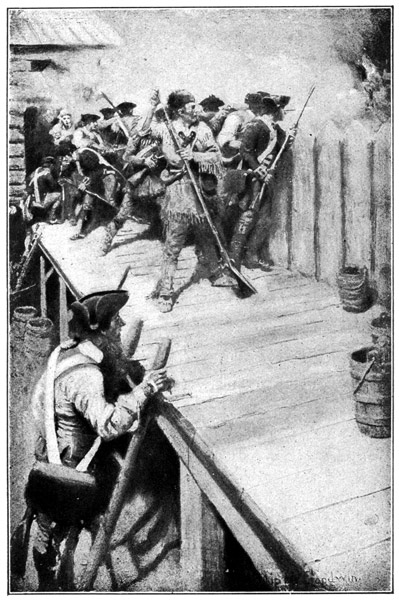
"'THEY'VE HIT HIM,' SAID MOUNT, RELOADING HASTILY"
Presently I became conscious that things were changing
around me. Lights moved, voices struggled into my ears;
forms took shape, pressing closer to me. An undertone, which
I had heard at moments through my stupor, grew, swelling
into a steady whisper. It was the ceaseless rustle of the rain.
A torch blazed up crackling close in front. My eyes opened;
a thrill of purest fear set every sense a-quiver. Amid the
dull roar of voices, I heard women laughing and little children
prattling. Faces became painfully distinct. I saw
Sowanowane, the war-chief, thumb his hatchet; I saw Butler,
beside him, catch an old woman by the arm. He told
her to bring dry moss. It rained, rained, rained.
They were calling to me from the crowd now; everywhere
voices were calling to me: "Show us how Cresap's men die!"
Others repeated: "He is a woman; he will scream out!
Logan's children died more bravely. Oonah! The children
of Logan!"
Butler watched me coolly, leaning on his rifle.
"So this ends it," he said, with his deathly grimace.
"Well, it was to be done in one way or another. I had meant
to do it myself, but this will do."
I was too sick with fear, too close to death, to curse him.
Pain often makes me weak; the fear of pain sickens me. It
was that I dreaded, not death. Where my father had gone,
I dared follow, but the flames—the thought of the fire—
I said, faintly, "Turn your back to me when I die; I have
much pain to face, Mr. Butler; I may not bear it well."
"No, by God! I will not!" he burst out, ferociously.
"I'm here to see you suffer, damn you!"
I turned my head from him, but he struck me in the face
so that my mouth was bathed in blood; twice he struck me,
crying: "Listen! Listen, I tell you!" And, planting himself
before the stake, he cursed me, vowing that he could tear
me with his bared teeth for hatred.
"Know this before they roast you," he snarled; "I shall
possess your pretty baggage, Mistress Warren, spite of Sir
William! I shall use her to my pleasure; I shall whip her
to my feet. I may wed her, or I may choose to use her otherwise
and leave her for Dunmore. Ah! Ah! Now you rage,
eh?"
I had hurled my trussed body forward on the cords, struggling,
convulsed with a fury so frantic that the blood sprayed
me where the bonds cut.
Indians struck me and thrust me back with clubs, for the
great post at my back had been partly dragged out of its
socket by my frenzy, but I did not feel the blows; I fixed
my maddened eyes on Butler and struggled.
But now the sachems were calling him sharply, and he
backed away from me as the circle surged forward. Again
the girl came out, bearing a flaming fagot. She looked up at
me, laughed, and thrust the burning sticks into the moss and
tinder which was stacked around me. A billow of black
smoke rolled into my face, choking and blinding me, and the
breath of the flames passed over me.
Twice the rain quenched the fire. They brought fresh
heaps of moss, laughing and jeering. Through the smoke I
saw the fort across the valley, its parapets crowded with people.
Jets of flame and distant reports showed they were firing
rifles, hoping perhaps to kill me ere the torture began. It
was too far. The last glimpse of the fort faded through the
downpour; a new pile of moss and birch-bark was heaped at
my feet.
This time the girl was thrust aside and a young Indian
advanced, waving a crackling branch of pitch-pine, roaring
with flames. As he knelt to push it between my feet, a terrific
shout burst from the throng—a yell of terror and amazement.
Through the tumult I heard women screaming; in
front of me the crowd shrank away, huddling in groups.
Some backed into me, stumbling among the fagots; the young
Indian let his blazing pine-branch fall hissing on the wet
ground and stood trembling.
And now into the circle stalked a tall figure, coming
straight towards me through the sheeted rain—a spectre so
hideous that the cries of terror drowned his voice, for he
was speaking as he came on, moving what had once been
a mouth, this dreadful thing, all raw and festering to the
bone.
Two blazing eyes met mine, then rolled around on the
cringing throng; and a voice like the voice of the dead broke
out:
"I am come to the judgment of this man whom you burn!"
"Quider!" moaned the throng. "He returns from the
grave! Oonah! He returns!"
But the unearthly voice went on through the whimper of
the crowd:
"From the dead I return. I return from the north. Madness
drove me. I come without belts, though belts were
given.
"Peace, you wise men and sachems! Set free this man,
my brother!"
"Quider!" I gasped. "Bear witness."
And the dead voice echoed, hollow:
"Brother, I witness."
Trembling fingers picked and plucked and tugged at my
cords; the bonds loosened; the sky spun round; down I fell,
face splashing in the mud.
How I managed to reach the fort, I never knew. I do not
remember that the savages carried me; I have no recollection
of walking. When the gate lanthorn was set that
night, a sentry noticed me creeping in the weeds at the moat's
edge. He shot at me and gave the alarm. Fortunately, he
missed me.
All that evening I lay in a hot sickness on a cot in the
casemates. They say I babbled and whimpered till the doctor
had finished cupping me, but after that I rambled little, and,
towards sunrise, was sleeping.
My own memories begin with an explosion, which shook
my cot and brought me stumbling blindly out of bed, to find
Jack Mount firing through a loophole and watching me,
while he reloaded, with curious satisfaction.
He guided me back to my cot, and summoned the regiment's
surgeon; between them they bathed me and fed me
and got my shirt and leggings on me.
At first I could scarcely make out to stand on my legs.
From crown to sole I ached and throbbed; my vision was
strangely blurred, so that I saw things falling in all directions.
I think the regiment's surgeon, who appeared to be very
young, was laying his plans to bleed me again, but I threatened
him if he laid a finger on me, and Mount protested that
I was fit to fight or feast with any man in Tryon County.
The surgeon, saying I should lie abed, mixed me a most
filthy draught, which I swallowed. Had I been able, I should
have chased him into the forest for that dose. As it was, I
made towards him on wavering legs, to do him a harm, whereupon
he went out hastily, calling me an ass. Mount linked
his great arm in mine, and helped me up to the parapet,
where the Virginia militia were firing by platoons into the
forest.
The freshening morning was lovely and sweet; the west
winds poured into me like wine. I lay on the platform for
a while, peering up at the flag flapping above me on its pine
staff, then raised up on my knees and looked about.
Bands of shadow and sunlight lay across the quiet forests;
the calm hills sparkled. But the blackened clearing around
the fort was alive with crawling forms, moving towards
the woods, darting from cover to cover, yet always advancing.
They were Cresap's Maryland riflemen, reconnoitring
the pines along the river, into which the soldiers beside me
on the parapet were showering bullets.
It was pretty to watch these Virginia militia fire by
platoon under instructions of a tall, young captain, who
lectured them as jealously as though they were training on
the parade below.
"Too slow!" he said. "Try it again, lads, smartly! smartly!
'Tention! Handle—cartridge! Too slow, again! As
you were—ho! When I say 'cartridge!' bring your right
hand short 'round to your pouch, slapping it hard; seize the
cartridge and bring it with a quick motion to your mouth;
bite off the top down to the powder, covering it instantly
with your thumb. Now! 'Tention! Handle—cartridge!
Prime! Shut—pan! Charge with cartridge—ho! Draw—rammer!
Ram—cartridge! Return—rammer! Shoulder—arms!
Front rank—make ready! Take aim—fire!"
Bang! bang! went the rifles; the parapet swam in smoke.
Bang! The second rank fired as one man, and the crash was
echoed by the calm, clear voice: "Half-cock arms—ho!
Handle—cartridge! Prime!"
And so it went on; volley after volley swept the still pines
until a thundering report from the brass cannon ended the
fusillade, and we leaned out on the epaulement, watching the
riflemen who were now close to the lead-sprayed woods.
The banked cannon-smoke came driving back into our
faces; all was a choking blank for a moment. Presently,
through the whirling rifts, we caught glimpses of blue sky
and tree-tops, and finally of the earth. But what was that?—what
men were those running towards us?—what meant that
distant crackle of rifles?—those silvery puffs of smoke fringing
the entire amphitheatre of green, north, east, west—ay,
and south, too, behind our very backs?
"Down with your drawbridge!" thundered the officer commanding
the gun-squad. I saw Cresap come running along
the parapet, signalling violently to the soldiers below at the
sallyport. Clank! clank! went the chain-pulleys, and the
bridge fell with a rush and a hollow report, raising a cloud
of amber dust.
"My God!" shouted an officer. "See the savages!"
"See the riflemen," mimicked Mount, at my elbow. "I
told Cresap to wait till dark."
Along the parapets the soldiers were firing frenziedly; the
quick cannon-shots shook the fort, smothering us with smutty
smoke. I had a glimpse, below me, of Cresap leading out a
company of soldiers to cover the flight of his riflemen, and at
intervals I saw single Indians, kneeling to fire, then springing
forward, yelping and capering.
A tumult arose below. Back came the riflemen pell-mell,
into the fort, followed by the militia company at quick time.
The chains and pulleys clanked; the bridge rose, groaning
on its hinges.
It was now almost impossible to perceive a single savage,
not only because of the rifle-smoke, but also because they
had taken cover like quail in a ploughed field. Every charred
tree-root sheltered an Indian; the young oats were alive with
them; they lay among the wheat, the bean-poles; they
crouched behind manure-piles; they crawled in the beds of
ditches.
"Are all the settlers in the fort?" I asked Mount, who was
leaning over the epaulement, waiting patiently for a mark.
"Every man, woman, and child came in last night," he
said. "If any have gone out it's against orders, and their
own faults. Ho! Look yonder, lad! Oh, the devils! the
devils!" And he fired, with an oath on his lips.
A house and barn were suddenly buried in a cloud of pitchy
vapour; a yoke of oxen ran heavily across a field; puffs of
smoke from every rut and gully and bush showed where the
Indians were firing at the terrified beasts.
One ox went down, legs shot to pieces; the other stood
bellowing pitifully. Then the tragedy darkened; a white
man crept out of the burning barn and started running towards
the fort.
"The fool!" said Mount. "He went back for his oxen!
Oh, the fool!"
I could see him distinctly now; he was a short, fat man,
bare-legged and bare-headed. As he ran he looked back over
his shoulder frequently. Once, when he was climbing a fence,
he fell, but got on his legs again and ran on, limping.
"They've hit him," said Mount, reloading hastily; "look!
He's down! He's done for! God! They've got him!"
I turned my head aside; when I looked for the poor fellow
again, I could only see a white patch lying in the field, and
an Indian slinking away from it, shaking something at the
fort, while the soldiers shot at him and cursed bitterly at
every shot.
"It's Nathan Giles's brother," said a soldier, driving his
cartridge down viciously. "Can't some o' you riflemen reach
him with old Brown Bess?"
The report of Mount's rifle answered; the Indian staggered,
turned to run, reeled off sideways, and fell across a
manure-heap. After a moment he rose again and crawled
behind it.
And now, house after house burst into black smoke and
spouts of flame. Through the spreading haze we caught fleeting
glimpses of dark figures running, and our firelocks banged
out briskly, but could neither hinder nor stay the doom of
those poor, rough homes. Fire leaped like lightning along
the pine walls, twisting in an instant into a column of
pitchy smoke tufted with tongues of flame. Over the whirling
cinders distracted pigeons circled; fowls fluttered out of
burning barns and ran headlong into the woods. Somewhere
a frightened cow bellowed.
Under cover of the haze and smoke, unseen, the Indians
had advanced near enough to send arrows into the parade
below us, where the women and children and the cattle were
packed together. One arrow struck a little girl in the head,
killing her instantly; another buried itself in the neck of a
bull, and a terrible panic followed, women and children fleeing
to the casemates, while the maddened bull dashed about,
knocking down horses, goring sheep and oxen, trampling
through bundles of household goods until a rifleman shot him
through the eye and cut his throat.
Soldiers and farmers were now hastening to the parapets,
carrying buckets and jars of water, for Cresap feared the
sparks from the burning village might fall even here. But
there was worse danger than that: an arrow, tipped with
blazing birch-bark, fell on the parapet between me and
Mount, and, ere I could pick it up, another whizzed into the
epaulement, setting fire to the logs. Faster and faster fell
the flaming arrows; a farmer and three soldiers were wounded;
a little boy was pierced in his mother's arms. No sooner
did we soak out the fire in one spot than down rushed another
arrow whistling with flames, and we all ran to extinguish
the sparks which the breeze instantly blew into a glow.
I had forgotten my bruises, my weakness, and fatigue;
aches and pains I no longer felt. The excitement cured me
as no blood-letting popinjay of a surgeon could, and I found
myself nimbly speeding after the fiery arrows and knocking
out the sparks with an empty bucket.
Save for the occasional rifle-shots and the timorous whinny
of horses, the fort was strangely quiet. If the women and
children were weeping in the casemates, we on the ramparts
could not hear them. And I do not think they uttered a
complaint. We hurried silently about our work; no officers
shouted; there was small need to urge us, and each man
knew what to do when an arrow fell.
All at once the fiery shower ceased. A soldier climbed the
flag-pole to look out over the smoke, and presently he called
down to us that the savages were falling back to the forest.
Then our cannon began to flash and thunder, and the militia
fell in for volley-firing again, while, below, the drawbridge
dropped once more, and our riflemen stole out into the haze.
I was sitting on the parapet, looking at Boyd's inn, "The
Leather Bottle," which was on fire, when Mount and Cade
Renard came up to me, carrying a sheaf of charred arrows
which they had gathered on the parade.
"I just want you to look at these," began Mount, dumping
the arrows into my lap. "The Weasel, he says you know
more about Indians than we do, and I don't deny it, seeing
you lived at Johnstown and seem so fond of the cursed hell-hounds—"
"He wants you to read these arrows," interrupted the
Weasel, dryly; "no, not the totem signs. What tribes are
they?"
"Cayuga," I replied, wondering. "Cayuga, of course—wait!—why,
this is a Seneca war-arrow!—you can see by the
shaft and nock and the quills set inside the fibres!"
"I told you!" observed the Weasel, grimly nudging Mount.
Mount stood silent and serious, watching me picking up
arrow after arrow from the charred sheaf on my knees.
"Here is a Shawanese hunting-shaft," I said, startled,
"and—and this—this is a strange arrow to me!"
I held up a slender, delicate arrow, beautifully made and
tipped with steel.
"That," said Mount, gravely, "is a Delaware arrow."
"The Lenape!" I cried, astonished. Suddenly the terrible
significance of these blackened arrows came to me like a blow.
The Lenni-Lenape had risen, the Senecas and Shawanese had
joined the Cayugas. The Long House was in revolt.
"Mount," I said, quietly, "does Colonel Cresap know
this?"
The Weasel nodded.
"We abandon the fort to-night," he said. "We can't face
the Six Nations—here."
"We make for Pittsburg," added Mount. "It will be a
job to get the women and children through. Cresap wishes
to see you, Mr. Cardigan. You will find him laying fuses to
the magazine."
They piloted me to the casemates and around the barracks
to the angle of the fort, where a stockade barred the passage
to the magazine. The sentry refused us admittance, but
Corporal Cloud heard us and opened the stockade gate, where
we saw Cresap on his hands and knees, heaping up loose
powder into a long train. He glanced up at us quietly; his
thin, grave face was very pale.
"Am I right about those arrows?" he asked Mount.
"Mr. Cardigan says there's a Seneca war-arrow among 'em,
too," replied Mount.
Cresap's keen eyes questioned me.
"It's true," I said. "The Senecas guard the western door
of the Long House, and they have made the Cayugas' cause
their own."
"And the eastern door?" demanded Cresap, quickly.
"The eastern door of the Long House is held by our Mohawks
and Sir William Johnson," I said, proudly. "And, by
God's grace! they will hold it in peace."
"Not while Walter Butler lives," said Cresap, bitterly,
rising to his feet and turning the key of the magazine.
"Throw that key into the moat, corporal," he said. "Mount,
get some riflemen and roll these kegs of powder into the
casemates."
"You know," he observed, turning to me, "that we abandon
the fort to-night. It means the end of all for me. I
shall receive all the blame for this war; the disgrace will be
laid on me. But let Dunmore beware if he thinks to deprive
me of command over my riflemen! I've made them what
they are—not for my Lord Dunmore, but for my country,
when the call to arms peals out of every steeple from Maine
to Virginia."
Cloud lifted his hat. "Please God, those same bells will
ring before I die," he said, serenely.
"They'll ring when the British fleet sights Boston," observed
the Weasel.
"They'll ring loud enough for Harrod and Dan Boone to
hear 'em on the Kentucky," added Mount.
I said nothing, but looked down at the powder trail, which
led into the magazine through a hole under the heavy double
door. Cresap pushed the heap of powder with his foot.
"Ah, well," he said, "it's liberty or death for all save
human cattle—liberty or death, sure enough, as the Virginian
puts it."
"Patrick Henry is in Pittsburg," began Mount; but
Cresap went on without heeding him: "Patrick Henry has
given my riflemen their watchword; and the day that sees
them marching north will find that watchword lettered on the
breast of every hunting-shirt—Liberty or Death."
Turning his clear eyes on me, he said, "You will be with
us, will you not, sir?"
"My father fought at Quebec," I answered, slowly.
"And my father yonder at Fort Pitt, when it was Fort
Duquesne, not under Braddock, but in '58, when the British
razed the French works and built Fortress Pitt on the ruins.
What of it? Your father and my father fought for England.
They were Englishmen. Let us, who are Americans, imitate
our fathers by fighting for America. We could do their
memory no truer honour."
"I have not made up my mind to fight our King," I answered,
slowly. "But I have determined to fight his deputy,
Lord Dunmore."
"And all his agents?" added Mount, promptly.
"You mean Dunmore's?" I asked.
"The King's," said Cloud.
"Yes, the King's, too, if they interfere with my people!"
I blurted out.
"Oh, I think you will march with us when the time comes,"
said Cresap, with one of his rare smiles; and he led the way
out of the stockade, cautioning us to step clear of the powder.
"Cut a time-fuse for the train and bring it to me at the
barracks," he said to Cloud; and, saluting us thoughtfully,
he entered the casemates, where the women and children were
gathered in tearful silence.
I heard him tell the poor creatures that their homes had
gone up in smoke; that, for the moment, it was necessary to
retire to Fort Pitt, and that each family might take only
such household implements and extra clothing as they could
carry in their arms.
There was not a whimper from the women, only quiet tears.
Even the children, looking up solemnly at Cresap, bravely
stifled the sobs of fear that crowded into every little throat.
The day wore away in preparation for the march. I had
nothing to prepare; I had lost my rifle and ammunition when
a prisoner among the Cayugas, and my spare clothing and
provisions when Boyd's Inn was burned. Fortunately, Boyd
had buckled on my money-belt for safe keeping, and the
honest old man delivered it to me, condoling with me for the
loss of my clothing and food; and never a word of complaint
for his own loss of home and bed and everything he owned
in the world, nor would he accept a shilling from me to aid
him towards a new beginning in life.
"I am only seventy-three," he said, coolly; "when these
arms of mine cannot build me a home, let them fashion my
coffin!"
And he picked up his long rifle and walked away to help
load the ox-teams with powder, ball, and provisions.
One thing that Mount told me aroused my anger and contempt:
there was now not a Tory left among Cresap's people;
all had fled when Greathouse fled, proving clearly that, if all
had not aided in the slaughter of Logan's children, they at
least had been informed of the plot and had probably been
warned that the murderous deed would be laid at Tory doors.
Towards dusk our scouts began to come in, one by one, with
sad stories concerning the outlying settlements and lonely
farms. One had seen a charred doorway choked with dead
children, all scalped; another, lying hid, saw a small war-party
pass with eighteen fresh scalps, three of them taken
from women and little girls; a third vowed that the Oneidas
had joined in, and he exhibited a moccasin that he had found,
as proof. But when I saw the moccasin, I knew it to be Mohawk,
and it troubled me greatly, yet I did not inform Cresap,
because I could not believe our Mohawks had risen.
At nine o'clock the postern was opened quietly, and the
first detachment of riflemen left the fort, stealing out into
the starlight, weapons at a trail. When the scouts returned
to say that the coast was clear, the column started in perfect
silence. First marched a company of Maryland riflemen;
after them filed the ox-teams, loaded with old women and
very small children, the wagons rolling on muffled wheels;
then followed a company of Virginia militia, and after them
came more ox-teams piled with ammunition and stores, and
accompanied by young women and grown children. The rear
was covered by the bulk of the militia and riflemen, with our
brass cannon dragged by the only horse in the ill-fated town.
When the rear-guard had disappeared in the darkness,
Cresap, Mount, Cade Renard, and I bolted the gates, drew
up the drawbridge, locked it, and dropped the keys into the
moat. Then Cresap and Mount ran across the parade towards
the magazine, while we tied a knotted rope to the southern
parapet and shook it free so that it hung to the edge of
the counter-scarp below.
Presently Mount came hurrying back across the parade
and up the scarp to where we stood, bidding us hasten, for
the fuse was afire and might burn more quickly than we expected.
Down the rope, hand over hand, tumbled the Weasel, and
then Mount motioned me to go. But just as I started, up
above my head in the darkness I heard the flag flapping; I
paused, then stepped towards the pole.
"The flag," I said. "You have forgotten it—"
"It's only the damned British flag!" said Mount. "Down
the rope with you, lad! Do you want to keep us till the fort
blows up?"
"I can't leave the flag," I said, doggedly.
"To hell with it!" retorted Mount, fiercely, and pushed me
towards the rope.
"Let me alone!" I flashed out, backing towards the flag-pole.
"Oh, go to the devil your own way," growled Mount,
but I saw he did not leave the rampart while I was lowering
the flag and ripping it from the halyards.
Cresap came rushing up the scarp as I stuffed the flag into
the breast of my hunting-shirt.
"Are you mad?" he cried. "Down the rope there, Cardigan!
Follow him for your life, Jack Mount!"
And down I scrambled, followed by Mount and Cresap,
and we all ran as though the Six Nations were at our heels.
In the dark we passed a rifleman who scampered on ahead
to pilot us, and after ten minutes at top speed we joined the
rear-guard and fell in with the major, panting.
"A slick trick you played," grunted Mount, "with that
bloody British flag."
"It was mine, once," I retorted, hotly.
"Oh, you would blow us all up for it, eh?" asked the big
fellow, pettishly. "Well, you be damned, and your flag, too!"
His voice was blotted out in a roar which shook the solid
forest; a crimson flame shot up to the stars; then thunderous
darkness buried us.
Half-smothered cries and shrieks came from the long convoy
ahead, but these were quickly silenced, the frightened
oxen subdued, and the column hastened on into the night.
"Now that the fort's exploded, look out for the Iroquois,"
said Mount, steadying his voice with an effort.
Cresap had given me a rifle. I halted to load it, then ran
on to join Mount and Renard. We plodded on in silence for
a while. Presently Mount asked me what I meant to do in
Pittsburg.
"I mean to see Lord Dunmore," I replied, quietly.
Mount pretended to fear for his Lordship's scalp, but I was
in no humour for jesting, and I said no more.
"What are you going to do to old Dunmore?" urged the
big fellow, curiously.
"See here, my good man," said I, "you are impertinent.
I am an accredited deputy of Sir William Johnson, and my
business is his."
"You need not be so surly," grumbled Mount.
"You've hurt his feelings," observed the Weasel, trotting
at my heels.
"Whose? Mount's?" I asked. "Well, I am sorry. I did
not mean to hurt you, Mount."
"That's all very well, but you did," said Mount. "I've
got feelings, too, just as much as the Weasel has."
"No, you haven't," said the Weasel, hastily. "I'm a ruined
man, and you know it. Haven't I been through enough to
give me sensitive feelings?"
Mount nudged me. "He's thinking of his wife and baby,"
he said. "Talk to him about them. He likes it. It harrows
him, doesn't it, Cade?"
"It hurts fearful," replied the Weasel, looking up at me
hopefully.
"You had a lovely wife, didn't you, Cade?" inquired
Mount, sympathetically.
"Yes—oh yes. And a baby girl, Jack—don't forget the
baby girl," sniffed the Weasel, trotting beside me.
"The baby must be nigh fifteen years old now, eh, Cade?"
suggested Mount.
"Sixteen, nigh sixteen, Jack. The cunning little thing."
"What became of her?" I asked, gently.
"Nobody knows, nobody knows," murmured the Weasel.
"My wife left me and took my baby girl. Some say she
went with one of Sir Peter Warren's captains, some say it
was an admiral who charmed her. I don't know. She was
gone and the fleet was gone when they told me."
He laid his hard little hand on my arm and looked up
with bright eyes.
"Since that," he said, "I've been a little queer in my head.
You may have noticed it. Oh yes, I've been a little mad,
haven't I, Jack?"
"A little," said Mount, tenderly.
"I have not noticed it," said I.
"Oh, but I have," he insisted. "I talk with my baby in
the woods; don't I, Jack? And I see her, too," he added,
triumphantly. "That proves me a little mad; doesn't it,
Jack?"
"The Weasel was once a gentleman," said Mount, in my
ear. "He had a fine mansion near Boston."
"I hear you!" piped the Weasel. "I hear you, Jack. You
are quite right, too. I was a gentleman. I have ridden to
hounds, Mr. Cardigan, many a covert I've drawn, many a
brush fell to me. I was master of fox-hounds, Mr. Cardigan.
None rode harder than I. I kept a good cellar, too, and an
open house—ah, yes, an open house, sir. And that was where
ruin came in, finding the door open—and the fleet in the
downs."
"And you came home and your dear wife had run away
with an officer from Sir Peter Warren's ships—eh, Cade, old
friend?" said Mount, affectionately.
"And took our baby—don't forget the baby, Jack," piped
the Weasel.
"And if you could only find the man you'd slit his gullet,
wouldn't you, Cade?" inquired Mount, dropping one great
arm over the Weasel's shoulder.
"Oh, dear, yes," replied the Weasel, amiably.
I had been looking ahead along the line of wagons, where
a lanthorn was glimmering. The convoy had halted, and
presently Mount, Cade Renard, and I walked on along the
ranks of resting troops and loaded wains until we came to
where the light shone on a group of militia officers and riflemen.
Cresap was there, wrapped in his heavy cloak; and
when he perceived me he called me.
As I approached, followed naïvely by Mount and Renard,
I was surprised to see a tall Indian standing beside Cresap,
muffled to the chin in a dark blanket.
"Cardigan," said Cresap, "my scouts found this Indian
walking ahead in the trail all alone. He made no resistance,
and they brought him in. He seems to be foolish or simple-minded.
I can't make him out. You see he is unarmed.
What is he?"
I glanced at the tall, silent Indian; a glance was enough.
"This man is a Cayuga and a chief," I said, in a low
voice.
"Speak to him," said Cresap; "he appears not to understand
me. I speak only Tuscarora, and that badly."
I looked at the silent Cayuga and made the sign of brotherhood.
His dull eyes regarded me steadily.
"Brother," I said, "by the cinders on your brow you
mourn for the dead."
"I mourn," he replied, simply.
"A son?"
"A family. I am Logan."
Shocked, I gazed in pity on the stern, noble visage. So
this was Logan, the wretched man bereft of all his loved ones
by Greathouse!
I turned quietly to Cresap.
"This is the great Cayuga chief, Logan, whose children
were murdered," I said.
Cresap turned a troubled face on the mute savage.
"Ask him where he journeys."
"Where do you journey, brother?" I asked, gently.
"I go to Fort Pitt," he answered, without emotion.
"To ask justice?"
"To ask it."
"God grant you justice," I said, gravely.
To Cresap I said, "He seeks justice at Fort Pitt from
Lord Dunmore."
"Bid him come with us," replied Cresap, soberly. "He
may not get justice at Fort Pitt, but there is a higher Judge
than the Earl of Dunmore. To Him I also look for the
justice that men shall deny me on earth."
I took Logan by the hand and led him into a space behind
the wagons. Here we waited in silence until the slow convoy
moved, and then we followed as mourners follow a casket to
the grave of all their hopes.
Hour after hour we journeyed unmolested; the stars faded,
but it was not yet dawn when a far voice cried in the darkness
and a light moved, and we knew that the warders of the
fortress were hailing our vanguard at the gates of Pittsburg.
I awoke in a flood of brightest sunshine which poured
over the walls of my chamber and bathed the sweet lavender-scented
sheets on my bed.
The water in the washing-bowl reflected the sunlight, and
the white ceiling above me wavered with golden-netted ripples.
A gentle wind moved the curtains to and fro, a brisk
breeze, yet saturated with the disquieting taint of unknown
odours, odours of a town whose streets are thronged with
strange people. Those bred within the strip which runs
along the borders of a wilderness find the air of towns confusing,
as a keen hound, running perdu, enters a vast runway
where a thousand pungent trails recross.
Reconnoitring the room from my sunny couch, I poked
my sun-warmed muzzle out of the sheets, sniffing and inspecting
the unfamiliar surroundings. Then I cautiously
stretched my limbs, and finding myself supple and sound,
leaped lightly onto the rag-carpet in my bare feet and stood
looking out of the window.
This lodging whither Mount and Renard had piloted me
when our convoy passed the ramparts of Fortress Pitt, was an
inn called the "Virginia Arms," a most clean and respectable
hostelry, though sometimes suspected as a trysting-place for
rebels. James Rolfe, a Boston man, was our host, a thin-edged,
mottled, shrewd-eyed fellow, whose nasal voice sounded
continually through the house from tap-room to garret, in
sarcastic comment on his servants. I heard him now as I
stood at the window:
"Oh, Hiram, yew dinged sack o' shucks, the gentleman in
27 is knocking on the floor! Jonas! A pot o' small-beer for
the gentleman in 17! Land o' Goshen, yew run like a frost-nipped
spider! The gentleman in 6 is waiting for his wig!
What's that? Waal, yew go right 'round tew the hairdresser's
and tell him tew bring that wig! Hey? Yes, the wig dressed
a-lar-Francy! Don't set there rubbing yewr chin like a
dumned chipimunk, Simon, while Mister Patrick Henry is
waiting for them queue ribbons from Corwin's. Eh? You
fetched 'em? Well, why in the name o' Virginy can't you
say so? Clean them buckles for the gentleman in 20, yew
darned clam!"
His penetrating, half-fretful, half-humorous voice died
away towards the stables in the rear, and I parted the dainty
curtains and peeped out into the streets of Pittsburg. Our
inn stood on the corner of the town square, opposite the village
green. Across the square rose some well-made barracks,
painted white; I could see red-coated sentinels posted at the
gates and walking their beats along the west stockade. A
few handsome mansions faced the square, two churches and
a public house completed the north side of the quadrangle.
East and west shops and smaller houses lined the streets; the
green bush hung in the sunshine, the barber's basin swung
and glittered among a forest of gayly painted sign-boards.
But the people! Lord, how they trooped by, passing, repassing,
threading the alleys, streaming across the green,
soldiers in scarlet and buff, militia in brown and green, sober
townsmen dressed as we dress in Johnstown, old gentlemen
in snuffy smalls and big coats with broad cuffs and silver buttons,
the butcher, bared of arm and head, with the wind fluttering
his apron, the baker, white and sallow as his own muffins,
ostlers, shop-keepers, chapmen, men in fustian shouldering
pick or shovels, drovers in blue smocks carrying looped
snake-whips. Now comes one in musty wig and steel spectacles,
bulging umbrella under one arm, inquisitive nose
buried in a Maryland newspaper—a schoolmaster!—or do I
not know the breed. Anon, I see some tall, awkward riflemen,
loitering idly before signs or gawking up at the county court-house,
where a gilt fish swims in the sky.
Sometimes a horseman, in the uniform of Lord Dunmore's
guards, trots by gracefully, with a smile and low salute for
his friends and a stare at the fresh-cheeked maids who steal
demurely along, basket on arm, to rifle the market for an
early squash or a bunch o' green pease.
Many citizens I notice are reading the newspapers as they
walk; many men meet and stop and converse eagerly, looking
behind them at times as though an eavesdropper might be
near. With bell and clapper the vender of ginger and cocoa-nut
pushes his cart before him; peddlers, bending under Delaware
baskets or leather trays, stand in the street, calling their
wares: "Colours for the races!" "Tablets!" "Pencils!"
"Chains!" "Cock-gaffs—steel or brass!" "Gentlemen's
fancy!" "Dog-bells!" "Ferret-bits!"
A barefoot child in rags offers bills for the bull-baiting
and for the Theatre Royal, crying in a thin, monotonous
voice: "Race-week bills, my lords and gentlemen! Race-week
bills for the Theatre Royal, my lady! Plays to be
played—'The Beau's Stratagem,' 'Beggar's Opera,' 'The
Devil to Pay,' 'The Fair Penitent,' 'The Virgin Unmasked!'
and a variety of farces and merry pantomimes—and the
bills are only a penny, my lady! The tickets to be had at
Jamison's Coffee-House at four shillings—the bill to be had
of me, Rosalie, child of Tanner Bridewell—only a penny!"
The pitiful voice in the sunshine touched me; I opened the
window and tossed a shilling to the child, then hid behind
the curtains while she kissed her palm at my window.
The winding of a brass horn brought me out of my concealment
to peep again down into the street, where people
were flocking around a public crier, who stood on a horse-block
blowing his horn.
"Attention! Attention!" he cried, unfolding a paper, and
presently commenced to read his news to the crowd:
"By permission of the Right Honourable Earl of Dunmore,
Governor of Virginia! Four days' sport on Roanoke Plain.
The Colonial Club offering prizes of £100 and £50; the Richmond
Club offering two purses of £50. Attention! Sport on
the Roanoke; an even and delightsome plain, most sweet and
pleasant. To-day the Nobleman's and Gentleman's Purse of
£50, free for any horse except Doctor Connolly's Scimitar,
who won the plate last season. Second, a silver cup worth
£12. Tuesday, County Subscription Purse of £50. No person
will erect a booth or sell liquor without subscribing £2
to expenses of races.
"Gentlemen fond of fox-hunting will meet at the Buckeye
Tavern by daybreak during the races.
"God save the King!"
He folded his paper, picked up his horn, and stepped down
from the horse-block. After a little while I heard his horn
again, sounding at the north angle of the square, and his
strident voice, announcing the races, came fitfully on the
wind.
I turned back into the room and began my toilet. How
strange to find this town, undisturbed in its rural pleasures,
busy about its own affairs, while scarce a night's journey to
the north the frontier was in ashes, and the dead lay in the
charred embers of their own door-sills!
How strange to look out on the peace of these sunny streets,
with the cinders of Cresap's camp still clinging to my hunting-shirt;
with my own blood caking the sore on my arm
where a Cayuga child had thrust a lighted pine-splinter into
my flesh! Strange!—ay, astonishing that these people here
behind their fortress, their block-housen, their earthworks
and stockades, should forget those who dwelt beyond the
gates, wresting the dark soil, inch by inch, from the giant
pines of the wilderness.
With a knife which Cresap had given me, I sat down to
scrape the mud and filth from my hunting-shirt and to pick
out the burrs and docks which clotted the fringe on my leggings.
Sombre thoughts filled me; I had a hard rôle to play before
Lord Dunmore; I had a harder rôle to act before Silver
Heels, if she were still here in Pittsburg.
It gave me no pleasure to find myself so near her. The
attitude she had assumed towards me that last night in
Johnstown had hurt enough to leave a scar. But when scars
appear, wounds are healed; and so was mine. It was true, I
had never loved her as men love sweethearts. Her sudden
and amazing appearance as a woman had aroused my curiosity;
her popularity and beauty my jealousy. It was hurt
pride that tempered me when the playfellow I had tolerated
and protected and tormented at my pleasure, tormented, tolerated,
and finally ignored me.
I did not love her when I aroused her contempt with my
courtship of Mrs. Hamilton. I did not love her when I followed
her to the pantry to bully her into according me her
respect once more. It was vanity: vanity when I sulked
because young Bevan took her from me; vanity when I assailed
the pretty ears of Mrs. Hamilton with callow cynicisms
and foolish wit. I scorned myself for having deceived
my own heart with the fancy that I had ever loved my cousin
Silver Heels.
Now that the demon Butler had been exorcised by Sir William,
and now that Sir William wished for my union with
Silver Heels, and had promised me the means to maintain
her as her rank required, I understood plainly that I did not
love her in that way. She was only my playfellow; she had
never been anything else. I meant to see her and tell her
so; I meant to ask her forgiveness for offending her; I meant
to seek her friendly confidence once more, to warn her that
she should not tarry here in these troublous times, but return
at once to Johnson Hall, where Sir William could protect
her, not only from the savages, but also from that creature
whose every breath of life was an offence to his Creator.
Doubtless, Silver Heels would go with me. Dunmore would
be obliged to provide our escort; indeed, his Lordship would
be glad enough to see me leave his town of Pittsburg ere I
had finished with my business here.
I stood smoothing the thrums on sleeve and legging, somewhat
ashamed to seek audience with anybody in such attire.
I had money in my belt, enough to purchase clothing suitable
to my station, but it was time that I lacked, not means or
inclination.
I had laid my hand on the knob, intent on seeking breakfast
below, and was about to open the door, when somebody
knocked. It was Saul Shemuel, smiling and folding his
hands over his belly—a greasy spectacle in sooth for a hungry
stomach—and I scowled and bade him state his business
quickly in the devil's name.
"Goot-day and greeding, sir," said the peddler, bowing and
rubbing himself against the door like a cat. "Gott save our
country, Mr. Cardigan. You are oxpected to join the gendlemens
in 13, sir. Mr. Mount begs you will hold no gonversation
mit strangers hereabouts, nor entertain no one until
he sees you, sir."
"Who are you, anyway, Shemuel?" I asked, curiously.
"A peddler, Mr. Cardigan—only a poor peddler," he protested,
spreading out his grimy fingers and peeping up cunningly.
"Pray, do not look as if you knew me, sir, should
you see me abroad in the streeds, sir. But if you wish to
speag to me, please to buy a buckle; one buckle if I shall seek
you here, two buckles if I am to follow you in the streed, sir,
three buckles if you would seek me in my lodgings, Mr. Cardigan.
I live at the 'Bear and Cubs Tavern,' sir, on the
King's Road."
"Very well," I said, somewhat amused at the idea of my
pining for Shemuel's company under any circumstances.
"Where is room 13, Shemuel? Eh? Oh, you appear to know
this inn. Here's sixpence for you, Shemmy. That's right,
cut away now!"
"If I might speak von vort, sir," he began, hoisting his
basket on his back and looking slyly up at me as I passed
him.
"Well?" I said, impatiently.
"I haf often seen you, sir, at Johnson Hall."
"Well?"
"And I haf also sold gilt chains to Miss Warren."
"Well!" I demanded, sharply.
"Miss Warren iss here in Pittsburg, sir," he ventured.
"I supposed so," I said, coldly; "but that does not interest
me."
"Maybe," he said, spitefully, "you don'd know somedings?"
"What things?"
"Miss Warren weds mit Lord Dunmore in July."
He was gone like a slippery lizard before I could seize
him. He vanished around the corridor ere my thoughts assembled
from the shock that had routed them. Now they
began to rally pell-mell, and my cheeks burnt with scorn and
anger, though I could not truly credit the preposterous news.
That unformed child thrown into the arms of a thing like
Dunmore! What possessed all these rakes and roués to go
mad—stark, staring, March-mad—over my playfellow? What
did an Earl want of her—even this bloodless Dunmore with
his simper and his snuff and his laces and his bird's claws
for fingers? What the devil had enchanted him to seek her
for his wife; to make her Countess of Dunmore and the
first lady in Virginia?
And Silver Heels, had she sold her beauty for the crest on
this man's coach? Had she bargained her innocence for the
rank that this toothless conspirator and assassin could give
her? How in God's name could she endure him? How could
she listen without scorn, look at him without loathing? An
old man, at least a man who might be a rotten forty or a
patched and mended sixty, with his painted face and his lipless
line of a mouth—horror!—if she had seen him grinning
and gumming his wine-glass as I had seen him—or sprawling
on the carpet, too drunk to clean his own chin!
Agitated and furious I paced the hallway, resolving to
seek out my lady Silver Heels without loss of time or ceremony,
and conduct her back to the nursery where the little
fool belonged.
Countess, indeed! I'd bring her to her senses! And wait!—only
wait until Sir William should learn of this!
Somewhat comforted at the thought of the Baronet's anger
and dismay, I pocketed my excitement and began to search
for the door of room 13, where, according to Shemuel, I was
expected. I had forgotten the peddler's directions; besides
the house was unexplored ground for me, and I wandered
about several corridors until I noticed a pleasant-faced gentleman
watching me from the stairs.
He doubtless noticed my perplexity, for he bowed very
courteously as I passed him and made some polite observation
which required a civil answer; and before I was fully
aware of it, he had invited me to a morning cup with him in
the tap-room.
This was a trifle too friendly on short acquaintance; Shemuel's
warning to hold my tongue and avoid strangers instantly
occurred to me. On my guard, I prayed him to pardon
my declining, with many compliments and excuses,
which I heaped upon him to avoid the seeming discourtesy
of refusing him my name.
He was truly a most pleasant gentleman, a stranger in
Pittsburg, so he said, and bearing very gracefully the title
of captain and the name of Murdy. He appeared most
anxious to present me to his friend, Doctor Connolly, in the
tap-room; but I begged permission to defer the honour and
left him, somewhat nonplussed, on the stairway.
In a few moments I found room 13, and knocked. And, as
I was ushered in, I glanced back at the stairway, and was
annoyed to see my friendly Captain Murdy peering at me
through the balustrade.
It was Corporal Paul Cloud who admitted me, greeting me
respectfully, and immediately closing and locking the door.
The room was large; a table stood in the centre, around
which were gathered Jack Mount, Cade Renard, Jimmy
Rolfe, the landlord of the "Virginia Arms"; my former host,
Timothy Boyd; and another man whom I had never before
seen. Cresap was not there, but, in a corner, wrapped to the
eyes in his dark blanket, sat the bereaved Cayuga chief,
Logan, staring at the floor.
The company were at breakfast, and when I approached to
greet them, Mount jumped to his feet and gave me a warm
handclasp, leading me to a chair beside the only man whom
I did not know.
I saluted the stranger, and he bowed silently in return.
He appeared to be a man of forty, elegantly yet soberly
dressed, wearing his own dark hair, unpowdered, in a queue—a
gentleman in bearing, in voice, in every movement—a thoroughbred
to the tips of his smooth, well-ordered fingers. A
pair of gold-rimmed spectacles which he wore had been
pushed up over his forehead; now he lowered them to the
bridge of his nose again, and looked at me gravely and searchingly,
yet entirely without offence. The scrutiny of certain
men sometimes conveys a delicate compliment.
Mount, in a very subdued voice, asked permission to present
me, and the gentleman bowed, saying he knew my name
from hearing of my father.
As for his name, I think anybody in the colonies—ay, in
London, too—would know it. For the gentleman beside whom
I had been placed was the famous Virginian, Patrick Henry,
that fiery orator who had bade our King mark well the lives
of Cæsar and Charles the First to profit by their sad examples:
and when the cries of "Treason!" dinned in his
ears, had faced a howling Tory Legislature with the contemptuous
words: "If this be treason—make the most of it!"
Sideways I admired his delicate aquiline nose, his firm
chin, the refinement of every muscle, every line.
He drank sparingly; once he raised his glass to me and I
had the honour of drinking a draught of cinnamon cold-mulled
with him.
There was little conversation at table. Mr. Henry asked
Boyd about the burning of Cresap's village, and the brave
old man told the story in a few, short phrases. Once he
spoke to Cloud about the militia. Presently, however, he
left the table and sat down by Logan; and for a long time we
watched them together, this sensitive, high-bred orator, and
the sombre savage, burying his grief in the dark ruins of a
broken heart. Their blended voices sounded to us like the
murmur of the deep thrilling chords of a harp, touched
lightly.
Mount came over beside me, and, resting his massive head
on his hands, spoke low, "Cresap was arrested last night by
Doctor Connolly, Dunmore's deputy, and is to be relieved of
his command."
"Is Doctor Connolly Dunmore's agent?" I asked, quietly.
"Then he's here in the house now."
"I know it," said Mount. "He and his fawning agent,
Murdy, are watching the inn to learn who is here. By-the-way,
my name is anything you please, if they ask you. It
won't do for the Weasel and me to flaunt our quality in Pittsburg
town. There was once a fat Tory judge walking yonder
on the highway, and—well, you know, moonlight and mischief
are often abroad together. Curious, too, that this same fat
judge should have come to grief; for he once issued some
valentines to me and the Weasel."
I looked up sharply; Mount blinked mildly as a kitten who
is filled with milk.
"Why did they arrest Cresap?" I asked.
"Why? Oh, Lord, the town is full o' people blaming Dunmore
for this new war. There was like to be a riot yesterday
when one of Cresap's runners came in with news of the rising.
So Dunmore, frightened, called in Connolly and Murdy
and they went about town swearing that Dunmore was innocent
and that the wicked Cresap did it all. And now Connolly
has had Cresap arrested, and he swears that Dunmore
will make an example of Cresap for oppressing the poor Indians.
There's your Tory Governor for you!"
Horrified at such hypocrisy, I could only gasp while Mount
shrugged his broad shoulders and went on:
"But this rattlesnake, Dunmore, has bitten off more than
he can poison. Logan's here to demand justice on Greathouse.
And now you are here to protest in Sir William's
name. Oh, it's a fine pickle Dunmore will find himself swimming
in."
"When is Logan to have an audience with Dunmore?" I
asked.
"To-night, in the fortress. And, Mr. Cardigan, I took the
liberty of announcing to the Governor's secretary, Gibson,
that an envoy from Sir William Johnson had arrived with
a message for Lord Dunmore. So you also are to deliver
your message to the Governor of Virginia in the hall to-night."
"But," said I, puzzled, "does Dunmore expect a messenger
from Sir William?"
"Haven't you heard from Shemuel?" asked Mount. "I
told him to tell you that Dunmore wants to marry the beautiful
Miss Warren, who's cutting such a swath here. He sent
his offer by runner to Sir William, and, being a Tory, an
Earl, and Governor of Virginia, he naturally expects Sir
William will throw the poor girl at his head!"
I took Mount's arm in my hand and tightened my grip
till he groaned.
"Mark you, Mount," I said, choking back my passion,
"this night my Lord Dunmore will learn some things of
which he is ignorant. One of them is that my kinswoman,
Miss Warren, is betrothed to me!"
The big fellow's eyes had grown wider and bluer as I spoke.
When I finished he gaped at me like a dying fish. Suddenly
he seized my hand and wrung it till the whole table shook,
and Mr. Henry looked at us in displeasure.
"Tell the Weasel," said Mount, gently. "Tell him, lad. It
will please him. He's full o' sentiment; he'll never breathe
a word, Mr. Cardigan; the Weasel's a gentleman. He dotes
on love and lovers."
Lovers! Love! The words fell harshly on my ear.
I did not love Silver Heels; I did not want to wed her.
But something had to be done, and that quickly, if I was to
take the silly, deluded girl back to Johnstown with me.
"Won't you tell the Weasel?" said Mount, anxiously.
"You tell him," I said. "You must stick by me now, Jack
Mount, for the Lord knows what trouble lies before me ere I
shake the Pittsburg dust off my moccasins!"
After a moment Mount said, "I suppose you don't know
where Butler is?"
"You mean to say that Butler is back in Pittsburg?" I
asked, faintly.
"He's in attendance on Dunmore, lad. Shemmy told me
last night."
"Very well," said I, smacking my suddenly parched lips.
"I will kill him before I leave Pittsburg."
Mr. Henry rose from his seat beside Logan and came over
to where I was standing by the window.
"Mr. Cardigan," he said, "I know from Mount something
concerning your mission here. I know you to be a patriot,
and I believe that your honourable guardian, Sir William
Johnson, will aid us with all his heart in whatever touches
the good of our country. Am I not right?"
"Sir William's deeds are never secret, sir," I replied, cautiously.
"All men may read his heart by that rule."
"Sir William has chosen in you a discreet deputy, to whom
I beg to pay my sincerest compliments," said Mr. Henry,
smiling.
"I can say this, sir," I replied, with a bow; "that I have
heard him many times commend your speeches and the public
course which you pursue."
"Sir William is too good," he replied, bowing.
"Ay, sir," I said, eagerly; "he is good! I do believe him
to be the greatest and best of men, Mr. Henry. I am here as
his deputy, though without orders, now that my mission to
Colonel Cresap has failed. But, sir, I shall use my discretion,
knowing Sir William's mind, and this night I shall
present to my Lord Dunmore a reckoning which shall not be
easily cancelled!"
"In the face of all his people?" asked Mr. Henry, curiously.
"In the face of the whole world, sir," I said, setting my
teeth with a snap.
He held out his finely formed hand; I took it respectfully.
When he had gone away I drew Mount and Renard aside
and asked them where Miss Warren was staying. They did
not know.
"We'll make a tour of the town and find Shemuel; he
knows," suggested Mount.
I assented, smiling bitterly to find myself so soon seeking
Shemuel's company; and we three, clad in our soiled buckskins,
descended the stairway and sallied forth into the sunlit
streets of Pittsburg, arm in arm.
Riflemen, rangers, forest-runners, and the flotsam and jetsam
from the wilderness were no rare spectacles in Pittsburg,
so at first we attracted little attention. We would
have attracted none at all had not Mount swaggered so, arms
akimbo, fur cap over his left eye. He stopped at every tap-room,
a sad habit of his in towns; and the oftener he stopped
the more offensive became his swagger. The Weasel, too,
strutted along, cap defiantly cocked, reaching up to tuck his
arm under the elbow of his giant comrade, which at moments
forced the little Weasel to march on tiptoe.
It was strange and ludicrous, the affection between these
waifs of the wilderness; what Mount did the Weasel imitated
most scrupulously, drinking whatever his companion drank,
swaggering when he swaggered, singing whatever catch
Mount sang. And the oftener they drank the more musical
they became with their eternal:
"Diddle diddle dumpling,
My son John!—"
until I remonstrated so vigorously that they quieted their
voices if not their deportment.
It was on Pitt Street that we found Shemuel, trudging
towards the King's Road. A number of people gathered
about him and followed him. Some bought ribbons or tablets
for the races. The peddler saw us immediately, but made
no sign as we approached until I asked the price of gilt
buckles, and purchased three.
Then the little Jew fumbled in his pockets and whined
and protested he could not make change, and I was uncertain
what to say until he brightened up and begged us to
follow to the "Bear and Cubs," just opposite, where change
might be had in the tap-room.
The "Bear and Cubs" was a grizzly tavern, a squalid, unpainted
house, swinging a grotesque sign which was meant
to represent a she-bear suckling her young. The windows
were dim with filth; the place reeked with the stale stench
of malt and spirit dregs.
Into this grewsome hostelry I followed, perforce, to the
tap-room, where Mount and Renard bawled for ale while I
made known my business to Shemuel, who curiously enough
appeared to suspect in advance what I wanted.
"If you hatt dold me this morning—ach!—bud I pelieved
you care noddings, Mister Cardigan. She wass waiting to
see you, sir, at Lady Shelton's in the Boundary—"
"Did you tell her I was here?" I asked, angrily.
"Ach—yess! I wass so sure you would see her—"
Exasperated, I shook my fist at the peddler.
"You miserable, tattling fool!" I said, fiercely. "Will you
mind your own business hereafter? Who the devil are you,
to pry into my affairs and spy upon your betters?"
"It wass to hellup you, sir," he protested, spreading his
fingers and waving his hands excitedly. "I dold you she wass
to marry Lord Dunmore; if you hatt asked me I could haff
dold you somedings more—"
"What?"
"The bans will be published to-morrow from efery church
in Pittsburg, Richmond, and Williamsburg!"
I glared at him, catching my breath and swallowing.
"Sir," he whined, "I ask your pardon, but I haff so often
seen you in Johnstown, and Miss Warren, too, and—and—I
would not haff harm come to her, or you, sir; and I pelieved
you—you lofed her—"
I looked at him savagely.
"Ach!—I will mix me no more mit kindness to nobody!"
he muttered. "Shemmy, you mint your peezeness and sell
dem goots in dot pasket-box!"
"Shemuel," I said, "what did she say when you told her
I was in Fort Pitt?"
"Miss Warren went white like you did, sir."
"And you said you would tell me where she was to be
found?"
"Ach!—yess."
"What did she say?"
"Miss Warren wass crying, sir—"
"What?" I asked, astonished.
"Yess, sir; Miss Warren she only sat down under the
drees, and she cry mit herselluf."
"And you came to get me? And my manner made you believe
I did not care to see Miss Warren?"
"Miss Warren she knew I hatt come to fetch you. I dold
her so. When I passed py dot Boundary again, she wass waiting
under the drees—"
"How long since?"
"It is an hour, sir."
I fumbled in my belt and pulled out a gold piece.
"Thank you, Shemmy," I muttered, dropping it into his
greasy cap; "tell Mount and Renard where I have gone."
"Ach—ach, Mister Cardigan," cried Shemuel, plucking me
timidly by the sleeve, "von vort, if you please, sir. Remember,
sir, I beg of you, that Miss Warren must not stay here.
And if she will stay, and if she will not listen to you, sir, I
beg you to gome to me at vonce."
"Why?" I asked, searching his agitated face.
"Pecause I haff a knowledge that will hellup you," he
muttered.
"Very well," I said, calmly. "I will come to you, Shemmy,
if I need you. Where is Lady Shelton's house?"
He led me to a back window and pointed out the Boundary,
which was a tree-shaded road skirting the inner fortifications.
Then he opened the rear door, pointed out the way through a
filthy alley, across the market square, and then north until I
came to a large, white-pillared house on a terrace, surrounded
by an orchard.
As I walked swiftly towards the Boundary my irritation increased
with every stride; it appeared to me that the world
was most impudently concerning itself with my private affairs.
First, Mount had coolly arranged for my reception
by Dunmore without a word on the subject to me; and now
the peddler, Shemuel, had without my knowledge or consent
made a rendezvous for me with Silver Heels before I knew
for certain that she still remained in Pittsburg. The free
direction of my own affairs appeared to be slipping away from
me; apparently people believed me to be incapable of either
thinking or acting for myself. I meant to put an end to that.
As for Silver Heels, no wonder the announcement to her of
my presence here had frightened her into tears. She knew
well enough, the little hussy, that Sir William would not
endure her to wed such a man as Dunmore: she knew it only
too well, and, by the publishing of the bans, it was clear
enough to me that she meant to wed Dunmore in spite of
Sir William and before he could interfere or forbid the bans.
As I hastened on, biting my lip till it bled, I remembered
her vow to wed rank and wealth and to be "my lady," come
what might. And now the mad child believed she was in a
fair way to fulfil her vow! I would teach her to try such
tricks!
I found no great difficulty in discovering the house. Stone
steps set in the hill-side led up to an orchard, through which,
bordered by a garden, walks of gravel stretched to the veranda
of the white-pillared house with its dormers and dignified
portico.
There was a lady in the orchard, with her back turned towards
me, leaning on a stone-wall and apparently contemplating
the town below. My moccasins made no noise until I
stepped on the gravel; but, at the craunch of the pebbles, the
lady looked around and then came hastily towards me across
the grass.
"Are you a runner from Johnstown?" she asked, sharply.
I stood still. The lady was Silver Heels. She did not
know me.
She did not know me, nor I her, at first. It was only when
she spoke. And this change had come to us both within four
weeks' time!
That she did not recognize me was less to be wondered at.
The dark mask of the sun, which I now wore, had changed me
to an Indian; anxiety, fatigue, and my awful peril in the
Cayuga camp had made haggard a youthful face, perhaps
scored and hollowed it. In these weeks I had grown tall; I
knew it, for my clothes no longer fitted in leg or sleeve. And
I was thin as a kestrel, too; my added belt holes told me that.
But that I had not recognized her till she spoke distressed
me. She, too, had grown tall; her face and body were shockingly
frail; she had painted her cheeks and powdered her hair,
and by her laces and frills and her petticoat of dentelle, she
might have been a French noblewoman from Quebec. It were
idle to deny her beauty, but it was the beauty of death itself.
"Silver Heels," I said.
Her hand flew to her bosom, then crept up on her throat,
which I saw throbbing and whitening at every breath. Good
cause for fear had she, the graceless witch!
After a moment she turned and walked into the orchard.
'Deed I scared her, too, for her dragging feet told of the
shock I had given her, and her silk kirtle trembled to her
knees. She leaned on the wall, looking out over the town as
I had first seen her, and I followed her and rested against the
wall beside her.
"Silver Heels," I asked, "are you afraid to see me?"
"No," she said, but the tears in her throat stopped her.
Lord! how I had frightened her withal!
"Do you know why I am here?" I demanded, impressively,
folding my arms in solemn satisfaction at the situation.
To my amazement she tossed her chin with a hateful
laugh, and shrugged her shoulders without looking at me.
"Do you realize why I am here?" I repeated, in displeasure.
She half turned towards me with maddening indifference
in voice and movement.
"Why you are here? Yes, I know why."
"Why, then?" I snapped.
"Because you believed that Marie Hamilton was here,"
she said, and laughed that odd, unpleasant laugh again.
"But you come too late, Micky," she added, spitefully;
"your bonnie Marie Hamilton is a widow, now, and already
back in Albany to mourn poor Captain Hamilton."
My ears had been growing hot.
"Do you believe—" I began.
But she turned her back, saying, "Oh, Micky, don't lie."
"Lie!" I cried, exasperated.
"Fib, then. But you should have arrived in time, my poor
friend. Last week came the news that Captain Hamilton
had been shot on the Kentucky. Boone and Harrod sent a
runner with the names of the dead. If you had only been
here!—oh dear; poor boy! Pray, follow Mrs. Hamilton to
Albany. She talked of nobody but you; she treated Mr.
Bevan to one of her best silk mittens—"
"What nonsense is this?" I cried, alarmed. "Does Mrs.
Hamilton believe I am in love with her?"
"Believe it? What could anybody believe after you had
so coolly compromised her—"
"What?" I stammered.
"You kissed her, didn't you?"
"Who—I?"
"Perhaps I was mistaken; perhaps it was somebody else."
I fairly glared at my tormentor.
"Let me see," said Silver Heels, counting on her fingers.
"There were three of us there—Marie Hamilton, I, and
Black Betty. Now I'm sure it was not me you kissed, and
if it was not Marie Hamilton—why—it was Betty!"
"Silver Heels," said I, angrily, "do you suppose I am in
love with Mrs. Hamilton?"
"Why did you court her?" demanded Silver Heels, looking
at me with bright eyes.
"Why? Oh, I—I fancied I was in love with you—and—and
so I meant to make you jealous, Silver Heels. Upon my
honour, that was all! I never dreamed she might think me
serious."
The set smile on Silver Heels's lips did not relax.
"So you fancied you loved me?" she asked.
"I—oh—yes. Silver Heels, I was such a fool—"
"Indeed you were," she motioned with her lips.
How thin she had grown. Even the colour had left her
lips now.
"There's one thing certain," I said. "I don't feel bound
in honour to wed Mrs. Hamilton. I like her; she's pretty and
sweet. I might easily fall in love with her, but I don't want
to wed anybody. I could wed you if I chose, now, for
Sir William wishes it, and he promised me means to maintain
you."
"I thank Sir William—and you!" said Silver Heels, paler
than ever.
"Oh, don't be frightened," I muttered. "I can't have you,
and—and my country too. Silver Heels, I'm a rebel!"
She did not answer.
"Or, at least, I'm close to it," I went on. "I'm here to
seek Lord Dunmore."
As I pronounced his name I suddenly remembered what I
had come for, and stopped short, scowling at Silver Heels.
"Well, Micky?" she said, serenely. "What of Lord Dunmore?"
I bent my head, looking down at the grass, and in a shamed
voice I told her what I had heard. She did not deny it.
When I drew for her a portrait of the Earl of Dunmore in
all his proper blazonry, she only smiled and set her lips tight
to her teeth.
"What of it?" she asked. "I am to marry him; you and
Sir William will not have him to endure."
"It's a disgraceful thing," I said, hotly. "If you are in
your senses and cannot perceive the infamy of such a marriage,
then I'll do your thinking for you and stop this shameful
betrothal now!"
"You will not, I suppose, presume to interfere in my affairs?"
she demanded, icily.
"Oh yes, I will," said I. "You shall not wed Dunmore.
Do you hear me, Silver Heels?"
"I shall wed Dunmore in July."
"No, you won't!" I retorted, stung to fury. "Sir William
has betrothed you to me. And, by Heaven! if it comes to
that, I will wed you myself, you little fool!"
The old wild-cat light flickered in her eyes, and for a
moment I thought she meant to strike me.
"You!" she stammered, clinching her slender hands. "Wed
you! Not if I loved you dearer than hope of heaven, Michael
Cardigan!"
"I do not ask you to love me," I retorted, sullenly. "I do
not ask you to wed me, save as a last resort. But I tell you,
I will not suffer the infamy of such a match as you mean to
make. Renounce Dunmore and return with me to Johnstown,
and I promise you I will not press my suit. But if you
do not, by Heaven! I shall claim my prior right under our
betrothal, and I shall take you with me to Johnstown. Will
you come?"
"Lord Dunmore will give you your answer," she said, looking
wicked and shaking in every limb.
"And I will give him his!" I cried. "Pray you attend
to-night's ceremony in the fortress, and you will learn such
truths as you never dreamed!"
I wiped my hot forehead with my sleeve, glaring at her.
"Doubtless," said I, sneeringly, "my attire may shock
your would-be ladyship and your fashionable friends. But
what I shall have to say will shock them more than my dirty
clothes. True, I have not a bit of linen to clean my brow
withal, and I use my sleeve as you see. But it's the sleeve of
an honest man that dries the sweat of a guiltless body, and
all the laces and fine linen of my Lord Dunmore cannot do
the like for him!"
"I think," said she, coldly, "you had best go."
"I think so too," I sneered. "I ask your indulgence if I
have detained you from the races, for which I perceive you
are attired."
"It is true; I remained here for you, when I might have
gone with the others."
Suddenly she broke down and laid her head in her arms.
Much disturbed I watched her, not knowing what to say.
Anger died out; I leaned on the wall beside her, speaking
gently and striving to draw her fingers from her face. In
vain I begged for her confidence again; in vain I recalled
our old comradeship and our thousand foolish quarrels, which
had never broken the strong bond between us until that last
night at Johnstown.
As I spoke all the old tenderness returned, the deep tenderness
and affection for her that lay underneath all my tyranny
and jealousy and vanity and bad temper, and which had hitherto
survived all quarrels and violence and sullen resentment
for real or imaginary offence.
I asked pardon for all wherein I had hurt her, I prayed for
her trustful comradeship once more as few men pray for
love from a cold mistress.
Presently she answered a question; other questions and
other answers followed; she raised her tear-marred eyes and
dried them with a rag of tightly fisted lace.
To soothe and gain her I told her bits of what I had been
through since that last quarrel in Johnstown. I asked her if
she remembered that sunset by the river, where she had
spoken charms to the tiny red and black beetles, so that when
they flew away the charm would one day save me from the
stake.
But when I related the story of my great peril, she turned
so sick and pallid that I ceased, and took her frail hands
anxiously.
"What is the matter, Silver Heels?" I said. "Never have
I seen you like this. Have you been ill long? What is it,
little comrade?"
"Oh, I don't know—I don't know, truly," she sobbed. "It
has come within the few weeks, Michael. I am so old, so
tired, so strangely ill of I know not what."
"You do know," I said. "Tell me, Silver Heels."
She raised her eyes to me, then closed them. Neck and
brow were reddening.
"You are not in love!" I demanded, aghast.
"Ay, sick with it," she said, slowly, with closed lids.
It was horrible, incredible! I attempted to picture Dunmore
as an inspirer of love in any woman. The mere idea
revolted me. What frightful spell had this shrunken nobleman
cast over my little comrade that she should confess her
love for him?
And all I could say was: "Oh, Silver Heels! Silver Heels!
That man! It is madness!"
"What man?" she asked, opening her eyes.
"What man?" I repeated. "Do you not mean that you
love Dunmore?"
She laughed a laugh that frightened me, so mirthless, so
bitter, so wickedly bitter it rang in the summer air.
"Oh yes—Dunmore, if you wish—or any man—any man.
I care not; I am sick, sick, sick! They have flattered and
followed and sought me and importuned me—great and
humble, young and old—and never a true man among them
all—only things of powder and silks and painted smiles—and
all wicked save one."
"And he?"
"Oh, he is a true man—the only one among them all—a
true man, for he is stupid and vain and tyrannical and violent,
eaten to the bone with self-assurance—and a fool to boot,
Michael—a fool to boot. And as this man is, among them
all, the only real man of bone and blood—why, I love him."
"Who is this man?" I asked, cautiously.
"Not Dunmore, Michael."
"Not Dunmore? And yet you wed Dunmore?"
"Because I love the other, Michael, who uses me like a
pedigreed hound, scanning and planning his kennel-list to
mate me with a blooded mate to his taste. Because I hate
him as I love him, and shall place myself beyond his power
to shame me. Because I am dying of the humiliation,
Michael, and would wish to die so high in rank that even
death cannot level me to him. Now, tell me who I love."
"God knows!" I said, in my amazement.
"True," she said, "God knows I love a fool."
"But who is this fellow?" I insisted. "What man dares
attempt to mate you to his friends? The insolence, the presumption—why,
I thought I was the only man who might do
that!"
How she laughed at me as I stood perplexed and scowling
and fingering the fringe on my leggings, and how her laughter
cut, with its undertone ringing with tears. What on
earth had changed her to a woman like this, talking a language
that dealt in phrases which one heard and marked and
found meant nothing, with a sting in their very emptiness?
"Very well," said I, "you shall not have Dunmore for spite
of a fool unworthy of you; and as for that, you shall not
have the fool either!"
"I am not likely to get him," she said.
"You could have him for the wish!" I cried, jealously.
"I'd like to see the man who would not crawl from here to
Johnstown to kiss your silken shoe!"
"Would you?"
"It pleases you to mock me," I said; "but I'll tell you
this: If I loved you as a sweetheart I'd do it! I'll have the
world know it is honoured wherever you touch it with your
foot!"
"Do you mean it?" she asked, looking at me strangely.
"Mean it! Have you ever doubted it?"
The colour in her face surged to her hair.
"You speak like a lover," she said, with a catch in her
breath.
"I speak like a man, proud of his kin!" said I, suspiciously,
alert to repel ridicule. Lover! What did she mean by
that? Had I not asked pardon for my foolishness in Johnson
Hall? And must she still taunt me?
If she read my suspicions I do not know, but I think she
did, for the colour died out in her face and she set her lips
together as she always did when meaning mischief.
"I pray you, dear friend," she said, wearily, "concern
yourself with your kin as little as I do. Bid me good-bye,
now. I am tired, Michael—tired to the soul of me."
She held out her slim hand. I took it, then I bent to
touch it with my lips.
"You will not wed Dunmore?" I asked.
She did not reply.
"And you will come with me to Johnstown on the morrow,
Silver Heels?"
There was no answer.
"Silver Heels?"
"If you are strong enough to take me from Dunmore, take
me," she said, in a dull, tired voice.
"And—and from the other—the one you love—the fool?"
"He will leave me—when you leave me," she answered.
"You mean to say this pitiful ass will follow you and me
to Johnstown!" I cried, excited.
"Truly, he will!" she said, hysterically, and covered her
face with her hands. But whether she was laughing or crying
or doing both together I could not determine; and I
stalked wrathfully away, determined to teach this same fool
that his folly was neither to my taste nor fancy.
And as I passed swiftly southward through the darkening
town I heard the monotonous call of the town watchman
stumping his beat:
"Lanthorn, and a whole candle-light! Hang out your
lights here! Light—ho! Maids, hang out your light, and
see your lamp be clear and bright!"
I had learned from our host of the "Virginia Arms" that
the so-called "Governor's Hall," which stood within the
limits of the fortifications, had been built by the French in
1755. Poor Braddock's brief début before Fort Duquesne in
that same year interrupted the building of "Governor's
Hall," which was called by the French "La Fortresse de la
Reine," and which, with the exception of our stone fort at
Johnstown, was the only formidable and solidly fortified
edifice of stone west of the Hudson.
When in '58 our troops seized Fort Duquesne and razed it,
they not only spared La Fortresse de la Reine, but completed
it—in exceeding poor taste—set the arms of Virginia over
the portal, ran up their red, powder-stained flag, and saluted
"Governor's Hall" with hurrahs of satisfaction, drums and
fifes playing "The White Cockade."
Now the hall served sometimes as a court-house, sometimes
as a temporary jail, often as a ballroom, occasionally as the
Governor's residence when he came to Fort Pitt from Williamsburg.
In it he gave audiences to all plaintiffs, white or Indian;
in it he received deputies from other colonies or from England.
The Governor of Virginia lived on the second floor while
sojourning at Pittsburg; under his white and gold apartments
stretched a long, blank, stone hall, around the walls of
which ran a wooden balcony half way between the stone flagging
and the ceiling of massive buckeye beams.
It was in this naked and gloomy hall, damp and rank with
the penetrating odour of mortar and dropping, mouldy plaster,
that my Lord Dunmore consented to receive the old Cayuga
chief, Logan, of the clan of the Wolf, and by right of birth—which
counts not with chiefs unless they be sachems, too—the
chief also of the Oquacho of the Oneida nation.
Towards dusk a company of red-coated British infantry,
with drummers leading, left the barracks opposite our inn,
the "Virginia Arms," and marched away towards "Governor's
Hall," drummers beating "The Huron." A crowd of
men and boys trailed along on either flank of the column,
drawn by curiosity to catch a glimpse of Logan, "The White
Man's Friend," who was to ask justice this night of the most
noble Governor of Virginia, the great Earl of Dunmore.
When the distant batter of the drums, echo and beat, had
died away down the dark vista of the King's Road, I left my
window in the "Virginia Arms" and descended the stairway
into the street below, where Jack Mount and the Weasel
ruffled it bravely and swaggered to and fro, awaiting my
coming.
Mulled wine and sundry cups of cider, mixed rashly with
long libations of James Rolfe's humming ale, had set their
heads and tongues a-buzzing. They were glorious in their
dingy buckskins, coon-skin caps cocked over their left ears,
thumbs hooked jauntily under their arm-pits. They now
occupied the middle of the street and patrolled it gayly,
singing and shouting and interrupting traffic, returning a
jest for a gibe, a laugh for a smile, or a terrible threat for
any wayfarer who dared complain of being hustled or trodden
on.
Men instinctively accorded them the room they seemed to
desire; women understood them better, and took right of
way, smiling the reproof which always brought the swaggerers
up, cap-tails sweeping the street in extravagant salute.
For there appeared, in those two graceless bibbers of wines,
that gravity and politeness of intoxication which so grotesquely
parodies the dignity of gallantry, and with which
it is almost hopeless for sober people to contend.
However, I spoke to them so cuttingly that they relapsed
into injured silence and ambled along on either side of me
without serious offence to passing citizens.
We soon found ourselves in a crowd, the current of which
swept down the King's Road towards the fortress; and we
followed in the wake, while past us rode companies of officers,
gentlemen, and sometimes squads of the Governor's horse—those
same gay, flame-coloured Virginians whom I had so admired
at Johnstown a month ago.
Coaches passed us, too, rolling towards the fortress, and
through the glass windows we caught glimpses of ladies in
cloaks of swan's-down, with their plumes and jewels shining
in the rays of the coach-lamps. Gilded sedan-chairs began
to appear, gayer and more painted and polished than our
chairs in Johnstown, and the bearers often in handsome
liveries, with a major-domo leading the way and footmen to
heel, and my lady peeping out at us shabby foot-farers plodding
along in the street beside her.
Cresap's men were plentiful among the crowd, some of
them sullen and muttering, others loud in their demands for
Cresap's release, threatening trouble for those who had jailed
their leader, and careless who heard them. There were a few
forest-runners dressed as we were, numbers of riflemen in
green capes and gray wool shirts, and rangers in brown and
yellow deer-skins, with thrums dyed scarlet or purple.
A short, thick-set fellow, wearing a baldrick fringed with
scalps, was pointed out by people as one of Boone's and Harrod's
dare-devils; and truly he looked his part, though the
scalp-belt pleased me not.
I heard him boasting that the trophies were Wyandotte
scalps, which news, if true, meant one more ally for the
Cayuga and one more enemy for the colonies when the
breach with England came. It sickened me to hear the great
fool boast.
The bulk of the throng, however, was made up of sober,
peaceful citizens, men of the quiet classes, in homespun
and snuffy hats, guiltless of the silver buckle on knee or
shoe, silent, reserved, thoughtful men of moderate gesture
and earnest eyes, whose rare voices disturbed no one and
whose inoffensive conduct rebuked the rufflers as no words
could do.
Jack Mount, who at first appeared inclined to play the rôle
of a marching orator and distribute morsels of his wit and
learning to all who would pay him the fee of their attention,
subsided of his own accord among the quiet company wherein
we now found ourselves and contented himself and the
Weasel with a series of prodigious yawns, at which they both
never seemed to tire of laughing.
They also sang in a subdued chorus:
"Quak'ress, Quak'ress, whither away?
Pray thee stay thee, Quak'ress gray.
I thy Quaker fain would be,
Yet dare not swear I care for thee!"
However, the few Quakers in the throng took no offence,
and I presently nudged my mannerless comrades into a snickering
silence.
The people ahead of us had now stopped, and, looking over
their heads, I saw the dark shape of the "Governor's Hall,"
partly illuminated by two great lanthorns set in iron sockets
flanking the portal. Shining in the feeble light moved the
bayonets of the guards above the darkly massed crowd, while
coach after coach rolled up and chair after chair deposited
its burden of bejewelled beauty at the gateway. And all
these people, all these dainty dames and gallants, had come
to see the famous Logan—to hear the great Cayuga orator,
"The Friend of the White Man," ask why his little children
had been slain by the white men, whose faithful friend he had
been so long. Truly, there might be here something newer
than the stale play at the Theatre Royal. It was not every
day that my lady might hear and see an old man asking why
his children had been murdered.
The crowd in front of us was compact, yet when Mount
set his broad chest against it, the people hastily made a lane
for him. The Weasel and I followed our big companion, elbowing
our way to the portal, where Mr. Patrick Henry awaited
us and passed us through the sentries and guards and pompous
big-bellied tip-staves who turned up their vinous noses at the
three shabby men from the forest.
Candle-light softened the bare walls and benches; candle-light
set silks and jewels in a blaze where the ladies, banked
up like beds of rustling roses, choked the wooden balcony
above our heads, murmuring, whispering, fluttering fans and
scarfs till the perfumed breeze from their stirrings fanned
my cheeks. And more of them were arriving every moment;
the wooden stairway leading to the gallery was ablaze with
starred sashes and petticoats, and twinkling satin shoon,
with now and then the sparkle of a hilt as some scented gallant
ascended with his fluttering and gorgeous convoy.
The scarlet coats of colonial and British officers spotted
the galleries; here and there a silver gorget caught the light,
blinding the eyes with brilliancy, only to turn and sink to a
cinder as the wearer moved.
I looked for Silver Heels, but, from the floor below, all
faces were vague and delicate as massed blossoms in a garden,
and eyes sparkled as faintly as dew on velvet petals all
unfolded.
At the end of the hall two carpeted steps led to a stone
platform hung with a flag and the arms of Virginia. This
was the Governor's audience-seat; the gilded chair in the
centre was for him; the tables that flanked it for his secretaries.
For envoys, deputies, and for all plaintiffs, red benches
faced the platform; behind these stretched rank on rank of
plain, unpainted seats for the public, or as much of it as the
soldiers and tip-staves thought proper to admit.
This same public was now clamouring at the gate for right
of entrance without favour or discrimination, and I could hear
them protesting and shuffling at the portal behind us, while
the soldiers disputed and the tip-staves tapped furiously on
the stones with their long, tasselled wands.
"Why should not the public enter freely a public place?"
I asked of Patrick Henry.
"They will, one day," he said, with his grave smile.
"Drums beating," added Mount, loudly, but withered at
once under the sharp stare of displeasure with which Mr.
Henry favoured him.
We now took seats on the last of the red benches, which
stood near the centre of the hall, and in one corner of which
I perceived Logan sitting bolt upright, eyes fixed on space,
brooding, unconscious of the thronged beauty in the galleries
above him or of the restless public now pouring into the hall
behind his back.
Mr. Henry took his seat beside the stricken chief; next
followed Jack Mount, lumbering to his place; and I heard a
stir pass around the gallery with whispers of wonder and
admiration for the giant, followed by a titter as the little
Weasel trotted to his seat next to Mount. I sat down beside
the Weasel, closing the row on our bench, and turned around
to watch the people filling up the hall behind me. They were
serious, sober-eyed people, and, unlike the gay world in the
galleries, had apparently not come to seek amusement in the
clothes of three shabby rangers or in the dumb grief of a
savage.
"They are mostly patriots," whispered the Weasel, "peppered
with Tories and sprinkled with Dunmore's spies. But
they don't blab what they know—trust them for that, Mr.
Cardigan."
"I can see Paul Cloud and Timothy Boyd sitting together,
and our host of the 'Virginia Arms,' Rolfe," I said, leaning
to search the audience. Then I caught a glimpse of a
face I knew better, the scarred, patched-up visage of the man
whom I had made to taste his own hatchet. Startled, and
realizing for the first time the proximity of Walter Butler,
I hunted the hall for him with hopeful eyes, for I meant to
seek him and kill him without ceremony when the first chance
came. I could not find him, however, but in a corner near
the door, whispering together and peeping about, I discovered
his other two creatures, Wraxall, the Johnstown barber, and
Toby Tice, the treacherous tenant of Sir William. Where
the cubs were the old wolf was not far away, that was certain.
But search as I might I could find nothing but the wolf's
stale trail.
One circumstance impressed me: behind Wraxall and Tice
sat Saul Shemuel, hands folded on his stomach, apparently
dozing while waiting for the spectacle to begin. But he was
not asleep, for now and again, between his lids, I caught a
sparkle of open eyes, and I knew that his large, soft ears
were listening hard.
While I was still watching Shemuel, the Weasel nudged
me, and I turned to see the platform before me alive with
gentlemen, moving about and chatting, seating themselves in
groups, while behind them half a dozen British officers in full
uniform lounged or stared curiously up at the packed balconies.
Some of the gentlemen on the platform exchanged salutes
with ladies in the balconies, some smiled or waved their
hands to friends. But that soon ceased, and the commotion
on the platform was stilled as a gorgeous tip-staff advanced,
banging his great stave on the stones and announcing the
coming of his Lordship the Earl of Dunmore, Royal Governor
of his Majesty's colony of Virginia. God save the King!
Swish! swish! went the silken petticoats as the gallery
rose; the people on the floor rose too, with clatter and shuffle
and scrape of benches shoved over the stones.
Ah! There he was!—painted cheeks, pale eyes, smirk,
laces, bird-claws and all—with a splendid order blazing on
his flame-coloured sash and his fleshless legs mincing towards
the gilded chair under the canopy which bore the arms of
Virginia and the British flag.
Before he was pleased to seat himself, he peered up into
the balcony and kissed his finger-tips; and I, following his
eyes by instinct, saw Silver Heels sitting in the candle-flare,
scarlet and silent, with her sad eyes fixed, not on my Lord
Dunmore, but on me.
Before I met her eyes I had been sullenly frightened,
dreading to speak aloud in such a company, scarcely hoping
to find my tongue when the time came to voice my demands
so that the whole town could hear. Now, with her deep,
steady eyes meeting mine, fear fell from me like a cloak, and
the blood began to race through every limb and my heart
beat "To arms!" so fearlessly and so gayly that I smiled up
at her; and she smiled at me in turn.
Again the Weasel began twitching at my sleeve, and I
bent beside him, listening and watching the gentlemen on
the platform.
"That's John Gibson, Dunmore's secretary—the man in
black on the Governor's left! That loud, bustling fellow on
his right is Doctor Connolly, Dunmore's deputy for Indian
affairs. He arrested Cresap to clear his own skirts of blame
for the war. Behind him sits Connolly's agent, Captain
Murdy. Murdy's agent was Greathouse. You see the links
in the chain?"
"Perfectly," I replied, calmly; "and I mean to shatter
them if my voice is not scared out of my body."
"Scourge me that ramshackle Dunmore!" whispered
Mount, thickly, leaning across the Weasel. "Give him hell-fire
and a—hic!—black eye—"
Mr. Henry jerked the giant's arm and he relapsed into a
wise silence, nodding his thanks as though Mr. Henry had
imparted to him an acceptable secret instead of a reproof.
We were near enough to the platform to hear the Governor
chattering with Gibson and Doctor Connolly, and sniffing his
snuff as he peeped about with his lack-lustre eyes.
"Que dieu me damne!" he said, spitefully. "But you
have a mauvais quart d'heure ahead, Connolly!—curse me if
you have not! Faith, I wash my hands of you, and you had
best make your sulky savage yonder some good excuse for
the war."
Connolly's deep voice replied evasively, but Dunmore
clipped him short:
"Oh no! Oh no! The people won't have that, Connolly!—skewer
me if they will! Body o' Judas, Connolly, you can't
make them believe Cresap started this war!"
Connolly whispered something.
"Eh? What? I say I wash my hands o' ye! Didn't you
hear me say I washed my hands? And mind you clear me
when you answer your filthy savage. I'll none of it, d'ye
hear?"
Connolly flushed darkly and leaned back. Gibson appeared
nervous and dispirited, but Captain Murdy smiled cheerfully
on everybody and took snuff with a zest.
"And, Connolly," observed Dunmore, settling himself in
his gilded chair, "you had best announce the restoration to
rank and command of Cresap. Ged!—that ought to put the
clodhoppers yonder in good humour, to keep them from
snivelling while your dirty savage speaks."
Presently Connolly arose, and, making a motion for silence,
briefly announced the restoration of Cresap to command.
There was no sound, no demonstration. Those in
the balconies cared nothing for Cresap, those on the floor
cared too much to compromise him with applause.
I heard Dunmore complaining to Gibson that the first part
of Connolly's programme had fallen flat and that he, Dunmore,
wanted to know what Gibson thought of refusing Logan
the right of speech.
Gibson nervously shook his head and signalled to the interpreter,
a grizzled sergeant of the Virginia militia, to take
his station; and when the interpreter advanced, announcing
in English and in the Cayuga language that the Governor of
Virginia welcomed his brother, Logan, chief of the Cayugas,
warrior of the clan of the Wolf, and "The White Man's
Friend," I saw Patrick Henry touch Logan on the shoulder.
Slowly the Indian looked up, then rose like a spectre from
his sombre blanket and fixed his sad eyes on Dunmore.
There was a faint movement, a rustle from the throng on
floor and gallery, then dead silence, as from the old warrior's
throat burst the first hollow, heart-sick word:
"Brother!"
Oh, the grim sadness of that word!—the mockery of its
bitterness!—the desolate irony of despair ringing through it!
Brother! That single word cursed the silence with an accusation
so merciless that I saw Connolly's heavy visage grow
purple, and Gibson turn his eyes away. Only my Lord Dunmore
sat immovable, with the shadow of a sneer freezing on
his painted face.
Logan slowly raised his arm:—
"Through that thick night which darkens the history of
our subjugation, through all the degradation and reproach
which has been heaped upon us, there runs one thread of
light revealing our former greatness, pleading the causes of
our decay, illuminating the pit of our downfall, promising
that our dead shall live again! Not in the endless darkness
whither priests and men consign us is that thread of light
to be lost; but from the shadowy past it shall break out in
brilliancy, redeeming a people's downfall, and wringing from
you, our subjugators, the greeting—Brothers!
"Fathers: For Logan, that light comes too late. Death
darkens my lodge; my door is closed to sun and moon and
stars. Death darkens my lodge. All within lie dead. Logan
is alone. He, too, is blind and sightless; like the quiet dead
his ears are stopped, he hears not; nor can he see darkness or
light.
"For Logan, light or darkness comes too late."
The old man paused; the silence was dreadful.
Suddenly he turned and looked straight at Dunmore.
"I appeal to any white man if he ever entered Logan's
lodge hungry and he gave him not meat; if he ever came
cold and naked and he clothed him not!"
The visage of the Earl of Dunmore seemed to be growing
smaller and more corpse-like. Not a feature on his ghastly
mask moved, yet the face was dwindling.
Logan's voice grew gentler.
"Such was my love," he said, slowly. "Such was my
great love for the white men! My brothers pointed at me
as they passed, and said, 'He is the friend of white men.'
And I had even thought to live with you, but for the injuries
of my brothers, the white men.
"Unprovoked, in cold blood, they have slain my kin—all!—all!—not
sparing woman or child. There runs not a drop
of my blood in the veins of any living creature!
"Hearken, Brothers! I have withstood the storms of
many winters. Leaves and branches have been stripped from
me. My eyes are dim, my limbs totter, I must soon fall. I,
who could make the dry leaf turn green again; I, who could
take the rattlesnake in my palm; I, who had communion with
the dead, dreaming and waking; I am powerless. The wind
blows hard! The old tree trembles! Its branches are gone!
Its sap is frozen! It bends! It falls! Peace! Peace!
"Who is there to mourn for Logan? Not one!"
The old man bent his withered head and covered his face
with his blanket. Through the frightful stillness the painful
breathing of the people swept like a smothered cry; women
in the balcony were sobbing; somewhere a child wept uncomforted.
Patrick Henry leaned across to me; his eyes were dim, his
voice choked in his throat.
"The great orator!" he whispered. "Oh, the great man!—greatest
of all! The last word has been said for Logan! I
shall not speak, Mr. Cardigan—it were sacrilege—now."
He rose and laid one arm about the motionless chief, then
very gently he drew him out into the aisle. There was not
a sound in the hall as they passed slowly out together, those
great men who had both struck to the hilt for the honour of
their kindred and of their native land.
Now, when at last he had disappeared, a living spectre of
reproach, which the guilt of men had raised to confound the
lords of the New World, those gathered there to listen
breathed again, and hastened to forget that glimpse which
they had caught of the raw heart of all tragedy—man's inhumanity
to man.
Dunmore came slowly from his trance, mechanically preening
his silken plumage and ruffling like a meagre bird; Connolly
rose from his seat and shook himself, and, finding
nothing better to do, went about the platform, snuffing the
candles, a duty pertaining to servants, but which he was
doubtless thankful to perform as it brought his back to the
spectators and gave his heavy, burning face a respite from
the pillory of eyes. Gibson leaned heavily on his writing-table,
wan, loose-jawed, and vacant-eyed. As for Captain
Murdy, he sat serenely in his chair, shapely legs crossed, examining
the lid of his snuff-box with ever-freshening interest.
Above us in the galleries some people had risen and were
about to leave. The rustle of silks and satins seemed to
break the heavy quiet; people breathed deeply, shifted in
their seats, and turned around. Some stood up to go; chairs
and benches grated on the stones; shoes shuffled and tapped
sharply.
I had already determined to defer my interview with Lord
Dunmore, because, after the great chief's speech, my poor
words must fall stale on ears attuned to the majestic music
of a mighty soul. So, in the stir and noise around us, I rose
and touched Jack Mount, motioning him to follow. But before
he could find his feet and summon his wits to set them
in motion, and ere I myself had edged half-way to the aisle,
I heard Doctor Connolly speaking in that loud, hectoring
tone, and I caught the name of Sir William Johnson shouted
from the platform.
"If the messenger from Johnstown be present," continued
Doctor Connolly, "let him be assured of a warm welcome
from his Lordship, the Earl of Dunmore, Governor of Virginia."
So the infatuated Dunmore, grasping at a straw to dam
the current of public sentiment, thought to fill empty minds
with the news of his betrothal, trusting that as all the world
loves a lover, this same planet might find an opportunity to
take him to its sentimental bosom.
His purpose was plain to me and perfectly loathsome; and
as I stood there, watching him, I could see the rouge crack
when he simpered. But I would not speak now.
Presently, looking around, I found that all those who had
risen had again seated themselves, and that I, fascinated by
the repulsive visage of Dunmore, stood there all alone.
My first impulse was to sit down hastily; my next to keep
my feet, for it was too late to seek cover now, and Connolly
was smiling at me, and Gibson nodded like a dazed mandarin.
Dunmore, too, was peering at me and tapping his snuff-box
complacently, and the sight of him brought the blood to my
head and opened my mouth. But no sound issued. A woman
in the gallery laughed outright.
"Are you not a messenger from Sir William Johnson?"
prompted Connolly, with his domineering smile of patronage.
"Yes, Doctor Connolly," I replied, slowly. As I spoke,
fright vanished.
There was a pause. Dunmore tapped on his box and
moistened his slitted mouth with a tongue which looked perfectly
blue to me, and he fell a-smirking and bridling, with
sly, rheumy glances at the gallery.
"Lord Dunmore," I said, steadily, "ere I inform you why
I am here, you shall know me better than you think you do.
"I am not here to tell you of that chain which links the
Governor of Virginia with the corpse of Logan's youngest
child!—nor to count the links of that chain backward, from
Greathouse to Murdy, to Gibson, to Connolly, to—"
"Stop!" burst out Connolly, springing to his feet. "Who
are you? What are you? How dare you address such language
to the Earl of Dunmore?"
Astonished, furious, eyes injected with blood, he stood
shaking his mottled red fists at me; Dunmore sat in a heap,
horrified, with the simper on his face stamped into a grin of
terror. The interruption stirred up my blood to the boiling;
I clutched the back of the bench in front of me, and fixed my
eyes on Connolly.
"I do not reply to servants," I said; "my business here is
not with Lord Dunmore's lackeys. If the Earl of Dunmore
knows not my name and title, he shall know it now! I am
Michael Cardigan, cornet in the Border Horse, and deputy
of Sir William Johnson, Baronet, his Majesty's Superintendent
of Indian Affairs for North America!
"Who dares deny me right of speech?"
Dunmore lay in his chair, a shrunken mess of lace and
ribbon; Connolly appeared paralyzed; Gibson stared at me
over his table.
"I am not here," I said, coolly, "to ask your Lordship why
this war, falsely called Cresap's war, should be known to
honest men as 'Dunmore's war.' Nor do I come to ask you
why England should seek the savage allies of the Six Nations,
which this war, so cunningly devised, has given her—"
"Treason! Treason!" bawled a voice behind me. It was
Wraxall; I recognized his whine.
"But," I resumed, pointing my finger straight at the staring
Governor, "I am here to demand an account of your
stewardship! Where are those Cayugas whom you have
sworn to protect from the greed of white men? Where are
they? Answer, sir! Where are Sir William Johnson's wards
of the Long House? Where are the Shawanese, the Wyandottes,
the Lenape, the Senecas, who keep the western portals
of the Long House? Answer, sir! for this is my mission
from Sir William Johnson. Answer! lest the King say to
him, 'O thou unfaithful steward!"
Hubbub and outcry and tumult rose around me. Dunmore
was getting on his feet; Connolly flew to his aid, but the
Governor snarled at him and pushed him, and went shambling
out of the door behind the platform, while, in the hall,
the uproar swelled into an angry shout: "Shame on Dunmore!
God save Virginia!"
An officer in the gallery leaned over the edge, waving his
gold-laced hat.
"God save the King!" he roared, and many answered,
"God save the King!" but that shout was drowned by a
thundering outburst of cheers: "God save our country!
Hurrah! Hurrah! Hurrah!"
"Three cheers for Boston!" bawled Jack Mount, jumping
up on his bench; and the rolling cheers echoed from balcony
to pavement till the throng went wild and even the sober
Quakers flung up their broad-brimmed hats. In the gallery
ladies were cheering, waving scarfs and mantles; the British
soldiers at the door looked in at the astounding scene, some
with sheepish grins, some gaping, some scowling under their
mitred head-gear.
Mount had caught me up in his arms and was shouldering
his way towards the door, yelping like a Mohawk at a corn
feast; and presently others crowded around, patting my legs
and cheering, bearing me onward and out past the sentinels,
where, for a moment, I thought soldiers and people would
come to blows.
But Mount waved his cap and shouted an ear-splitting
watchword: "The ladies! Honour the ladies!" and the crowd
fell back as the excited dames and maidens from the balcony
issued in silken procession from the hall, filing between the
soldiers and the crowd, to enter coaches and chairs and disappear
into the depths of the starlight.
I could not find Silver Heels, and presently I gave up that
hope, for the throng, hustled by the soldiers, began shoving
and scuffling and pressing, now forward, now backward, until
the breath was near squeezed from my body and I made out
to slip back with Mount and Renard to the open air.
Mount was enthusiastic. "Look sharp!" he said eagerly.
"There will be heads to break anon. Ha! See them running
yonder! Hark! Do you not hear that, Cade? Clink—whack!
Bayonet against cudgel! They're at it, lad! Come
on! Come on! Give it to the damned Tories!"
The next instant we were enveloped in the crowd, buffeted,
pushed, trodden, hurled about like shuttle-cocks, yet ever retreating
before the line of gun-stocks which rose and fell
along the outer edge of the mob.
The fight was desperate and silent, save for the whipping
swish of ramrods whistling, the dull shocks of blows, or the
ringing crack of a cudgel on some luckless pate. Under foot
our moccasins moved and trampled among fallen hats and
wigs, and sometimes we stumbled over an insensible form,
victim of gun-stock or club or a buffet from some swinging
fist.
Once, forced to the front where the soldiers were jabbing
and lashing the mob with gun-butt, ramrod, and leather belt,
a drummer boy ran at me and fell to thumping me with his
drum, while a soldier cuffed my ears till I reeled. Astonished
and enraged by such scurvy treatment I made out to wrest
the drum from the boy and jam it violently upon the head of
the soldier, so that his head and mitre-cap stuck out through
the bursted parchment.
A roar of laughter greeted the unfortunate man, who
backed away, distracted, clawing at the drum like a cat with
its head in a bag. Then the battle was renewed with fury
afresh; a citizen wrested a firelock from a soldier, drove the
butt into the pit of his stomach, and struck out sturdily in
all directions, shouting, "Long live our country!" Another
knocked a soldier senseless and tore off his white leggings
for trophies—an operation that savoured of barbarism.
"Scalp their legs! Skin 'em!" bawled the man, waving
the leggings in triumph; and I saw he was that same ranger
of Boone and Harrod who wore a baldrick of Wyandotte
scalps.
It began to go hard with the King's soldiers, but they stuck
to the mob like bulldogs, giving blow for blow so stanchly
and so heartily that my blood tingled with pleasure and pride,
and I called out to Jack Mount: "Look at them, Jack!
What very gluttons for punishment! Nobody but British
could stand up to us like that!"
A crack on the sconce from a belt transformed my admiration
into fury, and I drove my right fist into the eye of one
of these same British soldiers, and followed it with a swinging
blow which sent him spinning, receiving at the same moment
such a jolt in the body that I, too, went sprawling and gasping
about until Mount pulled me out of the crush.
When I had found my breath again, and had mastered that
sick faintness which comes from a blow in the stomach, I
prepared to return to the fray, which had now taken on a
more sinister aspect. Bayonets had already been used, not
as clubs but as daggers; a man was leaning against a tree
near me, bleeding from a wound in the neck, and another
reeled past, tugging at a bayonet which had transfixed his
shoulder. But the end came suddenly now; horsemen were
galloping up behind the jaded soldiers; I saw Shemuel dart
out of the swaying throng and take to his heels, not even
stopping to gather up hats, handkerchiefs, and wigs, of which
the sack on his back was full to the top.
When Shemuel left a stricken field it was time for others
to think of flight; this I perceived at once when the Weasel
came scurrying past and called out to me. Mount followed,
lumbering on at full speed; the throng melted and scattered
in every direction, and I with them. Trust me, there was
fine running done that night in Pittsburg streets, and many
a tall fellow worked his legs as legs are seldom worked, for
the gentlemen of the Governor's horse-guards were riding
us hard, and we legged it for cover, each fox to his own
spinny, each rabbit to the first unstopped earth. Tally-ho!
Stole away! Faith, it was merry hunting that night in Pittsburg
town, with the towns-people at every window and the
town-watch bawling at our heels, and the gentlemen riders
pelting down the King's Road till those who could double back
doubled, and walked panting to cover, with as innocent mien
as they could muster.
Mount, Renard, Shemuel, and I had crossed the Boundary
at respectable speed, and were now headed for the dirty alley
which conducted to the rear door of Shemuel's den, the "Bear
and Cubs." We were about to enter this lane, no longer
fearing pursuit—and I remember that Mount was laughing,
poking the Weasel in his short-ribs—when, without warning,
five men rushed at us in a body, overturning us all save Jack
Mount. The next moment we were locked in a struggle;
there was not a cry, not an oath, not a sound but the strained
gasp and heavy breathing, at first; but presently a piercing
yell echoed through the alley, and Shemuel ran squattering
into the inn. He had stuck a handful of needles into his
assailant's leg, and the man bounded madly about, while the
alley re-echoed with his howls of dismay.
As for me, I found myself clutched by that villain, Wraxall,
and I would have shouted with joy had he not held me by
the windpipe until I was nigh past all shouting. The creature
was powerful; he held me while Toby Tice tried to tie
my wrists; but the Weasel fell upon them both and kicked
them so heartily that they left me and took to their heels
perdu.
And now came the host of the "Bear and Cubs," lanthorn
in one hand, a meat-knife in the other, and after him a tap-boy,
an hostler, a frowzy maid, and finally Shemuel, white
with fear. But reinforcements had arrived too late—too late
to help us take the impudent band, which had fled—too late
to bring to life that dark mass lying at the foot of the wall
in the filth of the alley.
Mount seized the lanthorn and lowered it beside the shape
on the ground.
"His neck is broken," he said, briefly. It was his quarry;
he ought to know.
One by one we took the lanthorn and looked in turn on
the dead.
"Greathouse," whispered Mount, moving the body with his
foot.
"Greathouse, eh?" grumbled the host of the "Bear and
Cubs." "Well, he can't lie here behind my house." And he
caught him by the heels and dragged him to a black spot
under a rotten shed. There was a cistern there. I moved
away, feeling strangely faint. Mount linked his arm in mine.
Presently there sounded a dull noise under the ground, a
shock and thick splashing.
"Greathouse, eh?" muttered the shaggy innkeeper, winking
at us. "Well, Greathouse is in a small house behind a
pot-house now, and the devil, no doubt, will see that he lands
in a hot-house!"
Mount shrugged his shoulders and turned away indifferently.
He had done his part; he had no slur for the dead.
The Weasel and I followed, and together we traversed the
market-square unmolested, and headed for the "Virginia
Arms," discussing the utterly unprovoked attack on us by
Butler's band.
There had been five of them; I had recognized Wraxall
and Tice, the Weasel identified Murdy, Shemuel had thrust
half his stock of needles into one fellow's leg, whom I knew
to be the man who had supped on his own hatchet, and Mount
had sternly accounted for his assailant.
"So Greathouse is dead," muttered the Weasel.
"One thing is clear: they were after you," observed Mount,
turning on me.
"It is strange," I said, "that Butler was not there. He
must know what it means for him unless he can strike me
from behind, because I shall never miss him, face to face."
I spoke not in boast, nor in angry heat; I meant what I
said, and devoutly believed that nothing on earth could shield
such a man from the man he had so foully misused.
Coming into Pitt Street we found all empty and dark save
for the lanthorn hanging on its pole from every seventh
house, and a lone watchman who lifted his light to scan us,
but durst not question or stop us, though we bore marks
enough of the fray to satisfy any friendly jury of our guilt.
As for Mount, his shirt and leggings were in rags, for he
had played Orlando Furioso to his simple heart's satisfaction,
and now one naked arm peeped coyly from a flapping
sleeve, and his great legs twinkled white under the tattered
nether-garments. The Weasel, who had a genius for keeping
himself neat under distressing circumstances, appeared to be
none the worse for wear, but guiltless he could not be, for
he carried a soldier's mitre-cap in his hand and obstinately
refused to part with the proof of his valour. As for me, there
were some seams which needed a thread, and somebody's
blood on my shirt which water would wash away.
"I went this noon to a tailor-woman on the Buckeye Road,
and did command me new deer-skins," said Mount. "I will
borrow their cost of you," he added, naïvely.
I felt for my money-belt and luckily found it safe. Mount
accepted the money cheerfully, promising to show me on the
morrow how fine he could be in new clothes, and mourning
the fact that his greasy garments had cost him a cruel epithet
that day from a maid he had attempted to kiss behind a barn
on three minutes' acquaintance.
"Faith, she mocked me for a tankard-tip and called me
pottle-pot," he said, sadly. "God knows I drink little for
my height, and so I told her, too!"
We were already at the "Virginia Arms," and I took
him by the elbow and drew him firmly past the tap-room.
"Are we not to sniff a posset?" he demanded, in injured
surprise. But he surrendered without a scene, for the late
fighting had cleared his head of alcohol, and we mounted to
my chamber, bidding a servant to fetch ink-horn, wax, sand,
quill, and three sheets of good, clean paper.
When I had lighted my candle, and the materials for writing
had been brought, I sat down on the bed and drew the
table up before me.
"What are we to do while you write?" asked Mount,
sulkily.
"Keep out o' mischief and the tap-room," said I, mending
the quill with my hunting-knife.
They stood around rather blankly for a spell while I was
composing the first letter, but presently I noticed they had
squatted on the floor and were playing at jack-straws with
pine splinters from the boards.
My three letters cost me great labour; writing and composition
do ever rack me, mind and body, for I know that I
spell not as others spell, nor write as I ought to write in the
Boston style, and, moreover, those little dots which warn the
wise reader that a phrase is ended mean little to me; so I
pepper my sheet well with them and trust to God that they
fall not on barren soil.
Thus armed with my quill, and doubly armed in the innocence
of my ignorance, I made out to accomplish my three
letters. The first was this:
"Sir William Johnson, Bart.
"Honoured and beloved Sir,—My mission I have discharged
and It hath come to naut. i return to johnsonhall Tomorrow,
setting out with Felicity. i, will explane all. War is brocken
out, ye Senecas, Lenape, Wyandot, and Showanese dugg up ye
hatchett Cresap is fled ye fort and camp burnt Logans famly
foully murderd with my duties and respects to Ant Molly and
my duties and respectfull affections for you. I have the honnour
to subscribe myself your dutyfull deputy and kinsman
"Michael Cardigan
"Cornet, Border Horse."
My second letter read thus:
"My deer Kinswoman Mistress Warren.
"Deer cozzen,—I write to say that I write to acquaint you
that it Is my determination to set out for johnsonhall tomorrow
morning therefore Pray be prepared to accompanie me with Black
Betty and Your boxes i will command a post-chaise, escort, and
horses for such is my right as deputy of Sir William. if I ketch
enny fools who seek to mate you I will harm them. i will find a
suitable husband for you never fear cozzen i sign myself your
affectnate cozzen
Michael Cardigan
"Cornet of Border Horse."
My third letter was brief:
"To the Hon: the Earl of Dunmore,
Royal Governor of Virginia, etc.
"My Lord,—My kinswoman Misstress Felicity Warren is my
betrothed and She will leave Pitt tomorrow with me and under
the escort which it is my right to demand and your lordship's
dutie to furnish, with post-chaise, forage, and provisions. Escort
and conveyance should be at the Virginia Arms by noon.
"I have, sir, the honour
to subscribe myself y'r
ob't servant
"Michael Cardigan
"Special deputy of Sir Wm. Johnson, Bart.,
and cornet in the Royal American Legion of
Border Horse."
I was awakened shortly after daylight by a hubbub and
stirring in the street outside, and I lay in bed, listening,
half asleep. About six o'clock the Weasel opened my chamber
door, saying that Pittsburg was filling with refugees from
the frontier, and that a battalion of militia under Cresap
had just left to scout on the Monongahela.
I asked him whether messengers had brought me answers
to my letters from Lord Dunmore and Miss Warren, and he
replied in the negative and shut the door.
About seven I arose and dressed, standing by the window
and looking out over the square. The streets of Fort Pitt
were lively enough at this early hour; apparently since daybreak
hundreds of refugees, men, women, and toddling infants,
fleeing from the red scourge on the outer frontiers,
had been coming into Pittsburg town. Many were almost
naked, proving their dire peril and hasty night retreat, some
drove a few sheep or calves, some carried geese or chickens in
their arms, others, more fortunate, guided oxen yoked to wagons,
on which were piled bedding, kettles, dishes, and what poor
household furniture they dared linger to gather before leaving
their homes to the Cayugas and their fields to the timber wolf.
At dawn, when the vanguard of this wretched procession
had first appeared, straggling through Pittsburg streets, the
town-watch took charge of the dazed fugitives and found
shelter for them in the fortress; but, as the town awoke and
rubbed its eyes to find the streets swarming with exhausted
strangers dragging their numbed limbs or sitting on steps and
porches, the people threw open their doors and took the outcasts
to their firesides. But the houses of the Samaritans
were filled to overflow ere the cloaked watchman had called
his last hour:
"Four o'clock! A sweet June morning and sad tidings
from the frontier!"
And, as the fugitive creatures still came creeping in past
the fortress, the double guard was called out and squads told
off to conduct the unfortunates to the barracks, court-house,
"Governor's Hall," market-sheds, and finally into the
churches. And it was pitiful to see them making their way
painfully into the square, where many sat down on the turf,
and some fell down in the street, and others slept, leaning
upright against fences and trees, clasping some poor household
relic to their breasts.
Bareheaded children lay slumbering on stone steps; young
women, with infants at suck, sat dumb and vacant-eyed on
the ground, too weak to reply to those who offered aid. Haggard
men, dragging their rifles, turned sunken, perplexed
eyes, slowly answering in monosyllables, as though stunned
by the swift ruin which had overwhelmed them.
And the story repeated was always the same: burning and
butchery everywhere; the frontier a charred, blood-soaked
desert; homes, crops, cattle, the very soil itself had gone roaring
up in smoke, and all behind was blackness—hopeless, unutterable
devastation.
The living fled, the dead lay where they had fallen—and
the dead were many. Scarcely a family but had lost a child
or a father; few of the aged escaped; neighbours had fallen
under hatchet and knife; friends had disappeared.
To and fro the good people of Pitt hastened on their errands
of pity; others, having done their part, gathered in
groups discussing openly the riot of the previous evening and
the scenes in "Governor's Hall."
It was, truly enough, not the first time that Pittsburg
streets had been filled with fugitives from the far frontiers;
but last night's riot was the first which had ever disturbed
the little town, although there had been a disturbance when,
early in the week, a runner from Cresap came in to announce
the fate of Logan's children and the rising of the Cayugas.
But this new outbreak was very different: people and soldiers
had come to blows; blood had flowed, although nobody
exactly understood for what reason it had been shed. Patched
pates and plastered cheeks were plentiful about the streets;
there were rumours, too, of tragedies, but these rumours proved
baseless when the morning wore away. As for the death of
Greathouse, nobody suspected it, because nobody, except Dunmore
and his followers, was aware that Greathouse had fled to
Fort Pitt. It is probable that even Wraxall and Murdy and
Tice supposed that Greathouse had escaped from us, and that
he was somewhere in close cover, waiting an opportunity to
rejoin them.
There appeared to be no effort on the part of the town-watch
or of the soldiers to arrest any citizen whose body or
apparel bore marks of the conflict. Citizens and soldiers
eyed each other askance, but apparently without rancour or
malice, like generous adversaries who appreciate a fight for
its own sake, and respect each other for stout blows given and
returned.
Certainly neither could complain of the scarcity of knocks.
Scores of noddles had been laid open by citizens' cudgels or
by the brass buckles on the soldiers' belts; scores of pates
bore brave bumps and pretty protuberances, coyly hiding
under patches that exhaled the aroma of vinegar. Many a
respectable wig knew its rightful owner no longer; many a
pair of spectacles had been gathered into Shemuel's basket;
many, many hats had vanished into memory, probably, however,
to reappear, peddled by this same Shemuel, when safe
opportunity offered and peace once more smiled her commercial
smile.
That morning I had reckoned with my host of the "Virginia
Arms." As he appeared somewhat uneasy about the
reckoning of Jack Mount and the Weasel, I settled that, too,
my means permitting me.
However, I observed to Rolfe that the friends of liberty
ought to trust each other implicitly, and he answered that
they did, especially when cash payments were made.
"Is that the Boston creed?" I asked, scornfully.
"I guess it is," said he, with a shrewd wink.
I began to detest the fellow, and was curt with him as he
left my room; but, when Cade Renard strolled in a few moments
later, I was astonished to learn that this same James
Rolfe had aided Mount to throw the tea-chests into the sea,
and had beggared himself in contributing to every secret
patriotic society in Boston.
That was my first lesson in ethics. I began to understand
why it was that generous people turned niggards when it
came to paying tuppence tax on tea; how a man might exact
what was his due and yet be no miser; and how he might
beggar himself nor stain his name as a spendthrift.
"He'll lend me what he has," said the Weasel, sitting down
to lace his hunting-shirt; "but he would be unpleasant if I
attempted to escape from here without a reckoning. I am
glad you paid; we have no money. We were speaking of
tapping our fat Tory magistrate again—"
"Taking the road?" I exclaimed.
"No, taking the judge's purse. He is so fat, positively he
disgusts us."
I looked at the little man in horror. He returned my gaze
mildly, and tied the leather laces under his chin.
"If," said I, stiffly, "you or Mount require money, I beg
you will borrow it from me, as long as we travel together.
Also," I continued, angrily, "you may as well know that I
do not care to figure with you and Jack Mount in any book
or ballad or pamphlet decorated with a picture of a gallows!"
"Do you suppose we like that picture either?" asked the
Weasel, in astonishment. "Why, Mr. Cardigan, that picture
is perfectly repulsive to us."
"Then why do you take the King's highway?" I asked,
blankly.
"You are hurting my feelings," said the Weasel. "Why
do you use such terms? Besides, we discriminate; we only
offer ourselves some slight recompense for the disgust which
overpowers us when we meet with fat Tory magistrates on
a moonlit highway."
I stared at him, indignant at the levity with which he used
me; but after a moment I was obliged to believe that he intended
no levity, for never had I seen such guileless innocence
in any features. Clearly the man's past sorrows had
been too much for his mind. He was simple.
There was little profit in continuing the subject; if Renard
and Mount chose to justify their reputations I could not
prevent them. As far as I was concerned they had proved
kindly and loyal, and, now that I was so soon to part with
them, I desired to do so in gratitude and friendship.
It was already past eight o'clock by the Weasel's large
silver watch, and still no reply came to me from either Dunmore
or Silver Heels. Renard and I looked out of the window,
watching the soldiers conducting the homeless frontier
families to the barracks. We spoke of last night's riot, computing
the casualties suffered by the soldiers and wondering
what proclamation Dunmore would issue, or if he would have
the courage to issue any, considering how the people had
shown their detestation of him.
"If you were not a deputy of Sir William Johnson, Dunmore
would have jailed you for what you said," observed the
Weasel. "You have cast the last grain into the scales and
they have tipped him out, repudiated and dishonoured. Hic
jacet Dunmoreus, in articulo mortis. But Walter Butler
lives, friend Michael. Beware, sir! Latet anguis in herba!—there
lies the snake perdu!"
"Who are you, Weasel?" I asked, curiously. "Truly,
you are smoother in Latin than am I; but I confess myself
disguised in this hunting-shirt, whereas you wear it to the
manner born. Yet, I swear you are no forest-runner withal."
"I was born a gentleman," said the Weasel, simply. "I
read the classics for my pleasure—but I am forgetting, Mr.
Cardigan, I am forgetting so many, many things. It is sixteen
years now since I met with my trouble—sixteen years
to forget in—and that with a mind which is not quite clear,
sir, not quite clear. However, I have remembered enough
Latin to entertain you, and that is something, after all, if it
is not an answer to your question."
He spoke gently, but there was a sting in the tail of his
speech which I certainly deserved for my impertinent prying
into his past, and I very promptly asked his pardon for my
thoughtlessness.
"I am certain it was nothing more than that," he said,
cheerfully; "pray you, my dear sir, believe me that I took no
offence. Sometimes my tongue is sharp; my infirmity is my
poor apology. I do not wonder at your amusement to hear a
shabby forest-runner stammer Latin. But I shall forget my
Latin, too; I shall forget all save what I pray to forget."
With his forefinger he quietly obliterated a tear in each eye.
"You know I had a wife?" he asked.
"And baby," I added, mechanically.
"Exactly, sir; a wife and baby girl—the sweetest little
maid—"
And, following his mania, to which I lent myself out of
pity, he repeated the fragments of the tale I had come to
know so well, adding nothing new, nor casting any light on
anything he said.
Mount came in noisily while the Weasel was speaking, but,
though the big fellow was impatient and burning to exhibit
the new clothes which he wore, he sat down quietly until
Renard had finished the familiar tale. Heaven alone knows
how many times Mount had heard it, but his sympathy never
failed, and now he looked so tenderly and lovingly at the
Weasel that I almost loved him for it, swaggering, tippling,
graceless purse-taker that he was.
However, after maintaining for a full minute that sober
silence which decency as well as his loyal affection for the
Weasel required, he ventured to call our attention to his new
buckskins, fitted, cut, and stitched in twenty-four hours by
four tailor-women, whom he described as modest and yet no
bigots, as they had appreciated the kiss apiece which he had
joyously bestowed upon them.
"No saucy maid durst call me pottle-pot now!" he said,
triumphantly, smoothing his soft, new garments with his
fingers, and regarding his deeply fringed legs with naïve
delight. "Which brings to mind that I have drunk no morning
draught this day," he added, clacking his tongue and
winking at the Weasel.
"Mr. Cardigan is in some trouble," observed the Weasel,
hesitating.
"Oh, then we won't drink while a friend is in trouble,"
said Mount, sitting down on the bed.
"It is only that I have no letter from Dunmore or from
Miss Warren," I muttered, looking out into the street to spy
if a messenger were coming our way.
We sat there in silence, gnawing our knuckles, and it did
not please me to wait Lord Dunmore's pleasure like a servant.
That Silver Heels had not yet written also displeased me,
for I was not then habituated to the ways of a maid.
"Do you think the runner I hired to carry my letter to Sir
William will be scalped?" I asked, turning to look at Mount.
"He has been scalped," said Mount, quietly.
Thunderstruck, I sprang to my feet, and finally found
tongue to ask how he had heard such news.
"Why, lad," he said, modestly, "I followed your runner
last night when he left you abed here, and he had not gone
ten paces from this inn ere a man left the shadow of the
trees yonder to dog us both. It was what I feared; but,
Lord!—I caught the fellow by the market yonder, and
trounced him till he could neither stand nor sit. I was a
fool; I should have followed your runner and brought him
back. I did follow, but he had struck a fast pace, and besides
they delayed me at the fortress gate with questions
about my business. When I cleared the sentries I started
to run; but my journey was short enough, God knows!"
He paused, looking down at the fur cap he was slowly
twirling on his thumb.
"Your messenger lay dead by the wood's edge," he added,
abruptly.
"I had not dreamed the savages were so near," said I,
horrified.
"Some savages are," he observed.
"Was he scalped?" I asked.
"In Mohawk style, lad."
"Impossible!" I cried.
"Not at all. I say he was scalped in Mohawk fashion,
leaving the raw strip over the forehead, but I did not say
that Mohawks scalped him."
"What do you mean?" I asked, huskily.
"I mean that Walter Butler's men did this, and that your
letter is now in Dunmore's hands."
Rage blinded me. Doubtless I made some noise and talked
wildly of seeking Dunmore, and I know I found myself
struggling with Mount to leave the room. But I was an
infant in his grasp, and presently I sat down again, perforce,
while Mount and Renard reasoned with me somewhat
sternly.
"The sooner you leave Pitt the safer for you," said Mount.
"The town talks of little but your accusation of Dunmore
last night. You may think yourself safe because you are Sir
William Johnson's deputy, but I know that Dunmore and
Butler will treat you as they did your messenger if you give
them half a chance. What's to prove that the Cayugas be
not your murderers? Tush, lad! This is no time for boyish
fury. Get your kinswoman, Miss Warren, out of this town.
Get her out to-night. Are you waiting for Dunmore's escort
and horses? You will see neither, save perhaps in pursuit of
you. Why, lad, the Governor is crazed with the disgrace you
have brought upon him! Trust me, he will stop at nothing
where he can strike unseen."
"You mean he will not answer my letter or accord me escort?"
I asked, astonished.
"If he furnished you escort, it would be an escort of murderers
who would take care you never saw Johnstown," said
the Weasel.
"Can't you feel that you are in a trap?" asked Mount.
"Gad! it should pinch you ere this!"
"And you leave it to us to open it for you," added the
Weasel, sagely. "We are none too safe here ourselves.
Mayhap some of those same pamphlets and ballads and books
may be sold hereabouts to our discredit."
"I also think that Cade and I have outstayed our welcome,"
said Mount, with a grin. "If we meet your friend
Butler, run we must."
At that moment Rolfe came up from below, bearing in his
hand a letter for me, and saying that it had been brought
hither by a servant in Lady Shelton's livery.
I took the letter; the seal had already been broken, and I
glared at Rolfe and pointed to it.
"Ay," he observed, shaking his head; "the slavering servant
fetched it so. It may be accident; it may be design,
Mr. Cardigan. You best know, sir, who may be your foes in
Pittsburg town, and what they might gain by a knowledge
of your letters."
"The inn, here, is closely spied," observed Mount, coolly.
"Doubtless my lady Shelton's lackeys can be bribed as well
as the King's ministers."
"The sooner we leave the happier we shall be," said the
Weasel, cheerfully. "Jimmy Rolfe, that stout post-chaise,
well provisioned, and four strong horses might help us to-night—eh,
friend?"
"I cannot pay for that," I said, blankly, looking up from
my letter.
"The chaise is yours," said Rolfe, resentfully. "Pay when
you can, sir; I trade not with friends in need." And he went
out, disrespectfully slamming the door.
"A rare man," said Mount, "but touchy, lad, touchy.
Give the devil his due and Jim Rolfe would wear shillings on
his coat-tails."
"He is a loyal friend," I said, reddening. "I have much
to learn of men."
"And men have much to learn of you, lad!" said Mount,
heartily. "Come, sir, read your nosegay, and may it bring
you happiness! Weasel, turn thy back and make pretence to
catch flies."
I went over to the window, and, leaning against the bars,
opened the violated letter and read it carefully:
"Dear Cozzen Michael,—I am not permitted to accompany you
today to Johnstown it being a racing day and I pledged to attend
with Lady Shelton and divers respectable ladies and gentlemen.
"And oh Micky why did you say such things to Lord Dunmore
last night? I have been ill of it all night and in a fever for fear
they may harm you, though Lady Shelton assures me your person
is safe, being a deputy of Sir William, and further says that you
are an unmannerly and bold rebel and desires not your presence
in her house, and desires me to inform you. Oh Micky what
have you done? I do not desire any longer to wed Lord Dunmore
and be a Countess, but I had not thought to have you speak so to
Lord Dunmore. He came here last evening in a white fury and
showed me the letter you had written to him. He says that you
are not the messenger he expected, though you may be a deputy,
and he vows he will not be so vilely used, and he will not give me
up but will publish the banns to-day in Pitt, come what may.
Which has frightened me so I write to you that I do not wish to
be a countess any more and would be glad to go to Aunt Molly
and Sir William.
"I will rise from bed at eleven o'clock to-night and go out into
the orchard with Black Betty. Pray you cozzen, greet me with
a post-chaise and take me away from these dreadful, dreadful
people.
"Your cozzen,
"Felicity.
"Postscriptum
"To witt, I will not wed you though we be affianced, and I
will wed no man upon your recommendation. With your own
affairs I pray you be dilligently active and concern yourself not
with mine hereafter."
When I had again read the letter I examined the wax. The
paper had been carelessly folded and more carelessly sealed;
and I called to Mount and the Weasel, pointing out that,
though the letter was unsealed, the wax itself had not been
broken.
"I do not think," said I, "that this letter has deliberately
been tampered with. This is only carelessness."
"It was certainly sealed and folded in haste," remarked
the Weasel, poking at the wax with his forefinger.
Mount also pretended to believe that negligence or haste
accounted for the open letter, and, satisfied, we sat down to
discuss the measures to be taken for a fortnight flight.
I had a mind to follow Silver Heels to the races, trusting
that I might find a moment to warn her most solemnly not
to fail us. Mount thought the idea most wise, offering to
bear me company, and the Weasel agreed to remain and assist
Rolfe to equip and furnish our post-chaise with the
necessaries for a long journey.
It was understood between us that Silver Heels and Black
Betty were to ride in the chaise, and I with them; that Mount
and the Weasel would sit the horses as postilions, and that
Shemuel should ride atop. It was further decided that, as
the northern and western frontier were impassable in view
of the border war, we should take the post-road to the Virginia
border, make for Williamsburg, and from there turn
north across Maryland and the Jerseys, reaching Johnstown
through New York and Albany.
I gave the Weasel money to purchase powder and ball,
which we all lacked, and to buy for me a silver watch and
a rifle or firelock to replace the loss of my own. Also, I
charged him to purchase pistols for me and for Shemuel,
with flint and ball for the same, and to sharpen our knives
and hatchets against need.
"You waste breath," observed Mount, yawning. "The
Weasel never neglects to file his claws for battle."
"Very well," said I, wincing; "it seems that of us all I
alone know nothing of my own affairs."
"You will learn," said the Weasel, kindly, and I was
obliged to swallow their well-meant patronage and follow
Mount to the street.
"If I had my way," said I, resentfully, "I would take
Miss Warren from the races and set out by noon."
"If I had my way," observed Mount, "I should not try
to escape to-night at all."
"Why not?" I asked, in surprise.
"Because of that unsealed letter."
"But we agreed it was accident!"
"Ay, we agree, but mayhap there are others yet to disagree."
"Nonsense!" I said.
"Doubtless," said Mount, with the faintest trace of irony,
enough to flavour his mild smile with that mockery which
hurts the pride of very young men.
Offended, I strode on beside him, and neither he nor I offered
to speak again until Mount suddenly stopped in the
middle of the King's Road and looked back.
"What's amiss?" I asked, forgetting my sulks.
"Oh, we are followed again," said Mount, wearily.
I stared about but could see nobody who appeared to be
observing us. There were numbers of people on the King's
Road, trudging through the dust as were we, and doubtless
also bound for the races on Roanoke Plain. I saw no vehicles
or horsemen: the quality in their chairs and coaches would
go by the fashionable Boundary; the fox-hunting horsemen
met at the "Buckeye Tavern," a resort for British officers and
gentlemen; unpretentious folk must foot it by the shortest
route, which was to pass the fortress by the King's Road.
"Are you sure we are followed?" I asked.
"Not quite," said Mount, simply. "I shall know anon.
Trust me in this, lad, and take pains to do instantly what I
do. Perhaps my life may pay for this day's pleasure."
"I will take care to imitate you," said I, anxiously. "You
know how deeply in your debt I stand confessed."
"Good lad," he said, gravely; "I do not doubt you, friend
Michael. As for any debt, your courtesy has long cancelled
it."
The quaint compliment had a pretty savour, coming from
one whose world was not my own.
We were now passing that angle of the fortified works
through which the King's Road passes between two block-housen.
The sentries, standing in the shadow of the stockade,
watched us without visible interest, turning their idle
heads to scan the next comer, and stare impudently if it
were some petticoat.
So, unquestioned, we passed out into the country, where a
few heavily stockaded farms flanked the road, always built
on heights, and always free from trees or any cover that
might shelter an attacking enemy. Beyond these farms the
road became a turnpike, and we stopped at the toll-gate to
pay tuppence to the keeper's wife, who sat nursing a baby,
one hand on a rifle, which she never let go until the evening
brought her husband to keep his perilous vigil there all
night.
"No," she said, listlessly, "no Indians have troubled us.
Yet, God knows I sleep not while my man is out here in the
night, though they send a patrol from the fortress every
hour."
Mount earnestly advised her to give up the toll-gate until
the border had quieted; but she only stared, saying, "How,
then, are we to live?" And we passed on in silence, side by
side.
Beyond the toll-gate a broad road curved out from the turnpike,
running south, and Mount pointed it out as the road
we were to travel that night.
"It crosses the Virginia border by that blue hill yonder,"
he said, then suddenly jerked his head over his shoulder.
"I think I am right; I think I know the jade," he said,
calmly.
"Is it a woman who follows us?" I asked, amazed.
"Ay, a bit of a lass, maybe eighteen or thereabouts."
"You know her?"
"And she me," said Mount, grimly. "Harkee, friend
Michael, if you must needs know the truth, her father is—Gad!
I can scarce say it to you, but—well—her father is what
they call a thief-taker."
"What has that to do with us?" I asked.
Mount spoke with an effort: "Because I have stopped some
few purse-proud magistrates upon the highway, they say
evil things o' me. That lass behind us means to follow me
and tell her lout of a father where I may be found."
I was horrified, and he saw it and stopped short in his
tracks.
"You are right," he said, simply; "a gentleman cannot be
found in such company. Go on alone, lad; it is right, and I
shall bear no malice."
"Jack!" I said, hotly; "do you believe I would cry quits
now? Damnation! Come on, sir! I would as soon take the
King's highway myself!"
His firm mouth relaxed and quivered a little; he hesitated,
then walked forward beside me with a touch of that old
swagger, muttering something about gentle blood and what's
bred in the bone.
"It's all very well," he said; "it's all very well for some
of our people to say that we men are created equal. There's
no truth in it. A broodhound never cast whippets, let them
say what they will!"
We were now in sight of the flag-covered pavilion on
Roanoke Plain, and on either side of us the road was lined
with those drinking-booths and peddler-stands and cheap-jack
tents which had pitched camps here for the day rather
than pay the tax required to sell their wares within the racing-grounds.
Around them the townspeople clustered, some munching
gingerbread and pies, some watching the gilded wheel of fortune
spin their pennies into another man's pockets, some paying
for a peep into a dark shed where doubtless wonders were
to be seen for a penny. Ragged children sold colours and
cards for the races; peddlers assailed our ears at every step;
fortune-tellers followed us, predicting unexpected blessings,
which turned to curses when we passed along unheeding; acrobats,
tumblers, jugglers, strong men, and merry-andrews
hailed us as their proper prey. And, in sooth, had it not been
for the sickening knowledge of Mount's peril, I should have
found keen pleasure in spending all I had, to see everybody
and everything at this show; for I do dearly love strange
sights, and in Johnstown I have always viewed them all, with
Silver Heels and Esk and Peter, when the season of racing
brought these gay folk to our town.
But now I had no stomach for pleasure, nor had Mount,
for he scarcely glanced at the booths as we passed, though
there was ale there, and sweet Virginia wines, which drew the
very honey-bees themselves.
Suddenly Mount said, "This will not do; I have been
hunted long enough!"
"What are you going to do?" I asked.
"Hunt in my turn," he said, grimly.
"Hunt—what?"
"The lass who hunts me. Follow, lad. On your life, do
as I do. Now, then! Gay! Gay! Ruffle it, lad! Cut a
swagger, cock your cap, and woe to the maid who is beguiled
by us!"
The change in him was amazing; his airs, his patronage,
his chaff, his lightening wit!—it was the old Mount again,
quaffing a great cup of ale, pledging every pretty face that
passed, hammering his pewter to emphasize his words, talking
with all who would answer him; glorious in his self-esteem,
amusing in his folly, a dandy, a ruffler, a careless, wine-bibbing,
wench-bussing coureur-de-bois, and king of them all
without an effort.
Peddler and gypsy were no match for him; his banter
silenced the most garrulous, his teasing pleased the wenches,
his gay gallantries made many a girl look back at him, and
many a smile was returned to him with delicate surplus of
interest.
"Which is the maid?" I asked, under my breath.
"Yonder, stopping to stare at gingerbread as though she
had never beheld such a sweet before. Now she turns; mark!
It is she with the pink print and chip hat on her hair, tied
with rose ribbons under the chin."
"I see her," said I.
She was a healthy, red-cheeked, blue-eyed girl, with lips a
trifle over-full and bosom to match withal. She appeared uneasy
and uncertain, watching Mount when he raised a laugh,
and laughing herself as excuse, though her mirth appeared
to me uneasy, now that I understood her purpose.
She had been edging nearer, and now stood close to us, at
the entrance to an arbour wherein were set benches in little
corners, hidden from prying eyes by strips of painted cloth.
"Will no maid pity me!" exclaimed Mount. "I am far,
far too young to drink my wine alone in yonder arbour!"
"I have not been invited," cried a saucy wench, laughing
at us over the shoulder of her companion, who backed away,
half laughing, half frightened.
"God helps those who help themselves," said Mount, turning
to find her who had followed him close to his elbow.
He smiled in her face and made her a very slow and very
low bow, drawing a furrow through the dust with the fluffy
tail on his coon-skin cap.
"If I knew your name," he said, "I might die contented.
Otherwise I shall content myself with a life of ignorance."
She seemed startled and abashed, fingering her gown and
looking at her shoe-buckles, while Mount bent beside her to
whisper and smile and swagger until he entreated her to
taste a glass of currant wine with us in the arbour.
I do not know to this day why she consented. Perhaps she
thought to confirm her suspicions and entrap some admission
from Mount; perhaps, in the light of later events, her purpose
was very different. However, we three sat in the arbour
behind our screens of painted cloth, and Mount did set such a
pace for us that ere I was aware there remained not a drop
of currant in the decanter, no more cakes on the plate, and
he had his arm around the silly maid.
Intensely embarrassed and ill at ease with this pot-house
gallantry, which was ever offensive to my tastes, I regarded
them sideways in silence, impatient for Mount to end it all.
The end had already begun; Mount rose lightly to his feet
and drew the girl with him, turning her quietly by the
shoulders and looking straight into her eyes.
"Why do you follow me?" he asked, coolly.
The colour left her face; her eyes flew wide open with
fright.
"I shall not hurt you, little fool," he said; "I had rather
your father, the thief-taker, took me, than harm you. Yes, I
am that same Jack Mount. You are poor; they will pay you
for compassing my arrest. Come, shall we seek your father,
Billy Bishop, the taker of thieves?"
He drew her towards the gate, but she fell a-whimpering
and caught his arm, hiding her face in his buckskin
sleeve.
Disgusted, I waited a moment, then turned my back and
walked out into the sunshine, where I paced to and fro, until
at last Mount joined me, wearing a scowl.
As we turned away together I glanced into the arbour and
saw our lass of the ribbons still sitting at the table with her
head buried in her arms and her pink shell-hat on the grass.
As for Mount, he said nothing except that, though he no
longer feared the girl, he meant, hereafter, to trust to his
heels in similar situations.
"It might be less irksome," said I, curling my lip.
"Ay; yet she has a pretty face, and a plump neck, too."
"The daughter of a thief-taker!" I added, contemptuously.
"Pooh!" said he. "She has thirty sound teeth and ten
fingers; the Queen of Spain has no more."
As we came to the high stockade which surrounded the
Roanoke Racing Plain, a bell struck somewhere inside;
there was a moment's silence, then a roar, "They're off!"
and the confused shouting of a crowd: "Greensleeves leads!
Heather-Bee! Heather-Bee!" which suddenly died out,
ceased, then swelled into a sharp yell: "Orange and Black!
Orange wins! Baltimore! Baltimore! Baltimore! No!
No! The Jersey colt! The Jersey colt! Crimson! Crimson!"
A hush; the dull, double thud of galloping; a scramble,
a rush, and a hurricane of wild cheers: "Heather-Bee!
Heather-Bee! Good Greensleeves! Hi—yi—yi! Hooray!"
"I would I had a sovereign laid on this same Heather-Bee,"
said Mount, mechanically fumbling in his empty
pockets.
I glanced at him in surprise. Had the novelty of our
present peril already grown so stale that the shouting of a
rabble over a winning horse could blot it out?
He observed my disapproval and took his hands from his
pocket-flaps, muttering something about a passion for betting;
and I paid the gate-keepers the fee they demanded for
us both, which included a card giving us entry to the paddock.
When I entered I expected to see a "sweet and delightsome
plain," as the public crier had advertised so loudly with
his horn, but truly I was not prepared for the beauty which
was now revealed. Bowered in trees the lovely pale green
meadow lay, all starred with buttercups and cut by the
bronzed oval of the course. Pavilion and field glowed in the
colours of fluttering gowns; white and scarlet and green
marked the line where half a dozen mounted jockeys walked
their lean horses under the starter's tower. The sun blazed
down, gilding the chestnut necks of the horses; a cool breeze
bellied the bright sleeves of the jockeys, and blew the petticoats
and ribbons till they flapped like rainbow flags.
Mount was nudging me, sulkily demanding to be informed
where bets were placed, and adding that he knew a horse as
well as the next man. However, when he proposed that I
allow him to double my capital for me, I flatly refused, and
reproached him for wishing to risk anything now.
"Well, then," he muttered, "lay a sovereign yourself for
luck;" but I paid no attention, and fixed my eyes on the
pavilion to search it through and through for Silver Heels.
The longer I searched the more hopeless I felt my task to
be; I could see a score of maids in that vast bouquet, any one
of which might have been Silver Heels, but was not.
I then sought to discover Lady Shelton, a large, sluggish
lady whom I had noticed at Johnstown—not attracted by
her beauty, but to observe her how she did eat a barrel of
oysters in pickle, when visiting our guard-house with her
kinsman, Colonel Guy Johnson.
I could not find her, though there were many ladies in
the pavilion who appeared to resemble her in largeness and
girth, and in fatness of hand and foot.
With my arm on Mount's, who had fallen a-pouting, I
paced the sward, searching the pavilion through and through,
unmindful of the battery of bright eyes which swept and
raked us with indolent contempt. Where was Silver Heels?
Ay, where in the devil's name had the little baggage hid herself?
Many ladies and their consorts in the pavilion were
rising and passing under a yellow canopy to the right, where
there appeared to be a luncheon spread on tables; and I did
see and smell large bowls of sweetened punch, Mount smelling
the same and thoughtfully clacking his tongue.
"The quality," he observed, "have punch and French
wines. Yet I dare wager a pocketful o' sixpences that they
have not my depth, and God knows I would cheerfully prove
it."
"Nobody is like to challenge you," I said, coldly. "Come,
we must find my cousin, Miss Warren, or our journey here
fails."
The fox-hunting gentry in pink were coming across the
field in a body, spurs glistening and curly horns striking fire
in the sunshine. As they passed us, clink! clink! over the
turf, a strangely familiar eye met mine and held it—the puzzled
eye of a young man, dressed in red coat and tops and
wearing a black velvet cap. Where had I seen him before?
He, too, appeared perplexed, and, as he passed, involuntarily
touched the peak of his cap with his hunting-whip. Suddenly
I knew him, and at the same moment he left the company
and came hastily up to me, offering his hand. The fox-hunter
was my old acquaintance, Mr. Bevan, the dragoon, and
he had actually recognized me under my sunburn and buckskins.
Rivals never forget.
However, there was no mistaking his cordiality, and I
should have been an oaf and a churl not to have met him
fairly by the hand he offered.
"Sans arrière pensée, sans rancune!" he said, heartily, the
French not pleasing me; but I returned his straightforward
clasp and told him I bore no more malice than did he.
"I heard you speak in 'Governor's Hall,'" he said, and I
saw his eyes twinkle, though his mouth betrayed no mirth, so
I only bowed seriously and told him I was honoured by his
presence.
"Was not that gentleman Patrick Henry—the one in black
who led the poor savage out?" he asked.
"Doubtless you know Patrick Henry better than I do," I
answered, cautiously.
He laughed outright.
"Pray, believe me, Mr. Cardigan, I am not prying. It is
rumoured that Patrick Henry has been at some rebel tavern
in town. A few thought they recognized him in 'Governor's
Hall,' and many claim that he wrote that great speech for
Logan."
"If he did he is the greatest orator of our times," I said.
"Do you believe he did?"
"No," said I, bluntly.
He looked at me with curious, friendly eyes.
"You have become famous, Mr. Cardigan, since we last
met."
"You would say 'notorious,'" I rejoined, smiling.
He protested vigorously:
"No! no! I understand you are not of our party, but,
believe me, were I a—a—patriot, as they say, I should be
proud to hear a comrade utter the words you uttered in 'Governor's
Hall'!"
"Did I say I was a rebel?" I asked, laughing.
"Well," he rejoined, "if that speech did not commit you,
we are but a dull company here in Pittsburg."
He glanced after his comrades, who were now entering the
canopied space where refreshments lay piled between the bottles
and punch-bowls; and he straightway invited me, turning
with a bow to include Jack Mount, whom I had not dared
present under his proper name.
Mount began to accept with a flourish, but I cut him short
with excuses, which Mr. Bevan accepted politely, expressing
his regret. Then again he offered me his hand so frankly
that I drew him aside, and begged his indulgence and forgetfulness
for my boorish behaviour at Johnson Hall.
"The fault was mine," he said, instantly; "I sneered at
your militia and deserved your rebuke. Had I not deserved
it, I should have called you out, Mr. Cardigan."
"You conducted properly," said I; "on the contrary, I
must blush for my churlishness when you favoured my hilt
with a ribbon."
His friendly eyes grew grave, and he began bending his
hunting-whip into a bow, thoughtfully studying the buttercups
at his feet.
After a moment he looked up, saying, "Do you know that
this morning the banns were published for the wedding of
Lord Dunmore and your kinswoman, Miss Warren?"
So, after all, and in spite of my letter, Dunmore had done
this shameful thing! I think my scowling face gave Bevan
his answer, for he laid his hand on my arm and looked at
me earnestly.
"It is no shame," he said, "for me to tell you that Miss
Warren has refused me. How can a heart be humbled which
has loved such a woman?"
"She is not a woman yet," I said, harshly; "she is a child,
and a wilful one at that! Damnation! sir, it maddens me to
see men after her, and she but fifteen!"
"Miss Warren celebrated her sixteenth birthday with a dinner
at Lady Shelton's a week since," said Bevan, colouring up.
I thought a moment, frowning and counting on my fingers.
Yes, that was true; Silver Heels was sixteen now. But that
only increased my irritation, for the danger suddenly assumed
menacing proportions, which must increase every moment
now that the barriers of childhood no longer barred the
men who hunted her.
"I have told you this," said Bevan, stiffly, "because I believed
you were in love with Miss Warren, and must suffer
great pain to learn of her betrothal to Lord Dunmore."
"And—what then, sir?" I asked, angry and perplexed.
"This, Mr. Cardigan! That my own ill fortune has not
left me less devoted to her happiness; that this marriage is
a monstrous thing and will one day drive her to despair;
that I do most earnestly believe that Miss Warren loves a
man more worthy of her."
"What man?" I demanded, sharply.
"You should not ask me that!" he retorted, more sharply
still.
"But I do! Confound it, I know from her own lips that
she dotes on some conceited, meddling ass! And if I can
but lay my hand on his collar—"
Bevan was staring at me in such frank amazement that I
bit my words short.
"Did Miss Warren confess that she loved?" he asked.
I assented in silence.
"A—a fool?"
I nodded.
Bevan burst into a bitter laugh.
"Then let me tell you, sir, that I have heard her praise
this same meddling fool and laud his every word as Heaven's
own wisdom! Ay, sir, and boast of his bravery and his wit
and his glorious person till I thought this fool a very god
from Olympus, and marvelled at my own blindness in not
earlier perceiving it."
"You know him?" I cried.
"Indeed, he is now well known in Pittsburg town, Mr.
Cardigan."
"But you—"
"Yes, I know him."
After a moment's silence I said, "Is he worthy of her?"
"What man is?" he answered, quietly.
"Oh, many men; pardon, but you are in love, and so are
blinded. I see clearly. I know my cousin, and I know that
she is a wilful maid who has raised the devil out o' bounds,
and is ready to run to cover now."
Bevan was red in the face.
"It is a kinsman's privilege to criticise," he said.
"A kinsman's duty!" I added. "Were I not jealous for
her honour and happiness, I would cry Dunmore merci! and
think my cousin a fortunate maid! Curse him! When I
think of that man I can scarce look at my hands so guiltless
of the creature's blood. But they will not stay clean long if
he pushes me. God help the man who bars our way northward!"
"If you mean to take her," said Bevan, in a low voice, "I
wish you godspeed. But how can you pass the fort, Mr.
Cardigan?"
"Do you believe Dunmore would detain us?" I asked,
blankly.
"I know he would if he heard of it in time."
I thought a moment, then laid my hand on Bevan's shoulder,
and, on the impulse, told him what our plans were. He
listened in silent sympathy, nodding at times, turning to
glance at Mount, who sat under a tree chewing grass-blades
and sniffing at the distant punch-bowls.
When I had told him all, he reflected, slowly switching the
sod with his whip. Presently he said: "I am glad you told
me this. I will be at the King's Road gate to-night. If there
is trouble with the sentries I will vouch for you."
His quiet generosity touched me deeply, and I told him so.
"Could a gentleman do less?" he asked, gravely. Then a
sudden smile lighted his eyes, and he added: "She will never
give up her Olympian god, though she thought to fling him
away for his indifference. And, Mr. Cardigan, though this
man she loves is truly all she claims, he is, as she told you,
the greatest fool on earth!"
"Then he can never have her!" I said, contemptuously.
"Ah—wait!" he replied, with a curiously sad smile. "A
fool and his folly are soon parted when in the company of
Miss Warren."
"You believe he will follow her? That's what she said,
too!" I exclaimed, hotly.
Again he burst into a laugh which was quite free from
bitterness.
"Yes, he is certain to follow you," he said. "Black Care
rides behind the horseman, but this man will stick closer than
your own shadow."
"We'll see," I muttered.
He offered me his hand, pressing mine firmly.
"You know Miss Warren is here?" he asked, cautiously.
"I am seeking her," said I.
"She walked to the hill, yonder, with Lady Shelton, after
the last race," he said, pointing with his whip to a wooded
knoll which I could just see rising behind the paddocks.
"Dunmore is searching everywhere for her," he added,
significantly.
So we parted, I warm with gratitude, he quietly cordial,
yet still wearing that singular smile which I could not quite
understand.
As for pity, I had none for him, nor did I believe his sorrow
could be very profound over his dismissal by Silver
Heels. But then I knew nothing of such matters, having
never been in love. As for the gentleman-god who had
turned Silver Heels's silly head, I meant to deal with him
the instant he made his appearance.
Mount, tired of cropping the herbage under his tree, rejoined
me fretfully, demanding to know why I had not accepted
the invitation to refreshment; and I told him quite
plainly that I had no intention to further test his sobriety,
in view of the work we had before us.
Together we entered the paddock, where hostlers and
jockeys were grooming the beautiful, slender horses, and
though I longed to linger, I dared not stay longer than to
hug one splendid mare and whisper in her listening, silky
ears that she was a beauty without peer.
The boy who was washing her sourly warned me off, doubtless
fearing the touch of a stranger, lest he prove one of those
miscreants who harm horses. So I passed on, nodding good-bye
to the lovely mare, Heather-Bee, as she was called by the
name stitched on her blanket.
In the rear of the paddock a path led through a gate and
up the wooded knoll. I looked around for Mount; he was
plaintively helping himself to a cup of water from the horse-trough
spring, so I waited. And, as I stood there, down the
path came two fat people, a lady and her escort, picking their
way with all the majesty of elephants. I knew Lady Shelton
at once; none could mistake that faded and moon-like face
with the little selfish under-lip and the folded creases beside
a mouth which was made only for feeding. None could mistake
those little fat feet, trotting under the daintily raised
petticoat.
She scarcely deigned to glance at me; the gentleman beside
her paid me no attention; and I was thankful enough
that Lady Shelton had not recognized me.
They were waddling down the paddock some distance away
when Mount rejoined me, complaining of the cheerless
draught which my obstinacy had compelled him to swallow,
and we passed the gate and ascended the pretty slope.
We were, perhaps, half-way up the slope, when I heard a
footstep behind us and glanced back. What was my astonishment
to behold the Weasel trotting along at our heels.
"Where on earth did you come from?" I asked.
"From the 'Virginia Arms,'" he replied, seriously. "I
like to be near Jack."
Mount, in pleased surprise, had already laid his great paw
on the Weasel's shoulder. Now he smiled at the little careworn
man with wonderful tenderness. It was strange, the
affection between these two roaming men, the naïve fidelity
of the Weasel, the fostering care of the younger giant, whose
attitude was sometimes fatherly, sometimes filial.
The Weasel looked back at the course where, already, the
bell was striking to warn the jockeys, and where, one after
another, the horses cantered out to the judges' stand and
stood restively, or backed and pirouetted and reared in the
sunshine.
"Have you ever before seen a race?" I asked.
"I? A race?" He waved his hand with a peculiarly sad
gesture. "Many a noble horse has carried my colours on
Cambridge Downs," he said, simply. "Many a plate have
my youngsters won for me, Mr. Cardigan."
He looked out over the green meadow, folding his small,
dry hands meekly.
"Lord, Lord," he murmured, "the world has changed since
then! The world has changed!"
"Friends have not," murmured Mount.
"No, no, you are quite right, Jack," said Renard, hastily.
"Then who the devil cares how the world may change,"
snapped Mount. "Come, Cade, old friend, sit you here in
the sweet grass and you and I will wager straws on the
jockeys' colours yonder, while our young gentleman here
lightly goes a-courting!"
I did not choose to notice Mount's remark, knowing that
he meant no offence, so I left the pair sitting on the sod and
climbed the remaining half of the slope alone.
Now, no sooner had I reached the top of the knoll than I
perceived Silver Heels, sitting upon a rock, reading a letter;
and when I drew near, my moccasins making no sound, I
could not help but see that it was my letter she perused
so diligently. It gratified me to observe that she apparently
valued the instructions in my letter, and I trusted
she intended to profit by them, for Heaven knew she needed
admonition and the judicious counsel of a mature intellect.
"Silver Heels," I began, kindly.
She started, then crushed the letter to a ball, thrusting it
into her bosom.
"Oh, Michael, you are insufferable!" she cried.
"What!" I exclaimed, astonished.
Her eyes filled and she sprang up.
"I know not whether to laugh or cry, so vexed am I!" she
stammered, and called me booby and Paul Pry, drying her
eyes the while her tongue upbraided me.
"I am not spying," said I, hotly; "don't pretend that
scrawl was a love-letter, for I know it to be my own!"
"Ah—you did come spying!" she flashed out, stamping her
foot furiously.
"Lord! was there ever such a spiteful maid!" I cried. "I
came here to have a word with you concerning our journey
this night. I care not a penny whistle for your love-letters.
Can you not understand that?"
She turned somewhat pale and stood still. Her under-lip
quivered between her teeth.
"Yes," she said, slowly, "I understand."
I had not meant to speak harshly, and I told her so. She
nodded, scarcely listening. Then I spoke of our coming journey,
which, though it galled me to say so, I explained to her
was nothing less than a flight.
She acquiesced, saying she was ready, and that she only
longed to leave the town forever. She said that she had
known nothing but unhappiness here, and that the memory
of it would always be abhorrent, which surprised me, as I
had understood that the gentleman-god dwelt hereabouts.
However, I said nothing to disturb her or endanger her docility,
and we discussed our plans reasonably and with perfect
calmness.
I was pleased to see that she already appeared to be in
better health. Rouge and patch had disappeared; her colour
was better; her eyes brighter; her lips redder. Also, her gown
was simpler and more pleasing to me, and her hair bore no extravagant
towers, but was sweetly puffed and rolled from her
white forehead. Still, her arms were more frail than I liked
to see, and there rested a faint bluish shadow under each eye.
"How came you to find me out, here in my retreat?" she
asked, slowly.
"Mr. Bevan told me," I replied, watching her.
"Poor Mr. Bevan," she murmured; "how jealous you were
of him."
"He is a splendid fellow," I declared, much ashamed.
"So you are already friends," she observed, in a musing
way.
"I trust so," I replied, fervently.
"Is it not sudden?" she asked.
But I would not commit myself.
"Silver Heels," I said, "does it not seem good to be together
again here in the sunshine?"
"Ah, yes!" she cried, impetuously, then stopped.
Doubtless she was thinking of the gentleman-god.
I sat down on the grass beside her and began pulling buttercups.
One I held under her white chin to see if she still
loved butter.
"I love all that I ever loved," she said, leaning forward
over her knees to pluck a tiny blue bud in the grass.
"Do you remember that day you bit me in the school-room?"
I asked, with youthful brutality.
The crimson flooded her temples. She involuntarily
glanced at my left hand; the scar was still there, and she
covered her eyes tightly with her hands.
"Oh! Oh! Oh!" she murmured, in horror. "What a
savage I was! No wonder you hated me—"
"Only at moments," I said, magnanimously; "I always
liked you, Silver Heels."
Presently she drew her hands from her eyes and touched
her flushed cheeks with the blue blossom thoughtfully.
"Michael," she said, "I—I never told you, but I was
very glad when you came to explain to me that night in the
pantry."
"Well," said I, stiffly, "you certainly concealed your pleasure.
Lord, child, how you scorned me!"
"I know it," she muttered, in quick vexation; "I was a
perfect fool. You see, I—I was hurt so deeply that it frightened
me—"
"You ought to have known that I meant nothing," said I.
"Mrs. Hamilton tormented me till I—I—well, whatever I
did was harmless. Anyway, it was done because I thought I
loved you—I mean like a lover, you know—"
"I know," said Silver Heels.
"After that," said I, smiling, "I knew my own mind."
"And I knew mine," said Silver Heels.
"And now I know the difference between hurt vanity and
love," I added, complacently.
"I, too," said Silver Heels.
"You can't know such things; you are scarcely sixteen," I
insisted.
"My mother was wedded at sixteen; she wedded for love."
After a silence I asked her how she knew that, as she had
never seen her mother.
"Sir Peter Warren has told me in his letters," she said,
simply. "Besides, you are wrong when you say I never saw
my mother. I did, but I was too young to remember. She
died when I was a year old."
"But you never saw your father," I said.
"Oh no. He was killed at sea by the French."
That was news to me, although I had always been aware
that he had died at sea on board his Majesty's ship Leda, one
of Sir Peter's squadron.
"Who told you he was killed by the French?" I asked,
soberly.
"Sir Peter. A few days after you left Johnstown I received
a packet from Sir Peter. It came on a war-ship
which put in at New York, and the express brought it. Sir
Peter also wrote to Sir William. I don't know what he said.
Sir William was very silent with me after that, but just
before I left with Lady Shelton to come here, he had a long
talk with me—"
She stopped abruptly.
"Well?" I asked.
Silver Heels twirled the blue bud in her fingers.
"He said—to—to tell you if I saw you in Pittsburg—to—to—I
mean that I was to say to you that Sir William had
changed his mind—"
"About what?" I demanded, irritably.
"Our betrothal."
"Our betrothal?"
"Yes. I am not to wed you."
"Of course not," I said, rather blankly; "but I thought
Sir William desired it. He said that he did. He said it
to me!"
"He no longer wishes it," said Silver Heels.
"Why?"
"I don't know," she answered, faintly.
I was hurt.
"Oh, very well," I observed, resentfully, "doubtless Sir
William has chosen a wealthy gentleman of rank and distinction
for you. He is quite right. I am only a cornet of
horse, and won't be that long. All the same, I cannot see
why he forbids me to wed you. He told me he wished it!
I cannot see why he should so slight me! Why should he
forbid me to wed you?"
"Do you care?" asked Silver Heels.
"Who—I? Care? Why—why, I don't know. It is not
very pleasant to be told you are too poor and humble to wed
your own kin if you wish to. Suppose I wished to?"
After a moment she said: "Well—it's too late now."
"How do you know?" I said, sharply. "I do not see why
I should be driven away from you! It is unfair! It is unkind!
It is mortifying and I don't like it! See here, Silver
Heels, why should Sir William drive me away from you?"
"You have never needed driving," said Silver Heels.
"Yes, I have!" I retorted. "Didn't you drive me away
for Bevan?"
After a silence she stole a glance at me.
"Would you come back—now?"
Something in her voice startled me.
"Why—yes," I stammered, not knowing exactly what she
meant; "I cannot see that there is such difference in rank
between us that Sir William should forbid me to wed you.
Of course you would not wed beneath you, and, as for me,
I'd sooner cut my head off!"
"I was afraid," she ventured, "that perhaps—perhaps Sir
William thought you had become too fine for me. I could
not endure to wed you if that were true."
This was a new idea. Was it true that my quality unfitted
me to mate with Silver Heels? The idea did not gratify me
now.
"I'll tell you this," said I, "that if I loved you in that
way—you know what I mean!—I'd wed you anyhow!"
"But I would not wed you!" she said, haughtily.
"You would not refuse me?" I asked, in amazement.
"I should hate you—if you were above me—in rank!"
"Even if you loved me before?"
"Ah, yes—even if I loved you—as I love—him whom I love."
Her clear eyes were looking straight into mine now.
Again her voice had stirred some new and untouched chord
which curiously thrilled, sounding stealthily within me.
She lowered her eyes to the blue blossom in her fingers, and
I saw her crush it. What soft, white fingers she had! The
flushed tips, crushing the blossom, fascinated me.
Again, suddenly, my heart began to beat heavily, thumping
in my throat so strangely that I shivered and passed my
hand over my breast.
Silver Heels bent lower over her idle hands; her fingers, so
exquisite, were still now.
Presently I said, "Who is this fool whom you love?"
I had not thought to fright or hurt her, but she flushed
and burned until all her face was surging scarlet to her hair.
"Silver Heels," I stammered, catching her fingers.
At the touch the strange thrill struck through my body
and I choked, unable to utter a word; but the desire for her
hands set me quivering, and I caught her fingers and drew
them, interlocked, from her eyes. Her eyes! Their beauty
amazed me; their frightened, perilous sweetness drew my
head down to them. Breathless, her mouth touched mine;
against me her heart was beating; then suddenly she had gone,
and I sprang to my feet to find her standing tearful, quivering,
with her hands on her throbbing throat. I leaned against
a sapling, dazed, content to meet her eyes and strive to think.
Useless! In my whirling thoughts I could but repeat her
name, endlessly. Other thoughts crept in, but flew scattering
to the four winds, while every pulse within me throbbed out
her name, repeating, ceaselessly repeating, in my beating
heart.
We were so poor in years, so utterly untried in love, that
the strangeness of it set us watching one another. Passion,
shaking frail bodies, startles, till pain, always creeping near,
intrudes, dismaying maid and youth to love's confusion.
With a sort of curious terror she watched me leaning there,
and I saw her trembling fingers presently busied with the
silken hat ribbons under her chin, tying and retying as
though she knew not what she did. Then of a sudden she
dropped on the rock and fell a-weeping without a sound;
and I knelt beside her, crushing her shoulders close to me,
and kissing her neck and hands, nay, the very damask on her
knees, and the silken tongue of her buckled shoon among the
buttercups.
Why she wept I knew not, nor did she—nor did I ask her
why. Her frail hands fell listlessly, scarcely moving under
my lips. Once she laid her arm about my neck, then dropped
it as though repelled. And never a word could we find to
break the silence.
I heard the wind blowing somewhere in the world, but
where, I cared not. I heard blossoms discreetly stirring, and
dusky branches interlacing, taking counsel together behind
their leafy, secret screens. My ears were filled with voiceless
whisperings, delicate and noiseless words were forming in
the silence, "I love you"; and my dumb tongue and lips,
unstirring, understood, and listened. Then, when my sweetheart
had also heard, she turned and put both arms around
my neck, linking her fingers, and her gray eyes looked down
at me, beside her knees.
"Now you must go," she was repeating, touching her little
French hat with tentative fingers to straighten it, but eyes
and lips tenderly smiling at me. "My Lady Shelton and Sir
Timerson Chank will surely return to catch you here if you
hasten not—dear heart."
"But will you not tell me when you first loved me, Silver
Heels?" I persisted.
"Well, then—if you must be told—it was on the day when
you first wore your uniform, and I saw you were truly a
man!"
"That day! When you scarcely spoke to me?"
"Ay, that was the reason. Yet now I think of it, I know
I have always loved you dearly; else why should I have been
so hurt when you misused me; why should I have cried abed
so many, many nights, vowing to my heart that I did hate
you as I hated no man! Ah—dear friend, you will never
know—"
"But," I insisted, "you grew cool enough to wed Lord
Dunmore—"
"Horror! Why must you ever hark back to him when I
tell you it was not I who did that, but a cruelly used and
foolish child, stung with the pain of your indifference, maddened
to hear you talk of mating me as though I were your
hound!—and my only thought was to put myself above you
and beyond your reach to shame me—"
"Oh, Silver Heels!" I murmured, aghast at my own wickedness.
But she was already smiling again, with her slender hands
laid on my shoulders.
"All that tastes sweetly—now," she said.
"It is ashes in my mouth," I said, bitterly, and upbraided
myself aloud, until she placed her fingers on my face and
silently signed me to turn around.
At the same instant a wheezy noise came to my ears, and
the next moment, over the edge of the slope, a large, round
face rose like the full moon.
Fascinated, I watched it; the wheezing grew louder and
more laboured.
"Lady Shelton! Oh, go! go!" whispered Silver Heels.
But it was too late for flight had I been so minded.
Suddenly my Lady Shelton's fat feet began to trot as
though of their own notion, for her cold, flabby features expressed
no emotion, although, from the moment her moon-like
face had risen behind the hill, I saw that her eyes were
fixed on me.
After her puffed the fat gentleman, Sir Timerson Chank,
and behind him came mincing Lord Dunmore, fanning his
face with a lace handkerchief, his little gold-edged French
hat under his arm. Faith, he was in a rare temper.
Lady Shelton paddled up to Silver Heels, halted, and
panted at her. Then she turned on me and panted at me
until her voice returned. With her voice, her features assumed
a most extraordinary change; billows of fat agitated
the expanse of chin and cheek, and her voice, babyish in fury,
made me jump, for it sounded as though some tiny, pixy
creature, buried inside of her, was scolding me.
Sir Timerson Chank now bore down on my left and presently
rounded to, delivering his broadside at short range; but
I turned on him savagely, bidding him hold his tongue,
which so astonished him that he obeyed me.
As for Dunmore, his shrill prattle never ceased, and he
danced and vapoured and fingered his small-sword, till my
hands itched to throw him into the blackberry thicket.
"If," said I, to Lady Shelton, "you are pleased to forbid
me your door, pray remember, madam, that your authority
extends no farther! I shall not ask your permission
to address my cousin, Miss Warren—nor yours!" I added,
wheeling on Sir Timerson Chank.
"Sir Timerson! Sir Timerson! Arrest him! You are a
magistrate. Sir Timerson! Arrest him! Oh, I'm all of a
twitter!" panted Lady Shelton.
But Sir Timerson Chank made no sign of compliance.
"Lord Dunmore," I said, "by what privilege do you
assume to vapour and handle the hilt of your small-sword
in Miss Warren's presence?"
"Sink me!" cried Lord Dunmore. "Sink me now, Mr.
Cardigan; you should know that I have privileges, sir. I
will have you to know that I have privileges, sir! Crib me!
but I will assert my rights!"
"Your—what?" I replied, contemptuously.
"My rights! My privilege to defend Miss Warren—my
rights, sir! I stand upon them, crib me, if I don't!"
"Shame on you!" cried Lady Shelton, panting angrily at
me. "Shame on you—you mannerless, roving, blustering,
hectoring rebel!—you—you boy! Oh, I'm all of a twitter!
Sir Timerson, I'm all of a twitter!—"
"Oh tally!" broke in Dunmore, peeping at me through his
quizzing-glass. "The lad's moon-mad! A guinea to a china
orange that the lad's moon-mad. You may see it in his eyes,
Sir Timerson. You may see he's non compos—eh, Sir Timerson?
Sink me if he isn't!"
How I controlled myself I scarcely know, but I strove to
remember that a hand raised to Lord Dunmore, Governor of
Virginia, meant the ruin of my plans for the night. As I
stood staring at the wizened macaroni, aching to take his
sword, break it, and spank him with the fragments, I saw
Jack Mount and the Weasel cautiously reconnoitring the
situation from the hill's edge.
Ere I could motion them away they had made up their
minds that I was in distress, and now they came swaggering
into our circle, thumbs hooked in their shirts, saluting poor
Silver Heels with a flourish that drew a thin scream from
Lady Shelton.
"Trouble with this old scratch-wig?" inquired Mount,
nodding his head sideways towards Lord Dunmore.
"Damme!" gasped Dunmore. "Do you know who I am,
you beast?"
"I know you're a ruddled old hunks," said Mount, carelessly.
"Who may the other guinea wig-stand be, Mr. Cardigan?"
As he spoke he looked across at Sir Timerson Chank, then
suddenly his eyes grew big as saucers and a low whistle
escaped his lips.
"Gad!" he exclaimed. "It's the magistrate or I'm a codfish!"
"Fellow!" roared Sir Timerson, his face purpling with passion.
"Fellow! Thunder and Mars! Lord Dunmore, this is
Jack Mount, the highwayman!"
For an instant Dunmore stood transfixed, then he screamed
out: "Close the gates! Close the gates, Sir Timerson! He
shall not escape, damme! No, he shall not escape! Call the
constables, Sir Timerson; call the constables!"
Mount had paled a little, but now as Sir Timerson began
to bellow for a constable, his colour came back and he stepped
forward, laying a heavy hand on the horrified magistrate's
shoulder.
"Come now; come now," he said; "stop that bawling, or
I'll put your head between your knees and truss you up like
a basted capon!" And he gave him a slight shake which dislodged
Sir Timerson's forty-guinea wig.
"You Tory hangman," said Mount, scowling, "if I ever
took a penny from you it was to help drive you and your
thieving crew out of the land! Do you hear that? Now go
and howl for your thief-takers, and take his Lordship, here,
with you to squall for his precious constables!" And he gave
Sir Timerson a shove over the grassy slope.
Lady Shelton shrieked as Sir Timerson went wabbling
down the hill, but Mount turned fiercely on Dunmore and
shook his huge fist under his nose.
"Hunt me down if you dare!" he growled. "Move a finger
to molest me and the people shall know how you stop public
runners and scalp them, too! Oho! Now you scare, eh?
Out o' my way, you toothless toad!"
Dunmore shrank back, almost toppling down the hill,
which he hurriedly descended and made off after Sir Timerson
towards the pavilion.
"Come," said I, "that will do for the present, Jack. Look
yonder! Your friend, the magistrate, is toddling fast to trap
you. You should be starting if you mean to get out of this
scrape a free man."
"Pooh!" replied Mount, swaggering. "I've time to dine if
I chose, but I'm not hungry. Come, Cade; we needs must
kick some planks out of that stockade below us, if they
guard the gates. But we have time to stroll."
The Weasel did not appear to hear him, and stood staring
at Silver Heels with an expression so strange that it was almost
terrifying. For a moment I feared he had gone stark
mad.
"Cade!" repeated Mount. "What is the matter, Cade?
What do you see? Not another fat magistrate? Cade!
What on earth troubles you, old friend?" And he stepped
quickly to the Weasel's side, I following.
"Cade!" he cried, shaking his comrade's arm.
The Weasel turned a ghastly face.
"Who is she?" he motioned, with his lips.
"Do you mean Miss Warren?" I asked, astonished.
"A ghost," he muttered, shivering in every limb.
Presently he began to move towards Silver Heels, and
Mount and I drew him back by the shoulders.
"Cade! Cade!" cried Mount, anxiously. "Don't look
like that, for God's sake!"
"For God's sake," repeated Renard, trembling.
His eyes were dim with tears. Mount leaned over to me
and whispered: "He is mad!" But the Weasel heard him
and looked up slowly.
"No, no," he said; "a little wrong in the head, Jack, only
a little wrong. I thought I saw my wife, Jack, or her ghost—ay,
her ghost—the ghost of her youth and mine—"
A spasm shook him; he hid his face in his hands a moment,
then scoured out the tears with his withered fingers.
"Ask the young lady's pardon for me," he muttered; "I
have frightened her."
I walked over to Silver Heels, who stood beside Lady Shelton,
amazed at the scenes which had passed so swiftly before
her eyes, and I drew her aside, mechanically asking pardon
from the petrified dowager.
"He is a little mad," I said; "he thought he saw in you
the ghost of his lost wife. Sorrow has touched his brain,
I think, but he is very gentle and means no harm. Speak
to him, Silver Heels. I owe my life to those two men."
She stood looking at them a moment, then, laying her
hand on my arm, she went slowly across to Mount and
Renard.
They uncovered as she came up; the Weasel's face grew
dead and fixed, but the pathos in his eyes was indescribable.
"If you are Mr. Cardigan's friends, you must be mine,
too," said Silver Heels, sweetly. "All you have done for
him, you have done for me."
Fascinated, Mount gaped at her, tongue-tied, clutching his
coon-skin cap to his breast. But the fibre of the two men
showed the difference of their grain in a startling form, for,
into Renard's shrunken frame came something that straightened
him and changed him; he lifted his head with a peculiar
dignity almost venerable, and, stepping forward, took Silver
Heels's small hand in his with a delicate grace that any man
might envy. Then he bent and touched her fingers with his
lips.
"An old man's devotion, my child," he said. "You have
your mother's eyes."
"My—my mother's eyes?" faltered Silver Heels, glancing
fearfully at me.
"Yes—your mother's eyes—and all of her. I knew her,
child."
"My—mother?"
He touched her hand with his lips again, slowly.
"I am a little troubled in my head sometimes," he said,
gravely. "Do you fear me?"
"N—no," murmured Silver Heels.
Their eyes met in silence.
Presently I took Silver Heels by the hand and led her back
to Lady Shelton.
"Madam," I said, "if aught of harm comes to these two
men, through Lord Dunmore, betwixt this hour and the
same hour to-morrow, there is not a hole on earth into which
he can creep for mercy. Tell this to my Lord Dunmore, and
bid him stay away. I speak in no heat, madam; I mean what
I say. For as surely as I stand here now, that hour in which
Lord Dunmore and Sir Timerson start to hunt us down, they
die. Pray you, madam, so inform those gentlemen."
Then I turned to Silver Heels, who impulsively stretched
out both hands. The next moment I rejoined Mount and
Renard, and we passed rapidly through the grove and down
the hill to the stockade, where Mount drove out a plank with
his huge shoulder, and we were free of Roanoke Plain.
At ten o'clock that night I sat in the coffee-room of the
"Virginia Arms," outwardly cool enough, I trust, but
terribly excited nevertheless, and scarce able to touch the food
on my plate.
Heretofore, although I have always dreaded physical pain,
I may truthfully say that the prospect of it had never deterred
me from facing necessary danger; and I can also
maintain that, until the present moment, the possibility of
disaster to me or mine had never terrified me beforehand.
Now it was different; I seemed to be utterly unable to contemplate
with philosophy the chance of misfortune to Silver
Heels, through failure of my plans or accident to my proper
person. It was, I think, responsibility and not cowardice
that frightened me; for who was there to take care of Silver
Heels if anything happened to me?
One by one I counted and discounted the dangers I ran:
first, arrest at any moment as an accomplice of the notorious
Jack Mount; second, assassination by Dunmore's agents;
third, assassination by Butler's company; fourth, arrest and
imprisonment as a suspected rebel and open advocate of sedition;
fifth, danger from the Cayugas after our escape from
Fort Pitt.
Should any of these things befall me, as well they might,
what in the world would become of Silver Heels? Small
wonder I found no heart to eat, though this totally new
condition of mind parched me with a thirst so persistent
that my host, James Rolfe, was obliged to caution me and
bring me to my senses ere I had dulled them hopelessly in
his brown home-brew.
The post-chaise, loaded and ready for a three weeks' journey,
stood in the mews with the four strong horses harnessed,
and Jack Mount at their heads. He and the Weasel were to
ride as post-boys, with Shemuel and I in front.
It lacked an hour yet of the time appointed, and it was
the suspense of that hour's waiting which set every nerve in
my body aching. If we could only have gone somewhere else
to wait!—but where could we go and find safety from warrants
in this little town where every patriot inn was known?
Certainly it was better for us to endure the strain here
among sympathizers, where we could count on our host and
on his guests and on every servant from stable to kitchen.
The arms and ammunition which the Weasel had purchased
were now properly stowed in the post-chaise. Rifles
and pistols had been primed and loaded, powder-horns replenished,
flint and ball fitted, and pans oiled.
Again and again I went out into the mews, leaving my
food untasted, only to find Mount standing quietly at the
horses' heads and the Weasel pacing up and down, plunged
in reverie.
At last Shemuel appeared, slinking past the lighted inn
windows and into the mews, where we waited in the starlight,
rubbing his hands and peering about with alert obsequiousness
and an apparent inability to appreciate the tension
that I, for one, quivered under.
"I haff sold all my goots," he remarked, cheerfully; "my
packets I haff stored mit my friends at dose 'Bear and Cubs.'
I puy me Delaware paskets in Baltimore—eh, Jack?"
"Here are your pistols," I said; "do you know how to use
them?"
"Ach yess," he replied, with a sly smile at Mount, who
grunted, and said:
"Shemmy is just as handy with pistols as he is with his
needles. No fear, Mr. Cardigan," and looking around, he
motioned the peddler to his side.
"I hear that the Monongahela is in flood," he said. "Is
the wooden bridge all right, Shemmy?"
Shemuel did not know and went away to inquire, returning
presently from the stables with the information that heavy
storms had swept the southern mountains and the Monongahela
was over its banks, but the dam below the bridge had
gone out, leaving the wooden structure safe.
"Then there won't be a ford for twenty miles," muttered
Mount, "and I'm glad of it. Shemmy, just borrow four new
axes of Rolfe, will you? And, say, just shove them into the
boot!"
Again Shemuel disappeared, and after a short absence
came trotting back with the bundle of brand-new axes on his
shoulder.
"Are they ground?" asked Mount.
"You can shave mit them," said Shemuel, running his
dirty thumb along the edges. Then he shoved them into the
boot and looked cunningly up at me.
The slow minutes dragged on. Hands clasped behind me, I
walked up and down the muddy alley, twisting my interlocked
fingers until every nail throbbed. Mount smoked a cob-pipe
and watched me; Renard stood apart, staring up at the stars,
immersed in thought; Shemuel pattered silently among the
restive horses, thumbing the harness and poking his prying
fingers into axle and unlighted coach-lamp.
Up and down I walked, heart beating heavily, watching the
mouth of the alley for a lurking spy, or a file of soldiers, or
Heaven knows what phantoms, which fancy conjured in my
excited brain. But I saw nothing to alarm us, and was about
to recommence an examination of the new rifle which Renard
had bought me, when we were all startled by a rattle of hoofs
filling the square with quick echoes.
Instantly every man there reached for his rifle; the alley
itself suddenly resounded with the clattering hoof-strokes of
a hard-ridden horse. There was a rush, a shadow, and a
breathless shout from the horseman: "Express—ho! Stand
back! I pass! I pass!"
"It's an express," muttered Mount, lowering his long rifle
to lean on it and watch the dark rider pull his frantic horse
to its haunches and fling the bridle on the snorting creature's
neck, while he turned in his stirrups and searched his wallet
by the glow of the opening kitchen door.
Rolfe, in his shirt-sleeves and apron, came out of the door,
holding his hands up for the packets.
"Three for you, Jimmy," said the bareheaded express-rider,
passing the letters over. "Draw me a pot o' beer, for
Heaven's sake."
"Where is your mate?" asked Rolfe, anxiously.
"Hiram? Full of war-arrows t'other side o' Crown Gap.
Here's his pouch."
"Scalped?" asked Rolfe, in a low voice.
"I reckon he is. He never knowed nothing after the third
arrow. Them Wyandottes done it."
A tap-boy hurried out with the brimming pewter, and the
shadowy rider emptied it at a gulp.
"'Nother, Jim," he said, stolidly.
"There's blood onto your jaw," said Rolfe, gloomily.
"Ay, they drew blood. I lost my hat"—here he swore
fiercely—"and it ain't even paid for, Jim!"
"You orter be glad you got through, Ben Prince," said
Rolfe, grimly.
"I am—drat that boy! where's my beer? Oh, there you
are, are you? Gimme the pot and quit gaping. Hain't you
never seed a express before?"
An admiring circle of hostlers and kitchen wenches laughed
hysterically. The post-rider swaggered in his saddle and
stretched out his feet contentedly.
"Life ain't all skittles," he observed; "but beer is beer the
round world round!" and he drained the pot and tossed it
dripping to an honoured scullion.
"News o' Boston?" asked Rolfe, meaningly.
"Plenty! Plenty! Port Bill in force; Tommy Gage on
top; Sam Adams lying low; more redcoats landed, more on
the way, more to come; rich poorer; poor starving; that's
all!"
He gathered his bridle and winked at a coy kitchen-maid.
"Your beau has went to Johnstown, Sairy," he said; "I
seen him a-training hay-foot, straw-foot, with old Sir Billy's
Tryon County milish. That reminds me, Jim"—turning to
Rolfe—"I've a packet for a certain Michael Cardigan, somewhere
to be hunted up south o' Crown Gap—"
"Right here!" said Rolfe, promptly, and the express passed
the letter to him. Then, with a careless, "See you later!"
he wheeled his horse short and galloped back along the alley,
which rang with shouts of "Good luck! Good luck! There's
bed and bait for you here, Benny!"
The crowd on the steps flocked back into the kitchen, the
door closed, then opened to let out Rolfe, who advanced
towards me, letter in one hand, flaring candle in the other.
"Light the coach-lamps," I whispered, and, taking the
candle and letter, sat down on a pile of pine timber to read
what Sir William had sent me:
"Dear Lad,—By runners from the Cayuga, I know how gallantly
you have conducted. Dearer than son you are to me,
prouder am I than any parent. If what we had hoped and prayed
for has failed—as I can no longer doubt—it is so ordained,
and we struggle in vain. Nitor in adversum; nisi Dominus,
frustra!
"I am holding the Mohawks back by their very throats, but
mischief brews at the Upper Castle, whither Joseph (Thayendanegea)
has gone with the belts from me.
"Red Jacket's conduct condemns me to uneasiness. He is
an orator; the foul murder of Logan is his text. I need say no
more, save that I still hold the Mohawks back.
"Colonel John Butler, his conduct concerns me, and I needs
must view it with grief and alarm. His dishonoured son, Walter
Butler, is still absent; the elder Butler has retired to the
lakes, where I am informed he is gathering Tory malecontents and
foolish young Onondagas, for what ultimate purpose I can only
imagine.
"A most deadly and bitter feeling runs flood in Johnstown;
nightly outrages are reported to me, and I fear that the so-called
patriots are quite as blameworthy as are the loyalists.
Whig and Tory hate and wait.
"Dear lad, the sands of my life are running very swiftly. I
am so tired, so tired! Come when you can; I have much to talk
over ere these same sands run out, leaving a voided glass in
the sunlight. If you, by hazard, pass through Fort Pitt, you will
accompany Felicity on her return hither, which return I have
instantly commanded her by this express. I have received a singular
letter from my Lord Dunmore, which has astonished me.
My answer to him I delay until Felicity returns. Doubtless she
will travel hither by way of Richmond. The escort, which Lord
Dunmore must furnish, will, on their return journey, take with
them my reply to his Lordship.
"If this letter reaches you in time, come back with Felicity; if
not, come by the safe route through Richmond. Overtake her if
you can do so.
"Your Aunt Molly is well and sweetly anxious to see you safe
home. Esk and Peter do flourish—yet I like not Peter's haunting
the public houses where things are uttered to poison young
minds. I have trounced him soundly seven times, and mean to
continue.
"The news from Boston is ominous. More ships are about to
sail, bearing more troops and cannon. I know not how it will
end! Ay—but I do know, and so must every thinking man.
Praemonitus praemunitus!
"Michael, I have had a most strange and unpleasant letter from
Sir Peter Warren, who encloses with it certain amazing documents
which he has carefully perused, to his great mortification
and discontent. These papers were lately sent to him from
Chatham dockyard, having been discovered under the cabin flooring
of the war-ship Leda, which his brother lately commanded
and which is now repairing at Chatham.
"The documents concern Felicity—and us all—and I wish you
to know that I no longer approve of your union with her, at
least not until both she and you are fully acquainted with the
contents of these documents.
"And now, dear son, I can but wait for you to come. The
house is dull without you. I have sometimes sought to drown
care in the river, whither I go with gillie Bareshanks to fly-fish
for trouts. But I am growing sad and old, and nothing
pleases, though I do throw my flies as I did at thirty, looping
each cast without a splash.
"Always yr affectionate
"Wm. Johnson, Bart.
"Post Scriptum.—On yr return I have planned a fishing-trip
to the Kennyetto at Fonda's Bush, where, report is, a monstrous
trout hath been seen to jump frequently in that bend of the
stream due east from the sugar bush on the hill.
"W. J."
My eyes were swimming when I lifted them from the sheets
of paper, now damp with dew. For a moment I rested my
head on my hands, feeling the rising tide of homesickness
choking me. Then that subtle courage, which a word from
Sir William ever infused, warmed my blood and calmed my
beating heart.
I rose serenely, and laid the letter to the candle's flame,
watching it burn and crisp and fall in flakes which no prying
spy might decipher. Then I looked at my new watch, and
was amazed to find that it lacked but a few moments to the
time set for our departure from the "Virginia Arms."
Rolfe had already lighted the chaise-lamps; Shemuel had
crawled inside with our weapons, and Renard sat his post-saddle,
adjusting the stirrups; while Mount was preparing to
climb into the saddle of the nigh leader.
"Is it dark out there in the square?" I asked of Rolfe.
"I guess the lanthorns swing a-light on every seventh,"
he said. "I darkened mine, but the watchman came battering
and bawling tew the door and made me light up again."
Mount was now in his saddle; I held my ticking time-piece
under the coach-lamp, eyes following the slow pointers
travelling towards the hour.
And, as I stood there, there came creeping a woman into
the alley, cloaked and bareheaded, halting and crouching to
scan our chaise-lamps under her inverted hand. Ere Rolfe
or I could stop her she ran to the horse on which Mount was
sitting and caught the forest-runner by the fringe on his
sleeve. Then, in the rays of the chaise-lamp, I knew her for
the thief-taker's child.
"Hoity-toity, what the devil's tew pay?" said Rolfe.
"Darn the ruddled vixens who come a-drabbing into my
mews, with a hussy tew hail you afoot and a baggage tew
boot on the boot—"
"Keep quiet!" I said, sharply. "There's trouble abroad
somewhere!"
"Oh, Mr. Cardigan," called Mount, softly, "Sir Timerson
and a gang o' cudgels is coming up Pitt Street and Bully
Bishop's with them!"
The girl turned her frightened face to me:
"They came for father to take Jack Mount; I ran out the
back door, sir. Oh, hasten! hasten!" she wailed, looking at
Mount and wringing her hands.
The big fellow stooped from his saddle and deliberately
kissed her.
"Thank you, my dear," he said; "I'll come back for
another before I die. Au large, Jimmy! Up with you, Mr.
Cardigan!"
"Turn those horses! Take their heads!" whispered Rolfe.
"There's one back way tew every mews, and half a dozen to
this!"
The next moment I had wheeled the chaise-and-four back
into the darkness and around a rambling row of sheds and
stables, following Rolfe, then to the left, then a demi-tour to
the right, which brought us up against a heavy stockade.
But already Rolfe had set a creaking gate swinging loosely,
and we bumped out into a field, hub-deep in buttercups.
"I'll keep the scratch-wigs amused," whispered Rolfe, as I
climbed to the forward seat and picked up my rifle; and away
we jolted across the star-lit pasture and out into a narrow,
unlighted cattle lane, which we followed to the bars. These
Shemuel let down, popping back into the chaise like a jack-o'-box,
and Mount rode our horses out into the dark Boundary
Road.
There was not a soul to be seen, not a light, not a sound
but the hum of our turning wheels and the slapping trot of
our horses.
Presently, on a dark hillock to our right, I saw lighted windows
glimmering among trees, and I called in a low voice to
Mount and sprang noiselessly to the road. A lane led around
the hillock to the right; up this dim path I conducted the
chaise-and-four until I found room to turn them back, facing
the Boundary Road again. Here our chaise might lie concealed
from passing folk on the highway, and here I quietly
bade Mount and Renard await me, while Shemuel held the
horses' heads.
The night was warm and fragrant under the great June
stars as I passed silently along the lane, climbed the hillock
and entered the orchard. Through the dim trees I stole
towards the house, where two windows on the ground floor
were lighted up.
Then, as I leaned breathless against a tree, in the distant
gloom the fortress bell struck slowly, eleven times.
Second after second passed, minute followed minute, and
my eyes never left the closed door under the pillared porch.
Presently I looked at my watch; a quarter of an hour had
passed. The seconds began to drag, the minutes loitered.
Time seemed to stand still in the world.
Far away in the fortress the bell struck the half-hour, and
on the west breeze came the dull cry of sentinels calling from
post to post under the summer stars.
Suddenly the dark door opened; a heavy figure appeared in
silhouette against the light. My heart stood still; it was
Black Betty.
The negress peered out into the darkness, north, west,
south, and finally looked up at the stars. Then, as though
summoned from within, she turned quickly and entered the
house, leaving the door wide open behind her.
Impatience was racking me now; I waited until I could
wait no longer; then, in the shadow of the trellis-vines, I
stole up to the porch. The hallway was empty; I stepped to
the sill, crossed it, and surveyed the empty stairway and the
gallery above. There was not a soul in sight. Now alarm
seized me, a swift, overpowering dread which drove me on to
seek and face whatever was in store for me. A door on my
right stood open; I looked in, then entered the smaller of
two rooms, which were partly separated from each other by
folding doors. Candles burned in gilt sconces; glass cabinets
glittered; mirrors reflected my full length so abruptly that I
started at the apparitions and clutched my hunting-knife.
Treading on the velvet carpet I passed into the farther
apartment which, by a little gallery and waxed floor, I knew
to be the ballroom. Not a soul to be seen anywhere. Glancing
hurriedly at the empty ranks of gilded chairs, I strove to
crush out the fear which was laying icy fingers on my breast,
and I had already turned to re-enter the smaller room when
I heard the front door close and voices sounding along the
outer hallway. I stepped behind a gilt cabinet and drew my
heavy knife, perfectly aware that I was trapped like a fox
in a snap-box.
Through the carved foliage of the cabinet I saw three people
enter the room. The skin all over my body roughened at
the sight of them; and what held me back I do not know—perhaps
that kind Providence which watches over fools—for
I began to tremble in every contracting muscle as do cats in
ambush when their quarry passes unsuspecting.
There they stood in low-voiced consultation—Lady Shelton,
my Lord Dunmore, and my mortal enemy, Walter Butler,
tricked out in lace and velvet. He stood so near to me that
my hot hand could have fastened on his throat-strings where
I crouched. He turned towards Dunmore with a gesture.
"Sir Timerson should find them to-night," he said; "your
thief-taker, Bully Bishop, is with them, I understand."
"They are to search every rebel rat-hole in town," cried
Dunmore, eagerly; "they should claw them ere dawn, Captain
Butler. Vive Dieu, nous allons les clouer en terrain
bouché!"
Lord Dunmore leered at Lady Shelton, and then contemplated
his small French hat as though seeking countenance
for his halting tongue.
"If I am to conduct Miss Warren," said Butler, gloomily,
"you had best see her without delay, my Lord."
His round, amber eyes of a bird were fixed on Dunmore.
"Come now," said Dunmore, slyly, "I am half minded to
conduct her myself, Captain Butler, curse me if I am not. I
hear you once vowed to wed her in spite of Sir William
and me too! Damme, I've a notion you mean me ill, you
rogue!"
"Your Lordship is merry," sneered Butler, but I saw his
blank eyes contracting as he spoke.
"Faith, I am not over-merry," said Dunmore, plaintively,
drawing a diamond pin from his wig and contemplating it.
"I like not this night journey to Williamsburg, that's flat!—and
I care not if you know it, Captain Butler."
"Then I pray you to release me from this duty," sneered
Butler.
Dunmore eyed him askance, twirling his jewelled pin.
"If I merit your suspicions," added Butler, icily, "I
beg to wish you good fortune and good-night!" And he
bowed very low and turned curtly towards the door.
"No! Damme if I suspect you!" cried Dunmore, hastily.
"Come back, Captain Butler! Oh tally, man!—is there no
wit in you that you freeze at a jest from an over-fond suitor?
You shall conduct Miss Warren to Williamsburg. I say it!
I mean it! Body o' Judas! am I not to follow as soon as I
hang this fellow Mount and his rabble o' ragged pottle-pots?"
Butler came back, and—oh, the evil in his fixed stare as
his kindling eyes fastened on Dunmore again!
"Will you be pleased—to—to receive Miss Warren immediately?"
asked Lady Shelton, in a flutter of jellyfied
excitement. "I have her closely watched wherever she
takes a step. She has her boxes packed, the wilful child!
Lud! she would have been gone these two hours had not
Captain Butler's man caught my footman with a guinea!"
"I have a copy of her letter," squeaked Dunmore, angrily.
"Faith, I could scratch her raw for what she wrote to that
dirty forest-running fellow, Cardigan!"
"Fie! Fie!" tittered Lady Shelton, hysterically, shaking a
fat finger at the painted beau. "Over-fond lovers should
forgive!"
"Curse me if I forget, though," muttered his Lordship.
"If I have to wait till Innocents' day, I'll birch the little baggage
yet!"
He turned nervously to Butler:
"You had best attend in the ballroom, Captain Butler.
Gad! I can persuade her, I think, within the half-hour.
Lady Shelton, you will be in one of your cursed twitters if
you remain here, and those same twitters set me dancing.
Damme, madam! you are twittering now! I sha'n't endure
it! I can't endure it! Pluck me bald if I can!"
"I—I will send her to you," stammered the dowager,
curtseying in a panic.
"And stay away until you're wanted," added Dunmore,
brutally.
Lady Shelton stared at him with frightened eyes; then her
little fat feet set themselves in motion, and she pattered hastily
out of the room. The men exchanged sneers.
"I'll be rid o' that ruddled sack o' lollypops now," observed
Lord Dunmore, complacently. "Will you not take your turn,
Captain Butler? No? Well, I owe thanks to Sir Timerson
then. Pst! There's some one on the stairs! Give me joy,
Captain Butler, and mind you keep closed eyes, you rogue!"
Butler gave him a contemptuous stare, then swung on his
heel, and balancing his thin hand on the hilt of his small-sword,
walked noiselessly into the dim ballroom.
Dunmore stood listening, passing the diamond pin back
through his wig, and shaking out the long, delicate lace on
his cuffs.
Nobody came. He raised his spy-glass and tiptoed over to
the mirror, primping, preening, smirking, and ogling himself,
occasionally turning his good ear to the door to listen.
Presently he began to pace the velvet, fanning his nose
with a lace handkerchief, and simpering all to himself.
The extravagance of his dress might have amused me had
not my mind been filled with deadly thoughts. He was all
in yellow, silk coat, and silver-shot waistcoat, with breeches
of gold brocade and white silk stockings. Lace tumbled in
soft cascades over his claw-like fingers; a white sash and star,
set with brilliants, covered his breast; a gorgeous stock glittered
under the fluffy lace at his withered throat.
I noted these features, one by one, but my thoughts had
flown up-stairs to seek throughout this shameful house for
the dear maid who had given herself to me.
Suddenly she appeared at the door, so suddenly that Lord
Dunmore started from the mirror with a suppressed squeal
of surprise. As for me, I quivered in my lurking-place, and
for a moment could scarce see her for the mist in my eyes.
Yet there she stood, hesitating, smiling, her hands busy
with the buckle of a travelling-coat adorned with row on row
of dainty capes. Under the silvery gray coat I could see her
little doe-skin shoon peeping out. Now, with gloved hands,
she began widening the hood on her head, to tie it beneath
her chin, with a sidelong glance at the mirror and a faint
smile for her mirrored face.
Never, never had I seen her so lovely, never had her eyes
so thrilled me, nor her sweet, dumb lips called to me more
clearly. For a moment I thought she had perceived me
through the cabinet's gilded foliage; but my presence was
still all unsuspected.
At first sight of her hood and travelling-coat, Lord Dunmore
had scowled. Then, fascinated, he pretended to a trance
and clasped his hands, rolling his rheumy eyes towards
heaven. Seeing her face fall, however, he recovered quickly
enough and leered at her from head to toe.
"Cruel one," he piped out in ecstasy, mincing towards her.
"Cruel one, what do you ask that I may adore?"
"Your Lordship's pardon," she said, gravely; "I am here
to ask forgiveness."
"Granted! You have it," protested Dunmore, eagerly,
leading her to a chair and bowing above her as she was seated.
"You have grieved me, but man was made to grieve. I forgive,
and give my love as guerdon."
"You are too generous," said Silver Heels, sorrowfully;
"I may keep only your forgiveness, my Lord."
She would have spoken again, but Dunmore bent his stiff
joints and dropped on both knees, ogling her with watery
eyes.
She half rose and drew back with a pleading gesture, but
the infatuated fool drowned her protests with his shrill
prattle, and clasping his transparent hands together under
the lace, pleaded his suit so passionately that my gorge rose
and I could scarce contain myself.
At last his chatter died away in miscellaneous noises, sniffs,
gulps, and senile sounds; and he tried to seize her gloved
hand, making a clacking smack with his thin, dry lips.
Silver Heels shrank deep into her chair, hiding her hands
from him under her chin, and begging him to rise, which he
did at last, scowling his displeasure.
Then, very gravely and pitifully, she told him that she did
not love him, that she had given her love to another, and that
she could now only ask his forgiveness, yet never forgive herself
for the wickedness she had so wilfully practised.
He stood listening in silence at first, then his faded eyes
narrowed with fury, and in his worn cheeks, under the rouge,
a sickly colour stained the flesh. The change in the man was
frightful.
"D'ye mean to throw me over for that wood-running whelp,
Cardigan?" he burst out. "Oh no, my lady, that cock won't
fight, d'ye hear?"
The startling coarseness of the outbreak brought Silver
Heels to her feet in frightened astonishment. Horror mantled
throat and cheeks with crimson; she shrank back, catching
support on a marble table beside her.
All over Dunmore's scowling visage the enamel was cracking;
he paced the carpet like one demented, chattering and
scratching at the air.
"I will not be so used! Curse me if I will!" he snarled,
biting his polished nails. "Hell's fury! madam; do you
think to throw me over for a hind of buckskin? Damn me
if you shall!—and Lady Shelton saw him kiss you on the
knoll at that! Fine sport, madam! Fine sport! So you
think to make me the laughing-stock o' Virginia? So you
write letters to your buckskin lout and plan to run off with
him in a post-chaise—eh? Damned if you shall! Damned if
you do!"
"Pray—pray let me pass," gasped Silver Heels, choking
with fright.
He caught the door in his hand, closing it, and planted
himself with his back against it. Then he fumbled behind
him for the key, but it was in the other side of the door.
"Oh no, not yet," he said.
"I must pass that door," repeated Silver Heels, breathlessly.
"By God, you shall not!" he cried. "You shall stay here
all night, d'ye hear? Ay, and folk shall hear of it and gossip,
too, and the whole world shall know how the Governor of
Virginia bundled to win a worthless wife! I tell you I mean
to have you, and if you wed me not fair you shall wed me
compromised, and thank me, too, for my name to cloak your
shame withal!"
His voice ended in a shriek; the door behind him burst
open, flinging him forward, and Black Betty appeared, eyes
ablaze and teeth bared. The next instant Silver Heels sprang
through the portal, the door banged, and I heard the key turn
on the other side with a click.
Dumfounded, I looked stupidly through the window behind
me, then my heart leaped up, for there, at the foot of
the garden, stood a post-chaise and four, lamps lighted, and
postilions sitting their horses. There, too, were Silver Heels
and Betty, setting foot to the chaise step. Dark figures aided
them, the chaise door shut. I thanked God silently and
turned to deal with these wicked men whom He had given
into my hands.
Dunmore, insane with fury, was clawing at the window to
raise it; Butler came swiftly from the ballroom and tried
the door. Finding it locked, he looked at Dunmore with a
ghastly laugh.
"She's gone!" shrieked Dunmore. "Gone in a chaise!
That black slut of hers did it! Let me out! Let me out!
I'll claw them raw! I'll pinch them to death! I won't stay
here, d'ye hear?"
His voice soared into a falsetto screech, and he tore at
his gums with his nails and stamped his feet.
"Give place there!" said Butler, brutally elbowing the
frantic man aside. "Let me through that window, you doddering
fool! You're done for; it's my turn now."
"What!" gasped Dunmore. Then terror blanched his face,
and he began to scream: "That was your chaise! You mean
to cheat me! You mean to steal her! That was your chaise,
and it's gone! No! No! Damme, you shall not catch them
at the gates!" And he flung himself on Butler to drag him
from the open window.
"Drive on!" shouted Butler, leaning out and calling to the
people in the chaise.
Startled, I turned and stared through the window behind
me. To my horror the horses started and the chaise began
to move off. Even yet I did not comprehend that the chaise
was not my own, but to see it slowly rolling away in the night
terrified me, and I bounded out into the room—barely in
time, for Butler had already forced Dunmore from the open
window and had laid his hand on the wall to hoist himself
out. Quick as the thought, I balanced my heavy knife, hilt
to palm, swung forward and let it fly like lightning. The
blade whistled true and struck, pinning Butler's arm to the
wall. God! how he shrieked and shrank, twisting and turning
to tear the blade loose. Dunmore ran around like a crazed
rat, but I knocked him senseless with a chair, and sprang at
Butler, who, writhing and ghastly pale, had just freed his left
hand of the knife. He ran at me with his sword, but I shattered
my heavy chair across his face, and seized him, meaning
to cut his throat. Twist and tear and clutch as he would,
he could not escape or hurt me; the coolness of murder was
in my heart; I strangled him with one hand and hunted
around the floor for my knife. It was gone, I could not find
it. Then a wave of fury blazed in my brain; I lifted the
struggling wretch with both hands above my head and
brought him down on the floor, where he crashed as though
every bone in him were shattered to the marrow.
As I reeled, panting, towards the window, the key turned
in the locked door and Lady Shelton's frightened face appeared.
When she saw me she rushed at me and screamed,
but I thrust the harridan out of my path, vaulted through
the open window, and ran down the orchard slope. Then, as
I sprang into the lane, I almost dropped, for there, where I
had left it, stood my post-chaise, awaiting me.
"Mount!" I shouted in terror. "Is she here?"
"Here?" he cried. "You are mad! Have you lost her?"
Through my whirling senses the awful truth broke like a
living ray of fire.
"Out o' the saddle!" I shouted. "She has taken another
chaise. It's Butler's men! Ride for her! Ride!"
"Gone?" thundered Mount, leaping to the seat, while I
sprang to his vacant saddle. But I only lashed at the horses,
and set my teeth while the dust flew and the pebbles showered
through the flying wheels.
It seemed hours, yet it was scarcely five minutes, ere the
gate-house lights broke out ahead, dots of dim yellow dancing
through the dust. Now we were galloping straight into the
eye of the great brass lanthorn set above the guard-house;
there came a far call in the darkness, a shadow crossed the
lamplit glare, then I turned in my saddle and shouted:
"Draw bridle!"—and our four horses came clashing in a
huddle with a hollow volley of hoof-beats.
"Road closed for the night!" said a sentinel, walking towards
us from the darkness ahead, cap, buckle, and buttons
glittering in the lamplight.
"A post-chaise passed five minutes ahead of us," began
Mount, angrily.
"Tut! tut! my good fellow," said the sentry; "that's none
o' your business. Back up there!"
"I wish to see Mr. Bevan," said I, scarce able to speak.
"Mr. Bevan's gone home to bed," said the soldier, impatiently.
"He passed that other post-chaise at a gallop, or it
would have been here yet, I warrant you. Come, come, now!
You know the law. Clear the road, now!—turn your leaders,
post-boy—back up, d'ye hear!"
"I tell you I've got to pass!" I persisted.
"Oh, you have, have you? And who are you, my important
friend?" he sneered, barring our way with firelock
balanced.
"I am deputy of Sir William Johnson!" I roared, losing
all self-control. "Stand clear, there!"
"If you move I'll shoot!" he retorted; then without turning
his head he bawled out: "Ho, sergeant o' the quarter-guard!
Post number seven!—"
"Drive over him!" I shouted, lashing at the horses. There
was a jolt, an uproar, a rush of frantic horses, a bright flash
and report. Then a wheel caught the soldier and pitched him
reeling into the darkness. I turned in my stirrups, glancing
fearfully at Renard, who was recovering his balance in the
saddle behind me and lifting a firelock to the pommel.
"Shot?" I asked, breathlessly.
"No; I caught his firelock; it exploded in my hand."
"Look out!" called Mount, from his front seat on the
chaise. "The toll-gate's right ahead! There's a camp-guard
due there at midnight! Out with your coach-lamps!"
Shemuel jerked open each lanthorn and blew out the
lights; darkness hid even the horses from our sight.
A camp-guard! Suppose the gate was closed! Thirty men
and a drummer ahead of us!
"Cut the pike!" cried Mount, suddenly. "We save six
miles by the old Williamsburg post-road! Turn out! Turn
out!"
Far ahead the toll-gate lamp twinkled through the dust; I
signalled to Renard and dragged the horses into a trot, straining
my eyes for the branch road we had seen that morning.
I could see nothing.
"By Heaven! the guard is gone; there's only a sentry
there!" said Mount, suddenly.
"Pst!" muttered Renard. "We are the grand rounds,
mind you. Answer, Jack!"
"Halt!" cried a distant sentry. "Who goes there?"
"Grand rounds!" sang out Mount.
"Stand, grand rounds! Advance, sergeant, with the
countersign!" came the distant challenge again.
"Now," muttered Mount, leaping softly to the turf, "when
I call, ride up to me. Hark for a whippoorwill!"
He vanished in the darkness. I waited, scarcely breathing.
"He won't kill him," whispered the Weasel; "you will
see, Mr. Cardigan, how it's done. He'll get behind him—patience,
patience—pst!—there!"
A stifled cry, suddenly choked, came out of the night; the
lanthorn at the toll-gate went out and the toll-house door
slammed.
"It's the keeper barricading himself," whispered Renard;
"he thinks the sentry has been surprised and scalped. Hush!
Mount is calling."
"Whippoorwill! Whippoorwill!" throbbed the whimpering,
breathless call across the meadow; the Weasel answered
it, and we trotted on until a dark shape rose up in the road
and caught at the leaders, drawing them to a stand-still.
"'Nother firelock," said Mount, shoving the weapon into
the chaise and going back to the horses. "Here's the post-road;
I'll guide you into it." And he started east through a
wall of shadow.
"Where's the sentry?" whispered Renard.
"In the ditch with his coat tied over his head and my new
hanker in his mouth. The frightened fool bit me so I scalped
him—"
"What!" cried the Weasel.
"Oh, only his wig. Here it is!" And he flung the wig at
Renard, who caught it and tossed it into the chaise for Shemuel.
Mount halted the horses; Shemuel struck flint to tinder,
and came around to light the coach-lamps. Under their kindling
radiance a dusty road spread away in front of us.
Mount unlocked a lighted coach-lamp and went forward,
holding the light close to the road surface. Several times he
squatted to look close into the dust.
Presently he turned and ran back to us, set the lamp in
its socket, locked the clamp, and sprang into his seat. Shemuel
hastily scrambled into the chaise, stuffing the wig into
his pocket.
"They've taken the turnpike!" cried Mount, cheerily.
"Now, lads! Whip and spur and axle-grease! Ride, Cade!
Look sharp, Shemmy, you weasel-bellied rascal! We've got
them by half an hour, or I'll eat my coon-skin cap!"
"Freshen all primings!" I called out to Shemuel, and
sent my whip whistling among the horses.
Away we bolted, chaise swaying, lamps sweeping the dusty
roadside bushes, and the gallop increased to a dead run as
we whirled down an incline and out along a broad, flat,
marshy road, where the jolting lamps flashed on the surface
of a swift stream keeping pace with us through the night.
"We catch them where the pike swings south into this
road," called Mount; but through the whistling wind I could
barely hear him. Louder and louder blew the wind across
the flats, shrieking in my ears; wetter and wetter grew the
road, until the splash of the horses grew to a churning, trampling
roar. Like a flash the stream turned across the road;
the shallow water boiled under our rush—a moment only—then
into the wet road again, with the stream scurrying on
our right.
Through the pelting storm of mud I clutched bridle and
whip with one hand and pushed my pistol under my shirt
with the other, calling out to Renard to do the same.
"Get my axe loose from the boot, Shemmy!" cried Mount.
"Draw rein, Cade! Now, Mr. Cardigan!" And he leaped
to the ground and ran splashing through the road, calling out
for us to follow at a walk.
Suddenly our horses' hoofs sounded hollow on a wooden
bridge; the muddy planks glimmered under the coach-lamps,
and, as he walked the horses over, far below us we heard the
dull roar of water pouring through the solid rock. Now
came the echoing cracks of Mount's axe, biting the supports
of the bridge, and presently Shemuel joined him, chopping
like a demon.
"We lose time!" I groaned, turning to the Weasel. "Call
Mount to let the bridge go."
"We'll lose time if the bridge stands," said Renard, coolly.
"Dunmore's horse will take our trail sooner or later, and we
may have to wait an hour for the chaise we are chasing."
Minute after minute dragged, timed by the interminable
axe-strokes. Presently the Weasel wriggled out of his saddle,
ran to the boot, and hurried away, axe on shoulder, and I
sat there alone in the lamplight, gnawing my lips and
groaning.
But now, above the sharp axe-strokes and the deep roar of
the torrent, I caught the sound of creaking timbers. Crack!
Crack! Then a long-drawn crackle of settling beams, ending
in a crash which set the blowing horses on their hind legs.
Ere I could pull them down, Mount came running back, followed
by Renard and Shemuel.
"No need to gallop now," observed Mount, shoving the
axes into the boot and brushing the mud from his face. He
climbed into his seat; Shemuel sought the body of the
chaise, and Renard mounted the horse behind me.
"Walk the horses," said Mount; "we are an hour ahead
yet. The roads cross just below here. Cheer up, Mr. Cardigan;
we'll sight them over our rifles yet. And when Dunmore's
horsemen come to the bridge yonder, they'll have some
twenty miles to wander ere they can cross the Monongahela
to-night."
"The river is in flood; you can hear it," added Renard.
"There's no ford for twenty miles where a horse could live
to-night."
"Lord! Won't Dunmore rage!" muttered Mount.
I had not thought of pursuit, but there was probably no
doubt that Dunmore's horse were already hunting our trail
somewhere between the stockade and the toll-gate. If that
were so our plans must be changed, for we could not traverse
Virginia with the Governor's dragoons at our heels.
Distracted with anxiety, cold and feverish by turns, I
strove to regain self-command, and in a measure succeeded.
Mount was of my opinion that we must take a forest road
over the mountains and make straight for Philadelphia—on
foot, if our chaise could not take us. He asked me about the
Indians we might encounter, and I told him we had nothing
as yet to fear from the Lenape, who could not be bound by
clan ties to take up the Cayugas' quarrel until the Mohawks
rose.
"Well," said Mount, "curse them all, I say. One moccasin
looks like another, and all redskins smell like foxes. I
take your word for it that the Lenape are afraid to breathe
unless the Mohawks give them leave, so I hope we get through
without a war-yelp in our ears."
"There's the Tuscaroras," said Renard, gloomily.
It was true. In my misery and torturing fear for Silver
Heels, I had forgotten the Sixth Nation, bands of whom
roamed the forests north of the Virginia line. But reflection
quieted apprehensions concerning the Tuscaroras, who also
must first take council with our Mohawks before drawing
their hatchets in a Cayuga quarrel.
I explained this to Mount, who swore a great deal and
shrugged his shoulders, but nevertheless I knew he was
greatly relieved.
"There's a wood road over the mountains," he said. "Cade
knows it. He came that way hunting his wife at Annapolis
when the British fleet put in. Didn't you, Cade?"
The Weasel turned in his saddle.
"Jack," he said, gently, "I know my wife is dead. We will
never speak of her any more."
Mount was silent. Presently he jumped to the ground and
came walking along beside my horse, one hand on my stirrup.
"I don't know," he muttered, under his breath—"I don't
know whether that's a healthy sign or not. Ever since Cade
saw your lady—Miss Warren—he keeps telling me that his
wife is dead, and that God has forgiven her and has told
him to do so, too. Somehow he has changed. Do you note
it? His voice, now, is different—like a gentleman's. Somehow,
he makes me feel lonely."
I was scarcely listening, for, just ahead, I fancied I could
see a signpost which must mark cross-roads. After a moment
I called excitedly to Mount, pointing out to him the
tall post in the middle of the road. Behind it the moon was
setting.
"Ay," he said, coolly, "that's our runway. The game will
cross here in an hour or so. Sit your saddle, Mr. Cardigan;
there's time to whistle the devil's jig to an end yet."
But I was out of my saddle and priming my rifle afresh
before he could finish.
"Poor lad," he said, pityingly. "Lord, but you're white as
a cross-roads ghost. Shemmy, take the chaise south till you
come to a spring brook that crosses the road; it's a hundred
yards or so. Cover the coach-lamps with blankets and look
to the horses a bit. Cade, I guess you had better take this
side of the road with me. We want to be sure o' the post-boys.
Mr. Cardigan, try to shoot the driver through the
head. There's too much risk in a low shot."
"For God's sake, be careful!" I begged them. "Remember
the lady is in the chaise. Can't you kill the leading horses—wouldn't
that be safer?"
They were silent for a while. Presently Mount looked
guiltily at me, muttering something about "highwayman
style," but Renard shook his head.
"Well," began Mount, combatively, "it's the safest. I can
stop the chaise all alone without a shot fired if you wish."
He looked at me; there was a joyously evil light in his
sparkling eyes.
"This is familiar ground to me," he said, impudently.
"Cade and I stopped Sir Timerson Chank by that signpost."
After a moment he added: "Coach and six; post-boys,
coachman, footmen, and guards—all armed—eh, Cade, old
spark? Lord, how they gaped when I took off my hat and
invited Sir Timerson to a stroll! Do you mind that fat
coachman, Cade?—and all the post-boys agape and cross-eyed
with looking into your rifle-barrel?"
"Jack," I groaned, "I cannot endure delay. Post us, for
Heaven's sake. I'm nigh spent with fright and grief."
"There, there!" said Mount, affectionately clapping me
on the shoulder. "You will see your dear lady in half an
hour, lad. No fear that we will miss—eh, Cade? We shoot
straighter for our friends' than for our own lives."
Then he bade the Weasel take his stand to the left, and
posted me to the right; he himself sat down cross-legged
under the signpost—a strange, monstrous shape squatting in
the light of the setting moon.
I heard the click, click, of the closing rifle-pans in the
darkness, and for the twentieth time I renewed my priming,
fearing the night air might flash the powder in the pan.
The silence weighed me down; awful fear shot through and
through me, stabbing my swelling heart till I quivered from
head to toe. Try as I might I could scarcely crush back the
dread which sometimes chained my limbs, sometimes set them
trembling. Suppose that after all they had gone north, risking
the war-belt for a dash through to Crown Gap? This
was foolish, and I knew it, for they were bound for Williamsburg.
Yet the dreadful chance of their mistaking the route
and plunging into a Cayuga ambuscade drove me almost
frantic.
I thought of Silver Heels, while straining my ears for the
sound of the chaise that bore her. Strange, but in my excitement
I found myself utterly unable to recall her face to
mind. Other faces crowded it out, and I could see them
plainly, God wot!—Dunmore, falling under my heavy blow;
Butler, his ghastly visage shattered, writhing with my clutch
at his throat; Greathouse, as he lay in the alley with the
lanthorn's light on his bloated face—enough! Ay, enough
now, for in my ears I seemed to hear the crash of Butler's
bones as I had dashed his accursed body to the floor, and I
trembled and wondered what God did to punish those who
had slain.
Punish? Perhaps this was my punishment now—perhaps
I was never to see Silver Heels again! Terrible thoughts
gathered like devils and clamoured at my ears for a hearing,
and I lay on the wet grass, listening and staring into the
night, while my dry lips burnt with the fever that consumed
me. Around me the darkness seemed to be rocking like
water; my head swam as if invisible tides were ebbing
through it. Again and again I seemed to be falling, and I
started to find my eyes wide open and burning like fire.
Suddenly a faint, far sound in the night stilled every
pulse. I saw Mount slowly rise to his feet and step into the
shadow of the signpost. The whispering call of a whippoorwill
broke out from the bushes where Renard lurked, and I
stood up, icy cold but calm, eyes fixed on the darkness which
engulfed the road ahead.
Again the distant sound broke out in the stillness; it came
again, clear and unmistakable. Now the noise of rapidly
galloping horses sounded plainly; wheels striking stones rang
out sharp and clear; two lights sparkled in the distance,
growing yellower and bigger, while the road beneath flashed
into sight in the advancing radiance.
On, on they came, horses at a heavy gallop, chaise swinging
and lurching, right into the cross-roads. Then a blinding
flash and crash split the gloom, echoed by another, and then
a third. I leaped from my cover into a frantic mass of
struggling horses which Renard was dragging violently into
the road-ditch, while Mount, swinging his rifle, knocked down
a man who fired at him and beat him till he lay still.
A shadowy form leaped from the seat in front and ran
across my path, doubling and disappearing into the darkness;
another slid from his horse, sinking to the ground without
a sound, though the crazed animal kicked and trampled
him into the mud.
As I sprang to the chaise, I saw the driver lurch towards
me, and I aimed a blow at him with my rifle, but he pitched
off heavily, landing in a heap at my feet, face downward in
the grass. Now the horses swung in front of me, plunging
furiously in the smashed harness; crash! went a wheel; the
chaise sank forward; a horse fell.
"Look out! Look out!" shouted Mount, behind me, as I
ran to the swaying vehicle.
"Silver Heels!" I cried, tearing at the door of the chaise.
For a second I saw her terrified face at the window; her
cry rang in my ears; then the door burst open and Wraxall
sprang out, burying his knife in my neck.
Down we went together, down, down into a smothering
darkness that had no end, yet I remember, after a long, long
time, looking up at the stars—or perhaps into her eyes.
Then my body seemed to sink again, silently as a feather,
and my soul dropped out, falling like a lost star into an endless
night.
I knew afterwards—long, long afterwards—that I had
been stabbed repeatedly; how many times is now of little
consequence, although I have sometimes counted the white
cicatrices on my body, tracing each with wonder that I had
not long ago done with this life.
For that matter, I was regarded as already ended when
they tore my assailant from my body and shattered him to
death with their hatchets and knives, pistoling him again and
again while he still quivered in the long grass.
As for me, I appeared to be quite dead, and whether to bury
me there or in some kinder spot, none could determine, while
the dear maid I loved lay senseless in Black Betty's arms.
As it was afterwards told to me in the saddest days of my
life, so I tell what now befell the rescued, the rescuers, and
that scarcely palpitating body o' mine, the soul of which
floated on the dark borderland of Death. For it came to
happen that dawn, lurking behind the eastern hills, set dull
signals of fire on every western peak, warning Mount and
Renard that day was on their trail to bare it for all who
chose to follow.
My senseless sweetheart they bore to the waiting chaise,
and, my body still retaining some warmth, they bore that,
too, because they dared not bury me before she had seen me
dead with her own eyes.
All that day they rode west by north, climbing the vast divide,
halting to lie perdu when their keen ears heard movements
all unseen, pushing on to tear the path free while their
axes rang out among the windfalls. Then, when the western
sun sank beyond the Ohio into the sea of trees, the winds of
the east filled their nostrils and the long divide had been
passed at last.
That night my dear love opened her eyes, and the darkness
that enchained her fell, so that she crept to my feet as I lay
in a corner of the chaise and laid her head on my knees.
Whether she thought me alive or dead none knew. Betty
had bared my body to the waist and washed it. For a corpse
they do as much. Later, without hope, Mount brought a
pannikinful of blue-balsam gum, pricked from the globules
on the trunk, and when Betty had once more washed me, they
filled the long gashes with the balsam and closed them decently,
strip on strip, with the fine cambric shift which my
sweetheart tore from her own body.
Later, when the moon was coming up, they carried me
lying in a blanket, my sweetheart walking beside me, and
her silken shoon in tatters till her feet bled at every step,
but refused to go back to the chaise. That night they thought
me surely dead and watched without sleep lest the rigidity
of dissolution surprise me ere my limbs had been laid
straight. But the morning found me as I was, and the first
shadow of night revealed no change, nor was I dead on the
next morning, nor on the next, nor yet the next.
A still Sabbath in the forest, passed amid the sad twilight
of the trees, gave them hope; for I had opened my eyes,
though I saw nothing. But that night Death sat at my right
hand, and the next night Death cradled my head; and my
dear love lay at my feet and looked Death steadily in the
eyes.
The fever which loosened every muscle burned fiercely all
night long, and my voice broke out from my body like a
demon mocking within me. A few of the Lenape, roaming
near, followed and shot at us towards dawn, driving us north
into the forest, where the chaise was abandoned, the traces
cut, and the horses loaded with corn.
North and south the runways of the Long House pierced
the wilderness, and these were the trails they followed, the
men on foot, bearing me on their litter of blankets and balsam-boughs,
the women crouching on the sack-laden horses.
As for me, I lived on through cold and heat, storm and
stress, seeing nothing, hearing nothing, dumb, save when the
demon hidden in my body mocked and laughed between my
blackened lips. That demon was always watching things
which I could not see, peeping out through my eyes into hell.
Hours came when there was no water, and the demon knew
it and mouthed and cursed between my shrinking lips. Then
he would turn on me and tear at my throat and gnaw me and
thrust his claws into my brain. Sometimes I heard his low
laughter, for though I could neither see nor hear aught in
the world, I could hear the demon sometimes, and feel him in
my body, setting fire to the blood till it boiled like the water
he craved.
At night he often stole my body and carried it where the
darkness burnt and charred. There he would take out my
bones, one by one, and break them for the marrow to dry hard.
These things no one has told me. I remember them in
sleep sometimes, sometimes waking.
What I have heard from others is vague, and to me unreal
as a painted scene in a picture where a film has settled
under cobwebs. I hear that I breathed through days which
I never saw, that I opened my eyes on lands which are
strange to me, that my babble broke primeval silences which
God himself had sealed. Nay, not I, but the demon mocked
through those voiceless voids and lost ravines, through the
still twilight of the noonday forest, through midnight summits
muffled in the clouds. But only I know that, or dream
it sometimes when I ponder on my end and on that fair salvation
which my father finds lately in Christ.
Now, my dark soul, to hidden realms addressed, returned to
me one night, and, listening, heard the demon scratching at
my bones. Then, weary and perplexed, inside my body crept
my soul and drew the lids of both eyes down, so that we might
sleep together before the busy demon knew.
Yet I, having my soul again, opened my eyes to find a star
was watching me; then, content, lay closer to my soul and
slept. And thus the demon found us, and so fled back to the
sleepless hell from whence he came.
Sleeping, I smelled lavender in the forest, and I thought
the wood had windows where a sweet wind blew. Truly,
there was a window somewhere near me, for I found my eyes
had opened and could see it where the curtains swayed in
the sun.
Hours later I looked again; the window was still there,
and the moon beyond, low among pines whose shapes I knew.
Hours came and faded into sunshine; days brought bright
spots on the curtains; night brought the moon and the tall
pines. Sweet-fern, too, I smelled sometimes, and I heard a
soothing monotone of familiar sound below me.
One day a cock crew and I fell a-trembling all alone, I
knew not why. That night a new sound woke me, and I
felt the presence of another person. Moonlight silvered the
window of a room which I knew; but I was very quiet and
waited for the sun, lest the phantoms I divined should trick
me.
Then came a morning—perhaps the next, but I am not sure—when
I knew I was in a bed and very tired, too tired to see
aught but the sheets and the sunlit curtains beyond. That
night, however, I heard rain falling on a roof and fell asleep,
watching the window for the hidden moon.
When I first recognized the room, my memory served me a
trick, and I thought of the school-room below where the
others were imprisoned—Silver Heels, Peter, and Esk. Slyly
content to doze abed here in Sir William's room, I understood
that I must have been lying sick a long, long time, but
could not remember when I had fallen ill. One thing sure:
I did not mean they should know that I was better; I closed
my eyes when I felt a presence near, lying still as a mouse
until alone again.
Sometimes my thoughts wandered to the others in the
school-room with Mr. Yost, for I did not remember he had
been scalped by the Lenape, and I pitied Silver Heels and
Esk and fat Peter a-thumbing their copy-books and breathing
chalk-dust. Faith, I was well off in the great white bed,
here in Sir William's room.
I could see his fish-rods on the wall, looped with silk lines
and scarlet feather-flies; his hunting-horn, too, and his whip
and spurs hanging from hooks beneath a fox's-mask and
brush. There hung his fowling-pieces above the mantel,
pouch and horn dangling from crossed ramrods; there rose
his book-case with the eared-owl atop and the Chinese jar
full o' pipes, long as my arm and twice as strong—a conceit
which sent a weak wave of mirth through my body I could
not move.
Soft! They are coming to watch me now. So I slyly
close my eyes till they go away or give me the drinks they
brew to make me sleep. I know them; were I minded I
might gather strength to spit out their sense-stealing stuffs.
But I swallow and dream and wake to a new sun or to mark
the waxing moon, now near its full.
Our Doctor Pierson was here to-day and caught me watching
him. They'll soon have me in the school-room now,
though I do still play possum all I can, eating my gruel,
which a strange servant brings, and pretending not to see
her. Yet I am wondering why the maid is so silent and that
her gown is so dark and stiff.
Later that day I saw Colonel Guy Johnson come into the
room and look at me, but I did not mean he should think me
awake, and so closed my eyes and lay quiet. When Sir
William should come, however, I would open my eyes, for I
had been desiring to see him since I saw his rods and guns.
It fretted me at times that he neglected me, knowing my
love for him.
Once, as I lay dozing, Peter crept into the room and stared
at me. He had grown tall and gross and heavy-eyed, so that
I scarce knew him, nor had he a trace of Sir William in his
slinking carriage, which was all Mohawk, and the worst
Mohawk at that. I was glad when he ceased thumbing the
bedposts and left me.
The next day I saw Doctor Pierson beside me and asked
for Sir William. He said that Sir William was away and
that I was doing well. We often spoke after that, and he
was ever busy with my head, which no longer ached save
when he fingered it.
Then one night I awoke with a cry of terror and found
myself sitting upright, bathed in chilly sweat, shouting that
the Cayugas were abroad and that I must hold them back by
the throat till Sir William could arrive and restrain them.
Lights soon moved into the room; I saw Doctor Pierson
and Guy Johnson, but the dammed-up floods of memory had
broken loose like an old wound, and the past came crowding
upon me till I fell back on the pillows, convulsed and gasping,
while the strong hands of the doctor began their silent
work, tapping head and body, till somebody gave me a
draught and I drowsed perdu.
Day broke—the bitterest day of life I was to know. I felt
it, listening to the rain; I felt it, in the footsteps that passed
my door—footsteps I did not know. Why was the house so
silent? Why did all go about so quietly, dressed in black?
Was there some one dead in the house below? Where was
Silver Heels? Why had she never come to me? How came
I here? Where was Jack Mount and Cade Renard? And
Sir William, where was he that he came not near me—me
who had lain sick unto death in his service and for his
sake?
Dread numbed me; I strove to call, but my dumb lips
froze; I strove to rise, and found my body wrecked in bed
without power, without sense, a helpless, inert thing between
two sheets.
Why was I here? Why was I alive if aught had harmed
Silver Heels? God! And I safe here in bed? Where was
she? Where was she? Dead? Why do they not tell me?
Why do they not kill me as I lie here if I have returned
without her?
I must have cried aloud in my agony, for the doctor came
running and leaned over me.
"Tell me! Tell me!" I stammered. "Why don't you tell
me?" and strove to strike him, but could not use my arms.
"Quiet, quiet," he said, watching me; "I will tell you
what you wish to know. What is it then, my poor boy?"
"I—want—Felicity," I blurted out.
"Felicity?" he repeated, blankly. "Oh—Miss—ahem!—Miss
Warren?"
I glared at him.
"Miss Warren has gone with Sir John Johnson to Boston,"
he said, dryly.
My eyes never left him.
"Is that why you cried out?" he asked, curiously. "Miss
Warren left us a week ago. Had you only known her she
would have been happy, for she has slept for weeks on the
couch yonder."
"Why—why did she go?"
"I cannot tell you the reasons," he said, gravely.
"When will she return?"
"I do not know."
With a strength that came from God knows where, I
dragged myself upright and caught him by the hand.
"She is dead!" I whispered. "She is dead, and all in
this house know it save I who love her!"
A strange light passed over the doctor's face; he took both
my hands and looked at me carefully. Then he smiled and
gently forced me back to the pillows.
"She is alive and well," he said. "On my honour as a
man, lad, I set your heart at rest. She is in Boston, and I
do know why, but I may not meddle with what concerns this
family, save in sickness—or death."
I watched his lips. They were solemn as the solemn word
he uttered. I knew death had been in the house; I had felt
that for days. I waited, watching him.
"Poor lad," he said, holding my hands.
My eyes never left his.
"Ay," he said, softly, "his last word was your name. He
loved you dearly, lad."
And so I knew that Sir William was dead.
Day after day I lay in my bed, staring at the ceiling till
night blotted it out. Then, stunned and exhausted, I
would lie in the dark, crying in my weakness, whimpering
for those I loved who had left me here alone. There was
no strength left in me, body or mind; and, perhaps for that
reason, my suffering was too feeble to waste what was left
of me, for I had not even the strength of the fretful who do
damage themselves with every grimace.
Certain it was that my thinned blood was growing gradually
warmer, and its currents flowed with slightly increasing
vigour day by day. The fever, which had come only partly
from my wounds, had doubtless been long in me, and had
fermented my blood as the opportunity offered when Wraxall
nigh drained my every vein with his butcher's blade.
The emaciation of my body was extreme, my limbs were
pithless reeds, my skull grinned through the tensely stretched
skin, and my eyes were enormous.
Yet, such sturdy fibre have I inherited from my soldier
father that grief itself could not retard the mending of me,
and in the little French mirror I could almost see my sunken
muscles harden and grow slowly fuller. Like a pear in a
hot-frame, I was plump long before my strength could aid me
or my shocked senses gather to take counsel for the future.
The dreadful anguish of my bereavement came only at intervals,
succeeded by an apathy which served as a merciful
relief. But most I thought of Silver Heels, and why she had
left me here, and when she might return. Keen fear lurked
near to stab me when, rousing from blank slumber, my first
thought was of her. Then I would lie and wonder why she
had gone, and tell myself I loved her above all else, or whimper
and deem her cruel to leave me.
One late afternoon the doctor came with a dish of China
oranges, which I found relief in sucking, my gums being as
yet somewhat hot and painful. He made a hole in an orange
and I sucked it awhile, watching him meditatively. He wore
crape on his arm—the arm that Quider had broken, and
which now he could not bend as formerly.
"Why does not my Aunt Molly come to see me?" I asked,
quietly.
"Dear lad," said the doctor, raising his eyebrows, "did
you not know she had gone to Montreal?"
"How should I know it," I asked, "when you tell me nothing?"
"I will tell you what I am permitted," he answered,
gently.
"Then tell me when my cousin Felicity is coming back?
Have you not heard from Sir John Johnson?"
"Yes—I have heard," replied the doctor, cautiously.
I waited, my eyes searching his face.
"Sir John returns to-morrow," he said.
A thrill set my blood leaping. I felt the warm colour
staining my pinched face.
"To-morrow!" I repeated.
The doctor regarded me very gravely.
"Miss Warren will remain in Boston," he said.
The light died out before my eyes; presently I closed them.
"How long?" I asked.
"I do not know."
The orange, scarcely tasted, rolled over the bed and fell
on the floor. I heard him rise to pick it up.
I opened my eyes and looked at the distant pines through
the window.
"Doctor," I muttered, "I am heartsick for a familiar face.
Where are the people who have lived in this house? It is
scarce four months that I have been away, yet all is changed
and strange—new servants everywhere, no old, friendly faces—nay,
even Peter has grown so gross and sullen that I scarce
knew him. Where is Esk? Is there not one soul unchanged?"
"Have I changed?" he asked.
"Yes—you are gray! gray!—and smaller; and you stoop
when you sit."
After a moment he said: "These are times to age all men.
Have you yourself not aged in these five months? You went
away a fresh-faced lad, scarce weaned from your alley-taws
and the chalky ring! You return a man, singed already by
the first breath of a fire which will scorch this land to the
bedded rock!"
Presently I asked, "Is war certain?"
He nodded, looking at the floor.
"And—and the Six Nations?" I asked again.
"On our side surely," he said, in a low voice.
"On our side?" I repeated.
He looked at me suddenly, stern mouth tightly shut. A
cold light touched his gray eyes and seemed to harden
every feature.
"When I say 'our side' I assume you to be loyal, Mr.
Cardigan," he said, curtly.
The change in his shrewd, kindly face amazed me. Was
it possible for old friends to turn so quickly? Was this coming
strife to poison the world with its impending passions?
"If you have become tainted with rebel heresy since you
left us, thank God you have returned in time to purge your
mind," he said, sternly. "Sir William has gone—Heaven
rest his brave soul!—but Sir John is alive to take no uncertain
stand in the face of this wicked rebellion which all true
loyal hearts must face."
I looked at him serenely. Who but I should know what
Sir William had thought about the coming strife. Those
sacred confidences of the past had cleared my mind, and made
it up long since. Had I not, in Sir William's service, braved
death for the sake of these same rebels? I understood my
mission better now. I had gone in the cause of humanity—a
cause which was not embraced by the loyal subjects of our
King. I had failed, but failure had brought wisdom. Never
could I set my back against the firm rock of loyalty to
fight for a name that now meant nothing to me. I had
quenched my thirst at bitter waters; I had learned that men
could beggar themselves for principle and die for a tuppenny
tax with pockets full.
"Lad," said the doctor, kindly, "the two rough woodsmen
who brought you home did what their rude skill permitted
to save your life. They washed your wounds and bound
them with balsam and linen; they bore you faithfully for
miles and miles through the valley of death itself. But, lad,
they could not have saved you had not something intervened
between you and that keen blade which searched your life
to slay it!"
He rose and took something from the chest of drawers in
the corner. It was a British flag, all torn and hacked and
covered with black stains.
"It was found rolled up beneath your hunting-shirt," he
said, solemnly. "Look on it, lad! For this torn flag, which
your father died defending, held back that deadly knife,
shielding the vital spark beneath its folds. A hair's-breadth
more and you had died at the first stab. The flag was your
strength and shield: let it become your salvation! It was
your father's flag: exalt it!"
He spread the flag reverently upon the bed. I touched its
folds, stiff with my own blood. It was the flag of Cresap's
fort which I had taken, seeing it abandoned by all.
"I shall always honour it," I said, half unconsciously.
"And the men who bear it!" he added.
"That is very different," I said, wearily, and turned my
head on the pillow.
When I looked again he was folding the flag and placing
it in the chest of drawers, smiling quietly to himself. Doubtless
he thought me loyal to the King whose armies bore the
flag my father died for. But I was too tired to argue further.
"There is one man I would like to see," I said, "and
that is Mr. Duncan. Will you send to the guard-house and
beg him to come to me, doctor?"
"Ay, that I will, lad," he said, cheerily, picking up his
hat and case of drugs. "And, by-the-way, your regiment
of Border Horse will be here in a month. You will doubtless
be content to see the gallant troopers in whose ranks you
will one day serve, please God."
"Perhaps," I said, closing my eyes.
I must have fallen into a light sleep, for when I unclosed
my eyes I saw Mr. Duncan beside me, looking down into my
face. I smiled and raised one hand, and he took it gently
in both of his strong, sun-browned hands.
"Well, well, well," he muttered, smiling, while the tears
stood in his pleasant eyes; "here is our soldier home again—that
same soldier whom I last saw in the guard-house, having
his poll clipped by honest Wraxall, à la coureur-de-bois—eh?"
I motioned feebly for him to find a chair beside my bed,
and he sat down, still holding my hand in his.
"Now," I said, "explain to me all that has happened. The
doctor tells me what I ask, but I have had little inclination
to hear much. I like you, Mr. Duncan. Tell me everything."
"You mean—about Sir William?" he asked, gently.
"Yes—but that last of all," I muttered, choking.
After a silence he straightened up, unhooked his sword,
and laid it against the wall. Then, settling comfortably back
in his chair, he clasped his hands over his white gaiters and
looked at me.
"You must know," he said, "that Colonel Guy Johnson
is now superintendent of Indian affairs in North America
for his Majesty. He has appointed as deputies Colonel
Claus and Colonel John Butler—"
"Who?" I exclaimed.
"Colonel Butler," repeated Mr. Duncan; "you remember
him, don't you?"
"Yes, I remember him," I replied; "where is he?"
"He and Joseph Brant are organizing the loyalists and
Indians north of us," said Mr. Duncan, innocently. "This
border war in Virginia has set the Six Nations afire. Many
of our Mohawks have slipped away to join Logan and Sowanowane
against this fellow Cresap who murdered Logan's
children; the others are restless and sullen. There was but
one man in the world who could have controlled them—"
He paused.
"I know it," said I. "You mean Sir William."
"Ay, Mr. Cardigan, I mean Sir William. Well, well,
there is no help now. It is Sir John Johnson's policy to
win over the savages to our side; but I often think Sir
William knew best how to manage them. It will be dreadful,
dreadful! I for one wish no such allies as are gathering
north of us under Joseph Brant and Colonel Butler."
"Why do you not say as much to Sir John?" I asked.
"I? What weight would my opinion carry? I have said
often to those who ask me that I would give all I possess
to see the savages remain neutral in this coming strife."
"Do you also believe it is coming?"
"Surely, surely," he said, lifting his hand solemnly. "Mr.
Cardigan, you have been away, and have also been too
ill to know what passes at our very doors. You are ignorant
of the passion which has divided every town, village, and
hamlet in Tryon County—ay, the passion which has turned
neighbours to bitterest foes—the passion which has turned
kinship to hatred—which sets brother against brother, son
against father!
"Our village of Johnstown yonder seethes and simmers
with Tory against Whig, loyalist against rebel. Houses are
barricaded; arms stored, stolen, and smuggled; seditious
words uttered, traitorous songs sung, insults flung in the
faces of the King's soldiers. We of the Royal Americans
receive the grossest epithets; curses and threats are flung
in our teeth; sentries on guard are mocked and reviled; officers
jeered at in tavern and street.
"I do not believe such fierceness would betray itself if the
question here were but the old Boston grievance—the ancient
protest against taxing people without the people's consent.
No, it is not the wrangle between Parliament and colonies
that has brought the devil's own confusion into Tryon County;
it is the terrible possibility that one or the other side
may let loose the savages. We of Tryon County know what
that means. Small wonder then, I say, that the rebels curse
us for swine and dogs and devils incarnate because we are
slowly gaining the good-will of the Six Nations."
He wiped his face with a laced hanker and pressed his
temples, frowning.
"Yet," he said, "the rebels, too, would doubtless use the
savages against us if they could win them over. Sir John
says so. That is why he sent Thayendanegea and Colonel
Butler to recruit in the north. They say that Captain Walter
Butler is with Cresap. I don't know; I have not seen him
in months."
"I know," said I, quietly.
"Doubtless you met him then at Cresap's camp?"
"Doubtless."
Mr. Duncan waited a moment, then laughed.
"You were ever a man to keep your own counsel," he said.
"What have you heard from Cresap's men?" I asked.
"Nothing save that the war is a fierce one. An express
came in yesterday with news that the Cayugas had been terribly
whipped by the backwoodsmen under Andy Lewis, somewhere
near the Great Kanawha. The express rider got it
from some of Cresap's men, but it may not be true."
After a silence I asked him what month of the year it now
was. I had noticed yellow leaves outside.
"October," he said, pityingly; "did you not know it?"
I tried to realize the space of time which had been wiped
out from my memory.
"When did Sir William—die?" I muttered, painfully.
Mr. Duncan looked at me with tears in his eyes.
"On Monday, the 11th of July."
"Tell me—all," I motioned, with quivering lips.
"It is history," he said, simply. "I will tell you what
I heard and what I witnessed.
"On the 1st of July we received news of the murder of
Bald Eagle, a friendly Delaware chief. Rumour had it that
one of my Lord Dunmore's agents had slain the old man, but
that, of course, is preposterous. It is hard to sift truth out
of rumours. Why, the wildest statements were openly made
in some taverns that young Walter Butler had murdered the
old man. What reason could Walter Butler have to slay a
friendly chief in Pennsylvania?"
"Go on," I said, grimly.
"Well, then, this murder was committed while the poor
old man was sitting in his canoe on one of the streams near
Fort Pitt. After tearing the scalp from the old man the
murderer set him afloat in his canoe. The ghastly progress
of the dead was seen by Indians and whites, and the news,
following the report of the outrage on Logan by that creature
Daniel Greathouse, roused the Six Nations to fury.
"You know that even after the Logan outrage Sir William
had held back the warriors of the Long House; but this fresh
crime drove them frantic. They might still have held off had
not Bald Eagle been scalped, but you know, Mr. Cardigan,
that the Six Nations always regard the scalping of a murdered
person as a national act, not an individual one, and always
accept it as a declaration of war."
"I know," I said.
"The sachems of the Long House," continued Mr. Duncan,
"immediately notified Sir William that they desired to see
him without delay. When you think, Mr. Cardigan, that
the murders of Logan's children and of Bald Eagle touched
every clan tie in the Six Nations, nothing could prove more
clearly the marvellous influence of Sir William over the savages
than the fact that their first impulse was not to seize
hatchet and knife and begin an indiscriminate butchery of
our people, but to solicit a conference with Sir William, so
that they might state their wrongs calmly and ask his advice.
Lord! Lord! A great man died in last July; and who can take
his place?"
Again he wiped his brow and clasped his gaitered knees with
his hands.
"In two days," he resumed, "two hundred Onondagas came
here, with intelligence that four hundred more were on their
way. Then they came in hordes—Mohawks, Senecas, Cayugas,
and Oneidas. From morning till night Sir William was engaged
in talking with them, persuading and promising
and exerting himself tirelessly to hold the gathering tempest
in check.
"He was even then far from well; his old trouble had returned;
he could scarcely drag himself up here to this room
when night came. Yet he said to me, after an exhausting
conference with the Oneidas, 'Mr. Duncan, I have daily to
combat with thousands of white men who, by their avarice,
cruelty, or indiscretions, are constantly counteracting all my
judicious measures with the Indians. It is not the Indians
I blame. I shall persevere: the occasion requires it; and I shall
never be without hope till I find myself without that influence
which has never yet forsaken me.'
"'That influence is built up on your personal honour,' I
said; 'it can never forsake you.'
"He smiled—you know his rare smile, Mr. Cardigan—"
Mr. Duncan almost broke down; my eyes were dry and
throbbing.
"On the 7th of July," he resumed, "we had a thousand
Indians assembled here at the Hall. The sachems and chiefs
were earnestly pleading for the congress. Sir William was
sick abed and suffering pitifully, but he rose and refused
to listen to Doctor Pierson, saying that the congress should
never be delayed by anything but his own death.
"The weather was frightfully hot; nearly the whole of the
first day was occupied by the speech of Senhowane, a Seneca
chief, who made out a bitter case against the white people
of Cresap's command. A Cayuga war-chief followed the
Seneca, speaking until the moon rose.
"The next day was the Sabbath. Sir William lay abed all
day, unable to see for the frightful pains in his head. Yet
the next day, at half-past nine in the morning, Sir William
was at the fire, belts in hand.
"Never, never, Mr. Cardigan, had any one heard him speak
with such eloquence. Sick unto death as he was, he stood
there in the burning July sun, hour after hour, in the cause
of peace. He spoke with all the fire and vivacity of youth;
his words held the savages' grave and strained attention until
the end."
Mr. Duncan paused, staring at space as though to fix that
last scene in his mind forever.
"I was commanding the escort," he said. "My men saluted
as the Indians left the congress. When the last chief
had disappeared, I saw that Sir William was in distress, and
ran to him. He lurched forward into my arms. I held him
a moment. He tried to speak, but all he could say was, 'Tell
Michael I am proud—of—him,' and then fell back full
weight. We got him to the Hall and laid him on the library
couch. A gillie rode breakneck for Sir John, who was at
the old fort nine miles away. Mistress Molly had gone
to Schenectady; there remained no one of his own kin
here."
Mr. Duncan leaned forward, with his face in his hands.
"Sir John came too late," he said; "Sir William died
utterly alone."
As I lay there I could hear the robins chirping outside,
just as I had so often heard them from the school-room.
Could this still be the same summer? Years and years
seemed to have slipped away in these brief months between
May and October.
"Where is he buried?" I asked.
"In the vault under the stone church he built in the village.
When you can walk—we will go."
"I shall walk very soon now," said I.
After a moment I asked who had succeeded Sir William.
"In title and estate Sir John succeeds him," said Mr.
Duncan, "but the King has conferred the intendancy of
Indian affairs on Colonel Guy Johnson."
"Is he as close a friend as ever of Colonel Butler and
Joseph?"
"Quite. Joseph Brant is a special deputy, too."
"Then God save our country," I replied, calmly, and
closed my eyes.
Lying there, thinking, I saw for a moment into that red
horror called the future—which now, thank God, is already
the past.
"When Sir John returns from Boston you will hear the
will read," said Mr. Duncan.
"When does he return?" I asked, opening my eyes.
"To-morrow, we hope."
"Why did he go?"
"I do not know," said Mr. Duncan, frankly.
"Why did he take Miss Warren?"
"I'm sure I do not know," he answered.
"Will she return with him?"
"I cannot say—but I suppose she will," replied Mr. Duncan,
looking curiously at me.
"The doctor says she will not return with Sir John."
"Ah!"
"Why?"
"Lord, lad, I don't know!" he exclaimed, amused.
"Did Miss Warren see me while I was ill?"
"Ay, that she did," he cried. "She never left you; they
could not drag her away to eat enough to keep a bird alive.
She hung over you, she followed the doctor, holding to his
sleeve and asking questions till the good man nigh lost his
senses. And all the time Sir John was fuming and impatient
to be off to Boston, but Miss Warren would not go
until the doctor was able to promise on his sacred honour
that you were not only out of danger, but that you would
recover completely in mind and body."
"And then?" I muttered.
"Why, then Sir John would no longer be denied, and she
must needs journey with him to Boston. I know that she
herself did not understand why she was going, except that
some legal affairs required her presence."
"And she left no word for me?"
"None with me. I heard her ask Sir John how soon you
would be able to read if she wrote you, but Sir John shook
his head without reply. Then she asked the doctor, and I
think he told Miss Warren she might write in October if
she remained in Boston as long as that. So, doubtless, the
express is already galloping up the old post-road with your
letter, Mr. Cardigan."
Presently—for I was becoming very tired—I asked about
the two forest-runners who had brought me hither, not mentioning
their names for prudence sake.
"I don't know where they are," said Mr. Duncan, rising to
buckle on his sword. "The little, mild-spoken man disappeared
the day that Sir John and Miss Warren left for Boston.
The other, the big, swaggering fellow, abandoned by his
running-mate, seemed astonished, and hunted about the village
for a week, swearing that there was foul play somewhere,
and that his comrade would never willingly have deserted
him. Then our magistrate, Squire Bullock, was stopped
and robbed on the King's highway—ay, and roundly cursed
for a Tory thief—by this same graceless giant in buckskin
who brought you here. They sought for him, but you know
how those fellows travel. He may be in Quebec now, for
aught I know—the impudent rascal."
After a moment I said, "Miss Warren, you say, cared for
me while I lay ill?"
"Like a mother—or fond sister."
I closed my eyes partly.
He looked down at me and pressed my hand.
"I have tired you," he said, gently.
"No, you have given me life," I answered, smiling.
Long before Sir John returned, or, indeed, long before
we had any word from him, I was dressed and making
hourly essays at walking, first in the house, then through
the door-yard to the guard-house, where I would sit in the
hot sun and breathe the full-throated October winds. Keen
and sweet as apple-wine, the air I drank warmed and excited
me; my eyes grew clear and strong, my lean cheeks filled,
my wasted limbs once more began to bear me with the old-time
lightness and delight.
Too, I found myself at times nosing the wind with half-closed
eyes, like a young hound too long kennelled, or sometimes
listening, yet lost in reverie, as hounds listen on winter
nights, drowsing by the dull fire.
A hundred little zephyrs that knew me whispered to me
through open windows. At night I caught the faint echo
of the breezes' laughter under the eaves; sometimes I heard
the big wind stirring the dark pines, so far away that none
but I could hear it playing with the baby breezes.
They were little friendly breezes, the spirits of spirits, with
dainty, familiar voices, too delicate to frighten the birds
they sometimes gossiped with. Even the slate-gray deer-mouse,
with his white belly, feared not my little friends, the
winds; for oft I heard him, in the creamy October moonlight,
tuning his tiny elfin song to the night wind's fluting.
On warm, spicy days Mr. Duncan and I would seek the
stone church, sitting silent for hours in the purple and crimson
rays of the stained window, watching the golden dust-bands
slanting on the tomb.
The resentment of bitter grief had died out in my heart;
sorrow had been purged of selfishness; I felt the calm presence
of the dead at my elbow where'er I went. Strength
and quiet came to me in voiceless communion; high resolve,
patience, and hope were bred within me under the serene
glow of those jewelled panes. On the gray-stone slab at my
feet, dreaming, I read the story of a noble life, "Keep faith
with all men," and here, in silence, I sought to read and
understand the changeless laws which shelter souls and mark
the mile-stones of a blameless life.
When the southwest sun hung gilding the clover, over
miles of upland I passed, as I had roamed with him, twisting
the bronzing sweet-fern from its woody stem, touching the
silken milk-weed to set free its floss, halting, breast-deep in
crimsoning sumach, to mark the headlong, whirling covey
drive through the thorns into the purple dusk.
His hounds bayed from their kennels; there was no one
to cast them free; and the red fox throttled the fowls by
moonlight; and the lynx squalled in the swamp. His horses
trampled the stables till the oak floors, reverberating,
hummed thunder; there was no one to bit and bridle them;
the moorland clover swayed untrodden in the wind, and the
dun stag stamped the crag.
Night and day the river rushed to the sea; night and day
the brooks prattled to their pebbles, the slim salmon lay in
the pools, the lithe trout stemmed the gravel-rifts; but never
a line whistled in the silence, and never a scarlet feather-fly
sailed on the waters among the autumn leaves.
Yet, though land and water were lonely without him, I
was not lonely, for he walked with me always over the land
he had known, and his voice was in the soft, mild winds he
loved so well.
With the memory of Silver Heels it was different. Every
scented stem of sweet-fern was redolent of her; every grass-blade
quivered for her; the winds called her all day long;
the brooks whispered, "Where is Silver Heels?"
Through our old play-grounds, in the orchard, on the
stairs, through the darkened school-room I followed, haunting
the vanished footsteps—gay, light, flying feet of the child
I had loved so long, unknowing.
Her stocks stood outside the nursery door; the brass key
was on the nail. In her dim chamber hung the scent of
lavender, while through the half-closed shutters a faint
freshness crept, stirring the ghostly curtains of her bed.
Wistfulness, doubt, tenderness, and sadness came and
went like sun-spots on an April day. I waited with delicious
dread for her return; I fretted, doubted, hoped, all in the
same quick heart-beat, which was not all pain. Only that
ghost of happiness which men call hope I knew in those long
autumn days alone among the haunts of varied yesterdays.
When the golden month drew near its end, amid the
dropping glory of the maple-leaves, one sun-drenched morning
I awoke to hear the drums and pipes skirling the march
of "Tryon County Men":
"Hark to the horn in the dawn o' the morn!
Rally, whoever ye be;
For it's down Derry Down, and it's over the lea,
And it's saddle and bridle as sure as you're born!
Scattered and trampled and torn is the corn
As we ride to the war in the morning;
Down Derry Down!
Down Derry Down!
For we ride to the war in the morning!"
"Officer o' the guard! Turn out the guard!" bawled the
sentry under my window. As I looked out the drums came
crashing past, and behind them tramped the Highlanders,
kilts and sporrans swinging, firelocks aslant and claymore
blades shining in the sun.
It was the new regiment organized by Sir John, picked
men all, and fierce partisans of the King, weeded from the
militia regiment lately disbanded at Johnstown by order of
Governor Tryon.
Behind them, fifes squealing the "Huron," came the reorganized
battalion of yeomanry, now stripped clean of rebel
suspects, and rechristened "Johnson's Greens;" stout,
brawny yokels with hats askew and the green cockade veiled
in crape, their hunting-shirts caped triple and fringed deep
in green wool, their powder-horns tasselled and chased in
silver gilt.
I watched them swinging north into the purple hills for
their month's training, the new order having arrived some
eight days since from Governor Tryon.
Leaning there in the casement, wrapped in my dressing-gown,
I saw Colonel Guy Johnson ride up to the block-house,
dismount, and call out Mr. Duncan. Then began a great
bustle among the soldiers, for what reason I did not understand,
until a knocking at my door brought a gillie with
Colonel Guy Johnson's compliments, and would I dress in
my uniform to receive Sir John, who was expected for breakfast.
My heart began to beat madly; could it be possible that
Sir John had brought Silver Heels, after all? Doctor Pierson
had said that she would remain for the present in Boston;
but perhaps Doctor Pierson did not know everything
that went on in the world.
To crush back hope from sheer dread of disappointment
was a thankless task and too much for me. I dressed in my
red uniform, tied my silver gorget, hung my sword, and
drew on my spurred boots. Standing by the mirror, pensive,
I thought of my delight in these same clothes when first I
wore them for Sir William. Alas! alas! The gilt lace
dulled under my eyes as I looked; the gorget tarnished; the
spurs rang sadly in the silence. I twisted a strip of crape in
my hilt, shook out the black badge on my sleeve, and went
down-stairs, very soberly, in the livery of the King I must
one day desert. Perhaps I was now wearing it for the last
time. Well, such things matter nothing now; true hearts
can beat as freely under a buckskin shirt as beneath the
jewelled sashes of the great.
As I reached the porch Mr. Duncan came hurrying past,
buttoning his gloves.
"Sir John is in the village," he said, returning my salute,
"and he has an escort of your regiment at his back. My
varlets yonder need pipe-clay, but I dare not risk delay."
"Where is Colonel Guy?" I asked, but at that moment he
came out of the stable in full uniform, and Mr. Duncan and
I joined him at salute. He barely noticed me, as usual, but
gave his orders to Mr. Duncan and then looked across the
fields towards the village.
"Is Felicity with Sir John?" I inquired.
"No," he answered, without turning.
My throat swelled and my mouth quivered. Where was
she, then? What did all this mean?
"By-the-by," observed Colonel Guy, carelessly, "Sir John
has chosen another aide-de-camp in your place. You, of
course, will join your regiment at Albany."
I looked at him calmly, but he was again gazing out across
the fields. So Sir John, who had never cared about me, had
rid himself of me. This brought matters to a climax. Truly
enough, I was now wearing my red uniform for the last time.
I looked across the yellowing fields where, on the highway,
a troop of horse had come up over the hill and were now
galloping hither in a veil of sparkling dust. I watched them
indifferently; the drums at the guard-house were sounding,
beating the major-general's salute of two ruffles; the horsemen
swept up past the ranks of presented firelocks and halted
before the Hall.
And now I saw Sir John in full uniform of his rank,
badged with mourning, yet all a-glitter with medals and
orders, slowly dismount, while gillie Bareshanks held his
stirrup. Alas! alas! that he must be known by men as the
son of his great father!—this cold, slow man, with distrustful
eyes and a mouth which to see was to watch. His very
voice seemed to sound a warning in its emotionless monotony;
his lips said, "On guard, lest we trick you unawares."
Sir John greeted Colonel Guy, holding his hand and
dropping into low conversation for a few moments. Then,
as I gave him the officers' salute, he rendered it and offered
his hand, asking me how I did.
I had the honour to report myself quite recovered, and in
turn inquired concerning his own health, the health of Aunt
Molly, and of Silver Heels; to which he replied that Mistress
Molly with Esk and Peter was in Quebec; that Felicity was
well; that he himself suffered somewhat from indigestion, but
was otherwise in possession of perfect health.
He then presented me to several officers of my own regiment,
among them a very young cornet, who smiled at me
in such friendly fashion that my lonely heart was warm
towards him. His name was Rodman Girdwood, and he
swaggered when he walked; but so frankly did he ruffle it
that I could not choose but like him and smile indulgence
on his guileless self-satisfaction.
"They don't like me," he said, confidentially, as I took
him to my own chamber so that he might remove the stains
of travel. "They don't like me because I talk too much at
mess. I say what I think, and I say it loud, sir."
"What do you say—loud?" I asked, smiling.
"Oh, everything. I say it's a damned shame to send
British troops into Boston; I say it's a doubly damned shame
to close the port and starve the poor; I say that Tommy Gage
is in a dirty business, and I, for one, hope the Boston people
will hold on until the British Parliament find their senses.
Oh, I don't care who hears me!" he said, throwing off his
coat and sword and plunging into the water-basin.
His servant came to the door for orders, but Girdwood bade
him let him alone and seek a pot o' beer in the kitchen.
"I trust I have not shocked your loyalty, Mr. Cardigan,"
he said, using a towel vigorously.
"Oh no," I laughed.
"I don't mean to be discourteous," he added, smoothing
his ruffled lace; "but sometimes I feel as though I must
stand up on a hill and shout across the ocean to Parliament,
'Don't make fools of yourselves'!"
I was laughing so heartily that he turned around in
humorous surprise.
"I'm afraid you are one of those disrespectful patriots,"
he said. "I never heard a Tory laugh at anything I said.
Come, sir, pray repeat 'God save the King'!"
"God save"—we began together, then ended—"our country!"
I looked at him gravely. He, too, had grown serious.
Presently he held out his hand. I took it in silence.
"Well, well," he said, "I had little thought of finding a
comrade in our new cornet."
"Nor I in the Border Horse," said I, quietly.
He turned to the mirror and began retying his queue ribbon.
After a twist or two the smile came back to his lips
and the jauntiness to his carriage.
"It's all in a lifetime," he said. "Lord, but I'm hungry,
Cardigan! Honest Abraham, I haven't broken a crust since
we left Schenectady!"
"Come on, then," I said; "we subalterns must not keep
our superiors, you know."
"They wouldn't wait for us, anyway," he said, following
me down-stairs to the breakfast-room, into which already Sir
John and his suite were crowding.
The breakfast was short and dreary. Sir John's unsympathetic
presence had never yet warmed even his familiars to
gayety. Those who were under his orders found him severe
and unbending; his equals, I think, distrusted him; but his
superiors saw in him a latent energy which they believed
might be worth their control some day, and so studied him
carefully, prepared for anything from fidelity to indifference,
and even, perhaps, treachery.
Benning, major in the Border Horse, strove indeed to liven
the breakfast with liberal libations and jests, neither of which
were particularly encouraged by Sir John. As for Colonel
Guy Johnson, he brooded in his dish, a strange, dark, silent
man who had never, to my knowledge, shown a single human
impulse for either good or evil. He was a faultless executor
of duty intrusted, obeying to the letter, yet never offering
suggestions; a scrupulously clean man in speech and habit;
a blameless husband, and an inoffensive neighbour. But
that was all, and I had sooner had a stone idol as neighbour
than Colonel Guy Johnson.
The living Johnsons seemed to be alike in nature. I do
not even now understand why I thought so, but I sometimes
believed that they had, deep in them, something of that
sombre ferocity which burned in the Butlers. Yet to me
they had exhibited nothing but the most passionless reserve.
When the gloomy breakfast was ended, Colonel Guy Johnson
conducted his guests to the porch, where they made ready
for the inspection of our two stone block-houses and the new
artillery in the barracks, sent recently by Governor Tryon
at Sir John's request.
Supposing I was to follow, as I no longer remained aide-de-camp
to the major-general, I started off with Rodman
Girdwood, but was recalled by a soldier, who reported that Sir
John awaited me in the library.
Sir John was sitting at the great oak table as I entered,
and he motioned me to a seat opposite. He held in his hands
a bundle of papers, which he slowly turned over and over in
his fingers.
He first informed me that he had selected another aide-de camp,
not because he expected to find me unsatisfactory,
but because it was most desirable that young, inexperienced
officers should join the colours as soon as possible. He said
that the times were troublous and uncertain; that sedition
was abroad in the land; that young men needed the counsel
of loyal authority, and the example and discipline of military
life. He expected me, he said, to return to Albany with the
squadron which had served him as escort.
To which I made no reply.
He then spoke of the death of his father, of the responsibilities
of his own position, and of his claim on me for
obedience. He spoke of my mission to Cresap and the
Cayugas as a mistake in policy; and I burned to hear him
criticise Sir William's acts. He asked me for my report, and
I gave it to him, relating every circumstance of my meeting
with the Cayugas, my peril, my rescue, the fight at Cresap's
fort, the treachery of Dunmore, Greathouse, Connolly, and
the others.
He frowned, listening with lowered eyes.
I told him of the insult offered our family by Dunmore; I
told how Silver Heels escaped. Then I related every circumstance
in my relations with Walter Butler, from my first open
quarrel with him here at the Hall to his deadly assault on
me while in discharge of my mission, and finally how he had
fallen under my fury in Dunmore's presence.
Sir John's face was expressionless. He deplored the matters
mentioned, saying that loyal men must stand together
and not exterminate each other. He pointed out that Dunmore
was the royal Governor of Virginia; that an alliance
with Felicity was an honour we were most unwise to refuse;
he regretted the quarrel between such a zealous loyalist as
Walter Butler and myself, but coolly informed me that he
had heard from Butler, and that he was recovering slowly
from the breaking of an arm, collar-bone, and many ribs.
This calm acknowledgment that Sir John and my deadly
enemy were in such intimacy set my blood boiling. His
amazing complacency towards these men after the insults
offered his own kin took my breath.
He said that his policy in regard to the Cayuga rising was
not the policy of Sir William. His efforts were directed
towards the solid assembling of all men, so that the loyal
might in the hour of danger present an unbroken front to
rebellion and discontent. It was, he said, my duty to lay
aside all rancour against Lord Dunmore and Captain Butler.
This was not the time to settle personal differences. Later,
he could see no objection to my calling out Walter Butler or
demanding reparation from Lord Dunmore, if I found it
necessary.
I was slowly beginning to hate Sir John.
I therefore told him how we had done to death the wretch
Greathouse; how I had shot the driver of the coach, who was
the unknown man who had tasted his own hatchet in the
forest.
Sir John informed me that I and my party had also slain
Wraxall and Toby Tice, and that Captain Murdy alone had
escaped our fury.
I was contented to hear it; contented to hear, too, that
Walter Butler lived; for, though no man on earth deserved
death more than he, I had not wished to slay any man in
such a manner. I could wait, for I never doubted that he
must one day die by my hand, though not the kind of death
that he had escaped so narrowly.
Sir John now spoke of the will left by Sir William. He
held a copy in his hand and opened it.
"You know," he said, "that your fortune is not considerable,
though my father has invested it most fortunately. The
income is ample for a young man, and on the decease of your
uncle, Sir Terence, you will come into his title and estate in
Ireland. This should make you wealthy. However, Sir
William saw fit to provide for you further."
He turned the pages of the document slowly, frowning.
"Where is my own money?" I asked.
Sir John passed me a letter, sealed, which he said would
recommend me to the lawyer in Albany who administered my
fortune until I became of legal age. Then he resumed his
study of the will.
"Read from the beginning," I said. I had a curious feeling
that it was indecent to ignore anything Sir William had
written, in order to hurry to that clause relating only to my
own selfish profit.
Sir John glanced at me across the table, then read aloud,
in his cold, passionless voice:
"In the name of God, Amen! I, Sir William Johnson, of Johnson
Hall, in the County of Tryon and Province of New York,
Bart., being of sound and disposing mind, memory, and understanding,
do make, publish, and declare this to be my last Will
and Testament in manner and form following:
"First and principally, I resign my soul to the great and merciful
God who made it, in hopes, through the merits alone of my
blessed Lord and Saviour Jesus Christ, to have a joyful resurrection
to life eternal—"
He stopped abruptly, saying that he saw no necessity for
reading all that, and turned directly to the clause concerning
me. Then he read:
"And as to the worldly and temporal estate which God was
pleased to endow me with, I devise, bequeath, and dispose of in
the following manner: Imprimis. I will, order and direct that
all such just debts as I may owe, at the time of my decease, to be
paid by my son Sir John Johnson, Baronet....
"Item. To my dearly beloved kinsman and ward, Michael
Cardigan, I give and bequeath the sum of three thousand pounds,
York currency, to him or the survivor of him. Also my own horse
Warlock."
Sir John turned several pages, found another clause, and
read:
"To the aforesaid Michael Cardigan I devise and bequeath
that lot of land which I purchased from Jelles Fonda, in the
Kennyetto Patent; also two hundred acres of land adjoining
thereto, being part of the Perth Patent, to be laid out in a
compact body between the sugar bush and the Kennyetto Creek;
also four thousand acres in the Royal Grant, now called Kingsland,
next to the Mohawk River, where is the best place for
salmon fishing; also that strip of land from the falls or carrying-place
to Lot No. 1, opposite to the hunting-lodge of Colonel
John Butler, where woodcocks, snipes, and wild ducks are accustomed
to be shot by me, within the limits and including all the
game-land I bought from Peter Weaver."
Sir John folded the paper and handed it to me, saying, "It
is strange that Sir William thought fit to bequeath you such
a vast property."
"What provision was made for Felicity?" I asked, quietly.
"She might have had three thousand pounds and a thousand
acres adjoining yours in the Kennyetto Patent," replied
Sir John, coldly. "But under present circumstances—ahem—she
receives nothing."
I thought a moment. In the hallway I heard the officers
returning with Colonel Guy Johnson from their inspection.
"Where is Felicity?" I asked, suddenly.
He looked up in displeasure at my brusqueness, but did not
reply. I repeated the question.
"She is near Boston," he said, with a frown of annoyance.
"Her lawyer is Thomas Foxcroft in Queen Street."
"When will she return here?"
"She will not return."
"What!" I cried, springing to my feet.
Sir John eyed me sullenly.
"I beg you will conduct in moderation," he said.
"Then tell me what you have done with my cousin Felicity!"
"She is not your cousin, or any kin to you or to us," he
said, coldly. "I have had some correspondence with Sir
Peter Warren, which, I may say, does not concern you.
Enough that Felicity is not his niece, nor the daughter of
his dead brother, nor any kin whatever to him, to us, or to
you. Further than that I have nothing to say, except that
the young woman is now with her own kin, and will remain
there, because it is her proper legal residence. Better for
you," he added, grimly, "and better for us if you had not
meddled with what did not concern you, and had allowed
Lord Dunmore to take her—"
"Dunmore! Wed Felicity!" I burst out.
"Wed? Who said he meant to wed her? He did not; he
knew from Sir Peter Warren who Felicity is; he knew it
before we did, and informed Sir Peter. Wed her? Ay, with
the left hand, perhaps."
I rose, trembling in every limb.
"The damned scoundrel!" I stammered. "The damned,
foul-fleshed scoundrel! God! Had I known—had I
dreamed—"
"You will control your temper here at least," he said,
pointing to the card-room, where Colonel Guy Johnson and
the Border officers were staring at us through the open
doors.
"No, I will not!" I cried. "I care not who hears me!
And I say shame on you for your indecency! Shame on you
for your callous, merciless judgment, when you, God knows,
require the mercy you refuse to others, you damned hypocrite!"
"Silence!" he said, turning livid. "You leave this house
to-night for your regiment."
"I leave it in no service which tolerates such blackguards
as Dunmore or such bloodless criminals as you!" I retorted,
tearing my sword from my belt. Then I stepped forward,
and, looking him straight in the eyes, slammed my sheathed
sword down on the table before him.
"You, your Governors, and your King are too poor to buy
the sword I would wear," I said, between my teeth.
"Are you mad?" he muttered, staring.
I laughed.
"Not I," I said, gayly, "but the pack o' fools who curse
my country with their folly, like that withered, half-witted
Governor of Virginia, like that pompous ass in Boston, like
you yourself, sir, though God knows it chokes to say it of
your father's son!"
"Major Benning," cried Sir John, "you will place that
lunatic under arrest!"
My major started, then took a step towards me.
"Try it!" said I, all the evil in me on fire. "Go to the
devil, sir!—where your own business is doubtless stewing.
Hands off, sir!—or I throw you through the window!"
"Good Gad!" muttered Benning. "The lad's gone stark!"
"But I still shoot straight," I said, picking up Sir William's
favourite rifle and handling it most carelessly.
"Mind what you are about!" cried Sir John, furiously.
"That piece is charged!"
"I am happy to know it," I replied, dropping it into the
hollow of my arm so he could look down the black muzzle.
And I walked out of the room and up the stairs to my own
little chamber, there to remove from my body the livery of
my King, never again to resume it.
I spent the day in packing together all articles which were
rightly mine, bought with my own money or given me by Sir
William: my books, my prints, some flutes which I could not
play, my rods and fowling-pieces, all my clothing, my paper
and Faber pencil—all gifts from Sir William.
I wished also for a memento from his room, something the
more valuable to me because valueless to others, and I found
his ivory cane to take and his leather book, the same being a
treatise on fishing by a certain Isaac Walton, who, if he tells
the truth, knew little about the habits of trout and salmon,
and did write much foolishness in a pretty manner.
However, Sir William loved to read from Isaac Walton
his book, and I have oft heard him singing lustily the catches
and ballads which do abound in that same book—and to its
detriment, in my opinion.
Laden with these, and also with a scrap of sleeve-ribbon,
all I could find in Silver Heels's chamber, I did make two
bundles of my property, done neatly in blankets. Then, to
empty my purse and strong-box and fill my money-belt, placing
there also my letter of recommendation to the lawyer,
Peter Weaver, Esquire, who administered my investments.
Gillie Bareshanks I hailed from the orchard, bidding him
saddle Warlock with a dragoon's saddle, and place forage for
three days in the saddle-bags, dropping at the same time
my riding-coat from the window, to be rolled and buckled
across the pommel.
I dressed me once more in new buckskins, with Mohawk
moccasins and leggings, this to save the wear of travel on
my better clothing, of which I did take but one suit, the
same being my silver-gray velvet, cut with French elegance,
and hat to match.
Now, as I looked from the windows, I could see Sir John,
Colonel Guy, and their guests, mounting to ride to the village,
doubtless in order that they should be shown Sir William's
last resting-place. So I, being free of the house, wandered
through it from cellar to attic, because it was to be
my last hour in the only home I had ever known.
Mercifully, though the heart be full to breaking, youth
can never fully realize that the old order has ended forever;
else why, even in bitterest sorrow, glimmers that thread of
light through darkness which we call the last ray of hope?
It never leaves us; men say it flees, but it goes out only with
the life that nourished it.
Deep, deep in my heart I felt that I should look upon
these familiar walls once more, when, in happier days, my
dear love and I should return to the hills we must always
love for Sir William's sake.
And so I strayed through the silent, sunny rooms, touching
the walls with aching heart, and bidding each threshold
adieu. Ghosts walked with me through the dimmed sunbeams;
far in the house, faintest familiar sounds seemed to
stir, half-heard whispers, the echo of laughter, a dear voice
calling from above. Over these floors Silver Heels's light
feet had passed, brushing every plank, perhaps the very spot
I stood on. Hark! Over and over again that fading echo
filled my ears for an instant, as though somebody had just
spoken in a distant room.
Passing the stocks where Silver Heels had so often sat to
pout and embroider, or battle with us to protect her helpless
feet from torment, I came to the school-room once more.
Apparently nobody had entered it since I had written my
verses on Eurydice—so long, so long ago. There were traces
of the verses still—smeared from my struggle with Silver
Heels when I had written:
"Silver Heels toes in like ducks."
Heaven save the libel!
And here on a bench was my tattered mythology, thumbed
and bitten, and the fly-leaf soaked with ink where Peter had
made a scene of battle in Indian fashion, the English being
scalped on all sides by himself, Esk, and Joseph Brant, all
labelled.
I took the book, turning to where I had written my bequest
to Silver Heels on the inside cover, and then carried it
to my chamber, there to add this last link of childhood to the
others in my packets.
I do not exactly understand why, but I also carried with
me the flag I had taken from Cresap's fort, and rolled it up
in my uniform which was given me by Sir William.
Neither flag nor uniform were any longer mine, yet I ever
have found it impossible to neglect that which I once loved.
So I rolled the bunting and my scarlet clothes with my best
silver-gray velvet, and tied all together.
When young Bareshanks came to announce that Warlock
waited, I bade him carry my two packets down, following,
myself, with Sir William's long rifle, and otherwise completely
equipped with hatchet, knife, powder and ball, flint
and tinder, and a small stew-pan.
With these Warlock was laden like a pack-horse, leaving
room in the saddle for me. Bareshanks held my stirrup; I
mounted, shook hands with him, not daring to attempt a
word, and, with tears blinding me, turned my horse's head
south on the Albany post-road.
Mr. Duncan, standing near the stables, gazed at me in
astonishment.
"Ho!" he called out. "More wood-running, Mr. Cardigan?
Faith, the scalp-trade must be paying in these humming
days of peace!"
I tried to smile and gave him my hand.
"It's good-bye forever," I said, choking. "I cannot use the
same roof that shelters my kinsman, Sir John Johnson."
He looked at me very gravely, asking me where I meant to
go.
"To Boston," I replied. "I have affairs with one Thomas
Foxcroft."
There was a silence, he still holding my hand as though
to draw me back.
"Why to Boston?" he repeated, gently.
"To wed Miss Warren," I replied, looking him in the eyes.
He stared, then caught my hand in both of his.
"God bless her!" he said, again and again. "I give you
joy, lad! She's the sweetest of them all in County Tryon!"
"And in all the world beside!" I muttered, huskily.
And so rode on.
My journey to Albany was slow, easy, and uneventful; I
spared Warlock because of his added burdens, though
he would gladly have galloped the entire distance, for the
poor fellow was bitterly ashamed of playing pack-horse and
evinced the greatest desire to finish and have done with it as
soon as convenient.
His mortification was particularly to be noticed when he
met other horses: he would turn his head away when he
passed a pretty mare, he would hang his head when gay
riders cantered past, and, when he met a peddler's horse, he
actually shuddered.
But Warlock need not have taken it so to heart: he was
the peer of any horse we met, which truly is no great recommendation,
for the people of Albany do exhibit the most sorry
horseflesh I have ever seen, and so Sir William had always
said, laughing frequently at the patroons' nags until Sir
Peter Warren wrote him to be careful else he might offend
the entire town.
As for Albany itself I found it very large, though smaller
than New York or Boston, they said, and I marvelled to see
so many troops in various bright uniforms hitherto unfamiliar
to me. The people themselves were somewhat stupid,
being full o' Dutch blood and foodstuffs, and appeared somewhat
mean in their dealings with strangers, though they call
this penny-clipping thrift. Still, gentle blood never yet
warmed at the prospect of under-feeding a stranger to save
a shilling, and I found myself out of touch with those honest
burghers of Albany who crowded the sleepy tap-room of the
"Half-Moon Tavern" where I lodged.
I had no great difficulty in finding Peter Weaver, or in
recommending myself to his good offices. He informed me
that my uncle, Sir Terence Cardigan, was dying o' drink in
Ireland, and wished me to go to him. I politely declined,
and told him why. He was a pleasant, kindly, over-fed man,
somewhat given to long and pointless discourse, yet a gentleman
in bearing and a courteous friend. In his care I deposited
my childish treasures for safe-keeping, taking with
me only three extra articles, namely, my silver-gray clothes
with underwear befitting, Sir William's leather book, and the
knot of ribbon from Silver Heels's sleeve.
In Albany I bought a ring of plain gold to fit half-way on
my little finger, judging Silver Heels's finger to be of that
roundness. I also purchased a razor, though I had no present
use for such an article. Still, I could not tell how soon my
cheeks might require it, and it would not do to be caught
unawares.
I stayed but one day in Albany, paying dearly for bait at
the "Half-Moon Tavern," but my joy in my freedom and my
happiness in expectancy left no room for rancour against
these stolid, thrifty people who, after all, were but following
the instincts of their breed.
Sir William was the most liberal man I had ever known,
always cautious in condemnation, though he unknowingly
did poor Cresap injustice; but I have often heard him say
that to choose between the Dutch and the French for thrift
and ferocity was totally beyond his power.
What I have seen of the Dutch or of those in whose veins
runs Dutch blood confirms this. Since the Spaniards perpetrated
their crimes in the New World, no people have
ever been guilty of such shocking savagery towards the Indians
as have the Dutch. Placid, honest in their own fashion,
cleanly, sober, almost passionless, they yet have, deep within
them, a ferocity and malignity scarcely conceivable—scarcely
credible unless one has read that early history of their occupation
here, of which little of the truth now remains on
record.
The Albany people appear to have little sympathy to spare
for unfortunate Boston. However, of that I cannot speak
with authority, seeing that the whole town is soldier-ridden,
and Tories everywhere holding forth in tap-room and marketplace.
Besides, a company of Colonel John Butler's irregulars
and a body of ne'er-do-well Onondagas were camped
across the river, and their behaviour to the country people is
drunken and scandalous.
Before I left Albany to set out on the Boston high-road, I
visited Mr. Livingston's house, knowing that such a courtesy
I owed for Sir William's sake, yet scarcely pleased at the
prospect of again meeting Mrs. Hamilton. However, I had
my journey for my pains, Mr. Livingston being lately deceased,
and Mrs. Hamilton having left the day before to
visit in Boston. Thus free of further obligation, Warlock
and I took the Boston road at dawn; and how the dear fellow
did gallop, though he carried but a buckskin dragoon without
company or colours or commission to bear arms!
The first two days of my travel were almost without incident,
lovely, calm October days through which sunlit clouds
sailed out of the west, and the wild ducks drifted southward
like floating banners in the sky.
In the yellow sunlight of the fields the quails were whistling,
the heath-hens thundered through the copse, the crested
partridge, with French ruff spread, stepped dainty as a game-cock
through the briers, with his breathless menace: "Quhit!
Quhit! Quhit!"
Once, riding on a treeless stretch of sandy road under the
hot sun, a vast company of wild pigeons began to pass high
overhead, thousands on thousands, thicker and ever thicker,
till as far as the eye could reach from east to west they
covered the sky in millions and millions, while the sun went
out as in a thunder-cloud, and the air whistled and rang with
their wings.
Their passage lasted some twenty minutes; a fine flight,
truly, yet in Tryon County, near Fonda's Bush, Sir William
and I had marked greater flights, lasting more than an hour.
This and Warlock's narrow escape from being bitten by
one of those red snakes which pilot the rattlesnake and go
blind in September were the only two noteworthy incidents
of the first two days' journey on the Boston highway.
On the third day Warlock cast both hind shoes, and I was
obliged to lead him very carefully, mile after mile, until,
towards sundown, I entered a little village, where in a smithy
a forge reddened the fading daylight.
The smith, a gruff man, gave me news of Boston,
that the Port Bill was starving the poor and driving all
decent people towards open rebellion. As for himself, he
said that he meant to march at the first drum-beat and carry
his hammer if firelocks were lacking.
He spoke sullenly and with a peculiar defiance, doubtless
suspicious of me in spite of my buckskins. I told him that
I knew little concerning the wrongs of Boston, but that if
any man disturbed my native country, the insolence touched
me as closely as though my own door-yard had been trampled.
Whereat he laughed and gave me a brawny, blackened fist to
shake. So I rode away in the dusk.
To make up for the delay in travelling afoot all day, I determined
to keep on until midnight, Warlock being fit and
ready without effort; so I munched a quarter of bread to
stay my stomach and trotted on, pondering over the past,
which already seemed years behind me.
The moon came up, but was soon frosted by silvery shoals
of clouds. Then a great black bank pushed up from the west,
covering moon and stars in sombre gloom, touched now and
again by the dull flicker of lightning. The storm was far
off, for I could hear no thunder, though the increasing stillness
of the air warned me to seek the first shelter offered.
The district through which I was passing was well populated,
and I expected every moment to see some light shining
across the road from possibly hospitable windows. So I
kept a keen outlook on every side, while the fields and woods
through which I passed grew ominously silent, and that delicate
perfume which arises from storm-threatened herbage
filled my nostrils.
After a while, far away, the low muttering of thunder
sounded, setting the air vibrating, and I cast Warlock free
at a hand-gallop.
Imperceptibly the dark silence around turned into sound;
a low, monotonous murmur filled my ears. It rained.
Careless of my rifle, having of course no need for it on
such a populous highway, I let the priming take care of itself
and urged Warlock forward towards two spots of light which
might come from windows very far away, or from the lamps
of a post-chaise near at hand.
Reining in, I was beginning to wonder which it might be,
and had finally decided on the distant cottage, when my horse
reared violently, almost falling on his back with me, and at
the same moment I knew that somebody had seized his bridle.
"Stand and deliver!" came a calm voice from the darkness.
I already had my rifle raised, but my thumb on the
pan gave me warning that the priming was soaking wet.
"Dismount," came the voice, a trifle sharply.
I felt for the bridle, which had been jerked from my
hands; it was gone. I gave one furious glance at the lights
ahead, which I now saw came from a post-chaise standing in
the road close by. Could I summon help from that? Or had
the chaise also been stopped as I was now? Certainly I had
run on a nest of highwaymen.
"How many have you?" I asked, choking with indignation.
"I'll give three of you merry gentlemen a chance at
me if you will allow me one dry priming!"
There was a dead silence. The unseen hand that held my
horse's head fell away, and the animal snorted and tossed
his mane. Again, not knowing what to expect, I cautiously
felt around until I found the bridle, and noiselessly began
to work it back over Warlock's head.
"Now for it!" I thought, gathering to launch the horse like
a battering-ram into the unknown ahead.
But just as I drew my light hatchet from my belt and
lifted the bridle, I almost dropped from the saddle to hear
a meek and pleading voice I knew call me by name.
"Jack Mount!" I exclaimed, incredulous even yet.
"The same, Mr. Cardigan, out at heels and elbows, lad, and
trimming the highway for a purse-proud Tory. Are you offended?"
"Offended!" I repeated, hysterically. "Oh no, of course
not!" And I burst into a shout of uncontrollable laughter.
He did not join in. As for me, I lay on my horse's neck,
weak from the reaction of my own laughter, utterly unable
to find enough breath in my body to utter another sound.
"Oh, you can laugh," he said, in a hurt voice. "But I
have accomplished a certain business yonder which has nigh
frightened me to death—that's all."
"What business?" I asked, weakly.
"Oh, you may well ask. Hell's whippet! I lay here for
the fat bailiff o' Grafton, who should travel to Hadley this
night with Tory funds, and—I stopped a lady in that post-chaise
yonder, and she's fainted at sight o' me. That's all."
"Fainted?" I repeated. "Where are her post-boys?
Where's her footman? Where's her maid? Is she alone,
Jack?"
"Ay," he responded, gloomily; "the men and the maid ran
off. Trust those Dutch patrooners for that sort o' patroonery!
If I'd only had Cade with me—"
"But—where's the Weasel?"
"I wish I knew," he said, earnestly. "He left me at
Johnstown—went away—vanished like a hermit-bird. Oh,
I am certainly an unhappy man and a bungling one at that.
You can laugh if you like, but it's killing me. I wish you
would come over to that cursed post-chaise and see what can
be done for the lady. You know about ladies, don't you?"
"I don't know what to do when they faint," I replied.
"There's ways and ways," he responded. "Some say to
shake them, but I can't bring myself to that; some say to pat
their chins and say 'chuck-a-bunny!' but I have no skill for
that either. Do you think—if we could get her out o' the
chaise—and let her be rained on—"
"No, no," I said, controlling a violent desire to laugh.
"I'll calm her, Jack. Perhaps she has recovered."
As we advanced through the rain in the dim radiance of
the chaise-lamps, I looked curiously at Mount, and he up at
me.
"Lord," he murmured, "how you have changed, lad!"
"You, too," I said, for he was haggard and dirty and truly
enough in rags. No marvel that the lady had fainted at
first sight o' him, let alone his pistol thrust through the
chaise-window.
"Poor old Jack," I said, softened by his misery. "Why
did you desert me after you had saved my life? I owe you
so much that it were a charity to aid me discharge the debt—or
as much of it as I may."
"Ho!" he muttered. "'Twas no debt, lad, and I'm but a
pottle-pot after all. Now, by the ring-tailed coon o' Canada,
I care not what befalls me, for Cade's gone—or dead—and
I've the heart of a chipmunk left to face the devil."
"Soft," I whispered; "the lady's astir in her chaise. Wait
you here, Jack! So!—I dismount. Touch not the horse;
he bites at raggedness; he'll stand; so—o, Warlock. Wait,
my beauty! So—o."
And I advanced to the chaise-window, cap in hand.
"Madam," I began, very gently, striving to make her out
in the dim light of the chaise; "I perceive some accident has
befallen your carriage. Pray, believe me at your disposal and
humbly anxious to serve you, and if there be aught wherein
I may—"
"Michael Cardigan!" came a startled voice, and I froze
dumb in astonishment. For there, hood thrown back, and
earnest, pale face swiftly leaning into the lamp-rays, I beheld
Marie Hamilton.
We stared at each other for a moment, then her lovely
face flushed and she thrust both hands towards me, laughing
and crying at the same moment.
"Oh, the romance of life!" she cried. "I have had such a
fright, my wits ache with the shock! A highwayman, Michael,
grand Dieu!—here in the rain, pulling the horses up
short, and it was, 'Ho! Stand and deliver!'—with pistol
pushed in my face, and I to faint—pretence to gain a wink
o' time to think—not frightened, but vexed and all on the
qui vive to hide my jewels. Then comes the great booby,
aghast to see me fainted, a-muttering excuse that he meant
no harm, and I lying perdu, still as a mouse, for I had no
mind to let him know I heard him. But under my lids I
perceived him, a great, ragged, handsome rascal, badly
scared, for I gathered from his stammering that he was waiting
for another chaise bound for Hadley.
"Vrai Dieu, but I did frighten him well, and now he's
gone, and I in a plight with my cowardly post-boys, maid,
and footman fled, Lord knows whither!"
The amazing rapidity of her chatter confounded me, and
she held my hands the while, and laughed and wept enough
to turn her eyes to twin stars, all dewy in the lamp-shine.
"Dear friend," she sighed; "dear, dear friend, what happiness
to feel I owe my life to you!"
"But you don't," I blurted out; "there never was any
danger."
"Lord save the boy!" she murmured. "There is no spark
o' romance in him!" And fell a-laughing in that faint, low
mockery that I remembered on that fatal night at Johnson
Hall.
"You are mistaken," I said, grimly. "Romance is the
breath of my life, madam. And so I now plead freedom to
present to your good graces my friend, Jack Mount, who
lately stopped your coach upon the King's highway!"
And I caught the abashed giant by his ragged sleeve and
dragged him to the chaise-window, where he plucked off his
coon-skin cap and stared wildly at the astonished lady within.
But it was no easy matter to rout Marie Hamilton. True,
she paled a little, and took one short breath, with her hand
to her breast; then, like sunlight breaking, her bright eyes
softened and that sweet, fresh mouth parted in a smile
which spite of me set my own pulse a quickstep marching.
"I am not angry, sir," she said, mockingly. "All cats are
gray at midnight, and one post-chaise resembles another,
Captain Mount—for surely, by your exploits, you deserve at
least that title."
Mount's fascinated eyes grew bigger. His consternation
and the wild appeal in his eyes set me hard a-swallowing my
laughter. As for Mrs. Hamilton, she smiled her sweet, malicious
smile, and her melting eyes were soft with that false
mercy which deludes apace and welcomes to destruction.
"Jack," said I, smothering my laughter, "do you get your
legs astride the leader, there, and play at post-boy to the
nearest inn. Zounds, man! Don't stand there hanging your
jaw like a hard-run beagle! Up into the saddle with you!
Gad, you've a ride before you with those Albany nags a-biting
at your shins! Here, give me your rifle."
"And you, Michael," asked Mrs. Hamilton, "will you not
share my carriage, for old time's sake?"
I told her I had my horse and would ride him at her chaise-wheels,
and so left her, somewhat coolly, for I liked not that
trailing tail to her invitation—"for old time's sake."
"What the foul fiend have I to do with 'old time's sake'?"
I muttered, as I slung myself astride o' Warlock and motioned
Jack Mount to move on through the finely falling rain.
"'Old time's sake'! Faith, it once cost me the bitterest day
of my life, and might cost me the love of the sweetest girl in
earth or heaven! 'Old time's sake'! Truly, that is no tune
to pipe for me; let others dance to it, not I."
As I rode forward beside her carriage-window, she looked
up at me and made a little gesture of greeting. I bowed in
my saddle, stiffly, for I was now loaded with Mount's rifle as
well as my own.
What the deuce is there about Marie Hamilton that stirs
the pulse of every man who sets eyes on her? Even I, loving
Silver Heels with my whole heart and soul, find subtle danger
in the eyes of Marie Hamilton, and shun her faint smile
with the instant instinct of an anchorite.
Perhaps I was an anchorite, all ashamed, for I would not
have it said of me, for vanity.
In a day when the morals of the world were rotten to the
core, when vice was fashion, and fashion marked all England
for her own, the overflow from those same British islands,
flooding our land, stained most of those among us who could
claim the right to quality.
I never had been lured by those grosser sins which circumstances
offered—even in our house at Johnstown—and I
would make no merit of my continence, God wot, seeing
there was no temptation.
I had been reared among those whose friends and guests
often went to bed too drunk to snuff their candles; cards and
dice and high play were nothing strange to me, and, perhaps
from their sheer familiarity, left me indifferent and without
desire.
A titled drab I had never seen; the gentlemen whom I knew
discussed their mistresses over nuts and wine, seeming to
think no shame of one another for the foolishness they called
their "fortune." Had it not been for Sir William's and
Aunt Molly's teachings, I might have grown up to think
that wives were wedded chiefly to oblige a friend. But Sir
William and Aunt Molly taught me to abhor that universal
vice long before I could comprehend it. I did not clearly
comprehend it yet; but the thought of it was stale ashes in
my mouth, so unattractive had I pictured what I needs must
shun one day.
Riding there through the fine rain which I could scarcely
feel on my skin, so delicate were the tiny specks of moisture,
I thought much on the smallness of this our world, where a
single hour on an unknown road had given me two companions
whom I knew.
God grant the end of my journey would give me her for
whose dear sake the journey had been made!
Thinking such thoughts, lost in a lover's reverie, I rode on,
blind to all save the sweet ghosts I conjured in my brooding,
and presently was roused to find the chaise turning into a
tavern-yard, where all was black save for a lanthorn moving
through the darkness.
Mount called; a yawning ostler came with a light, and at
the same instant our host in shirt and apron toddled out to
bid us welcome, a little, fat, toothless, chattering body,
whose bald head soon was powdered with tiny, shining rain-drops.
Mrs. Hamilton gave me her hand to descend; she was as
fresh and fragrant as a violet, and jumped to the ground on
tiptoe with a quick flirt of her petticoat like the twitch of a
robin his tail-feathers.
"Mad doings on the road, sir!" said our host, rubbing his
little, fat hands. "Chaise and four stopped by the penny-stile
two hours since, sir. Ay, you may smile, my lady, but
the post-boys fought a dreadful battle with the highwaymen
swarming in on every side. You laugh, sir? But I have
these same post-boys here, and the footman, too, to prove it!"
"But, pray, where is the lady and her maid and the chaise
and four?" asked Mrs. Hamilton, demurely.
"God knows," said the innkeeper, rolling his eyes. "The
villains carried it off with the poor lady inside. Mad work,
my lady! Mad work!"
"Maddening work," said I, wrathfully. "Jack, borrow a
post-whip and warm the breeks of those same post-boys, will
you? Lay it on thick, Jack; I'll take my turn in the morning!"
Mount went away towards the stable, and I quieted the
astonished landlord and sent him to prepare supper, while a
servant lighted Mrs. Hamilton to her chamber. Then I went
out to see that Warlock was well fed and bedded fresh; and
I did hear sundry howls from the villain post-boys in their
quarters overhead, where Mount was nothing sparing of the
leather.
Presently he came down the ladder, and laughed sheepishly
when he saw me.
"They're well birched," he said. "It's God's mercy if they
sit their saddles in the morning." Then he took my hands
and held them so hard that I winced.
"Gad, I'm that content to see you, lad!" he repeated again
and again.
"And I you, Jack," I said. "It is time, too, else you'd be
in some worse mischief than this night's folly. But I'll take
care of you now," I added, laughing. "Faith, it's turn and
turn about, you know. Come to supper."
"I—I hate to face that lady," he muttered. "No, lad, I'll
sup with my own marrow-bones for company."
"Nonsense!" I insisted, but could not budge him, and soon
saw I had my labour for my pains.
"A mule for obstinacy—a very mule," I muttered.
"I own it; I'm an ass. But this ass knows enough to go
to his proper stall," he said, with a miserable laugh that
touched me.
"Have it as you wish, Jack," I said, gently; "but come
into my chamber when you've supped. I'll be there. Lord,
what millions of questions I have to ask!"
"To be sure, to be sure," he murmured, then walked away
towards the kitchen, while I returned to the inn and cleansed
me of the stains of travel.
We supped together, Mrs. Hamilton and I, and found the
cheer most comforting, though there was no wine for her
and she sipped, with me, the new brew of dark October ale.
A barley soup we had, then winter squash and a roast wild
duck, with little quails all 'round, and a dish of pepper-cresses.
Lord, how I did eat, being still gaunt from my long sickness!
But she kept pace with me; a wholesome lass was she,
and no frail beauty fed on syllabubs and suckets. Flesh and
blood were her charms, a delicate ripeness, sweet as the
cresses she crunched between her sparkling teeth. And ever I
heard her little feet go tap, tap, tap, under the lamplit table.
I spoke respectfully of her losses; she dropped her eyes,
accepting the condolence, pinching a cress to shreds the while.
She of course knew nothing of my journey to Pittsburg,
nor of any events there which might have occurred after she
had left, when her husband fell with many another stout frontiersman
under Boone and Harrod.
I told her nothing, save that Felicity was in Boston and
that I was journeying thither to see her.
"Is she not to wed the Earl of Dunmore?" asked Mrs.
Hamilton.
"No," said I, quietly.
"La, the capricious beauty!" she murmured. "Sure, she
has not thrown over Dunmore for that foolish dragoon, Kent
Bevan?"
"I hope not," said I, maliciously.
"Who knows," she mused; "Mr. Bevan is to serve on
Gage's staff this fall. It looks like a match to me."
"Is Mr. Bevan going to Boston?" I inquired.
"Yes. Are you jealous?" she replied, saucily.
I smiled and shook my head.
"But you once were in love with your cousin," she persisted.
"On aime sans raison, et sans raison l'on hait! Regardez-moi,
monsieur."
"Your convent breeding in Saint-Sacrement lends to
your tongue a liberty that English schools withhold," I said,
reddening.
"Nay, now," she laughed, "do you remember how you
played with me at that state dinner held in Johnson Hall?
You rode me down rough-shod, Michael, and used me shamefully
there, under the stairs."
"I'll do the like again if you provoke me," I said, but had
not meant to say it either, being troubled by her eyes.
"The—the like—again? And what was that, pray?"
"You know," I said, sulkily.
"I think you—kissed me—"
"I think I did," said I; "and left you all in tears."
It was brutal, but I meant to make an end.
"Did you believe that those were real tears?" she asked,
innocently.
"By Heaven, I know they were," said I, with satisfaction,
"and small vengeance to repay the ill you did me, too."
"What ill?" she asked, opening her eyes in real surprise.
But I was silent and ashamed already. Truly, it had been
no fault but my own that I had taken up the gage she flung
at me that night so long ago.
"But I'll not take it up this time," thought I to myself,
cracking filberts and looking at her askance across the table.
"I do not understand you, Michael," she said, with a faint
smile, ending in a sigh.
"Nor I you, bonnie Marie Hamilton," said I. "Suppose
we both cry quits?"
"Not yet," she said; "I have a little score with you, unsettled."
"What score?" I asked, smiling. "Cannot you appeal to
the law to have it settled?"
"La loi permet souvent ce que défend l'honneur," she said,
with an innocent emphasis which left me sitting there, uncertain
whether to laugh or blush. What the mischief did she
mean, anyhow?
She picked up a filbert, tasted the kernel, dropped it,
clasped her hands, elbows on the cloth, and gave me a malicious
sidelong glance which still was full of that strange
sweetness that ever set me on my guard, half angry, half
bewitched.
"I wish you would let me alone!" I blurted out, like a
country yokel at a quilting.
"I won't," she said.
"Remember what you suffered the first time!" I warned her.
"I do remember."
"Do you—do you dare risk that?" I stammered.
"Et d'avantage—encore," she murmured, setting her
teeth on her plump white wrist and watching me uncertainly.
The game was running on too fast for me and my pulse was
keeping pace.
"Safely they defy who challenge those in chains," I said,
commanding my voice with an effort. "If that is your revenge,
I cry you mercy; you have won."
After a long silence she raised her eyes, dancing with a
mocking light in each starry pupil.
"I give you joy, Michael," she said, "if, as I take it, these
same chains and fetters that you lately wear are riveted by
Cupid."
But I answered nothing, attending her to the door, where
she dropped me what I do believe was the slowest and lowest
curtsey ever dropped by woman.
So I to my own chamber in no amiable frame of mind, and
still tingling with the strange charm of my encounter. Head
bent, hands clasped behind me, I walked the floor, striving to
analyze this woman who had now twice crossed me on the
trail of fate, this fair woman whose bright eyes were a menace
and a challenge, and whose sweet, curved mouth was set there
as eternal provocation to saint and sinner.
Thus for the first time in my life I had known what temptation
might have been. Nay, I knew a little more than
what it might have been, and, in the overwhelming flood of
loyalty to Silver Heels, I cursed myself for a man without
faith or shred of honour. For I was too unskilled in combats
with the fair temptation to understand that it is no disgrace
to falter, yet not fall.
There came a timid scratching at the door; I opened it
and Mount sidled in, coy as a cat in a dairy with its chin
still wet with cream. He regarded me doubtfully, but sat
down when bidden and began to complain:
"Now, if you are minded to chide me for taking the road,
I'm going out again. I can't bear any more, lad, that I can't!—what
with Cade gone and me in rags, and stopping Councillor
Bullock near Johnstown with pockets bare of aught
but a cursed sixpence and that crooked as Lady Shelton's
legs—and now I must needs fright a lady into a faint like a
bad boy with a jack-o'-lanthorn—"
"What on earth is the matter with you?" I broke in, peevishly.
"I'm not finding fault, Jack. If you mean to spend
your life in endeavours to impoverish every Tory magistrate
in America, it's your affair, and I can't help it, though you
must know as well as I that there's a carpenter's tree and a
rope at the end of your frolic."
"No, there isn't," he said, hastily. "I'm done with the
highway save to pat it smooth with my feet. Lord, lad, it's
not for the money, but for sport. And soon there'll be fighting
enough to fill my stomach; mark me, the crocus that buds
white this spring will wither red as blood ere its fouled petals
fall!"
"War?" I asked, thrilling to hear him.
He rose and gazed at me most earnestly.
"Ay, surely, surely in the spring. Gad! Boston is that
surfeited with redcoats now that when they cram down more
next spring she can but throw them up to keep her health.
Wait! Boston is sick in bone and body, but in the spring
she takes her purge. Oh, I know," he cried, with a strange,
prophetic stare in his eyes; "I have word from Shemuel.
Now he's off to Boston with the news from Cresap. And I
tell you, lad, that the first half-moon of April will start a
devil loose in this broad land that state or clergy cannot exorcise!
"Not a devil," he corrected himself, slowly, "no, not a
thing from hell, but that same swift angel sent to chasten
worlds with fire. Dunmore will burn, and Butler. As for
the rest, the honest, the rascals, the witless, the soulless,
thieves, poltroons, usurers, and the vast army of well-meaning
loyal fools, they will be cleared out o' this our world-wide
temple whose roof is the sky and whose pillars are our high
pines!—cleared out, scoured out, uprooted, driven forth like
those same money-changers in the temple scourged by Christ,—and
God is witness I, a sinner, mean no blasphemy, spite of
all the sweating load o' guilt I bear."
"Where got you such phrases, Jack?" I asked. "It is not
Jack Mount who speaks to me like a crazed preacher in the
South who shouts the slaves around him to repent."
Mount looked at me; the dazed, fanatic light in his eyes
faded slowly.
"I have a book here," he muttered, "a book I purchased in
Johnstown of a man who sold many to patriots. Doubtless
grief for Cade and my privations and my conning this same
book while starving make me light-headed yet."
"What book is that?" I asked.
"The Rights of Man."
"I, also, would be glad to read it."
"Read, lad. 'Tis fodder for King George's cattle—such as
we. And the little calves our wenches cast, they, too, shall
feed on it, though they cannot utter moo! for their own
mothers' milk!"
"Jack, Jack," I cried, "you are strangely changed! I do
not know you in this bitter mood, and your mouth full o'
words that burn your silly lips. Wake to life, man! Gay!
Gay! Jack! A pest on books and those who write 'em! I
have ever despised your printed stuff, and damme if I'll sit
and hear it through your lips!"
But it was like rousing a man from a sleeping-draught, for
the book had so bewitched his senses in these long weeks he
had wandered alone that I had all I could do to drag him
out of his strange, dreamy enthusiasms, back into his old,
guileless, sunny, open-hearted self. And I feel sure that I
could not have succeeded at all had not the shock of his
encounter with Mrs. Hamilton on the highway first scared
him back to partial common-sense. Added to this my entreaties,
and he became docile, and then, little by little,
dropped his preacher's mad harangue to talk like a reasonable
creature and wag his tongue unlarded with his garbled
metaphors and his half-baked parables which no doubt no
simple forest-runner could digest on the raw printed page.
I pitied him sincerely. Truly, a little learning makes one
wondrous kind.
I put the book in my shirt-front, meaning to be of those
who ride and read, even as Jack was of those others who
both read and run.
"Why did you desert me, Jack?" I asked, sitting chin on
hand to watch him smoke the pipe which no kind fate had
filled for him since he left Johnstown.
"Faith, I hung about with Cade, doing no harm, sitting in
the sun to wait for news from you. Mr. Duncan, a kind officer,
gave us news and made us welcome on the benches in
front of the guard-house. And Mistress Warren would have
us to eat with her—only I was ashamed. But Cade went and
supped with her.
"Lad, Sir John Johnson is not a gentleman I should grow
too fond of. His courtesy is a shallow spring, I'm thinking,
dry at the first taste, and over-sour to suit my teeth."
"What did Sir John do?" I asked, growing red. "Surely
he thanked you and Cade for saving his kinsman's life; surely
he made you welcome at the Hall, Jack?"
"Surely, he did nothing of the kind," grunted Mount,
puffing his pipe. "Sir John sent word to the guard that we
had best find quarters in Johnstown taverns and not set the
hounds barking in his kennels."
It was like a blow in the face to me. Jack saw it and
laughed.
"It's not your fault," he said; "show me two eggs and I'll
name two birds, but I won't swear they'll fight alike. If he's
your kin, it's to be borne, lad, and that's all there is to it."
I set my teeth and swallowed my shame.
"So we went to Rideup's old camp," he continued; "a fair
inn where a man may drink to whom he pleases and no questions
asked nor any yokel to bawl 'God save the King!' or
turn your ale sour with Tory whining. And there I lay and—tippled,
lad. I'll not deny it, no! Like a fish in sweet
water my gills did open and shut while the ale flowed into
me, day and night perdu.
"Cade never drank. God! how that man changed—since he
saw your sweet Mistress Warren there on the hillock at
Roanoke Plain! Mad, lad, quite mad. But such a dear, good
comrade—I—I can scarce speak o' him but I wink with
tears."
The great fellow dug one fist into his eyes, and then the
other, replacing his pipe in his mouth with an unmistakable
snivel.
"Quite mad, Mr. Cardigan. He thought he saw his little
daughter in Miss Warren, without offence to any one in all
the world and least of all to you, and he waited all day to see
her come out to the guard-house and give the news of your
sick-bed to your Lieutenant Duncan. So one day, when you
were surely out of danger and ready to fatten, comes Cade
to the tavern and bids me good-bye, talking wildly of his lost
daughter, and I, Heaven help me, lay abed with my head like
a top all humming for the ale I'd had, and thinking nothing
of what he said save that his madness grew apace.
"And that night he went away while I slept in my cups.
When he came not I hunted the town for him as I had never
hunted trail in all my life before. And I warrant you I left
no stone unturned in that same town. I was half-crazy; I
could not think he'd left me there of his own free will.
Many a fight I had with the soldiers, many a bruise and
broken head I left behind me ere I shook my moccasins free
o' dust in Johnstown streets. They'll tell you, and that fat,
purple-pitted councillor—Bullock, I mean—why, he would
have me jailed for a matter of damaging his Tory constable.
So I gave him a fright on the highway and left your Tryon
County for a quieter one. That's all, lad."
What he had told me of Cade Renard troubled me. If
Felicity had been strangely lost to her own family, and had
been restored, doubtless she was now happy and full of wonder
for the dear, amazing chance that had brought to her
those honoured parents she had so long deemed to be with
God. Yet she must be shy and over-sensitive also, having
been brought up to believe she had no nearer kin than Sir
Peter Warren. And now that he, after all, was no kin to
her, nor she to us, if a mad forest-runner like Cade Renard
should come to vex her with his luny fancies, it might hurt
her or seem like reproach and mockery for her new parents.
"Do you think Cade followed Miss Warren to Boston?" I
asked.
"My journey is to find that out," he said. "Ah, lad, a
noble mind was wrecked in Renard's head. I know—others
know nothing. What fate sent him like a wild thing to the
forests, I only know, as you know, nothing but what he has
told us both. If his madness has waxed so fiercely since he
saw Miss Warren, it may be a sign that the end is near. I
do not know. I miss him, and I must look for him while I
can move these clumsy feet of mine."
My candle was burning very low now. Mount laid his pipe
in the candle-pan, rose, shook himself, and said good-night.
"Good-night," I said, and sat down to light another candle.
This done, I did undress me, and so would have been in bed
had I not chanced to open the book he left me, thinking to
glance it over and forget it.
But sunrise found me poring over its pages, while the
candle, a pool o' wax, hardened in the candle-stick beside me.
By noon we were well on our way towards Boston, I riding
beside Mrs. Hamilton's carriage wheels, Jack Mount
perched up on the box, and very gay in a new suit of buckskins
which he bought from a squaw in the village, the woman
being an Oneida half-breed and a tailoress by trade.
So gorgeous was this newly tailored suit that, though my
own buckskins were also new and deeply fringed on sleeve
and leg, even to the quill and wampum embroidery on the
thigh, I did cut but a dingy figure beside Jack Mount. His
shoulders were triple-caped with red-fox fur edges; he wore
a belted hunting-shirt, with scarlet thrums; breeches cut to
show his long legs' contour to the clout, also gay with scarlet
thrums; and Huron moccasins, baldric, holster, and sporran,
all of mole-skin, painted and beaded with those mystic
scenes of the False-Face's secret rites, common to the Six
Nations and to other Northern and Western clans.
Proud as a painted game-cock with silver steels was Jack.
Poor gossip, how different his condition now, with a rasher o'
bacon and a cup of ale under his waist-band, a belt full of
money outside of it, and his scarlet thrums blowing like ribbons
in the wind! A new fox-skin cap, too, with the plumy
white-tipped tail bobbing to his neck, added the finish to
this forest dandy. Truly it did warm me to behold him ruffling
it with the best o' them; and it was a wink and a kiss
for the pretty maid in the pantry, and a pinch o' snuff with
mine host, and "Your servant, ma'am," to Mrs. Hamilton,
with cap sweeping the dust in a salute that a Virginian might
envy and mark for imitation.
The post-boys slunk past him with rueful, sidelong glances;
the footman gave him wide berth, obeying the order to mount
with an alacrity designed to curry favour as soon as possible,
and let the painful past go bury itself.
"You had best," muttered Mount, with pretence of a
fierceness he loved to assume. "Gad! I'm minded to tan
your buttocks to line my saddle—ho!—come back! I'm not
going to do it, simpleton! I only said I was so minded.
Into your saddles, in Heaven's name. Salute!—you mannerless
scullions! Do you not see your mistress coming?"
I handed Mrs. Hamilton to her chaise, and stood in attendance
while she tied on her velvet sun-mask, watching me
steadily through the eye-holes the while, but not speaking.
Yet ever on her lips hovered that smile I knew so well; and
from her hair came that fresh scent which is of itself like
the perfume of Indian swale-herb, and which powder and
pomatum can neither add to nor dissimulate.
Over her gown of shimmering stuff, garlanded with lilac-tints,
she wore a foot-mantle, for the road was muddy from
the all-night rain, and this I disposed around her ankles when
she had seated herself in the chaise, and wrapped her restless
little feet in a thick, well-tanned pelt.
"Merci," she said, in a whisper, with her bright eyes sparkling
under her velvet mask; and I closed the carriage and
mounted Warlock nimbly, impatient to be gone.
"Michael," she said from the chaise window, nose in the
air to watch me ride up.
"Madam," I replied, politely.
"Let Captain Mount ride your horse, and do you come
into the carriage. I have so much to tell you—"
I made what excuse I could. She tossed her chin.
"I shall die of ennui," she said.
"Count the thraves in the stubble," said I, laughing.
"And talk to my five wits of the harvest? How amusing!"
she retorted, indignantly.
"Repent the past, then," I suggested, smiling.
"Ay—but 'tis one blank expanse of white innocence, with
never a stain to mark for repentance. My past is spotless,
Michael—spotless—like a fox-pelt, all of a colour."
Now, though we call foxes red, their ear-tips are jet black
and their brushes and bellies touched with white. But she
was right; your spotless fox can have no dealings with a
dappled fawn.
I signalled the footman and post-boys; the chaise creaked
off down the road, and I dropped behind, turning a sober
face to the rain-washed brightness of the world.
So we journeyed, coming into dry roads towards noon,
where no rain had fallen. And already it seemed to me my
nostrils savoured that faint raw perfume of the mounting sea,
which only those who have lived their whole lives inland can
wind at great distances. It is not a perfume either; it is
a taste that steals into the mouth and tingles far back, above
the tongue. And it is strange to say so, but those who never
before have tasted the scent know it for what it is by instinct,
and fall into a restless reverie, searching to think where they
have savoured that same enchanted ocean breath before.
At Grafton we baited at the "Weather-cock Tavern"; then
on along the Charles River, with the scent o' the distant sea
in every breath we drew, through Dedham, past Needham,
and north into a most lovely country of rolling golden
stubble and orchards all red with apples, and bridges of stone,
neatly fashioned to resist the freshets. Alas, that this fair
province of Massachusetts Bay should lie a-gasping amid
plenty, with the hand of Britain upon the country's thrapple
to choke out the life God gave it.
On the straight, well-laid high-road we passed scores of
farmers' wains, piled with corn and yellow pumpkins, cabbages,
squashes, barrels of apples, sacks o' flour, and thraves,
all bound for Boston, where the poor were starving and the
rich went hungering because the King of England had been
angered to hear men prate of human rights.
Since the 1st day of June the Boston Port Bill was in
full effect, and the city was sealed to commerce. Not a keel
had stirred the waters of the bay save when the great bulging
war-ships shifted their moorings to swing their broadsides
towards the town; not a sail was bent to the shore breeze in
this harbour where a thousand vessels had cleared in a single
year from its busy port.
So when the city felt the punishment heavy upon her, and
the poor starved and the rich suffered, and the hot sun poured
down on the empty rotting wharves, the farmers of Massachusetts
Bay brought their harvests by land to the famine-stricken
city, and sister colonies sent generously of their best
with the watchword: "Stand fast, Boston! A King's anger
is a little thing, but human rights shall not perish until we
perish, every one!"
It was sunset as we turned into the Roxbury road, with the
salt wind blowing the marsh-reeds and ruffling the shallow
waters of the harbour to the north and east. It was ebb-tide;
beyond the eastern bog, far out in the yellow shallows, the
harbour channel ran in a darker streak, glittering under the
red blaze of sunset.
Wet marshes spread away to the north; the wind was heavy
with the salty stench of mud-flats uncovered at low-water,
and all alive with sea-fowl hovering. Northeast the steeples
of Boston rose, blood-red in the setting sun; distant windows
flashed fire; weather-vanes turned to jets of flame.
The red glow enveloped the road over which we travelled,
now in company with scores of other vehicles, all bound for
Boston—coaches, flies, chaises, wagons, farm wains—all moving
slowly as though the head of the column had been checked
by something which we could not yet see.
I rode forward to where Jack Mount was sitting on the box
of the chaise, and he motioned me to his side.
"We're close to Boston Neck," he said. "Tommy Gage
has been making some forts ahead of us since I last smelled
the mud-flats yonder."
I rode on slowly, passing along the stalled line of vehicles,
until, just ahead, I caught a glimpse of an earthwork flying
the British flag. The red banner stood straight out in the
sea-wind, rippling, and snapping like a whip when the breeze
freshened. Under it a sentry moved, bayonet glittering as
he turned, paced on, turned again, only to retrace his endless
path on the brown rampart of earth.
I shall never forget that first coming to Boston, and the
first glimpse of the round city, set there in the sea with only
a narrow thread of land to fasten it to the continent which
had made the city's cause its own. Nor shall I forget my
first sight of the city's landward gate, closed by British
earthworks, patrolled by British bayonets, with the red
standard flying in the setting sun.
The Providence coach was standing in the road to my left,
the six horses stamping restlessly, the outside passengers shivering
in the harbour wind, while the red-nosed coachman muttered
and complained and craned his short bull-neck to see
what was blocking the highway ahead.
"It's them darned cannon," he explained to everybody who
cared to listen; "they're a-haulin' some more twenty-four
pounders into the right bastion. Ding it! My horses are
ketchin' cold an' bots an' ring-bone while we set here in a
free land waitin' his Majesty's pleasure!"
"The cannon will come handy—some day," called out a
passenger from the Philadelphia coach, stalled just behind.
"You'd better get your cannon out of the south battery before
you lay plans to steal these!" retorted a soldier, derisively,
making his way towards the city between the tangle of
wheels and horses which almost choked the road.
"We'll get 'em yet, young red-belly!" shouted a fat farmer,
cracking his whip for emphasis. His horses started,
and he pulled them in, shouting: "Whoa, lass! Whoa,
dandy! Don't shy at a redcoat; he can't harm ye!"
"Gad!" burst out an old gentleman on the Roxbury coach,
"is this rebel impudence to be endured?"
A chorus of protestations broke from the tops of neighbouring
coaches, but the sturdy old gentleman shook his
cane, defying every Yankee within hearing, while the protests
around grew to angry shouts and cries of: "Enough!
Tar the Tory! Pitch the old fool into the mud!"
In the midst of the bawling and uproar the line of vehicles
ahead suddenly started, and those behind moved on, rumbling
over the planked road with creaking wheels and thunder of
a hundred hoofs, drowning the voices of disputing Whig and
Tory.
I looked up at the passengers as the huge mail-coaches with
their four, six, or eight horses rumbled past. Many of the
people glanced somewhat curiously down at me, smiling to
see a forest-runner mounted on so fine a horse as Warlock.
And I was proud to sit the saddle under their gaze, not minding
the quips and jests directed at me from above; though,
when once a mealy faced post-boy shouted at me, I fetched
him a cuff on the ear which nigh unseated him, and drew a
roar of laughter from the people near.
The Philadelphia coach with passengers from Maryland
and Virginia came swaying up, horses dancing, guard standing
by the boot, and sounding his long coaching-horn—a
gallant equipage, with its blue gear and claret body showing
through a skin of half-dry mud.
I glanced up at the outside travellers, thinking I might
know some face among them, yet not expecting it. There
were no familiar faces. I wheeled my horse to watch the
coach go by, glancing idly at the window where a young girl
leaned out, sucking a China orange. Our eyes met for a moment;
the girl dropped the orange and stared at me; I also
eyed her sharply, certain that I had seen her somewhere in
the world before this. The coach passed. I sat on my horse,
looking after it, cudgelling my wits to remember that red-cheeked,
buxom lass, who seemed to know me, too.
Then, as our chaise rattled by, with the post-boys urging
the horses, and Jack Mount on the box, it came to me in a
flash that the girl was the thief-taker's daughter from Fort
Pitt.
I rode up beside Mount and told him in a low voice that
Billy Bishop's buxom lass was ahead of us in the Philadelphia
coach, and that he had best keep his wits and eyes
cleared for Billy Bishop himself.
He shrugged his shoulders, not answering, but I noticed
he was alert enough now, unconsciously fingering his rifle,
while his quick eyes roamed restlessly as the chaise passed
in between the British earthworks on the Neck.
Truly this Captain-General Thomas Gage, whom the King
of England loved so well, had cut Boston from the land as
neatly as his royal master had cut it from the sea.
The Roxbury road ran through a narrow passage between
two bastions of earth, surrounded with a heavy abatis and
trous de loup. In the left bastion I could see magazines
and guard-houses, and beyond it, near the shore, a small
square redoubt, a block-house, and a battery of six cannon.
In the right bastion there was a guard-house, and
beyond that a block-house on the shore of the mud-flats,
while farther out in the shallow water lay a floating battery.
Our chaise rolled in through the earthworks and down a
causeway surrounded by water. This was Boston Neck,
a strip of made land not wider than a high-road, and blocked
at the northern extremity by a solid military work of stone
and earth, bristling with cannon.
The gate guards eyed us sullenly as we drove into the
city and up a long, dusty road called Orange Street. We continued
to Newbury Street, to Marlborough Street, Mount
directing us, thence through Cornhill to Queen Street, where
we drew up at a very elegant mansion.
Dismounting, I took Mrs. Hamilton from the carriage,
and she unmasked, for the fire was dying out in the western
heavens.
"If," she began slowly, "I should bid you to supper at my
house, would you hurt me with refusal, Michael?"
"Is this your house?" I asked, in surprise.
"Yes—my late husband's. Will you come?"
I explained that I cared not to leave Mount, and that also
we must seek a tavern as soon as might be, for we had much
business on the morrow which could not wait.
She listened, with a faintly mocking air, then thanked me
for my escort, thanked Mount for his share in providing me
as her escort by stopping her carriage, and finally curtseyed,
saying in a low voice: "Your charming Miss Warren is
doubtless impatient. Pray believe me that I wish you joy
of your conquest."
I thought she meant it, and it touched me. But when I
stepped to her door-yard to conduct her, she turned on me
like a flash, and I saw her eyes all wet and brilliant, and her
teeth crushing her under-lip.
"For a charming journey in my own company, I thank
you," she said; "for your conceit and your insufferable airs,
I will find a remedy—remember that! My humiliation under
your own roof is not forgotten, Mr. Cardigan, and it shall
not be forgotten until you pay me dearly!"
Astonished at her bitterness, I found not a word to answer.
A man-servant in purple livery opened the door. Mrs. Hamilton
turned to me with perfect composure, returning my bow
with the smile of an angel, and tripped lightly into her house.
The post-chaise had driven off into the mews when I returned
to the street, but Jack Mount was waiting for me,
patting Warlock, whose beautiful head had swung around to
watch for my coming.
"Well, Jack?" I asked, wearily.
"The 'Wild Goose Tavern' is ours," he said—"good cheer
and company to match it."
I walked out into the paved street, leading Warlock.
Mount swaggered along beside me, squaring his broad shoulders
whenever we passed a soldier, and whistling lustily
"Tryon County Men," till the stony streets rang with the
melody.
We now crossed into Treamount Street, passed Valley
Acre on our right into Sudbury Street, then northwest
through Hilliers Lane, crossing Cambridge Street to Green
Lane, and west again along Green Lane to the corner of
Chambers Street, where it becomes Wiltshire Street and runs
due north.
There was enough of daylight left for me to see that we
were not in an aristocratic neighbourhood. Warehouses, ship-chandlers,
rope-walks, and scrap-iron shops lined the streets,
interspersed with vacant, barren plots of ground, rarely surrounded
by wooden fences.
The warehouses and shops were closed and all the shutters
and doors fast bolted. There was not a soul abroad in the
streets, not a light to be seen save from one long, low building
standing midway between Chambers and Wiltshire
Streets—an ancient, discoloured, rambling structure, with a
weather-vane atop, and a long, pillared porch in front, from
which hung a bush of sea-weed, and a red sign-board depicting
a creature which doubtless was intended for a wild goose.
"Lord, Jack!" I said, "Shemuel's 'Bear and Cubs' appeared
preferable to your 'Wild Goose' yonder. I'm minded
to seek other quarters."
"Never trust to the looks o' things," he laughed. "God
made woodchucks to live on the ground, but they climb trees,
too, sometimes. Do I think on the hog-pen when I eat a
crisped rasher? Nenny, lad. Come on to the cleanest tap-room
in Boston town and forget that the shutters yonder
need new hinges!"
I led Warlock into the mews to a clean, well-aired stable,
where an ostler bedded and groomed him, and shook out as
pretty a handful of grain as I had seen since I left Johnson
Hall.
Then Mount and I went into the tavern, where half a dozen
sober citizens in string-wigs sat, silently smoking clay pipes
with stems full three feet long.
"Good-evening, the company!" said Mount, pleasantly.
The men repeated his salutation, and looked at us sleepily
over their pipes.
"God save our country, gentlemen," said Mount, standing
still in the centre of the room.
"His mercy shall endure," replied a young man, quietly
removing the pipe from between his teeth. "What of the
Thirteen Sisters?"
"They sew that we may reap," said Mount, slowly, and
sat down, motioning me to take a chair in the circle.
The men looked at us curiously, but in silence, although
their sleepy, guarded air had disappeared.
After a moment Mount asked if there was anything new.
"Yes," replied the young man who had spoken before;
"the Lawyers' and Merchants' Club met at Cooper's in Brattle
Square last night to receive instructions from the Committee
of Safety. I do not know what new measures have
been taken, but whatever they may be we are assured that
they will be accepted and imitated by every town in Massachusetts
Bay."
"Who were present?" asked Mount, curiously.
"The full committee, Jim Bowdoin, Sam Adams, John
Adams, John Hancock, Will Phelps, Doctor Warren, and
Joseph Quincy. Paul Revere called a meeting at the "Green
Dragon" the same night, and the Mechanics' Club sent invitations
to the North End Caucus, the South End Caucus,
and the Middle District, to consider the arrival of British
transports from Quebec with the Tenth and Fifty-second
regiments."
"What! more troops?" exclaimed Mount, in amazement.
"How long have you been absent from Boston?" asked the
young man.
"Since April," replied Mount.
"Would you care to hear a few facts that have occurred
since April, gentlemen?" asked the young man, courteously
including me in his invitation. Mount called the tap-boy
and commanded cakes and ale for the company, with a harmless
swagger; and when the tankards were brought we all
drank a silent but significant toast to the dark city outside
our windows.
The young man who had acted as spokesman for his
company now produced a small leather book, which he said
was a diary. Pipes were filled, lips wet in the tankards
once more, and then the young man, who said his name was
Thomas Newell, opened his little note-book and read rapidly:
1774, May 18.—Man-o'-war Lively arrived with Gen. Gage.
Town meeting called. A. sent Paul Revere to York and Philadelphia.
H. very anxious.
May 17.—Gage supersedes Hutchinson as Governor. S. A. has
no hopes.
June 1.—Three transports here with redcoats. Thirteen Sisters
notified.
June 14.—The Fourth Regiment (King's Own) landed at the
Long Wharf and marched to the Common. No riot.
June 15, a.m.—Stores on Long Wharf closed. Forty-third Regiment
landed. We are already surrounded by a fleet and
army, the harbour is shut, all navigation forbidden, not a
sail to be seen except war-ships.
July 1.—Admiral Graves arrived with fleet from London, also
transports with Fifth and Thirty-eighth Regiments.
July 2.—Artillery landed with eight brass cannon. Camped on
Common. S. A. notified Thirteen Sisters.
July 4.—Thirty-eighth Regiment landed at Hancock's Wharf,
with a company of artillery, great quantity of ordnance,
stores, etc., three companies of the Royal Irish Regiment,
called the Eighteenth Foot, and the whole of the Forty-seventh
Regiment. Also bringing news that the Tenth and
Fifty-second Regiments would arrive in a few days! S. A.
sent riders to York and Philadelphia. Much hunger in town.
Many young children dying.
Newell paused, glanced over the pages again, then shut the
little book and placed it in his breast-pocket.
Mount sat grim and silent, twisting the scarlet thrums on
his sleeves; the others, with painful, abstracted faces, stared
at vacancy through the mounting smoke from their long
clay pipes.
Presently the landlord came in, glanced silently around,
saluted Mount with a quiet bow, paid his respects to me in
a similar manner, and whispered that we might sup at our
pleasure in the "Square Room" above.
So, with a salute to the company, we rose and left the
tap-room to the silent smokers of the long pipes.
The so-called "Square Room" of the "Wild Goose Tavern"
was a low, wainscoted chamber, set with small deep windows.
It was an ancient room, built in the fashion of a
hundred years ago, more heavily wrought than we build in
these days; and although the floor-beams had settled in
places, and the flooring sagged and rose in little hillocks,
yet the place suggested great solidity and strength. Nor was
it to be wondered at, for this portion of the tavern had at
one time been a detached block-house pierced for musketry,
and the long loopholes were still there above the wainscoting.
Spite of its age and fortified allure, the "Square Room"
was cheerful under its candle-light and illuminated sconces.
Rows of framed pictures hung along the walls, the subjects
representing coaching scenes in England and also many beautiful
scenes from the sporting life of country gentlemen.
Relics of the hunting field also adorned the walls, trophies
of fox-masks, with brush and pads, groups of hunting-horns,
whips, and spurs, with here and there an ancient matchlock
set on the wall, flanked by duelling-pistols, powder-horns, and
Scottish dirks.
The furniture was of light oak, yet very clumsy and old-fashioned,
being worn shiny like polished Chinese carvings.
Pipe-racks of oak were screwed into the wainscoting under
long shelves, well stored with pewters, glass tankards, punch-bowls,
and tobacco-jars.
There were a few small square tables scattered along the
walls, but the centre of the room was taken up with a long
table, some three dozen chairs placed, and as many covers
spread for guests.
To this long, tenantless table our host conducted us, seating
us with a silent civility most noteworthy, and in sharp
contrast to the majority of landlords, who do sicken their
guests with obsequious babble.
"Well, Clay," said Mount, hitching his heavy chair closer
to the white cloth, "I left brother Jim in good spirits at
Pitt."
The landlord bowed, and seemed gratified to hear it.
"You should know," said Mount, turning to me, "that
our host is Barclay Rolfe, brother to Jim Rolfe, of the 'Virginia
Arms' in Fort Pitt." And to the landlord he said,
"Mr. Cardigan, late ward of Sir William Johnson, but one
of us."
"I owe your brother much," said I, "more than a bill for
a chaise and four. Possibly you have heard from him concerning
that same chaise?"
"I have heard through Saul Shemuel," he said, gravely.
"I guess my brother was tickled to death to help you out of
that pickle, Mr. Cardigan."
"He shall not lose by it either," said I. "My solicitor,
Peter Weaver, of Albany, has sent your brother full recompense
for the carriage and animals."
The elder Rolfe thanked me very simply, then excused himself
to go to the kitchen where our dinner should now be
ready.
It was truly a noble dinner of samp soup, roast pork, beans,
a boiled cod, most toothsome and sweetly salt, and a great
wild goose, roasted brown, with onion and sage dressing, and
an aroma which filled the room like heavenly incense.
With this we drank October ale, touching neither Madeira
nor sherry, though both were recommended us; but I
wished not to mix draughts to set that latent deviltry
a-brewing in Jack Mount, so refused all save ale for himself
and for me, though I allowed him a hot bowl with his hazel
nuts.
We now withdrew to one of the small tables in a corner
of the room, a servant bringing thither our nuts and hot
bowls, and also some writing materials for me.
These I prepared to use at once, pushing the nut-shells
clear, and seized the pen to cramp it in my fist and set to
work, tongue-moistening my determined lips:
"October 28, 1774.
"Thos. Foxcroft, Esquire,
Solicitor, Queen Street,
Boston.
"My dear Sir,—At what hour this evening will it prove convenient
for you to receive the undersigned upon affairs of the
utmost urgency and grave moment concerning Miss Warren whose
interests I believe you represent?
"The instant importance of the matter I trust may plead my
excuse for this abrupt intrusion on your privacy.
"Pray consider me, Sir,
"Yr most obliged and obedient Servt
"Michael Cardigan.
"At the Wild Goose
near Wiltshire and Chambers Streets."
Sealing the letter, I bade the servant take it and bring
an answer if the gentleman was at home, but in any event
to leave the letter.
Mount had taken a pipe from the stranger's rack, and now
lighted it, peering out of the window, and puffing away
in vast contentment.
Northward, across the water, the lights of Charlestown
glimmered through a thin fog. Nearer, in mid-stream, rose
the black hull of a British war-ship, battle-lanthorns set and
lighted, stabbing the dark tide below with jagged shafts of
yellow light, cut by little black waves which hastened seaward
on the sombre ebbing tide.
As for Boston, or as much of it as we could see over the
shadowy roofs and slanting house-tops, it was deathly dark
and still. Fort Pitt, with its hundreds of people, which Boston
could match with thousands, was far more stirring and
alive than this dumb city of shadows, with never a stir
in its empty streets, and never a light from a window-candle.
Truly, we sat in a tomb—the sepulchre of all good men's
hopes for justice from that distant England we had loved
so well in kinder days.
Somewhere, deep in the dim city's heart, a fire was burning,
and we could see its faint reflection on chimneys in
the northwest.
"Doubtless some regimental fire on the Common," muttered
Mount, "or a signal on Mount W—d—m, where the
Light Horse camp. They talk to the war-ships and the castle
from Beacon Hill, too. It may be that."
Musing there by the window, we scarcely noticed that,
little by little, the room behind us was filling. Already at
the long table a dozen guests were seated, some conversing,
some playing absently with their glasses, some reading the
newspapers through round horn-rimmed spectacles.
Many of them glanced sharply at us; some looked at
Mount, smiled, and nudged others.
"Do you know any of these gentlemen, Jack?" I asked, in
a low voice.
He swung around in his chair and surveyed the table.
"Ay, all o' them," he said, returning their amused salutations;
"they all belong to the club that meets here."
"Club? What club?" I asked.
"The Minute Men's. I meant to tell you that you're a
member."
"I a member?" I repeated, in astonishment.
"Surely, lad, else you never could ha' passed these stairs.
I am a member; I bring you, and now you're a member.
There's no oath to take in this club. It's only when you go
higher into the secret councils like those o' the three caucuses,
the Mechanics', and some others I shall not mention,
by your leave."
Mount watched the effect of his words on me and grinned.
"You didn't know that I am one of the Minute Club's
messengers? That's why I went to Pitt. Did you think I
went there for my health? Nenny, lad. I had a message
for Cresap as well as you, and I gave it, too."
He laughed, and moistened his lips at the hot bowl.
"Paul Revere, the goldsmith—he who made the print of
the Boston Massacre—is another messenger, but not of the
Minute Club. He is higher—goes breakneck to York for
S. A., you know."
"What is S. A.?" I broke in, petulantly. "You all talk
of J. H. and S. A. and the Thirteen Sisters, and I don't
understand."
"S. A. is Sam Adams," said Mount, surprised. "J. H.
is John Hancock, a rich young man who is with us to the
last gasp. The Thirteen Sisters mean the thirteen colonies.
They're with us, too—at least we hope they are, though York
is a hell for Tories, and Philadelphia's full o' broad-brims
who may not fight."
"But what is this Minute Men's Club?" I asked, curiously.
"Headquarters for delegates from the Minute Men and
all alarm companies in Massachusetts Bay. You know that
every town, village, and hamlet in the province is organized,
don't you? Well, besides the regular militia we have alarm
companies, where half of the men are ready to march at a
minute's notice. One officer from every company throughout
the province is delegated to attend the Minute Club here,
so that he can keep his company in touch with the march
of events.
"Besides that, the club has a corps of runners, like me, to
travel with orders when called on. I'm in for a rest now,
unless something pressing occurs."
"And—what am I in this club?" I asked, smiling to see
how well Jack Mount had kept his secrets since I first knew
him.
"You? Oh, you are a recruit for Cresap's battalion," said
Mount, much amused. "We recruit here, for certain companies."
"Is Cresap coming here?" I asked, eagerly.
"He marches in the spring with his Maryland and Pennsylvania
Rangers—to pay his respects to Tommy Gage?
Nenny! To help turn this pack o' bloody-backs out of
Boston, lad, and that's the truth, which you should know."
I sat silent, pondering on the strange circumstances of
these months which had brought me so swiftly, from my
boyhood's isolation, into the thick of the tremendous struggle
between King and colony, a struggle still bloodless, save
for the so-called Boston Massacre of some years past.
That Mount had coolly recruited me without my knowledge
or consent disturbed me not at all: first, because I should
have offered my poor services anyway; second, because, had
I been free to select, I should have chosen to serve with Cresap's
men, knowing him, as I did, for a brave and honourable
young man.
I told Jack as much, and his face brightened with pleasure.
He insisted on presenting me to the company—which
was now fast filling the room—as one of Cresap's Rangers;
and he further did most foolishly praise me for my bearing
in certain common dangers he and I had shared, which made
me red and awkward and vexed with him for my embarrassment.
The gentlemen I met were all most kind and polite; some
appeared to be gentlemen bred, others honest young men—over-silent
and sober for their years, perhaps, but truly a
sturdy, clean-limbed company, neatly but not fashionably
attired, and the majority characterized by a certain lankness
of body which tended to gauntness in a few.
All were officers of alarm companies belonging to the
numerous towns of the province; all were simple in manner,
courteous to each other, and thoughtful of strangers, inviting
us to wine or punch, and taking no offence when I prudently
refused, for my own sake as well as for Jack's.
Two soldiers of the Lexington militia entertained me most
agreeably; they were Nathan Harrington and Robert Monroe,
the latter an old soldier, having been standard-bearer
for his regiment at Louisburg.
"For years," he observed, quietly, "the British have said
that all Americans are cowards, and they have so dinned
it into their own ears that they believe it. It is a strange
thing for them to believe. Who was it stood fast before
Duquesne when Braddock's British fled? Who took Louisburg?
What men have fought for England on our frontiers
from our grandfathers' times?"
"Ay," broke in Harrington, "they tell us that we are
yokels without wit or knowledge to fire a musket. Yet, to-day,
two-thirds of the men in our province of Massachusetts
Bay have served as soldiers against the French or the
savages."
"That we are under the King's displeasure," said Monroe,
"I can well understand; but that he and his ministers
and his soldiers should wish to deem us cowards—we
who are English, too, as well as they—passes my understanding."
"Mayhap they will learn the truth ere winter," observed
Harrington, grimly.
"If I or my friends be cowards, I do not know it," added
Monroe, simply. "It is not well to boast, Nathan, for God
alone knows what a man may do in battle; yet I myself have
been in battle, and was afraid, too, but never ran. I carried
England's flag once. It is not well that she foul her own
nest."
"I have never smelled powder; have you, sir?" said Harrington,
turning to me.
"Not to boast of," I replied.
"Mount says you conducted most gallantly under fire,"
said Monroe, smiling.
"No more gallantly than did all at Cresap's fort," said I,
annoyed. "We were behind ramparts and dreaded nothing
save an arrow or two."
"But you had some warm work with certain Tories, too,"
began Monroe—"one Walter Butler, I believe."
"How did you hear of that?" I asked, in astonishment.
"Benny Prince brought the news," he replied. "Where
he heard it I do not know, but it is noised abroad that you
laid no kind hands on Walter Butler and Lord Dunmore.
Nay, sir, you should not be surprised. We have our agents
everywhere, listening, watching, noting all facts and rumours
for those whom I need not name. We know, for instance, that
Walter Butler has travelled north in a litter. We know that
Dunmore scarce dare show his head in Virginia for the shame
you put upon him and the growing hatred of the people he
governs. We know that Sir John Johnson is fortifying Johnson
Hall and gathering hordes of savages and Tories in
Tryon County. Ay, Mr. Cardigan, we know, too, that the
son of your father will fight to the death for the cause which
his honour demands that he embrace."
"My father died for his King," I said, slowly.
"And mine, too," said Monroe; "but were he not with
God to-day, I know where he would be found."
Others began to join our group. Mount, who had been conversing
with a handsome and very fashionably dressed young
man, approached our table with his companion, and presented
me to him.
I had, of course, heard more or less of John Hancock,
but had pictured him as an elderly man, sober of costume
and stern and gray. Therefore my first meeting with John
Hancock was a disappointment. He was young, handsome,
decidedly vain, though quite free from affectation of speech or
gesture. He appeared to lack that gravity of deportment
and deliberation which characterized the company around us;
gestures and words were at times impetuous if not whimsical;
he appeared not too free from an egotism which, I
thought, tinged all he said, so that, somehow, his words lost
a trifle of the weight they deserved to carry.
His style of dress was not to my taste, savouring of the
French, I thought. He wore an apple-green coat, white
silk stockings, very large silver buckles on his pumps, smallclothes
of silver-net tied at the knees with pea-green ribbons,
which fell to his ankles, and much expensive lace at his
throat and cuffs.
His hair was frizzled and powdered, and worn in a French
club with black ribbon, and the hair on his temples was
loaded with pomatum and rolled twice.
He certainly was most civil to me, mentioning his pleasure
that Captain Cardigan's son should embrace the patriots'
cause, and inquiring most respectfully concerning the last
moments of Sir William Johnson, a man, he said, for whom
he had entertained the highest possible respect and admiration.
Our conversation was of short duration, Mr. Hancock
being addressed and solicited by so many who had business
with him in his capacity of delegate from the secret club
at the "Green Dragon Tavern."
I learned from the hints dropped that Boston was literally
crowded with clubs, some open, some secret, but all organized
to discuss politics, and pledged to combat the acts of the
British Parliament to the bitter end.
Many clubs were formed among the Boston mechanics, of
which the Mechanics' Society or Club was the centre. The Boston
mechanics, I learned, were the earliest and most constant
supporters of the patriot cause. Neither threats, temptations,
Tory arguments, nor loyalist bribes could shake their fidelity;
and they were the people, too, who had most to lose when the
city was closed to commerce. Starvation faced them; troops
thickened in Boston; but the mechanics remained true.
And although, when in dire need, to sustain their wives and
little ones, they thoughtlessly started work on the new barracks,
at a word of warning and explanation from the Committee
of Safety, they left their work in a body, to the rage
and chagrin of General Gage and every soldier and Tory in
Boston.
I further learned that the patriots carried on their political
action not only by clubs and through the newspapers, but
also by public meetings in defiance of Governor Gage.
All men know that we Americans have inherited the right
of public meeting. But when the "regulating act" came
from England to prohibit that right, it missed fire, for
though it did forbid such meeting unless authorized by
Governor Gage, it did not provide for adjourning meetings
already in progress. Therefore the assemblies in all the provincial
towns had begun meetings in anticipation of the 1st
of August, the date set for their prohibition, and the meetings
were carried over that date, and kept alive day after
day by not being officially declared adjourned.
It was useless for Gage to fume; he had no authority under
the law to adjourn them.
In Boston the people flocked in crowds to Faneuil Hall
and the Old South Church, where Samuel Adams, James
Otis, and Josiah Quincy were the orators. And the government,
in secret dread, watched the people thronging around
these fiery orators, whose theme was liberty and equal rights
for all.
The Committees of Donation and of Correspondence were
most active. The former was organized to distribute relief
to the poor in the stricken city; the latter was formed to
keep all patriots in all of the thirteen colonies in touch with
each other, and to observe the approach of the great current
which was surely bearing war upon the waves that formed
its crest.
This Committee of Correspondence was the great executive
of our party. It watched unceasingly: it received information
from all the societies, clubs, town assemblies, caucuses,
and local committees. It distributed all information,
all warnings, all rumours, not only from America, but also,
through its agents, from abroad.
Many of its members were also members of the "Green
Dragon." John Hancock was such a member, and therefore
his presence here at the "Wild Goose" was perhaps significant.
That he was about to address the company was apparent,
for everybody had now taken chairs and formed a semi-circle
around Mr. Hancock, who stood leaning against the great
centre-table, coolly taking snuff, and glancing over a written
sheet of paper which he held in his left hand.
"It may be," he said, "a trifle premature to discuss here
in open meeting those measures of resistance contemplated
and now under discussion in the Committee of Correspondence,
the Provincial Congress, and the Continental Congress.
"It is sufficient, therefore, for the moment, that you should
know that Virginia and South Carolina are at last aroused
to the necessity of taking thought for their local defences. I
may also add that my Lord Dunmore's government increases
in rigour and also in disfavour.
"The Committee of Correspondence has received word direct
from Mr. Patrick Henry that he regards the cause of
peace as already lost, and urges us to rely on Virginia, at
least, for loyal support in whatever measures we may deem
necessary to maintain our manhood in the face of all the
world."
A murmur of applause swept like a whisper through the
room, hushed immediately by cautious gestures and glances
at the street outside, which might harbour a spy in its heavy
gloom and impenetrable, brooding shadows.
"There is a certain document embodying a proposed declaration,"
continued Hancock, "which, although at present
merely under discussion, I expect to see one day printed,
completed, and framed, and hung in every home in these
thirteen colonies. You may perhaps imagine what document
I refer to, and doubtless many of you sitting here are not
yet prepared for that supreme step forward in our manifest
destiny. Neither, I may say, are many who have the framing
of that declaration under discussion. Time alone will
show that future of which I, for one, am so certain.
"I am not here to discuss with you the proposed declaration
in question, which is not even yet existent save in the
hearts of those who have dared to dream of it.
"I am here to submit to you a list of crimes against our
colony of Massachusetts Bay, committed or contemplated
by the King of England."
He unrolled his bit of paper, took a fresh pinch of scented
snuff, and read, somewhat carelessly:
"The history of the present King of Great Britain:
"He refuses his assent to necessary laws for the public good.
"He forbids his Governors to pass laws of immediate importance,
unless suspended in their operation till his assent be obtained;
and when so suspended he has utterly neglected to attend to
them.
"He has called together legislative bodies at places unusual
with intent to fatigue, discourage, and annoy the members of
such bodies.
"He has repeatedly dissolved representative houses for opposing
his invasions of the people's rights.
"He obstructs the administration of justice.
"He makes judges dependent on his will alone for tenure of
office and payment of salaries.
"He has created a multitude of new offices and sent hither
swarms of officers to harass our people.
"He keeps among us, in times of peace, standing armies, without
consent of our legislature.
"He renders his military independent of and superior to civil
power.
"He protects these troops, by mock trials, from punishment for
murders committed on the inhabitants of this province.
"He has cut off our trade with the whole world.
"He taxes us without our consent.
"He deprives us of the benefits of trial by jury.
"He transports us beyond the seas for trial for pretended offences.
"He takes away our charters, abolishes our laws, suspends our
legislatures."
Hancock looked up, still holding the paper unrolled.
"Why," he said, lightly, "this is no King, but a Cæsar amid
his prætorians! Faith, I have been reading some history of
the tyrants—surely not the history of our beloved monarch,
George the Third!"
There was a grim silence. Hancock's manner changed.
He folded the paper, placed it in the bosom of his white
waistcoat, and turned soberly to the rows of silent, seated
men.
"Yesterday," he said, "a carpenter was arrested for stealing
bread for his little children. May I request, gentlemen,
that you send a delegate to the committee which will wait
upon the Governor to-morrow to intercede for the starving
man?"
Then, with a brief inclination, he turned and left the room
ere anybody was aware of his purpose.
The effect of his unexpected appeal was as dramatic as
his sudden exit. With one impulse the company rose, grave,
pale, tight-lipped; little groups formed on the floor; few
words passed; but Hancock had done his work, and every
alarm company in Massachusetts would know, ere many
hours, that they were to fight one day, not for their honour,
but to prevent the King of England from driving them to dishonour,
so that their children might not die of want before
their eyes.
It was not an orator's effort that Hancock had accomplished;
it was a mere statement of a truth, yet so skilfully
timed and so dramatic in execution that it was worth months
of oratory before the vast audiences of Faneuil Hall. For
he had startled the representatives of hundreds of villages,
and set them thinking on that which was closest to them—the
danger to the welfare of their own households. Such
danger makes panthers of men.
If Hancock was theatrical at moments, the end justified
the means; if he was an egotist, he risked his wealth for
principle; if he was a dandy, he had the bravery of the true
dandy, which clothes all garments with a spotless, shining
robe, and covers the face of vanity under a laurelled helmet.
It was late when the servant returned from Mr. Foxcroft,
with a curt note from that gentleman, promising to receive
me at one o'clock in the afternoon of the day following.
As I stood twisting the letter in my fingers, and staring
out into the black city which perhaps sheltered the woman
I loved somewhere amid its shadows, Jack Mount came
up, peering through the window with restless eyes.
"Cade has never returned to this tavern," he said, gloomily.
"No one here has either seen or heard of him since he
and I left last April for Cresap's camp."
Like a red lamp the sun swung above the smoky east, its
round, inflamed lens peering through the smother beneath
which Boston lay, blanketed by the thick vapours of the
bay.
From my window I could distinguish the shadowy ship-yards
close by. Northeast, across Green Lane, lay the Mill
Pond, sheeted in mist, separated from the bay by an indented
causeway.
On Corps Hill the paling signal-fires went out, one by one;
a green light twinkled aloft in the dusky tangle of a war-ship's
rigging; the smoky beacon in its iron basket flared,
sank, glimmered, and went out.
Across the street, through the white mist lifting, spectral
warehouses loomed, every shutter locked, iron gates dripping
rust.
Jack Mount came in, and sat down on the edge of the
bed with a silent nod of greeting, clasping his large hands
between his knees.
"I have been thinking of that damned thief-taker," he
said, yawning. "If he's tracked me from Pitt he's a good
dog, and his wife should cast a prime dropper some day."
A servant brought us a bowl of stirabout and some rusks
and salted codfish, and we breakfasted there in my chamber,
scarcely speaking. Instead of exultation at my nearness to
Silver Heels, a foreboding had weighed on me since first I
unclosed my eyes. The depression deepened as I sat brooding
by the window where the white sea-fog rolled against
the sweating panes. Mount ate in silence; I could scarcely
swallow any food. Presently I pushed away my plate, drew
paper and ink before me, and fell to composing a letter.
From the tap-room below a boy came to bring us our morning
cups, and we washed the salty tang from our throats. Mount
lighted his yard of clay and lay back, puffing smoke at
the smeared window-panes. I wrote slowly, drinking at
intervals.
The morning draught refreshed us; and when at length
sunshine broke out over the bay, something of our dormant
spirits stirred to greet it.
"How silent is the world outside," said I, listening to the
sea-birds' mewing, and mending my quill with my hunting-knife.
"Misery breeds silence," he said.
"Are men starving here around us?" I asked, trying to
realize what I had heard.
"Ay, and dying of it. The sun yonder no longer signals
breakfast for Boston. Better finish your fish while you
may."
He pulled slowly at his pipe. "If I am right," he drawled,
"it would be close to mid-day now in England—the
King's dinner-hour. His Majesty should be greasing his
chin with hot goose-gravy."
His blue eyes began to shine; the long pipe-stem snapped
short between forefinger and thumb; the smoking bowl
dropped, and he set his moccasined heel upon it, grinding
clay and fire into the stone floor. I watched him for a moment,
and then resumed my writing.
"God save the King," he sneered, "and smear his maw
thick with good fat meat! Let the rebel babes o' Boston
die snivelling at their rebel mothers' dried-up breasts! It's
a merry life, Cardigan. I dreamed last night a naked skeleton
rode through Boston streets a-beating a jolly ringadoon
on his bones:
"'Yankee doodle came to town
A-riding on a pony—'
But the pony was all bones, too, like the Pale Horse, and
sat Death astride, beating ever the same mad march:
"'Yankee doodle—doodle—do!
Yankee doodle—dandy!'
'Twas the bay wind shaking the weather-vane—nothing more,
lad. Come, shall we steer au large?"
"I must first send my letter," said I; and began to re-read
it:
Boston, October 29, 1774.
"To Mistress Felicity Warren:
"Dear, dear Silver Heels,—Being cured of my hurts and having
done with Johnson Hall and my dishonourable kinsman, Sir
John Johnson, Bart: I now take my pen in hand to acquaint you
that I know all, how that through the mercy of Providence you
have been reunited with your honrd parents, long supposed to
have been with God, their name and quality I know not nor doubt
that it is most honourable. I did think to receive a letter from
you ere I left the Hall, yet none came, so I insulted Sir John and
took Warlock who is mine of a right and I am come to Boston
to pay my respects to yr honrd parents and to acquaint them
that I mean to wed you as I love you my honrd cozzen but feel
no happiness in as much as a deathly fear hath possessed me for
some hours that I am never again to see you, this same haunting
dread that all may not be well with you does not subdue and
chill those ardent sentiments which of a truth burn as hotly now
as they burned that sweet noonday at Roanoke Plain.
"I further acquaint you that my solicitor, Mr. Peter Weaver
of Albany, hath news that my uncle, Sir Terence Cardigan,
Bart, is at a low ebb of life being close to his Maker through
much wine and excesses, and hath sent for me, but I would not
stir a peg till I have found you dear Silver Heels to ask you if
you do still love that foolish lad who will soon be Sir Michael
Cardigan to the world but ever the same Micky to you, though if
war comes to us I doubt not that my title and estate will be confiscated
in as much as I shall embrace the cause of the colonies
and do what harm I may to the soldiers of our King.
"My sweet Silver Heels, this letter is to be delivered to yr
solicitor Mr. Thomas Foxcroft and by him instantly into your
own hands, there being nothing in it not honourable and proper.
I strive in vain to shake off the depression which so weighs down
my heart that it is heavy with the dread that all may not be well
with you, for I do distrust Sir John his word, and I do despise
him heartily and deem it strange that he did conduct you to Boston
under pretence of a business affair which he has since refused
to discuss with me.
"Dear maid, if yr honourable parents will permit, I shall this
day venture to present myself and formally demand your hand in
that sweet alliance which even death cannot end but must perforce
render immortal for all time.
"Your faithful and obedient
servant and devoted lover
Michael Cardigan."
The writing of this letter comforted me. I directed it
to "Miss Warren, in care of Mr. Thomas Foxcroft, to be delivered
immediately," and summoning a servant, charged him
to bear it instantly to Mr. Foxcroft.
"It is but a step to Queen Street," I said to the lank lad;
"so if by chance the young lady herself be living there, you
shall wait her pleasure and bring me my answer." And I
gave him three bright shillings fresh struck from the mint
that year.
"You will go with me, Jack?" I asked, as the messenger
vanished.
Mount, sprawling by the window, turned his massive head
towards me like a sombre-eyed mastiff.
"Daylight is no friend o' mine," he said, slowly. "In
Boston here they peddle ballads about me and Cade; and
some puling quill-mender has writ a book about me, the
same bearing a gallows on the cover."
"Then you had best stay here," I said; "I can manage
very well alone, Jack."
"Once," continued Mount, thoughtfully, polishing his
hatchet on his buckskin breeches—"once I went strolling on
the Neck, yonder, and no thought o' the highway either, when
a large, fat man came a-waddling with two servants, and a
pair o' saddle-bags as fat as the man, every bit."
He licked his lips and slowly turned his eyes away from
mine.
"The moon was knee-high over the salt-grass," he continued;
"the devil's in the moon when it's knee-high."
"So you robbed him," I added, disgusted. Mount glanced
guiltily around the room—anywhere but at me.
"I only asked him what his saddle-bags might weigh," he
muttered, "and the fat fool bawled, 'Thief! Help!' If he
had not put it in my mind to scotch him!—but the great
booby must out with his small-sword and call up his men.
So, when he fell a-roaring that he was a King's magistrate—why—why,
I rubbed a pistol under his nose. And would you
believe it, lad, the next thing I knew, Cade and I could scarce
walk for the weight o' the half-crowns in our breeches-pockets!
It amazes me even yet—it does indeed!"
"You'd best look to your neck, then," I said, shortly. "Remember
Bishop's buxom daughter on the Philadelphia coach
last night. Where the kitten runs the catamount prowls."
"Oh, I'll take the air by night," observed Mount, with
perfect good-humour. "The night air o' Boston is famous
medicine for troubles like mine."
"You will do no more tricks on the highway?" I demanded,
suspiciously.
He buried his nose in a pot of beer without replying. An
hour passed in silence, save for the continual trotting to and
fro of the boy from the tap-room, bearing deep, frothing
tankards for Mount.
"Have a care," I said, at length; "if you drink like that
you'll be out and abroad and into every foolish mischief,
as you were in Pittsburg. Be a man, Jack!"
"I'm all salty inside like a split herring," he said, reaching
for a fresh pewter, and blowing the foam till it scattered
over the floor like flakes of snow.
Two hours had dragged on towards their finish, and already
the clocks in the tavern were tolling the death of another
hour, when my lank messenger came breathless to the
door with a letter for me, and at the first glance I saw that
the writing was the hand of Silver Heels herself.
Mount gaped at me, then one of his rare and delicate instincts
moved him to withdraw. I heard him leave the
room, but did not heed his going, for I was already deep in
the pages of the letter:
"Dear Lad, my old Comrade,—Mr. Foxcroft did summon me to
consider your letter of last evening, how it were best to inform
you of what you should know.
"Now comes your letter of this morning by your messenger,
and leaves me a-tremble to breathe its perfume of the love which
I had, days since, resigned.
"For I did write you constantly to Johnstown in care of Sir
John, and no answer came save one, from Sir John, saying you
cared not to answer me my letters. This cruel insult from Sir
John could not have been the truth in light of the letter now
folded in my bosom, and softly rustling nestled against my breast.
"But it is plain to me, dear heart, that you as yet know nothing
of what great change has come to me. And so, before I dare
give you the answer which burns my mouth and thrills this poor
body o' mine which aches for you, I must, for honour's sake, reveal
to you what manner of maid you would now court, and into
what desperate conditions I am come; not that I doubt you,
Michael, dear soul of chivalry and tender truth!
"Know then, my friend, that I am hopelessly poor in this
world's goods; know, too, that the new name I bear is a name
marked for pity or contempt by those few who have not long
since forgotten it. It is the death of my pride to say this. Yet
I say it.
"My father is old and broken. His faculties have failed; he
is like a child who forgets what his tongue utters, even while
voicing his harmless desires. His property is gone; he does not
know it. He sees around him the shadows of the past; he talks
with the dead as though they sat at his elbow.
"His house is an empty shell; his lands have grown into
thickets; his estate is lost to him through taxes long unpaid.
Yet everywhere the phantoms of dead scenes surround him; ghosts
walk with him through spectral domains, ride with him to hounds,
carry his colours to victory on the race-course, sit with him at
table, pour water for him which, in his wrapped eyes, bubbles like
wine.
"Believe me, dear friend, it is pitiful and sad—sad past all
I have ever known.
"For me, too, it is so strange, so hopeless, that, even after
these long days, it is still an untrue dream from which I seem
too weary and stunned to rouse and drive the gray vision
from me.
"Long ago, in a distant year of sunlight, I remember a child
called Silver Heels, whose mad desire for rank and power crammed
her silly head, till, of a sweet May day, love came to her. Love
drove her to folly; love reclaimed her; love lies still in her heart,
watching for you with tireless eyes.
"Dear heart, would you take me? Even after all you now
know? Do you want me, Michael?—me?—when all the world
lies before you?
"I once most wickedly said that if I had been humbly born, I
would not for my pride's sake wed with you. It is not true,
Michael; I will wed with you. But, if after what you have learned,
you care no longer to wed me, do not write me; do not come
to give me reasons.
"Mr. Foxcroft attends me. We will await you at his house,
at noon, and if you come—as, God help me I believe you will—then
I shall teach you what a maid's love can mean. Oh, to have
you again, as I held you those long days on the trail; but you
were too near death to know it!—too close to death to hear all I
promised you if only you would live!
"Felicity."
"Mount!" I cried, all of a-tremble, "I shall wed this
noon! Get me a parson, man!" And I began tearing off
my buckskins and flinging them right and left, shouting for
Jack the while, and dressing in my finest linen and my
silver-gray velvet.
Now choking with the tears that I could not crush back,
now smiling at the sunlight which yellowed the white walls
of my chamber, I shouted at intervals for Mount, until the
tap-boy came to say that Mount had gone out. So I bade
the tap-boy hasten forth and buy me a large nosegay with
streamers, and fetch it to me instantly; and then returned
to my toilet with a feverish haste that defeated its own
purpose.
At last, however, I hung my sword, dusted the hair-powder
from frill and ruffle, buckled shoon and knees, and shook out
the long soft lace over my cuffs. Then I found the ring I
had bought in Albany, and placed it in my silver-webbed
waistcoat with its flowered flaps of orange silk.
The inn clocks chimed for ten as the lad brought me a
huge nosegay all fluttering with white silken streamers.
"Where is my companion?" I asked, red as a poppy under
his grins.
"Below, sir," replied the lad, hesitating.
"Drunk?" I demanded, angrily.
"Tolerable," said the lad.
With that I seized my nosegay, set my small French hat
on my head, and went down the side stairway to the street.
Mount, swaggering on the tap-room porch, spied me and
rubbed his startled eyes. But I seized him by the painted
cape of his fox-trimmed hunting-shirt, and jerked him to
and fro savagely.
"Idiot! Tippler! Pottle-pot!" I cried, in a rage. "I'm
to be married—d'ye hear? Married! Married! Get me a
parson! Take my nosegay! So! Now walk behind me as
if you knew what decent folk are accustomed to do at a sudden
wedding!"
"How can I get you a parson if I'm to march here behind
you, bearing this nosegay?" he remonstrated, sidling away
towards the tavern again.
"You stay where you are!" I said; then I called a servant
and bade him find a parson to go instantly to the house of
Thomas Foxcroft in Queen Street, and there await my coming.
Mount, almost sobered, through sheer astonishment, regarded
me wildly.
"Jack, old friend," I said, in a burst of happiness, "I've
found her, and she will be my wife by noon! Give me joy,
Jack!—and mind that nosegay, idiot! Hold it aloft, else the
streamers will trail in the dust! Now, then! Follow me!
Gingerly, idiot, gingerly!"
And away I marched, scarce knowing what I did in my excitement,
but turning now and again to see that Mount followed,
bearing the nosegay with proper care.
"If you are to be wedded at noon," he said, timidly, as
we were hurrying through Cambridge Street, "what are we
going to do until then—walk the streets like this? Lord,
what a fool I feel!"
I stopped short. It was quite true that I was not expected
at Mr. Foxcroft's before noon, and it was now but ten o'clock
or a little after.
"I can't sit still in that tavern," I said. "Let us walk,
Jack. Two hours are quickly past. Come, step beside me—and
mind those ribbons! Jack! I am mad with happiness!"
"Then let us drink to it," suggested Mount, but I jerked
him to my side, and scarcely knowing what to do or where to
go, started on, with the vague idea of circling the city in a
triumphal march.
I shall never forget my first glimpse of the city by daylight:
its brick houses streaked with sea-fog, its bare wooden wharves
glimmering in the sunshine, as Mount and I passed through
Lyna Street and out along the water by Lee's ship-yard and
Waldo's Wharf.
Northward across the misty water the roofs and steeples
of Charlestown reddened in the sun; to the west the cannon
on Corps Hill glittered, pointing seaward over the Northwest
Water Mill. From somewhere in the city came the beating
of drums and the faint squealing of fifes; the lion banner
of England flapped from Beacon Hill; white tents crowned
the summit of Valley Acre; the ashes of the beacon smoked.
In the northwestern portion of the city the quiet of death
reigned; there was not a sign of life in the streets; the wooden
houses were closed and darkened; the ship-yards and
wharves deserted; not a living soul was to be seen abroad.
Mount's noiseless moccasined tread awoke no echoes, but my
smart heels clattered as we turned southeast through squalid
Hawkins Street, through Sudbury, Hanover, Wings Lane,
Dock Square, by the Town Dock, and then south, past the
Long Wharf and Battery Marsh, above which, on Fort Hill,
another British flag rippled against the blue sky.
"The damned rag flies high to-day," muttered Mount.
"Are you not done with cursing it?" I said, impatiently.
"This is no day for bitterness."
"It's a slave's flag," retorted Mount—"parry that!"
"It flew for centuries above free men; let that plead for
it!" I answered.
There was an inn on Milk Street, near Bishop's Alley, and
the first open house we had encountered. Mount, before I
could prevent him, had nosed out the tap-room, and I followed
perforce, although I knew well enough that it was
an ill-advised proceeding, the place being full of British
soldiery and Mount in a quarrelsome mood.
The soldiers eyed Mount and his nosegay askance, and
Mount cocked his fox-skin cap and ruffled it offensively, outstaring
the most insolent of them. But presently, to my
relief, the soldiers left without accepting the opportunity
for a quarrel, and Mount, somewhat dejected, refilled his
glass and emptied it, with a disagreeable laugh. Then we
went out by way of Winter Street to the Mall, Jack bearing
my nosegay as though it had been a hostile ensign to flaunt
before all England.
There seemed to be many people abroad on Common Street;
the shops were open all along Treamount and King streets,
and the Boston citizens went about their affairs as soberly
and quietly as though the city were not choking to death with
England's heavy fist at its throat.
As for the Boston people, they resembled our good townsmen
of Tryon County somewhat, though their clothes were
of a more elegant cut, and even the snuffiest of them wore
lace and buckles. Their limbs and features, however, appeared
long and thin, a characteristic I had already noticed
in New England folk.
Through the double rows of trees I could see the tents
of the marines pitched on the Mall, and beyond them a park
of artillery and some low redoubts. Soldiers were passing
everywhere: here a company marching to the drum across
the Common, black gaiters twinkling; there a squadron of
Light Horse, in blue and silver, riding, two abreast, to their
barracks on George Street. Anon comes a company of red-necked
Highlanders, bagpipes squawling, and it made me
think of Johnson Hall to see their bare shins passing, sporrans
a-swing, and the crawling whine of their pipes in my
ears.
I looked at my watch; it was eleven o'clock. Mount and
I leaned back against the railing of the south burying-ground,
watching the busy life of the camp on the Common. I had
never before seen so many soldiers together, nor such a brilliant
variety of uniforms. The towns-people, too, lingered
to watch the soldiers, some sullenly, some indifferently, some
in open enjoyment. These latter were doubtless Tories, for
in their faces one could not mistake the expression of sneering
triumph. Also many of them talked to the soldiers,
which earned them unconcealed scowls from passing citizens.
"Well," said Mount, "have you seen enough of the lobster-backs?
The sight of them," he continued, raising his
voice, "sours my stomach, and I care not who knows it."
Several people near us looked at him.
"Keep quiet!" I said, sharply. "I have no desire to spend
the day in the provost cell yonder. Can you not remember
what this day means to me?"
Mount shrugged his broad shoulders, lighted his pipe, and
sat down on the grass under a tall elm.
"Sit beside me, lad," he said, "and I'll tell you all about
these gay birds, and how to know them by their plumage.
Mark! Yonder comes an officer in black and scarlet, wearing
a single gold epaulette and a gold gorget, with the royal
arms in gold on his white baldric. That's the royal artillery,
Mr. Cardigan. That gay old buck beside him is a colonel
of foot. He's all scarlet trimmed up with yellow and
white. Most of them wear white breeches and black gaiters.
There! That fellow in blue and silver, with orange cuffs
and top-boots, is a trooper of Light Horse. See the steel
head-piece with its roll of bear-skin and the orange plume on
the left side. Some of 'em wear red cuffs and plumes, but
you can tell them by their laced blue vests and jack-boots,
and the officers by white baldrics and two silver epaulettes."
"What is that fellow there with the bear-skin cap and
white plume and tassels?" I asked, with a pretence of interest
which in my anxiety and excitement I could not
feel. The splendid uniform which I pointed out glittered
in stripes of silver and pale blue embroidery over a scarlet
coat.
"That lad is a drummer of the Grenadiers," said Mount.
"The soldier beside him with the green facings and green-and-gold
stock is one of the Twenty-fourth Foot—a sergeant
by his baldric and cross-spear. Oh, they're gay and godless,
as the Weasel would say—"
He paused and looked down. The slightest tremor twitched
his underlip. I laid my hand lightly on his shoulder.
"Ay, ay," he said, "I'm lost without him—I don't know
what to do—I don't know. I see him in my sleep; he comes
in dreams o' the woods. I wake laughing at his dry jests, and
find my face twisted wi' tears. There's never a leaf stirs on a
bough but I listen for Cade's padded footfall behind me;
there's never a free wind blows but I hark for his voice a-calling
me back to the sweet green forest and the spice o' the
birch camp-fire. Lad! lad! He's dead and buried these
long weeks, and I am but a weird-hound on a spectre trail,
dogging his wraith."
We sat there on the grass watching the marines drilling;
the artillery trotted clanking past for exercise at the Fox
Hill redoubt, and presently we heard the dull boom-booming
of their cannon along the west shore of the bay.
"They even shoot at the rebel fishes," sneered Mount, raising
his voice for the benefit of his neighbours.
I sprang to my feet impatiently, adjusted my sword, and
dusted the skirts of my coat.
"It's not half-past eleven yet," observed Mount.
"I don't care," I muttered; "I shall go to Queen Street
now. Come, Jack! I cannot endure this delay, I tell
you."
He did not answer.
"Come, Jack," I repeated, turning around to summon
him. "What are you staring at, man?"
As I spoke a roughly clad man pushed in between me and
Mount, swinging a knobbed stick; another man followed,
then another. Mount had leaped to his feet and backed up
to my side.
"It's Billy Bishop's gang!" he said, thickly. "Leave me,
lad, or they'll take us both!"
Before I could comprehend what was on foot, half a dozen
men suddenly surrounded Mount, and silently began to
close in on him.
"Go!" muttered Mount, fiercely, pushing me violently
from him.
"No, you don't!" said a cool voice at my elbow; "we
want the Weasel, too, for all his fine clothes!"
The next instant a man in a red neck-cloth had seized my
hands in a grip of iron, and, ere I knew what had happened,
he clapped the gyves on one of my wrists. With a cry of rage
and amazement I tore at my manacled hand, and, partly helpless
as I was, I sprang at the fellow. He struck me a fierce
blow with his cudgel, and ran around the edge of the swaying
knot of human figures which was slowly bearing Mount
to the ground.
Then Mount rose, hurling the pack from him, and striking
right and left with his huge arms. I saw the nosegay fly
into a shower of blossoms, and the silken ribbons flutter
down under the trampling feet.
For a moment I caught Mount's eye, as he stood like a
deeply breathing bull at bay, then swinging the steel manacle
which was locked on my right wrist, I beat my way to
Mount's side, and faced the thief-taker and his bailiffs.
They rushed us against the fence of the burying-ground,
bruising us with their heavy cudgels, and knocking the war-hatchet
from Mount's fist. I had my sword out, but could
not use it, the manacles on my wrist clogging the guard and
confusing me. In the uproar around us I heard cries of:
"Death to the highwaymen!" "Kill the rogues!" A vast
crowd was surging up on all sides; soldiers drew their
hangers and pushed their way to the side of the baffled
bailiffs.
"Give up, Jack Mount!" cried the stout man with the red
neck-cloth—"give up, in the King's name! It's all over with
you now! I've run you from Johnstown on a broad trail,
God wot! and I want your brush and pads, old fox!"
Mount displayed his broad knife coolly. The sunlight
played over the blade of the murderous weapon; the crowd
around us broke into a swelling roar.
Suddenly a soldier struck heavily at Mount with his
hanger, but Mount sent the sword whirling with the broad,
short blade in his hand.
"If you'll let this gentleman go, I'll give up," said Mount,
sullenly. "Answer me, Billy Bishop!"
"Come, come," said Bishop, in a bantering voice, "we
know all about this gentleman, Jack. Don't you worry;
we'll take care he has a view of the Roxbury Cross-road as
well as you!"
The taunt of the cross-roads gallows transformed Mount
into a demon. He hurled his huge bulk at the solid mass of
people; I followed, making what play I could with my small-sword,
but in a moment I was down in the dust, blood pouring
from my face, groping blindly for the enemies who were
already clapping the irons on my other wrist.
Through the roar and tumult of frantic voices I was
dragged into a stony street, crushed into the pit of a crowd,
which hurried me on resistlessly. White, excited faces looked
into mine; hundreds of clinched fists tossed above the dense
masses on either side. Again and again I plunged at those
who drove me, but they thrust me onward. Far ahead in the
throng I saw the head and shoulders of Jack Mount overtopping
them all.
The mob halted at a cross-street to allow a cavalcade of
horsemen to pass. Above the heads of the people I could
see the cavalry riding, sabres bared, the riders glancing curiously
down at the rabble and its prisoners. A coach passed,
escorted by dragoons; a gentleman looked out to seek the
reason of the uproar. From his coach window his head
leaned so close to me that I could have touched it. The gentleman
was Walter Butler.
"A thief, sir," cried a bailiff; "taken by Bishop on the
Mall. Would your lordship be pleased to see his comrade,
the notorious Jack Mount?"
"Drive on," said Butler, impassively. Then the crowd
began to hoot and jeer as the bailiffs pushed me forward once
more through the dust of Cornhill up Queen Street.
And so, crushed by the awful disgrace which had fallen
on me, writhing, resisting, dishevelled, I was forced into the
Court-house on Queen Street, across the yard, and into the
gates of the prison, which crashed behind me, drowning the
roars of the people in my stunned ears.
I was taken, in company with Jack Mount, on Monday
morning, the 29th of October, 1774, without warrant or
process, without a shadow of legal right, without the faintest
justification or excuse, save that I had been seen conversing
with Mount on the Mall, and had resisted the thief-taker
Bishop and his filthy gang of bailiffs.
From the 29th of October until the 15th day of December,
chained ankle to ankle, wrist to wrist, and wearing a steel
collar from which chains hung and were riveted to the rings
on my legs, I lay in that vile iron cage known as the
"Pirates' Chapel," in company with Mount and eight sullen,
cursing ruffians, taken in piracy off the Virginia capes by
his Majesty's ship Hebe, consort of the frigate Asia.
During those six weeks not a moment passed in which I
despaired, not an hour dragged out its chain of minutes but
I believed it must be the hour for my delivery from this
hideous injustice.
From the minute I had entered the "Chapel," the dull
amazement which had fettered mind and body in a strange
paralysis gave way to a deadly patience. My benumbed
faculties grew clear; every sense became abnormally alert.
Calmly I faced the terrible dilemma; I probed its consequences
coolly; I understood that while Walter Butler held
the Governor's ear, and while the Governor held the civil
power at his own pleasure, and used it as whim or caprice
moved him, I could neither hope for a hearing before a
magistrate nor dare expect a trial by my countrymen. The
soiled hand of England had polluted the ermine of the judges;
the bayonets of England cleared the court-rooms; the mocking
Governor brooded in Province House, watching the
structure of civil rights crumble and collapse, while his
judges, his sheriffs, his bailiffs, and his soldiers prowled
through the débris of a structure which had been reared by
my own people's martyrdom.
As for communication with the outside world, with friends,
even with hostile relatives, or with the Governor himself,
there was no possible chance. Our steel cage was set in the
centre of a stone chamber, the barred windows of which opened
on a bare stony parade, bounded on the east by Cornhill,
on the west by Treamount Street, and on the south by School
Street and the dead wall enclosing King's Chapel. There
was not a soul to be seen in the prison or outside save the
marine sentinels, the jailers, the warden of the prison, and
the eight ruffians who were caged with us, among whom there
was but a single Englishman.
Our cage was bedded with straw like a kennel; our food
was brought us three times a day, in earthen bowls. A
wooden spoon went with each bowl, otherwise the feed differed
nothing from the feed of dogs.
Mount, in the beginning, had conducted like a madman,
passing swiftly up and down his cage, pacing to and fro along
the ranks of steel bars, blank fury glaring from his eyes,
jaw hanging like the jowl of a committed panther.
All that first night he stalked the cage, brushing the bars
with brow and thigh, and deep in his blue eyes there burned
a terrible light, like the livid witch-fires which flare in
haunted swamps.
At first the manacled ruffians who lay about us in the straw
watched him doggedly, but as the night wore on and his
pacing never ceased, they growled sullen protest. Then he
slowly turned on them, baring his white teeth.
From that moment they gave him room and he ruled the
cage as a silent, powerful beast rules, scarcely conscious of
the cringing creatures who huddle around his legs, and whose
presence cannot invade the solitude of his own fierce misery.
The light in the stone chamber was cool and gray—clear
enough, yet never tinged with sunlight. Night brought thick,
troubled shadows creeping around the single candle which
dripped from an iron socket riveted to the wall. Then the
shades of the jailers fell across the floor as the large lanthorn
was set outside in the corridor, and all night long the shuffling
tread of the sentry marked the dead march of time.
For three days, now, I had not touched the broth which
was set on the straw beside me; I do not know that I should
have made the effort to eat at all, except for an accident. It
happened in this manner: one day, towards the middle of
December, I had been lying on my belly, trying to think out
something of that future which I had not yet despaired of.
Musing there, nose buried in my arms, I lay almost on the
verge of slumber, yet with one eye on the corridor beyond,
when I saw distinctly a woman's face peer through the thick
grating which separated the corridor from our stone chamber.
After a while the face disappeared; I lay still a moment,
then touched Mount's arm.
He turned his haggard face to me.
"Bishop's daughter is in the corridor," I whispered.
"Where?" asked Mount, vacantly.
"Out there behind the grating. She may do something
for—for you. If she should, I think we had better try to
eat."
"Yes," he said, "we must eat." And he turned with a
snarl on one of the caged wretches behind us who for days
had been battening on the food that neither Jack nor I
touched.
The man was in the act of dragging Mount's bowl and
spoon towards his own nest in the straw, but he dropped the
food and shrank back as Mount seized it with an oath.
I also secured my own bowl of bread and broth, and, together,
we ate as animals eat, eying the others malevolently
and askance.
That night Mount lay awake, watching the grating. At
dawn I awoke to watch, and Mount rolled himself up into a
ball of buckskin and slept the first peaceful sleep which had
come to him since his taking.
The day passed in horrible monotony; our straw had become
so foul that my head swam with the stench. But
towards evening came a jailer and two soldiers, who raked
the filthy straw from our cage, mopped the reeking floor,
and when it had partly dried, shook us down a bedding of
sweet rye-straw, into which we burrowed like dogs.
That night we heard the noise of hammers overhead, and
at first terror seized on all in the cage, for we believed that
workmen had come to build gibbets. In the morning, when
our jailer arrived to fetch us water, I spoke to him, scarcely
expecting a reply, for he had never before paid the faintest
attention to questions from any of us.
I was surprised, therefore, when he hesitated, glanced up
at me, and finally informed me that the hammering we
heard was made by masons and carpenters who were reconstructing
the upper tiers of the prison for the new warden
and his family.
Presuming on his pleasant manner, I continued my questioning,
but he soon silenced me with a shake of his head.
"I know nothing about your case," he said. "Matters
move slowly here; the prison is crowded with rebels who have
defied the Governor's edict against public assemblies. Their
cases come before yours, young man."
"And the others here?" I asked.
He paid no attention to my question.
I asked for news of the outside world, but he would give
me none.
Mount, whose morbid curiosity had been aroused by the
sight of some workmen digging holes in the yard outside the
prison, stood up to watch them. The other prisoners also
huddled to the south side of the cage, their chains making a
great clanking as they moved. At the moment when their
backs were turned the jailer looked at them significantly,
then at me, and, to my horror, passed his withered fingers
over his corded throat.
I stared at him, fascinated, but he shrugged his stooping
shoulders, shuffled off to the wicket, let himself out, and
slammed the grating.
That night I sat close to Jack Mount, my hand on his
broad shoulder, crushing back the lump in my throat. I
believed he was to die soon; when, I did not know; but the
grim gesture of the jailer had conveyed a hint that could not
be mistaken.
At dawn I stood up to gaze fearfully out into the prison
yard. Snow had fallen; workmen were digging at the holes
with pick and crow.
When the jailer brought breakfast to us, he laid two
bundles of sail-cloth on the floor under the windows beyond
our cage. Later he returned and carefully nailed each strip
of cloth over the windows, hiding our view of the prison
yard.
Mount asked him why he did that; the other prisoners became
restless and suspicious, calling out to the jailer in
Spanish and Portuguese; even the Englishman broke his
long silence with a sneering inquiry as to the reason of cutting
off our view. The jailer continued his task without
answering or even glancing at the imprisoned men, who now
crowded against the bars, clamouring, gesticulating, and
clanking their manacles. They were stunted, swarthy fellows,
bull-necked, shaggy of hair and beard, clothed in filthy
shreds of finery to which the straw stuck.
Some were frightfully scarred; some were still swathed in
bandages, greasy with filth, tied over unhealed sores or
wounds. One of them, who wore large gold hoops in his
ears, had lost his right hand, but he beat against the steel
bars with the mangled stump, and cried ever: "Listen, señor,
you good fellow! Hé! Señor! I say, señor! They will to
do me no harm, eh? I am innocent, what? And thus I say
to your señor Governor; eh, you good fellow? What? It is
the holy truth, by Jesu!"
The Englishman laughed scornfully: "They're planting
trees in the yard outside. We'll all climb them soon, won't
we, jailer?"
"By God," muttered Mount, "they are planting gallows!"
When he had shrouded the windows, the jailer scrambled
briskly to the floor and hastened out through the wicket, unheeding
the shouts and shrill cries of the ruffians, who had
rushed to the other side of the cage. When the wicket
slammed the panic ceased; a dead silence followed, then one
of the Spaniards uttered a piercing scream and fell down
into the straw, tearing and biting at his chains.
"Die like a man! Die like a man!" said the Englishman,
contemptuously; but terror had seized another of the ruffians,
and he began hobbling around the cage, shrieking out prayer
on prayer.
Mount, pale and composed, lay at full length in our corner,
watching the wicket, a straw between his white teeth. I
sat beside him, my heart hammering under my torn shirt,
resolutely crushing back the terror which was feeling my
throat with icy fingers.
"Do you believe they are setting the gibbets?" I asked.
"Yes," he said.
After a moment he added: "Why did you not leave me,
lad? This is foul company for a gentleman to die in."
Terror choked me. I sank face downward in the straw, blind
with fright, and lay there shaking till the candle was lighted
and the lanthorn in the corridor sent its yellow rays through
the wicket.
Black, whirling thoughts swarmed through my brain; again
and again I fought the battle for courage, only to lose it
and again find myself faint with horror, tearing silently at
my chains.
"Now that I know I am to die," said Mount, calmly, "I
shall die easily enough. It was hope that hurt. I shall die
easily."
"I shall die hard," I stammered; "no one will know it, but
I shall die hard out there in the snow."
"I will stand next to you if I can," said Mount. "If you
feel weak, reach out and touch me. I shall jest with the
hangman. It is easy; you will see how easy it can be." I
raised my head to look at him.
"You care nothing," I said, fiercely; "you will see Cade
Renard, and you care nothing! But I am leaving her!"
"God will right all that," said Mount, gravely.
"As for death," I blurted out, pronouncing the word with
an effort, "I can die as coolly as you. But—but a gentleman's
son—on the gibbet—hanging in chains between thieves—the
disgrace—"
Shame strangled the voice in my throat, my head reeled.
"Our Lord so died," said Mount, slowly.
I sat still as a stone. Mount gathered his knees in his
hands and chewed his straw peacefully, blue eyes fixed on
vacancy.
Presently I plucked his sleeve. "Yes, lad," he said, without
turning.
"You are not afraid that I will not know how to meet—it?"
I asked.
"No."
"I am—am not afraid," I whispered. "I mean to bear
myself without fear. I shall speak to you when—we are
ready. You shall see I am not afraid. Will they pray, Jack?"
"When? Now?"
"No, to-morrow."
"They will say a prayer on the gallows, lad."
"Will they take off our chains?"
"No."
"How—how long shall we hang?"
"A long time, lad."
"Could anybody know our features?"
"The weather will change them. Have you never seen a
cross-roads gibbet?"
"No. Have you?"
"Yes, lad."
After a silence I said, "I hope no one will know me."
He did not reply; the candle-flame in the dripping socket
swayed in icy draughts from the wicket; the Spaniards muttered
and moaned and cried like sick children; the Englishman
stood in silence, staring at the windows through which
he could not see.
Presently he came over to our corner. We had never before
spoken to him, nor he to us, but now Mount looked up with
a ghost of a smile and nodded.
"It's all behind that window," said the Englishman, jerking
his thumb over his shoulder; "we'll know all about it
this time to-morrow. Is the young one with you afraid?"
"Not he," said Mount.
The Englishman sat down on his haunches.
"What do you suppose it is?" he asked.
"What? Death?"
"Ay."
"I don't know," said Mount.
"Nor I," said the Englishman, with an oath; "and," he
added, "I have dealt it freely enough, too. Have you?"
"Yes," said Mount.
"And he?" glancing at me.
"Once," I replied, hoarsely.
"I've watched men die many times," continued the Englishman,
rubbing his thumb reflectively over his irons, "and
I'm not a whit the wiser. I've seen them hang, drown, burn,
strangle—ay, seen them die o' fright, too. Puff! Out they
go at last, and—leave me gaping at their shells. I've slid
my hanger into men and the blood came, but I was none the
wiser. What makes the dead look so small? Have you ever
killed your enemy? Is there satisfaction in it? No, by God,
for the second you stop his breath he's gone—escaped! And
all you've got is a thing at your feet with clothes too large
for it."
He looked at me and played with his wrist-chains. "You're
six feet," he said, musingly; "you'll shrink to five foot six.
They all do. I'll wager you are afraid, young man!"
"You lie!" I said.
"Spoken well!" he nodded. "You'll die smiling, yet. As
for the Spaniards yonder, they'll sail off squalling. It's their
nature; I know."
He rose and glanced curiously at Mount.
"You have not followed the sea?" he asked.
Mount shook his head absently.
"Highway?"
"At intervals."
"Well, do you know anything about this place called
Death?" asked the Englishman, with a sneer.
"I expect to find a friend there," said Mount, looking up
serenely.
At that moment a faint metallic sound broke on our ears.
It seemed to come from the depths of the prison. We listened;
the Spaniards also ceased their moaning and sat up, alert
and quiet. The sound came again—silence—then the measured
cadence of footfalls.
Mount had risen; I also stood up. The Spaniards burrowed
into the straw, squealing like rats. Tramp, tramp, tramp,
came the heavy footfalls along the corridor; the ruddy gleam
of lanthorns played over the wicket.
"Halt! Ground arms!"
Lights blinded our dazzled eyes; bayonets glittered like
slender flames.
An officer stepped to the lanthorn; a soldier raised it; then
the officer unrolled a parchment and began to read very
rapidly. I could not distinguish a word of it for the cries of
the Spaniards, but I saw the jailer unlocking our cage, and
presently two soldiers stepped in and drove out a Spaniard
at the point of their bayonets.
Shrieking, sobbing, supplicating, the Spaniards were thrust
out into the corridor; the Englishman went last, with a contemptuous
nod at Mount and me, and a cool gesture to the
soldiers to stand aside.
Mount followed; but, as he stepped from the cage, a soldier
pushed him back, shaking his head.
"Not yet?" asked Mount, quietly.
"Not yet," said the soldier, locking the cage and flinging
the iron key to the jailer.
Into the prison passed the tumult; the solid walls dulled it
at last; then came the far echo of a gate closing, and all
was silent.
I turned to the draped windows. Dawn whitened the sail-cloth
that hung over them. A moment later I heard drums
in the distance beating the "Rogues' March."
We were condemned to death without a hearing by a
military court sitting at Fort Hill, before which we
appeared in chains. The 19th of April was set for our execution;
we were taken back to the south battery in a coach
escorted by light horse, and from there conveyed through the
falling snow to the brick prison on Queen Street.
This time, however, we were not led into the loathsome
"Pirates' Chapel," but the jailers conducted us to the upper
tier of the prison, recently finished, and from the barred
windows of which we could look out into Long Acre and
School Street across the eight gibbets to the King's Chapel.
It appeared that England treated condemned highwaymen
with more humanity than coast pirates, for our cells were
clean and not very cold, and our food was partly butcher's
meat. Besides this, they allowed us a gill of rum every
three days, an ounce of tobacco once every twenty-four hours,
and finally unlocked our irons, leaving us without manacles,
in order that the sores on our necks, wrists, and legs might
heal.
It was now the 1st of January, 1775. The New Year
brought changes to the prison, but the most important change,
for us, was the appointment of Billy Bishop as warden of
our tier, to replace Samuel Craft, now promoted to chief
warden in the military prison on Boston Neck.
The warden, his wife, and his children occupied the apartment
at the west end of our corridor; and the day that Craft,
the former warden, moved out, and the Bishop family moved
in, I believed firmly that at last our fighting chance for life
had come.
All day long I watched the famous thief-taker installing
his family in their new dwelling-place; doubtless Mount also
noted everything from his cell, but I could not communicate
with him without raising my voice.
Mrs. Bishop, a blowsy slattern with a sickly, nursing child,
sat on a bundle of feather bedding and directed her buxom
daughter where to place the furniture. The wench had lost
her bright colour, and something, too, in flesh. Her features
had become thinner, clean-cut, almost fine, though her lips
still curved in that sensual pout which so repels me in man
or woman.
That she knew Mount was here under sentence of death
was certain; I could see the sorrowful glances she stole at
the grating of his cell as she passed it, her bare, round arms
loaded with household utensils. And once her face burned
vivid as she stole by, doubtless meeting Mount's eyes for the
first time since he had bent in his saddle and kissed her in
the dark mews behind the "Virginia Arms"—so long, so
long ago!
All day the thief-taker's family were busied in their new
quarters, and all day long the girl passed and repassed our
cells, sometimes with a fearful side glance at the gratings,
sometimes with bent head and lips compressed.
My heart began singing as I watched her. Surely, here
was aid for us—for one of us at all events.
The early winter night fell, darkening our cells and the
corridor outside; anon I heard Bishop bawling for candle
and box, and I looked out of my grating into the darkening
corridor, where the thief-taker was stumping along the entry
bearing an empty candle-stick. Mrs. Bishop followed with
the baby; she and her husband had fallen to disputing in
strident tones, charging each other with the loss of the
candles. As they passed my cell I moved back; then, as I
heard their voices growing fainter and fainter down the
corridor, I stepped swiftly forward and pressed my face to
the grating. Dulcima Bishop stood within two feet of my
cell.
"Will you speak to me?" I called, cautiously.
"La! Is it you, sir?" she stammered, all a-tremble.
"Yes; come quickly, child! There, stand with your back
to my cell. Are you listening?"
"Yes, sir," she faltered.
"Do you still love Jack Mount?" I asked.
Her neck under her hair crimsoned.
"Will you help him?" I demanded, under my breath.
"Oh yes, yes," she whispered, turning swiftly towards my
grating. "Tell me what to do, sir! I knew he was here; I
saw him once in the 'Chapel,' but they boxed my ears for
peeping—"
"Turn your back," I cut in; "don't look at my grating
again. Now, listen! This is the 1st of January. We are to
die at dawn on the 19th of April. Do you understand?"
"Yes, sir."
"You are to get us out, do you understand, child?"
"Yes—oh yes, yes! How, Mr. Cardigan? Tell me and
I'll do it; truly, I will!"
"Then go to Jack's cell and let him talk to you. And have
a care they do not catch you gossiping with prisoners!"
The girl glanced up and down the corridor; a deeper wave
of red stained her face, but already I heard Mount calling her
in a cautious voice, and she went, timidly, with lowered eyes.
I laid my ear to the grating and listened; they were whispering,
and I could not hear what they said. Once an echoing
step in the entry sent the girl flying across the corridor
into her room, but it was only a night keeper on his rounds,
and he went on quickly, tapping the lock of each cell as he
passed. When the glimmer of his lanthorn died away in
the farther passages, the girl flew back to Mount's grating. I
listened and watched for a sign of Bishop and his wife.
"Jack," I called out in a low voice, "tell her to find Shemuel
if she can."
"Quiet, lad," he answered; "I know what is to be done."
Before I could speak again, a distant sound warned the
girl to her room once more; presently Bishop came stumping
back, holding a lighted candle and still disputing with his
slattern wife.
"You did! I tell you I seen you!" he grunted. "You left
them candles in the wood-box."
"Well, why didn't you say so before you tore up all the
parcels?" demanded his wife, shrilly.
"Oh, quit your nagging!" he snarled. "All the rogues in
the prison will be laughing at you!"
"Let 'em laugh! Let 'em laugh!" she panted, waddling
along furiously beside him; "I can't help it. I know I
married a fool. Bishop, you're a fool, and you know it, and
everybody knows it, so don't pick on me, for I won't have it!"
I saw the termagant as she passed my door, tagging after
the thief-taker, who looked surly enough, but evidently was
no match for the dirty shrew at his heels. How pitiful and
petty their anger to a man in the shadow of death! But their
wrangling voices were presently shut out as their door
slammed. I waited a while, but heard nothing more, so took
myself off to the corner, there to lie on my iron cot and try
to think.
A young moon hung over King's Chapel, shedding a tremulous
light on the snowy parade. Very dimly I could make out
the tall shapes of eight gibbets, stark and black against the
starry sky. There was no wind; the pendent bundles of
bones and chains which hung from each gibbet did not sway
as they had swayed that morning in a flurry of wind-driven
snow, while the brazen drums of the marines played eight
souls into hell eternal.
I watched the stars, peacefully, thinking of the stars that
lighted our misty hills in Johnstown; I thought of Silver
Heels and my love for her, and how, by this time, she must
deem me the most dishonourable and craven among men. I
thought of this calmly; long since I had weathered the
storms of grief and rage impotent, which had torn me with
their violence night after night as I lay in chains in the
"Chapel."
No; all would yet be well; some day I should hold her in
my arms. All would be well; some day I should hold the life
of Walter Butler on my sword's point, and send his red soul
howling! Yes, all would be well—
A ray of light fell on my face; I turned and sat up on the
edge of my cot as the key in the cell door gritted.
Full under the flare of a lanthorn stood a man in a military
uniform of scarlet and green. Behind him appeared
Warden Bishop, holding the lanthorn.
"This is the Weasel, sir," he said, "at least he goes by
that name, although the Weasel I have chased these ten
years was a different cut of a rogue. But it's all one, captain;
he was took with Jack Mount, and he'll dance a rope-jig
the 19th of April next."
"Why not sooner?" asked the officer, gravely.
I started, quivering in every limb.
"Why not hang him sooner?" inquired Walter Butler,
moving back a step into the corridor. He limped as he
walked and leaned on a cane. My mark was still upon him.
"Well, sir," said Bishop, scratching his ears, "we hung
eight coast-scrapers in November, and two sheep-thieves in
December. We've got three pickpockets to swing this month,
then Symonds, the wharf-robber, is to go in February.
There's no room in March either, because the Santa Cruz
gang goes up the 13th—seven o' them in chains—and the
gallows yonder ain't dropped last year's fruit yet, and the
people hereabouts complains o' the stench of a hot day and
a south wind—"
"Can't he change places with some other rogue?" interrupted
Butler, impatiently.
"Lord, no!" cried Bishop, horrified. "Leastways, not unless
the court-martial directs it, sir. They don't do no such
things in Boston, sir."
"They do in Tryon County," observed Butler, eying me
coolly. Presently a ghastly smile stretched his pallid face,
but his yellow eyes glared unchanging.
"Well, well," he said, "so you are to sail to glory at a rope's
end, eh? You wouldn't burn, you know. But the flames will
come later, I fancy. Eh, Mr.—er—Mr. Weasel?"
"Are your broken bones mended?" I asked, quietly.
"Quite mended, thank you."
"Because," I said, "you will need them some day—"
"I need them now," he said, cheerfully; "I am to wed a
bride ere long. Give me joy, Weasel! I am to know the day
this very night."
I could not utter a sound for the horror which froze my
tongue. He saw it; fastened his eyes on my face, and watched
me, silent as a snake with its fangs in its paralyzed prey.
"Would you care to see the famous Jack Mount, captain?"
asked Bishop, swelling with pride. "I took him myself, sir.
All the papers had it—I have the cuttings in my room; I can
fetch them, sir—"
Butler did not appear to hear him.
"Yes," he continued, thoughtfully, "I ride this night
to Lexington. She's a sweet little thing—a trifle skinny, perhaps.
I think you have seen her—perhaps picked her pocket.
When we are wed we shall come to Boston—on the 19th of
April next."
I sprang at him; I had gone stone-blind with rage, and
knew not what I did; the steel door crashed in my face; the
locks rattled.
Outside the door I heard Butler's cool voice, continuing:
"But if she pleases me not, to-night, I may change my mind
and take her for my mistress—as Sir William took your
aunt—as my friend General Gage has taken your old sweetheart,
Mrs. Hamilton. One wench is like another in silken
petticoats. Sleep soundly, Master Weasel. If I find her too
thin for my taste I'll leave her for Dunmore."
All that night I lay on the stone floor of my cell, by turns
inert, stupid, frantic.
When Bishop came to me in the morning he thought me ill
and summoned the prison apothecary to cup me; but ere that
individual appeared with his pills and leeches, I was quiet
and self-possessed, ready to argue with the pill-roller and
convince him I needed no nostrums. All that day I watched
for Dulcima; twice I saw her go to Mount's cell, but could
hear nothing of what they whispered.
Now as I was standing, looking out of the grating, I
chanced to glance down, and saw that the apothecary had left
his case of herbs and drugs on a bench which stood just outside
my cell door.
Idly I read the labels on the bottles and boxes: "Senna, Jalap,
Brimstone, Es. Cammomile, Saffron Pills, Tinc. Opium—"
Opium? An easy death.
I gazed at the dark flask, scarcely a foot below me, but as
safe from me as though under lock and key. Presently I
turned around; my cell contained a cot, an iron table, a bowl
for washing, and a towel.
After a moment's thought I caught up the coarse towel,
drew from it some threads, twisted them, tied on more
threads, and then, greasing the cord with a bit of soap, made
a running noose at the end.
There was nobody in the corridor. I heard voices in
Bishop's room, whither the apothecary had gone to examine
the baby at Mrs. Bishop's summons. Very carefully I let
down my thread, fishing for the bottle's neck with my slip-noose;
but the neck was so placed that I could not snare it,
and I drew up another bottle instead, bearing the label:
"Ex. S. Nigrum."
What Ex. S. Nigrum might be I did not know, but hid
the tiny flask under a loose fragment of stone in my flooring
where a black beetle had his abode. Scooping out for it
a little hole in the damp earth, I buried it, not harming my
friend the beetle; then I returned to fish for my opium flask,
but could not snare it. Finally I drew in my string just
as the apothecary came out with Mrs. Bishop at his heels.
He stood a moment, talking, then picked up his cow-hide
case, closed it, and took himself off.
That night, when the corridor was dusky and Bishop
sprawled outside his door to smoke his evening pipe, I called
to him and asked him for a jug of water. He fetched it
and seemed disposed to linger and chat a bit, but I was
uncommunicative, and presently he left me to my own
devices, lighting the lanthorn in the corridor ere he retired
to his room with his long pipe.
I now unearthed my flask containing the Ex. S. Nigrum,
poured a single drop into my basin, filled it up with
water, and then returned the flask to its hiding-place.
"We shall see," I muttered, "whether there be any virtue
of poison in my Nigrum," and I caught the poor little black
beetle who had come out to enjoy the lamplight.
Now as the drop of Ex. S. Nigrum had been diluted many
hundreds of times by the water in my bowl, I argued
that, if this solution dealt death to the beetle, a few drops,
pure, would put Jack Mount and me beyond the hangman's
hands.
Poor little beetle! how he struggled! I was loath to sacrifice
him, but at last I dropped him into the bowl.
He did not swim; I watched him for a moment, and finally
touched him. The little thing was stone dead.
That I had a terrible and swift poison in my possession
I now believed; and my belief became certainty when the
apothecary came next day in a panic, crying out to Bishop
that he had lost a flask of nightshade syrup, and feared lest
the infant might find it and swallow the poison.
I watched Bishop and his wife rummaging their rooms
in a spasm of panic, and finally saw them go off with the puling
pill-roller to report the loss to the head warden.
Later that day a turnkey searched my cell, but did not
see the cracked corner of the stone slab, which I covered with
one foot.
When all was quiet, I called to Dulcima and bade her
tell Jack Mount that I had the poison and would use it on
us both if we could not find other means to escape the
gallows.
The poor child took the message, and presently returned,
wiping her tears, to say that Jack had every hope of liberty;
that I must not despair or take the life which no longer was
at my own disposal, and that she, Dulcima, had already
communicated with Shemuel.
She handed me a steel awl, telling me to pick at the mortar
which held the stones on my window-ledge, and to fill these
holes with water every night, so that the water might freeze
and crack the stones around the base of the steel bars.
I had never thought of such a thing! I had often seen the
work of frost on stones, but to take advantage of nature in
this manner never occurred to me.
Eagerly and cautiously I set to work with my little steel
pick, to drill what holes I might before Bishop came. But it
was heart-breaking labour, and so slow that at the end of a
week I had not loosened a single bar.
The next week the weather was bitterly cold. I had drilled
some few holes around the base of an iron stanchion, and
now I filled them with water and plugged them with a paste
of earth from beneath my flooring, threads from my towel,
and some soap.
At dawn I was at my window, and to my delight found the
stone cracked; but the iron bar was as firm as ever, so I set
to drilling my holes deeper.
At the end of that week Dulcima let me know that Jack
had loosened one bar of his window, and could take it from
its socket whenever I was ready. So I worked like a madman
at my bar, and by night was ready to charge the holes
with water.
It was now the middle of March; a month only remained
to us in which to accomplish our liberty, if we were to escape
at all.
That night I lay awake, rising constantly to examine my
work, but to my despair the weather had slowly changed, and
a warm thaw set in, with rain and the glimmer of distant
lightning. In vain I worked at my bar; I could see the
dark sky brighten with lightning; presently the low mutter of
thunder followed. An hour later the rain fell hissing into
the melting snow in the prison yard.
I sent word to Mount that I could not move my bar, but
that he must not wait for me if he could escape from the
window. He answered that he would not stir a peg unless
I could; and the girl choked as she delivered the message,
imploring me to hasten and loose the bar.
I could not do it; day after day I filled the cracks and holes,
waiting for freezing weather. It rained, rained, rained.
Weeks before, Mount had sent the girl to seek out Mr.
Foxcroft and tell him of my plight. I also had sent by her
a note to Silver Heels.
The girl returned to report that Mr. Foxcroft had sailed
for England early in November, and that nobody there had
ever heard of a Miss Warren in Queen Street.
Then Butler's boast came to me, and I sent word to Shemuel,
bidding him search the village of Lexington for Miss
Warren. I had not yet heard from him.
Meanwhile Mount communicated, through Dulcima, with
the Minute Men's Club, and already a delegation headed
by Mr. Revere had waited on Governor Gage to demand my
release on grounds of mistaken identity.
The Governor laughed at them, asserting that I was notorious;
but as the days passed, so serious became the demands
from Mr. Revere, Mr. Hancock, and Mr. Otis that the Governor
sent Walter Butler to assure these gentlemen that he
knew Mr. Cardigan well, and that the rogue in prison, who
pretended to that name, was, in fact, a notorious felon named
the Weasel, who had for years held the highway with the
arch-rogue, Mount.
At this, Shemuel came forward to swear that Mr. Butler
and I were deadly enemies and that Butler lied, but he was
treated with scant ceremony, and barely escaped a ducking
in the mill-pond by the soldiers.
Meanwhile Mr. Hancock had communicated with Sir John
at Onondaga, and awaited a reply to his message, urging Sir
John to come to Boston and identify me.
No reply ever came, nor did Sir John stir hand or foot
in my behalf. Possibly he never received the message. I
prefer to think so.
Matters were at this pass when I finally gave up all hope
of loosening my window bars, and sent word to Jack Mount
that he must use his sheets for a cord and let himself out that
very night. But the frightened girl returned with an angry
message of refusal from the chivalrous blockhead.
The next day it was too late; Bishop's suspicions somehow
had been aroused, and it took him but a short time to discover
the loosened bars in Jack Mount's cell.
How the brute did laugh when he came on the work accomplished.
He searched Mount's cell, discovered the awl
and a file, shouted with laughter, summoned masons to make
repairs, and, still laughing, came to visit me.
I had not dared to leave my poison-flask in the hole under
the stone. What to do with it I did not know; but, as I
heard Bishop come chuckling towards my cell, I drove the
glass stopper into the flask firmly as I could, then, wiping it,
placed it in my mouth, together with the small gold ring I
had bought in Albany, and which I had, so far, managed to
conceal.
It was a desperate move; I undressed myself as he bade me,
and sat on my bed, faint with suspense, while Bishop rummaged.
He found the hole where I had hidden the flask.
The awl lay there, and he pouched it with a chuckle.
When Bishop had gone, I drew the deadly little flask from
my mouth, trembling, and chilled with sweat. Then I
placed it again in its hiding-place, hid the ring in my shoe,
and dressed slowly, brushing my shabby clothes, and returning
the pockets and flaps which Bishop in his careful search
had rifled. He did not search my cell again.
And now the days began to run very swiftly. On the 18th
of April, towards five o'clock in the evening, a turnkey, passing
my cell, told me that General Gage was in the prison
with a party of ladies, and that he would doubtless visit my
cell. He added, grimly, that the death-watch was to be set
over us in an hour or two, and that, thereafter, I could expect
no more visitors from outside until I held my public
reception on the gallows.
Laughing heartily at his own wit, the turnkey passed on
about his business, and I went to the grating to listen and
look out into the twilight of the corridor.
Mrs. Bishop, whose sick baby was squalling, lighted the
lanthorn above the door of her room, and retired, leaving me
free to converse with Mount.
"Jack," I called, hoarsely, "the death-watch begins to-night."
"Pooh!" he answered, cheerfully. "Wait a bit; there's
time to cheat a dozen gibbets 'twixt this and dawn."
"Yes," said I, bitterly, "we can cheat the hangman with
what I have in this little flask."
"You must give it to the girl," he said. "She will flavour
our last draught with it if worst comes to worst. She will
be here in a moment."
At that instant I caught sight of Dulcima Bishop, her
cloak all wet with rain, passing quickly along the corridor
towards Mount's cell; and I called her and gave her my flask,
glad to have it safe at least from the search which the death-watch
was certain to make.
The poor child turned pale under the scarlet hood of her
witch-cloak when I bade her promise to serve us with a kinder
and more honourable death than the death planned for us on
the morrow.
"I promise, sir," she said, faintly, raising her frightened
white face, framed by the wet cloak and damp strands of
hair. She added timidly: "I have a knife for—for Jack—and
a file."
"It is too late for such things," I answered, quietly. "If
it is certain that you cannot get the keys from your father,
there is no hope for us."
Her face, which in the past month had become terribly
pinched and thin, quivered; her hands tightened on the
edge of the grating. "If—if I could get the keys—" she
began.
"Unless you do so there is no hope, child."
There was a silence; then she cried, in a choking voice: "I
can get them! Will that free Jack? I will get the keys; truly,
I will! Oh, do you think he can go free if I open the cell?"
"He has a knife," I said, grimly; "I have my two hands.
Open the cells and we will show you."
She covered her eyes with her hands. Jack called to her
from his grating; she started violently, turned and went to
him.
They stood whispering a long time together. I paced my
cell, with brain a-whirl and hope battering at my heart for
the admittance I craved to give. If she could only open
that door!—that rusted, accursed mass of iron, the very sight
of which was slowly crushing out the last spark of manhood
in me!
"Are you listening?" whispered Dulcima at my grating
again.
"Yes," I answered.
"Watch our door at seven to-night!" she said. "Be ready.
I will open your door."
"I am ready," I answered.
At that moment the sound of voices filled the corridor; the
girl fled to her room; a dozen turnkeys shuffled past, bowing
and cringing, followed by Collins, the chief warden, an old
man whom I had not before seen. Then came a gentleman
dressed in a long dark cloak which hung from twin epaulettes,
his scarlet and gold uniform gleaming below. Was
that the Governor?
He passed my cell, halted, glanced around, then retraced
his steps. After a moment I heard his voice distinctly at
some distance down the corridor; he was saying:
"The highwaymen are here, Mrs. Hamilton—if—if you
would care to see them."
I sat up in my cot, all a-tremble. Far down the corridor
I heard a woman laughing. I knew that laugh.
"But," persisted the Governor, "you should really see
the highwaymen, madam. Trust me, you never before beheld
such a giant as this rogue, Jack Mount."
The voices seemed to be receding; I sprang to my grating;
the Governor's bland voice still sounded at some distance
down the passage; Mrs. Hamilton's saucy laughter rang
faintly and more faintly.
Half a dozen keepers were lounging just outside of my
cell. I summoned one of them sharply.
"Tell General Gage that Mrs. Hamilton knows me!" I
said. "A guinea for you when she comes!"
The lout stared, grinned, and finally shambled away, pursued
by the jeers of his comrades. Then they turned their
wit against me, begging to know if I had not some message
for my friends the Grand Turk and the Emperor of China.
I waited in an agony of suspense; after a long time I knew
that the keeper had not delivered my message.
In the fierce returning flood of despair at the loss of this
Heaven-sent chance for life, I called out for Bishop to come
to me; I struck at the iron bars until my hands were bathed
in blood.
At length Bishop arrived, in a rage, demanding to know
if I had lost my senses to create such an uproar when his
Excellency, Governor Gage, had come to inspect the prison.
In vain I insisted that he take my message; he laughed an
ugly laugh and refused. Mrs. Bishop, whose infant was now
very sick, came out, wrapped in her shawl, carrying the
baby to the prison hospital for treatment, and a wrangle
began between her and Bishop concerning supper.
My words were lost or ignored; Bishop demanded his supper
at once, and his wife insisted that she must take the child
to the hospital. The precious moments flew while they stood
there under my grating, disputing and abusing each other,
while the sick child wailed ceaselessly and dug its puny
fingers into the sores on its head.
Presently a keeper passed, saying that the Governor wished
to know what such indecent noise meant; and Bishop, red
with rage, turned on his wife and cursed her ferociously
until she retreated with the moaning child.
"Draw me a measure o' buttry ale; d'ye hear, ye slut?"
he growled, following her. "If I'm to eat no supper till
you get back, I'll want a bellyful o' malt to stay me!"
But Mrs. Bishop waddled on contemptuously, declaring
she meant to go to the hospital, and that he could die o' thirst
for aught she cared.
Dulcima, who stood in her doorway across the corridor,
watched the scene stolidly. Bishop turned on her with an
oath, and ordered her to draw his evening cup; she unhooked
the tankard which hung under the lanthorn, hesitated, and
looked straight at her father. He gave her a brutal shove,
demanding to know why she dawdled while he thirsted, and
the girl moved off sullenly, with flaming cheeks and eyes
averted.
When she returned from the buttry I saw the warden
take the frothing tankard, brush the foam away with his
forefinger, and drain the measure to the dregs.
He handed the empty tankard to his daughter, smacking
his lips with a wry face, and drawing the back of his hand
across his chin. Then he became angry again.
"Ugh!" he muttered; "the ale's spoiled! What's in it, you
baggage?" he demanded, suddenly swinging around on his
daughter. "Draw me a cider cup to wash this cursed brew
out o' me!"
There was a crash. The girl had dropped the tankard
at her feet.
Quick as a flash Bishop raised his hand and dealt his
daughter a blow on the neck that sent her to her knees.
"Break another pot and I'll break your head, you drab!"
he roared. "Get up or I'll—"
He choked, gasped, lifted his shaking hand to his mouth,
and wiped it.
"Curse that ale!" he stammered; "it's sickened me to the
bones! What in God's name is in that brew?"
He turned and pushed open his door, lurching forward
across the threshold with dragging feet. A moment later
Dulcima passed my cell, her trembling hands over her eyes.
I went to my cot and lay down, face buried, teeth set in my
lip. A numbness which at moments dulled the throbbing of
my brain seemed to settle like chains on every limb.
Dully I waited for the strokes of the iron bell sounding
the seventh hour; a lassitude crept over me—almost a stupor.
It was not despair; I had long passed that; it was
Hope, slowly dying within my body.
A few moments afterwards a strange movement inside my
cell aroused me, and I opened my hot eyes.
In the dusk I saw the figure of a man seated beside my
cot; peering closer, I perceived his eyes were fixed steadily
on me. I sat up on my bed and asked him what he desired.
He did not answer. A ray of candle-light stealing through
the barred window fell on the bright barrel of a pistol which
lay across his knees.
"What do you wish?" I repeated, the truth dawning on
me. "Can you not watch me from the corridor as well as
in my cell?"
There was no reply.
Then at last I understood that this gray shape brooding
there at my bedside was a guard of the death-watch, pledged
never to leave me, never to take his eyes from me for an instant
until the warden of the prison delivered me into the
hands of the sheriff on the morrow for my execution.
Ding-dong! Ding-dong! The prison bell was at last
striking the seventh hour. I lay still in my blanket, counting
the strokes which rang out in thin, peevish monotony, like
the cracked voice of a beldame repeating her petty woes.
At the last jangle, and while the corridor still hummed
with the thin reverberations, I rose and began to pace my
narrow cell, head bent on my breast, but keeping my eyes
steadily on the grating.
The guard of the death-watch observed me sullenly. I
drank from my pot of water, bathed my feverish face, and
walked to the grating.
The lanthorn above Bishop's doorway burned brightly; the
corridor was quiet. No sound came from Mount's cell.
I could hear rain drumming on a roof somewhere, that was
all.
Bishop was due at seven o'clock to inspect our bolts and
bars; he had always arrived punctually. I watched his door.
Presently it occurred to me that I had not seen Bishop since
six o'clock when he had gone into his room, cursing the ale
which his daughter had fetched him. This was unusual; he
had never before failed to sit there on his threshold after
supper, smoking his long clay pipe, and blinking contentedly
at our steel bolts.
Minute after minute passed; behind me I heard my guard
beating a slight tattoo with his heavy boots on the stones.
Suddenly, as I stood at my grating, I saw Dulcima Bishop
step from the warden's door, close it behind her, and noiselessly
lock it on the outside. The light of the lanthorn fell
full on her face; it was ghastly. The girl stood a moment,
swaying, one hand on the door; then she made a signal towards
Mount's cell; and the next instant I saw Jack Mount
bound noiselessly into the corridor. He caught sight of me,
held up a reddened, dripping knife, pointed to my cell door,
and displayed a key.
Instantly I turned around and sauntered away from the
grating towards my tumbled bed. As I passed the death-watch,
he rose and walked over to the outer window where
my pot of water stood to cool.
Eying me cautiously he lifted the jug and drank, then
set the pot back and silently resumed his seat, laying his
pistol across his knees.
How was I to get at him? If Mount made the slightest
noise in the corridor, the guard was certain to go to the
grating.
Pretending to be occupied in smoothing out my tumbled
bedding, I strove to move so that I might get partly behind
him, but the fellow's suspicions seemed to be aroused, for
he turned his head as I moved, and watched me steadily.
To spring on him meant to draw his fire, and a shot would
be our undoing. But whatever I did must be done now; I
understood that.
As I hesitated there, holding the blanket in my hands as
though I meant to fling it on the bed again, the lamp in the
corridor suddenly went out, plunging my cell in darkness.
The guard sprang to his feet; I fairly flung my body at him,
landing on him in a single bound, and hurling him to the
stone floor.
Instantly the light of the lanthorn flooded my cell again;
I heard my iron door opening; I crouched in fury on the
struggling man under me, whose head and arms I held crushed
under the thick blanket. Then came a long, silent struggle,
but at last I tore the heavy pistol from his clutch, beat
him on the head with the steel butt of it until, through the
blanket over his face, red, wet stains spread, and his straining
chest and limbs relaxed.
Pistol in hand, I rose from the lifeless heap on the floor,
and turned to find my cell door swinging wide, and Dulcima
Bishop watching me, with dilated eyes.
"Is he dead?" she asked, and broke out in an odd laugh
which stretched her lips tight over her teeth. "Best end him
now if he still lives," she added, with a sob; "death is afoot
this night, and I have done my part, God wot!"
I struck the man again—it sickened me to do it. He did
not quiver.
She lifted the lanthorn from the floor and motioned me
to follow. At the end of the corridor Mount stood, wiping
his reeking knife on the soft soles of his moccasins.
"The trail's clear," he whispered, gayly; "now, lass, where
is the scullions' stairway? Blow out that light, Cardigan!
Quiet, now—quiet as a fox in the barn! Give me your hand,
lass—and t'other to the lad."
The girl caught me by the arm and blew out the light, then
she drew me into what seemed to be an impenetrable wall
of darkness. Groping forward, I almost fell down a steep
flight of stone steps which appeared to lead into the bowels
of the earth. Down, down, then through a passage, Mount
leading, the girl fairly dragging me off my feet in her excitement,
and presently a wooden door creaked open, and a deluge
of icy water dashed over me.
It was rain; I was standing outside the prison, ankle-deep
in mud, the free wind blowing, the sleet driving full in my
eyes.
"Oh, this is good, this is good!" muttered Mount, in ecstasy,
spreading out his arms as though to take the world to
his sick heart once more. "Smell the air, lad! Do you smell
it? God! How sweet is this wind in my throat!"
The girl shivered; her damp, dishevelled hair blew in her
face. She laid one shaking hand on Mount's wet sleeve,
then the other, and bowed her head on them, sobbing convulsively.
Mount bent and kissed her.
"I swear I will use you kindly, child," he said, soberly.
"Come, lass, gay! gay! What care we for a brace o' dead
turnkeys? Lord, how the world will laugh at Billy Bishop
when they hear I stole his girl, along with the prison keys!
Laugh with me, lass! I mean honestly and kindly by you;
I'm fit for a rope at the gibbet's top if I use you ill!"
"Would—would you truly wed me?" she stammered, raising
her white face to his.
He swore roundly that he would wed her and end his days
in serving her on his marrow-bones for gratitude.
And, as he made his vow, a startling change passed over
her face; she laughed, turned her bright, feverish eyes on us
with a reckless toss of her head, and drew the poison-flask
from her bosom.
"You think," she said, "that we no longer need this little
friend to sorrow? You are wrong!"
And, ere Mount or I could move, she raised the tiny flask
betwixt forefinger and thumb, and dropped the dark scarlet
contents between her teeth.
"I drink to your freedom, Jack," she said, blindly, reeling
into Mount's arms. "Your—freedom—Jack," she gasped,
smiling; "my father drank to it—in ale. He lies dead on
the floor of it. All this—for—for your freedom, Jack!"
Mount was kneeling in the mud; she lay in his arms, the
sleet pattering on her upturned face.
"For your freedom," she murmured, drowsily—"a maid
must burn in hell for that. I burn, I burn! Oh, the fire
in me, Jack!"
Her body writhed and twisted; her great bright eyes never
left his. Presently she lay still. A moment later the prison
bell broke out wildly through the storm, and a gunshot rang
from the north guard-house.
We placed the dead child under a tree in the new grass,
and covered her face with willow branches, all silky with
the young buds of April. Then, bending almost double,
we ran south along the prison wall, turning west as the wall
turned, and presently came to the wooden fence of King's
Chapel.
Mount gained the top of the fence from my shoulders, and
drew me up. Then we dropped.
There were lights moving in Governor's Alley and the
mews; through the sleet great snow-flakes whirled into the
slush of the filthy street. The prison bell rang frantically
behind us.
"It's the alarm, Jack!" I whispered.
He gave me a dull look, then shivered in his wet buckskins.
"She can't lie out there in the sleet," he muttered, blood-shot
eyes roving restlessly in the darkness. "I am going
back!"
"For God's sake, don't do that!" I begged; but he cursed
me and brushed me aside.
Back over the wall he dropped. I started to follow, but
he shoved me roughly and bade me mind my own concerns.
I leaned against the foot of the wall; the sleet pelted me;
I bared my throat to it. After a while I heard Mount's
labouring breath on the other side of the wall, and I climbed
up to aid him.
He held the dead child in his arms; I took the body from
him; he climbed over, and received it again, bearing it as
though it were but a snow-flake's weight in his great arms.
"Go you and find a pick and spade in the mews, yonder,"
he said. There was a fixed stare in his eyes that alarmed me.
"Damn you," he said, "it is the least we can do!"
"Jack," I said, "we cannot stay here to be taken again!
You cannot bury her now; the ground is frosted; people will
hear us!"
He glared at me, then swung his heavy head right and left.
The next moment he started running through the storm,
cradling the burden in his arms. I followed, not knowing
what he meant to do.
At the King's Chapel gate he turned in along a dim gravel
path, hedged with dripping box. Around us lay the headstones
of the dead, with here and there a heavy tomb looming
up in the storm around us.
For a moment he halted, peering about him. A square
white sepulchre surmounted a mound on his right; he motioned
me to hold the dead child and stepped forward, laying
his hands on the slab. Then, with a heave of his powerful
back, he lifted the huge stone, laying open the shadowy
sepulchre below.
Again he took the dead in his arms, wiped the rain-drops
from the face, laid the limp form in the sepulchre, and
smoothed the clothing. Together we replaced the slab; it
taxed all my strength to lift one end of it. The bell of the
prison clanged frantically.
Mount stood back, breathing heavily, hands hanging. I
waited in silence.
"What a little thing she was!" he muttered; "what a child—to—do—that!
Do you think she will lie easy there?"
"Yes," I said.
At the sound of my voice Mount roused and turned sharply
to me.
"The thief and the thief-taker's daughter!" he whispered,
with a ghastly laugh. "They'll make a book of it—I warrant
you!—and hawk it for a penny in Boston town!"
He touched the slab, all glistening with sleet, gripped
the edge of the sepulchre, turned, and shook his fist at the
prison. Then, quietly passing his arm through mine, he led
the way out of the chapel yard, guiding me between the
soaking hedges to the iron gate, and so out into the black
alley.
Almost immediately a man shouted: "Stop thief! Turn
out the guard!" and a soldier, in the shadow of the wall, fired
at us.
Mount glared at him stupidly, hands dangling; the soldier
ran up to him and presented his bayonet, calling on us to
give up.
The sound of his voice appeared to rouse Mount to fury;
he seized the musket, wrenched it from the soldier, and beat
him into the mud. Then swinging the weapon by the barrel,
he knocked down two bailiffs who were closing in on us, and
started after another, with a yell of rage.
"Jack! Jack!" I cried. "Are you mad? Follow me;
quick! We can't stay here, you great fool!"
He heard me, halted, hurled the musket after his flying
foe, and broke out into a harsh laugh.
"Come on, lad," he said. "I did but mean to warm my
blood and purge it of the prison rust. Truly I think we must
make for the purlieus till they lose our trail!"
Through reeking lanes, foul alleys, and muddy mews where
gaunt dogs battled over scraps with gaunter children, we ran,
or lurked to listen, shunning the bleared lanthorn-light, shining
through the storm.
At times the horror of that flight even now appalls me—that
flight through the starving town o' Boston, where old
women mouthed at us with their scurvy-cankered gums;
where, slinking along dead walls, we stumbled over old men
patiently picking with skinny fingers in the rotted herbage
for roots to stay their starved stomachs' craving; where, in
doorways, naked children, with bellies bloated by famine,
stared at us out of hollow eyes.
The town appeared to be alive with British soldiery;
mounted pickets roved through the streets; parties of officers
passed continually; squad after squad of marines crossed
our path, and at first we thought that all this show of troops
was due to us and our escape, the hour being late for so many
troops to be abroad.
"There's something else in the wind," muttered Mount,
as we hid in Belcher's Lane to avoid a party of dragoons;
"all this pother is never made on our account. There's deviltry
a-brewing, lad. We had best start for the 'Wild Goose.'"
Through the mud of Cow Lane, Flounder Mews, and Battery
Marsh we crept on, on, along back roads and shiny lanes,
then, alarmed by a galloping dragoon, we threaded the marshy
alleys to the north, from Hancock's Wharf clear around the
peninsula to Back Street and Link Alley.
From thence through Hog Alley and Frog Lane south
towards the Neck, only to be frightened north once more by
the mad gallop of dragoons, and so to hide in Mackerel
Lane.
And I am minded, as I recall that night's skulking flight,
of a bandy little watchman who, at the mere sight of us, did
drop his lanthorn and make off, bawling for aid, until Jack
came up with him and fetched him a clip which knocked
him and his noisy rattle into the mud of Mackerel Lane.
We fled as though all Boston ran snapping at our shin-bones,
and at last we turned, unmolested, into Green Lane,
and so came in sight of the "Wild Goose Tavern." Then, as
we dropped into a breathless trot and began to plod across
Chambers Street, a man, standing in the shadow of a tree,
started forward as we came up.
Mount halted and drew his knife, snarling like a jaded
wolf.
"Mount! Cardigan!" cried the man.
"Paul!" exclaimed Mount, eagerly.
The goldsmith wrung our hands with a grip of iron.
"It is the beginning of the end," he said. "The Grenadiers
are to march. I've a horse on the Charlestown shore.
Gage has closed the gates on the Neck."
"What do the Grenadiers want?" asked Mount, all on fire
again, fagged and exhausted as he was.
"They want the cannon and stores at Concord," replied
Revere, in a low, eager voice. "I'm waiting for Clay Rolfe.
If the Grenadiers march by land, Rolfe hangs a lamp in
the steeple of the Old North; if they take boats, he hangs
two lamps. I guess they mean to cross the bay. The boats
have been moored under the sterns of the war-ships for a
week. I've a good horse across the water; I'll have the
country-folk out by daylight if the troops stir an inch to-night.
Wait; there's Rolfe now!"
A dark cloaked figure came swiftly out of the mews, swinging
two unlighted lanthorns. It was Clay Rolfe, our landlord
at the "Wild Goose," and he grasped our hands warmly,
laughing in his excitement.
"Your boatman is ready under Hunt's Wharf, Paul," he
said. "You had best row across the bay while the rain lasts.
It will clear before midnight, and the Somerset is moored
close to the Lively to-night."
"Yes," said Revere, "I've no mind to run the fleet yonder
under a full moon." And he offered his hand to us, one
after another, giving our hands a terrific squeeze.
"Don't forget, Rolfe," he said—"one if by land; two if by
sea!"
Rolfe turned to us.
"Gage has officers watching every road outside of Boston;
but Paul will teach them how fast news can travel." He
glanced at the sky; rain fell heavily. "It won't last," he
muttered; "there'll be a moon to-night; Paul, you had best
row across now. The oars are muffled."
They saluted us and walked rapidly down Green Lane,
wrapped to the eyes in their riding-cloaks.
"If Shemuel is at the 'Wild Goose,'" I said, "perhaps he
has news for me."
We entered the inn and found it deserted by all save a servant,
who recognized us and bade us welcome.
"The Grenadiers are out to-night, sir," he said to me.
"All our company has gone to join the Alarm Men at Lexington
and Concord. There is not a soul here, sir, except me."
"Where is Shemuel?" I asked.
"He is watching the Province House, sir; General Gage
entertains to-night. It is all a ruse to quiet suspicion, sir.
But we know what is on foot, Mr. Cardigan!"
Mount had dropped into a chair; the rain dripped from
the red thrums of his buckskins; his fox-skin cap was soaked.
There was blood on his hands; the servant brought a basin
and towel.
"God knows what will happen at Concord," he said; "Mr.
Hancock has gone there; Mr. Revere is to ride through Middlesex
to raise the farmers. Have you seen the dragoons,
sir? They do be riding and capering about town, stopping
all mounted travellers. They stopped the Providence coach
an hour since, and there was a fight with the towns-people in
Beacon Street. The tents of the marines are down on the
Mall; some say the storm tore them down."
So gossiping, the lad served us with bread, cheese, pickled
beef, and a noggin of punch, and we listened, tearing at our
food, and gulping it like famished beasts o' the woods.
He brought me my clothes of buckskin, and I tore my rotten
prison rags from me—alas! the shreds of that same silver-velvet
suit which I had put on six months since, to wed with
Silver Heels.
We stripped to the buff; the lad soused us well with steaming
water and again with water like ice.
Mount encased his huge frame in his spare buckskins.
I once more dressed in my forest dress, refreshed and fortified
by food and water which seemed truly to wash away
the prison taint from our skins as the hot bowl of spirits
washed the stale prison cheer from within.
The lad brought us our arms, and I could have shouted
aloud my joy as I belted in my knife, hatchet, and bullet-pouch,
and flung my rifle across my shoulder.
"Where is my horse?" I asked. "Have you looked to him,
lad? By Heaven, if aught of mischance has come to him—"
"The great black horse Warlock, sir?" cried the lad. "He
is stabled in the mews, sir. Mr. Rolfe has had him cared for
like a baby; the head groom takes him out every day, Mr.
Cardigan, and the horse is all satin and steel springs, sir."
"Where is he? Get a lanthorn," I said, huskily.
A moment later, in the mews, I heard a shrill whinny, and
the tattoo of shod hoofs dancing.
"Warlock!" I cried.
The next instant my arms were around his neck.
It was nearly ten o'clock; a freezing rain still swept the
black Boston streets, with now and again a volley of hail,
rattling on closed shutters and swinging shop-signs.
In the dark mews behind the "Wild Goose Tavern" had
gathered a shadowy company of horsemen, unfortunate patriots
who had not been quick enough to leave the city before
the troops shut its landward gates.
Caught by the Governor's malignant move, separated from
their companies of Minute Men, these half-score gentlemen
had met at the "Wild Goose" to consult how best they
might leave the city and join their comrades at Lexington
and Concord.
Some were for riding to the Neck and making a dash
across the causeway; some wanted boats, among the latter,
Jack Mount, who naturally desired to rid the town of his
person as speedily as might be.
"There's a hempen neck-cloth to fit my pipes in Queen
Street," he said, plaintively, "and I desire it not, having no
mind for flummery. Let us find a flat-boat, in God's name,
and get us to Charlestown with our horses while the rain
endures."
"Ay," replied an officer of Roxbury Minute Men, "but
what if our horses neigh in mid-stream?"
"The Somerset ran out her deck-guns at sunset," added
another. "What if she turned her swivel on us?"
"And how if they swept us off the causeway with a chain-shot?"
asked Mount.
"What think you, Mr. Cardigan?" demanded an officer
of Sudbury militia, leaning forward in his wet saddle to pat
the dripping neck of his roan.
"I only know that I shall ride this night to Lexington,"
I said, impatiently, "and I am at your service, gentlemen,
by land or sea. Pray you, decide quickly while the rain
favours us."
"Is there a man among us dare demand a pass of the Governor?"
asked the Sudbury officer, abruptly. "By Heaven,
gentlemen, it is death by land or by sea if we make to force
the lines this night!"
"And it is death to me if I stay here cackling," muttered
Mount, as we caught the distant gallop of dragoons through
stony Wiltshire Street.
We sat moodily in our saddles, huddled together in the
darkness and rain, listening to the sound of the horses' feet
on the pavement.
"I'd give a thousand guineas if I were on the Charlestown
shore with Revere," muttered an officer.
"The Governor might sell you a pass for ten," observed
another, sneeringly. "It will cost him a penny to keep his
pretty bird o' paradise in plumes."
"If John Hancock were here he would get us a pass from
Mrs. Hamilton," remarked the Sudbury officer.
There was a silence, then one or two men laughed.
"Is Mrs. Hamilton at Province House?" I asked, not understanding
the careless handling of her name among these
gentlemen.
Again came laughter.
"It is easy to see that you have been in prison," observed
the Sudbury officer. "Mrs. Hamilton rules at Province
House, and leads Tommy Gage by the nose—"
"By the left hand," interrupted another, maliciously.
"You mean that Mrs. Hamilton is—is—" I began.
"Town scandal," said the officer.
"It may be a lie," observed a young man mounted on a
powerful gray.
"It is a lie," I said, with an ugly emphasis.
"Is that remark addressed to me, sir?" demanded the
Sudbury officer, sharply.
"And to company, also," I replied.
"Gentlemen!" cried the Roxbury officer, "are we to have
quarrels among us at such a time?"
"Certainly," said I, "if you or your company affront me.
Tattle is dirty work for a gentleman's tongue, and the sooner
that tongue is stopped with honest mud the better."
"I've called a gentleman out for less than that," said an
old officer, dryly.
"I am at your service," I replied, disgusted.
"And I'm with you, lad," said Mount, walking up to my
stirrup. "I have no stomach for those who wink at a
woman's name."
"I also," said the young man on the gray, gravely.
A constrained silence followed, broken by the Sudbury
officer.
"Hats off to the beautiful Mrs. Hamilton, gentlemen!
Cardigan is right, by God! If we stand not for our women,
who will?"
And he stretched out his hand in the rain. I took it;
others offered me their hands.
"I ride to Province House," I said, briefly. "Jack, fetch
a cloak to hide your buckskins and wait me here. Gentlemen,
I wish you fortune in your journey."
As I rode out into Cambridge Street, thunder boomed in
the east, and I saw the forked lightning racing through inky
heavens, veining the storm with jewelled signs.
"God writes on heaven's wall!" I said, aloud.
A strange exultation stirred me; the dark world lay free
and wide before me, and I would ride it, now, from end to end,
till Silver Heels was mine and Butler's soul had dropped back
into that pit from whence it had crawled to hide within
his demon's body.
In Hillier's Lane I put Warlock to a gallop, but drew bridle
in muddy Sudbury Street, where, from the darkness, a strident
voice called on me to halt.
"Who comes there?" repeated the voice. I heard the
trample of horsemen and the clink of sabres striking stirrups.
"Coureur-de-bois for Province House!" I answered, calmly.
A chafing temper began to heat my blood; I gathered my
bridle and dropped one hand on my hatchet.
"On whose affairs ride you?" demanded the spectral dragoon,
laying his horse broadside across mine.
"On my own affairs!" I cried, angrily; "pull out there!—do
you hear me, fellow?"
A lanthorn was lifted to my face.
"Let the forest wild-cat go," muttered an officer, riding
back to the picket as I crowded my horse against the dragoon
who had hailed me.
Without giving them a glance I pushed through the cluster
of horsemen, and heard them cursing my insolence as I
wheeled into School Street and cantered along Governor's
Alley.
There were torches lighted in the mews; an hostler took
Warlock; I swung out of the saddle and stepped back to a
shelter from the storm.
Through the rain, up Marlborough Street, down School
Street, and along Cornhill, drove the coaches and carriages
of the Tory quality, all stopping at the brilliantly lighted
mansion, where, as an hostler informed me, the Governor
was giving a play and a supper to the wealthy Tory families
of Boston and to all the officers of the British regiments
quartered in the city. I knew the latter statement was false.
I stood for a while in the rain among the throng of poor
who had come to wait there, in patience, on the chance of a
scrap from the servants' quarters after the servants had
picked the bones their surfeited masters would scarcely deign
to lick.
At first, as the coaches dashed up and the chairs jogged
into the gateway, a few squalid watchers in the crowd fought
to open the carriage-doors, hoping for a coin flung to them
for their pains; but the sentinels soon put a finish to this,
driving the ragged rabble savagely, with thrusts of their
musket-butts, out into Marlborough Street. Under the gate-lanthorn's
smeared reflections I saw the poor things huddled
in a half-circle, pinched and chattering and white with hunger,
soaked to the bone with the icy rain, yet lingering, God
knows why, for a brief glimpse of My Lady in pink silk and
powder, picking her way from her carriage across the puddles,
while My Lord minced at her side and the footman ran behind
to cover them both with a glistening umbrella.
The stony street echoed with the clatter of shod horses,
the rattle of wheels, the shouts of footmen, and the bawling
of chair-bearers.
Once, when the wind sharpened, shifted, and blew the
slanting rain from the north, a warm odour of roasted butcher's
meats came to us, and I could hear a hollow sound
rising from the throng, which was like a groan.
In the Province House fiddlers were fiddling; it was chill
enough in the street, but it was doubtless over-hot within,
for servants came and threw open the windows and we could
hear the fiddles plainly and the sweet confusion of voices
and a young girl's laughter.
A hoarse cry broke out, wrung from the very vitals of the
wretches around me.
"Silence!" shouted the officer of the gate-guard, striding
out in his long rain-cloak and glaring about him, with tasselled
stick upraised. The rain powdered his gilded French
hat and laced vest, and he stepped back hastily under shelter.
There was perfect quiet for an instant, then a movement
near me, a mutter, a quick surging of people, a cry: "Give
room! Back there! Bear him up!"
A voice broke out, "He is starving; the smell o' meat
sickens him!"
Two men staggered past, supporting a mere lad, whose
deathly face hung on his rain-soaked cotton shirt.
"He has the spotted sickness!" muttered a chair-bearer
near me; "it's death to take his breath! Let me pass!"
"The pest!" cried another, shrinking back, and stumbling
away in a panic.
The officer watched the scene for a moment, then his
heavy, inflamed face darkened.
"Back there! Be off, I say!" he bawled. "Ye stinking
beggars, d'ye mean to poison us all with the pest? Turn out
the gate-guard! Drive those filthy whelps up Cornhill!" he
shouted to the corporal of the guard.
The soldiers came tumbling out of the gate-lodge, but before
they could move on the throng another officer hurried
up, and I heard him sharply recalling the soldiers and rebuking
the officer who had given the order.
"No, no, that will not do," he said. "The town would
flame if you drive the citizens from their own streets. Let
them stand there. What harm are they doing?"
"The lout yonder fell down with the spotted pest," remonstrated
the first officer. "Faugh! The rabble's rotten
with scurvy or some filthy abomination—"
"They'll harm no one but themselves," replied the other
in a sad voice, which sounded strangely familiar to me, so
familiar that I involuntarily stepped out into the lighted
space under the gate and peered at him through the rain,
shielding my eyes with my hands.
The officer was Mr. Bevan.
Should I speak to him? Should I count on his friendship
for me to get me an audience with the Governor? Here was
a chance; he could vouch for me; so could Mrs. Hamilton.
As I hesitated somebody beside me clutched my elbow, and
I swung around instantly, one hand on my hunting-knife.
The next moment Saul Shemuel almost rolled at my feet
in an ecstasy of humble delight, sniffling, writhing, breathing
hard, and clawing at my sleeve in his transports at sight
of me.
I seized his arm, drew him along the wall, and into the
dusky mews.
Impatient, yet touched, I suffered his mauling, demanding
what news he might have, and he, beside himself with joy
and excitement, could scarce find breath to pant out the news
which concerned me. "I haf seen Foxcroft," he gasped.
"Mr. Foxcroft he hass come to-day on dot Pomona frigate to
Scarlet's Wharf, twelve weeks from Queenstown, sir. It wass
printed in dot Efening Gazette, all apout Foxcroft how he iss
come from Sir Peter Warren to make some troubles for Sir
John Johnson mit dot money he took from Miss Warren, sir!"
"Foxcroft! Here?" I stammered.
"Yess, sir; I ran mit my legs to Queen Street, und I told
him how you wass in dot prison come, und he run mit his
legs to Province House, but too late, for we hear dot bell ring
und dose guns shooting. Und I said, 'Gott of Isaac, I bet
you Jack Mount he hass run avay!' Und Mr. Foxcroft he
sees some dragoon soldiers come into Cornhill, calling out:
'Dose highwaymens is gone! Vatch 'em by dot Mall!' So
Mr. Foxcroft he comes to Province House mit me, sir, und
he iss gone in to make some troubles mit Governor Gage
apout Sir John Johnson und dot money of Miss Warren!
Ach, here iss Mr. Foxcroft, now, sir—"
I turned to confront a stout, florid gentleman, swathed in
a riding-cloak, whose little, angry eyes snapped as he cried:
"Governor Gage is a meddling ass! I care not who listens
to me, and, I repeat, he is a meddlesome ass! Sir Peter Warren
shall hear of this, damme! Am I a free agent, damme?
I take it that I am a free agent, yet I may not leave this
town to-night for lack of a pass. But I'll go! They shall
not stop me! No, damme if they shall!"
The hostlers were all staring at him; I stepped towards
him, eagerly, but the peppery and inflamed barrister waved
me off.
"Damme, sir!" he bawled; "who the devil are you, sir?
Take your hands from me, sir! I wish to go to my client in
Lexington, and this Tory peacock will give me no pass! I
will not suffer this outrage; I will appeal to—"
I gave him a jerk that shook the breath from his body,
whispering in his ear: "Be silent, in Heaven's name, sir! I
am Michael Cardigan!"
At first, in his passion, astonishment, and incredulity, he
found no voice to answer me; but as Shemuel eagerly vouched
for me, Mr. Foxcroft's fury and suspicion subsided.
"You? Cardigan?" he repeated. "Well, where the devil
have you been, sir, and what the devil have you been about,
sir? Eh? Answer me that, now!"
"I've been in prison, under sentence of death," I replied.
"Where have you been, sir, to leave your client, Miss Warren,
at the mercy of Walter Butler?"
At that he took fire, and, with trembling fist quivering
towards heaven, he justified his absence in warm terms.
"I've been in England, sir, that's where I've been!" he
cried. "I've been there to find out why your blackguard of
a kinsman, Sir John Johnson, should rob my client of her
property. And I've found out that your blackguard Sir John
has not only robbed her of her means, but of the very name
she has a right to! That's what I've done, sir. And if it
does not please you, you may go to the devil!"
His impudence and oaths I scarcely noted, such a fierce
happiness was surging through me to the very bones. I
could have hugged the choleric barrister as he stood there,
affronting me at every breath; I fairly beamed upon him
when he bade me go to the devil, and, to his amazement, I
seized his fat hands and thanked him so gratefully that the
defiance died on his lips and he stared at me open-mouthed.
"My dear sir, my dear, dear friend," I cried, "I will get
you your pass to clear the Neck to-night, and we will go
together to find my cousin, Miss Warren. Wait me here, sir;
I will leave Boston this night or my name is not Cardigan!"
Then bidding Shemuel keep an eye on Warlock, I hurried
around to the gate-house, where the rabble still slunk, watching
the lighted windows with famished eyes.
The clouds in mid-heaven had caked into snowy jets of
fleece, and now the full moon of April flooded the soaked
pavements with pools of silver.
The sentry halted me as I entered the court-yard, but
when I asked for Mr. Bevan, he called to a comrade to take
my message. The next moment Bevan stepped out into the
moonlight.
"What is it, my man? Can I serve you?" he said, pleasantly,
peering at me.
"Do you not know me, Mr. Bevan?" I asked.
"Cardigan!" he stammered, "is that you, Cardigan—"
He was close to me at a stride, both hands on my shoulders,
his kindly, troubled eyes full of wonder and pity. Perhaps
I appeared to him somewhat haggard and careworn, and
then the rain had chilled and pinched me.
"I am not in want," I said, trying to smile.
"But—but why are you not among the guests at Province
House?" he asked, quickly. "The son of Captain Cardigan
needs no friend at court, I fancy."
He linked his gilded sleeve in my arm and drew me past
the guard-house, and ere I could protest, I found myself inside
the cloak-room among a company of old beaux and
young fops, all in the hands of footmen and body-servants
who were busily dusting the hair-powder from silken shoulders,
smoothing out laces, hanging hats and cloaks to dry,
and polishing sword-hilts for their languid, insolent-eyed
masters.
"Can we not find a quiet corner hereabouts?" I asked. "I
came to demand a pass for Lexington. Will you use your
privilege with the Governor, Bevan?"
"A pass!" he exclaimed, stopping short in his tracks.
"To Lexington," I repeated.
"To-night?"
"Yes."
He raised his honest, perplexed eyes to me.
"I must have a pass; it concerns the welfare of Miss Warren,"
I began, then hesitated, remembering that I was also
to take Jack Mount in my company, whose business in Lexington
was very different from mine.
"Cardigan," he said, with troubled eyes on me, "I cannot
lend myself to such a service, even for Miss Warren's sake,
unless you first give me your word of honour that your journey
concerns only Miss Warren's welfare."
My heart sank; I could not betray the comrade who counted
on me. Jack Mount must get free o' Boston as well as I.
But how could I lie to Bevan or requite his courtesy with
treachery? Yet honour forbade me to leave Jack Mount,
even for Silver Heels's sake.
"Pass or no pass, I go this night," I said, sullenly.
"Hush!" he said; "don't talk here."
He led me through the card-rooms, where a score of old
bucks and purple-necked officers sat, all playing picquet in
owlish silence, then through a partition, where a fountain
sprayed beds of tall ferns, out into a lamp-illumined circular
alcove, hung with China silks, and bowered deep in flowers
and tiny, blossoming trees no higher than one's knee-buckle.
"The Chinese alcove," he observed. "Nobody will disturb
us here, I fancy. You have heard of the Chinese alcove,
Cardigan? There is the door to the famous golden
gallery."
I glanced at the gilded door in the corner, half-hidden by
Chinese drapery. I had heard that the Governor's sweetheart
dwelt here.
Bevan reached up and pulled a velvet cord. Presently a
servant brought us a silver bowl of steaming punch made
with tea and fruit in the Regent's fashion.
"I drink no tea," I said, shortly.
"I suppose not," observed Bevan, laughing, and commanded
the servant to fetch me a bowl without tea.
"Your courtesy to a rebel is extraordinary," I said, after
an interval.
"Oh, I'm half rebel myself," he laughed. "I'd be in my
shirt-sleeves out Middlesex way, drilling yokels—Minute Men,
I believe—were it not that—that—oh, well, I'll wear the red
jacket as long as I live and let the future weed out the goats
from the sheep."
"It's different with you," I said. "You are English bred."
"Ay, and the red o' the uniform has dyed my flesh to the
bone," he replied.
"You mean that you will fight—us?" I asked.
"Tooth and nail, my dear fellow," he said, gayly; "foot,
horse, and dragoons! But what can I do to serve you—first?"
I tasted a glass of punch, then set it down impatiently.
"I tell you I must ride to Lexington," I said, firmly, "and I
mean to take friends if I choose—"
"Tell me no more, Cardigan," he broke in, "else I must
refuse you what little service I may render. You know as
well as I why the gates on the Neck are closed to-night. If
you do not know, listen to me. The rebels have been storing
war materials. Last October we gave their spokesmen full
warning that we could no longer tolerate the collecting of
arms and ammunition. We sent expeditions into the country
to destroy what stores they had gathered."
He hesitated; a perplexed smile passed over his face. "You
know perfectly well," he said, "that we have good reasons
for closing the city gates to-night. I cannot give you a
pass. Yet, for Miss Warren's sake"—he lifted his hat as he
spoke—"I have done what I could in honour. Now I must
leave you."
"What have you done?" I asked, angrily.
"I have conducted you to the Chinese alcove, my friend."
"The ante-chamber of the Governor's mistress," I retorted.
"Am I to find my pass here among these flowers and blossoms?"
He looked down at the glasses on the table beside us,
stirred the contents of his own, and nodded.
"What do you mean?" I demanded, hotly.
"I mean, Cardigan, that, except the Governor, there is only
one person to-night in Boston who can secure you a pass for
Lexington. If she chooses to do so, it is not my affair."
"If who chooses to do so?"
"She."
"Who?"
"Wait and—ask her," he said, gravely.
He was gone, wading waist-deep in flowers, ere I could
compose my mind to think or protest, leaving me speechless;
standing by the table.
A minute passed; through the thickets of sweet-smelling
blossoms the candles flamed like those slender witch-lights
that dance over nature's gardens, where bergamot and cardinal
robe our dim woods in crimson glory under the October
stars.
"What does he mean by leaving me here?" I muttered,
pacing to and fro through the fragrant, flowering lane. Then,
as I stood still, listening, far away I heard a glass door close
with a crystalline clash; there came the rustle of brocade
sweeping like a breeze along the passage; the door of the
golden gallery swung outward; a figure all silk and lace
stood poised on the step above me, screened to the knees behind
the flowers.
"Where is the forest-runner who desires a pass to Lexington?"
she began; then, perceiving my lank, dark form against
the candle-light, she laughed a sweet, contented little laugh
and bade me approach.
I saw that exquisite, indolent head bending towards me,
the smiling eyes seeking my features, the jewels ablaze at
her throat.
"Marie Hamilton!" I stammered.
All her neck and face flamed, then whitened to the hue
of death as she stepped swiftly towards me, her brocade
sweeping through the flowers with a sound like the wind
tearing silken petals. Suddenly she stood still, clearing her
startled eyes with one jewelled hand; her knees fell a-trembling;
she swayed and caught at the stiff, golden curtains,
half tearing them from the wall.
Into a carved chair, all glittering with dragon's wings, she
fell, a crumpled heap of lace and jewels, and buried her face
in her hands, pressing her fingers into the plump skin.
I watched her miserably; she twisted her white hands before
her face; her quivering mouth, her delicate body bent
and writhing, all these told me what no words could tell, and
her agonized silence shouted her shame to the midnight
skies of heaven.
In the hush that followed, the door of the golden gallery
swung idly back and forth with a deadened, muffled beat like
the noise of great wings flapping.
"Michael," she said, at last.
"Yes," I whispered, in hopeless grief.
Presently she sat up, wearily, one hand on her pale, smooth
brow. I could not meet her eyes; I bent my head.
"Oh, God, what punishment is mine!" she sobbed.
She dropped her hands, clasped them, and looked wildly
at me through her tears.
"If I am what I am, it was because I had lost you," she
said. "I had eaten my heart out—you never came—I never
thought you cared—I never thought you cared!" she wailed,
twisting her interlocked fingers in helpless agony. "I had
loved you so long; I tried to make you understand it, but you
would not. I was mortally hurt—I said bitter things—but
my heart was yours, Michael, yours for the asking, and so
was I; you had only to take me; I would have gone with you
from the first word you spoke to me in Johnson Hall—I
would have followed you—from the first glance you gave me.
Wrong? What is wrong? Love? It is never wrong! I
would have died for a touch of your lips; I did almost die
when you kissed me there, using me so shamelessly with your
boyish cruelty! You went away in the night; I searched
Johnstown, and I listened and questioned until I believed
you had gone to Pittsburg. And I followed you, madly
jealous of Felicity, crazed at the thought that she, too, was
going to Pitt to be near you. But you were not at Fort Pitt;
I waited, and I was calm because I believed that Felicity
meant to wed with Dunmore. Then Harrod sent in his
list of killed—my husband was among the dead. I went back
to Albany. I meant to come to Boston to sell my house: I
needed money. You found me there on the road that night;
I could have died from happiness, but you would not understand
me, Michael!" she ended, piteously.
I kept my eyes on the floor.
"And now, since you have been in Boston, all these long
months," she cried, "I have not seen you; I could not find
you, nor could I find anybody who had ever seen you. God
knows I did not think to see you here since I, destitute, utterly
desperate, caring nothing for life, took—this—shameful—step—"
She covered her hot face with her hands.
"Can you believe I love you still?" she sobbed.
I could endure no more; already I had stumbled through
the flowery hedge towards the door, blindly forcing a path
amid the blossoms which threw out a hundred tendrils to bar
my way.
Once I looked back. She lay in the glittering chair, eyes
following me. The next step, and a great bunch of roses
blotted her face from my sight.
Through the card-room I hurried, aware of people around
me, yet seeing nothing; down the stairway, jostled by people
who were descending or mounting, and at last into the cloak-room
and out through the court-yard, which was now bright
with moonlight shining in the puddles of rain.
Shemuel came from the mews to meet me, leading Warlock.
Mr. Foxcroft stalked behind him.
"Where is the pass?" he demanded. "Did you procure
the pass, sir? What! Empty-handed! Now, by Heaven!"
he cried, in a towering fury, "this Tory Governor presumes
too far!"
"Be silent!" I said, sharply; "do you wish to have us all
arrested? I shall go to Lexington to-night, I tell you, pass
or no pass; and, before I go, you shall tell me where I may
find Miss Warren."
"A mile out of Lexington on the Bedford Road," he replied.
"How can you pass the Neck guard, without the Governor's
leave, sir?"
"I will show you," said I, "if you choose to accompany
me."
"You mean to ride for it?" he asked, excitedly.
I was silent.
"And risk a chain-shot from their twenty-four-pounders?"
he persisted.
"Mr. Foxcroft," I said, "you may do as you please, but
there is nothing under the moon, yonder, which can keep me
from going to Lexington. Have you a horse stabled here?
No? Can you hire one? Then hire him, in Heaven's name,
and get into your saddle if you mean to go with me. Shemuel,
find a good horse for Mr. Foxcroft, and another for
Jack Mount. You must pay for them; I have no money. It
is half-past ten o'clock; I will wait ten minutes."
Shemuel scurried back into the mews; Foxcroft followed,
and in a moment his portly figure was lost to sight in the
dusky alley.
I looked up at the lighted windows of Province House,
wondering how on earth I was to go to Lexington. Music
was sounding from the ballroom; I looked out across the
dark city; the moon hung over the bay; the rigging of a
war-ship rose black against the silvery disk. Instinctively
I turned my eyes towards the steeple of the Old North Meeting-House.
The steeple was dark; the troops had not yet
started.
Musing there in the moonlight, hands clasped on the pommel
of my saddle, the dull thunder of hoofs from the stable
aroused me, and presently Mr. Foxcroft came clattering out
of the mews, followed by Shemuel, also mounted, a grotesque
lump of a shape, crouched on the saddle, his flat, three-cornered
hat crammed over his great ears, his nose buried in
his neck-cloth. He led a third horse behind him.
"Now, sir," panted Foxcroft, "I am prepared to ride to
the devil with you and put this Tory Governor's nose out o'
joint!"
"Do you also ride with us, Shemuel?" I asked.
He replied faintly in the affirmative. The little creature
was frightened. His devotion touched me very deeply.
Walking our horses along Common Street, we were almost
immediately accosted by dragoons, who, on learning that our
destination was the "Wild Goose Tavern," cursed us roundly,
promising to clean out that nest of rebels at no distant date.
Their officer also began to harangue us, but I pushed my horse
past him and cantered on into the Mall and out through
Green Lane, wheeling into the alley behind the "Wild
Goose."
Of the half-score gentlemen whom I had left there, sitting
their rain-drenched horses, none remained. However, Mount
was in the tavern, and he came at my whistle, explaining that
the balance of the company had chosen to risk crossing the
bay under the guns of the Somerset, rather than attempt to
force the Neck.
"God go with them!" said I; "here's Shemuel with a horse
for you. We'll ride to the shore and see what can be done."
Mount, who had been busily embracing Shemuel, gave the
little Jew a mighty slap of affection, vaulted into his saddle,
passed my rifle to me, and fell back beside the peddler, while
Mr. Foxcroft and I rode through the Mall once more, down
towards the shore, where, in the darkness, faint flashes
through the trees came and went as the waves of the bay
caught the moonlight.
"Is it too far to swim?" I asked Mr. Foxcroft.
"Too far," he replied, with a shiver. "All is marsh beyond;
the mud would smother us ere we landed. That shoal
yonder is dry at low-water."
"Mr. Foxcroft," said I, "we must swim for it somewhere.
Could we not make the Charles River at a pinch?"
"No, nor Stony Brook," he said. "A good swimmer
might circle the floating battery and make his way outside
the Neck, but he could not last, Mr. Cardigan."
We had been slowly approaching the shore while we spoke.
For some time I had fancied I heard sounds in the darkness
like the stirring and movement of a body of men assembling.
At first I fancied the swelling murmur of the tide deceived
me, yet at moments it seemed as though I could distinguish
a trampling sound which could not have been the beat of
the ocean's steady squadrons on the beach.
Then, as we came out through the fringe of trees from
which the land fell away to the water's edge, a stirring sight
lay spread before us: below, in the dazzling moonlight, the
shore swarmed with soldiers, teamsters, and boatmen, moving
hither and thither along the water's edge. Companies of
grenadiers were marching towards the wooden wharf at the
end of Hollis Street; companies of light infantry and marines
were embarking in the boats which lay rocking along
the shore; horses snorted, gathered in groups, while boatmen
poled flat-boats towards a cove from which already a scow,
freighted with horses, was being pushed out into the bay.
Although there was no talking, save the half-whispered
commands of the officers, the movement of so many boats,
the tread of a thousand men, the stamping and noises of
horses, all swelled into a heavy, ceaseless sound, which mingled
with and intensified the murmur of the mounting tide,
stirred to its flood by the silver magic of the rising moon.
Hundreds of soldiers had already embarked; we could distinguish
the dark line of their boats, all strung out as though
fastened together, stem and stern, rising and falling on the
glittering surface of the bay, ever lengthening, as new boats,
loaded deep with soldiers, put out to fall into line and sail
bobbing away into the darkness, only to reappear again under
the flood of moonlight.
"Suppose," whispered Mount, "we lead our horses aboard
that scow yonder!"
In another moment, scarcely aware of what I was actually
about, I had dismounted, and was leading Warlock
straight down to the shore towards a cove, where half a dozen
boatmen were standing in a scow, resting on their long sea-poles.
"If they ask questions, knock them into the water!" said
Mount, calmly.
He repeated the instructions to Foxcroft and Shemuel as
we filed along the dim shore past a throng of boatmen,
grooms, officers' servants, and teamsters, and made straight
towards the scow that lay a few yards off shore in the little,
shadowy cove.
It was a desperate attempt; had I given myself one minute's
reflection, I should rather have risked a dash across the
Neck and a chain-shot on the causeway. Yet its very audacity
was in our favour; the boatmen, when they saw us
leading our horses down to their cove, hastily lowered a
plank bridge from their heavy scow, and Mount coolly waded
out into the water, guiding his horse aboard as calmly as
though it were his own stable, and these Tory boatmen his
paid grooms.
I followed with Warlock, who snorted and pawed when the
salt water rose to his fetlocks, but he danced up the plank
incline and entered the boat without coaxing. Shemuel's
horse, a sleek, weasel-bellied animal, with a wicked eye and
a bunch o' hackle for a tail, swung round in the water, slinging
the little Jew on his face in the mud, and then, with a
vicious squeal, flung up his heels and cantered off, scattering
a company of marines drawn up a hundred yards down the
shore.
Draggled and dripping, Shemuel, standing knee-deep in
salt water, watched the flight of his horse, but I bade him
come aboard at once, and he did so, casting sidelong glances
at the boatmen, who regarded him with astonishment.
Mr. Foxcroft, meanwhile, had dragged his horse aboard,
and Mount ordered the boatmen to push off at once.
As the men took up their heavy sea-poles, I heard them
whispering to each other that Mount and I must be scouts
sent ahead to spy for the soldiers, and I caught them eying
our buckskins curiously as they lay on their poles, pushing
out towards the broad belt of moonlight which glistened
beyond.
The wind whipped our cheeks as we swung clear of the
land; the boatmen presently took to their oars, which I noticed
were muffled midway between blade and handle. The
row-locks, also, had been padded with bunches of wheat-straw
and rags.
Now that we were safely afloat, misgivings seized me. I
had never before been on salt water; the black waves which
came slapping on our craft disturbed me; the shadowy hulk
of the war-ship which lay athwart our course loomed up like
doom, seeming to watch us with its wicked little green and
red eyes, marking us for destruction.
The wind freshened furiously in my face; the waves came
rolling in out of the darkness, rap! rap! slap! rap! crushing
into stinging gusts of spray, soaking us to the skin.
Far to our left the line of boats floated, undulating across
the bay; the beacon in Boston flared out red as we rounded
Fox Hill; the light on Mount Wh-d-m twinkled.
Presently Mount touched my arm and pointed. High up
in the dark haze above the city two bright lights hung. So
we knew that Rolfe was watching from the belfry of the Old
North Meeting-House, and that Paul had read the twin
lamps' message and was now galloping west through the Middlesex
farms.
Shemuel, shivering in his wet and muddy garments, crept
up beside me to ask where we were to be landed.
I did not know, nor dared I ask, fearing to awake suspicion.
Besides, we were close under the sprit of a tall,
black frigate, so close that I could see the candles flaring in
the battle lanthorns and the dead bay-weeds hanging from
the chains, and I could even read her name, the Falcon.
Then, suddenly, out of the shadow under the black frigate's
hulk, a cockle-shell came dancing towards us, with an officer
in the stern, who played his lanthorn on us and waved his
arm.
"Move into line with the ship's boats!" he called out, with
many a strange sea-oath; and our brawny oarsmen pulled
northeast once more towards the long line of boats which
now stretched almost across the bay.
"You land at Phipps's Farm, sir?" inquired a sweating
boatman of Mount.
"Phipps's Farm!" broke in Mr. Foxcroft. "It's in the
marshes o' Lechemere! I'm damned if I'll be landed at
Phipps's!"
"Isn't that where the troops land, sir?" asked the boatman,
resting his oar.
Mount shook his head mysteriously.
"We are on special service, lads," he said. "Ask no questions,
but put us ashore at Willis Creek, and tell the colonel
to give you a guinea apiece for me."
At this impudent remark the boatmen began to row with
renewed vigour; the salt spray drove aboard in showers, the
wind roared in our ears, the horses huddled together.
Once more we swung across the line of boats; in the craft
just ahead of us I could see the marines sitting with their
muskets on their knees, right hands covering the flints and
pans.
As the distance slowly increased between us and the troop-boats,
I began to breathe more freely. Mount stood by his
horse, coolly chewing a straw from the wadded oar-locks, his
fox-skin cap pushed back on his head, the fluffy tail blowing
wildly in the wind.
Slowly the dark shore took shape before us; already I could
smell the land smell, and hear the wind among the reeds.
Oh, the happiness to be free from that prison city, lying
there in the gloom across the water!—the joy to tread free
ground once more, to scent free winds, to move unrestrained
across the world again!
Mount, too, was sniffing restlessly at the marsh, wreathed
in sea-mist; I fancied his eyes glowed in the moonlight like
the eyes of a waiting hound.
Something touched my hand; Shemuel came cowering to
my side.
"Courage," I whispered.
"I haf done all I could," he said, in a shaking voice.
"I know that, lad," I muttered.
His wet fingers sought mine.
"I shall nefer be safe no more," he whispered.
"What do you mean?" I asked.
"I don't know. I shall nefer set foot on shore no more. I
don't live long now, Mr. Cardigan."
He was trembling from head to foot as I laid my hand on
his shoulder.
The boatmen had dropped their oars and taken to their
poles once more; the tall reeds rustled as our scow drove its
square nose into the shallows and grounded with a grating
jar. Startled curlews, round about us, uttered their querulous
cries.
"There's a road swings northwest through the marshes,"
said Mount, wading out into the water and leading his horse
up through the rushes. "Follow me, lad. I should know
this country from Cobble Hill to Canada."
Foxcroft had mounted; Jack climbed stiffly into his saddle;
I threw Warlock around in the reeds, prepared to set foot
to stirrup, when Shemuel seized my arm convulsively. A
patrol of British light horse, riding in single file, came picking
their way down the shore in the moonlight.
Mount and Foxcroft saw them and drew bridles; I slung
my legs across Warlock, just as they hailed us.
"Get up behind! Quick!" I whispered to Shemuel, watching
the horsemen riding towards Mount, who was ahead of
Foxcroft.
Shemuel's strength appeared to have left his limbs; he
struggled to mount behind me; Warlock, alarmed at his contortions,
began to dance restlessly.
Impatient, I stooped to grasp Shemuel, and I already had
him by the collar when an exclamation and a sudden trampling
of horses made me turn my head just in time to see a
British officer seize Jack Mount and attempt to drag him
from his saddle.
Before I could straighten up, the cavalry were upon us; I
saw Foxcroft snap his pistol, wheel, and gallop into the reeds;
I saw Jack Mount fling the officer off and fetch him a cracking
blow with the barrel of his rifle. Two men rode at me;
I raised my rifle with one hand, calling to Shemuel to mount
behind me, but the frightened peddler squirmed out of my
clutch and rushed off headlong into the marsh.
A horseman followed him, cursing; the other trooper,
mired in the rushes, struggled to get at me.
I swung my rifle to my cheek; it flashed in the pan; the
brute set his horse at a gallop, and, leaning forward, deliberately
shot at the unarmed peddler. Shemuel dodged, ran a
few yards, doubled on the horseman, and came rushing back
towards Mount. He gained a little hillock of rising ground;
he could have escaped into the fringing willows, but, to my
horror, he turned and waved his arms to me, shouting:
"Ride! Ride! Mr. Cardigan! For Miss Warren's sake,
ride, sir!"
"Touch that man and I'll brain you!" I roared at the
horseman who had now drawn his sabre.
Again I tried to shoot the trooper, but the flint sparks died
out in the damp pan. With a groan I rode after him, calling
out to Shemuel to seek cover in the brush, but he only ran
about on his hillock, dodging the infuriated trooper, and
calling frantically to me that I must save myself for Miss
Warren's sake.
Then, while my horse was floundering in the marsh, slowly
drawing his mired limbs to firm ground, I saw Shemuel dart
towards me with a shriek, and, ere I could reach him, I saw
the trooper bend down from his saddle and slash the poor,
frightened creature's head with one terrible blow of his
heavy sabre.
Down into the mud plunged Shemuel; the trooper's horse
trampled and passed over his body, then swung in a rushing
circle and bore down on me, just as the other rider came
splashing at me from the right.
My rifle a third time flashed in the pan; the priming had
been wet with spray. I struck Warlock on the flanks, whirled
him head on against Shemuel's murderer, and, whipping out
my war-hatchet, aimed a furious blow at the fellow's head.
The keen hatchet blade sank into the trooper's shoulder; he
tumbled out of his stirrups and landed heavily among the
cat-tails.
Instantly I checked Warlock, poised myself in my stirrups,
and launched the hatchet straight at the other horseman,
striking him full in the chest, but whether with blade-edge,
handle, or flat, I know not, for, as his horse swerved wide,
passing me at a tearing gallop, Mount and Foxcroft flew past,
calling out that Shemuel was dead and that I must follow
them for my life.
Up the shore we crashed through the rushes, driving
straight out into the marsh, our horses floundering, and the
light horsemen firing their pistols at us from the firmer
ground above.
A ball grazed Warlock; his neck was wet with blood.
"They'll murder us all here!" cried Foxcroft; "charge
them, in God's name!"
Mount heard him and bore to the left; I followed; knee to
knee we lifted our crazed horses out of the marsh and hurled
them into the little patrol of light horse, bursting upon them
ere they could wheel to meet us.
In the moonlight their sabres flashed before our eyes, but
no lunging point found its billet of flesh, though their blades
rang out on our rifle-barrels; then we were on them, among
them, plunging through them, and pounding away northward
over a hard gravel road.
They discharged their pistols at us; a few of them followed
us, but all pursuit ceased below Prospect Hill; we galloped,
unmolested, into the old Charlestown and West Cambridge
Road, and flew onward through the night.
In lonely stretches of road, which ran rivers of moonlight,
I could see Mount riding, head on his breast, square
jaw set, and I knew he was brooding on Shemuel's dismal
end.
The swift murder of the little peddler shocked me terribly;
Shemuel's strange premonition of his own approaching death
fairly made me shiver in my stirrups as I rode. Like a
doomed man the Jew had gone to his end, with what courage
God had lent him. He had been a friend to me. For all his
squalid weakness of limb, his natural fear of pain, his physical
cowardice, he had not swerved from the service of his
country, nor had he faltered or betrayed the confidence of
men whose peril imperilled himself. Nothing save his fidelity
to us had forced him to leave the city with us; nothing save
the innate love of liberty in his grotesque and dirty body
had lured this errant child of Israel to risk his life in bearing
messages for those who watched the weighted hours creep
on towards that bloody dawn already gathering under the
edges of the sleeping world.
Now, as we rode, from behind us the sound of bells came
quavering across dim meadows; out of the blue night bells
answered; we heard the reports of guns, the distant clamour
of a horn blowing persistently from some hidden hamlet.
"The alarm!" panted Foxcroft, at my elbow, as we pounded
on. "Hurrah! Hurrah! The country lives!"
"Jack!" I called, through the rushing wind, "the whole
land is awaking behind us! Do you hear? Our country
lives!"
"And England dies!" cried Mount, passionately. With
both hands uplifted, and bridle flung across his horse's neck,
he galloped in the lead. On his huge horse, towering up in
the saddle, he swept on through the night, a gigantic incarnation
of our people militant, a colossal shape embodying
all that we had striven for and suffered for from the hour
when the first pioneer died at the stake.
On he swept astride his rushing horse, the fox-tail on his
cap streaming, the thrums on his sleeves blowing like ripe
grain; and ever he tossed his arms towards the sky and shook
his glittering rifle above his head, till the moonshine played
on it like lightning.
"Ring! Ring out your bells!" we shouted, as we tore
through a sleeping village; and behind us we could see candle-light
break out from the dark houses, and, ere the volleying
echoes of our horses' hoofs struck the last spark from the village
streets, the meeting-house bell began swinging, warning
the distant farms that the splendid hour had come.
And now, unexpectedly, we encountered a check in our
course. Full in the yellow moonlight, on a little hill over
which our road lay, we caught sight of a body of horsemen
drawn up, and we knew, by the moon shining on their gorgets,
that we had before us a company of dragoons with their
officers.
At a word from Jack I dismounted and pulled the rails
from the road fence on our right. Through the aperture we
filed, out into a field of young winter wheat well sprouted,
and then west, as quietly as we might, with watchful eyes
on the dragoons.
But the British horsemen had also turned, and were now
trotting along parallel to our course, which manœuvre drove
us off eastward again across the meadows, deep starred with
dandelions. For us to alarm Lexington was now impossible.
We could already see the liberty-pole on the hill and make out
where the village lay, by a gilt weather-vane shining in the
moonlight above the trees. But there were no lights to be
seen in Lexington, and we dared not ride through the dark
town, not knowing but that it might be swarming with dragoons.
Still, if it were impossible for us to alarm Lexington, we
could ride on across the fields and gain the Bedford Road.
Mr. Foxcroft undertook to pilot us. As I rode by his side
I could scarce believe that, yonder, close at hand in the darkness,
Silver Heels slept, nor doubted that I was near. My
heart began a-drumming.
"You are sure she is there?" I asked, plucking Foxcroft's
sleeve.
"Unless Captain Butler has prevailed," he said, grimly.
I choked and trembled in my saddle.
"Do you—do you believe she would listen to him?" I muttered.
"Do you?" he asked, turning on me.
We forced our horses through a belt of tasselled willows
fringing a little thread of a meadow stream. The dew showered
our faces like a flurry of rain. My cheeks were burning.
"How far is it? Are we near her house?" I asked again
and again. I strove to realize that I was nearing Silver
Heels; I could not, nor was I able to understand that I should
ever again see her.
In moments of my imprisonment I had believed devoutly
that I should live to see her; yet since my deliverance from
that cage of stones I had not dared assure myself that I
should find her; I had not given myself time to think of the
chances that might favour me or of the possibilities of failure.
Dormant among my bitter memories lay that vile threat of
Walter Butler; I dared not stir it up to examine it; I let it
lie quiet, afraid to rouse it. By what hellish art could he,
my mortal enemy, inspire aught but hatred in the woman who
had loved me and who must have known how I had suffered
at his hands?
Yet, if he had not lied to me, she had at least given him
an audience. But his boast that she had consented to fix a
day to wed with him I believed not, deeming it but a foolish
attempt at cruelty on a man who, truly enough, at that time,
seemed doomed to die upon the gibbet behind Queen Street
court-house.
We now came to a stony pasture in which cattle lay, turning
their heavy heads in the dim light to watch us. I dismounted
to let down the bars. In vain I looked for a house;
there were no lights to be seen.
Foxcroft moved slowly; I nearly rode him down in my
rising anxiety, now almost beyond control.
At length, however, he discovered a narrow, overgrown
lane, lined with hazel, and we turned into it, single file, leading
our horses. The lane conducted us to an orchard, all
silvery in the moonbeams, and now, through the long rows of
trees, I saw the moon shining on the portico of a white
mansion.
"Is that the house?" I whispered.
Foxcroft nodded.
We led our horses through a weedy garden up to the pillared
portico. Even in the moonlight I could see the neglect
and decay that lay over house and grounds. In the pale light
clusters of yellow jonquils peeped from the tangle about the
doorsteps; an owl left a hemlock tree with a whistle of broad
wings and wheeled upward, squealing fiercely.
And now, as I leaped to the porch, I became aware of a light
in the house. It streamed from a chink in the wooden shutters
which were closed over the window to the right of the door.
Foxcroft saw it; so did Mount; we tied our hard-blown
horses to the fluted wooden pillars, and, stepping to the door,
rapped heavily.
The hard beating of my heart echoed the rapping; intense
silence followed.
After a long time, pattering, uncertain steps sounded inside
the hallway; a light, dim at first, grew brighter above the
fanlight over the door.
The door opened to its full width; the candle flared in the
draught of night wind, smoked, flickered, then burned steadily.
A little, old man stood in the hallway; his huge shadow
wavered beside him on the wall.
It was the Weasel!
The cuffs of his coat, guiltless of lace, were too large for
his shrunken arms; his faded flowered waistcoat hung on
his thin body like a sack; yet his hair was curled and powdered
over his sunken forehead. On his colourless, wasted
face a senile smile flickered; he laid his withered hand on
his breast and bowed to us, advancing to the threshold.
With a gesture he welcomed us; he did not speak, but stood
there smiling his aged smile, expectant, silent, the pattern of
threadbare courtesy, the living spectre of hospitality.
"Cade!" whispered Mount, with ashy lips; "Cade, old
friend! How came you here?"
The Weasel's meaningless eyes turned on Mount; there was
no light of recognition in them.
"You are welcome, sir," said Renard, in the ghost of his
old voice. "I pray you enter, gentlemen; we keep open house,
ah yes!—an old custom in our family, gentlemen—you are
welcome to Cambridge Hall, believe me, most welcome."
The thin, garrulous chatter awoke petulant echoes through
the silent hall; he raised his childish voice and called out the
names of servants, long dead. The hollow house replied in
echoes; the candle-flame burned steadily.
"My servants are doubtless in their hall," he said, without
embarrassment; "that the office of hospitality devolves on me
I must count most fortunate. Pray, gentlemen, follow. The
grooms will take your horses to the stables."
Leading us into a room, where were a few chairs set close
to a small, shabby card-table, he begged us to be seated
with a kindly smile, then seated himself, and fell a-babbling
of ancient days, and of people long since in their
graves, of his kennels and stables, of the days when the world
was younger, and hearts simpler, and true men loved their
King.
Nor could we check him, for he would smile and talk of the
fleet in the downs, and the fête to be given in Boston town
when Sir Peter Warren and his old sea-dogs landed to dine
at Province House. And all the while Jack Mount sat staring
with tear-smeared eyes, and lips a-quiver, and great
fists clasped convulsively; and Foxcroft leaned, elbow on
knee, keen eyes watching the little madman who sat serenely
babbling of a household and a wife and a life that existed
only in his stricken brain.
His wines he brought us in cracked glasses—clear water
from a spring that was older than human woe, but, like his
hospitality, unfailing.
At intervals he spoke to empty space, as though servants
waited at his back; and it was the "Blue Room" for Mr.
Foxcroft, and the "South Chamber" for "you, sir, Captain
Mount, I believe, of his Majesty's Grenadiers?" Oh, it was
heart-breaking to see the agony in Mount's eyes and the
ghastly by-play of the little, withered man, the light of whose
mind had gone out, leaving a stricken body to be directed by
the spirit of a child.
Never shall I forget that candle-lit scene as I saw it:
Mount, dumb with grief, sitting there in his buckskins, rifle
on knee and fox-skin cap twisted in his great brown hands;
Foxcroft, his black smalls splashed with clay, his heavy, red
face set in careworn lines; and the little, shabby Weasel, in
his mended finery, shrunken fingers interlocked on his knee,
smiling vacantly at us over a cracked glass of spring-water,
and dispensing hospitality with a mild benevolence which was
truly ghastly in its unconscious irony.
"What in God's name is he doing here?" I whispered to
Foxcroft.
"Quiet," motioned Foxcroft, turning his head to listen. I,
too, had caught the sound of a light footfall on the stair.
Instinctively we all rose; the Weasel, muttering and smiling,
ambled to the dark entry.
Then, out of the wavering shadows, into the candle-light,
stepped a young girl, whose clear hazel eyes met ours with
perfect composure. Her face was deadly white; her fingers
rested in the Weasel's withered palm; she saluted us
with a slow, deep reverence, then raised her steady eyes to
mine.
"Silver Heels! Silver Heels!" I whispered.
Her eyes closed for a moment and she quivered from head
to foot.
"My daughter, gentlemen," said the Weasel, tenderly;
bending, he touched her fingers with his shrivelled lips, smiling
to himself.
Her gray eyes never left mine; I stepped forward; she gave
a little gasp as I took her hand.
"Who is this young man?" said the Weasel, mildly. "He
is not Captain Butler, dear—or my memory fails—ay," he
babbled on, "it fails me strangely now, and I had best sit
quiet while younger heads think for me. Yet, this young man
is not Captain Butler, dear?"
"No, father."
In the silence I heard my heart beat heavily. A minute
passed; the Weasel peered at me with his dim eyes and
clasped his daughter's hand closely.
"Silver Heels! Silver Heels!" I cried, with a sob.
"Do you want me—now?" she whispered.
I caught her fiercely in my arms; she hung to me with
closed eyes and every limb a-tremble.
And, as I stood there, with my arms around her, and her
face against mine, far away I heard the measured gallop of
a horse on the highway, nearer, nearer, turning now close
outside the house, and now thundering up to the porch.
Instantly Jack Mount glided from the room; Foxcroft,
listening, silently drew his pistol; I reached out for my rifle
which leaned against the chair, and, striking the butt heavily
against the floor, glanced at the pan. The rifle had primed
itself.
Then I turned smiling to Silver Heels.
"Do you know who is coming?" I asked.
"Yes."
I stepped to the centre of the room; the door opened gently;
a motionless shape stood there in the moonlight, the shape of
my enemy, Walter Butler.
He hesitated, poised on the threshold, his yellow eyes contracting,
dazzled by the candle; then, like lightning,
his sword glittered in his hand, but Mount, behind him, tore
the limber blade from his grip and flung it ringing at my
feet. Now, weaponless and alone, Butler stood confronting
us, his blank eyes travelling from one to another, his thin
lips twitching in an ever-deepening sneer. Nor did the sneer
leave his face when Mount slammed and locked the door behind
him, and unsheathed his broad hunting-knife.
"Something is dreadfully wrong, gentlemen," quavered poor
Cade Renard; "this is Captain Butler, my daughter's affianced.
I pray you follow no ancient quarrel under my
roof, gentlemen. I cannot suffer this affront—I cannot permit
this difference between gentlemen in my daughter's
presence—"
Mount quietly drew the little man aside to the door and
led him out, saying tenderly: "All is well, old friend; you
have forgotten much in these long days. You will remember
soon. Go, dream in the moonlight, Cade. She was ever a
friend to us, the moon."
Suddenly Butler turned on Silver Heels, his darkening
face distorted.
"You have played the game well!" he whispered, between
his teeth.
"What game?" I asked, with deadly calmness. "Pray
say what you have to say at once, Mr. Butler."
Again his evil gaze shifted from face to face; there was
no mercy in the eyes that met his; his visage grew loose and
pallid.
"That she-devil swore to wed me!" he broke out, hoarsely,
pointing a shaking finger full at Silver Heels. "She—swore
it!" His voice sank to a hiss.
"To save my father from a highwayman's death!" said
Silver Heels, deathly white.
She turned to me, quivering. "Michael, I am a thief's
daughter. This is what I am come to!—to buy my father's
life with my own body—and fling my soul at that man's feet!
Now will you wed me?"
A cold fury blinded me so I could scarcely see him. I
cocked my rifle and drew my hand across my eyes to clear
them.
"This is not your quarrel!" he said, desperately; "this
woman is the daughter of Cade Renard, a notorious highwayman
known as the Weasel! I doubt that Sir Michael
Cardigan—for your uncle is dead, whether you know it or
not!—would care to claim kinship in this house!"
He turned like a snake and measured Mount from head
to foot.
"Give me my sword!" he said, harshly, "and I will answer
for myself against this other thief!" His glaring eyes
fell on Foxcroft.
"What the devil are you doing here?" he snarled. "Are
you knave or fool, that you stand there listening to this
threat on my life? You know that this woman is Renard's
child! You have Sir John's papers to prove it! Are you
not his attorney, man? Then tell these gentlemen that I
speak the truth, and that I will meet them both, singly, and
carve it on their bodies lest they forget it!"
"It is too late," I said; "a gentleman's sword can never
again be soiled by those hands."
"Ay!" cried Foxcroft, suddenly, "it is too late! You
say I have papers to prove the truth? I have; and you shall
hear the truth, you cursed scoundrel!"
"She is the Weasel's child!" cried Butler, hoarsely.
"If she were the child of Tom o' Bedlam, she is still betrothed
to me! God knows," I said, "whether you be human
or demon, and so perhaps you may not burn in hell, but I
shall send you thither, with God's help!"
And I laid my hand on his arm, and asked him if he was
minded to die quietly in the garden; while Mount, knife at
his throat, pushed him towards the door.
"Do you mean it?" he burst out, shuddering. "Am I
not to have a chance for life? This is murder, Mr. Cardigan!"
"So dealt you by me at the Cayuga stake," I said.
"Yet—it is murder you do. If my hands are not clean,
would you foul your own?"
"So dealt you by me in Queen Street prison," I said, slowly.
"Yet, nevertheless, it is murder. And you know it. This
is no court of law, to sit in judgment. Are the Cardigans
the public hangmen?"
"Give him his sword!" I cried, passionately. "I cannot
breathe while he draws breath! Give him his sword, or I
will slay him with naked hands!"
"No!" roared Foxcroft, hurling me back.
Butler scowled at the lawyer; Foxcroft scowled at him, and
placed his heavy shoe on the fallen sword. Then he suddenly
stooped, seized the gilded hilt, and snapped the blade in
two, casting the fragments from him in contempt.
"The sword of a scoundrel," he said; "the sword of a
petty malefactor—a pitiful forger—"
"Liar!" shrieked Butler, springing at him. Mount flung
the maddened man into a chair, where he lay, white and panting,
staring at Foxcroft, who now stood by the table, coolly
examining a packet of documents.
"It is all here," he said—"the story of two cheap dabblers
in petty crime—Sir John Johnson and Mr. Walter Butler—how
they did conspire to steal from Miss Warren her wealth,
her fair fame, and the very name God gave her. A shameful
story, gentlemen, but true on the word of an honourable
man."
"Lies!" muttered Butler, between ashen lips. His cheeks
became loose and horrible; his lips shrivelled up above his
teeth. Foxcroft turned to me, purple with passion.
"Sir William Johnson, your honourable kinsman, left Miss
Warren property in his will. Sir John found, in the same
box which held the will, a packet of documents and letters
addressed to Sir William, apparently proving that Miss Warren
was the child of a certain lady who had left her husband
to follow the fortunes of Captain Warren—her child by
her own husband, Cade Renard, a gentleman of Cambridge."
"The Weasel!" burst out Jack Mount.
"But she is not, sir!" cried Foxcroft, turning on Mount.
"She is Captain Warren's own child; I journeyed to England
and proved it; I have papers here in my pocket to prove
it!" he said, slapping the flaps of his brass-buttoned coat.
"It was a lie from beginning to end; the letters supposed to
have been written to Sir William by Sir Peter Warren were
forged; the documents supposed to have been unearthed from
the flooring in the captain's cabin of his Majesty's ship Leda
were forged. I can prove it! I can prove that Walter Butler
was the forger! I can prove that Sir John Johnson knew
it! And to that end Sir John and Captain Butler conspired
to make her believe herself to be the child of a half-crazed
forest-runner who had been besetting Sir John with
his mad importunities, calling himself Cade Renard, and
vowing that Miss Warren was his own child!"
He glared at Butler; the wretched man's lips moved to
form the word, "Lies!" but no sound came. Then Foxcroft
turned to me.
"In my presence these three men broke the news to her;
they hoodwinked me, too. By God, sir, I had never suspected
villany had not that contemptible fool, Sir John, attempted
to bribe silence, should anything ever occur to cast doubt
on the relationship betwixt this fellow Renard and Miss
Warren!"
The lawyer paused, grinding his teeth in rage.
"I accepted the bribe! I did, gentlemen! I did it to
quiet suspicion. Sir John believes me to be his creature.
But I set out to follow the matter to the bitter end, and I
have done it! It's a falsehood from A to Zed! I shall have
the pleasure of flinging Sir John's bribe into his face!"
He laid his hand on my arm, speaking very gently and
gravely.
"Mr. Cardigan, Miss Warren is the truest, bravest, sweetest
woman I have ever known. She received the news of her
dreadful position as a gallant soldier receives the fire of
the enemy. When it was made hopelessly clear to her that
this lunatic Renard was her father, and that she was not a
Warren, not an heiress, that she must now give up all thought
of the family on which she had so long imposed—and give
up all pretensions to you, sir—she acquiesced with a dignity
that might have become a princess of the blood, sir! No
whining there, Mr. Cardigan! Not a whimper, sir; not a reproach,
not a tear. Her first thought was of pity for her
father—this little, withered lunatic, who sat there devouring
her with his eyes of a sick hound. She went to him before
us all; she took his hand—his hard, little claw—and kissed
it. By God, gentlemen, blood tells!"
After a long silence I repeated, "Blood tells."
Mount, head in his hands, was weeping.
"Then came Butler, the forger," said Foxcroft, pointing at
him. "And when he found that, after all, Miss Warren honoured
herself too highly to seek a rehabilitation through his
name, he came here and threatened this poor old man's life—threatened
to denounce him as a thief, and have him hung
at a cross-roads, unless she gave herself to him! Then—then
she consented."
Butler was sitting forward in his chair, his bloodless face
supported between his slim fingers, his eyes on vacancy. He
did not seem to hear the words that branded him; he did not
appear to see us as we drew closer around him.
"In the orchard," muttered Mount; "we can hang him
with his own bridle."
We paused for an instant, gazing silently at the doomed
man. Then Mount touched him on the shoulder.
At the voiceless summons he looked up at us as though
stunned.
"You must hang," said Mount, gravely.
"Not that! No!" I stammered; "I can't do it! Give him
a sword—give him something to fight with! Jack—I can't
do it. I am not made that way!"
There was a touch on my arm; Silver Heels stood beside
me.
"Let them deal with him," she murmured, "you cannot
fight with him; there is no honour in him."
"No!—no honour in him!" I repeated.
He had risen, and now stood, staring vacantly at me.
"Damnation!" cried Mount, "are you going to let him
loose on the world again?"
"I cannot slay him," I said.
"But a rope can!" said Mount.
"Do you then draw it," I replied, "and never rail more
at the hangman!"
After a moment I unlocked and opened the door. As in
a trance, Butler passed out into the moonlight; Mount stole
close behind him, and I saw his broad knife glimmer as he
followed.
"Let him go," I said, wearily. "I choke with all this foul
intrigue. Is there no work to do, Jack, save the sheriff's?
Faugh! Let him go!"
Butler slowly set foot to stirrup; Mount snatched the pistol
from the saddle-holster with a savage sneer.
"No, no," he said. "Trust a scoundrel if you will, lad,
but draw his fangs first. Oh, Lord above!—but I hate to let
him go! Shall I? I'll give him a hundred yards before I
fire! And I'll not aim at that! Shall I?"
If Butler heard him he made no sign. He turned in his
saddle and looked at Silver Heels.
Should I let him loose on the world once more? God knows
I am no prophet, nor pretend to see behind the veil; yet, as
I stood there, looking on Walter Butler, I thought the haze
that the moon spun in the garden grew red like that fearsome
light which tinges the smoke of burning houses, and I remembered
that dream I had of him, so long ago, when I saw
him in the forest, with blood on him, and fresh scalps at his
belt—and the scalps were not of the red men.
Should I, who had him in my power, and could now forever
render the demon in him powerless—should I let him go
free into the world, or send him forever to the dreadful abode
of lost souls?
War was at hand. War would come at dawn when the
Grenadiers marched into Concord town. To slay him, then,
would be no murder. But now?
Mount, watching me steadily, raised his rifle.
"No," I said.
What was I to do? There was no prison to hale him to;
the jails o' Boston lodged no Tories. Justice? There was
no justice save that mockery at Province House. Law?
Gage was the law—Gage, the friend of this man. What was
I to do? Once again Mount raised his rifle.
"No," I said.
So passed Walter Butler from among us, riding slowly out
into the shadowy world, under the calm moon. God witness
that I conducted as my honour urged, not as my hot blood desired—and
He shall deal with me one day, face to face, that
I let loose this man on the world, yet did not dream of the
hell he should make of Tryon County ere his red soul was
fled again to the hell that hatched it!
So rode forth mine enemy, Walter Butler, invulnerable for
me in his armour of dishonour, unpunished for the woe that
he had wrought, unmarked by justice which the dawn had
not yet roused from her long sleep in chains.
Again Mount raised his rifle.
"No," I said.
A little breeze began stirring in the moonlit orchard; our
horses tossed their heads and stamped; then silence fell.
After a long while the voice of Mount recalled me to myself;
he had drawn poor Renard to a seat on the rotting steps
of the porch.
"Now do you know me, Cade?" asked Mount, again and
again.
The Weasel folded his withered hands in his lap and looked
up, solemnly.
"Cade? Cade, old friend?" persisted Mount, piteously,
drawing his great arm about the Weasel's stooping shoulders.
The Weasel's solemn eyes met his in silence.
Mount forced a cheerful laugh that rang false in the darkness.
"What! Forget the highway, Cade? The King's highway,
old friend? The moon at the cross-roads? Eh? You
remember? Say you remember, Cade."
The blank eyes of the Weasel were fixed on Mount.
"The forest? Eh, Cade? Ho!—lad! The rank smell o'
the moss, and the stench of rotting logs? The quiet in the
woods, the hermit-bird piping in the pines? Say you remember,
old friend!" he begged; "tell me you remember! Ho!
lad, have you forgot the tune the war-arrow sings?"
And he made a long-drawn, whispering whimper with his
lips.
In pantomime he crouched and pointed; the Weasel's mild
eyes turned.
"The Iroquois!" whispered Mount, anxiously. "They
wear O-Kwen-cha!—red paint! Hark to the war-drums!
Do you not hear them chanting:
"Ha-wa-sa-say!
Ha-wa-sa-say!"
The Weasel's eyes grew troubled; he looked up at Mount
trustfully, like a child who refuses to be frightened.
"I hear Che-ten-ha, the mouse; he gnaws, gnaws, gnaws."
"No, it is the Iroquois!" urged Mount. "You have fought
them, Cade; you remember? Say that you remember!"
"I—I have fought the Iroquois," repeated the Weasel, passing
his hand over his brow; "but it was years ago—years
ago—too long ago to remember—"
"No, no!" cried Mount, "it was but yesterday, old friend—yesterday!
And who went with you on the burnt trail,
Cade? Who went with you by night and by day, by starlight
and by sun, eating when you ate, starving when you
starved, drinking deep when you drank, thirsting when
you thirsted? It was I, Cade!" cried Mount, eagerly; "I!"
"It was Tah-hoon-to-whe, the night-hawk," murmured
the little man.
"It was I, Jack Mount!" repeated the forest-runner, in a
loud voice. "Hark! The Iroquois drums! The game's
afoot, Cade! Rouse up, old friend! The trail is free!"
But the Weasel only stared at him with his solemn, aged
eyes, and clasped his trembling hands in his lap.
Mount stood still for a long while. Slowly his eager head
sank, his arms fell, hopelessly. Then, with a gulping sob,
he sank down beside his ancient comrade, and hid his head
in his huge hands.
The Weasel looked at him with sorrowful eyes; then rose,
and came slowly towards Silver Heels.
"They say you are not my daughter," he said, taking Silver
Heels's hands from mine. "They tell me I have forgotten
many things—that you are not my little girl. But—we
know better, my child."
He bent and kissed her hands. His hair was white as frost.
"We know better, child," he murmured. "You shall tell
me all they say—for I cannot understand—and we will smile
to remember it all, in the long summer evenings—will we
not, my child?"
"Yes," said Silver Heels, faintly.
"There is much, sir, that I forget in these days," he said,
turning gravely towards me—"much that I cannot recall.
Age comes to us all with God's mercy, sir. Pray you forgive
if I lack in aught of courtesy to my guests. There are many
people who stay with us—and I cannot remember all names
of new and welcome guests—believe me, most welcome. I
think your name is Captain Butler?"
"Sir Michael Cardigan," whispered Silver Heels.
"And welcome, always welcome to us here in Cambridge
Hall," murmured the old man, staring vacantly about him.
Foxcroft, who had gone to the shabby barn, came back
and whispered that there were no horses there, and no vehicle
of any description; that we had best make ready for a journey
to Albany immediately, and abandon the house and its
scant furnishings to the mercy of chance.
I left it to him and to Jack Mount to persuade poor Renard
that a journey was necessary that very night; and
to them also I left the care of providing for us as best they
might, saying that I had no money until I could reach Albany,
and that my horse Warlock was to carry Miss Warren.
When Mount had drawn poor Cade away, and when Foxcroft
began rummaging the great house for what necessaries
and provisions it might contain, Silver Heels took me by the
hand and led me up the creaking old stairs and across the
gallery to her own chamber. The moonlight flooded the
room as we entered, making its every corner sparkle.
Save for the great four-posted bed with its heavy canopy,
there was in the room nothing but a pine table and a jug
and basin.
"So poor am I," she whispered, close beside my face.
"Is this all?" I asked.
"All save the clothes on my body, Michael."
"Silver Heels! Silver Heels!" I said, sorrowfully, holding
her by the hands and never moving my eyes from her tender
eyes. And we looked and looked, nor gazed our fill, and
the light of her sweet presence was like moonlight which
swam in the silvery room, bathing me to the soul of me
with deep content.
"All these piteous days!" she said, slowly.
"Ay—all of them! And each hour a year, and each nightfall
a closing century. Silver Heels! Silver Heels! You
are unchanged, dear heart!"
"Thin to my bones, and very, very old—like you, Michael."
"We have young souls."
"Yes, Michael. We are young in all save sorrow."
"And you are so tall, Silver Heels—"
"Span my waist!"
"My hand would span it. Ah! Your head comes not
above my chin for all your willow growth!"
"Your hands are rough, Sir Michael."
"Your hands are satin, sweet."
"Yet I wash my kerchief and my shifts in suds."
How the moon glowed and glowed on her.
"You grow in beauty, Silver Heels," I said.
"When you are with me I do truly feel beauty growing in
me, Michael."
We sat down together on the great bed's edge, her face
against mine, and looked out at the faint stars which the
glory of the moon had not yet drowned in light.
Far in the night a cock crowed in the false dawn.
"You have suffered, sweet?" I whispered.
"Ay. And you?"
"Much," I replied.
After a long while she spoke.
"You have never wavered—not once—not for one moment?"
"Once."
In a faint whisper, "When?"
"On the road from Albany, dear heart."
"You rode in company?"
"Not of my choice."
"Who?"
"Do not ask."
"Who?"
"I cannot tell—"
"Who?"
"In honour."
"You wavered?"
"There was no danger when I thought of you."
She raised her face; her mouth touched mine, then clung
to it, and I breathed the sweetest breath a maid e'er drew,
and all my soul grew dim and warm and faint, with her
arms now around my neck, now clinging to my shoulders, and
her face like a blossom crushed to mine.
Trembling in limb and body she stood up, brushing her
gray eyes awake with slender fingers.
"Ah, what happiness, what happiness!" she whispered.
"I am all a-quiver, and I burn to the soul of me. What
strange, sweet mischief is there in your lips, Michael? Nay—do
not touch me—dear, dear lad; not now—not yet."
She leaned from the open casement; in the intense stillness
a voice broke out from below:
"Ready, Cardigan! The horses wait at the barn!"
As she had no cloak I wrapped her in mine, and, passing
my arm around her, led her down to the porch and out across
the orchard to the barn where Renard sat, mounted on his old
comrade's horse.
Warlock came to my call; he nosed the little hand that
Silver Heels held out, and laid his head close to hers.
"Bear her safely, Warlock!" I muttered, huskily, and
lifted her to the saddle, bidding Foxcroft mount his own
horse, as I would walk beside Miss Warren.
So we started, Foxcroft in the van, then the Weasel, with
Mount afoot, leading the horse, then Silver Heels in her
saddle, with one hand on my shoulder as I walked at her
side, rifle trailed.
"There is a road which swings north," said Foxcroft.
"We must circle Lexington."
"There is a road yonder," called out Mount.
Foxcroft hesitated.
"I think it leads to Roxbury," he said; "I cannot tell
if it be the road."
"Is it the Roxbury Road, Cade?" asked Mount, cheerfully.
"Doubtless, doubtless," replied the Weasel, vacantly, staring
at Silver Heels.
"He does not remember," whispered Silver Heels.
"Try it," said Mount; "I doubt not but that it swings
far north o' Lexington. If this were the forest 'twixt Saint
Sacrement and Pitt I'd vouch for us all, but the smell o'
the town has dulled and blunted my nose, and I see no
longer like a tabby in a dark pantry."
He moved into the road, following Foxcroft, and leading
the horse on which Cade Renard was mounted. I came last
with Silver Heels.
The moon was well on her journey towards the dark world's
edge ere we came to a cross-roads; but the four finger-posts
were missing, and we found ourselves no wiser than before.
Foxcroft voiced his misgivings that we were on the Lexington
Road after all, and not on the road to Roxbury, as we
should surely have crossed the Concord Road ere this.
And he was right, for in a few moments we came in full
view of the Lexington Meeting-house, with the Concord
Road running into our road on the left and "Buckman's Tavern"
on the right, all ablaze with candles set in every window,
and a great stable lanthorn shining in the centre of the road.
"It is past three in the morning," said Foxcroft, looking
at his watch. "The British should have been here ere this
if they were coming at all."
Mount threw his rifle into the hollow of his left arm,
and, tossing his horse's bridle to Foxcroft, walked towards
"Buckman's Tavern" where, in the lanthorn light, a throng
of men were standing.
I heard him greet them with a hearty "God save our
country"; then he disappeared in the crowd.
The night had turned chilly; I buttoned my riding-coat
across Silver Heels's throat and covered her head with the
cape, tying it under her chin like a hood.
Presently Mount came striding back, rifle on shoulder,
followed by an hostler with a stable light.
"The militia have been yonder under arms since midnight,"
he said. "A messenger rode in ten minutes since
with news that the road was clear and no British coming.
We can get a post-chaise here"—he nodded towards the hostler
who stood swinging his lamp in one hand and his
firelock in t'other.
"I guess the redcoats ain't a-coming, gentlemen," said
the hostler, with a grin.
"Then we had best bait at the tavern," said Foxcroft,
quickly; and he led the way, riding beside the Weasel, who
seemed utterly indifferent to his surroundings.
As we threaded our path through the crowd of men and
boys I noticed that all were armed with rifles or old-time
firelocks, and some even with ancient blunderbusses and
bell-muzzled matchlocks. They appeared to be a respectable
company, mostly honest yokels from the village, clad in
plain homespun. A few wore the militia uniform; one or
two officers were dressed in the full uniform of the Third
Suffolk Regiment. They eyed us curiously as we passed
through their straggling ranks; one called out: "The forest-runners
are with us! Hurrah!" But, for the most part,
they regarded us quietly, readily making way for me as I
came up, leading Warlock with Silver Heels in the saddle,
cloaked to the eyes.
A servant, wearing a pistol in his belt, brought us bread
and hot stirabout in a great blue bowl. This dry fare we
washed with ale, Silver Heels tasting a glass of Madeira to
warm her chilled body.
It was a silent, thoughtful repast. Mount, sitting close
beside the Weasel, urged the old man to eat, and he did,
mechanically, with dazed eyes fixed on space.
One thing I began to notice: he no longer watched Silver
Heels with that humble, devoted, hungering mien of a guardian
hound; he scarcely appeared to be aware of her presence
at all. Once only he spoke, asking what had become of his
rifle; and Mount, eager and hopeful, brought his own rifle
to the stricken man. But the Weasel had already forgotten
what he had asked for, and he glanced at the weapon
listlessly, his hands folded before him on the cloth.
Though her life had nigh been wrecked forever by this
poor madman, Silver Heels, sitting at his elbow, watched
over him with a serious tenderness and pity, doing for him
those little offices which do become the children of the
aged and infirm, and which, God grant, our children shall
fulfil towards us. And so I saw her with the salt-box,
savouring his stirabout so that it should be seasoned to his
liking, and, with the cone of sugar, chip such morsels with
her knife as he might mumble when he chose.
Presently Foxcroft went to the stables to see that our
post-chaise was well provisioned for the journey, and Mount
led Renard away to watch the feed-bags filled for our horses'
provender.
Silver Heels, still wrapped in my riding-cloak, laid her slim
hand on my arm, and we walked together to the tavern porch.
The road from Boston divides in front of the Meeting-house,
forming two sides of a grassy triangle, on the base
of which stands the Meeting-house, facing down the Boston
Road. Near this village green a few armed men still lingered
in the faint light of dawn, conversing in low voices,
and glancing often down the deserted Boston Road.
A score of men sat around us on the damp tavern steps,
listlessly balancing their rifles between their knees, some
smoking wooden pipes, some dozing, some drinking early
milk from a bucket brought by a small, freckled lad who
wore neither hat nor shoes.
"Do you desire some fresh milk, lady?" he asked, gazing
solemnly up at Silver Heels.
She smiled faintly, took the proffered dipper, and drank
a little.
"No pay, lady," he said, as I drew out some coins which
Foxcroft had loaned me; "the redcoats are comin', and we
need to for-ti-fy the in-ner man—and the in-ner lady," he
added, politely.
A soldier looked up and laughed.
"That's what the little rascal heard Captain Parker say,"
he drawled, much amused, while the barefoot Ganymede
withdrew, blushing and embarrassed, to act as cup-bearer to
others who had beckoned him.
"We've got a hundred an' thirty militia here already,"
volunteered a drummer-boy who lolled on the porch, fondling
his wet drum; "but Captain Parker, he let 'em go into the
houses around the green because he guesses the redcoats ain't
a-comin', but I'm to stay here an' drum like the devil if the
redcoats come."
"An' I'm to fife if they come!" added another boy, stoutly.
I glanced down at the big, painted drum, all beaded
with dew, and I read "Louisburg" written in white letters
on the hoops.
"We have some old Louisburg soldiers here," said the
urchin, proudly. "The redcoats say that we be all cowards,
but I guess we have fit battles for 'em long enough."
"You are over-young to fight in war," said Silver Heels,
gently.
"No, ma'am, we ain't!" they retorted, in a breath. "We'll
give 'em 'Yankee Doodle' this time, my lady!"
"'Yankee Doodle,'" repeated Silver Heels, mystified.
"A foolish song the British play in Boston to plague
us," I explained.
Presently Silver Heels touched my arm. "See yonder—look
at that man, down there in the road! See him running
now, Michael!"
I turned and looked down the Boston Road; the little barelegged
drummer stood up.
Faintly came the far cry through the misty chill: "The
British are coming! The British are coming!"
The next instant the wet, stringy drum banged and buzzed
on the tavern porch, drowning all other sounds in our ears; a
score of men stumbled to their feet, rifles in hand; the little
fifer blew a whistling call, then ran out into the road.
At that same moment our post-chaise lumbered around the
corner of the tavern yard and drew up before us, Mount acting
as post-boy, and Foxcroft and the Weasel riding together
in the rear.
Mount apprehended the situation at a glance; he motioned
me to place Silver Heels in the chaise, which I did, with my
eyes still fixed on the foggy Boston Road.
"Is it a false alarm?" inquired Foxcroft, anxiously, as a
few of the militia came running past our chaise. "Ho!
Harrington! Hey! Bob Monroe! Is it true they are coming,
lads?"
Harrington and Monroe, whom I had met in Boston at the
"Wild Goose," waved their arms to us, and called out that
it was doubtless true.
"Which way?" cried Foxcroft, standing up in his stirrups.
But the militia and Minute Men ran out without answering,
and joined the line which was slowly forming on the
green, while the old Louisburg drum rolled, vibrating sonorously,
and the fife's shrill treble pierced the air.
There was a uniformed officer in front of the ragged line,
shouting orders, gesticulating, pushing men into place;
some sidled nearer to their comrades as though for shelter,
many craned their necks like alarmed turkeys, a few huddled
into groups, charging and priming their pieces—some
threescore yokels in all, though others were running from
the houses and joining the single rank, adding to the disorder
and confusion. And all the while the old Louisburg drum
thundered the assembly.
"Cardigan, which way are they coming?" cried Foxcroft,
still standing up in his stirrups. "They say there are redcoats
behind us and more in front of us!"
"Do those ragged rascals mean to face a British army?"
exclaimed Mount, reining in his horse, which had begun to
rear at the noise of the drum.
"Turn your horses, Jack!" I said, holding Warlock by
the head; "turn back towards Concord!"
"There's redcoats on the Concord Road!" cried a woman,
running out of a house close by. I saw her hurry across
to the village green, carrying a sack of home-moulded bullets.
Jonathan Harrington caught her arm, took the bullet-pouch,
kissed her; then she hastened back to the little house
and stood at the window, peering out with white face
pressed to the dark glass.
I flung myself astride Warlock, wheeled the restless horse,
and ranged up alongside Mount.
"Can we not take the Bedford Road?" I asked, anxiously.
"They say the British are betwixt us and the west," replied
Mount. His eyes had begun to burn with a steady,
fierce light; he sat astride the off horse, cocking and uncocking
his rifle.
"Then we should make for the Boston Road!" I said,
impatiently; "we can't stay here—"
"Look yonder!" broke in Foxcroft, excitedly.
Out into the Boston Road, in the gray haze of dawn, trotted
a British officer, superbly mounted. The pale light glimmered
on his silver gorget; the gold on his sleeves and hat
sparkled.
Straight on his heels marched the British infantry, moving
walls of scarlet topped with shining steel, rank after rank,
in magnificent alignment, pouring steadily into the square,
with never a drum-beat to time the perfect precision of
their black-gaitered legs.
"Halt!" cried a far voice; the red ranks stood as one
man. An officer galloped alongside of the motionless lines,
and, leaning forward in his saddle, shouted to the disordered
group of farmers, "Stop that drum!"
"Fall in! Fall in!" roared the captain of the militia; the
old Louisburg drum thundered louder yet.
"Prime! Load!" cried the British officers, and the steady
call was repeated from company to company, and yet to
companies unseen, far down the Boston Road.
Twoscore of spectators had now so hemmed in our post-chaise
that we could not move without crushing them, yet I
struggled ceaselessly to back the vehicle into the stable-yard,
and Foxcroft begged the crowd to move and let the chaise
pass.
We had scarcely succeeded in reaching the corner of the
yard, and the body of the chaise was now safe from bullets,
when a British major galloped into the green, motioning
violently to the militia with his drawn sword.
"Disperse! Disperse!" he called out, angrily.
"Stand your ground!" roared the militia captain. "Don't
fire unless fired upon! But if they mean to have a war, let it
begin here!"
"Disperse!" shouted the British major. "Lay down your
arms! Why don't you lay down your arms and disperse—"
A shot cut him short; his horse gave a great bound, backed,
lashed out with both hind feet, then reared in agony.
"My God! they've shot his horse!" cried Foxcroft.
"'Tis his own men, then," broke in Mount; "I marked
the smoke."
"Disperse!" bellowed the maddened officer, dragging his
horse to a stand-still—"disperse, ye rebels!"
Behind a stone wall a farmer rose and presented his firelock,
but the piece flashed in the pan. A shot rang out, but
I could not see who fired.
Far down the Boston Road the solid front of a second
British column appeared.
Already some of the Minute Men were quitting the single,
disordered rank on the green which still wavered, facing the
regulars; but their captain continued in front of his men,
and the drummer still drummed his hoarse challenge.
Then a British officer fired his pistol from the saddle, and,
before any one could move or lift a finger, a bright sheet of
flame girdled the British front, and the deafening roar of
musketry shook the earth.
Through the low rushing billows of smoke that gushed out
over the ground like foam, I saw the British major rise in
his stirrups, and, reversing his sword, drive it downward
as signal to cease firing. Other officers rode up through the
smoke, shouting orders which were lost in the dropping
shots from the militia, now retreating on a run past us up the
Bedford Road.
"Look at Harrington," cried Mount; "he's down under
that smoke!"
But Harrington rose, and reeled away towards his own
house. I saw his wife at the door; the wounded man also
saw her, and feebly stretched out his hands as though calling
for aid, then he pitched forward on his face and lay still, one
hand clutching his own door-step.
"Halt!" shouted the British major, plunging about on
his wounded horse through the smoke. "Stop that firing!
D'ye hear what I say? Stop it! Stop it!" And again and
again he reversed his sword in frantic signals which no one
heeded.
An officer cantered up, calling out: "Major Pitcairn!
Major Pitcairn! Are you hit, sir?"
A volley from the British Tenth Foot drowned his voice,
and the red-coated soldiers came bursting through the smoke
on a double-quick, shouting and hoisting their mitre-caps
on the points of their bayonets. Behind them the grenadiers
rushed forward, cheering.
A soldier of the light infantry in front of the Meeting-house
flung up his musket and fired at an old man who was
hobbling across the street; shots came quicker and quicker;
I saw my acquaintance, Monroe, attempt to traverse the road
towards the tavern; he was rolling in the mud ere he had
taken two steps. A grenadier ran after a lank farmer and
caught him by the collar; the farmer tripped up the redcoat
and started to run, but they brought him to his knees
in the road, and then shot him to death under their very
feet.
I galloped to the chaise and jerked the horses back, then
wheeled them westward towards Bedford, where the remnants
of the militia were sullenly falling back, firing across at the
British, now marching on past the Meeting-house up the
Concord Road.
"No! No!" cried Foxcroft, "we cannot risk it! Stay
where you are!"
"We cannot risk being butchered here!" I replied. Silver
Heels was standing straight up in the chaise, one hand
holding to the leather curtain. Her face had grown very
white.
"They've killed a poor young man behind that barn!"
she whispered, as I leaned from my saddle and motioned her
to crouch low. "They shot him twice, and struck him with
their muskets!"
I glanced hastily towards the barn and saw a dark heap
lying in the grass behind it. Three red-coated soldiers stood
near, loading their muskets and laughing.
"Look at the Weasel!" muttered Mount, jerking my arm
as my horse ranged up beside his.
The Weasel was hastily climbing out of his saddle, rifle in
hand. His face, which a few moments before had been haggard
and vacant, had grown flushed and eager, his eyes
snapped with intelligence, his head was erect, and his movements
quick as a forest-cat's.
"Cade!" quavered Mount. "Cade, old friend, what are
you doing?"
"Come!" cried the Weasel, briskly; "can't you see the
redskins?"
"Redcoats! Redcoats!" cried Mount, anxiously. "Where
are you going, Cade? Come back! Come back! They can't
hit us here! Redcoats, Cade, not redskins!"
"They be all one to me!" replied the Weasel, briskly, scuttling
away to cover under a tuft of hazel.
"Don't shoot, Cade!" bawled Mount. "Wait till we can
gather our people! Wait! Hell and damnation! don't fire!"
"Bang!" went the Weasel's long brown rifle; a red-coated
soldier on the Concord Road dropped.
"He's done it! God help us!" groaned Foxcroft.
"Hold those horses!" said Mount, desperately. I seized
the leaders, Mount slipped from his saddle to the ground, and
ran out to the long, dead grass behind the Meeting-house.
I could see him catch the Weasel by the arm and attempt to
drag him back by force, but the mad little creature clung
obstinately to his patch of hazel.
"He won't come!" shouted Mount, turning towards me.
As he turned, I saw the entire British column marching
swiftly up the Concord Road, a small flanking party thrown
out on the right. The Weasel also saw the troops and made
haste to level his rifle again, but Mount fell upon him and
dragged him down into the marsh-grass.
From the Bedford Road our militia fired slowly across
at the fast vanishing troops on the Concord Road; the British
flanking party returned the fire, but the main column paid
no heed to the shots, and pressed on in silence, without music,
without banners, without a drum-tap to mark their rapid
march. No British soldiers came our way; they appeared
to disdain the groups of militia retreating along the Bedford
Road; their rear-guard fired a few scattering shots into
"Buckman's Tavern" at long range, then ran on to keep in
touch with the main body.
Both the Weasel and Mount were now deliberately firing
at the British flanking party, which had halted on a bit of
ploughed ground, and seemed to be undecided whether to
continue their march or return and punish the two foolhardy
riflemen whose bullets had already knocked one big soldier
flat on his back across the fresh furrows.
All at once six red-coated soldiers started running towards
Jack Mount and the Weasel. I shouted to warn the infatuated
men. Silver Heels caught my arm.
"I cannot leave them there!" I stammered; "I must go to
them!"
"Foxcroft will guard me!" she murmured. "Go to them,
dearest!"
"Foxcroft! Hold these horses!" I cried, flinging Warlock's
bridle to him, and slipping out of my saddle.
Rifle a-trail, I ran across the road, leaped the fence, and
plunged into the low bushes. Jack Mount turned a cool,
amused eye on me as I came up.
"The Weasel is right," he said, triumphantly; "we'll
catch a half-dozen red-birds now. Be ready when I draw
their fire, lad; then drop and run forward through the
swamp! You know how the Senecas fight. We'll catch them
alive!"
Over the tops of the low bushes I could see the soldiers
coming towards us, muskets half raised, scanning the cover
for the game they meant to bag, thrusting their bayonets
into bushes, beating the long grass with their gunstocks to
flush the skulking quarry for a snap-shot.
Without warning, Mount rose, then sank to the ground
as a volley rattled out; and instantly we three ran forward,
bent double. In a moment more I sprang up from the
swamp-grass beside a soldier and knocked him flat with a
blow from my rifle-stock. Mount shot at another and missed
him, but the fellow promptly threw down his musket, yelling
lustily for quarter.
The four remaining soldiers attempted to load, but the
Weasel tripped up one, with a cartridge half bitten in his
mouth, and the other three were chased and caught by some
Acton militia, who came leaping across the swampy covert
from the Bedford Road.
When the Acton men returned with their prisoners, the
soldier whom I had struck was sitting up in the swamp-grass,
rubbing his powdered head and staring wildly at his sweating
and anxious comrades.
"That's the fellow who murdered Harrington!" said one
of the militia, and drew up his rifle with a jerk.
"Use these prisoners well, or I'll knock your head off!"
roared Mount, striking up the rifle.
An officer of Minute Men came up; his eyes were red as
though he had been weeping.
"They butchered his brother behind the red barn yonder,"
whispered a lean yokel beside me. "He'll hang 'em, that's
what he'll do."
"That's it! Hang 'em!" bawled out a red-headed lout,
flourishing a pitchfork. "Hang the damn—!"
"Put that fool under arrest," said the officer, sharply.
Some Acton Minute Men seized the lout and hustled him off;
others formed a guard and conducted the big, perspiring,
red-coated soldiers towards "Buckman's Tavern."
"You will treat them humanely?" I asked, as the officer
passed me.
He gave me a blank glance; the tears again had filled
his eyes.
"Certainly," he said, shortly; "I am not a butcher."
I gave him the officer's salute; he returned it absently,
and walked on, with drawn sword and head sunk on his
tarnished brass gorget.
A restless, silent crowd had gathered at "Buckman's Tavern,"
where two dead Minute Men lay on the porch, stiffening
in their blood.
The sun had not yet risen, but all the east was turning yellow;
great clouds of red-winged blackbirds rose and settled
in the swampy meadows, and filled the air with their dry
chirking; robins sang ecstatically.
Back along the muddy Bedford Road trudged the remnants
of the scattered Lexington company of militia; the little
barelegged drummer posted himself in front of the Meeting-house
once more, and drummed the assembly. Men seemed
to spring from the soil; every bramble-patch was swarming
now; they came hurrying across the distant fields singly, in
twos and threes, in scores.
Far away in the vague dawn bells rang out in distant villages,
and I heard the faint sound of guns and the throbbing
of drums. I passed the Lexington company re-forming on
the trodden village green. Their captain, Parker, called
out to me: "Forest-runner! We need your rifle! Will you
fight with us?"
"I cannot," I said, and ran towards the post-chaise, rifle
on shoulder.
The women and children of Lexington were gathered
around it. I saw at a glance that Silver Heels had given
her seat to a frightened old woman, and that other women
were thrusting their children into the vehicle, imploring
Mount and Foxcroft to save them from the British.
"Michael," said Silver Heels, looking up with cool gray
eyes, "the British are firing at women in the farm-houses on
the Concord Road above here. We must get the children
away."
"And you?" I asked, sharply. She lifted a barefooted
urchin into the chaise without answering.
A yoke of dusty, anxious oxen, drawing a hay-cart, came
clattering up, the poor beasts running heavily, while their
driver followed on a trot beside them, using his cruel goad
without mercy.
"Haw! Haw! Gee! Gee! Haw!" he bellowed, guiding
his bumping wagon into the Bedford Road.
"The children here!" called out Silver Heels, in her clear
voice, and caught up another wailing infant, to soothe it
and lift it into the broad ox-wagon.
In a moment the wagon was full of old women and frantic
children; a young girl, carrying a baby, ran alongside,
begging piteously for a place, but already other vehicles were
rattling up behind gaunt, rusty horses, and places were found
for the frightened little ones in the confusion.
Some boys drove a flock of sheep into the Bedford Road;
a herd of young cattle broke and ran, scattering the sheep.
Mount and I sprang in front of Silver Heels, driving the
cattle aside with clubbed rifles. Then there came a heavy
pounding of horses' hoofs in the mud, a rush, a cry, and
a hatless, coatless rider drew up in a cloud of scattering
gravel.
"More troops coming from Boston!" he shouted in his
saddle. "Lord Percy is at Roxbury with three regiments,
marines, and cannon! Paul Revere was taken at one o'clock
this morning!" And away he galloped, head bent low,
reeking spurs clinging to his horse's gaunt flanks.
Silver Heels, standing beside me in the hanging morning
mist, laid her hand on my arm.
"If the British are at Roxbury," she said, "we are quite
cut off, are we not?"
I did not answer. Mount turned a grave, intelligent eye
on me; Foxcroft came up, wiping the mud and sweat from
his eyes.
At that moment the drum and fife sounded from the green;
the Lexington company, arms trailing, came marching into
the Bedford Road, Indian file, Captain Parker leading.
Beside him, joyous, alert, transfigured, trotted the Weasel.
"We've got them now!" he called out to Mount. "We'll
catch the redskins with our hands at Charlestown Neck!"
The little barelegged drummer nodded seriously; the old
Louisburg drum rumbled out the route-march.
Into "Buckman's Tavern" filed the Lexington men and
fell to slamming and bolting the wooden shutters, piercing
the doors and walls for rifle-fire, piling tables and chairs and
bedding along the veranda for a rough breastwork.
"You must come with the convoy," I said, taking Silver
Heels by the hand.
Her grave, gray eyes met mine in perfect composure.
"We must stay," she said.
"They are bringing cannon—can you not understand?" I
repeated, harshly.
"I will not go," she said. "Every rifle is required here.
I cannot take you from these men in their dire need. Dear
heart, can you not understand me?"
"Am I to sacrifice you?" I asked, angrily. "No!" I cried.
"We have suffered enough—"
Tears sprang to her eyes; she laid her hand on my rifle.
"Other women have sent their dearest ones. Am I less
brave than that woman whose husband died yonder on his
own door-sill? Am I a useless, passionless clod, that my
blood stirs at naught but pleasure? Look at those dead men
on the tavern steps! Look at our people's blood on the grass
yonder! Would you wed with a pink-and-white thing whose
veins run water? I saw them kill that poor boy behind his
own barn!—these redcoat ruffians who come across an ocean
to slay us in our own land. Do you forget I am a soldier's
child?"
A loud voice bellowing from the tavern: "Women here
for the bullet-moulds! Get your women to the tavern!"
She caught my hand. "You see a maid may not stand idle
in Lexington!" she said, with a breathless smile.
Silver Heels stood in the tap-room of "Buckman's
Tavern" casting bullets; the barefoot drummer watched
the white-hot crucible and baled out the glittering molten
metal or fed it with lumps of lead stripped from the gate-post
of Hooper's house in Danvers.
Near the window sat some Woburn Minute Men, cross-legged
on the worn floor, rolling cartridges. From time to
time the parson of Woburn, who had come to pray and
shoot, took away the pile of empty powder-horns and brought
back others to be emptied.
The tavern was dim and damp; through freshly bored loopholes
in the shutters sunlight fell, illuminating the dark
interior.
In their shirts, barearmed and bare of throat to the breast-bone,
a score of Lexington Minute Men stood along the line
of loopholes, their long rifles thrust out. They had no bayonets,
but each man had driven his hunting-knife into the
wall beside him.
Jack Mount and the Weasel lay, curled up like giant cats,
at the door, blinking peacefully out through the cracks into
the early sunshine. I could hear their low-voiced conversation
from where I stood at my post, close to Silver Heels:
"Redcoats, Cade, not redskins," corrected Mount. "British
lobster-backs—eh, Cade? You remember how we
drubbed them there in Pittsburg, belt and buckle and ramrod—eh,
Cade?"
"That was long ago, friend."
"Call me Jack! Why don't you call me Jack any more?"
urged Mount. "You know me now, don't you, Cade?"
"Ay, but I forget much. Do you know how I came here?"
"From Johnstown, Cade—from Johnstown, lad!"
"I cannot remember Johnstown."
Presently the Weasel peered around at Silver Heels.
"Who is that young lady?" he asked, mildly.
Silver Heels heard and smiled at the old man. The faintest
quiver curved her mouth; there was a shadow of pain in her
eyes.
The fire from the crucible tinted her cheeks; she raised
both bared arms to push back her clustering hair. Hazel
gray, her brave eyes met mine across the witch-vapour curling
from the melting-pot.
"Do you recall how the ferret, Vix, did bite Peter's tight
breeches, Michael?"
"Ay," said I, striving to smile.
"And—and the jack-knife made by Barlow?"
"Ay."
She flushed to the temples and looked at my left hand.
The scar was there. I raised my hand and kissed the blessed
mark.
"Dear, dear Michael," she whispered, "truly you were
ever the dearest and noblest and best of all!"
"Unfit to kiss thy shoon's latchet, sweet—"
"Yet hast untied the latchets of my heart."
A stillness fell on the old tavern; the Minute Men stood
silently at the loopholes, the barefoot drummer sat on his
drum, hands folded, watching with solemn, childish eyes
the nuggets of lead sink, bubble, and melt.
A militiaman came down-stairs for a bag of bullets.
"They be piping hot yet," said the drummer-boy, "and
not close pared."
But the soldier carelessly gathered heaping handfuls in
his calloused palms, and went up the bare, creaking stairs
again to his post among the pigeons.
The heat of the brazier had started the perspiration on
Silver Heels's face and neck; tiny drops glistened like fresh
dew on a blossom. She stood, dreamily brushing with the
back of her hand the soft hair from her brow. Her dark-fringed
eyes on me; under her loosened kerchief I saw the
calm breathing stir her neck and bosom gently as a white
flower stirs at a breath of June.
"The scent of the sweet-fern," she murmured; "do you
savour it from the pastures?"
I looked at her in pity.
"Ay, dear heart," she whispered, with a sad little smile,
"I am homesick to the bones of me, sick for the blue hills o'
Tryon and the whistling martin-birds, sick for the scented
brake and the smell of sweet water babbling, sick for your
arm around me, and your man's strength to crush me to you
and take the kiss my very soul does ache to give."
A voice broke in from the pigeon-loft above, "Is there a
woman below to sew bandages?"
"Truly there is, sir," called back Silver Heels.
"I'll take the mould," said the small drummer, "but you
are to come when the fight begins, for I mean to do a deal o'
drumming!"
She started towards the stairway, then turned to look at
me.
"My post is wherever you are," I said, stepping to her side.
I took her little hand, all warm and moist from the bullet-moulding,
and I kissed the palm and the delicate, rounded
wrist.
"There is a long war before us ere we find a home," I said.
"I know," she said, faintly.
"A long, long war; separation, sadness. Will you wed
me before I go to join with Cresap's men?"
"Ay," she said.
"There is a parson below, Silver Heels."
Her face went scarlet.
"Let it be now," I whispered, with my arm around her.
She looked up into my eyes. I leaned over the landing-rail
and called out, "Send a man for the parson of Woburn!"
An Acton man stepped out on the tavern porch and shouted
for the parson. Presently the good man came, in rusty black,
shouldering a fowling-piece, his pockets bulging with a Bible
and Book of Common Prayer, his wig all caked and wet from
a tour through the dewy willows behind the inn.
"Is there sickness here—or wounds?" he asked, anxiously.
Then he saw me above and came wheezing up the stairs.
"Heart-sickness, sir," I said; "we be dying, both of us,
for the heart's ease you may bring us through your holy office."
At length he understood—Silver Heels striving to keep her
sweet eyes lifted when he spoke to her, and I quiet and determined,
asking that he lose no time, for no man knew how
long we few here in the tavern had to live. In the same
breath I summoned a soldier from the south loophole in the
garret, and asked him to witness for me; and he took off his
hat and stood sheepishly twirling it, rifle in hand.
And so we were wedded, there in the ancient garret, the
pigeons coo-cooing overhead, the blue wasps buzzing up and
down the window-glass, and our hands joined before the aged
parson of Woburn town. I had the plain gold ring which I
had bought in Albany for this purpose, nor dreamed to wed
my sweetheart with it thus!—and O the sweetness in her
lips and eyes when I drew it from the cord around my neck
and placed it on her smooth finger at the word!
Little else I remember, save that the old parson kissed her,
and the soldier kissed her outstretched hand, and let his gun
fall for bashful fright. Nor that we were truly wedded did
I understand, even when the parson of Woburn went away
down the creaking stairs with his fowling-piece over his
shoulder, leaving us standing mute together under the canopy
of swinging herbs. We still held hands, standing quiet, in a
vague expectation of some mystery yet to come. Children
that we were!—the mystery of mysteries had been wrought,
never to be undone till time should end.
A pigeon flew, whimpering, to the beam above us, then
strutted and bowed and coo-cooed to its startled, sleek,
white sweetheart; a wind blew through the rafters, stirring
the dry bunches of catnip, mint, and thyme, till they swung
above, scented censers all, exhaling incense.
There was a pile of cotton cloth on the floor; Silver Heels
sank down beside it and began to tear it into strips for sewing
bandages.
I looked from the window, seeing nothing.
Presently the Minute Man at the south loop spoke:
"A man riding this way—there!—on the Concord Road!"
Silver Heels on the floor worked steadily, ripping the
snowy cotton.
"There is smoke yonder on the Concord Road," said the
Minute Man.
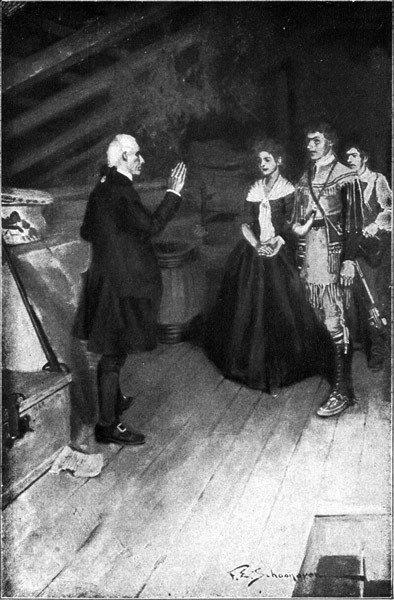
"AND SO WE WERE WEDDED"
I roused and rubbed my eyes.
"Do you hear firing," he asked, "far away in the west?"
"Yes."
"Concord lies northwest."
Silver Heels, absorbed in her task, hummed a little tune
under her breath.
"The smoke follows the road," said the Minute Man.
The firing became audible in the room. Silver Heels raised
her head with a grave glance at me. I went and knelt beside
her.
"It is coming at last, little sweetheart," I said. "Will
you go, now? Foxcroft will take you across the fields to
some safe farm."
"You know Sir William would not have endured to see me
leave at such a time," she said.
"Yes, dear heart, but you cannot carry a rifle."
"But I can make bullets and bandages."
"The British fire at women; you must go!" I said, aloud.
"I will not go."
"I command."
"No." She bent her fair, childish head and the tears fell
on the cloth in her lap.
"Look! Look at the redcoats!" called out the Minute
Man at the attic window.
As I rose I heard plainly the long, resounding crash of
musket firing, and the rattle of rifles followed like a hundred
echoes.
"Look yonder!" he cried.
Suddenly the Concord Road was choked with scarlet-clad
soldiers. Mapped out below us the country stretched, and
over it, like a blood-red monster worm, wound the British
column—nay, like to a dragon it came on, with flanking lines
thrust out east and west for its thin red wings, and head and
tail wreathed with smoke.
And now we could see feathery puffs of smoke from the
road-side bushes, from distant hills, from thickets, from
ploughed fields, from the long, undulating stone walls which
crossed the plain. Faster and faster came the musket volleys,
but faster yet rang out the shots from our yeomanry, gathering
thicker and thicker along the British route, swarming
in from distant towns and hamlets and lonely farms.
The old tavern was ringing with voices now—commands of
officers, calls from those who were posted above, clattering
steps on the porch as the Acton men ran out to their posts
behind the tufted willows in the swamp.
He who had been placed in charge at the tavern, a young
officer of the Woburn Alarm Men, shouted for silence and
attention, and ordered us not to fire unless fired upon, as our
position would be hopeless if cannon were brought against
us. Then he commanded all women to leave the tavern and
seek shelter at Slocum's farm across the meadows.
"No, no!" murmured Silver Heels, obstinately, as I took
her hand and started for the stairs, "I will not go,—I cannot—I
cannot! Let me stay, Michael; for God's sake, let
me stay!" And she fell on her knees and caught at my
hands.
"To your posts!" roared the Woburn officer, drawing his
sword and coming up the stairs two at a jump. He stopped
short when he saw Silver Heels, and glanced blankly at me;
but there was no time now for flight, for, as he stepped to the
window beside me, pell-mell into the village green rushed the
British light infantry, dusty, exhausted, enraged. In brutal
disorder they surged on, here a squad huddled together, there
a company, bullied, threatened, and harangued by its officers
with pistols and drawn swords; now a group staggering past,
bearing dead or wounded comrades, now a heavy cart loaded
with knapsacks and muskets, driven by hatless soldiers.
Close on their heels tramped the grenadiers. Soldier after
soldier staggered and fell from the ranks, utterly exhausted,
unable to rise from the grass.
The lull in the firing was broken by a loud discharge of
musketry from Fiske's Hill, and presently more redcoats
came rushing into the village, while at their very heels the
Bedford Alarm Men shot at them, and chased them.
Everywhere our militia came swarming—from Sudbury,
Westford, Lincoln, Acton; Minute Men from Medford, from
Stowe, from Beverly, and from Lynn—and their ancient firelocks
blazed from every stone wall, and their long rifles
banged from the distant ridges.
Below me in the street I saw the British officers striving
desperately to reform their men, kicking the exhausted creatures
to their feet again, striking laggards, shoving the bewildered
and tired grenadiers into line, while thicker and
thicker pelted the bullets from the Minute Men and militia.
They were brave men, these British officers; I saw a young
ensign of the Tenth Foot fall with a ball through his
stomach, yet rise and face the storm until shot to death by
a dozen Alarm Men on the Bedford Road.
It was dreadful; it was doubly dreadful when a company
of grenadiers suddenly faced about and poured a volley into
our tavern, for, ere the crashing and splintered wood had
ceased, the tavern fairly vomited flame into the square, and
the British went down in heaps. Through the smoke I saw
an officer struggling to disengage himself from his fallen and
dying horse; I saw the massed infantry reel off through the
village, firing frenziedly right and left, pouring volleys into
farm-houses, where women ran screaming out into the barns,
and frantic watch-dogs barked, tugging at their chains.
It was not a retreat, not a flight; it was a riot, a horrible
saturnalia of smoke and fire and awful sound. As a maddened
panther, wounded, rushes forth to deal death right and
left, even tearing its own flesh with tooth and claw, the
British column burst south across the land, crazed with
wounds, famished, athirst, blood-mad, dealing death and ruin
to all that lay before it.
Terrible was the vengeance that followed it, hovered on its
gasping flanks, scourged its dwindling ranks, which withered
under the searching fire from every tuft of bushes, every
rock, every tree-trunk.
Already the ghastly pageant had rushed past us, leaving
a crimson trail in its wake; already the old tavern door was
flung wide, and our Minute Men were running down the Boston
Road and along the ridges on either side, firing as they
came on.
I, with Mount and the Weasel, hung to their left flank till
two o'clock, when, about half a mile from Lexington Meeting-house,
we heard cannon, and understood that the relief troops
from Boston had come up.
Then, knowing that there were guns enough and to spare
without ours, we shouldered our hot rifles and trudged back
to "Buckman's Tavern," through the dust, behind a straw-covered
wain which was driving slowly under the heat of an
almost vertical sun.
Mount, parched with thirst, hailed the driver of the wain,
asking him if he carried cider.
"Only a wounded man," he said, "most dead o' the red
dragoons."
I stepped to the slowly moving wagon and looked over the
tail-board down into the straw.
"Shemuel!" I cried.
"Shemuel!" roared Mount.
The little Jew opened his sick eyes under his bandage. The
Weasel climbed nimbly over the tail-board and settled down
beside the wounded man, taking his blood-smeared hand.
"Shemuel! Shemuel! We saw them split your head!"
stammered Mount, in his astonishment and joy.
"Under my hat I did haff a capful of shillings," replied
Shemuel, weakly; "I—I go back—two days' time to find me
my money by dot Lechemere swamp—eh, Jack?"
"God bless you, old nosey!" cried Mount; "we'll get your
money, lad! Won't we, Cardigan?"
The little Jew turned his heavy eyes on me.
"You haff found Miss Warren?" he gasped. "Ach, so iss
all well. I go back—two days' time—find me my money." He
smiled and closed his eyes.
So we re-entered Lexington, Jack Mount, the Weasel, Saul
Shemuel, and I; and on the tavern steps Silver Heels stood,
her tired, colourless face lighted up, her outstretched hands
falling on my shoulders; and I to take her in my arms, for
she had fallen a-weeping. Above us the splendid blue of the
sky spread its eternal tent, our only shelter, our only home
on the long trail through the world; our lamp was the sun,
our fireplace a continent, and the four winds our walls, and
our estates were bounded by two oceans, washing the shores of
a land where the free, at last, might dwell.
In the south the thunder of the British cannon muttered,
distant and more distant; the storm had passed.
Had the storm passed? The smoke hung in the north
where Concord town was burning, yet around us birds sang.
And now came Jack Mount, riding postilion on the horses
which drew the post-chaise; behind him trotted the Weasel,
leading out Warlock. Silver Heels saw them and stood up,
smiling through her tears.
"Truly, we stayed and did our duty, did we not, dear
heart?"
"With your help, sweet."
"And deserted not our own!"
"Yours the praise, dear soul."
"And did face our enemies like true people all; is it not
so, Michael?"
"It is so."
"Then let us go, my husband. I am sick for my own
land, and for the happiness to come."
"Northward we journey, little sweetheart."
"To the blue hills and the sweet-fern?"
"Ay, home."
And so we started for the north, out of the bloody village
where our liberty was born at the first rifle-shot, out of the
sound of the British cannon, out of the land of the salt sea,
back to the inland winds and the incense of our own dear
forests, and the music of sweet waters tumbling where the
white pines sing eternally.
I rode Warlock beside the chaise; Shemuel lay within;
Silver Heels sat beside the poor, hurt creature, easing his
fevered head; but her eyes ever returned to me, and the
colour came and went in her face as our eyes spoke in silence.
"Good-bye," said Foxcroft, huskily.
Mount squared himself in his saddle; the Weasel, rifle on
thigh, set his horse's head north.
Slowly the cavalcade moved on; the robins sang on every
tree; far to the southward the thunder of the British cannon
rolled and re-echoed along the purple hills; and over all God's
golden light was falling on life, and love, and death.
We entered Albany on the 22d of April; the town had
heard the news from Lexington ere we sighted the Albany
hills, the express having passed us as we crossed the
New York line, tearing along the river-bank at a breakneck
gallop.
So, when we rode into Albany, the stolid, pippin-cheeked
Dutchmen had later news than had we, and I learned then,
for the first time, how my Lord Percy's troops had been
hurled headlong through Cambridge Farms into Charlestown,
where they lay like panting, slavering, senseless beasts
under the cannon of the Somerset and Asia. And all Massachusetts
sat watching them, gun in hand.
We lay at the house of Peter Weaver, my lawyer, Silver
Heels and I; Jack Mount and Cade Renard lay at the
"Half Moon," where poor Shemuel could procure medicine
and such medical attendance as he so sorely stood in need of.
With Peter Weaver I prepared to arrange my affairs as
best I might, it being impossible for me to undertake a voyage
to Ireland at this time, though my succession to the title
and estates of my late uncle, Sir Terence, made it most
necessary.
For the first time in my life I now became passably
acquainted with my own affairs, though when we came to
figure in pounds, shillings, and pence, I yawned, yet made
pretence of a wisdom in mathematics which, God knows, is
not in me.
Silver Heels, her round chin on my shoulder, listened attentively,
and asked some questions which caused the ponderous
lawyer to address himself to her rather than to me,
seeing clearly that either I cared nothing for my own affairs
or else was stupid past all belief.
Sir William's legacies to me and to Silver Heels were discussed
most seriously; and Mr. Weaver would have it that
the law should deal with my miserable kinsman, Sir John,
for the fraud he had wrought. Yet, it was exactly that; and,
because he was my kinsman, I could not drag him out to
cringe for his infamy before the rabble.
The land and the money left to us by Sir William we
would now, doubtless, receive, but it was only because Sir
William had desired it that we at length made up our minds
to accept it at all.
This I made plain to Mr. Weaver, then relapsed into a
dull inspection of his horn spectacles as he discoursed of
mortgages and bonds and interests and liens with stupefying
monotony.
"It is like the school-room, Micky," murmured Silver
Heels, close to my ear, and composed her countenance to
listen to a fluent peroration on percentage and investments
in terms which were to me as vain as tinkling cymbals.
"Then I am wealthy?" I interposed, again and again, yet
could draw from that fat badger, Weaver, neither a "yes"
nor "no," nor any plain speech fit for a gentleman's comprehension.
So when at length we quitted Mr. Weaver a sullen mood
possessed me and I felt at bay with all the learned people in
the world, as I had often felt, penned in the school-room.
"Am I?" I asked Silver Heels.
"What?"
"Rich or poor? Tell me in one word, dear heart, for
whether or not I possess a brass farthing in the world, I do
not know, upon my honour!"
"Poor innocent," she laughed; "poor unlearned and harassed
boy! Know, then, that you have means to purchase
porridge and a butcher's roast for Christmas."
"I be serious," said I, anxiously, "and I would know if I
have means to support a large family—"
"Hush!" said Silver Heels. What I could see of her face,—one
small ear,—was glowing in rich colour.
"Because—" I ventured. But she plucked at my arm with
lowered eyes, nor would hear me to explain that I, newly
wedded, viewed the future with a hopeful gravity that befitted.
"As for a house," said I, "there is a pleasant place of
springs called Saratoga, dearly loved by Sir William."
"I know," said she, quickly; "it comes from 'asserat,'
sparkling waters."
"It comes from 'Soragh,' which means salt, and 'Oga,' a
place—"
"It does not, Micky!"
"It does!"
"No!"
"It does!"
"Oc-qui-o-nis! He is a bear!" said Silver Heels, to herself.
We stopped in the hallway, facing each other. Something
in her flushed, defiant face, her bright eyes, the poise of her
youthful body, brought back with a rush that day, a year ago,
when I, sneaking out of the house to avoid the school-room,
met her in the hallway, and was balked and flouted and
thrust back to the thraldom of the school. Here was the
same tormentor—the same child with her gray eyes full of
pretty malice, the same beauty of brow and mouth and hair
was here, and something added—a maid's delicate mockery
which veiled the tenderness of womanhood; a sweetheart and
a wedded wife.
"I am thinking of a morning very, very long ago," I said,
slowly.
"I, too," said Silver Heels.
"Almost a year ago," I said.
"A year ago," said Silver Heels.
"You little wild-cat thing!" I whispered, tenderly, and
took her by the waist so that her face lay upturned on my
shoulder.
"Stupid," she said, "I loved you that very day."
"What day?"
"The day we both are thinking on: when you met me in
the hall with your fish-rod like a guilty dunce—"
"You wore a skirt o' buckskin and tiny moccasins and
stockings with scarlet thrums; and you were a-nibbling a
cone of maple-sugar," said I.
"And you strove to trip me up!"
"And you pushed me!"
"And you thrust Vix at me!"
"And you kicked my legs and ran up-stairs like a wild-cat
thing."
There was a silence; she looked up into my face from my
shoulder.
"This, for a belt of peace betwixt those two children who
live in memory," said I, and kissed her.
"Oonah! All is lost," she said; "he does with me as he
will!" and she rendered me my kiss, saying, "Bearer of belts,
thy peace-belt is returned."
So was perfect peace established, not only for the shadowy
children of that unforgotten past, but for us, and for all time
betwixt us; and our belts were offered and returned, and the
sign was the touching of her lips and mine.
For Shemuel's sake, and because we would not desert him,
we continued in Albany until near the end of April.
Taking counsel together, we had determined to build a
mansion, when the times permitted, midway on the road
'twixt Johnstown and Fonda's Bush, our lands joining at
that place. But I feared much that the war which now
flamed through Massachusetts Bay might soon creep northward
into our forest fastness and set the border ablaze from
the Ohio to Saint Sacrement. Much, too, I feared that the
men of the woods whose skin was red would league with the
men whose coats were red. All his later days Sir William
had striven to avert this awful pact; Dunmore played against
him, Butler betrayed him, Cresap was tricked, and Sir William
lost. Now, into his high place sneaked a pygmy, slow,
uncertain, sullen, treacherous—his own son, who would undo
the last knot which bound the Indians to a fair neutrality.
Perhaps he himself would even lead them on to the dreadful
devastation all men dreaded; and, if he, men must also
count on the Butlers, father and son, to carry terror through
our forests and hunt to death without mercy all who stood for
freedom and the rights of man.
One of these I had held in my hand and released. Yet
still that old certainty haunted me, the belief that one day I
was to meet and kill him, not in honourable encounter, now,
for he had lost the right to ask such a death from me; but in
the dark forest, somewhere among the corridors of silent
pines, I would slay him as sachems slay ferocious beasts that
track men through ghost-trails down to hell.
Then should we be free at last of this fierce, misshapen
soul, we People of the Morning, Tierhansaga, and the shrinking
forest should straighten, and Oya should be Oyabanh,
and the red witch-flower should wither to a stalk, to a seed,
and sprout a fair white blossom for all time, Ahwehhah.
That night, as I stood on the steps of Peter Weaver's red
brick house, turning to look once more into the coals of the
setting sun ere I entered the door, a hand twitched at my
coat-skirt, and, looking down, I saw below me on the pavement
an Indian dressed in the buckskins of a forest-runner.
"Peter!" I cried, for it was he, my dusky kinsman on the
left hand; then my eyes fell on his companion, a short, squat
savage, clad in red, and painted hideous with strange signs
I could not read.
"Red Jacket," said Peter, calmly.
I looked hard at Peter; he had grown big and swart and
fat like a bear-cub in November; Red Jacket raised his sullen
eyes, then dropped them.
Suddenly, as I stood there, at a loss what next to say,
came a heavy man, richly clothed, flabby face bent on the
ground. Nor would he have discovered me, so immersed in
brooding reverie was he, had not Peter touched his elbow.
A bright flush stained his face; he looked up at me where
I stood. Then I descended the steps, shoving Peter from
between us, and Sir John Johnson, for it was he, moved
back a pace and laid his heavy hand on his sword-belt as I
came close to him, looking into his cold eyes.
"Liar!" I said; "liar! liar!" And that was all, for he gave
ground, and his hand fell limply from his dishonoured hilt.
So I left him, there in the darkening street, the Indians
watching him with steady, kindling eyes.
We started next day at dawn, Silver Heels riding Warlock
in her new kirtle and little French three-cornered hat with
its gilt fringe, to which she had a right, as she was now My
Lady Cardigan, if she chose.
I rode a bay mare, bought in Albany, yet a beauty, and
doubtless the only decent horseflesh in all that town of rusty
rackers and patroons' sorry hacks. Mount and the Weasel,
leather-clad, and gay with quilled moccasins and brilliant
thrums, journeyed afoot, on either side o' Shemuel, who
bestrode a little docile ass.
His noddle, neatly mended and still bound up, he had surmounted
with a Quaker hat so large that it rested on his
large flaring ears; peddlers' panniers swung on either flank,
crammed deep with gewgaws; he let his bridle fall on the
patient ass's neck, and, thumbs in his armpits, joined lustily
the chorus raised by Mount and Renard:
"Come, all ye Tryon County men,
And never be dismayed;
But trust in the Lord,
And He will be your aid!"
Roaring the rude chorus, Jack Mount marched in the
lead, his swinging strides measured to our horses' steady
pacing; beside him trotted the little Weasel, his hand holding
tightly to the giant's arm; and sometimes he took three steps
to Mount's one, and sometimes he toddled, his little, leather-bound
legs twinkling like spokes in a wheel, but ever he
chanted manfully as he marched:
"O trust in the Lord,
And He will be your aid!"
And Shemuel's fervent whine from his lowly saddle rounded
out the old route-song.
An hour later I summoned Jack Mount, and he fell back
to my stirrups, resting his huge hand on my saddle as he
walked beside me.
"Jack," I said, "is poor Cade cured o' fancy and his mad
imaginings?"
"Ay, lad, for the time."
"For the time?"
"A year, two years, three, perhaps. This is not the first
mad flight o' fancy Cade has taken on his aged wings."
"You never told me that," I said, sharply.
"No, lad."
"Why not?"
"Do you spread abroad the sorry secrets of your kin, Mr.
Cardigan?"
"He is not your kin!"
"He is more," said Mount, simply.
After a silence I asked him on what previous occasion the
little Weasel had gone moon-mad.
"On many—every third or fourth year since I first knew
him," said Mount, soberly. "But never before did he leave
me to follow his poor mad phantoms—always the phantom of
his wife, lad, in divers guises. He saw her in a silvery
bush o' moonlight nights, and talked with her till my
goose-flesh rose and crawled on me; he saw her mirrored
in cold, deep pools at dawn, looking up at him from the
golden-ribbed sands, and I have laid in the canoe to watch
the trouts' quick shadows moving on the bottom, and he
a-talking sweet to his dear wife as though she hid under the
lily-pads like a blossom."
He glanced up at me pitifully as he walked beside my
stirrup; I laid my hand on his leather-tufted shoulder.
"Sir, it is sad," he muttered; "a fair mind nobly wrecked.
But grief cannot deform the soul, Mr. Cardigan."
"He knows you now?"
"Ay, and knows that he has dwelt for months in madness."
"Does he know that it was me he loved so deeply in his
madness?" asked Silver Heels, gently.
"I think he does," whispered Mount.
Silver Heels turned her sorrowful eyes on poor Cade
Renard.
Riding that afternoon near sunset, at the False Faces'
Carrying-Place upon the Mohawk, we spoke of Johnson
Hall and the old life, sadly, for never again could we hope
to enter its beloved portals.
Naught that belonged to us remained in the Hall, save
only the memories none might rob us of.
"If only I might have Betty," said Silver Heels, wistfully.
"Betty? Did she not attend you to Boston with Sir
John?" I asked.
"Yes, but she was slave to Sir John. I could not buy her;
you know how poor I awoke to find myself in Boston town."
"Would not that brute allow you Betty?" I asked, angrily.
"No; I think he feared her. Poor, blubbering Betty, how
she wept and roared her grief when Sir John bade her pack
up, and called her 'hussy.'"
That night we lay at Schenectady, where also was camped
a body of Sir William's Mohawks, a sullen, watchful band,
daubed in hunting-paint, yet their quivers hung heavy with
triple-feathered war-arrows, and their knives and hatchets
and their rifles were over-bright and clean to please me.
Some of them knew me, and came to talk with me over a
birch-fire. I gave them tobacco, and we tarried by the birch-fire
till the stars waned in the sky and the dawn-stillness fell
on land and river; but from them I could learn nothing, save
that Sir John and Colonel Guy had vowed to scalp their own
neighbours should they as much as cry, "God save our country!"
Evil news, truly, yet only set me firmer in my design
to battle till the end for the freedom that God had given
and kings would take away.
Silver Heels, quitting the inn with Mount, came to warn
me that I must sleep if we set out at sunrise. Graciously
she greeted the Mohawks who had risen to withdraw; they
all knew her, and watched her like tame panthers with red
coals in their eyes.
"But they are panthers yet; forget it not," muttered Jack
Mount.
At sunrise we rode out into the blue hills. Homeless, yet
nearing home at last, my heart lifted like a singing bird.
Dew on the sweet-fern exhaling, dew on the ghost-flower, dew
on the scented brake!—and the whistle of feathered wings,
and the endless ringing chorus of the birds of Tryon! Hills
of pure sapphire, streams of gems, limpid necklaces festooned
to drip diamonds from crags into some frothing pool! Pendent
pearls on vines starred white with bloom; a dun deer
at gaze, knee-deep in feathering willow-grass; a hermit-bird
his morning hymn, cloistered in the vaulted monastery where
the great organ stirs among the pines!
Hills! Hills of Tryon, unploughed, unharrowed, save by
the galloping deer; hills, sweet islands in the dark pine
ocean, over whose waste the wild hawk's mewing answers the
cry of its high-wheeling mate; hills of the morning, aromatic
with spiced fern, and perfumed of the gum of spruce
and balsam; hills of Tryon; my hills! my hills!
"The spring is with us," said Jack Mount, stooping to
pluck a frail flower.
"Ka-nah-wah-hawks, the cowslip!" murmured Silver
Heels.
"Savour the wind; what is it?" I asked, sniffing.
"O-neh-tah, the pine!" she cried.
"O-ne-tah, the spruce!" I corrected.
"The pine, silly!"
"The spruce!"
"No, no, the pine!"
"So be it, sweet."
"No, I am wrong!"
And we laughed, and she stretched out her slender hand
to me from her saddle.
Then we galloped forward together, calling out greeting
to our old friends as we passed; and thus we saluted Jis-kah-kah,
the robin, and Kivi-yeh, the little owl, and we whistled
at Koo-koo-e, the quail, and mocked at old Kah-kah, the
watchful crow.
Han-nah-wen, the butterfly, came flitting along the roadside,
ragged with his long winter's sleep.
"He should not have slept in his velvet robe for a night-shift,"
said Silver Heels; "he is a summer spendthrift, and
Nah-wan-hon-tah, the speckled trout, lies watching him
under the water."
Which set me thinking of my feather-flies; and then the
dear old river flashed in sight.
"I see—I see—there, very far away on that hill—" whispered
Silver Heels.
"I see," I muttered, choking.
Presently the sunlight glimmered on a window of the distant
Hall.
"We are on our own land now, dear heart," I said, choking
back the sob in my throat.
I called out to Jack Mount and unslung my woodaxe. He
drew his hatchet, and together we cut down a fair young
maple, trimmed it, and drove a heavy post into the soil.
"Here we will build one day," said I to Silver Heels.
She smiled faintly, but her eyes were fixed on the distant
Hall.
I had leased, from my lawyer, Peter Weaver, a large stone
mansion in Johnstown, which stood next to the church where
Sir William lay; this until such time as I might return from
the war and find leisure to build on my own land the house
which Silver Heels and I had planned to stand on a hill, in
full view of the river and of the old Hall where our childhood
had been passed.
It was night when we rode into Johnstown. I could discover
no changes in the darkness, save that a few new signs
swung before lighted shops, and every fifth house hung out
a lanthorn and a whole candle-light.
Our stone house was vast, damp, and scantily furnished,
but Jack Mount lighted a fire in the hallway, and Silver
Heels went about with a song on her lips, and Cade Renard
sent servants from the nearest inn with cloth and tableware,
and meats smoking hot, not forgetting a great bowl of punch
and a cask of ale, which the scullions rolled into the great
hall and hoisted on the skids.
So we were merry, and silent, too, at moments, when our
eyes met in faint smiles or wistful sympathy.
Shemuel, with his peddling panniers, had strangely disappeared,
nor could we find him high or low when Mount and
Cade had set their own table by the fire and the room smelled
sweet with steaming toddy.
"Thrift! Thrift!" muttered Mount, rattling his toddy-stick
impatiently; "now who could have thought that little
Jew would have cut away to make up time in trade this
night!"
But Shemuel had traded in another manner, for, ere Mount
had set his strong, white teeth in the breast-bone of a roasted
fowl, I heard Silver Heels cry out: "Betty! Betty! Oh
dear, dear Betty!" And the blubbering black woman came
rolling in, scarlet turban erect, ear-rings jingling.
"Mah li'l dove! Mah li'l pigeon-dove! Oh Gord, mah li'l
Miss Honey-bee!"
"You must keep her, lad," muttered Mount.
"I think Sir John will sell," I said, grimly.
And so he did, or would have, had not his new wife, poor
Lady Johnson, whom I had never seen, writing from the
Hall, begged me to accept Betty as a gift from her. And I,
having no quarrel with the unhappy lady, accepted Betty as
a gift, permitting Lady Johnson to secure from the incident
what comfort she might.
All through the sweet May-tide, Jack Mount and Cade
Renard sunned themselves under the trees in our garden, or
sprawled on the warm porch like great, amiable wolf-hounds,
dozing and dreaming of mighty deeds.
Ale they had for the drawing, yet abused it not, respecting
the hospitality of the house and its young mistress, and
none could point the shameful finger at either to cry: "Fie!
Pottle-pot! Malt-worm! Painted-nose! Go swim!" At
times, sitting together on the grass, cheek by jowl, I heard
them singing hymns; at times strolling through the moon-drenched
garden paths they lifted up their souls in song:
"The hunter has taken the trail to the East;
The little deer run! The little deer run!
Fear not, little deer, for he hunts the Red Beast;
Ye are not for his gun! Ye are not for his gun!
"The hunter lies cold on the trail to the East;
His bosom is rent! His bosom is rent!
He died for his country, to slay the Red Beast;
To Heaven he went! To Heaven he went!"
In the moonlight the doleful chant droned on, night after
night, under the dewy lilacs; and the great horned-owl
answered, hooting from the pines; and Silver Heels and I
listened from the porch, hand clasping hand in fearsome
content. For out in the dark world God was busy shaping
the destiny of a people; even the black forest knew it, and
thrilled like a vast harp at the touch of the free winds'
fingers—unseen fingers, delicate, tentative, groping for the
key to a chord of splendid majesty. And when at last the
chord should be found and struck, resounding to the deep
world's rock foundation, a free people's voices should repeat,
singing forever and for all time throughout the earth:
"Amen!"
Meanwhile, stillness, moonlight, and a "Miserere" from the
lips of two strange forest-runner folk, free-born and ready
when the Lord of all led forth His prophet to command.
On that night I heard a man in the street repeat a name,
Washington. And all that night I thought of it, and said
it, under my breath. But what it might portend I knew not
then.
May ended, smothered in flowers; and with the thickening
leaves of June came to us there in the North rumours of the
times which were to try men's souls. And again I heard,
somewhere in the darkness of the village streets, the name I
heard before; and that night, too, I lay awake, forming the
word with silent lips, close to my young wife's breast.
The full, yellow moon of June creamed all our garden
now; Mount and Renard sat a-squat upon the grass, chin on
fist, to muse and muse and wait—for what? The King of
England did not know; but all the world was waiting, too.
Then, one dim morning, while yet the primrose light tinted
the far hills, I awoke to see Silver Heels in her white night-robe,
leaning from the casement, calling out to me in a
strange, frightened voice: "Michael! Michael! They are
coming over the hills—over the hills, dear heart, to take you
with them!"
At the window, sniffing the fresh dawn, I listened.
"Footfalls in the hills!" she said, trembling. "Out of the
morning men are coming! God make me brave! God make
me brave!"
For a long time we stood silent; the village slept below
us; the stillness of the dawn remained unbroken, save by a
golden-robin's note, fluting from a spectral elm.
"It is not yet time," I said: "let us sleep on, dear heart."
But she would not, and I was fain to dress me in my
leather, lest the summons coming swift might find me all
unready at the call.
Then she roused Betty and the maid and servants, bidding
them call up Mount and Renard, for the hour was close upon
us all.
"Dear love," I said, "this is a strange fear that takes you
from your pillows there, at dawn."
"Strange things befall a blindly loving heart," she said;
"I heard them in my dreams, and knew them, all marching
with their yellow moccasins and raccoon-caps and green
thrums blowing in the wind."
"Riflemen?"
"Ay, dear love."
"Foolish prophetess!"
"Too wise! Too wise!" she whispered, wearily, nestling
within my arms, a second only, then:
"Sir Michael!" roared Mount below my window; "Cresap
is on the hills with five hundred men of Maryland!"
Stunned, I stared at Silver Heels; her face was marble,
glorified.
As the sun rose I left her, and, scarce knowing what I did,
threw my long rifle on my shoulder and ran out swiftly
through the garden.
Suddenly, as though by magic summoned, the whole street
was filled with riflemen, marching silently and swiftly, with
moccasined feet, their raccoon caps pushed back, the green
thrums tossing on sleeve and thigh. On they came, rank on
rank, like brown deer herding through a rock run; and, on
the hunting-shirts, lettered in white across each breast, I
read:
LIBERTY OR DEATH.
Mount and the Weasel came up, rifles shouldered, coon-skin
caps swinging in their hands. Mount shyly touched the
hand that Silver Heels held out; Cade Renard took the fingers,
and, bending above them with a flicker of his aged gallantly,
pressed them with his shrivelled lips.
"We will watch over your husband, my lady," he said,
raising his dim eyes to hers.
"Ay, we will bring him back, Lady Cardigan," muttered
Jack Mount, twisting his cap in his huge paws.
Silver Heels, holding them each by the hand, strove to
speak, but the voice in her white throat froze, and she only
looked silently from them to me with pitiful gray eyes.
"To kill the Red Beast," muttered Mount; "it is quickly
done, Lady Cardigan. Then your husband will return."
"To kill the Beast," repeated Renard; "the Red Beast
with twin heads. Ay, it can be done, my lady. Then he will
return."
"I swear it!" cried Mount, flinging up his great arm.
"He will return."
"To doubt it is to doubt God's grace, child. He will return,"
said Cade Renard.
She looked at me, at Mount, at the Weasel, then at the
torrent of dusty riflemen steadily passing without a break.
"If he—he must go—" she began. Her voice failed; she
caught my hands and kissed them.
"For our honour—go!" she gasped. "Michael! Michael!
Come back to me—"
"Truly, dear heart—truly! truly!"
"Ho! Cardigan!" rang out a voice like a pistol-shot from
the passing ranks.
Through my tear-dimmed eyes I saw Cresap, sword shining
in his hand.
"We come," cried Mount, shaking his rifle towards the
rising sun; "death to the Red Beast!"
"Death to the Beast!" shouted Cresap, shaking his shining
sword.
Half a thousand heavy rifles shook high; half a thousand
deep voices roared thunderously through the stony street:
"Liberty! Liberty or Death!"
And now that of a truth the Red Beast is slain, as all
men know, follow these mellow years through which our
children move, watching the world like a great witch-flower
unfold. Content, I sit with her I love, at dusk, tying my
soft feather-flies just as I tied them for Sir William in the
golden time. The trout have nothing changed, nor I, though
kings already live as legends.
Bitter-sweet on porch and paling, woodbine and white-starred
clematis, and the deep hum of bees; and in the sunlit
garden poppies, red as the blood of martyrs. Then moonlight
and my dear wife at the door.
Betty, she hath cradled our tot, Felicity, to croon some
soft charm of Southern sorcery, whereby sleep settles like
gray dusk-moths on tired lids.
But for the boy, William, it serves not, and he defies us
with his wooden gun, declaiming that a man whose grandsire
died with Wolfe will not be taken off to bed at such an hour.
And so my sweetheart cradles him, unheeding my stern hint
of rods a-pickle for the wilful; and, in the moonlight, joining
my fish-rod, I hear her from the nursery, singing the song of
blessed days departed, yet with each dawn renewed:
"For courts are full of flattery,
As hath too oft been tried;
The city full of wantonness,
And both be full of Pride:
Then care away,
And wend along with me!"
"I know a trout," quoth Jack Mount, taking his cob-pipe
from his teeth, "a monstrous huge one, lad, hard by the
thunder-stricken hemlock where the Kennyetto turns upon
itself. Shemuel did mark the fish, sleeping at noon three
days since."
"Bring Cade along," said I, opening the garden gate, and
gathering my rod and line lest the fly-hook catch in the rosebush;
"and fetch the gaff, Jack, when you return."
But when he came again into the moonlit garden he came
alone, swinging the bright steel gaff.
"Cade sleeps by the fire in the great hall," he said. "Truly,
lad, we age apace, and the sly beast, Death, follows us, sniffing,
as we go. Lord! Lord! How old we grow—how old,
how old! All of us, save Lady Cardigan and you! Years
freshen her."
"The years are kind," I said.
So we descended through the dusk to the sweet water flowing
under the clustered stars.
Popular Copyright Books
AT MODERATE PRICES
Ask your dealer for a complete list of
A. L. Burt Company's Popular Copyright Fiction.
Abner Daniel. By Will N. Harben.
Adventures of a Modest Man. By Robert W. Chambers.
Adventures of Gerard. By A. Conan Doyle.
Adventures of Sherlock Holmes. By A. Conan Doyle.
Alisa Page. By Robert W. Chambers.
Alternative, The. By George Barr McCutcheon.
Ancient Law, The. By Ellen Glasgow.
Angel of Forgiveness, The. By Rosa N. Carey.
Angel of Pain, The. By E. F. Benson.
Annals of Ann, The. By Kate Trimble Sharber.
Anna the Adventuress. By E. Phillips Oppenheim.
Ann Boyd. By Will N. Harben.
As the Sparks Fly Upward. By Cyrus Townsend Brady.
At the Age of Eve. By Kate Trimble Sharber.
At the Mercy of Tiberius. By Augusta Evans Wilson.
At the Moorings. By Rosa N. Carey.
Awakening of Helen Richie, The. By Margaret Deland.
Barrier, The. By Rex Beach.
Bar 20. By Clarence E. Mulford.
Bar 20 Days. By Clarence E. Mulford.
Battle Ground, The. By Ellen Glasgow.
Beau Brocade. By Baroness Orczy.
Beechy. By Bettina von Hutten.
Bella Donna. By Robert Hichens.
Beloved Vagabond, The. By William J. Locke.
Ben Blair. By Will Lillibridge.
Best Man, The. By Harold McGrath.
Beth Norvell. By Randall Parrish.
Betrayal, The. By E. Phillips Oppenheim.
Better Man, The. By Cyrus Townsend Brady.
Beulah. (Illustrated Edition.) By Augusta J. Evans.
Bill Toppers, The. By Andre Castaigne.
Blaze Derringer. By Eugene P. Lyle, Jr.
Bob Hampton of Placer. By Randall Parrish.
Bob, Son of Battle. By Alfred Ollivant.
Brass Bowl, The. By Louis Joseph Vance.
Bronze Bell, The. By Louis Joseph Vance.
Butterfly Man, The. By George Barr McCutcheon.
By Right of Purchase. By Harold Bindloss.
Cab No. 44. By R. F. Foster.
Calling of Dan Matthews, The. By Harold Bell Wright.
Call of the Blood, The. By Robert Hichens.
Cape Cod Stories. By Joseph C. Lincoln.
Cap'n Eri. By Joseph C. Lincoln.
Captain Warren's Wards. By Joseph C. Lincoln.
Caravaners, The. By the author of "Elizabeth and Her German Garden."
Cardigan. By Robert W. Chambers.
Carlton Case, The. By Ellery H. Clark.
Car of Destiny, The. By C. N. and A. M. Williamson.
Carpet From Bagdad, The. By Harold MacGrath.
Cash Intrigue, The. By George Randolph Chester.
Casting Away of Mrs. Lecks and Mrs. Aleshine. Frank S. Stockton.
Castle by the Sea, The. By H. B. Marriot Watson.
Challoners, The. By E. F. Benson.
Chaperon, The. By C. N. and A. M. Williamson.
City of Six, The. By C. L. Canfield.
Circle, The. By Katherine Cecil Thurston (author of "The Masquerader,"
"The Gambler.")
Colonial Free Lance, A. By Chauncey C. Hotchkiss.
Conquest of Canaan, The. By Booth Tarkington.
Conspirators, The. By Robert W. Chambers.
Cynthia of the Minute. By Louis Joseph Vance.
Dan Merrithew. By Lawrence Perry.
Day of the Dog, The. By George Barr McCutcheon.
Depot Master, The. By Joseph C. Lincoln.
Derelicts. By William J. Locke.
Diamond Master, The. By Jacques Futrelle.
Diamonds Cut Paste. By Agnes and Egerton Castle.
Divine Fire, The. By May Sinclair.
Dixie Hart. By Will N. Harben.
Dr. David. By Marjorie Benton Cooke.
Early Bird, The. By George Randolph Chester.
Eleventh Hour, The. By David Potter.
Elizabeth in Rugen. (By the author of "Elizabeth and Her German
Garden.")
Elusive Isabel. By Jacques Futrelle.
Elusive Pimpernel, The. By Baroness Orczy.
Enchanted Hat, The. By Harold McGrath.
Excuse Me. By Rupert Hughes.
54-40 or Fight. By Emerson Hough.
Fighting Chance, The. By Robert W. Chambers.
Flamsted Quarries. By Mary E. Waller.
Flying Mercury, The. By Eleanor M. Ingram.
For a Maiden Brave. By Chauncey C. Hotchkiss.
Four Million, The. By O. Henry.
Four Pool's Mystery, The. By Jean Webster.
Fruitful Vine, The. By Robert Hichens.
Ganton & Co. By Arthur J. Eddy.
Gentleman of France, A. By Stanley Weyman.
Gentleman, The. By Alfred Ollivant.
Get-Rick-Quick-Wallingford. By George Randolph Chester.
Gilbert Neal. By Will N. Harben.
Girl and the Bill, The. By Bannister Merwin.
Girl from His Town, The. By Marie Van Vorst.
Girl Who Won, The. By Beth Ellis.
Glory of Clementina, The. By William J. Locke.
Glory of the Conquered, The. By Susan Glaspell.
God's Good Man. By Marie Corelli.
Going Some. By Rex Beach.
Golden Web, The. By Anthony Partridge.
Green Patch, The. By Bettina von Hutten.
Happy Island (sequel to "Uncle William"). By Jennette Lee.
Hearts and the Highway. By Cyrus Townsend Brady.
Held for Orders. By Frank H. Spearman.
Hidden Water. By Dane Coolidge.
Highway of Fate, The. By Rosa N. Carey.
Homesteaders, The. By Kate and Virgil D. Boyles.
Honor of the Big Snows, The. By James Oliver Curwood.
Hopalong Cassidy. By Clarence E. Mulford.
Household of Peter, The. By Rosa N. Carey.
House of Mystery, The. By Will Irwin.
House of the Lost Court, The. By C. N. Williamson.
House of the Whispering Pines, The. By Anna Katherine Green.
House on Cherry Street, The. By Amelia E. Barr.
How Leslie Loved. By Anne Warner.
Husbands of Edith, The. By George Barr McCutcheon.
Idols. By William J. Locke.
Illustrious Prince, The. By E. Phillips Oppenheim.
Imprudence of Prue, The. By Sophie Fisher.
Inez. (Illustrated Edition.) By Augusta J. Evans.
Infelice. By Augusta Evans Wilson.
Initials Only. By Anna Katharine Green.
In Defiance of the King. By Chauncey C. Hotchkiss.
Indifference of Juliet, The. By Grace S. Richmond.
In the Service of the Princess. By Henry C. Rowland.
Iron Woman, The. By Margaret Deland.
Ishmael. (Illustrated.) By Mrs. Southworth.
Island of Regeneration, The. By Cyrus Townsend Brady.
Jack Spurlock, Prodigal. By Horace Lorimer.
Jane Cable. By George Barr McCutcheon.
Jeanne of the Marshes. By E. Phillips Oppenheim.
Jude the Obscure. By Thomas Hardy.
Keith of the Border. By Randall Parrish.
Key to the Unknown, The. By Rosa N. Carey.
Kingdom of Earth, The. By Anthony Partridge.
King Spruce. By Holman Day.
Ladder of Swords, A. By Gilbert Parker.
Lady Betty Across the Water. By C. N. and A. M. Williamson.
Lady Merton, Colonist. By Mrs. Humphrey Ward.
Lady of Big Shanty, The. By Berkeley F. Smith.
Langford of the Three Bars. By Kate and Virgil D. Boyles.
Land of Long Ago, The. By Eliza Calvert Hall.
Lane That Had No Turning, The. By Gilbert Parker.
Last Trail, The. By Zane Grey.
Last Voyage of the Donna Isabel, The. By Randall Parrish.
Leavenworth Case, The. By Anna Katharine Green.
Lin McLean. By Owen Wister.
Little Brown Jug at Kildare, The. By Meredith Nicholson.
Loaded Dice. By Ellery H. Clarke.
Lord Loveland Discovers America. By C. N. and A. M. Williamson.
Lorimer of the Northwest. By Harold Bindloss.
Lorraine. By Robert W. Chambers.
Lost Ambassador, The. By E. Phillips Oppenheim.
Love Under Fire. By Randall Parrish.
Loves of Miss Anne, The. By S. R. Crockett.
Macaria. (Illustrated Edition.) By Augusta J. Evans.
Mademoiselle Celeste. By Adele Ferguson Knight.
Maid at Arms, The. By Robert W. Chambers.
Maid of Old New York, A. By Amelia E. Barr.
Maid of the Whispering Hills, The. By Vingie Roe.
Maids of Paradise, The. By Robert W. Chambers.
Making of Bobby Burnit, The. By George Randolph Chester.
Mam' Linda. By Will N. Harben.
Man Outside, The. By Wyndham Martyn.
Man in the Brown Derby, The. By Wells Hastings.
Marriage a la Mode. By Mrs. Humphrey Ward.
Marriage of Theodora, The. By Molly Elliott Seawell.
Marriage Under the Terror, A. By Patricia Wentworth.
Master Mummer, The. By E. Phillips Oppenheim.
Masters of the Wheatlands. By Harold Bindloss.
Max. By Katherine Cecil Thurston.
Memoirs of Sherlock Holmes. By A. Conan Doyle.
Millionaire Baby, The. By Anna Katharine Green.
Missioner, The. By E. Phillips Oppenheim.
Miss Selina Lue. By Maria Thompson Daviess.
Mistress of Brae Farm, The. By Rosa N. Carey.
Money Moon, The. By Jeffery Farnol.
Motor Maid, The. By C. N. and A. M. Williamson.
Much Ado About Peter. By Jean Webster.
Mr. Pratt. By Joseph C. Lincoln.
My Brother's Keeper. By Charles Tenny Jackson.
My Friend the Chauffeur. By C. N. and A. M. Williamson.
My Lady Caprice (author of the "Broad Highway"). Jeffery Farnol.
My Lady of Doubt. By Randall Parrish.
My Lady of the North. By Randall Parrish.
My Lady of the South. By Randall Parrish.
Mystery Tales. By Edgar Allen Poe.
Nancy Stair. By Elinor Macartney Lane.
Ne'er-Do-Well, The. By Rex Beach.
No Friend Like a Sister. By Rosa N. Carey.
Officer 666. By Barton W. Currie and Augustin McHugh.
One Braver Thing. By Richard Dehan.
Order No. 11. By Caroline Abbot Stanley.
Orphan, The. By Clarence E. Mulford.
Out of the Primitive. By Robert Ames Bennett.
Pam. By Bettina von Hutten.
Pam Decides. By Bettina von Hutten.
Pardners. By Rex Beach.
Partners of the Tide. By Joseph C. Lincoln.
Passage Perilous, The. By Rosa N. Carey.
Passers By. By Anthony Partridge.
Paternoster Ruby, The. By Charles Edmonds Walk.
Patience of John Moreland, The. By Mary Dillon.
Paul Anthony, Christian. By Hiram W. Hays.
Phillip Steele. By James Oliver Curwood.
Phra the Phoenician. By Edwin Lester Arnold.
Plunderer, The. By Roy Norton.
Pole Baker. By Will N. Harben.
Politician, The. By Edith Huntington Mason.
Polly of the Circus. By Margaret Mayo.
Pool of Flame, The. By Louis Joseph Vance.
Poppy. By Cynthia Stockley.
Power and the Glory, The. By Grace McGowan Cooke.
Price of the Prairie, The. By Margaret Hill McCarter.
Prince of Sinners, A. By E. Phillis Oppenheim.
Prince or Chauffeur. By Lawrence Perry.
Princess Dehra, The. By John Reed Scott.
Princess Passes, The. By C. N. and A. M. Williamson.
Princess Virginia, The. By C. N. and A. M. Williamson.
Prisoners of Chance. By Randall Parrish.
Prodigal Son, The. By Hall Caine.
Purple Parasol, The. By George Barr McCutcheon.
Reconstructed Marriage, A. By Amelia Barr.
Redemption of Kenneth Galt, The. By Will N. Harben.
Red House on Rowan Street. By Roman Doubleday.
Red Mouse, The. By William Hamilton Osborne.
Red Pepper Burns. By Grace S. Richmond.
Refugees, The. By A. Conan Doyle.
Rejuvenation of Aunt Mary, The. By Anne Warner.
Road to Providence, The. By Maria Thompson Daviess.
Romance of a Plain Man, The. By Ellen Glasgow.
Rose in the Ring, The. By George Barr McCutcheon.
Rose of Old Harpeth, The. By Maria Thompson Daviess.
Rose of the World. By Agnes and Egerton Castle.
Round the Corner in Gay Street. By Grace S. Richmond.
Routledge Rides Alone. By Will Livingston Comfort.
Running Fight, The. By Wm. Hamilton Osborne.
Seats of the Mighty, The. By Gilbert Parker.
Septimus. By William J. Locke.
Set in Silver. By C. N. and A. M. Williamson.
Self-Raised. (Illustrated.) By Mrs. Southworth.
Shepherd of the Hills, The. By Harold Bell Wright.
Sheriff of Dyke Hole, The. By Ridgwell Cullum.
Sidney Carteret, Rancher. By Harold Bindloss.
Simon the Jester. By William J. Locke.
Silver Blade, The. By Charles E. Walk.
Silver Horde, The. By Rex Beach.
Sir Nigel. By A. Conan Doyle.
Sir Richard Calmady. By Lucas Malet.
Skyman, The. By Henry Ketchell Webster.
Slim Princess, The. By George Ade.
Speckled Bird, A. By Augusta Evans Wilson.
Spirit in Prison, A. By Robert Hichens.
Spirit of the Border, The. By Zane Grey.
Spirit Trail, The. By Kate and Virgil D. Boyles.
Spoilers, The. By Rex Beach.
Stanton Wins. By Eleanor M. Ingram.
St. Elmo. (Illustrated Edition.) By Augusta J. Evans.
Stolen Singer, The. By Martha Bellinger.
Stooping Lady, The. By Maurice Hewlett.
Story of the Outlaw, The. By Emerson Hough.
Strawberry Acres. By Grace S. Richmond.
Strawberry Handkerchief, The. By Amelia E. Barr.
Sunnyside of the Hill, The. By Rosa N. Carey.
Sunset Trail, The. By Alfred Henry Lewis.
Susan Clegg and Her Friend Mrs. Lathrop. By Anne Warner.
Sword of the Old Frontier, A. By Randall Parrish.
Tales of Sherlock Holmes. By A. Conan Doyle.
Tennessee Shad, The. By Owen Johnson.
Tess of the D'Urbervilles. By Thomas Hardy.
Texican, The. By Dane Coolidge.
That Printer of Udell's. By Harold Bell Wright.
Three Brothers, The. By Eden Phillpotts.
Throwback, The. By Alfred Henry Lewis.
Thurston of Orchard Valley. By Harold Bindloss.
Title Market, The. By Emily Post.
Torn Sails. A Tale of a Welsh Village. By Allen Raine.
Trail of the Axe, The. By Ridgwell Cullum.
Treasure of Heaven, The. By Marie Corelli.
Two-Gun Man, The. By Charles Alden Seltzer.
Two Vanrevels, The. By Booth Tarkington.
Uncle William. By Jennette Lee.
Up from Slavery. By Booker T. Washington.
Vanity Box, The. By C. N. Williamson.
Vashti. By Augusta Evans Wilson.
Varmint, The. By Owen Johnson.
Vigilante Girl, A. By Jerome Hart.
Village of Vagabonds, A. By F. Berkeley Smith.
Visioning, The. By Susan Glaspell.
Voice of the People, The. By Ellen Glasgow.
Wanted—A Chaperon. By Paul Leicester Ford.
Wanted: A Matchmaker. By Paul Leicester Ford.
Watchers of the Plains, The. Ridgwell Cullum.
Wayfarers, The. By Mary Stewart Cutting.
Way of a Man, The. By Emerson Hough.
Weavers, The. By Gilbert Parker.
When Wilderness Was King. By Randall Parrish.
Where the Trail Divides. By Will Lillibridge.
White Sister, The. By Marion Crawford.
Window at the White Cat, The. By Mary Roberts Rhinehart.
Winning of Barbara Worth, The. By Harold Bell Wright.
With Juliet in England. By Grace S. Richmond.
Woman Haters, The. By Joseph C. Lincoln.
Woman in Question, The. By John Reed Scott.
Woman in the Alcove, The. By Anna Katharine Green.
Yellow Circle, The. By Charles E. Walk.
Yellow Letter, The. By William Johnston.
Younger Set, The. By Robert W. Chambers.