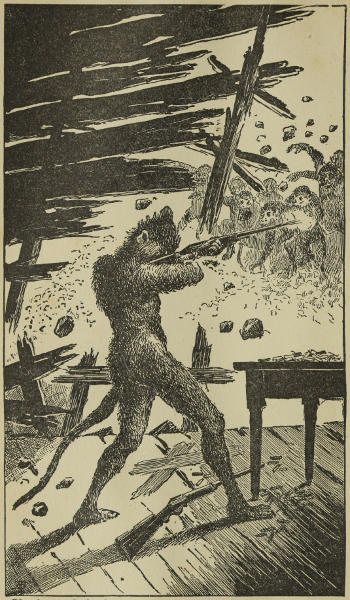
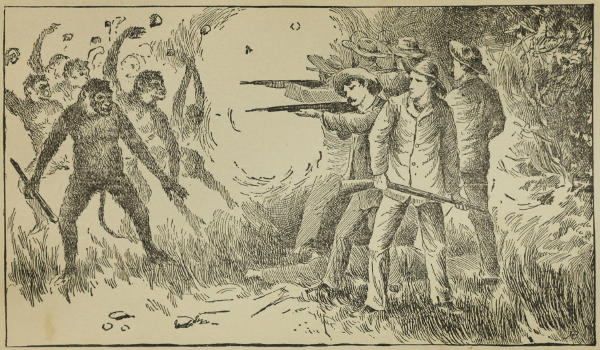
It was only during such times as the work
could be pursued that Philip had any relief of
mind, despite his kingly dignities. When, by example,
he intimated that the labors of the day
might cease, his subjects expected him to play the
part of ape as heartily as they had enacted the role
of laborers, and in order to preserve his life he was
forced to comply with these wishes.
Holding a court-martial, for the purpose of trying
and sentencing alleged offenders, was the greatest
delight of the long-tailed inhabitants, and once each
day Philip was obliged to sit in solemn state, surrounded
by his lieutenants, while the number of
supposed culprits brought before him was always
sufficient to furnish the brute dignitaries with the
spectacle of a wholesale flogging.
If any of the party were found idle during working-hours
they were certain of being brought up for
judgment, and this fact probably accounted for the
great zeal displayed whenever an example was set
before them.
At these mock trials Philip remained silent, since
it would have been impossible for his subjects to understand
any decision he might render; and Goliah
took upon himself the duties of judge, looking up
now and then at the king, as if to make certain he
was not assuming too much power.
After the judicial session was ended the monkeys
would separate, forming bands of two or three hundred,
each to go in search of food, and during such
excursions Philip oftentimes found an opportunity
to gain the kitchen unobserved, thus being able to
vary the ordinary bill of fare by some of the
dainties which had been so distasteful while he was
a prisoner in the building. Never once, however,
was he tempted to drink any of the wine. The remembrance
of the days when he so ardently wished
for water, but was unable to procure it, taught him
the strictest temperance principles.
Every morning the apes held what might be
called a grand military review, the entire body
marching in front of the building occupied by their
king. Philip, and those who attached themselves to
his person as a sort of body-guard or staff, reviewed
the troops with the utmost gravity, after which
each ape executed marvelous monkey-maneuvers in
the shape of ground and lofty tumbling, in which it
was expected the king would take an active part.
It was at the first of these parades that Philip
understood what was demanded of a monarch.
After the main body of the party had turned somersaults
or handsprings all eyes were directed at him,
and words were not needed to let him know he
should perform the same antics.
This opportunity of allowing the king to display
his agility was never lost, and after the first exhibition
Philip looked forward with fear and trembling
to the moment when he must, before the assembled
army, go through such contortions as would have
put a professional acrobat to shame.
His method of life, as well as his costume, fitted
him to a certain extent for these extraordinary antics,
and while he did not succeed in performing
them with the skill and agility displayed by his subjects,
there were plenty of flatterers near at hand
to lavish praise upon him as if he had outdone them
all.
And now must be told that which may seem improbable.
Eager for labor, because it brought him relief
from close communication with his followers, Philip
set systematically at work, not only repairing the
buildings, but laying out roads from one side of the
island to the other; and this he accomplished with
no more assistance than that afforded by the long-tailed
inhabitants.
In less than one month the buildings which had
been destroyed were rebuilt in the most substantial
manner with walls of stone. Two or three additional
dwellings were constructed later, and four
splendid roads running north, south, east and west,
from the village to the sea, were opened.
That which would have taken a small army of
laborers many months to accomplish was completed
by the apes in a little more than three weeks. It
was only necessary for Philip to begin felling trees
on the right and left of the four lines representing
the routes to be opened through the thicket, when
hundreds of pairs of hands were at work pulling up
the underbrush, tearing down shrubs, and chopping
at the tree-trunks with as many axes as could be
found in the store-room.
During this work in the forest Philip had ample
opportunity of noting the immense number and
variety of spiders and lizards which were to be
found on the island.
It was a positive pleasure for him to watch the
little jumping spiders, which were of such brilliant
hue that they looked like animated gems as they
sprang from bough to bough. The web-spinning
species were not only very numerous, but caused the
greatest annoyance. They stretched their webs
from one tree to another at such a height as to come
in contact with a man’s chin, and the threads were
so strong and glutinous as to require no slight
amount of trouble to free one’s self from them.
These fellows were fully two inches long, with yellow
spots on their brown bodies, which gave them a
very disagreeable appearance.
The apes paid little or no attention to these pests;
but Philip could never conquer his aversion to the
fat-bellied insects, and more than once did he make
a long detour rather than run the risk of an encounter.
As for the lizards, it seemed as if every bush was
alive with them. They were of all shades—green,
gray, brown and black; and even Goliah, who delighted
in cruelty, never so much as harmed one of
these active little hunters, all of whom were busily
engaged catching the flies and mosquitoes, for without
such a check to the increase of insect-life the
island would speedily have become uninhabitable.
The work was carried steadily forward, however,
despite all annoyances, and in three weeks from the
time Philip Garland became king of the apes it was
possible to sit in the rebuilt tower of the principal
dwelling and view the sea from four different points.
Therefore, in case a vessel approached the island the
king would have such timely notice of her coming
that any signal might be made. It would simply be
necessary to start a small fire on the beach to have
it built to the height of a mountain by the industrious
apes.
Only in the hope of relief coming from the sea
did Philip succeed in nerving himself to play the
part of a brute. If he could have had a companion
with whom to converse, his position would have lost
many horrors; but to be surrounded by apes was
worse than being alone, and, next to the arrival of
human beings, perfect solitude was the greatest
boon which could have been granted him.
During the labor of road-making Philip noticed
that now and then a party of apes would leave the
working portion of the army and absent themselves
two or three hours, bringing at the end of that time
what appeared, both from shape and size, to be
hens’ eggs. These were evidently considered a
great delicacy by the apes, and the searchers invariably
handed one to the king and each of his officers
before partaking themselves.
To make any attempt at cooking them would
have given the apes the idea of building innumerable
small fires, which might soon have consumed all
the vegetation on the island, and Philip ate his raw,
as did the others. He fancied that some of the
colonists’ poultry might have escaped destruction,
and so eager was he to learn where this article of
food could be found that on seeing a certain number
of apes abandon their labors, under Goliah’s
direction, he followed. The party went directly to
the sea-shore, and there, just above high-water mark,
where a turtle would naturally make her nest, were
found little piles of sand, in each of which was a
single egg.
It was some time before Philip learned that these
tiny hills were the nests of a bird known to naturalists
as the “Maleo.”
A few days later he saw a glossy black and white
bird with helmeted head and elevated tail—not
unlike a common fowl, except that the bonnet and
the tubercles at the nostrils were longer—scraping
the sand into little mounds, and he knew the rare
species was before him.
Some months subsequent to this Philip learned
that after the maleo thus deposits her eggs she follows
the example of the turtle, and pays no further
attention to her nest. The sun does the work of
maternity, and the young chicks are able to take
care of themselves on emerging from the shell.
When all the contemplated work had been
finished, Philip was at a loss to know how he should
employ the large number of his subjects, in order to
free himself as much as possible from their fawning
companionship.
He would have built an observatory on the summit
of the extinct volcano but for the fact that the
supply of plaster had already been used in remodeling
the buildings, and it was impossible to quarry
rocks of such size that they would be held together
by their own weight.
The readiness with which his subjects copied
every movement caused him to believe it might be
possible in the near future, unaided by human
beings, to continue the work already begun on the
plantation—provided, of course, he was not molested
by the pirates. This idea came into his mind one
day when they were near the base of the volcanic
mountain, and he saw what at first glance appeared
to be a peach-tree.
It was from twenty to thirty feet high, with
glossy green leaves, and bearing small, yellowish
flowers at the same time that ripe fruit, not unlike
a peach in size and color, hung upon its branches.
Up to this moment he had supposed an orange
was the only tree which blossomed while the fruit
was ripening, and this singular fact showed him the
mistake made in believing it to be a peach-tree.
Picking one of these luscious-looking apples, he
found it of a tough, fleshy consistency, partially
split open, and showing within a dark brown nut
covered with crimson mace. It was a nutmeg.
As Philip well knew, the Dutch Government had
relinquished its monopoly of the nutmeg trade in
these seas, and he speculated, despite the amount of
gold stored in the cavern, whether it would not be
possible, with the aid of his long-tailed subjects, to
make of this fruitful island one vast plantation of
nutmegs, which would be a source of wealth greater
even than the bed of the stream could produce.
Although king of apes, he had the natural desire
of man to increase his possessions, and for a time
his fancy painted most gorgeous and alluring pictures
of what might be done if the energies of the
monkeys could be directed into the proper channel.
It was only when he realized the mischievous
propensities of the apes that he decided against this
pleasant dream. It was hardly probable he could restrain
them from destroying even fruit which was
not palatable; and he finally confessed to himself,
with a sigh, that however absolute his power, any
attempt to change the nature of his subjects would
be useless.
During the one day of rest in which he allowed
his followers to indulge he had been forced to make
such a display of his supposed apish powers as thoroughly
exhausted him, and, as the only means of
utilizing the superfluous energies of the army, he set
about exploring more carefully the island.
As may be supposed, his first step was to examine
the little harbor where the pirates had left their
sinister warning and in which the Reynard had
been anchored. This was done in the hope of discovering
something that would show under what circumstances
the colonists had embarked.
So far as gaining information was concerned he
succeeded; but it was anything rather than satisfactory.
Two buoys floating on the water showed that the
anchor had not been weighed. The cables were
slipped when the Reynard sailed, and this fact convinced
Philip that the pirates had left the bay with
all possible speed, believing the apes were reinforcements
of men.
This confirmation of his previous theories was a
sad blow to the lonely youth, who had secretly hoped
he might have arrived at a false conclusion when
first studying the matter; but it was not long he
mourned because of his friends’ untimely fate, for
before that day came to an end he had grave cause
for fear concerning his own immediate safety.
It was on his return from the journey to the sea-shore
that Philip had an opportunity of seeing how
wonderfully Nature provides for the wants of man.
He, accompanied by Goliah and followed by the
entire army, marched through the dense thickets,
where not one breath from the sea could penetrate
to dispel the stifling heat, until the desire for water
was almost overpowering. In the hope that the
huge baboon might know of a spring near by, Philip
gave evidence of intolerable thirst by pointing to
his mouth and making gestures as if drinking.
Goliah was equal to the emergency. Walking on
a few paces he stopped before a half-vine, half-shrub,
which partially clung to the trunk of a tree and
bore huge, bulb-like flowers, shaped something after
the fashion of a pitcher. At the top was a petal
which covered an aperture capable of holding at
least half a pint; and tearing this off, the baboon
presented to his king a flagon of water which, although
slightly warm, was as palatable as if it had
just been taken from a spring.
This was Philip’s first introduction to the “pitcher-plant,”
and many times afterward did he quench his
thirst from these natural reservoirs.
The exploring party returned to the village early
in the afternoon. The king, wearied by the long
walk, seated himself near the veranda of the royal
residence, while Goliah, arrogating to himself the
high office of commander-in-chief, called out the
troops for a second review.
Philip could not refuse to witness the evolutions
nor to take part himself, and his fatigue was so great
that he was even more awkward than usual.
While cutting the most solemn caper, which was
accepted by the apes as a formal military salute,
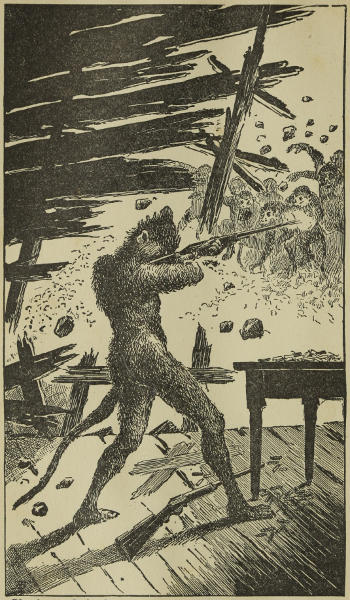
he heard a slight noise immediately in the rear, and
an instant later the loosening of his single garment
of skin told what a disaster had befallen him.
The hide was split at that place where it had been
most used by its former owner as well as by Philip,
and unless it should be possible to regain the dwelling
without turning his back to the troops the most
disastrous consequences might ensue.
Beads of perspiration stood on Philip’s brow as
he retreated to a gigantic bamboo, where it was possible
to hide temporarily what the apes might have
considered something more than an accident; and
during the remainder of the review he stood stiff
and upright, while his staff-officers gazed at him in
astonishment which was not mute, because of the
chattering they indulged in among themselves.
Philip understood that the first breath of suspicion
had fallen upon him, and instinctively he looked
around for a weapon, knowing that Goliah would
not be slow to take advantage of any opportunity
to regain the crown.
A stout piece of bamboo, which had been used
during the parade in lieu of a sword by one of the
officers, lay upon the ground where Philip could
reach it without exposing the fracture in his garments,
and seizing this he stood on guard, fully determined
to defend himself, even to the death, in
case his counselors or Goliah should insist on his
taking part in the maneuvers. That he would fall
a victim to their wrath the instant the deception was
made known by the rent was unquestionable; but
his kingly dignity might prevent the greater number
of his subjects from crowding too near.
In a suspiciously friendly manner Goliah motioned
him, when the troops were drawn up for the royal
salute, to advance and go through the ridiculous
antics which he had formerly executed on such occasions.
Philip placed his hand on his head, and then on
his stomach, as if to show that he was suffering from
pain. Although the other members of his privy
counsel appeared satisfied with such an explanation,
the huge baboon displayed the most lively curiosity.
He walked entirely around the king and the tree
against which the latter leaned, but at a respectful
distance, and then, returning, once more invited the
monarch to salute the soldiers.
Again was the pantomime repeated, and, understanding
this controversy could not long continue,
Philip motioned for the troops to resume their
march. He was well aware that because of Goliah’s
maneuvres very many had grown distrustful;
but it was something which could not have been
prevented, and his safety lay in reaching the house.
Owing to Goliah’s interference, however, the parade
was not dismissed as quickly as under other
and more pleasant circumstances. The troops
marched and countermarched, directed by the baboon,
until it seemed to the king, whose royal robe was
shrinking rapidly, that the pageant would never end.
The fifteen minutes which passed after his refusal
to salute seemed like so many hours; but the
soldiers were finally dismissed, and by a series
of the most extraordinary maneuvers Philip
succeeded in reaching the veranda of his dwelling
hardly more alive than dead, while clustered around
him, with anxiety or curiosity written on every
face, was a vast throng of apes, foremost among
whom stood Goliah, glaring in the most suspicious
manner, as if he fully understood the cause of the
king’s discomfiture.