A wiry, grave-faced youngster sat in the corner of
the railway carriage watching a stupid parent saying
good-bye to a stupid boy.
He was glad that nobody had come to see him
off, for he had now the satisfaction of knowing
that his own father was a father more worth having
than any other he had seen yet. Also he could look
upon the pitiable scene now being enacted before
him from the standpoint of one who at least could
be trusted to get into the right carriage without
leaping out by the other door to see if it were
really labelled “Harley” on both sides. This fat
boy had done that, and afterwards he had sat
down very heavily on a packet of sandwiches and
was unaware of it. The boy in the corner wondered
if they would be sticking to him when he
stood up. As for the parent of the fat boy, he stood
outside looking nervously towards the engine, and
his raincoat, which was unbuttoned, blew this way
and that in the breeze; once it had somewhat
foolishly knocked some buns off a push-cart. He
wore a hat poised far forward over his nose, and
he had flat feet.
Whilst the boy in the corner sat watching with
thoughtful eyes, the man broke suddenly into a
rapid clog dance and beckoned to his son. Above
the rat-a-tat of his feet upon the platform could be
heard his voice plaintively upraised:
“Arthur! Arthur! Come here! Jump out as
10quickly as you possibly can. I have something to
say to you.”
Arthur took just one glad leap into the open,
landing upon his father’s foot. Then, clapping his
ear against his father’s lips, he listened with a coy
interest to his urgent whispers, until he was suddenly
gripped by the elbow and spun upon his heel.
“Get in at once, my boy, get in at once!” his
parent was commanding. “At once, I say. The
train is about to go. Get in quickly ... quickly.”
Arthur fell in head-first, and arrived limply half
on the seat and half on the floor. Then he slowly
clawed his way on to the cushions and subsided.
But now once again there sounded that terrible
parent’s staccato voice. The unhappy boy was
hooked by the arm with an umbrella.
“It is not going yet after all,” he was told.
“Come out again. Come out for a moment. I have
something to say to you.”
The wiry boy in the corner began to feel sorry for
Arthur: he was perspiring so very freely. However,
there followed confidence after confidence until,
finally and for the last time, the father threw his son
bodily into the carriage like a sack of potatoes.
The blast of a whistle had reached his expectant
ears.
“Get in! Get in!” he was crying. “For goodness’
sake do get in! What a foolish boy you are.
You will certainly miss the train. Be sure to write.
Good-bye ... good-bye ... good-bye!”
Then the train was really moving out of the station
at last. Numberless boys in Harley caps were
scrambling into carriages, and as the little man with
the goatee beard gave one final wave of his glove to
his departing son, two young men cannoned into him
from behind, and his hat flew violently forwards
and outwards, causing him to make a somewhat
ludicrous exit from the boy in the corner’s field of
11view. Next the foremost of his assailants had
sprung for the carriage door and they had tumbled in.
One of the two seemed a little embarrassed at the
diversion they had caused, and sat down modestly
in a corner. The other wiped his forehead, and then
turned and beheld Arthur with both interest and
delight.
The portly Arthur was sitting stiffly upright and
staring at his ticket with wide protuberant eyes, the
while he trembled like unto one smitten with ague.
He looked up at the boy in the corner and gaped.
He tried to speak. Words failed him. At last a
low moan escaped his lips.
“My ticket! My ticket! Father has taken it
away with him and he—” he paused and collected
himself for a bellow of despair—“he has given me
his own return ticket to Ealing!”
The boy in the corner looked at him as if one might
have expected something like this would have
occurred after all that palaver, and the brief silence
that followed his sensational news was only broken
by a peculiar grunt that would not be stifled. Then
up spoke one of the late arrivals. Both were
evidently boys of some seniority and wore bowler
hats. The one who spoke now had a lean and
humorous countenance lit by strangely bright eyes.
“Nick,” said he to his companion, “look out of
the window. Do you see anyone coming?”
The young gentleman addressed as Nick was beaming
thoughtfully as if to himself, and he did not at
once obey.
“I will look myself,” said the other, rising impatiently
and leaning far out. “Yes, I can see a
cloud of dust. Right in the middle of it there is the
figure of a man bounding along the road at such a
break-neck speed that his feet are scarcely touching
the ground at all. It appears,” he added, turning
to Arthur, “to be your sportsmanlike father.” He
12coughed. “His chances of catching us are somewhat
small, of course. The train is now going at full
speed. Your father is certainly making a very fine
effort indeed ... his movements are not unlike
those of a good-class cat ... but he will, I fear, be
outdistanced by the puff-puff. Your father——”
The fat boy could stand this no longer. He
pushed his head fiercely out of the window under
the other’s arm.
“Where?” he demanded. “Where’s my
father?” He looked harder still. “Why,” said
he, “we’re only just out of the station. There’s
no cloud of dust at all.”
“No,” confessed the other. “Now that I come
to look with my other eye I must admit that I
do not see it so clearly myself. Still there might
have been. It is a pretty picture to conjure up—your
father absolutely running himself to a standstill
to get back his ticket to Ealing.”
After this there was silence for a little while.
The bright-eyed youth resumed his seat and appeared
to be thinking things over. He threw his
bowler on to the rack and passed a hand thoughtfully
over his hair.
At last he leaned forward, resting his elbows upon
his knees, and faced Arthur.
Then he inclined his head sideways towards his
fair-haired comrade.
“That robust-looking fellow over there is known
as Terence Nicholson,” said he, weighing his words.
“He has been three years in the Harley Cricket
Eleven, and now he’s in the Rugger side, so be careful
what you say. His brother’s called ‘Old Nick,’
and he’s a master at school. Very likely you’ll see
him walking along the footboards on his hands if
you look outside. My own name,” he paused, in
order to give added emphasis to the noble word, “is
Rouse.”
13He did not care to introduce himself as the probable
captain of Rugby football during the coming term,
for Rouse was not conceited about the things that
he could do. Oddly enough he was only conceited
about the things that he could not.
“A beak called Mould,” he announced, “once
told me when I was construing Latin that I had a
very inventive brain.” He tapped his forehead
significantly. “He was entirely correct. You see
in me a man who thinks for exercise rather than for
profit, and it will comfort you to know that I have
already devised a way of escape for you in your
astounding dilemma. I ask myself: ‘Now how is
this poor misguided creature ever going to pass
through the iron barriers of Harley with only a silly
little ticket to Ealing in his hand?’ And the
answer is this: ‘I will ask him to give that ticket
to me.’”
The fat boy reached out a trembling hand and
gave over his ticket somewhat fearfully.
Rouse took it and solemnly tore it into a hundred
pieces. The fat boy screamed.
“Oh, you’ve spoilt it!”
“Certainly,” admitted Rouse, “it is a trifle bent.
But why? Because now nobody knows whether it
is a ticket to Harley or the Federated Malay States.
Will they, however, suppose that you would be such
an ass as to buy a ticket to Ealing when you intended
proceeding to Harley? I think not. You have to
give up your ticket at the other end, and you’ll give
it up, that’s all. It will be in pieces, but there’s no
law against that. The warden at the gate will say:
‘Hi, here you! What’s this?’ and you’ll say:
‘That, sir, is my ticket,’ and you’ll pour it generously
into his open hands. He’ll never know. He’ll
think it’s a practical joke, scowl at you, and pass you
through with the toe of his boot.”
There was an awed silence. Rouse was well
14satisfied with the effect of his words. Suddenly
however there spoke up Terence Nicholson from his
corner. It was the first time that he had been able
to get a word in and he spoke modestly.
“Yes,” said he, “that’s all very well; only the
ticket to Harley is green and his ticket to Ealing’s
red. That’s all.”
There came a silence of several moments, whilst
those present considered this point with new interest,
and at last Terence shook his head regretfully.
“There’s always something wrong with your
schemes,” said he. “You don’t grow any older.
You don’t improve a bit.”
And thereupon there came a rush of air and a
roar and the train had entered a tunnel. The
light spluttered hopefully for a moment and then
died a natural death. They were plunged into
darkness.
At last the melancholy voice of Rouse was again
uplifted in a sonorous protest that came heavily
through the darkness as if in pleading:
“Well, you’re always very clever at picking holes,”
said he. “In common with the rest of Harley’s
populace you cherish that silly notion that except
for a certain knack in playing footer I am one of the
most useless and incapable creatures ever built. Let
me hear you make a suggestion, my lad.”
“Well, if you ask me,” said Terence, “I should
say, let him tell the truth.”
Rouse cleared his throat.
“Well, I think you may be right. It’ll be difficult
for anyone to believe that poor boy capable of practising
deceit. In fact one may say that he looks
strongly like a boy who could be depended upon to
forget his ticket.”
The train came suddenly into daylight again and
Rouse stopped abruptly.
The fat boy was weeping.
15Rouse stared at him for a moment, then looked
askance at Terence, and finally he turned a sternly
prefectorial eye upon the boy in the corner who had
hitherto somewhat escaped his notice. The boy
looked back at him a little uncertainly with a half
smile. He was not at all sure whether it was good
form to laugh at a boy who was crying. Rouse
gave him no hint. He just looked: and presently
the other blinked at him apologetically. Actually
Rouse was deciding, as he afterwards told Terence,
what a peculiarly good-looking kid he was.
“What’s your name?” said he at last.
“Carr,” said the boy in the corner.
“And which house are you going to?”
“Mr Morley’s, I think.”
“Over that house,” said Rouse, “I weave my spell.
Also Friend Nicholson there. We were in that house
when an arch-idiot named Mould ruled over our
form, and at one time I must confess we appeared
to be sinking. Yet, as we came up for the third
time, so to speak, he was removed, and we survived.
You’ll find Morley all right.” He turned to Arthur
a little awkwardly. “Don’t answer if you’d rather
not,” said he courteously, “but to which house are
you being admitted?”
The fat boy did not raise his head. He simply
continued to weep, and at last there broke from his
lips these sad words: “I want my t-t-ticket.”
Rouse fumbled in his pocket and at last produced
a small piece of chalk.
“Here you are,” said he. “Draw yourself one
on the wall.”
From that time onward the conversation was
maintained solely by the expectant captain of Rugby
football. Nobody else seemed to have anything
to say, but he had a great deal. Terence Nicholson
sat in his corner with the reminiscent smile of the
man one may notice in the stalls of any theatre—the
16man who has seen the show twice before but who
is enjoying it all none the less for that.
Bobbie Carr listened with deep and genuine interest,
but he said nothing. He was too hypnotised. His
large eyes followed Rouse’s every movement and
never wavered.
Arthur merely swayed backwards and forwards
in his seat, and sometimes when the train stopped
with a jerk he was jolted forward on to the knees
of the boy in the corner, over whom he hung with
sagging head; then when the train started again was
bumped back so that he cracked his skull against the
wall of the compartment, but he seemed not to care.
At last they reached Harley.
As soon as they had alighted the large figure of a
man suddenly appeared from nowhere and loomed
over them. The man was dressed exceedingly well
and exceedingly comfortably in Harris tweeds. He
wore a soft hat and a club tie, and his large feet
were enclosed in large brogue shoes. Even his
pipe was large. His hand reached out and rested
upon Terence’s shoulder. Finally he looked at
Rouse.
“As for you,” said he, “it’s no use you saying
you’re not there, because I can see your ears flapping
behind that grin.”
The gentleman addressed endeavoured to keep a
straight face, whilst from the near locality Arthur
was to be heard lamenting his ill-fortune and crying
aloud for advice.
For the last year or so Terence had been doing his
best to overtake Toby in point of size, but he was
still a trifle overshadowed by his brother’s large form,
and he stood beside him modestly, as if pleased to
claim a certain reflected glory. He could never see
any reason for self-conceit in the fact that he had
been three years in the Harley Cricket Eleven and
one year in the First Fifteen. The only thing he was
17really proud about was the fact that Toby was his
brother.
“There’s rather bad news,” said Toby at last.
“I’m afraid you’ll be very sorry.”
They looked at him inquiringly.
“The Grey Man has been very ill,” said he, puffing
slowly at his pipe, “and he’s not coming back.
We’ve got a new Head.”
The boy who had sat in the corner was standing
hesitantly behind them, and he was amazed to find
Rouse struck dumb. For Rouse just stood and
looked first at Toby and then at Terence, and it
was a long time before he spoke.
Terence asked quietly: “Who’s coming instead
of him then?”
And Toby answered: “He’s a man called Roe.
That’s all I can tell you.”
And then the pair of them seemed to consider the
news with a fresh gravity, until at last Rouse shook
his head sadly and said:
“I loved that man, you know.”
Coming from one who throughout the journey had
seemed to be merely a rather superior sort of clown,
this statement took Bobbie Carr by surprise. He
stood there beside his bag, watching with wide eyes,
waiting for more. But little more came. Rouse
was a young man who could never make up his mind
to grow up, and with the Grey Man he had never had
to don any hypocritical cloak of stiff severity just
because he was becoming one of the oldest boys at
Harley, and he had got along very well indeed.
Perhaps it was going to be different now. He
picked up his bag and moved slowly away beside
Terence, whilst Toby watched them go slowly and
sadly along the platform towards the barrier, and
as Bobbie followed after them he saw Rouse shake
his head solemnly and heard him say:
“It’s a bad business. A bad business. Except
18for Toby, he was about the only master who’ll ever
understand me, Terence, my lad.”
And when he knew them better Bobbie came to
realise that it was only in moments of considerable
gravity that Rouse ever called his friend by his
proper Christian name.
At the barrier Rouse turned. He seemed suddenly
to have remembered the fat boy. At last
he observed him making his way flat-footedly and
in extreme distress along the platform, and he
beckoned.
Arthur increased his speed and came up alongside,
breathing heavily and with his mouth open. Rouse
looked at him gravely. All the heart seemed to
have gone out of him. He drew the ticket-collector’s
attention to the fat boy indifferently.
“This boy,” said he, “has come without his ticket.
Will you chronicle the incident in your annals?”
The collector looked at him resentfully. In four
years Rouse had never yet passed his barrier without
saying something to him which he could not for the
life of him understand.
“Will you,” continued Rouse, “record his history
in your black book?”
The man turned patiently to the fat boy.
“You come without your ticket. How did you
do that?”
“He found it easy,” observed Rouse in a hollow
voice.
“What’s your name?”
Arthur trembled before the glare of the man in
uniform, and stuttered out the simple answer:
“Coppin.”
“What will he do?” he inquired of Rouse as
soon as they were clear of the station.
“He will communicate with the Headmaster,”
answered Rouse, “and you will never be allowed to
travel by train again.”
19And then he lapsed into silence. At last Terence
turned to look at him, and Rouse glanced up and
sighed.
“I shall miss the Grey Man,” said he. “The
school won’t seem the same.”
CHAPTER II THE GREAT GAME
20
Rouse was walking slowly from the school towards
the playing fields. He was clad in a blazer surmounted
by a wide school muffler, wound several
times round his neck, and upon his head he wore
a velvet cap heavily embroidered with brocade.
Rouse was at peace with all the world. The wonderful
thing had happened at last: he was captain of
Rugby football at Harley. That it would come had
been a foregone conclusion amongst those who knew.
Rouse himself had been a little doubtful. For one
thing he was not yet in the Sixth, and though he had
certainly been made a prefect in spite of this fact
the previous term, he knew that he was commonly
regarded as a boy who could see nothing but the
silly side of things. He had been sorry about this
because, in spite of his extravagant sense of humour
and his consistent lightheartedness, he could be
serious enough over things that really mattered, and
to him Rugger was one of the things that really did.
Only his closest friends were permitted to understand
this side of his character, for he was sensitive about
it, but he found that just as it pays one man to seem
a fool so it sometimes paid him to maintain a reputation
for irresponsibility. Toby and Terence knew
him best, and the Grey Man had grown to understand
him; extraordinarily well too. These had
known that if he were elected captain of football he
would make good. Moreover the school had wanted
him to be elected. He was easily the most popular
21player in the whole of Harley, and besides, he was
the most senior of the old colours, which was always
the main consideration in electing the new captain.
Well, they had elected him. It had been quite an
uproarious meeting, too; there had been no end of
enthusiasm. One small clique had certainly put up
another man whom they claimed was of equal
seniority in the Fifteen, but on hearing his name
proposed the gentleman in question had instantly
and somewhat confusedly refused to stand, loudly
disclaiming any desire to skipper a team which could
claim the leadership of a man like Rouse; and amidst
loud and approving cheers he had seized the hand of
Rouse and wrung it with the utmost enthusiasm;
after which his friends had been at some pains to
explain to their neighbours that they had only
mentioned his name to let him know that he had not
been entirely forgotten.
So Rouse had really achieved his great ambition....
It was hard not to chuckle. He progressed
steadily towards the practice Rugger ground, singing
gently to himself and picturing the season they were
going to have. Secretly he longed to organise some
great rag which should celebrate this event, for
hitherto his life had been largely made up of rags.
He realised now, however, that he would have to
steady down. He had to train a team and lead
them on the field, and he had to help Toby Nicholson
teach small boys Rugger. That would take all his
time, and for such employment it was worth while
foregoing rags.
Presently he came within sight of the football
ground that was his destination. Already a crowd
was spreading along the touch-lines. He fingered
the switch in his hand with affection. This switch
had seen very good service, for it had been handed
on from captain to captain from time immemorial.
You may have thought that Rouse was about to
22play Rugby football. He was not. He was about
to teach it. On the first day of each winter term at
Harley (and also on other days throughout the
season) two teams are selected to compete in a
practice game, and they consist of small boys and
idle boys and new boys. The excuse that some of
these may not know Rugby football is of no account.
They attend for instruction, and the remainder of
the school line up with their waistcoats comfortably
loosened in order that they may laugh the more
heartily. The games master referees and the captain
of football is armed with this switch, a cut from which
is awarded, on the occasion of each scrum, to the
last man into it, whilst whenever a three-quarter
becomes possessed of the ball he is pursued up the
field by this selfsame man, running rapidly and
urging him with word and gesture and such occasional
flicks of his switch as cause each boy, before the
game is done, to feel himself possessed of a demon of
speed and agility. There is also a cut for any boy
who, in making a tackle, fails to go for his man at
the knees. It may be noted that old Harleyans
attribute the great success of the school at Rugby
football very largely to the excellent effect produced
by the captain’s switch in junior games; and one
famous international has laid it down that in any
big match in which he has broken through with the
ball upon his chest he has invariably reached by
instinct for that extra yard of speed which comes
from the fear of a young man racing behind him
with a switch, and has thanked his Alma Mater that
he was taught to do so. Nor will you ever see an old
Harleyan last into a scrum or tackling high. It is
a good sign.
The crowd made way for Rouse admiringly, and a
characteristic smile, which in a young boy would
have looked more roguish than anything else, began
to appear at the corners of his mouth. In a game
23like this Rouse was in his element. He looked
thoughtfully round the players and finally glanced
up and down the touch-lines as if in search of any
who had evaded his clutch. There came a ripple of
amusement. Some of those present recalled that
on the occasion of the corresponding match last year
those who laughed the most uproariously from the
touch-line had been marked down by Toby Nicholson’s
eagle eye during the game, and at half time had been
called upon to perform themselves. It was possible
that this would occur again, and throughout the
world those who have once succumbed to any catch
are the keenest layers of the trap for the next man.
At last the whistle blew. Next moment Rouse
had skipped nimbly into the midst of things, encouraging
all with loud cries, and the idea of the
switch in Rouse’s exuberant hands caused a great
and lasting enthusiasm amongst the players that
was exceedingly stirring. Forwards fought for a
place in the front row of the scrum, and many
a youth who thought himself likely to be considered
late might be heard loudly declaiming the fact that
he had already packed down once, but finding himself
the fourth man in the front row had been compelled
to retire.
At last one line of three-quarters was fairly away
with the ball, and Rouse went racing across from
one to the other, whirling his arm to ensure that each
man took his pass at top speed. Ultimately the
wing received the ball, and being entirely new to the
game clearly did not know what to do with it. For
a moment he paused and looked round in sheer
bewilderment. It was fatal. There came a rush of
air, and Rouse was up alongside, driving him forward
and shouting aloud definite instructions. A tall
thin boy came towards them and made his tackle;
in a mad moment he went high. Too late he realised
his mistake. Out of the corner of his eyes he was
24conscious of the switch, and his hands slid down to
the runner’s knees and tightened their grip till both
came to the ground and rolled over and over, whilst
the ball flew forwards and was gathered by an excited
youth in abnormally long knickerbockers of homemade
design. Then, high above the laughter of the
crowd, there sounded a great bellow, something akin
to the cry of a thoroughly mad hyæna. At first it
was difficult to locate. Rouse paused and his eyes
passed swiftly down either touch-line. The laughter
stopped, and he stepped out and cut lightly at a
boy who had just received the ball in his hands and
had not got away so smartly as he should. The
game proceeded. Now and again that loud, extravagant
laugh sounded across the field and caused
others to turn in search of it. As a noise it was
altogether novel. Evidently some poor boy was
absolutely unable to control his merriment, and
unaware of the fate that would follow him he gave
it full rein. At last there could be no doubt who
was doing it; the laugh became a magnet. Every
head was turned towards it. Half time came, and
Rouse spun on his heel and located it definitely. He
walked across. On the touch-line he stretched out
his hand and pointed out the unfortunate creature.
It was the boy of such surprising fatness, the stupid-looking
boy, and he stopped laughing abruptly.
Toby Nicholson had moved up alongside Rouse.
“Look here,” said he, “why is it you are not
playing?”
The fat boy shook his head.
“I don’t play that game.”
Rouse thrust his hands into his pockets and
nodded his head.
“Ah,” said he, “many a man is walking down the
Strand to-day with the linings of his pockets hanging
out, many a lordly mansion has been crumbled into
dust, many a stately avenue of elms laid low, many
25a boy will be knocking at the door of Dr Barnardo’s
Home to-night ... all because somebody hasn’t
learned the lesson of Rugby football. Do you know
that?”
“Why, no,” said the fat boy quakingly.
Toby had produced a small book.
“Your name?”
“Coppin, sir.”
“Go quickly to the changing-rooms and attire
yourself for the fray. You will be just in time for
the second half.”
“But I ... I ... I can’t play this game.”
“You will soon learn,” said Toby consolingly.
“Time was I didn’t know how to play it.” He
turned. “You see that boy over there in the long
knickerbockers? That boy’s name is Henry Hope.
That boy will never learn how to play Rugby football.
He has every disadvantage. For one thing he is
short-sighted. He cannot distinguish one jersey
from another. He tackles his own side. It doesn’t
matter. He plays the game just the same and he
says that it does him good. You’ll find the same.”
He turned to Rouse. “You’d better take this
young sportsman to the changing-rooms and fit him
out with togs.”
Rouse moved alertly to the fat boy’s side and
piloted him out of the crowd and rapidly across the
field towards the changing-rooms; and as he went
he bubbled to himself delightedly. He turned at
last and regarded the unhappy Arthur.
Arthur’s trousers were short and very tight. The
sleeves of his coat reached midway between the elbow
and the wrist, the buttons of his waistcoat were
straining in the leash, and his neck bulged over
the top of his collar. The pace was too much for
him. He began to pant.
“You’ll feel better with your clothes off,” said
Rouse encouragingly. “Hold your breath for just
26a few minutes longer; you’ll be able to let off steam
properly as soon as you’re unfastened ... and you
will look bonny in shorts.”
He chuckled.
“What is going to happen?” demanded Arthur.
“What are they going to make me do?”
“Run,” said Rouse hoarsely.
“Shall I be thrown to the ground like those other
boys?”
“You will be thrown to the dogs,” was the
immediate answer.
“Oh, but it’s such a rough game. I shall be hurt.”
“What? You? Never!” Rouse assured him.
“Everybody who falls on you will think you’re an
air cushion.”
Further bursts of laughter reached them from
across the open, and they turned. To the fat boy’s
satisfaction other stragglers were being led in his
own track. There was a tall thin boy, and a square
boy with hair like hay, and an ordinary-looking boy
and an extraordinary-looking boy. They had all
been sorted out. He supposed they had all been
laughing. Arthur turned back. His world was very
drear. He was filled with acute foreboding. They
had reached the changing-room. He was led in.
Here, so far as those who were waiting on the touch-line
were concerned, the curtain fell. At last it
was lifted again. The sight was astounding. Arthur
was being led back. Behind him came the other boys
who had laughed so heartily, but they were unimportant.
Arthur held the eye. His extraordinary
fatness was now entirely disclosed. Wherever it
was possible to bulge Arthur bulged. And his eyes
were bulging most of all.
Rouse held him by the arm. Evidently he had
had some difficulty in fitting Arthur out, but he was
apparently well pleased with the result.
Toby met them and spent a few moments in outlining
27the theory of the game for Arthur’s benefit.
Arthur nodded his head dolefully. It was clear that
he had not another laugh left in his system. Also he
looked cold.
He was led on to the field. The other new-comers
were sorted out and instructed to replace some of
those who had had enough of it. Then the whistle
blew. There came a thump of a boot meeting
leather and the ball was sailing towards Arthur. For
just one second Arthur regarded it stiffly, transfixed
with horror, then he turned and ran rapidly in the
other direction. There was a howl of derision.
Arthur turned. There was no way of escape. The
ball was bouncing after him. It was like a nightmare.
From all sides of the field boys were rushing
towards it. He gave one choking cry, threw up his
hands and fell heavily on his face. Next moment a
swarm of forwards had crowded round him and were
packing down over his prostrate body. Somebody
seized him by the leg and pulled him out of the way.
He rose and looked round him with wild eyes. His
hair was ruffled. There was mud upon his nose.
Rouse came up and explained to him what he
ought to have done. He looked at Rouse dazedly.
Rouse inserted him bodily into the scrum, head down,
and told him to push.
He fell on his face. Rouse picked him up, and he
tottered and fell on his back. The game went on
and left him there. Rouse shouted to him, and he
rose and stood for a moment with boggling eyes and
nodding head, thinking. Toby pointed into the
distance and spoke cheering words.
“Chase after it, man! Scoot! Catch ’em up!”
He began to trot foolishly up the field, with Rouse
behind him. And then suddenly the ball came
sailing towards him again and dropped directly on
to his chest. He clutched at it as if for support and
Rouse let loose a loud shout of delight.
28“NOW! You’re off. Nothing can stop you!”
He whipped him gently into a gallop.
As if suddenly imbued with the spirit of the game
Arthur began to show determination. A boy flew
at him. Arthur handed him off with violence.
“Let me alone!” he cried, suddenly very wrath.
Another essayed to tackle him. Arthur struggled
clear of his grasp but overbalanced and let go the
ball.
Immediately another boy had sprung forward
and gathered it.
Arthur shot after him. He suddenly understood.
Everybody was against him. He had to get the
ball and everybody was trying to steal it away. The
sole idea of the game was that he should be allowed
to run about the field holding the ball, and they were
all cheating. They wouldn’t let him do it. He
caught the thief by his jersey and tugged him back.
His fierce cries sounded across the field.
“Give it to me! Give it to me! Give it to me!”
He had nearly got it. Somebody pulled him back,
and he struggled in his grasp.
“Let me to the ball,” he besought, sobbing with
bitterness. “Oh, let me to the ball.”
So they stood back and let him to the ball. Rouse
had signed to them.
He had it at last.
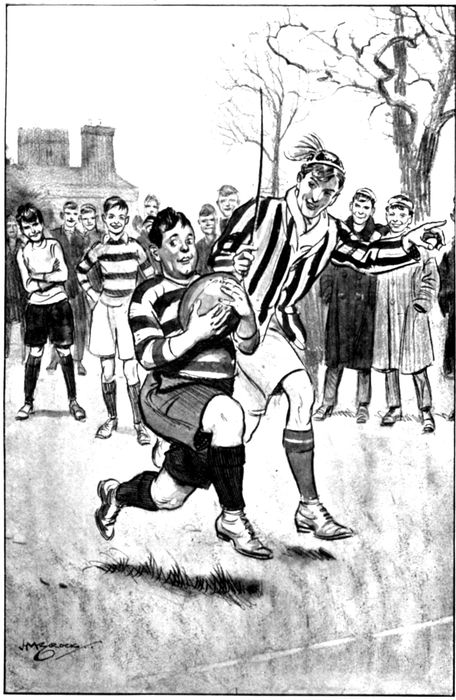
He smiled gleefully. He begun to trot up the field
like a pup with a slipper. He looked from side to
side as if for applause, began to raise his knees
higher and higher from the ground. Rouse ran
joyously beside him, pointing out the distant goal-line
as if it were a promised land and instructing
him what to do.
He was delighted beyond measure. He did not
know that everybody was standing about the field
watching him go, and trying to throttle hysteric
laughter. He thought that he was the hero of the
hour. At last they were nearly there. It was a
good thing because he was beginning to puff.
“HE BEGAN TO TROT UP THE FIELD LIKE A PUP WITH A SLIPPER.”
29“Put it on that line,” said Rouse. “Put it down
there, then touch it down.”
He had arrived. He bent obediently and did as
he was bid.
“There you are,” said Rouse happily. “You’ve
scored a try.”
Arthur turned and looked round and about.
Everywhere boys were throwing caps into the air
and cheering. It was a great moment. Toby had
come up and seemed to be speaking to him, but in
the wild noise of applause he could not distinguish a
word. He grinned broadly.
At last the thunder of cheers died down.
“That’s Rugger,” said Toby. “It’s a great
game. Don’t you think so? You’ll play it all
your life now. That’s your first game and you’ll
never forget it.”
He never did. Nobody who learns Rugger at
Harley ever does.
The boy who had sat in the corner had been learning
Rugger that afternoon too, and as he walked
slowly off the field a tall fellow, considerably older
than he, came up and touched him on the arm.
“What on earth are you doing here?”
Bobbie Carr looked up, then slowly seemed to
remember, and to the other it appeared that he turned
a little pale. At first he made no answer. He just
looked. Eventually he turned away.
The other still held his arm.
“D’you mean to say your father has sent you
to a public school?” said he.
He was not a nice-looking fellow. He had a remarkably
long and disproportionate nose. Also his
lips had a sarcastic turn. His name was Coles.
“This is good,” said he, and gave a short laugh.
30“I must write and tell the gov’nor about this. He’ll
be awfully amused. What do you think the fellows
here will say when they know what your father is?”
Bobbie Carr looked straight up at him, but there
was a queer look of anxiety on his face.
“They’re not going to know,” said he at last.
“I’ve promised I wouldn’t say.”
“I should think so,” said Coles. “You won’t be
very happy here when they find out he’s a——”
A figure came up suddenly from behind and moved
between them. A large hand rested upon Bobbie’s
shoulder.
“Well, sonny,” said Rouse. “How did you
enjoy it?”
CHAPTER III COMING EVENTS
31
The new Headmaster of Harley was a man of considerable
importance and an overpowering belief in
himself; for which reason he formed hasty opinions,
and having once formed them believed them to be
correct for ever afterwards. In appearance he was
not unlike a bloodhound in spectacles, and his
manner was appropriately grim.
The first case that came before his notice was
that of Arthur, and he dealt with it in person.
“Because,” said he, “at Wilton I had the reputation
of knowing each boy individually, and I should
like to know each boy here as soon as I possibly can.”
The railway company had reported that Arthur
had had the audacity to travel upon their line without
a ticket, and Arthur was accordingly brought
in and required to furnish his explanation of the
outrage. This he did in the most heart-rending
manner, with second-hand sort of tears spurting from
his eyes all the time, and with such effect that, after
listening to his pitiable tale, the new Head became
convinced that he had been set upon in the train by
a cowardly ruffian belonging to the school, and apparently
even a prefect of it, who had wrenched his
ticket from him by brute force and torn it to shreds
before his very eyes. Arthur went so far as to give
detailed information. The felon’s name was Rouse.
He had introduced himself. And he was a friend
of a boy called Nicholson, whose brother was a master
at school.
32The new Head sent him away with a comforting
pat on the shoulder and settled himself down to
consider a fitting punishment for the scoundrel who
could do such a thing.
Now as luck would have it, that afternoon he was
standing in majesty beside his window, looking out
upon the kingdom he had come to govern, when his
eye lighted upon a Rugby game in progress upon a
distant football ground, and he suddenly came to
an abrupt decision.
“At Wilton,” he told the bursar, “I had the
reputation of only going out to watch games when I
was least expected to do so.”
He nodded his head pleasantly.
He would take the boys of Harley completely by
surprise. He moved swiftly to the door and disappeared.
As a matter of fact it was, in the result, he himself
who was taken by surprise, and he returned with
a dour expression and sent for Mr Nicholson.
Toby appeared before him in due course.
It was immediately clear to Toby that in Dr Roe
he perceived a gentleman with a strong sense of
dramatic effect, and he now stood by and prepared
to watch what he imagined would be a very powerful
piece of acting, indicating wrath.
The Head was, however, deep in thought, and
whilst Toby waited he noticed several little things,
the first of which was that the carpet did not match
the colouring of the new Headmaster’s nose. He
also noticed that Dr Roe’s handwriting sloped backwards,
which he knew for a bad sign in any man.
He then adjusted the hang of his trousers, blew his
nose, wiped his eyes, and commenced to count the
roses on one square yard of the wall-paper, first with
one eye and then with the other. Finding that the
result was the same in each case, and deducing therefrom
that his sight was still good, he cleared his throat
33and approached the wall with a view to observing
school life from a window.
As soon as he had turned Dr Roe broke into speech,
thus to Toby’s mind having him at a disadvantage
from the start. When Toby distrusted a man he
liked to look in his eye all the time.
The new Head rose slowly to his feet, lifted one
hand until it was a suitable height from the table,
clenched it and brought it down with a bang upon a
large book. He then lifted his hand again, shook his
finger at Toby as if in reproach, and began to speak
rapidly.
“Only this morning,” said he, “I had a little boy
before me who had undoubtedly come up against a
bully. He was terrified. He came in here and cried....
He had been set upon in the train and robbed of
his ticket. At Wilton I had the reputation of being
a lightning judge of character and an infallible one,
and I can tell you at once that this boy was undoubtedly
speaking the truth. In ten minutes’
conversation I came to know him as well as he knew
himself, and I shall watch over him henceforward
with interest.” He paused. “I decided,” said he,
“to delay punishment of the offender a short
while and to get to know more about this bully
whilst he still had no reason to suppose that his
conduct was known to me. I may tell you that at
Wilton I had the reputation of knowing how to
wait.”
This seemed to Toby a very useful second string
to any man’s bow. Dismissed from the post of
Headmaster, Dr Roe would at least be able to find
lucrative employment in a smart restaurant.
However, he made no comment.
“This afternoon,” continued the Head, “I went
out to watch the boys playing football. Certainly
I did not arrive till after half time, but I may tell
you that to my mind the game I then witnessed
34was mere tomfoolery—a burlesque, sir—deliberate
clowning.”
“Yes, sir,” said Toby cheerfully. “It was the
first game of the term. New-comers sides.”
“Then, perhaps, you will tell me,” said the new
Head somewhat hotly, “the name of the presumably
senior boy—a fellow in a tasselled cap anyway—whose
whole object was to get in people’s way
and interfere in the game as much as possible, and
who did it, moreover, purely to vent his spite against
the very boy who was before me this morning?”
“You mean Rouse,” said Toby. “He’s captain
of foot——”
The Head rose up and made a fiery gesture.
“I knew it,” said he. “I knew it. They used to
say at Wilton that my sense of instinct was uncanny—they
used to say that I always guessed right. I
guessed right this afternoon. As soon as I saw that
little boy being pursued about the grass I knew it
was Rouse.... I knew the little fellow had been
speaking the truth. Rouse, Mr Nicholson, was the
name of the fellow who tore up his ticket on the
journey from London.” He paused sensationally.
“It may be,” said he, “that you were engrossed
with your duties as referee this afternoon. Possibly
you did not notice that feature of the game which
was most evident to me. Throughout the twenty
minutes that I was there the fellow Rouse was on
the little boy’s track without respite. I personally
saw him viciously cane the lad on the field, and a
worse example of flagrant bullying has seldom come
before my notice.”
Toby cleared his throat and began to explain.
“I don’t care one atom about custom,” said the
Head, when he had listened thirty seconds. “I may
be new to this school but I am not an idiot. Public
School customs are in constant abuse—take this very
example. You teach Rugby football with a switch.
35The first thing that I notice is that a senior boy,
against whom evidence has already been laid, is
deliberately using his switch to terrorise a little
boy.”
“Oh no,” said Toby, with a polite smile.
“You’re——”
The Head made another gesture.
“Oh yes,” said he, with considerable force.
“Surely I can use my own eyes!”
Toby began again.
“Don’t argue, Mr Nicholson,” said Dr Roe. “At
Wilton I had the reputation of rarely showing my
temper, but of showing it very thoroughly when it
was roused. And it is roused now. Do you mean
to tell me that this boy is actually captain of football?”
“Yes,” said Toby mildly; “and a very good
captain too. He’s one of the most popular boys in
the school.”
The Head was somewhat taken aback.
“Well, at all events,” said he, “I don’t remember
noticing him in the Sixth Form.”
It was an awkward point. Toby moved slightly
upon his feet. He was not going to confess that
Rouse was one of the school’s pet dunces.
“He’s not in the Sixth Form yet,” said he.
The Head clapped his hands and sprang nimbly
from one foot to the other.
“Then,” said he, “how can he be captain of
football if he’s not even a prefect?”
“He is a prefect. The late Headmaster specially
wished him to be. He knew that he would be
captain of football this term, and he considered it
would be a very good thing indeed for the boy’s
character. Of course the captain of each sport here
is a prefect ex officio, whether he’s in the Sixth or not,
and the Head wished him to have a full term as a
prefect before he became captain of Rugger.”
36The Head considered this point with a portentous
frown, and at last he looked up at Toby and said:
“I think you had better know at once that those
are not my principles. To my mind the boy who
leads the school team on to the field of play should
be the boy who is captain of the school, and if by
any chance he himself is not a very keen footballer,
then the next senior boy should take his place. Boys
have to be made to learn that being able to kick a
football in a certain direction with a certain force is
not everything in life. And they learn that best if
they find that a boy is not allowed to be captain of
football unless he is also one of the most senior boys
in the Sixth Form.”
He paused and sat down like one who is conscious
of having performed a righteous duty. Toby began
to go hot and cold all over.
“Every school has its unwritten laws, sir,” he
began. “It has always been the understanding here
that each game is captained by the boy who is best
or most senior at it, irrespective of his scholastic
ability.”
The Head grew visibly annoyed.
“I have already told you that I do not agree with
that principle, Mr Nicholson,” said he; “and to-morrow
I shall visit this boy’s form and question
him on his general knowledge. It remains to be seen
from the opinion I then form whether I consider
him a suitable boy to remain a prefect under my
headmastership, or to lead the school on the football
field. I must say that from the judgment I formed
of him this afternoon he is most unsuitable for those
duties.”
Toby essayed a protest.
“But, sir,” said he, “this boy has been elected by
the school.... He is their chosen captain.”
Dr Roe rose in his majesty. Unfortunately he
was a man of somewhat ordinary build, and as
37against Toby, therefore, he did not in this respect
cut much ice. He lifted his hand above his head,
and bringing it slowly horizontal, indicated Toby with
a bunch of fingers.
“Mr Nicholson,” said he, “whilst I am Headmaster
of this school no boy is elected to any position
without my authority. I have been a schoolmaster
all my life, and at Wilton I had the reputation of
making sometimes apparently ruthless decisions and
of sticking to them through thick and thin. I do
not crave popularity.... I have strong ideas and
a strong will. If necessary the boys here will be
made to understand that at once. It may save
considerable heart burnings afterwards.”
He paused and glared at Toby as if in challenge.
Toby declined with thanks. It was clear that he
would not improve matters by saying more at the
moment. There was a brief silence. At last the
new Head looked up.
“There is another thing,” said he. “I like games
to be taken seriously. Such frivolity as I saw this
afternoon tends to have a very bad effect upon a
boy. I hope you will bear that in mind in future
games which you conduct.”
Toby drew a deep breath.
“I think you will understand better, sir,” said he,
“if you will listen to me for a moment. The boy
that you think was being terrorised had been laughing
as loudly as any boy possibly could throughout
the first half, whilst other boys with a better spirit
were learning to play.”
“Well,” said the Head crossly, “considering he
was crying only this morning, why shouldn’t he laugh?
I am very glad to know that his talk with me had
so reassured him.”
“It is a bad thing,” said Toby, “for boys who are
learning a game to be laughed at from the touch-line
by those who don’t care to try it themselves. Rugby
38football is compulsory at this school, and that fact
has a very excellent effect. It was I who told him
to come on and play. There was no bullying.”
“My dear Nicholson,” said Dr Roe, “I have been
a schoolmaster longer probably than you have been
alive. Do you really think that I do not know a
bully when I see one?”
Toby endeavoured to retain his calm.
“It is possible to be mistaken.”
“I am not mistaken,” snapped the other.
“But you see, sir,” insisted Toby, “you haven’t
even spoken to Rouse.”
“Because,” said Dr Roe, “I wish to learn all I
possibly can about him before I do. I have spoken
to the other lad, and I am satisfied that he is telling
the truth. I have seen this fellow Rouse making
himself a clown at a football match, and I have learnt
from you that, although he has been five years at the
school, he is not yet in the Sixth Form. It is clear
that you have a good opinion of him yourself, but
you are, after all, a young man, Nicholson.”
“What has that to do with it?” asked Toby
smilingly.
“Well ... I understand,” said the other, “that
this boy is the bosom chum of your own brother;
and it is therefore not unlikely that he is a friend of
your own....” He looked at Toby searchingly.
“Under these circumstance, I cannot altogether
expect that your good opinion of him is entirely unprejudiced.”
“Then,” said Toby, “why did you trouble to ask
my opinion, sir?”
“I sent for you,” said the Head, “because you are
games master, and I want to tell you that I do not
approve of such buffoonery as took place during the
game this afternoon.”
Toby’s natural inclination was to bow politely
and ask leave to pack his bag. But it was at just
39such a time as this that his love for Harley grew most
profound. So he kept silent, and he stood for a
moment looking at the new Headmaster thoughtfully
and as clearly in pity as he deemed polite.
“Do you wish to see Rouse?” said he at last.
“Certainly I shall see Rouse—but I shall not
see him here. At Wilton I had the reputation of
never doing the expected. I shall walk across to his
house and speak to his house master. Then I shall
visit him in his study. When you are older,
Nicholson, you will know that it is in his own haunts,
and when he is not expecting visitors, that you find
animal or man as he really is.”
Toby’s heart sank. He looked dismally into the
future and he could see no sunshine at all. With a
Headmaster like this there could be no hope. It
was going to be a lean year.
Well, if it was a question of Harley’s principles
going under to a man who merely sought to make a
sensational entry into the school, he would have to
fight. And in the immediate future he would have
to fight for Rouse. So in his mind’s eye he made a
few movements as of a sailor about to start a hornpipe
and followed the Headmaster out of the room.
Dr Roe turned.
“That will be all, Mr Nicholson, thank you,” said
he. “I will go alone.”
CHAPTER IV A SLIGHT MISTAKE
40
The procession came down the corridor and stopped
outside a small door. It was headed by a tall boy,
as thin as a match-stick, and with a face so tiny that
it seemed to be almost entirely hidden behind a pair
of enormous spectacles which he wore tied round his
ears with knotted elastic bands. Behind this boy
came another of his own age, but less extraordinary
in appearance, and behind them, in their turn,
came Rouse and Terence Nicholson. The boy in
spectacles rejoiced in the name of Henry Hope, and
he claimed to have been the devoted admirer of
Rouse and Terence longer than anybody else in the
school. Certainly no other boy would have dared
to go and roust the captain of Rugby football out of
his sanctum merely in the hope that he would set
right a small minor trouble of his own. It is true
that the fact that Rouse happened to be the said
captain made a certain difference. Rouse was everybody’s
friend and particularly the friend of unhappy
juniors. But what made the chief difference was
the fact that one of the boys in trouble on this
particular occasion was Henry Hope.
Henry drew his crony aside, and they stood for a
moment looking at the two seniors in turn with
eyes that shone with admiration, until at last Rouse
spoke.
“Yes,” said he. “This is the one all right.
No. 18, the list said. There can’t be any mistake.”
41“Are you sure that it said No. 18?” asked
Terence modestly. “Seems rather odd.”
“My good sir,” responded Rouse, “there is no
doubt about it.”
He moved forward and opened the door. Terence
came up alongside and they stood for a moment
regarding the interior.
“Well, it isn’t a bad one,” said Terence at last.
Rouse regarded him with deep sorrow.
“You are a sunny child.”
“Sunny?”
Rouse nodded his head.
“You look on the bright side, the side that jolly
well isn’t there. Myself, I cannot conceive how by
any freak of fancy Henry could possibly have secured
a worse hovel than this. It is the first time he’s
ever had a study, and now he’s got one that they’ve
forgotten about so long that it’s gone to seed.
There’s moss growing on the very walls—moss, I tell
you. Look at the fireplace. It’s a kind of ‘Spiders’
Retreat.’ They say there’s no study for him, and
then after three days they say there is, and they give
him one—this—a kennel in the attic. There’s not
a stick of furniture in it. True, there’s a picture
postcard on the mantelpiece depicting some phase of
life in a foreign clime—a man in a red fez picking
hops, I think it is. You’ll probably find it’s addressed
to some fellow who’s since died of old age.
And it’s the only sign that there’s ever been any life
in the place at all. I do not see even a modern nail
anywhere in the wall to hang your hat on. There’s
probably an official ghost attached to this study.
The place is absolutely mouldy. The ceiling has
caved in and the walls have warped, and the fellows
who’ve had studies near here at odd times during the
last forty years have been in on organised raids and
pinched every blessed thing.” He paused at last
for breath. “And you,” he said presently, “you—always
42the gentleman—you—such a one with your
joking ways—you open the door and look inside,
and then you throw back your head and intone the
following words: ‘It isn’t a bad one.’
“Well, it’s better than not having a study at
all.”
“Indeed it is,” admitted Rouse. “How nice it will
be to sit in here on one’s bowler hat, drinking cold tea
out of a glove.”
“We’ll rake round for a table for him,” suggested
Terence hopefully.
“Yes, and the only way you’ll get one at this
period will be by sucking the multiplication table
off the back of an exercise-book. It’s three days
since term started, my dear old bean.”
Terence persisted.
“I’ve got some photographs in my bag,” said he.
“We’ll put them up.”
“Put ’em up? Easier to put them up than for
poor old Henry to put up with them. He’ll get
pretty weary sitting in here never more than eighteen
inches away from his partner as it is. Is his only
relaxation to be a turning of the head to gaze upon
your likeness on the walls?”
“They aren’t photographs of me.”
“Whom, then, do they portray?”
“One,” responded Terence, with every modesty,
“portrays Phyllis Dare in evening dress.”
“Right,” said Rouse more kindly. “Put it up
then. Have you any other delight you can stick
on the wall for him?”
“Not in my pocket at this moment. But I’ll go
and see Toby. He might be able to produce something.
If not, perhaps he can hire a bit of furniture.”
“A piano, perchance,” said the other. “There’s
plenty of room.”
“Anyway,” said Terence, “I’ll go and see him.
Probably he can suggest something.”
43“Very well, my child; and if you see anybody
who seems to be at a loose end at all whilst you’re
gone, ask him to come back and have a really comfortable
sit-down with Henry and a nice cup of hot
tea.”
Terence moved away obediently, and when he had
gone Rouse took one final look at the study, tossed
his head and then, coming to a sudden decision, bade
Henry stay there with his friend and wait; then he
walked rapidly away down the corridor in search of
the house porter, an individual for whose resource he
had considerable admiration, partly because he could
put lighted matches into his mouth and clench his
teeth without putting out the light.
The house porter, who had been at the school only
a little over twelve months, was one of those gentlemen
that are described in police court reports as
“of military appearance,” which means to say that
his hair was dressed in that fashion known as a cowlick,
and that his moustache was waxed. On hot
days, however, this wax used to melt, giving his face
a somewhat mournful and untidy appearance. His
name was Compton, and at the moment when Rouse
burst in upon him he was sitting on a stool in his
private den, his knees hunched up under his chin
and his eyes fixed rigidly upon the letterpress of a
paper-covered novel which he was clutching earnestly
in his fists. He did not at once look up, and when
eventually he sensed the presence of an intruder
he seemed a trifle annoyed. Nevertheless, Rouse
greeted him with a variety of graceful gestures before
he eventually said his say.
“Acting upon information received,” he explained,
“Mr Nicholson and I have just prised open the door
of the study allotted to a little boy called Hope,
with a view to inspecting its desirability as a residence;
and all we have found inside is the portrait
of a man in a red fez picking hops.”
44He paused and coughed deprecatingly behind his
hand as if loath to complain. Compton looked at
him dazedly. Clearly he had not yet thoroughly
extricated himself from that romantic world in which
men live perpetually in evening dress and speak
glibly of their college days. He rose and laid down
his novel with a sigh.
“The incident has somewhat unnerved my friend
Nicholson,” said Rouse apologetically, “also the
boy Hope, and I was quite unable to persuade either
of them to come and consult with you. I myself
thought that you, if you could, would aid the lad in
his dire extremity. You might even be able to tell
him where he could find something to sit on—anything
would do so long as it hasn’t too many
rusty nails in it.” He reached out and indicated
Compton’s stool suggestively. “That, for example,”
said he, “would suit excellently. We have the
whole evening before us, and it would be very enjoyable
indeed for him to have a good sit-down after
his game of football.”
Compton turned and looked first at his stool and
then at Rouse.
“What is it you want, sir?” he inquired somewhat
uncertainly.
“It’s a study,” said Rouse. “There’s no furniture
in the place at all.”
“Study?” repeated the patient fellow. “But
ain’t there a table and a couple of chairs in it?
Surely——” He began to fondle his chin. “Why,
every study has a table and a couple of chairs.”
“I expect this one did have a long time ago,” said
Rouse, “but if so they must have died in infancy.”
“They may have been stole.”
Rouse considered this point with care.
“Of course,” said he at last, “it’s only a hole in
the attic that I’m talking about. It may not be
on your list of studies at all. To the naked eye
45it looks more like a family vault in some cheap
cemetery.”
Compton produced a pipe, filled it, and struck a
match; then he made his confession.
“Well, I can give you a table and a couple of
chairs. As a matter o’ fac’ I’ve got some spare, and
I’ve been wondering for a long time which study they
belongs to. Over and over again I’ve reckoned up
all the studies, on the fingers of my ’ands, and then
all the tables and chairs, and they never come right.
There was always a set over.”
Rouse’s face cleared instantly. He held out his
hand.
“I warmly congratulate you, Compton,” said he.
“Let me pilot you to the place forthwith. You had
better bring some sandwiches and a bottle of beer
with you, as it’s rather a distance and you might be
glad of some light refreshment half way.”
He paused as they were about to leave and cast
one last look round the little room.
“Compton,” said he, “would it be too much to ask
whether you could lend Master Hope your little stove
for the afternoon? To-morrow everything will be
in full swing and he will be serving a cut from the
joint with two vegetables from his own fireplace
practically without cessation all day. But we must
give the organisation time to settle down. We should
not like you to have to hump along a sack of coal
to-day, for example. But we should very much
like to have a cup of tea with Hope in his sanctum,
and as a matter of fact a few friends are visiting
him.”
Compton cast a glance over his shoulder.
“I’ll give him a bit of coal,” said he. “If it’s a
little place in the attic he’s going into he’ll want a
bit of a fire in there to dry the place up and vent’late
it a bit.”
“It would, I am sure, be enough,” said Rouse,
46“if you could only give him a bit of red carpet to
warm his cold feet on.”
When at last they all met again, the expression on
the face of each made an interesting study. Henry
Hope was characteristically grave, and he stood with
his crony watching Rouse with the eyes of a faithful
dog. Terence was last to return, and he wore the
expression of one who has some secret joy, whilst
Rouse himself, who had been working exceedingly
hard, looked hot and untidy. Nevertheless, his eyes
were shining with the light of intense self-satisfaction.
It was clear that he was itching to deliver himself of
a few well-chosen words such as might indicate to his
listeners the peculiar ingenuity of those things which
he had achieved. In matters that concerned Henry
Rouse was not a prefect at all; he was just an old
friend. Henry Hope had more than once saved
Rouse’s skin, and in spite of his great place in the
school Rouse did not forget these little things. He
welcomed Terence with an excited gesture, and then
clapped a hand on his shoulder and peered tensely
into his face.
“You’ve hardly changed at all,” said he. “The
same old crooked eyes, the same solitary tooth projecting
over your underlip, the same old passion socks!
It seems scarcely any time since you went a-way-ee,
and yet ... what do you notice in me? A
suspicion of grey in the hair?”
“A suspicion of egg on the mouth, if anything.”
Rouse was a trifle taken aback.
“What’s the matter anyway?” asked Terence.
“You’ve been gone such a deuce of a long time.
That’s the matter. And never so much as a line to
your own folk to let them know how you were getting
on. Even now you’ve brought nothing.”
“Yes, I have brought along a friend.”
“A friend?” repeated the other scornfully.
47“What’s he going to sit on, pray?” He waited a
moment, then reached out and tapped Terence upon
the chest. “You see in me,” he opined, “one whose
ingenuity is unsurpassed throughout the length and
breadth of four continents, and it is very fortunate
indeed for you that your friend Rouse is such a highbrow.
Whilst you have been away I have set the
whole thing right. Compton and I have just this
moment completed the work. What was a short
time ago a kind of expanded egg-box is now a comfortably
furnished apartment. True, Henry will
have to crawl in on his hands and knees to avoid
braining himself on the ceiling, but what of that?
It merely prevents surprise visits from beaks. And
the main idea is to secure comfort when once he’s in.
This I have done. Henry Hope did not appeal in
vain. Compton has provided him with a complete
suite of furniture—to wit, half a brace of table
and a brace of chairs. The walls are now placarded
with photographs of people found drowned—cuttings
from old Daily Mirrors. We have propped up the
ceiling with a baulk of timber and we have kindled
a fire. We have put the fellow in the red fez who
was picking hops right out of his misery, and we
have drained off some of the pools of water that you
noticed on the floor and put pieces of sacking in their
place. As soon as he likes he can move in.” He
paused as if for congratulation.
“There’s one thing I’d like to say,” observed his
friend, “only one thing, and I think you ought to
be told at once.”
“Well?”
“That place,” said Terence severely, “is not his
study at all.”
Rouse peered at him like a man who has received a
severe punch below the belt.
“You were so insistent about it that I imagined
for once you knew what you were talking about.
48But no. Whenever you do anything which at first
sight seems clever there’s always a catch in it somewhere.
As a matter of fact, Henry’s study is No. 8,
and it’s on the first floor. It’s the one Masham and
Loates had last term, and it’s as cosy as any place
in the house.”
“Here,” said Rouse, passing a hand through his
hair. “Look here, what do you mean? That list
said No. 18, and No. 17, which is along there, is the
last number. Isn’t this the only place like a study
that’s anywhere near it?”
“The list,” retorted Terence firmly, “said No. 8.
It was you that told Henry it was No. 18.”
There was a silence.
At last Rouse made a passionate gesture.
“You mean to say, then,” said he, “that all my
foresight and resource, all my ingenuity, all my
travail, are without value of any kind? Do all my
plans leave you cold? Are you suggesting that all
the timber that I have scouted out should now merely
be sold to defray expenses?”
He stopped and eyed the others wrathfully.
“You meant well,” confessed Terence—“you
always do—but if I were you I should say no more
about it. Compton may be rather annoyed when he
finds all his trouble was due to a howling bloomer.”
He beckoned gravely, turned, and began to move
down the corridor followed by his train.
At last Rouse spoke.
“Tell me,” said he, “who is your friend—the
friend you so very kindly brought? I should
like to kick somebody, and it might as well be
him.”
“It’s the kid called Carr,” said Terence over his
shoulder. “He seems rather a decent kid, so I told
him to come along and be introduced to Henry and
eat some cake in his new study. He waits within.”
“Waits within?” repeated Rouse. “If he takes
49my advice he’ll wait without. It’ll get him used to
the idea that he’ll have to go without.”
“As a matter of fact he’s minding the kettle.”
“Kettle, indeed? Is there going to be a dish of
tea then?”
“Yes, of course there is. I’ve been getting it
ready.”
“You’ve fixed up a sort of christening breakfast,
have you?”
He nodded his head thoughtfully. It occurred to
him that in his quiet way Terence generally did fix
up things.
He grunted.
“H’m,” said he. “Most ingenious of you. I’m
sure Henry Hope is indeed lucky in his friends.”
Terence smiled modestly and opened the door of
No. 8, whereupon Rouse walked in and looked round
with a contemptuous sniff.
“This,” said he, “looks like a prison cell. It’ll
make Henry feel absolutely homesick.”
“Homesick?”
“Certainly. That little den upstairs was a veritable
home from home.”
“Why, dash it all, man, you said it was——”
“Never mind what I said,” retorted Rouse.
“I’d grown to love that place.”
Terence burst out laughing.
At last Rouse smiled.
“Well, well, I suppose he may as well abide here
as abide there. The great thing was to ensure that
Henry was not being wronged in any way. Everything
is now to the good, thanks to myself. Hullo,
Carr, how are you? Hold out your fist, and that
tall, well-set-up young fellow with the opera-glasses
stuck on his face will slap a piece of cake into it.
That is Henry Hope. Shake him heartily by the
hand. He is one of the phenomena of Harley.
People come miles to see what he carries behind those
50spectacles of his. You will grow to love Henry....
Who are you going to fag for?”
The little boy looked up.
“I don’t know yet,” said he. “There was some
mix-up over the studies and things.”
“I can tell you,” put in Terence. “I saw the list
half-an-hour ago. You’re going to fag for Coles.”
At first the effect that this news had upon Bobbie
Carr passed unnoticed. The others were too busy
dissecting cake to wonder why he made no answer
at all. But at last Terence looked up and saw that
he was sitting stiffly on his chair and staring at him.
“Is that right?” said he at last, and his voice
sounded very small.
“That’s right,” said Terence. “Yes. Do you
know Coles?”
For a moment he did not answer. Wild thoughts
were scurrying across his mind. He was suddenly
very afraid. He did not want them to know that
he knew Coles at all, and yet——
“Rather bad luck,” said Rouse, talking with his
mouth full. “Coles isn’t a man I’d care to fag
for.”
“Anyway,” said Terence, turning and speaking
under his breath, “it’ll show what he’s made of.
We’ll see how he tackles it. If we find Coles is giving
him too thick a time we’ll get him swopped with
somebody else.”
“Yes,” said Rouse, “and also hit Coles sharply in
the eye, a practice I delight in.”
He turned.
A knock had come upon the door, and it was swinging
with stately dignity upon its hinges. In turn
each boy rose to his feet and looked towards it
suspiciously. Slowly, and at last, Toby Nicholson
appeared upon the threshold. He looked round the
assembled company with an air of relief. Next he
saw Bobbie Carr, and wondered why he was sitting
51so oddly still and looking so scared. Then his
wandering eyes discovered Rouse and settled upon
him gravely. Lastly he moved forward.
“Have you seen the new Head? He hasn’t been
in here, has he?”
Terence shook his head, but Rouse took a pace
forward and slapped his thigh several times with the
palm of his hand.
“Now that you remind me of it, sir,” said he
delightedly, “I certainly have seen him—and in
this house.” He turned to Terence. “In the stress
of events,” said he, “I quite forgot to tell you. It
was whilst I was carrying the table upstairs for Henry,
and my only regret now is that I was not at the time
balancing it upon my chin. What happened was
this: Compton was following behind with his chairs,
and to cheer him upon his way we were singing a sort
of part-song together. In reality he was mumbling
a ditty and I was singing seconds in a loud clear
voice that was fairly making the rafters ring. I had
the table in front of my face and naturally I couldn’t
see where I was going, but just as I got to the landing
the door of Mr Morley’s room opened and a man
came out like a shot from a gun—just as if somebody’s
boot was behind him. Intent upon my task
I went blithely on, and I hit that man immediately
in the waistcoat good and hard with the leg of the
table. If he was coming to tell me about my singing
it must have hurt his sense of pride very considerably,
also his sense of pain.” Rouse paused. “I thought—you
see,” he explained, “I couldn’t see him properly—and
I thought—it was the man who comes
to wind up the clocks. So I didn’t apologise. He
could see where he was going and I couldn’t. I
thought, ‘Let him apologise. It’s up to him to
speak first. Why didn’t he look where he was
going?’ As a matter of fact he was leaning weakly
against the wall, with one hand against his waistcoat
52and the other against his forehead, watching me
stagger by. I took absolutely no notice at all. In
point of fact I went by whistling. When I had gone
right past Compton slipped up beside me and said:
‘I say, sir, that man you ’it—that man was the new
Headmaster. ’E’s lookin’ still, sir.’ I turned round
to see. It was quite true. His eyes were like balls
of fire.”
Terence smiled thoughtfully.
“He must have felt rather annoyed.”
“If I hit him as hard as I think I did,” said Rouse,
“he must have felt like a deceased relative.”
Toby moved forward, then he sat down wretchedly
on the edge of the table.
“Look here, shipmate,” said he, “do you mean to
say that he found you singing a part-song with the
house porter, and that thereupon you hit him in the
ribs with the leg of a table?”
“The honest truth,” admitted Rouse cheerfully,
and passed a moistened finger solemnly across his
throat. “I must have looked like a sweep too ...
hair all tousled ... thick, rich soil all over my
hands.... I’d been digging about in Compton’s
store, you see, raking out furniture and things for
our Henry’s study.”
Toby looked at him forlornly.
“Well, the new Headmaster,” said he, “came over
here entirely to see how you lived when nobody was
looking, and if that’s how he found things you’ve
just about put the lid on it.”
Rouse looked pained.
“Why, sir?”
“Because,” said Toby, coming up beside him and
speaking quietly, “he’s decided you’re not a suitable
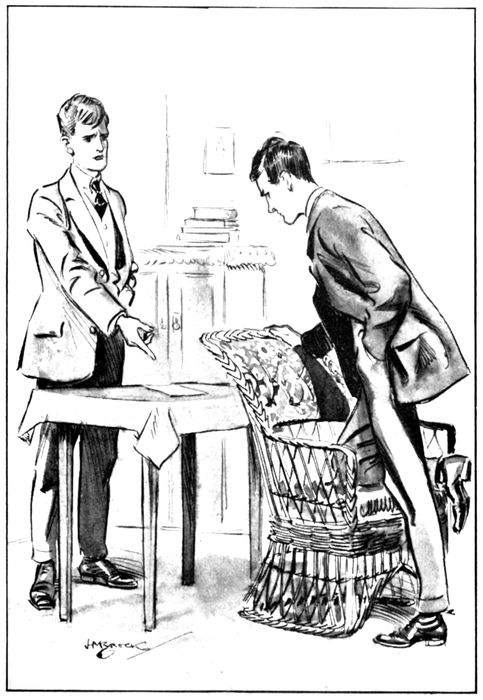
chap to be captain of Rugby football.”
The words had the instantaneous effect that Toby
knew they would have. Rouse the clown became
abruptly a grown man. He tightened in every
53muscle until at last he seemed rigid. Then he
looked Toby in the eyes with quick sincerity.
“What do you mean, sir?” he said. “What does
he——”
Toby laid a hand upon his shoulder.
“I met him outside just now,” said he. “I knew
something was wrong. He was white with rage.
He could hardly speak. But he says you’re to have
the push—that’s all.”
There was absolute silence. With lovable tact,
Henry Hope had taken the two boys with him out
of the room as soon as he saw that Toby had something
private to say. Terence stood against the
mantelpiece and stared first at one and then at the
other, and Rouse just stood before Toby and looked
and looked and looked till he could see nothing at all
but a foolish house of cards that had only come into
being in the morning, and that now, at the end of the
day, lay in a tumbled litter before his eyes.
CHAPTER V BREAKERS AHEAD
54
The first significance of it all steadied Rouse in precisely
one second, but for the reality of it to make
its real impression needed time, and in the silence
that followed the truth began to tell upon him.
In the whole history of Harley a Rugger captain
elected by the school had never been turned down
by the Headmaster. It would be a lasting disgrace.
In some way that he did not yet understand he had
let down the school. Moreover Rouse had an ideal,
and the ideal was not only to be a great fullback,
but to be, in the immediate future, a captain
worthy to lead the team that Harley was going
to have this year. To be told that he was not
fit to captain any kind of team at all was no less
surprising than having a bottle broken over his
head. If it were true, then he might just as well be
expelled.
He found himself wondering whether, if this came
to pass, fellows would think he were just such
another as Slade, who had been captain of cricket
when he himself was a junior and whom the Grey
Man had sacked. At least Slade had had a chance.
To be judged in three days by a man who had never
seen him before in his life did not give him a dog’s
chance. It seemed pretty incredible that any fellow
could be condemned like that, but that the fellow
in question should be himself was very nearly unthinkable.
To Toby it was not unthinkable. If he had judged
55Dr Roe aright the new Head was a man whose first
opinion was his last, and who, rather than have to
confess himself in the wrong, would stick to a bad
judgment against all argument, upholding it through
thick and thin to the end. It was clear that he believed
in impressing those under him with swift and
irrevocable decisions, thereby instilling into them
discipline of a kind that made those who had to
be judged by him afraid to take their chance, and
which consequently kept them on good behaviour.
There was another reason, too, why he would be
a very difficult man to quarrel with. He was new to
the school, and he was the type of man who would
always be able to defeat those who really loved
Harley by making the whole school and the school’s
good reputation suffer for the misdeeds of any one
individual. Something of this foreboding must have
shown in Toby’s face, and Rouse saw it. At last
he spoke.
“What is it that’s gone wrong, sir?” said he.
“Does he really think I’d be a dud as a captain—or
is it that he just takes me for a general waster?
What is it makes him think it, any way? Surely
it’s not just because I bumped into him with a table?...
I would have apologised, as a matter of fact,
only as I say I thought it was the man who comes
to wind up the clocks, and he’s such a disagreeable
old bogey that I didn’t trouble.... He ought to
have looked where he was going. A man’s got no
right to shoot out of the wall just as you’re going by
with furniture.”
“It isn’t that at all,” said Toby. “That’s only
an additional proof, to his mind, that what he thinks
of you is right. There’s some yarn about a ticket
in the train. You didn’t tear up a new boy’s ticket,
did you?”
Rouse considered a moment.
“Ticket?” said he at last. “Why, yes, I tore
56up one. What about it? It wasn’t the right
one.”
He began to explain.
“Anyway,” said Toby, “it seems that it was the
same fellow who laughed such a lot at the footer
game—the fat boy we pulled out to play. And
the Head’s idea is that throughout that game
he was terrified of you because you’re a proper
bully.”
“But that’s all rot,” said Terence sharply.
“Why, that fellow can weep like an ornamental
fountain. He nearly broke his heart in the first
place because his pater went off with the wrong
ticket, and then Rouse had the notion that the best
thing to do was to tear up the one to Ealing that
he’d been left with so that the people this end
wouldn’t know what station it was for. Of course
it went wrong. Rouse’s ideas always do. The
ticket was a different colour from the one for Harley.
But he only did it to help the little ass. Rouse had
better go to the Head and tell him.”
“I’ll go and tell him myself,” said Toby, “as
soon as I’ve got hold of the details. The trouble is
that Rouse has been extraordinarily prominent
during a space of twenty-four hours and the new
Head is a man who makes up his mind at top speed.
But it isn’t only that. Rouse’s manner doesn’t
appeal to him either. He wants the captain of
Rugger to be one of the senior boys of the school,
and he rather suspects that the reason Rouse isn’t
in the Sixth yet is that he’s a real bad lad. Nor
does he like football conducted by a fellow whose
right line is comic opera. There’s another thing.
He’s coming round to visit Rouse in form to-morrow
with the idea of finding out how much he really
knows, and,” he added, turning to Rouse, “I recommend
you to sit up and swot to-night till your
eyes stand out from your head like railway buffers,
57because it’s just possible that if you can tell him all
he wants to know he’ll be persuaded to move you
into the Sixth, which would do away with one of his
grumbles anyway.”
Rouse looked up wretchedly.
“That’s hopeless, sir. I’ll work with a wet towel
round my nut all the term, and I’ll honestly try to
swell out my forehead and push in amongst the highbrows
and old Terence here, but to expect me to be
able to do it in one night is out of all reason.”
He stopped and began to look grimly out of the
window. At last he pulled himself together with a
jerk and moved towards Terence.
“Does this really mean I’m not going to be captain
of Rugger after all? Do you think it means that?”
If his face had been cruelly disfigured he could
not have been more obviously hard hit. He knew
as well as any man that when this news became
public property he would have to pretend not to
care—especially before the Rugger Committee. It
would be no use behaving like a baby about it. But
at the moment he was alone with those who knew
him best, and so he was not ashamed to show the
innermost recesses of his soul, and it would to an
onlooker have seemed impossible to recognise in him
the exuberant humorist of an hour ago.
“You come along to the study,” said Terence,
taking his arm. “Come on, Toby. We’ll go and
thrash this thing out. If he’s not going to let our
best Rugger man be captain of the fifteen he’ll have
a good-sized crowd heaving bricks at his study
window in about a couple of hours, and I shall be
amongst the number, with my coat off.”
They moved out of the study and went slowly
and soberly along the corridor, arm-in-arm, towards
Terence’s own room. And, behind them, with hands
in his pockets and a troubled brow, came the man
who was typical of Harley’s best. In the little
58room, which was cosy with an arm-chair and curtains,
they sat down and faced each other across the
table.
Toby came in and stood by the fireplace.
Presently Terence leaned forward and indicated
Rouse affectionately with his forefinger.
“It’s bound to be all right. If he says that any
particular man is not to be captain of footer——”
“He has said it,” interrupted Toby. “The IF has
ceased to count. He stopped me outside the house
and said it as definitely as any man could. He said:
‘I refuse to sanction the school team being led by a
boy like that. You will arrange immediately for a
new election, and you will give all those concerned
clearly to understand that the boy who is chosen is
to be a senior prefect of the Sixth Form.’ It was no
use arguing. I’d nothing to go on except the same
arguments as I’d used already. Now that I know
I’ll go round and have it out with him, but if you
ask me for the honest truth—and you’re both fellows
who can stand it—I don’t believe for a moment
that he’ll alter his mind. He’s come here with what
he believes to be a reputation, and he’s not going
to start by admitting he’s made a fool of himself.
Besides, he’s Headmaster. If he and I were on equal
footing I’d go there with the fixed idea of not coming
away again till he’d given in; but he’s the Head,
and if I let myself say too much I shall be politely
told to push off and get a job taking tickets at a
peep-show, which at the moment I don’t intend to
do. Now that this has cropped up I mean to see
it through to the finish. There are breakers ahead,
and if we don’t look out the school footer’s going
to suffer pretty severely. A lean year takes a long
time to wipe out. It means not only getting licked
every week; it means that the school colts aren’t
being properly brought up, and that means other
lean years to come.”
59“Couldn’t we write to the Grey Man?” suggested
Terence.
“The Grey Man’s ill. And he hasn’t got any say
in it now, anyway. This man’s Headmaster now.
All the Grey Man could do would be to give Rouse
a thundering good character, and this fellow would
simply light his pipe with it.”
Rouse jumped up with sudden passion and threw
out his arms.
“I can’t believe it. I can’t take it in. I’ve lived
for this one thing all the while I’ve been at school.
To be captain of Rugger at Harley has seemed the
greatest thing a fellow like me could wish for. I’m
not clever. I’ve got brains that slop about in my
head like sodden tea-leaves. The only thing I can
do is play football. Not only that though. There’s
some sort of third-rate talent in me that’s a gift for
organisation, I think. As soon as I knew I was
going to be skipper I began to plan footer for every
kind of fellow in the school. While I’ve been talking
of other things, all the time I’m fooling about, I’m
really thinking out house Rugger, and games for
colts, and the kind of training I’ll give the First
Fifteen. I’m brim full of it. This man doesn’t
understand. We must give him time.”
Terence watched him sympathetically.
“It’s all right. The school won’t let him do a
thing like that. There’ll be a rebellion.”
“That’s just it,” put in Toby thoughtfully.
“It’s something of that sort I’m afraid of. If it
comes to a fight, what’s going to happen to school
footer? We play Greyminster on Saturday week.
The team’s got to be chosen and practised. If we
haven’t a captain what’s to be done? Is the match
to be scratched—and if so, how many others will go
the same way? Is it simply going to be an empty
season right through the term?”
“You needn’t worry about that,” answered Rouse,
60with sudden steadiness. “If it comes to it, I’ll
chuck in. Smythe can be captain. He’s the same
year as I am and he’s secretary as it is.”
“Smythe is bottom of the Sixth,” answered
Terence. “He can’t even add up.”
“All right, then, there’s you,” retorted Rouse.
“You’ve got plenty of brains. You’re a prefect.
We’ll make you captain.”
Terence turned on him.
“If you think I’m going to take on a job that
they think is too good for you” he snapped, “you’re
a bigger ass than I take you for. What on earth are
you talking about?”
Toby turned at last to Rouse.
“I don’t often compliment you,” he observed.
“At one time I used to cuff your head whenever I
could reach it, but I’ll tell you now that even you
yourself don’t quite realise what they think of you
here. You’re a little tin god. The team will follow
you as they’d follow no other fellow I know. They
don’t want anyone else, and it’s my idea they won’t
have anyone else. The captain of footer has to
be elected. That’s constitutional. They’ve elected
you. And if the Head doesn’t approve it’s quite
possible for the school to try passive resistance.”
“How?”
“What I think is,” said Toby, “that he can search
right through the whole school and he won’t find
another fellow anywhere who’ll take it on—not
under these circumstances.”
“Then he’ll have to give in.”
“He’ll never give in ... he’s the type that never
knows where to draw the line ... and he thinks he’s
strong. He’ll make himself a dictator. He’ll find
some unsuspecting dolt and order him to be captain.”
“Then there’ll be a rebellion,” said Terence again.
“The school won’t stand it. They absolutely idolise
Rouse.”
61Toby spread his hands.
“Think it over,” said he. “Reason it out. I’m
going. If he comes to ask you comic questions in
form to-morrow morning just keep your head and
don’t give anything away. I shan’t see him again
to-night. He’s in a bad temper. I’ll wait till after
morning school to-morrow. Then I’ll join issue with
him after he’s visited your form. And above all,”
he added finally, “don’t be downhearted. This
turn of events is as bad as it possibly could be, but
you aren’t alone. You’re no end of a dunce, Rouse,
but you’ve got the school behind you, and there’s
comfort in that.”
They watched him go, and when they were
left alone Rouse turned to Terence and smiled
whimsically.
“Nick, old bird,” said he, “I feel as sick and
sorry as a lame dog—but there’s something in me
that won’t lie down. It keeps on shoving up from
under my spirits like bubbly under a cork. And if
that old buffer comes and asks me in the morning
how many beans make five, it’s a hundred to one I
shall make the stupid response: ‘The answer is
a lemon.’ I just shan’t be able to help myself.”
CHAPTER VI A RISING STAR
62
In the days of his early youth Henry Hope had
appeared to those about him to be an old, old man
dressed in an Eton suit. His large rimmed spectacles
had lent him the air of a scholastic genius, and he
was, by habit, pitifully pedantic. In addition he
was dignified, and self-reliant to a fault, and he had
no ability of any kind at games. But at least his
heart was in the right place. More than once his
meditative resource had helped Terence and Rouse
out of a sad scrape, and accordingly he was their
beloved friend.
In the course of the last few years he had been
growing up—lengthways, that is to say—and Henry
Hope had changed a little from the Henry Hope of
old. In the atmosphere of Harley he had grown rather
less of a hermit and rather more of a boy. He had
opened out. He was still totally devoid of a sense
of humour, and he still used grave words both in
season and out, but he had become, in one sense at
least, human. He was a devotee of the cinema.
Also he had decided what he was going to be. He
was going to be an actor in film plays. He knew
one such actor already, and it seemed to him that
this would provide him with an effective introduction
into the right clique when the time came. Toby
Nicholson was the actor. At one period of his life
Toby had turned an honest penny by risking his life
before the camera on selected days, and though this
was, for obvious reasons, not the line of business in
63which Henry proposed to make his mark, it was
at all events good to feel that he was not totally
unacquainted with the way things were done.
Henry, as a matter of fact, was going to be one of
those men to whom the ideal way of getting into a
room is by way of the skylight, and the ideal way of
getting out is through the window (though not, of
course, by being pushed through).
It was conceivable that on occasion Henry might
consent to act the part of a detective. Generally
speaking, however, he would be the man who delays
the play all the way through by persistently getting
into predicaments through sheer stupidity merely
for the sake of showing how to get out of them again.
He would be a man of rapid movement; he would
look always to right and left before moving to his
front; he would look all round a room before
observing a prostrate body at his feet; he would invariably
get his eye caught on a keyhole before entering
a room. He would point out the way to a friend
less keen of vision than he before walking down a
long straight road; and at times he would be seen
swaying against a wall with half-closed eyes whilst
those who had stolen his all made their escape in
their own time through an old-world garden, stopping
to pick flowers as they went.
Above all there would be one dramatic performance
which would constitute his star part. It would
consist in a series of scenes turned rapidly upon the
reel, each displaying a long wide road, and down
these ways Henry would be featured running as
never man ran before. His arms would be going
like pistons. He would have lost his hat. (This,
however, he would find again in time to doff it as
indicating that somebody was dead.) Ever and
again he would appear to be exhausted. To the lay
mind it would seem impossible for any living man
to maintain such a consistent speed down all those
64different roads. Nevertheless Henry would do it.
He would do it on different days, of course, but that
would not be realised; and he would, moreover, be
running to save a soul. This would be known to the
audience, who would cheer his attractive likeness
every time it appeared at the far end of another road.
He conceived that the energy with which he would
run would immediately lift him into the front rank
of famous players. He had once had a nightmare
in which he had slipped up and fallen on the back of
his neck whilst at the top of his speed, thus leading
the audience to suppose that his performance was a
comic one ... and once he had dreamt that owing
to a slight stitch he had not been able to run up to
form and had arrived twenty-five minutes too late
to effect the rescue, for which he had been kicked
by the man who had been turning the film all the
time in expectation of his arrival; but he had never
mentioned these incidents to anyone at all.
He practised a good deal, and it may almost be
said that throughout the period covered by this tale
he lived under the perpetual hallucination that all
his movements were recorded by a camera for reproduction
before a gaping audience.
He was under this impression when he shepherded
Bobbie Carr and his own close friend, Hallowell, out
of the new study. He made the movement a masterpiece
of play without words, and when they were
safely out of earshot in the corridor he drew himself
up with a touch of characteristic dignity and spoke
his only sentence. He did not believe in speaking
any more than was really necessary at these times—no
more, in fact, than it would be necessary for
a film to speak, and always in the same crisp manner
in which the film habitually does speak.
His voice was deep down in his boots.
“Something amiss,” said he. Then he was done.
As a matter of fact even this was not essential.
65If, after all his painstaking by-play, those present
had still not tumbled to the fact that something was
amiss, nothing would have ever made them understand.
In reality they had both understood long
ago and were now only hanging about in case there
was any more of Henry’s performance to come,
which, by going, they would miss.
Henry, however, had finished for the moment, so
Bobbie Carr sighed and turned away.
“I’d better go and find Coles,” said he.
Hallowell looked at him.
“It’s a pity you’ve got to fag for Coles. Still,
it may not be for long. How old are you—about
fifteen, aren’t you? You’ll soon be done with
fagging.”
There was silence for a moment. Carr could still
not make up his mind whether to admit that he knew
quite a lot about Coles already, and whilst he waited,
half turning away, Henry drew near. He had had
a rough term of fagging himself when he had first
entered Harley, and he guessed what Carr must feel
like with so many expressions of bad will towards
Coles coming to his notice in such a short space of
time. He reached out a hand and tapped the
boy kindly on the shoulder, then he peered at him
with an old-fashioned sincerity over the tops of
his glasses and spoke in a slow and sepulchral
tone.
“He’s in the First Fifteen,” said he. “But with
us he cuts no ice.” He paused and nodded his head
impressively. “Say, kid,” he added, “we’re wise
to that guy.”
Such words if spoken in church by a venerable
bishop would, one supposes, sound odd. Spoken
by Henry they sounded more than odd. They
sounded rotten. Trying to speak American slang
was about the most inept thing Henry did. The
result was not only incongruous, it went absolutely
66flat. Without having heard him it would be impossible
to imagine how dull those crisp words really
sounded. He did not even speak them through his
nose. It was awful.
Nevertheless Bobbie Carr was comforted. There
was something in Henry that inspired trust. There
always had been. And in that moment Bobbie Carr
decided that he liked him very much.
“I’ll come along with you,” said Henry. “I
know something about Coles and I can put you up
to some of his habits. It may be a help to you. He
may not be in just now, and if he doesn’t want you
we can go and have another look at our new study
before it’s too late.”
“I’ll clear off then,” said Hallowell. “I’ve not
done my prep. properly yet. See you later.”
He offered them a cheery gesture of farewell, to
which Henry, for his part, responded by looking at
him gravely over the tops of his spectacles as if he
were some form of peculiar insect.
Then he set off with Bobbie Carr, and as he went
he spoke in a deep, gruff voice of Coles and the kind
of things he did.
“Any time you find yourself up against him,”
said he, “you come and tell me. Don’t you go
doing half the things he’ll want you to. He goes in
for betting, and he smokes and drinks and borrows
money. He’ll want you to fall in with his ideas and
help him out of holes. Don’t you do it. I notice
Coles a good deal. I see without being seen. That’s
rather a gift I have got. And if I find that you’re
afraid to refuse the things he asks you to do I shall
be disappointed in you, and then perhaps when you
really want my help one day I shan’t be inclined to
give it. You come to me. I can’t punch his head
myself but I’m friendly with some who can. In fact
one of my best chums here is the captain of Rugby
football.” He wound up on a note of distinct
67self-congratulation. “Here,” he added, “this is his
place. You knock on his door and go in. Explain
who you are and see if he wants to speak to you.
I’ll wait out here.”
Bobbie went to the door and knocked. He was
a lithe youngster, and even Henry could not help
noticing the easy grace of his movements. For a
moment he stood there listening. There was no
answer. He knocked again.
“Go in,” said Henry solemnly. “He isn’t there.”
Bobbie opened the door and looked inside. It was
perfectly true. The room was empty. Henry
moved from his position against the wall and came
up behind him.
“While there’s nobody here, then,” said he, “I’ll
show you where he keeps his things. Maddock used
to have this study and I was Maddock’s fag. The
teapot’s in that cupboard there. This is where he
puts anything he’s got to eat, and I expect his footer
kit’s in that box.”
The door was suddenly kicked sideways and a
heavy step sounded behind him.
“Now then,” said Coles. “What are you doing
in my study? What do you mean by crawling in
here? Are you looking for something to pinch?”
Henry turned and glared at him with concentrated
fury. Coles took him by the collar.
“You get out,” said he.
Then he lifted a leg and planted a boot so severely
behind Henry that he shot foolishly forward and
cannoned into the door. He turned and seemed
about to speak. Coles gave him no opportunity at
all. He lifted his foot again, and this time the force
of its drive sent Henry clean out of the room with one
bounce and dropped him against the wall on the far
side of the corridor. Coles was one of the best dropkicks
in the school. Then he slammed the door and
turned upon Carr.
68And the thing that troubled Henry most was not
the pain or the suddenness of those blows behind
him, but the particularly stupid way in which he
had made his exit from the stage.
Coles stared at Carr for a few moments thoughtfully,
then he moved to his chair and, sitting down,
planted his feet upon the table.
“Well?” said he. “I suppose you’ve come to
report?”
“I thought I’d see if you wanted anything.”
“There is something I don’t want,” said Coles,
“and that’s your friends. I take a pride in my fag.
I never expect to have to call for you twice, and when
I do call for you I don’t want all the riff-raff of the
school trotting in behind you like the tail of a crocodile.
If you’re palling up with that fellow Hope you’d
better drop him. He makes me feel ill. Whenever
I see that fellow I want to stamp him into the carpet,
and if I see you about together it’ll make me angry
with you, and then you won’t be happy.”
Carr said nothing at all. He just looked at him
straightly.
“Do you know,” asked Coles, “why you’ve been
made my fag?”
“No,” said Bobbie.
“It’s because I asked for you. And do you know
why I asked for you?”
“No.”
“It’s because I’m said to be rather a difficult man
to fag for. Young fellows like you get a bit tired of
me. I want a good deal done and I expect my fag
to be absolutely trustworthy. If I tell you a thing
in confidence and I find you split, I simply hit you on
the top of the head with a book, and your head sings
for twenty-four hours. I’ve an idea, though, that I
shan’t need to hit you much. That’s why I managed
to get you allotted to me. I think you’ll quite like
to fag for me—you’ll know that if ever you get to
69know a secret of mine I’ve got a secret of yours, and
that’ll keep you quiet, won’t it?”
“How do you mean?”
“Well, you’re ashamed of your father, aren’t you?”
“Ashamed of him?” said Bobbie hotly. “No,
I’m not.”
“But you say that you don’t want anyone here
to know how he makes his living.”
“I promised I wouldn’t say, that’s all. There’s
a reason.”
“Precisely,” answered Coles. “And I’m the only
one that knows.” He made an expressive gesture.
“You see what I mean?”
“I suppose you mean you’ll tell.”
“I mean that that would be less trouble than
hitting you on the head with a book and considerably
more effective.”
Bobbie’s face was expressionless.
“That threat,” said Coles frankly, “starts from
to-day. Now we understand one another.” He
looked at the boy fixedly. “You can go,” said he.
“You come in and see me to-morrow in the luncheon
hour.”
“Well,” said Henry, when Bobbie bumped into
him standing proudly round a corner of the corridor,
“what did he say?”
Bobbie shrugged his shoulders.
“Nothing much. I’ve got to go and see him again
to-morrow.”
Henry appeared to be deep in thought. At last
he lifted his head and looked at Bobbie pertly over
the tops of his spectacles.
“Did you notice him try to kick me?”
Bobbie’s behaviour was straightway that of a
perfect gentleman. He glanced at Henry politely.
“Yes,” he answered. “He didn’t get you, did
he?”
70An immediate change came over Henry. His lips
slowly parted in ecstasy. He spoke no word. He
looked at the new boy instead with the grateful light
of intense relief shining from his eyes, and from that
moment their friendship was finally cemented.
CHAPTER VII A CABINET MEETING
71
There had not even been a rumour what was wrong.
The few who knew had kept their counsel absolutely.
For this reason the Rugger meeting came as a mild
shock to those gentlemen of high place in the school
whose privilege it was to attend it. They were
the same counsellors who formed the house committees,
and for certain purposes they were on
special occasions called together to debate some important
matter. Their chief duty this term was, of
course, the formal election of the school captain of
football, and this had only just been carried out.
Ordinarily after this their services were not required.
Many of them expected to win their own colours,
and it was obviously undesirable for them to sit on
the small executive committee that would judge the
merits of rivals. Matters pertaining to the First
Fifteen, to honours generally, and to the organisation
of training throughout the school rested, therefore,
with a trio composed of the captain, the honorary
secretary and the games master, and of these the
captain himself was virtually dictator. That was
the custom of the school.
House committees were formed on a different
basis. Here one found merely the senior boys in
each house, though as a matter of course many of
these were also leading lights in school sport. They
met together as a school committee on almost anything
that needed to be discussed: in summer to
talk cricket, in winter to plan the broad lines of
72the season’s football, and sometimes to debate such
matters as the Christmas concert or the big cross-country
run. To be called together for no apparent
reason so soon after they had met came, therefore,
as a surprise to them, and they filed into the big room
and sat them down in silent dignity. They did not
nudge each other or make play with their eyebrows
to denote their wonder. They had mostly come
to the age when it seems a great thing to pretend
one knows something which the next man does
not know, and only a man like Toby Nicholson,
who knew the type peculiarly well, would have
read their casual bearing aright. Their seeming
indifference, the way some whistled softly to
themselves, the general lack of any evidence of
curiosity, denoted an undercurrent that meant
sensation.
When they were ready Toby rose. He was not at
all in love with his task. He was, if anything, a
little nervous. He could not tell for a few moments
how the school were going to take it.
“The day before yesterday,” said he, “you met
to elect the captain of football. We have had to call
you together again to-day to elect another one. I
am sorry to say that the Headmaster does not
approve of Rouse as your choice.”
There was no buzz. No one sprang to his feet.
The silence was deadly. It was as clear as day that
it was going to take them a few minutes to believe
it.
Toby gave them those few minutes, and when he
judged that it had thoroughly got home on them he
spoke again.
“The Headmaster wished me to tell you,” he said,
“that the captain of football must be a senior in the
Sixth Form.”
He did not say more. There was really no need
to tell them that he must also be a boy who wore the
73cloak of dignity—that one proviso limited their
choice sufficiently.
“His particular wish is that, if practicable, the
captain of football should be the captain of the
school,” said Toby. Then he made a gesture of
finality and sat down.
There came now a slight shuffling of feet. The
counsellors were turning one to the other; there
was hoarse whispering, occasional sharp sounds of
absolute amazement.
At last the captain of the school rose in his seat.
He did not play football at all. He made up verses
that didn’t rhyme and secured good prizes for them.
Nevertheless he was a good fellow, and it was clear
that the news that he might be expected to lead the
Fifteen on to the field in cap and gown had had a
pronounced effect upon him. He was really quite
shaken up.
“But does the Headmaster know the practice at
this school, sir?”
“Oh yes,” said Toby. “He knows what it always
has been ever since I can remember. I’ve done all
that a man could do to persuade him to respect our
unwritten laws. The Headmaster, however, is a
man of very strong views. He is determined on a
new method.”
“Well, I’m blowed,” said the captain of the
school, and sat down with a jerk.
Next moment Rouse had half risen from his chair,
and, in the awkward manner of a boy whose lifelong
nightmare has always been that he might one
day be called upon for a speech, turned towards the
assembly.
“It’s quite true,” said he a little huskily. “I’ve
been rather prominent in doing the very things the
new Head hates most ever since he came, it seems.
Mr Nicholson’s done his best to keep me—but
it’s no use. I’m terribly sorry. It seems a sort of
74disgrace to the school. They’ll get to hear about
this at other places—Rainhurst and Wilton—and
they’ll guess I’m a general rotter and wonder why I
haven’t been sacked. I——”
He stopped and seemed to be searching for the
right words. Few of those present had ever heard
Rouse speak in such grave tones before, and it did
more than anything else to bring home the truth to
them. There was a sympathetic silence.
“There’s nothing else to be said. I resign, of
course. Pointon doesn’t play football. It’s useless
to propose him. Perhaps, though, once the Head
gets rid of me he may listen to reason more. I think
that if you elect a fellow who is at least in the Sixth
you might get his approval. So I propose Smythe.”
He slowly subsided into his chair. There came a
growing murmur of angry distress. Suddenly people
noticed that in the far corner of the room Smythe
was already upon his feet.
“There’s no need to waste time considering that at
all,” he said, with considerable vexation. “At the
other meeting some misguided ass got up on his hind
legs and proposed me. I said then that whilst
Rouse was at the school there could be no other
skipper worth considering at all, and you all cheered.
I say that again now. If Rouse isn’t good enough
for this job you can put me down as not playing
Rugger at all, let alone being captain of it. I was
the first to congratulate Rouse the other day, and
I’m the first now to propose that we refuse to accept
his resignation.”
His lips had spoken the words that had been on
the tip of every other fellow’s tongue. None other
could have so aptly expressed their feelings.
There was a chorus of vehement approval. In the
fierce clapping and the clatter of feet on the floor
Rouse had a quick insight into the depth of their
inexplicable affection for him. He was honestly
75astounded. He was also considerably upset. He
could not face saying any more. He just sat where
he was and pretended to be taking no notice, but his
acting was not very good. For one thing, his face
was brick-red.
At last Toby rose stolidly to his feet. He began
to hate his position more and more. He was very
human and he was heart and soul with them in their
feelings. It was the hardest thing of all to make
of himself counsel for the defence, and the long and
the short of it was that he could not do it. If he
managed to get through this meeting without a vote
of detestation being passed upon Dr Roe it would to
his mind be a notable achievement. He was conscious
that as a master he had a certain disciplinary
responsibility, but he was very unhappy about it.
There was too much of the old boy in Toby.
He looked round them sadly. At last he spoke.
“It’s a very bad business,” said he. “I think
as you do—that Rouse couldn’t be bettered for
this job.... The only other point to consider is
how the school will be affected if you refuse to accept
his resignation. The Head will not give in to you.
If it comes to a fight he has every advantage. It may
mean that you ruin our fixture list for the season....
It will certainly draw attention to an incident
that we might otherwise keep fairly quiet so as to
prevent the wrong construction being put upon it.
If we’re to have a good season it’s essential to get
started at once. The team for next Saturday ought
to be chosen to-day so as to start practice. If you
decide against the Head you may cause delay that
we shall never be able to make up.”
“Well, we’re not going to give up Rouse, sir,”
cried someone in sheer indignation.
Toby turned to him.
“That isn’t the point,” he said. “I’m absolutely
with you. I believe that without Rouse to lead the
76Fifteen we shan’t have a real good season. But we
mustn’t make it too hard for the man who sooner or
later may have to take it on. I’ve talked to the
Head till I couldn’t talk any more. It made no
shadow of difference at all. The Head will never
give in. His mind’s made up, and although it’s true
that we oughtn’t to give up Rouse, I shouldn’t be
doing my duty if I didn’t make you see both sides
of the picture. It’s for you to decide; I’m only just
telling you how matters stand in case you forget.”
He sat down wretchedly.
Next moment Rouse turned to them again. He
did not get up. There was something too urgent
about the atmosphere for much formality.
“It’s quite right,” said he. “You mustn’t muck
up the season. I’ve resigned. That’s all there is
to it. Go on. Don’t be boobs. I propose Nicholson.
The Head can’t refuse him. He’s one of the
top six in the school.”
All heads turned slowly to regard Terence as if
half in doubt and half in hope. Terence stiffened
like a man electrocuted and shot to his feet.
“No!” he shouted. “It’s all rot! Rouse has
got to be captain. He was made for it. It’s no use
going on proposing other people. We’ve elected
Rouse.”
There was an appreciative silence, then an animated
discussion, and amidst it a young man rose from his
seat and lifted his hand for silence.
“There’s only one other old colour who’s in the
Sixth,” said he. “Coles. So I’ll propose him.”
He sat down as if he had done a piece of useful
work by thoroughly clearing the decks for real debate.
What followed, therefore, came as a very
painful surprise to him. Others were merely disgusted.
He was honestly hurt. To suppose that
he had spoken seriously was the most insulting
thought anyone could have had of him.
77Coles had arisen and could be seen looking earnestly
upon them. His voice was unmistakably clear
though he spoke quietly, and he made one modest
gesture with his hand. He had not so much as
waited to see the result of the proposal, had not
given anyone even a chance to second it.
“If it’s for the good of the school,” said he, “of
course I’ll do my best.... It’s just as you like.
Whatever seems right to you fellows....” There
was a cutting silence; not so much as a movement
helped him. He remained standing. He
looked round hopefully. “Whatever Mr Nicholson
thinks best,” said he. “If you propose me—I’ll
certainly——”
At last somebody spoke. It was difficult to
identify the gentleman, but from the murmur of
approval that followed it was clear that he voiced
the opinion of all those present.
The voice said: “Sit down, you ass.”
With a sudden flush of acute self-consciousness
Coles disappeared from view.
Then there rose up one other spokesman.
It was the captain of the school. He brought
a touch of dignity into the atmosphere that was not
unwelcome.
“Well, I’ve listened to what’s been said,” he told
them, “and it hasn’t taken me long to form my
opinion. I’m no footer man—but I’ve got the
interests of the school as much at heart as any of
you. And I know Rouse. I’m no fighting man
either. I like peace and quiet. Arguments I can’t
bear. But I’m afraid a fight and an argument will
have to come. The soundest proposal made has
been Smythe’s. He says we refuse to accept Rouse’s
resignation, and I think you’d like the Head to know
that as captain of the school I second that.”
There was a pleasant and concerted cheer. He sat
down with a slight flush. Then hand-clapping broke
78out. It grew loud and continuous. Next they began
to shout. Some got on to their feet and waved in
Rouse’s direction excitedly. The shouting grew
into a thunderous ovation. Here and there earnest
students like the captain of the school found themselves
jumping foolishly on to forms and falling off
again in the hopes of getting a really good view
of Rouse. It grew louder and more emphatic. The
very walls were trembling with enthusiasm. Rouse
stood up and tried to stop them. They went on.
It may be that they rather hoped the new Head would
hear them and ask what it was all about. Toby
made no effort to exercise control. As a matter of
fact he was smiling. It seemed to him just as well
to let them have it out. Eventually it began to die
down a little. Fellows were forcing their way
towards Rouse and thumping him on the back.
Others were reaching for his hand. And above all
they were still shouting his name delightedly aloud
and making gestures of eternal allegiance to their
chosen.
In the end it was Smythe who got a hearing first.
“It may be as well,” said he, “to decide on the
form in which this decision ought to be communicated
to the Head. What about a deputation?”
“The usual way,” said Toby cheerfully, “would
be for me to go along and tell him.”
They looked at one another. The point was worth
considering.
“There are some matters,” said Toby, “that
might be better discussed in my absence, of course.”
He paused. “If I were to go along and see the
Head now you fellows might be talking it over
between you, and then if a deputation should be
necessary you’d know whom to select to form it.”
He waited a moment. There was the loud sound
that indicated a crowd’s approval.
“Well, sir,” said the captain of the school, rising
79yet again, “that seems the best thing to do.
Would you mind describing to the Headmaster the
exact manner in which the proposal to refuse his
resignation has been carried, and why it is so strongly
supported? I think he ought to know that.”
“I think so myself,” said Toby. “I shall certainly
tell him.”
He moved slowly down the room. There was a
pleasant smile upon his face. It was as if a prophecy
of his had come true.
The counsellors rose as he passed down their
midst, and seeing how pleasantly he smiled they
slowly answered, and one by one they smiled back
at him as he went upon his errand.
The moment he had really gone they turned as
one man to Rouse.
“But why is it?” they demanded. “What’s
gone wrong? He’s only just come here. How on
earth does he know who’s the best captain?”
Rouse shrugged his shoulders.
“It’s that idiotic little fat boy,” said Terence.
“He’s the cause of all the trouble. He went and
laid evidence against Rouse as a bully and the Head
believes him, and then he came over to see how
Rouse behaved in his natural haunts and Rouse
was singing a part-song with the house porter. He
smote the Head with the leg of a table, too—just to
emphasise the fact.”
“What fat boy?” demanded Pointon. “Why
haven’t they got hold of the fat boy then? Why
don’t they bump him? Let’s go and fetch the fat
boy and make him go to the Head and withdraw
what he said.”
“It’s no use,” said Terence. “Toby went and
tackled him himself and asked him whether he knew
what he’d done. And eventually he said that he’d
go to the Head and try to make it all right. So he
did, the fool; and when the Head saw Toby again he
80said the little hero had been to him and asked that
Rouse should not be punished in any way, because
he was afraid that if he were fellows would blame
him and call him a sneak. So the Head said it was
clear that somebody had been getting at him, and
demanded that Toby should find out who it was and
bring him up before him. Toby said that the only
chap who’d got at him was he himself, and explained
the true story of what had happened; and he also
said that another new kid called Carr was a witness,
and that I was too. But the Head wouldn’t believe
it. He said there was too much hanky-panky going
on. He said that at Wilton he had the reputation of
being an infallible judge of character and that he
knew as well as he knew his own name that Rouse
had been bullying the kid. As a matter of fact that
was only one point. He was looking at the new-comers’
footer, and he says Rouse made a dead set
for the same boy ... and then, of course, he came
across to the house to see what Rouse did when he
thought nobody was looking, and that’s how he
found him.”
He made an expressive gesture and was silent.
“Look here,” said Pointon, “be more explanatory.
What was the bullying? What have witnesses got
to do with it?”
Terence explained.
“But, surely,” said Pointon, “when the Head
knows the truth he can’t refuse to believe it....
That’s all bosh.”
“What Toby says,” pointed out Terence, “is that
what we’ve got up against us now isn’t a charge
against Rouse that’s got to be disproved at all. It’s
the Head’s own character. The Head is a man
who’ll never admit himself in the wrong. Even if
there’s nothing else behind it, that’s enough. He’s
taken a definite line and now he won’t budge from it
for fear of his reputation. He’s an idea we may try
81to make him alter his mind and he’s determined he
won’t. Whatever evidence we could bring up now
wouldn’t make any difference at all.”
Pointon grew annoyed. He was a studious boy
with rather definite opinions of his own and a particularly
strong sense of justice.
“That’s preposterous,” said he. “No man’s got
a right to do a thing like that. He’s not a dictator.
We’ve always elected our own captains at games....
This is all rot. Do you mean to say he’s going
to make Rouse suffer like this and ruin the school’s
footer season just because he hasn’t the decency to
admit himself in the wrong?”
“That’s Toby’s idea,” said Terence, “and Toby
isn’t often wrong over a thing like this. He’s done
a lot of arguing with the Head too ... and none
of us have really spoken to him at all in private.
Toby’s probably right.”
“In that case,” said Pointon, “we shall require a
deputation and we’d better decide now who it shall
be.”
It was twenty-five minutes before Toby came back,
and they saw at once that his countenance was grave.
“It’s no use at all,” said he. “The Head’s firm.
He says that unless you have elected a new captain
by six o’clock to-night, he will elect one for you, and
it may not be one that you expect.”
“Did you ask him to receive a deputation, sir?”
said Smythe.
Toby looked at him fixedly.
“No. It was clear that if I did he would refuse.
So I decided that if there were going to be a deputation
at all it had better be an impromptu one. And
I think I’ll leave that to you.”
Looking at him, they understood: Toby was a
master.
CHAPTER VIII THE THUMB-SCREW
82
Coles returned to his study in a very bad temper.
There had been one precious minute during the meeting
when he had found himself suddenly thinking:
“My word! Supposing they should elect me!”
Never before had he seriously considered himself
captain of Rugby football; but now that he did so
he found the sensation peculiarly delightful. In
these fleeting moments he imagined himself the
most important man in the school, a veritable maker
of laws. He pictured the favours he would be able
to win from other fellows by withholding or bestowing
colours. He would be respected in the town.
He would be able to get things on tick. He might
even be awarded a money prize by his proud father.
All these possibilities had flashed before his mind’s
eye whilst other names were being suggested. Then
that well-meaning but misguided individual had
risen really and truly to propose his own and the
chance was altogether too much for him. He had
jumped to his feet.... There remained now nothing
but the memory of being called an ass.
After all, he was the best drop-kick in the school.
He could not for the life of him see why it should be
so very absurd to suppose him captain. It is, of
course, at such times as this that the close observer
may discern the subtle difference between one who is
instinctively a gentleman and one who is not. Coles
was not a young man of good taste and that’s all
there is to it.
83At all events he was very angry, and the first butt
upon whom he could vent his feelings happened to
be Bobbie Carr, who was waiting obediently outside
his study. Coles pounced upon him eagerly. To
Bobbie his nose looked longer than ever, and more
beak-like; his prominent cheek-bones, too, were
touched with the hectic flush of indignation.
He pointed at Bobbie fiercely.
“What are you doing here? Why are you
hanging about outside my study? When I want
you I call for you. Nothing will annoy me so much
as to see you when I don’t want you.”
“You told me to come,” said Bobbie mildly.
Coles, who had turned, spun round upon him
instantly, his whole countenance darkening like the
sky before a storm.
“You’d argue, would you? I told you to come,
did I? Well, now I tell you to go, so GO!”
He made a threatening gesture towards Bobbie,
but as Bobbie did not flinch he emitted a sound of
utter passion and went noisily into his study, slamming
the door behind him.
Once inside, he threw himself into a chair and
began to brood. And, brooding, he came to a sudden
decision.
Coles had certain friends, and it was his custom
to entertain these friends during the early part of
each term. Afterwards they, in their turn, entertained
him. But he liked to be the first to issue an
invitation. For one thing, this enabled him to cut
a dash whilst he still had a fair amount of money;
and having duly impressed the said friends with the
way in which he believed in doing things, he was then
able to enjoy their hospitality on a similarly lavish
scale during times when he himself was rather hard
up, entirely free of cost.
These entertainments were not feeds as feeds are
generally understood. That is to say, expense and
84provender were never pooled. The inclusion of
parcels from home was rather scorned if anything.
It would have implied that the host was unable to
provide a really sumptuous repast out of his own
pocket, and had had to resort to a means of entertaining
which is available to every junior. To Coles
and his friends this would never have done. You
will gather that Coles and his friends were snobs
and you will be correct. But there was something
else. They were, in addition, fools. None of these
repasts was complete without one special item.
There is no use hiding the fact. The item was drink.
Under these circumstances it is surprising, of course,
that Coles should have succeeded in getting into the
First Fifteen the previous year. Coles was, however,
passably clever. Very few in the school knew
that he was addicted to this particular form of vice,
and he took care that very few should. He posed
as a connoisseur of whisky only to those friends who
shared it with him. To all appearances he trained
conscientiously, and he was sufficiently skilful to
avoid giving any outward signs that he was not
always fit. In addition, he indulged in drink only
after matches, so that on Saturdays he was usually
fit enough to pass muster. Indeed, whenever he had
felt at all off colour he had found it easy enough to
plead a cold.
The idea came to him now that he would vent his
feelings in entertaining his friends to a really good
evening. It should take place in his study, and he
would drown his bitterness in fiery spirits flowing
from a teapot. He did not like whisky, but it was
supposed to be a good comforter once you had got
it down, and besides, it was great to be able to
take the stuff slightly stronger than the next
man.
He came to this decision suddenly, and he reflected
only for a few moments. He could scarcely have
85chosen a better night for the party. The deputation
would be visiting the Head that evening and he
expected that the school would retire to bed in something
of an uproar. There might be a house demonstration
in favour of Rouse. It was, moreover, very
unlikely that there would be a Rugby match under
present circumstances for a full week. Everything
was to the good. He began to cheer up. At last
he went to the door, opened it, and let out a piercing
cry.
There was no answer at all. The corridor was
absolutely silent.
It was only a very few minutes since he had sent
Carr away, and to find now that when he really
wanted him he had entirely disappeared was more
than Coles could bear. He choked back a sob of
despair and tried again. This time he shouted, if
possible, more loudly and more angrily. Still there
was silence. He muttered: “Where is he?” in a
sort of stage whisper full of threatening significance,
almost as if he believed Carr might be hiding a few
yards away and, hearing him, would come out. He
was really very like a spoilt child. It is said that
walls have ears. If so, one must pity the wall
which received the full blast of Coles’ next cry.
Coles meant to attract attention or burst, and to do
one or the other he richly deserved. As it happens,
he attracted the attention of Rouse, who appeared
round the corner with an expression of extreme
annoyance.
“Are you ill?” said he. “Do you want
help?”
“I want my fag,” snapped Coles. “He was here
only a minute ago, the jackass.”
“The chances are that your first shout knocked
him flat on his face,” said Rouse, “and he’s lying
round the corner in a fit. It nearly had that effect
on me. I thought you’d been taken queer. If it’s
86only your fag you want would you mind stopping
that unholy row, or else only make it at stated times,
so that a fellow could know it was coming and be
ready for it?”
Coles began to go pink and white by turns. He was
very nearly losing all control of himself. He badly
wanted to hit somebody in the eye, and the only consideration
that kept him from doing so at once was
uncertainty as to whether it would be altogether a
good thing to start on Rouse.
Had he known what had actually happened he
might, however, have even risked this.
Rouse had met Carr down the corridor on his way
back from the meeting and had stopped for a minute
to speak to him, bent on displaying good spirits at
all costs in case the boy might already have heard
what had happened. In the middle of his conversation
Coles’ first shout had reached their ears, and
Bobbie Carr had moved as if to go in answer to it.
Before he had time to start, however, the second cry
had come, and Rouse had turned in the direction
from which it came almost angrily.
“What’s he making that row for?” said he.
“Don’t go. That fellow ought to learn how to treat
a fag before he has one. You push off. I’ll tell him
I sent you on an errand. I’ll go and tick him off.”
Bobbie Carr seemed a little uncertain.
“I’d better answer him,” said he at last.
At that moment the third shout reached their ears.
“Listen to that,” said Rouse. “He’s off his
head. If you go to him now the first thing he’ll do
will be to catch you a whack across the face, and then
I shall have to come in and intervene. It’s hardly
fair to Coles. You go. I’ll go along and see if I can
calm him down by means of the honeyed word.”
Eventually Bobbie saw that Rouse meant it and
moved slowly away, though, if Rouse’s forecast were
true, it seemed to him a little like funking.
87Rouse looked at Coles now with cool forbearance.
“As a matter of fact,” said he, “I met Carr a
short while back, and as he’d got nothing to do I sent
him on a little errand. You would have shouted
like that all night and he wouldn’t have heard you.
See how silly you make yourself.”
Coles made an idiotic gesture.
“Sent him on an errand?” said he. “But
Carr’s my fag!”
“Well, well,” said Rouse, “if you have anything
you really want doing permit me to do it for you.
I notice you want your neck washing.”
Coles stepped forward, and leaned towards Rouse
until his face was barely an inch away from his.
Then he spoke through clenched teeth.
“I don’t want any of that,” said he. “Understand,
I don’t want it. Whether you’re captain of
footer or not, I don’t want any of that.” He paused.
“Otherwise you and I will come to blows. You’ve
always thought it funny to pull my leg. It’s time
it stopped.”
At the time he presumably forgot that he had
never failed to avail himself of any chance that had
presented itself to him of insulting or annoying Rouse;
nor that on two of the more recent occasions upon
which Henry Hope had assisted Terence and Rouse
out of a hole it had been he himself who had been
instrumental in getting them into it.
“You rather ask for it,” said Rouse gently. “If
you could only see how perfectly childish you look
in these tempers of yours you’d realise that a chap
does you a good turn by trying to cure you. One
of these days you’ll do something in a passion of
fury that you’ll be sorry for.”
Coles slowly withdrew his face. He then drew back
a step and indicated Rouse with a warning finger.
“Take care what you say,” said he darkly. “You
be very careful.”
88Rouse sighed.
“Before I go,” said he, “there’s one other thing.
I’m going to see Morley to-day with a view to asking
if I can have Carr for my fag and give you my own.
Ludlow would be rather more suited to your temperament
than Carr. Ludlow’s had a bit of experience.
He’ll know what’s what—if you understand
me—and Carr won’t. You can hardly
have got used to Carr yet, so you won’t mind, of
course.”
He stopped and looked at the other inquiringly.
“Yes, I do mind,” said Coles. “I object very
strongly. I particularly asked for Carr.”
“Why did you do that?”
“Because,” said Coles, “if you want to know—Carr’s
a personal friend of mine. I know his family.
That’s why.”
He stood a moment watching the effect of this
news and then turned abruptly, shot into his study,
and flung the door to behind him with a resounding
crash.
“Exit Coles by door left centre,” whispered Rouse,
and turning thoughtfully, made off at a dignified pace
down the corridor.
Back in his chair, Coles began to reflect anew. He
was just a little puzzled as to why Rouse should
want to take Carr away, but not very. Carr had
evidently chummed up with Henry Hope, and Henry
was a sworn ally of the firm of Rouse and Nicholson.
So far it was easy to trace the course of events. It
was merely the working of a clique.
But he was not at all sure whether Carr knew of the
suggestion yet. If so, he was a bigger fool than he
had taken him for. He must know that if he went
over to the enemy Coles would give away his secret
without a second thought. Surely he could not be
prepared for that.
He considered the matter carefully from all standpoints.
89At last he decided to interrogate Carr
himself. This reminded him that Carr had yet to
be found. He began to grow angry again at once.
Carr had got to be found. He was going to hold a
party and Carr had to go down to the town and fetch
the necessary goods. Also Carr had to be instructed
in his behaviour when on guard that evening.
Supposing, though, that Carr did want to go and
fag for Rouse?
If he surrendered his only hold over him in a fit
of spite he might regret it afterwards. No. He
must keep Carr’s secret as long as possible. Only by
having that always over his head would Carr be
taught true obedience. The secret was a valuable
possession. He must prevent Carr from going over
to Rouse by some other means. The secret ought
only to be a last resort.
He dipped again into the recesses of his imaginative
mind. There must be some other way. All he had
to do was to find it.
At last he went out like the man in a fairy tale to
seek his fortune, and his success was appropriately
rapid. Evidently, in spite of having been called an
ass at a Rugger meeting, this was his lucky day.
Out on the gravel path behind the school he came
upon a small group. The group was composed of
Henry and Carr and the fat boy whose name was
Coppin. He stood aside for a moment unnoticed
and watched what was happening. Henry was
striking a favourite pose, that of the plain-clothes
man interrogating a suspect. He had a stiff finger
pressed against the fat boy’s waistcoat, and his eyes
were turned up so as to look over the tops of his
spectacles at the unhappy Coppin. His height was
unimposing because he had adopted a crouch in
order to place full emphasis behind the forefinger
with which he was pinning the fat boy down. Bobbie
Carr had the appearance of an interested spectator
90more than anything else, but he was talking at
the time that Coles came upon them, and it was
clear that he was accusing the fat boy of some
misdemeanour.
From the fat boy’s expression too it was clear that
he was fairly and squarely cornered. Coles tumbled
to the position of affairs with praiseworthy rapidity.
He could identify the fat boy at once from Terence’s
description at the meeting, and it seemed clear to
Coles that the other two were accusing him of sneaking,
or perhaps even of laying false evidence against
Rouse. The fat boy’s countenance would have
given away his guilt if nothing else had.
Coles waited a minute or two in consideration of
affairs and then came to a quick decision. There
was very little time left before afternoon school.
He must act quickly.
His voice rang out, and Henry jumped hurriedly
sideways as if in remembrance of recent happenings.
Carr came over to him obediently.
“Here,” said Coles, “I’ve been trying to find you
for a deuce of a long time. Now that I’ve found you
try and be intelligent and don’t waste time making
me say things twice.... I’m in no end of a hurry.
Rouse is going to ask for you as his fag. Did you
get him to do that?”
“No,” said Carr.
“You didn’t? That’s just as well for you.
Because you won’t get the better of me that way.
Very well, then. Understand that if you’re given
the opportunity, you don’t want to change. D’you
get me? If they ask you whom you want to fag for,
it’s me.”
He paused. Bobbie was looking at him dubiously.
“Why?”
“Why?” repeated Coles. “Because I tell you so.
You know why you’d better do as I tell you, don’t
you?”
91Bobbie did not answer. He appeared to be considering
the point.
“There’s another thing,” observed Coles, as if to
help him decide. “You may know that Rouse is
fighting tooth and nail to retain the captaincy of
football. There’s a deputation going to the Head
this evening. It’s touch and go what happens.
Any slight evidence against Rouse or Rouse’s clique
will make all the difference. Well, you know what
I’ve just seen, don’t you? I’ve seen you and
Henry Hope threatening that little kid who’s
supposed to have caused all the trouble by splitting
on Rouse. You know what that means. You’re
friendly with Rouse and so is Hope. Supposing
I go to the Head now and tell him what I’ve seen,
which way do you think his decision will go? He’s
dead nuts on bullying. That’s the only thing that’s
caused Rouse’s downfall. You see what I mean....
Trying to get at the kid whom Rouse has been bullying,
trying to frighten him into saying Rouse never
bullied him at all. You get me, don’t you?”
Bobbie looked at him in amazement.
“Why—why, you wouldn’t do a thing like that?”
Coles laughed shortly.
“Wouldn’t I? That’s all you know about it.
You haven’t summed me up very well.” He shook
his head. “No,” said he, “I don’t stick at a little
thing like that. Now, which shall it be? Quick!
I told you I was in a hurry.... Will you let Rouse
in over the captaincy or stick to me?”
Bobbie did not take long to consider. He was
new to Public School life and there was clearly no
time to consult Henry.
“If it’s a question of that, I’ll stick to you.”
Coles smiled pleasantly. “Right,” said he. “Well,
don’t forget it. And don’t turn round to-morrow
and say you won’t. Because now you’ve promised
there’s plenty of ways of keeping you to your word.”
92This was unnecessary. If Bobbie Carr once
promised, nothing else was necessary to keep him
to his word. But perhaps Coles may be excused
for not appreciating such a point of view as that.
“Now,” said he, with a sigh of relief, “I’m
arranging a little party to-night to celebrate the
new term. It won’t be after lights out or anything
of that sort, but it’ll be rather a swagger affair, and
I want you to go down and fetch me up some fodder.
I shall give you a note—rather a special note—for
a little private house just out of the town, and
you’ll call there for a parcel. It’ll be done up in a
cardboard box and you’ll be jolly careful—as careful
as you know how—not to drop it, or anything like
that. D’you see?”
Bobbie slowly nodded his head.
“On no account are you to tell anyone else about
this,” continued Coles. “And you’re to go alone.
I’m showing a good deal of trust in you in sending
you at all. I usually get these things myself for
safety, but to-night there’s the deputation on and
I haven’t had time even to send out the invitations
yet, so I’ll have to trust to you. You’d better
remember how you stand with me and play the
game. Tell nobody and go alone. On no account
do you tell that Henry Hope of yours. D’you
understand that?”
Again Bobbie nodded his head, though this time
it was clearly with some foreboding of the difficulties
ahead.
“You mustn’t even let him guess you’re going
out for me at all, otherwise he’ll follow you and act
the spy. He’s good at that. You must take the
most absolute care. Otherwise you know what’ll
happen. I shall report what I’ve just seen and the
whole school will know about your father.” He
reached out a hand and drove home these points
with a severe clap on Bobbie’s shoulder. “Now
93you can go,” said he; “and come to me immediately
after school this afternoon and I’ll give you the note
and the address you’re to go to.”
He turned with a portentous frown and walked
away considerably more satisfied than he had been
at any time during the day.
To all intents and purposes Henry had vanished.
In reality he had not, and at last Bobbie discerned
him standing gravely beside a clump of ivy against
the wall.
He did not beckon to Bobbie.
He just looked at him and the movement of his
lips seemed to say, “Come,” just as it does when
people look like that on the film.
Bobbie came slowly and somewhat unhappily.
“In your interests,” said Henry, when he had
eventually reached his side, “I watched all. It
wasn’t eavesdropping, because I couldn’t hear a
word. But I could see Coles’ face and once I saw
yours. I won’t ask you to tell me anything at all.
Coles has sworn you to secrecy, I’ll bet. I could
almost see him doing it. So don’t tell me anything
you’d rather not. Just rest assured that you aren’t
in such a hole as you think. I’m on your side.
“There’s another thing,” he added, as if on an
afterthought, “that you may not know, and that
Coles may not know—but I happen to have heard
from a reliable source that Rouse is going to ask
for you to be his fag. As a matter of fact, it was
Terence—Nicholson, that is—who told me. That
ought to cheer you up!”
He looked at Bobbie happily. Bobbie’s expression
never changed. For a moment Henry looked
decidedly disappointed. But at last a look of
understanding suddenly came into his eye. And
as he looked down at Bobbie darkly, his face grew
suddenly very old indeed, very old and very wise.
CHAPTER IX A MOLE-HILL AND A MOUNTAIN
94
The new Head had dined well and in due course had
retired to that wide room of heavy curtains and
stained-glass windows wherein the Grey Man had
always seemed so admirable a Head. Dr Roe
did not seem at all in keeping with that place of
peaceful dignity. This had been one of the things
that had troubled Toby most. He was too loud
of speech, too free of gesture, and he had not the
upright presence which had been so memorable
a part of the man whose hair and eyes and clothing
had been grey.
The new Head had retired to his study that
evening much as a dog retires to his kennel with a
bone. He had taken papers and a long cigar and
had sat down heavily in the great arm-chair beside
the fireplace; then, leaning back, he had rested his
head against a blue plush cushion, with a sigh of deep
content. Now his eyes passed slowly round the
room, taking in previously unnoticed features, and
at last came back to the fire, where they fixed a
sleepy gaze upon some vision in the glowing coals.
It was a small fire, for summer had scarcely passed,
but Dr Roe was a lover of fires and he had ordered
this especially. He poked it with his boot and upset
a few cinders into the grate. Finally, he considered
the papers he had brought with him for perusal.
They seemed but faintly interesting, and eventually
the memory of his dinner proved too much: slowly
his eyes closed. Within a few moments the new
95Headmaster of Harley was dozing in his chair with
nodding head and mouth agape.
Now whilst he dozed he had a dream. It was the
usual silly sort of dream and he found himself cast
for the part of king. He was only the king of one
of those insignificant little states whose troubles
form the plot of many a comic opera, but that is
better than not being a king at all, and at all events
he was surprisingly well loved. In his dream the
whole populace were acclaiming him. He was
being bombarded with flowers. His courtiers
(amongst whom might be noticed the school bursar
looking very natty in red velvet) stood smilingly
around him, bowing and waving to the swaying
crowd gathered before his window. He himself
was behaving in a kingly but somewhat distant
manner, and once when an ornamental basket of
hollyhocks had caught him a crashing blow between
the eyes he had shown annoyance. It seemed
clear in this dream, however, that sooner or later
he would have to make a speech, and as he considered
himself by no means a bad speaker he did
not keep the crowd waiting any longer than was
proper.
That part of his dream in which he rose to his feet
with a handful of red robe clutched at his hip was
extremely lifelike.
He was standing on a balcony looking down upon
his people, and he was only faintly conscious in his
dream that this balcony was the window-sill of his
present study.
At first the crowd could not restrain their delight
at all. Whether this was because they had at last
got something good at which to aim their missiles,
or whether they were honestly glad to see him looking
so well, we cannot judge, but it was a long time
before he could obtain a hearing. They simply
cheered and cheered and cheered. One man even
96threw his hat into the air and delayed proceedings
for a long time by stubbornly trying to find it
again. Eventually the Head’s reception grew to
such a pitch that something had to be done about it.
So he woke up.
He did so with a jerk, and found himself staring
at the school porter, who in his turn was staring
back at him.
There was an extraordinary noise in progress;
well, perhaps hardly a noise—the subdued shuffle
of feet—the sound of a vast crowd endeavouring
to move quietly. At first the Head took this to
be some part of his dream which had not entirely
vanished, but it continued, and at last he dropped
his eyes thoughtfully, looked up again at the porter
and said:
“Hammond, what is that noise?”
Hammond, who had loved the Grey Man himself,
had received strict instructions that he was on no
account to answer any question of this kind in such
words as: “It’s the boys, sir.” The boys he
understood would be trying their best to pretend
they weren’t there. Hammond did his best to
induce the Head to believe it.
“What noise, sir?” said he.
The Headmaster gazed at him dubiously, and at
last decided for reasons of his own not to press the
point; he was under a strong impression that a
good part of his dream was obstinately refusing to
fade away, and he was conscious of a keen desire to
move across to the curtains and draw them aside.
He was prepared to bet with himself that the crowd
he had seen in his dreams was not so mythical as
he had at first supposed. The porter, however,
gave him no time to secure proof. He had a one-line
part in the evening’s drama and he spoke it
with pride.
His voice was loud and clear, even a little pompous:
97“The captain of the school, sir, wishes to speak
to you.”
The Head peered at him.
“Who?”
“The captain of the school, sir.”
“What does he want?”
Hammond was respectfully patient.
“He wants to see you, sir.”
“To see me? Who? Who does?”
Dr Roe, you see, was still paying only partial
attention.
This time Hammond made no answer at all. He
merely stared at the Head.
Dr Roe tumbled to it suddenly. He had still
been wondering what was really happening outside
his window, but the sight of the school porter’s
pitiful stare brought him to his senses abruptly.
He waved a hand.
“Well, well,” said he, “show him in.”
Hammond went like a rat from a cage.
Next moment the door opened again and Pointon
appeared, a tall, studious young man considerably
impressed with the importance of the occasion.
He was not alone. As he entered, the Head saw
a string of young men behind him, and he rose to his
feet in surprise.
“What is this?”
Pointon spoke in a calm voice. If anything the
Head was the more excited of the two.
“Some prefects of the school ask to be allowed
to speak to you, sir.”
“What is it about?”
The deputation moved into the room, looked round
almost instinctively for the Grey Man, and then
brought their eyes to bear, as one man, upon the
Head who had taken his place.
“About Rouse, sir,” said Pointon. “They wish
me as their spokesman to tell you that Rouse is the
98only fellow they wish to elect as captain of football,
and they ask you to——”
The Head advanced upon them in growing
anger.
“Then it is quite useless,” he replied. “You
would have done better not to have come. My mind
is irrevocably made up. I come from Wilton, and
at that school they knew me before I left to be a
man of iron determination. By trying to dissuade
me you will only make me more resolute. I have
made my decision and communicated it to the school.
I expect you to abide by that decision without a
murmur. To come here like this is a sign of weakness
amongst those whom I expected to set the
school an example, and it is very displeasing to
me.”
“Will you hear us, sir?” said Smythe. “There
are some things which we think you can’t realise.”
Dr Roe turned upon him irritably.
“No,” said he, “I will not hear you. I have
heard more than enough of this matter. You are
one and all making a mountain out of a mole-hill.
It is preposterous to suggest that there is only one
boy in a great Public School like this who is agreeable
to you as captain of football. If you had only eyes
to see, you would understand for yourselves what I
saw in twenty-four hours and was in time to prevent.
Rouse is the one boy here who is least suited of any
of you for the post. You cannot see that for yourselves
and it is my duty to guide you; it is my
intention to do my duty with a will of iron. They
knew me at Wilton, and before very long you will
know me here.” He paused. They were sullenly
quiet. “Well,” he said, “are you prepared to
elect a captain?”
For a moment there was absolute silence.
Pointon turned and looked round his deputation
as if for support. At last Terence Nicholson spoke.
“THE HEAD ADVANCED UPON THEM IN GROWING ANGER.”
99“No, sir,” said he; “we are not. You won’t
hear us and you don’t understand.”
He drew back and fixed Terence with a wrathful
glare.
“Mr Nicholson has said everything you could
say over and over again. There is no scope left
for argument at all. I understand that you refuse
to obey me. If so, you leave the election of a captain
entirely in my hands. You refuse to elect your
own?”
Once again there was silence. And this time the
silence was significant.
After Toby’s experience they had not expected
a fair hearing; the belief that Dr Roe was going to
fight them was now a certainty.
The Head turned and moved suddenly towards
the window. His curiosity as to what was really
happening outside would no longer be denied. He
reached the curtain with outstretched hand and
tugged it aside.
And then in the gathering dusk of late evening he
saw what he had to combat. This little upheaval
of school life had once seemed to him merely a
mole-hill. But he had spoken truly: they had made
of it a mountain. As far as the eye could reach
there stretched a sea of faces showing above the clear
white of schoolboys’ collars, very silent and very
still, waiting as if for a signal from within. He
stared out upon the scene for thirty seconds and at
last he turned. Even in this wide room the silence
was tense. Not one of the deputation seemed to be
really drawing breath. The new Head faced them
sternly, his grim visage more than ever like the face
of a bloodhound, his spectacles set firmly upon the
broad bridge of his nose.
“What does that mean?” he said at last. “Why
are all those boys out there? What do they want?”
Terence stepped forward boldly. There was the
100joy of battle in his eyes. “They want Rouse, sir,”
said he. “Every mother’s son amongst them—and
they are waiting for your answer.”
The Head’s eyes hardened till they shone like
steel.
“Very well,” said he. “Then you may make
it known at once.” He paused and looked at each
boy in turn, and at last he told them in slow emphatic
words how he had planned his answer.
CHAPTER X THE WATCHERS
101
Bobbie Carr leaned wearily against the wall with
hands thrust deep in his pockets and an expression
of the most complete dejection.
Except for those deplorable young men who
were celebrating their return to school behind the
closed doors of Coles’ study, he believed that he
was absolutely alone in the whole of Morley’s.
Everybody else had gone. In twos and threes and
fours they had all passed down the corridor, talking
in eager whispers and making emphatic gestures of
resolve. To-night the school were meeting to lodge
one last gigantic protest against the ways of the new
Headmaster in a demonstration that would have
weight of numbers solidly behind it and a mighty
voice with which to speak.
And he was left alone in a passage. It was really
awful. His futile office was to stand about outside
that hated study and guard it against intruders.
What intruders? There was nobody whatever left
in the whole house to intrude. All he had to do was
to kick his heels about and pretend to be waiting
idiotically for a friend.
All the while the precious minutes were passing.
Soon the whole school would be gathered outside
the Head’s window and he, who had really conceived
as great an admiration for Rouse as any other boy
in the school, would not be there. Others would
notice his absence and comment upon it; there would
be a general and a perfectly just vote that he be kicked.
102It was worse than awful. It was pitiful.
Quite unexpectedly Henry came down the passage,
stopped at Coles’ study and reached for the doorknob.
Bobbie sprang forward in one excited leap.
“Stop! Hey! Where are you going?”
Henry’s attitude was admirable. His hand never
reached the door. In point of fact it was never
intended to. His arm fell stiffly to his side.
Then he looked for a spot suitable for quiet conversation
away from the door. It was important
that if Coles were in that study he should not know
that he, Henry Hope, was outside.
At last he took Bobbie by the arm and moved
down the passage in the manner of a novice on
roller skates, until they were safely out of earshot,
when he stopped and placed his hands upon his
hips.
“You may not know it,” he began, “but I have
been three times to the corner of this passage, only
to find you each time propping up the wall.”
Bobbie gazed at him dully and could offer no
reasonable reply.
“Say,” demanded Henry, “what’s Coles ...
doing ... in that room?”
“How do you know Coles is in there?”
Henry snapped his finger.
“It’s all right,” he said. “I’ll tell you how things
are. I believe Coles is up against Rouse. I believe
he thinks he’s got a chance of being captain himself.
That’s what everybody’s saying, anyway. Now
Rouse asked for you as his fag and it seems you’ve
told Morley that you’d rather stay with Coles. And
what I want to know is, why?”
Bobbie was silent.
“There’s only one thing to it. Somehow or other
Coles has got a strangle-hold on you.... There’s
a mystery in this. Coles told Rouse that he knew
103your family and for that reason he particularly
wanted you as his fag. I know Coles is sick with
Rouse; of course, he’s blind jealous. He’s sick
that he wasn’t asked to form one of the deputation
to-night too.... But there’s more in it than that.
Somehow Coles has got you in his grip. I’m going
to find out why, and the only way to do that is to
get a hold on Coles. So—what’s Coles doing in
that study?”
“How do you know he’s in there?” demanded
Bobbie.
Henry made a gesture of extreme pride.
“Most of this I’ve told you I know because Rouse
knows—and Rouse told me, and, by Gemini! he told
the right man. But how did I know Coles was in
there? Well, it’s as plain to me as if it were written
up on a placard outside the door. Coles is nowhere
in the school, and you’ve stuck here for the last
hour. To prove it I came up as though I were going
into the room and you wouldn’t let me ... and
I say ... does this mean he’s not going to help in
the hullabaloo at all?”
“I don’t know,” said Bobbie wretchedly.
Henry considered the matter for a moment. At
last he turned and seized the other by the wrist.
“Very well,” said he, “I’m going to fetch Coles
out of it.”
“Fetch him out?”
“Certainly.”
“How?”
“By going in.”
“But that won’t fetch him out—unless you
mean he’ll chase you.”
“Chase me?” Henry’s dignity appeared to be
somewhat offended. “Chase me?” he repeated.
“Of course not. I mean to go in and tell him Pointon’s
waiting for him at the Head’s room. By the
time he gets there the other chaps will be inside and
104when Coles says afterwards: ‘Did you want me?’
Pointon will say: ‘Of course I did. I want every
fellow in the school.’ He won’t dare to make a
shindy. It’ll look pretty bad if he’s noticed to be
the only one absent out of Rouse’s house.... And
then,” he added, “as soon as Coles has gone you can
go. Do you get me?”
Bobbie cheered up. He glanced at Henry admiringly.
“Do you mean it?” said he. “But how will
you get in?”
“That’s easy. You’ll just go and knock at the
door, and when he shouts out you’ll say there’s a
chap come with a message from Pointon.”
Bobbie considered this plan with sparkling eyes.
The greyness of the immediate future began to fade
swiftly away.
“Go on,” said Henry. “It’s all right. If there’s
any difficulty afterwards I’ll see Terence and he’ll
square it. I’m speaking the truth anyway. Pointon
does want him. He wants everybody. He said so.
I’m just going to remind Coles about it, that’s all,
only I shall put it a bit differently, of course.”
“Supposing he kicks you,” submitted Bobbie.
“It might hurt.”
This time Henry looked really annoyed.
“Don’t be so stupid,” said he. “You go and
knock at the door.”
Bobbie needed no second bidding. He moved
forward and knocked loudly.
“Hullo!” cried Coles. “What is it? Who’s
there?”
There was distinct vexation in his voice. For one
moment Henry quailed. There was no doubt
whatever that Coles was the best drop-kick in the
school.
Next moment Bobbie had explained. There was
a dramatic pause. Henry trembled with excitement.
105At last he heard movement inside the study
and Coles’ voice saying:
“All right, send him in.”
The moment had come. Henry set his teeth, and
with one hand at his coat-tails surreptitiously ready
to protect himself and every nerve alert, he walked
stiffly to the door and went in.
As he stood there facing Coles and Coles’ cronies
he remembered the day when he had been a fag
himself. Everything was so oddly similar. He
could just imagine Slade in Coles’ chair and Black
standing watchfully beside him. Things had not
changed very much. History seemed likely to repeat
itself. He did not know that his eyes looked
wide and terror-stricken with the strain of nervous
tension. He was not really afraid. Nobody likes
being kicked, of course, but with Henry it was the
dread uncertainty of not knowing whether he was
going to be or not that was so upsetting.
Coles rose to his feet.
“Pointon wants me?”
“Yes.”
“Is that all he said ... he just wanted me?”
Henry’s brain was alert.
“People noticed you weren’t there, I think. And
it seems he wanted everyone. So he wants you.”
Coles suddenly advanced upon him.
“Get out!” he bellowed. “Get out, you frightful
garden slug!”
Henry turned and made for the door. He did not
really care at the moment whether there was any
answer to the message or not. All he wanted was
to get out without running. He strove with all his
might to do it. He felt the hot breath of the ogre
behind him. Every nerve was urging him to jump.
He would not. He saw the knob of the door with
wide protuberant eyes, his head craned forward, his
hand outstretched to grasp it. He was almost
106through ... then it was too late. He heard the
swish of its coming, half turned, his hand flew to
save him. It was hardly swift enough. The great
boot thudded against its target and he shot forward
in a stupid bunch and out into the passage. With
the frenzy of utter despair he straightened himself in
the very nick of time and assumed his natural gait.
The pain didn’t matter. It was nothing. His only
aim was to save his dignity, and by the skin of his
teeth he did it. The door slammed to behind him,
and he never so much as jumped.
He moved up the passage and peered at Bobbie
over the tops of his spectacles.
“I’ve told him.”
There was just a suspicion of a sob in his voice.
Bobbie made no comment. He looked at Henry
Hope admiringly. And at last he said:
“Oh, WELL DONE.”
“I won’t stay,” said Henry. “You follow on. I
expect they’ll be out in a minute. I—I won’t
stay.”
With scarcely a pause he went stiffly on his way.
Bobbie looked after him. And though he may or
may not have guessed, he never at all events knew
how shockingly it had hurt.
He stood for a while, waiting uncertainly, and at
last the door opened again and Coles and his friends
came out. They were talking quietly to one another,
and Coles turned to him as they passed.
“Here, you can cut. But jolly well be back
here as soon as this show’s over. D’you understand
that?”
Bobbie nodded excitedly and darted away. Henry
had kept his word. He’d be there to cheer Rouse
after all.
Thus, then, the last who were in Morley’s passed
out to join the silent watchers who stretched in a
vast half-circle before the stained-glass windows that
107hid the deputation and the Head, and the house
grew strangely still. There was no creak upon
the stairs, no voice in any room. Every boy had
gone.
Yet not quite all.
In an upstairs study one remained. He stood at
the window looking out into the dark, his shoulders
squarely set and his heart throbbing with forlorn
hope. Every man jack in the school had been a
brick to him. It might be that they could win the
day by strength of numbers. If so he believed that
they would never have a more ardent captain in any
year to come than he would be for them this term.
But deep in his heart he was desperately afraid. The
school were strong, but he had an instinctive fear
that they would not be strong enough to win. So
he stood waiting, a silent watcher, for the answer
that would come.
A group of masters were standing quietly on the
flight of wide stone steps; at windows and doors
porters and servants of the school, their faces round
with wonder, had gradually appeared; but the
wide, stiff phalanx that showed the real strength
of Harley’s purpose had never moved. Six hundred
boys were waiting in silent dignity for an answer from
the Head, and when he had drawn aside the heavy
curtains and had gazed upon them, no single boy
had seemed to move a muscle of his face, not even a
solitary cough had snapped the magic of their studied
silence.
So they had waited, and at last their answer was
on the way. Under the archway the old oak door
swung slowly on its hinges. Then Pointon came.
He moved with a hesitant step, waiting for those
behind him, and though the watchers had hoped that
he would give them some kind of cue he made no
sign, only at last, with Smythe and Terence at his
108elbow, and the deputation at his heels, he moved
towards the crowd.
Every face turned tensely towards him, pale and
uplifted in the dusk, and seeming to sway this way
and that as if for a better view of his real expression.
And now a stillness that was even more telling than
the utter quiet of their waiting settled upon the
crowd whilst Pointon climbed on to the parapet and
looked out over them grimly.
There was no need to lift his hand. Without one
gesture his quietly steady voice broke that ominous
hush, and spoke his message.
“We have been to the Head and we’ve told him
that the only fellow we mean to have as captain is
Rouse. The Head won’t listen to us. We’ve tried
to make him understand that nobody else will stand
for election or take on the job, and that whilst
Rouse is here nobody else would ever be elected.
Rouse was made for the job. Even I, who can’t
play footer, can comprehend a simple fact like that.
But the Head can’t. He won’t budge from his first
decision. And now that he’s seen you all out here
he’s sent us to tell you what his answer is.” He
paused to look round them soberly, and still there
was no move. “His answer is this. He has a son.
His son is at Wilton. He says that if we will not
elect a captain he will elect one for us, so he’s writing
to-night to Wilton and his son is going to leave and
come here. When he arrives he—the Head’s own
son—will be appointed captain of footer, and I’m
to tell you that the first thing he will do will be to
teach us how to obey.”
He stopped and stood for a moment staring out
upon them dully. Then he moved and they understood
that he was done.
For an incalculable space of time the school stood
rooted to the spot, incredulous, stiff, mute with stupefaction.
Then in one psychological second the
109whole vast crowd had shifted into sudden movement
and was spreading, fan-like, forward and outwards.
There came a swelling roar of indignation. The
deputation was suddenly swallowed up, and as they
disappeared the crowd began to find voice, elbowing
this way and that, in a fever of desperation, whilst
over their heads there broke the storm-cloud of
rebellion.
CHAPTER XI THE HOLD
110
For just one minute Rouse had stood at his window
staring like one transfixed into the night, his head
a little to one side as if in hopes of catching the gist
of Pointon’s words. This had been hopeless. The
distance was too great and the breeze was blowing
away from Morley’s. In the growing dusk it had
even been difficult to distinguish the crowd of
waiting boys outside the Head’s room sufficiently
clearly to gather from the sight how things were
going.
One sign alone gave him his cue. It was the
silence.
He had hoped forlornly for an outburst of fanatical
cheering. That would have meant that the day was
won, that his selection stood, that the coming year,
in spite of these troublous opening days, would not,
after all, be lean. No sound whatever came. The
hush was ominous. For just that minute he stood,
a lonely figure, at his open study window. Then
the answer reached him in a way that was unmistakable.
The night was suddenly broken by a roar of clashing
voices, a riotous outburst of fierce cries, then the
whole assembly was in sudden movement. He
strained his eyes for a clear sight of what was happening,
tried all he knew to catch the sense of all the
clamour. No set phrase reached him. All he could
properly distinguish here and there in the turmoil
was the sound of his own name shouted again and
111again as if in passionate loyalty by many voices that
he could not recognise.
But it was evidence enough. The last resort of
discipline had failed. The school had been irremediably
snubbed. And, as he waited, there came
to him an almost dreaded thought. The school
would still not take it. He read this as the message
of that chaotic shouting. They were coming for
him. The Head had dragged him from his high
estate and the school would not lie down that night
until they had hoisted him up again, if only to see
him enthroned upon their shoulders as a little tin
god, idolised and ten times as strongly established
as their captain now than ever before, whatever the
Head might have to say.
It came to Rouse as a fear.
He imagined himself hatefully in the limelight, a
puffed-up and imaginary hero without just cause.
He had some inkling now as to the temper of the
school and he knew what it would mean.
He listened again. They were certainly coming
towards him. Above the lasting din he could still
hear his own name shouted ever and again. He
looked round his study nervously, suddenly spotted
the lofty cupboard, darted into it and shut the door
gingerly behind him.
Two minutes later the clatter of a great stampede
was breaking the peace of Morley’s. He crouched in
his hiding-place and scarcely dared to breathe. Soon
the forerunners were pounding up the stairs and
along the passage shouting his name in turn as they
came, with a desperate affection that would not be
denied.
The door of his study flew open and he heard them
tumble in one after the other, and finally cry the
news back to those behind.
“He isn’t here. He’s gone!”
This meant no ending to the uproar. He heard
112the message passed to those on the road outside, in
high-pitched voices that clamoured for ideas as to
where he could be hiding. Then those below, realising
that they would now be foremost in the search,
turned excitedly, scrunching the gravel underfoot,
and made off towards the school again. But those
who were in the house intended first to make a proper
job of it, while they were here, and he heard them
running like a pack of hounds into the common room,
and down to the dining-hall below, whilst all the time
they shouted for him pleadingly, hoping against vain
hope that he would answer and produce himself at
last.
Then, in the end, they seemed resolved that he
was nowhere there, and off they set in a stern chase
after the body of the hunt, racing across the open
spaces towards the school again.
He heard the placid tones of Mr Morley feebly remonstrating,
then threatening angrily, and towards
the end entreating with them, but he was brushed
aside by mere strength of numbers and left in the
hall of his house shouting mildly after them to show
their common-sense and keep the peace.
All this Rouse could hear and understand, and
when the house seemed quiet again he very cautiously
opened the cupboard door and stretched
himself. Next moment he received the surprise of
his life. The light was suddenly switched on and
revealed him. At the same time Terence Nicholson
spoke.
“Come out,” said he. “Come along out, there’s
a good fellow.”
For a fleeting space Rouse was absolutely nonplussed
and he could only stare. Then he recovered
himself with a miraculous effort, brushed his clothes
with his hand and stepped daintily out of the cupboard.
“Absolutely NO deception,” he observed. “Any
113gentleman in the audience is fully at liberty to come
up and examine both the lady and the box.” He
paused. “Nobody? I thank you, ladies and
gentlemen, for your very kind attention.” He
bowed, paused again, rendered the National Anthem
as a cornet solo, cried: “Pass out quickly, please!”
and finally stepped up to Terence, who was regarding
him with an affectionate pity and faced him
defiantly.
“Now, how did you know I was in that cupboard?”
said he. “And how on earth did you come
into this room without my hearing you?”
“Elementary,” said Terence, “my jolly old Dr
Watson. I came in with the mob. When they ran
out again I stayed here and slipped behind the door.
Nobody missed me, and as soon as they’d cleared off
I simply waited for you to come out. You see, old
boy, there’s always something wrong with your
schemes. The light from the passage, for example,
shone directly upon the cupboard door, and it lit up
with strange distinctness a tuft of your coat which
was protruding through the slit between the door
and the cupboard.”
Rouse regarded his coat critically.
“A nice piece of material, too,” said he. “Try
the feel of it, sir.”
Terence smiled grimly.
“As soon as I saw you were apparently not here,
though, I of course looked towards that cupboard
first.”
“Thinking,” said Rouse gently, “to reach yourself
a piece of pie so soon as the place was clear. I’m
inclined to think, young Nicholson, that you were
as surprised as I was.”
Terence made an abrupt gesture.
“The Head’s given his answer.”
“What is it?”
Terence told him.
114“The name of the new Rugger captain,” said he,
“is Roe.”
Rouse looked him through and through, the while
his expression slowly changed from one of puzzled
misunderstanding to one of set resignation.
He asked no questions. He just thought it out
for himself whilst Terence watched him. It was no
use saying: “What do you mean?” The words
were an explanation in themselves. At last, however,
he spoke. His face was a little drawn and his eyes
shone with an almost feverish light, but his voice
was natural.
“Roe?” said he brightly. “Not young Roe,
the son of old Roe?”
Terence nodded.
“Soft Roe, I expect,” continued Rouse, “the
son of hard Roe.”
There came a brief silence. Terence was clearly
disinclined for mere frivolity. He sat down at the
table and supported his chin with both hands.
Rouse gazed at him fondly.
“What an awful shame it is that all this trouble
is about me. If only you’d been the one, what a
difference it would have made now. So far as
Rugger is concerned I do certainly believe I could
have made a real success of things, but instead of
that you see what’s happening. Within twenty-four
hours I shall be looked to to lead a revolution.
And,” he added forcefully, “if you can imagine for
one moment the buffoon I should look strutting at
the head of a mutinous procession in a red nightcap,
beating the air with a piece of old iron, you can see
at once how impossible it’s going to be. I tell you
frankly, Nick, I shall be no good at it at all....”
He paused. “If only it had been you all the
fuss was about, nobody could have preached rebellion
from the top of an egg-box with greater
vehemence than I. No paid agitator could ever
115be a more successful firebrand. I should have
thoroughly had my heart in the thing. As it is, I’m
merely going to feel an unutterable fool from start
to finish. I’ve taken to blushing already—and
any advertisement will tell you what an awkward
habit that is.” He sighed. “Besides,” he added,
“what line are we going to adopt? Do you suppose
the fellow wants to come here? If he’s anything
of a man at all he’ll be fed up to the teeth at leaving
Wilton to come here like this. Supposing he refuses
to take it on. What then?”
“The Head didn’t speak as though there was any
chance of him refusing to take it on,” said Terence.
“He seems to have him pretty securely under his
thumb.”
Rouse shook his head gloomily.
“I’d far rather keep out of this. I’m beginning
to feel unpleasantly like a man trying to get elected
for Parliament. Every time I say anything decent
to a chap I wonder whether he thinks I’m only saying
it so as to get his vote. I’ve a very strong desire to
slide away quietly and hide under a leaf.”
“I know,” said Terence; “it isn’t for you to
head a revolution. But if they need someone to
show ’em the way they haven’t got far to look.
If they want a leader—there’s me. I know
you better than anyone else.... I’m captain of
cricket, too, and I know what’s wanted in the fellow
that skippers the school. That’s why I know what
they’ve missed in losing you. And this madman—who
is he?—a stranger to the school—a miserable
outcast—whose first week’s work has been to
trample down all the school traditions and snub six
hundred fellows with a snap of his fingers. He’ll
have to give in. Now that I come to think of it,
I shouldn’t be surprised if Toby fights on our side
himself. All I can say is that if he does the new
Head’s well beaten from the start.”
116“Let’s go out for a stroll,” said Rouse. “No one
will go to bed yet awhile, and that horde of savages
will be coming back after me in a minute. We will
escape into the night.”
They moved out of the study and down the corridor
slowly and in silence. There was still an uncanny
quiet about the house. Their footsteps echoed from
end to end of the passage.
“Seems queer, doesn’t it?” said Terence. “Like
being at school in holiday time.”
But on the floor below they heard voices. They
were not distinct but they were undoubtedly excited.
It seemed that three or four people must be debating
some dark point behind the closed door of a study.
Then turning a corner they came unexpectedly upon
the figure of Bobbie Carr, his back against the wall,
his thoughts evidently far away. His eyes were fixed
absent-mindedly on the study door, and at first he
did not hear footsteps. Looking up suddenly and
noticing who came, he shot into an attitude of alertness
and watched them uncertainly. They stopped
and smiled at him.
“Were you responsible for any of that hullabaloo
outside?” demanded Rouse. “Was that you
calling out my name about ten minutes ago?”
“I did cheer a bit,” admitted Bobbie. “Everyone’s
looking for you. They want to chair you round
the school. They’re thinking of burning an effigy
of the Head too. Only they can’t find anything
suitable to burn.”
Terence slowly nodded his head. Next moment
he had turned sharply. The sound of those high-pitched
voices had broken out anew. There was
no doubt now whence they came. They came from
Coles’ study, and one of the most prominent amongst
them was the voice of Coles. He was addressing his
friends as “Gentlemen!” with a peculiar frequency;
also his voice had a froggy croak.
117Rouse turned his head and looked queerly at the
door, glanced once at Terence and finally bent a
questioning eye on Bobbie.
“Are you ... waiting for Coles?”
Bobbie looked at them, in turn, in evident distress,
and made no answer. So they waited a moment,
looked once again towards the door, and then proceeded
thoughtfully upon their way.
Outside Morley’s they turned behind the house
and strolled slowly under the trees. Here was a
point of vantage from which they could dimly see
the school; the still turbulent ranks of rebels arm-in-arm
were goose-stepping proudly up and down
before the Head’s room, waiting as if for news that
Rouse had been unearthed, and all at once Terence
found himself distracted by an unexpected turn of
events. It was the sound of cautious footsteps on
the gravel, and when he saw who was passing he
laid a hand upon Rouse’s arm and silently drew him
round. Then, with a finger upon his lips, he pointed
with the other hand towards the wall of Morley’s.
It was none other than Henry Hope, and he was
making his way laboriously alongside the wall.
Now and again he looked up at the windows and
paused as if guided by the increasing sounds of revelry
that came from the only occupied study in all the
building.
Neither of the two who watched him as he moved
was quite clear what he was about, but the sight
was exceedingly diverting, and a slow and puzzled
smile came into Rouse’s countenance.
“It’s Coles he’s after,” whispered Terence, after
careful observation. “What’s he going to do?”
“Heave a brick at his window, perchance,” said
Rouse, hoarse with delight. “He’s got an idea that
Coles has some mysterious kind of hold over that
kid Carr, and he says the way to find out what it is
is to get a hold on Coles. He’s starting by getting a
118hold on the drain-pipe, you see. I hope he won’t
let go. I shouldn’t at all like to see our Henry a
mere splash of vermilion on the gravel path. Fancy
having to clean up Henry with a spade....”
His voice trailed away into silence.
Slowly, and with considerable difficulty, Henry
laboured up the pipe. Once he paused and seemed
to be grunting out a prayer for the strength with
which to continue. He looked down dizzily, then up
again, and finally, after a battle with his nerves, continued
the perilous ascent. At last he came opposite
Coles’ window. He reached out a hand like that of
some family ghost, clutched the window-ledge, and
drew himself up to a moderately secure position.
The moment had clearly come for the dénouement.
Henry was the master-detective in his element.
He pulled his cap furtively over one eye. Then he
raised his hand and rapped three times upon the
window-pane. There came a sharp silence in the
room, and afterwards a sudden scuffle over chairs.
Evidently Henry was to be rewarded. Somebody
could be heard coming to the window. Henry gritted
his teeth. He was going to see inside that room.
He was going to get a hold on Coles. He became
absolutely tense with expectation. Assuredly Coles
would never dare to push him off the pipe. Coles
was not prepared to commit a horrid murder. Also
his rear was safe from attack. Coles could not kick
him. The only possibility was that Coles might run
out of the house and throw pebbles. He was going
to risk this. He would have seen inside the room
anyway.
When at last the blind was slowly lifted, those
within sustained a terrible shock. Henry had thrust
his face against the window so that his nose was
flatly upturned, hideous and blue, against the glass.
The row of faces that confronted him, the faces of
Coles’ cronies, all slowly backed terror-stricken before
119the alarming apparition, till only the face of Coles
was left, livid with fury and flushed with spirits
flowing from a teapot. He slowly pushed up the
window, then his face came forward telescopically
on the end of a long neck until his beak-like nose
was almost touching Henry’s cheeks.
“You cur,” said Coles, between his clenched teeth.
“What—what on earth are you doing here?”
Henry quailed. Coles was too terrible for words.
Nevertheless he peered over the tops of his spectacles
resolutely into the study, and at last, still trying to
be brave, he spoke in a deep voice:
“I wanted to see inside your study. Thank you
very much, I’ve seen all I want to see.”
Coles lifted his fist to strike, but realising the danger
of a blow he suddenly altered his mind and adopted
a novel form of revenge that had never come into
Henry’s reckoning.
He called his friends forward.
“You see this,” said he, “a kid here spying—the
kid Hope! I want you to remember this.” He
turned to Henry. “You know what happened to
Peeping Tom, don’t you? He tried to spy and he
was sent blind—blind, I tell you. We shall try
the effect of that upon you.”
He slowly stretched out his hands till they reached
Henry’s face, and Henry was powerless to resist.
With considerable delight he slowly unhooked Henry’s
glasses from his ears and withdrew them from Henry’s
face. He held them in his fingers with an air of
fastidious disgust, looking at them and at Henry,
and in the end he whirled his arm like a lasso-king
and let them go. They flew into the night, and he
heard them break on the gravel path into a hundred
pieces. Then he shook his fist in Henry’s face.
“Now,” said he, “see whatever you like, and when
you’re tired slide down—and look out for the bump
at the bottom.”
120He withdrew his head with a wrathful jerk, pulled
down the blind again, and after a moment Henry
heard his voice coming from within again.
“Now, gentlemen,” it was saying, “I think I’ll
just go downstairs and meet him.”
For a moment Henry hung impotently where he
was, a veritable monkey on a stick. He looked
downwards. He could see nothing. The night was
dark, and without his glasses he could scarcely distinguish
the fingers upon his hand. He felt for a
grip. At last in utter misery and despair he began
to slip awkwardly down the pipe, and even as he
went he heard Coles come out of the house and shout
to him:
“You may as well hurry up. The longer you
stay there the worse it will be for you when you get
to the bottom.”
Henry looked down again. He could still distinguish
nothing. He could only feel his way. As his
feet touched the ground Coles would leap upon him
out of the night. He would never see him coming.
He would be unable to protect himself in any way.
Above all, he would have to stagger to bed afterwards
without his glasses. He would not even be
able to find the frames. Only the really short-sighted
can understand what misery was his just
then.
He went down stiffly, hand over hand, trying to
keep his lips from trembling. At last he felt the
gravel under his feet, released his hold of the drain-pipe
and stood upright. From out the darkness
Coles spoke.
“Now,” said he, “you can make ready for the
biggest hiding you ever had.”
Henry backed against the wall and tried to make
out Coles’ expression by screwing up his eyes till
only little bead points of watery blue were showing.
It was no good. Coles was merely a vast blur
121blotting out all hope. He felt a large hand upon his
collar.
“Now,” said Coles.
And then, dramatically, there came from under
the trees a sharp command.
“Let him alone!”
Henry shot to his full height, galvanised into
hysterical delight. Glasses or no glasses, he knew
that for the voice of Rouse.
He was saved.
Coles spun on his heel. Two forms were bearing
down upon him out of the gloom, and he prepared
for battle. He felt brave and bold, if a trifle uncertain
upon his feet. He shot his cuffs and stretched
out both hands ready to grasp these intruders in
a bear-like hug. His face was flushed and excited,
his temper was nearing boiling point. After a
struggle he found his voice.
“Who is that?” he demanded. “Who’s that?
Come out and face me here! Come out from under
those trees, you creepy, crawly spies. Come out
into the open!”
They came slowly towards him. As they drew
near to Coles he recognised them suddenly, and his
voice cracked in a scream of anger.
“W—what! YOU! Was it you sent this
beastly little creature shinning up that drain-pipe?
He’s spying for you, is he? Well, of all the
rotten, low-down swine! D—d—d’you mean to
say——”
“The only thing I mean to say,” said Rouse, “is
that I perceive you to be tight.”
Coles bounded forward.
His words were not coherent. He only babbled.
And when he could babble no more he struck
out.
“That’s not where I am,” said Rouse. “You
want to aim here.”
122Coles turned dazedly, swinging both fists.
For a while they watched him with keen interest.
Finally, as he spun round for the fifth time, Terence
reached out and pushed him over.
“It’s the cold air doing it,” said Rouse, peering at
him distastefully. “I should advise you to go in.”
Next moment Coles had scrambled to his feet
again and was staring up at his window and shouting
for assistance.
“Hi! Hi! Come down here. There’s a gang of
them and they’re setting about me!”
Henry turned wretchedly to Rouse.
“My glasses,” said he. “Did you see them fall?
D’you know where they are? I should very much
like the frames. I’ll have to find the frames.”
Rouse made a few light passes over his hand, drew
his cap from his head and held it over his outstretched
hand. At last he slowly raised it by the tassel.
The frames lay in his open palm.
“There they are, sir,” said he. “The same that
you saw this gentleman throw into the audience....
Am I right, sir?”
He turned sharply. There had come a sudden
clatter of feet upon the stairs of Morley’s and a handful
of strangely excited young men were tumbling
pell-mell out of the door. Nobody had noticed Coles.
He appeared to have been merely waiting for aid.
Yet at the sound of approaching friends he took
courage again. He fixed Rouse with a watery eye,
then he leaped viciously upon him from behind.
His feet were intertwined with Rouse’s legs. There
was a short sharp struggle. Next moment Rouse
was free and had turned, judged his distance, and
struck accurately and with full force. The blow
took Coles on the cheek-bone and was altogether too
much for him. He threw up his hands, spun sideways
and fell on his back. And as he lay he moaned
softly to himself:
123“Come on, oh, come on, you chaps! They’re all
setting about me ... all of them.”
The chaps answered with a shout of allegiance and
sprang upon his assailants. There were four of
them, and the first ran into Terence’s straight left
and recoiled with his hands to his face. The next
seized Rouse in his arms and, loudly shouting, endeavoured
to secure a ju-jitsu hold upon his neck.
Rouse braced himself, wrenched away an arm and hit
downwards with all his strength at the other’s chin.
The move was eminently successful, but it was too
late. The last members of the party had come up,
and one had sprung on to his back and was bearing
him down. The other had almost got him by the
ankles when Terence came down on top of him with
the full weight of his body, and he met the gravel
with his face.
Then, loud above the scuffling and the angry cries of
those upon the ground, there sounded a deep-pitched
angry bay. It was the sound of Henry in distress.
“Oh! Oh! I can’t see! I can’t see a thing!
Who shall I hit? Where are they? What shall I
do? I can’t see.”
“Well, have a look at the ground then,” shouted
an angry young man, and with a violent push from
the rear sent him headlong on to his face, where he
lay stiffly still and only bellowed the louder.
“Who shall I hit, Terence, who shall I hit?”
The end came as abruptly as the start. They were
suddenly all upon their feet and staring at each other.
“What on earth are you playing at?” demanded
somebody. “What’s it all about anyway?”
“It’s about them,” cried Coles, walking forward
like a somnambulist. “They’re spies.”
He lifted a hand and pointed at them stiffly.
Rouse made a gesture of appeal.
“If you fellows aren’t as bad as he is, take him in.
He doesn’t look at all nice.”
124He saw them looking at one another almost
sheepishly, some even dazedly, then one of them
heaved a sigh and reached out a courteous and helping
hand towards Coles. The others gathered round.
There was a slow and stately forward move....
Up the steps they went with their sorry leader, and
out of sight into the house. Thus Rouse and Terence
were left alone, each with a friendly hand upon Henry’s
shoulder, as out of the darkness there came a small
and shadowy form, and the weary voice of Bobbie
Carr was wafted towards them upon the breeze.
“Can I do anything to help?” he was saying.
“What is it? Can I do anything to help?”
Rouse beckoned to him.
“Yes,” said he, “you can. You can take Brighteyes
to bed. He can’t see very plainly where he’s
going.”
Bobbie came up to Henry and looked at him.
“What’s the matter, Hope?”
“It’s my glasses,” said Henry. “All I’ve got
left is the frames.” He sighed lugubriously. “It
doesn’t matter,” said he. “I’ve got a hold on Coles
anyway, and it may be very useful.”
It was his farewell. Without another word he
suffered himself to be led away into the house.
It was after the two who still remained had
wandered on, skirting the school in order to save
Rouse from his friends, that they met Toby. He was
standing outside Seymour’s, smoking a pipe and
talking to the house master. He came up to them
and strolled side by side along the roadway until at
last Terence said:
“It means rebellion, and if they want me to, I’m
going to lead it.”
For a while Toby spoke no word. Only the smoke
curled quietly upwards from his pipe.
Eventually he answered:
“Yes, of course. I don’t see how you can do
125anything else. There isn’t much doubt that by a
step like this the Head has put himself outside the
pale. The only thing is what line you ought to
take.”
“Why, a rebellion,” said Terence again.
“If by a rebellion you mean making a cock-shy
of the school, old son, I’m not sure that we shan’t be
doing ourselves more harm than good. It doesn’t
take much imagination to see what that will lead to.
Sport—work—reputation—everything busted—and
over the chaos of it all the villain sitting with a
cheerful smile, whilst you take note what you’ve
done for yourselves. We want to keep our dignity.
We want to carry on so that any outsider who hears
of this and can weigh both sides will have no doubt
who was in the right. And, particularly, we want
to fight as the Grey Man would have us fight.”
The changed expression on Terence’s face showed
that he considered himself rebuked by one of the
few men from whom he could take a rebuke in kindly
spirit.
“What do you think we ought to do about it,
then?”
“Listen,” said Toby, “and if an Old Boy may be
allowed his say I will tell you.”
It was two minutes later when Rouse looked up
with a start. Whilst he had been listening to that
philosophical counsel Toby had shrewdly been
guiding his footsteps towards the school. They
had turned a corner, and now all three stopped
short. They were on top of a vast, impatient
throng.
“Go to them,” said Toby. “They’ve had their
night out and when they’ve had you a bit p’r’aps
they’ll go to bed without smashing anything. And
if I were you I should tell them what you’re going
to do. Let them into the secret. They’ll feel more
126satisfied then.” He gave Rouse a final pat on the
back, then slipped away.
For a brief space Rouse stood stock-still. Then
through a break in the dark veil of the skies the moon
flashed her bull’s-eye upon him and he stood revealed—just
as Terence had discovered him making his exit
from the cupboard.
There came a loud, delighted bellow from the
nearest group and it was too late for escape. Rouse
darted frantically to a flank, but he was held by a
high wall and he turned and waited for them helplessly.
From every possible direction his beloved
followers bore down. They closed in and would not
be denied. There came a scuffle in the dark, then
he was lifted up and at last he could be seen in his
rightful place, perched upon the shoulders of those
nearest to him and clutching a tuft of hair in each
hand for support.
A stately concourse formed up on either side and
slowly surged forward, taking new shape as they
ranged themselves formally outside the stained-glass
windows and broke into song.
They had hoped that the Head would presently
appear. No sound that he could even hear their
chanting of allegiance was forthcoming.
Finally it occurred to them that he might not be
there and the next best thing was clearly a grand
procession round the school.
The bearers turned unsteadily about and moved
away.
As they went, to the crashing music of the Harley
song, watching them go stood Terence, still where
Rouse had left him, with a smile of satisfaction about
his lips.
There also watched the new Headmaster, who,
unknown to any, had been peering crossly at them
with one straining eye through a chink in the heavy
curtains.
CHAPTER XII CIRCUMSTANCES HAVE ARISEN
127
Christopher Woolf Roe was painfully surprised.
He had arrived at Harley by a train previously
notified to his father in bold and legible handwriting
and not a soul had met him. He had not exactly
expected an ornamental awning over the station exit,
but he had presumed that somebody of standing in
the school would have been waiting upon the platform
keenly peering into the carriages as the train came
in; somebody who would escort him to the school
and introduce him to its leading lights, who would
converse with him amiably as they went along the
highroad, congratulating him repeatedly upon his
delightful father.
There had, as a matter of fact, been a suggestion
made that he should be received by a comb-and-paper
band comprised of school prefects who would
march funereally in front of him all the way from
the station to the school, but word from Terence
Nicholson had gone forth that this would not be in
keeping with school dignity.
Hence he had come unwelcomed and unsung.
Arrived at the school, he had sought out his father.
His father had been out. This had put the finishing
touch to his complete depression. So far, all he
knew was that, according to his father’s letter,
circumstances had arisen which made it advisable
that he should come to Harley. Another letter to
the new Head of Wilton had intimated, possibly in
more detail, that he should do so as soon as possible,
128and this had turned out to be in three days’ time.
But as to the real why and wherefore, and as to
what the circumstances were he was still completely
in the dark.
He sought for aid.
The school porter fetched the bursar, who told him
that he would be in Seymour’s house, and who coldly
pointed out the way to him with a pencil. Here
another porter had shown him to a vacant study.
On the way there he had, of course, passed any
number of boys. Not one solitary soul amongst
them, from the oldest to the youngest, had paid the
slightest attention to him. He might have been
invisible.
Two hours later he had seen his father and he
understood.
“The secretary,” Dr Roe had told him, “is a
boy called Smythe.”
He sought Smythe out.
Smythe was sitting in his study hidden behind a
book, and his first impression when, having said
“Come in,” he peered over the top of his volume to
see who came, was that a stray pig was nosing into
the room, and he rose with a sweeping gesture intending
to drive it out. But as seconds passed he was
held spellbound. Behind the snout, which was all
he had first seen, and to either side of it, appeared
two little pig-like eyes. He also perceived two
pouting lips. Finally, when the head came properly
into view around the door, Smythe became alarmed.
“Come in!” he commanded angrily. “Come in,
man!”
The visitor entered slowly, with short steps, and
when he was approximately in the centre of the
room he halted.
“I’m Roe,” he observed.
Smythe withstood the shock with the greatest
129gallantry. All the same, he did not extend his hand
in a warm welcome. He just looked.
“I understand,” observed the other, “that I am
to be captain of football here, and that you are
secretary.”
He had pointed at Smythe accusingly and now
he beamed.
Smythe hastened to correct him.
“A few days ago I was,” said he; “but I have
just completed my duties, and now I have resigned.
So far as I know there is no footer secretary in this
school at present.”
“No secretary! But why not?”
“Because,” said Smythe logically enough, “there
is no football.”
“But surely——” said the other. “Why ...
I’m captain of football.”
“I believe you are,” responded Smythe; “but
my last duty was to scratch the whole of our fixtures
for the season.”
Roe was visibly shaken.
“Of course,” added Smythe presently, “it’s a
rotten position for you.”
“No, no,” replied the new boy. “I don’t mind
a bit. We must arrange some more fixtures now
that I’ve come.”
For a moment Smythe stared at him. Then he
turned, reached for his book, sat down and commenced
to read.
“I must make some notices out,” said Roe.
“You must introduce me to the team.”
He waited hopefully for an answer. Smythe
merely turned over a page.
“Of course,” continued Roe, “when I first heard
about this I was only told that circumstances had
arisen which made it desirable that I should leave
Wilton.”
Smythe looked up.
130“Well, I can tell you now,” said he, “that the
circumstances which have arisen make it very
desirable that you should go back to Wilton as
speedily as you came.”
“You mean to say, then, that there isn’t going
to be any football at all?”
“There will be house games only—under the
control of the games master—a matter of arrangement
between the captains of the houses. There
will be no football which will require the services
of a school captain—no school matches. And
I have resigned.” He paused. “I commend that
example to you,” he observed.
Next moment he was deep in his book again.
Roe looked miserably round the study.
“Why did he fetch me from Wilton then?”
“Goodness only knows! It may be that he
wanted you to see the country.”
“But,” said Roe, “this is all rot. I’ve got
definite instructions from my father. He told me
distinctly that I——”
“You go back to him,” said Smythe, “and make
sure that you heard him correctly. Tell him what
you’ve found out. And if I were you I should ask
him whether you can’t go back.” He moved across
the room and opened the door. “This is the way
out,” said he.
That evening Smythe recounted this incident
to Rouse.
“I also have seen the man,” was the answer.
“I made a point of it. I went up to him and I
said: ‘Bless me, I seem to know your face. Yet
you haven’t been at this school so long, surely?’
He said: ‘I came to-day. My name is Roe.’ I
pounced upon him. ‘Roe!’ said I. ‘Go on! Not,’
I said, ‘young Roe, the son of old Roe? Why,
I know your father as well as anything. Your
131father and I are the best of friends. Many a time
have I discussed your future with him in his private
sanctum over a bowl of tea. “The boy,” we
have always said, breaking a muffin between us—“the
boy, now, what will he become?”’ He
said: ‘I’ve become captain of football,’ but he
didn’t seem very pleased about it. So I patted him
kindly on the shoulder. ‘Ah,’ said I, ‘come now.
Not captain of football—surely.... Why, this
school doesn’t play football.’ ‘What does it play,
then?’ said he. ‘Spillikins,’ said I. ‘I expect
you’re captain of that.’”
In accordance with his instructions, Roe reported
to his father next morning and explained things as
well as he could.
“The most decent fellow I’ve met so far,” said he,
“is a chap called Coles. He’s in the First Fifteen,
he tells me, and he does seem to have the best interests
of the school at heart. He told me a good deal of
what’s in the wind, too. The fellows were pretty
near an open rebellion at one time, but it seems that
Mr Nicholson, the games master, spoke to the chief
boys in each house at a meeting, and he’s persuaded
them that the reputation of the school comes first,
and now it seems they’re going to try what they
call passive resistance. Smythe, who you told me
was secretary to the team, has resigned, and his last
act was to scratch the school fixtures for the season.
The only football they’re going to play is inter-house
friendlies. The games master persuaded them that
as long as they kept up practice for the younger
chaps the school wouldn’t suffer so much. So the
whole school are standing on their dignity, and Coles
says that the next move’s with us.”
He stopped. So far he had spoken in a sing-song
voice that was significant of blind obedience to his
father; he seemed to have told the Head not so
132much what he as schoolboy thought, as just what
he believed his father would most like to hear.
Dr Roe clasped his hands and leaned forward over
the table.
“Certainly the next move is with us. And for
this reason. There can be no question of warfare
between boys and their Headmaster. They must
be made to yield to discipline. They may not like
my views, but those views, right or wrong, whichever
they be, will be forced upon them.”
His son ventured to speak again.
“This boy Coles is almost the only chap who has
spoken to me decently, and he says that, although
at the moment the school is solid for Rouse, he
believes that in about a fortnight’s time they will
begin to grow tired of being without school rugger
and that their present enthusiasm will wane. He
says that that will be my chance. If I can step into
the breach then I shall probably get a few boys to
join me in starting a First Fifteen again—just
a few at first—but by degrees more and more
will turn and side with me. He says that if I play
my cards well we shall have a proper school team
again by half-term, and that only Rouse and his
closest friends will be missing from it.”
The Head fixed him with a penetrating glance.
“That is this boy’s honest belief?”
Roe nodded his head.
“It’s mine too,” said the Head cleverly.
“There’s one other thing,” continued the son.
“Smythe, as I tell you, has resigned. There’s no
school secretary. I shall have to have one because
I shan’t know the chaps. Coles pointed that out.
He said I should need someone to tell me whom to
give colours to and all that. He says that at present
it might be unwise for his name to be mentioned, but
that as soon as things have settled down a bit and
the fellows have got used to the idea that I’ve come,
133and that I mean to stop, they may decide to make
the best of it, and then he——”
The Head made a sudden noise of keen satisfaction.
He nodded his head briskly.
“Quite,” said he, “quite. I take his point.
You think now that he—he is already a member
of the school team, you say?—he is a capable
footballer?”
“Oh yes, he is one of the most senior players
here.”
“You think he would be willing to become the
secretary?”
The boy blinked his pig-like eyes and smiled.
“It would make the fellow who has resigned look
so silly, wouldn’t it, if he found we got another one
in his place so easily? Smythe was really very
impertinent to me.”
The Head pursed his lips.
“I will see this boy,” he announced. “Ask him
to come and speak to me to-morrow.”
Roe nodded. At last he leaned forward dutifully.
He shifted awkwardly upon his seat.
“I’ve talked it over with Coles ... and we
rather hope you might be able to move him to my
house.... And if you can do it ... as if it were
compulsory ... so that fellows wouldn’t know he’d
asked for it ... he thinks that then he and I might
get a decent team together in Seymour’s.... He
has some very good friends in that house ... and if
we could get up a little excitement by challenging
Morley’s, who at present have the best Fifteen, to
a friendly ... and beat them ... Coles thinks it
might turn the tide in our favour.”
The Head smiled shrewdly.
There was silence.
“How did you find out all this?” said he. “How
did you meet Coles?”
Roe dipped into the recesses of his memory.
134“Why, he came up to me ... and held out his
hand ... and then he said: ‘Circumstances have
arisen which make you very welcome. Come and
have a chat in my study.’ That’s how it was.”
The following day Roe appeared in school with
the colours tie of the Harley First Fifteen knotted
around his neck, and the result was immediately
evident. Rouse and Smythe, the only two in the
school who were entitled to wear that tie without
the formality of winning it back for the coming
season, were forthwith to be noted wearing the neat
black tie of Harley’s mourning.
CHAPTER XIII SOMETHING UP HIS SLEEVE
135
One week later that bubbling effervescence which
had been the outward and visible sign of the school’s
unrest had very largely subsided.
Harleyans were once more going in dignity about
their ways.
At morning prayers those who knew best the
temper of the school looked out over the sea of
faces, all of which seemed calmly set as if in
resignation.
It was true that there had been a couple of friendly
matches between houses, but real enthusiasm was
lacking. There was over all that hard fact that
however well a fellow played he could not win his
colours. There were not going to be any colours.
This hit the rising and ambitious youngsters badly.
Roe himself had kept discreetly quiet.
The Head had made no further mention of the
matter, except to cause it to be known that his own
son was Harley’s official Rugger captain.
And through this time of fasting, watching the
lean year that had been his dread as it came upon
the school and gripped it, Rouse bore himself
blithely, true to himself, his sorrow hidden under a
mask of gaiety that only deceived the few.
One day Bobbie Carr received a letter, and the
next day he went forth into the open country and,
striking the footpath that led from the school into
the woods, branched away from it and came upon
a stile. Upon this stile he settled himself to wait.
136He had not to wait long, and this was fortunate,
because he was continually looking about him in
fear lest somebody should come upon him waiting
there.
At last, looking over the open fields, he saw a
distant figure coming towards him along the trodden
pathway, and he knew it at a glance. He jumped
up and waved, saw the answering gesture and started
forward; then suddenly remembered and stopped
and looked round dubiously. He was best hidden
from prying eyes in the corner where he had waited,
and so he drew back under the trees and possessed
himself in patience until at last the man had come
and he could grip him by the hands.
“Father,” said he.
The man drew him affectionately against the
stile, and leaned there in real content for a while
before he spoke.
“It’s a roundabout way from the station,” he
said at last. “Still, I know the country. It’s a
good meeting-place.”
He paused. There was clearly something else
upon his mind—something that had made him come;
something that Bobbie had read between the lines
of his letter. He asked at last quietly enough:
“You’ve kept the secret, Bobbie? Nobody’s
found out? Nobody knows?”
For the fraction of a second Bobbie hesitated.
Then he spared his father the truth that need not
necessarily be told, and shook his head.
“I’ve told no one, of course.”
The man seemed honestly relieved. He began
to ask questions about school and the new life; the
conversation opened on to a wider field. Time passed.
It must have been an hour later that his father
at last held out both hands, said good-bye abruptly
and turned away. Bobbie watched him as he went
slowly back along the pathway, and for the first time
137since he had been at school he was conscious of a
kind of home-sickness. His father was so evidently
lonely.
He did not turn until the figure on the pathway
had passed out of sight, and then he did so regretfully
and started back to school. And as he went his
father’s warning drummed in his head: “Just this
once and then, I think, never again. But until it
is over you must promise me that not even your
best friend here shall know your secret. You can’t
understand as I can what they would say of you here
if they knew. And I may not be able to keep my
right name out of the papers.”
Those had been his father’s final words. And
all the way back to the school he kept remembering
them.
Outside Morley’s Coles met him. He was carrying
a handful of belongings and he wore a cunning smile
upon his countenance.
“Carr,” said he, “I have something to say to
you.”
“Yes,” said Bobbie.
“I’m leaving Morley’s.” He paused. “It’s the
Head,” he explained. “For some reason or other
he wants me in Seymour’s. There’s no help for it.
I’ll have to go. It’s an order.”
He gazed into the distance. Bobbie’s heart beat
quickly with delight. To lose Coles would be an unprecedented
joy. It was a stroke of luck upon which
he had never reckoned. He turned to Coles with
shining eyes and seemed about to thank him cordially
for going.
Coles looked down upon him with calculated
craft.
“Don’t be under any misapprehension,” said he.
“I have explained to the Head exactly how things
are—and you—are going too.”
Bobbie gaped.
138“What? Explained to him? What have you
explained?”
“That I know your family, and that you are
rather specially entrusted to my care. I have told
him how anxious I am to have you under my wing,
and so—he has at last consented to you coming
too.”
After a minute’s utter silence he spoke again.
“You don’t seem overjoyed?”
Still Bobbie did not answer.
He was wondering how he would get on without
Henry Hope at his side, and what Henry would say
about him going without a word of protest.
“Anyway,” said the persecutor, “don’t forget
our bargain. If there should be any talk of you
staying behind, if they should ask you, you’ll know
what to say, won’t you?” He waited a moment,
looking at Bobbie straightly. “Won’t you?”
“Yes,” said Bobbie at last. “I suppose so.”
It was evening.
Over a study table Terence and Rouse faced one
another. Rouse had his chin resting in one hand,
and his expression was that of a young man wrestling
with a mighty problem.
“You see,” said he, “Seymour’s have challenged
us to a friendly.”
“Who really issued the challenge?”
“That,” admitted Rouse, “I don’t quite know.
It appears to have originated from Mr Seymour
himself, and to have been received by Mr Morley—probably
in a parchment envelope handed up on
a silver salver.”
“Never mind,” said Terence. “Let’s play them.”
“Oh yes, we’ll play them. Only I’m trying to
reason out what’s in the wind. You see, Roe is in
Seymour’s.”
“True. I’d forgotten that.”
139“And the chances are that if he wants to captain
the side the other fellows in Seymour’s will have
something to say about it.”
“I suppose they want to play us because we’re the
strongest house and they rather fancy their weight.”
“One would imagine that was the idea. Only
neither Betteridge nor Saville seems to know much
about it.”
Rouse suddenly leaned forward.
“Nick,” said he, “there’s villainy afoot.”
“Villainy?”
“Yes. I don’t know what that means. It’s a
phrase of Henry’s concoction. We might get hold
of a cheap dictionary and get an interpretation of
the words.... Anyway, that’s what he says—and
it’s impossible to listen to Henry for long without
coming to the conclusion that there’s something
in what he says.”
“What is the villainy?”
“Henry is now out on the trail trying to find out.
But his judgment arises from a variety of facts and
certain suspicions.”
He paused and for a while there was silence.
“As a matter of fact,” said Terence, at last,
“there’s something on your mind, old top, and you
may as well tell me what it is.”
Rouse succumbed.
He leaned forward, almost as if grateful for this
touching invitation.
“Well, it’s this. Supposing the chaps get tired
of all this? Supposing an agitator or two start
moving about amongst them, saying: ‘Hang it all,
what does it matter to you or me who the captain is?
Let’s get our footer’? Supposing the masters get
on to them and say: ‘Your schooldays are the
happiest time of your life and they will never come
again. Why starve yourselves of all that makes
them most worth while just because of a silly prejudice?’
140You see what I mean? Supposing they
give in?”
“Well, supposing they do?”
“Nothing,” said Rouse, in a small voice; “only it
would make me look rather a fool.”
“Also,” said Terence, “in the light of all they’ve
said it would show that they hadn’t got much
respect for the traditions of the school. You still
don’t understand the temper of the school in the
least or you wouldn’t talk like that. Why on earth
should they give in?”
“Because,” said Rouse, “it’s my belief that there’s
somebody at work trying to make them. Why,”
he demanded, after a moment’s pause, “are the Head
and his abominable son so suspiciously quiet?
Nearly three weeks of term have gone. Why are
they making no attempt to bring the chaps to heel
as promised? Soon the headmasters of other schools
and the parents of some of the fellows here will be
writing to the Head to ask why we are not playing
footer. I tell you they’re sitting quiet because
they’re waiting for something to happen. I believe
Henry’s right. There’s villainy afoot.”
He glared at Terence challengingly.
In the following silence there came the sound of
footsteps in the passage and both looked up. The
footsteps were stopping at the study door. There
came a knock.
“Come in,” said Rouse.
They turned in their chairs to see who came.
There was a second’s dramatic wait. Then the door
moved open and the visitor came in. He looked at
them over the tops of his spectacles and made slowly
for the table, and reaching it, he stood there looking
first at one and then at the other.
“What is it, Henry?” asked Rouse.
“It’s this,” said Henry. “All that I told you is
true. This evening Coles is moving into Seymour’s.
141He says that it’s an order from the Head.” He
stopped and watched the effect of this news upon
them. And then he said: “All Coles’ friends are
in Seymour’s. Of course you know that.”
Still they made no comment. They were only
looking at each other significantly.
Henry made ready to drop his bomb.
“That’s enough,” said he. “It makes a lot of
things clear to me. But it’s not all. I told you
Coles had a hold over that kid Carr. Well, Carr’s
going over to Seymour’s with him—and he’s very
nearly blubbing about it. That’s all.”
Rouse had struck the table with his fist. The mystery
of the challenge was at last transparent to him.
“But ... Carr?” said Terence. “Why? Why
Carr? Why’s he going?”
“Because,” said Henry, “Coles says that he was
put in his care by Carr’s own people, and the Head
believes him.”
“Well, what’s Coles going for himself? What’s
the idea? Why is it?”
Henry drew himself up. His eyes were blazing
behind the round windows of his spectacles. He
clenched his hands.
“What’s he going for?” said he. “It’s as plain
as a pikestaff. He’s going to join hands with the
enemy. He knows that he hasn’t a chance here, in
the very house where Rouse is loved most, and so
he’s going. Coles has got something up his sleeve.”
“Henry,” said Terence, “you may be right. I
believe you are. But there’s one thing you don’t
know.”
“What?” said Henry, as if unable to believe the
accusation.
“This. If Coles is reckoning on playing upon the
feelings of the chaps who want their Rugger, then
Smythe has got something up his sleeve that’ll knock
Coles silly.”
CHAPTER XIV THE FIRST ROUND
142
Christopher Woolf Roe was in a painful predicament.
Behind him, urging him on, he felt the hot
breath of impending paternal wrath, and knew that
if he failed in this, the most important duty his
father had ever set him, he would be disgraced; as
likely as not he would at no far distant date be cut
off with the proverbial shilling. Already his father
was growing impatient. The notion that he was
having to await the school’s pleasure before securing
their obedience was to him exceedingly displeasing.
The exemplary patience he had displayed when
first the helpfulness of Coles had come before his
notice had not proved of an abiding nature. Moreover,
the gradual attention of outsiders was being
attracted to the school. The scratching of their
fixtures for the season had been commented upon,
and he felt that unless evidence of the successful
nature of his handling of this situation were forthcoming
very shortly his dignity would be seriously
endangered. Of all this his unhappy son was fully
aware, yet he could see before him only the adamant
forbearance of a school unanimously resolute, and
the keen dislike in which he was personally held was
not at all encouraging.
Altogether things were rotten.
Coles, however, had certainly been exceptionally
decent, and his charm of manner had weighed a good
deal with the Head too. There was comfort to be
gained from the certainty that Coles knew what
143was what. Coles was a very good fellow. He was
very grateful to Coles.
“Leave it to me,” Coles had said, and he had left
it to Coles willingly.
Standing in the centre of a small group Coles was
striving one afternoon to justify this touching confidence.
He had spoken at length. Ultimately he
looked round the solemn countenances of those
about him to judge the effect of his words. Except
upon the faces of his two cronies, who, since they
were not prominent footballers, were not of great
account, he could not see one hopeful sign. For the
rest there was a stiffly decorous silence. At last
Saville, who, as one of the only two old colours in
Seymour’s, had been leaning gracefully against a
wall, raised his voice.
“The point at issue is this,” he announced. “You
can’t get away from the fact that the Head has insulted
our house by thrusting his son on us like this,
and we’re very sore. So far we haven’t even had
the face to turn out a house team at footer simply
because we were afraid that Roe might want
to play. Now some misguided idiot—apparently
Seymour himself—has gone to Morley in secret and
arranged a challenge which Morley’s have accepted,
and after that it’s clearly up to us to play. But we
don’t want Roe on the side, and we’re not going to
have him.”
“Oh, come,” said Coles, plausibly enough. “Be
broad-minded about it. You don’t suppose Roe’s
very happy about all this, do you? It isn’t a very
jolly position for a fellow. I’ve had a few chats with
him, and I can tell you he’d far rather not be here.
What’s the use of denying ourselves even house
Rugger just to spite him out of a game? What’s
wrong with playing for the house? Most of us are
nearly eating our hearts out for a game.”
“You haven’t got much to grumble about,” said
144Saville pertly. “You had two games for Morley’s
before you came here. And now that I come to
think of it, why did you come here? Can you tell
us that?”
Coles shrugged his shoulders.
“I’ve never been able to find out. But it’s my
personal belief that it was just an idea of the Head’s
to break up what he thought was Rouse’s clique.”
“Why didn’t he move Nick, then?”
Coles was unable to reply. He made a little
further play with his shoulders.
“I’ll tell you why it was,” said Saville. “It was
because, having shoved his confounded son in here,
he wanted to build up a strong house side for him to
have at his back. And he pounced on you for a
start because he thought you might be amenable to
reason. A little later on he’ll move someone else in
here, so that eventually Rouse will be left with a dud
house team, and we in Seymour’s shall have the
nucleus of a school Fifteen. He thinks we shall be
as pleased as Punch about that and keep on clapping
his son on the back every time we see him.”
Coles shook his head.
“I don’t think that for a minute.”
“Well, I do,” opined Betteridge, from a modest
position on the outskirts of the group.
Coles turned and looked at him as if pointing him
out with his beak-like nose.
“And,” added the interrupter, “so do a good
many other people.”
“You’re all making a great mistake,” said Coles.
“In years to come you’ll be sorry you mucked your
Rugger like this. Personally I was always in favour
of Rouse as skipper, and I think that to have brought
his own son here was a beastly thing for the Head to
have done, and so does Roe himself. But that’s no
reason for cutting off your own nose to spite your
face. It’s agreed that we don’t lose any dignity by
145indulging in house friendlies, and if we’re going to
play a match let’s get out our best side. I believe
Roe is a very hot forward, and even if we won’t let
him be captain that’s no reason why the poor blighter
shouldn’t have a game. He needn’t be skipper.”
“Ah!” said Saville, “that’s just it. He’ll want
to be.”
Coles made a sly gesture with his hand.
“You leave it to me. I’ll have a word with him.
He’ll quite see your point of view. We’ll fix that
up all right.”
“We should like him to come on the field walking
a modest distance behind everybody else,” said
Betteridge. “That’s what we should like. You
might tell him that, will you?”
“You leave that to me,” repeated Coles magnanimously.
“He’ll quite see the sense of not forcing
himself to the front. And I do think it’d be a pretty
rotten exhibition of sportsmanship to tell him he
can’t even play on the side at all.”
He paused and looked round them blandly. Nobody
responded to his glances; every head had
turned instead towards the big clock over the school
which was striking the hour, and next moment the
group had swiftly dispersed and Coles was left alone
looking after them. He was himself in no special
hurry. As a matter of fact, he had an appointment
with the house master.
At last he slowly pursed his lips and nodded his
head.
They would let Roe play. Half the battle had
been won.
It was a day to be appreciated, and in token of the
fact the whole of Morley’s were ranged along one
touch-line and the greater part of Seymour’s along
the other, whilst sprinkled here and there in the
crowd were representatives of lesser houses expressing
146their opinion on this game in the detached manner
of disinterested onlookers. There were also a couple
of spare balls being kicked about, and even those
who had never the patience to watch houses other
than their own playing had come running to the scene
at the prospect of getting in a few kicks themselves.
After all, in these days good Rugger was rare. Except
where Morley’s were concerned, there had not
been any great zest in the house friendlies played to
date. It had been too evident that these games
would not lead to anything.
But a trial of strength between Morley’s and
Seymour’s, with the latter strengthened by the inclusion
of Coles at the expense of the former, gave
promise of being a little out of the ordinary. Besides
Rouse was playing on one side, and it was understood
that Roe might be discovered upon the other.
There was a chance of the two meeting.
“Perhaps,” one young man said hopefully, “perhaps
Rouse’ll scrag him.”
There came at last a significant stir along the
crowded ropes. The reason was apparent. Morley’s
were coming out.
From the stone steps beside the cloisters from
which the chosen of Seymour’s would presently
appear Coles had stood watching, and now he turned
suddenly to those below and nodded to them.
“Morley’s have gone out,” said he. “Are we all
here?” There was no immediate answer. He
glanced at the young man beside him. “Come
along, Roe. We’ll move off.”
The words were scarcely above a whisper, but Roe
turned obediently and proceeded into the open
beside him, seemingly proud and happily at his ease.
Out on to the gravel path he went, and then quite
suddenly he was struck by a curious silence behind
him, and he turned and cautiously looked over his
shoulder. Then he understood. The team were
147huddled in a group at the bottom of the steps, staring
after him dully, very still and very haughty, and
not one fellow amongst them all had so much as
moved his foot.
He reached out nervously and plucked at Coles’
arm.
“I say ... stop ... I say ... they aren’t
coming! They haven’t moved!” The peculiar
stupidity of his position struck him then with force.
“We’re all alone.”
Coles stopped and spun on his heel. Next moment
he had darted back down the steps, but Roe stood
like a derelict pig where he had been left, frozen with
astonishment, looking first towards the field where
Morley’s were waiting and then towards the team
who wouldn’t come. From every possible direction
boys were staring at him rudely. He knew the
horrifying shame of some scene-shifter slow in removing
himself from the stage and discovered in a
ridiculous attitude at the lifting of the curtain.
Coles had darted into that flock like an angry
shepherd, but they stubbornly refused to scatter.
“What is it? Why don’t you come? Morley’s
are waiting.” He made an impatient gesture.
“What’s the trouble?”
Betteridge replied. He was standing with folded
arms, Napoleonically, outside the changing-room,
and he spoke emphatically:
“It’s only a matter of form. But isn’t it usual for
the captain of the side to go out first?”
“Great Scott, what does it matter? Isn’t the
game the thing that counts most? As a matter of
fact, you may not know it, but the Head’s outside.
He’s been standing over there in the corner for the
last ten minutes and he’s waiting to see us come out.
The reason Roe went out with me was because if he
didn’t the Head would be as wild as anything. He’s
only walking with me so as to satisfy the Head.
148He doesn’t care twopence whether he’s captain of
the side or not.”
“And what’s the idea of you going in front?”
asked Betteridge, and his tone was very cold.
“Until to-day the supposition has been that Saville
was captain of footer in Seymour’s.”
There was a moment’s ominous silence.
Coles stared at him fixedly. At last he answered:
“I see what’s in the wind. A little petty jealousy.
As a matter of fact, I believe I’m the senior man in
the First Fifteen here, and I saw no particular need
to wait for anyone else to go first. All I wanted
was to prevent giving the idea that Roe was shoving
himself to the front.”
“The understanding was,” said Betteridge, “that
Roe was going to walk behind. As for you being
senior in the First Fifteen, there isn’t any First
Fifteen! All we’re concerned with here is the house
side, and Saville happens to be the elected captain.”
“It doesn’t matter a cuss to me,” snapped Coles,
“who walks on first. It isn’t a confounded Court
procession, is it? My idea is to get a game of
Rugger, and you raving idiots are going the right
way to get house Rugger stopped altogether by the
Head. You can bet your life that if the Head sees
Roe walking on all alone and behind everybody else,
when he’s been appointed captain, he’ll have something
rather interesting to say about it.” He made
a sudden angry gesture. His hot temper was rising
swiftly to the surface. “Personally, I’m going out
to the field how I like and I’m not going to wait
for anyone else to tell me when I’m to go, and if by
the time I get to the half-way line you chaps are
still crouching down here, I’ll tell Rouse the match
is off.”
“I think he’ll understand that as soon as he sees
you walking arm-in-arm with Roe,” said Saville,
speaking for the first time. “And I rather imagine
you’ll be chased off the field. It may turn out that
these seats will be the best after all for watching
that part of the show.”
“‘THE MATCH IS SCRATCHED, SIR,’ SAID HE.”
149“What the deuce do you mean?” cried Coles,
in a sudden scream of wrath. “Do you mean to
say I’m trying to curry favour with the Head?”
“I mean to say,” said Saville, “that it was your
idea that Roe should be allowed to play, and we
agreed on the distinct understanding that he wasn’t
going to be captain. Now it’s your idea that he
should walk in front, and I wonder you don’t
want to go and sprinkle roses in front of him as he
goes.”
“It’s for the sake of the game, you utter ass!
What do I care who goes in front! I want my
Rugger.”
“Then you can jolly well have it,” snapped
Betteridge. “And you can play it in your own
backyard.”
Coles turned towards him, and for one moment he
looked as if he could have jumped down and attacked
him with his fists. But there came instead a new
diversion. Across the steps there swept the shadow
of the Head. Then he stood magisterially before
them, and finally he singled out Coles.
“What is the delay?” said he. “What are you
waiting for?”
Before Coles could answer Saville had stepped
forward.
“The match is scratched, sir,” said he. “I am
just going out to apologise to Rouse for keeping them
waiting so long.”
He ran up the steps and went out into the open.
The Head turned and stared after him indignantly.
His own intended words had been taken out of his
mouth. He had meant only to ascertain without
doubt that this scene was on account of his son
before himself stepping in and forbidding play. He
150had been forestalled. Saville was trotting towards
the touch-line. The ranks of expectant onlookers
opened and let him through. The Head saw Rouse
come to meet him, saw him lift his hand and rest it
upon Saville’s shoulder, watched them as they spoke.
Then Rouse had turned to those nearest to him and
explained. The air became very still. Saville
had been so clearly the forerunner of sensation.
Heads were turned towards the unhappy Roe still
standing in splendid isolation on the gravel path,
then back to Saville. Finally all eyes settled upon
Rouse. He was collecting his team regretfully and
there was something in his manner that showed how
sorry he was that this had happened. Then Morley’s
were walking off the field.
All this the Head watched with set eyes, and at
last he turned again to that sullen group at the
bottom of the steps, regarded them for a moment,
then snapped out his dictum:
“Find Mr Nicholson for me, one of you. Tell
him that I wish to speak to him in my study at
once.”
And all the while Coles stood beside the Headmaster,
staring dully into the distance. For this
was the first round and he had lost.
It was Betteridge who found Toby and told him,
and with just a nod of the head Harley’s games
master went sorrowfully along the pathway toward
the Head’s room and disappeared through the old
oak door, whilst the crowd who had been expecting
a dashing game of Rugby football turned almost
disconsolately to watch him go. The next five
minutes were full of the calm that precedes the
outburst of a storm. No one so much as kicked a
football into the air. They could only wait now
for the worst, knowing that somehow or other the
Head was going to hit back.
Those dull five minutes were barely passed before
151Toby came into sight again, walking just as solemnly
as before. Saville was moving his way and Toby
stopped him. His voice was very tense.
“The Head has just told me that after to-day he
forbids house friendlies, or any football of any kind,
until the captain he selected is recognised by the
school. The fellows have chosen a hunger strike and
so he intends that it shall be a proper one. He’s
hit back with your own weapon.” He paused and
looked at Saville earnestly. “It’s going to be a
lean year in earnest now. And I only wish I could
see where it’s going to end.”
CHAPTER XV THE SAFETY VALVE
152
There is splendour in storm and flood and tempest,
and no man regrets that now and again in life
thunder and lightning spoil some chosen holiday.
But those long grey days that come in stretches and
blot the calendar for weeks on end with the dreary
misery of heartless and unbroken skies are only
mean and uninspiring, and they have no single use.
They are discontented days and they bring with them
discontent.
The first thunder-burst of a revolution had come to
Harley as a vast excitement, and those who had no
real part to play in it had stood at their windows
watching the threatening majesty of its power unfold.
But days had passed, and with them had
departed much of a schoolboy’s first intense delight
in bold rebellion, so that when the time of cheering
and singing had gone, and only grey days empty
and wearisome remained, a sulky discontent slowly
wrapped Harley in its mantle. All days were grey
days. There had been no school Rugger and each
week was devoid of interest. Saturdays were not
holidays but hollow days. The only interest that
had helped to keep Harleyans awake out of school
hours had been house friendlies. Now these had
gone from their ken. The Head had hit straight
and hard.
Directly Coles heard the news he smiled again,
for he knew that this blow would provide a first step
towards the school’s collapse. For a minute their
153pride would steady them. Members of the Fifteen
who were suffering most would set the example, but
by degrees fellows would be found in favour of
giving in. The call of Rugger in their blood would
be too strong. He and his friends would move
quietly amongst these wobblers and encourage them
in their notions. In this way a reactionary party
would begin to grow, snowball fashion, each newcomer
persuading some crony of his own to think
with him. Then would come Coles’ chance.
Fellows would look round for a leader, some bright
spirit who could show them a way out of their
dilemma that would be in keeping with their dignity.
That bright spark would be forthcoming without
delay. Coles would be the man of the hour. He
was the best drop-kick in the school. He was an
old colour. He would be their philosopher.
“Let the Head have his way to this extent,” he
would say. “Let Roe be the official captain. It
will be too late to print cards with his name on
this season, and many outside the school will never
know. And I will be secretary. I will guide his
hand. I will choose the teams. I will award the
colours. We will end the term gloriously. The
Head will think he has won, and he will be affable
and amenable to reason, but in reality we shall
be laughing up our sleeves, for the captain of footer
will have to do just what his secretary tells him.”
Coles was very cautious. He did not allow the
fact that time for these plans to mature was short to
interfere with him. It was not yet half-term and
he knew that the school’s collapse once started would
come suddenly. When it came he would be ready.
But he must not arouse suspicion by attempting to
hurry things on their way. He watched from afar,
and he kept Roe quiet. Only his friends were
subtly busying themselves with intrigue. And
whilst Coles watched and waited, that terrible
154listlessness that is the forerunner of a dry-rot was
spreading over Harley. Only Morley’s kept up
their heads. In Mainwright’s Smythe tried to lead
his men in the proud path, but it was too much for
one man. Presently, to stand about at corners and
kick one’s heels became a habit. Boredom became
a plague and the infection spread.
Carr felt it more, perhaps, than any other boy
in Seymour’s because he was constantly in Coles’
society and was borne down by the shadow of it.
Football would have been his one great relaxation.
Rugger would have helped him to throw off the yoke.
It would have brought him more into touch with
fellows like Rouse and Terence Nicholson, whose
very presence filled a room with optimism.
Henry Hope did not desert him, but he clearly
considered him a perplexing and unsatisfactory
young man, and he seemed to regret his silence over
the thing that mattered most; nevertheless, he persevered
daily. The fact that he had at least some
kind of hold over Coles, if he could only get the
opportunity to use it, was, moreover, a considerable
comfort to him.
These grey days had their effect too upon Saville,
and on one of them he wandered wretchedly into
Rouse’s study and stood like a man with a hump
on his back before the trio whom he found there.
“Don’t stand there with that weight on your
shoulders,” said Rouse. “Take it off and put it
down in a corner.”
Saville straightened his back bravely.
“It’s the hump,” said he. “It’s enough to give
anyone the hump. Things are rotten bad.”
He paused as if to let this information sink in.
The others did not deny it.
Saville sighed. “It’s not so bad for me, or chaps
like me. What is so frightful is having to stand by
and watch this dry-rot setting in amongst all the
155middle school chaps. It’s like watching a lot of
strikers being starved into submission.”
Rouse glanced at him significantly.
“You think they’ll give in?”
The other hesitated. “No. At the moment I
can’t think of any particular fellow who’s specially
likely to give in, and of course it’s no use just one
or two giving in, anyway. But you see what I
mean. At this very moment we’re losing. We
asked for this fight and it’s going against us. We’re
getting more than we’re giving. And that weighs
on the chaps’ minds. They’re just crazy to hit
back. It was different before. House friendlies
were a sort of safety valve. Fellows who were
longing for a school match could at least put their
hearts and souls into a house game. You saw how
they turned out in the hope of seeing Seymour’s play
Morley’s. It was pretty nearly pathetic. And in
a sense I feel that mine is the responsibility. It was
because Betteridge and I wouldn’t play under that
yahoo’s captaincy that house Rugger was stopped.
And I can tell you I’m precious sorry about it all.
We’re being absolutely sat on, and the chaps can
see it. Isn’t there any way at all of getting a bit
of our own back? Isn’t there anything we can do?”
Rouse made no answer. He had been listening
to Saville attentively, and once he had nodded his
head in total agreement. Otherwise he had made
no move. Now he turned to the two young men
who were sitting with him, one upon the table and
one upon the window-sill, and looked at them
inquiringly. Saville was at a loss. He stared first
at Smythe and then at Terence Nicholson, and
finally at Rouse. On the face of each he perceived
the same significant expression.
“You may think I’m mad,” said he resentfully,
“but it’s perfectly true all the same.”
“I know it is, old horse,” said Rouse.
156“Then, dash it all,” repeated Saville, “isn’t
there anything we can do?”
Still Rouse made no move. He just looked at
Saville steadily.
“There is,” said he. “And Smythe has done it.
Take a seat!”
“Where?” demanded Saville, looking mournfully
round the study.
“Sit on that box. There’s something we want
you to know. The safety valve of which you spoke
has, as you say, gone bust. Let there be no panic.
Smythe has another up his sleeve. As soon as there
are sufficient pennies in the hat he will produce it.”
He paused. “We told Smythe to scratch our
fixtures for the season. He obeyed except in one
respect. He did not scratch the Rainhurst match.”
The effect of these words was remarkable.
Saville rose from his box in the stiff, unnatural
manner of a man under the influence of hypnotism.
Then he lifted his hand and pointed at Smythe
with an extended forefinger:
“You didn’t?”
“No.”
Saville sat back, and for a little while he leaned
against the wall with a distant smile, seeming to be
recalling some memory of the long ago. At last
his lips parted and he spoke in a half whisper:
“The Rainhurst match!”
He leaned forward. The other three were looking
at him in appreciation.
Smythe began to explain. “I looked ahead
and I saw what things would be like if the worst
came true. My idea was that if, in the end, it had
to be done, we could scratch that match last of all,
but I decided to hang on to the fixture. I said
nothing to anyone until a fortnight or so ago, when
the Rainhurst secretary wrote and said that he’d
heard we’d been scratching a lot of matches, and
157did our fixture with them still stand. Then I
consulted Nicholson. And he wanted to ask Rouse.
So we all three discussed it and I wrote back.”
“And what did you say?”
“I said,” admitted Smythe, “that we should be
there.”
The silence was acute. At last Rouse broke it.
“We realised what you are realising now, old
sportsman—the danger of a rot and the value of a
safety valve. You ask what we can do to hit back.
Well, we voluntarily scratched our fixture list. The
Head has gone one better and forbidden house games.
We shall go one better still. Our defiant answer
will be the playing of the match of the season. The
Rainhurst match will come off.”
“How can we do it?”
“It’s not very difficult,” said Terence. “Rainhurst
is within cycling distance. There is also quite
a good service of trains. On the afternoon of the
second Saturday in the second half of term the First
Fifteen will simply go to Rainhurst by various secret
ways and meet there. The Rainhurst team will
be on the field and the game will be played. Then
we shall all find separate ways home. The Head
will probably never know. Who’s going to miss
us?”
“But how about the Rainhurst Head? He’s
bound to know what’s the matter here. Won’t
he smell a rat?”
“Not,” said Smythe, “unless Roe is on the field,
and then we should all smell one. And we can do
that without going to Rainhurst.”
Saville considered the matter from every side.
At last he looked up again.
“What I mean is, he must know that we’ve
scratched all our matches. Won’t he wonder a bit?
Supposing he writes to the Head and mentions it?”
“Why should he? When their secretary wrote
158to me the other week he just said he’d heard that
we’d scratched some of our matches. Was the
Rainhurst match to stand good? He didn’t say
anything about the Head asking.”
So at last Saville emitted a hoarse chuckle of
delight: “Glory be! What a terrific rag! But
it can be improved on. Why not form up in a body
outside the school and march there?”
“So soon as there’s any procession,” put in Rouse,
“I always cease to take any interest in things.
Nothing causes me more suffering than to be called
upon to process.”
“Besides,” said Terence, “that would only be
asking for trouble. Someone would be expelled.”
“Also it is too far,” observed Smythe. “The
idea is to get there in a fit state to play football.
We don’t want to reach Rainhurst on our hands and
knees.”
“It had never occurred to me that this was going
to be possible,” said Saville. “In my wildest dreams
I never imagined anything like this. Have you chaps
been keeping this to yourselves all this time?”
“A short while ago,” said Rouse, “I was beginning
to brood, and so they told me. Now it’s you who
are beginning to brood, so we’ve told you. We’ve
been keeping it as a kind of tonic for those who get
downhearted. The fewer people who know, the
safer the secret.”
“Only,” said Terence, “it’s getting near the time
now when we ought to tell some of the chaps. There
ought not to be any harm now in letting the news
filter through to some of the young ’uns. If they’re
getting restless it’s just the kind of thing to steady
them and keep them solid.”
“It’ll be our saving,” said Saville. “If this gets
known, the Head’s idea of wearing them down hasn’t
got an earthly.”
Smythe leaned forward.
159“There is one other point. We’ve got to consider
what the Head will do if he finds out, and I think
we can take it he will. The best part of the school
will go to Rainhurst to see the match and that will
give the show away.... Then what will he do?
Whom will he drop on?”
“Me,” said Rouse, in a meek voice.
“Precisely. It will be you, and we’ve got to
guard against that. We must stand together. If
he blames you, every man jack must step forward
and take his share of the blame. I shall say that
the idea was mine. Terence will declare that he
made the plans, so on and thusly. We shall all
agree that the only part you took in the affair was to
captain the side. And if he tries to expel you——”
“We’ll cut his throat,” said Saville.
Then he rose to his feet and stretched himself.
“I feel a different man. I should very much like
to burst into song. Tell me, is there any objection
to my repeating this to anyone else?—Betteridge,
for example? I should absolutely love to. There’s
a touch of the dramatic about it, and I should just
enjoy laying myself out to break this news to him
in my best style. He’s decidedly broody too, if
that’s the chief qualification for admission to the
secret circle.”
“Yes, I don’t see why you shouldn’t tell
Betteridge,” said Rouse, and hesitated. “But I
shouldn’t tell anyone else in Seymour’s just for the
moment.” He looked at Saville shrewdly, and
Saville caught his meaning and nodded his head.
Then Rouse rose and stood dreamily with one hand
extended as if to indicate the beauty of the distant
landscape.
“I seem to see a certain Saturday afternoon.
There will be an unwonted calm about the old
school. The Head—God bless him!—will be sleeping
by the fire. His carpet slippers will be dangling
160from his toes. His waistcoat will be comfortably
loosened.... Suddenly he will wake with a start
and he will be struck by the eerie stillness everywhere
about him. He will rise and look out of the window.
At first he will see nothing. He will climb to a
window on the top floor, and then with a kind of
telescopic eye he will see everything at once. He will
look along every road that leads towards Rainhurst
and he will see several small clouds of dust. Dimly
he will make out the figures of all kinds and conditions
of Harley fellows footing it along at a good pace,
some even riding bicycles or getting lifts in carts.
He will see the railway station crowded with the
chaps who can afford to buy railway tickets. He
will see trains on the move with our chaps leaning
out and waving coloured handkerchiefs at him. It
will be like a Derby day. At last he will send for
the bursar. ‘Look here,’ he will say, ‘What is
all that commotion? What’s on?’ The bursar
will look at him wisely. ‘Didn’t you know?’ he’ll
say. ‘There’s a very big match on to-day. The
school are playing Rainhurst.’ The only thing I
regret,” he added, “is that by going to Rainhurst
to play I shall not be able to be present in the Head’s
room at that moment.”
Saville jumped suddenly forward and flung out
his hand.
“Look!... Betteridge! He’s walking by the
window. I must go and——”
He never finished. He just made a delighted
gesture of farewell, and was gone.
At last Rouse turned again to his companions.
“The safety valve is open,” said he. “By to-morrow
the welcome whisper should be passing from
lip to lip.”
A careful onlooker casting back his mind in after
years to the ten days that intervened between the
161greatest depth of the school’s dejection and its complete
recovery has said that the countenance of the
average Harleyan of that day was to him the face of
a good barometer showing a steady rise from storm
to set-fair by regular upward moves from day to
day.
From the moment when Rouse, by breaking the
news to Saville, had, as it were, thrown that message
like a pebble into the pool of Harley’s dejection, the
rippling circles of water that showed just where it
had sunk spread with almost mathematical precision
until the outermost circle had reached the outermost
boys in the school. The countenance of the school
was, therefore, more than a barometer. It was a
graph, showing exactly how far the whisper reached
each day.
The manner in which the quickly passing word
somehow avoided masters was enigmatical. It may
be that some few of them knew without seeming to
know. If so, there was not one enemy amongst
them. For all the groups of boys that the Head
might have seen any day standing about school deep
in some earnest discussion, their eyes newly bright,
all symptoms of their depression vanished, he never
guessed the truth, so that each little band of friends
were able to make their own arrangements for the
journey to Rainhurst on that great day that was
surely coming without one single obstructing order
from the Head.
Directly the school had reassembled after half-term
Rouse sent for Henry Hope.
“Henry,” said he to Terence, “can always indicate
to a man the temper of the school in a few well-chosen
words. Henry knows everybody. In short,
what Henry thinks to-day Harley will think to-morrow.”
Henry appeared before him without delay, and
was interrogated.
162“As far as I know,” said he, “there’s nobody now
who hasn’t heard.”
“Has there been upraised,” demanded Rouse,
“one single dissentient voice?”
“There has not,” responded Henry; “except in
places where it doesn’t matter.”
Rouse nodded his head thoughtfully.
“As far as you know, after moving about amongst
all classes, you can safely say that the plan has the
whole-hearted support of the school? Anyone who
split now would most likely be lynched?”
“Why, sure,” said Henry.
“There is one other point. Do you think that
amongst the rank and file who had been hit hardest
by the great staleness of life up to half-term there is
a general convalescence? Has the fever passed?
In other words, are those sad eyes of which you
spoke to me a while back now shining with the light
of a great enthusiasm?”
“Everybody seems frightfully bucked.”
Rouse nodded once again, and this time with an
air of finality.
“Thank you very much for the very thorough
manner in which you have carried out your investigations,
Detective Hope,” said he. “You
have been of the utmost service to Harley. It is
only by keeping one’s finger continuously upon
the pulse of the school that one can really hope
to save them from their melancholia.” He turned.
“That being so, Nick,” he observed, “we will
go visit Smythe and he can commence operations
forthwith.”
It was late that evening that Smythe, on his round
of selected studies, reached the little room that Coles
called his own. Coles did not seem surprised to see
him. He rose hospitably and produced a chair from
a dark corner, turned to the fire and poked at it
lustily.
163Smythe, however, proceeded to the business of the
day without hesitation.
“You’ve heard about the scheme that I’ve come
about already, of course. All I’m doing now is
interviewing the team that Rouse has picked. It’s
a novel way of acting secretary. I’ll just show you
this.”
He produced from his pocket a piece of paper. It
bore the names of fifteen Harleyans, who had been
selected to play in the great match of the year, and
the name of Coles was included. Smythe drew his
attention to the fact.
“I just want to know,” said he, “that you’re
quite willing to turn out, and I want your word of
honour that in the event of there being a big row
about this when it’s found out you’ll stand with the
team and take a fair share of any blame that may be
going. I ask this because the probability is that the
Head may try to drop on Rouse and make him the
scapegoat. I also want your word of honour that
you will say nothing and do nothing that could lead
to this secret being discovered by the Head or any
beak at all.”
Coles looked at him oddly.
“You want my word of honour? Why mine?”
“We’re asking for everybody’s,” said Smythe
coldly. “You needn’t be alarmed.”
“But why? What makes that necessary? Who
do you suppose might give it away?”
“We’re asking this of each fellow who’s going to
play, purely to avoid giving offence to any one man.
The temper of the school at present doesn’t permit of
taking risks. That’s all. Do you mind giving
what we ask?”
“No,” said Coles at last. “Why should I?
What’s all the suspicion about?” He paused,
glancing at Smythe resentfully. “What is it you
want me to promise?”
164Smythe repeated it.
He jerked his head.
“All right. I’ll give my word.”
Smythe solemnly put a little tick against his
name on the list, stayed a few moments talking over
arrangements, and finally took his departure.
In the corridor outside he came upon two boys.
One he identified without difficulty as Henry Hope,
but as he passed Henry drew his companion into the
shadow of the wall behind him. For Henry had just
made a regrettable discovery. He had reported that
nobody of importance existed in Harley who was
not delighted at the prospect of the Rainhurst match,
and he had overlooked one case, a case that had only
just come properly to his notice. There was a young
man in Harley who showed no pleasure at the
arrangements made, who seemed, on the contrary,
smitten with some foreboding. The young man
would give no explanation. He would offer no definite
opinion. It was merely a case in which the
symptoms of depression had increased rather than
decreased, and were it not for one outstanding fact
the matter might have been exceptional, and therefore
of no real importance. But Henry could not
lose sight of that one fact. The young man concerned
was Coles’ fag. Henry would have to watch
out.
CHAPTER XVI YESTERDAY’S CAPTAIN
165
The men of Rainhurst were undisguisedly perplexed.
For the last two hours Harley fellows had been
arriving at the school, not openly, but in mysterious
driblets, looking about them as if in fear of being
spotted and yet decidedly proud to be on view. Moreover,
as each party had arrived they had been greeted
by their predecessors with cordial hand-shakings as
if by way of congratulation on their safe arrival.
Now they were all gathered together in one great
concourse just inside the entrance to the school,
whilst one amongst them, a strangely thin boy with
tremendous spectacles, stood out from the crowd
and from a position of vantage in the roadway was
peering into the distance. Whenever one of the
Harley Fifteen appeared in sight this boy turned to
the waiting throng, lifted his hand in dignity above
his head as if for silence, and in a loud clear voice
announced the gentleman’s name, whereupon there
followed a momentary silence until the player himself
appeared at the gate, when he was greeted with
tumultuous applause.
It was all exceedingly odd.
The First Fifteen were coming, too, not in the
appointed brake from the station but just as the
boys themselves had come, clandestinely and by
various routes, some by train, and others by cycle
or by trap. The captain of Rainhurst, who was
watching it all with a frankly curious stare, had
never seen the like.
166As time passed, however, it became evident that
there was still some further treat in store for those
who were waiting at the gates. There was that in
their watchful attitude that one may see in the
vast crowd at any state procession that cheers its
favourites as they pass, yet waits in tense expectancy,
keeping its greatest outburst for the great one whom
they have really come to see.
There became noticeable, too, an increased alertness
in the manner of the boy who was making the
announcements. He peered more frequently and
rather more impatiently up and down the road.
Sometimes he left his position to secure a better view
from the other side of the way.
Clearly the arrival of someone of real importance
to them was expected at any moment.
It came at last. The looker-out, who, though
wholly self-appointed, seemed to be treated with a
tolerant courtesy and some respect by his fellows,
darted suddenly towards them and threw up his arm
stiffly erect above his head, pointing the way to
heaven.
The silence was immediate.
“They’re coming,” said he. “Look out, it’s
Rouse!”
In the respectful hush that had fallen upon the
crowd there could be heard distinctly a noise like the
beating of a drum. Boys turned, one to the other, in
surprise. There was a minute’s keen expectancy. At
last solution came. Rouse hove into view, not as one
might have expected a popular hero to have appeared,
nobly upon the shoulders of his comrades, but
hunched upon a bicycle, and the noise accompanying
him was not the beating of a drum: it was the bumping
of a punctured back tyre on the roadway. His
long legs were driving the pedals with laborious care,
and between the strokes his knees were rising under
his armpits. He was flushed with exertion and
167suffering from acute self-consciousness, and in this
manner he turned in at the gate and came unsteadily
along the gravel path.
Now when Rouse had said that so soon as he was
invited to process he lost all interest in events he had
spoken truly. He was never more hopelessly uncomfortable
than when he was the centre of admiration
or the object of prolonged applause, and during
the present term he had had more of this than he
could manage. When he had first come into sight
his mind had, moreover, been so concentrated upon
the importance of making the turn at the gate without
colliding with the wall that he did not properly
understand what all the cheering was about. He
found out quite suddenly, and in that moment,
looking along the deep ranks of his applauding
followers and realising suddenly that it was all for
him and that he was once again the unwilling hero
of the hour, he lost his nerve entirely, slowed to a
snail’s pace and suddenly fell off.
He stood up, not knowing where to look or what
to do to stop their cheering. Smythe came to his
side and Rouse turned to him gratefully.
“I say, do tell them to shut up, will you?”
He was sorry to notice that Smythe brushed the
point aside.
“Where on earth have you been?” he was demanding.
“I thought you were coming by trap?”
Rouse considered the point absent-mindedly.
“I thought so once, too. It seems a long time
ago. I can hardly remember the time when I wasn’t
sitting on that bike.”
“What happened?”
“I don’t know. That has yet to be discovered.
But when twenty minutes had gone by and there was
still no trap we decided we’d got to do something
about it. Every bicycle for hire in Harley had been
booked up a week ago, so there was nothing for it
168but to try our luck at cottages, and at one I managed
to borrow this.” He paused and took a deep breath.
“Until the old man of the house had lifted me into
the saddle and given me a lusty shove off down the
hill I wasn’t at all sure that I could ride a bicycle,
but once the thing was fairly under way I didn’t
dare to fall off for fear I should never be able to get
on again, so I just kept on pushing the pedals round,
and until I got inside these gates I thought of nothing
else but sticking on. It was all that cheering upset
me.”
“Something upset you I could plainly see,”
said Smythe. “I thought you’d ridden over a
brick.”
Rouse turned with a haughty gesture and cast a
contemplative eye upon the bicycle.
“It’s been making that bumping noise ever since
I started. I don’t know whether there’s anything
the matter with it.”
“It’s punctured,” said Smythe instructively.
“Is it? Quite likely. I’m no real judge of a
bicycle, but I should think it’s got everything the
matter with it that it could have, including mumps
on the front tyre. Nick couldn’t borrow one at all,
so he stopped a kid who passed us on the road and
they’ve been taking turn and turn about ever since,
one of them riding and the other balancing on one
foot on the step. I’ve seen worse trick cyclists at a
music hall. They’re both walking up the hill at
present. The kid offered to walk all the way and
let Nick come on, but Nick said: ‘No fear. We’ve
both got to be at this match and they’ll wait for me,
but they won’t wait for you.’”
He smiled reminiscently, then turned sharply on
his heel. The cheering had broken out anew. A
small boy eaten up with pride was wearily riding a
bicycle into the school grounds, and as they watched,
a tall fair-haired young man dropped off the step
169and began to walk somewhat stiffly through the
crowd.
“That’s Nick,” said Smythe. “We’re all here
now.”
Next moment another young man was at his elbow.
A voice had interrupted them apologetically. They
turned and saw that it was the Rainhurst captain,
and with a slow whimsical smile Rouse held out his
hand.
“I say, is this true? One of your chaps has just
been telling me. Do you mean to say you’ve come
here absolutely on your own? Has your footer
been stopped? Don’t they know anything at all
about it at the school?”
Rouse began to explain. Half-way through the
other stopped him.
“Well, all I can say is that if you fellows have
gone to all this sweat just to save this match being
scratched then you deserve to win it—and,” he
added thoughtfully, “I’m only sorry you won’t.”
Rouse laid a hand upon his arm.
“I wonder if you could show me where I could
get a rub down? I don’t know whether you’ve ever
ridden from Harley on a punctured bike, but I
have—and only just.”
As he followed the other away down the gravel
path he looked round at the record crowd that, the
cheering over, was now lining up along the touch-lines.
His eyes passed thoughtfully over those
members of the home side who were already taking
casual place kicks on the field, and then came back
and settled in turn upon certain of his own team who
were coming slowly towards him from the changing-room.
And in those few moments a strange solemnity
obsessed him. He found himself remembering all
that this lean year had meant to Harley. This was
their first school match, and it would be their only
one. The season would stand alone in history, and
170it was all on his account. He wondered whatever
they could see in him, or what sympathy he had
aroused in them that could warrant such devotion
to one man. He was suddenly conscious of the
weight of responsibility that was his. He, who had
meant the season to be so famous in the annals of
the school, had been the sole cause of the miserable
fiasco that it had become. And it seemed to him
that if only the school side could play such a game
to-day as would be worth the fellows having come
to see, it might make some amends. As a team
nothing out of the way could be expected of them.
They were only a scratch Fifteen, and they had not
yet had one single practice game together. No one
could foretell their capability. But he was their
captain, and it was possible that by setting the
example he might get each man on the side to play
the game of his life. In the eyes of the Head he was
yesterday’s captain, and Christopher Woolf Roe was
to-day’s.
Well, when the story of this one match came to be
written it should, if he could by one day’s captaincy
ordain it, stand out as the greatest in the school’s
long history. That would be some slight consolation
to all those who had missed the game that was
so near their hearts throughout this miserable
term.
He changed and came out into the open and found
his team, and all the while he could not find a word
to say to anyone. Yet as they stood waiting silently
for him to lead them out, he turned to them with a
sudden spontaneity.
“Look here, the fellows have come no end of a
distance and some of them may not get back before
roll-call, but it’s in our power to give them a game
that’ll keep them talking till the end of the year and
make them proud to have been at school this term
instead of half ashamed. I want you to do it. This
171is the only chance we shall have. Let’s make this
match worth having played in.”
He stopped abruptly. It suddenly occurred to
him that he was talking heroics for perhaps the first
time in his life. And so with a sudden awkward
smile he turned and led the way out. No one spoke;
but as they followed him out into the open the spirit
that had prompted Rouse was stirring in every breast.
The moments passed. The teams were lining up.
The whistle blew. Rouse stood in readiness behind
his team, casting an affectionate eye over each
member of it as he moved to his appointed place.
Then at last, to the tune of the most whole-hearted
shout of “Harley” that Rouse had ever heard, the
Rainhurst captain lifted the ball gently over the
heads of Harley’s forwards and the school half had
misfielded. There was a rush of hurrying forwards
towards the mark and the Rainhurst pack were down
and shoving. Now the handicap of a lean year was
transparent. The school men were slow in getting
down. Before they were properly packed the ball
had been in and out, and the Rainhurst threes were
slinging it away to the wing, where a youngster with
the pace of a stag was coming down the touch-line
to take his pass. There flew across Rouse’s view
sudden patches of the Harley colours; the school
backs racing across and bringing down man after
man; but the ball had travelled too fast for them
to reach and the Rainhurst wing took it safely, ran
in and kicked high and faithfully across. Rouse
watched with set eyes as in mid-air the wind caught
the ball and carried it swerving out of its course;
then, as it began to fall, he saw his chance, darted
along the goal-line and cut in under it. He had one
hurried vision of a man in the Rainhurst grey and
green flying towards him and gazing upward. He
took no notice. He just fetched out a sudden burst
of resolute speed, took the ball from the other’s
172reach in his stride, bowled him over and left him
on the grass. Then he kicked. The ball sailed up-field
like a bird and, far over the distant touch-line
by the Rainhurst twenty-five, fell neatly out of
play.
He had gained the school relief, but now he grew
gravely anxious for the future. He did not like the
way those Rainhurst threes had come away to
threaten his line so early. It was ominous. He
contracted his mouth severely as he saw the ball
thrown out of touch and the forwards scrambling
round it for possession. Once his own men had it,
but the pack were not properly together and it was
lost. Then the game opened up and the Rainhurst
backs got on the move again. Somebody dropped
a pass. There came another scrum. Rouse saw
that Rainhurst had it once more and were heeling
like clockwork. The Harley forwards were being
beaten every time. From his own position on the
field he could watch all this as if from the pit stalls
of a theatre, and it kept him on tenterhooks. Once
he was moving up happily behind his team, driving
them on with mighty punts up-field whenever the
ball came within his reach, when, quite suddenly,
there flashed into the picture the Rainhurst backs
racing across the field, wheeling and coming down
upon him with the ball, and the whole phase of the
game was changed. He drew back. He saw the
Harley men move up against the coming line, watching
with beating heart to see if they could shatter it.
But the combination of this team in the attack was
paramount. Every Harley back had made his
tackle, and the ball was still in the hands of a man in
grey and green. There were others running beside
him. Where they had come from he had no time to
guess. But so soon as a Rainhurst man was down
another seemed to have darted into his place. He
waited cautiously. He was the last line of defence.
173If he made but one mistake now Rainhurst were
through. He must choose the psychological moment
and he must pick the right man. There was not one
second to spare. Everything in his wide field of view
faded away, and the only thing that he could see
was the fast magnifying picture of a line of figures in
grey and green on top of him. The moment had
come. He picked his man, and as he moved to take
the ball, Rouse hurtled across his front, swung round
his legs, and, breathless with the thud of collision,
hung on. The ball flew wide, but he was too late to
reach it; a gigantic boot whizzed past his face and
carried it on towards the Harley line. The Rainhurst
forwards pattered past him. The game had
gone by and he was out of it, but he had given his
own side time and the Harley men were back and
defending stoutly.
After that it was give and take, and the game
would not shift out of the Harley twenty-five. One
high punt carried the ball out of the ruck, and Smythe
came in from the wing and gathered it neatly. There
was a quick expectant hush whilst he started away,
and Terence was up alongside with safe hands ready
for his pass. The ball jumped into his arms and he
had it safely and was cutting with lowered head into
the bunch of forwards who were hovering round him.
A new shout of hope went up from the Harley side
of the ground, but it was premature. The last to be
seen of Terence was the vision of his body being
dragged to earth by three men in grey and green,
whilst the ball worked out into the open. Without
delay those dangerous Rainhurst forwards,
perfectly together, were round it in a herd. They
were coming down-field with it at their toes as if it
were merely a practice dribble. The sight of Coles
darting into the picture, and flinging himself upon it,
relieved anxiety for a moment, but he was somehow
bundled out of the way and the pack came on.
174Rouse got ready again. The fellows on the touch-line
saw him crouching for his spring and knew that
he would never let them through. But in the tenseness
of the moment their voices grew hushed and
they could only wait. A sudden diversion saved
the day. One hulking forward in the front rank of
the Rainhurst pack had kicked the ball too hard and
it had bounced out of reach. In a flash their chance
had gone. Smythe came across their front at a
sprint, gathered the ball with extended hands and
carried it clear.
Again the shouting started. Smythe had it safely
and his wing was clear for twenty yards. He bent
to his task and ran. One of the Rainhurst halfbacks
was pounding behind him, but had not the pace
to make the tackle. Smythe shook him off and
looked for his own three-quarters. They had shaped
out into position and were well in motion. Then
the Rainhurst wing, whose duty was to mark Smythe,
came in with a rush and he passed the ball; but as
he spun sideways and was dragged down on to his
back he had the horrifying vision vouchsafed him
of another man in grey and green speeding away
with that same ball on his chest, whilst Terence was
pounding after him and reaching desperately for his
jersey. There was one tense moment of doubt and
fear, then the sprinting man had swerved past Lister
and had only Rouse to beat. Just as before, Rouse
came into the picture with a dashing enthusiasm
and took his man at a gallop. The Rainhurst runner
had no chance. In two seconds it was all over and
Rouse was scrambling to his feet, whilst the school
forwards, a badly bustled pack, came round and
struggled for the ball. It came out and somebody
fell on it, so that there followed another scrum.
Again it worked loose on the Rainhurst side, but Coles
smothered the lucky half before he could get it away,
and not an inch was gained. At last Saville, seeing
175the ball bouncing before his eyes, grabbed at it and
punted for touch. But the Rainhurst blood was up
and they meant to score. The game had settled
upon the Harley twenty-five and nothing could
move it on. Rainhurst were too good. Every
scrum went in their favour. They could do everything
but cross the line. Time and again their threes
seemed safely away and would have scored, had not
there shone from out the Harley Fifteen a wondrous
individuality of play that held them. There was
always one who darted in at the critical moment
and scooped the ball into his keeping or downed the
man who had it. His instinct of defence was magical.
He seemed ubiquitous and impregnable, and through
Harley’s rough time he held together a team that were
weary of tackling by an outstanding energy that
made him a standard-bearer to his side.
Wherever he could be seen at grips with the attacking
host the Harley men rallied around him. He
grew discoloured with mud and the bruises of continuous
collision and became unlike himself, but so
long as they could identify his shape the vast crowd
never ceased to shout his name.
And so when half time came and play stopped
suddenly there was set upon the field a tableau.
Yesterday’s captain stood unconquered upon his
line, with his scratch team gathered round him, and
the Rainhurst men were held.
There came a gracious interval, and on to the field
moved streams of enthusing Harleyans who clapped
upon the back each member of the team that they
could reach, whilst Rouse moved this way and that
amongst his men, whispering words of counsel for
the even greater battle that was to come.
“You were fine,” he said to each in turn, “but
we haven’t scored yet.”
They nodded grimly, making their own resolve in
secret, and so when the whistle blew again, and the
176ball was once more lifted into the air, it was Harley
who started the attack.
The forwards, as if in an effort to make up for
their clear defeat in the scrum, gathered the ball
amongst them and took it away up-field with an all-devouring
dash. For a little while the Rainhurst
men were staggered. Harley made way by grim
degrees towards their goal. Close up, Betteridge,
who was long in the arm, contrived to reach the ball
and toss it back over his head to the neighbourhood
where the three-quarters were waiting eagerly.
Terence jumped sideways and took it as it bounced;
but a stalwart figure in grey and green was upon
him before he could make away, and the chance was
gone. Yet Harley would not be denied. The great
shouting from their fellows on the touch-line kept
them at it. Again and again the ball was taken
forward at a pell-mell rush, only to be suddenly
gathered and punted back by Rainhurst.
And at these times it was Rouse who nipped in
and fielded it as it fell, so that great punts into touch,
far up, kept the school at the right end.
The suddenness with which Rainhurst turned
their defence into attack proved the greatness of
their side. For a full ten minutes they had been
hard pressed, and no one knew how it was that their
stand-off half found that wonderful opening. Yet in
some way he had caught the Harley men all on
one side of the ground. A high punt carried the
ball towards him and he took it on the run, and
kicked down the field. It dropped midway between
Rouse and himself, and he had just that extra turn
of speed that enabled him to get to it first. He held
it for a bare moment whilst he swerved, then he had
kicked again, high over Rouse’s head, and was
following up as before. The luck was all his. The
try depended on the bounce of the ball, and it bounced
straight into his hands. Afterwards it was only a
177question of pace; he had that pace and he scored
far out.
Slowly and solemnly Harley lined up under the
posts. They heard the frenzied cheering of the
Rainhurst boys and bore it patiently. But Rouse
said never a word, and only those who took a covert
glance at him knew what must be passing in his
mind.
The place kick went wide, and so the game restarted.
And now the shouting for Harley, hoarse
with strain, seemed, nevertheless, redoubled into a
roar of pleading. Just once Rouse looked towards
them. Then he turned back to the game and was
pacing slowly across the field, staring with set eyes
at the scramble for the ball as it came out from touch.
Time passed. Fellows on the line began to glance
nervously at their watches, but he seemed to take no
count of it. He just moved always behind his team,
nursing each movement with consummate understanding
and calling to them gently by name when
the play opened up.
At last their opportunity came.
Almost upon the Rainhurst twenty-five a free
kick was awarded Harley. The shouting died away.
The crowded touch-line suddenly grew still. Rouse
moved forward. He looked round for Coles. Coles
was the best drop-kick in the school. It mattered
not to Rouse that this might prove the winning effort
of the match, and that if so the certainty existed that
Coles would know how to turn it to good account.
The school came first. He called to Coles:
“Try for goal.”
Coles went to the mark, looked round him almost
nervously, took careful aim; the ball fell and he met
it beautifully on the bounce with his toe. It was a
great kick, and at first it seemed to have scored. Yet
just beside the goal the breeze caught it and held it
up. It dropped slowly just on the wrong side of the
178posts. Coles turned away distressfully. He took
no notice of the cordial clapping. He had failed.
Rainhurst took heart again. Over and over again
they broke away, only to be smothered by the irresistible
tackling of Rouse’s chosen backs. They had
earned one try and it was clear that it had been the
most they could do. It was not an effort that could
be repeated. Harley could prevent it, but there was
something they could not do. They could not find
the way through to that other goal-line that would
mean so much to them. At last this seemed to be
borne in upon them slowly and they began to tire.
They were losing and their hearts were failing them.
Rouse could see it. He said no word. Instead he
grew more resolute in manner and more wonderful
in his own kicks, knowing that nothing can pull a
tired team together like example. Somehow or
other they would have to score. He was their captain
and it was his task to whip them into a last desperate
effort that would carry someone over that line. If
they could not win this match, then at least they
should not be beaten. He began to grow restless.
Time was passing quickly. He felt that great responsibility
upon him again. He had been chosen
captain. If he could not somehow get one try out
of this side from Harley then he was not a worthy
leader. They had to cross that line. It was his
task to make them. Only so could the greatness of
this match be capped. Only so could this day be
marked for always in red letters on the school’s
official calendar.
And then, suddenly enough, the ball worked loose
and a Rainhurst man, bearing down upon it, had
gathered it into his arms and was away. Smythe
was out of position and he had a clear field. Coles
sped diagonally across the field and with a gallant
effort almost reached him, but the Rainhurst man
had too great a pace and escaped by inches. As he
179ran he looked urgently for his partner. Not only his
own centre but the whole of the Rainhurst line were
with him. He glanced along it delightedly, saw it
moving with him at top speed, and then he looked
ahead. There was only one man to pass—a tired
man, discoloured with the stain of battle. One
man against a line. He ran in a little, ready for
a swerve, prepared to pass. The one man watched
him as he came with glassy eyes. The moment came.
Rouse moved to make his tackle. As he did so the
Rainhurst man flung the ball towards the centre,
and in that moment he realised his mistake.
In those precious seconds that Rouse had had in
which to make his quick decision he had realised that,
with a complete line running with him, the man with
the ball would not attempt to get through on his
own. It was an isolated case in which he would be
justified in not tackling that man. Once he, the
last line of defence, was down and out of action, the
Rainhurst line were through and a try was a virtual
certainty.
He had bent to a dummy tackle, then straightening
instantly he sprang into the air and intercepted the
pass. Next second he was away with it on his chest.
In that moment the little world around the field
went wild. The whole of the Rainhurst line had
passed him and were looking back dazedly over their
shoulder. Before him the field of play opened out,
and he saw that the way was clear. Until he had
summoned his utmost speed he looked neither to
right nor left, but when at last he was running as only
a man extended to the last degree can run he
glanced around for aid, and it was there. Terence
was sprinting beside him like one possessed, and his
voice rang wildly across the open:
“With you! With you!”
It was enough. Rouse turned again to his front
and called out one extra yard of inhuman pace. He
180knew now that he was not alone. The day was
saved. A man in grey and green sprang across his
path, and Rouse handed him off and sent him staggering
aside. Then he could see that, just as when the
Rainhurst line had come upon him, so now he had
come upon his rival back, and he saw him preparing
for his tackle.
He moved his hands and began to circle them ready
to give his pass.
Just beyond Terence he caught a quick glimpse of
Smythe flying down the touch-line in an effort to
draw alongside. The deafening cheers of young
men leaning over the ropes and beating the air with
caps were urging him on.
Then the moment had come. He swerved in
slightly, made ready, and flung the ball straight and
true into Terence’s hands.
A baby could not have dropped it.
And as the Rainhurst man came at him and brought
him down on his side, he saw the flying figure of
Terence darting over the line and grounding the ball
between the posts.
At that moment he would have given his kingdom
to have stayed where he fell upon the grass, and to
have lain in peace until the aching in his weary limbs
had passed.
Yet he scrambled up. The air was thick with
waving hats. He shouted to Smythe, but in the
din no one could hear his voice.
So he signalled the order, and Smythe went slowly
to the mark and took the kick. In a deadly hush the
ball rose into the air and dropped truly and gracefully
over the bar.
In the turmoil that followed the referee’s no-side
whistle was scarcely heard. Rouse looked round
hopelessly. There was no way out. Wave upon
wave of shouting Harley maniacs were bearing down
on him from every side.
181He was seized and shaken, found himself lifted up
by the legs. He tried to break free. It was utterly
useless. So at last he looked at them wearily in
turn.
And then he smiled.
For this one day he had been their captain.
Nothing mattered now.
CHAPTER XVII SALVE
182
Alone upon the wide deserted expanse of the playing
fields at Harley there stood, a picture of misery,
the only fellow in the school who had not dared to go
to Rainhurst. There were, it is true, somewhere in
the school, other boys, but they had mostly remained
behind under compulsion. Some were in detention
and some in the infirmary. A round dozen or so
were of a type who never did watch football even
when it was taking place under their noses, and they
had played no part in that clandestine excursion
simply because it had had no attraction for them.
But there was only this one boy who had been
afraid to go.
It was Christopher Woolf Roe. He was by no
means happy, and he was obsessed with a melancholy
interest as to what his father would have to
say when he knew what the school had done. He
gazed out mournfully over the forsaken football
ground. No sound of any boyish voice reached his
ear. It might have been holiday time. So when a
step sounded unexpectedly behind him on the gravel
path he turned in surprise. The school porter was
crossing from the neighbourhood of the Head’s
room, and something in his manner suggested that he
was conveying a message. Roe, starving for company,
looked at him as a pig looks at some farm hand
carrying a pan of swill.
“Do you want me?” he asked hopefully enough.
The porter answered with dignity. As a man of
183discrimination he had been on the school’s side
throughout this strife, and he was not disposed to
make conversation with one whom he considered
something of a traitor.
“The Headmaster wishes to speak to you, sir,”
said he, and withdrew.
Without a word Roe moved away dejectedly
towards the stained-glass windows of his father’s
room, and passed through the old oak door beside
the steps. He had not even the heart to whistle as
he went.
He knocked at the door and was greeted by
ominous silence. He went in. The Head was standing
by the fireplace, leaning against the mantelpiece,
and by every line of his face Roe could see that
he was going to address him not as a father but as
the Headmaster of a Public School. He moved
silently across the carpet.
“Did you want me, sir?” said he respectfully.
He placed one hand in the other and rubbed them
gently together.
The Head looked at him grimly. Half-an-hour
ago he had stood at his window looking out upon his
kingdom. It had struck him quite suddenly that
the neighbourhood of the school was strangely quiet.
He had leaned out a little farther. He could still
see nobody about. Finally he had craned his neck
to its limit and turned his head all ways. There was
no doubt about it. The school was deserted. He
had never seen the place so quiet on a Saturday.
The seats under the trees were all unoccupied. No
sound came from the fives courts. No figure could
be discerned on any pathway. The only houses that
he could see looked uninhabited. Sudden perplexity
had settled upon him. He had furrowed his brows....
Next he had left his room and had gone into
the school and along the corridors to places from
which he could see the playing fields from every angle.
184He peered into the common rooms, inspected the
library.... His suspicions became a certainty.
There was something wrong. He went back to
his own room, and all the way along the corridor the
tap of his footfall produced a hollow, echoing ring
that spoke of utter emptiness.
From his own window he took one final peep on
to the football ground. There at last he had seen
a solitary youth, Harley’s Cinderella, walking with
downcast mien aimlessly across his front. It was
his son.
In the five minutes that had elapsed since that
moment he had endeavoured to reason things out,
but it had been like groping one’s way in the dark
through some strange underworld. He was utterly
bewildered, and he was conscious of fast-growing
anger. He eyed his son for a little while petulantly,
and at last he spoke.
“There is nobody anywhere about the school,”
said he indignantly. “The place is deserted. Can
you offer any explanation?”
Roe did not hesitate. He was, in point of fact,
glad to get it off his chest. Besides the news was
sensational and there is always a certain gratification
in breaking news of a kind that makes a man
jump out of his slippers.
He spoke incisively.
“Yes,” said he, “I think I can tell you what’s
happened. The First Fifteen have gone to Rainhurst
to play the match of the season, and every
fellow in the school who could has gone over to see
the game.”
The effect of this news exceeded all expectation.
For one moment his father merely looked dazed.
But as he began to recover Roe slowly backed towards
the wall. Then he found himself staring helplessly
towards his father’s table, absolutely fascinated by
the fixed glare of his wide eyes shining with concentrated
185anger from behind their spectacles, just as a
rabbit is frozen still by the cold eyes of a snake.
His father did not speak. He just subsided slowly
into his chair and his eyes never left his son’s unhappy
countenance. He was looking him through
and through, and Roe could see that he was at the
same time turning it all over in his mind and looking
at this outburst by a fettered school from every
possible angle. Nothing was going to escape consideration.
The probability was that he was no
more vexed at the open lawlessness of such a match
than at the astounding fact that the officially appointed
captain of football at the school had been
left out of the team by those who had selected it.
He was very clearly taken aback.
At last his lips jerked open and he spoke, but no
muscle of his body moved, and his eyes never for one
instant shifted from their close examination of his
son. His voice was ominously hard and dry. He
said:
“If you knew that this was going to happen why
did you not mention it in time for me to stop it?”
Roe moved a pace nearer to the wall.
“Coles said——” he began.
“Coles?” snapped the Head. “What part has
he in this? Has he gone with the team? Is Coles
playing for the school?”
Roe tried to steady himself before he spoke. He
answered after a moment’s pause:
“He’s playing. But he had a reason. He thought
that if he refused suspicion would settle upon him
and spoil our chance of doing any good later on.
There was another thing too. He had made a
plan.”
“What plan?” The Head stood up. “Coles
seems to imagine,” he exclaimed, “that I wish him
to come to my support with underhand plots. I
require no such help whatever. His suggestions of
186late have been an open insult to the power of my
authority. You will tell Coles that whatever I require
of him will be obtained by exacting his obedience
to my instructions and not by lending my
ear to subterfuges. Coles utterly misconceives his
position. You will tell him that I am exceedingly
angry to find that to advance some plot of his own
he agreed to disobey my orders.”
Roe shivered miserably.
“And you,” declared his father, “what have you
done to stop this open defiance of my instructions?
You are captain of football here, and as my own son
you came to this school with a ready-made reputation.
You could, by strong action, have swayed the
school to my support within a fortnight. Instead
you have been crassly inactive. This match has
taken place under your very nose and you have not
so much as lifted a finger to prevent it. We are well
into the second half of term, and instead of showing
determination in tackling the state of affairs you are
content to be made ridiculous by a youngster whose
sole qualification to captaincy is his popularity. I
am amazed.”
Roe moved a step farther back.
“I thought——” he began.
“Be silent,” commanded the Head. “Listen to
me. Immediately Rouse returns you will tell him
to come to my room without a moment’s delay——”
Roe interrupted.
“It’s no use sending for Rouse,” said he. “Everybody
who’s playing has sworn to take a share of the
blame.”
The Head stared at him. Roe proceeded to
explain, but the Head was impatient.
“I shall see Rouse,” he repeated. “And you, as
captain of football, will make it your business to give
him those instructions personally. There is another
thing. Mr Nicholson has gone up to London for
187the day. I understand he is returning by car very
late to-night. Instruct the porter to send to his
rooms and leave word that I require to see him here
to-morrow morning immediately before chapel.
You yourself will remain about the school until
Rouse returns. Whatever time it may be you will
see that he comes here forthwith. If I am not here
he will wait until I return. You clearly understand?”
“Yes, sir,” said Roe, in a melancholy whisper.
The Head pointed towards the door, turned in his
chair and picked up a paper with hands that were
trembling with suppressed wrath. Roe closed the
door gently behind him.
As soon as he had gone the Head threw his paper
on to the floor and stood up. He moved to the window
and stood there a moment looking out upon the
school’s strange solitude. It was tea-time. By now
the match must be nearly over. Within a few hours
those who had broken his strict command would be
returning and going to their respective houses.
He had until then to make up his mind as to the
penalty that must be paid. Rouse had challenged
his son’s authority, and his son had proved hopelessly
unable to compete with him. Sudden keen
disappointment came into the Head’s heart. He felt
extraordinarily alone. There was no single being
in the whole school who was upon his side. He had
sent for his son in the belief that his son stood out
amongst ordinary boys as he stood out amongst
ordinary headmasters. His son had failed. He had
nobody now to depend upon. He stood entirely
alone. But the school had challenged him and he
must find an answer.
CHAPTER XVIII THE UNCOUNTED COST
188
Now and again words spoken in a hollow tone drifted
through the night and reached Terence in snatches.
Occasionally he answered, but it was evident that
one of those moods was upon Rouse in which he
loved to maintain a rambling monologue, content to
speak his changing thoughts or to register opinions
as they came to him without requiring any answer
at all.
Most of the boys had travelled by train, but many
had returned as they had come, by trap or bicycle;
some were walking, however, and it was for this
latter reason that Rouse and Terence had elected
to walk too.
“We shall lose half the fun,” Rouse had affirmed,
“if we do this thing in too great comfort. Let’s
have the satisfaction of knowing that, as some of
the kids have had to walk, we’ve walked too. It’s
only sporting.”
He was talking again now. Terence pricked his
ears politely.
“It is not,” he was saying, “until you have
wheeled one of these infernal machines for about
twelve miles without getting a ride even down a
bit of a hill that you properly understand why they
are called push-bikes.”
Terence turned to look at him.
Rouse was plodding a little in rear. It was
pouring with rain and his overcoat was soaked and
shining; rain was even dripping from his very ears.
189Yet the night was cheerfully illumined by his smile.
Terence, who had a handbag in one hand and the
other in his pocket, nodded ahead.
“We’re nearly there. You see those lights?
That’s Harley!”
He stepped out with new hope. One might have
imagined that he had no care in all the world.
Rouse’s response came in a sober monotone:
“You are quite right. That one red light, shining
all alone, is the end of the Headmaster’s cigar, I
think. He will be waiting up for us with a tray of
cold supper. May heaven reward his kindly nature.”
They walked on for another mile in contemplative
silence. For a time Terence took a turn at wheeling
the bicycle. At last the cottage from which they
had borrowed it was reached, and it was gratefully
returned with the price of a new back tyre.
Twenty minutes later they finally came to Harley’s
gates. In the distance they could just distinguish
a group of youngsters who had been walking ahead
of them making their way stealthily across to
Mainwright’s house.
They turned, and behind them they could hear
the steady tread of another couple who had been
plodding along behind change suddenly to a cautious
softness.
Rouse looked round him quizzically. At last he
returned his gaze to Terence. “Nick,” said he,
“it would be well to rise on the toes.” Next
moment he was leading the way with a mysterious
and ghostly tread along the gravel path towards
Morley’s. “It is the last lap,” said he. “I wonder
if we are going to secure a cigar or nuts.”
Terence made no immediate reply. He was
looking watchfully towards the Headmaster’s room.
But the blinds were drawn and only a dim light could
be seen within.
They moved across the open. The rain was still
190beating down relentlessly upon them. Little pools
of water were spreading across the football ground.
There was a melancholy mist about the distant
houses. They were dog-tired. Whilst they went,
their heads bowed a little to the downpour, Rouse
spoke no further word, not, however, because he
was wondering in his heart what was to be the
outcome of that great game, but curiously enough
because his mind was busily planning how he could
manage to get another hot bath before he went
to bed.
When, therefore, right outside Morley’s, a figure
came suddenly towards them, Rouse looked up with
a start. Then he stopped. It was impossible to
mistake the build of that young man. It was
Christopher Woolf Roe. Instinctively the captain
of cricket and the captain of football drew near to
one another and waited for him to speak. They
had not long to wait. He stopped in front of them
and looked at Rouse.
“The Headmaster would like to speak to you,”
he said.
Rouse eyed him good-humouredly.
“Did the Headmaster give you a note?”
“No, he didn’t. He said you were to go to his
room directly you came in and wait there till he
came back.”
Rouse shook his head sadly.
“I wonder if he knows that in my present condition
I shall leave a pool of water wherever I stand?”
said he. “It seems such a pity to spoil his carpet,
doesn’t it? Besides, I shall sneeze so. And sneezing
always makes him cross.”
Roe looked him slowly up and down with his pig-like
eyes.
“The fact is,” said he, with ill-concealed delight,
“you’re in for it.”
“If you mean to imply,” said Rouse, “that the
191Head is getting up a raffle, let me say that you are
mistaken. I shall not be in for it.”
There was a moment’s pause.
“All right,” said Roe at last. “I’ve told you,
haven’t I?”
He moved haughtily away, his duty done. Rouse
and Terence looked thoughtfully after him.
“I think I’ll go along,” said Rouse, in a low voice.
“When he sees how wet I am he’ll cut it short.”
“I’ll come along too.”
Rouse laid a restraining hand upon his shoulder.
“No. Leave things alone for now. I’ll go and
see what he’s got to say. There’ll be plenty of time
for you afterwards. Go in and see if you can’t bag
me a hot bath! And,” he added over his shoulder
as he was moving off, “somewhere in my study
there’s a tin of sardines. It would be a rather
pleasing thought if you bust it open so that we can
give them a decent burial on a slice of bread.”
Terence made no answer: he just stood hesitantly
where Rouse had left him watching as he went to
meet his doom.
And now the way across the sodden football
ground seemed very long. Only now that he was
alone, and going backward instead of forward, did
Rouse thoroughly realise the ache that was in his
legs. Each footstep became a dragging effort.
It suddenly struck him that this would never do.
Roe would be watching him. Very likely the Head
was peeping out from behind his curtains. He would
look to them as if he were going guiltily to the
scaffold. He assumed an extravagant jauntiness
after that. On the gravel path he met the group
of enthusiasts who had been walking behind him
all the way from Rainhurst, and he stopped and
curveted humorously before them, his overcoat
shining like oilskin, raindrops flying like spray
from his sleeves and trouser legs.
192“The performing sea-lion,” said he. “My next
will be Sir Henry Irving.” He suddenly whipped
his bowler hat from his head, dented it with one blow
of his clenched fist and pulled it far down over his
ears. Then he stood before them with folded arms.
“Fifty faces under one hat—Napoleon!” His
hands flew to the battered bowler and twisted it
round with wild movements. “Charlie Chaplin!”
Again he bounded about. His hat received another
violent buffet. He faced them again. “A Nun!”
Then he pulled it to one side and declared “Father
Christmas!” Finally he made one swift gesture
and struck another pose. “The Head Man of
Harley,” said he. “Hard Roe.”
So far as it could be, it was lifelike. The hat was
perched well forward over his forehead and his mouth
was drawn down into a scowl. One knee was bent
a little and his hands were clasped behind imaginary
coat-tails.
For perhaps two seconds he held the pose. Then
a thunderous roar reached him from almost immediately
above his head. It was the voice of the
Head, and the noise shaped itself at last into the
word: “Rouse!”
Rouse shot to his full height like a man electrocuted
and looked up.
That which might very well have been the head
of a bloodhound was silhouetted against the lighted
background of an open window.
Rouse slowly punched his hat to its right shape
and placed it tenderly upon his head. The window
was shut with a resounding bang. He began to
move along thoughtfully towards the old oak door,
and long after he had passed out of sight beyond
it there still stood huddled aside in the darkness
his erstwhile audience in attitudes of absolute
astonishment.
Alone for a moment, Rouse spent a brief period
193of time in an attitude of reverence striving to recover
his proper dignity. Then he moved solemnly forward
across the small space that separated him from the
oak door wherein he was to learn his sentence. He
knocked respectfully. At first he could hear no
answer. But at last the silence was broken and a
stern voice said to him: “Come in.”
He went in cheerfully. Except for one electric
candlestick upon the writing-table, the room was
in darkness, but the candle was so placed that it
shone directly upon the Head’s lined countenance,
and Rouse could see that it was very grimly set.
He moved across the room and stood before the table
in readiness to learn the worst. Their eyes met.
Rouse did not give way. He looked at the Head,
not impudently, but with evident self-reliance. And
the Head looked at him.
“Where have you been, Rouse?”
For one moment Rouse was in doubt as to how
much was known, and it was on the tip of his tongue
to say: “Bird’s-nesting,” or: “I’ve been out into
the country, sir, and I was a bit late back.” But
something in the other’s expectant eyes warned him,
and finally he answered simply enough: “It was
the Rainhurst match, sir. And we’ve been to play
it.”
The Head made no move. “You led me to believe
that the whole of your fixtures for the season were
cancelled.” He paused. “In this school—or
indeed in any school—there must be one Head and
one alone!”
It occurred to Rouse to murmur brightly the
truism that two heads are better than one, but he
remained discreetly silent.
“My orders were that, until the captain of football
was properly recognised in this school, football was
to cease. In addition, you have been out of bounds.
I find that the whole school have been with you and
194there is no doubt that it was you who persuaded
them to go. You have dared to challenge my
authority. By posing as a martyr to my stern
ruling you have earned such easy popularity that
your vanity has grown into a foolish bubble. I
think that when the school wakes up to-morrow to
find what you have led them into that bubble will
be pricked. You will be no longer a self-appointed
hero; you will have very little to be proud about.
No doubt you considered that by devising the
expedition which you led this afternoon you were
covering yourself with fame. It might have been
so. But those who knew me at Wilton could tell
you that it was a very idle hope if you thought
that you could defeat me.” He paused. “Why
did you do it?” he demanded, in sudden violent
anger.
Rouse was about to answer, but the Head leaned
forward across the table and pointed at him with a
thick forefinger. It was clear that he required no
answer.
“I can tell you why,” said he. “It was to
gratify your self-conceit. In the face of my stringent
order, you deliberately arranged a match in which
you could pose as captain of the school team, purely
to appease your injured vanity.”
He stopped suddenly. Rouse’s countenance had
undergone a surprising change. There was no longer
any expression at all to be discerned upon it. His
face had become a mask. He was a little pale.
The only signs that there was any life behind it lay
in the brightness of his eyes and the occasional
movement of his mouth.
A gentle glow of satisfaction spread over the
Headmaster. His words had been meant to hurt
and they had succeeded. He went on ruthlessly:
“You had no thought whatever for the school.
It was nothing to you that junior boys were missing
195the whole of their football through your blind
selfishness. To retire from your false position
was more than your crass conceit would let you do.
But to justify yourself in remaining a kind of
figurehead in the school you arranged this match.
No doubt you have considered the possibility of
your expulsion. It may be that you think your
safety lies in strength of numbers.... You will
tell me that you are no more to blame than any
other boy in the school. I believe others are ready
to say the same. I am fully prepared to find you
eagerly shirking the blame that any worthy captain
would accept for the conduct of his team. You, who
were eager enough to pose as captain, are quite
unready to take responsibility. That you require
the school to share with you. I have considered
that fact very carefully this evening whilst I have
sat here waiting for your return, and I have already
said that when the excitement of this afternoon has
passed, and the aftermath sets in, when the school
looks round to-morrow for something freshly interesting
to attract them, they will receive a shock. I
shall be interested to notice how much you personally
suffer from that shock. I do not intend to
expel you. I intend to demonstrate to the school
exactly what you have led them into, and your
own punishment will lie in the slow realisation that
will come to you of the great injury which you,
in your vain bravado, have done to your school.
From to-morrow games of every conceivable kind
will cease. Hitherto the boys, robbed of football,
have been able to glean some satisfaction from minor
forms of sport. To-morrow all such opportunities
will have vanished. By my orders the fives courts
will be closed. The gymnasium will be locked up.
I have written a note this evening to the school’s
boxing professional to tell him that his services will
not be required next term. Every kind of sports
196kit in the school will be impounded. Any boy seen
in athletic attire will be placed in detention. In
addition, the town will be placed out of bounds.
School hours will be increased. The only recreation
allowed will take the form of outdoor walks by forms
under a form master.”
The Head suddenly sat back in his chair and made
a gesture of final triumph.
“You have sinned,” said he, “but it is the school
that will do penance.”
Rouse had never so much as moved a muscle of
his face. Just as he had foretold, the raindrops
had trickled into a pool about his feet. Now at
last his lips parted.
“Thank you for telling me your intentions, sir,”
said he. “I shall know now what to do.”
The Head rose slowly to his feet.
“Your tone signifies that you still do not thoroughly
understand the great punishment you have brought
upon the school. That decides for me the one point
upon which I was still uncertain. It is clear that
there is no hope of an altered attitude on your part.
Let me then add this. I have explained that all
sports will cease and I have no intention of relaxing
my decision. It follows that every coach at present
here will be unemployed, and will therefore leave the
school. Since there will be no games, and no coaches,
there will be no necessity for a games master. Mr
Nicholson will therefore go to another school. And
it will be your fault that the school has lost him.”
He paused. “Now that you understand the punishment
that your bravado has brought upon those
whom you essayed to lead,” said he, “you may go.”
There was a moment’s silence. Their eyes met.
Then Rouse turned and out of the room he went;
slowly, stiffly, as one who walks in his sleep.
CHAPTER XIX THE CUP OF BITTERNESS
197
The Headmaster’s forecast of how the school would
feel when they woke up on the morning after, and
of how they would take the news, was very tolerably
correct. Some heard the truth overnight and
scarcely slept. But it was not till breakfast-time
on the Sunday morning that the report could
properly be spread. By dinner-time it had found
its way into the farthest corners of the school, and
that everybody knew was evident by the bump
with which the school’s good spirits fell. Most
boys had wakened in excellent humour, refreshed
after a good night, eager to talk over with others the
outstanding points of that great game, and full of
satisfaction at having been at the school during a
term when such an historic match had been played.
They were ready, too, for fresh sensations. That
followed as a matter of course. Very few really
believed that that expedition could have taken
place without somehow coming to the notice of the
Head, and the air was alive with surmise as to what
he would do.
The news of what he had already done hit them
with a thud.
At first it seemed incredible—that part which
concerned Toby, anyway. And then when confirmation
of it came from every available source, and
there could be no further doubt, the school bowed
their heads to the blow, and Harley passed into
mourning.
198There were many who could not believe that there
was not some way out. The ban on games was not
so very terrible. But that, because of that match
with Rainhurst, Toby Nicholson should go, and with
him the school boxing coach and the gym. instructors,
was too shockingly bad to be true. Everybody had
known why Toby had gone to town that day. He
had known about the match, and so he had kept
away. Now he was to pay the penalty for not
denouncing it. For a while brains were dulled.
The brightest boys could think of no way of escape
save humble apology to the Head or open riot. The
latter could scarcely save Toby; it might in the end
only serve to aggravate the general position, and the
former was almost more than they could visualise.
It would, in any case, only mean sacrificing Rouse
to save Toby.
In every study friends sat together in silent
wretchedness. There was scarcely a face in all the
school that had not grown noticeably longer since
morning. Rouse was little to be seen. A few had
passed him walking across the open, with head erect
and a face that was quite expressionless, but none
except seniors had had a word with him, and even
they could not guess accurately what his real feelings
were. That he was keeping them to himself, and
that he was very badly hit, was the most they could
report.
Terence only was with him in his study when Toby
knocked quietly at the door, just before dinner-time,
and came in, and Rouse got up stiffly and stood at
the table watching him as he entered, palpably afraid
to hope for any better news.
“Is it true, sir?” said he at last. “Did he
mean it?”
Toby rested his hands cheerfully upon his hips.
“It’s true, yes; but after all, term’s nearly over.
It’s not so very awful.”
199Rouse drew away.
“But it’s my fault. That’s the trouble. The
Head told me so. He got at me.” He paused.
There was silence for a moment. Then he said
again: “He got at me.”
“How?”
“Somehow he’d come to know that the fellows
had planned to share the blame. He said I was
afraid to take it on my own shoulders. He said it
was my personal vanity that the school would have
to suffer for now. Because I was too conceited——”
Toby stopped him.
“He didn’t tell me that. He said that I was
clearly too recently a schoolboy to carry proper
weight with the fellows here now. His idea was
that it would do me a great deal of good to go to
another school for a while and gain experience in
handling youngsters, and then in a year or so’s
time perhaps come back here, with a heavier manner
about me, and try again. He considers that half
the trouble here this term has been because I have
not exercised proper influence with you chaps. He
is prepared to recommend me to a post at another
school. But to strengthen his own position here,
he wants me to go this week and not to wait till the
end of the term. That’s all.”
Rouse shook his head.
“No,” said he. “He was right. It’s my fault; and
besides, how about Wilcox and the gym. sergeants?”
“Wilcox has had notice,” answered Toby. “The
Head is going to recommend him for another job,
too. The gym. sergeants are to shut up the gym.
and go for a holiday. And they’re to wait instructions.
But he doesn’t want me to come back whilst
you two are here. He thinks I’ve a bad influence
over you somehow or other.”
“What shall we do?” asked Terence, speaking
for the first time. “Where will you go?”
200“I shall go for a holiday,” he answered. “And,”
he added, “you’ve got to cheer up. You’ve had your
good time. You played the match. My biggest
regret is that I wasn’t there to see it. I don’t mind
my gruelling. You mustn’t mind yours.”
Now there was throughout this mournful Sunday
only one study in Harley that held a young man
whose countenance was not distressed. Upon this
young man’s lips there was, as a matter of fact, a
decided smile. He sat at his table looking cheerfully
across the room at Christopher Woolf Roe, and when
he spoke his voice was light.
“When I first heard it,” he was saying, “I was
frightfully fed up, because I’d a pretty decent chance
of being captain of boxing next year and I’ve been
practising a good deal, whilst there’s been no footer.
It seemed to me that this rather upset my apple-cart.
I had a sudden vision of boxing being barred next
term, just like footer has been this, and I can tell
you I didn’t like it. But I can see now that after all
it isn’t at all a bad scheme of your father’s. He’s
caught them on the hop. To-day everybody will
be Rugger mad. And this is the time to get them.
You and I may be able to give some colours away even
yet. Did you tell your father about my plan?”
“Well, I told him you had one, but as a matter of
fact he got rather annoyed.”
Coles was decidedly taken aback.
“Annoyed? Why?”
“He seemed to think it was a bit patronising of
you to make a plan at all.”
“Oh, nonsense!” snapped Coles. “He didn’t
understand. You didn’t explain it properly.”
“I didn’t have time.”
Coles shrugged his shoulders.
“Well, anyway, I shall try it all the same, and
then when he finds out how successful it turns out
201perhaps he’ll alter his mind. When I first got the
idea I never thought I’d have such a topping chance
as this to put it into effect. Just imagine Rouse’s
feelings now. If ever he’s going to do what we want,
now’s the chance. If he needs anything to help him
decide we ought to send it to him. My original idea
was just to play on the fact that he’d had his day
and he ought to be satisfied, and let the school get
on with it. This is twenty times better. It’s a
dead snip.” He laughed shortly. After a moment
he opened a book upon the table and took from
between the pages a sheet of plain paper. This he
passed with evident pride to Roe. “Would you
recognise that writing?” said he.
Roe peered at it thoughtfully.
“No,” said he at last. “It looks like some kid’s.”
Curiously enough, Terence expressed exactly the
same opinion when that sheet of paper was handed
to him a few hours later. He added, however, a
brief proviso.
“Naturally,” said he, “a fellow who wants to
write an anonymous letter doesn’t use his own handwriting.”
Rouse had moved to his side and was reading it
through again with solemn eyes. At last he spoke.
“Do you think that’s true? Whoever he is, do
you think he’s right?”
“I think he’s off his nut.”
Rouse laid the paper upon the table and carefully
smoothed it out. Then he sat down and began to
read it through all over again.
It was quite a short note. It had no proper beginning
and no ending. It purported to be a mere
statement of fact.
“There is a general feeling in the school,” it read,
“that as you have had your ambition and led the
202school team on the footer field you ought to give
way now. The fellows think that if it’s a question
of sacrificing either you or Mr Nicholson, it ought
not to be Mr Nicholson who must suffer for what
was your idea. Some of us have decided to let
you know this.”
For a little while Rouse sat with his head propped
in his hands staring at it fixedly, and eventually he
sat back.
“Whoever it was,” said he, “he read my thoughts
very well indeed. What he’s written down is exactly
what I’ve been thinking all day. The only thing
I’m afraid of is this. Supposing I go to the Head
and give in. Supposing I promise to play under Roe
and get the school to recognise him as captain.
What will the Head do? Will he play the game?
I’ve got a horrible fear at the back of my head that
he won’t. I can picture the way he’ll smile. He’ll
say that he’s very glad to hear it. And then if I
say: ‘Now, will you let Mr Nicholson stay?’ he’ll
open his eyes at me and say: ‘Good gracious, boy,
I’m not here to make bargains. My decision of last
night was not a threat; it was a punishment.’ And
then I shall have humbled the school for nothing.”
Terence moved towards him again and gripped him
by the shoulders.
“Look here. Don’t you do anything confoundedly
idiotic. Leave the Head absolutely alone. We’re
not going to let a man win a fight by hitting below
the belt. Toby can look after himself. As he says,
it’s nearly the end of term already. We’ll see it out.
This rotten note is a lie from start to finish. There’s
no such feeling in the school at all. Don’t you be
guyed by a thing like this.”
“Well, who’s written it?” demanded Rouse.
“Tell me that. The thing was left lying on this
table. Somebody must have put it there.”
203Terence took it up once more.
“Let’s have another look,” said he.
Next moment there came a gentle tap at the door,
and the one who in all the school Rouse would
have least wanted to see that note came in, and he
sprang up quickly. It was Toby.
Rouse looked at Terence with quick meaning, but
Terence ignored him.
“Here, Toby,” said he, “you’re just the chap we
want. Have a look at this.”
Rouse sprang towards it.
“No. Give it to me. It’s mine. My mind’s
made up. That doesn’t make any difference at all.”
“Yes, it does,” said Terence sharply. “It’s
getting at you. You believe it’s true.”
“It is true. Give it to me. I want it.”
Terence pushed him away, then stretched out his
hand towards Toby.
“Take it,” he said. “Tell Rouse what you think
of a thing like this.”
Toby came towards him with a puzzled manner.
He glanced quickly at Rouse, and noting his expression
turned to Terence; then in the scramble for
possession, he suddenly snatched the sheet of paper
out of his hand and moved aside with it. Rouse
stopped abruptly and looked at him hopelessly, while
Terence, glaring defiantly, sat down at last in a
chair and said:
“Don’t be such an ass. Why shouldn’t he see
it? It’s only Toby.”
There was a short silence.
At last Toby looked at them each in turn.
“Where did you get this?”
“He found it on the table when he came in after
dinner,” said Terence.
“Who do you suppose put it there?”
“I only wish I knew.”
“D’you know who wrote it?”
204“No,” said Terence. “Either someone’s disguised
his handwriting or else it’s a mere kid.”
“What does it matter anyway?” said Rouse.
“It’s true, and that’s an end of it.”
Toby was reading it through again and looking
carefully at the writing.
“As a matter of fact,” he said at last, “I can tell
you who wrote this.”
The two chums turned to him.
“There’s only one fellow I know of who makes a
‘T’ like that,” said Toby. “It’s a pretty good
effort at hiding his hand, but it’s not quite good
enough. I could identify that ‘T’ anywhere. I’ve
seen it too often. The fellow who wrote this is in
my form.”
He waited a moment as if that were an intentional
hint.
“Well?” said Terence.
“Carr wrote this.”
There was a moment’s utter stillness. At last
Terence made a peculiar noise in his throat and
turned contemptuously away. Rouse moved slowly
towards Toby, and taking the note from him again
looked at it once more.
Then he said:
“Carr? Why on earth should Carr write a thing
like this?”
“Oh, you ass,” cried Terence, jumping up with a
wild gesture. “Can’t you see it? Haven’t you
tumbled yet? Why, good Lord, man! whose fag is
Carr?”
“Coles’,” said Rouse, in a whisper.
“Yes,” repeated Terence, “Coles’.” He waited
a moment. “And so,” he added, “Carr wrote that
because he was made to. Hasn’t Coles got a hold on
the kid? Didn’t Henry tell us that Carr was the
only fellow who wasn’t delighted about the match?
Do you wonder he wasn’t delighted when he knew
205he’d got to write something like this on the strength
of it? Coles probably intended to send you a note
like this anyway. The Head’s given him a better
opening than he ever bargained for, that’s all. Carr
wrote it, yes. And Coles made it up.”
Rouse turned very slowly upon his heel and faced
him.
“Then,” said he, “if that’s so, it may have been
Coles who let the Head know that all you fellows
had promised to share the blame if there were any
trouble about this match.”
“I should say it most certainly was. He probably
told Roe and got him to pass it on.”
“Yes,” said Rouse thoughtfully. “Yes. I suppose
that would be it.”
For a moment or two he stood like a man awaking
from a trance. His eyes passed slowly and unseeingly
round well-known objects about the study, and
came to rest at last upon Toby’s thoughtful countenance.
“Did you want to see me, sir?”
“What I came in about will wait,” said Toby.
“But now that I’m here I should just like to say this.
If you do anything fat-headed—anything on the
lines of that letter—it will be strictly against my
wishes, and absolutely against the best interests of
the school. If you lose your nerve now you may
undo all the good that your example has done for
the school throughout this term. I am going to-morrow,
and when I leave here I want to be sure that
you will carry on the good work you have been doing
all the way through the term. I want you to promise
me not to give in just because—it hurts. It’s
not for your sake, it’s for the good of Harley.”
“Yes, that’s all right, sir,” said Rouse, in a peculiarly
small voice. “I quite understand. You can
trust me to see that the chaps hang on to the end ... now. I wasn’t thinking of that so much. Only
206if you don’t want me particularly I’d like you to
excuse me a moment?” He paused. “I should
like,” he added, “to go along and find Coles.”
The brothers Nicholson looked first at him and
then at one another. Clearly the same thoughts
had entered either mind.
It was Terence who spoke.
“There’s only one thing,” said he. “I ought to
just mention it. You haven’t forgotten that Coles
is something of a boxer? You remember he won
the heavyweights last year?”
Rouse nodded his head.
“I know.”
“That’s all right then,” said Terence. “Would
you like me to wait here?”
“You can wait anywhere you like,” said Rouse,
“as long as you don’t come too.” He began to
walk out of the door, then turned and spoke over
his shoulder. “Yes,” he said rather more graciously,
“I should rather like you to be here when I come
back if you don’t mind waiting.”
He went out and closed the door behind him, then
he began to walk quickly along the corridor and
down the stairs. Out in the open he became an
object of general interest. He was conscious that
all who met him glanced at him in curiosity. He
gave no sign of his feelings at all. He looked at one
or two that he met and nodded to them cheerfully.
At last he was opposite Seymour’s, and he went in
and mounted the stairs two at a time.
Outside Coles’ study he stopped just for a second
and knocked. Then he went in. At first there
appeared to be nobody inside. But he glanced into
the corner where an easy-chair was placed before
the fire and observed a tuft of hair showing above it.
He moved forward and leaned over. Coles was
sitting there asleep. His mouth was open and his
features limp. A plain young man awake, he was
207widely renowned for his extreme ugliness when asleep.
Rouse dropped his hand on to his shoulder and shook
him vigorously. There came a distant growling.
Rouse continued to shake.
“What on earth is it?” muttered the object in
the chair, slowly opening his eyes. “Who wants
me? Why don’t you——” He recognised Rouse
with a start and stopped abruptly. “Hullo!” he
said. He rose somewhat foolishly and began to
smooth his hair with his hands. “I was asleep.”
“Yes,” said Rouse calmly. “So I noticed. I’m
just about to put you to sleep again too.”
“Eh?”
Rouse explained.
“I’m going to hit you under the chin,” said he,
“and I hope it’ll hurt. I thought you’d like to
know.”
At first Coles only stared at him confusedly, but
presently the effects of sleep began to pass from him,
and he collected his thoughts and made ready to
deal with the situation. He went over Rouse’s
surprising statement word for word, in silent
communion with his inner self, analysing it with
evident care, and at length he looked up at Rouse
queerly.
“You’re going to hit me under the chin? But
why are you going to do that?”
He did not seem particularly disturbed at the
prospect. He was merely politely interested.
Possibly this was because he was very well aware
that he himself could box and that Rouse could
not.
Rouse did not waste words. He laid that strangely
significant sheet of paper upon the table rather as if
it were a mandate, and pointed at it wrathfully.
“I think you’ve seen that before?”
Coles leaned forward indifferently.
“What is it? I can’t see.”
208Next moment it was thrust angrily before his eyes
and held there.
“Can you see it now?” said Rouse. “Is that
your composition?”
Coles read it through coolly.
“Are you under the impression that I wrote this?”
“I know who wrote it,” said Rouse. “I’m asking
you whether you made it up.”
Coles weighed his answer with care.
“If I wanted to write a note to you I should put
my name to it. This has been written by some kid.”
Rouse folded the paper up and put it in his pocket
with some deliberation.
“We won’t argue about it. I didn’t really expect
you to admit the truth. But I wanted to mention
it to you so that you’d understand what the trouble
was about. There’s another thing as well. Can
you tell me how the Head found out that everybody
who played in the match yesterday had promised
to take a fair share of the blame if there were any
trouble?”
“I wasn’t even aware that he did find out.”
“Well, he did. And that’s one reason why he
decided to punish the whole school by sending Mr
Nicholson away. I suppose, as a matter of fact,
you told Roe?”
Coles pushed his chair angrily away from him and
faced Rouse across a clear space. When next he
spoke his voice was thick. His wicked temper was
rising rapidly beyond control.
“Is this all you came in for? Did you butt in
here and wake me up just to chuck lies at me, or is
there anything else you want to say? If not you
can get out, and as quickly as you like. You may
think you’re still captain of footer, and you may
think sheer swank will carry you through to the end
of the term. But it won’t go much further with me.
I’ve had enough of it. Either get out or apologise.”
“I THINK YOU’VE SEEN THAT BEFORE?”
209Rouse drew back a little. He was slowly turning
up the sleeves of his jacket.
“I came in here to hit you under the chin. As
soon as you’re ready I’ll begin.”
Coles looked at him with a certain narrow satisfaction,
then pushed the table to one side and moved
a chair.
“You can see how much space there is here.
You’ll have to stand up to it. It won’t be much use
running round the room when you find how it hurts.”
Then as he put up his hands Rouse stepped in
without delay and struck at him with his clenched
fist. What followed was very much what might
have been expected. For a little while Rouse
appeared likely to slaughter his man before the fight
had really got going. His blows knew the utter
fury of one who fights with right upon his side but
very little science. Any one of these blows would,
had they landed fairly and squarely upon their target,
have put Coles down and out. Unhappily they were
all partly warded off. Coles merely seemed to stand
aside and watch Rouse interestedly as he strove to
find an opening, and at last, when the opportunity
arose, he hit back at him with all his force and
brought him up short.
As Rouse came in again Coles took up the defensive
rôle once more. He had never shown better form.
The cramped nature of the room prevented any
possibility of footwork. It was incumbent upon
him to stand his ground and fight, and this seldom
suits a boxer who can use his feet, but Coles suited
himself to the circumstances with outstanding success.
His temper, which a few moments ago had been at
fever heat, slowly cooled off as he found himself
gaining the upper hand. The thought that a few
moments hence he would have Rouse at his mercy
acted as a sedative upon him, and presently he smiled.
Rouse noticed it and drew back for a breather, collecting
210his energy the while for a greater and fiercer onslaught
yet. Next moment Coles’ left shot out and
tilted back his head. The pain of the blow was
considerable, but in his present mood it counted with
Rouse as naught. He set his teeth, adopted a new
pose and prepared to dash in again. Before he had
finally made up his mind, however, which hand to
hit with, that long left had come out again and drawn
a trickle of blood from his nose. He moved forward
wrathfully and suddenly let fly with his own left.
Coles caught the blow neatly with his elbow and
slammed in a right swung. For a second or so it
seemed to Rouse that his neck had been broken.
He was not at all sure where he was. It came to
him quite suddenly that he had fallen sideways and
hit his head against the wall, so he straightened himself
with an almost deprecating smile and put up
his hands again.
Just as before Coles’ left shot out and tapped his
nose. Rouse became decidedly annoyed. He sprang
in and swung up his fist towards Coles’ chin. To hit
Coles on the chin was all he had come for, and he could
see no reason for delaying any longer. The blow never
landed. Coles merely tilted his head tauntingly out
of reach and countered again with his right. Rouse
swayed giddily backwards and was brought up
straight again by a blow in the middle of the waistcoat.
Then for a few short moments he stood still,
considering the situation in a puzzled manner whilst
he faced Coles with a badly bleeding countenance and
glassy eyes. The worst of a fight with bare fists is
that it makes such a mess. He could feel that his
face was rapidly growing unsightly; he was aware
that blood was dripping down his chin and on to
his collar. Unfortunately he could do nothing to
stop it.
He had had no fights since his early youth. Coles
was hitting very straight and cruelly hard. He
211seemed to be planting blows on the same place over
and over again too. Rouse could tell that from the
pain of their landing.
At last he found himself rocking groggily on his
pins and he pulled himself together sharply, and
when next Coles came at him he struck out lustily
with either hand. One blow landed and he was delighted
beyond measure. The other was somehow
lost in mid-air, and before he could puzzle out what
had happened Coles had hit him again with his
straight left and dazed his thinking powers.
Rouse’s eyes recovered their normal vision slowly,
and he looked before him. The walls seemed to be
caving in, the chairs and the tables were dancing
before his eyes. Coles looked disproportionate and
rather horrible. He wondered if all this meant that
he was going to be beaten. He could not believe it.
To be licked by Coles, particularly when it was he
himself who had started the fight, would be the last
drop in his cup of bitterness. He dimly conceived
what he would feel like when the news went round
the school. What would Nick say when he crept
back with a disfigured countenance and a look of
shame? These thoughts passed through his mind
at high speed but with peculiar clearness, and their
effect was immediate. He poised himself squarely
upon his feet. Somehow or other he had got to hit
Coles on the chin, and if he could not do it by attack
then he would do it by countering with all his force
each time Coles himself came in. As he waited he
furtively wiped his mouth with the back of his hand.
His lips were very bruised. One of his teeth was
loose. He felt quietly angry and decidedly disappointed.
But under no circumstances whatever
would he give in. He was not going to admit defeat
even if it were pointed out to him whilst he lay stiffly
outstretched upon the floor. In point of fact he
found himself wondering whether there would be
212room for him to lie stiffly on that particular floor
anyway. He very nearly smiled at that. Then
with sudden resolution Coles was moving forward.
To Rouse he seemed strangely magnified. He came
with a watchful attitude, his eyes brightly ashine, his
clenched fists ready as if for a final blow. Rouse
made preparation. With alarming suddenness Coles
was on top of him. His fists were striking out with
terrible intent. They were landing almost as they
liked. Rouse rocked this way and that. At last
he caught a sudden glimpse of Coles’ face for once
temptingly exposed, and he hit out on the spur of
the moment. His fist landed gloriously, and with
delightful accuracy, upon the chin, and he gave a
sigh of content. Whatever else happened now he
had at least done what he had come for. He had
hit Coles on the chin. The blow gave him a second’s
respite. He had evidently hurt Coles a good deal.
Yet in the end it availed him little. Before the faint
smile of satisfaction had died from his lips Coles was
up against him again, driving at his face with long
arms that could not be properly avoided. He fell
forward, and finding himself leaning against Coles’
waistcoat, struck at it cheerfully with each hand in
turn, and heard Coles grunt distressfully. He drew
back to give himself more room. Coles was a little
unsteady upon his feet.
They could face each other now upon more level
terms. Rouse watched him closely, wondering what
his next move would be. His own strength was
giving out and he had no intention of wasting it in
fruitless attacks.
Then Coles began to spar for an opening. Rouse
waited dubiously, not knowing quite what this portended.
He received a blow full in the mouth with the
utmost surprise, and found himself falling backwards
against the wall again. He strove to stand upright.
Coles’ chin showed again for one moment clearly
213exposed, and he struck at it with all the enthusiasm
which he still possessed, but the blow only half
landed. Then he became suddenly angry at the
absurdity of fighting in the preposterous amount of
space afforded by Coles’ study. In his last tumble
he had barked his leg against a fallen chair. Unless
his eyesight deceived him there was not a picture in
all the room that was hanging straight.
Blood had splashed across a part of the wall-paper.
But he remembered again that after all it had been
he who had started the fight. It was his own fault.
Coles was coming again. Rouse strove to stand
steadily. His face was to be the target again. He
could see severe intention in Coles’ face. But now
resolve came to him anew. He would not be knocked
out. He would fight to the end. So long as he stood
up he could not be considered beaten. He looked
for Coles with fiery eyes and smote at him. Coles
was grinning. As he smote that grin vanished suddenly,
and he knew that he had got home. He
steadied himself and smote again. Again he landed
nicely. Then it was Coles’ turn. He struck cleanly,
and once again Rouse tumbled sideways. His
hand went out and found the wall, and he steadied
himself like that for a moment, then turned and
looked for Coles again. He began to wish he had
taken off his coat. He might have done better. He
was uncomfortably hot. There was a nasty taste in
his mouth. His eyes were closing. His head sang.
He was giddy. Coles caught him in the face. He
rocked a little more. At last he began to slither
foolishly down the wall. Half-way he stopped, one
hand propping him up. He tried to give himself a
shove off towards Coles, and floundered towards him
hopefully. Coles loomed up against him with fists
like small hams feeling their way towards his face
again. One of them landed with a resounding
smack. He sank down on to the floor and stayed
214there for a moment. At last he got up. Coles said
nothing. He just got ready to hit again.
Rouse saw it coming. He would not be beaten.
He struck out for himself gamely, missed, and hit
again. Coles got in the way of that last one and
received it on the chin, and Rouse tried to follow it
up. He was half afraid that if Coles hit him again
he would succumb. He drew away from the friendliness
of the wall and tumbled against the table.
They were out in the only clear space in the room
again at last, and, facing Coles, he saw him preparing
for a final blow; he put up his tired hands doggedly,
leaned forward and struck at the dim shadow
that was Coles, but the shadow slipped aside. Then
he received a thudding blow in the mouth, heard
himself give an unwitting sob of despair, felt himself
falling. He was on the floor. He tried to get up.
His limbs would not answer his behests. He kicked
out uselessly with one leg trying to find support.
At last he lay still.
When at length he came vaguely to his senses and
looked round and about, Coles was sitting on the
table staring at him sullenly.
He noticed with interest that Coles was marked
about the face rather more heavily than he had supposed.
Then he closed his eyes again. At last he
struggled up. He looked for Coles politely, found
himself standing with his back towards him, and
turned.
His lips were swollen and difficult to control, so
that he spoke with a certain indistinctness.
“Well,” he said, “I’d misjudged things. You
can box and I can’t. You were too hot for me.
If you don’t mind we’ll go on with this another
day. And between now and then I’ll learn to box
too.”
Coles looked at him contemptuously.
“You’re too late,” said he. “There isn’t going to
215be any boxing. It’s knocked on the head. That’s
one of the thoughtful things you’ve done for the
school, and I hope you’re satisfied.”
Rouse turned and went out. The corridor was
deserted and he was grateful. He was not anxious
to be seen coming out of Coles’ study like that. He
went unsteadily down the stairs and out into the
open. The cold wind cut at the broken skin bitterly,
but now he held his head high and went almost
proudly across the open towards Morley’s. He was
not of the type that show their inner feelings to one
and all. He knew that fellows of all kinds and conditions
in Harley would be looking to him for a lead
as to the correct behaviour at this final crisis, and he
must set the right example. It was possible that
they might think his face had suffered like that in the
match, and in any case he was not going to look
ashamed about it. Even when Coles began to boast,
and people came to know that he had picked a
quarrel with Coles and had got a hiding, there were
only a very few in the school who would not understand
that Coles could box and he couldn’t.
He came at last to his own study and went in.
Toby had gone, but Terence rose from a chair and
moved towards him. He took one glance at Rouse
and turned away. There was a moment’s silence.
Rouse went to the table and sat down. He was
trembling a little. His hands would not keep still.
At last he looked up.
Presently he made his confession.
“He put me down,” said he.
“Often?” asked Terence gently.
“Yes. Quite often.”
Terence nodded his head sympathetically. He
saw that there was no need for words.
At last Rouse leaned his elbows upon the table
and buried his battered face in his hands. There
was nobody but Terence there to see, so what did it
216matter? He was suddenly brave no more ... he
was speaking his inner feelings.
“This is the term that was to have been an unbeaten
season, and it’s come to pieces in our hands.”
He waited. The room was very silent. “The chaps
haven’t got to look far to see what I’ve done for the
school. I’ve ruined the footer, and now because of
me every game that a man can think of has been
stopped, and I’ve got Toby the sack—the finest
fellow who ever stepped. Last of all I’ve had a
licking from the fellow who always said that I wasn’t
any good. What will the school say to that? Perhaps
now they’ll see through me. Perhaps they’ll turn
to somebody else. Supposing it’s Coles? I wonder
whether it’s too late to get the Head to do the right
thing.... P’r’aps if I did something outside the
pale he might expel me—and keep Toby.”
Terence moved to him quickly.
“Listen,” he began. “Don’t talk like that.
You’re forgetting. You promised Toby you’d hang
on. Every chap in the school’s looking to you for
a lead. And the side that wins this fight will be the
side that can stick it out. You’re not going to
weaken—now. This is the crisis. Every day we’re
giving him more rope. Maybe he’ll hang himself
if we only hang on. But if we give in now he’s
won.”
There was silence. Rouse did not look up.
“Toby’s going to-morrow, and he told me to tell
you the Head will find that the worst thing he ever
did was to send him away. Toby’s not the only old
Harleyan. Some of the others have influence. Lots
of them have brothers here now—and sons. Sooner
or later there’ll be a thundering row. I’ve got an
idea Toby’s going to get amongst them and that all
this will work out to the Head’s destruction. But
we’ve got to stick it out. You see that, don’t you?
If you were to get expelled—we should have lost.
217We’ve got to play a safe game till Toby gets to
work.”
He stopped.
Rouse got slowly to his feet.
“Yes,” he said at last, “that’s right. We’ve
got to stick it out.”
CHAPTER XX THE LAST ROUND
218
They were like days of drought. Wherever one
moved about the school one noticed everywhere the
same set look on every fellow’s face of patient
resolution. There was very little ragging. Harley
had become a kind of expanded orphan school. They
took their exercise in crocodile formation, moving
shamefacedly two by two. The only permitted recreation
was the reading of heavy books. No boy so
much as dared to kick a fives ball before him along
the gravel path. Few had the heart to whistle. To
those who were onlookers of it all—the masters, school
servants, neighbouring inhabitants—this had never
been expected. So soon as the news had sped its
rounds that Toby was leaving, and that all games
were to cease, those who were wisest shook their
heads and foretold whole-hearted revolution. Some
vividly imagined the Head being captured by boys
and ducked. Others anticipated open refusal to
do any work whatever in school hours. Yet Harley
took them by surprise. They went like lambs, and
this was because they had a memory to give them
heart.
It was the day that Toby had left. He had caught
an early train. With barely half-a-dozen exceptions
the whole school had turned out to say good-bye.
It had been like a ceremonial parade on Founder’s
Day. Toby had shaken hands with every fellow he
could reach. He had said nothing at all. He had
just shaken hands. And the fellows had understood.
219They had started to sing: “He’s a jolly good fellow.”
Rouse had stopped them. He had got up on to a
pile of boxes at the station and addressed them with
some hesitation and an uncertain voice, and he had
explained things to them.
“We’ve got to stick it out.” Those had been his
words. Toby had foreseen this possibility and he
had sent that message. “Hang on till he can bring
up reinforcements from outside. Do nothing that
may make it harder for you to wait. Get nobody
expelled. Wait. Things will come out all right if
you only show your grit. All you’ve got to do is to
stick it out.”
They had understood.
Toby was leaving then, not for good, but merely
as their messenger to every other old Harleyan who
still loved the school, and every parent, and he would
fetch help. They need write no whining letters home.
Toby would know how to do it. There would be no
unpleasant scandal, no trouble with the Press. Toby
had the honour of the school at heart. He would
know how to do it. Sooner or later the Head would
find that out. Then it would be their day. Till
then their duty lay in knowing how to wait. Every
day that passed and left them idle and bored to tears
would, nevertheless, be a day upon which Toby
would without doubt have gone another step on the
road of retribution.
Whether he could call up the outside forces in
time to avail during the present term could not be
guessed. But he would be working for them. That
would be enough. This was the memory that those
who looked on in wonder at the school’s forbearance
did not understand. It was Harley’s secret.
So the days passed.
The Head, for his part, found them pleasant days.
He knew at last the wonder of his power. His
strength had triumphed. He had the reputation of
220never doing the expected. His answer to their
challenge had taken the wind completely from their
sails and left them open-mouthed with awe. They
were spellbound with his invincible strength of
purpose. They realised at last that they had met
their master. Slowly but surely he was making
them bow before him. They had counted upon him
making Rouse the scapegoat and they had prepared
to defeat him. Instead he had defeated them. The
feeling was delightful. He went his way with a
shrewdly grim expression befitting a man of such
resolution, but at heart he was laughing in delight.
He began to overlook the disappointment he had
experienced in his son. Perhaps his son was not to
blame. After all, one of his stamp in one family was
all that folk could reasonably expect. He looked
round and about him each day and saw boys wriggling
under his iron rule. He did not wonder why
they did not defy him. He was content to know
that they were learning a lesson they would never
forget as long as they lived, and he gloried in prolonging
it. Once he reminded them that their
punishment could not be lightened in any way until
Rouse came to him to say that the school would bow
to his ruling and would recognise his son. They just
ignored him.
So days passed.
Soon Toby had been gone a fortnight. No news
came. Terence had had letters but they conveyed
only one exhortation. They gave no such message
as the whole school longed so feverishly to hear.
And then at last, when the utter weariness of life
had grown almost more than they could bear, and
some had begun to doubt if Toby could really do
anything for them, something happened. Terence
was sitting with Rouse in his study one evening when
there sounded upon the door a sharp, peremptory
knock. Then the door swung on its hinges and there
221entered one who held himself strangely erect, whose
chin was so proudly uplifted that he seemed a living
example of the proud and patient spirit that was
keeping Harley solid during this the last round of
the long fight. His glasses had slipped a little over
the bridge of his nose, and when he stopped and
brought his gaze to bear upon them each in turn he
looked at them quaintly over the rims. At last his
bearing relaxed. Safely inside the room with the
closed door behind him he became suddenly a human
boy, and it was clear that he was somewhat unsettled.
It made him rather more likeable.
“I want to tell you something,” he began.
“P’r’aps I ought to have come before, but I’ve been
waiting to make sure.”
“What is it, Henry?” said Rouse.
Henry cast a deprecating eye at his clothes and,
following his gaze, Rouse perceived that they were
smeared with dirt. He held out his hands and revealed
their blackened palms.
“I’ve been climbing up another drain-pipe.”
“How many is that you’ve climbed up now?”
asked Rouse. “What is your average for the
season?”
Henry ignored him.
“There’s a drain-pipe at Seymour’s,” said he,
“that takes you on to a ledge, and you can walk
along the ledge and look into Coles’ study.”
“What did you want to look into Coles’ study
for?”
“I didn’t look in,” said Henry. “I listened.”
He paused. Rouse was looking at him dubiously.
Terence had moved from his chair and was leaning
over the table.
“Why couldn’t you listen at the door, then?”
Henry looked at him scornfully. It seemed almost
superfluous to explain that in the cinematograph
world nobody listens at a door if they can climb
222up a pipe and listen at a window. He heaved a
sigh.
“Something has happened,” he said. “Until now
no single fellow in the school has let us down. If
the Head’s been looking for a chance to put the
screw on a bit, he’s been disappointed. No one’s
been caught out after the hours he laid down. No
one has broken bounds. No one’s played games.
The chaps have hung together. But to-night I came
across Bobbie Carr creeping out of school just before
seven o’clock.”
“Well,” said Rouse, “what did you do?”
“I stopped him and asked him where he was going,
and he wouldn’t say. I jawed him a bit and told
him that no matter what he was going for he wasn’t
playing the game. I said he was bound to be caught,
and he’d be the first one who’d let us down.”
“Did he turn back?”
“No,” said Henry soberly. “He shook me off
and went on.”
“And where do you think he’s gone?”
For a moment Henry hesitated. Then he spoke
up boldly.
“Seeing how much I know,” said he, “I hadn’t
got any doubt. It was my idea that Coles was
sending him down to the town to get something to
drink.”
The captain of cricket and the captain of football
looked at one another gravely and finally looked at
Henry.
“And so,” continued Henry, looking at them
modestly over the tops of his glasses, “I decided to
get additional information, and I climbed up the
drain-pipe and listened at Coles’ window.”
“Well?” said Terence.
“There isn’t any doubt about it at all. Coles was
in there with some of his pals and they’re drinking.
Young Carr’s been sent for another bottle.” There
223was a brief silence. “That’s isn’t quite all,” said
Henry presently. “I went back to the little gates
and waited for Carr to come back. I meant to take
the stuff away from him and bring it to you. But—he’s
never come back. I’ve waited an hour and
a half. One of two things has happened. Either
he’s broken the bottle and gone back for another, or
else after what I told him he’s afraid to come back.
Perhaps he’s run away.” Henry concluded on a low
note. He was clearly distressed. “Any day now,”
said he, “Mr Nicholson might make something
happen. The chaps have hung together all this time
and given the Head no loophole. Now this will
be found out.”
It was Terence who answered first. He turned
to Rouse.
“You’ve tackled Coles once,” said he. “It’s my
turn. I might have better luck. I’ll go to his study
and make him say where Carr’s gone.”
Rouse shook his head.
“No, it would be no use. If he’s at all tight he’d
only make an unholy shindy. That’d be worse than
anything. I’ll go out. I’ll see if I can’t find young
Carr somewhere or other between here and the town
and bring him in.”
“Why should you go?” demanded Terence.
“Supposing you get caught yourself? The Head
isn’t going to give you a second chance, you know.
It’s asking for trouble.”
“I’ll have to go,” said Rouse, “because all the
trouble is my fault. I’ve brought enough on the
school to justify me in trying to save them something.
There’s another thing. This is the footer season,
and according to you I’m captain of footer. This
is my job.” He smiled disarmingly. “You can
help too,” he added. “Go over to Seymour’s and
find Saville. Tell him what’s up, and see if he can’t
get Carr reported present until I can get him in.”
224He stood up. “There’s no time to waste. It’s
nearly nine now, and if Henry’s idea is right every
minute’s of value. Even if he’s back by now we
may be able to stop him taking the stuff to
Coles. I’m going out. You get across and find
Saville.”
He moved to the door.
“Aren’t you taking a coat,” said Terence, “or a
hat? It’s precious cold.”
“I’ll go as I am. At this time of night it’s less
conspicuous. And I can get out by the pavilion—the
way you and I used to go when we were
kids.”
He waited one moment, as if wondering if he had
forgotten anything, then he opened the door and
went out.
Terence turned to Henry and looked at him in
queer anxiety.
“You oughtn’t to have told him,” he said. “You
ought to have told me alone. You might have known
he’d want to go out. He’s nearly worried to death.
He feels it’s his personal responsibility to Toby to
make the chaps hang together and stick it out till
he can do something for us. It’s getting on his
nerves. All day long he’s moving amongst the chaps
telling them to keep their pecker up. He can hardly
keep still. In the face of news like this he was
certain to go out and try to find the shocking little
ass.”
Henry looked a trifle crestfallen.
“I thought he ought to be told,” he said.
“Yes, yes, I know,” retorted Terence. “But
supposing he gets caught himself? Supposing he’s
seen?”
Henry made a comforting grimace.
“If I know Rouse as well as I think I do,”
said he, “he isn’t the sort of guy to go and get
caught.”
225Terence slapped one hand into the other distressfully.
“You don’t know what you’re talking about.
That’s just the sort of guy he is. He’s never made a
plan since I knew him that ever went right.”
The Headmaster of Harley sat at his table, his
elbows resting upon the handsome blotting-pad that
graced it, and in his hands he held, with a curious,
unnatural stiffness, a letter. His head was bowed
a little, and his attitude was so very still that one
who came unawares upon him sitting there might
almost have thought that he had fallen asleep;
but presently he moved his head and looked up
and around him with a quick movement of uncertainty,
as if the silence of that vast room were
oppressing him. And if one might then have seen
his face and noticed the setting of the deep lines
upon it, one would have known the truth. Hard
Roe was beaten.
The pages of history are crowded with the names of
men whose rise to eminence was aided by daily self-aggrandisement,
but there is no record of any one
amongst them all whose besetting weakness did not
sooner or later compass his fall.
If Hard Roe had ever properly understood this
truth he had forgotten it long before it would have
been of most use to him to remember it. For some
few minutes he merely read the letter through and
through, and at last, when he knew the words by heart,
he found himself wondering whose influence lay
behind it. He did not know the Governors of
Harley well enough to understand how much they
were likely to know of things at the school, and it
never occurred to him at all that a man of Toby
Nicholson’s stamp could have any means of influence
at their councils. He was unaware how many
parents might have lodged complaint against his
226ruling, or what influential Old Harleyans had sided
against him. These were wheels within wheels
which he could not understand. Now he was to
leave. His term of government ended with the
coming of the holidays. There was nothing in the
letter that could properly offend. One might almost
have thought that the regrets which it expressed were
real. But there was nevertheless a coldness in its
phrasing which succeeded tolerably well in conveying
a stern rebuke. That he understood.
He braced his shoulders.
His mouth took on again a natural grimness.
He looked round the room over his spectacles
with little jerky movements of the head, seeing no
single thing save pictures in his mind’s eye portraying
that phase of the future which was of the
first importance to his personal pride.
In ten days term would be over. The probability
was that the school would never know this sequel to
the long fight until he had really gone. Rumours
that he was not to stay might reach them during
the holidays, but not until they reassembled for the
Easter term and found that they had really triumphed
would they be sure. His imagination presented him
with a mental vision of how things would be then,
and in the forefront of the picture he saw the boy
who throughout the term had fought him, gloating
over his fall. The flood-tide of Rouse’s popularity
would carry him in wild idolatry to the top of the
school. And Rouse would ascend, laughing bombastically
at the memory of the master who had
challenged his hold over the school and who had
been defeated. He slowly shook his head in grave
unhappiness. Always there had been strong in him
a deep desire to make a reputation and to hold
it throughout his life. He would like, after he had
gone, that all honest fellows in the school should say
of him that he delighted in every crisis to stand alone,
227that he had always taken them by surprise, that he
had never done what they had counted upon him
doing.
Now he was defeated. The school would say of
him instead that all his life he had done wrong and
that he had never been exposed till now. The bubble
that would be pricked would not be Rouse’s but his
own. He suddenly stood up. To be relieved of his
post was not so terrible a blow as was the certain
knowledge that he would be remembered by the
school only as one who had been a three months’
wonder and who had failed. That was more than
he could bear. He looked round the room in sudden
petulance, and thought it stiff and unresponsive.
The sober pictures and the heavy curtains were
glaring at him stupidly. He moved hesitantly
towards the door as if to escape from this environment.
He wandered into the passage, came to the
old oak door and swung it upon its hinges. The night
air came round the corner, cooling his forehead with
the touch of an old friend. He knew then what he
needed ... the friendly solitude of the night.
For perhaps the last time he would roam his provinces
alone, fighting the black depression that was slowly
weighing him down.
He came out on to the gravel path and looked up
at Harley. Here and there lighted windows, out of
true keeping with the school’s proud majesty, were
winking at him as if in teasing. He turned across the
football ground. The night air did not seem very
cold. Indeed it served him rather well by clearing
his troubled mind. So he was moving with hands
clasped under his gown, his square-built head
sunken between his shoulders, when his attention
was suddenly distracted by a footstep upon the pathway
by the pavilion just in front of him. He stopped
and looked ahead, his chief hope an anxious one that
he would not himself be noticed wandering about so
228oddly on a winter’s night without his hat. Only for
one moment was he uncertain as to the identity of the
young man who was passing. Then clear recognition
came to him. That young man was Rouse.
Funnily enough, he too was going his way without
hat or overcoat, and the Head stared in perplexity.
Next he considered the time.
His definite order had declared that no boy should
be out of school after seven o’clock. This was defiance.
He moved along the grass in the stealthy
manner of a domestic cat. Rouse, engrossed upon
his mission, never even turned his head. At last he
came to a narrow gate that led into the roadway,
and here he made a moment’s pause before he boldly
scrambled over and set off unhesitatingly towards
the town.
The Head had stopped to watch with eyes that
were fixed and wide, and now he stood rooted to the
spot, still staring tensely in the direction Rouse
had taken. It was as though a star of hope had
suddenly shone through the darkness of the night.
The curtain had risen upon a dramatic scene that
should prove the climax of the play. For ten days
more he would still be Headmaster of the school.
They had not yet taken from him the power to expel,
and Rouse had played into his hands. Here was a
way to win.
That sense of crushing defeat lifted from his
shoulders as if by magic. He turned. Decision
had come to him. He began to step out towards the
school houses. He would go to Morley’s and ask for
Rouse. At this hour every boy in Harley should
be in his study or in his cubicle. There could be
no conceivable excuse for Rouse. The whole of
Morley’s should know that the Headmaster had been
to the house and had found him missing. His sense
of dramatic effect bounced around his heart. The
school should have little enough to laugh at in his own
229departure after all. His wish might yet come true.
It should not be by the folly of his government but
by the outstanding boldness of his last act that
Harley should ever afterwards remember him. Before
he left the school Rouse should be expelled.
CHAPTER XXI SECRET SERVICE
230
The fight was very nearly over. One man was
covering up with evident caution; his legs were almost
giving way beneath him. The other was Johnny
Winter, and Johnny was standing away and waiting
for his opening.
They had said that he was too old. They had
even thought it pathetically sad that a man who, in
his prime, had been unbeaten champion at his weight,
should be lured back to the ring after three years
away from it to fight again. Some had supposed it
was the bombast of the man who was at the top of
the tree, and who claimed that not even Johnny
Winter could have defeated him, that had tempted
the master boxer of his day out of retirement.
Others argued that the size of the purse that was up
for competition had had the most to do with it. And
they had all agreed that Johnny was foolish to have
yielded to temptation. There was never a boxer in
all the world who, when his day was passed, came
back to the ring and fought again just as he had
used to fight in his own hey-day.
So they had said. But all his life Johnny had
known himself better than any of his friends had ever
been allowed to know him, and he had believed that
he was not yet too completely old to win one last
fight. Now he had proved it. It was the fourteenth
round and his man was done. Already Johnny was
sparring for his final opening. It came suddenly.
The other man uncovered and struck out with his
231right. In the twinkling of an eye Johnny had slipped
in and swung up his uppercut with deadly accuracy.
It landed with resounding force. The man reeled
and fell. There came ten seconds of excited wonder.
Then he was out; and the air was thunderous with
a long crash of cheering for that quiet-mannered
little man with the wispy hair and the patient, deep-set
eyes who had undertaken to defend his name
against a young man in the prime of life, and had
won.
His seconds darted to Johnny’s side and lifted him
up joyously in their arms. From every seat near by
men had risen on to their toes and were reaching for
his hand. Friends were elbowing their way towards
him. In a moment they had closed round and he
was hidden from sight. They crowded about him as
he made for the gangway and went quickly through
the cheering crowd that was blocking the way. And
all the while those who were nearest to him could see
that his expression never really altered. From the
first round to the last he had fought with a clean and
modest gallantry that was a natural part of him.
Now that he had won he wanted only to escape from
all the inevitable lionising that so troubled him.
For a while he suffered them patiently, but he was
longing to be allowed to go to his bath in peace. He
had done merely what he had set out to do. Their
praise was kindly meant, but he would be far happier
alone.
So at last they let him by and he went gratefully
into the dressing-room, said just a few quiet words
to those old-timers who were waiting there to tend
him, and passed into privacy.
When, therefore, a little boy came to the door of
the dressing-room and asked for him, they shook
their heads.
“Better go away, sonny. He won’t want to give
no autograph. He just don’t want to be fussed.
232He’s fought his fight. You let him have his quiet
sit-down. That’s worth more to Johnny than his
picture rights.”
The little boy looked round them gravely.
“Would you just give him this?” he said at
length. “I know he’ll see me. He’ll be angry if
you don’t tell him I’m here.”
He waited a moment anxiously, holding the proffered
envelope in his hand with an air of appeal.
At last a man with a square head, closely shaven, and
a perfect imitation of a cauliflower clinging to the
side of it, reached out his hand.
“What is it?” he demanded. “What’s your
name?”
“If you’ll just give him that,” said the little boy,
“he’ll know.”
The man went slowly away, and when he came
back his countenance wore an expression of complete
astonishment.
“You’re to go in and see him,” he said resignedly.
“And I’d like to know who you be. It’s the first
time he’s ever said ‘Yes.’”
The little boy went quickly across the room and
into the little cabin at the farthermost end. Johnny
Winter was sitting down, and as the little boy came in,
the man who had been tubbing his legs moved out of
the way and disappeared. Then Johnny swathed a
dressing-gown about him and stood up. He was
frowning, and he spoke vexedly.
“Bobbie,” he said, “if I had thought you would
have done a thing like this I would have made you
promise. But I trusted you.”
Bobbie Carr stood proudly and faced him.
“I’ve never seen you fight in all my life,” said he.
“I’ve never been allowed. And this is the last chance
I should ever have. You taught me how to box,
but you never let me see you fight in earnest. Now I
have and I’m satisfied.”
233His father was looking at him with extraordinary
sorrow.
“You were always ashamed that I should see you
fight. You said that I should get wrong ideas. I’m
not ashamed. I’m proud.”
His father made a quick movement with his
hand.
“You’ve never understood. I’ve had to think
for you. All my life I meant you to go to a Public
School and mix with the sons of gentlemen. I meant
you to have the chance to become what I have never
been. I’ve saved and worked for your education.
I meant you to be a gentleman, and if the boys at
your school or the masters there ever knew that you
were the son of a bruiser—they’d call it a smudge
on your name. That’s why I made you promise.
It had to be our secret. And so that no one that you
mix with should ever see you with me at the ringside,
I’ve never let you come to see me fight. I retired
before you ever went to Harley to make quite sure.
But lately I’ve been afraid. I began to wonder if
I had saved enough, after all, to give you a fair
chance. And then they offered this purse, bigger
than any I’d ever fought for in my life, if I’d come
back. I never imagined for a moment that you
would come here to see me. I thought you were
safe at school. But you’ve come. You haven’t
played the game. The secret will be out. Somebody
is bound to have seen you. You would be very
conspicuous in a Harley cap. When you go back to
school they’ll know. It’s what I’ve always been
afraid of. They——”
“I’m not going back,” said Bobbie quietly.
His father stared at him with glassy eyes.
“Not going back? Why? What’s happened?
You haven’t been expelled?”
“No. But I’m not going back to a place where I
have to be ashamed of my father.”
234Johnny took hold of his arm.
“Who did you ask if you could come?” he demanded.
“What reason did you give? Does
your Headmaster know that you came to see your
father fight for money?”
“I didn’t ask,” said Bobbie. “I ran away.”
There was a moment’s heavy silence.
“You ran away?” his father said at last. “How?
Who paid your fare?”
“I did. You gave me much too much money.
You thought I needed far more than I did. I never
spent half of it. I saved it up; and it brought me
here and paid for my seat.”
His father was staring at him dully, but now his
eyes lit up again with sudden light.
“Nobody knows?” he said. “Are you sure?
If that’s true we can get you back there to-night,
perhaps, and they’ll never know you came. If
nobody has seen you here, perhaps——”
“I’m not going back,” said Bobbie.
His father’s eyes met his evenly.
“You mean,” said he at last, “that you never
want to be a gentleman? Is it that the dearest
wish I have means nothing to you at all?”
“I’ll go to another school if you like,” said Bobbie
in a small voice, “but I can’t go back to Harley.
There’s somebody there who knows. He holds it
over my head and makes me do things. It’s awful.
I—I can’t go back.”
“Somebody knows?” His father was looking
at him keenly. “Why have you never told me?
Who knows?”
“Coles is there.”
For a moment his father was silent. He stood
perfectly still, as a man will who is suddenly stricken
with ill news. And at last his hands moved to his
dressing-gown.
“I’ll get dressed. We’ll get away from here.
235Sit down for a moment. Tell me while I dress.
What has he made you do?”
Bobbie began to talk. The secrets came out one
by one.
“This afternoon,” said Bobbie, “I had to get him
another bottle. And when I’d got it I came away
by the train at seven o’clock. I was seen coming
out. I can’t go back. If they’ve found out that I
came up here I shall be expelled. And if they
haven’t found out, and I managed to get in, then I
shall have to go on doing whatever Coles tells me to.”
He paused. “Next term,” he said presently, “Coles
expects to be captain of boxing. How could I enjoy
boxing with him as captain? Let me go to another
school, father. Somewhere where nobody need
know at all if you don’t want them to, but not to
a place where I have to keep the secret by being
contemptible.”
His father was dressed and he did not look at him
at all. He just took his arm and began to lead him
out through the crowded room. Everywhere men
were calling to him. Johnny took no notice. He
just made a gesture of farewell and went out into the
street with Bobbie.
“There may be a means,” he said at last. “Perhaps
I can think it out. It’s a terrible thing to run
away. You’ll have to go back. If none of the
masters know you came there may be a way to get
you back. Who was it saw you leave?”
“It’s a boy who wouldn’t tell,” said Bobbie.
“But I——”
He stopped abruptly. A man had come upon them
from behind, and now his hand reached out and was
resting upon Bobbie’s shoulder.
Bobbie turned with a start, and as he looked up
he knew the sudden shock of a man ducked suddenly
in cold water. For the first time since he had left the
school he felt the touch of guilt, not for his father, but
236because by a freak of Fate it was Mr Nicholson who
had found him out. Toby it was who stood looking
down at him. He knew as well as any boy that it
was through Toby’s influence that the fellows at
Harley had been persuaded to stick it out without
making a cock-shy of the school. And finding him
unexpectedly at liberty in London, Toby would not
understand the truth. He would think that he,
Bobbie Carr, had been the only boy in Harley who
had given in.
There was a short dramatic silence. Then, as
Bobbie looked up once again, wondering whether he
ought to speak or whether to leave this to his father,
he noticed a most remarkable fact—i.e. Toby was
smiling. What made this more remarkable was
that he was smiling not at him but, funnily enough,
at that quiet-mannered little man, his father. And
as Bobbie watched he slowly held out his hand.
“You won’t remember me properly,” he said,
“but I haven’t forgotten you, Johnny Winter.”
Johnny had been looking from one to the other in
acute distress, but now a memory was suddenly
awakened within him, and he took Toby’s hand and
looked and gently nodded his head.
“Why, yes,” said he. “Yes, certainly I remember
you. It’s Mr Nicholson. You used to come in and
box with us when we were training at Harrow, and
again at Brighton.”
Toby tapped the little man upon the shoulder
with an emphatic forefinger.
“I used to come in and box with you and those
other fellows wherever and whenever I could. You
taught me more about boxing than any man of my
size I ever came up against. Do you remember——”
He broke off. “My word, that was a great show
to-night, Johnny. I wouldn’t have missed that
fight for worlds. I want to congratulate you.”
He stopped. Johnny was looking at him with
237quaint solemnity. Then the thought of Bobbie
seemed to recur to him, and as he turned to fix him
with a reproachful eye Johnny said:
“This is my son.”
Toby gave not the least sign of surprise. The
closest observer could not have told whether he had
already guessed. His whole bearing was guided by
an affectionate appreciation of the reasons which
had prompted Johnny to speak so shyly. So he
looked at Bobbie with a slow smile, and then back
again at the straight-backed little man whom they
had thought too old to fight. Johnny stood with
his soft hat set squarely upon his head in a way that
spoke of quiet respectability. His solemn countenance
was a little anxious and one eye decidedly discoloured.
“Then I am very, very glad,” said Toby, “more
glad than I can say, that you sent him to Harley.”
“It was because I knew that it was your old school,”
said Johnny, with a little nod of the head, “that I
did send him there. And is it that you are a master
there yourself now?”
“Until a few weeks ago I was games master there.”
“Then you have left?”
“I am on a little holiday.”
A new light of hope came into the little man’s
eyes. He was clearly seeking for words.
“I wonder,” he began, “if you could possibly
help. My boy has come away from school without
permission. He came against my wishes and without
my knowledge to see me fight.”
Bobbie looked up at Toby straightly.
“It’s the last time he’ll ever fight, sir. I should
never have had another chance. It’s the only
time I’ve ever seen him in the ring. And I had
to come.”
Toby began to nod his head absently.
“Yes, of course,” he confessed, “you had to come.
238So should I have had to if he had been my father.
Only why didn’t you ask permission?”
Johnny broke in quickly.
“You don’t quite understand, of course,” said he,
“but the Headmaster of Harley knows me only as
John Carr. It would be impossible to let it be known
that a boy at Harley was the son of a professional
boxer. I—I wanted to give him every possible
chance in life. My one ambition is to see him a
gentleman. What chance would he have if he were
held down always by the shame of my trade?”
“What shame?” demanded Toby.
Johnny made a deprecating gesture.
“You understand,” said he, “one does not meet
professional pugilists in the homes of gentlemen,
except as curiosities.”
Toby looked at him inscrutably.
“My son has run away. Unless I can get him
back there will, of course, be an inquiry, and I shall
need to come forward. The papers will sooner or
later get wind of it and the facts will come out.
When once it is known that a bruiser sent his son to
a Public School and that he ran away, I shall never
be able to get him into another school in England,
except as a notoriety. Is there any means at all
by which you could help me to get him back?”
“I’m not going back,” interrupted Bobbie, with
sudden emphasis.
They turned to look at him.
“Why not?” said Toby, in astonishment.
The boy was silent, but Johnny spoke up.
“You must tell him, Bobbie,” said he. “If we
want help from Mr Nicholson we must tell him everything.
There’s a young fellow at the school, Mr
Nicholson, who happens to know the secret that
we’ve tried to keep, and by threatening to tell it he
has made Bobbie do things that he shouldn’t have.
No doubt this fellow will guess that the boy came up
239to see me fight, and even if we should get him safely
back to-night perhaps he will say now that unless
Bobbie does this or that for him he will report his
absence to the Headmaster.”
Toby was looking from one to the other thoughtfully.
“How did this boy come to know you at all then,
Johnny?”
For a moment the little man hesitated. At last
he began to explain.
“His father had money. There was a time when
he acted as my backer, and as I won my fights he
made a very good profit. Then he came to me one
day and proposed a put-up job. He wanted me to
fight a man and lose. It was to sway the betting
to his advantage. But I told him what I thought of
him and he never backed me again. I didn’t care
for him to. This son, from what I know, will be
much the same as the father, and he knows well
enough my history.”
“His name would be Coles,” said Toby.
The little man looked at him in surprise.
“You know him?”
“Very well indeed,” said Toby. “Strangely
well.”
There came an interval of silence. Toby appeared
to be considering. At last he looked up.
“You are the father of a boy at Harley, Mr Carr,”
said he. “Do you know all that has been happening
there this term?”
“Bobbie has told me,” said the little man. “I
am very sorry.”
Toby nodded his head.
“The storm is nearly over, and now there is next
term to consider. I am not sure how much Harley’s
reputation as a sporting school will have suffered by
the events of the present term, but the probability is
that an impression will spread that we shall take
240some little time to find our feet again. Not much
will be expected of us at Aldershot, for example.
It will be known that our professional was sent away.
Yet it will be at Aldershot that we shall have to
retrieve our good name. To recommence football
and try to catch up next term would be unwise.
We never do play football in the Easter term, nor
do many of the other schools we play, and in any case
we should be a term behind everybody else in combination.
It will be better to let this stand as a lean
year at football, and instead we must send such a
team to Aldershot as has never been turned out by
any Public School before. All the enthusiasm that
has been stored up this term must be called out. We
must go boxing mad and sweep the board. If any
critics think that a term’s ill fortune can hold us
down we shall show them that they are mistaken.
This will be possible because the Headmaster who
ruined our football season is not coming back.”
He paused. The father and the son were peering
at him intently. A look had come over Toby’s
countenance which would have told those who knew
him best that he was following a particular train of
thought and that he had led up to the crucial point.
“Do you want your boy to go back to Harley to-night,
and box for the school in the biggest year in
their history next term, Mr Carr?”
Johnny turned slowly and looked at Bobbie, then
back at Toby.
“For the last five years I have been counting the
days to the time when my boy would box for a Public
School at Aldershot,” said he.
Toby smiled. He took a step forward and laid
his hand on Johnny’s shoulder.
“Coles is expecting to be captain of boxing next
term,” said he. “What do you say to that?”
For a moment Johnny said nothing. At last he
looked up.
241“I can hardly imagine a worse boy in the school
to be a captain than Mr Coles’ son,” said he, “and
if there is anybody else——”
“There has got to be somebody else,” said Toby.
“If we let Coles be captain we might as well chuck
up the sponge. And there is somebody else.”
“Then,” asked Johnny reasonably enough, “why
will they not elect him captain?”
“Because he cannot box.”
There was a brief silence. At last Toby drew a
deep breath.
“I am going to get a car and take your boy back
to Harley,” said he.
“Will you be able to get him in?”
“If he has not been reported absent by the time
I get back,” said Toby, “I will get him in. It is
a service for Harley. We need him to box in the
feathers for the school next term. And here is the
bargain. If I get him in, will you in return do
something yourself for Harley, a secret service of
your own?”
“What is it?” asked Johnny.
“If I introduce you to a boy in the holidays,
Johnny Winter, will you teach him to box, and to
box well enough to justify the school in electing him
captain of boxing next term?”
Johnny looked dubious.
“In three weeks?”
“You are a man who could do it,” said Toby.
“And you see what it means. If Coles is elected
captain Harley is doomed. If this fellow can keep
him out the whole school will follow him, and there will
be such a wave of enthusiasm for boxing that we shall
knock all the other schools sideways at Aldershot.”
The little man slowly shook his head.
“He would want to pay me,” said he. “He
wouldn’t understand. The whole school would
know that Bobbie’s father was a pug.”
242Toby made an almost angry gesture.
“When Rouse understands that you are the father
of a boy at Harley,” said he, “he will understand
the honour that you will be doing him.”
The little man stood looking into the distance.
Toby spoke again.
“The time’s getting short. I’m going to take
Bobbie back. You get along home to bed. You
must be tired. Will you meet me in town to-morrow,
and I shall be able to give you news of your boy?”
Bobbie looked from one to the other quizzically.
The question of his return to Harley seemed to have
been decided for him. There was little to be gained
by saying again that he would not go back. Besides,
it would be different now. The Old Boy who had
been on secret service for Harley would be watching
over his interests. That inconvenient secret was
not now entirely his own. He would not need to
worry about his father’s name. If all went well, his
father would save Harley from Coles, and Harley
would understand when Coles told the secret what
great work his father had done.
He looked up. Toby and his father were shaking
hands in the ponderous manner of two men making
a solemn compact, and the troubled doubting on
his father’s face was passing into a sober, trusting
smile as Toby spoke to him.
CHAPTER XXII HARD ROE
243
Hard Roe had become a changed man. In a single
crowded minute he had thrown up the part of
Napoleon Defeated which for a short while he had
acted with very tolerable ability, and had assumed
instead the character of a criminal barrister making
his way to the Law Courts with secret and sensational
evidence up his sleeve. His gown was ballooning
proudly behind him, the tails of it kept aloft by the
pace at which he moved. His hands were no longer
gripping one at the other behind his back. Instead
his arms were swinging vigorously from the shoulders
as if to assist in propelling him to Morley’s before
Rouse could return. His lips were parted, and such
hair as he had was rustling upon his head like meadow
grass before the breaking of a storm.
The bee-line which he was making took him, first,
past the Rugby posts—mere symbols of a departed
game—and here he struck the broad pathway along
the outskirts of the playing fields. Where the way
branched into two he came to Seymour’s, and he
would have passed that tall house at his best speed,
cutting the night air like a land yacht, had not a
sudden clamour of excited voices, raised in consummate
confusion, floated down to him from an upstairs
window and distracted his attention. So he stopped
and he looked and he listened.
The bright light in a window immediately above
him, evidently that of a study, indicated without
doubt the source of the commotion. For a little
244while he stood, his head thrown back, peering curiously
towards it. There was no law against a light
in a senior’s study at nine o’clock, but there could
be no excuse for such disorder as was evidenced by
those so wildly contesting voices.
At last he made up his mind. Enthusiasm
prompted him to hasten upon his way, but allegiance
to the dogma of unexpectedness was too strong. He
glanced round him once, then fixed the front door
with protuberant eyes, lifted the latch and went in.
If Mr Seymour was out visiting some colleague, the
occasion called for action on his own part. It might
well be that this most memorable evening would
grant him an all-round victory over the school on
points.
He could not have chosen a more sensational
moment to appear.
As he reached the bottom of the stairs a young
man came dancing down. It may be that those who
had been watching and who would have followed
had peeped over the banisters in time and had
withdrawn to make good their escape, but this
one young man was in that condition in which
loneliness is as nothing. He was singing raucously,
and his manner of descent was like that of a low
comedian on a sliding staircase. His hair was
tangled and his countenance was flushed to fever
heat.
The Head had drawn back as if in preparation for
a suitably sudden appearance from the wings, but
instead he slowly drew himself now to his full height.
As if at one touch of a magic wand Hard Roe suddenly
ceased to look merely a silly old man. He was transformed
into a lonely monarch in a terrible predicament.
His rather grim face suddenly aged to that
of a man who has faced all weathers and seen all
things. The look that came into his eyes whilst he
watched was not now merely one of anger or contempt;
245all thoughts had fled from his mind and left
him cold and stricken, and his stare was testimony
to the power of unexpectedness.
The young man was his son.
Time passed on leaden wings.
His son had stumbled once on the bottom stair
and had swung forward towards the wall. As he
righted himself Hard Roe moved out of the shadows
to meet him, and they came face to face. At first
the young man did not seem to comprehend the grim
reality of it. He just stood swaying upon his heels
and smiling at the old man kindly. Next he broke
into cackling laughter.
“I can’t help it,” he confessed. “I’m—I’m drunk.”
Hard Roe threw out his hand and clutched him
by the shoulder.
“Stand up! You are my son.”
Roe made a belated attempt to look apologetic.
The Head laid his other hand alongside the first
and shook him savagely.
“Where have you been? Why are you like this?”
He was speaking through clenched teeth and his
arms were trembling with the force of his passion.
But there came only an unresponsive silence. If
there is one particular phase of drunkenness at which
one may best appreciate the beastliness of it, then it
is at that moment when one perceives the subject
looking around him as if in search of a convenient
spot in which to be sick.
The Head removed his hands and they fell weightily
to his sides. He began to jerk words incredulously
at his son, as if his power of speech was somehow
dislocated.
“You understand—you understand. You are
the Headmaster’s son. You are captain of football.
You came as an example to them. I——”
His passion slowly subsided. He began to grow
246hard and isolated, impregnable. Once he heard a
hurried scuffling upstairs as if someone were hiding
away all traces of carousal and vanishing quickly
from the scene. Now the whole house was very still.
He had an implicit belief that even if the banisters
were not lined with the heads of inquisitive boys, at
least every member of the house was listening at an
open door, and he knew that they would be wondering
what Hard Roe would do at this, the crisis of his
life. He knew that he must not hesitate. He
gave his son a final shaking.
“Have you no explanation at all?” he begged.
“Have you nothing whatever to say to me?”
The boy could find no proper answer. His eyes
were closing sleepily. He had propped himself
against the banisters. The final exhilaration that
had sent him downstairs in that eccentric dance had
deserted him, and a feeling of giddy biliousness had
come in its place. He shook his head with a comical
slantwise motion.
Above the many conflicting emotions in his mind
now the Head remembered his reputation. Throughout
his life, whenever he had been in doubt, facing
two roads, he had taken always that way which he
felt he would not be expected to take. Now the
unexpected had, in its turn, come upon him with a
rush. Once again two ways lay open to him, and he
knew now that the way which would be the unexpected
way would be a way that was terribly hard,
albeit absolutely just.
He suddenly tilted up his chin. A glare of dour
pugnacity had settled upon his features as if in token
of decision. Then at last he spoke, and his voice
was resolute and even.
“There is one law in this school, and I show no
favour. It was you that I brought here as an example
to a school which knew no discipline. Now it is as
an example that I shall have to send you away.
247You are expelled. To-morrow you leave this school
in disgrace.”
He stopped.
In all the house there was not one solitary creak.
The silence was absolutely cold and merciless.
And then at last a footstep sounded in the portico.
Mr Seymour was coming in. The Head turned and
looked at him with a lofty dignity. It was as if he
wanted the position to be perfectly clear to the other
before he spoke. Then when Mr Seymour had looked
dazedly first at the boy and then at the Head, Hard
Roe spoke up.
“Please have this boy taken to bed at once,” he
said gently. “I have expelled him. To-morrow
he will leave the school.”
He moved to the open door and, reaching it, passed
out, whilst Mr Seymour still stood looking fixedly at
the boy as if he could not believe his eyes.
He went out into the dark with his head a little
bowed and his hands tight clasped again behind his
gown. So he made his way slowly back towards the
distant school, and now the night seemed very chill.
There was no longer any attraction in seeking Rouse.
Rouse was saved. Hard Roe’s part at Harley was
played. The last act was done.
It might very well have ended in his son leaving
with him, proudly and almost in disdain. That
could not be now. Had he allowed his boy to stay
on to the end of term and then to leave quietly whilst
he expelled Rouse, the name of Roe would have stood
for ever in disrepute. It was his duty to do all in
his power to save that name. However keenly the
school disliked his character, they would know now
that he had at least been true to it at the crisis of his
life. His prophecy would perhaps come true.
It might, after all, be the outstanding boldness of
his last act by which the school would ever afterwards
remember him. He had very nearly forgotten
248how badly he had wanted that to be so a short while
back.
At last the Head passed through the old oak door
again and back into his own room. Then it was as
though the veil of night fell gently over the confines
of the school. Here and there, in the haunts of the
privileged, lights still glittered for an hour or so,
showing that some were still up and about in Harley;
but in the houses and the body of the school they
vanished one by one, as if the gusty wind were scurrying
on its rounds and looking in at windows to blow
them out.
A full hour passed before the figure of one who was
weary and inordinately cold appeared with decided
caution at the little gate beside the school pavilion
and, climbing over, began to trudge disappointedly
along the line of trees right round the outskirts of
the playing fields towards Morley’s. It was Rouse,
and he had both hands rammed into his trouser
pockets and the collar of his coat turned up around
his neck. There was an atmosphere about the school
that was unusually lonely, and he felt it. His errand
had proved utterly fruitless. He had no particular
idea how he was going to get in again. He missed
the company of Terence. His intention to keep in
the shadows was taking him a long way round and
he was in no mood to enjoy the walk. Altogether
things were rotten. At last he came to Morley’s and
stopped to look up for a moment at the forbidding
walls. Then he moved with a kind of ill-humoured
curiosity to the hall window. There came back to
him the memory of a night of long ago when he
and Terence had as youngsters crouched below that
selfsame window to find themselves locked out,
and how at last a small boy had tiptoed down the
stairs to their rescue, had opened the window without
a word and let them in, and had then gone peaceably
249to bed. That small boy had been Henry
Hope.
Rouse gazed at the window now with the affection
of an old friend. Terence must surely have made
some plan to effect his entry without his having to
ring the front-door bell. His hand reached out and
passed cautiously across the window-pane. Then he
seized the framework and tried it gingerly. Without
a moment’s delay there came the sound of a gentle
movement within, and he perceived a long arm reaching
towards him behind the glass. Next the window
was slowly raised and a tousled head of hair was
thrust out into the night. Rouse raised himself on
to his toes and inclined his body forward.
It was Terence, and he spoke in a hoarse whisper.
“Don’t make too much row. Has anybody seen
you? Have you had any luck?”
Rouse levered himself on to the window-sill and
poised there miserably for a moment before he
answered, and even then he did not speak. He just
shook his head dismally and scrambled in. And
then he sneezed.
Terence seized him in a steely grip and thrust a
handkerchief violently into his face. But Rouse
freed himself vexedly, listened a moment for any
sign of alarm, and then proceeded, in the time-honoured
manner of all who keep late hours, to
remove his boots.
He turned once before beginning to climb the staircase
and looked thoughtfully through the darkness at
the shape that was Terence.
“You have not,” said he softly, “such a thing as
a hot drink concealed about your person, I presume?”
Terence slowly lowered the window and secured it
with the latch. When he turned he shook his head
regretfully.
“Thank you,” whispered Rouse. “That’s all I
wanted to know.”
250Next moment he was making his way nimbly upstairs.
Terence looked round him once, then followed
after. The warmth of a bed had become a strangely
appealing thought.
For two hours Harley had slumbered. The last
good-nights had all been said. The last lights had
been snuffed. Only the great clock over the school,
vigilantly marking time like the ghost of some soldier
of the king, was still awake and looking far out into
the country, when a car came droning down the highroad,
branched along the fork that led past the playing
fields and stopped beside the school pavilion.
There was a moment’s muttered conversation, then
out of the car stepped Toby Nicholson. He turned
once to the small figure wrapped in rugs that was
still reclining in a corner.
“You understand?” he said. “Wait here till
I’ve spied out the lie of the land. Then I’ll come
back and fetch you. I may be some little time, but
you must wait.”
Bobbie nodded his head obediently, and Toby
turned and scrambled over the narrow gate into the
school grounds. Off he set along the line of the trees,
stepping, had he but known it, almost in the very
footprints that Rouse had left in his tracks. He
went swiftly, and at times, with a furtive glance
around him, he left the shadows and slipped across
the open to cut a corner. At last he came to Seymour’s
and here he stopped, just as Rouse had stopped
at Morley’s, and glanced up at the windows. Everywhere
the blinds were drawn. There was not one
solitary light. He had expected as much, and now
he had to come swiftly to a decision. By hook or
by crook he intended to get into the house and rouse
Mr Seymour. There were several ways and means.
He could ring the bell or batter upon the door with
his clenched fists until he was answered. He could
251throw stones at windows. These methods would,
however, necessarily excite undue commotion, and
this Toby determined to avoid. Since nothing much
could be accomplished before morning by those
within, there existed the alternative, of course, of
camping out under the trees until the first greyness
of the dawn broke through the night, and surreptitiously
slipping Bobbie into the house at the
first opening of the door, if necessary with the connivance
of a servant. On a winter’s night this
solution was, however, emphatically inconvenient.
There remained, therefore, the only really sound means
of entry, that of the break-in. Without any great
hesitation Toby decided upon this latter. He had once
committed a burglary for the benefit of the cinema,
and he saw no valid reason why he should not break
into Mr Seymour’s bedroom for the benefit of the
school. He cast an inquisitive eye at the window
behind which Mr Seymour would be sleeping, and
considered the question of the ascent. Mr Seymour
was a quiet, rather faded gentleman who affected a
hat-guard all the year round and who looked upon
school life from the scholarly rather than the
magisterial standpoint. Above all, he hated to be
bothered.
Somewhere within him Toby cherished a distinct
affection for this old-fashioned gentleman, and he
was aware that this was reciprocated. To how
great an extent, however, this esteem would be
affected by his entering the gentleman’s room by the
window at one A.M. he did not care to surmise. He
made a brief inspection, then secured a firm hold on
the drain-pipe, collected a bunch of ivy in the other
hand, and commenced to climb. At first his progress
was slow. By skilful work he nevertheless rose foot
by foot until he at last reached a window on the first
floor parallel with Mr Seymour’s own. He swung
on to this window-ledge and gravely considered
252the prospect of his being able to move sideways
across the face of the wall. So far as he could see
there was only one practicable route. He must
climb to the story next above, make use of the attic
window-ledge, and swing from here to the window
immediately above his destination. From here he
could drop from his hands and land neatly and
daintily, like the falling petal of a flower, upon Mr
Seymour’s window-sill. This he did with delightful
grace.
Five minutes later the blade of his pocket-knife
was moving gently between the upper and lower
halves of the window, and after a moment’s work he
had pushed the catch carefully aside. He paused
then for a moment, like the look-out in the crow’s
nest of a ship, to gaze down and take in the surrounding
view. For the first time in his life he was clinging
to the wall of a house in the loneliest hour of the
night and about to break into a gentleman’s apartment.
He sighed happily as a man will who delights
in new experiences, turned inwards and slowly raised
the lower half of the window. Then he stepped into
the room and sat down on the inner window-ledge.
The blast of cold air which his entry had introduced
had an almost immediate effect in a noise of pronounced
discontent from the recesses of the room.
As his eyes grew used to the dark he dimly perceived
a long arm reaching a bunch of blanket and drawing
it gratefully about the pillow. Toby collected himself
for discovery. The terrifying thought flashed
through his mind that he might possibly have come
to the wrong room. Supposing that by some freak
of Fate Mr Seymour chanced to have changed his
quarters during the last few days? He cast a hurried
glance at his only means of escape, then steeled
himself for the worst and spoke:
“Mr Seymour.”
At first there was no reply. It was difficult to
253know, however, whether this was because Mr Seymour
was not yet awake or whether he was endeavouring
to decide what to say in reply. At last Toby
repeated his salutation.
Mr Seymour woke in a sudden convulsion of uncertainty,
shuddered a great many times, and spoke.
“What?” said he. “Oh, please—for goodness’
sake do shut that door.”
Toby considerately closed the window.
“May I switch on the light?” he inquired.
“Shall I fall over anything?”
“Whatever is it?” sighed Mr Seymour. “Put
on the light, yes. Really, I—— Who is it wants
me? I——”
Toby stumbled across the room, cannoned violently
into the bed and, reaching the switch, at last flooded
the room with light. As he did so he explained
himself briefly:
“It’s me—Nicholson.”
Mr Seymour peered at him dazedly.
“Nicholson? Why, yes, I see it is. But how
very odd. Do you know, I quite thought you’d gone
away. Quite. I must have been dreaming. How
very strange.”
Toby approached and sat down pleasantly on the
bed.
“I did go away,” he confessed. “But you know
how a felon always returns to the scene of his crime.
As a matter of fact, I have just come in through the
window.”
He paused a moment as if to allow this information
to sink well in. Mr Seymour took the news oddly.
He just sat up in bed and looked as if he were about
to weep.
“What time is it?” he demanded. “Dear me,
how troublesome a night! It seems only a few
minutes ago that I was having a boy put to bed.
Whatever is it now?”
254Toby leaned over him.
“Were all your boys present to-night?” he
inquired. “Was anybody reported missing?”
The other grew visibly perplexed.
“Really, I can hardly say. So much has been
happening to-night. No doubt you have not yet
heard——”
Toby waved the point aside.
“I may have done you a good turn. I hope so,
anyway. One of the youngsters in your house has
been bullied into getting whisky for someone amongst
your seniors, and at last he’s kicked. So this evening
he ran away.”
“Good gracious me!” exclaimed the other, “who’s
run away? Why, only this evening I have had——”
“Fortunately,” said Toby, pressing on hastily,
“I came across him myself and I have been able to
lead him back to the fold. It may be in time for
you to take this matter of the whisky in hand yourself
before anything comes out about it.”
Mr Seymour rose a little farther out of his bed and
pointed at Toby excitedly. He was suddenly very
wide awake.
“You say this boy ran away? I am not surprised.
This evening a boy was found in this house drunk,
and he was expelled.”
“Expelled?” repeated Toby, cocking one eyebrow
in surprise. “By the Head, do you mean?”
“Yes.”
“Who was the boy?”
“It was his own son,” said Mr Seymour, and
drawing himself completely out of bed he began to
feel for his slippers. Suddenly he looked up with a
jerk.
Toby was still staring at him thoughtfully.
“He found his own son drunk?”
“Yes.”
“And nobody else?”
255“Apparently not,” said Mr Seymour. He stood
up. “Nicholson,” he demanded, “who is this boy?
And,” he added, “how on earth did you get into
this house?”
“His name is Carr,” said Toby. “And I came in
via the window. I crawled up the wall.”
Mr Seymour approached the window, looked at it
incredulously, then opened the lower half and peered
out.
“It is a nasty drop,” he declared.
Toby moved to the window and stood beside
him.
“Yes,” said he. “It looks worse from here.
Nevertheless that is how I got in. Those pieces of
cloth you see there hanging on nails amongst the ivy
are pieces of my trousers. In other words, you have
been burgled.”
“But why on earth didn’t you ring the bell?”
Toby tapped him upon the shoulder.
“The boy who ran away is outside in a car. I
thought you would rather we got him in without
attracting attention.”
“But, goodness me,” said the other, “a number
of boys in the house will know that he was out.
What will be the excuse?”
“The other boys in the house,” said Toby, “know
a great deal more about what’s been going on than
you do. You can bet your life on that. And after
this evening’s little entertainment there won’t be
many who won’t understand the truth. My advice
to you is to let him come in and go to bed without
a word. You yourself need know nothing
about it.”
Mr Seymour was looking at him dubiously.
“The reason I say this,” Toby explained, “is
that it means a lot to the school if we can come
through this term without the spirit having been
knocked out of any single boy by the Head’s idea of
256justice. It won’t be quite so satisfactory if this
youngster should be found out. It’s the last lap,
too, Seymour. In another ten days term will be
over.”
He paused.
“There will be another term following after,” said
Mr Seymour gloomily.
Toby nodded his head.
“Yes,” he admitted; “but it will not be quite
the same. Next term the Grey Man is coming
back.”
He smiled. Mr Seymour gazed at him with open
mouth.
“Are you sure?”
“I saw him yesterday,” said Toby. “But it is
better that the school as a whole should not know
just yet. If one thing rather than another would
send Harley completely off its head just now it would
be the rumour that the Headmaster was defeated
and that the Grey Man was coming back. Well, we
must play fair. There is something about the Head
that at times makes him almost likeable in his loneliness.
Now the only ally that he had has let him
down and the Head’s done the right thing by expelling
him. There will be hard days coming for
the Head, and, after all, you and I are masters and
have a master’s point of view. I fancy the Head
knows his fate already, but I think that we ought to
respect his position to the end. It’s up to us to let
him break the news when he feels ready. Don’t you
think so?”
Mr Seymour nodded his head.
“It makes a difference,” said he. “I had always
rather looked upon you as an Old Boy pure and
simple, Nicholson. But I see now that there is a
little of something else in your composition as well.
If you will go out and fetch this boy I will see that he
gets in by the front door.”
257Toby held out his hand.
“I hope you’ll forgive me getting in by the
window,” he said. “It was the only way. I’ll go
out by the door now, though, and leave it unbolted
for Carr. I shall see you again soon.”
“You will be coming back?”
“I am starting again next term,” said Toby.
“See you then.”
With morning sensation came like a dust-storm to
sweep Harley in its whirl and leave her spinning.
The whole of Roe’s own house, of course, knew overnight.
Those who had been asleep were violently
awakened to be told. And in the morning the
members of Seymour’s spread out fanwise and ran
through the other houses before their breakfast,
carrying the news.
At morning prayers there was some kind of hope
that the Head would make an announcement revoking
his selection of a football captain, and perhaps
even acknowledging the claims of Rouse, but instead
he came in without an indication of any kind that
anything was untoward and faced them. His eyes
roamed round the sea of their upturned faces. He
noticed Rouse in the forefront, but Rouse did not
look his way. Next his eyes turned upon the rebels
of the Sixth lined up beneath his dais, each in a most
devout and learned attitude, and finally he turned
to Pointon and jerked his head at him. So Pointon’s
voice broke the silence at last as he began to read.
When, later, the moment came for the Head to
walk down the aisle between them, his gown majestically
swinging, and to pass through the open doors
before their shuffling dismissal to their classes could
begin, he walked with a quick and irritable step, and
it was not until he had reached the quiet of his own
room that he remembered one saving thought in his
bitter sorrow. They did not yet know that he
258himself would, at the end of term, leave them in
triumphant possession of their own unwritten laws.
One master and one boy were, as we know, in the
secret, but the boy had honourably promised not
to speak of it to anyone in the school, not even to
Rouse or Terence or Henry Hope.
“It is not your secret,” Toby had said. “You
have stumbled upon it, and so it is not yours to
tell.”
In Seymour’s they had looked at Bobbie curiously
in the morning, and a great many boys of his own age
had gathered about him to satisfy their curiosity by
asking questions. But he had smiled at them and
shaken his head.
“I went out for someone and I was late back,”
was all he would say; “but I got in all right.”
For the rest, he let their imagination carry them
where it would. Rouse came upon him and he too
would have begun to question, but Bobbie gave him
a note from Toby and this appeared to afford him
wholesome satisfaction.
For a little while those who knew that Roe had
found a friend in Coles wondered what part he had
played in Roe’s downfall, and indeed curiosity as to
which other boys from somewhere behind the scenes
had really been responsible for his own son’s defection
troubled the Head himself; but the awe in which he
held his father effectually prevented Roe from turning
King’s evidence. He went quietly, with abashed
mien, intensely annoyed with his father for ever
having fetched him from Wilton to become a puppet
at Harley. Afterwards Hard Roe seemed almost to
forget the incident, for he asked no questions of anybody
in the school. It may well be that in certain
respects his sense of pride was satisfied by the certainty
that his iron justice would live in the memory
of the boys he would leave at Harley long after he
had gone, and that for this reason he preferred to
259leave things entirely as they were. By digging deeper
into the mystery and dragging to light whatever
other miscreants there were in Seymour’s he would
seem to be finding excuses for his son by sweeping
away a handful of other boys as bad as he on the
grounds that they had led him astray, when his one
expulsion would have all the effect that was necessary
in curing the evil by making an example of the
chief wrong-doer.
He had a distaste for excuses of any kind. His son
should have been strong enough to stand alone.
Instead he had sinned, and he could not pardon his
son for drinking whisky on the grounds that another
boy had given it to him.
Coles lived in considerable anxiety during those
last long days, because he was unaware of the Head’s
real attitude and quite uncertain whether, before he
left, Roe had given him away.
He had Bobbie before him and extracted an oath
of secrecy.
“If you breathe so much as a word of this,” he
had said, “I’ll tell your secret too, and all the school
shall know that a low professional pug has sent his
brat to a school for the sons of gentlemen. Not
only that. If you let me down I’ll see that your life
here is a never-ending nightmare. Are you going to
promise?”
“I don’t see any need to promise,” said Bobbie,
“but I’ll do so if you like.”
Coles shook his fist angrily.
“I shall hold you to it,” he declared. “One word,
and you’ll wish you’d been born dumb.”
Bobbie turned and left him. After all, there was
nobody he would need to tell—now.
The last few days of term passed slowly. The
most sensational thing that could have come about
had happened. That which followed was only
aftermath. To the last day they did not know how
260completely they had won the long fight, nor guess
that when Hard Roe stood in the great hall and spoke
to them of their Christmas holidays in a quiet and
unemotional voice he was in reality bidding them
good-bye.
He had not altogether the bearing of a man who
had failed. It was rather that of a man who knew
that he would leave his mark.
CHAPTER XXIII THE DAY OF RECKONING
261
It was the first afternoon of the Easter term, and
from his position beside the window of his study
Rouse was staring steadfastly towards the distant
boundaries of Harley. Presently he turned and
looked towards Terence, who sat buried to the chin
in a basket chair, with his feet upon the mantelpiece.
“I find myself to-day,” said he, “in a mood of
the most blissful content. You, sir, can you tell me
why that is?”
“No,” said Terence. “Unless somebody has
mended that hole in your trouser pocket for you
during the holidays and your locker key doesn’t fall
through into your sock any longer. That used to
irritate you a good deal last term, I remember.”
“That is not the correct answer,” responded Rouse.
“And you will, moreover, be awarded one bad mark
for your stupidity. If you are going to have another
shot, I think you had better stand half-way, with the
ladies and the little boys.”
Terence turned away and snuggled deeper into
the recesses of his chair.
“It leaves me cold,” said he.
“Then I will speak with more warmth,” snapped
Rouse, “you poor frozen piece of fish. Let me tell
you that you are what our American cousins would
term a boob or bone-head. If you were to unhook
your heels from my mantelpiece and come and balance
yourself beside me for a minute, you would perhaps
understand what I mean. Just now the Grey Man
262passed along the top road going towards Mainwright’s.
When he had gone I found myself casting my eye
around the old estate, and I may assure you, young
Nicholson, the place did not seem the same.”
“You were looking at it from a different angle,”
explained Terence. “It’s that squint of yours.
You never know where you’re looking half the time.”
A brief silence followed. At last Rouse came over
to the fire and, standing beside Terence, placed his
hands on his hips and began to explain.
“The Grey Man has come back and the good sun
is shining once more over the old homeside. That’s
what I mean, you flat,” said he. “When I look
back,” he added after a moment, “it seems to me
that two things stand out from amongst the events
of last term. Passing over those bad times when we
heard that Toby was to go and that house footer was
to stop, and such good times as the Rainhurst match,
the two things that I always remember first are the
moment when I first knew that I was not to be
captain of Rugger, and the moment when I realised
that Coles was giving me a licking.”
“It is of some interest to me to know,” said
Terence, “that you are actually able to think of two
things at once. I was not previously aware that
you could.”
Rouse took no notice.
“The fact that I am responsible for the dud year
Harley has had at Rugger,” said he, “worried me a
good deal until I had a chow-chow with your brother,
and then I began to look forward to this term as I
have never looked forward to any term before. Now I
am really back again, and the Grey Man has returned.
I tell you, Nick, my son, I feel good. In other words,
I am chock full of beans.”
“That must be what I heard rattling about inside
your head just now,” answered Terence, “though it
sounded to me more like dried peas.”
263“The days which I have spent with Mr Carr have
been some of the happiest of my life,” insisted
Rouse, “and they have done me such a power of
good that I am half inclined to catch you a severe
clip on the head in token.”
Terence rose and stretched himself.
“Mr Carr,” said he, “is a white man. What do
you make the time? I’ve an idea we ought to be
getting down to the meeting.”
Rouse consulted his watch, moved to the window
and looked out.
“Yes,” said he, “they’re beginning to show up.
Foster and Pointon are coming down the road and
Smythe is just going by. Give me your hand and
we will tag along.”
As they left the house and started across towards
the hall where the general meeting was to be held
Rouse became peculiarly quiet. Once Terence
turned to him and noted the brightness of his eyes,
and Rouse looked up and spoke.
“I wish I hadn’t talked so much about my blissful
content,” he observed. “I’m beginning to feel a
bit different. It’s perfectly true that nobody who
knows Coles wants him to be captain of boxing, and
it would be a jolly good lesson to him if he missed it,
particularly during a term when we’re going all out
to smash the record, but it isn’t everybody who does
know Coles.”
“Well?”
“And,” demanded Rouse, “why should they want
me anyhow? I’m not the only fellow in the school
who goes in for games. I had my innings last term,
and I played it about as cleverly as a fellow who
goes into a nursery to amuse a kid and promptly
treads on his balloon. If anybody does mention my
name at the meeting as a possible captain, the probability
is that chaps will get up one by one and go
out groaning. I should say that most of the fellows
264are sick to death of my name. That’s how I feel
about it anyway.”
“You feel like that about it,” said Terence gently,
“because you’re batty. It isn’t your fault. We
must learn not to laugh at you for it. You just
can’t help it. You’re batty, that’s all.”
“Not at all. I was as keen as mustard to learn
to box, especially from a man like Mr Carr, but I’d
just as soon box for the school like an ordinary chap
as be stuck on top and made captain.”
“They want you as captain,” said Terence,
“because the whole school will follow you and do
whatever you say, and they want the whole school
to go boxing mad. It may interest you to know that
I intend to don the gloves and clout a few people
myself in due course.”
Rouse shook his head.
“Everybody who’s spoken to me,” concluded
Terence, “everybody who is anybody——”
“Nobody’s anybody very much,” observed Rouse,
“after they’ve once been seen speaking to you.”
“Everybody who is anybody,” repeated the other
indifferently, “has been enthusiastic about it beyond
all expectations. They reckon——”
He stopped. They had come to the entrance to
the hall, and Rouse made his way in and hurriedly
deposited himself upon a convenient chair.
“Sit down,” he commanded. “Don’t stand up
there staring. I don’t want any attention called
to me at all. I feel about the most congenital idiot
any human being could feel.”
Terence sat down.
“Are you quite sure you can see all right from
there,” he inquired. “Shall I ask that pretty
gentleman in front to take his hat off?”
“That isn’t a hat,” said Rouse, casting dull care
aside in the swiftly changing manner that was his
wont, “that’s the gentleman’s hair. He has it
265like that because he’s in the wool-gathering business.
It isn’t quite the same colour as it used to be last
term though, is it? There seems a faint suspicion
of early autumn about it. He’s been reading that
advertisement, ‘All handsome men are bronzed,’
I expect, and he thinks it refers to the hair.”
The gentleman addressed turned haughtily and
addressed himself to Terence.
“Would you mind asking your little boy to be
quiet,” he said courteously. “I find his remarks a
trifle distracting, and I’ve paid for my seat the same
as what you ’ave.”
“One of the curls is missing,” commented Rouse.
“Is some lady the proud possessor, or has his little
brother been playing with the shears? It gives the
head a rather mothy appearance anyhow. Reminds
me of a part-worn doormat more than anything else.”
“Oh, rub his face in a bun,” retorted the gentleman
with the golden locks.
Rouse opened his mouth to reply but his final
comment was cut short. Toby Nicholson had risen
and there had come a respectful hush. Then,
because it was his first official appearance on his
return to Harley, cheering broke out. He coloured
awkwardly and stood for a minute waiting the chance
to speak, and eventually he began. He spoke just
long enough to explain the position to them, and to
remind those who might not have realised the fact
that the school must certainly have suffered in reputation
by the leanness of the term just past.
“The way to win back our name as one of the first
sporting schools in England,” said Toby, “is not to
attempt a late cut at a football season, but to put
the whole of our heart and soul into boxing and the
sports. For that reason you need a captain who can
really lead the school into a record year. Boxing
has always counted for more at Harley than at many
other schools, and this term it must count as the only
266game worth while. We want every fellow in the
school who’s capable to try his hand at it. Only so
can we find the very best talent in the school.” He
stopped. “Who is proposed?” he said after a
moment.
Without delay a peculiarly villainous-looking
youth rose from his seat and stood for a moment
waiting.
Rouse nodded towards him.
“That lad has a nice open face,” he observed
gravely.
“Open?” whispered Terence. “You wait till
he laughs. It opens from ear to ear.”
There came the muffled sound of a suffocated
guffaw, and at the same moment the terrible young
man spoke.
“I propose Coles,” said he, “the senior old colour.”
“I second that,” declared another, rising swiftly
from a corner seat.
There was a moment’s hesitation, then a totally
different type of fellow bobbed up from a position
close to Rouse. It was Smythe, and he spoke with
vigour.
“Mainwright’s house have held a meeting to-day,
and on their behalf I wish to propose that Rouse
be elected captain of boxing.”
He offered no explanation. He just waited a
moment and then sat down.
Forthwith Saville rose from beside Coles.
“Seconded,” said he.
There was a sweeping murmur partly of surprise
and partly of assent, and then Toby looked round
them quickly.
“Is anyone else proposed?”
It was evident that there was not. But the villainous
young man who had spoken first rose in his
seat defiantly and faced Toby.
“It is quite natural, sir,” said he, “that after
267last year’s disappointment some of the fellows should
want to pay Rouse this compliment, but it is an unwritten
law that the captain of any game shall always
be the senior old colour of the game and, if possible,
the best man at it.”
Next Pointon rose.
“Is it not a fact, sir,” he inquired, “that when
one selects a captain one chooses a man with certain
definite capabilities as a leader, and not necessarily
the best man at the game? Sometimes the two go
together, but this year we require above anything
else the man who can get the very most out of the
school. Is there any unwritten law which prevents
Rouse being proposed in that capacity?”
Toby seemed about to answer, but there came
instead a sharp surprise. Coles himself was upon
his feet, just as when he had once before been frivolously
nominated as captain of Rugger, and he was
looking round them brazenly, as if by making a bold
show he could effectually hide the fear that was in
him. And this was the fear. Towards the end of
last term it had become common knowledge in
Seymour’s not only that he was sending a fag to get
whisky for him from the town, but that, although he
had been the prime instigator in the affair that had
brought Roe expulsion, he had made no attempt
whatever to help Roe or to alleviate his heavy share
of punishment. In point of fact, he had slunk off.
The school had begun to realise this and Coles knew
it. The fear that it might possibly prevent his
unanimous election as captain had troubled him
during the holidays, but at such times he had found
comfort in the fact that he could not see any suitable
rival who could be sent up against him. He knew
now the limit of their search for a man. The best
they could find was Rouse, a fellow whom he had
thrashed in his study. A scornful smile was playing
about his lips. He began to speak.
268“Look here,” he said, “I wanted to keep out of
this.”
That was how one might have expected Coles to
begin. They listened to him listlessly. For a while
he seemed to be idly chattering, as if seeking to make
clear his own great modesty, but at last he came
to the point. He was suggesting a fight. They
listened now with pricked ears. A look of surprised
delight had flashed into Toby’s eyes. Rouse was
peering at Coles incredulously. But it was true.
He was claiming the rights of an old colour.
“Before a man who has never shown any interest
in boxing treads on all precedent and makes himself
a dummy captain,” Coles had said, “other fellows
ought to be given a chance to see what he can do.
Let Rouse come into the ring. If he can beat me I
shall be delighted to vote for him myself.”
He was rambling on pleadingly in this strain when
it was suddenly noticed that Rouse too was upon
his feet.
“I’m perfectly ready to fight you,” said he,
“to-day.”
To the Grey Man Toby explained it in another
light.
“It was what I had hoped might happen,” he
said. “Because if we left it to an election they
would elect Rouse, and that would leave Coles with a
virtual grievance. But as it is, he himself has chosen
this means of ballot, and if he is beaten now he can
have no cause for complaint at all, and Harley will
be the healthier for seeing a fellow whom they have
at last summed up thoroughly well outed.”
The school gymnasium was packed from end to
end. Wherever one looked boys of all shapes and
sizes seemed to be piled one on top of the other to
the level of the roof. Whoever had not properly
understood the truth about Coles knew it now.
269The position was very clear indeed. All that had
been whispered about him in the last days of the
Christmas term had been true. The fellows in
Seymour’s had admitted it. Coles had turned spy.
He had palled up to the school’s worst enemy. He
had bullied his fag. He had got whisky into the
house and through him Roe had been expelled. He
had done no single thing for which the school did not,
now that they understood, condemn him with unutterable
disgust. And Rouse was standing up to
him now to fight him and, if he could, to give him
the licking he so richly deserved, as a present from
the school. Coles’ day of reckoning had come.
Only one thing troubled them. No one could say
how Rouse could be expected to win. It was true
that they had such astounding confidence in his
ability to do the seemingly impossible that this did
not worry them very much. After all, he had won
the Rainhurst match when it had seemed to be lost.
Yet even supposing he had spent his holidays
learning to box so as to be able to rescue them from
the dread results of Coles becoming their boxing
captain, could he with a bare month’s practice really
hope to defeat the man who had boxed for the school
at Aldershot?
Coles was first into the ring. He came with a
lofty and contented air, looking significantly round
the crowded walls. Then he sat down and Rouse
came into sight. The bearing of those whose only
part was to look on was very proper. There was no
hysterical cheering. Each man received a courteous
round of applause. Toby Nicholson came to the
ropes and told them briefly the object of the match.
Once again clapping was the only evidence of their
approval. The moments passed.
At last it was time.
In a breathless silence the two rose to their feet.
Justice had turned to them now to hold the scales
270in a steady hand. They were meeting at last on
level terms. No study walls hemmed them in.
Their quarrel was to be fought at last fairly to a
finish. Staring stolidly one at the other they met,
and their right hands touched for a moment in token
that the play was fair. Then they slipped suddenly
into a ready stance and the fight had begun.
Now Rouse began to realise that the things Johnny
Winter had told him must be true. That terrible
nervousness that had been upon him for the last two
hours had passed. Doubt and mistrust in his power
to do this thing that the whole school were expecting
of him had precipitately vanished, as Johnny had
declared they would when once he was in the ring,
and in their place had come, not overflowing confidence,
but detachment.
His mind grew concentrated upon the immediate
future in a way that entirely obliterated all that
tensely watching crowd from the picture. He was
isolated from them. He could not see things from
their point of view at all. He only knew that he
had been appointed by the school to deal punishment
to one whom they had condemned, and the
task had so tightened every sinew in his body that
he was fretting to begin. It had become impossible
to conceive defeat. Coles had come to the end of
his innings and was faced with the reckoning of his
score against the school. And he had to reckon now
not with a miserable novice but with one who understood
clearly how to use his fists. Rouse had learned
no tricks. He had not even acquired the art of easy
movement in the ring, but he knew how to stand and
how to hit, and the straight left which was almost the
only blow that Johnny had allowed him to rely upon
was ready for its work. The moment that Coles’
hands were up Rouse slipped in. Coles waited for
him, just as he had waited when they had fought in a
study, ready to shoot in his counter the instant Rouse
271exposed himself. But times had changed. Rouse
showed him one quick threatening movement with
his right, and as Coles slipped to avoid the blow, there
came at him like a piston, very straight from the
left shoulder, a closed glove, hard and weighted like
a loaded stick, and it thudded against his mouth and
jolted back his head.
He reeled with astonishment, and jumped in with
a vengeful counter, under a somewhat mistaken impression
that the blow was a fluke. But he was met
by a sure and classic guard that kept out every blow
he knew; and the moment that he tired of trying
and drew back to think things over, that left came
out again and helped him on his way. And suddenly
he understood. He had been trapped. His pride in
the use of his fists had led him into a mad challenge,
and the truth was shining from Rouse’s steely eyes.
He read the message as many another bully has read
it sooner or later in a bragging career. This man had
him cold. Somebody had touched up the fellow’s
dogged courage with a little science, and Rouse was
no longer asking to be knocked out. For Coles it
was going to be the fight of his life. He began to
move nimbly about the ring, his feet slipping noiselessly
over the boards as he tempted Rouse this
way and that in the hopes of drawing him. But
Rouse had been coached too well. He understood
perfectly what this meant. Coles had not fought him
this way before. His straight left had hurt Coles,
and he was going to keep away.
Rouse began to move steadily towards him. Coles
danced eagerly across his front, but footwork availed
him little. Gradually Rouse’s left foot began to
work its way in, and at last, when it was against Coles’
toe and he knew that a step would carry him within
striking distance, he darted in, and his left went out
again and smashed against the other’s face. There
was a moment of grim excitement as Coles answered
272him with a rain of violent drives and uppercuts that
displayed his temper, but at last it could be seen that
Rouse was safely through the trial none the worse
for wear, and that Coles was flushed with heat.
For a while he drew back and waited, then as Rouse
began to work in again with his guard well up and his
chin covered by the point of his shoulder, Coles sprang
up against him and bore him back. There was a
brief grim tussle for supremacy at close quarters,
and then out of the fury of the rally there gradually
emerged the undoubted victor. Rouse had thrust
his man away by sheer strength and had drawn back
for a heavy blow. As Coles bored in again he struck
out. The blow took Coles on the side of the chin as
he bounded forward, and he just staggered sideways
and fell in a heap.
For a moment he lay there. There was no
applause. The silence was more telling. He lay
puzzling out what to do, and then at last he got up
and looked for Rouse with eyes that were ablaze with
wrath. Rouse had waited for a sign that he was
ready, and now, as Coles put up his hands, he walked
in and began the real work that he had to do. So far
he had merely steadied his man. The last blow had
been the signal that this phase was over. The thrashing
that he deserved was to come. Coles could box
and it was difficult to work him into a corner, but
his fiery temper was a decided help to Rouse, and at
length he had Coles against the ropes, standing with
legs apart and both gloves held in a threatening
attitude of readiness. Rouse looked at him grimly
and came in. For a moment there was a whirl of
fists. Then just as before the better man emerged.
A glove flashed up from his hip and almost lifted
Coles off his feet with the force of its landing. Coles
tried to answer with his left, but he was off his balance,
and Rouse merely dodged back, then swung in again
with the whole weight of his body behind his glove.
273This time Coles fell slowly, like a man struggling
against unconsciousness, and at last when he hit the
boards he lay still.
Rouse drew back, watching him inscrutably.
Still there was no applause. Coles was not yet
entirely done for. He had not yet been punished
to the full. He got up groggily and stood waiting.
Rouse moved in and struck him again. He rocked
and tried to collect himself for a final effort.
For the crowd who stood watching it was a glorious
moment. Once again Rouse had achieved the seemingly
impossible. Coles stood there swaying in
defeat and no man could rightly tell his thoughts, but
at last, when he saw Rouse moving to hit him again,
he leant forward and struck out with left and right
as he came. One blow landed, but it failed to stop
Rouse, and he came on slowly, relentlessly. His
glove swung from the shoulder and landed against
the other head with a thud. Coles began to fall.
He made one effort to hit back. As he righted himself
he exposed his chin, and Rouse let go a blow that
carried every atom of his strength. This time Coles
just threw out his hands, and dropped in a limp
heap at his feet.
Rouse turned to his comer with a sigh of untold
satisfaction. He had only one fear, and that was
that Coles might recover in time to come up for
another round. He wanted to have turned the tables
on Coles with real effect. Coles had beaten him in
one round.
For a moment he was in doubt. Then Toby
finished counting and made a quick sign with his
hand.
Coles’ second came into the ring and picked him
up.
Rouse had won. Still there was no applause.
He looked once towards Terence, but he gave no sign
of real gladness. His feelings were part and parcel
274of the feelings of the entire school. A traitor had
met with his deserts. There was nothing to clap
about.
And then quite suddenly he realised his mistake.
They had merely been waiting for Coles to be carried
away. Now they had turned to him, and thunder
began to roll from every side towards him. It grew
and grew until the windows were rattling in their
frames and the rafters of the gym. were trembling
with concussion. Louder and louder it swelled.
Wherever he looked hands were beating the air. He
tried to make his way to the dressing-room. He was
seized by strong arms and hoisted up. He tried to
quell them. It was no good. The pent-up excitement
of the last term’s end was too much for their
control. Yesterday’s captain had become to-day’s.
What could they do but cheer?
Across the playing fields there came a little man
clad in a sombre suit and wearing upon his head a soft
felt hat of great respectability. As he came he
looked from side to side as if in doubt as to which road
he ought to take, and so when he came within sight
of the school gymnasium he stopped. Next moment
a noise like the crashing to earth of some gigantic
edifice shattered his very ear-drums, and he stood
swaying for a moment, shaken from head to foot.
At last he turned towards the building from which
that vast explosion had appeared to come, and as
his senses gradually reassumed their balance he
realised that the thunderous echo of it was continuing.
He began to walk on, his head turned in
astonishment as he went, and as the noise grew
and grew he stopped again, his blue eyes wide with
wonder.
Then from the doorway of the gym. there came a
stream of running youngsters, who turned in the
open and waited for those behind to form a vast
275half-circle. Next he saw Toby Nicholson thrust
out into the open by the weight of the mob behind
him, and at last there came a kaleidoscopic mass of
humanity tumbling out from the doors in a tidal
wave, bearing upon its crest the boy that he had
taught to box.
Then he began to understand, and so he slowly
smiled.
He was still smiling like this when Toby disengaged
himself and, seeing him, came across to shake
his hand with extraordinary vigour.
“I have come as I promised,” said the little man,
“because I have found the very man you want, and
he is ready to start as your coach to-morrow if your
Headmaster is agreeable. I thought I would come
down and see him myself.”
“The Headmaster wants to meet you,” said Toby.
“And you couldn’t have come at a better time.
Your man has won.”
He turned to look for a moment quizzically upon
the seething mob, and suddenly moved forward and
beckoned to a tall thin boy who had detached himself
from the crowd and seemed to be looking for his
cap. This he recovered at last and came towards
them.
“Hope,” said Toby, “I want to introduce you to
this gentleman. He is Carr’s father and he taught
Rouse to box.”
Henry looked at the little man over the tops of his
glasses, the excited flush still evident upon his cheek
and his breath still laboured. Then he solemnly
raised his cap and held out his hand.
“I am very proud to know you, sir,” said he.
“Your son has come back to Morley’s now and we
are firm friends.” He suddenly turned his head.
The scene was growing into one of indescribable commotion.
He looked once longingly, then turned to
Toby as if in pleading. “If you would just excuse
276me a minute, sir,” said he, “I really must go and
cheer a bit.”
He went off with a sudden raking stride, shouting
wild cat calls through cupped hands, and the little
man turned to Toby.
“It would be better for you to tell them who I
am, Mr Nicholson, than to let them be deceived,”
said he. “You see—that boy raised his hat to
me.”
Toby nodded his head.
“Yes,” said he, “of course. Any boy here
always raises his hat to another boy’s father.”
The little man did not entirely understand.
“But,” he began, “a professional boxer——”
Toby stopped him.
“You taught Rouse to box,” he said, “and he
knocked Coles out. I can’t explain any more. The
fellows at this school will always raise their hats to
you.”
“It makes me feel almost as if I were a—gentleman,”
said Johnny simply.
Toby looked at him with a fond smile.
“Come to the Head,” said he, “and be
introduced. You’ll understand better after you’ve
seen him.”
Rouse sat in his bath.
The comfort of hot water wrapping him round was
bringing to him a wonderful sense of restfulness and
repose. The shouting had died away at last and he
was alone. Somewhere he understood that the school
were forming into a queue that stretched twice across
the playing fields, waiting to give in their names as
desirous of taking up boxing during the coming term.
He looked ahead and he could see no single cloud
upon the far horizon. The year was shaping its
course for breaking record. He was amazingly content,
and when at last there came a knock upon the
277door he turned in surprise and waited a moment
before he said in guarded tones:
“Who’s that?”
“I’ve brought you a couple of hot towels,” was the
answer. “I thought you’d like them.”
For a moment Rouse lay still, utterly and finally
at peace with all the world. At last he replied.
“Terence, my boy,” said he, “you are not, all
things considered, at all a bad old stick. One of
these days I am inclined to think that I shall very
probably learn to like you.”
It was, as we know, only in moments of the deepest
emotion that Rouse ever called Terence by his proper
name.
THE RIVERSIDE PRESS LIMITED, EDINBURGH
TRANSCRIBER’S NOTE
Silently corrected typographical errors and variations in spelling.
Anachronistic, non-standard, and uncertain spellings retained as printed.
P. 153, changed "short interfere" to "short to interfere".
The cover image was created by the transcriber and is placed in the public domain.