Larger versions of most illustrations may be seen by right-clicking them
and selecting an option to view them separately, or by double-tapping and/or
stretching them.
PRESS OF
BRAUNWORTH & CO.
BOOKBINDERS AND PRINTERS
BROOKLYN, N. Y.
ADVENTURERS
What is an adventurer? One who has adventures?
Surely not. A person charged by a wild rhinoceros
is having an adventure, yet however wild the animal,
however wild the person, he is only somebody wishing
himself at home, not an adventurer. In dictionaries
the adventurer is “one who seeks his fortune
in new and hazardous or perilous enterprises.” But
outside the pages of a dictionary, the man who seeks
his fortune, who really cares for money and his own
advantage, sits at some desk deriding the fools who
take thousand-to-one chances in a gamble with Death.
Did the patron saint of adventurers, Saint Paul, or did
Saint Louis, or Francis Drake, or Livingstone, or Gordon
seek their own fortune, think you? In real life the
adventurer is one who seeks, not his fortune, but the
new and hazardous or perilous enterprises. There
are holy saints and scoundrels among adventurers,
but all the thousands I have known were fools of the
romantic temperament, dealing with life as an artist
does with canvas, to color it with fierce and vivid
feeling, deep shade and radiant light, exulting in the
passions of the sea, the terrors of the wilderness, the
splendors of sunshine and starlight, the exaltation
of battle, fire and hurricane.
All nations have bred great adventurers, but the
living nation remembers them sending the boys out
into the world enriched with memories of valor, a
heritage of national honor, an inspiration to ennoble
their manhood. That is the only real wealth of men
and of peoples. For such purposes this book is
written, but so vast is the theme that this volume
would outgrow all reasonable size unless we set some
limit. A man in the regular standing forces of his
native state is not dubbed adventurer. When, for
example, the immortal heroes Tromp and De Ruyter
fought the British generals at sea, Blake and Monk,
they were no more adventurers than are the police
constables who guard our homes at night. Were
Clive and Warren Hastings adventurers? They
would turn in their graves if one brought such a
charge. The true type of adventurer is the lone-hand
pioneer.
It is not from any bias of mine that the worthies
of Switzerland, the Teutonic empires and Russia,
are shut out of this poor little record; but because it
seems that the lone-hand oversea and overland
pioneers come mainly from nations directly fronting
upon the open sea. As far as I am prejudiced, it is
in favor of old Norway, whose heroes have entranced
me with the sheer glory of their perfect manhood.
For the rest, our own English-speaking folk
are easier for us to understand than any foreigners.
As to the manner of record, we must follow the
stream of history if we would shoot the rapids of
adventure.
Now as to the point of view: My literary pretensions
are small and humble, but I claim the right
of an adventurer, trained in thirty-three trades of the
Lost Region, to absolute freedom of speech concerning
frontiersmen. Let history bow down before
Columbus, but as a foremast seaman, I hold he was
not fit to command a ship. Let history ignore Captain
John Smith, but as an ex-trooper, I worship
him for a leader, the paladin of Anglo-Saxon
chivalry, and very father of the United States.
Literature admires the well advertised Stanley, but
we frontiersmen prefer Commander Cameron, who
walked across Africa without blaming others for his
own defects, or losing his temper, or shedding needless
blood. All the celebrities may go hang, but when
we take the field, send us leaders like Patrick
Forbes, who conquered Rhodesia without journalists
in attendance to write puffs, or any actual deluge of
public gratitude.
The historic and literary points of view are widely
different from that of our dusty rankers.
When the Dutchmen were fighting Spain, they invented
and built the first iron-clad war-ship—all
honor to their seamanship for that! But when the
winter came, a Spanish cavalry charge across the ice
captured the ship—and there was fine adventure.
Both sides had practical men.
In the same wars, a Spanish man-at-arms in the
plundering of a city, took more gold than he could
carry, so he had the metal beaten into a suit of
armor, and painted black to hide its worth from
thieves. From a literary standpoint, that was all
very fine, but from our adventurer point of view, the
man was a fool for wearing armor useless for defense,
and so heavy he could not run. He was
killed, and a good riddance.
We value most the man who knows his business,
and the more practical the adventurer, the fewer his
misadventures.
From that point of view, the book is attempted with
all earnestness; and if the results appear bizarre, let
the shocked reader turn to better written works,
mention of which is made in notes.
As to the truthfulness of adventurers, perhaps we
are all more or less truthful when we try to be good.
But there are two kinds of adventurers who need
sharply watching. The worst is F. C. Selous. Once
he lectured to amuse the children at the Foundling
Hospital, and when he came to single combats with
a wounded lion, or a mad elephant he was forced to
mention himself as one of the persons present. He
blushed. Then he would race through a hair-lifting
story of the fight, and in an apologetic manner, give
all the praise to the elephant, or the lion lately deceased.
Surely nobody could suspect him of any
merit, yet all the children saw through him for a
transparent fraud, and even we grown-ups felt the
better for meeting so grand a gentleman.
The other sort of liar, who does not understate his
own merits, is Jim Beckwourth. He told his story,
quite truthfully at first, to a journalist who took it
down in shorthand. But when the man gaped with
admiration at the merest trifles, Jim was on his
mettle, testing this person’s powers of belief, which
were absolutely boundless. After that, of course he
hit the high places, striking the facts about once in
twenty-four hours, and as one reads the book, one
can catch the thud whenever he hit the truth.
Let no man dream that adventure is a thing of the
past or that adventurers are growing scarce. The
only difficulty of this book was to squeeze the past in
order to make-space for living men worthy as their
forerunners. The list is enormous, and I only dared
to estimate such men of our own time as I have
known by correspondence, acquaintance, friendship,
enmity, or by serving under their leadership. Here
again, I could only speak safely in cases where there
were records, as with Lord Strathcona, Colonel S.
B. Steele, Colonel Cody, Major Forbes, Captain
Grogan, Captain Amundsen, Captain Hansen, Mr.
John Boyes. Left out, among Americans, are M.
H. de Hora who, in a Chilian campaign, with only a
boat’s crew, cut out the battle-ship Huascar, plundered
a British tramp of her bunker coal, and fought H.
M. S. Shah on the high seas. Another American, Doctor
Bodkin, was for some years prime minister of
Makualand, an Arab sultanate. Among British adventurers,
Caid Belton, is one of four successive
British commanders-in-chief to the Moorish sultans.
Colonel Tompkins was commander-in-chief to
Johore. C. W. Mason was captured with a shipload
of arms in an attempt to make himself emperor of
China. Charles Rose rode from Mazatlan in Mexico
to Corrientes in Paraguay. A. W. V. Crawley, a
chief of scouts to Lord Roberts in South Africa,
rode out of action after being seven times shot, and
he rides now a little askew in consequence.
To sum up, if one circle of acquaintances includes
such a group to-day, the adventurer is not quite an
extinct species, and indeed, we seem not at the end,
but at the beginning of the greatest of all adventurous
eras, that of the adventurers of the air.
CAPTAINS OF ADVENTURE — I A. D. 984 THE VIKINGS IN AMERICA
A reverent study of heroes in novels, also in
operas and melodramas, where one may see
them for half-a-crown, has convinced me that they
must be very trying to live with. They get on
people’s nerves. Hence the villains.
Now Harold of the Fair Hair was a hero, and he
fell in love with a lady, but she would not marry him
unless he made himself king of Norway. So he
made himself the first king of all Norway, and she
had to marry him, which served her right.
But then there were the gentlemen of his majesty’s
opposition who did not want him to be king, who felt
that there was altogether too much Harold in Norway.
They left, and went to Iceland to get away from the
hero.
Iceland had been shown on the map since the year
A. D. 115, and when the vikings arrived they found
a colony of Irish monks who said they had come
there “because they desired for the love of God to
be in a state of pilgrimage, they recked not where.”
Perhaps the vikings sent them to Heaven. Later
on it seems they found a little Irish settlement on
the New England coast, and heard of great Ireland,
a colony farther south. That is the first rumor we
have about America.
The Norsemen settled down, pagans in Christian
Iceland. They earned a living with fish and cattle,
and made an honest penny raiding the Mediterranean.
They had internecine sports of their own, and on the
whole were reasonably happy. Then in course of
trade Captain Gunbjorn sighted an unknown land two
hundred fifty miles to the westward. That made the
Icelanders restless, for there is always something
which calls to Northern blood from beyond the sea
line.
Most restless of all was Red Eric, hysterical because
he hated a humdrum respectable life; indeed,
he committed so many murders that he had to be
deported as a public nuisance. He set off exultant
to find Gunbjorn’s unknown land. So any natural
born adventurer commits little errors of taste unless
he can find an outlet. It is too much dog-chain
that makes biting dogs.
When he found the new land it was all green, with
swaths of wild flowers. I know that land and its
bright lowlands, backed by sheer walled mountains,
with splintered pinnacles robed in the splendors of
the inland ice. The trees were knee high, no crops
could possibly ripen, but Eric was so pleased that
after two winters he went back to Iceland advertising
for settlers to fill his colony. Greenland
he called the place, because “Many will go there if
the place has a fair name.” They did, and when the
sea had wiped out most of the twenty-five ships, the
surviving colonists found Greenland commodious and
residential as the heart could wish.
They were not long gone from the port of Skalholt
when young Captain Bjarni came in from the
sea and asked for his father. But father Heljulf
had sailed for Greenland, so the youngster set off in
pursuit although nobody knew the way. Bjarni always
spent alternate yuletides at his father’s hearth,
so if the hearth-stone moved he had to find it somehow.
These vikings are so human and natural that
one can follow their thought quite easily. When,
for instance, Bjarni, instead of coming to Greenland,
found a low, well timbered country, he knew
he had made a mistake, so it was no use landing.
Rediscovering the American mainland was a habit
which persisted until the time of Columbus, and not
a feat to make a fuss about. A northerly course and
a pure stroke of luck carried Bjarni to Greenland
and his father’s house.
Because they had no timber, and driftwood was
scarce, the colonists were much excited when they
heard of forests, and cursed Bjarni for not having
landed. Anyway, here was a fine excuse for an expedition
in search of fire-wood, so Leif, the son of
Red Eric, bought Bjarni’s ship. Being tall and of
commanding presence he rallied thirty-five of a crew,
and, being young, expected that his father would take
command. Eric indeed rode a distance of four hundred
feet from his house against the rock, which was
called Brattelid, to the shore of the inlet, but his pony
fell and threw him, such a bad omen that he rode
home again. Leif Ericsen, therefore, with winged
helmet and glittering breastplate, mounted the steerboard,
laid hands on the steer-oar and bade his men
shove off. The colonists on rugged dun ponies lined
the shore to cheer the adventurers, and the ladies
waved their kerchiefs from the rock behind the house
while the dragon ship, shield-lines ablaze in the sun,
oars thrashing blue water, and painted square-sail
set, took the fair wind on that famous voyage.
She discovered Stoneland, which is the Newfoundland-Labrador
coast, and Woodland, which is Nova
Scotia. Then came the Further Strand, the long
and wonderful beaches of Massachusetts, and beyond
was Narragansett Bay, where they built winter
houses, pastured their cattle, and found wild
grapes. It was here that Tyrkir, the little old German
man slave who was Leif’s nurse, made wine and
got most gorgeously drunk. On the homeward passage
Leif brought timber and raisins to Greenland.
Leif went away to Norway, where as a guest of
King Olaf he became a Christian, and in his absence
his brother Thorwald made the second voyage to
what is now New England. After wintering at
Leif’s house in Wineland the Good he went southward
and, somewhere near the site of New York,
met with savages. Nine of them lay under three upturned
canoes on the beach, so the vikings killed
eight just for fun, but were fools, letting the ninth
escape to raise the tribes for war. So there was a
battle, and Thorwald the Helpless was shot in the
eye, which served him right. One of his brothers
came afterward in search of the body, which may
have been that same seated skeleton in bronze armor
that nine hundred years later was dug up at Cross
Point.
Two or three years after Thorwald’s death his
widow married a visitor from Norway, Eric’s guest
at Brattelid, the rich Thorfin Karlsefne. He also set
out for Vinland, taking Mrs. Karlsefne and four
other women, also a Scottish lad and lass (very
savage) and an Irishman, besides a crew of sixty and
some cattle. They built a fort where the natives
came trading skins for strips of red cloth, or to
fight a battle, or to be chased, shrieking with fright,
by Thorfin’s big red bull. There Mrs. Karlsefne
gave birth to Snorri the Firstborn, whose sons Thorlak
and Brand became priests and were the first two
bishops of Greenland.
After Karlsefne’s return to Greenland the next
voyage was made by one of Eric’s daughters; and
presently Leif the Fortunate came home from Norway
to his father’s house, bringing a priest. Then
Mrs. Leif built a church at Brattelid, old Eric the
Red being thoroughly disgusted, and Greenland and
Vinland became Christian, but Eric never.
As long as Norway traded with her American
colonies Vinland exported timber and dried fruit,
while Greenland sent sheepskins, ox hides, sealskins,
walrus-skin rope and tusks to Iceland and Europe.
In return they got iron and settlers. But then began
a series of disasters, for when the Black Death
swept Europe, the colonies were left to their fate,
and some of the colonists in despair renounced their
faith to turn Eskimo. In 1349 the last timber ship
from Nova Scotia was lately returned to Europe
when the plague struck Norway. There is a gap of
fifty-two years in the record, and all we know of
Greenland is that the western villages were destroyed
by Eskimos who killed eighteen Norsemen and carried
off the boys. Then the plague destroyed two-thirds
of the people in Iceland, a bad winter killed nine tenths
of all their cattle, and what remained of the
hapless colony was ravaged by English fishermen.
No longer could Iceland send any help to Greenland,
but still there was intercourse because we know that
seven years later the vicar of Garde married a girl
in the east villages to a young Icelander.
Meanwhile, in plague-stricken England, Bristol,
our biggest seaport, had not enough men living even
to bury the dead, and labor was so scarce that the
crops rotted for lack of harvesters. That is why an
English squadron raided Iceland, Greenland, perhaps
even Vinland, for slaves, and the people were carried
away into captivity. Afterward England paid compensation
to Denmark and returned the folk to their
homes, but in 1448 the pope wrote to a Norse
bishop concerning their piteous condition. And
there the story ends, for in that year the German
merchants at Bergen in Norway squabbled with the
forty master mariners of the American trade. The
sailors had boycotted their Hanseatic League, so the
Germans asked them to dinner, and murdered them.
From that time no man knew the way to lost America.
II A. D. 1248 THE CRUSADERS
In the seventh century of the reign of Our Lord
Christ, arose the Prophet Mahomet. To his followers
he generously gave Heaven, and as much of
the earth as they could get, so the true believers
made haste to occupy goodly and fruitful possessions
of Christian powers, including the Holy Land. The
owners were useful as slaves.
Not having been consulted in this matter, the
Christians took offense, making war upon Islam in
seven warm campaigns, wherein they held and lost by
turns the holy sepulcher, so that the country where
our Lord taught peace, was always drenched with
blood. In the end, our crusades were not a success.
About Saint Louis and the sixth crusade:
At the opening of the story, that holy but delightful
king of France lay so near death that his two lady
nurses had a squabble, the one pulling a cloth over
his face because he was dead, while the other snatched
it away because he was still alive. At last he sent
the pair of them to fetch the cross, on which he
vowed to deliver the Holy Land. Then he had to
get well, so he did, sending word to his barons to roll
up their men for war.
Among the nobles was the young Lord of Joinville,
seneschal of Champagne—a merry little man with
eight hundred pounds a year of his own. But then,
what with an expensive mother, his wife, and some
little worries, he had to pawn his lands before he
could take the field with his two knights-banneret,
nine knights, their men-at-arms, and the servants.
He shared with another lord the hire of a ship from
Marseilles, but when they joined his majesty in
Cyprus he had only a few pounds left, and the
knights would have deserted but that the king gave
him a staff appointment at eight hundred pounds a
year.
The king was a holy saint, a glorious knight errant,
full of fun, but a thoroughly incompetent general.
Instead of taking Jerusalem by surprise, he must
needs raid Egypt, giving the soldan of Babylon the
Less (Cairo) plenty of time to arrange a warm reception.
The rival armies had a battle on the beach,
after which Saint Louis sat down in front of
Damietta, where he found time to muddle his commissariat.
On the other hand, the soldan was not at all well,
having been poisoned by a rival prince, and paid no
heed to the carrier pigeons with their despairing
messages from the front. This discouraged the
Moslems, who abandoned Damietta and fled inland,
hotly pursued by the French. As a precaution, however,
they sent round their ships, which collected the
French supplies proceeding to the front. The Christians
had plenty of fighting and a deal of starving to
do, not to mention pestilence in their ill-managed
camps. So they came to a canal which had to be
bridged, but the artful paynim cut away the land in
front of the bridge head, so that there was no ground
on which the French could arrive. In the end the
Christians had to swim and, as they were heavily
armored, many were drowned in the mud. Joinville’s
party found a dry crossing up-stream, and their
troubles began at the enemy’s camp whence the Turks
were flying.
“While we were driving them through their camp,
I perceived a Saracen who was mounting his horse,
one of his knights holding the bridle. At the moment
he had his two hands on the saddle to mount,
I gave him of my lance under the armpit, and laid
him dead. When his knight saw that, he left his
lord and the horse, and struck me with his lance as
I passed, between the two shoulders, holding me so
pressed down that I could not draw the sword at my
belt. I had, therefore, to draw the sword attached
to my horse, and when he saw that he withdrew his
lance and left me.”
Here in the camp Joinville’s detachment was
rushed by six thousand Turks, “who pressed upon
me with their lances. My horse knelt under the
weight, and I fell forward over the horse’s ears. I
got up as soon as ever I could with my shield at my
neck, and my sword in my hand.
“Again a great rout of Turks came rushing upon
us, and bore me to the ground and went over me, and
caused my shield to fly from my neck.”
So the little party gained the wall of a ruined
house, where they were sorely beset: Lord Hugh, of
Ecot, with three lance wounds in the face, Lord
Frederick, of Loupey, with a lance wound between the
shoulders, so large that the blood flowed from his
body as from the bung hole of a cask, and my Lord
of Sivery with a sword-stroke in the face, so that
his nose fell over his lips. Joinville, too badly
wounded to fight, was holding horses, while Turks
who had climbed to the roof were prodding from
above with their lances. Then came Anjou to the
rescue, and presently the king with his main army.
The fight became a general engagement, while slowly
the Christian force was driven backward upon the
river. The day had become very hot, and the stream
was covered with lances and shields, and with horses
and men drowning and perishing.
Near by De Joinville’s position, a streamlet entered
the river, and across that ran a bridge by which the
Turks attempted to cut the king’s retreat. This
bridge the little hero, well mounted now, held for
hours, covering the flight of French detachments. At
the head of one such party rode Count Peter, of
Brittany, spitting the blood from his mouth and
shouting “Ha! by God’s head, have you ever seen
such riffraff?”
“In front of us were two of the king’s sergeants;
... and the Turks ... brought a large number
of churls afoot, who pelted them with lumps of earth,
but were never able to force them back upon us. At
last they brought a churl on foot, who thrice threw
Greek fire at them. Once William of Boon received
the pot of Greek fire on his target, for if the fire had
caught any of his garments he must have been burnt
alive. We were all covered with the darts that failed
to hit the sergeants. Now, it chanced that I found a
Saracen’s quilted tunic lined with tow; I turned the
open side towards me, and made a shield ...
which did me good service, for I was only wounded
by their darts in five places, and my horse in fifteen....
The good Count of Soissons, in that point of
danger, jested with me and said,
“‘Seneschal, let these curs howl! By God’s bonnet
we shall talk of this day yet, you and I, in ladies’
chambers!’”
So came the constable of France, who relieved
Joinville and sent him to guard the king.
“So as soon as I came to the king, I made him
take off his helmet, and lent him my steel cap so that
he might have air.”
Presently a knight brought news that the Count of
Artois, the king’s brother, was in paradise.
“Ah, Sire,” said the provost, “be of good comfort
herein, for never did king of France gain so much
honor as you have gained this day. For in order
to fight your enemies you have passed over a river
swimming, and you have discomfited them and
driven them from the field, and taken their engines,
and also their tents wherein you will sleep this
night.”
And the king replied: “Let God be worshiped
for all He has given me,” and then the big tears fell
from his eyes.
That night the captured camp was attacked in
force, much to the grief of De Joinville and his
knights, who ruefully put on chain mail over their
aching wounds. Before they were dressed De Joinville’s
chaplain engaged eight Saracens and put them
all to flight.
Three days later came a general attack of the
whole Saracen army upon the Christian camp, but
thanks to the troops of Count William, of Flanders,
De Joinville and his wounded knights were not in the
thick of the fray.
“Wherein,” he says, “God showed us great courtesy,
for neither I nor my knights had our hawberks
(chain shirts) and shields, because we had all been
wounded.”
You see De Joinville had the sweet faith that his
God was a gentleman.
After that the sorrowful army lay nine days in
camp till the bodies of the dead floated to the surface
of the canal, and eight days more while a hundred
hired vagabonds cleared the stream. But the army
lived on eels and water from that canal, while all of
them sickened of scurvy, and hundreds died. Under
the hands of the surgeons the men of that dying army
cried like women. Then came an attempt to retreat
in ships to the coast, but the way was blocked, the
little galleys were captured one by one, the king was
taken, and what then remained of the host were
prisoners, the sick put to death, the rich held for ransom,
the poor sold away into slavery.
Saint Louis appeared to be dying of dysentery and
scurvy, he was threatened with torture, but day after
day found strength and courage to bargain with the
soldan of Babylon for the ransom of his people.
Once the negotiations broke down because the
soldan was murdered by his own emirs, but the
king went on bargaining now with the murderers.
For his own ransom he gave the city of Damietta,
for that of his knights he paid the royal treasure
that was on board a galley in the port, and for the
deliverance of the common men, he had to raise
money in France.
So came the release, and the emirs would have
been ashamed to let their captive knights leave the
prison fasting. So De Joinville’s party had “fritters
of cheese roasted in the sun so that worms should not
come therein, and hard boiled eggs cooked four or
five days before, and these, in our honor, had been
painted with divers colors.”
After that came the counting of the ransom on
board the royal galley, with the dreadful conclusion
that they were short of the sum by thirty thousand
livres. De Joinville went off to the galley of the
marshal of the Knights Templars, where he tried to
borrow the money.
“Many were the hard and angry words which
passed between him and me.”
For one thing the borrower, newly released from
prison, looked like a ragged beggar, and for the rest,
the treasure of the Templars was a trust fund not to
be lent to any one. They stood in the hold in front
of the chest of treasure, De Joinville demanding the
key, then threatening with an ax to make of it the
king’s key.
“We see right well,” said the treasurer, “that you
are using force against us.” And on that excuse
yielded the key to the ragged beggar, tottering with
weakness, a very specter of disease and famine.
“I threw out the silver I found therein and went,
and sat on the prow of our little vessel that had
brought me. And I took the marshal of France and
left him with the silver in the Templars’ galley and
on the galley I put the minister of the Trinity. On
the galley the marshal handed the silver to the minister,
and the minister gave it over to me on the little
vessel where I sat. When we had ended and came
towards the king’s galley, I began to shout to the
king.
“‘Sire! Sire! see how well I am furnished!’
“And the saintly man received me right willingly
and right joyfully.”
So the ransom was completed, the king’s ransom
and that of the greatest nobles of France, this group
of starving ragged beggars in a dingey.
Years followed of hard campaigning in Palestine.
Once Saint Louis was even invited by the soldan of
Damascus to visit as a pilgrim that Holy City which
he could never enter as a conqueror. But Saint Louis
and his knights were reminded of a story about
Richard the Lion-Hearted, king of England. For
Richard once marched almost within sight of the
capital so that a knight cried out to him:
“Sire, come so far hither, and I will show you
Jerusalem!”
But the Duke of Burgundy had just deserted with
half the crusading army, lest it be said that the English
had taken Jerusalem. So when Richard heard
the knight calling he threw his coat armor before
his eyes, all in tears, and said to our Savior,
“Fair Lord God, I pray Thee suffer me not to see
Thy Holy City since I can not deliver it from the
hands of thine enemies.”
King Louis the Saint followed the example of
King Richard the Hero, and both left Palestine
broken-hearted because they had not the strength to
take Jerusalem.
Very queer is the tale of the queen’s arrival from
France.
“When I heard tell that she was come,” said De
Joinville, “I rose from before the king and went to
meet her, and led her to the castle, and when I came
back to the king, who was in his chapel, he asked me
if the queen and his children were well; and I told
him yes. And he said, ‘I knew when you rose from
before me that you were going to meet the queen,
and so I have caused the sermon to wait for you.’
And these things I tell you,” adds De Joinville, “because
I had then been five years with the king, and
never before had he spoken to me, nor so far as ever
I heard, to any one else, of the queen, and of his
children; and so it appears to me, it was not seemly
to be thus a stranger to one’s wife and children.”
To do the dear knight justice, he was always
brutally frank to the king’s face, however much he
loved him behind his back.
The return of the king and queen to France was
full of adventure, and De Joinville still had an appetite
for such little troubles as a wreck and a sea fight.
Here is a really nice story of an accident.
“One of the queen’s bedwomen, when she had
put the queen to bed, was heedless, and taking the
kerchief that had been wound about her head, threw
it into the iron stove on which the queen’s candle was
burning, and when she had gone into the cabin where
the women slept, below the queen’s chamber, the
candle burnt on, till the kerchief caught fire, and
from the kerchief the fire passed to the cloths with
which the queen’s garments were covered. When
the queen awoke she saw her cabin all in flames, and
jumped up quite naked and took the kerchief and
threw it all burning into the sea, and took the cloths
and extinguished them. Those who were in the
barge behind the ship cried, but not very loud, ‘Fire!
fire!’ I lifted up my head and saw that the kerchief
still burned with a clear flame on the sea, which was
very still.
“I put on my tunic as quickly as I could, and went
and sat with the mariners.
“While I sat there my squire, who slept before
me, came to me and said that the king was awake,
and asked where I was. ‘And I told him,’ said he,
‘that you were in your cabin; and the king said to
me, “Thou liest!”’ While we were thus speaking, behold
the queen’s clerk appeared, Master Geoffrey,
and said to me, ‘Be not afraid, nothing has happened.’
And I said, ‘Master Geoffrey, go and tell
the queen that the king is awake, and she should go
to him, and set his mind at ease.’
“On the following day the constable of France, and
my Lord Peter the chamberlain, and my Lord Gervais,
the master of the pantry, said to the king, ‘What
happened in the night that we heard mention of fire?’
and I said not a word. Then said the king, ‘What
happened was by mischance, and the seneschal (De
Joinville) is more reticent than I. Now I will tell
you,’ said he, ‘how it came about that we might all
have been burned this night,’ and he told them what
had befallen, and said to me, ‘I command you henceforth
not to go to rest until you have put out all fires,
except the great fire that is in the hold of the ship.’
(Cooking fire on the ship’s ballast). ‘And take note
that I shall not go to rest till you come back to me.’”
It is pleasant to think of the queen’s pluck, the
knight’s silence, the king’s tact, and to see the inner
privacies of that ancient ship. After seven hundred
years the gossip is fresh and vivid as this morning’s
news.
The king brought peace, prosperity and content to
all his kingdom, and De Joinville was very angry when
in failing health Saint Louis was persuaded to attempt
another crusade in Africa.
“So great was his weakness that he suffered me
to carry him in my arms from the mansion of the
Count of Auxerre to the abbey of the Franciscans.”
So went the king to his death in Tunis, a bungling
soldier, but a saint on a throne, the noblest of all
adventurers, the greatest sovereign France has ever
known.
Long afterward the king came in a dream to see
De Joinville: “Marvelously joyous and glad of
heart, and I myself was right glad to see him in my
castle. And I said to him, ‘Sire, when you go hence,
I will lodge you in a house of mine, that is in a city
of mine, called Chevillon.’ And he answered me
laughing, and said to me, ‘Lord of Joinville, by the
faith I owe you, I have no wish so soon to go hence.’”
It was at the age of eighty-five De Joinville wrote
his memoirs, still blithe as a boy because he was not
grown up.
Note. From Memoirs of the Crusaders, by Villehardouine
and De Joinville. Dent & Co.
III A. D. 1260 THE MIDDLE AGES IN ASIA
The year 1260 found Saint Louis of France busy
reforming his kingdom, while over the way the
English barons were reforming King Henry III on
the eve of the founding of parliament, and the
Spaniards were inventing the bull fight by way of a
national sport. Our own national pastime then was
baiting Jews. They got twopence per week in the
pound for the use of their money, but next year one of
them was caught in the act of cheating, a little error
which led to the massacre of seven hundred.
That year the great Khan Kublai came to the
throne of the Mongol Empire, a pastoral realm of the
grass lands extending from the edge of Europe to
the Pacific Ocean. Kublai began to build his capital,
the city of Pekin, and in all directions his people extended
their conquests. The looting and burning of
Bagdad took them seven days and the resistless pressure
of their hordes was forcing the Turks upon
Europe.
Meanwhile in the dying Christian empire of the
East, the Latins held Constantinople with Beldwin on
the throne, but next year the Greek army led by
Michael Paleologus crept through a tunnel and
managed to capture the city.
Among the merchants at Constantinople in 1260
were the two Polo brothers, Nicolo and Matteo,
Venetian nobles, who invested the whole of their
capital in gems, and set off on a trading voyage to
the Crimea. Their business finished, they went on
far up the Volga River to the court of a Mongol
prince, and to him they gave the whole of their gems
as a gift, getting a present in return with twice the
money. But now their line of retreat was blocked
by a war among the Mongol princes, so they went off
to trade at Bokhara in Persia where they spent a year.
And so it happened that the Polo brothers met with
certain Mongol envoys who were returning to the
court of their Emperor Kublai. “Come with us,”
said the envoys. “The great khan has never seen
a European and will be glad to have you as his
guests.” So the Polos traveled under safe conduct
with the envoys, a year’s journey, until they reached
the court of the great khan at Pekin and were received
with honor and liberality.
Now it so happened that Kublai sought for himself
and his people the faith of Christ, and wanted the
pope to send him a hundred priests, so he despatched
these Italian gentlemen as his ambassadors to the
court of Rome. He gave them a passport engraved
on a slab of gold, commanding his subjects to help
the envoys upon their way with food and horses, and
thus, traveling in state across Asia, the Polos returned
from a journey, the greatest ever made up to
that time by any Christian men.
At Venice, Nicolo, the elder of the brothers, found
that his wife had died leaving to him a son, then
aged sixteen, young Marco Polo, a gallant, courageous,
hardy lad, it seems, and very truthful, without
the slightest symptoms of any sense of humor.
The schoolboy who defined the Vatican as a great
empty space without air, was perfectly correct, for
when the Polos arrived there was a sort of vacuum
in Rome, the pope being dead and no new appointment
made because the electors were squabbling.
Two years the envoys waited, and when at last a
new pope was elected, he proved to be a friend of
theirs, the legate Theobald on whom they waited at
the Christian fortress of Acre in Palestine.
But instead of sending a hundred clergymen to
convert the Mongol empire, the new pope had only
one priest to spare, who proved to be a coward, and
deserted.
Empty handed, their mission a failure, the Polos
went back, a three and one-half years’ journey to
Pekin, taking with them young Marco Polo, a handsome
gallant, who at once found favor with old Kublai
Khan. Marco “sped wondrously in learning the
customs of the Tartars, as well as their language,
their manner of writing, and their practise of war ...
insomuch that the emperor held him in great esteem.
And so when he discerned Mark to have so much
sense, and to conduct himself so well and beseemingly,
he sent him on an embassage of his, to a country which
was a good six months’ journey distant. The young
gallant executed his commission well and with discretion.”
The fact is that Kublai’s ambassadors, returning
from different parts of the world, “were able
to tell him nothing except the business on which they
had gone, and that the prince in consequence held
them for no better than dolts and fools.” Mark
brought back plenty of gossip, and was a great success,
for seventeen years being employed by the
emperor on all sorts of missions. “And thus it
came about that Messer Marco Polo had knowledge
of or had actually visited a greater number of the
different countries of the world than any other man.”
In the Chinese annals of the Mongol dynasty
there is record in 1277 of one Polo nominated a second-class
commissioner or agent attached to the privy
council. Marco had become a civil servant, and his
father and uncle were both rich men, but as the years
went on, and the aged emperor began to fail, they
feared as to their fate after his death. Yet when
they wanted to go home old Kublai growled at them.
“Now it came to pass in those days that the
Queen Bolgana, wife of Argon, lord of the Levant
(court of Persia), departed this life. And in her
will she had desired that no lady should take her
place, or succeed her as Argon’s wife except one of
her own family (in Cathay). Argon therefore
despatched three of his barons ... as ambassadors
to the great khan, attended by a very gallant
company, in order to bring back as his bride a lady
of the family of Queen Bolgana, his late wife.
“When these three barons had reached the court of
the great khan, they delivered their message explaining
wherefore they were come. The khan received
them with all honor and hospitality, and then sent for
a lady whose name was Cocachin, who was of the
family of the deceased Queen Bolgana. She was a
maiden of seventeen, a very beautiful and charming
person, and on her arrival at court she was presented
to the three barons as the lady chosen in compliance
with their demand. They declared that the lady
pleased them well.
“Meanwhile Messer Marco chanced to return from
India, whither he had gone as the lord’s ambassador,
and made his report of all the different things that
he had seen in his travels, and of the sundry seas
over which he had voyaged. And the three barons,
having seen that Messer Nicolo, Messer Matteo and
Messer Marco were not only Latins but men of marvelous
good sense withal, took thought among
themselves to get the three to travel to Persia with
them, their intention being to return to their country
by sea, on account of the great fatigue of that long
land journey for a lady. So they went to the great
khan, and begged as a favor that he would send the
three Latins with them, as it was their desire to return
home by sea.
“The lord, having that great regard that I have
mentioned for those three Latins, was very loath to
do so. But at last he did give them permission to
depart, enjoining them to accompany the three barons
and the lady.”
In the fleet that sailed on the two years’ voyage
to Persia there were six hundred persons, not counting
mariners; but what with sickness and little accidents
of travel, storms for instance and sharks,
only eight persons arrived, including the lady, one of
the Persian barons, and the three Italians. They
found the handsome King Argon dead, so the lady
had to put up with his insignificant son Casan, who
turned out to be a first-rate king. The lady wept
sore at parting with the Italians. They set out for
Venice, arriving in 1295 after an absence of twenty-seven
years.
There is a legend that two aged men, and one of
middle age, in ragged clothes, of very strange device,
came knocking at the door of the Polo’s town house
in Venice, and were denied admission by the family
who did not know them. It was only when the
travelers had unpacked their luggage, and given a
banquet, that the family and their guests began to
respect these vagrants. Three times during dinner
the travelers retired to change their gorgeous oriental
robes for others still more splendid. Was it possible
that the long dead Polos had returned alive? Then
the tables being cleared, Marco brought forth the
dirty ragged clothes in which they had come to
Venice, and with sharp knives they ripped open the
seams and welts, pouring out vast numbers of
rubies, sapphires, carbuncles, diamonds and emeralds,
gems to the value of a million ducats. The family
was entirely convinced, the public nicknamed the
travelers as the millionaires, the city conferred dignities,
and the two elder gentlemen spent their remaining
years in peace and splendor surrounded by
hosts of friends.
Three years later a sea battle was fought between
the fleets of Genoa and Venice, and in the Venetian
force one of the galleys was commanded by Marco
Polo. There Venice was totally defeated, and Marco
was one of the seven thousand prisoners carried home
to grace the triumph of the Genoese. It was in
prison that he met the young literary person to whom
he dictated his book, not of travel, not of adventure,
but a geography, a description of all Asia, its countries,
peoples and wonders. Sometimes he got excited
and would draw the long bow, expanding the
numbers of the great khan’s armies. Sometimes his
marvels were such as nobody in his senses could be
expected to swallow, as for instance, when he spoke
of the Tartars as burning black stones to keep them
warm in winter. Yet on the whole this book, of the
greatest traveler that ever lived, awakened Europe
of the Dark Ages to the knowledge of that vast outer
world that has mainly become the heritage of the
Christian Powers.
See the Book of Sir Marco Polo, translated and edited by
Colonel Sir Henry Yule. John Murray.
IV A. D. 1322 THE MARVELOUS ADVENTURES OF SIR JOHN MAUNDEVILLE
“I, John Maundeville, Knight, all be it I
am not worthy, that was born in England, in the
town of St. Allans, passed the sea in the year of our
Lord 1322 ... and hitherto have been long time on
the sea, and have seen and gone through many diverse
lands ... with good company of many lords. God
be thankful!”
So wrote a very gentle and pious knight. His
book of travels begins with the journey to Constantinople,
which in his day was the seat of a Christian
emperor. Beyond was the Saracen empire,
whose sultans reigned in the name of the Prophet
Mahomet over Asia Minor, Syria, the Holy Land
and Egypt. For three hundred years Christian and
Saracen had fought for the possession of Jerusalem,
but now the Moslem power was stronger than ever.
Sir John Maundeville found the sultan of Babylon
the Less at his capital city in Egypt, and there entered
in his service as a soldier for wars against the Arab
tribes of the desert. The sultan grew to love this
Englishman, talked with him of affairs in Europe,
urged him to turn Moslem, and offered to him the
hand of a princess in marriage. But when Maundeville
insisted on a pilgrimage to the Holy Land, his
master let him go, and granted him letters with the
great seal, before which even generals and governors
were obliged to prostrate themselves.
Sir John went all over Palestine, devoutly believing
everything he was told. Here is his story of the
Field Beflowered. “For a fair maiden was blamed
with wrong, and slandered ... for which cause she
was condemned to death, and to be burnt in that place,
to the which she was led. And as the fire began to
burn about her, she made her prayers to our Lord,
that as certainly as she was not guilty of that sin, that
he would help her, and make it to be known to all
men of his merciful grace. And when she had thus
said she entered into the fire, and anon was the fire
quenched and out; and the brands which were burning
became red rose trees, and the brands that were not
kindled became white rose trees full of roses. And
these were the first rose trees and roses, both white
and red, which ever any man saw.”
All this part of his book is very beautiful concerning
the holy places, and there are nice bits about incubators
for chickens and the use of carrier pigeons.
But it is in the regions beyond the Holy Land that
Sir John’s wonderful power of believing everything
that he had heard makes his chapters more and more
exciting.
“In Ethiopia ... there be folk that have but one
foot and they go so fast that it is a marvel. And the
foot is so large that it shadoweth all the body against
the sun when they will lie and rest them.”
Beyond that was the isle of Nacumera, where all
the people have hounds’ heads, being reasonable and
of good understanding save that they worship an ox
for their god. And they all go naked save a little
clout, and if they take any man in battle anon they
eat him. The dog-headed king of that land is most
pious, saying three hundred prayers by way of grace
before meat.
Next he came to Ceylon. “In that land is full
much waste, for it is full of serpents, of dragons and
of cockodrills, so that no man may dwell there.
“In one of these isles be folk as of great stature as
giants. And they be hideous to look upon. And they
have but one eye, and that is in the middle of the
forehead. And they eat nothing but raw flesh and
raw fish. And in another isle towards the south
dwell folk of foul stature and of cursed nature that
have no heads. And their eyes be in their shoulders
and their mouths be round shapen, like an horseshoe,
amidst their breasts. And in another isle be men
without heads, and their eyes and mouths be behind in
their shoulders. And in another isle be folk that
have the face all flat, all plain, without nose and without
mouth. But they have two small holes, all round,
instead of their eyes, and their mouth is flat also
without lips. And in another isle be folk of foul
fashion and shape that have the lip above the mouth
so great that when they sleep in the sun they cover all
the face with that lip.”
If Sir John had been untruthful he might have been
here tempted to tell improbable stories, but he merely
refers to these isles in passing with a few texts from
the Holy Scriptures to express his entire disapproval.
His chapters on the Chinese empire are a perfect
model of veracity, and he merely cocks on a few
noughts to the statistics. In outlying parts of Cathay
he feels once more the need of a little self-indulgence.
One province is covered with total and everlasting
darkness, enlivened by the neighing of unseen horses
and the crowing of mysterious cocks. In the next
province he found a fruit, which, when ripe, is cut
open, disclosing “a little beast in flesh and bone and
blood, as though it were a little lamb without wool.
And men eat both the fruit and the beast. And that
is a great marvel. Of that fruit have I eaten, although
it were wonderful, but that I know well that
God is marvelous in all his works. And nevertheless
I told them of as great a marvel to them, that is
amongst us, and that was of the barnacle geese: for
I told them that in our country were trees that bear a
fruit that become birds flying, and those that fall on
the water live, and they that fall on the earth die anon,
and they be right good to man’s meat, and thereof
had they so great marvel that some of them trowed
it were an impossible thing to be.”
This mean doubt as to his veracity must have cut
poor Maundeville to the quick. In his earnest way
he goes on to describe the people who live entirely on
the smell of wild apples, to the Amazon nation consisting
solely of women warriors, and so on past many
griffins, popinjays, dragons and other wild fowl to the
Adamant Rocks of loadstone which draw all the iron
nails out of a ship to her great inconvenience. “I
myself, have seen afar off in that sea, as though it
had been a great isle full of trees and bush, full
of thorns and briers great plenty. And the shipmen
told us that all that was of ships that were
drawn thither by the Adamants, for the iron that
was in them.” Beyond that Sir John reports a
sea consisting of gravel, ebbing and flowing in great
waves, but containing no drop of water, a most awkward
place for shipping.
So far is Sir John moderate in his statements, but
when he gets to the Vale Perilous at last he turns himself
loose. That vale is disturbed by thunders and
tempests, murmurs and noises, a great noise of “tabors,
drums and trumps.” This vale is all full of
devils, and hath been alway. In that vale is great
plenty of gold and silver.
“Wherefore many misbelieving men and many
Christian men also go in oftentime to have of the
treasure that there is; but few come back again, and
especially of the misbelieving men, nor of the Christian
men either, for they be anon strangled of devils.
And in the mid place of that vale, under a rock, is an
head and the visage of a devil bodily, full horrible and
dreadful to see ... for he beholdeth every man so
sharply with dreadful eyes, that be evermore moving
and sparkling like fire, and changeth and stareth so
often in diverse manner, with so horrible countenance
that no man dare draw nigh towards him. And from
him cometh smoke and stink and fire, and so much
abomination, that scarcely any man may there endure.
“And ye shall understand that when my fellows
and I were in that vale we were in great thought
whether we durst put our bodies in adventure to go
in or not.... So there were with us two worthy
men, friars minors, that were of Lombardy, that said
that if any man would enter they would go in with
us. And when they had said so upon the gracious
trust of God and of them, we made sing mass, and
made every man to be shriven and houseled. And
then we entered fourteen persons; but at our going
out we were only nine.... And thus we passed that
perilous vale, and found therein gold and silver and
precious stones, and rich jewels great plenty ... but
whether it was as it seemed to us I wot never. For I
touched none.... For I was more devout then,
than ever I was before or after, and all for the dread
of fiends, that I saw in diverse figures, and also for
the great multitude of dead bodies, that I saw there
lying by the way ... and therefore were we more
devout a great deal, and yet we were cast down and
beaten many times to the hard earth by winds, thunder
and tempests ... and so we passed that perilous
vale.... Thanked be Almighty God!
“After this beyond the vale is a great isle where
the folk be great giants ... and in an isle beyond
that were giants of greater stature, some of forty-five
foot or fifty foot long, and as some men say of
fifty cubits long. But I saw none of these, for I
had no lust to go to those parts, because no man
cometh neither into that isle nor into the other but
he be devoured anon. And among these giants be
sheep as great as oxen here, and they bear great
wool and rough. Of the sheep I have seen many
times ... those giants take men in the sea out of
their ships and bring them to land, two in one hand
and two in another, eating them going, all raw and
all alive.
“Of paradise can not I speak properly, for I was
not there. It is far beyond. And that grieveth me.
And also I was not worthy.”
So, regretting that he had not been allowed into
paradise, the hoary old liar came homeward to Rome,
where he claims that the pope absolved him of all his
sins, and gave him a certificate that his book was
proved for true in every particular, “albeit that many
men list not to give credence to anything but to that
that they have seen with their eye, be the author or
the person never so true.” Yet, despite these unkind
doubts as to its veracity, Maundeville’s book lives
after five hundred years, and ranks as the most stupendous
masterpiece in the art of lying.
V A. D. 1492 COLUMBUS
Columbus was blue-eyed, red-haired and tall,
of a sunny honesty, humane and panic-proof.
In other words he came of the Baltic and not of the
Mediterranean stock, although his people lived in Italy
and he was born in the suburbs of Genoa. By caste
he was a peasant, and by trade, up to the age of
twenty-eight, a weaver, except at times when his
Northern blood broke loose and drove him to sea for
a voyage. He made himself a scholar and a draftsman,
and when at last he escaped from an exacting
family, he earned his living by copying charts at Lisbon.
A year later, as a navigating officer, he found
his way, via the wine trade, to Bristol. There he
slouched dreaming about the slums, dressed like a
foreign monk. He must needs pose to himself in
some ideal character, and was bound to dress the part.
The artistic temperament is the mainspring of adventure.
In our own day we may compare Boston, that grand
old home of the dying sailing ship, with New York, a
bustling metropolis for the steam liners. In the days
of Columbus Genoa was an old-fashioned, declining,
but still splendid harbor of the oared galleys, while
Lisbon was the up-to-date metropolis of the new
square-rigged sailing ships.
From these two greatest seaports of his age, Columbus
came to Bristol, the harbor of England, in the
Middle Ages, of the slow, scholarly, artistic, stately
English. They were building that prayer in stone,
Saint Mary Redcliffe, a jewel of intricate red masonry,
the setting for Portuguese stained glass which glowed
like precious gems.
“In the month of February,” says Columbus, “and
in the year 1477, I navigated as far as the Island of
Tile (Thule is Iceland) a hundred leagues, and to
this island which is as large as England, the English,
especially those of Bristol, go with merchandise. And
at the time that I was there the sea was not frozen
over, although there were very high tides.”
Here, then, is the record of Columbus himself that
in his long inquiry concerning the regions beyond the
Atlantic, he actually visited Iceland. A scholar himself,
he was able to converse with the learned Icelanders
in Latin, the trade jargon of that age. From
them he surely must have known how one hundred
thirty years ago the last timber ship had come home
from Nova Scotia, and twenty-nine years since,
within his own lifetime, the Greenland trade had
closed. The maps of the period showed the American
coast as far south as the Carolines,—the current
geography book was equally clear:
“From Biameland (Siberia) the country stretches
as far as the desert regions in the north until Greenland
begins. From Greenland lies southerly Helluland
(Labrador and Newfoundland), then Markland
(Nova Scotia); thence it is not far from Vinland
(New England), which some believe goes out from
Africa. England and Scotland are one island, yet
each country is a kingdom by itself. Ireland is a
large island, Iceland is also a large island north of
Ireland.” Indeed Columbus seems almost to be
quoting this from memory when he says of Iceland,
“this island, which is as large as England.” I
strongly suspect that Columbus when in Iceland, took
a solemn oath not to “discover” America.
The writers of books have spent four centuries in
whitewashing, retouching, dressing up and posing this
figure of Columbus. The navigator was indeed a man
of powerful intellect and of noble character, but they
have made him seem a monumental prig as well as an
insufferable bore. He is the dead and helpless victim,
dehumanized by literary art until we feel that we
really ought to pray for him on All Prigs’ Day in the
churches.
Columbus came home from his Icelandic and Guinea
expeditions with two perfectly sound ideas. “The
world is a globe, so if I sail westerly I shall find
Japan and the Indies.” For fifteen bitter years he became
the laughing-stock of Europe.
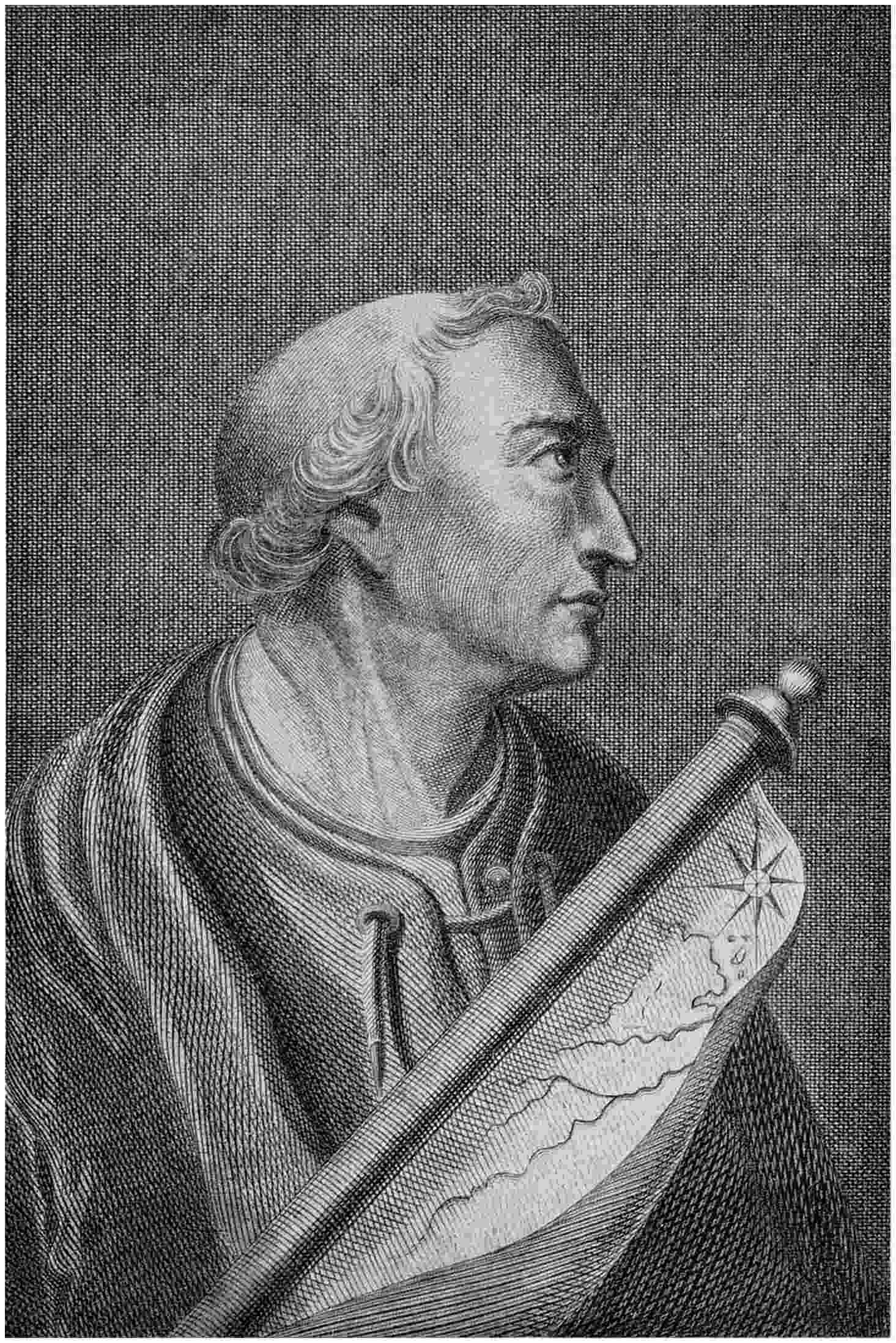
Christopher Columbus
Now note how the historians, the biographers and
the commentators, the ponderous and the mawkish,
the smug and the pedantic alike all fail to see why
their hero was laughed at. His name was Cristo-fero
Colombo, to us a good enough label for tying to any
man, but to the Italians and all educated persons of
that age, a joke. The words mean literally the Christ-Carrying
Dove. Suppose a modern man with some
invention or a great idea, called himself Mr. Christ-Carrying
Dove, and tried to get capitalists in New
York or London to finance his enterprise! In the end
he changed his name to Cristoval Colon and got himself
financed, but by that time his hair was white, and
his nerve was gone, and his health failing.
In the ninth century the vikings sailed from Norway
by the great circle course north of the gulf
stream. They had no compass or any instruments of
navigation, and they braved the unknown currents, the
uncharted reefs, the unspeakable terrors of pack-ice,
berg-streams and fog on Greenland’s awful coast.
They made no fuss.
But Columbus sailing in search of Japan, had one
Englishman and one Irishman, the rest of the people
being a pack of dagoes. In lovely weather they were
ready to run away from their own shadows.
From here onward throughout the four voyages
which disclosed the West Indies and the Spanish Main,
Columbus allowed his men to shirk their duties, to
disobey his orders, to mutiny, to desert and even to
make war upon him.
Between voyages he permitted everybody from the
mean king downward, to snub, swindle, plunder and
defame himself and all who were loyal to him in misfortune.
Because Columbus behaved like an old
woman, his swindling pork contractor, Amerigo Vespucci,
was allowed to give his name to the Americas.
Because he had not the manhood to command, the hapless
red Indians were outraged, enslaved and driven
to wholesale suicide, leaping in thousands from the
cliffs. For lack of a master the Spaniards performed
such prodigies of cowardice and cruelty as the world
has never known before or since, the native races were
swept out of existence, and Spain set out upon a downward
path, a moral lapse beyond all human power to
arrest.
Yet looking back, how wonderful is the prophecy in
that name, Christ-Carrying Dove, borne by a saintly
and heroic seaman whose mission, in the end, added
two continents to Christianity.
This text mainly contradicts a Life of Columbus, by
Clements R. Markham, C. B. Phillip & Son, 1892.
Americus Vespuccius
VI A. D. 1519 THE CONQUEST OF MEXICO
“Hernando Cortes spent an idle and unprofitable
youth.”
So did I. And every other duffer is with me in
being pleased with Cortes for setting an example.
We, not the good boys, need a little encouragement.
He was seven years old when Columbus found the
Indies. That was a time when boys hurried to get
grown up and join the search for the Fountain of
Youth, the trail to Eldorado. All who had time to
sleep dreamed tremendous dreams.
Cortes became a colonist in Cuba, a sore puzzle to
the rascal in command. When he clapped Cortes in
irons the youngster slipped free and defied him.
When he gave Cortes command of an expedition the
fellow cheeked him. When he tried to arrest him the
bird had flown, and was declared an outlaw.
The soldiers and seamen of the expedition were
horrified by this adventurer who landed them in newly
discovered Mexico, then sank the ships lest they should
wish to go home. They stood in the deadly mists of
the tropic plains, and far above them glowed the Star
of the Sea, white Orizaba crowned with polar snows.
They marched up a hill a mile and a half in sheer
height through many zones of climate, and every circumstance
of pain and famine to the edge of a plateau
crowned by immense volcanoes, a land of plenty,
densely peopled, full of opulent cities. They found
that this realm was ruled by an emperor, famous for
his victorious wars, able, it seemed, to place a million
warriors in the field, and hungry for captives to be
first sacrificed to the gods, and afterward eaten at the
banquets of the nobility and gentry. The temples
were actually fed with twenty thousand victims a year.
The Spanish invading force of four hundred men began
to feel uncomfortable.
Yet if this Cortes puzzled the governor of Cuba, and
horrified his men, he paralyzed the Emperor Montezuma.
Hundreds of years ago a stranger had come to
Mexico from the eastern sea, a bearded man who
taught the people the arts of civilized life. Then
birds first sang and flowers blossomed, the fields were
fruitful and the sun shone in glory upon that plateau
of eternal spring. The hero, Bird-Serpent, was remembered,
loved and worshiped as a god. It was
known to all men that as he had gone down into the
eastern sea so he would return again in later ages.
Now the prophecy was fulfilled. He had come with
his followers, all bearded white men out of the eastern
sea in mysterious winged vessels. Bird-Serpent and
his people were dressed in gleaming armor, had
weapons that flashed lightning, were mounted on
terrible beasts—where steel and guns and horses were
unknown; and Montezuma felt as we should do if our
land were invaded by winged men riding dragons. To
the supernatural visitors the emperor sent embassy
after embassy, loaded with treasure, begging the hero
not to approach his capital.
Set in the midst of Montezuma’s empire was the
poor valiant republic of Tlascala, at everlasting war
with the Aztec nation. Invading this republic Cortes
was met by a horde of a hundred thousand warriors,
whom he thrashed in three engagements, and when
they were humbled, accepted as allies against the
Aztecs. Attended by an Tlascalan force he entered
the ancient Aztec capital, Cholula, famed for its temple.
This is a stone-faced mound of rubble, four
times the size and half the height of the Great Pyramid,
a forty-acre building larger by four acres than
any structure yet attempted by white men.
By the emperor’s orders the Cholulans welcomed
the Spaniards, trapped them within their city, and attacked
them. In reply, Cortes used their temple as
the scene of a public massacre, slaughtered three thousand
men, and having thus explained things, marched
on the City of Mexico.
In those days a salt lake, since drained, filled the
central hollow of the vale of Mexico, and in the
midst of it stood the city built on piles, and threaded
with canals, a barbaric Venice, larger, perhaps even
grander than Venice with its vast palace and gardens,
and numberless mound temples whose flaming altars
lighted the town at night. Three causeways crossed
the lake and met just as they do to-day at the central
square. Here, on the site of the mound temple, stands
one of the greatest of the world’s cathedrals, and
across the square are public buildings marking the site
of Montezuma’s palace, and that in which he entertained
the Spaniards. The white men were astonished
at the zoological gardens, the aviary, the floating
market gardens on the lake, the cleanliness of the
streets, kept by a thousand sweepers, and a metropolitan
police which numbered ten thousand men,
arrangements far in advance of any city of Europe.
Then, as now, the place was a great and brilliant
capital.
Yet from the Spanish point of view these Aztecs
were only barbarians to be conquered, and heathen
cannibals doomed to hell unless they accepted the
faith. To them the Cholula massacre was only a military
precaution. They thought it right to seize their
generous host the emperor, to hold him as a prisoner
under guard, and one day even to put him in irons.
For six months Montezuma reigned under Spanish
orders, overwhelmed with shame. He loved his captors
because they were gallant gentlemen, he freely
gave them his royal treasure of gems, and gold, and
brilliant feather robes. Over the plunder—a million
and a half sterling in gold alone—they squabbled;
clear proof to Montezuma that they were not all divine.
Yet still they were friends, so he gave them all
the spears and bows from his arsenal as fuel to burn
some of his nobles who had affronted them.
It was at this time that the hostile governor of Cuba
sent Narvaes with seventeen ships and a strong force
to arrest the conqueror for rebellion. The odds were
only three to one, instead of the usual hundred to one
against him, so Cortes went down to the coast, gave
Narvaes a thrashing, captured him, enrolled his men
by way of reinforcements, and returned with a force
of eleven hundred troops.
He had left his friend, Alvarado, with a hundred
men to hold the capital and guard the emperor. This
Alvarado, so fair that the natives called him Child of
the Sun, was such a fool that he massacred six
hundred unarmed nobles and gentlefolk for being
pagans, violated the great temple, and so aroused the
whole power of the fiercest nation on earth to a war of
vengeance. Barely in time to save Alvarado, Cortes
reentered the city to be besieged. Again and again
the Aztecs attempted to storm the palace. The emperor
in his robes of state addressed them from the
ramparts, and they shot him. They seized the great
temple which overlooked the palace, and this the
Spaniards stormed. In face of awful losses day by
day the Spaniards, starving and desperate, cleared a
road through the city, and on the night of Montezuma’s
death they attempted to retreat by one of the
causeways leading to the mainland. Three canals cut
this road, and the drawbridges had been taken away,
but Cortes brought a portable bridge to span them.
They crossed the first as the gigantic sobbing gong
upon the heights of the temple aroused the entire city.
Heavily beset from the rear, and by thousands of
men in canoes, they found that the weight of their
transport had jammed the bridge which could not be
removed. They filled the second gap with rocks, with
their artillery and transport, with chests of gold, horses,
and dead men. So they came to the third gap, no
longer an army but as a flying mob of Spaniards and
Tlascalan warriors bewildered in the rain and the darkness
by the headlong desperation of the attacking host.
They were compelled to swim, and at least fifty of the
recruits were drowned by the weight of gold they refused
to leave, while many were captured to be sacrificed
upon the Aztec altars. Montezuma’s children
were drowned, and hundreds more, while Cortes and
his cavaliers, swimming their horses back and forth
convoyed the column, and Alvarado with his rear
guard held the causeway.
Last in the retreat, grounding his spear butt, he
leaped the chasm, a feat of daring which has given a
name forever to this place as Alvarado’s Leap. And
just beyond, upon the mainland there is an ancient tree
beneath which Cortes, as the dawn broke out, sat on
the ground and cried. He had lost four hundred
fifty Spaniards, and thousands of Tlascalans, his
records, artillery, muskets, stores and treasure in that
lost battle of the Dreadful Night.
A week later the starved and wounded force was
beset by an army of two hundred thousand Aztecs.
They had only their swords now, but, after long hours
of fighting, Cortes himself killed the Aztec general, so
by his matchless valor and leadership gaining a victory.
The rest is a tale of horror beyond telling, for,
rested and reinforced, the Spaniards went back. They
invested, besieged, stormed and burned the famine-stricken,
pestilence-ridden capital, a city choked and
heaped with the unburied dead of a most valiant
nation.
Afterward, under the Spanish viceroys, Mexico
was extended and enlarged to the edge of Alaska, a
Christian civilized state renowned for mighty works
of engineering, the splendor of her architecture, and
for such inventions as the national pawn-shop, as a
bank to help the poor. One of the so-called native
“slaves” of the mines once wrote to the king of
Spain, begging his majesty to visit Mexico and offering
to make a royal road for him, paving the two
hundred fifty miles from Vera Cruz to the capital
with ingots of pure silver as a gift to Spain.
VII A. D. 1532 THE CONQUEST OF PERU
Pizarro was reared for a swineherd; long years
of soldiering made him no more than a captain,
and when at the age of fifty he turned explorer, he
discovered nothing but failure.
For seven years he and his followers suffered on
trails beset by snakes and alligators, in feverish jungles
haunted by man-eating savages, to be thrown at last
battered, ragged and starving on the Isle of Hell.
Then a ship offered them passage, but old Pizarro drew
a line in the dust with his sword. “Friends,” said he,
“and comrades, on that side are toil, hunger, nakedness,
the drenching storm, desertion and death; on
this side ease and pleasure. There lies Peru with its
riches; here Panama and its poverty. Choose each
man, what best becomes a brave Castilian. For my
part, I go to the south.”
Thirteen of all his people crossed the line with
Pizarro, the rest deserting him, and he was seven
months marooned on his desert isle in the Pacific.
When the explorer’s partners at last were able to send
a ship from Panama, it brought him orders to return, a
failure. He did not return but took the ship to the
southward, his guide the great white Andes, along a
coast no longer of horrible swamps but now more
populous, more civilized than Spain, by hundreds of
miles on end of well-tilled farms, fair villages and
rich cities where the temples were sheathed with plates
of pure red gold. As in the Mexico of eight years
ago, the Spaniards were welcomed as superhuman,
their ship, their battered armor and their muskets
accounted as possessions of strayed gods. They dined
in the palaces of courtly nobles, rested in gardens
curiously enriched with foliage and flowers of beaten
gold and silver, and found native gentlemen eager to
join them in their ship as guests. So with a shipload
of wonders to illustrate this discovery they went back
to Panama, and Pizarro returned home to seek in
Spain the help of Charles V. There, at the emperor’s
court, he met Cortes, who came to lay the wealth
of conquered Mexico at his sovereign’s feet, and
Charles, with a lively sense of more to come,
despatched Pizarro to overthrow Peru.
Between the Eastern and the Western Andes lies a
series of lofty plains and valleys, in those days irrigated
and farmed by an immense civilized population.
A highway, in length 1,100 miles, threaded the settlements
together. The whole empire was ruled by a
foreign dynasty, called the Incas, a race of fighting
despots by whom the people had been more or less
enslaved. The last Inca had left the northern kingdom
of Quito to his younger son, the ferocious Atahuallpa,
and the southern realm of Cuzco to his heir,
the gentle Huascar.
These brothers fought until Atahuallpa subdued the
southern kingdom, imprisoned Huascar, and reigned
so far as he knew over the whole world. It was then
that from outside the world came one hundred sixty-eight
men of an unknown race possessed of ships,
horses, armor and muskets—things very marvelous,
and useful to have. The emperor invited these
strangers to cross the Andes, intending, when they
came, to take such blessings as the Sun might send
him. The city of Caxamalca was cleared of its
people, and the buildings enclosing the market place
were furnished for the reception of the Spaniards.
The emperor’s main army was seven hundred miles
to the southward, but the white men were appalled by
the enormous host attending him in his camp, where
he had halted to bathe at the hot springs, three miles
from their new quarters. The Peruvian watch fires
on the mountain sides were as thick as the stars of
heaven.
The sun was setting next day when a procession
entered the Plaza of Caxamalca, a retinue of six thousand
guards, nobles, courtiers, dignitaries, surrounding
the litter on which was placed the gently swaying
golden throne of the young emperor.
Of all the Spaniards, only one came forward, a
priest who, through an interpreter, preached, explaining
from the commencement of the world the story of
his faith, Saint Peter’s sovereignty, the papal office,
and Pizarro’s mission to receive the homage of this
barbarian. The emperor listened, amused at first, then
bored, at last affronted, throwing down the book he
was asked to kiss. On that a scarf waved and the
Spaniards swept from their ambush, blocking the exits,
charging as a wolf-pack on a sheepfold, riding the
people down while they slaughtered. So great was
the pressure that a wall of the courtyard fell, releasing
thousands whose panic flight stampeded the Incas’
army. But the nobles had rallied about their sovereign,
unarmed but with desperate valor clinging
to the legs of the horses and breaking the charge of
cavalry. They threw themselves in the way of the
fusillades, their bodies piled in mounds, their blood
flooding the pavement. Then, as the bearers fell, the
golden throne was overturned, and the emperor hurried
away a prisoner. Two thousand people had
perished in the attempt to save him.
The history of the Mexican conquest was repeated
here, and once more a captive emperor reigned under
Spanish dictation.
This Atahuallpa was made of sterner stuff than
Montezuma, and had his defeated brother Huascar
drowned, lest the Spaniards should make use of his
rival claim to the throne. The Peruvian prince had no
illusions as to the divinity of the white men, saw
clearly that their real religion was the adoration of
gold, and in contempt offered a bribe for his freedom.
Reaching the full extent of his arm to a height of
nine feet, he boasted that to that level he would fill
the throne room with gold as the price of his liberty,
and twice he would fill the anteroom with silver. So
he sent orders to every city of his empire commanding
that the shrines, the temples, palaces and gardens be
stripped of their gold and silver ornaments, save only
the bodies of the dead kings, his fathers. Of course,
the priests made haste to bury their treasures, but the
Spaniards went to see the plunder collected and when
they had finished no treasures were left in sight save
a course of solid golden ingots in the walls of the
Temple of the Sun at Cuzco, and certain massive
beams of silver too heavy for shipment. Still the
plunder of an empire failed to reach the nine-foot line
on the walls of the throne room at Caxamalca, but the
soldiers were tired of waiting, especially when the
goldsmiths took a month to melt the gold into ingots.
So the royal fifth was shipped to the king of Spain,
Pizarro’s share was set apart, a tithe was dedicated to
the Church, and the remainder divided among the
soldiers according to their rank, in all three and a half
millions sterling by modern measurement, the greatest
king’s ransom known to history. Then the emperor
was tried by a mock court-martial, sentenced to death
and murdered. It is comforting to note that of all
who took part in that infamy not one escaped an early
and a violent death.
Pizarro had been in a business partnership with the
schoolmaster Luque of Panama cathedral, and with
Almagro, a little fat, one-eyed adventurer, who now
arrived on the scene with reinforcements. Pizarro’s
brothers also came from Spain. So when the emperor’s
death lashed the Peruvians to desperation,
there were Spaniards enough to face odds of a hundred
to one in a long series of battles, ending with the siege
of the adventurers who held Cuzco against the Inca
Manco for five months. The city, vast in extent, was
thatched, and burned for seven days with the Spaniards
in the midst. They fought in sheer despair, and
the Indians with heroism, their best weapon the lasso,
their main hope that of starving the garrison to death.
No valor could possibly save these heroic robbers,
shut off from escape or from rescue by the impenetrable
rampart of the Andes. They owed their salvation
to the fact that the Indians must disperse to
reap their crops lest the entire nation perish of hunger,
and the last of the Incas ended his life a fugitive lost
in the recesses of the mountains.
Then came a civil war between the Pizarros, and
Almagro, whose share of the plunder turned out to be
a snowy desolation to the southward. It was not until
after this squalid feud had been ended by Almagro’s
execution and Pizarro’s murder, that the desolate
snows were uncovered, revealing the incomparable
treasures of silver Potosi, Spain’s share of the plunder.
VIII A. D. 1534 THE CORSAIRS
In 1453 Constantinople was besieged and stormed
by the Turks, the Christian emperor fell with sixty
thousand of his men in battle, and the Caliph Mahomet
II raised the standard of Islam over the last ruins of
the Roman empire.
Four years later a sailorman, a Christian from the
Balkan States, turned Moslem and was banished from
the city. He married a Christian widow in Mitylene
and raised two sons to his trade. At a very tender
age, Uruj, the elder son, went into business as a
pirate, and on his maiden cruise was chased and
captured by a galley of the Knights of Saint
John who threw him into the hold to be a slave at
the oars. That night a slave upon the nearest oar-bench
disturbed the crew by groaning, and to
keep him quiet was thrown overboard. Not liking
his situation or prospects, Uruj slipped his shackles,
crept out and swam ashore. On his next voyage, being
still extremely young, he was captured and swam
ashore again. Then the sultan’s brother fitted him
out as a corsair at the cost of five thousand ducats,
to be paid by the basha of Egypt, and so, thanks to
this act of princely generosity, Uruj was able to open
a general practise. His young brother Khizr, also
a pirate, joined him; the firm was protected by the
sultan of Tunis who got a commission of twenty
per cent. on the loot; and being steady, industrious
and thrifty, by strict application to business,
they made a reputation throughout the Middle Sea.
Indeed the Grand Turk bestowed upon Khizr the title
“Protector of Religion,” a distinction never granted
before or since to any professional robber. Once after
a bitter hard fight the brothers captured a first-rate
ship of war, The Galley of Naples, and six lady passengers
besides three hundred men were marched
ashore into slavery. “See,” said the sultan of Tunis,
“how Heaven recompenses the brave!” Uruj, by the
way, was laid up some months for repairs, and in his
next engagement, a silly attack on a fortress, happened
to lose an arm as part of his recompense.
By this time the brothers were weary of that twenty
per cent. commission to the unctuous sultan of Tunis,
and by way of cheating him, took to besieging
fortresses, or sacking towns, Christian or Moslem as
the case might be, until they had base camps of their
own, Uruj as king of Tlemcen, and Khizr as king of
Algiers. Then Uruj fell in battle, and Khizr Barbarossa
began to do business as a wholesale pirate
with a branch kingdom of Tunis, and fleets to destroy
all commerce, to wreck and burn settlements of the
Christian powers until he had command of the sea as
a first-class nuisance. The gentle Moors, most
civilized of peoples, expelled from Spain (1493) by
the callous ill-faith of Ferdinand and Isabella, and
stranded upon North Africa to starve, manned Barbarossa’s
fleets for a bloody vengeance upon Christian
Europe. Then Charles V brought the strength of
Spain, Germany and Italy to bear in an expedition
against Barbarossa, but his fleet was wrecked by a
storm, clear proof that Allah had taken sides with the
strong pirate king. Barbarossa then despatched his
lieutenant Hassan to ravage the coast of Valencia.
It was upon this venture that Hassan met a transport
merchantman with a hundred veteran Spanish
infantry, too strong to attack; so when this lieutenant
returned to Algiers deep-laden with spoil and captives
from his raid, he found King Barbarossa far from
pleased. The prisoners were butchered, and Hassan
was flogged in public for having shirked an engagement.
That is why Hassan joined with Venalcadi, a
brother officer who was also in disgrace, and together
they drove Barbarossa out of Algeria. Presently the
king came back with a whole fleet of his fellow corsairs,
brother craftsmen, the Jew, and Hunt-the-Devil,
Salærrez and Tabas, all moved to grief and rage by
the tears of a sorely ill-treated hero. With the aid of
sixty captive Spanish soldiers, who won their freedom,
they captured Algiers, wiped out the mutineers,
and restored the most perfect harmony. Indeed, by
way of proof that there really was no trouble among
the corsairs, King Barbarossa sent off Hunt-the-Devil
with seventeen ships to burn Spain. Ever in blood
and tears, their homes in flames, their women ravished,
their very children enslaved, the Spaniards had to pay
for breaking faith with the Moors of Granada.
Barbarossa was not yet altogether king of Algiers.
For twenty years the Peñon, a fortress fronting that
city, had been held by Martin de Vargas and his garrison.
Worn out with disease and famine these Spaniards
now fought Barbarossa to the last breath, but
their walls went down in ruin, the breach was stormed,
and all were put to the sword. De Vargas, taken
prisoner, demanded the death of a Spaniard who had
betrayed him. The traitor was promptly beheaded,
but Barbarossa turned upon De Vargas. “You and
yours,” he said, “have caused me too much trouble,”
and he again signed to the headsman. So De Vargas
fell.
Terrible was the rage of Charles V, emperor of half
Europe, thus defied and insulted by the atrocious corsair.
It was then that he engaged the services of
Andrea Doria, the greatest Christian admiral of that
age, for war against Barbarossa. And at the same
time the commander of the faithful, Suleiman the
Magnificent, sent for King Barbarossa to command
the Turkish fleet.
He came, with gifts for the calif: two hundred
women bearing presents of gold or silver; one hundred
camels laden with silks and gold; then lions and other
strange beasts; and more loads of brocades, or rich
garments, all in procession through Constantinople,
preceding the pirate king on his road to the palace.
The sultan gave him not only a big fleet, but also vice-regal
powers to make war or peace. Next summer
(1534) eleven thousand Christian slaves, and a long
procession of ships loaded with the plunder of smoking
Italy were sent to the Golden Horn. Incidentally,
Barbarossa seized the kingdom of Tunis for himself,
and slaughtered three thousand of the faithful, just
to encourage the rest.
It was to avenge the banished King Hassan, and
these poor slaughtered citizens that the Emperor
Charles V, attended by his admiral, Andrea Doria,
came with an army and a mighty fleet to Tunis.
He drove out Barbarossa, a penniless, discredited
fugitive; and his soldiers slaughtered thirty thousand
citizens of Tunis to console them for the pirate’s late
atrocities.
Poor old Barbarossa, past seventy years of age, had
lost a horde of fifty thousand men, his kingdom of
Tunis, fleet and arsenal; but he still had fifteen galleys
left at Bona, his kingdom of Algiers to fall back upon,
and his Moorish seamen, who had no trade to win
them honest bread except as pirates. “Cheer up,” said
he, to these broken starving men, and after a little
holiday they sacked the Balearic Isles taking five
thousand, seven hundred slaves, and any amount of
shipping. Then came the building of a Turkish fleet;
and with one hundred twenty sail, Barbarossa went
to his last culminating triumph, the defeat of Andrea
Doria, who had at Prevesa one hundred ninety-five
ships, sixty thousand men, and two thousand, five
hundred ninety-four guns. With that victory he retired,
and after eight years of peace, he died in his
bed, full of years and honors. For centuries to come
all Turkish ships saluted with their guns, and dipped
their colors whenever they passed the grave of the
King of the Sea.
Sea Wolves of the Mediterranean, Commander E.
Hamilton Currey, R.N. John Murray.
IX A. D. 1542 PORTUGAL IN THE INDIES
It was Italian trade that bought and paid for the
designs of Raphael, the temples of Michelangelo,
the sculptures of Cellini, the inventions of Da Vinci,
for all the wonders, the glories, the splendors of inspired
Italy. And it was not good for the Italian
trade that Barbarossa, and the corsairs of three centuries
in his wake, beggared the merchants and enslaved
their seamen. But Italian commerce had its
source in the Indian Seas, and the ruin of Italy began
when the sea adventures of Portugal rounded the Cape
of Good Hope to rob, to trade, to govern and convert
at the old centers of Arabian business.
Poverty is the mother of labor, labor the parent
of wealth and genius. It is the poverty of Attica,
and the Roman swamps, of sterile Scotland, boggy
Ireland, swampy Holland, stony New England, which
drove them to high endeavor and great reward.
Portugal, too, had that advantage of being small and
poor, without resources, or any motive to keep the
folk at home. So the fishermen took to trading and
exploration led by Cao who found the Cape of Good
Hope, Vasco da Gama who smelt out the way to India,
Almeida who gained command of the Indian Seas,
Cabral who discovered Brazil, Albuquerque who, seizing
Goa and Malacca, established a Christian empire
in the Indies, and Magellan, who showed Spain the
way to the Pacific.
Of these the typical man was Da Gama, a noble with
the motives of a crusader and the habits of a pirate,
who once set fire to a shipload of Arab pilgrims, and
watched unmoved while the women on her blazing
deck held out little babies in the vain hope of mercy.
On his first voyage he came to Calicut, a center of
Hindu civilization, a seat of Arab commerce, and to
the rajah sent a present of washing basins, casks of
oil, a few strings of coral, fit illustration of the poverty
of his brave country, accepted as a joke in polished,
wealthy, weary India. The king gave him leave to
trade, but seized the poor trade goods until the Portuguese
ships had been ransacked for two hundred
twenty-three pounds in gold to pay the customs duties.
The point of the joke was only realized when on his
second voyage Da Gama came with a fleet, bombarded
Calicut, and loaded his ships with spices, leaving a
trail of blood and ashes along the Indian coast.
Twenty years later he came a third time, but now as
viceroy to the Portuguese Indies. Portugal was no
longer poor, but the richest state in Europe, bleeding
herself to death to find the men for her ventures.
Now these arrogant and ferocious officials, military
robbers, fishermen turned corsairs, and ravenous traders
taught the whole East to hate and fear the Christ.
And then came a tiny little monk no more than five
feet high, a white-haired, blue-eyed mendicant, who
begged the rice he lived on. Yet so sweet was his
temper, so magical the charm, so supernatural the
valor of this barefoot monk that the children worshiped
him, the lepers came to him to be healed, and
the pirates were proud to have him as their guest. He
was a gentleman, a Spanish Basque, by name Francis
de Xavier, and in the University of Paris had been a
fellow student with the reformer Calvin, then a friend
and follower of Ignatius de Loyola, helping him to
found the Society of Jesus. Xavier came to the Indies
in 1542 as a Jesuit priest.
Once on a sea voyage Xavier stood for some time
watching a soldier at cards, who gambled away all his
money and then a large sum which had been entrusted
to his care. When the soldier was in tears and threatening
suicide, Xavier borrowed for him the sum of
one shilling twopence, shuffled and dealt for him, and
watched him win back all that he had lost. At that
point Saint Francis set to work to save the
soldier’s soul, but this disreputable story is not shown
in the official record of his miracles.
From his own letters one sees how the heathen
puzzled this little saint, “‘Was God black or white?’
For as there is so great variety of color among man,
and the Indians are themselves black, they esteem their
own color most highly, and hold that their gods are
also black.”
He does not say how he answered, indeed it was
hardly by words that this hidalgo of Spain preached
in the many languages he could never learn. Once
when his converts were threatened by a hostile army
he went alone to challenge the invaders, and with uplifted
crucifix rebuked them in the name of God. The
front ranks wavered and halted. Their comrades and
leaders vainly pressed them to advance, but no man
dared pass the black-robed figure which barred the
way, and presently the whole force retreated.
Once in the Spice Islands while he was saying mass
on the feast of the Archangel Saint Michael a tremendous
earthquake scattered the congregation. The
priest held up the shaking altar and went on with mass,
while, as he says, “Perhaps Saint Michael, by his
heavenly power, was driving into the depths of hell all
the wicked spirits of the country who were opposing
the worship of the true God.”
Such was the apostle of the Indies, and it is a pleasant
thing to trace the story of his mission in Japan in
the Peregrination, a book by a thorough rogue.
Fernão Mendes Pinto was a distant relative of Ananias.
He sailed for India in 1537 “meanly accommodated.”
At Diu he joined an expedition to watch the
Turkish fleet in the Red Sea, and from Massawa was
sent with letters to the king of Abyssinia. That was
great luck, because the very black and more or less
Christian kingdom was supposed to be the seat of the
legendary, immortal, shadowy, Prester John. On his
way back to Massawa the adventurer was wrecked,
captured by Arabs, sold into slavery, bought by a Jew,
and resold in the commercial city of Ormus where
there were Christian buyers. He found his way to
Goa, the capital of the Portuguese Indies, thence to
Malacca, where he got a job as political agent in Sumatra.
With this ended the dull period of his travels.
Francis Xavier
In those days there were ships manned by Portuguese
rogues very good in port, but unpleasant to meet
with at sea. They were armed with cannon, pots of
wild fire, unslaked lime to be flung in the Chinese
manner, stones, javelins, arrows, half-pikes, axes and
grappling irons, all used to collect toll from Chinese,
Malay, or even Arab merchants. Pinto found that
this life suited him, and long afterward, writing as a
penitent sinner, described the fun of torturing old men
and children: “Made their brains fly out of their
heads with a cord” or looked on while the victims died
raving “like mad dogs.” It was great sport to surprise
some junk at anchor, and fling pots of gunpowder
among the sleeping crew, then watch them dive and
drown. “The captain of one such junk was ‘a notorious
Pyrat,’ and Pinto complacently draws the
moral ‘Thus you see how it pleased God, out of His
Divine justice to make the arrogant confidence of this
cursed dog a means to chastise him for his cruelties.’”
So Christians set an example to the heathen.
Antonio de Faria, Pinto’s captain, had vowed to wipe
out Kwaja Hussain, a Moslem corsair from Gujerat
in Western India. In search of Hussain he had many
adventures in the China seas, capturing pirate crews,
dashing out their brains, and collecting amber, gold
and pearls. Off Hainan he so frightened the local
buccaneers that they proclaimed him their king and
arranged to pay him tribute.
Luckily for them Faria’s ship was cast away upon a
desert island. The crew found a deer which had been
left by a tiger, half eaten; their shouts would scare
the gulls as they flew overhead, so that the birds
dropped such fish as they had captured; and then by
good luck they discovered a Chinese junk whose people,
going ashore, had left her in charge of an old man
and a child. Amid the clamors of the Chinese owners
Faria made off with this junk. He was soon at
the head of a new expedition in quest of that wicked
pirate, Kwaja Hussain. This ambition was fulfilled,
and with holds full of plunder the virtuous Faria put
into Liampo. Back among the Christians he had a
royal welcome, but actually blushed when a sermon
was preached in his honor. The preacher waxed too
eloquent, “whereupon some of his friends plucked
him three or four times by the surplice, for to make
him give over.” It seems that even godly Christian
pirates have some sense of humor.
Once in the Malay states, Pinto and a friend of his,
a Moslem, were asked to dine with a bigwig, also a
True Believer. At dinner they spoke evil about the
local rajah, who got wind of the slander. Pinto
watched both of these Moslem gentlemen having their
feet sawn off, then their hands, and finally their heads.
As for himself, he talked about his rich relations,
claiming Dom Pedro de Faria, a very powerful noble,
as his uncle. He said the factor had embezzled his
uncle’s money and fully deserved his fate. “All this,”
says Pinto, “was extemporized on the spur of the
moment, not knowing well what I said.” The liar
got off.
Pinto’s career as a pirate ended in shipwreck, capture,
slavery and a journey in China where he was put
to work on the repairing of the Great Wall. He was
at a city called Quinsay in 1544 when Altan Khan,
king of the Tumeds—a Mongolian horde—swept
down out of the deserts.
The Mongols sacked Quinsay, and Pinto as a prisoner
was brought before Altan Khan who was besieging
Pekin. When the siege was raised he accompanied
the Mongol army on its retreat into the heart
of Asia. In time he found favor with his masters
and was allowed to accompany an embassy to Cochin
China. On this journey he saw some cannon with
iron breeches and wooden muzzles made, he was told,
by certain Almains (Germans) who came out of Muscovy
(Russia), and had been banished by the king
of Denmark. Then comes Pinto’s account of Tibet,
of Lhasa, and the Grand Lama, and so to Cochin
China, and the sea. If it is true, Pinto made a very
great journey, and he claims to have been afterward
with Xavier in Japan. In the end he returned to
Lisbon after twenty-one years of adventure in which
he was five times shipwrecked, and seventeen times
sold as a slave.
It is disheartening to have so little space for the
great world of Portuguese adventure in the Indies,
where Camoens, one of the world’s great poets, wrote
the immortal Lusiads.
However ferocious, these Portuguese adventurers
were loyal, brave and strong. They opened the way
of Europe to the East Indies, they Christianized and
civilized Brazil. Once, at sea, a Portuguese lady
spoke to me of England’s good-humored galling disdain
toward her people. “Ah, you English!” she
cried. “What you are, we were once! what we are,
you will be!”
Vasco da Gama and his Successors, by K. G. Jayne.
Methuen.
X A. D. 1841 RAJAH BROOKE
Borneo is a hot forest about five hundred miles
long, and as wide, inhabited by connoisseurs
called Dyaks, keen collectors. They collect human
heads and some of their pieces are said to be very
valuable. They are a happy little folk with most
amusing manners and customs. Here is their ritual
for burial of the dead:
“When a man dies his friends and relations meet
in the house and take their usual seats around the
room. The deceased is then brought in attired in his
best clothes, with a cigar fixed in his mouth; and, being
placed on the mat in the same manner as when alive,
his betel box is set by his side. The friends go
through the form of conversing with him, and offer
him the best advice concerning his future proceedings,
and then, having feasted, the body is deposited in a
large coffin and kept in the house for several months.”
The habits of the natives have been interfered with
by the Malays, who conquered most of them and
carved their island up into kingdoms more or less
civilized, but not managed at all in the interests of
the Dyaks. These kingdoms were decayed and
tumbling to pieces when the Dutch came in to help,
and helped themselves to the whole of Borneo except
the northwestern part. They pressingly invited themselves
there also, but the Malay rajah kept putting
them off with all sorts of polite excuses.
While the rajah’s minister was running short of
excuses to delay the Dutch an English yacht arrived
in Sarawak. The owner was Mr. James Brooke, who
had been an officer in the East India Company, but
being hit with a slug in the lungs during the first
Burma war, was retired with a pension of seventy
pounds for wounds. Afterward he came into a
fortune of thirty thousand pounds, took to yachting,
traveled a great deal in search of adventure, and so in
1839 arrived in Sarawak on the lookout for trouble.
An Englishman of gentle birth is naturally expected
to tell the truth, to be clean in all his dealings, to keep
his temper, and not to show his fears. Not being a
beastly cad, Brooke as a matter of course conformed
to the ordinary standards and, having no worries, was
able to do so cheerfully. One may meet men of this
stock, size and pattern by thousands the world over,
but in a decayed Malay state, at war with the Dyaks
ashore and the pirates afloat, Brooke was a phenomenon
just as astonishing as a first-class comet, an earthquake
eruption, or a cyclone. His arrival was the
only important event in the whole history of North
Borneo. The rajah sought his advice in dealing with
the Dutch, the Dyaks and the pirates. The Malays,
Dyaks, pirates and everybody else consulted him as to
their dealings with the rajah. On his second visit he
took a boat’s crew from his yacht and went to the seat
of war. There he tried to the verge of tears to persuade
the hostile forces either to fight or make friends,
and when nobody could be induced to do anything at
all, he, with his boat’s crew and one native warrior,
stormed the Dyak position, putting the enemy to total
rout and flight. Luckily, nobody was hurt, for even
a cut finger would have spoiled the perfect bloodlessness
of Brooke’s victory. Then the Dyaks surrendered
to Brooke. Afterward the pirate fleet appeared
at the capital, not to attack the rajah, but to
be inspected by Brooke, and when he had patted the
pirates they went away to purr. Moreover the rajah
offered to hand over his kingdom to Brooke as manager,
and the Englishman expected him to keep his
word. Brooke brought a shipload of stores in payment
for a cargo of manganese, but the rajah was so
contented with that windfall that he forgot to send
to his mines for the ore.
Further up the coast a British ship was destroyed
by lightning, and her crew got ashore where they
were held as captives pending a large ransom. Even
when the captain’s wife had a baby the local bigwig
thereabouts saw a new chance of plunder, and stole
the baby-clothes. Then the shipwrecked mariners
sent a letter to Brooke appealing for his help; but
nothing on earth could induce the spineless boneless
rajah to send the relief he had promised. Then
Brooke wrote to Singapore whence the East India
Company despatched a war-ship which rescued the
forty castaways.
The rajah’s next performance was to arrange for a
percentage with two thousand, five hundred robbers
who proposed to plunder and massacre his own subjects.
Brooke from his yacht stampeded the raiders
with a few rounds from the big guns—blank of
course. Brooke was getting rather hard up, and
could not spare ball ammunition on weekdays.
So King Muda Hassim lied, cheated, stole, betrayed,
and occasionally murdered—a mean rogue,
abject, cringing to Brooke, weeping at the Englishman’s
threats to depart, holding his throne so long as
the white yacht gave him prestige; but all this with
pomp and circumstance, display of gems and gold,
a gorgeous retinue, plenty of music, and royal salutes
on the very slightest pretext. But all the population
was given over to rapine and slaughter, and the forest
was closing in on ruined farms. The last and only
hope of the nation was in Brooke.
Behind every evil in the state was Makota, the
prime minister, a polite and gentlemanly rascal, and
at the end of two years he annoyed Brooke quite seriously
by putting arsenic in the interpreter’s rice.
Brooke cleared his ship for action, and with a landing
party under arms marched to the palace gates. In
a few well-chosen words he explained Makota’s villainy,
showed that neither the rajah’s life nor his own
was safe, and that the only course was to proclaim
Brooke as governor.
No shot was fired, no blow was struck, but Makota’s
party vanished, the villain fled, the rajah began to behave,
the government of the country was handed over
to the Englishman amid great popular rejoicings.
“My darling mother,” he wrote, “I am very poor, but
I want some things from home very much; so I must
trust to your being rich enough to afford them to me.
Imprimis, a circle for taking the latitude; secondly,
an electrifying machine of good power; thirdly, a large
magic lantern; fourthly, a rifle which carries fifty
balls; and last, a peep-show. The circle and rifle I
want very much; and the others are all for political
purposes.” Did ever king begin his reign with such
an act as that letter?
But then, look at the government he replaced:
“The sultan and his chiefs rob all classes of Malays
to the utmost of their power; the Malays rob the
Dyaks, and the Dyaks hide their goods as much as
they dare, consistent with the safety of their wives
and children.” Brooke found his private income a
very slender fund when he had to pay the whole expense
of governing a kingdom until the people recovered
from their ruin.
February the first, 1842, a pirate chief called to
make treaty with the new king. “He inquired, if a
tribe pirated on my territory what I intended to do.
My answer was ‘to enter their country and lay it
waste.’ ‘But,’ he asked me again, ‘you will give me—your
friend—leave to steal a few heads occasionally?’
‘No,’ I replied, ‘I shall have a hundred
Sakarran heads for every one you take here!’ He
recurred to this request several times—‘just to steal
one or two’-as a schoolboy asks for apples.”
Brooke used to give the pirates his laughing permission
to go to Singapore and attack the English.
Sir James Brooke
“The Santah River,” he wrote, “is famous for its
diamonds. The workers seem jealous and superstitious,
disliking noise, particularly laughter, as it is
highly offensive to the spirit who presides over the
diamonds.... A Chinese Mohammedan with the
most solemn face requested me to give him an old
letter; and he engraved some Chinese characters,
which, being translated signify ‘Rajah Muda Hassim,
James Brooke, and Hadju Ibrahim present their compliments
to the spirit and request his permission to
work at the mine.’”
There were great doings when the sultan of Borneo
had Mr. Brooke proclaimed king in Sarawak.
Then he went off to the Straits Settlements, where
he made friends with Henry Keppel, captain of
H. M. S. Dido, a sportsman who delighted in hunting
pirates, and accepted Brooke’s invitation to a few
days’ shooting. Keppel describes the scene of
Brooke’s return to his kingdom, received by all the
chiefs with undisguised delight, mingled with gratitude
and respect for their newly-elected ruler. “The
scene was both novel and exciting, presenting to us—just
anchored in a large fresh water river, and surrounded
by a densely wooded jungle—the whole surface
of the water covered with canoes and boats
dressed with colored silken flags, filled with natives
beating their tom-toms, and playing on wind instruments,
with the occasional discharge of firearms. To
them it must have been equally striking to witness the
Dido anchored almost in the center of their town, her
mastheads towering above the highest trees of that
jungle, the loud report of her heavy thirty-two-pounder
guns, the manning aloft to furl sails of one
hundred fifty seamen in their clean white dresses, and
with the band playing. I was anxious that Mr.
Brooke should land with all the honors due to so important
a personage, which he accordingly did, under
a salute.”
It was a little awkward that the Dido struck a rock
and sank, but she chose a convenient spot just opposite
Mr. Brooke’s house, so that Brooke’s officers
and those of the ship formed one mess there, a
band of brothers, while the damage was being repaired.
Then came the promised sport, a joint boat
expedition up all sorts of queer back channels and
rivers fouled by the pirates with stakes and booms
under fire of the artillery in their hill fortresses. The
sportsmen burst the booms, charged the hills, stormed
the forts, burned out the pirates and obtained their
complete submission. Brooke invited them all to a
pirate conference at his house and, just as with the
land rogues, charmed them out of their skins. He
fought like a man, but his greatest victories were
scored by perfect manners.
The next adventure was a visit from the Arctic
explorer, Sir Edward Belcher, sent by the British government
to inspect Brooke’s kingdom, now a peaceful
and happy country.
Later came Admiral Sir Thomas Cochrane with a
squadron to smash up a few more pirates, and the
smashing of pirates continued for many years a popular
sport for the navy. The pirate states to the
northward became in time the British colonies of
Labuan, and North Borneo, but Sarawak is still a
protected Malay state, the hereditary kingdom of
Sir James Brooke and his descendants. May that
dynasty reign so long as the sun shines.
XI A. D. 1842 THE SPIES — I — II
From earliest childhood Eldred Pottinger was out
of place in crowded England. Gunpowder is
good exciting stuff to play with, and there could be
no objection to his blowing up himself and his little
brother, because that was all in the family; but when
he mined the garden wall and it fell on a couple of
neighbors, they highly took offense; and when his
finely invented bomb went off at Addiscombe College
he rose to the level of a public nuisance. On the whole
it must have been a relief to his friends when he went
to India. There he had an uncle, the president in
Scinde, a shrewd man who shipped young Pottinger
to the greatest possible distance in the hinder parts of
Afghanistan.
The political situation in Afghanistan was the usual
howling chaos of oriental kingdoms, and the full
particulars would bore the reader just as they bored
me. It was Pottinger’s business to find out and report
the exact state of affairs at a time when any
white man visiting the country was guaranteed, if
and when found, to have his throat cut. Being clever
at native languages, with a very foxy shrewdness, the
young spy set off, disguised as a native horse dealer,
and reached Cabul, the Afghan capital.
The reigning ameer was Dost Mahomet, who was
not on speaking terms with Kamran, king of Herat,
and Pottinger’s job was to get through to Herat without
being caught by Dost. The horse-copper disguise
was useless now, so Pottinger became a Mahomedan
syed, or professional holy man. He sent his attendants
and horses ahead, slipped out of the capital on
foot by night and made his way to his camp. So he
reached the country of the Hazareh tribes where his
whole expedition was captured by the principal robber
Jakoob Beg, who did a fairly good business in
selling travelers, as slaves, except when they paid
blackmail. “The chief,” says Pottinger, “was the
finest Hazareh I had seen, and appeared a well-meaning,
sensible person. He, however, was quite in the
hands of his cousin—an ill-favored, sullen and
treacherous-looking rascal. I, by way of covering
my silence, and to avoid much questioning, took to
my beads and kept telling them with great perseverance,
much to the increase of my reputation as a holy
personage.”
The trouble was that Pottinger and his devout followers
were of the Sounee faith, whereas the robber
castle was of the Sheeah persuasion. The difference
was something like that between our Catholics and
Protestants, and Pottinger was like a Methodist minister
trying to pass himself off for a cardinal without
knowing the little points of etiquette. The prisoners
prompted one another into all sorts of ridiculous
blunders, so that the ill-favored cousin suspected
Pottinger of being a fraud. “Why he may be a
Feringhee himself,” said the cousin. “I have always
heard that the Hindustanees are black, and this man is
fairer than we are.” But then the Feringhees—the
British—were supposed to be monsters, and Pottinger
was in no way monstrous to look at, so that he
managed to talk round the corner, and at the end of
a week ransomed his party with the gift of a fine gun
to the chief. They set off very blithely into the
mountains, but had not gone far when the chief’s
riders came romping in pursuit, and herded them back,
presumably to have their throats cut according to
local manners and customs. The chief, it turned
out, had been unable to make the gun go off, but finding
it worked all right if handled properly dismissed
the spy with his blessing. Eighteen days’ journey
brought him to Herat, where he felt perfectly safe,
strolling unarmed in the country outside the walls,
until a gang of slave catchers made him an easy prey.
His follower, Synd Ahmed, scared them off by shouting
to an imaginary escort.
Shah Kamran with his vizier Yar Mahomed had
been out of town, but on their return to Herat, Pottinger
introduced himself to the king as a British
officer, and his gift of a brace of pistols was
graciously accepted.
Not long afterward a Persian army came up
against Herat, and with that force there were Russian
officers. For once the Heratis could look for
no help from Afghanistan; and for once this mighty
fortress, the key to the gates of India, was guarded
by a cur. If Herat fell the way was open for Russia,
the ancient road to India of all the conquerors.
There is the reason why the British had sent a spy
to Herat.
The Heratis were quick to seek the advice of the
British officer who organized the defense and in the
end took charge, the one competent man in the garrison.
Shah Kamran sent him with a flag of truce to
the Persian army. The Persian soldiers hailed him
with rapture, thinking they would soon get home to
their wives and families; they patted his legs, they
caressed his horse, they shouted “Bravo! Bravo!
Welcome! The English were always friends of the
king of kings!”
So Pottinger was brought before the shah of
Persia, who would accept no terms except surrender,
which the Englishman ridiculed. He went back to
the city, and the siege went on for months.
A shell burst the house next door to his quarters,
but he took no harm. One day he leaned against a
loophole in the ramparts, watching a Persian attempt
to spring a mine, and as he moved away his place was
taken by a eunuch who at once got a ball in the
lungs. He had narrow escapes without end.
At the end of six months, June twenty-fourth, 1838,
the Persians tried to carry the place by assault. “At
four points the assault was repulsed, but at the fifth
point the storming column threw itself into the trench
of the lower fausse-braye. The struggle was brief but
bloody. The defenders fell at their posts to a man,
and the work was carried by the besiegers. Encouraged
by this first success, the storming party
pushed on up the slope, but a galling fire from the
garrison met them as they advanced. The officers
and men of the column were mown down; there was
a second brief and bloody struggle, and the upper
fausse-braye was carried, while a few of the most
daring of the assailants, pushing on in advance of
their comrades, gained the head of the breach. But
now Deen Mahomed came down with the Afghan
reserve, and thus recruited the defenders gathered
new heart, so that the Persians in the breach were
driven back. Again and again with desperate courage
they struggled to effect a lodgment, only to be repulsed
and thrown back in confusion upon their comrades,
who were pressing on behind. The conflict
was fierce, the issue doubtful. Now the breach was
well-nigh carried; and now the stormers, recoiling
from the shock of the defense, fell back upon the exterior
slope of the fausse-braye.
“Startled by the noise of the assault Yar Mahomed
(the vizier) had risen up, left his quarters, and ridden
down to the works. Pottinger went forth at the same
time and on the same errand. Giving instructions to
his dependents to be carried out in the event of his
falling in the defense, he hastened to join the vizier....
As they neared the point of the attack the
garrison were seen retreating by twos and threes;
others were quitting the works on the pretext of
carrying off the wounded.... Pottinger was eager
to push on to the breach; Yar Mahomed sat himself
down. The vizier had lost heart; his wonted high
courage and collectedness had deserted him. Astonished
and indignant ... the English officer called
upon the vizier again and again to rouse himself.
The Afghan chief rose up and advanced further
into the works, and neared the breach where the conflict
was raging.... Yar Mahomed called upon his
men in God’s name to fight; but they wavered and
stood still. Then his heart failed him again. He
turned back, said he would go for aid.... Alarmed
by the backwardness of their chief the men were now
retreating in every direction.” Pottinger swore.
Yar roused himself, again advanced, but again
wavered, and a third time Pottinger by word and deed
put him to shame. “He reviled, he threatened, he
seized him by the arm and dragged him forward to
the breach.” Now comes the fun, and we can forsake
the tedious language of the official version.
Yar, hounded to desperation by Pottinger, seized a
staff, rushed like a wildcat on the retreating soldiers,
and so horrified them that they bolted back over the
breach down the outside into the face of the Persians.
And the Persians fled! Herat was saved.
An envoy came from the Persian army to explain
that it was infamous of the Shah Kamran to have an
infidel in charge of the defense. “Give him up,”
said the Persians, “and we’ll raise the siege.” But
the shah was not in a position to surrender Pottinger.
That gentleman might take it into his head to surrender
the shah of Herat.
Another six months of siege, with famine, mutiny
and all the usual worries of beleaguered towns finished
Pottinger’s work, the saving of Herat.
Now we take up the life of another spy, also an
army officer, old Alexander Burnes. At eighteen
he had been adjutant of his regiment and rose
very steadily from rank to rank until he was sent as
an envoy to Runjeet Singh, the ruler of Punjab, and
to the ameers of Scinde. In those days Northwestern
India was an unknown region and Burnes was
pioneer of the British power.
In 1832 he set out on his second mission through
Afghanistan, Bokhara and Persia. See how he
wrote from Cabul: “I do not despair of reaching
Istamboul (Constantinople) in safety. They may
seize me and sell me for a slave, but no one will attack
me for my riches.... I have no tent, no chair
or table, no bed, and my clothes altogether amount to
the value of one pound sterling. You would disown
your son if you saw him. My dress is purely Asiatic,
and since I came into Cabul has been changed to that
of the lowest orders of the people. My head is
shaved of its brown locks, and my beard dyed black
grieves ... for the departed beauty of youth. I
now eat my meals with my hands, and greasy digits
they are, though I must say in justification, that I
wash before and after meals.... I frequently sleep
under a tree, but if a villager will take compassion on
me I enter his house. I never conceal that I am a
European, and I have as yet found the character advantageous
to my comfort. The people know me by
the name of Sekunder, which is the Persian for
Alexander.... With all my assumed poverty I
have a bag of ducats round my waist, and bills for as
much money as I choose to draw.... When I go
into company I put my hand on my heart, and say
with all humility to the master of the house, ‘Peace
be unto thee,’ according to custom, and then I squat
myself down on the ground. This familiarity has
given me an insight into the character of the people
... kind-hearted and hospitable, they have no prejudices
against a Christian and none against our nation.
When they ask me if I eat pork, I of course shudder,
and say that it is only outcasts that commit such outrages.
God forgive me! for I am very fond of bacon....
I am well mounted on a good horse in case I
should find it necessary to take to my heels. My
whole baggage on earth goes on one mule, which my
servant sits supercargo.... I never was in better
spirits.”
After his wonderful journey Burnes was sent to
England to make his report to the government, and
King William IV must needs hear the whole of the
story at Brighton pavilion.
The third journey of this great spy was called the
commercial mission to Cabul. There he learned that
the Persian siege of Herat was being more or less
conducted by Russian officers. Russians swarmed
at the court of Dost Mahomed, and an ambassador
from the czar was there trying to make a treaty.
Great was the indignation and alarm in British
India, and for fear of a Russian invasion in panic
haste the government made a big famous blunder,
for without waiting to know how Dost was fooling
the Russians, an army was sent through the terrible
Bolan Pass. That sixty-mile abyss with hanging
walls belongs to the Pathans, the fiercest and
wildest of all the tribes of men. The army climbed
through the death trap, marched, starving, on from
Quetta to Candahar and then advanced on Cabul.
But Dost’s son Akbar held the great fortress of
Ghuznee, a quite impregnable place that had to be
taken.
One night while a sham attack was made on the
other side of the fortress, Captain Thomson placed
nine hundred pounds of gunpowder at the foot of
a walled-up gate, and then touched off the charge.
The twenty-first light infantry climbed over the smoking
ruins and at the head of his storming column
Colonel Dennie, in three hours’ fighting, took the citadel.
Dost Mahomed fled, and the British entered
Cabul to put a puppet sovereign on the throne.
Cabul was a live volcano where English women
gave dances. There were cricket matches, theatricals,
sports. The governor-general in camp gave a state
dinner in honor of Major Pottinger, who had come
in from the siege of Herat. During the reception
of the guests a shabby Afghan watched, leaning
against a door-post, and the court officials were about
to remove this intruder when the governor-general
approached leading his sister. “Let me present
you,” said Lord Auckland, “to Eldred Pottinger, the
hero of Herat.” This shabby Afghan was the guest
of honor, but nobody would listen to his warnings,
or to the warnings of Sir Alexander Burnes, assistant
resident. Only the two spies knew what was to
come. Then the volcano blew up.
Burnes had a brother staying with him in Cabul,
also his military secretary; and when the mob,
savage, excited, bent on massacre, swarmed round
his house he spoke to them from the balcony. While
he talked Lieutenant Broadfoot fell at his side,
struck by a ball in the chest. The stables were on
fire, the mob filled his garden. He offered to pay
then in cash for his brother’s life and his own, so a
Cashmiri volunteered to save them in disguise. They
put on native clothes, they slipped into the garden,
and then their guide shouted, “This is Sekunder
Burnes!” The two brothers were cut to pieces.
Pottinger was political agent at Kohistan to the
northward, and when the whole Afghan nation rose
in revolt his fort was so sorely beset that he and his
retinue stole away in the dark, joining a Ghoorka
regiment. But the regiment was also beset, and its
water supply cut off. Pottinger fought the guns; the
men repelled attacks by night and day until worn out;
dying of thirst in an intolerable agony the regiment
broke, scattering into the hills. Only a few men
rallied round Pottinger to fight through to Cabul,
and he was fearfully wounded, unable to command.
Of his staff and the Ghoorka regiment only five men
were alive when they entered Cabul.
Our officer commanding at Cabul was not in good
health, but his death was unfortunately delayed while
the Afghans murdered men, women and children, and
the British troops, for lack of a leader, funked. Envoys
waited on Akbar Khan, and were murdered.
The few officers who kept their heads were without
authority, blocked at every turn by cowards, by incompetents.
Then the council of war made treaty
with Akbar, giving him all the guns except six, all the
treasure, three officers as hostages, bills drawn on
India for forty thousand rupees, the honor of their
country, everything for safe conduct in their disgrace.
Dying of cold and hunger, the force marched into the
Khoord-Cabul Pass, and at the end of three days the
married officers were surrendered with their wives
and children. Of the sixteen thousand men three-fourths
were dead when the officer commanding and
the gallant Brigadier Skelton were given up as hostages
to Akbar. The survivors pushed on through
the Jugduluk Pass, which the Afghans had barricaded,
and there was the final massacre. Of the
whole army, one man, Doctor Brydon, on a starved
pony, sinking with exhaustion, rode in through the
gates of Fort Jellalabad.
The captured general had sent orders for the retreat
of the Jellalabad garrison through the awful
defiles of the Khyber Pass in face of a hostile army,
and in the dead of winter; but General Sale, commanding,
was not such a fool. For three months he
had worked his men to desperation rebuilding the
fortress, and now when he saw the white tents of
Akbar’s camp he was prepared for a siege. That day
an earthquake razed the whole fortress into a heap
of ruins, but the garrison rebuilt the walls. Then
they sallied and, led by Henry Havelock, assaulted
Akbar’s camp, smashed his army to flying fragments,
captured his guns, baggage, standards, ammunition
and food. Nine days later the bands of the garrison
marched out to meet a relieving army from India.
They were playing an old tune, Oh, but ye’ve been
lang o’ comin’.
Meanwhile the British prisoners, well treated, were
hurried from fort to fort, with some idea of holding
them for sale at so much a slave, until they managed
to bribe an Afghan chief. The bribed man led a
revolt against Akbar, and one chief after another
joined him, swearing on the Koran allegiance to
Eldred Pottinger. When Akbar fell, Pottinger
marched as leader of the revolted chiefs on the way
to Cabul. One day, as the ladies and children were
resting in an old fort for shelter during the great heat
of the afternoon, they heard the tramp of horsemen,
and in the dead silence of a joy and gratitude too
great for utterance, received the relieving force.
XII A. D. 1842 A YEAR’S ADVENTURES
A thousand adventures are taking place every
day, all at once in the several continents and the
many seas. A few are reported, many are noted in
the private journals of adventurers, most of them are
just taken as a matter of course in the day’s work,
but nobody has ever attempted to make a picture of
all the world’s adventures for a day or a year.
Let us make magic. Any date will do, or any year.
Here for instance is a date—the twelfth of September,
1842—that will serve our purpose as well as any
other.
In Afghanistan a British force of twenty-six
thousand people had perished, an army of vengeance
had marched to the rescue of Major Pottinger, Lady
Sale, Lady McNaughton and other captives held by
the Afghan chiefs. On September twelfth they were
rescued.
In China the people had refused to buy our Indian
opium, so we carefully and methodically bombarded
all Chinese seaports until she consented to open them
to foreign trade. Then Major Pottinger’s uncle, Sir
Henry, made a treaty which the Chinese emperor
signed on September eighth.
In the Malacca Straits Captain Henry Keppel of
H. M. S. Dido was busy smashing up pirates.
In Tahiti poor little Queen Pomaré, being in childbed,
was so bullied by the French admiral that she
surrendered her kingdom to France on September
ninth. Next morning her child was born, but her
kingdom was gone forever.
In South Africa Captain Smith made a disgraceful
attack upon the Boers at Port Natal, and on June
twenty-sixth they got a tremendous thrashing which
put an end to the republic of Natalia. In September
they began to settle down as British subjects, not at all
content.
Norfolk Island is a scrap of paradise, about six
miles by four, lying nine hundred miles from Sydney,
in Australia. In 1842 it was a convict settlement,
and on June twenty-first the brig Governor Philip
was to sail for Sydney, having landed her stores at
the island. During the night she stood off and on,
and two prisoners coming on deck at dawn for a
breath of air noticed that discipline seemed slack,
although a couple of drowsy sentries guarded their
hatchway. Within a few minutes the prisoners were
all on deck. One sentry was disarmed, the other
thrown overboard. Two soldiers off duty had a
scuffle with the mutineers, but one took refuge in the
main chains, while the other was drowned trying to
swim ashore. The sergeant in charge ran on deck
and shot a mutineer before he was knocked over,
stunned. As to the seamen, they ran into the forecastle.
The prisoners had now control of the ship, but
none of them knew how to handle their prize, so they
loosed a couple of sailors and made them help.
Woolfe, one of the convicts, then rescued a soldier
who was swimming alongside. The officers and
soldiers aft were firing through the grated hatches and
wounded several convicts, until they were allayed
with a kettle of boiling water. So far the mutiny had
gone off very nicely, but now the captain, perched on
the cabin table, fired through the woodwork at a
point where he thought a man was standing. By luck
the bullet went through the ringleader’s mouth and
blew out the back of his head, whereon a panic
seized the mutineers, who fled below hatches. The
sailor at the wheel released the captain, and the afterguard
recaptured the ship. One mutineer had his
head blown off, and the rest surrendered. The whole
deck was littered with the wounded and the dying
and the dead, and there were not many convicts left.
In the trial at Sydney, Wheelan, who proved innocent,
was spared, also Woolfe for saving a soldier’s life,
but four were hanged, meeting their fate like men.
It was in August that the sultan of Borneo confirmed
Mr. James Brooke as rajah of Sarawak, and
the new king was extremely busy executing robbers,
rescuing shipwrecked mariners from slavery, reopening
old mines for diamonds, gold and manganese.
“I breathe peace and comfort to all who obey,” so
he wrote to his mother, “and wrath and fury to the
evil-doer.”
* * * * *
Captain Ross was in the Antarctic, coasting the
great ice barrier. Last year he had given to two tall
volcanoes the names of his ships, the Erebus and Terror.
This year on March twelfth in a terrific gale
with blinding snow at midnight the two ships tried to
get shelter under the lee of an iceberg, but the Terror
rammed the Erebus so that her bow-sprit, fore topmast
and a lot of smaller spars were carried away,
and she was jammed against the wall of the berg
totally disabled. She could not make sail and had no
room to wear round, so she sailed out backward, one
of the grandest feats of seamanship on record; then,
clear of the danger, steered between two bergs, her
yard-arms almost scraping both of them, until she
gained the smoother water to leeward, where she
found her consort.
* * * * *
In Canada the British governor set up a friendship
between the French Canadians and our government
which has lasted ever since. That was on the
eighth of September, but on the fifth another British
dignitary sailed for home, having generously given a
large slice of Canada to the United States.
* * * * *
In Hayti there was an earthquake, in Brazil a revolution;
in Jamaica a storm on the tenth which
wrecked H. M. S. Spitfire, and in the western states
Mount Saint Helen’s gave a fine volcanic eruption.
Northern Mexico was invaded by two filibustering
expeditions from the republic of Texas, and both were
captured by the Mexicans. There were eight hundred
fifty prisoners, some murdered for fun, the rest
marched through Mexico exposed to all sorts of
cruelty and insult before they were lodged in pestilence-ridden
jails. Captain Edwin Cameron and his
people on the way to prison overpowered the escort
and fled to the mountains, whence some of them
escaped to Texas. But the leader and most of his
men being captured, President Santa Ana arranged
that they should draw from a bag of beans, those who
got black beans to be shot. Cameron drew a white
bean, but was shot all the same. One youth, G. B.
Crittenden, drew a white bean, but gave it to a comrade
saying, “You have a wife and children; I
haven’t, and I can afford to risk another chance.”
Again he drew white and lived to be a general in the
great Civil War.
General Green’s party escaped by tunneling their
way out of the castle of Perot, but most of the
prisoners perished in prison of hunger and disease.
The British and American ministers at the City of
Mexico won the release of the few who were left
alive.
* * * * *
In 1842 Sir James Simpson, Governor of the Hudson’s
Bay Company, with his bell-topper hat and his
band, came by canoe across the northern wilds to the
Pacific Coast. From San Francisco he sailed for
Honolulu in the Sandwich Islands, where the company
had a large establishment under Sir John Petty.
On April sixteenth he arrived in the H. B. ship Cowlitz
at the capital of Russian America. “Of all the
drunken as well as the dirty places,” says he, “that I
had ever visited, New Archangel was the worst. On
the holidays in particular, of which, Sundays included,
there are one hundred sixty-five in the year,
men, women and even children were to be seen
staggering about in all directions drunk.” Simpson
thought all the world, though, of the Russian bishop.
The Hudson’s Bay Company had a lease from the
Russians of all the fur-trading forts of Southeastern
Alaska, and one of these was the Redoubt Saint
Diogenes. There Simpson found a flag of distress,
gates barred, sentries on the bastions and two thousand
Indians besieging the fort. Five days ago the
officer commanding, Mr. McLoughlin, had made all
hands drunk and ran about saying he was going to be
killed. So one of the voyagers leveled a rifle and
shot him dead. On the whole the place was not well
managed.
From New Archangel (Sitka) the Russian
Lieutenant Zagoskin sailed in June for the Redoubt
Saint Michael on the coast of Behring Sea. Smallpox
had wiped out all the local Eskimos, so the Russian
could get no guide for the first attempt to explore
the river Yukon. A day’s march south he was
entertained at an Eskimo camp where there was a
feast, and the throwing of little bladders into the bay
in honor of Ug-iak, spirit of the sea. On December
ninth Zagoskin started inland—“A driving snow-storm
set in blinding my eyes ... a blade of grass
seventy feet distant had the appearance of a shrub, and
sloping valleys looked like lakes with high banks, the
illusion vanishing upon nearer approach. At midnight
a terrible snow-storm began, and in the short
space of ten minutes covered men, dogs and sledges,
making a perfect hill above them. We sat at the foot
of a hill with the wind from the opposite side and
our feet drawn under us to prevent them from freezing,
and covered with our parkas. When we were
covered up by the snow we made holes with sticks
through to the open air. In a short time the warmth
of the breath and perspiration melted the snow, so
that a man-like cave was formed about each individual.”
So they continued for five hours, calling to
one another to keep awake, for in that intense cold to
sleep was death. There we may as well leave them,
before we catch cold from the draft.
* * * * *
Fremont was exploring from the Mississippi Valley
a route for emigrants to Oregon, and in that journey
climbed the Rocky Mountains to plant Old Glory on
one of the highest peaks. He was a very fine explorer,
and not long afterward conquered the Mexican
state of California, completing the outline of the
modern United States. But Fremont’s guide will be
remembered long after Fremont is forgotten, for he
was the greatest of American frontiersmen, the ideal
of modern chivalry, Kit Carson. Of course he must
have a chapter to himself.
XIII A.D. 1843 KIT CARSON
Once Colonel Inman, an old frontiersman, bought
a newspaper which had a full page picture of
Kit Carson. The hero stood in a forest, a gigantic
figure in a buckskin suit, heavily armed, embracing a
rescued heroine, while at his feet sprawled six slain
Indian braves, his latest victims.
“What do you think of this?” said the colonel
handing the picture to a delicate little man, who
wiped his spectacles, studied the work of art, and replied
in a gentle drawl, “That may be true, but I
hain’t got no recollection of it.” And so Kit Carson
handed the picture back.
He stood five feet six, and looked frail, but his
countrymen, and all the boys of all the world think
of this mighty frontiersman as a giant.
At seventeen he was a remarkably green and innocent
boy for his years, his home a log cabin on the
Missouri frontier. Past the door ran the trail to
the west where trappers went by in buckskin, traders
among the Indians, and soldiers for the savage wars
of the plains.
One day came Colonel S. Vrain, agent of a big fur-trading
company, with his long train of wagons hitting
the Santa Fe trail. Kit got a job with that train,
to herd spare stock, hunt bison, mount guard and
fight Indians. They were three weeks out in camp
when half a dozen Pawnee Indians charged, yelling
and waving robes to stampede the herd, but a brisk
fusillade from the white men sent them scampering
back over the sky-line. Next day, after a sixteen
mile march the outfit corraled their wagons for defense
at the foot of Pawnee Rock beside the
Arkansas River. “I had not slept any of the night
before,” says Kit, “for I stayed awake watching to
get a shot at the Pawnees that tried to stampede our
animals, expecting they would return; and I hadn’t
caught a wink all day, as I was out buffalo hunting,
so I was awfully tired and sleepy when we arrived
at Pawnee Rock that evening, and when I was posted
at my place at night, I must have gone to sleep leaning
against the rocks; at any rate, I was wide enough
awake when the cry of Indians was given by one of
the guard. I had picketed my mule about twenty
paces from where I stood, and I presume he had been
lying down; all I remember is, that the first thing I
saw after the alarm was something rising up out of
the grass, which I thought was an Indian. I pulled
the trigger; it was a center shot, and I don’t believe
the mule ever kicked after he was hit!”
At daylight the Pawnees attacked in earnest and
the fight lasted nearly three days, the mule teams
being shut in the corral without food or water. At
midnight of the second day they hitched up, fighting
their way for thirteen miles, then got into bad trouble
fording Pawnee Fork while the Indians poured lead
and arrows into the teams until the colonel and Kit
Carson led a terrific charge which dispersed the
enemy. That fight cost the train four killed and
seven wounded.
It was during this first trip that Carson saved the
life of a wounded teamster by cutting off his arm.
With a razor he cut the flesh, with a saw got through
the bone, and with a white-hot king-bolt seared the
wound, stopping the flow of blood.
In 1835 Carson was hunter for Bent’s Fort, keeping
the garrison of forty men supplied with buffalo
meat. Once he was out hunting with six others and
they made their camp tired out. “I saw,” says Kit,
“two big wolves sneaking about, one of them quite
close to us. Gordon, one of my men, wanted to fire
his rifle at it, but I would not let him for fear he
would hit a dog. I admit that I had a sort of idea
that these wolves might be Indians; but when I noticed
one of them turn short around and heard the
clashing of his teeth as he rushed at one of the dogs,
I felt easy then, and was certain that they were
wolves sure enough. But the red devil fooled me
after all, for he had two dried buffalo bones in his
hands under the wolf-skin and he rattled them together
every time he turned to make a dash at the
dogs! Well, by and by we all dozed off, and it
wasn’t long before I was suddenly aroused by a noise
and a big blaze. I rushed out the first thing for our
mules and held them. If the savages had been at all
smart, they could have killed us in a trice, but they
ran as soon as they fired at us. They killed one of
my men, putting five shots in his body and eight in
his buffalo robe. The Indians were a band of
snakes, and found us by sheer accident. They endeavored
to ambush us the next morning, but we got
wind of their little game and killed three of them,
including the chief.”
It was in his eight years as hunter for Bent’s Fort
that Kit learned to know the Indians, visiting their
camps to smoke with the chiefs and play with the
little boys. When the Sioux nation invaded the Comanche
and Arrapaho hunting-grounds he persuaded
them to go north, and so averted war.
In 1842 when he was scout to Fremont, he went
buffalo hunting to get meat for the command. One
day he was cutting up a beast newly killed when he
left his work in pursuit of a large bull that came
rushing past him. His horse was too much blown
to run well, and when at last he got near enough to
fire, things began to happen all at once. The bullet
hitting too low enraged the bison just as the horse,
stepping into a prairie-dog hole, shot Kit some fifteen
feet through the air. Instead of Kit hunting
bison, Mr. Buffalo hunted Kit, who ran for all he
was worth. So they came to the Arkansas River
where Kit dived while the bison stayed on the bank
to hook him when he landed. But while the bison
gave Kit a swimming lesson, one of the hunters made
an unfair attack from behind, killing the animal. So
Kit crawled out and skinned his enemy.
One of his great hunting feats was the killing of
five buffalo with only four bullets. Being short of
lead he had to cut out the ball from number four,
then catch up, and shoot number five.
On another hunt, chasing a cow bison down a steep
hill, he fired just as the animal took a flying leap, so
that the carcass fell, not to the ground, but spiked on
a small cedar. The Indians persuaded him to leave
that cow impaled upon a tree-top because it was big
magic; but to people who do not know the shrubs of
the southwestern desert, it must sound like a first-class
lie.
One night as the expedition lay in camp, far up
among the mountains, Fremont sat for hours reading
some letters just arrived from home, then fell asleep
to dream of his young wife. Presently a soft sound,
rather like the blow of an ax made Kit start broad
awake, to find Indians in camp. They fled, but two
of the white men were lying dead in their blankets,
and the noise that awakened Carson was the blow
of a tomahawk braining his own chum, the voyageur,
La Jeunesse.
In the following year Carson was serving as hunter
to a caravan westward bound across the plains, when
he met Captain Cooke in camp, with four squadrons
of United States Cavalry. The captain told him that
following on the trail was a caravan belonging to a
wealthy Mexican and so richly loaded that a hundred
riders had been hired as guards.
Presently the Mexican train came up and the majordomo
offered Carson three hundred dollars if he
would ride to the Mexican governor at Santa Fe and
ask him for an escort of troops from the point where
they entered New Mexico. Kit, who was hard up,
gladly accepted the cash, and rode to Bent’s Fort.
There he had news that the Utes were on the war-path,
but Mr. Bent lent him the swiftest horse in the stables.
Kit walked, leading the horse by the rein, to have him
perfectly fresh in case there was need for flight. He
reached the Ute village, hid, and passed the place at
night without being seen. So he reached Taos, his
own home in New Mexico, whence the alcalde sent
his message to the governor of the state at Santa Fe.
The governor had already sent a hundred riders
but these had been caught and wiped out by a force
of Texans, only one escaping, who, during the heat
of the fight, caught a saddled Texan pony and rode
off.
Meanwhile the governor—Armijo—sent his reply
for Carson to carry to the caravan. He said he was
marching with a large force, and he did so. But
when the survivor of the lost hundred rode into
Armijo’s camp with his bad news, the whole outfit
rolled their tails for home.
Carson, with the governor’s letter, and the news
of plentiful trouble, reached the Mexican caravan,
which decided not to leave the protecting American
cavalry camped on the boundary-line. What with
Texan raiders, border ruffians, Utes, Apaches, Comanches,
and other little drawbacks, the caravan
trade on the Santa Fe trail was never dull for a
moment.
During these years one finds Kit Carson’s tracks
all over the West about as hard to follow as those of a
flea in a blanket.
Here, for example, is a description of the American
army of the Bear Flag republic seizing California in
1846. “A vast cloud of dust appeared first, and
thence, a long file, emerged this wildest wild party.
Fremont rode ahead—a spare, active-looking man,
with such an eye! He was dressed in a blouse and
leggings and wore a felt hat. After him came five
Delaware Indians, who were his body-guard, and have
been with him through all his wanderings; they had
charge of the baggage horses. The rest, many of
them blacker than the Indians, rode two and two, the
rifle held in one hand across the pommel of the saddle.
Thirty-nine of them there are his regular men, the
rest are loafers picked up lately; his original men are
principally backwoodsmen from the state of Tennessee,
and the banks of the upper waters of the
Missouri.... The dress of these men was principally
a long loose coat of deerskin, tied with thongs
in front; trousers of the same, which when wet
through, they take off, scrape well inside with a knife,
and put on as soon as dry. The saddles were of various
fashions, though these and a large drove of
horses, and a brass field gun, were things they had
picked up about California. They are allowed no
liquor; this, no doubt, has much to do with their
good conduct; and the discipline, too, is very strict.”
One of these men was Kit Carson, sent off in October
to Washington on the Atlantic, three thousand
miles away, with news that California was conquered
for the United States, by a party of sixty men. In
New Mexico, Kit met General Kearney, and told him
that the Californians were a pack of cowards. So
the general sent back his troops, marching on with
only one hundred dragoons. But the Californians
were not cowards, they had risen against the American
invasion, they were fighting magnificently, and Fremont
had rather a bad time before he completed the
conquest.
It was during the Californian campaign that Carson
made his famous ride, the greatest feat of horsemanship
the world has ever known. As a despatch
rider, he made his way through the hostile tribes, and
terrific deserts from the Missouri to California and
back, a total of four thousand, four hundred miles.
But while he rested in California, before he set out
on the return, he joined a party of Californian gentlemen
on a trip up the coast from Los Angeles to San
Francisco. Two of the six men had a remount each,
but four of them rode the six hundred miles without
change of horses in six days. Add that, and the return
to Kit Carson’s journey, and it makes a total of
five thousand, six hundred miles. So for distance,
he beats world records by one hundred miles, at a
speed beyond all comparison, and in face of difficulties
past all parallel.
For some of us old western reprobates who were
cow hands, despising a sheep man more than anything
else alive, it is very disconcerting to know that
Carson went into that business. He became a partner
of his lifelong friend, Maxwell, whose rancho in
New Mexico was very like a castle of the Middle
Ages. The dinner service was of massive silver, but
the guests bedded down with a cowhide on the floor.
New Mexico was a conquered country owned by the
United States, at intervals between the Mexican revolts,
when Kit settled down as a rancher. The
words settled down, mean that he served as a colonel
of volunteers against the Mexicans, and spent the
rest of the time fighting Apaches, the most ferocious
of all savages.
Near Santa Fe, lived Mr. White and his son who
fell in defense of their ranch, having killed three
Apaches, while the women and children of the household
met with a much worse fate than that of death.
The settlers refused to march in pursuit until Carson
arrived, but by mistake he was not given command,
a Frenchman having been chosen as leader.
The retreat of the savages was far away in the
mountains, and well fortified. The only chance of
saving the women and children was to rush this place
before there was time to kill them, and Carson
dashed in with a yell, expecting all hands to follow.
So he found himself alone, surrounded by the
Apaches, and as they rushed, he rode, throwing himself
on the off side of his horse, almost concealed
behind its neck. Six arrows struck his horse, and
one bullet lodged in his coat before he was out of
range. He cursed his Mexicans, he put them to
shame, he persuaded them to fight, then led a gallant
charge, killing five Indians as they fled. The delay
had given them time to murder the women and
children.
Once, after his camp had been attacked by Indians,
Carson discovered that the sentry failed to give an
alarm because he was asleep. The Indian punishment
followed, and the soldier was made for one day
to wear the dress of a squaw.
Kit Carson
We must pass by Kit’s capture of a gang of thirty-five
desperadoes for the sake of a better story. The
officer, commanding a detachment of troops on the
march, flogged an Indian chief, the result being war.
Carson was the first white man to pass, and while
the chiefs were deciding how to attack his caravan,
he walked alone into the council lodge. So many
years were passed since the Cheyennes had seen him
that he was not recognized, and nobody suspected
that he knew their language, until he made a speech
in Cheyenne, introducing himself, recalling ancient
friendships, offering all courtesies. As to their
special plan for killing the leader of the caravan, and
taking his scalp, he claimed that he might have something
to say on the point. They parted, Kit to encourage
his men, the Indians to waylay the caravan;
but from the night camp he despatched a Mexican
boy to ride three hundred miles for succor. When
the Cheyennes charged the camp at dawn, he ordered
them to halt, and walked into the midst of them, explaining
the message he had sent, and what their fate
would be if the troops found they had molested them.
When the Indians found the tracks that proved Kit’s
words, they knew they had business elsewhere.
In 1863 Carson was sent with a strong military
force to chasten the hearts of the Navajo nation.
They had never been conquered, and the flood of
Spanish invasion split when it rolled against their
terrific sand-rock desert. The land is one of unearthly
grandeur where natural rocks take the shapes
of towers, temples, palaces and fortresses of mountainous
height blazing scarlet in color. In one part
a wave of rock like a sea breaker one hundred fifty
feet high and one hundred miles in length curls overhanging
as though the rushing gray waters had been
suddenly struck into ice. On one side lies the hollow
Painted Desert, where the sands refract prismatic light
like a colossal rainbow, and to the west the walls of the
Navajo country drop a sheer mile into the stupendous
labyrinth of the Grand Cañon. Such is the country
of a race of warriors who ride naked, still armed with
bow and arrows, their harness of silver and turquoise....
They are handsome, cleanly, proud and dignified.
They till their fields beside the desert springs, and their
villages are set in native orchards, while beyond their
settlements graze the flocks and herds tended by
women herders.
The conquest was a necessity, and it was well that
this was entrusted to gentle, just, wise, heroic Carson.
He was obliged to destroy their homes, to fell their
peach trees, lay waste their crops, and sweep away
their stock, starving them to surrender. He herded
eleven thousand prisoners down to the lower deserts,
where the chiefs crawled to him on their bellies for
mercy, but the governor had no mercy, and long after
Carson’s death, the hapless people were held in the
Boique Redondo. A fourth part of them died of
want, and their spirit was utterly broken before they
were given back their lands. It is well for them that
the Navajo desert is too terrible a region for the
white men, and nobody tries to rob their new prosperity.
In one more campaign Colonel Carson was officer
commanding and gave a terrible thrashing to the Cheyennes,
Kiowas and Comanches.
Then came the end, during a visit to a son of his
who lived in Colorado. Early in the morning of May
twenty-third, 1868, he was mounting his horse when
an artery broke in his neck, and within a few moments
he was dead.
But before we part with the frontier hero, it is
pleasant to think of him still as a living man whose
life is an inspiration and his manhood an example.
Colonel Inman tells of nights at Maxwell’s ranch.
“I have sat there,” he writes, “in the long winter
evenings when the great room was lighted only by the
crackling logs, roaring up the huge throats of its two
fireplaces ... watching Maxwell, Kit Carson and
half a dozen chiefs silently interchange ideas in the
wonderful sign language, until the glimmer of Aurora
announced the advent of another day. But not a
sound had been uttered during the protracted hours,
save an occasional grunt of satisfaction on the part of
the Indians, or when we white men exchanged a sentence.”
XIV A. D. 1845 THE MAN WHO WAS A GOD
John Nicholson was a captain in the twenty-seventh
native infantry of India. He was very
tall, gaunt, haggard, with a long black beard, a pale
face, lips that never smiled, eyes which burned flame
and green like those of a tiger when he was angry.
He rarely spoke.
Once in a frontier action he was entirely surrounded
by the enemy when one of his Afghans saw
him in peril from a descending sword. The Pathan
sprang forward, received the blow, and died. In a
later fight Nicholson saw that warrior’s only son taken
prisoner, and carried off by the enemy. Charging
alone, cutting a lane with his sword, the officer rescued
his man, hoisted him across the saddle, and fought his
way back. Ever afterward the young Pathan, whose
father had died for Nicholson, rode at the captain’s
side, served him at table with a cocked pistol on one
hand, slept across the door of his tent. By the time
Nicholson’s special service began he had a personal
following of two hundred and fifty wild riders who
refused either to take any pay or to leave his service.
So was he guarded, but also a sword must be found
fit for the hand of the greatest swordsman in India.
The Sikh leaders sent out word to their whole nation
for such a blade as Nicholson might wear. Hundreds
were offered and after long and intricate tests three
were found equally perfect, two of the blades being
curved, one straight. Captain Nicholson chose the
straight sword, which he accepted as a gift from a
nation of warriors.
This man was only a most humble Christian, but the
Sikhs, observing the perfection of his manhood, supposed
him to be divine, and offered that if he would
accept their religion they would raise such a temple in
his honor as India had never seen. Many a time
while he sat at work in his tent, busy with official
papers, a dozen Sikh warriors would squat in the doorway
silent, watching their god. He took no notice, but
sometimes a worshiper, overcome with the conviction
of sin, would prostrate himself in adoration. For
this offense the punishment was three dozen lashes
with the cat, but the victims liked it. “Our god knew
that we had been doing wrong, and, therefore, punished
us.”
There is no need to explain the Indian mutiny to
English readers. It is burned deep into our memory
that in 1857 our native army, revolting, seized Delhi,
the ancient capital, and set up a descendant of the
Great Mogul as emperor of India. The children, the
women, the men who were tortured to death, or butchered
horribly, were of our own households. Your
uncle fought, your cousin fell, my mother escaped.
Remember Cawnpore!
Nicholson at Peshawur seized the mails, had the letters
translated, then made up his copies into bundles.
At a council of officers the colonels of the native regiments
swore to the loyalty of their men, but Nicholson
dealt out his packages of letters to them all, saying,
“Perhaps these will interest you.”
The colonels read, and were chilled with horror at
finding in their trusted regiments an abyss of treachery.
Their troops were disarmed and disbanded.
To disarm and disperse the native army throughout
Northwestern India a flying column was formed
of British troops, and Nicholson, although he was only
a captain, was sent to take command of the whole
force with the rank of brigadier-general. There were
old officers under him, yet never a murmur rose from
them at that strange promotion.
Presently Sir John Lawrence wrote to Nicholson a
fierce official letter, demanding, “Where are you?
What are you doing? Send instantly a return of
court-martial held upon insurgent natives, with a list
of the various punishments inflicted.”
Nicholson’s reply was a sheet of paper bearing his
present address, the date, and the words, “The punishment
of mutiny is death.” He wanted another regiment
to strengthen his column, and demanded the
eighty-seventh, which was guarding our women and
children in the hills. Lawrence said these men could
not be spared. Nicholson wrote back, “When an
empire is at stake, women and children cease to be
of any consideration whatever.” What chance had
they if he failed to hold this district?
General Nicholson
Nicholson’s column on the march was surrounded
by his own wild guards riding in couples, so that he,
their god, searched the whole country with five hundred
eyes. After one heart-breaking night march he
drew up his infantry and guns, then rode along the
line giving his orders: “In a few minutes you will
see two native regiments come round that little temple.
If they bring their muskets to the ‘ready,’ fire a volley
into them without further orders.”
As the native regiments appeared from behind the
little temple, Nicholson rode to meet them. He was
seen to speak to them and then they grounded their
arms. Two thousand men had surrendered to seven
hundred, but had the mutineers resisted Nicholson
himself must have perished between two fires. He
cared nothing for his life.
Only once did this leader blow mutineers from the
guns, and then it was to fire the flesh and blood of
nine conspirators into the faces of a doubtful regiment.
For the rest he had no powder to waste, but no
mercy, and from his awful executions of rebels he
would go away to hide in his tent and weep.
He had given orders that no native should be allowed
to ride past a white man. One morning before
dawn the orderly officer, a lad of nineteen, seeing natives
passing him on an elephant, ordered them sharply
to dismount and make their salaam. They obeyed—an
Afghan prince and his servant, sent by the king of
Cabul as an embassy to Captain Nicholson. Next day
the ambassador spoke of this humiliation. “No wonder,”
he said, “you English conquer India when mere
boys obey orders as this one did.”
Nicholson once fought a Bengal tiger, and slew it
with one stroke of his sword; but could the English
subdue this India in revolt? The mutineers held the
impregnable capital old Delhi—and under the red
walls lay four thousand men—England’s forlorn
hope—which must storm that giant fortress. If they
failed the whole population would rise. “If ordained
to fail,” said Nicholson, “I hope the British will drag
down with them in flames and blood as many of the
queen’s enemies as possible.” If they had failed
not one man of our race would have escaped to the
sea.
Nicholson brought his force to aid in the siege of
Delhi, and now he was only a captain under the impotent
and hopeless General Wilson. “I have
strength yet,” said Nicholson when he was dying, “to
shoot him if necessary.”
The batteries of the city walls from the Lahore
Gate to the Cashmere Gate were manned by Sikh
gunners, loyal to the English, but detained against
their will by the mutineers. One night they saw Nicholson
without any disguise walk in at the Lahore Gate,
and through battery after battery along the walls he
went in silence to the Cashmere Gate, by which he left
the city. At the sight of that gaunt giant, the man
they believed to be an incarnate god, they fell upon
their faces. So Captain Nicholson studied the defenses
of a besieged stronghold as no man on earth
had ever dared before. To him was given command
of the assault which blew up the Cashmere Gate, and
stormed the Cashmere breach. More than half his
men perished, but an entry was made, and in six days
the British fought their way through the houses,
breaching walls as they went until they stormed the
palace, hoisted the flag above the citadel, and proved
with the sword who shall be masters of India.
But Nicholson had fallen. Mortally wounded he
was carried to his tent, and there lay through the hot
days watching the blood-red towers and walls of Delhi,
listening to the sounds of the long fight, praying that
he might see the end before his passing.
Outside the tent waited his worshipers, clutching
at the doctors as they passed to beg for news of him.
Once when they were noisy he clutched a pistol from
the bedside table, and fired a shot through the canvas.
“Oh! Oh!” cried the Pathans, “there is the general’s
order.” Then they kept quiet. Only at the
end, when his coffin was lowered into the earth, these
men who had forsaken their hills to guard him, broke
down and flung themselves upon the ground, sobbing
like children.
Far off in the hills the Nicholson fakirs—a tribe
who had made him their only god—heard of his passing.
Two chiefs killed themselves that they might
serve him in another world; but the third chief spoke
to the people: “Nickelseyn always said that he was
a man like as we are, and that he worshiped a God
whom he could not see, but who was always near us.
Let us learn to worship Nickelseyn’s God.” So the
tribe came down from their hills to the Christian teachers
at Peshawur, and there were baptized.
XV A. D. 1853 THE GREAT FILIBUSTER
William Walker, son of a Scotch banker,
was born in Tennessee, cantankerous from the
time he was whelped. He never swore or drank, or
loved anybody, but was rigidly respectable and pure,
believed in negro slavery, bristled with points of etiquette
and formality, liked squabbling, had a nasty
sharp tongue, and a taste for dueling. The little dry
man was by turns a doctor, editor and lawyer, and
when he wanted to do anything very outrageous, always
began by taking counsel’s opinion. He wore a
black tail-coat, and a black wisp of necktie even when
in 1853 he landed an army of forty-five men to conquer
Mexico. His followers were California gold
miners dressed in blue shirts, duck trousers, long
boots, bowie knives, revolvers and rifles. After he
had taken the city of La Paz by assault, called an
election and proclaimed himself president of Sonora,
he was joined by two or three hundred more of the
same breed from San Francisco. These did not think
very much of a leader twenty-eight years old, standing
five feet six, and weighing only nine stone four, so
they merrily conspired to blow him up with gunpowder,
and disperse with what plunder they could grab.
Mr. Walker shot two, flogged a couple, disarmed the
rest without showing any sign of emotion. He could
awe the most truculent desperado into abject obedience
with one glance of his cool gray eye, and never allowed
his men to drink, play cards, or swear. “Our
government,” he wrote, “has been formed upon a
firm and sure basis.”
The Mexicans and Indians thought otherwise, for
while the new president of Sonora marched northward,
they gathered in hosts and hung like wolves in
the rear of the column, cutting off stragglers, who
were slowly tortured to death. Twice they dared an
actual attack, but Walker’s grim strategies, and the
awful rifles of despairing men, cut them to pieces. So
the march went on through hundreds of miles of
blazing hot desert, where the filibusters dropped with
thirst, and blew their own brains out rather than be
captured. Only thirty-four men were left when they
reached the United States boundary, the president of
Sonora, in a boot and a shoe, his cabinet in rags, his
army and navy bloody, with dried wounds, gaunt,
starving, but too terrible for the Mexican forces to
molest. The filibusters surrendered to the United
States garrison as prisoners of war.
Just a year later, with six of these veterans, and
forty-eight other Californians, Walker landed on the
coast of Nicaragua. This happy republic was blessed
at the time with two rival presidents, and the one who
got Walker’s help very soon had possession of the
country. As hero of several brilliant engagements,
Walker was made commander-in-chief, and at the
next election chosen by the people themselves as president.
He had now a thousand Americans in his following,
and when the native statesmen and generals
proved treacherous, they were promptly shot. Walker’s
camp of wild desperadoes was like a Sunday-school,
his government the cleanest ever known in
Central America, and his dignity all prickles, hard to
approach. He depended for existence on the services
of Vanderbilt’s steamship lines, but seized their warehouse
for cheating. He was surrounded by four hostile
republics, Costa Rica, San Salvador, Honduras
and Guatemala, and insulted them all. He suspended
diplomatic relations with the United States, demanded
for his one schooner-of-war salutes from the British
navy, and had no sense of humor whatsoever.
Thousands of brave men died for this prim little lawyer,
and tens of thousands fell by pestilence and battle
in his wars, but with all his sweet unselfishness, his
purity, and his valor, poor Walker was a prig. So
the malcontents of Nicaragua, and the republics from
Mexico to Peru, joined the steamship company, the
United States and Great Britain to wipe out his hapless
government.
The armies of four republics were closing in on
Walker’s capital, the city of Granada. He marched
out to storm the allies perched on an impregnable volcano,
and was carrying his last charge to a victorious
issue, when news reached him that Zavala with eight
hundred men had jumped on Granada. He forsook
his victory and rushed for the capital city.
There were only one hundred and fifty invalids and
sick in the Granada garrison to man the church, armory
and hospital against Zavala, but the women
loaded rifles for the wounded and after twenty-two
hours of ghastly carnage, the enemy were thrown out
of the city. They fell back to lie in Walker’s path as
he came to the rescue. Walker saw the trap, carried
it with a charge, drove Zavala back into the city, broke
him between two fires, then sent a detachment to intercept
his flight. In this double battle, fighting eight
times his own force, Walker killed half the allied
army.
But the pressure of several invasions at once was
making it impossible for Walker to keep his communication
open with the sea while he held his capital.
Granada, the most beautiful of all Central American
cities, must be abandoned, and, lest the enemy win the
place, it must be destroyed. So Walker withdrew his
sick men to an island in the big Lake Nicaragua;
while Henningsen, an Englishman, his second in command,
burned and abandoned the capital.
But now, while the city burst into flames, and the
smoke went up as from a volcano, the American garrison
broke loose, rifled the liquor stores and lay drunk
in the blazing streets, so the allied army swooped down,
cutting off the retreat to the lake. Henningsen, veteran
of the Carlist and Hungarian revolts, a knight
errant of lost causes, took three weeks to fight his way
three miles, before Walker could cover his embarkment
on the lake. There had been four hundred men
in the garrison, but only one hundred and fifty
answered the roll-call in their refuge on the Isle of
Omotepe. In the plaza of the capital city they had
planted a spear, and on the spear hung a rawhide with
this inscription:—
“Here was Granada!”
In taking that heap of blackened ruins four thousand
out of six thousand of the allies had perished;
but even they were more fortunate than a Costa Rican
army of invasion, which killed fifty of the filibusters,
at a cost of ten thousand men slain by war and pestilence.
It always worked out that the killing of one
filibuster cost on the average eight of his adversaries.
Four months followed of confused fighting, in which
the Americans slowly lost ground, until at last they
were besieged in the town of Rivas, melting the church
bells for cannon-balls, dying at their posts of starvation.
The neighboring town of San Jorge was held by
two thousand Costa Ricans, and these Walker attempted
to dislodge. His final charge was made with
fifteen men into the heart of the town. No valor
could win against such odds, and the orderly retreat
began on Rivas. Two hundred men lay in ambush to
take Walker at a planter’s house by the wayside, and as
he rode wearily at the head of his men they opened
fire from cover at a range of fifteen yards. Walker
reined in his horse, fired six revolver-shots into the
windows, then rode on quietly erect while the storm of
lead raged about him, and saddle after saddle was
emptied. A week afterward the allies assaulted
Rivas, but left six hundred men dead in the field, so
terrific was the fire from the ramparts.
It was in these days that a British naval officer came
under flag of truce from the coast to treat for Walker’s
surrender.
“I presume, sir,” was the filibuster’s greeting, “that
you have come to apologize for the outrage offered to
my flag, and to the commander of the Nicaraguan
schooner-of-war Granada.”
“If they had another schooner,” said the Englishman
afterward, “I believe they would have declared
war on Great Britain.”
Then the United States navy treated with this peppery
little lawyer, and on the first of May, 1857, he
grudgingly consented to being rescued.
During his four years’ fight for empire, Walker
had enlisted three thousand five hundred Americans—and
the proportion of wounds was one hundred and
thirty-seven for every hundred men. A thousand fell.
The allied republics had twenty-one thousand soldiers
and ten thousand Indians—and lost fifteen thousand
killed.
Two years later, Walker set out again with a hundred
men to conquer Central America, in defiance of
the British and United States squadrons, sent to catch
him, and in the teeth of five armed republics. He
was captured by the British, shot by Spanish Americans
upon a sea beach in Honduras, and so perished,
fearless to the end.
XVI A. D. 1857 BUFFALO BILL
The Mormons are a sect of Christians with some
queer ideas, for they drink no liquor, hold all
their property in common, stamp out any member who
dares to think or work for himself, and believe that
the more wives a man has the merrier he will be.
The women, so far as I met them are like fat cows, the
men a slovenly lot, and not too honest, but they are
hard workers and first-rate pioneers.
Because they made themselves unpopular they were
persecuted, and fled from the United States into the
desert beside the Great Salt Lake. There they got
water from the mountain streams and made their land
a garden. They only wanted to be left alone in peace,
but that was a poor excuse for slaughtering emigrants.
Murdering women and children is not in good taste.
The government sent an army to attend to these
saints, but the soldiers wanted food to eat, and the
Mormons would not sell, so provisions had to be sent
a thousand miles across the wilderness to save the
starving troops. So we come to the herd of beef
cattle which in May, 1857, was drifting from the Missouri
River, and to the drovers’ camp beside the banks
of the Platte.
A party of red Indians on the war-path found that
herd and camp; they scalped the herders on guard,
stampeded the cattle and rushed the camp, so that
the white men were driven to cover under the river
bank. Keeping the Indians at bay with their rifles,
the party marched for the settlements wading, sometimes
swimming, while they pushed a raft that carried
a wounded man. Always a rear guard kept the
Indians from coming too near. And so the night fell.
“I, being the youngest and smallest,” says one of
them, “had fallen behind the others.... When I
happened to look up to the moonlit sky, and saw the
plumed head of an Indian peeping over the bank....
I instantly aimed my gun at his head, and fired. The
report rang out sharp and loud in the night air, and
was immediately followed by an Indian whoop; and
the next moment about six feet of dead Indian came
tumbling into the river. I was not only overcome with
astonishment, but was badly scared, as I could hardly
realize what I had done.”
Back came Frank McCarthy, the leader, with all his
men. “Who fired that shot?”
“I did.”
“Yes, and little Billy has killed an Indian stone-dead—too
dead to skin!”
At the age of nine Billy Cody had taken the war-path.
In those days the army had no luck. When the government
sent a herd of cattle the Indians got the beef,
and the great big train of seventy-five wagons might
just as well have been addressed to the Mormons, who
burned the transport, stole the draft oxen and
turned the teamsters, including little Billy, loose in
the mountains, where they came nigh starving. The
boy was too thin to cast a shadow when in the spring
he set out homeward across the plains with two returning
trains.
One day these trains were fifteen miles apart when
Simpson, the wagon boss, with George Woods, a
teamster, and Billy Cody, set off riding mules from
the rear outfit to catch up the teams in front. They
were midway when a war party of Indians charged at
full gallop, surrounding them, but Simpson shot the
three mules and used their carcasses to make a triangular
fort. The three whites, each with a rifle and
a brace of revolvers were more than a match for men
with bows and arrows, and the Indians lost so heavily
that they retreated out of range. That gave the fort
time to reload, but the Indians charged again, and this
time Woods got an arrow in the shoulder. Once more
the Indians retired to consult, while Simpson drew the
arrow from Woods’ shoulder, plugging the hole with
a quid of chewing tobacco. A third time the Indians
charged, trying to ride down the stockade, but they
lost a man and a horse. Four warriors had fallen
now in this battle with two men and a little boy, but
the Indians are a painstaking, persevering race, so they
waited until nightfall and set the grass on fire. But
the whites had been busy with knives scooping a hole
from whence the loose earth made a breastwork over
the dead mules, so that the flames could not reach
them, and they had good cover to shoot from when
the Indians charged through the smoke. After that
both sides had a sleep, and at dawn they were fresh
for a grand charge, handsomely repulsed. The redskins
sat down in a ring to starve the white men out,
and great was their disappointment when Simpson’s
rear train of wagons marched to the rescue. The
red men did not stay to pick flowers.
It seems like lying to state that at the age of twelve
Billy Cody began to take rank among the world’s great
horsemen, and yet he rode on the pony express, which
closed in 1861, his fourteenth year.
The trail from the Missouri over the plains, the
deserts and the mountains into California was about
two thousand miles through a country infested with
gangs of professional robbers and hostile Indian
tribes. The gait of the riders averaged twelve miles
an hour, which means a gallop, to allow for the slow
work in mountain passes. There were one hundred
ninety stations at which the riders changed ponies
without breaking their run, and each must be fit and
able for one hundred miles a day in time of need.
Pony Bob afterward had contracts by which he rode
one hundred miles a day for a year.
Now, none of the famous riders of history, like
Charles XII, of Sweden; Dick, King of Natal, or Dick
Turpin, of England, made records to beat the men of
the pony express, and in that service Billy was
counted a hero. He is outclassed by the Cossack Lieutenant
Peschkov, who rode one pony at twenty-eight
miles a day the length of the Russian empire, from
Vladivostok to St. Petersburg, and by Kit Carson who
with one horse rode six hundred miles in six days.
There are branches of horsemanship, too, in which he
would have been proud to take lessons from Lord
Lonsdale, or Evelyn French, but Cody is, as far as I
have seen, of all white men incomparable for grace,
for beauty of movement, among the horsemen of the
modern world.
But to turn back to the days of the boy rider.
“One day,” he writes, “when I galloped into my
home station I found that the rider who was expected
to take the trip out on my arrival had gotten into a
drunken row the night before, and had been killed....
I pushed on ... entering every relay station on
time, and accomplished the round trip of three
hundred twenty-two miles back to Red Buttes without
a single mishap, and on time. This stands on the
record as being the longest pony express journey ever
made.”
One of the station agents has a story to tell of this
ride, made without sleep, and with halts of only a few
minutes for meals. News had leaked out of a large
sum of money to be shipped by the express, and Cody,
expecting robbers, rolled the treasure in his saddle
blanket, filling the official pouches with rubbish. At
the best place for an ambush two men stepped out
on to the trail, halting him with their muskets. As he
explained, the pouches were full of rubbish, but the
road agents knew better. “Mark my words,” he said
as he unstrapped, “you’ll hang for this.”
“We’ll take chances on that, Bill.”
“If you will have them, take them!” With that he
hurled the pouches, and as robber number one turned
to pick them up, robber number two had his gun-arm
shattered with the boy’s revolver-shot. Then with a
yell he rode down the stooping man, and spurring
hard, got out of range unhurt. He had saved the
treasure, and afterward both robbers were hanged by
vigilantes.
Once far down a valley ahead Cody saw a dark
object above a boulder directly on his trail, and when
it disappeared he knew he was caught in an ambush.
Just as he came into range he swerved wide to the
right, and at once a rifle smoked from behind the rock.
Two Indians afoot ran for their ponies while a dozen
mounted warriors broke from the timbered edge of
the valley, racing to cut him off. One of these had a
war bonnet of eagle plumes, the badge of a chief, and
his horse, being the swiftest, drew ahead. All the Indians
were firing, but the chief raced Cody to head
him off at a narrow pass of the valley. The boy was
slightly ahead, and when the chief saw that the white
rider would have about thirty yards to spare he fitted
an arrow, drawing for the shot. But Cody, swinging
round in the saddle, lashed out his revolver, and
the chief, clutching at the air, fell, rolling over like a
ball as he struck the ground. At the chief’s death-cry
a shower of arrows from the rear whizzed round the
boy, one slightly wounding his pony who, spurred by
the pain, galloped clear, leaving the Indians astern in
a ten mile race to the next relay.
After what seems to the reader a long life of adventure,
Mr. Cody had just reached the age of twenty-two
when a series of wars broke out with the Indian
tribes, and he was attached to the troops as a scout. A
number of Pawnee Indians who thought nothing of
this white man, were also serving. They were better
trackers, better interpreters and thought themselves
better hunters. One day a party of twenty had been
running buffalo, and made a bag of thirty-two head
when Cody got leave to attack a herd by himself.
Mounted on his famous pony Buckskin Joe he made a
bag of thirty-six head on a half-mile run, and his name
was Buffalo Bill from that time onward.
That summer he led a squadron of cavalry that attacked
six hundred Sioux, and in that fight against
overwhelming odds he brought down a chief at a range
of four hundred yards, in those days a very long shot.
His victim proved to be Tall Bull, one of the great war
leaders of the Sioux. The widow of Tall Bull was
proud that her husband had been killed by so famous
a warrior as Prairie Chief, for that was Cody’s name
among the Indians.
There is one very nice story about the Pawnee
scouts. A new general had taken command who must
have all sorts of etiquette proper to soldiers. It was
all very well for the white sentries to call at intervals
of the night from post to post: “Post Number One,
nine o’clock, all’s well!” “Post Number Two, etc.”
But when the Pawnee sentries called, “Go to
hell, I don’t care!” well, the practise had to be
stopped.
Of Buffalo Bill’s adventures in these wars the plain
record would only take one large volume, but he was
scouting in company with Texas Jack, John Nelson,
Belden, the White Chief, and so many other famous
frontier heroes, each needing at least one book volume,
that I must give the story up as a bad job. At the end
of the Sioux campaign Buffalo Bill was chief of scouts
with the rank of colonel.
Colonel Cody
(“Buffalo Bill”)
In 1876, General Custer, with a force of nearly four
hundred cavalry, perished in an attack on the Sioux,
and the only survivor was his pet boy scout, Billy
Jackson, who got away at night disguised as an Indian.
Long afterward Billy, who was one of God’s own
gentlemen, told me that story while we sat on a grassy
hillside watching a great festival of the Blackfeet
nation.
After the battle in which Custer—the Sun Child—fell,
the big Sioux army scattered, but a section of it
was rounded up by a force under the guidance of Buffalo
Bill.
“One of the Indians,” he says, “who was handsomely
decorated with all the ornaments usually worn
by a war chief ... sang out to me ‘I know you,
Prairie Chief; if you want to fight come ahead and
fight me!’
“The chief was riding his horse back and forth in
front of his men, as if to banter me, and I accepted
the challenge. I galloped toward him for fifty yards
and he advanced toward me about the same distance,
both of us riding at full speed, and then when we were
only about thirty yards apart I raised my rifle and
fired. His horse fell to the ground, having been
killed by my bullet. Almost at the same instant my
horse went down, having stepped in a gopher-hole.
The fall did not hurt me much, and I instantly sprang
to my feet. The Indian had also recovered himself,
and we were now both on foot, and not more than
twenty paces apart. We fired at each other simultaneously.
My usual luck did not desert me on
this occasion, for his bullet missed me, while mine
struck him in the breast. He reeled and fell, but before
he had fairly touched the ground I was upon him,
knife in hand, and had driven the keen-edged weapon
to its hilt in his heart. Jerking his war-bonnet off, I
scientifically scalped him in about five seconds....
“The Indians came charging down upon me from a
hill in hopes of cutting me off. General Merritt ...
ordered ... Company K to hurry to my rescue. The
order came none too soon.... As the soldiers came
up I swung the Indian chieftain’s topknot and bonnet
in the air, and shouted: ‘The first scalp for Custer!’”
Far up to the northward, Sitting Bull, with the war
chief Spotted Tail and about three thousand warriors
fled from the scene of the Custer massacre. And as
they traveled on the lonely plains they came to a little
fort with the gates closed. “Open your gates and
hand out your grub,” said the Indians.
“Come and get the grub,” answered the fort.
So the gates were thrown open and the three thousand
warriors stormed in to loot the fort. They found
only two white men standing outside a door, but all
round the square the log buildings were loopholed
and from every hole stuck out the muzzle of a rifle.
The Indians were caught in such a deadly trap that
they ran for their lives back to camp.
Very soon news reached the Blackfeet that their
enemies the Sioux were camped by the new fort at
Wood Mountain, so the whole nation marched to wipe
them out, and Sitting Bull appealed for help to the
white men. “Be good,” said the fort, “and nobody
shall hurt you.”
So the hostile armies camped on either side, and
the thirty white men kept the peace between them.
One day the Sioux complained that the Blackfeet had
stolen fifty horses. So six of the white men were
sent to the Blackfoot herd to bring the horses back.
They did not know which horses to select so they drove
off one hundred fifty for good measure straight at a
gallop through the Blackfoot camp, closely pursued
by that indignant nation. Barely in time they ran the
stock within the fort, and slammed the gates home in
the face of the raging Blackfeet. They were delighted
with themselves until the officer commanding fined
them a month’s pay each for insulting the Blackfoot
nation.
The winter came, the spring and then the summer,
when those thirty white men arrived at the Canada-United
States boundary where they handed over three
thousand Sioux prisoners to the American troops.
From that time the redcoats of the Royal Northwest
Mounted Police of Canada have been respected on
the frontier.
And now came a very wonderful adventure. Sitting
Bull, the leader of the Sioux nation who had defeated
General Custer’s division and surrendered his army to
thirty Canadian soldiers, went to Europe to take part
in a circus personally conducted by the chief of scouts
of the United States Army, Buffalo Bill. Poor Sitting
Bull was afterward murdered by United States troops
in the piteous massacre of Wounded Knee. Buffalo
Bill for twenty-six years paraded Europe and America
with his gorgeous Wild West show, slowly earning the
wealth which he lavished in the founding of Cody City,
Wyoming.
Toward the end of these tours I used to frequent
the show camp much like a stray dog expecting to be
kicked, would spend hours swapping lies with the
cowboys in the old Deadwood Coach, or sit at meat
with the colonel and his six hundred followers. On
the last tour the old man was thrown by a bad horse
at Bristol and afterward rode with two broken bones
in splints. Only the cowboys knew, who told me, as
day by day I watched him back his horse from the
ring with all the old incomparable grace.
He went back to build a million dollar irrigation
ditch for his little city on the frontier, and shortly
afterward the newspapers reported that my friends—the
Buffalo Creek Gang of robbers—attacked his
bank, and shot the cashier. May civilization never
shut out the free air of the frontier while the old hero
lives, in peace and honor, loved to the end and worshiped
by all real frontiersmen.
XVII A. D. 1860 THE AUSTRALIAN DESERT — I — II
When the Eternal Father was making the earth,
at one time He filled the sea with swimming
dragons, the air with flying dragons, and the land with
hopping dragons big as elephants; but they were not a
success, and so He swept them all away. After that
he filled the southern continents with a small improved
hopping dragon, that laid no eggs, but carried the baby
in a pouch. There were queer half-invented fish,
shadeless trees, and furry running birds like the emu
and the moa. Then He swamped that southern world
under the sea, and moved the workshop to our northern
continents. But He left New Zealand and Australia
just as they were, a scrap of the half-finished world
with furry running birds, the hopping kangaroo, the
shadeless trees, and half-invented fish.
So when the English went to Australia it was not an
ordinary voyage, but a journey backward through the
ages, through goodness only knows how many millions
of years to the fifth day of creation. It was like
visiting the moon or Mars. To live and travel in such
a strange land a man must be native born, bush raised,
and cunning at that, on pain of death by famine.
The first British settlers, too, were convicts. The
laws were so bad in England that a fellow might be
deported merely for giving cheek to a judge; and the
convicts on the whole were very decent people, brutally
treated in the penal settlements. They used to escape
to the bush, and runaway convicts explored Australia
mainly in search of food. One of them, in Tasmania,
used, whenever he escaped, to take a party with him
and eat them one by one, until he ran short of food
and had to surrender.
Later on gold was discovered, and free settlers
drifted in, filling the country, but the miners and the
farmers were too busy earning a living to do much exploration.
So the exploring fell to English gentlemen,
brave men, but hopeless tenderfeet, who knew nothing
of bushcraft and generally died of hunger or
thirst in districts where the native-born colonial grows
rich to-day.
Edgar John Eyre, for instance, a Yorkshireman,
landed in Sydney at the age of sixteen, and at twenty-five
was a rich sheep-farmer, appointed by government
protector of the black fellows. In 1840 the colonists
of South Australia wanted a trail for drifting sheep
into Western Australia, and young Eyre, from what
he had learned among the savages, said the scheme
was all bosh, in which he was perfectly right. He
thought that the best line for exploring was northward,
and set out to prove his words, but got tangled
up in the salt bogs surrounding Torrens, and very
nearly lost his whole party in an attempt to wade
across. After that failure he felt that he had wasted
the money subscribed in a wildcat project, so to make
good set out again to find a route for sheep along the
waterless south coast of the continent. He knew
the route was impossible, but it is a poor sort of courage
that has to feed on hope, and the men worth
having are those who leave their hopes behind to
march light while they do their duty.
Eyre’s party consisted of himself and his ranch
foreman Baxter, a favorite black boy Wylie, who
was his servant, and two other natives who had been
on the northward trip. They had nine horses, a pony,
six sheep, and nine weeks’ rations on the pack animals.
The first really dry stage was one hundred twenty-eight
miles without a drop of water, and it was not
the black fellows, but Eyre, the tenderfoot, who went
ahead and found the well that saved them. The animals
died off one by one, so that the stores had to be
left behind, and there was no food but rotten horse-flesh
which caused dysentery, no water save dew collected
with a sponge from the bushes after the cold
nights. The two black fellows deserted, but after
three days came back penitent and starving, thankful
to be reinstated.
These black fellows did not believe the trip was
possible, they wanted to go home, they thought the
expedition well worth plundering, and so one morning
while Eyre was rounding up the horses they shot Baxter,
plundered the camp and bolted. Only Eyre and
his boy Wylie were left, but if they lived the deserters
might be punished. So the two black fellows, armed
with Baxter’s gun, tried to hunt down Eyre and his
boy with a view to murder. They came so near at
night that Eyre once heard them shout to Wylie to
desert. Eyre and the boy stole off, marching so
rapidly that the murderers were left behind and
perished.
A week later, still following the coast of the Great
Bight, Wylie discovered a French ship lying at anchor,
and the English skipper fed the explorers for a fortnight
until they were well enough to go on. Twenty-three
more days of terrible suffering brought Eyre and
his boy, looking like a brace of scarecrows, to a hilltop
overlooking the town of Albany. They had reached
Western Australia, the first travelers to cross from
the eastern to the western colonies.
In after years Eyre was governor of Jamaica.
Australia, being the harshest country on earth,
breeds the hardiest pioneers, horsemen, bushmen,
trackers, hunters, scouts, who find the worst African
or American travel a sort of picnic. The bushie is
disappointing to town Australians because he has no
swank, and nothing of the brilliant picturesqueness of
the American frontiersman. He is only a tall, gaunt
man, lithe as a whip, with a tongue like a whip-lash;
and it is on bad trips or in battle that one finds what
he is like inside, a most knightly gentleman with a
vein of poetry.
Anyway the Melbourne people were cracked in 1860
when they wanted an expedition to cross Australia
northward, and instead of appointing bushmen for the
job selected tenderfeet. Burke was an Irishman, late
of the Hungarian cavalry, and the Royal Irish Constabulary,
serving as an officer in the Victorian police.
Wills was a Devon man, with some frontier training
on the sheep runs, but had taken to astronomy and
surveying. There were several other white men, and
three Afghans with a train of camels.
They left Melbourne with pomp and circumstance,
crossed Victoria through civilized country, and made
a base camp on the Darling River at Menindie. There
Burke sacked two mutinous followers and his doctor
scuttled in a funk, so he took on Wright, an old settler
who knew the way to Cooper’s Creek four hundred
miles farther on. Two hundred miles out Wright
was sent back to bring up stores from Menindie, while
the expedition went on to make an advanced base at
Cooper’s Creek. Everything was to depend on the
storage of food at that base.
While they were waiting for Wright to come up
with their stores, Wills and another man prospected
ninety miles north from Cooper’s Creek to the Stony
Desert, a land of white quartz pebbles and polished
red sandstone chips. The explorer Sturt had been
there, and come back blind. No man had been beyond.
Wills, having mislaid his three camels, came back
ninety miles afoot without water, to find the whole
expedition stuck at Cooper’s Creek, waiting for stores.
Mr. Wright at Menindie burned time, wasting six
weeks before he attempted to start with the stores, and
Burke at last could bear the delay no longer. There
were thunder-storms giving promise of abundant water
for once in the northern desert, so Burke marched
with Wills, King and Gray, taking a horse and six
camels.
William Brahe was left in charge at the camp at
Cooper’s Creek, to remain with ample provisions until
Wright turned up, but not to leave except in dire
extremity.
Burke’s party crossed the glittering Stony Desert,
and watching the birds who always know the way to
water, they came to a fine lake, where they spent
Christmas day. Beyond that they came to the Diamantina
and again there was water. The country improved,
there were northward flowing streams to cheer
them on their way, and at last they came to salt water
at the head of the Gulf of Carpentaria. They had
crossed the continent from south to north.
With blithe hearts they set out on their return, and
if they had to kill the camels for food, then to eat
snakes, which disagreed with them, still there would
be plenty when they reached Cooper’s Creek. Gray
complained of being ill, but pilfering stores is not a
proper symptom of any disease, so Burke gave him a
thrashing by way of medicine. When he died, they
delayed one day for his burial; one day too much, for
when they reached Cooper’s Creek they were just nine
hours late. Thirty-one miles they made in the last
march and reeled exhausted into an empty camp
ground. Cut in the bark of a tree were the words
“Dig, 21 April 1861.” They dug a few inches into
the earth where they found a box of provisions, and a
bottle containing a letter.
“The depot party of the V. E. E. leave this camp
to-day to return to the Darling. I intend to go S. E.
from camp sixty miles to get into our old track near
Bulloo. Two of my companions and myself are quite
well; the third, Patten, has been unable to walk for the
last eighteen days, as his leg has been severely hurt
when thrown from one of the horses. No person has
been up here from Darling. We have six camels and
twelve horses in good working condition. William
Brahe.”
It would be hopeless with two exhausted camels to
try and catch up with that march. Down Cooper’s
Creek one hundred fifty miles the South Australian
Mounted Police had an outpost, and the box of provisions
would last out that short journey.
They were too heart-sick to make an inscription on
the tree, but left a letter in the bottle, buried. A few
days later Brahe returned with the industrious Mr.
Wright and his supply train. Here is the note in
Wright’s diary:—
“May eighth. This morning I reached the Cooper’s
Creek depot and found no sign of Mr. Burke’s having
visited the creek, or the natives having disturbed the
stores.”
Only a few miles away the creek ran out into channels
of dry sand where Burke, Wills and King were
starving, ragged beggars fed by the charitable black
fellows on fish and a seed called nardoo, of which
they made their bread. There were nice fat rats also,
delicious baked in their skins, and the natives brought
them fire-wood for the camp.
Again they attempted to reach the Mounted Police
outpost, but the camels died, the water failed, and
they starved. Burke sent Wills back to Cooper’s
Creek. “No trace,” wrote Wills in his journal, “of
any one except the blacks having been here since we
left.” Brahe and Wright had left no stores at the
camp ground.
Had they only been bushmen the tracks would have
told Wills of help within his reach, the fish hooks
would have won them food in plenty. It is curious,
too, that Burke died after a meal of crow and nardoo,
there being neither sugar nor fat in these foods, without
which they can not sustain a man’s life. Then
King left Burke’s body, shot three crows and
brought them to Wills, who was lying dead in camp.
Three months afterward a relief party found King
living among the natives “wasted to a shadow, and
hardly to be distinguished as a civilized being but by
the remnants of the clothes upon him.”
“They should not have gone,” said one pioneer of
these lost explorers. “They weren’t bushmen.”
Afterward a Mr. Collis and his wife lived four years
in plenty upon the game and fish at the Innaminka
water-hole where poor Burke died of hunger.
Such were the first crossings from east to west,
and from south to north of the Australian continent.
XVIII A. D. 1867 THE HERO-STATESMAN
There is no greater man now living in the
world than Diaz the hero-statesman, father of
Mexico. What other soldier has scored fourteen
sieges and fifty victorious battles? What other
statesman, having fought his way to the throne, has
built a civilized nation out of chaos?
This Spanish-red Indian half-breed began work at
the age of seven as errand boy in a shop. At fourteen
he was earning his living as a private tutor while
he worked through college for the priesthood. At
seventeen he was a soldier in the local militia and saw
his country overthrown by the United States, which
seized three-fourths of all her territories. At the age
of twenty-one, Professor Diaz, in the chair of Roman
law at Oaxaca, was working double tides as a lawyer’s
clerk.
In the Mexican “republic” it is a very serious
offense to vote for the Party-out-of-office, and the
only way to support the opposition is to get out with
a rifle and fight. So when Professor Diaz voted at
the next general election he had to fly for his life.
After several months of hard fighting he emerged
from his first revolution as mayor of a village.
The villagers were naked Indians, and found their
new mayor an unexpected terror. He drilled them
into soldiers, marched them to his native city Oaxaca,
captured the place by assault, drove out a local
usurper who was making things too hot for the citizens,
and then amid the wild rejoicings that followed,
was promoted to a captaincy in the national
guards.
Captain Diaz explained to his national guards that
they were fine men, but needed a little tactical exercise.
So he took them out for a gentle course of
maneuvers, to try their teeth on a rebellion which happened
to be camped conveniently in the neighborhood.
When he had finished exercising his men, there was
no rebellion left, so he marched them home. He had
to come home because he was dangerously wounded.
It must be explained that there were two big political
parties, the clericals, and the liberals—both
pledged to steal everything in sight. Diaz was
scarcely healed of his wound, when a clerical excursion
came down to steal the city. He thrashed them
sick, he chased them until they dropped, and thrashed
them again until they scattered in helpless panic.
The liberal president rewarded Colonel Diaz with
a post of such eminent danger, that he had to fight for
his life through two whole years before he could get
a vacation. Then Oaxaca, to procure him a holiday,
sent up the young soldier as member of parliament to
the capital.
Of course the clerical army objected strongly to
the debates of a liberal congress sitting in parliament
at the capital. They came and spoiled the session
by laying siege to the City of Mexico. Then the
member for Oaxaca was deputed to arrange with these
clericals.
He left his seat in the house, gathered his forces,
and chased that clerical army for two months. At
last, dead weary, the clericals had camped for supper,
when Diaz romped in and thrashed them. He
got that supper.
So disgusted were the clerical leaders that they
now invited Napoleon III to send an army of invasion.
Undismayed, the unfortunate liberals fought
a joint army of French and clericals, checked them
under the snows of Mount Orizaba, and so routed
them before the walls of Puebla that it was nine
months before they felt well enough to renew the attack.
The day of that victory is celebrated by the
Mexicans as their great national festival.
In time, the French, forty thousand strong, not to
mention their clerical allies, returned to the assault
of Puebla, and in front of the city found Diaz commanding
an outpost. The place was only a large rest-house
for pack-trains, and when the outer gate was
carried, the French charged in with a rush. One man
remained to defend the courtyard, Colonel Diaz, with
a field-piece, firing shrapnel, mowing away the French
in swathes until his people rallied from their panic,
charged across the square, and recovered the lost gates.
The city held out for sixty days, but succumbed to
famine, and the French could not persuade such a
man as Diaz to give them any parole. They locked
him up in a tower, and his dungeon had but a little
iron-barred window far up in the walls. Diaz got
through those bars, escaped, rallied a handful of Mexicans,
armed them by capturing a French convoy camp,
raised the southern states of Mexico, and for two
years held his own against the armies of France.
President Juarez had been driven away into the
northern desert, a fugitive, the Emperor Maximilian
reigned in the capital, and Marshal Bazaine commanded
the French forces that tried to conquer Diaz
in the south. The Mexican hero had three thousand
men and a chain of forts. Behind that chain of forts
he was busy reorganizing the government of the southern
states, and among other details, founding a school
for girls in his native city.
Marshal Bazaine, the traitor, who afterward sold
France to the Germans, attempted to bribe Diaz, but,
failing in that, brought nearly fifty thousand men to
attack three thousand. Slowly he drove the unfortunate
nationalists to Oaxaca and there Diaz made one
of the most glorious defenses in the annals of war.
He melted the cathedral bells for cannon-balls, he
mounted a gun in the empty belfry, where he and his
starving followers fought their last great fight, until
he stood alone among the dead, firing charge after
charge into the siege lines.
Once more he was cast into prison, only to make
such frantic attempts at escape that in the end he succeeded
in scaling an impossible wall. He was an outlaw
now, living by robbery, hunted like a wolf, and
yet on the second day after that escape, he commanded
a gang of bandits and captured a French garrison.
He ambuscaded an expedition sent against him, raised
an army, and reconquered Southern Mexico.
Porfirio Diaz
It was then (1867) that the United States compelled
the French to retire. President Juarez marched
from the northern deserts, gathering the people as he
came, besieged Querétaro, captured and shot the Emperor
Maximilian. Diaz marched from the south, entered
the City of Mexico, handed over the capital to
his triumphant president, resigned his commission as
commander-in-chief, and retired in deep contentment
to manufacture sugar in Oaxaca.
For nine years the hero made sugar. Over an area
in the north as large as France, the Apache Indians
butchered every man, woman and child with fiendish
tortures. The whole distracted nation cried in its
agony for a leader, but every respectable man who
tried to help was promptly denounced by the government,
stripped of his possessions and driven into
exile. At last General Diaz could bear it no longer,
made a few remarks and was prosecuted. He fled,
and there began a period of the wildest adventures
conceivable, while the government attempted to hunt
him down. He raised an insurrection in the north,
but after a series of extraordinary victories, found
the southward march impossible. When next he entered
the republic of Mexico, he came disguised as a
laborer by sea to the port of Tampico.
At Vera Cruz he landed, and after a series of almost
miraculous escapes from capture, succeeded in walking
to Oaxaca. There he raised his last rebellion, and
with four thousand followers ambuscaded a government
army, taking three thousand prisoners, the guns
and all the transport. President Lerdo heard the
news, and bolted with all the cash. General Diaz
took the City of Mexico and declared himself president
of the republic.
Whether as bandit or king, Diaz has always been
the handsomest man in Mexico, the most courteous,
the most charming, and terrific as lightning when in
action. The country suffered from a very plague of
politicians until one day he dropped in as a visitor,
quite unexpected, at Vera Cruz, selected the eleven
leading politicians without the slightest bias as to their
views, put them up against the city wall and shot them.
Politics was abated.
The leading industry of the country was highway
robbery, until the president, exquisitely sympathetic,
invited all the principal robbers to consult with him
as to details of government. He formed them into a
body of mounted police, which swept like a whirlwind
through the republic and put a sudden end to
brigandage. Capital punishment not being permitted
by the humane government, the robbers were all shot
for “attempting to escape.”
Next in importance was the mining of silver, and
the recent decline in its value threatened to ruin Mexico.
By the magic of his finance, Diaz used that
crushing reverse to lace the country with railroads,
equip the cities with electric lights and traction power
far in advance of any appliances we have in England,
open great seaports, and litter all the states of Mexico
with prosperous factories. Meanwhile he paid off the
national debt, and made his coinage sound.
He never managed himself to speak any other language
than his own majestic, slow Castilian, but he
knew that English is to be the tongue of mankind.
Every child in Mexico had to go to school to learn
English.
And this greatest of modern sovereigns went about
among his people the simplest, most accessible of men.
“They may kill me if they want to,” he said once,
“but they don’t want to. They rather like me.” So
one might see him taking his morning ride, wearing
the beautiful leather dress of the Mexican horsemen,
or later in the day, in a tweed suit going down to the
office by tram car, or on his holidays hunting the nine-foot
cats which we call cougar, or of a Sunday going
to church with his wife and children. On duty he
was an absolute monarch, off duty a kindly citizen,
and it seemed to all of us who knew the country that
he would die as he had lived, still in harness. One
did not expect too much—the so-called elections
were a pleasant farce, but the country was a deal better
governed than the western half of the United States.
Any fellow entitled to a linen collar in Europe wore a
revolver in Mexico, as part of the dress of a gentleman,
but in the wildest districts I never carried a
cartridge. Diaz had made his country a land of
peace and order, strong, respected, prosperous, with
every outward sign of coming greatness. Excepting
only Napoleon and the late Japanese emperor, he
was both in war and peace the greatest leader our
world has ever known. But the people proved unworthy
of their chief; to-day he is a broken exile,
and Mexico has lapsed back into anarchy.
XIX A. D. 1870 THE SPECIAL CORRESPONDENT
A lady who remembers John Rowlands at the
workhouse school in Denbigh tells me that he
was a lazy disagreeable boy. He is also described
as a “full-faced, stubborn, self-willed, round-headed,
uncompromising, deep fellow. He was particularly
strong in the trunk, but not very smart or elegant
about the legs, which were disproportionately short.
His temperament was unusually secretive; he could
stand no chaff nor the least bit of humor.”
Perhaps that is why he ran away to sea; but anyway
a sailing ship landed him in New Orleans, where
a rich merchant adopted him as a son. Of course a
workhouse boy has nothing to be patriotic about, so
it was quite natural that this Welsh youth should become
a good American, also that he should give up
the name his mother bore, taking that of his benefactor,
Henry M. Stanley. The old man died, leaving
him nothing, and for two years there is no record
until the American Civil War gave him a chance of
proving his patriotism to his adopted country. He
was so tremendously patriotic that he served on both
sides, first in the confederate army, then in the federal
navy. He proved a very brave man, and after
the war, distinguished himself as a special correspondent
during an Indian campaign in the West.
Then he joined the staff of the New York Herald
serving in the Abyssinian War, and the civil war in
Spain. He allowed the Herald to contradict a rumor
that he was a Welshman. “Mr. Stanley,” said the
paper, “is neither an Ap-Jones, nor an Ap-Thomas.
Missouri and not Wales is his birthplace.”
Privately he spent his holidays with his mother and
family in Wales, speaking Welsh no doubt with a
strong American accent. The whitewashed American
has always a piercing twang, even if he has adopted
as his “native” land, soft-voiced Missouri, or
polished Louisiana.
In those days Doctor Livingstone was missing. The
gentle daring explorer had found Lakes Nyassa and
Tanganyika, and to the westward of them, a mile
wide river, the Lualaba, which he supposed to be
headwaters of the Nile. He was slowly dying of
fever, almost penniless, and always when he reached
the verge of some new discovery, his cowardly negro
carriers revolted, or ran away, leaving him to his fate.
No word of him had reached the world for years.
England was anxious as to the fate of one of her
greatest men, so there were various attempts to send
relief, delayed by the expense, and not perhaps
handled by really first-rate men. To find Livingstone
would be a most tremendous world-wide advertisement,
say for a patent-pill man, a soap manufacturer,
or a newspaper. All that was needed was unlimited
cash, and the services of a first-rate practical
traveler, vulgar enough to use the lost hero as so
much “copy” for his newspaper. The New York
Herald had the money, and in Stanley, the very man
for the job.
Not that the Herald, or Stanley cared twopence
about the fate of Livingstone. The journal sent the
man to make a big journey through Asia Minor and
Persia on his way to Zanzibar. The more Livingstone’s
rescue was delayed the better the “ad” for
Stanley and the Herald.
As to the journey, Stanley’s story has been amply
advertised, and we have no other version because his
white followers died. He found Livingstone at
Ujiji on Lake Tanganyika, and had the grace to
reverence, comfort and succor a dying man.
As to Stanley’s magnificent feat of exploring the
great lakes, and descending Livingstone’s river to the
mouth of the Congo, again his story is well exploited
while the version of his white followers is missing,
because they gave their lives.
In Stanley’s expedition which founded the Congo
State, and in his relief of Emin Pasha, the white men
were more fortunate, and some lived. It is rumored
that they did not like Mr. Stanley, but his negro followers
most certainly adored him, serving in one journey
after another. There can be no doubt too, that
with the unlimited funds that financed and his own
fine merits as a traveler, Stanley did more than any
other explorer to open up the dark continent, and to
solve its age-long mysteries. It was not his fault that
Livingstone stayed on in the wilderness to die, that
the Congo Free State became the biggest scandal of
modern times, or that Emin Pasha flatly refused to be
rescued from governing the Soudan.
Henry M. Stanley
Stanley lived to reap the rewards of his great deeds,
to forget that he was a native of Missouri and a freeborn
American citizen, to accept the honor of
knighthood and to sit in the British parliament.
Whether as a Welshman, or an American, a confederate,
or a federal, a Belgian subject or a Britisher,
he always knew on which side his bread was buttered.
XX A. D. 1871 LORD STRATHCONA
It is nearly a century now since Lord Strathcona
was born in a Highland cottage. His father,
Alexander Smith, kept a little shop at Forres, in
Elgin; his mother, Barbara Stewart, knew while she
reared the lad that the world would hear of him.
His school, founded by a returned adventurer, was
one which sent out settlers for the colonies, soldiers
for the army, miners for the gold-fields, bankers for
England, men to every corner of the world. As the
lad grew, he saw the soldiers, the sailors, the adventurers,
who from time to time came tired home to
Forres, and among these was his uncle, John Stewart,
famous in the annals of the Canadian frontier, rich,
distinguished, commending all youngsters to do as he
had done. When Donald Smith was in his eighteenth
year, this uncle procured him a clerkship in the Hudson’s
Bay Company.
Canada was in revolt when in 1837 the youngster
reached Montreal, for Robert Nelson had proclaimed
a Canadian republic and the British troops were busy
driving the republicans into the United States. So
there was bloodshed, the burning of houses, the filling
of the jails with rebels to be convicted presently and
hanged. Out of all this noise and confusion, Donald
Smith was sent into the silence of Labrador, the unknown
wilderness of the Northeast Territory, where
the first explorer, McLean, was searching for tribes
of Eskimos that might be induced to trade with
the Hudson’s Bay Company. “In September
(1838),” wrote McLean, “I was gratified by the arrival
of despatches from Canada by a young clerk
appointed to the district. By him we received the
first intelligence of the stirring events which had taken
place in the colonies during the preceding year.” So
Smith had taken a year to carry the news of the
Canadian revolt to that remote camp of the explorers.
Henceforward, for many years there exists no public
record of Donald Smith’s career, and he has flatly
refused to tell the story lest he should appear to be
advertising. His work consisted of trading with the
savages for skins, of commanding small outposts, healing
the sick, administering justice, bookkeeping, and
of immense journeys by canoe in summer, or cariole
drawn by a team of dogs in winter. The winter is
arctic in that Northeast Territory, and a very pleasant
season between blizzards, but the summer is
cursed with a plague of insects, black flies by day,
mosquitoes by night almost beyond endurance. Like
other men in the service of the company, Mr. Smith
had the usual adventures by flood and field, the peril
of the snow-storms, the wrecking of canoes. There is
but one story extant. His eyesight seemed to be failing,
and after much pain he ventured on a journey
of many months to seek the help of a doctor in
Montreal. Sir George Simpson, governor of the
company, met him in the outskirts of the city.
“Well, young man,” he said, “why are you not at
your post?”
“My eyes, sir; they got so bad, I’ve come to see a
doctor.”
“And who gave you permission to leave your
post?”
“No one, sir.” It would have taken a year to get
permission, and his need was urgent.
“Then, sir,” answered the governor, “if it’s a
question between your eyes, and your service in the
Hudson’s Bay Company, you’ll take my advice, and
return this instant to your post.”
Without another word, without a glance toward
the city this man turned on his tracks, and set off to
tramp a thousand miles back to his duty.
The man who has learned to obey has learned to
command, and wherever Smith was stationed, the
books were accurate, the trade was profitable. He
was not heard of save in the return of profits, while
step by step he rose to higher and higher command,
until at the age of forty-eight he was appointed governor
of the Hudson’s Bay Company, sovereign from
the Atlantic to the Pacific, reigning over a country
nearly as large as Europe. To his predecessors this
had been the crowning of an ambitious life; to him, it
was only the beginning of his great career.
The Canadian colonies were then being welded into
a nation and the first act of the new Dominion government
was to buy from the Hudson’s Bay Company
the whole of its enormous empire, two thousand
miles wide and nearly five thousand miles long.
Never was there such a sale of land, at such a price,
for the cash payment worked out at about two
shillings per square mile. Two-thirds of the money
went to the sleeping partners of the company in England;
one-third—thanks to Mr. Smith’s persuasion—was
granted to the working officers in Rupert’s
Land. Mr. Smith’s own share seems to have been the
little nest egg from which his fortune has hatched.
When the news of the great land sale reached the
Red River of the north, the people there broke out
in revolt, set up a republic, and installed Louis Riel
as president at Fort Garry.
Naturally this did not meet the views of the
Canadian government, which had bought the country,
or of the Hudson’s Bay Company, which owned the
stolen fort. Mr. Smith, governor of the company,
was sent at once as commissioner for the Canadian
government to restore the settlement to order. On
his arrival the rebel president promptly put him in
jail, and openly threatened his life. In this awkward
situation, Mr. Smith contrived not only to stay alive,
but to conduct a public meeting, with President Riel
acting as his interpreter to the French half-breed
rebels. The temperature at this outdoor meeting was
twenty degrees below zero, with a keen wind, but in
course of five hours’ debating, Mr. Smith so undermined
the rebel authority that from that time it
began to collapse. Afterward, although the rebels
murdered one prisoner, and times were more than exciting,
Mr. Smith’s policy gradually sapped the rebellion,
until, when the present Lord Wolseley arrived
with British troops, Riel and his deluded half-breeds
bolted. So, thanks to Mr. Smith, Fort Garry is now
Winnipeg, the central city of Canada, capital of her
central province, Manitoba.
But when Sir Donald Smith had resigned from the
Hudson’s Bay Company’s service, and became a politician,
he schemed, with unheard-of daring, for even
greater ends. At his suggestion, the Northwest
Mounted Police was formed and sent out to take possession
of the Great Plains. That added a wheat
field to Canada which will very soon be able to feed
the British empire. Next he speculated with every
dollar he could raise, on a rusty railway track, which
some American builders had abandoned because they
were bankrupt. He got the rail head into Winnipeg,
and a large trade opened with the United States. So
began the boom that turned Manitoba into a
populous country, where the buffalo had ranged before
his coming. Now he was able to startle the
Canadian government with the warning that unless
they hurried up with a railway, binding the whole
Dominion from ocean to ocean, all this rich western
country would drift into the United States. When
the government had failed in an attempt to build the
impossible railway, Sir Donald got Montreal financiers
together, cousins and friends of his own, staked every
dollar he had, made them gamble as heavily, and set
to work on the biggest road ever constructed. The
country to be traversed was almost unexplored, almost
uninhabited except by savages, fourteen hundred miles
of rock and forest, a thousand miles of plains, six
hundred miles of high alps.
The syndicate building the road consisted of
merchants in a provincial town not bigger then than
Bristol, and when they met for business it was to
wonder vaguely where the month’s pay was to come
from for their men. They would part for the night
to think, and by morning, Donald Smith would say,
“Well, here’s another million—that ought to do for
a bit.” On November seven, 1885, he drove the last
spike, the golden spike, that completed the Canadian
Pacific railway, and welded Canada into a living
nation.
Since then Lord Strathcona has endowed a university
and given a big hospital to Montreal. At a
cost of three hundred thousand pounds he presented
the famous regiment known as Strathcona’s Horse, to
the service of his country, and to-day, in his ninety-third
year is working hard as Canadian high commissioner
in London.
XXI A. D. 1872 THE SEA HUNTERS
The Japanese have heroes and adventurers just
as fine as our own, most valiant and worthy
knights. Unhappily I am too stupid to remember
their honorable names, to understand their motives,
or to make out exactly what they were playing
at. It is rather a pity they have to be left out, but at
least we can deal with one very odd phase of adventure
in the Japan seas.
The daring seamen of old Japan used to think
nothing of crossing the Pacific to raid the American
coast for slaves. But two or three hundred years
ago the reigning shogun made up his mind that slaving
was immoral. So he pronounced an edict by
which the builders of junks were forbidden to fill in
their stern frame with the usual panels. The junks
were still good enough for coastwise trade at home,
but if they dared the swell of the outer ocean a following
sea would poop them and send them to the
bottom. That put a stop to the slave trade; but no
king can prevent storms, and law or no law, disabled
junks were sometimes swept by the big black current
and the westerly gales right across the Pacific Ocean.
The law made only one difference, that the crippled
junks never got back to Japan; and if their castaway
seamen reached America the native tribes enslaved
them. I find that during the first half of the nineteenth
century the average was one junk in forty-two
months cast away on the coasts of America.
Now let us turn to another effect of this strange
law that disabled Japanese shipping. Northward
of Japan are the Kuril Islands in a region of almost
perpetual fog, bad storms and bitter cold, ice pack,
strong currents and tide rips, combed by the fanged
reefs, with plenty of earthquakes and eruptions to
allay any sense of monotony. The large and hairy
natives are called the Ainu, who live by fishing, and
used to catch sea otter and fur seal. These furs
found their way via Japan to China, where sea-otter
fur was part of the costly official winter dress of the
Chinese mandarins. As to the seal, their whiskers
are worth two shillings a set for cleaning opium pipes,
and one part of the carcass sells at a shilling a time
for medicine, apart from the worth of the fur.
Now the law that disabled the junks made it impossible
for Japan to do much trade in the Kurils, so
that the Russians actually got there first as colonists.
But no law disabled the Americans, and when the
supply of sea otter failed on the Californian coast in
1872 a schooner called the Cygnet crossed the Pacific
to the Kuril Islands. There the sea-otters were plentiful
in the kelp beds, tame as cats and eager to inspect
the hunters’ boats. Their skins fetched from
eighty to ninety dollars.
When news came to Japan of this new way of getting
rich, a young Englishman, Mr. H. J. Snow,
bought a schooner, a hog-backed relic called the
Swallow in which he set out for the hunting. Three
days out, a gale dismasted her, and putting in for
shelter she was cast away in the Kuriles. Mr.
Snow’s second venture was likewise cast away on a
desert isle, where the crew wintered. “My vessels,”
he says, “were appropriately named. The Swallow
swallowed up part of my finances, and the Snowdrop
caused me to drop the rest.”
During the winter another crew of white men were
in quarters on a distant headland of the same Island
Yeturup, and were cooking their Christmas dinner
when they met with an accident. A dispute had
arisen between two rival cooks as to how to fry fritters,
and during the argument a pan of boiling fat
capsized into the stove and caught alight. The men
escaped through the flames half dressed, their clothes
on fire, into the snow-clad wilderness and a shrewd
wind. Then they set up a shelter of driftwood with
the burning ruin in front to keep them warm, while
they gravely debated as to whether they ought to
cremate the cooks upon the ashes of their home and
of their Christmas dinner.
To understand the adventures of the sea hunters
we must follow the story of the leased islands.
The Alaska Commercial Company, of San Francisco,
leased the best islands for seal and otter fishing.
From the United States the company leased the
Pribilof Islands in Bering Sea, a great fur-seal metropolis
with a population of nearly four millions.
They had armed native gamekeepers and the help of
an American gunboat. From Russia the company
leased Bering and Copper Islands off Kamchatka,
and Cape Patience on Saghalian with its outlier Robber
Island. There also they had native gamekeepers,
a patrol ship, and the help of Russian troops and
gunboats. The company had likewise tame newspapers
to preach about the wickedness of the sea
hunters and call them bad names. As a rule the sea
hunters did their hunting far out at sea where it was
perfectly lawful. At the worst they landed on the
forbidden islands as poachers. The real difference
between the two parties was that the sea hunters
took all the risks, while the company had no risks and
took all the profits.
In 1883 Snow made his first raid on Bering
Island. Night fell while his crew were busy clubbing
seals, and they had killed about six hundred
when the garrison rushed them. Of course the hunters
made haste to the boats, but Captain Snow
missed his men who should have followed him, and
as hundreds of seals were taking to the water he
joined them until an outlying rock gave shelter behind
which he squatted down, waist-deep. When the
landscape became more peaceful he set off along the
shore of boulders, stumbling, falling and molested by
yapping foxes. He had to throw rocks to keep them
off. When he found the going too bad he took to the
hills, but sea boots reaching to the hips are not comfy
for long walks, and when he pulled them off he found
how surprisingly sharp are the stones in an Arctic
tundra. He pulled them on again, and after a long
time came abreast of his schooner, where he found one
of the seamen. They hailed and a boat took them on
board, where the shipkeeper was found to be drunk,
and the Japanese bos’n much in need of a thrashing.
Captain Snow supplied what was needed to the
bos’n and had a big supper, but could not sail as the
second mate was still missing. He turned in for a
night’s rest.
Next morning bright and early came a company’s
steamer with a Russian officer and two soldiers who
searched the schooner. There was not a trace of evidence
on board, but on general principles the vessel
was seized and condemned, all her people suffering
some months of imprisonment at Vladivostok.
In 1888, somewhat prejudiced against the virtuous
company, Captain Snow came with the famous
schooner Nemo, back to the scene of his misadventure.
One morning with three boats he went prospecting for
otter close along shore, shot four, and his hunters
one, then gave the signal of return to the schooner.
At that moment two shots rang out from behind the
boulders ashore, and a third, which peeled some skin
from his hand, followed by a fusillade like a hail
storm. Of the Japanese seamen in Snow’s boat the
boat steerer was shot through the backbone. A second
man was hit first in one leg, then in the other,
but went on pulling. The stroke oar, shot in the calf,
fell and lay, seemingly dead, but really cautious.
Then the other two men bent down and Snow was
shot in the leg.
So rapid was the firing that the guns ashore must
have heated partly melting the leaden bullets, for on
board the boat there was a distinct perfume of molten
lead. Three of the bullets which struck the captain
seem to have been deflected by his woolen jersey,
and one which got through happened to strike a fold.
It had been noted in the Franco-Prussian War that
woolen underclothes will sometimes turn leaden
bullets.
“I remember,” says Captain Snow, “weighing the
chances ... of swimming beside the boat, but decided
that we should be just as liable to be drowned as
shot, as no one could stand the cold water for long.
For the greater part of the time I was vigorously plying
my paddle ... and only presenting the edge of
my body, the left side, to the enemy. This is how it
was that the bullets which struck me all entered my
clothing on the left side. I expected every moment
to be shot through the body, and I could not help
wondering how it would feel.”
With three dying men, and three wounded, he got
the sinking boat under sail and brought her alongside
the schooner.
Of course it was very good of the Alaska Commercial
Company to preserve the wild game of the
islands, but even gamekeepers may show excess of
zeal when it comes to wholesale murder. To all of
us who were in that trade it is a matter of keen regret
that the officers ashore took such good cover. Their
guards, and the Cossacks, were kindly souls enough,
ready and willing—in the absence of the officers to
sell skins to the raiders or even, after some refreshments,
to help in clubbing a few hundred seals. It
was rather awkward, though, for one of the schooners
at Cape Patience when in the midst of these festivities
a gunboat came round the corner.
The American and the Japanese schooners were not
always quite good friends, and there is a queer story
of a triangular duel between three vessels, fought in
a fog. Mr. Kipling had the Rhyme of the Three
Sealers, he told me, from Captain Lake in Yokohama.
I had it from the mate of one of the three
schooners, The Stella. She changed her name to
Adele, and the mate became master, a little, round,
fox-faced Norseman, Hans Hansen, of Christiania.
In 1884 the Adele was captured by an American gunboat
and taken to San Francisco. Hansen said that
he and his men were marched through the streets
shackled, and great was the howl about pirates, but
when the case came up for trial the court had no
jurisdiction, and the ship was released. From that
event dates the name “Yokohama Pirates,” and Hansen’s
nickname as the Flying Dutchman. Because at
the time of capture he had for once been a perfectly
innocent deep sea sealer, he swore everlasting war
against the United States, transferred his ship to the
port of Victoria, British Columbia, and would hoist
by turns the British, Japanese, German, Norwegian
or even American flag, as suited his convenience.
Once when I asked him why not the Black
Flag, he grinned, remarking that them old-fashioned
pirates had no business sense. Year after year
he raided the forbidden islands to subvert the garrisons,
rob warehouses, or plunder the rookeries, while
gunboats of four nations failed to effect his
capture. In port he was a pattern of innocent virtue,
at sea his superb seamanship made him as hard
to catch as a ghost, and his adventures beat the
Arabian Nights. I was with him as an ordinary
seaman in the voyage of 1889, a winter raid upon
the Pribilof Islands. At the first attempt we clawed
off a lee shore in a hurricane, the second resulted in a
mutiny, and the third landing was not very successful,
because the boats were swamped, and the garrison
a little too prevalent ashore. On the voyage of
1890 the Adele took four hundred skins, but in 1891
was cast away on the North Island of the Queen
Charlotte group, without any loss of life. The Flying
Dutchman took to mining on the outer coast of
Vancouver, where he rescued a shipwrecked crew, but
afterward perished in the attempt to save a drowning
Indian.
Quite apart from the so-called Yokohama pirates,
a large fleet of law-abiding Canadian schooners
hunted the fur seal at sea, a matter which led to some
slight unpleasantness between the American and the
British governments. There was hunting also
in the seas about Cape Horn; but the Yokohama
schooners have left behind them by far the
finest memories. Captain Snow says that from first
to last some fifty white men’s schooners sailed out of
Yokohama. Of five there is no record, two took to
sealing when the sea otter no longer paid, and four
were sold out of the business. The Russians sank
one, captured and lost two, captured and condemned
three, all six being a dead loss to their owners. For
the rest, twenty-two were cast away, and twelve
foundered with all hands at sea, so that the total loss
was forty ships out of fifty. For daring seamanship
and gallant adventure sea hunting made a school of
manhood hard to match in this tame modern world,
and war is a very tame affair to those who shared the
fun.
XXII A. D. 1879 THE BUSHRANGERS
It is a merit to love dumb animals, but to steal them
is an excess of virtue that is sure to cause
trouble with the police. All Australians have a passion
for horses, but thirty years ago, the Australian
bushmen developed such a mania for horse-stealing,
that the mounted police were fairly run off their legs.
The feeling between bushmen and police became so
exceedingly bitter that in 1878 a constable, attempting
to make arrests, was beset and wounded. The fight
took place in the house of a Mrs. Kelly, who got
penal servitude, whereas her sons, Ned and Dan, who
did the actual shooting, escaped to the hills. A hundred
pounds were offered for their arrest.
Both of Mrs. Kelly’s sons were tainted, born and
raised thieves. At the age of sixteen Ned had served
an apprenticeship in robbery under arms with Power
the bushranger, who described him as a cowardly
young brute. Now, in his twenty-fifth year he was far
from brave. Dan, aged seventeen, was a ferocious
young wolf, but manly. As the brothers lurked in
hiding they were joined by Joe Byrne, aged twenty-one,
a gallant and sweet-tempered lad gone wrong,
and by Steve Hart, a despicable little cur. All four
were superb as riders, scouts and bushmen, fairly
good shots, intimate with every inch of the country,
supported by hundreds of kinsmen and the sympathy
of the people generally in the war they had declared
against the police.
In October, Sergeant Kennedy and three constables
patroling in search of the gang, were surprised by
the outlaws in camp, and, as they showed fight, Ned
and Dan Kelly attacked them. Only one trooper
escaped. At this outrage, Byrne was horrified, Hart
scared, but the Kellys forced them to fire into
Sergeant Kennedy’s corpse that they might share the
guilt. Then Ned Kelly, touched by the gallantry with
which the sergeant had fought, brought a cloak and
reverently covered his body.
In December, the outlaws stuck up a sheep station,
and robbed the bank at Euroa.
In February, 1879, they surprised the police station
at Jerilderie, locked two policemen in the cells, disguised
themselves as constables, captured the town,
imprisoning a crowd of people in the hotel, then
sacked the bank, and rode away shouting and singing
with their plunder.
By this time the rewards offered for their capture
amounted to eight thousand pounds, and the whole
strength of the Victoria police was engaged, with
native trackers, in hunting them. Had these wicked
robbers ever showed rudeness to a woman, or plundered
a poor man, or behaved meanly with their
stolen wealth, they would have been betrayed at once
to the police, but the Australians are sportsmen, and
there is a gallantry in robbery under arms that appeals
to misguided hearts.
The four bad men were so polite to all women, so
kindly to unarmed citizens, so humorous in their
methods, so generous with their gold, so daring in
making war against a powerful British state, that
they were esteemed as heroes. Even bad heroes
are better than none at all, and they were not betrayed
even by poor folk to whom the rewards would
have been a fortune. For two years they outwitted
the whole force of police, scouts and trackers at a
cost to the state of one hundred fifteen thousand
pounds.
But with all this the best of Australian manhood
was engaged in the hunt, and the real heroes of this
adventure were the police, who made no moan
through months of outrageous labor and suffering in
the mountains.
Superintendent Hare, in charge of the hunt, made
friends with a kinsman of the outlaws, a young horse-thief,
named Aaron Sherritt. This lad knew all the
secrets of the outlaws, was like a brother to them,
and yet, so worshiped Mr. Hare that he served with
the police as a spy. In treachery to his kinsmen, he
was at least faithful to his master, knowing that he
went to his own death.
He expected the outlaws to come by night to the
house of Joe Byrne’s mother, and led Mr. Hare’s
patrol, which lay for the next month in hiding upon
a hill overlooking the homestead. Aaron was engaged
to Byrne’s sister, was daily at the house and
slowly a dim suspicion dawned on the outlaw’s
mother. Then the old woman, uneasily searching the
hills, stumbled into the police bivouac, and saw Aaron
Sherritt, the spy, asleep in that company. His dress
betrayed him to her, a white shirt, breeches and long
boots, impossible to mistake. And when he knew
what had happened, the lad turned white. “Now,”
he muttered, “I am a dead man.”
Mrs. Byrne sent the news of Aaron’s treachery to
her outlawed son in the hills. On June twenty-sixth,
the spy was called out of his mother’s cabin by some
one who cried that he had lost his way. Aaron
opened the door, and Joe Byrne shot him through
the heart.
So the outlaws had broken cover after months of
hiding, and at once Superintendent Hare brought
police and trackers by a special train that they might
take up the trail of their retreat back to the mountains.
The outlaws, foreseeing this movement, tore
up the railway track, so that the train, with its load
of police, might be thrown into a gully, and all who
survived the wreck were to be shot down without
mercy.
This snare which they set for their enemies was
badly planned. Instead of tearing up the tracks
themselves, they brought men for the job from Glenrowan
station close by; and then, to prevent their
presence from being reported, they had to hold the
village instead of mounting guard upon the trap.
They cut the wires, secured the station and herded
all the villagers into the Glenrowan hotel some two
hundred yards from the railway. Then they had to
wait for the train from three o’clock on Monday
morning all through the long day, and the dreary
night, guarding sixty prisoners and watching for the
police. They amused the prisoners, men, women and
children with an impromptu dance in which they
shared by turns, then with raids upon outlying houses,
and with athletic feats, but always on the alert lest
any man escape to give the alarm, or the police arrive
unobserved. The strain was beyond human endurance.
So Byrne, fresh from the murder of his
chum Aaron Sherritt, relieved his mind by getting
drunk, Ned Kelly kept up his courage by bragging of
the death prepared for his enemies, and, worst of all,
the local schoolmaster was allowed to take his sick
wife home.
The schoolmaster had been most sympathetic all
day long, helping the outlaws until he won their confidence;
but now, escaped to his house, he made haste
to prepare a lantern covered with a red shawl with
which to signal the train. He stood upon the track
waving the red light, when in the pitchy darkness before
dawn, the train-load of police came blindly
straight for the death-trap. The train slowed, stopped
and was saved.
Out of plowshares and scrap iron, a blacksmith
had forged for each of the outlaws a cuirass and
helmet of plate armor, and now at the sound of the
approaching train they dressed in this bullet-proof
harness. Ned Kelly’s suit weighed ninety-seven
pounds, and the others were similar, so clumsy that
the wearer could neither run to attack nor mount a
horse to escape. Moreover, with a rifle at the
shoulder, it was impossible to see for taking aim. So
armed, the robbers had got no farther than the hotel
veranda when the police charged, and a fierce engagement
began. The prisoners huddled within the house
had no shelter from its frail board walls, and two of
the children were wounded.
Byrne was drinking at the bar when a bullet struck
him dead. Ned Kelly, attempting to desert his comrades,
made for the yard, but finding that all the
horses had been shot, strolled back laughing amid a
storm of lead. Every bullet striking his armor made
him reel, and he had been five times wounded, but
now he began to walk about the yard emptying his
revolvers into the police. Then a sergeant fired at
his legs and the outlaw dropped, appealing abjectly
for his life.
The escape of the panic-stricken prisoners had
been arranged, but for hours the fight went on until
toward noon the house stood a riddled and ghastly
shell, with no sign of life. A bundle of straw was
lighted against the gable end, and the building was
soon ablaze. Rumors now spread that an old man
lay wounded in the house, and a priest gallantly led
in a rush of police to the rescue. The old man was
saved, and under the thick smoke, Dan Kelly and Hart
were seen lying dead upon the floor in their armor.
Ned Kelly died as he had lived, a coward, being
almost carried to the gallows, and that evening his
sister Kate exhibited herself as a show in a music-hall
at Melbourne. So ended this bloody tragedy in
hideous farce, and with the destruction of the outlaws
closed a long period of disorder. Except in remote
regions of the frontier, robbery under arms has ceased
forever in the Australasian states.
XXIII A. D. 1883 THE PASSING OF THE BISON
May I recommend a better book than this? If
anybody wants to feel the veritable spirit of
adventure, let him read My Life as an Indian, by
F. W. Schultz. His life is an example in manliness,
his record the best we have of a red Indian tribe,
his book the most spacious and lovely in frontier
literature.
The Blackfeet got their name from the oil-dressed,
arrow-proof leather of their moccasins (skin shoes)
which were dark in color. They were profoundly
religious, scrupulously clean—bathing daily, even
through thick ice, fastidiously moral, a gay light-hearted
people of a temper like the French, and even
among Indians, the most generous race in the world,
they were famed for their hospitality. The savage is
to the white man, what the child is to the grown-up,
of lesser intellect, but much nearer to God.
When the white men reached the plains, the Blackfeet
mustered about forty thousand mounted men,
hunters. The national sport was stealing horses and
scalps, but there was no organized war until the
pressure of the whites drove the tribes westward,
crowding them together, so that they had to fight for
the good hunting grounds. Then there were wars in
which the Blackfeet more than held their own. Next
came the smallpox, and afterward the West was not
so crowded. Whole nations were swept away, and
those that lived were sorely reduced in numbers.
After that came white frontiersmen to trade, to hunt,
or as missionaries. The Indians called them Hat-wearers,
but the Blackfeet had another name—the
Stone-hearts. The whites were nearly always welcomed,
but presently they came in larger numbers,
claiming the land for mining camps and ranching,
which drove away the game. The Indians fought the
whites, fought for their land and their food, their
liberty; but a savage with bow and arrows has no
chance against a soldier with a rifle. For every white
man killed a hundred would come to the funeral, so
the Blackfeet saw that it was no use fighting.
In 1853 they made a treaty that secured them
their hunting ground, forever free. The Great
Father at Washington pledged his honor, and they
were quite content. It was the same with every
western tribe that the United States was pledged by
solemn treaty which the Indians kept, and the white
men always broke. Troops drove the settlers off, but
went away and the settlers came back. So young
warriors broke loose from the chiefs to scalp those
settlers and burn their homes; and the army would
break vengeance. Such were the conditions when
Schultz, a green New England boy of nineteen, came
by steamer up the Missouri to Fort Benton.
The truly respectable reader will be shocked to learn
that this misguided youth went into partnership with
a half-breed trader, selling water with a flavoring of
whisky at very high prices to the Indians. In other
words, he earned his living at a very risky trade. He
married a Blackfoot girl, becoming a squaw-man,
which, as everybody knows, is beneath contempt. In
other words, he was honest enough to marry a most
charming woman instead of betraying her to ruin.
He went on guilty expeditions to snatch scalps and
steal horses. He shared the national sports and so
learned the inmost heart of a brave people.
When our own countrymen get too self-righteous,
bigoted, priggish, smug and generally beyond bearing,
what a blessing it would be if we had a few wild
Indians to collect their scalps!
Schultz had a chum, a Blackfoot warrior called
Wolverine, who taught him the sign language and a
deal of bush craft. At times this Wolverine was unhappy,
and once the white man asked him what was
wrong. “There is nothing troubling me,” answered
the Indian, then after a long pause: “I lied. I am in
great trouble. I love Piks-ah’-ki, and she loves me,
but I can not have her; her father will not give her to
me.”
The father, Bull’s Head, was a Gros Ventre, and
hated Wolverine for being a Blackfoot.
“I am going,” said Wolverine, “to steal the girl.
Will you go with me?”
So one evening the pair stole away from the Blackfoot
camp, rode eastward across the plains, marching
by night, hiding by day. Once, at a river crossing
they discovered the trails of a large war party of
Crees on the way to the Gros Ventre camp. “I
knew,” said Wolverine, laughing happily, “that my
medicine would not desert me, and see, the way is
clear before us. We will ride boldly into camp, to
the lodge of the great chief, Three Bears. I will say
that our chief sent me to warn him of a war party
working this way. I will say that we ourselves have
seen their tracks along the bars of the river. Then
the Gros Ventres will guard their horses; they will
ambush the enemy; there will be a big fight, big excitement.
All the men will rush to the fight, and that
will be my time. I will call Piks-ah’-ki, we will
mount our horses and fly.” So riding hard, they
came in sight of the Gros Ventre camp. “Ah!” said
Wolverine, “there is the camp. Now for the big
lie.” Then more seriously, “Pity me, great Sun!
Pity me, you under water creatures of my dream!
Help me to obtain that which I seek here.”
So they came to the lodge of Three Bears, presented
tobacco as a present from the chief Big Lake and
were welcomed with a special feast of boiled dog,
which had to be eaten, no matter how sick they felt.
Gros Ventres believed the enemy were coming and
kept close watch on their herd, but Bull’s Head sat
in the chief’s lodge, sneering at the visitors, “To-night,”
he said, “I shall sit in my lodge and watch
for women stealers, and my gun will be loaded.”
So he got up, and flounced out of the lodge.
That night all happened as Wolverine had said, for
the Cree war party attempted to stampede the herd,
and all the Gros Ventres, including Bull’s Head, ran
out of camp for the battle. Wolverine and Schultz
found Bull’s Head’s daughter ready but crying in her
mother’s arms at parting. They mounted, they rode,
they thought they were clear of the battle-field, when
suddenly a gun exploded in front of Wolverine, and
down he went with his horse. Then the girl
screamed, “They have killed him! Help, white man,
they have killed him!”
But Wolverine fired his gun at something that
moved in the sage brush, and a deep groan followed.
Wolverine clubbed something three of four times with
his rifle. Then stooping, he picked up the gun which
had been fired at him. “I count a coup,” he laughed,
and handed the enemy’s weapon to Schultz.
At that moment Bull’s Head appeared, and in a
frightful passion seized his daughter’s horse by the
head attempting to drag her from the saddle. She
shrieked, while Wolverine sprang at her father, threw
him, disarmed him and flung away his gun. Then
the young lover leaped lightly behind the girl upon
her pony, and the father raged astern while they fled.
Four days’ ride brought them home to the Blackfoot
camp, but Bull’s Head got there first, and
whined about his poverty until Wolverine gave him
ten ponies, also the captured gun. It was not much
to pay for a beautiful woman who became a faithful
and loving wife.
One day news reached the three main camps of the
Blackfoot nation that a white buffalo had been sighted
in the herds. Midwinter as it was, the hunters
turned out, for the man who killed a white buffalo
was held to have the especial favor of the Sun, and
not only he, but his tribe. The head chief of a nation
has been known to use the robe for a seat, but
it could never be sold, and at the next building of a
temple to the Sun it was offered up as a national
sacrifice.
Great was the hunting through many days of bitter
cold, until at last the white buffalo was found by a
lone horseman who brought it down with his arrows
“When we rode up,” says Schultz, “the hunter was
standing over it, hands raised, fervently praying,
promising the Sun the robe and tongue of the animal....
Medicine Weasel was so excited, he trembled
so that he could not use his knife ... and some of
our party took off the hide for him, and cut out the
tongue, he standing over them all the time and begging
them to be careful, to make no gashes, for they
were doing the work for the Sun. None of the meat
was taken. It was considered a sacrilege to eat it;
the tongue was to be dried and given to the Sun with
the robe.”
Only one more white buffalo was ever taken, in
1881, two years before the last herds were destroyed.
Heavy Breast and Schultz were once out hunting,
and the chief’s saddle was newly loaded with mountain
sheep meat, when the hunters met a first-class
grizzly bear. He sat up, fifty yards distant and
wriggled his nose as he sniffed the air. Both men
fired and with a hair-lifting roar old sticky mouth
rolled over, biting and clawing his wound, then sprang
up and charged, open mouthed. The hunters rode
hard, Schultz firing backward a couple of shots while
the bear with long bounds, closed upon the Indian.
“I fired again, and made another miss and just then
Heavy Breast, his saddle and his sheep meat parted
company with the fleeing pony. The cinch, an old
worn rawhide band, had broken.
“‘Hai Ya, my friend,’ he cried pleadingly, as he
soared up in the air, still astride the saddle. Down
they came with a loud thud not two strides in front of
the onrushing bear. And that animal, with a dismayed
and frightened ‘woof,’ turned sharply about
and fled back toward the timber, I after him. I kept
firing and firing, and finally a lucky shot broke his
backbone.
“‘Do not laugh, my friend,’ said Heavy Breast;
‘surely the Sun listened to my prayer. I promised
to sacrifice to him, intending to hang up that fine
white blanket I have just bought. I will hang up the
blanket and my otter-skin cap.’”
There was no end of trouble about that bear, for
Mrs. Schultz dared not skin a sacred animal until she
had sacrificed her best blue frock, also one of her
husband’s revolvers—the same being out of order.
And when the skin was dressed, nobody dared to
visit the lodge until it had been hidden.
I want to copy out the whole book, for every paragraph
contains some fresh delight, but these two or
three stories must have shown something at least of
Blackfoot character. I knew, and loved these people.
It was in January, 1870, that Colonel Baker was
sent with a force of United States regular troops
to chasten a band of Blackfeet who had killed a
trader. The band accused of the crime, belonged to
the Northern Blackfeet of Canada, whose camp at the
time was on Belly River, two hundred miles north of
the boundary. The band found by Baker belonged to
the Piegans, a southern tribe camped on their own
lands in Montana. There were eighty families in camp,
but the men were nearly all away hunting buffalo
when Baker’s force attacked at the break of dawn.
The chief, Bear’s Head, ran toward the white men,
waving a paper, a certificate of good character. He
fell. Then the slaughter began in cold blood: Fifteen
fighting men, eighteen elder men, ninety women,
fifty-five little children, and when the last wounded
mothers and their babies had been put out of their
misery, the soldiers piled the corpses upon the wreckage
before they burned the camp.
The whisky traders, like Schultz, have been blamed
for the ruin of the Blackfeet; but since they had to
die, it seems to me that the liquor gave them a certain
amount of fun and excitement not so bad for them
as Baker, or smallpox, or their Indian agent, or the
white robbers who slaughtered their herds of buffalo,
and stole their treaty lands. In 1874, Schultz was one
of fifty-seven white men hunting or trading with the
Canadian or Northern Blackfeet. They had trading
forts at Whoop-up, Standoff, Slideout, the Leavings,
all in Canada. But the Hudson’s Bay Company and
the Canadian wolfers made complaint against these
American rivals; and so the Canadian government
raised the Northwest Mounted Police. Three hundred
men were sent across the plains to take possession
and run the American traders out of the country.
But the police were only tenderfeet in those days,
eastern Canadians unused to the western ways, who
came hungry through the countless herds of the bison.
A band of hunters brought news to the Blackfeet.
“Some men are coming,” they said, “who wear red
coats, and they are drawing a cannon.”
“Oh,” said the Blackfeet, “these must be Hudson’s
Bay.” For in old times the company’s officers are
said to have worn red coats when they administered
justice, so that the color was a sign of honest dealing.
So the police were not attacked by the Blackfeet, and
they were welcomed by the American traders, who
sold them food in abundance.
The liquor trade ceased altogether but the police
and the traders became fast friends, while the police
and the Northern Blackfeet have been loyal allies ever
since. After the buffalo vanished, the tribes were fed
by the Canadian government and not lavishly, perhaps
rather stingily, helped to learn the important arts of
ranching.
Meanwhile far away to the southward, the white
men were slaughtering buffalo for their hides, and in
Kansas alone during ten years, thirty-five million carcasses
were left to rot on the plains. The bison herds
still seemed as large as ever, the country black with
them as far as the eye could reach. But men like
Schultz who had brains, had news that away from
these last migrating herds, the plains were empty for
thousands of miles. I remember the northern plains
like a vast graveyard, reaching in all directions to the
sky-line, bare save for its tombstones, the bleached
skulls of millions of bison. Afterward the sugar refiners
sent wagons and took them all away.
In 1880, the whole of the prairie nations surrounded
the last herds, and white men took a hundred thousand
robes leaving the carcasses to rot as usual. The Indians
slaughtered also but sold the robes for groceries,
and dried the whole of the meat for winter food.
“We are near the end of it,” said Red Bird’s Tail.
“I fear that this is our last buffalo hunt. Are you
sure,” he asked Schultz, “that the white men have
seen all the land between the two salt waters?”
“There is no place,” answered the trader, “where
the white men have not traveled, and none of them
can find buffalo.”
“That being the case,” said the chief with a deep
sigh, “misery and death are at hand for me and mine.”
The Indians were compelled to strip the plains of
every living creature, the Blackfeet, despite their religion,
to eat fish and birds. Then came the winter;
Schultz and his wife rode at dusk to the camp of
Lodge-Pole chief.
“Hurry,” he commanded his women, “cook a meal
for our friends. They must be hungry after their
long ride.”
His wives brought out three small potatoes and two
little trout, which they boiled. “’Tis all we have,”
said one of them, brushing the tears from her eyes,
and then the chief broke down.
“We have nothing,” he said haltingly. “There are
no more buffalo. The Great Father sends us but a
little food, gone in a day. We are very hungry.
There are fish, to be sure, forbidden by the Gods, unclean.
We eat them, but they do not give us any
strength, and I doubt not we will be punished for eating
them. It seems as if our gods had forsaken us.”
Mrs. Schultz went out and brought back a sack of
food, and they made a feast, merry as in the days of
plenty, which were gone forever.
Schultz came from the starving camps to write a letter
to a New York paper, but it was never printed—a
matter of politics. Then he advised the Indians to
kill their agent, but they remembered Colonel Baker’s
visit.
In his next annual report the agent wrote much
about the Blackfeet, whose “heathenish rites were
most deplorable.” And then came the Winter of
Death, when a chief, Almost-a-dog, checked off daily
the fate of a starving people. Women crowded round
the windows of the agent’s office, holding out skinny
children. “Go,” he would say; “go away! I have
nothing for you!”
The thirty thousand dollars provided for their food
had all been stolen, but there was plenty of corn to
fatten fifty chickens, some geese and ducks.
Wolf Head, once known as Wolverine, rode south
to Schultz’s trading post where he and his partner
were feeding hosts of people, but when they heard his
story of death after death, one by one they stole away
out into the darkness, sitting upon the frozen ground
where they wailed for their dead.
That night Schultz wrote to a friend of his in New
York, known to the Indians as Fisher Cap. Then he
rode hard and far to consult with Father Prando, a
Jesuit priest, who had also been writing letters.
Thanks to Fisher Cap, perhaps, or to Father Prando,
the government sent an inspector, and one day he
drove into the agency. “Where is that chicken
house?” he yelled, and when he found the place,
kicked it open. “Here you!” he called to the Indians,
and they did the rest.
Next, he kicked open the agent’s office. “You ——
—— ——,” said he.
Since then some agents have been honest, but the
Piegan tribe has never recovered from the Winter of
Death, for in their weakness, they fell a prey to disease,
and only a remnant is left of that ruined people.
But for Schultz, the despised squaw-man, not one
would be left alive.
XXIV A. D. 1885 GORDON
During the Crimean war, when our men in the
trenches before Sebastopol crowded under their
earthworks to escape the Russian fire, one of the subalterns
showed fear unbecoming an officer. The
young chap meant no harm, but as he had to be taught
manners, a lieutenant slightly his senior, invited him
up upon the ramparts. There, arm in arm, the two
walked up and down, the senior making amusing remarks
about the weather, while the storm of lead
swept round them, and the Tommies watched horror-struck,
expecting both to fall. That officer who gave
lessons in courage, was Charles George Gordon.
After eight years of varied service in many lands,
Major Gordon came to Shanghai, where the British
officer commanding had need of such a man. The
Taiping rebels at war with the Chinese government
numbered one million five hundred thousand, holding
impregnable cities, and threatening the British merchants
of Shanghai. These had raised a force of four
thousand Chinese with white officers, known as the
Ever Victorious Army because they were always
thrashed, and Gordon took over the command. He
was helped by Li Hung Chang, commander-in-chief
of the Chinese armies, but no great impression had as
yet been made upon fifteen hundred thousand rebels,
trenched in the impregnable rock cities, which stood as
islands over flat lands laced with canals. Those channels
made the land impassable for troops, but Gordon
brought steamers, and where a city fronted him with
hundreds of guns and tier upon tier of unscalable
walls, he steamed round the canals, cut off the line of
communications, then dropped in, unexpected, in the
rear. His attack was always a most unpleasant surprise
to the rebels, beginning with gunnery that battered
down the walls, until up a slope of ruins the
storming party charged. The Taipings, led by white
adventurers, defended the breach with desperation,
and Gordon would weep because of the slaughter, his
gentle spirit shocked at the streams of blood. “Two
men,” he says, “of the Thirty-first Regiment were
on the breach at Fort San, as Taiping leaders for the
defense. One was killed, the other, struck by a shell
splinter, was taken prisoner. ‘Mr. Gordon, Mr. Gordon,
you will not let me be killed!’
“‘Take him down to the river and shoot him!’
And aside: ‘Put him in my boat, let the doctor attend
him, and send him down to Shankhai.’”
Gordon not only saved the poor adventurers, but
where he captured garrisons of Taipings, he would
arm his prisoners, drill them, and lead them on to
attack fresh cities in the march of the Ever Victorious
Army. The odds were slightly against him, three
hundred and seventy-five to one—an army against
three hundred and seventy-five armies—but his third
siege reduced the rebel capital, which he starved into
surrender. The Taiping generals laid down their arms
to Gordon because he gave them their lives. Then Li
Hung Chang jumped in and murdered the whole gang
of generals, and Gordon, sorely annoyed, for the only
time in his life carried a gun. For a whole day, revolver
in hand, he hunted the Chinese commander-in-chief
through the streets of Soo Chow, but Li was too
sly for him, and hid under some matting in a boat
until Gordon’s rage cooled down.
This Scotchman who, with forty men in a steamer,
destroyed a Taiping army near Quin San, had only
one weapon for his personal use—a little bamboo
swagger cane, such as Tommy carries in the street. It
was known to the Chinese as his Magic Wand of Victory,
with which he had overthrown an army seven
times as big as that of Great Britain.
The Chinese emperor sent an imperial decree conferring
four thousand pounds and all sorts of honors.
Gordon wrote on the back of the parchment: “Regret
that owing to the circumstances which occurred
since the capture of Soo Chow, I am unable to receive
any mark of his majesty the emperor’s recognition.”
So he sent the thing back—a slap in the face
for China. The emperor sent a gold medal, but Gordon,
scratching out the inscription, gave it to a charity
bazaar. The emperor made him a prince of the Chinese
empire, and with the uniform of that rank as a
curio in his trunk, he returned to England.
In China he was prince and conqueror; in Gravesend
Major Gordon did garrison duty and kept ducks,
which he delighted to squirt with the garden syringe.
He was a Sunday-school teacher, and reared slum
boys to manhood, he was lady bountiful in the parish,
he was cranky as an old maid, full of odd whims, a
little man, with tender gray eyes, and a voice like a
peal of bells. For six years he rotted in Gravesend,
then served a couple of years as British commissioner
on the Danube, and then in 1874 was borrowed by
Egypt to be viceroy of the equatorial provinces.
There he made history.
The Turkish empire got its supply of slaves from
this big Soudan, a tract the size of Europe, whose
only trade was the sale of human flesh. If Gordon
stopped the selling of slaves, the savages ate them.
But the Egyptian government wanted money, so Gordon’s
work was to stop the slave trade, get the people
prosperous, and tax them. To aid him he had
Egyptian officials, whose only interest in the job was
the collecting of bribes, plunder and slaves for their
private use; also a staff of Europeans, all of whom
died of fever within the first few months. Moreover,
the whole native population was, more or less, at war
with the Egyptian government.
Gordon had a swift camel, and a reputation for sorcery,
because leaving his escort days astern in the
desert, he would ride alone into the midst of a hostile
nation, dressed in a diplomatic uniform consisting of
gold lace and trousers, quite unarmed, but compelling
everybody to obey his orders. He was so tired that
he wanted to die, and when the tribes disobeyed he
merely cut off their whole supply of water until they
learned to behave. So for five years, the only honest
man in all that region fought the Soudanese, the
Egyptian government and the British ministry, to put
an end to slavery. He failed.
Charles George Gordon
Long chapters would be required for the story of
Gordon’s work in Bessarabia, Armenia, India, South
Africa, or the second period in China.
In 1884, England, having taken charge of Egypt,
was responsible for the peace of Soudan. But the
Arabs, united for once, and led by their prophet—the
Mahdi—had declared a holy war against everybody,
and wiped out an Egyptian army. So England said,
“This is very awkward; let us pray”; and the government
made up its mind to scuttle, to abandon the
whole Soudan. Of course the Egyptians in the Soudan,
officials, troops and people, would all get their
throats cut, so our government had a qualm of conscience.
Instead of sending an army to their rescue,
they sent Gordon, with orders to bring the Egyptians
to the coast. With a view to further economies they
then let the Arabs cut off Gordon’s retreat to the
coast. England folded her hands and left him to
perish.
As soon as Gordon reached Khartoum, he began to
send away the more helpless of the Egyptian people,
and before the siege closed down some two thousand
five hundred women, children and servants escaped
from the coming death. At the last moment he managed
to send the Englishmen, the Europeans and
forty-five soldiers down the Nile. They were saved,
and he remained to die with his soldiers. “May our
Lord,” he wrote, “not visit us as a nation for our
sins; but may His wrath fall on me.”
He could not believe in England’s cowardice, but
walled his city with ramp and bastion, planned mines
and raids, kept discipline while his troops were starving
to death, and the Union Jack afloat above the
palace, praying for his country in abasement, waiting
for the army which had been sent too late. So for
nine months the greatest of all England’s engineers
held at bay an army of seventy-five thousand fighting
Arabs. And when the city fell, rallying the last fifty
men of his garrison, he went to his death, glad that he
was not doomed to outlive England’s honor.
Year after year our army fought through the burning
deserts, to win back England’s honor, to make
amends for the death of her hero-saint, the knightliest
of modern men, the very pattern of all chivalry. And
then his grave was found, a heap of bloodstained
ashes, which once had been Khartoum.
Now, in Trafalgar Square, men lay wreaths at the
base of his statue, where with his Magic Wand of
Victory, that Prince of the Chinese Empire and Viceroy
of the African Equatorial Provinces, stands looking
sorrowfully on a people who were not worthy
to be his countrymen. But there is a greater monument
to Gordon, a new Soudan, where men live at
peace under the Union Jack, and slavery is at an end
forever.
XXV A. D. 1896 THE OUTLAW
Dawn was breaking of a summer’s day in 1896,
when Green-Grass-growing-in-the-water, a red
Indian scout, came trotting into Fort MacLeod with
a despatch from Standoff for Superintendent Steele,
of the Mounted Police. He brought news that the
body of a Blood warrior, Medicine-Pipe-Stem, shot
through the skull, and three weeks dead, had been
found in an empty cabin.
The Blood tribe knew how Bad-Young-Man, known
to the whites as Charcoal, had three weeks before come
home from a hunting trip to his little cabin where his
wife, the Marmot, lived. He had found his wife in
the arms of Medicine-Pipe-Stem, and by his warrior’s
right to defend his own honor, had shot the intruder
down. Charcoal had done justice, and the tribe was
ready to take his part, whatever the agent might say
or the Mounted Police might do for the white man’s
law.
A week had passed of close inquiry, when one of
the scouts rode up to the ration house, where the
people were drawing their supplies of beef, and gave
warning that Charcoal was betrayed to the Mounted
Police. Charcoal demanded the name of his betrayer,
and learned that Mr. Wilson, the agent, was his enemy.
That evening Charcoal waited outside the agent’s
house, watching the lighted windows, where, on the
yellow blinds there were passing shadows cast by the
lamp within, as various members of the household
went about their business. At last he saw Mr. Wilson’s
shadow on the blind, fired and shot the agent
through the thigh. The household covered the
lamps, closed the shutters, sent for help and hid the
wounded man on a couch behind the front door, well
out of range from the windows. Next morning, in
broad daylight, Charcoal went up to the house with a
rifle to finish Wilson, walked in and looked about him,
but failed to discover his victim behind the open door.
He turned away and rode for the hills. The Mounted
Police, turned out for the pursuit, were misled by a
hundred rumors.
D Troop at the time numbered one hundred seventy
men, the pick of the regiment, including some of the
greatest riders and teamsters in North America, and
led by Colonel S. B. Steele, the most distinguished of
all Canadian frontiersmen. After he had posted
men to guard all passes through the Rocky Mountains,
he had a district about ninety miles square
combed over incessantly by strong patrols, so that
Charcoal’s escape seemed nearly impossible. The district
however, was one of foothills, bush, winding
gorges, tracts of boulders, and to the eastward prairie,
where the whole Blood and Piegan tribes were using
every subtlety of Indian craft to hide the fugitive.
Inspector Jervis, with twenty police and some scouts,
had been seventy hours in the saddle, and camped at
Big Bend exhausted, when a rider came flying in reporting
Charcoal as seen at Kootenai. The white men
rallied for the twenty-eight-mile march, but the Indians
lay, and were kicked, done for, refusing to move. The
white men scrambled to their saddles, and reeled off on
the trail, unconquerable.
One day a Mormon settler brought news to Mr.
Jervis that while cutting fence rails, he had seen Charcoal
creep out from the bush and make off with his
coat. So this Mormon led them to a little meadow,
where they found and surrounded a tent. Then Mr.
Jervis took two men and pulled aside the door, while
they covered the place with their revolvers. Two
Mormons were brought out, shaking with fright, from
the tent.
Further on in the gray dawn, they came to another
clearing, and a second tent, which they surrounded.
Some noise disturbed the Marmot, who crept sleepily
to the door, looked out, then with a scream, warned
her husband. Charcoal slashed with his knife through
the back of the tent, crept into the bush, and thence
fired, his bullet knocking the cap from the officer’s
head; but a volley failed to reach the Indian. The
tent was Charcoal’s winter quarters, stored with a carcass
of beef, five sacks of flour, bacon, sugar and deerskin
for his shoes, and there the Marmot was taken,
with a grown daughter, and a little son called Running
Bear, aged eight.
So far, in many weeks of the great hunt Charcoal
had his loyal wife to ride with him, and they used to
follow the police patrols in order to be sure of rest
when the pursuers camped. Two police horses, left
half dead, were taken up and ridden by this couple an
extra forty miles. An officer and a buck were feeding
at Boundary Creek detachment when Mr. and Mrs.
Charcoal stole their chargers out of the stable. But
now Charcoal had to face the prospect of a lone fight,
and with the loss of his family, fell into blind despair.
Then all his kinsfolk to the number of thirty-seven,
were arrested and lodged in prison.
Since his raid on the horses at Boundary Creek, all
police stables were locked, and visited frequently at
night. Corporal Armour, at Lee’s Creek came out
swinging his lantern, sniffing at the night, bound for
the stable, when he saw a sudden blaze revealing an
Indian face behind the horse trough, while a bullet
whisked through his sleeve. He bolted for the house,
grabbed his gun and returned, only to hear a horse
galloping away into the night. Charcoal for once,
had failed to get a remount. Sergeant Wilde was universally
loved by the tribes. The same feeling caused
his old regiment, the Blues, at Windsor, to beg for
Black Prince, his charger, after his death, and sent
the whole body of the Northwest Mounted Police
into mourning when he fell. Tradition made him a
great aristocrat under an assumed name, and I remember
well how we recruits, in the olden times, were impressed
by his unusual physical beauty, his stature,
horsemanship and singular personal distinction. Ambrose
attended him when he rode out for the last
time on Black Prince, followed by an interpreter and
a body of Indian scouts. They were in deep snow on
a plain where there stands a line of boulders, gigantic
rocks, the subject of weird legends among the tribes.
Far off against the sky was seen riding fast, an Indian
who swerved at the sight of the pursuit and was recognized
for Charcoal. Wilde ordered Ambrose to gallop
the twenty miles to Pincher Creek, turn the people
out in the queen’s name, send a despatch to Fort Macleod,
and return at once. The Indians tried for Charcoal
at long range, but their new rifles were clogged
with factory grease hard frozen, so that the pin failed
of its impact, and they all missed fire. Wilde’s great
horse was drawing ahead of the ponies, and he called
back:—
“Don’t fire, or you’ll hit me by mistake!”
As he overtook Charcoal he drew his revolver, the
orders being to fire at sight, then laid the weapon before
him, wanting for the sake of a great tradition, to
make the usual arrest—the taking of live outlaws by
hand. Charcoal’s rifle lay across the saddle, and he
held the reins Indian fashion with the right hand, but
when Wilde grabbed at his shoulder, he swerved,
touching the trigger with his left. The bullet went
through Wilde’s body, then deflecting on the bone of
the right arm, traversed the forearm, came out of the
palm, and dropped into his gauntlet where it was
found.
Wilde rolled slowly from the saddle while Black
Prince went on and Charcoal also, but then the outlaw
turned, galloped back and fired straight downward
into the dying man. Black Prince had stopped at a
little distance snorting, and when the Indian came
grabbing at his loose rein, he struck with his forefeet
in rage at his master’s murderer. Charcoal had fired
to disable Wilde as the only way left him of escaping
“slavery”; now he had to conquer the dead man’s
horse to make his escape from the trackers.
Some three weeks ago, Charcoal’s brothers, Left
Hand and Bear Paw, had been released from jail, with
the offer of forty pounds from the government and ten
pounds from the officer commanding, if they could
capture the outlaw. The tribes had decided that Charcoal’s
body belonged of right to the police, and after
Wilde’s death he could expect no mercy on earth, no
help or succor from any living man. From the slaying,
like a wounded beast to his lair, he rode direct for
home, came to the little cabin, tied Black Prince to a
bush and staggered toward the door. Out of the house
came Left Hand, who ran toward him, while the outlaw,
moved by some brute instinct, fled for the horse.
But Left Hand, overtaking his brother, threw his
arms about him, kissing him upon both cheeks, and
Bear Paw, following, cast his rope over the helpless
man, throwing him down, a prisoner. The brothers
carried Charcoal into the cabin, pitched him down in
a corner, then Left Hand rode for the police while
Bear Paw stayed on guard.
It was Sergeant Macleod who came first to the
cabin where Bear Paw squatted waiting, and Charcoal
lay to all appearance dead in a great pool of blood
upon the earthen floor. He had found a cobbler’s
awl used in mending skin shoes, and opened the arteries
of his arm, that he might take refuge from treachery
in death. From ankle to groin his legs were
skinned with incessant riding, and never again was
he able to stand upon his feet.
For four months Charcoal had been hunted as an
enemy by D Troop, now for a like time he was nursed
in the guard-room at Fort Macleod, and, though he lay
chained to the floor in mortal pain, his brothers of the
guard did their best. As he had been terrible in the
field, so this poor hero was brave in suffering—humble,
and of so sweet a disposition that he won all
men’s hearts. Once he choked himself with a blanket;
once poisoned himself with a month’s collection of
cigarette stubs; each time nearly achieving his purpose,
but he never flinched, never gave utterance even
to a sigh, except for the moaning in his sleep.
At the trial his counsel called no witnesses, but
read the man’s own defense, a document so sad, so
wonderfully beautiful in expression, that the court
appealed to the crown for mercy, where mercy had
become impossible.
When he was taken out to die, the troop was on
guard surrounding the barracks, the whole of the
tribes being assembled outside the fence. The prisoner
sat in a wagon face to face with the executioner,
who wore a mask of black silk, and beside him was the
priest. Charcoal began to sing his death song.
“Stay,” said the priest, “make no cry. You’re far
too brave a man for that.” The song ceased, and
Charcoal died as he had lived.
XXVI A. D. 1898 A KING AT TWENTY-FIVE
When a boy has the sea in his blood, when he
prays in church for plague, pestilence and
famine, for battle and murder and sudden death, his
parents will do well to thrash him tame. For then if
he can be tamed he may turn out well as a respectable
clerk; but if he has the force of character to get what
he wants he will prove himself and be, perhaps, like
John Boyes, of Hull, a king at twenty-five.
Boyes ran away to sea, and out of the tame humdrum
life of the modern merchant service made for
himself a world of high adventure. As a seaman he
landed at Durban, then earned his way up-country in
all sorts of trades until he enlisted in the Matabeleland
Mounted Police, then fought his way through the
second Matabele war. Afterward he was a trader,
then an actor, next at sea again, and at Zanzibar
joined an Arab trading dhow. When the dhow was
wrecked, and the crew appealed to Allah, Boyes took
command, so coming to Mombasa. From here the
crown colony was building a railway to Uganda, a
difficult job because the lions ate all the laborers they
could catch, and had even the cheek to gobble up white
officials. Up-country, the black troops were enjoying a
mutiny, the native tribes were prickly, the roads were
impossible and there was no food to be had. Boyes
was very soon at the head of a big transport company,
working with donkey carts and native carriers to
carry food for the authorities.
Northward of the railway was Mount Kenia, a
lofty snow-clad volcano; and round his foothills
covering a tract the size of Yorkshire or of Massachusetts
lived the Kikuyu, a negro people numbering half
a million, who always made a point of besieging British
camps, treating our caravans to volleys of poisoned
darts, and murdering every visitor who came within
their borders. Boyes went into that country to buy
food to supply to the railway workers (1898).
He went with an old Martini-Henry rifle, and seven
carriers, over a twelve thousand foot pass of the hills,
and down through bamboo forest into a populous
country, where at sight of him the war cry went
from hill to hill, and five hundred warriors assembled
for their first look at a white man. Through his
interpreter he explained that he came to trade for
food. Presently he showed what his old rifle could
do, and when the bullet bored a hole through a tree
he told them that it had gone through the mountain
beyond and out at the other side. A man with
such a gun was worthy of respect, especially when
his drugs worked miracles among the sick. Next
day the neighbors attacked this tribe which had received
a white man instead of killing him, but
Boyes with his rifle turned defeat to victory, and
with iodoform treated the wounded. The stuff smelt
so strong that there could be no doubt of its magic.
The white man made a friend of the Chief Karuri,
and through the adventures which followed they were
loyal allies. Little by little he taught the tribesmen to
hold themselves in check, to act together. He began to
drill them in military formation, a front rank of spearmen
with shields touching, a rear rank of bowmen
with poisoned arrows. So when they were next attacked
they captured the enemy’s chief, and here again
the white man’s magic was very powerful—“Don’t
waste him,” said Boyes. The captive leader was put
to ransom, released, and made an ally, a goat being
clubbed to death in token that the tribes were friends.
Then a night raid obtained thirty rifles and plenty of
ammunition, and a squad of picked men with modern
arms soon formed the nucleus of the white man’s
growing army. When the Masai came up against him
Boyes caught them in ambush, cut their line of retreat,
killed fifty, took hundreds of prisoners and proved
that raiding his district was an error. He was a great
man now, and crowds would assemble when he refreshed
himself with a dose of fruit salts that looked
like boiling water. His district was at peace, and soon
made prosperous with a carrier trade supplying food
to the white men.
Many attempts were made by the witch doctors
against his life, but he seemed to thrive on all the
native poisons. It was part of his clever policy
to take his people by rail drawn by a railway
engine, which they supposed to be alive, in a fever,
and most frightfully thirsty. He took them down to
the sea at Mombasa, even on board a ship, and on his
return from all these wonders he rode a mule into the
Kikuyu country—“Some sort of lion,” the natives
thought. It impressed the whole nation when they
heard of the white man riding a lion. He had a kettle
too, with a cup and saucer to brew tea for the chiefs,
and a Union Jack at the head of his marching column,
and his riflemen in khaki uniform. All that was good
stage management, but Boyes had other tricks beyond
mere bluff. A native chief defied him and had five
hundred warriors in line of battle; but Boyes, with
ten followers only, marched up, clubbed him over the
head, and ordered the warriors to lay down their arms
on pain of massacre. The five hundred supposed
themselves to be ambushed, and obeyed. It was
really a great joke.
So far the adventurer had met only with little
chiefs, but now at the head of a fairly strong caravan
he set forth on a tour of the whole country, sending
presents to the great Chiefs Karkerrie and Wagomba,
and word that he wanted to trade for ivory. Karkerrie
came to call and was much excited over a little
clock that played tunes to order, especially when a
few drops of rain seemed to follow the music. “Does
it make rain?” asked Karkerrie.
“Certainly, it makes rain all right,” answered Boyes.
But it so happened that rain was very badly needed,
and when Boyes failed to produce a proper downpour
the folk got tired of hearing his excuses. They
blamed him for the drought, refused to trade and conspired
with one of his men to murder him. Boyes’
camp became a fort, surrounded by several thousands
of hostile savages. One pitch-dark evening the war
cry of the tribe ran from village to village and there
was wailing among the women and children. The
hyenas, knowing the signs of a coming feast, howled,
and all through the neighborhood of the camp the
warriors were shouting, “Kill the white man!”
As hour by hour went by the sounds and the silences
got on the white man’s nerves. It was always very
difficult to keep Kikuyu sentries awake, and as he kept
on his rounds, waiting the inevitable storming of his
camp at dawn, Boyes felt the suspense become intolerable.
At last, hearing from one of his spies that Karkerrie
was close at hand disposing his men for the assault,
Boyes stole out with a couple of men, and by a
miracle of luck kidnaped the hostile chief, whom he
brought back into the fort a prisoner. Great was the
amazement of the natives when at the gray of dawn,
the very moment fixed for their attack, they heard
Karkerrie shouting from the midst of the fort orders
to retreat, and to disperse. A revolver screwed into
his ear hole had converted the Chief Karkerrie.
Within a few days more came the copious rains
brought by the white chief’s clock, and he became
more popular than ever.
Boyes made his next journey to visit Wakamba,
biggest of all the chiefs, whose seat was on the foothills
of the great snow mountain. This chief was
quite friendly, and delightfully frank, describing the
foolishness of Arabs, Swahili and that class of travelers
who neglected to take proper precautions and
deserved their fate. He was making quite a nice collection
of their rifles. With his camp constantly surrounded
and infested by thousands of savages, Boyes
complained to Wakamba about the cold weather, said
he would like to put up a warm house, and got plenty
of help in building a fort. The chief thought this two-storied
tower with its outlying breastworks was quite
a good idea. “What a good thing,” said he, “to
keep a rush of savages out.”
After long negotiations, Boyes managed to bring
the whole of the leading chiefs of the nation together
in friendly conference. The fact that they all hated
one another like poison may explain some slight delay,
for the white man’s purpose was nothing less than a
solemn treaty of blood-brotherhood with them all.
The ceremony began with the cutting into small
pieces of a sheep’s heart and liver, these being toasted
upon a skewer, making a mutton Kabob. Olomondo,
chief of the Wanderobo, a nation of hunters, then
took a sharp arrow with which he cut into the flesh of
each Blood-Brother just above the heart. The Kabob
was then passed round, and each chief, taking a piece
of meat, rubbed it in his own blood and gave it to his
neighbor to be eaten. When Boyes had eaten blood
of all the chiefs, and all had eaten his, the peace was
sealed which made him in practise king of the Kikuyu.
He was able at last to take a holiday, and spent some
months out hunting among the Wanderobo.
While the Kikuyu nation as a whole fed out of the
white chief’s hand, he still had the witch doctors for
his enemies, and one very powerful sorcerer caused
the Chinga tribes to murder three Goa Portuguese.
These Eurasian traders, wearing European dress,
were mistaken for white men, and their death showed
the natives that it would be quite possible to kill Boyes,
who was now returning toward civilization with an
immense load of ivory. Boyes came along in a hurry,
riding ahead of his slow caravan with only four attendants
and these he presently distanced, galloping
along a path between two hedges among the fields of
a friendly tribe—straight into a deadly native ambush.
Then the mule shied out of the path, bolted across the
fields and saved his life. Of the four attendants behind,
two were speared. Moreover the whole country
was wild with excitement, and five thousand fighting
men were marching against Boyes. He camped,
fenced his position and stood to arms all night, short
of ammunition, put to the last, the greatest of many
tests. Once more his nerves were overstrung, the delay
terrified him, the silence appalled him waiting for
dawn, and death. And as usual he treated the natives
to a new kind of surprise, taking his tiny force against
the enemy’s camp: “They had not thought it necessary
to put any sentries out.”
“Here,” says Boyes, “we found the warriors still
drinking and feasting, sitting round their fires, so engrossed
in their plans for my downfall that they entirely
failed to notice our approach; so, stealthily
creeping up till we were close behind them, we prepared
to complete our surprise.... Not a sound
had betrayed our advance, and they were still quite
ignorant of our presence almost in the midst of them.
The echoing crack of my rifle, which was to be the
signal for the general attack, was immediately drowned
in the roar of the other guns as my men poured in a
volley that could not fail to be effective at that short
range, while accompanying the leaden missiles was a
cloud of arrows sent by that part of my force
which was not armed with rifles. The effect of this
unexpected onslaught was electrical, the savages starting
up with yells of terror in a state of utter panic.
Being taken so completely by surprise, they could not
at first realize what had happened, and the place was
for a few minutes a pandemonium of howling niggers,
who rushed about in the faint light of the camp-fires,
jostling each other and stumbling over the bodies of
those who had fallen at the first volley, but quite unable
to see who had attacked them; while, before they
had recovered from the first shock of surprise, my men
had reloaded, and again a shower of bullets and arrows
carried death into the seething, disorganized mass.
This volley completed the rout, and without waiting a
moment longer the whole crowd rushed pell-mell into
the bush, not a savage who could get away, remaining
in the clearing, and the victory was complete.”
It had taken Boyes a year to fight his way to that
kingdom which had no throne, and for another eighteen
months of a thankless reign he dealt with famine,
smallpox and other worries until one day there came
two Englishmen, official tenderfeet, into that big wild
land which Boyes had tamed. They came to take possession,
but instead of bringing Boyes an appointment
as commissioner for King Edward they made him
prisoner in presence of his retinue of a thousand followers,
and sent him to escort himself down-country
charged with “dacoity,” murder, flying the Union Jack,
cheeking officials, and being a commercial bounder.
At Mombasa there was a comedy of imprisonment, a
farce of trial, an apology from the judge, but never
a word of thanks to the boyish adventurer who had
tamed half a million savages until they were prepared
to enter the British Peace.
XXVII A. D. 1898 JOURNEY OF EWART GROGAN
From the Right Honorable Cecil Rhodes to Ewart
S. Grogan in the year 1900:—
“I must say I envy you, for you have done that
which has been for centuries the ambition of every
explorer, namely, to walk through Africa from South
to North. The amusement of the whole thing is that a
youth from Cambridge during his vacation should
have succeeded in doing that which the ponderous explorers
of the world have failed to accomplish. There
is a distinct humor in the whole thing. It makes me
the more certain that we shall complete the telegraph
and railway, for surely I am not going to be beaten
by the legs of a Cambridge undergraduate.”
It took death himself to beat Rhodes. Two years
after that letter was written news went out through
the army in South Africa that he was dead. We were
stunned; we felt too sick to fight. For a moment the
guns were hushed, and silence fell on the veldt after
years of war. That silence was the herald of lasting
peace for British Africa, united by stronger bonds
than rail or telegraph.
* * * * *
Grogan was an undergraduate not only of Cambridge,
but also of the bigger schools called War and
Adventure, for he had traveled in the South Seas,
climbed in the Alps, and fought in the Matabele campaigns,
before he made his holiday walking tour from
the Cape to Cairo. He was not the usual penniless
adventurer, but, reckoned by frontier standards, a man
of means, with the good manners that ease the way
for any traveler. From the Cape to the Zambesi he
had no need to tread old trails again, and far into the
heart of Africa there were already colonies with
steamers to speed the journey up to Lake Tanganyika,
where his troubles really began. Through two-thirds
of the journey Grogan had a partner, Mr. A. H. Sharp,
but they were seldom in company, for one would explore
ahead while the other handled their caravan of
one hundred fifty negro carriers, or one or both went
hunting, or lay at the verge of death with a dose of
fever.
Their route lay along the floor of a gash in the continent,
a deep abyss called the Great Rift, in which lies
a chain of lakes: Nyassa, Tanganyika, Kevu, Albert
Edward, and Albert, whence the Nile flows
down into distant Egypt. This rift is walled and
sometimes blocked by live volcanoes, fouled with
swamps, gigantic forests and new lava floods, reeking
with fever, and at the time of the journey was beset
by tribes of hostile cannibals. This pleasant path led
to Khartoum, held in those days by the Khalifa with
his dervish army. The odds were about a thousand
to one that these two British adventurers were marching
straight to death or slavery. Their attempt was
madness—that divine madness that inspires all pioneers.
Now for a glimpse into this great adventure:
“I had shot a zebra ... and turning out at five-thirty
A. M. crept up within sixty yards.... I saw in
the middle of a circle of some two hundred vultures a
grand old lion, leisurely gnawing the ribs, and behind,
four little jackals sitting in a row.... Behind
stretched the limitless plain, streaked with mists shimmering
in the growing light of the rising sun, clumps
of graceful palms fenced in a sandy arena where the
zebra had fallen and round his attenuated remains,
and just out of reach of the swish of the monarch’s
tail, the solid circle of waiting vultures, craning their
bald necks, chattering and hustling one another, and
the more daring quartette within the magic circle like
four little images of patience, while the lion in all his
might and matchless grandeur of form, leisurely
chewed and scrunched the titbits, magnificently regardless
of the watchful eyes of the encircling canaille....
I watched the scene for fully ten minutes,
then as he showed signs of moving I took the chance
afforded of a broadside shot and bowled him over with
the .500 magnum. In inserting another cartridge the
gun jammed, and he rose, but after looking round
for the cause of the interruption, without success,
started off at a gallop. With a desperate effort I closed
the gun and knocked him over again. He was a fine
black-maned lion and as he lay in a straight line from
tip to top ten feet, four inches, a very unusual length.”
Among the volcanoes near Lake Kivo, Grogan discovered
a big one that had been thrown up within
the last two years, and there were vast new floods of
lava, hard to cross. One day, while searching out a
route for the expedition, he had just camped at a
height of nine thousand feet in the forest when he
found the fresh tracks of a bull elephant, and the
spoor was much larger than he had ever seen. When
he overtook this giant the jungle was so dense that
only the ridge of his back was visible, and for some
time he watched the animal picking the leaves off a tree.
When fodder ran short he tore down a tree whose
trunk was two feet thick, and fearing he might move
on, Grogan fired. The elephant fell, but recovered and
clashed away, so that there were some hours of tracking
before the hunter could catch up again. And now
on a flaw of wind the giant scented him.
“The noise was terrific, and it suddenly dawned
upon me that so far from moving off he was coming
on. I was powerless to move—a fall would have
been fatal—so I waited; but the forest was so dense
that I never saw him till his head was literally above
me, when I fired both barrels of the .500 magnum in
his face. The whole forest seemed to crumple up,
and a second later I found myself ten feet above the
ground, well home in a thorn bush, while my gun
was lying ten yards away in the opposite direction;
and I heard a roar as of thunder disappearing into the
distance. A few seconds later the most daring
of my boys, Zowanji, came hurrying along with that
sickly green hue that a nigger’s face assumes in moments
of fear, and with his assistance I descended
from my spiky perch. I was drenched with blood,
which fortunately proved to be not mine, but
that of the elephant; my gun, which I recovered, was
also covered with blood, even to the inside of the
barrels. The only damage I sustained was a slightly
twisted knee. I can not say whether the elephant
actually struck me, or whether I was carried there by
the rush of the country.”
Following up, Grogan found enormous pools of
blood, and half a mile farther on heard grunts that
showed that the elephant had scented him. The animal
rushed about with terrifying shrieks, devastated
half an acre of forest, and then moved on again.
Several times the hunter caught up, but the elephant
moved on at an increasing pace, until sunset put an
end to Grogan’s hopes.
This part of the Rift has belts of forest, and close
beside them are patches of rich populous country
where black nations live in fat contentment. But for
five years there had been trouble to the westward
where the Congo army had chased out the Belgian officials
and run the country to suit themselves. Still
worse, there were certain cannibal tribes moving like
a swarm of locusts through Central Africa, eating the
settled nations. Lately the swarm had broken into
the Rift, and as Grogan explored northward he found
the forest full of corpses. Here and there lurked
starving fugitives, but despite their frantic warnings
he moved on until he came to a wide province of desolated
farms and ruined villages. Seeing that he had
but a dozen followers a mob of cannibals attacked at
night; but as they rushed, six fell to the white man’s
rifle, and when the rest fled he picked them off at the
range of a mile, as long as he could find victims.
Then he entered a house where they had been feasting.
“A cloud of vultures hovering over, the spot
gave me an inkling of what I was about to see; but
the realization defies description; it haunts me in my
dreams, at dinner it sits on my leg-of-mutton, it bubbles
in my soup, in fine, Watonga (the negro gun
bearer) would not eat the potatoes that grew in the
same country.”
Grogan fled, and starved, for the mountain streams
were choked with corpses, the woods were a nightmare
horror, to eat and sleep were alike impossible. He
warned his partner and the expedition marched by
another route.
Two very queer kinds of folk he met in the forests:
the pygmies and the ape-men. The pygmies are little
hunters and not more than three feet tall, but sturdy
and compact, immensely strong, able to travel through
the pig-runs of the jungle, and brave enough to kill
elephants with their tiny poisoned arrows. He found
them kindly, clever little folk, though all the other
explorers have disliked them.
The ape-men were tall, with hanging paunch and
short legs, a small skull and huge jaws, face, body and
legs covered with wiry hair. The hang of the long
powerful arms, the slight stoop of the trunk, and the
hunted vacant expression of the face were marked.
The twenty or thirty of them Grogan met were
frightened at first but afterward became very friendly,
proud to show him their skill in making fire with their
fire sticks.
Once in the forest he found the skeleton of an ape
of gigantic size. The natives explained that such apes
were plentiful, although no white man has ever seen
one. They have a bad habit of stealing negro women.
At the northern end of the Rift, where the country
flattens out toward the Nile, Grogan and Sharp met
with the officials of British Uganda, which was then
in a shocking muddle of mutinous black troops, raids
from the Congo, drought and famine. There Mr.
Sharp left the expedition, making his way to Mombasa;
the carriers were sent back home as a good riddance,
and Mr. Grogan, with only five faithful attendants,
pushed on down the Nile Valley. The river was
blocked with a weed called the sudd, which a British
expedition was trying to clear away, and Grogan was
forced to the eastward through horrible marshlands.
He had in all only fourteen men when he came to the
Dinka country, and met that queer race of swamp folk.
They are very tall, some even gigantic, beautifully
built, but broad-footed, walking with feet picked up
high and thrust far forward—the gait of a pelican.
At rest they stand on one leg like a wading bird, the
loose leg akimbo with its foot on the straight leg’s
knee. They are fierce, too, and one tribe made an attack
on Grogan’s party. His men threw down their
loads, screaming that they were lost, and the best
Congo soldier fell stabbed to the heart, while two
others went down with cracked skulls.
“I took the chief,” says Grogan, “and his right-hand
man with the double barrel, then, turning round,
found that my boy had bolted with my revolver. At
the same moment a Dinka hurled his spear at
me; I dodged it, but he rushed in and dealt me a
swinging blow with his club, which I fortunately
warded with my arm, receiving no more damage than
a wholesome bruise. I poked my empty gun at his
stomach, and he turned, receiving a second afterwards
a dum-dum in the small of his back. Then they
broke and ran, my army with eight guns having succeeded
in firing two shots. I climbed up an ant hill
that was close by, and could see them watching at
about three hundred yards for our next move,
which was an unexpected one, for I planted a
dum-dum apparently in the stomach of one of the
most obtrusive ruffians, whom I recognized by his
great height. They then hurried off and bunched at
about seven hundred yards, and another shot, whether
fatal or not I could not see, sent them off in all
directions.”
The battle was finished, and Grogan toiled on with
his wounded men, famished, desperate, almost hopeless.
One day in desert country he came to the camp
of Captain Dunn, a British officer.
“Captain Dunn: ‘How do you do?’
“I: ‘Oh, very fit, thanks; how are you? Had any
sport?’
“Dunn: ‘Oh, pretty fair, but there is nothing
here. Have a drink?’
“Then we washed, lunched, discussed the war,
(South Africa), and eventually Dunn asked where the
devil I had come from.”
The battle of Omdurman had destroyed the dervish
power, and opened the Nile so that Grogan went on in
ease and comfort by steamer to Khartoum, to Cairo,
and home. Still he heard in his sleep the night
melody of the lions—“The usual cry is a sort of vast
sigh, taken up by the chorus with a deep sob, sob, sob,
or a curious rumbling noise. But the pukka roar is
indescribable ... it seems to permeate the whole universe,
thundering, rumbling, majestic: there is no
music in the world so sweet.”
It is hard to part with this Irish gentleman, whose
fourteen months’ traverse of the Dark Continent is the
finest deed in the history of African exploration.
XXVIII A. D. 1900 THE COWBOY PRESIDENT
Let others appraise the merits of this great American
gentleman as governor of New York, secretary
of the United States Navy, colonel of the Rough
Riders, historian of his pet hero, Oliver Cromwell, and,
finally, president of the republic. He had spent half
his life as an adventurer on the wild frontier breaking
horses, punching cows, fighting grizzly bears, before
he ever tackled the politicians, and he had much more
fun by the camp-fire than he got in his marble palace.
Here is his memory of a prairie fire:—“As I galloped
by I saw that the fire had struck the trees a
quarter of a mile below me, in the dried timber it
instantly sprang aloft like a giant, and roared in a
thunderous monotone as it swept up the coulée. I
galloped to the hill ridge ahead, saw that the fire line
had already reached the divide, and turned my horse
sharp on his haunches. As I again passed under the
trees the fire, running like a race horse in the bush,
had reached the road; its breath was hot in my face;
tongues of quivering flame leaped over my head, and
kindled the grass on the hillside fifty yards away.”
Thus having prospected the ground he discovered
means of saving himself, his companions, and his camp
from the rushing flames. It is an old artifice of the
frontier to start a fresh fire, burn a few acres, and
take refuge on the charred ground while the storm of
flame sweeps by on either hand. But this was not
enough. The fire was burning the good pasture of
his cattle and, unless stayed, might sweep away not
only leagues of grass, but ricks and houses. “Before
dark,” he continues, “we drove to camp and shot a
stray steer, and then split its carcass in two length
ways with an ax. After sundown the wind lulled—two
of us on horseback dragging a half carcass bloody
side down, by means of ropes leading from our saddle-horns
to the fore and hind legs, the other two following
on foot with slickers and wet blankets. There was
a reddish glow in the night air, and the waving bending
lines of flame showed in great bright curves against
the hillside ahead of us. The flames stood upright
two or three feet high. Lengthening the ropes, one
of us spurred his horse across the fire line, and then
wheeling, we dragged the carcass along it, one horseman
being on the burnt ground, the other on the unburnt
grass, while the body of the steer lay lengthwise
across the line. The weight and the blood smothered
the fire as we twitched the carcass over the burning
grass, and the two men following behind with their
blankets and slickers (oilskins) readily beat out any
isolated tufts of flame. Sometimes there would be a
slight puff of wind, and then the man on the grass side
of the line ran the risk of a scorching.
“We were blackened with smoke, and the taut ropes
hurt our thighs, while at times the plunging horses
tried to break or bolt. It was worse when we came
to some deep gully or ravine—we could see nothing,
and simply spurred our horses into it anywhere, taking
our chances. Down we would go, stumbling,
sliding and pitching, over cut banks and into holes
and bushes, while the carcass bounded behind, now
catching on a stump, and now fetching loose with a
‘pluck’ that brought it full on the horses’ haunches,
driving them nearly crazy with fright. By midnight
the half carcass was worn through, but we had stifled
the fire in the comparatively level country to the eastwards.
Back we went to camp, drank huge drafts of
muddy water, devoured roast ox-ribs, and dragged out
the other half carcass to fight the fire in the west.
There was some little risk to us who were on horseback,
dragging the carcass; we had to feel our way
along knife-like ridges in the dark, one ahead and the
other behind while the steer dangled over the precipice
on one side, and in going down the buttes and
into the cañons only by extreme care could we avoid
getting tangled in the ropes and rolling down in a
heap.” So at last the gallant fight was abandoned,
and looking back upon the fire which they had failed
to conquer: “In the darkness it looked like the rush
of a mighty army.”
Short of cowboys and lunatics, nobody could have
imagined such a feat of horsemanship. Of that pattern
is frontier adventure—daring gone mad; and
yet it is very rarely that the frontiersman finds the
day’s work worth recording, or takes the trouble to
set down on paper the stark naked facts of an incident
more exciting than a shipwreck, more dangerous
than a battle, and far transcending the common
experience of men.
Theodore Roosevelt
Traveling alone in the Rockies, Colonel Roosevelt
came at sundown to a little ridge whence he
could look into the hollow beyond—and there he saw
a big grizzly walking thoughtfully home to bed. At
the first shot, “he uttered a loud moaning grunt and
plunged forward at a heavy gallop, while I raced
obliquely down the hill to cut him off. After going a
few hundred feet he reached a laurel thicket ...
which he did not leave.... As I halted I heard a
peculiar savage whine from the heart of the brush.
Accordingly I began to skirt the edge standing on tiptoe,
and gazing earnestly in to see if I could not get a
glimpse of his hide. When I was at the narrowest
part of the thicket he suddenly left it directly opposite,
and then wheeled and stood broadside to me on
the hillside a little above. He turned his head stiffly
toward me, scarlet strings of froth hung from his
lips, his eyes burned like embers in the gloom. I held
true, aiming behind the shoulder, and my bullet shattered
the point or lower end of his heart, taking out
a big nick. Instantly the great bear turned with a
harsh roar of fury and challenge, blowing the bloody
foam from his mouth, so that I saw the gleam of his
white fangs; and then he charged straight at me,
crashing and bounding through the laurel bushes so
that it was hard to aim.
“I waited until he came to a fallen tree, raking
him as he topped it with a ball which entered
his chest and went through the cavity of
his body, but he neither swerved nor flinched, and
at the moment I did not know that I had struck him.
He came unsteadily on, and in another moment was
close upon me. I fired for his forehead, but my bullet
went low, entering his open mouth, smashing his
lower jaw, and going into the neck. I leaped to one
side almost as I pulled trigger, and through the hanging
smoke the first thing I saw was his paw as he
made a vicious side blow at me. The rest of his
charge carried him past. As he struck he lurched forward,
leaving a pool of bright blood where his muzzle
hit the ground; but he recovered himself and made
two or three jumps onward, while I hurriedly
jammed a couple of cartridges into the magazine, my
rifle only holding four, all of which I had fired. Then
he tried to pull up, but as he did so his muscles
seemed to give way, his head drooped, and he rolled
over—each of my first three bullets had inflicted a
mortal wound.”
This man who had fought grizzly bears came
rather as a surprise among the politicians in silk hats
who run the United States. He had all the gentry
at his back because he is the first man of unquestioned
birth and breeding who has entered the political bear-pit
since the country squires who followed George
Washington. He had all the army at his back because
he had charged the heights at Santiago de Cuba with
conspicuous valor at the head of his own regiment of
cowboys. He had the navy at his back because as
secretary for the navy he had successfully governed
the fleet. But he was no politician when he came forward
to claim the presidency of the United States.
Seeing that he could not be ignored the wire-puller
set a trap for this innocent and gave him the place of
vice-president. The vice-president has little to do,
can only succeed to the throne in the event of the
president’s death, and is, after a brief term, barred
for life from any further progress. “Teddy”
walked into the trap and sat down.
But when President McKinley was murdered the
politicians found that they had made a most surprising
and gigantic blunder. By their own act the cowboy
bear fighter must succeed to the vacant seat as
chief magistrate of the republic. President Roosevelt
happened to be away at the time, hunting bears
in the Adirondack wilderness, and there began a
frantic search of mountain peaks and forest solitudes
for the missing ruler of seventy million people.
When he was found, and had paid the last honors to
his dead friend, William McKinley, he was obliged
to proceed to Washington, and there take the oaths.
His women folk had a terrible time before they could
persuade him to wear the silk hat and frock coat
which there serve in lieu of coronation robes, but he
consented even to that for the sake of the gorgeous
time he was to have with the politicians afterward.
XXIX A. D. 1905 THE NORTHWEST PASSAGE
Once upon a time the Foul Fiend wanted a death-trap
that would pick out all the bravest men
and destroy them, so he invented the Northwest
Passage.
So when Europe needed a short route to China
round the north end of the Americas our seamen set
out to find a channel, and even when they knew that
any route must lie through the high Arctic, still they
were not going to be beaten. Our white men rule the
world because we refuse to be beaten.
The seamen died of scurvy, and it was two hundred
years before they found out how to stay alive on
salted food, by drinking lime juice. Safe from
scurvy, they reached the gate of the passage at Lancaster
Sound, but there the winter caught them, so
that their ships were squashed in driving ice, and the
men died of cold and hunger. Then the explorers got
ships too strong to be crushed; they copied the dress
of the Eskimo to keep them warm; and they carried
food enough to last for years. Deeper and deeper
they forced their way into the Arctic, but now they
neared the magnetic pole where the compass is useless,
in belts of drifting fog darker than midnight.
Still they dared to go on, but the inner channels of
the Arctic were found to be frozen until the autumn
gales broke up the ice-fields, leaving barely six weeks
for navigation before the winter frosts. At that rate
the three-thousand-mile passage would take three
years. Besides, the ship must carry a deck load of
sledge dogs with their food, so that the men might
escape overland in case they were cast away. Only a
big ship could carry the supplies, but once again the
seamen dared to try. And now came the last test to
break men’s hearts—the sea lane proved to be so foul
with shoals and rocks that no large vessel could possibly
squeeze through. At last, after three hundred
years, the British seamen had to own defeat. Our
explorers had mapped the entire route, but no ship
could make the passage because it was impossible to
raise money for the venture.
Why should we want to get through this useless
channel? Because it was the test for perfect manhood
free from all care for money, utterly unselfish,
of the highest intellect, patience, endurance and the
last possible extremity of valor.
And where the English failed a Norseman, Nordenskjöld
made the Northeast passage round the coast
of Asia. Still nobody dared to broach the Northwest
passage round America, until a young Norse
seaman solved the riddle. Where no ship could cross
the shoals it might be possible with a fishing boat
drawing only six feet of water. But she could not
carry five years’ supplies for men and dogs. Science
came to the rescue with foods that would pack into a
tenth part of their proper bulk, and as to the dog food,
one might risk a deck load big as a haystack, to be
thrown off if the weather got too heavy. Still, how
could a fishing boat carry twenty men for the different
expert jobs? Seven men might be discovered each an
expert in three or four different trades; the captain
serving as the astronomer and doctor, the cook as a
naturalist and seaman. So Roald Amundsen got
Doctor Nansen’s help, and that great explorer was
backed by the king. Help came from all parts of
Scandinavia, and a little from Great Britain.
The Gjöa was a forty-seven ton herring boat with
a thirteen horse-power motor for ship’s pet, loaded
with five years’ stores for a crew of seven men, who
off duty were comrades as in a yachting cruise.
In 1903 she sailed from Christiania and spent July
climbing the north current in full view of
the Greenland coast, the Arctic wonderland. At
Godhaven she picked up stores, bidding farewell to
civilization, passed Upernivik the last village, and Tassinssak,
the last house on earth, then entered Melville
Bay with its three-hundred-mile frontage of glacier,
the most dangerous place in the Arctic. Beyond, near
Cape York, she found a deck load of stores left for
her by one of the Dundee whalers. There the people
met the last white men, three Danish explorers whose
leader, Mylius Erichsen, was making his way to death
on the north coast of Greenland. So, like a barge
with a hayrick, the overload Joy crossed from the
Greenland coast to Lancaster Sound, the gate of the
Northwest passage, whose gatepost is Beechey
Island, sacred to the memory of Sir John Franklin,
and the dead of the Franklin search. The Joy found
some sole leather better than her own, a heap of useful
coal and an anvil, among the litter of old expeditions;
made the graves tidy; left a message at
Franklin’s monument, and went on. For three hundred
years the channels ahead were known to have
been blocked; only by a miracle of good fortune could
they be free from ice; and this miracle happened, for
the way was clear.
* * * * *
“I was sitting,” writes Amundsen on August thirty-first,
“entering the day’s events in my journal,
when I heard a shriek—a terrific shriek, which
thrilled me to the very marrow. It takes something
to make a Norseman shriek, but a mighty flame with
thick suffocating smoke was leaping up from the engine
room skylight. There the tanks held two thousand
two hundred gallons of petroleum, and close beside
them a pile of soaked cotton waste had burst
with a loud explosion. If the tanks got heated the
ship would be blown into chips, but after a hard fight
the fire was got under. All hands owed their lives
to their fine discipline.”
A few days later the Joy grounded in a labyrinth of
shoals, and was caught aground by a storm which
lifted and bumped her until the false keel was torn
off. The whole of the deck load had to be thrown
overboard. The only hope was to sail over the rocks,
and with all her canvas set she charged, smashing
from rock to rock until she reached the farther edge
of the reef which was nearly dry. “The spray and
sleet were washing over the vessel, the mast trembled,
and the Gjöa seemed to pull herself together for a
last final leap. She was lifted up and flung bodily
on the bare rocks, bump, bump, with terrific
force.... In my distress I sent up (I honestly confess
it) an ardent prayer to the Almighty. Yet another
bump worse than ever, then one more, and we
slid off.”
The shock had lifted the rudder so that it rested
with the pintles on the mountings, and she would not
steer; then somehow the pins dropped back into their
sockets, the steersmen regained control and the Joy
was saved, after a journey across dry rocks which
ought to have smashed any ship afloat. She did not
even leak.
Near the south end of King William’s Land a
pocket harbor was found, and named Joy Haven.
There the stores were landed, cabins were built, the
ship turned into a winter house, and the crew became
men of science. For two years they were hard at
work studying the magnetism of the earth beside the
Magnetic Pole. They collected fossils and natural
history specimens, surveyed the district, studied the
heavens and the weather, hunted reindeer for their
meat and clothing, fished, and made friends with the
scented, brave and merry Eskimos. During the first
winter the thermometer dropped to seventy-nine degrees
below zero, which is pretty near the world record
for cold, but as long as one is well fed, with bowels in
working order, and has Eskimo clothes to wear, the
temperature feels much the same after forty below
zero. Below that point the wind fails to a breathless
calm, the keen dry air is refreshing as champagne,
and one can keep up a dog-trot for miles without being
winded. It is not the winter night that people
dread, but the summer day with its horrible torment
of mosquitoes. Then there is in spring and autumn,
a hot misty glare upon the snow-fields which causes
blindness with a deal of pain. The Arctic has its
drawbacks, but one remembers afterward the fields
of flowers, the unearthly beauty of the northern
lights, the teeming game, and those long summer
nights when the sun is low, filling the whole sky with
sunset colors.
The greatest event of the first year was the finding
of an Eskimo hunter to carry letters, who came back
in the second summer, having found in Hudson’s Bay
an exploring vessel of the Royal Northwest Mounted
Police of Canada. Major Moody, also the captain
of the Arctic, and the Master of an American whaler,
sent their greetings, news of the outer world, some
useful charts, and a present of husky dogs.
The second summer was over. The weather had
begun to turn cold before a northerly gale smashed
the ice, and sea lanes opened along the Northwest
passage. On August thirteenth the Joy left her
anchorage, under sail and steam, to pick her way
without compass through blinding fog, charging and
butting through fields of ice, dodging zigzag through
shoals, or squeezing between ice-fields and the shore.
There was no sleep for anybody during the first three
nights, but racking anxiety and tearing overstrain
until they reached known waters, a channel charted
by the old explorers. They met an American whaler,
and afterward had clear open water as far as the
mouths of the Mackenzie River. A few miles beyond
that the ice closed in from the north and piled up-shore
so that the passage was blocked and once more
the Joy went into winter quarters. But not alone.
Ladies must have corsets ribbed with whalebone from
the bowhead whale. Each whale head is worth two
thousand pounds, so a fleet of American whalers goes
hunting in the Arctic. Their only port of refuge is
Herschel Island off the Canadian coast, so there is an
outpost of the Northwest Mounted Police, a mission
station and a village of Eskimos.
The Joy came to anchor thirty-six miles to the
east of Herschel Island, beside a stranded ship in
charge of her Norse mate, and daily came passengers
to and fro on the Fort Macpherson trail. From that
post runs a dog-train service of mails connecting the
forts of the Hudson’s Bay Company all the way up the
Mackenzie Valley to Edmonton on the railway within
two thousand miles. The crew of the Joy had company
news, letters from home, and Captain Amundsen
went by dog-train to the mining camps on the
Yukon where at Eagle City he sent telegrams.
At last in the summer of 1906 the Joy sailed on the
final run of her great voyage, but her crew of seven
was now reduced to six, and at parting she dipped her
colors to the cross on a lone grave. The ice barred
her passage, but she charged, smashing her engines,
and charged again, losing her peak which left the
mainsail useless. So she won past Cape Prince of
Wales, completing the Northwest passage, and entering
Bering Sea called at Cape Nome for repairs.
There a thousand American gold miners welcomed the
sons of the vikings with an uproarious triumph, and
greeted Captain Amundsen with the Norse national
anthem.
XXX A. D. 1588 JOHN HAWKINS
Master John Hawkins, mariner, was a
trader’s son, familiar from childhood with the
Guinea coast of Africa. Worshipful merchants of
London trusted him with three ridiculously small
ships, the size of our fishing smacks, but manned by
a hundred men. With these, in 1562—the “spacious
times” of great Elizabeth—he swooped down on the
West African coast, and horribly scared were his
people when they saw the crocodiles. The nature of
this animal “is ever when he would have his prey, to
sob and cry like a Christian bodie, to provoke them to
come to him, and then he snatcheth at them.” In
spite of the reptiles, Master Hawkins “got into his
possession, partly by the sword, and partly by other
means,” three hundred wretched negroes.
The king of Spain had a law that no Protestant
heretic might trade with his Spanish colonies of the
West Indies, so Master Hawkins, by way of spitting
in his majesty’s eye, went straight to Hispaniola,
where he exchanged his slaves with the settlers for a
shipload of hides, ginger, sugar and pearls.
On his second voyage Master Hawkins attempted
to enslave a whole city, hard by Sierra Leone, but the
Almighty, “who worketh all things for the best, would
not have it so, and by Him we escaped without
danger, His name be praised for it.” Hawkins had
nearly been captured by the negroes, and was compelled
to make his pious raids elsewhere. Moreover,
when he came with a fleet loaded with slaves to
Venezuela, the Spanish merchants were scared to
trade with him. Of course, for the sake of his
negroes, he had to get them landed somehow, so he
went ashore, “having in his greate boate two falcons
of brasse, and in the other boates double bases in their
noses.” Such artillery backed by a hundred men in
plate armor, convinced the Spaniards that it would
be wise to trade.
On his third voyage, Master Hawkins found the
Spaniards his friends along the Spanish main, but the
weather, a deadly enemy, drove him for refuge and
repair to San Juan d’Ullua, the port of Mexico.
Here was an islet, the only shelter on that coast from
the northerly gales. He sent a letter to the capital
for leave to hold that islet with man and guns while
he bought provisions and repaired his ships. But as
it happened, a new viceroy came with a fleet of
thirteen great ships to claim that narrow anchorage,
and Hawkins must let them in or fight. “On the
faith of a viceroy” Don Martin de Henriquez pledged
his honor before Hawkins let him in, then set his
ships close aboard those of England, trained guns to
bear upon them, secretly filled them with troops hid
below hatches, and when his treason was found out,
sounded a trumpet, the signal for attack. The Englishmen
on the isle were massacred except three, the
queen’s ship Jesus, of Lubeck, was so sorely hurt that
she had to be abandoned, and only two small barks,
the Minion and the Judith, escaped to sea. The
Spaniards lost four galleons in that battle.
Sir John Hawkins
As to the English, they were in great peril, and
parted by a storm. The Judith fared best, commanded
by a man from before the mast, one Francis
Drake, who brought the news to England that Hawkins
had more than two hundred people crowded upon
the Minion without food or water. “With many
sorrowful hearts,” says Hawkins, “we wandered in
an unknown sea by the span of fourteen dayes, till
hunger forced us to seeke the lande, for birdes were
thought very goode meate, rattes, cattes, mise and
dogges.”
It was then that one hundred fourteen men volunteered
to go ashore and the ship continued a very
painful voyage.
These men were landed on the coast of Mexico,
unarmed, to be stripped naked presently by red
Indians, and by the Spaniards marched as slaves to
the city of Mexico, where after long imprisonment
those left alive were sold. The Spanish gentlemen,
the clergy and the monks were kind to these servants,
who earned positions of trust on mines and ranches,
some of them becoming in time very wealthy men
though still rated as slaves. Then came the “Holy
Hellish Inquisition” to inquire into the safety of their
souls. All were imprisoned, nearly all were tortured
on the rack, and flogged in public with five hundred
lashes. Even the ten gentlemen landed by Hawkins
as hostages for his good faith shared the fate of the
shipwrecked mariners who, some in Mexico and some
in Spain, were in the end condemned to the galleys.
And those who kept the faith were burned alive.
From that time onward, whatever treaties there might
be in Europe, there was never a moment’s peace for
the Spanish Indies. All honest Englishmen were at
war with Spain until the Inquisition was stamped out,
and the British liberators had helped to drive the
Spaniards from the last acre of their American
empire.
When Hawkins returned to England, Mary, Queen
of Scots, was there a prisoner. The sailor went to
Elizabeth’s minister, Lord Burleigh, and proposed a
plot. By this plot he entered into a treaty with the
queen of Scots to set her on the throne. He was to
join the Duke of Alva for the invasion and overthrow
of England. So pleased was the Spanish king that
he paid compensation to Hawkins for his losses at San
Juan d’Ullua and restored to freedom such of the
English prisoners as could be discovered. Then Hawkins
turned loyal again, and Queen Elizabeth knighted
him for fooling her enemies.
XXXI A. D. 1573 FRANCIS DRAKE
TheJudith had escaped from San Juan d’Ullua
and her master, Francis Drake, of Devon, was
now a bitter vengeful adversary, from that time onward
living to be the scourge of Spain. Four years he
raided, plundered, burned along the Spanish main, until
the name Drake was changed to Dragon in the
language of the dons.
Then in 1573 he sailed from Plymouth with five
little ships to carry fire and sword into the South Seas,
where the flag of England had never been before.
When he had captured some ships near the Cape de
Verde Islands, he was fifty-four days in unknown
waters before he sighted the Brazils, then after a long
time came to Magellan’s Straits, where he put in to
refresh his men. One of the captains had been unfaithful
and was now tried by a court-martial, which
found him guilty of mutiny and treason against the
admiral. Drake offered him a ship to return to England
and throw himself on the queen’s mercy, or
he might land and take his chance among the savages,
or he could have his death, and carry his case to the
Almighty. The prisoner would not rob the expedition
of a ship, nor would he consort with the degraded
tribes of that wild Land of Fire, but asked that he
might die at the hands of his countrymen because of
the wrong he had done them. So the date was set for
his execution, when all the officers received the holy
communion, the prisoner kneeling beside the admiral.
After that they dined together for the last time, and
when they had risen from table, shook hands at parting,
the one to his death, the others to their voyage.
May England ever breed such gentlemen!
The squadron had barely got clear of the straits and
gained the Pacific Ocean, when bad weather scattered
all the ships. Drake went on alone, and on the coast
of Chili, met with an Indian in a canoe, who had news
of a galleon at Santiago, laden with gold from Peru.
The Spaniards were not at all prepared for birds of
Drake’s feather on the South Seas, so that when he
dropped in at Santiago they were equally surprised
and annoyed.
The galleon’s crew were ashore save for six
Spaniards and three negroes, so bored with themselves
that they welcomed the visitors by beating a
drum and setting out Chilian wine. But when Master
Moon arrived on board with a boat’s crew, he laid
about him outrageously with a large sword, saying,
“Down, dog!” to each discomfited Spaniard, until
they fled for the hold. Only one leaped overboard,
who warned the town, whereat the people escaped to
the bush, leaving the visitors to enjoy themselves.
The cargo of gold and wine must have been worth
about fifty thousand pounds, while Santiago yielded a
deal of good cheer besides, Master Fletcher, the parson,
getting for his “spoyle” a silver chalice, two
cruets and an altar cloth.
Sir Francis Drake
Greatly refreshed, the English went on northward,
carefully inspecting the coast. At one place a sleeping
Spaniard was found on the beach with thirteen
bars of silver. “We took the silver and left the
man.” Another place yielded a pack-train of llamas,
the local beast of burden, with leather wallets containing
eight hundred pounds’ weight of silver. Three
small barks were searched next, one of them being
laden with silver; then twelve ships at anchor, which
were cut adrift; and a bark with eighty pounds’
weight of gold, and a golden crucifix set with emeralds.
But best of all was the galleon Cacafuego,
overtaken at sea, and disabled at the third shot, which
brought down her mizzenmast. Her cargo consisted
of “great riches, as jewels and precious stones, thirteen
chests full of royals of plate, four score pounds
weight of golde, and six and twentie tunne of silver.”
The pilot being the possessor of two nice silver cups,
had to give one to Master Drake, and the other to the
steward, “because hee could not otherwise chuse.”
Every town, every ship was rifled along that coast.
There was neither fighting nor killing, but much
politeness, until at last the ship had a full cargo
of silver, gold and gems, with which she reached
England, having made a voyage round the world.
When Queen Elizabeth dined in state on board
Drake’s ship at Greenwich, she struck him with
a sword and dubbed him knight. Of course he must
have armorial bearings now, but when he adopted the
three wiverns—black fowl of sorts—of the Drake
family, there were angry protests against his insolence.
So the queen made him a coat-of-arms, a terrestrial
globe, and a ship thereon led with a string by a hand
that reached out of a cloud, and in the rigging of the
said ship, a wivern hanged by the neck.
It was Parson Fletcher who wrote the story of that
illustrious voyage, but he does not say how he himself
fell afterward from grace, being solemnly consigned
by Drake to the “devil and all his angells,” threatened
with a hanging at the yard-arm, and made to bear a
posy on his breast with these frank words, “Francis
Fletcher, ye falsest knave that liveth.”
Drake always kept his chaplain, and dined “alone
with musick,” did all his public actions with large
piety and gallant courtesy, while he led English fleets
on insolent piracies against the Spaniards.
From his next voyage he returned leaving the
Indies in flames, loaded with plunder, and smoking
the new herb tobacco to the amazement of his countrymen.
Philip II was preparing a vast armada against England,
when Drake appeared with thirty sail on the
Spanish coast, destroyed a hundred ships, swept like a
hurricane from port to port, took a galleon laden with
treasure off the western islands, and returned to Plymouth
with his enormous plunder.
Next year Drake was vice-admiral to Lord Howard
in the destruction of the Spanish armada.
In 1589 he led a fleet to deliver Portugal from the
Spaniards, wherein he failed.
Then came his last voyage in company with his first
commander, Sir John Hawkins. Once more the
West Indies felt the awful weight of his arm, but
now there were varying fortunes of defeat, of reprisals,
and at the end, pestilence, which struck the
fleet at Nombre de Dios, and felled this mighty seaman.
His body was committed to the sea, his
memory to the hearts of all brave men.
Queen Elizabeth
XXXII A. D. 1587 THE FOUR ARMADAS
Here let us call a halt. We have come to the
climax of the great century, the age of the
Renaissance, when Europe was born again; of
the Reformation, when the Protestants of the Baltic
fought the Catholics of the Mediterranean for the
right to worship in freedom; and of the sea kings
who laid the foundations of our modern world.
Islam had reached her fullest flood of glory with the
fleets of Barbarossa, the armies of the Sultan Suleiman,
and all the splendors of Akbar the Magnificent,
before her ebb set downward into ruin.
Portugal and Spain, under one crown, shared the
plunder of the Indies and the mastery of the sea.
Then, as the century waned, a third-class power,
the island state of England, claimed the command of
the sea, and planted the seeds of an empire destined
to overshadow the ruins of Spain, as well as the
wreck of Islam.
Here opened broad fields of adventure. There
were German and English envoys at the court of
Russia; English merchants seeking trade in India,
Dutch gunners in the service of eastern princes,
French fishermen finding the way into Canada, seamen
of all these nations as slaves in Turkish galleys
or in Spanish mines; everywhere sea fights, shipwrecks,
trails of lost men wandering in unknown
lands, matters of desert islands, and wrecked treasures
with all the usual routine of plague, pestilence and
famine, of battle, of murder and of sudden death.
In all this tangle we must take one thread, with
most to learn, I think, from a Hollander, Mynheer, J.
H. van Linschoten, who was clerk to the Portuguese
archbishop of the Indies and afterward in business
at Terceira in the Azores, where he wrote a famous
book on pilotage. He tells us about the seamanship
of Portuguese and Spaniards in terms of withering
contempt as a mixture of incompetence and cowardice,
enough to explain the downfall and ruin of their
empires.
The worst ships, he says, which cleared from
Cochin were worth, with their cargo, one million, eight
hundred thousand pounds of our modern money.
Not content with that, the swindlers in charge removed
the ballast to make room for more cinnamon,
whereby the Arreliquias capsized and sank.
The San Iago, having her bottom ripped out by a
coral reef, her admiral, pilot, master and a dozen
others entered into a boat, keeping it with naked
rapiers until they got clear, and deserted. Left without
any officers, the people on the wreck were addressed
by an Italian seaman who cried, “Why are
we thus abashed?” So ninety valiant mariners took
the longboat and cleared, hacking off the fingers,
hands and arms of the drowning women who held on
to her gunwale.
As to the pilot who caused this little accident, he
afterward had charge of the San Thomas “full of
people, and most of the gentility of India,” and lost
with all hands.
But if the seamanship of the Portuguese made it a
miracle if they escaped destruction, that of the
Spaniards was on a much larger scale. Where Portugal
lost a ship Spain bungled away a fleet, and never
was incompetence more frightfully punished than in
the doom of the four armadas.
Philip II was busy converting Protestant Holland,
and in 1587 he resolved to send a Catholic mission to
England also, but while he was preparing the first
armada Drake came and burned his hundred ships
under the guns of Cadiz.
A year later the second, the great armada, was
ready, one hundred thirty ships in line of battle, which
was to embark the army in Holland, and invade England
with a field force of fifty-three thousand men,
the finest troops in Europe.
Were the British fleet of to-day to attack the Dutch
the situation would be much the same. It was a comfort
to the English that they had given most ample
provocation and to spare, but still they felt it was very
awkward. They had five million people, only the
ninth part of their present strength; no battle-ships,
and only thirty cruisers. The merchant service
rallied a hundred vessels, the size of the fishing
smacks, the Flemings lent forty, and nobody in England
dared to hope.
To do Spain justice she made plenty of noise,
giving ample warning. Her fleet was made invincible
by the pope’s blessing, the sacred banners and the
holy relics, while for England’s spiritual comfort there
was a vicar of the inquisition with his racks and thumbscrews.
Only the minor details were overlooked:
that the cordage was rotten, the powder damp, the
wine sour, the water putrid, the biscuits and the beef
a mass of maggots, while the ship’s drainage into the
ballast turned every galleon into a floating pest-house.
The admiral was a fool, the captains were landlubbers,
the ships would not steer, and the guns could
not be fought. The soldiers, navigators, boatswains
and quartermasters were alike too proud to help the
short-handed, overworked seamen, while two thousand
of the people were galley slaves waiting to turn
on their masters. Worst of all, this sacred, fantastic,
doomed armada was to attack from Holland, without
pilotage to turn our terrific fortifications of shoals
and quicksands.
Small were our ships and woefully short of powder,
but they served the wicked valiant queen who
pawned her soul for England. Her admiral was
Lord Howard the Catholic, whose squadron leaders
were Drake, Hawkins and Frobisher. The leaders
were practical seamen who led, not drove, the English.
The Spanish line of battle was seven miles
across, but when the armada was sighted, Drake on
Plymouth Hoe had time to finish his game of bowls
before he put to sea.
From hill to hill through England the beacon fires
roused the men, the church bells called them to
prayer, and all along the southern coast fort echoed
fort while guns and trumpets announced the armada’s
coming. The English fleet, too weak to attack, but
fearfully swift to eat up stragglers, snapped like a
wolf-pack at the heels of Spain. Four days and
nights on end the armada was goaded and torn in
sleepless misery, no longer in line of battle, but huddled
and flying. At the Straits they turned at bay
with thirty-five hundred guns, but eight ships bore
down on fire, stampeding the broken fleet to be
slaughtered, foundered, burned or cast away, strewing
the coast with wreckage from Dover to Cape Wrath
and down the Western Isles. Fifty-three ruined
ships got back to Spain with a tale of storms and the
English which Europe has never forgotten, insuring
the peace of English homes for three whole centuries.
A year passed, and the largest of all the armadas
ventured to sea, this time from the West Indies, a
treasure fleet for Spain. Of two hundred twenty
ships clearing not more than fifteen arrived, the rest
being “drowned, burst, or taken.” Storms and the
English destroyed that third armada.
The fourth year passed, marked by a hurricane in
the Western Isles, and a great increase of England’s
reckoning, but the climax of Spain’s undoing was still
to come in 1591, the year of the fourth armada.
To meet and convoy her treasure fleet of one hundred
ten sail from the Indies, Spain sent out thirty
battle-ships to the Azores. There lay an English
squadron of sixteen vessels, also in waiting for the
treasure fleet, whose policy was not to attack the
escort, which carried no plunder worth taking. Lord
Howard’s vice-admiral was Sir Richard Grenville,
commanding Drake’s old flagship, the Revenge, of
seven hundred tons. This Grenville, says Linschoten,
was a wealthy man, a little eccentric also, for dining
once with some Spanish officers he must needs play the
trick of crunching wine-glasses, and making believe to
swallow the glass while blood ran from his lips. He
was “very unquiet in his mind, and greatly affected to
war,” dreaded by the Spaniards, detested by his men.
On sighting the Spanish squadron of escort,
Howard put to sea but Grenville had a hundred sick
men to bring on board the Revenge; his hale men were
skylarking ashore. He stayed behind, when he attempted
to rejoin the squadron the Spanish fleet of
escort was in his way.
On board the Revenge the master gave orders to
alter course for flight until Grenville threatened to
hang him. It was Grenville’s sole fault that he was
presently beset by eight ships, each of them double
the size of the Revenge. So one small cruiser for the
rest of the day and all night fought a whole fleet, engaging
from first to last thirteen ships of the line. She
sank two ships and well-nigh wrecked five more, the
Spaniards losing four hundred men in a fight with
seventy. Only when their admiral lay shot through
the head, and their last gun was silenced, their last
boarding pike broken, the sixty wounded men who
were left alive, made terms with the Spaniards and
laid down their arms.
Grenville was carried on board the Flagship, where
the officers of the Spanish fleet assembled to do him
honor, and in their own language he spoke that night
his last words: “Here die I, Richard Grenville,
with a joyful and quiet mind, for I have ended my
life as a true soldier ought to do, that hath fought for
his country, queen, religion and honor; whereby
my soul most joyfully departeth out of this body; and
shall leave behind it an everlasting fame of a valiant
and true soldier that hath done his duty as he was
bound to do.”
Sir Richard Grenville
With that he died, and his body was committed to
the sea. As to those who survived of his ship’s company,
the Spaniards treated them with honor; sending
them as free men home to England. But they
believed that the body of Grenville being in the sea
raised that appalling cyclone that presently destroyed
the treasure fleet and its escort, in all one hundred
seven ships, including the Revenge.
So perished the fourth armada, making within five
years a total loss of four hundred eighty-nine capital
ships, in all the greatest sea calamity that ever befell a
nation. Hear then the comment of Linschoten the
Dutchman. The Spaniards thought that “Fortune, or
rather God, was wholly against them. Which is a
sufficient cause to make the Spaniards out of heart;
and on the contrary to give the Englishmen more courage,
and to make them bolder. For they are victorious,
stout and valiant; and all their enterprises do take so
good an effect that they are, hereby, become the lords
and masters of the sea.”
* * * * *
The Portuguese were by no means the first seamen
to round the Cape of Good Hope. About six hundred
years B. C. the Pharaoh of Egypt, Niko, sent a
Phœnician squadron from the Red Sea, to find their
way round Africa and through Gibraltar Strait, back
to the Nile. “When autumn came they went ashore,
wherever they might happen to be, and having sown
a tract of land with corn, waited till the grain was fit
to eat. Having reaped it, they again set sail; and
thus it came to pass that two whole years went by,
and it was not until the third year that they doubled
the Pillars of Hercules, and made good their voyage
home. On their return, they declared—for my
part, do not believe them, but perhaps others may—that
in sailing round Lybia (Africa), they had the
sun on their right hand” (i. e. in the northern sky).
Herodotus.
XXXIII A. D. 1583 SIR HUMPHREY GILBERT
“He is not worthy to live at all, that for any fear
of danger of death, shunneth his countrey’s
service and his own honor.”
This message to all men of every English nation
was written by a man who once with his lone sword
covered a retreat, defending a bridge against twenty
horsemen, of whom he killed one, dismounted two
and wounded six.
In all his wars and voyages Sir Humphrey Gilbert
won the respect of his enemies, and even of his
friends, while in his writings one finds the first idea
of British colonies overseas. At the end of his life’s
endeavor he commanded a squadron that set out
to found a first British colony in Virginia, and on
the way he called at the port of Saint Johns in Newfoundland.
Six years after the first voyage of Columbus,
John Cabot had rediscovered the American
mainland, naming and claiming this New-found Land,
and its port for Henry VII of England. Since then
for nearly a hundred years the fishermen of Europe
had come to this coast for cod, but the Englishmen
claimed and held the ports where the fish were
smoked. Now in 1583 Gilbert met the fishermen,
English and strangers alike, who delivered to him a
stick of the timber and a turf of the soil in token of his
possession of the land, while he hoisted the flag of
England over her first colony, by this act founding
the British empire.
When Gilbert left Saint Johns, he had a secret that
made him beam with joy and hint at mysterious
wealth. Perhaps his mining expert had found pyrites
and reported the stuff as gold, or glittering crystals
that looked like precious stones. Maybe it was the
parcel of specimens for which he sent his page boy
on board the Delight, who, failing to bring them, got
a terrific thrashing.
When the Delight, his flagship, was cast away on
Sable Island, with a hundred men drowned and the
sixteen survivors missing, Gilbert mourned, it was
thought, more for his secret than for ship or people.
From that time the wretchedness of his men aboard
the ten-ton frigate, the Squirrel, weighed upon him.
They were in rags, hungry and frightened, so to
cheer them up he left his great ship and joined them.
The Virginia voyage was abandoned, they squared
away for England, horrified by a walrus passing between
the ships, which the mariners took for a demon
jeering at their misfortunes.
They crossed the Atlantic in foul weather, with
great seas running, so that the people implored their
admiral no longer to risk his life in the half-swamped
Squirrel.
“I will not forsake my little company,” was all his
answer. The seas became terrific and the weird
corposants, Saint Elmo’s electric fires “flamed amazement,”
from masts and spars, sure harbinger of still
more dreadful weather.
A green sea filled the Squirrel and she was near
sinking, but as she shook the water off, Sir Humphrey
Gilbert waved his hand to the Golden Hind. “Fear
not, my masters!” he shouted, “we are as near to
Heaven by sea as by land.”
As the night fell, he was still seen sitting abaft with
a book in his hand.
Then at midnight all of a sudden the frigate’s
lights were out, “for in that moment she was devoured,
and swallowed up by the sea,” and the soul
of Humphrey Gilbert passed out of the great unrest.
XXXIV A. D. 1603 SIR WALTER RALEIGH
To its nether depths of shame and topmost heights
of glory, the sixteenth century is summed up in
Sir Walter Raleigh. He was Gilbert’s young half-brother,
thirteen years his junior, and a kinsman of
Drake, Hawkins and Grenville, all men of Devon.
He played the dashing young gallant, butchering
Irish prisoners of war; he played the leader in the
second sack of Cadiz; he played the knight errant in
the Azores, when all alone he stormed the breached
walls of a fort; he played the hero of romance in a
wild quest up the Orinoco for the dream king El
Dorado, and the mythical golden city of Manoa. Always
he played to the gallery, and when he must dress
the part of Queen Elizabeth’s adoring lover, he let it
be known that his jeweled shoes had cost six thousand
pieces of gold. He wrote some of the noblest
prose in our language besides most exquisite verse, invented
distilling of fresh water from the sea, and
paid for the expeditions which founded Virginia.
Sir Walter Raleigh
So many and varied parts this mighty actor played
supremely well, holding the center of the stage as
long as there was an audience to hiss, or to applaud
him. Only in private he shirked heights of manliness
that he saw but dared not climb and was by turns
a sneak, a toady, a whining hypocrite whose public
life is one of England’s greatest memories, and his
death of almost superhuman grandeur.
When James the Cur sat on the throne of great
Elizabeth, his courtiers had Raleigh tried and condemned
to death. The charge was treason in taking
Spanish bribes, not a likely act of Spain’s great enemy,
one of the few items omitted from Sir Walter’s menu
of little peccadillos. James as lick-spittle and flunkey-in-chief
to the king of Spain, kept Raleigh for fifteen
years awaiting execution in the tower of London.
Then Raleigh appealed to the avarice of the court,
talked of Manoa and King El Dorado, offered to
fetch gold from the Orinoco, and got leave, a prisoner
on parole, to sail once more for the Indies.
They say that the myth of El Dorado is based on
the curious mirage of a city which in some kinds of
weather may still be seen across Lake Maracaibo.
Raleigh and his people found nothing but mosquitoes,
fever and hostile Spaniards; the voyage was a failure,
and he came home, true to his honor, to have his
head chopped off.
“I have,” he said on the scaffold, “a long journey
to take, and must bid the company farewell.”
The headsman knelt to receive his pardon. Testing
with his finger the edge of the ax, Raleigh lifted
and kissed the blade. “It is a sharp and fair medicine,”
he said smiling, “to cure me of all my
diseases.”
Then the executioner lost his nerve altogether,
“What dost thou fear?” asked Raleigh. “Strike,
man, strike!”
“Oh eloquent, just, and mighty Death! Whom
none could advise, thou hast persuaded; what none
hath dared, thou hast done; and whom all the world
hath flattered, thou hast cast out of the world and
despised:
“Thou hast drawn together all the far-stretched
greatness, all the pride, cruelty and ambition of man,
and covered it all over with these two narrow words,
Hic jacet.”
James I
XXXV A. D. 1608 CAPTAIN JOHN SMITH
The sentence just quoted, the most beautiful perhaps
in English prose, is copied from the History
of the World, which Raleigh wrote when a
prisoner in the tower, while wee James sat on the
throne. It was then that a gentleman and adventurer,
Captain John Smith, came home from foreign parts.
At the age of seventeen Mr. Smith was a trooper
serving with the Dutch in their war with Spain. As
a mariner and gunner he fought in a little Breton ship
which captured one of the great galleons of Venice.
As an engineer, his inventions of “flying dragons”
saved a Hungarian town besieged by the Turks,
then captured from the infidel the impregnable city of
Stuhlweissenburg. So he became a captain, serving
Prince Sigismund at the siege of Reigall. Here the
attack was difficult and the assault so long delayed
“that the Turks complained they were getting quite
fat for want of exercise.” So the Lord Turbishaw,
their commander, sent word that the ladies of Reigall
longed to see some courtly feat of arms, and asked if
any Christian officer would fight him for his head, in
single combat. The lot fell to Captain Smith.
In presence of the ladies and both armies, Lord
Turbishaw entered the lists on a prancing Arab, in
shining armor, and from his shoulders rose great
wings of eagle feathers spangled with gold and gems.
Perhaps these fine ornaments marred the Turk’s
steering, for at the first onset Smith’s lance entered
the eye-slit of his visor, piercing between the eyes and
through the skull. Smith took the head to his general
and kept the charger.
Next morning a challenge came to Smith from the
dead man’s greatest friend, by name Grualgo. This
time the weapons were lances, and these being shattered,
pistols, the fighting being prolonged, and both
men wounded, but Smith took Grualgo’s head, his
horse and armor.
As soon as his wound was healed, at the request of
his officer commanding, Smith sent a letter to the
ladies of Reigall, saying he did not wish to keep the
heads of their two servants. Would they please send
another champion to take the heads and his own?
They sent an officer of high rank named Bonni Mulgro.
This third fight began with pistols, followed by
a prolonged and well-matched duel with battle-axes.
Each man in turn reeled senseless in the saddle, but
the fight was renewed without gain to either, until the
Englishman, letting his weapon slip, made a dive to
catch it, and was dragged from his horse by the Turk.
Then Smith’s horse, grabbed by the bridle, reared,
compelling the Turk to let go, and giving the Christian
time to regain his saddle. As Mulgro charged,
Smith’s falchion caught him between the plates of his
armor, and with a howl of anguish the third champion
fell. So it was that Smith won for his coat of
arms the three Turks’ heads erased.
After the taking and massacre of Reigall, Smith
with his nine English comrades, and his fine squadron
of cavalry, joined an army, which was presently
caught in the pass of Rothenthurm between a Turkish
force and a big Tartar horde. By Smith’s advice,
the Christian cavalry got branches of trees soaked in
pitch and ablaze, with which they made a night charge,
stampeding the Turkish army. Next day the eleven
thousand Christians were enclosed by the Tartars, the
pass was heaped with thirty thousand dead and
wounded men, and with the remnant only two Englishmen
escaped. The pillagers found Smith wounded
but still alive, and by his jeweled armor, supposed
him to be some very wealthy noble, worth holding for
ransom. So he was sold into slavery, and sent as a
gift by a Turkish chief to his lady in Constantinople.
This lady fell in love with her slave, and sent him to
her brother, a pasha in the lands north of the Caucasus,
begging for kindness to the prisoner until he
should be converted to the Moslem faith. But the
pasha, furious at his sister’s kindness to a dog of a
Christian, had him stripped, flogged, and with a
spiked collar of iron riveted on his neck, made servant
to wait upon four hundred slaves.
One day the pasha found Smith threshing corn, in
a barn some three miles distant from his castle. For
some time he amused himself flogging this starved and
naked wretch who had once been the champion of a
Christian army; but Smith presently caught him a clip
behind the ear with his threshing bat, beat his brains
out, put on his clothes, mounted his Arab horse,
and fled across the steppes into Christian Russia.
Through Russia and Poland he made his way to the
court of Prince Sigismund, who gave him a purse of
fifteen thousand ducats. As a rich man he traveled
in Germany, Spain and Morocco, and there made
friends with Captain Merstham, whose ship lay at
Saffee. He was dining on board one day when a gale
drove the ship to sea, and there fell in with two Spanish
battle-ships. From noon to dusk they fought, and
in the morning Captain Merstham said, “The dons
mean to chase us again to-day. They shall have some
good sport for their pains.”
“Oh, thou old fox!” cried Smith, slapping him on
the shoulders. So after prayers and breakfast the
battle began again, Smith in command of the guns, and
Merstham pledging the Spaniards in a silver cup of
wine, then giving a dram to the men. Once the enemy
managed to board the little merchantman, but Merstham
and Smith touched off a few bags of powder,
blowing away the forecastle with thirty or forty Spaniards.
That set the ship on fire, but the English put
out the flames and still refused to parley. So afternoon
wore into evening and evening into night, when
the riddled battle-ships sheered off at last, their scuppers
running with blood.
When Captain Smith reached England he was
twenty-five years old, of singular strength and beauty,
a learned and most rarely accomplished soldier, a man
of saintly life with a boy’s heart. I doubt if in the
long annals of our people, there is one hero who left
so sweet a memory.
Sir Walter Raleigh’s settlement in Virginia had been
wiped out by the red Indians, so the second expedition
to that country had an adventurous flavor that appealed
to Captain Smith. He gave all that he had to
the venture, but being somewhat masterful, was put in
irons during the voyage to America, and landed in
deep disgrace, when every man was needed to work in
the founding of the colony. Had all the officers of
the expedition been drowned, and most of the members
left behind, the enterprise would have had some
chance of success, for it was mainly an expedition of
wasters led by idiots. The few real workers followed
Captain Smith in the digging and the building, the
hunting and trading; while the idlers gave advice, and
the leaders obstructed the proceedings. The summer
was one of varied interest, attacks by the Indians,
pestilence, famine and squabbles, so that the colony
would have come to a miserable end but that Captain
Smith contrived to make friends with the tribes, and
induced them to sell him a supply of maize. He was
up-country in December when the savages managed to
scalp his followers and to take him prisoner. When
they tried to kill him he seemed only amused, whereas
they were terrified by feats of magic that made him
seem a god. He was taken to the king—Powhatan—who
received the prisoner in state, gave him a dinner,
then ordered his head to be laid on a block and
his brains dashed out. But before the first club
crashed down a little Indian maid ran forward, pushed
the executioners aside, taking his head in her arms,
and holding on so tightly that she could not be pulled
away. So Pocahontas, the king’s daughter, pleaded
for the Englishman and saved him.
King Powhatan, with an eye to business, would now
give the prisoner his liberty, provided that he might
send two messengers with Smith for a brace of the
demi-culverins with which the white men had defended
the bastions of their fort. So the captain
returned in triumph to his own people, and gladly presented
the demi-culverins. At this the king’s messengers
were embarrassed, because the pair of guns
weighed four and a half tons. Moreover, when the
weapons were fired to show their good condition, the
Indians were quite cured of any wish for culverins,
and departed with glass toys for the king and his
family. In return came Pocahontas with her attendants
laden with provisions for the starving garrison.
The English leaders were so grateful for succor
that they charged Captain Smith with the first thing
that entered their heads, condemned him on general
principles, and would have hanged him, but that he
asked what they would do for food when he was gone,
then cheered the whole community by putting the
prominent men in irons and taking sole command.
Every five days came the Indian princess and her followers
with a load of provisions for Captain Smith.
The people called her the Blessed Pocahontas, for she
saved them all from dying of starvation.
During the five weeks of his captivity, Smith had
told the Indians fairy tales about Captain Newport,
whose ship was expected soon with supplies for the
colony. Newport was the great Merowames, king of
the sea.
Captain John Smith
When Newport arrived he was fearfully pleased at
being the great Merowames, but shared the disgust
of the officials at Captain Smith’s importance. When
he went to trade with the tribes he traveled in state,
with Smith for interpreter, and began by presenting to
Powhatan a red suit, a hat, and a white dog—gifts
from the king of England. Then to show his own
importance he heaped up all his trading goods, and
offered them for such maize as Powhatan cared to sell,
expecting tons and getting exactly four bushels.
Smith, seeing that the colony would starve, produced
some bright blue beads, “very precious jewels,” he told
Powhatan, “composed of a most rare substance, and
of the color of the skies, of a sort, indeed, only to be
worn by the greatest kings of the world.”
After hard bargaining Powhatan managed to get a
very few beads for a hundred bushels of grain.
The Virginia Company sent out more idlers from
England, and some industrious Dutchmen who stole
most of their weapons from the English to arm the
Indian tribes; James I had Powhatan treated as a
brother sovereign, and crowned with all solemnity, so
that he got a swollen head and tried to starve the settlement.
The colonists swaggered, squabbled and loafed,
instead of storing granaries; but all parties were
united in one ambition—planning unpleasant surprises
for Captain Smith.
Once his trading party was trapped for slaughter in
a house at Powhatan’s camp, but Pocahontas, at the
risk of her life, warned her hero, so that all escaped.
Another tribe caught Smith in a house where he had
called to buy grain of their chief. Smith led the chief
outside, with a pistol at his ear-hole, paraded his fifteen
musketeers, and frightened seven hundred warriors
into laying down their arms. And then he made them
load his ship with corn. This food he served out in
daily rations to working colonists only. After the
next Indian attempt on his life, Smith laid the whole
country waste until the tribes were reduced to submission.
So his loafers reported him to the company
for being cruel to the Indians, and seven shiploads of
officials and wasters were sent out from England to
suppress the captain.
This was in September of the third year of the colony,
and Smith, as it happened, was returning to
Jamestown from work up-country. He lay asleep in
the boat against a bag of powder, on which one of the
sailors was pleased to knock out the ashes of his pipe.
The explosion failed to kill, but almost mortally
wounded Captain Smith, who was obliged to return to
England in search of a doctor’s aid. After his departure,
the colony fell into its customary ways, helpless
for lack of leadership, butchered by the Indians,
starved, until, when relief ships arrived, there were
only sixty survivors living on the bodies of the dead.
The relieving ships brought Lord Delaware to command,
and with him, the beginnings of prosperity.
When the great captain was recovered, his next expedition
explored the coast farther north, which he
named New England. His third voyage was to have
planted a colony, but for Smith’s capture, charged
with piracy, by a French squadron. His escape in a
dingey seems almost miraculous, for it was on that
night that the flagship which had been his prison
foundered in a storm, and the squadron was cast away
on the coast of France.
Meanwhile, the Princess Pocahontas, had been
treacherously captured as a hostage by the Virginian
colonists, which led to a sweet love story, and her
marriage with Master John Rolfe. With him she
presently came on a visit to England, and everywhere
the Lady Rebecca Rolfe was received with royal honors
as a king’s daughter, winning all hearts by her
beauty, her gentleness and dignity. In England she
again met Captain Smith, whom she had ever reverenced
as a god. But then the bitter English winter
struck her down, and she died before a ship could
take her home, being buried in the churchyard in
Gravesend.
The captain never again was able to adventure his
life overseas, but for sixteen years, broken with his
wounds and disappointment, wrote books commending
America to his countrymen. To the New England
which he explored and named, went the Pilgrim
Fathers, inspired by his works to sail with the Mayflower,
that they might found the colony which he projected.
Virginia and New England were called his
children, those English colonies which since have
grown into the giant republic. So the old captain
finished such a task as “God, after His manner, assigns
to His Englishmen.”
XXXVI A. D. 1670 THE BUCCANEERS
It is only a couple of centuries since Spain was the
greatest nation on earth, with the Atlantic for her
duck pond, the American continents for her back yard,
and a notice up to warn away the English, “No dogs
admitted.”
England was a little power then, Charles II had to
come running when the French king whistled, and
we were so weak that the Dutch burned our fleet in
London River. Every year a Spanish fleet came from
the West Indies to Cadiz, laden deep with gold, silver,
gems, spices and all sorts of precious merchandise.
Much as our sailors hated to see all that treasure
wasted on Spaniards, England had to keep the peace
with Spain, because Charles II had his crown jewels
in pawn and no money for such luxuries as war. The
Spanish envoy would come to him making doleful
lamentations about our naughty sailors, who, in the
far Indies, had insolently stolen a galleon or sacked a
town. Charles, with his mouth watering at such a
tale of loot, would be inexpressibly shocked. The
“lewd French” must have done this, or the “pernicious
Dutch,” but not our woolly lambs—our innocent
mariners.
The buccaneers of the West Indies were of many
nations besides the British, and they were not quite
pirates. For instance, they would scorn to seize a
good Protestant shipload of salt fish, but always attacked
the papist who flaunted golden galleons before
the nose of the poor. They were serious-minded
Protestants with strong views on doctrine, and only
made their pious excursions to seize the goods of the
unrighteous. Their opinions were so sound on all
really important points of dogmatic theology that they
could allow themselves a little indulgence in mere rape,
sacrilege, arson, robbery and murder, or fry Spaniards
in olive oil for concealing the cash box. Then, enriched
by such pious exercises, they devoutly spent the
whole of their savings on staying drunk for a month.
The first buccaneers sallied out in a small boat and
captured a war-ship. From such small beginnings
arose a pirate fleet, which, under various leaders,
French, Dutch, Portuguese, became a scourge to the
Spanish empire overseas. When they had wiped
out Spain’s merchant shipping and were short of
plunder, they attacked fortified cities, held them to
ransom, and burned them for fun, then in chase of the
fugitive citizens, put whole colonies to an end by sword
and fire.
Naturally only the choicest scoundrels rose to captaincies,
and the worst of the lot became admiral. It
should thrill the souls of all Welshmen to learn that
Henry Morgan gained that bad eminence. He had
risen to the command of five hundred cutthroats when
he pounced down on Maracaibo Bay in Venezuela.
At the entrance stood Fort San Carlos, the place which
has lately resisted the attack of a German squadron.
Morgan was made of sterner stuff than these Germans,
for when the garrison saw him coming, they took to
the woods, leaving behind them a lighted fuse at the
door of the magazine. Captain Morgan grabbed that
fuse himself in time to save his men from a disagreeable
hereafter.
Beyond its narrow entrance at Fort San Carlos, the
inlet widens to an inland sea, surrounded in those days
by Spanish settlements, with the two cities of Gibraltar
and Maracaibo. Morgan sacked these towns and
chased their flying inhabitants into the mountains.
His prisoners, even women and children, were tortured
on the rack until they revealed all that they knew of
hidden money, and some were burned by inches,
starved to death, or crucified.
These pleasures had been continued for five weeks,
when a squadron of three heavy war-ships arrived from
Spain, and blocked the pirates’ only line of retreat to
the sea at Fort San Carlos. Morgan prepared a fire
ship, with which he grappled and burned the Spanish
admiral. The second ship was wrecked, the third
captured by the pirates, and the sailors of the whole
squadron were butchered while they drowned. Still
Fort San Carlos, now bristling with new guns, had to
be dealt with before the pirates could make their
escape to the sea. Morgan pretended to attack from
the land, so that all the guns were shifted to that side
of the fort ready to wipe out his forces. This being
done, he got his men on board, and sailed through the
channel in perfect safety.
Sir Henry Morgan
And yet attacks upon such places as Maracaibo were
mere trifling, for the Spaniards held all the wealth of
their golden Indies at Panama. This gorgeous city
was on the Pacific Ocean, and to reach it, one must
cross the Isthmus of Darien by the route in later times
of the Panama railway and the Panama Canal,
through the most unwholesome swamps, where to sleep
at night in the open was almost sure death from fever.
Moreover, the landing place at Chagres was covered
by a strong fortress, the route was swarming with
Spanish troops and wild savages in their pay, and their
destination was a walled city esteemed impregnable.
By way of preparing for his raid, Morgan sent four
hundred men who stormed the castle of Chagres, compelling
the wretched garrison to jump off a cliff to destruction.
The English flag shone from the citadel
when Morgan’s fleet arrived. The captain landed one
thousand two hundred men and set off up the Chagres
River with five boats loaded with artillery, thirty-two
canoes and no food. This was a mistake, because the
Spaniards had cleared the whole isthmus, driving off
the cattle, rooting out the crops, carting away the
grain, burning every roof, and leaving nothing for the
pirates to live on except the microbes of fever. As
the pirates advanced they retreated, luring them on
day by day into the heart of the wilderness. The
pirates broiled and ate their sea boots, their bandoleers,
and certain leather bags. The river being foul with
fallen timber, they took to marching. On the sixth
day they found a barn full of maize and ate it up, but
only on the ninth day had they a decent meal, when,
sweating, gasping and swearing, they pounced upon
a herd of asses and cows, and fell to roasting flesh on
the points of their swords.
On the tenth day they debouched upon a plain before
the City of Panama, where the governor awaited
with his troops. There were two squadrons of cavalry
and four regiments of foot, besides guns, and the
pirates heartily wished themselves at home with their
mothers. Happily the Spanish governor was too
sly, for he had prepared a herd of wild bulls with
Indian herders to drive into the pirate ranks, which
bulls, in sheer stupidity, rushed his own battalions.
Such bulls as tried to fly through the pirate lines were
readily shot down, but the rest brought dire confusion.
Then began a fierce battle, in which the Spaniards lost
six hundred men before they bolted. Afterward
through a fearful storm of fire from great artillery,
the pirates stormed the city and took possession.
Of course, by this time, the rich galleons had made
away to sea with their treasure, and the citizens had
carried off everything worth moving, to the woods.
Moreover, the pirates were hasty in burning the town,
so that the treasures which had been buried in wells
or cellars were lost beyond all finding. During four
weeks, this splendid capital of the Indies burned, while
the people hid in the woods; and the pirates tortured
everybody they could lay hands on with fiendish
cruelty. Morgan himself, caught a beautiful lady and
threw her into a cellar full of filth because she would
not love him. Even in their retreat to the Atlantic, the
pirates carried off six hundred prisoners, who rent the
air with their lamentations, and were not even fed
until their ransoms arrived.
Before reaching Chagres, Morgan had every pirate
stripped to make sure that all loot was fairly divided.
The common pirates were bitterly offended at the dividend
of only two hundred pieces of eight per man, but
Morgan stole the bulk of the plunder for himself, and
returned a millionaire to Jamaica.
Charles II knighted him and made him governor of
Jamaica as a reward for robbing the Spaniards.
Afterwards his majesty changed his mind, and Morgan
died a prisoner in the tower of London as a
punishment for the very crime which had been rewarded
with a title and a vice-royalty.
XXXVII A. D. 1682 THE VOYAGEURS
This chapter must begin with a very queer tale
of rivers as adventurers exploring for new
channels.
Millions of years ago the inland seas—Superior,
Michigan and Huron—had their overflow down the
Ottawa Valley, reaching the Saint Lawrence at the
Island of Montreal.
But, when the glaciers of the great ice age blocked
the Ottawa Valley, the three seas had to find another
outlet, so they made a channel through the Chicago
River, down the Des Plaines, and the Illinois, into the
Mississippi.
And when the glaciers made, across that channel, an
embankment which is now the town site of Chicago,
the three seas had to explore for a new outlet. So
they filled the basin of Lake Erie, and poured over
the edge of Queenstown Heights into Lake Ontario.
The Iroquois called that fall the “Thunder of Waters,”
which in their language is Niagara.
All the vast region which was flooded by the ice-field
of the great ice age became a forest, and every river
turned by the ice out of its ancient channel became a
string of lakes and waterfalls. This beautiful wilderness
was the scene of tremendous adventures, where
the red Indians fought the white men, and the
English fought the French, and the Americans fought
the Canadians, until the continent was cut into equal
halves, and there was peace.
Now let us see what manner of men were the Indians.
At the summit of that age of glory—the sixteenth
century—the world was ruled by the despot
Akbar the Magnificent at Delhi, the despot Ivan the
Terrible at Moscow, the despot Phillip II at Madrid,
and a little lady despot, Elizabeth of the sea.
Yet at that time the people in the Saint Lawrence
Valley, the Mohawks, Oneidas, Senecas, Cayugas and,
in the middle, the Onondagas, were free republics with
female suffrage and women as members of parliament.
Moreover the president of the Onondagas,
Hiawatha, formed these five nations into the federal
republic of the Iroquois, and they admitted the Tuscaroras
into that United States which was created to
put an end to war. In the art of government we have
not yet caught up with the Iroquois.
They were farmers, with rich fisheries, had comfortable
houses, and fortified towns. In color they
were like outdoor Spaniards, a tall, very handsome
race, and every bit as able as the whites. Given
horses, hard metals for their tools, and some channel
or mountain range to keep off savage raiders, and they
might well have become more civilized than the French,
with fleets to attack old Europe, and missionaries to
teach us their religion.
Their first visitor from Europe was Jacques Cartier
and they gave him a hearty welcome at Quebec.
When his men were dying of scurvy an Indian doctor
cured them. But to show his gratitude Cartier kidnaped
the five principal chiefs, and ever after that,
with very brief intervals, the French had reason to
fear the Iroquois. Like many another Indian nation,
driven away from its farms and fisheries, the six nation
republic lapsed to savagery, lived by hunting and
robbery, ravaged the white men’s settlements and the
neighbor tribes for food, outraged and scalped the
dead, burned or even ate their prisoners.
The French colonies were rather over-governed.
There was too much parson and a great deal too much
squire to suit the average peasant, so all the best of
the men took to the fur trade. They wore the Indian
dress of long fringed deerskin, coon cap, embroidered
moccasins, and a French sash like a rainbow. They
lived like Indians, married among the tribes, fought in
their wars; lawless, gay, gallant, fierce adventurers, the
voyageurs of the rivers, the runners of the woods.
With them went monks into the wilderness, heroic,
saintly Jesuits and Franciscans, and some of the quaintest
rogues in holy orders. And there were gentlemen,
reckless explorers, seeking a way to China. Of
this breed came La Salle, whose folk were merchant-princes
at Rouen, and himself pupil and enemy of the
Jesuits. At the time of the plague and burning of
London he founded a little settlement on the island
of Mount Royal, just by the head of the Rapids. His
dream was the opening of trade with China by way of
the western rivers, so the colonists, chaffing him, gave
the name La Chine to his settlement and the rapids.
To-day the railway trains come swirling by, with loads
of tea from China to ship from Montreal, but not to
France.
During La Salle’s first five years in the wilderness
he discovered the Ohio and the Illinois, two of the
head waters of the Mississippi. The Indians told him
of that big river, supposed to be the way to the Pacific.
A year later the trader Joliet, and the Jesuit Saint
Marquette descended the Mississippi as far as the
Arkansas. So La Salle dreamed of a French empire
in the west, shutting the English between the Appalachians
and the Atlantic, with a base at the mouth
of the Mississippi for raiding the Spanish Indies, and
a trade route across the western sea to China. All
this he told to Count Frontenac, the new governor
general, a man of business who saw the worth of the
adventure. Frontenac sent La Salle to talk peace
with the Iroquois, while he himself founded Fort
Frontenac at the outlet of Lake Ontario. From here
he cut the trade routes of the west, so that no furs
would ever reach the French traders of Montreal or
the English of New York. The governor had not
come to Canada for his health.
La Salle was penniless, but his mind went far beyond
this petty trading; he charmed away the dangers from
hostile tribes; his heroic record won him help from
France. Within a year he began his adventure of the
Mississippi by buying out Fort Frontenac as his base
camp. Here he built a ship, and though she was
wrecked he saved stores enough to cross the Niagara
heights, and build a second vessel on Lake Erie.
With the Griffin he came to the meeting place of the
three upper seas—Machilli-Mackinac—the Jesuit
headquarters. Being a good-natured man bearing no
malice, it was with a certain pomp of drums, flags and
guns that he saluted the fort, quite forgetting that he
came as a trespasser into the Jesuit mission. A Jesuit
in those days was a person with a halo at one end and a
tail at the other, a saint with modest black draperies
to hide cloven hoofs, who would fast all the week, and
poison a guest on Saturday, who sought the glory of
martyrdom not always for the faith, but sometimes
to serve a devilish wicked political secret society.
Leaving the Jesuit mission an enemy in his rear, La
Salle built a fort at the southern end of Lake Michigan,
sent off his ship for supplies, and entered the unknown
wilderness. As winter closed down he came with
thirty-three men in eight birchbark canoes to the
Illinois nation on the river Illinois.
Meanwhile the Jesuits sent Indian messengers to
raise the Illinois tribes for war against La Salle, to
kill him by poison, and to persuade his men to desert.
La Salle put a rising of the Illinois to shame, ate three
dishes of poison without impairing his very sound
digestion, and made his men too busy for revolt; building
Fort Brokenheart, and a third ship for the voyage
down the Mississippi to the Spanish Indies.
Then came the second storm of trouble, news that
his relief ship from France was cast away, his fort at
Frontenac was seized for debt, and his supply vessel
on the upper lakes was lost. He must go to Canada.
The third storm was still to come, the revenge of the
English for the cutting of their fur trade at Fort
Frontenac. They armed five hundred Iroquois to massacre
the Illinois who had befriended him in the wilderness.
Robert Cavalier de la Salle
At Fort Brokenheart La Salle had a valiant priest
named Hennepin, a disloyal rogue and a quite notable
liar. With two voyageurs Pere Hennepin was sent to
explore the river down to the Mississippi, and there
the three Frenchmen were captured by the Sioux.
Their captors took them by canoe up the Mississippi to
the Falls of Saint Anthony, so named by Hennepin.
Thence they were driven afoot to the winter villages of
the tribe. The poor unholy father being slow afoot,
they mended his pace by setting the prairie afire behind
him. Likewise they anointed him with wildcat
fat to give him the agility of that animal. Still he
was never popular, and in the end the three wanderers
were turned loose. Many were their vagabond adventures
before they met the explorer Greysolon Du
Luth, who took them back with him to Canada. They
left La Salle to his fate.
Meanwhile La Salle set out from Fort Brokenheart
in March, attended by a Mohegan hunter who loved
him, and by four gallant Frenchmen. Their journey
was a miracle of courage across the unexplored woods
to Lake Erie, and on to Frontenac. There La Salle
heard that the moment his back was turned his garrison
had looted and burned Fort Brokenheart; but he
caught these deserters as they attempted to pass Fort
Frontenac, and left them there in irons.
Every man has power to make of his mind an empire
or a desert. At this time Louis the Great was
master of Europe, La Salle a broken adventurer, but
it was the king’s mind which was a desert, compared
with the imperial brain of this haughty, silent, manful
pioneer. The creditors forgot that he owed them
money, the governor caught fire from his enthusiasm,
and La Salle went back equipped for his gigantic venture
in the west.
The officer he had left in charge at Fort Brokenheart
was an Italian gentleman by the name of Tonty, son
of the man who invented the tontine life insurance.
He was a veteran soldier whose left hand, blown off,
had been replaced with an iron fist, which the Indians
found to be strong medicine. One clout on the
head sufficed for the fiercest warrior. When his garrison
sacked the fort and bolted, he had two fighting
men left, and a brace of priests. They all sought
refuge in the camp of the Illinois.
Presently this pack of curs had news that La Salle
was leading an army of Iroquois to their destruction,
so instead of preparing for defense they proposed to
murder Tonty and his Frenchmen, until the magic of
his iron fist quite altered their point of view. Sure
enough the Iroquois arrived in force, and the cur pack,
three times as strong, went out to fight. Then through
the midst of the battle Tonty walked into the enemy’s
lines. He ordered the Iroquois to go home and behave
themselves, and told such fairy tales about the strength
of his curs that these ferocious warriors were frightened.
Back walked Tonty to find his cur pack on
their knees in tears of gratitude. Again he went to
the Iroquois, this time with stiff terms if they wanted
peace, but an Illinois envoy gave his game away, with
such extravagant bribes and pleas for mercy that the
Iroquois laughed at Tonty. They burned the Illinois
town, dug up their graveyard, chased the flying nation,
butchered the abandoned women and children, and
hunted the cur pack across the Mississippi. Tonty
and his Frenchmen made their way to their nearest
friends, the Pottawattomies, to await La Salle’s return.
And La Salle returned. He found the Illinois town
in ashes, littered with human bones. He found an
island of the river where women and children by hundreds
had been outraged, tortured and burned. His
fort was a weed-grown ruin. In all the length of the
valley there was no vestige of human life, or any clue
as to the fate of Tonty and his men. For the third
time La Salle made that immense journey to the settlements,
wrung blood from stones to equip an expedition,
and coming to Lake Michigan rallied the whole
of the native tribes in one strong league, a red Indian
colony with himself as chief, for defense from the
Iroquois. The scattered Illinois returned to their
abandoned homes, tribes came from far and wide to
join the colony and in the midst, upon Starved Rock,
La Salle built Fort Saint Louis as their stronghold.
When Tonty joined him, for once this iron man showed
he had a heart.
So, after all, La Salle led an expedition down the
whole length of the Mississippi. He won the friendship
of every tribe he met, bound them to French allegiance,
and at the end erected the standard of France
on the shores of the Gulf of Mexico. “In the name
of the most high, mighty, invincible and victorious
Prince, Louis the Great, by the Grace of God, King of
France and of Navarre,” on the nineteenth of April,
1682. La Salle annexed the valley of the Mississippi
from the Rocky Mountains to the Appalachians, from
the lakes to the gulf, and named that empire Louisiana.
As to the fate of this great explorer, murdered in
the wilderness by followers he disdained to treat as
comrades, “his enemies were more in earnest than his
friends.”
XXXVIII A. D. 1741 THE EXPLORERS
From the time of Henry VII of England down to
the present day, the nations of Europe have been
busy with one enormous adventure, the search for the
best trade route to India and the China seas. For
four whole centuries this quest for a trade route has
been the main current of the history of the world.
Look what the nations have done in that long fight for
trade.
Portugal found the sea route by Magellan’s Strait,
and occupied Brazil; the Cape route, and colonized the
coasts of Africa. She built an empire.
Spain mistook the West Indies for the real Indies,
and the red men for the real Indians, found the Panama
route, and occupied the new world from Cape
Horn up to the southern edge of Alaska. She built
an empire.
France, in the search of a route across North America,
occupied Canada and the Mississippi Valley. She
built an empire. That lost, she attempted under Napoleon
to occupy Egypt, Palestine and the whole overland
road to India. That failing, she has dug the Suez
Canal and attempted the Panama, both sea routes to
the Indies.
Holland, searching for a route across North America,
found Hudson’s Bay and occupied Hudson River
(New York). On the South Sea route she built her
rich empire in the East Indian Islands.
Britain, searching eastward first, opened up Russia
to civilization, then explored the sea passage north of
Asia. Searching westward, she settled Newfoundland,
founded the United States, built Canada, which
created the Canadian Pacific route to the Indies, and
traversed the sea passage north of America. On the
Panama route, she built a West Indian empire; on
the Mediterranean route, her fortress line of Gibraltar,
Malta, Cyprus, Egypt, Adon. By holding all routes,
she holds her Indian empire. Is not this the history
of the world?
But there remains to be told the story of Russia’s
search for routes to India and China. That story
begins with Martha Rabe, the Swedish nursery governess,
who married a dragoon, left him to be mistress
of a Russian general, became servant to the Princess
Menchikoff, next the lover, then the wife of Peter
the Great, and finally succeeded him as empress of all
the Russias. To the dazzling court of this Empress
Catherine came learned men and travelers who talked
about the search of all the nations for a route through
North America to the Indies. Long ago, they said, an
old Greek mariner, one Juan de Fuca, had bragged on
the quays of Venice, of his voyages. He claimed to
have rounded Cape Horn, and thence beat up the west
coast of America, until he came far north to a strait
which entered the land. Through this sea channel he
had sailed for many weeks, until it brought him out
again into the ocean. One glance at the map will
show these straits of Juan de Fuca, and how the old
Greek, sailing for many weeks, came out again into
the ocean, having rounded the back of Vancouver’s
Island. But the legend as told to Catherine the
Great of Russia, made these mysterious straits of
Anian lead from the Pacific right across North America
to the Atlantic Ocean. Here was a sea route from
Russia across the Atlantic, across North America,
across the Pacific, direct to the gorgeous Indies.
With such a possession as this channel Russia could
dominate the world.
Catherine set her soothsayers and wiseacres to make
a chart, displaying these straits of Anian which Juan
de Fuca had found, and they marked the place accordingly
at forty-eight degrees of north latitude on the
west coast of America. But there were also rumors
and legends in those days of a great land beyond the
uttermost coasts of Siberia, an island that was called
Aliaska, filling the North Pacific. All such legends
and rumors the astrologers marked faithfully upon
their map until the thing was of no more use than a
dose of smallpox. Then Catherine gave the precious
chart to two of her naval officers, Vitus Bering, the
Dane—a mighty man in the late wars with Sweden and
a Russian lieutenant—Tschirikoff—and bade
them go find the straits of Anian.
The expedition set out overland across the Russian
and Siberian plains, attended by hunters who kept the
people alive on fish and game until they reached the
coasts of the North Pacific. There they built two
ships, the Stv Petr and the Stv Pavl, and launched
them, two years from the time of their outsetting from
Saint Petersburg. Thirteen years they spent in exploring
the Siberian coast, northward to the Arctic,
southward to the borders of China, then in 1741 set
out into the unknown to search for the Island of
Aliaska, and the Straits of Anian so plainly marked
upon their chart.
Long months they cruised about in quest of that
island, finding nothing, while the crews sickened of
scurvy, and man after man died in misery, until only
a few were left.
The world had not been laid out correctly, but
Bering held with fervor to his faith in that official
chart for which his men were dying. At last Tschirikoff,
unable to bear it any longer, deserted Bering,
and sailing eastward many days, came at last to land
at the mouth of Cross Straits in Southern Alaska.
Beyond a rocky foreshore and white surf, forests
of pine went up to mountains lost in trailing clouds.
Behind a little point rose a film of smoke from some
savage camp-fire. Tschirikoff landed a boat’s crew
in search of provisions and water, which vanished behind
the point and was seen no more. Heart-sick, he
sent a second boat, which vanished behind the point
and was seen no more, but the fire of the savages
blazed high. Two days he waited, watching that pillar
of smoke, and listened to a far-off muttering of drums,
then with the despairing remnant of his crew, turned
back to the lesser perils of the sea, and fled to Siberia.
Farther to the northward, some three hundred miles,
was Bering in the Stv Petr, driving his mutinous
people in a last search for land. It was the day after
Tschirikoff’s discovery, and the ship, flying winged out
before the southwest wind, came to green shallows of
the sea, and fogs that lay in violet gloom ahead, like
some mysterious coast crowned with white cloud
heights towering up the sky. At sunset, when these
clouds had changed to flame color, they parted, suddenly
revealing high above the mastheads the most
tremendous mountain in the world. The sailors were
terrified, and Bering, called suddenly to the tall after-castle
of the ship, went down on his knees in awestruck
wonder. By the Russian calendar, the day was that
of the dread Elijah, who had been taken up from the
earth drawn by winged horses of flame in a chariot
of fire, and to these lost mariners it seemed that this
was no mere mountain of ice walls glowing rose and
azure through a rift of the purple clouds, but a vision
of the translation of the prophet. Bering named the
mountain Saint Elias.
There is no space here for the detail of Bering’s
wanderings thereafter through those bewildering labyrinths
of islands which skirt the Alps of Saint Elias
westward, and reach out as the Aleutian Archipelago
the whole way across the Pacific Ocean. The region
is an awful sub-arctic wilderness of rock-set gaps between
bleak arctic islands crowned by flaming volcanoes,
lost in eternal fog. It has been my fate to see
the wonders and the terrors of that coast, which Bering’s
seamen mistook for the vestibule of the infernal
regions. Scurvy and hunger made them more like
ghosts of the condemned than living men, until their
nightmare voyage ended in wreck on the last of the
islands, within two hundred miles of the Siberian
coast.
Stellar, the German naturalist, who survived the
winter, has left record of Bering laid between two
rocks for shelter, where the sand drift covered his
legs and kept him warm through the last days, then
made him a grave afterward. The island was frequented
by sea-cows, creatures until then unknown,
and since wholly extinct, Stellar’s being the only account
of them. There were thousands of sea otter,
another species that will soon become extinct, and
the shipwrecked men had plenty of wild meat to
feed on while they passed the winter building from
the timbers of the wreck, a boat to carry them home.
In the spring they sailed with a load of sea-otter
skins and gained the Chinese coast, where their cargo
fetched a fortune for all hands, the furs being valued
for the official robes of mandarins.
At the news of this new trade in sea-otter skins, the
hunters of Siberia went wild with excitement, so that
the survivors of Bering’s crew led expeditions of their
own to Alaska. By them a colony was founded, and
though the Straits of Anian were never discovered,
because they did not exist, the czars added to their
dominions a new empire called Russian America.
This Alaska was sold in 1867 to the United States for
one million, five hundred thousand pounds, enough
money to build such a work as London Bridge, and
the territory yields more than that by far in annual
profits from fisheries, timber and gold.
XXXIX A. D. 1750 THE PIRATES
There are very few pirates left. The Riff
Moors of Gibraltar Straits will grab a wind-bound
ship when they get the chance; the Arabs of the
Red Sea take stranded steamers; Chinese practitioners
shipped as passengers on a liner, will rise in the night,
cut throats, and steal the vessel; moreover some little
retail business is done by the Malays round Singapore,
but trade as a whole is slack, and sea thieves are apt
to get themselves disliked by the British gunboats.
This is a respectable world, my masters, but it is
getting dull.
It was very different in the seventeenth and eighteenth
centuries when the Sallee rovers, the Algerian
corsairs, buccaneers of the West Indies, the Malays
and the Chinese put pirate fleets to sea to prey on great
commerce, when Blackbeard, Captain Kidd, Bartholomew,
Roberts, Lafitte, Avery and a hundred other
corsairs under the Jolly Roger could seize tall ships
and make their unwilling seamen walk the plank.
They and their merry men went mostly to the gallows,
richly deserved the same, and yet—well, nobody need
complain that times were dull.
There were so many pirates one hardly knows which
to deal with, but Avery was such a mean rogue, and
there is such a nice confused story—well, here goes!
He was mate of the ship Duke, forty-four guns, a
merchant cruiser chartered from Bristol for the Spanish
service. His skipper was mightily addicted to
punch, and too drunk to object when Avery, conspiring
with the men, made bold to seize the ship. Then
he went down-stairs to wake the captain, who, in a
sudden fright, asked, “What’s the matter?” “Oh,
nothing,” said Avery. The skipper gobbled at him,
“But something’s the matter,” he cried. “Does she
drive? What weather is it?” “No, no,” answered
Avery, “we’re at sea.” “At sea! How can that
be?”
“Come,” says Avery, “don’t be in a fright, but put
on your clothes, and I’ll let you into the secret—and
if you’ll turn sober and mind your business perhaps, in
time, I may make you one of my lieutenants, if not,
here’s a boat alongside, and you shall be set ashore.”
The skipper, still in a fright, was set ashore, together
with such of the men as were honest. Then Avery
sailed away to seek his fortune.
On the coast of Madagascar, lying in a bay, two
sloops were found, whose seamen supposed the Duke
to be a ship of war and being rogues, having stolen
these vessels to go pirating, they fled with rueful faces
into the woods. Of course they were frightfully
pleased when they found out that they were not going
to be hanged just yet, and delighted when Captain
Avery asked them to sail in his company. They could
fly at big game now, with this big ship for a consort.
Now, as it happened, the Great Mogul, emperor of
Hindustan, was sending his daughter with a splendid
retinue to make pilgrimage to Mecca and worship at
the holy places of Mahomet. The lady sailed in a
ship with chests of gold to pay the expenses of the
journey, golden vessels for the table, gifts for the
shrines, an escort of princes covered with jewels,
troops, servants, slaves and a band to play tunes with
no music, after the eastern manner. And it was their
serious misfortune to meet with Captain Avery outside
the mouth of the Indus. Avery’s sloops, being very
swift, got the prize, and stripped her of everything
worth taking, before they let her go.
It shocked Avery to think of all that treasure in the
sloops where it might get lost; so presently, as they
sailed in consort, he invited the captains of the sloops
to use the big ship as their strong room. They put
their treasure on board the Duke, and watched close,
for fear of accidents. Then came a dark night when
Captain Avery mislaid both sloops, and bolted with all
the plunder, leaving two crews of simple mariners to
wonder where he had gone.
Avery made off to the New England colonies, where
he made a division of the plunder, handing the gold to
the men, but privily keeping all the diamonds for himself.
The sailors scattered out through the American
settlements and the British Isles, modestly changing
their names. Mr. Avery went home to Bristol, where
he found some honest merchants to sell his diamonds,
and lend him a small sum on account. When, however,
he called on them for the rest of the money, he
met with a most shocking repulse, because the merchants
had never heard, they said, of him or his diamonds,
but would give him to the justices as a pirate
unless he shut his mouth. He went away and died
of grief at Bideford in Devon, leaving no money even
to pay for his coffin.
Meanwhile the Great Mogul at Delhi was making
such dismal lamentations about the robbery of his
daughter’s diamonds that the news of Avery’s riches
spread to England. Rumor made him husband to the
princess, a reigning sovereign, with a pirate fleet of his
own—at the very time he was dying of want at Bideford.
We left two sloops full of pirates mourning over the
total depravity of Captain Avery. Sorely repenting
his sins, they resolved to amend their lives, and see
what they could steal in Madagascar. Landing on that
great island they dismantled their sloops, taking their
plentiful supply of guns and powder ashore, where
they camped, making their sails into tents. Here they
met with another party of English pirates who were
also penitent, having just plundered a large and richly-laden
ship at the mouth of the Red Sea. Their dividend
was three thousand pounds a man, and they were
resolved to settle in Madagascar instead of going home
to be hanged. The two parties, both in search of a
peaceful and simple life, made friends with the various
native princes, who were glad of white men to assist
in the butchering of adjacent tribes. Two or three
pirates at the head of an attacking force would put the
boldest tribes to flight. Each pirate acquired his own
harem of wives, his own horde of black slaves, his own
plantations, fishery and hunting grounds, his kingdom
wherein he reigned an absolute monarch. If a native
said impudent words he was promptly shot, and any
attack of the tribes on a white man was resented by
the whole community of pirate kings. Once the negroes
conspired for a general rising to wipe out their
oppressors at one fell swoop, but the wife of a white
man getting wind of the plot, ran twenty miles in three
hours to alarm her lord. When the native forces arrived
they were warmly received. After that each of
their lordships built a fortress for his resting place
with rampart and ditch set round with a labyrinth of
thorny entanglements, so that the barefoot native coming
as a stranger by night, trod on spikes, and sounded
a loud alarm which roused the garrison.
Long years went by. Their majesties grew stout
from high feeding and lack of exercise, hairy, dressed
in skins of wild beasts, reigning each in his kingdom
with a deal of dirty state and royalty.
So Captain Woods found them when he went in the
ship Delicia, to buy slaves. At the sight of his forty-gun
ship they hid themselves in the woods, very suspicious,
but presently learned his business, and came out
of the woods, offering to sell their loyal negro subjects
by hundreds in exchange for tobacco and suits of sailor
clothes, tools, powder, and ball. They had now been
twenty-five years in Madagascar, and, what with wars,
accidents, sickness, there remained eleven sailor kings,
all heartily bored with their royalty. Despite the attachments
of their harems, children and swarms of
grandchildren and dependents, they were sick for blue
water, hungry for a cruise. Captain Woods observed
that they got very friendly with his seamen, and
learned that they were plotting to seize the ship, hoist
the black flag, and betake themselves once more to
piracy on the high seas.
After that he kept their majesties at a distance,
sending officers ashore to trade with them until he had
completed his cargo of slaves. So he sailed, leaving
eleven disconsolate pirate kings in a mournful row
on the tropic beach, and no more has ever transpired
as to them or the fate of their kingdoms. Still, they
had fared much better than Captain Avery with his
treasure of royal diamonds.
XL A. D. 1776 DANIEL BOONE
As a matter of unnatural history the British lion
is really and truly a lioness with a large and
respectable family. When only a cub she sharpened
her teeth on Spain, in her youth crushed Holland, and
in her prime fought France, wresting from each in turn
the command of the sea.
She was nearing her full strength when France with
a chain of forts along the Saint Lawrence and the Mississippi
attempted to strangle the thirteen British cubs
in America. By the storming of Quebec the lion
smashed that chain; but the long and world-wide wars
with France had bled her dry, and unless she could
keep the sea her cubs were doomed, so bluntly she told
them they must help.
The cubs had troubles of their own and could not
help. Theirs was the legal, hers the moral right, but
both sides fell in the wrong when they lost their tempers.
Since then the mother of nations has reared
her second litter with some of that gentleness which
comes of sorrow.
So far the French in Canada were not settlers so
much as gay adventurers for the Christ, or for beaver
skins, living among the Indians, or in a holiday mood
leading the tribes against the surly British.
So far the British overseas were not adventurers so
much as dour fugitives from injustice at home, or from
justice, or merely deported as a general nuisance, to
join in one common claim to liberty, the fanatics of
freedom.
Unlike the French and Spaniards, the northern
folk—British or Dutch, German or Scandinavian—had
no mission, except by smallpox to convert the
heathen. Nothing cared they for glory or adventure,
but only for homes and farms. Like a hive of bees
they filled the Atlantic coast lands with tireless industry
until they began to feel crowded; then like a
hive they swarmed, over the Appalachian ranges,
across the Mississippi, over the Rocky Mountains, and
now in our own time to lands beyond the sea.
Among the hard fierce colonists a very few loved
nature and in childhood took to the wilds. Such was
the son of a tame Devon Quaker, young Daniel Boone,
a natural marksman, axman, bushman, tracker and
scout of the backwoods who grew to be a freckled
ruddy man, gaunt as a wolf, and subtle as a snake from
his hard training in the Indian wars.
When first he crossed the mountains on the old warrior
trail into Kentucky, hunting and trapping paid
well in that paradise of noble timber and white clover
meadows. The country swarmed with game, a merry
hunting ground and battle-field of rival Indian tribes.
There Boone and his wife’s brother Stuart were
captured by Shawnees, who forced the prisoners to
lead the way to their camp where the other four hunters
were taken. The Indians took their horses, rifles,
powder, traps and furs, all lawful plunder, but gave
them food to carry them to the settlements with a
warning for the whites that trespassers would be
prosecuted. That was enough for four of the white
hunters, but Boone and Stuart tracked the Indians
and stole back some of their plunder, only to be
trailed in their turn and recaptured. The Shawnees
were annoyed, and would have taken these trespassers
home to be burned alive, but for Boone’s queer charm
of manner which won their liking, and his ghostlike
vanishing with Stuart into the cane brakes. The white
men got away with rifles, bullets and powder, and they
were wise enough not to be caught again. Still it
needed some courage to stay in Kentucky, and after
Stuart got scalped Boone said he felt unutterably
lonely. Yet he remained, dodging so many and such
varied perils that his loneliness must really have been
a comfort, for it is better to be dull in solitude than
scalped in company. He owed money for his outfit,
and would not return to the settlements until he had
earned the skins that paid his debt.
At the moment when the big colonial hive began
to swarm Boone led a party of thirty frontiersmen
to cut a pack-trail over the mountains into the plains
of Kentucky. This wilderness trail—some two hundred
miles of mud-holes, rocks and stumps—opened
the way for settlement in Kentucky, a dark and bloody
ground, for white invaders. At a cost of two or three
scalps Boone’s outfit reached this land, to build a
stockaded village named for the leader, Boonesborough,
and afterward he was very proud that his
wife and daughters were the first women to brave the
perils of that new settlement.
Under a giant elm the settlers, being British, had
church and parliament, but only on one Sunday did
the parson pray for King George before the news
came that congress needed prayers for the new republic
at war with the motherland.
Far to the northwest of Kentucky the forts of
Illinois were held by a British officer named Hamilton.
He had with him a handful of American
Tories loyal to the king, some newly conquered
French Canadians not much in love with
British government, and savage Indian tribes. All
these he sent to strike the revolting colonies in their
rear, but the whole brunt of the horror fell upon poor
Kentucky. The settlements were wrecked, the log
cabins burned, and the Indians got out of hand, committing
crimes; but the settlers held four forts and
cursed King George through seven years of war.
It was in a lull of this long storm that Boone led a
force of thirty men to get salt from the salt-licks
frequented by the buffalo and deer, on the banks of
Licking River. One day while he was scouting ten
miles from camp, and had just loaded his horse with
meat to feed his men, he was caught, in a snow-storm,
by four Shawnees. They led him to their camp
where some of the hundred warriors had helped to
capture Boone eight years before. These, with much
ceremony and mock politeness, introduced him to
two American Tories, a brace of French Canadians,
and their Shawnee chiefs. Then Boone found out
that this war party was marching on Fort Boonesborough
where lived his own wife and children and
many women, but scarcely any men. But knowing
the ways of the redskins Boone saw that if he let
them capture his own men in camp at the salt-licks
they would go home without attacking Boonesborough.
He must risk the fighting men to save the
fort; he must guide the enemy to his own camp and
order his men to surrender; and if they laid down
all their lives for the sake of their women and children—well,
they must take their chance. Boone’s
men laid down their arms.
A council followed at which fifty-nine Indians voted
to burn these Americans at the stake against sixty-one
who preferred to sell them to Hamilton as prisoners of
war. Saved by two votes, they marched on a winter
journey dreadful to the Indians as well as to the
prisoners; but all shared alike when dogs and horses
had to be killed for food. Moreover the savages became
so fond of Boone that they resolved to make an
Indian of him. Not wanting to be an Indian he
pleaded with Hamilton the Hair Buyer, promising to
turn loyalist and fight the rebels, but when the British
officer offered a hundred pounds for this one captive
it was not enough for these loving savages. They
took Boone home, pulled out his hair, leaving only a
fine scalp-lock adorned with feathers, bathed him
in the river to wash all his white blood out, painted
him, and named him Big Turtle. As the adopted son
of the chief, Black Fish, Boone pretended to be
happy, and in four months had become a popular
chief, rather closely watched, but allowed to go out
hunting. Then a large Indian force assembled to
march against Fort Boonesborough.
Daniel Boone
Boone easily got leave to go out hunting, and a
whole day passed before his flight was known.
Doubling on his course, setting blind trails, wading
along the streams to hide his tracks, sleeping in
thickets or in hollow logs, starving because he dared
not fire a gun to get food, his clothes in rags, his feet
bloody, he made his way across country, and on the
fifth day staggered into Fort Boonesborough.
The enemy were long on the way. There was
time to send riders for succor and scouts to watch,
to repair the fort, even to raid the Shawnee country
before the invaders arrived—one hundred Canadians
and four hundred Indians, while Boone’s garrison
numbered fifty men and boys, with twenty-five brave
women.
By Hamilton’s orders there must be no bloodshed,
and he sent forty horses for the old folks, the women
and children to ride on their way northward as
prisoners of war.
Very solemn was Boone, full of negotiations for
surrender, gaining day after day with talk, waiting in
a fever for expected succor from the colonies.
Nine commissioners on either side were to sign the
treaty, but the Indians—for good measure—sent
eighteen envoys to clasp the hands of their nine white
brothers, and drag them into the bush for execution.
The white commissioners broke loose, gained the fort,
slammed the gates and fired from the ramparts.
Long, bitter and vindictive was the siege. A pretended
retreat failed to lure Boone’s men into
ambush. The Indians dug a mine under the walls,
but threw the dirt from the tunnel into the river where
a streak of muddy water gave their game away.
Torches were thrown on the roofs, but women put out
the flames. When at last the siege was raised and
the Indians retreated, twenty-four hours lapsed before
the famished garrison dared to throw open their
gates.
In these days a Kentucky force, led by the hero
George Rogers Clark, captured the French forts on
the Illinois, won over their garrisons, and marched
on the fortress of Vincennes through flooded lands,
up to their necks in water, starving, half drowned.
They captured the wicked Hamilton and led him away
in chains.
Toward the end of the war once more a British
force of Frenchmen and Indians raided Kentucky,
besieging Logan’s fort, and but for the valor of the
women, that sorely stricken garrison would have
perished. For when the tanks were empty the
women took their buckets and marched out of the
gates, laughing and singing, right among the ambushed
Indians, got their supply of water from the spring,
and returned unhurt because they showed no fear.
With the reliefs to the rescue rode Daniel Boone
and his son Israel, then aged twenty-three. At sight
of reinforcements the enemy bolted, hotly pursued to
the banks of Licking River. Boone implored his
people not to cross into the certainty of an ambush,
but the Kentuckians took no notice, charging through
the river and up a ridge between two bushed ravines.
From both flanks the Wyandots charged with tomahawks,
while the Shawnees raked the horsemen with a
galling fire, and there was pitiless hewing down of
the broken flying settlers. Last in that flight came
Boone, bearing in his arms his mortally wounded son,
overtaken, cut off, almost surrounded before he
struck off from the path, leaping from rock to rock.
As he swam the river Israel died, but the father
carried his body on into the shelter of the forest.
With the ending of the war of the Revolution, the
United States spread gradually westward, and to the
close of his long life old Daniel Boone was ever at
the front of their advance, taking his rest at last beyond
the Mississippi. To-day his patient and heroic
spirit inspires all boys, leads every frontiersman, commands
the pioneers upon the warrior trails, the ax-hewn
paths, the wilderness roads of marching empire.
XLI A. D. 1813 ANDREW JACKSON
The Nations were playing a ball game:
“Catch!” said France, throwing the ball to
Spain, who muffed it. “Quick!” cried Napoleon,
“or England will get it—catch!” “Caught!” said
the first American republic, and her prize was the
valley of the Mississippi.
Soon afterward the United States in the name of
freedom joined Napoleon the Despot at war with
Great Britain; and the old lion had a wild beast fight
against a world-at-arms. In our search for great adventure
let us turn to the warmest corner of that
world-wide struggle, poor Spanish Florida.
Here a large Indian nation, once civilized, but now
reduced to savagery, had taken refuge from the
Americans; and these people, the Creeks and Seminoles,
fighting for freedom themselves, gave shelter
to runaway slaves from the United States. A few
pirates are said to have lurked there, and some Scottish
gentlemen lived with the tribes as traders.
Thanks perhaps to them, Great Britain armed the
Creeks, who ravaged American settlements to the
north, and at Fort Minns butchered four hundred
men.
Northward in Tennessee the militia were commanded
by Andrew Jackson, born a frontiersman, but
by trade a lawyer, a very valiant man of high renown,
truculent as a bantam.
Without orders he led two thousand, five hundred
frontiersmen to avenge Fort Minns by chasing the
Spanish governor (in time of peace) out of Pensacola,
and a British garrison from Fort Barrancas, and then
(after peace was signed) expelled the British from
New Orleans, while his detachment in Florida blew
up a fort with two hundred seventy-five refugees, including
the women and children. Such was the
auspicious prelude to Jackson’s war with the
Creeks, who were crushed forever at the battle of
Horseshoe Bend.
XLII A. D. 1836 SAM HOUSTON
Serving in Jackson’s force was young Sam Houston,
a hunter and a pioneer from childhood. Rather
than be apprenticed to a trade he ran away and
joined the Cherokees, and as the adopted son of
the head chief became an Indian, except of course
during the holidays, when he went to see his very
respectable mother. On one of these visits home he
met a recruiting sergeant, and enlisted for the year of
1812. At the age of twenty-one he had fought his
way up to the rank of ensign, serving with General
Andrew Jackson at the battle of Horseshoe Bend.
The Creeks held a line of breastworks, and the
Americans were charging these works when an arrow
struck deep into young Houston’s thigh. He tried to
wrench it out but the barb held, and twice his
lieutenant failed. “Try again,” said Houston, “and
if you fail I’ll knock you down.” The lieutenant
pulled out the arrow, and streaming with blood, the
youngster went to a surgeon who dressed his wound.
General Jackson told him not to return to the front,
but the lad must needs be at the head of his men, no
matter what the orders.
Hundreds of Creeks had fallen, multitudes were
shot or drowned attempting to swim the river, but
still a large party of them held a part of the breastwork,
a sort of roof spanning a gully, from which,
through narrow port-holes, they kept up a murderous
fire. Guns could not be placed to bear on this position,
the warriors flatly refused all terms of surrender,
and when Jackson called for a forlorn hope
Houston alone responded. Calling his platoon to
follow him he scrambled down the steep side of the
gully, but his men hesitated, and from one of them
he seized a musket with which he led the way. Within
five yards of the Creeks he had turned to rally his
platoon for a direct charge through the port-holes,
when two bullets struck his right shoulder. For the
last time he implored his men to charge, then in
despair walked out of range. Many months went by
before the three wounds were healed, but from that
time, through very stormy years he had the constant
friendship of his old leader, Andrew Jackson, president
of the United States.
Houston went back to the West and ten years after
the battle was elected general of the Tennessee militia.
Indeed there seemed no limit to his future, and at
thirty-five he was governor of the state, when his
wife deserted him, and ugly rumors touched his
private life. Throwing his whole career to the winds
he turned Indian, not as a chief, but as Drunken
Sam, the butt of the Cherokees.
It is quite natural for a man to have two characters,
the one commanding while the other rests. Within
a few months the eyes of Houston the American
statesman looked out from the painted face of
Drunken Sam, the savage Cherokee. From Arkansas
he looked southward and saw the American frontiersmen,
the Texas pioneers, trying to earn a living
under the comic opera government of the Mexicans.
They would soon sweep away that anarchy if only
they found a leader, and perhaps Drunken Sam in his
dreams saw Samuel Houston leading the Texas cowboys.
Still dressed as a Cherokee warrior he went
to Washington, called on his old friend President
Jackson, begged for a job, talked of the liberation of
Texas—as if the yankees of the North would ever
allow another slave state of the South to enter the
Union!
Houston went back to the West and preached the
revolt against Mexico. There we will leave him for
a while, to take up the story of old Davy Crockett.
XLIII A. D. 1836 DAVY CROCKETT
Far off on his farm in Tennessee, old Davy
Crockett heard of the war for freedom. Fifty
years of hunting, trapping and Indian warfare had
not quenched his thirst for adventure, or dulled his
love of fun; but the man had been sent to Washington
as a member of congress, and came home horrified
by the corruption of political life. He was angry
and in his wrath took his gun from over the fireplace.
He must kill something, so he went for those Mexicans
in the West.
His journey to the seat of war began by steamer
down the Mississippi River, and he took a sudden
fancy to a sharper who was cheating the passengers.
He converted Thimblerig to manhood, and the poor
fellow, like a lost dog, followed Davy. So the pair
were riding through Texas when they met a bee
hunter, riding in search of wild honey—a gallant lad
in a splendid deerskin dress, who led them to his
home. The bee hunter must join Davy too, but his
heart was torn at parting with Kate, the girl he loved,
and he turned in the saddle to cheer her with a scrap
of song for farewell:
“Saddled and bridled, and booted rode he,
A plume in his helmet, a sword at his knee.”
But the girl took up the verse, her song broken
with sobbing:
“But toom’ cam’ the saddle, all bluidy to see,
And hame cam’ the steed, but hame never cam’ he.”
There were adventures on the way, for Davy
hunted buffalo, fought a cougar—knife to teeth—and
pacified an Indian tribe to get passage. Then
they were joined by a pirate from Lafitte’s wicked
crew, and a young Indian warrior. So, after thrashing
a Mexican patrol, the party galloped into the
Alamo, a Texan fortress at San Antonio.
One thousand seven hundred Mexicans had
been holding that fort, until after a hundred and
twenty hours fighting, they were captured by two
hundred and sixteen Americans. The Lone Star flag
on the Alamo was defended now by one hundred and
fifty white men.
Colonel Travis commanded, and with him was
Colonel Bowie, whose broken sword, used as a dagger,
had given the name to the “bowie knife.” Crockett,
with his followers, Thimblerig, the bee hunter, the
pirate and the Indian, were warmly welcomed by the
garrison.
February twenty-third, 1836, the Mexican president,
Santa Anna, brought up seventeen hundred men to
besiege the Alamo, and Travis sent off the pirate to
ride to Goliad for help.
On the twenty-fourth the bombardment commenced,
and thirty cowboys broke in through the Mexican lines
to aid the garrison.
On the twenty-eighth, here is a scrap from Davy’s
private diary: “The settlers are flying ... leaving
their possessions to the mercy of the ruthless invader
... slaughter is indiscriminate, sparing neither age,
sex, nor condition. Buildings have been burned
down, farms laid waste ... the enemy draws nigher
to the fort.”
On the twenty-ninth: “This business of being shut
up makes a man wolfish—I had a little sport this
morning before breakfast. The enemy had planted a
piece of ordnance within gunshot of the fort during the
night, and the first thing in the morning they commenced
a brisk cannonade pointblank against the spot
where I was snoring. I turned out pretty smart and
mounted the rampart. The gun was charged again, a
fellow stepped forth to touch her off, but before he
could apply the match I let him have it, and he keeled
over. A second stepped up, snatched the match from
the hand of the dying man, but Thimblerig, who had
followed me, handed me his rifle, and the next instant
the Mexican was stretched upon the earth beside the
first. A third came up to the cannon, my companion
handed me another gun, and I fixed him off in like
manner. A fourth, then a fifth seized the match, but
both met with the same fate, and then the whole party
gave it up as a bad job, and hurried off to the camp,
leaving the cannon ready charged where they had
planted it. I came down, took my bitters and went
to breakfast. Thimblerig told me the place from
which I had been firing was one of the snuggest stands
in the whole fort, for he never failed picking off two
or three stragglers before breakfast.”
March third.—“We have given over all hope.”
March fourth.—“Shells have been falling into the
fort like hail during the day, but without effect. About
dusk in the evening we observed a man running
toward the fort, pursued by about a dozen Mexican
cavalry. The bee hunter immediately knew him to
be the old hunter who had gone to Goliad, and calling
to the two hunters, he sallied out to the relief of
the old man, who was hard pressed. I followed
close after. Before we reached the spot the Mexicans
were close on the heels of the old man who
stopped suddenly, turned short upon his pursuers, discharged
his rifle, and one of the enemy fell from his
horse. The chase was renewed, but finding that he
would be overtaken and cut to pieces, he now turned
again, and to the amazement of the enemy became the
assailant in turn. He clubbed his gun, and dashed
among them like a wounded tiger, and they fled like
sparrows. By this time we reached the spot, and in
the ardor of the moment followed some distance before
we saw that our retreat to the fort was cut off
by another detachment of cavalry. Nothing was to
be done but to fight our way through. We were all
of the same mind. ‘Go ahead!’ cried I; and they
shouted, ‘Go ahead, Colonel!’ We dashed among
them, and a bloody conflict ensued. They were about
twenty in number, and they stood their ground.
After the fight had continued about five minutes a
detachment was seen issuing from the fort to our relief,
and the Mexicans scampered off, leaving eight
of their comrades dead upon the field. But we did
not escape unscathed, for both the pirate and the bee
hunter were mortally wounded, and I received a
saber cut across the forehead. The old man died
without speaking, as soon as we entered the fort.
We bore my young friend to his bed, dressed his
wounds, and I watched beside him. He lay without
complaint or manifesting pain until about midnight,
when he spoke, and I asked him if he wanted anything.
“‘Nothing,’ he replied. ‘Poor Kate!’ His eyes
filled with tears as he continued: ‘Her words were
prophetic, Colonel,’ and then he sang in a low voice.
“‘But toom’ cam’ the saddle, all bluidy to see,
And hame cam’ the steed, but hame never cam’ he.’
“He spoke no more, and a few minutes after, died.
Poor Kate! who will tell this to thee?”
March fifth: “Pop, pop, pop! Bom, bom, bom!
throughout the day—no time for memorandums now—go
ahead. Liberty and independence forever!”
David Crockett
* * * * *
So ends Davy’s journal. Before dawn of the sixth
a final assault of the Mexican force carried the lost
Alamo, and at sunrise there were only six of the defenders
left alive. Colonel Crockett was found with
his back to the wall, with his broken rifle and his
bloody knife. Before him lay Thimblerig, his dagger
to the hilt in a Mexican’s throat, his death grip
fastened in the dead man’s hair.
The six prisoners were brought before Santa Anna,
who stood surrounded by his staff amid the ruins.
General Castrillon saluted the president. “Sir, here
are six prisoners I have taken alive; how shall I dispose
to them?”
“Have I not told you before how to dispose of
them—why do you bring them to me?”
The officers of the staff fell upon the prisoners
with their swords, but like a tiger Davy sprang at
Santa Anna’s throat. Then he fell with a dozen
swords through his body.
Up with your banner, Freedom.
Thy champions cling to thee.
They’ll follow where’er you lead ’em—
To death or victory.
Up with your banner, Freedom!
Tyrants and slaves are rushing
To tread thee in the dust;
Their blood will soon be gushing
And stain our knives with rust,
But not thy banner, Freedom!
While Stars and Stripes are flying
Our blood we’ll freely shed;
No groan will ’scape the dying,
Seeing thee o’er his head.
Up with your banner, Freedom!
Let us return to Sam Houston. His life of cyclone
passions and whirling change—a white boy turned
Indian, then hero of a war against the redskins;
lawyer, commander-in-chief and governor of a state,
a drunken savage, a broken man begging a job at
Washington, an obscure conspirator in Texas—had
made him leader of the liberators.
The fall of the Alamo filled the Texans with fury,
but when that was followed by the awful massacre of
Goliad they went raving mad. Houston, their leader,
waited for reinforcements until his men wanted to
murder him, but when he marched it was to San Jacinto
where, with eight hundred Texans, he scattered
one thousand six hundred Mexicans, and captured
Santa Anna. He was proclaimed president of the
Lone Star republic, which is now the largest star in
the American constellation.
XLIV A. D. 1793 ALEXANDER MACKENZIE
The very greatest events in human annals are
those which the historian forgets to mention.
Now for example, in 1638 Louis XIV was born; the
Scots set up their solemn league and covenant; the
Turks romped into poor old Bagdad and wiped out
thirty thousand Persians; Van Tromp, the Dutchman,
whopped a Spanish fleet; the English founded Madras,
the corner-stone of our Indian empire; but the real
event of the year, the greatest event of the seventeenth
century, was the hat act passed by the British
parliament. Hatters were forbidden to make any hats
except of beaver felt. Henceforth, for two centuries,
slouch hats, cocked hats, top hats, all sorts of hats,
were to be made of beaver fur felt, down to the flat
brimmed Stetson hat, which was borrowed from the
cowboys by the Northwest Mounted Police, adopted
by the Irregular Horse of the Empire, and finally
copied in rabbit for the Boy Scouts. The hatter
must buy beaver, no matter what the cost, so Europe
was stripped to the last pelt. Then far away to east
and west the hunters and trappers explored from
valley to valley. The traders followed, building forts
where they dealt with the hunters and trappers, exchanging
powder and shot, traps and provisions, for
furs at so much a “castor” or beaver skin, and skins
were used for money, instead of gold. Then came
the settlers to fill the discovered lands, soldiers to
guard them from attack by savages, judges and hangmen,
flag and empire.
The Russian fur trade passed the Ural Hills, explored
Siberia and crossed to Russian America.
Westward the French and British fur trade opened
up the length and breadth of North America.
By the time the hatter invented the imitation
“beaver,” our silk hat, this mad hat trade had
pioneered the Russian empire, the United States and
the Dominion of Canada, belting the planet with the
white man’s power.
Now in this monstrous adventure the finest of all
the adventurers were Scotch, and the greatest Scot
of them all was Alexander MacKenzie, of Stornoway,
in the Scotch Hebrides. At the age of seventeen he
landed in Montreal, soon after Canada was taken by
the British, and he grew up in the growing fur trade.
In those days the Hudson’s Bay Company was a
sleepy old corporation with four forts, but the Nor’westers
of Montreal had the aid of the valiant French
Canadian voyageurs as guides and canoe men in the
far wilderness.
Their trade route crossed the upper lakes to
Thunder Bay in Lake Superior, where they built Fort
William; thence by Rainy River to the Lake of the
Woods, and Rat Portage; thence up Lake Winnipeg
to the Grand Saskatchewan. There were the forts
where buffalo hunters boiled down pemmican, a sort
of pressed beef spiced with service berries, to feed
the northern posts. Northward the long trail, by lake
and river, reached à la Crosse, which gave its
name to a famous Indian ball game, and so to the
source of the Churchill River at Lac la Loche, from
whence the Methye portage opened the way into the
Great Unknown.
When MacKenzie reached Clear-water River, Mr.
Peter Pond of the Nor’westers had just shot Mr. Ross
of the X. Y. Company. MacKenzie took charge, and
he and his cousin moved the trade down to the meeting
of the Athabasca and the Peace, at an inland
sea, the Athabasca Lake, where they built the future
capital of the North, Fort Chipewyan. From here the
Slave River ran down to Great Slave Lake, a second
inland sea whose outlet was unknown. MacKenzie
found that outlet six miles wide. The waters teemed
with wild fowl, the bush with deer, and the plains on
either side had herds of bison.
MacKenzie took with him four French voyageurs,
a German and some Indians, working them as a rule
from three A. M. till dusk, while they all with one accord
shied at the terrors ahead, the cataracts, the
savage tribes, the certainty of starvation. The days
lengthened until there was no night, they passed coal
fields on fire which a hundred years later were still
burning, then frozen ground covered with grass and
flowers, where the river parted into three main
branches opening on the coast of an ice-clad sea. The
water was still fresh, but there were seaweeds, they
saw whales, the tides would wash the people out of
camp, for this was the Arctic Ocean. So they turned
back up that great river which bears MacKenzie’s
name, six thousand miles of navigable waters draining
a land so warm that wheat will ripen on the Arctic
circle, a home for millions of healthy prosperous
people in the days to come.
MacKenzie’s second journey was much more difficult,
up the Peace River through the Rocky Mountains,
then by a portage to the Fraser Valley, and
down Bad River. All the rivers were bad, but the
birch bark canoe, however much it smashes, can be
repaired with fresh sheets of bark, stuck on with
gum from the pine trees. Still, after their canoe was
totally destroyed in Bad River and the stock of bullets
went to the bottom, the Indians sat down and
wept, while the Frenchmen, after a square meal with
a lot of rum, patched up the wreck to go on. Far
down the Fraser Valley there is a meadow of tall
grass and flowers with clumps of wild fruit orchard
and brier rose, gardens of tiger lilies and goldenrod.
Nobody lived there in my time, but the place is known
as Alexandria in memory of Alexander Mackenzie and
of the only moment in his life when he turned back,
beaten. Below Alexandria the Fraser plunges for
two hundred miles through a range of mountains
in one long roaring swoop.
So the explorers, warned by friendly Indians,
climbed back up-stream to the Blackwater River; and
if any big game hunter wants to shoot mosquitoes
for their hides that valley would make a
first-class hunting ground. The journey from here to
the coast was made afoot with heavy loads by
a broad Indian trail across the coast range to
the Bilthqula River, and here the explorers were the
guests of rich powerful tribes. One young chief
unclasped a splendid robe of sea-otter skins, and threw
it around MacKenzie, such a gift as no king could
offer now. They feasted on salmon, service berries
in grease, and cakes of inner hemlock bark sprinkled
with oil of salmon, a three-hour banquet, followed by
sleep in beds of furs, and blankets woven from wool
of the mountain sheep. The houses were low-pitched
barns of cedar, each large enough to seat several hundred
people, and at the gable end rose a cedar pole
carved in heraldic sculpture gaily painted, with a little
round hole cut through for the front door.
Each canoe was a cedar log hollowed with fire, then
spread with boiling water, a vessel not unlike a gondola.
One such canoe, the Tillicum, has made a voyage
round the world, but she is small compared with
the larger dugouts up to seven tons burden. An old
chief showed MacKenzie a canoe forty-five feet in
length, of four foot beam painted with white animals
on a black hull, and set with ivory of otter teeth. In
this he had made a voyage some years before, when he
met white men and saw ships, most likely those of the
great Captain Cook. MacKenzie’s account of the native
doctors describes them to the life as they are to-day.
“They blew on the patient, and then whistled;
they rubbed him violently on the stomach; they thrust
their forefingers into his mouth, and spouted water
into his face.” MacKenzie, had he only waited,
would have seen them jump on the patient’s stomach
to drive the devils out.
He borrowed canoes for the run down the Bilthqula
to Salt Water at the head of one of British Columbia’s
giant fiords. There the explorer heard that only
two moons ago Captain Vancouver’s boats had been
in the inlet. An Indian chief must have been rude,
for one officer fired upon him, while another struck
him with the flat of a sword. For this the chief
must needs get even with Alexander MacKenzie as he
wandered about the channels in search of the open
sea. He never found the actual Pacific, but made his
final camp upon a rock at the entrance of Cascada
inlet. Here is Vancouver’s description of the place.
“The width of the channel did not anywhere exceed
three-quarters of a mile; its shores were bounded by
precipices much more perpendicular than any we had
yet seen during this excursion; and from the summits
of the mountains that overlooked it ... there fell
several large cascades. These were extremely grand,
and by much the most tremendous of any we had ever
beheld.”
Those cataracts, like lace, fell from the cornice
glaciers through belt after belt of clouds, to crash
through the lower gloom in deafening thunder upon
black abysmal channels. The eagles swirl and circle
far above, the schools of porpoises are cleaving and
gleaming through the white-maned tide. In such a
place, beset by hostile Indians, as the dawn broke the
great explorer mixed vermilion and grease to paint
upon the precipice above him:
“Alexander MacKenzie, from Canada by land 22nd
July, 1793.”
He had discovered one of the world’s great rivers,
and made the first crossing of North America.
XLV THE WHITE MAN’S COMING
It is our plain duty here to take up the story of
Vancouver, an English merchant seaman from before
the mast, who rose to a captaincy in the royal
navy, and was sent to explore the British Columbian
coast. He was to find “the Straits of Anian leading
through Meta Incognita to the Atlantic,” the famous
Northwest passage for which so many hundreds of
explorers gave their lives. His careful survey proved
there was no such strait.
Of course it is our duty to follow Vancouver’s dull
and pompous log book, and show what savage tribes
he met with in the wilds. But it will be much more
fun to give the other side, the story of Vancouver’s
visit as told by the Indians whose awful fate it was
to be “discovered” by the white man with his measles,
his liquor and his smallpox.
In the winter of 1887–8 I was traveling on snowshoes
down the Skeena Valley from Gaat-a-maksk to
Gaet-wan-gak, which must be railway stations now on
the Grand Trunk Pacific. My packer was Willie-the-Bear,
so named because a grizzly had eaten off half
his face, the side of his face, in fact, which had to be
covered with a black veil. We were crossing some
low hills when I asked him about the coming of the
white men. Promptly he told me of the first ship—a
Spaniard; the second—Vancouver’s; and the third—an
American, all in correct order after a hundred
years. Who told him? His mother. And who told
her? Her mother, of course.
So, living as I was among the Indians, and seeing
no white man’s face for months on end, I gathered
up the various memories of the people.
At Massett, on the north coast of the Queen
Charlotte Islands, the Haidas were amazed by a great
bird which came to rest in front of the village.
When she had folded her wings a lot of little birds
shot out from under her, which came to the beach
and turned out to be full of men. They were as
fair of color as the Haidas, some even more so, and
some red as the meat of salmon. The people went
out in their dugouts to board the bird, which was a
vast canoe. All of them got presents, but there was
one, a person of no account, who got the finest gift,
better than anything received by the highest chiefs,
an iron cooking-pot.
In those days the food was put with water into a
wooden trough and red-hot stones thrown in until it
boiled. The people had copper, but that was worth
many times the present price of gold, not to be wasted
on mere cooking pots. So the man with the iron pot,
in his joy, called all the people to a feast, and gave
away the whole of his property, which of course was
the right thing to do. The chiefs were in a rage at
his new importance, but they came, as did every one
else. And at the feast the man of no account climbed
the tall pole in front of his house, the totem pole
carved with the arms of his ancestors, passing a rope
over the top by which he hauled up the iron pot so
that it might be seen by the whole tribe. “See,” he
said, “what the great chief has given me, the Big
Spirit whose people have tails stiff as a beaver tail
behind their heads, whose canoe is loaded with thunder
and lightning, the mother of all canoes, with six young
canoes growing up, whose medicine is so strong that
one dose makes you sick for three days, whose warriors
are so brave that one got two black eyes and did
not run away, who have a little dog which scratches
and says meaou!
“This great chief has given us presents according
to our rank, little no-account presents to the common
people; but when I came he knew I was his brother,
his equal, and to me, to me alone, he gave this pot
which sits upon the fire and does not burn, this pot
which boils the water, and will not break!”
But as the man bragged he kept twitching the rope,
and down fell the pot, smash on the ground, and
broken all to pieces.
Now as to the first white man who came up Skeena
River:
A very old man of Kitzelash remembered that when
he was a boy he stood on the banks of the cañon and
there came a canoe with a white man, a big chief
called Manson, a Spaniard, and a black man, all
searching for gold. He remembered that first one
man sang a queer song and then they all took it up
and sang, laughing together.
A middle-aged man of Gaet-wan-gak remembered
that in his childhood a canoe came up the river full of
Indians, and with two white men. Nobody had ever
seen the like, and they took the strangers for ghosts,
so that the women ran away and hid. The ghosts
gave them bread, but they spat it out because it was
ghost food and had no taste. They offered tea, but
the people spat it out, because it was like earth water
out of graves. Rice, too, they would not touch, for
it was like—perhaps one should not say what that
was like.
XLVI THE BEAVER
In the heart of the city of Victoria I once found an
old log barn, the last remnant of Fort Camosun,
and climbing into the loft, kicked about in a heap of
rubbish from which emerged some damp rat-gnawed
manuscript books. From morning to evening, and
far into the dusk, I sat reading there the story of a
great adventuress, a heroine of tonnage and displacement,
the first steamer which ever plied on the Pacific
Ocean.
Her builders were Messrs. Boulton and Watt, and
Watt was the father of steam navigation. She was
built at Blackwall on London River in the days of
George IV. She was launched by a duchess in a
poke bonnet and shawl, who broke a bottle of wine
against the ship’s nose and christened her the
Beaver. Then the merchant adventurers of the
Hudson’s Bay Company, in bell toppers, Hessian boots
and white chokers, gave three hearty cheers.
The Beaver was as ugly as it was safe to make
her, but built of honest oak, and copper bolted, her
engines packed in the hold, and her masts brigantine-rigged
for the sailing voyage round Cape Horn.
She went under convoy of the barque Columbia,
a slow and rather helpless chaperon, who fouled and
nearly wrecked her at Robinson Crusoe’s Island. Her
master, to judge by the ship’s books, was a peppery
little beast, who logged the mate for a liar: “Not
correct D. Home;” drove his officers until they went
sick, quarreled with the Columbia’s doctor, found
his chief engineer “in a beastly state of intoxication,”
and finally, at the Columbia River, hounded his
crew into mutiny.
“Mr. Phillips and Mr. Wilson behaved,” says the
mate, “in a most mutinous manner.” So the captain
had all hands aft to witness their punishment with
the cat-o’-nine-tails. Phillips called on the crew to
rescue him, and they went for the captain. Calling
for his sword, the skipper defended himself like a
man, wounding one seaman in the head. Then he
“succeeded in tying up Phillips, and punishing him
with two dozen lashes with a rope’s end over his
clothes,” whereupon William Wilson demanded eleven
strokes for himself, so sharing the fun, for better or
worse, with a shipmate.
Fort Vancouver, on the Columbia River, an old
stockade of the Nor’westers, was at this time the
Hudson’s Bay Company’s capital on the Pacific coast,
where reigned the great Doctor McLauchlan, founder
of Oregon. Here the Beaver shipped her paddles,
started up her engines, and gave an excursion trip for
the ladies. So came her voyage under steam out in
the open Pacific of eight hundred miles to her station
on the British Columbian coast. She sailed on the last
day of May in 1836, two years before the Atlantic was
crossed under steam. On the Vancouver coast she
discovered an outcrop of steam coal, still the best to
be had on the Pacific Ocean.
In her days of glory, the Beaver was a smart
little war-ship trading with the savages, or bombarding
their villages, all the way from Puget Sound to
Alaska. In her middle age she was a survey vessel
exploring Wonderland. In her old age the boiler
leaked, so that the engineer had to plug the holes
with a rag on a pointed stick. She was a grimy tug
at the last, her story forgotten; and after fifty-two
years of gallant service, was allowed to lie a weed-grown
wreck within a mile of the new City of Vancouver,
until a kindly storm gave her the honor of
sea burial.
It was in 1851 that the Beaver brought to the
factor at Fort Simpson some nuggets of the newly
discovered Californian gold. At first he refused to
take the stuff in trade, next bought it in at half its
value, and finally showed it to Edenshaw, head chief
of the Haida nation. As each little yellow pebble
was worth a big pile of blankets, the chief borrowed a
specimen and showed it to his tribe in the Queen
Charlotte Islands.
There is a legend that in earlier days a trader found
the Haidas using golden bullets with their trade guns,
which they gladly exchanged for lead. Anyway an
old woman told Edenshaw that she knew where to
find the stuff, so next day she took him in a small
dugout canoe to the outer coast. There she showed
him a streak seven inches wide, and eighty feet in
length, of quartz and shining gold, which crossed the
neck of a headland. They filled a bushel basket with
loose bits, and left them in the canoe while they went
back for more. But in the stern of the canoe sat
Edenshaw’s little son watching the dog fish at play
down in the deeps. When the elders came back
Charlie had thrown their first load of gold at the dog
fish, and later on in life he well remembered the
hands of blessing laid on by way of reward.
Still, enough gold was saved to buy many bales of
blankets. Edenshaw claimed afterward that, had he
only known the value of his find, he would have gone
to England and married the queen’s daughter.
News spread along the coast and soon a ship appeared,
the H. B. C. brigantine Una. Her people
blasted the rocks, while the Indians, naked and well
oiled, grabbed the plunder. The sailors wrestled, but
could not hold those oily rogues. In time the Una
sailed with a load of gold, but was cast away with her
cargo in the Straits of Fuca.
Next year Gold Harbor was full of little ships,
with a gunboat to keep them in order while they
reaped a total harvest of two hundred eighty-nine
thousand dollars. H. M. S. Thetis had gone away
when the schooner Susan Sturgis came back
for a second load, the only vessel to brave the winter
storms. One day while all hands were in the
cabin at dinner the Indians stole on board, clapped
on the hatches and made them prisoners. They
were marched ashore and stripped in the deep
snow, pleading for their drawers, but only Captain
Rooney and the mate were allowed that luxury. The
seamen were sold to the H. B. Company at Fort Simpson,
but the two officers remained in slavery. By day
they chopped fire-wood under a guard, at night
crouched in a dark corner of a big Indian house, out
of sight of the fire in the middle, fed on such scraps
of offal as their masters deigned to throw them.
Only one poor old woman pitied the slaves, hiding
many a dried clam under the matting within their
reach. Also they made a friend of Chief Bearskin’s
son; and Bearskin himself was a good-hearted man,
though Edenshaw proved a brute. Rooney was an
able-bodied Irishman, Lang a tall broad-shouldered
Scot, though this business turned his hair gray. For
after the schooner was plundered and broken up, a
dispute arose between Bearskin and Edenshaw as to
their share of the captives. Edenshaw would kill
Lang rather than surrender him to Bearskin, and
twice the Scotchman had his head on the block to be
chopped off before Bearskin gave in to save his life.
At last both slaves were sold to Captain McNeill, who
gave them each a striped shirt, corduroy trousers and
shoes, then shipped them aboard the Beaver. Now it
so happened that on the passage southward the
Beaver met with the only accident in her long life, for
during a storm the steering gear was carried away.
Lang was a ship’s carpenter, and his craftsmanship
saved the little heroine from being lost with all hands
that night. This rescued slave became the pioneer
ship-builder of Western Canada.
XLVII A. D. 1911 THE CONQUEST OF THE POLES
The North Pole is only a point on the earth’s surface,
a point which in itself has no length,
breadth or height, neither has it weight nor any substance,
being invisible, impalpable, immovable and
entirely useless. The continents of men swing at a
thousand miles an hour round that point, which has
no motion. Beneath it an eternal ice-field slowly
drifts across the unfathomed depths of a sea that
knows no light.
Above, for a night of six months, the pole star
marks the zenith round which the constellations
swing their endless race; then for six months the
low sun rolls along the sky-line on his level rounds;
and each day and night are one year.
The attempt to reach that point began in the reign
of Henry VIII of England, when Master John Davis
sailed up the Greenland coast to a big cliff which he
named after his becker, Sanderson’s Hope. The
cliff is sheer from the sea three thousand four hundred
feet high, with one sharp streak of ice from base
to summit. It towers above Upernivik, the most
northerly village in the world, and is one thousand
one hundred twenty-eight miles from the Pole.
In 1594 Barentz carried the Dutch flag a little
farther north but soon Hudson gave the lead back to
Great Britain, and after that, for two hundred seventy-six
years the British flag unchallenged went on from
victory to victory in the conquest of the North. At
last in 1882 Lieutenant Greely of the United States
Army beat us by four miles at a cost of nearly his
whole expedition, which was destroyed by famine.
Soon Doctor Nansen broke the American record for
Norway, to be beaten in turn by an Italian prince, the
Duke d’Abruzzi. But meanwhile Peary, an American
naval officer, had commenced his wonderful
course of twenty-three years’ special training; and in
1906 he broke the Italian record. His way was afoot
with dog-trains across the ice of the Polar sea,
and he would have reached the North Pole,
but for wide lanes of open sea, completely barring the
way. At two hundred twenty-seven miles from the
Pole he was forced to retreat, and camp very near to
death before he won back to his base camp.
Peary’s ship was American to the last detail of
needles and thread, but the vessel was his own invention,
built for ramming ice-pack. The ship’s officers
and crew were all Newfoundlanders, trained from
boyhood in the seal fishery of the Labrador ice-pack.
They were, alas! British, but that could not be
helped. To make amends the exploring officers were
Americans, but they were specially trained by Peary
to live and travel as Eskimos, using the native dress,
the dog-trains and the snow houses.
Other explorers had done the same, but Peary went
further, for he hired the most northerly of the
Eskimo tribes, and from year to year educated the
pick of the boys, who grew up to regard him as a
father, to obey his orders exactly, and to adopt his
improvements on their native methods. So he had
hunting parties to store up vast supplies of meat, and
skins of musk-ox, ice-bear, reindeer, fox, seal and
walrus, each for some special need in the way of
clothing. He had women to make the clothes. He
had two hundred fifty huskie dogs, sleds of his own
device, and Eskimo working parties under his white
officers. In twenty-three years he found out how to
boil tea in ten minutes, and that one detail saved
ninety minutes a day for actual marching—a margin
in case of accident. Add to all that Peary’s own
enormous strength of mind and body, in perfect training,
just at the prime of life. He was so hardened
by disaster that he had become almost a maniac,
with one idea, one motive in life, one hope—that
of reaching the Pole. Long hours before anything
went wrong an instinct would awaken him out of
the soundest sleep to look out for trouble and avert
calamity.
A glance at the map will show how Greenland, and
the islands north of Canada, reach to within four hundred
miles of the Pole. Between is a channel leading
from Baffin’s Bay into the Arctic Ocean. The Roosevelt,
Peary’s ship, forced a passage through that channel,
then turned to the left, creeping and dodging between
the ice-field and the coast of Grant Land. Captain
Bartlett was in the crow’s-nest, piloting, and
Peary, close below him, clung to the standing rigging
while the ship butted and charged and hammered
through the floes. Bartlett would coax and wheedle,
or shout at the ship to encourage her, “Rip ’em,
Teddy! Bite ’em in two! Go it! That’s fine, my
beauty! Now again! Once more!”
Who knows? In the hands of a great seaman like
Bartlett a ship seems to be a living creature, and no
matter what slued the Roosevelt she had a furious
habit of her own, coming to rest with her nose to the
north for all the world like a compass. Her way was
finally blocked just seventy-five miles short of the
most northerly headland, Cape Columbia, and the
stores had to be carried there for the advanced base.
The winter was spent in preparation, and on March
first began the dash for the Pole.
No party with dog-trains could possibly carry provisions
for a return journey of eight hundred miles.
If there had been islands on the route it would have
been the right thing to use them as advanced bases for
a final rush to the Pole. But there were no islands,
and it would be too risky to leave stores upon the
shifting ice-pack. There was, therefore, but one
scheme possible. Doctor Goodsell marched from the
coast to Camp A, unloaded his stores and returned.
Using the stores at Camp A, Mr. Borup was able to
march to Camp B, where he unloaded and turned back.
With the stores at Camp B, Professor Marvin marched
to Camp C and turned back. With the stores at Camp
C, Captain Bartlett marched to Camp D and turned
back. With the stores at Camp D, Peary had his sleds
fully loaded, with a selection, besides, of the fittest
men and dogs for the last lap of the journey, and
above all not too many mouths to feed.
It was a clever scheme, and in theory the officers,
turned back with their Eskimo parties, were needed to
pilot them to the coast. All the natives got back
safely, but Professor Marvin was drowned. If Peary
had not sent all his officers back, would he have been
playing the game in leaving his Eskimo parties without
navigating officers to guide them in the event of a
storm? There is no doubt that his conduct was that
of a wise and honorable man. But the feeling remains—was
it sportsman-like to send Captain Bartlett
back—the one man who had done most for his success,
denied any share in the great final triumph?
Bartlett made no complaint, and in his cheery acceptance
of the facts cut a better figure than even Commander
Peary.
With his negro servant and four Eskimos, the leader
set forth on the last one hundred thirty-three miles
across the ice. It was not plain level ice like that of
a pond, but heaved into sharp hills caused by
the pressure, with broken cliffs and labyrinthine
reefs. The whole pack was drifting southward before
the wind, here breaking into mile-wide lanes
of black and foggy sea, there newly frozen and
utterly unsafe. Although the sun did not set, the
frost was sharp, at times twenty and thirty degrees
below zero, while for the most part a cloudy sky made
it impossible to take observations. Here great good
fortune awaited Peary, for as he neared the Pole, the
sky cleared, giving him brilliant sunlight. By observing
the sun at frequent intervals he was able to reckon
with his instruments until at last he found himself
within five miles of ninety degrees north—the Pole.
A ten-mile tramp proved he had passed the apex of the
earth, and five miles back he made the final tests.
Somewhere within a mile of where he stood was
the exact point, the north end of the axis on which
the earth revolves. As nearly as he could reckon,
the very point was marked for that moment upon the
drifting ice-field by a berg-like hill of ice, and on this
summit he hoisted the flag, a gift from his wife which
he had carried for fifteen years, a tattered silken remnant
of Old Glory.
“Perhaps,” he writes, “it ought not to have
been so, but when I knew for a certainty that I
had reached the goal, there was not a thing in the
world I wanted but sleep. But after I had a few
hours of it, there succeeded a condition of mental
exaltation which made further rest impossible. For
more than a score of years that point on the earth’s
surface had been the object of my every effort. To
obtain it my whole being, physical, mental and moral,
had been dedicated. The determination to reach the
Pole had become so much a part of my being that,
strange as it may seem, I long ago ceased to think of
myself save as an instrument for the attainment of
that end.... But now I had at last succeeded in
planting the flag of my country at the goal of the
world’s desire. It is not easy to write about such a
thing, but I knew that we were going back to civilization
with the last of the great adventure stories—a
story the world had been waiting to hear for nearly
four hundred years, a story which was to be told at
last under the folds of the Stars and Stripes, the flag
that during a lonely and isolated life had come to be
for me the symbol of home and everything I loved—and
might never see again.”
Here is the record left at the North Pole:—
“90 N. Lat., North Pole,
“April 6th, 1909.
“I have to-day hoisted the national ensign of the
United States of America at this place, which my observations
indicate to be the North Polar axis of the
earth, and have formally taken possession of the entire
region, and adjacent, for and in the name of the
president of the United States of America.
“I leave this record and United States flag in possession.
“Robert E. Peary,
“United States Navy.”
Before the hero of this very grand adventure returned
to the world, there also arrived from the
Arctic a certain Doctor Cook, an American traveler
who claimed to have reached the Pole. The Danish
Colony in Greenland received him with joy, the
Danish Geographical Society welcomed him with a
banquet of honor, and the world rang with his triumph.
Then came Commander Peary out of the North, proclaiming
that this rival was a liar. So Doctor Cook
was able to strike an attitude of injured innocence,
hinting that poor old Peary was a fraud; and the
world rocked with laughter.
In England we may have envied the glory that
Peary had so bravely won for his flag and country,
but knew his record too well to doubt his honor, and
welcomed his triumph with no ungenerous thoughts.
The other claimant had a record of impudent and
amusing frauds, but still he was entitled to a hearing,
and fair judgment of his claim from men of science.
Among sportsmen we do not expect the runners, after
a race, to call one another liars, and were sorry that
Peary should for a moment lapse from the dignity
expected of brave men.
It is perhaps ungenerous to mention such trifling
points of conduct, and yet we worship heroes only
when we are quite sure that our homage is not a folly.
And so we measure Peary with the standard set by his
one rival, Roald Amundsen, who conquered the Northwest
passage, then added to that immortal triumph
the conquest of the South Pole. In that Antarctic
adventure Amundsen challenged a fine British explorer,
Captain Scott. The British expedition was
equipped with every costly appliance wealth could furnish,
and local knowledge of the actual route. The
Norseman ventured into an unknown route, scantily
equipped, facing the handicap of poverty. He won
by sheer merit, by his greatness as a man, and by the
loyal devotion he earned at the hands of his comrades.
Then he returned to Norway, they say, disguised under
an assumed name to escape a public triumph, and his
one message to the world was a generous tribute to
his defeated rival. The modern world has no greater
hero, no more perfect gentleman, no finer adventurer
than Roald Amundsen.
XLVIII WOMEN
Two centuries ago Miss Mary Read, aged
thirteen, entered the Royal Navy as a boy. A
little later she deserted, and still disguised as a boy,
went soldiering, first in a line regiment, afterward as
a trooper. She was very brave. On the peace of
Ryswick, seeing that there was to be no more fighting,
she went into the merchant service for a change, and
was bound for the West Indies when the ship was
gathered in by pirates. Rather than walk the plank,
she became a pirate herself and rose from rank to rank
until she hoisted the black flag with the grade of captain.
So she fell in with Mrs. Bonny, widow of a
pirate captain. The two amiable ladies, commanding
each her own vessel, went into a business partnership,
scuttling ships and cutting throats for years with
marked success.
In the seventeenth century an escaped nun did well
as a seafaring man under the Spanish colors, ruffled
as a gallant in Chili, and led a gang of brigands in the
Andes. On her return to Spain as a lady, she was
very much petted at the court of Madrid. The last of
many female bandits was Miss Pearl Hart, who, in
1890, robbed a stage-coach in Arizona.
Mr. Murray Hall, a well-known Tammany politician
and a successful business man, died in New York,
and was found to be a woman.
But of women who, without disguise, have excelled
in adventurous trades, I have known in Western Canada
two who are gold miners and two who are cowboys.
Mrs. Langdon, of California, drove a stage-coach
for years. Miss Calamity Jane was a noted
Montana bull-whacker. Miss Minnie Hill and Miss
Collie French are licensed American pilots. Miss
Evelyn Smith, of Nova Scotia, was a jailer. Lady
Clifford holds Board of Trade certificates as an officer
in our mercantile marine. A distinguished French
explorer, Madame Dieulafoy, is an officer of the Legion
of Honor, entitled to a military salute from all
sentries, and has the singular right by law of wearing
the dress of a man. Several English ladies have been
explorers. Miss Bird explored Japan, conquered
Long’s Peak, and was once captured by Mountain Jim,
the Colorado robber. Lady Florence Dixie explored
Patagonia, Miss Gordon-Cumming explored a hundred
of the South Sea Isles, put an end to a civil war in Samoa
and was one of the first travelers on the Pamirs.
Mrs. Mulhall has traced the sources of the Amazons.
Lady Baker, Mrs. Jane Moir, and Miss Kingsley rank
among the great pioneers of Africa. Lady Hester
Stanhope, traveling in the Levant, the ship being
loaded with treasure, her own property, was cast away
on a desert island near Rhodes. Escaping thence
she traversed the Arabian deserts, and by a gathering
of forty thousands of Arabs was proclaimed queen of
Palmyra. This beautiful and gifted woman reigned
through the first decades of the nineteenth century
from her palace on the slopes of Mount Lebanon.
Two other British princesses in wild lands were Her
Highness Florence, Maharanee of Patiala, and the
sherifa of Wazan, whose son is reverenced by the
Moslems in North Africa as a sacred personage.
Among women who have been warriors the greatest,
perhaps, were the British Queen Boadicea, and the
saintly and heroic Joan of Arc, burned, to our everlasting
shame, at Rouen. Frances Scanagatti, a noble
Italian girl, fought with distinction as an officer in the
Austrian army, once led the storming of a redoubt, and
after three years in the field against Napoleon, went
home, a young lady again, of sweet and mild disposition.
Doctor James Barry, M. D., inspector-general of
hospitals in the British Army, a duelist, a martinet,
and a hopelessly insubordinate officer, died in 1865 at
the age of seventy-one, and was found to be a woman.
Apart from hosts of adventurous camp followers
there have been disguised women serving at different
times in nearly every army. Loreta Velasquez, of
Cuba, married to an American army officer, dressed up
in her husband’s clothes, raised a corps of volunteers,
took command, was commissioned in the Confederate
Army during the Civil War of 1861–5, and fought as
Lieutenant Harry Buford. She did extraordinary
work as a spy in the northern army. After the war,
her husband having fallen in battle, she turned gold
miner in California.
Mrs. Christian Davies, born in 1667 in Dublin, was a
happy and respectable married woman with a large
family, when her life was wrecked by a sudden calamity,
for her husband was seized by a press gang and
dragged away to serve in the fleet. Mrs. Davis,
crazy with grief, got her children adopted by the neighbors,
and set off in search of the man she loved.
When she returned two years later as a soldier, she
found her children happy, the neighbors kind, and
herself utterly unknown. She went away contented.
She served under the Duke of Marlborough throughout
his campaigns in Europe, first as an infantry soldier,
but later as a dragoon, for at the battles of Blenheim
and Fontenoy she was a squadron leader of the
Scots Grays. The second dragoon guards have many
curious traditions of “Mother Ross.” When after
twelve years military service, she ultimately found her
husband, he was busy flirting with a waitress in a
Dutch inn, and she passed by, saying nothing. In her
capacity as a soldier she was a flirt herself, making
love to every girl she met, a gallant, a duelist, and
notably brave. At last, after a severe wound,
her sex was discovered and she forgave her husband.
She died in Chelsea Hospital at the age of one hundred
eight, and her monument may be seen in the
graveyard.
Hannah Snell left her home because her husband
had bolted with another woman, and she wanted to
find and kill him. In course of her search, she enlisted,
served as a soldier against the Scots rebellion
of 1745, and once received a punishment of five hundred
lashes. A series of wonderful adventures led
her into service as a marine on board H. M. S. Swallow.
After a narrow escape from foundering, this
vessel joined Admiral Boscawen’s fleet in the East
Indies. She showed such extreme gallantry in the
attack on Mauritius and in the siege of Areacopong,
that she was chosen for special work in a forlorn hope.
In this fight she avenged the death of a comrade by
killing the author of it with her own hands. At the
siege of Pondicherry she received eleven wounds in
the legs, and a ball in the body which she extracted
herself for fear of revealing the secret of her sex.
On her return voyage to England she heard that she
need not bother about killing her husband, because he
had been decently hanged for murder. So on landing
at Portsmouth she revealed herself to her messmates
as a woman, and one of them promptly proposed to
her. She declined and went on the stage, but ultimately
received a pension of thirty pounds a year, and
set up as a publican at the sign of the Women in Masquerade.
Anna Mills, able seaman on board the Maidstone
frigate in 1740, made herself famous for desperate
valor.
Mary Ann, youngest of Lord Talbot’s sixteen natural
children, was the victim of a wicked guardian who
took her to the wars as his foot-boy. As a drummer
boy she served through the campaigns in Flanders,
dressing two severe wounds herself. Her subsequent
masquerade as a sailor led to countless adventures.
She was a seaman on a French lugger, powder
monkey on a British ship of the line, fought in Lord
Howe’s great victory and was crippled for life. Later
she was a merchant seaman, after that a jeweler in
London, pensioned for military service, and was last
heard of as a bookseller’s housemaid in 1807.
Mary Dixon did sixteen years’ service, and fought
at Waterloo. She was still living fifty years afterward,
“a strong, powerful, old woman.”
Phœbe Hessel fought in the fifth regiment of foot,
and was wounded in the arm at Fontenoy. After
many years of soldiering she retired from service and
was pensioned by the prince regent, George IV. A
tombstone is inscribed to her memory in the old churchyard
at Brighton.
In this bald record there is no room for the adventures
of such military and naval heroines as prisoners
of war, as leaders in battle, as victims of shipwreck,
or as partakers in some of the most extraordinary
love-affairs ever heard of.
Hundreds of stories might be told of women conspicuous
for valor, meeting hazards as great as ever
have fallen to the lot of men. In one case, the casting
away of the French frigate Medusa, the men, almost
without exception, performed prodigies of cowardice,
while two or three of the women made a wonderful
journey across the Sahara Desert to Senegambia, which
is the one bright episode in the most disgraceful disaster
on record. In the defenses of Leyden and Haarlem,
besieged by Spanish armies, the Dutch women
manned the ramparts with the men, inspired them
throughout the hopeless months, and shared the general
fate when all the survivors were butchered. And
the valor of Englishwomen during the sieges of our
strongholds in India, China and South Africa, has
made some of the brightest pages of our history.
XLIX THE CONQUERORS OF INDIA
Only the other day, the king of England was proclaimed
emperor of India, and all the princes
and governors of that empire presented their swords
in homage. This homage was rendered at Delhi, the
ancient capital of Hindustan; and it is only one hundred
and ten years since Delhi fell, and Hindustan
surrendered to the British arms. We have to deal
with the events that led up to the conquest of India.
The Moslem sultans, sons of the Great Mogul, had
long reigned over Hindustan, but in 1784 Shah Alam,
last of these emperors, was driven from Delhi. In
his ruin he appealed for help to Madhoji Scindhia, a
Hindu prince from the South, who kindly restored
the emperor to his palace, then gave him into the
keeping of a jailer, who gouged out the old man’s
eyes. Still Shah Alam, the blind, helpless, and at
times very hungry prisoner, was emperor of Northern
India, and in his august name Scindhia led the armies
to collect the taxes of Hindustan. No tax was collected
without a battle.
Scindhia himself was one of many turbulent Mahratta
princes subject to the peshwa of Poona, near
Bombay. He had to sit on the peshwa’s head at
Poona, and the emperor’s head at Delhi, while he
fought the whole nobility and gentry of India, and
kept one eye cocked for British invasions from the
seaboard. The British held the ocean, surrounded
India, and were advancing inland. Madhoji Scindhia
was a very busy man.
He had never heard of tourists, and when De
Boigne, an Italian gentleman, came up-country to see
the sights, his highness, scenting a spy, stole the poor
man’s luggage. De Boigne, veteran of the French
and Russian armies, and lately retired from the British
service, was annoyed at the loss of his luggage, and
having nothing left but his sword, offered the use of
that to Scindhia’s nearest enemy. In those days
scores of Europeans, mostly French, and scandalous
rogues as a rule, were serving in native armies.
Though they liked a fight, they so loved money that
they would sell their masters to the highest bidder.
Scindhia observed that De Boigne was a pretty good
man, and the Savoyard adventurer was asked to enter
his service.
De Boigne proved honest, faithful to his prince, a
tireless worker, a glorious leader, the very pattern of
manliness. The battalions which he raised for Scindhia
were taught the art of war as known in Europe,
they were well armed, fed, disciplined, and paid their
wages; they were led by capable white men, and always
victorious in the field. At Scindhia’s death, De
Boigne handed over to the young prince Daulat Rao,
his heir, an army of forty thousand men, which had
never known defeat, together with the sovereignty of
India.
The new Scindhia was rotten, and now the Italian,
broken down with twenty years of service, longed for
his home among the Italian vineyards. Before parting
with his highness, he warned him rather to disband
the whole army than ever be tempted into conflict
with the English. So De Boigne laid down the
burden of the Indian empire, and retired to his vineyards
in Savoy. There for thirty years he befriended
the poor, lived simply, entertained royally, and so died
full of years and honors.
While De Boigne was still fighting for Scindhia, a
runaway Irish sailor had drifted up-country, and
taken service in one of the native states as a private
soldier. George Thomas was as chivalrous as De
Boigne, with a great big heart, a clear head, a terrific
sword, and a reckless delight in war. Through years
of rough and tumble adventure he fought his way upward,
until with his own army of five thousand men
he invaded and conquered the Hariana. This district,
just to the westward of Delhi, was a desert, peopled by
tribes so fierce that they had never been subdued, but
their Irish king won all their hearts, and they settled
down quite peacefully under his government. His
revenue was eighteen hundred thousand pounds a year.
At Hansi, his capital town, he coined his own money,
cast his own cannon, made muskets and powder, and
set up a pension fund for widows and orphans of his
soldiers. All round him were hostile states, and whenever
he felt dull he conquered a kingdom or so, and
levied tribute. If his men went hungry, he starved
with them; if they were weary, he marched afoot; the
army worshiped him, and the very terror of his name
brought strong cities to surrender, put legions of Sikh
cavalry to flight. All things seemed possible to such a
man, even the conquest of great Hindustan.
De Boigne had been succeeded as commander-in-chief
under Scindhia by Perron, a runaway sailor, a
Frenchman, able and strong. De Boigne’s power had
been a little thing compared with the might and splendor
of Perron, who actually reigned over Hindustan,
stole the revenues, and treated Scindhia’s orders with
contempt. Perron feared only one man on earth, this
rival adventurer, this Irish rajah of the Hariana, and
sent an expedition to destroy him.
The new master of Hindustan detested the English,
and degrading the capable British officers who had
served De Boigne, procured Frenchmen to take their
place, hairdressers, waiters, scalawags, all utterly useless.
Major Bourguien, the worst of the lot, was sent
against Thomas and got a thrashing.
But Thomas, poor soul, had a deadlier enemy than
this coward, and now lay drunk in camp for a week
celebrating his victory instead of attending to business.
He awakened to find his force of five thousand
men besieged by thirty thousand veterans. There was
no water, spies burned his stacks of forage, his battalions
were bribed to desert, or lost all hope. Finally
with three English officers and two hundred cavalry,
Thomas cut his way through the investing army and
fled to his capital.
The coward Bourguien had charge of the pursuing
force that now invested Hanei. Bourguien’s officers
breached the walls and took the town by storm, but
Thomas fell back upon the citadel. Then Bourguien
sent spies to bribe the garrison that Thomas might be
murdered, but his officers went straight to warn the
fallen king. To them he surrendered.
That night Thomas dined with the officers, and all
were merry when Bourguien proposed a toast insulting
his prisoner. The officers turned their glasses down
refusing to drink. Thomas burst into tears; but then
he drew upon Bourguien, and waving the glittering
blade, “One Irish sword,” he cried, “is still sufficient
for a hundred Frenchmen!” Bourguien bolted.
Loyal in the days of his greatness, the fallen king
was received with honors at the British outposts upon
the Ganges. There he was giving valuable advice to
the governor-general when a map of India was laid
before him, the British possessions marked red. He
swept his hand across India: “All this ought to be
red.”
It is all red now, and the British conquest of India
arose out of the defense made by this great wild hero
against General Perron, ruler of Hindustan. Scindhia,
who had lifted Perron from the dust, and made him
commander-in-chief of his army, was now in grave
peril on the Deccan, beset by the league of Mahratta
princes. In his bitter need he sent to Perron for succor.
Perron, busy against his enemy in the Hariana,
left Scindhia to his fate.
Perron had no need of Scindhia now, but was
leagued with Napoleon to hand over the Indian empire
to France. He betrayed his master.
Now Scindhia, had the Frenchmen been loyal, could
have checked the Mahratta princes, but these got out
of hand, and one of them, Holkar, drove the Mahratta
emperor, the peshwa of Poona, from his throne. The
peshwa fled to Bombay, and returned with a British
army under Sir Arthur Wellesley. So came the battle
of Assaye, wherein the British force of four thousand
five hundred men overthrew the Mahratta army
of fifty thousand men, captured a hundred guns, and
won Poona, the capital of the South. Meanwhile for
fear of Napoleon’s coming, Perron, his servant, had to
be overthrown. A British army under General Lake
swept Perron’s army out of existence and captured
Delhi, the capital of the North. Both the capital
cities of India fell to English arms, both emperors
came under British protection, and that vast
empire was founded wherein King George now reigns.
As to Perron, his fall was pitiful, a freak of cowardice.
He betrayed everybody, and sneaked away to
France with a large fortune.
And Arthur Wellesley, victor in that stupendous
triumph of Assaye, became the Iron Duke of Wellington,
destined to liberate Europe at Waterloo.
L A. D. 1805 THE MAN WHO SHOT LORD NELSON
This story is from the memoirs of Robert Guillemard,
a conscript in the Grand Army of France,
and to his horror drafted for a marine on board the
battle-ship Redoubtable. The Franco-Spanish fleet of
thirty-three battle-ships lay in Cadiz, and Villeneuve,
the nice old gentleman in command, was still breathless
after being chased by Lord Nelson across the Atlantic
and back again. Now, having given Nelson the slip,
he had fierce orders from the Emperor Napoleon to
join the French channel fleet, for the invasion of
England. The nice old gentleman knew that his fleet
was manned largely with helpless recruits, ill-paid, ill-found,
most scandalously fed, sick with a righteous
terror lest Nelson come and burn them in their harbor.
Then Nelson came, with twenty-seven battle-ships,
raging for a fight, and Villeneuve had to oblige for
fear of Napoleon’s anger.
The fleets met off the sand-dunes of Cape Trafalgar,
drawn up in opposing lines for battle, and when they
closed, young Guillemard’s ship, the Redoubtable, engaged
Lord Nelson’s Victory, losing thirty men to her
first discharge.
Guillemard had never been in action, and as the
thunders broke from the gun tiers below, he watched
with mingled fear and rage the rush of seamen at their
work on deck, and his brothers of the marines at their
musketry, until everything was hidden in trailing
wreaths of smoke, from which came the screams of
the wounded, the groans of the dying.
Some seventy feet overhead, at the caps of the lower
masts, were widespread platforms, the fighting tops
on which the best marksmen were always posted.
“All our topmen,” says Guillemard, “had been killed,
when two sailors and four soldiers, of whom I was
one, were ordered to occupy their post in the tops.
While we were going aloft, the balls and grapeshot
showered around us, struck the masts and yards,
knocked large splinters from them, and cut the rigging
to pieces. One of my companions was wounded beside
me, and fell from a height of thirty feet to the
deck, where he broke his neck. When I reached the
top my first movement was to take a view of the prospect
presented by the hostile fleets. For more than a
league extended a thick cloud of smoke, above which
were discernible a forest of masts and rigging, and
the flags, the pendants and the fire of the three nations.
Thousands of flashes, more or less near, continually
penetrated this cloud, and a rolling noise pretty similar
to the sound of thunder, but much stronger, arose from
its bosom.”
Guillemard goes on to describe a duel between the
topmen of the Redoubtable and those of the Victory
only a few yards distant, and when it was finished he
lay alone among the dead who crowded the swaying
platform.
“On the poop of the English vessel was an officer
covered with orders and with only one arm. From
what I had heard of Nelson I had no doubt that it was
he. He was surrounded by several officers, to whom
he seemed to be giving orders. At the moment I first
perceived him several of his sailors were wounded beside
him by the fire of the Redoubtable. As I had received
no orders to go down, and saw myself forgotten
in the tops, I thought it my duty to fire on the poop of
the English vessel, which I saw quite clearly exposed,
and close to me. I could even have taken aim at the
men I saw, but I fired at hazard among the groups of
sailors and officers. All at once I saw great confusion
on board the Victory; the men crowded round the
officer whom I had taken for Nelson. He had just
fallen, and was taken below covered with a cloak.
The agitation shown at this moment left me no doubt
that I had judged rightly, and that it really was the
English admiral. An instant afterward the Victory
ceased from firing, the deck was abandoned.... I
hurried below to inform the captain.... He believed
me the more readily as the slackening of the
fire indicated that an event of the highest importance
occupied the attention of the English ship’s crew....
He gave immediate orders for boarding, and
everything was prepared for it in a moment. It is
even said that young Fontaine, a midshipman ...
passed by the ports into the lower deck of the English
vessel, found it abandoned, and returned to notify that
the ship had surrendered.... However, as a part of
our crew, commanded by two officers, were ready to
spring upon the enemy’s deck, the fire recommenced
with a fury it had never had from the beginning of the
action.... In less than half an hour our vessel, without
having hauled down her colors, had in fact, surrendered.
Her fire had gradually slackened and then
had ceased altogether.... Not more than one hundred
fifty men survived out of a crew of about eight
hundred, and almost all those were more or less
severely wounded.”
When these were taken on board the Victory, Guillemard
learned how the bullet which struck down
through Lord Nelson’s shoulder and shattered the
spine below, had come from the fighting tops of the
Redoubtable, where he had been the only living soul.
He speaks of his grief as a man, his triumph as a soldier
of France, who had delivered his country from
her great enemy. What it meant for England judge
now after nearly one hundred years, when one meets
a bluejacket in the street with the three white lines of
braid upon his collar in memory of Nelson’s victories
at Copenhagen, the Nile and Trafalgar, and the black
neckcloth worn in mourning for his death.
It seemed at the time that the very winds sang Nelson’s
requiem, for with the night came a storm putting
the English shattered fleet in mortal peril, while of the
nineteen captured battle-ships not one was fit to brave
the elements. For, save some few vessels that basely
ran away before the action, both French and Spaniards
had fought with sublime desperation, and when the
English prize-crews took possession, they and their
prisoners were together drowned. The Aigle was cast
away, and not one man escaped; the Santissima Trinidad,
the largest ship in the world, foundered; the Indomitable
sank with fifteen hundred wounded; the
Achille, with her officers shooting themselves, her
sailors drunk, went blazing through the storm until the
fire caught her magazine. And so with the rest of
eighteen blood-soaked wrecks, burned, foundered, or
cast away, while only one outlived that night of horror.
Lord Nelson
When the day broke Admiral Villeneuve was
brought on board the Victory, where Nelson lay in
state, for the voyage to England. Villeneuve,
wounded in the hand, was unable to write, and sent
among the French prisoners for a clerk. For this service
Guillemard volunteered as the only uninjured soldier
who could write. So Guillemard attended the
admiral all through the months of their residence at
Arlesford, in Devon, where they were at large on
parole. The old man was treated with respect and
sympathy.
Prisoners of war are generally released by exchange
between fighting powers, rank for rank, man for man;
but after five months Villeneuve was allowed to return
to France. He pledged his honor that unless
duly exchanged he would surrender again on the
English coast at the end of ninety days. So, attended
by Guillemard and his servant, he crossed the channel,
and from the town of Rennes—the place where Dreyfus
had his trial not long ago—he wrote despatches
to the government in Paris. He was coming, he said
in a private letter, to arraign most of his surviving
captains on the charge of cowardice at Trafalgar.
Of this it seems the captains got some warning, and
decided that for the sake of their own health Villeneuve
should not reach Paris alive.
Anyway, Guillemard says that while the admiral
lay in the Hotel de Bresil, at Rennes, five strangers
appeared—men in civilian dress, who asked him
many questions about Villeneuve. The secretary was
proud of his master, glad to talk about so distinguished
a man, and thought no evil when he gave his answers.
The leader of the five was a southern Frenchman, the
others foreigners, deeply tanned, who wore mustaches—in
those days an unusual ornament.
That night the admiral had gone to bed in his room
on the first floor of the inn, and the secretary was
asleep on the floor above. A cry disturbed him, and
taking his sword and candle, he ran down-stairs in
time to see the five strangers sneak by him hurriedly.
Guillemard rushed to the admiral’s room “and saw
the unfortunate man, whom the balls of Trafalgar had
respected, stretched pale and bloody on his bed. He
... breathed hard, and struggled with the agonies of
death.... Five deep wounds pierced his breast.”
So it was the fate of the slayer of Nelson to be
alone with Villeneuve at his death.
When he reached Paris the youngster was summoned
to the Tuileries, and the Emperor Napoleon
made him tell the whole story of the admiral’s assassination.
Yet officially the death was announced as
suicide, and Guillemard met the leader of the five
assassins walking in broad daylight on the boulevards.
The lad kept his mouth shut.
Guillemard lived to fight in many of the emperor’s
battles, to be one of the ten thousand prisoners of the
Spaniards on the desert island of the Cabrera, whence
he made a gallant escape; to be a prisoner of the Russians
in Siberia; to assist in King Murat’s flight from
France; and, finally, after twenty years of adventure,
to return with many wounds and few honors to his
native village.
LI A. D. 1812 THE FALL OF NAPOLEON
The greatest of modern adventurers, Napoleon
Bonaparte, was something short of a gentleman,
a person of mean build, coarse tastes, odious
manners and defective courage, yet gifted with Satanic
beauty of face, charm that bewitched all fighting men,
stupendous genius in war and government. Beginning
as a penniless lieutenant of French artillery, he
rose to be captain, colonel, general, commander-in-chief,
consul of France, emperor of the French, master
of Europe, almost conqueror of the world—and he
was still only thirty-three years of age, when at the
height of his glory, he invaded Russia. His army of
invasion was gathered from all his subject nations—Germans,
Swiss, Italians, Poles, Austrians, numbering
more than half a million men, an irresistible and
overwhelming force, launched like a shell into the
heart of Russia.
The Russian army could not hope to defeat Napoleon,
was routed again and again in attempting to
check his advance, yet in retreating laid the country
waste, burned all the standing harvest, drove away the
cattle, left the towns in ashes. Napoleon’s host
marched through a desert, while daily, by waste of
battle, wreckage of men left with untended wounds,
horrors of starvation, and wolf-like hordes of Cossacks
who cut off all the stragglers, the legions were
swept away. In Lithuania alone Napoleon lost a hundred
thousand men, and that only a fourth part of
those who perished before the army reached the gates
of Moscow.
That old city, hallowed by centuries of brave endeavor,
stored with the spoils of countless victories,
that holy place at the very sight of which the Russian
traveler prostrated himself in prayer, had been made
ready for Napoleon’s coming. Never has any nation
prepared so awful a sacrifice as that which wrenched a
million people from their homes. The empty capital
was left in charge of a few officers, then all the convicts
were released and provided with torches. Every
vestige of food had been taken away, but the gold, the
gems, the silver, the precious things of treasuries,
churches and palaces, remained as bait.
Despite the horrors of the march, Napoleon’s entry
was attended by all the gorgeous pageantry of the
Grand Army, a blaze of gold and color, conquered
Europe at the heels of the little Corsican adventurer
with waving flags and triumphal music. The cavalry
found cathedrals for stabling, the guard had palaces
for barracks, where they could lie at ease through the
winter; but night after night the great buildings burst
into flames, day after day the foraging parties were
caught in labyrinths of blazing streets, and the army
staled on a diet of wine and gold in the burning capital.
In mortal fear the emperor attempted to treat for
peace, but Russia kept him waiting for a month, while
her troops closed down on the line of escape, and
the winter was coming on—the Russian winter.
From the time when the retreat began through a
thousand miles of naked wilderness, not a single ration
was issued to the starving army. The men were
loaded with furs, brocades, chalices, ingots of silver,
bars of gold and jewels, but they had no food. The
transport numbered thousands of carts laden with
grain, but the horses died because there was no forage,
so all the commissariat, except Napoleon’s treasure
train, was left wrecked by the wayside.
Then the marching regiments were placed in the
wake of the cavalry, that they might get the dying
horses for food, but when the cold came there was no
fuel to cook the frozen meat, and men’s lips would
bleed when they tried to gnaw that ice. So the wake
of the army was a wide road blocked with broken
carts, dead horses, abandoned guns, corpses of men,
where camp followers remained to murder the dying,
strip the dead and gather the treasures of Moscow,
the swords, the gold lace, the costly uniforms, until
they were slaughtered by the Cossacks. Then came
the deep snow which covered everything.
No words of mine could ever tell the story, but here
are passages from the Memoirs of Sergeant Burgogne
(Heineman). I have ventured to condense
parts of his narrative, memories of the lost army, told
by one who saw. He had been left behind to die:—
“At that moment the moon came out, and I began
to walk faster. In this immense cemetery and this
awful silence I was alone, and I began to cry like a
child. The tears relieved me, gradually my courage
came back, and feeling stronger, I set out again, trusting
to God’s mercy, taking care to avoid the dead
bodies.
“I noticed something I took for a wagon. It was
a broken canteen cart, the horses which had drawn
it not only dead, but partly cut to pieces for eating.
Around the cart were seven dead bodies almost naked,
and half covered with snow; one of them still covered
with a cloak and a sheepskin. On stooping to look
at the body I saw that it was a woman. I approached
the dead woman to take the sheepskin for a covering,
but it was impossible to move it. A piercing cry came
from the cart. ‘Marie! Marie! I am dying!’
“Mounting on the body of the horse in the shafts I
steadied myself by the top of the cart. I asked what
was the matter. A feeble voice answered, ‘Something
to drink!’
“I thought at once of the frozen blood in my pouch,
and tried to get down to fetch it, but the moon suddenly
disappeared behind a great black cloud, and I as
suddenly fell on top of three dead bodies. My head
was down lower than my legs, and my face resting on
one of the dead hands. I had been accustomed for
long enough to this sort of company, but now—I suppose
because I was alone—an awful feeling of terror
came over me—I could not move, and I began screaming
like a madman—I tried to help myself up by my
arm, but found my hand on a face, and my thumb
went into its mouth. At that moment the moon came
out.
“But a change came over me now. I felt ashamed
of my weakness, and a wild sort of frenzy instead of
terror took possession of me. I got up raving and
swearing, and trod on anything that came near me
... and I cursed the sky above me, defying it, and
taking my musket, I struck at the cart—very likely I
struck also at the poor devils under my feet.”
Such was the road, and here was the passing of the
army which Burgogne had overtaken.
“This was November twenty-five, 1812, perhaps
about seven o’clock in the morning, and as yet it was
hardly light. I was musing on all that I had seen,
when the head of the column appeared. Those in advance
seemed to be generals, a few on horseback, but
the greater part on foot. There were also a great number
of other officers, the remnant of the doomed squadron
and battalion formed on the twenty-second and
barely existing at the end of three days. Those on
foot dragged themselves painfully along, almost all
of them having their feet frozen and wrapped
in rags, and all nearly dying of hunger. Afterward
came the small remains of the cavalry of the
guard. The emperor came next on foot, carrying
a baton, Murat walked on foot at his right, and
on his left, the Prince Eugene, viceroy of Italy.
Next came the marshals—Berthier, Prince of
Neuchâtel, Ney, Mortier, Lefevre, with other marshals
and generals whose corps were nearly annihilated.
Seven or eight hundred officers and non-commissioned
officers followed walking in order, and perfect
silence, and carrying the eagles of their different
regiments which had so often led them to victory.
This was all that remained of sixty thousand men.
After them came the imperial guard. And men cried
at seeing the emperor on foot.”
So far the army had kept its discipline, and at the
passage of the River Berezina the engineers contrived
to build a bridge. But while the troops were crossing,
the Russians began to drive the rear guard, and the
whole herd broke into panic. “The confusion and
disorder went on increasing, and reached their full
height when Marshal Victor was attacked by the Russians,
and shells and bullets showered thickly upon us.
To complete our misery, snow began to fall, and a cold
wind blew. This dreadful state of things lasted all
day and through the next night, and all this time the
Berezina became gradually filled with ice, dead bodies
of men and horses, while the bridge got blocked up
with carts full of wounded men, some of which rolled
over the edge into the water. Between eight and nine
o’clock that evening, Marshal Victor began his retreat.
He and his men had to cross the bridge over a perfect
mountain of corpses.”
Still thousands of stragglers had stayed to burn
abandoned wagons, and make fires to warm them before
they attempted the bridge. On these the Russians
descended, but it was too late for flight, and of
the hundreds who attempted to swim the river, not one
reached the farther bank. To prevent the Russians
from crossing, the bridge was set on fire, and so horror
was piled on horror that it would be gross offense to
add another word.
Of half a million men who had entered Russia, there
were only twenty-five thousand left after that crossing
of the Berezina. These were veterans for the most
part, skilled plunderers, who foraged for themselves,
gleaning a few potatoes from stripped fields, shooting
stray Cossacks for the food they had in their wallets,
trading with the Jews who lurked in ruined towns, or
falling back at the worst on frozen horse-flesh. Garrisons
left by Napoleon on his advance fell in from
time to time with the retreating army, but unused to
the new conditions, wasted rapidly. The veterans
found their horses useful for food, and left afoot,
they perished.
Even to the last, remnants of lost regiments rallied
to the golden eagles upon their standards, but these
little clusters of men no longer kept their ranks, for as
they marched the strong tried to help the weak, and
often comrades would die together rather than part.
All were frozen, suffering the slow exhaustion of dysentery,
the miseries of vermin and starvation, and
those who lived to the end were broken invalids, who
never again could serve the emperor.
From Smorgony, Napoleon went ahead, traveling
rapidly to send the relief of sleighs and food which
met the survivors on the German border. Thence he
went on to Paris to raise a new army; for now there
was conspiracy in France for the overthrow of the
despot, and Europe rose to destroy him. So on the
field of Leipsic, in the battle of the nations, Napoleon
was overwhelmed.
Once again he challenged fate, escaped from his
island prison of Elba, and with a third army marched
against armed Europe. And so came Waterloo, with
that last banishment to Saint Helena, where the great
adventurer fretted out his few sore years, dreaming
of glories never to be revived and that great empire
which was forever lost.
LII A. D. 1813 RISING WOLF
This is the story of Rising Wolf, condensed from
the beautiful narrative in My Life as an Indian,
by J. B. Schultz.
“I had heard much of a certain white man named
Hugh Monroe, and in Blackfoot, Rising Wolf. One
afternoon I was told that he had arrived in camp with
his numerous family, and a little later met him at a
feast given by Big Lake. In the evening I invited him
over to my lodge and had a long talk with him while
he ate bread and meat and beans, and smoked numerous
pipefuls of tobacco.” White man’s food is good
after years without any. “We eventually became firm
friends. Even in his old age Rising Wolf was
the quickest, most active man I ever saw. He was
about five feet six in height, fair-haired, blue-eyed,
and his firm square chin and rather prominent nose
betokened what he was, a man of courage and determination.
His father, Hugh Monroe, was a colonel
in the British army, his mother a member of the
La Roches, a noble family of French émigrés, bankers
of Montreal and large land owners in that vicinity.
“Hugh, junior, was born on the family estate at
Three Rivers (Quebec) and attended the parish school
just long enough to learn to read and write. All his
vacations and many truant days from the class room
were spent in the great forest surrounding his home.
The love of nature, of adventure and wild life were
born in him. He first saw the light in July, 1798. In
1813, when but fifteen years of age, he persuaded his
parents to allow him to enter the service of the Hudson’s
Bay Company and started westward with a flotilla
of that company’s canoes that spring. His father
gave him a fine English smoothbore, his mother a pair
of the famous La Roche dueling pistols and a prayer
book. The family priest gave him a rosary and cross
and enjoined him to pray frequently. Traveling all
summer, they arrived at Lake Winnipeg in the autumn
and wintered there. As soon as the ice went out in
the spring the journey was continued and one afternoon
in July, Monroe beheld Mountain Fort, a new
post of the company’s not far from the Rocky Mountains.
“Around about it were encamped thousands of
Blackfeet waiting to trade for the goods the flotilla had
brought up and to obtain on credit ammunition, fukes
(trade guns), traps and tobacco. As yet the company
had no Blackfoot interpreter. The factor perceiving
that Monroe was a youth of more than ordinary
intelligence at once detailed him to live and travel
with the Piegans (a Blackfoot tribe) and learn their
language, also to see that they returned to Mountain
Fort with their furs the succeeding summer. Word
had been received that, following the course of Lewis
and Clarke, American traders were yearly pushing
farther and farther westward and had even reached
the mouth of the Yellowstone. The company feared
their competition. Monroe was to do his best to prevent
it.
“‘At last,’ Monroe told me, ‘the day came for our
departure, and I set out with the chiefs and medicine
men at the head of the long procession. There were
eight hundred lodges of the Piegans there, about eight
thousand souls. They owned thousands of horses.
Oh, but it was a grand sight to see that long column
of riders and pack animals, and loose horses
trooping over the plains. We traveled on southward
all the long day, and about an hour or two
before sundown we came to the rim of a valley
through which flowed a cotton wood-bordered stream.
We dismounted at the top of the hill, and
spread our robes intending to sit there until
the procession passed by into the bottom and
put up the lodges. A medicine man produced a
large stone pipe, filled it and attempted to light it
with flint and steel and a bit of punk (rotten
wood), but somehow he could get no spark. I motioned
him to hand it to me, and drawing my sunglass
from my pocket, I got the proper focus and set
the tobacco afire, drawing several mouthfuls of smoke
through the long stem.
“‘As one man all those round about sprang to
their feet and rushed toward me, shouting and
gesticulating as if they had gone crazy. I also
jumped up, terribly frightened, for I thought
they were going to do me harm, perhaps kill me.
The pipe was wrenched out of my grasp by the chief
himself, who eagerly began to smoke and pray. He
had drawn but a whiff or two when another seized
it, and from him it was taken by still another. Others
turned and harangued the passing column; men and
women sprang from their horses and joined the
group, mothers pressing close and rubbing their babes
against me, praying earnestly meanwhile. I recognized
a word that I had already learned—Natos—Sun—and
suddenly the meaning of the commotion
became clear; they thought that I was Great Medicine;
that I had called upon the Sun himself to light the
pipe, and that he had done so. The mere act of holding
up my hand above the pipe was a supplication to
their God. They had perhaps not noticed the glass, or
if they had, had thought it some secret charm or amulet.
At all events I had suddenly become a great personage,
and from then on the utmost consideration and
kindness was accorded to me.
“‘When I entered Lone Walker’s lodge that evening—he
was the chief, and my host—I was greeted by
deep growls from either side of the doorway, and
was horrified to see two nearly grown grizzly bears
acting as if about to spring upon me. I stopped and
stood quite still, but I believe that my hair was rising;
I know that my flesh felt to be shrinking. I was
not kept in suspense. Lone Walker spoke to his pets,
and they immediately lay down, noses between their
paws, and I passed on to the place pointed out to me,
the first couch at the chief’s left hand. It was some
time before I became accustomed to the bears, but
we finally came to a sort of understanding with one
another. They ceased growling at me as I passed in
and out of the lodge, but would never allow me to
touch them, bristling up and preparing to fight if I
attempted to do so. In the following spring they disappeared
one night and were never seen again.’
“Think how the youth, Rising Wolf, must have
felt as he journeyed southward over the vast plains,
and under the shadow of the giant mountains which
lie between the Saskatchewan and the Missouri, for
he knew that he was the first of his race to behold
them.” We were born a little too late!
“Monroe often referred to that first trip with the
Piegans as the happiest time of his life.”
In the moon of falling leaves they came to Pile of
Rocks River, and after three months went on to
winter on Yellow River. Next summer they wandered
down the Musselshell, crossed the Big River
and thence westward by way of the Little Rockies
and the Bear Paw Mountains to the Marias. Even
paradise has its geography.
“Rifle and pistol were now useless as the last
rounds of powder and ball had been fired. But what
mattered that? Had they not their bows and great
sheaves of arrows? In the spring they had planted
on the banks of the Judith a large patch of their own
tobacco which they would harvest in due time.
“One by one young Rising Wolf’s garments were
worn out and cast aside. The women of the lodge
tanned deerskins and bighorn (sheep) and from
them Lone Walker himself cut and sewed shirts and
leggings, which he wore in their place. It was not
permitted for women to make men’s clothing. So
ere long he was dressed in full Indian costume, even
to the belt and breech-clout, and his hair grew so that
it fell in rippling waves down over his shoulders.”
A warrior never cut his hair, so white men living
with Indians followed their fashion, else they were
not admitted to rank as warriors. “He began to
think of braiding it. Ap-ah’-ki, the shy young
daughter of the chief, made his footwear—thin
parfleche (arrow-proof)—soled moccasins (skin-shoes)
for summer, beautifully embroidered with
colored porcupine quills; thick, soft warm ones of
buffalo robe for winter.
“‘I could not help but notice her,’ he said, ‘on
the first night I stayed in her father’s lodge.... I
learned the language easily, quickly, yet I never spoke
to her nor she to me, for, as you know, the Blackfeet
think it unseemly for youths and maidens to
do so.
“‘One evening a man came into the lodge and
began to praise a certain youth with whom I had
often hunted; spoke of his bravery, his kindness, his
wealth, and ended by saying that the young fellow
presented to Lone Walker thirty horses, and wished,
with Ap-ah’-ki, to set up a lodge of his own. I
glanced at the girl and caught her looking at me; such
a look! expressing at once fear, despair and something
else which I dared not believe I interpreted
aright. The chief spoke: “Tell your friend,” he
said, “that all you have spoken of him is true; I
know that he is a real man, a good, kind, brave, generous
young man, yet for all that I can not give him my
daughter.”
“‘Again I looked at Ap-ah’-ki and she at me.
Now she was smiling and there was happiness in her
eyes. But if she smiled I could not. I had heard
him refuse thirty head of horses. What hope had I
then, who did not even own the horse I rode? I,
who received for my services only twenty pounds a
year, from which must be deducted the various articles
I bought. Surely the girl was not for me. I
suffered.
“‘It was a little later, perhaps a couple of weeks,
that I met her in the trail, bringing home a bundle of
fire-wood. We stopped and looked at each other in
silence for a moment, and then I spoke her name.
Crash went the fuel on the ground, and we embraced
and kissed regardless of those who might be looking.
“‘So, forgetting the bundle of wood, we went hand
in hand and stood before Lone Walker, where he sat
smoking his long pipe, out on the shady side of the
lodge.
“‘The chief smiled. “Why, think you, did I refuse
the thirty horses?” he asked, and before I could
answer: “Because I wanted you for my son-in-law,
wanted a white man because he is more cunning, much
wiser than the Indian, and I need a counselor.
We have not been blind, neither I nor my women.
There is nothing more to say except this: be good
to her.”
“‘That very day they set up a small lodge for us,
and stored it with robes and parfleches of dried meat
and berries, gave us one of their two brass kettles,
tanned skins, pack saddles, ropes, all that a lodge
should contain. And, not least, Lone Walker told
me to choose thirty horses from his large herd. In
the evening we took possession of our house and
were happy.’
“Monroe remained in the service of the Hudson’s
Bay Company a number of years, raising a large
family of boys and girls, most of whom are alive to-day.
The oldest, John, is about seventy-five years of
age, but still young enough to go to the Rockies near
his home every autumn, and kill a few bighorn and
elk, and trap a few beavers. The old man never revisited
his home; never saw his parents after they
parted with him at the Montreal docks. He intended
to return to them for a brief visit some time, but
kept deferring it, and then came letters two years
old to say that they were both dead. Came also a
letter from an attorney, saying that they had bequeathed
him a considerable property, that he must
go to Montreal and sign certain papers in order to
take possession of it. At the time the factor of
Mountain Fort was going to England on leave; to
him, in his simple trustfulness Monroe gave a power
of attorney in the matter. The factor never returned,
and by virtue of the papers he had signed the frontiersman
lost his inheritance. But that was a matter
of little moment to him then. Had he not a lodge
and family, good horses and a vast domain actually
teeming with game wherein to wander? What more
could one possibly want?
“Leaving the Hudson’s Bay Company, Monroe
sometimes worked for the American Fur Company,
but mostly as a free trapper, wandered from the Saskatchewan
to the Yellowstone and from the
Rockies to Lake Winnipeg. The headwaters of the
South Saskatchewan were one of his favorite hunting
grounds. Thither in the early fifties he guided
the noted Jesuit Father, De Smet, and at the foot of
the beautiful lakes just south of Chief Mountain
they erected a huge wooden cross and named the two
bodies of water Saint Mary’s Lakes.” Here the
Canada and United States boundary climbs the Rocky
Mountains.
“One winter after his sons John and François had
married they were camping there for the season, the
three lodges of the family, when one night a large
war party of Assiniboins attacked them. The daughters
Lizzie, Amelia and Mary had been taught to
shoot, and together they made a brave resistance,
driving the Indians away just before daylight, with
the loss of five of their number, Lizzie killing one of
them as he was about to let down the bars of the
horse corral.
“Besides other furs, beaver, fisher, marten and
wolverine, they killed more than three hundred wolves
that winter by a device so unique, yet simple, that it
is well worth recording. By the banks of the outlet
of the lakes they built a long pen twelve by sixteen
feet at the base, and sloping sharply inward and upward
to a height of seven feet. The top of the pyramid
was an opening about two feet six inches wide
by eight feet in length. Whole deer, quarters of buffalo,
any kind of meat handy was thrown into the
pen, and the wolves, scenting the flesh and blood,
seeing it plainly through the four to six inch spaces
between the logs would eventually climb to the top
and jump down through the opening. But they could
not jump out, and there morning would find them
uneasily pacing around and around in utter bewilderment.
“You will remember that the old man was a
Catholic, yet I know that he had much faith in the
Blackfoot religion, and believed in the efficiency of
the medicine-man’s prayers and mysteries. He used
often to speak of the terrible power possessed by a
man named Old Sun. ‘There was one,’ he would
say, ‘who surely talked with the gods, and was given
some of their mysterious power. Sometimes of a
dark night he would invite a few of us to his lodge,
when all was calm and still. After all were seated
his wives would bank the fire with ashes so that it
was as dark within as without, and he would begin to
pray. First to the Sun-chief, then to the wind
maker, the thunder and the lightning. As he prayed,
entreating them to come and do his will, first the lodge
ears would begin to quiver with the first breath of a
coming breeze, which gradually grew stronger and
stronger till the lodge bent to the blasts, and the lodge
poles strained and creaked. Then thunder began to
boom, faint and far away, and lightning dimly to
blaze, and they came nearer and nearer until they
seemed to be just overhead; the crashes deafened us,
the flashes blinded us, and all were terror-stricken.
Then this wonderful man would pray them to go, and
the wind would die down, and the thunder and lightning
go on rumbling and flashing into the far distance
until we heard and saw them no more.’”
LIII A. D. 1819 SIMON BOLIVAR
Once at the stilted court of Spain young Ferdinand,
Prince of the Asturias, had the condescension
to play at tennis with a mere colonial; and the
bounder won.
Long afterward, when Don Ferdinand was king,
the colonial challenged him to another ball game, one
played with cannon-balls. This time the stake was
the Spanish American empire, but Ferdinand played
Bolivar, and again the bounder won.
“Now tell me,” a lady said once, “what animal
reminds one most of the Señor Bolivar?”
And Bolivar thought he heard some one say
“monkey,” whereat he flew into an awful passion,
until the offender claimed that the word was “sparrow.”
He stood five feet six inches, with a bird-like
quickness, and a puckered face with an odd tang of
monkey. Rich, lavish, gaudy, talking mock heroics,
vain as a peacock, always on the strut unless he was
on the run, there is no more pathetically funny figure
in history than tragical Bolivar; who heard liberty,
as he thought, knocking at the door of South America,
and opened—to let in chaos.
“I don’t know,” drawled a Spaniard of that time,
“to what class of beasts these South Americans
belong.”
They were dogs, these Spanish colonials, treated
as dogs, behaving as dogs. When they wanted a
university Spain said they were only provided by
Providence to labor in the mines. If they had
opinions the Inquisition cured them of their errors.
They were not allowed to hold any office or learn the
arts of war and government. Spain sent officials to
ease them of their surplus cash, and keep them out of
mischief. Thanks to Spain they were no more fit for
public affairs than a lot of Bengali baboos.
They were loyal as beaten dogs until Napoleon
stole the Spanish crown for brother Joseph, and
French armies promenaded all over Spain closely pursued
by the British. There was no Spain left to love,
but the colonials were not Napoleon’s dogs. Napoleon’s
envoys to Venezuela were nearly torn to pieces
before they escaped to sea, where a little British
frigate came and gobbled them up. The sea belonged
to the British, and so the colonials sent ambassadors,
Bolivar and another gentleman, to King George.
Please would he help them to gain their liberty?
George had just chased Napoleon out of Spain, and
said he would do his best with his allies, the
Spaniards.
In London Bolivar unearthed a countryman who
loved liberty and had fought for Napoleon, a real
professional soldier. General Miranda was able and
willing to lead the armies of freedom, until he
actually saw the Venezuelan troops. Then he shied
hard. He really must draw the line somewhere.
Yes, he would take command of the rabble on one
condition, that he got rid of Bolivar. To get away
from Bolivar he would go anywhere and do anything.
So he led his rabble and found them stout fighters,
and drove the Spaniards out of the central provinces.
The politicians were sitting down to draft the first
of many comic-opera constitutions when an awful
sound, louder than any thunder, swept out of the
eastern Andes, the earth rolled like a sea in a storm,
and the five cities of the new republic crashed down
in heaps of ruin. The barracks buried the garrisons,
the marching troops were totally destroyed, the politicians
were killed, and in all one hundred twenty
thousand people perished. The only thing left standing
in one church was a pillar bearing the arms of
Spain; the only districts not wrecked were those still
loyal to the Spanish government. The clergy pointed
the moral, the ruined people repented their rebellion,
and the Spanish forces took heart and closed in from
every side upon the lost republic. Simon Bolivar
generously surrendered General Miranda in chains to
the victorious Spaniards.
So far one sees only, as poor Miranda did, that this
man was a sickening cad. But he was something
more. He stuck to the cause for which he had given
his life, joined the rebels in what is now Colombia,
was given a small garrison command and ordered to
stay in his fort. In defiance of orders, he swept the
Spaniards out of the Magdalena Valley, raised a large
force, liberated the country, then marched into Venezuela,
defeated the Spanish forces in a score of
brilliant actions, and was proclaimed liberator with
absolute power in both Colombia and Venezuela.
One begins to marvel at this heroic leader until the
cad looms out. “Spaniards and Canary islanders!”
he wrote, “reckon on death even if you are neutral,
unless you will work actively for the liberty of America.
Americans! count on life even if you are
culpable.”
Bolivar’s pet hobbies were three in number:
Resigning his job as liberator; writing proclamations;
committing massacres. “I order you,” he wrote to
the governor of La Guayra, “to shoot all the prisoners
in those dungeons, and in the hospital, without any
exception whatever.”
So the prisoners of war were set to work building
a funeral pyre. When this was ready eight hundred
of them were brought up in batches, butchered with
axes, bayonets and knives, and their bodies thrown
on the flames. Meanwhile Bolivar, in his office, refreshed
himself by writing a proclamation to denounce
the atrocities of the Spaniards.
Southward of the Orinoco River there are vast
level prairies called Llanos, a cattle country, handled
by wild horsemen known as the Llaneros. In Bolivar’s
time their leader called himself Boves, and he
had as second in command Morales. Boves said that
Morales was “atrocious.” Morales said that “Boves
was a man of merit, but too blood-thirsty.” The
Spaniards called their command “The Infernal Division.”
At first they fought for the Revolution, afterward
for Spain, but they were really quite impartial
and spared neither age nor sex. This was the
“Spanish” army which swept away the second Venezuelan
republic, slaughtering the whole population
save some few poor starving camps of fugitives.
Then Boves reported to the Spanish general, “I have
recovered the arms, ammunition, and the honor of
the Spanish flag, which your excellency lost at Carabobo.”
From this time onward the situation was rather
like a dog fight, with the republican dog somewhere
underneath in the middle. At times Bolivar ran like
a rabbit, at times he was granted a triumph, but whenever
he had time to come up and breathe he fired off
volleys of proclamations. In sixteen years a painstaking
Colombian counted six hundred ninety-six
battles, which makes an average of one every ninth
day, not to mention massacres; but for all his puny
body and feeble health Bolivar was always to be found
in the very thick of the scrimmage.
Europe had entered on the peace of Waterloo, but
the ghouls who stripped the dead after Napoleon’s
battles had uniforms to sell which went to clothe the
fantastic mobs, republican and royalist, who
drenched all Spanish America with blood. There
were soldiers, too, whose trade of war was at an end
in Europe, who gladly listened to Bolivar’s agents,
who offered gorgeous uniforms and promised splendid
wages—never paid—and who came to join in the
war for “liberty.” Three hundred Germans and
nearly six thousand British veterans joined Bolivar’s
colors to fight for the freedom of America, and
nearly all of them perished in battle or by disease.
Bolivar was never without British officers, preferred
British troops to all others, and in his later years
really earned the loyal love they gave him, while they
taught the liberator how to behave like a white man.
It was in 1819 that Bolivar led a force of two thousand
five hundred men across a flooded prairie. For
a week they were up to their knees, at times to their
necks in water under a tropic deluge of rain, swimming
a dozen rivers beset by alligators. The climate
and starvation bore very heavily upon the British
troops. Beyond the flood they climbed the eastern
Andes and crossed the Paramo at a height of thirteen
thousand feet, swept by an icy wind in blinding fog—hard
going for Venezuelans.
An Irishman, Colonel Rook, commanded the
British contingent. “All,” he reported, “was quite
well with his corps, which had had quite a pleasant
march” through the awful gorges and over the freezing
Paramo. A Venezuelan officer remarked here
that one-fourth of the men had perished.
“It was true,” said Rook, “but it really was a very
good thing, for the men who had dropped out were
all the wastrels and weaklings of the force.”
Great was the astonishment of the royalists when
Bolivar dropped on them out of the clouds, and in
the battle of Boyacá they were put to rout. Next
day Colonel Rook had his arm cut off by the surgeons,
chaffing them about the beautiful limb he was losing.
He died of the operation, but the British legion
went on from victory to victory, melting away like
snow until at the end negroes and Indians filled its
illustrious companies. Colombia, Venezuela and
Equador, Peru and Bolivia were freed from the
Spanish yoke and, in the main, released by Bolivar’s
tireless, unfailing and undaunted courage. But they
could not stand his braggart proclamations, would not
have him or any man for master, began a series of
squabbles and revolutions that have lasted ever
since, and proved themselves unfit for the freedom
Bolivar gave. He knew at the end that he had given
his life for a myth. On the eighth December, 1830, he
dictated his final proclamation and on the tenth received
the last rites of the church, being still his old
braggart self. “Colombians! my last wishes are for
the welfare of the fatherland. If my death contributes
to the cessation of party strife, and to the consolidation
of the Union, I shall descend in peace to
the grave.” On the seventeenth his troubled spirit
passed.
LIV A. D. 1812 THE ALMIRANTE COCHRANE
When Lieutenant Lord Thomas Cochrane commanded
the brig of war Speedy, he used to
carry about a whole broadside of her cannon-balls in
his pocket. He had fifty-four men when he laid his
toy boat alongside a Spanish frigate with thirty-two
heavy guns and three hundred nineteen men, but the
Spaniard could not fire down into his decks, whereas
he blasted her with his treble-shotted pop-guns. Leaving
only the doctor on board he boarded that Spaniard,
got more than he bargained for, and would have been
wiped out, but that a detachment of his sailors dressed
to resemble black demons, charged down from
the forecastle head. The Spaniards were so shocked
that they surrendered.
For thirteen months the Speedy romped about,
capturing in all fifty ships, one hundred and twenty-two
guns, five hundred prisoners. Then she gave
chase to three French battle-ships by mistake, and
met with a dreadful end.
In 1809, Cochrane, being a bit of a chemist, and a
first-rate mechanic, was allowed to make fireworks hulks
loaded with explosives—with which he attacked
a French fleet in the anchorage at Aix. The
fleet got into a panic and destroyed itself.
And all his battles read like fairy tales, for this long-legged,
red-haired Scot, rivaled Lord Nelson himself
in genius and daring. At war he was the hero
and idol of the fleet, but in peace a demon, restless,
fractious, fiendish in humor, deadly in rage, playing
schoolboy jokes on the admiralty and the parliament.
He could not be happy without making swarms of
powerful enemies, and those enemies waited their
chance.
In February, 1814, a French officer landed at Dover
with tidings that the Emperor Napoleon had been
slain by Cossacks. The messenger’s progress became
a triumphal procession, and amid public rejoicings he
entered London to deliver his papers at the admiralty.
Bells pealed, cannon thundered, the stock exchange
went mad with the rise of prices, while the messenger—a
Mr. Berenger—sneaked to the lodgings of an
acquaintance, Lord Cochrane, and borrowed civilian
clothes.
His news was false, his despatch a forgery, he had
been hired by Cochrane’s uncle, a stock-exchange
speculator, to contrive the whole blackguardly hoax.
Cochrane knew nothing of the plot, but for the mere
lending of that suit of clothes, he was sentenced to
the pillory, a year’s imprisonment, and a fine of a
thousand pounds. He was struck from the rolls of
the navy, expelled from the house of commons, his
banner as a Knight of the Bath torn down and thrown
from the doors of Henry VII’s Chapel at Westminster.
In the end he was driven to disgraceful
exile and hopeless ruin.
Four years later Cochrane, commanding the Chilian
navy, sailed from Valparaiso to fight the Spanish
fleet. Running away from his mother, a son of his—Tom
Cochrane, junior—aged five, contrived
to sail with the admiral, and in his first engagement,
was spattered with the blood and brains of a marine.
“I’m not hurt, papa,” said the imp, “the shot didn’t
touch me. Jack says that the ball is not made that
will hurt mama’s boy.” Jack proved to be right,
but it was in that engagement that Cochrane earned
his Spanish title, “The Devil.” Three times he attempted
to take Callao from the Spaniards, then in
disgusted failure dispersed his useless squadron, and
went off with his flag ship to Valdivia. For lack of
officers, he kept the deck himself until he dropped.
When he went below for a nap, the lieutenant left a
middy in command, but the middy went to sleep
and the ship was cast away.
Cochrane got her afloat; then, with all his gunpowder
wet, went off with his sinking wreck to attack
Valdivia. The place was a Spanish stronghold with
fifteen forts and one hundred and fifteen guns.
Cochrane, preferring to depend on cold steel, left
the muskets behind, wrecked his boats in the surf,
let his men swim, led them straight at the Spaniards,
stormed the batteries, and seized the city. So he
found some nice new ships, and an arsenal to equip
them, for his next attack on Callao.
He had a fancy for the frigate, Esmeralda, which
lay in Callao—thought she would suit him for a
cruiser. She happened to be protected by a Spanish
fleet, and batteries mounting three hundred guns, but
Cochrane did not mind. El Diablo first eased the
minds of the Spaniards by sending away two out of
his three small vessels, but kept the bulk of their men,
and all their boats, a detail not observed by the weary
enemy. His boarding party, two hundred and forty
strong, stole into the anchorage at midnight, and
sorely surprised the Esmeralda. Cochrane, first on
board, was felled with the butt end of a musket, and
thrown back into his boat grievously hurt, in addition
to which he had a bullet through his thigh before he
took possession of the frigate. The fleet and batteries
had opened fire, but El Diablo noticed that two
neutral ships protected themselves with a display of
lanterns arranged as a signal, “Please don’t hit me.”
“That’s good enough for me,” said Cochrane and
copied those lights which protected the neutrals.
When the bewildered Spaniards saw his lanterns
also, they promptly attacked the neutrals. So Cochrane
stole away with his prize.
Although the great sailor delivered Chili and Peru
from the Spaniards, the patriots ungratefully despoiled
him of all his pay and rewards. Cochrane has
been described as “a destroying angel with a limited
income and a turn for politics.” Anyway he was misunderstood,
and left Chili disgusted, to attend to the
liberation of Brazil from the Portuguese. But if the
Chilians were thieves, the Brazilians proved to be
both thieves and cowards. Reporting to the Brazilian
government that all their cartridges, fuses, guns,
powder, spars and sails, were alike rotten, and all
their men an encumbrance, he dismantled a squadron
to find equipment for a single ship, the Pedro
Primeiro. This he manned with British and Yankee
adventurers. He had two other small but fairly
effective ships when he commenced to threaten Bahia.
There lay thirteen Portuguese war-ships, mounting
four hundred and eighteen guns, seventy merchant
ships, and a garrison of several thousand men. El
Diablo’s blockade reduced the whole to starvation,
the threat of his fireworks sent them into convulsions,
and their leaders resolved on flight to Portugal. So
the troops were embarked, the rich people took ship
with their treasure, and the squadron escorted them
to sea, where Cochrane grinned in the offing. For
fifteen days he hung in the rear of that fleet, cutting
off ships as they straggled. He had not a man to
spare for charge of his prizes, but when he caught a
ship he staved her water casks, disabled her rigging
so that she could only run before the wind back to
Bahia, and threw every weapon overboard. He captured
seventy odd ships, half the troops, all the treasure,
fought and out-maneuvered the war fleet so that
he could not be caught, and only let thirteen wretched
vessels escape to Lisbon. Such a deed of war has
never been matched in the world’s annals, and Cochrane
followed it by forcing the whole of Northern
Brazil to an abject surrender.
Like the patriots of Chili and Peru, the Brazilians
gratefully rewarded their liberator by cheating him
out of his pay; so next he turned to deliver Greece
from the Turks. Very soon he found that even the
Brazilians were perfect gentlemen compared with the
Greek patriots, and the heart-sick man went home.
England was sorry for the way she had treated her
hero, gave back his naval rank and made him admiral
with command-in-chief of a British fleet at sea, restored
his banner as a Knight of the Bath in Henry
VII’s chapel, granted a pension, and at the end,
found him a resting-place in the Abbey. On his
father’s death, he succeeded to the earldom of Dundonald,
and down to 1860, when the old man went to
his rest, his life was devoted to untiring service. He
was among the first inventors to apply coal gas to
light English streets and homes; he designed the boilers
long in use by the English navy; made a bitumen concrete
for paving; and offered plans for the reduction
of Sebastopol which would have averted all the horrors
of the siege. Yet even to his eightieth year he was
apt to shock and terrify all official persons, and when
he was buried in the nave of the Abbey, Lord Brougham
pronounced his strange obituary. “What,” he
exclaimed at the grave side, “no cabinet minister,
no officer of state to grace this great man’s funeral!”
Perhaps they were still scared of the poor old hero.
LV A.D. 1823 THE SOUTH SEA CANNIBALS
Far back in the long ago time New Zealand was
a crowded happy land. Big Maori fortress
villages crowned the hilltops, broad farms covered
the hillsides; the chiefs kept a good table, cooking
was excellent, and especially when prisoners were in
season, the people feasted between sleeps, or, should
provisions fail, sacked the next parish for a supply
of meat. So many parishes were sacked and eaten,
that in the course of time the chiefs led their tribes
to quite a distance before they could find a nice fat
edible village, but still the individual citizen felt
crowded after meals, and all was well.
Then came the Pakehas, the white men, trading,
with muskets for sale, and the tribe that failed to
get a trader to deal with was very soon wiped out.
A musket cost a ton of flax, and to pile up enough
to buy one a whole tribe must leave its hill fortress
to camp in unwholesome flax swamps. The people
worked themselves thin to buy guns, powder and iron
tools for farming, but they cherished their Pakeha
as a priceless treasure in special charge of the chief,
and if a white man was eaten, it was clear proof that
he was entirely useless alive, or a quite detestable
character. The good Pakehas became Maori warriors,
a little particular as to their meat being really
pig, but otherwise well mannered and popular.
Now of these Pakeha Maoris, one has left a book.
He omitted his name from the book of Old New Zealand,
and never mentioned dates, but tradition says
he was Mr. F. C. Maning, and that he lived as a
Maori and trader for forty years, from 1823 to 1863
when the work was published.
In the days when Mr. Maning reached the North
Island a trader was valued at twenty times his weight
in muskets, equivalent say, to the sum total of the
British National Debt. Runaway sailors however,
were quite cheap. “Two men of this description
were hospitably entertained one night by a chief, a
very particular friend of mine, who, to pay himself
for his trouble and outlay, ate one of them next
morning.”
Maning came ashore on the back of a warrior by
the name of Melons, who capsized in an ebb tide running
like a sluice, at which the white man, displeased,
held the native’s head under water by way of punishment.
When they got ashore Melons wanted to get
even, so challenged the Pakeha to a wrestling match.
Both were in the pink of condition, the Maori, twenty-five
years of age, and a heavy-weight, the other a boy
full of animal spirits and tough as leather. After the
battle Melons sat up rather dazed, offered his hand,
and venting his entire stock of English, said “How
do you do?”
But then came a powerful chief, by name Relation-eater.
“Pretty work this,” he began, “good work.
I won’t stand this not at all! not at all! not at all!”
(The last sentence took three jumps, a step and a
turn round, to keep correct time.) “Who killed the
Pakeha? It was Melons. You are a nice man, killing
my Pakeha ... we shall be called the ‘Pakeha
killkillers’; I shall be sick with shame; the Pakeha will
run away; what if you had killed him dead, or broken
his bones”.... (Here poor Melones burst out crying
like an infant). “Where is the hat? Where the
shoes? The Pakeha is robbed! he is murdered!”
Here a wild howl from Melons.
The local trader took Mr. Maning to live with him,
but it was known to the tribes that the newcomer
really and truly belonged to Relation-eater. Not long
had he been settled when there occurred a meeting
between his tribe and another, a game of bluff, when
the warriors of both sides danced the splendid Haka,
most blood-curdling, hair-lifting of all ceremonials.
Afterward old Relation-eater singled out the horrible
savage who had begun the war-dance, and these
two tender-hearted individuals for a full half-hour,
seated on the ground hanging on each other’s necks,
gave vent to a chorus of skilfully modulated howling.
“So there was peace,” and during the ceremonies
Maning came upon a circle of what seemed to be
Maori chiefs, until drawing near he found that their
nodding heads had nobody underneath. Raw heads
had been stuck on slender rods, with cross sticks to
carry the robes, “Looking at the ’eds, sir?” asked
an English sailor. “’Eds was werry scarce—they
had to tattoo a slave a bit ago, and the villain ran
away, tattooin’ and all!”
“What!”
“Bolted before he was fit to kill,” said the sailor,
mournful to think how dishonest people could be.
Once the head chief, having need to punish a
rebellious vassal, sent Relation-eater, who plundered
and burned the offending village. The vassal decamped
with his tribe.
“Well, about three months after this, about daylight
I was aroused by a great uproar.... Out I
ran at once and perceived that M—’s premises were
being sacked by the rebellious vassal who ... was
taking this means of revenging himself for the rough
handling he had received from our chief. Men were
rushing in mad haste through the smashed windows
and doors, loaded with everything they could lay
hands upon.... A large canoe was floating near to
the house, and was being rapidly filled with plunder.
I saw a fat old Maori woman who was washerwoman,
being dragged along the ground by a huge fellow who
was trying to tear from her grasp one of my shirts,
to which she clung with perfect desperation. I perceived
at a glance that the faithful old creature would
probably save a sleeve.
“An old man-of-war’s man defending his washing,
called out, ‘Hit out, sir! ... our mob will be here in
five minutes!’
“The odds were terrible, but ... I at once floored
a native who was rushing by me.... I then perceived
that he was one of our own people ... so to
balance things I knocked down another! and then felt
myself seized round the waist from behind.
“The old sailor was down now but fighting three
men at once, while his striped shirt and canvas
trousers still hung proudly on the fence.
“Then came our mob to the rescue and the assailants
fled.
“Some time after this a little incident worth noting
happened at my friend M—’s place. Our chief
had for some time back a sort of dispute with another
magnate.... The question was at last brought to
a fair hearing at my friend’s house. The arguments
on both sides were very forcible; so much so that in
the course of the arbitration our chief and thirty of
his principal witnesses were shot dead in a heap before
my friend’s door, and sixty others badly
wounded, and my friend’s house and store blown up
and burnt to ashes.
“My friend was, however, consoled by hundreds
of friends who came in large parties to condole with
him, and who, as was quite correct in such cases,
shot and ate all his stock, sheep, pigs, ducks, geese,
fowls, etc., all in high compliment to himself; he felt
proud.... He did not, however, survive these
honors long.”
Mr. Maning took this poor gentleman’s place as
trader, and earnestly studied native etiquette, on
which his comments are always deliciously funny.
Two young Australians were his guests when there
arrived one day a Maori desperado who wanted
blankets; and “to explain his views more clearly
knocked both my friends down, threatened to kill
them both with his tomahawk, then rushed into the
bedroom, dragged out all the bedclothes, and burnt
them on the kitchen fire.”
A few weeks later, Mr. Maning being alone, and
reading a year-old Sydney paper, the desperado
called. “‘Friend,’ said I; ‘my advice to you is to be
off.’
“He made no answer but a scowl of defiance. ‘I
am thinking, friend, that this is my house,’ said I,
and springing upon him I placed my foot to his
shoulder, and gave him a shove which would have
sent most people heels over head.... But quick as
lightning ... he bounded from the ground, flung his
mat away over his head, and struck a furious blow at
my head with his tomahawk. I caught the tomahawk
in full descent; the edge grazed my hand; but my
arm, stiffened like a bar of iron, arrested the blow.
He made one furious, but ineffectual attempt to wrest
the tomahawk from my grasp; and then we seized
one another round the middle, and struggled like
maniacs in the endeavor to dash each other against
the boarded floor; I holding on for dear life to the
tomahawk ... fastened to his wrist by a strong
thong of leather.... At last he got a lock round
my leg; and had it not been for the table on which
we both fell, and which in smashing to pieces, broke
our fall, I might have been disabled.... We now
rolled over and over on the floor like two mad bulldogs;
he trying to bite, and I trying to stun him by
dashing his bullet head against the floor. Up again!
another furious struggle in course of which both our
heads and half our bodies were dashed through the
two glass windows, and every single article of furniture
was reduced to atoms. Down again, rolling like
made, and dancing about among the rubbish—wreck
of the house. Such a battle it was that I can
hardly describe it.
“By this time we were both covered with blood
from various wounds.... My friend was trying
to kill me, and I was only trying to disarm and tie
him up ... as there were no witnesses. If I
killed him, I might have serious difficulties with his
tribe.
“Up again; another terrific tussle for the tomahawk;
down again with a crash; and so this life and
death battle went on ... for a full hour ... we
had another desperate wrestling match. I lifted my
friend high in my arms, and dashed him, panting,
furious, foaming at the mouth—but beaten—against
the ground. His God has deserted him.
“He spoke for the first time, ‘Enough! I am
beaten; let me rise.’
“I, incautiously, let go his left arm. Quick as
lightning he snatched at a large carving fork ...
which was lying among the debris; his fingers touched
the handle and it rolled away out of his reach; my
life was saved. He then struck me with all his remaining
fire on the side of the head, causing the
blood to flow out of my mouth. One more short
struggle and he was conquered.
“But now I had at last got angry ... I must kill
my man, or sooner or later he would kill me.... I
told him to get up and die standing. I clutched the
tomahawk for the coup de grace. At this instant a
thundering sound of feet ... a whole tribe coming
... my friends!... He was dragged by the heels,
stamped on, kicked, and thrown half dead, into his
canoe.
“All the time we had been fighting, a little slave
imp of a boy belonging to my antagonist had been
loading the canoe with my goods and chattels....
These were now brought back.”
In the sequel this desperado committed two more
murders “and also killed in fair fight, with his own
hand the first man in a native battle ... which I
witnessed.... At last having attempted to murder
another native, he was shot through the heart ... so
there died.”
Mr. Maning was never again molested, and making
full allowance for their foibles, speaks with a very
tender love for that race of warriors.
LVI A.D. 1840 A TALE OF VENGEANCE — Transcriber’s Notes
In the days of the grandfathers, say ninety years
ago, the Americans had spread their settlements
to the Mississippi, and that river was their frontier.
The great plains and deserts beyond, all speckled
now with farms and glittering with cities, belonged
to the red Indian tribes, who hunted the buffalo,
farmed their tobacco, played their games, worshiped
the Almighty Spirit, and stole one another’s horses,
without paying any heed to the white men. For the
whites were only a little tribe among them, a wandering
tribe of trappers and traders who came from the
Rising Sun Land in search of beaver skins. The
beaver skins were wanted for top hats in the Land
of the Rising Sun.
These white men had strange and potent magic,
being masters of fire, and brought from their own
land the fire-water and the firearms which made them
welcome among the tribes. Sometimes a white man
entered the tribes and became an Indian, winning his
rank as warrior, marrying, setting up his lodge, and
even rising to the grade of chief. Of such was Jim
Beckwourth, part white, part negro, a great warrior,
captain of the Dog Soldier regiment in the
Crow nation. His lodge was full of robes; his wives,
by whom he allied himself to the leading families,
were always well fed, well dressed, and well behaved.
When he came home with his Dog Soldiers he always
returned in triumph, with bands of stolen horses,
scalps in plenty.
Long afterward, when he was an old man, Jim
told his adventures to a writer, who made them into
a book, and in this volume he tells the story of Pine
Leaf, an Indian girl. She was little more than a
child, when, in an attack of the Cheyennes upon the
village, her twin brother was killed. Then, in a
passion of rage and grief, she cut off one of her
fingers as a sacrifice to the Great Spirit, and took
oath that she would avenge her brother’s death, never
giving herself in marriage until she had taken a hundred
trophies in battle. The warriors laughed when
she asked leave to join them on the war-path, but Jim
let her come with the Dog Soldiers.
Rapidly she learned the trade of war, able as most
of the men with bow, spear and gun, running like an
antelope, riding gloriously; and yet withal a woman,
modest and gentle except in battle, famed for lithe
grace and unusual beauty.
“Please marry me,” said Jim, as she rode beside
him.
“Yes, when the pine leaves turn yellow.”
Jim thought this over, and complained that pine
leaves do not turn yellow.
“Please!” he said.
“Yes,” answered Pine Leaf, “when you see a red-headed
Indian.”
Jim, who had wives enough already as became his
position, sulked for this heroine.
She would not marry him, and yet once when a
powerful Blackfoot had nigh felled Jim with his
battle-ax, Pine Leaf speared the man and saved her
chief. In that engagement she killed four warriors,
fighting at Jim’s side. A bullet cut through his crown
of eagle plumes. “These Blackfeet shoot close,” said
Pine Leaf, “but never fear; the Great Spirit will not
let them harm us.”
In the next fight, a Blackfoot’s lance pierced Jim’s
legging, and then transfixed his horse, pinning him to
the animal in its death agony. Pine Leaf hauled out
the lance and released him. “I sprang upon the
horse,” says Jim, “of a young warrior who was
wounded. The heroine then joined me, and we
dashed into the conflict. Her horse was immediately
after killed, and I discovered her in a hand-to-hand
encounter with a dismounted Blackfoot, her lance in
one hand and her battle-ax in the other. Three or
four springs of my steed brought me upon her antagonist,
and striking him with the breast of my
horse when at full speed, I knocked him to the earth
senseless, and before he could recover, she pinned him
to the earth and scalped him. When I had overturned
the warrior, Pine Leaf called to me, ‘Ride on,
I have him safe now.’”
She was soon at his side chasing the flying enemy,
who left ninety-one killed in the field.
In the next raid, Pine Leaf took two prisoners, and
offered Jim one of them to wife. But Jim had wives
enough of the usual kind, whereas now this girl’s
presence at his side in battle gave him increased
strength and courage, while daily his love for her
flamed higher.
At times the girl was sulky because she was denied
the rank of warrior, shut out from the war-path
secret, the hidden matters known only to fighting men.
This secret was that the warriors shared all knowledge
in common as to the frailties of women who
erred, but Pine Leaf was barred out.
There is no space here for a tithe of her battles,
while that great vengeance for her brother piled up
the tale of scalps. In one victorious action, charging
at Jim’s side, she was struck by a bullet which broke
her left arm. With the wounded arm nursed in her
bosom she grew desperate, and three warriors fell to
her ax before she fainted from loss of blood.
Before she was well recovered from this wound,
she was afield again, despite Jim’s pleading and in
defiance of his orders, and in an invasion of the
Cheyenne country, was shot through the body.
“Well,” she said afterward, as she lay at the point
of death, “I’m sorry that I did not listen to my chief,
but I gained two trophies.” The very rescue of her
had cost the lives of four warriors.
While she lay through many months of pain,
tended by Jim’s head wife, her bosom friend, and by
Black Panther, Jim’s little son, the chief was away
fighting the great campaigns, which made him famous
through all the Indian tribes. Medicine Calf was his
title now, and his rank, head chief, for he was one
of two sovereigns of equal standing, who reigned over
the two tribes of the Crow nation.
While Pine Leaf sat in the lodge, her heart was
crying, but at last she was able to ride again to war.
So came a disastrous expedition, in which Medicine
Calf and Pine Leaf, with fifty Crow warriors and an
American gentleman named Hunter, their guest,
were caught in a pit on a hillside, hemmed round by
several hundred Blackfeet. They had to cut their
way through the enemy’s force, and when Hunter
fell, the chief stayed behind to die with him. Half
the Crows were slain, and still the Blackfeet pressed
hardly upon them. Medicine Calf was at the rear
when Pine Leaf joined him. “Why do you wait to
be killed?” she asked. “If you wish to die, let us return
together. I will die with you.”
They escaped, most of them wounded who survived,
and almost dying of cold and hunger before
they came to the distant village of their tribe.
Jim’s next adventure was a horse-stealing raid into
Canada, when he was absent fourteen months, and the
Crows mourned Medicine Calf for dead. On his
triumphant return, mounted on a piebald charger the
chief had presented to her, Pine Leaf rode with him
once more in his campaigns. During one of these
raids, being afoot, she pursued and caught a young
Blackfoot warrior, then made him her prisoner. He
became her slave, her brother by tribal law, and rose
to eminence as her private warrior.
Jim had founded a trading post for the white men,
and the United States paid him four hundred pounds
a year for keeping his people from slaughtering pioneers.
So growing rich, he tired of Indian warfare,
and left his tribe for a long journey. As a white
man he came to the house of his own sisters
in the city of Saint Louis, but they seemed
strangers now, and his heart began to cry for
the wild life. Then news came that his Crows
were slaying white men, and in haste he rode to
the rescue, to find his warriors besieging Fort Cass.
He came among them, their head chief, Medicine
Calf, black with fury at their misdeeds, so that the
council sat bewildered, wondering how to sue for his
forgiveness. Into that council came Pine Leaf.
“Warriors,” she cried, “I make sacrifice for my
people!” She told them of her brother’s death and
of her great vengeance, now completed in that she had
slain a hundred men to be his servants in the other
world. So she laid down her arms. “I have hurled
my last lance; I am a warrior no more. To-day
Medicine Calf has returned. He has returned angry
at the follies of his people, and they fear that he will
again leave them. They believe that he loves me,
and that my devotion to him will attach him to the
nation. I, therefore, bestow myself upon him; perhaps
he will be contented with me and will leave us
no more. Warriors, farewell!”
So Jim Beckwourth, who was Medicine Calf, head
chief of the Crow nation, was wedded to Pine Leaf,
their great heroine.
Alas for Jim’s morals, they did not live happily ever
after, for the scalawag deserted all his wives, titles
and honors, to become a mean trader, selling that fire-water
which sapped the manhood of the warrior
tribes, and left them naked in the bitter days to come.
Pine Leaf and her kindred are gone away into the
shadows, and over their wide lands spread green
fields, now glittering cities of the great republic.
THE END
Punctuation, hyphenation, and spelling were made
consistent when a predominant preference was found
in the original book; otherwise they were not changed.
Simple typographical errors were corrected; unbalanced
quotation marks were remedied when the change was
obvious, and otherwise left unbalanced.
Illustrations in this eBook have been positioned
between paragraphs and outside quotations.
The pages in the introductory chapter “Adventurers”
were not numbered. Transcriber did so with
Roman numbers.
Page 210: “the overload Joy” may be a misprint
for “the overloaded Joy”.