o matter where one begins to tell a story there is always something
back of the beginning that must be told for the sake of making the
matter clear. Whatever you tell, something else must have happened
before it and something else before that and something else before
that, so that there is really no end to the beginnings that might be
made. The only way I can think of by which a whole story could be told
would be to begin back at Adam and Eve and work on down to the present
time; and even then the story would not be finished and nobody but a
prophet ever could finish it.
The only way to tell a story then is to plunge into it somewhere as I
did two chapters back, follow it until we get hold of it, and then go
back and explain how it came about before going on with it. I must
tell you just now who these boys were, where they were and how they
came to be there. All this must be told sometime and whenever it is
told somebody or something must wait somewhere, and I really think
Jake Elliott may as well wait there in the drift-pile as not. He
deserves nothing better.
During the summer of the year 1813, while the United States and great
Britain were at war, a general Indian war came on which raged with
especial violence in middle and southern Alabama. The Indians fought
desperately, but General Jackson managed to conquer them thoroughly.
He was empowered by the government to make a treaty with them and he
insisted that they should make a treaty which they could not help
keeping. He made them give up a large part of their land, and so
arranged the boundaries as to make the Indians powerless for further
harm.
The Indians hesitated a long time before they would sign the treaty,
but it was Jackson's way to finish whatever he undertook, and not
leave it to be done over again. As the people of the border used to
say, he "left no gaps in the fences behind him," and so he insisted
upon the treaty and the Indians at last signed it. Meantime, however,
a great many of the Indians, and among them several of their most
savage chiefs had escaped to Florida, which was then Spanish
territory.
Jackson remained at his camp in southern Alabama through the summer of
1814 bringing the Indians to terms. During the summer it became
evident that the British were preparing an expedition against Mobile
and New Orleans, and Jackson was placed in command of the whole
southwest, with instructions to defend that part of the country. This
was all very well, and very wise, too, for there was no man in the
country who was fitter than he for the kind of work he was thus called
on to do; but there was one very serious obstacle in his way. He had
his commission; he had full authority to conduct the campaign; he had
everything in fact except an army, and it does not require a very
shrewd person to guess that an army is a rather important part of a
general's outfit for defending a large territory. He called for
volunteers and accepted any kind that came. He even published a
special address to the free negroes within the threatened district and
asked them to become soldiers, a thing that nobody had ever thought of
before.
The boys in the southwest were strong, hearty fellows, used to the
woods, accustomed to hardship and not afraid of danger. Many of them
had fought bravely during the Indian war, and when Jackson called for
volunteers, a good many of these boys joined him, some of them being
mere lads just turning into their teens.
Sam Hardwicke, was noted all through that country for several reasons.
In the first place he was a boy of very fine appearance and unusual
skill in all the things which help to make either a boy or a man
popular in a new country. He was a capital shot with rifle or
shot-gun; he was a superb horseman, a tireless walker, and an expert
in all the arts of the hunter.
He was strong and active of body, and better still he was a boy of
better intellect and better education than was common in that country
at that early day when there were few schools and poor ones. His
father was a gentleman of wealth and education, who had removed to
Alabama for the sake of his health a few years before, bringing a
large library with him, and he had educated his children very
carefully, acting as their teacher himself. Sam was ready for college,
and but for Jackson's call for troops he would have been on his way to
Virginia, to attend the old William and Mary University there, at the
time our story begins. When it became known, however, that men were
needed to defend the country against the British, Sam thought it his
duty to help, and reluctantly resolved to postpone the beginning of
his college course for another year.
All these things made Sam Hardwicke a special favorite, and persons a
great deal older than he was, held him in very high regard, on account
of his superior education, but more particularly on account of the
real superiority which was the result of that education; and I want to
say, right here, that the difference between a man or boy whose
education has been good and one who has had very little instruction,
is a good deal greater than many persons think. It is a mistake to
suppose that the difference lies only in what one has learned and the
other has not. What you learn in school is the smallest part of the
good you get there. Half of it is usually worthless as information,
and much of it is sure to be forgotten; but the work of learning it is
not thrown away on that account. In learning it you train and
discipline and cultivate your mind, making it grow both in strength
and in capacity, and so the educated man has really a stronger and
better intellect than he ever would have had without education. Many
persons suppose,—and I have known even college professors who made
the mistake,—that a boy's mind is like a meal-bag, which will hold
just so much and needs filling. They fill it as they would fill the
meal-bag, for the sake of the meal and without a thought of the bag.
In fact a boy's mind is more like the boy himself. It will not do to
try to make a man out of him by stuffing meat and bread down his
throat. The meat and bread fill him very quickly, but he isn't
fully-grown when he is full. To make a man of him we must give him
food in proper quantities, and let it help him to grow, and the things
you learn in school are chiefly valuable as food for the mind.
Education makes the intellect grow as truly as food makes the body do
so; and so I say that Sam Hardwicke's superiority in intellect to the
boys and even to most of the men about him, consisted of something
more than merely a larger stock of information. He was intellectually
larger than they, and if any boy who reads this book supposes that a
well-trained intellect is of no account in the practical affairs of
life, it is time for him to begin correcting some very dangerous
notions.
To get back to the story, I must stop moralizing and say that when Sam
made up his mind to volunteer, a number of boys in the neighborhood
determined to follow his example, and, as Sam has already explained,
the little company was organized, under Sam's command as captain. Of
course Sam had no real military authority, and he did not for a moment
suppose that his little band of boys would be recognized as a company
or he as a captain, on their arrival at Camp Jackson; but they had
agreed to march under Sam's command, and he knew how to exercise
authority, even when it was held by so loose a tenure as that of mere
agreement among a lot of boys.
We now come back to the drift-pile. When Jake had carefully hidden
Sam's boots, as he supposed, deep within the recesses of the great
pile of logs and brush and roots, he began groping his way back toward
the entrance. It was pitch dark of course, but by walking slowly and
feeling his way carefully, he managed to follow the passage way. Just
as he began to think that he must be pretty nearly out of the den,
however, he came suddenly upon an obstruction. Feeling about carefully
he found that the passage in which he stood had come to an abrupt
termination. We know, of course what had happened, but Jake did not.
He had come to the end of the log which Sam had thrown down to stop up
the passage way, and there was really no way for him to go. He
supposed, of course, that he had somehow wandered out of his way,
leaving the main alley and following a side one to its end. He
therefore retraced his steps, feeling, as he went, for an opening upon
one side or the other. He found several, but none of them did him any
good. Following each a little way he came to its end in the matted
logs, and had to try again. Presently he began to get nervous and
frightened. He imagined all sorts of things and so lost his presence
of mind that he forgot the outer appearance and size of the drift
pile, and frightened himself still further by imagining that it must
extend for miles in every direction, and that he might be hopelessly
lost within its dark mazes. When he became frightened, he hurried his
footsteps, as nervous people always do, and the result was that he
blacked one of his eyes very badly by running against a projecting
piece of timber. He was weary as well as frightened, but he dared not
give up his effort to get out. Hour after hour—and the hours seemed
weeks to him,—he wandered back and forth, afraid to call for
assistance, and afraid above everything else that morning would come
and that he would be forced to remain there in the drift pile while
the boys marched away, or to call aloud for assistance and be caught
in his own meanness without the power to deny it. Finally morning
broke, and he could hear the boys as they began preparing for
breakfast. It was his morning, according to agreement, to cut wood
for the fire and bring water, and so a search was made for him at
once. He heard several of the boys calling at the top of their lungs.
"Jake Elliott! Jake! Ja-a-a-ke!!" He knew then that his time had come.
What had Sam been doing all this time? Sleeping, I believe, for the
most part, but he had not gone to sleep without making up his mind
precisely what course to pursue. When he threw the log down, he meant
merely to shut Jake Elliott and his own boots up for safe keeping, and
it was his purpose, when morning should come, to "have it out" with
the boot thief, in one way or another, as circumstances, and Jake's
temper after his night's adventure, might determine.
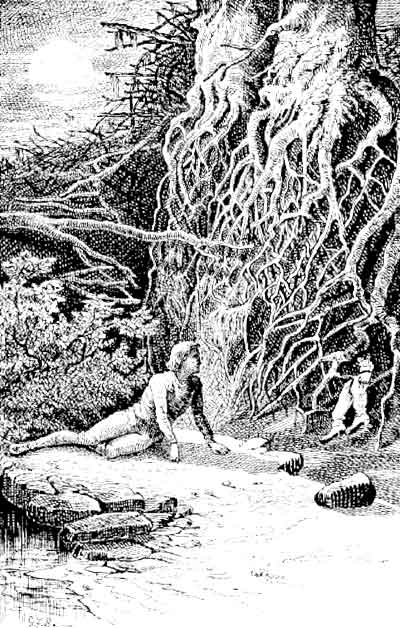
He walked back, therefore, to his place of rest, after he had blocked
up the entrance of the drift-pile, and threw himself down again under
the bushes. Ten or fifteen minutes later he heard a slight noise at
the root of the great tree near him, and, looking, saw something which
looked surprisingly like a pair of boots, trying to force themselves
out between two of the exposed roots. Then he heard retreating
footsteps within the space enclosed by the circle of roots, and began
to suspect the precise state of affairs. Examining the boots he
discovered that they were his own, and he quickly guessed the truth
that Jake had pushed them out from the inside, under the impression
that he was driving them into a hole in the centre of the tangled
drift.
Sam was a brave boy, too brave to be vindictive, and so he quickly
decided that as he had recovered his boots he would subject his enemy
only to so much punishment as he thought was necessary to secure his
good behavior afterward. He knew that the boys would torment Jake
unmercifully if the true story of the night's exploits should become
known to them, and while he knew that the culprit deserved the
severest lesson, he was too magnanimous to subject him to so sore a
trial. He went to sleep, therefore, resolved to release his enemy
quietly in the morning, before the other boys should be astir.
Unluckily he overslept himself, and so the first hint of the dawn he
received was from the loud calling of the boys for Jake Elliott.
Fortunately Jake had not yet nerved himself up to the point of
answering and calling for assistance, and so Sam had still a chance to
execute his plan.
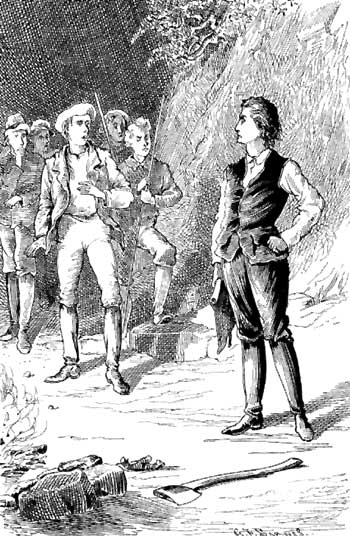
"Never mind calling Jake," he cried, as he rose from his couch of
bushes, "but run down to the spring and bring some water. I have Jake
engaged elsewhere."
The boys suspected at once that Sam and Jake had arranged a private
battle to be fought somewhere in the woods beyond camp lines, a battle
with fists for the mastery, and they were strongly disposed to follow
their captain as he started up the river.
"Stop," cried Sam. "I have business with Jake, which will not interest
you. Besides, I think it best that you shall remain here. Go to the
spring, as I tell you, and then go back to the fire, and get
breakfast. Jake and I will be there in time to help you eat it. If one
of you follows me a foot of the way, I—never mind; I tell you you
must not follow me, and you shall not."
There were some symptoms of a turbulent, but good-natured revolt, but
Sam's earnestness quieted it, and the boys reluctantly drew back.
Passing around to the further side of the drift-pile, more than a
hundred yards away from the nearest point of the camp, Sam called in a
low tone:—
"Jake! Jake!"
"What is it?" asked Jake presently, trembling in voice as he trembled
in limb, for he was now thoroughly broken and frightened. He dreaded
the meeting with Sam nearly as much as he dreaded the terrible fate
which seemed to him the only alternative, namely, that of remaining in
the drift-pile to starve.
"Come down this way," said Sam.
"Well," answered Jake when he had moved a little way toward Sam.
"Do you see a hole in the top, just above your head?" asked Sam.
"Yes, but I can't see the sky through it."
"Never mind, get a stick to boost you, and climb up into it."
Jake did as he was told to do, and upon climbing up found that there
was a sort of passage way running laterally through the upper part of
the timber, crooked and so narrow that he could scarcely force his
way through it. Whither it led, he had no idea, but he obeyed Sam's
injunction to follow it, though he did so with great difficulty, as in
many places sticks were in the way, which it required his utmost
strength to remove. The passage through which he was crawling so
painfully, was one which Sam and his companions had made by dint of
great labor, during their residence in the tree root cavern a year
before. It led from the main alley way to their post of observation on
top of the pile, their look-out, from which they had been accustomed
to examine the country around, to see if there were Indians about,
when they had occasion to expose themselves outside of their place of
refuge. As the only way into this passage was through a "blind" hole
in the roof of the main alley way, no one would ever have suspected
its existence.
After awhile Jake's head emerged from the very top of the drift pile,
and he saw Sam lying flat down, just before him. He instinctively
shrank back.
"Come on," said Sam; "but don't rise up or the boys will see us. Crawl
out of the hole and then follow me on your hands and knees."
Jake obeyed, and the two presently jumped down to the ground on the
side of the hummock furthest from camp.
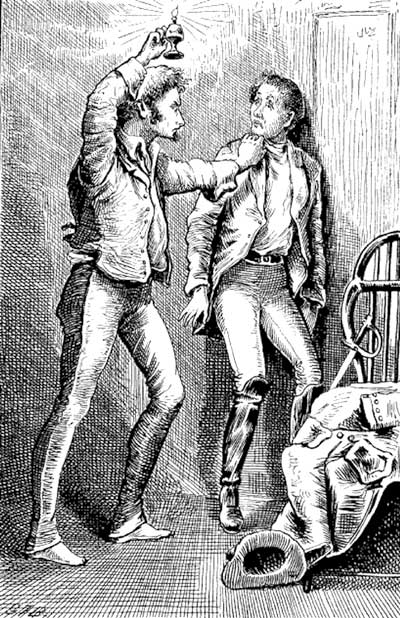
Jake's first glance revealed Sam fully dressed, and standing firmly
in his boots. There could be no mistake about it, and yet a moment
before he would have made oath that those very boots were hidden
hopelessly within the deepest recesses of the drift-pile. He could not
restrain the exclamation which rose to his lips:—
"Where DID you get them boots?"
"Never mind where, or how. I have a word or two to say to you. You
took my boots and were on the point of throwing them into the river.
If you think such an act by way of revenge was manly and worthy of a
soldier, I will not dispute the point. You must determine that for
yourself."
"Let me tell you about it, Sam," began Jake in an apologetic voice.
"No, it isn't necessary," replied Sam. "I know all about it, and it
will not help the matter to lie about it. Listen to me. You were about
to throw the boots into the river; but you changed your mind. You know
why, of course, while I can only guess; but it doesn't matter. You
took them into the drift pile and put them into a hole there. The next
thing you know of them I have them on my feet, and I assure you I
haven't been inside the drift pile since you entered it. Solve that
riddle in any way you choose. I blocked up the entrance, and this
morning I have let you out. Not one of the boys knows anything about
this affair, and not one of them shall know, unless you choose to tell
them, which you won't, of course. Now come on to camp and get ready
for breakfast."
With that Sam led the way. Presently Jake halted.
"Sam," he said.
"Well."
"My eye's all bunged up. What'll the boys say?"
"I don't know."
"What must I tell 'em?"
"Anything you choose. It is not my affair."
"They'll think you've whipped me?" exclaimed Jake in alarm.
"Well, I have, haven't I?"
"No, we hain't fit at all."
"Yes we have,—not with our fists, but with our characters, and I have
whipped you fairly. Never mind that. You can say you did it by
accident in the dark, which will be true."
"But Sam!" said Jake, again halting.
"Well, what is it now?"
"What made you let me out an' keep the secret from the boys?"
"Because I thought it would be mean, unmanly and wrong in me to take
such a revenge."
"Is that the only reason?"
"Yes, that is the only reason."
"You didn't do it 'cause you was afraid?" he asked, incredulously.
"No, of course not. I'm not in the least afraid of you, Jake."
"Why not? I'm bigger'n you."
"Yes, but you're an awful coward, Jake, and nobody knows it better
than I do, except you. You wouldn't dare to lay a finger on me. I
could make you lie down before me and—Pshaw! you know you're a coward
and that's enough about it."
"Why didn't you leave me for the boys to find, then, and tell the
whole story?"
"Because I'm not a coward or a sneak. I've told you once, but of
course you can't understand it; come along. I'm hungry."