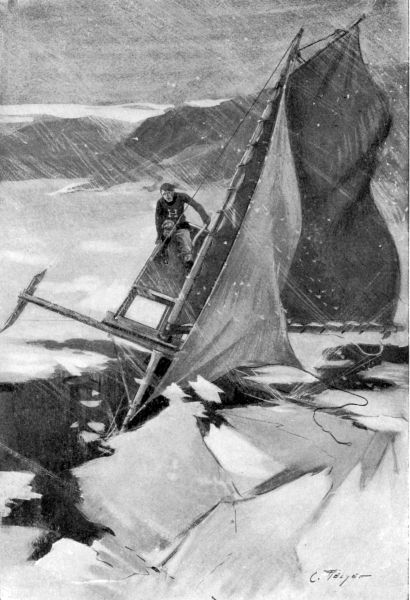
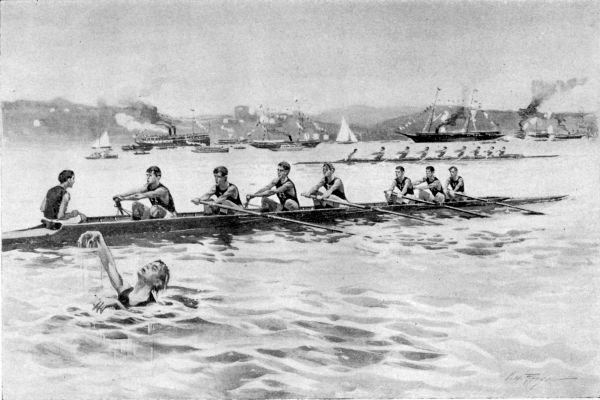
“An ice-yacht,” observed Carl learnedly, “is the nearest
approach at the present age to a flying-machine.”
“And I never cared a bit about flying,” answered Dick,
without enthusiasm.
The two, with Trevor and Stewart Earle, were gathered
close about the fireplace in Number 16 Masters. Two good
hickory logs were crackling merrily, and, although owing
to the fact that the steam-heating apparatus was evidently
on a strike and their backs were constantly
caressed by shivers, their knees and faces were radiantly
warm; and that was sufficient comfort. A huge paper bag
was perched on the table, and the quartet were busily
munching big, rosy apples, while close to the ashes four
more were sizzling and sputtering in the heat. They had
started out with the intention of having a feast of roasted
apples, but had found that the roasting process was too
slow to meet the demands of their appetites, and so were
keeping down the pangs of starvation in the interims by
consuming the fruit as Nature had meant they should.
“An ice-yacht,” continued Carl, undismayed, “can be
put together very easily and cheaply. All you have to have
is four pieces of timber and——”
“Look here, Carl,” interrupted Dick impolitely, “the
last thing you made was a toboggan, and it cost about nine
dollars before you were through with it, and you could
have bought a good one for five.” Stewart giggled and
Carl grinned good-naturedly.
“Well, let’s buy one, then,” he replied. “Let’s go
down to Euston Point and see the one this fellow advertises.”
“How much do they cost?” asked Trevor.
“Oh, we could get a second-hand one for fifteen dollars,
easy; maybe less. That would be only four dollars apiece,
if we all went in. And we could have the biggest kind
of fun! Why, some ice-yachts go as fast as ninety miles
an hour!”
“Oh, get out!”
“They do; don’t they, Stew?”
“Easy,” answered Stewart gravely. “I’ve seen lots of
them do it. I owned one myself once that could go a hundred
and thirty-seven miles in——”
“Shut up, you idiot!” growled Carl. “What do you
say, fellows; shall we see if we can get the boat? Think
how jolly grouchy the other chaps would be to see us skipping
around and——”
“And breaking our necks,” suggested Trevor.
“Nothing of the sort! Why, it’s not dangerous at all;
any one that knows anything about sailing a yacht can
manage an ice-boat.”
“Well, who knows anything about sailing among this
crowd? Do you, Trevor?”
Trevor shook his head.
“Not a thing.”
“I do, of course,” interrupted Carl.
“Well,” said Stewart, “as far as I’m concerned I think
I’d rather have some one else than you do it, Carl.”
“Oh, quit fooling; I’m in earnest. Suppose we go to
Euston Point next Saturday and see what’s doing?”
“But, look here,” said Dick, “how do you know
Faculty will let us sail the thing if we get it?”
“Why shouldn’t they? They allow skating; ice-yachting’s
just skating—with a difference. Besides, as long as
there’s no rule against it we have a right to do it.”
This argument was incontrovertible, and it was agreed
that the four should journey to the near-by village of
Euston Point the following Saturday morning. And then
Stewart suddenly discovered that the apples on the hearth
had been done for some time, and in the business that followed
the subject of ice-yachting was forgotten.
When Dick and Trevor returned from supper that
evening they found a fresh, inky-smelling number of The
Hilltonian awaiting them in the letter-box. Dick hurried
to the room with it and spread it out under the light on
the table. Yes, Singer had been as good as his word; the
leading editorial was headed The Rowing Situation, and
was quite in Singer’s best style.
“My!” ejaculated Trevor, who had been reading the
article over Dick’s shoulder, “that’s spiffin!”
“It sounds rather well, doesn’t it?” asked Dick, highly
gratified by the effusion. “And you’d think it would bring
some of the fellows round, eh?”
“Bound to; you’ll find slathers of them in the gym
to-morrow afternoon,” replied Trevor confidently. “Read
it out loud, Hope.”
And Dick did so and Trevor listened admiringly and
interpolated an applauding “Hear, hear!” at intervals,
and Dick went to bed very hopeful of the morrow.
But when at three o’clock the following afternoon he
repaired to the rowing-room his heart sank. Aside from
the original nineteen candidates, but the veriest handful
were present. Dick counted them grimly; there were fourteen
of them, and for the most part they not only looked
but really were sadly out of their element. A small junior
of perhaps fourteen tried to hide himself in a corner, but
Dick routed him out mercilessly and asked him cruelly if
he was a candidate for coxswain.
“Yes—no—that is, I don’t know,” was the breathless
reply. Dick turned away and encountered the mocking
gaze of Taylor, who, when Dick’s eyes were turned upon
him, smoothed his features into an expression of respectful
concern and walked forward.
“What an outfit, eh?” he asked softly. But Dick was
resolved that the other should not have the satisfaction of
knowing his disappointment. He shrugged his shoulders
and smiled carelessly.
“Well, they don’t look brilliant; a bit light on an
average; but I dare say we’ll be able to find some good
material in the lot.” At that moment Professor Beck entered.
After a slow and careful glance up and down the
long room he looked fleetingly at Dick, frowned, and turned
away. But he made no remarks upon the showing of candidates
save once.
“Mr. Kirk will coach the crews again this year,” he
announced, “and will be with you every Saturday afternoon
until the river opens, when, as last year, he will come
up to Hillton and stay with you until the race. I expect
he will make his first visit a week from next Saturday, and
I’m sure”—he glanced blandly over the audience—“I’m
sure he will be greatly pleased with the material he will
find.”
Something approaching a shudder passed over the
throng, and Dick turned aside to hide a grim smile. Then
the first batch of candidates trooped off to the locker room
to don gymnasium attire, and the new recruits were registered,
instructed to report for examination the following
afternoon, and dismissed looking heartily relieved. When
the last one had gone Professor Beck heaved a sigh and
turned to Dick.
“Hope, are you certain there was no mistake made?
You’re sure you didn’t issue a call for candidates for a
tiddledy-winks team?” Dick smiled dismally.
“No, there’s no such luck. We’ve got thirty-four fellows,
of which a possible two dozen are rowing material.”
“Hum; I think we shall be able to turn out an excellent
second eight, but as for a varsity crew—do you happen to
have an idea as to where we are going to get that, Hope?”
“No, sir, I haven’t,” replied Dick miserably. Professor
Beck polished his glasses thoughtfully for a minute and
studied the wintry landscape through the high window.
Then he smiled, settled the shining lenses again on his nose,
and turned toward the door.
“We’ll have to use our wits, Hope. Above all, don’t
allow yourself to become discouraged. We still have a
couple of weeks before us, and—well, I guess we can accomplish
something in that time. Are you ready?”
Together they passed out onto the floor and in a few
minutes the first squad of crew candidates had begun their
training. Of the twenty, two had rowed in the varsity
boat of the preceding year, four had rowed with the second
eight, three had trained as substitutes, and the balance,
eleven candidates, represented new and inexperienced
material as far as shell-rowing was concerned. Well-nigh
all were what Trevor would have termed “wetbobs,” and
had paddled about in tubs or perhaps rowed now and then
in a pair-oar. Professor Beck and Dick were busy for the
half hour that constituted the first day’s exercising. Generally
speaking, each candidate required a different work
from his neighbors. In Brown the forearm muscles were
undeveloped; in Smith the chest muscles had been neglected;
in Jones the back was as unbending as a two-inch
plank, while Robinson, perchance, was in a state of general
flabbiness. The professor viewed attentively the work of
each boy, altered the exercise here, stopped it there, increased
it elsewhere, while Dick stood beside him, listening to
his instructions and memorizing, as pointed out to him, the
needs of the different ones. After awhile the fellows were
sent to the track for the briefest of trots, and so, having
stood for an instant under a shower-bath, dressed, and went
their ways full-fledged crew candidates, with an inalienable
right to look down condescendingly upon their schoolmates,
to cut Friday night lectures, and comport themselves generally
in the manner of coming heroes.
And Dick, with Trevor at his side, went back to his
room for an hour of study before supper, not overjoyful,
but yet somewhat comforted by the professor’s hopefulness
and by the fact that real work had at last commenced.
On Friday night Professor Beck announced to Dick
that the fourteen newer candidates had been examined, and
in five instances found wanting. “Of those that remain,”
said the professor, “two look like good men; as for the
rest——” He shrugged his shoulders eloquently. “But we
can tell better in a week or two. Meanwhile, we must keep
up the recruiting. I have my eye on an upper middle boy,
and I think I’ll have him hooked in a day or two. If we
can secure say another half dozen good men I think we
can pull out all right.”
The next morning—it being a bright and sunny Saturday
toward the last of January—Dick, Trevor, Carl, and
Stewart boarded the train and traveled to Euston Point,
but a few miles distant, where they called on the man
whose advertisement Carl had read in a local paper, and by
him were conducted to a loft by the river, where a dilapidated-looking
triangle of timbers and bolts—which its
owner declared loudly was the fastest cat-rigged yacht on
the Hudson—was shown to them. The bargain was soon
closed, Carl conducting the negotiations and talking learnedly
of runner planks, center timbers, and stays. The boat
was to be supplied with a new rudder-post, a new sail and
rigging, the runners were to be reground, and the whole
was to be delivered at the boat landing at Hillton Academy
four days from that date for the munificent sum of seventeen
dollars and seventy-five cents. Carl was elated.
“We’ve saved two dollars and a quarter,” he declared.
“I don’t see how,” objected Dick. “You told us last
week that we could get the thing for fifteen dollars.”
“I know I did; that’s what I thought. But you heard
him ask twenty at first, didn’t you? Well, and I jewed
him down to seventeen seventy-five. Isn’t that two and
a quarter saved?”
Dick had to acknowledge that it was, and Carl insisted
on celebrating his successful financiering by treating to
very nasty hot soda at the town’s only drug store. And
so to Carl’s business acumen may be traced the series of
events that led shortly to Trevor’s disgrace.
Their way to the station took them past the open door
of a livery stable. When they were abreast of it something
round and white shot out, rolled over and over down the
little incline, and brought up at Trevor’s feet. It proved
to be a young puppy, which, when it stopped rolling, found
its four unsteady feet, barked joyously, and tried to gnaw
the buttons from Trevor’s trouser cuffs. But he was instantly
seized upon and elevated in Trevor’s arms for the
inspection of the others.
“Isn’t he a little beauty?” cried Trevor.
“Yes; what is he, a fox terrier?” asked Stewart, allowing
the squirming and delighted puppy to chew his gloved
fingers to its heart’s content.
“Fox terrier!” replied Trevor scathingly. “Of course
not; it’s a bull. Look at that nose!”
“I am looking at it,” answered Dick. “Nice and ugly,
isn’t it? What makes it so pink?”
“That’s the way it ought to be,” answered Trevor with
fine disdain for his friend’s ignorance. “I wonder who it
belongs to?”
“Belongs right here, sir!” The boys glanced around
and found a colored stableman observing them smilingly
from the doorway. Trevor placed the puppy upon the
ground, where it at once relapsed into a state of loud and
poignant grief, leaping with snowy feet against his stockings,
and crying vehemently to be again taken up. Trevor
patted it, whereupon its grief gave place to uncontrollable
delight; it stood on its hind legs, buried its short
nose in a small snow-bank, and attempted to take the boy’s
entire hand into its pink mouth, and all within the instant.
“It’s the liveliest pup I ever saw,” said Carl.
“That’s a fine dog, sir,” said the owner. “His mother
took a first and two second prizes at the dog show last week,
and his father’s got lots of ’em. Yes, siree, he’s a mighty
fine dog, he is.”
“Come on,” said Dick, “we’ll lose the train if we’re
not careful.”
But Trevor paid no heed. He was looking intently at
the puppy, which, with the boy’s left thumb between his
teeth, was radiantly happy.
“He’s got a pedigree as long as yer arm,” continued the
stableman.
“Has he?” muttered Trevor.
“He can be registered ter-morrer, he can; he’s blue-blooded
right through, he is.”
“Is he?” said Trevor. The puppy was now on its back,
legs limply aloft, and Trevor was thoughtfully rubbing a
pink-and-white stomach.
“Was you wanting to buy a dog, sir?”
“N-no, I think not,” answered Trevor.
“Say, come on, Nesbitt, or we’ll be late,” cried Carl.
The stableman glanced over his shoulder. “Lots of
time, gentlemen; train ain’t due for twelve minutes yet.”
Then, addressing Trevor, “I had four of them and sold ’em
all ’cept this one; an’ he’s the best of the lot; an’ cheap, too—dirt
cheap.”
“How much?” asked Trevor with elaborate carelessness.
“You can have him for five dollars.”
“Phew!” said Stewart.
“Give you fifty cents,” said Carl. The stableman
turned indignantly.
“I reckon you don’t know much about what bulldogs
is worth,” he said. “This gentleman here knows that that
ain’t too much for a puppy as fine as that one; don’t you,
sir?”
“I dare say he’s worth that much,” answered Trevor,
“but I couldn’t pay it.”
“What would you do with it if you had it?” asked
Dick.
“Now, look here; I’ll tell you what I’ll do, sir,” said
the stableman. “You can have him for three dollars and
a half. And that’s mighty cheap, that is.”
Trevor looked longingly at the puppy, who was now for
the moment quiescent, and who was gazing up into Trevor’s
face as though breathlessly awaiting his verdict.
“I—I’ll give you a dollar to-day and pay you the rest
next Saturday,” he said finally.
“You one of the Hillton young gentlemen?” asked the
stableman.
“Yes.”
“Well, you can take him along. What’s your name?”
Trevor gave it amid the expostulations of his friends,
who asked wonderingly where he expected to keep his new
possession, how long he thought Faculty would let him have
it, and how he was going to get it home. To all of which
Trevor made no reply. Paying the man the first instalment
of the money, he seized upon the delighted puppy and
strode off, fearful lest the former owner should regret the
bargain and change his mind.
“Well, of all things!” ejaculated Dick. “Where in
thunder will you keep him?”
“Don’t you worry,” answered Trevor. “I’ll find a
place.”
“What’s troubling me,” complained Carl, “is how
you’re going to pay your four dollars and forty-four cents
toward the yacht and the three dollars and a half for the
pup.”
Trevor looked blank.
“I’d forgotten about the yacht,” he muttered.
“Forgotten about it!” cried Carl. “Why, man alive,
we just bought it ten minutes ago!”
“I know. But—I tell you—I’ll write to the pater;
I fancy he’ll send me money enough for the puppy;
he always gives me any money I may need for useful
things.”
The others exploded into violent laughter.
“Call that useful?” gurgled Dick, holding his sides and
pointing derisively at the puppy, which lay limp but blissful
with half-closed eyes in Trevor’s arms. A warning
whistle made unnecessary any reply, and the four boys hurried
toward the station.
“You’d better hide him under your coat, or else they’ll
make you ride in the baggage car with him,” cautioned
Dick. And so Trevor boarded the train with a suspicious
portliness, happily unobserved of the conductor, and, when
they had yielded their tickets, drew the uncomplaining
puppy from under his sweater.
“I’ll say one thing for it,” remarked Carl grudgingly,
“it behaves mighty well, considering that it has just been
torn from home and parents.” He held out a hand and
the puppy went into spasms of delight over the evidence
of friendship and licked the fingers deliriously. “Funny
little beggar! How old is it, Trevor?”
“About ten weeks, I fancy.”
“What are you going to call him?” asked Stewart.
Trevor shook his head thoughtfully.
“I don’t know yet. I shall wait until I find something
appropriate.”
“Talking about names,” said Carl, “let’s find one for
the boat. That fellow said she was the Lucy G., but that’s
silly and doesn’t mean anything.”
“Ought to be something wintry,” suggested Stewart.
“Something like Blizzard, or Snowflake, or Ice King,”
added Dick.
“It can’t be any of those,” objected Carl, “because
there are heaps of Blizzards and the other things you said.
How would The Polar Bear do?”
Every one sniffed derisively.
“Well,” said Trevor, “if it must be something wintry,
what’s the matter with The Ulster or The Cough Drop?”
“Or The Chilblain?” laughed Dick.
“I think a good name would be The Sleet,” Stewart
struck in. “That’s wintry enough.”
A vote was taken, and The Sleet carried.
“We can have a sail next Saturday,” suggested Carl.
“So soon?” groaned Dick. “Carl, we’re so young
to die!”
“That’s all right, my funny friend, but just you wait
until I get to sailing that thing; you’ll see!”
And Carl’s prediction, though vague, proved in a measure
correct.