If the young people who read this last story of
Lucy Gordon’s army life are disappointed that the
end of the war does not bring her home to America
they cannot possibly be as disappointed as she herself.
She hoped that the war had really finished
with the armistice but, like lots of us, she found that
there was a great deal left to do that she had not
counted upon. Peace was slow in coming, and the
American army overseas had its hands as full trying
to hasten it as all America on this side had, and
still has, in trying to get back to peace-time ways.
The tangle of affairs in war-swept Europe is
more than Lucy can understand, though she sees a
little of that great unrest, and catches a glimpse of
its hidden dangers, even in the Home Sector.
She does what she can to help, generously, and,
though peace is not come and America is still distant,
she and Bob and all the Gordon family find
happiness together, and look forward with brave
confidence to the glorious future of the dear country
to which they will before long be homeward
bound.
The Home Sector,—that was what Larry
Eaton called it, a little irony beneath his irrepressible
cheerfulness, when he had been ordered to
Coblenz with the American Army of Occupation.
He had called it so with his eyes on the Stars and
Stripes already floating over the general’s headquarters
in the old German city, and after a sidelong
glance at Lucy Gordon’s sober face. “It’s
the first step on the way home, Lucy,” he said, as
the two walked along the grassy banks of the river,
the pale December sunlight shining on the water
and, at their left, on the low houses at the outskirts
of Coblenz. “Don’t look so downhearted, old
pal.”
Lucy smiled and shook off her depression. It
was hard ever to be gloomy for long in Larry’s
company. The young aviator had something invincibly
gay and hopeful in his nature, and a philosophic
acceptance of things, until they could be
bettered, that often quieted Lucy’s rebellious moments.
“I’m not downhearted, Larry,” she protested.
“At least not very. But I did want to go
home,—not after a while, you know, but right away,
when the armistice was signed. I know it’s wonderful
to be at peace, and to have Father safe and
stationed here, but,—I don’t care very much about
living in Germany.”
“And there’s no use thinking we’ll all be together,”
Lucy persisted. “Even though Father
has his quarters here and Mother will finish her
work and come, where will Bob be?”
“Scouting over the Bolshevik lines in the frozen
north,” said Larry, a tinge of envy in his voice.
“I’d change with him if I could.”
“Would you? Oh, Larry, I should think you’d
had enough.”
“So we have, but so long as there’s fighting to be
done I’d rather be there than cooling my heels along
the Rhine. And our men aren’t having an easy
time,—that poor little force at Archangel.”
“Oh, I know there’s lots of work to do!” Lucy
exclaimed, suddenly roused from her childish
depression, and involuntarily she opened the
woolen cape she wore and glanced at her nurse’s
aide’s uniform. “I’ll stop growling and try to
help.”
“I don’t think you’ll have much trouble doing
it,” said Larry, smiling down at her, “judging by
what you’ve done so far. Only this time you’ll
have an easier job of it,—no prisoners to set free.
You can’t imagine a peacefuller spot than that little
hospital you’re going to. It’s lost in the forest,
and even the village near it looks half asleep and as
though it might tumble any minute down the hillside.”
“The peacefuller it is the better I’ll like it,” said
Lucy with something of a sigh. “I’ve had enough
of war.”
Although General Gordon was stationed with
the Fifth Army Headquarters in Coblenz, where
already, a month after the armistice, American
troops had taken possession of houses in the
German city and were preparing for their long
stay in the occupied territory, Lucy herself was
still on duty elsewhere. With the end of the fighting,
need for war workers of all sorts had not
grown less. Mrs. Gordon could not yet leave her
hospital at Cannes, and Lucy had been urged to
keep on as nurse’s aide with an insistence that could
not but fill her with honest pride and satisfaction.
The army surgeons spoke to her of the increasing
need of nurses among the convalescents, and Miss
Pearse frankly begged Lucy not to abandon her.
“You can go to Coblenz in the spring, Lucy
dear,” the young nurse persuaded, when new plans
and changes of base occupied every mind in the
joyful week after the armistice. “We have to garrison
Coblenz for fifteen years, they say, so your
father will probably be there a good while. But
perhaps he won’t,” she added, smiling at Lucy’s
face, grown disconsolate at her words. “Anyway,
while you’re over here I know you’d sooner be helping.
There’s almost more to do than ever. The
men have been rather let down by the war’s end
and all the delays following. They don’t know
what to do with themselves, especially the wounded
who are slow in getting well. We’ve got to give
them a Christmas that will stifle their homesickness
a little. And I can’t half work without you, Lucy.
I’m so used to having my little aide to call on.
You’ll stay, won’t you?”
This was not the sort of persuasion Lucy could
resist, when her heart was already in the work that
she had learned in such a hard school of suffering
and anxiety. She eagerly consented to follow Miss
Pearse wherever her father would allow her to go,
which ended by being a little convalescent hospital
outside the village of Badheim, ten miles west of
Coblenz on the banks of the Moselle. Cold breezes
from the two rivers swept it, and the air was pure
and sweet with the odor of pine. After the shell-torn
villages of France, Badheim hospital, as Miss
Pearse described it, seemed lovely and inviting to
Lucy in its woodland stillness. Yet something, she
felt, would keep her from yielding to its peaceful
spell: it was a part of Germany. It was unspoiled
because France was desolate. She could not forget
this long enough to look about her at any German
landscape with untroubled eyes.
Even now, walking with Larry along the Rhine,
she watched the smooth flow of the river and looked
across at the vineyard-clad slopes and at the great
old fortress towering opposite Coblenz with coolly
critical gaze. All at once she turned to Larry, with
sudden recollection that this was her last day of
freedom and perhaps her last chance in weeks of
talking with Bob’s friend, to ask longingly:
“Larry, can’t you tell me anything more of what
Bob is doing at Archangel? He doesn’t write
much about his work, and the letters are so slow. I
know it’s hard up there. And they don’t get ahead.
The Bolsheviki are strong.”
“Our force is hardly of a size to accomplish
much. It ought to be enough men or none,” declared
Larry, with the troubled, puzzled look that
sometimes came over his face, making him look extraordinarily
sober and thoughtful by contrast with
his usual cool cheerfulness. “But don’t worry too
much about Bob,” he added, putting aside the
doubts which had made him speak so earnestly.
“He’s doing scouting work. He’s far safer than
he was on the German front. The cold is the disagreeable
part.”
“I know. I’ve knitted him everything I
thought he could pile on. He doesn’t say much
about it, but I looked up Archangel on the map
and, Larry, it’s near the North Pole.”
“Not quite, but I won’t say it’s a pleasant climate.
Perhaps they won’t stay there much
longer.”
“Well, I thought on Armistice Day that it was
over, really over,—the war, I mean. But here it
seems to be tailing out in every direction.”
“Yes, it has rather a nasty way of refusing to
be finished,” Larry agreed, looking around him as
he spoke at the passers-by, for they were now re-entering
the town. “To judge by their manner
these Boches seem to think it’s quite over and that
we’re friends again. Yet some of them, I’m sure,
are very far from feeling that way.”
“What do you really think?” asked Lucy curiously.
“They smile at us and are eager to sell
things. But Larry, how can they feel friendly?”
“I can’t fathom them,” said Larry, not much
given to analyzing character at any time. “Most
of them seem spiritless enough, but I’ve seen a few
bitter looks, all the same, and some eyes that shone
with hate at sight of us. I don’t trust one of
them.”
“Oh, they’ll have to take it out in hating us,”
said Lucy easily. “They can’t do any worse now.”
Lucy had had enough of plotting and conspiracy.
She was determined to put German treachery
out of her mind and live in confident simplicity
once more.
“Fed-up with the war, eh, Lucy?” Captain
Beattie had remarked, when Lucy and the young
Britisher met by chance in Cantigny soon after the
armistice. “Well, you know, I rather am myself.
Let’s cross the Channel and leave it all behind.”
And that was what Lucy longed to do, putting
the Atlantic in place of the Channel, in spite of trying
to persuade herself of the contrary after Miss
Pearse’s urging. All through the war she had
looked forward to that day, the fighting ended, that
would see the Gordon family on board the first ship
bound for America. Even adventurous spirits
have their homesick moments. Foreign sights and
sounds had, while this mood lasted, lost their charm
for her. She looked around her now at the old
gabled houses of Coblenz, at the Germans passing,
who paused to stare with blank curiosity at the
Americans, already a familiar part of the city’s inhabitants,
and she felt no sympathy with her surroundings.
“I’m going to bury myself in that forest and
work so hard at the hospital that I’ll forget I’m in
Germany,” she told Larry, as they neared the
house commandeered for General Gordon’s quarters.
“You might come out and see me once in a
while, though, Larry, and tell me how peace is getting
on.”
“I’ll be out every year or two and bring you the
news,” Larry promised. “Maybe I’ll feel the need
of a little rest cure myself. I’m pretty well exhausted.”
Lucy laughed as she met the blue twinkling eyes
above his tanned cheeks. An orderly opened the
house door as Larry held out his hand in good-bye.
The following day Lucy joined Miss Pearse and
half a dozen other Red Cross workers to travel by
motor-lorry to Badheim. The road ran along the
Moselle, a lovely woodland countryside which went
far toward bringing back Lucy’s lost serenity.
“I love the country, don’t you, Miss Pearse?”
she said, breathing deep breaths of the piney air.
“I should think sick men would get well quickly
here.”
“I hope they will,” the young nurse responded.
“But I’m sure they’d get well quicker if these
woods were in Maine or in Michigan,—anywhere
at home.”
Her voice betrayed her and Lucy looked at her
friend with a quick thrill of sympathy. Miss
Pearse was as homesick as she herself, in spite of
her stoic calm. And, meeting the glance of an orderly
who sat on a case of supplies in one corner of
the lorry, Lucy read the same longing in his eyes
even before he exclaimed almost involuntarily, “Or
not even woods or rivers, Miss. Just the docks at
Hoboken would look good enough to me.”
The little village of Badheim was perched upon
a hillside, the road winding at its foot. The lorry
turned sharply away from the Moselle to begin a
long climb up a heavily wooded slope. The forest
now closed in on both sides,—majestic oaks, mixed
with pines and hemlocks which sang and murmured
as the river breeze swept over them. Rabbits
darted across the road and squirrels chattered in
the overhanging branches. All at once the hospital
appeared, a big frame building in a clearing near
the top of the hill, its roof in spreading gables, like
a Swiss chalet, and the Stars and Stripes floating
over it.
Behind it were half a dozen cottages for the staff.
The whole had a weather-beaten look, for it had
stood there more than fifty years, and an air of
solitude enveloped it, as though it were much
further removed from town and village than it
really was. Lucy decided in one glance that it
needed sunlight and cheerful voices to keep from
being a gloomy spot where the murmur of the
swaying pines would change to sighs of loneliness.
In fact the convalescent soldiers seated on the
verandas or strolling over the grassy clearing and
in the borders of the woodland looked sober and
purposeless, their idle steps leading vaguely from
one spot to the other, without any spur of hopeful
energy. Lucy understood at last Miss Pearse’s
eloquent persuasions, and seeing how sorely help
was needed here, she forgot her own repinings and
was herself again.
Miss Pearse and Lucy installed themselves in a
room in one of the cottages beside the hospital,—a
sort of shed built of heavy unpainted planks, with
sloping roof and leaded window-panes. A stove
fed with pine-boughs warmed the drafty interior
somewhat from the December cold.
While the two newcomers were unpacking and
settling themselves in their narrow quarters the
hospital’s head nurse came in and talked to them,
dropping down on the nearest chair to do so; for
she was tired and glad of a moment’s rest.
“You will think there is terrible confusion here,
for we are all at loose ends,” she told them. “We
haven’t enough nurses nor orderlies, and nothing is
in smooth running order. I hope you won’t mind,
for a few weeks, not having a regular routine but
doing whatever presents itself.”
“That will just suit me,” remarked Lucy, brushing
her corn-colored hair before the little mirror.
“Send me on all the errands you can think of, Miss
Webster.”
The head nurse laughed, looking kindly at
Lucy’s pretty face, lighted by the smile that her
unaffectedness made very attractive. “I’ll find
plenty for you to do, don’t worry,” she said confidently.
“When nothing else turns up, go about
among the convalescents and talk to them of
home.”
“Are there bad cases here? What sort, mostly?”
Miss Pearse asked.
“Some are men who have been gassed and their
lungs are injured. Those are the discouraged ones
who think they can never get well. Then we have
a good many with broken limbs slowly mending,
and some recovering from pneumonia and trench
fever. There are about eighty in all, and most of
them getting on splendidly, if they would only forget
their homesickness and that they must spend
Christmas in Germany.”
“U-um, but it’s not so easy to forget that,” murmured
Lucy, understandingly. “And, though of
course this hospital has fine air and all that, it’s not
a very cheerful place, do you think? With all these
German woods shutting it in?”
“German woods are just like any other woods,
Lucy,” said Miss Pearse laughing. “Don’t be
making trouble. We’re ready now, Miss Webster.”
The hospital wards were nearly empty for a part
of the day, during which almost all the patients got
up and sat on the verandas, or were wheeled about
if they could not walk. Lucy was surprised to see
a good number of French soldiers scattered among
the Americans, and looking a good deal more cheerful
than her own countrymen, as though they knew
that their return home could not be much longer
postponed.
Miss Webster explained to her: “These Frenchmen
were in need of special treatment—we have
mineral baths here. Or else they were in American
hospitals and were brought along with other
convalescents. They will almost all go before
Christmas.”
Lucy was put to work in the diet kitchen, which
she left at lunch time to carry trays to those of the
convalescents whose capricious appetites needed
special encouragement. The trays were numbered
and so were the chairs in which the invalids reclined,
but as Lucy, carrying a tray holding
chicken broth and biscuits and numbered forty-five,
approached the chair bearing that number, the occupant
got up and, walking slowly down the
veranda steps, strolled off toward the edge of the
clearing.
The man was a French officer, a blond of tall and
powerful build, though now his blue uniform hung
loosely on his shrunken frame and his slow steps
were a trifle uncertain. Lucy put down the tray
and ran after him, calling out, “Quarante-cinq!
Quarante-cinq!” Then as she neared him and saw
the insignia on his uniform she changed her form of
address to, “Monsieur le capitaine! Attendez,
s’il vous plait?”
The Frenchman turned around and seeing Lucy
pointing with expressive gesture to the veranda
where the soup was cooling on the deserted chair
he smiled and took off his cap, saying with quick
apology, “Pardon, Mademoiselle.” Then changing
into good English he continued, “I am sorry to
have made you follow me. Thank you very much.”
Lucy walked beside him in silence, stealing
glances at his face in puzzled amazement. Where
had she seen that face before? It was not really
familiar, yet she knew beyond a doubt that she had
seen the man and spoken to him and, more than
that, at a moment of great fear and anxiety. Almost
a shiver caught her now at the dim remembrance.
Where had it been?
“You have just arrived here, Mademoiselle?”
the officer inquired, turning pleasantly toward her.
All at once Lucy knew. She saw in her mind’s
eye the de la Tours’ little house in Château-Plessis,
the German soldier entering the dining-room and
Michelle’s cry of joy and terror.
“Captain de la Tour!” she exclaimed in vivid
recollection, and as the officer looked at her in surprise
she went eagerly on, “You don’t remember
me? Of course not—how could you? I’m Michelle’s
friend, Lucy Gordon. I was in your
mother’s house when you came into Château-Plessis
as a spy. For a moment I couldn’t remember.
Oh, tell me, how is Michelle?”
The Frenchman looked at her closely, his blue
eyes shining with pleasure. “I remember you
now, Mademoiselle! And that day—will I ever
forget it! I am happy to see you, my sister’s very
dear friend.” He held out his hand as he spoke—a
thin, bony hand from which fever had taken the
strength and firmness. “Can you stay a moment?
I will give you good news of Michelle.”
“A moment, yes. But don’t let your soup get
cold,” said Lucy, handing him the little tray as he
sank down on his chair again, breathing hard.
“And your mother—is she well, too?”
“Not very well, but nevertheless she thinks more
of her absent son than of her own health. I am not
able to go home, they say, and Maman fears I shall
be lonely at this season, in spite of my kind American
friends. She and Michelle are coming to Badheim
for the Noël.”
At this Lucy was struck so speechless with delight
there was a pause before she could put into
words her joyful amazement. “Coming here?
Oh, Captain de la Tour, isn’t it good news?
I can’t tell you—you can’t guess how glad I
am!”
Lucy’s hazel eyes sparkled with the words and
her whole face lighted up. Perhaps never until that
moment had she realized the place Michelle held in
her heart. Now at this lucky chance to review in
peace and security the friendship woven among
such sad and peril-haunted days she felt a thrill of
happiness that raised her spirits almost to their old-time
level.
Captain de la Tour watched her with quick sympathy,
his pale lips touched for an instant by the
brief, radiant smile which could so strikingly
change both his and Michelle’s faces from their
thoughtful gravity. Lucy longed to ask all about
her friend, of whom she had caught so short a
glimpse on the eleventh of November, but she had
not another moment to spare. “When will they
come?” she lingered to ask.
“This week, I think. I am waiting every day to
hear,” said Captain de la Tour, his voice filled with
eager hope. “I have not seen them since the war
ended. I was shot through the lungs the day of
the armistice.”
When the luncheon hour was over Miss Pearse
said to Lucy, “This is a good chance to do what
Miss Webster asked me to find time for. She
wants us to go with the orderlies to the spring in
the forest and see to the bottling of the water. It
won’t take long.”
Lucy was thinking so much about all she would
have to tell Michelle that she hardly noticed what
Miss Pearse said, but followed her in obedient silence
across the clearing behind the hospital and
into the woodland. In front of them went two
Hospital Corps men drawing hand-carts filled with
empty bottles.
There was no snow yet on the ground and, beneath
the trees, it was carpeted with moss and pine
needles so that footsteps were hushed and the sigh
of the branches overhead made so deep and steady
a murmur that the forest seemed all at once to have
an atmosphere of its own. A great peace pervaded
it so that even the soldiers spoke involuntarily in
low tones, and glanced about them with a kind of
solemnity at the tall trunks of the firs and hemlocks,
with here and there an oak spreading its
wide, bare branches. The sunlight shone down
with a golden gleam into the dim greenness of forest
aisles stretching endlessly on every side.
Lucy walked on in enchanted silence. She
thought she had never known anything more lovely
than this murmurous stillness, the soft carpet beneath
her feet, the great evergreen trees closing in
around her and the cold, pine-laden air against her
face. The mysterious scamper of shy woodland
bird and beast delighted her. She would not have
guessed that they had gone a hundred yards when,
after half a mile’s walk, they came out suddenly
into another big clearing, near the center of which
stood a little cottage built of unplaned logs, its roof
covered with pine boughs and smoke rising from its
earthen chimney.
“It looks like a fairy story,” said Lucy softly,
remembering Elizabeth’s old forest tales.
The soldiers led the way along the clearing’s
edge for a hundred yards and then reëntered the
forest. Almost at once the sound of water tumbling
over stones broke the stillness and a little
spring came into view, a bubbling basin with moss-lined,
rocky bottom, and beside it a tiny rustic shed,
its door fastened with a rusty padlock.
“That little shed held the bottling machine the
Germans used,” Miss Pearse explained to Lucy as
the men began to unload their carts, “but it got out
of order toward the end of the war, so for a few
weeks we shall have to bottle by hand. We are
supposed to supervise but it’s quicker work if we
help.”
All four knelt down on the mossy earth and began
dipping up the spring water with ladles and
pouring it through funnels into the big water-bottles.
The spring bubbled up unceasingly, so crystal
clear that no disturbance of the water could
keep the rocky bottom from showing always in
trembling outline.
“This is a mineral spring,” said Miss Pearse,
setting aside a filled bottle which looked empty in
its clearness. “The water is as wonderful as this
forest air. Hello, who’s this?”
A little girl five or six years old had crept silently
up to the spring and was standing with big
blue eyes fixed on the Americans. Her flaxen
braids hung over her faded print dress, a ragged
red shawl was clutched about her and her feet were
thrust into clumsy sabots above which her stockings
were slipping down. An uncertain smile that began
to dimple her pink cheeks broadened as she
met Lucy’s friendly eyes.
“Guten tag,” she murmured shyly.
And “Guten tag,” repeated a man’s voice as the
fir branches were brushed aside. A big German,
close to middle age, blond and deeply sunburned,
ax in hand, stood behind the child, his keen eyes
fixed on the workers, a touch of sourness about his
lips, though he spoke pleasantly enough.
Lucy looked up at him and the enchantment of
the great old forest, of the bubbling spring and the
soft-footed little girl vanished in that one glance.
She was back again in Germany.
CHAPTER II FRANZ AND HIS FAMILY
Christmas, 1918, and peace on the Western
Front. That was the thought in everyone’s mind
at the little Badheim hospital—that for the first
time since 1914 the guns were silent on Christmas
Day. But Lucy’s happiness was not what she had
hoped for, though she seemed as gay as the others
as she helped decorate the bare hospital halls with
evergreen forest boughs, dark against the bright
background of Allied flags. Michelle guessed her
secret longing, nevertheless, with the quick sympathy
which made the French girl so readily understand
the joys and sorrows of those she loved.
“It is not the same for you as for me—this
Noël,” she said to Lucy as they worked together
to make the long tables cheerful for the homesick
soldiers’ eyes, “for you have not your brother
back.”
“It isn’t only that I miss him, Michelle,” exclaimed
Lucy, glad to put her troubled thoughts
into words for Michelle’s friendly ear, “it’s that
he’s still in danger. They say he is only scouting
over the Bolshevik lines, but you know what that
means. The enemy is there—I can’t help worrying.”
“I know you cannot,” agreed Michelle, without
offering useless consolation. “It is very hard. I
thought Maman and I were of all the most unlucky
when Armand was shot on the day of l’armistice,
but now he is almost well and we have no more to
fear.”
So much and so deeply had Michelle lived and
suffered in the past four years that she did not even
think to bewail the loss of home and fortune that
the war had brought. The Germans were defeated
and her mother and Armand spared. That
seemed just now the granting of all she had to wish
for.
Lucy had found herself more than once watching
her friend’s face in the few days since Michelle
and her mother arrived at Badheim. On Armistice
Day she had realized that Michelle could not
respond to the joyful news with any abandon of
light-heartedness. The bitter suffering of the long
years of war had made the little French girl grow
up before her time. Even now, with her blackest
cares behind her, with hope and confidence in the
future, Michelle’s lovely face was still serious in
repose, and her dark blue eyes held a lingering sad
watchfulness that did not suit her sixteen years.
Only now and then, when the two friends ran into
the forest to collect the fir boughs, when Michelle’s
black hair was loosened about her neck and her radiant
smile chased away all memories from the
happy present, did Lucy catch a glimpse of that
careless gayety which the war had stolen from her.
In spite of Lucy’s troubled thoughts of Bob she
found unlimited pleasure and consolation in Michelle’s
company. Together the two worked as
they had worked in the old days at Château-Plessis,
to brighten the wounded men’s gloom. Only now
they were among friends, with no sharp-eyed German
surgeons on the watch. This thought somehow
made Lucy almost resigned to being in Germany.
“We have to be here, instead of at home, but at
any rate we can do what we please. It’s we who
give the orders now,” she said to Michelle the
morning of Christmas Day. A German farmer
from beyond Badheim village was unloading supplies
from his cart beside the hospital steps, and
some of the convalescents with awakening interest
were gathered around.
“Yes, the German trees can’t take us prisoner,”
said Michelle with whimsical gravity, looking up at
the great sighing pines closing in around them.
“They are lovely—these forest trees. It was not
the Germans, but God who planted them.”
Lucy felt again a touch of the enchantment that
had caught her the first day she had entered the
forest stillness. But at thought of the cottage in
the clearing—now familiar ground—the face of the
German woodcutter came before her once more to
spoil the beauty. And yet there was nothing about
the man, silent or quietly civil with the hospital
workers, to make so definite an impression on her
mind. She spoke her thoughts aloud.
“I can never see that Franz without remembering
all the hatefulness of every German I’ve known
in the past two years. While he’s about I can’t
forget I am in Germany.”
“He does not forget it either,” was Michelle’s
reply.
“Oh, I don’t think he bears us any grudge, Miss.
He’s pleasant enough when we walk to the spring
or the clearing,” remarked a young convalescent
soldier sitting on the steps. “He’s old and soured
by a hard life. Poor, too, to judge by the rags the
kids wear.”
Michelle looked up at the soldier’s face, a boyish
one, with pale cheeks rounding out with returning
health and frank, merry gray eyes.
“Franz has not forgiven,” she said again.
“Don’t you see he has not?”
The young soldier did not much care one way or
the other. “Maybe you’re right,” he agreed peaceably.
“We’re going to have some dinner,” he
added, following with his eyes the packages being
carried toward the kitchen. “Gee, it’s great to be
hungry again.”
Christmas dinner was more of a success than
anyone had hoped for. The convalescents could
not help responding to such kind efforts, and in
doing so they forgot their homesickness and began
to appreciate their real good-fortune. Then, returning
strength gave a good share of them hearty
appetites, which found a reasonable number of
German or American good things for their satisfaction.
And the bright flags, the soft green of
the fir branches, and the red berries which Lucy
and Michelle had searched for in the forest, made
the dining-room and tables gay and almost homelike
to the young Americans gathered there. Some
were still in wheeled chairs, with hollow cheeks and
no interest in the food before them, but even these
cheered up a little as talk and laughter grew louder,
as songs of home were sung and toasts offered with
cheers or laughter.
Larry Eaton was there, at Lucy’s invitation, and
he, Madame de la Tour, Armand, Michelle and
Lucy sat together at one end of a table. Larry
was in wonderful spirits, or else he tried with all
his kind heart to make Lucy forget Bob’s absence.
Madame de la Tour, in the midst of the noisy,
crowded roomful, said little. Her eyes were upon
her son as he smiled and talked and tried to coax
his feeble appetite for her pleasure.
All at once it seemed to Lucy that the Christmas
gayety had more of the pathetic than the merry
about it, and that the toasts drunk were bantering
and would-be light-hearted ones, because reminders
of home brought some of those weak, white-faced
convalescents close to tears.
After it was all over and the men scattered, some
wheeled away to rest after too much excitement,
Lucy, Michelle, Armand and Larry walked into
the forest, where the sinking sun had begun to send
its slanting beams.
“I’d like to come here to get well,” remarked
Larry, sniffing the piney air. As he spoke a cold
wind, rising with the approach of sunset, swept
through the trees and made the girls draw their
capes closer. Larry added thoughtfully, “I mean
I’d like it here now—the war over and all. It’s not
a place to come to as a German prisoner. Rather
spooky, if you were inclined to be down on your
luck.”
“Do you find it that way too, Larry?” cried
Lucy, delighted to hear her own thoughts put into
words. “I’ve felt that so often about this forest
in the two weeks I’ve been here. Have you ever
read silly books where, when the hero feels desperate
about anything, a thunder-storm comes up to
give him a background? Well, this forest never
changes, yet however I feel, it makes me feel
more so.”
“Say it once more, please,” said Larry grinning,
while Armand turned amused eyes on Lucy’s serious
face.
“I can’t say it properly,” she protested, flushing
a little. “I mean that the forest makes me feel
everything more deeply. If I’m happy when I
come into it, it looks beautiful and I am twice as
happy, but if I come here anxious, not having had
a word from Bob in days, it’s gloomy and unfriendly,
so that I don’t stay any longer than I
must.”
“I understand very well,” said Michelle in her
pretty, quiet voice. “It is that here, beneath the
trees, one can think very clearly, and when the
thoughts are sad ones——”
“You’d rather they were interrupted,” put in
Larry, pulling off bits of pine-bark to throw at
two squirrels chattering on a limb overhead.
“Seems to me we’re getting dismal for Christmas
Day. Whose idea was this, anyway, to make a
call on the Boches?”
“Michelle’s and mine,” said Lucy. “We promised
Franz’ children some fruit and candy. Poor
things, they have hardly anything. Franz is awfully
poor, or else he is a perfect pig.”
“The children—they look cold, Captain Eaton,”
added Michelle. “Do you know if all the peasants
around Coblenz are very poor?”
“Some are. Of course many suffered in the
war, though nothing in comparison to the French.
But there’s a real scarcity of food and clothing here
now.”
“They have plenty of wood to burn,” said Lucy.
“But when the children run out-of-doors they
shiver in those rags they wear.”
“The maman looks sad and hopeless. She
seems not at all to care,” remarked Michelle wonderingly.
“The father is your special friend, isn’t he,
Lucy?” asked Larry, his eyes twinkling.
“Yes, he’s my favorite,” she agreed, refusing to
be teased. “He makes me think of the good old
days last year in Château-Plessis.”
“Truly, he is not a joli type,” said Armand.
“There is something hard about his eyes and
smile.”
“Does he act sulky with the hospital staff?”
asked Larry.
“Oh, no,” said Lucy. “He supplies us with
wood. Probably he can’t help looking the way he
does. He’s just German.”
“This must be the son and heir,” said Larry.
A little boy, just able to run alone, with a yellow
thatch of hair above his eager face, and arms outstretched
to help his stumbling feet, burst through
the trees and made for Lucy, panting, “Guten
abend, Fräulein! Fröhliche Weihnacht!”
“Merry Christmas yourself, mein Herr,” Larry
responded, stooping to pick up the little German
as he tripped and fell over a root in his excitement.
“Better look where you’re going.”
“Hurt yourself, Freidrich?” asked Lucy in German,
while Michelle brushed pine-needles from the
child’s hair.
“Nein,” he answered, still panting, and, rising
on tiptoe, tried to peep into the basket that Larry
carried, not quite daring to approach the young
officer, though burning curiosity was fast overcoming
his fear.
The next moment two more children came running
from the clearing, the little girl whom Lucy
had first seen at the spring, and a boy about a year
older than Freidrich. All three wore torn cotton
clothing over which ragged coats or shawls were
held together by their cold, bare fingers. Their
flaxen heads were uncovered and their stockings
slipped down over wooden shoes.
“Ça m’étonne,” said Michelle, shaking her head.
“The German peasants are very careful with their
children, as I remember them.”
“Perhaps they can’t get clothes,” suggested
Larry. “Wool is terribly high now in Germany.
They are rather nice-looking kids.”
“Yes, a little above the peasant class,” remarked
Armand, patting the shoulder of the four-year-old
boy, Freidrich’s brother, who walked beside the
French officer, casting eager, curious glances up at
him. “What is your name, little one?” he asked
in German.
The child hung his head in silence, but the little
girl, her bright eyes turned for a moment from the
basket, the center of all their hopes, answered
promptly:
“His name is Wilhelm, Herr Officer, and my
name is Adelheid. And our father’s name is Franz
Kraft. I am seven years old.”
She ended with a smile and a bobbing curtsey.
Larry said, in a peculiar German something like
Bob’s, “Thank you, my little maiden.” He was
about to ask her if the cottage which now appeared
in sight was her home, but his German failing him,
he asked it instead of Lucy in English, remarking,
“He must do quite a business—this Franz. He
has enough wood cut already to last the hospital all
winter.”
The woodcutter had heaped his fagots in neat
piles over about one-half of the clearing, which
covered perhaps two acres.
“He has men come to help him cut,” Lucy explained.
“They cart the wood away to towns and
villages near here. He’s quite a well-known character,
to judge by the visitors he has. If he’s popular,
I don’t care for German taste.”
“Now, Fräulein? Can we see now?” begged
Adelheid, dancing up and down in her impatience.
“Yes, right now,” consented Lucy, sitting down
on a pine stump in front of the cottage and taking
the basket from Larry.
As she uncovered it a gasp of delight rose from
three little throats, and Lucy felt Freidrich’s and
Wilhelm’s panting breaths against her face, as they
bent toward her in irresistible excitement.
“Pauvres petits,” murmured Michelle, touching
Adelheid’s thin little shoulder.
There was nothing in the basket but fruit and
Red Cross candy, with some bits of tinsel saved
from the tree that had ornamented the ward where
the men lay who were too sick to attend the Christmas
dinner. But as Lucy distributed the basket’s
contents the children’s cheeks flushed pink and
their eyes shone as they stammered, “Danke,
gnädige Fräulein, danke.”
A step sounded on the threshold and Adelheid
held up her full hands to cry joyfully, “Look,
Papachen, look!”
Franz’ big, lean frame filled the doorway, his
face heated from woodland labors. With a soiled
red handkerchief he began, at sight of his visitors,
to brush bark and dirt from his shabby clothing.
His expression was somewhat grim as he glanced
at the foreigners; but at the children’s insistence,
after one quick, frowning contraction of his heavy
brows, his sour lips curved in something like a smile.
He stroked Adelheid’s head, having made the visitors
before his threshold an awkward bow, and, to
their astonishment, addressed them in French—German
French, remarkable in sound and accent:
“Ponjour, Messieurs et Mestemoiselles. Merci
peaucoup. Foulez-fous entrer tans ma bauvre
maison?”
Michelle was the first to decipher this utterance.
She smiled faintly and shook her head. “We
came only to see the children,” she explained, also
in French.
Franz’ keen eyes had left her face to scrutinize
the two officers who stood behind her, though as
soon as their glance met his he shifted his gaze to
the children and summoned his difficult smile once
more.
“Let’s go,” said Lucy, looking up from where
she sat holding Freidrich, and trying to persuade
him not to cram all his candy into his mouth at
once.
Footsteps sounded again inside the cottage and a
woman appeared behind Franz, and, peering out
over his shoulder, nodded to Lucy with a smile as
cheerless as her husband’s, but tired and spiritless
rather than sullen. She was young, but sad and
anxious looking. Her light brown hair was twisted
up anyhow on her head, and the sleeves of her faded
calico were rolled above her elbows.
“Thank you, kind Fräulein,” she said, amiably
enough. “The little ones are grateful. Good-day
to your young friend, and to each Herr
Officer.”
With this greeting she shuffled back into the cottage,
without a word to her husband, who was staring
at the ground now, forgetting his attempts at
civility.
“Good-afternoon,” said Lucy, getting up, still
holding little Freidrich’s hand. The others nodded
to the German as they turned back toward the
forest, the children tagging at their heels.
“We will walk a little way with you, shall we?”
asked Adelheid, dancing ahead. She had stuck
the bits of tinsel that fell to her share into her
flaxen braids, and looked, as she flitted about among
the great tree-trunks, like a child come to life out
of a German fairy tale.
“Have you lived here always, Adelheid?” asked
Larry, smiling at her.
Adelheid’s bright eyes fixed his as for a second
she puzzled over his bad German; then, understanding,
she said quickly, “Oh, no, Herr Officer.
But we have lived here a good while. Let me
think. Well, I can’t remember, but we came here
when there was fighting. Papachen left off being
a soldier to bring us here. He said it was better so—then
he need not fight any more. But our
mother was not pleased.”
“Need not fight any more because he became a
woodcutter?” asked Larry doubtfully.
“I don’t know, mein Herr. That was what he
said. He was sad and the mother was sad. We
were poor, because we had no longer the farm.”
“You used to have a farm?”
“Yes—a fine one, with pigs and a field. But
the fighting came, and they took all that place.”
“Who took it?” Larry persisted.
Adelheid glanced shyly at Armand’s face, then,
almost whispering, explained to Larry, “It was
the French. They said it all belonged to them.
They let us stay where we were, but soon there was
a battle and everyone had to run away.”
“What was the place called?” asked Michelle
with sudden understanding.
“It was the Reichsland, Fräulein,” said Adelheid,
proud of her attentive audience. “They
sometimes talked French there.”
“Alsace-Lorraine!” exclaimed Armand.
“That’s where he learned French,” said Larry.
“I thought it was strange in a German peasant.”
“He is not a peasant,” insisted Armand. “He
is just what the child says—a farmer. When the
fighting in Alsace-Lorraine commenced his land
was ruined, and he was too much leagued with the
Germans to face the French occupation.”
“But I wonder why the Boches let him leave
the army,” Larry pondered. “Was your father
wounded, Adelheid?” he asked.
“No, mein Herr, I don’t remember it.”
“Adelheid!” Through the forest stillness
Franz’ voice sounded harshly. “Komm hier
schnell, Adelheid!”
“Ja, ja!” responded the little girl, shouting.
With a skip, she seized her brothers by the hand,
and, turning for a smiling farewell and a “come
soon again,” ran back toward the clearing, the little
boys stumbling along at her side.
“Perhaps Papachen suspected that we were
hearing the family history,” surmised Larry,
watching the children disappear among the firs.
“If he has any secrets to hide he had better keep
Adelheid locked up.”
“Isn’t she a cunning little girl?” said Lucy. “I
wish they weren’t Germans. I don’t know what
is the matter with their mother. I suppose she’s
poor and worried.”
“Probably she’s thinking of the farm they lost,”
said Larry. Then, putting Franz and his family
out of his mind as they began mounting the slope
which showed the approach of the hospital clearing,
“Can’t you get a holiday and come to Coblenz,
Lucy? I’m lonely without you or Bob. I’m losing
my morale.”
All three of the others laughed at his gloomy
voice, and Larry remarked with smouldering resentment,
“It’s always that way when I get the
blues. I’m laughed at. I’m considered a light-hearted
soldier, and if I’m anything else I get no
sympathy.”
“Yes you do, Larry—plenty from me,” Lucy
protested. “But, you see, I count on you a lot
myself, so I have to laugh at the idea of your getting
low in your mind, or I’d feel twice as lost as I
do alone.”
“Is that plain to you, Captain Eaton?” asked
Armand, amused, and Larry, smiling in spite of
himself, said more cheerfully:
“That’s a real Lucy explanation. Well, I’ll
have to carry on in the Home Sector and play up
to my part.”
“Other people have had to,” said Lucy, glancing
at Michelle. She could not yet look into her
friend’s face without remembering with a warm
thrill of admiration the almost hopeless days of
captivity when Michelle’s splendid courage and
cheerfulness had spurred her to equal fortitude.
“I’m afraid I don’t quite stand on my own legs
when trouble comes,” she added, with some irrelevance
for those who could not follow her thoughts.
“I always need someone to keep me going.”
“I don’t know. You’ve stood up pretty well, I
think,” said Larry, more eager in her defense than
in his own. “For instance, the time you——”
“Escaped from Château-Plessis,” broke in Michelle,
with equal enthusiasm. “There was not
anyone to push you to the lines of the Alliés, or to
shut the Germans’ eyes.”
“And how about the night you flew with me into
Germany?” persisted Larry. “I didn’t encourage
you then, that’s sure.”
“I don’t mean all that,” Lucy interposed, flushing
warmly at having provoked this unexpected
praise. “Anyone can be brave once in a while.
With me it’s more desperation than courage. If
ever you hear that I’ve done anything you think
took nerve, you may know I did it because something
else frightened me still more.”
“You can’t take your motives to pieces that
way,” objected Larry, never good at argument.
“You were brave, and that’s all there was to it.”
“But the sort of bravery that I admire,” Lucy
continued earnestly, “is the sort that lasts. I was
more hopeless after five weeks at Château-Plessis
than Michelle after four years. I couldn’t have
endured what she did.”
“Oh, perhaps I saw fear and sorrow so often in
those years I came to know well their faces and did
not mind them,” said Michelle, trying to speak
lightly. “My courage was not very great—a
prisoner has the same.” She slipped her hand
through Lucy’s arm as she spoke. “Do not think
I did not sometimes borrow strength from you,
mon amie.”
“Both kinds of courage are needed,” said Armand,
thoughtfully. “It took both to win the
war.”
“You ought to know,” said Lucy to herself,
smiling as she looked up at the Frenchman’s thin
face, above his wasted frame. She thought of the
times he had risked inglorious death as a spy in his
country’s service.
“We have a visitor,” said Michelle, as they left
the forest and began to ascend the clearing behind
the hospital.
She pointed to a gray army motor-car standing
in the road. At the same moment Larry exclaimed,
“It’s General Gordon’s car. Your father
has come, Lucy.”
“Yes, he promised to, as soon as the Christmas
celebrations were over in Coblenz.” Lucy quickened
her pace and in a minute saw her father coming
down the veranda steps to meet her.
“Merry Christmas, Father! I’m so glad to see
you!” she cried, hugging him. “You don’t look
very gay,” she added, searching his face with her
clear eyes. “Father, are you homesick, too?”
“I’m all right, little daughter,” replied General
Gordon, smiling, though his face did not relax into
its usual calm confidence.
“Come and see Michelle and her brother?”
Lucy urged. Her eyes held a sudden anxiety
which she tried to put from her as she made the introductions
and listened to her father’s pleasant
talk with her friends.
Armand was looking tired and in a moment Michelle
led him away to rest. General Gordon,
Lucy and Larry walked over to the cottage
and sat down in one corner of the bare little
parlor.
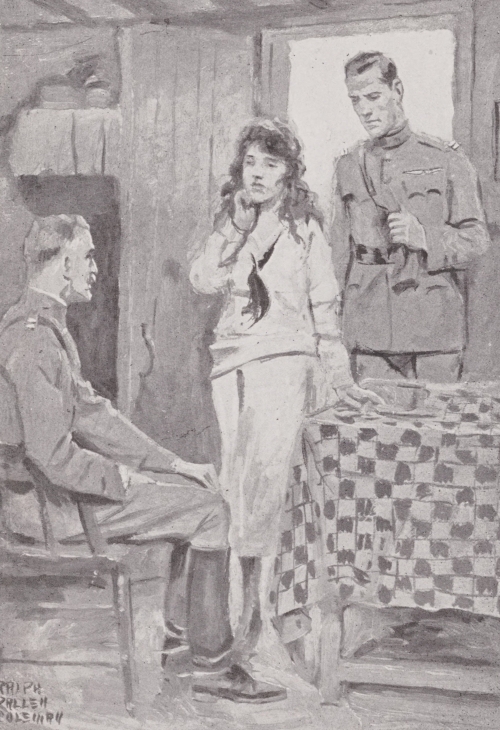
Almost at once Lucy put the question trembling
on her lips. “Father, there’s something wrong!
Please tell me?”
“I’m sorry—on Christmas Day,” began General
Gordon reluctantly. Then at Lucy’s frightened
eyes he added quickly, “It’s not so very bad,
Lucy. They say he’s all right. Greyson telegraphed
me to-day from Archangel. Bob had a
fall in his plane and has broken his leg. Greyson
assures me there is no danger. He will send word
again to-morrow.”
Lucy’s cheeks flamed with the desperate effort to
keep back her tears. Her heart was pounding in
her throat and she dared not try to speak. But in
spite of herself the tears overflowed her eyes and
glistened on her lashes when she heard Larry’s
troubled voice beside her and felt her father catch
her hand in his warm, firm clasp. She gave a quick,
grateful sob.
“You know how we feel, Larry,” she said, looking
up at him as she winked away her tears.
CHAPTER III SCOUTING ON THE DWINA
“Twenty below zero,” said Bob, as he brushed
the icicles from the thermometer outside the door
of his shack, “and it’s the twenty-third of December.
How low does it fall, I wonder, Denby?”
“Don’t know, sir,” answered the corporal gloomily.
“I never look at the temperature—I can feel
it all right. But Pavlo, here, told me this wasn’t
very cold for them.”
Bob closed the door and turned to look at the
Russian peasant who was on his knees beside the
stove, stoking it with small pieces of wood.
“He seems to keep warm enough, yet he hasn’t
as thick clothes on as we,” he remarked, studying
Pavlo’s hunched-up figure, in sheepskin jacket and
round fur cap.
“No, sir, but he stays on level ground,” said
Denby. “I don’t believe there’s anything would
keep out the wind up there.” He jerked his head
toward the sky, picked up fur helmet, gloves and
goggles and handed them to his captain.
“I shan’t want you to go up with me to-day,
Denby,” Bob told him. “I’ll take a single-seater
and scout along the river.”
Bob wore a heavy fur flying-suit, leather lined.
His helmet covered all of head and face not protected
by his goggles. Over his boots would be
drawn a second pair, made of skins sewn together
with the fur left on. Yet he faced the Arctic winter
day reluctantly. Bob had always hated extreme
cold, even in his boyhood days at home, and
two years of the mild French climate had completely
spoiled him for ice and blizzards. And the
Archangel winter came near to being what up to
now he had only known of in books of Polar exploration,
read before a blazing fire:—a wilderness
of snow and ice, and a thermometer that dropped
steadily lower every day, until the freezing misty
air penetrated through any number of layers of
clothing to the very bone.
It was not only this, however, which made Bob
linger at the doorway of his shack instead of starting
off to his afternoon’s work with his usual alacrity.
He felt no enthusiasm for the present campaign.
It seemed to him a miserable mistake, a
gloomy anticlimax to the war’s glorious ending.
Russia ought not to be an enemy, but an ally. The
spectre of Bolshevism, stalking so boldly abroad
upon these frozen plains, rose up to cloud the joy he
had known for a few weeks after the great victory.
More than this, he knew at heart with the soldier’s
clear-seeing mind, that the American and
British lives to be pitifully lost on the snow-fields
of Archangel could not stem the tide of Bolshevism,
which, if it were to be fought at all, needed a
mighty effort to crush its maddened onslaught.
Bob’s thoughts of all this were vague and undefined
as he pulled on his gloves and left the shack
with Denby beside him. But they were persistent
enough to take the edge off his energy, and to
change the ardent eagerness of past months to a
dogged, but low-spirited, determination to do his
duty.
From a big flying-shed a hundred yards away an
aviator was coming toward him, running stiffly
over the snow to start the blood in his cramped
limbs. A second flying-shed stood near the first,
with a small barrack and half a dozen shacks beside
it. A snowy road wound past them across the
plain to the town of Archangel two miles away.
The noon sky was cloudy and threatening, hiding
the winter sun from the cold earth. A single plane
droned overhead, flying northeast.
“Beastly weather, Gordon, I’ll say. Got a
good fire in the shack?” called out the aviator who
now approached him, clapping his numbed hands
together.
“Yes—I wish I could take it with me,” responded
Bob. “What news, Turner? Anything
I should know?”
“I got one sketch of their new trench line, but
it’s not very satisfactory. Continue scouting along
the river, will you? That’s Morton you see up
there. He’s going north. By the way, the
Bolshies are getting some planes rigged up—pretty
good ones. Look out for them. I almost
ran into one in these everlasting clouds. So long.”
He ran on toward the shack, while Bob and
Denby continued to the flying-shed, where the mechanics,
at sight of Denby in overcoat instead of
flying clothes, began to roll out a little Nieuport
monoplane on to the smooth-packed snow.
“Going up alone, sir?” concluded one of the
soldiers, saluting Bob as he put the question.
“Yes,” he nodded, beginning to look over the
airplane before him with the intentness of the man
who knows that he must trust his life to those frail
wings. Denby followed Bob’s eyes, and neither officer
nor corporal seemed overpleased with their inspection,
though Bob said only:
“No news of the Nieuports we expected this
week, Rogers? Did you make inquiries at the port
yesterday?”
“Yes, sir—they’ve received nothing there. But
I’ve gone well over this one. It flew well, you
said, sir, the last time you were up.”
“Oh, yes. Nothing to complain of. Let’s have
the boots, Denby.”
The corporal slipped the fur leg-coverings over
Bob’s feet, and, when the aviator was seated in the
little plane, fastened the straps across his body.
Then, unwilling that the others should take his
place, he ran to twirl the propeller. The Nieuport
ran along the snow and rose into the dull, cold air.
Bob pointed upward, making for a level above
the first low-lying belt of clouds. The motor was
running smoothly. Bob told himself that he was
growing cranky, and that he must cease regretting
the Spy-Hawk and make the best of things. But
telling himself so did not do much good. He
wanted the airplane of his choice to fly in, as a good
horseman wants his own racer, tried and proved on
many a turf. On the Western Front Bob had had
his pick of French and American planes—the famous
ace was welcome to all or any. But here at
this outpost of the Russian wilderness the supply
of airplanes so far was meagre. He had to fly in
whatever he could get hold of; and often, against
his grain, was obliged to scout in battle-planes, or
risk flights under heavy fire in light scouting craft.
Now he was above some of the shifting clouds,
and, flying slowly, he looked down upon the river
Dwina, its broad stream choked with blocks of ice,
between which the deep blue water gleamed. In
spite of the clouds and mist a glorious panorama
lay spread below him as, hovering for a moment before
commencing his eastward flight, he made a
careful survey with his glasses in every direction.
He was almost over the river, facing northeast.
On his left lay the town of Archangel, its roofs
snow-buried. West of it was the ice-bound Gulf
of Archangel, and, beyond that, the wide frozen
expanse of the White Sea. In front of him
stretched the endless plains that fronted the Arctic
Ocean. On his right, far up the river, he caught a
glimpse of the town of Kholmogory.
There was something inexpressibly dreary and
abandoned about the scene. The very names were
barbaric and meaningless on his lips. “Petrograd
seems almost near home,” he thought, “now that
I’m six hundred miles north of it.”
He turned east and began following the course
of the Dwina to where, around a little village nestling
by its banks, he could see American troops in
squads and companies moving here and there, and
motor-trucks painfully nosing their way along a
snow-blocked road. A trench-line was faintly visible,
east and west of the river. Not a shot disturbed
the silence, in which the roar of his airplane’s
motor was the only sound.
Bob flew on eastward, approaching the Bolshevik
lines. The enemy was strongly entrenched,
with artillery behind him, but at the first snow-falls
the fighting had grown intermittent. Bursts
of firing and short, hard-fought engagements alternated
with days of inactivity on both sides. As
he flew over the trenches now anti-aircraft guns
were trained on him and shots came near enough to
make him rise another hundred feet.
For the second time in two days Bob remarked
with surprise the presence of a growing purpose
and organization among his adversaries. The Bolsheviki
seemed to be abandoning their somewhat
hit-or-miss methods for a better ordered scheme.
Ordered by whom? Bob had heard rumors of Russian
officers of the old army forced into Bolshevism
to train Trotsky’s Red troops.
He flew on behind the trenches, risking a lower
level in his desire to see the new lines of communication,
unsurveyed up to now by the tiny handful
of American and British aviators around Archangel.
For a few moments he dodged back and forth
in quick tacks to throw the gunners off their aim.
Then, leaning out over the cockpit, with his glasses
he studied the narrow lines showing dark against
the snow-fields. In five minutes the deadly fire of
the anti-aircraft guns forced him to rise again
above the clouds. He rapidly sketched in on his
field map what he had seen, ready to try another
descent.
The icy air penetrating his lungs made him gasp
a little. The air seemed to have substance, body,
as though he were in the grip of a block of ice. It
got past the ear-tabs of his helmet and made his
ears tingle. His feet were numb through leather
and fur. In the dull cheerlessness of his mood a
profound depression began to steal over him, but at
the same time half-unconsciously he fought against
it, and some forgotten lines came into his mind
with all the vividness of words learned in childhood.
He found himself silently repeating them:
“Say not the struggle naught availeth,
The labor and the wounds are vain——”
He went on saying over the fine solemn words as
he swung the Nieuport down again through the
fog:
“—It may be, in yon smoke concealed,
Your comrades chase e’en now the flyers
And, but for you, possess the field.”
He was hardly at the last line when a Fokker biplane
broke through the clouds in front of him.
The enemy plane had not risen in pursuit of the
American. Its guns were not trained on the Nieuport.
In that fleeting glimpse Bob saw that the
Fokker’s gunner, glasses raised, was observing his
own lines below, while the pilot manœuvred the
plane over rifts in the cloudy floor. But at sight
of the Nieuport the gunner flashed his weapons
into range, though no shots followed, for at once
the drifting clouds hid the two antagonists from
each other.
All his slumbering energies aroused, Bob leaned
forward with keenest intentness, trying to see
through the treacherous misty curtain. He
glanced at his machine-guns, made sure that his
motor was running smooth, and rose a little higher,
hoping to get above the Fokker and avoid surprise.
He thought swiftly as he prepared for attack,
still puzzled by the enemy plane’s appearance. It
was a German machine—no doubt about that. He
supposed the Bolsheviki had bought or stolen it.
Vague suspicions, already aroused during the past
few days, stirred him once more, but again he rejected
them.
“I think he’s a German because inwardly I’m
longing to bring down another German plane,” he
told himself.
He tried to picture the faces and figures of the
men in the Fokker, as they had flashed close beside
him, but they were like himself unrecognizable in
fur and helmet. Five minutes passed before the
Fokker again appeared, this time greeting the
Nieuport with a broadside that sent bullets whizzing
past Bob’s ears to cut into the fog behind him.
Bob rose again, filled with ardor, and determined,
more than ever in the presence of this menacing
intruder, to accomplish what he had come out
for and get the rest of his sketch of the new Bolshevik
lines. He climbed at high speed, darted
about until he saw the Fokker cruising through the
clouds below, then plunged down above it and delivered
a hail of bullets on its broad spreading
wings.
As he dodged and rose again he watched the
enemy sway and nose-dive into a cloud-bank. He
noticed that the wings were bare of emblems. The
German crosses—if they had been there—were
gone. The Fokker recovered and rose again, the
fabric of its upper planes slashed by the Nieuport’s
bullets.
Bob was uncertain what tactics to follow. So
far he could not be sure whether his adversary was
sly or stupid. The Fokker’s pilot seemed to have
little initiative, yet he manœuvred the heavy
plane skillfully. It dipped and climbed almost at
the little Nieuport’s speed. Unless the pilot were
a clumsy Bolshevik amateur Bob could never hope
to disable the Fokker from his own light craft.
The best he could hope was to scare him off or lose
him in the clouds.
Suddenly all doubt of the enemy’s skill vanished,
for the Fokker headed straight for the Nieuport
and, firing repeatedly with well-aimed volleys, circled
about the little monoplane, which turned tail
and retreated up into the sky, where the heavy
Fokker could but slowly follow.
At 9,000 feet Bob paused, for the enemy had
stopped rising 1,000 feet below him and seemed to be
awaiting developments. Bob was too high for convenient
observation and the drifting clouds annoyingly
obscured his vision. He peered down at the
Bolshevik lines, nevertheless, keeping one eye on
his enemy, who was all but in range and waiting
inexorably. After ten minutes’ more sketching,
by frequent change of position and some clever
guesswork, he had got most of the information he
wanted. Now he began to cast uneasy glances toward
the Fokker which flew back and forth on the
watch, just above the clouds.
Bob had never been good at a waiting game, and
this cat-like proceeding got on his nerves. He began
to feel trapped, and in consequence defiant.
He reloaded both guns, speeded up his motor, and
without warning dropped like a plummet over the
cruising Fokker and emptied both guns over cockpit
and rudder.
This done, however, he was obliged to fly still
lower before he could attempt a climbing turn. The
Fokker, though bullet-riddled and one plane sagging,
followed him down, spraying the little Nieuport
with a deadly fire. Bob realized now his own
rashness in not fleeing at once before an enemy who
so outmatched him. The truth was he had not
been able to convince himself that any Bolshevik
flyer could outmatch him, even in a battle plane
twice the Nieuport’s size.
He hid in the clouds, looking with anxious misgiving
at his torn wings and suddenly aware that
his rudder did not obey him with exactness. Once
more the Fokker passed him, slowly this time, for
to Bob’s tremendous relief, he saw that the enemy
plane was badly crippled and had lost some of its
speed. In the same breadth of time he saw at last
the pilot’s face. Hidden by helmet and goggles,
he recognized the shape of that big chin, the turn of
the head, the stoop of the broad shoulders. He
had seen that man a thousand times over the battle-fields
of France,—Rittermann, one of the last of
Germany’s veteran flyers.
Bob turned the Nieuport westward, put on what
speed he could and ran away at eighty miles an
hour. He steered for his own station, east of Archangel,
following the river which wound below him,
the water gleaming darkly through the ice in the
approaching twilight. But the Nieuport’s rudder
did not obey his touch. The monoplane veered
northward, slackened speed. Bob looked back, his
mind whirling a little, then drew a long hard breath.
The Fokker had lost him. He was within the
American lines again, but north of the Dwina,
above a rough, ice-covered plain cut into hummocks
and ridges, broken just beneath him by the
bare branches of a wood.
He wanted badly to land but saw no possible
landing-place in sight, and the familiar home field
was far away. He turned with difficulty and began
flying back toward the American trenches,
seeking the village by the river where the companies
of infantry were billeted. But in the past half
hour the early Arctic night had begun to fall. By
his wrist-watch it was quarter to three, and he knew
that by three o’clock it would be almost dark. The
cold was so intense it numbed his power to think,
and his rudder, struck by the Fokker’s bullets,
responded more feebly every moment.
He flew on eastward, crossed the river below the
clouds, and began searching the banks for the village,
looking for its lights, for now a glimmering
dusk spread over the desolate landscape. In another
five minutes the lights shone out,—a dozen
tiny twinkling points about two miles ahead of
him. He pushed on, hoping against hope to cover
that short space, but a few moments more convinced
him of the worst. His heart sank like lead as his
desperate eyes watched the gleaming white snow-fields
below him.
“The first time in all these years,” he thought
miserably. “My Spy-Hawk would have held
on——”
The Nieuport’s wings sagged lower. Its rudder
no longer obeyed Bob’s frenzied pressure. For
the first time since that day in 1917 when he and
Benton had come down in German territory to be
taken prisoners, Bob—an ace and the hero of many
victories—was forced to land at night on unknown
ground in an airplane that shook and quivered
under him as it flew crookedly downward, the Fokker’s
bullets too much for its imperfect frame.
A forced landing in the dark—a moment before
Bob had thought that bad enough. But now, as
the Nieuport quickened the plunge which he was
helpless to arrest, he realized that truth with a
thrill of terror. The motor missed, choked,
stopped running. In the silence that succeeded
the propeller’s roar the wind whistled past the
wings as the plane fell. Bob looked down at the
white-shining earth below, his heart leaping in his
throat, his head whirling as the blood rushed to his
temples. The snow rose with a dizzy swiftness to
meet him. The plane struck, nose down, with a
shock that hurled him through the air. He fell
onto the hard surface, one leg doubled under him,
from which such darts of agony shot through him
that with a groan he lost consciousness.
When he came slowly to himself, forced back to
life by the stabbing pain in his right leg, Bob
opened his eyes on darkness, felt the icy night wind
sweep past him and sharp, cold particles pressing
against his outspread hands. He rolled over on
his back, not without a groan at the renewed torment
of his leg, and stared up at the sky, where,
between the flying clouds, scattered stars shone
with cold brilliance. He felt hard lumps like
stones sticking into his back, but he could think
clearly enough now to know that the lumps were
hardened snow, and that the deadly chill penetrating
him through fur and leather garments would
but too soon be followed by numbness and yielding
to a sleep from which he would never wake.
Painfully raising his head he could see the faint
lights of the village, not a mile away. Could he
freeze to death within sight of help,—within a few
miles of his own flying-field? A desperate determination
roused him to fight against the agony of
his broken leg and do what lay in his power to save
his life. Life was, all at once, inexpressibly dear
to him. Spent with pain and cold as he was, the
blood flowed warm in his veins and resolution conquered
his weakness. But already cold had so far
overpowered his brain that his mind was at moments
clouded, and it was then that the coward
part of him bade him lie down and forget the horrible
pain that every movement cost him, and sink
into oblivion.
The airplane was not a dozen feet away. He
could see its dark blot against the snow, and the
outline of its broken wings. If he could climb
upon its frame, he thought, away from the snow
that was freezing him, he might summon force
enough to keep alive till daylight. Daylight on the
White Sea! It was not more than six o’clock in
the evening now, and dawn would not break before
eight o’clock of the following day. He knew that
Turner and Denby would soon be out searching for
him, but by what lucky chance would they stumble
upon him? They had more than fifty miles to
cover—a wide expanse, even with airplane search-lights.
He took his lip between his teeth as he turned
over again on his face and began crawling toward
the Nieuport. He panted as he dragged himself
along, for he could do no more than bend his left
leg and catch at the snow with his gloved hands.
The uneven snow-crust striking his right leg and
jarring the broken bones hurt so atrociously that
after two yards he stopped dead and, laying his
face on the snow, in pain and despair almost lost
consciousness once more. But something in him
still resisted—something dogged and heroic that
had made him the flyer he was—that had led him to
Sergeant Cameron’s prison. He raised his head
and crawled on again, reached the Nieuport and,
finding one of its wings lying almost flat along the
ground, managed to drag himself upon it and lay
there gasping and dizzy.
The wing was almost on the snow and its torn
fabric not much protection from the icy surface.
Still there was a difference, and the fact of having
accomplished his purpose made Bob more able to
keep up the struggle. After a moment he tried to
shout, but one hoarse, shaky cry told him the uselessness
of wasting his little force. The whistling
night wind snatched his feeble voice away before it
had travelled over the smallest part of the great
spaces around him. He looked up at the airplane’s
wings and thought with sudden inspiration that he
might set them afire as a signal. He was actually
feeling inside his furs for his matches before it occurred
to his dazed mind that the gasoline would
ignite with the plane and that, helpless as he was,
he would never get away in time.
At this quenched hope he was horribly cast
down. Despair threatened again to overwhelm
him. Nevertheless he went on dully scheming.
After a few minutes of aimlessly wandering
thoughts another idea came to him, and this time
his heart gave a faint leap, almost of hope. He
braced himself to endure the agony of movement,
squirmed around until he could reach into the airplane’s
cockpit and, after a painful search, closed
his fingers on a pair of pliers.
He slipped off the sagging wing on to the snow
again, lay there a moment breathing hard, for
every effort made his strained heart race and
hammer, then began cutting the wire of the wing
and ripping away the fabric. Presently he held
some wide strips of silk and a long piece of wire.
He fastened the silk in streamers at the end of the
wire and, taking the wire between his teeth, crawled
away from the plane. A dozen yards distant human
nature could endure no more and he lay back
on the snow, feeling nothing but the throbs of
agony that darted from his broken leg into every
part of his body.
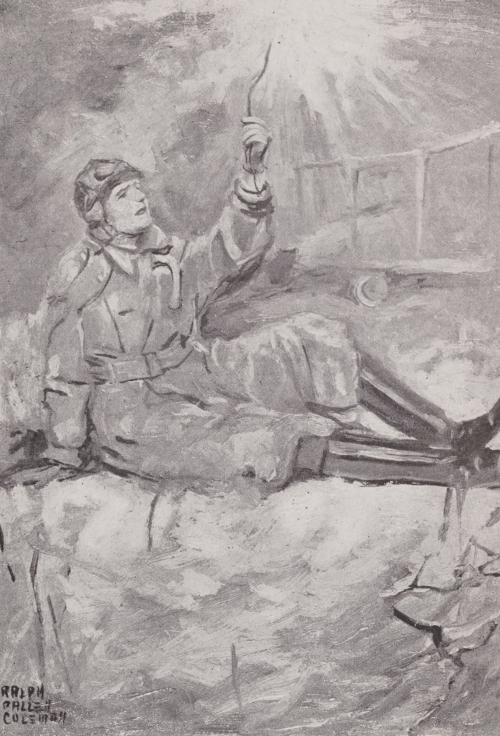
Yet in a minute he sat up, planted the wire in
the snow and, drawing out his matches, managed,
after several trials in the gusty wind, to set the silk
on fire. He caught hold of the wire now, and,
heedless of pain, lifted himself as much as he could
and waved the flaming streamers about his head
until the blaze shrank down to sparks and went out,
leaving him with false flashes of light before his
eyes in the darkness.
He Waved the Flaming Streamers About His Head
Bob did not know just what happened after that.
He lay down again and tried to steel himself once
more to endure the pain, to stay awake, and to go
on hoping. But the effort to keep repeating these
resolves was too terrific. He felt that he was attempting
problems utterly beyond his power, and
every now and then he would rouse himself with
a start and realize that he had been very near
dreaming.
The stars shone more thickly now overhead. He
tried to count them, lost track, began again. He
could hardly remember where he was. He was not
nearly so cold as before—he was almost comfortable.
He seemed to have no feeling at all in his
body, except for his leg which still throbbed dully.
All at once, through the numbing of his senses, he
was dimly aware of a sound in the snow near him,
a kind of crackling, steadily repeated. Some
lingering sense of reality made him suddenly realize
that the sound was of footsteps approaching
him, or at least passing near. As he roused all his
remaining energy in a desperate attempt to cry out
the footsteps ceased, and from beside the demolished
plane a voice shouted:
“Ah, there! Speak if you can! Where are
you?”
Bob made some sort of sound—he did not quite
know what. But it was enough to bring the footsteps
close beside him. A figure loomed above him
in the darkness, an electric torch flashed over his
prostrate form, and, as the man knelt by Bob’s side,
the light showed the uniform of a British tommy, a
muffler-wrapped throat and a lean red face, with
breath puffing white into the freezing air.
“Came down, eh? It was you what waved the
signal?” he inquired, his keen eyes wandering over
Bob. “'Ow much are you hurt? Can you walk,
me 'elpin’ you?”
“No, I can’t walk. You’ll have to fetch help,”
said Bob, still struggling to cling to reality. One-half
of him was gloriously happy at this deliverance,
but the other half wanted to forget and go to
sleep and could hardly tell the soldier what to do.
“Go to Nikolsk, that village where you see the
lights,” he continued. “Americans are billeted
there. Ask them to send a detail of Hospital
Corps men with an ambulance. Make sure of
where I am. Have you a compass?”
“But can you stick it? I’ll be gone an hour,”
said the tommy doubtfully. Bob’s voice was
scarcely more than a whisper, and there was a
pause between his words when his thoughts failed
him.
“I’ll stick it. Make it as quick as you can,” he
answered.
The Britisher still lingered. Bob heard him
murmur something which sounded like, “Well,
looks like it’s got to be done.” The next moment
Bob heard a garment of some sort flung down and
spread out on the snow beside him, and felt himself
lifted cautiously by the shoulders and dragged,
before he could protest at the handling, on to something
like a blanket. “Carry on now. I’ll keep
my feet movin’,” said the tommy, and with the
words he ran off into the darkness.
Bob felt with his hands of the fabric spread under
him, touched a cloth sleeve and knew that he
was lying on the soldier’s overcoat. A faint thrill
at this generous act touched his dulled senses. But
he no longer felt the cold and did not care whether
he lay on snow or blankets. He had a feeling now
that all was settled. At moments he even thought
that he had got back to his station and was in bed.
At any rate he knew that he had not to think or
plan any more. He fell asleep.
CHAPTER IV THE SILLY ASS
The hours Bob next lived through were a sort of
waking dream. He had moments when he knew
well enough that he was being lifted by careful
hands into an ambulance which then began to glide
on sledge runners over the frozen plain. He felt
blankets wrapped about him and, with the first returning
warmth, his leg began to stab him again
with throbs of anguish. But these half-lucid minutes
were followed by long intervals of dreaming
that took him hundreds of miles away from the
snowy plains, to days that came back to him
vaguely now as part of another life.
At last, after a very long time—days or weeks,
he could not tell which—he opened his eyes and
looked around him with fairly untroubled brain.
He was in a room in a Russian house, for a porcelain
stove occupied a good part of it. Outside the
low window he saw the everlasting snow, some
trees, their bare branches swaying in the keen wind,
and, in a moment, a soldier walking rapidly toward
shelter.
Inside the room, at the foot of his cot, was a
small hospital table, with gauze, bandages and
bottles upon it. The walls were newly white-washed,
two other cots lay beyond his, and a faint
smell of chloroform lingered on the air. He turned
his heavy head and saw an officer seated beside him.
“Well, Bob, how is it?” inquired the surgeon,
taking the patient’s hand in his.
Bob stared at him, moved his tongue with an uneasy
feeling that he could not speak, then murmured,
still with painful effort, “You, Greyson?
They brought me here—all right—then. What
day is it?”
“It’s Christmas Day. We brought you here
night before last. You’re in Nikolsk village, in
our little hospital. Don’t you remember what happened
to you day before yesterday?”
“Yes,” Bob answered slowly. The whole tragic
scene reappeared before his mind in bits which he
struggled to piece together. But all at once the
dull ache in his leg brought it vividly back. He
started from his pillows, a sudden dread darkening
his eyes. “Greyson,” he stammered, “my leg!
You won’t—you haven’t——”
“We haven’t and we won’t,” said the surgeon,
smiling as he pressed Bob’s shoulders back against
the pillows. “Your leg is going to be all right.
You’re a tough specimen, Bob—I’ll say that.
Most people wouldn’t have come out of it so
well.”
“You’re telling me the truth?” Bob persisted,
his muscles tense and quivering.
“On my word of honor. The fracture is set and
shows every sign of healing. You have no fever.”
Bob lay silent, spent with peaceful gratitude.
He began again reviewing his accident, and when
he reached the moment when the British tommy
bent over him he roused himself to ask:
“That British soldier who brought you word—do
you know who he is? I want to thank him. He
gave me his coat, too. Is he all right?”
“Yes. He came here yesterday to ask for you.
I tried to thank him myself, but as soon as I began
he cut me short by saying, 'Never mind that, sir.
It ain’t a medal of honor I’m lookin’ for. What I
want is for you to promise not to say nothing to
my captain about that there night. I was out as
you might say without leave, when I happened to
see that air chap’s signal blazing.’”
Bob smiled faintly. “I’ll stand his guardhouse
sentence for him, if he gets one,” he said unsteadily.
“Another few minutes and I couldn’t have held
out.” He shivered at thought of those hours of
misery, drawing the blankets closer around him.
“You sent word to my squadron, of course, Greyson—and
to Father?”
“Yes, to both. Turner came over yesterday.
He salvaged your airplane and took your maps and
sketches back to Headquarters. He said the
colonel received them with enthusiasm.”
Under the glow of this satisfaction Bob forgot
his regrets, the loss of his plane and his own helplessness.
With vague thoughts of past Christmases
flitting through his mind he sank into what
was this time profound and restful sleep.
When he awoke again he was enough stronger
to think clearly and without gaps in his memory.
It was almost dark in the room and, outside, the
snow-fields were glimmering in the twilight of
early afternoon. The stove sent out a pleasant
heat that Bob was still near enough to his escape
from freezing to rejoice in. He thought now of
the skirmish in the clouds with the Fokker biplane,
and of the German pilot whom he had seen face to
face. He began to long for news of the battle-front.
He wondered whether the Bolsheviki’s
meagre air forces had been further increased. At
this point in his reflections the man in the cot beside
him sat up and looked at him, with deep, sad
grey eyes, set in a thin, fever-worn, unshaven
face.
“Good-day,” he said, speaking English with a
slight lisp and great deliberation. “You are better,
I hope?”
“Yes, thanks,” said Bob, studying him. The
stranger’s melancholy eyes and oddly vibrating
voice so aroused his curiosity that almost unconsciously
he asked, “Who are you, please?”
The man hesitated a second before he answered,
“I am a Russian prisoner—brought wounded
here.”
“I see,” said Bob and relapsed into silence.
His neighbor looked at him, his sad eyes gleaming
as though with thoughts he did not know how
or feared to put into words. After a moment he
seemed to reach a decision for, pushing himself upright
in bed with his thin, trembling hands, he said
with a sort of jerky eagerness, “I am not a Bolshevik,
Gospodin (sir). I am not an enemy.”
“Uh?” Bob’s incredulity expressed itself in
something like a grunt, which he did not trouble to
make more articulate. He had heard plenty of
German prisoners, seeking to please their captors,
make the same sort of protestations. At what he
took to be cowardly fawning he lost interest in his
strange neighbor.
The Russian, however, visibly excited, darted
glances almost beseeching toward the American,
who lay looking out of the little window in unsympathetic
silence. He started to address Bob
again, frowned, hesitated, then plunged into
speech. He spoke fluently enough, except for an
occasional Russian word inserted where his English
failed him.
“Perhaps you think, Gospodin officer, that I
take a liberty with you. But, consider, I have
watched a young man brought back from death to
life—for you were yesterday very close to death. I
know the cold snow-fields. I have lain there, too.
It is not strange that I speak to you—ask for your
health?”
“Not a bit—of course not,” agreed Bob, suddenly
pitying, in spite of himself, this thin, pain-wracked
sufferer who held himself up from his pillows
with an effort that sent tremors through his
nervous, overwrought frame. “Why don’t you lie
down?” he asked. “You’re tiring yourself for
nothing.”
The Russian lay back panting, but almost at
once he demanded, breathlessly, “You will let me
talk to you? Not now, perhaps, but soon—to-morrow?
I have watched your face while you lay
there. You are one of those Americans who thinks
and acts——” He broke off, catching his breath.
Bob thought, “I wonder if he’s crazy.” Aloud
he answered soothingly, “All right. Tell me anything
you like. I can’t talk much yet, but I can
listen.”
Before the other had time to answer the room
door opened and Major Greyson, followed by the
colonel in command at Archangel, came to Bob’s
bedside. Behind them an orderly brought a lamp,
which he placed on the table, for darkness had
fallen over the snow-fields.
“Awake, are you, Captain Gordon? And feeling—how?”
asked Colonel Masefield, taking Bob’s
hand as he sat down by the cot. “You don’t look
quite yourself, but Greyson here is encouraging.”
“I’m getting on all right, sir, and thank you for
coming,” said Bob, returning the handshake with
one that was still feeble.
“I had a cable from your father, Bob,” put in
the surgeon. “He asked for any further news.”
“Didn’t make it any worse than you could help,
did you?” asked Bob, hating to send bad news on
Christmas Day.
“I said your leg was broken and you were suffering
from shock but were not in danger,” replied
Major Greyson, sitting down on a chair the
orderly brought forward.
“The Nieuport, Colonel—I’m sorry,” said Bob.
“You’ve brought us down twenty-eight German
planes, Captain Gordon, and this is the first of ours
you’ve lost. I think we can overlook it,” said
Colonel Masefield. “Besides, that Nieuport was
well sacrificed for the sketches you got. They are
just what we’ve wanted. Adding them to Turner’s
photographs we can launch our attack on the
enemy’s new lines.”
“An attack—a big one?” Bob asked eagerly.
“Big for our little resources. We hope to push
the Bolshies back a bit. Of course our objective
here is simply to keep them well east of Archangel
and away from the little port of Alexandrovsk—our
one way out.”
“I’ll miss it,” said Bob drearily, trying to move
his broken leg, a helpless weight in splints and
plaster. “Did you find the note I scribbled on one
of my sketches, Colonel? That the Fokker which
chased me was piloted by Rittermann? I’d like to
face him in a plane his size!”
“Yes, that was a bit of priceless information,”
said the colonel thoughtfully. “We’ve had our
suspicions; though, to tell the truth, I think there
is only an occasional German pilot flying with the
Bolsheviki. The German government would
hardly bargain with them now. They have enough
anarchy at home to fear.”
“By the way, Greyson,” exclaimed Bob.
“Why did you put me in the room with a Bolshevik?”
Bob glanced at the empty cot beside him.
The orderly had wheeled the Russian away for a
change of scene, which consisted in another view of
shimmering snow and faintly starlit sky.
“Well, as you may have noticed, Bob,” said
Major Greyson, “we haven’t a great deal of room
here. That chap had to have the best of care. He
was as near death, two weeks ago, as anyone can
be and live. We picked him up after their last retreat.
Besides, he’s not a Bolshevik. He’s quite a
decent fellow.”
“What, has he told you that stuff, too?” demanded
Bob. “Colonel, I think he’s a first-class
liar. He hardly waited until I was awake to pour
into my ears that he was not a Bolshevik. He was
fighting with them, wasn’t he?”
“Yes, they forced him in,” said Major Greyson.
“They all say that. Why didn’t he refuse?”
“Oh, for several reasons.” The surgeon remarked
Bob’s flushed face and quick breath and
evaded an argument. “I think we’ll go now,
Colonel, if you please,” he added. “My patient
isn’t quite the man he was yet. He’s talked
enough.”
“Good luck, sir, with the attack,” said Bob as
the colonel rose. “I wish I could be there.”
“You made it possible,” said the colonel.
“That’s something.”
More tired than he realized, Bob fell into a doze
when he was left alone, thinking vaguely of the
coming engagement in which he could have no
share.
The attack, however, did not come off as the
colonel hoped, for, by the middle of Christmas
night, the few stars were hidden by the clouds
which had spread over the heavens, the wind
howled around the little village of Nikolsk and
snow began to fall heavily. Dawn broke, about
half-past eight, the feeblest, greyest glimmer of
light over the snow-fields. From the sky fell such
myriads of snowflakes that it made Bob dizzy to
watch them. The wind drove them like white
flocks in every direction, mostly, it seemed, up
against the window from which the orderly beat the
drifts every half hour. The icy wind penetrated
the cracks and chilled the room, in spite of the big
porcelain stove’s unfailing heat.
Bob knew that to-day neither Allies nor enemy
would think of an attack. It was as much as life
was worth to venture abroad in the increasing
storm. A stranger was almost certain to get lost
on the snow-fields, once the curtain of falling snow
had cut him off from landmarks. The never-lessening
descent of the snowflakes fascinated his eyes.
He lay motionless, in his listless weakness, watching
them, until his neighbor the Russian roused him
from his reverie with his eager, pleading voice.
“Gospodin American, will you listen to me? I
do not wish to be an annoyance, but perhaps you
will be glad to hear——”
Bob turned toward him, curious at this insistence.
The Russian lay on his pillows, looking
spent and weary, his haggard face white above his
unshaven cheeks, but his eyes brighter than ever in
the dull grey light of the snow-storm.
“Where were you wounded?” Bob asked him.
The Russian pointed to his chest. “Here. But
it is nearly well. Only it hurts sometimes to
breathe. Will you listen a moment, Gospodin
Captain?”
“Yes,” Bob nodded.
The Russian pulled himself to that edge of his
cot which was nearest Bob’s and began at once,
“My name is Andrei Androvsky. I live in the
town of Nijny-Novgorod, which is, as your honor
knows, east of Moscow. There I left my wife and
two young children.”
He paused, breathless again. Bob thought with
a touch of impatience, for that strained, eager
voice was beginning to get on his nerves, “It’s the
story of his life he wants to tell me, then. What
on earth for?”
Androvsky caught his breath and continued:
“I left them in 1914 to enter the Czar’s army and
fight Germany.” Perhaps his clear, watchful eyes
guessed something of Bob’s thoughts, for he hurried
on with fewer details. “I fought under the
Grand Duke and under Brusilov. I became an
officer. I fought with the Republican army after
the Czar’s fall. My papers would show you this,
but the Bolsheviki kept them when they forced me
to serve.”
“Forced you?” Bob interrupted. “What do
you mean?”
“They threatened me with death and——”
“But death at their hands or death fighting like
a slave in a bad cause—I think you made a poor
choice,” said Bob pitilessly. He was picturing
himself forced to fight with the Germans against
his own countrymen.
The Russian’s eyes darkened with shame and
sorrow. Bob’s heart suddenly smote him for his
hard words. But Androvsky answered unresentfully,
his thin voice shaking a little:
“Yes, if life were all, I would have given it.
But the Bolsheviki were going to take my house
and little patrimony and turn my wife and children
out-of-doors in the bitter winter. My youngest
child was six months old. Could I see them starve
and freeze to death?”
“I didn’t think of that,” Bob slowly admitted.
“It was hard. What did you do?”
“I joined the Bolsheviki, stifling my conscience,
trying to think only of my little ones safe and warm
at home. I do not defend myself. I only tell you
what is true, so that you may take my word for
something else.”
“Something else?” Bob echoed.
“So that knowing that I am friendly to the Allies,”
Androvsky went on, “you may believe me
when I tell you that the Germans are helping the
Bolsheviki.”
Bob’s heart gave a quick throb and a vision of
Rittermann’s face flashed before him. But at the
same time he studied his companion intently.
Androvsky’s tragic story was just what a clever
rascal would make up to win sympathy. He
thought the Russian’s looks and voice better proof
of his sincerity than any argument. In spite of
the wariness gained in two years of hard experience
Bob believed that the man meant to speak the
truth. About any real German alliance with the
Bolsheviki, however, he was frankly incredulous.
“I know there are some German flyers up here,”
he told Androvsky. “But I don’t think Germany
would really combine with Trotsky to attack us.
The new Germany has too much anarchy to fight
at home to ally itself with the Soviets now.”
“You are right, Gospodin Captain,” exclaimed
the Russian, with a return of his nervous excitement.
“The German government is busy suppressing
outbreaks, even in Prussia itself. But the
Germans who are bitterly discontented, those inclined
toward Bolshevism, or even Royalists who
see ruin ahead—are but too willing to join any
power able to delay the peace or to divide the Allies.
These malcontents have turned Bolsheviki for
the chance of revenge. You say you have seen
German officers here. I have seen German officers
organizing the Bolshevik regiments and German
ammunition feeding their guns.”
“Won’t the German government do anything?”
asked Bob. “It must see that only peace will save
Germany now.”
“The new government is weak, and still fighting
its own rebels. Besides, its leaders are divided between
dread of Bolshevism and a bitter satisfaction
at seeing the Allies threatened by its advance.
Will you tell your friends this, Gospodin Captain?”
“Yes, let me think it over,” Bob said. “Don’t
talk any more now. You’ll have a relapse. I believe
what you say, or that it seems the truth to
you.”
Androvsky nodded and closed his eyes. Bob fell
once more to watching the cascades of snowflakes
hurled against the pane, thinking over the Russian’s
words. Bob did not want to and tried not to believe
him, because it meant bad news, uncertainty,
the peace delayed. He felt at that moment, with
sudden gloom, as Lucy had felt the day she said to
Larry, “I thought the war was over. But here it
seems to be tailing out in all directions.”
Before he got very far in his troubled reflections
the dull report of two pistol shots fired in the snow-storm
made him start up to listen.
In a minute another shot followed. It sounded
about a hundred yards distant, south of the village.
Almost at the same moment half a dozen dough-boys,
wrapped to the ears in sheepskin jackets and
woolen mufflers, ploughed past the window with
rifles in their hands.
“What can it be, Androvsky?” asked Bob, tingling
with the helpless longing to get up and see for
himself. “Orderly! Greyson!” he called.
But the orderly, usually within easy call, did not
answer, and Androvsky could only shake his head,
staring at the window. A few hurried footsteps
and a murmur of voices disturbed for a moment
the hospital silence which then settled down
again.
After twenty minutes spent in vainly straining
his ears, Bob at last heard quick steps in the corridor.
The door opened and the orderly entered,
carrying blankets and pillows which he laid down
on the empty cot beyond Androvsky’s.
“What is it, Miller? What’s happened?” cried
Bob.
The orderly pulled the empty cot around in front
of the window as he answered in fragmentary
haste, “Man to be brought here, sir. Pretty well
chilled through in the snow. Escaped from the
Bolshies’ lines.”
He paused, hurrying to prepare the cot, for already
slow steps sounded outside and two soldiers
entered, carrying a stretcher on which lay a young
man, bareheaded, all of his uniform but boots and
breeches hidden by his snow-covered sheepskin
coat. His arms dangled at his sides, his eyes were
closed and his fair hair wet with snow.
“Lay him down gently,” directed Major Greyson,
following the bearers to the cot. “Now—easy—that’s
it. Pull off his coat, Miller. Move the cot
further from the stove—beyond the window.”
Under the hands of surgeon and orderly the patient
opened his eyes, starting up on his cot, to be
immediately pushed back again by Major Greyson.
“Lie still. Don’t try to speak,” said the surgeon.
“Not——? Why, I have to,” declared the
other, bobbing up again as soon as Major Greyson’s
hand was removed. “Look here, d-don’t you
believe what t-that fellow t-tells you,—the one I
brought in—that he’s my s-servant. I heard him
g-get that off to one of your s-soldiers. He followed
to c-catch me. He’s a B-Bolshevik—my
prisoner.”
The undaunted pluck in the young man’s voice
struggled with the deadly chill of exposure that
made his teeth chatter and his tongue stammer over
the words. He cast one keen glance at the surgeon
as he ended, then lay obediently back on his pillows,
closed his eyes and fainted.
“Here, Miller, get a hypodermic needle ready.
Pull off his boots, Johnson, and give his legs a
gentle rubbing,” ordered Major Greyson, his
fingers on the unconscious man’s fluttering pulse.
Half to himself, half to Bob he grumbled, “Of all
the rattle-pated idiots. Why must he talk when
he’s as weak as a cat? What’s one Bolshie prisoner
more or less?”
“He spoke like an Englishman,” said Bob.
“Who is he?”
“British officer,” said Major Greyson, pointing
to the uniform blouse lying across a chair. “I’ve
sent word to their lines. I believe there was only
one officer held prisoner anyway, a chap who got
caught in a raid last week. Must be this man; he’d
be the sort to plunge into a trap.”
“Well, he plunged out again,” protested Bob.
“He took advantage of this storm to escape.
Pretty smart of him.”
“Yes, if he comes around all right,” said the
surgeon doubtfully.
“Why, he’s no worse than I was.”
“No, but as I said before, you are a tough specimen.
This lad looks rather frail, though it’s true
that delicate-looking young Britishers show lots of
endurance. Bring more snow, Miller. His foot is
about frozen.”
The Britisher stirred, opened his eyes and almost
at once, in a voice that trembled with weakness,
began to speak.
“Went off, did I? Send word to my regiment,
ah—Major—won’t you?”
“Will you keep quiet?” demanded Major Greyson.
“Give your heart a chance to pick up.”
“Right-o. Got clean away anyhow—didn’t I?
I was afraid for a bit I wouldn’t pull it off.
I——”
The surgeon discovered a white spot at the tip
of his patient’s ear. He clapped a handful of snow
against it. The young officer gasped and for a moment
subsided.
“I’ll have to stuff his mouth with snow, next,”
muttered Major Greyson. “I wonder if he’s a bit
delirious.”
Bob smiled, feeling a secret liking for the cocky
young Britisher who now, his cot pushed into the
coldest corner of the room, lay squirming under
Major Greyson’s pitiless snow-rubbing.
“Frost-nipped, am I, what?” he gasped after a
moment. “I say—got a bit of snow down my
throat that time, Major.”
“Captain, will you obey my orders and stop
talking?” demanded the surgeon with exasperated
calm.
“Stop talking? Better for me, you mean?
Somehow I think a gloomy silence is really
more——Oh, all right,—I’m dumb.”
Bob laughed outright this time. He turned to
Androvsky who, head on hand, lay watching the
young Britisher, a gentle smile on his pale lips.
“Did you ever see him before, Androvsky?
Was he taken while you were with the Bolsheviki?”
“No, Gospodin Captain. When I fell wounded
no Britisher had been taken.”
Bob looked intently at the Russian, remembering
the conversation of an hour ago. Androvsky
met his gaze with patient, melancholy eyes. But
Bob’s leg had begun hurting too severely for him
to ponder much over the questions that puzzled
him. When Major Greyson had given the Britisher
a quieting draught and left the room with his
aides, Bob snuggled under the blankets out of the
chilly air and, with a glance at the steadily falling
snow outside the window, fell into a doze.
When he woke, by his wrist-watch it was four
o’clock and night had fallen. The orderly had just
brought in the lamp and had covered the Britisher
with another blanket. Bob saw the young officer
stir beneath his covers and look toward the cots in
front of him. In the lamplight Bob could see that
his lean face was very young, more boyish than his
own. His fair hair lay in thick locks on his forehead,
from which, Bob supposed, it was ordinarily
brushed back, for now the Britisher raised a feeble
hand and smoothed up the scattered strands which
fell over his eyes.
“How do you feel, Captain?” asked Bob, nodding
to him.
The Britisher gave a nervous start, then answered
a trifle uncertainly, “Why—er—not too
well. I say, sir, this is Nikolsk village, isn’t it?
The American hospital? I expect my colonel
knows I’m here?”
“Yes, but the storm is still raging. They could
hardly come to you now, and certainly could not
transfer you.”
“Right. I’m not complaining. A bit dizzy yet.
The old bean doesn’t work fast. Do you—er—happen
to know if there’s anything much wrong
with me? Rather like to be on to it, you know.”
Bob was glad to be able to answer, “No, I’m
sure you’re quite all right. You were overcome by
the cold, and frost-bitten. But the surgeon seemed
satisfied before he left. Were you out long in the
storm?”
“Long enough. I shiver yet to think of it,” said
the Britisher, his voice quickening with a return of
his unquenchable energy. “It’s a bit of a storm.
I’m grateful to it, though. The snow fell so thick
the guards left my window. I broke out, hid, and
ran for it. They chased me and did some blind firing.
One ran square into me. I grabbed him and
brought him in. Nothing much to that end of it.
The tough part was the half hour I crouched in the
snow under my window, waiting for the camp sentries
to give up patrolling and make for shelter.”
“Where were you? Behind their lines?”
“In a sort of shack near the Bolshies’ barracks—right
beyond their trenches. But the bally trenches
are not held to-day, except at intervals. I stole
over easily enough. By the way, may I know your
name?”
“Robert Gordon, Captain, U. S. Flying Corps.
Did you find out much about the Bolshevik force?”
Bob was thinking again of Androvsky’s revelations.
“Robert Gordon, did you say?” asked the Britisher,
ignoring the question. “Are there others of
that name in your corps?”
“No, not any other in the Flying Corps. Do
you think the Germans are supporting the Bolsheviki?
Are there any German officers over there
now?” persisted Bob, following his own anxious
thoughts.
“Didn’t see any. Don’t know, to tell the truth.
I was busy wondering if I’d starve to death before
I could make a break for it. Horrid bounders,
Bolshies. But, I say, this is simply priceless!
Haven’t you a cousin, Henry Leslie?”
“Yes! Why?” Bob raised his head to see the
Britisher’s face as he put the question.
“As some original chap remarked, it’s a small
world. To think we had to come to Archangel to
meet. Hope you’ll find me worth the trouble.”
The Britisher gave a chuckle from under the
blankets pulled up about his chin. Bob began to
wonder if he could be delirious, as Major Greyson
had for a moment suspected. “Look here,” he demanded,
“just what are you talking about?”
“Talking about you,” responded the Britisher,
his eyes twinkling. “Cold in here, isn’t it?” He
cautiously lowered the blanket to explain, “No less
important news than this, Captain Bob Gordon.
Henry Leslie is my cousin, too, and Arthur Leslie
is my brother, and Janet is my sister——”
“You are Alan Leslie?” Bob almost managed
to sit up in bed in his excitement. “You’re Arthur’s
little brother, the s——” He stopped,
growing suddenly red.
“That’s it, the 'silly ass’—identity complete,”
finished Alan, quite unruffled. “I’d give you a
handshake, cousin, old thing, if it could be done.”
“Alan Leslie!” Bob stared at him, his lips
slowly parting in a smile divided between surprise
at the odd chances of war and a dozen recollections
of what he had heard of Alan in the past two years.
He remembered Arthur Leslie standing in a doorway
in some French village reading a letter in
which Alan described his convalescence after a
wound received in a burst of reckless bravery. Arthur
had shaken his head as he muttered, “That
silly ass Alan.”
“What happened to you, eh? Stopped a bullet?”
asked Alan, studying Bob with his bright,
untroubled eyes.
“My leg’s broken. My airplane fell and threw
me out. I’m all right, they say. How long have
you been up here, Alan?”
“Here? Let’s see. No, I’ve lost track. A
week or two, I think, before the Bolshies caught
me, and a few hundred years after that. Horrid
brutes, Bolshies. Cold here, isn’t it? They might
move me nearer the stove, I think. Where are your
people, Bob? Funny I don’t know any of them
and you’ve seen Arthur so often. Arthur’s the
family pride, you know. Not a bad chap, Arthur.”
Under the negligent tone in which Alan spoke
Bob divined the glowing admiration for his elder
brother which had united the two in spite of all
Alan’s follies. Like a true Britisher, Alan praised
his brother in deprecating, ambiguous phrases.
“Just as they praise England, or English exploits,
in a negative, unwilling sort of way,” Bob thought.
“It’s only if someone attacks them that they shed
sparks.”
He began telling about his family and asking all
the questions he had time to put in about the Leslies.
When the first curiosity was satisfied on both
sides Alan cast a doubtful glance toward Androvsky,
who lay dozing on his cot.
“What’s that doing in here?” he inquired, jerking
his head in the Russian’s direction. “Looks
like one of my late captors.”
“He’s a Russian,” said Bob, speaking low, “but
a Menshevik, forced in by the Bolshies.”
“Told you that, did he? I fancy he’s having you
a bit.”
“No. I’m convinced he’s straight.”
“He’s spoofing you. They’re a rum lot. I suppose
he’d swear to anything to get near this stove.
By the way, so would I.”
“I’ll call the orderly to move you. You were
frost-bitten so they didn’t dare warm you up. Miller!”
Bob shouted, for bells were unknown in
Nikolsk hospital.
“Good egg,” approved Alan, shivering under
his blankets. He glanced toward the window, beyond
which thick flakes were still falling. “I hate
the sight of that snow. Polar bears, that’s what
this place is fit for. Wonder if they could be
trained to fight the Bolshies. Here comes someone,
Bob.”
Major Greyson entered the room, casting an astonished
glance at the young Britisher.
“Who says the British are reserved and distant,”
he thought, approaching Alan’s cot.
“Here’s this fellow calling Bob by his name after
a couple of hours’ acquaintance. Well, Captain,
how is it?” he asked, taking Alan’s cold hand in
his. “We’ve sent word to your regiment. The
wires are down but I sent a Russian messenger.
You’ll have to stay here for a while and be
patient.”
“No complaints, Major. I’m no end grateful
to you,” said Alan, looking up at him. “Would
you be good enough to move me nearer to the stove,
if I’m quite thawed out?”
“What do you think, Greyson?” said Bob, as
the surgeon and Miller moved Alan’s cot a scant
foot nearer to the stove. “This is Captain Alan
Leslie and my cousin.”
Major Greyson looked quickly at Bob, with so
evident a search for signs of feverish excitement
that Bob could not help laughing.
“I’m not out of my head, Greyson,” he declared.
“He is my cousin, really.”
“Why, you told me you’d never seen him,” protested
the surgeon.
“He hadn’t. This is our first meeting. Can’t
call it auspicious, can one, Major?” said Alan,
basking in the faint warmth that reached him. He
gave another look toward Androvsky. “Rather a
horrid lot of patients you have here, Major, excepting
Bob.”
Major Greyson smiled as he sat down by Alan’s
cot. “You seem pretty cheerful, Captain Leslie,
but that foot of yours must be hurting quite a
bit.”
“Oh, rather. I suppose it can’t be helped,” said
Alan coolly. “It’s better than when I first woke.”
“We’ll see what can be done.” Major Greyson
turned to the Russian who was moving on his cot.
“Androvsky, you awake? Miller will wheel you
about a little.”
“Thank you, Gospodin Major,” said the Russian,
sitting up.
Bob’s thoughts, turned once more to Androvsky,
led him to inquire again of Alan, when the Russian
had gone out and Major Greyson was examining
the Britisher’s foot, “Didn’t you see any Germans
in the Bolshevik lines, Alan? Couldn’t you guess
anything about what they’re up to?”
“I didn’t see any Germans—not in my guard-house.
And I wasn’t invited anywhere else.
What’s it all about, Bob? I wasn’t a spy, I was a
prisoner. Awful beasts, Bol——”
“Oh, Alan!” Bob came so near saying “Don’t
be a silly ass” that Arthur’s nickname for his
brother all at once explained itself.
Major Greyson interposed. “Bob, do you know
that a frozen foot hurts even more than a broken
leg? Don’t expect too much thinking of him for
a day or two. Forget the Bolshies for a while. Let
other people worry about them until you’re on your
legs again.”
Alan nodded approval. “Can’t see why he
wants to think of them at all, can you, Major?
Yes, that does rather hurt when you touch it.
Sorry I jumped. I’ll be quiet now.”
CHAPTER V FROM RUSSIA INTO GERMANY
The snow-storm that began on Christmas afternoon
raged for five days before the grey skies
lightened and the wind died down. And it was but
the first of a long series that during all of January
kept Archangel and the surrounding country
buried beneath an impenetrable blanket which effectually
put an end to fighting, other than small
raids and infrequent air battles.
It was a world of snow; snow-covered roofs,
paths dug between snow-walls, trees bent down
with the burden of their snow-laden branches.
Even a shout given in the open seemed dulled and
deadened. The air, ice-cold though it was, had no
tonic sting to it. It penetrated, chilling and dispiriting,
to the soldiers’ very bones. The sun
peeped out from behind the everlasting clouds only
to disappear again before its pale warmth was felt,
and in its place fog descended over the snow-fields,
shortening the brief hours of daylight still more, so
that sometimes the noon dinner hour was no more
than over before darkness began to fall.
The snow kept Alan Leslie in the American hospital
for weeks after Christmas, and when he and
Bob were well on the road to convalescence it prevented
them from moving beyond the hospital’s
small, crowded rooms, where they shivered in
draughts or crouched by the stove, longing for sunshine
and a chance to hobble about outdoors a little
without plunging into snowdrifts.
“This is no place for you to get well, Bob.
We’ll send you away,” said Major Greyson one
morning.
As a result of his friend’s negotiations Bob received
news about the first of February which
raised his spirits with a joyful leap from their tired
level.
“It’s all fixed, Bob,” the surgeon told him, coming
into the room, papers in hand. “You’re to go
south at once, and what’s better, they have consented
to your father’s request. You are to go to
the convalescent hospital at Badheim, near Coblenz.
Captain Leslie will travel with you on his way to
England. This climate won’t do any longer for
that foot of his.”
“Greyson, it’s you who fixed it all for me. I’ll
never forget it!” Bob glowed with delighted anticipation,
walking on his mended leg with sudden
boldness and confidence. What were the eternal
grey skies to him now, or the darkness of early
afternoon that already began to fill the room? He
forgot the hardships of the long journey before
him, the weary painful days he had just passed
through, as well as the lingering weakness of his
body. “And Alan can go with me!” he exclaimed,
hardly believing his own good fortune. “When
do we start, Greyson? My leg feels as strong as
iron.”
“Next week if all goes well. I shall send a Hospital
Corps man with you. Remember you’re not
a well man yet, and have a long way to travel. Do
you feel strong enough to undertake it? From
here to Moscow—to Warsaw—to Berlin?”
“Around the world, if you like, so that it lands
me somewhere out of the Arctic Circle,” said Bob,
undashed in spirit by any prospect of hardship
ahead. “Greyson, I’d like to go where the sun’s
hot enough to sunburn me, and where oranges
would drop off the trees into my lap.”
“Coblenz won’t quite come up to that, but it’s a
big improvement on Archangel.”
“I wish you were coming, Greyson. As Alan
would say, 'Horrid beasts—Bolshies.’”
Ten days later Bob and Alan left Archangel to
begin their journey south. Toward the end of
February, after weeks of slow, interrupted, uncomfortable
travel, they reached Berlin, and realized
with a swift reaction after days of discouragement,
that the worst of the way lay behind them.
“The longest part, you mean,” remarked Alan
when Bob made this observation. “Don’t know
about the worst.”
He said this as they emerged from the Friedrichstrasse
station onto the broad avenue Friedrichstrasse.
While the Hospital Corps man who accompanied
them went in search of a taxicab the two
young officers stood looking curiously about them.
Alan had but once in his life passed through Berlin
and Bob had never set foot in it, but this was
not the reason for their motionless absorption.
There was something strangely restless and uneasy
about the crowd surging through the streets, hurrying
in every direction, or stopping short to exchange
excited words. A kind of suspense hung
over the city, a tense expectation of disaster, perceptible
even to strangers casually entering the
capital.
“What’s wrong with them, anyway, Alan?”
asked Bob, completely puzzled. “They look
frightened. What can they be afraid of?”
“There’s something going on, that’s certain,”
Alan responded, doubtfully too. “Here’s our taxi,
anyway. Let’s get to the hotel.”
Miller, the Hospital Corps man, had managed,
with the aid of a policeman, to find a ramshackle
old vehicle, much the worse for wear, driven by a
man who looked as frightened as the rest of the
population and almost ran into the curb as he drew
up before the station.
“A nice car you picked out, Miller,” remarked
Bob as they got in. “Hotel Adlon,” he told the
driver.
“Best I could do, sir,” declared Miller, getting
in after them. “There’s some sort of a row on
here.”
To Bob’s and Alan’s surprise the policeman
climbed up beside the driver and began talking
volubly to him, evidently silencing the man’s uneasy
protests. The taxicab started off jerkily, the
motor missing explosions so frequently that Bob
pricked up his ears, thinking of his airplane the
night he had fallen. “We shan’t get far in this,”
he prophesied.
Alan was staring through the dirty window. A
light snow had fallen over the city, but now the sky
was clearing and the sun shone from behind drifting
clouds. The same hurrying, debating, anxious
crowd filled the streets as the taxicab turned into
the fine avenue of Unter den Linden and approached
the Pariser Platz and the more populous
part of the city. Half a mile from the station
shots echoed from beyond a building close at
hand. A group of men ran out from behind
a wall. The crowd shrieked, and some soldiers,
suddenly appearing, plunged after the fugitives.
The policeman beside the taxi driver shouted in
his ear. The man shook his head with every sign
of unwillingness, but put on speed nevertheless,
and drove rapidly through the disorderly throng,
dodging the people as best he could.
“There’s a bit of a tittup here, Bob, and no mistake,”
said Alan, his face toward the window.
“Do you 'Sprechen sie Deutsch’ enough to ask
the bobby to explain?”
“Yes, but why explain now? Let’s get to the
hotel. It looks like a riot. I’m not a bit anxious
to get into a German quarrel.”
“Neither am I,” agreed Alan fervently. “Jove,
it seems to be getting thicker here.”
He pointed to a new congestion in the crowd
which, apparently divided into conflicting parties,
swayed back and forth across the thoroughfare.
“Beg pardon, Captain Gordon,” broke in Miller,
who sat grasping the two hand-bags as though
prepared to jump out at any emergency, “I understood
the policeman to say that there’s a fight on
between the government party and the rebels. Nobody
knows yet who’s got the upper hand.”
Bob and Alan listened uncomprehendingly. No
news had reached them in Archangel of the serious
outbreaks of Bolshevism in Berlin and elsewhere in
Germany. The name of Spartacans which the
rebels had taken was an unknown word to them.
But the terror of the people, the disorder in the
once strictly governed city, was plain enough to
their eyes.
The taxi continued to force a difficult way
through the crowds clustering about the streets,
drawn into frightened groups that dispersed into
mad flight at each new alarm. Suddenly more shots
rang out, this time from the roof of a building bordering
the great square called Pariser Platz. The
taxi came to an abrupt stop, and, before the policeman
could impede him, the driver had sprung from
his place and was running headlong across the
square toward shelter.
Shots from rifles and machine guns placed on
the roofs rained down on the open. The people
fled in screaming panic, leaving some of their number
stretched on the pavement. A company of soldiers,
sheltered behind improvised breastworks of
tipped-over wagons, returned the fire, but ineffectually,
for the rebels were lying flat on the roofs,
nearly invisible. Shots pattered over the taxicab
and a bullet smashed a window and buried itself in
the cushion behind Miller’s back.
“We can’t stay here!” Bob shouted. “Come,
both of you. We’ll run for it!”
“You can’t run, sir,” protested Miller, at his
wits’ end. “Get behind the cab, sir. Won’t that
protect some?”
The policeman was already down and crouching
against the cab, calling out unintelligible orders to
people who did not stop to heed him. Another
company of infantry reached the square on a run
and went to the help of their comrades. But the
rebels’ increasing fire now made the place almost
untenable.
“We can’t stay here like rats in a trap,” Bob
panted, furious at his helplessness. “We can run
if we take it slowly, Alan. Go ahead, Miller. No
need for you to dawdle, too.”
“Take the cushions, Bob! Hold them over us!
Better than nothing,” cried Alan.
He seized one of the heavy, hair-lined seats from
the cab, tossed it to Bob, picked up the other and,
holding it above his head, began to run slowly and
limpingly across the square. Bob followed, groaning
once in spite of himself at the pain in his leg
from this unaccustomed speed. He heard bullets
strike the pavement around him, and every second
expected one to penetrate the cushion, but desperately
he ran on, following as best he could the zigzag
course Alan led to put the Spartacist riflemen
off their aim. In five minutes they reached the
shelter of the houses on the east side of the square
and, spent and breathless, sank down on the first
threshold their steps encountered.
Miller, pale with alarm for his charges, opened
one of the bags he had doggedly clung to and
thrust a flask into Bob’s hand. “We can’t stop
here but a moment, sir. The shots still reach us.”
He pointed to a bullet which had just clanged
against the pavement.
“Alan!” said Bob, suddenly aghast. He seized
the Britisher’s hand, pushing back the sleeve from
the wrist about which Alan was hurriedly winding
a blood-stained handkerchief. “You’re wounded!”
Alan shook his head. “Nothing but a flea-bite.
A grazing bullet nipped off a bit of skin. Honor
bright, Bob.” He let Miller fasten the handkerchief
more securely. “Wounded upholding the
German Empire,” he remarked scornfully. “Not
much glory to be got out of this.”
At the moment that he spoke a fresh burst of
firing from the roofs on the opposite side of the
square sprayed the pavement in front of the threshold
where they sat with bullets. The square was
now deserted, except for the two companies of infantry
crouched behind their shelter.
“Come on,” cried Alan, starting to his feet.
“We’re done for if we stop here.”
He glanced out into the square, then at the
houses on each side of them.
“No chance out there,” said Bob. “Inside a
house,—it’s the only way.”
Alan nodded, his keen eyes on the closed windows.
Bob ran to one near the street level, cold
with a prickling dread of bullets in his back,
climbed upon the stone coping and tried to force up
the sash. The window was locked.
“Inhospitable beggars,” muttered Alan. He
sprang on the coping and grasped the window
shutters. “Push me up, Miller—on to the sill!”
he ordered.
The orderly offered his shoulder for support.
Alan reached the window-sill, clung there kneeling,
and, driving his elbow through the glass of the
upper frame, thrust in his hand and unlocked the
catch. He threw open the window, pushed back
the heavy curtains and stepped into the house.
“All right,” he cried, holding out his hands to his
companions.
The next moment all three were standing inside
a luxuriously furnished room, leaving behind them
the deadly rain of bullets and the wounded lying in
the sunlit square.
“What now?” inquired Bob, glancing about
him uncertainly. “We look uncommonly like
housebreakers, but Heaven knows we had excuse
enough.”
“Yes, my conscience doesn’t trouble me,” said
Alan, closing the broken window. “I tell you,
Bob, I had the shakes at thought of coming all
through the war only to be brought down in the
cross-fire of a silly Boche quarrel. You’ve found
out something on your journey at any rate, my lad—the
answer to one of those questions that are always
worrying you. Whether or not there are
Germans with the Bolsheviki at Archangel, there
are certainly Bolshies in Germany.”
“I say, Alan, we’d better go and explain ourselves
to somebody,” suggested Bob, smiling in
spite of himself at the cool casualness which allowed
Alan to stand and converse at his ease in any and
all circumstances.
“Right-o. Shall we go on through the house?
Doesn’t seem to be anyone in it. Pretty taste in
furniture.”
The windows of the big drawing-room which
they had entered were draped with red velvet and
white lace curtains and its floor was covered with a
red plush carpet. The cushions and upholstery of
the massive chairs and sofas were of the same color,
and on the chimneypiece stood huge gilt vases
filled with artificial flowers. An air of gloomy
richness pervaded everything.
The young officers and the orderly went on
into a hall, across from which was a closed door.
Carpeted stairs led to the second story. Behind
the closed doors sounded the murmur of
voices.
“Shall we beard the Prussian in his den, Bob, or
go out again and be shot at?” asked Alan, jerking
his head toward the door.
For answer Bob knocked at the door, put his
hand on the knob and turned it, Alan close behind.
“You might wait here, Miller,” said Bob. The
door opened and the two officers entered a large
library, around the center table of which sat half a
dozen grave, bearded, pompous-looking men, engaged
in excited discussion.
At sight of Bob and Alan several of them sprang
to their feet in startled haste. One or two showed
signs of terror, the rest looked puzzled, which feeling
changed to something like indignation as the
young men’s uniforms identified them to the
Germans’ eyes.
“What do you wish here, meinen Herrn?” demanded
a beetle-browed, professorial-looking person,
whose worn frock coat curved tightly over his
rounded form. “Have you mistaken your
way?”
“We came into this house to escape being shot
in the square outside,” said Bob without apology.
“We have no other desire than to reach our hotel
in safety.”
“You haven’t noticed that there’s shooting going
on, Herr Professor? Take a short walk about
the city,” suggested Alan, eyeing the group.
His German was so bad that he was scarcely understood,
but something of veiled contempt in his
tone penetrated the Germans’ wits. Resentful
glances were turned on the intruders. The man
who had spoken before said sharply, his bushy
brows drawn closer together:
“We regret extremely that you were exposed to
danger. I and my colleagues, the Herrn Councillors,
are gathered here to decide how to restore
order.” Casting an unfriendly eye at the young
officers’ immovable faces he added with gloomy bitterness,
“This anarchy is the result of a long and
cruel war.”
“Yes, too bad you started it,” remarked Alan,
losing his temper.
Bob nudged him to be silent. “Could you give
us a police escort, or a vehicle of some sort, mein
Herr?” he asked. “We want to reach the hotel as
soon as possible. Our train goes out this evening.”
“Certainly. That is reasonable,” acceded the
German, pompously. He sat down before a telephone
on the table and for five minutes vainly tried
to get any communication. One of his colleagues
muttered angrily:
“The Spartacans have cut some of the wires. I
doubt if you can get a police station.”
The man at the telephone shook his head. “No,
no. It’s the current that’s weak. The power
houses are not——” He broke off to say to Bob,
with a sort of exasperated dignity, “I will send a
servant to fetch you a taxicab and an escort.”
“Very well,” agreed Bob. “Shall we wait in
the drawing-room across the hall?”
“Yes, yes—sehr gut.” The German walked
with the officers to the library door, his face showing
all the angry annoyance he was powerless to
conceal. “Cursed rebels,” he growled, more to
himself than to his listeners. “I will inform you,
gentlemen, when the taxi arrives.”
“He’s more put out because we saw his helplessness
than at the real state of things,” said Alan
as they sank down into the depths of a red plush
sofa to wait.
“It’s funny,” pondered Bob, looking out between
the heavy curtains at the square, where the
firing had slackened. “In spite of Berlin’s former
good government they don’t seem to have any resources
at a time like this. Those old codgers talking
in there aren’t going to accomplish much.”
“They only know how to govern by force.
Their leaders have no real influence over the people,”
commented Alan, in one of his rare thoughtful
moments. “I expect that burly chap who
talked with us is lord and master of all this grandeur.”
He waved one hand about the drawing-room.
“How can he think at all, Bob? Wouldn’t
even your lively brain be stifled in this wilderness
of plush and lace? Why, hello—they’ve sent a
woman for the taxi! Isn’t that just like them?”
The street door had closed before he spoke and
a slight figure came into view in front of the house—a
woman with head and shoulders wrapped in a
shawl, who hesitated, visibly frightened, though the
firing had ceased and a few citizens again ventured
abroad. Bob went to the window and looked down
at her as, having evidently summoned up her courage,
she stepped off the curb, only to hesitate again
on the edge of the square.
“What a beastly shame! Let’s stop her,” he
exclaimed, fumbling with the window-catch beyond
the layers of curtain.
“Out the front door’s the best,” said Alan, making
for the hall. “She won’t hear you from inside.”
He unbolted the house door, pulled it open and
ran down the steps. “You speak to her, Bob,” he
called back as his cousin followed him. “My
German is rather worse than yours.”
Though all was quiet in the square, an uneasy
silence, and the crouching, watchful figures of infantrymen
below and Spartacans above suggested
that the firing might recommence at any moment.
Bob ran to the woman’s side and touched her arm
just as she started at last to cross the square.
“You need not go, Frau,” he said, close to her
ear. “It’s no time for women to be out. Tell me
where the police——” He paused, staring into
her face, struck dumb with amazement.
“Mr. Bob!” The woman’s voice quivered. Her
thin hands clasped the young officer’s arm in her
overpowering excitement. “Oh, Mr. Bob—you
here!”
She spoke in English and Bob abandoned his
halting German, though now he hardly knew what
he answered in the shock of his astonishment.
“You—Elizabeth! Wait, you can’t go on. Come
back into the house.”
“I say, she speaks English? She knows you?”
demanded Alan, staring.
Bob had not time to reply before the machine
guns on the opposite roofs, as though they had received
a fresh supply of ammunition-belts, reopened
fire. The silence of the square was rudely
shattered. Put-put-put-put-a-put the machine
guns hammered, and the rifles cracked in scattering
shots sent by both rebels and loyalists. Cries resounded
from neighboring windows, and from the
Spartacan stronghold on the roofs came faint
shouts of triumph.
Bob caught Elizabeth’s shoulder and pushed her
toward the house door. “Go back! Hide!” he
ordered. “We’ll run for it.”
The bullets were not yet falling dangerously
near. Both Bob and Alan felt so unwilling to return
to the Herr Councillor’s drawing-room for an
indefinite wait that in silent agreement they began
running along the street bordering the square, to
the first corner, down which they turned.
The firing sounded fainter, though even here few
passers-by were to be met with, their pale, frightened
faces, and the locked and shuttered windows
of every house showing a state of fear bordering on
panic. At the next corner Bob and Alan paused
uncertainly, looking vainly about for a policeman.
“Not that way, Mr. Bob! To the right side
turn,” cried a panting voice just behind.
Elizabeth came up running, her thin little figure
shivering in the poor shawl wrapped about her, her
quick breath puffing into the cold air.
“Elizabeth!” Bob’s voice held sharp reproach.
“Why didn’t you go back to your master’s house?
What are you doing here?”
“You cannot the police find, Mr. Bob. I will
show you,” declared the German woman, still panting.
“This way come!” She led the way across
the street and around a corner. The officers followed,
Alan’s curiosity no longer to be suppressed.
“Who is she, Bob? Are you in league with the
enemy?”
“She’s not the enemy, poor old soul. She’s as
pro-Ally as we are. She’s done the Allies more
than one good turn. She was our servant at home
in America before the war. Which way now,
Elizabeth?” he asked, as the German woman
paused for a second, undecided.
“This way, I think.” She hurried on down another
street, evidently avoiding open places and
crowded thoroughfares. In ten minutes more the
three emerged on to Unter den Linden and saw the
colored lamp of a police station over a door a few
steps away.
“Now, Elizabeth, we’re all right. Go back,
won’t you? Get under shelter before the firing
grows worse. Else you may not be able to get into
the house at all,” entreated Bob, pausing on the
sidewalk by the police station door.
“I don’t want to go back, Mr. Bob,” said Elizabeth,
her voice shaking with some emotion that was
neither fear nor weariness.
Bob looked into her face and saw that the soft,
dark eyes were shining with a sudden hope and joy
that illumined her thin, worn face and brought almost
a smile to her pale lips.
“I want to stay with you, Mr. Bob. Oh, don’t
leave me behind, dear, kind Mr. Bob! Take me
back to America! Surely God put me in your
path!”
The objections trembling on Bob’s lips were too
many to find expression at that moment. He could
not bring himself to speak a curt refusal. The little
German woman’s face touched him too deeply
with all its gentle reminders of old days. He hesitated,
glanced around him at the avenue, along the
sidewalks and pavements of which disorderly
crowds were strolling, arguing, fighting, shouting
and gesticulating—occasionally broken up by
groups of harassed policemen charging fiercely into
their midst. Bob felt Alan’s hand on his arm and
put Elizabeth off for the moment by saying:
“Elizabeth, we can’t talk now. Wait until we
find a taxi and get to the hotel. You can come that
far, anyhow.”
Elizabeth nodded, her habitual patience overcoming
her eager longing to be answered. She followed
the two young men into the station, where a
red-faced, worried-looking police sergeant was
seated before a desk, his ear to the telephone, his
hand fingering reports lying in scattered heaps in
front of him. He spoke into the telephone:
“Ja, ja. You can do nothing? Himmel! Then
call out men from the next precinct. There are
none? You ass, what is the use in telling me that?
Wait? Yes, yes—hurry!”
He hung up, breathing fast, caught sight of his
visitors, stared, then rose to his feet, demanding, in
a voice still unsteady with anger, “What do you
wish, Herrn Officers?”
“A taxi, please, and a policeman to escort us to
our hotel,” requested Bob.
“Everybody’s shooting at us. They don’t seem
to know the war’s over,” added Alan, looking without
any trace of sympathy at the sergeant’s frowning,
troubled face.
Alan had suffered much during the war, and, in
the course of many gallant exploits, had been three
times wounded, and left with a bullet buried in his
knee which hurt him atrociously when least expected.
Human nature forbade that such mild revenge
as this should not be sweet to him.
The sergeant grew a deeper crimson, casting a
sour look at the young Britisher. “I will get you a
taxi, Herr Officer,” he said to Bob. “But a policeman—where
are they? I haven’t a man left here.”
“All right, a taxi will do,” said Bob. “Only,
please tell the driver to stick to his job and not run
away at the first shot.”
“And if I tell him, will he do it?” grumbled the
sergeant. He picked up the telephone once more.
It was half an hour before he succeeded in getting
hold of a taxi, and he probably never would
have done so if Bob had not told him to offer double
tariff to pay the driver for his fear of death. In
that half hour Elizabeth drew from Bob as much
of the Gordon family’s recent history as he could
collect his wits to impart. At the news that General
Gordon was stationed at Coblenz she gave a
little cry of joyful thanksgiving.
“I could go there with you, Mr. Bob? Say yes!
I could the house of your father keep? I will the
hardest work do!”
“Elizabeth, don’t be in a hurry,” Bob fenced,
casting about for decisive objections. “How can
you run away from Berlin like this? It’s idiotic.
You may be sorry. Why, you’ve no baggage nor
anything.”
“My baggage, Mr. Bob? The best clothes I
have are on my back. No people in Berlin have
good clothes now, not even the rich.”
Alan said in Bob’s ear, “Boche and all, I feel
sorry for her. Let’s buy her a new shawl, if nothing
else.”
Bob gave up the struggle of trying to harden his
heart against Elizabeth’s pleadings. With Lucy
in his mind he said, as the slow taxi neared the
hotel, which after all this delay turned out to be on
the Pariser Platz itself, some hundred yards from
the councillor’s house.
“All right, Elizabeth, I’ll take you to Coblenz.
I don’t say to America.”
CHAPTER VI THE MYSTERY OF THE FOREST
General Gordon expected Bob’s arrival in
Coblenz from day to day, but this did not prevent
his surprise when, on leaving the house one February
afternoon, he met Bob, Alan and Elizabeth
descending at his door-step.
“Bob!” cried the elder officer, catching his son’s
hands in his, and scanning face and figure for signs
of the ravages of pain and illness. “You don’t
look so bad, my boy. I’m no end glad to see you.
Who’s this?”
He had turned toward Alan, but at one glimpse
of Elizabeth he forgot the Britisher entirely and
stood mutely staring.
“Major—I mean to say—General—I with Mr.
Bob come,” Elizabeth faltered flushing with painful
uncertainty as to the welcome that would be
accorded her.
Bob, too, looked at his father a little anxiously,
wondering if he would be obliged to send the little
German woman back to Berlin, but General Gordon’s
first words, as a slow smile lighted up his face,
at once reassured him.
“Well, Elizabeth, I think you’re destined to
stick by the Gordon family. You’ve come back to
us?”
“General—could I—can I—for you work once
more again?” Elizabeth entreated, her English deserting
her as it always did in moments of strong
feeling or excitement. Her gentle, pleading eyes
were raised to Bob’s father, who did not hesitate to
reply, as he laid a friendly hand on her shoulder.
“Do you think I could refuse you, after what
you have done for my children? Stay here and
welcome.”
Suddenly remembering Alan, who stood silently
watching this scene, to him somewhat incomprehensible,
General Gordon broke off to say:
“Bob, ask your friend to excuse my bad manners.
What is your name, Captain?”
“Alan Leslie, Cousin James, so please you,” replied
Alan, his eyes twinkling with a childish,
never-failing love of surprising people. “There’s
no limit to what Bob can bring home with him.”
After this meeting only a few hours elapsed before
General Gordon took his son out to Badheim
hospital, where Bob was expected to complete his
convalescence. The long, tedious journey from
Archangel, especially the day spent in Berlin, had
set him back more than he liked to admit, and he
foresaw that active duty would have to be postponed
a few weeks longer. Alan, likewise, found
his leg and foot very painful and willingly enough
accepted an American surgeon’s advice to delay his
departure to England.
“Now that I know I’m sure to get there, I can
be patient,” he said to Bob, all his old, care-free
spirits restored at the near approach of home and
freedom. “It won’t be half bad to stay on a bit
with you, and, besides, I’d like to see your sister.
Arthur’s always talking about her. When you all
come back to England to stop with us I don’t want
to be the only one of the family who doesn’t know
her.”
There were more introductions to be made at
Badheim hospital, when Lucy had got over her first
delight at seeing Bob so nearly well and at actually
having him there in her charge. A few gay words
from Alan’s careless lips swept away the momentary
seriousness that fell upon her in her boundless
gratitude at Bob’s return. She presented her
brother and Alan to Armand and Michelle, a thrill
of pleasure warming her from all the sad misgivings
of past days.
Bob had to describe Elizabeth’s reappearance
and all that followed. Lucy could not curb her
impatience long to hear the whole of her brother’s
adventures since the unlucky twenty-third of December—or
so Bob accounted it, thinking regretfully
of Rittermann still flying free. Lucy inwardly
rejoiced at the disaster that had brought
him out of the frozen North. In less than a day
she had gleaned from him the greater part of the
happenings of the past two months. Also, not
strange to anyone who knew the extent of Bob’s
and Lucy’s confidence, she had told him of her selfish
repinings at the delayed return to America, and
as many incidents as she had time for of the daily
life at the little hospital buried in the forest.
In the midst of one of these conversations, as
Bob lay back in solid comfort on a long chair by a
window overlooking the clearing, Lucy started up
at seeing a well-known figure mount the hospital
steps.
“Oh, Bob, look—it’s Larry.”
Bob was out of his chair in a second and, unmindful
of Lucy’s cautions, made for the door and
met his friend on the threshold.
“Well, Bob! And all right, too—not a thing
wrong with you,” cried Larry, catching Bob’s
shoulders and giving him a shake in his relief and
satisfaction. “If I’d listened to Lucy, some of
these days we’ve been through, I’d have imagined
you’d come back in little pieces. She’s a pessimist
where you’re concerned. Come in and sit down,
idiot—I’ll be giving you a relapse,” said Larry,
all in one breath, as he led Bob back to his
chair.
“It’s great to see you, Larry,” declared Bob,
sinking down obediently, though he added, as a
protest against further coddling, “I’m not so helpless,
you know. A little tired now because Alan
Leslie and I had to run and dodge through Berlin
to escape Spartacan bullets.”
“No! Let’s hear about it. Are things so bad
there? Coblenz seems as quiet as a graveyard.”
“I’ll tell you the whole yarn presently. I want
you to meet my cousin. Lucy, see if Alan’s anywhere
around. I think you and he will get along,
Larry. There’s something wonderfully alike in
your way of looking at things—a sort of happy-go-luckiness——”
“I suppose you mean that he doesn’t expect to
shoulder the responsibilities for his regiment, or to
capture the entire Bolshevik army by himself,” retorted
Larry. “He was with you in Berlin, you
said? Now I see why you got out alive.”
Bob laughed at him. “It sounds natural to
hear you going for me, Larry,” he said. “I don’t
mean that Alan won’t plunge into danger—you do
it, too, in spite of that cautious talk. I mean he
won’t bother to think things out, but takes them
calmly as they come. He’s a fine chap to have
along in a tight place. You can’t phase him—he’s
always prepared for the worst.”
“Like Lucy,” remarked Larry, looking toward
the door through which she had disappeared.
“That girl has no end of sand, Bob. She went on
working without a murmur—except once in a while
to me—when no one knew just how things were
with you. She’s been through a lot in the past two
years. I hope you can all go home soon.”
“We can’t, though—not Father nor I. And
what is the use in Lucy’s going home when Father
is stationed here? But we’ll go to England before
long. The Leslies want us to come.”
“Hooray, will you?” cried Larry, with what
seemed quite disproportionate satisfaction until he
explained, “I’m going there myself in a month or
two. They’ve offered me the chance to finish at
Oxford the year I lost at Yale when war began.”
On the Sunday following Bob’s and Alan’s arrival
the two convalescents declared themselves
longing for a little exercise. Lucy and Michelle,
finding it hard work to keep them quiet inside the
hospital, proposed a short walk through the forest.
“Seems to be your one idea of amusement here—a
walk in the forest,” said Larry, who had come
out to dinner and, together with Armand, volunteered
to join the party.
“It is,” said Lucy. With faint irony she added,
“Perhaps you’d rather take a walk around and
around the clearing?”
“You will see it is pleasant in the wood,” put in
Michelle. “And there we often meet the little
Boche children of Franz the bucheron.”
“You and Bob and Lucy have all sorts of queer
friends, Mlle. de la Tour,” observed Alan, walking
cautiously on the uneven ground, for his foot
hurt him. “When I first saw Bob in Archangel
he was having an all-day talk with a wild-looking
Bolshevik who pretended to be something different——”
“He was, too, if you mean Androvsky,” interrupted
Bob.
“And no sooner do we get to Berlin,” continued
Alan, unheeding, “than he finds an old German
friend and fetches her along to Coblenz.”
“Oh, but Elizabeth is pro-Ally, Alan,” protested
Lucy eagerly. “She has been for two years.
Can’t you get that through your head?”
“It took me a long time to do so,” said Michelle,
smiling. “You remember, Lucy, how I would not
believe?”
“Yes, I don’t blame you.” Lucy caught her
friend’s arm with swift recollection of Château-Plessis
and the days of captivity. “But once you
knew her you couldn’t help trusting her.”
“Poor old thing, she felt lost in Prussia,” said
Bob, remembering the entreaty of Elizabeth’s eyes
and voice in the midst of the Berlin hurly-burly.
“She wants awfully to go back to America.”
“Well, I wouldn’t have her bring friend husband
along, if I were you, Bob,” advised Larry.
“I didn’t take much to Karl.”
“Even before the war I hated him,” said Bob
thoughtfully. “He’s given me some awful moments!
I never want to set eyes on him again.”
“That Franz isn’t so unlike him—he has the
same sly look,” commented Larry. “And a kind
of sour smile as though he had swallowed something
bitter.”
“Perhaps smiling at American officers gives him
a sick feeling,” said Alan. “What do you have to
do with him?”
“Nothing,” said Lucy, “except that he supplies
the hospital with wood. But he lives in the forest
near the mineral spring, so we often see him, for
Michelle and I like to play with his children. They
are children, you know Boche or not—and quite
cunning.”
“Cunning—I wager they are. Cunning as
foxes,” declared Alan, feeling a fresh grudge
against his late enemies as the old wound in his
knee gave him a sharp twinge.
“No, I mean cunning in the American sense,”
explained Lucy, laughing. “For us it means—well—pretty,
amusing—or, what else, Bob?”
“Anything that children are—or kittens or puppies,”
supplemented Bob vaguely.
“Captain Beattie always objected to my using
cunning that way,” said Lucy, “but he never could
give me the right word to take its place. Oh, look,
here comes Adelheid.”
They had no more than left the hospital clearing
to enter the forest, through which the bright afternoon
sun fell in delicate shafts on the snow-covered
ground, but Adelheid had grown bolder now, and
sought her friends almost at the hospital doors.
“Good-day, young ladies,” she greeted Lucy
and Michelle, running up with a beaming smile,
her flaxen braids streaming. “And meinen Herrn,
good-day to you,” she stammered, bobbing a stiff
little curtsey to the four officers, her fluent tongue
checked by a sudden return of shyness.
“Where are the boys, Adelheid?” asked Lucy,
taking her hand. “Have you lost them in the
woods again?”
“Ach, no, Fräulein, I will not do that any more,
for Papachen whipped me,” cried the child, looking
up with friendly confidence into Lucy’s face. “He
is cross now, Papachen. I think he is angry about
something. I don’t know what.”
Larry asked Michelle, “Is Franz as afraid as
ever of leaving Adelheid alone with you? Something
funny there.”
“Yes, Captain Eaton, he calls her often away
from us—although when he himself is with her he
lets her stay as long as she pleases. He even smiles
and approves Lucy’s kindness to the little ones.”
“What is it he’s afraid she will tell?” Larry
pondered.
“She has told us all sorts of tales, but nothing
he could fear to have known, unless he is ashamed
of his poverty,” Michelle answered thoughtfully.
“What most puzzles me is the sad, anxious face of
the children’s maman. She has some grief more
than everyday cares. She looks frightened.”
“Probably the old Boche beats her as he does
this poor little Bocheling,” surmised Alan, who had
listened to Michelle’s words. “You speak English
very well indeed, Mademoiselle. Have you ever
been in England?”
“Yes, before the war,” Michelle nodded, “but
not for very long. Armand speaks better than I.”
“It’s time you both came again,” suggested the
Britisher. “The war’s over.”
“Is it, I wonder?” said Bob with sudden misgivings.
Alan gave him an exasperated glance. “Are
you going to beg in again, you trouble-hunter?”
he demanded. “Will you believe it, Captain
Eaton, I had no sooner got my feet unfrozen, up
in that beastly Arctic hole, than this bally cousin
of mine began asking me questions about the organization
of the enemy and who was leading them.
As though I wasn’t fed-up enough with Bolshies
not to discuss them in my leisure hours.“
“He’s always like that,” said Larry, laughing.
“You think you have a peaceful moment only to
find he’s discovered some horrid mission and embarked
on it. He has a future before him—I don’t
deny that. But we’ll have the easier time of it.”
“You have a right to speak feelingly, Larry,”
said Bob, smiling. “You’ve been my rescuer more
than once.”
Bob was growing light-hearted, except for his
moments of doubt and uncertainty. His leg was
really better to-day. Larry and Alan were getting
on together as well as he had prophesied, and
he foresaw a pleasant fireside for Larry at Highland
House during his year in England.
Larry Stood With Lucy by the Door
They approached the woodcutter’s clearing and
came to the spring, which still bubbled clear, though
a thin film of ice clung to the edges of the stone.
Bob bent over the basin, watching the water spurt
up endlessly from the sandy bottom, where grains
of sand danced in the rapid stream and green
mosses stirred their delicate tendrils. Larry
stood with Lucy by the door of the rustic shed.
From the cottage chimney rose a waving white
smoke-column.
“Hello, who’s that?” he asked, pointing.
“Oh, oh!” cried Adelheid, who had peered out
too, and now shook her little head sadly, a cloud
dimming her brightness. “Mamachen will not be
pleased. It is the Herr Johann.”
At the child’s earnest words the whole party
looked curiously through the trees at the man who
was nearing the threshold of Franz’ cottage, treading
the snow with a quick, light step. He was tall
and blond, dressed like a hunter, with straight
knickerbockers, short jacket and Tyrolean cap.
His clothes seemed good, his manner assured, and
as he reached the cottage door he called, “Franz!
Franz! It is I.”
The woodcutter appeared from behind the cottage,
brushing off the bark which clung to him
after piling up his fagots.
“Good-day, Herr Johann,” he said, his loud
voice carrying far in the winter solitude. Hurrying
to the cottage door he flung it open and signed
to the stranger to enter.
“Been heaping up your fagots, eh?” inquired
Herr Johann, lingering a moment at the door-step
to glance at the neat piles of wood, fruits of the
woodcutter’s daily toil. “Ah, Franz, my good fellow,
you’ll be rich yet.”
“Be pleased to enter,” invited Franz, holding
open the door. The two disappeared inside and
the door was closed.
“Who is Herr Johann, Adelheid?” asked Bob.
“Do you know him?”
“Yes, Herr Officer,” the little girl responded,
her face still troubled. “He is a gentleman whom
Papachen has served for many years. Oh, in the
war, and long ago! But now when he comes—I
don’t know why—my mother is more than ever unhappy.
She cries and Papachen grows angry.
The last time Herr Johann came she begged Papachen
not to go with him into the forest, but he
would go and said only, 'Do you want always to
be poor and hungry?’ Herr Johann heard and
laughed. And he gave Wilhelm a mark, but
Mamachen took it from him.”
“Is that all you can tell?” inquired Larry.
“Hasn’t he another name besides Herr
Johann?”
“I am sure he has, but I do not know it. I have
never dared talk to him. He seems a great man,
very proud.”
“She’s hit it there,” remarked Larry. “What
is the great man doing here? I don’t suppose he
comes after wood.”
“That straight figure has worn the uniform of a
Prussian officer,” said Armand, still looking toward
the cottage door. “And he seems not to have
lost the habit of giving orders.”
“What is a hunter doing in the winter forest?”
asked Alan. “The chance of finding a few rabbits
in a hollow can’t allure our friend Boche from very
far.”
“Gives us something to wonder about, anyway,”
said Larry.
“Still, if he is hunting, it’s not so strange that
he should stop to get warm in Franz’ cottage,” declared
Lucy, unwilling to be disturbed.
“No, but why should the child’s mother feel
badly about that?” objected Bob.
“And the man has been here often. He had the
air of coming to a rendezvous,” added Armand.
“He spoke to Franz like a master,” said Michelle,
leaning against a pine tree, her clear, grave
eyes looking off into the distance.
“Adelheid,” Bob demanded, “how do you know
that Herr Johann is a gentleman? How do you
know he is not a poor hunter, or a woodcutter like
your father?”
“Ach, Herr Officer, no!” protested Adelheid,
visibly shocked. “He is a Herr, a rich man to be
treated with respect. You have only to hear him
talk——”
“A great man, in her eyes, is someone in a good
coat who gives orders in a loud voice,” said Alan.
“This wonderful Johann looks to me like a cocky
young lieutenant who doesn’t yet know he’s demobilized.
Adelheid, you’re shivering.” He dropped
on one knee to the child’s height and, studying the
little figure wrapped in its tattered shawl, added in
fragmentary German, “Run home and don’t stand
here in the snow.”
“I’ve made her new stockings,” said Lucy, taking
Adelheid’s cold little hand. “But the boys
seem to wear everything and leave Adelheid only
the old rags. They are terribly poor.”
“Are you coming to the cottage, Fräulein?”
coaxed Adelheid. Then, suddenly remembering
Herr Johann, she cried fearfully, “Oh, no, no, do
not come now! The Herr Johann fills both rooms,
walking up and down to talk, and it is better not to
disturb him.”
“Much better,” agreed Bob. “Though I’d
rather like to ask him a few questions. Shall we
go back to the hospital? I’m getting cold standing
here in ambush.”
“Here comes the quarry, I expect,” said Alan as
the cottage door reopened.
He and the others, about to turn back through
the wood, paused a moment to watch the unknown
come out, still talking to Franz, who followed at
his heels. The two little boys peeped timidly
around from behind their father’s legs.
“Sehr gut!” exclaimed Herr Johann, a touch
of impatience in his tone, in spite of his words.
“Till Tuesday, then——” He approached the
woodcutter and spoke close to his ear. Franz
shook his head, denying something with energy.
Herr Johann appeared satisfied, gave Franz a curt
nod and started briskly off across the clearing,
leaving the woodcutter bowing to his back, his old
cloth cap in his hand.
“He’s politer to Herr Johann than to us,” remarked
Larry, watching the German’s clumsy
courtesies with surprised amusement. “'Till
Tuesday.’ I can’t see the attraction.”
“Good-bye!” cried Adelheid, with a sudden
prick of conscience at seeing her father glance inquiringly
about the clearing. She flashed a brief
smile at her friends and ran through the trees into
the open, to where Franz stood awaiting her beside
the cottage door.
“He is always afraid that she has gone to the
hospital to see us,” declared Michelle, as Adelheid
with slowing steps followed her father into the cottage.
“Oh, there is something strange about it
all.”
“Why, Michelle, it can’t be anything. It seems
queer to us because we can’t follow it,” Lucy protested,
half amused and half annoyed at her
friend’s seriousness. “What could happen here?
It’s so peaceful I sometimes forget we are in Germany.”
“Yes, that’s the trouble. We forget it too easily,”
said Bob, as they walked back through the
forest. “It’s safer in these days to keep your eyes
open.”
This time Alan had no fault to find with Bob’s
suspicious tone, and he echoed Michelle’s words of
a moment before, “It looks queer. But I give it
up. They can’t be plotting to recruit an army of
pine trees.”
Larry seemed unwilling to commit himself,
though he did not share at all Lucy’s impatience
and apprehension. He walked along the forest
aisles at her side, his eyes raised thoughtfully to the
tree-tops, where the last rays of sunset still lingered,
though twilight had begun to deepen between
the trunks and touch with violet shadows the
snowy ground. The profound stillness seemed to
augur future troubles.
However, Herr Johann had no power to dampen
anyone’s spirits for long. The officers were conscious
enough of the upper hand now in any dealings
with the Boches. Their only lingering dread
was that some last trick on the enemy’s part might
delay the settlement of peace and the troops’ home-coming.
That indefinite alarm thrust aside, they
were inclined to treat Franz’ little schemes lightly,
and to be mildly amused at the prospect of discovering
his secret.
“Leslie, you ought not to leave us yet,” said
Larry to Alan. “You’ll miss all the fun. There’s
a mystery in this forest now. I think I’ve solved it,
though. Franz is the Kaiser, incognito; Herr
Johann is the Kronprinz, and Wilhelm is the heir
of the Hohenzollerns.”
“Some weak points there, Eaton,” said Alan,
laughing. “Since when does the All-Highest
treat his wayward son so politely?”
“Anyway, Adelheid couldn’t have kept it all to
herself,” said Lucy, smiling. “She would have
told us, just as she did about the little farm in
Alsace. That must have been hard for those children,
leaving their home.”
Armand flashed a quizzical glance at her. “So
it was, Mademoiselle. And very hard, too, for the
French when Germany wrested Alsace from
France and gave the French people their choice
between exile or German dominion. The woodcutter’s
children must help pay the debt.”
Lucy was silent. Once more she felt, as she had
often done in the old days with Michelle, that the
French had suffered and endured beyond the
power to rally and forget their wrongs as young
America could do.
In a moment Alan said lightly, “The only way,
Eaton, for me to go home in peace, leaving the
mystery unsolved, is for you all to promise to come
over before the year is up and tell me the whole
tale. We’ll sit around a roaring English fire——”
“Or on an English lawn,” put in Lucy, thinking
of Janet Leslie and Highland House. “The winter
won’t last forever, Alan.”
“Whichever you like,” Alan nodded. “And
we’ll forget for an hour that German forests, occupied
cities, surly woodcutters and proud Herrs
exist on earth. Is it a promise?”
“Promises are queer things,” said Lucy thoughtfully.
“I’ve promised to do lots of things that
never happened.”
“If wishing is a promise, you have our word,”
said Michelle, with the pretty, unaffected warmth
that sometimes lighted her gravity.
“But, Alan, if we should go there I’m afraid
you’ll still be disappointed,” Lucy insisted. “We
shan’t have a thing to tell you, unless Larry makes
it up.”
“I can always do that,” agreed Larry. “But
perhaps I shan’t have to. What’s got into you
lately, Lucy? You used to be as keen as Bob in
scenting trouble and looking for dark days ahead
at sight of a Boche whisker. Now there’s no stirring
you. You’re stodgy. Good English word,
Leslie?”
“Scotch, old bean,” said Alan. “Perhaps
Lucy’s a bit fed—up with it all and wants to turn
her back on it. That’s my feeling.”
“Is it, Alan? That’s just how I feel!” cried
Lucy in eager agreement. “I’m sick of it. I
don’t long for any more adventures. I want to go
home.”
“If your dog were around now, he’d begin to
howl,” said Larry. “Don’t look so dismal, Lucy.
Why, we have all sorts of luck.”
“Oh, I know. I’m not dismal,” said Lucy,
smiling at her own earnestness. “Only I hate to
hear you talking as though the Germans weren’t
really beaten. If the war commenced again I
think I’d be the biggest coward on either side.”
“Don’t worry,” said Larry. “It will take more
than Franz to recommence it.”
CHAPTER VII ALAN TAKES A HAND
The convalescents went on improving until, at
the end of another week, they were too active to be
easily taken care of.
“You’d better look out, Bob, or they’ll be putting
you back at work,” Larry said to Bob a few
days before Alan’s departure.
“There’s something in that,” declared Bob
thoughtfully.
“No, there isn’t,” said Lucy, “for our surgeon
said his leg wasn’t strong yet. He can’t walk far.
He mustn’t catch cold. He really isn’t well at
all.”
Larry, Alan, Bob and General Gordon all
laughed at this, for Bob’s hearty appetite and the
warm color returning to his thin cheeks gave little
cause for alarm. The conversation took place at
dinner one Sunday in March, at General Gordon’s
quarters in Coblenz. Elizabeth waited at table
and gave, to Bob and Lucy, such a natural and
homelike air to the meal that Bob could not resist
telling her how glad he was to see her there.
Elizabeth stopped pouring the coffee into his
cup and, forgetting where she was, exclaimed with
trembling earnestness, “Oh, Mr. Bob, often now I
think—what if you refuse that day to bring me
from Berlin!”
Suddenly realizing her boldness, she checked
herself, cast an apologetic glance toward General
Gordon and slipped noiselessly from the
room.
“I wonder at her devotion,” said Larry.
“Where’s that husband of hers, General? Has
she quite forgotten him?”
“No, but Karl was very harsh with her for befriending
the Allies,” said General Gordon. “She
feels uncertain of his kindness now, and, after him,
we are the friends she most values.”
“Quite an honor,” remarked Larry.
“It’s a blind sort of devotion, but a very real
one,” said General Gordon.
“I suppose Karl asks nothing better than to
make friends with America now,” said Bob. “I
dare say he’d make up with Elizabeth and be glad
of the chance. I think he’s still a prisoner, Dad,
unless he’s been lately exchanged.”
“I don’t care where he is, so long as it’s some
distance away,” remarked the general. “By the
way, Bob, did you know I have Cameron here with
me? Quite like old times.”
“No, is he? Well, this is the Home Sector, as
Larry said,” cried Bob, delighted. “How is the
old trump? Has he quite recovered?”
“Oh, entirely. He’s a true soldier. Not even
a German prison could down him long.”
“That the fellow you set free, Bob?” asked
Alan. “Arthur told me about it. He said he did
his best to dissuade you.”
“Yes, I was rather a fool,” said Bob. “Without
Larry—and Lucy—I don’t think I’d have
pulled it off.”
“How soon do you cross the Channel, Alan?”
asked General Gordon.
“Three days from now, Cousin James, unless
another storm delays sailings.”
“It’s a hard winter. I’m glad you’re out of
Archangel, Bob,” said the general. “I wish all
our boys were—or else big reinforcements sent that
might accomplish something.”
“That’s the idea, Cousin James. Enough to
smash the Bolshies and quit. They seem uncommon
strong and pig-headed of late. Ask Bob the
theory he stuffed me with up there. He thinks
they have real pig-heads—Boche officers—leading
them.”
“I shouldn’t wonder. How are you now, Alan?
Foot feel all right?”
“Yes, sir. I’m absolutely in the pink. I’d like
some work to do, but Lucy won’t let me help her
at the hospital.”
“Yes, I will, if there’s anything you know how
to do,” Lucy offered. “Could you get rid of any
energy bottling spring water?”
“Might try. Better than sitting inside the hospital,
staring at the pine trees and trying to coax
your little friend to talk to me.”
“Don’t you like her?” asked Lucy, always
eager to hear Michelle praised.
“I do. She’s one of the sort that made France
able to stick it out to the bitter end. Only she’s too
old for her age. I’d like to see her laugh oftener.”
“She will, but not quite yet. She’s been through—things.”
Lucy stopped, suddenly unwilling to
talk about the past.
“Eaton, you’re going to Oxford? I’m glad,”
said Alan to Larry. “We’ll all meet again in
England before Lucy has time to get much 'homesicker.’
I don’t care if you’ve no mystery to clear
up, Lucy. Come anyway.”
“It’s going to be a great day, Alan, when you
get home,” said General Gordon. “Your mother
will have all three back again—more than she ever
hoped for.”
“Yes, and Arthur and I about as hale as ever.
Poor old Dad has lost his arm—but it’s his left.
We’re in luck. I’m awfully grateful to you,
Cousin James, for getting me placed here for convalescence.
It hasn’t been bad, you know.” Alan
spoke with more warmth than his words held, looking
at the faces around him with the clear, casual
glance that hid so much from the average passer-by,
yet somehow contrived to win him countless
friends. “I’m almost fond of my little slice of
German forest,” he added. “Lucy, you must let
me help you to-morrow and walk through it once
more.”
Lucy was willing enough and, on the day following,
she and Alan volunteered to go with the orderly
to the spring. The small staff at Badheim
hospital made it necessary for each member of it
to perform a variety of tasks. Lucy, far from objecting
to the lack of routine, rather liked it, and
found her changing duties helped to keep her from
feeling the monotony of her hard-working daily
life. Especially she liked being out-of-doors on
these crisp, sunny winter days, when the snow felt
dry and firm underfoot and the green pine-boughs
shook white flakes on her head when the cold breeze
stirred them.
Alan was in high spirits at the certainty of seeing
England before the week was past. He overflowed
with such light-hearted gayety that Lucy
soon reflected a part of it and, forgetting the forest
silence, talked and laughed until the squirrels began
chattering above her head and a surprised
white rabbit paused in her path and fled into the
shadows.
“Don’t make me laugh, Alan,” she said, as they
went on deeper into the woodland. “Somehow it
always seems out of place here.”
“We’re out of place, if you like,” said Alan,
refusing to be silenced. “Come back home and
I’ll show you a real English forest, as beautiful as
this, and yet without the gloom. You couldn’t
imagine Robin Hood and his men singing among
these trees.”
“No, not a bit. I’ve heard Franz sing, but it
was Deutschland über Alles, and that’s not
gay.”
“Nor true, either. The orderly’s got ahead of
us. We’d better hurry.”
They approached the spring, where the soldier
had unlocked the bottling apparatus and was already
unloading his hand-cart of bottles. The
three set to work and in twenty minutes had completed
the task. The orderly put things to rights
and began trundling off his load while Lucy and
Alan still lingered by the stone basin, watching the
clear, bright water, into which the sunbeams twinkled
through the forest boughs.
“I wonder where the children are,” said Lucy,
looking toward the cottage.
“Gone wood-cutting with the old man,” Alan
suggested.
“No, he never takes them along.”
“Here he is, I fancy,” said Alan, nodding toward
the open.
Two or three notes of a clear whistle sounded
from among the trees at the opposite side of the
clearing. Alan got up and looked through the
pines with sudden curiosity.
“It’s not Franz at all,” said Lucy, by his side.
“It’s Herr Johann, and I don’t know who else.”
The Whistle had been once repeated but, on receiving
no answer, the whistler and his companion
emerged from the forest and began walking
quickly across the snow-covered clearing to Franz’
cottage. Herr Johann was dressed as when Lucy
had last seen him. His companion looked like a
German farmer. He was tall and burly, and wore
a thick jacket, woolen mittens, and boots, below
patched grey soldier’s trousers. Herr Johann
hammered on the cottage door.
It was presently opened by Franz’ wife, who, by
shaking her head and pointing toward Coblenz,
evidently explained that her husband had gone to
town with his load of wood. Herr Johann gesticulated
with some vehemence. The woman listened
in stolid acquiescence. The second man waited in
silence, shuffling his booted feet in the snow. After
five minutes’ conversation the two turned away
and, recrossing the clearing, disappeared among
the trees. Franz’ wife stood watching them until
they were out of sight.
“Lucy, I’m jolly curious to know where they
are going,” exclaimed Alan. “Why shouldn’t we
walk in that direction ourselves? I expect we can
go where we please in American-occupied territory
as well as a couple of sly, whistling Boches.”
Lucy nodded agreement, willing enough to dog
the Germans’ footsteps, though she had little idea
that they would lead to anything of interest. She
and Alan began skirting the clearing at a quick
walk, keeping just within the last fringe of pine
trees. In a few minutes they reached the opposite
side and, without much search, came upon the
Germans’ footsteps in the snow, and, in a moment,
heard them talking together as they walked on a
dozen yards ahead, an occasional twig cracking beneath
their feet.
“Don’t let them hear us if you can help it,” said
Alan, close to her ear. “Don’t hide, but be as
quiet as you can. I want to learn their direction.”
The Germans walked on at a brisk, swinging
gait, Herr Johann talking volubly, his companion
answering mostly in monosyllables. They never
looked back and seemed oblivious of their stalkers.
Alan and Lucy kept them just in sight, though this
became more difficult as the forest grew denser, the
pines alternating with low-branching firs and cedars
and the broad brown trunks of oaks.
Suddenly a narrow woodland road came into
view, winding among the trees. Herr Johann and
the other paused to look keenly along it, as far as
its windings would permit. Then they followed it
a short distance, each one taking a different direction.
In a moment the man who looked like a
farmer gave a low shout and, reappearing in sight,
made a gesture that brought Herr Johann walking
quickly toward him. He pointed down the narrow
road, and Herr Johann, giving a nod of satisfaction,
sat down on the bulging root of an oak tree
and proceeded to fill a pipe. The other stood waiting,
leaning against the trunk.
“What do they see?” Lucy whispered to Alan
from behind their shelter of fir-boughs.
“I expect it’s old Franz himself,” Alan murmured,
his face aglow with excited amusement.
“I say, Lucy, isn’t this simply priceless? What
a pity Bob isn’t here with one of his theories. I
can’t make it out.”
As he spoke a faint creaking of wheels sounded
on the road, and in another minute a team composed
of a horse and donkey appeared in sight
from the direction of Badheim and Coblenz, drawing
Franz’ wagon, upon which he himself sat, in
front of a slender load made up, so far as Lucy and
Alan could see, mostly of a bale of hay and some
cabbages. At sight of the men awaiting him he
pulled up with a start, sprang down in front of the
tree where Herr Johann sat, took off his cap, and
made his awkward bow.
Herr Johann spoke too low for Alan and Lucy
to hear the whole of his phrases. Something like
this was the best that they could catch:
“—keep your word, eh, Franz?”
Franz plunged into what sounded like apologies,
his rough voice also subdued, ending with, “—two
hours in Coblenz.”
Again all that was audible of Herr Johann’s
reply was, “—reach the river?”
Franz shook his head dubiously as he said something
like, “—harder than ever. And I had to
unload it all.”
Alan began creeping nearer. Lucy caught his
arm, whispering sharply, “You mustn’t! They’ll
see you.”
Alan stopped, nodding agreement. Lucy’s
heart was beating fast. For the first time she felt
a prickling uneasiness and a fear that all this
might not be so innocently explained as she had
believed. Straining her ears, she listened once
more.
Herr Johann pointed to his stolid companion
and, as though comparing the two men, said to
Franz what ended with, “—more than you in a
week’s work.—a whole month?”
Franz shook his head in eager denial and, dropping
on one knee before Herr Johann, he poured
out explanations or assurances of which neither
Lucy nor Alan could hear enough to piece one sentence
together.
After listening a few minutes Herr Johann got
up, knocked his pipe against the tree, waved his
hand as though to say that words meant little to
him, then, as if relenting, he clapped Franz on the
shoulder and gave him a short, friendly nod.
Franz’ harsh, sour face eagerly watched the other,
drinking in these signs of reconciliation. Herr
Johann, without more words, started off across the
road with his companion beside him and the two
disappeared in the forest.
Franz stood a full minute looking after them,
motionless, his cap still twisted in his lean hands.
Then slowly he remounted his wagon, spoke to his
team and passed out of sight along the winding
road.
Alan and Lucy looked at each other, stirred their
cold, cramped limbs and set off in the general direction
of the hospital. The short afternoon was fading
into twilight and a bleak wind swept the forest
branches.
“What on earth is it all about, Alan?” Lucy
demanded, and her voice held nothing of Alan’s
joyous excitement at the mysterious rendezvous,
but only anger and anxiety. “It can’t be anything,
anything that we need fear.”
“Fear—no. But I expect it ought to be looked
into. If three Boches come together at sound of a
whistle and confer in the depths of the forest it
isn’t for the sake of upholding the Entente, nor the
Star-Spangled Banner.”
“But it might be for the sake of getting around
the food restrictions. Father has caught them at
that,” said Lucy, desperately unwilling to be
alarmed at the fragmentary conversation to which
they had just listened.
“Yes, it might be that. In fact it’s likely
enough,” assented Alan. “If I’d had another fellow
with me instead of you we might have confronted
them then and there and demanded an explanation.”
“Oh, but—then we’d never have found out anything,”
protested Lucy. “Don’t you think Herr
Johann has some good story ready to tell?”
“Perhaps. But I like settling things. Never
could wait to puzzle a matter out. Let’s run, Lucy.
Aren’t you frozen?”
“Rather,” said Lucy, still thoughtful.
They fell into a jog-trot, for it was hard to run
fast among the thickly-planted trees. Alan said
in a moment, as though thinking aloud:
“He was certainly taking orders. But orders
for what? An uprising? Not likely.”
“Oh, Alan, perhaps Franz is an old servant of
Herr Johann’s. Maybe he has charge of some
property for him,” Lucy suggested, vaguely
enough, in spite of her insistence.
“I thought you said he had been an Alsatian
farmer,” objected Alan. “Oh, well, perhaps we’re
making a fuss about nothing.”
In half an hour they were again skirting the
cottage clearing. Franz had reached home and
was engaged in unharnessing his team and putting
wagon and animals into the shed behind the cottage.
“Too bad the donkey can’t tell us where it’s
been,” said Alan, as a loud bray broke the stillness.
He and Lucy paused a moment to watch the wood-cutter’s
simple occupation.
Adelheid and Wilhelm were standing beside
their father, Wilhelm with the donkey’s halter-rope
in his hand. Franz cast a sharp glance toward the
fringe of pines behind which Lucy and Alan stood.
Then he spoke to Adelheid, who immediately
looked in the same direction, then ran across the
clearing and straight through the trees to Lucy’s
side.
“Guten tag, Fräulein,” she panted, smiling her
beaming smile, which Lucy hardly echoed in her
bewildered surprise. “Papachen saw you here,
and he asks if you and the Herr Officer will not
come and warm yourselves in our cottage. It is
growing cold.”
Lucy, unwilling enough, looked at Alan. He
stared at Adelheid, then across the clearing at
Franz, who stood on the cottage threshold, one
hand on the latch, looking inquiringly toward
them.
“This is a rum go,” Alan said at last. “Wonder
when he saw us. Shall we go, Lucy? It
seems to be our move.”
Lucy spoke to Adelheid. “I don’t think we’d
better stop now, thank you very much. It’s rather
late.”
“Please, Fräulein!” the child begged, her face
suddenly clouded with disappointment. “Papachen
invites you.” She repeated this as though to
impress on Lucy the importance of such rare hospitality,
and added, “You need only stop to warm
yourselves. It is not yet dark.” She pulled gently
at Lucy’s hand.
Not finding a new argument, Lucy slowly followed
her into the clearing, glancing doubtfully at
Alan for guidance.
“All right. Let’s go for a moment. I’d like to
see his face now. No Boche can successfully hide
all his thoughts.”
“Perhaps not,” answered Lucy uncomfortably.
“But the trouble is, I can’t either.”
She hardly met Franz’ eyes when the German
opened the door for them, with his awkward bow
and sour smile. To hide her face she bent over
little Wilhelm and pulled up the ragged stockings
falling down his cold, bare legs.
“How did you happen to see us, Franz?” inquired
Alan, as nearly as his wretched German
would permit. Alan’s verbs were always in the
wrong place.
Franz puzzled for a second over the twisted
phrase. Lucy wished Alan would not ask questions.
As they entered the cottage Franz answered
readily enough:
“I saw you and the Fräulein passing along by
the clearing, and as you walked fast and seemed
cold I sent the little one to ask you to warm yourselves
by my fire. The Fräulein is very good to
us. Trudchen!” he shouted, opening the door into
the second room of the cottage.
Whatever Alan might decipher from Franz’ expression,
Lucy did not get very far in reading it.
He looked to her sombre, morose and unfriendly as
ever, all his politeness no more than what his situation
forced upon him. If his sharp eyes seemed
to gleam with suspicious watchfulness she fancied
that her own disturbed imagination put it there.
Alan, however, kept looking at Franz in critical
silence, as the German pulled up stools before the
fire and threw on pine boughs until the flame
leaped up, all the while casting quick glances at his
visitors and muttering short phrases of would-be
civility, such as, “There, it burns. Draw up, now.
The wife will come presently.”
Trudchen had answered in her dull, tired voice
from the bedroom beyond, but she did not at once
appear, but continued to drag her slippered feet
back and forth across the floor. Lucy felt very
uneasy, for she saw that Alan was in one of his
moods of careless imprudence, which, when his
thoughtless words or actions led to success, had won
him fame and medals, and, when they brought him
near disaster, had caused Arthur Leslie to frown
over “that silly ass.”
Now, forgetting everything but his curiosity,
and negligently contemptuous of Franz’ feelings,
he asked casually enough, standing beside
the fire, while Lucy lifted Adelheid to her
knees:
“Been to Coblenz, Franz? Selling wood in the
city?”
Franz hesitated, really puzzled, Lucy fancied,
by Alan’s German, but after a little pause he answered,
“Yes, Herr Officer. I go there almost
every day with my fagots.”
“Into the city, eh? Or to the Rhine?” Alan
asked this quite meaninglessly, echoing Franz’
words of half an hour back, but the German’s eyes
lighted with something like alarm as he said haltingly:
“The Rhine? Why should I go there? What
does the Herr mean? The road winds along the
Moselle, but, once in the city, I sell my goods and
return.”
“Through the forest? Ever meet anyone
there?”
“Alan, please don’t,” Lucy murmured.
Franz stared at the Britisher, his face set in a
look of stolid obstinacy. His lips parted and he
moved his head to frame a denial, but before it was
spoken he checked himself, forced a pale smile,
leaned down to stir the fire, or to compose his
countenance, and rising again spoke coolly
enough:
“Why, yes, Herr Officer. I suppose you mean
the gentleman who comes here sometimes? He is
a Herr who often hunts in this forest, and, as I
served under him, he sometimes honors me by a
little notice.”
As he finished this commonplace account the
German faced Alan with a kind of dumb defiance,
as though inwardly he added, “There! What have
you got to object to in that?”
Alan, totally unmoved, went on in the same tone
of careless inquiry, which, in spite of its low-voiced
resemblance to ordinary conversation, would have
told any listener that he did not believe a word
Franz had said:
“That’s very good of him. Not much hunting
around here now, I suppose, so he looks you up
often?”
Again Franz paused before replying and again
Lucy wondered if Alan’s German honestly puzzled
him. But now the woodcutter listened intently, as
though he dared not lose one of the Britisher’s
words nor fail to answer:
“Yes, mein Herr. He comes here sometimes,
not so often. I met him in the woods to-day.”
This last was spoken with an air of conscious candor,
as though Alan must now see that he concealed
nothing. “As for the hunting, there are rabbits,
and a few birds. The gentleman has simple
tastes.”
“What, the chance of potting rabbits keeps him
wandering through these woods day after day? As
well tell me he’s fallen in love with Adelheid,” exclaimed
Alan, staring into the German’s face with
open disbelief.
Franz now showed signs of great uneasiness.
His lips were pressed together in a sort of angry
bewilderment. Whether it was in real alarm or
merely that he was obliged to suppress his ill-humor
Lucy was uncertain, but she could not endure
to sit there any longer and said to Alan with vehemence,
“Let’s go.”
She put Adelheid off her knees and rose just as
Trudchen shuffled into the room, wrapped as usual
in a ragged shawl over her cotton dress, her hair in
flaxen wisps, her face tired, troubled and red-eyed
from recent tears.
“Good-day, gnädige Fräulein,” she said, smiling
faintly at Lucy, and giving Alan a short curtsey.
“Forgive me for delaying. I have my
Friedrich sick and I was putting him in bed.”
“I’m sorry. What can I do?” asked Lucy, forgetting
Franz.
“Nothing, I thank you. He needs only to be
warm and quiet. Will you not sit down?”
“No, we’re just going. We came in for a moment
to warm ourselves. It’s getting late, so we
must hurry.” Lucy smiled at Adelheid and patted
her shoulder, feeling sorry and uncomfortable.
“Promise to let me know, Frau, if Friedrich is
worse?”
“Yes, many thanks,” nodded Trudchen, following
Lucy and Alan to the door, Franz silently
bringing up the rear.
Once outside the cottage and walking fast across
the twilit clearing, Lucy poured out upon Alan a
flood of reproaches. “I don’t think you should
have talked so, Alan. He offered us hospitality
and it was no time to ask questions. If he is innocent
you were wrong to insult him.”
When Alan could get in a word he said, glancing
with some amusement at Lucy’s disapproving face,
“Look at it from another point of view, Lucy, before
you go for me like that. If he is innocent I
didn’t insult him, for my questions could hold no
offense. If he is guilty his villainy—whatever on
earth it is—deserves to be ferreted out, even at the
cost of making him burn a few extra pine logs or
of hurting his wife’s feelings. Which is more important,
that peace should not be delayed, or that
Franz should not be offended?”
“Oh, Alan, how could he delay peace? What
an imagination you have!” cried Lucy, exasperated.
“Right-o. If he has no bad intentions then I
didn’t offend him. So what’s the row?”
“It’s impossible to argue with you,” declared
Lucy, silenced against her will.
Once in the hospital she described all the afternoon’s
events to Bob. When she finished with an
account of Alan’s questions to Franz, to her satisfaction
Bob promptly agreed with her that Alan
had acted wrongly. However, she learned at her
brother’s first words that he did not actually share
her own view.
“I think you should have held your tongue,
Alan,” he told the Britisher, staring out, as he
spoke, from the hospital window into the shadowy
forest. “I’d go any lengths to get the truth out
of Franz, but what you did was to rouse his suspicions
and discover nothing that will help us at
all.”
“His suspicions were already aroused,” Alan
protested. “Otherwise why did he spy on us and
invite us in with such false civility?”
“Perhaps he only saw you at the edge of the
clearing and, not being sure how far you had wandered
in the forest, thought he would make friendly
advances and be on the safe side.”
“To regain our confidence, you mean, in case
we had seen him confabing with his gentleman
hunter? What a German idea! How dull he
must think us.”
“If you’d been a little sharper you’d have said
nothing,” Bob grumbled. “You’ve put him on
guard against us.”
“No, I haven’t, he was there before. If I were
you I’d insist on learning the truth at once. He
can’t hold out against you. They’ve primed him
with plausible answers up to a certain point. Beyond
that he’s muddle-headed and would blurt out
anything. Why remain in doubt?”
“Perhaps you’re right,” Bob admitted after a
pause. “It is rather silly to let him bother us.
But somehow I don’t think it will be easy to find
out his secret, whether it’s an innocent or a guilty
one. His master has a hard hand, I imagine, when
his servants fail him.”
“Gammon!” scoffed Alan. “Why, I wormed
some of it out of him this afternoon in five minutes.
I’d have got it all if it hadn’t been for Lucy’s pleading
glances. Don’t come to England and tell me
you never found out what he’s up to, or I’ll say I’m
not the only silly ass in the family.”
CHAPTER VIII FOR ADELHEID
Madame de la Tour and Michelle had lodgings
in Badheim village, but Miss Webster, after discovering
how useful Michelle promptly made herself
at the hospital, assigned them a room in the
cottage with Lucy and Miss Pearse, in which to
pass the night whenever they chose. And they
often chose to remain there, so as to spend the
evenings with Armand, who, recovering more
slowly than Bob and Alan, loved to have his
mother and sister to beguile his lonely hours.
Thus it happened that Michelle took part in a
night’s incident soon after Lucy’s and Alan’s visit
to Franz’ cottage.
Lucy was roused from the sound, dreamless sleep
into which she fell after each hard day’s work by a
sound of tapping against the window casement beside
her cot. She stirred without opening her eyes,
for the casement opened outwards, and she vaguely
fancied that a branch of the tree shading the window
had blown against the pane. But when the
sound was sharply repeated she opened her eyes,
sat up, and turning to the window saw a woman
looking in at her.
She had no time for more than a quick start before
the woman leaned over the sill, and, the shawl
wrapped about her head and shoulders falling apart
a little, in the clear moonlight Lucy saw Trudchen’s
pale, troubled face.
“What is it? Is Friedrich sick again?” Lucy
asked hurriedly.
Trudchen put a finger to her lips, glancing toward
Miss Pearse’s cot, and spoke in an eager
whisper.
“Fräulein, forgive me for coming. I need
help—and I have nowhere else to go. My little
Adelheid is sick now, and I have nothing—I don’t
know what to do! Kind Fräulein, will you come?”
At the trembling earnestness of her voice Lucy
did not even stop to answer. She was out of bed
in a second, but before beginning to dress she asked
doubtfully, “Shall I be help enough? I’d better
call Miss Pearse.”
Trudchen leaned in the window to catch her arm
as she whispered imploringly, “No, no, Fräulein,
only you! Otherwise Franz will be still more
angry.”
“All right,” Lucy nodded, not stopping to
argue. Miss Pearse slept heavily after her long
hours of work and she did not stir while Lucy
hastily dressed herself. In ten minutes she stole
from the room and met Trudchen in front of the
cottage.
“What is the matter with Adelheid?” she asked.
“What shall I take with me?”
“She has fever, Fräulein, and she coughs a great
deal. She caught cold from Friedrich, and my
man sent her on an errand in the forest yesterday,
and she lost the path and was late coming home.
She was shivering, poor little one, but now she is
too warm——”
“Wait here a minute,” said Lucy.
She went back into the cottage, lit a candle and
took from the medicine store-closet the first simple
remedies that occurred to her. Then, with a vivid
recollection of the poverty of Franz’ cottage, she
crept back into her room, took one of the blankets
from her cot and, stuffing it under her arm, picked
up the other supplies and rejoined Trudchen in the
moonlit clearing.
“Come on,” she said softly. “You carry the
blanket, please.”
Trudchen took it from her and wrapped it
around her own shivering shoulders. She set the
pace almost at a run across the open behind the
hospital, and into the forest. It was cold, but
scarcely any wind moved the tree-tops. The night
frost made the snow sparkle with fresh brilliance
and gave a hoary gleam to the dark pine-trunks.
The moonbeams fell between the branches with a
checkered silver light by which it was easy to find
the way. Owls hooted dismally overhead and invisible
beasts scurried off into the shadows.
Trudchen said not a word, absorbed in making
all the speed she could. Lucy followed close,
suddenly remembering that she should have left a
word to explain her absence. In a quarter of an
hour they came out into the second clearing and
approached the cottage, from which a single candle
shone, bright yellow against the clear pallor of
snow and moonlight.
Trudchen pushed open the cottage door and
entered the kitchen. Red embers glowed on the
hearth, before which had been drawn Adelheid’s
little trundle bed, and beside her on a low stool sat
Franz, gloomily staring into the sinking fire.
Trudchen flung off her blanket and shawl, ran
to Adelheid and anxiously touched her hot forehead.
The child lay motionless with closed eyes,
huddled under the ragged blanket. But when her
mother said, “See, Adelheid, leibchen, the Fräulein
is here to help you,” she opened her eyes and looking
vaguely up at Lucy, smiled faintly and tried to
speak, though a fit of coughing put an end to the
few whispered words.
Lucy sat down on the stool from which Franz
had risen, felt Adelheid’s quick pulse and touched
her swollen tonsils.
“Hold the candle nearer?” she asked Trudchen,
and, shivering in the cold room, said to Franz,
“Will you put on more wood? Make it as warm
as you can.”
Mechanically Franz obeyed, throwing on pine-boughs
which sent quick flames darting up the
chimney, though the room remained cold, penetrated
by draughts from between the logs which
made the candle-flame veer in every direction.
Lucy covered Adelheid with the blanket she had
brought, gave her a quinine tablet, painted her
throat with iodine, wound a compress around her
neck and put a beer-bottle filled with hot water at
her feet. Franz moved about the room, silent and
inscrutable as ever. Trudchen ran where Lucy
bade her, or else knelt by Adelheid’s little bed, her
anxious eyes never leaving the child’s face.
Adelheid had gone off into an uneasy doze which
began to be troubled by feverish dreams, and presently
she tried to talk, painfully in her hoarse,
choked voice.
“Hush, Adelheid, don’t talk,” Lucy coaxed her,
but she paid no heed, tossing about on her narrow
bed, as though living again the troubled moments
whose memory possessed her little brain.
“Yes, Papachen, I’m going. I’ll run all the
way, so don’t be angry,” she cried, panting for
breath as she spoke and struggling against the
cough that mastered her at every moment. Franz
stopped his aimless walk and stared at her. Adelheid
went on, now half to herself:
“It’s cold, and I don’t know where I am. Oh,
I wish I could see the clearing! It’s awfully big—the
forest. But I’ll go, Papachen, I’ll go all the
way. I’ll tell him what you said. I’ll tell him you
will go to the river without fail——”
“Be silent, Adelheid!” commanded Franz,
towering above the child, who shrank back at the
harsh voice, staring dazedly up into her father’s
face.
Then eagerly she continued, “I did it, Papachen.
I went there, though I was tired and very
cold. I told Herr Johann——”
“Be quiet!” Franz grasped Adelheid’s little
shoulder, speaking the stern words close to her
ear.
Trudchen gave a quick sob. “Franz, she is ill,
poor little one,” she whispered.
Franz took away his heavy hand, then, as
though ashamed of his roughness, he smoothed
Adelheid’s tumbled hair and pulled the blanket up
about her chin. He cast an odd look at Lucy, in
which hostility at her presence contended with a
kind of gratitude.
“Tell me, Fräulein,” Trudchen whispered,
“will she be very ill?”
“I don’t think so,” Lucy reassured her. “I
don’t think she has anything worse than a bad
cold. How long was she out in the forest yesterday?”
“About—two hours,” said Trudchen, glancing
fearfully at Franz.
He had left the hearth as Adelheid relapsed into
silence, and was looking from the window which
opened on the farther side of the clearing. He
paid no heed to his wife’s words for at that moment
all his attention seemed taken up by something
outside. He started, hesitated, then walked
quickly to the front and went outdoors.
Lucy was feeling of Adelheid’s pulse again and
trying to guess how much fever she had, for she
had forgotten to bring a thermometer and there
was no watch in the cottage. In a moment she was
roused by hearing footsteps in the bedroom beyond,
and the low sound of men’s voices. She could hear
Franz speaking in a cautious whisper to someone,
and one of the little boys crying out at being
awakened. The footsteps at once recrossed the
floor to the back, and the shed-door was creakily
opened, as though Franz had taken his midnight
visitor to its safer shelter.
Exasperated at this continued mystery, Lucy
glanced at Trudchen, who was looking with keenest
anxiety toward the bedroom door.
“Your husband has visitors at funny hours,”
said Lucy, unable to contain herself.
Trudchen turned, her pale face and unhappy
eyes raised to Lucy in a kind of silent appeal. To
Lucy her face seemed to say, “I can’t explain—don’t
ask me.” But in a minute she apparently
felt the need of saying something, and she spoke
dully, as though she had rehearsed the words.
“It is nothing, Fräulein. Franz has to sell wood
far and near, and often people come in the night
because they are passing through the forest. Some
of them do not like to be about too much by daylight.
Germans who fear the Americans are not
friendly.”
“If their business is honest they ought to know
the Americans won’t hurt them,” said Lucy, unsatisfied
not so much at Trudchen’s words as at the
halting manner in which they were spoken. She
began to feel a new sympathy for Alan’s inquisitiveness.
However, without waiting for an answer
which she could not believe, she added, “I’m going
back now, to the hospital. I’ll come early in the
morning and bring some things she needs. There’s
no danger; don’t be frightened.”
In spite of everything she felt so sorry for Trudchen’s
evident misery that she put her hand on the
German woman’s arm and did her best to comfort
her.
“Thank you, thank you, kind Fräulein,” cried
Trudchen, following Lucy to the door, gratitude
throbbing in her voice. “Are you not afraid to go
alone through the forest? Will you wait and let—Franz——”
“Oh, no, I’m not a bit afraid,” declared Lucy,
disdaining the proffered escort. “I’ll be back in a
few hours, remember.”
She closed the cottage door softly after her and
ran across the clearing. As she entered the forest,
light steps sounded on the snow and Michelle came
running through the trees to meet her.
“Michelle! What’s the matter?” Lucy demanded.
“Nothing is the matter, except with you, mon
amie,” said Michelle, panting. “I heard you stealing
out and saw you walking across the hospital
clearing with Franz’ wife. I followed
you.”
“What on earth for?” asked Lucy, but at the
same time she caught her friend’s arm in hers gratefully,
for the night forest was lonely in its cold
shadowy depths.
“To help you if I could. Why did you go to
Franz’ cottage?”
“To see Adelheid. She’s sick, poor little
thing. And oh, Michelle, someone came to see
Franz——”
She paused, turning back to the cottage clearing.
The shed-door had swung closed again and now a
tall, quick-moving figure came out into the moonlight
and walked toward the far side of the clearing.
“Herr Johann!” Michelle said in amazement.
“Yes, it’s he who was in the cottage. It’s he
Adelheid was sent to talk with yesterday.
Michelle, if we could find out where he goes
now!”
Lucy’s suggestion was scarcely more than a
spoken wish. She expected Michelle’s instant disapproval,
for in the old days at Château-Plessis
the French girl had often dissuaded her from foolhardy
exploits and counselled the patience war’s
perils had taught. But now Michelle seemed to
feel differently. They were on German soil, it was
true, but not under German rule. Lucy saw her
blue eyes flash in the moonlight as her glance followed
Herr Johann on his hurried way into the
forest. She caught Lucy’s arm closer in hers, saying
breathlessly:
“Let us follow him, Lucy! Surely the way he
goes must teach us something.”
Lucy’s devouring curiosity at this fresh proof of
the forest mystery swept away her lingering fear.
With Michelle beside her she was ready for adventure.
Her longing was so great to know at last
the answer to the riddle, she drew Michelle almost
at a run through the fringe of fir-trees, along the
same path by which she and Alan had stalked the
Germans a few days before.
The girls did not say a word as they hurried
around the clearing, their quick breath white in the
frosty moonlight, their cautious steps making little
sound upon the snow. Herr Johann walked fast,
for when they reached the point at which he had
entered the forest he had already disappeared.
They paused uncertainly, with an uncomfortable
feeling that from behind one of the low-branched
fir-trees he might be watching them.
“He’s gone. Shall we go on?” whispered
Lucy, suddenly weakening,
“He cannot be far ahead, though,” Michelle answered
in the same hushed tone. “Let us go on a
little.”
They crept between the trees, looking from right
to left, and fancying they saw the German’s figure
beside every shadowy tree-trunk, and in every
shade of swaying pine-boughs against moonlit
snow. There were footprints in the snow in front
of them but it was hard to tell if they were new or
old. Lucy tried to remember the way she and Alan
had followed, but the forest held few landmarks to
a stranger and she soon lost all definite sense of
direction.
“I think we’re idiots. We can’t find him,” she
said to Michelle after another quarter of a mile.
“Yet I hate to give up.”
“Shall we go a little further?” proposed
Michelle, doubtfully. “I thought I heard a step.”
At the same moment Lucy, too, caught the
slight, crunching noise of a man’s boot on the
snow, a little on their right. Her heart gave a
quick, hard throb and all her eager curiosity returned,
driving away her creeping dread of the
lonely night forest.
“Don’t make a sound,” she breathed in
Michelle’s ear.
Michelle, not needing the warning, was stealing
lightly as a ghost in the direction of the footsteps,
which now sounded nearer, as Herr Johann walked
quickly on, unsuspicious of intruders on his midnight
journey.
The girls dared not approach too near, pausing
in affright every time a twig cracked beneath their
feet or an owl hooted above their heads. They kept
in sound, but not in sight of their quarry. In another
ten minutes the footsteps turned sharply to
the left and quickened speed. Lucy and Michelle
crossed the road along which Franz had driven his
cart, and went on for another mile until the forest
began to thin a little, and slender birch-trees to
mix with the firs and hemlocks. All at once the
footsteps ahead of them stopped short.
The trackers stopped, too, trying to see the man
in front of them. Inch by inch they crept nearer,
hiding behind broad fir-boughs and peeping out between
them, until they could see the trees thinned
almost to a clearing around a tiny, gabled woodland
cottage, a German hunter’s lodge. At the
threshold stood Herr Johann, fumbling in his
pocket for the key which he now produced and
fitted in the door.
As he turned the lock he rapped on the door with
his free hand and shouted, “Ludwig!”
Lucy and Michelle trembled, half expecting
Ludwig to appear from among the trees around
them. Herr Johann lingered on the threshold,
casting piercing glances about the woodland. A
light which had shone in the back window of the
lodge was now moved rapidly forward, flickering
and dancing as though a man were running with a
candle in his hand. A man appeared in the lighted
doorway. Herr Johann’s words, as he greeted
him, were lost in the closing door. Silence redescended
upon the forest and the two girls behind
the fir-tree clutched each other and exchanged
meaning glances.
“What now?” Lucy whispered. “Shall we
stay? Oh, Michelle, I think perhaps after all it’s
true that he’s only a hunter, with a queer taste for
living in the winter forest.”
“Perhaps,” said Michelle doubtfully. As she
spoke she suddenly pressed Lucy’s arm again,
pointing to the trees beyond the lodge. A third
man appeared, walking quickly toward the door,
dressed, like Herr Johann, in hunting costume and
wearing, like him, an air of conscious importance.
He drew a key from his pocket and let himself
in. At this evidence of a prearranged meeting
Lucy’s anger flared up hotly. She felt a real fury
against these Germans who were stealing her peace
of mind and prolonging the nightmare of war and
conspiracy from which she hoped to have awakened.
“Michelle, let’s wait,” she said with dogged resolution.
“I must see what happens.”
Michelle was staring toward the door, lost in
thought. “It is a rendezvous,” she said at last.
“If we could only hear them.”
The small, leaded windows of the lodge had red
curtains drawn across them, behind which the
candle-light softly shone. “If we could creep up
and listen,” Lucy suggested, now in one of her rare
moods of daring, when fear or anger got the better
of prudence, “they couldn’t see us.”
“Very well,” Michelle agreed, after a moment’s
hesitation.
“After all, they dare not hurt us, even if we are
discovered,” said Lucy, abandoning the fir-tree’s
shelter.
They crept up to the lodge and crouched in the
snow beneath the nearest window. Voices sounded
within, like two men arguing together, then Herr
Johann, or so Lucy guessed, spoke alone, as though
giving orders. Cries of “Ja! Ja!” filled the pause
after he finished speaking. Chairs were pushed
back, and the two girls started up to flee into the
shadows, but the noise of a table dragged over the
floor and of chairs pulled up to it told them that
some sort of inspection or consultation had commenced.
The mellow light shone a little brighter,
as though a second candle had been lighted, and
Herr Johann began talking again.
Lucy could not hear what he said, and, as she
strained her ears, almost unconsciously she raised
herself close beside the window, leaning her shoulder
against the rough logs of the frame. Herr
Johann spoke fast and steadily. For all her efforts
Lucy could make out no more than disjointed
words:
“Here you are. Look well. Ten miles. For
you, Ludwig.”
Then to a question put by another voice he
responded, “That’s it. Day after to-morrow.”
Lucy dropped to the snow again to ask of
Michelle, listening with equal intentness at the
other side of the casement, “Can you understand
them?”
Michelle shook her head. “Very little. I think
they are looking at a map or plan or something of
that sort.”
They strained their ears once more. Now bottles
clinked and it was plain that a glass of beer was
cheering the night conference. It was cold standing
in the snow, with the frosty breath of the pines
blown against them, and Lucy and Michelle
shivered and moved their cold, cramped limbs in
weary discouragement, as a long half hour crept
by. Not a single revealing sentence could they
catch from the steady talk within, and the few fragments
they heard told them no more than that the
three men were planning something that involved
time, distance, and secrecy.
When the listeners’ patience was exhausted and
by glances exchanged they had agreed to retreat,
the talk within suddenly died down to monosyllables,
chairs grated and footsteps crossed the floor.
With one accord Lucy and Michelle fled back into
the forest’s shelter, but, scarcely a dozen yards
from the door of the lodge, they hid behind the
evergreen branches and breathlessly watched for
the men to come out.
Herr Johann came first, in about ten minutes.
He stepped over the threshold pulling on his
gloves, his Alpine cap cocked on one side, a look of
satisfaction on his arrogant features. The man
who had last entered the lodge followed him, and
the two exchanged a handshake on the door-step,
while Herr Johann said heartily:
“Until we meet again! May all go well.”
“As well as these black times permit,” responded
the other, somewhat despondently.
To this Herr Johann protested with commanding
energy, “Ach, what talk is that? We shall
snatch something from ruin, if it is no more than to
see those——”
The rest of the phrase was lost to Lucy’s and
Michelle’s ears as the two men walked straight
ahead of the lodge toward the forest. At the edge
of the woodland they paused and shook hands
again. Then Herr Johann went on into the wood,
the second man turned back, and, passing close to
where the listeners were hidden, walked quickly on
over the moonlit snow between the trees until his
steps were lost in the forest.
At his nearness Lucy and Michelle had almost
stopped breathing to shrink back among the fir-tree’s
branches. But, once the danger past, they
looked out again as a key rattled in the lodge door
and the man called Ludwig came out, having left
all dark within. He was wrapped in a rough
jacket and wore a woolen cap. His feet were covered
with heavy boots and he walked stoopingly.
Lucy wondered if he were not the companion of
Herr Johann’s former visit to Franz’ cottage, and
tried to get a glimpse of his face. But he kept it
bent over the lock, which he tried again and again
to make sure it was fast before he left the door-step.
Then, thrusting his bare hands into his
pockets, he strode off, head bent, at his slow, awkward
gait, and in turn disappeared into the forest.
“Wait a minute and give them time to get
away,” said Michelle, still whispering from lingering
uneasiness. “I do not at all want to meet any
of them.”
Lucy waited but an instant before she left her
shelter and ran toward the lodge door. She felt
of the strong padlock and pulled at it, but in vain.
“If their secrets are inside, that’s easy,” she said
to Michelle, who had followed her. “Bob will
come here to-morrow and break the place open.
Who won the war, anyhow?”
Michelle smiled in the moonlight, swinging her
arms across her chest, for she was cold. “If they
are so simple as to leave their secrets in this lodge
we have little to fear from them,” she said. “I
think this place is no more than a rendezvous, well
hidden from sight.”
“Then why was that Ludwig so anxious about
locking the door?”
“He was told to lock the door, and as he is afraid
of Herr Johann, he obeyed with great care. To
look at him, he is one of those Germans who does
not think much for himself.”
Lucy tried vainly to see through the red-curtained
windows, prowling restlessly about the
lodge, which was no more than a big log-cabin,
with the decoration of gables and leaded windows.
“Come, Lucy, what more is there to see?” asked
Michelle, turning back to the forest.
Lucy followed reluctantly, exasperated by the
teasing uncertainty which made her mind swing
back and forth between unanswerable questions.
As she walked away from the lodge she caught
sight of a slip of paper lying on the snow in front
of her. She picked it up and stopped in the moonlight
to study it.
“Michelle, look here,” she said, her heart suddenly
beating faster. “One of them dropped this.
Oh, how hard German is to read.”
Michelle looked over her shoulder and together
they began spelling out the sentences scribbled on
the paper, which was a page roughly torn from a
small note-book, covered with inky memoranda. It
ran as follows:
Saw woodcutter Kraft of Badheim 26
Saw farmer Vogel of Meinz 14
Saw tanner Schwartz of Koenigsberg 34
Saw woodcutter Zimmermann of Feldheim 22
Saw brewer Helmuth Hauff of Weibund 11
Lucy and Michelle managed to decipher every
word, but when they had finished they could only
reread the scribbled page, at a loss to understand
its meaning. What had these various trades of
common interest? Or common mystery?
“'Saw woodcutter Kraft’—that’s Franz,”
murmured Lucy, frowning. “'Saw farmer
Vogel’—But for what, Michelle? 26—14—Oh,
can’t you think what he means?”
Michelle shook her head. “Let us look carefully
around,” she proposed, “in case he let fall another
piece.”
But this was quite in vain. They gave up the
search in a quarter of an hour and began the journey
back to the hospital, suddenly aware that they
had been absent nearly two hours, and that it must
be almost three o’clock in the morning.
The moon was setting when, after more than
once losing the path, they reached Franz’ clearing
and familiar ground. Franz’ cart was already harnessed
beside the shed for his early start, and his
dim figure moved beside it. Too tired to talk over
the night’s strange events, Lucy and Michelle hurried
on to the hospital, crept into the cottage and
regained their beds.
But Lucy could not sleep, tired as she was. She
lay staring out of the window through which Trudchen
had leaned to summon her for Adelheid, and
her restless spirit could hardly wait for daylight to
tell Bob all she had seen.
At the first light of dawn she was up and dressed.
Miss Pearse woke to question her and Lucy told of
Trudchen’s coming and of Adelheid’s illness, reserving
for another time the history of what followed.
“I’m going back now, Miss Pearse,” she explained,
“for Adelheid may be worse, and I promised
to go.”
“Wait a minute and I’ll make you some tea and
toast,” said Miss Pearse, shivering in her thick
wrapper as she lighted the alcohol lamp and filled
the kettle. “Why, Lucy, how long were you out
there last night? You look pale and tired. Let me
go back in your place.”
“Oh, no. I’m all right. You have enough to
do,” said Lucy, yawning and rubbing her heavy
eyes. “I need a lot of sleep. I wouldn’t be much
good as a nurse.”
She drank the tea and ate the toast thankfully,
and putting on her warmest clothes, walked fast all
the way to Franz’ cottage to stir her blood, chilled
by the cold, foggy morning air. The sun was rising
as she crossed the clearing. Trudchen met her
at the cottage door with a welcoming smile that illumined
her thin, anxious face.
“Adelheid is no worse, Fräulein,” she said at
once. “She has slept, but her throat still hurts
her. You are good to come.”
Lucy entered the cottage more willingly because
she knew Franz was not there. The fagots strewn
about the snow showed where he had taken up his
load from among the neat piles of wood that dotted
the clearing.
Lucy’s mind was so filled with the meeting in
the forest, with the meaningless words of the lost
memoranda, and with Franz’ unknown but undoubted
connection with all this mystery that she
could hardly put her thoughts on what she had
come for, or think of Adelheid apart from Franz
and his suspected treachery. The cottage was
hateful to her, even Trudchen’s patient, unhappy
face inspired no confidence, and it was only at sight
of Adelheid herself that the first touch of sympathy
warmed her cold suspicion.
“Fräulein, welcome!” whispered the child from
her sore, swollen throat, and her flushed little face
lighted at sight of her friend as she raised one arm
shakily from beneath the blanket to catch Lucy’s
hand.
Lucy bent over and stroked her hot forehead,
forgetful of German scheming.
“See, Adelheid, I have brought you some milk,”
she said. “And if you are a good girl and drink it
all I will give you something nicer.” She turned
to Trudchen at sound of the little boys’ footsteps
in the bedroom. “They had better not come near
their sister. Go in to them, if you want to. I’ll
stay a while with Adelheid.” Something more than
usually troubled in Trudchen’s eyes made her add
reassuringly, “Don’t be anxious about Adelheid.
She’s a lot better already.”
“No, no, Fräulein, I am not afraid for her now,”
declared Trudchen, trying to smile, but as she
spoke her voice trembled and involuntarily she cast
a glance from the window across the clearing,
where the snow now began to glitter beneath the
first rays of the sun.
“Is she afraid Franz will come back and find me
here, or what is it?” Lucy asked herself with nervous
irritation. “Oh, I can’t wait to tell it all to
Bob!”
CHAPTER IX BOB AND ELIZABETH
The result of Lucy’s talk with her brother was
that Bob repeated the whole to his father when he
visited General Gordon’s house in Coblenz the day
after Adelheid’s illness. General Gordon was so
busy with the establishment of order in the Rhineland
and the disposition of troops and staff that
Bob felt he listened with but one ear to his revelations.
And in spite of Bob’s certainty that something
was decidedly wrong in Franz’ behavior he
realized that, as he told it, the facts sounded
meagre and unconvincing.
“What is it you suspect the man of—stirring up
rebellion? There are rumors of disaffection about
here—some clash between the Rhineland and the
German government,” said General Gordon, looking
over the papers on his desk as he spoke.
“I don’t exactly suspect him of that, or of anything,”
said Bob uncertainly. “But it’s evident
that he’s conspiring, and oughtn’t we to know what
about?”
“Yes, if he really is. But, after all, what have
you proved? That he meets friends clandestinely
in the forest——”
“Not friends, Father. Herr Johann is his master
and he obeys him.”
“They can’t be hatching very much mischief in
that little spot.”
“Perhaps not, but the paper I showed you?
Doesn’t that suggest that it’s a wide-spread movement
and that Franz is but one agent?”
Bob pushed before his father’s eyes the scribbled
page Lucy had picked up. General Gordon reread
it, studying it thoughtfully. “It’s certainly a plan
of some sort,” he said. “I wonder if this precious
Herr Johann isn’t cornering the food-market to
make a fortune.”
“I thought of that,” admitted Bob. “But
would he need quite so much secrecy?”
“If I were you,” General Gordon suggested,
still looking at the slip of paper, “I would go directly
to Franz or to the other fellow. Tell them
plainly that you are on to them and that they would
best give up their little scheme, as it can only end in
failure. That if they own up now you won’t proceed
against them. We have so obviously the upper
hand they can’t hold out.”
“I’ll do it,” said Bob, getting up. “Franz isn’t
clever enough for much deception. Alan insists he
could have found out his secret the other day if
Lucy hadn’t dissuaded him.”
“How did Alan get off? Was he in pretty fair
shape?”
“Yes, and being homeward bound he won’t
know when he’s tired. I never saw anyone so delighted.
He limps a little, but otherwise he’s as
well as ever.”
“How about yourself, Bob? You still look thin.
Remember you’re here to convalesce, and don’t let
Franz disturb you too much. Why not let Eaton
take over the job? He’s quite willing.”
“I’ll have a try at it myself, anyway. Larry’s
got a lot to do and I have nothing. I feel perfectly
well, Dad. My leg’s a bit stiff at times, nothing
worse.”
“Tell Lucy to stay in bed nights and not scour
the countryside, will you?” General Gordon called
after his son as Bob neared the door. “I wish I’d
sent her to England, too.”
Bob lost no time in putting into practice his father’s
suggestion, for direct action exactly suited
his impatient nature. He started out that afternoon
for the woodcutter’s cottage, without saying
anything more to Lucy than that he was going for
a stroll in the forest. He thought of asking Armand
de la Tour to go with him, but on considering
decided that Franz might feel more inclined to
frankness if an American officer were his only inquisitor.
At first he walked as fast as his mended leg
would allow, but in a few minutes the beauty of the
afternoon sunlight sifting through the forest trees
and the pleasant cold air blowing against his face
made him slacken speed and dawdle a little, rejoicing
in his recovered health and energy. The bitter
Arctic winter, and all he had suffered in the frozen
North, seemed far away. He thought to himself,
with a burst of joyful optimism, that the war was
gloriously won, and that Franz’ little plottings
were, after all, hardly worth bothering about.
But, although he loitered, the clearing appeared
before long in sight and, looking at Franz’ cottage,
he remembered his doubts and his present
mission. He crossed the clearing and knocked at
the cottage door.
Men’s voices sounded inside, speaking in quick,
low tones. There was a short pause, then shuffled
steps approached the door and Trudchen opened
it a few inches, looking apprehensively into Bob’s
face. She did not even smile or curtsey, but her
painful agitation held no surprise. It was evident
that Bob had been seen crossing the clearing.
“Good-day, Frau,” said he. “Where is your
husband?”
Trudchen hesitated, glancing back into the room,
but Bob waited for no refusal. He pushed open
the door and faced Franz and Herr Johann, who
stood before the fire staring at him, Franz in open-mouthed
dismay, Herr Johann with a scowl on his
proud, handsome face.
“Franz, I have something to say to you,” said
Bob to the woodcutter. “And I think it may also
interest this Herr,” he added, nodding toward the
other, who was listening in silent intentness.
Franz looked doubtfully at Herr Johann, who
answered with calm surprise, “And what may it
be, Herr Captain? We are at your service.
Franz, thou donkey, canst thou not offer the Herr
Captain a seat by the fire?”
Thus reminded of his duty Franz hastily pulled
forward a stool and made Bob his awkward bow.
The two Germans remained standing, waiting for
Bob to sit down. Trudchen had retreated into the
farther room, but, through the open door, Bob
fancied her eagerly listening.
He did not take the proffered stool, but plunged
at once into speech, looking at Herr Johann, who
was so evidently master, rather than at Franz, who
stole sly glances at his chief, as though undecided
how he should behave.
“You must know, mein Herr, and Franz, too,
that your conduct in the past weeks has laid you
open to grave suspicion. I came here to tell you
frankly that secret meetings in the forest at midnight
and other peculiar acts cannot pass unobserved.
Such conspiracy, if for the purpose of inciting
revolt, is doomed to failure. I have already
reported my observations to our commander at
Coblenz.”
Bob put this into his best German, which was
none too good. It was good enough, though, to
cause Herr Johann’s proud face to flush and his
eyes to glow with suppressed anger. He pressed
his thin lips sharply together and looked no less
than hate at the young American who coolly took
him to task. But he said not a word until he could
command himself, and when he did speak his voice
was steady and held nothing but astonishment, and
the faint scorn with which an innocent man replies
to base accusations.
“It is hard for me to answer you, Herr Captain,
not knowing precisely of what I am accused. Is
it of fostering rebellion in the Rhineland? If you
knew me”—he said this as if Bob’s ignorance was
unlimited—“you would know that I am a Prussian
and can have no sympathy with this revolting
province. As for Franz, he is an Alsatian. Why
should he make common cause with Rhinelanders?”
Bob glanced at the woodcutter, who stood sour-faced
and stolid as ever, something of the dumb unhappiness
that possessed Trudchen clinging to his
dull presence. Bob said to Herr Johann:
“I have not accused you of conspiracy. I only
ask an explanation of actions that are certainly suspicious.
What reason can you give for spending
hours in a woodcutter’s cabin? Why should you
give midnight rendezvous in a hunter’s lodge in the
forest? Why are you here as a hunter in the dead
of winter?”
As Bob’s knowledge of his movements were thus
revealed to him, Herr Johann’s eyes gleamed oddly
for an instant with a surprise but imperfectly concealed,
but he remained untroubled, and answered
readily and even with awakening good-humor:
“But, Herr Captain, you have disturbed yourself
to no purpose. The explanation is so simple.”
“Then why could not Franz or his wife give it?”
Bob interposed.
“Franz?” Herr Johann glanced at the woodcutter,
as though puzzling over Bob’s words. Then
he said tolerantly, speaking of Franz as though he
were deaf and blind, “Why, Herr Captain, the
woodcutter is a poor, simple fellow, who has
learned caution in the war’s hard school when we
Germans were surrounded by enemies. He hesitated
to talk without my consent, of my business.
Do not bear him a grudge for his faithfulness.”
Impatiently Bob sought to brush away this curtain
of useless words and get at the facts that lay
behind. But Herr Johann’s calm courtesy was
more impenetrable than anger.
“I don’t see why Franz could not have mentioned
his business with you,” he objected. “Why
such secrecy? Unless it is indeed a doubtful business
which you steal through the forest at night to
transact.”
He spoke warmly, hoping to stir Herr Johann
from his watchful politeness, but the German answered
coolly as ever:
“You mean at my little hunting-lodge? You
suspect that of harboring guilty secrets? Herr
Captain, come with me now and inspect it at your
leisure. Or I will give you the key and you can
go when you please.”
“How about this?” asked Bob, pulling from his
pocket the memoranda Lucy had picked up and
holding it before Herr Johann’s eyes.
The German took it from him and examined it
with such slow intentness that Bob could only imagine
he was planning a plausible reply. Franz
had flashed a startled look into his employer’s face,
but seeing Herr Johann calm as before, he let fall
his gaze again, turned to throw wood on the fire
and stood slowly rubbing the bark from his big
hands.
In a minute Herr Johann spoke, in his quiet,
well-bred voice. “I could not make this out at
first,” he explained. “You picked it up somewhere?
I fancy it must have been dropped by a
farmer passing through the forest. It seems to be
a list of places he visited with his supplies. For
instance, to woodcutter Zimmermann at Feldheim—that’s
ten miles north of here—he left such and
such produce. Franz, thy name is here. Dost thou
buy thy cabbages from a Badheim farmer?”
Franz, after a quick glance into Herr Johann’s
face, nodded. Herr Johann turned to Bob and, as
though with a sudden recollection of the American’s
suspicions, asked:
“You did not see conspiracy in this?”
Bob felt baffled, hot and angry. He began to
feel that his proofs were insufficient, and, though
he was no less than before convinced of Herr
Johann’s duplicity, it was hard, in his labored
German, to win any battle of words against his
wily antagonist.
“Have you any objection to telling me plainly
what your business is with Franz?” he asked, taking
back the slip of paper. “Are you in the habit
of wandering about the forest in winter?”
Herr Johann gave a faint, mocking laugh, more
at himself than at Bob. “Why, no, Herr Captain,
nor am I in the habit of living as I live now.
The war has changed the world for such as I. My
name is von Eckhardt. I am of Berlin, but since
the armistice I have lived in and near Coblenz,
trying to help our stricken Fatherland rebuild itself.
I have some influence with our people—ex-soldiers
such as this Franz—and I urge them to
courage and unity. Do our conquerors object to
patriotism in Germany?”
There was something of a hidden sneer in Herr
Johann’s last words and Bob felt himself flushing
as he answered, with more roughness than he had
heretofore allowed himself, “I do not understand
how Germany is served by meeting farmers and
woodcutters at midnight.”
“And do you know, Herr Captain, that reunions
are forbidden in Coblenz?” demanded the German.
Bob opened his lips to ask what took place at the
reunions that were to serve the new Germany so
well, but something checked him to silence. He
felt that Herr Johann had an answer to everything
and that questions were entirely useless. The
German could advance the best of motives for his
secret meetings and Bob was not yet in a position
to contradict him. At that moment Bob, too
simple and direct by nature to unravel a tangle of
falsehood, longed for Alan’s careless, defiant
tongue to fling challenges at Herr Johann which
would make the cautious Prussian lose his temper
and forget to play his part.
Herr Johann read something of Bob’s angry disbelief
in his face, for with a deprecating sort of gesture
he said regretfully, “I am sorry that the Herr
Captain is not convinced. What can I do to satisfy
him?”
“Nothing at all. Good-day,” said Bob, turning
on his heel, disgusted at himself, at Herr
Johann, at the doubts which must continue to
trouble him when all should have been peaceful
serenity.
He walked to the door, let himself out and re-crossed
the clearing. In his keen annoyance his
one consolation was the certainty that he had left
both Germans still more uncomfortable. The
Prussian’s calm glibness had deceived him not at
all. His answers were good enough to stifle questioning,
but not to put suspicion to sleep.
“I’m not quite the fool he thinks me,” he remarked
to himself, as he picked up a pine-cone and
tossed it at a squirrel frisking and chattering above
his head. “Scat, you German beast,” he said
moodily. “I don’t believe a word you’re saying.”
Bob told Lucy nothing of his visit to Franz’
cottage, so dissatisfied was he with its result. Instead,
he went again the following day to Coblenz
to look up Larry, who was off at work somewhere
and could not be found. Bob went on to his
father’s house in search of Elizabeth. He had determined
to tell her a part of the forest mystery
and ask her opinion of its importance, so highly did
both he and Lucy value the little German woman’s
sense and judgment.
“She understands Germans better than we do,”
Bob thought, as he reached the door-step, “and she
may know what they are thinking and feeling better
than our General Staff, with daily reports from
every city in the occupied territory.”
But here again he was disappointed, for the door
was opened by an orderly who told him that Elizabeth
had gone out half an hour before. Bob was
surprised, for it was about three in the afternoon,
an hour when he had never known Elizabeth to be
absent. He went into the house and in his father’s
office at the rear found Sergeant Cameron.
At sight of his old friend for a moment he forgot
his anxieties and, dropping down into a chair,
plunged into talk of days gone by. He had not
yet tired of reviewing his prison days—to Bob
hardest of all the war’s ordeals—with the old non-com,
and the latter could never stop marvelling
over how Bob had freed him in the nick of time
from German captivity. There was such a bond
between the two as neither time nor absence could
break.
“And now, sir, it’s over and all’s well again,”
remarked the sergeant, a smile of satisfaction on his
lean, tanned face as he glanced from the window
into the street of the German city.
“I hope so,” said Bob soberly, reminded of his
errand. “I wish peace were signed and we were
out of here.”
“They talk about revolts in Germany,” admitted
Sergeant Cameron. “It was bad, you said, sir,
in Berlin? And things look a bit uncertain here.
But what’s the odds, after all? Let them fight if
they choose. We’ll soon be quit of them.”
Bob saw that his old friend’s composure was too
assured to be easily upset. For him the war was
over and that ended it. Bob fancied he knew now
why Lucy, in her troubled moments, loved to come
and talk with Sergeant Cameron.
“Well, good-bye, Cameron, I must be off,” he
said, getting up. “I wonder where Elizabeth
went. I want to see her.”
“Don’t know, sir. She told me she had an errand
and would be gone about an hour. It isn’t
often she asks leave, so I thought the General
wouldn’t have no objections.”
“Oh, no,” agreed Bob.
He went out thoughtfully and recrossed the
dozen blocks to the house where Larry was billeted.
This time he found him just entering.
“Good luck, Bob!” exclaimed Larry, catching
his friend’s arm. “Are you coming to see me?
How’s your leg? Will you walk a few more blocks
so that I can leave this report at Colonel Wigmore’s?
I’ll finish up now so as to have all the
time you want.”
“I feel a lazy dog when I see you working,”
said Bob as they walked off together. “I’m perfectly
well. I don’t see why I haven’t been dismissed
from the hospital.”
“Don’t hurry them, for they’ll be sure to send
you far off somewhere. You’re not really well yet,
anyhow. The fellow out at the hospital told me
you couldn’t stand exposure. Besides, aren’t you
at work at Badheim? How’s the puzzler coming
on?”
“Badly,” said Bob. “I had a talk to-day with
Franz and Herr Johann. They have an answer
for everything.”
“What, for the meeting in the lodge and the slip
of paper?”
“All of it. Never saw such smoothness. Do
you know, I think I’ll tell Elizabeth about it.
When she helped us in Château-Plessis I saw how
well she understands her own people. What do
you think of asking her what she makes of it? I
can’t get Father much interested; he’s too busy.”
“Well, if you want Elizabeth, there she is,” said
Larry, nodding down the street. “She seems in
a hurry. I never saw her out in the city before.”
“That’s funny,” said Bob, staring at the little
figure which he now caught sight of hurrying ahead
of them, threading as rapid a way as possible
through the crowded street. “She can’t be going
to the Markt Platz this way, or at this hour.”
“Going to see a friend, perhaps,” Larry suggested.
“They’re her countrymen after all.”
“Here we are at Colonel Wigmore’s,” said Bob,
as they neared a dwelling-house set somewhat back
in a snow-covered garden. “I’ll wait outside for
you.”
Larry hesitated a second then said decidedly, “I
thought you wanted to see Elizabeth, Bob. Let’s
follow her. Where’s she going, anyhow?”
“Why, I don’t know. But I’m not going to
spy on Elizabeth.”
“It’s not spying. If she’s trustworthy she has
nothing to hide. You came to Coblenz to see her,
and you may not come again for several days.
Why miss the chance?”
As Larry finished speaking he ran to the door of
the colonel’s house, left his report with the orderly
and was back in a minute at Bob’s side and had
caught his arm. “We’ll lose sight of her—come
on. She can’t be going far.”
Elizabeth had, in fact, already disappeared, but
as the two young men walked quickly on they soon
caught sight of her again, just as she turned a corner
and started down another street, this time in
the direction of the city’s outskirts and the river.
Bob was really anxious to see her and Larry’s
argument sounded reasonable enough, but he had
a feeling that Larry had begun to suspect Elizabeth
of something treacherous or underhanded and,
incensed at this idea, he protested, as they followed
the German woman’s trail:
“Elizabeth has only one desire now, to get back
to America. She was pro-Ally before we were in
sight of victory. Let’s catch up with her, Larry.
She won’t mind, and we can talk with her as we go
along.”
But, either Larry was afraid of Bob’s tiring his
leg or he did not want to overtake Elizabeth, for he
so slightly pressed the pace that they remained a
dozen yards behind her when, in ten minutes more,
she came out into a tree-bordered lane near the
town’s edge, ending in a park-like walk along the
Rhine Embankment. Now, in the dead of winter,
the open place with its snow-covered ground and
bare-branched trees was quite deserted. A cold
wind blew from across the Rhine, and the sky
looked cloudy and threatening as twilight began to
fall.
Elizabeth glanced sharply about her as though
in search of someone. Bob and Larry, by silent
agreement, paused in the shadow of a house and
watched her, Bob with unlimited amazement. She
made no attempt to conceal herself as she walked
near the river, looking down the sloping banks at
the broad-flowing current. Then, shivering, she
drew her shawl closer, turning impatiently at every
few seconds.
Bob suddenly explained her behavior to himself
and said to Larry, with scorn at his own bewilderment,
“Why, she’s only come here to meet a friend,
and take a little walk. What else could it be? I’m
going to speak to her.”
As he stepped from the sidewalk to cross the
snow, a man appeared, hurrying out from a near-by
street, his hands thrust in his jacket pockets, something
awkward and sullen about his gait and bearing.
Bob stopped short in his tracks and held his
breath. “Franz!” he said aloud.
“Come back into this doorway. Don’t let them
see you,” begged Larry, tugging at his sleeve.
Elizabeth and Franz were not noticing them.
They were standing engaged in earnest conversation.
Elizabeth’s face was raised in a kind of
pleading, while Franz spoke volubly, with gestures
which seemed to mark at one moment the river before
them, at others the necessity for compliance
with whatever he urged or commanded.
Bob stood motionless in the shadow of the doorway,
his mind whirling as he searched for some
reason for Elizabeth’s conduct. An explanation
there must be. He would not and could not accuse
her of treachery, and he felt indignant with Larry
for his evident suspicions.
“I wouldn’t go out at all now, Bob. Let’s follow
them back. You take one and I the other,”
Larry murmured.
“She’s doing nothing wrong,” Bob protested
hotly. “I tell you I know her. We don’t understand,
that’s all.”
“No, I certainly don’t,” agreed Larry. “What
part of Germany is she from, do you know?”
“Bavaria.”
“She’d have no interest in the Rhineland revolt,
I suppose. By the way, Bob, we have bad reports
of the spread of Bolshevism. The Bolshies are doing
their best to scrap Germany, and some Germans
would rather have it scrapped if they could
scrap the Allies with it. Hello, the conference is
over. What now, Bob?”
Franz turned on his heel and, making off across
the snow, disappeared down the first street he came
to. The twilight had deepened and, along the
river, lights had sprung up and shone against the
pearl-grey dusk. Elizabeth wrapped her shawl
closer, stood a moment staring at the river, then
faced about quickly, as though remembering her
neglected duty, and came directly toward the spot
where Bob and Larry were concealed.
She passed right in front of them, head bent and
eyes on the ground. The street was empty and
almost dark. Bob sprang from the sheltering
doorway and in a dozen steps caught up with her,
Larry at his heels.
“Elizabeth,” he said, touching her arm.
She turned and faced him, panting from her hurried
walk, her thin cheeks pale in spite of the keen
wind, and her dark eyes strangely troubled. At
sight of Bob her glance softened, and, though there
was something of uneasy hesitation in her voice, she
smiled as she exclaimed, looking up at him in the
light of a street-lamp:
“You, Mr. Bob! From where do you come
here? Will you at the General’s stay? I must
hurry back and the dinner get. Good-day to you,
Captain Eaton.” This as Larry came beside Bob
and nodded to her in silence.
Bob burst into speech. “Look here, Elizabeth,
we’re too old friends for me to pretend anything
with you. You’ve saved my life and you’ve
watched over Lucy in German captivity. I can
never forget that. Tell me the truth. What were
you saying to Franz Kraft, and why did you come
here to meet him?”
Elizabeth’s eyes widened and she shrank back a
little, with what Bob took to be either fear or suffering,
though in the dim light he could not read
her features. For a moment she did not answer
and Bob, with a pang at his heart, as the doubt he
would not harbor struggled for admittance, saw the
bare hands clenched about her shawl shake a little.
At last she spoke, her low voice eager and imploring:
“Dear Mr. Bob, you say you trust me. Then
let me my secret keep! I cannot tell you all the
truth now, because—because I cannot. But, Mr.
Bob, believe me, it is a secret that can harm no one.
Least of all could it harm you or any Americans.
Soon you shall know all. Will not that content
you?”
She spoke with trembling earnestness, stopping
in the street and walking on again with uncertain
steps, as though she hardly knew where her feet led
her. Her eyes were raised to Bob’s with such eloquent
entreaty that he felt himself powerless to refuse
her. He wished Larry, who owed Elizabeth
nothing, would speak and urge on her the necessity
for frankness. But Larry strode along in what
seemed like silent disapproval. After a pause Bob
said, his voice betraying his dissatisfaction:
“Elizabeth, of course I trust you. But I don’t
see why you can’t trust me. I trust you so much
that I’ll tell you right now that Franz Kraft is
under suspicion, and is the last person to take into
your confidence. He’s a regular bad hat——”
“Oh, no, Mr. Bob—surely you are wrong!”
cried Elizabeth, in what seemed real dismay. “He
is a rough countryman, without speech or manners,
but kind and generous. He has not the wits for
plotting. Surely you mistake him.”
She spoke as though combating sudden anxious
thoughts. Bob wondered if she were not trying to
convince herself of Franz’ sincerity as much as to
convince him.
“Elizabeth,” he said, “when are you going to
meet him again?”
She answered frankly, “One week from to-day,
at the same hour. You will not of it speak, dear
Mr. Bob?” She eyed Larry uncertainly and, as
though guessing his suspicions, she added quickly,
“It with politics nothing has to do. It is a private
secret only.”
“Then why not tell me?” asked Bob.
“After next time I will tell you all,” Elizabeth
promised. “Until then,” she begged, “will you
nothing to anyone say?”
“I’ll say nothing, but I don’t promise not to
watch Franz. I tell you, Elizabeth, I don’t believe
in him, and if you make friends with such as
he, you will have to share the suspicions that fall
upon him.”
Elizabeth sighed deeply, but she made no more
protests, and with no further satisfaction Bob
parted with her at Larry’s door.
CHAPTER X A LETTER TO FRANZ
With the passing weeks Armand de la Tour
had grown so much stronger that now his mother
and sister began planning to return with him to
their own country. As the surgeon offered no objections
except a few lingering cautions, the departure
became a near prospect, and Lucy was
more eager than ever to see as much as possible of
Michelle. She lost interest in Franz and Herr
Johann and resented their intrusion on her time
and thoughts.
“Michelle, there are such a lot of things I
haven’t told you and that you haven’t told me,” she
said regretfully. “I wish we hadn’t bothered so
much with those everlasting Germans!”
They were taking their usual Sunday afternoon
walk through the forest, Lucy, Michelle, Bob and
Larry. Armand had stayed at the hospital, saving
his strength for the journey to France.
At Lucy’s words Bob looked thoughtful. He
had not yet told Lucy of Elizabeth’s strange rendezvous.
He did not know what to think of it himself.
Looking up at the sky, glimpsed through the
evergreen boughs, he remarked suddenly:
“Hello, it’s all clouded up. Looks like snow.”
“It does. We’d better start back,” said Larry,
for they were far beyond Franz’ clearing, on the
other side of the road that wound through the forest
toward Badheim.
Michelle said, pondering over Lucy’s words,
“Why cannot you come to France, Lucy, before
you go home? Surely we must see each other
again.”
“Janet Leslie has invited you to England,”
Lucy reminded her. “She is crazy to know you,
I’ve written of you so often. Couldn’t you come?”
Michelle shook her head in doubtful soberness.
“That rests with Maman and Armand. Money is
scarce with us now, and we have not yet a home,
except the little house in Château-Plessis.”
“Oh, how I’d love to go back there!” cried
Lucy, warmed to vivid recollection. “Wouldn’t
you love it, Bob? Though Château-Plessis doesn’t
mean to you quite what it does to me.”
“To me it means some rather bad days spent
wondering what had become of Father and you,”
said Bob, still half-absorbed in thought, and profoundly
annoyed at heart that Franz’ schemes
could so absorb him.
Larry broke in, “Leave off reminiscing a minute,
will you? As Bob remarked, it’s going to
snow. In fact, it’s begun. Suppose we turn
back?”
As he spoke big flakes fell lightly on his overcoat
sleeve, which he held up for the others’ inspection.
No wind stirred in the branches, but the
cloudy sky had darkened the forest almost to twilight.
“Well, what’s a snow-storm, anyway, Larry?”
asked Lucy, unmoved. “It’s rather nice here, I
think, in this queer, dull light. We’re not three
miles from the hospital.”
The snowflakes were now falling steadily, seeming
to pour down all at once out of the heavens, as
though emptied in bucketfuls.
“Ma foi, it is snowing hard!” exclaimed Michelle.
“Captain Eaton is right, Lucy. Let us
go back.”
Lucy complied and the four turned in their
tracks, the snowflakes whirling thickly about them.
A cold wind suddenly rose, driving bleakly through
the pines and changing the murmur of the green
branches to a dismal wail.
“Yes, he’s right,” agreed Lucy, smiling as she
drew her cape close around her. “A little snowstorm
can go a long way in a German forest. Bob,
will you tell me why you’re so preoccupied?” she
asked, looking with uneasy earnestness into her
brother’s face. “You’ve spoken twice since we’ve
been out.”
“I’ll tell you,” said Bob, seeing no use in keeping
Lucy in the dark indefinitely. “It’s about
that same stupid mystery. I wish Alan had stayed
here to ferret it out. Why did I ever dissuade
him?”
“Go on, will you?” begged Lucy.
“All right. A couple of days ago I went to
Coblenz to see——Phew!” He stopped to
plunge one hand into his collar. “This snow is
getting down my neck. Would you believe it
could come down so thick all of a sudden? Why,
the sky was blue in spots when we started out.”
“Look here, Lucy, you know where that lodge
of Herr Johann’s is, don’t you? It must be near,
for here’s the road you spoke of.” Larry paused
beside the winding forest track, looking along it
and through the trees on either side as well as the
swirling snowflakes would permit.
“Yes, it’s near here,” said Lucy, “but why?”
“We’d better go there for shelter. The snow
may stop and it may not. We’re still two miles
from home.”
“But, Larry,” protested Lucy, surprised, “it
can’t hurt us. Why, how often I’ve been out in
snow-storms!”
“I know, it can’t hurt you, nor Miss Michelle,
nor me. But it can hurt Bob. His lungs were
touched when he was frozen up in Archangel. The
surgeon himself told me he mustn’t risk any exposure.”
“Oh, Larry, what rot! I’m strong enough,”
scoffed Bob.
But Lucy was an instant convert to Larry’s side.
“He told me that, too. What an idiot I am,” she
said in one breath. Then, looking anxiously
around her, “Where would you say that hunting-lodge
was, Michelle? I know it’s near the
road. If we follow along it——”
“I can find it,” said Michelle, starting confidently
up the road. “It was all fir and hemlock
trees near it, except for a few birches. We must
be close to it, Lucy.”
“But it’s idiotic,” said Bob crossly. “Suppose
it keeps on snowing?”
“Then you can stay there all night,” said Larry.
“I’ll take the girls home and come back. Why be
stupid and risk a relapse? You know it’s cold you
have to fear—you and Alan both.”
Silenced, Bob followed the others along the road.
At the end of ten minutes Michelle cried out and
pointed to the little lodge, showing beyond the first
fringe of birch and fir trees. Its roof and doorstep
were newly covered with snow. The door was
padlocked and the red curtains drawn.
“Too bad I haven’t the key Herr Johann offered
me,” said Bob as they approached the door.
Larry tugged at the padlock and twisted it, but
in vain.
“Try the window,” Lucy suggested.
“Try giving the padlock a good kick,” said Bob.
“That usually fetches them.”
Larry stepped back and drove his heavy boot-heel
in a sort of backward swing against the side of
the lock. The padlock snapped and flew off into
the snow. The bar was bent against the staple.
Larry wrenched it open and pushed wide the door.
“Welcome, in the name of the Kaiser,” he said,
sniffing the cold, musty air. “A fire is about the
first thing we need.”
“There’s plenty of wood,” said Lucy, as the four
entered the lodge and shut the door. “Michelle
and I saw the shadow of the flames and heard them
crackle while we were shivering in the snow outside.
Ouf, I’m almost frozen! It has grown cold.
Bob, I hope to goodness you haven’t hurt yourself.”
“Not likely. Why, this would be a warm, enervating
spring day in Archangel. There’s the
wood, in that bin.”
Bob had struck matches as he spoke, for the
lodge, with curtains drawn, was almost dark. He
spied a candle on the rough wooden table in the
principal room where they stood, and, lighting it,
held it up to survey the surroundings. “Not much
of a place,” he remarked. “There can’t be but two
rooms, altogether.”
“It’s rather nice, though, cozy, if German,” said
Larry, throwing pine-boughs on the broad stone
hearth.
There was no other furniture in the room than
the big table, four or five massive chairs, cut from
pine-trunks as rudely as if by Franz’ own hands,
and a couple of fox or wolf skins on the pine floor.
There was a smoky-beamed ceiling above the red-curtained
leaded windows, and trophies of the
chase—stag-heads and rabbit skins, together with
weapons, shotguns, pistols and sabres—ornamented
the unplastered walls.
Larry had kindled the fire, which now began to
blaze with a great cheerful light. Lucy drew aside
one of the curtains to reveal the hemlock trunks
and the dull twilight of the storm.
“Sit down, everybody. We’re here for an hour
or two,” said Larry, dusting his sleeves over the
hearth and looking rather pleased with his handiwork.
“It’s three o’clock. I don’t think it will
snow all the afternoon. It seldom does when it
comes up in a flurry.”
“I think I’ll explore the other room,” said Bob,
nodding toward the closed door beside the hearth.
“Herr Johann gave me a free hand, so it can’t be
called snooping. Not that I’d feel much scruple——”
“Wait a bit, Bob. Warm up first,” counselled
Larry. He threw off his overcoat and sank into a
chair beside the girls, who were already drawn up
before the fire. He spoke casually, but Lucy discerned
in his voice a lingering anxiety for Bob and
added her own persuasion.
“There’s no hurry, Bob. Look at that beautiful
fire Larry’s made. It’s worth breaking in here
for.”
“I wonder what kind of talk has taken place before
this hearth,” said Michelle, watching the
flames. She glanced about the room and added,
“It is very bare. They do not leave anything behind.”
“You may be sure of that,” said Bob. “Else
he wouldn’t have invited me here so confidently.
Still, he must feel pretty sure by now that I’m not
coming. I’ll take a look around. Smarty-cats like
Herr Johann sometimes think too poorly of other
people’s intelligence. That’s a German failing.”
Lucy was so pleased with the rustic quaintness of
the lodge interior, with the leaping fire on the great
hearth and the snowflakes falling outside in the
shadowy forest that she began to think that Herr
Johann might be excused for his oddities.
“I could almost believe that he comes here to
hunt in winter,” she declared, stretching her arms
behind her head, her cape slipped from her shoulders
in the pleasant warmth. “If I had this lodge
I shouldn’t be able to keep away from it.”
“I’ll tell you now what I began back there in
the forest,” proposed Bob, at this remark. “I told
you about my talk with Herr Johann——Did
Lucy tell you, Michelle? Well, the next day I
went to Coblenz to see Elizabeth, but she was out.
Larry and I overtook her by accident, followed her,
and saw her meet Franz on one of the terraces of
the Rhine Embankment.”
“Meet Franz!” Lucy started up to lean forward,
staring into Bob’s face. “Then he’s all
right! They did tell the truth!”
“That’s one way of looking at it,” Bob demurred.
“Either they are all right or Elizabeth
is all——”
“Bob!” Lucy caught her brother’s arm in
shocked surprise. “Why, Bob, how can you?
You don’t suspect—Elizabeth?”
“No, I really don’t. Yet I have reason enough
to. She wouldn’t explain anything.”
“Because there was nothing to tell,” cried Lucy
confidently. “Oh, now I shan’t worry any more
about Franz, if Elizabeth trusts him. Don’t you
see, Bob, what that means? Franz is just a disagreeable
old German who hates us because we
won.”
“Hum, you’re easily convinced,” said Bob, staring
into the fire. “I felt for a moment the same
way, but now when I think of Herr Johann——”
Bob met Larry’s eyes, lighted with a faint,
mocking gleam, and fell silent. Michelle said
doubtfully:
“I, too, trust Elizabeth’s friendship for
America. But Franz—no, I do not trust him.”
“What in the world can they have to say to
each other?” Lucy wondered, thinking it over once
more. “Where can she have met him first?”
Larry rose to throw pine-boughs on the fire and
remarked, sitting down again, “You’re rather
easy, both of you.” He glanced at Lucy and Bob.
“All Franz’ and Herr Johann’s plotting and
sneaking is forgotten at a word from Elizabeth.
I know she’s a good sort and fond of you, but, after
all, she’s a Boche. Couldn’t she be influenced by a
clever rogue among her fellow-countrymen?
There’s not a doubt but that she’s in hand and
glove with Franz. Why, Lucy, didn’t we see her
meet him by the river? And, more than that, she
begged us not to say a word to anyone.”
Lucy shook her head and still spoke confidently.
“If she knows Franz and is friends with him it is
not to plot against the Allies. I know Elizabeth
better than you do, Larry. She’s honest. If she
were our enemy she would never have asked Bob
to bring her from Berlin.”
“And suppose she wanted to get here for reasons
of her own?” Larry muttered under his
breath. Aloud he said, “Germany is pretty well
down and out. Even those Germans who, like
Elizabeth, didn’t favor the war, might be persuaded
they must work for her now.”
“Wouldn’t she tell you how she happened to
know Franz, Bob?” Lucy asked, almost pleadingly.
“I’m sure she will if I ask her.”
“We caught up with her after she left Franz,
but I didn’t have much time to question her. And
she looked as though she hoped I wouldn’t.”
“How did she behave, Captain Gordon, when
she saw you?” asked Michelle. “Did she look
frightened?”
“No, she didn’t. Did you think so, Larry?”
“No,” Larry conceded. “She looked surprised
and—well—uncomfortable.”
Bob got up and moved toward the door beside
the hearth. “Let’s see what’s in here, Larry,” he
suggested, trying the door.
It opened, admitting him to a small bedroom,
furnished as barely as the rest of the lodge. It
held a cot-bed, a table and chair, some wooden pegs
driven in the wall, from which hung a curtain covering
some clothing, and a few ornaments of skins
and weapons.
“May we come?” asked Lucy, when Bob and
Larry had entered.
“Yes, come along,” Bob called.
“Not much to see,” said Larry, drawing back
the red curtain from the single window. “Hello,
it’s stopped snowing. Perhaps you won’t have to
spend the night here, Bob.”
“I never meant to,” said Bob, looking curiously
about him.
The cot had two heavy blankets folded upon it,
and a wolf-skin stretched on the floor beside it.
Several suits of clothing hung half-concealed behind
the folds of calico, and some dog-collars
dangled from the wooden pegs.
“I’m glad he took out the dogs,” said Larry,
fingering a nail-studded collar. “Johann von
Eckhardt,” he read inside it. “That’s his name,
all right. I dare say he’s too proud of it to hide
it. Bob, we ought easily to find out all about him.”
“I’ve already written Dick Harding to ask him
what he knows,” said Bob. “He’s in the Intelligence
Department now, and has tabs on a lot of
them. Look, here’s a uniform.”
He lifted the calico screen and revealed a Prussian
officer’s grey field-uniform, worn and faded,
and stained with mud and rust. Beside it hung a
hunting dress like the one Herr Johann usually
wore, and a heavy fur-lined overcoat.
“He’s a colonel,” said Bob, touching the insignia
on the blouse, “colonel of artillery. This must be
a mild sort of hunting compared to what he’s done.
Larry, I believe you’re right. Elizabeth stifled my
suspicions for a while, but they’re all coming back.”
“They’d better,” said Larry grimly.
“But not of Elizabeth!” cried Lucy hotly.
“All right, if you can explain it some other
way,” said Larry. “Well, there’s nothing else to
see here.”
He and Bob approached the window. “Look,
Larry, it’s clearing. There are not more than two
inches of snow on the ground. I think even my
delicate little feet can pick their way home now.”
Larry laughed, then pointed out through the
woodland. “There’s the road, see it, Bob? That’s
Franz’ route when he takes his wood to Coblenz—or
elsewhere. He’s right under Herr Johann’s
eye.”
“But old Johann doesn’t spend much time here,
only an occasional visit,” remarked Bob.
While the two young officers talked together
Lucy and Michelle lingered on the far side of the
room, Lucy’s eyes on the grey uniform, her loyal
heart troubled by the sight of it, by the evidence of
Herr Johann’s profession. He was Franz’ master
and Franz was Elizabeth’s friend. What could be
the explanation?
With restless fingers she touched the grey cloth,
felt something in the pocket, mechanically plunged
in her hand and drew out a square, folded paper.
“What is it?” asked Michelle, taking it from
her.
Lucy, hardly thinking what she did, reached for
the pockets of the hunting-jacket hanging alongside.
She felt swiftly in them and drew out a gold
clasp-knife, a seal ring and a letter addressed to
Franz Kraft, Badheim post-office, and postmarked
Coblenz.
Lucy Read the Few Lines of German
With a sensation of prying she slipped back the
clasp-knife and the ring, and was about to return
the letter when the handwriting caught her eyes
and left her breathless, holding the letter in her
hand. It was Elizabeth’s writing. Michelle had
carried the folded paper from the uniform pocket
over to Bob and Larry. Lucy snatched open
Elizabeth’s letter and read the few lines of
German:
Franz Kraft:
I have your message and will be without fail
on the Embankment at nightfall next Wednesday.
From there you will take me to the place we know,
five miles south, on the opposite shore. May we
meet with success!
The crossing is what I dread, for French torpedo
boats patrol the river. Not that I have anything
to fear, except that they should follow us.
I will never forget your services.
Elizabeth Muller.
Hot and panting, Lucy crammed the letter inside
her dress and turned toward the window, as
Michelle called to her to join the others.
They were bent over the paper Michelle had
taken from Lucy’s hand, a long, narrow map of
the Rhine, from Cologne to Mayence, with about
ten miles of territory on each side.
“What is it?” asked Lucy, trying to speak naturally,
not daring to raise her eyes for fear of betraying
her excitement.
“Just a map,” said Larry. “Nothing special
on it, that I can see, except these crosses, which
might mean anything.”
He pointed to a dozen or more small, black
crosses in ink, marking various places along the
river, towns or villages, or open country. Sometimes
the crosses were on one side of the river,
sometimes on the other, occasionally connected by
a stroke of the pen.
“Probably a map he had during the war. I’ll
stick it back in his coat,” said Bob. He crossed
the room and felt about in the other pockets but
returned empty-handed. “It’s half-past four and
time to go home.”
“I’d better put out the fire,” said Larry, as they
left the bedroom. “I suppose Franz served under
this von Eckhardt,” he remarked, kicking apart the
glowing embers. “Adelheid said her father left
off soldiering to become a woodcutter. That must
have been owing to von Eckhardt’s patronage.”
Lucy could hardly talk at all, her thoughts were
in such a whirl of bewilderment. Nothing much
was clear to her except her determination to keep
Elizabeth’s letter secret until she could think out
its meaning for herself. Then she would either convince
herself of the German woman’s innocence or
face her and demand the truth. But to show the
letter now to Bob’s suspicious eyes, to Larry’s
openly accusing ones, to condemn her old nurse on
such hasty evidence—this she could not do.
But her heart throbbed with grief and anger,
and she could not drive Elizabeth’s face from her
mind, that face whose truth and loyalty she had believed
in so entirely, and which seemed all at once
to hold the enemy’s sly duplicity.
“It can’t be true. It can’t, it can’t!” she told
herself, as she gathered her cape around her and
felt the letter crackle from where she had thrust it
inside her dress.
“Come on,” said Larry, leading the way out.
“I’ll put back the padlock as best I can. Wonder
what Herr Johann will think of our intrusion?”
“He’ll think we came to spy and didn’t get much
out of it,” said Bob. “Let’s cut across here,
through the birches.”
The faint squeak of wheels on the new-fallen
snow sounded ahead of them. Larry glanced between
the slender birch-trunks and, beyond the firs
bordering the road, caught sight of a wagon moving
slowly in the direction of Badheim.
“Someone’s coming along the road,” he said,
putting out his hand to keep back the others. “I
think it’s old Franz himself.”
Lucy, stealing up to his side, saw the horse and
donkey drawing the wagon and gave a quick nod.
“It’s Franz,” she said.
The woodcutter had come now almost abreast
of where they stood. His wagon was heavily
loaded with bundles of fagots roped together and
partly sheltered by a tarpaulin cover. He drew
rein and, jumping down into the snow, walked on
as though inspecting the road, across which loose
snow had drifted.
“No wonder he’s afraid of getting stuck,” said
Bob. “His wagon’s overloaded.”
“Why in the world does he come out in such
weather, and almost at nightfall?” murmured
Larry, involuntarily moving nearer the road.
Franz had disappeared around the turn. Bob
said suddenly:
“Larry, let’s have a look at one of his bundles of
wood. Be quick and we can manage it.”
He had no sooner spoken than by common consent
he and Larry plunged forward through the
trees to the road. They ran to the wagon and,
while the donkey turned his head to watch them,
from the neatly piled layers of fagot-bundles chose
one at the top, more easily pulled from beneath the
tarpaulin covering. In another minute they were
back, ducking under the trees and out of sight at
the moment when Franz reappeared, plodding
along in the snow, head bent, and hands thrust in
his pockets.
Michelle and Lucy waited breathless for Larry
and Bob to rejoin them. Franz climbed up on his
seat, picked up his reins and went on slowly down
the road, the snow squeaking once more under the
heavily loaded wheels.
Bob and Larry laid down the fagot-bundle and
Bob with his pocket-knife cut the cords that bound
the sticks together, while all eyes followed his
movements with eager intentness. The sticks fell
apart and scattered on the snow. There was nothing
else in the bundle.
“One on us, Bob,” said Larry, gazing at the
fagots rather sheepishly. “Now, why in thunder
is he in such a rush to carry wood to Badheim—or
Coblenz—to-day?”
“I give it up,” said Bob disgustedly. “Let’s
go home.”
In silence the four crossed the road and continued
their way through the forest, which was now
bathed in twilight shadows. Lucy was too lost in
unhappy pondering over the letter hidden in her
dress to give much thought to Franz’ afternoon
wanderings. She longed to confide in Michelle,
but still hesitated, hating to hear someone else accuse
Elizabeth of what she herself refused to believe.
She was roused from her reverie by hearing
Larry say:
“That’s it. That’s what we’re afraid of. The
Germans who have lost everything with the fall of
the monarchy and who despise the new government,
are combining—so we think—with the Bolsheviki.
Anything to harass the Allies and delay
the peace, do you see? They don’t look further
ahead than that, with German obtuseness. I
thought of you, Bob, when I heard the rumor, because
of your theories about the Bolshies that Alan
would never listen to, and I believe that you have
been right all the time.”
“Alan’s an idiot,” said Bob crossly. His leg
was hurting him but he tried not to limp. “I wish
he were here to settle with Franz now. He needn’t
bother with any theories—just face him down until
he tells the truth.”
“Well, we might do that much ourselves.”
“Yes, but I’m always held back by a lingering
feeling that we’d find out only half the truth that
way. To learn it all we must wait and watch. But
Alan would never think that out. He’d go for
Franz and Herr Johann as if he were hunting rabbits.
It’s lots easier on the temper.”
“Hang on to your temper, we’re almost home,”
said Larry, guessing the pain that Bob tried not
to show. “About the German government, Bob;
they say it’s still pretty wobbly. If anyone nips
the German pro-Bolsheviki in the bud it will be the
Allies. And we’d better go to it.”
“Berlin was riotous enough when Alan and I
came through,” said Bob. “We were shot at from
all directions.”
“No wonder Elizabeth wanted to leave,” remarked
Larry.
Lucy glanced up at him, still keeping her
troubled silence. Larry asked, disapprovingly:
“What’s the matter with you, anyway, Lucy?
Do you think you’re a jolly companion to-day?
I’d as soon take a walk with a dumb animal.”
“Thanks,” said Lucy, shaking off her gloomy
preoccupation with an effort. “Talk to Michelle,
can’t you?”
Larry glanced behind him at Michelle and shook
his head in discouragement. “She looks as solemn
as you do. Bob, I thought nurses’ aides were sent
here to cheer up the patients. If this goes on
they’ll all have a relapse.”
“You are not a patient, Captain Eaton,” smiled
Michelle. “On the contrary, it is you whom we
expect to cheer us. I am sorry to look so serious.
I was thinking that this week I go away to France,
and that before leaving I would like well to understand
these strange happenings.”
Bob said with conviction, “Michelle, before this
week’s over, I promise you’ll know it all. I’m as
sick of floundering as you are. I’m going to
plunge in and fish out Franz’ secret.”
“Only, don’t go in over your head,” advised
Larry. “You’re flying against the wind when you
face that wily old Johann. Hello, I’ve lost my
simile.”
“Never mind, it’ll do, and the advice is fine,”
said Lucy. With a sigh she added, “Bob got
safely out of Archangel only to run into a nest of
Boches and try to——”
“—smoke them out,” finished Larry. “But
what are you afraid of, Lucy, except of their eluding
us? We’ve got the upper hand. Don’t you
know we won the war?”
“Sometimes I have to remind myself of it,” declared
Lucy soberly. “It’s a queer mixture we
live in now—neither war nor peace. I hate that old
Franz and never look at him if I can help it, but I
go every day to see Adelheid and can’t but like her,
poor little thing.” All at once, as they neared the
hospital clearing, she asked, “Are you on duty all
day to-morrow, Larry?”
“No, in the afternoon I’m free. Why?”
“Nothing at all. Don’t say anything,” said
Lucy quickly, with a nervous earnestness that
made Larry stare at her almost with anxiety.
“What are you up to, anyhow?” he demanded.
“Something that you’ll have to be up to with
me,” said Lucy with sudden resolution.
CHAPTER XI WITH LARRY’S AID
The morning after the walk in the snow-storm
Lucy was alarmed to find Bob pale, tired and
strangely preoccupied. He would hardly answer
her questions, and his weariness and obvious anxiety
were both greater than the events of the day
before could explain. Lucy asked him, troubled
enough herself without this added vexation:
“Is there anything new, Bob? Won’t you tell
me? Or do you really feel worse?”
“My leg hurts a bit, but not enough to worry
about. Don’t bother, Lucy, I’m all right.”
Nothing more could she get out of him, and she
had too much to decide for herself to spend any
longer time coaxing his confidence.
It was Wednesday, and not a holiday for her,
but immediately after luncheon she went to Miss
Pearse and begged the afternoon off duty. This
was the harder as she did not want to explain her
plan to anyone in the hospital, and least of all did
she want any hint of it to reach Bob’s ears. Today
was the day of Elizabeth’s rendezvous, according
to the letter which Lucy had reread half a
dozen times over the night before by her bedroom
candle. If she was to discover her old nurse’s secret
she must act to-day, and without Bob’s help,
for she was convinced that he was suffering again,
and not for anything in the world would she have
tempted him to fresh activity.
Miss Pearse was surprised at Lucy’s request,
but did not refuse consent. “Where are you going?“
she asked. ”To Coblenz? You’ll want the
whole afternoon, then. I’ll have to take away your
Thursday half-holiday.“
“Of course, I meant you to. Oh, Miss Pearse,
thanks ever so much. I’ll work twice as hard.”
Miss Pearse laughed, for this was one of Lucy’s
old habits, to run away from her duty on some adventure
and make up for lost time later by a tremendous
burst of energy. “Be back by supper
time,” she said, nodding good-bye.
Lucy had found out earlier in the day that a
motor-truck was leaving the hospital soon after
luncheon for Badheim with some of the convalescents.
The driver promised to take her on to Coblenz.
Her plans were vague enough. After
turning over Elizabeth’s strange conduct in her
mind until she was weary she had come to no conclusion.
Her one purpose now was to see Elizabeth,
if possible, and, that failing, to find Larry
and ask his help in place of Bob’s.
By three o’clock the truck left her at the door
of her father’s house. It was a fine, sunny winter
afternoon. The snow sparkled on the ground and
the air was clear and bracing. The streets were
crowded with people, many of whom stopped, with
German inquisitiveness, to stare at Lucy as she
waited on the door-step.
The door was opened by an orderly who greeted
her with, “Oh, Miss, I’m sorry. The General
went out an hour ago. He didn’t say when he’d be
home.”
“Where’s Elizabeth?” asked Lucy, her pulse
quickening with the words.
“Elizabeth’s out, too, Miss. She asked leave of
the General this morning. Gone to see a friend, I
think.”
Lucy entered the house and, going into her father’s
study, sank down in his chair and caught
hold of the telephone, thinking hard a minute.
Elizabeth’s absence made things real. There was
no more time for hesitation. She called up Larry
and, to her tremendous relief, heard his voice answer.
“Larry, it’s Lucy,” she said hurriedly. “I’m
at Father’s. Can you come here a minute? I
wouldn’t ask you if it were not——”
“Of course I’ll come,” Larry interrupted.
“Why the excuses? I’ll be there in a jiffy.”
He rang off and Lucy sat waiting, trying to
piece her plan together as she fingered the letter
once more withdrawn from her pocket.
“At nightfall,” she repeated to herself. “That
means four or half-past. We haven’t much time
to lose.”
In a quarter of an hour the bell rang, and Lucy,
going to the house door, found Larry on the steps.
“Hello, Larry. Thank you lots for coming.
Let’s walk, shall we? I’ll explain as we go,” she
said, all in a breath.
The next moment they were threading their way
along the street, Larry’s blue eyes turned on Lucy
with a curiosity that refused to be suppressed.
“I’m all ready to hear about it,” he said. “Which
way shall we go?”
“Larry, can you get a launch? You told me
the other day you took Colonel Wigmore’s when
you needed one.”
“Why, yes, I can get one. What for?”
“Where is it? Let’s walk in that direction.”
At Lucy’s earnestness Larry glanced keenly at
her and answered, “All right. Come straight
across town to the Embankment. There ought to
be a launch along there that I can pick up. Where
do we go in it?”
Lucy handed him Elizabeth’s letter saying,
“Read that. I found it in the pocket of Herr
Johann’s coat yesterday. Bob is tired out and his
leg hurts him. I wouldn’t let him know for anything.
That’s why I’m begging you to help me.
I want to follow Elizabeth and see where she goes.
You and I have often gone out on the river for an
hour. No one need know the truth. We’ll find
out why Elizabeth meets Franz. If she’s all right,
I want to know it, and if she isn’t——”
Lucy’s voice shook a little. She was too fond of
Elizabeth to face the discovery of her treachery
without real sorrow. Even now she could not believe
in it, and her thoughts wavered wretchedly
between doubt and confidence.
“Larry, I don’t think she would deceive us! I
can’t believe it!” she cried, as Larry finished reading
Elizabeth’s note and handed it back to her.
“Hum—looks queer,” was his comment. Then,
after a moment’s silence, “All right, Lucy, we’ll
go. And I’m going to take someone else along.
You won’t mind when you see who it is.”
He turned to beckon to a passing soldier as he
spoke and Lucy did not hear his last words. They
were nearing one of the tree-bordered walks of the
Rhine Embankment.
“Look, there’s an airplane,” said Lucy, pointing
across the river.
Larry said a word to the soldier which sent the
man, with a quick salute, down a near-by street.
Then he showed Lucy a motor-boat moored to a
little wharf at the river’s edge. “I suppose I’m
wasting my breath, Lucy, when I ask you to stay
here and let us go on the wild-goose chase?”
“Us? Who’s us?” said Lucy, ignoring the proposal.
“I don’t want anyone else to know.”
“You won’t object to Harding, will you?”
“Major Dick Harding? Is he here? Is he
coming?” cried Lucy, forgetting for a moment her
anxiety.
“Yes. Got here this morning. You remember
Bob wrote him asking about von Eckhardt? He’s
come with quite a bit of news, including some that
will prove Bob a good guesser. Here he is now.”
Major Harding came swinging along at a quick
walk, and his face lighted up at sight of Larry’s
companion.
“How are you, Captain Lucy?” he exclaimed,
holding out his hand. “I thought you were in
Badheim. I was going out there to see you. What
are you doing here?”
“We’re waiting for you, Major Harding,” said
Lucy, her excitement returning with the recollection
of her strange errand. “We need your help.”
Major Harding glanced quickly from her to
Larry for confirmation. Larry nodded, then said,
“Will you come out on the river with us, Harding?
There’s the boat. We’ll explain as we go.
Lucy’s got something up, as usual.”
Major Harding agreed and asked not another
question until the motor-boat’s crew had pushed off
from the dock and the swift little craft was moving
up-stream with its three passengers. Then Larry
handed him Elizabeth’s letter, and repeated all he
himself knew of Elizabeth’s relations with Franz
and Herr Johann.
“We’re off on their trail now,” he finished.
“We’d no time to explain to you on shore. What
do you think, Harding? Lucy can’t believe Elizabeth
is up to mischief.”
Lucy was watching the Stars and Stripes floating
over the giant fortress of Ehrenbreitstein, just
across the river. Now she lowered her eyes to
Major Harding’s face.
He answered thoughtfully, “I can hardly believe
it either, that Elizabeth has turned traitor.
Yet how to explain this——” He glanced at the
note in his hand. “As for von Eckhardt, I told
you, Eaton, what I know of him. He’s one of the
most bitter malcontents in Germany. He has lost
everything with the Kaiser’s fall and he hates the
Republican government. He would league himself
with no matter which enemy of ours now—anything
to break up the Allies and delay the peace.”
“But how? What can he do?” asked Lucy,
feeling once more as though it were only a dream
that the war was over.
“Lots of ways,” said Major Harding. “Fortunately
we’re on to the way he adopted, and I
don’t think, as I told Larry, that he’s got very far.
What he’s doing here is only a small part of his
plottings throughout Germany. He’s a clever
rascal.” He spoke low, glancing at the steersman.
“Well, what is he doing?” asked Lucy, her
heart thumping as she put the question.
Major Harding saw her flushed face and laid a
friendly hand on her arm, saying, “You’ll hear it
all soon enough. Let’s decide what we have to do
now. To begin with, how is your precious Elizabeth
going to get across the Rhine? And how are
we to know her landing-place?”
“I’ve thought of that,” said Larry. “She probably
crossed on one of the barges that take over
Franz’ wood. As for the landing-place, we’ll have
to look for it. Five miles up, she said.”
As he spoke the boat sped past the village of
Cappellen, the castle of Stolzenfels towering on
the hill three hundred feet above. Twilight began
to darken the river and from the banks stray lights
shone out. A torpedo boat cast its gleaming
search-light over the water. The broad stream was
almost deserted, a few scows were being towed
along, and a river steamer passed, going toward
Mayence.
“We’d better go inshore, before it gets dark,”
Larry suggested. “We’ll have to trace them by
the wood-barge. When I think of Franz and his
honest labors!” Larry gave a sudden snort of indignation.
Then to the steersman he ordered,
“Go inshore and turn the search-light along the
bank. Are we five miles south of Coblenz?”
“Yes, sir, within a half-mile,” the man answered.
“This is guesswork, Eaton,” Major Harding
protested. “We can’t scour a mile of river shore
in the dark. Before we stumble on them they’ll
have had their talk and gone home.”
“It’s not so hard as you’d think,” declared
Larry. “I know the banks pretty well along here.
Don’t throw the search-light over the shore, Ed,”
he directed the man by the steersman’s side.
The boat was drifting now, in the shadow of
the bank. Night had fallen and the moon was
rising over the steep hillside that loomed above
them.
“See there, Harding?” Larry continued, pointing
inshore. “All along here are rocky or wooded
slopes. Do you see the bushes growing low along
the bank? There are no vineyards for half a mile
further. It’s fairly deserted. We have only to
find the barge they came in.”
“There’s a light, Larry,” Lucy whispered, her
heart hammering with nervous excitement.
“What can it be?”
“It’s a house near the little hamlet below here,
Altheim, I think it’s called. Shut off your search-light,
Ed.”
“There’s a barge, sir,” said the steersman, pointing
ahead.
The boat’s passengers stared into the darkness,
faintly lighted now by the moon touching the
water with phosphorescent gleams. Along the
dark line of the shore a darker blot showed, and, as
the boat floated nearer, a big, heavily-loaded barge
came into sight, fastened to one of the small trees
growing near the bank, and somewhat hidden by
the bushes’ low-growing bare branches.
“Push in here, Rogers,” Larry ordered. “Can
you make a landing?”
“I think so, sir. Throw a light on, Ed. Why,
yes, sir, here’s a bit of a dock.”
He cautiously floated the boat inshore and
moored her alongside a little plank landing-stage.
“We must be near the hamlet,” said Larry.
“Yes, there are the lights,” he added, parting the
bushes and peering up the slope.
He sprang out, followed by Major Harding,
who gave Lucy a hand, saying doubtfully:
“I don’t like your going with us, Lucy. I don’t
know where we are going, for that matter.”
“Up to the hamlet,” said Larry. “Or not
really to it, but to that lonely little cottage this
side of it. We’ve only a hundred yards to
climb.”
“I’m not afraid, Major Harding,” said Lucy,
still whispering. “I can’t feel frightened at meeting
Elizabeth.”
“Come on,” said Larry, leading the way over
the rough, rising ground. “Ed, you come, too.
Rogers, stay with the boat.”
“How do you know they are in that cottage?”
asked Major Harding. “While we’re climbing
the hill they may give us the slip.”
“I don’t know why I’m sure, but I am,” declared
Larry, refusing to be deterred. “Don’t you see
what an ideal place it is for a secret meeting? And
though it’s so lonely, they’ve taken the added precaution
of lighting only one candle. Compare that
faint glimmer with the lighted windows of the hamlet.
And it’s the nearest house to the landing-stage.
How are you, Lucy? Need a helping
hand?”
“No, I’m all right.”
They had begun climbing the steep hillside,
which was rocky underfoot, for the snow had barely
clung there, with thickets at intervals, and groves
of small trees rising black and bare in the moonlight.
In ten minutes they neared the little house
perched on the slope, with beside it a tiny orchard
growing on a bit of fairly levelled ground. All
was silent around it, and all dark, but for the moon,
the lighted window hidden now by a turn in the
rocky path.
Lucy stopped, panting, in front of the cottage,
and looked back down the slope at the broad, shining
river, and inshore at the dozen twinkling lights
of the hamlet. The wind was blowing over the
heights with wintry bleakness. A shiver of cold
and apprehension caught her, but she fastened her
coat closer and plucked up her resolution. Major
Harding and Larry were beside her and curiosity
was stronger in her than any other feeling—the
longing to know the truth and be free from miserable
doubts and misgivings.
“The windows have no curtains,” said Larry
softly. “Let’s steal up and take a look.”
Major Harding complied in silence, his calm
willingness suggesting to Lucy that he did not expect
to find anything surprising in the lonely little
hillside shanty. She herself began to doubt
Larry’s premonitions, and was half prepared to see
a harmless old German peasant couple sitting in
the light of their solitary candle. So that when she
had crept around the angle of the wall and, over
Larry’s shoulder, peeped into the little room where
the candle burned she almost cried out in her
amazement.
Elizabeth was seated on a wooden chair not far
from the window, her shawl thrown back from her
head and her thin hands clasped nervously together.
Beside her sat Franz Kraft, looking thoroughly
frightened and twisting his woolen cap constantly
between his strong, lean fingers. Both of them had
their eyes raised toward a third person who had
risen from his seat to stand before them, talking
volubly, a burly, middle-aged German in rough
countrymen’s clothes, with bristly hair and red,
excited face. He spoke with authority, punctuating
his words by gestures with the boatman’s
visored cap he held in his hand.
“Karl!” said Lucy, catching her breath.
Major Harding echoed the word, his hand
touching her arm.
At the other end of the little closed room a feeble
fire burned, and before it sat an elderly man smoking
a pipe and toasting his toes near the embers.
He seemed quite indifferent to the talk that was
going on around him.
Larry leaned forward as near as he could without
discovery and tried to catch Karl’s eager words.
But the night wind blew strongly through the
frosty boughs of the orchard trees, and Karl’s
rapid German came to the listeners’ ears an unintelligible
flood of speech.
“We shan’t learn anything this way,” Major
Harding whispered.
Lucy’s eyes were fastened on Elizabeth’s face,
reading in the features she knew so well the only
possible reason for this seeming faithlessness. The
little German woman’s eyes were soft, earnest and
pleading as ever. Their troubled glance spoke indecision,
unhappiness, entreaty—anything but conspiracy.
“She came here to see Karl,” Lucy told herself,
and, defending Elizabeth, she sought hard to prove
Elizabeth’s companions innocent—to find the
harmless explanation for which she longed.
“Franz brought her out of kindness. She dared
not have Karl come to Coblenz.”
“I’m going in,” said Major Harding suddenly.
Larry caught his arm. “What for? What reason
will you give—the truth?”
“I have all the reasons I need—those I told you.
Franz’ conduct is enough, and I’d like to face Karl
Müller——”
“Elizabeth’s husband?” asked Larry quickly.
“Ah-h—then she came here to see him.”
“Yes, I rather think poor Elizabeth has been a
cat’s-paw in these rascals’ hands. The boatman
had better come, too, Eaton, though I don’t think
they’ll show any violence.”
“There are two doors,” said Larry. “Ed, you
guard the back one. Here’s my revolver. Let no
one out.”
As Larry spoke he stepped up to the front door
of the cottage, lost in shadow beneath its spreading
gable, and knocked loudly on the shaky casement,
which rattled with his blows. Immediately a deep
silence succeeded Karl’s rumbling voice. No answer,
and Larry rapped again, this time with determination.
“They’ve put out the candle,” said Major
Harding, glancing around at the window. “Don’t
do any peeking, Lucy. Stay behind me. They
may put up a fight.”
“All right. They can’t get out. I’ll watch the
windows on this side,” said Larry.
In another minute slow footsteps sounded within
the cottage, hesitating inside the door. Then the
bolt was drawn, the door pulled open a few inches,
and Larry flashed his pocket-light into the frightened
face of the old German householder who had
sat crouched over the fire.
“What would you have, gentlemen?” he stammered.
Major Harding, hearing a shout from the back
door, ran around to Ed’s aid. Larry, not answering
the old man’s question, pushed open the door
and entered with Lucy behind him.
“Light the candle,” he shouted in German.
“No use hiding. We know who are here. Franz
Kraft! Karl and Elizabeth Müller! Show yourselves—you’re
caught.”
There was a murmur of speech in the next room,
which Lucy recognized as Elizabeth’s voice, pleading
tremblingly with someone. A match was
scratched and the candle lighted just as Major
Harding and Ed appeared from the back door,
holding Karl firmly between them.
“Karl tried to escape,” Major Harding explained.
“He gave Ed a vicious punch in the ribs,
but no worse damage. The others all right?”
“Yes,” Larry nodded, looking about the little
room, still dim in spite of candle and fire-light.
Elizabeth had covered her face with her shaking
hands. Now in her astonishment she lowered them
to falter out, “Miss Lucy—here!” She sank
down to avoid scrutiny in a shadowy corner, for
Karl had turned on her with a savage frown darkening
his hard face.
Franz stood shuffling his feet together, and casting
odd glances from the cottage window down the
steep hillside.
“What’s he looking for?” Larry asked himself.
Lucy could not help doing what she now did,
though the explanation of the whole strange affair
was still remote from her. She crept around to her
old nurse’s side, and in the shadow, dropped down
by Elizabeth’s crouching figure and caught hold of
her thin, trembling hands.
“Never mind, Elizabeth, it’s all right—I believe
in you,” she whispered, hardly thinking what she
said. “No one is going to hurt you. Only tell the
truth—whatever it is.”
Elizabeth’s hand pressed Lucy’s in a quick
grateful clasp, but, apart from a little gasping sigh,
she made no answer. Her eyes were turned to
Karl, whom Larry had begun to question.
“What are you doing here?” he asked in English.
Karl protested with an eagerness almost like
violence, “No harm, Captain. I my wife came to
see.” He waved his big arm toward Elizabeth in
confirmation.
“That’s not quite good enough. Why make
such a secret of it? Why must Franz arrange the
meeting? And why were you so anxious to get
away that you attacked the soldier I put on guard
at the back door?”
Karl hesitated for an instant, then plunged on,
trying to speak confidently, “I dared not in the
day cross the Rhine, Captain, because I thought
the Americans do not friendly to me feel. I
thought better keep quiet—for my wife’s
sake.”
“Thoughtful of Elizabeth, as usual,” remarked
Major Harding, stepping into the candle-light.
Here was another surprise for Karl, and not a
pleasant one. “You? It is you, Lieutenant—I
mean Major?” he stammered, staring.
“Yes, another of your old friends. You say
you came here to see Elizabeth. How did it happen
that Franz arranged the meeting? How came
he to interest himself?”
At this Elizabeth rose to her feet and started
hastily forward. “Major Harding!” she begged,
“one moment listen! Franz knew Karl because
they had a little business of selling wood together.
Franz somehow learned that I was in Coblenz. He
offered to take me to see Karl, for one year I had
not seen him. But, because Karl was afraid to
cross the river—for he feared to meet General Gordon
or Mr. Bob—Franz fixed it that I might cross
and meet Karl here. There is no wrong in that,
Major—except a little secrecy. I the truth tell
you!”
Major Harding looked at Elizabeth’s honest,
pleading eyes, at the hands clasped on her breast,
and slowly nodded.
“I believe you, Elizabeth,” he said. “But I believe
you have been fooled. You were meant to do
just what you are doing—by your known honesty
to whitewash von Eckhardt and his crew. It
wasn’t a bad idea, for it almost succeeded. Don’t
you know anything at all about their schemes?
What was Karl saying to you before we came in?”
He spoke low, knowing that Karl was listening
like a fox, but Elizabeth answered frankly:
“He talked a little of the Fatherland—how poor
it was and how bitter was defeat. He said we must
work for Germany. I, too, was willing—many
poor there are around us here.”
“But that wasn’t the kind of work he meant,”
said Major Harding. “I suppose he’d have got
to it presently.” Suddenly changing into German
he asked Franz, “Why did you bring Frau Müller
here?”
“To see her husband, Herr Captain,” Franz answered,
breathing hard. “We Germans befriend
each other. Why are you angry?“
“Come, Harding, don’t you see there’s only one
way?” said Larry, losing patience.
“Yes,” Major Harding nodded. “Step over
here, Karl.”
“Ed, keep an eye on Franz,” said Larry, as
Karl slowly advanced to the table on which the
candle burned. “Karl, hands up,” he ordered.
The German obeyed in silence, his red face flushing
deeper with apprehension, his shrewd eyes
turning with frightened haste from Larry to
Major Harding in hope of some chance of conciliation.
“I the little savings from the wood-sellings have
with me——” he faltered, obviously racking his
brain for a plausible story.
In silence Larry took from his pockets a revolver,
a half dozen cartridges, about two hundred
marks in money, a promissory note for eighty
marks signed by von Eckhardt, and, lastly, a
square of pasteboard on which was stamped a
pilot’s license to navigate a steam tug or launch
between Cologne and Mayence.
All during Larry’s search Karl cast beseeching
glances toward his captors, thrusting his tongue out
between his teeth in his agonized attempt to find
some satisfactory explanation.
“Nothing wrong, just my business. The Herr
Officers don’t accuse me of anything—is it not so?”
he jerked out with a feeble assumption of frankness.
“Surely the war is over.”
“Now, Franz,” said Larry, turning his attention
to the woodcutter, who stood by, silent and
morose as ever.
This search revealed nothing of interest but a
key, which Larry guessed to be that of Herr
Johann’s lodge. Reminded of Franz’ arrogant
master, he inquired:
“Franz, where is Herr Johann? Why didn’t he
come with you?”
Instead of answering, as Larry expected he
would, that Herr Johann had nothing to do with
Karl’s and Elizabeth’s meeting, Franz started,
looked again toward the window, then back at
Larry, with terror in his eyes. His sour lips
opened in desperate haste, though all he managed
to say was to mutter, “I do not know where he is,
Herr Officer.”
Lucy, now satisfied of Elizabeth’s innocence,
watched her old nurse’s unhappy face with a warm
throb of pity, and could hardly forgive herself for
her suspicions.
“Tell me, Major Harding,” she begged, while
Larry was questioning Karl, “why did they want
to bring her here? I don’t yet quite see what they
got out of it.”
“Don’t you? If they were caught they could
claim her as an ally. She would protest innocence
and would probably be believed. They needed
Karl to work with them near Coblenz, and Elizabeth
was a fine excuse for his presence. I suppose
as soon as Karl knew she was in Coblenz he agreed
to make up with her.”
“But what is it they are doing? You didn’t tell
me?” Lucy asked with breathless eagerness.
“Come, Harding,” said Larry, before the elder
officer could reply. “Don’t you think we’d better
start? We can take them all in the boat. It must
be after six o’clock.”
Lucy thought confusedly, “Elizabeth ought to
be cooking Father’s dinner.” Suddenly she exclaimed,
“What’s that?”
Two shots had sounded from below the hill along
the river bank. They were followed by a shout
which echoed among the rocky slopes. Lucy and
the two officers ran to the window, but below the
hillside all was dark where the moonlight did not
penetrate.
“What on earth,” Larry muttered. “Let’s go,
Harding. That didn’t come from the hamlet. It
sounded right by the landing-stage. Rogers has
a pistol, but why should he fire? Come on!”
“Don’t be too hasty. We’ve got these men to
guard. Easy enough for them to bolt.”
“Ed, you guard Franz,” Larry ordered. “I’ll
take Karl, Harding, and you might give a hand to
Lucy. Elizabeth isn’t going to run away.”
Lucy was still standing by the window, peering
out into the moonlight and shadow. As Larry
stopped speaking she heard the sound of footsteps
running up the hillside and across the level. A
figure appeared in the moonlight around one angle
of the cottage and a panting voice shouted:
“Dick! Larry! Where are you?”
“It’s Bob,” said Lucy with a gasp.
Larry ran to the front door and threw it open.
Bob, dressed for flying, came in breathless, staring
around him in amazement. Then, “Lucy! You
here?” he said.
“Oh, Bob, I didn’t tell you on purpose,” Lucy
cried, glancing at Bob’s leg, his safety more to her
now than the track of the conspirators. “I hoped
you wouldn’t know!”
Larry grinned in spite of himself. “Better not
try to fool each other again,” he said. “But the
shots, Bob, what were they?”
“I fired them, to scare von Eckhardt back to
shore. I’ve got him safe enough. Your steersman
is guarding him. He came in a motor-boat.”
“Here’s the pilot,” said Larry, pointing to Karl.
“What, Karl!” Bob made no effort to conceal
his disgust and annoyance. “So you had to turn
up again!” Turning from the German, who was
regarding him with a funny mixture of terror and
would-be friendly humility, Bob said to Larry,
“Von Eckhardt must have had other errands along
the river while Karl was busy here. He has another
fellow running his boat—an idiot who
couldn’t reverse his engines fast enough to get
away from me.”
“Ludwig, that is,” explained Karl ingratiatingly.
“He is a real donkey, Mr. Bob.”
CHAPTER XII UNKNOWN TO HISTORY
When Lucy, that morning at Badheim hospital,
had remarked Bob’s altered face, she blamed it all
on his exposure to the snow-storm the afternoon
before. She never guessed how he had spent the
middle hours of the night following the visit to
Herr Johann’s lodge, and Bob, still undecided on
his own course of action, had let her think that he
was tired and moody because his leg hurt him.
It did hurt, as a fact, after his midnight adventure,
for he had been on his feet longer than he realized,
oblivious to pain in the absorption of his discovery.
He did not know just what it was that
started him up out of bed on his tour of exploration,
except that in a troubled dream he had seen
Franz driving through the snow-storm, and Herr
Johann looking on with his face of calm audacity.
For some reason, or by a kind of warning instinct,
Bob had got up and dressed as eleven o’clock
showed on the radium dial of his watch. He crept
out of his room on to the hospital veranda, where
all was darkness and silence.
In a moment he was crossing the open, the snow
faintly lighted by a moon across which wind-clouds
drifted. The air was very cold. He buttoned his
overcoat as he entered the forest, and, walking fast,
came in a quarter of an hour to the edge of Franz’
clearing and heard the spring bubbling up in its
basin somewhere on his left.
The little cottage showed dark against the snow,
its shadow lying in front of it in the moonlight.
Bob leaned against a tree and watched a moment,
shivering as the wind stirred the branches, and
wondering if he were losing his sleep and freezing
himself for nothing. He had not stood there five
minutes when something moved in the shadow in
front of the cottage. Someone had come out of
the door, closing it silently. The woodcutter
paused at the edge of the moonlight and cast a
quick glance about the clearing. Then, putting
his fingers to his mouth, he gave a shrill whistle.
At once another man appeared from the forest
opposite to where Bob stood watching. He crossed
the snow at a hurried walk, with an awkward,
stoop-shouldered gait. At his approach Franz
turned the corner of the cottage and the two disappeared
behind it.
Curiosity would not let Bob stay where he was,
yet to cross the clearing in the moonlight was to
invite discovery. Though the men were too busy to
notice him he imagined Trudchen’s unhappy, anxious
eyes on guard at the darkened cottage window,
ready to give warning of any intruder. But he
determined to risk it, rather than wait in hiding and
learn nothing. He fought against his impatience
for ten or fifteen minutes, until the moon vanished
behind a cloud and for a moment left the clearing
in comparative darkness. Then he made a run for
it, and, when the cloud had glided past, he was in
the shelter of the cottage walls.
He crouched down against the rough pine logs,
stealing cautiously toward the rear. Now he could
hear sounds of the animals being led out and harnessed,
and of a load of wood piled on the wagon.
He heard no voices. The two men seemed not to
exchange a word as they worked, as though eager
haste left no time for a moment’s conversation.
Bob reached the back corner of the cottage, and,
peeping around it, saw the wagon standing, with
the animals harnessed, in front of the shed. It
was already half loaded with fagot-bundles, which
Franz and his companion were still carrying out
on their backs from within the shed. In five minutes
more the wagon was well loaded. Franz muttered
something to the other, upon which both of
them left the shed and, going over to one of the
fagot-piles in the clearing, brought bundles of
wood from there to form the top layers of the load.
Bob’s heart gave a thump of sudden comprehension.
“It was from the top layer that Larry
and I took our bundle,” he thought, catching hold
of the cottage wall to keep himself from bursting
out and facing Franz then and there.
A few minutes more and all was ready. The
tarpaulin was lashed on the wagon and the shed
doors closed. The two men mounted to the seat
and drove slowly off across the snow toward the
forest road.
Bob made himself wait until the wagon had entered
the woodland, then he ran to the shed doors,
unbolted and flung them open. He drew out his
torch and flashed it over a rough floor strewn with
fagots, balls of string and bits of wood and bark.
Overhead was nothing but rafters, with a rack full
of hay. On one side were the animals’ stalls.
He began examining the floor inch by inch.
Half-way through he left off to enter one of the
stalls and there continue his scrutiny. He kicked
aside a handful of straw and a crowbar lying at
one side.
“Here we are,” he said to himself.
Setting his torch between the bars of the manger,
he took up the crowbar and pried it into the
cracks of the flooring. At the second trial a big
piece of the floor—boards nailed together—rose up
and tipped over, leaving a black, gaping hole. He
seized the torch and played its beams over the
opening. A ladder led downward half a dozen
feet.
Bob felt of the ladder, stepped on it, flashed his
light ahead of him and descended. He found himself
in a little cellar, chill with sunless cold, its walls
piled with wooden boxes. On the floor were bundles
of fagots, and piles of loose wood, ready to be
tied. Bob turned his light on the boxes, fumbled
with the lids, found one on which the boards had
been laid back unfastened, and pushed them aside.
“Of course—might have known it,” he thought,
a rush of anger mounting in him until he forgot
the cold in a burning heat of indignation. The box
was filled with machine gun ammunition belts.
With his foot Bob touched a rifle bullet lying on
the floor. “Good enough, Herr Johann, so you’re
a Bolshie after all. Androvsky was right about
the Boches. They’ll take any means for an
end.”
As Bob made these bitter reflections he turned
and remounted the ladder. He put back the piece
of flooring, and scattered the straw about the stall
again. Switching off his torch he went slowly
toward the shed doorway, outside of which stood
Trudchen in the moonlight, a ragged shawl gathered
about her, her hair flying in the wind and her
face set with terror.
Bob looked at her with sharp annoyance. He
was in a rage at Franz and he wanted to hate everything
belonging to him. So it was with real vexation
that he found himself feeling not so much
anger as pity at sight of the trembling woman before
him. He thrust his torch into his pocket and
said moodily:
“Well, Frau, do you stay up all night, too?
Franz has a nice little business here. I’ve been
looking over his stores.”
He started off, but Trudchen came beside him,
panting, one hand touching his arm.
“Herr Captain, will you listen? Will you have
pity on us?” she entreated, her fluent German, in
her breathless haste, almost too much for Bob’s unaccustomed
ears.
“Listen to what?” he asked impatiently. “I
know all about it.”
Trudchen began to wring her hands in her
desperation. “Oh, Herr Captain, my children!
What will become of us? Franz has obeyed Herr
Johann like a dumb slave! It was he who took us
out of starving poverty, after we had to leave the
Reichsland. It was he who promised to support
us if Franz would—if he would——”
“Take charge of the munitions stored here and
get them safely over the river,” put in Bob.
“But oh, Herr American, Franz did not want
to! And I, God knows I did not want to have anything
to do with it. But it was that or all starve
together. Franz persuaded me that he was serving
Germany, and that we would be rich and happy.
In two weeks more it was all to finish, our shed
would be empty and the danger over. I don’t half
understand.”
“Herr Johann employed other men, too, didn’t
he?”
“Oh, yes, many. All along the Rhine, north
and south, where stores of munitions are hidden.
From long ago, before the war ended, they are
hidden. Oh, what am I telling you!” In her
misery and bewilderment poor Trudchen buried
her face in her ragged shawl and sobbed.
Moved with pity, harden his heart as he would,
Bob touched her arm, saying, “Don’t cry, Frau.
Look here—we’ll help your children. It’s not
their fault.”
“Oh, kind Herr Captain, have pity on us! Don’t
betray Franz to your officers!”
“Not——” Bob checked himself on the verge
of an indignant retort. “We won’t forget your
children, anyway. Go back into the house now.
What time will Franz get home? Tell me the
truth. It will be best for him.”
“Not before night, he said. Oh, mein Herr,
what will happen to us?” Trudchen shook her
head as she tried to wipe the tears from her eyes.
“It is hard to live poor and without hope. Herr
von Eckhardt promised us wealth.”
“Have you known him long?” asked Bob.
“Yes, many years, for Franz was his game-keeper
before the war. Our little farm was on his
estate in the Reichsland. And during the war
Franz was his soldier-servant. Oh, are you going
away now? What are you going to do?”
“Nothing, just now,” said Bob, his forbearance
at an end and longing only for solitude in which to
think over what he had discovered. “Good-bye,
Frau, and don’t despair.” He fairly ran away
from the shed and across the clearing.
It was not an hour after midnight when he reentered
the hospital, but he slept so little between
then and daybreak that his tired face struck Lucy
with dismay when she saw him at breakfast time.
He put her off with evasions, unwilling to confide
in her just then, lest in her anxiety she should oppose
his plan. He had risen with the dawn, found
Miller, the Hospital Corps man who had accompanied
him and Alan from Archangel, and sent
him into the forest on guard.
“I’ll have you excused here,” he told him. “Go
to the clearing every hour all day. If you see any
men gathered there come back and tell my sister.
Say I told you to, and that she must notify Headquarters
in Coblenz.”
He never guessed Lucy’s own schemes nor her
absence from the hospital, when, shortly after her
departure, he obtained leave of absence to visit his
father and drove to Coblenz in General Gordon’s
car. He had the chauffeur drop him at Larry’s
lodgings and dismissed the car. But the lodgings
were empty, for Larry had that moment left in response
to Lucy’s call. Bob decided there was no
time to lose looking for his friend, or for General
Gordon either. He saw the pale, wintry sun already
sinking, and knew that twilight was not far
off. He must discover Elizabeth’s rendezvous now
if at all.
Naturally he had no inkling of Elizabeth’s
agreement to cross the river to meet her husband.
He knew no more than what the German woman
had told him of her next meeting with Franz, the
day he had surprised her on the Embankment. He
followed, for want of a better plan, the same road
by which he and Larry had gone that day. Walking
fast, he came out before long by the river and
began sauntering along one of the terraces, glancing
about him for any sign of a familiar figure.
The silver ripples of the broad river shone in the
late sunlight, and occasional boats glided along its
current. There were promenaders on the Embankment,
but, though Bob wandered along for a
quarter of a mile, he saw nothing of either Franz
or Elizabeth. Yet he hated to give up the search.
After having, the night before, wrested Franz’
secret from him, he could not get over the feeling
that to-day was to see the whole mystery revealed.
All at once, as he stood leaning for a moment
against a tree and looking out over the river, he
heard the sound of oars in row-locks below him,
and, glancing down, saw a big rowboat, rowed by
two men, with a barge in tow, loaded with wood.
It passed slowly on up the river, Bob’s eyes on it
until it was a hundred feet away. At sight of the
wood he had given a start. Usual and commonplace
as such a cargo was, it recalled all of last
night’s revelation to him now. He looked at the
rowers and recognized Franz and the stoop-shouldered
man who had met him at midnight in the
clearing. At the rowboat’s stern was a little canvas
shelter. Bob tried to peer beneath it, but without
success. Was Elizabeth crouching there?
Tensely he stood a second longer, watching. In
that second he saw a French torpedo-boat bear
down upon the wood-barge, and saw Franz hoist
the flag that was his permit to navigate the river
with his cargo.
“Fooled by that Boche!” Bob thought, anger
rising again hotly in him. He turned and ran from
the Embankment.
His one thought now was to follow Franz to his
destination. But he had no motor-boat at his disposal,
and to find one was not, like Lucy’s, his first
idea. Another and a swifter means of travel occurred
to him, as for two years back it had done in
every predicament where there was distance to be
covered. He met an army motor-car passing
through the streets and, hailing the driver, asked to
be taken to the Air Field.
Airplanes were few in Coblenz, but Bob got hold
of one, for the use of an airplane was a thing no one
in the Allied armies could refuse Bob Gordon. He
gave the engine of the Curtis biplane offered him
the merest glance over. He knew the flight could
be but a short one. He promised the frankly curious
lieutenant in charge to return the plane that
night and to tell him all about it. In half an hour
after he had seen Franz glide past the Embankment,
and about the time that Larry sent his message
to Major Harding, Bob was up in the air and
flying over the Rhine.
He found glasses in the plane’s cockpit, and with
them searched the river, flying at low speed about
eight hundred feet above the water. It did not
take him long to find the rowboat with the barge in
tow. It was moving steadily on up-stream. He
mounted higher and flew over the castle of Ehrenbreitstein,
in case the hovering plane should arouse
Franz’ suspicions. It was easy enough to keep the
barge in sight on its slow progress. He floated
about among the clouds until Franz and his fellow-oarsmen
turned in close below the hamlet of Altheim.
Bob watched them land, draw the barge in and
moor it, after which Franz’ companion began rowing
on up-stream alone. But through his glasses
Bob had seen a woman’s figure step from the boat
on to the landing-stage and follow Franz up the
hillside, almost running behind his big strides.
Sinking lower, Bob saw Franz and Elizabeth turn
from the hamlet road to climb the slope toward the
lonely cottage, then he flew on over the hamlet to
the pasture lands beyond.
Twilight was falling, and Bob’s last Archangel
flight had left him with no love for night landings
on unknown ground. Without more delay, he
picked out a stretch of level meadow that made a
high, narrow valley behind the hamlet. He flew
slowly down and landed on the snow-covered
grass.
Lights had begun to twinkle from the near-by
houses, and dusk had turned everything violet and
grey around him. He caught sight of a boy’s dim
figure crossing the field, and with a shout ran over
to him.
“Do you want to earn something guarding my
airplane?” he asked the lad, who had stopped to
stare at him. “Can I trust you to let no one come
near it?”
“Ja, ja, Herr Officer,” consented the young
German eagerly. “No one would dare when I tell
them you are coming back.”
The bargain was soon struck and Bob, skirting
the silent hamlet, hurried at his best speed down the
hill toward the landing-stage. It was deserted
when he came in sight of it. Darkness had fallen
and the moon was shining. He saw the barge
moored in the shadow of the birches.
“How do they expect to get away?” he wondered.
Then, with a start, he saw the outline of a
motor-boat below the landing-stage, and a man sitting
in it.
Bob drew his revolver, stole on to the shaky
planks of the stage and called out a challenge in
German. The motor-boat’s occupant stood up
uncertainly, bareheaded in the moonlight, and leaning
toward Bob with one hand on the landing-stage,
said doubtfully:
“I don’t speak German, sir. Ain’t there some
mistake?”
“Seems to be,” said Bob, smiling in spite of himself.
“Who are you, anyway? Whose boat is
this?”
“It’s a government boat, sir. I’m the engineer.
I brought Captain Eaton over from Coblenz,
and——”
“You did? Where did he go?”
“He went up the hill there, toward that light
you see near the top. They were after some——”
“Who’s this?” said Bob suddenly. As he spoke
he sprang into the motor-boat beside Rogers and
crouched low, pulling the soldier down with him.
A second motor-boat had glided into view, coming
down the river, and, slowing speed as it turned toward
the shore, it made for the bank with engine
softly purring.
It drew near the landing-stage. Bob peered
over the gunwale, ready to challenge if it came
closer. But the man at the wheel, leaning forward
to look out into the moonlit darkness, no sooner
caught sight of the other boat than he swung
sharply inshore below the hamlet, a dozen yards
from where Bob awaited him.
Bob now saw that the unknown craft held two
men and that they were excitedly conferring together,
while the unmoored boat tossed idly on the
rippling water. Then the steersman swung the
boat’s nose around again.
“Start your engine!” cried Bob to Rogers, who
silently obeyed. It was plain that the stranger, at
this unexpected intrusion, was going to run away
without landing. Bob seized the search-light beside
the wheel, flashed it over the other boat’s bows,
and saw von Eckhardt, still disputing hotly with a
scared-looking man whom Bob recognized as
Franz’ companion, and who was turning the wheel
rapidly from side to side ineffectually trying to get
the boat into the stream.
“Full speed ahead!” Bob ordered. “Cut
that boat off before it gets a start. I’ll do the
rest.”
Rogers pushed off from the dock and ran his
boat quickly up-stream to where the other still
made little headway amid the steersman’s frantic
shiftings of the wheel.
“Now full speed astern, and hold her here a
moment,” said Bob.
Almost alongside the other boat, which now began
to gain momentum enough to slip away, Bob
drew his revolver and, firing two shots before her
bows, called out, “Herr von Eckhardt, I am Captain
Gordon. Please put inshore. I wish to speak
with you.”
Von Eckhardt’s body shook with rage, and his
heavy lifted hand came down on the steersman’s
head in a cruel blow. “Dum Kopf! Stupid dolt
that thou art!” he cried, shaking his fist in the
man’s face. “If Karl had been here!”
The words came clearly over the strip of water.
At Karl’s name Bob started, the reason for Elizabeth’s
mysterious conduct all at once vaguely
dawning on him.
“Please step on board this boat, Herr von Eckhardt,”
he directed. “Your man can run inshore
to wait.”
His words left no room for argument. Von
Eckhardt saw the revolver gleaming in his hand,
and turning his head, saw the search-lights of a
French torpedo-boat steaming down the river. He
attempted no defiance. As the two boats drifted
alongside, Rogers holding them a foot apart, von
Eckhardt sprang across and stepped down beside
Bob, his face pale and mask-like in the moonlight,
except for his eyes glowing with sombre fire.
“Of what am I accused, Herr Captain?” he
flung at Bob.
“I cannot tell you just now,” Bob answered.
“But perhaps I can satisfy you when I have seen
the others, up in the cottage there.”
Rogers had moored the boat once more at the
landing-stage. Bob saw von Eckhardt’s eyes suddenly
fixed on the loaded barge looming out of the
shadows, though almost instantly he looked away.
“I’ll trouble you to hand over your arms, Herr
von Eckhardt,” Bob said.
Von Eckhardt slowly unbuttoned his overcoat
and drew out a revolver.
“This is all you have?” Bob asked, taking it.
“Yes,” said the other, flashing his arrogant
glance at the young American.
“Engineer, take my revolver. It’s the regulation
sort. Guard this German until I come back.
I am Captain Gordon.”
“Yes, sir,” said the soldier, taking the revolver.
“Please sit down opposite me,” he directed von
Eckhardt, who silently complied.
Bob glanced at the German, then spoke aside to
the soldier, “Don’t take your eyes off him. He’s
a slippery customer. Shoot if he tries to escape.”
Rogers nodded agreement. Without another
thought, in his eagerness to rejoin Larry and have
all made clear, Bob stepped ashore and ran up the
hill toward the little house where, in another few
moments, he and Lucy surprised each other.
Karl appeared dumbfounded at sight of Bob,
and his remaining braggadocio left him. He was
all timid willingness to please and could not obey
orders quickly enough.
“Come, let’s get them to the boat,” proposed
Larry. “We were just starting when you came,
Bob.”
“All right. What about the old cottager?
What’s to be done with him? Dick, I have a thousand
things to ask and tell you,” said Bob, slapping
Major Harding’s shoulder. “When did you get
here, and how did Larry know——”
“That Elizabeth was to cross the river? It was
Lucy’s doing. I got to Coblenz early this morning.
As for the old Boche,” nodding toward the
owner of the cottage, who stood staring fearfully
from one officer to the other, “let’s leave him alone.
He’s just a wretched tool in their hands.”
“And they are tools in von Eckhardt’s hands,”
said Bob. “It’s hard to know who to blame.”
“Come, Elizabeth,” said Lucy, taking her old
nurse’s arm. “I’ll go with you. Don’t be afraid.”
“Is that steersman of yours a reliable sort of
fellow, Larry?” asked Bob. “I’d hate to have
von Eckhardt give him the slip.”
“Oh, Rogers is all right.”
They had come out into the moonlight and begun
to descend the slope, Karl and Franz guarded by
Ed and Larry. Almost as Larry spoke a shot
rang out from below the hill.
In the hush of alarm Bob gave a sudden cry.
“Fool that I am! I forgot the other man, Karl’s
helper in von Eckhardt’s boat! Come, Harding!”
He plunged down the steep path, Major Harding
at his heels, and in five minutes reached the
riverside.
Rogers and von Eckhardt were still in the motor-boat,
but Rogers was leaning over the side, a
smoking pistol in his hand. Von Eckhardt was
shouting orders across a dozen feet of water to his
own boat, which, navigated by the pilot’s clumsy
assistant, was getting under way, towing after it
the loaded barge, unloosed from its moorings.
“Jump in, Dick! Hurry! We must turn back
that boat!” cried Bob with mounting excitement.
He jumped in beside Rogers and von Eckhardt,
followed by Major Harding. “Start her up! Get
in front of that fellow and head him off!” Bob
panted.
Rogers handed him the pistol and sprang to the
engine. Von Eckhardt, stopping his frenzied directions,
stood motionless, watching his boat, which
had now got into the current and was making fair
speed up-stream, the barge in tow.
Rogers pushed off and rapidly gave chase. The
race was lost for the German boat from the beginning.
Von Eckhardt sank down on the seat and
sat staring at the floor.
While the boat overtook its quarry Rogers gave
a hurried account of what had happened.
“You told me to shoot, sir, so when this fellow
here began shouting out to his friend and telling
him, as I made out by his gestures mostly, to come
over and untie the barge and tow it off, I threatened
to fire. But he defied me and said, 'Shoot
away.’ I couldn’t just make up my mind to shoot
him down like that, so instead I began firing at the
other boat, hoping to cripple it. In the moonlight
my shots went rather wild. I think I hit the other
German. He cried out——”
“Yes, looks as though you had,” said Major
Harding, pointing to the German pilot, who, steering
with one hand, held the other pressed against
his right shoulder.
“Easy now,” said Bob to Rogers. “Cut across
his bows. Von Eckhardt,”—he turned toward the
German who sat with bent head in the boat’s stern—“tell
your man to run inshore, will you? Or do
you want us to shoot him?”
Von Eckhardt raised his head and in a dull,
stifled voice called out the order. The German
craft slowed and swung around, pointing downstream
again, the barge slewing about in its wake.
Ten minutes more and both motor-boats were back
at the landing-stage below the hamlet, where
Larry, Ed, Franz, Karl, Lucy and Elizabeth stood
waiting.
As Major Harding stepped ashore he said,
“Bob, I’ve talked this over with Eaton, but not
with you. Are you on to these fellows? Do you
know that von Eckhardt has been smuggling arms
and munitions along the Rhine to the Bolsheviki in
Germany and elsewhere? We’re not sure of the
details yet, nor of how the stuff is carried, though
Eaton thinks——”
“He thinks right,” said Bob, glancing toward
the barge. “Karl, bring one of those fagot-bundles—one
of the real ones.”
Karl sprang forward, once more the obedient
servant, eager to conciliate the man who had got
the best of him. He boarded the barge and in a
moment returned, carrying a bundle of fagots
which he laid carefully down on the landing-stage.
Larry turned the motor-boat’s search-light on the
bundle as Karl cut the fastenings. The wood fell
apart, revealing a neat package of machine gun
belts, wrapped in water-proofed cloth.
Karl looked up at Bob, almost as triumphantly
as though he himself had disclosed the conspiracy.
Franz stood sullenly apart. The Americans’ eyes
were turned on von Eckhardt, who still sat motionless,
not having once raised his head.
Hot with anger and lingering amazement, Larry
addressed the German in scornful questioning,
“Why, von Eckhardt, I thought you despised the
Spartacan rebels and their Bolshevik friends.
Why should you wish to help them? I thought
you were a Prussian of the old régime!”
The German stood up in the boat, folded his
arms and answered with frozen calm: “You are
right, Captain. I despise the Spartacan rebels.
But they would have been my tool with which to
overthrow the Republican government—already
tottering. I sought to bring back Imperial Germany—vain
hope!”
“Yes, vain enough,” said Major Harding. He
spoke almost solemnly. “Von Eckhardt, your
schemes will be unknown to history, and yet I wonder
if peace has not been saved by their discovery.”
Lucy listened, stirred with awe and astonishment.
Knowing no more of von Eckhardt’s plots
than the part in which Franz had shared, she could
not yet understand Major Harding’s earnestness.
Elizabeth, sunk in uncomprehending misery, was
crying softly by her side. Between sobs she whispered:
“Miss Lucy, what will they do to Karl? Oh,
better I never asked him to come here!”
The little German woman still thought that her
husband had come on purpose to see her.
“I must go for my airplane,” said Bob. “Karl
can run von Eckhardt’s boat to Coblenz and tow
the barge.” In answer to a doubtful look from
Larry he added reassuringly, “Oh, Karl is as
trustworthy now as you or I. Don’t you see, he’s
with us again? He’s always on the winning side.”
Larry was tying up the wounded shoulder of the
German whom Rogers had shot. Lucy bent to
help him and, in the man’s broad head and heavy,
stooping figure, recognized the lodge-keeper called
Ludwig, whom she and Michelle had seen at midnight
in the forest. She saw the man look up to
cast a glance of bitter hatred at von Eckhardt.
“We won’t have much trouble getting the truth
out of this chap,” said Larry with a chuckle.
“Doesn’t seem fond of his noble master.”
Lucy took opportunity to whisper, “Don’t be
hard on Elizabeth, Larry. Don’t treat her like the
rest.”
Larry nodded. “Bob’s gone already,” he said,
looking behind him. “Let’s beat him to Coblenz.”
CHAPTER XIII ACROSS THE CHANNEL
At General Gordon’s that evening there was so
much to be talked over that the general sent word
to Badheim hospital that he would keep Bob and
Lucy overnight. Larry and Major Harding were
there, sharing the late supper that Lucy and Elizabeth
prepared. Elizabeth was hard at work as
ever, with only her pale face and anxious eyes to
betray that she was other than her quiet, steady
self. When her pleading, troubled glance encountered
that of the Americans her eyelids dropped
hurriedly, as though dreading the hard words and
reproaches so far delayed.
But not even General Gordon himself spoke to
her in another tone or treated her otherwise than
before the afternoon’s adventure, and, little by
little, her hands ceased to tremble, her glance to
avoid other eyes, and, as she worked on in humble
sadness, she drew a low grateful sigh. Not one of
those present but by their kind, natural behavior
tried to show her that she was not held responsible
for the conspiracy into which her misguided, affectionate
heart had so nearly led her. Bob and Lucy
spoke to her with all their old friendliness, ignoring
in her presence what occupied all their thoughts,
and unhappy Elizabeth warmed from her frightened
aloofness, and found fresh hope and courage
in their generosity.
When she had left them, and General Gordon,
Lucy, Bob, Larry and Major Harding were gathered
around a blazing fire, Major Harding tried to
answer the questions that Lucy, most eager of the
four, began to press upon him.
“There’s a lot that I don’t understand,” she said.
“I know that Herr Johann, I mean von Eckhardt,
plotted with Franz to smuggle ammunition
to the rebels. But could those few boat-loads do
much harm?”
“Franz’ little share in it, don’t you see, Lucy, is
only a tiny part of von Eckhardt’s organization.”
Major Harding stared into the fire as he spoke, his
voice still ringing with earnestness. “Von Eckhardt
is a good organizer, and he knew that not
much is needed to turn the tide in Germany to-day.
But he made the mistake—like a true German—of
thinking too poorly of his opponents. Because he
is clever he took us for fools.”
“How much did you know, Dick, when Bob
wrote you?” asked General Gordon. “I blame
myself, Bob, for not listening to you sooner, but I
had such endless work on hand.”
“We were suspicious, but no more,” said Major
Harding. “We wondered where the Spartacans
got their stuff. The Berlin riots were spreading to
other places. The leaflet Bob sent me was a big
help.”
“The one Lucy found in the forest,” put in Bob.
“That told us where to look,” Major Harding
continued. “If you remember, it ran something
like this:
Farmer So-and-so of such a place ... 26.
“There was a whole list of them. We discovered,
by bribing or threatening some of the fellows
named in the list, that the numbers stood for cart
or boat loads of arms or munitions shipped within
the month. By those numbers it was plain that
the plot had already grown rather sizable.”
“The lodge in the forest was where he met his
agents and gave his orders,” said Bob. “Who is
von Eckhardt, anyway?”
“He is the real leader of the movement, though
not the only one. He stayed around here to engineer
the most dangerous part of the program. In
spite of the American occupation he had to work
where the stuff was hidden.”
“And he might very well have pulled it off, if we
hadn’t had so much spare time to watch him,” remarked
Bob.
“And if you hadn’t had your theories,” said
Larry.
“Von Eckhardt was a colonel of artillery during
the war,” went on Major Harding. “He has a
record for harsh pride, but also for courage. He
saw his hopes crushed with the Kaiser’s fall, and
welcomed a rebellion that would open the way for a
counter-revolution. He was too absorbed in that
idea to foresee the appalling results of turning
Bolshevism loose in Germany.”
“I wonder why he picked out such a stupid dolt
as Franz. It was he who gave away the show,”
said Larry.
“Because Franz had been his servant and he
knew he would obey,” said Lucy. “Franz had to
leave Alsace and was so poor he had no choice.”
“That’s it,” Bob nodded. “Trudchen told me
the same thing. Franz isn’t bold. He would
never have chosen to enter on such a risky business.”
“I’m so sorry for the children,” said Lucy sadly.
“What can Trudchen do now? I don’t think they
got much money from Herr Johann. They seem
awfully poor.”
“No, I dare say it was mostly promises,” said
Bob. “He had to give Karl money, though, to
keep him faithful. He made a pilot of him and
used him to keep track of things along the Rhine.
Karl told me something of it when I talked with
him an hour ago.”
“And poor Elizabeth was to be his excuse for
coming here,” said Lucy.
“Yes, Elizabeth could always explain that he
had come here to see her, and they knew that Father
and I would believe her.”
“But I wonder how Franz went about it. He
can’t act a part, and Elizabeth is sharp enough,”
reflected Larry.
“Von Eckhardt put him up to it, of course.
And I suppose Elizabeth was so pleased at the idea
of seeing Karl and making up the quarrel that she
was blind to the rest.”
Lucy’s eyes flashed with indignation. “And he
pretended to be friendly. Oh, now I hope she sees
what he’s worth!”
“Throw some wood on the fire, Bob,” said General
Gordon, relighting his pipe. “How long are
you going to be with us, Dick?”
“Not long, sir. I must get away as soon as I
can.”
“I know someone else who ought to get away
from here,” remarked the general, glancing at his
daughter, who sat with hands clasped behind her
head, her cheeks still pink from the day’s excitement,
her fair hair ruffled where the firelight shone
upon it.
“I, Father? What do you mean?” Lucy asked
surprised.
“I mean that I want you to spend at least a few
weeks this spring with the Leslies in England.
Bob ought to go, too. You both need a change,
and in Surrey you’ll find the quiet that seems to
elude you this side of the Channel. Your mother
will soon be here to look after me. I’m going to
get you both off.”
“Hooray!” exclaimed Larry, instantly warming
to the idea. “You’re right, General, the
sooner they get off, the better. Do them lots of
good. I go to England myself next month.”
“Disinterested advice, Eaton,” said Major
Harding, laughing.
“Well, it would be no end of fun being there together,”
declared Larry undisturbed. “And Alan
Leslie invited me to his house—nice chap, Alan.”
“If I could persuade Michelle to go, too,” murmured
Lucy thoughtfully.
“Go to bed, daughter,” said General Gordon,
seeing Lucy’s eyelids droop before the dancing
flames. “And dream of a trip to England, not of
Bolshies and German sly-boots.”
“It’s Franz’ children I’ve got to worry about
now,” said Lucy, getting up. “Major Dick, it’s
nice to see you,” she added, shaking hands with her
old friend. “I didn’t have time to tell you so this
afternoon.”
“I’m glad to hear it now,” said Major Harding,
smiling. When Lucy had gone out he added
thoughtfully, “General, do you know, they don’t
make many like that girl of yours?”
“Not two in the world,” said Larry to the fire.
Franz was held in Coblenz for trial, along with
Karl and von Eckhardt, and Lucy took her first
chance, after returning to the hospital, to visit the
cottage in the clearing. Michelle went with her,
and there was so much to talk about that they were
half an hour sauntering through the forest before
they reached the spring.
Michelle listened to Lucy in silence, her eyes
shining, her cheeks flushing red. “Oh, le vilain
Boche!” she cried at last, and her voice shook with
the ardor of her feelings as she pressed her hands
together, vainly trying to control her excitement.
“It seems not true, Lucy, that Herr Johann, von
Eckhardt—whatever he is called—should have
sought to destroy his own country!”
“He didn’t think of it that way,” said Lucy,
meditatively. “He was so crazy to restore the old
government that a Bolshevik revolution seemed to
him as good a way as any. That is what Bob and
Major Harding told me. When the Bolsheviki
began to be dangerous von Eckhardt and his
friends planned to tell everyone that to save the
country they must call back von Hindenberg,
Ludendorf and the rest. It might have worked.”
“Yes, it might. We might have had more war.”
Michelle was still hot and trembling. Once more
Lucy realized what the past four years had meant
to her, and how horrible beyond words was the
thought that the war might be prolonged.
“Don’t think about it, Michelle—there’s no danger
now,” she said with happy confidence.
Lucy herself, now the plot was unearthed and
brought to nothing, felt no more than a moderate
resentment against von Eckhardt and his associates.
They were crushed and the danger past.
Like Alan, she did not want even to think of Germans
or Bolsheviki. In her overwhelming relief a
great peace entered her soul, and for the first time
she yielded to all the quiet charm of the forest,
ready, as Larry was, to take exile cheerfully and
look ahead to better things.
“Let’s not bother about it, Michelle, now it’s
over,” she urged, putting one arm about her
friend’s shoulders and giving her a quick hug.
“It’s only Trudchen and the children we have to
think of.”
“I know, of course,” agreed Michelle, but her
vivid imagination still held the frightened shadows
in her eyes. “It is that I saw it again, Lucy, the
war once more begun! Armand in the worst danger—Maman
and I driven from home—the Germans
coming on and on and France nearly beaten.
Oh, Lucy, those are things that even with many
years I never can forget!”
Lucy was silent, but as she watched Michelle’s
flaming cheeks and darkened eyes she thought,
“I’ll write Cousin Janet to-day. Michelle must
go with me to England.” At last she said, “Suppose
you go back to the hospital now, Michelle, and
let me talk to Franz’ wife. Why should you see
another Boche if you can help it?”
Michelle had conquered her feelings with her
usual self-control, and now she smiled at Lucy’s
proposal.
“I do not mind going with you, Lucy,” she protested.
“I do not hate Adelheid and the little
ones. It would be a hard heart that could blame
them.”
“But I thought perhaps you’d rather not see
them.”
“Not at all. I am sorry for them and the poor
Trudchen. They are pauvres malheureux.”
“All right then, here we are,” said Lucy as they
came out into the clearing. “Bob sent Trudchen
word about Franz. I’m glad we shan’t have to tell
her that.”
As they crossed the snowy clearing Adelheid appeared
at the cottage door and ran to meet them.
She had not even stopped to put on a shawl and her
thin little body shivered as she came up, crying:
“Ach, Fräulein, and you, French young lady,
we are very sad here! I am glad to see you!
Come and talk to the Mamachen—she only cries
and cries.”
“Hurry, Adelheid, we’ll run,” said Lucy, catching
the child’s hand. “You’ll freeze.”
“I forgot the cold,” said Adelheid, with a serious,
preoccupied air that was strange enough for
seven years old. “I was so afraid you would not
come!” Her flaxen hair was loosed from its
braids and tossed about in the cold wind. Her
cheeks were pale and her frightened blue eyes wet
with tears. “We don’t know what will happen to
Papachen,” she sobbed, clinging to Lucy’s hand.
Lucy lifted the pathetic little figure in her arms.
“Don’t think of it, he’ll be all right. He will come
back to you,” she promised, and, uncertain as she
was of Franz’ punishment, she spoke with confidence
enough to make the little girl look up at her
with new hope, a smile dawning on her lips.
Inside the cottage Trudchen was shuffling about
on listless household errands, her eyes swollen
from crying, her face white with fear. The two
little boys crouched together in a corner, trying to
play, but stopping every moment to stare at their
mother with unhappy, wondering eyes.
At sight of Lucy, Trudchen gave a cry of welcome.
In her miserable loneliness even the glimpse
of a friendly face meant help and comfort. But
she came forward timidly, wiping her hands on her
faded apron, her lips hesitating over the words she
longed to speak, and tears again overflowing her
eyes.
“Franz—dear Fräulein—where is he?” she
faltered. She drew Lucy near the fire and made
her sit down on a stool by the hearth. Mechanically
she curtseyed to Michelle, pulled another stool
forward, then stood eagerly awaiting Lucy’s reply,
the old apron twisted between her restless hands.
Lucy cast about for an answer, the two little
boys crowding against her, looking up into her face
as though in search of some cheerfulness after the
gloom of the cottage. Michelle had drawn Adelheid
to her and was braiding the child’s tangled hair
and warming her in the blaze of the pine logs.
“Franz is in Coblenz, Trudchen,” Lucy said
slowly. “He will have to stay a prisoner for
a while. But they will let him come back to you.
And we’ll help you. The children shan’t want for
anything.”
“Then they know all, Fräulein? It was your
brother found it out! Oh, believe me, I did all a
woman could to keep Franz from taking this cottage
and consenting to guard its wicked secret! I
don’t understand it all, for Franz would never
explain, but I know that, while the war lasted,
Herr von Eckhardt threatened Franz with death
if he did not remain here——”
“Was he here all during the war?” asked
Lucy.
“Oh, no, Fräulein. But last summer, when we
Germans saw the war was lost, Herr von Eckhardt
sent Franz from the army to keep guard over this
place. And with the armistice he promised comfort
and riches for us all if Franz was faithful. I
always hated him! But Franz would not listen——”
Trudchen buried her face in her hands and wept.
Adelheid sprang from Michelle and ran to her.
Watching the child cling in silent misery to her
mother’s skirts, Lucy repeated unhesitatingly:
“Don’t worry, Trudchen. We are going to
help you.”
And such was her confidence that a ray of hope
lighted the German woman’s anxious face. “If
you would, kind Fräulein—we have nothing——”
she stammered.
But once in the clearing again, on the way home,
Michelle, practical in all her kindness, exclaimed
dubiously, “How could you promise help so easily,
Lucy? Money is what she needs, and can we give
it to her? Once I could have done so, but now,
Maman and I are almost as poor as she.”
Lucy was silent a moment. “I know. It’s
going to be hard,” she admitted. “But since I’ve
promised”—her voice grew confident again—“I’m
going to keep my promise. I’ll get the money
somehow, Michelle. Father can’t give very much,
but he’ll give some. Trudchen doesn’t need such
a great deal to live, when dollars can be turned into
marks.”
And Lucy kept her word. She begged a
“starter” from General Gordon, and did not find
it hard to get contributions from Larry, Major
Harding, Bob, Armand, and not a few of the hospital
staff and convalescents who knew Friedrich,
Wilhelm and Adelheid. In three days she had the
satisfaction of carrying the little sum to Trudchen
and of knowing that she and the children would
not lack food or clothing during Franz’ imprisonment.
“Lucy, I thought you would never succeed. I
thought you were making foolish promises,” Michelle
told her, the day they took Trudchen the
money. She looked at her friend with real admiration.
“You are wonderful—you Americans. It
seems almost as though you can do whatever you
wish!”
Lucy laughed, but she exclaimed, seizing the opportunity
Michelle’s words offered, “Then let me
do something now that I’ve been wishing for the
last six weeks! Let me persuade you to come with
me to England.”
“Oh, Lucy, if I could!” Michelle’s voice, filled
with regret, yet held a quick warmth as though her
young heart thrilled only at thought of finding
again the careless pleasure lost to her so many
years.
“If you could? Why can’t you? My Cousin
Janet wants you to come. She is going to write
your mother. And Janet and Alan have written
begging me to urge you. It will do you more good
than you can guess. And I want you so much.
Oh, Michelle, don’t refuse!”
“But to leave Maman and Armand? To spend
so great a sum of our little money?”
“It’s not so much—just across the Channel.
And your mother wants you to go. I’ve talked
with her. She has your brother now, so she’s not
alone. It was he who said that you must go and
that he would gladly take your place with her a
little while.”
“When shall you sail? If I could go!” This
time, in spite of her doubtful words, Michelle’s
voice was eager with something like joyful anticipation.
Lucy looked at her in delighted surprise. At
that moment Michelle’s spirit thrust aside the spectre
of the long years of suffering and captivity.
Her deep blue eyes shone with unclouded brightness
and her lips parted in a radiant happy smile.
With a look borrowed from the untroubled childhood
out of which she had been so harshly roused
she cried, clasping her hands together:
“Then I can go! You think I may, Lucy? Oh,
how I should love it! To forget the war, to go far
away from it!” Suddenly her face clouded and,
as quickly as it had brightened, became serious,
calm and thoughtful as every day. “But I must
not think about it until I know that it is true. Perhaps
I must not take the money.”
“Think about it all you like,” said Lucy, slipping
her arm through Michelle’s with quick sympathy.
“I tell you, you’re going.”
Armand was as anxious that his sister should
have the change for which she silently longed, and,
to Lucy’s delight, he let no obstacle stand in the
way. Larry had left for England a few days after
Franz’ and Herr Johann’s arrest, and his letters to
Bob and Lucy were filled with inducements to his
friends to hasten their trip to England.
“It’s not a bit cold here now,” he wrote early in
April. “It’s simply perfect. Warm enough for
Bob, even. Don’t you know what some fellow
wrote about 'Oh, to be in England, now that
April’s there’? Do hurry.”
Mrs. Gordon arrived in Coblenz the third week
in April. Ten days later, Bob, Lucy and Michelle,
together with one of Mrs. Gordon’s fellow-workers,
sailed from Calais on a fine spring morning.
Michelle had a hard struggle with her feelings
at the moment of parting. She had no fear for her
mother in Armand’s care, but the thought of leaving
France, with promise of peace behind her and
of pleasure ahead, seemed so much happiness that
it was more like grief in its intensity. Somehow
she felt, as the boat left the French coast and
steamed over the sunlit ocean, that never until that
moment had she realized that the war’s dreadful
ordeal was endured and ended, and that a new life—all
her life—lay ahead.
She did not need to explain this to Lucy, who
understood her silence well enough, filled with
thoughts of her own not in reality so very different.
With France and Germany left behind, she seemed
also to have cast off a part of her—a thoughtful,
prudent, anxious part—painfully acquired since
1917, and to become again light-hearted.
Yet after half an hour’s silent reflection she
found no other way to express herself, as she
turned to Bob with a deep light in her hazel eyes,
than to say, “Bob—the war is over!”
Bob looked at her, smiling, something happy
about his face, too, as he answered idly, “Really?
Full of news, aren’t you?”
“Oh, Bob, don’t laugh,” Lucy said, watching
the shining sea, and the white clouds softly piled
above the horizon. “I don’t think Michelle or I
ever really believed it until now.”
CHAPTER XIV A MIDSUMMER NIGHT’S DREAM
America still remained distant and longed for,
yet, to Lucy, England held a little of the spell of
peace and homeland when Janet and Alan Leslie
welcomed her back to Highland House.
She had not felt it so at Dover, nor in London’s
crowded streets, where uniforms were common as
before the armistice and a sort of uneasy restlessness
persisted, as though these months before the
opening of the Conference did not yet inspire full
confidence that peace had come. But once in Surrey,
among the glories of an English country
springtime, Lucy felt her heart almost overflow
with grateful happiness, and she could hardly talk
to Janet at all to tell her how glad she was to be
back with her at last.
Half of Lucy’s happiness was to watch Michelle,
who seemed to change hourly with Europe left behind.
The girl Lucy presented to Janet was
hardly the same Michelle who through four long
years had defied the Germans to wear out her heroic
hope and courage. She was almost a child
again—a child laughing with delight at the beauties
of green leaves and apple orchards, and at seeing
the young, happy faces of Lucy’s cousins according
her such generous, friendly welcome.
Alan tried to put all his enthusiasm into words,
and only managed to make everyone laugh at his
bursts of inquiry, exclamation and light-hearted
cordiality.
“Spoof me all you like,” he offered, in too high
spirits to be easily dashed. “Here I’ve been waiting
ages, wondering if you were really coming to
tell me all the news of dear old Badheim——”
“Alan!” Janet protested.
“Well, I had rather larks there, you know.
Can’t help liking the place. I want to hear it all
from beginning to end—all about Franz and Herr
Johann——I’m most awfully glad you came,
Miss Michelle,” he broke off to say. “I was jolly
afraid you’d go back on us.”
“Will you let me speak, Alan?” Janet demanded.
“Lucy, when are your father and mother
coming?”
“Next week. Father thinks he can manage to
get a few days’ leave.”
“Arthur’s here, Lucy,” put in Alan.
“And Archibald Beattie,” Janet added.
“Captain Beattie? Oh, I will be glad to see
him!” cried Lucy.
“And wait till you——”
“Sh-h! Alan. I want to surprise her,” said
Janet quickly. “There’s someone at the house to
see you, Lucy—three people, in fact——”
“Who’s telling now?” cried Alan.
“Cousin Henry?” asked Lucy eagerly.
“Yes,” said Janet, “but not alone. Just wait.
Oh, we’re going to have fun, Lucy, when we’re all
together! What we haven’t planned! No more
hoeing corn at daybreak. Do you remember?”
“Don’t I!” said Lucy with a faint, happy sigh.
“How long ago was it, anyway?”
This conversation took place on the way from
the station to Highland House. Alan drove his
fast greys along the country lanes at their best
pace, and, sniffing the fresh sunny air, they devoured
the five miles before them and in half an
hour trotted up the long avenue of beeches to the
great old country-house which Lucy had left in
such miserable uncertainty a year before.
The doors at the head of the wide, shallow stone
steps were open, and, as Alan drew rein and a
stable boy ran to the horses’ bridles, Mrs. Leslie
and her husband came out to meet their guests.
Colonel Leslie’s left sleeve hung empty, but he
was erect as ever, his face as full of vigor and kindliness.
Behind him came Mr. Henry Leslie, a hand
on the shoulder of each of his two companions, at
sight of whom Lucy’s greetings to the others were
struck dumb on her lips.
“Marian! And William!” she cried, and, unable
to speak another syllable, she sprang down to
the steps and in an instant had her little brother in
her arms.
Marian Leslie flung her arms about her neck as
Lucy hugged William close to her, Lucy stopping
only to hold William off from her far enough to
see the changes that two years had brought the
chubby five-year-old she had left behind her in
America.
“Bigger, aren’t I, Lucy?” he asked, delighted.
“But, gee, you’re bigger, too.”
Lucy wanted to cry, and to keep from doing it
she caught tight hold of Marian’s hand and turned
to present her to Michelle. “And Cousin Janet!
Cousin Arthur! Oh, I haven’t spoken to you
even!” she cried, the joyful surprise almost too
much for her. “Marian, how glad I am to see
you! You’ve grown up, you know.”
“So have you,” said Marian, smiling her frank,
gay smile, as she shook Michelle’s hand. “Lucy, I
almost wouldn’t have known you.”
“Well, I’d have known you in China,” declared
Lucy, looking at Marian’s golden hair, now pinned
up on her head, and at the unchanged delicate loveliness
of rose-leaf skin and soft blue eyes. “Oh,
Cousin Henry, how often Bob and I have talked of
her! Are you truly well now?” she asked Marian,
though the question was hardly needed.
“She is,” Mr. Leslie answered, his voice filled
with deep satisfaction. “She’s as strong and well
as anybody, and I’ll never forget who made her so.”
Lucy flushed at this reminder of the kind experiment
she had undertaken so long ago, and, glad of
a diversion, she glanced quickly up as Mrs. Leslie
said:
“Here’s Arthur, Lucy, and Captain Eaton will
be here soon.”
“I can’t believe it’s all true,” said Lucy, shaking
Arthur Leslie’s hand. “Arthur, I’ve never seen
you out of uniform before.”
“Got out just last week,” said Major Leslie,
smiling at her. “How did you like the surprise,
Lucy? Now we’ve only to assemble Beattie,
Eaton, and your father and mother to have nothing
more to wish for.”
“Meanwhile let us go indoors and make our
guests comfortable,” proposed Mrs. Leslie. “Tea
will be ready presently.”
“You don’t look much like an invalid, Bob,” said
Arthur, one hand on his cousin’s shoulder. “We’ll
see how your appetite is.”
“We still have to be sparing with the butter,”
laughed Janet. “But you can have all the muffins
you want, Lucy. And I think Michelle ought to
have the lion’s share.”
Shyness had fallen on Michelle as these greetings
took place, but the warm friendliness shown
her, and Alan’s never-failing light-hearted companionship
soon made her forget her strangeness.
Tea-time was a lovely hour at Highland House,
Lucy had always thought, and this afternoon more
so than ever. The table was spread on the tree-dotted
lawn below the long windows of the dining-room.
Basket chairs with chintz cushions invited
everyone to comfort and peaceful enjoyment, and
through the young leaves of the oaks the late sunbeams
filtered, bright without warmth, as the
breeze of early evening stirred.
Lucy said to Janet, “How often I’ve thought of
you all sitting here! But it wasn’t all of you then!
How long have you been home together?”
“Arthur got home after Alan, only two weeks
ago. I’m not used to it yet.”
“Then sit down and make the most of it,” suggested
Captain Beattie, who had walked over from
his home ten miles away, arriving with a tremendous
appetite, and a warm welcome for the travellers.
By way of reply Janet began pouring the tea.
Lucy smiled at him but forgot to answer. She
had not yet got used to Captain Beattie in civilian’s
clothes. For the moment he was almost another
person. This jolly, care-free, leisurely young Englishman
in his country tweeds was not the prisoner
of Château-Plessis, weary, starving and defiant,
nor the devoted soldier of the war’s last glorious
effort. He was the peace-time Englishman, taking
things coolly, with easy calm. His clear eyes
guessed Lucy’s thoughts, for he said, smiling at
her:
“I’m out of my war stride, Lucy. Quite a tame
dog now. I spend my days roaming the woods
and finding out what’s become of our place while I
was Boche-hunting and Dad was in the War Office.
I think we’ve collected enough pheasant for
a million bags.”
“That’s what I’ve heard the Britishers looking
forward to ever since the armistice,” said Bob.
“Going home to shoot. It’s a national mania.”
“You have some of your own,” declared Captain
Beattie. “Hello, here’s Eaton.”
Larry came around the house with Alan and
Michelle, and swung his cap around his head at
sight of Bob and Lucy.
“You’re here at last! How are you? Good-afternoon,
Mrs. Leslie. Thank you for asking me.
Hello, Beattie—everyone.” He bowed to Arthur
and Marian, and caught William Gordon’s hands
to pull him from the arm of Lucy’s chair. “The
last member of the Gordon family,” he exclaimed,
looking down at the little boy, who returned his
gaze with bright fearless eyes. “Another credit
and I shouldn’t wonder.”
Bob was sitting beside Marian. These two, always
unaccountably friends, even in Marian’s invalid
days, had renewed their comradeship with
great ease after two years’ separation. Something
in Marian’s untroubled happy-hearted nature appealed
to Bob’s restless soul. Even when she was
a little girl he had liked to talk with her, secretly
amused to watch her twist the curls of her golden
hair about delicate lazy fingers, her fresh, pretty
frocks never mussed or soiled at an age when Lucy
was torn and dishevelled too often for belief.
For Marian had always had something honest
and generous about her, behind her spoiled self-indulgence,
something that had made her and Lucy
friends from the beginning, in spite of the difference
between them. Marian had never been vain
of her beauty, and now, with her golden hair tucked
up, almost a young lady, with the childish roundness
gone from her pretty face, she was unaffected
and good-tempered as ever.
“When are you coming home, Bob?” was her
first question. “For months I’ve been planning
what we’ll do when you and Lucy come to Long
Island. Father will let me do anything in
the world to welcome you home. Do make it
soon!”
“Ask President Wilson,” said Bob, smiling.
“When will peace be signed?”
“I wish Lucy’s friend Michelle could come,
too,” Marian added softly. “I like her, Bob!
And really I don’t know why I do, for she makes
me feel a silly, worthless good-for-nothing.”
“Better get over that, Marian,” said Bob laughing.
“Never knew you to be so humble before.”
“I mean it,” said Marian, still serious. “The
war’s done one good thing for me, anyway. I
don’t think I could ever be conceited now.”
Marian had looked at Michelle as she spoke, and,
meeting her eyes, smiled at her. Michelle had lost
her shyness almost at once, for it could not linger
in such a friendly company. Those who were
strangers to her, at first welcoming the little foreigner
for kindness’ sake and because she was
Lucy’s friend, within an hour had begun to like
Michelle for herself. Her lovely face, lighted by
the deep blue eyes which still held something in
their depths of suffering bravely borne, won instant
sympathy. And there was a kind of joyous
abandon in her gayety, of simple sweetness in her
words. She thought nothing of herself, lost in delight
at watching and listening to everything
around her.
“Isn’t she top-hole?” Alan whispered to Lucy.
Unbounded in his likes as in his dislikes, he was
overflowing with pleasure at Lucy’s and Michelle’s
arrival. “She’s such a pal, you know, your little
Frenchie. There’s something no end nice and
natural about her.”
“You don’t half know her—she’s nicer all the
time,” declared Lucy, proud that her friend was so
warmly welcomed in the Leslie family—as a rule
not too easy to please. “She’s seen nothing but
awful things since the war began. She needs to
have a good time.”
“Let’s see what we can do,” said Alan.
Larry sat on Lucy’s other side. Munching a
muffin he looked up into the sunset clouds with
peaceful content. A grasshopper lighted on his
khaki sleeve. He flicked it off gently.
“This is some day, Lucy, some day,” he murmured.
“Have a muffin?” he suggested, about to
help himself to another. “I seem to have got awfully
hungry since you all arrived.”
“Put it on us, if you like, Larry,” said Bob.
“Seeing you has certainly made me ravenous.”
“Go right ahead,” urged hospitable Janet.
“They’re bringing out more toast now.”
“Marian made quite a hole in that last plateful,”
said Bob. “Would you believe it, Lucy?”
“Oh, it’s wonderful here,” said Lucy suddenly.
But with lingering uncertainty she added, almost
afraid to be too happy, “I wish peace were here,
though, Larry. I don’t feel sure of things.”
Captain Beattie overheard her and stopped describing
a cricket field to William to exclaim,
“Don’t say that, Lucy! Why, it’s a perfect time!
Plenty of troubles will come with peace—I see
them looming now. This is a sort of blessed intermission.
We’ve finished the first act and needn’t
yet begin the second.”
“More tea, Archie?” asked Alan. “You,
Bob?” To Bob he added, “I haven’t half heard
yet about Franz and Herr Johann. Got to hear it
all, you know. I wish I’d been in at the killing.
To think you were right about the Bolshies all the
time, Bob, and I wouldn’t listen. I’m nothing but
a silly ass.”
There was no end to the talk that went on around
the tea-table. Twilight began to fall softly, and
still everyone lingered in the warm summer air,
while bees and beetles flitted by on their way home
and one star twinkled from among the last sunset
gleams.
Arthur Leslie asked Bob about his future in the
Flying Corps. “Shall you stick to it, Bob, now
you’ve gone so far? Or do you think there’s little
place for flying in time of peace?”
Bob in his earnestness leaned forward to answer,
“How could I think that, Arthur? You don’t
think it either, nor your War Office, which is planning
the greatest air force in the world. If our
government would do as much! Why, flying has
hardly started! It’s an art of peace as much as of
war. I could talk hours about it. Larry, you
won’t give it up?”
“No, I don’t think I shall,” Larry said thoughtfully.
“Not for a while, at least. Putting national
defense out of the question, Leslie,”—he
spoke as eagerly as Bob—“think of the commerce
of the future—think of forest fires discovered
and fought from the air; you don’t know what that
means in America! and explorations made without
tracking through the wilderness. It’s a new
world open. We’ll explore it together, Bob.”
“Poor Jourdin,” Bob said, half under his breath.
“How he could fly! I wish he might have lived to
see the victory.”
In another week General and Mrs. Gordon arrived
from Coblenz, and the Leslie and Gordon
families indulged in unrestrained rejoicing. The
entertainments planned by Janet and Alan began
to unfold, welcome enough, though Lucy thought
nothing could much improve on the lovely rides
and country saunterings of every day. Larry took
all the time he could spare—and more than he could—from
his studies. Again and again he and Lucy,
Bob, Michelle, Alan, Janet and Marian walked
miles along the country roads and through the summer
woodland to lunch at some wayside inn, on
eggs and buttered scones, strawberry jam and
clotted cream that tasted better than anything in
the world with the scent of flowering clover and
ripening fruit around them.
At last came the night of the dance postponed
until General and Mrs. Gordon’s arrival. Bob
practiced dancing a little with Lucy and Marian
beforehand, to make sure his stiff leg would still
do its duty, and Alan taught Michelle the one-step
with triumphant success.
The night of the dance was so warm that the
whole house was thrown open and from inside one
looked out on gardens and lawns stretching to
woodland, bright as day beneath the moonlight-flooded
heavens.
Lucy, Michelle, Janet and Marian began dressing
each in her own room, but at the end of half an
hour they had gathered in Lucy’s room and, under
pretense of helping one another, were doing more
talking than anything else. Janet, naturally
prompt and ready long before the rest, sat on
Lucy’s bed and surveyed the three before her—Lucy
first, the favorite in her loyal heart.
Lucy had not the beauty of either Michelle or
Marian. She had not Marian’s golden curls and
porcelain skin, nor Michelle’s deep blue eyes and
fine features. But there was something about her
face that held Janet’s thoughtful gaze. “I love
to look at Lucy’s face,” the English girl told herself.
Lucy had grown up in two years. Her childhood
had vanished, though the frank unconsciousness
of look and manner lingered. Her corn-colored
hair—always so hard to keep in order—was
brushed back and pinned above her neck, her hazel
eyes shone with the clear brightness of the merry,
generous soul within. Her cheeks were fuller now,
after two weeks of English country life, and a
warm color glowed beneath their tan. Her slight
figure was filled with life and quickness, the awkwardness
of her little girlhood past. The hard lessons
learned overseas had done her no harm: she
looked the world full in the face, hopefully, confidently,
expecting the kindness and affection she
gave so prodigally.
Janet, still watching her, thought to herself, “I
know what Larry Eaton meant when he said Lucy
was such good company. She’s good company for
bad days or for good to laugh with you or to
help you along. You could count on her every
time.”
“What’s the matter with me, Janet?” asked
Lucy anxiously, catching her cousin’s eyes fixed
upon her. “Is my dress wrong?”
“Not a bit—it’s lovely,” said Janet, rising with
a jump as the musicians began tuning up below.
“I must go down to Mother. It’s half-past eight.
People will begin to come.”
The others followed and, down-stairs in the wide
hall, beside one of the windows opening on the
park, Michelle and Lucy paused by common consent
and looked silently out on the moonlit loveliness.
In the drawing-room the violins began to
play, but softly, as though to lead on the gayety
scarcely yet begun. Guests were filling the big
house, and behind Lucy and Michelle Bob and
Alan came quickly up.
“Here you are,” said Alan. “Come out and
show yourselves. Lucy, Eaton and Archie are
asking for you.”
But Bob had already caught Lucy’s arm, saying,
“Let’s have the first dance together.”
The violins burst into life, and brother and sister
swung out on to the floor, then through the long
open windows, and danced on the stone terrace
in the moonlight, their silence more understanding,
just then, than any words.
At last Bob said, “Aren’t you glad we’re here,
Captain? I think I’m almost happy.”
Lucy knew what he meant without a moment’s
hesitation. Even in the Gordon family’s safe reunion
there was something that Bob and Lucy
could not forget. They were on friendly soil, and
their hearts were warm to the friends around them,
but they longed for America. Their thoughts were
so much the same that Lucy’s words seemed an answer
to Bob’s as she said:
“When we’re all back home, Bob! Can you
help thinking of it? I go to sleep at night pretending
we’re on a ship that’s just slipping in past
Sandy Hook, and I feel like saying over and over
to myself, 'This is my own, my native land!’”
“Oh, Lucy!” called Larry’s voice.
“Here She Is,” Bob Answered
“Here she is,” Bob answered. “And about to
make me homesick.”
“Funny thing,” said Larry, coming up. “I
feel the same way to-night, though it’s so lovely
here.”
“We’re a nice lot of people to entertain,” said
Bob laughing. As he let Lucy go he gave her a
gentle hug which said, “Never mind. We’ve
plenty to rejoice in.”
Lucy knew that, too, and smiled at him. The
music stopped and Bob went in search of Marian.
Lucy and Larry wandered down the terrace steps
and into the park, led on by the beautiful outdoors.
And once away from the lighted house, Larry
walking beside her in pleasant, friendly silence,
Lucy’s heart suddenly overflowed with the knowledge
of peace and freedom and all the beauty glowing
around her.
“Oh, Larry,” she cried, looking down from the
glorious sky to her friend’s face, “how could I
complain to Bob of anything? Could anyone want
more than this to-night?”
“Hardly,” said Larry, not asking her to speak
more clearly, and he, too, seemed full of many
thoughts that made speech difficult. He raised one
hand with his old gesture to ruffle his hair, which
showed ruddy in the moonlight, but, remembering
not to do it, he smiled and his blue eyes turned
from Lucy’s to wander over the soft green of the
woodland in front of them.
They reached the first scattered oaks. An owl
flitted through the boughs and about their feet
crickets chirped endlessly. The moonbeams sifted
in checkered light through the young leaves upon
the mossy ground which deadened their footsteps.
Lucy was caught in the spell of beauty that never
failed to hold her enchanted.
“It’s not a bit like Germany, is it?” said Larry.
Lucy said softly, “It’s like a Midsummer
Night’s Dream.”
“Only we needn’t wake up. Come back and
dance, Lucy. We mustn’t be serious to-night.”
They came out on the lawns again and met the
dancers coming from the house in groups that
broke the silence with talk and laughter. Captain
Beattie joined them, then Bob, Marian, Michelle,
Alan, Janet, and Arthur Leslie walking with General
Gordon. Lucy caught her father’s arm in
hers as he laid a hand on her shoulder.
There was no more time for reverie that night,
nor did Lucy any longer wish for it. Her vague
regrets and longings were forgotten. There was
nothing left in her heart but hope, courage and
happiness. The great war was over, and life had
but just begun.
The Stories in this Series are:
CAPTAIN LUCY AND LIEUTENANT BOB
CAPTAIN LUCY IN FRANCE
CAPTAIN LUCY’S FLYING ACE
CAPTAIN LUCY IN THE HOME SECTOR
Transcriber's Notes:
Missing or obscured punctuation was corrected.
Typographical errors were silently corrected.
Spelling and hyphenation were made consistent when a predominant
form was found in this book; otherwise it was not changed.