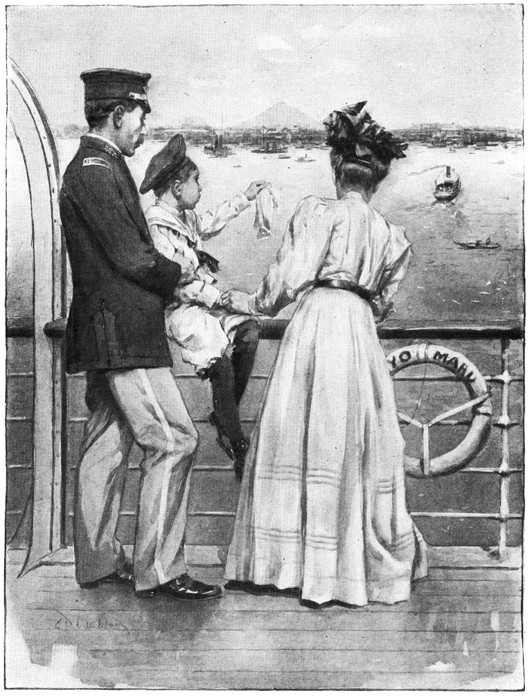
It was a long time before June saw Monsieur
again, for there were picnics up the river,
with lunches cooked on the bank, there were
jolly little excursions in sampans, and trips
to the tea-houses, and flower shows, and an
endless round of good times. Seki San kept
June out of doors all day, and watched with
glee the color return to his cheeks, and the
angles of his slender body turn into soft
curves.
At night, she and June and Toro, with
Tomi frisking and sneezing at their heels,
would join the happy, chattering crowd that
thronged the streets, and would make their
way to the flower market where tall flaming
torches lit up the long stalls of flowers, and
where merchants squatting on their heels
spread their wares on the ground before them,—curious
toys, old swords, and tea-pots with
ridiculous long noses. And in front of every
door was a great shining paper lantern with
queer signs painted on it, and other gay lanterns
of all shapes and sizes and colors went
dancing and bobbing up and down the streets
like a host of giant fireflies.
It was no wonder that June hated to go
to bed when so much was happening outside.
Only the promise of a story moved him when
Seki gave the final word. But for the sake
of a story he would have gone to the moon, I
believe, and stayed there too.
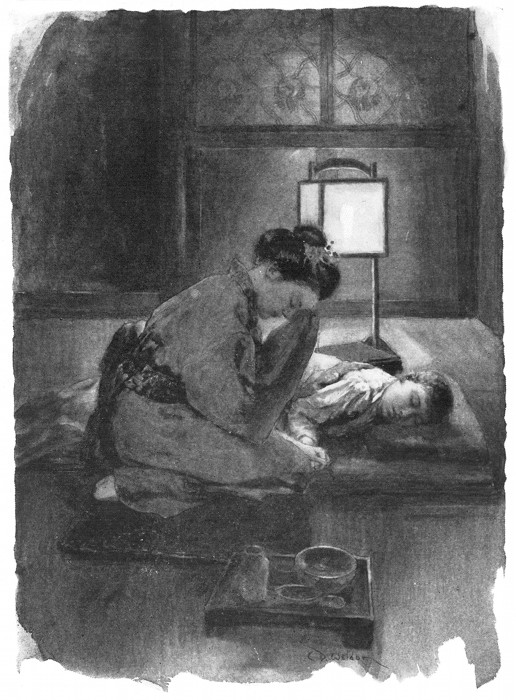
When at last he was bathed and cuddled
down in his nest on the floor with a huge
kimono—four times as big as the ones Seki
wore—spread over him, Seki would sit on her
heels beside him, sewing with an endless
thread, which she only cut off from the reel
when the seam was finished. And June would
watch her pretty, plump little hands, and the
shadows of her moving fingers as he listened
to queer tales of the sea-gods and their palace
under the waves. Sometimes she would tell
of the old samurai and their dark deeds of revenge,
of attacks on castles, and fights in the
moats, and the imaginary clashing of swords
and shouts of men would get so real to June
that he would say:
"I don't want any more scareful ones to-night.
Please tell me about the little mosquito
boy."
Then Seki would begin: "Very long
times ago, lived very good little boy, who
never want to do anything but reverence his
mother and his father, and his grandfathers
and grandmothers. All times he think it over
to himself how he can serve his parents. One
night the wind blow up from the south and
bring a thousand hundred ka, mosquito you
call him, and they bite very much. So good
little boy takes off all his clothes and lies at
the door of his house so mosquitoes bite him
and get so full of boy that they have not room
more for father and mother." At which point
June would never fail to laugh with delight,
and Seki would look hurt and puzzled and
say, "Not funny, June, very fine, kind, and
noble of good little boy."
After Seki had put out the light and joined
the rest of the family in the garden, June
would lie very still and the thoughts that had
been crowded down in the bottom of his heart
all day would come creeping up and whisper
to him. "Mother is a long way off; suppose
she has gotten lost and never comes back
again. Perhaps I haven't got a father any
more, maybe the soldiers have put him in the
ground as they did Teddy's papa. Suppose
I have to live here always and grow up to be
a Japanese man, and never see the ranch in
California nor my pony any more?" And
a big sob would rise in his throat and he was
glad of the dark, for the tears would come no
matter how hard he tried to keep them back.
But he never called Seki, nor let any one know.
Sometimes he got up and got his little gun
and took it back to bed with him; it was so
much easier to be a soldier if you had a gun
in your hand.
But one morning when he awoke, two delightful
things happened. First he saw up in
the air, apparently swimming about over the
house-tops, an enormous red fish as large as
he was, and when he ran to the door there
were others as far as he could see waving and
floating about tall poles that were placed outside
nearly every house.
Without waiting to be dressed he rushed
into the garden to ask Seki San what it all
meant. When she saw him, she dropped the
letter she was reading and came toward him
as fast as her little pigeon toes would carry
her.
"It's from your mother," she cried, her
face beaming with joy. "She did never get
losted at all. She is with your father now,
and he will have the strength again, and they
will come back so sooner as he can journey.
Oh! I could die for the happiness!"
June jumped up and down, and Seki San
giggled, and Tomi barked until the family
came out to see what was the matter.
"And what did she say? Tell me!" demanded
June.
"All this, and this, and this," said Seki,
spreading out the closely written sheets. Then
with many pauses and much knitting of brows
and pointing of fingers, she read the letter
aloud. There was very little about the sad
journey, or the dreadful fever, or the life at the
hospital. It was mostly about June, whether
he was well, whether he was very unhappy,
if he coughed at night, if he missed her very
much.
"And these at the end I sink I can not
read," concluded Seki, pointing to a long row
of circles and dots.
June looked over her shoulder. "Why
Seki!" he exclaimed, "that's the only part I
can read! They are kisses and hugs, I showed
her how to make them. That long one is a
pink kiss, and this starry one is silver with
golden spangles," he laughed with delight;
then his eye catching sight of the fish overhead,
he said:
"Say Seki, why did they put out the fish?
Is it because my father is getting well?"
Seki San smilingly shook her head.
"It's a matsuri, a festival," she explained;
"this is the boys' day and wherever a boy
live, they put out a big paper fish with round
mouth open so——, and when the wind flow
in, the fish grow big and fat and make like
swim in the air."
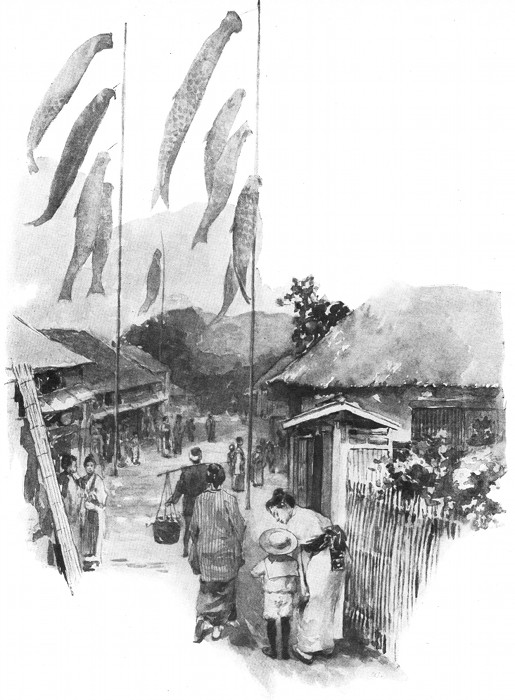
"'It's a Matsuri—a festival,' Seki explained."
"But why do they put out fishes?" persisted
June.
"'Tis the carp fish," said Seki San, "because
the carp very strong and brave, he swim
against the current, fight his way up the waterfall,
not afraid of the very bad discouragings,
like good boy should be."
June was much more interested in the fish
than in the moral, and when Toro brought a
big red one for him and a paper cap and banner,
he hastened away to be dressed so that
he could be ready for the festivities.
Taking it all in all, it was about the happiest
day he had ever spent in his life. When
he and Toro started forth the streets were already
full of people, men and women in holiday
attire, little girls in bright red petticoats
and fancy pins in their hair, every boy with a
fish on a stick, small children with bald-headed
babies tied on their backs, all trotting
merrily along to the matsuri.
Everywhere June went a crowd went behind
him, for a little foreign boy with gray
eyes and fair hair, and strange foreign clothes
was one of the greatest sights of the day.
Sometimes a woman would stop him and look
at his hat or his shoes, and a circle would close
in and Toro would be bombarded with questions.
But the people were always so polite,
and their admiration was so evident, that June
was rather pleased, and when he smiled and
spoke to them in English, they bowed again
and again, and he bowed back, then they all
laughed.
It was a terrible trial to June not to be able
to ask questions. He was brimful of curiosity
and everything he saw and heard had a
dozen questions hanging to it. Usually Seki
San supplied the answers but to-day Toro
was in command, and while he was a very
careful little guide, keeping tight hold of
June's hand, pointing out all the interesting
sights, and trying to explain by sign and
gesture, still he did not know a single word
of English.
After passing through many gay streets
they came to a tall red gate which June had
come to recognize as the entrance to sacred
ground. But inside it was not in the least
like any churchyard he had ever seen. It was
more like the outside of a circus where everything
delightful was happening at once. On
one side was a sandman making wonderful
pictures on the ground with colored sand.
First he made a background of fine white
sand, then out of papers folded like cornucopias
he formed small streams of black and
red sand, skilfully tracing the line of a mountain,
using a feather to make the waves of the
sea, and a piece of silver money to form the
great round moon, and before you knew it there
was the very picture you had seen on fans and
screens and tea-pots ever since you could remember,
even down to the birds that were
flying across the moon.
Then there were jugglers and tight rope
walkers, and sacred pigeons that lit on your
head and shoulders and ate corn out of your
hand. June thought he had never seen such
greedy pigeons before. Two or three perched
on his hand at once, and scolded and pushed
each other, and even tried to eat the buttons
off his blouse!
Up the mountain side, flanked by rows of
stone lanterns, ran a wide flight of steps and
at the top was the gate-way to the temple itself.
On either side were sort of huge cages,
and in them the most hideous figures June
had ever seen! They were fierce looking
giants with terrible glass eyes and snarling
mouths with all the teeth showing, just as the
Ogre's did in the fairy tale. One was painted
all over green, and the other was red, and
they held out clutching fingers as if ready to
pounce upon the passer-by. While June was
looking at them and feeling rather glad that
they were inside the cages, he saw two old
men dressed in white, climb slowly up the
steps and kneel before the statues. Bowing
their heads to the earth and muttering prayers,
they took from their belts some slips of paper,
and after chewing them into wads began
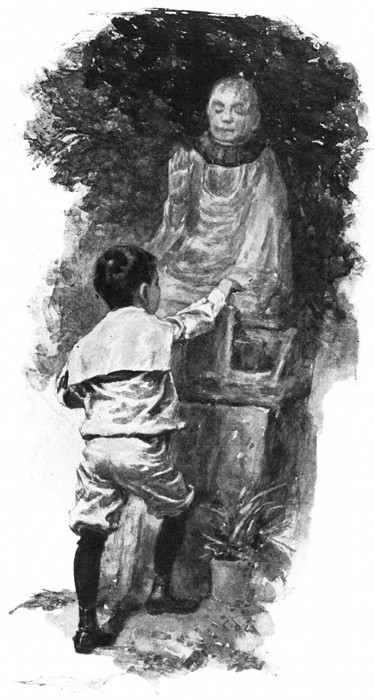
gravely to throw them at the fierce green demon
behind the bars.
June giggled with joy, this was something
he could quite understand. Taking advantage
of Toro's attention being distracted, he
promptly began to make wads too, and before
Toro could stop him he was vigorously pelting
the scowling image. In an instant there
was angry remonstrance and a group of indignant
worshipers gathered around. Fortunately
Seki San appeared on the scene in
time to prevent trouble.
"But I was only doing what the others
did!" explained June indignantly.
"It is no harm done," said Seki, reassuringly
after a few words to those about her,
"you not understand our strange ways. These
are our Nio or temple guardians that frighten
away the evil, bad spirits."
"What makes the pilgrims throw at them,
then?" asked June.
"They throw prayers," answered Seki
San very seriously, "they buy paper prayers
from the old man at the gate, and throw them
through the grating. If the prayer sticks, it
is answered, if it falls down it is not answered.
Come, I will show you!"
They went very close, and looked through
the bars; there on the grating, on the floor
and even on the ceiling above them were
masses of tiny paper wads, the unanswered
prayers of departed thousands.
"Well, three of mine stuck!" said June with
satisfaction. "Do you suppose it's too late
to make a prayer on them now?"
Seki thought after considering the matter
that it was not.
"But I haven't got anything left to pray
for!" said June, regretting the lost opportunity.
"Father's getting well, and he and
Mother are coming home, and I have got
pretty near everything I want. I believe
I'd like another fish though, and oh! yes, I
want a little pug dog, jes' 'zactly like
Tomi."
"It's tiffin time," said Seki San, "and
after that will be the fire-work."
"In the day-time?" asked June.
"Oh yes, very fine nice fire-work," said Seki.
They left the temple grounds, and made
their way up the river road, where everybody
was having a tea-party out under the trees.
Seki San secured a tiny table for them and
they sat on their heels and ate rice out of a
great white wooden bucket, and fluffy yellow
omelet out of a round bowl, and the sunshine
came dancing down through the dainty, waving
bamboo leaves, and everybody was laughing
and chattering and from every side came
the click-clack of the wooden shoes, and the
tinkle of samisens and the music of falling
water.
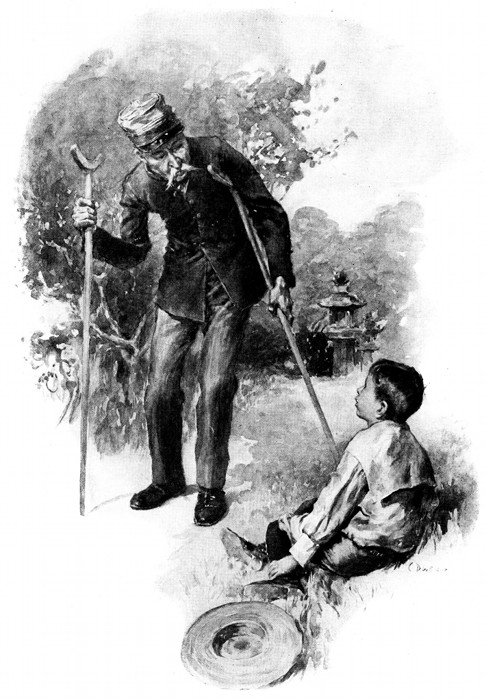
Suddenly Toro pulled June's sleeve and
motioned excitedly to the road-way. Coming
toward them in a jinrikisha, looking very
pale and thin and with both arms in bandages,
sat Monsieur.
June broke away from Seki and raced after
the jinrikisha. "Oh! Mister," he cried, "Mr.
Frenchman."
Monsieur, hearing the English words,
stopped his man and turned around. When
he saw a very flushed little boy in blouse suit
and a wide brimmed hat, he smiled.
"Ah!" he cried, "my friend of the garden!
My prince who found the Sleeping Beauty."
Then he began to laugh so hard that it
started up all his rheumatic pains, and he had
to sink back and rest before he could speak
again. "I am very bad since I saw you
last," he said; "these dogs of Japanese will
let me die here. One day in France will
make me well. I may have it yet—I must get
back some way—some way!" His eyes
looked excitedly over June's head out into
space as if trying to span the miles that lay
between him and his beloved country.
"My papa will take you home when he
comes," said June; "he's a soldier."
Monsieur shrugged his shoulders: "Your
papa would not care that," he said, snapping
his fingers; then seeing June's disappointment
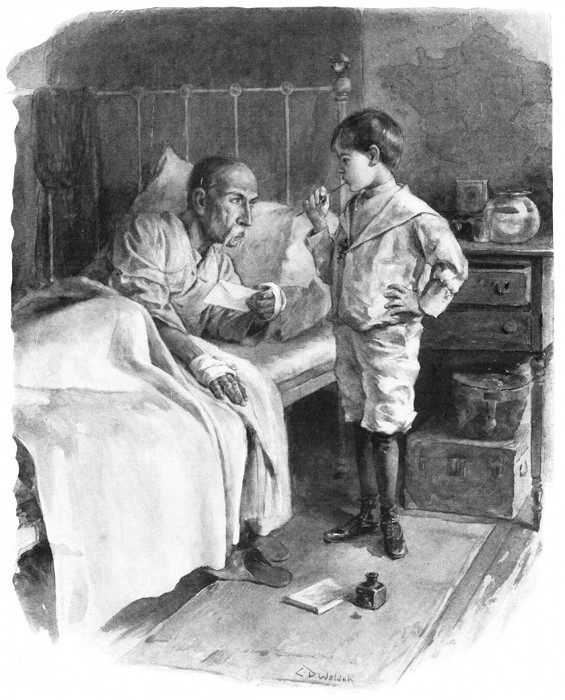
he added kindly, "But you—will you not
come to see me? I will make you more forts,
I will show you my goldfish."
"Yes, I'll come," said June. "When?"
But before Monsieur could answer, Seki
had called June and the jinrikisha had started
on its way.
Late in the afternoon, as the revelers
straggled home tired but happy, June slipped
his hand into Seki's. The merry noises of the
day had given place to the quiet chirp of the
crickets and the drowsy croaking of the frogs,
and the little breezes that stirred overhead
sounded sleepy and far away.
"Seki," said June, "I didn't make any
prayer on that paper that stuck on the old
giant's nose, do you think it too late?"
"No," said Seki San, willing to humor him.
"Well," said June sleepily, "I pray that
the French gentleman will get back home."