It was a beautiful evening. In the west the sunset
glow still hung above the hills. Eastward
the full moon’s great, golden disk was poised
against the darkening blue of the summer sky.
It was very still and quiet, and the only sounds
that came to them were the soft pat-pat of their
shoes on the dusty road. When half the distance
to the house-boat had been covered they slowed
down to a walk, panting and puffing.
“What—are we going—to do—when we get—there?”
asked Dick.
“Have some supper,” said Chub, decisively.
“But we can’t stay where we are. When he
finds that we’ve skipped out, he will be as mad
as a hornet and will come down here looking for
us.”
“Pshaw, I don’t think he believed a word we
said about being in a boat,” said Chub. “Besides,
he’s just as likely to look up the river as
down.”
“And just as likely to look down as up,” replied
Roy. “I guess Dick’s right we’d better
move on.”
“All right, then, we will; just as soon as we’ve
had something to eat,” agreed Chub.
“If we wait for that our supper is likely to consist
of bread and water,” answered Roy, dryly.
“What we want to do is to get across to the other
side of the river. I never thought I’d be glad to
get to New Jersey, but the time has come.”
“That isn’t Jersey over there, it’s New
York,” said Chub.
“Anyway, it’s a heap better than the calaboose,”
laughed Dick. “Was that wheels I
heard?”
They stopped and listened, but the only sound
that reached them was the distant barking of a
dog.
“Carlo!” said Chub.
“Get out! It’s the wrong direction. Come on
and let’s get back. I had no idea we’d gone as
far as we have.”
“Nor I,” said Dick. “And what’s more I don’t
believe we have!”
“What do you mean?” asked Chub, anxiously.
“I mean that we’ve gone by the boat.” They
stopped and looked about them in the twilight.
Chub thrust his cap back and rubbed his forehead
reflectively.
“I guess you’re right,” he said. “All I remember
is that we came through a strip of woods,
and it’s woods all along on this side. We’d better
strike through them here and see if we can
see the boat.”
Much subdued they followed him between the
trees and bushes. After a minute or two of slow
progress they came to a narrow field.
“I never saw this before,” growled Roy.
“There wasn’t any field here an hour ago,”
agreed Dick.
“I’d just like to know,” muttered Chub, “how
it got here. Someone’s been taking liberties with
the landscape.”
“It strikes me,” remarked Roy, “that we’re
just lost.”
“Well come on. The river’s down here somewhere.
Once we get to that all we’ve got to do is
to follow it till we find the Jolly—find the Slow
Poke,” said Dick, encouragingly.
“And which way shall we walk, upstream or
down?” Chub inquired. Dick looked a trifle crestfallen
for an instant. Then,
“We can decide that when we get there,” he
said. “Anyhow, don’t let’s spend the night here.
I’m as hungry as a bear.”
“Hungry!” muttered Chub, bitterly. “So am
I! Well, come along.”
They crossed the field, a particularly moist and
“squashy” one, and entered more woods. By this
time, although it was still light enough in the
open, it was difficult to see much in the forest, and
they stumbled over stumps and wandered into
blackberry thickets every few steps.
“A chap needs a suit of chain armor for this
sort of thing,” said Roy.
“‘This is the forest primeval,’” murmured
Chub, picking himself out of a bush. “It’s evil,
anyhow.”
“Here it is,” cried Dick, who had found fewer
pitfalls and had taken the lead. “Here it is!”
“The boat?” asked Roy, eagerly.
“No, the river.”
“Oh!” they joined him and found themselves
on the shore of a little cove, but it was shallower
than the one they had left the boat in and was
quite empty of craft. Chub sat down on a rock
and sighed.
“How beautiful is Nature!” he murmured.
“I’ll swap my interest in it for a cup of coffee
and a slice of bread,” answered Dick, morosely.
“I’m going to see if I can find the boat.”
“Don’t go,” begged Chub. “Sit here beside
me on this downy couch and let us view the prospect
o’er.”
“I’ll wager we’re too far down the river,”
said Roy, inattentively. “Let’s go that way.
From that point there we ought to be able to see
the boat.”
“Lead on,” cried Chub. “We place ourselves
in your hands.”
They skirted the cove and reached the point,
but although from there they could see several
hundred yards up the shore, there was no sight of
either another cove or the Slow Poke.
“I guess we’re too far upstream, after all,”
said Roy. “Let’s look the other way.”
“I’m thankful the river doesn’t run east and
west as well,” said Chub. “’Tis a merry life we
lead.”
Back they went to the cove and around that to
another point. But below there the shore wound
in and out confusedly, and, even had the Slow
Poke lain fifty yards away from them, it was now
so dark that it is doubtful if they could have discerned
her.
“Let us lie down here quietly and die,” suggested
Chub.
“Oh, don’t fool,” said Roy. “Come on.”
“Wait a minute, fellows!” this from Dick.
“Come to think of it, when we got out onto the
road this afternoon there was a sign on the fence,
don’t you remember?”
“Sure!” cried Chub. “‘Noble’s Chill and Fever
Compound;’ we spoke of it! That’s easy;
all we’ve got to do is to get back to the road and
find the sign.”
“For all we know there may be one every fifty
feet,” said Roy, pessimistically. “However,
we’ll try it.”
Getting back to the road was no simple matter,
though. The woods were pitch dark now, and the
field beyond was not much lighter, while to make
matters worse they crossed the latter where it
was little better than a swamp, and at every step
their shoes went squash, squash in the yielding
turf. But they were soon across it and in the
gloom of the farther woods.
“Courage, mon braves,” said Chub. “It is
soon over.”
But Chub was wrong, for they stumbled on and
on, through bushes and briars, and still no road
appeared out of the darkness.
“This is funny,” panted Dick, pausing to disentangle
himself from the affectionate embrace
of a vine. “We ought to have reached the road
long ago.”
“It is the enchanted forest,” replied Chub.
“Have you never read of the enchanted forest?”
“We’ve been keeping too far to the right,”
said Roy, thoughtfully. “Let’s try it off this
way.”
“By all means!” Chub bumped into a tree,
drew back to murmur politely, “I beg your pardon,
madam,” and followed.
“If I ever find that road,” said Dick, savagely,
“you can be sure I’m going to stay on it!”
“I don’t believe there is a road,” said Chub.
“I’m going to find one if I have to walk all
night,” said Roy.
“That’s what you think,” replied Chub, sadly.
“But you’re in the enchanted forest, I tell you.
We’re Little Nemos, that’s what we are!”
But the next moment the darkness gave place
to twilight and they stumbled down a little bank
to the dusty road. With one accord they threw
themselves down on the grass.
“Here’s where I stay until morning,” sighed
Dick.
“Isn’t that a sign over there?” Roy asked.
“Maybe,” muttered Chub, “but I’ve got so I
don’t believe in signs.” Roy, however, had
crossed the road and was trying to decipher the
words on the panel nailed to the fence. Finally
he lighted a match and,
“‘Noble’s Chill and Fever Compound,’” he
read, “‘safe and certain. Ask your druggist.’”
“‘Ask your druggist,’” sneered Dick. “I’d
like to have the chance to ask a druggist! I
wouldn’t ask for that, though; I’d ask for a chocolate,
or an egg-and-milk.”
“I suppose those things are stuck all along the
road,” said Roy, throwing himself down again
on the bank. “We know that that one isn’t the
one we saw before.”
“Maybe if we sit here much longer,” said
Chub, “we’ll be glad to know of a good remedy
for chills and fever. I’m going on.”
“Where?” asked Roy.
“Anywhere! What matters it? If we walk
long enough we’ll come to a village. And once
in a village if I don’t get my hands on a sandwich
and a cup of coffee it’s a wonder!”
“Well,” sighed Dick, “which way shall we
go?”
“South,” answered Chub. “I saw a sort of a
village a mile or so before we stopped this afternoon.
Come on, fellows; never say die!”
“Maybe we will come across a house pretty
soon,” said Roy. “If we do let’s ask for something
to eat and a bed in the barn.”
“I don’t think they have beds in the barns
around here,” replied Chub, flippantly. “However,
whatever we do let us not—remark the emphasis,
please—let us NOT ask for milk!”
They trudged southward along the winding
road. At intervals they came to advertisements
of “Noble’s Chill and Fever Compound” nailed to
fence-rails and trees. For a while Dick religiously
bowed and saluted each one, but at last his
anger wore itself out and he only growled when
he saw one. They had been walking for perhaps
a quarter of an hour when a turn in the road disclosed
what, at first sight, appeared to be a light
in the window of a house, but their murmurs of
satisfaction were quickly ended, for, as they approached
they saw that the light was the tail lamp
of an automobile standing by the side of the road.
“Wait!” whispered Dick, seizing Roy by the
arm. “Maybe it’s old Ewing and the constable.”
“And where would they get an automobile?”
asked Roy.
“They might; you can’t tell. Better let me go
ahead and have a look first.” But the others
laughed him to scorn. Just then a second light
came into sight, and, as they were now close to
the car, they saw that some one had been leaning
with it over the engine.
“She’s broken down,” said Chub. As they
drew near, the man with the lantern held it up
until its rays shone on them, when, as though he
had hoped for better things, he turned indifferently
away and began to pull things from under
the rear seat. It was a large car, seating seven,
and was painted gray with trimming of some
darker color.
“Having trouble?” asked Chub, sympathetically.
“No, I’m just spending the night here from
choice,” was the answer.
“Well, it’s a pretty spot,” laughed Chub.
“Anything we can do for you?” The man turned
and regarded Chub, disgustedly.
“Yes, get out!”
“Of course!” said Chub. “That’s easy. I
asked you a civil question, though. Good night.”
“Hold on!” called the other. “I didn’t mean
to be haughty. But I’ve been stuck here since
six o’clock and I don’t know yet what the trouble
is. That’s enough to make a man rather peevish,
isn’t it?” He laughed grudgingly. He was
about twenty-one or -two years old, with a good-looking,
if at present not over clean, face, and a
nice voice.
“I suppose so,” answered Chub. “You’ve had
your supper though, haven’t you?”
“Yes, I’ve had that.”
“Well, we haven’t. And we’ve been chasing
around the country for an hour and a half on foot.
And we’re tired and hungry. I imagine we’re
entitled to a little peevishness too, eh?”
“That’s so,” said the other. “Where are you
going?”
“No one knows,” said Chub. “We’re just
walking along this road in the hope that some
day we’ll come to a place where we can get something
to eat. What do you think the chances
are?”
“Well, you’d do better if you went the other
way. You won’t find a hotel or a store nearer
than five miles in this direction.”
Dick groaned.
“I wish this old thing would go,” continued the
automobilist. “Then I’d help you out. I suppose
you don’t know anything about these
things?” His glance ranged over the three faces.
“Well I don’t know that kind,” answered
Chub, “but I’ve had a little experience with a
four-cylinder Adams. May be, though, if we start
and go over her again together we’ll find the
trouble. Getting your spark all right, are you?”
“Yes, the trouble is somewhere in the engine, I
guess.”
Chub took off his coat and hung it on a fence
post.
For a while Dick and Roy looked on, following
the others around the car in the glow of the lantern.
Then Dick asked permission to get in and
sit down and he and Roy sank onto the cushions
of the rear seats and stretched their tired legs
luxuriously. The minutes came and went. They
listened drowsily to the talk of Chub and the
owner of the machine, to the clink of tools, the
turning of the crank. The full moon worked
itself out of a cloud bank and cast a faint radiance
over the scene. A breeze came rustling
across a corn-field, and Roy reached down sleepily
and pulled a robe over him. By that time Dick was
frankly slumbering. A half-hour passed since
their arrival. Suddenly, there was a grunt of
satisfaction from the automobilist, an amused
laugh from Chub and a jarring that awoke the
boys in the tonneau. The engine was going.
“I don’t believe I’d ever have found that without
you,” the owner was saying gaily as he slammed
the tool-chest shut. “Pile in now, and I’ll
give you a lift.”
“Is it all right?” asked Roy, drowsily.
“Yes, Siree; your friend here is a regular genius.”
“Yes, that’s my middle name,” answered
Chub as he climbed into the front seat. “Wake
up, Dick, we’re going to supper!”
“I am awake. Where are we going to get it?”
“By jove!” muttered their new acquaintance.
“I wonder, myself.” He was silent a moment, but
when the car was rushing along smoothly into
the flood of white light thrown by the powerful
lamps, he turned his head. “Look here, you fellows.
My name’s Whiting, Joe Whiting, and I
live about seven miles down the road. All my
folks are away for the summer and I’m going myself
to-morrow, and so things aren’t in very good
shape for guests. But if you chaps don’t mind
bunking around on mattresses and couches I’ll
be glad to put you up for the night. Any way, I
can give you plenty to eat. What do you say?”
“If you weren’t steering,” answered Chub,
“I’d fall on your neck! We accept your kind invitation,
Mr. Whiting. We are too far gone to
have any sense of decency left; we accept anything
and everything you want to offer.”
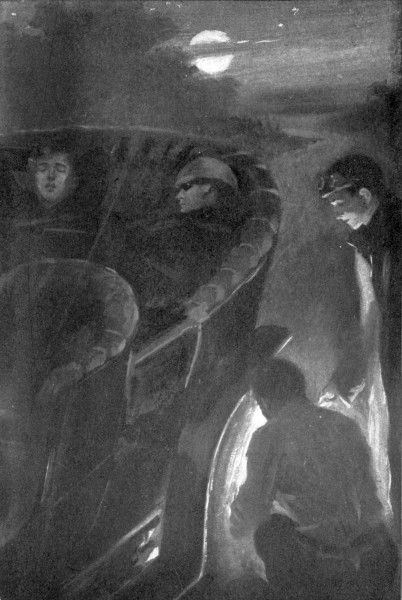
Dick and Roy slumbering
“All right,” laughed Whiting, jovially.
“That’s good. Do you fellows mind going a bit
fast?”
“Not a bit,” answered Roy and Dick in a
breath. The big car shot forward and the wind
rushed by them. The road was fairly straight
and level and quite deserted, and the car tossed
the miles behind in a way that made the boys
stare.
“Going all right now!” bawled Whiting in
Chub’s ear.
“None too fast for me—Whoa!”
“What’s the matter?”
“Cap’s gone. It doesn’t matter, though.”
“Lost your cap? I’ll stop and you can—”
“Don’t do it,” begged Chub. “I couldn’t find
it in a week—besides I’d rather lose a dozen caps
than have this stop!”
On they went into the white radiance. Trees
and fences and poles rushed toward them from
the glare ahead and disappeared into the blackness
behind. The road was following the railroad
now, and for an exciting minute or two they
raced a train and gained on it, and would have
left it behind, perhaps, had the road not swerved
to the left and taken them out of sight. There
was a defiant shriek from the engine, a brief
glimpse of the lighted car windows through the
trees and they were once more alone, coasting
down a long hill with only the whirr of the fan
to be heard. A few minutes later the car swept
from the public road through a stone-pillared
gateway and circled up to a big house in which
a single light gleamed through the transom above
the front door.
“Doesn’t look very gay, does it?” inquired
their host. “I don’t doubt the servant has gone
to bed. We’ll run around and leave the machine,
if you don’t mind.”
They got out when the car had trundled itself
into the garage and stretched their cramped
limbs.
“I don’t believe,” said Dick, “that I changed
my position once all the way. I had a sort of a
notion that if I moved we’d go flying off the road
into the next county. That was a dandy ride, Mr.
Whiting.”
“Glad you liked it. Come on now and let’s eat.
I had dinner at six, but can dally with a little supper.
I’m afraid, though,” he added as he locked
the doors, “I can’t give you fellows anything hot
except coffee.”
“Hot or cold, it’s all the same to us,” said
Roy.
Mr. Whiting unlocked the front door and admitted
them to a wide hall and from there conducted
them into a big library and flooded it
with light at the touch of a button.
“Make yourselves at home now. If you want to
wash come on up-stairs. You needn’t be afraid
of making a noise, the place is empty except for
Williams and he’s at the back of the house and
wouldn’t hear a sound if he wasn’t.”
They trooped up after him to the bath-room
and washed the dust from hands and faces. Chub,
smoothing his hair with the silver-backed brushes
which their host provided, encountered in the
glass the gaze of Whiting fixed on him speculatively.
“Say, what’s your name?” asked Whiting.
“My name’s Eaton,” answered Chub. “And
my companions are Mr. Porter and Mr. Somes. I
beg your pardon, I’m sure; we ought to have
introduced ourselves before.”
“Oh, that’s all right; I only asked because it
seems to me I’ve seen you before somewhere.”
“It’s possible, I live in Pittsburg.”
“You didn’t have to tell,” said Dick, reproachfully.
“I’ve never been there,” said Whiting, “but
all the same—Well, never mind. Let’s go down
and see what we can find.”
They found a good deal. Together they raided
the pantry and refrigerator and bore their booty
into the dining-room and spread it helter-skelter
on the big mahogany table. Then they made coffee,
about two quarts of it, and if it wasn’t perfectly
clear it at least tasted very, very good.
It was after nine o’clock when they sat down to
supper and it was well toward ten when they got
up. It takes some time to satisfy such hungers as
Chub and Roy and Dick had. But, of course, they
didn’t spend quite all the time eating, for Whiting’s
curiosity had to be satisfied and so it was
incumbent to narrate the adventure in search of
milk. Whiting thought that a fine joke and
wished he had been along.
“I tell you what I’ll do, fellows,” he said. “In
the morning I’ll take you back in the car, if you
don’t mind starting rather early, and you won’t
have much difficulty finding your boat in broad
daylight. I hope no one has stolen anything out
of it, though.”
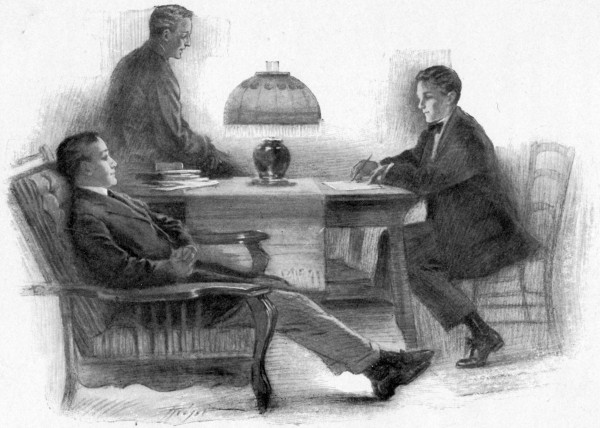
Back in the library the boys stretched themselves
out comfortably in the big leather chairs,
and Whiting turned to Chub with;
“Say, Eaton, do you play ball?”
“Yes, some.”
“Only some, eh? I thought that maybe I’d
seen you on the ball field, but—”
“He’s a fibber,” said Dick. “He was captain
of his freshman team this year and played on the
’varsity in the big game.”
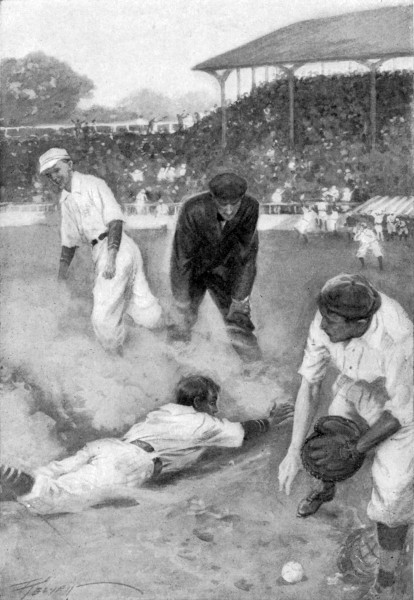
“Jupiter!” cried Whiting. “I remember now!
You’re the chap they put in for Pritchett at the
end of the game; you stole home and won the
game! That was all right, Eaton!” Whiting
beamed across at him. “Thunder, I’m glad I
picked you fellows up! I’m a junior next year.
You must come and see me. Are you in college,
too?”
“Yes,” answered Roy. “I’m in the same class
with Chub, and Dick enters in the fall.”
“That’s fine! It was good luck that I came
across you to-night. If I hadn’t I’d been stuck
back there in the road yet!”
After that there was plenty to talk about, you
may believe, and it was well toward midnight
when they climbed the stairs and distributed themselves
around the empty bedrooms.
“I suppose I might find sheets and blankets and
things,” said Whiting, apologetically, “but the
mater has them put away somewhere and I
wouldn’t know where to look for them. But if
a couple of you chaps will only take my bed I’ll
be perfectly comfortable in another room.”
“So will we,” said Chub. “Don’t you bother.
A good hair mattress like this is all a fellow needs,
anyway; and it’s too warm for covers if we had
them. We’ll be all right, thank you. But you’ll
have to wake us up in the morning. I feel as
though I could sleep for a week!”
“That’s all right; you’ll be called early
enough. I told Williams to have breakfast at
seven. I’ve got over a hundred miles to do in
the car to-morrow and want to get started early.
Good-night, fellows. I do hope you’ll be comfortable.”
“If I felt any better,” murmured Chub,
sprawled out on a big wide bed which he was to
have all to himself, “I’d certainly yell. Good-night,
Whiting. May you be forever blest!”
They slept finely, were up at half past six, had
shower-baths, and were seated around the table
at a little after seven. Williams tried hard not
to show the astonishment he felt at finding the
family circle so suddenly and inexplicably enlarged,
but didn’t altogether succeed. At eight
they were in the car again, retracing their path
of the night before, Chub attired in a plaid cap
which his host insisted on his accepting. It was
a wonderful golden morning with the bluest of
blue skies overhead and an innocent-looking pile
of fluffy white clouds in the west, which Whiting
declared meant a thunder-storm later on. But no
one was troubled about that. The big gray car
was on its best behavior, and in less than half an
hour they were back in the vicinity of the Slow
Poke. After some hesitation, they decided on a
spot to be set down and bade their new friend
good-by.
“Mind you look me up in the fall,” he reiterated.
“I want to introduce you to some of the
fellows I know; you’ll like them. Good-by and
good luck. Hope you find your boat.”
He was off again in a cloud of dust and the
three turned and plunged into the woods. Their
judgment was not in error, for after a minute or
so they came out on the shore of the cove.
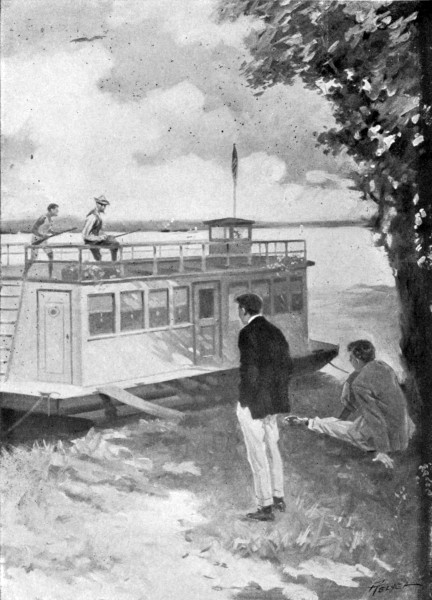
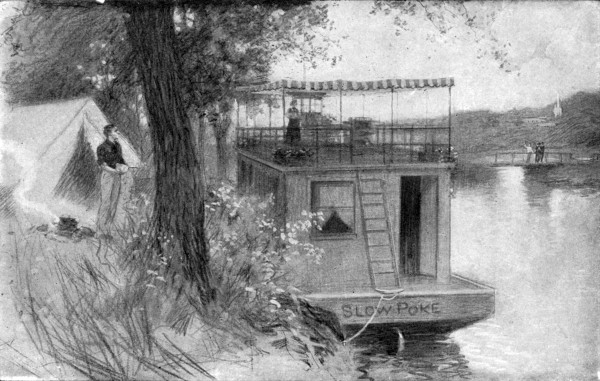
Twenty yards away lay the Slow Poke.
“Thank goodness!” said Roy, devoutly. “I
thought—”
But he didn’t tell what he thought. Instead,
he stopped suddenly in his tracks, and Chub and
Dick stopped with him.
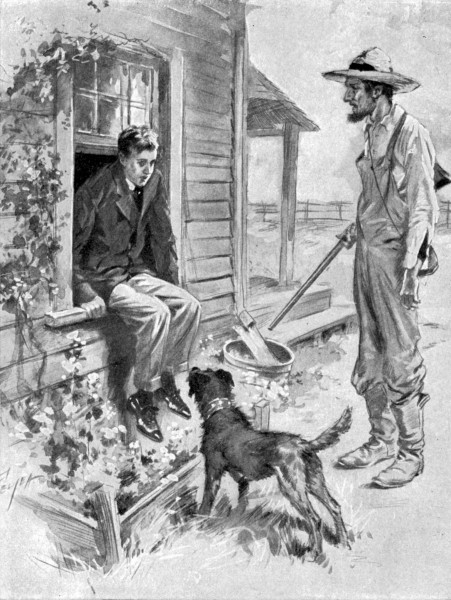
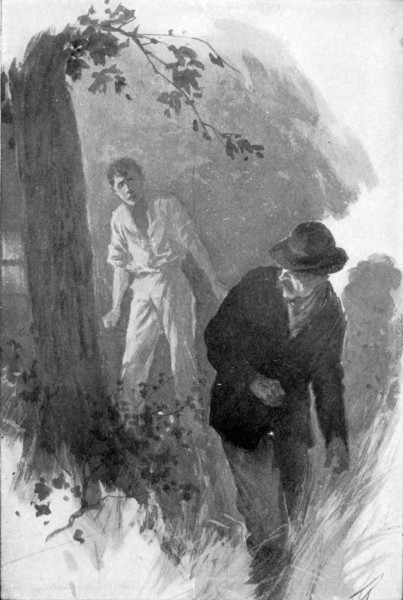
Sitting on the rail of the Slow Poke, his gun
across his knees, was Farmer Ewing.