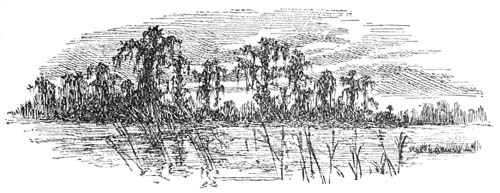
It was the month of October, and yet for the
boys who belonged to the school of Mr. Wallace, in
Boontown, the summer vacation was not yet over.
Mr. Wallace had been taken sick, and although he
was now recovering, it was not expected that he
would be able to resume the labors of his school
until about the middle of November.
Everybody liked Mr. Wallace, and very few of
his patrons wished to enter their boys at another
school when it was expected he would certainly re-open
his establishment in the course of the fall.
Most of his scholars, therefore, were pursuing their
studies at home, according to methods which he
recommended, and this plan was generally considered
far more satisfactory than for the boys to go
for a short time to other schools, where the systems
of study were probably very different from those
of Mr. Wallace.
It is true that some of the boys did not study
very much during this extension of the vacation,
but then it must be remembered that those who
expect boys to do always everything that is right
are very apt to be disappointed.
Philip Berkeley, who lived with his uncle,
Mr. Godfrey Berkeley, at Hyson Hall, on the
banks of one of Pennsylvania’s most beautiful
rivers, had studied a good deal since the time
when his vacation should have ended, for he was
a boy naturally inclined to that sort of thing, and
he had, besides, the example of his uncle—who
was hard at work studying law—continually before
his eyes. But his two most particular friends,
Chapman Webster and Phineas Poole, did not
subject their school-books to any great amount of
wear and tear.
Chap Webster was a lively, energetic boy, always
ready to engage in some enterprise of work
or play; and Phineas, generally called Phœnix
by his companions, was such a useful fellow on his
father’s farm that he was usually kept pretty busy
at one thing or another whenever he was at
home.
At the time our story begins, Chap Webster
had, for a week, been living in what he considered
the most delightful kind of clover. He was a great
lover of the water, although he had no particular
desire for a mariner’s life, in the ordinary sense of
the term.
Accustomed since a child to the broad waters of
the river, he had a great fancy for what might be
called the inland marine service, and his highest
ambition was to be captain of a tug-boat.
To course up and down the river in one of these
swift and powerful little vessels, and to make fast
to a great ship ever and ever so much larger than
the “tug,” and to tow her along against wind and
tide, appeared to Chap a most delightful thing to
do. There was a sense of power in it which pleased
him.
He was now paying a visit to a relative in the
city, who was one of the officers of a tug-boat company,
and this gave Chap an opportunity to take
frequent trips on his favorite vessels. He enjoyed
all this so much that I fear he was in no hurry for
his school to begin.
It was on a Monday afternoon that Philip and
Phœnix were at the railroad station in Boontown.
Each had come to town on an errand for his
family, and they were now waiting for the three
o’clock train from the city to come in.
The first person who jumped from the cars was
Chap Webster, and his feet had scarcely touched
the platform before he spied his two friends.
“Hello, boys!” he cried, striding toward them.
“I’m glad I found you here. I want to tell you
the best thing you ever heard of! I’m going down
to the Breakwater to-morrow on a tug-boat, and
you two can go along if your folks will let you.
I’ve fixed the whole thing up right. We’ll be
gone two days and a night. And I tell you what
it is, boys, it will be more than glorious! We’re
going down after a big steamer, that’s broken her
propeller-blades and has to be towed up to the city.
I came up to tell you fellows, and see what my
people said about it. But I know they’ll agree,
and I don’t want you to let your folks put in any
objections. It’ll be just as safe as staying at home,
and there’s entirely too much fun in it for any of
us to miss it.”
Neither Phil nor Phœnix hesitated for an instant
in agreeing that Chap’s idea was a splendid one.
Mr. Berkeley, Phil’s uncle, when the subject
was laid before him about an hour afterward, gave
a hearty approval to the plan, for he was very glad
that Phil should have an opportunity to enjoy an
excursion of the kind.
His summer vacation had been filled up much
more with work and responsibility than with recreation,
and his uncle considered that a trip of some
kind was certainly his due.
But the matter did not appear in the same light
in the eyes of Mr. Poole. Now that Phœnix was
not going to school, he thought it the boy’s duty
to make himself useful about the house and farm,
and there were a great many things he wanted him
to do.
When Phœnix came over to Hyson Hall early
the next morning, and told Phil he didn’t believe
his father intended to let him go on this jolly old
trip, Mr. Berkeley ordered his horse, Jouncer, to
be saddled, and rode over to the Poole farm.
When he came back, he found Chap Webster
with the other boys, and a noisy indignation meeting
going on. He put a speedy stop to the proceedings,
by informing the members of the small
assemblage that Mr. Poole had consented to let
Phœnix join the tug-boat party.
This news was received with a unanimous shout,
and the boys separated to get ready as quickly as
possible for the expedition, for they were to start
for the city on the noon train.
“Take your heavy overcoats with you,” said
Mr. Berkeley, as Chap and Phœnix were bidding
him a hasty good-by; “for it may be cold on the
water at night, and you had better each take a
change of linen with you, and some underclothes.”
“What!” cried Phil; “for a little trip like
this?”
“Yes,” said Mr. Berkeley. “I am an old traveller,
and I know that a great many things happen
on these little trips. One of you may tumble overboard,
and need a dry shirt, and at any rate you
ought to feel that you may rough it as much as you
please, and yet look clean and decent when you are
coming home.”
Hyson Hall was appointed for the rendezvous
of the boys, and, after a slight luncheon, Joel
drove them over to Boontown. But before they
started Mr. Berkeley gave each of them a long,
stout fishing-line, suitable for salt-water fishing.
“You may have a chance to use these,” he said,
“and I don’t believe any of your own lines are
strong enough for deep-water work.”
He gave Phil a pocket lantern and a tin box
of matches, with a paper of extra fish-hooks and
various other little articles, which might be of use.
“If I’d been going by myself,” said Chap, “I’d
have just clapped on my hat, and started for
town.”
“Yes,” said Phœnix, “and then, when you got
a chance to fish, you’d have growled because you
hadn’t a line. I tell you what it is, Phil, your
uncle knows what he is about. I wish I knew
what he said to father.”
“Some magic words,” said Chap; “but you
needn’t think anybody is ever going to tell them
to you. You’d go round slinging spells over your
whole family, and having everything your own
way. I rather think you’d have an easy time
of it.”
“Yes,” said Phœnix, “you’re about right, and
when any work turned up that I wanted to do, I’d
chuck a spell over a long-legged fellow named
Chap Webster, and make him come and help.”
“Joel,” said Chap, “hadn’t you better touch up
the noble beast? We don’t want to be late, you
know.”
“We’ll get there soon enough,” said Joel. “I
drive on time, and I never miss trains.”
“If you hurry up people that way, Chap,” said
Phil, “you’ll have this trip over sooner than you
want it to be.”
“You needn’t worry your mind about that,” said
Chap. “When we get on the real trip, I’m the
fellow to help stretch it out as far as it will go.”
The trip down the river and bay was quite as
enjoyable as the boys had expected it to be. The
little tug was not very commodious, and not very
clean, but there was a small after-deck, on which
they could lounge quite comfortably.
The boys had never been far below the city, and
the scenery was novel and interesting to them.
Chap would have been glad to have the tug stop
occasionally, so that they could have a chance to
fish; but he had sense enough not to propose anything
of the kind to the captain.
They reached their destination the next day,
and it was then found that the steamer with the
broken propeller was not quite ready to be towed
up; and it was decided not to start with her on her
trip up the river until the following morning.
In the course of the afternoon, however, some
work appeared for the captain of the tug-boat.
Far out to sea a schooner was perceived, with her
foremast and part of her bowsprit gone, and endeavoring,
against a head-wind, to make her way
to the refuge of the Breakwater.
There was a strong wind blowing from the north,
with a chance of its getting farther to the east before
long, and it was considered doubtful whether
the disabled schooner would be able to get in before
a storm came on.
“Boys,” said the captain, coming aft to where
our friends were sitting, “I’ve made up my mind
to go out and offer to tow that schooner in. I
might as well be making some money for the company
as to lie here doing nothing. But I think
it’s going to be pretty rough, and, if you fellows
don’t care to go along, I’ll put you ashore.”
The boys, who had been so much interested in
everything around them that they had not even
taken out their fishing-lines, cried out at once that
they would not think of going ashore. Nothing
would please them more than a trip out to
sea.
“The rougher the better!” cried Chap. “I
just want to feel what it is like to be tossed on the
ocean wave.”
“All right!” said the captain, with a grin.
“We’ll toss you.”
CHAPTER II. A SEA VOYAGE.
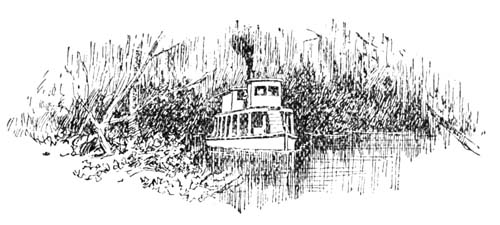
It was not long after this little conversation
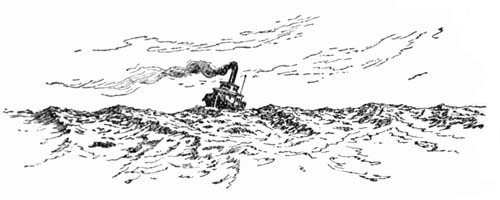
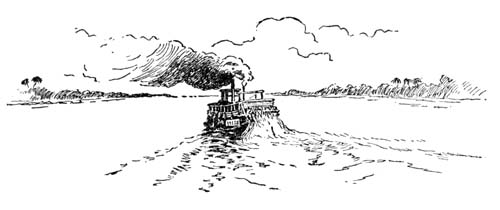
that the tug-boat was bravely puffing out to sea.
The wind was strong and the waves ran pretty
high, but the boat made her way over the rough
water without difficulty.
The boys were delighted with the motion of the
vessel as it plunged over the waves, and none of
them felt in the least degree sick.
Chap wished to go out on the bow, where he
could stand and see the boat “breast the billows;”
but he was not allowed to do this, for every now
and then a shower of spray came over the bows,
and he would have been drenched to the skin in
ten minutes. Even where they sat in the stern,
the boys were frequently treated to a shower of
spray; but this, as they wore their overcoats,
they did not mind in the least.
It took them longer to near the schooner than
they had supposed it would, for she was making
very slow headway against the wind, and in some
of her long tacks she seemed to the boys as if she
were trying to keep out of their way.
At last, however, they reached her, and the tug
steamed close enough to her side to allow the
people on board to be hailed. But, to the disgust
of the captain of the tug-boat, his offers to tow the
disabled vessel into shelter were declined.
Her captain believed that he could work her in
without any help, and he did not wish to incur the
expense of being towed.
“All right, then!” said the captain of the tug-boat
to the boys, who stood near him. “She can
run in by herself, and perhaps she’ll make the
Breakwater in a week or two. We have lost
nothing but some of our owners’ coal, and you
fellows have had a sea trip. And now we will
run back again.”
The captain made two mistakes that day. One
was when he thought he was going to make some
money by towing a schooner and the other was
when he thought he was going to run in again.
The tug-boat had not gone ten minutes on her
returning course, when suddenly her machinery
stopped, and in a few moments the boat turned
about and began to roll in the trough of the sea.
There was now a good deal of confusion in the
engine-room, and there the boys made their way,
not without difficulty, for the rolling motion of
the boat made it very hard for them to keep their
feet.
In the engine-room they found the captain, the
engineer, and one or two others of the small crew.
Something had broken, the boys knew not what,
for no one seemed to have time to explain the
matter to them.
Efforts were being made to repair the injury.
There was a great deal of hammering and banging
and loud talking, and presently the engine let off
the steam from the boiler, which made such a
noise it was almost impossible to hear anything that
was not shouted into one’s ear.
Perceiving that they were in the way, and could
find out nothing, and were to be told nothing, the
boys prudently retired into the inner cabin. Here
Phil and Chap became quite sick. They could
stand the pitching and tossing of the boat as she
rose over and plunged down the waves, but this
rolling motion was too much for them.
The two unfortunates crawled into the little
bunks in which they had slept the night before,
while Phœnix, with an air of brave resignation,
braced himself against the cabin-door, and waited
to see what would happen next.
Nothing seemed to happen next. After awhile
the noise of the escaping steam grew less, and then
it stopped. The hammering and banging had also
ceased, and thinking that everything was all right
now, Phœnix went forward to see how things were
going on.
It was not easy to see much, for the engine-room
was lighted only by a hanging lantern, but
he met the captain, who informed him that they
were in a bad way. One of the connecting-rods
had been broken, and as the engine was not
stopped soon enough, some other parts of the
machinery had been damaged.
“We have tried to patch her up,” said the captain,
“but it is no go. All we can do is to make
everything tight, and lie here until some vessel
comes along to give us a tow in. This has been a
pretty bad day for us, for we’re not going to take
any steamer up the river to-morrow.”
“How long do you think you’ll have to stay
here?” asked Phœnix.
“Don’t know,” answered the captain. “Something
may come along pretty soon, and we may
not be towed in till morning. But you needn’t be
afraid. We’ll make everything tight, and though
we may roll and pitch, we won’t take in any
water.”
“I suppose that vessel with a broken mast
couldn’t help us?” said Phœnix.
“No,” said the captain, “it is more than she
can do to take care of herself, and she is out of
sight now, although she isn’t any nearer the
Breakwater than we are.”
“Perhaps some steamboat will come out after
us when they find we don’t come back,” suggested
Phœnix.
“That may be,” said the captain, willing to give
his young passengers as much encouragement as
possible. “But you fellows had better get something
to eat, and turn in. You’ll be more comfortable
in your bunks while we are rolling about
in this way.”
But Chap and Phil did not want anything to
eat. The very idea was horrible to them. And so
Phœnix ate his hard biscuit and some cold meat,
for there seemed to be no intention of even boiling
a pot of coffee, and then he crawled into his little
bunk.
“Boys,” groaned Chap, “I don’t care for a tug-boat
as much as I used to.”
“Care for it!” said Phil, in a weak voice. “I
hope I may never——”
And here his remark ended; he was too sick to
say what he hoped.
The night was a horrible one. Occasionally the
boys slept; but as they found, whenever they
dropped into a doze, they were very apt to roll
out of their bunks, they were obliged to keep
awake most of the time. As soon as daylight appeared,
they were all anxious to go outside, feeling
that a breath of fresh air would be better than
anything else in the world. This the captain,
who seemed to have been up all night, would not
allow.
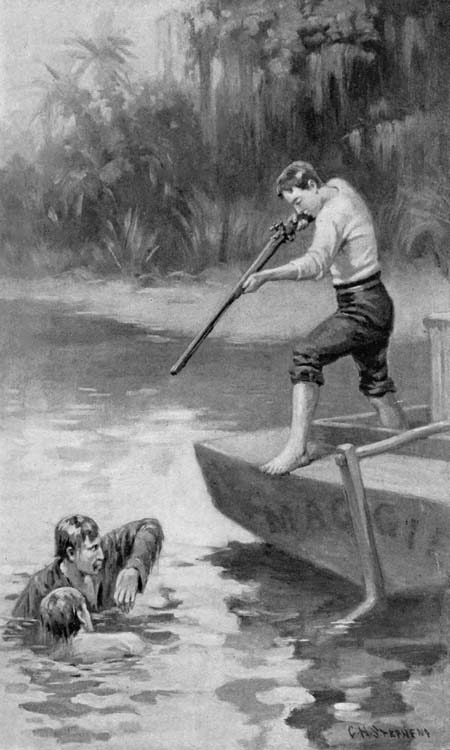
The rescue.
“You’d be washed overboard,” he said, “and
things are bad enough as they are, without any
of you getting drowned. There’s a regular gale
off shore, and we haven’t sighted an inward-bound
steamer yet.”
In the course of an hour or two, it was evident
that a vessel ought to be sighted very soon,
for the tug, which was not built for such rough
work as this, had, in spite of the efforts of the crew
to make everything tight on the decks, shipped a
good deal of water, and it was necessary to work
the pumps. But this did not help matters, for it
was found that a leak had sprung somewhere, and
the water came in faster than it could be pumped
out.
The tug was now far from the land, and in the
path of coastwise steamers; and before noon the
welcome sight of a line of smoke appeared on the
horizon. It was a steamer which was approaching
them, but, unfortunately, it was going southward,
and not northward.
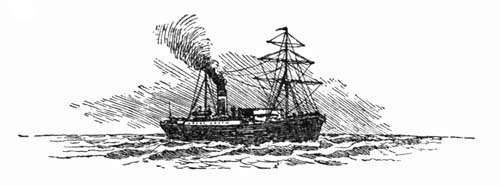
“She’s a Savannah steamer,” said the captain,
“but we’ve got to git on board of her, no matter
where she is going; for this old boat can’t stand
this sort of thing much longer. We’ve been blowing
out from shore all night, and there’s no time
for anything to come out after us now.”
The boys looked aghast.
“Savannah!” they cried. “We don’t want to
go to Savannah!”
“It’s a good sight better place than the bottom
of the ocean,” said the captain.
It was a bad bargain for the boys, but they had
to make the best of it.
“What are you going to do in Savannah?”
asked Phœnix, in a tone of dismay.
“It can’t take us more than a couple of days to
get there,” said Phil, “and then we can telegraph
home. As soon as our folks know where we are,
I shall feel that everything is all right.”
“I shan’t feel that anything is all right until
we know where we are ourselves,” said Chap,
looking out of one of the little windows of the
cabin. “Did you ever see such a pokey old
steamer as that is? I believe we shall sink before
she gets to us.”
But this unfortunate event did not happen, although
the tug was very deep in the water and rolling
heavily when the steamer lay to, with her bow
to the wind, a few hundred yards away from them.
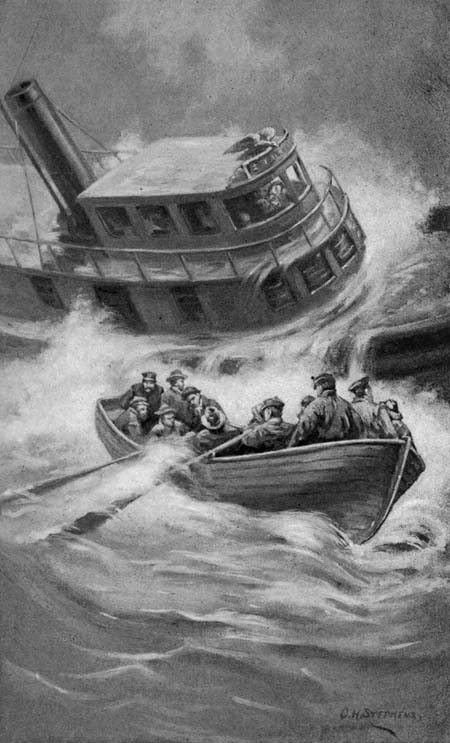
A large boat was speedily lowered and rowed to
the tug. In less than half an hour the unfortunate
occupants of the sinking tug-boat had been taken
on the steamer.
A few articles were brought away from the tug,
and the boys were allowed to carry with them
their valises.
As soon as the boat-load of people was on the
steamer, and the boat hauled up to its davits, the
vessel put about, and proceeded on her way.
As the boys looked back, they saw the little tug,
with her smoke-stack very much on one side, and
but little of her hull visible, tossing and pitching
on the waves.
“She isn’t good for another half-hour,” said
the engineer, who stood by.
The party rescued from the sinking tug-boat
was very kindly received on board the steamer,
but it was quite evident, even to the hopeful and
enthusiastic Chap, that there was no intention of
putting back for the Breakwater.
The boys had never been on an ocean steamer
before, and would have been greatly delighted
with their present experience had it not been for
the feeling that every movement of the ponderous
engine beneath them was taking them farther and
farther from their homes.
It would be impossible for their friends to hear
from them for at least two days, and the news
that the tug-boat had gone out to sea, and never
returned, would probably reach Boontown very
soon.
All three were very much dejected when they
thought of the misery and grief which the intelligence
would cause in their families, and Phœnix
seemed more downcast than either of the others.
“If father believes I’m drowned,” he said, “it’ll
be just his way to go about grieving that he worked
me too hard. I know I made him think that, but
I didn’t do so much after all.”
“If my folks look at the thing in that light,”
said Chap, “they’ll grieve that they didn’t get
more out of me before I was drowned.”
“I don’t believe there’ll be as much mourning
as you think,” said Phil. “Uncle will be on
hand, and he’s been in so many scrapes, and pulled
through them all, that he knows just about how
things will turn up. I bet it won’t be half an
hour after he hears the news before he thinks out
the whole thing, and has made all your people see
that it’s as clear as daylight that we’ve been carried
out to sea, and picked up by some steamer,
and that we’ll be heard from soon after she gets
to her port. He’ll know that there wasn’t storm
enough to wreck a good, stout tug-boat, and that
something must have got out of order, so that she
was carried out to sea.”
“If that one-masted schooner ever got in,” said
Phœnix, “she’d let them know there was something
wrong with us, for she must have seen or heard us
blowing off steam.”
“I don’t know about that,” said Chap, “for
before I turned into my sick-bed, the vessel was
pretty well out of sight. We were going in opposite
directions, as well as I could make out.”
“That was because she was sailing against the
wind, and had to make long tacks,” said Phœnix.
“Do you suppose I didn’t know that?” asked
Chap, drawing himself up in such an erect position
that a great lurch of the vessel nearly threw him
off his feet.
“We might as well make the best of it,” said
Phil, “and have a good time. In a couple of days
we will be in Savannah, and when we have telegraphed
home, everybody’ll be all serene, if they
are not now.”
“Your head’s level, Phil,” said Chap. “Let’s
go and explore the ship.”
On the breezy deck of the steamer, none of the
boys felt in the least degree sea-sick, and they went
about in high spirits. The purser, a good-natured
man, took them in charge, and showed them the
engine-room and various parts of the vessel, but it
was not long before he gave them a piece of information
which nearly took their breath away.
In answer to an inquiry in regard to the time at
which they might expect to reach Savannah, the
purser told them that the vessel could not stop at
that port at all. The captain of the tug-boat had
been right in saying that this was a Savannah
steamer, but she had been temporarily withdrawn
from that line, and was now bound for Nassau, in
the Bahamas.
“When will we get there?” asked Chap. “Can
we telegraph from Nassau?”
“We shall reach Nassau in about four days,”
said the purser, “but there is no cable from those
islands. You will have to carry the news of your
safety yourselves when we bring you back to New
York.”
“Can’t we send a letter?” asked Phil.
“Not any sooner than you can come yourselves,”
said the purser, “for we shall bring back the mail
from Nassau to the United States.”
“And how long will it be before you get back
to New York?” asked Phil.
“I don’t know just how long we shall lie at
Nassau,” said the good-natured purser; “but I
think it will be ten or twelve days before we are
in New York again.”
“Won’t we meet some ship that will take us
back or carry a letter?” asked Phœnix.
“I can’t say,” replied the purser. “The captain
will do what he can for you, but I don’t know
that he will have a chance of putting you on board
a northern-bound steamer, or of sending news of
you to your friends.”
CHAPTER III. “A CONTINENT BEFORE US.”
It was very hard for the boys to get their spirits
up after the news they had just heard.
“Ten days before our folks hear from us!”
ejaculated Phœnix. “That’s simply dreadful!
They’ll give us up long before that time.”
“We will find them all in black when we get
back,” said Chap, with a doleful face.
But even this gloomy prospect could not long
depress the spirits of our young friends.
By the next morning they were going about cheerfully,
hoping and believing that something would
soon turn up by which they could speedily get back
to their friends, or, at least, send news of their safety.
The weather was now fine, although it was so
cool that they were obliged to wear their overcoats
whenever they were on deck, and they could not
help enjoying this unexpected sea voyage.
They did not see much of the tug-boat people.
These men lived forward with the crew of the
steamer, while the boys ate and slept with the
passengers.
On the morning of the third day of their steamer
trip, they met one of the tug-boat crew,—a man
named Adam Guy. This man had been the only
person on board the tug-boat to whom the boys
had taken any particular fancy. He had been a
sailor, had visited many parts of the world, and
had a great deal to tell of his various experiences
on the sea and land. He was a strong and wiry,
but not very large, man; and, like many sailors,
he wore little gold rings in his ears. His hair
was thin and sandy, and hung in short curls at
the back of his head. He had a pleasant smile,
and appeared to be an easy-going, good-tempered
fellow.
“Young men,” said Adam, “I’ve been a-wantin’
to see you and have a little talk with you. Do you
know there’s no chance of our meetin’ any vessels,
or of your bein’ sent home or gettin’ any word
back, either?”
“How is that?” asked the boy.
“Why, it’s just this. We’re out of the way
now of all craft bound north. I did think we
might a’ met a coast steamer yesterday or the day
before; but if we did, we passed them in the night,
for I didn’t see any. We are now off the coast of
Florida, and as we are sailin’ south, we keep pretty
well in shore, so as to be out of the way of the Gulf
Stream, which runs northward, you know; and, as
you’ve lived on a big river, you understand what
it is to sail agin a strong tide. But, of course,
every vessel bound north tries to keep in the current
of the Gulf Stream, so’s to be helped along.
So, just about here, where the Gulf Stream is near
our coast, you find all vessels, goin’ south, keepin’
pretty near shore, and them bound north, far out.
It won’t be long before we’re near enough to the
coast for you to see the trees. And we’ll run down
till we git about opposite Jupiter light, and then
we’ll sail across the stream and make straight for
the Bahamas. I know all about these waters, for
I’ve sailed in them often. Now, as for me, I don’t
want to go to Nassau, and I don’t believe you want
to, either. The captain of our tug and the rest of
our men are all willin’ to go, and ship on this
steamer for their home trip. They’ll be short o’
hands then, for some of the crew are to be discharged
at Nassau, but I don’t want to go to that
old English town. I’ve been there, and I’ve had
enough of it.”
“But what are we going to do?” asked Phil.
“We can’t jump overboard and swim ashore.”
“No,” said Adam, “we can’t do that, but I’ve a
plan in my head. Before we git to Jupiter light,
the water is so deep near the coast that steamers
often run in very close. Now, if the captain would
lie-to there and send you fellers and me ashore in
a boat, it would be the best thing he could do
for us.”
“What would we do when we got there?” asked
the boys.
“Do?” said Adam. “Why we’d all go North,
and lose no time about it, instead of goin’ over to
the Bahamas and stayin’ there, I don’t know how
long, and then takin’ a week for the home trip.
Just back of the coast-line, down there, is the
Indian River, and sometimes it’s not much more’n
a stone’s throw from the beach. If we could be
landed, we could easily git over to that, and there
we’d find a craft to take us up to Titusville, and
from that place we’d easy git over to the St. John’s
River, and then you boys could telegraph home.
I’ve travelled all through that part of Florida, and
I could take you along as straight as a bee-line.
There are settlements here and there on the Indian
River, and you needn’t be afraid but we’ll
be taken good care of till we git to Titusville.
After that it’ll be all plain sailin’.”
“I’d like that plan first-rate,” said Chap.
“And so would I!” cried both of the other
boys.
“But do you think the captain would stop,”
asked Phil, “and put us off?”
“That’s what’s got to be found out,” said Adam.
“If I was you fellers I’d just go to him and ask
about it. Lay the p’ints before him strong, and
let him know how much you want to send word
to your friends where you are, and then to git
along home as quick as possible. Tell him I’ll
go along with you and pilot you through all
straight.”
The boys agreed that this plan was a capital
one, and, after a little consultation, they decided
to go and talk to the captain about it, and make
Phil the spokesman.
At first, the captain did not take very kindly to
the proposition. He did not wish to lose time, nor
to incur the trouble and risk of sending a boat on
shore. He also knew that a great part of the coast
of Florida was nothing but a barren waste, and he
did not think it would be any great kindness to the
persons he had saved from drowning to put them
on shore to suffer from exposure and privation.
But, on the other hand, if the boys were landed in
Florida, they would be at least in their own country,
and ought to be able to communicate with
their friends much sooner than if he took them
along with him to the foreign islands to which he
was bound.
“You would need money,” he said, “after you
get ashore, for you couldn’t expect the people there
to take care of you, and carry you about free of
charge; and, although I am willing to give you a
berth here, I can’t supply you with cash for a land
trip.”
“I have some money,” said Phil, “though not
very much.”
“And I’ve got——” said Chap, thrusting his
hands into his pocket.
“Oh, there’s plenty of money,” interrupted
Phœnix. “There need be no trouble about
that.”
“Well, then,” said the captain, who was beginning
to see some sense in the proposition of the
boys, “one difficulty is removed. Suppose you
go forward and send that man you spoke of
to me.”
The captain had a long conversation with Adam,
and convinced himself that that individual knew
what he was talking about when he proposed his
plan. The captain of the tug-boat was called in,
and Adam’s trustworthiness seemed well established.
After consultation with some of the other officers,
it was decided to put the boys and Adam Guy
ashore when a suitable place should be reached.
The news created considerable excitement among
the passengers, and great interest was taken in the
proposed landing of the boys.
The air in these semi-tropical waters was warm
and balmy, and the sea was smooth. Everything
seemed favorable for going on shore. About four
o’clock in the afternoon the ship lay to about half
a mile from a broad, sandy beach. This locality
Adam declared he knew very well.
The Indian River, he said, lay but a short distance
back, behind a narrow forest of palmettos;
and at the distance of a mile or two there was a
house on the river bank, where shelter could be
obtained until they could get transportation up the
river.
The captain, however, took care that the little
party should not suffer in case they did not reach
shelter as soon as they expected. He provided
them with provisions suitable for two days, put up
in four convenient packages. Each carried a canteen
of fresh water, and Adam took charge of a
large tarpaulin, rolled up into a compact bundle,
which could be used as a protection in case of rain.
The weather was so mild that their overcoats would
be sufficient to keep them warm at night.
While the men were preparing to lower a boat,
Phil took Phœnix aside, and asked him what he
meant by saying there was plenty of money.
“Chap has only three dollars,” he said, “and I
haven’t that much.”
“I have fifty dollars,” said Phœnix, “and I
guess that will take us along till we can telegraph
for more.”
“How did you come to have that much?” asked
Phil, with surprise.
“Why, you see, our folks haven’t settled what is
to be done with some money I got for helping to run
the ‘Thomas Wistar’ ashore, and father is taking
care of it. But I made up my mind that I was
going to keep hold of some of it myself. A fellow
likes to feel that he has got something of his own
that he can lay hands on, no matter what is done
with the general pile. So I locked up fifty dollars
in my room, and when we started off, I didn’t want
to leave it behind, for I didn’t know but the house
might burn down. So I put it in an old money-belt
father used to wear, and it’s strapped around
me now.”
“You’re a gay old fellow!” said Chap, who had
come up and heard this. “You are always turning
up at the right time.”
“And right side up,” said Phil.
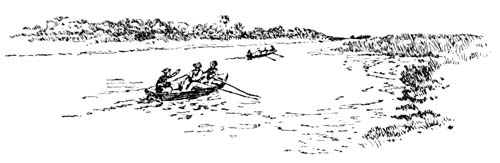
A few minutes after this, a large boat, pulled by
four men, and containing Adam Guy and our three
friends, was leaving the side of the steamer, followed
by the cheers of the passengers, who had
assembled on the decks to bid the little party
farewell.
The sea was quiet, with the exception of a long
and gentle swell, and the first part of the little trip
seemed like rowing on a river. But when they
neared the shore and saw the long lines of surf
rolling in front of them, the boys began to feel a
little uneasy. This was something entirely novel
to them, and, although they were not exactly
afraid, they could not say that they felt altogether
comfortable at the idea of going through these
roaring breakers.
But the surf at this point was not really very
high, and the boat was a metallic one, with air
compartments at each end, and the men rowed
steadily on, appearing to have no more fears of the
breakers than of the open sea.
As the boat reached the first line of surf and was
lifted up and carried swiftly forward on its great
back, and then dropped into a watery hollow, to
be raised again by another wave and carried still
farther on, our boys held tightly to the sides of
the boat as if they felt they must stick to that craft,
whatever happened. But the men pulled steadily
on, keeping the boat’s head straight for the
shore.
The breakers came rolling on behind as if they
would sweep over the boat and cover her up with
their dark green water, but another wave seemed
always underneath to carry her on beyond the
reach of the one which followed, and it was not
long before, by the aid of oars and the incoming
surf, they gained the beach.
Before the wave which had carried them in
began to recede, Adam and another man jumped
into the water and pulled the boat well up on the
sands.
Then the whole party disembarked, Chap jumping
into water ankle-deep, and giving a shout that
might have been heard on the steamer.
As soon as the boys’ valises and the other traps
had been put ashore, the boat was turned about,
and, with Adam’s help, was launched into the
surf.
The pull back through the breakers was harder
than the coming in, but the four men knew their
business, and the stanch life-boat easily breasted
every line of surf.
In five minutes they were out in smooth water
and pulling hard for the steamer. As soon as
they reached it the boat was hauled up, the vessel
was put about, and with a farewell blast from her
steam-whistle, she proceeded on her way.
“Hurrah!” cried Chap, waving his cap over his
head. “Now I feel that we are really our own
masters, and that we’re going to have the rarest
old time we’ve ever known. Boys, the whole
continent is before us!”
“That’s the trouble of it,” said Phil. “If there
wasn’t quite so much continent before us we might
expect to get home sooner.”
“Trouble? Home?” cried Chap. “Don’t let
anybody mention such things to me. I’m gayer
than the larkiest lark that ever flapped himself
aloft!”
And, with these words, he ran to the top of a
little sand hillock to see as much of the continent
as he could.
“If I were you fellers,” said Adam, “I’d make
that young man captain. You’ll never be able to
manage him if you don’t let him go ahead.”
“Good!” said Phil; “let’s make him captain,
and you, Phœnix, ought to be treasurer, for you
carry the funds.”
“And what’ll you be?” asked Phœnix.
“You’re mixin’ up your officers,” said Adam;
“but as a party of this kind is a little out of the
general run, I guess it won’t matter. As this is a
land expedition,” he said to Phil, “you might be
quartermaster, and I’ll be private.”
“All right!” cried the boys.
And when Chap came running down from the
sand-hill he was informed of the high position to
which he had been chosen.
“My friends,” cried Chap, drawing himself up
and clapping his breast with his hand, “you do
me honor, and I’ll lead you—I’ll lead you——”
“Into no end of scrapes,” suggested Phil.
“Perhaps you’re right. That may be so. But
you’re bound to follow,” said Captain Chap.
“He’ll lead you sure enough,” laughed Adam.
And then he added to himself, forgetting that this
was a land, and not a nautical expedition, “I’ll
keep my hand upon the tiller.”
CHAPTER IV. WITH HOOK AND LINE.
After standing for a few moments to take a
last look at the steamer, which was now rapidly
making her way southward, our party prepared
to take up the shortest line of march for the
Indian River.
The boys slung their overcoats and valises over
their shoulders, and these, with their water-canteens
and provisions, made for each of them a
pretty good load. But Adam had a still heavier
burden, for he carried the roll of tarpaulin in
addition to his other traps.
“I am not captain,” said Adam, addressing
Chap, “but I’ll go ahead, for I’ll be able to find
my way over to the river better than you will.”
“All right,” said Chap. “Adam was the first
man, and you can take the lead. But I am captain,
for all that, and I expect to be obeyed.”
“Expect away,” said Phil; “it’ll keep your
mind busy, and stop you from making plans for
blowing us all up North in one bang.”
“Silence!” cried Chap. “Forward, march!”
The way from the beach back to the river was a
very hard one, and a good deal longer than Adam
had expected it to be.
For a time they walked over loose, soft sand,
which was piled into little hills by the wind, then
they came to a thick growth of palmetto-trees, the
ground being covered with underbrush of the most
disagreeable kind, consisting mainly of a low bush,
called the “saw-palmetto,” which was made up of
leaves three or four feet long, with sharp teeth at
each edge.
A variety of tangled vines, concealing rotten
palmetto stumps, of all sizes, helped to make the
walking exceedingly difficult. But some man or
animal had been that way before, and through the
almost undistinguishable path, which Adam seemed
to scent out, rather than to see, the party slowly
made its way.
When at last they reached the river, the boys
gave a great shout, but Adam merely grinned, and
looked anxiously up and down.
The broad, smooth waters of the Indian River
spread before the delighted eyes of our young
friends. Large birds were flying through the air.
At a little distance hundreds of ducks were swimming
on the water. The low shores were green
and beautiful. But what Adam looked for was
not there.
As far as the eye could reach—and as the
river here bent away from them on either hand,
they could see the bank on which they stood for a
long distance up and down—not a house, or
clearing, or sign of human habitation, could be
seen, and on the river there was not a sail or
boat.
“I haven’t struck just the place I want to get
to,” said Adam, “for the house I’m after is just
above this bend where the river turns due north
agen; but then it couldn’t be expected I’d pick
out the very place I wanted when I was on board
a steamer nearly a mile from shore. If I could
’a’ seen the river, I’d been all right, but beaches
is pretty much alike.”
“I think you did very well,” said Phil, “to get
so near the place. The end of that bend can’t be
so very far away.”
“It wouldn’t be much of a walk,” said Adam,
“if there was a good beach at the side of the river.
There’s a sandy shore on the other side, as you can
see, but that’s no good to us. Along here, for
pretty much the whole bend, you see the trees
and underbrush grow right down to the water,
and it would be wadin’ and sloppin’, as well as
scratchin’.”
“We might keep farther in shore,” said Chap,
“where we could find dry walking.”
“It would be dry enough, but it would be
mighty slow,” said Adam. “The best and quickest
thing we can do is to get right back to the
beach. There we’ll find good, hard walkin’,
and we can tramp along lively till we calkilate
we’re about opposite John Brewer’s place, and
then we can push through agen to the river.”
“I guess that’s about the best thing to do,” said
Phil, “for it will give us less of this horrid jungle-scratching
than trying to push right straight along
through the woods.”
“All right!” cried Chap. “Backward! March!”
And again, with Adam at the head, the party
pushed through the strip of woods which separated
the river from the ocean-beach. The march
along the sand was easy enough, but it seemed
very long.
“Why, I thought,” cried Chap, “that it was
only a little way to the end of that bend!”
“It’s further than it looks,” said Adam. “I’ve
got a pretty good notion how fur we ought to walk
before we strike across; but it won’t be long before
we try the woods agen.”
In about ten minutes, Adam turned, and led the
way toward the river. The strip of land was much
narrower here than where they had crossed it before,
and after a short season of scrambling and
scratching and pushing over ground where it
seemed as if no one had ever passed before, the
river was reached. Here was a broad strip of
clean sand lying between the woods and the water’s
edge, but there was no house in sight.
“Isn’t this the end of the bend?” asked
Phœnix.
“Yes, it’s the end of the bend,” said Adam,
looking about him; “but it’s the wrong bend. I
know the place now just as well as if I’d been born
here. You see the river makes another bend up
there, don’t you? It’s a good while since I’ve
been here, and I never came to the place by the
way of the sea. The house we’re after is up there.
There’s no mistake this time.”
“But that must be ever so far away!” said Phil,
dolefully. “The beginning of that bend is more
than a mile off, I should say.”
“Yes, it’s a good piece off,” said Adam, “and I
don’t believe we’d better try to make it to-night.
The best thing we can do is to camp just here.”
At this the boys gave a cheer.
“That’s splendid!” said Chap. “I’d rather
camp out than go to fifty houses!”
And, casting his traps on the ground, he called
on all hands to go and put up the tent.
“You needn’t be in such a hurry about the
tent,” said Adam. “That’s the easiest thing we
have to do. After awhile me and one of you will
fix up the tarpaulin between a couple of trees back
here, and as it isn’t likely to rain, that’ll be all
the shelter we’ll want. But the first thing to do
is to get supper. Have any of you got fishin’-lines?”
Each of the boys declared he had one, and
started to get it out of his valise.
“Two’ll be enough,” said Adam. “One of you
might stay and help me with the fire and things,
while the other two go and fish.”
Phœnix agreed to stay and help Adam, while
Phil and Chap got out their lines.
“I was afraid your hooks wouldn’t be big
enough,” said Adam, taking up their lines; “but
this is a regular deep-sea tackle.”
“Yes; my uncle gave us the lines,” said Phil.
“He thought we might get some fishing down at
the Breakwater.”
“Well, all you got to do,” said Adam, “is to go
down to the beach and throw out your lines as fur
as they will go. We’ll have to bait at first with a
little piece of meat from the rations the captain
gave us. Of course, you needn’t fish if you don’t
want to. We’ve got enough to eat, but I thought
it would seem more to you like real campin’ out if
we had a mess of nice hot fish for supper.”
“That’s so!” cried Chap; “we wouldn’t think
of eating that dry stuff while there’s fish in the
river.”
“That is, if we can coax any of the fish out of
the river,” remarked Phil.
“Oh, we’ll do that easy enough,” said Chap.
“Get your bait, and come along.”
The two boys proceeded a short distance from
their proposed camping-ground, and having baited
their hooks with some fat and rather gristly beef,
they proceeded to throw out their lines; but as
they were not used to this kind of fishing, neither
of them succeeded in getting his line out into deep
water.
Adam had been watching them, and seeing that
they were making out badly, he came down to give
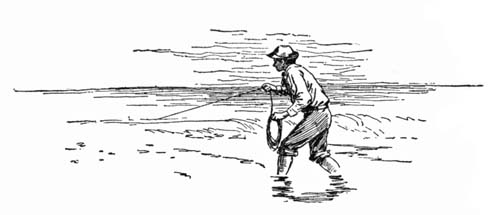
them what he called “a start.” He unwound the
whole of each line, and carefully laid it in coils on
the sand. Holding the shore end of the line firmly
in his left hand, he swung the hook and heavy lead
several times above his head, and let it go. The
long line flew out its full length, and the lead and
bait plunged into deep water. When each of the
lines had been thus put out, he went back to his
own work.
It was not long before the boys began to have
bites, and in a few minutes Chap commenced
hauling in his line like a house a-fire. Hand-over-hand
he grasped and jerked the cord, throwing
it wildly to each side of him as he violently
pulled it in. In a moment he drew a fish out of
the water, and threw it up high on the sand.
Rushing to it, he picked it up, and held it in
the air.
“Look at that!” he cried to Phil. “A splendid
fellow! It must be nearly a foot long.”
Phœnix and Phil were both interested in the
first fish caught in Florida waters, and they ran to
look at it. Adam, also, who was picking up driftwood
near by, came to see Chap’s prize.
“It will do for bait,” he said, as he took the fish
from the hook.
“Bait!” cried Chap, in amazement. “A big,
fat fish like that for bait!”
Adam laughed.
“A fish like that isn’t called a big one in these
parts, though I s’pose in your waters it would be a
pretty good ketch. It’s a mullet, and good enough
eatin’, though it isn’t big enough for a meal for us,
and I only want to cook one fish.”
“All right!” said Chap. “If there are fish
big enough for you in this river, I’ll catch
them.”
The mullet was killed, and both lines baited
with a large piece of its flesh; for it was food much
more attractive to the big fish they wanted, Adam
said, than the cold meat they had used before.
Phil went farther down the river, and both boys
put out their own lines this time, succeeding, after
several attempts, in throwing them a considerable
distance from the shore.
In less than two minutes Chap felt a tug at his
line. He gave a pull, and his first impression was
that his hook had caught in something at the bottom,
but the jerking of his line soon let him know
that there was a fish at the other end of it. Then
he began to haul in; but this hauling in was very
different from anything he had been accustomed
to.
It took all his strength to pull in the line hand-over-hand,
and although he was greatly excited,
and worked as fast as he could, it came in but
slowly. Sometimes the fish pulled back so hard
that Chap thought he would be dragged into the
water himself; but, digging his heels into the sand,
he tugged away manfully.
The line was a stout one, but it cut his hands,
and his arms began to ache from the unaccustomed
exercise. But he kept bravely on until the head
and back of a great fish appeared above the surface
of the water.
Wildly excited, he gave a few mad pulls, and
then rushing backward, he hauled high up in the
sand a flapping, floundering fish, nearly three feet
long. It was a handsome creature, dark on the
back, but bright yellow beneath.
For a moment Chap gazed on his prize with triumphant
delight, and then he gave a shout, which
brought Phœnix, and soon after, Adam.
Phœnix was almost as delighted as Chap himself.
This was something like fishing. He had
never seen a fish like this in his life.
“Now, then,” cried Chap to Adam, “what do
you say to that? Is that fellow big enough for you?”
“Yes,” said Adam, “it’s big enough, and it’s
too big. That’s a cavalio, and people eat them
when they can’t get anything else; but its flesh is
pretty coarse, and I couldn’t manage to cook a fish
that size the way I’m goin’ to do it.”
“You ought to mention the exact size of fish
you want,” said Chap, in a disappointed tone,
“and then, perhaps, a fellow could catch them for
you.”
“It is a pity you didn’t get something between
the two,” said Adam; “but you can’t expect to hit
anything right square the first time. But, hello!
here comes the quartermaster, and I believe he’s
got a blue-fish.”
Phil now came running up, carrying a fish
nearly as long as his arm. As he came near, he
raised the flapping fish, whose tail had been dragging
in the sand, and gave a shout; but when he
saw the magnificent creature, which was still
plunging and rolling at the end of the line
which Chap held firmly in his hand, his countenance
fell.
“What a whopper!” he cried. “Why, mine is
nothing to it!”
“No,” said Adam, “but yours is a blue-fish,
and we’ll have him for supper. Don’t be cast
down, captain; you’ll have plenty of chances yet
for blue-fish, bass, and lots of other good fellers.
I’ll take the hook out of this young elephant of
your’n, as he might snap your fingers, and then
we’ll shove him into the water. He looks lively
enough to come to all right when he gets into salt
water agen, and there’s no use in lettin’ fish die
here if you ain’t goin’ to use ’em.”
“All right!” said Chap. “I’m captain, and it
was my duty to catch the biggest fish, and I’ve
done it. And now the quicker we cook this little
fellow for supper, the better, for I’m dreadfully
hungry.”
The “little fellow,” a fish nearly two feet long,
was taken in charge by Adam, and carried to the
camp-ground, where a large fire was already blazing.
“It was havin’ this paper along,” said Adam,
“that put it into my head to try baked fish for
supper.”
Having dressed the fish, Adam rolled it in the
brown paper, and pushing away a portion of the
fire, he scooped out a place in the warm sand and
ashes, and covered up the fish therein. Then the
fire was built up again, and was allowed to blaze
away until Adam thought his fish was done.
When the brown paper was removed, the skin
of the blue-fish came off with it, leaving the white
flesh perfectly baked and temptingly hot.
There was salt and pepper among their rations,
and with the fish and the bread and butter and
biscuits, the boys and Adam made a splendid meal,
although they had nothing to drink with it but the
water from their canteens.
“The way to make a tip-top meal off of fish,”
said Chap, “is to catch it yourself—or else let
some other fellow do it.”
CHAPTER V. CHAP’S ALLIGATOR.
The preparations for the night were very simple.
Adam, whose previous experience in camping and
rough life had made him think, before leaving the
steamer, of a good many little things that might
be useful on a journey such as the one proposed,
had brought with him a long, thin rope, something
like a clothes-line.
“There’s nothin’ like havin’ plenty of line
along,” he said, as he fastened one end of this to
a low branch of a tree. “It always comes in useful.
I’m goin’ to hang the tarpaulin on this, and
make a tent of it.”
“The rope is long enough,” said Phœnix.
“Yes,” said Adam; “but you can’t have a
rope too long. The nearest tree that ’twould do
to tie it to might be a hundred feet away, don’t
you see?”
There was a suitable tree, however, not a dozen
feet from the one just mentioned, and to a low
branch of this Adam made his line fast, tying it
in a slip-knot, and coiling the slack rope on the
ground. This proceeding was made the text of
another sermon from the prudent sailor.
“Never cut a line, if you can help it,” he said.
“Use what you want, and coil away the slack.
The time will come when you’ll want the longest
line you can get.”
The tarpaulin was thrown over the low rope, and
its edges held out by cords and pegs, which Adam
had prepared while the supper was being cooked.
“It’ll be pretty close quarters,” he said, looking
into the little tent, “but you fellers can squeeze into
it, and I can sleep outside as well as not. The sand
is as dry as a chip, and if you put on your overcoats,
and take your carpet-bags for pillows, you’ll
be just as comfortable as if you was at home in
your feather beds.”
“A good deal more so, I should think,” said
Phil, “in mild weather like this.”
The boys would not allow Adam to sleep outside.
As the tarpaulin was arranged, if there was room
enough for three, there was room enough for four.
The tent was open at both ends, and they lay in
pairs, with their feet inside and their heads near
the open ends, so as to get plenty of air.
Adam was soon asleep, but the boys did not
close their eyes for some time. The novelty of
the situation as they thus lay on the soft dry sand,
with the tropical foliage all around them, the
broad river rippling but a short distance away,
and the darkness of this night in an almost foreign
land, relieved only by the flashes of the dying
camp-fire and the bright stars in the clear sky,
kept them awake.
Far off in the river they heard, every now and
then, a dull pounding noise, as if some one were
thumping at the door of a house. This, Adam told
them before he went to sleep, was caused by the
drum-fish, who make these loud sounds as they
swim near the bottom of the river.
Now and then they heard a distant snort or
roar, but from what sort of animal it came they did
not know. They were aware that in the woods of
Florida there were panthers, bears, and wild-cats;
but Adam had told them that in this part of the
country these animals were very shy and seldom
disturbed any one if not disturbed themselves.
After a time Phil and Phœnix fell asleep, but
Chap did not close his eyes. He was an excitable
fellow, and he was thinking what he should do if a
wild beast should invade their camp. There were
no firearms in the party, but he thought of several
ways in which four active persons could seize a
wild-cat, for instance, and hold it so that it could
harm no one of them.
After a time the moon rose, and then Chap,
lying with his face turned toward the river, was
fascinated by the strange beauty of the scene.
While gazing thus, he saw two small animals
slowly creeping across the sand and approaching the
tent. The sight of them startled him, and he was
about to give an alarm, when he suddenly checked
himself. These could not be wild-cats, he thought;
they were too little and their movements too slow.
As they came nearer and turned their heads toward
him, he saw by the now bright rays of the
moon that they had light triangular faces, gray
bodies, and rat-like tails, and that they were opossums.
He had seen these animals in the North,
and laughed quietly when he thought they had
frightened him. They were evidently after some
pieces of fish which lay near the dead ashes of the
camp-fire, and were soon making a comfortable
meal.
“I never saw such tame creatures,” thought
Chap. “They must know there are people about.”
Then he gave a low, soft whistle. The opossums
looked up, but did not move. There was a piece
of stick within reach of his hand, and picking it
up, he whirled it toward them. They looked up
again, but still did not move.
Slowly drawing himself out of the tent so as not
to disturb the others, Chap rose to his feet and approached
the opossums. One of them turned and
ambled slowly to a short distance, but the other
stood still.
Chap walked close up to him, but the creature
merely arched its back and looked at him.
Picking up a stick which was lying near the
ashes, Chap gave the stupid creature a little punch.
The opossum merely twisted itself up a little and
opened its mouth.
“Upon my word!” said Chap; “if you are not
the tamest wild beasts in the world! I don’t believe
either of you ever saw a man before, and
don’t know that you ought to be afraid of him.
But I’m not going to hurt a non-resistant. You
can go ahead and eat your supper, for all I care.”
And so he slipped quietly back into the tent,
and left the opossums to continue their meal.
It might have been supposed that when Chap
did close his eyes, he would sleep longer than the
others, but this was not the case. Either because
he did not rest well in a new place, or because his
mind was disturbed by his responsibilities as captain
of the party, he awoke before any of the
others. It was broad daylight, and again he
slipped out of the tent without disturbing any of
his companions.
The opossums were gone, and Chap walked along
the water’s edge, looking at the hosts of birds which
were flying above him. There were gulls and
many others which he did not know, and near the
other side of the river was a small flock of very
large birds, which he supposed must be pelicans.
As he walked round the little clump of trees,
under which the tent was pitched, he saw upon the
sand, near the water’s edge, something which made
his heart jump.
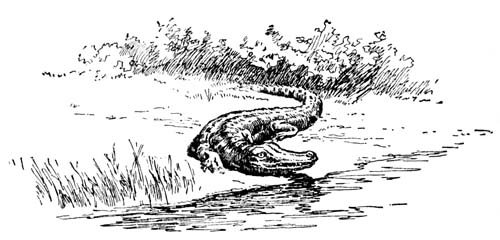
It was an alligator, the first Chap had ever seen
out of a menagerie. It was about eight feet long,
and was lying in the sunshine, with its head toward
the water.
Chap stood and gazed at it with mingled amazement
and delight. He never thought of fear, for
he knew an alligator would not come after him.
Slowly and gradually he came nearer and nearer
the strange creature. It did not move. Was it
dead? or asleep? He felt sure it was the latter,
for it did not look dead. What a splendid thing
it was to be so near a live alligator on its native
sands! If there were only some way of catching
it! That was almost too glorious to think of. If
he had a rifle he might shoot it; but that would
be nothing. But to catch it alive! The idea fired
his soul. He would give anything to capture this
fellow, but how could he do it?
He remembered the account that had so pleased
him, when he was a boy, of the English captain—Waterton,
he thought his name was—who sprang
astride of an alligator, and seizing its forepaws,
twisted them over its back so that the creature
could not walk, nor reach its captor with its jaws
or tail.
At first Chap thought that he might possibly do
this, but he saw it would be a risky business. The
alligator’s paws looked very strong, and he might
not be able to hold them above its back. Even if
it got one paw loose, it might turn round and make
things lively.
“If I could only get a rope round the end of his
tail,” thought Chap, “I could tie him to a tree.
That would be simply splendid!”
This plan really looked more feasible than any
other. The alligator was lying with his tail
turned a little to the left, and the end of it raised
slightly from the sand. It might be possible to
slip a rope around this without waking the creature;
but where was the rope? Chap racked his
brain for an instant. Had they a rope?
Then he remembered the line that supported
the tent. There was ever so much of it coiled on
the sand, it was already fastened to a tree. If the
loose length would reach the alligator, and if he
could get the end of it around his tail, and the line
was strong enough to hold him, he would have
him sure.
Wouldn’t it be glorious to wake up the other
fellows and show them the captive alligator which
he had caught all by himself while they were fast
asleep?
Slipping off his shoes, he stole softly around to
the foot of the tree by the tent where the coil of
rope lay. Taking the loose end in his hand, he
turned, and slowly crept toward the alligator.
The creature was asleep, and Chap made so little
noise as he gradually came near it, that its repose
was not disturbed. To his great joy, Chap
found that the rope was long enough. When he
was almost near enough to touch the tip and of the
alligator’s tail, he kneeled on one knee, ready to
spring up in an instant if the creature should awake,
and hesitated for a moment before proceeding to
attach the rope.
If he tried to tie it on, the alligator might move
before he had time to make a good knot. It would
be better to prepare a slip-noose, and put that over
the end of his tail. Then when he moved or jerked,
he would pull the rope tight.
Chap made a slip-knot and a noose, and, with
quickly-beating heart, he leaned forward, and with
both hands he gently put the open noose around the
alligator’s tail.
He did this so cautiously and carefully that the
rope did not touch the creature until it was seven
or eight inches above the tip of the tail. Then he
gently pulled it so as to tighten it.
Almost at the first moment that the rope
touched the alligator it gave its tail a little
twitch. Chap sprang to his feet and ran backward
several yards. Then the alligator raised its
head, looked back, and saw him.
Without a moment’s hesitation the creature
lifted itself on its short legs and made for the
river. Chap trembled with the excitement of the
moment. Would the noose slip off? Would the
rope hold?
The noose did not slip off, it tightened; and
in a moment the rope was stretched to its utmost
length.
Chap was about to give a shout of triumph,
when the alligator, feeling a tug on his tail, became
panic-stricken and bolted wildly for the
water.
The rope, though not heavy, was a strong one,
and it did not break, but the slip-knot around the
nearest tree to which it was tied was pulled loose
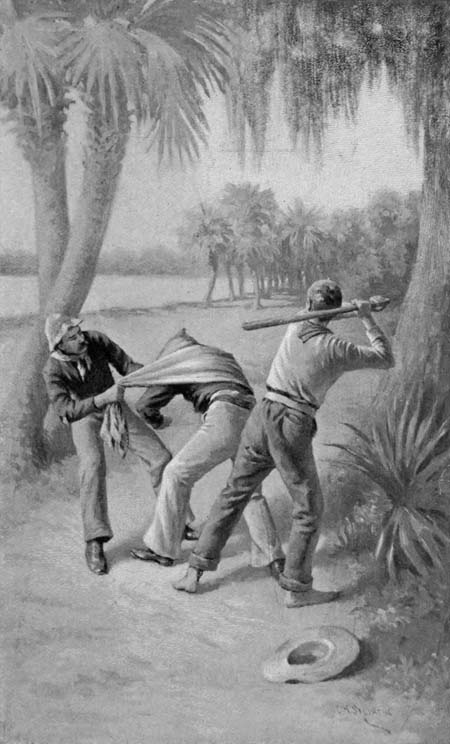
in an instant, and down came the tent on the
sleepers beneath it.
Then there was a tremendous jerk on the
branch to which the extreme end was tied, and in
an instant it was torn from the trunk of the tree.
This branch caught in the end of the tarpaulin,
the pegs were jerked out of the sand, and the
whole tent was hauled roughly and swiftly over
the recumbent Adam and the two boys. The
branch got under Phil’s head and jerked him
into a sitting position almost before it woke
him up.
Phœnix thought an earthquake had occurred.
In an instant he was enveloped in darkness;
then there seemed to be a land slide over his
head, and flying bits of wood banged about his
ears.
Adam made a grab at the tarpaulin as it swept
over him, and held fast to one corner of it. He
was instantly jerked about three yards along the
sand, and then the branch, to which the end of the
rope was tied, slipped under the tarpaulin, and
Adam and the tent were left lying together on the
ground.
Chap made a wild rush after the branch, but it
was pulled into the water before he could reach it.
He could see it floating rapidly along the top of
the water, as the alligator swam away, and he stood
sadly on the bank, watching the disappearance of
that branch and his hopes.
Adam, with the two boys, now appeared, half
awake and utterly astounded, and anxiously demanded
to know what had happened. Never had
they been awakened in such a startling style.
When Chap explained the state of affairs, Phil
and Phœnix burst into a laugh, but Adam looked
rather glum.
“You don’t mean to say,” he exclaimed, “that
that ’gator has gone off with all my rope?”
“He’s got it all,” said Chap; “and I’m sorry
now it didn’t break, so some of it might have been
left. But I tell you what we could do, if we could
only get a boat; we could run after that branch—it
won’t sink, you know—and when we got hold of
the rope we might haul the alligator in.”
“Haul him in!” cried Adam; “I’d like to see
myself hauling a live alligator into a boat, even if
we could do it, and had a boat. No, that line is
gone for good. He’s turned round and chawed it
off his tail by this time.”
“What did you expect to do with your alligator,”
asked Phil, “after you had fastened him to a
tree? We haven’t anything to kill him with, and
he would have raged around at the end of his line
like a mad bull.”
“Perhaps Chap thought he could tame it, and
take it along with us,” said Phœnix.
“Look here, boys,” said Chap, “I don’t want
any criticisms on this alligator business. If I’d
been acting as your captain, and leading you in an
alligator hunt, you might say what you pleased
when the beast got away; but I was doing this
thing in my private capacity, and not as commander
of the party, and you fellows have nothing
to do with it.”
“Haven’t we?” cried Phil. “When my head
was nearly jerked off, and three or four yards of
tent hauled over my face?”
“And I was scared worse than if I had been
pulled out of bed with a rake?” said Phœnix.
“Nothin’ to do with it!” exclaimed Adam.
“When my rope was jerked out of sight and
hearin’ in a minute, and the tarpaulin would
’a’ gone with it, if I hadn’t grabbed it? I should
think we had something to do with it.”
“Perhaps you had,” said Chap, as he sat down
on the sand to put on his shoes. “But I tell you
what it is, fellows,” he added, with sparkling eyes,
“if we could have tied a live alligator to a tree, it
would have been a splendid thing to tell when we
got home.”
“There is people,” said Adam, dryly, “who’d
tell a story like that without tyin’ a ’gator to a
tree.”
“But we are not that kind,” promptly answered
Captain Chap.
“But I guess we won’t cry over spilt milk, or
lost ropes, either,” said Adam; “and the best thing
we kin do is to get along to John Brewer’s house
and see about some breakfast.”
“We might catch some more fish,” said Chap,
“and have breakfast before we started.”
“If you kin ketch some coffee,” said Adam,
“I’ll be willin’ to talk about breakfast here; but
I don’t want to make another meal off fish and
warm water, if I can help it. John Brewer’s
house is just the other side of that bend, and we’ll
be there in half an hour.”
The tarpaulin was rolled up, each of the party
picked up his individual traps, and, headed by
Chap, they were soon walking along the shore of
the river.
When they turned the bend above, they were
delighted to see that Adam was right, and that
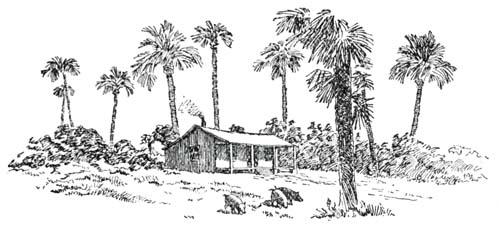
John Brewer’s house was really there. It was not
much of a house, for it was a frame building, one
story high, and containing three or four rooms;
but it had an air of human habitation about it
which was very welcome to the wanderers. It
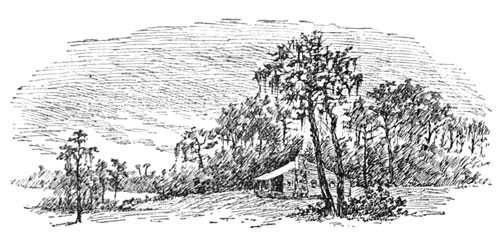
stood in a small clearing, and John Brewer, a little
man, with long, brown hair, which looked as if
the wind had been blowing it in several directions
during the night, came out of his front door to
meet them. Two of his children followed him,
and the three others and his wife looked out of a
half-opened window.
Mr. Brewer was mildly surprised to see his old
acquaintance, Adam, and the three boys, and when
he had heard their story, he took a kind but
languid interest in the matter, and went into the
house to see about getting breakfast.
It was not long before our friends were sitting
down to a plentiful meal of coffee, corn-bread, and
very tough bacon, Mr. Brewer and his family
standing at the end of the table and gazing at
them as they ate. Some of them would have
joined the breakfast-party had there been plates
and cups enough.
About half an hour after breakfast, as our
friends, with Mr. Brewer and four of the children,
were sitting in the shade in front of the house,
and Mrs. Brewer and the other child were looking
at them behind a half-opened window-shutter,
Adam remarked,—
“What I want to know is what chance we have
of gettin’ up the river to Titusville?”
“How did you expect to get up?” asked Mr.
Brewer.
“Well,” said Adam, “I thought we might get
passage in a mail-boat, if one happened to come
along at the right time; and if it didn’t, I thought
there’d be some boat or other goin’ up the river
to-day that would take us.”
“Well, if them’s your kalkerlations,” said Mr.
Brewer, gently rubbing his knees and looking out
over the water, “I don’t think you’re going to get
up at all.”
“Not get up at all!” cried the boys; and Adam
looked puzzled.
“Well, not for a week or so, anyway,” said Mr.
Brewer, his eyes still fixed upon the rippling
waters. “To be sure, the mail-boat will be along
to-day, and she’ll stop if she’s hailed, but she can’t
carry you all, and as for other boats, the long and
short of it is, there ain’t none gone down, and there
can’t none come up. There was a boat went up
yesterday with vegetables from Lake Worth, but
she won’t be back for a week, and then it’ll be a
good while before she goes up again. Every boat
that’s been down the river this month has gone up,
and they tell me there ain’t nothin’ at Jupiter but
the little sloop that belongs to the light-house
keeper, and she’s hauled up to have a new mast
put in her.”
“Then what are we to do?” asked Phil, anxiously.
“Dunno,” said Mr. Brewer.
CHAPTER VI. THE ROLLING STONE.
The announcement so placidly made by Mr.
John Brewer that it was impossible for our friends
to get up the river until some of the sail-boats or
small sloops—the only craft which then navigated
that stream—should come down and go up again,
gave rather a doleful hue to the state of affairs.
Mr. Brewer stated that when a boat came down
that far, she generally went all the way to Jupiter
Inlet before she returned, and some of the big
ones, when they got down there, went outside, and
made a trip to Lake Worth, and they would, of
course, be still longer coming back.
The spirits of the boys were a good deal depressed,
but Adam did not give up his hope that
they might get passage on the mail-boat.
“We can stow ourselves somewhere,” he said,
“and when we get to Fort Capron, we’re likely
to find a boat that’ll take us the rest of the
way.”
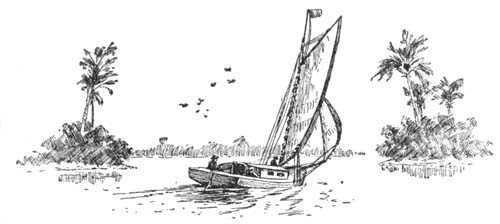
But when, an hour after, the mail-boat came in
sight, even Adam’s hopes were crushed. It was
not larger than a row-boat, with a small sail, and a
cabin not three feet high, and besides the young
man who sailed her, she already contained two
passengers,—a sportsman who was returning north
and a negro boy. There was no room for the latter
to sit in the after-part of the vessel, and he had
to make himself as comfortable as he could on the
little bit of deck in front of the mast.
It was so obviously plain that four additional
passengers could not get on board that little boat
that the subject was not even broached, Adam confining
himself to inquiries in regard to the possibilities
of there being other boats down the river
of which Mr. Brewer had not heard. But the
mail-carrier assured him that there were no boats
down there that could come up inside of a week,
and the sportsman declared that he never would
have squeezed himself inside this little tub if there
had been any other chance of his getting up the river.
There was only one relief afforded by the mail-boat.
The boys, anticipating that they might not
be able to go on themselves, had each written a
letter to his family, telling where he was, and
giving a brief history of the state of affairs. Each
letter, written on rumpled stationery supplied by
Mr. Brewer, contained assurances of the perfect
safety of the writer, and a request for money to be
forwarded to Jacksonville, Florida, which point
they hoped to reach in good time.
These, with money for the postage, were given
to the carrier, who promised to have them properly
mailed at the first post-office on the river.
A telegram was also written and given to the
sporting gentleman, who promised to forward it as
soon as he reached Sanford, on the St. John’s River,
this being the nearest point from which telegrams
could be sent.
“There, now,” said Chap, when the little boat
had sailed away, “I feel more comfortable. The
folks will know all about us just as soon as if we
had gone on ourselves, and that’s the main thing;
for, as far as I’m concerned, I’m in no particular
hurry to get home.”
“You don’t want to stay here, do you?” asked
Phœnix.
“No,” said Chap; “but we can tramp along
and camp out for a while, till a boat comes by
and takes us on. I don’t want any better fun
than that.”
“We can’t tramp much farther on this beach,”
said Phil. “It only reaches about a mile above
us, Mr. Brewer says, and tramping and camping
for a week or two, with no paths to walk in and
nothing to eat, would be pretty tough work.”
“We could push back to the sea-shore,” said
Chap, “and walk along there.”
“That might do as far as the walking is concerned,”
said Phœnix; “but how about the
victuals?”
“I’m not quartermaster,” said Chap, “I’m captain;
and I’ll lead you fellows anywhere you want
to go.”
“That’s the way to talk,” said Phil; “but
it won’t do to lead us to any place so far from
this house that we can’t hear them call at mealtime.
We can’t live straight along on fish, you
know.”
A few minutes after this conversation, Adam
Guy walked up to Mr. Brewer, who was leaning
on the fence of his little garden.
“Look here, John Brewer!” he cried; “what
did you mean by sayin’ that we couldn’t get a boat
to go up the river in? In that little creek back
there, there’s a boat plenty big enough for us.
Don’t she belong to you?”
“Yes,” said Mr. Brewer, “she’s mine, but her
mast’s unshipped, and her main-sail’s in the house
to be mended.”
“Can’t we ship the mast and mend the sail?”
asked Adam.
“Yes, you might do that,” answered Mr.
Brewer.
“Well, then,” cried Adam, “we’re all right!
She doesn’t leak, does she? And you’ll hire her
to us, won’t you?”
“Her hull’s all right,” said Mr. John Brewer,
“and I reckon I’d hire her to you.”
“And why didn’t you tell us about her before?”
exclaimed Adam.
“You didn’t say anything about my hirin’ you
a boat,” said the other. “If you’d ’a’ asked me,
I’d ’a’ said you could have her.”
Adam’s shouts soon brought the boys together,
and a bargain was speedily concluded with Mr.
Brewer, who agreed to hire his boat to our party
for a dollar a day.
“That is, till we reach Titusville,” said Adam;
“but how are we goin’ to get her back?”
“Well,” said Mr. Brewer, “my brother went up
to Enterprise last week, and he’ll be comin’ back
afore long, and it’ll suit him fust-rate if you’ll
leave the boat at Titusville, and then he can come
down in her and save payin’ his passage on the
mail-boat.”
“That’s a pretty good arrangement for you and
your brother,” said Chap. “I wonder you didn’t
think of it before!”
“I didn’t want to bother anybody to take a
boat up the river jist for my brother,” said Mr.
Brewer.
Everybody now went gayly to work, Adam
mending the sail with true sailor-like skill, and
the boys, under Mr. Brewer’s direction, and with
some of his assistance, getting the mast properly
shipped and the boat cleaned out and made ready
for her voyage.
She was a well-built little craft, about twenty
feet long, and with a small cabin, which would
comfortably accommodate four persons. She carried
a main-sail and a jib, and was, altogether, very
suitable for the purposes of our friends.
By night the boat was ready for the trip, but it
was decided to postpone starting until the next
morning. All the provisions which Mr. Brewer
could spare were purchased, and, although he
could not let them have enough to last the three
or four days which it would require to reach
Titusville, there were places along the river where
they could replenish their stores.
Mr. Brewer knew Adam for a good sailor, and
had no hesitancy in trusting the boat to his care.
The boys were perfectly delighted at the prospect
before them. To sail up the river in a boat
which was entirely their own during the voyage
was a piece of good fortune they had not
dreamed of.
“What is the name of your boat?” asked Chap
of Mr. Brewer, as they all sat together after
supper.
“Just now she ain’t got no name. She used to
be called the Jane P., after my first wife; but
when she died I painted the name out, and this
Mrs. Brewer don’t want the boat named after her,
because she’s afraid she might die too; so, you see,
she ain’t got no name.”
“Well, then,” cried Chap, “we can name her
ourselves—can’t we?”
“Oh, yes,” said Mr. Brewer, “you can call her
what you please, so long as you don’t name her
after Mrs. Brewer.”
The boys heartily agreed to this restriction, and
a variety of names was now proposed; but after a
time, the boys concluded that a title suggested by
Phœnix was the jolliest and most suitable name
for their boat, and they agreed to call her “The
Rolling Stone.”
“That’s a mighty queer name for a boat,” said
Mr. Brewer. “It seems like it would sink her.”
“But you needn’t keep it after we’ve done with
her,” said Phil.
“I don’t think I will,” said Mr. Brewer.
And Adam, who had declared the name decidedly
un-nautical and with something of an unlucky
sound about it, said that after all he reckoned
it didn’t matter much what the boat’s name
was, provided they had a good wind.
The next morning, after an early breakfast, provisions
and a small keg of fresh water were put
aboard; the baggage of the voyagers was safely
stowed away; a double-barrelled gun, which had
been hired of Mr. Brewer, was hung on a couple
of little hooks inside the cabin, with the powder-flask
and shot-pouch gracefully dangling beneath
it; our party got on board, the sails were run up,
and with a parting cheer to Mr. Brewer and three
of his children, who stood on the bank of the little
creek, and to Mrs. Brewer and the other child, who
looked out from behind a half-opened shutter, The
Rolling Stone was brought around to the wind,
and sailed away on a long tack up the Indian
River.
CHAPTER VII. THE TWO ORPHANS.
The day was bright and beautiful, there was a
fair wind, and The Rolling Stone, bending gently
away from the breeze, sailed gayly over the rippling
water. Adam was at the helm, and the
boys were making themselves comfortable in various
parts of the little craft, and enjoying to the
utmost the delightful air and the bright sunshine.
“I tell you what it is, boys!” cried Chap, who
was stretched at full length on top of the little
cabin, relying on Adam to give him notice when
the boat was to be put about and the boom would
swing around, “do you know I’d be as happy as a
king if I felt sure our folks wouldn’t be worried
about us?”
“I don’t think we need worry about them,”
said Phil, “for that hunting man said he’d be at
Sanford before long, and then all our folks will
hear from us just as quick as the telegraph can
carry word to them.”
“There’s a comfort in that,” said Chap.
And Phœnix suggested that they might as well
be as jolly as the law allowed.
Adam made no remark upon the subject. He
knew very well that it might take the sportsman
a week, or perhaps longer, to reach the point from
which he was to send the telegram he carried, but
he wisely concluded that it would be of no use to
dampen the spirits of his young companions, and
that it would be better for all hands that they
should be lively and cheerful.
“Look here,” he said, “you boys can be happy
as kings, if you like, but you needn’t think you’re
goin’ to be lazy. I’m goin’ to teach you how to
lend a hand to the sails, and make yourselves
useful aboard ship.”
“Lazy?” cried Chap. “Rolling stones are
never lazy. Boys,” he exclaimed, struck by a
sudden inspiration, “let’s call ourselves ‘The
Rolling Stones.’ It’s as good a name for us as
it is for the boat, and we expect to roll on till we
get home.”
“Agreed!” cried Phil and Phœnix.
And the name was adopted.
They sailed all day, eating a slight lunch about
noon, and it was decided to anchor toward the close
of the afternoon, and eat their evening meal on shore.
The boys were anxious to have wild duck for
supper, and they shot three or four of these birds,
Adam skilfully steering the boat so close to the
floating game that it could easily be picked up.
Some fish were caught, and a fine fire was kindled
on the beach.
Cups, saucers, and a few cooking utensils had
been procured from Mr. Brewer, and with roast
duck, fish, some bacon, corn-bread and biscuit,
and hot coffee, the party made an excellent
meal.
They sat round the camp-fire on the river bank
until it was nearly dark, and then they went on
board The Rolling Stone, and having tied her up
securely, and made all things tight and right, they
stowed themselves away in the cabin, which was
divided into two compartments by the centre-board,
and were soon asleep on the plain but sufficient
bedding with which Mr. Brewer had furnished
the boat.
The next morning there was no wind at all.
The surface of the river was as smooth as glass,
and was only rippled by the water-fowl, which
rose from or settled down upon it, or by the
schools of little fish, which occasionally sprang a
short distance out of the water, and fell pattering
back like a shower of gravel-stones.
“It’s no use to set sail till the wind rises,” said
Adam; “so we might as well try to make ourselves
contented on shore for a while. About ten
or eleven o’clock p’rhaps we’ll have a breeze.”
“All right!” said Chap. “We can pole the
boat out into deep water and fish.”
“Yes,” said Adam, “you boys can do that, if
you like; but I think I’ll take the gun and go
into the woods, and see if I can’t find some game.
I noticed this mornin’ a kind o’ path back there
which looked to me like a bear track. I’ve seen
bear tracks afore, and, though I ain’t certain
about this one, I think I’ll foller it up a little
way.”
“Good!” cried Phil; “and I’ll go with you.”
Adam hesitated.
“I dunno about that,” he said. “If we was to
meet a bear, you wouldn’t have any gun, and you
might feel sort o’ helpless. I’d tell you to take
the gun and go by yourself, but I guess I know
more about the ways of these wild critters than
you do.”
“I don’t want to go alone,” said Phil, “and
I’m not afraid to go without a gun. There are
two barrels there, and you can use one for me and
one for yourself.”
“Very well,” said Adam, “you can come. This
shot-gun isn’t the right thing to take along if we
expect to meet bears, but I’ll put half a dozen
buckshot into each barrel, and I guess that’ll do
for anything we get a crack at.”
Phœnix would have been glad to go with Phil
and Adam, but in that case Chap would have been
left alone; and, besides, it would not do to make
a bear-hunting party too large. So he got out his
fishing-lines, and helped Chap pole the boat into
deeper water, where they anchored her, and set
comfortably to work to fish. The sport was not
very exciting, for the large fish are only found in
certain portions of the river, but the biting was
lively, and the fish they hauled up were a good
deal larger than those they used to catch at
home.
Adam and Phil made their way slowly along a
path which the former had taken to be a bear
track. Sometimes they got through the underbrush
quite easily, and then, again, it would be
very difficult and unpleasant to push through the
thorny shrubbery and under low-hanging branches
of small trees.
“If we went on all-fours, like a bear,” said
Adam, “it would be easy enough; but as we
don’t, we’ve got to make the best of it.”
They made the best of it for some time, occasionally
losing the track, and then, finding it again,
or supposing they had found it, they would bravely
press forward.
At last, to their great relief, they came to a place
where the way was much more open; the bed of a
very small stream, now dry, wound before them
through the forest, and, as it was free from
underbrush, it made a very convenient pathway.
There was nothing in the appearance of this dry
bed to indicate that a bear had been in the habit of
walking in it; but, as it made a very good passage
through the forest for a man and a boy, Phil and
Adam cheerfully took their way up the stream.
It did not matter much whether they saw a bear
or not; for, if they did catch sight of one, Adam
very much doubted if he could get it within range
of a shot-gun. But they were both fond of the
woods, and were glad to explore a semi-tropical
forest like this.
Adam was a hunter, as well as a sailor, for his
adventurous experiences had been both on land
and sea.
On either side of them was a mass of vines and
bushes, out of which the shorter or cabbage palmettos
arose, wherever they could find room to
spread their long and drooping leaf-stalks, which
not only grew from their crests, but sprang out of
the sides of their trunks, while, high above was
the vast and impenetrable canopy of the leaves of
the tall palmettos, each umbrella-like tuft supported
by a long and slender stem.
The forest thus appeared to be covered by a
roof of green, held up by innumerable gray
columns of pillars.
Sometimes the monotony of the palmettos was
broken by great live-oak trees, which reached high
into the air, and whose massive branches, often
curiously grotesque and crooked, bore not only
their own bright and glossy leaves, but were covered
throughout their length with vines and various
fern-like growths, while from the lower part
of these limbs, and from the trunks and branches
of many other trees, hung long and graceful
festoons of the silver-gray Spanish moss.
The bark of many of the palmetto trunks was
relieved by splotches of bright red, and here and
there, sometimes on dead trees and sometimes on
living ones, there were air-plants, their roots fastened
in the dry wood, and their long, bending
leaves stretching out into the air for the nutriment
which most plants draw up from the
earth.
Phil was greatly interested in all these things,
and Adam gazed about him with much satisfaction,
although he had often walked in such woods
before. He had been so long on ships and steamboats
that this woodland ramble was a pleasant
change.
Phil stopped to cut some of the red patches of
bark from a palmetto near him, hoping to be able
to carry the pieces home to show as curiosities, and
thus his companion had got some distance ahead
of him.
Adam was walking quietly along, when suddenly
he heard, from a clump of thick bushes to
his right, a low but very peculiar sound. It was
a series of little whimpers and sniffs, that would
not have been heard at all if the woods had not
been so quiet.
Instantly Adam stopped. He was sure he recognized
that sound. Turning to the point whence it
came, he peered earnestly into the shrubbery. Just
above a low, heavy bush, not a dozen feet away
from him, he saw the top of a round, black head,
and a pair of glistening eyes.
Without hesitating for a moment, he cocked
both barrels of his gun, and taking a quick aim
just above the eyes he saw before him, he pulled
both triggers. A loud report rang through the
forest, and the head disappeared.
Phil, astounded by the discharge of the gun,
started to run toward Adam, but the latter waved
him back, and retreating a short distance, began
rapidly reloading.
When this was done, he waited a few minutes,
and then, closely followed by Phil, he approached
the bush at which he had fired.
Hearing nothing but the little whimpers which
had before attracted his attention, he cautiously
made his way around the bush, his gun cocked
and ready for instant use.
But there was no occasion to use it. Upon the
ground lay a large she-bear, dead, with twelve
buckshot in her brain. In a slightly-hollowed
place in the ground behind her were two young
bears, about a foot long, round and fat, and rolling
and pawing each other, while they continually
sniffed and whimpered as if they wanted something,
but did not know what it was.
Adam tucking the other under his left arm.
Phil gave a shout of triumph when he hurried
up behind Adam and saw the dead bear.
“Why, this is glorious!” he cried. “Who
could have thought you would have shot a real
wild bear? Are you sure it’s dead?”
“Oh, yes,” said Adam, cautiously punching
the animal with the end of the gun; “bears don’t
play ’possum. I put both loads into her head.
And I didn’t do it any too soon, either. In two
seconds more she’d a’ been out after me.”
“Can’t we skin her?” cried Phil. “It would
be a splendid thing to take home a bear-skin that
we got ourselves.”
“I’d like well enough to have the skin,” said
Adam, “but I ain’t goin’ to stop to take it off.
If the old he-bear comes home while we are here,
he’ll make it hot for us. Just you pick up one of
them young cubs, and I’ll take the other, and the
quicker we’re off the better.”
Phil had been so delighted at seeing the dead
bear that he had scarcely noticed the young ones,
but he now picked up one of them, while Adam,
tucking the other under his left arm, hastily led
the way to the bed of the stream, down which they
hurried as fast as they could go.
When Phil and Adam reached the point where
they left the bed of the stream, which here turned
to the south, and began to force their way through
the bushes and vines, and over the uneven ground,
they went more slowly.
To push through and under the tangled maze
on each side of the barely-discernible track, to
hold securely the struggling cub which each of
them carried, and to keep an ear open all the time
for the approach of an enraged bear, which might
be in pursuit of them, was as much as they
could do.
CHAPTER VIII. “CAPTAIN OF HIMSELF.”
Captain Chap and Treasurer Phœnix had a
very good time fishing, and before long they had
caught many more fish than they thought would
be needed for that night’s supper. They were not
at all sure that everything they had taken was
good to eat, but they thought that Adam would be
able to pick out of the catch enough for a meal.
They had no blue-fish or bass, for this was not a
part of the river where these were to be found,
nor did Chap have an opportunity to exercise his
strength in hauling in another powerful cavalio.
After a time Chap wound up his line.
“It’s no use catching any more fish,” he said.
“We have enough of them now, and we might
as well pole the boat ashore, and wash off this
forward deck. But before we do that, I’m going to
take a swim.”
“That would be a good idea,” said Phœnix.
“It’s as warm down in this part of the world as if
it was summer-time, and the water looks so nice
and clear I feel as if I’d like to jump into it.”
Both boys now began to undress, but Chap was
ready first, and standing on the top of the little
cabin he made a dive into the water. He soon rose
again to the surface, and swimming around in a
small circle, returned to the boat.
“You’d better take care how you dive,” he said
to Phœnix, reaching up as he spoke and taking
hold of the side of the boat. “The bottom is
horrid. It’s all covered with oysters, and it won’t
do to get any of the water in your mouth, for it’s
salt.”
“Why, didn’t you know that?” said Phœnix,
who was not quite ready to go in. “This river is
really only an arm of the sea, and all those big
fish we caught the other day came in from the
ocean.”
“Yes, I remember Adam’s telling about it,”
said Chap, “but I forgot it. I don’t believe I care
to swim in such water as this. It isn’t like the
ocean, and it isn’t like the real, honest river. The
water isn’t very deep out here, but it seemed sort
of scary to me when I went down.”
“I guess that’s because of the queer things you
know are in the river,” suggested Phœnix.
“I shouldn’t wonder if that was it,” said Chap.
Just at this moment a sound was heard in the
river that made the boys jump. It was the noise
of something rushing through the water, and, looking
around, they saw part of the back and tail of a
great fish, which was surging along at a tremendous
rate toward the boat.
Chap instinctively pulled himself up by his
hands, and Phœnix made a frenzied clutch at his
arm and jerked him out of the water and over the
side of the boat before Chap knew what he intended
to do.
The fish swept within ten feet of them, and then
making a turn, it seemed to shake itself as if with
disappointment and anger, and, dashing along like
a steamboat for a short distance, it raised its tail in
the air and disappeared.
“What was that thing?” asked Chap, as soon as
he could find voice to speak.
“Can’t say,” answered Phœnix, his face still
pale, “unless it was a shark.”
“It couldn’t be that,” returned Chap. “It must
have been a porpoise, or something of that kind.”
“Porpoises don’t chase people,” said Phœnix,
“and that creature came after you, Chap. He
must have seen you when you made your dive,
and it’s lucky for you that he didn’t start sooner.”
“That’s so,” said Chap. “Let’s pull up the
anchor and pole her ashore. No more swimming
in these waters for me!”
The boys quickly dressed themselves and hauled
on the long anchor rope until they had pulled the
boat into water where they could reach the bottom
with their pole. Then pushing her in, they
made her fast to the shore, and went to work to
gather up their fish and make things clean and
tidy.
While they were thus engaged, Phil and Adam,
hot and flushed, made their appearance from the
woods. The astonishment of Chap and Phœnix
when their companions ran to them and proudly
held up the little bears is not to be described.
“Isn’t this something like a bear-hunt?” cried
Phil. “Killed an old one, and carried off these
youngsters. To be sure, Adam did it all, but I
gave him moral support.”
Chap and Phœnix now loudly demanded a full
account of the adventures of the others, and when
these had been told and the little bears had been
admired and patted and finally stowed away in an
old box, which was lined with a blanket from one
of the beds, Chap exhibited the fish he and Phœnix
had caught, and told of the big fellow they had
seen in the water.
“You don’t mean to say you went in to swim?”
exclaimed Adam. “I never thought of your doin’
a thing like that when I left you. Why, do you
know you were in a great deal more danger than
we were, even if the old man-bear had got after
us? That big fish you saw was a shark, and if it
had come along a little sooner, it would a’ taken
off one of your legs as like as not. This is a very
good river, but it wasn’t made for white folks to
swim in—at least, not in these parts. There are
plenty of sharks here, and I’m not sure but what
you might tempt a ’gator, if you were very anxious
to get bit.”
“Do you know,” said Chap, in a very impressive
way, “that I never thought that there were sharks
in this river, and that I totally, absolutely, and
utterly forgot alligators?”
“Sharks!” exclaimed Adam, looking at the fish
the boys had caught. “Why, you ought to have
known they were in the river, for here you’ve
got one!”
“A shark!” cried all the boys together, as they
clustered around the pile of fish.
“Yes,” said Adam, pointing to a fish about a foot
and a half long, with a smooth skin and a large
flat-topped head; “this is a young shark.”
“Upon my word,” cried Chap, “we hadn’t the
least idea of that! We thought the thing was a
big cat-fish. We noticed it hadn’t any feelers on
its mouth, but we supposed cat-fish might be different
down here from those we’re used to. We
had lots of trouble in getting the hook out of its
mouth.”
“It’s a lucky thing you didn’t get your fingers
into those jaws,” said Adam, “for you might never
have got them out again.”
“Gentlemen,” cried Chap, throwing one arm
into the air, “it’s time we got away from this place.
For all we know, there’s a savage bear raging
through the woods after some of us, and out there
in the river there’s an exasperated shark waiting
till one of the party is foolish enough to go in to
swim or accidentally tumbles overboard. Let’s up
sail and be off!”
“Well,” said Adam, “as there’s a good breeze
gettin’ up from the sou’east, that’s about the best
thing we can do, even if we don’t take into account
bears and sharks.”
As soon as they were fairly under way, Adam
gave the tiller to one of the boys, and set about
taking care of his young bears. A small quantity
of condensed milk in tin cans had been purchased
of Mr. Brewer, and some of this, mixed with water,
was fed to the cubs. They were very hungry, and
soon lapped it up eagerly.
“It seems like a cruel thing,” said Chap, “to
break up a family in that manner.”
“Well,” replied Adam, “the only way bears can
be made of any good to anybody is to kill ’em or
carry ’em off for shows. If people didn’t do that,
there’d better be no bears. Now, if I kin keep
these young ones alive, and git ’em up North, I kin
sell ’em to some menagerie man or show-keeper for
a nice little lot of money. Baby bears ain’t common
in shows, and these are as cute little creatures
as I ever see.”
The breeze which had arisen did not prove to
be very strong, and the progress of The Rolling
Stone was slow. After a time the wind gradually
changed its direction, and there sprung up one of
those sudden squalls which were frequent on the
Indian River. The wind blew a hurricane, the
surface of the river was covered with tossing
waves, and The Rolling Stone would probably
have rolled entirely over if Adam had not noticed
the approach of the wind-storm and taken quick
precautions. The boat was laid with her head to
the gale, and both sails were rapidly lowered, and
when the little bears had been carefully wrapped
up and tucked in, so that they would not take
cold, there was nothing to do but to lie-to till the
storm had passed over.
Then, in the afternoon, the wind got around to
the northeast, which was almost dead ahead.
Adam was obliged to tack backward and forward
all the afternoon. The boys became rather tired
of doing so much sailing and making so little
progress, and when the boat had gradually worked
its way about a mile above a small river, which
flowed into the Indian River from the west, everybody
was glad to land at a convenient place on
the west side of the river and make the evening fire.
The next morning, the wind blew more strongly
from the north, and, what was worse, there was
not a drop of milk left for the little bears.
“There’s a store about fifteen miles above this
place,” said Adam; “but these cubs will starve
before we kin beat up there agin this wind. They
take a lot o’ feedin’, and they’re nearly famished
now. But back from the river, about a mile and
a half up, there’s a man who has a little orange-grove.
I was there once, and I know he keeps a
lot of supplies on hand. I’ll walk over there and
see if I can’t get some milk.”
Soon after Adam had started, Phil said he
thought he would take the gun and go into the
woods, and see if he could not find some game.
He did not intend to look for any bears, but he
thought he might find something smaller.
“I’d like to go along,” said Phœnix, “if it
wasn’t that somebody has got to take care of the
boat and things, and I don’t want to leave Chap
alone.”
“Nobody need trouble himself about me,” said
Chap; “you go along, and I’ll stay here and fish.
I made up my mind to do that as soon as Adam
said he was going.”
“All right,” said Phil; “but mind you don’t
go in to swim.”
“You needn’t be afraid of that!” cried Chap, as
his two companions walked away. “I expect the
fish here are not at all like those we caught before,”
he said to himself, as he cut up some pieces of
bait. “They seem to be different at every place
we stop.”
Chap was a strange fellow. He liked his
friends, and he was fond of company, but he was
even more fond of entirely independent action.
“Now, then,” he said to himself, “I can go
ahead and fish just as I please. I’m not quite
sure that I’m always captain of this party, but
one thing is certain, I can be captain of myself.”
CHAPTER IX. FRIENDS AND ENEMIES.
Chap began his independent operations by
poling The Rolling Stone to some distance from
the shore. Then dropping the anchor and letting
out the rope, he pushed his boat out as long as his
pole would touch bottom.
There was not much current, but the wind blew
the boat inland, so that Chap found that he would
have to be continually pushing her out if he
wished to keep her in water deep enough for
fishing.
He was afraid to go out where he could not
touch bottom with his pole, for the wind was
strong, and he did not know what would happen
if he tried to sail her.
So, at last, he gave up fishing and poled back to
shore. Putting away his fishing tackle, he began
to try to comfort the little bears, who were whining
and whimpering and tumbling over each other,
showing the greatest distress at being obliged to
wait for their breakfast.
While thus engaged, there came down the river
a dirty little boat, with a dirty little sail, in the
stern of which sat two very untidy young
men.
When it was within a hundred yards of The
Rolling Stone, this boat, the approach of which
Chap had not noticed, was run ashore, and the
two untidy young men, each carrying a gun, came
walking down the narrow beach.
When they were near the boat, Chap heard
them, and looking up, was very much surprised to
see these strangers. They saluted Chap in a
friendly way, and as The Rolling Stone was near
the shore, they stepped on board, and sitting down,
began to talk to him.
The untidy young men asked Chap a great
many questions, all of which he answered freely.
“So you’re in a great hurry to get North?”
said one of them.
“Oh, yes,” said Chap. “You see, our friends
don’t know where we are, and we wouldn’t stop
anywhere, if we didn’t have to.”
“And the rest of the party has gone off and left
you here by yourself,” said the other. “We was
a-wonderin’ as we was comin’ down what you was
doin’ here on the boat.”
“I tried to fish,” said Chap, “but I couldn’t
keep her out.”
“If you fellers want to git up the river in a
hurry, you ought to have a smaller boat that’ll
sail ag’in the wind better’n this one. Now we’ve
got a little boat up there that we want to send back
to Titusville, and you’ve got one you want to send
back to John Brewer. If you say so, we’ll trade,
and that’ll suit all parties.”
“Oh, we wouldn’t think of that,” said Chap,
rather contemptuously, looking up at the craft
they had left. “Your boat is entirely too small
for us, and this suits us first-rate. It’s a regular
little yacht.”
“Yes,” said the other, looking around him,
“she’s a mighty comfortable boat.”
After examining the little bears, and asking a
few more questions, the two young men stepped
ashore and walked up to their own boat.
Chap thought they were going to re-embark,
but this they did not do. They loaded themselves
with some pouches and flasks, a basket containing
canned food of various kinds, a bag of flour, and a
few articles of wearing apparel.
These things they brought down to The Rolling
Stone, and, much to Chap’s surprise, they put them
all aboard.
“What are you about?” cried our friend,
springing to his feet.
“We’re goin’ to trade boats,” said one of the
young men, as he stepped on board.
“No, you are not!” cried Chap, in great
excitement.
And then, at the top of his voice, he gave a
wild shout, hoping that Adam or the boys might
hear him.
“Push her off!” said the young man on board
to the one on shore.
And in a moment The Rolling Stone was floating
in one or two feet of water.
The other young man now scrambled on deck,
and, having pulled the anchor on board, he came
aft, where Chap was already engaged in endeavoring
to put his companion overboard.
Both men now threw themselves on Chap, and,
in a very short time, that unfortunate fellow was
floundering in the shallow water.
Rising to his feet, he made a rush toward the
boat, and would have boarded her had not the
muzzle of a shot-gun been pointed at his head.
“Just you stay where you are,” said the young
man with the gun, as the other seized the pole and
pushed The Rolling Stone out into deep water.
“If you hadn’t hollered for your fellers we’d ’a’
put some of your things ashore, but we haven’t
time for that now. Good-by.”
And putting down his gun, the speaker took the
tiller, while his companion hauled up the main-sail,
and in about a minute The Rolling Stone
was scudding down the river before a strong north
wind.
At first Chap stood bewildered. His mind
could scarcely comprehend the fact that there
were two men in the world who would do the
thing that these young men had just done. To
throw him out of his own boat, and make off with
it before his eyes! Could it all be real?
But he did not long stand still. His active
nature made it necessary for him to do something.
If he had had a gun he would have fired after the
rascals, but as it was he could do absolutely nothing
by himself, and the first thing to be thought
of now was to let the others know what had
happened.
Giving a last look at the retreating boat, he saw
that one of the young men was pouring what appeared
to be milk in a tin basin. The villains
knew that the bears were hungry, and as they had
milk with them, they evidently intended to feed
them and bring them up as their own.
Was there ever such unparalleled impudence?
The sight made his blood boil, and he involuntarily
shook his fist at the retreating boat.
There was a rough path or narrow roadway
which ran through the woods in the direction in
which Adam had gone, and along this path Chap
now ran at the top of his speed. The boys had
also gone this way, and he thought he must soon
overtake some of his party.
It happened, however, as it has happened so
often before to many a traveller, that Chap soon
came to a point where there were two diverging
paths, and he did not know which was the one that
Adam had taken.
He stopped for about a quarter of a minute to
consider, and then, like many another unfortunate
traveller, he took the wrong path.
Away he dashed along the track which led to
the left, stopping every now and then to shout at
the top of his voice. At last his breath began to
fail him, and then he rested for a time.
As soon as he had recovered a little, he shouted
and shouted again, but no answering shout came
back to him, and then he started off again. He
did not run now, but he walked rapidly.
If he kept on, he thought, he must soon reach
the house to which Adam had gone, but he walked
and walked and walked until he felt sure he must
have gone two or three miles; but then distances
are not judged very accurately in wild places such
as this, and Adam might have been mistaken in
supposing the house was only a mile and a half
away.
This path certainly led somewhere, and he
would keep on a little while longer. If he did
not soon come to a house, he would turn back.
He did not soon come to a house, and he sat
down on a fallen tree to rest. As he sat there, he
felt very badly about the matter. As it had so
happened that he had not found Adam and the
boys, he felt that it would have been better if he
had remained by the river. The others had probably
arrived there by this time, and when he
should get back and tell them what had happened,
they would all feel that a great deal of valuable
time had been lost by his running away into the
woods. He was tired, and hungry, too, and the
thought struck him that he did not know how
they were going to get anything to eat, unless
they all went to the house of which Adam had
spoken.
“I’m glad the scoundrels did not run away with
Phœnix’s money,” he thought.
And that was the only ray of comfort that
seemed to shine across his present miserable
existence.
And yet he did not blame himself for what
had happened. Perhaps he ought not to have
come so far into the woods, but he had done it
for the best.
He now arose, and as he did so he looked along
a portion of the path which stretched in an almost
straight line before him, and at the end of the little
vista which it made, he saw some blue and curling
smoke.
“Hurrah!” he cried. “A house is just ahead!
Why on earth was I so foolish as to stop here?”
and so saying, he hurried along the path.
When he arrived at the place where he saw the
smoke, he found no house, but in a little open
space in the woods there was a fire on the ground,
and hanging from a branch of a tree above the
fire was a covered tin vessel, very much blackened
by smoke, in which something seemed to be
simmering.
Chap stopped and looked at the fire. As he did
so two men arose from the foot of a tree and came
toward him. As soon as Chap looked at these men
he knew they were Indians.
Chap had seen Indians before in the city near
which he lived, but these were on exhibition, and
were dressed in all the paraphernalia of blankets,
leggings, feathers, and dangling ornaments, which
are generally supposed to make up the ordinary
costume of the American Indian; but he had
never seen the red man in his native wilds, and the
dress of these Indians surprised him almost as much
as their appearance on the spot. They had copper-colored
faces, high cheek-bones, jet-black hair, and
wore moccasins, and these were the only points
of resemblance between them and the traditional
Indian.
They each wore a blue-flannel shirt, a pair of
thick cotton trousers, and a dilapidated felt hat.
One of them carried a powder-horn and a buckskin
bullet-pouch, and against the tree, beneath which
they had been sitting, there leaned a rifle.
As the Indians approached, one of them held
out his hand. Chap had not made up his mind
whether to be relieved or frightened when he saw
the Indians, but he took the tawny hand that was
offered him, and gave it a shake. There seemed
to be nothing else to do.
CHAPTER X. PHIL’S UNCLE AND CHAP’S SISTER.
We must now return for a time to Hyson Hall
and its neighborhood, where the families of our
three young friends were naturally much disturbed
at their long-continued absence. On the
morning of the day which Chap Webster had fixed
for his return from the Breakwater, Mr. Godfrey
Berkeley, Phil’s uncle, rode over to the Webster
place, and found Chap’s mother already wondering
what train the boys would come up in.
“Now, Mrs. Webster,” said Mr. Godfrey, “don’t
you expect them by any train to-day. When boys
start off on an expedition like that, they cannot fix
a date for their return. It is impossible for them
to know exactly how long it will take to get to
the Breakwater; how many delays will occur
while there and on their return. I do not expect
them until to-morrow, or perhaps the day after.”
These very sensible remarks comforted Mrs.
Webster for the time being, but when two more
days passed, and her son did not return, she became
greatly troubled. Mr. Poole, the father of
Phœnix, also sent over to Hyson Hall to know if
Mr. Berkeley had heard anything from the boys.
Mr. Godfrey himself began to think it was quite
time that the young fellows had returned, or made
some report of their doings. If they had been
delayed at the Breakwater, they should have telegraphed.
While he was considering this matter, and
blaming Phil a good deal for his negligence, a
messenger came to him from the city, sent by one
of the members of the tug-boat company, with
whom he was acquainted, telling him how the
boat had gone to sea and had never returned, and
begging him to break the matter as well as he
could to the Webster and Poole families.
Poor Mr. Godfrey had grief enough of his
own when he heard this intelligence, but he did
not give up hope, and hurried away to do what
he could to help and encourage his afflicted
neighbors.
The Poole family were very willing to listen to
Mr. Berkeley’s hopeful words, and promised to
keep up good hearts until they could hear from
him again, and even Mrs. Webster, although terribly
shocked, did not entirely despair. There never
was a man who could put a brighter side to dreary
things than Mr. Godfrey Berkeley.
“But I shall die upon the spot,” she said, “if
something is not done. If I can know that somebody
is doing something, I can wait in hope; but
if we are to sit here with our hands folded, I shall
go crazy. I should start off this minute myself
if I knew what to do or where to go, and if
there were not so many things that make it almost
impossible for me to leave home just now.”
Mr. Godfrey assured her that something was to
be done instantly, for he was going to start for the
city by the very next train; thereupon, Helen,
Chap’s only sister, who was even more grieved by
the dreadful news than her mother, although she
did not say so much about it, begged that she
might go with Mr. Godfrey.
“I want to hear any news as soon as it comes,”
she said. “I don’t think I can sit still here and
wait. And then, if anything is heard from them,
Mr. Godfrey may want to stay down in the city,
and I can come up and tell you. That will be ever
so much better than letters and telegrams.”
Mr. Webster was absent in the West, and as
Mrs. Webster thought it very proper that some of
the family should do something in the matter, she
gave Helen permission to accompany Mr. Berkeley,
who was very glad to have for a companion this
sensible and courageous girl.
In the city they heard the full particulars of the
occurrence as far as they were known.
“Has nothing been heard of the vessel which
the tug-boat went out to offer to bring in?” asked
Mr. Godfrey Berkeley.
“She never came into the Breakwater at all,”
was the answer. “She must have concluded to
lie-to that night, for the wind was dead against
her. She was the Cygnet, bound to Norfolk, Virginia,
and we heard yesterday that she was spoken
the next day by a coasting vessel coming North.
The gale had pretty well gone down by that time,
and she’d rigged up a jury-mast, and was making
her way to her port with a fair wind.”
“Mr. Godfrey,” said Helen, who had been
listening attentively, “don’t you suppose that ship
might have picked up the people on the tug-boat
if they were wrecked? Perhaps Chap and the
others are on board of her now.”
“I am afraid there is not much hope in that
direction,” said the agent of the company, “for the
tug and the disabled schooner do not appear to
have had anything to do with each other. Our
belief is that the tug-boat was driven out to sea by
the storm, on account of some of her machinery
getting out of order, and that the persons on board
were probably picked up by some passing vessel,
from which we may hear at any day.”
“But I think,” persisted Helen, “that we ought
not to wait for that. I believe that we ought to go
to Norfolk and meet that one-masted schooner. If
Chap and the other boys are on board, I’d like to
be there when they come in.”
Mr. Berkeley had been quietly thinking about
the matter, and although he was very much afraid
that there was little reason for supposing that his
dear Phil and the other boys were on board the
Cygnet, still he felt that nothing should be left
undone, and that even this little ray of hope should
not be abandoned, and he therefore determined to
go to Norfolk, and as Helen plead so earnestly to
go with him, he agreed to take her.
She asserted that her valise contained everything
she needed, and he assumed the responsibility of
taking her upon this trip, feeling sure that nothing
would satisfy Mrs. Webster so much as to know
that something was still being done. He therefore
telegraphed to Boontown, and he and Helen set off
for Norfolk as soon as possible.
When they reached Norfolk, the Cygnet had
not yet come in. Her passage down the coast had
probably been very slow, and she might have been
also delayed by additional accidents to her sailing-gear,
which, from all accounts, must have been in
a very bad condition.
Mr. Godfrey and the young girl walked about
the piers and wharves all the afternoon, and as
night approached, and no Cygnet had come in,
Helen went back to the hotel with a fear that the
boys had suffered a second shipwreck.
But early in the morning, word was brought to
Mr. Berkeley that the disabled Cygnet lay in the
Roads, and it was not long before he and Helen
were being rapidly rowed out to the schooner.
But when they went on board, they saw no
Chap, no Phil, no Phœnix. The boys had never
been on the vessel.
Poor Helen sank down on something, she knew
not what it was, and covered her face with her
hands, but in a few minutes afterward Mr. Godfrey
stood before her, and put his hand on her
head.
“Helen!” he cried, “look up. I have splendid
news!”
Helen gave a start, and looking at Mr. Berkeley,
she saw that his eyes were sparkling, and that his
face was glowing with delight.
“Just think of it, Helen!” he cried. “The
captain here tells me that the next morning after
the tug-boat came out to meet him, he saw her,
with his glass, tossing about on the waves a long
way off. He knew she must have been blown out
to sea by the storm, and he kept watch on her.
She was so far away that the people on board of her
could not have seen his vessel if they had not a
good ship’s glass. He was sure she was disabled,
and would have gone to her assistance if he had not
been disabled himself. But now, hear this—this is
the splendid part. Some time afterward, he saw a
steamship come along, and as he kept his glass on
the spot he saw the steamer lie-to and take people
off the tug-boat. Of course, she took everybody.
And then she started on her way South. He says
he is quite sure she is a Savannah steamer.”
“Oh, Mr. Godfrey,” cried Helen, clapping her
hands, “this is glorious! Let’s go straight to
Savannah!”
“Why, you madcap girl,” laughed Mr. Berkeley,
“I believe you would follow those fellows all
round the world!”
“Indeed I would,” said Helen, “if I could only
be sure of meeting dear Chap at last!”
When they went back to the hotel, Mr. Berkeley
actually considered this plan of going to Savannah.
He calculated that the steamer should have
arrived at that port some days before, and if the
boys were there, they were probably in trouble,
for, otherwise, they certainly should have been
heard from.
He could not imagine why they had not telegraphed
or written. His joy, therefore, at the
news given him by the captain of the Cygnet, was
much dampened after this careful consideration of
the case. At any rate, he determined to go to
Savannah. If the steamer was really bound there,
the boys ought to be looked after, and he felt, as
well as Mrs. Webster, that something ought to be
doing until they were found.
Of course, he had to take Helen with him, as
he could not send her home alone, and having
telegraphed the Cygnet’s news to Boontown, the
two started for Savannah that afternoon.
When they reached that city, Mr. Berkeley
made diligent inquiries in regard to the arrival
of three shipwrecked boys, but he heard that only
two steamers had come in within a week, and that
neither of these had fallen in with a disabled tug-boat.
When even his stout heart was beginning to
despair, and poor Helen looked as if she had been
ill for a month, there came a telegram from Boontown.
It was from Mr. Welford, a banker of that
place, and a friend of Mr. Berkeley’s, to whom
the telegram had been addressed which the boys
had forwarded by the sportsman they had met on
the Indian River.
Mr. Welford lived in the town, and a telegram
sent to him would be immediately delivered, and
the boys knew he would lose no time in notifying
their families.
The telegram now received from Mr. Welford
informed Mr. Godfrey Berkeley that the boys were
on the Indian River, Florida, and were coming
North as fast as possible.
This news made the world seem like a different
place to Phil’s uncle and Chap’s sister. This was
something real and tangible.
“It seems as if we knew just where the boys
were,” cried Helen.
“Yes,” said Mr. Godfrey, laughing, “we might
take the map, and almost point out the exact spot
where they ought to be by this time; but, most
probably, we would make a mistake, and we won’t
do it. It is enough to know that they are in
Florida, and we shall probably see them soon.”
“Shall we wait here for them?” said Helen.
“I have not made up my mind about that,”
replied Mr. Berkeley.
But before he made up his mind a telegram
came from Mrs. Webster, which read thus:
“Please go and meet my boy. He has not a cent, and
scarcely any clothes.”
“All right,” said Mr. Berkeley, when this characteristic
message had been read and considered.
“I shall be very glad to take a trip into summer
land, for it is getting very bleak and cold up our
way. Of course, your mother means that I shall
take you with me, Miss Helen, and it will do you
good, for if ever a girl needed to have plumpness
and rosiness brought back to her cheeks, you do.
The boys are bound to come down the St. John’s
River to Jacksonville, and we can’t miss them.”
And so the two started for Florida.
“Won’t they be surprised when they see us?”
said Helen, when she and Mr. Godfrey had taken
their seats in the car.
“I hope so,” said Mr. Godfrey. “Half our
pleasure will be lost if we don’t astonish them.”
CHAPTER XI. TWO EXPEDITIONS.
“Come from the river?” said the Indian who
had shaken hands with Chap. “Been fishin’?
Where’s the rest of ’em?”
The very fair English which this Indian spoke
was a new surprise to Chap, and for an instant he
wondered how the man knew there were any more
of them; but as any one might reasonably suppose
that a young fellow like himself would not come
into this part of the country alone, the question
seemed sensible enough. The other Indian now
came up, and, without saying anything, seemed
very anxious to hear what should be said.
Chap then briefly related his story. For some
reason which he could not explain he had for these
Indians a feeling very different from that with
which, from the very first, he had regarded the untidy
young men. To be sure, he had answered their
questions, for there seemed to be no good reason for
refusing; but he had felt all along that they were
unpleasant companions, and had hoped they would
soon go away. But these Indians seemed to have
honest faces, and to take a friendly interest in what
he told them.
When he related how the boat had been stolen
from him, the Indians looked at each other, and
each of them gave a grunt.
“Big thieves! big thieves!” said one. “Come
down on river and steal boat. Very bad thieves,
them!”
The other one nodded.
“Bad thieves! bad thieves!” he said.
Chap now asked the Indians where they supposed
the two fellows would take the boat.
“Go up river back here,” said the Indian who
did the most talking. “Think you won’t find
’em and go home. Then they shoot ’gators and
have fun.”
“But why should they take our boat?” asked
Chap. “They have one of their own.”
“P’raps she leak. Yours good boat,” said the
other. “But some men bad, nobody knows
why.”
To this piece of philosophy the other nodded
assent, and then, for a few minutes, the two talked
together in their own language.
These men were Seminole Indians, belonging to
the remnant of the powerful tribe which once
waged war against the United States and Florida.
But the Seminoles who may now occasionally be
met in the lower part of the State are generally
quiet and peaceable, and glad enough to sell some
venison or other game to the sportsmen or tourists
they may meet in the forests or on the rivers in the
unsettled portions of the State.
When the two Indians had finished their conversation,
the talker made a proposition to Chap.
He told him that he and his companion, with two
others, who were now probably a mile or two away,
had come into this part of the country on a hunting
expedition; but that, if he would pay them for
their trouble, they would go after these fellows and
capture the boat.
“River bends ’round here,” said the talker,
waving his hand behind him, “and they got to
sail that way. ’Fraid to keep on big river. You
get boat, go after ’em. We go straight through
woods, and ketch ’em when they go camp at night.
Then bring boat back to you.”
Chap stood and considered the matter, and a
brilliant plan soon entered his head. If he went
back to confer with his companions, a great deal
of time would be lost, and there might be diversities
of opinion as to what should be done. He felt
that the proper thing to do was to follow the
Indian’s advice, and go a short way through the
woods and intercept the fellows when they
camped.
They were certain to come on shore to cook
their evening meal, and these Indians seemed to
know the very spot where they would be likely
to land.
“Now,” thought Chap, “I’ve a great mind to
put myself at the head of these Indians and recapture
The Rolling Stone. Instead of going and
telling the other fellows that I’ve lost the boat, I’ll
bring it back to them. They’re bound to wait for
me, and they can find quarters in that house that
Adam went to.”
Chap thereupon told the Indians that if they
and their companions would assist him in recapturing
the boat, he would see that they were paid
for their time and trouble. He also made them
understand that he would lead the expedition,
provided that they would show him the way.
To all this the Indians assented, exhibiting a
willingness to leave the amount of their remuneration
entirely to Chap’s generosity, and while one
of them started off to find his absent companions,
the other set about preparing for Chap a portion
of the food that was cooking on the fire, for our
friend declared himself nearly famished.
“Isn’t this a high old change in things?” said
Chap to himself, as he sat watching the Indian
stirring the unknown mess in the blackened vessel
he had taken from the fire. “Just a little while
ago I was hanging about home, expecting to hear
that school would begin next day, and here I am,
in the wilds of Florida, and about to lead a band
of red men through the trackless forest.”
Phil and Phœnix wandered for a good distance
along the woodland path. Except the birds which
they saw flying about above the forest when they
occasionally came to an open place in the green
roof over them, they found nothing to shoot
at.
They had fired a few shots at these, without
effect, much to Phil’s disappointment, for he
wished to take home some trophies of this trip,
even if they were nothing but wings and tails of
strange birds, when they met Adam returning
with two small cans of milk.
The good sailor was in a great hurry to get back
to his little bears, and he told the boys that they
must come with him, for they would start off now
as soon as they could, for he had noticed, when
he was up at the house, that the wind had got
round a little to the east, and that they, therefore,
would be able to make pretty good headway.
But when the three arrived at the river-side, and
found no boat and no Chap and no bears, their astonishment
was so great that they could scarcely
find words to express it.
“Has that boy gone off with the boat?” at last
exclaimed Adam.
“I can scarcely believe it,” said Phil, “and yet
there’s no knowing what Chap would do if an idea
suddenly came into his head.”
“But Chap can’t sail a boat,” said Phœnix,
“and he would never think of going out in a
wind like this. Perhaps the boat got loose
accidentally.”
“I don’t think that happened,” said Adam, who
was scanning the river with his experienced eye,
“for if she’s got off, she’d ’a’ blown down the river,
and I can’t see a sign of her. Of course there’s no
way of her gettin’ up-stream ag’in such a wind as
this.”
As he spoke, Adam turned and looked up-stream,
and then he caught sight of the dirty little
boat which had been run ashore by the two untidy
young men, and with a sudden “Hello!” he ran
toward it, followed closely by the boys.
When he reached the boat, the sailor looked at
it and in it and around it, but he said not a word.
“Whose boat can this be?” cried Phil. “It
couldn’t have been here when we came.”
“Why, no!” exclaimed Phœnix. “We should
certainly have seen it either last night or this
morning.”
“No,” said Adam. “This boat hasn’t been here
very long, and whoever came in it has gone off in
our boat. It’s my belief they didn’t intend to
come back to this little tub, for they’ve taken
everything out of her. They’ve either coaxed
your pardner to go with them, or they’ve carried
him off.”
Adam, who knew what desperate characters are
occasionally found in this part of the State, where
officers of the law seldom make their appearance,
and where the few settlers and travellers are obliged
to depend in a great measure upon themselves for
the preservation of their lives and property, thought
for a moment that if Chap had offered opposition
to the persons who had taken the boat, there was a
probability that he now lay at the bottom of the
river. But he said nothing of this to the boys, and
he tried to dismiss from his own mind the idea that
anything so dreadful had happened.
The people who lived and travelled on the Indian
River were generally of a peaceful disposition,
although lawless characters were sometimes
to be met with, and he tried to believe that this
was nothing but some wild freak, perhaps encouraged
by the conduct of Chap.
“I tell you what it is!” cried Adam. “Our
boat’s gone up that small river we passed a mile
or two below here. I don’t believe she’s had time
to get out of sight on the main stream. I haven’t
been away more’n an hour altogether, and there
wasn’t any boat in sight when I left. What
we’ve got to do is to take this boat and go after
her.”
“All right,” said the boys; and with a will the
dirty little craft was pushed off, and the three
scrambled in.
CHAPTER XII. CHAP LEADS THE INDIANS.
It was not long before the Indian who had
gone after his two hunting companions returned
with them to the place where Chap and the Indian,
whom we will call “The Talker,” were eating their
mid-day meal.
The new-comers were duly introduced to Chap,
and expressed their willingness to take part in
the expedition. Each of these men carried a rifle,
and the smaller and more quiet of the two Indians
whom Chap had first met was the only member of
the party besides our friend who was not armed.
Chap would have been very glad while leading
this expedition to carry a weapon of some kind;
but as there was no weapon for him, he resolved
to cut a club as soon as he found a suitable limb or
sapling.
If he could get a whack at the two fellows who
pushed him out of the boat, he felt that it would
do him a great deal of good.
The newly-arrived Indians having made a hasty
meal, there was no time lost in starting. Chap
placed himself at the head of the party, but he
had not gone far before he felt obliged to relinquish
that position.
The path along which he had come, and which
stretched out westwardly through the forest, was
a path worn by persons walking from a landing-place
on the tributary river to the spot on the
main stream where our friends had made their
camp of the night before, which was also a
frequently used landing-place.
But the woods now before our party were closely
overgrown, and it required eyes better accustomed
to the business than those of Chap’s to readily find
the path.
This passage through the woods was, when the
size of the bend of the tributary river was considered,
a short cut between the landing-places on
the two streams; but it was, for all that, a long
walk, and it was late in the afternoon when The
Talker announced to Chap that they were approaching
the bank of the other river.
“How do we know that we are going to strike
the river at the right place to meet the rascals?”
asked Chap. “They may land on the opposite
bank, and then we can’t get at them.”
“Only one landin’-place ’long here,” said the
Indian; “but just where we are goin’ to go.
Ketch ’em there. You see. Just wait.”
The Indians now called a halt, and after a few
words among themselves, The Talker informed
Chap that they had determined to remain where
they were until after nightfall, because, if the men
on the boat caught sight of any of them, they would
suspect something, and would not land at all.
“Sit down; rest,” said The Talker. “I’ll go
see if boat has come along yit.”
“I thought it wouldn’t do for you to show
yourself,” said Chap, sitting down on a fallen
tree-trunk, while the three Indians sat upon the
ground.
“Ain’t goin’ to look; goin’ to ask,” said The
Talker, as he disappeared into a by-path, which
Chap had not noticed before.
In about half an hour The Talker returned,
and, much to Chap’s surprise, he was accompanied
by a young white girl, carrying a pail.
“This is Mary Brown,” said The Talker.
The three Indians then arose, and shook hands
with Mary Brown, with whom they seemed to be
very well acquainted.
The young girl offered Chap her hand, and said,
as she put down her pail,—
“I’ve brought you some supper; I’d had you
come up to the house, but he tells me,” pointing
to The Talker, “that you don’t want to be
seen.”
“Do you live in these woods?” asked Chap, in
amazement.
“Yes,” said Mary Brown, “we live about half
a mile back thar. ’Tain’t on the river, but it’s on
high ground, with a clearin’ ’round it, so that
people can be seen pretty plain from the water.
He asked me if I’d seed a boat come up to-day, but
I’m jist certain none has come up yit, for I’d been
sure to see it. I’ve been watchin’ out for father.
He’s gone up Indian River. I don’t ’spect him
back to-day, but I might as well watch.”
The girl took a piece of corn-bread from her
pail, and gave it to Chap, and offered him the
first choice of a plate of cold fried bacon. Chap
was obliged to take this food in his fingers, but
he was glad enough to get it, and said nothing
about the absence of plates, knives, and forks.
“I’ll bring you down some coffee after a while,”
said Mary Brown, “but I hadn’t made any fire
when that Indian came up to the house.”
She gave the rest of the corn-bread and bacon
to the Indians, and then came and sat down by
Chap.
“He tells me,” said she, “that some fellows have
stole your boat, and that you’re goin’ to try to take
it away from ’em again.”
“That is what we started out to do,” said Chap,
“but I’m very much afraid this plan won’t work.
We are not even sure that the men who stole the
boat came up this river, for I did not stay to see
which way they went; and if they did come up
this way, why should they land at the particular
place where these Indians expect to find
them, and to which there is a track right through
the woods from the place where they stole the boat?”
“You let these Indians alone,” said the girl,
“for knowin’ jist what people are goin’ to do,
’specially fellers that are huntin’ and fishin’. I
don’t reckon them boat-thieves ever heard thar
was a good campin’-place up here, but they can’t
help findin’ it out, for all the way up from the
mouth of the river there’s nothin’ but reeds and
swamps and ’gators; and when they git to the bit
of hard, white sand down thar, which they can
see ever so fur away, they’ll be sure to come to
it. Everybody does who goes along this river,—that
is, if they come up this fur. Of course,
they may have turned ’round and gone back long
ago, but you’ve got to take your chances of that.
As for this track through the woods, I don’t suppose
they know anything about it, and if they did,
they wouldn’t ’spect you to find it. And now I
must go up to the house, and look out for the boat.
You and the Indians had better keep shady till I
tell you whether it’s comin’ or not.”
Mary Brown belonged to the class of people
which in Florida are called “crackers.” These are
poor whites, generally found in the half-settled
portions of the State, who make a scanty living by
fishing, hunting, and cultivating small patches of
ground. They are usually uneducated. As a rule,
they are an orderly people, and many of them are
by nature intelligent and bright.
Mary Brown had been thrown a good deal on
her own resources, and she had learned to take a
very common-sense view of the things that came
under her observation. She wore a large sun-bonnet,
and no shoes or stockings, and seemed afraid
of nothing in the shape of man or beast which she
might meet in the wild forest that surrounded her
solitary home, where at present she was left with
her mother and an old negro man, who acted as
general helper about the place.
When she had gone, the Indians sat talking
among themselves, while Chap folded his arms and
stood leaning against a tree.
“I don’t half like the way things are going,”
he said to himself. “It don’t seem to me that
I’m exactly commanding this party, although I
regularly hired them, and took them into my service.
They’re doing everything just as they
please, and I shouldn’t wonder if the whole thing
should turn out a fizzle. But if we get a chance
to do anything, I’ll soon let them know that I’m
captain.”
About fifteen minutes after this, Mary Brown
came hurrying to them. She carried a tin-cup of
hot coffee, sweetened, but with no milk in it, which
she gave to Chap.
“There’s a boat comin’ up the river,” she said,
“and of course it’s your’n. Now you fellers lie
low, and she’s bound to land on the beach down
thar. I’ll go up on the high ground and keep a
lookout,” and away she ran.
It was growing dark in the woods, but in the
cleared space around the Brown’s cabin it was
light enough for the girl to see the boat come
up the river, and steer directly for the sandy
beach.
When she returned and told the waiting party
that the boat was about to make a landing, Chap,
who had been much excited by the news that there
was a sail in sight, seized the club he had cut in the
woods, and addressed the Indians:
“We must get along now to that landing-place,
and the minute the boat touches the shore, we must
make a rush at her and capture her.”
“No, no,” said The Talker; “that won’t do.
If they hear us while they’re in boat, they push
off, up sail, and we never see ’em ag’in. Wait
till they come ashore, then we fix ’em. No
hurry.”
Chap was obliged to acknowledge that this was
good advice, but he contented himself with the determination
that when the decisive moment came
he would not let the Indians do all the fighting.
“We will move quietly down toward the river,”
he said, “and then, when we are sure the boat is
tied up, and they are on shore, we’ll make a rush
for them.”
“All right,” said The Talker.
And slowly and cautiously the party, followed
at a little distance by Mary Brown, made its way
in the direction of the river.
CHAPTER XIII. ADAM LEADS HIS PARTY.
Adam and the two boys had not sailed very far
in the dirty little boat, when they found out why
the persons who had been using her had left her
and taken The Rolling Stone in her place.
This little boat, on the stern of which was
painted the name “Maggie,” was very leaky, and
required continual bailing. Her sailing tackle was
out of order, and she was a very undesirable boat.
But Phœnix and Phil bailed away bravely with a
couple of tin cans which they found on board, and
Adam, having steered into the mouth of the smaller
river, put the boat before the wind and sailed along
at a good rate.
The stream they were now in twisted and wound
a good deal, and they could not see very far ahead,
but every moment they hoped to come in sight of
The Rolling Stone.
“I cannot imagine,” said Phil, “why Chap
should have gone off in that boat. If it was
taken away from him, or borrowed, I should have
supposed he would stay behind to tell us what had
become of her.”
“If it was took by unfair means,” said Adam,
“he’d be very likely to think he ought to stick by
her to the last, and if they took her they’d have to
take him. P’raps they were only goin’ a little
way up this river, and he’s undertook to bring her
back.”
“If he does, he’ll upset her,” said Phœnix.
“If that’s so,” said Adam, “we’ll come across
her bottom up, and the young chap sittin’ on her
keel.”
“And all our things in the river,” said Phil.
“That’ll be about it,” quietly replied Adam,
hoping from the bottom of his heart that nothing
worse than this had happened.
About four o’clock, as they rounded a bend in
the river, Phil, who was standing by the mast,
gave a shout.
“A sail ahead!” he cried.
And, sure enough, about a mile ahead a boat
was plainly to be seen.
“That’s her!” cried Adam. “Now, boys, load
up that gun with buckshot, six in each barrel,
and we’ll keep after her as long as she’s above
water.”
“The Rolling Stone is a great deal faster than
this old thing,” said Phœnix, “and I’m afraid
we’ll never catch up with her.”
“We’ve gained on her now,” said Adam, “for
she must have been a good deal ahead of us when
we started. There isn’t much wind up here, with
these high trees on each side, and that boat needs
a good breeze to make her do her best. If the
wind goes down altogether toward sunset, and we
have to pole, I’d rather have this boat than that.”
Adam now gave his utmost attention to making
the best of the breeze, and as he was a better sailor
than the men in The Rolling Stone, and as the
Maggie could make a fair headway with less wind
than the larger boat, she gradually gained upon
the latter.
“Look here,” said Phil, who, while Phœnix
was still bailing away, had been gazing earnestly
ahead, “there are only two men on board that
boat, and I’m certain that neither of them is
Chap.”
Phœnix started as he heard these words, and
involuntarily looked up at Adam. The sailor said
not a word, but his face seemed to have grown hard
and dark, and his hand fastened itself upon the
tiller with a nervous grip, as if he wished to
animate the vessel with his own fierce anxiety to
hasten on.
The young men in the other boat evidently knew
that they were pursued, and were doing all that
they could to get away.
If there had been a fair wind, The Rolling
Stone would have left the other boat far behind;
but it soon happened that the Maggie had greatly
the advantage.
A portion of the river was now reached where,
although the stream was very wide, the water was
not over five feet deep, and the bottom, which
seemed to be made up entirely of oyster-beds,
could plainly be seen.
One of the men on The Rolling Stone was already
using a pole to assist the progress of the
boat; but when Adam called Phil to the tiller
and seized the pole which lay on the deck of the
Maggie, it soon became evident that a small boat
was much better than a larger one, when each
was pushed through the water by means of a
pole.
Adam was a strong man and accustomed to hard
work, and his vigorous efforts made the Maggie
glide so fast through the water that she rapidly
gained upon the foremost boat.
As the two were about a dozen yards apart
Adam told Phœnix to stand ready to lay hold of
the other boat when they should touch.
Phil held the gun, but Adam cautioned him not
to be too quick in using it.
When the boats were quite near each other, the
young man who had been poling The Rolling
Stone dropped his pole, and picking up a gun,
raised it to his shoulder. But this did not frighten
the valiant Adam.
“Put down that gun!” he roared, as the two
boats touched.
The young man who had been steering now
rose to his feet. His gun was probably not loaded,
for he did not attempt to pick it up, although it
lay near him.
The two fellows looked sullenly at the party in
the other boat, but they must have felt that it
would be of no use to offer battle.
Adam had picked up a hatchet; Phil had a
double-barrelled gun, and a glance at the strong
figure of Phœnix, who stood with his sleeves rolled
up and his shirt thrown open, was enough to make
any one feel that a tussle with such a fellow was
not a thing to be desired.
Their opponents were three to their two, and
looked like fellows determined to win. It would
not pay to fight, and the untidy young man with
the gun lowered his weapon.
Instantly Adam sprang on board The Rolling
Stone.
“Where’s the boy who was on this boat?” he
cried.
“He went ashore when we traded,” was the
answer. “Didn’t he tell you so?”
“We haven’t seen him,” said Adam. “Now,
if you fellers lie to me, I’ll split your heads open
with this hatchet. I’ll have no foolin’. Where
is he?”
The young men looked at each other. They
were evidently surprised that the boy from whom
they had taken The Rolling Stone had not been
seen by his companions. They supposed, of course,
that he had told them all about the affair.
“I tell you,” said one of them, “we’re not
foolin’. He went right ashore after we had traded
boats.”
“Traded boats!” cried Phil, who had laid down
his gun. “What do you mean by that?”
“Why, your pardner said you folks only wanted
a boat to get up the river, and as this one is to be
took back to Brewer, we traded.”
“I don’t believe a word of it!” cried Phil and
Phœnix, almost in a breath.
“It’s a lie on the face of it,” said Adam, stepping
up to the last speaker and lifting his hatchet.
“Now, if you scoundrels don’t want to be brained
right here, you’d better speak out and tell the
truth. You stole the boat, and we know it.”
“I didn’t say the young man was altogether
willin’ to trade, but we did trade. Didn’t we
leave our boat? and haven’t you got it? We was
a-goin’ to leave all your things for you, but your
pardner, as soon as he went ashore, began a-hollerin’
for you all, and we thought you’d be firin’
at us the next minute, and so we had to put off.”
“You meant to steal this boat and everything in
it,” said Adam, “and you made that young man
go ashore.”
“We told him he’d better,” said the other.
“Yes,” added his companion; “but he got mad,
and the minute he set foot on the sand, he ran into
the woods a-hollerin’ for you all.”
Phœnix had said little during this time, but his
feelings were rapidly reaching the boiling-point.
At this moment he sprang on board The Rolling
Stone, and, seizing one of the young men by the
collar, he shouted,—
“If I hear any more of that talk, you’re
going overboard. Where is the boy that was on
this boat?”
The young man thus suddenly attacked raised
his arm to defend himself, but Adam pushed
between the two.
“Don’t fight yet,” he said to Phœnix. “We’ll
see directly what’s to be done to ’em.”
This remark frightened the two rascals more
than anything that had been yet said or done. It
seemed to indicate a determination to inflict some
sort of punishment upon them, and if these three
excited persons believed that their companion had
been made away with, there was nothing to prevent
them from taking summary vengeance upon their
captives, and throwing their bodies to the alligators.
On these lonely waters they could expect
no help.
“I tell you,” said one of the young men, very
earnestly, “it’s all truth that we’ve been sayin’.
The whole thing was a lark, and we wouldn’t ’a’
done it if we hadn’t been drinkin’. We was
a-sayin’ just before we seed you comin’ after us
that we was sorry we took your boat, and if there
was a good wind to-morrer, we’d overhaul you and
give her back to you. We haven’t hurt none of
your things, and we’ve fed your little bears with
the milk we brought along for ourselves.”
“Yes,” said Adam, grimly; “that’s because you
wanted to raise ’em and sell ’em.”
“No,” said the other. “We was a-goin’ to give
’em back to you.”
No answer was made to this palpable falsehood,
and every one seemed to hesitate before making the
next move. Then Adam spoke up.
“We’ve got to talk this thing over,” said he to
Phil and Phœnix. Then, turning to the untidy
young men, he told them to get into their own
boat, and pull her out of ear-shot. “And mind
you don’t try to get away,” he added, as the
fellows scrambled into the Maggie; “for if you
do I’ll put a dozen buckshot into you before you
know it.”
One of the young men poled his boat away until
Adam called to him to stop, and then our three
friends sat down to talk the matter over. There
was a gentle current in the stream, and the two
boats floated slowly along without diminishing the
distance between them.
“What do you both think about it?” asked
Phil, nervously.
“I think they are a pair of scoundrels,” said
Phœnix, “and they ought to be knocked on the
head.”
“We can’t do that,” said Adam, “though I’d
shoot ’em quick enough if it had to be done to save
any of us; but I feel pretty sure that Chap’s all
right, though the story of these fellers is an out-and-out
lie. They just took the boat from him,
and made off with it, and that’s all there is
about it.”
“One part of their story seemed probable,” said
Phil, “and that was that Chap got mad and bolted
into the woods after us. He isn’t the fellow to stand
still and see his property taken off without making
a fuss.”
“No, indeed!” added Phœnix, earnestly.
“If their story is true,” said Adam, “and Chap
ran into the woods after us, he must have taken the
wrong track, or we would have seen him. There
is a path which leads to the left not very far from
the beach.”
“Yes,” said Phil, “Phœnix and I noticed that,
and debated a little which way we should go, and
finally concluded to keep to the right.”
“Yes,” said Adam, “that’s what he must ’a’
done, and that’s the way we missed him. I don’t
believe them fellers did anything to him. There
couldn’t ’a’ been any need of it, for I ’spect
they sneaked off with the boat while he was on
shore.”
“And what are we going to do about it?” said
Phœnix. “Let them off scot-free while we go
back after Chap?”
“Well,” said Adam, “we can’t very well kill the
rascals, and it wouldn’t pay to hold on to ’em. The
best thing we can do is to get rid of ’em as soon as
we can.”
“And then go back after Chap,” suggested
Phœnix.
“I don’t know about that,” said Adam, a little
absently.
He was looking at Phil, and noticed that the
boy was very pale and silent, and that he sat
doubled up as if he felt weak and tired.
Not one of the party had eaten anything since
breakfast. They had been so excited and so eager
to overtake the stolen boat, and find out what had
become of Chap, that the thought of food had not
entered their minds. Phœnix and Adam were
both very robust, and the omission of a single meal
had not affected them; but Phil, although he was a
healthy fellow, was not so hardy and so capable of
sustaining privations as his companions, and Adam
could see that he was really faint for want of food.
“I don’t think we’ll make anything by startin’
back now,” he said. “It’ll be dark in an hour or
two, and then we couldn’t sail on this crooked
river, and we’d have to anchor and wait for mornin’.
We couldn’t land and make a fire and have
anything hot and comfortable for supper, for there
isn’t a spot we’ve passed where we could go ashore.
But I see a bit of sandy beach way up ahead
there, and there we can land and boil some coffee,
and have a good meal, and I’m sure we all
need it.”
“But what about poor Chap all this time?”
asked Phil, looking up.
“Oh, I haven’t forgot Chap!” said Adam;
“and I don’t think we need be troubled about
him. When he got down to the beach he’d know
that we’d gone off in the boat that was left there,
and that we’d come back ag’in. He’d be sure to
go and look for the house when he felt hungry,
and as he wouldn’t take the wrong track the second
time, he’d find it easy enough. There’s no gittin’
really lost in them woods, for there’s no gittin’ out
of the beaten tracks, and they always lead somewhere.
So it stands to reason he’s better off than
we are, as far as comfort goes. And we can’t get
to him till to-morrer, no matter when we start. So
I say we’ll go up there to that beach and have our
supper. I don’t want either one of you sick on my
hands, for that would be the worst thing that could
happen.”
“But what about those two fellows?” asked
Phœnix.
“We’d better let them get out of sight just as
fast as they can,” said Adam. “If they can’t find
any place to camp it’ll serve ’em right. It’s not
our business to make ’em comfortable, and they
can’t stay where we are. So I say let’s put their
things on their old boat and tell them to make
themselves scarce.”
The boys both agreed that in regard to Chap
and the two untidy young men there did not seem
to be anything to do but to follow Adam’s advice.
The Maggie was, therefore, hailed and ordered to
come alongside.
“Now, look here,” said Adam to the two men;
“you’ve got to get out of this just as fast as you
can, for we’ve agreed that we can’t keep our hands
off o’ you more’n half an hour longer. We’ll give
you back your dirty things, for we don’t want none
of your property. But I’m not goin’ to give you
back your guns, for one of ’em is a rifle, an’ you’re
just the fellers to take a crack at us after you got
out of range of our shot-gun. I’ll leave the guns
for you at Titusville, at the hotel. You can’t have
’em while we’re on the river.”
The young men demurred very much at being deprived
of their firearms, but Adam’s determination
was not moved, and they were obliged to go away
and leave their guns on The Rolling Stone.
The wind served them better going down the
stream than coming up, and so, with pole and sail,
and the assistance of the current, they soon put a
good distance between themselves and the other
boat, feeling in their hearts that if they did not
make haste enough, a ball from their own rifle
might overtake them. They were so cowardly
themselves that they expected every one else to
be so.
CHAPTER XIV. CHAP’S AMBASSADOR.
The stretch of white sand, of which Adam had
spoken, was so far away that neither of the boys
had noticed it; but the practised eyes of the sailor
had singled it out as a place where a landing could
be made, and toward it The Rolling Stone was
now steered, Phœnix taking the tiller, and Adam
using the pole whenever he could.
Phil was ordered to refresh himself with some
crackers and cold meat, as it would be some time
before they could have their coffee.
“I’m not going to eat anything,” said Phœnix,
“till we have cooked a regular supper; but I tell
you it’s jolly to think of getting something good
and hot when we land.”
“That’s so,” said Adam.
And Phil assented heartily. But not one of them
imagined how hot a thing was waiting for them.
The Rolling Stone thus moving slowly up the
river, gradually came into sight of the keen-eyed
maiden, who surveyed the water from the high
ground in the vicinity of the Browns’ cabin, and,
as we have seen, she informed Chap and his
companions of its approach.
When the boat at last touched the shore, it was
still light by the river, and Chap and the Indians
were well concealed in the dusky recesses of the
forest, not far from the water; and over the underbrush
and between the trees Chap could catch
sight of the little red pennant, made from an old
handkerchief which he himself had hoisted to the
topmast of The Rolling Stone.
The sight made him furious to rush down and
recapture his boat; but the others restrained him.
It was not time yet. The fellows must have no
chance to push off and get away.
“Look here,” said Mary Brown, who had closely
followed Chap’s party, “I wish there wasn’t goin’
to be a fight. I’d hate to see people killed so near
our house. I’ve been thinkin’ of a good thing to
do, and I’ll tell you what it is. I’ll go down and
talk to them fellers. They won’t be scared off
when they see a girl comin’, and then I’ll just tell
’em the whole thing. I’ll tell ’em there are five
of you here, and you’re bound to have the boat
back, and they might as well give it up first as last,
and not have nobody shot.”
“And as soon as you began to talk that way,”
said Chap, “they’d all jump aboard and push
off.”
“No, they wouldn’t,” said the girl; “for I
wouldn’t talk to ’em if they wasn’t all ashore, and
the minute any of ’em started to go aboard, I’d
give a scream, and then you all could come peltin’
down.”
“And what would we do with them,” asked
Chap, a little contemptuously, “if they agreed to
all that? Let them walk off, scot-free?”
“There ain’t no use a-doin’ anythin’ to ’em,”
said Mary Brown, “when you’ve got your boat.
That’s all you want.”
The Indians, who understood all that Mary
Brown said, and had listened to her with great
attention, now expressed themselves as well satisfied
with the plan she proposed. If the men
would give up the boat without fighting, what
was the good of fighting? But this did not satisfy
Chap.
“I want the rascals punished,” he said.
“Humph!” said The Talker. “S’pose you first
one shot. Won’t do you no good then to lick
’em.”
“They won’t believe you,” said Chap to Mary,
“when you tell them there are five of us. They’ll
think it a trick.”
“That’s their lookout,” said the girl. “If they
don’t believe me, you can pitch into ’em; but you
oughter try first to do without fightin’.”
Finding that his companions were very unwilling
to resort to violence, if the boat could be regained
peacefully, Chap was obliged to submit,
and Mary Brown started off to treat for a surrender
of The Rolling Stone.
“Mind,” she said, as she left, “if they cut up,
or try to get back into their boat, I’ll scream, and
then you all come.”
“Oh, we’ll come quick enough!” said Chap,
clutching his club. “You needn’t be afraid of that.”
When Mary Brown went out on the river-beach,
she saw only Adam and Phil, for Phœnix had
gone up the shore to look for dry sticks for the
fire. She walked up to our two friends, who were
quite surprised to see her, not knowing that there
was any habitation in the neighborhood, and after
wishing them “good-evening,” she related to them
the purpose of her mission.
While she was speaking, Phœnix came up, and
his appearance made her quite uneasy. She had
supposed there were only two persons in the boat,
but if there were three, it would make the fight
a great deal worse, if there should be one, and
she therefore urged, with increased earnestness,
that they should give up the boat peaceably, before
they were set upon by the determined men in
the woods.
“Give us a moment to think this over,” said
Adam, when she had finished.
And the girl retired to a short distance, while
our friends drew close together in anxious consultation.
“Those two rascals,” said Adam, “must have
waded ashore somewhere, and come across these
Indians. And now they’re a-goin’ to try to take
the boat from us. They’ve had time enough to get
around here, for we came up very slow.”
“Perhaps it’s all a made-up story,” said
Phœnix.
“That couldn’t be,” said Phil, “for how would
that girl know that we had taken the boat from
anybody?”
“Whether her story is true or not,” said
Adam, “we’re not goin’ to give up the boat,
are we?”
“No, indeed!” answered both of the boys.
“I’m glad we took the guns from them fellers,”
said Adam, “for now we’ve each got one. Let’s
jump aboard and get the shootin’-irons. That’s
the first thing to do.”
The three now moved toward the boat, which
had been drawn up in shallow water.
“Don’t go aboard yit!” exclaimed Mary, quickly
stepping toward them; but, as no attention was
paid to her words, she gave a loud scream, and ran
into the woods.
CHAPTER XV. THE FORCES MEET.
It so happened that the three guns on The
Rolling Stone were all loaded, and as they sprang
on board, Adam, Phil, and Phœnix each snatched
up one of them.
“Cover yourselves and be ready!” cried Adam.
And, at these words, Phil bounced into the little
cabin and put his gun out the landward window;
Phœnix stepped on the little strip of deck on the
other side of the cabin, and crouching behind it,
rested his gun upon the roof, while Adam threw
himself flat down on the bottom of the boat and
pointed his gun over the side.
“Cock your guns,” cried Adam, “but don’t fire
till I give the word. I hear ’em comin’.”
The moment that Mary Brown’s scream was
heard, Chap sprang toward the river, followed by
the four Indians.
“Hold back!” cried The Talker. “You take
care! You be shot!”
But Chap paid no attention to this warning.
His only idea was to rush upon the two marauders
and whang them over the head with his club.
It was now almost dark in the woods, but on the
water and the river-beach objects could be easily
seen.
The Talker thrust his gun into the hands of the
unarmed Indian, and making a dash at Chap, he
seized him around the waist just as he was about
to rush out into the open.
“That no way to fight,” he cried. “You be
shot.”
Encircling the boy with his strong arms, he held
him back. Then, speaking to one of the other Indians,
he told him to peep out and see how matters
stood.
The Indian quickly reported that the men were
in the boat, and had their guns levelled at the
shore.
“Bad rascals,” said The Talker. “Goin’ to try
kill somebody and keep boat. You hold him,”
continued The Talker, giving Chap into the custody
of one of the other Indians, “and we go
fix ’em.”
Taking his gun again, The Talker and two of
his companions stepped to the edge of the woods,
where each immediately slipped behind a tree.
“Let me go!” cried Chap, while struggling
with the Indian who was holding him. “I’m
captain of this party, and you’ve no right to keep
me back.”
To this appeal the Indian made no answer, but
Held on vigorously to the wrathful boy.
“There went three of ’em behind them trees,”
said Adam. “I know they’re Indians by the way
they move, and they’ve got guns. The white fellers
are keepin’ back.”
“That’s because we’ve got their guns,” cried
Phil, from the cabin.
“They’d do it anyhow,” said Adam,—“the
cowards! These Indians’ll be bad customers and
hard to hit. Don’t fire if they don’t come out,
and keep yourselves as well covered as you kin.”
The Talker now shouted from behind his tree,—
“Come ashore! Give up boat! We let you
off!”
The impudence of this demand exasperated
the boys, and Phil, now strengthened by excitement
and his meal of cold meat and crackers,
sent back a shout of defiance. But Adam exclaimed,—
“Keep quiet! ’Tain’t no use to waste breath
on ’em. Let’s see what they’ll do next.”
Again The Talker shouted that if they didn’t
get out of that boat, and give it up, he and his men
would come down and take it.
“All right!” said Adam to the boys. “As long
as they stick behind them trees, we couldn’t hit
’em, even if ’twas daylight, but if they rush down
on us we can fire at ’em as quick as we please, and
the law’ll stand by us, for we’ve got a right to fight
for our property when there’s nobody to do it for
us. So let ’em come, if they want to.”
But the Indians behind the trees did not seem
inclined to do anything in a hurry.
They might have fired at the people on the
boat, and, perhaps, have hit them, for they were
not perfectly protected, nor were their defences
bullet-proof; but although these Indians, in this
wild country, were, in a measure, outside the pale
of the law, they knew that to deliberately shoot
human beings, who had so far offered them no
violence, would be very much like a murder.
They had not expected to meet a party so well
armed, and ready to protect themselves, for they
had expected to rush in between the marauders
and their stolen boat, and, by their superiority and
numbers, to effect a speedy victory.
They spoke to each other from tree to tree, and
it is possible that they contemplated waiting until
night had really set in, when, under cover of the
darkness, they could slip down and capture the
boat without so much danger of being shot.
But Chap was out of all patience with this
ridiculous delay.
“What’s the good of standing there and hollerin’,”
he said, “instead of going down and
doing something? The first thing you know
those fellows will push the boat off, and get away
with her.”
“Don’t be ’fraid,” said the Indian who still
held him. “We keep eye on ’em. No get
’way.”
But Chap’s active mind and body could not be
content with talk like this. With a sudden and
powerful wrench he broke away from the Indian
who was holding him, and, brandishing his club,
he rushed out upon the beach.
He would show them what to do. If he
dashed down upon the boat, the Indians were
bound to follow, and the rascals would be overpowered
in a second.
The moment he appeared upon the beach, three
guns were levelled at him, and three nervous
fingers trembled upon the triggers.
Suddenly Phil, who happened to have the rifle,
dropped the muzzle of his piece, and, raising his
head, looked boldly out of the cabin window. At
the same instant Phœnix’s head popped up from
behind the cabin, and Adam sprang to his feet.
Then from all three came the single word,—
“Chap!”
On hearing his name pronounced by these
familiar voices, Chap stopped suddenly and lowered
his club. Then, without reflecting that they
were exposing themselves to the aim of the ruthless
red men, Phil, Adam, and Phœnix sprang
from the boat, the two boys in their excitement
leaving their guns on board, and rushing toward
their stupefied companion.
The Indians, seeing their ally thus set upon,
were inclined to fire, but, apart from the probability
of their hitting Chap, there was something
so peculiar in his attitude, and in the
actions of those who had rushed upon him, that
they forbore.
Running down to the group on the beach, they
reached it in time to see Chap dancing about, and
apparently shaking hands with all three of his
friends at once, while myriads of questions, without
any answers to balance them, flew wildly about
in every direction.
The Indians, amazed at this strange scene, stood
silently looking on, while Mary Brown, who had
been hidden somewhere in the woods, came down
and listened with open mouth and eyes.
It was at least five minutes before Chap or his
friends could get fairly started in an explanation
of what had happened. At last, through the rattling
noise of question, answer, and exclamation,
the stories were straightened out, and everybody,
even the Indians, began to understand what had
really happened, and how it had come to pass.
“Well,” cried Phil, “you ought to be thankful,
Chap, for your legs.”
“Legs?” said Chap.
“Yes,” answered Phil, laughing. “The moment
I got a good sight of them, I remembered that
besides Chap Webster, there wasn’t another fellow
of fifteen with a thirty-year old pair of
legs.”
“I saw ’twas a boy, too,” said Adam, “and he
skipped down in a way that seemed to me mighty
nat’ral to somebody.”
“They are a good pair of legs,” said Chap,
looking down at his long extremities, “and they
often come in handy.”
“Now then,” cried Adam, “we’ll build a fire and
have our supper as soon as we can, and we’ll do
the rest of our talkin’ while we are eatin’.”
It was almost too dark now to find firewood, but
everybody helped to look for it.
One of the Indians went to a spring near by for
water. Very soon a bright fire was blazing upon
the beach, a potful of coffee was bubbling on the
coals, while a pan of bacon sizzled near by.
There was enough for all, and everybody was
invited to the repast, the cups, saucers, and plates
from The Rolling Stone being made to do as much
duty as possible.
Mary Brown declined to stay to supper.
“Mother’ll be a-wonderin’ what’s become of
me,” she said, “and she can’t send old Job down
to see, cos she don’t want to be left by herself.
I’m mighty glad you didn’t have a fight, but I was
so afeard you was goin’ to be shot,” she said, addressing
Chap, “that I jist clapped my sun-bonnet
down over my eyes, and I didn’t know nothin’
what happened till I looked up and see you all
dancin’ round and shakin’ hands. If any of you
want anything to help camp, you can come up to
the house and see if you can git it.”
And then with a nod which seemed to be made
to the party in general, the girl ran home.
After half an hour of talk, our friends stowed
themselves away in the cabin of The Rolling
Stone, and the Indians made themselves as comfortable
as possible on the sand at the edge of the
woods.
The sand was dry, the air was mild, and these
hardy red men were very glad to have a bed so
smooth and soft.
“It is awful funny,” said Chap, before he went
to sleep, “to think that I was leading a band of
Indians through the woods to pounce down on you
fellows. And yet, when I come to think of it, I
wasn’t leading them so very much, either. Seems
to me the people down this way don’t have the
right idea of what a captain ought to be.”
“Do you mean us?” said Phil, who shared the
narrow bed.
“Well, I don’t know,” answered Chap. “Your
notions do seem to be a little loose; but I guess I’ll
get you better disciplined after a while.”
“All right,” said Phil.
And he went to sleep.
CHAPTER XVI. MARY BROWN SENDS A MESSAGE.
The next morning every one was up and stirring
long before sunrise. The Indians were well satisfied
with a dollar apiece for their services, which
had been truly valuable, for they had conducted
Chap right into the arms of his friends, although the
undertaking had been accompanied by great danger
to all concerned, and they took a hasty breakfast
and started off to continue their hunting expedition.
While the boys and Adam were still eating
their morning meal, Mary Brown came down to
the river. She had a clean sun-bonnet and wore
shoes and stockings. These seemed to interfere a
good deal with her comfort in walking; but it was
quite evident that she had dressed herself in her
best for this visit, and most people are willing to
sacrifice some comfort when they wish to look very
well, indeed.
“Mother says she would have come down to see
you,” said Mary Brown; “but she’s got the rheumatism
in her knee-bones, and can’t walk much.
She wanted to see you all, for there ain’t many
people who come here, and when they do come,
they’re pretty rough.”
“I think we look pretty rough,” said Phil,
smiling, as he glanced around at the blue shirts
and travel-stained garments of his companions.
“Clothes ain’t everything,” said Mary; “but if
thar was a church here, you’d do to go.”
“Where do you go to church?” asked Chap, as
he rose from his breakfast.
“Me?” said Mary Brown, with a smile. “Why,
I was never at church in my life.”
Chap looked surprised, and although the others
were gathering up the breakfast things and preparing
to depart, he continued to talk to Mary Brown.
The girl had been very kind to him. Besides
this, she interested him. He had never before met
with a young person of that kind.
“Have you never been anywhere but just here?”
he asked.
“Oh, yes,” said she. “I’ve been up Indian
River two or three times to Cooper’s store with
father, and once I went up to Titusville, but
that was a long time ago. I only remember that
it was a great big place, with lots of houses and
ever so many people. There may have been
girls there, but I don’t remember seein’ any of
’em.”
“It must be dreadful to live in these woods
always,” said Chap.
“There’s nothin’ dreadful about it,” replied
Mary Brown. “The b’ars and wild-cats and
painters won’t trouble you if you don’t trouble
’em, and the Indians that come along sometimes is
just the same as tame white men. But I would
kind o’ like to see other places. Father’s travelled
about a good deal, and he’s telled me a lot of what
he seed. He once went up to Jacksonville, and
he’s been to Tallahassee, and in some of the
places he says there are so many houses that they
touch each other. But I always thought he was
makin’ fun when he told me this. Why, when
you had muddy feet, you’d either have to walk
right through your house, or else go round the
whole town to get to your back door. I can’t
believe town-people is such fools as that.”
Chap laughed.
“I wish you could see a good big city for yourself,”
said he.
“I’d like to,” replied the girl; and then
changing the conversation, she asked, “Have you
got a sister?”
“Yes,” said Chap,—“one.”
“What is her name?”
“Helen,” answered Chap.
“Can she read?” asked the girl.
“Oh, yes,” said Chap.
“And write, too, I s’pose?”
“Yes,” was the reply, “she can do all
that.”
“I’d like something awfully much,” said Mary
Brown, “and I don’t reckon it ’ud be real bothersome
to anybody who knows how to write already.
I wish, after you git home, you’d ask your
sister to write me a small letter. I never got a
letter in all my life. I can’t read, but father’d
read it to me.”
“She’ll do it,” said Chap, warmly. “I know
she will. But where shall she direct it? She
can’t send a letter here.”
“Oh, there’s a post-office at Cooper’s store,” said
the girl, “and when father goes thar, they tells
him if there’s a letter thar for him.”
Phœnix now called to Chap that they were
nearly ready to start.
“Good-by!” said Chap, holding out his hand.
“You’ve been a real trump, and I’ll make Helen
write you a letter. She’ll tell you just how we
got home.”
Adam and the other boys now came up, and
shook hands with Mary Brown. There had been
some talk at breakfast of offering to pay her for
the provisions she had furnished the night before,
but now it had been determined not to do so for
fear of offending her. She had evidently offered
what she had out of pure good will.
As The Rolling Stone was pushed off, Mary
Brown stood upon the beach and watched the
departing boat.
“Don’t you forget the letter,” she called after
Chap.
“No, indeed!” shouted Chap, heartily. “You
needn’t be afraid of that.”
“Goin’ to write to her?” asked Adam, with a
grin.
“No, I’m not,” said Chap, his face flushing a
little, “but my sister Helen is. It’ll be a piece of
out-and-out charity. That poor girl never got a
letter in her life.”
“How are you going to send it?” asked Phœnix.
“Per alligator?”
“No,” said Chap; “per land-shark; the man
who keeps the store up the river.”
The girl stood on the beach until the boat was
nearly out of sight. She then took off her shoes
and stockings, and walked slowly homeward.
“I wish he’d brought his sister with him,” she
said to herself, as she plodded along toward the
lonely house. “If I could ’a’ had jist one look at
another girl ’twould ’a’ been something.”
“I hope we’ll get to that store of Cooper’s early
in the afternoon,” said Adam, “for if we don’t my
little bears’ll be out of milk ag’in.”
“That will be too bad,” said Phil, “for they’ve
got on splendidly so far. No matter what happened
to the boat, they’ve always had their regular
meals.”
“Yes,” said Adam, “them rascals ’spected to
make money out of these bears, and they fed ’em
up first-rate, but that’s the only good thing they
did do. They’ve made us lose pretty nigh two
whole days, besides comin’ within an inch of
havin’ a reg’lar battle among ourselves. That
was about the last thing I thought could happen.”
“I suppose that part of it was my fault,” said
Chap. “I oughtn’t to have tried to get back the
boat without letting you know about it.”
“It was just as much my fault,” said Phil. “If
I hadn’t gone off, and taken Phœnix, those
fellows wouldn’t have tried to run off with the
boat.”
“If it comes to that,” remarked Adam, “you
might as well say it was my fault; for if I hadn’t
them little bears, and gone to get milk for ’em,
nothin’ would ’a’ happened. But I say it’s nobody’s
fault. We all did the best we could, and
there’s the end of it.”
When our party reached the main stream, they
found a fair wind blowing from the east. This
was very favorable for them, and they reached
Cooper’s store about the middle of the afternoon.
“By the way,” said Phil, “it’s rather curious
that we didn’t overtake that dirty little Maggie,
with the two boat-thieves aboard.”
“I reckon,” said Phœnix, “that as soon as she
got out of that small river she went down-stream,
instead of going up, as we did; but she must have
made pretty good time to get out into Indian
River before us; for, of course, she couldn’t sail
at night.”
“No,” said Adam, “but they started a good
deal earlier than we did. They didn’t stop to
cook breakfast and bid good-by to girls.”
“Neither did we,” cried Chap, promptly,—“that
is, we only waited for breakfast. I didn’t
keep you waiting a minute.”
“That’s so,” said Adam; “and as to that Maggie,
I am pretty sure I saw her when we got out
into this river. She was about two miles down the
stream on the other side, with her sail down, and
most likely anchored.”
“What was she doing there?” asked Phœnix.
“My ’pinion is,” said Adam, “that she was
lyin’ there waitin’ for us to come out. I think them
fellers intend to follow us up to Titusville, keepin’
out of our way as much as they kin. You see
we’ve got their guns, and they can’t do much till
they get ’em.”
“I wish they had their old guns,” said Phil,
“and were sailing down the Indian River. I
don’t think it’s very pleasant to have such fellows
sneaking after us.”
“I wish they had their guns, too,” said Adam,
“and if I was only sure they’d sail straight down
the river, I’d go in for givin’ ’em back to ’em. But
I don’t trust ’em. They’re mean, cowardly scoundrels,
and if they could take a crack at us with that
rifle afore they went down the river, they’d be
quick enough to do it.”
“They haven’t anything to complain of,” said
Phil, “for I’m sure we treated them a great deal
better than they deserved, or had any right to
expect.”
“I should say so,” cried Chap, vehemently. “If
I’d been along, they wouldn’t have got off so easily.
Just imagine their pushing me slam-bang into the
water right off our own boat. It makes me boil
over to think of it. If ever I get a chance, I’ll
pay them up for that.”
“I don’t suppose you ever will get a chance,”
said Phœnix; “but if you do, you’d better let
them alone. You are rid of them now, and you
ought to be glad of it.”
“It seems to me, Phœnix,” said Chap, “that
you are always telling fellows to keep peaceable,
and yet, whenever there’s a chance to fight, you
are the very first one to pitch in.”
Phœnix hesitated for a moment, and then he
said,—
“Sometimes things are different from what they
are at other times.”
“All right,” said Chap. “Those rascals are out
of sight and reach now, and I’ll be as peaceable as
anybody; but if ever I get within three feet of
them, things will be different.”
And here the conversation on the subject
closed.
“I think you are right, Adam,” said Phil.
“It wouldn’t be safe to let those fellows have
their guns till we are off this river. They were
very angry when we made them go away without
them.”
After some further conversation, it was agreed
that, although it was very desirable to rid themselves
of the companionship of the Maggie and
her occupants, it would be wise to keep the guns
taken from the boat-thieves until they reached
Titusville.
They had, perhaps, no legal right to do this;
but they felt that, on general principles of justice,
they had a right to protect their lives, and that
this was the way to do it.
CHAPTER XVII. THE CHANNEL-BASS.
The stop at Cooper’s store was not a long one.
After buying some articles of food that they needed,
not forgetting a good supply of condensed milk for
the little bears, they set sail again.
As this was a post-office, the boys had inquired
for letters. They had no reason to expect any, and
they got none; but each of them bought a postal-card
and mailed a brief message to his family.
There was a good camping-ground, with spring
water, six or seven miles above, and this they
reached about nightfall.
The next day they started off early, and as they
sailed along with a good wind, they passed a large
and comfortable-looking house on the west bank,
and saw, now and then, dwellings and clearings,
which proved that they would find the country
better settled as they sailed northward.
They also met a very neatly-appointed yacht,
with a good-sized cabin, and among the persons on
board were some ladies and children.
“I didn’t suppose we’d meet any ladies down in
this part of the world,” said Phil.
“Oh, yes,” said Adam. “When I was in these
parts before, ladies who were travelling in the
State, and had pluck enough to get to this river,
used to come down this fur, but they never went
much further South. From here up to Titusville
you can gin’rally find houses, about a day’s sail
apart, where people can stay all night. But some
of the boats you can hire up to Titusville are good
big ones, with comfortable cabins, and little stoves
to cook meals on board, and everything convenient.
But I wouldn’t want to navigate one of
’em heavy boats,’cept where the river was deep and
wide; and ladies and children haven’t no call, anyway,
to go much below this. The country’s too
wild for ’em.”
About noon, Adam said,—
“If we had time to fish, we might have good
sport just now. This part of the river is a first-rate
place to catch channel-bass.”
“Let’s stop, anyway,” cried Chap. “We might
fish an hour without hurting anybody. What difference
will it make if we get to Boontown an hour
earlier or later? And it may be that we’ll never
get another chance to fish for channel-bass; that
is, if this river is the only place where they can be
caught.”
Phil was entirely of Chap’s opinion, and Adam
had no objections to fish for a time, if the boys
cared for the sport. But Phœnix was not altogether
satisfied with the proposed stoppage.
“If we’re trying to get home as fast as we can,”
he said, “I think we oughtn’t to stop if we can
help it, especially as we’ve lost so much time
anyway.”
“But this won’t be much time lost,” said Phil,
“and as I am quartermaster of this party, I think
it is my duty to provide you with some fresh
food, and we’ve nothing on hand but salt ham
and some of those potted things we got at Cooper’s
store.”
“That sounds as if you intended to catch all
the fish,” said Chap.
“Of course, if you all want to stop,” said
Phœnix, “I’ve nothing more to say.”
“Now,” said Chap, standing up and raising his
right arm as he spoke, “I want to make a remark.
It seems to be forgotten that I’m captain of this
expedition. But I have not forgotten it, and I
order a halt for an hour’s fishing.”
“After we’ve all agreed to it,” said Phil.
“And as to you, Mr. Treasurer,” continued
Chap, addressing Phœnix, and paying no attention
to Phil’s remark, “I wish to say that if you
don’t stop criticising and opposing your noble
commander, I shall depose you from your position.”
“All right,” said Phœnix, with a grin. “If any
other fellow has got capital enough to run the
office, I’m willing.”
“On second thought,” said Chap, “I think we
won’t request you to resign. As the treasurer of
this expedition has to furnish the money, you are
the most worthy person for the post. Consider
your place secure as long as your cash holds out.
Now, Mr. Steersman, shall we anchor?”
“Just jump forward there, cap’n,” said Adam,
“and when I give the word, let down the main-sail.”
It took somewhat longer to make the preparations
for fishing than the boys had supposed it
would, for Adam had to run the boat ashore on
a little island, and wade into the shallow water
with a hand-net to catch some small fish for
bait.
But at last the boat was put out into deep water,
the sails were lowered, and the anchor down, while
the three boys, posting themselves in convenient
places in the after-part of the boat, threw out their
lines as far as they could.
There was quite a strong current at this point,
and this helped to carry the lines out to their full
length.
Adam did not fish. In the first place he was
willing to hold himself ready to direct and assist
the boys, and in the second place he had no fishing
lines.
“What is a channel-bass?” asked Phil. “I
don’t think I ever heard of them.”
“Well,” said Adam, “it’s a kind of bass that
swims in the channel of this river, and that’s pretty
much all there is about it.”
“Is it a large fish, or a small one?” asked
Chap.
Adam was not inclined to give the boys any
information on the subject. He wanted them to
find out for themselves what a channel-bass was.
“Whatever they are,” said Phœnix, after a time,
“they seem to be pretty scarce; I haven’t had a
bite yet.”
“Nor I either,” said both Chap and Phil.
“They ain’t packed in the river like sardines in
a box,” said Adam, “but I reckon one of ’em will
come along after a while.”
“I thought I had a bite,” said Phœnix, after
suddenly giving his line a little jerk, “but I believe
my hook has fouled on something at the bottom.”
Then, after another pull, he exclaimed,
“It’s loose now, but there’s nothing on it. Hook,
sinker, and all must have gone!”
And he began disconsolately pulling in his
slackened line.
Suddenly the cord, which seemed to be merely
floating in the water, straightened out with a jerk,
and a yard or two of it ran through Phœnix’s
fingers, burning like a hot iron.
Then, as the boy nervously grasped the cord
with a tighter hold, he was pulled forward with
such force that he fell plump upon his knees.
Adam sprang to help Phœnix, but as he did so,
the boy rose to his feet.
“Whatever it was,” said Phœnix, “it’s off again.
The line is perfectly slack.”
“Haul in! haul in!” cried Adam; “you’ve
got one. Don’t let your line be slack, or he’ll
get off.”
Phœnix, now quite excited, rapidly pulled in
his line.
When it had become taut again, Adam said,—
“Pull in, but not too hard, or you’ll break your
line. If he tries to rush off, give him a little line,
but if he comes this way, haul in your slack as fast
as you can, or he’ll get off the hook.”
Phœnix worked away bravely, the other boys
looking on with excited interest.
He pulled his line in steadily and slowly for a
time; then, when the fish seemed determined to
run away from him, he let out a few yards; and
when it turned and swam toward the boat, he
hauled in the slackened line with great rapidity.
In this way he gradually drew his fish nearer
and nearer to the boat, and at last it became tired,
and he was able, with occasional stops when the
fish gave a short struggle, to pull it slowly in.
Everybody gazed earnestly at the line, and directly
they saw, rising from the water, close to the
boat, a head as big as a dinner-plate. There was
a jerk, as if the fish decidedly objected to poking
its nose into the open air, but Adam, who was
leaning over the side of the boat, ready for the
work of the moment, quickly stretched out his
arm and slipped his hand under the fish’s gill.
Then, with a powerful effort, he rose to his feet,
and drew out of the water a channel-bass, over
four feet long, and weighing probably forty
pounds.
The boys could not find words to express their
astonishment and delight when they viewed this
prize.
“That’s what a channel-bass is!” cried Phil.
“If I’d known what whoppers they were, I
wouldn’t have supposed we could catch one with
our lines.”
“Your lines are strong,” said Adam, “and your
hooks pretty good-sized, but if we were comin’ out
o’ purpose for channel-bass, we’d have heavier
tackle. But it would be hard work to haul in a
feller like this with any line, if you didn’t play
him right.”
After being pulled into the boat, the great bass
did not struggle as long as some of the smaller
fish they had caught, and he soon lay quiet and
dead.
The boys rolled up their lines, for there were
no more bites, and it was agreed that, having
found out what a channel-bass was, they ought to
be satisfied.
“Is the fish good to eat?” said Phil.
“Tip-top,” answered Adam. “We’ll cover him
up and take him along, and we can have steaks
enough for supper to-night and to-morrow’s breakfast,
and plenty left for the birds besides.”
“Well,” cried Chap, who had been standing in
a reflective mood, “this is the way things always
happen. Here is Phœnix, who didn’t want to
stop and fish, and who grumbled and croaked,
and didn’t believe there were any fish in the
river, even after he got to work; and he must
catch the channel-bass, while Phil and I, who were
in for the thing from the beginning, and full of
honest ardor, didn’t get a bite. Haul up the sails
and pull in the anchor, and let us away! It’s no
use struggling against blind luck. Virtue and
enthusiasm don’t count.”
This speech was received with a wild laugh, and
with four merry hearts and a big fish on board,
The Rolling Stone set out again upon her northward
course.
Adam knew exactly where he intended to
camp that night, and before dark he reached the
beach of a little bay upon the eastern shore of the
river.
After a hearty supper, of which channel-bass
was the principal dish, and a talk by the camp-fire
while Adam smoked his evening pipe, our
party made everything secure for the night, and
were soon asleep in their little cabin.
Chap, as we have said before, was a very early
riser, and the next morning he awoke and slipped
quietly out of his narrow quarters without awakening
any of his companions.
As he gazed around with great delight upon the
beautiful morning scene, he saw, scarcely a hundred
feet from the spot where they were moored, a dirty
little boat anchored near the shore.
“Upon—my—word,” said Chap to himself, “if
that Maggie hasn’t put in here in the night!”
CHAPTER XVIII. CHAP BOARDS THE MAGGIE.
When Chap Webster stood alone on the deck
of The Rolling Stone in the bright, cool air of the
early morning and gazed at the dirty little sail-boat,
which lay near the shore a short distance
above, his feelings were of a very confused
nature.
At first he was simply astonished to see the
Maggie lying so near them. He had supposed
that the fellows who had stolen the boat would be
afraid to come near the people they had injured.
But, after all, it was no use to be surprised at the
impudence of such men. For some reason or other
they had stolen in here, either at night or very
early in the morning.
The bow of the Maggie was toward Chap, and
the little cabin prevented him from seeing anybody
who might be in the stern; but very soon
it was evident that there were persons on board of
her, and that they were awake.
There was a slight noise of people moving
about, and directly the heads of the two men were
seen above the cabin. Chap instinctively dodged
behind the cabin of his own boat, but he kept his
eyes fixed on the two fellows, one of whom presently
put a water-keg upon his shoulders, and then,
with rolled-up trousers and bare feet, both of them
waded ashore.
They had anchored their boat in about a foot of
water, thinking that if they ran her on the sand,
they might not be able to get off in a hurry if
occasion required them to do so.
It was now plain enough why they had come
in here. They were out of fresh water, and this
was the only place for miles where any could be
obtained.
As he looked upon the two men who had treated
him so badly and who had been the cause of so
much trouble and imminent danger to the whole
party, Chap began to feel angry. He had believed
and steadily asserted that the rascals had
been let off entirely too easily, and now his whole
soul became filled with a desire to punish them for
their misdeeds. If he could meet them, one at a
time, he would undertake to give them in turn a
good thrashing; but the cowards always kept together,
and he did not care to wake up his companions
to assist in the desired acts of retributive
justice.
For some reason or other Adam and the boys
never seemed to enter into his plans in that whole-souled
way which he would have liked. They
dampened his enthusiasm, and, as he frequently
thought, he never felt so much like a captain as
when he was captain of himself.
When the two young men with the keg disappeared
among the bushes in the path which led to
the spring—for this was one of the regular camping-places
on the river—one of those bright ideas to
which Chap was subject popped into his mind.
Gently taking down a double-barrelled gun,
loaded with buckshot, from the hooks in the cabin
on which it hung, and moving very cautiously so
as not to awaken his companions, he stepped out
on the sand.
He wore nothing but shirt and trousers, and,
rolling up the latter, he ran along the beach to
the Maggie, waded out to her, and got on board.
Then, with his gun still in his hand, he slipped
into the little cabin, where he crouched on his
hands and knees.
There was a curtain at the open end of the cabin,
and Chap drew this in front of him, so as to better
conceal himself, leaving open a little crack through
which he might peep.
He had conceived the plan of remaining here
until the two young men had reappeared, and were
about to come on board. Then he would suddenly
bounce out, and with loaded and cocked gun in
hand, he would stop them just where they stood,
and then he would give them a piece of his mind,
and they should not move backward nor forward
until he had said all he had to say.
They had taken possession of his boat, and he
would take possession of theirs, and they should
not have it again until he chose to give it to
them.
Not another step should they take in their
sneaking and nefarious career while it was his
pleasure that they should stand and listen to him.
This would be some satisfaction for the wrong he
had sustained at their hands.
It seemed to the waiting Chap that the young
men stayed away a very long time, but at last they
reappeared, bearing the keg between them. But
they did not act exactly as Chap desired.
One of them took the keg on his shoulder, while
the other walked toward the bow of the boat. They
thus became separated, and Chap could not yet
carry out his plans. He must have them together
so that he could cover them both with his gun.
He could not deliver a lecture to one while the
other was creeping up behind him. So he did not
immediately rush out.
In the mean time, the man with the keg put his
burden on board, and stepped in himself. The
other one got on the bow, and pulled the boat out
toward the anchor, which was in deeper water. In
doing this he turned the Maggie around, so that
the stern was toward The Rolling Stone, the
occupants of which were still sound asleep.
The man at the bow having pulled the anchor
on board, stepped aft, and the two stood together
for a moment on the stern, looking at the other
boat. As they did so, Chap heard them make
some derogatory remarks about the fellows who
had taken their guns, and then one of them, with
a low, disagreeable laugh, said he wondered what
had become of the long-legged fellow they had
chucked overboard.
This remark made Chap grind his teeth with
anger. He would show them what had become
of the long-legged fellow!
A desire for immediate vengeance possessed his
whole being, and a plan of action flashed into his
mind. Laying down his gun, and softly pushing
aside the curtain, he made one wild bound directly
at the two men, striking each of them in the
middle of the back with his outstretched hands.
So sudden and tremendous was the unexpected
push, that each of the fellows bent forward, tripped
over the gunwale, and went head-foremost into
the river, the boat being now in about four feet of
water.
“Crouch down there, you varlets!”
Chap sprang instantly for his gun, and by the
time the two dripping and astounded faces arose
from the water, he was standing on the stern with
his double-barrelled weapon cocked and pointed
at them.
“Aha!” he cried; “now you know where that
long-legged fellow is! And now perhaps you
know how it feels to be chucked into the water.
Crouch down there, you varlets!” he shouted, as
one of them began to move toward the shore.
“If you stir from where you are, or lift your chins
out of water, I’ll fire into you.”
The two fellows, pale, frightened, and trembling,
crouched down, with their mouths just above the
surface of the water, while the fiery Chap told
them what he thought of them.
“You’re a pretty couple of sneaks to come
along, two to one, and pitch into a fellow who
treated you as if you were decent human beings,
and then steal everything he has, and leave him
alone to starve or,”—he was going to add, “or
freeze to death,” but remembering that this would
not be possible in that climate, he said,—“or
perish in any way he thought best. You didn’t
care what became of him. I’m not going to tell
you the trouble you caused the rest of the party,
but if ever two wild beasts deserve to be shot,
you do.”
Chap’s face now glowed with such righteous indignation
that one of the young men piteously
begged him not to point that cocked gun at them,
for it might go off.
“Go off!” cried Chap, without moving the
weapon. “It would serve you right if it did go
off, and put an end to your lives of crime. Such
creatures as you are not needed in this world any
more than snakes or alligators.”
This last word seemed to instinctively affect one
of the men, who, turning his eyes riverward, saw,
or thought he saw, something dark moving along
in the deep water beyond. Seized by a new
fear, he raised himself and made a step toward
shore.
Without a second’s hesitation Chap pointed his
gun a few feet above the fellow’s head and fired;
and at the instant of the report both heads disappeared
beneath the surface of the water.
The sound of Chap’s voice, when he was haranguing
the two men in the water, aroused the
occupants of the other boat, and Phil, Phœnix,
and Adam were soon popping up their heads to see
what Chap was about.
“Hello!” cried Phœnix, “he is on a boat over
there talking like wildfire.”
“I believe he is preaching to a pair of turtles!”
cried Phil.
“Look here,” said Adam, with alarm in his
countenance, “there’s something up. Slip on
some clothes, and let’s get over there. That’s
the Maggie, and he’s got them two fellers in the
water.”
“What on earth does it mean?” asked Phil.
“Haven’t the least idea,” said Adam, “but we
must——”
At this moment the report of Chap’s gun rung
through the air, and Adam and the two boys,
barefooted and partially dressed, did not wait for
another instant, but sprang from the boat and ran
for the scene of commotion.
The wind had gradually blown the Maggie
landward, and she was now grounded in very
shallow water.
Chap still stood upon the stern, with his gun
pointed to the two men, who, having held their
heads under water until their faces were nearly
black with suffocation, had now raised themselves,
and were begging piteously that Chap would put
down that gun and let them out. But the relentless
Chap was just beginning a fresh series of
denunciations, when Adam sprang on board of the
Maggie, and, seizing his arm, threw up the muzzle
of the gun.
“What on earth are you about?” cried the
astonished sailor. “Are you goin’ to kill ’em?”
“No,” said Chap, coolly; “I haven’t any idea
of killing them. I only wanted to soak some of
the wickedness out of them.”
“Well, I reckon they’re soaked about enough,”
said Adam.
“All right!” said Chap, with a grand air.
“You have my permission to come out now, and
I have nothing more to say to you. I think you
understand by this time what sort of an opinion I
have of you.”
And, so saying, he shouldered his gun, and
went ashore, where, joining the two boys, he gave
them an account of the adventure, which they
received with shouts of laughter.
“Now, then,” said Adam to the two dripping
men, who had climbed on the deck of the Maggie,
“you had better put on some dry clothes, and get
out of this as quick as you can. I don’t want to
see you shot; but you’ve done enough to that
young man to warrant him in gettin’ any kind o’
satisfaction out o’ you, short o’ killin’, and I don’t
know what he may take it into his head to do
next. I s’pose you put in here for water.”
The young men were dragging some old trousers
and shirts from under their bunks, and while one
of them surlily remarked that they had got their
water, and did not want to stay there any longer,
the other made an earnest appeal to have their
guns restored to them.
“Not much!” said Adam. “I wouldn’t trust
you with ’em afore, and I guess you’re in a worse
temper now than you were when I took ’em.
We’ll leave the guns at the hotel in Titusville, and
you can go there and git ’em; and that’s all I have
to say about it.”
And, with this remark, Adam left the Maggie,
which in ten minutes more had pushed off and was
sailing away.
CHAPTER XIX. WAITING FOR A VISITOR.
During the rest of that day The Rolling Stone
had a fair wind, and made a good trip. An hour
after starting she passed the Maggie, which kept
well away on the other side of the river. Evening
was coming on, when Adam ran his boat in at a
point he had been very anxious to make. This
was at a solitary little house, at the edge of the
woods, inhabited by a man whom he knew.
During his former life on the Indian River,
Adam had made the acquaintance of nearly all
the settlers along the shores, and he was delighted
to find that his old friend, Tom Pitman, still lived
at this place.
Pitman was a tall, wiry man, full of action, and
very talkative. He had a small house near the
shore, where he lived, with his wife and two half-grown
daughters, and, back in the woods, he
had cleared a field, which he had planted with
pine-apples.
Everything about the place seemed neat and in
good order. The field and a small yard in front
of the house were well fenced, and there was a little
pier running out into the water, near which a
small boat was moored, while a sail-boat was in
course of repair on the beach near by.
Pitman came out of his house as The Rolling
Stone sailed up, and gave Adam and his companions
a hearty welcome; but, in spite of his
cheerful manner, Adam noticed that there seemed
to be something on his mind. He was continually
looking about him, and seemed to be in a great
hurry to get the party disposed of for the night.
“I suppose we can tie up to your pier, Tom?”
said Adam.
“I don’t know about that,” replied Pitman;
“not if any of you is goin’ to sleep on board. I’d
have you all come up and sleep in the house, but
I haven’t got room enough for four of you. I’ve
got a bed, though, that two of you can have. But
them that sleeps on the boat had better anchor out
a good ways from the shore, after we’ve all had our
supper, and it’s dark. You needn’t do no cookin’
for yourselves. You’ve all got to come in-doors,
and eat with us.”
“I suppose we can tie up here till supper is
over, can’t we?” asked Adam.
“Well, no,” said Pitman, a little nervously.
“You’d better run her up on the beach there by
my boat, and bring your anchor ashore. It may
be dark afore we’ve done supper.”
“What’s up?” asked Adam. “Anything partic’lar?”
“Well, yes,” said Pitman, lowering his voice.
“Is these young friends o’ yourn scary?”
“Can’t say that they are,” said Adam. “You
can tell ’em anything you can tell me.”
“Well, then,” said Pitman, “I’ll tell just how
’tis. I didn’t want to frighten these young men,
for I s’posed, from their looks, that they’d come
down from the North, and weren’t used to the
kind o’ things that turn up in these wild parts.
But if you say go ahead, all right. Last night a
big painter came out o’ the woods, and went out on
that pier. My dog seed him out there, and made
for him. I didn’t know anything about it till I
heard the noise o’ the fight, and then I came out
with my gun; but afore I could git here the
painter had killed the dog, and had dragged him
a good way up the shore. I got sight o’ him, and
blazed away. I reckon I didn’t hit him, but he
just left the dog, and put into the woods. Painters
is cowards when there’s a man about, but they
ain’t afeard o’ no dog. Now, it’s my ’pinion that
that beast’ll be back on that pier to-night, hopin’
he’ll git hold of another dog, and I’m goin’ to
watch for him. Now, you can see for yourselves
that it wouldn’t be exactly pleasant to be sleepin’
in a boat at the foot of that pier with a big
painter standin’ and lookin’ down at you, and
makin’ up his mind whether he should go aboard
or not.”
“No, indeed!” said Adam; “not even if you
were waitin’ with your rifle ready, Tom.”
“I reckon he’d be worse company,” said Pitman,
“after I’d hit him than before, if I didn’t kill him
out and out.”
“If you are going to watch for a panther,” cried
Chap, “I’m sure none of us will want to go to bed,
either in the boat or the house. We’ve got guns
along, and why can’t we all have the fun of
hunting the beast?”
“It don’t do to have too many for that sort of
thing,” said Pitman; “but if any o’ you want to
jine in the sport, I’m willin’. It’ll make us more
certain of gittin’ him. And now let’s go in and
have supper as quick as we can. Then we’ll come
out and make things ready for the varmint.”
It was all very well for Mr. Pitman to talk
about having supper soon, but his wife and two
daughters, who had to prepare the meal for four
additional persons, and all of them very hungry,
found it no easy matter to get through with
their cooking as rapidly as the head of the family
desired.
It was no use for Mr. Pitman to say that if
they didn’t hurry the painter would come for his
supper before they were through with their own.
His wife only answered that she reckoned the
painter could wait, and went on with her frying
and stewing.
At last they all sat down to the usual corn-bread,
coffee, and fried ham, with the addition of
a great dish of stewed oysters.
The boys had eaten some of the oysters, which
are found in vast beds in parts of the Indian
River, but had not found them much to their
liking. They seemed fresher and more insipid
than those to which they had been accustomed.
But these were cooked so nicely that they ate them
with great delight, and, altogether, they made the
best meal they had had since leaving home.
Mr. Pitman was very nervous during the meal,
and thought his guests would never be done eating.
He did not begrudge them their food, but he
was full of anxiety lest the panther should come
and go before they had made themselves ready to
receive his visit.
When Phœnix and Chap had eaten their last
mouthful, and Adam had drained the third cup
of coffee, Mr. Pitman put back his chair, and
the party arose. Adam greatly desired to smoke
his evening pipe, but to this his host decidedly
objected.
“There won’t be time,” he said, “and besides,
the critter might smell the smoke. Better wait
till we’re through with this business, and then you
can smoke all you like.”
Adam good-naturedly assented to this arrangement,
and the male members of the party went
outside, while Mrs. Pitman and daughters were
cautioned to keep in the house, and shut the doors
and lower windows, for if the panther should be
brought to bay, he might think the house a good
place of refuge.
Mr. Pitman took upon himself the whole plan
of arrangement. He first examined the arms of
the party. He himself had a rifle.
One of the guns taken from the Maggie was a
breech-loading rifle, and it was loaded, but there
were no extra cartridges to fit it, and only one
shot could be fired from it. This was given to
Adam.
The other gun, belonging to the two young
men, was a small shot-gun, one barrel of which
had been discharged that morning by Chap. Both
barrels were now loaded with number two shot,
but Mr. Pitman declared the weapon altogether
unserviceable for work of the kind expected.
“It won’t carry far enough,” he said, “and the
shot will scatter. A painter wouldn’t take into no
account—a gun like that.”
The double-barrelled gun, which had been hired
from Mr. Brewer, was loaded with buckshot, and
this, Pitman considered, might be of some service,
and it was given to Phil, as he was the best shot
among the boys.
“As for you two other young men,” said Mr.
Pitman, “the best thing you can do is to get
into your boat and anchor her a little way out
in the river. You can see the sport from there
as well as anywhere, if you can see it at all;
and if there’s too many folks ashore, I’m afraid
the painter will smell us out, or see somebody;
and besides, I wouldn’t want to have him ranging
’round here, and two young fellows in the bushes
with no way to take care of themselves.”
Chap and Phœnix did not like this plan very
much, but they preferred being in the boat to
going into the house and peeping through a crack.
It was lighter on the water than on the land,
and Mr. Pitman assured them that if they kept
themselves pretty much out of sight, and quiet,
they could look all they liked, for the panther
wouldn’t mind a boat, for there had been boats
around when he came the night before.
So Chap and Phœnix went on board The
Rolling Stone, taking the smaller shot-gun with
them, and, pushing out a couple of hundred feet
from shore, anchored and lay down to await
events.
Adam and Phil were then placed behind some
low-growing bushes a little distance up the beach;
while Mr. Pitman took his position behind the roots
of a fallen palmetto, not far away.
The panther was expected to come from the
woods below the house, and from their places of
concealment each of the party could get a good
view of the little pier where the dog had been
killed, and which was still stained with his blood.
The wind was blowing gently from the south,
so that if the panther carried out the plan as
Mr. Pitman had arranged it, there would be no
danger of his catching the scent of his concealed
enemies.
CHAPTER XX. THE VISITOR ARRIVES.
For a long, long time our friends behind the
bushes and the uprooted tree, as well as those in
the boat, waited and waited for the appearance of
the panther.
It was now as dark as it would be, but the stars
were out, and, with eyes accustomed to the gloom,
objects could be easily seen upon the beach or on
the water.
But, so far, nothing moved from the woods
toward the little pier.
“I might just as well have had another cup of
coffee,” whispered Adam, “for there was plenty
in the pot, and have smoked my pipe. I knowed
he’d be a long time comin’.”
“You mustn’t talk so much,” said Mr. Pitman,
from his post near by, “for painters have mighty
sharp ears. And mind, I don’t want any of you
to fire till he’s out on the pier, for if you crack at
him while he’s on the beach, you might send a ball
into the house. That ’ud make it lively for mother
and the girls. I put us all here close together, so
that we shouldn’t fire into one another.”
“Who’s talking now?” thought Phil, but he
said nothing.
“Phœnix,” said Chap, after the two had
watched and watched and watched, “I don’t believe
much in this panther business, after all. I
move that you and I take regular watches like the
sailors on a ship. First, one of us can take a nap
for half an hour, and then he can wake up and let
the other one have a snooze for the same time. In
this way each of us can get half a night’s sleep in
broken dozes. As for that panther, he’s badly behind
time; most likely switched off on a siding to let
a down train, such as a couple of bears, pass him.”
Phœnix agreed to this proposal, and kindly
allowed Chap to take the first nap.
At the end of what he supposed was a good
half-hour, but which was, in reality, only twenty
minutes, Phœnix tried to wake up his companion;
but it was of no use. Chap slept as sound as a
log, and he could not be aroused, unless more noise
and confusion were made than would be proper on
such an occasion. So Phœnix determined to watch
a little longer, and if nothing turned up, to go to
sleep himself.
Just about the time this resolution was made,
Mr. Pitman remarked, in a very audible whisper,
that if he had had a puppy dog, that he did not
care much about, he would have tied it to the end
of the pier, and then its yelping would have attracted
the panther’s attention, and he would have
been certain to go out there to get it.
Phil whispered that he thought that would have
been a cruel thing to do.
“Oh, no,” replied Mr. Pitman. “There wouldn’t
’a’ been no danger to the dog. I’d ’a’ put a ball
through the painter afore he’d got to him. Stop
talking! Look thar!”
There was no occasion to tell anybody to look,
for along the beach, not very far from the edge of
the woods, a dark form, like that of an immense
cat, was moving, stealthily, but with moderate
speed, toward the house and the pier.
Phil trembled in every fibre when he saw this
creature, not with fear, but with excitement.
“Is that a panther?” he thought. “So near a
house, and right on the very beach where we are
ourselves?”
He raised his gun a little in imitation of Adam,
who was kneeling silently behind his bush; but
his arms trembled so much that he thought he
would never be able to hit anything, no matter
how near it might be.
Phœnix also saw the approaching panther, and
all idea of sleep immediately forsook him. He
endeavored to gently arouse Chap, but this was
useless, and with strained eyes he watched the
scene on shore.
The panther, as it came up the beach, passed so
near to the house that even Mr. Pitman was
amazed, and thought that he would not have slept
so soundly during the many nights he had spent
in that house, if he had known that a panther
would dare to prowl so near its windows. But
this beast was unusually rash or courageous, and
it is seldom indeed that a panther will venture so
near a human habitation; but among wild animals,
as well as men, there are individuals who are more
daring and reckless of consequences than their fellows;
and in the wilder parts of Florida, panthers
of an investigating or enterprising turn of mind
have been known to totally disregard the proximity
of man.
When nearly opposite the little gate of the house-yard,
the panther stopped, and raised its head as if
listening, and then, with a noiseless trot, it went
directly toward the place where it had killed the
dog. It walked more slowly along the pier, putting
down its head occasionally to sniff, and then
stopped upon the extreme end of the little platform,
its small head and long, lithe body standing out
clearly against the sky.
At this moment the reports of two rifles, sounding
almost like one, rang out upon the night, while
immediately after them the two barrels of a heavily-loaded
shot-gun were discharged with a heavier and
more resounding detonation.
Almost at the instant of the rifle-shots, and an
instant perhaps before Phil fired, the panther
sprang into the air, and came down, not upon the
pier, but into the water beyond. There was a
great splash, and then he could be plainly seen
swimming away from shore.
Phil, Adam, and Pitman sprang out of their
concealment, and the latter hastily reloaded his
rifle.
It was probable that the panther had been
struck, for it was scarcely to be supposed that the
mere noise of the reports would have frightened
him so much that he would have taken to the
water, but he could not have been badly hurt, for
he was swimming vigorously.
At first it seemed as if the panther was making
for the other side of the river, but he had not
swum out very far before he changed his course,
and made directly for The Polling Stone.
At the moment he turned, Pitman’s rifle again
rang out, and the ball was seen to send up a quick
jet of water a yard or two beyond the swimming
animal.
The situation was now an alarming one. Phil
was reloading, and Pitman already had another
charge in his rifle; but it was impossible now to
fire at the panther without aiming directly at the
boat. Adam dropped his rifle, and ran toward
the small boat by the beach. He would have
rowed out to do what he could to help the boys,
despite the danger to himself, but there was no
oars in the boat.
“Push off! push off!” shouted Pitman to the
boys in the boat. “Pull up your anchor! Haul
up your sail!”
He evidently thought that the only means of
safety was to sail away from the panther as soon
as possible.
But there was no time for all this to be done,
even if Phœnix and Chap had been expert in the
management of anchors and sails, which they were
not. The panther was evidently making for The
Rolling Stone as a place of refuge, and from the
way he was swimming he would quickly reach it.
He seemed to totally disregard the presence of
two boys on board, or the fact had escaped his
attention.
The sound of the firing had, of course, awakened
Chap, and he and Phœnix were hastily discussing
what they should do. Phœnix seized a hatchet,
and posted himself by the side of the boat.
“If he comes near, I’ll brain him,” said
he.
Chap snatched up the shot-gun. It had been
pronounced harmless to panthers, but it might
frighten the brute.
The panther was now within four or five feet of
the boat, and Phœnix stood ready, with his hatchet
raised. Chap kneeled down, and leaned over the
boatside, and as he did so, he involuntarily reached
out his gun toward the panther. This action seemed
to irritate the beast, and he was so near that he
actually opened his mouth, and took hold of the
muzzle of the gun. At this instant Chap pulled
both triggers, and two loads of number two shot,
in almost compact masses, entered the panther’s
brain. When the boys looked at the water, there
was nothing but a swirl of ripples where the angry
head had just been seen.
“You’ve settled him!” cried Phœnix; but still
he stood ready with his uplifted hatchet.
In a moment the body of the panther reappeared,
now nearer the boat, one side uppermost, limp and
motionless.
“He’s dead!” cried Chap. “Grab him! Don’t
let him sink again!”
And, throwing down the gun, he leaned over the
side of the boat.
“Look out!” cried Phœnix. “If he isn’t dead,
it won’t be much fun to grab him.”
CHAPTER XXI. THE METROPOLIS OF THE INDIAN RIVER.
Phil, Adam, and Mr. Pitman had been standing
on the shore, watching with breathless anxiety
the rapid course of the events recorded in the previous
chapter. As the panther neared the boat,
they were almost wild with terror, but they could
offer no help, and the two boys seemed to be doing
all that could be done.
Their eyes were now so accustomed to the obscurity
of the night, and there was so much reflected
starlight from the water, that they could
plainly see the panther’s head as it swam, and
Phœnix’s form was very distinct as he stood with
uplifted hatchet.
They saw that Chap had the gun, and each in
his heart hoped that he might fire it and frighten
away the beast.
When the gun was fired, and the triumphant
cries of the boys were heard, Adam shouted across
the water,—
“Look out! he’ll be at you again!”
The good sailor had no idea anything had happened,
but that the panther had been frightened
away by the discharge of the gun. The dark reflection
of the boat made it impossible for him to
see what was going on in the water close to its
side.
Chap, however, was not to be discouraged by
Adam’s shout or Phœnix’s warning.
“The thing is dead!” he cried, “and I’m not
going to lose it. It’ll sink again before you know
it. There’s its tail close to you. Can’t you take
hold of it?”
Phœnix hesitated. To take hold of the tail of a
wild beast which a minute before had been full of
angry life, seemed to him a risky piece of business.
The animal might be merely stunned, and, reviving,
might object to have its tail pulled. Still, Phœnix
was as loath as Chap to lose the panther, and as the
body seemed about to sink again he reached out
and seized the floating tail.
Chap was so excited that he would have gladly
clutched the panther by the back of the neck, but
it was just a little out of his reach.
Phœnix pulled the tail toward him, and Chap
sprang to assist.
“It’s dead! it’s dead!” yelled Chap, as the two
boys pulled steadily at the tail, and the motionless
body of the panther was drawn close to the
boat.
When Phil and the two men heard Chap cry
that the panther was dead, they were as much
amazed as relieved. They had not supposed the
shot they had heard could have killed the beast.
They were now anxious to get to the spot as
quickly as possible, and see what had really
happened.
Pitman ran into the house, and came back with
the oars, and followed by his wife and daughters,
who, now that they heard the panther was dead,
were perfectly willing to come out of doors, and
stood on the beach while Mr. Pitman, Adam, and
Phil jumped into the boat, and rapidly rowed to
The Rolling Stone.
When they reached her side, they found Phœnix
and Chap each having hold of one of the hind legs
of the panther, and pulling it into the boat.
A lantern was lighted, and the beast carefully
examined. It was a handsome, full-grown panther,
as big a one, Mr. Pitman said, as he had ever
seen.
When the manner of the killing had been fully
explained, and it had been found that the panther
had been struck in the leg by one rifle ball, although
of course, it could not be determined from
whose rifle it came. Chap stood up and leaned
against the cabin, the light of the lantern shining
full upon his manly form.
“Gentlemen,” said he, affecting a portly grandeur,
while his eyes twinkled good-humoredly,
“if you want to know how to kill a panther, or
any other beast, come to me, and I’ll tell you how
to do it. It’s all nonsense to double yourself up
for hours behind a prickly palmetto bush, and sit
there till your back aches, and wishing you had
never heard of the thing, and were comfortable in
bed. You might just as well lie down and take a
comfortable sleep, and then when the wild beast
comes up to you, just wake up and poke your gun
into his mouth, and blow his brains out. That is
the easy and sensible way of doing the thing with
all the modern improvements.”
“All very fine,” laughed Phil, “if you have
somebody to wake you up at the proper moment,
and drive the panther to the place where you are
snoozing.”
“Of course, of course!” said Chap, with a grand
wave of his hand. “The captain must have his
retainers; that is understood.”
The panther was put into the small boat, and
Adam and Pitman rowed ashore.
There the dead beast, after having been viewed
with much delight by the female Pitmans, was
hung up to the limb of a tree and carefully skinned
by the two men.
When this job was finished Adam was glad to
accept his friend’s offer of a bed, the three boys
being, by this time, fast asleep on their boat.
After breakfast, the next morning, Mr. Pitman
asked Chap for his address, and informed him that
after he had properly prepared the skin of the
panther, he intended to send it to him.
To this Chap demurred, saying that Mr. Pitman
ought to keep the skin himself, and if he gave it
to anybody, he ought to give it to some one of the
party who had had so long and weary a watch for
it, and not to the fellow who had gone to sleep and
let the rest look out for the approach of the beast.
But Mr. Pitman would listen to nothing of the
kind, insisting that the one who shot the panther
should have the skin, and Phil, Phœnix, and
Adam agreeing that this was right, the matter
was so settled.
As soon as possible our party set sail, with
hearty expressions of good will toward the Pitman
family. The wind was fair, and, after a stop
that night at a place where nothing memorable
occurred, they came early the next afternoon in
sight of Titusville.
On the way much attention had been paid to
the health and comfort of the little bears, and now
that they were nearing the town, Adam gave the
tiller to Phil, and began to comb the soft hair and
to generally tidy up the little cubs. One of these
animals had such a wise air that Phil named him
Solomon, whereupon Chap declared that his little
sister should be called the Queen of Sheba, giving
a very broad sound to the final “a,” in imitation
of the backwoods accent.
“If there’s anybody in the town,” said Adam,
“that wants ’em bad enough to pay well for ’em,
I’ll let ’em have ’em; but if no such person turns
up, I’ll lug the little creturs North as long as I’ve
money enough to buy milk.”
“Is this what that girl in the woods considered
a big place?” exclaimed Chap, as they sailed up to
the town. “What would she say if she saw the
mighty metropolis of Boontown, not to mention
New York, London, or Pekin?”
Titusville was a settlement of about thirty or
forty low wooden houses, none of them far from
the river-front, and all seeming to cluster around
and to depend upon an extensive one-story building,
forming three sides of a square, and fronted
by large and well-kept grounds, which stretched
for two or three hundred feet to the river, where
there was a pretty little wharf. This house was
the hotel, and the only building of any size or
pretension in the place.
As they came up to the wharf, they saw sitting
on the extreme end of the platform a small man,
with sandy hair, short trousers, no stockings, and
cowhide shoes.
“I’ll bet the left ear of little Solomon,” said
Adam, “that that’s the brother of John Brewer.
There’s a kind o’ family likeness about him.”
The little man helped them to make the boat
fast, and as he did so a smile of recognition seemed
to flicker over his face.
“Are you John Brewer’s brother?” said Adam,
when he landed.
“Yes,” said the other. “And that’s his boat,
ain’t it?”
Adam replied that it was, and explained the
arrangement that had been made.
“I’ve been a-waitin’ here for the mail-boat,”
said the other, bringing out his words very slowly,
“but now that this one’s here, I reckon I may as
well take her.”
“Don’t you think you’d a great sight better take
her?” said Adam. “I consider this a tip-top chance
for you to get back comfortable and save money.”
“I reckon that’s so,” said the other. “Goin’
up to the hotel?”
“Yes,” said Adam, “and if you’ll come along,
we’ll give you the money that we owe your brother,—that
is, if the treasurer says so.”
“All right,” said Phœnix.
And after making the boat secure, the valises
and other traps were taken out, and the whole
party walked up the broad, gravel path which led
to the hotel.
CHAPTER XXII. THE COLONEL.
As the party approached the hotel, they saw on
the wide porch which ran along the front of the
main building a man in a wheeled chair.
“That’s the colonel,” said Adam. “He owns
the hotel and pretty much the whole town
besides.”
“He’s in an invalid’s chair,” remarked Phil;
“but he don’t look very sick.”
“Sick!” laughed Adam. “Not much! But
he’s been in that chair a long time.”
They now reached the porch and ascended the
steps.
The colonel, who had been steadfastly watching
them as they came up the path, was a heavy, vigorous-looking
man, broad-chested, and sun-burned,
with a clear, piercing eye and a powerful voice.
One of his feet was affected by chronic rheumatism,
and thus being unable to walk, he spent all
his waking time in his wheeled chair, in which he
moved about the premises, sometimes turning the
wheels himself, and sometimes being pushed by a
servant.
At meal times he was wheeled to the head of the
table; when business was to be attended to, he
was rolled to the clerk’s desk, and wherever he
was needed, there he and his chair were sure to be
found.
He had been a pioneer and a soldier in his time,
and had been noted for his great energy and high
spirit.
These qualities, which had once made him conspicuous
in border warfare, and had carried him
through many dangers, both by land and sea, had
now made him the master spirit of this little settlement
on the Indian River. He had projected the
settlement; owned the greater part of it; held its
principal offices, and exercised a general power,
which resembled that of an ancient baron over his
feudal subjects.
“Well, Adam Guy,” said the colonel, extending
his hand to the sailor, “where did you come from?
and who have you brought with you? I don’t
mean Sam Brewer. I know all I want to know
about him.”
Adam then introduced the three boys, and proposed
that Phil, whom he seemed to consider the
best talker of the party, should tell how it happened
that they were there.
Wooden chairs, which were abundant on the
porch, were now drawn up, and Phil told the
story of the adventures of himself and his companions
from the time of the wreck of the tug-boat
up to the present moment, leaving out, of
course, many incidents, which, although interesting,
were not necessary to be told.
The colonel listened, fixing his keen eyes on
Phil all the time that he was telling his story.
“Well,” said he, “you’ve had a pretty rough
time of it, but you’ve got to a safe port at last.
I suppose you want to go on North as soon as you
can, hey?”
“Oh, yes,” said Phil; “our friends must be
very anxious about us, and we want to get to them
as soon as possible.”
“No doubt of it,” said the colonel. “I’ve heard
about you, and I’ve been looking out for you for
three or four days. You’ve been a precious long
time getting up the river. Doctor Walker told me
about you—saw you down at Brewer’s—and he
had a message for your folks which he was going
to telegraph when he got to Sanford.”
“I suppose he has sent the telegram by this
time,” said Phil.
“Oh, yes,” replied the colonel. “He got here
the middle of the week, caught the boat, and went
right on. But you fellows will have to stay here
till Wednesday. There won’t be no boat till
then.”
The boys looked at each other in consternation.
This was Saturday, and a delay of three
days in this place seemed a grievous thing to
them.
“You needn’t look so long-faced about it!” exclaimed
the colonel. “You can’t go on, and you
might as well be satisfied. Here’s a good hotel,
where you can be comfortable and live well at a
reasonable price. You got safe to my place, and
you’re all right. When the time comes I’ll start
you off and fix everything straight for you. You
needn’t give yourselves any more trouble about
anything. You couldn’t be in a better place than
this. Here’s the finest air, the best accommodations,
and the prettiest stretch of water in all
Florida. All you’ve got to do is to enjoy yourselves.
If you want to know anything, just come
to me.—Bob!”
At this last word, which was shouted in a stentorian
voice, a well-dressed negro boy came running
to the colonel.
“Bob,” said he, “take this party to Number
six and Number seven,—two in one room and two
in the other.—Now, you’d better go and fix yourselves
up. Supper will be ready in half an
hour.”
When the boys had washed and dressed themselves
and put on the white shirts they had brought
in their valises, they looked quite neat and presentable,
while Adam, who shared Phœnix’s room,—for
this establishment was conducted on democratic
principles,—came in afterward, and put himself
into the best order possible, combing and curling
his hair as carefully as if he had been an
old-time dandy.
When the boys went into the large central room
of the hotel, they found the colonel at his desk, for
he was his own clerk, and they entered their names
on the register.
“What are your charges, colonel?” asked
Phœnix, who was the last one at the desk.
“Our regular charge is two dollars and a half a
day,” said the colonel, “but I’ll take you four for
nine dollars a day.”
Phœnix made no answer, but for a moment his
face seemed almost as long as Chap’s legs. Supper
was now ready, and during the first part of the
meal Phœnix said but little, and seemed to have
no appetite; but the example of his companions
soon had an effect upon him, and he began to eat
as heartily as anybody.
“This is a tip-top place,” said Chap, as the
three boys walked down the gravelled path after
supper. “I don’t know when I’ve eaten such a
gorgeous meal.”
“The meal is gorgeous enough,” said Phœnix,
in a doleful tone, “but that isn’t all of it. The
price is a great sight more gorgeous. What do
you say to nine dollars a day for the four of
us?”
“Nine dollars!” exclaimed Chap. “We can’t
do anything like that. We haven’t got money
enough, have we? After we’ve paid for the boat,
we won’t begin to have enough.”
“We must go to some cheaper place,” said Phil.
“Of course we can’t pay such rates as that.”
Adam and Brewer now joined the party, and as
the identity of the latter had been established, he
was paid the eight dollars that was due for the hire
of the boat and the gun. He said he did not intend
to start down the river that night, but further
than this he seemed to have no plans, and strolled
down toward the river.
“Adam,” said Phil, “we must get out of this
place. It is too expensive for us. Where shall
we find the cheapest kind of a hotel or boarding-house?”
Adam laughed.
“You can’t find it in this town,” he said. “If
you want to stop in Titusville, you’ve got to stop
in this house. There isn’t any other place to go
to. Catch any of the people of this town takin’
boarders away from the colonel! They know
better what’s good for ’em.”
“But what are we to do?” asked Phœnix. “We
haven’t got the money to stay here.”
“Well,” said Adam, “I’ve very little money
with me, but if I had it I’d lend it to you. But
you needn’t bother yourselves about me. I can
work my way North somehow.”
“No, that won’t do,” said Phil. “You know
we told you that if you’d sail our boat, and show
us the way, and do all those things that we don’t
know anything about, we’d pay your way North,
and we’ll do it, too, as soon as we get money from
our friends. But the thing is, what are we to do
now? We’ve used more than we expected to, and
we didn’t suppose there would be hotel bills here.
We thought we’d go right on.”
“Well, now I’ll tell you,” said Adam, “what
you’d better do. Just go, all three of you, to the
colonel, and tell him the fix you’re in. It’s his
business to set things right in this town, and he’ll
let you know what you have to do. If anything
is to be set up or knocked down, he wants to do it
himself.”
“I’m not particularly anxious to have him knock
me down,” said Chap.
“It’ll go easier to be knocked down now” said
Adam, “than after you’ve run up a great big bill,
and I recommend you to go straight to him, and
let him know how things stand.”
CHAPTER XXIII. A NEW EXPEDITION PLANNED.
The boys went up to the hotel, where they
found the colonel sitting behind his desk.
Phil was generally expected to do the talking
for the party whenever anything important was to
be said, and he, therefore, with very little preface
or hesitation, informed the big man in the chair of
the condition in which he and his friends now
found themselves in regard to finances.
The colonel listened to what Phil told him, and
then, after looking at them all with a steady glance,
he said:
“Got no money, hey?”
The boys wished he would not speak so loud and
clear, for there were several persons in the room,
and Phœnix answered,—
“We’ve got some, but not enough.”
“How much have you got?” asked the colonel.
The treasurer then explained that, owing to
their having been very long on the way, and also
having to pay more for boat-hire, food, etc., than
they had expected, and to hire Indians, they had
only about seventeen dollars left. They had hoped
to have enough to take them to Enterprise or Sanford,
where Adam thought that some of the steamboat
captains would take them on board, and let
them pay for their passage when they got to
Jacksonville.
“I don’t believe they’d do it,” said the colonel.
“They’re too sharp for that sort of thing. You
haven’t enough to pay your way from here anywhere,
or to stay here. Are you sure of money
when you get to Jacksonville?”
“Oh, yes,” said Phil, promptly. “If that telegram
was sent on I expect there are funds waiting
there for us now, and if there isn’t, or if there
shouldn’t be enough, we’ll telegraph, and they’ll
send us all we need.”
The colonel rubbed his head.
“Well,” said he, “you can stay here till Wednesday,
all four of you, for I suppose you still count
Adam Guy in your party, and I’ll make out your
bill at my regular rates, and I’ll make it out to you,”
pointing to Phil; “and when you get home—you
needn’t do it before—you can send me the amount.”
The boys all looked relieved, and each one
thanked the colonel heartily.
“That’s all right,” said he. “You’re not the
handsomest fellows I ever see, but you look
honest.”
A slight shade of anxiety now returned to
Phœnix’s face.
“How much will it cost, sir,” he said, “to go
from here to Enterprise?”
“I charge you a dollar apiece,” said the colonel,
“to carry you over to Salt Lake. That’s seven
miles away, and it’s where you take the steamboat.
Then the fare is six dollars apiece to Enterprise or
Sanford.”
“Squelched again!” said Chap.
The colonel looked at him with a half smile.
“A fellow with legs like yours,” he said,
“ought to be able to walk it. The soft spots
you’d have to pass over ain’t more’n a yard
deep.”
“Oh, I could walk it easy enough,” said Chap;
“but I couldn’t carry three short-legged fellows.
That’s where the trouble comes in.”
“Well, then, I guess I won’t make you do it,”
said the colonel. “Let me see,” taking a pencil
and a piece of paper; “four ones is four, and four
sixes is twenty-four, and then four more sixes, from
Sanford to Jacksonville, is twenty-four more, and
then a couple of dollars for extras—none of you
fellows drink, do you?”
“Not one of us,” promptly replied Chap.
“I thought as much,” said the colonel, “and
that comes to fifty-four dollars. Take seventeen
from that, and it leaves thirty-seven. That’s the
amount you are short, and, to make it even, we’ll
call it forty. Now, if one of you fellows will make
out a note to me for forty dollars, payable in thirty
days, and the other two will indorse it, I’ll let you
have the money.”
This unexpected offer almost stupefied the boys,
and they could scarcely find words with which to
express their gratitude.
“Oh, it’ll be all right enough,” said the colonel.
“I know that all of you or one of you will pay me
the money, or I’ll make it hot for you, no matter
what part of the country you’re in. When a man
owes me money, he pays it.”
“But none of us are of age,” suggested Phil.
“Perhaps our signatures——”
“Don’t talk to me of age,” roared the colonel.
“If I lend you the money, you’ll pay it back to
me. There’ll be no getting out of that. I won’t
charge you any interest. It’ll be cheaper for me
to let that money go for awhile without bringing
in anything than to keep you fellows here eating
at the rate of four dollars a day a head.”
When Adam was told of the arrangement which
had been made between the colonel and the boys,
he smiled.
“You might travel a long ways,” he said, “before
you’d come across such another man as the
colonel. If you treat him square and he likes you,
he’s ready at any time to give you a friendly h’ist;
but if you get him down on you, you’ll wish you’d
never been born. Nobody need think that because
the colonel is sittin’ in that chair all day and can’t
never walk a step out of it that he needn’t be afraid
of him. When I was down here afore, he used to
have something to do with the revenue service, and
if he’d hear of any smugglers tryin’ to get into the
country across this river with cigars or anything
else, he’d have his chair rolled in no time aboard
the boat he used to sail in, and he put after them
fellers, and I can tell you what it is, there’s no
man that ever put in along this coast with smuggled
goods would want to see the colonel comin’
after him, with his rifle in his hands, and that
black eye of his a-flashin’ out about a mile ahead.
He always was an ugly customer to run afoul of,
and he’s jist as bad now as ever, if things go crooked.
I ain’t surprised a bit at what he did for you fellers.
It’s jist like him.”
The next day was Sunday, and the boys looked
so bright and fresh, with their well-blackened boots
and their clean white shirts and collars, that they
felt quite fit to mingle in general society.
They would have gone to church, but were prevented
from so doing by the fact that the town did
not yet contain a church.
On Monday morning, after breakfast, the three
boys were sitting in a small summer-house, which
was built at the end of the pier belonging to the
hotel.
A little way out in the river, The Rolling Stone
was moored, and there were other boats anchored
here and there in the river.
A party of sportsmen who had been at the hotel
had already started on a trip down the river, and
the white sails of their little yacht could be seen several
miles away over the blue and sparkling water.
The river here was very broad, it being six
miles across to the wide, low island which separated
it from the sea, but for a long way out from
the shore it was very shallow, and a party of boys
with rolled-up trousers, waded out with their cast-nets
to a distance which very much astonished our
friends upon the pier.
“Well, I tell you what it is!” cried Chap;
“we’ve got to do something, or go somewhere.
We won’t leave this town till Wednesday, and
that gives us two clear days, and we don’t want to
waste them. Now, the point is, what is there to
do that we can get the most fun out of?”
“I suppose Adam might put us up to something,”
said Phœnix, “but he’s gone to work to
help a man down there who is building a boat.
He said he might as well make some money while
he is here as not.”
“Well, then we’ll go ask some one else,” said
Chap. “We’re bound to do something.”
At this moment a slow step was heard on the pier,
and Mr. Brewer’s brother directly joined the group.
“Hello!” cried Chap. “I thought you would
have been off for home long ago.”
“No,” said the other, languidly, taking a seat;
“I ain’t in no hurry. I reckon I’ll start after
awhile, some time. You fellers have got to wait
here for the Winkyminky.”
“What’s that?” asked Phil.
“That’s the boat you’re goin’ in on Wednesday,”
said Brewer’s brother. “She’s a good little boat—Cap’n
Root’s boat.”
“I suppose that’s the one,” said Chap; “and
we were just talking about what we should do
while we were waiting for her. Can’t you give us
an idea? Would it pay to get a boat, and go out
after ducks?”
“No,” said the other; “that ain’t much fun,
and they ain’t good eatin’. If I was you fellers,
I’d go up to Lowper’s Creek, and shoot ’gators.”
“Shoot alligators!” cried Chap. “That’s splendid!
Where is that creek?”
“It’s about ten or twelve miles above here,”
said Brewer’s brother, “and it’s jist chock full o’
’gators. You never see so many in all your born
days. You kin hire a rifle at the hotel, and you
kin git all the teeth and hides you want.”
The boys considered this a glorious idea.
“But how will we get there?” asked Phil.
“We might hire a boat, but Adam is busy, and
couldn’t sail us.”
“I’ll take you up in that boat,” said Brewer,
“and I kin sail you jist as well as Adam Guy. I
won’t charge you nothin’, and I’ll borrow a little
dinky, and tow it behind. We have to go up
the creek in a row-boat when we begin to hunt
’em.”
All this promised great sport for the boys, and
no time was lost in making the necessary arrangements.
It was planned that they should start as soon
as possible, take some provisions along, stay up
at the creek all night, and come back the next
day.
When Adam heard of the scheme he at first
looked a little doubtful, but then he smiled and
said he reckoned the thing might work.
“But you’ll have a gay time,” he added, “goin’
after ’gators with Coot Brewer.”
“Coot?” asked Chap.
“Yes,” said Adam; “that’s the name he goes
by along this river. I reckon he got it because
he isn’t good for much. But he ought to know
how to sail a boat, and if you keep a sharp eye on
him I guess he won’t hender you much. I’d go
along, but I can’t back out of this job now.”
CHAPTER XXIV. COOT BREWER TAKES THE HELM.
The boys did not start for Lowper’s Creek and
the alligators as soon as they expected. They
found that a good deal of talk, and a good many
preparations were necessary before they could
get off.
The colonel did not altogether approve of the
plan, but when he was assured that the boys
could all swim, he said he reckoned no harm
would come to them, and that they might as well
be off on a trip of this kind as lounging around
the hotel.
He called Bob, and gave orders than an abundance
of provisions, enough to last the party till
the following afternoon, should be immediately got
ready. He also furnished them with a little oil-stove,
on which to boil their coffee on board the
boat.
“You see I’m not going to lose anything by
your going up the creek,” he said. “I’ll keep
your rooms for you, and furnish your meals. It’ll
cost you just as much, whether you sleep among
the ’gators or among Christians.”
The boys assured him that they had not the
slightest idea of his making any reduction on
account of the trip.
“I expect you fellows laugh,” he said, “at my
keeping you straight up to terms when I’m going
to let you go away without paying me a red, but
I do my business on a business basis. I don’t give
you anything, and I expect to get back all that’s
owing to me. Do you understand that?”
The boys understood it perfectly.
In the matter of hiring rifles, there was some
little trouble. The colonel had but one, and there
was no other rifle in the town at that time to be
had excepting the weapon which, with a small
shot-gun, had been captured from the men on
board of the Maggie, and given to the colonel.
The latter had heard the story of the theft of
The Rolling Stone, and had made no remark
whatever on the subject, except that he would take
charge of the guns, and keep them till they were
called for.
Chap proposed that they should take this rifle,
and pay the young men for the use of it, but this
the colonel positively refused to allow. The gun
had been hired in the town, and he would keep it
until the persons who had taken it should appear.
So they were obliged to be content with but
one rifle, although Brewer said that his brother’s
shot-gun, loaded with buckshot, would do as well
for a ’gator as a bear, if they could only get near
enough.
“What are you going to do with the ’gators you
kill?” asked the colonel, when the boys were about
to start.
“Oh, Mr. Brewer is going to prepare the skins
and teeth of some of them, and send them on to
us,” said Phil.
“Do you hear that?” roared the colonel, to some
men on the other side of the room. “Coot Brewer
is going to polish the teeth and tan the hides of the
’gators these young men kill, and send them on to
them at the North.”
At this announcement there was a general laugh,
during which the boys left.
“He thinks we can’t kill alligators,” said Chap;
“but, then, all these people suppose we’re city boys,
just because we come from the North. I believe
most folks down here have an idea that the whole
North is built up solid with houses, like one great
town, and it’s no use telling them we’ve been using
guns ever since we were big enough to hold them.”
The Rolling Stone was found at the end of the
pier, with Coot Brewer in it, and the row-boat which
he had borrowed made fast to the stern. Adam
was also there, having left his work to see them off.
“Be careful you don’t shoot each other,” was his
parting injunction, “and don’t haul in any ’gator
till you’re sure he’s dead.”
The boys agreed to remember these admonitions,
and everything having been put aboard, The Rolling
Stone set sail up the river, with a good wind
almost directly from the south, which, as they were
sailing northward, ought to have carried them rapidly
along; but for some reason or other, the boat
did not seem to behave as well as when Adam was
at the helm.
Coot Brewer put her directly before the wind,
and sometimes she would sail on at a good rate,
and then she would begin to rock, the end of her
boom almost dipping into the water as she went
over on that side.
Phœnix had just remarked that the boat had
never been so much like a rolling stone as now,
when the motion became so violent that Brewer
was a little frightened, and put her about so suddenly
that the boom came round with tremendous
force, just grazing the top of Chap’s head.
“I should think that sort of thing would upset
her,” said Phil, who did not look upon Coot
Brewer as much of a sailor.
“But it didn’t, you see,” remarked the helmsman,
complacently. “She’s a pretty stiff little boat.”
After this, they tacked across the river for a
while. Then they went before the wind again.
Then they lay to while Mr. Brewer took in some
reefs of the main-sail, which he said he would have
done before had he thought about it.
“It’ll make it easier for your heads,” he said,
“if she jibes.”
After a sail which lasted a great deal longer
than Mr. Brewer said it would, the boat arrived at
the mouth of the creek.
“You can’t sail up the creek, you know,” said
Brewer. “We go up there in the dinky. The
way to hunt the ’gators here is to row up the creek
a good long way, and then haul in oars and float
down. That don’t frighten ’em, you see, and you
kin easy git near enough to shoot ’em. But it’s
too late to go up this evenin’, and so we’d better
anchor the boat, git our supper, and go to bed, so’s
to be up bright and airly to-morrow mornin’. We
kin kill all the ’gators we want before noon, and
then we’ll have plenty of time to git back to town
before it’s dark.”
This plan was agreed to, although the boys had
hoped to begin their sport that afternoon, and the
night was spent on the boat at the mouth of the
creek.
“Do you hear ’em roarin’ over there?” asked
Mr. Brewer, after they had gone to bed. “I tell
you we’ll have splendid times to-morrow!”
CHAPTER XXV. AMONG THE ALLIGATORS.
Early the next morning Chap awakened the
party. The coffee was soon boiled, and after a
hasty breakfast the two guns were put into the
row-boat, together with some drinking water and
a small luncheon, which Chap thought they might
need, and Coot having taken the oars, they proceeded
up the creek.
They had not gone very far before it became
very evident that all that Coot Brewer had said
about the alligators in that creek was entirely correct.
The ugly creatures were seen in great numbers,
appearing, as Chap said, to come from every
direction except down from the sky. They rose
up from the bottom of the creek, their great heads
and backs appearing above the water.
The boat, which Coot rowed in an extremely
gentle manner, did not seem to disturb them at all,
and they came toward it, or swam away from it, as
if it was of no consequence, some of them approaching
almost within an oar’s length. On the bank,
huge monsters, who had been lying in the reeds
and mud, raised themselves on their short legs,
and looked around at the intruders, while big
ones and little ones slumped into the water on
each side, some of them swimming toward the
boat, and some of them away from it.
“I’m going to take a crack at one of them,” said
Phil, picking up the rifle.
“No, no!” said Coot. “Don’t do that. Wait
till we float down.”
“Why, we can’t get a better chance than we have
now,” said Phil. “We don’t frighten them a bit.”
“But that ain’t the way,” said the other.
“You’ve got to hunt ’em the right way, or it’s no
good.”
So they rowed on still farther, and the creek
became a little narrower, while the number of
alligators greatly increased. Several times Coot
touched one of them with the end of the oar, and
a big fellow rose right under the boat, giving it
quite a jar.
“Look here!” said Coot, with a troubled expression.
“I never see ’em as thick as this afore.
This warm weather has brought ’em out.”
“We might as well shoot some of them,” said
Chap. “We can never have a better chance.”
“Don’t you do it,” cried Coot. “You’ll make
’em mad, and they’ll pitch in and clean us up in
less than no time.”
“What’s the good of coming,” said Phil, “if we
can’t shoot them when we see them.”
“Wait till we git where there ain’t so many,”
said Coot. “I reckon they’re scarcer higher up.”
“Queer way of hunting,” remarked Phœnix,
“when you look for a place where the game is
scarce.”
At this moment an immense alligator, with a
body apparently nearly as big around as a barrel,
who had been standing on the bank intently watching
the boat as it passed, waddled hastily into the
water, and swam directly after it. Coot saw the
approaching creature, and, with a sudden exclamation,
he began to tug wildly at the oars.
Phil seized the rifle, and turned toward the
alligator.
“Don’t fire!” screamed Coot. “You’ll rile him
awful! You’ll rile ’em all! Put down the gun!”
Unwillingly Phil laid down the rifle, and Brewer
rowed as hard as he could. The alligator did not
pursue them long, but soon disappeared beneath
the surface of the water; but this did not allay the
fears of the oarsman.
“He ain’t gin up yet,” he gasped. “He’ll come
up in a minnit, right under us, and then over we’ll
go!”
“Don’t fire!” screamed Coot.
This was not a cheerful prospect, and the boys
would have assisted in the rowing had there been
any spare oars.
But although Mr. Brewer was a small man, he
was very vigorous, and he pulled away bravely.
At the end of about five minutes of this violent
exercise he stopped and rested.
The big alligator had not reappeared, and at
the point where they then were there were no
alligators to be seen either in the water or on the
shore.
Coot looked around him. On the right hand
of the stream the shore was low and marshy, but
on the side nearest the town, the bank was a little
higher than it had been, and between the creek
and the forest, about a quarter of a mile away,
there was a level stretch of dry land, covered with
coarse grass.
“I tell you what we kin do,” said Coot.
“There’s a road over thar in the woods that leads
straight to town. ’Taint much of a road, but it’ll
do to walk in, and it won’t be long before we kin
strike it. I say, let’s land here, and walk to
town. We kin git thar easy in three or four
hours.”
“What do you mean?” cried Phil. “Leave
this boat here, and the sail-boat in the river?”
“Yes, sir,” said Coot. “You don’t ketch me
goin’ down among all them ’gators ag’in. I wouldn’t
do it for all the money in the world! We kin
come after the sail-boat to-morrow, and as for this
dinky, we’ll have to leave her. It’s a pity for Bill
Hawkins to lose his dinky, but what’s a little
boat like this to being scrunched up by a lot of
’gators!”
“It will be a mighty mean thing to leave the
man’s boat here!” exclaimed Phil, “and I’m not
going to do it!”
“Nor I either!” cried Chap and Phœnix, in a
breath.
“All right!” said Coot, pulling toward the
shore. “I’m goin’ to land and walk to town,
and if you choose to run back through all them
’gators you kin do it. I ain’t got no way to
hender you.”
“What did you come for, if you’re afraid?”
asked Chap.
“I didn’t think there was so many of ’em, or I
wouldn’t ’a’ come,” was the cool reply.
When the boat touched the bank he put down
the oars and jumped ashore.
“I’ll take the shot-gun,” he said, “’cause I don’t
want to lose any of John’s things. And you might
as well give me them victuals you’ve wrapped up,
for if the ’gators don’t eat you, you’ll git to the boat
before you’re hungry; and I’m likely to want something
on the way.”
The gun and the luncheon were handed to him
without a word, and he began to make his way
over the level ground toward the woods.
Chap and Phœnix now each took an oar, and
pushed off, while Phil sat in the stern.
“Did you ever see such a good-for-nothing, contemptible
coward as that, in all your life?” said
Chap, not waiting until Coot should be entirely out
of hearing.
“I never did,” said Phil.
“Nor I,” added Phœnix. “But for one, I’m
glad we’re rid of him. He wasn’t a bit of good to
us. And now, what are we going to do?”
“Go back to the boat as soon as we can, I should
say,” said Phil.
“Right through the alligators?” said Chap.
“There isn’t any other way that I know of,” replied
Phil; “and we might as well do it first as last.”
“All right,” said Chap and Phœnix; and turning
the boat, they began to row down-stream.
“You’d better go slowly when you get among
them,” said Phil; “and of course we won’t fire at
them. I guess that Coot was right when he
thought that it wouldn’t do to rouse their angry
passions when we are among them.”
“It is a shame to leave all those splendid teeth
and hides here, but I suppose it can’t be helped,”
said Chap.
“I’d rather leave the teeth here than to have
them in me,” said Phœnix; “and I guess I
wouldn’t want to wrestle with an alligator for his
hide, either.”
They soon reached the part of the creek where
the alligators began to be numerous, and as they
rowed on, they found that the sun had got
higher, and as the day had become warmer the
number of the ugly creatures who were basking
in the sunshine was much greater than before.
The boys rowed very gently, and the alligators
paid but little heed to the boat, except as they
regarded it as an object of curiosity.
Many of them seemed engaged in crossing the
stream, and Phil frequently called out to the boys
to slacken up a little or they would run into the
lazy fellows.
On the banks some of them were lying perfectly
still, as if they were asleep, while others
moved sluggishly about, occasionally turning their
heads and yawning, opening their great mouths
so wide that the boys could see half-way down
their throats.
Sometimes the boys were quite frightened, especially
when the swimming beasts came near
them; and once, when an enormous fellow rose
close to the boat, and suddenly turning gave it a
tremendous stroke with his tail, the boys thought,
for an instant, that it was the creature’s intention
to upset them. But the blow was not repeated,
and they breathed easier.
It was impossible, however, to look upon the
horrid heads and writhing bodies of these great,
lizard-like creatures without disgust and fear,
especially when they were so numerous and so
near.
“Nobody can say we haven’t seen alligators,”
said Chap, as the boat slowly moved on.
“No, indeed!” said Phœnix; “but as far as I
am concerned, I never want to lay eyes on one
again.”
“Look at that wretch!” exclaimed Phil. “I
really believe he was going to take hold of your
oar.”
“I hope none of them will do that,” said Chap,
looking round apprehensively, “for I want to get
out of this, and I don’t want to trust to floating
down, either.”
Fearful as the boys were that they might at any
moment run afoul of some bad-tempered creature,
they kept steadily on, and at last, in safety, reached
the mouth of the creek.
Even here an occasional alligator showed itself,
but the boys took no notice of these, and rowed
swiftly toward The Rolling Stone.
“Hurrah, boys!” cried Chap, when they had
made the small boat fast to the other. “Now,
at last, we are masters of our own vessel! This
is splendid! Nobody on board to tell us what
to do!”
“It won’t be so splendid,” said Phœnix, “if we
can’t get her up to town.”
“But we can,” cried Phil. “I can sail a boat
better than that Coot Brewer.”
“You’ll have to do that,” said Chap, “or I
won’t go along with you. I don’t think Coot
knew anything about sailing. How he is going
to get his boat down to his brother’s is more than
I know. His business in life is to hunt alligators.”
“Yes,” said Phil, “and to do it the way he likes
he’s got to go where game is scarce.”
“And that’s in the woods,” said Phœnix.
Phil had had a good many lessons in sailing a
boat from his uncle, Mr. Godfrey Berkeley, and
all the boys had profited greatly by observing
Adam’s method of managing the boat, consequently
they felt quite delighted to have the opportunity
of doing some sailing for themselves.
Phil went to the helm; Chap took charge of the
main-sheet line, and Phœnix made himself generally
useful at the main-sail and the jib.
The wind had got around to the east, and this
was much in their favor. They pulled up the
anchor, hauled up the sails, and set off bravely.
Phil was a careful fellow, and watched for every
flaw of wind, and Chap was very prompt to let out
the sheet as soon as ordered.
“I want you to understand, Phil,” said Chap,
“that as I am captain, I give you orders to let
me know every time you want the main-sheet let
out.”
“All right, captain,” said Phil. “Discipline
must be maintained.”
“Boys,” remarked Phœnix, “I wish we had shot
some alligators. We might have done it after we
got to the mouth of the creek.”
“Perhaps that’s so,” said Phil; “but I was too
anxious to get out from among them to think of
anything else. I’d given up the shooting business.”
“I’m afraid we were a little scared,” said Chap,
“and that we’ll be laughed at when we get back
without having fired a shot.”
“Let them laugh,” said Phœnix. “It won’t
hurt half as much as to have an alligator chewing
at your legs.”
CHAPTER XXVI. THE MAGGIE COMES TO TOWN.
Had Adam Guy been at the helm of The Rolling
Stone, it would probably have reached the
pier at Titusville a couple of hours sooner than
it did under the guidance of the three boys. But
it reached there finally, and our young friends
were too glad to have made a safe passage to
grumble about the slowness of it.
When the story about the alligators and the
desertion of Coot was told at the hotel, it created
a good deal of merriment and also some hearty
condemnation of Brewer, who had not yet arrived
in town.
Adam came up to the hotel, having seen the
boat come in, and when he heard the story he was
very indignant.
“I never oughter let you go with such a miserable
good-for-nothin’ feller. He thought of nothin’
but savin’ his own wretched skin, and I’ve a great
mind to thrash it all off of him as soon as I ketch
sight of him.”
“Don’t do that,” shouted the colonel, “for then
he can’t get away, and we don’t want him here.
This is the last time Coot Brewer ever takes anybody
in a boat from this town.”
Adam was just about to leave the house, being
anxious to finish that day the job of work he had
undertaken, when he stopped on the piazza, and
called out,—
“Hello! Here comes the dirty Maggie.”
At this everybody came out. The story of the
boat-thieves had been told, and had excited a good
deal of interest. The young men had come from
parts unknown, and had been regarded with disfavor
in the town before they started on their river
trip. They had hired a boat of a negro, no one
else being willing to trust them with one.
“They’ve been a long time getting here,” said
Phil.
“I shouldn’t wonder,” said Adam, “if they’d
been a-hangin’ back till we got away.”
“That’s so,” said the colonel. “And now you
fellows make yourselves scarce, and keep out of
the way till they come up, and then we’ll hear
what they have to say for themselves. If they
see you, I shouldn’t wonder if they put off
again.”
Our friends then retired into the dining-room,
where, with doors shut and shutters partly closed,
they watched the approach of the Maggie.
The dirty little boat sailed slowly toward the
town, and when it reached The Rolling Stone,
which was moored some little distance out in the
river, it stopped, and the two young men seemed
to be carefully examining her. Apparently satisfied
that everything belonging to our friends had
been taken out, and that they had probably gone
on their way, they came up to the pier, and soon
reached the hotel. The colonel was sitting on the
piazza, not far from the dining-room window.
“Well,” said he, as the two fellows, now more
untidy than ever, ascended the steps, “you’ve got
back, have you?”
“Yes,” said one of them, “here we are.”
“Did you shoot much?” asked the colonel,
gazing at them steadfastly.
“Shoot!” cried the one who did the talking.
“We didn’t do none at all. Our guns was stole.
The fellers that took ’em said they’d leave ’em
with you, and I hope you’ve got ’em.”
A number of persons had now collected on the
piazza, and the three boys and Adam were listening
intently in the dining-room.
“Your guns stolen!” shouted the colonel.
“You must be a pretty couple of fellows to let
your guns be taken from you.”
“There was four of ’em that took ’em,” said the
other, “and they was too many for us.”
“I should think half a good man would be too
many for you two,” said the colonel, who was beginning
to talk louder and louder. “How did
they come to steal them?”
“They just wanted ’em, and they took ’em,”
was the answer.
The other young man now considered it necessary
to put in a word:
“We wasn’t just about when they took ’em. If
we had been, they wouldn’t——”
“Shut up!” roared the colonel. “I can’t stand
any more such lying. I know all about you, and
I know your guns were not stolen from you, and
that you stole John Brewer’s sail-boat, with everything
in it.”
“We didn’t steal no boat,” was the surly reply.
“That was a lie them fellers made up.”
“You didn’t, eh?” cried the colonel. “I’ve
some witnesses on hand that’ll say something
about that.”
Then, turning to the dining-room window, he
shouted, “Come out here!” and immediately
Adam and the three boys appeared.
“Now, then,” said the colonel, “will you say
before these persons that you did not steal a boat
from them?”
At first the two young men seemed utterly dismayed
at the sight of the three boys and the man
from whom they had stolen the boat, and whom
they supposed were now far away. But as one
of them fixed his eyes on Chap his dismay
seemed to change into anger. His face grew very
red, and he shook his fist at our long-legged
young friend.
“There’s the feller,” he cried, “who tried to
kill me! He fired a gun straight at me, and not
a dozen feet away, and I a-doin’ nothin’. It’s all
very well to talk about a little trick we played on
’em about the boat, but here’s a feller who tried to
murder me. If there’s any law in this land I’ll
have it on him!”
The colonel turned to Chap.
“Is that so?” he said.
Chap admitted that the main facts were true, and
then explained how it had all happened, but the
colonel interrupted him, and leaning forward in
his chair, as if he would jump out of it, he shouted
at him,—
“I wouldn’t have believed it of you! If there
was a court sitting in this town, I’d have you
brought before it this very day. I’m ashamed to
have you in my house. If ever there was a boy
who deserved being clapped into jail, it would be
the one who fired at that fellow and didn’t hit
him! If I had my way I’d put you into prison
till you learned to shoot.”
At this there was a great roar of laughter from
everybody except the two young men, and to these
the colonel now addressed himself.
“There’s been a good many scoundrels in these
parts, since I’ve lived here, but I never see any to
beat you two. You steal other people’s property,
and then you come here, and, right to my face,
charge honest men with taking your things. I
don’t believe you ever owned anything in your
lives. And you want your guns, do you? Well,
you hired them of Jim Randall,—I know all about
it,—and you’ll pay for them from the day you took
them till this minute.”
One of the men attempted to say here that he
hadn’t had them for ever so long.
“Shut up!” roared the colonel. “You don’t
suppose I’m going to let Jim be cheated out of his
money, do you, just because other people had to
take care of the guns to keep you from doing mischief?—Bob!”
In a moment the negro boy appeared, and the
colonel said to him,—
“Go tell Jim Randall to come right here.—As
soon as you’ve paid him,” he continued, turning
to the young men, “you get out of this place. If
the court sat this month, I’d have you up before it,
but we’re not going to keep you here at the public
expense, and you’ve got to make yourselves scarce.
And I want every man, woman, and child in this
town to understand,” he said, looking around at
the people, “that not one of them is to harbor
these fellows for a minute, or to speak to them, or
to have anything to do with them. Here, Jim,”
he said, as that individual approached, “what do
these scamps owe you for your guns up to to-day?”
Jim mentioned the sum.
“Pay it!” was the command of the colonel to
the young men. “Now pay for your boat.
Here’s the man you hired it of. Now go!” roared
the colonel, when this last order had been obeyed.
The young men had brought a couple of knapsacks
with them from the boat, and picking these
up, they went. They had sense enough to see
that there was nothing for them to do but to obey
the autocrat of Titusville.
These two miscreants had not been gone more
than half an hour before Coot Brewer wandered into
the town. He was very tired, and looked warm.
When he entered the hotel, he was greeted with
shouts of derision, and the colonel at once began to
storm at him.
“Coot Brewer!” he cried, “if ever you take
anybody in a boat again from this place, I’ll have
you horsewhipped!”
Coot sat down, and smiled a languid smile.
“You don’t ketch me takin’ out city chaps like
them,” he said. “They draws ’gators.”
At this another shout of laughter arose.
“You dunderhead!” cried the colonel. “Don’t
you know that if you’d fired at them, every ’gator
would have skedaddled?”
“Yes,” said Coot, “a-carryin’ off us fellers in
their jaws.”
Scolding and derision had very little effect on
the brother of John Brewer. The colonel roared
out his strongest condemnation of Coot’s conduct
in deserting the boys, and everybody laughed at
him for being afraid of the alligators, but the
placid Coot smiled through it all. He had got
safely away from the ’gators in Lowper’s Creek,
and he did not care what happened now.
Just before supper, there was another arrival
in the town. This was the yacht containing the
family-party which the boys had seen on Indian
River.
They came up to the hotel in a little procession,
with their bundles, their valises, their baskets, their
umbrellas, their fishing-rods, their canes they had
cut, the little alligators they were carrying home
in boxes, the shells they had picked up, and all
the curious things they had gathered on their trip.
The colonel sat, with an austere countenance,
and watched them approaching. They had not
stopped in Titusville when they passed through
before, having gone directly on board the boat,
which they had engaged by letter, and it soon
appeared that they did not intend to stop now.
The Winkyminky was to start early the next
morning from Salt Lake, about seven miles away,
and the head of the party considered it wise for
them to go on that night to a house some three
miles nearer the lake, so that they could the more
easily reach the steamboat in the morning.
“All right,” said the colonel. “Take the wagon
and go along. I don’t want anybody here that
don’t want to stop.”
After supper, the colonel called Adam and the
boys to him.
“Look here,” he said. “You fellows have got
to be sharp, or you won’t get off in the Winkyminky
to-morrow. She’s a little tub, and don’t
hold many people, and there’s a party down at
the lake now, camping out, waiting for her. If
this caravan, with their baskets, and bundles, and
boxes of shells, get aboard first, there’ll be no
room for you, and you’ll have to wait over a week.
They hadn’t any right to come back before they
said they were going to. I know Captain Root
like a book, and if you get there first with a note
from me, he’ll take you in, no matter who comes
after you.”
“We can’t stay here another week!” cried the
boys, in consternation.
“All right,” said the colonel. “You be up
early, and I’ll put you through.”
CHAPTER XXVII. THE RACE THROUGH THE WOODS.
The boys and Adam were awakened very early
on Wednesday morning by Bob, and the colonel
gave them scarcely time enough to eat their
breakfast.
A wagon and two mules were at the back entrance
to the hotel, and the colonel, bidding them
a hasty good-by, told them to tumble in and
be off.
“You’ve got to go lively,” he cried, “to get
ahead of those caravaners. And now, you Pete,”
he shouted to the negro driver, “you make them
mules git!”
Pete whipped up, and away went our party
along the sandy road that led out of Titusville.
For a great part of the way the road lay through
vast pine woods, where but few signs of life of any
kind could be seen.
Before very long, they came in sight of the
lonely house where the “caravaners” had stopped,
and Pete whipped up his mules, hoping to pass
the house before the party started; but this hope
was vain; for, before they got to the gate, two
carts, each drawn by one horse, came hurrying
out, and immediately took the narrow road, on
which there was but room enough for a single
vehicle.
The two carts were piled high with people and
baggage; but the horses were put to a gallop,
and away they went, jogging and jolting over the
rough road. Pete whipped up and galloped after
them.
“If we’d started three minutes sooner,” said
Adam, “we’d been ahead of ’em, and been aboard
long afore they got there. Them horses can’t keep
up that runnin’; but they can block the road for
us, and that’s just as bad. A lot o’ people like
that, just cruisin’ round for pleasure, ain’t got no
right to swoop down without givin’ any notice,
and swamp other folks that’s got no time to
lose.”
“Never mind,” said Pete, who was keeping his
mules close to the tail of the hindmost cart.
“There’s a place up here where I can pass ’em,
and then you’ll see me cut ahead.”
In a few minutes an open place in the woods
was reached, where, for a short distance, there
were two wagon tracks side by side, the road
having been changed, the original track being in
a soft place, and full of ruts and mud-holes.
The moment he reached this old road, Pete
dashed into it, whipping his mules into their wildest
gallop. The wagon bumped and jolted over
the rough places, the valises nearly bouncing out,
while the boys were obliged to hold fast to their
seats.
The horses and the carts were put to the top of
their speed, and having the best road, seemed
likely to keep ahead of the wagon. But Pete was
not to be defeated. He had waited patiently for
this opportunity of passing, and he was bound to
pass. The tough muscles of his mules seemed
able to pull the wagon at full speed over any
road, without a thought of tiring, while the horses
and the heavily-laden carts were beginning to
flag.
With a crack of his heavy whip and a yell of
triumph, Pete plunged ahead, and dashed into the
other road a dozen yards in advance of the foremost
cart.
“Hurrah!” cried Adam. “Now we can cut
right along for the boat.”
“Dat’s so,” said Pete, his eyes sparkling and
his mouth in a broad grin. “We’s done beat ’em!
Dere ain’t no other place where they can pass,
even if they could kitch up.”
“Which they can’t do,” said Adam. “There
ain’t no more run in them horses.”
The three boys looked back. In the front cart
was an old gentleman and an elderly lady, apparently
his wife. These sat on one seat, while another
lady, holding a little girl, sat on some luggage,
and the driver, a negro boy, perched himself
on a trunk in the front of the cart.
In the second cart were two ladies, a short gentleman,
in blue-flannel shirt and high boots, and a
number of children, apparently all girls. These
were piled upon valises and various articles of baggage,
and altogether made a pretty heavy load for
one horse.
The hindmost cart now stopped, and the gentleman
and two or three of the girls got out and
walked to ease the poor horse. Both carts then
came on at a slow pace, the party evidently having
given up the hope of reaching the steamboat in
time to be well accommodated.
The boys now looked at each other.
“Look here!” said Phil.
“Fellows!” exclaimed Chap, at the same
moment.
“That’s so!” said Phœnix, as if he had known
what the others were thinking of.
“Stop!” cried Phil to Pete.
The astonished negro drew up his mules, and
Adam looked around.
“Let’s take some of those children in here,”
said Phil.
“That’s so,” said Chap. “That’s just what I
was going to say.”
“Plenty of room here,” said Phœnix. “A big
wagon, and no baggage to speak of.”
“Yes,” said Phil, “and I think it would be a
mean thing for us to go ahead, and get good rooms
on the boat, and cut out all these ladies and
children.”
“Mean!” said Chap. “It made me feel like a
boat-thief when we passed them. Let’s have them
come along and get the best accommodations they
can. We can stow ourselves away anywhere.
Overcoats will do for beds, and our bags for pillows.
It’s only a three-days’ trip. What do you
say?”
“I say do it, of course,” answered Phil.
“So do I!” said Phœnix, emphatically.
Adam listened to all this, and then, with a smile,
he said,—
“All right, if you all say so; but you’ll find
pretty hard quarters if the boat is crowded and
you’ve got no beds.”
“Oh, we’ll get along,” said Chap. “Let’s go
tell them.”
And the three boys jumped out of the wagon,
while Pete was heard to make some remarks which
seemed to indicate that, without knowing it, he
had undertaken to drive a load of idiots to the
Winkyminky.
The party in the carts seemed much surprised
when the wagon stopped, but when the boys came
back and made their offer to carry some of the
children in the wagon, they were as much pleased
as astonished, for they were feeling very much
discouraged, having an idea that they were now
going to have a pretty bad time on board the steamboat,
and that she might even start off without
them when the wagon reached her, and all her
spare room was occupied.
“Much obliged to you,” said the gentleman in
the blue shirt, who was the father of the children.
“It will help us ever so much if you will take a
couple of these girls into your wagon. I’m afraid
our horses will give out. We were talking about
turning back, for I don’t believe the Winkyminky
has got more than two vacant state-rooms.”
“Oh, I guess we can all crowd aboard!” said
Phil, cheerfully. “At any rate, we’ll try. We
did think of going on ahead, but afterward made
up our minds it would be better for all of us to go
on together.”
“It is very kind of you,” said the gentleman,
looking steadfastly at the boys. “It is necessary
for us to travel on as fast as possible. This outdoor
life does not suit my father,” pointing to the
old gentleman ahead, “as we hoped it would, and
we want to get him to Jacksonville, where he can
have more comfortable quarters.”
“Why don’t the old gentleman and the ladies
get into the wagon?” said Chap. “We can pile
into the carts, or walk. I think it is better to walk
than to ride over these roads.”
This proposition was demurred to, but the boys
insisted, and although the old gentleman and his
wife declined to leave their seats in the cart, it
being difficult for them to get in and out of vehicles,
the three ladies and the girls were induced to
get into the wagon, which Adam cheerfully vacated
to give them more room.
The procession now moved on, the gentleman
with the blue shirt, who carried a gun, walking
with Phil, while Adam and Phœnix walked close
behind the wagon, to pick up any of the little girls
who might fall out.
Chap strode ahead of all. He liked to walk
alone, and look about, and make observations for
himself, and besides this, he happened to remember
that he was captain of the Rolling Stones,
and that, whenever it was practicable, it was proper
for him to be in advance.
When they reached Salt Lake they found the
little steamer lying about a quarter of a mile from
the shore, on which there was no sign of pier or
landing-place.
The wagons and carts drove directly into the
lake, the bottom being hard sand, and splashed
along to the Winkyminky. When they reached
it, the water was a little over the hubs of the
wheels, and when the vehicles in turn drove up to
the side of the boat it was easy, even for the old
gentleman and his wife, to step directly on to the
lower deck. There was a small flat-boat near the
shore, into which the pedestrians got, and a negro
boy poled them to the steamboat.
The little Winkyminky was very much crowded,
there being a dozen passengers on board when our
friends arrived, but the old couple and the ladies
were accommodated with beds, the captain giving
up his room; the children were to be stowed into
various corners, while the men and boys cheerfully
undertook to find places to sleep when night
came.
At first the boys wondered that larger steamboats
were not put upon this line, so that passengers
could be more comfortably accommodated, but they
had not gone very far before they found why the
Winkyminky was so small.
CHAPTER XXVIII. A PLOT AGAINST CHAP.
When everybody who was going had leisurely
gone on board the little steamboat, and the two or
three negroes who were not going had deliberately
got off into the flat-boat, and the engineer and
fireman had followed the example of everybody
else on board, and had gone to take a look at
Adam’s little bears, which he had brought with
great care from Titusville, stowed away in the front
part of the wagon, and when there really seemed
to be no reason why a start should not be made,
the anchor was hauled up and the engineer signalled
to go ahead.
Among the passengers were the two young men
who had stolen the boat; but they kept as much
out of the way as possible, appearing especially
anxious to avoid Adam and the boys. They spent
most of the time in the engine-room and lived
with the crew, probably hoping that by so doing
the story of their misdemeanors and banishment
from Titusville might not be told on board.
The boys, however, knew that they were on the
boat; but, as they had not the slightest desire either
to speak to them or look at them, the two miscreants
were avoided quite as much as they wished
to be.
After leaving the lake, which is a small body
of water, the boat entered a narrow stream, which
twisted and turned and bent back upon itself in
such curious loops and curves, that few persons
would have supposed it navigable by a steamer,
until they had seen the Winkyminky perform the
feat.
Sometimes the turn was so sudden that the bow
of the boat almost touched the back, while the
stern barely swept clear of it at the other end of
the curve. In such cases the engine was stopped,
and the boat pushed around the curve by the
negro hands with long poles, which they thrust
against the bank.
Often when they had just pushed the boat
around one curve, they had to run to the other
side of the deck to pole her around another,
which bent in an opposite direction. None but a
very small vessel would have made the necessary
turns, and the boys were not surprised at her size
when they saw the peculiar work she had to do.
Anything larger than that could not have got
along that stream at all. Even after they at last
got into the upper waters of the St. John’s, the
river was, at some points, very narrow.
The country they passed through was almost
entirely uninhabited, although they sometimes
stopped at a lonely wharf to take on vegetables
or fruits, which were brought from the hummock
farms, generally lying a little back from the river.
Alligators were plentiful along the banks.
Water-fowl and other birds were in great numbers
everywhere, and the boys had a very good
time fishing for black bass from the stern of the
little steamer. They caught enough to supply
everybody on board with fresh fish during the
entire trip, and many of the passengers, including
the gentleman in the blue shirt, spent most of their
time shooting at the alligators and birds.
The captain was a pleasant man, and talked a
good deal with the boys.
“It seems pretty hard,” he once said to them,
“to get a boat along this narrow and crooked
stream, but there are times in the year when I
have no trouble at all. When the waters are high
all this flat country is overflowed, and, as my boat
only draws two feet of water, I sail right straight
along over all this land that you see here, and pay
no attention at all to the bed of the stream, wherever
it may happen to be.”
After a slow passage of two nights and parts of
three days, they entered a broad lake, on one side
of which was situated the town of Enterprise, and
on the other that of Sanford.
Without stopping at the first, they proceeded to
the last-named place, and the boys had scarcely
scrambled upon the long pier when they were met
by a portly gentleman, in a white necktie and
broad straw hat, who, after asking their names,
handed Phil a telegram. Phil hastily tore open
the envelope, and read the following message:
“To Philip Berkeley, Sanford, Florida: Telegraph to
Inman House, Jacksonville, by what boat you leave Sanford.
Call there on arrival.
“John Robinson.”
This was a message sent by Mr. Godfrey Berkeley,
and put in charge of a gentleman with whom
Mr. Berkeley had an acquaintance, and who resided
at Sanford. Mr. Berkeley knew that the
boys must stop at this place in coming from the
Indian River, and there had been time to write to
the gentleman, as well as to telegraph. He and
Helen did not wish the boys to know that they
would meet them at Jacksonville, and the message
was sent so as to make it sure that the
boys would not be missed when they arrived at
that place.
Phil and his two friends were very much surprised
when they read the message, for they could
not imagine who John Robinson might be. When
they made inquiries in regard to this point of the
stately gentleman, that individual waved his hand
and raised his eyebrows.
“It is not to be supposed,” he said, “that I
should be cognizant of the personality of the gentleman
who sent this message. All I have undertaken
to do was to meet every boat which arrived
from the locality from which you set forth, and
when I should have the honor of meeting you to
deliver you the message. If there is anything
more I can do for you, I hope you will command
my services.”
“I suppose,” said Phil, “that this John Robinson
is somebody in Jacksonville to whom our
money has been sent, and he has telegraphed here
so that we can go to him and get it.”
The stately gentleman was further interrogated,
but he dismissed all remarks relating to John
Robinson with a majestic wave of his hand, and
proceeded to other topics. He was very kind,
however; took them all, including Adam, to his
house to supper, and gave them a great deal of
information in regard to their trip to Jacksonville.
After going over to Enterprise for some freight,
the Winkyminky intended to proceed to Jacksonville,
but they had been told at Titusville that it
would be better to take a larger and faster boat, if
they could do so. The William Von Glode, the
stately gentleman informed them, would, by a fortunate
concatenation of circumstances, leave Sanford
at about eight o’clock that evening, and he
advised them to take passage in her.
Some hours would elapse before the Von Glode
started, and there was time enough for the boys to
walk about the place.
Before supper, Adam, who knew people here,
and had heard where he could get a good job of
work in repairing and refitting a boat,—for he was
a boat-builder as well as a sailor,—had gone to see
about this business, and was returning, when he
noticed the two boat-thieves sitting under a tree
by the side of the road.
He did not wish to speak to these fellows, nor
did he care to pass them without a word. They
had their faces turned away from him, and as there
was a high board fence behind them, Adam went
through a gate into the lot enclosed by this fence,
so that he might altogether avoid these two
fellows.
The board fence was not a very tight one, and
as in passing the place where they sat he was but
a short distance from them, he heard some words
which made him stop.
“The long-legged fellow is always keeping to
himself,” were the words that he heard.
Now, as Chap was pre-eminently a long-legged
fellow, this remark instantly recalled to Adam’s
mind the captain of The Rolling Stone, and this
suggestion was made stronger by the fact that
Adam had noticed that Chap was very fond of
separating himself from the company, and doing
something on his own account.
If these men were talking about Chap, it could
bode no good to that young man, and Adam
wanted to hear what should be said. So he
stopped.
“If I can git a hold of him,” was the next
remark, “I’ll pay him off square.”
“Yes,” said the other one, “and I’d like to pay
off that no-account sea-rat. If it hadn’t been for
him we’d ’a’ had our guns.”
“That’s so,” said the other; “but it won’t do to
tackle the whole lot of ’em. If we can git hold of
the feller that knocked us into the water and fired
at me, we can give him his share and the sailor’s
too.”
“I’m bound to bag some kind of game,” said the
other, “and he suits me better than any. What
we’ve got to do is to keep a sharp eye on him and
we’re pretty sure to git a chance. The boat don’t
start till after dark.”
Adam did not care to hear any more. It was
plain enough that the two men intended to be revenged
on Chap, and, as usually happens, they were
the more determined on vengeance because they
had deserved all they had suffered.
The point now was, what could he do to prevent
this piece of rascality? for something must be
done instantly, and the important thing was to
warn Chap.
If the boys could be kept together until they
went on board the steamboat, there would be no
further trouble, for he was certain that the two
rascals did not intend to take passage on the Von
Glode.
Having settled these points in his mind, he set
off for the house of the stately gentleman, which
was on the main street of the town.
CHAPTER XXIX. HOW ADAM WAS BAGGED.
When Adam reached the house, the family
had just sat down to supper, and that meal had
been prepared for him in another room. He
did not think it necessary to disturb the little
company.
He asked one of the servants to give him notice
as soon as the supper should be over, and then he
sat down to his own meal.
Before very long he heard the sound of chairs
pushed back from the table, and then the colored
woman informed him that “the folks had done
finished.”
Instantly Adam arose and hurried to the front
of the house. There upon the porch he saw Phil
and Phœnix, and calling them to him, he hurriedly
asked where Chap was.
“Oh,” said Phœnix, “it don’t take him long to
eat. He got through before any of us, and asked
to be excused. I suppose there is something in the
town that he wants to investigate.”
Adam almost turned pale when he heard this.
Quickly informing the boys of the plot against
their companion, he told them that no time must
be lost in finding Chap and keeping him with
them.
No one had observed which way he had gone,
but from his habits and his love of the water, it
was probable that he had strolled either up or
down the shore of the lake.
“You run along that way,” said Adam, “and
mind you keep together, for if them chaps get
hold of one of you alone, they may make it bad
for him. I’ll go down-shore. I ain’t afraid of
’em.”
And with this, the party separated.
On their different ways through the town they
met several persons, but nobody had seen Chap.
Adam soon found himself in the woods, where
there were open spaces among the trees near the
water, which allowed him to hurry along quite
rapidly and to see to a considerable distance. He
was certain he was on the right track, for in the
sand near the water he saw the print of shoes, with
a peculiar crack across the sole of one of them,
which he had often noticed when Chap was
stretched at full length on board The Rolling Stone.
“Now we’ll give it to him.”
Greatly encouraged by this, he followed the
track, and just as he vaulted over the trunk of a
fallen palmetto, he caught sight of Chap some
distance head. He was crouched down, examining
something at the water’s edge.
Adam was just about to call to him, when he
was suddenly enveloped in darkness. Something
had fallen over his head, which blinded and almost
choked him.
Then, through the coarse bag which had been
thrown over him, he heard the words, spoken close
to his ear,—
“Now we’ll give it to him.”
And almost at the same moment a tremendous
blow from a club fell upon his back and shoulder.
The two boat-thieves had been following Chap,
intending to throw the bag over his head, and
then punish him to their hearts’ content; but,
perceiving the approach of Adam, they had hidden
themselves behind the roots of a fallen tree,
and when the sailor had jumped over the trunk
and stood close to them, with his back toward
them, they determined to give him the first taste
of their revenge.
The instant that Adam felt the blow, he turned
upon the fellow who held the bag over his head,
and twisted him around in the direction from
which the blow had come. But the man with the
club skipped around and dealt the sailor another
blow. Thereupon, Adam, feeling that he was at
a great disadvantage in being blinded, and having
an assailant free to whang him with a club, instantly
clutched the man he held with a firmer
grip, and tripped him up, both falling heavily to
the ground.
Adam was a good wrestler, and could easily
have thrown himself on his antagonist had he so
chosen, but, instead of doing this, he rolled over
so that the man he held in his strong arms was
above him. In this way it was not easy to strike
him without hitting the other fellow.
It is possible that the man who held the bag
around Adam’s neck thought that he had, by
his own skill, put himself above the sailor. At
any rate, he raised his head, and said to his
companion,—
“I can hold him here, and you run down and
whang that long-legs. He hasn’t heard us, and
you can slip up behind him. Be quick, now!”
The other fellow then left, and, being barefooted,
he moved silently down toward Chap.
As soon as there had been time for him to get a
little distance away, Adam, who had been lying
on the ground, as if thoroughly exhausted by his
brief struggle, suddenly revived, and, giving himself
a vigorous twist, turned the other fellow under
him, and grasping him by the throat, tore the bag
off his own head with a jerk. Then Adam, giving
a great shout, which echoed through the woods,
proceeded to pound the miscreant under him as
if he desired to punish him not only for the
crimes he had done, but for those he intended to
commit.
Chap, who was busily examining a curious little
sulphur spring, which was bubbling up near the
edge of the lake, lifting the wet sand as if some
living creature was buried beneath and trying to
get out, raised himself up when he heard Adam
shout, and turned around just in time to see the
boat-thief close upon him with his club in the
air.
Chap was not as strong a boy as Phœnix, but
he was long-limbed, and very excitable, and his
fiery energy gave him much advantage for a brief
struggle. Without the slightest hesitation he made
a dash at the man with the club, and springing to
one side as the blow fell, he threw his long arms
around the fellow’s waist. The club, of course,
was of no use in such a close encounter, and dropping
it, the man made a grasp with one hand at
Chap’s neck and throat. But Chap, as Phil had
often said, was a fellow full of hinges, and jerking
himself back to avoid this clutch, he did so with
such suddenness that the man he held was pulled
violently forward, while one of Chap’s feet went
down into the soft, bubbling sand he had been
watching. Thus, losing his footing, Chap went
over backward, and the man with him, and both
were instantly rolling in the water and soft sand.
Chap was almost choked by the sand and water,
but, throwing himself around like a wild cuttlefish,
he managed to get upon his knees and raise
his head and body out of the water, which was
not more than a foot deep, although he seemed
to be sinking at least that far into the soft sand.
The man, who had loosened himself from
Chap’s grasp, was near him, and struggling to
rise, his dripping face full of rage and astonishment.
But Chap gave him no opportunity to do
this. Throwing himself upon him he pushed the
fellow backward till his head went down again
under the water, but, not wishing to drown him,
he jerked his head up again, and sitting astride
of him began to harangue him.
The man was half lying down, with the water
up to his chin, and vainly endeavoring to raise
himself by his arms.
“So you were going to sneak up behind me and
hit me with a club, were you, you cowardly
scoundrel?” said Chap. “It would serve you
right if I were to push you back and drown you.”
“Let me up!” cried the man. “I’m sinking
down into this sand. There’s quicksands here,
don’t you know? Let me up! We’ll both sink
into ’em!”
“Let you up? Not I!” said Chap. “There’s
a bubbling sulphur spring right under you, and
I’ve a great mind to push you down into it. I
believe you’d go slam-bang to the centre of the
earth. I’m all right. I can feel solid ground on
each side of you. I can just put my foot on you,
and cram you down.”
“Don’t you do it! Don’t you do it!” yelled the
man, who was frightened almost out of his senses.
At this moment Adam appeared upon the scene.
He had sufficiently punished his antagonist, and,
having torn the bag into two strips, had tied him
hand and foot with masterly sailor-knots. He
had then hastened to Chap’s assistance, but when
he reached him he found that young man getting
on very well without his aid.
He laughed when he saw the state of affairs,
and then he stepped into the water, and helped
Chap to his feet. The other fellow attempted to
rise, but he was so embedded in the soft sand that
he was unable to do so, and Chap and Adam
reached into the water, and, each seizing him by
one leg, pulled him out. Adam picked up the
club the fellow had dropped in his struggle with
Chap, and, seizing the man by the collar, made
him rise to his feet.
“Now,” said the sailor, “you come along with
me, and if you give me any trouble I’ll break your
head.”
The three then proceeded rapidly to the place
where the other rascal was lying, and, his feet
being untied, Chap took him in charge, and the
party set off at a good pace for the town, Adam
relating to Chap by the way what he had heard
and what had happened.
The stately gentleman was a magistrate, and
before him the two fellows were taken, and when
their attempted crime was told it created great
excitement in the place. The men were committed
to stand their trial at the next term of the
court, which would be held in about a week.
Phil and Phœnix had returned while the examination
was going on, and were as much astonished
as Adam and Chap were to hear the magistrate
say that the sailor and the young man who
had been attacked must remain in the town to appear
in the court as witnesses; otherwise, no charge
could be proved.
“This is a bad piece of business,” said Phil, as
he stepped out on the porch.
“That’s so,” said Phœnix; “but none of us
could have got off to-night, for the Von Glode has
gone. She started before we got back to town.”
“But we could have got off in a day or two,”
said Phil, “and now we may have to wait ten days
or more. It is not likely this case will be the first
one taken up. What do you think of it, Chap?”
But Chap was not there. He had vanished
somewhere into the darkness.
CHAPTER XXX. THE COUNTESS.
Phil, Phœnix, and Adam were naturally much
amazed by this second disappearance of Chap,
which took place immediately after the magistrate’s
examination; but all conjectures and surmises
were soon put to an end by the arrival of a
note from Chap, which was brought by a negro boy.
It was written on the back of a business card, and
read thus:
“Dear Boys: I can’t stay to any court. Let Adam testify.
You can go away by the first boat that stops at
Sanford. I am going to catch the Winkyminky. She
starts from Enterprise to-night. I’ll wait for you in Jacksonville.
Good-by.
“Chap.”
The three gazed at each other in astonishment,
as they read this note by a light in their host’s
hall, and when that gentleman came out to invite
them to make their home in his house while they
stayed in the town, they were obliged to tell him
of their friend’s disappearance. He was very much
surprised at the information.
“He cannot take the Winkyminky,” he said,
“for that boat will not stop at this town to-night.
Your young friend has been mistaken in his plans,
and will probably return to the shelter of my roof
ere long.”
The boys knew Chap, and did not believe one
word of this. They were greatly disturbed, and
searched and inquired everywhere for news of
him. They heard nothing, however, until about
twelve o’clock, when a small boat, containing two
negroes, came in from the lake, and the men reported
that they had taken Chap out to meet the
Winkyminky, and that when that boat had come
along she had stopped and taken him on board.
“That’s just like Chap,” said Phil.
And Phœnix and Adam agreed that it was.
There was nothing for them to do but to wait
till another boat should go down the river, and
then to follow their captain, who, it must be admitted,
had a rather curious way of leading his
men.
As soon as Chap had heard what the magistrate
said about his remaining as a witness, he felt that
if he stayed in that room an instant longer he
would be compelled, by some legal process, to appear
at the next term of court, and he, therefore,
slipped out of a side door and ran down to the
river. The Von Glode was gone, but he felt he
must get away from that town. Adam intended
to stay there, anyway, and he could give all the
testimony that would be needed; and as for Phil
and Phœnix, they had seen nothing of the assault
in the woods, and, therefore, would be free to leave
by the first boat that came along. He was the only
one that would be put to any trouble, and he must
get away.
He remembered that the Winkyminky was
going to Jacksonville, and he wondered if she had
yet left Enterprise. If not, there might be some way
of his getting across the lake, and taking passage
in her. The money that had been advanced by
the colonel had been divided, as Phœnix declined
to be treasurer when he did not supply the funds,
and Chap had enough with him to pay his
passage.
At this moment a small boat, rowed by two
negroes, came in from the lake, and Chap found
that they had just come across from Enterprise.
The Winkyminky, they informed him, was preparing
to start when they left, but she had not
passed this point yet, and they could row him out
to meet her. Chap then hastily wrote a note by
the light of a lantern on the pier, and sending it to
the boys, was taken out to meet the Winkyminky.
When that little steamboat came along the captain
stopped and took Chap on board. His advent
occasioned a great deal of surprise, but a comfortable
state-room was given him, for all the Winkyminky’s
Indian River passengers had left her at
Sanford.
But the next morning he found that there were
three passengers who had come on board at Enterprise.
One of these was an old gentleman, another
was a very respectable negro woman, and the third
was a lady.
The old gentleman was tall and thin, with a
high shirt collar, and military bearing. He was
a communicative person, and soon made friends
with Chap, giving him a great deal of information
on various subjects.
“Do you see that lady sitting over there by
herself?” he said. “Well, sir, you don’t often
see anybody like that in this country, sir.”
“What’s the matter with her, sir?” asked
Chap.
“Well, sir, she is a countess. Did you ever see
one before?”
“Never, to know it,” said Chap, “except in
pictures.”
“Well, that is one, sir. She is a republican by
birth, from some place in the North, but she married
a Spanish count, and they have an orange-grove
in the back country here.”
“Is it necessary for her to hold herself aloof?”
asked Chap.
“Aloof!” said the old gentleman.
“Yes,” said Chap; “she has been alone since I
first saw her. I should think she’d be glad to have
somebody to talk to.”
“She might,” said the other, “if she could meet
with persons of her own rank and station. But,
otherwise, she would probably prefer to be aloof, as
you call it, sir.”
About half an hour after this, Chap borrowed a
fishing-line from the cook, for all his traps had
been left at Sanford, and went to the stern of the
boat, where the countess sat with a novel in her
hand. Taking a position not far from her, he
threw out his line, and let it troll behind the
boat.
After a while she raised her eyes from her book
and, looking at Chap, asked,—
“What are you fishing for?”
“Good!” said Chap to himself. “She has
broken through her feudal bonds, and speaks to
the masses.”
And then, aloud, he answered,—
“Anything I can get. Did your grace ever try
trolling from a steamboat?”
“No,” said the lady, with a laugh. “My grace
never did. Why do you call me that?”
“It was the nearest I could come to it,” said
Chap. “I should be glad to know just what to
say.”
“So long as we are not in Spain, madam will do
very well,” said the countess. “And now tell me,
how did you come to get on board here, at night,
all by yourself?”
Chap freely related the reasons for his coming
on board the Winkyminky, which greatly interested
the countess; and then, working backward
with his story, he told what had happened since
he left home. This account took a long time, and
was only interrupted by the hauling in of one
large cat-fish, which greatly horrified the countess,
and induced her to ask Chap to put up his line and
confine himself to his story, which she found more
entertaining than her novel.
In spite of the fact that Chap did not belong to
an aristocratic circle, the countess was very glad
to talk to him, for he was the only person on board
in whom she could take the slightest interest, and
they soon became very well acquainted.
She was going, with her negro servant, to join
her husband in Jacksonville, and had intended to
take passage from Enterprise in the Von Glode;
but she was too late for that boat, and was obliged
to take the Winkyminky. This inconvenient little
boat did not suit her taste at all; but she had
to make the best of it, and was very glad to have
on board such an original and pleasant boy as Chap.
CHAPTER XXXI. A POINT OF HONOR.
Nearly all that day the Winkyminky paddled
bravely on her way, and then, all of a sudden, she
stopped. A large cog-wheel, which was a part of
her machinery, had broken. The engineer had
known this wheel was going to break; but he
hoped it would last till they got to Jacksonville.
Everybody was greatly disturbed at this accident,
especially when the captain told them it
could not have occurred in a worse place.
The Winkyminky drew but little water, and
thus was sometimes enabled to make short cuts
that a larger boat would not attempt, and, being a
very slow craft, she saved distance whenever she
could.
To avoid a long curve, she had gone inside of a
wooded island, and here the accident had taken
place. No large steamboat could come to her assistance
here; but the captain said that the Rosa,
the only small boat that would leave Jacksonville
that week, would probably be along in a day or
two, and would, most likely, pass inside the island.
Then, he said, he would see what he could do to
prevail upon her to turn back and tow his boat to
the city.
This was poor comfort to the passengers, and
they grumbled greatly; but nothing came of the
grumbling, and they went to bed that night with
the steamboat anchored near a small island, which
shut it out from view of the body of the river,
while the main shore, a hundred or more yards
away, was wild and uninhabited.
In the morning it was found that they were out
of fresh water, but the captain said that about half
a mile down-stream, on the main shore, there was
a spring, and having put a barrel on board a
small boat, he sent two of his hands to fill it with
water.
Of course, Chap instantly demanded permission
to go in the boat, and much to everybody’s surprise,
the countess also said that she would like to
go. It would be a relief from the monotony of
sitting in the anchored steamboat.
The promise of a small compensation made the
two men very willing to row an extra load, and the
countess and Chap, in company with the water-barrel,
were pulled to the mainland. Here the
two men set to work to fill the barrel, carrying the
water in pails from the spring to the boat, and
taking a good deal of time to do it, while Chap
and the countess walked along the shore to survey
the scene, the lady keeping a sharp lookout for
any alligators that might be basking beneath the
trees.
The countess was very much disturbed at the
interruption to her journey.
“It is too bad,” she said, “that we are obliged
to stay in this horrid place, and on that wretched
little boat. There is no knowing how long we will
have to wait here. The next thing will be that
we will have to send ashore for something to eat as
well as water to drink, and what they’ll find I’m
sure I don’t know.”
“I should think they’d send to the city for
relief,” said Chap.
“I suppose they will eventually,” the lady replied,
“but they’ll have to wait for a steamboat to
come along to do that. I don’t suppose they could
row there.”
At this moment she made an exclamation.
They were now below the end of the island, and
could see far down the river, which was here very
wide. Two or three miles away was a large steamboat
coming from the city.
“Oh!” cried the countess; “do you see that?
If I could only stop her, and get on board, I
would go as far as she is going, and then come
back in her to the city. Anything would be better
than staying on that cramped-up little Winkyminky,
with nothing to eat. I believe that would
be the quickest way of getting to Jacksonville, and
we would stop somewhere where I could telegraph
to my husband. Oh! can’t we signal her?”
“I’ll row out to her!” cried Chap. “I’ll stop
her!”
And turning, he ran as fast as he could to the
place where the boat was hauled up.
The men had just come down with a couple of
pails of water, but when Chap promised them a
dollar apiece to row him out to the approaching
steamboat, they lifted out the barrel, half-filled
with water, and attempted to push off the boat,
but they found it stuck in the mud so tightly that
it was almost impossible, and Chap raved and
stamped at the fruitless result of their ill-managed
efforts.
The countess was now walking rapidly toward
them, but Chap, hoping in his heart that nothing
in the rules of aristocratic circles would prevent a
fellow from wading in the mud in a good cause,
pulled off his shoes and stockings, rolled up his
trousers, and plunged in.
By the united strength of the three the boat was
soon afloat, and all jumped in. The negroes seized
the oars, and Chap shouted to the lady that they
would be back in no time.
“Don’t fail to stop her!” cried the countess.
“Tell them I’ll pay them for all the time they
lose. It is the Humphrey Giles. The captain
knows me.”
The boat left the shore so rapidly that Chap
scarcely caught the last of these words. He suddenly
remembered that he was leaving a lady alone
on the shore.
“I never thought,” he said, “that she would be
there all by herself.”
“Dar’s nuffin’ dar to hurt her,” said one of the
negroes, who was afraid Chap might change his
mind and turn back, and so make them lose their
money; “and we ain’t got no time to take her on
if ye want to ketch that boat.”
“That’s so,” said Chap; “and now give way,
my hearties!”
Chap had read tales of man-of-war life and of
whaling voyages, and he knew that the way to
make men row hard and fast was to yell and shout
at them like mad, and for work of this kind no
one was better adapted than the captain of the
Rolling Stones.
The negroes became so excited that they made
the boat spin over the water. It stopped directly
in the course of the Humphrey Giles, when that
boat was a quarter of a mile away.
Chap stood up in the stern, and frantically
waved his hat, and shouted,—
“Stop!”
Perceiving that something was the matter, the
captain of the great steamboat gave orders to slow
up and back water, and as soon as she was stopped
Chap was pulled to her side, and gave the news of
the Winkyminky’s disaster, and the message of the
countess.
The countess was well known along the river,
and apart from his willingness to assist the passengers
of a disabled boat, the captain knew that
he would be paid for any loss he might sustain by
stopping.
He asked Chap where the Winkyminky lay,
and then told him that he would go up to the
other end of the island, and if the countess and
other passengers who might want to go on board
the Giles could be brought to him without delay,
he would wait for them, but that not a moment of
time must be lost.
At this instant a cry was heard from the upper
deck.
When Chap heard that cry, he sprang to his
feet, and nearly fell backward out of the boat.
Well he knew the voice, especially when it called
his own name.
“Helen!” he exclaimed.
And sure enough, there was Helen leaning over
the railing of the upper deck, and by her side was
Mr. Godfrey Berkeley.
When Chap saw his sister, he was at first utterly
astounded. He simply stood and looked at her.
Then he made a step forward to climb on board
the steamboat. Then, at the same instant, he
remembered the countess left on the lonely shore.
A brief but sharp struggle took place within
him.
The captain again called out that no time must
be lost, and that he could not wait long, and one
of the hands ordered his negroes to back away
from the steamboat.
As far as he was concerned, there was no reason
why he should not jump on board and rush to his
sister, who was saying all sorts of things to him
from above. But there was that countess! Oh,
how he wished that he had brought her along
with him! It would not do to trust those negroes
to go back after her. They would bungle everything,
and never get to the Giles in time. He had
come on the lady’s errand, and was bound in honor
to go back to her.
The bell in the engine-room tinkled, and the
negroes backed out of the way of the moving
wheels.
“I’ll come back directly, Helen!” screamed
Chap. “I’ve got to fetch a countess! And
now you fellows lay yourselves out! Another
dollar apiece if you get us on board the Giles in
time.”
Chap exhorted and urged, occasionally turning
to wave his hat to Helen, who shook her handkerchief
at him until the island shut them out of sight
of each other.
When Mr. Berkeley had received, in Jacksonville,
a telegram directed to John Robinson, stating
that the boys would leave Sanford in the William
Von Glode, he and Helen had kept a sharp lookout
for that boat, and when she arrived they were
at her pier, and were greatly troubled at finding
no boys on board.
Phil and Phœnix had never thought of telegraphing
to Mr. Robinson that they had missed
the Von Glode, and Mr. Berkeley could not
imagine why they had not come.
The gentleman with the blue shirt and the
large family, who had come from Titusville, was
on board, and he told Mr. Berkeley that the boys
had certainly intended to come down on this boat,
but just before she started he had heard something
of a disturbance in the town, and as some disreputable
characters were there, between whom and
the boys there was an ill-feeling, he was afraid
the young fellows had got into trouble, which had
detained them.
Mr. Berkeley immediately telegraphed to his
friend in Sanford, but as that gentleman happened
to be out of town that afternoon, his wife put the
telegram away, as she was accustomed to do with
his letters, until he should return.
Receiving no answer, Mr. Berkeley and Helen
took passage early the next morning on board the
Humphrey Giles for Sanford. When they saw
Chap in the stern of the little boat which had
stopped the Giles, their astonishment was as great
as they imagined it could be, but when he rowed
frantically away to fetch a countess, their amazement
was actually increased.
CHAPTER XXXII. CHAP IS DOWN UPON ARISTOCRACY.
When Chap reached the spot where he left the
water-barrel and the countess, he found the former
sticking up in the mud, but there were no signs of
the latter. Chap sprang into the mud, and struggled
to shore. Where was she? He hoped she
was waiting somewhere in the shade, but he could
not find her. He called and shouted for her, but
there was no reply. He was just giving himself
up to despair, when one of the negroes cried out,
“Dar she!” and pointed in the direction of the
Winkyminky.
And there, sure enough, was the countess and
her colored servant in a boat, just pushing off
from the Winkyminky, while the whistle of the
Humphrey Giles could be heard from the other
side of the island.
The countess was a woman of action. As soon
as Chap had left her, she had run along the shore,
until she was opposite the Winkyminky, and
shouted for some one to come over for her. If the
Giles should consent to stop for her, she wanted to
take her maid and some of her baggage with her,
and there was no time to be lost. There was another
boat on the Winkyminky, and it had been
sent for her, and it was now about to take her and
her maid around the upper end of the island to the
Giles, whose whistle gave sufficient signal that she
was there, and waiting.
“Upon my word!” ejaculated Chap, as he gazed
upon this scene. “Aristocrats and countesses,
indeed! Give me a republican form of government!”
And he dashed through the mud, and into the
boat.
“Never mind the water-barrel,” he cried.
“Row after that boat. Another dollar if you
catch it.”
The negroes’ arms already ached from the violent
rowing they had done, and Chap’s throat was
sore from his continuous shouting; but the men
bent again to their oars, and Chap’s former yells
were nothing to what he uttered now. He felt
sure that if the countess’s boat reached the Giles
before he did, that steamboat would start off without
him, and his sister, whose appearance on board
was such an astounding mystery, would be carried
away from him. The captain would not wait for
anybody after the countess was on board. His soul
was fired with rage at that treacherous woman, for
whom he had taken so much trouble to return, and
for whom he had probably lost his chance of joining
his dear sister. If he could catch up with her,
he would tell her a thing or two.
“Tug at her! tug at her!” he shouted to the
oarsmen. “Crack your backs! Break your bones!
Give way, boys, give way! Why don’t you pull?
Jerk her out, boys! jerk her out!”
And the two negroes, with bare heads, perspiration
rolling down their cheeks, and their eyes and
teeth glistening, as they rose in their seats with
every wild pull at the oars, did almost jerk the
boat out of the water in their frantic efforts to earn
the money Chap had promised them.
There was no rudder to the boat; but Chap sat
in the stern, and by gestures and commands directed
the oarsmen. He did not row toward the
Winkyminky, but kept directly after the boat
containing the countess.
There was nearly half a mile distance between
them when they started, and the upper point of
the island was certainly less than a quarter of
a mile above the foremost boat. So Chap had
great odds against him as far as regards distance,
and there seemed much reason to fear that the
countess’s boat would round the point and reach
the Humphrey Giles before Chap could be seen or
heard; but the odds in other respects were somewhat
in Chap’s favor.
His men were now so thoroughly warmed up to
their work that they forgot their arms had ached
a little while before, and they pulled like tireless
machines.
The other boat had two strong oarsmen; but it
carried two passengers and some baggage, and
there was no wildly excited fellow in the stern to
urge, with ringing battle-cry, his men to deeds of
valor.
Chap’s boat steadily gained upon the other, and
the few people who were left on board the Winkyminky
cheered and clapped him as he passed.
They did not know whether he wanted to go on
board the other steamboat or not; but they saw
plainly enough that he had some reason for
catching up with the countess.
“I wish I knew how to make those fellows work
like that,” said the captain of the Winkyminky, as
he watched Chap’s boat. “They never pulled with
such good will for me.”
“Perhaps you could do it,” said the old gentleman
who was standing by him, “if you would
make yourself a raving lunatic like that boy. I
believe he has scared those black fellows out of
their wits, and that they are trying to get away
from him.”
The countess did not perceive the boat that was
following them, and she knew nothing about the
Giles, except that it was on the other side of the
island, where it was certainly stopping, and occasionally
blowing its whistle.
The trees and high reeds prevented the countess’s
boat from being seen from the Giles, and, as the
captain might not know that a boat was coming to
him, he might start off at any moment. Therefore,
the countess was anxious to get in sight of
the Giles as soon as possible, and urged her men
to row as fast as they could, her words, however,
having nothing like the same effect as the yells of
Chap.
When she went to the Winkyminky and then
started for the Giles, she had no idea that she was
behaving in a manner which Chap would consider
treacherous. She did not know that he thought
of going on board the Giles, and indeed he had
said to her, when they were talking together, that
he supposed he would have to stay by the Winkyminky
until she was towed to the city. Of course
the lady could not be supposed to imagine that the
whole current of the boy’s feelings and intentions
had been changed by his finding his only sister on
board the Giles.
There was a point of reeds which grew out
into the water for ten or a dozen yards from the
end of the island, and around these the countess’s
men rowed their boat as rapidly as they
could.
The moment they were on the other side of
them, and within sight of the waiting Giles, the
countess waved her handkerchief above her head
to attract attention to her approach.
The people on the steamboat had, of course, been
expecting a boat to come to them, and they were
looking for it to come around the end of the
island. And we may be quite certain that no one
watched for it with greater eagerness than Helen
and Mr. Berkeley. Their grief and dismay, therefore,
when they saw two women in the stern of the
boat and no Chap, need not be described. Was he
not coming?
If they could have looked through the reeds and
bushes to the other side of the island they would
have known that Chap was coming!
The moment that the foremost boat turned the
point of reeds, Chap’s frenzy doubled.
“Wake up!” he screamed. “Are you going to
sleep, and have me left? Ten more pulls, and
we’ve got her! Give way now! Give way!
Tear at it, I tell you! Tear at it!”
They had now reached the reeds, but Chap had
no intention of going around them. They were
growing in the water, and the water would certainly
float his boat.
“Pull around, you Bill,” he cried. “Smash
right through them! Drive her through, boys!
Drive her through!”
The tall reeds bent beneath the sudden dash of
the boat and the wild sweep of the oars; and in a
few seconds Chap’s little craft was out in the open
water beyond.
Just ahead of her, and not twenty feet away, was
the countess’s boat. Chap’s men were rowing as
madly as ever, and in a few strokes they would be
upon it.
“Stop!” yelled Chap. “Back water!”
But these words had no effect on his two negroes.
He had been shouting and yelling to them ever
since they started, and they did not now notice
what he said. They were so filled with savage
excitement that they paid no attention to mere
words.
The men in the other boat tried to pull out of
the way, but they were not quick enough. Chap’s
boat crashed into that of the countess, smashing in
one side, and nearly turning it over with the violence
of the shock.
CHAPTER XXXIII. WHICH FINISHES THE STORY.
When Chap’s boat dashed into that of the
countess, it struck the latter craft on one side,
near the stern, crashing into her as if she had
been an earthen pot. The water would have instantly
rushed in had not this broken side been
lifted in the air by the violence of the shock, turning
the countess and her woman into the water as
neatly as if they had been slipped out of a ladle.
One of the oarsmen also went overboard, but
the other one sprang to his feet at the moment of
collision, and jumped on Chap’s boat.
The two negroes who had been rowing Chap
looked around, utterly dazed by the shock, while
our hero, as pale as a sheet, sat speechless in the
stern. He could scarcely believe that this dreadful
thing had happened; but in an instant his face
flushed, and he was on his feet.
About a yard from him, the face and arms of
the countess appeared above the water. Chap’s
first impulse was to jump in after her; but, instead
of doing that, he threw himself down flat in
the boat, and stretching himself out from its side
like an opening telescope, he seized the lady just
as she was going down again. He was leaning so
far out of the boat, that not only did he have no
power to hold her up, but his head and shoulders
went down also, their weight assisting her to sink.
He would have gone entirely out of the boat if he
had not hooked his toes into the boards at the
bottom.
It is probable, however, that both he and the
countess would have been drowned, for a boy
might as well have his whole body under water as
to have his head there, had not the man who had
jumped from the other boat perceived the danger,
and, slipping by the astonished oarsmen, who were
looking behind them in the vain attempt to make
out what had happened, seized Chap by the legs,
and drew him in, bringing also the countess to the
surface. The other men now sprang to the rescue,
and the lady was lifted into the boat.
The moment she found herself in the air, she
gave a great gasp and sank upon a seat, breathing
hard and fast.
“All right?” anxiously cried Chap, his face and
hair dripping with water.
The lady nodded and went on with her panting.
She had been taught by her husband that if she
ever fell into the water, the important thing to do
was to hold her breath, and this she had done
during the very short time she had been beneath
the surface. But if she had not entirely forgotten
to do anything else, she might have had a more
comfortable time. The spot where she fell in was
not over four feet deep, and if she had stood upon
the bottom, her head would have been above the
water; but her whole soul was possessed with the
one idea of holding her breath, and she never
thought of such a thing as trying to stand on her
feet.
The negro woman and the man who had fallen
overboard had speedily found a foothold, and had
stood up, and, with dripping heads and faces, were
now wading toward Chap’s boat.
Into this they were helped, for the other boat
had filled with water, and sunk.
The two valises of the countess were fished up
from the bottom by one of the men, and deposited
in the boat. The floating oars of the sunken boat
were picked up, and the negroes proceeded to row
Chap’s heavily-laden craft toward the Giles.
All the condemnation of aristocratic institutions
which Chap intended hurling at the head of the
countess was entirely forgotten. He felt that her
misfortunes had sufficiently established the fact
that even the highest rank and the proudest
lineage must sometimes give way before the rapid
advance of republican vengeance.
As for the countess, she said never a word.
She was entirely occupied in getting back her
breath, and in trying, with the help of her woman,
to put her hat and hair into decent order.
On board of the Humphrey Giles, there had
been a great deal of excitement and anxiety.
When the boat containing the shouting Chap
and his frantic oarsmen rushed out of the reeds,
and sprang like a wild beast on the other boat, the
people on board the Giles, who witnessed the
occurrence, gave a cry of horror.
The captain ordered a boat to be lowered to go
to the rescue, but before it could be got ready, all
the capsized people were in Chap’s boat, and it was
being rowed toward the steamboat.
Helen, with great delight, recognized her
brother, but Mr. Berkeley was much troubled.
Where was his boy—his Phil? and where was
young Poole?
The Humphrey Giles was detained much longer
than her captain expected she would be. Everybody
on board wanted to know all about what had
happened, but no one except Chap seemed able to
tell anything, and he was so busily engaged hugging
and kissing a girl in a straw hat, that he paid
no attention to the questions of anybody.
Mr. Berkeley, however, presently succeeded in
getting the information that the two other boys
were safe at Sanford. Then Chap’s two oarsmen
had to be paid, which took every cent he had, and
then one of the men who had rowed the countess
said his captain would want to be paid for the boat
that was smashed.
This matter was soon settled by Mr. Berkeley
agreeing to make compensation when they should
get back to Jacksonville, and then, after a message
had been delivered from the captain of the Winkyminky
to the captain of the Humphrey Giles, requesting
the latter to telegraph to the city the condition
of the disabled steamboat, the Winkyminky’s
men rowed away in their boat, and the Giles proceeded
on her way.
Chap’s story was a long one, and had many
eager listeners, but he did not begin it until he
had fully satisfied himself how Helen and Mr.
Berkeley happened to be there.
“I feel like another man,” said Mr. Berkeley,
when all had been told, “now that I know where
Phil and Phœnix are.”
“It would be just our luck,” said Chap, “if
those fellows should take some other boat and
pass us, and go on to Jacksonville.”
“You need not try to frighten me that way,”
said Mr. Berkeley. “No boat has passed us yet,
and I have made arrangements with our captain
to stop and hail any boat we may meet, night or
day, until we reach Sanford. So I don’t think we
shall miss them that way.”
“My gracious, Chap!” exclaimed Helen, when
she had sufficiently recovered from her excitement
to notice something more than the face of her dear
brother; “do you wear knickerbockers? And
what kind of stockings have you got on?”
“Why,” said Chap, looking down below his
rolled-up trousers, “those are not stockings.
That is St. John’s River mud. You see I’ve
been wading, and, as for my shoes and stockings,
I left them over on the bank, where I have been
getting water. I don’t cut a very handsome figure,
do I?”
Mr. Berkeley and Helen gazed at the long-legged
boy, who had lost his hat, and whose wet
hair was sticking out in all directions, and they
burst into a laugh, in which Chap unhesitatingly
joined.
“I expect the people must have wondered,”
said Helen, “when they saw me kiss such an
awful-looking boy, but I was glad enough to get
the chance.”
“We could all see that,” said Mr. Berkeley;
“and now I’ll take him down below, and see what
can be done for him.”
When Chap returned on deck, washed, combed,
and dressed in a complete suit, which had been
loaned him by the purser, he was a well-dressed
and very gentlemanly-looking person. He did
not see the countess that day, as she did not come
out from her state-room, but both he and Mr.
Berkeley made inquiries about her, and ascertained
that she had sustained no injury. But early
the next morning, just before the boat reached
Sanford, Chap saw the countess on the deck. He
went up to her, but she looked at him coldly, and
made no sign of recognition; but when he spoke
she opened her eyes.
“Are you the boy,” she exclaimed, “who
stopped this steamboat for me?”
“And who afterward upset you in the river,”
said Chap. “Yes; all of me that isn’t purser of
this boat is that boy.”
“But how did you come to run into us that
way?” she asked.
Chap then explained how he thought he had
been deserted by her, and how, in his anxiety to
overtake her, the accident had occurred.
“Well,” said she, when she had asserted that
she had no idea of treating him in that dreadful
way, “you gave me a bad wetting and a great
fright, but you also helped and amused me very
much, and, on the whole, I am glad I met you.”
And she cordially shook hands with him.
“And now,” said Chap, as he rejoined Helen,
“I’m done with the aristocracy. It will do very
well in certain quarters, but republican institutions
for me.”
Phil and Phœnix were on the pier when the
Humphrey Giles arrived at Sanford. They had
received a telegram from John Robinson the day
before, sent from a point below on the river, telling
them to wait at Sanford for the Giles. They had
wondered at the message, and would have waited
anyway, as there had been no chance for them to
leave. But when Chap, handsomely dressed, appeared
on the gang-plank, conducting Helen and
Mr. Berkeley, Phil and Phœnix could not have
been more astonished had they seen an alligator
stand up on its tail and sing “The Last Rose of
Summer.”
“What grates on me,” said Phil, laughing, as
they sat on the porch of Mr. Berkeley’s friend, the
magistrate, “is to see Chap dressed up in that
fine fashion, while Phœnix and I are going about
in these old flannel clothes.”
“You forget,” said Chap, sitting up as straight
as possible in his chair; “that I am your captain,
and, therefore, ought to be better dressed. There
is nothing that makes fellows knuckle down to
rank and dignity like appropriate costume.”
“Well,” said Phœnix, “as we haven’t knuckled
down much so far, I suppose we might as well
do it until the purser makes you take off his
clothes.”
“And when we get to Jacksonville,” said Mr.
Berkeley; “I will have you all refitted.”
That afternoon, when the Humphrey Giles
started northward, or down the St. John’s River
to Jacksonville, our friends were on board of
her.
After some persuasion from Mr. Berkeley the
worthy magistrate consented to let Chap go, and
depend upon the testimony of Adam for the conviction
of the two young men who had committed
the assault.
That individual had sold his little bears to a
man who was going North, and, having a good
job of work, he did not wish to leave Sanford.
He came down to the pier to see his former
companions depart, and bade them a hearty
good-by.
“It is a great pity, boys,” said Helen, when
they were all in the hotel at Jacksonville, getting
ready to start homeward,—“it is a great pity that
you brought nothing with you from your Indian
River trip, not a shell, nor a sea-bean, nor even
any of that beautiful Spanish moss which hangs
from the trees.”
“Helen,” cried Chap, “what are you talking
about? Don’t you know that rolling stones
gather no moss?”
And, majestically waving his hand, he walked
away.
The homeward trip, though marked by no
exciting incidents, was a delightful one for all
the party; and the mail from Boontown, which
carried to the colonel in Titusville a cheque for
the amount due him by the Rolling Stones, also
carried a full account of this journey in a letter
from Helen to Mary Brown, the girl who could
not remember ever having seen another girl.
THE END.
Books for Boys by Popular
Authors.
Illustrated. Crown 8vo. Cloth, $1.50 per volume.
THE ORACLE OF BAAL.
A Narrative of some Curious Events in the Life of Professor Horatio
Carmichael, M.A. Edited by J. Provand Webster. With
numerous illustrations by Warwick Goble.
THE YOUNG CASTELLAN.
A Tale of the English Civil War. By George Manville Fenn.
Illustrated.
TROOPER ROSS AND SIGNAL BUTTE.
By Captain Charles King, U.S.A. Illustrated by Charles H.
Stephens.
CHUMLEY’S POST.
A Story of the Pawnee Trail. By William O. Stoddard. Illustrated
by Charles H. Stephens.
CAPTAIN CHAP;
Or, The Rolling Stones. By Frank R. Stockton. Illustrated
by Charles H. Stephens.
J. B. LIPPINCOTT COMPANY, PHILADELPHIA.
By Captain Charles King, U. S. A.
Trooper Ross and Signal Butte.
Illustrated by Charles S. Stephens.
Crown, 8vo. Cloth, $1.50.
When Captain King sets his hand to a boy’s story he is sure to
be an ideal creator of heroes. Redskins and blue-jackets, and
lovely girls and daring youngsters are in his dramatic company;
camp-fires, blazing villages, rifle-reports, and narrow escapes. He
is never coarse nor sensational, but with his sweeping style carries
you on from start to finish like a stiff and wholesome breeze.
“They are just the stories to captivate the young reader.”—Philadelphia
Evening Bulletin.
“Captain Charles King has never written more captivating stories of frontier
life than the two that are embraced in this neat volume just issued.”—San Francisco
Bulletin.
“Captain King has done many good things, but perhaps none better than
these animated tales, which are full of Indians, good and bad, scouts, cowboys,
and everything needful to keep a restless boy quiet on an evening.”—Philadelphia
Evening Telegraph.
“The list of Captain King’s books for boys is in itself calculated to excite
youthful imaginations and hold their attention unrelaxed to the close. These two
latest stories contain all the striking features of its predecessors, the excitement, the
fire, the geniality, the rapidity that have long delighted his large community of boy
readers.”—Boston Courier.
J. B. LIPPINCOTT COMPANY, PHILADELPHIA.
The Mystery of the Island.
By HENRY KINGSLEY.
A Tale of Bush and Pampas, Wreck, and Treasure Trove. By the
author of “Geoffrey Hamlyn,” “Ravenshoe,” etc., etc. A new
edition, with illustrations by Warne Browne. 12mo. Cloth, $1.25.
The Wizard King.
By DAVID KER.
Crown 8vo. Cloth, $1.50.
“It is based upon careful study of history, is written graphically and even
brilliantly, is absorbing from cover to cover, and has an excellent moral tone. It
deserves to be a lasting favorite with the young people.”—Boston Congregationalist.
Hugh Melville’s Quest.
By F. M. HOLMES.
Illustrated. 12mo. Cloth, $1.25.
“Well written volumes that describe ancient history in an interesting manner
are to be always welcomed. This volume will serve a good purpose by recalling
days that were of prime importance in the making of the English nation.”—New
York School Journal.
J. B. LIPPINCOTT COMPANY, PHILADELPHIA.
An Affair of Honor.
By Alice Weber.
Small 4to. Cloth, gilt, $1.25.
“A delightful book for little folks. It is the story of a little child who is given
the mission of exerting a life influence over an elder. The mission is one that every
child can well seek, and the story unfolded so delightfully between these covers will
suggest a way of doing this.”—Cincinnati Commercial Gazette.
“The little heroine, Alicia, has been taken by her brother in London to her
grandmother in the country to stay and get the roses in her cheeks, while he, who
is her next of kin, is away. There she makes the acquaintance of a little boy, and
they become fast friends and co-workers in an affair of honor; and the story with
rare beauty proceeds to illustrate the following exquisite thought by George Eliot:
‘In old days there were angels who came and took men by the hand and led them
away from the city of destruction. We see no white-winged angels now. But yet
men are led away from threatening destruction; a hand is put into theirs, which
leads them forth gently towards a calm and bright land, so that they look no more
backward; and the hand may be a little child’s.’”—Boston Home Journal.
“Robin and Alicia, the hero and heroine of the story, are two delightful creations,
and the story of their child-life and the secret with which they find themselves
burdened is charmingly told. There are other interesting characters in the
book, which has a well-constructed and developed plot.”—Philadelphia Record.
Uncle Bill’s Children.
By Helen Milman.
With illustrations by the author. Small 4to. Cloth, $1.00.
“Mamie and Jack of this volume, in their clever games and merrymakings,
are two as delightful children as can be found within the covers of a book. The
author does not attempt a difficult theme, but in her portrayal of child-life she meets
with a success that is the outgrowth of a simple and healthy interpretation of the
ways of the little ones.”—Boston Herald.
“Helen Milman will captivate the boys and girls by her really beautiful story
of ‘Uncle Bill’s Children.’ The adventures and exclamations of little Mamie and
Jack are as natural as childhood itself, and the wee hero and heroine as entertaining.
There is an element of sly humor in the book that will appeal to older readers.”—Minneapolis
Tribune.
J. B. LIPPINCOTT COMPANY, PHILADELPHIA.
Axel Ebersen,
The Graduate of Upsula. By A. Laurie.
12mo. Cloth, $1.50.
“It is a suggestive as well as an interesting story.”—Boston Literary World.
“Aside from the beauty of the story itself, which has the charm of a boyish
character, nobly natural and naturally noble, the book is an able exposition of the
Lingg system of medical gymnastics, and presents some authenticated cases of
relief and permanent cure effected by a persistent and intelligent use of gymnastic
exercises.”—Minneapolis Tribune.
Charlie Lucken at School
and College.
By the Rev. H. C. Adams, M.A.
With eight full-page illustrations by J. Finnemore. 12mo. Extra cloth, $1.50.
Mr. Adams has long distinguished himself as a writer of books for boys. In
the present instance he has drawn a hero of the type which all boys love. Charlie
Lucken, both at school and college, was forever getting into trouble, and forever
getting out of it again by what seemed wonderful good fortune; but it was always
his kind heart, his high principle, or his manly temper that first involved him in
difficulties and afterwards brought him safely through them.
Maid Marian and Robin Hood.
By J. E. Muddock.
12mo. Cloth, $1.25. With twelve full-page illustrations by Stanley L. Wood.
“The personal courage, skill in archery, boldness of enterprise, and generous
disposition of this famous outlaw of the twelfth century, have made him a favorite
hero, especially with young people, through all the centuries. Robin Hood was a
Saxon of noble descent, and was unjustly outlawed through the hatred of the Norman
conquerers, after having been condemned to death and made his escape from
the dungeon in which he was confined. He gathered around him in Sherwood
Forest a band of more than a hundred men as bold as himself, and for many years
baffled all attempts to capture him. He robbed the rich and gave to the poor, and
suffered no woman to be oppressed, or otherwise molested. Friar Tuck, Little
John, Will Scarlet, and others of the leaders of the merry men, figure in Mr.
Muddock’s romance, and many of their daring deeds and exciting adventures are
recounted. But the main interest centres around Robin Hood and the beautiful
and brave Maid Marian.”—Boston Home Journal.
J. B. LIPPINCOTT COMPANY, PHILADELPHIA.
The Boys’ Own Book of
In-Door Games and Recreations.
A POPULAR ENCYCLOPÆDIA FOR BOYS. Edited by G. A. Hutchinson.
With over 700 illustrations. 528 pages. $1.75.
It is especially a boy’s book, calculated to afford both pleasure and
profit, treating of those topics in which boys take particular interest.
There are chapters on gymnastic exercises, games, and
sports of all kinds; the boy’s workshop; how to build boats,
etc.; musical instruments; toys; conjurers and conjuring; ventriloquism;
and pleasant and profitable occupation for spare
hours.
“It gives the boys such instruction as they like, and will keep many an active
boy employed in his workshop and away from a companionship that is hurtful. It
is both a useful and a beautiful book.”—Chicago Inter-Ocean.
Boys’ Own Book of Out-Door
Sports.
UNIFORM WITH BOYS’ OWN BOOK OF IN-DOOR SPORTS.
Illustrated. 1 vol. 4to. Cloth, gilt, $1.75.
Containing articles on swimming, boating, cycling, hare and hounds,
skating, lawn-tennis, foot-ball, etc. In short, an encyclopædia
of just those things which boys want to know about.
“This is a capital book,” says the New York Independent. “The illustrations,
diagrams, and drawings are very numerous and excellent; and the subject is
treated in every aspect and variety by competent writers, who describe well and
have the art of lending a charm to their dullest details.”
J. B. LIPPINCOTT COMPANY, PHILADELPHIA.
TRANSCRIBER’S NOTES:
Obvious typographical errors have been corrected.
Inconsistencies in hyphenation have been standardized.