OF THE BUCHERONS
OF LA BELLE MÉLANIE
OF SIMÉON'S SON
Of How the Bucherons Were Punished for Their
Hard Hearts
It was a boy of ten who listened to La Rose,
and while he listened, the sun stood still in
the sky, there was an enchantment on all
the world. Whatever La Rose said you had
to believe, somehow. Oh, I assure you, no one could
be more exacting than she in the matter of proofs.
For persons who would give an ear to any absurd story
tattled abroad she had nothing but contempt.
"Before you believe a thing," said La Rose, sagely,
"you must know whether it is true or not. That is
the most important part of a story."
She would give a decisive nod to her small head and
shut her lips together almost defiantly. Yet always,
somewhere in the corner of her alert gray eye, there
seemed to be lurking the ghost of a twinkle. La Rose
had no age. She was both very young and very old.
For all she had never traveled more than ten miles
from the little Cape Breton town of Port l'Évêque,
you had the feeling that she had seen a good deal of
the world, and it is certain that her life had not been
easy; yet she would laugh as quickly and abundantly
as a young girl just home from the convent.
These two were the best of comrades. La Rose had
been the boy's nurse when he was little, and as he had
no mother she had kept a feeling of special affection
and responsibility for him. Thus it happened that
whenever she was making some little expedition out
across the harbor—say for blueberries on the barrens,
or white moorberries, or ginseng—she would get permission
from the captain for Michel to go with her;
and this was the happiest privilege in the boy's life.
Most of all because of the stories La Rose would tell
him.
La Rose had a story to tell about every spot they visited,
about every person they passed. She had been
brought up, herself, out here on the Cape; and not an
inch of its territory but was familiar to her.
"Now that is where those Bucherons lived," she observed
one day, as they were walking homeward from
Pig Cove by the Calvaire road. "They are all gone
now, and the house is almost fallen to pieces; but once
things were lively enough there—mon Dieu, oui!—quite
lively enough for comfort."
She gave a sagacious nod to her head, with the look
of one who could say more, and would, if you urged
her a little.
"Was it at the Bucherons' that all the chairs stood
on one leg?" asked Michel, thrilling mysteriously.
"Oui, c'est ça," answered La Rose, in a voice of the
most sepulchral, "right there in that house, the chairs
stood on one leg and went rap—rap—against the
floor. And more than once a table with dishes and
other things on it fell over, and there were strange
sounds in the cupboard. Oh, it is certain those Bucherons
were tormented; but for that matter they had
brought it on themselves because of their greediness
and their hard hearts. It came for a punishment; and
when they repented themselves, it went away."
"I haven't ever heard all the story about the Bucherons,"
said Michel—"or at least, not since I was
big. I am almost sure I would like it."
"Well, I daresay," agreed La Rose. "It is an interesting
story in some ways; and the best of it is, it is not
one of those stories that are only to make you laugh,
and then you go right away and forget them. And
another thing: this story about the Bucherons really
happened. It was when my poor stepmother was a girl.
She lived at Pig Cove then, and that is only two miles
from Gros Nez. And one of those Bucherons was
once wanting to marry her; but do you think she would
have anything to do with a man like that?
"'No,' she said. 'I will have nothing to do with
you. I would sooner not ever be married, me, than to
have you for my man.'
"And the reason she spoke that way was because of
the cruelty they had shown toward that poor widow of
a Noémi, which everybody on the Cape knew about,
and it was a great scandal. And if you want me to tell
you about it, that is what I am going to do now."
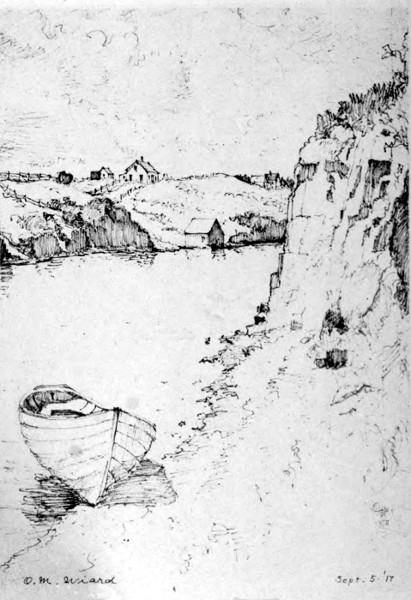
La Rose seated herself on a flat rock by the road,
and Michel found another for himself close by. Below
them lay a deep rocky cove, with shores as steep
as a sluice, and close above its inner margin stood the
shell of a small house. The chimney had fallen in, the
windows were all gone—only vacant holes now,
through which you saw the daylight from the other
side, and the roof had begun to sag.
"Yes," said La Rose, "it will soon be gone to pieces
entirely, and then there will be nothing to remind anyone
of those Bucherons and what torments they had.
You see there were four of them, an old woman and
two sons, and one of the sons was married, but there
were not any children; and all those four must have
had stones instead of hearts. They were only thinking
how they could get the better of other people, and so
become rich.
"And before that there had been three sons at home;
but one of them—Benoît his name was—had married
a certain Noémi Boudrot; and she was as sweet and
beautiful as a lily, and he too was different from the
others; and so they had not lived here, but had got a
little house at Pig Cove, where they were very happy;
and the good God sent them two children, of a beauty
and gentleness indescribable; and they called them
Évangéline and little Benoît, but you do not need to
remember that, because it is not a part of the story.
"So things went on that way for quite a while; and
all the time those four Bucherons were growing more
and more hard-hearted, like four serpents in a pile
together.
"Well, one day in October that Benoît Bucheron
who lived in Pig Cove was going alone in a small cart
to Port l'Évêque to buy some provisions for winter—flour,
I suppose, and meal, and perhaps some clothes
and some tobacco; and instead of going direct by the
Gros Nez road, he came around this way by the Calvaire
so as to stop in and speak to his relatives; and to
see them welcoming him, you would never have suspected
their stone hearts. But Benoît was solemn for
all that, as if troubled by some idea. Then that sly
old mother, she said:
"'Dear Benoît,' she said, 'what troubles you? Can
you not put trust in your own mother, who loves you
better than her eyes and nose?'—and she smiled at
him just like a fat wicked old spider that is waiting for
a fly to come and get tangled up in her net.
"But Benoît only remembered then that she was his
mother; so he said:
"'I have a fear, me, that I shall not be long for this
world, my mother. Last week I saw a little blue fire
on the barrens one night, and again one night I heard
hoofs going claquin-claquant down there on the beach,
much like the horse without head. And that is why I
am getting my provisions so early, and making everything
ready for the winter. See,' he said, 'here is the
thirteen dollars I have saved this year. I am going to
buy things with it in Port l'Évêque.'
"Now you may depend that when he showed them
all that money, their eyes stuck out like the eyes of
crabs; but of course they did not say anything only
some words of the most comforting. And finally he
said, getting ready to go:
"'If anything should happen,' he said, 'will you
promise me to be good to that poor Noémi and those
two poor little innocent lambs?'—and those serpents
said, certainly, they would do all that was possible;
and with that Benoît gets into his cart, and starts down
the hill; and suddenly the horse takes a fright of something
and runs away, and the cart tips over, and Benoît
is thrown out; and when his brothers get to him he is
quite quite dead—and that shows what it means to
see one of those little blue fires at night in the woods.
"Well, you can believe that Noémi was not very
happy when they brought back that poor Benoît to Pig
Cove. Her eyes were like two brooks, and for a long
time she could not say anything, and then finally, summoning
a little voice of courage:
"'I am glad of one thing,' she said, 'which is that
he had saved all that money, for without it I would
never know how to live through the winter.'
"And one of those brothers said, with an innocent
voice of a dove, 'what money then?'—and she said,
'He had it with him.' And so they look for it; but no,
there is not any.
"'You must have deceived yourself,' said that
brother. 'I am sure he would have spoken of it if he
had had any money with him; but he said never a word
of such a thing.'
"Now was not that a wicked lie for him to tell? It
is hard to understand how abominable can be some of
those men! But you may be sure they will be punished
for it in the end; and that is what happened to those
four serpents, the Bucherons.
"For listen. The old mother had taken the money
and had put it inside a sort of covered bowl, like a
sugar bowl, but there was no sugar in it; and then she
had set this bowl away on a shelf in the cupboard
where they kept the dishes and such things; and the
Bucherons thought it would be safe until the time when
they had something to spend it for in Port l'Évêque;
and they were telling themselves how no one would
ever know what they had done; and they were glad
that the promise they had made to Benoît had not been
heard by anyone but themselves. And so that poor
Noémi was left all alone without man or money; but
sometimes the neighbors would give her a little food;
but for all that those two lambs were often hungry,
and their mother too, when it came bedtime.
"But do you think the Bucherons cared—those four
hearts of stone? They would not even give her so
much as a crust of dry, mouldy bread; and Noémi was
too proud to go and beg; and beside something seemed
to tell her that there had been a wickedness somewhere,
and that the Bucherons perhaps knew more than they
had told her about that money. So she waited to see
if anything would happen.
"Now one night in December, when all those four
were in the house alone, the beginning of their punishment
arrived, and surely nothing more strange was
ever heard of in this world.
"'Ah, mon Dieu!' cries out the married woman all
of a sudden—'mon Dieu, what is that!'
"They all looked where she was looking, and what
do you think they saw? There was a chair standing
with three legs in the air, and only the little point of
one on the floor.
"The old woman pushed a scream and jumped to
her feet and went over to it, and with much force set it
back on the floor, the way a chair is meant to stand;
but immediately when she let go of it, there it was
again, as before, all on one leg.
"And then, there cries out the younger woman again,
with a voice shrill as a frightened horse that throws up
its head and then runs away—'Oh, mère Bucheron,
mère Bucheron,' cries she, 'the chair you were just sitting
in is three legs in air too!'
"And so it was! With that all the family got up in
terror; but no sooner had they done that than at once
all the chairs behaved just like the first, which made
five chairs. These chairs did not seem to move at all,
but stood there on one leg just as if they were always
like that. Those Bucherons were almost dead with
fright, and all four of them fled out of the house as fast
as ever their legs could carry them—you would have
said sheep chased by a mad dog—and never stopped
for breath till they reached Gros Nez.
"And pell-mell into old Pierre Leblanc's house all
together, and shaking like ague. Hardly able to talk,
they tell what has happened; and he will not believe
them but says, well, he will go back with them and see.
So he does, and they re-enter the house together, and
look! the chairs are all just as usual.
"'You have been making some crazy dreams,' says
Pierre, rather angry, 'or else,' he says, 'you have
something bad in your hearts.' And with that he goes
home again; and there is nothing more to be told about
that night, though I daresay none of those wicked persons
slept very well.
"But that was only the beginning of what happened
to them during that winter. Sometimes it would be
these knockings about the roof, as of someone with a
great hammer; and again it was as if they had seen a
face at the window—just an instant, all white, in the
dark—and then it would be gone. And often, often,
the chairs would be standing as before on one leg. The
table likewise, which once let fall a great crowd of
dishes, and not a few were broken. But worst of all
were these strange sounds that made themselves heard
in the cupboard, like the hand of a corpse going rap—rap,
rap—rap—rap, rap,—against the lid of its
coffin. You may well believe it was a dreadful fright
for those four infamous ones; but still they would do
nothing, because of their desire to keep all that money
and buy things with it.
"Everybody on the Cape soon knew about what was
happening at the Bucherons', but some pretended it
was to laugh at, saying that such things did not happen
nowadays; and others said the Bucherons must have
gone crazy, and had better be left alone—and their
arms and legs would sometimes keep jerking a little
when they talked to anyone, as my stepmother told me
a thousand times; and they had a way of looking
behind them—so!—as if they were afraid of being
pursued. So however that might be, nobody would go
and see them.
"Well, things went on like that for quite a while,
and finally, one day in February, through all the snow
that it made on the ground then, that poor Noémi
marched on her feet from Pig Cove to her mother-in-law's,
having left her two infants at a neighbor's; for
she had resolved herself to ask for some help, seeing
that she had had nothing but a little bite since three
days. And when they saw her coming they were taken
with a fright, and at first they were not going to let
her in; but that old snake of a mother, she said:
"'If we refuse to let her in, my children, she will go
and suspect something.'
"So they let her in, and when she was in, they let
her make all her story, or as much as she had breath
for, and then:
"'I am sorry,' said this old snake of a mother, 'that
we cannot possibly do anything for you. Alas, my dear
little daughter, it is barely even if we can manage to
hold soul and body together ourselves, with the terrible
winter it makes these days.'
"And just as she said that, what do you think happened?
A chair got on one leg and went rap—rap,
rap—against the floor.
"That Noémi would often be telling about it afterwards
to my stepmother, and she said never of her life
had she seen anything so terrifying. But she did not
scream or do anything like that, because something,
she said, inside her seemed to bid her keep quiet just
then. And she used to tell how that old Bucheron
woman's face turned exactly the color of an oyster on
a white plate, and a trembling took her, and finally she
said, scarcely able to make the sound of the words:
"'Though perhaps—I might find—a crust of
bread somewhere that—that we could spare.'
"That was how she spoke, and at the same instant,
rap went the chair, still on its one leg; and there was a
sound of a hammering on the roof.
"'Or perhaps—a little loaf of bread and some
potatoes,' said that old Bucheron, while the other
Bucherons sat there without one word, in their chairs,
as if paralyzed, except that their hands kept up a little
shaking motion all the time, like this scour-grass you
get in the marsh, which trembles always even if there
is not any wind. 'Or perhaps a loaf of bread and some
potatoes'—that is what she was saying, when listen,
there is a knock as of the hand of corpse just inside the
cupboard; and suddenly the two doors fly open—you
would have said pushed from the inside!
"Noémi crosses herself, but does not say anything,
for she knows it is a time to keep still.
"'And perhaps,' says the old woman then, in a voice
of the most piteous, as if someone were giving her a
pinch, 'and perhaps, if only I had it, a dollar or two to
help buy some medicine and a pair of shoes for that
Évangéline.... But no, I do not think we have so
much as that anywhere in the house.'
"Now was not that like the old serpent, to be telling
a lie even at the last; and surely if God had struck her
dead by a ball of lightning at that moment it would
have been none too good for her. But no, he was
going to give her a chance to repent and not to have to
go to Hell for a punishment. So what do you think
He made happen then?
"Hardly had those abominable words jumped out
of her when with a great crash, down off the top shelf
comes that sugar bowl (if it was a sugar bowl), and
as it hits the floor, it breaks into a thousand pieces;
and there, in a little pile, are those thirteen dollars,
just as on the day when that poor Benoît had been carrying
them with him to Port l'Évêque.
"Now just as if they are not doing it at all of their
own wish, but something makes them act that way, all
of a sudden those four Bucherons are kneeling on the
floor, saying their prayers in a strange voice like the
prayers you might hear in a tomb; and with that, the
chair goes back quietly to its four legs, and the noise
ceases on the roof, and those two cupboard doors draw
shut without human hands. As for Noémi, she grabs
up the money, and out she goes, swift as a bird that is
carrying a worm to its children, leaving her parents by
marriage still there on their knees, like so many
images; but as she opens the door she says:
"'May the good God have pity on all the four of
you!'—which was a Christian thing to say, seeing
how much she had suffered at their hands.
"Well, there is not much more to tell. Noémi got
through the rest of that winter without any more
trouble; and the next year she married a fisherman
from Little Anse, and went away from the Cape. As
for the Bucherons, they were not like the same people
any more. You would not have known them—so
pious they were and charitable, though always, perhaps,
a little strange in their ways. But when the old
woman died, two years later, or three, all the people
of Pig Cove and Gros Nez followed the corpse in to
Port l'Évêque; and her grave is there in the cemetery.
"The rest of the family are gone now too, as you
see; and soon, I suppose, there will not be many left,
even out here on the Cape, who know all about what
happened to the Bucherons, because of their hard
hearts; which is a pity, seeing that the story has such a
good lesson to it...."
[A]Of the Headless Horse and of La Belle Mélanie's
Narrow Escape from the Feu Follet
One of the privileges Michel esteemed most
highly was that of accompanying La Rose
occasionally when she went blueberrying
over on the barrens—dans les bois, as the
phrase still goes in Port l'Évêque, though it is all of
sixty years since there were any woods there. The
best barrens for blueberrying lay across the harbor.
They reached back to the bay four or five miles to
southward. Along the edges of several rocky coves,
narrow and steep as a sluice, clung a few weatherbeaten
fishermen's houses; but there was no other sign
of human habitation.
It is what they call a bad country over there. Alder
and scrub balsam grow sparsely over the low rocky
hills, where little flocks of sheep nibble all day at the
thin herbage; and from the marshes that lie, green and
mossy, at the foot of every slope, a solitary loon may
occasionally be seen rising into the air with a great
spread of slow wings. A single thread of a road
makes its way somehow across the region, twisting in
and out among the small hills, now climbing suddenly
to a bare elevation, from which the whole sweep of the
sea bursts upon the view, now shelving off along the
side of a knoll of rocks, quickly dipping into some
close hollow, where the world seems to reach no
farther than to the strange sky-line, wheeling sharply
against infinite space.
Two miles back from the inner shore, the road
forks at the base of a little hill more conspicuously
bare than the rest, and close to the naked summit of it,
overlooking all the Cape, stands a Calvary. Nobody
knows how long it has stood there, or why it was first
erected; though tradition has it that long, long ago, a
certain man by the name of Toussaint was there set
upon by wild beasts and torn to pieces. However that
may be, the tall wooden cross, painted black, and bearing
on its center, beneath a rude penthouse, a small
iron crucifix, has been there longer than any present
memory records—an encouragement, as they say, for
those who have to cross the bad country after dark.
"That makes courage for you," they say. "It is
good to know it is there on the windy nights."
By daylight, however, and especially in the sunshine,
the barrens are quite without other terrors than those
of loneliness; and upon Michel this remoteness and
silence always exercised a kind of spell. He was glad
that La Rose was with him, partly because he would
have been a little afraid to be there quite by himself,
but chiefly because of the imaginative sympathy that at
this time existed so strongly between them. La Rose
could tell him all about the strange things that had
been seen here of winter nights; she herself once, tending
a poor old sick woman at Gros Nez, out at the end
of the Cape, had heard the hoofs of the white horse
that gallops across the barrens claquin-claquant in the
darkness.
"It was just there outside the house, pawing the
ground. Almost paralyzed for terror, I ran to the
window and looked out. It was as tall as the church
door,—that animal,—all white, and there was no
head to it.
"'Oh, mère Babinot,' I whispered, scarcely able to
make the sound of the words. 'It is as tall as the
church door and all white.'
"She sits up in bed and stares at me like a corpse.
'La Rose,' she says,—just like that, shrill as a whistle
of wind,—'La Rose, do you see a head to it?'
"'No, not any!'
"'Oh, mon Dieu, mon Dieu! Then it's sure! It is
the very one, the horse without head!'
"And the next day she took only a little spoonful of
tea, and in two weeks she was dead, poor mère Babinot;
and that's as true as that I made my communion
last Easter. Oh, it's often seen hereabouts, that horse.
It's a sign that something will happen, and never has
it failed yet."
They made their way, La Rose and Michel, slowly
over the low hills, picking the blueberries that grew
thickly in clumps of green close to the ground. La
Rose always wore a faded yellow-black dress, the skirt
caught up, to save it, over a red petticoat; and on her
small brown head she carried the old Acadian mouchoir,
black, brought up to a peak in front, and knotted
at the side.
She picked rapidly, with her alert, spry movements,
her head always cocked a little to one side, almost
humorously, as she peered about among the bushes for
the best spots. And wherever he was, Michel heard
her chattering softly to herself, in an inconsequential
undertone, now humming a scrap of some pious song,
now commenting on the quality of the berry crop—never
had she seen so few and so small as these last
years. Surely there must be something to account for
it. Perhaps the birds had learned the habitude of devouring
them—now addressing some strayed sheep
that had ventured with timid bleats within range:
"Te voilà, petit méchant! Little rogue! What are
you looking about for? Did the others go off and
leave you? Eh bien, that's how it happens, mon
petit. They'll leave you. The world's like that. Eh,
là, là!"
He liked to go to the other side of the hill, out of
sight of her, where he could imagine that he was lost
dans les bois. Then he would listen for her continual
soft garrulity; and if he could not hear it he would
wait quietly for a minute in the silence, feeling a
strange exhilaration, which was almost pain, in the
presence of the great sombre spaces, the immense
emptiness of the overhanging sky, until he could endure
it no longer.
"La Rose!" he would call. "Êtes-vous toujours
là?"
"Mais oui, mon enfant. What do you want?"
"Nothing. It is only that I was thinking."
"The strange child that you are!" she would exclaim.
"You are not like the others."
"La Rose," he would ask, "was it by here that La
Belle Mélanie passed on the night she saw the death
fire?"
"Yes, by this very spot. She was on her way to Pig
Cove, over beyond the Calvary to the east. It is a
desolate little rat-hole, Pig Cove, nowadays; but then
it was different—as many as two dozen houses. My
stepmother lived in one of them. Now there are
scarcely six, and falling to pieces at that. La Belle
Mélanie, she was a Boudrot, sister of the Pierre Boudrot
whose son, Théobald, was brother-in-law of stepmother.
That was many years ago. They are all dead
now, or gone away from here—to Boston, I daresay."
"Will you tell me about that again,—the feu follet
and Mélanie?"
It was the story Michel liked the best, most of all
when he could sit beside La Rose, on a moss-hummock
of some rough hill on the barrens. Perhaps there
would be cloud shadows flitting like dream presences
across the shining face of the moor. In the distance,
over the backs of the hills that crouched so thickly
about them, he saw the stretch of the ocean, a motionless
floor of azure and purple, flecked, it might be, by
a leaning sail far away; and now and then a gull or
two would fly close over their heads, wheeling and
screaming for a few seconds, and then off again
through the blue.
"S'il vous plaît, tante La Rose, see how many berries
I have picked already!"
The little woman was not difficult of persuasion.
"It was in November," she began. "There had not
been any snow yet; but the nights were cold and terribly
dark under a sky of clouds. That autumn, as my
stepmother often told me, many people had seen the
horse without head as it galloped claquin-claquant
across the barrens. At Gros Nez it was so bad that
no one dared go out after dark, unless it was to run
with all one's force to the neighbors—but not across
the woods to save their souls. Especially because of
the feu follet.
"Now you must know that the feu follet is of all
objects whatever in the world the most mysterious. No
one knows what it is or when it will come. You might
walk across the barrens every night of your life and
never encounter it; and again it might come upon you
all unawares, not more than ten yards from your own
threshold. It is more like a ball of fire than any other
mortal thing, now large, now small, and always moving.
Usually it is seen first hovering over one of the
marshes, feeding on the poison vapors that rise from
them at night: it floats there, all low, and like a little
luminous cloud, so faint as scarcely to be seen by the
eye. And sometimes people can travel straight by it,
giving no attention, as if they did not know it was
there, but keeping the regard altogether ahead of them
on the road, and the feu follet will let them pass without
harm.
"But that does not happen often, for there are not
many who can keep their wits clear enough to manage
it. It brings a sort of dizziness, and one's legs grow
weak. And then the feu follet draws itself together
into a ball of fire and begins to pursue. It glides over
the hills and flies across the marshes, sometimes in
circles, sometimes bounding from rock to rock, but all
the while stealing a little closer and a little closer, no
matter how fast you run away. And finally—bff! like
that—it's upon you—and that's the end. Death for
a certainty. Not all the medicine in the four parishes
can help you.
"Indeed, there are only two things in all the world
that can save you from the feu follet once it gets after
you. One is, if you are in a state of grace, all your
sins confessed; which does not happen often to the
inhabitants of Pig Cove, for even at this day Père Galland
reproaches them for their neglect. And the other
is, if you have a needle with you. So little a thing as a
needle is enough, incredible as it may seem; for if you
stick the needle upright—like that—in an old stump,
the feu follet gets all tangled up in the eye of it. Try
as it will, it cannot free itself; and meanwhile you run
away, and are safe before it reappears. That is why
all the inhabitants of the Cape used to carry a needle
stuck somewhere in their garments, to use on such an
occasion.
"Well, I must tell you about La Belle Mélanie.
That is the name she was known by in all parts, for
she was beautiful as a lily flower, and no lily was ever
more pure and sweet than she. Mélanie lived with her
mother, who was aged almost to helplessness, and she
cared for her with all the tenderness imaginable. You
may believe that she was much sought after by the
young fellows of the Cape—yes, and of Port l'Évêque
as well, which used to hold its head in the air in those
days; but her mother would hear nothing of her
marrying.
"'You are only seventeen,' she said, 'ma Mélanie.
I will hear nothing of your marrying, no, not for five
years at the least. By that time we shall see.'
"And Mélanie tried to be obedient to all her
mother's commands, difficult as they often were for a
young girl, who naturally desires a little to amuse herself
sometimes. For even had her mother forbidden
her to speak alone to the young men of the neighborhood,
so fearful was she lest her daughter should think
of marriage.
"Eh bien, and so that was how things went for quite
a while, and every day Mélanie grew more beautiful.
And one Saturday afternoon in November she had
been in to Port l'Évêque to make her confession, for
she was a pious girl. And when she went to meet her
companions in order to return to Pig Cove with them,
they said they were not going back that night, for there
was to be a dance at the courthouse, and they were
going to spend the night with some parents by marriage
of theirs. Poor Mélanie! she would have been glad
to stay, but alas, her poor mother, aged and helpless,
was expecting her, and she dared not disappoint the
poor soul.
"So finally one of the young men said he would put
her across the harbor, if she did not mind traversing
the woods alone; and she said, no, why should she
mind? It was still plain daylight. And so he put her
across. And she said good-night to him and set off
along the solitary road to the Cape, little imagining
what an adventure was ahead of her.
"For scarcely had she gone so much as a mile when
it had grown almost night, so suddenly at that time of
the year does the daylight extinguish itself. The sky
had grown dark, dark, and there was a look of storm
in it. La Belle Mélanie began to grow uneasy of mind.
And she thought then of the feu follet, and put her
hand to her bodice to assure herself of her needle.
What then! Alas! it was gone, by some accident,
whether or not she had lost it on the road or in the
church.
"With that Mélanie began to feel a terror creep
over her; and this was not lessened, as you may well
believe, when, a few minutes later, she perceived a
floating thing like a luminous cloud in a marsh some
long distance from the road. The night was now all
black; scarcely could she perceive the road ahead,
always winding there among the hills.
"She had the idea of running; but alas, her legs
were like lead; she could not make them march in
front of her. She saw herself already dead. The feu
follet was beginning to move, first very slowly and all
uncertain, but then drawing itself together into a ball
of fire, and leaping as if in play from one hummock of
moss to another, just as a cat will leave a poor little
mouse half dead on the floor while it amuses itself in
another way.
"What the end would have been, who would have
the courage to say, if just at this moment, all ready to
fall to the ground for terror, poor Mélanie had not
bethought herself of her rosary. It was in her pocket.
She grasped it. She crossed herself. She saluted the
crucifix. And then she commenced to say her prayers;
and with that, wonderful to say, her strength came
back to her, and she began to run. She had never ran
like that before—swift as a horse, not feeling her legs
under her, and praying with high voice all the time.
"But for all that, the death fire followed, always
faster and faster, now creeping, now flying, now leaping
from rock to rock, and always drawing nearer, and
nearer, with a strange sound of a hissing not of this
world. Mélanie began to feel her forces departing.
She was almost exhausted. She would not be able to
run much more.
"And suddenly, just ahead, on a bare height, there
was the tall Calvaire, and a new hope came to her. If
she could only reach it! She summoned all her strength
and struggled up. She climbs the ascent. Alas,
once more it seems she will fail! There is a fence, as
you know, built of white pales, about the cross. She
had not the power to climb it. She sinks to the ground.
And it was at that last minute, all flat on the ground in
fear of death, that an idea came to her, as I will
tell you.
"She raises herself to her feet by clinging to the
white palings; she faces the feu follet, already not
more than ten yards away; she holds out the rosary,
making the holy sign in the air.
"'I did not make a full confession!' she cries. 'I
omitted one thing. My mother had forbidden me to
have anything to do with a young man; and one day
when I was looking for Fanchette, our cow, who had
wandered in the woods, I met André Babinot, and he
kissed me.'
"That was what saved her. The feu follet rushed
at her with a roar of defeat, and in the same instant it
burst apart into a thousand flames and disappeared.
"As for Mélanie, she fell to the ground again, and
lay there for a while, quite unconscious. At last the
rain came on, and she revived, and set out for home,
but not very vigorously. Ah, mon Dieu! if her poor
mother was glad to see her alive again! She embraced
her most tenderly, and with encouraging voice inquired
what had happened, for Mélanie was still as white as
milk, and there was a strange smell of fire in her garments,
and still she held in her hands the little rosary;
and so finally Mélanie told her everything, not even
concealing the last confession about André, and with
that her mother burst into tears, and said:
"'Mélanie,' she said, 'I have been wrong, me. A
young girl will be a young girl despite all the contrary
intentions of her mother. To show how grateful to
God I am that you are returned to me safe and sound,
you shall marry André as soon as you like.'
"So they were married the next year. And there is
a lesson to this story, too, which is that one should
always tell the truth; because if La Belle Mélanie had
told all the truth at the beginning she would not have
had all that fright.
"And to show that the story is true, there were
found the marks of flames on the white fence of the
Calvaire the next day; and as often as they painted it
over with whitewash, still the darkness of the scorched
wood would show through, as I often saw for myself;
but now there is a new fence there...."
Of How Old Siméon's Son Came Home Again
In the old cemetery above the church some
men were at work setting up a rather ornate
monument at the head of two long-neglected
and overgrown graves. La Rose had noticed
what was going on, as she came out from early
mass, and had informed herself about it; and since
then, she said, all through the day, her thoughts had
been traveling back to things that happened many
years ago.
"Is it not strange," she observed musingly, sitting
about dusk with Michel on the doorsill of the kitchen,
while Céleste finished the putting-away of the supper
dishes—"is it not strange how things go in this
world? So often they turn out sorrowfully, and you
cannot understand why that should be so. Think of
that poor Léonie Gilet, who was taken so suddenly in
the chest last winter and died all in a month, and she
one of the purest and sweetest lilies that ever existed,
and the next year she was to be married to a good man
that loved her better than both his two eyes. Ah,
mon Dieu, sometimes I think the sadness comes much
more often than the joy down here."
She looked out broodingly, and with eyes that did
not see anything, across the captain's garden and the
hayfield below, dipping gently to the margin of the
harbor. Michel was silent. La Rose's fits of melancholy
interested him even when he only dimly sensed
the burden of them.
"And then," she resumed, after a moment, "sometimes
the ending to things is happy. For a while all
looks dark, dark, and there is grief, perhaps, and some
tears; and then, just at the worst moment—tiens!—there
is a change, and the happiness comes again, very
likely even greater than it was at first. It is as if this
good God up there, he could not bear any longer to see
it so heartbreaking, and so he must take things into his
own hands and set them right. And so, sometimes,
when I find myself feeling sad about things, I like to
remember what arrived to that poor Siméon Leblanc,
whose son is just having them place a fine tombstone
for him up there in the cimetière; for if ever happiness
came to any man, it came to him, and that after a
long time of griefs. Did you ever hear about this old
Siméon Leblanc?"
"Never, tante La Rose," answered the boy, gravely.
"But if it has a pleasant ending, I wish you would tell
me about it, and I don't mind if it makes me cry a little
in the middle."
By this, Céleste, the stout domestic, had finished her
kitchen work, and throwing an apron over her stocky
head and shoulders, she clumped out into the yard.
"I am running over to Alec Samson's," she explained,
"to get a mackerel for breakfast, if he caught
any to-day."
The gate clicked after her, and there was a silence.
At last La Rose began, a little absently and as if, for
the moment at least, unaware of her auditor....
"This Siméon Leblanc, he lived over there on the
other side of the harbor, just beyond the place where
the road turns off to go to the Cape. My poor stepmother
when coming in to Port l'Évêque to sell some
eggs or berries—three gallons, say, of blueberries, or
perhaps some of those large strawberries from Pig
Cove—she would often be running in there for a little
rest and a talk with his wife, Célie—who always was
glad to see any one, for that matter, the poor soul, for
this Siméon was not too gentle, and often he made her
unhappy with his harsh talk.
"'Ah, mon amie,' she would say to my stepmother,
at the same time wetting her eyes with tears—'Ah, I
have such a fear, me, that he will do himself a harm,
one day, with the temper he has. He frightens me to
death sometimes—especially about that Tommy.'
"Now you must understand that this Tommy was
the son they had, and in some ways he resembled to
his father, and in some ways to his mother. For it is
certain he had a pride of the most incredible, which I
daresay made him a little hard to manage; and yet in
his heart there was a softness.
"'That Tommy,' said his mother, 'he wants to be
loved. That is the way to get him to do anything.
There is no use in always punishing him and treating
him hardly.'
"But for all that, old Siméon must have his will,
and so he does not cease to be scolding the boy. He
commands him now to do this thing, now that—here,
there. He forbids him to be from home at night. He
tells him he is a disgrace of a son to be so little
laborious. Oh, it was a horror the way that poor lamb
of a Tommy was treated; and finally, one day, when
he was seventeen or eighteen, there was a great quarrel,
and that Siméon called him by some cruel name,
and white as a corpse cries out Tommy:
"'My father, that is not true. You shall not say
it!'—and the other, furious as an animal: 'I shall say
what I choose!' And he says the same thing again.
And Tommy: 'After that, I will not endure to stay
here another day. I am tired of being treated so.
You will not have another chance.'
"And with that he places a kiss on the forehead of
his poor mother, who was letting drop some tears, and
walks out of the house without so much as turning his
head again; and he marches over to Petit Ingrat,
where there was an American fisherman which had
put in for some bait, and he says to the captain: 'Will
you give me a place?' and the captain says, 'We are
just needing another man. Yes, we will give you a
place.' So this Tommy, he got aboard, and a little
later they put out and went off to the Banks for the
fish.
"Well, it was not very long before that Siméon got
over his bad wicked rage; and then he was sorry
enough for what he had done, especially because there
was no longer any son in the house, and that poor
Célie must always be grieving herself after him. And
you may believe that Siméon got little pity from the
neighbors.
"'It is good enough for him,' they would say—'a
man like that, who is not decent to his own son.'
"But they were sorry for Célie, most of all when
she began to grow thinner and thinner and had a
strange look in her eyes that was not entirely of this
world. The old man said, 'She will be all right again
when that schooner comes back,' and he was always
going over to Petit Ingrat to find out if it had returned
yet; but you see, of course there would not be any need
of bait when the season was finished, and so the
schooner did not put in at all; and the autumn came,
and went by, and then followed the winter, and still no
news, but only waiting and waiting, and a little before
Easter that poor Célie went away among the angels. I
think her heart was quite broken in two, and it did not
seem to her that she needed to stay any longer in this
hustling world. And so they buried her in the old
cimetière—I saw her grave to-day, next to Siméon's,
and this fine new monument is to be for the two of
them; but for all these years there has been just a
wooden cross there, like the other graves.
"But still no word came of Tommy, and the old
Siméon was all alone in the house. Oh, I can remember
him well, well, although I was only a young tiny
girl then and had not had any sorrow myself. We
would see him walking along the Petit Ingrat road, all
bent over and trailing one leg a little.
"'Hst!' one of my companions would whisper,
'that is old Siméon, who drove his son from home;
and his poor wife is dead with grief. He is going
across there to see if a schooner will have come in yet
with any news.'
"And that was true. He took this habitude of making
a promenade almost every day to Petit Ingrat during
that season of the year when the Americans are
going down to the fish—là-bas—and if there was a
schooner in the harbor, he finds the captain or one of
the crew, and he says, 'Is it, m'sieu, for example, that
you have seen a boy anywhere named Tommy Leblanc?
It is my son—you understand?—a very
pretty young boy, with black hair and fine white teeth
and a little curly mustache—so—just beginning to
sprout.' And he would go on to describe that Tommy,
but of course, for one thing they could not understand
his French very well, for the Americans, as you know,
do not speak that language among themselves; and
anyway, you may depend that none of them had ever
heard of Tommy Leblanc; and sometimes they would
have a little mockery of the old man; and sometimes,
on the contrary, they would feel pity, and would say,
well, God's name, it was a damage, but they could not
tell him anything.
"And then the old man would say, 'Well, if ever you
should see him anywhere, will you please tell him that
his father is wanting him to come home, if he will be
so kind as to do it; because it is very lonesome without
him, and the mother is dead.'
"Then after he had said that, he would go back
again along the road to the Cape, not speaking to anybody
unless they spoke to him first, and trailing one
leg after him a little, like one of these horses you see
sometimes with a weight tied to a hind foot so that it
cannot run away—or at least not very far. That is
how I remember old Siméon from the time when I was
a little girl—walking there along the road to or from
Petit Ingrat. I used to hear people say: 'Ah, my God,
how old he is grown all in these few years! He is not
the same man—so quiet and so timid'—and others:
'But can one say how it is possible for him to live there
all alone like that?'—and someone replied: 'You
could not persuade him to live anywhere else, for that
is where he has all his memories, both the good and
the bad, and what else is left for him now—that, and
the crazy idea he has that his Tommy will one day
come home again?'
"You see, as the years passed, everybody took the
belief that Tommy must be dead, at sea or somewhere,
seeing that not one word was heard of him; but of
course they guarded themselves well from saying anything
like that to poor old Siméon.
"Well, it was about the time when your poor father,
Amédée, was a boy of your age, or a little older, that
all this sorrow came to an end; and this is the pleasant
part of the story. I was living at Madame
Paon's then, down near the post-office wharf, and we
had the habitude of looking out of the window every
day when the packet-boat came in (which was three
times a week) to see if anybody would be landing at
Port l'Évêque. Well, and one afternoon whom should
we see but a fine m'sieu with black beard, carrying a
cane, dressed like an American; and next, a lovely lady
in clothes of the most fashionable and magnificent;
and then, six beautiful young children, all just as handsome
as dolls, and holding tightly one another by the
hand, with an affection the most charming in the world.
Ah, ma foi, if I shall ever forget that sight!
"And Madame Paon to me: 'Rose,—La Rose,—in
God's name, who can they be! Perhaps some millionaires
from Boston—for look, the trunks that they
have!'
"And that was the truth, for the trunks and bags
were piled all over the wharf; and opening the window
a little, we hear m'sieu giving directions to have them
taken to the Couronne d'Or—'and who,' he asks in
French, 'is the proprietor there now?'—and they
say: 'Gaston Lebal'—and he says: 'What! Gaston
Lebal! Is it possible!'
"'He knows Port l'Évêque, it seems,' says Madame
Paon, all excitement; and just then the first two trunks
go by the windows, and she tells me, 'It is an English
name, or an American.' And then, spelling out the
letters, for she reads with a marvel of ease, she says,
'W-H-I-T-E is what the trunks say on them; but I can
make nothing out of that. I am going outside, me,'
she says, 'and perhaps I shall learn something.'
"She descends into the garden, and seems to be
working a little at the flowers, and a minute later, here
comes the fine m'sieu, and he looks at her for an
instant—right in the face, so, and as if asking a question—and
then: 'Ah, mon Dieu, it is Suzon Boudrot!'
he cries, using the name she was born with. 'Can you
not remember me?—That Tommy Leblanc who ran
away twenty years ago?'
"Madame Paon gives a scream of joy, and they
embrace; and then he presents this Mees W'ite, qui est
une belle Américaine, and then he says: 'What is there
of news about my dear mother and my father?'—and
she: 'Did you not know your poor mother was dead
the year after you went!'—and he: 'Ma mère—she
is dead?'—and the tears jump out of his eyes, and his
voice trembles as if it had a crack in it. 'Well, she is
with the blessed angels, then,' says he.
"'But your poor old father,' goes on Madame
Paon, 'he is still waiting for you every day. He has
waited all these twenty years for you to come back.'
"'He is still in the old place?' asks he.
"'Yes, he would not leave it.'
"'We shall go over there at once,' he says, opening
out his two arms—so!—'before ever we set foot in
another house. It is my duty as a son.'
"So while André Gilet—the father of that dear
Léonie who was taken in the chest—while he is getting
the boat ready to cross the harbor, Tommy tells
her how he has been up there in Boston all these years—at
a place called Shee-cahgo, a big city—and has
been making money; and how he changed his name to
W'ite, which means the same as Leblanc and is more in
the mode; and how he married this lovely Américaine,
whose name was Finnegan, and had all these sweet
little children; but always, he said, he had desired to
make a little visit at home, only it was so far to come;
and he was afraid that his father would still be angry
at him.
"'Ah,' says Madame Paon, with emotion, 'you will
not know your father. He is so different: just as mild
as a sheep. Everyone has come to love him.' ...
"Now for the rest of the story, all I know is what
that André told us, for he put all this family across
to the other side in his boat. So when they reached
the shore, M'sieu Tommy, he says: 'You will all wait
here until I open the door and beckon: and then you,
Maggie, will come up; and then, a little later, we will
have the children in, all together.'
"And with that he leaves them, and goes up to the
old house, and knocks, and opens the door, and walks
in—and who can say the joy and the comfort of the
meeting that happened then? And quite a long while
passed, André said; and that lovely lady sat there on
the side of the boat, all as white as milk, and never
saying a word; and those six lambs, whispering softly
among themselves—and one of them said, just a
little above its breath:
"'It will be nice to have a grandpa all for ourselves,
don't you think?'—and was not that a dear sweet
little thing for it to say?...
"And finally the door opens again, and see! and his
hand makes a sign; and that lady, swift as one of these
sea-gulls, leaps ashore. And up the hill; and through
the gate; and into the house! And the door shuts
again.
"And another wait, while those six look at each
other, and say their little things. And at last they are
called too, and away they go, all together, just like one
of these flocks of curlew that fly over the Cape, making
those soft little sounds; and then into the house;
and André said he had to wipe two tears out of his
eyes to see a thing like that.
"Well, this was the end of old Siméon's grief, as
you may well believe. Those W'ites stay at the Couronne
d'Or for as much as nine or ten days, and every
morning they will be going across to see their dear
dear grandfather; and finally when they went away,
they had hired that widow Bergère to keep his house
comfortable for him; and M'sieu Tommy left money
for all needs.
"And every Christmas after that, so long as old
Siméon existed, there would come boxes of presents
from that place in Boston. Oh, I assure you, he did
not lack that good care. And always he must be talking
about that Tommy of his, who was so rich, and
was some great personage in the city—what they
called an alderman—and yet he had not forgotten his
poor old father, who had waited all those years to see
him.
"So this story shows that sometimes things turn out
just as well in this life down here as they do in those
silly stories they tell you about princesses and all those
things that are not so; and that is a comfort sometimes,
when you see so much that is sad and heartbreaking
in this world...."
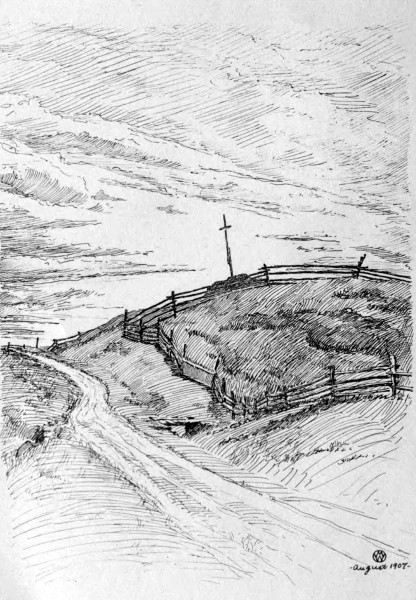
A CALVAIRE