Willy Peeble's autocar brought the Petty family home from the Paulmouth
depot.
Orrin Petty, who was notoriously as close as the skin to an eel, would
never have willingly agreed to such an expense. But county fair day was
the one day in the year when his wife put her foot down and insisted
upon the family making what the son, Tom, called "a splurge."
At Harwich Fair they were sure to meet all the Pettys that were worth
meeting, as well as many of Mrs. Petty's girlhood friends. Harwich was
a long way from Cardhaven, and Cape Cod folk are not given to useless
"visiting around." The neighbors well knew Orrin's cheese-paring ways
and Sarah's temper, as well as Tom Petty's utter uselessness. But the
family had a reputation to keep up with their relatives and friends at
a distance.
So Sarah Petty thought. That was one reason why Pearl had been left
at home. Mrs. Orrin Petty wanted no poor relation tagging them around
at the fair. Besides, Pearly's skimpy wardrobe might be difficult to
explain in the light of the rest of the family flaunting their Sunday
best.
Mrs. Petty was a little, trig, birdlike woman, with all the scrappy
temper of that curse of birddom, the English sparrow. She hopped out of
the autocar, paid Willy Peebles his fare to a penny—and no more—and
went into the house clacking smart heels, while Orrin and Tom followed
more slowly, laden with samples, prize packets, catalogs, and that
wealth of useless lumber always to be gathered at a county fair.
The menfolk were rather glum. Orrin because of the heavy expenses of
the day; Tom for a secret trouble that bore upon his soul. But Sarah
Petty was as spry and spiteful as usual.
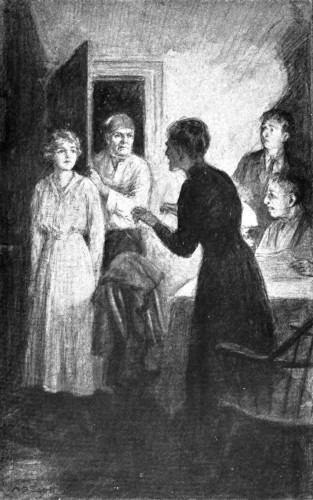
"What I want to know first of all, Pearl Holden, is why them blinds is
open?" she demanded bustling into the house.
Pearl was just rolling the last piece of the huge wash into a hard damp
ball, and she tucked it down into the tightly packed basket with vigor.
She asked, however, quite mildly:
"What blinds, Miz Petty?"
"Them best room blinds, with the sun pourin' in all aft'noon onto my
new rugs and that counterpane."
"I didn't know he did that," said Pearl composedly.
"Who d'you mean—'he'?" Then she almost screamed as she saw the empty
plates and the coffee pot. "Who you been feedin', Pearl Holden? At my
expense, too, and jest as soon as my back's turned. Some tramp?"
"It's your uncle," Pearl explained, and it seemed that for once Mrs.
Petty could neither irritate nor browbeat her.
"My what?"
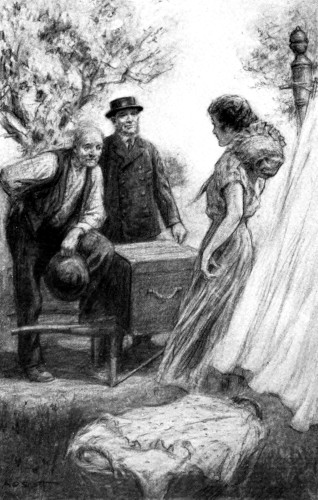
"Your Uncle Jonah. Cap'n Jonah Hand," said Pearl placidly. "He's come
to stop a spell. Brought his chest. Him and Washy Gallup took it up to
the best chamber."
"Them two tramps a-trackin' up the front stairs and that best room?"
shrieked Mrs. Petty, falling into a kitchen chair and staring at Pearl
as though she thought the girl had taken leave of her senses.
"Where would you have me put your uncle? In the woodshed?" asked Pearl,
with much more courage than usual. "He looks perfectly respectable to
me. And he's your own uncle."
"Who's this is your own uncle?" demanded Orrin Petty, coming heavily
into the kitchen and piling his armful of trash on the table.
"Jonah Hand. You've heard of him enough, Orrin Petty," said his wife
rather breathlessly. "And you'll remember he was here once—years ago,
when Tommy was a baby."
"That's all right, then," said her husband. "He don't visit often."
"But he writ me last year he thought of givin' up follerin' the sea and
comin' here to Cardhaven to settle down."
"Goshamighty!"
"I never thought the old fool would take me up," said Sarah Petty
viciously. "But I wrote him he'd be welcome."
"You did? Was you crazy?" demanded Orrin, his pale eyes suddenly
firing. "You reckon on havin' your pauper relations come here to live
on us?"
"Don't you say nothin' like that to me, Orrin Petty!" flared his wife.
"There's paupers on your side of the family, too," and she glanced
significantly at Pearl.
The girl was too used to such unkind remarks to take open offense.
"Besides," added Sarah Petty with hesitation, "Uncle Jonah Hand might
make some trouble for us, Orrin. I dunno. Where is he, Pearl?"
"He just stepped down to Cap'n Abe's store to buy him some snuff."
"Faugh! I might ha' knowed he'd be a nasty, old sailor, full o' filthy
habits."
"Well," drawled Master Tom, who was a lout of a youth several years
older than Pearl, "I reckon Pop and I can set his chist out in the
lane, if you say so, Marm."
"I—I dunno's that's best," said the woman, again strangely uncertain
for so assured a character. She turned sharply upon Pearl, whose ears
might be more acute than she cared to have them for the moment. "Take
that clothes-basket into the storeroom. It's little you've been doing
to-day, I can see, you good-for-nothing. Not a scrap of the wash as yet
ironed. And you flaunting that new dress. Hurry back, now, and draw the
tea. I'm famished for a cup."
She gave her attention swiftly to the two men as soon as Pearl left the
room.
"This Uncle Jonah, now," she hissed. "You remember well enough, Orrin.
I told you all about it when father died and I fell heir to what he
had. The money I got from him just about paid for the building of this
house."
"Wal, ye needn't throw it up to me so often. I know it," Orrin said
glumly enough.
"I'm talking about Jonah Hand now," snapped his wife. "He lent father a
power of money years and years ago. It was two thousand dollars. Uncle
Jonah had just sold his sheer in the Wildwind brig. Father put his
name on a rascal's note an' got into trouble. Father was dreadful easy
that-a-way, an' I guess Uncle Jonah was like him.
"Anyway, Jonah Hand lent him the two thousand without a written scrap
of paper between 'em. But afterward father was silly enough to send
Uncle Jonah his note for the amount. He never paid no interest to Uncle
Jonah, and Uncle Jonah never presented the note for payment; but
if it's in existence yet he might ask for an accounting of father's
estate."
"Goshamighty!" ejaculated Orrin.
"That note wouldn't be good in law after this time," squealed Tom
hopefully.
"You don't know that," snarled his father. "That's only one of your
smart-Aleck sayings."
"Anyway," said Sarah Petty, wringing her hands on her narrow knees,
"he could make it awful unpleasant for us if he wanted to—Uncle Jonah
could. Ev'rybody would know about it. What would your A'nt Apollo Heath
say, Orrin? And Enoch Petty, he that's a State legislator? No, no!
'Twill never do to get the ill will of Uncle Jonah."
"What are you going to do, then, Marm?" asked the curious Tom.
"This dratted girl!" said Sarah Petty. "Mebbe she did just the right
thing for once. She put him in my best room. He's been treated nice
right at the start, I must say. He can't make no complaint that we
didn't meet him as relations should. If we treat him pleasant, but hint
how it's sort o' puttin' us out, his being here, mebbe he'll make his
visit and go, an' leave us in peace."
Orrin Petty had been thinking. Rather, he had been scheming. Orrin
seldom put his wits to work unless his intent was for his own
betterment and to the undoing of somebody else.
"Hush-a-that, Sarah!" he said. "What's this Uncle Jonah of yourn been
all his life?"
"Seafarin', I tell ye."
"Before the mast?"
"Owned his own craft, or had sheers in 'em. Been master of ships since
before Tommy was born," Sarah said. "I know that much."
"We know another thing," said the scheming Orrin. "If he 'cumulated
two thousand dollars to lend your father once't, he might well have
'cumulated more since that time. Ye don't know what he's mebbe got laid
away. Lots o' them old salts line their nests mighty well. Look at
'Liphalet Truitt—and him only a steward all the years he went to sea.
Ain't you this here Uncle Jonah's only livin' rel'tive?"
The three Pettys looked at each other silently for a full minute. They
knew each other's minds so well that some things needed not to be said
at all between them. Pearl came back into the kitchen and bustled about
the stove with the preparations for supper.
"Well, of course," Sarah Petty said in an entirely different tone,
"Uncle Jonah's an old man now, and we air his only relatives. It's
true. And it's quite according that he should come here to stay—for a
while, anyway.
"You be polite to him, Tommy. Better set the table with the gold-banded
china to-night, Pearl. I'll beat up a mess of sour-milk pancakes. I
warrant Uncle Jonah ain't had nothing like 'em on shipboard. An' step
lively for once't—do!"
For Pearl was staring at her, round-eyed. Sarah Petty's wind had
shifted so startlingly that the girl felt quite confounded.
Cap'n Jonah Hand strode down the Shell Road, his cane tapping smartly
and his blue-coated figure very erect. There was a nattiness in the
captain's appearance not always found among masters in the merchant
marine. His experience had been as varied as any skipper's who ever
sailed from the Cape; but as he told Pearl, for many years he was
master of passenger-carrying craft, and a certain behavior is demanded
of a man in that position.
On his quarterdeck and sitting at the head of his table in the
saloon-cabin, Cap'n Jonah must display a courtesy, even an urbanity,
not usually demanded of merchant skippers. A certain dignity sat upon
Cap'n Jonah's countenance, and his manner impressed all who even
casually met him.
He came to the wide-porched store, over the steps of which was nailed
the weather-beaten sign:
A. SILT
General Merchandise
There was nobody on the porch, but the two-leaved door to the store
was open. Inside was a rusty-legged stove, in which a handful of fire
burned despite the warmth of the late October sun. It was cool indoors
and a little damp.
Before the visitor mounted the steps he saw that a full quorum of the
Loungers' Club held sway around Cap'n Abe's stove. The few decrepit
armchairs, as well as several boxes, an overturned nail keg or two,
and even an upended chopping block were occupied by an audience that
listened with more or less impatience to a booming voice that dominated
them in spite of themselves.
"There the Betsy Brown was, hove to and with a sea-anchor to lee'ard,
kickin' up didoes like one o' these busted broncos ye hear tell of in
the Wild West shows. There warn't a feller aboard but the supercargo
that warn't down with the fever, an' he didn't scurcely know the
maintruck from the keelson.
"He didn't durst tetch the tiller, nor bear a hand with sheet nor
halyard. All he could do was to drag himself by aid of a lubberline
from fo'c'stle to after cabin, and give the hands and the afterguard
water to drink. Water and ship's biscuit soaked in it was all the hull
ship's comp'ny put past their lips for two endurin' weeks.
"Yes, sir! The old Betsy Brown strained every timber in her frame an'
when the crew began to crawl about deck again—naught but skeletons
of what they had been—the water was seepin' through half a hundred
seams, with the bilge oozing through the lower deck-planks. Her cargo
of box-shooks was 'bout all that kep' her afloat.
"You kin figger," went on the voice, "in what shape the crew was for a
spell at the pumps and caulkin' ship, even when the sea and gale went
down. It would ha' been a mess in a dead ca'm——
"Af'noon, sir! What can I do for you?"
The booming voice changed instantly to the brisk challenge of the
merchant. Through the brown gloom of the place the visitor saw the
guernsey-coated figure of the man behind the hacked counter, his
hairy fists resting easily upon it. Above his torso thus revealed was
a sweeping beard, humorous and twinkling blue eyes, and a pair of
silver-bowed spectacles pushed high upon a very bald forehead. The
storekeeper wore an old tarpaulin stuck upon the back of his head, and
altogether made a very salt-flavored picture indeed.
"What can I do for you, sir?" he repeated, leaving his audience to wait
with more or less apathy for the remainder of his tale.
The group around the stove divided to allow Cap'n Jonah to stride
through. The stock in trade of this seamanlike looking storekeeper was
of such variety, and in such quantity, that there was not much room in
the passage to the counter. As Pearl Holden had intimated, Cap'n Abe's
stock included an incongruous collection of wares.
Here hung oilskins and guernseys, hats and caps with strings of
ear-muffs and woolen mittens and "wristers" for winter work on the
banks. Flannel shirts and jumpers, with overalls of dungaree, and even
a lone dress-shirt, fly-specked, but still highly polished, aided
in making a forest of clothing at one side of the room, and quite
shrouding the show window.
Piled on the other side of the stove was a miscellany of hardware of
a nautical nature, with oars, oarlocks in clusters, lanterns plain
and those in gimbals, a small capstan or two—indeed, a multitudinous
collection of ship-chandlery in which one might find the furnishings
of a dozen fashions of small craft. On the counter and on the shelves
behind it were piled groceries and drygoods, fishing tackle and
garden supplies, woodenware and crockery, in an equally confusing and
astonishing variety.
The loiterers in the store who made way for the newcomer gazed at him
with more or less curiosity. The storekeeper bustled away for the snuff
for which Cap'n Jonah asked.
"That come in fresh this week," he said, returning with the snuff. "I
keep that kind pertic'lar for Marm Coe who lives out yonder on the
Neck. It's what keeps her alive, she says; and as she's got a round sum
o' money laid away I expect her nephews an' nieces wish't I couldn't
buy no more of it," and Cap'n Abe chuckled, "for they'll never git a
smell of her fortune while Marm Coe's on airth."
Cap'n Jonah opened the packet and poured the snuff into his silver box.
Then he took a pinch neatly, sneezed with gusto, and wiped his nose
with a spotless silk handkerchief.
"Yes; I allow that's the stuff," he said.
"You're Cap'n Jonah Hand, ain't you?" observed the storekeeper with
quite as much cordiality as curiosity. "Washy Gallup was speakin' of
you jest now. You're stoppin' up at Orrin Petty's?"
Cap'n Jonah acknowledged these facts. The bewhiskered storekeeper waved
an introductory hand.
"I'd like to make you acquainted, Cap'n Hand, with Cap'n Joab Beecher,
once master of the clipper-built Ivanhoe." The crippled Cap'n Joab
arose with the help of his cane to give the newcomer a hearty handshake.
"And here's Mr. 'Liphalet Truitt, as sailed steward many a v'y'ge in
the Blue Ball Line o' windjammers. 'Liphalet's settled down here on the
Shell Road, too. You old salts'll find much in common to talk about, I
ain't a doubt.
"These other fellers, Cap'n Hand," the storekeeper went on to say,
"air Milt Baker an' Amiel Perdue, an'——Scuse me, Mr. Helmford!" He
indicated a tall young man wearing shell-rimmed spectacles who stood
back against a showcase, taking in the scene with quiet enjoyment.
He was not of longshore origin, it was evident; yet he did not hold
himself apart from the group around Cap'n Abe's stove.
"Mr. Helmford," pursued Cap'n Abe, "is skipper of the fish hatchery the
United States Government's located up Salt Creek. We old hardshells
sort of admire Mr. Helmford 'cause we've found out he knows more about
fish than even we do; and we calc'lated before he come that we knowed a
plenty."
"Don't spread the butter too thick, Cap'n Abe," said Helmford,
good-naturedly, coming forward with an outstretched hand for Cap'n
Jonah. He was a pleasant looking young fellow, although his features
were rather gaunt and by no means handsome. Behind the round glasses
his eyes twinkled merrily; but his high, broad brow was that of the
dreamer.
Cap'n Abe did not overwhelm the visitor with attentions. He swung back
into the moving tale of the Betsy Brown almost at once:
"So, as I was sayin', the hull crew an' the supercargo had their
work cut out for them on board that Betsy Brown. When the sea went
down——"
"I reckon Mandy'll be lookin' for me," observed the hatchet-faced Milt
Baker, working his way toward the door. "Comin', Amiel?"
"Yep. It's getting' chore time," agreed his particular crony.
"You're right for onc't, Amiel. It's time I catted my anchor an' made
sail," said Cap'n Beecher. "The missus'll be flyin' signals if I don't."
"I calc'late I'll ha'f to be goin,' too," said 'Liphalet Truitt. "It's
prayer an' conference meetin' night, and they'll expect me to ring the
chapel bell and light up. Gimme my package, Cap'n Abe."
The company around the stove broke up so quickly that Cap'n Abe was
left almost with his mouth open between sentences.
"Hi-mighty!" he ejaculated, "I was jest goin' to tell you fellers the
wind-up of that story."
"My cracky, Cap'n Abe," observed Milt, as he slid out through the
doorway, "you don't mean to say there is a wind-up to that yarn, do ye?"
Young Helmford was chuckling softly to himself as he strolled out of
the store beside Cap'n Jonah.
"Whatever!" gasped the latter. "What's the matter with that feller? He
had his ship hove to with a sea-anchor out. What d'you know about that,
young man?"
"Not much, Cap'n Hand," answered Helmford, "for I am no sailor, I am
sorry to say. I wouldn't know how to 'heave to' in any case."
"Why," said the old man, "on a craft like what I s'pose that Betsy
Brown was, to heave to ye'd put the tiller down, brail up the fores'l,
haul aft the weather jib sheet, and put the main boom amidships. Unless
she'd lost her rudder no navigator would use a sea-anchor to bring her
head up into the wind. Simple enough."
"I presume that's so," admitted Helmford, glancing at the briskly
speaking master mariner curiously. "But it's all Greek to me, Captain."
"Ye-as. I s'pose it is," Cap'n Jonah said. "So you hatch fish for a
livin', do ye? An' that's all Greek to me. I allus had an idee fish did
their own hatchin' and could 'tend to it right an' proper without no
help from Government sharps."
Helmford continued to smile. "You know almost everything in this world
will stand improvement—and a man knows more than a fish."
"Hum! Does he?" rejoined Cap'n Jonah dryly. "He's never l'arned to swim
as good as a fish. I turn up here, young feller," and he halted at the
Petty lane. Pearl came out on the porch and waved her hand to Cap'n
Jonah. The late supper was ready. "Tidy craft that, I do say!" murmured
the captain; gazing admiringly at Pearl's trim figure and flushed face
as she stood there in the afterglow of the sunset.
"What?" responded the young man, unappreciatively. "Oh, yes. Mr. Orrin
Petty's place is one of the most attractive along the Shell Road."
Cap'n Jonah stared at him. "Well, good-night, Captain Hand. I am glad
to have met you."
"Good-night!" grunted the captain, shortly. Then he stared after the
tall, rather round-shouldered figure as it swung up the road with
never a backward glance. "Whatever!" he exclaimed vigorously. "That
young feller needs somethin' stronger than them goggles of his'n to
make him see what's wuth seein' along this road. Why, he's blind!"