It is impossible to see into the future, all but impossible to see
clearly into the past; the past, as the future, often decks itself in
colours to which it has no claim. The chief impression on the minds of
most of us when we look back to mediæval days, is that they were
picturesque if somewhat uncomfortable. But both ways we usually fall
short of the fact; they were most picturesque, most uncomfortable. We
have seen how once upon a time the Cathedral, now so decorously grey,
blazed with purple and fine linen; so too was it with all life; the very
streets now so sober-minded were then a veritable kaleidoscope; all life
was highly coloured, save that of the cloister. In those times in the
good city of Canterbury it must have been as difficult when one took his
walk abroad to avoid the sight of a hospital or of a holy house as
to-day to escape from the clangour of church bells.
If we would understand rightly the Canterbury of Becket and Cranmer, we
must remember that the rulers of the land were then the King and his
nobles and the clergy, the men of arms and the men of peace; there was
then no vast and powerful middle class. It is scarcely doubtful that had
Augustine not set up his tabernacle in Canterbury that the city would
have played but a small part on the stage of English history; she owes
her honour and renown to the men of peace who made her their capital in
England.
Canterbury never became more than a fairly large country town, yet we
find that within her bounds were no fewer than eleven religious houses.
With two we are already friendly, the two Benedictine
establishments—the abbey of St Augustine and the priory of Christ
Church. To the latter were attached the cells of St Martin at Dover and
Canterbury College, Oxford. There were also the Austin Canons’ priory of
St Gregory; houses belonging to the Dominicans, Franciscans, and Austin
Friars; St Sepulchre, St Mildred’s; and various hospitals, including St
John Baptist’s, the Poor Priests’, St Lawrence’s for lepers, and
Eastbridge Hospital. It will help us to travel back if we gain some
outline and idea, at any rate, of the “religious” life of those times.
It was thought by many then, as by many now, that a “regular” life, led
under strict rule, with self-denial and in retirement from the world,
helped men and women to attain nearer to the example of Christ than
could otherwise be hoped. The rule of St Benedict was by no means so
ascetic as those of some of the other orders. It was introduced into
England by Augustine in 597. Then—dealing only with those whom once we
should have met often in Canterbury—there were the Dominicans, or Black
Friars, so called on account of the black cloak and hood which they wore
over their white tunic when they went out of the bounds of their houses;
they were a preaching brotherhood, their work in life being to convert
the heathen and the heretical; they crossed over to this island in
1221. The Franciscans, or Grey Friars, also called Minorites, in their
humility holding themselves the least of all the orders. The
Augustinian, Austin, or Black Canons, a monastic order, whose first
foundation in this country was at Holy Trinity, Aldgate. The Austin
Friars, the shadow of whose presence lingers familiarly in London ears,
were ranked as “mendicants.”
Though there were considerable differences between the different
“rules,” the life and occupations of monks of different orders were, on
the whole, not dissimilar. So let us turn back again to the priory of
Christ Church and endeavour to restore in our mind’s eye some of the
monastic buildings that centred round the Cathedral, and the ways and
manners and aims of those who dwelt therein. Once for all let us abandon
the too common idea that the “religious” led an existence of laziness,
and frequently of over-indulgence in the good things of the world from
which to so great an extent they had taken a vow of abstinence.
Of the church we have already written sufficient. The building of next
importance was always the cloisters, which usually stood to the south of
the church, so securing a shelter from cold winds—necessary, indeed, in
our climate. Here let us turn aside for a moment; recall, such of us as
can do so, Magdalen College, Oxford, with its chapel, cloisters, hall,
and buttery, then we can conjure up at once a general idea of a great
monastic establishment. Returning to Canterbury, we find the cloisters
nestling on the north side of the church, so situate on account of
pressing reasons of space. After the church, after opus dei, the life
of a monk may be said to have centred in the cloister. Here the novices
and junior monks “learned their lessons,” which were many and arduous;
here the elders put those lessons into daily practice. It cannot have
been a sybaritic life; far from it. Then the refectory, or frater, which
at Canterbury ran along the north side of the cloisters—and here again
we may well recall one of the old college halls, or that beautiful hall
of the Middle Temple; the dim beams of the great roof, the dark
wainscotting, the screen at the lower end, the daïs at the upper, the
long tables running lengthwise; and—what we do not, luckily, see
now—the floor strewn with rushes, only too seldom changed. Opening off
the cloisters, generally on the east side, the chapter house. The
dormitories at Canterbury were situated in the angle formed by the
frater and the chapter house. Other buildings of importance were the
infirmary,

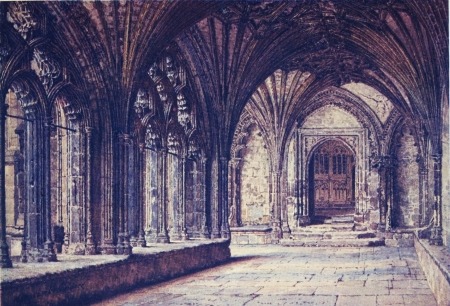 DOORWAY FROM THE CLOISTERS INTO THE MARTYRDOM
the prior’s lodging, the almonry, and ample accommodation for the
entertaining of guests.
So that we may not gain too rosy a view of monastic hospitality, let us
turn to an account of it given by one of the ungodly, Denys of Burgundy,
who had no such stomach for monkish entertainment as had his comrade
Gerard. This was his indictment: “Great gate, little gate, so many steps
and then a gloomy cloister. Here the dortour; there the great cold
refectory, where you must sit mumchance, or at least inaudible.... ‘And
then,’ said he, ‘nobody is a man here, but all are slaves—and of what?
of a peevish, tinkling bell that never sleeps. An ’twere a trumpet now,
aye sounding alarums, ’twouldn’t freeze a man’s heart so. Tinkle,
tinkle, tinkle, and you must sit to meat with maybe no stomach for food.
Ere your meat settles in your stomach, tinkle, tinkle, and ye must to
church with maybe no stomach for devotion; I am not a hog at prayers,
for one. Tinkle, tinkle, and now you must to bed with your eyes open.
Well, by then you have contrived to shut them, some uneasy imp of
darkness has got to the bellrope, and tinkle, tinkle, it behoves you say
a prayer in the dark, whether you know one or not. If they heard the
sort of prayers I mutter when they break my rest with their tinkle!
Well, you drop off again and get about an eyeful of sleep; lo, it is
tinkle, tinkle, for matins.’”
Caricature sometimes tells the truth more understandably than history or
realism, and these facetiæ of Denys convey a fairly accurate idea of
part of a monk’s life. From midnight to midnight it was lived by rule
and rote, full of worship, full of work. But it will become us and
entertain us to take a more serious view of the hospitality exercised by
a great convent. The Guest House, or Hostry, was an important and
integral part almost of every monastery. It was the especial duty of one
of the senior monks to look to it that everything was ready for the
guests who might come. The building devoted to the duties of hospitality
were at Canterbury of very considerable size, a hundred and fifty feet
long by forty broad, consisting of a main hall, out of which opened
small sleeping apartments resembling cubicles. The abbot himself would
receive and entertain guests of high degree; merchants and others doing
business with the house would be taken charge of by the cellarer. The
following passage, quoted by Abbot Gasquet from the Rites of Durham,
is interesting: “There was a famous house of hospitality, called the
Guest Hall, within the Abbey garth of Durham, on the west side, towards
the water, the Terrar of the house being master thereof, as are
appointed to give entertainment to all states, both noble, gentle, and
whatsoever degree that came thither as strangers, their entertainment
not being inferior to any place in England, both for the goodness of
their diet, the sweet and dainty furniture of their lodgings, and
generally all things necessary for travellers. And, withal, this
entertainment continuing, (the monks) not willing or commanding any man
to depart, upon his honest and good behaviour. This hall is a goodly
brave place, much like unto the body of a church, with very fair pillars
supporting it on either side, and in the midst of the hall a most large
range for the fire. The chambers and lodgings belonging to it were
sweetly kept, and so richly furnished that they were not unpleasant to
lie in, especially one chamber called the ‘King’s chamber,’ deserving
that name, in that the King himself might very well have lain in it, for
the princely linen thereof.... The Prior (whose hospitality was such as
that there needed no guest-hall, but that they (the Convent) were
desirous to abound in all liberal and free almsgiving) did keep a most
honourable house and very noble entertainment, being attended upon both
with gentlemen and yeomen, of the best in the country, as the honourable
service of his house deserved no less. The benevolence thereof, with
relief and alms of the whole Convent, was always open and free, not only
to the poor of the city of Durham, but to all the poor people of the
country besides.”
Guests might remain some two days or nights, as a rule, special
permission having to be obtained for any longer period.
Yet another quotation, this time from the Memoirs of the Life of Mr
John Inglesant, wherein he narrates the visit to the Priory of Westacre
in Wiltshire of Richard Inglesant, on an errand from the Earl of Essex
and on business for the burly King Henry. The Priory was a small house
and set in the country, but the impression his first night there made
upon him will serve to carry us back along the corridors of time: “In
the middle of the summer afternoon he crossed the brow of the hilly
common, and saw the roofs of the Priory beneath him surrounded by its
woods. The country all about lay peaceful in the soft, mellow
sunlight.... The house stood with a little walled court in front of it,
and a gate-house; and consisted of three buildings—a chapel, a large
hall, and another building containing the Prior’s parlour and other
rooms on the ground floor, and a long gallery or dormitory above, out of
which opened other chambers; the kitchens and stables were near the
latter building, on the right side of the court. The Prior received
Inglesant with deference, and took him over the house and gardens,
pointing out the well-stocked fish-ponds and other conveniences, with no
apparent wish of concealing anything.... He supped with the Prior in
hall, with the rest of the household, and retired with him to the
parlour afterwards, where cakes and spiced wine were served to them, and
they remained long together.... At last Inglesant betook himself to rest
in the guest-chamber, a room hung with arras, opening from the gallery
where the monks slept.... The Prior’s care had ordered a fire of wood on
the great hearth that lighted up the carved bed and the hunting scene
upon the walls. He lay long and could not sleep. All night long, at
intervals, came the sound of chanting along the great hall and up the
stairs into the dormitory, as the monks sung the service of matins,
lauds, and prime.”
Yes, it was a busy, pious life that was led in a well-ordered monastery;
the service of God and of man combined to leave few idle moments, and
the true religions, we are told, combined “with monastic simplicity an
angelic good humour.” As men vary outside, so do they within monastic
walls: some saints, some sinners; some dour, some sweet; some patient,
some hot-blooded. They were human, those old monks, though somehow
to-day we are apt to look upon them as either too entirely
other-worldly, or too entirely this-worldly.
Before quitting them it will not be unamusing, or, indeed, without
instruction, to quote a few passages from Fuller’s The Church-history
of Britain from the Birth of Jesus Christ until the Year M.DC.XLVIII.,
in which that worthy writer tells us of “Some generall Conformities
observed in all Convents,” dealing with “the rule of the antient
Benedictines.”
“Let Monks (after the example of David) praise God seven times a
day.
“1. At Cock-crowing: Because the Psalmist saith, At midnight will I
praise the Lord: and most conceive that Christ rose from the dead about
that time.
“2. Matutines: at the first hour, or six of the clock, when the
Jewish morning sacrifice was offered. And at what time Christ’s
resurrection was by the Angels first notified to the women.
“3. At the third hour, or nine of the clock before none: when,
according to S. Marke, Christ was condemned, and scourged by Pilate.
“4. At the sixt hour, or twelve of the clock at high noon: when
Christ was crucified and darknesse over all the earth.
“5. At the ninth hour, or three of the clock in the afternoon: when
Christ gave up the ghost, and, which was an hour of publick prayer in
the Temple, and privately in his closet with Cornelius.
“6. Vespers: at the twelfth hour, or six a clock in the afternoon:
when the evening sacrifice was offered in the Temple, and when Christ is
supposed taken down from the Crosse.
“7. At seven of the clock at night (or the first hour beginning the
nocturnall twelve): when Christ’s agonie in the garden was conceived
began.
“The first of those was performed at two of the clock in the morning:
when the Monks (who went to bed at eight at night) had slept six hours,
which were judged sufficient for nature.”
Further, we read:—
“Let every Monk have two Coats, and two Cowles, etc.”
“Let every Monk have his Table-book, Knife, Needle, and Handkerchief.”
“Let the Bed of every Monk have a Mat, Blanket, Rugge, and Pillow.”
We may part from them with the words of Hasted in our ears; of the
Reformation and of the destruction of Becket’s shrine, he says: “This
great change could not but seem strange to the people who had still
veneration for their reputed saint; and the violence offered to his
shrine could not but fill their hearts with inward regret, and private
murmurings; but their discontent did not break out into open rebellion
here, as it did on some like occasion in different places in the
kingdom. To quiet the people, therefore, and to convince them of the
propriety, and even necessity, of these changes, the monks were in
general cried out against, as given to every shameful and abominable
vice; and reports were industriously spread abroad, that the monasteries
were receptacles of the worst of people.... The greater monasteries
were, for the most part, well governed, and lived under the strictest
discipline; ... they promoted learning, they educated youth, and
dispensed charity with a liberal hand to all around them.... The Prior,
who at the time of the dissolution had presided over this convent for
three-and-twenty years, was a learned, grave, and religious man, and his
predecessors had been such for a length of time before. The convent was
a society of grave persons; the aged were diligent to train up the
novices both in the rules of their institution, and in gravity and
sobriety.... All their revenues and gains were expended, either in alms
and hospitality, or in the stately and magnificent building of their
church.... Their time was for the most part spent in exercises of
fasting, penance, and devout meditations, and in attending the divine
offices in the church.”
The lives of nuns in convents of women were to all intents and purposes
practically the same as those led by monks, so we will visit for a few
minutes—in spirit—the nunnery of St Sepulchre, which stood near the
old Riding-gate. It was founded by St Anselm about the year 1100 for
Benedictine nuns, whose lives were passed very much in accordance with
those of their brother monks. Hasted tells us that Prior Walter, of
Christ Church, gave to the nunnery “as much wood as one horse, going
twice a day, could fetch thence, where the wood reeves should
appoint”—namely, from the wood of Blean, beyond Harbledown; “but there
being much uncertainty in this grant, the nuns, in 1270, releasing it,
procured in lien and by way of exchange for it a certain portion of the
above-mentioned wood to be assigned and made over to them; which wood
retains from these nuns the name of Minchen Wood at this time.” And
further on he says discreetly, “Time and indulgence of superiors
bringing their corruptions, nuns became in process of time not such
recluses as their order required.” So in 1305 steps were taken by
Archbishop Winchelsea to keep them more straitly. It was here that the
Holy Maid of Kent, “the great impostor of her time, was a veiled nun and
votaress.”
The story of Elizabeth Barton, more generally known as the Holy Maid of
Kent, throws not a few curious lights upon the beliefs and manners of
the sixteenth century. She was born in or about the year 1506, and when
about nineteen years old was living in the service of Thomas Cobb, who
was steward to an estate of Archbishop Warham at Aldington, which lies
four miles south-east of Ashford, commanding an extensive prospect over
Romney Marsh. The living here, St Martin’s, was presented by Warham to
Erasmus in 1511, but he held it for only a few months.
She was afflicted with some form of nervous complaint, which exhibited
itself in the form of trances or fits; for days together she would lie
half conscious, giving vent to wondrous sayings, telling of events in
other places of which apparently she could have no knowledge, and
holding forth in marvellous words in the rebuke of sin. It can scarce be
wondered at that the ignorant and superstitious neighbours were amazed
and that they began to talk of her, some saying that she was inspired of
the Holy Spirit, others that a devil possessed her. Her master consulted
the village priest, Richard Masters, and together they watched the girl,
coming to the conclusion that it was a good and not an evil spirit that
was speaking through the mouth of the Maid. The affair was brought to
the notice of the archbishop by the priest, and a gracious message of
encouragement was sent to the girl. But as the months passed by her
illness left her, and she missed the notoriety which she had gained,
although she was still held in pious reverence by friends and
neighbours. She was unable to resist the temptation to feign a
continuance of her trances and inspired utterances.
Her renown spread abroad and Warham decided that the matter should be
inquired into, sending down two monks of Christ Church, Edward Bocking
and William Hadley. Bocking is believed to have been educated at
Canterbury College, Oxford, now Christ Church, and to have been warden
there. He left there for Christ Church, Canterbury, probably in 1526,
the fatal year in which he was despatched upon this mission of inquiry.
We know not what manner of man he was, save for these dealings of his
with the Maid; could we gain the details of his story, it would add
another and striking chapter to the history of villainy. He saw in
Elizabeth a tool, which would be useful to him if he could but temper
it. He instructed her in the Catholic legendary lore, and taught her to
argue with and to refute heretics. Strype includes Masters in the plot,
as thus: “And to serve himself of this woman and her fits, for his own
benefit, he, with one Dr Bocking, a monk of Canterbury, directed her to
say in one of her trances, that she should never be well till she
visited the image of Our Lady in a certain chapel in the said Masters’
parish, called the chapel in Court-at-Street; and that Our Lady had
appeared to her, and told her so; and that if she came on a certain day
thither, she should be restored to health by miracle. This story, and
the day of her resort unto the chapel, was studiously given out by the
said parson and monk; so that at the appointed day there met two
thousand persons to see this maid, and the miracle to be wrought on her.
Thither at the set time she came, and there, before them all, disfigured
herself, and pretended her ecstasies.... In her trance in this chapel
she gave out, that Our Lady bade her become a nun, and that Dr Bocking
should be her ghostly father.” Also the “spirit” moved her further: “It
spake also many things for the confirmation of pilgrimages and trentals,
hearing of masses and confessions, and many other such things.” “And one
Thwaites, a gentleman, wrote a great book of her feigned miracles, for a
copy to the printer, to be printed off,” which was called A Miraculous
Work of late done at Court-of-Strete in Kent, published to the Devoute
People of this Tyme for their Spiritual Consolation. Soon after this
exhibition she was admitted to the priory of St Sepulchre at Canterbury,
and became known as the Nun of Kent. She was wise enough to stifle
rivalry, for “there was one Hellen, a maid dwelling about Totnam, that
had visions and trances also. She came to this holy Maid and told her of
them. But she assured her (it may be because she had a mind to have the
sole glory of such visions herself) that hers were but delusions of the
Devil; and advised her from henceforth not to entertain them, but to
cast them out of her mind.” Other monks assisted Bocking in the
deception.
“Archbishop Warham having a roll of many sayings which she spake in her
pretended trances, some whereof were in very rude rhymes, sent them up
to the King; which, however revered by others, he made but light of, and
showed them to More, bidding him show his thoughts thereof. Which after
he had perused, he told the King, that in good faith (for that oath he
used) he found nothing in them that he could either esteem or regard:
for a simple woman, in his mind, of her own wit might have spoken them.”
Then, unfortunately for herself, Elizabeth embarked on the dangerous sea
of politics, especially unsafe in those days when the axe or the rope
put a stop to any unfavourable comment. As when the divorce of Catherine
came upon the tapis, and Elizabeth indulged herself in expressing such
opinions as these, embodied in a fantastic tale “of an angel that
appeared, and bade ‘her’ go unto the King, that infidel Prince of
England, and say, that I command him to amend his life; and that he
leave three things which he loveth, and purposeth upon; that is, that he
take off the Pope’s right and patrimony from him. The second, that he
destroy all these new folks of opinion, and the works of their new
learning. The third, that if he married and took Anne to wife, the
vengeance of God plague him.” But Henry was not moved, unless it was to
anger; Warham was convinced of the Maid’s holiness, and withdrew his
promise to marry Henry; further, he persuaded Wolsey to see her, with
exactly what result is not definitely known. She gained vast popularity
as Catherine’s champion, and many noble persons became her patrons. She
even went to the extreme length of forcing herself into the King’s
presence when he visited Canterbury. Anne did not die within a month of
her marriage, as the Maid had predicted, so she added to her offences by
declaring that Henry was before God no longer King. Cranmer, who had
succeeded Warham, ordered the Maid to be subjected to a strict
examination. Eventually, in September 1533, she confessed her fraud:
“she never had visions in all her life, but all that she ever said was
feigned of her own imagination, only to satisfy the minds of those which
resorted to her, and to obtain worldly praise.” Her counsellors,
including Bocking, Hadley, Masters, and Thwaites, were committed to the
Tower, brought before the Star Chamber, and they too confessed. So the
plot exploded. A scaffold was erected near to Paul’s Cross, from which
the Nun and her chief aiders and abettors read their confessions; this
function was repeated at Canterbury in the churchyard of the monastery
of Holy Trinity. We need not here go into the political capital which
Cromwell made out of the intimacy of various enemies of the King with
the Maid.
On the 20th April 1534, the unhappy girl and others were done to death
at Tyburn; and these were her last words: “Hither I am come to die; and
I have not been only the cause of mine own death, which most justly I
have deserved, but also I am the cause of the death of all those
persons, which at this time here suffer. And yet, to say the truth, I am
not so much to be blamed, considering that it was well known to these
learned men that I was a poor wench, without learning; and therefore
they might easily have perceived, that the things that were done by me
could not proceed in no such sort; but their capacities and learning
could right well judge from whence they proceeded, and that they were
altogether feigned: but because the thing which I feigned was profitable
to them, therefore they much praised me; and bore me in hand, that it
was the Holy Ghost, and not I, that did them; and then I, being puffed
up with their praises, fell into a certain pride and foolish fantasy
with myself, and thought I might feign what I would; which thing hath
brought me to this case; and for other which now I cry God and the
King’s highness most heartily mercy, and desire you all, good people, to
pray to God to have mercy on me, and on all them that here suffer with
me.”
There is tragedy lurking there, and light upon those days. But can we
laugh—we who are without superstition and too often without respect?


