A
TWO HUNDRED MILE TOUR
THROUGH
THE MAINE FORESTS.
BY
Thomas Sedgwick Steele.
“If thou art worn and hard beset
With sorrows that thou wouldst forget,
If thou wouldst read a lesson, that will keep
Thy heart from fainting, and thy soul from sleep,
Go to the woods and hills!—no tears
Dim the sweet look that Nature wears.”
Longfellow.
WITH SIXTY ILLUSTRATIONS,
BOSTON:
ESTES AND LAURIAT,
PUBLISHERS.
Copyright, 1882,
By Thomas Sedgwick Steele.
University Press:
John Wilson and Son, Cambridge.
To my enthusiastic friends of the
gun and rod, who love all
that is pure and beautiful in
nature, and by associating with her
works, learn of man’s littleness
in comparison with God’s immensity,
this book is affectionately
dedicated.
Thomas Sedgwick Steele
Hartford, Conn., 1880.
CONTENTS.
| CHAPTER I. |
|
| |
PAGE |
| An Angler’s Soliloquy.—Isaak Walton’s ideas.—A fishing
minister.—The route to the woods.—Moosehead Lake and vicinity |
19 |
| CHAPTER II. |
|
| The different routes through Maine.—The Party, Guides,
Baggage, Provisions, Canoes, Arms.—Camp appetite.—Studying
Geography.—The start.—Bid adieu to Moosehead
Lake.—North East Carry.—West Branch of the
Penobscot.—First Camp on Moosehorn stream |
27 |
| CHAPTER III. |
|
| Our first Camp at mouth of Moosehorn stream.—Accommodating one’s
self to circumstances.—The “Rips” of the West Branch.—Running
the Rapids.—Pine Stream Falls.—Chesuncook Lake.—Umbazooksus
River.—A “Bear” welcome.—Mud Pond and “Carry.”—A Picture
difficult to photograph.—Third Camp at Chamberlin Lake |
51 |
| CHAPTER IV. |
|
| Chamberlin Farm and Lake.—A novel fly-trap.—A lesson in Natural
History.—Telosmis Lake.—The “Cut.”—A three days’ rain-storm.—Webster
Lake and Dam.—An Apparition.—The weird stillness of
the primeval forests.—An accommodating fly-catcher |
64 |
| CHAPTER V. |
|
| Passage of Webster Stream.—An exciting day’s sport.—The damaged
canoes.—The canvas boat triumphant.—Grand Falls.—Photographing
along the route.—Indian “Carry.”—East Branch of the Penobscot.—Matagamonsis
Lake.—The discovery of a new Lake.—Trout Brook Farm.—Grand, or Matagamon Lake.—A captured
salmon |
93 |
| CHAPTER VI. |
|
| Dangers of wandering from Camp.—An experience on Lake Superior.—The
Falls of the East Branch.—Stair Falls.—Incidents of Camp
life.—An Enchanted Bower.—Hunt’s Farm.—An Artist’s Canoe.—The
ascent of Hunt’s Mountain.—A reverie.—Whetstone Falls.—Discovery
of Jasper on Ledge Falls.—Dawn of Civilization.—Mattawamkeag.—The
East Branch Canvas-ed |
117 |
| 1. |
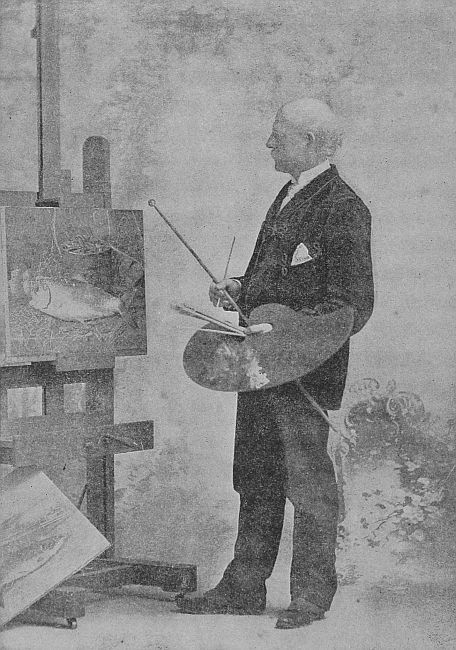
THE AUTHOR IN HIS SANCTUM |
Frontispiece. |
| 2. |
DEDICATION |
Page 3 |
| 3. |
THE ANGLER |
5 |
| 4. |
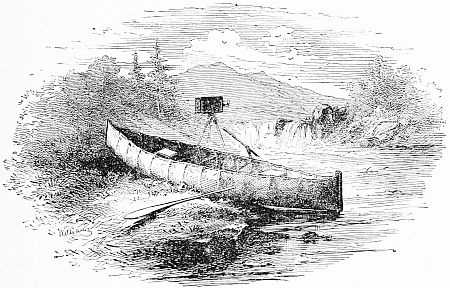
CANOE AND CAMERA |
17 |
| 4a. |
AN ODD SPECIMEN |
18 |
| 5. |
ISAAK WALTON |
21 |
| 6. |
KINEO HOUSE |
25 |
| 7. |
ANTICIPATION |
26 |
| 8. |
PICKING A COURSE |
28 |
| 9. |
MAP OF THE TOUR THROUGH THE MAINE FORESTS |
30 |
| 10. |
THE GUIDES |
33 |
| 11. |
WE DREAM OF GAME |
38 |
| 12. |
HOME APPETITE |
41 |
| 13. |
CAMP APPETITE |
41 |
| 14. |
MORRIS’S—NORTHEAST CARRY |
43 |
| 15. |
IN SYMPATHY WITH NATURE |
46 |
| 16. |
DISCOURAGEMENTS |
48 |
| 17. |
“CHANGING PASTURE” |
49 |
| 18. |
PENKNIFE SOUVENIRS |
52 |
| 19. |
PINE STREAM FALLS |
54 |
| 20. |
MUD POND CARRY |
56 |
|
| 21. |
MUD POND—LOOKING EAST |
59 |
| 22. |
“THIS IS THE WAY I LONG HAVE SOUGHT” |
62 |
| 23. |
REFLECTIONS |
63 |
| 24. |
CHAMBERLIN FARM—LOOKING WEST |
65 |
| 25. |
THE ROOM INTO WHICH WE WERE USHERED |
66 |
| 26. |
CAMP ON CHAMBERLIN LAKE |
67 |
| 27. |
NOT IN THE PATENT OFFICE |
70 |
| 28. |
A STUDY IN NATURAL HISTORY |
71 |
| 29. |
GREAT NORTHERN DIVER |
71 |
| 30. |
TELOS CUT AND LAKE |
73 |
| 31. |
PHOTOGRAPHY—THE WET AND DRY PROCESS ILLUSTRATED |
77 |
| 32. |
TELOS DAM AND RIVER |
79 |
| 34. |
AN APPARITION |
83 |
| 35. |
WEBSTER LAKE AND DAM |
86 |
| 36. |
FLY CATCHERS VERSUS FLY FISHING |
88 |
| 37. |
ALLUREMENTS |
90 |
| 38. |
STUDY OF TROUT—BY THE AUTHOR |
91 |
| 39. |
RUNNING RAPIDS ON WEBSTER RIVER |
95 |
| 40. |
LUNCH TIME |
99 |
| 41. |
IT’S NOT ALL POETRY |
101 |
| 42. |
GRAND FALLS |
103 |
| 43. |
STARTING A BOOM |
107 |
| 45. |
A BOOM |
109 |
| 46. |
DISCOVERY OF A NEW LAKE |
111 |
| 47. |
MATAGAMONSIS LAKE |
113 |
| 48. |
OUR SALMON |
114 |
| 49. |
MATAGAMON OR GRAND LAKE |
115 |
| 50. |
ON THE EAST BRANCH |
120 |
| 51. |
DROPPING CANOES OVER FALLS |
122 |
| 52. |
ACCEPTING THE SITUATION |
123 |
| 53. |
STAIR FALLS |
125 |
| 54. |
HULLING MACHINE FALLS |
126 |
|
| 55. |
THE ARCHES—EAST BRANCH OF THE PENOBSCOT |
128 |
| 56. |
HUNT’S FARM |
130 |
| 57. |
MT. KATAHDIN—STUDY BY F. E. CHURCH |
132 |
| 58. |
JUNCTION OF EAST AND WEST BRANCHES OF THE PENOBSCOT |
134 |
| 59. |
GLIMPSES OF CIVILIZATION BEGIN TO DAWN |
137 |
| 60. |
NET RESULTS |
139 |

love for the woods and out-door sports begins
early in life. I can hardly remember when the sight
of a gun or fish-rod did not awaken within my boyish
fancy a feverish desire to follow their lead, be the
tramp ever so hard. There never was anything to stop
the growth of this passion until I reached the age of
ten years, when I nearly destroyed a boy’s eye with
an arrow, in my endeavors to excel in archery.
This act slightly dampened my ardor for some
months, and retarded that progression in field sports
I was then making.
There is also something so free, so stimulating in the
woods life, uncontaminated by the gossip, allurements,
and exacting dress of the usual watering places, that
after one season’s enjoyment, a return to these wildernesses,
and repeating its pleasures, is the constant
thought of the future.
It also teaches very early self-reliance, and a philosophical
endurance of many conditions of life, which
add to one’s cheerfulness, while one is surprised how
few of the necessities are essential to produce happiness.
“Man’s rich with little, were his judgment true;
Nature is frugal, and her wants are few.”
The study also of natural history in the woods takes
one into a realm which has no bounds, constantly
enlarging his love and admiration of God’s works. The
oft-repeated quotation, “Spare the rod and spoil the
child,” has been misconstrued for many a long day, and
if I had known early in life its real significance it would
hardly have made so doleful an impression.
There is no doubt to-day in my mind that this “rod”
meant a fishing-rod, and that the timely cherishing of
it in youth tends to develop that portion of one’s
nature to which the former use was entirely innocent.
“The surest road to health, say what you will,
Is never to suppose we shall be ill.
Most of those evils we poor mortals know
From doctors and imagination flow.”
And now, after spending many of the annual short
vacations allotted to an active business life in various
parts of this country, from Canada to Florida, in the
exhilarating sport of hunting, fishing, and exploring, and
deriving great physical good thereby, it would not seem
strange that the writer should be desirous of exciting
in the hearts of others a taste for like recreations. In
placing before my readers this sketch of a late canoe
tour through Maine—especially that portion pertaining
to the east branch of the Penobscot—I am perfectly
aware that no two trips through that region can be
made under the same circumstances. All days in the
woods are alike, and still they are very unlike. Weather,
height of water, companions, canoes, guides, sunshine or
shadow, a hundred and one things, go to make a day
pleasant or unpleasant to the tourist. During the month
occupied in making this trip, the writer experienced
but four days of rain. But the first rain-storm could
not have been more opportune, as it raised the water
of Webster stream to a height that permitted the passage
of my four canoes, when otherwise I should have
endured a wearisome “carry” of seven miles. Unless
there is sufficient water in Webster stream to float a
canoe with ease, I should not recommend the tour of
the east branch, for the numerous portages will hardly
compensate for the pleasures of the trip.
The writer distinctly remembers meeting an angler
who had followed the recommendation of a guide book
on Maine, and attempted the journey from Allagash
river to Chamberlin lake. Instead of an abundance
of water, the stream was almost dry, and a “carry”
of seven miles had to be made to Chamberlin lake.
Again, the canvas boat added no little enjoyment to
the pleasures of the excursion, and the trip would
have lost many of its bright experiences without its
companionship.
True, it received many a cut, but was more easily
repaired than a birch bark, while its qualities of
endurance after such an ordeal permitted it to spend
the following winter season under the tropical skies
of Florida.
No better companion could have been selected than
Mr. H. R. Morley, of the Continental Life Insurance
Company, Hartford (the “quartermaster” of the expedition),
and to his suggestions and efforts to make the
best of all difficulties the writer acknowledges himself
indebted. It is surprising how selfishness, egotism,
and other like traits of character will develop in the
woods when it was never recognized in the individual
at home, and one must have the true spirit of patient
endurance for the sake of accomplishment in order at
times to enjoy the forest life.
Thus the entire trip was made on the “flood tide,”
from the state of the weather to the volume of water
in the streams, facilitating the taking of photographs,
and adding height and power to the many picturesque
falls on the route. Until I am corrected by further
explorations, I think I am right in the discovery of a
new lake (not found on any map), between Matagamonsis
and Matagamon lakes.
An enlargement of Hay creek has been suggested
as this body of water, but if so, all the larger lakes in
this region are but a part of the preceding stream which
empties into them. This lake has the same area of
square miles as Telosmis lake, and empties its waters in
to the sluggish stream which connects the two large
bodies of water just mentioned.
The pleasure of canoeing these undiscovered lakes
and streams, and living from day to day upon their
resources, was an element of indescribable delight.
Nowhere do such rich thoughts of God’s bounty, grandeur,
and control of nature impress one as in the depths
of the forests, and there are reveries forced upon one,
for which a city of brick walls and dusty streets have no
affinity. The individuality of each tree, the strange and
rare plants and flowers scattered along the indistinct
path one wanders, all coupled with the weird stillness of
the forest, bring one nearer to God and His works than
almost any other situation. I do not suggest in this
book the various ways of camping out, or the necessary
preparations for the same, as there are special works on
those subjects; I simply desire to direct the attention of
tourists, and more especially artists, to a section of Maine
now but little known, but which, if once explored, will
yield to them a bright harvest of pleasure and studies.
THE AUTHOR.
Hartford, Conn.
CANOE AND CAMERA.
TWO HUNDRED MILES THROUGH THE MAINE FORESTS.
ILLUSTRATED
BY
True Williams, Benjamin Day, Aug. Will, and other Artists.
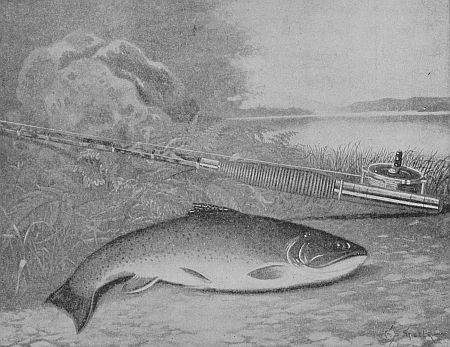
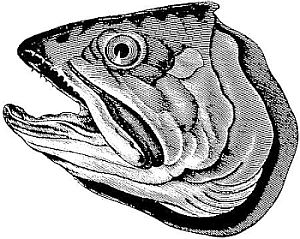
AN ODD SPECIMEN.
“I in these flowery meads would be;
These crystal streams should solace me;
To whose harmonious, bubbling noise
I with my angle would rejoice.”
Walton.
AN ANGLER’S SOLILOQUY.—ISAAK WALTON’S IDEAS.—A FISHING
MINISTER.—THE ROUTE TO THE WOODS.—MOOSEHEAD
LAKE AND VICINITY.
In the good old times, when the requirements of business
kept one out in the open air, and each client or
patient resided many miles away, and the only communication
was by foot or on horseback, one did not need the
indispensable rest and recreation of to-day.
But now all is changed, and within a hand’s grasp at
our offices we can communicate by the strange wires of
the telephone or telegraph with friends miles away, and
save ourselves those steps which would no doubt be of
great benefit if taken.
In this fast world of ours, where the work of a week
is crowded into a day, recreation is a necessity, and
nowhere, it seems to me, has it greater recuperative
power than in the depths of the forest.
It is not as a plea for the angler that I pen these
lines—he asks for neither judge nor jury on his tastes,
although they no doubt frequently receive the verdict of
both; he is a law unto himself.
“It is a very easy thing to scoff at any art or recreation,
a little wit mixed with ill-nature, confidence, and
malice will do it, though they are often caught in their
own trap.”
It is only a few weeks since that I was rallied on my
pet hobby by a prominent business man, who thought
one could hardly be in his right mind who had a fondness
for life in the woods, and that it must give one a
tendency to coarseness, rather than improving our higher
and more æsthetic tastes. But this gentleman was welcome
to his ideas, for he was then an invalid from a
nervous disease, and had spent the prime of his life
regaining his health, when possibly an occasional day’s
tramp beside a trout stream would have been a matter
of economy to both purse and body.
The father of anglers, Isaak Walton, puts this same idea in a
still better light, for although born in 1593, he knew how to
read the human nature of to-day; he says: “Yes! there are many grave
and serious men who pity us anglers, but there are many more grave and
serious men whom we anglers condemn and pity.”
“Men that are taken to be grave because
nature hath made them of a sour complexion, money-getting
men that spend all their time, first in getting,
and next in anxious care to keep it! men that are condemned
to be rich, and then always busy and discontented—for
these poor rich men we anglers pity them
perfectly, and stand in no need to borrow their thoughts
to think ourselves so happy.”
Some one has said that an angler consists of a rod
with a fool at one end and a fish at the other. But
Walton, in his meanderings beside the streams, is reported
to have had the constant companionship of a
book, and between the nibbles of the fish stored his
mind with useful knowledge.
While hunting in the western part of Connecticut
last autumn, a good story was told me of a minister who,
soon after his settlement in the parish, greatly annoyed
his flock by his habitual fondness for angling. He
would start off early on Monday morning, and would
keep up the diversion until late Saturday night; nevertheless,
the quality of his sermons, and the deep thoughts
which they contained, so pleased his people that similar
excursions were suggested to the pastors of other
churches in the town.
So much for an introduction to the inmost thoughts
of a lover of the angle, but possibly you would like to
know how to reach the solitudes of Maine, whose influences
are so bewitching to the writer, and where, with
the reader as companion, he proposes to enjoy a canoe
ride of two hundred miles.
To one about to make a trip to Maine, we would say,
start in all cases from Boston, even though you live in
Chicago. Take the 7 P. M. express on the Eastern railroad
for Bangor, thereby having a good night’s rest in a
sleeper, awaking refreshed for the pleasure of the next
day’s journey.
But those who have never traveled this road will do
well to see their flight be not in the night, for, commencing
with Boston, its main line extends along the shore,
giving here and there glimpses of quiet bays and shady
inlets, and through cities noted for their thrift and prosperity
almost from the country’s settlement.
One would be well repaid for a day spent at almost
any station along the route, as the eastern shore of New
England has often been the subject for busy pens and
famous pencils. From Massachusetts Bay to Passamaquoddy
and the Isle of Great Manan, it is filled with
nooks and beaches where, in the hot months of summer,
the seeker for rest and renewed health can choose the
spot suited to his taste. The Eastern railroad—with its
numerous branches and connecting lines—forms the most
direct and desirable means of access to these points of
interest.
It does not, however, limit the choice to the seashore,
for it leads also to the heart of the famous White Mountains,
and to the vast and partially explored lake region
of Maine, towards which I had set my face.
Lynn, eleven miles from Boston, famed for its
immense factories of boots and shoes, lies at the head
of Nahant Bay, from which there is a delightful drive
along the shore to Nahant, a noted, picturesque watering-place.
Near by is Swampscott, its shores lined with
summer cottages, and from here a short branch road runs
to rocky Marblehead, a spot mentioned in letters of
travel as early as the year 1633.
Salem, four miles further on, famous since the days
of witchcraft, and once the principal port of entry for
New England, not only has its pleasant situation to
attract the visitor, but is full of relics of the olden time
of interest to the antiquary. It was the birthplace of
many men whose names have become a part of our
nation’s history and literature.
At Beverly, the Gloucester branch leads down to the
sea at Cape Ann, with its sunny beaches and rocky headlands,
quiet when the wind is off shore, but where the
waves come thundering in when driven before an
easterly gale.
But we have hardly time to speak of Newburyport,
another old seacoast town, and the lovely view to be had
from its heights of the surrounding country and ocean,
but hasten through to Salisbury, Hampton, and Rye
Beach.
Portsmouth is quiet and quaint, and at Conway Junction,
eleven miles from Portsmouth, passengers change
cars for the White Mountains. At Portland, the angler
makes choice of the routes to the two great trouting
paradises of Maine—Rangeley Lakes and Moosehead
Lake.
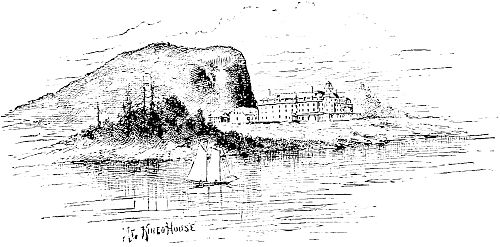
Kineo House
If to the former place, he takes the cars for Farmington,
eighty-five miles directly north from Portland, and
then by stage thirty-six miles over the mountains to
Kimball’s Head of the First Rangeley Lake, where he
will receive a hearty welcome from as cordial a company
of fishermen as it has been my pleasure in other seasons
to enjoy.
If the latter be his choice, guns, rods, blankets, and
other camp equipage are shifted to the train of the
Maine Central railroad for Bangor, where the cars are
again changed for the road to Blanchard, which is twelve
miles from Moosehead Lake. After a substantial dinner,
the tourist mounts to the top of the commodious Concord
stage drawn by four horses, and enjoys a delightful
ride of eleven miles over the hills to Greenville, foot of
Moosehead Lake. Here the baggage is again changed to
a steamer, and a most enjoyable sail of twenty miles
lands one at the Kineo House, which stands on a prominent
point of rocks extending far out into Moosehead
Lake, a convenient center of attraction for those who
dislike the unadulterated life in the woods.
ANTICIPATION.
“A bard is weak enough you’ll find,
A humble cat-gut twangler:
But for a man of simple mind
Commend me to an Angler.
He’ll fish and fish the whole year round
Devotedly fanatic,
To catch one fish that weighs a pound
And then his joy’s ecstatic.”
THE DIFFERENT ROUTES THROUGH MAINE.—THE PARTY,
GUIDES,—BAGGAGE,—PROVISIONS,—CANOES,—ARMS.—A
CAMP APPETITE.—STUDYING GEOGRAPHY.—THE START.—BID
ADIEU TO MOOSEHEAD LAKE.—NORTHEAST “CARRY.”—WEST
BRANCH OF THE PENOBSCOT.—LANDING FOR OUR
FIRST CAMP MOUTH OF MOOSEHORN STREAM.
On leaving Moosehead Lake, the seeker
for health or recreation in Maine, who desires to study nature in
its primeval state, and drink from her fountains the blessings
which she can so bountifully bestow, has three routes of travel
before him. These routes are known as the St. John’s River, the West
Branch of the Penobscot, and the East Branch of the Penobscot trips,
and have for their point of departure the Kineo House, Moosehead Lake,
where all that is necessary in camp supplies can always be obtained.
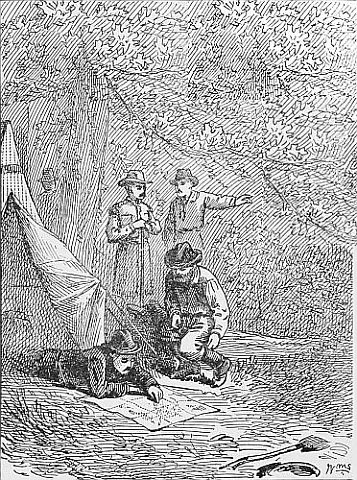
PICKING A COURSE.
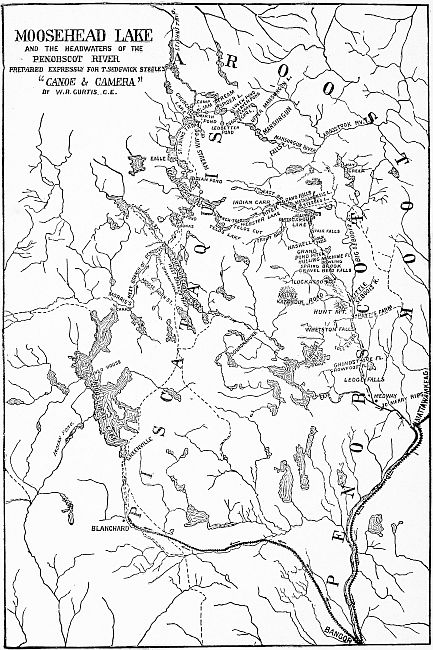
MOOSEHEAD LAKE
AND THE HEADWATERS OF THE
PENOBSCOT RIVER
PREPARED EXPRESSLY FOR T SEDGWICK STEELE’S,
“CANOE & CAMERA”
BY W. R. CURTIS, C.E.
Click here for larger map
The most frequented route, and on account of its ease generally
recommended by the guides, is that to the St. John’s River, which one
reaches by passing north from Moosehead Lake through the West Branch,
Chesuncook, Chamberlin, Eagle, and Churchill Lakes to the
Allagash River, and thence northeast through Canada, emerging from the
woods at Grand Falls, New Brunswick. The second, or the West Branch of
the Penobscot trip, passes southeast through Chesuncook to Ripogenus
Lake, and follows the West Branch through Pamedomcook and Twin Lakes
into the Penobscot River.
The third and most difficult course through this wilderness,
is the tour of the East Branch of the Penobscot,
which leaves the St. John’s route at Chamberlin Lake,
and passes south through Telosmis Lake and then east
through Telos and Webster Lake and River to the Matagamonsis
and Matagamon or Grand Lake into the East
Branch, and after tumbling over the most picturesque
falls and rapids in the entire State, unites with the West
Branch of the Penobscot at Medway.[A]
To retain my good health, and enjoy for the fifth season
the dearly-loved woods and lakes of Maine, the summer of
1879 soon found me again within her fascinations, a willing
captive to her charms. We have never failed in the
past to impress upon our friends that one companion is
sufficient for company in the woods, but this year, the
party although it had small beginnings increased in the
ratio of the demands of my tastes. As gathered upon
the deck of the little steamer “Day Dream” one bright
summer morning, while on her way from the Kineo
House to the head of Moosehead Lake, we numbered
six souls.
I had chosen for my route this year, the East Branch
of the Penobscot River, a canoe paddle of almost two
hundred miles, as offering in its swift running streams,
lovely waterfalls, and majestic mountains, that excitement
and adventure which my love of nature craved. In addition
to the writer, the party was divided as follows:
“Quartermaster,” photographic artist, and three guides,
named respectively Bowley, Weller, and Morris. My
friend who is designated as “Quartermaster” did not receive
his title from any such position in my expedition, but
from holding an office of like character in a New England
regiment during our late war, and he proved by the daily
use of his knife in arranging the comforts of the camp,
that he was to the manor born.
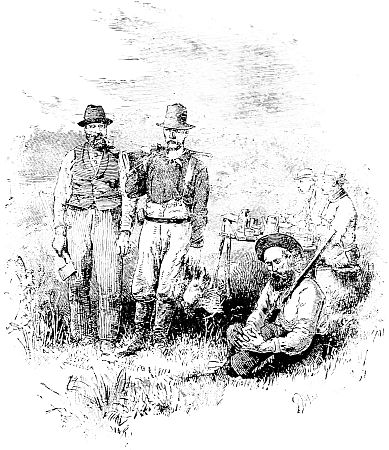
THE GUIDES.
Bowley. Morris. Weller.
Our artist was from the “Land of Steady Habits,”
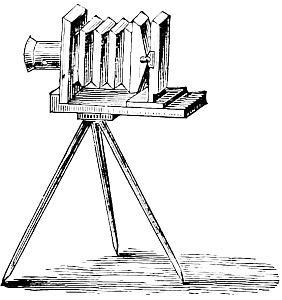
whose sole duty it was to care for the delicate camera
and glass plates, together with the necessary but ill-flavored
bottles of his kit, and to be constantly on the alert
for choice, or grand bits of scenery along the route. In
such a tour as this, with the many accidents ever attendant
on camp life, it was no small matter to carry through
the wilderness the articles pertaining to our photographer’s
kit.
We had fifty glass plates six by eight inches each,
which were prepared and developed on the ground by
what is known as the “wet process.” Careless treatment
in cartage on the “carries,” or a sudden jar might at any
moment damage them beyond recovery, which would immediately
subvert one of the principal objects of the
exploration. Then each chemical had its individuality of
importance, from the ether to the collodion, the destroying
of which would put an end to the pleasures of photographing.
The first and oldest of the guides, Bowley, was a man
of forty-eight years, and lived at Shirley, Maine. He was
five and a half feet high, weighed one hundred and ninety
pounds, had brown whiskers, turning to gray, checkered
shirt, weather-beaten suit, soft brown hat, and a kind
sympathetic face, which I found before the trip was ended
truly expressed his manly character. I was sometimes
inclined to think him slow, and to find fault with the consumptive
color of his biscuit and “flip-jacks,” and urged
him to greater diligence and variety in the cooking department,
but in matters of importance he always proved his
soundness—but he had one fault, he could scent a “carry”
three days ahead, and remember its hardships and burdens
two days after. He delighted to tell of his many
interesting experiences in the wilderness, and of his geological
researches through Maine some years ago with Prof.
Hitchcock, of Amherst college, while his moose, bear, and
caribou stories were endless.
The second guide, Weller, aged thirty-seven years,
was a French Canadian from Quebec, but living at this
time in Greenville, Me. He was five feet four inches
high, weighed one hundred and fifty-one pounds, with
reddish moustache and whiskers, brown hair, and was
dressed in a dark-colored woolen suit. He was a fine
waterman, and occasionally witty, as is proverbial with
his class.
The third and last guide, Morris, was a vivacious
young man of twenty-three summers, but who looked
all of thirty. He was about five feet three inches high,
weighed one hundred and sixty pounds, had light brown
hair and moustache. Dark blue flannel shirt and woolen
pants constituted his habiliments, which latter garment
early in the day proved its inferiority by sundry tears
which gave him a picturesque appearance highly appreciated
by our artist.
A black felt hat was the crowning feature of his attire,
around which was wound “casts” of varied colored artificial
trout flies. He was the most venturesome canoeman
of the party, ever first to try the dangers of the many
waterfalls and cataracts on our route. Morris was also
the hunter, and many a plump duck and partridge found
its way to our table through his activity, which quality
is always appreciated by the camper-out.
Our personal belongings were numerous, consisting of
woolen and rubber blankets, rubber wading stockings,
moccasin shoes, fly rods, guns, landing nets, a lantern,
and the very necessary black-fly ointment, consisting of
oil of tar, glycerine, gum camphor, and oil of pennyroyal.
We also had extra changes of underclothing, woolen
stockings, buckskin suits, and an assortment of tools,
waxed ends, and silk thread for the repairs of broken fly
rods if such should be our misfortune.
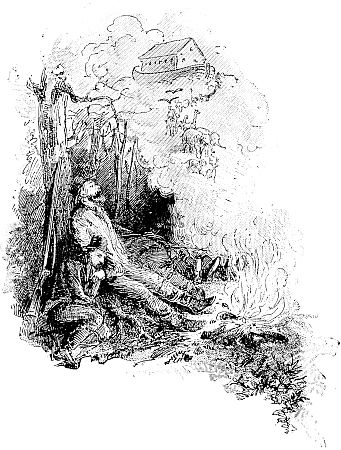
WE DREAM OF GAME.
The number of weapons composing our armory was
one Sharps, one Ballard, and one Spencer magazine rifle,
one 38-calibre revolver, and a double barrel shot-gun
which also contained two auxiliary rifle barrels. Each
man also carried the usual long sheath knife, which latter
article was never drawn in a more deadly conflict than
that between hard tack and salt pork; nevertheless it
was often a trial which brought into play the most heroic
qualities of the arm. These made us at once feel invincible
against the attack of wild beasts, while at the
same time it encouraged such hopes of success in the capture
of wild animals that it even troubled the nightly
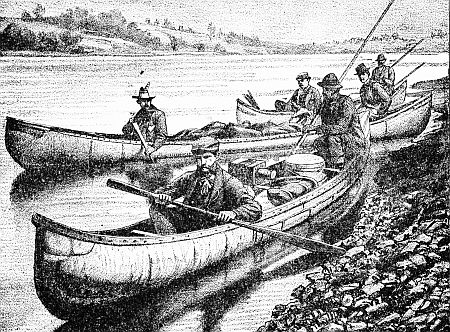
rest of some of the members of the expedition. Three
birch-bark canoes and one portable folding canvas canoe
constituted our ships of burden, which exerted great influence
in exploring the wilds, and added to the enjoyment
of its pleasures.
How much poetry and romance the words, birch-bark
canoe, suggest to our mind! the grand old forests have
more tender associations when one is paddled through
their lights and shadows in a birch canoe; there are
thoughts and reveries which make themselves felt as one
examines their construction—a natural fitness of things
to the regions in which they are used.
The delicate-colored bark stripped from a prominent
tree is cut at the ends and gathered up into uniform bow
and stern, cut and then brought together again at the
sides alternately to lift the lines fore and aft; this gives
a surface to meet the waves, producing that buoyancy so
pleasing to the craft. Then a gunwale, of strips of wood,
is affixed, sewed with spruce roots or rattan, and the
whole lined from stem to stern with thin strips of wood
called “knees.” A birch canoe will weigh from eighty-five
to one hundred and fifteen pounds when averaging
eighteen to twenty feet; but I have occasionally seen
those that weighed three times that amount, and had a
longitude of twenty-eight to thirty feet.
My portable canvas canoe made for this special
occasion was fifteen feet long with a weight of only forty-five
pounds, when the fish-rod-like stretcher was inserted.
This canoe could be collapsed at a moment’s notice, placed
in a bag seventeen by thirty-eight inches, and carried on
the shoulders with ease by one person, while it would
float eight hundred and fifty pounds.
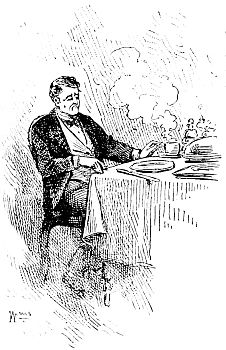
HOME APPETITE.
Before the month’s journey was completed, I found I
could leap falls and rapids more safely than in a birch-bark
canoe, and although I often paid for my audacity
by cutting its surface, it was easily sewed, waterproofed,
and I continued my way. On account of its convenient
construction and weight it could be easily transported
through the woods to the small bodies of water off our
main course, and explorations made not accessible to a
birch canoe.
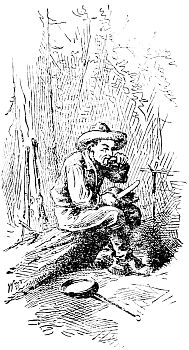
CAMP APPETITE.
As we were to pass through a country uninhabited we were obliged to
provide ourselves from the start with food sufficient for the entire
thirty days’ sojourn, and it may be interesting to the reader to know
the quantity and variety of the supplies, should he ever undertake
a similar enterprise. We did not rely upon the game or fish of the
country we were canoeing; like excursions in the past had taught us
that these articles were more incidental surprises, than an excess of
the daily menu. Very few tourists to Maine select this, the hardest
of routes, and we found, afterwards, that we were the first party
who had passed down the East Branch of the Penobscot river during
the year 1879. A “camp appetite” is something entirely different
from what one enjoys at home. One would turn in aversion from the
plainness of the fare were it placed on the table. But the surroundings
and the daily vigorous exercise seem to make one forget the homely
dishes, and articles refused at our own boards are devoured in the
woods with avidity. Most of the provisions were packed into wooden
pails of various sizes, the balance in canvas bags, and were assorted
as follows: thirty-four pounds of hard tack or bread, seventy-three
pounds of flour, one bushel of potatoes, twelve pounds of salt pork,
four pounds of beans, two packages of baking powders, two and one half
pounds of cheese, ten pounds of ham, three pounds of candles, one
bottle each of pickles and chow-chow, three cans of potted ham, seven
and three-fourths pounds of onions, twelve pounds of canned corned
beef, six pounds of maple sugar, one dozen cans of condensed milk,
three pounds of tea, seven pounds of coffee, and thirteen pounds of
granulated sugar, besides a quart of oil for our lantern, which latter
article was one of the most useful of the lot. Sugar, either maple or
granulated, always disappears in the woods at an early date, and the
immense quantities of luscious blueberries and blackberries to be had
at any time along our route greatly facilitated its departure.
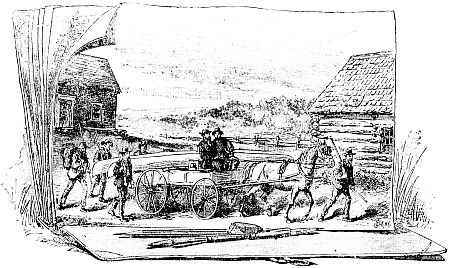
MORRIS’S NORTHEAST CARRY.
Our canoes, when packed with all the above articles,
and further embellished by sundry tea and coffee pots,
kettles, frying-pans, broilers, bakers, tin plates and cups,
reminded one of the early days of our forefathers and
their pilgrimages to the “far west.” The country towards
which we had set our faces was entirely new to tourists,
and but one of our guides (Weller) had ever explored
its hidden depths, and even his memory was so treacherous
as to be of little service to us. Recently issued maps
were faulty, and we were obliged to make many corrections
on them and manufacture the geography as we sailed
along. On reaching the head of Moosehead Lake our
many boxes and bags, just enumerated, were transferred
to the sadly dilapidated wharf at the Northeast “carry,”
and afterwards removed by the guides to a heavy lumber
box wagon drawn by a single horse, while the birch
canoes, supported by long poles, were lashed at the sides
of the cart.
Our artist, to secure his photographic materials against
harm, rode in front with the driver, but the writer, in
company with the quartermaster and the guides, trudged
along in the sand at the rear.
This “carry” or path is about two miles long, rising
gradually towards the middle from each end, and terminates
on the north at the West branch of the Penobscot
river. There are log houses where one can obtain dinner
at either end of this portage, but as our guide, Morris,
lived at the further point, our party chose to lunch at his
house, and our recollections of his mother’s preserved
strawberries, fresh cream and bread are alive to this hour.
After dinner we immediately betook ourselves to the
river’s bank, launched the birch canoes, stretched the
canvas canoe into shape, and, balancing the crafts to a
nicety with our baggage, swung off down the stream for
a month’s exploration of the inmost heart of Maine.
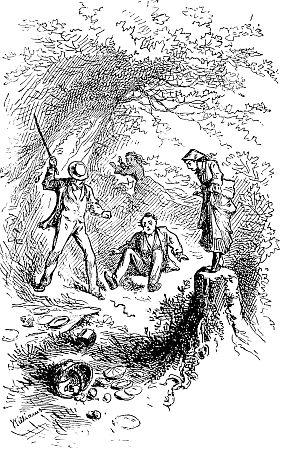
IN SYMPATHY WITH NATURE.
One well knows the delights attending a picnic in the
woods for a day—arising at early morn and carefully
stowing away in baskets sundry choice and toothsome
articles, and filling the corners of the basket with beautiful
bright flowers from our gardens, we resorted to the
woods and dividing into groups under the shady trees we
spread on temporary tables the savory dishes, and strove
to the best of our ability to get in sympathy with nature.[B]
But think of a month’s picnic daily filled with excitement
and pleasure, from running rapids and falls in a canoe to
enticing the wary trout, or picking strange flowers and
berries by the brookside, and at night resting one’s tired
but invigorated body under a snow white tent!
The west branch of the Penobscot (or Rocky) river,
after leaving the terminus of the Northeast “carry” at
Morris’s, flows steadily to the southeast with hardly a
ripple for some two miles until it reaches the mouth of
Lobster stream; then a stronger current is perceptible
with “rips,” and this continues for two and a half miles
more, when after passing a small island the water again
becomes “dead.” The birch barks, paddled by guides
Weller and Morris, preceded us down the river, while
the quartermaster and I followed in the canvas canoe,
the fourth canoe with Guide Bowley and the artist bringing
up the rear.
Could there have been a looker-on from the shore, he
would possibly have thought it was a government expedition
in search of the “northeast passage;” but although
our destination was about as little frequented it was not
so grave an affair.
After paddling until late in the afternoon through
eight or ten miles of still water we made our first camp
on the right bank of the river, at the mouth of Moosehorn
stream, and transferring our “kit” to the shore
turned over our canoes in the sun to dry.
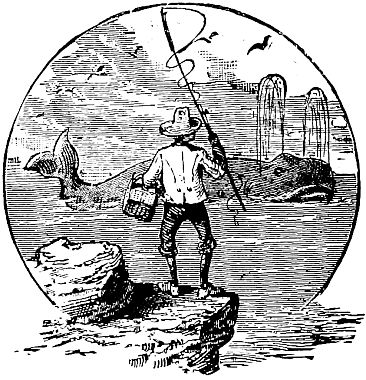
DISCOURAGEMENTS.
“CHANGING PASTURE.”
“Within the sun-lit forest,
Our roof the bright blue sky,
Where streamlets flow, and wild flowers blow,
We lift our hearts on high.”
OUR FIRST CAMP AT MOUTH OF MOOSEHORN STREAM.—ACCOMMODATING
ONE’S SELF TO CIRCUMSTANCES.—THE
“RIPS” OF THE WEST BRANCH.—RUNNING THE RAPIDS.—PINE
STREAM FALLS.—CHESUNCOOK LAKE.—UMBAZOOKSUS
RIVER.—A “BEAR” WELCOME.—MUD POND AND “CARRY.”—A
PICTURE DIFFICULT TO PHOTOGRAPH.—THIRD CAMP
ON CHAMBERLIN LAKE.
description of our first camp in the woods will
acquaint the reader with the arrangement of the many
after, and make him familiar with the picture of our daily
surroundings.
Our wall tent, ten by twelve feet, was soon unfolded, and, selecting
a prominent point of the high bank which commanded the river, we
immediately set about cutting the three necessary poles on which to
erect it. We trimmed all projecting twigs from the ridge and front
upright poles, but left them on the rear one that we might make it
useful—on which to hang cups, belts, candlesticks, and lantern. Here
the quartermaster’s whittling propensity came in use, and another pole
was notched by him and pressed into service beside the last, which
served as a rack for our guns and rods. Great care was taken that the
notches which held the ridge-pole were not too long, or they would tear
the tent, and that the angle of the roof should accommodate any passing
shower. Then we cut short pins from the white birches, and with the
ropes at the sides soon drew the tent into position.

PENKNIFE SOUVENIRS.
While Bowley, our cook, was making bread and coffee,
trying salt pork and trout for our evening repast, the
resounding blows of Weller’s axe could be heard in the
forest, gathering logs for the camp-fire, and Morris was
cutting fir boughs for the historic camp bed. It is wonderful
how comfortable a bed this makes, while its
delightful health-giving odor is so invigorating to the
system. Our table outside the tent was usually made
of four forked sticks on which we put others crosswise,
and on these we laid splits of wood, and for seats rolled
into position a convenient log, or used the many wooden
pails containing our provisions. On rainy days we sat
on the ground in the tent, and used these pails of various
sizes and heights as our “extension table,” smiling to
think how easily we could conform to any condition in
the woods. At the head of the tent a choice position
was given to our photographer’s camera and chemicals,
together with our traveling-bags, rifles, cartridge-boxes,
and books, while at our feet were distributed the pails of
provisions, and heavier part of our “kit.” About one
and a half feet was allowed to each man for sleeping
accommodations, an imaginary line only dividing off the
guides, we being arranged somewhat similar to sardines
in a box, only our heads were all in one direction.
Immediately after leaving camp the next morning we
entered the “rips” or rough water of the river. For
about ten miles there was little necessity of paddling, the
velocity of the stream sweeping us along without extra
effort. These last few miles were very exciting, as, following
in the wake of the birch canoes, we guided our
canvas craft past boulders and sunken rocks, while the
guides, constantly on the alert for our welfare, shouted
or waved their hands to warn us of dangerous places.
Passing close to the bank on the left of the boisterous
water, we shot the Pine Stream Falls and soon rested in
the foamy waters below, where our artist at once immortalized
the party.
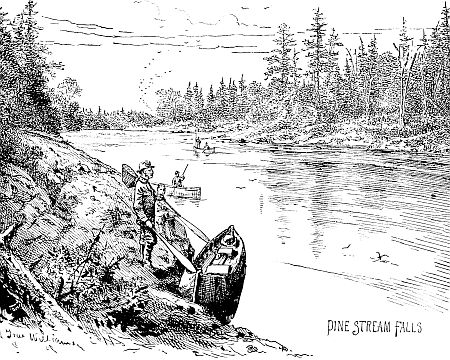
Pine Stream Falls
The amount of strength and activity displayed by the
guides in handling their canoes past falls and rapids is
astonishing. With their slender “setting poles,” eleven
feet in length, armed at one end with a sharp iron spike
of six inches, they will steer the canoe with unerring
certainty, or hold it quivering in waters that would seem
to engulf it.
A hasty lunch, and we soon reached the mouth of
the West Branch (eighteen miles from the North East
carry), where a scene of special beauty burst upon us in
the white capped waves of Chesuncook Lake and distant
view of Mt. Katahdin and the Sourdnahunk range. Paddling
across the head of Chesuncook Lake, which is seventeen
miles in length and three miles in width, we passed
the mouth of the Caucomgomoc stream and entered the
Umbazooksus River. We had hardly recovered from the
exertion in crossing the lake, when we espied in the tall
meadow grass on the bank of the stream a large black
bear, who, standing on his hind legs, nodded an approving
welcome. The quickness with which he dropped on
his four feet and plunged into the thicket gave us little
opportunity to return the compliment with our rifles.
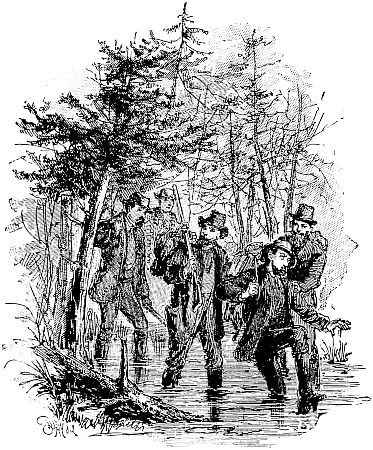
MUD POND CARRY.
Another camp, and the next day we passed in safety
the Umbazooksus stream and lake, and at 8 A. M. arrived at
the long dreaded Mud Pond “carry.” This path through
the woods to Mud Pond is a little over two miles long,
and is detested by tourists and execrated by the guides.
Many weeks before my departure for Maine, I had been
accosted by a friend (who had made the St. Johns trip),
and asked to give him on my return the full particulars
of my experience on this “carry.” I was not, therefore,
taken by surprise, but was prepared to meet it manfully
on its own ground, and fight the battle to the best of my
ability. I had provided myself for this special undertaking
with long rubber wading pants or stockings, reaching
to my hips, and further incased my feet in a heavy pair
of canvas hob-nailed shoes, the latter I also found useful
in wading streams. Even while selecting our provisions
at the Kineo House, this and that luxury had been debated
upon, or withdrawn as an article too heavy for transportation
on Mud Pond “carry.” Its obstacles to our senses
had also been made prominent by the daily conversation
of the guides, and our imagination of that “gulf” greatly
awakened. On reaching the portage, the canoes were
drawn ashore, turned over to dry, goods removed, and,
each one selecting what he could support, we started off
“Indian file” to make the best of the difficulties. On the
right-hand side of the path, within a few rods of the
Umbazooksus Lake, will be found a cool and refreshing
spring of water, at which we quenched our thirst. At first
the path was dry, and only occasional pools of water,
easily turned, interrupted our advance; but soon the
pools grew thicker and thicker, lengthening to greater
extent than before, and, with our loads on our backs, we
plunged forward, sinking time and time again to our
knees in the soft muddy water. It makes a vast deal of
difference, the nature and position of the load on one’s
back, and whether it is steady in its place, or has a shifting
propensity. I have known a pair of oars dodging
about on one’s shoulders to be heavier and more inconvenient
than five times that burden in guns and ammunition.
I had selected as the task for my left shoulder my shot
gun, and attaching to it a broiler, coffee-pot, gridiron, and
other impedimenta of camp and cooking utensils, detailed
to the right a bag of two hundred shot and rifle cartridges.
Picture not only one but six men so loaded,
forcing their way through the muddy path, slipping and
floundering, first on one side and then on the other, under
the conglomerated load of “camp kit.” An opening in
the dark hot woods half way across, and our burdens are
lowered to the ground, to return to the lake for another
cargo. A lunch, and on we go another mile, where the
branches lock closer and closer about us, making our load
seem double its weight, until with joy we discover from
a slight elevation at the end of the “carry” the tranquil
surface of Mud Pond. A portion of this course is evidently
at some seasons of the year the bed of a brook,
and the writer found in a small isolated pool of water
only a foot square, a lively trout, four inches in length.
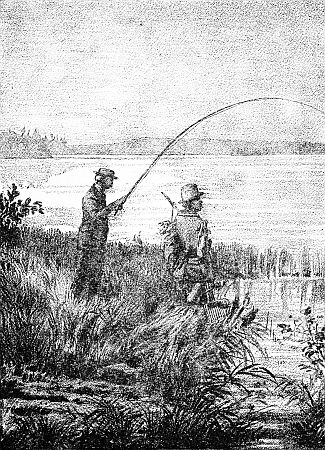
MUD POND—LOOKING EAST FROM END OF CARRY.
Our guides told how, during some months of the year,
they had dragged their boats two-thirds of the way across,
remarking that the only “dry” part this year, was the
temperate way in which they were treated.[C] The canoes on
the guides’ shoulders were the last loads to cross, and, as
it was now 6 P. M., one can make some estimate of the
work done, seeing we had only accomplished two miles
that day.
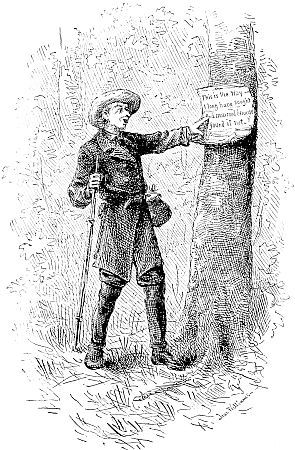
“This is the way I long have sought
And mourned because I found it not.”
Launching our canoes on Mud Pond, some two miles
in width, of uninteresting scenery, we bent our remaining
energies to the reciprocating paddle, and were soon on
the other side, and canoeing the sluggish waters of Mud
Pond stream. Its mouth was clogged by great weather-beaten
logs, which necessitated the laborious use of our
axes before forcing a passage into Chamberlin Lake.
The sun was hardly half an hour above the horizon, as we
crossed this beautiful lake two and a half miles to the
opposite shore, and camped on its white pebbly beach at
the foot of a farm. This was the only one of three habitations
which we saw on our trip, and the delight which
we experienced was as great as the recovery of a lost
trail in the woods by the tourist mentioned in the following
incident. A brother angler, while treading a lonesome
path in this very neighborhood, found one day a piece
of birch bark nailed to a tree on which was inscribed
these familiar lines—
“This is the way I long have sought
And mourned because I found it not.”
REFLECTIONS.
“On the fair face of Nature let us muse,
And dream by lapsing streams and drooping wood;
Tread the dark forests whose primeval ranks
Since the Creation dawn have cast their shade.”
CHAMBERLIN FARM AND LAKE.—A NOVEL FLY-TRAP.—A LESSON
IN NATURAL HISTORY.—TELOSMIS LAKE.—THE “CUT.”—A
THREE DAYS’ RAIN STORM.—WEBSTER LAKE AND DAM.—AN
APPARITION.—THE WEIRD STILLNESS OF THE PRIMEVAL
FORESTS.—AN ACCOMMODATING FLY-CATCHER.
hamberlin farm consists of one log house, eight
or ten barns, and about three hundred acres of cleared
land, if where in some portions you can jump from stump
to stump can be called “cleared land.”
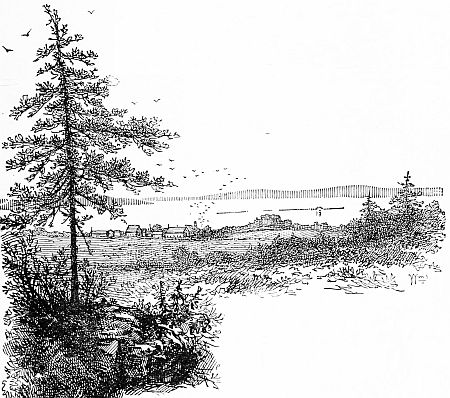
CHAMBERLIN FARM AND LAKE—LOOKING
WEST.
The buildings are situated on a hill fronting the lake, and command
a view of the greater part of the water. Mr. Nutting (who with
his three sons has charge of the farm) is six feet high, straight
as an Indian, with heavy high cheek bones, black moustache, and
whose face is thoroughly tanned by exposure to the sun. The farm, with
others in this vicinity, is owned by Messrs. Coe & Pingree of
Bangor, Maine, who possess vast tracts of this wilderness, which they
lumber and pass the result of their efforts to the markets along the
coast of the State. During the summer months the products of the farm
are gathered into the barns, and are used to feed the hundreds of “log
drivers” who in the winter and spring are annually sent to this region.
These “loggers” are a hardy set of men, receiving a dollar and a half
a day when “on the drive,” and work from 2 A. M. to 10
P. M., often exposed to great perils and the
inclemency of the weather. Large herds of cattle and sheep are pastured
here, and on the hill at the rear of the house I noticed a number of
mules.
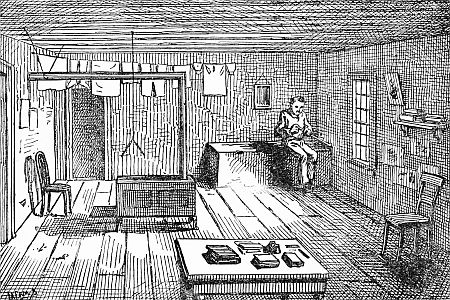
THE ROOM INTO WHICH WE WERE USHERED.
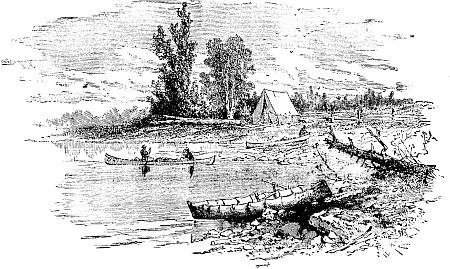
CAMP ON CHAMBERLIN LAKE.
The two-story log house in which resides Mr. Nutting
is painted an Indian red, and has the only embellishment
of any of the buildings. The interior is white-washed,
and has three rooms on a floor. The room into
which our party was ushered had low ceilings of heavy
logs, blackened by age and smoke from the big square iron
stove which held undisputable possession of the center
of the apartment. In one corner was a great box containing
wood, which also served as a bed when other accommodations
were not available. From the ceiling,
hardly seven feet high, was arranged the clothes line, on
which hung a portion of the week’s washing, while the
floor was made of logs with enough openings between
them to admit plenty of fresh air. Artistic taste had
not been wanting in the decoration of the log walls, and
engravings cut from illustrated papers were tacked thereon,
while in a prominent position was hung the portrait
of a late unsuccessful candidate to presidential honors.
Rough shelves nailed to the sides of the walls between
two windows supported a roll of old papers, a Webster’s
dictionary, National fifth reader, Greenleaf’s arithmetic,
Bible, and Testament, while at their side hung a mirror,
and the family hair-brush and comb. But the most novel
article in the room was a fly-trap, which, although it displayed
the inventive genius of the locality, can hardly
have its model on the many shelves of the Patent office.
This fly-trap hung from the ceiling near the stove, and
was manufactured from two shingles fastened together
at the butts like an inverted V. On the inside was
spread molasses, and as fast as the insects became interested
in its sweets, it was the duty of the passer-by to
slap the boards together
and destroy their contents.
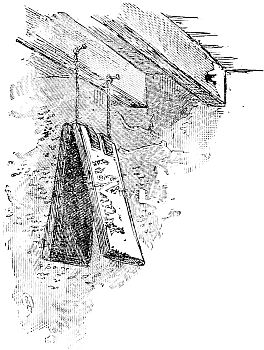
NOT FOUND AT THE PATENT OFFICE.
In addition to superintending this farm and stock, it is the
duty of Mr. Nutting to provide for the various logging camps in the
neighborhood, and to watch for the first indication of fires, whose
destructive power in the pine forests he fully realizes.
Chamberlin Lake, on which we had pitched our tent, is fifteen miles
long and three miles wide. It has an area of twenty square miles, is
1,134 feet above tide water, contains a number of islands, and took
its name from an unfortunate man lost some years since on its shores.
Years ago a large dam was built at its northern outlet into Eagle Lake,
and the water driven back south, through an artificial cut between
Telos and Webster Lakes, thus enabling the lumberman to “drive” his
logs to a home market through the East Branch of the Penobscot river,
instead of
by the St. Johns route to the foreign one of New
Brunswick. It costs fifty dollars a ton to transport supplies to this
farm, and flour is nineteen dollars a barrel.

A STUDY IN NATURAL HISTORY.
After our labors on Mud Pond “carry,” we rested here
three days, taking photographs of the scenery, and making
excursions to the dams between Chamberlin and Eagle
Lakes, where we found plenty of exercise for our trout
rods. We also “sacked” our canvas canoe across the
hills on the east to Indian Pond in search of wild
ducks and trout, but were only rewarded by a study in
natural history which seldom happens to the forest lover.
Our discovery was a family of loons, or the great Northern
Diver, a bird the size of a goose, and the finest on inland
northern waters. It could be honestly said, “they
lived in flats,” as their rough nest, composed of sticks and
moss a foot in height and two feet in width, rested on a
flat sandy knoll which stretched out into the water.
Against the unmistakable dislike of the parent birds, I
paddled to the front door of their house, and, gazing in,
discovered a recently hatched bird and one egg.
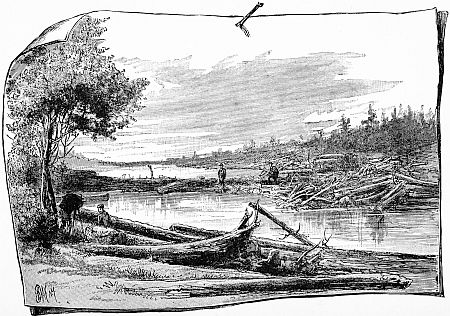
TELOS CUT AND LAKE.
The egg was dark brown, spotted with black, eight
and seven-eighth inches at the longest, and seven and one-quarter
at the shortest circumference. The young bird
had every appearance of a goslin, with down of a grayish
black, and did not seem in the least annoyed as I stroked
its glossy coat. Withdrawing my canoe, and creeping
quietly back into the thicket, I enjoyed the lesson in frog
catching, taught the young one by the old birds, and I left
them undisturbed in their happiness.
It was with great reluctance that we broke camp
early on the morning of August 12th, rolled our tent,
and, arranging our kit in the canoe, paddled out into
Chamberlin Lake and bade farewell to the scenes around
which clustered so many pleasant memories.
The fresh milk, butter, and eggs of the farm were a
happy relief to our regular fare of salt pork and hard tack,
while the fresh straw, which Mr. Nutting so kindly offered
us from his barns, for the floor of our tent, added greatly
to our comfort.
But we had not started with the idea that in this wilderness
we were to enjoy all the dainties of life, for in
order to explore its depths we must give up luxuries
and comforts which at home seem indispensable.
How often in my earlier years, while pursuing the
study of geography at school, did my pencil in drawing
maps wander over this endless tract of territory to
the north and east of Moosehead Lake, striving to picture
to my imagination its elements.
This great lake near the center of the State, together
with few of the largest rivers whose source then seemed
a doubt, were about all that relieved the picture, and I was
daily discovering new beauties of scenery little known to
the outside world.
“A land of streams! Some, like a downward smoke,
Slow-dropping veils of thinnest lawn, did go;
And some through wavering lights and shadows broke,
Rolling a slumbrous sheet of foam below.”
Through the long stretches of deep water of Chamberlin Lake we
paddled, keeping time with our oars, while on our right arose the peaks
of the lovely Sourdnahunk Mountains, each individualized by the bright
rays of the morning sun.
Entering Telosmis Lake, which is about a mile in extent, we sailed
swiftly through its quiet waters and passed into Telos Lake, where, at
the mouth of a brook on the right hand, we were successful in landing a
fine lot of trout which averaged over a pound each.
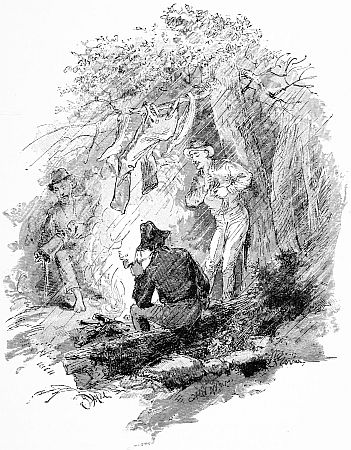
THE “WET AND DRY PROCESS” OF PHOTOGRAPHY AS
ILLUSTRATED BY CAMP LIFE.
Telos Lake is four miles long and about half a mile
wide, and is nine hundred and fourteen feet above tide
water, its northern shore rocky and abrupt, in comparison
with the sandy and uninteresting nature of its south
coast. The mouth of the canal or “cut” at its foot is
clogged with immense quantities of flood-wood, old logs,
and stumps, bleached to whiteness by the action of the
weather, which give it a weird and ghostly appearance
against the background of verdure. This “cut” was
dug by lumbermen some forty years ago, to pass their
logs into the East Branch of the Penobscot, but below
the old dam, quarter of a mile distant, one would never
suspect by its natural and picturesque shore it was the
work of men’s hands, the force of water having relieved
its sharp outlines.
While our artist was preparing his camera for a photograph of the
“cut” and lake, our guides “sacked” their burdens and canoes across the
chevaux-de-frise of old stumps into the “cut,” and we pitched our
fourth camp on the high bank to the right of the old Telos dam.
Although we had been out fourteen days, we had so far been very
fortunate regarding the weather, but we here experienced the first
rain-storm of the trip—a genuine northeaster of three days’ duration.
We had hardly raised our tent and got our “kit” under cover before the
watery contents of the heavens began to descend, and we took extra
precautions to make ourselves comfortable and endure the trial in the
most cheerful spirit possible. But I will not detain the reader with
every item of the three days’ imprisonment. Encased in our waterproofs,
we resorted to the dam, caught trout, or wandered beside the waters
of Telos stream for ducks and partridges, giving little heed to the
elements.
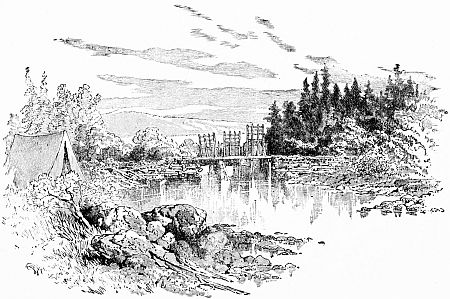
TELOS DAM AND RIVER.
It is amazing how little one makes of discomforts in
the woods, provided he sympathizes with his surroundings.
But to a nature having neither poetry nor romance,
to whom a fall is only a suggestion of water power, and
a tree so many feet of lumber, the situation is unendurable.
Here our canvas boat was overhauled, cuts sewed and
waterproofed, birch canoes pitched, buttons adjusted to
our clothing, socks darned, guns and rifles cleaned, while
the “Quartermaster” busied himself ingeniously carving
pliers, scissors, and vises from wood, cutting the joints of
the same piece as souvenirs of the locality.
But the storm had one good effect; it nearly exhausted
the moose and bear stories of the guides, and
left them, in the future, only the current topics of the
day to discuss.
So far the days had been exceedingly warm,—thermometer
sixty to seventy in the shade,—but what was
our surprise on arising early on the clear bright day of
August 16th to discover a heavy frost, and the ice in our
camp pails an eighth of an inch in thickness. We were
first aware of the event by the exclamations of our cook,
Bowley, who was slipping about on the frozen ground
outside, and to our incredulous replies, lifted into the
door of the tent one of the frozen pails by the tin dipper
which adhered to its surface. The tent was quickly
“struck” and dried, and, rolling into our rubber blankets
and bags our effects, we were cutting the waters of Telos
stream, and soon emerged into tranquil Webster lake at
its foot. The brook is about a mile long, and very shallow,
and but for the late rain would hardly have been
navigable. An easy “carry” of a mile can be found
through the tall grass and woods on the right-hand side,
which also terminates at the head of the lake.
It is very essential to one’s happiness, in making this
tour, to know on which side of the stream is the best
portage around a fall or rapids, for the knowledge saves
many a laborious walk when one’s shoulders are loaded.
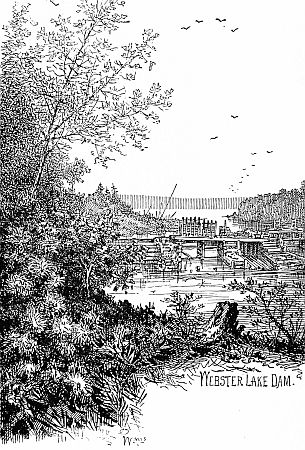
Webster lake is a charming little sheet of water about
three miles long, and perhaps half as wide, which is
wooded down to its very edge. At its foot is another of
those series of loggers’ dams, about twelve feet high, and
on the extreme high bank to the right we again pitched
our tent.
Great care had to be taken with our fires along the
road, that not a remnant of them be allowed to remain,
and the indications are often very delusive. Many years
ago a fire started in the woods on Eagle lake, and the devouring
flames, sweeping southward over fifty miles to this
section, destroyed this dam which has since been rebuilt.
AN APPARITION.
There are many decayed and deceptive logs about
these old dams, some even a foot in diameter, which at a
slight pressure will crumble and plunge one into the deep
water below—I speak from experience.
A bear story is always welcomed in camp, not only
on account of the truthfulness attending the first one,
but the doubts which hover around the succeeding tales,
add to their interest.
We stretched the canvas of our tent at this place,
and while each one was engaged in his various duties,
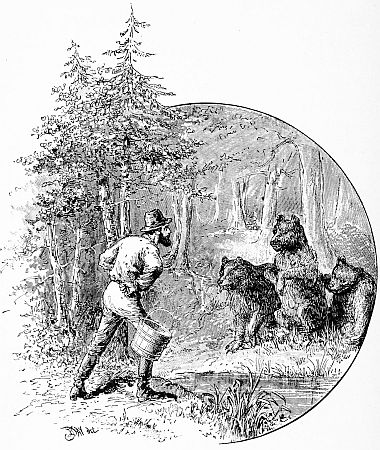
Weller, the guide, pail in hand, sallied out for fresh
spring water. He had hardly disappeared from our
sight, when with immense jumps he came tearing back
through the bushes shouting, a bear! a bear! A rush
for our rifles, and a forward movement into the woods.
But after an unsuccessful tramp, the she bear and two
cubs seen by our friend could not be found.
Before we left the wilderness, we had the unspeakable
pleasure of making the acquaintance of some six bears;
but on every occasion we were without our rifles, and
when we made an effort to hunt them, they were not to
be found. We were either shooting a quick flowing
stream, and with difficulty keeping our canoes from the
rocks, or surprised by meeting them (as in the above
case) nearer to camp than one could expect, when they
suddenly appeared.
Webster Lake Dam.
A few years since, Maine offered a bounty of ten dollars a head on
bears, and the hunting or trapping of them was a lucrative pastime, but
since the withdrawal of the premium, hunters have decreased in the same
proportion that bears have increased.
As might be expected, around the camp fire that night, the recent
experience suggested hunter’s tales, each having its special locality
and party designated, who witnessed the exploits, while the habits,
courage, and peculiarities of bruin and other animals were discussed to
an unlimited extent.
One of the stories told by Guide Morris related to a
tame beaver which had grown to be a great household
pet of a farmer living in the vicinity of Moosehead lake.
One night a defective faucet filled the farmer’s sink and
overflowed to the floor of the kitchen, whereupon the
beaver, following his natural instincts, cut up the chairs
and tables of the room, and building a dam about the
fugitive stream saved the habitation from further injury!
We tarried three days at Webster dam, where we
captured the largest trout of the excursion, and feasted
on many a fine duck and partridge.
To impress the reader with the idea that our table
fare was not so hard as might have been expected, I
would state that the items of the daily menu consisted
of fried brook trout, boiled potatoes, stewed duck
or partridge, hard-tack, “flip-jacks,” with maple sugar,
coffee, and tea. Fish chowders and game stews were our
favorite dishes, all eaten with the seasoning of a hearty
appetite.
FLY CATCHERS VERSUS FLY FISHING.
At this point we were probably as deep in this wilderness
as it was possible to get in the trip.
The most striking feature of the forests is the absence
of animal life, and more noticeable in our northern than
southern wilds. The stately pines of the South stand
from eight to twelve feet apart, and with a span of horses
one can almost drive from one end of Florida to the other.
In fact, the writer, in the winter of 1875, met a party so
equipped, traveling in an open wagon from New Smyrna
to Fort Capron, choosing their way by the compass’ aid.
This open condition of things permits the rank growth
of vegetation and animal life, which the close-locked
branches of our northern forests prevent. In the latter
case, also, the continual sifting of the pine leaves on the
ground, and the gloom of the overhanging boughs choke
what few shrubs might have an existence.
Only along the rivers, or where the woodsman has
failed to spare some tree, dare anything but a courageous
blackberry or shrub-maple show itself. You may wander
for hours in this stillness without seeing a living
creature, unless you look sharply enough to mark the
insects which toil in the mosses underfoot, inhabit the
bark and decayed wood, or wait for you to rest before
settling on you.
But we occasionally entertained strangers of animal
life, and in one instance, that of an “angelic” order—at
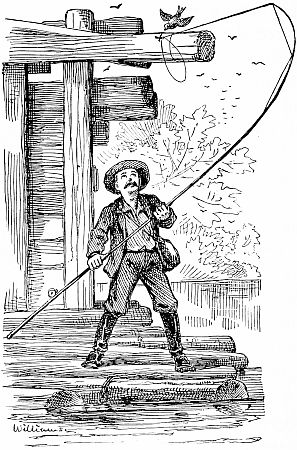
least it had wings, and its mission was helpful. Our
artist, while casting his line from the apron of the dam,
caught it on a projecting beam, and after vain attempts
to withdraw it, was successfully assisted by a little brown
fly-catcher, who, swooping down, attempted to carry to
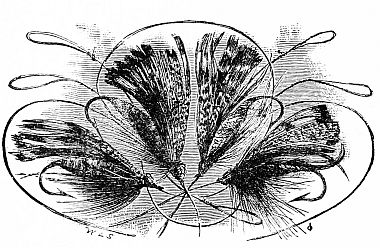
its nest the bright-colored artificial trout flies.
ALLUREMENTS.
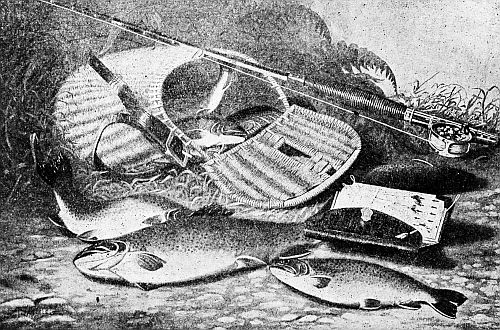
STUDY OF TROUT—BY THE AUTHOR.
“What time the golden sunset fell,
On wood and stream,
While we, the loss or gain
Recount, and deem
The day all glorious with its rents and stains.”
THE PASSAGE OF WEBSTER STREAM.—AN EXCITING DAY’S
SPORT.—THE DAMAGED CANOES.—THE CANVAS BOAT TRIUMPHANT.—GRAND
FALLS.—PHOTOGRAPHING ALONG THE
ROUTE.—INDIAN CARRY.—EAST BRANCH OF THE PENOBSCOT.—MATAGAMONSIS
LAKE.—THE DISCOVERY OF A NEW
LAKE.—TROUT BROOK FARM.—GRAND OR MATAGAMON
LAKE.—A CAPTURED SALMON.
T 5.30 A. M., August 20th, our camp was alive with
preparations for the long anticipated run down Webster
River, ten miles, to the East Branch of the Penobscot
and, as it afterwards proved, was the most exciting day’s
experience of the two hundred mile tour.
Blankets, overcoats, and tent were rolled closer than
usual, and leather thongs five feet in length, (some three
dozen of which I had brought with me,) were tied about
them, and safely crowded into the bottom of the long
rubber bags. Covers to the various provision boxes and
pails were secured with straps and ropes, and every part
of the camp kit made to occupy as little room as possible
in the four canoes. Rubber leggings and wading shoes
were put on, and all unnecessary wearing apparel wrapped
in rubber blankets and tied to the boats, that nothing
might incommode the free use of our arms in the passage
of the falls and cascades of the stream. The stretcher of
our canvas boat was fastened to the wooden knees more
tightly with thongs, that no possible chance of accident
might occur, while the pieces of extra canvas for patching
the canoe, with their accompanying needles, wax, and
waterproofing, were tied at a convenient place in the bow,
and before we had completed the day’s adventures we
found them of great service.
Webster stream is about sixty feet wide, and in its
course from the lake of the same name to Grand Falls
(two miles above its mouth), descends one hundred and
ten feet, while the falls, including the rolling dam and
cataract below, make the entire distance to the East
Branch of the Penobscot not far short of one hundred
and seventy feet.
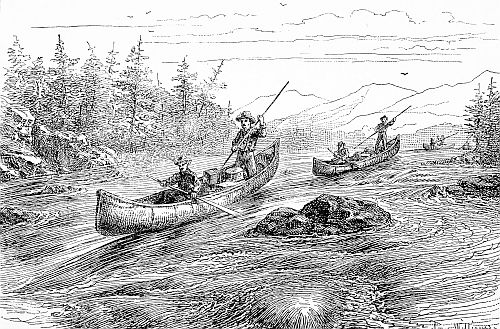
RUNNING THE RAPIDS ON WEBSTER RIVER.
The stream issues from the lake with little force,
being clogged above by a mass of logs, the remnants of
various “booms.” As it passes downward in its course,
heavy walls of rock, crowned by tall pines, arise on all
sides, often darkening the waters and producing a cañon-like
appearance of the surroundings.
The course of the river is over immense bowlders and
ledges, often unobservable, just beneath the surface, while
others in sight stand like sentinels in the middle of the
stream, disputing one’s passage. The flow is repeatedly
marked by beautiful falls and rapids, not high, but
crowded together in narrow parts, which give greater expression
and grandeur to the water, presenting at various
points the most remarkable scenery in this section. Cascade
succeeds cascade, ending often in an abrupt pitch of
three to five feet, and at their base are dark boiling pools,
flecked with snowy foam. The river has not great depth
of water at any time, three to five feet on the average, but
we were fortunate in the extra supply of the last week’s
rain, which, although it prevented many “carries,” also
increased the volume and force of water to that extent
that made canoeing more hazardous, and filled our path
with greater dangers.
The ladened birch canoes had passed us down the
river, when the “Quartermaster” and the writer, buckling
their belts tighter about them, stepped lightly into the
canvas canoe and swung out into the impetuous river,
with feelings similar to what might be expected in one
entering a battle.
My friend at the stern held a trusty paddle, whose
strength had more than once been tried, while the
writer, in a devotional attitude on a rubber blanket
at the bow, held a long “setting pole” ready for duty
at a moment’s notice. In half the time I have narrated
the above, we were among the furious rapids, battling
with their difficulties, and shouting to each other
above the roar of the waters, how best to circumvent
them. The sun, unfortunately, shone the greater part of
the time in our faces, which produced a glimmer on the
water, often preventing the discovery of sunken rocks.
At one time, while dashing down a cascade, we mounted
such a bowlder, and, swinging around, leaped a five-foot
fall, stern first, much to our peril. Again, with mighty
force we were hurled close to the rocky shore, which only
a desperate use of the paddle prevented our striking.
At times we were obliged to hold the canoe in the
middle of the stream by the long “setting poles,” firmly
planted in the bottom, while we made our decision regarding
the better of two channels, the dangers of which there
was little choice, then on we went through the rush of waters,
our “setting poles” keeping time with our eyes, noting
the sunken rocks by the water’s upheaval, avoiding this
sharp ledge, or that rough bowlder, or swinging into the
foam of another as we shot swiftly by.
Often with ease we thought to pass a distant rock,
but mistaking the velocity of the water, doubled it by
a hair’s breadth. One fall over which
the guides had led their canoes, we amateurs
passed in the canvas canoe, the
water falling in spray about us, but the
cheer for our bravery with which we
were greeted at its base, paid us well for
the risk incurred.
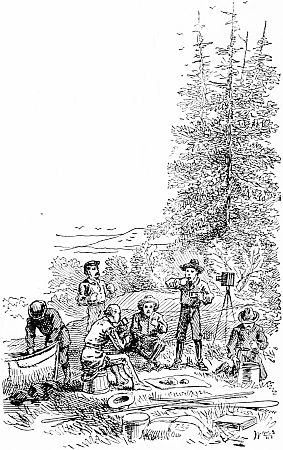
LUNCH TIME ON WEBSTER STREAM.
At “Pine Knoll” we were obliged to let our canoes over the falls
by long ropes from the cliffs above, and at another, soon after, two
of the guides, Weller and Morris, passed safely in our canvas boat,
on account of its slight draft of water, although they carried the
birch canoes around. So we continued our rapid progress down
the stream, running most of the falls, our boat conforming to each
situation, and almost seeming a part of us, and taking an interest in
our exploits. At noon we stopped for an hour’s rest and lunch on the
right bank of the stream, and while disposing of hard tack, canned
corned beef, and coffee, our artist plied his profession, and then on
we went through other perils.
It was fearfully fascinating, as our four canoes, following
each other’s lead, dashed onward through dangers
which we could hardly anticipate before they were passed,
only to be repeated and repeated at every mile of the
stream. But the stimulant to one’s feelings gave strength
and courage and even recklessness, which, in the wild surroundings,
made one feel as if no danger was too great
to dare. An hour after our tarry for lunch, we entered
the deep and narrow chasm of swift, dark water above
Grand Falls, and swinging our canoe into an eddy on the
left, under the shadows of a great rock (some five hundred
feet high), we stepped out on the shore, having completed
the excitements of a half-day that many years will
fail to erase.
Our canoes had suffered less than we had anticipated. A sharp rock
had left its mark on Bowley’s birch, which the application of rosin and
grease soon rectified. The bottom of the canvas boat had two
small cuts about midships, so the use of needle and thread became
necessary, the “Quartermaster” and compagnon-du-voyage, choosing for
their modus operandi different sides of the canoe, putting the needle
back and forth with iron pliers.
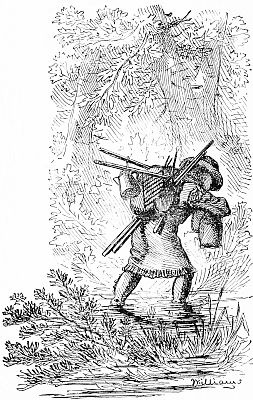
IT’S NOT ALL POETRY.
A few moments’ rest, and while the guides were “sacking” the camp
kit across “Indian carry,” three-quarters of a mile to the East Branch
(at right angles with Webster stream), we gathered up the artist’s
camera and plates, and pushed forward to examine the picturesque
beauties of Grand Falls, and catch all we could while the light
lasted.
Grand Falls is from forty to fifty feet high, seventy
feet wide, surrounded on all sides, for half a mile, by
ledges of iron-colored rocks of nearly the same height,
which decrease in altitude as they near the Penobscot
River below. From a point beneath, the scene is grand
in its somber magnificence, as the swift torrent, striking
midway upon a projecting ledge in the center of the fall,
rebounds in foam flakes, which, after the momentary interruption,
continue to fall into the dark whirlpool of
water below.
We place the tripod upon a prominent ledge, and,
mounting the camera, our artist prepares the plates in
his mysterious cloth-covered box or “dark room,” while
we further exclude the light by covering him with our
rubber blankets. But the mist and spray blinds us, and
we are obliged to gather up the camera and retreat to
another ledge before we can operate.
The water, of a dark reddish hue, in strong contrast
with the snowy foam, circles around and around in the
eddies, kissing the rocks on all sides in its whirl, and,
amid the roar of the fall, goes dashing on for about four
hundred feet, and then plunges over a “rolling dam” on
its course to the Penobscot, making canoeing the balance
of the distance on this river impossible.
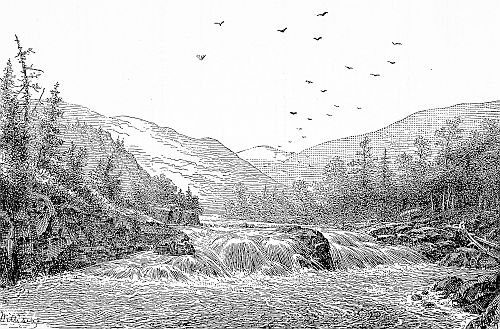
GRAND FALLS—WEBSTER RIVER.
The light from above, reflecting on the cliff above the
fall, glancing with rich beauty on rock and cascade, the
fantastic growth of trees on every ledge, make up a fascinating
charm that each succeeding picture varies in detail,
but which pertains with almost equal force to every
part of the entire chasm. While our artist was at work,
we busied ourselves gathering the luscious blue and
blackberries, and scarlet wintergreen berries which grew
in profusion around us; they were of great size, the
average blueberry being an inch, and the wintergreen
berries an inch and a half in circumference—measurement
being taken at the time on the spot.
After filling a three-quart pail with berries, we divided
the artist’s “kit” among us, found the “carry,” and
pressed on to camp, to which place our guides had preceded
us with tent and canoes.
Supper ended, we again sought the river’s bank, a
mile below the falls at a place called “the Arches,” where,
in the radiance of a gorgeous sunset, we again drank to
our fill of this picturesque locality. Words fail to describe
the beauties of this scene, with which even the
guides, slow to recognize the attractiveness of nature,
were enraptured.
“O Nature, how in every charm supreme!
Whose votaries feast on raptures ever new!
O for the voice and fire of seraphim,
To sing thy glories with devotion due!”
Around the big camp-fire that night, each narrated
his individual experience of the day’s adventures, and
the hair-breadth escapes in running the rapids.
“But,” says Bowley, the guide, “you should accompany
the lumbermen ‘on the drive,’ and see the perils
they run while starting a ‘jam’ on these rivers. Often
the logs are piled one upon another, until it seems as if
nothing but an avalanche would start them. But one
log is loosened, and then another, and another, and in a
moment the whole mass goes sweeping down stream with
terrific force, and woe betide the unlucky ‘driver’ in its
path.”
From the first of the trip to this moment, the guides
had failed to praise the working of the canvas canoe, as
it came in competition with their birch barks. But this
day’s trial proved beyond question its qualities, and
wrung from them an acknowledgment they were not slow
to utter.
“It was fun to watch you, gentlemen,” says Morris,
to the Quartermaster and myself, as we sat drying ourselves
before the fire, “you came over the ‘rips’ like a perfect
duck. I don’t believe you could drown the craft if
you tried.” While the French Canadian, Weller, taking
the pipe from his mouth, ejaculated, “Ma fois! she goes
over the falls like a chain over a log!”
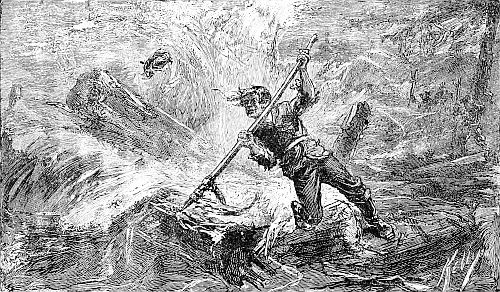
STARTING A BOOM.
On Thursday, August 21st, we wet our canoes for the
first time in the East Branch of the Penobscot river,
although from Chamberlin lake to this point it is strictly
a part of the same stream under different names.
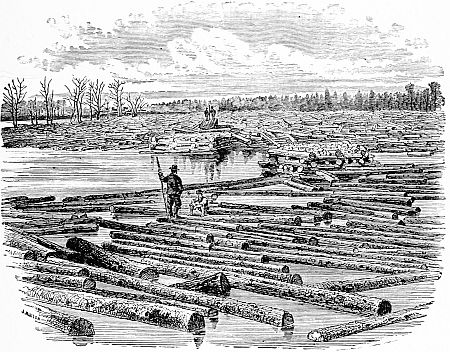
A BOOM.
The river at this spot is only about fifteen feet wide,
very deep, with long meadow grass lapping and fringing
its border, and flowing with the rapidity of a mill course,
each bubble as it shot by seeming to have an individuality
of purpose, which to the writer was very amusing.
Hardly had we dropped into our accustomed positions
in the canoes before we were swept away from the
bank, past the tall alders, and darted with lightning
speed down the river a mile and a half and out on to
the placid Matagamonsis lake. This was one of the
loveliest bodies of water on our course, dotted with small
islands and far-reaching points of shore, the tall Norway
pines forming a wall of beauty on either side.
The lake is about one mile wide and four long,
and the spruce-covered tops of Traveler mountains to
the southwest are reflected in its mirror-like surface.
From the top of a bold crag at its foot we stopped for
a sketch of the lake, and then passed downward through
the sluggish stream of three miles which connects it
with Matagamon or Grand lake.
To the left or east of this stream, and half way between
these lakes, is another lake about two miles in
extent, which we fail to find noticed on any map we have
seen, and lies in close proximity to “Hay creek,” but is
not what is termed in this section “a logan.” (See Introduction,
page 15.)
Half a mile from this lake, the stream passes under a
foot bridge, which leads to a farm on Trout Brook
stream, the first loggers’ camp since leaving Chamberlin
farm, a distance of over seventy-five miles.
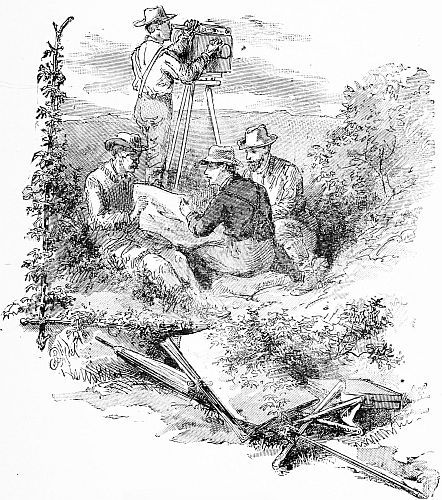
DISCOVERY OF A NEW LAKE.
This farm, owned by E. S. Coe, Esq., of Bangor, consists
of four houses built close together, and eight or ten
barns, with about four hundred acres of cleared land,
through which flows the swift-running trout brook. Half
a dozen batteaux lay turned over on the grass, bounteous
crops of oats and potatoes were ripening in the fields,
while the industrious chicken (evidence of civilization)
was picking about the doors.
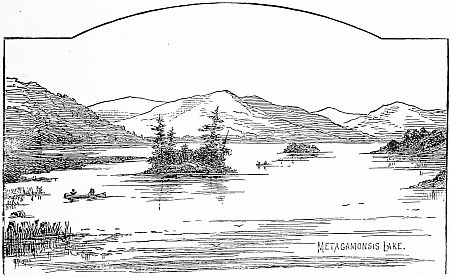
Matagamonsis Lake.
The house where our party dined was occupied by a
man and his wife and one small boy. The rooms to this
house were low and smoky, like all the rest we had seen,
with the big iron box stove in the center; the only change
from the usual wall decoration was perceived in an advertisement
of Pinafore opera music, which, pasted beside
the other illustrations, made us feel quite homesick.
After dinner at the house, our party bade our new-found
friends adieu, and paddled down the Thoroughfare
into Grand or Matagamon lake, which is about one-third
longer than Lake Matagamonsis, and went into camp at
its foot, on the right bank, near another old dam.
The eastern shore of this lake (the largest body of
water on our course since leaving Chamberlin lake) is not
especially attractive to the artist, being low and covered
with meadow grass. But the western is decidedly picturesque,
being bold and rocky, which, climbing from elevation
to elevation, finally culminates in the precipitous and
rugged peak of Matagamon mountain, towering above
one’s head to the height of six hundred feet, and is
almost divested of foliage. We halted but one night on
this lake, but were well rewarded by the number and
size of the fine trout captured, adding also to our creel a
small salmon.
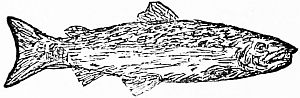
OUR SALMON.
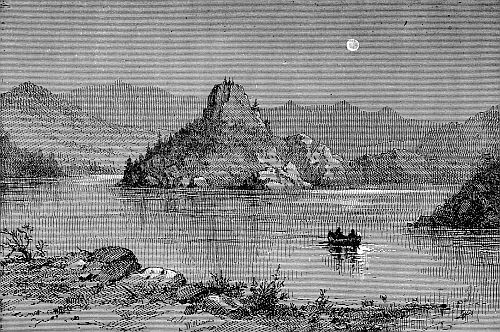
MATAGAMON OR GRAND LAKE.
“By viewing nature, Nature’s handmaid, art,
Makes mighty things from small beginnings grow.
Thus, fishes first to shipping did impart
Their tail the rudder, and their head the prow.”
DANGER OF WANDERING FROM CAMP.—AN EXPERIENCE ON
LAKE SUPERIOR.—THE FALLS OF THE EAST BRANCH.—STAIR
FALLS.—INCIDENTS OF CAMP LIFE.—AN ENCHANTED
BOWER.—HUNT’S FARM.—AN ARTIST’S CANOE.—THE ASCENT
OF HUNT’S MOUNTAIN.—A REVERIE.—WHETSTONE
FALLS.—DISCOVERY OF JASPER ON LEDGE FALLS.—DAWN
OF CIVILIZATION.—MATTAWAMKEAG.—THE EAST BRANCH
CANVAS-ED.
I often thought how easily one could stray from
camp, and, if without a compass, be lost in this wilderness.
While hunting on Lake Superior one autumn, some
years since, I endured such an experience, and the bitterness
of it has always remained fresh in my memory. While
passing over the corduroy road of thirteen and a half
miles which lies between the town of Ontonagon, Mich.,
and the Minnesota copper mines, my attention was allured
from the road by the melodious whir-r-r-r, whir-r-r-r
of a brace of partridges. Stepping aside into the thicket,
I followed as fast as possible the retreating sound, and
after a tedious tramp through briers and swamp I finally
brought them to bag. In the excitement of the chase, I
had given little or no heed to the path, or to the clouds
that were fast gathering overhead.
Starting back in the direction I supposed the road, I
traveled, it seemed to me, double the distance that would
have revealed it, but no familiar path did I find. In fact,
I was amazed in discovering that I was back on the same
ground on which I had started. There was no reason in
the thing,—no reasoning against it. The points of the
compass had been as clear in my head as if I saw the
needle, but the moment I was back, all seemed to be
wrong. The sun, which occasionally revealed itself,
shone out of the wrong part of the heavens. I climbed
one of the tall trees, but the very stillness of the landscape
on which I gazed seemed to mock me.
I was not a novice in woodcraft, and could follow a
trail readily. I examined the bark of the trees to see
which side was the roughest, and then, singling out a
number, judged of the points of the compass by the way
the majority leaned, and plunging into the thicket made
another and another attempt.
I well knew the danger of losing my self-control,
and, sitting down on a log, I covered my face with my
hands and waited until I felt calm and self-possessed
again. I have no idea how long it was, but when I arose
the sun was nearly obliterated by the clouds, which soon
began to discharge their contents in sympathy for my ill
luck, and to reach my destination I must make all speed.
I immediately struck a “bee line” in the direction
which my reveries had designated as the right path,
blazing the trees with my hunting-knife as I hastened
along. Soon I espied an opening, and, dashing onward,
what was my joy to find the old corduroy road, which
never looked more welcome in its life.
From Grand lake to the junction of the East with
the West branch of the Penobscot it is sixty to seventy-five
miles, the river being shut in on all sides by lofty
mountains, or heavy belts of grand old forests, through
which the swift river tumbles, with only an occasional
suggestion of the lumberman’s axe.
There are eleven conspicuous falls in this interval, varying
from twenty to sixty feet in height, while the charming cascades
are too numerous to mention. The abrupt descents bear the names
of Stair, Haskell Rock, Grand, Pond Pitch, Hulling Machine,
Bowling, Spring Brook Gravel Bed, Whetstone, Grindstone, Crowfoot, and
Ledge Falls, their names, in many cases, suggesting their wild and
rugged formation.
ON THE EAST BRANCH.
The water swept so swiftly through this section that with the
exception of the last twenty miles it was hardly necessary to use
our paddles, but, keeping an eye to the rocks in our path; we could
silently enjoy the many lovely changes constantly opening in the
landscape.
But this also was decidedly the hardest part of the entire
excursion.—At most of these falls, our whole camp equipage, provisions,
and canoes had to be “sacked” around the falls from one to two miles,
and in many cases there was hard climbing along the steep, rocky
sides of the mountains which followed the river’s course,
while each one of us carried his portion of the load.
For two and a half miles after leaving Grand lake one is constantly
reminded of the day’s experience on Webster stream by the furious
rapids, and we were again obliged to call into action our “setting
poles.” In a drenching rain, we were twice compelled to land on the
shore, take the canvas boat into our laps and sew the cuts in its
surface, laughing at the philosophical manner with which we submitted
to the circumstance.
Along the river’s bank to the west, for many miles, are the lovely
Traveler mountains, whose rambling appearance and daily companionship
are fully represented by their name.
Stair Falls the “Quartermaster” and myself ran in our
canvas canoe, but the guides, tending their birches as if
they were glass, dropped them from step to step by
means of ropes.
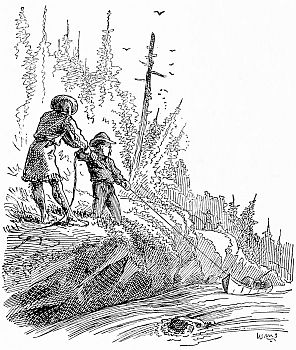
DROPPING CANOES OVER THE FALLS.
This fall or cascade is a series of steps or stairs some
five in number, each about three feet high and ten feet
apart, the best passage being through the channel near
the left bank. It is a very choice bit of scenery, and
one that any artist would greatly desire to transfer to
canvas and work into endless variety of composition. A
ten-mile passage of the swift river, and we reached Grand
falls, which, although higher than its namesake on Webster
river, being followed immediately by numerous cataracts
did not so impress one.
Here we were obliged to make a portage of three-fourths of a mile
through the dense woods to the foot of the falls, and, in a heavy
shower, went into camp on the opposite shore. To the “camper-out” a
rainy day in the woods is among the most disagreeable experiences, even
under a tight tent, with good company and plenty of amusement. But the
difficulties increase by being forced to be out in the storm, and to
leave your canoe at a portage and obliged to carry on your back through
mud and mire all your camp effects.
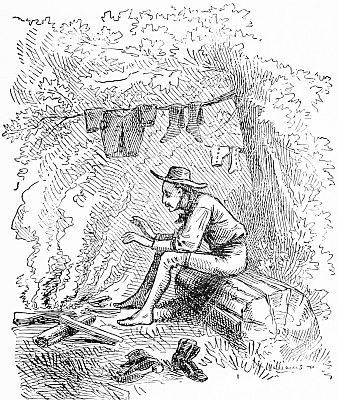
ACCEPTING THE SITUATION.
Through the woods you stumble, pressing the wet branches aside,
which in their recoil push away your rubber clothing, from which
the buttons are fast disappearing and the rents appearing, and
whose special protection is sadly deficient, until the repetition
of such circumstances as thoroughly drenches you as if you had
been without them. The water is dripping from off your
hat to your neck and rolling down your back in icy rills. The position
of your arms in carrying your “kit” is such as to lead a looker-on
to imagine you are striving hard to fill your sleeves with the rain,
which you know is a mistake, but there is no help for it. You clutch
tightly to your rifle as your pack begins to slip, striving to keep the
locks from the rain, while your boots have been innocently occupied in
catching every scanty drop which fell from your clothing, and you have
every appearance, if not the feeling, of the oft-quoted “drowned rat.”
You would not have your wife, or other friend, see you at this moment
for anything. How they would laugh, and hurl at you many of your pet
quotations regarding the “poetry, pleasure, and romance of life in the
woods,” until you had rather endure another storm than their irony.
Then comes the raising of the wet tent into position,
the repeated attempts to start the fire, and the holding of
every individual fir branch in the flame to dry before
performing the duty of bed.
Two forked sticks with one across are placed before
the fire, and on them you hang boots, socks, blankets, and
other articles of your belongings, and, while the guides
are cleaning your guns, you examine the provision boxes
to see if they have escaped the drenching.
It is amusing how stoical and indifferent one grows to
these circumstances in the woods, and soon makes but
little of them, retaining as serene and unruffled a disposition
as if they were of no account, while after a warm
supper and a social pipe they pass from memory.
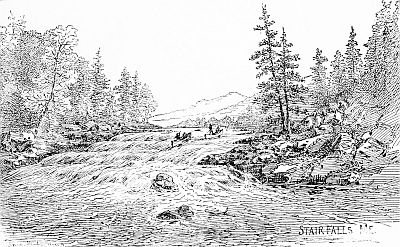
Stair Falls
I will not weary the reader by a description of the
passage of each fall from day to day on our route, some
of which we ran, and past others we “carried,” letting
the canoes, as before, over the difficulties by long ropes
from the cliffs above. After passing Spring Brook
Gravel Bed Falls, we paddled through a mile or two of
heavy “rips” and entered some two miles of “dead
water.”
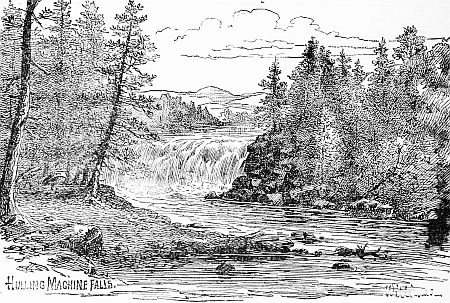
Hulling Machine Falls.
On turning a beautiful bend in the river, what was
our surprise to observe the rugged growth of pines gradually
disappear, and the landscape immediately softened
by the introduction of a dense forest of maple, elm, ash,
and noble oak trees, whose gnarled trunks pushed themselves
far into the stream, their branches overlocking
above our heads and forming a canopy that darkened the
water.
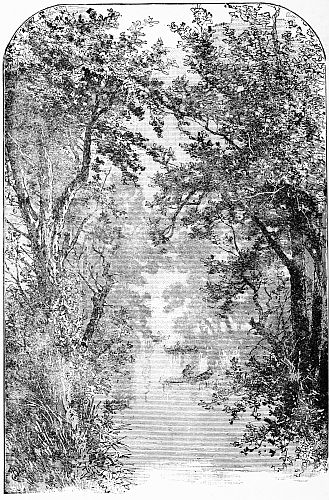
THE ARCHES.
East Branch of the Penobscot River.
Exclamations of surprise rang from our lips as all the
canoes in “Indian file” drifted through this enchanting
bower, and we thought to ourselves, if in the quiet dress
of summer this is so lovely, what must it be when robed
in autumnal foliage.
Passing the mouth of Big and Little Seboois rivers,
we pitched our tent on the left bank of the river near a
place known as Hunt’s Farm.
The solitary log house and barn on Hunt’s farm were
erected some forty-three years ago, and are located on
high ground in a picturesque bend of the Penobscot river.
The house outside is painted red, white-washed inside,
with low ceilings similar to the others mentioned. In
addition to the cultivation of land near the house, an attempt
was made some seasons ago to press into tillage, as
a melon patch, the side of an adjacent mountain, but the
fruit, as soon as it grew heavy and ripened, snapped its
hold on the vines, rolled down the mountain side, and was
crushed at its base. As can easily be seen, this elevated
farm was not a success, and now only the bright green foliage
of a fresh growth of trees is left to tell the melancholy
story. Mr. Dunn, who, assisted by three other persons,
takes care of the place, showed us many attentions, supplying
us with fresh milk and sugar, and other delicacies
that had been foreign to our fare at camp for many days.
The manufacture of birch canoes seemed to be one of
the industries of the place, an immense one being then in
process of building for the celebrated New York artist,
Frederick E. Church, Esq. This canoe was twenty-eight
feet long, over four feet wide (midships), and when completed
would weigh three hundred pounds.
The artist has recently purchased four hundred acres
of land on Milinokett Lake, fifteen miles distant, a tributary
to the West Branch of the Penobscot River, one of
the prettiest sheets of water in that vicinity. A fine
view of Mount Katahdin can be had from this spot, and
men were to leave this farm the following day to erect
three substantial log camps.
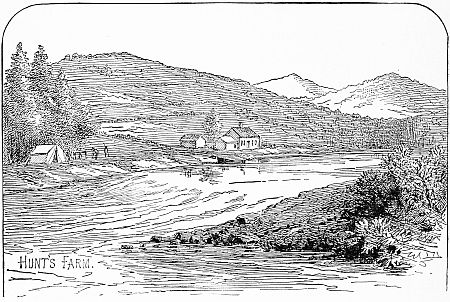
Hunt’s Farm.
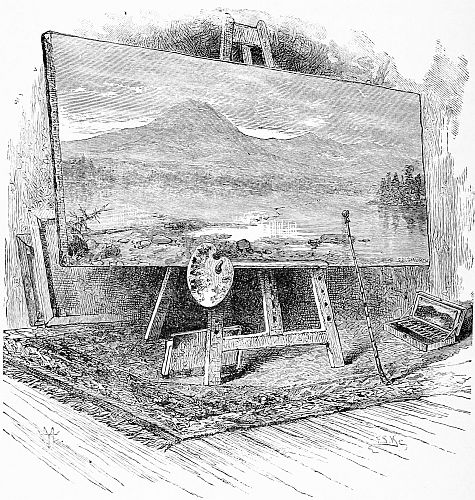
MOUNT KATAHDIN.
Study by F. E. Church.
The ascension of Mount Katahdin can with little difficulty
be made from Hunt’s farm, where a convenient
ride on horseback lands one within two miles of its top.
I shall not soon forget the climb of Hunt’s Mountain,
about twelve hundred feet high, opposite our camp, or the
magnificent view from its peak.
With Mr. Dunn as guide, in company with the “Quartermaster,”
I started to make the ascent on the morning of
August 24th. To clamber up the steep side of a mountain
in the dense wilderness is an entirely different undertaking
from the following of a “bridal path” to the top of
Mount Washington. Cutting stout poles seven feet in
length, we set off up the mountain side, catching half
glimpses of the landscape below, as we swung from tree
to tree and rock to rock, which latter had been made extra
slippery by a recent shower, and, after two hours of
laborious climbing, gained the bare but welcome crags at
the top. The first sensation of the prospect from the
summit is simply of immensity. The eye sweeps the vast
spaces that are bounded only by the haze of distance, overlooking
one vast undulating sea of forest trees, which
seemed to come rolling in to the mountain’s base, with only
here and there the glimmer of a lake or stream, and little
to break the vision save the farm at our feet, where we
could just distinguish the white canvas of our camp. To
the left stretch successive ranges of hills and mountains,
and at their base could be had momentary glimpses of the
windings of the West Branch of the Penobscot, while to
our right was its twin brother, the East Branch, over
which we had so recently passed, its misty falls and cascades
subdued to a level with the surrounding landscape.
These two streams sweep away to the south twenty miles,
and unite in unbroken union at Medway, on their way to
the sea.
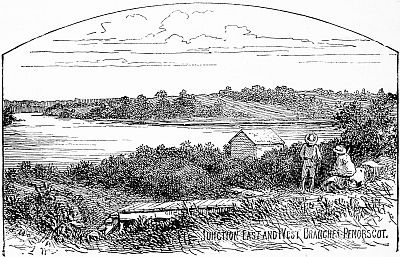
Junction East and West Branches Penobscot.
Before me arose the cloud-capped peak of Mount
Katahdin, 5,385 feet high, Wasataquoik Mountain, 5,245
feet high, the lofty Traveler and Sourdnahunk mountains,
which, with the exception of the first, are wooded to their
summits. Broad seams, or slides, are visible along the
surface of old Katahdin, which, with its triple-peaked
outline, seemed to look down into the valleys with a fatherly
interest, while “the whispering air sent inspiration
from the mountain heights.”
The thunder clouds had just parted, and a beautiful
rainbow arched the heavens, shedding its colors on the
glistening outlines of the valley and mountain. Oh,
that we might be left alone for hours, to watch the
changes of the landscape and hear the secret voice and
dread revelations of these magnificent mountains!
There are thoughts, deep and holy, which float through
one’s mind, as, gazing down upon such a scene, one contrasts
the smallness of man with the magnitude of God’s
works, and in the weird silence contemplates the perishable
of this world with “the everlasting hills.”
After such a prospect of the East Branch and vicinity,
it almost seems as if we ought to bid adieu to this enchanting
river of our narrative, but if the future tourist
shall desire to make its acquaintance, I would like to
guide him safely over four other remarkable falls to his
journey’s end at Mattawamkeag, thirty-two miles below.
Two miles from Hunt’s farm, we came to what is
known as Whetstone Falls, a series of high, picturesque
cascades. Here we made a short portage on the right-hand
side of the stream, then shot across and down a
very steep pitch of the water close to the left bank, and
landed a portion of our baggage which we carried to a
point below. Then the guides ran the heavier part of the
falls, and, after passing the quick boiling water at their
foot, rounded to the shore and re-loaded the camp kit which
we had “sacked” over the ledges at the river’s bank.
Then we passed, without accident, Grindstone and Crowfoot
Falls, each from ten to twenty feet high, the name
of the former being so suggestive by its geological formation
that the “Quartermaster” declared that he could
honestly see the indentation of the axle. Another camp
seven miles from Medway, and in the morning we passed
Ledge Falls, which, although the last of the pitches on
the East Branch, was none the less interesting.
We passengers, to lighten the canvas, strolled along
the shore, gathering bright flowers and curious colored
stones, while the guides alone in their canoes ran the cataract,
meeting us in the “dead water” below. These falls
are composed of slate of a grayish color, which, after the
first steep pitch form into numerous cascades, produced
by the sharp ridges of rock, which, extending out into the
stream from both shores, decrease in height as they approach
the center.
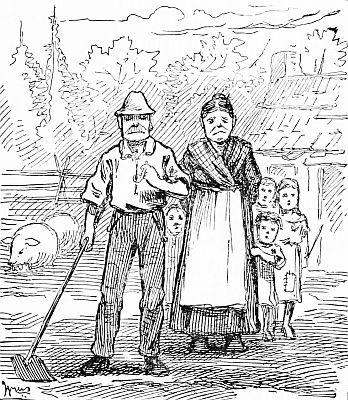
GLIMPSES OF CIVILIZATION BEGIN TO DAWN.
A dark red stone attracted my attention, and I waded
into the water to secure it, and on regaining the canoe
soon after, threw it into my camp-bag, little dreaming of
the value of my prize. On reaching home it was examined
by an old and experienced lapidary, and proved
to be a jasper of exquisite grain and color.
A portion of the stone, as an article of jewelry, incrusted
with the magic words “Ledge Falls,” is highly
prized and now worn as a souvenir by the writer.
The stream now gradually widens, with strong but
noiseless flow; the mountains retire, and the banks of the
river are for the most part bordered by foot-hills and
grassy knolls. Glimpses of civilization begin to dawn
as we occasionally pass a log house whose lonesome appearance
is only relieved by the happy faces of children
at the door. Corn-fields wave their tall stems, while
broad patches of potatoes (for which Maine is justly celebrated)
flourish here surprisingly. It is a sudden
change from the forest’s depths, after a month’s camp
life, and seems to urge us towards home more and more
rapidly.
We are soon at Medway, the junction of the East
and West Branches, (a small town on the left bank of
the Penobscot River, of about four hundred inhabitants,)
and are speeding faster and faster through the broad
river to Mattawamkeag on the European and North
American railroad.
We have followed the river in its devious windings,
from a width of fifteen to now an expansion of over five
hundred feet.
We have felt the mysterious silence of the wilderness
at early morn, or as the twilight lessened and the shadows
deepened about the camp, only broken by the chirp of
the cricket, or the weird and plaintive cry of the loons
on the lake.
Our tour has been one of daily excitement, filled from
first to last with grand old forests, noble waterfalls, picturesque
lakes, and cascades. A region in which an artist
might linger many weeks with profit to both eye and
brush, while the recuperation to one’s health by the out-door
life in the dry atmosphere cannot be overestimated.
Springing ashore, we unjoint our rods, pack up the
camera, collapse the canvas canoe, and with hearts full of
thanks to the kind Providence which has watched over
our two hundred mile voyage, we bid adieu to our
guides, as we do now to the reader.
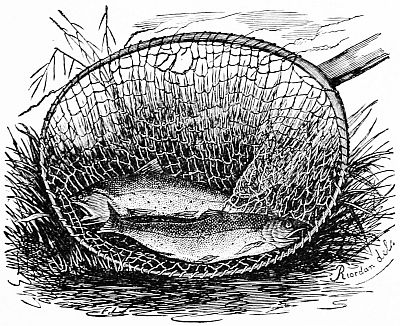
NET RESULTS.