Twelve years ago, from the deck of the Snark, I had
my first glimpse of the New Hebrides.
I was standing my trick at the wheel. Jack London
and his wife, Charmian, were beside me. It was
just dawn. Slowly, out of the morning mists, an island
took shape. The little ship rose and sank on the
Pacific swell. The salt breeze ruffled my hair. I
played my trick calmly and in silence, but my heart
beat fast at the sight of that bit of land coming up
like magic out of the gray water.
For I knew that of all the groups in the South
Seas, the New Hebrides were held to be the wildest.
They were inhabited by the fiercest of cannibals.
On many of the islands, white men had scarcely
trod. Vast, unknown areas remained to be explored.
I thrilled at the thought of facing danger in the
haunts of savage men.
I was young then. But my longing for adventure
in primitive lands has never left me. News of a wild
4country, of unvisited tribes, still thrills me and
makes me restless to be off in some old South Seas
schooner, seeing life as it was lived in Europe in the
Stone Age and is still lived in out-of-the-way corners
of the earth that civilization has overlooked.
I have been luckier than most men. For my lifework
has made my youthful dreams come true.
On my first voyage, in the Snark, I met with a
couple of pioneer motion-picture men, who were
packing up the South Seas in films to take back to
Europe and America. They inspired in me the idea
of making a picture-record of the primitive, fast-dying
black and brown peoples that linger in remote
spots. Into my boyish love of adventure there crept
a purpose that has kept me wandering and will keep
me wandering until I die.
Two years ago, I again found myself in the New
Hebrides at dawn. London had taken the last long
voyage alone; and the little Snark, so white and
pretty when we had sailed it south, hung sluggishly
at anchor in Api, black and stained, and wet and
slimy under the bare feet of a crew of blacks. My
boat now was a twenty-eight-foot open whaleboat,
with a jury rig of jib and mainsail; my crew of five,
squatting in the waist, looking silently at us or casting
5glances, sometimes down at the water, sometimes
with sudden jerks of the head upward at the
little mast, like monkeys under a coconut tree, were
naked savages from Vao; and my companion, seated
on the thwart beside me, was my wife, Osa. We
were nearing the cannibal island of Malekula.
But to start the story of our adventures in Malekula
at the beginning, I must go back and describe
the reconnoitering trip we took fourteen months
earlier.
CHAPTER I INTRODUCING NAGAPATE
6
Osa and I were nearing the end of a long cruise
through the South Seas. We had come in contact
with many wild peoples, but none of them were
quite wild enough. I had made motion-pictures of
cannibals in the Solomons. They were bona-fide cannibals,
fierce and naked. But somehow, I never
quite felt that they were the real thing: they so obviously
respected the English Government officers
and native police boys who accompanied and protected
us. I wanted to get among savages who were
unspoiled—to make photographs showing them in
their own villages, engaged in their ordinary pursuits.
I felt sure, from what I had seen and heard
and read, that the pictures I wanted were waiting to
be taken in the New Hebrides and nowhere else.
Savagery has been pretty well eliminated from the
South Seas. The Solomon Islander is well on the
road to becoming a respectable citizen of the British
Empire. Most of the Fiji Islanders have left off cannibalism
and have settled down and turned Methodist.
If you except New Guinea and Borneo, the
7New Hebrides are probably the only islands in the
Pacific where there are natives who live as they did
before the white man’s coming.
The savages of the New Hebrides probably owe
their immunity from civilization to an accident of
government. For many years the ownership of the
islands was disputed. Both British and French laid
claim to them. Neither would relinquish hold; so
finally, they arranged to administer the islands
jointly until a settlement should be made. That settlement
has been pending for years. Meanwhile,
both governments have been marking time. Each
party is slow to take action for fear of infringing on
the rights—or of working for the benefit—of the
other. Each maintains but a small armed force. The
entire protection of the group consists of about sixty
or seventy police boys, backed up by the gunboats
which make occasional tours of the group. It is easy
to understand that this is not an adequate civilizing
force for a part of the world where civilizing is generally
done at the point of a rifle, and that the savages
of the more inaccessible parts of the group are as
unsubdued as they were in the days of the early
explorers.
I had heard that there were parts of the island of
8Malekula, the second largest island of the group,
that no white man had ever trod, so I decided that
Malekula was the island I wanted to visit. “The
Pacific Islands Pilot,” which I had among my books,
gave a solemn warning against the people of Malekula
that served only to whet my interest:
“Although an appearance of friendly confidence
will often tend to allay their natural feeling of distrust,
strangers would do well to maintain a constant
watchfulness and use every precaution against being
taken by surprise.” So said the “Pilot.” “... They
are a wild, savage race and have the reputation of being
treacherous.... Cannibalism is still occasionally
practiced. Nearly all are armed with Snyders.
The bushmen live entirely among the hills in small
villages and are seldom seen. Being practically secure
from punishment, they have not the same reasons
for good behavior that the salt-water men
have, and should, therefore, be always treated with
caution.”
A recruiter who had been for years in the New
Hebrides enlisting blacks for service in the Solomons
described Malekula to me in detail. It was a large
island, as my map showed me, shaped roughly like
an hour-glass, about sixty miles long and about ten
9miles across in the middle and thirty-five or so at
the ends. He said that there were supposed to be
about forty thousand savages on the island, most of
them hidden away in the bush. The northern part of
the island was shared between the Big Numbers and
the Small Numbers people, who took their names
from the nambas, the garment—if it could be called
a garment—worn by the men. In the case of the
Small Numbers, said my informant, it was a twisted
leaf. In the case of the Big Numbers, it was a bunch
of dried pandanus fiber. The recruiter said that
the central part of the island was supposed to be
inhabited by a race of nomads, though he himself
had never seen any one who had come in contact
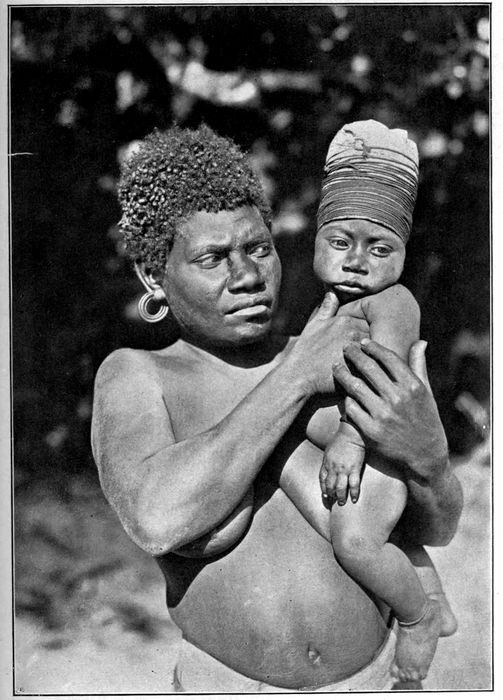
with them. In the southern region lived a long-headed
people, with skulls curiously deformed by
binding in infancy.
Of all these peoples the Big Numbers were said to
be the fiercest. Both British and French had undertaken
“armed administrations” in their territory,
in an attempt to pacify them, but had succeeded
only in sacrificing a man for every savage, they
had killed. No white man had ever established
himself upon the territory of the Big Numbers and
none had ever crossed it. I decided to attempt
10the crossing myself and to record the feat with my
cameras.
Every one to whom I mentioned this project advised
me against it. I was warned that experienced
recruiters of labor for the white man’s sugar and
rubber plantations, who knew the islands and the
natives well, never landed upon the beach unless
they had a second, “covering” boat with an armed
crew to protect them against treachery, and that the
most daring trader planned to stop there only for a
day—though perforce he often stayed for all eternity.
But I had the courage born of ignorance, and
ventured boldly, taking it for granted that the tales
told of the savages were wildly exaggerated. Traders,
missionaries, and Government officials all joined
in solemn warning against the undertaking, but
as none of them had ever seen a cannibal in action,
I did not take their advice seriously. When
they found that I was determined in my course, they
gave me all the assistance in their power.
My recruiter friend suggested that I make my
headquarters on Vao, a small island about a mile off
the northeastern coast of Malekula, where a mission
station was maintained by the French fathers. He
said that between the mission and the British gunboat,
11which stopped there regularly, the natives of
Vao had become fairly peaceable, we would be safe
there, and at the same time would be in easy reach
of Malekula.
Osa and I lost no time in getting to Vao, where
Father Prin, an aged priest, welcomed us cordially,
and set aside for us one of the three rooms in his little
stone house. Father Prin had kind, beautiful eyes
and a venerable beard. He looked like a saint, in his
black cassock, and when we had a chance to look
about at the degenerate creatures among whom he
lived, we thought that he must, indeed, be one. He
had spent twenty-nine years in the South Seas. During
the greater part of that time he had worked
among the four hundred savages of Vao. The net result
of his activities was a clearing, in which were
a stone church and the stone parsonage and the
thatched huts of seventeen converts. The converts
themselves did not count for much, even in Father
Prin’s eyes. He had learned that the task of bringing
the New Hebridean native out of savagery was
well-nigh hopeless. He knew that, once he had left
his little flock, it would undoubtedly lapse into
heathenism. The faith and perseverance he showed
was a marvel to me. I shall always respect him and
12the other missionaries who work among the natives
of Vao and Malekula for the grit they show in a losing
fight. I have never seen a native Christian on
either of the islands—and I’ve never met any one
who has seen one!
When he learned that we were bent on visiting
Malekula, Father Prin added his word of warning to
the many that I had received. Though he could
speak many native languages, his English was limited
to bêche-de-mer, the pidgin English of the South
Seas. In this grotesque tongue, which consorted so
strangely with his venerable appearance, he told us
that we would never trust ourselves among the natives
if we had any real understanding of their cruelty.
He said he was convinced that cannibalism was
practiced right on Vao, though the natives, for fear
of the British gunboat, were careful not to be discovered.
He cited hair-raising incidents of poisonings
and mutilations. He told us to look around
among the savages of Vao. We would discover very
few if any old folk, for the natives had the cruel custom
of burying the aged alive. He had done everything
he could to eradicate this custom, but to no
end. He told us of one old woman whom he had exhumed
three times, but who had finally, in spite of
13his efforts, met a cruel death by suffocation. Once,
he had succeeded in rescuing an old man from death
by the simple expedient of carrying him off and putting
him into a hut next to his own house, where he
could feed him and look after him. A few days after
the old man had been installed, a body of natives
came to the clearing and asked permission to examine
him. They looked at his teeth to see if he
had grown valuable tusks; they fingered his rough,
withered skin; they felt his skinny limbs; they lifted
his frail, helpless carcass in their arms; and finally
they burst into yells of laughter. They said the
missionary had been fooled—there was not a
thing about the old man worth saving! We could
not look for mercy or consideration from such men
as these, said Father Prin. But despite his warning,
Osa and I sailed away to visit the grim island.
With the assistance of Father Prin, we secured
a twenty-eight-foot whaleboat that belonged to a
trader who made his headquarters on Vao, but was
now absent on a recruiting trip, leaving his “store”
in charge of his native wife. With the aid of five Vao
boys, recommended by Father Prin as being probably
trustworthy, we hoisted a small jib and a
mainsail, scarcely larger, and were off.
14At the last moment, Father Prin’s grave face
awoke misgivings in me and I tried to dissuade Osa
from accompanying me. Father Prin sensed the
drift of our conversation and made his final plea.
“Better you stop along Vao,” he urged. “Bush
too bad.” His eyes were anxious. But Osa was not
to be dissuaded. “If you go, I’m going, too,” she
said, turning to me, and that was final.
We landed at a point on the Vao side of Malekula,
where there were one or two salt-water villages,
whose inhabitants had learned to respect gunboats.
We picked up three boys to serve as guides and carriers
and then sailed on to Tanemarou Bay, in the
Big Numbers territory. The shores along which we
traveled were rocky. Occasionally we saw a group
of natives on the beach, but they disappeared as we
approached. These were no salt-water savages, but
fierce bushmen. Their appearance was not reassuring;
but when we reached Tanemarou Bay, we
boldly went ashore. We were greeted by a solitary
savage who stepped out of the darkness of the jungle
into the glaring brightness of the beach. He was a
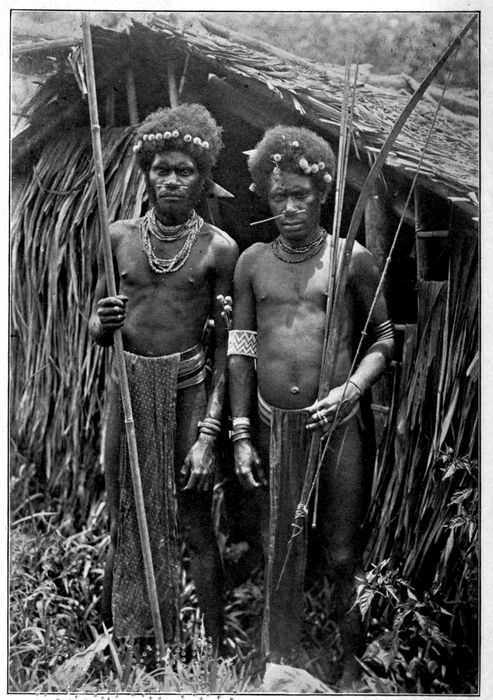
frightful object to behold, black and dirty, with
heavy, lumpy muscles, and an outstanding shock of
greasy hair. Except for a clout of dried pandanus
fiber, a gorget of pig’s teeth, and the pigtails that
dangled from his ear-lobes, he was entirely naked.
As he approached, we saw that his dull, shifty eyes
were liquid; his hairy, deeply seamed face was contorted
frightfully; and his hands were pressed tight
against his stomach. Osa shrank close to me. But the
first words of the native, uttered in almost unintelligible
bêche-de-mer, were pacific enough. “My word!
Master! Belly belong me walk about too much!”
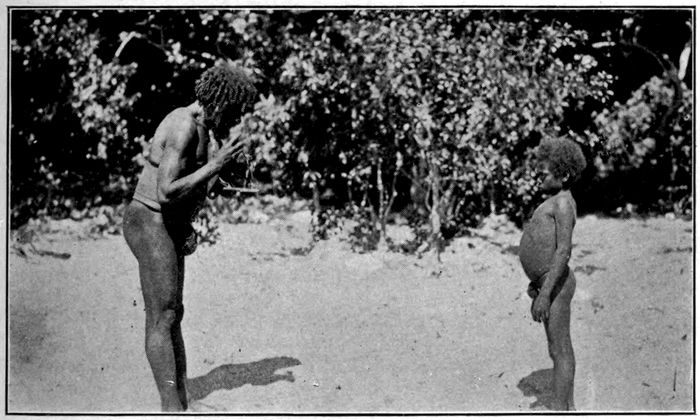
THE WATCHER OF TANEMAROU BAY
15The nervous tension that Osa and I had both felt
snapped, and we burst out laughing. I saw a chance
to make a friend, so I fished out a handful of cascara
tablets and carefully explained to the native the exact
properties of the medicine. I made it perfectly
clear—so I thought—that part of the tablets were
to be taken at dawn and part at sunset. He listened
with painful attention, but the moment I stopped
speaking he lifted the whole handful of pills to his
slobbering lips and downed them at a gulp!
By this time we were surrounded by a group of
savages, each as terrible-looking as our first visitor.
As they made no effort to molest us, however, we
gained confidence. I set up a camera and ground out
several hundred feet of film. They had never seen a
motion-picture camera before, but, as is often the
16way with savages, after a first casual inspection, they
showed a real, or pretended, indifference to what
they could not understand.
Through the talented sufferer who knew bêche-de-mer,
I learned that the chief of the tribe, Nagapate,
was a short distance away in the bush, and on the
spur of the moment, never thinking of danger, I
made up my mind to see him. Guided by a small
boy, Osa and I plunged into the dark jungle, followed
by our three carriers with my photographic
apparatus. We slid and stumbled along a trail made
treacherous by miry streams and slimy creepers and
up sharp slopes covered with tough canes. At last
we found ourselves in a clearing about three thousand
feet above the sea.
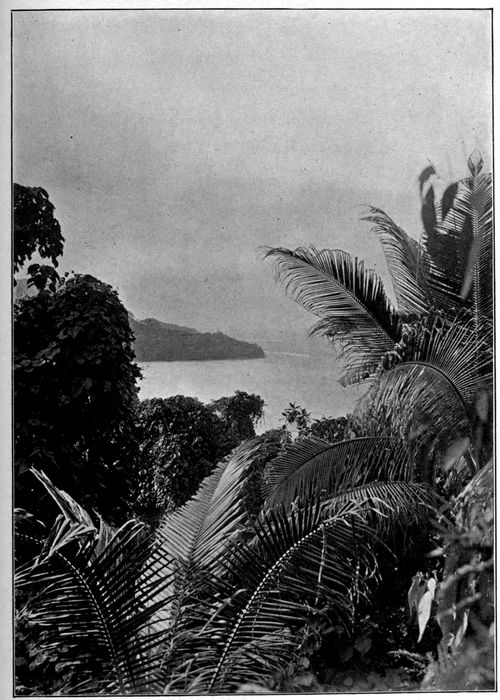
From where we stood we could see, like a little dot
upon the blue of the ocean, our whaleboat hanging
offshore. The scene was calm and beautiful. The
brown-green slopes were silent, except for the sharp
metallic calls of birds. But we knew that there were
men hidden in the wild, by the faint, thin wisps of
smoke that we could see here and there above the
trees. Each marked a savage camp-fire. “That’s
where they’re cooking the ‘long pig,’” I said jocularly,
pointing the smoke wisps out to Osa. But
17a moment later my remark did not seem so funny.
I heard a sound and turned and saw standing in
the trail four armed savages, with their guns aimed
at us.
“Let’s get out of this,” I said to Osa; but when we
attempted to go down the trail, the savages intercepted
us with threatening gestures. Suddenly there
burst into view the most frightful, yet finest type of
savage I have ever seen. We knew without being
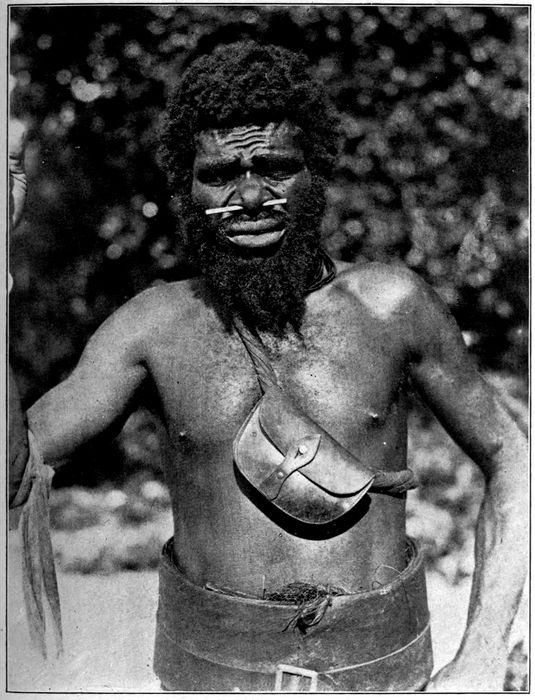
told that this was Nagapate himself. His every gesture
was chiefly.
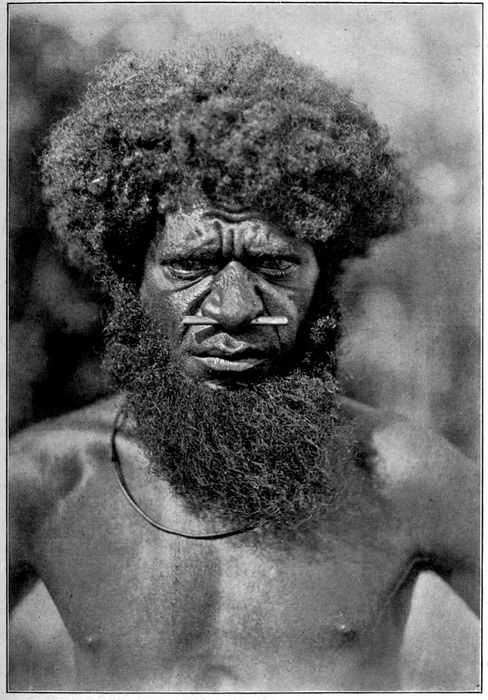
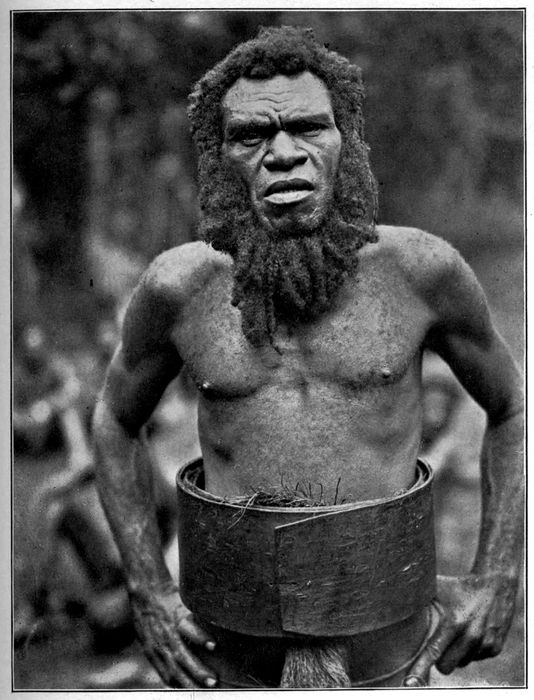
He was enormously tall, and his powerful muscles
rippled under his skin, glossy in the sunlight. He was
very black; his features were large; his expression
showed strong will and the cunning and brutal
power of a predatory animal. A fringe of straight
outstanding matted hair completely encircled his
face; his skin, though glossy and healthy-looking,
was creased and thick, and between his brows were
two extraordinarily deep furrows. On his fingers
were four gold rings that could only have come from
the hands of his victims.
I thought I might win this savage to friendliness,
so I got out some trade-stuff I had brought with me
and presented it to him. He scarcely glanced at it.
18He folded his arms on his breast and stared at us
speculatively. I looked around. From among the
tall grasses of the clearing, there peered black and
cruel faces, all watching us in silence. There were
easily a hundred savages there. For the present there
was no escape possible. I decided that my only
course was to pretend a cool indifference, so I got out
my cameras and worked as rapidly as possible, talking
to the savages and to Osa as if I were completely
at ease.
I soon saw, however, that we must get away if we
were not to be caught by darkness. I made a last
show of assurance by shaking hands in farewell with
Nagapate. Osa followed my example; but instead of
releasing her, the savage chief held her firmly with
one hand and ran the other over her body. He felt
her cheeks and her hair and pinched and prodded her
speculatively.
She was pale with fright. I would have shot the
savage on the spot, but I knew that such a foolhardy
act would mean instant death to both of us. I
clenched my hands, forced to my lips what I hoped
would pass for an amused grin, and stood pat. After
a moment that seemed to both Osa and me an hour
long, Nagapate released Osa and grunted an order at
the savages who surrounded us. They disappeared
into the bush. This was our opportunity. I ordered
the three carriers to pick up the apparatus, and we
started for the trail.
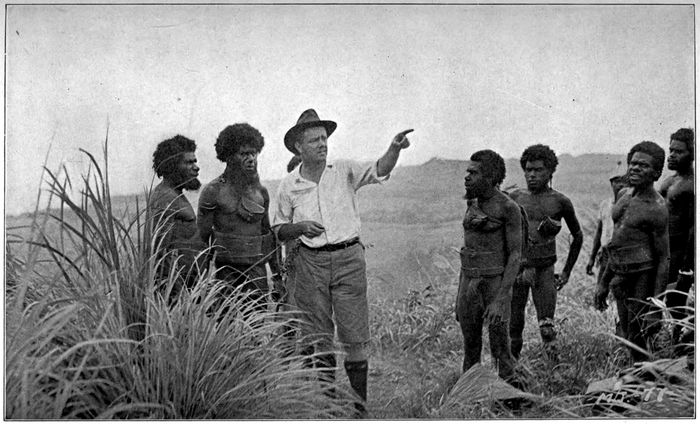
NAGAPATE
19We had gone only a few steps when we were
seized from behind. We had no chance to struggle.
In the minutes that followed, I suffered the most
terrible mental torture I have ever experienced. I
saw only one slim chance for us. Osa and I each carried
two revolvers in our breeches’ pockets; so far,
the savages had not discovered them, and I hoped
there might come some opportunity to use them.
Every ghastly tale I had ever heard came crowding
into my memory; and as I looked at the ring of black,
merciless faces, and saw my wife sagging, half-swooning,
in the arms of her cannibal captors, my
heart almost stopped its beating.
At this moment a miracle happened.
Into the bay far below us steamed the Euphrosyne,
the British patrol-boat. It came to anchor and
a ship’s boat was lowered. The savages were startled.
From lip to lip an English word was passed,
“Man-o’-war—Man-o’-war—Man-o’-war.” With
an assumption of satisfaction and confidence that I
did not feel, I tried to make it clear to them that this
20ship had come to protect us, though I knew that at
any moment it might up anchor and steam away
again. Nagapate grunted an order, my carriers
picked up their loads, and we were permitted to
start down the trail. Once out of sight we began to
run. The cane-grass cut our faces, we slipped on the
steep path, but still we ran.
Halfway down, we came to an open place from
which we could see the bay. To our consternation,
the patrol-boat was putting out to sea! We knew
that the savages, too, had witnessed its departure;
for at once, from hill to hill, sounded the vibrant roar
of the conch-shell boo-boos—a message to the savages
on the beach to intercept us.
The sun was near setting. We hurried forward;
soon we found that we had lost the trail. Darkness
came down, and we struggled through the jungle in
a nightmare of fear. Thorns tore our clothing and
our flesh. We slipped and fell a hundred times.
Every jungle sound filled us with terror.
But at last, after what seemed hours, we reached
the beach. We stole toward the water, hopeful of escaping
notice, but the savages caught sight of us.
Fortunately our Vao boys, who had been lying off in
the whaleboat, sighted us, too, and poled rapidly in
21to our assistance. We splashed into the surf and the
boys dragged us into the boat, where we lay, exhausted
and weak with fear.
It took us three days to get back to Vao, but that
nightmare story of storm and terror does not belong
here. Suffice it to say that we at last got back safely
and with my film unharmed.
On my return to Vao, one of the native boatmen
presented me with a letter, which had been left for
me at Tanemarou Bay, by the commander of the
patrol-boat, who had been assured by our boys that
we were in the immediate vicinity of the beach and
were about to return to the boat.
Matanavot, 10th November, 1917
Dear Sir:
I have been endeavoring to find you with a view
to warning you against carrying out what I understand
to be your intentions. I am told that you have
decided to penetrate into the interior of this island
with a view to coming in contact with the people
known as the “Big Numbers.” Such a proceeding
cannot but be attended with great risk to yourself
and all those who accompany you. The whole interior
of this island of Malekula is, and has been for a
considerable time, in a very disturbed condition, and
22it has been necessary in consequence to make two
armed demonstrations in the “Big Numbers” country
during the last three years. For these reasons,
on the part of the Joint Administration of this
group, I request that you will not proceed further
with this idea, and hereby formally warn you against
such persistence, for the consequences of which the
Administration cannot hold itself responsible.
Yours faithfully
(Signed) M. King
H.B.M. Resident Commissioner for the New Hebrides
In any case I trust you will not take your wife into
the danger zone with you.
M. K.
CHAPTER II SYDNEY AND NEW CALEDONIA
23
Osa and I were sure, after our first adventure in
Malekula, that we had had enough of cannibals to
last us for the rest of our natural lives. But when we
reached Sydney, on our way home, and had our films
developed, we began to weaken. Our pictures were
so good that we almost forgot the risk we had taken
to get them. The few feet I had managed to grind
out on Malekula were no “staged” pictures of savage
life. They were so real and convincing that Osa
declared her knees went wobbly every time she saw
them.
Before many months, Nagapate was scowling out
of the screen at audiences in New York and Paris and
London, and villagers who would never go a hundred
miles from home were meeting him face to face
in the Malekula jungle. The public wanted more—and
so did we. Early in 1919, about a year after our
first adventure in the Malekula bush, we were again
in Sydney, preparing for a second visit to the land of
the Big Numbers—the trip out of which this book
has grown.
24As we sailed into Sydney harbor on the S.S. Ventura,
we met, sailing out, the Pacifique, the little
steamer of the Messageries Maritimes that had
taken us to the New Hebrides on our former visit.
That meant we should have four weeks to wait before
embarking on our journey to Malekula. We
were impatient to be off, but we knew that the four
weeks would pass quickly enough, for many things
remained to be done before we should be ready for
a long sojourn in the jungle.
We took up our abode with the Higginses, in their
house on Darling Point Road overlooking the harbor.
Ernie Higgins had handled my films for me on
my previous trip, and I had found him to be the best
laboratory man I had ever met with, so I was glad
to be again associated with him.
The house was an old-fashioned brick house of
about twelve or fourteen rooms. I fitted up one of
the second-story rooms to serve as a workroom. I
had electricity brought in and set up my Pathéscope
projector, so that I could see the pictures I happened
to be working on. Having this projector meant that
the work of cutting and assembling films would be
cut in two. I put up my rewinds, and soon had
everything in apple-pie order.
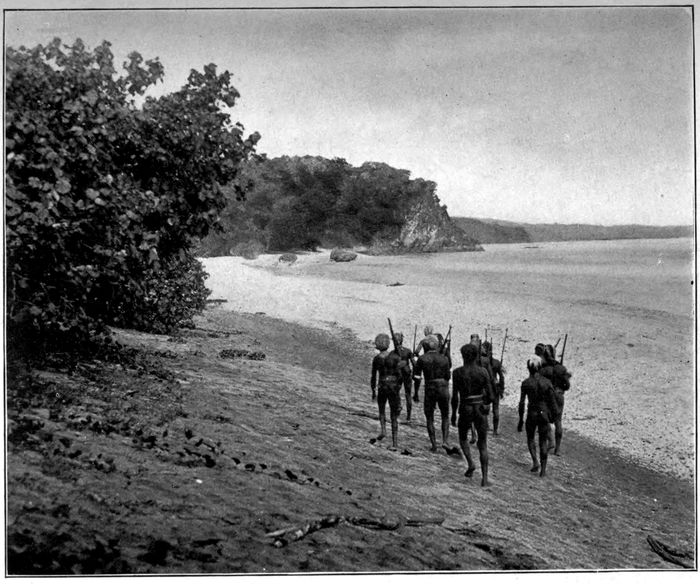
A BEACH SCENE
25From the window of my workroom, I could look
over Sydney harbor. Osa and I never tired of watching
the ships going in and out. We would consult
the sailing lists in the newspapers, and try to identify
the vessels that we saw below us. There were steamers
from China and Japan and the Straits Settlements;
little vessels from the various South Seas
groups; big, full-rigged ships from America; steamers
from Africa and Europe; little schooners from
the islands; coastal boats to and from New Zealand
and Tasmania, and almost every day big ships came
in with returned soldiers. In the course of a week we
saw boats of every description flying the flags of almost
every nation on the globe.
Osa put in long days in the harbor, fishing from
Mr. Higgins’s little one-man dinghy, that was nearly
swamped a dozen times a day in the wash from the
ferry-boats, while I worked like a slave at my motion-picture
apparatus. The public thinks that a wandering
camera-man’s difficulties begin with putting a
roll of film in the camera and end with taking it out.
If I were telling the true story of this trip, I should
start with my grilling weeks of preparation in New
York. But my troubles in Sydney will perhaps give
sufficient idea of the unromantic back-of-the-scenes
26in the life of a motion-picture explorer. I had troubles
by the score. My cameras acted up. They
scratched the film; they buckled. When I had remedied
these and a dozen other ailments, I found that
my pictures were not steady when they were projected.
The fault we at last located in Mr. Higgins’s
printer. We repaired the printer. Then we found
that the developer produced a granulated effect on
the film. It took us two weeks to get the proper
developer. But our troubles were not over. Great
spots came out on the pictures—grease in the developing
tanks. And the racks were so full of old
chemicals that they spoiled the film that hung over
them. I had new racks and new tanks made. They
were not made according to specifications. I had
them remade twice and then took them apart and
did the work myself.
After I thought that my troubles were over, I
found that my Pathéscope projector, which had
been made for standard film, had several parts lacking.
This was most serious, for it spoiled a plan that
I had had in the back of my head ever since I had
first seen my Malekula pictures. I wanted to show
them to Nagapate and his men. It was an event that
I had looked forward to ever since I had decided to
27revisit the island. It would be almost comparable to
setting up a movie show in the Garden of Eden.
Luckily, I was able to have the missing parts made
in Sydney, and my apparatus was at last in order.
Then I had to collect as much information as I
could about the New Hebrides and their inhabitants,
so I trotted around morning after morning, to interview
traders and steamship officials and missionaries.
Another task, in which Osa helped me, was to
ransack the second-hand clothing stores for old hats
and coats and vests to serve as presents for the natives.
Other trade-stuffs, such as tobacco, mirrors,
knives, hatchets, and bright-colored calico, I
planned to get in Vila, the principal port and capital
of the New Hebrides.
The four weeks had gone by like a flash, but the
Pacifique had not yet put in an appearance. She
came limping into harbor at the end of another week.
She had been delayed by engine trouble and by
quarantines; for the influenza was raging through
the South Seas. It was announced that she would
sail in five days, but the sailing date was postponed
several times, and it was the 18th of June before we
finally lifted anchor.
It seemed good to get out of the flu-infested city,
28where theaters and schools and churches were closed,
every one was forced to wear a mask, and the population
was in a blue funk. We both loved Sydney
and its hospitable people, but we were not sorry to
see the pretty harbor, with its green slopes dotted
with red-tiled roofs, fade into the distance.
Osa and I have often said that we like the Pacifique
better than any ship we have ever traveled on.
It is a little steamer—only one thousand nine hundred
tons. We do not have bunks to sleep in, but
comfortable beds. Morning coffee is served from
five to eleven o’clock. It is an informal meal. Every
one comes up for it in pajamas. Breakfast is at half-past
eleven. Dinner is ready at half-past six and
lasts until half-past eight. It is a leisurely meal, of
course after course, with red wine flowing plentifully.
After dinner, the French officers play on the piano
and sing.
Most of the officers were strangers to us on this
voyage, for our old friends were all down with the
flu in Sydney. The doctor and the wireless operator
were both missing, and the captain, Eric de Catalano,
assumed their duties. He was a good wireless
operator, for we got news from New Zealand each
night and were in communication with Nouméa long
29before we sighted New Caledonia. How efficient he
was as a doctor, I cannot say. But he had a big medicine
chest and made his round each day among the
sick, and though many of the passengers came down
with influenza, none of them died. He was a handsome
man, quiet and intelligent, and a fine photographer.
He had several cameras and a well-fitted
dark room and an enlarging apparatus aboard, and
had made some of the best island pictures I had ever
seen. He seemed to be a man of many talents, for
the chief engineer told me that he had an electrician’s
papers and could run the engines as well as he
himself could.
We were a polyglot crowd aboard. We had fifteen
first-class and five second-class passengers, French,
Australian, English, Scotch, and Irish, and one Dane,
with Osa and myself to represent America. In the
steerage were twenty-five Japanese, and up forward
there was a Senegalese negro being taken to the
French convict settlement at Nouméa. Our officers
were all French—few could speak English. Our
deck crew was composed of libérés—ex-convicts
from Nouméa. The cargo-handlers were native New
Caledonians with a sprinkling of Loyalty Islanders.
The firemen were Arabs, the dish-washers in the galley,
30New Hebrideans. The bath steward was a Fiji
Islander, the cabin steward a Hindu, the second-class
cabin steward hailed from the Molucca Islands,
and our table steward was a native of French Indo-China.
Three days out from Sydney we passed Middleton
Reef, a coral atoll, about five miles long and two
across, with the ocean breaking in foam on its reef
and the water of its lagoon as quiet as a millpond.
The atoll is barely above water, and many ships
have gone aground there. We sailed so close that I
could have thrown a stone ashore, and saw the hull
of a big schooner on the reef.
As we stood by the rail looking at her, one of our
fellow-passengers, a trader who knew the islands
well, came up to us and told us her story.
“She went ashore three years ago, in a big wind,”
he said. “All hands stuck to the ship until she broke
in two. Then they managed to reach land—captain
and crew and the captain’s wife and two children.
They had some fresh water and a little food.
They rationed the water carefully, and there was
rain. But the food soon gave out. For days they had
nothing. The crew went crazy with hunger, and
killed one of the children and ate it. For two days,
31the mother held the other child in her arms. Then
she threw it into the sea so that they could not eat it.
Then three of the men took one of the ship’s boats.
They could not manage it in the rough sea, but by a
lucky chance they were washed up on the beach.
They were still alive, but the captain’s wife had lost
her mind.”
We reached Nouméa on the morning of June 23d.
The pilot met us outside the reef, in accordance with
regulations, but he refused to come on board when he
found that we had several passengers down with the
influenza, so we towed him in. We were not allowed
to land, but were placed in quarantine off a small
island about two miles from Nouméa, between the
leper settlement and Île Nou, the convict island. We
were avoided as though we had leprosy. Each day
a launch came with fresh meat and fresh vegetables,
the French engineer and black crew all masked and
plainly anxious not to linger in our vicinity any
longer than necessary, and each day the doctor came
and took our temperatures.
We passed our time in fishing from the deck. We
had excellent luck and our catches made fine eating.
Osa, of course, caught more fish than any one else,
principally because she was up at sunrise and did not
32quit until it was time to go to bed. I relieved the
monotony in the evenings by showing my pictures.
I set up the Pathéscope in the saloon, and each night
I gave a performance. My audience was most critical.
Every one on board knew the New Hebrides
and Nouméa well, and many of the passengers were
familiar with the Solomons and other groups in
which I had taken pictures. But my projector
worked finely; I had as good a show as could be
seen in any motion-picture house, and every one was
satisfied.
We had been surprised, as we steamed into the
harbor, to see the Euphrosyne lying at anchor there.
The sight of her had made us realize that we were indeed
nearing the Big Numbers territory. Strangely
enough, the thought aroused no fear in us—only
excitement and eagerness to get to work, and resentment
against the delay that kept us inactive in Nouméa
harbor.
Not until four days had passed was our quarantine
lifted. On the evening of June 27th, the launch
brought word that peace had been signed, and that,
if no more cases of flu had developed, we would be
allowed to land on the following day and take part
in the peace celebration.
33New Caledonia does not much resemble the other
islands of the South Pacific. It has a white population
of twenty thousand—about two thirds as
great as the native population. Its capital, Nouméa,
is an industrial city of fifteen thousand white inhabitants—the
Chicago of the South Seas. In and
around it are nickel-smelters, meat-canneries, sugar-works,
tobacco and coconut-oil and soap factories.
New Caledonia is rich in minerals. It has large deposits
of coal and kaolin, chrome and cobalt, lead
and antimony, mercury, cinnabar, silver, gold and
copper and gypsum and marble. In neighboring islands
are rich guano beds. Agriculture has not yet
been crowded off the island by industry. The
mountain slopes make good grazing grounds and the
fertile valleys are admirably fitted for the production
of coffee, cotton, maize, tobacco, copra, rubber,
and cereals. Yet there is little of South Seas romance
about the islands. And Nouméa is one of the
ugliest, most depressing little towns on the face of
the earth.
We docked there early on the morning of Saturday,
the 28th of June. The wharf was packed with
people, but none of them would come on board. We
might have been a plague ship. As we went ashore,
34we looked for signs of the peace celebration. A few
half-hearted firecrackers and some flags hanging
limp in the heat were all. The real celebration, we
were told, would take place on Monday.
In the evening, we were invited to attend one of
those terrible home-talent performances that I had
thought were a product only of Kansas, but, I now
learned, were as deadly in the South Seas as in the
Middle West. A round little Frenchman read a paper
in rapid French that we could not understand,
but the expression of polite interest on the faces of
the audience told us that it must be like the Fourth-of-July
orations in our home town. Then came a
duet, by a man and woman who could not sing. Another
paper. Then an orchestra of three men and
four girls arranged themselves with much scraping
of chairs on the funny little stage and wheezed a few
ancient tunes.
On Sunday night we went to the Peace Ball in the
town hall. Most of Nouméa’s fifteen thousand inhabitants
were there, so dancing was next to impossible.
It was like a Mack Sennet comedy ball. Ancient
finery had been hauled out for the occasion,
and, though most of the men appeared in full dress,
scarcely one had evening clothes that really fitted.
35Under the too loose and too tight coats, however,
there were warm and hospitable hearts, and we
were treated royally. After the ball, we were entertained
at supper by the governor and his suite.
Governor Joulia was a little, bald-headed man of
about fifty years of age, always smiling, always polite,
and always dressed in the most brilliant of brilliant
uniforms, covered with decorations that he had
won during campaigns in Senegal, Algeria and India.
His wife was a pretty, plump woman of about thirty—she
and Osa took to each other at once. They
spoke no English, and our French is awful, but we
struck out like drowning persons, and managed to
understand each other after a fashion.
On Monday, the “real celebration” of the peace
consisted in closing the stores and sleeping most of
the day. In the afternoon, the governor and his
wife came to the ship for us and took us to their
beautiful summer place, about five miles from the
city. A great park, with deer feeding under the trees,
fine gardens, tennis courts, well-tended walks—and
the work all done by numbered convicts.
There are convicts everywhere in and about Nouméa—convicts
and libérés. Their presence makes
the ugly little town seem even more unprepossessing
36than it is. The pleasantest spot anywhere around is
Île Nou, the convict island that I have often heard
called a hell on earth. On this green little island
are about five hundred convicts—all old men, for
France has not deported any of her criminals to New
Caledonia since 1897. They are all “lifers.” Indeed,
I was told of one old man who is in for two hundred
years; he has tried to escape many times, and, according
to a rule of the settlement, ten years are added
to a man’s sentence for each attempt at escape.
We visited Île Nou in company with Governor
Joulia and Madame Joulia; the Mayor of Nouméa;
the manager of the big nickel mines; the Governor of
the prison settlement, and a lot of aides-de-something.
We saw the old prisoners, in big straw hats
and burlap clothing, each with his number stamped
on his back, all busy doing nothing. We were taken
through the cells where, in former times, convicts
slept on bare boards, with their feet through leg-irons.
We were locked in dark dungeons, and, for
the benefit of my camera, the guillotine was brought
out and, with a banana stalk to take the place of a
man, the beheading ceremony was gone through
with. We were taken in carriages over the green
hills to the hospitals and to the insane asylum, where
we saw poor old crazy men, with vacant eyes, staring
at the ceilings. Here we met the king of the
world, who received us with great pomp from behind
the bars of a strong iron cage, and a pitiful old inventor,
who showed us a perpetual-motion machine which
he had just perfected. It was made from stale bread.
LOOKING SEAWARD
37Yet Île Nou is better than Nouméa, with its ugly
streets full of broken old libérés. While most of the
convicts were sent out for life, some were sent for five
years. At the end of that time, they were freed from
Île Nou and permitted to live in New Caledonia on
parole, and if they had committed no fresh offense,
at the end of another five years they were given their
ticket back to France. Any one sentenced to a longer
term than five years, however, never saw France
again. He regained his freedom, but was destined to
lifelong exile. Some of the libérés have found employment
and have become responsible citizens of
New Caledonia, but many of them drift through the
streets of Nouméa, broken old men who sleep wherever
they can find a corner to crawl into and pick
their food from the gutters.
I was glad, while in Nouméa, to renew my acquaintance
with Commissioner King of the New
Hebrides, who had come to New Caledonia to have
38the Euphrosyne repaired. I talked over with him
my proposed expedition to Malekula, and received
much valuable advice. He could not give me the
armed escort I had hoped to secure from him, for
he had no police boys to spare. He promised, however,
to pick us up at Vao, in about a month’s time,
and take us for a cruise through the group in the Euphrosyne.
I wanted him, and the New Caledonian
officials as well, to see some of my work, so I decided
to show my films in the Grand Cinéma, the leading
motion-picture house of Nouméa. I gave the proprietor
the films free of charge, under condition that
I got fifty seats blocked off in the center of the house.
We invited fifty guests, and the remainder of the
house was packed with French citizens of Nouméa,
Chinese and Japanese coolies and native New Caledonians.
I showed the five reels called “Cannibals
of the South Seas.” Then I showed my four reels of
Malekula film, and ended up with a one-reel subject,
Nouméa. We were given an ovation, and both Osa
and I had to make speeches—understood by
few of those present. The French have a passion for
speeches whether they can understand them or not.
The next morning, we found ourselves celebrities as
we walked through the streets of Nouméa.
CHAPTER III THE THRESHOLD OF CANNIBAL-LAND
39
We left New Caledonia at midnight on July 3d, and
steamed over a calm sea to Vila.
Vila is the commercial center as well as the capital
of the New Hebrides and its harbor is one of the
finest in the South Seas. On our right, as we steamed
in, was the island of Irriki, a mountain peak rising
out of the sea, on the highest point of which Mr.
King has built his house. Vila is a typical South
Seas town—a rambling mixture of tropical and European
architecture and no architecture at all. Its
public buildings, French and British, its churches,
and the well-kept British settlement, with the parade
grounds and barracks for the native police,
make it more imposing than the run of the pioneer
villages of Melanesia, but it seemed strange to us
that it should be the metropolis for the white people
of thirty islands. We spent a day in Vila looking up
old acquaintances and laying in supplies. Among
the acquaintances we found good old Father Prin
who had been retired from active duty on Vao and
had come to Vila to spend his declining days. He
40was glad to see us, but shook his head when he heard
that we were again going to try our luck among the
Big Numbers.
“Big Numbers plenty bad,” he warned us in
bêche-de-mer. And Osa and I replied in the same
tongue, “Me no fright.”
I bought nearly a thousand dollars’ worth of food
and trade-stuffs from the four trading stores of Vila,
but could not get a schooner or any native boys to
take us on our trip around Malekula. So I decided
to go on to the island of Espiritu Santo, two hundred
miles to the north. We stopped at Api, to leave
mail and supplies and to take on copra. In the harbor
there, we again saw the old Snark at anchor. It
was a black and shabby ship, manned by a black
crew and used for recruiting labor for work in the
white man’s sugar and copra plantations.
We found Segond Channel, off Southeastern
Santo, filled with cutters and schooners, every one
of which had white men aboard, who had been waiting
a couple of weeks for the news and supplies
brought by the Pacifique. In no time at all, I made
arrangements for three schooners with big crews to
accompany me on my visit to the tribe of the Big
Numbers. Mr. Thomas, of Hog Harbor, promised
41he would send his boat to Vao in a week with as
many boys as he could spare. Mr. Perrole, an experienced
French recruiter, also agreed to charter
a schooner and bring boys. We obtained a third
schooner from a young Frenchman, Paul Mazouyer,
one of the most picturesque dare-devils I have ever
met. A giant in size and strength, boiling with energy,
always singing, sometimes dancing with his
boys, he did not understand the meaning of fear. He
was a match for three white men, and he took
chances on the beach that no other recruiter would
dream of taking. I asked him once in bêche-de-mer—the
only language in which we could converse—if
the savages did not sometimes make him a little
anxious.
“Ah,” he said, shifting his huge frame and stretching
his arms, “my word! Suppose fifty men he come,
me no fright!”
I believed him. He was a two-fisted adventurer of
the old type, with the courage of unbeaten youth.
He knew, as every white man in the New Hebrides
knows, that he might expect short shrift once the
natives got him in their power, but he trusted to
fate and took reckless chances.
The captain of the Pacifique agreed to take us to
42Vao, although it was fifty miles off his course. We
dropped anchor off the island just at daylight and
were surrounded almost immediately by canoes
filled with naked savages. The Pacifique was a marvel
to the natives. She was one of the smallest
steamers I had ever been aboard, but they had never
in all their lives seen so large a vessel. The imposing
size of the ship and the impressive quantity of my
baggage—sixty-five trunks, crates and boxes—gave
me a great deal of importance in their eyes. As
we stood on the beach watching the unloading of the
ship’s boat, they crowded about, regarding us with
furtive curiosity. From time to time they opened
their huge, slobbering mouths in loud guffaws,
though there was apparently no cause for laughter.
When my things were all unloaded, the captain
and officers shook hands with us and put off for the
ship. In twenty minutes the Pacifique was steaming
away. Before she gained speed, a big American
flag was hoisted between the masts, and the engineer
tooted encouragement to us. As she grew small
in the distance, the flag at the stern of the vessel was
dipped three times. We sat on the beach among our
boxes and watched her until she was just a cloud of
smoke on the horizon. We felt very lonely and very
43much shut off from our kind there, surrounded by a
crowd of jabbering, naked savages, who stared at us
with all the curiosity shown by people back home
toward the wild man in a sideshow.
With a show of cheerfulness, we set about making
ourselves comfortable for the weeks to come. The
huts of the seventeen converts were deserted, and
rapidly going to pieces: the former occupants had
forsaken the lonely clearing for the crowded villages.
But the little stone house in which Father
Prin had lived was still standing, though one corner
of the roof had fallen in. A proffer of tobacco secured
me many willing black hands to repair the
roof and thatch it with palm leaves. Other natives
brought up our trunks and boxes. They cut big
poles and lashed the boxes to them with vines, and,
ten to twenty natives to a box, they carried the luggage
from the beach in no time. By noon we had
everything stored away safe from the weather. We
spent the afternoon in unpacking the things needed
for immediate use, and soon Osa and I had our little
three-room dwelling shipshape.
We had learned a lesson from our first trip, with
the result that, on this second expedition, we had
brought with us every possible comfort and even
44some luxuries—from air-cushions and mattresses
to hams, bacons, and cheeses specially prepared for
us in Sydney. With a clear-flamed Primus stove and
Osa to operate it, we were fairly certain of good food.
Having promulgated the law of the New Hebrides
and Solomons, that every native coming upon the
clearing must leave his gun behind him and cover
his nakedness with calico, we settled down for a long
stay.
Vao is a very small island, no more than two miles
in diameter, lying several miles off the northeast
shore of Malekula. It is rimmed on the Malekula
side by a broad, beautiful beach. Three small villages
are hidden in the low, scrub jungle, but the
only signs of habitation are three canoe houses that
jut out from the fringe of bushes and hundreds of
canoes drawn up in a careful line upon the beach.
About four hundred savages live in the three villages
of Vao. Their huts—mere shelters, not high
enough to permit a man to stand erect—contain
nothing but a few bits of wood to feed the smoldering
fires. Pigs wander freely in and out. Oftentimes
these animals seem to be better favored than the
human inmates, who are a poor lot, many of them
afflicted with dreadful sores and weak eyes.
45Many of the inhabitants of Vao are refugees from
the big island of Malekula, who were vanquished in
battle and literally driven off the earth by their enemies.
Soon after our arrival, a powerful savage
named Tethlong, one of the Small Numbers people,
arrived on Vao with twenty of his men. All the remaining
men of his tribe had been killed and the
women and children had been taken captive. The
natives of Vao received the newcomers as a welcome
addition to their fighting force, and Tethlong set
about to insure his position among his new neighbors.
He invited the entire population to a feast,
and at once sent his men to neighboring islands to
buy up pigs and chickens for the occasion. The
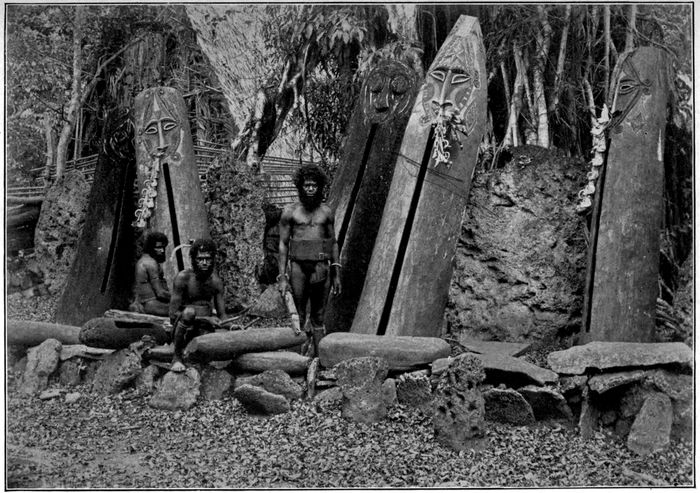
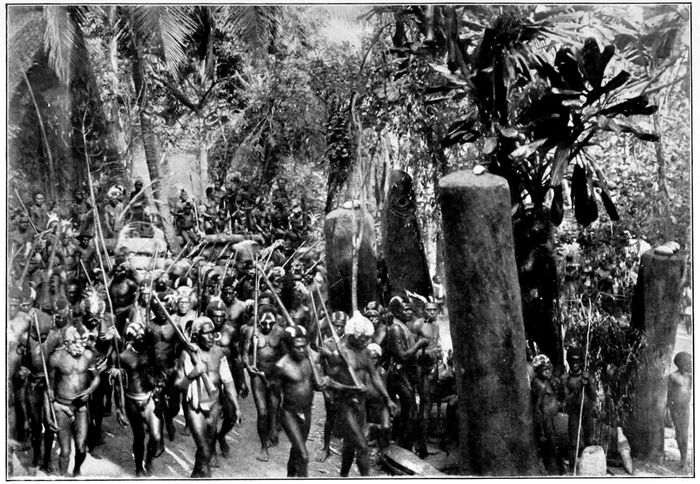
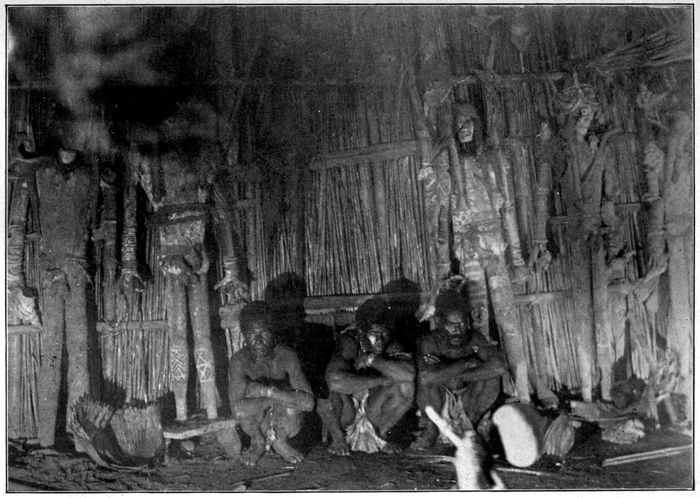
devil-devils—great, hollowed logs, carved roughly
to represent human faces, which are erected everywhere
in the New Hebrides to guard against evil
spirits—were consulted to find a propitious time
for the feasting, and on the appointed day the celebration
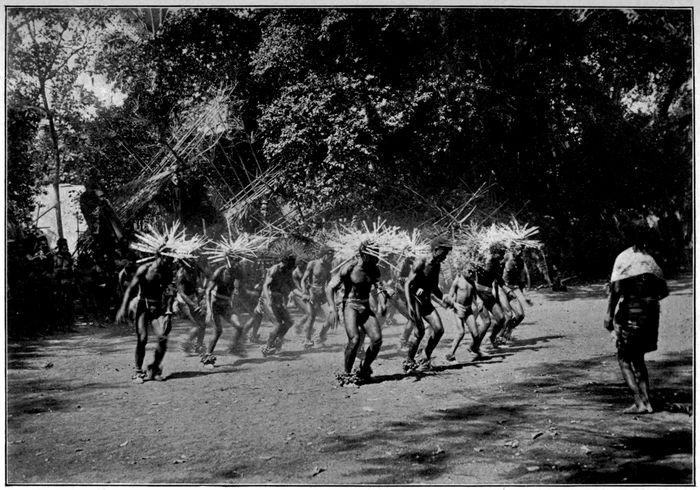
began with much shouting and singing and
dancing and beating of tom-toms. It lasted for several
days. Before it was over, seven hundred and
twenty pigs had been slaughtered. The island had
never before seen such a feast. As a result of his
political strategy, Tethlong became the Big Chief
46of Vao, taking precedence over the chiefs already
there.
I got some fine pictures of Tethlong’s feast, but
they were the only pictures I took for some days.
For one thing, I was too busy for camera work; for
the job of checking over our supplies and fortifying
our place against a heavy rain kept us busy. For another,
I was anxious to keep our savage neighbors
at a distance, so long as we were alone.
Though they got over their curiosity concerning
us and our effects within a few days, about half a
dozen loafers continued to appear every morning
and beg for tobacco. They were too lazy to work,
and their constant presence annoyed us. They were
in the way, and, besides, they grew cheekier day by
day. The limit was reached one evening when Osa
was playing her ukulele. Several natives wandered
over from the village to listen. It was pretty music—I
liked it a lot—and Osa was flattered when
some of the boys came to talk to us about it. But it
soon developed that they were demanding tobacco
as compensation for listening!
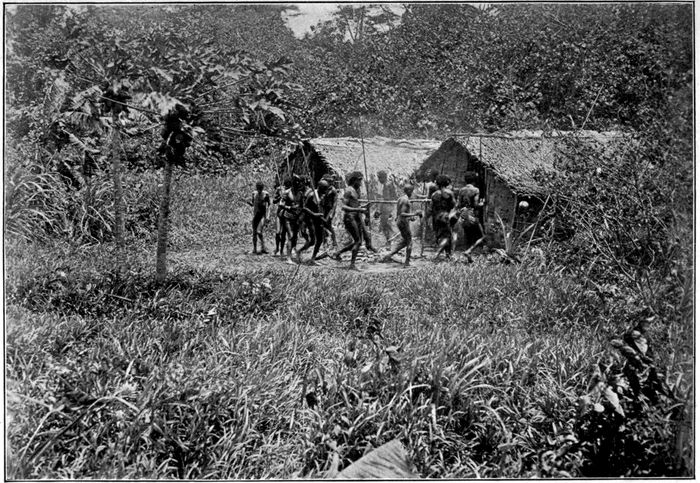
DANCE OF TETHLONG’S MEN
47We managed to get hold of a fairly trustworthy
boy—Arree by name—to help with the housework.
He claimed to have gone to the Catholic mission school at Vila, and, strange to say, he did not
approve of the ways of his own people, though he
was never absent from one of their festivals. He always
told us the local gossip. It was from him that
we learned what had happened to the mission boy
who had worked for us on our former visit. He had
aroused the ill-will of a neighbor and two weeks before
our arrival had died from poison placed in his
lap-lap, a pudding made of coconuts and fish.
Osa could write volumes regarding the difficulties
of training her scrubby native recruit to the duties of
housework. He spoke good bêche-de-mer, but bêche-de-mer
is a language capable of various interpretations.
Osa spoke it better than I, but even she could
not make simple orders clear to our muddle-brained
black slavey. One morning, she told Arree to heat an
iron for her. She waited for a long time to get it, and
then went after it. She found Arree crouched before
the fire, gravely watching the iron boiling in a pot.
Arree murdered the King’s English in a way that
must have made old Webster turn over in his grave.
He never said “No.” His negative was always “No
more,” and his affirmative was an emphatic “Yes-yes.”
When I called for warm water in the morning,
he would reply, blandly, “Hot water, he cold fellow,”
48and I would have to wait until, in his leisured
way, Arree built the fire and heated the water. He
had a sore leg, which I healed with a few applications
of ointment. A few days later, he came to me with
one eye swollen nearly shut, and my medicine kit in
his hand. “Me gottem sore leg along eye-eye,” he
informed me. Sometimes he achieved triumphs. I
asked him once to tell another native to bring me the
saw from Osa. In order to air his knowledge of English,
Arree said: “You go along Mary (woman)
belong Master catchem one fellow something he
brother belong ackus (axe), pullem he come, pushem
he go.” And then he translated the command, for
his admiring, wide-eyed brother, into the native
dialect.
Osa and I often caught ourselves falling into this
queer English even when there were no natives
around. It gets into the blood like baby-talk.
CHAPTER IV NAGAPATE COMES TO CALL
49
Long before our reënforcements were due to arrive,
we began to feel uneasy on Vao. I found our neighbors
far too friendly with the unregenerate Malekula
bushmen to be entirely trustworthy. The bush people
had no canoes. But when they wanted to visit
Vao, they would sing out from the shore, and the
Vao men would go after them and bring them over,
fifteen or twenty of them at a time. The Malekula
men never came near our clearing, but the knowledge
that they were on the island made us uncomfortable.
We were sure that they came to participate
in savage orgies, for often after a group of them
arrived, the sound of the tom-tom and of savage
chanting drifted through the jungle from the native
villages, and our little clearing seemed haunted by
shadows that assumed menacing shapes. Finally,
there occurred an incident that changed what had
been merely nervous apprehension to vivid fear.
We had been a week on the island. The schooners
we were awaiting had not yet arrived. We could expect
them, now, any day, but things do not run by
50clockwork in the South Seas, so we knew that another
week might pass before we should see them.
It had been hot and rainy and steamy and disagreeable
ever since our arrival, but to-night was clear,
with a refreshing breeze. After our tinned dinner,
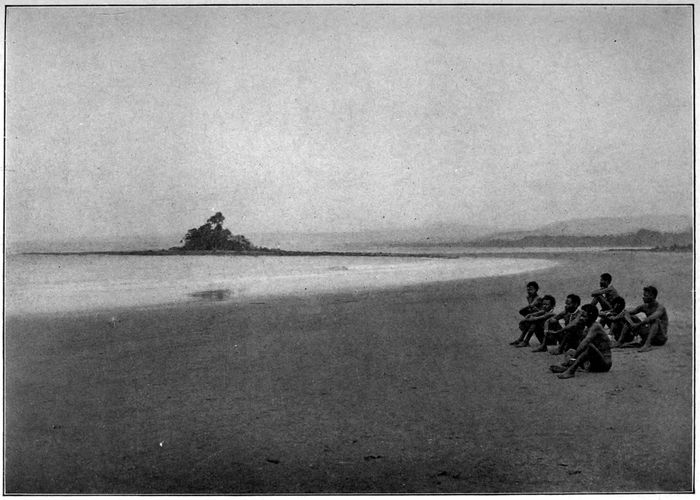
Osa and I went down to the beach. The moon was
full. The waves lazily washed up on the soft sand,
white in the moonlight, and the fronds of the palm-trees
along the shore whispered and rattled above
our heads. Osa, in a romantic mood, was strumming
very softly on the ukulele. All at once, we heard
the whish-whish of canoe paddles coming around a
rocky point. We moved back into the shelter of some
bushes and watched.
Presently ten natives landed on the beach and
drew their canoe up after them. From it they took
two objects wrapped in leaves, one elongated and
heavy—it took several men to handle it—the
other small and round. Soon the men, with their
burdens, disappeared down a dark pathway leading
to the village.
For several minutes we did not dare to move.
Then we hurried back to the house and got our revolvers
and sat for a long time feeling very much
alone, afraid to go to bed and afraid to go out in the
51open. After a while a weird chanting and the beating
of tom-toms began in the village near by. The
noise kept us awake all night.
Next morning, Arree came up with his story of the
night’s revels. The packages, he said, had really
contained the body and head of a man. The head
had been impaled on a stick in the village square,
and the natives had danced wildly around it. Then
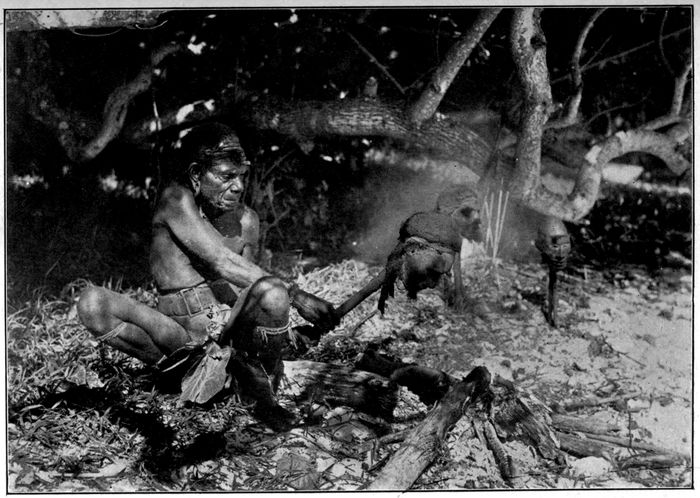
the body was spitted on a long pole and roasted over
a great fire. The savages continued to dance and
sing until the horrible meal was ready. The rest of
the night was spent in feasting. Such orgies as this,
Arree said, were fairly frequent. The natives often
purchased slain enemies from the bush savages of
Malekula, to eat as they would eat so many pigs.
Two days after this incident, Paul Mazouyer
dropped anchor off Vao. We were glad to see him,
and told him so in emphatic bêche-de-mer, the only
common language at our disposal. We promptly put
my apparatus aboard his little schooner, or cutter,
as the craft was called in those waters, and set sail
for the country of the Big Numbers. A hundred
naked savages watched us in silence from the beach.
The two other schooners had gone on ahead to meet
us in Big Numbers Bay, known locally as Tanemarou.
52They were all recruiting schooners with experienced
crews, armed with regulation rifles, as
permitted and indeed insisted upon by the Government.
Recruiting labor for the rubber and sugar plantations
of white settlers is a regular business in the
New Hebrides and a dangerous one. A recruiter
chooses his island and anchors in the offing. He then
sets adrift a charge of dynamite, which is detonated
as a signal to the natives. The roar of the explosion
rolls through the valleys and echoes against the
hills. On the day following, the savages come down
to the beach to trade. Two boats then put off from
the schooner. In the first is the white man with an
unarmed crew, for the savages are not beyond rushing
the boat for the sake of a gun. In the second,
hovering a short distance away, is an armed crew,
who cover the savages with their guns while their
master parleys with the chiefs for recruits. At the
first hostile move on the part of the natives, the boys
in the covering boat open fire.
Despite such extreme precautions, tragedies happen.
A friend of Paul Mazouyer’s had been killed at
Malua, whither we were now bound. Paul told us
the story. There were only a few savages on the
53beach at the time; but one of them promised to go
into the bush to recruit if his people were given half
a case of tobacco. The recruiter foolishly sent his
covering boat back to the cutter for the tobacco, and
the savages sat down on the beach to wait. While
they were waiting, another savage came out of the
jungle. He walked slowly down the beach with his
hands behind him and waded out into the water until
he could get behind the white man. Then he suddenly
placed the muzzle of a gun against the white
man’s back and pulled the trigger.
A French gunboat was sent from Nouméa to
avenge the murder, and a month after the tragedy
Paul led an expedition into the bush which razed a
village and killed a number of savages.
In conclusion, Paul told us an incident that he
thought was uproariously funny. The victor had
brought the bodies of four of the natives down to the
sea. Among the members of the expedition were a
dozen “civilized” blacks of a tribe hostile to the Big
Numbers. These twelve boys looked thoughtfully
at the four dead bodies and then approached the
commander with a spokesman at their head.
“Master,” he said with great earnestness, “me
lookum some fellow man he die finish. He stop along
54sand. He plenty good kai-kai! Me think more better
you no put him along ground. Altogether boy he
speak—He eat him!”
We reached the bay where these events had taken
place on the first night after our departure from Vao.
We coasted along so close to the shore that we could
plainly see groups of natives who watched us, talking
and gesticulating among themselves, and sometimes
followed us for some distance along the beach,
curious to see where we would land. We rounded
the northern point of the island and bucked into a
stiff head wind and a strong current. We made little
progress until the tide turned. Then we went along
at a good rate.
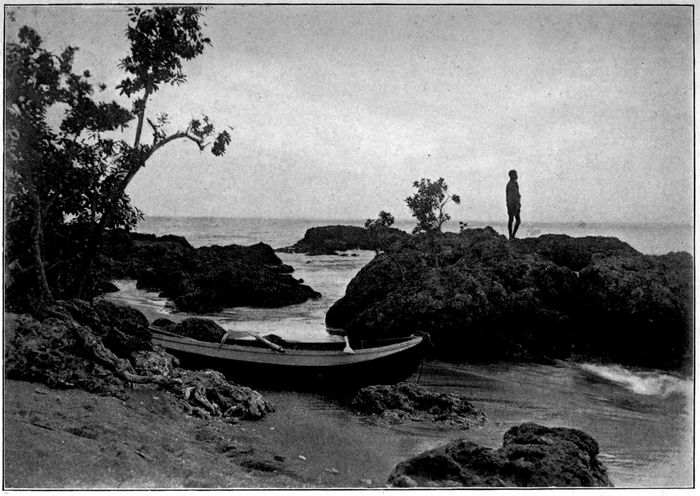
We anchored in Malua Bay, a stone’s throw from
shore, on a line with a great ravine that cleft the
mountains and separated the territory of the Small
Numbers tribes, which lies directly across from Vao,
from that of the Big Numbers, which occupies the
northwest corner of the island.
That was a night typical of the South Seas. I
shall never forget it. The moon was visible for only
a few seconds at a time, when it dodged from behind
thick, drifting clouds and drenched everything with
a light almost as bright as day. Our black crew huddled
55in the bow of the boat. We sat with our guns
beside us. On the shore we could clearly make out
the forms of savages squatting around their camp-fire.
From the distance we could hear the deep tones
of the conch-shell boo-boos. The sea rolled upon the
beach with a heavy, sleepy purring. In the dark
blue waters below us we could see sharks moving
about, leaving trails of phosphorus. By the light of
a greasy, smoky lantern that went out every few
moments, struggling against a ground swell that
threatened to capsize my typewriter, I entered the
day’s events in my diary. As I wrote, the savages
began a weird dance, their grotesque forms silhouetted
against the sky. The sound of their chanting
brought me what Osa calls the “South Sea feeling.”
I don’t know how to describe it. But it is the
thing that makes me always want to go back.
The next morning we went ashore in two boats,
Paul, Osa, and myself in one, with one boy to pull,
and four armed boys in another boat to cover us.
There were only half a dozen savages in sight, so we
landed on the beach and even walked up to the small
river that emptied into the bay, but we kept our
guns handy and the covering boat was watching
closely. We knew that if it came to a rush, we could
56beat the savages to the boat and that they were too
poor shots to waste valuable ammunition in shooting
from the edge of the jungle. It is the custom of
the men of Malekula to approach near enough to
place the muzzle against their enemy. Otherwise,
they seldom risk a shot.
We had not been ashore long when we saw a couple
of natives emerge from the bush and walk toward
us. We hurried to the boat. Other savages appeared
in small groups, so we shoved off. We bobbed along
the shore all afternoon, while Paul tried to get recruits.
About fifty armed savages wandered up and
down, coaxing us in closer; but on account of Osa,
I would not risk landing, though Paul, who feared
nothing, wanted to put in to shore. He knew that
almost any savage in that region would kill him, if
chance offered, in revenge for the part he had played
in the punitive expedition, but this was his favorite
recruiting ground and he was not to be scared away
from it. He had the contempt for natives that has
resulted fatally for many a white man.
At sundown we returned to the cutter. We could
hear the savages shouting as they went back into the
hills. The broiling sun had left us hot and sticky,
and when Paul suggested a swim we all agreed to it,
57sharks or no sharks. The boys kept a sharp lookout
for the flashes of phosphorus that would mean approaching
danger, but we finished our swim without
adventure. Nevertheless, that night we put out
hooks and caught two sharks, one four feet long, the
other six—which ended our swimming along these
shores.
Paul’s little boat was close quarters for the three
of us. He made his bed alongside the engines, below,
and Osa and I slept in the scuppers, one on each
side of the hatch.
At about eleven o’clock, it began to rain and blow.
We dragged our anchor and had to put down another
and then a kedge anchor in addition. The
craft twisted and turned and plunged, until Osa
swore we went right over and up again. I padded
Osa with old sail to protect her from bruises and we
held on to the hatch with both hands to keep from
being thrown into the sea. Almost all our supplies
were drenched; for we robbed everything else of tarpaulin
or canvas coverings to keep my apparatus
dry. Shivering and wretched, we crouched on deck
waiting for daylight. Morning was never so slow in
coming; but with the first light, the rain ceased, the
sea became smooth, and the sun came up broiling
58hot, sucking up the moisture until from stern to bow
we looked like a spout of a boiling tea-kettle.
There was fever in the air. We ate quinine as if it
had been candy, in an effort to stave off the sickness
that, always inconvenient, would now prove especially
so.
About noon we made out two vessels sailing up to
us, and as they came alongside we found that one
was sailed by Perrole and the other by a young man,
half Samoan and half English, whom Mr. Thomas
had sent with ten boys. His name was Stephens.
We now had twenty-six armed and experienced natives,
four white men and Osa. With this force I
was ready to undertake almost anything; so after a
hasty conference we decided to go on to Tanemarou,
the bay from which we had first entered Nagapate’s
territory. Without the aid of the Government, I
saw that it would be impossible to carry out my
original intention of entering the island at the northern
end and traversing it straight through to the
southern. So I proposed the alternative plan of sailing
completely around the island, landing at different
points from which I could strike inland to visit
the tribes. In many ways, this latter plan proved to
be the better of the two for my purpose. I doubt,
59now, if a Government escort would have been to my
advantage; for any Government expedition would
have been regarded as a punitive raid and as such
would have encountered the most determined resistance.
Even at the time, I felt that the peaceable nature
of my expedition would put me on good terms
with the savages. Cruel as they were, they were
childlike, too, and the fact that we were coming to
them in a friendly spirit with presents for which, apparently,
we were asking nothing in return, would,
I felt sure, disarm their hostility. I had discovered
that most of the recent murders of white men had
been committed by the savages in a spirit of revenge.
Recruiters who had carried off their kinsfolk; traders
who had cheated them; members of punitive expeditions,
or the occasional Simon Legree who had
earned the hatred of the blacks by cruelty—such
were the victims of savage gun or knife.
It was with a feeling of confidence that I sailed
into Tanemarou Bay. Here, sweeping around us,
was the broad beach across which we had run for our
lives almost two years before. In fine yellow sand it
spread away from the water’s edge for about a hundred
yards to the dark fringe of jungle. Against the
high black volcanic rocks that guarded the entrance
60to the bay, a heavy surf beat and roared, but on the
sands the land-locked waters lapped gently, shimmering
with many colors. The dark hills rose about
the jungle in green slopes mottled with brown and
streaked here and there with tiny wisps of smoke.
I suddenly thought that the peaceful aspect of
those hills was exactly what must have struck the
men aboard the gunboat Euphrosyne when its opportune
appearance had given Osa and me the
chance for our lives. The memory of that horrible
adventure made me momentarily uneasy. Osa
squeezed my arm, and I knew that her thoughts, too,
had gone back to the evening when, in the gathering
darkness, we had slipped from the edge of the jungle,
tattered, bleeding, and terrified, and rushed into
the water pursued by the yelling savages.
Paul was not troubled by any forebodings. He at
once suggested that we go ashore. So Osa and I followed
him into the boat and we pulled for the beach,
followed by the small boats from the other cutters.
As we landed, about twenty armed savages suddenly
appeared and came walking boldly toward us. Except
for belts of rough bark and clouts of pandanus
fiber, they were naked. The flatness of their noses
was accentuated by plugs driven through the cartilage
61dividing the nostrils. Shaggy, outstanding
manes of hair completely encircled their faces,
which were deeply seamed and wore a perpetual
scowl.
I began to doubt once more whether I could fulfill
the object of my expedition after all. There was
no man living who had witnessed the cannibalistic
rites of these wild men. Many had made the attempt
and had paid a gruesome penalty. But as the
band drew nearer, my feeling changed. In a sense,
they were my people. They had encircled the globe
with me and in the comfortable surroundings of
great theaters had stood naked and terrible before
thousands of civilized people. I had made their faces
familiar in all parts of the world. With something
like emotion I watched them as they approached.
Suddenly the figure at their head stood out like a
“fade-in.”
It was Nagapate.
Osa and I forgot that this savage had once wanted
to eat us. We forgot what had happened at our first
violent meeting. We looked at each other and smiled
and then, both actuated by the same unaccountable
impulse, we rushed forward and grabbed his hand.
Now Nagapate did not know the meaning of a
62handshake, but he seemed to understand instantly
that we were glad to see him. His heavy face, gashed
so deeply with wrinkles that his scowl seemed unalterable,
broke into a delighted grin. He recovered
his dignity in a moment, however, and stood to one
side with his arms folded on his massive chest,
watching closely every move we made. The strong
guard we had brought with us must have impressed
him; but he did not seem at all apprehensive, for he
could tell by our conduct that we were friendly. We
were anxious to get some pictures. However, since
fresh relays of savages continued to come down from
the jungle, we decided to wait until we had with us
all the boys from the other boats before taking any
further chances.
We decided to return to the cutter, and as we were
about to embark an extraordinary thing happened.
Nagapate came up to Osa and made signs to show
that he would like to go aboard with us. Now hundreds
of his own people had been grabbed from his
beach in times gone by and “blackbirded” away to
slavery. He was accustomed, and with cause, to
think the white man as merciless as we thought him
to be. Yet of his own free will, without a glimmer of
fear, Nagapate put himself completely in our power.
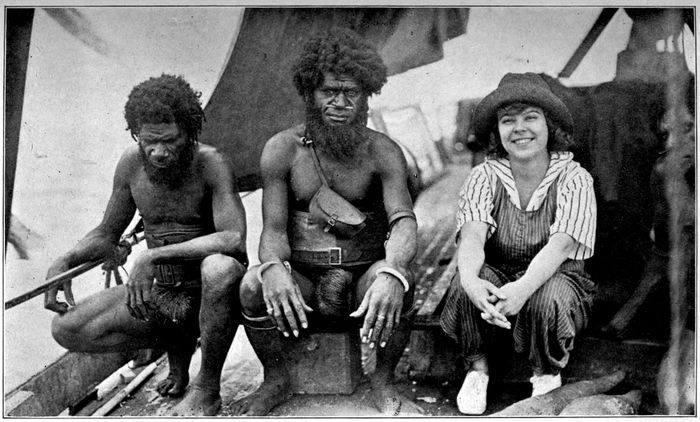
A CALL FROM NAGAPATE
63An hour later, while we ate our dinner of tinned
beef, Nagapate, with two of his men, squatted on
the deck at our feet and ate hard-tack and white
trade-salmon. Afterwards I brought out pictures
I had made on my first visit. The savages gave
yells of excitement when they saw Nagapate’s face
caught on paper. When I produced a large colored
poster of the chief and presented it to him, he was
speechless. The three savages, looking at this mysterious
likeness, were almost ready to kow-tow to us,
as they did to their devil-devils in the bush.
But the crowning touch of all came when we had
grown a little tired of our guests, and Osa brought
out her ukulele and commenced to sing. To our surprise
Nagapate joined in, chanting a weird melody,
which his men took up. After a few bars, they were
made shy by the sound of their own voices. Nagapate
stopped his song and vainly tried once more to look
dignified. In fact, that old man-eater showed every
manifestation of a young and awkward boy’s self-consciousness!
We bridged over the awkward situation with more
salmon and about ten o’clock sent him ashore happy,
with his bare arms full of knives and calico and tobacco.
We judged by his farewell that we would be
64welcome any time we cared to drop in on him for
dinner and that we had a fair prospect of not being
served up as the main course. In any case, on the
strength of his visit, I determined to chance a visit
to his village on the following day, though I realized
that the visit, in many ways significant, did not give
the least assurance of continued friendliness. These
savages are as willful and as uncertain in their
moods as children. When they are sulky, they are
as likely to murder treacherously whoever arouses
their ill-will as a small boy is to throw a stone. There
is no one to control or guide them. They are physically
powerful, they are passionate, and they possess
deadly weapons. We could be no more certain
that our lives would be safe with them than a man
with a silk hat can be sure of his headgear among
three hundred schoolboys fighting with snowballs.
We were awakened at daybreak by a shout from
the shore. A score of natives stood on the beach,
calling and gesticulating. I went ashore, accompanied
by Paul Mazouyer, and found that they had
presents from their chief, Nagapate—yams and coconuts
and wild fruits. But the presents were not
for me. In their almost unintelligible bêche-de-mer,
the natives explained that the fruits were for “Mary”—their
65bêche-de-mer word for woman. I could
scarcely believe my ears. In all my experience
among the blacks of the South Seas, I had never
known a savage to pay any attention to a woman, except
to beat her or to growl at her. The women of
the islands are slaves, valued at so many pigs. They
do all the work that is done in the native villages and
get scoldings and kicks for thanks. I went doubtfully
back to the schooner and brought Osa ashore.
The natives greeted her with grunts of satisfaction
and laid their offering at her feet.
My respect for Nagapate increased. I saw that he
was a diplomat. He had observed that this little person
in overalls, who had approached him so fearlessly,
was treated with the utmost deference by the
crews of the schooners and by the white men. He
had come to the conclusion that she was the real
boss of the expedition. And he was very nearly
right!
Perrole and Stephens joined us, and we remained
on the beach all morning. Osa and I took pictures
of the natives squatting about us and watched for
Nagapate himself to put in an appearance. I was
eager to invite him to his first “movie.” He had
been overcome with awe at sight of a photograph of
66himself. What would he say to motion-pictures that
showed him talking, with threatening gestures, and
scowling as on that memorable day two years before?
Every now and then a new delegation of natives
arrived on the beach. In spite of the law that prohibits
the sale of firearms to the natives, they all carried
rifles. I examined some of the guns. They were
old, but not too old to do damage, and every native
had a supply of cartridges. I found later that spears
and bows and arrows are almost out of use among
the Big Numbers. Nine men out of ten own guns.
Where do they get them? No native will tell, for
telling would mean no more rifles and no more cartridges.
The white people of the islands know, but
they keep their information to themselves. I know,
too, but I am not doing any talking either, for I want
to go back to the New Hebrides some day.
Our own boys remained close by us all the morning
and we kept sharp watch for any sign of treachery.
By noon, the savages had lost their suspicion of
us. They stacked their rifles against rocks and trees
and moved about, talking to each other in their
strange, grunting speech. We, too, moved about
more freely. And I tried to gain the confidence of the
67natives by talking to them. My attempts to learn
their language with bêche-de-mer as a medium
brought great guffaws. But in spite of the friendliness
of our visitors, we were never quite at ease.
Their appearance was against them. Their ugly
faces—eyes with scarcely any pupils, flat noses
made twice their normal size by the wooden plugs
thrust through the cartilage dividing the nostrils,
great mouths with thick, loose lips—their stealthy
way of walking, their coarse, rapid, guttural speech,
which sounded angry even when they spoke to one
another, the quick gestures with which they filled in
the gaps in their limited language—none of these
things tended to make us feel at home.
I kept wondering how some of Osa’s sheltered
young friends back home would act, if they were to
be set down, as she was, on a sandy beach, miles from
civilization, and surrounded with fierce cannibals—hideous
and worse than naked; for they worship sex,
and what clothing they wear calls attention to their
sex rather than conceals it. I watched her admiringly
as she went about taking snapshots as unconcernedly
as if the savages had been Boy Scouts on an
outing. And I thought, as I have thought many
many times in the nine years we have gone about together,
68how lucky I was. Osa has all the qualities
that go to make an ideal traveling companion for an
explorer—pluck, endurance, cheerfulness under discomfort.
In an emergency, I would trust her far
sooner than I would trust most men.
During the afternoon, several fresh groups of natives
came out of the jungle to stare at us, and toward
sunset a number of savages descended a trail
that sloped down to the beach about half a mile from
where we were sitting and brought us a message from
the great chief. It was couched as follows: “Nagapate,
he big fellow master belong Big Numbers. He,
he wantem you, you two fellow, you come along
lookem house belong him, you lookem piccaninny
belong him, you lookem Mary belong him. He
makem big fellow sing-sing. More good you, you
two fellow come. He no makem bad, he makem good
altogether.” And it meant that His Highness, Chief
Nagapate, would like to have us visit him in his village,
and that he guaranteed our safety.
THE SAFE BEACH TRAIL, TANEMAROU BAY
69I accepted the invitation with alacrity. The messengers
hurried off, and Osa and I followed, curious to
see where the trail left the beach. We had not gone
far, before Paul shouted for us to stop. We halted
and saw, a quarter of a mile down the beach, a group
of about a hundred armed natives. Some Big Numbers
people came up to us and warned us, with gestures,
to go no farther, so we sat down on the sand
and awaited developments. The newcomers squatted
on the beach and stared in our direction. In
about fifteen minutes, a second group of natives appeared
from a trail still farther down the beach, and
the first group sprang to their feet and melted into
the bush with incredible rapidity.
What did it all mean? Paul, well versed in island
lore, had the answer. The beach was used jointly by
four tribes, three belonging to the Big Numbers and
one to the Small Numbers people. All of these tribes
are more or less hostile, but they have agreed between
them that the beach is neutral ground, for
they realize that if fighting is permitted there, it will
never be safe for any of them to come out into the
open to trade or fish. Sometimes the beach armistice
is violated, and for weeks there is severe fighting
along the sand; in the end, however, the matter is always
settled by an exchange of wild pigs and the
beach is again safe for all comers. But the armistice
never extends back into the bush. In the jungle and
the tall cane-grass, it is always open season for man-killing.
70We returned to the schooner early that evening,
in order to make ready for our trip into the interior.
I packed all my photographic apparatus carefully in
canvas and rubber cases, and I bundled up several
tarpaulins to protect us and our cameras in case of
sudden rain. We put up enough supplies to last
seven or eight days, and a good equipment of trade-stuffs.
As we packed, the monotonous chanting of
some twenty of Nagapate’s men, who had remained
on the beach to escort us to the village, drifted
across the water. Occasionally we caught a glimpse
of them, grotesque black shapes against the light
from their camp-fire.
CHAPTER V IN NAGAPATE’S KINGDOM
71
Next morning, before daybreak, we were on the
beach. The embers of the camp-fire remained, but
our escort had vanished. I was filled with misgivings.
Did Nagapate plan treachery? We were thirty-one—twenty-six
trustworthy native boys, four
white men, and Osa. We were all well equipped
with repeating rifles and automatic pistols. In open
fight, we could have stood off a thousand savages.
But I knew that the men of Malekula, though they
are notoriously bad shots, could pick us off one
by one, if they wished, as we went through the
jungle.
I suppose that we all felt a little doubtful about
taking the plunge into the jungle, but we all—with
the exception of our native boys, who were plainly
in a blue funk—kept our doubts to ourselves. The
boys were so frightened that they rebelled against
carrying anything except their guns. To inspire
them with confidence, each of us took a piece of luggage,
and then we divided among them what was
left and persuaded them to take the trail.
72It was dawn on the beach, but it was still night in
the jungle. The trail was a dark tunnel with walls
and roof of underbrush and trees and tangled vines.
We stumbled along blindly at first. Presently our
eyes became used to the dark and we walked with
more ease. Stems and thorns caught at our clothes
as we passed. We slipped on wet, slimy roots and
stumbled over them in the dim light. Only where
the jungle was intersected by one of the numerous
streams—swift but shallow and never too wide for
leaping—that water the island, did the light succeed
in struggling weakly through the tangle.
The New Hebridean jungle is different from that
of India or Africa. The severe hurricanes that sweep
over the islands each year have stunted growth.
There are no forest giants. Trees send their branches
out rather than up, forming a dense mass of vegetation
that is further bound together by vines, so that
it is almost impossible to penetrate the jungle save by
beaten trails or along the courses of streams.
The sun was well up when we came out on the
first of a series of plateaus that formed a giant stairway
up the mountain. They were separated from
one another by five hundred to a thousand yards of
scrub trees and tangled bush. It was not easy going.
73The ascents were steep, and the trail was wet and
slippery.
We kept watch for treacherous natives. Once we
were startled by blood-curdling cries that came from
the direction in which we were going. Our boys said
the men of Malekula were hunting wild pigs. We
went on in silence. Our hearts jumped every time a
twig cracked. There was a set expression on Osa’s
face. I knew she was frightened, but I knew, too,
that no amount of money would have persuaded her
to turn back.
By noon we had reached what seemed to be the
highest point of northern Malekula, and looked back
over valley after valley of dense jungle, and plateau
after plateau covered with cane-grass. Here and
there a coconut tree stood out alone. Smoke, curling
out of the hillsides, indicated the sites of native
villages. Perhaps, at that very moment, gruesome
feasts of human flesh were being prepared. In the
bay, very small and very far off, were three black
dots—our boats.
We heard a sound behind us and quickly turned.
There were some twenty men, sent by the “big fellow
master belong Big Numbers.” They took our
apparatus and indicated that we were to follow them.
74We were dead tired; still there seemed nothing to do
but to push on.
We were not sorry, after about a mile, to approach
a village. First we came upon scattered groves of coconut
and banana trees. Our trail became wider and
harder and we passed weed-grown patches of yams
and taro, protected against the wild pigs by rude
walls of bamboo. Finally we came out upon a clearing
around which clustered a few wretched shelters
thatched roughly with leaves. In the center of the
clearing stood upright hollow logs—the drums used
to send messages from village to village and to furnish
music for the native dances. The natives called
them boo-boos—the name given to conch-shells
and all other sound-making instruments. On the
hard ground of the clearing sat some thirty savages,
all well armed. They had apparently been watching
for us, but they did not greet us. We spoke to them,
but, beyond a few grunts, they made no reply.
There were no women and children in sight. That
was a bad sign; for the women and children are sent
away only when there is trouble in the air. Perrole,
Stephens, and Mazouyer drew nearer to Osa and me.
Their faces were grave. Our boys edged close to us.
None of us spoke.
LOOKING OVER NAGAPATE’S KINGDOM FROM THE HIGHEST PEAK IN NORTHERN MALEKULA
75After a short rest, our guides indicated that we
were to take the trail again. We pushed on over a
muddy path, bordered by coconut and banana trees,
and in about fifteen minutes we came out upon another
clearing, much larger than the first, with many
more huts surrounding it and with more and bigger
boo-boos in the center. Here again were savages
awaiting us—about two hundred of them, each with
a gun. We were led to a big boo-boo that had been
overturned by the wind and were told to sit down.
We obeyed like obedient school-children.
One of the natives beat out on a boo-boo an irregular
boom-boom-boom that roared through the clearing
and was echoed back from the hills. It sounded
like a code. We felt that it might be a summons to
the executioner. Osa huddled close to me. A stillness
fell over the assembly.
Suddenly, at the far side of the clearing, a huge savage
appeared. It was Nagapate. He stood for a moment,
looking over the audience; then he walked
slowly and majestically into the center of the clearing.
He roared a few words to his men. Then he
turned to us. A native came running up—the laziest
black stepped lively when Nagapate commanded—with
a block of wood for a throne. The chief sat
76down near us, and we stepped forward and shook
hands with him. He had grown used to this form of
greeting and responded with graciousness.
It had been a wonderful entrance. But then Nagapate
had an instinct for the dramatic. Throughout
our stay in his village, I noticed, he never made
a move that was not staged. He let it be known by
his every act that he was no common chief, who had
won his position through skill in killing pigs or men.
Nagapate was a king and a descendant of kings.
His was the only tribe I had come across during my
travels among the blacks of the South Pacific that
had an hereditary ruler.
After he had greeted us, he uttered a sharp command
and a native stepped up with a big bamboo
water-bottle. Nagapate drank from it, and then the
native offered it, tilted at the proper angle, to each
of us in turn. It was not pleasant to drink from the
mouthpiece at which Nagapate’s great lips had
sucked. But we gathered that the bottle was the
South Sea equivalent of a pipe of peace; so we drank
gladly. I then presented to Nagapate a royal gift
of knives, calico, and tobacco, and I told one of the
boys to give two sticks of tobacco to each native.
The natives smoked their tobacco (those that did
77not eat it) at once and greedily. It seemed to break
the ice a bit; so I got out my cameras. For three
hours, I made pictures. But I did not get any “action.”
I wanted a picture of a man coming out of his
house; for the doors of the huts are so low that the
people have to come out on all fours. I persuaded
a native to go into his hut and come out again.
He did so. But his companions laughed and jeered
at him, and after that every one had stage fright.
As the afternoon wore on, scores of women and
children appeared. I have never seen human beings
more wretched than those women. At first sight
they looked like walking haystacks. They wore
dresses of purple dyed grasses, consisting of a bushy
skirt that hung from the waist to the knees, a sort of
widow’s veil that was thrown over the head and face
so as to leave a tiny peep-hole for the wearer to look
through, and a long train that hung down the back
nearly to the ground. A more cumbersome and insanitary
dress was never devised. It was heavy. It
was hot. Worst of all, it was dirty. Every one of
the dresses was matted with filth. I did not see a
single pig—and there were dozens of them rooting
about inside and outside the houses—that was so
dirty as the women of that village. I afterward found
78that for women to wash was strictly taboo. From
birth to death water never touched their skins!
I got my cameras ready, but the women hid in the
houses and would not come out to be photographed.
Not until Nagapate commanded them to come into
the clearing did they creep whimpering in terror
from the low doors.
We had heard from the natives at our headquarters
on the island of Vao that Nagapate had a hundred
wives, but there were only ten of them, and
they were as wretched as any of the other women.
Osa presented them each with a string of beads and
a small glass jar of cheap candy. They did not even
look at their gifts. They wanted only to get the ordeal
over and to escape. During all our stay in the
village the poor, browbeaten wretches never got up
enough courage to look at us. Their lords and masters
felt our skins and our hair and our clothes, examining
us with embarrassing freedom. But whenever
we came upon a woman, she squatted down and
hid her face behind her grass veil.
Since the women and children had appeared, we
gained confidence and walked about the village, inspecting
the houses. As we approached, the children,
scrawny little wretches, big-bellied from malnutrition
79and many of them covered with sores, scurried
off into the bush like frightened rabbits. The houses
were wretched huts made of poles with a covering of
leaves and grass, or, occasionally, of woven bamboo.
Inside were the embers of fires—nothing more. A
hard, worn place on the ground in one corner showed
where the owner slept. Nagapate’s house stood off by
itself. It was larger than the rest and more compactly
made. But it was as bare as any of the others.
Toward sunset we built a fire and cooked our supper.
The natives gathered around and watched us in
astonishment. They themselves made no such elaborate
preparation for eating. Once in a while a man
would kindle a fire and throw a few yams among the
coals. When the yams were burned black on one
side, he would turn them with a stick and burn them
on the other. Then they were ready for eating—the
outside burned crisp and the inside raw. One evening
some of the men brought in some little pigs,
broke their legs, so that they could not escape, and
threw them, squealing, into a corner of a hut. The
next day there was meat to eat. Like the yams, it
was only half-cooked. The natives tore it with their
teeth as if they had been animals, and they seemed
especially to relish the crisp, burned portions. Each
80man was his own cook. Even Nagapate made his
own fire and cooked his own food, for it was taboo
for him to eat anything prepared by an inferior or
cooked over a fire made by an inferior. He conveniently
considered us his superiors and ate greedily
everything we gave him. He never shared the salmon
and rice he got from us either with his cronies or
with his wives. In fact, we never saw a woman eating,
and the children seemed to live on sugar-cane
and on clay that they dug up with their skinny little
fingers.
Our first day as Nagapate’s guests drew to an end.
Just before dark a native came and motioned to us to
follow him. He led us to a new house and indicated
that we were to make ourselves at home there. We
were tired out after our long march; so we turned
in without delay. We spread our blankets on the
ground and lay, fully dressed, on top of them. The
camp soon became quiet, but we could not sleep. So
far, everything had gone well, but still we did not
feel quite safe. Our boys seemed to share our apprehension.
They crowded around the hut, as close to
us as they could get. Some of them slipped under
the grass walls and lay half inside the hut.
WOMEN OF THE BIG NUMBERS
81We slept little and were up before dawn, stiff from
lying on the hard ground. We asked for water, and
a native brought it in a bamboo bottle. There was
about a pint of water for each of the five of us. The
savage that brought it looked on astonished as we
washed our hands and faces. It is not taboo for the
Big Numbers men to bathe—but they rarely use
their privilege, and they could not understand our
reckless waste of water, which was carried by the
women from a spring half a mile away.
After a breakfast of tinned beef, we set to work.
But if it had been hard to get good pictures the day
before, it was now almost impossible. The women
had all left the village to get the day’s supply of
water, fruits, and firewood. The men squatted in the
center of the clearing, guns in hand. They were apparently
waiting for something—for what?
We were uneasy. It may seem to the reader, in
view of the fact that we escaped with whole skins,
that we were absurdly uneasy. But I should like to
see the man who could remain calm when surrounded
as we were by savages, ugly and powerful, whose
only pleasure was murder, and who, we were convinced,
were eaters of human flesh. All day long our
hosts squatted about the giant boo-boos, staring at
us or at the ground or at the jungle or, sometimes,
82it seemed, at nothing at all. Now and then a single
savage would come out of the jungle and join the
group, and immediately one of the squatters would
get up and go into the bush, taking the trail by
which the newcomer had arrived. Even Paul was
troubled, and confided to me, when the others were
not about, “Me no like.”
The coming and going and interminable squatting
and staring got on the nerves of all of us. Toward
evening, we received an explanation of it from
Atree, Nagapate’s “private secretary.” Atree had
been “blackbirded” away from the island about
twelve years previous to our arrival, in the days
when natives were still carried off by force for servitude
on the plantations of Queensland; and, by
some miracle, when the all-white Australia law had
gone into effect and the blacks had been “repatriated,”
he had made his way back to his own island.
He had managed, during his sojourn abroad, to pick
up a little bêche-de-mer; so he acted as go-between
and interpreter in all our dealings with Nagapate.
He told us that a fight with a neighboring village was
brewing. There had been a dispute over some pigs,
in which somebody had got hurt. The relatives of
the victim were preparing to attack our hosts. The
83men who had come and gone from the clearing were
the lookouts who guarded the village against surprise.
A fight! My first thought was, “What a picture
I’ll get!” But Osa, at my elbow, said miserably, “I
wish we were back in the boat,” and my conscience
began to hurt. To reassure her I told her that our
force was a match for half a dozen native villages.
Before sunset there was great activity in the clearing.
Men kept coming and going, and there was
much grunted consultation in the shadow of the
boo-boos. All that night an armed guard stood
watch.
At sunrise, Nagapate came and asked if we would
shoot off our guns to frighten the enemy. I did not
like the idea. I thought it might be a ruse to get us
to empty our guns and to give the natives a chance
to rush on us before we could reload. However,
since we did not wish to seem suspicious, we granted
the request. But we fired in rotation, instead of in a
volley, so that there would always be some among us
with ready rifles. And I found that I was not the
only one who had thought of the danger of empty
cartridge-chambers: I have never seen such snappy
reloading as that of our black boys!
84After the volley, I gave Nagapate my rifle to
shoot. He unloaded her as fast as he could pull the
trigger, and begged for more, like an eager small
boy. I was sorry to refuse him, but I did not care to
waste many cartridges, so I explained through Atree
that the gun had to cool off, and Nagapate, to my
relief, seemed satisfied with the explanation.
After the shooting was over, everybody seemed to
take courage. The natives moved about more freely.
Only about a third remained armed and ready for
summons. They were apparently satisfied that their
enemies, convinced that they were well supplied
with ammunition, would be afraid to start hostilities.
We ourselves were more at ease, and I went up
to some of the soldiers and examined their fighting
equipment. Their guns were, as usual, old and rusty,
but they all had cartridges, which they carried in
leather cartridge cases slung over their shoulders. I
was surprised to find that none had clubs. Instead,
they had big knives, some of them three feet long,
for hand-to-hand fighting. Paul told me that such
knives had become the most sought-for articles of
trade. There was no Government ban on them as on
rifles and cartridges.
RAMBI
85On the afternoon of our fourth day in the village,
Nagapate brought up a man we had not seen before.
He was nearly as large as Nagapate himself, and had,
like Nagapate, an air of commanding dignity.
“Rambi! Rambi!” growled Nagapate, pointing
to his companion. Then the chief went through a
rapid pantomime, in which he seemed to kill off a
whole army of enemies. We gathered that Rambi
was minister of war, as indeed he was; but Osa
dubbed him chief of police. We learned from Paul
that the tribe was ruled by a sort of triumvirate,
with Nagapate in supreme command and Rambi
and a third chief named Velle-Velle, who acted as a
primitive prime minister, next in authority.
Rambi was a Godsend. He enjoyed being photographed,
although he did not have the slightest idea
of what the operation meant. He forgot his dignity
and capered like a monkey in front of my camera and
actually succeeded in injecting a little enthusiasm
into the rest of the natives, who still suffered from
stage fright.
I gave presents of tobacco for every picture I
made. I must have paid out several dollars’ worth
of tobacco each day. Ten years earlier, when I was
on the Snark with Jack London, trade tobacco made
from the stalks and refuse from the Virginia tobacco
86factories had cost less than a cent a stick. The supply
I had with me in Malekula had cost almost four
cents a stick. Thus the high cost of living makes itself
felt even in the South Seas. Tinned foods, cartridges,
gasoline, mirrors, knives, and calico also have
increased in price enormously since the war. An explorer
must expect his expenses to be just about four
hundred per cent higher than they were ten years
ago. And the trader is in a bad way. For the natives
learned how to value trade-stuffs years ago and
they insist on buying at the old rate. Increased
costs and greater difficulty of transportation mean
nothing to them.
On the next day, we went, with an escort of several
of Nagapate’s men, to another Big Numbers
village about four miles away. That trip was typical
of the many downs that are mingled with the ups
in a motion-picture man’s existence. The four miles
were the hardest four miles I ever walked. The trail
lay along the side of a hill, following a deep valley.
It was seldom used, and it slanted toward the valley
in an alarming way. It was slimy with mud and decayed
vegetation, and in many places a slip would
have meant a slide of several hundred feet down a
steep hill. Both Osa and I had on spiked boots,
87but they soon became clogged with mud and offered
less grip than ordinary shoes. We crept along at a
snail’s pace, testing every foothold. Though we left
Nagapate’s village at dawn, we did not reach our destination
until after ten o’clock. It was a poor and
uninteresting village of about thirty houses. Most
of the men were off on a pig hunt, and all the women
were out collecting firewood and fruits and vegetables.
About noon, it began to drizzle. By three
o’clock, it had settled down to a good downpour.
The women straggled in one by one and retreated
into their houses. The men returned in a sullen humor,
with a few skinny pigs. According to custom,
they broke one hind leg and one front leg of each animal
to prevent its escape and threw the wretched little
creatures in a squalling, moaning heap. Those on
the bottom probably suffocated before morning.
We could not think of retracing our steps over the
treacherous trail in that downpour; so we persuaded
a native and his wife and two sore-faced children to
give up their hut to us. Since we had no blankets, we
lay on the hard ground and made the best of a bad
bargain.
Next morning, the rain had ceased. But the cane-grass
was as wet as a sponge. We had not gone a
88hundred yards toward Nagapate’s village before we
were soaked through. The trail was more slippery
than ever. About every quarter of a mile we had to
stop and rest. The sun came out boiling hot and
sucked up the moisture, which rose like steam all
about us. We were five hours in this natural Turkish
bath. When we reached our destination, we
threw ourselves down and fell asleep in sheer exhaustion.
We had not secured a single foot of film,
and we felt miserably that we stood a very good
chance of contracting fever, which so far we had
luckily escaped.
Late that afternoon, I missed Osa. I had something
of a hunt for her, but I finally found her in the
shade at the edge of the clearing, playing with a little
naked piccaninny. Atree and Nagapate squatted
near by, watching her with grave, intent faces.
ATREE AND NAGAPATE
89Nagapate was Osa’s constant companion. The
great chief had taken a fancy to the white “Mary.”
Every day he sent her gifts, and his yams and fruits
and coconuts pleased her more than if they had been
expensive presents of civilization. They seemed to
her an assurance of his good-will. But the rest of
us were a bit uneasy. We had what I now believe to
be the absurd suspicion that all these gifts were tokens of savage wooing—that perhaps Nagapate
was planning to massacre us, if the occasion offered,
and keep Osa to share his wretched hut. The strain
of constant watching, constant suspicion, was telling
on our nerves. We fancied that the novelty of
our presence was wearing off. Like children, the savages
soon weary of a diversion. We were becoming
familiar—dangerously familiar—to them, and our
gifts and even the magic taught me by the great
Houdini, had begun to pall. We began to feel that it
was time for us to go.
Osa and I talked it over as we walked about the
village the following afternoon. We strayed farther
than usual and suddenly found ourselves near what
seemed to be a deserted hut. We walked around it
and found, on the far side, a well-beaten path that
led to a tiny door. Without thinking, I crawled
through the doorway, and Osa followed me. It was
several seconds before our eyes became accustomed
to the dim light. Suddenly Osa gasped and clutched
my arm.
All about us, piled in baskets, were dried human
heads. A ghastly frieze of them grinned about the
eaves. Skulls hung from the rafters, heaps of picked
human bones lay in the corners. One glance was
90enough for us. We crawled out of the hut and lost
no time in getting back to the center of the village.
Luckily none of the savages had seen us.
We gathered Paul Mazouyer and Perrole and Stephens
about us and told them of our adventure, and
it did not take the conference long to decide to return
to the beach on the following day. The other
white men told us that if we had been seen in or near
the head-house, the chances were that we should all
have been murdered, for such houses were sacred
and taboo to all, save the men of the village.
That evening a great fire was started in the clearing.
Until late in the night the ordinarily lazy savages
piled on great logs that four men were required
to carry. Nothing was cooked over the fire.
It was not needed for warmth, for the night was stifling
hot. We asked Arree the reason for the illumination.
He replied that he did not know. We decided
that there must be some sinister purpose in it and lay
sleepless, on guard the night through.
At dawn we were up. We did our packing in a hurry,
and then we sent one of the natives for Nagapate.
The chief came across the clearing, slowly and deliberately,
as always. With him was a tottering old man,
the oldest native I ever saw in the New Hebrides.
91As Osa and I went up to greet Nagapate, the old
man began to jabber excitedly. He came over to
me and felt my arms and legs with both his skinny
hands. He pinched me and poked me in the ribs and
stomach. All the time he kept up a running fire of
excited comment, addressed to Nagapate. To our
relief, he finally stopped talking for want of breath.
Nagapate spoke a few sharp words and the old man
backed away.
Osa’s face went white. And indeed, there could be
no doubt about the meaning of the old native’s pantomime.
I almost doubted the advisability of telling
Nagapate of our departure. If he liked, he could prevent
us from ever reaching the sea, from which we
were separated by so many miles of jungle. But I
decided to take a chance. I had, by this time, rather
more than a smattering of the language of Nagapate’s
tribe. I always make it a practice, when among new
tribes, to learn four words—“Yes,” “no,” “good,”
and “bad.” The language spoken by Nagapate and
his followers was so primitive and contained so many
repetitions that I had been able to progress beyond
these four fundamental words and so, with the aid of
gestures, I succeeded in telling Nagapate that our
provisions had run out and that we had to return to
92our boats. To my surprise Nagapate not only assented
to our departure, but volunteered to accompany
us to the beach.
I invited the entire village to come to the beach
for motion-pictures and tobacco, after sunset, on the
following evening. Motion-pictures meant nothing
to them; but tobacco they understood. So they
agreed to come. We left like honored guests, with
an escort of twenty-five savages. Nagapate himself
walked (as a result of my maneuvering) safe between
Osa and myself.
It had taken twelve hours to climb up to Nagapate’s
village. The return journey required only
three. It was a pleasant morning’s walk. The sun
was shining bright and beautiful, many-colored
birds fluttered about us.
When we arrived at the beach, we invited Nagapate
and his boon companions, Atree and Rambi, to
come on board the schooner. There we feasted them
on hard-tack and white salmon. When bedtime
came, the great chief indicated that it was his pleasure
to sleep on board. I was heartily astonished and
a little ashamed. After all our suspicions, Nagapate
was again voluntarily putting himself into our
hands, with the touching confidence of a little child.
93Our royal guest and his men bunked in the engine-room.
I happened to wake about midnight and took
a peep at them. There they were, flat on their backs
on the hard, greasy floor, sleeping like logs.
CHAPTER VI THE BIG NUMBERS SEE THEMSELVES ON THE SCREEN
94
Early on the morning of the show, we got the whaleboats
to work and took all my projection machinery
ashore. Soon I had everything set up, ready for the
show. But when I tried out the projector to see if it
was shipshape, I found that my generator was out of
order. Work as I would, I could not get a light. I was
blue and discouraged. I had been looking forward to
this show for two years, and now, apparently, it was
not going to come off. Imagine going back several
hundred thousand years and showing men of the
Stone Age motion-pictures of themselves. That is
what I had planned to do. For the men of Malekula
are in the stage of development reached by our own
ancestors long before the dawn of written history.
Through my pictures of them, I had carried New
York audiences back into the Stone Age. Now I
wanted to transport the savages into 1919—and
my generator would not work.
The projector was worked by man-power. Two
men on each side turned the handles attached to the
95machinery that should produce the magic light; but
though my boys ground patiently all afternoon, not
a glimmer showed. Finally, I gave up and motioned
them to stop. They misunderstood me and, thinking
that I wanted them to turn faster, went to work
with redoubled energy. The miracle happened—the
light flashed on. In my excitement, I forgot my
supper.
The beach was already crowded with savages. I
had thought they might be curious about my machinery.
But they scarcely looked at it. They just
squatted on the sands with their guns clutched tight
in their hands. No women and only three or four
children accompanied them. In spite of my promise
of tobacco, they had not quite trusted my invitation
and they were on the lookout for foul play. By dark
they were restless. They had received no tobacco.
They did not understand all this preparation that
culminated in nothing. They wanted action.
I saw that the show must begin at once; so I
tested everything once more. Since I had no idea
how the pictures would be received, I stationed armed
guards at each side of the screen and around the projector,
at points from which they could cover the audience.
Then I tried to persuade my visitors to sit in
96front of the projector, where they would get a good
view of the screen. They were now thoroughly suspicious
and would not stay where I put them. They
wanted to keep an eye on me. They were so uneasy
that I expected to see them disappear into the bush
at any moment. But Osa saved the situation. She
took Nagapate by the arm and made him sit down
beside her. The rest of the savages gathered about
them. Then the show began.
First, a great bright square flashed on the screen.
Then came a hundred feet of titles. The attention
of the natives was divided between the strange letters
and the rays of white light that passed above
their heads. They looked forward and up and back
toward me, jabbering all the time. Then slowly, out
of nothing, a familiar form took shape on the screen.
It was Osa, standing with bent head. The savages
were silent with amazement. Here was Osa sitting
at Nagapate’s side—and there she was on the
screen. The picture-Osa raised her head and winked
at them. Pandemonium broke loose. “Osa—Osa—Osa—Osa,”
shouted the savages. They roared
with laughter and screamed like rowdy children.
I had been afraid that my guests would be frightened
and bolt at the first demonstration of my
97“magic,” but they had been reassured by the familiar
sight of Osa. Now they were ready for anything.
I showed them a picture of Osa and me as we left the
Astor Hotel in New York. Then I showed them
the crazy thousands that had crowded New York
streets on Armistice Day. I followed this picture
with glimpses of Chicago, San Francisco, Los Angeles,
Honolulu, Tokyo, and Sydney. Nagapate told
me afterward that he had not known there were so
many white people in all the world and asked me if
the island I came from was much larger than Malekula.
I showed in quick succession, steamers, racing
automobiles, airplanes, elephants, ostriches, giraffes.
The savages were silent; they could not comprehend
these things. So I brought them nearer home, with
pictures taken on Vao, Santo, and other islands of
the New Hebrides.
Now it was time for the great scene. I instructed
Paul in turning the crank of the projector and put
Stephens and Perrole in charge of the radium flares.
I myself took my stand behind my camera, which
was trained on the audience. A hundred feet of
titles—then Nagapate’s face appeared suddenly on
the screen. A great roar of “Nagapate” went up. At
that instant the radium lights flashed on, and I, at
98my camera, ground out the picture of the cannibals
at the “movies.” True, about two thirds of the audience,
terrified by the flares, made precipitately for
the bush. But Nagapate and the savages around
him sat pat and registered fear and amazement for
my camera. In about two minutes the flares burned
out. Then we coaxed back to their places the savages
that had fled. I started the reel all over and ran
it to the end amid an uproar that made it impossible
for me to make myself heard when I wanted to speak
to Osa. Practically every savage pictured on the
screen was in the audience. In two years they had
not changed at all, except, as Osa said, for additional
layers of dirt. As each man appeared, they called
out his name and laughed and shouted with joy.
Among the figures that came and went on the screen
was that of a man who had been dead a year. The
natives were awe-struck. My magic could bring
back the dead!
Midway in the performance I turned the projection
handle over to Mazouyer and joined the audience.
Osa was crying with excitement. And there
was a lump in my own throat. We had looked forward
a long time to this.
HUNTING FOR THE MAGIC
A CANNIBAL AND A KODAK
99When the show was over, a great shout went up.
The savages gathered into groups and discussed the
performance, for all the world as people do “back
home.” Then they crowded about us, demanding
their pay for looking at my pictures! As I gave them
their sticks of tobacco, each grunted out the same
phrase—whether it meant “Fine,” or “Thank you,”
or just “Good-bye,” I do not know.
While we packed our apparatus, the natives cut
bamboo and made rude torches. When all were
ready, they lighted their torches at the fire that
burned on the beach, and then they set off in single
file up the trail. We said good-bye to Perrole and
Stephens, who were to sail for Santo that night, and
prepared to go aboard Paul’s cutter. He had difficulty
in getting his engine started, and while he
worked with it, Osa and I sat on the beach, watching
the torches of the Big Numbers people as they filed
up hill and down dale the long eight miles to their
village. The night was so dark that we could not see
anything except the string of lights that wound
through the black like a fiery serpent. The head disappeared
over the top of the hill. Half an hour later,
the tail wriggled out of sight. Then the engine
kicked off.
CHAPTER VII THE NOBLE SAVAGE
100
The morning after our motion-picture show on the
beach at Malekula found us anchored off Vao. We
got our luggage ashore as quickly as possible and then
turned in to make up for lost sleep. We had slept
little during our eight days in the village of Nagapate.
We had been in such constant fear of treachery
that the thud of a falling coconut or the sound of
a branch crackling in the jungle would set our nerves
atingle and keep us awake for hours. Now we felt
safe. We knew that the four hundred savages of Vao,
though at heart as fierce and as cruel as any of the
Malekula tribes, lived in wholesome fear of the British
gunboat; so we slept well and long.
The next morning we said good-bye to Paul Mazouyer
and he chugged away to Santo in the little
schooner that for two weeks had been our home.
Osa and I were alone on Vao. We turned back to
our bungalow to make things comfortable, for we
did not know how many days it would be before Mr.
King, who had promised to call for us, would appear.
As we walked slowly up from the beach, we heard
101a shout. We turned and saw a savage running toward
us. He was a man of about forty; yet he was
little larger than a child and as naked as when he was
born. From his almost unintelligible bêche-de-mer,
we gathered that he wanted to be our servant. We
could scarcely believe our ears. Here was a man who
wanted to work! We wondered how he came to
have a desire so contrary to Vao nature, until we
discovered, after a little further conversation in
bêche-de-mer, that he was half-witted! Since we were
in need of native help, we decided not to let his mental
deficiencies stand in his way and we hired him on
the spot. Then came the first hitch. We could not
find out his name. Over and over, we asked him,
“What name belong you?” but with no result. He
shook his head uncomprehendingly. Finally, Osa
pointed to the tracks he had left in the sand. They
led down to the shore and vanished at the water’s edge.
“His name is Friday,” she said triumphantly. And
so we called him.
From that moment, Friday was a member of our
household. We gave him a singlet and a lava-lava, or
loin-cloth, of red calico, and from somewhere he dug
up an ancient derby hat. Some mornings he presented
himself dressed in nothing but the hat. He
102was always on hand bright and early, begging for
work, but, unfortunately, there was nothing that he
could do. We tried him at washing clothes, and they
appeared on the line dirtier than they had been before
he touched them. We tried him at carrying
water, but he brought us liquid mud, with sticks and
leaves floating on the top. The only thing he was
good for was digging bait and paddling the canoe
gently to keep it from drifting while Osa fished.
That was, indeed, a service of some value; for Osa
was an indefatigable fisherwoman. Every day, she
went out and brought back from ten to thirty one-
and two-pound fish, and one day she caught two
great fish that must have weighed ten pounds each.
It took the combined efforts of Friday and herself to
land them.
I am convinced that, for bright color and strange
markings, there are no fish in the world like those of
Vao. Osa called them Impossible Fish. There were
seldom two of the same color or shape in her day’s
catch. They were orange and red and green and silver,
and sometimes varicolored. But the most noticeable
were little blue fish about the size of sardines
which went in schools of thousands through the still
sea, coloring it with streaks of the most brilliant
103shimmering blue you can imagine. In addition to
the Impossible Fish, there were many octopi, which
measured about three feet from tentacle to tentacle,
and there were shellfish by the thousand. On the
opposite side of the island from that on which we
lived, oysters grew on the roots of mangrove trees
at the water’s edge, and at low tide we used to walk
along and pick them off as if they had been fruit.
We worked hard for the first week or so after our
return to Vao, for we had about a hundred and fifty
plates and nearly two hundred kodak films to develop.
Previous to this trip, I had been forced to develop
motion-picture films, as well as kodak films and
plates, as I went along. Like most photographers, I
had depended upon a formalin solution to harden the
gelatin films and keep them from melting in the heat.
Though such a solution aids in the preservation of
the film, it interferes considerably with the quality
of the picture, which often is harsh in outline as a result
of the thickening of the film, and it is not a guarantee
against mildew or against the “fogging” of
negatives. Before starting for the New Hebrides,
however, I had worked out a method of treating
films that did not affect the quality of the picture,
and yet made it possible to develop films successfully
104at a temperature much higher than 65°. Still better,
it permitted me to seal my film after exposure and
await a favorable opportunity for developing. Only
lately I have developed in a New York workshop
films that were exposed nineteen months ago in the
New Hebrides and that were carried about for several
months under the blaze of a tropical sun. They
are among the best pictures I have ever taken.
Any one who has tried motion-picture photography
in the tropics will realize what it means to be
freed from the burden of developing all films on the
spot. To work from three o’clock until sunrise, after a
day of hard work in enervating heat, is usually sheer
agony. Many a time I have gone through with the
experience only to see the entire result of my work
ruined by an accident. I have hung up a film to dry
(in the humid atmosphere of the tropics drying often
requires forty-eight hours instead of half as many
minutes) and found it covered with tiny insects or bits
of sand or pollen blown against it by the wind and
embedded deep in the gelatin. I have covered it with
mosquito-net in an effort to avoid a repetition of the
tragedy and the mosquito-net has shut off the air and
caused the gelatin to melt. I have had films mildew and
thicken and cloud and spot, in spite of every effort
105to care for them. On this trip, though even so simple
an operation as the changing of motion-picture film
and the sealing of negatives was an arduous task
when it had to be performed in cramped quarters, it
was a great relief to be able to seal up my film and
forget it after exposure. The plates that I used in
my small camera had to be promptly attended to,
however, for to have treated them as I treated the
motion-picture film would have meant adding considerably
to the bulk and weight of the equipment
we were forced to carry about with us.
We worked at the developing several hours a day,
and between times we explored the island, learning
what we could of native life. Arree, the boy who
acted as our maid-of-all-work, supplied me with native
words until I had a fairly respectable vocabulary,
but, when I tried to use it, I made the interesting
discovery that the old men and the young men
spoke different tongues. Language changes rapidly
among savage tribes. No one troubles to get the
correct pronunciation of a word. The younger generation
adopt abbreviations or new words at will and
incorporate into their speech strange corruptions of
English or French words learned from the whites.
Some of the words I learned from Arree were absolutely
106unintelligible to many of the older men. I
found, too, that the language varied considerably
from village to village, and though many of the Vao
men were refugees from Malekula, it was very different
from that of any of the tribes on the big island. I
once estimated the number of languages spoken in
the South Seas at four hundred. I am now convinced
that as many as that are used by the black races
alone.
As we poked about Vao, we decided that the island
would be a good place in which to maroon the
people who have the romantic illusion that savages
lead a beautiful life. We had long ago lost that illusion,
but even for us Vao had some surprises. One
day, I made a picture of an old, blind man, so feeble
that he could scarcely walk. He was one of the few
really old savages about, and I gathered that he must
have been a powerful chief in his day, or otherwise he
would not have escaped the ordinary penalty of age—being
buried alive. But on the day after I had
taken his picture, when I went to his hut to speak to
him, I was informed that “he stop along ground”
and I was shown a small hut, in which was a freshly
dug grave. My notice of the old man had drawn him
into the limelight. The chiefs had held a conference
107and decided that he was a nuisance. A grave was
dug for him, he was put into it, a flat stone was
placed over his face so that he could breathe (!), and
the hole was filled with earth. Now a devil-devil
man was squatting near the grave to be on hand in
case the old man asked for something. There was
no conscious cruelty in the act, simply a relentless
logic. The old man had outlived his usefulness. He
was no good to himself or to the community. Therefore,
he might as well “stop along ground.”
Only a few days later, as we approached a village,
we heard, at intervals, the long-drawn-out wail of
a woman in pain. In the clearing we discovered a
group of men laughing and jeering at something that
was lying on the ground. That something was a
writhing, screaming young girl. The cause of her
agony was apparent. In the flesh back of her knee,
two great holes had been burned. I could have put
both hands in either of them.
“One fellow man, him name belong Nowdi, he
ketchem plenty coconuts, he ketchem plenty pigs, he
ketchem plenty Mary,” said Arree, and he went on
to explain that the “Mary” on the ground was the
newest wife of Nowdi, whom he pointed out to us
among the amused spectators. The savage had paid
108twenty pigs for her—a good price for a wife in the
New Hebrides—but he had made a bad bargain;
for the girl did not like him. Four times she ran
away from him and was caught and brought back.
The last time, nearly six months had elapsed before
she was found, hiding in the jungle of the mainland.
The day before we saw the girl, the men of the village
had gathered in judgment. A stone was heated
white-hot. Then four men held the girl while a fifth
placed the stone in the hollow of her knee, drew her
leg back until the heel touched the thigh, and bound
it there. For an hour they watched her anguish as
the stone slowly burned into her flesh. Then they
turned her loose. Thenceforth she would always
have to hobble, like an old woman, with the aid of a
stick. She would never run away again.
We turned aside, half sick. It was hard for me to
keep my hands off the brutes that stood laughing
around the girl. Only the knowledge that to touch
them would be suicide for me and death or worse for
Osa held me back. But as we returned to the bungalow,
I gradually cooled down. I realized that it was
not quite fair to judge these savages—still in the
stage of development passed by our own ancestors
hundreds of thousands of years ago—according to
109the standards of civilized society. And I remembered
how beastly even men of my own kind sometimes
are when they are released from the restraints
of civilization.
The next morning, after our morning swim, Osa
and I sat on the beach and watched the commuters
set off for Malekula. In some fifty canoes,
“manned” by women, the entire female population
went to the big island every day to gather firewood
and fruit and vegetables. For the small island of
Vao could not support its four hundred inhabitants,
and the native women had accordingly made their
gardens on the big island. This morning, as usual,
the women were accompanied by an armed guard;
for although the bush natives of Malekula were supposed
to be friendly, the Vao men did not take any
chances when it came to a question of losing their
women. Late in the evening the canoes came back
again. The women had worked all day, many of
them with children strapped to their backs; the men
had lounged on the beach, doing nothing. But it was
the women who paddled the canoes home. There
was a stiff sea and it took nearly three hours to paddle
across the mile-wide channel. But the men never
lifted a finger to help. When the boats were safely
110beached, the women shouldered their big bundles of
vegetables and firewood and trudged wearily toward
their villages, the men bringing up the rear, with
nothing to carry except their precious guns. Among
the poor female slaves—they were little more—we
saw five who hobbled along with the aid of sticks.
They were women who had tried to run away.
A few days later, Arree asked us if we should like
to attend a feast that was being held to celebrate
the completion of a devil-devil, one of the crude,
carved logs that are the only visible signs of religion
among the savages. We did not see why that should
be an event worth celebrating, for there were already
some hundreds of devil-devils on the island, but we
were glad to have the opportunity of witnessing one
of the feasts of which Arree had so often told us.
NAGAPATE AMONG THE DEVIL-DEVILS
111Feasting was about the only amusement of the
natives of Vao. A birth or a death, the building of a
house or a canoe, or the installation of a chief—any
event in the least out of the ordinary furnished
an excuse for an orgy of pig meat—usually “long.”
The one we attended was typical. First the new
devil-devil was carried into the clearing and, with
scant ceremony, set up among the others. Then
some of the men brought out about a hundred pigs
and tied them to posts. Others piled hundreds of
yams in the center of the clearing, and still others
threw chickens, their legs tied together, in a squawking
heap. When all was ready, the yams were divided
among the older men, each of whom then untied
a pig from a post and presented it solemnly to
his neighbor, receiving in return another pig of about
the same size. The savages broke one front and one
hind leg of their pigs and threw the squealing little
beasts on the ground beside the yams. Then they exchanged
chickens and promptly broke the legs and
wings of their fowls. I shall never forget the terrible
crunching of bones and the screaming of the tortured
pigs and chickens. When the exchange was
completed, the men took their pigs to the center of
the clearing, beat them over the head with sticks until
they were nearly dead and threw them down to
squeal and jerk their lives away.
When the exchange of food was completed, the
men built little fires all around the clearing to cook
the feast. Most of them were chiefs. It is a general
rule throughout the region that no chief may eat
food prepared by an inferior, or cooked over a fire
built by an inferior. The rather doubtful honor of
being his own cook is, indeed, practically the only
112mark that distinguishes a chief. As a rule a chief has
no real authority. He cannot command the least important
boy in his village. Only his wives are at his
beck and call—and they are forbidden by custom to
cook for him!
Chieftainship is an empty honor on Vao. If the
biggest chief on the island should start off on a hunting
trip and forget his knife, he would know better
than to ask the poorest boy in the party to go back
for it, for he would know in advance that the answer
would be most emphatic Vao equivalent for “go
chase yourself!” Yet a chieftaincy is sufficiently
flattering to the vanity of the incumbent to be worth
many pigs. The pig is more important in the New
Hebrides than anywhere else in the world. A man’s
wealth is reckoned in pigs, and a woman’s beauty is
rated according to the number of pigs she will bring.
The greatest chiefs on Vao are those who have killed
the most pigs. Even in that remote region there is
political corruption, for some men are not above
buying pigs in secret to add to their “bag” and their
prestige. Tethlong, who, during our stay on the island,
was the most important chief on Vao, bought
five hundred porkers to be slaughtered for the feast
that made him chief. All the natives knew he had
113bought the pigs; but they hailed him solemnly, nevertheless,
as the great pig-killer.
Tethlong had as fine a collection of pigs’ tusks as
I have ever seen. These fierce-looking bits of ivory
did not come off the wild pigs, however, but were
carefully cultivated on the snouts of domesticated
pigs. It is the custom throughout the New Hebrides
to take young pigs and gouge out two upper teeth,
so as to make room for the lower canine teeth to develop
into tusks. The most valuable tusks are those
that have grown up and curled around so as to form
two complete circles. These, however, are very rare.
The New Hebridean native considers himself well off
if he has a single circlet to wear as a bracelet or nose
ring and he takes pride in a collection of ordinary,
crescent-shaped tusks.
Pigs’ tusks are the New Hebridean equivalent of
money. For even among savages, there are rich and
poor. The man of wealth is the one who has the
largest number of pigs and wives and coconut trees
and canoes, acquired by judicious swapping or by
purchase, with pigs’ tusks, rare, orange-colored cowries,
and stones of strange shape or coloring as currency.
Most natives keep such treasures in “bokkus
belong bell”—a Western-made box with a bell that
114rings whenever the lid is lifted. But this burglar-alarm
is utterly superfluous, for natives uncontaminated
by civilization never steal.
Osa refused to watch the process of preparing the
pigs and fowls for broiling. It was not a pretty
sight. But it was speedily over. While the cooking
was in progress, the dancing began. A group of men
in the center of the clearing went through the motions
of killing pigs and birds and men. Each tried
to get across the footlights the idea that he was a
great, strong man. And though the pantomime was
crude, it was effective. The barbaric swing of the
dancers, in time to the strange rhythm beaten out
on the boo-boos—the hollowed logs that serve as
drums—got into my blood, and I understood how
the dances sometimes ended in an almost drunken
frenzy.
When the first group of dancers were tired, the
older men gathered in the center of the clearing and
palavered excitedly. Then they retired to their fires
and waited. So did we. But nothing happened save
another dance. This was different in detail from the
first. I never saw a native do exactly the same dance
twice, though in essentials each is monotonously
similar to the last. When the second dance was over,
115there was more palavering and then more dancing—and
so on interminably. Osa and I grew sleepy
and went back to the bungalow. But the tom-toms
sounded until dawn.
CHAPTER VIII GOOD-BYE TO NAGAPATE
116
The Euphrosyne, with the British Commissioner
aboard, was about two weeks overdue and we were
growing impatient to be off. It was not the Euphrosyne,
however, but the queerest vessel I have ever
seen, that anchored off Vao, one night at midnight.
She was about the size of a large schooner and nearly
as wide in the beam as she was long. She had
auxiliary sails, schooner-rigged. Her engine burned
wood. And her name—as we discovered later—was
Amour. Queer as she was, she was a Godsend
to us, marooned on Vao. We went out in a canoe
and found, to our surprise, that the commander and
owner was Captain Moran, whom we had met in the
Solomons two years before. We asked him where he
was bound for. He said that he had no particular
destination; he was out to get copra wherever he
could get it. I proposed that he turn over his ship to
us at a daily rental, so that we could continue our
search for signs of cannibalism among the tribes of
Malekula. He assented readily. Osa and I were delighted,
for we knew that there wasn’t a better skipper
117than Captain Moran in the South Seas. Both he
and his brother, who acted as engineer, were born in
the islands and had spent their lives in wandering
from one group to another. They knew the treacherous
channels as well as any whites in those waters,
and they knew the natives, too, from long experience
as traders.
The next morning, while the crew of the schooner
were cutting wood for fuel, we packed our supplies
on board the Amour. When all was ready, we pulled
up anchor, set the sails, and started the engine. After
a few grunts, the propeller began to turn, and we
were on our way.
Her ungainly shape served to make the Amour
seaworthy, but it did not conduce to speed. We
wheezed along at a rate of three knots an hour.
Though we left Vao at dawn, it was nearly dark
when we again reached Tanemarou Bay, the “seaport”
of the Big Numbers territory. There was no
one on the beach, but we discharged a stick of dynamite
and rolled ourselves in our blankets, sure that
there would be plenty of natives on hand to greet us
next morning.
We slept soundly, in spite of the pigs that roamed
the deck, and were awakened at daylight by cries.
118About a hundred savages had gathered on the beach.
We lost no time in landing, but to our disappointment,
Nagapate had not come down to greet us.
Only Velle-Velle, the prime minister, was on hand,
I and he was in a difficult mood. He gave me to understand
that I had slighted him, on my previous visit,
in my distribution of presents. I soon averted his
displeasure with plenty of tobacco and the strangest
and most wonderful plaything he had ever had—a
football. It was a sight for sore eyes to see that dignified
old savage, who ordinarily was as pompous
as any Western prime minister, kicking his football
about the beach.
At about ten o’clock, I took a few boys and went
inland to get some pictures. Osa wanted to accompany
me, but I set my foot down on it. I knew there
was no danger for myself, but I felt that Nagapate’s
interest in her made it unsafe for her to venture. I
went to the top of a hill a few miles back, where I
made some fine pictures of the surrounding country,
and was lucky enough to get a group of savages coming
over the ridge of another hill about half a mile
away. My guides became panicky when they saw
the newcomers, and insisted that we return to the
beach at once, but I held firm until the last savage
119on the opposite hill had been lost to sight in the jungle.
Then with enough film to justify my morning’s
climb, I returned to the beach.
On the following morning, Nagapate made his appearance,
and told me, through Atree, that he had
brought his wives to see Osa. I sent the boat to the
schooner for her, but when she appeared, Nagapate
said that his wives could not come to the beach and
that Osa, accordingly, must go inland as far as the
first river to meet them. I did not like the idea, but
decided that no possible harm could come to her if
the armed crew of the Amour and Captain Moran
and I accompanied her. It turned out that my distrust
of Nagapate was again unjustified. We found
the wives waiting at the designated spot with sugar-cane
and yams and a nice, new Big Numbers dress
for Osa. They had not come to the beach because
the newest wife was not permitted to look at the sea
for a certain time after marriage—which seemed to
me to carry the taboo on water a bit too far.
Osa was pleased to add the Big Numbers dress to
her collection of strange things from Melanesia.
And indeed it was quite a gift. For in spite of their
apparent simplicity, the making and dyeing of the
pandanus garments is a complicated process. Since
120the grass will not take the dye if it is the least green,
it has to be dried and washed and dried again. When
it is thoroughly bleached, it is dyed deep purple.
After Osa in turn had presented the wives with
salmon and sea-biscuits (which I afterward saw Nagapate
and his men devouring) and strings of bright-colored
beads, Nagapate agreed to get his men to
dance for me, if I would come to his village. I did
not relish the idea of the long trip into the hills, but
I wanted the picture. Osa returned to the schooner,
and Captain Moran and I, with five boys, went inland.
We made the village in four hours. When we
arrived, I was ready to drop with exhaustion, and
lay down on the ground for half an hour to recover.
Savages squatted about me and watched me while I
rested, then crowded about me while I got my cameras
ready for action. Nagapate sent out for the men
to come to the clearing, and they straggled in, sullen
and cranky. They did not want to dance, but Nagapate’s
word was law. At his command, a few men
went to the great boo-boos and beat out a weird
rhythm that seemed to me to express the very essence
of cannibalism. At first the savages danced in
a half-hearted fashion, but gradually they warmed
up. Soon they were doing a barbaric dance better
121than any I had ever seen. They marched quickly
and in perfect time around the boo-boos. Then
they stopped suddenly, with a great shout, stood
for a moment marking time with their feet, marched
on again and stopped again, and so on, the march
becoming faster and faster and the shouting wilder
and more continuous, until at last the dancers had
to stop from sheer exhaustion.
I got a fine picture, well worth the long trip up the
mountains, but it was very late before we got started
beachward, accompanied by Nagapate and a number
of his men. We went down the slippery trail as
fast as we could go. I should have been afraid, in my
first days in the islands, that the boys might fall
with my cameras if we went at such a rate, but by
now I had found that they were as sure-footed as
mountain sheep. They carried my heavy equipment
as if it had been bags of feathers and handled it much
more carefully than I should have been able to.
In spite of our haste, it grew dark before we
reached the beach. The boys cut dead bamboo for
torches and in the uncertain light they gave, we
stumbled along. When we were within about a quarter
of a mile from the sea, we fired a volley to let Osa
know that we were coming. To our surprise, when
122we came out on the beach, we were greeted by Osa
and Engineer Moran and the remainder of the crew
of the Amour, all armed to the teeth. Osa was crying.
It was the first time I had ever known her to resort
to tears in the face of danger. But when she
learned that we were all there and safe, and that the
volley had been a signal of our approach and not an
indication that we had been attacked, her tears
dried and she scolded me roundly for having frightened
her.
I went to the boat and got a crate of biscuits and a
small bag of rice and took them back to Nagapate
for a feast for him and his men. Then I said good-bye.
I believe that the old cannibal was really sorry
to see us go—and not only for the sake of the presents
we had given him. Some day I am going back
to see him once more.
CHAPTER IX THE MONKEY PEOPLE
123
At daylight we pulled anchor and set the sails and
started the engine. With the wind to help us, we
made good progress. In three hours we had reached
our next anchorage, a small bay said to be the last
frequented by the Big Numbers people. We were in
the territory of the largest tribe on the west side of
Malekula. Moran told me that no white man had
ever penetrated the bush and that the people were
very shy and wild. We landed, but saw no signs of
savages. We thought we had the beach to ourselves,
and I set about making pictures of a beautiful little
river, all overhung with ferns and palms, that ran
into the sea at one side of the bay. As I worked, one
of the boys ran up to me and told me in very frightened
bêche-de-mer that he had seen “plenty big fellow
man along bush,” and we beat a hasty retreat
from the river, with its beautiful vegetation, well
fitted for concealing savages.
I was very anxious to secure some photographs of
the savages, and all the more so because they were
said to be so difficult of approach, so I walked along
124the beach until I came to a trail leading into the interior.
It was easy to locate the trail, for it was like
a tunnel leading into the dark jungle. At its mouth,
I set up my camera, attached a telephoto lens, bundled
up a handful of tobacco in a piece of calico,
placed my bait at the entrance of the trail, and
waited. A half-hour passed, but nothing happened.
Then, quick as a wink, a savage darted out, seized
the bundle and disappeared before I had time to
take hold of the crank of my camera. My trap had
worked too well. Now I was determined to get results,
so I had our armed crew withdraw to the edge
of the beach and asked Captain Moran and Osa to
set their guns against a rock so that the savages
could see that we were not armed. I knew that, in
case of emergency, we could use the pistols in our
pockets. Then I sat down on my camera case and
waited. At noon we sent one of the boys back to the
boat for some tinned lunch. We ate with our eyes on
the trail. It was two o’clock before four savages,
with guns gripped tight in their hands, came cautiously
out of the jungle, ready to run at the first
alarm. I advanced slowly, so as not to frighten them,
holding out a handful of tobacco and clay pipes.
They timidly took my presents, and I tried to make
125them understand, by friendly gestures and soft
words, which they did not comprehend, that we
could not harm them. To make a long story short, I
worked all afternoon to gain their confidence—and
it was work wasted, for I could get no action from
them. They simply stood like hitching-posts and let
me take pictures all around them. At sundown we
went back to the ship, with nothing to show for our
day’s effort.
Next morning, we set sail betimes. It did not take
us long to reach Lambumba Bay, on the narrow isthmus
that connects northern and southern Malekula.
I had been anxious to visit this region, for I had
heard conflicting tales concerning it. Some said that
it was inhabited by nomad tribes; others said that
the nomads were a myth—that the region was uninhabited.
I wanted to see for myself. So I instructed
Captain Moran to find a good anchorage,
where the ship would be sheltered in case a westerly
wind should spring up. I wanted him to feel safe in
leaving the Amour in charge of a couple of blacks,
for I needed him and his brother and the majority of
the crew to accompany us into the interior. We
found a small cove at the mouth of a stream and with
the kedge anchor we drew the Amour in until the
126branches of the trees hung over the decks. At high
tide we pulled the bow of the schooner up into the
sand. At low tide she was almost high and dry, and
she was safe from any ordinary blow. Since this was
not the hurricane season, no great storm was to be
expected. In the evening, Osa made up the lunch-bags
for the following day, and early next morning,
we struck inland along a well-beaten trail. We followed
this trail all day, but we saw no signs of natives.
Next day we took a second trail, which crossed the
first. Again we met no one. But we found baskets
hanging from a banian and the embers of a fire, still
alive under a blanket of ashes.
Though we were accomplishing nothing, we were
having a very enjoyable time, for this was the most
beautiful part of Malekula we had seen. The trails
were well-beaten and for the most part followed
small streams that cut an opening in the dense jungle
to let the breeze through. Here, as elsewhere, we
were surrounded by gay tropical birds, and in the
trees hung lovely orchids. Osa kept the boys busy
climbing after the flowers. They were plainly amazed
at the whim of this white “Mary,” who filled gasoline
tins with useless flowers, but they obeyed her
willingly enough, and she, with arms full of the delicate
127blossoms, declared that she was willing to spend
a month looking for the savages.
We discovered them, however, sooner than that.
On the third morning we took a new trail. We were
walking along very slowly. I was in the lead. I
turned a sharp corner around a big banian—and all
but collided with a savage. The savage was as astonished
as I, but he got his wits back more quickly
than I did mine, and flitted off into the jungle as
quietly as a butterfly. When the others came, I
could scarcely make them believe that I had seen
him; for he left no trail in the underbrush, and they
had not heard a sound. In the hope of surprising
other natives, we agreed to stay close together and
to make as little noise as possible. In about half an
hour four natives appeared on the brow of a low hill,
directly in front of us. They, too, turned at the sight
of us and ran off.
We followed along the trail by which they had disappeared.
In about fifteen minutes we stopped to
rest near a great banian. Now the banian, which is
characteristic of this section of Malekula, begins as
a parasite seedling that takes root in a palm or some
other tree. This seedling grows and sends out
branches, which drop ropelike tendrils to the ground.
128The tendrils take root and gradually thicken into
trunks. The new trunks send out other branches,
which in turn drop their tendrils, and so on, indefinitely.
The banian near which we had stopped was
some twenty feet in diameter. Its many trunks grew
close together and it was covered with a crown of
great heart-shaped leaves. Since conditions seemed
favorable for a picture, I got a camera ready and
turned to the tree to study the lights and shadows
before I adjusted the shutters. As I grew accustomed
to the light, I saw dimly, peering from behind
the tendrils, four intent black faces. We had caught
up with the men we had surprised on the trail.
I spent an hour in trying to coax them into the
open. I held out toward them the things most coveted
by the natives of the New Hebrides—tobacco,
salt, a knife, a piece of red calico. But they did not
stir. I made an attractive heap of presents on the
ground and we all stood back, hoping that the shy
savages would pick up courage to come out and examine
them. But they refused to be tempted. At
last I lost patience and ordered the boys to surround
the banian. When I was sure that we had the natives
cornered, I went under the tree and hunted around
among its many trunks for my captives. There was
not a sign of them. But in the center of the banian
was an opening in which hung long ladders fashioned
from the tendrils. The savages had escaped over the
tops of the trees. We did not get another glimpse of
them that day, but when we returned to the Amour,
we saw footprints in the sand of the beach. And the
two boys we had left in charge said that a number of
savages had inspected the vessel from a distance,
disappearing into the jungle just before our arrival.
ONE OF THE MONKEY MEN
129I was convinced by this time that we had really
discovered the nomads, but I began to despair of
ever getting a close-up of them. Early next morning,
however, as we were eating breakfast, a native
who might have been twin brother to those of the
banian marched boldly down the beach and up to
the side of the ship. In bad bêche-de-mer he asked us
who we were and where we came from and what we
wanted. We learned that he had been “blackbirded”
off to Queensland long before and had made
his way back home after a year’s absence. He knew
all about the white men and their ways, he told us,
and proved it by asking for tobacco.
I gladly got out some tobacco and gave it to him.
Then he informed us that he had no pipe and I made
him happy with a clay pipe and a box of matches.
130I invited him to come on board, but he refused;
one “blackbirding” experience had been enough for
him. He squatted on the sand, within talking distance,
and told us what a great man he was. He was
the only one of his tribe who knew “talk belong white
man.” He was a famous fighter. The enemies of his
people ran when they saw him. He had killed many
men and many pigs. He recited his virtues over and
over, utterly ignoring my questions about his people.
But finally I succeeded in extracting from him an
agreement to guide us to the headquarters of his
tribe.
When we stood on the shore, ready to go, Nella—for
that was the name of our visitor—looked Osa
over from head to foot. She wore her usual jungle
costume of khaki breeches and high boots. When he
had completed his inspection, he turned to me and
said wisely, “Me savvy. He Mary belong you.”
Then, adding in a business-like tone, “Me think
more better you bringem altogether tobacco,” he
turned and led the way into the jungle.
He took us along one of the trails that we had followed
in vain during the preceding days. But presently
he turned off into another trail that we had not
noticed. The entrance was masked with cane-grass.
131After about ten feet, however, the path was clean
and well-beaten. When we had passed through the
cane, Nella returned and carefully straightened out
the stalks that we had trampled down.
When we had traversed a mile or so of trail, Nella
called a halt and disappeared into the depths of a
banian. Soon he returned, followed by three young
savages and an old man, who was nearer to a
monkey than any human being I have ever seen
before or since—bright eyes peering out from a
shock of woolly hair; an enormous mouth disclosing
teeth as white and perfect as those of a dental
advertisement; skin creased with deep wrinkles; an
alert, nervous, monkey-like expression; quick, sure,
monkey-like movements. He approached us carefully,
ready to turn and run at the slightest alarm.
I endeavored to shake hands with him, but he jerked
his hand away. The friendly greeting had no meaning
for him. My presents, however, talked to him.
Reassured by them and the voluble Nella, who was
greatly enjoying his position as master of ceremonies,
the savages squatted near us.
I began digging after information, but information
was hard to get. Nella preferred asking questions
to answering them. All that I could learn from
132him was that there were many savages in the vicinity
and that we would see them all in due time.
The conversation became one-sided. The five
savages sat and discussed us in their own language
of growls and ape-like chattering. They tried to examine
the rifles carried by our boys, but the boys
were afraid to let their guns out of their hands. Osa,
more confident, explained to the savages the working
of her repeater. Then they focused their attention
on her. They felt her boots and grunted admiringly.
They fingered her blond hair and carefully
touched her skin, giving strange little whistles of
awe. Osa was used to such attentions from savages
and took them as a matter of course.
In spite of their grotesque appearance, there was
little that was terrifying about our new acquaintances.
They seemed not at all warlike. Only two of
the five carried weapons, the one a bow and arrow,
the other a club. I was interested to observe that the
old man, who apparently was a chief, wore the Big
Numbers costume—a great clout of pandanus fiber—while
the others were still more lightly clothed
according to the style in vogue among the Small
Numbers. I tried to find out the reason for the variation.
But Nella was not interested in my questions.
133Finally, I realized that there was no use in trying to
get information in a hurry. Time means nothing to
savages. We examined the banian from which our
visitors had come. Like the tree we had seen on the
previous day, it had a hole in the center, in which
hung a ladder for hasty exits. Empty baskets, hung
from the branches, showed that the place was much
frequented.
After a while about twenty natives came along
the trail. They joined the five natives already with
us, and the examination of us and our belongings began
all over. Osa went among the newcomers with
her kodak, taking snapshots, and I set up my moving-picture
camera on a tripod, selected a place
where the light was good, and tried to get the savages
in front of my lens. They would not move; so I
pointed my camera at them and began to turn the
crank. Like lightning, they sprang to their feet and
ran to the banian. They scampered up the tendrils
like monkeys, and by the time I could follow them
with the camera, I could see only their bright eyes
here and there peering from the crevices.
Through Nella we coaxed them back, and down
they came, as quickly as they had gone up, while I
ground out one of the best pictures I ever got. Osa
134at once dubbed them the “monkey people.” And indeed
they were nearer monkeys than men. They had
enormous flat feet, with the great toe separated from
the other toes and turned in. They could grasp a
branch with their feet as easily as I could with my
hands. For speed and sureness and grace in climbing,
they outdid any other men I had ever seen.
When luncheon-time came, we spread out our
meal of cold broiled wood-pigeon, tinned asparagus,
and sea-biscuit and began to eat. After watching us
for a few moments, two or three savages went and
fetched some small almond-like nuts, which they
shared with their companions. They seemed more
like monkeys than ever as they squatted there, busily
cracking the nuts with stones and picking out the
meats with their skinny fingers.
By dint of many presents, I won the confidence of
the chief and, before the afternoon was over, I was
calling him by his first and only name, which was, as
near as I can spell it phonetically, Wo-bang-an-ar.
He was a strange crony. He was covered with layer
after layer of dirt. No one who has not been among
savage tribes can image a human being so filthy. His
hair had never been combed or cut; it was matted
with dirt and grease. His eyes were protruding and
bloodshot and they were never still. His glance
darted from one to another of us and back again.
But, like Nagapate, he proved to be a real chief, and
his people jumped whenever he gave a command.
He ordered them to do whatever I asked, and I made
pictures all the afternoon.
WO-BANG-AN-AR
135That night we slept in the banian, and next day
Nella led us through the jungle to a clearing some
five miles distant. There we found about a hundred
men, women, and children. All of them, save Wo-bang-an-ar,
who had his food supplied to him by his
subjects, looked thin and drawn. Some of the men
wore the Big Numbers costume, some that of the
Small Numbers. The women wore the usual Small
Numbers dress of a few leaves. A few men carried
old rifles, but they had only about half a dozen cartridges
among them; a few others had bows and arrows
or clubs, but the majority were unarmed. This
seemed strange, in the light of our experience among
the tribes of northern Malekula, but even stranger
was the fact that these people had no houses or
huts—no dwellings of any kind. They lived in the
banians. Sometimes they put a few leaves over the
protruding roots as a shelter from rain. Occasionally,
they built against the great central trunk of the
136tree a rough lean-to of sticks and leaves. Beyond
that they made no attempt at constructing houses.
During the three days we spent among them, I
picked up fragments of their history, which runs
somewhat as follows:
Years ago, before the white men came to Malekula,
there were many more people on the island
than there are to-day. In the north and in the south
there were great tribes, who were fierce and warlike.
They fell upon the people who dwelt in the isthmus,
and destroyed their villages. Again and again this
happened. The tribes that lived in the isthmus
grew smaller and smaller. Their men were killed and
their women were carried off. Finally the few that
were left no longer dared to build villages; for a village
served merely to advertise their whereabouts to
their enemies. They became nomads, living in trees.
They even ceased the cultivation of gardens and depended
for their food on wild fruits and nuts, the
roots of trees, and an occasional bit of fish. Their
number was augmented from time to time by refugees
from the Big Numbers tribes on the north and
from the Small Numbers on the south—a fact that
explained the variation in dress we had noticed.
They were unarmed, because their best means of defense
137was flight. They could not stand against their
warlike neighbors, but they could elude them by
climbing trees and losing themselves in the dark, impenetrable
jungles.
CHAPTER X THE DANCE OF THE PAINTED SAVAGES
138
After three days among the nomads, we decided
that there was no cannibalism among a people so
mild and spiritless, and so we packed our belongings
and set off for the Amour. We thought we had half
a day’s journey ahead of us, but to our surprise we
reached the ship in less than two hours. Nella, to be
on the safe side, had led us to the headquarters of
the tribe by a circuitous route.
It was high tide when we reached the beach; so we
took the opportunity of getting the Amour off the
sand. A good breeze took us rapidly down the coast.
At nightfall we started the engine and by midnight
we had anchored in Southwest Bay.
SOUTHWEST BAY
139The next morning, at daybreak, we were surrounded
by natives in canoes, with fruit and yams
and fish for sale. Since the fish were old and smelly,
we decided to catch some fresh ones by the dynamite
method in use throughout the South Seas wherever
there are white men to employ their “magic”! We
lowered the two whaleboats. I set my camera in one
and lashed the other alongside to steady my boat
which bobbed about a good bit as it was, but not
enough to spoil the picture. I next set the natives to
hunting for a school of fish. In a few moments they
signaled that they had found one. We approached
slowly and quietly and threw the dynamite. It exploded
with a roar and sent a spout of water several
feet into the air. After the water had quieted, the
fish began to appear. Soon some three hundred mullets,
killed from the concussion, were floating on the
surface and the natives jumped overboard and began
to gather the fish into their canoes. Suddenly
one of the blacks yelled in terror. He scrambled into
his canoe and his companions did likewise. I saw the
dark edge of a shark’s fin coming through the water.
He was an enormous shark and in his wake came a
dozen others. They made the water boil as they
gobbled down our catch. Captain Moran seized his
gun and put a bullet through the nose of one of the
largest of them. The shark leaped ten feet out of the
water, and in huge jumps made for the open sea,
lashing the water into foam with his tail every time
he touched the surface. I got some fine pictures.
Before the sun was up, we were well on our way,
with an escort of a dozen canoes. The river was
broad and beautiful. On one side was a sandy beach.
140On the other was jungle, clear to the water’s edge.
After we had paddled for about two miles, we came
unexpectedly into a lagoon about three miles long
and two wide, and dotted with tiny, jungled islands.
As we were making pictures of the lovely scene, several
natives came out in canoes and invited us to
land. They were the first of the long-headed people
that we had seen. Their heads were about half as
long again as they should have been and sloped off
to a rounded point. We landed and visited several
villages, each consisting of no more than three or
four tumble-down huts. There were a few wretched,
naked women, a half-dozen skinny children, and several
half-starved pigs about. Some of the women
had strapped to their backs babies who wore the
strange baskets that mould their heads into the
fashionable shape. One of these baskets is put on
the head of each child when it is about three days
old. First a cloth woven from human hair is fitted
over the head. This is soaked with coconut oil to
soften the skull. Then, after a few days, the basket is
put on, and the soft skull immediately takes on the
elongated shape desired. The basket is woven of coconut
fiber in such a manner that the strands can be
tightened day after day, until the bones are too hard
141to be further compressed. When the child is a year
old, the basket is taken off.
In time gone by, the lagoon tribes, like the “monkey
people,” had suffered much from wars. The few
survivors had lost interest in life. They no longer repaired
their houses. Their devil-devils were falling
into decay. The clearings, instead of being beaten
hard, as is usually the case, were overgrown with
grass; for dances and ceremonies were rare among
these sadly disheartened folk.
Inside the houses were gruesome ornaments. Human
heads, dried and smoked, hung from the rafters
or leered from the ends of the poles on which they
were impaled. In some houses there were mummified
bodies, with pigs’ tusks in the place of feet. Somehow,
in the general atmosphere of decay, these
things seemed pitiful rather than terrifying.
When we returned to the beach, a little after dark,
the boys told us that scores of natives, well armed
and painted in war-colors, had spent a day on the
beach on the opposite side of the bay. As soon as it
was daylight, we embarked in the whaleboat to look
for them. For about five miles, we ran along the
coast without seeing a trace of a human being. The
jungle came down to the water’s edge and dangled its
142vines in the water. But at last we came to a long,
sandy beach well packed down by bare feet. A number
of baskets hung from the trees at the edge of the
jungle. We headed the boat for the shore, but just
before she ran her nose into the sand, some twenty
savages emerged without warning from the bush.
One glance, and our boys frantically put out to sea
again. We were thankful enough for their presence
of mind, for the natives were a terrifying sight.
Their faces and heads were striped with white lime;
their black bodies were dotted with spots of red,
yellow, blue, and white, and their bushy hair bristled
with feathers. They all carried guns. How
many of them had bullets was another question—but
we did not care to experiment to find the
answer.
When we were about fifty feet from shore, I called
a halt and tried to get into communication with the
natives. I had small success. They kept saying
something over and over, but what it was, I could
not understand. The tide carried us up the coast and
the men followed at the water’s edge. Finally, realizing
that we did not trust them, they went back to
the jungle and leaned their guns against a tree.
Then they came down to the water-line again, and
we rowed inshore until the bow of our boat was anchored
in the sand.
WOMAN AND CHILD OF THE LONG-HEADS, TOMMAN
143The savages waded out to us. Our boys held their
guns ready for action; for the visitors were certainly
a nasty-looking lot. They were as naked as when
they were born, and they had great, slobbery mouths
that seemed to bespeak many a cannibal feast. They
begged for tobacco and I gave each of them a stick
and a clay pipe. Then one of them, who spoke a little
bêche-de-mer, told us that a big feast was taking
place at a village about three miles inland. He
and his companions were waiting for the boo-boos
to announce that it was time for them to put in an
appearance.
I decided, and Captain Moran and his brother
agreed with me, that there would be no danger in attending
the ceremony. From what I could extract
from the natives, I gathered that there would not be
more than a hundred and fifty persons present. Our
black boys seemed willing to make the trip—a good
sign, for they were quick to scent danger and determined
in avoiding it, so we landed.
Experience had taught me that the possession of
a rifle does not necessarily make a native dangerous,
and, sure enough, when I examined the guns leaning
144against the tree, I found that only four of the guns
had cartridges. The rest were all too old and rusty
to shoot.
Twenty savages led us inland over a good trail.
Before we had walked half an hour, we could hear
the boom of the boo-boos. I have never been able to
get used to that sound. Often as I have heard it, it
sends a chill down my spine. After an hour, it began
to get on my nerves. By that time we had reached
the foot of a steep hill, and our escort told us that
they could go no farther until they were summoned.
We went on alone, the sound of the boo-boos growing
louder and more terrifying with each step. Osa
began to wonder about the advisability of bursting
on the natives unannounced. She hinted vaguely
that it might be wise to return to the boat. But we
kept on.
It was a hard climb. We had to stop several times
to rest. The revolvers that Osa and I carried in our
hip pockets seemed heavy as lead. At last, however,
we made the top of the hill, and found ourselves at
the edge of a clearing about a quarter of a mile
in diameter. In the center, around a collection of
huge boo-boos and devil-devils, were a thousand
naked savages. That was my first estimate. A little
145later I divided the number in two, but even at that,
there were more savages than I had ever before seen
at one time. And they were the fiercest-looking lot
I had ever laid my eyes on. White lead, calcimine, red
paint, and common bluing are among the most valued
trade articles in this region, and the savages had
invested heavily in them, and besides had added to
their make-up boxes yellow ocher and coral lime and
ghastly purple ashes. Every single one had a gun or
a bow and arrows, and looked as if he would use it at
very slight provocation.
As we appeared, the boom of the boo-boos ceased.
The savages who had been dancing stopped. Every
eye was turned on us. After a moment’s silence, all
the natives began to talk. Then a number separated
themselves from the mob, and, led by an old man
who was smeared with yellow ocher from the crown
of his head to the soles of his feet, approached us.
The old man spoke to us severely in bêche-de-mer,
asking our business.
“We walk about, no more,” I explained humbly.
“We bringem presents for big fellow master belong
village.”
The haughty old man then informed us that,
though he himself was the biggest chief of all, there
146were many other chiefs present, and that I must
make presents to all of them. He was not at all polite
about it. He said “must” and he meant “must.”
I took one glance at the hundreds of fierce, painted
faces in the clearing, and then I had one of the boys
bring me the big ditty-bag. Then and there I distributed
about twenty-five dollars’ worth of trade-stuff—the
most I had ever given at one time.
The uproar was fairly deafening—I was thoroughly
alarmed. The voices of the savages were
angry. Men ran from group to group, apparently
giving commands. Moran put his two hands in his
pockets where he kept his revolvers and I told Osa
to do likewise. Our boys huddled close around us.
No need to tell them to keep their guns ready.
The bag was soon empty, and there was nothing
further to do but await developments. To retreat
would be more dangerous than to stay. In order to
keep Osa from guessing how scared I was, I got out
my moving-picture camera. I wish I could have
photographed what happened then; for the entire
mob broke and ran for cover. I wondered if they had
ever seen a machine-gun. I couldn’t explain their
fright on any other grounds. Only old Yellow Ocher
stood his ground. He was scared, but game, and
147asked me excitedly what I was up to. I explained
the camera to him and opened it up and showed him
the film and the wheels. He shouted to the other natives
to come back, and they returned to the clearing,
muttering and casting sullen glances in our direction.
The old man was angry. We had nearly
broken up the show. He gave us to understand that
he washed his hands of us.
He then turned his attention to the ceremony. In
a few moments a dozen savages took their places at
the boo-boos and a few men started a half-hearted
chant. A score of young savages began to dance, but
without much spirit. It was half an hour before they
warmed up, but at the end of that time the chant
was loud and punctuated with blood-thirsty yells,
and a hundred men were dancing in the clearing. I
call the performance “dancing,” but it was simply a
march, round and round, quickening gradually to a
run punctuated by leaps and yells. Soon women and
children came out of the jungle. That was a good
sign. For the time being, we were in no danger.
The dance ended abruptly with a mighty yell.
The men at the boo-boos changed their rhythm and
the twenty savages we had met on the beach burst
from the jungle into the clearing and began to dance.
148There was a rough symbolism in their dance. But
we could not decipher the meaning of the pantomime.
They picked up a bunch of leaves here and deposited
them there. Then they charged a little bundle
of sticks and finally gathered them up and carried
them off. When they were tired out, they withdrew
to the side-lines, and another group, all painted
alike, in an even fiercer pattern than that of the first
group, made a similar dramatic entrance and danced
themselves into exhaustion. They were followed by
other groups. By the time three hours had passed,
there were fully a thousand savages in the clearing.
It was a wonderful sight. My “movie” sense
completely overcame my fears, and I ground out
roll after roll of film. When the afternoon was well
advanced, a hundred savages began to march to
slow time around the devil-devils. Others joined in.
They increased their pace. Soon more than half the
natives were in a great circle, running and leaping
and shouting around the clearing. Those who were
left formed little circles of their own, the younger
men dancing and the older ones watching with unfriendly
eyes the actions of the rival groups. Even
the women and children were hopping up and down
and shouting. Occasionally a detachment of natives
came toward us. At times we were completely surrounded,
though we tried our best by moving backward
to prevent the savages from getting in our rear.
THE PAINTED DANCERS OF SOUTHWEST BAY
149As the dance grew wilder, however, the savages
lost all interest in us. Soon every one of them was
dancing in the clearing. I shall never forget that
dance—a thousand naked, painted savages, running
and leaping in perfect time to the strange beat-beat-beat
of the boo-boos and the wild, monotonous
chant punctuated with brutal yells. The contagion
spread to the women and children and they hopped
up and down like jumping-jacks and chanted with
the men. I turned the crank of my camera like mad.
The sun sank behind the trees and Osa and Moran
urged me to return to the beach, but I was crazy
with excitement over the picture I was getting and I
insisted on staying: I lighted a number of radium
flares. The savages muttered a bit, but they were
worked up to too high a pitch to stop the dance, and,
when they found that the flares did no harm, they
rather liked them. Old Yellow Ocher, seeing that the
bluish-white light added to the spectacular effect,
asked me for some more flares. I gave him my last
two, and he put them among the devil-devils and
lighted them. He could not have done me a greater
150service. The light from the flares made it possible
to get a picture such as I never could have secured
in the waning daylight.
The savages were sweating and panting with their
exertions, but now they danced faster than ever.
They seemed to have lost their senses. They leaped
and shouted like madmen. Osa swallowed her pride
and begged me to put up my camera, and at last I
reluctantly consented. As I packed my equipment,
I found two hundred sticks of tobacco that had
escaped my notice. Without thinking of consequences,
I put them on the edge of the clearing and
motioned to Yellow Ocher to come and get them.
But some of the young bucks saw them first. They
leaped toward them. The first dozen got them. The
next hundred fought for them. The dance ended in
uproar.
For the first time in our island experiences, Osa
was frightened. She took to her heels and ran as she
had never run before. The boys grabbed up my cameras
and followed her. Captain Moran stood by me.
He urged me to run, but I felt that, if we did so, we
should have the whole pack on us. Old Yellow Ocher
and some of the other chiefs came up to us and yelled
something that we could not understand and did
151not attempt to answer. There was no chance for explanations
in that uproar. We edged toward the
trail. The chiefs pressed after us, yelling louder than
ever. Their men were at their heels. Luckily some
of the natives began to fight among themselves and
diverted the attention of the majority from us. Only
a small group followed us to the edge of the hill.
When we reached the trail, Moran said we had better
cut and run, and we made the steep descent in
record time.
Our boys were a hundred yards ahead of us. Osa,
with nothing to carry, was far in the lead. When I
caught up with her, she was crying, not with fear,
but with anger. When she got her breath back, she
told me what she thought of me for exposing us all
to danger for the sake of a few feet of film. I took
the scolding meekly, for I knew she was right. But
I kept wishing that we had been twelve white men
instead of three. Then I could have seen the dance
through to the end.
CHAPTER XI TOMMAN AND THE HEAD-CURING ART
152
We were safe on board the Amour, but we could still
hear the boo-boos marking the time for the wild
dance back in the hills. I awoke several times during
the night. The boom-boom still floated across
the water. I was glad that we had taken to our heels
when we did, though I still regretted the picture I
might have got if we could have stayed. At dawn,
there was silence. The dance was over.
A trader who put in at Southwest Bay late in the
morning told us of a man who had been brutally
murdered at the very village we had visited. It was
his belief that we had escaped only because the memory
of the punitive expedition that had avenged the
murder was still fresh in the minds of the natives.
Even that memory might have failed to protect us,
he told us, if the natives had really been in the heat
of the dance. And he and Captain Moran swapped
yarns about savage orgies until Osa became angry
with me all over again for having stayed so long on
the hill to witness the dance.
After a day’s rest, we continued on our journey in
153search of cannibals. Our next stop was Tomman, an
island about half a mile off the southernmost tip of
Malekula. Since we found the shore lined with canoes,
we expected to be surrounded as usual, as soon
as we had dropped anchor, by natives anxious to
trade. To our surprise, there was not a sign of life.
We waited until it was dark and then gave up expecting
visitors, for the savages of the New Hebrides
rarely show themselves outside their huts after dark
for fear of spirits. Early next morning, however, we
were awakened by hoarse shouts, and found the
Amour surrounded by native craft. We then discovered
that we had arrived inopportunely in the
midst of a dance. Dances in the New Hebrides are
not merely social affairs. They all have some ceremonial
significance and accordingly are not to be
lightly interrupted.
Captain Moran assured us that, since the natives
of this island, like those of Vao, were sufficiently acquainted
with the Government gunboat to be on
their good behavior where white men were concerned,
it would be safe to go ashore. We launched a
whaleboat and set out for the beach, escorted by
about a hundred savages, who came to meet us in
canoes. These natives, like some of those we had
154met with in the region around Southwest Bay, had
curiously shaped heads. Their craniums were almost
twice as long as the normal cranium and
sloped to a point at the crown. The children, since
their hair was not yet thick enough to conceal the
conformation, seemed like gnomes with high brows
and heads too big for their bodies.
When we reached shore, we beached the whaleboat
at a favorable spot and, leaving it in charge of a
couple of the crew, followed a well-beaten trail that
led from the beach to a village near by. At the edge
of a clearing surrounded by ramshackle huts, we
stopped to reconnoiter.
I have never seen a more eerie spectacle. In the
center of the clearing, before a devil-devil, an old
man was dancing. Very slowly he lifted one foot and
very slowly put it down; then he lifted the other foot
and put it down, chanting all the while in a hoarse
whisper. At the farther side of the clearing, a group
of old savages were squatting near a smoldering fire,
intently watching one of their number, the oldest
and most wizened of them all, as he held in the
smoke a human head, impaled on a stick. Near by,
on stakes set in the ground, were other heads.
THE OLD HEAD-CURER
155The natives who had accompanied us up the trail
shouted something and the men about the fire looked
up. They seemed not at all concerned over our sudden
appearance and made no attempt to conceal the
heads. As for the old dancer, he did not so much as
glance our way.
We went over to the men crouched about the fire
and spoke to them. They paid scant attention to
Moran and me, but they forsook their heads to look
at Osa. She was always a source of wonder and astonishment
to the natives, most of whom had never
before seen a white woman. These old men went
through the usual routine of staring at her and cautiously
touching her hands and hair, to see if they
were as soft as they appeared to be.
I discovered that the old head-curer knew bêche-de-mer
and could tell me something of the complicated
process of his trade. The head was first soaked in a
chemical mixture that hardened the skin and, to a
certain extent, at least, made it fireproof. Next, the
curer held it over a fire, turning and turning it in the
smoke until the fat was rendered out and the remaining
tissue was thoroughly dried. After the head had
been smeared with clay to keep it from burning, it
was again baked for some hours. This process consumed
about a week of constant work. The dried
156head was then hung up for a time in a basket of pandanus
fiber, made in the shape of a circular native
hut with a thatched roof, and finally it was exhibited
in the owner’s hut or in a ceremonial house;
but for a year it had to be taken out at intervals and
smoked again in order to preserve it.
The old head-curer was an artist, with an artist’s
pride in his work. He told me that he was the only
one left among his people who really understood the
complicated process of drying heads. The young
men were forsaking the ways of their fathers. Of the
old men, he was the most skilled. All the important
heads were brought to him for curing, and he was
employed to dry the bodies of great chiefs, smearing
the joints with clay to keep the members from falling
apart, turning each rigid corpse in the smoke of a
smoldering fire until it was a shriveled mummy,
painting the shrunken limbs in gay colors, and substituting
pigs’ tusks for the feet. The old man told
me that heads nowadays are not what they were in
olden times. He said what I found hard to believe—that
the craniums of his ancestors were twice as
long as those of present-day islanders.
Specimens of the head-curer’s art were displayed
in every hut in the village. The people of Tomman
157are not head-hunters in the strict sense of the word.
They do not go on head-raids as do the men of
Borneo. But if they kill an enemy, they take his head
and hang it up at home to frighten off the evil spirits.
The heads of enemies are roughly covered with
clay and hastily and carelessly cured, but those of
relatives are more scientifically treated, for they are
to be cherished in the family portrait gallery. While
the natives of Tomman do not produce works of art
comparable to the heads treated by the Maoris of
New Zealand, the results of their handiwork show a
certain dignity and beauty. One forgets that the
heads were once those of living men, for they are
dehumanized and like sculptures. Each household
boasted a few mummies and a number of heads, and,
to our surprise, the people willingly showed us their
treasures and allowed us to photograph them. In
northern Malekula, as we had learned, it is as much
as a white man’s life is worth to try to see the interior
of a head-hut, and demands for heads—or
skulls, rather, for the natives of the northern part of
the island do not go in for head-curing—are usually
met with sullen, resentful silence. Here, the natives
not only brought out heads and bodies for us to
photograph, but in exchange for a supply of tobacco
158permitted me to make a flashlight picture of a big
ceremonial hut containing about fifty heads and
fifteen mummified bodies.
This hut seemed to be a club for the men of the
village. Almost every village of the New Hebrides
boasts some sort of a club-house, which is strictly
taboo for women and children. Here, the devil-devils
are made and, it is rumored, certain mysterious
rites are performed. Be that as it may, club-life in
the New Hebrides seemed to me to be as stupid and
meaningless as it usually is in the West. Instead of
lounging in plush-covered armchairs and smoking
Havana cigars, the men of the New Hebrides lay on
the ground and smoked Virginia cuttings in clay
pipes. Each man had his favorite resting-place—a
hollow worn into the ground by his own body. He
was content to lie there for hours on end, almost motionless,
saying scarcely a word; but the women and
children outside thought that he was engaged in the
strange and wonderful rites of his “lodge”!
A CLUB-HOUSE IN TOMMAN WITH MUMMIED HEADS AND BODIES
159Toward evening the women of the village appeared
with loads of firewood and fruits and vegetables.
On top of nearly every load was perched a
child or a young baby, its head fitted snugly with a
basket to make the skull grow in the way in which,
according to Tomman ideals of beauty, it should go.
The women of Tomman we found a trifle more independent
than those of other islands of the New Hebrides.
Of course, their upper front teeth were missing—knocked
out by their husbands as part of the marriage
ceremony. The gap was the Tomman substitute
for a wedding-ring. But on Tomman, as
elsewhere in the New Hebrides, wives are slaves.
Since a good wife is expensive, costing from twenty
to forty pigs, and the supply is limited, most of the
available women are cornered by the rich. A young
man with little property is lucky if he can afford one
wife. He looks forward to the day when he will inherit
his father’s women. Then he will have perhaps
a dozen willing hands to work for him. He will give
a great feast and, if he kills enough pigs, he will be
made a chief.
When we went back to the ship at sunset, the old
man was still doing his solitary dance in front of the
devil-devil. In the morning, when we returned to
the village, he was already at it, one foot up, one foot
down. When we left Tomman, four days after our
arrival, he was still going strong. I tried to discover
the reason for the performance, but the natives either
could not or would not tell me.
160Although Tomman was an interesting spot, we
did not remain there long. I was looking for cannibals,
and experience had taught me that head-hunters
were rarely cannibals or cannibals head-hunters.
So, since our time in the islands was
growing short, we decided to move on.
CHAPTER XII THE WHITE MAN IN THE SOUTH SEAS
161
We chugged away from Tomman and for a week we
cruised along the southern end of Malekula. In this
region, the mountains come down to the sea. Beyond
them lies dangerous territory. It was not safe
for us to cross them with the force we had; so we had
to be content with inspecting the coast. There we
found only deserted villages and a few scattered huts
inhabited by old men left to die alone.
Finally we rounded the end of the island and
steamed up the eastern coast. One evening we came
to anchor in Port Sandwich—a lovely, land-locked
bay. Since it was very late, we deferred explorations
until the following morning and turned in almost as
soon as we had anchored, so as to be ready for work
betimes.
At about three o’clock, Osa and I, who slept on
deck, were rudely awakened by being thrown into
the scuppers. We pulled ourselves to our feet and
held tight to the rail. The ship rolled and trembled
violently. Though there seemed to be no wind, the
162water boiled around us and the trees on shore swayed
and groaned in the still air.
Captain Moran and his brother came rushing from
their cabins. The black crew tumbled out of the
hold, yelling with terror. There was a sound of
breaking crockery. A big wave washed over the deck
and carried overboard everything that was loose.
The water bubbled up from below as if from a giant
caldron and fishes leaped high into the air. After
what seemed to be half an hour, but was in reality
a few minutes, the disturbance subsided. We had
been through an earthquake.
The volcanic forces that brought the New Hebrides
into being are still actively at work. Small
shocks are almost a daily occurrence in the islands.
But this had been no ordinary earthquake. The
next morning, when we went ashore, we found that
half the native huts of the little settlement near the
mouth of the bay had collapsed like card houses.
The devil-devils and boo-boos stood at drunken angles—some
of them had fallen to the ground—and,
in the village clearings and other level places, the
ground looked like a piece of wet paper that had been
stretched until it was full of wrinkles and jagged
tears. Streaks of red clay marked the courses of
landslides down the sides of the mountains. The
old men of the settlement said that the earthquake
was the worst they had ever experienced. And when
we returned to Vao, we found that two sides of our
own bungalow had caved in as a result of the shock.
TOMMAN WOMEN, SHOWING GAP IN TEETH
163A visit to the volcano Lopevi gave us further
proof of the uncertain foundation on which the islands
rest.
On the morning after the earthquake, Mr. King,
the British Commissioner, appeared in the Euphrosyne,
on his way to Vao to fetch us for a visit at
Vila. We told him regretfully that we had no time for
visiting, and then he proposed a jaunt to Lopevi, a
great volcano about thirty miles from Malekula. We
were glad of the opportunity to see the volcano,
which was reputed to be one of the most beautiful in
the world. So we said good-bye to Captain Moran,
who departed at once to continue his interrupted
trading, and we transferred our belongings to the
Euphrosyne, where we reveled in the unaccustomed
luxury of good beds and good service by attentive
servants.
We left Port Sandwich at daybreak, and in a few
hours we saw Lopevi, a perfect cone, rising abruptly
out of the water to a height of nearly six thousand
164feet. When we came within range, I got my camera
ready. A fine fringe of thunder-clouds encircled the
island about halfway down, but the top was free.
The light was perfect. I was grinding happily away,
when a miracle happened. Lopevi sent up a cloud of
smoke. Then she growled ominously, and shot out
great tongues of lapping flame. More smoke, and
she subsided into calm again. I had secured a fine
picture and congratulated myself on having arrived
just in the nick of time. Suddenly, as we discussed
the event, Lopevi became active again. And after
that there was an eruption every twenty minutes
from ten in the morning until four in the afternoon.
We steamed all around the island, stopping at favorable
points to wait for a good “shot.” At four o’clock,
we sailed for Api, where we were to harbor for the
night. And from the time we turned our backs on
Lopevi, there was not another eruption. Her cone
was in sight for an hour that night, and next morning,
from Ringdove Bay where we were anchored,
she was plainly visible. But she did not emit a single
whiff of smoke. Osa called her our trained volcano.
We remained on Api for four days. Since Mr.
King was due back at Vila, he had to leave on the
morning after our arrival; so we took up our quarters
165with Mr. Mitchell, the English manager of one
of the largest coconut plantations on the island.
In more civilized regions one might hesitate before
descending, bag and baggage, upon an unknown
host, to wait for a very uncertain steamer;
but in the islands of the South Seas one is almost always
sure of a welcome. The traders and planters
lead lonely lives. They have just three things to
look forward to—the monthly visit of the Pacifique,
a trip once a year to Sydney or New Caledonia, and
dinner. For the Englishman in exile, dinner is the
greatest event of the day. He rises at daybreak and,
after a hasty cup of coffee, goes out on the plantation
to see that work is duly under way. He breakfasts
at eleven and then sleeps for a couple of hours,
through the heat of the day. His day’s work is over
at six; then he has a bath and a whiskey-and-soda—and
dinner. Another drink, a little quiet reading,
then off with the dinner clothes and to bed.
Yes, I said dinner clothes. For dinner clothes are
as much de rigueur in Ringdove Bay as they are on
Piccadilly. I, who have a rowdy fondness for free-and-easy
dress and am only too glad when I can escape
from the world of dinner coats and white ties,
suggested, on the second evening of our stay at Api,
166that, since Mrs. Johnson was used to informal attire,
we could dispense, if Mr. Mitchell desired, with the
ceremony of dressing.
“But, my dear Johnson,” said Mitchell, “I dress
for dinner when I am here alone.”
That ended the matter. I knew that I was up
against an article of the British creed and might as
well conform.
When I first went out to the South Seas, I was
disposed to regard the punctiliousness in dress of the
isolated Britisher as more or less of an affectation.
But now I realize that a dinner coat is a symbol. It
is a man’s declaration to himself and the world that
he has a firm grasp on his self-respect. A Frenchman
in the islands can go barefooted and half-clothed,
can live a life ungoverned by routine, rising
at will, going to bed at will, working at will, can
throw off every convention, and still maintain his
dignity. With the Anglo-Saxon it is different. The
Englishman must hold fast to an ordered existence
or, in nine cases out of ten, the islands will “get”
him.
It is customary to waste a lot of pity on the trader
and the planter in remote places—lonely outposts
of civilization, but, from my observation, they do not
167need pity. The man who stays in the islands is fitted
for the life there; if he isn’t, he doesn’t stay, and, if
he does stay, he can retire, after fifteen or twenty
years, with a tidy fortune.
Of course the road to fortune is a long and hard
one. The average planter starts out with a little
capital—say five hundred dollars. He purchases a
plot of land. The price he pays depends upon the
locality in which he buys. In regions where the natives
are still fairly unsophisticated, he may get his
land for almost nothing. Even where the natives
are most astute, he can buy a square mile for what
he would pay for an acre back home. His next step
is to get his land cleared. To that end, he buys a
whaleboat and goes out to recruit natives to act as
laborers. He needs five or six blacks. They will
build his house and clear his land and plant his coconuts.
Since it takes seven years for the coconuts to
mature, sweet potatoes and cotton must be planted
between the rows of trees. The sweet potatoes, with
a little rice, will furnish all the food required by the
blacks. The cotton, if the planter is diligent and
lucky, will pay current expenses until the coconuts
begin bearing.
Though his small capital of five hundred dollars
168may be eaten up early in the game, the settler need
not despair. The big trading companies that do business
in the islands will see him through if he shows
any signs of being made of the right stuff. They will
give him credit for food and supplies and they will
provide him with knives, calico, and tobacco, which
he can barter with the blacks for the sandalwood and
copra that will help balance his account with the
companies. And after the first trying seven years,
his troubles are about over—if he can get labor
enough to keep his plantation going.
Even in the remote islands of the New Hebrides,
the labor problem has reared its head. The employer,
in civilized regions, has a slight advantage resulting
from the fact that men must work to live. In
the New Hebrides, indeed all throughout Melanesia,
the black man can live very comfortably, according
to his own standards, on what nature provides. Only
a minimum of effort is required to secure food and
clothing and shelter, and most of that effort is put
forth by the female slaves he calls his wives. Even
the experienced recruiter finds it hard to get the
Melanesian to exchange his life of ease for a life of
toil. And the inexperienced recruiter finds it very
hard. The days when natives could be picked up on
169any beach are past. The blacks in the more accessible
regions know what recruiting means—two
years of hard labor, from which there is no escape
and from which a man may or may not return home.
So the recruiter must look for hands in the interior,
where knowledge of the white man and his ways
has not penetrated. Even here, the inexperienced
recruiter is at a disadvantage. For the experienced
recruiter has invariably preceded him.
Each year, the number of available recruits is
growing fewer, for the native population is dwindling
rapidly. As a result, the cost of labor is high. In
the Solomons, one may secure a native for a three
years’ term at five or six pounds a year in the case of
inexperienced workmen, or at nine pounds a year in
the case of natives who have already served for three
years. In the New Hebrides, planter bids against
planter, and the native benefits, receiving from
twelve to fifteen pounds a year for his work. The
planters complain of the high cost of labor. But the
big planters, the capitalists of the South Seas, who
have their chains of copra groves, with a white superintendent
in charge of each one, certainly do not
suffer. I remember being on one big Melanesian
plantation on the day when natives were paid for
170two years’ work all in a lump. About four thousand
dollars was distributed among the workers. I
watched them spend it in the company store. A
great simple black, clad in a nose-stick and a yard of
calico, would come in and after an hour of happy
shopping would go off blissfully with little or no
money and a collection of cheap mirrors and beads
and other worthless gew-gaws all in a shiny new
“bokkus b’long bell.” By night, about three thousand
dollars had been taken in by the company store-keeper.
I was reminded of a rather grimly humorous
story of a day’s receipts that totaled only $1800 after
a $2000 pay-day. When the report reached the main
office in Sydney, a curt note was sent to the plantation
store-keeper asking what had become of the
other $200!
There are certainly two sides to the labor question
in the New Hebrides. Yet the whole development of
the islands hangs upon cheap and efficient labor.
Where it is to come from is a question. The recruiting
of Orientals for service in British possessions in
the South Seas is forbidden. Even if it were permitted,
it would not solve the problem, for the coolie
of China or Japan or India is not adapted to the
grilling labor of clearing bush.
171Mr. Mitchell discussed the labor problem as long
and as bitterly as any employer back home. The
natives of Api, while friendly and mild, were entirely
averse to toil. He had to import hands from
other islands. Only occasionally could he persuade
the Api people to do a few days’ work in order to
secure some object “belong white man.”
Often they coveted curious things. One morning,
during our stay, a delegation of natives appeared
and said they had come for “big-fellow-bokkus
(box).” A servant, summoned by Mitchell, brought
out a wooden coffin, one of the men counted out
some money, and the natives shouldered their “bokkus”
and went away.
Mitchell laughed as he watched them depart.
That coffin had a history. About six weeks previously,
a delegation of natives had appeared, with
a black who had seen service on a New Zealand
plantation acting as spokesman. He informed Mitchell
that their old chief was dying and that they had
decided to pay him the honor of burying him in
“bokkus belong white man.” They asked Mitchell
if he would provide such a “bokkus” and for how
much. Mitchell had a Chinese carpenter and a little
supply of timber; so he very gladly consented to
172have a coffin made. He figured the cost at ten
pounds. That appeared to the delegation to be excessive,
and they went off to the hills. The next day,
however, they reappeared and requested that he
make a coffin half the size for half the money. Mitchell
protested that a coffin half the size originally
figured upon would not be long enough to hold the
chief. And they replied that they would cut his
arms and legs off to make him fit in. At that, Mitchell,
with an eye to labor supply, said that, if they
must have a coffin, they must have a proper coffin.
He would order the carpenter to make one large
enough to hold the chief without mutilation, and he
would charge them only five pounds for it, though
that meant a loss to him. The carpenter went to
work. Most of the village came down to supervise
the job, and every few hours, until the coffin was
finished, a messenger reported on the chief’s condition.
When the “bokkus” was at last done, they
carried it up the trail with great rejoicing. But the
next day they brought it back. The old chief was up
and about, and they had no use for it. They laid it
down at Mitchell’s feet and demanded their money
back. Mitchell protested that he had no use for the
coffin, either, but they were firm. And he, remembering
173how difficult it is to get hands in the copra-cutting
season, meekly returned the five pounds, and put
the coffin in his storehouse. Now, a month later, the
old chief had died, and the natives had come for the
coffin. We could hear them chanting as they went
up the trail.
The next day we set sail on the Pacifique, which
had arrived during the night with letters and papers
a month old, and we were dropped at Port Sandwich,
which was sparsely populated with sullen and
subdued savages, to await whatever trader might
happen along to take us back to Vao. We had used
all our films and were thoroughly tired of Port Sandwich
when a trader finally put in an appearance. His
boat was a twenty-four-foot launch, barely large
enough to contain us and our equipment. When we
hoisted our dinghy aboard, its bow and stern protruded
several feet beyond the sides of the launch.
Next morning, with some misgivings, we set out on
the fifty-five-mile journey that would complete our
round of Malekula and bring us back to Vao.
We got “home” about four in the afternoon, tired
and half-cooked from the broiling sun that had beat
down upon us all day. We received a royal welcome.
A great crowd of natives met us at the beach, and
174each seized a box or package and carried it at
top speed up to the bungalow. In half an hour
everything was in the house. It had been a long
time since our Vao neighbors had had any of our
tobacco!
CHAPTER XIII ESPIRITU SANTO AND A CANNIBAL FEAST
175
For two days we developed films and plates. On
the third, we attended what might be called the New
Year’s celebration of Vao. Fires are made among
the islanders by the primitive method by rubbing
two sticks together. Though the operation takes
only a minute, the savages are too lazy to light a fire
every time they need one, so once a year, in the largest
house of the village, they make a big fire, which
is kept burning to furnish embers from which all the
other fires may be lighted. At the end of the year,
the fire is put out with great solemnity, and a new
one is lighted. The ceremony lasts all day and all
night. It is called “killing the Mankki.”
On the morning of the festivities, bush natives began
to arrive before daylight. The young boys of
Vao served as ferrymen. A group of men would come
down to the beach at Malekula and shout across the
water, and the Vao boys would put out in their
funny little crooked canoes—for wood is so scarce
that even bent trees are made to do duty as dugouts—and
bring back a load of passengers. Natives
176came from other islands near by. By night, there
were more than a thousand people on the islands.
From early in the morning, there was dancing and
pig-killing in the clearings of the three villages. The
different tribes did not mingle together. One group
would come out of the bush into the clearing, dance
its dance, kill a score or so of pigs, and then retire
into the bush again.
It was bad weather for photography. It rained all
day—a fine, drizzling rain. But I worked hard, hoping
to secure some good film, for the dances were unusually
interesting. One especially good dance was a
snake dance, in which the natives brandished small
snakes tied to coconut leaves. They are deadly afraid
of snakes. They have a saying that holds good pretty
much the world over, to the effect that snakes with
blunt tails are always poisonous and those with
long, pointed tails are harmless. I noted that the
snakes used for the dance were very small and of a
long-tailed variety. At the end of the dance each
man killed his snake and fed it to a pig. Then each
man killed a pig.
The slaughter of pigs was enormous. I am sure
some five hundred must have been killed during the
day—far more than could be eaten. As each pig
177was killed, his tusks were removed and placed upon
platforms that had been erected to hold them. Pigs’
tusks are always carefully preserved. They ornament
the houses. They form necklaces for the devil-devils.
They are placed in the crotches of trees.
I was convinced, as the day wore on, that pork
was not the only meat on the bill of fare. It seemed
to me that I was at last hot on the trail of cannibalism;
the men from Malekula had brought with them
strange packages wrapped in leaves, which, I suspected,
contained human flesh. The action of the
blacks confirmed my suspicion, for they guarded
their packages carefully, and would not let me come
near with my cameras.
They were threatening in their attitude all day.
Even my tobacco did not thaw them out. The Vao
people tolerated me, in return for a case of tobacco,
but their eyes were far from friendly, and the old
men muttered evilly every time they looked our
way.
By dark things were getting lively. The mob of
savages surged back and forth from one village to
another, shouting and singing. I made a great discovery
for thirsty America—that people can actually
get drunk on imagination. The natives had no
178intoxicating liquor. Their only drink was water, and
yet they lurched drunkenly when they walked, and
sang as only drunken men and women sing.
I did not see the fire put out and the new one
built. As it grew later, the mob became wilder. I
began to think of the long, dark trail to the bungalow,
where we would be absolutely at the mercy of
lurking savages, and decided that discretion was the
better part of valor. So Osa and I went home. We
slept with our guns handy—and we did not sleep
much at that, for the boo-boos sounded all night and
the shouting and singing sometimes surged very
near.
We spent the next few days in visits to the northern
coast of Malekula, but we did not dare venture
inland, for the attitude of the natives was at once
suspicious and threatening. We talked the matter
over and decided that we had seen about enough of
Malekula and Vao and might as well pursue our investigations
elsewhere. Espiritu Santo was some forty
miles away. In the southern portion there was reported
to be a race of dwarfs, and cannibalism was
said to be general there, as on Malekula. We had almost
despaired of getting actual proof that man ate
man in the New Hebrides. We ourselves had seen
179enough to be convinced that “long pig” was on
many a bill of fare, but we could not prove anything;
for, since the Government metes out severe punishment
to eaters of human flesh, the savages are careful
not to be caught at their ghoulish feasts. Still,
our luck might turn, we thought, if we changed islands,
and we should find the evidence we had been
seeking for so many weeks.
The very day after we made this decision, a small
cutter nosed into the passage between Vao and Malekula.
The owner was a full-blooded Tongan trader,
named Powler. He was on his way to get some coconuts
he had bought from a native on an island near
by, but he promised to return in a few days and take
us to Santo. When he arrived, we had our equipment
packed and were ready to go aboard. The natives
helped us with a will and showed real regret at
parting with us, for they knew that they would never
again get so much tobacco in return for so little
work.
The wind was favorable, and we fairly flew along.
Shortly after dark we anchored off Tongoa, a small
island a stone’s throw from Santo. To my great delight,
Powler agreed to remain with us. He was a
great, good-natured giant, never out of sorts and
180strong as an ox. I wished we had met with him
sooner. The natives trusted him. His dark skin and
his ability to grasp the languages of the island tribes
stood him in good stead. Besides, he had the reputation,
among both natives and whites, of being absolutely
honest in his dealings—a trait as rare in the
South Seas as elsewhere. In his company, we went
ashore early on the morning after our arrival.
We found the men of Santo, who gathered on the
beach to greet us, quite different in type from the
Malekula bush savages. They were smaller and more
gracefully built. They wore flowers and feathers in
their hair. They had a curious custom of removing
part of the bone that divides the nostrils so that
the bridges of their noses had fallen in and they
appeared to be always scowling. To enhance their
fierceness still further, they put sticks through their
noses.
Such nose ornaments are characteristic of the
blacks of the South Seas. The Solomon Islander
wears a ring fashioned from bone or shell and highly
polished and ornamented. The native of Santa
Cruz adorns himself with a piece of polished tortoise-shell
shaped like a padlock. But the man of
the New Hebrides thrusts into his nose anything
181that he happens upon—usually a stick picked up
along the trail.
To my great delight, the Santo men wore a geestring
of calico. As I have said before, the dress of the
men of Malekula, if you can call it dress, draws attention
to their sex rather than conceals it. On my
first visit among them, I had taken motion-pictures
of them as they were. When I returned to America,
I found that naked savages shocked the public.
Some of my best films were absolutely unsalable. On
this second trip, accordingly, I managed, whenever
possible, to persuade the savages to wear geestrings
or loin-cloths or aprons of leaves. Since “costuming”
was very difficult (the blacks, naturally enough,
could see no reason for it), I was glad that I should
not have to spend time in persuading the men of
Santo to put on more clothing.
At daybreak on the following morning, we started
for the hills. With us were Powler and three of his
boys and fifteen trustworthy Tongoa natives. We
were bound for a village of pottery-makers—but
we never got there. We had tramped for about three
hours when we came suddenly upon a group of little
men. They were too surprised to run, and too
frightened. They were all, with the exception of one
182of their number who carried a gun as big as he was,
armed with bows and arrows, but they did not show
any hostility. Instead, they just gathered close together
and stared at us in terror.
These were the dwarfs I had heard about. I got
out some presents for them. Soon their timidity
wore off, and I persuaded them to walk one by one
under my outstretched arm. Although their fuzzy
wool stood out in great bushy mops, not a hair
touched my arm as they passed under. There were
sixteen of them, all told. Five were old fellows with
grizzled whiskers, ten were of middle age, and one,
the tallest of them all, was a boy of about fifteen.
We settled down near a stream and I took pictures
as long as the light lasted. That night, our little
friends camped close by, and the next day, when
we set out for the beach, they followed us. We
showed them everything we had in our trunks. They
were as pleased as children, and, when I allowed the
old chief to shoot my big automatic revolver, he
fairly danced with excitement.
DWARFS OF ESPIRITU SANTO
183The next day, I sent messengers into the hills to
hunt for a chief about whom Mr. King had told us.
This chief had achieved a great reputation as a
prophet and a worker of magic. A year before, he had
been nobody—just a savage. Then he had gone
mad. He had once been recruited as a member of the
crew of a mission ship, where he had heard hymns
and Bible stories, which he now adapted to his own
use. He told the natives there was going to be a
great flood, which would cover Santo. He himself,
however, would not be drowned, for he was going to
bring Hat Island, a little island off the coast, over to
rest on Santo Peak. Hat Island was a barren and
undesirable piece of real estate, but the prophet said
that he had made arrangements to have twenty European
steamers come regularly with food and tobacco
for the inhabitants. Since he had been fairly
successful in foretelling the weather, the natives believed
in him, and each clamored for a place on Hat
Island. But the salvation offered by the old savage
came high. Reservations on Hat Island could be secured
only at the price of ten pigs each. Soon the
prophet had cornered most of the pigs in that section
of Santo. Seeing his power, he raised the price
of admission. He secured, in addition to the pigs,
the most desirable women in the vicinity. In fact, he
appropriated everything he wanted, and occasionally
he ran âmok and killed several of his compatriots—as
he said, to put the fear of God into them.
184The next recruiter that came to Santo was besieged
with savages begging to be allowed to go to
work on copra plantations. He soon learned that the
natives had not suddenly grown industrious, but
that even work seemed pleasant in contrast with the
reign of terror of the inspired chief. The chief saw
possibility of profit in the desire of his people to escape
and made the recruiter pay heavily in tobacco
and calico for every native taken away.
Reports of his rule had reached the Government
officers at Vila, and Commissioner King, who had
sent for him several times to no avail, had given me
a letter to present to the old fellow, in case I should
go to Santo. I now sent word to the chief that I had
an important message that could be delivered only to
him in person. To my surprise, two days after the
message had been delivered, the prophet appeared.
I had made everything ready for a motion-picture
show to entertain my pigmies. Just before dark, as I
was testing my projector, thirty armed natives came
down the beach. The dwarfs wanted to run, but we
made them understand that we would protect them,
and they huddled behind us, frightened, but with
perfect faith in our ability and readiness to take care
of them in any crisis.
185The newcomers were a nasty-looking lot. The
prophet, ridiculous in a singlet and overalls and a
high hat, came up to me with no sign of hesitation
and held out his hand. I could distinguish words in
the greeting he grunted at me, but they had no connection.
His eyes were bloodshot and wild, his lips
were abnormally red, and he drooled as he talked.
I presented Commissioner King’s letter, which
was an imposing document with a red official seal.
In high-sounding language it enjoined the chief to
give me and my party every possible aid, and ended
with an invitation to his prophetic highness to come
to Vila on the Euphrosyne the next time she passed
that way and the promise that he would not be
harmed if he would do so.
When the prophet saw the red seal, his assurance
fell from him, and he rolled his eyes in terror.
“Me sick; me sick,” he repeated over and over. I
tried to explain that Commissioner King realized
that he was sick, and for that very reason wanted to
see him and help him, but I doubt if he understood
anything I said.
After dark, we started the show. The dwarfs
chattered and giggled like children, but our other
guests were unsmiling and ominously silent. Only
186the prophet kept talking. One of the boys told me
afterward that he was telling his men that he had
sent for me in order to work his magic through me—that
I and my projector had nothing to do with the
pictures; he himself was responsible.
But halfway through the performance he apparently
began to doubt his power. Rocking back and
forth, he repeated over and over, “By-em-by me
die, by-em-by me die.” He was looking forward to
the day when he would be captured and carried off to
Vila and, as he imagined, put to death. I was glad
when the show was over and the prophet and his followers
withdrew for the night. It had not been an
especially merry evening.
Early next morning a delegation of the prophet’s
followers sought me out and begged me to take their
chief by force to Vila and have him hanged.
“He bad. He takem plenty pigs; he takem plenty
women; he killem plenty men,” they explained.
I was sorry for them, but I could do nothing. I
tried to make them understand that I had nothing to
do with the Government and consequently no authority
to arrest a man, but I could see that they did
not quite believe me. They went off muttering to
themselves.
187In a few minutes they departed with their chief in
quest of a certain kind of shellfish to be found about
five miles up the beach, and we decided to take advantage
of their absence and visit one of the villages
in the prophet’s territory.
We walked for about three hours without seeing
any signs of a village. Then we heard, faint in the
distance, the sound of a tom-tom. Soon we were
within hearing of a chanted song. We advanced with
caution, until we reached the edge of a village clearing.
From behind a clump of bushes we could watch
the natives who danced there. The dance was just
the ordinary native hay-foot, straw-foot, around the
devil-devils in the center of the clearing, now slow,
now gradually increasing in tempo until it was a run.
What interested me was the feast that was in
preparation. On a long stick, over the fire, were a
dozen pieces of meat. More meat was grilling on the
embers of another fire. On leaves near by were the
entrails of the animal that was cooking. I do not
know what it was that made me suspect the nature
of this meat. It certainly was not much different in
appearance from pork. But some sixth sense whispered
to me that it was not pork.
The savages had no suspicion of our nearness. As
188a matter of fact, the keenness of sight and hearing
that primitive peoples are generally credited with
are entirely lacking in the New Hebrideans. Many
a time Osa and I have quietly crept up to a native
village and stolen away again without being detected.
Often on the trail we have literally run into blacks
before they realized that we were approaching.
Even the half-starved native dogs have lost their
alertness. More than once I have come suddenly on
a cur and laughed at him as he rolled over backward
in an attempt to escape. With the natives lost in a
dance, we were quite safe.
For an hour we watched and took long-range
photographs. The dance continued monotonously.
The meat sizzled slowly over the fire—and nothing
happened. Then I gave one of the Tongoa boys who
accompanied us a radium flare and told him to go
into the clearing, drop the flare into the fire, and run
to one side out of the picture. He did as I asked him.
The natives stopped dancing and watched him as he
approached. He threw the flare into the fire and
jumped aside. As they stooped down close to the
flame to see what he had thrown there, the flare took
fire and sent its blinding white light into their faces.
With a yell they sprang back and ran in terror directly toward us. When they saw us, they stopped
so quickly that they almost tumbled backward.
Then they turned and ran in the opposite direction.
The half-minute flare had burned out; so they
grabbed the meat from the fire and carried it with
them into the bush.
THE CANNIBAL DANCE
189My boys sprang into the clearing. I, with my
camera on my shoulder, was just behind them.
When I came up to them, they were standing by the
fire, looking at the only remnant of the feast that
was left on the embers. It was a charred human
head, with rolled leaves plugging the eye-sockets.
I had proved what I had set out to prove—that
cannibalism is still practiced in the South Seas. I
was so happy that I yelled. After photographing the
evidence, I wrapped the head carefully in leaves, to
take away with me. We picked the fire over, but
could find no other remainder of the gruesome feast.
In one of the huts, however, we discovered a quantity
of human hair, laid out on a green leaf, to be
made into ornaments.
Some of the cannibals returned and, from a distance,
watched us search their huts. I then took
their pictures. They grinned into the camera, as innocent
as children.
190We arrived at the beach a little after dark. Powler
had shot some pigeons, fried their breasts, and
made a soup from the remainder, and he had cut
down a coconut tree and made a salad of the heart.
We did full justice to the meal. After it was over, we
sat and admired the roasted head—at least I admired
it. Osa did not think much of it. As for
Powler, he tried in vain to conceal that he thought
me absolutely crazy to care so much about an old
charred head.
The next day, while I was printing pictures on the
beach, a delegation of cannibals appeared on the
scene. They were good-natured and friendly. I
showed them a big mirror. It was apparently the
first they had ever seen. They were awed and puzzled,
touching the glass with cautious fingers and
looking behind the mirror suddenly, to surprise whoever
might be fooling them. I photographed them
as they peered at their reflection and grimaced like
a bunch of monkeys. We invited them to luncheon.
Their favorite dish of “long pig” was not on the bill
of fare. But they ate our trade salmon and biscuits
with gusto and smacked their lips over the coffee
that Osa made for them—the first they had ever
tasted. They remained with us until the following
191day, when we picked up our apparatus and sailed off
on the first lap of our journey home.
In seven months in the New Hebrides I had exposed
twenty-five thousand feet of film, and had, besides,
about a thousand “stills.” I was well satisfied
with my work; for I knew that my pictures would
help the Western world to realize the life lived by the
fast-disappearing primitive races of the earth; and I
had actual evidence—my long-range photographs
and the charred head that I so carefully cherished—that
cannibalism is still practiced in the islands of the
South Seas.
THE END
TRANSCRIBER’S NOTES
Silently corrected typographical errors and variations in spelling.
Archaic, non-standard, and uncertain spellings retained as printed.