The cover image was created by the transcriber and is placed in the public domain.
CANCER
ITS
CAUSE AND TREATMENT
VOLUME
BY THE SAME AUTHOR
CANCER, ITS CAUSE AND TREATMENT. Vol. I.
$1.50 net.
DIET AND HYGIENE IN DISEASES OF THE SKIN.
$2.00 net.
COMPENDIUM OF DISEASES OF THE SKIN, based
on an analysis of thirty thousand consecutive cases,
with a Therapeutic Formulary. $2.00.
THE RELATIONS OF DISEASES OF THE SKIN TO
INTERNAL DISORDERS. $1.50.
PRINCIPLES AND APPLICATION OF LOCAL
TREATMENT IN DISEASES OF THE SKIN.
$1.00.
THE INFLUENCE OF THE MENSTRUAL FUNCTION
ON CERTAIN DISEASES OF THE SKIN.
$1.00.
ECZEMA, with an analysis of eight thousand cases of
the disease. $1.25.
ACNE, ITS ETIOLOGY, PATHOLOGY, AND TREATMENT.
$2.00.
SYPHILIS IN THE INNOCENT (Syphilis insontium),
clinically and historically considered, with a plan for
the legal control of the disease. $3.00.
ACNE AND ALOPECIA. The Physician’s leisure library.
Fifty cents.
THE SKIN IN HEALTH AND DISEASE. Fifty cents.
THE USE AND ABUSE OF ARSENIC IN THE
TREATMENT OF DISEASES OF THE SKIN.
Fifty cents.
ARCHIVES OF DERMATOLOGY. A quarterly Journal
of Skin and Venereal Diseases. Vols. I-VIII.
$3.00 each.
PAUL B. HOEBER, 67‒69 East 59th St., N. Y.
BY
L. DUNCAN BULKLEY, A.M., M.D.
Senior Physician to the New York Skin and Cancer Hospital, etc.
VOLUME
NEW YORK
PAUL B. HOEBER
1917
Copyright, 1917
By PAUL B. HOEBER
Published, April, 1917
Printed in U. S. A.
To
THE GOVERNORS
of the
NEW YORK SKIN AND CANCER HOSPITAL
whose kind appreciation of and assistance to the author
in his clinical work in their institution have
done much to encourage him and to
promote the interest of the profession
in the branches of
DERMATOLOGY
and
CANCER
this second volume
is inscribed
PREFACE
7
Two years ago the present writer ventured
to put forth a small book in which
cancer was considered from quite a different
standpoint from that commonly held
by the profession and laity. The kindly
reviews of the medical press indicated that,
while this was antagonistic to accepted
views, there was warrant for such an investigation,
in view of the steadily increasing
mortality from cancer all over
the world, under the present mode of purely
surgical treatment.
In these two years there has been very
active study of cancer together with a campaign
of education in regard to the desirability
and necessity of operating very
early in the disease, and consequently an
increased surgical activity. In spite of
8all this, or possibly on account of it,
the mortality from cancer during 1915
has been appreciably higher than the
average yearly death rate during the preceding
five years. It would seem, therefore,
that there was increasing necessity
for the study of the conditions which cause
the disease, as found in the human system,
rather than an increased study of pathological
specimens and experimentation on
animals.
During these two years the writer has
sought to understand the disease better by
constant clinical observation in private and
public practise and by wider acquaintance
with literature, and has been only strengthened
and confirmed in the views which were
set forth in the former small book, and
which he has held and practised for over
thirty years.
With some care he has prepared a second
series of lectures which were given to
practising physicians attending the regular
9Wednesday afternoon clinics at the
New York Skin and Cancer Hospital in November
and December, 1916, and which
are now submitted to the profession at
large.
The reasons for presenting the medical
aspects of cancer were given in the former
volume, also the hesitancy I felt lest, from
an imperfect carrying out of the necessary
lines of internal treatment, harm might be
done or time lost in which there might possibly
be some gain from surgical treatment.
But the more I have studied cancer in
the living and dying subject, and the more
I have tried to compass literature and analyze
statistics, the more have I felt compelled
to push forward a campaign of education
in regard to the basic causes of the
disease, ever with the thought of prophylaxis,
by inculcating right living.
It has been painful to me to present the
mortality statistics in such an unfavorable
10light as is seen in the following pages: but
truth is truth and truth must prevail.
No one can study carefully the remarkable
book of Hoffman on “The Mortality
Statistics from Cancer Throughout the
World,” and Williams’ “Natural History
of Cancer,” and Wolff’s “Die Lehre von
der Krebskrankheit,” and the special volume
concerning “Mortality from Cancer
and Other Malignant Tumors in the Registration
Area of the United States,” recently
issued by the Bureau of the Census,
without feeling that something more should
be attempted to arrest the progress of this
direful disease.
This seems all the more necessary and
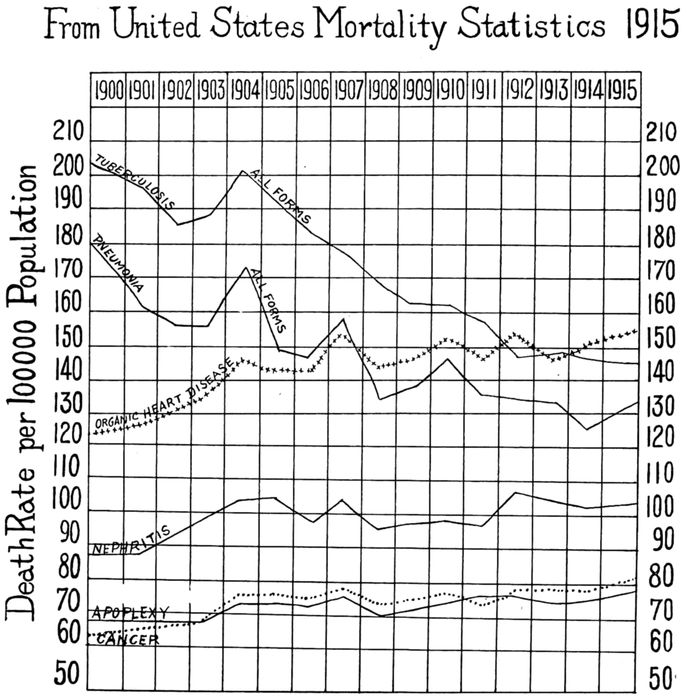
proper in view of the gratifying decrease
of mortality which has been obtained in
tuberculosis, of 27.8 per cent from 1900 to
1915, by diligent and intelligent medical
supervision.
The problem of cancer is indeed a great
one, but surely it is not to be solved by
11greater activity along the lines under
which its mortality has steadily risen 28.7
per cent during the same period just mentioned,
in which tuberculosis has fallen so
greatly. If this death rate of both diseases
should continue the same for fifteen years
more, cancer would outstrip tuberculosis in
its actual fatality. Reason would seem to
indicate the necessity of a radical change
in our point of view and a complete change
in our line of treatment.
In the text of these and former lectures
I have endeavored to show why and how
cancer should be regarded from its medical
aspects, and to illustrate by a few cases
some of the results which could be obtained
from this line of procedure. There is absolutely
no claim or suggestion that the
cancer problem has been solved, but only
an aim to put the real cancer problem in
such a light that others might follow and
develop the subject in a manner fitting to
the very great importance of the end so
12strongly desired by all, namely, the checking
of the steadily rising morbidity and
mortality of cancer.
Laboratory studies are of practical value
as they supplement and enlighten clinical
observation. The microscope and test
tube have accomplished much for medicine
and with animal experimentation have undoubtedly
rendered inestimable service in
its scientific advancement. But divorced
from the practical study of patients they
may fail in the ultimate end desired. In
these and the former lectures I have endeavored
to indicate certain lines of scientific
investigation along which much more
laboratory effort is desirable, in order to
determine more definitely the metabolic
and blood conditions which lead up to cancer.
These I have attempted to follow to
a limited degree in many cases, and found
them of great service in their management.
In some of the reviews of the former
13volume some adverse criticism was given
on account of the absence of microscopic
findings confirming the diagnosis of the
cases reported. I explained at the time
that any attempt to excise portions of tissue
for such study would at once endanger
the patient and imperil the success of
treatment, by giving occasion to metastases,
from the opening of blood vessels
and lymphatics. This matter is treated of
more fully in the present lectures. It is
to be remembered that the vast majority of
operations for cancer are undertaken upon
a purely clinical diagnosis, and it may be
undeniably stated that not one half of them
are confirmed subsequently by competent
microscopic evidence, except, of course, in
properly equipped hospitals. In some of
the cases now presented pathological proof
has been presented, while in every one the
clinical signs were so unmistakable that no
one could possibly doubt the correctness
of the diagnosis.
14A number of reviewers of the former
volume regretted that fuller and more definite
statements had not been made in regard
to the exact diet and mode of treatment
employed in the cases reported. I
had explained that it was very difficult to
develop all this in the brief compass of a
few lectures; indeed I may now say that it
would take many times the space and time
which could be given to it to develop fully
all the possibilities and requirements of a
dietary and medicinal treatment in every
case. The object rather was to inculcate
the basic idea of the true causation of cancer,
leaving it to the practitioners present
to carry out the measures calculated to
reach the desired end. In order to make
matters very clear I may occasionally have
repeated some things said in the former
lectures, and some repetition may be found
in these successive lectures; but this will
be pardoned when it is considered how necessary
repetition often is in order to establish
15correctly a new thought. The cases
were given as illustrations of what could
be accomplished along the lines indicated.
In the present lectures I have endeavored
to carry the thought still further and
to develop the fundamental principles on
which treatment and prophylaxis are to be
based. I have also been much more explicit
in regard to diet, and have given the
exact dietary which has been used with
advantage in very many cases in private
and hospital practise. In regard to medical
treatment I have also been more definite,
although it would be quite impossible
to indicate all the different remedies which
those and other patients have taken over
varying periods of time, to meet different
requirements of the system and individual
peculiarities. I think and believe, however,
that sufficient data are given to enable
the competent and careful physician,
who is able and willing to give sufficient
time and adequate attention to these cases,
16to accomplish the same results, provided
he has thoroughly mastered and applied
the matter contained in these two small
books.
I fully realize the responsibility I have
undertaken in gathering and revealing the
evidence of the unsatisfactory results of
the manner of regarding and treating cancer
in years past, and certainly would not
have done this were I not so strongly assured
that there was something better to
offer. How far I am right in my thesis I
now leave to the kindly judgment of my
professional brethren. My only hope is
that I may, in some measure, have assisted
in stemming the tide of the fearful ravages
made by cancer, and that others may investigate
still more deeply along the lines
of its medical aspects, with increasingly
satisfactory results.
In my lectures given here two years ago
I considered, as far as I could in the time
allowed, the nature of cancer,[1] and the evidence
in favor of its being a medical rather
than a purely surgical disease; and in order
that the trend of what shall follow may
be clearly understood, brief reference may
be made to some of the principal points
studied and developed in the preceding
lectures. To this end I may restate the
conclusions presented at their close, as developed
20in the lectures, perhaps with some
alterations or additions which two years’
further study, observation, and treatment
of cancer may suggest.
1. Cancer is but a deviation from the
normal life and action of certain of the ordinary
cells of the body, which, for some
reason, difficult to understand, take on an
abnormal or morbid action: with this there
is a continued tendency in them to a malignancy
which invades contiguous tissue,
associated with a pernicious anemia which
in the end tends to destroy life.
2. There is some reason to believe that
this diseased action first takes place in
what are known as “embryonic rests” or
pre-natal, wrongly placed tissue elements.
These latter, however, are now shown to
exist in every individual in many localities,
but the reason why at some particular time
they take on this malignant action, and
form cancer, has not yet been satisfactorily
explained.
213. Cancer is not wholly due to traumatic
causes; although these may play a not inconsiderable
part in its occurrence in certain
localities and cases.
4. It is pretty conclusively decided that
cancer is not caused by a microörganism
or parasite; although various forms of
these have been found in connection with
the disease, and each has been claimed as
the cause of cancer.
5. It is known clinically and experimentally
that cancer is not contagious.
6. Nor is it hereditary in any appreciable
degree; although certain rare instances
have been reported in which such
seems to be the case, and though some
tendency in that direction has been demonstrated
in certain strains of mice.
7. Occupation has not any very great
influence on the occurrence of cancer; although
it is more frequent in some pursuits
than in others.
8. Cancer is not altogether a disease of
22older years; although its incidence is greatly
increased with advancing age.
9. Cancer does not especially belong to
or affect any particular sex, race, or class
of persons. It is, however, more frequent
in females than in males, although of late
years the proportion in the latter is steadily
rising.
10. Cancer is not confined to any climate,
location, or section of the earth, but has
been observed in all countries and climates,
though with different frequency.
11. No single cause of cancer has yet
been demonstrated; nor is it likely that
this will ever be the case, as experimental
and other investigations have covered almost
every possible line of research, with
only negative results.
12. The exclusion of almost every other
possible cause of cancer, as well as its
pathological history and biochemical studies,
all lead, therefore, to deranged metabolism
as the only remaining possible etiological
23element. This latter acts by inducing
changes in nutrition, and these in turn
depend on diet and the proper or improper
action of the secretory and excretory organs;
these latter may, still further, be affected
by nervous influences.
13. While the biochemistry of cancer
does not as yet throw very great light on
its true nature and cause, enough has been
determined to show that the morbid
changes in the cells are largely associated
with deranged metabolism.
14. The blood in advancing cancer manifests
changes which indicate vital alterations
in the action of the organs which
form blood and control the nutrition of the
body and its cells.
15. Clinical and experimental evidence
demonstrate that the secretions and excretions
of the body exhibit departures from
normal; these, while not wholly pathognomonic
of cancer, still indicate metabolic
disturbances which involve the nutrition
24of the cellular elements, and these disturbances
are of importance.
16. The evidence seems certain that the
cancer mass, when fully developed, secretes
a hormone or poison which tends to augment
its own growth, and hastens the lethal
progress of the disease.
17. The mortality from cancer is undoubtedly
on the increase in every portion
of the globe, in spite of the assiduous activity
of the laboratories and the immense
advances in surgical procedure.
18. This increase in mortality is seen to
vary inversely, and in about the same proportion,
with the steadily diminishing mortality
of tuberculosis, under recent careful
medical guidance.
19. The increase of cancer mortality is
found to follow closely along the lines of
modern civilization.
20. The extension of cancer appears to
depend largely upon the altered conditions
of modern life, particularly along the lines
25of self-indulgence in eating and drinking,
and indolence.
21. The augmentation in the consumption
of meat, coffee, and alcoholic beverages
in civilized communities is seen to be
coincident with the great and proportionately
greater augmentation of the mortality
from cancer.
22. The nerve strain of modern life
seems to be an element of importance, both
through disturbance of metabolism and by
direct action on morbidly deranged cells.
23. No single remedy for cancer has
been, or will probably ever be, discovered,
since it is conceded that there is no single
cause for the disease. The history of cancer
abounds in the heralding of various
vaunted remedies, quack and other, including
sera, whose employment has only ended
in the disappointment of medical men and
in the deluded hopes of innumerable sufferers.
24. Modern surgery has materially improved
26the statistics relating to the immediate
results of operative procedures; but
the total achievements along this line are
insignificant when compared with the
steadily rising death rate, and ultimate
mortality of about 90 per cent of those
once afflicted with cancer.
25. Surgery has had, and may yet have,
its function to perform in removing some
of the products of the constitutional state
causing cancer, more or less efficiently, curing
some patients and prolonging the life
of others; but from past experience it can
never hope to lessen the morbidity of cancer.
The reason for this is that it attacks
a symptom only, and not the underlying
cause.
26. The X-ray and radium, as also caustics,
are in the same position as surgery,
and can do little more than cause to disappear,
more or less temporarily, some of the
lesions which have developed from causes
which they cannot reach.
2727. With all these means the measure of
success, aside from the technical skill of
the operator, depends largely on the duration
and the extent of development of the
malignant growth before treatment: the
earlier such local treatment is undertaken,
other things being equal, the greater the
possibilities of success.
28. The same is true in regard to the
treatment of cancer by dietary and medical
means. The earlier the morbid constitutional
process, or state, leading to
tumor formation is attacked by proper
dietetic, hygienic, and medicinal measures,
the greater the promise and expectation of
success, present and permanent.
29. The cure and prevention of cancer,
therefore, and the checking of its increasing
occurrence and mortality, depend
largely upon the early adoption of such
measures as will limit the agencies which
induce the formation of the new growth:
these are certain derangements of the
28body juices which tend to bad nutrition and
disturbance of the action of the body cells.
30. The simple life, with the avoidance
of the dietetic and other causes which have
been found to induce cancer in nations and
individuals, promises the best hope for the
arrest of its rapidly increasing development
and mortality throughout the world.
31. It is more than possible, however,
that the long continued operation of many
baneful causes has produced such a degeneration
of tissue in the human race
that it will take a generation or more of
proper living to make the beneficial impression
on the general occurrence and
mortality of cancer which is so longed for.
It is quite impossible and unnecessary to
elaborate again the facts upon which these
conclusions are based, which were given
very fully in my previous lectures and
book; but we may briefly consider some of
the features just presented, and some of
the evidence why cancer should be considered
29from a medical rather than a surgical
standpoint. For it must be conceded that
both the general medical profession and
the laity still regard the disease as belonging
to surgery, and look only to the knife
for any hope in its treatment. In spite of
all that has been done the present outlook
for the checking of its rising mortality by
this means, and for the prevention of cancer,
is bad indeed, as will be shown in a
later lecture.
But, gentlemen, many great surgeons, in
past and present time, as quoted in my
former lectures, have acknowledged verbally
and in writing their inability to cope
with cancer as a disease, and have recognized
time and again that they operated
only because they knew of nothing better to
do. Often it is acknowledged that the operation
is only palliative, in the hope, alas,
how often futile, that some good might
result from it, in the chance that the dread
disease would not return. We shall see
30later, when we come to study the mortality
of cancer in various locations, and an analysis
of surgical statistics, how slight the
foundation is for such hopes.
Both in the past and present times many
surgeons of eminence, well acquainted
with the disease, whom I quoted in my
former lectures, have also more or less
casually expressed the conviction that
there was some deep-seated constitutional
cause of cancer which baffled recognition,
but which must have to do with the diet or
mode of living of those afflicted. The most
recent of these is Dr. William J. Mayo, who
has spoken in no uncertain terms along this
line, in a recent address as President of
the American Surgical Association. And
yet how relatively little intelligent effort
has been put forth to discover and amend
these conditions, and to remove the bodily
derangement which eventuates in the formation
of the foci of disease which later
become malignant and form what is called
31cancer, or to modify the blood changes
which ultimately destroy life!
In a long experience I have seldom, if
ever, come across a patient with cancer who
had had any intelligent and prolonged attempt
to check its development by dietary,
hygienic, and medicinal means; invariably
the knife, X-ray, and radium have been the
only measures under consideration. Also,
after an operation the patient is dismissed,
or watched for a recurrence and again operated
on, with no prolonged effort to so
modify the constitution that the same
causes shall not reproduce the malady in
the same or other localities. And yet I
have narrated to you cases of undoubted
cancer, verified by competent surgeons,
who urged instant removal, which had entirely
disappeared without operation under
the line of treatment detailed, and who remained
in perfect health for many years,
sixteen in two instances. I also reported
cases illustrating the beneficial result of
32dietary and medicinal measures in cases
recurrent after operation. This matter
will be more fully considered in a later lecture,
with further illustrations.
We may now consider some general matters
bearing on the question of a medical
rather than an exclusively surgical aspect
of cancer.
The founders of the Index Medicus
placed cancer among the diseases of metabolism,
along with gout, obesity, chronic
rheumatism, diabetes, and a few conditions
of minor importance. This grouping of
cancer in no wise interferes with the idea
that a chronic local irritant may be the exciting
cause of the local development of the
tumor, which becomes malignant, in any
particular situation; any more than what
is observed in the case of late syphilis,
where a gummy tumor or a bone lesion may
appear at a point of injury, or where gout
will develop in a joint which has been
bruised.
33But it does show that broad medical
thought has long recognized that cancer is
not a purely local disease, but that it arises
from some disturbance of nutrition, tending
to localize in some particular spot, even
as a neuralgia will occur in some special
nerve and be reached, not by local measures,
but by those of a general nature.
Repeated casual observations have often
been made by clinicians, and even by surgeons
of prominence, of the apparent relations
between cancer and gout or rheumatism,
and also diabetes, and all recognize
the rebelliousness of cancer when it occurs
in connection with obesity. The late Dr.
John B. Murphy was very strong in regard
to this latter point. The constant occurrence
of cancer in rheumatic individuals
is a very striking feature, which I observe
almost daily.
It is worthy of remark that cancer begins
to appear at a wholesale rate at the
age when metabolism begins to slow up,
34and some time after the body growth has
become fully established. At this period
people are apt to lose the balance between
physical effort and the intake of food, eating
as much as ever, perhaps more, while
becoming more sedentary. At the same
time the emunctories become less active.
The various affections of metabolism now
tend to appear and are associated with imperfect
oxidation, or diminished tolerance
toward certain ingesta. It is interesting
to note that in a study of many thousand
cases of eczema I found the disease to be
actually more frequent, in proportion to
those living, between the ages of 50 and 55
than at any other period of life after the
infantile period, or the first five years of
life; just about the same time when cancer
is most common. And the constitutional
conditions at the bottom of eczema are
very much the same as those in cancer.
Patients with a cancer just beginning
will often, or even generally, seem to be
35in excellent health. It is indeed remarkable
to observe how commonly patients
with beginning breast cancer will seem to
be in a splendid condition of health. They
are ruddy and blooming in appearance, and
when the lump is first discovered it is hard
indeed to believe that if the erroneous life
processes which caused the cancerous lesion
to develop are not checked, the patient
will before long succumb to the direful disease.
Williams remarks that “such types
are indications of hypernutrition.”
But a most careful study of these patients
in every particular will so constantly
reveal such errors of life and derangements
of metabolism that these must be
looked upon as contributing causes, at
least, to the development of the local condition
which later becomes malignant; in
the same way as the patient will appear to
be in blooming health just before an attack
of acute gout. For when these conditions
are rectified by proper dietary and medicinal
36measures the local cancerous condition
not only ceases to develop but actually disappears
without surgical removal, as I
have repeatedly shown you. These errors
and derangements are not commonly evident
on a superficial examination, and often
are recognized only after very painstaking
search, and re-search.
We have not yet arrived at such a clear
knowledge of metabolism as to understand
just where the fault lies in these cases of
seeming perfect health, with the beginning
of a neoplasm which may eventuate so disastrously.
But we do know that what passes
for good health is often fictitious, and is
quite compatible with even grave disorders
of various kinds. It is more than possible
that the apparent well-being of the patient
with beginning cancer, which is often observed
to be associated with uricacidemia,
points also to the correctness of our thesis
in regard to its internal causation. As remarked
in one of my former lectures, quoting
37Ribert, “no one has ever seen the beginning
of mammary cancer” and no one
will ever see the beginnings of cancer of
internal organs.
But, whatever may be thought of Haig’s
theories or statements regarding uric acid,
there is no question but that many maladies
of many kinds have their origin in the
concatenation of processes which has long
been recognized clinically as lithemia. Personally
I believe that sooner or later it
will be generally recognized that the starting
point of cancer occurs in some cell or
cells, previously normal, probably as the
result of local irritation, in which there is
a deposit of some of the elements of faulty
nitrogenous partition, induced by undue
ingestion of animal protein: and that the
malignant, reproductive process in the cells
is kept up by a continuance of the same
supply of imperfectly disintegrated nitrogenous
matter.
The condition of the urine furnishes a
38most invaluable indicator and guide as to
the systemic derangements and their correction.
This has not reference to the presence
of sugar, albumin, or casts, but rather
to other features, reflecting the manner in
which metabolism is performed. This subject
was gone into pretty thoroughly in
my former lectures, but must be briefly
considered here, because of the great importance
of the subject.
It is well known that, while the products
of the digestion and disassimilation of carbohydrates
and fats pass off by the lungs,
generally without harm, those of protein
and salts are eliminated by the kidneys,
and may be the cause of various systemic
derangements. The urine, therefore, when
most carefully analyzed volumetrically,
exhibits in the clearest possible manner
how the metabolism is carried on and
where the error lies.
From a study of hundreds of complete
volumetric analyses of urine in dozens of
39cancer patients, both in the very early and
late stages of the disease, I have found
that this excretion almost invariably exhibits
departures from normal which are
significant.
First to be mentioned is the relation of
the total solids excreted daily to the body
weight of the individual; for it is evident
that a person weighing 200 pounds should
pass off more than a smaller person. The
following table represents fairly well the
total solids that should pass daily in order
to maintain a healthy equilibrium:
Body Weight
Total Urinary Solids
90
pounds
500
grains
95
〃
535
〃
100
〃
570
〃
105
〃
605
〃
110
〃
640
〃
115
〃
675
〃
120
〃
710
〃
125
〃
745
〃
130
〃
780
〃
135
〃
815
〃
140
〃
850
〃
145
〃
885
〃
150
〃
920
〃
155
〃
955
〃
160
〃
990
〃
165
〃
1025
〃
170
〃
1060
〃
175
〃
1095
〃
180
〃
1130
〃
185
〃
1165
〃
190
〃
1200
〃
195
〃
1235
〃
200
〃
1270
〃
205
〃
1305
〃
40These figures do not represent much active
exercise, and with increased bodily exertion
the solids passed should be more.
Men excrete about one-tenth more than
women; there are also less urinary solids
passed with advancing age, and about five
per cent may be deducted for each ten
years after forty.
The estimation of the total solids is easy
with Haines’ modification of Hasser’s
method. Multiply the last two figures of
the specific gravity of the urine by the number
of ounces voided in 24 hours, and add
ten per cent to the product. Thus, if the
amount passed in 24 hours was 36 ounces
with a specific gravity of 1.021, it would be
36 × 21 = 756 + 10 per cent = 832 grains
of solids in the whole amount of urine excreted
that day. By comparing this with
the table it can be readily ascertained if
the amount is above or below the normal
standard for the body weight of the patient.
For many years I have employed
41this method of determining the urinary
output in hundreds of patients with various
diseases of the skin and cancer, and
have found it of inestimable value. It is
understood, of course, that by dietary and
medicinal measures the urinary solids are
to be brought up to and maintained at
normal.
The actual acidity of the urine, as measured
by the oxalic acid and phenolphthalein
test, is also of the greatest importance.
This is not difficult of application and is
daily used in my laboratory; the litmus
paper test is of relatively little value in
comparison with an actual chemical measurement.
Thus, with an average standard
of 300 we not infrequently find an acidity
of 500 or 600, or even 1000 or more, or it
may sink to 200 or 100, or even be strongly
alkaline. In cancer I have striven, by diet
and remedies, to keep it a little below normal,
as it has been shown that the blood in
this disease exhibits a constantly increasing
42tendency to diminished alkalescence,
or, wrongly called, increased acidity.
But further and very careful volumetrical
urinary analysis is very important to
determine and maintain the metabolism in
its proper condition. Time does not permit
such an elaboration of this subject as
might be desired, and I can only call your
attention briefly to some of the points
brought out in my former lectures.
Many observers have found the nitrogenous
disintegration very imperfect in
cancer cases, and oxyproteic acids are increased
and even that in very early cancer.
An increase of amino-acid nitrogen was
found by Reid in practically every case
studied. Others have found an increase
in colloid nitrogen, to more than double
the normal amount, and also increased
elimination of xanthin and urinary ammonia;
so that all observers testify to a
disturbed nitrogen partition in cancer.
The elimination of urea is certainly greatly
43diminished, even in early stages and when
on a full diet, as I have almost invariably
observed.
The sulphur partition is also found to be
imperfect, in new and old cancer cases,
and even a great increase in the urinary
discharge of sulphates is constantly noticed
in my analyses. Associated with
these errors in the nitrogenous and sulphur
element is the very common and persistent
increase of indican, showing stasis in the
small intestine, with bacterial putrefaction.
Imperfect intestinal elimination is constantly
observed in cancer cases, both
habitually and in the very early, formative
period, and also later, even before any
recourse to morphin, which, of course,
heightens the trouble. In recording the
statements of these patients I have been so
struck with the almost invariable history
of constipation before the first appearance
or suspicion of the cancer that I cannot
help feeling very strongly the possibility
44that the toxins produced by the millions
of microörganisms, generated through intestinal
stasis and fecal putrefaction, play
a great part in the production of that blood
dyscrasia which culminates in the formation
of the malignant new growth.
I mentioned to you last year that in hundreds
of tests of the saliva in cancer patients
the reaction was found to be acid
almost invariably, until corrected by dietary
and other treatment. I have this test
made and recorded daily, half an hour before
meals and half an hour after meals, on
my cancer patients in the New York Skin
and Cancer Hospital. I have also the urine
volumetrically analyzed each week, and the
results all tabulated in columns on the history
sheet, so that the changes may be compared
weekly, in regard to each constituent,
as treatment progresses. The same is
done with the weekly studies on the blood,
which I hope to present in full before long.
I think, gentlemen, that from what I have
45said you can see that the medical aspects
of cancer loom up pretty large, and yet we
are only beginning to study the disease
along these lines. We see, thus, that cancer
is not primarily a surgical affection,
and that the mere ablation of an offending
portion of the body which has become diseased
can never preclude a new portion
from becoming affected, or prevent a recurrence
in the same location; indeed, this
often seems to be stimulated and increased
by the trauma and by the deranged lymphatic
and vascular circulation caused by
the operation and the dissemination of
actively growing cancer cells through these
channels. This will appear more fully
later when we come to study the increasing
mortality of cancer during these later
years of active surgery, and when we come
to analyze the actual reports of operative
procedures.
I hope, gentlemen, that by these lectures
I may succeed in satisfying your minds
46that if anything is to be done towards
staying the steadily rising frequency and
increasing mortality of cancer, it must be
by carefully wrought out medical means,
and not by the knife.
LECTURE II INFLUENCE OF SEX, AGE, OCCUPATION, RACE, CLIMATE, AND FOOD ON CANCER
47
While cancer is no respecter of persons,
and affects all, rich and poor, old and
young, male and female, there are some interesting
features regarding the disease
as it occurs under various conditions which
are worthy of consideration.
We have seen in the former lecture that
cancer is not a definite something, from
without, that attacks the human frame, but
that it is only a faulty development and
action of certain body cells, which were
once normal, with a steady decline in bodily
health which tends to a fatal issue in a
very large proportion of those once affected
with the disease.
We have seen that the cancer patient,
48both in the very earliest stages and during
the whole period of the disease, gives evidence
of departures from the ideal normal
life, and presents functional disorders of
various organs, with derangements of metabolism;
these point to errors of nutrition,
which latter are of significance in
connection with the development and continuance
of the malignant disease. The
conclusion offered was that cancer is a
medical affection, due to systemic causes,
and that the simple surgical excision of a
certain diseased portion cannot be expected
to check or remove such a malady, or to
prevent recurrence. And this has been
abundantly demonstrated by the history of
the disease, with its steadily increasing
mortality under increasingly active surgical
treatment during the last fifteen years,
as was shown in my former lectures and
will be further illustrated later.
Recognizing, then, that cancer is a great
and widespread disorder of nutrition, let
49us consider some of the facts regarding its
extension and some of the influences concerned
in its production.
Sex.—Cancer is much more frequent in
females than in males. In the United
States Mortality Reports for 1914 there
were 31,138 females to 21,282 males; thus,
in a total of 52,420 deaths from cancer
59.4 per cent were in females, with a preponderance
of 9,856. This excess is largely
due to cancer of the breast, from which
there were 5,423 deaths, and cancer of the
female genital organs, causing 8,152 deaths,
of which 7,470 were from cancer of the
uterus.
The death rate in males, however, seems
to be increasing of late years; in the United
States in 1912 males formed 39.7 per cent;
in 1913, 40.1 per cent; and in 1914, 40.6
per cent. In England, according to Williams,
the proportion of males to females
is increasing much more rapidly. This
greater mortality of males is due to the
50greater number of deaths from cancer of
the stomach and liver, buccal cavity, and
skin. In 1914 there were 19,889 deaths
from cancer of the stomach and liver, or
37.9 per cent of the whole number; of
these 10,122 were in males to 9,767 in females,
or an excess of 355 males, whereas
in 1912 the females were 87 in excess. In
the United States the cancer death rate for
males has increased since 1901 31.8 per
cent and for females 25.3 per cent.
Age.—Carcinoma is exceedingly rare
under 20 years of age, most malignant tumors
at that period being sarcomata. After
25 the number of deaths from cancer
about doubles each five years up to 40, and
then increases steadily, until the actually
greatest number of deaths, 6,909 (3,071
males, 3,838 females), occurred between
60 and 64 years of age, after which they
decreased steadily; there were 267 deaths
at 90 and over, 8 of them being 100 years
and over. At no period did the deaths of
51males exceed that of females, and from 35
to 39 years of age the latter were almost
three times that of males.
Occupation.—Many attempts have been
made to trace the influence of occupation
upon the incidence of cancer, but thus far
very little of practical interest has been
demonstrated; the difficulties concerning
this investigation are immense, owing to
absence of essential and accurate data.
There have been many lists presented, but
few of which agree as to details, and all
need to be corrected as to the proportion
of those living at different ages. There is
also the question as to the effect of local
or general agencies; thus, as to the result
of local injuries on the skin, and also in regard
to other agencies, whatever they may
be, which produce internal cancer; for
tables of occupation do not generally refer
to sex, age, or location of the disease.
First, to dismiss the question as to the
direct result of local injuries in inducing
52cancer of the skin, which, at the most,
caused only 3.7 per cent of all cancer
deaths in 1914, we may cite a few instances
in which this appears to be pretty well established.
The occurrence of epithelioma as a direct
result of repeated and protracted exposure
to X-ray is familiar to all, and is
particularly interesting because it occurs
commonly among younger persons, and at
a time of life when epithelioma is rare; and
especially also because the X-ray is constantly
effective in curing epithelioma.
The rarity of epithelioma resulting from
X-ray, considering the enormous amount
of exposure which must have occurred in
making and using X-ray tubes, implies,
however, that there must be some other
cause also at work. It has been urged,
therefore, that the skin tissue being altered
and weakened from repeated and protracted
exposure to X-rays, more readily falls
prey to some of the chemical or other irritating
53agencies which have been observed
to be followed by epithelioma.
Time does not permit even a mention of
the various elements, which are many,
that have been credited as excitants of
cutaneous epithelioma; but brief allusion
may be made to one which formerly attracted
much attention, mainly in England;
this refers to chimney-sweeps cancer,
the mortality from which was at one time
at least 5 times greater than that from cancer in
males generally, at the same age.
This is now, however, of relatively infrequent
occurrence, owing to the adoption of
other methods of cleaning chimneys. The
epithelioma, which more commonly developed
on the scrotum, was believed to be
due to the long continued irritation caused
by the constant presence of soot on the
part; other products of combustion and tar
derivations have also been accredited with
the same result.
The question of the influence of occupation
54along other lines is really more interesting,
because more obscure; but a careful
study of available data tends to show
the correctness of the thesis on which my
former lectures and these are based. This,
as you know, is that our so-called advancing
civilization, with all its errors of life,
in many directions, is at the bottom of the
steady increase in the mortality from cancer.
One of the most interesting contributions
to this was the investigation made
by Dr. Latham, Registrar-General, in a
study of cancer returns in England; this
showed that the mortality from the disease
was more than twice as great among well-to-do
men having no specific occupation as
among occupied males in general, the respective
mortality ratio being 96 for the
former and only 44 for the latter. The
same observation has been made elsewhere.
Moreover, it is reported from several reliable
sources that the death rate from cancer
55in many cities is proportionately
greater among the rich and those in easy
circumstances than among the poor, wage-earning
element of society. This would
seem to show that occupation in general
acts favorably against the development of
cancer. This fact is quite understandable
when we consider that those engaged in active
work are less liable to suffer from the
effects of gluttony and indolence, with
their concurrent metabolic disturbances,
than the well-to-do with ease and luxurious
habits. It is remarkable, however, that in
asylums, homes for the aged, prisons, convents,
monasteries, etc., where the inmates
are relatively unoccupied, many writers
confirm the fact that cancer is very seldom
seen; but this again is explained by
the simple and frugal diet enforced, with
very little meat, which agrees with our
thesis.
Statistics from life insurance companies
show that cancer is decidedly more common
56among persons of over-weight than
among under-weights.
In regard to the occupations of those dying
from cancer it is interesting to note
that standing among the highest per 100,000
population, in English statistics, come
brewers, inn-keepers, and butchers, whose
metabolism can be greatly disturbed by
alcohol and meat; also indoor servants are
more apt to be affected, while those of
more or less sedentary occupation, such as
school teachers, clergymen, physicians, and
tailors, likewise stand very high on several
lists. On the other hand, those engaged
in active physical exercise, such as
miners, farm laborers, carpenters, blacksmith,
mail-carriers, and others, are
among those least frequently attacked.
Race.—Cancer has been observed in
every race, though the proportion of cases
is observed to vary greatly among different
peoples; but it is interesting to note
that it is universally agreed by those that
57have studied the subject that the difference
in frequency relates very largely to
the degree of civilization involved. The
blond Nordic race, however, seems to be
more susceptible to the disease than the
darker races, originally of Asiatic origin;
and it is the former who have pushed forward
modern civilization, with all its errors
of life.
Thus cancer is everywhere reported to
be rare, and sometimes almost absent, in
primitive, uncivilized peoples, but it has
been repeatedly observed, in many localities,
that as these same people mix with
Europeans and adopt their diet and mode
of life, cancer is sure to increase, until its
frequency often about equals that in their
highly civilized neighbors. I went over
this matter pretty fully in my former lectures
and cannot dwell on it now, or give
examples. I can only emphasize the fact
that this furnishes a strong support to the
contention that cancer depends upon disorders
58of metabolism, which are certainly increasing
under the various elements which
compose what is called advanced civilization.
Climate and Locality.—There is no evidence
to prove that climate has any influence
in the production of cancer, nor is it
affected by locality; the disease occurs in
hot, warm, temperate, and cold climates,
and in every possible location on the earth.
But it is undoubtedly most prevalent in
temperate regions, for the reason that it is
in these that modern civilization, with all
its faults and foibles, is most highly developed.
The subject of the topical distribution
of cancer, or its occurrence in certain regions,
has been the subject of much controversy
in England and France especially,
and to read certain statements one would
be inclined to believe that certain telluric
conditions were of influence in its production,
as along certain water courses, etc.
59But a more careful analysis of all these
statements shows that such elements can
act only as contributing causes, as, for
instance, through a rheumatic influence,
which is known to be found in so many
cancer patients.
The same may be said in regard to so-called
“cancer houses” concerning which
there are still occasional references. A
careful investigation of these houses has
commonly found them to be old, moldy,
damp, badly ventilated, and otherwise unsanitary;
also that such old houses are
commonly tenanted by old people in succession,
so that there are more at a cancer
age to be affected. With our present
knowledge of the causes which lead up to
cancer we cannot but conclude, therefore,
that the occurrence of the disease in
groups, with some apparent connection,
has been only the result of all living under
the same conditions of ill health, including
wrong diet, etc.; for we know that cancer
60is not contagious or infectious, and there
is no other reasonable explanation which
can be sustained.
Food and Mode of Life.—In my former
lectures I presented very fully the evidence
that cancer was certainly a disease of civilization,
its frequency and mortality advancing
steadily in proportion as various
tribes or peoples, previously exempt, have
come more or less under its influence and
adopted its manners and customs.
When we speak, therefore, of the influence
of food in the production of cancer
it must be understood that it is not claimed
that the diseased process depends wholly
and exclusively on the character of the
food, including drink, taken. In my former
lectures I tried to show that cancer was the
result of a deranged nutrition, and we know
that one of the greatest elements in inducing
this latter is erroneous metabolism,
depending again on the diet, to a very great
extent. In a later lecture I shall hope to
61develop this subject further, and indicate
more completely than on the previous occasion,
the elements of causation and the
measures which can be successful in overcoming
the disease.
In order to understand rightly the rôle
which diet may have in the production of
cancer I may have to briefly repeat, more
or less, some of the matters brought forward
in my lectures two years ago, and
shall treat of the correction of diet in a
later lecture.
We understand, of course, that the body
is a vast laboratory, wherein, by exceedingly
complicated processes, material from
the outside world is appropriated to the
needs of the economy, and after its use is
cast out in very different and elementary
forms. To effect the various changes necessary
in this material we have a very considerable
number of what are called organs
of secretion and excretion, whose functions
are combined and correlated in a marvelous
62manner, which is even yet very imperfectly
understood.
The actual biochemical processes by
means of which the transformation of external
food elements into living tissue and
force, physical and mental, takes place are
known as: 1. Anabolism, or the process
of assimilation of nutritive matter and its
conversion into living substance; and 2.
Catabolism, or the breaking down of complex
bodies of living matter into waste
products of simpler chemical composition.
These together constitute 3. Metabolism,
or the sum of the chemical changes whereby
the function of nutrition is effected.
The actual procedure by which most of
these activities is carried on is one of oxidation,
by means of the oxygen supplied
largely by the lungs, which constitutes
about 65 per cent of the human body.
Now to make up for the daily waste of
the other 15 elements, which form 35 per
cent of the body tissues, and to support
63the necessary activities of the system, mental
and physical, it is necessary every day
to take a more or less even supply of substances,
which we call food and drink,
which should contain about the proper proportion
of the requisite bodily components.
Under normal conditions of healthy living
the appetite ordinarily serves as a proper
guide for health in man and beast, serving
to regulate the selection of material to preserve
the balance of nutrition. But man
especially has temptations to gratify the
taste, which is quite a different thing from
satisfying the appetite, and all are familiar
with the many forms of disaster and disease
which arise from gratifying the taste
in food and drink; moreover, the temptations
to this seem to increase continually
with the so-called refinements of civilization.
The actual nutritive elements which are
required are relatively few, and fall mainly
under three classes: 1, Protein; 2, Carbohydrates;
64and 3, Fats. Of these the latter
two furnish most of the 18 per cent of carbon
in the body, and the animal or vegetable
protein furnishes the nitrogen, which
forms only about 3 per cent of the body
tissues: all these substances are, of course,
used up constantly in providing heat and
energy, physical and mental, day by day,
the protein being concerned chiefly in replacing
wasted tissue. The combustion of
the carbohydrates and fat is relatively simple,
and the waste products pass off harmlessly,
mainly by the lungs, as carbonic
acid and water.
But the course of the protein, or nitrogenous
and sulphur and other mineral elements,
is quite different. In the anabolism
and catabolism of protein there are a vast
number of intermediate changes, and various
products are elaborated which we know
to be of great significance in the system,
and which when imperfectly completed are
the source of much disorder and disease in
65the economy. Of this the gouty state is
a notable example, with a long list of secondary
disorders.
But few realize, however, that cancer
is another disease which is quite as striking
in its relation to faulty nitrogenous
and sulphur metabolism. In my former
lectures I developed this subject pretty
fully and need not repeat it here, but could
adduce more recent proof, did time permit.
Suffice to remind you that many independent
observers have recorded very
important and significant errors in the nitrogen
and sulphur partition in cancer,
both in its early and late stages, some of
which I have verified in hundreds of volumetric
urinary analyses. As these errors
are made to disappear by proper dietary
and medicinal treatment the carcinomatous
lesions have steadily improved, and in
many cases have disappeared entirely, as
I hope to demonstrate in a later lecture.
We must, therefore, accept the fact that
66cancer has very close relations to the elaboration
of protein in the system, and the
rational deduction of this is that an overconsumption
of nitrogenous food has something,
if not everything, to do with the production
of cancer. As yet we know little
or nothing in regard to actual cancer-genesis;
no one has ever demonstrated,
and probably no one ever will demonstrate,
the absolute beginning of the change in
some normal cell or cells, in the breast or
elsewhere, which eventuates in their taking
on the rampant or malignant feature which
we call cancer. But this change does occur,
and though the exact alterations in the
polarity of the cells and the disturbance of
their centrosomes and nuclei, which have
been described, may not be perfectly understood,
there is some definite cause for
their occurrence. Some have suggested the
hypothesis that the mononuclear leukocyte,
by conjugation with disturbed cells, gives
them an abnormal reproductive power by
67which they eventually develop the tumor
and invade other tissues. But back of all
this there is still some activating cause,
which is found in the fluids which bathe
every tissue, namely the blood and lymph,
which we shall see later are deranged in
cancer.
The fact that with innumerable injuries
occurring everywhere and at all times cancer
develops from them very rarely, should
teach us something. We must conclude,
therefore, that there is some constitutional
condition, or rather some state of the blood,
which nourishes the cells and which favors
this continued malignancy—some fuel
which feeds the malignant process and at
the same time induces a progressive lowered
vitality, ending fatally. For we have
already seen in these and former lectures
that the local lesion which we call cancer
is but one manifestation or result of a pernicious
anemia, which, if not checked, may
end life in a relatively short time.
68As cancer is not contagious or infectious,
this anemia, with all its concomitants, including
the local trouble which we call cancer,
must be autotoxic, and evidence is
strong that it is of a nitrogenous origin.
We look naturally, therefore, to see if there
can be found any relationship between an
augmented consumption of protein-bearing
food and the steady increase in cancer mortality
which is reported on every side.
England has furnished more fully and
for a longer period than any other country
the mortality and dietary statistics of
its population, and from these we can learn
a great deal of value in our study.
According to a carefully prepared table
by W. R. Williams showing the total population
in England during the years from
1840 to 1905, cancer deaths had increased
from 17.7 per 100,000 population in 1840
to 88.5 in 1905, or five times in numbers,
and in 1913 there were 105.5 deaths from
cancer in 100,000 population. During this
69time the meat consumption had more than
doubled, to 130 pounds per capita in 1904;
so that, according to Williams, it is estimated
that among the adult well-to-do
population the per capita meat consumption
was from 180 to 330 pounds per year,
in addition to large quantities of game,
poultry, eggs, fish, etc.
The United States Report of the Meat
Situation, 1916, also furnishes some valuable
information to aid in this inquiry.
The Argentine Republic stands next in
the consumption of meat, with 140 pounds
per capita, and with a cancer mortality of
91 per 100,000 in 1900.
The United States comes next, with a per
capita consumption of meat at 201.1 pounds
in 1909 and a death rate from cancer of 73.8
per 100,000 in that year, which, as previously
stated, was 79.4 in 1914 and 81.1 in
1915.
New Zealand exceeds the United States
a little, with a meat consumption in 1902
70of 212.5 pounds per capita, and an increase
in cancer mortality from 32 in 1877‒1888 to
60 per 100,000 in 1900 and 71 in 1903. This
increase is mainly among British and other
immigrants, whereas the aborigines, living
simple lives, are seldom affected.
Australia stands first in the consumption
of meat, with the enormous rate of 262.6
pounds per capita in 1902, and the increase
of deaths from cancer there is most striking.
In 1851 the death rate per 100,000
living was 14, in 1900, 62.6, and in 1913, 75
per 100,000 living. The most striking difference
is exhibited between those who are
native born, who in 1900 had a cancer death
rate of only 22 per 100,000, while the British
born had a mortality from cancer of
203, or nine times as great; a still higher
ratio was found among immigrants of
other nationalities. Those who have written
there on the subject ascribe this proclivity
to cancer to the gluttonous habits of
immigrants, who have meat for breakfast,
71lunch, dinner, tea, and supper (MacDonald,
Williams).
Italy, consuming the least quantity of
meat, 46.5 pounds per capita, in 1901, has
the lowest cancer death rate, but the present
meat consumption cannot be learned.
In Italy, however, the mortality from this
disease is steadily rising, from 50.9 per
100,000 in 1860 to 1900 to 63.6 per 100,000
from 1906 to 1910.
But, as I have tried to show you all
along, it is some derangement of metabolism
which is at the bottom of neoplastic
growths, and that derangement is not necessarily
due to any one single cause, as
diet. There are other elements of disturbance
besides the nitrogenous malassimilation
which is due to the intake of an excessive
amount of the proteid of the animal
kingdom; for cancer is said to have been
seen in vegetarians, although I have never
met with such a case. We know, however,
that some or many articles from the vegetable
72kingdom, such as the pulses and some
nuts, contain a very large proportion of
proteid; thus dried peas contain 21 per
cent, haricot beans 23, lentils 23.2, dried
lima beans 26.4, soy bean flour, 39.5, butternuts
27.9, black walnuts 27.6, peanuts 25.8,
and almonds 24 per cent of proteid, all
more than is contained in beef and mutton.
Thus a large supply of any of these
might produce the same error in the blood
stream as that induced by meat.
In my former lectures I pointed out also
that coffee and alcohol were found by statistics
and clinical experience to have a
prejudicial effect on cancer, and therefore
must be considered as elements in its production.
In a later lecture I shall deal
more specifically with these matters, in reference
to the prophylaxis and treatment of
the disease.
At the present time I will only remind
you of what I have so often said before:
that it is the complex of modern civilization,
73with all its temptations and errors in
regard to eating and drinking, and living,
including the nervous strain felt everywhere,
that in some way produces alterations
in nutrition which account for many
of our diseases. This operates through
the blood current, which ministers in such
a way to the tissues that under some slight
provocation a heterologous growth of certain
tissue cells occurs, with malignant tendencies,
instead of the normal homogeneous
and stabile structures which compose
healthy tissues; and this departure from
normal cell action we call cancer.
LECTURE III THE MORTALITY FROM CANCER; ANALYSIS OF SURGICAL STATISTICS
74
As has been already shown in these and
previous lectures, the death rate from cancer
has been steadily and alarmingly increasing
in almost every locality, ever
since statistics have been collected. The
attempt has been made from time to time
to show that this increase is not real, but
is apparent, and that the error arises from
three main causes. These are: 1. The increased
longevity in general, leading to the
existence of more people of the cancerous
age; 2. Improved diagnosis; and 3. More
careful death certification.
Time does not allow us to go into this
matter very fully, but this erroneous impression
is so widespread, and one so constantly
75meets it in conversation, that it is
desirable to present briefly the grounds and
proof for an absolute denial of the assertion
that there has been very little or no
real increase in the mortality from cancer.
First, it may be stated that most of the
arguments quoted against the correctness
of statements regarding the steadily rising
death rate of cancer date back to King and
Newsholme, who, in 1893, some twenty-three
years ago, attempted a study of early
statistics and drew certain conclusions
from them. This was long before the era
of careful research and reliable diagnosis
and statistics, and can have little, if any,
weight. Bashford and Murray in the Second
Scientific Report of the Imperial Cancer
Research Fund, in 1905, attempted to
show the same thing. But even this was
eleven or twelve years ago, and the utter
fallacy of the sophistical arguments appears
in the absolute, steady increase in
the death rate of cancer as shown by official
76tables from many countries, and as especially
collected and seen in the remarkable
book by Hoffman on “The Mortality from
Cancer Throughout the World.”
It is impossible in a brief lecture to give
even a faint idea of the immense and valuable
amount of research represented, and
consequently the most useful information
furnished in this monumental work; the
material is taken from original documents
with new information, freshly obtained
from original sources. All is given with
an impartiality and clearness which are refreshing
when compared with some recent
writings on the subject. With the immense
accumulated data on record, some of which
will be referred to, all showing a steady
rise of mortality up to the present time,
and that during a period of especial study
of cancer such as the world has never
known before, it is quite unreasonable and
impossible to believe that this advance is
only apparent, and that it is influenced by
77the three suppositions mentioned. While
accuracy of diagnosis may be important
in early cancer, it is certain that in late
stages and at death, from which the various
mortality tables are taken, there is rarely
any question as to the diagnosis. There
is evidence, however, to show that cancer
is increasing even more rapidly than appears
from mortality statistics.
In 1900 the recorded mortality from cancer
in the registration area of the United
States was 63 per 100,000 living, and in
1914 it had risen to 79.4, or an increase of
16.4 per 100,000 living, or over 26 per cent.
While in 1915 there were 54,584 deaths
from cancer against 52,420 in 1914 in the
registration area of the United States, or
2,164 more deaths. The total number of
deaths in the entire United States is estimated
at about 80,000 last year. The death
rate in 1915 was 81.1 per 100,000, or a rise
of over 28.7 per cent since 1910. The
increase during this past year has been
781.7 per 100,000 living, while the gross increase
for the preceding five years was
but 5.6 per 100,000, or less than an average
of 1.2 per 100,000 each year. So that the
great activity in cancer education and in
operative surgery during that year has
succeeded in raising the death rate from
cancer by .5 per 100,000 over the average
of the preceding five years!
It is to be noted that this increasing mortality
from cancer has been steady and
constant, though with slight diminution occasionally,
some years ago, before the great
activity in cancer research, cancer control,
and cancer surgery. All this would certainly
indicate some deep-seated cause of
the malady which had not been recognized;
indeed the mortality during the last five
years was as follows: 1911, 74.3; 1912, 77;
1913, 78.9; 1914, 79.4; and in 1915, 81.1 per
100,000.
It may be of interest to know that the
mortality from cancer varies very greatly
79in different portions of the United States,
and it would be instructive to investigate
the cause; but the data for this do not
exist. The highest death rate for 1914 was
in Vermont, 109.9; Maine had 107.6; Massachusetts,
101.8; New Hampshire, 100.8;
California, 97.9; all against the general
average of 79.4 per 100,000 inhabitants
in the registered area of the United States.
The lowest among the registration States
was Utah, with 45.8 per 100,000 living. In
New York State the deaths from cancer in
1914 were 88 per 100,000 population in the
cities and 96.1 in rural districts.
Many cities, of course, show a higher
death rate from cancer than the average,
owing in part to the number of patients
coming for treatment, and also to the more
complex life of the cities, with the greater
temptations leading to the disturbances of
metabolism causing cancer. Thus, the average
of twenty large cities gives a rise in
death rate of cancer from 48.6 from 1881
80to 1885, to 89.3 per 100,000 living in 1913.
The following table gives the average
cancer mortality from 1906 to 1910 per
100,000 in certain American cities:
San Francisco
102.5
Boston
99.4
Providence
96.9
Los Angeles
94.9
Cincinnati
93
Hartford
91.9
New Haven
89.8
Dayton
88.5
Rochester
88.2
Springfield
86.9
District of Columbia
86
Baltimore
85.8
Omaha
85.7
Buffalo
84
New Orleans
82.2
Philadelphia
81.9
Hoboken
80.7
Columbus
79.5
Manhattan and Bronx
78.4
St. Louis
78.4
Denver
77.9
Newark
76.9
Chicago
76.5
Greater New York
74.1
Richmond
73.9
Kansas City, Mo
71.1
St. Paul
71.1
Indianapolis
70.4
Borough of Brooklyn
68.9
Milwaukee
68.4
Nashville
68
Pittsburgh
66.4
Minneapolis
65.3
Detroit
64.5
Cleveland
62.9
Louisville
61.1
Jersey City
60.5
Charleston
53.6
Seattle
50.2
Augusta (Ga.)
49.1
Memphis
48.7
Savannah
47.1
In the city of New York, as given by
the Board of Health Bulletin, there were
from July 1, 1915, to June 30, 1916, 4,672
deaths from cancer, or an average of just
8112.8 persons per day; in the last six
months, July 1 to December 31, there were
2,264 deaths from cancer, 990 males and
1,274 females, with a daily average of a little
higher than last year.
It is readily understood that many factors
enter into the study and proper understanding
of the statistics of cancer,
such as age, sex, location of the lesion, etc.,
and the limits of a lecture do not permit
any adequate presentation of the subject,
but a few points may be mentioned.
Thus, in regard to age, the States which
represented the greatest number of deaths
from cancer, Vermont with 109.9 and
Maine with 107.6, show that the proportion
of individuals over 45 years of age was
over 27 per cent, compared with 17.7 per
cent for Kentucky and 16.2 per cent for
Montana, which latter gave almost the lowest
mortality from cancer.
The same is true somewhat in regard to
sex, although sufficient data are not at hand
82to show the relative number of living males
and females in the different States. We
know, of course, that the great preponderance
of cancer in females is due to that
affecting the breast and uterus, and where
females preponderate in the population the
total cancer mortality would be the highest.
The location of the lesion has also a
bearing upon the understanding of statistics.
Thus in Norway, for some unexplained
reason, cancer of the stomach
caused the great mortality of 60 per cent
(66.9 males, 52.9 females) of all cancer
mortality, while cancer of the breast caused
but 7.6 and of the uterus 16.2 per cent of
the whole, the general rate being 93.9 per
100,000 inhabitants. In the United States,
in 1914, cancer of the stomach and liver
caused the deaths of 37.9, cancer of the
breast 10, and cancer of the female genital
organs 14.2 per cent of all deaths from
cancer.
83There are other points also to be taken
under consideration in connection with cancer
statistics which we cannot even touch
on and can only mention one, namely, the
physical condition; for the disease is
known to be more frequent proportionately
among the better nourished and well-to-do
classes, etc.
Turning to other countries, we find
abundant confirmation of the persistent
and considerable increase in the mortality
from cancer, in many cases much greater
than has occurred in the United States;
and in nearly all of them the increase can
be recognized as commensurate with the
progress or advance of so-called civilization,
especially as emphasized in city life.
England and Wales afford us about the
most satisfactory statistics in this regard.
W. R. Williams has given a valuable table,
already referred to in connection with food,
showing the prevalence of cancer and its
relative increase in England and Wales
84from 1840 to 1905. In 1840 the cancer
death rate was 17.7 per 100,000 living, with
a proportion of 1 to 129 of total deaths.
The deaths from cancer increased with almost
a perfect regularity until in 1905
there was a mortality of 88.5 per 100,000
living, and 1 in 17 of the total deaths was
due to cancer, as against 1 to 129 in 1840.
The total proportion of deaths from all
causes is given for each year, and while the
population has only a little more than doubled
in these 65 years, the deaths from cancer
have increased from 2,786 to 30,221, or
over ten times the number; the rate of
cancer deaths per 100,000 living had increased
five times, while the ratio of deaths
from cancer to total deaths had multiplied
more than seven times. Since 1905 the cancer
death rate in England and Wales has
advanced to 99.3 per 100,000 in 1911, and to
105.5 in 1913, and in London the cancer
mortality is 114.9 per 100,000 population.
Statistics from other countries, collected
85by Hoffman, show the same steady increase.
I will not weary you with much
more of statistical detail, but it is interesting
to record a few of the more striking
facts, illustrating the universal increase in
the cancer death rate during these later
years of cancer research and active surgery.
The data are from 1896 to 1910, and
the countries will be arranged according
to proportionate increase in the death rate
per 100,000 population. Thus, Ireland
comes first, with an increase of 20.7, which
is explained in part by the emigration of
younger persons, leaving more of the cancer
age; next comes Denmark, increased
from 118.9 to 137.3, or 18.4 per 100,000
population; then the German Empire with
an increase of 13.4; Hungary, 12.9; Italy,
12.7; Holland, 11.6; Norway, 10.9; Austria,
9.4; and France from 97.3 to 102.7, or
only 5.4 per 100,000 population. During
this same period the deaths from cancer
in the United States have increased about
8618 per 100,000, or almost as much as the
highest of the countries mentioned.
In regard to the bearing of all these
figures upon the alleged apparent and not
real increase of cancer, I may quote from
Hoffman: “The evidence is so convincing”
as to the reality of the increase of
cancer “that it may be safely maintained
that no other statistical conclusion in medicine
is so concisely and incontrovertibly established
as this: in any event, no satisfactory
evidence is available to successfully
contradict this conclusion at the present
time. If all this evidence, however, is inconclusive
and worthless, then no alternative
remains but to discredit the statistical
returns of every country in the world
with regard to any single disease or group
of diseases, although the returns are accepted
as approximately accurate in regard to every other important cause of
death.”
87In order that the real increase in the
mortality from cancer may be readily understood,
the accompanying chart (now
hanging before you) has been copied from
that given in the volume of the United
States Mortality Statistics for 1914, and it
will help to visualize what has just been
stated. The data for 1915 have been added
through the courtesy of Mr. Rogers, Director
of the Census, in a personal communication.
The striking fact brought out in this
chart is the comparison between the steadily
diminishing death rate of tuberculosis,
through careful medical supervision, and
the steadily increasing death rate of cancer,
under surgical care. While the mortality
of tuberculosis has fallen from 201.9
persons in 1900 to 145.8 in 1915, or 56.1
less deaths in each 100,000 population, or
over 27.7 per cent, the cancer death rate
has risen in the same time from 63 to 81.1
per 100,000, or over 28.7 per cent. They
have therefore approached each other by
8856.4 per cent, and unless this rate of progression
is changed in some way, the lines
will have crossed one another in less than
fifteen years more, even as that for organic
heart disease has already crossed that of
tuberculosis, it having risen almost 27 per
cent.
Another interesting lesson to be drawn
from this chart is that the death rate from
organic heart disease, nephritis, and apoplexy
have all risen coincidently with that
of cancer, only that the rate of the latter
has outstripped them all. If we accept the
fact that the increasing death rate of these
three diseases is largely the result of modern
civilization, especially from erroneous
eating and drinking, it would appear that
cancer is due to the same cause.
Realizing, then, that the mortality of
cancer is materially and steadily rising, in
spite of most diligent research by innumerable
honest and capable scientists, with the
expenditure of vast sums of money and
89countless animal lives, and in spite of the
work of ardent, earnest, and capable surgeons,
who have failed to stay the terrible
progress of the disease, let us briefly study
some of the reported statistics in regard
to the results of operative interference in
cancer.
It may be first stated that this is a most
difficult task, so different are the reports
from different surgeons. There are many
elements which affect the statistics relating
to the surgery of cancer. First of these
is, perhaps, the stage of the disease at
which the operation is performed. Second,
the results vary, of course, immensely
with the knowledge and skill of the operator
and the excellence of the technique.
Third, the class of cases operated on has
much to do with favorable or unfavorable
results reported. Fourth, the length of
observation after operation is always to be
considered in connection with surgical statistics.
Finally, the optimism of the reporter
90must be regarded in weighing the
true value of reports as to ultimate results.
We will briefly consider these points.
First, as to the stage of the disease at
which the operation was performed. We
have seen in this and previous lectures
that the lesion which we call cancer is but a
result of a deranged blood state, and is not
a purely local process, a something simply
to be removed surgically in order to have
the patient get well and remain well. For
one sees plenty of cases where there were
recurrences even after the very earliest operations
possible. But the claims put forth
that favorable results are conditioned on
very early operations are so strenuous and
persistent that we must believe that a
measure of the favorable results can be
thus accounted for. We know, of course,
that very late in the disease operations are
out of the question. It is a little curious,
however, that most of the pictures shown,
statistics presented, and arguments adduced
91by these ardent advocates of early
operation relate to cancer of the skin, especially
about the face, which cause hardly 2
per cent of all the deaths from cancer in
various countries; whereas those who see
much of cutaneous epithelioma know that if
properly handled it is generally a comparatively
mild affair and relatively easily
cured without surgical operation, as you
have so constantly seen in this clinic in
past years. But mortality statistics are
greatly influenced by the class of cases
which the operator takes, and so if epithelioma
of the skin is included, the ratio of
cures will be high. Selected cases also always
give more favorable statistics.
Second, the knowledge and skill of the
operator and the perfection of technique
undoubtedly influence surgical statistics.
The ordinary practitioner or surgeon cannot
hope for as favorable results in many
operations on cancer as can those who are
past masters in this line, and these latter
92are the ones who furnish the favorable
statistics.
Third, the class of cases operated on affects
surgical statistics very greatly. While
epithelioma of the face, and even of the lip,
when well removed, may yield most favorable
statistics, cancer of the breast, uterus,
stomach, intestines, gall bladder, etc., yield
increasingly unfavorable statistics, as will
be presently seen.
Fourth, the duration of observation after
operation affects very seriously the
validity of statistics. Not long ago three
years’ freedom from disease was considered
the time to regard a cancer as permanently
cured; but this time has been
lengthened more and more, by the observation
of any number of cases where the disease
has recurred even long afterwards,
and reliable observers are now very chary
in expressing an opinion as to the final cure
of a cancer. This will be more fully considered
in another lecture.
93Finally, the optimism of the reporter
seems often to have something to do with
the reliability of surgical statistics. This
need hardly be discussed. The older and
more experienced the surgeon the less confident
he is of having actually cured cancer
with the knife. At a discussion in the
New York Academy of Medicine, some
years ago, Dr. Robert F. Weir said that the
late Dr. Agnew, a celebrated surgeon of
Philadelphia, had remarked, just before his
death, that he doubted if he had ever been
justified in an operation upon cancer, and
he, Dr. Weir, stated that he could almost
say the same.
Turning now to the actual statistics of
operative surgery on cancer, we will find
that the percentage of reported cures varies
very greatly, in accordance with the
points just stated. It is understood, of
course, that no accurate statements can be
made from statistics in reference to the
actual mortality of cancer in any location,
94partly owing to the paucity of figures, and
partly because the stages and extent of
the disease differ so greatly, and the results
vary with the previous duration of
the lesion and the period of observation
after the operation.
Cancer of the skin presents the best operative
statistics of any region, and the
claim is made that all cases are curable
if operated on early enough and rightly.
While this is not wholly true, it is certain
that if all lesions which one chooses to call
“pre-cancerous” are thoroughly extirpated
very early, and included in the statistics,
the percentage of cures can be reported as
very high. So that it may be said that, taking
all statistics together, including very
small as well as large lesions, the favorable
results, that is permanent cures of lesions
which can be truly called cutaneous epithelioma,
may run as high as 75 per cent. But
against this is to be set the fact that a very
large share of these cases, taken early and
95by competent persons, are equally amenable
to cure by lighter measures, without
the horrible disfigurement which one sometimes
sees after purely surgical procedures.
Cancer of the lip, when taken early and
treated radically, including gland extirpation,
also yields a fairly satisfactory result,
depending, of course, on the stage of the
disease, or amount of involvement of tissue
and glands, and the completeness of
the operation. But while some operators
have claimed 75 per cent of cures, Hertzler
makes the percentage of permanent
cures not much over 25 per cent. And here
again, if taken very early and treated correctly,
many of these cases yield without
the knife, whereas very late cases may be
practically inoperable.
When, however, we come to cancer within
the mouth, the tongue, etc., it is quite
a different story, and the end results
of surgery are commonly unsatisfactory.
96Certain European surgeons have reported
an operative mortality in cancer of the
tongue as high as 36 per cent, while recurrences
are the rule, and really permanent
cures the very great exception.
As before stated, it is extremely difficult
to give any true and accurate estimate of
the real end results from operative surgery
as ordinarily performed in cancer affecting
various regions. The obvious reason of
this is that most of our statistics are from
those who are especially occupied with the
disease under most favorable hospital facilities,
and also certain statistics may be
from selected cases; moreover, operators
are naturally inclined to report mainly satisfactory
results, while the other aspect of
the case is seldom presented. Aside, then,
from superficial epitheliomata, about the
only locations in which there is even a fair
chance for the patient under the knife are
the breast, uterus, and rectum, and for
these large statistics are available; but
97again these are unsatisfactory, as they vary
so greatly.
The reported statistics of cancer of the
breast are very provoking. Individual operators
have claimed as high as 50 and even
70 per cent of cures (Rodman). Murphy,
on the other hand, on a basis of end results
states that the plump woman invariably
succumbs, and that Paget’s disease ends
fatally in 90 per cent of cases. Hildebrand
mentions 606 operations in which the percentage
of permanent cures varied from 15
to 23 per cent; late recurrence is not uncommon
in cancer of the breast. He thinks
that 35 per cent is the maximum possibility
for permanent cures. He would be
very suspicious of any higher figure. Judd
reports that of 266 cases of carcinoma of
the breast in the Mayo Clinic, which could
be traced, 39.8 per cent were reported as
alive at the end of five years, although
there was recurrence in 6 cases.
Lubhardy, in an article on recurrence,
98in 1902, states that 1,321 recurrences were
known to have occurred after 2,107 operations,
or nearly 63 per cent, 4 per cent of
which were late recurrences; he does not
mention the number “cured” nor the number
of patients untraced. Unfavorable results
in breast cancer are seldom published.
Dr. H. C. Coe in a discussion quotes the
experience of a friend who had operated
on between 200 and 300 cases of cancer of
the breast with exactly 13 recoveries.
Levin (Med. Record, Jan. 27, 1917, p.
175) has recently made some startling
statements in regard to the recurrence of
carcinoma after breast operations. While
granting that early cases without
lymphatic involvement yielded good results,
he states that these represented at
the utmost only 25 per cent of the cases
operated on: 75 per cent were advanced
cases with involvement of the skin and
lymph glands. Of these barely 25 per cent
could be cured by radical operation, and
99in 52 per cent of the advanced cases operated
on metastases appeared in distant
organs without local recurrences. The
longer the period after the operation the
greater was the number of recurrences.
He quoted Heurtaux, a French surgeon,
who had followed up 284 cases which he
himself had operated on during the previous
20 years. H. stated that four years
after operation 43 per cent remained free
of the disease, eight years after only 16
per cent, and 20 years after only 2.5 remained
free from the disease. There were
a great many cases of carcinoma of the
breast reported in which the patient died
from metastasis in different organs without
local recurrence 10, 15, and 20 years
after the operation. The late metastases
most frequently took place in the skeleton,
which was due to the fact that skeletal lesions
might continue a long time without
causing clinical symptoms.
Dr. Levin confirmed the skeletal involvement
100by roentgenograms of ten cases of
carcinoma of the breast observed during
the last two years, in which it was found
that the metastases must have been present
at the time of operation.
Dr. Willy Meyer in the discussion said
that physicians had long been too prone to
consider carcinoma a local disease, and
when he found signs of metastatic infection
he never felt that he could expect anything
from an operation.
We can only state with Hartwell and
others that every especially favorable series
of cancer cases, and this applies particularly
to the breast, should be subject
to close scrutiny. Why did this or that
operator get marvelous results and an
equally efficient man get very poor ones?
There are also many factors to be considered.
How many cases were of the senile
or scirrhous type? How many of the tumors
removed were proved microscopically
to be cancer? If one operates radically on
101every tumor or swelling in the breast, however
small, the end results will, of course,
be more favorable; for undoubtedly many
innocent lesions, chronic mastitis, adenoma,
cystic tumors, etc., are often removed
unnecessarily. The question also arises as
to what was the after care, and what steps
were taken to prevent recurrence? In view
of the statement of Hildebrand, just
quoted, that 35 per cent is the maximum
possibility for permanent cure, and considering
the terrible pain and miserable
death one so constantly sees in recurrences,
it really becomes a question as to
the advisability of surgical interference.
The opinion has been expressed more
than once by those who have watched the
disease, that if left alone, with ordinary
medical care, the entire average of 100
cases would be better, as to length of life
and suffering, than if submitted to operation.
I shall hope to show you in a later
lecture that a greater proportion of breast
102tumors, diagnosed as cancer by competent
surgeons, have recovered completely for
years, under proper dietary and medical
care than the percentage yielded by operative
procedure.
There is a wealth of statistics regarding
operations for cancer of the cervix uteri.
Despite the figures obtained by radical operators
like Wertheim, the vast majority
of those surgeons who practise either vaginal
or abdominal hysterectomy have obtained
far inferior results to those of
Byrne, with his cautery, which is still in
use. Wertheim once reported the astonishing
figure of 61 per cent of 5‒year recoveries.
In a later report, however,
Wertheim stated that only about one half
of the cases that come to him are operable,
and of these about one half are cured by
operation, that is, about 25 per cent of all
cases. But experience shows that if these
cases could be followed up there would be
very many late recurrences. The claims of
103Wertheim and others must be offset, however,
by the high operative mortality reported
by many; as the cases must have
been incipient in order to be operable, it
is possible that Byrne with his cautery
could have done nearly as well, and Byrne
never lost a patient. But Klein of Munich,
by circular letters compiled many statistics,
and concluded that the percentage of
cure was but 4.5 per cent, and Klein himself
obtained only 3.6 per cent. Reinecke
asserted that only 10 per cent of cases of
cancer of the cervix can be cured.
Fredrick (Trans. Gynæcol. Soc., 1905, p.
136) collected the records of 500 hysterectomies
for cancer of the cervix performed
by prominent colleagues and himself. Of
this entire material there had been but 13
five-year cures. In discussion Henrotin
stated that he had practically given up abdominal
hysterectomy. Currier stated that
surgery was a failure as a cure for cancer.
At an earlier session of the Society, 1900,
104in a discussion of Pryor’s paper, Van de
Warker asserted that surgery had done
nothing for cancer; Lapthorne Smith said
that many women did better if left alone.
J. Byrne stated that hysterectomy for cancer
was a crime. Engleman thought that
cancers left alone may insure a longer survival
than those treated surgically.
In a discussion before the same Society
in 1896 (on Byrne’s paper) vaginal hysterectomy
was discussed. While Boldt, Dudley,
and Baldy claimed excellent results,
Segond is known to have had but 5 relative
cures (2‒5 years) in 80 cases. Mundé saw
a rapid return in all his 25 cases. Polk
had recurrence in every one of 50 cases.
Byrne collected notes of 283 operations by
ten men, and the results were as follows:
died, 7 per cent; life prolonged, 11 per
cent; and became worse, 82 per cent.
In the Transactions for 1912 (Discussion
of Neal’s paper, Wertheim’s operation)
Bovee stated that only 10 per cent of cancers
105of the cervix were operable. Polak
had no survivors from operations, although
four were living from Byrne’s cautery
method. Chalfant had 3 cures (6
years) in 30 cases. In general the saving
of life was offset by the high operative
mortality. Later I shall report two remarkable
cases of very extensive cancer of
the cervix which have entirely recovered,
with normal cervix, without operation.
In regard to operative results in cancer
of the stomach there are relatively few
satisfactory statistics. W. J. Mayo reported
recently (Levin, Hoffman “Statistics
of Mortality,” etc., 1915, p. 210) on
996 cases of carcinoma of the stomach.
Of these 344 cases only were operable and
of the latter 25 per cent remained cured
five years and over, after operation. In
other words, about 9 per cent of cases of
carcinoma of the stomach can be cured by
surgery at the hands of Mayo, how much
less in the hands of most other surgeons?
106Against such success must be opposed the
analysis of 1,000 cases of cancer of the
stomach by Friedenwald (Amer. Jour.
Med. Sci., November, 1914). He states “of
the entire number, operations were performed
in 266 instances; of these there is
not one patient living.” But few lived
more than a year after operation; the majority
died within the first six months.
In cancer of the gall bladder several
good operators have reported that there
have been absolutely no good results.
In cancer of the rectum there is a high
operative mortality and very questionable
ultimate curative results; indeed, there are
very few reliable statistics in regard to
this. In 27 perineal and sacral operations
Mayo reports 7 per cent primary mortality,
and in 44 abdominal and combined abdominal
and perineal operations 20 per
cent operative mortality. Tuttle reports
a higher operative mortality. While there
are no available data in regard to the duration
107of life after operation, it is well known
that the disease usually recurs, and in
many a colostomy is performed, with all
its distressing features and very intangible
results.
Time does not admit, nor is it necessary
for me to go further into the brave but
futile attempts which have been made by
surgeons to cure such cases of cancer as
can be reached by the knife, which, as we
have seen by the testimony of many foremost
in their ranks, has been found ineffective
to a very great degree. In addition
to the locations just mentioned there are
many others where the attempt has been
made to eradicate the disease surgically,
but either with results quite as unsatisfactory
as those mentioned, or much worse.
Thus cancer of the tongue, palate, esophagus,
cardiac orifice of stomach, liver, gall
bladder, pancreas, small intestine, bladder
prostate, etc., also of the brain and spinal
cord, are most unfavorable, and both the
108operative mortality and end results are
disheartening. All surgeons agree that at
least 50 per cent of all cancers are inoperable,
so that in all the reports concerning
the results of operations this must be
taken into consideration, and the real percentage
of cures of cancer by surgery must
be divided into at least one half. Thus, if
operative surgery yields an average of 25
per cent of apparent cures in all cases operated
on, this would mean only 12.5 per
cent of all cases of cancer. This, considering
the late recurrences often not traced,
bears out the commonly received opinion
that about 90 per cent of all patients once
attacked by cancer die of the disease.
Surely the outlook for surgery, borne
out by the steadily rising general mortality
from cancer, is most unpromising, and one
naturally turns to medicine, to know if
there is not some means of modifying the
system so that there shall not be this tendency
to malignant tissue change, so destructive
109to life. In my former lectures I
attempted to show that all experience and
biochemical laboratory studies looked this
way, and in a later lecture I shall hope to
show that by dietary, hygienic, and medicinal
measures the disease can be and has
been checked repeatedly, and cancer cured
without surgical operation. The permanence
of the cure depends, of course, upon
the continued faithful adherence of the patient
to the means and measures which
caused the dissipation of the tumor. For
no one can doubt but that, if the real cause
is met and kept in check by prolonged
proper measures, the disease will not and
cannot redevelop.
Do not misunderstand me and think that
I claim that each and every case of cancer,
in any stage, can be cured. Alas, my sad
experience with the many deaths from recurrent
and inoperable cancer, especially
in the New York Skin and Cancer Hospital,
has taught me the contrary, and I have often
110been appalled at the impotence of human
endeavor; although even these patients
have often been grateful for the
amount of benefit and relief afforded by
proper measures, and in my former lectures
I reported to you several such cases.
But I do assert that the total percentage
of cures in reasonable cases is far, far
greater under the line of treatment I am
presenting to you than under that most
commonly employed.
LECTURE IV INOPERABLE AND RECURRENT CANCER; METASTASIS; THE BLOOD IN CANCER
111
We saw in our last lecture that surgery
had failed to check the rising mortality of
cancer, and that during the year 1915, in
the United States Registration Area, the
death rate had augmented from 79.4 to
81.1, or an increase of 1.7 persons in every
100,000 living; this was a greater increase
than the average rise in the death rate for
the preceding five years which was only 1.2
points. This, moreover, occurred during a
still active period of laboratory research,
with wide publicity as to cancer control, by
education as to the benefit of early operation,
and with active and skilful surgery.
We saw that fully 50 per cent of all
cases of cancer were quite inoperable when
112first seen by competent surgeons, while the
average end result, or cure, in the cases
operated on, for all kinds together, good
and bad, slight and severe, did not total
as much as 25 per cent; this makes but
12.5 of the entire number who applied for
surgical relief. We quite naturally asked,
therefore, if some form of medical treatment,
including diet and hygiene, could not
afford a better prospect of arresting this
fearful mortality. It is especially in regard
to the large number of inoperable and
recurrent cases, comprising over 60 per
cent of the whole, that this inquiry is particularly
important. We will briefly consider
these latter sad conditions.
Looked at from its broadest aspect, in
connection with what I have tried to show
here and on former occasions, all cancer
will be inoperable, or rather, not needing
operations, when the principles I have
tried to develop are fully elaborated by the
wide experience of others, and when they
113are firmly established, and correctly carried
out. For when it is universally realized
that it is the errors of life, determined
and accentuated by advanced civilization,
so-called, which lead up to and cause cancer,
and when public education has been
advanced along correct lines, the tendency
to cancer will diminish and there will be
fewer cases, either operable or inoperable.
The former will melt away under correct
internal and external measures, and the
latter will be helped by, or slowly yield to
the same, unless the malignant process has
already progressed beyond the possibility
of retrogressive metabolism. But, of
course, it is too much to expect that such
longed for results will be fully attained
within a generation or two.
Inoperable cancer is truly a most distressing
condition, especially after it has
become so after one or more surgical operations.
The hopelessness and despair of
the patient when told that no operation is
114possible is bad enough. But when with
recurrence, time and again after repeated
operations, it is decided that no further
relief by the knife is possible, the despondency
is indeed pitiful—especially as ordinarily
one can only look forward to a sure
and most painful death, at a not very distant
day. It is very difficult to convince
many of these patients that medical treatment,
including diet, can do any good, so
firmly fixed is the idea that an operation
is the only possible remedy; many, therefore,
get weary of the restraint necessary
when immediate results are not seen. And
yet in my previous lectures I gave several
such cases to show that much can be done
medically along these lines, even in these
distressing cases, and later shall hope to
narrate other instances, similar to those
reported in my lectures two years ago.
It is undoubtedly true that some of these
cases which are inoperable when first seen
could have been operated on at a much
115earlier period, with as much success as follows
in those in which this is tried. But
we have already seen in the last lecture
how small a proportion of these selected
cases survive a long time; for we have yet
to find statistics regarding those who have
been traced even as long as ten years. In
my previous lectures I reported concerning
two patients with undoubted cancer of the
breast who had been watched for sixteen
years, with no trace of the trouble remaining,
and two others who had been seen each
for nine years; these latter have been
watched since, and have been seen recently,
eleven years after beginning treatment,
with the same results, all without operation.
These cases had all been diagnosed
as undoubted cancer by competent surgeons,
some eminent, and had refused operation,
which had been urged. Later I
shall hope to relate other similar instances
of early cancer.
Inoperable cancer, comprising at least
11650 per cent of all cases applying to the
surgeon, presents many features of interest
and worthy of consideration. The reasons
for inoperability may be grouped as
follows:
1. Those occurring in regions quite inaccessible,
as in the brain, esophagus, liver,
pancreas, etc.
2. Those otherwise accessible, but which
have advanced too far before seeking surgical
relief, occurring in many locations.
3. Those in accessible regions where experience
has shown that recurrence is pretty
sure to take place, such as advanced
cases in the oral cavity, bladder, prostate,
etc.
4. Those which have recurred after repeated
operations, with extensive spreading
of the disease, as in many cases of the
breast, uterus, etc.
5. Those with already very great metastatic
involvement, in many regions, presenting
a true carcinosis.
1176. Those in close proximity to or involving
vital organs, blood vessels, ureters, etc.
7. Those in which there are other reasons,
such as advanced age, lowered vitality,
great cachexia, etc.
8. Those who absolutely refuse to be
treated with the knife.
There is no necessity of troubling you
with details as to the character or appearance
of inoperable cancer, which are dwelt
on in standard works, as our study relates
rather to the causes of the disease and the
means of arresting its progress.
Nor need I dwell much further on this
distressing aspect of cancer, for I believe
that all see the necessity of seeking some
other measures than operative surgery to
aid in solving the question of relieving
the present condition of affairs. It is for
this mass of otherwise hopeless cases that
any reasonable method of treatment is
worthy of serious consideration, both for
the measure of relief which may be secured
118along many lines by exactly the proper
care, and especially for the possibilities of
its value in regard to prophylaxis.
Unfortunately it must be acknowledged
that many claims, quack and other, have
been put forth in times past for remedies
and measures which would control or remove,
and even cure, the disease in all
stages. But the failure of each in turn has
very naturally discouraged many from accepting
any new proposition, and the profession
and laity have almost given up the
hope for a real cure of cancer.
In the present instance, however, there
is no attempt to present or urge any single
means or measure as a cure-all for cancer.
But there has been an endeavor to
study the fundamental causes of the disease
along biochemical lines, and to meet
intelligently the errors found. We have
seen cancer developing more and more as
the ill effects of modern civilization have
manifested themselves, and have found
119that its increase has kept pace coincidently
with and even exceeded that shown by certain
other diseases, cardiac, arterial, and
renal, which are recognized as due to errors
of living; and there is every reason
to believe that cancer is of the same origin.
In a later lecture I shall hope to show how
some of these errors may be overcome,
with the consequent cessation of the cancerous
process and even the disappearance
of the malignant lesion already formed.
Recurrent cancer represents only the
continuance and further operation of the
internal or systemic causes which induced
the formation and development of the first
lesion, and are a natural sequence therefrom.
Otherwise why should there be such
an almost universal tendency of the disease
to redevelop either in the same or
other localities? It is granted, of course,
that the very complete ablation of an early
tumor and its surroundings removes a focus
in which disease has started, and from
120which is generated a hormone or poison
which tends to further lower the vitality
of the blood. But this does not by any
means reach the basic cause, as we saw in
the former lectures.
In estimating, however, the real value of
an operative procedure, which has seemed
to be successful for some period of time,
we must also inquire if there has not been
some other cause which may account for
the absence of further cancerous deposits?
It is more than likely, in successful cases,
that the previous occurrence of the disease
and the fear of recurrence have so
modified the life of the patient in many
respects, that the primal cause is more or
less removed. It is incredible to believe
that the mere removal of the portion of tissue
in which the systemic disorder has localized
can forever prevent a new focus
from developing. As well might we expect
that the removal of a gouty toe, a tubercular
deposit, or a late syphilitic gumma
121would inhibit further manifestations of the
disease.
Recurrent cancer, then, is but the result
of a continuance of the operation of the
same causes which produced the first local
lesion, and need surprise no one, if those
causes are left entirely unchecked and the
system unchanged. Undoubtedly in many
instances the recurrence, or increased production
of the disease, is made more certain
by the operation itself; it is also recognized
that handling or manipulation then
or at any time may also contribute to this,
as may be understood from the following:
1. Cancer cells, which have a reproductive
capacity, may be forced into the adjoining
tissue, or find entrance into blood
vessels or lymphatics severed during operation,
and there continue their activity
and produce new lesions.
2. By implantation, cancer cells, already
started on their reproductive career, may
be transferred to freshly cut surfaces, and
122there may develop new lesions, favored by
the continued derangement of the blood
current.
3. Cancer cells may have existed outside
of the immediate area which was removed
surgically, and so may continue to develop
new lesions, being further stimulated
thereto by the manipulations attending the
operation.
4. We know, finally, that the occasional
removal of lesions which are afterwards
shown microscopically to be benign, such
as adenoma, cysts, chronic mastitis, etc.,
will sometimes be followed by the development
of true cancer, which will then pursue
a malignant course.
On the occurrence, therefore, of any
lump or lesion which might possibly be or
become cancer, the greatest caution should
be exercised to avoid all manipulation, lest
a spread of the disease should render it
more rebellious to treatment. For in the
medical management of cancer it is naturally
123more difficult to cure a patient when
there are large numbers of diseased cells,
in one or various locations, which are already
giving forth their poisonous hormone,
vitiating the blood stream.
The New York Board of Health has recently
inaugurated a service for the examination
of specimens excised from suspected
cancer, in order to establish the
diagnosis microscopically before surgical
operation. There could hardly be devised
a more effective plan to increase the mortality
from cancer and to render many
more cases really inoperable than this one
would surely be; for by thus cutting into
cancerous tissue and opening lymphatic
channels and blood vessels, with the opportunity
for absorption of cancerous elements
during the necessary delay, metastases
would certainly be induced which
would render a surgical removal or a dietary
and medicinal treatment immeasurably
less effective. It is to be hoped that
124this scheme will be immediately abandoned.
Recurrence of cancer is far more common
during the first year after operation
than in any other single year, but, as we
shall see shortly, there is no time limit
when the disease may not manifest itself
anew. It is understood, of course, that recurrence
depends also largely on the previous
duration, extent, and malignancy of the
tumor, and exact statistics are very few
and imperfect in regard to these matters.
It is well known that not long ago three
years was considered as the time at which,
if there had been no recurrence, the cancer
could be considered as cured, and very
many statistics have been based on this period.
But with further experience and
closer observation, and with more diligent
following up cases, it was found that recurrences
did take place more or less frequently
at subsequent periods, and now the
time limit has been arbitrarily extended to
125five years. This is because the very large
proportion of recurrences are in the first
year, varying for different locations and
conditions from as high as 50 to 80 per
cent in different statistics.
But as the patients who have lived out
the five-year limit are followed up more
carefully, it is found that recurrences do
happen all along the following years, so
that they are recorded as occurring 6, 8, 9,
20, and 25 years after operation; I have
met with many after 3 or 5 years, and
even as late as 15 years after operation.
The vast majority of cases, however, are
not thus accurately followed out, much less
reported, and thus far we have few data
on which to make accurate statements as
to the actual permanent cure of cancer by
the knife.
Recurrent cancer, as one constantly observes
it, is most deplorable, and many who
have had much to do with these cases realize
that the distress is often far greater
126than in other cases in which the disease
has run a natural course, without operation
and under good medical guidance. The
pain attending growths in scar tissue is
generally intense and commonly requires
anodynes continually and increasingly;
these in turn, by disturbing digestion and
locking up the secretions, seem to augment
the disease. Even with these patients,
however, very much may be done to relieve
their suffering by proper dietary and
medicinal means, with suitable local medication,
as I have constantly seen, so that
opiates need be but little used.
Metastases form a very considerable and
important element in inoperable and recurrent
cancer, and we will briefly consider
these. They occur mainly through three
channels: 1. The lymphatic system; 2. The
venous system; and 3. The arterial system.
The permeation theory of Handley relates
to direct extension laterally through lymphatic
spaces, and belongs to the first
127mentioned means of extension. It is also
believed that metastases may be formed
in the peritoneal cavity, and likewise in
the pleural cavity, by direct contact of cancer
cells or pieces of malignant tissue
which have gained access to those cavities
and have been carried down by gravity and
movement of viscera. They then become
engrafted on healthy tissue and form metastases
there.
While holding firmly to the belief that
the original cancerous growth and other
foci of disease are developed from a vicious
state of the blood current, there
seems to be no reason for doubting that the
disease may also be extended in the manner
above indicated. Although cancer material
cannot be inoculated from one person
to another, or from a human being to
animals, nor from one species of animal to
another, experience and observation show
that the malignant process can be transferred
from one organ or structure of the
128same individual to another part or structure,
whether there has been a surgical operation
or not.
The lymphatic system is apparently the
first means for the spread of the malignant
process, and all are familiar with the
lymph nodes seen in the neighborhood of
cancerous masses. It is supposed that
these are caused by the lodgment of detached
cells which have taken on the abnormal
reproductive action which characterizes
cancer. As with other foreign bodies,
pus cocci, etc., the minute lymphatic
glands seek to arrest their passage into
the circulation, and it is probable that
some of them are destroyed there, for the
single enlarged gland will often remain for
a long time as the only manifestation of
metastasis. In many cases, where the original
cancer has disappeared under dietary
and medicinal treatment, the enlarged
glands also disappear, as I have seen many
times.
129When the disease is unchecked, however,
the glands fail in their endeavor to protect
the system and continue to enlarge one
after another along the line of the lymphatics,
and the lymph stream then carries certain
cancer elements through the thoracic
duct into the venous circulation; thence
they reach distant parts of the body,
through the arterial system, and, being
lodged in capillaries, a more or less general
carcinosis results. Cancer elements can
also proliferate along lymphatic tracts,
and, furthermore, they may enter the venous
and arterial systems directly by the
invasion of a malignant growth.
All these and other points regarding the
metastasis of cancer form a very interesting
study, but time does not permit of
further elaboration. All know that while
primary carcinoma of the liver is very
rare, its secondary or metastatic involvement
is very common. The bones, lungs,
spleen, kidney, and viscera generally are
130all often found to be the seat of metastases,
and in general carcinosis, which has lasted
some time, metastases will be found abundantly
both in the lymphatics of many
parts of the body and in many organs and
tissues. Metastases in the lungs are not
uncommon in breast cancer, as also metastasis
in the bones of the thorax. In the
last lecture reference was made to the frequency
of metastases in the skeletal structures
of the body, which probably have
much to do with the pernicious anemia
which carries off the patient.
An interesting study relates to the extension
of the carcinomatous process in
the skin; this occurs at first near, and then
around, and even at a distance from the
site of an operation, especially after removal
of the breast. These nodules are
at first small, and felt deep in or below the
skin, and are not colored. They steadily
increase in size, and when about that of a
small pea, they become red and elevated a
131line or so. Later they may appear more
numerous and even involve a large area,
forming the so-called cancer en cuirasse,
and may ulcerate. Sometimes single lesions
of some size may appear here and
there, even some distance from the site of
the original tumor, and may not be colored.
While these may represent lymphatic
infarctions, it is often impossible to
trace any direct connection with lymph
ducts, and they more probably arise from
capillary deposits of cancerous elements.
I have frequently had these scattered cutaneous
lesions excised, in cases under
medical treatment, with a view of removing
mechanically some of the foci from
which the disease could be spread. The
wounds have invariably healed promptly
and perfectly, and no carcinomatous process
has resulted.
The BLOOD IN CANCER has been studied
mainly in reference to its solid constituents,
and very little in regard to its plasma;
132whereas it is from the plasma that the
blood corpuscles are formed, and this is
the principal agent in the development and
nutrition of tissues, normal and malignant.
For it is to be remembered that the chyle
is discharged directly into the venous blood
current, and the venous radicles absorb
much of the nutritive material directly
from the abdominal organs. The plasma,
therefore, carries with it constantly a varying
quantity of partially assimilated material
to be oxidized in the lungs, and slowly
purified by the agency of the kidneys; the
serum albumen and serum globulin are also
active agents in the formation of tissue,
malignant or other. There is great need
of laboratory studies along these lines, and
also on the alkalescence of the blood, which
we found to have a marked diminution in
cancer.
We know also comparatively little in regard
to the origin and destruction of the
cellular elements of the blood, and can only
133depend on the microscopic examination of
their forms and appearances in health and
in many conditions of disease. These have
been abundantly studied morphologically,
but mainly in the more severe forms and
later stages of cancer, as detailed somewhat
in my former lectures. Enough was
there quoted to show the continued degeneracy
of the blood after a cancerous
growth had acquired some progress; there
has also been observed some improvement
for a while after the removal of a tumor,
evidencing the deleterious effect of the hormone
secreted by a cancerous mass.
The laboratory study of the blood from
22 of the cancer patients in the New York
Skin and Cancer Hospital under my care,
has been instructive as well as valuable
along certain lines. In most of them it
was made weekly, and often over long periods
of time, and the results tabulated for
easy comparison, in order to study closely
the condition of the patient and the effect
134of remedies. No very startling revelations
were made by these blood studies, they
confirmed in the main the observations of
others, though some interesting facts were
learned from an analysis of the data. They
referred to ten cases of cancer of the
breast, four of the stomach, two of the
uterus, one of the rectum, one of general
abdominal carcinosis, and the rest in scattered
locations.
The lowest hemoglobin index was 35,
with 2,800,000 red blood cells, in a woman
aged 59 with cancer of the stomach. The
next lowest hemoglobin index was 45, with
which the patient, aged 53, died, with inoperable
cancer of the right breast; the blood
count showed 3,700,000 erythrocytes, and
10,400 white blood cells, 76 per cent of
which were polynuclear. During the
course of observation, covering several
months, the red blood cells were once 2,100,000,
but under careful treatment rose
to 4,110,000 not long before death. The
135next lowest red cell count observed was
2,200,000, with 12,000 white blood cells, and
65 hemoglobin index, in a man aged 52,
with a terrible inoperative cancer of the
cheek and neck, of which he died.
The highest red cell count made was
5,400,000, in a case of cancer of the
uterus, in a patient aged 52, the count being
4,064,000 on entering the hospital. The
highest hemoglobin index was 90 in a
number of severe cases, and 100 in
one case of sarcoma, to be detailed in the
next lecture. In one recurrent case of cancer
of the left breast, which was very distressing
at first, the patient died peaceably
and without pain, with a hemoglobin index
of 90, and 4,900,000 red cells, and 7,400
white cells, of which 75 per cent were polynuclears,
17 per cent small lymphocytes,
and 7 per cent mononuclears. Her hemoglobin
had been 70 per cent on entering
the hospital with 3,360,000 red cells. The
highest leukocyte count observed was 18,600
136in a case of inoperable cancer of the
right breast, not long before death, in an
unmarried female of 53; but in the course
of treatment it had fallen to 6,200, about
normal, from 10,520 before beginning
treatment.
I will not weary you with more of these
figures, which are interesting and instructive
as one studies them week by week in
connection with the physical condition of
the patient. However much can be done
for these distressing and inoperable cases
of cancer, one has to acknowledge that
when general carcinosis has set in we are
still helpless in arresting the lethal progress
of the disease, although very much
can be done in prolonging life and alleviating
suffering; and this does not mean
with morphia or codeia which in the end
does harm, and was very seldom administered
to the patients referred to.
Forbes Ross, after ten years of constant
microscopic clinical and surgical research,
137has made some interesting observations,
covering many pages, on the blood of cancer
patients, which have a close bearing on
our subject, and to which I can only briefly
allude, and I do not know if I can make it
clear in the time I can give to the subject.
By long study of sections of carcinomatous
tissue he claims that the mononuclear leukocyte
behaves in a very different manner
from the polynuclear. Briefly he charges
the mononuclear white corpuscles with actually
producing the disease, by conjugating
with certain epithelial cells, thereby
giving them the reproductive capacity
which enables them to push forward on
their destructive career. The polynuclears
seem to come up to the defense of the
body, but are overcome by the poison secreted
by the rapidly growing tumor cells.
The red blood cells he also finds, with
other observers, nucleated more frequently
in cancer than in any other form of secondary
anemia, and subject to a change of
138composition, and deficient in lecithin and
nuclein. He shows the importance of potash,
which we shall later find clinically of
such great value in cancer, and I cannot
do better than quote some of his words:
“How vitally important potassium salts
are to the red corpuscles is shown by the
following: One thousand parts of red corpuscles
are found to contain six hundred
and eighty-eight parts of water, three hundred
and eight parts of organic solids, and
eight parts of mineral. Of these eight
parts three and one half are of potassium
chlorid, two and one half are potassium
phosphate, and decimal one potassium sulphate;
the remaining 1.9 parts are divided
between the iron, sodium, calcium, and
magnesium, comprising the rest of the corpuscles.
More than three quarters of the
total mineral ash of the red corpuscles is,
therefore, composed of potassium. This
fact is an important one, and the reader is
earnestly requested to bear it in mind.”
139Later we will again see some of the valuable
clinical suggestions which arise from
his researches.
From our study of inoperable and recurrent
cancer, and of metastasis and the
blood conditions in the disease, we see what
a formidable task is before one who would
attempt to lessen its morbidity and mortality.
We see also how blind all have been
who have so long looked to surgery to stay
its progress. In my former lectures I collected
and quoted statements from many
surgeons of prominence in times past, and
even some in quite recent times, all expressive
of a belief in a constitutional origin
of cancer, and many of them looking
to a dietary cause. I also gave biochemical
laboratory and experimental evidence
showing the medical aspects of cancer. I
then remarked that it seemed strange that
the medical profession and the public had
been so slow in accepting and acting on
the accumulated evidence which I have
140tried to put before you in these and the
former lectures.
The reason for this seems to be that the
medical profession, being occupied largely
with acute disease and apparently definite
and speedy results, became readily discouraged
with the unsatisfactory course
commonly observed in cancer; as in the
case of tuberculosis, until the revival of
an interest in the latter in recent years,
with the well known beneficial consequences.
They, therefore, turned the cancer
cases over to the surgeons, in the hope that
they could do better.
By the brilliant advances in modern surgery
along many lines, the laity also have
become obsessed with the idea that it has
limitless power in many directions, and
have yielded to the knife in spite of the
rising mortality of late years. The glamour
of modern surgery and its often spectacular
results have quite blinded the eyes of
many to real facts.
141It is not a little interesting to note that
the period to which we have referred, 1910
to 1915, in which the mortality of tuberculosis
has fallen so steadily while that of
cancer has so steadily risen, even in greater
proportion, is that in which active laboratory
work has also dazzled the public and
professional mind. The enormous activity
with the microscope in regard to the
minute structure of the diseased tissues,
and the elaborate and extensive work done
in animal experimentation, have turned the
thoughts of many from the homely and
practical studies of the human frame in its
various departures from health; thus too
little attention has been given to the deranged
activities of its various organs, and
the perverted metabolism which, has resulted
from the stress and strain, with the
temptations and errors accompanying the
present intensity of human civilization.
Matters being as they are it is hardly to
be expected that the surgeons would incline
142to any other treatment than by the
knife, especially since good pathologists
have asserted that cancer is only a local affair
and have urged its early removal. Nor
would one expect that the surgeon would
think along medical lines and investigate
metabolic conditions, when the immediate
results of operation seemed often to be so
satisfactory. Neither would one expect
the surgeon to seek from statistics the unfavorable
aspects of this line of treatment,
but rather those from which he could draw
encouragement in trying to overcome so
dire a disease.
But slowly light is beginning to shine,
and you have seen and heard enough to
realize that the simple removal of the product
of the cancerous process, and surrounding
tissues, can never check greatly the
morbidity and mortality of cancer. You
know now what the real cancer problem
is. It surely is not the sole continuance of
a line of treatment under which the death
143rate has steadily risen from 63 to 81.1 persons
in each 100,000 living, or 28.7 per cent
since 1900, with a mortality of about 90
per cent of those once affected with the
disease.
The cancer problem is by no means yet
solved, but I think that you will all agree
with me that we are on the right track,
and I cannot do better than to close with
a remark I made to you two years ago:
“Scientific research must still go on in the
laboratory; but clinical research and study,
with laboratory work, on the human subject,
which have not been hitherto sufficiently
cultivated, should be pushed, so that
by a mass of carefully recorded observations
the truth or falsity of what has been
here quoted and said may be refuted or
confirmed.”
LECTURE V DIETETIC AND MEDICAL TREATMENT OF CANCER PROPHYLAXIS — New York Skin and Cancer Hospital, Second Ave. and 19th St. DIRECTIONS FOR CANCER PATIENTS
144
Although all statistics show a steady and
alarming increase in the death rate from
cancer when regarded and treated as a surgical
disease, it is probable that this course
will be persisted in until sufficient evidence
is accumulated to satisfy the medical profession
and the laity that relief can be obtained
by other means. For, as the drowning
person catches at a straw, so the cancer
patient hopes against hope that an operation
will be permanently successful in
this particular case, though the odds are
so immeasurably against it. You have already
seen some patients who have illustrated
the possibility of controlling cancer
by dietary and medical measures, and in
145the next lecture I shall hope to show and
report other cases and present statistics
which will further illustrate this possibility.
We will now consider briefly what
this dietary and medical treatment of cancer
consists in, and how it is to be carried
out, and also the bearing of all this on the
prophylaxis of cancer. In order to make
this clear I must more or less repeat some
things that I have said in former lectures.
We have seen that, as shown by the kidney
excretion and the condition of the
blood, the metabolism is deranged, both
in the early and late stages of cancer. We
have seen that the nitrogenous and sulphur
partition is materially different from that
of health, and reason indicates that in some
way protein, or rather its metabolism, is
at fault. We have seen that there is a deficiency
in the urinary secretion, not only as
to the actual quantity, but also that the
total urinary solids are commonly far below
the normal, often not half the amount
146required for the body weight of the individual.
We have seen that the intestinal
excretion is commonly imperfect and that
constipation is the rule in these cases, even
long before the administration of anodynes.
The secretion from the skin is also
generally defective, and the tissues dry
and harsh, and the saliva is generally
acid.
All these, and perhaps other, elements
point to a faulty performance of the bodily
functions, and to erroneous or deficient
elaboration and elimination of the waste
products of the body; these latter are
known to be toxic to animals, and we know
that in the human system they lead to an
auto-intoxication and derangement of the
blood stream, which in turn causes faulty
cell and tissue action. Such a condition is
recognized in gout, as causing the local inflammatory
manifestations, and in rheumatism,
which is so common in cancer subjects.
All recognize that obesity is due to
147some nutritive change, naturally acting
through the blood, and it is well known
that cancer is peculiarly rebellious in those
subject to obesity. Diabetes likewise relates
to a peculiar blood condition, and
there have been many observations concerning
the relation of diabetes to cancer.
All these diseases and many more have
their foundation in faulty nutrition, depending
largely on dietary errors.
We see, then, that to understand and
rightly treat the systemic condition belonging
to cancer, which is indeed its basic
factor, one needs to take a very broad view
of the complex processes in the human system
which pertain to metabolism and nutrition.
This is indeed quite a different proposition
from the very simple surgical view
which regards the tumor as a local matter,
of absolutely unknown origin, which
only needs the knife to end its career. Deranged,
disturbed, perverted nutrition is
then the bottom fact of all erroneous
148growth, whether it be obesity or a benign
or malignant tumor.
Now it must be acknowledged that we
are yet in the dark regarding the exact or
precise blood changes which precede and
accompany cancer; but in our last and also
in previous lectures we saw that the blood
did exhibit changes which were evidently
connected with the production and continuance
of the disease. Until all these matters
which have been referred to have been
accurately determined by laboratory work
and investigation we are forced, as in time
past, and as is still the case also in regard
to many diseases at the present time, to
rest our judgment and treatment on clinical
experience, joined with deductive observation,
based on such knowledge as we
have. And this we have endeavored to do
in these and former lectures.
Coming down, then, to the actual and
practical facts relating to the dietary and
medical treatment of cancer, we readily see
149that the real cancer problem relates to
placing the patient in such a normal or
ideal state of life that the function of nutrition
is performed in an exactly proper
manner, as nature intended, and from
which man has erred through the manifold
temptations incident to our artificial existence,
in the presence of our so-called advanced
civilization; for we have seen that
all over the world cancer has steadily increased
with the intensity of human progress.
Since first writing on the subject under
discussion medical reviewers have spoken
as though I regarded the eating of meat
as the sole cause of cancer, and enforced
absence therefrom as the single element in
its cure and prevention. From what I have
just said you can see that this is by no
means true. But that I regard animal protein
as a fertile cause of the derangement
of metabolism which leads up to and fosters
the growth of cancer, is most certainly
150true; this I have developed largely in my
lectures two years ago. While there are
many elements which contribute to the
deranged blood stream of cancer, the
question of diet is so preeminently important
that we must treat of it very fully.
For, as in gout the continuance of an indulgence
in Port and Madeira wine in excess
would invalidate any attempt to cure
the trouble permanently, so in cancer an
excess of animal, or even a large amount
of vegetable protein, militates against any
effort to remove the disease medically;
this is probably true also of coffee and alcohol.
The first point, therefore, is to remove
from the intake of food everything which
furnishes an excess, or even such a modicum,
of nitrogenous matter as is found by
laboratory means to be badly metabolized.
The second step is to eliminate effete nitrogenous
elements from the system, including
the cancerous mass, and the third
151step is to restore the system to a proper
tone by remedies and measures which improve
the blood and nutrition. It may happen,
therefore, that in treating a cancer patient
over the long time necessary to effect
a cure, the greatest number and variety of
remedies may be employed from time to
time, as intelligent observation and experience
may indicate, to restore and hold the
metabolism and nutrition in a perfectly
normal state: the erroneous action of certain
individual body cells which in the aggregate
we call cancer, will then cease to
exist, as is seen in cured cases.
As, however, the diet is the basic element
on which all health, good and bad, rests it
is all important that the physician and patient
come to a perfect understanding as
to how this is to be carried out. And remember,
gentlemen, that there is no absolute
or fixed time during which this diet
is to be continued; or rather, there is no
fixed time when it may be discontinued,
152and my patients are made to understand
that it is at their own risk that it is
stopped. For safety from recurrence a
proper diet should be persisted in indefinitely
or even permanently.
I recognize that it is often very difficult
to persuade patients to adopt and faithfully
follow out this course of procedure
for a long enough time to secure perfect
results, so obsessed is the medical profession
and the laity with the idea that surgery
offers the only hope of cancer. Numbers
of patients, many of whom I have followed
for some years, now entirely freed
from undoubted cancer, which had been
previously diagnosed as such by prominent
surgeons, have told me that they had
suffered much more distress from the persistent
solicitations of their physician, surgeon,
or friends, urging an operation, than
they had from the treatment or from the
disease itself, as it slowly vanished under
the measures employed.
153But as the true facts in regard to the
ultimate results of operations are becoming
known, and as it is more generally
realized and accepted that the disease is
amenable to rightly directed dietary and
medical treatment, patients are coming
more and more to the Medical Clinic for
Cancer in this hospital, and adhering more
and more faithfully to treatment. Thus
far, however, these have been mostly recurrent
cases, in which further operations
were impossible, or primarily inoperative
cases. To illustrate the satisfactory treatment
of early cases I shall have to depend
largely on those observed in private practice
during the last thirty years, of whom
I shall try to show you some; for as yet
primary and operable cases are referred
directly to the surgeons of the hospital for
operation.
At first the idea of an absolutely vegetarian
diet is distasteful and seemingly
impossible to many patients, but when it
154is patiently explained, as to the reason for
its employment and the real benefit to be
derived from it, it is readily acquiesced
in and commonly carried out very faithfully;
indeed many a patient has asserted
that they are more than pleased, and have
no desire for animal food.
Among the poorer classes especially it
has been hard to make matters clear, and
to facilitate the work of our Medical Clinic
for Cancer I prepared a dietary card, or
folder, with a daily menu, which has now
been in very satisfactory use by hundreds
of patients in private and public practice.
To make the whole matter of this line of
treatment perfectly clear, certain statements
in regard to cancer have been presented
on the first page, and on the last
page some directions as to diet and mode
of life of a practical character, as you will
see on the samples now passed around,
known as the “green card diet slip.” I
may say that the hospital has already used
155up one thousand of these sheets given to
patients and to physicians making inquiries,
and there have just been printed
this revised edition of five thousand copies,
which will be gladly furnished to those who
can make good use of them for cancer patients.
1. Cancer is a serious disease which
should receive constant medical care from
the time it is first suspected.
2. “Cancer Specialists,” who advertise,
should be avoided.
3. Cancer is not contagious, and there is
no danger of communicating the disease to
others.
4. Cancer is not a disgraceful disease,
and there is no reason for being ashamed
of it or hiding it.
5. As soon as cancer is suspected, whether
156there be a lump, or sore, or other
symptoms, it should be at once cared for
by a competent medical man, as the earlier
it is rightly treated the more prospect
there is of its being cured.
6. Anything suspected to be cancer
should not be handled or squeezed, but
should be kept from all irritation, as all
this increases and spreads the trouble and
renders the cure more difficult.
7. If it is decided that a surgical operation
is desirable and wise, this should be
done very completely at the earliest possible
moment; delay is dangerous.
8. The proper medical treatment of cancer
should never be neglected, both at the
very beginning, and also long after an operation
has been performed, to prevent
recurrence.
9. It is not necessary to operate on every
cancer; x-ray and radium are often of value,
and the disease can also disappear
and remain absent under careful and efficient
157dietetic and medical treatment alone.
10. This treatment consists in an absolutely
vegetarian diet, with continuous
proper medication, for a long time.
11. To get favorable results this treatment
should be kept up faithfully and
strictly until discontinued by the physician.
To assist in carrying out a strictly vegetarian
diet, a diet list for cancer is here
given, which should be closely adhered to.
Coffee, chocolate and cocoa, as also alcoholic
drinks, even beer, are harmful and
must be avoided. The rules given at the
end of this card are also to be strictly observed.
Diet for Cancer
FIRST DAY
Breakfast
Baked apple
4
ounces
Rice
3
〃
Corn bread
1¼
〃
Butter
½
〃
Sugar
Hot water
Dinner
5
ounces
Tapioca soup
3
〃
Baked potatoes
3
〃
Stewed celery
3
〃
Peas
1
〃
Graham bread
1¼
〃
Butter
1
Fresh
apple
Supper
1584
ounces
Boiled oats
2
〃
White bread
1¼
〃
Butter
4
〃
Stewed prunes
¼
〃
Sugar
Very weak tea
SECOND DAY
Breakfast
Orange
4
ounces
Hominy
2
〃
Graham toast
1¼
〃
Butter
½
〃
Sugar
Postum
Dinner
5
ounces
Pea soup
3
〃
Macaroni
3
〃
String beans
3
〃
Carrots
2
〃
Bread
1¼
〃
Butter
Dates
Supper
4
ounces
Cream of Wheat
2
〃
White bread toast
1¼
〃
Baked apple
2
〃
Crackers
1¼
〃
Butter
¼
〃
Sugar
Very weak tea
THIRD DAY
Breakfast
Banana
4
ounces
Pettijohn
2
〃
White bread
1¼
〃
Butter
½
〃
Sugar
Hot water
Dinner
5
ounces
Corn soup
3
〃
Baked potatoes
3
〃
Squash
3
〃
Boiled onions
2
〃
Bread
1¼
〃
Butter
Raisins
Supper
1594
ounces
Farina
4
〃
Stewed figs
2
〃
Graham crackers
1½
〃
Butter
¼
〃
Sugar
Very weak tea
FOURTH DAY
Breakfast
Raw apple
4
ounces
Cornmeal mush
2
〃
Graham bread
1¼
〃
Butter
¼
〃
Sugar
Postum
Dinner
5
ounces
Vegetable soup
4
〃
Baked beans
3
〃
Cauliflower
3
〃
Asparagus
2
〃
Bread
1¼
〃
Butter
Figs
Supper
4
ounces
Rice
4
〃
Stewed prunes
2
〃
Graham crackers
1¼
〃
Butter
¼
〃
Sugar
Very weak tea
FIFTH DAY
Breakfast
Orange
4
ounces
Cracked wheat
3
〃
Corn muffins
1¼
〃
Butter
½
〃
Sugar
Hot water
Dinner
5
ounces
Sago soup
4
〃
Spaghetti
3
〃
Lima beans
3
〃
Boiled onions
2
〃
Bread
1¼
〃
Butter
Dates
Supper
1604
ounces
Cream of wheat
Sliced orange
2
ounces
Oatmeal crackers
1¼
〃
Butter
¼
〃
Sugar
Very weak tea
SIXTH DAY
Breakfast
4
ounces
Samp
2
〃
Graham toast
1¼
〃
Butter
½
〃
Sugar
Postum
Dinner
5
ounces
Celery soup
4
〃
Baked potatoes
3
〃
Carrots
3
〃
Spinach
2
〃
Bread
1¼
〃
Butter
Orange
Supper
4
ounces
Wheatena
4
〃
Stewed figs
2
〃
Saltine biscuit
1¼
〃
Butter
¼
〃
Sugar
Very weak tea
Repeat this bill of fare on successive days.
Some interchange of the different articles
may be made according to the season
and to suit the appetite or convenience of
patients; but in the main this bill of fare
should be followed, with occasional substitution
of similar articles, if necessary.
161Bread at least 24 hours old may be taken
as desired.
A little old cheese may be grated on the
macaroni and spaghetti, but not cooked
with it.
One boiled or poached egg may be taken
for breakfast every other day, and very
fat bacon on the alternate days, unless
otherwise directed by the physician.
It is desirable to eat the skin of potatoes,
baked or boiled.
Each and every meal should be eaten
very slowly, for at least half an hour, with
long chewing.
One tumbler of water, not iced, is to be
taken with each meal, but not when food
is in the mouth; also a tumbler full of hot
water, one hour before breakfast and supper.
No milk is to be taken unless specially
ordered.
The vegetable soups are to be made from
a stock composed of the water in which all
162vegetables, including potatoes, have been
boiled, added to, day by day, kept hot, and
allowed to evaporate; a portion is each day
thickened as desired with barley, rice, farina,
sago, vermicelli, etc.
The cereals are to be boiled with water,
three or four hours, and may be cooked in
the afternoon and re-heated in the morning,
adding more water. Rice, farina,
and cream of wheat require only an
hour. Chopped dates, figs, raisins, or
currants may be added to cereals when
desired.
All the cereals are to be served very hot,
on hot plates, and eaten with butter and
salt to taste (not milk and sugar). They
are to be eaten very slowly, with a fork,
and very well chewed.
The crackers with supper may be varied
to suit the taste; they should be eaten
dry, with butter, and chewed very thoroughly.
Nothing should be taken between meals,
163unless especially directed, and the life
should be as simple and healthful as possible,
with early and long bed hours.
This diet list has been carefully gone
over by the dietitian of the hospital, and
as presented represents an average of
2,100 calories per day, with 140 of vegetable
protein. This is calculated for a
person of about 150 pounds, either in bed
or not taking active exercise. The quantity
of each article may, of course, be increased
if necessary, or diminished for lighter
weights, but in the main this has sufficed,
so that fat persons have come nearer normal
weight, while thin persons have gained
in flesh. You will remember the girl of 20
years whom I showed you last week, with
the right upper jaw gone after an operation
for sarcoma, who weighed 89½ pounds on
entering the hospital, and weighed 130½
pounds when she sat before you, three to
four months later, with the opening in the
164cheek perfectly cicatrized on the edges,
and all trace of the disease gone, on this
diet.
You will notice certain directions on the
last page of the folded sheet which are of
importance to remember: kindly look them
over carefully. I wish to call your particular
attention to that in regard to perfectly
chewing, masticating, or Fletcherizing
the food, even cereals, for at least half
an hour. Note also that the latter are to
be eaten with butter and salt, and not with
milk and sugar, and with a fork, and not
with a spoon, in order to encourage slow
eating. You will remember that in my
previous lectures I called your attention
to the fact that the salivary secretion was
found to be at fault even in early cases of
cancer, and this perfect mastication is intended
to stimulate these glands and facilitate
the change of starchy foods into glucose;
for our rapid eating in modern days
may be one of the contributing basic
165causes of the perverted nutrition manifested
in cancer.
I would also call attention to the preparation
of the vegetable soup, which is to
be employed in place of the stock ordinarily
used, which naturally contains the
most poisonous extract of meat, or with
milk, which is not desirable. This vegetable
stock contains all the salts and other
valuable extracts of the vegetables, which
are commonly thrown away, to the great
detriment to proper nutrition; there is a
great loss of nutritive elements also occurring
in connection with very many of the
so-called refinements of food which are the
result of modern civilization. Thus, the
United States Agricultural Experiment
Bureau tells us that thirty per cent of the
nutritive value of potatoes is ordinarily
wasted in the common method of peeling
and cooking them. This loss of vitamines
is also true in regard to wheat and other
articles. You will notice that a portion of
166this vegetable stock for soup, made from
all the water in which all the vegetables
are cooked for the whole family, daily, is
each day to be thickened and flavored as
desired, to which also chopped vegetables
may be added and also various cereals,
vermicelli, tapioca, sago, etc. I may remark
that many patients in private practise
have told me that their families pronounced
this to be the best soup they have
ever tasted. Pardon all these homely remarks,
but as attention to details is of the
utmost importance in dermatology, so it is
particularly true in regard to the management
of cancer.
It will be noticed in the menu that I encourage
the use of butter, giving a quarter
of a pound a day, in three portions. This
contains 800 calories, or one third of the
total amount required; a certain amount of
sugar is also prescribed, as affording an
additional carbohydrate which is completely
oxidized under favorable conditions.
167It is realized, of course, that this bill
of fare may be improved on. But it has
been compiled with considerable care and
thought, and an experience with it for
over two years, in dozens, or rather hundreds,
of cases shows that it is workable
and accomplishes results which are often
surprising and most gratifying, not only
in my own practise but also in the hands
of other physicians. I have sometimes remarked
to you, perhaps thoughtlessly, that
if a person had lived for three or four
years according to this card, and continued
to do so, I could guarantee that he would
never have cancer.
So much for prophylaxis. For, as stated
before, I feel confident, after many years’
observation and experience, that if the
principles and practise which I have tried
to present to you in my former lectures
and these were closely followed by the community
at large, there would before long
be a very gratifying diminution in the cases
168of cancer, and in the mortality therefrom.
You may remember that in a former lecture
I mentioned that in an extensive trip
I was not able to see or hear of any cancer
in the rice eating countries of the East, in
Japan, China, India, Siam, and Egypt;
although I understand that there is some
malignant disease among the natives who
adopt foreign habits, or who eat more or
less meat, pork, etc. With this experience
in view I have sometimes placed certain
cancer patients, for a longer or shorter
time, on what you are familiar with as my
“rice diet,” and with manifestly beneficial
results. I would not, of course, push it or
continue it too long, but as a means of making
an impression on a full blooded person,
with beginning cancer, and as a means
of facilitating the exclusion and elimination
of nitrogenous elements from the system,
it has sometimes served a valuable
purpose. I also continually rather urge
the consumption of rice by cancer patients,
169as largely as possible, even daily, in place
of other cereals.
In regard to the medicinal treatment of
cancer it is difficult to be clear and definite,
and yet concise within the limits allowed
for a lecture. For, as you may imagine
from what has been said in these and the
previous course of lectures two years ago,
there is no one remedy or even any single
course of treatment which is to be invariably
followed or is always successful in
every case of cancer.
In a disease of such uncertainty as to
its definite causation, and of such obstinacy
and duration from its first inception,
the remedies which may be required in
different cases are as varied as are the
peculiarities of the individual. The treatment
requires the utmost diligence and solicitous
care and attention to details on the
part of both the physician and patient, and
over a period of time which it may be difficult
to secure. This is rather a different
170proposition from that of a relatively brief
surgical operation, after which the patient
is dismissed with the hope that the disease
will not recur!
Patience and perseverance, with medical
acumen, are the first requisites-but before
this there must be a belief and confidence
in the truth of the statements, the correctness
of the theory, and the value of the
method to be employed; with this there
must also be an optimism on the part of
the physician which begets a confidence
in the patient, which will do much toward
reaching the desired result. Unless much
time, thought, study, and effort can be
given to each case of cancer, I should deprecate
any attempt to treat it medically,
and rather risk at once the chances of surgery,
poor as they are. It was for fear of
harm following an incomplete understanding
of, and an imperfect or careless carrying
out of the line of practise which I had
pursued satisfactorily for thirty years and
171more that I hesitated and delayed so long
before urging it generally. But the steady
rise in mortality under the ordinarily accepted
treatment has impelled me to strive
to make clear what I conceive to be the
correct view of its nature and cause, and
the approximately correct treatment of
cancer.
From what has preceded in these and
former lectures it will be seen at once that
rational and right internal treatment must
proceed and continue along the lines previously
indicated relating to the biochemistry
of cancer. Some tissue cells have taken
on wrong and rampant action, of a reproductive
character, owing to an erroneous
metabolism, which has induced a deranged
or disordered blood current, and some
measures are to be devised and carried out
to restore the bodily functions to a normal
state.
The first line of medical treatment,
therefore, after preventing the introduction
172of animal protein, coffee, and alcohol
by dietary measures, is to seek to restore
to normal the various bodily secretions and
excretions. The urine, by repeated, complete,
volumetrical analysis, serves as a
constant guide along many lines, which
I considered pretty fully in the former lectures
and need not repeat now. In one
private case of cancer of the breast the
total amount of urine passed each day was
measured and recorded daily, almost without
an exception, for a whole year, and
specimens of the same were carefully analyzed
and studied almost every week. The
total quantity of solids, which was at first
only one half what the body weight called
for, was brought up to about normal as
the condition of the patient improved.
It is impossible in a single lecture to
tell you of all the indications and teachings
which may be learned from the urine,
much of which must be acquired by close
observation and experience. The urea is
173almost always diminished, and this indicates
an imperfect anabolism of the body
cells, as the urea represents the final metabolism
of their nitrogen. Uratic deposits
are not uncommon, but other evidences of
faulty nitrogenous metabolism also occur,
free uric acid, ammonia, aromatic oxyacids,
etc., whose individual significance in relation
to cancer it is hard to trace, but clinically
these derangements seem to have to
do with the virulence of the disease. Indican
in excess, and often greatly increased
sulphates, are common, evidencing disturbed
intestinal action. All these and
other abnormalities, having to do with a
deranged blood current, are to be rectified
by proper treatment, the minor details of
which cannot be elaborated in a single lecture.
I have told you that imperfect intestinal
excretion and constipation are almost invariably
found in the subjects of cancer,
even in very early stages and long before
174they have been induced by opiates given
for pain. I may here remark casually that
even in severe inoperable cases up to a
fatal ending, I seldom have to give morphin
when the patients are under a full and
complete line of dietary and other proper
treatment; these latter seem to so change
the character of the blood stream, or act in
some way so that there is not the pain
previously suffered. Possibly it is in part
through lowering the blood pressure.
The subject of intestinal stasis or constipation
is, with urinary derangement,
such a very large one that it cannot be
fully compassed in a single lecture. So I
shall take the liberty of speaking dogmatically
and shall tell you more or less definitely
what observation and experience has
taught me to do along these lines of faulty
urinary and intestinal action in cancer.
And really you will find it similar in many
respects to the lines of theory and practise
which I try to develop for you in connection
175with certain diseases of the skin.
For, after all, in many conditions of disease
we are to treat the patient in regard
to a disordered system, and not always so
much the particular disease by name. You
will also remember that I have told you
how it was by observing certain breast
tumors which had been diagnosed as cancer
by competent surgeons, urging immediate
removal, disappear without operation
under such treatment as I was giving for
other complaints, that led me to my present
point of view and practise.
In regard, then, to the actual medical
treatment employed I may say that in the
Skin and Cancer Hospital, and also in private
practise, these patients are almost always
first given a certain mixture with
which you are familiar, ℞ Potassæ acetatis
℥, Tinct. Nuc. Vom. ℥ss, Extract. Cascar.
fl. ℨi-ℨv, Extract. Rumicis radicis fl. ad ℥iv,
the amount of cascara being varied according
to the action of the bowels, which
176should move freely twice daily. This commonly
acts also somewhat on the urine.
This mixture is always taken three times
daily, half an hour before eating, in one
third of a tumbler of water.
It is interesting to note that Forbes
Ross, a London cancer surgeon, whose untimely
death has deprived us of a valuable
scientific worker along our present lines,
was an ardent advocate of potassium in the
treatment of cancer, whose value he established
on biochemical as well as clinical
grounds. He, however, pushed the administration
of the salts of potassium far in
excess of that which I have found necessary.
He has related instances of advanced
cancer in which the results were
remarkable, and one of them, a case of cancer
of the uterus in a widow aged 59, was
quite a counterpart of one which I shall
narrate to you next week. I wish I could
give you in extenso some of the remarkable
arguments from microscopic and chemico-physiological
177study which he gives, to explain
how potassium has such a controlling
effect on cancer cells; but it is quite out of
the question in a lecture such as this to
enter fully into every enticing field of inquiry,
and I must refer you to his valuable
work. I am quite aware that when published
this book was the subject of some
criticism and even ridicule, but reviewers
could not have properly grasped the whole
book, which was simply so far ahead of
the times that it was not understood. Cancer
was then, even more than now, in the
grip of the surgeon, who resented any
thought of treatment other than by the
knife.
Dr. Ross had operated much in cancer,
but, realizing the inefficiency of surgery to
cure the disease, he wrote very severely in
regard to cancer surgery in the opening
chapter of his book. After “ten years of
constant microscopic, clinical and surgical
research,” he advanced the hypothesis that
178“cancer is due to a want of balance in particular
mineral salts of the body, and that
the disturbance of this balance leads to the
disorderly and malignant growth of epithelial
cells (epiblastic and hypoblastic)
which is professionally known as Cancer
or Carcinoma,” and that the main disturbance
is in regard to the potash
balance in the body. By very careful deductive
and inductive reasoning, and by
actual experimentation and practise he
shows how this answers and explains more
of the puzzles and intricacies of the cancer
problem than any other hypothesis. In
the previous chapter I referred somewhat
to his interesting studies on cell polarity,
the red blood cells, and the probable rôle
of mononuclear leukocytes in inducing cancer-genetic
changes in the tissues.
Pardon this rather long reference to Dr.
Ross, who was much misunderstood by his
fellow practitioners because of his blunt
expressions and his presentation of a new
179thesis regarding cancer, which was not
grasped, and, as far as I know, has been
neglected by the profession; his book was
published in 1912, and has only rather recently
come under my notice. He died the
following year, but at the end of the book,
three months after it was written, he added
a note stating that “all the cases described
therein have continued to improve under
treatment, until some of them have practically
ceased to be cases of recognizable
cancer.”
It is, therefore, not a little satisfactory
to find from a cancer surgeon such microscopic,
biochemical, and clinical explanation
and support for the treatment which
I have followed for thirty years and more,
and which I am now presenting for your
consideration. Dr. Ross makes three references
which in a measure support the
potassium theory of cancer.
1. “The old physiological adage ‘Potassium
is the salt of the tissues, and sodium
180the salt of the fluids of the body’ still holds
good as an absolute physiological truth.”
2. “Animal physiology teaches us that
the whole range of the animal creation,
from an ameba to man, follows the same
law, ‘Potassium is the salt of the tissue
cell.’”
3. “Examination of the botanical world
brings us face to face with the same identical
statement ‘Potassium is the salt of
the chemical physiology of the vegetable
cell.’”
The first treatment, therefore, which is
given to these patients is potassium acetate,
as previously mentioned, in combination
with nux vomica, and some cascara,
and rumex fluid extract; this latter is one
of the old alternative remedies which I
have used for years with most favorable
results in certain skin diseases. In some
of the cases related two years ago and in
some of those I shall report in the next
lecture, this mixture, with little variation,
181has been employed almost from the first to
the last, with occasional alternation with
other remedies. Dr. Ross has used principally
the citrate of potassium and phosphate
of potassium combined, which he
gave in doses up to 90 grains per day, and
even more. I have quite recently used the
same, though in smaller doses, but it is too
soon to report any results, and do not know
if they will serve better than the acetate,
which I have so long employed. Dr. Ross
makes the interesting statement that, having
used enormous quantities of potash
salts in his practise for fifteen years, for
various complaints, not one single case of
cancer had ever to his knowledge occurred
amongst the clientele of his own practise,
though he had constantly been engaged in
operating on cancer sent to him by other
medical men. I made much the same remark
in one of my former lectures (p. 152),
though I did not ascribe it wholly to the
acetate of potassa which I have long used
182so freely, but to the additional normal salts
which I got from a strictly vegetarian
diet.
I would not have you to understand that
this is all that is to be done medically for
cancer patients; on the contrary, as the
case goes on over a period of time, a thousand
changes may be necessary to meet
symptoms as they present themselves.
And here arises the difficulty of making
exactly plain wherein lies the successful
internal treatment of cancer; for unless
just the proper care is given at the right
time all may not go well. For this reason
these patients should be seen at least once
a week, and for months, and the exact state
of the system learned by volumetric analyses
of the urine and occasional studies of
the blood, in addition to the ordinary
watching of the pulse, tongue, sleep, mode
of life, exercise, fresh air, absence of worry
and nerve strain, diet, etc.
Iron is a very important element in the
183treatment of these patients, though sometimes
it will be found difficult to have it
rightly taken and properly assimilated. I
have come to use largely the pyrophosphate
of iron in powder, in five grain capsules
after meals, in conjunction with the mixture
referred to, half an hour before meals.
Sometimes dialyzed iron, half to one teaspoonful
in water, taken in the middle of
the meal, acts best, though I prefer the
pyrophosphate, as phosphorus in some
form should always be given for some time
to these patients; it is to be remembered
that the iron, potassium and other elements
of the blood cells are united as phosphates.
Occasionally I have to give the
acetate of potassium with nux vomica and
infusion of quassia after meals, in place
of the other mixture, which after a while
may be distasteful. But remember that
potassium is the sheet anchor, and also
that in some way the solids in the urine
must be kept up to the standard of health,
184as I mentioned in a former lecture, which
I occasionally accomplish by adding sweet
spirits of nitre, etc.
I have emphasized imperfect intestinal
action as a most important element in the
probable causation of cancer, and the regulation
of this function will often require
the very greatest care, patience, and often
even ingenuity on the part of the physician.
The stools should really be frequently inspected.
It is not enough to inquire at
each visit if the “bowels are regular,” but
the matter must be patiently investigated,
as to the character, quantity, color, odor,
hour of defecation, which should be after
breakfast, etc. Nor is it enough just to
order purgatives or laxatives from time
to time, but such attention should be given,
and such remedies and measures applied,
as will secure the best possible performance
of this most important function. The
mixture just spoken of, altered as required
in regard to its cascara content, will often
185suffice, but many of my patients also secure
a full and free intestinal relief each week,
by means of the old pills which you hear
me order so often in this clinic: ℞ Massæ
hydrargyri, Extr. Colocynth. Comp. āā gr.
x, Pulv. Ipecac. gr. ii. M. Div. in capsules
No. IV. Take 2 at bedtime and 2 the second
night after. I also use greatly the excellent
combination of ℞ Podophyllin, Cascarin,
Aloin, āā gr. ¼, M. one or more of
these at bedtime, as needed. I do not approve
of mineral waters or saline laxatives
in these cases, nor of mineral oil,
and never employ enemata, except for
emergencies.
I hope I have not wearied you too much
with these homely details, but I assure you,
gentlemen, that they are not in vain, and
I only wish I could go over these and other
matters yet more minutely. My experience
with cancer for years has taught me well
its seriousness, which I have no desire to
minimize. Its dietary and medicinal treatment
186is no small matter to undertake, and
should never be lightly entered upon.
When the diagnosis of cancer has been definitely
made by one or more medical men or
surgeons competent to do so, the patient
unfortunately is fully imbued with the very
serious character of the malady, and most
of them know well of the very slim chances
of a permanent cure offered by surgery.
Few know, however, of the hope of a cure
which can be extended to them by dietary
and medical means, if they are perfectly
faithful for an indefinite length of time,
and if the case receives adequate and
proper medical attention. It is for those
of you who have heard these and the
former lectures, and have seen the cases, to
act with confidence and assurance, and give
the utmost diligence and attention to details
in order to obtain similar results;
for I assure you, gentlemen, that thereby
you can secure a success in cancer which
is many times that following the practise
187of surgery, judging from the distressing
and steadily rising mortality records up
to the present time.
Do not be discouraged with apparent
want of success at first, especially when
you are treating inoperable or recurrent
cases—for those are always depressing.
But with more recent cases, such as I have
reported in the former lectures and will
mention in my next lecture, you may be
pretty sure that if every feature of treatment
is perfectly carried out you will attain
a measure of success which is very
gratifying.
LECTURE VI RESULTS: PERSONAL CASES
188
Two years have elapsed since I said to
you in the last lecture of the former course,
“The test of everything lies in the results
obtained. Theories, discussions and arguments
are all unavailing unless results
show their truth.” I can now repeat the
same phrases after two years’ further observation
and experience. And I can also
speak much more strongly than I did at
that time, not only after testing the matters
then presented further, in private and
hospital practise, but also after an amount
of study of literature which I should hardly
have thought possible some years ago.
First I want to recall to you the report
of the interesting and remarkable case
which was made at our last lecture by Dr.
189C., one of your number, who promised that
if possible the patient would be presented
at a later lecture. This was in the person
of a lady, now about fifty, seen nearly ten
years ago, who presented a great mass of
disease in the lower abdomen. On consultation
it was decided to attempt an operation,
which was performed by Dr. ——,
a well known surgeon. On opening the abdomen
there was found an amount of malignant
tissue, involving many organs to
such a degree that it was decided that no
removal was possible, and the wound was
closed, after securing a section for microscopic
study. This was examined by Dr.
H., a well known pathologist, and found to
be sarcoma.
About that time, nine or ten years ago, I
had briefly spoken in one of my lectures
about the value of an absolutely vegetarian
diet and medical treatment in cancer, and
Dr. C., thinking, as he told us, that it might
possibly be of advantage to her, in prolonging
190life or perhaps making it more
comfortable, placed her upon it. He has
followed the case up to the present time,
and stated to us that there was now no
evidence of the disease, the abdomen being
normal under every examination possible.
Surely one such case should be sufficient
to direct serious attention to a plan of
treatment capable of securing such a result
in a patient who is now living in comfort,
nine years and more after the surgical removal
of the tumor was found to be impossible,
and who would otherwise have
been dead long ago.
In my former lectures I detailed eight
cases of undoubted breast cancer, verified
by surgeons, some of them well known, in
which the results obtained by the methods
I have been presenting were most gratifying,
and I need but refer you to the account
of them given in my book in which
the lectures were published.
You will perhaps remember that the first
191two cases had been followed up for sixteen
years and had remained well, without
operation; the next two cases, curiously
enough, had each been observed for over
nine years, and as they are still under my
medical care for various complaints I can
add two years more, making over eleven
years that they have remained well, without
operation.
In those lectures I stated that I had recorded
on my books in private practise a
total of 744 patients with Epithelioma,
Carcinoma, and Sarcoma. I now find recorded
in private and hospital practise a
total of 196 cases of carcinoma, 36 of sarcoma,
and 685 of epithelioma, a total of 917
cases of malignant disease. There are also
records of some dozens of cases of adenoma,
cysts and chronic mastitis, etc., of the
breast, besides fibroma, lipoma, angioma,
papilloma, etc., generally benign in character,
in various locations, all of which
are, of course, excluded from our study.
192Epithelioma.—Although epithelioma of
the skin is included with cancer in the
Mortality Tables of the United States and
elsewhere, I do not purpose to admit it in
connection with the results of treatment
of cancer, for several reasons. First, Because
cutaneous epithelioma occasions but
a very small proportion of the deaths from
cancer, something over three per cent. Second,
Because its cause and treatment are
almost entirely local, and so it does not
relate greatly to our general inquiry as to
the internal or constitutional cause and
treatment of real cancer. Third, Because
dietary and medicinal treatment seem to
have relatively little, if any, effect on cutaneous
epithelioma, except in the later
stages, where the disease has caused great
ravages, and lastly, Because if the proper
treatment of cutaneous epithelioma is begun
early and carried out faithfully it need
never, or exceedingly seldom, acquire a severity
such as is often depicted by overzealous
193surgeons who advocate only the
knife.
In regard to epithelioma on the skin and
also on the tongue, lip, and oral cavity,
however, I want to give you one word of
caution, and that is in regard to the use
of nitrate of silver. I have seen so many
epitheliomatous lesions in these regions
which have been goaded on to a severe degree
of ulceration by the injudicious and
meddlesome “touching up” of the same
with nitrate of silver, that I would make it
an axiom to never use this superficial caustic
at any time in connection with anything
which may possibly be epithelioma. I
would almost consider it criminal to do so.
On another occasion I may take up the
subject of epithelioma very fully, but already
I have shown you many interesting
cases, demonstrating how it can be cured
by intelligent and faithful treatment without
surgical operation. Some of you may
recall the enormous ulcerating epithelioma
194on the left ear of a man of about fifty, who
showed himself repeatedly after the disease
had been entirely cured by the thorium
paste, which you have often seen me
use. You may remember that the upper
portion of the pinna was gone, but presented
a thin, delicate cicatricial surface,
freely movable; the last time he was here
was fully two years after it had been entirely
well.
It is not worth while to attempt to analyze
here the 685 cases of epithelioma mentioned,
many of which were small and very
superficial, and easily cured. There were,
however, many cases which were originally
classed as epithelioma which sooner or
later, either with or without a previous surgical
operation, took on such a malignant
action, with a destruction of tissue, as
would at once class them with carcinoma.
In reality, as you know, carcinoma is but
an aggravated or malignant new growth of
epithelial cells, from the skin or glandular
195organs, infiltrating the surrounding tissue;
while sarcoma is a somewhat similar malignant
proliferation of connective tissue
cells.
The ordinary distinction between epithelioma
proper and carcinoma is, therefore,
vague and not scientific, and for the
present will probably have to rest on the
basis of a superficial, or deep cellular, disturbance.
But, for the reasons already
given, I protest against including all instances
of epithelioma under cancer, as in
the propaganda for early operations, and
I do not include the mass of them in my
studies as to the results of treatment. Inasmuch
as the border line between the superficial
and deep epithelial misbehavior is
often so indistinct, it is difficult to designate
as carcinoma all that might possibly
belong there, but certain of them should be
mentioned. In looking over the records of
my patients in private and public practise
I find at least 80 with the diagnosis of epithelioma
196whose disease was so malignant in
its course that they should certainly be included
in the carcinomatous class; these,
therefore, appear in the following table,
which gives also the sex and location of
the cases, both of carcinoma and sarcoma:
Private and Hospital Cases
Carcinoma
Male
Female
Total
Breast
1
147
148
Uterus
8
8
Stomach
7
5
12
Liver
2
2
4
Lip
19
3
22
Mouth and tongue
17
3
20
Pharynx and esophagus
2
1
3
Jaw and neck
10
10
Nose
5
3
8
Orbital region
3
1
4
Penis
5
5
Other localities
12
17
29
83
190
273
Sarcoma
Head, face and neck
12
6
18
Trunk
5
6
11
Extremities
3
4
7
20
16
36
Totals
103
206
309
197Carcinoma of the Breast.—Of the 147
cases of carcinoma of the breast in females
the right breast was affected 64 times, the
left breast 77 times, and both breasts 6
times. Of these cases 74 had never been
admitted to surgical operation; 59 had
been operated on once, 12 twice, 1 three
times, and 1 four times, with recurrence,
or rather with continued development of
the disease. In 28 cases a surgical operation
was advised and performed by various
surgeons, either before internal treatment
or after a trial for a greater or lesser period;
in eight of these it seemed wise to
have an operation after a more or less faithful
trial of medical treatment. I may here
remark that it is very difficult to hold all
patients firmly to the dietary and medical
requirements necessary to remove the disease,
and many dropped off after a short
trial, while quite a number, 77, were seen
only a few times or in consultation, and
were thus lost sight of. There were 101
198married or widowed females with cancer of
the breast and 41 single, and 5 unknown.
The average age was almost 50.
The total number who were under dietary
and medical treatment for a sufficient
time to form any judgment from, amount
to 41, while a considerable number are
still under treatment and improving. It
may be noted that the first case of carcinoma
I find recorded was on September
29, 1879, the second on October 31 of that
same year. Many of the early cases were
noted accidentally, in patients coming for
various diseases of the skin.
Time does not permit my dwelling on
many interesting points concerning some
of the cases represented in the foregoing
table, but I want to relate and present
some cases illustrating the beneficial effect
of carefully directed treatment in this class
of affections.
Before doing so, however, I want you to
inspect a private patient, Mrs. R. F. C.,
199aged 50, who has only to-day for the first
time come on from a distant city for treatment,
and has kindly consented to come
before you, veiled. The case presents
many features well worthy of consideration,
and I hope on some future occasion
to be able to report favorably concerning
her; although, as you see, it is quite an inoperable case,
or at least one in which the
disease would certainly recur if treated
with the knife. The entire left breast is
greatly enlarged, like half a melon, hard,
firmly attached, and with the axillary
glands greatly involved. It is interesting
to know that she was first conscious of a
lump in the breast on September 1st, only
thirteen weeks ago, and all this has developed
since. She presents the usual picture
commonly seen in these cases, namely, constipation,
urine scanty and deficient in solids,
and the saliva acid. She still appears
to be in robust health, as is so common
early in the disease.
200The first case showing the effect of dietetic
and other non-surgical treatment to
which I would call your attention is the
private patient who so kindly exhibited
herself, veiled, at our lecture week before
last. I showed it then purposely as a
case undergoing treatment, now for eight
months, in which there was still evidence
enough of the disease, with the history presented,
for those who examined it to confirm
the diagnosis of unquestionable cancer.
Case I.—Miss T. M. M., aged 37, consulted
me on March 23rd of this year, for a
mass in the left breast which a surgeon of
great eminence had diagnosed as cancer,
and urged most strenuously an immediate
operation, and from its rapid development
had said that she would die within six
months if not operated on. She had had a
neurasthenic breakdown the preceding autumn,
and for some months had now been
under a very great nervous strain, with a
201father aged 71, who was slowly dying of
Bright’s disease. Two years ago she had
suffered severely from uricacidemia, for
which she had dieted six months.
The mass in the left breast was noticed
only a month or two previous to her visit
and had increased rapidly; when seen there
was a hard, lobulated mass about two
inches in diameter, in the outer, upper
quadrant of the left breast, attached to
the puckered skin over an area of more
than an inch; there were also a number of
enlarged, hard axillary glands. There was
considerable pain at times, which had been
increased considerably by the rather rough
handling of the surgeon.
She was placed on an absolutely vegetarian
diet, following what I call the green
card menu, which I gave you in my last
lecture, and a mixture of acetate of potassium,
nux vomica, fluid extract of cascara
and fluid extract of rumex root, which I
also mentioned to you at that time.
202For eight months she has been under my
constant observation every week or two,
and the improvement in her general condition
and in the breast tumor is very
marked; you heard her say that she felt a
thousand per cent better. Her color is excellent,
she has held her weight, 153
pounds, which is a trifle above that called
for by her height and age, and all this in
spite of daily office work and very great
trouble and anxiety in nursing her sick
father for thirteen weeks, who died in October.
The breast, as you see, has still a lump
in it, but it is soft and hardly half the
original size, the area where the skin was
attached has decreased, so that there is
now only this slight dimpling or puckering,
and the enlarged lymphatic glands in
the axilla have disappeared.
It is impossible in a brief lecture to enter
upon all the details of treatment followed
out during these eight months, for they
203have been varied according to the principles
laid down in these and the previous
lectures. The former habitual constipation
has been overcome and the urine,
which exhibited a great shortage of solid
constituents, with occasional indican, etc.,
has attained more nearly a normal character,
and in various ways she has regained
better metabolism. To accomplish all this
there have been many remedies used from
time to time to meet various indications, as
are shown by my voluminous notes every
week or two. I may add that the affected
breast and axilla have been kept painted
with ichthyol, 50 per cent solution in water,
which for some years I have found to aid
in the absorption of malignant lesions.
The patient is not well, by any means, and
it will be some months before the mass in
the breast has entirely disappeared; but instead
of being dead within the six months,
as prophesied, she is as healthy, happy,
and hearty a woman as one could wish,
204after eight months, under very adverse
circumstances, without pain, not having
lost a day from work, and with the tumor
steadily diminishing.
I am often asked if the cure is permanent
after this line of treatment? In answer
I can only refer to the cases reported
in my former lectures, where two were observed
well after sixteen years and two
after eleven years. I may add also that
if there is recurrence, and if the principles
which I have long advocated are correct,
the recurrence would be due to the same
causes which produced the original trouble,
possibly a neglect of full treatment,
and one would expect that a perfect following
out of proper treatment would again
check the trouble, which is more than can
be said of surgery. Personally I have
never seen recurrences, though, of course,
this may have happened and the patient
being discouraged may have yielded to the
solicitation of friends and to the knife.
205Case II.—Mrs. J. J. T., aged 38, was first
seen August 11, 1914. She had been confined
with her first child 4 months previously,
but had not nursed the baby at all,
and had no trouble with the breasts. Four
weeks before her visit she had noticed a
tumor in the upper left segment of the left
breast, which had increased steadily, with
considerable pain. When seen there was a
mass the size of an egg, hard, and well defined,
somewhat tender on manipulation,
with some glandular enlargement in the
axilla. She was placed on an absolutely
vegetarian diet, with no coffee, and the
same mixture as the preceding case, the
bowels being constipated, and the breast
was kept painted with the 50 per cent ichthyol,
which was afterwards changed to
iodid of lead in Hebra’s Diachylon Ointment.
Later she took thyroid extract, also
iron, etc., and maintained her weight and
strength perfectly. The mass in the breast
disappeared rather slowly, and it was not
206until just a year later that I find it recorded
that the breast was perfectly normal,
with no trace of the tumor, nor axillary
adenopathy. She was again confined
of a healthy child in June, 1916, and the
surgeon who had made the original diagnosis
of cancer reported the breast perfectly
normal. Seen recently she still remains
absolutely free from trouble.
Case III.—Mrs. I. T. G., aged 43, first
noticed a lump in the left breast two weeks
before her first visit, May 17, 1905; this
had been diagnosed as cancer by at least
four medical men, one of them a prominent
surgeon in Hartford, who urged immediate
operation. When seen there was a hard,
sharply defined mass an inch and a half
in diameter in the left breast, above the
nipple; it gave pain and was painful on
pressure. Beginning with the same treatment
as the other cases mentioned the
change in the tumor was most remarkable,
and eight weeks later it was recorded that
207there was no trace of the tumor, that both
breasts were alike. She was a large, flabby
woman, weighing 207½ pounds, the
kind who do so badly after operation. She
maintained her treatment faithfully, with
an absolute vegetarian diet, and when seen
two years later weighed still 199 pounds,
with no return of the breast trouble. She
was seen last for quite another trouble five
years and a half after her first visit, and
the breast was found perfectly normal.
There is no necessity of illustrating this
part of our subject further, but I wish to
make a remark about this last case, especially
in reference to the desirability of
early treatment. We hear much from the
advocates of the knife that it should be
used early, and yet we all meet cases where
lumps are removed from the breast almost
as soon as they are discovered and yet
there is recurrence. Early dietary and
medical treatment, in this instance two
weeks after discovery of the lump, was
208observed to be followed by perfect freedom
for five and a half years, and beyond
question permanently, if she continues to
live along proper lines.
Having now seen how very much can be
accomplished in primary cases, that is, in
those who have not been submitted to an
operation, let us consider what can be done
for those truly pitiful cases where surgery
has been tried and failed, and where one
or many successive recurrences after repeated
operations has left the patient even
worse than before; and, as some surgeons
tell us, worse than the patient would have
been if the disease had been left to nature,
without operation and with only ordinary
medical guidance.
In regard to the cases with recurrent
cancer after operation of which there were
72, it can be readily understood that one
cannot speak with enthusiasm. But in my
former lectures I reported three such cases
in which the benefits were certainly very
209remarkable. I also reported from private
practise another totally inoperable cancer
of the breast, of two years’ previous duration,
with great cachexia, in which the
enormous, hard, ulcerating breast was reduced
to about half the extent, with a
diminution in the large axillary and supraclavicular
glands to fully one half their
size. The patient suffered no pain from
soon after beginning treatment until she
peacefully died six months later, of exhaustion
and pulmonary edema.
In many cases, both in private and hospital
practise, the beneficial effect of a dietary
and medical treatment have been very
striking, even after recurrences following
repeated surgical operations; but it would
be unreasonable to expect any startling
effects in cases which had become so saturated
with the poisonous hormone generated
by repeated new developments of cancerous
tissue that there were numerous
metastases, not only in internal organs and
210lymphatic glands, but also with cutaneous
nodules produced in various parts of the
skin through capillary infection.
And yet in most of these cases there has
been a betterment of condition in nutrition,
color, weight, etc., which sometimes
seems to encourage one that the real disease
would be conquered. But although
life has frequently been prolonged far beyond
what might be expected, and discomfort
and distress have often been greatly
lessened, we have not yet reached the position
of checking and curing far advanced
cancer at all comparable with what can be
accomplished in its early stages. I dislike
to weary you with the narration of cases,
but a few instances may help you to understand
what is meant.
Case IV.—Mrs. D. S., aged 53, first seen
July 6, 1916, is a rather recent case of recurrent
cancer of the left breast, in private
practise, but it is instructive. Over five
years ago a small pimple, as she called it,
211appeared on the left side, which was left
alone for five years. Then on January 21,
1914, the left breast was removed by a
surgeon of prominence, and all seemed well
for six months, when there was some return
and a second operation was performed
in January, 1915; there was again
a third removal in April, and a fourth in
August, 1915, all by the same excellent surgeon,
and the wound has never healed
since. There had never been any attempt
at dietary or medical treatment or any
effort to check the causes producing the
malignant growth.
Since January, 1916, there have been
many cutaneous nodules developing around
the open sore, which when first seen presented
a characteristic ulceration eight
inches long, by two or three inches irregularly
wide. The axillary glands were enlarged
and the left arm, which had been
greatly swollen since the first operation,
was hard, tense, and painful, and, of
212course, helpless. The forearm measured
13 inches and the upper arm 14 inches, the
right arm being 8½ and 9½ inches, respectively.
Her weight, which had been
168 three years ago, was reduced to 133;
she was always very constipated and her
urine deficient and irritating, calling her
also at night; she had long suffered from
rheumatism, and also severe headaches up
to the menopause, seven years ago.
Under a rigid “green card diet” and
the mixture already referred to, with a
larger amount of cascara, she began to improve
at once in her feelings, the arm became
softer, and somewhat flabby, and the
nodules, which had been painted with 50
per cent ichthyol, were less prominent.
Later thyroid extract being added after
meals, brought her weight down a little,
but during the last months it had been
maintained steadily at about 120 pounds.
The urine which at the first was sometimes
only 26 ounces in the 24 hours, with great
213deficiency in solids, has been brought up
some days to 45 ounces, with the proportion
of solids to the body weight about
right. The saliva, which was very acid, is
much less so, though still acid and scanty,
and the mouth dry.
Not to dwell too long on the case I may
say that I find a recent note to the effect
that she said that she feels very well and
friends think that “there cannot be much
the matter with me.” But she still has a
considerable ulcerating surface, though
with islands of healing; she still has many
metastatic nodules in the skin in various
places, and the arm, which is still swollen,
though no longer tense, is smaller, and,
really, the flesh shakes when the arm is
quickly moved.
This is certainly a desperate case, after
four operations, but the difference between
her present condition and what she would
have been without treatment can hardly be
imagined. For in these five months she
214probably would have been in her grave,
whereas, during all this time she has been
traveling back and forth from her home,
some distance away in New Jersey, to my
office, a happy woman. What the end will
be I cannot foretell.
I want you now to see and examine a
Bohemian woman who has been treated in
my medical clinic for cancer at the hospital
since July 26, 1916, something over
four months.
Case V.—Mrs. P. A., aged 46, noticed
a lump in the left breast two weeks before
it was removed, in this Hospital, two years
previous to her first visit to me at the medical
clinic for cancer in the hospital. Three
months later the right breast was also removed
on account of a lump found there.
All seemed to go well until about a year
ago, when cutaneous nodules appeared on
the chest, first around the site of the former
operations; these increased till seen,
when, as she now tells you, there were fully
215fifty of them, forming a veritable cancer en
cuirasse, absolutely inoperable, of course.
She was habitually constipated, depending
on medicine.
Being placed on the “green card” diet
and the same mixture, though with considerable
cascara in it, and all the affected
area painted night and morning with Thiol
in olive oil, fifty per cent, she seemed to
improve at once, and it was recorded that,
after removing a crust which had formed
with the thiol and talcum powder over it,
all the nodules were less red and much
less elevated. A small raw surface had
formed, which was touched with thorium
paste, diluted to 25 per cent. This surface
was found entirely healed two weeks later,
but other larger raw surfaces have formed
from time to time, which, however, have
all healed completely and perfectly, as you
can see, with the occasional use of the diluted
thorium paste.
As you see her now the entire surface
216over both sides of the chest is perfectly
healed, and passing my hand over all the
surface there is hardly a trace of the nodules
which once were so abundant. All
who know anything about the ravages of
cancer will realize the difference between
her present condition and what would have
happened under ordinary circumstances.
She has had no pain since soon after beginning
treatment.
I could multiply these histories indefinitely,
with, of course, varying degrees of
benefit, but I will trouble you with only
one more case, that of one of the many patients
in the wards of the hospital. In
this case there were at first very satisfactory
results, but after a long and brave
fight on the part of the patient she at
length succumbed to the dire disease.
Case VI.—Miss J. M., aged 53, was admitted
to the New York Skin and Cancer
Hospital, July 16, 1914. One year before
there was an enlargement of the right
217breast, with a general hardness. Later it
became discolored and a blue ring appeared
around the whole breast, and some purulent
discharge from the nipple. Three
months before entering the hospital the
breast softened in one place and ruptured,
discharging pus and blood. There had been
some pain from the beginning, and latterly
it was more constant and severe. On admission
the tumor involved the whole
breast, which was hard and immovable,
with an ulcerating surface over almost the
whole extent, with an offensive discharge,
and axillary glandular enlargement. There
were also small cutaneous nodules near the
sternum.
She was transferred as inoperable from
the surgical to my service on August 26,
1914; she weighed then 106½ pounds, and
presented a great fungous mass on the
right side about six inches in either diameter,
with a profuse and very offensive discharge;
she was very weak, with a septic
218temperature running up to 101 and over,
and complained greatly of pain in the tumor.
She had been having X-ray once a
week, which was continued for a while
twice a week, for twenty-four exposures,
but without apparent effect. She was very
constipated and passed a small amount of
urine.
She was placed at once on a vegetarian
diet (green card) and the same mixture as
the other patients, for a while, and a little
later was given dialyzed iron during the
meals; the wound was dressed with a one
per cent solution of permanganate of potassium,
later with Russian oil, with some
use of peroxid of hydrogen to check the
suppuration.
For a while she seemed to do remarkably
well, the color and strength improving,
with less pain and very comfortable nights,
without an hypnotic. In a week her weight
had increased to 110¾ pounds, but then it
fell off a while, but on October 28th it had
219risen to 111¼ pounds. As there was still
a great mass of fungating tissue, helping
to keep up the toxic condition, quite a portion
of it was excised on September 29th,
just after which the hemoglobin rose from
75 to 80 per cent, which was maintained for
six weeks, the red blood corpuscles increased
to 3,490,000 and the leukocytes diminished
to 8,500 from 10,000 when she
first came under my care.
The general condition had improved so
greatly that she was out of bed all day, but
the body weight dropped quite a little, to
104½ pounds, only to rise again four
weeks later to 111¼ pounds. By October
10th the wound was secreting very little,
she slept well with no opiate, and complained
little of pain, day or night, and
by October 28th it seemed as though the
disease was being overcome, as there was
some evidence of cicatrization in certain
portions of the wound. All this continued
for a month or more, when she had a number
220of severe hemorrhages from the wound
and the hemoglobin fell to 60 per cent and
the red corpuscles to 2,100,000. From this,
however, she rallied under an intravenous
saline injection and Murphy drip, and the
hemoglobin rose to 75 per cent, and on
May 21st the red corpuscles were actually
4,110,000.
I must not weary you with too many of
these details, nor can I indicate to you the
varied treatment which was employed from
time to time. I can only add that she had
her ups and downs, but finally succumbed
on July 3rd, 1915, about a year after entering
the hospital.
The case was a very interesting one and
exhibited certainly some of the beneficial
results of treatment, although in such a
hopeless case, with such a mass of ulcerating
cancerous tissue as she presented, secreting
its poisonous hormone, any other
end could hardly be expected. There is
no question, however, but that life was
221greatly prolonged and much comfort secured,
as to sleep, diminution of pain and
offensive discharge, etc. The case was
watched with interest by members of the
attending staff, and careful laboratory
studies of the blood and volumetrical analyses
of the urine were made weekly; the
latter was generally scanty, running even
as low as nine ounces a day, though of a
fair specific gravity, and it was very difficult
to raise the total solid urinary output
to anywhere near a normal standard. The
saliva, tested and recorded before and after
each meal, was commonly acid, often
strongly so, though at periods it would be
neutral and occasionally became alkaline
for a while under active treatment.
I have taken up so much of your time
with cancer of the breast that little is left
for consideration of the disease in other
localities, and I will be as brief as possible:
Cancer of the Uterus.—Two cases, in
222private practise, among the eight of cancer
in this location which are on my list,
are so interesting and remarkable that I
must give them somewhat in full. I may
say that the other cases had little or no
satisfactory treatment. One of these two
would gladly present herself for your inspection,
that you might verify her present
condition of excellent health, but she lives
in Bangor, Maine, and now only comes on
periodically; this is in order to be sure
that she continues in the straight and narrow
road necessary to keep her free from
her previous distressing condition. The
case is as follows:
Case VII.—Mrs. F. L. A., aged 48,
weighing 105 pounds, was first seen on
March 21st, 1916. She had had four children
aged 22, 20, 17, and 12 years, and
had had a miscarriage 9 years ago. There
had never been any trouble with confinements,
and never laceration of the cervix.
The menopause had occurred suddenly two
223years previously, but she had had some
vaginal discharge since October, and had
felt weak for some months. She had, however,
never suspected any serious trouble
until there was a slight hemorrhage, consisting
of only a few drops of bright blood,
on February 24th. That afternoon she was
examined by a surgeon at home, Dr. McCann,
of Bangor, Maine, who sent her to
me. He discovered that she had already
an inoperable cancer of great extent, which
diagnosis was confirmed by others, who refused
to operate. The report which came
to me from the department of Pathology
and Bacteriology of Bowdoin College was,
“About one third of the cervix destroyed,
vaginal wall involved. Right broad ligament
infiltrated.” Curettings were made
then, which from “numerous slides show
squamous cell carcinoma. From histological
appearance I judge that the cancerous
process is developing rapidly,” signed F.
N. Whittier. The slides which were
224brought to me were submitted to Dr. H. H.
Janeway, who confirmed them to be “rapidly
growing, malignant epithelioma.”
Those who saw the patient on February
24th gave the opinion that she would hardly
live six months.
She had been following an absolutely
vegetarian (green card) diet for a week
or two, and had been taking some compound
cascarin tablets, which I had sent
her (℞ Podophyllin, Aloin, Cascarin, āā
gr. ¼), as she had always been very constipated,
and since this treatment had felt
much better in every way. I gave her
douches morning and night, of carbolic acid
and biborate of soda, ℨss and ℨii ad Oi hot
water.
I then sent her to Dr. H. H. Janeway,
who confirmed the physical condition and
gave her one single treatment with emanations
of 300 milligrams of radium, for 16
hours, on March 25th, dilating the os, but
not curetting. She was then given ℞
225Potass. acetatis ℥i, Tinct. Nuc. Vom. ℨiv,
Extr. Cascara fld. ℨii, Ext. Rumicis rad. fl.
ad ℥iv, Teaspoonful in water half an hour
before eating, which she has taken more or
less continuously ever since, alternated
with other remedies as indications arose.
Later she took pyrophosphate of iron, five
grains after meals, in conjunction with the
mixture. For some time she had suffered
from severe neuritis in the neck and arm,
which yielded completely to aspirin, five
grains every two hours, taken also again
on several occasions when it recurred.
I will not burden you with the many
details recorded on her case paper, but can
only say that to-day she is as well a woman
in every way as one could wish. Her
color is good, and a recent examination of
her blood showed hemoglobin 80 per cent,
red blood cells 4,500,000, leukocytes 5,800,
of which polynuclears 64 per cent, lymphocytes
27 per cent, transitionals 8 per cent,
and eosinophiles 1 per cent. She has made
226the trip back and forth from Bangor,
Maine, half a dozen or more times, without
fatigue, recently walked several miles,
eats and sleeps well, is no longer constipated,
and has a good urinary excretion,
with rather an excess of solid contents; on
December 6th she weighed 110½ pounds;
her normal weight before her sickness had
always been 93 pounds.
On June 2nd she was examined by Dr.
Janeway, who reported: “I find no ulceration
whatever on the cervix or vagina, the
uterus is movable and of normal size.
There are no evidences of any disease remaining
which can be detected by examination.”
On July 7th he wrote: “I have
examined Mrs. F. L. A. again and find that
there has been no return of the evidences
of her disease.” On October 20th he
wrote: “Mrs. F. L. A. appears to be absolutely
free from disease.” Her surgeon,
Dr. McC., confirmed all this by examination.
It is now over 9 months since she
227was given 6 months to live, with an inoperable
uterine cancer, and to-day is in better
health than she has been for years.
This patient had one single application
of radium, as mentioned, on March 25th,
which probably aided in modifying the local
disease, but it would be beyond human
credulity to believe that this was a very
large factor in restoring her to her present
condition of health. The cure is, of
course, a very recent one, but there is no
reason why the same measures would not
be effective should there be any return, as
they are directed against the real cause
of the disease. Nor is there any likelihood
that there will be any possible relapse, as
she is a most intelligent patient who adheres
strictly to the treatment and diet,
and will undoubtedly do so until directed
otherwise.
Strangely enough another very similar
case was also sent to me from Bangor,
Maine, which I will mention very briefly:
228Case VIII.—Mrs. H. F. J., aged 52,
weighing 102 pounds, was first seen August
3, 1916. She had been under an absolutely
vegetarian diet (green card) since
July 17th, and was feeling better than before.
She had had three children, 27, 25,
and 16 years of age, the menses had been
regular up to April 15, then nothing up to
July 1st, when there was a clotted flow,
checked by treatment, which had returned
in two weeks, with pain, after an auto ride.
On July 14th she was examined by two
physicians who found cancer of the cervix,
which was confirmed by Dr. Janeway on
July 31st, who reported “cancer of the
cervix and vaginal canal, with some cauliflower
excrescence; the uterus was not
much enlarged or fixed.” She received one
application of radium on August 1st, 300
mil. Curies to the canal, and 120 to the
cervix, for 12 hours.
She was given the same mixture as Mrs.
F. L. A. and the “green card diet,” and
229the injection of carbolic acid and biborate
of soda. Briefly, to report further, on September
30th it was recorded that she had
improved every day; she had gained steadily,
and again on September 30th that
she had improved every day. She had
a good appetite and was getting back her
strength, and seemed “quite like herself
again.”
On October 20th Dr. Janeway reported
that Mrs. H. F. J. was “free from disease,
although the healing is not quite complete.”
This is, of course, a very recent
case, but the progress has been so satisfactory
that in view of the former case and
the results so often obtained when all
proper measures are carefully carried out,
there is reasonable expectation that this
will also result in a cure.
I will not dwell longer on carcinoma,
though if I had time I could relate many
other interesting and instructive cases,
showing satisfactory results of treatment.
230My experience has naturally been principally
with the disease as it affects the
breast, and many of the patients affected
elsewhere I have seen in consultation, or
only a few times, though some have been
faithful to prolonged treatment.
But if the thesis which I have tried to establish
in these and my former lectures is
correct, then sooner or later we will be able
to apply the same principles, more fully
developed and more perfectly adjusted,
to cancer in other locations. And as the
public and profession are better educated
along these lines patients will apply earlier,
and the pre-cancerous constitutional
relations will be recognized and treated
before the cancerous mass has gained such
headway. There can be little doubt but
that the same principles of treatment and
prophylaxis apply equally to the cancerous
process wherever the primary lesion has
first developed.
Sarcoma.—Of the 36 cases of sarcoma,
231of various types and in different situations,
which enter into our list of malignant
neoplasms, very few can be mentioned as
illustrations of the value of dietary and
medicinal treatment; many of them were
seen only in consultation, or once or twice,
and it is very difficult for those afflicted
with such affections to be persuaded of the
value of prolonged internal treatment
when surgery apparently offers such brilliant
immediate results.
But there is one patient with sarcoma of
the upper jaw, whom you saw a while ago
in an ulcerative condition, with a great
hole in the cheek and a cavern within,
whose improvement is so phenomenal that
I now present her to you again to-day, as
she is about to leave the hospital, after a
little over four months’ stay.
Case IX.—Miss R. L., aged 19, entered
the New York Skin and Cancer Hospital,
in my service, July 24th, 1916, weighing
89½ pounds. She had formerly weighed
232120. About three years ago a small lump
developed beneath a pigmented mole which
had long existed, an inch or so below the
right eye. This grew rapidly until it was
about an inch in diameter, and was movable
and painless. About January 1st a
tooth in the right upper jaw became loose
and three teeth were extracted; a radiograph
was taken, and she was advised hospital
treatment. She then entered another
hospital and the gum was incised and radium
applied for 18 hours on March 1,
1916. After this operation the face became
swollen and very painful, and an extensive
operation was performed in May,
the right upper maxilla being removed, together
with the tumor. Four weeks before
entering the New York Skin and Cancer
Hospital a pin hole opening was noticed
in the scar on the cheek, which increased
in size up to the time of admission. She
remained in that hospital until she came
to us. The microscopic examination of the
233portions removed showed the disease to be
sarcoma.
On entering the hospital there was an
opening in the right cheek something over
an inch in diameter with ulcerated edges,
and a cavity extending down to the tongue,
the superior maxilla having been removed
surgically. From the upper margin of the
opening there was a mass of dead bone
hanging, nearly three quarters of an inch
long by half an inch wide. The interior of
the cavity presented a mass of ulceration,
giving forth a foul odor. She was thin,
pale, and anemic with 85 per cent hemoglobin
and 3,620,000 red blood corpuscles.
She was placed on an absolutely vegetarian
diet (green card) and began with
the same mixture as the cases of carcinoma
mentioned. The cavity and opening were
kept packed with absorbent cotton, saturated
with the following solution: ℞ Acidi
Carbolici ℨss, Listerine ℥i, Liquor sodæ
234chlorinatæ ℥i, Glycerin ℥ss, Aquæ hydrogenii
dioxidi ad ℥iv, M., changed several
times daily. Under this treatment there
was almost from the first a remarkable
change in her condition. The discharge
ceased shortly and also the foul odor.
Within a few weeks the cavity and edges
of the opening showed a healthy condition
and evidences of cicatrization could be
seen. The tongue of dead bone, which was
soaked several times daily with muriatic
acid, separated entirely within three
months, leaving a healthy granular surface.
By the end of four months the entire
edge of the opening on the face had cicatrized
perfectly, and the interior appeared
in a healthy condition, with no ulceration
whatever, as you saw when she was presented
the second time, a few weeks ago.
From the first her general condition improved
and she began to gain weight, even
several pounds a week, being weighed
every week in the same hospital wrapper,
235by several nurses, who took great interest
in the case. I could hardly believe that
she weighed 128 pounds on a Monday, as
reported, and on the following Wednesday
I weighed her myself and found that she
weighed 130, which was quite a little over
that called for by her height and age, and
ten pounds more than she had ever weighed
before. She had been taking for some
time pyrophosphate of iron, five grains
after eating, in addition to the mixture
mentioned, which had hardly been changed
since she entered.
The blood, which was carefully studied
weekly, steadily improved until, on September
18th, the hemoglobin stood 95 per
cent, with 4,600,000 red blood corpuscles
and 8,000 white, and on November 10th the
hemoglobin reached 100, and the red corpuscles
4,700,000. The urine, which presented
albumen and granular casts on admission,
had lost these, and on November
10th she passed 1,000 cc., with a specific
236gravity of 1.025, and normal in every respect,
except a faint trace of indican.
You will now, however, be specially interested
when you see the change which
has been wrought in her face by Dr. Semken,
one of our attending surgeons, who
performed a plastic operation on her, beginning
Nov. 14, with the preparation of a
flap on the right arm. This flap was lined
with a Thiersch skin graft from the leg,
so as to secure a proper mucous lining in
the mouth, and left in situ until Nov. 24,
when it was attached to the face, after the
scar tissue had been cut away. The arm
was held in place by a plaster of Paris
dressing until yesterday, when the attachment
to the arm was finally severed, after
several partial separations. The skin
graft took from the first, without any
drawback, and now you see the opening entirely
and perfectly covered. You will
notice that the ectropion, which was so
marked when you first saw her with the
237ulcerating surface, has about disappeared,
and Dr. Semken believes that there will be
still further improvement in this respect.
I must not keep you longer, though I
should have liked to narrate other cases of
carcinoma in other locations which are of
interest. I trust, however, that you have
heard and seen enough to be quite satisfied
as to the correctness of the principles
I have tried to lay down, and also as to the
success following their proper and careful
application. How far they will serve for
cancer in general, as it affects various organs
and parts of the body, remains to be
seen, when many others have reported their
results. Whether also this line of thought
will apply to sarcoma in general remains
to be seen, for sarcoma is really of much
the same nature of malignant cell growth,
only affecting the connective tissue elements
instead of the epithelium.
In closing I must again remind you that
it is no trifling matter to undertake the
238treatment of cancer by dietary and medicinal
means, even though from what you
have seen and heard you may think otherwise.
Each case requires the utmost careful
study and adaptation of remedies as
may be indicated to bring the patient into
a condition of perfect health. Diet alone
will not accomplish this, but without the
proper diet, as already indicated, all other
efforts are unavailing to check the dire disease.
With the proper carrying out of
every detail the success is certainly much
greater than with surgery, and with advancing
knowledge and practise along
these lines we shall undoubtedly see a satisfactory
diminution in the deaths from
cancer, whose death rate has so steadily
risen under the measures heretofore employed.
SUMMARY THE REAL CANCER PROBLEM [2]
239
Cancer has long been a problem over
which master minds have wrestled, and to
read much that is written it would seem
that we were yet as far from its solution
as ever. Countless able men, at the expense
of millions of dollars, have labored
faithfully in the laboratory, and it may
safely be said that more effort and time
have been expended in investigations on
cancer, and more has been written concerning
it, than ever in connection with any
other disease affecting humanity. And yet
240its mortality is steadily increasing pitifully,
in spite also of active, skilful, and
faithful surgical treatment.
Is it not possible, therefore, that there
is something wrong in our conception of
cancer and its treatment? If any other
disease presented such a steady and alarming
increase in its death rate would we not
stop and consider if our treatment were
the best possible? If with the introduction
of antitoxin the mortality from diphtheria
had steadily risen until it was about 90
per cent of all cases, would we persist in
employing it? And yet the profession and
the laity go blindly on, with the idea that
surgery offers the only hope of reaching
cancer, when the Mortality Statistics of
the United States show that under this line
of treatment the death rate has risen
steadily from 63 per 100,000 of the population
in 1900 to 81.1 per 100,000 in 1915,
or 28.7 per cent.
Surely the lesson taught by the steadily
241and greatly decreased death rate of tuberculosis
should teach us something of the
value of most careful dietary, hygienic,
and medical control of other diseases. For
the great white plague, which a while ago
threatened even the destruction of the
race, shows now a mortality which has
steadily fallen 27.8 per cent since 1900,
and that even with the continued presence
of the tubercle bacilli. I realize that the
comparison is not quite correct in all respects,
for it is well established that cancer
is not due to a microörganism; but it
does show us that nutritive errors are at
the bottom of the ravages of tuberculosis,
and efficient biochemical studies in cancer
have satisfied many that the same, although
different in character, are true of
this disease.
In other words, erroneous nutrition,
which is productive of disease of the kidneys,
heart, and blood vessels, with their
steadily rising mortality of ten to twenty
242per cent since 1900, as shown on the chart
before you,[3] is operating to steadily increase
also the morbidity and mortality
of cancer, in spite of active and intelligent
surgical treatment. And yet the profession
and laity seem to be blind to this fact.
It is also not a little remarkable that
during the year 1915, when there was a
special effort made to educate both the
laity and the medical profession in regard
to the advisability or necessity of early operations
in cancer, the actual death rate
rose by 1.7 persons per 100,000 living,
whereas the average yearly rise for the
preceding five years had been only 1.2 persons
per 100,000!
What, then, is the real problem of cancer?
Surely it is not to increase the surgical
activity, which has resulted only in
a steadily ascending scale of mortality,
which in reality is greater than that observed
in any other malady! For the increase
243in the death rate from cancer
throughout the United States from 1900 to
the present time has been coincident with
the greatest activity both in laboratory
research, and in the advanced surgery of
the disease. I repeat, is it not time for us
to stop and consider whether our laboratory
work with the microscope on morbid
tissues, and our experimentation on rats
and mice are truly serving to solve the
real problem of cancer? Or whether we
had not better turn our attention to human
beings, and by careful clinical study
of our patients, discover where the fundamental
error lies, which first induces the
formation of an aberrant cell mass, which
we call cancer, and then continually feeds
it by the same deranged blood stream, so
that it becomes utterly uncontrollable and
invades and destroys other tissues; while
at the same time the anemia, pernicious
and progressive in character, gradually
saps the life of the patient to a lethal end?
244For repeated and most careful laboratory
studies have demonstrated great and significant
changes in the blood in cancer.
I hope to satisfy you that the mass which
is excised is only the product of a far
deeper systemic change, which has probably
already produced other, more or less
similar masses or deposits elsewhere—in
the bones and internal organs or lymphatics.
So that surgical removal of the
one often stimulates the development of
others.
It is seen, then, that it is here denied
that the local lesion which we call cancer
is the first and only cause of disease. It
is also denied that the surgical removal
of the offending lump and adjoining glands
and tissues, however early it is performed,
is a sure and only cure for cancer.
In the recent cancer propaganda, urging
the very early and complete removal of
everything which could possibly be called
pre-cancerous, it is interesting to observe
245that most of the pictures shown and arguments
presented relate to cutaneous epithelioma,
which the United States Mortality
Statistics show to be the cause of only
2.7 per cent of all deaths included under
cancer! Moreover, those of us who see
epithelioma daily know that, if properly
treated early by other means than the
knife, it is commonly a relatively innocent
affection. It is acknowledged, however,
that by meddling and wrong treatment, as
with nitrate of silver, it can be goaded on
so as to become a serious affair. In our
present consideration of cancer as a disease
it is to be understood, therefore, that
cutaneous epithelioma is excluded, and that
reference is made to the serious malignant
disease known as cancer, affecting various
other organs of the body. However, many
cases of what might be called epithelioma
of the lip and oral cavity are of such malignity
that they are properly ranked as
carcinoma.
246Looking at cancer, therefore, as a general
disease of which the local lesion, which
is ordinarily excised surgically, is simply
the result or product of a previous, perhaps
long-standing, blood or nutritive disorder,
we can readily understand why the
simple excision of the tumor and surrounding
tissues cannot be expected to eradicate
the malady permanently. We can also see
why the disease recurs so readily in the
scar tissue after operation; for all recognize
and admit that cancerous degeneration
is apt to develop on any scar tissue.
It is also well known that occasionally a
tumor which after removal has been proved
microscopically to be only a simple adenoma,
has eventually been followed by true
carcinoma in the cicatrix or elsewhere, under
the stimulation of surgical procedure.
Metastatic development, after or without
operation, can also be readily understood
on the ground of the disease being
a constitutional disorder. For, as far as
247I have observed, there is seldom or never
any continuous attempt made after an operation
to alter the dyscrasic condition
producing the tumor, but the patient is
dismissed with the vain hope that there
will be no more trouble. It is quite natural,
therefore, that the transference of
cancerous cells by the lymphatics or blood
vessels, will form foci which are readily
made to grow further by the vitiated blood
stream.
Regarding, then, cancer as a systemic
disease, of which the tumor is but a local
expression, often or perhaps always the
result of local injury or irritation, possibly
of one or more “embryonic rests,”
let us briefly review the evidence in support
of this view, and the measures found
successful in combating the basic cause of
the disease.
First let me remind you of the negative
and positive results of laboratory and
other study, which are pretty well conceded
248by those who know most about the
disease; and in presenting these I cannot
do better than to quote what I have
collected in a former article.[4] There are
eight of these in each group.
1. Clinically and experimentally cancer
is shown to be not contagious or infectious;
although under just the right conditions
certain malignant new growths can be inoculated
in some animals of the same
species, but not in other species, and human
cancer cannot be transplanted on animals.
2. Although microörganisms of many
kinds often have been found and claimed
as the cause of cancer, there has been no
concurrence of opinion in regard to them,
and it is now pretty conclusively agreed
that cancer is not caused by a microörganism
or parasite.
3. Cancer is not wholly a result of traumatism;
although local injury may have
249much to do with its development in some
particular locality, even as in connection
with the late lesions of syphilis.
4. Cancer is not hereditary in any appreciable
degree; although some tendency
in that direction has been demonstrated
in certain strains of mice.
5. Occupation has not any very great
influence on the occurrence of cancer; although
it is more frequent in some pursuits
than in others.
6. Cancer is not altogether a disease of
older years; although its occurrence is decidedly
influenced by advancing age.
7. It does not especially belong to or affect
any particular sex, race, or class of
persons.
8. Cancer is not confined to any location
or section of the earth, but has been
observed in all countries and climates.
But while laboratory and other investigations
have not demonstrated any single
cause of cancer and have yielded only negative
250results, they have, by elimination,
cleared the way for a study of its cause
along other lines, which are bright with
promise. They have also established certain
facts which confirm the views which
from time to time have been briefly expressed
by many who were best acquainted
with cancer; namely, that, because of its
constant recurrence, and from the failure
of surgery to check its rising mortality, it
must be of a constitutional nature, intimately
associated with dietary or nutritional
elements, as I have elsewhere
shown.[5]
The positive results of laboratory investigation
are more encouraging:
1. We know now that the local mass,
which we call cancer, represents but a deviation
from the normal life and action of the
ordinary cells of the body. These once
normal cells, for some as yet unexplained
251reason, take on an abnormal or morbid
action, with a continued tendency to malignancy
which invades and destroys contiguous
tissue, and is associated with a
progressive anemia which destroys life.
2. Microscopic study has shown that
there is a certain change in the polarity of
cells about to be cancer-genetic, with an
altered relation of the centrosome to the
nucleus. These changes have been well
attributed to an alteration in the enzyme
contained in the cell, which further depends
on the nutrition of the cell as influenced
by a faulty metabolism of food elements.
3. The exclusion of all other possible
causes leads us naturally to look to a disordered
metabolism as a cause of the disturbed
action of the hitherto normal cells;
and we find much to confirm this view both
in laboratory studies on the biochemistry
of cancer, and also in clinical and statistical
observations.
2524. The blood in advancing cancer has repeatedly
been shown to exhibit many manifest
changes, which indicate vital alteration
in the action of the organs which form
blood, and so control the nutrition of the
body and its cells.
5. Laboratory and clinical evidence
demonstrate that the secretions and excretions
of the body, both in early and late
stages of cancer, exhibit departures from
normal which deserve consideration. Although
not one of these has as yet been established
as pathognomonic of cancer, they
all indicate metabolic disturbances which
influence the nutrition of the cellular elements,
and so these secretory and excretory
disturbances are of importance in connection
with its causation.
6. As all healthy cells of the body, by
their catabolism and anabolism contribute
a hormone or something to the general circulation,
so experimental evidence shows
that the cells of a cancer mass itself, when
253fully developed, secrete a hormone or
something which is poisonous to animals,
and which probably hastens the lethal
progress of the disease.
7. Repeated laboratory experiences have
demonstrated, in a most remarkable manner,
the absolute controlling effect of diet
on the development of inoculated cancer in
mice and rats, so that the process was inhibited
almost entirely with certain vegetable
feedings.
8. We thus see that as the laboratory
has eliminated the local nature of cancer,
it has also, in a measure, established the
fact that there are medical aspects of the
disease which further studies will show
to be of the utmost importance. These all
tend to demonstrate its constitutional
origin, that is, its relation to deranged
metabolism, which is now recognized as the
basis of so many diseases of more or less
serious character.
But clinical and statistical studies come
254in with overwhelming force to confirm the
correctness of this position.
1. We have already seen that with utter
medical neglect the death rate of cancer
has steadily and greatly increased in the
United States, of late years, in spite of the
prodigious advances of surgery during the
same time. This is also true in all the
countries from which we have any accurate
statistics. We know also that tuberculosis,
as a result of careful medical attention,
has decreased in mortality by almost
as great a percentage as cancer has increased.
The same is reported by reliable
observers all over the civilized world.
2. Any number of observers, in many
lands, have recorded the almost entire absence
of cancer among aborigines, living
simple lives, largely vegetarian; they have
also shown the definite increase in the disease,
and in its mortality, in proportion
to their adoption of the customs and diet
of so-called modern civilization.
2553. This increase of cancer mortality
seems to depend largely upon the altered
conditions of life attending advanced civilization,
particularly along the lines of
self-indulgence in eating and drinking
and in indolence.
4. Statistics from many countries show
that increase in the consumption of meat,
coffee, and alcoholic beverages, appears to
be coincident with a very great and proportionately
greater augmentation of the
mortality from cancer.
5. Clinical observation has time and
again shown the effect of specific nerve
strain and shock in the development of
cancer; and there seems to be little question
but that the enormous nerve strain
of modern life is an element of importance
in this direction, both through metabolic
disturbance and by direct action on living
cells.
6. At present no clear demonstration is
possible of the direct method by which errors
256of metabolism effect the changes in
cells to which we give the name malignant,
any more than we know how other alterations
on the body are produced; such as arterial
degeneration, bone changes, obesity,
etc., which are recognized as due to metabolic
derangement.
7. The results which have been observed
in connection with the starvation of cancer,
by ligature of vessels, illustrate the
relation of the blood supply to growing
cancer.
8. Finally, the repeated observation and
report of the spontaneous disappearance
of cancer, by careful and competent medical
men, shows that conditions of the system
may arise which are antagonistic to
malignant growth, even when it has begun
to take place; just as there are other conditions
of the system which favor the aberrant
action of previously normal cells, resulting
in cancer.
The medical aspects of cancer thus loom
257large, and appear in quite a different light
from that in which they have been commonly
viewed. We now begin to see some
of the reasons why cancer is not primarily
a surgical disease, and some of the lines
along which observation and investigation
should proceed; namely, biochemistry,
secretory and excretory derangements,
metabolic disturbances, diet, etc., etc. The
subject is too new a one to afford a great
amount of corroborative proof at present,
other than the long personal experience of
the writer and others, who have seen tumors
disappear under means other than
surgical, X-ray, and radium. More clinical
and laboratory investigations of human
beings are needed, and not simply microscopic
studies and experiments on animals,
valuable as these have been in the advancement
of medical science in connection with
other diseases.
We will now consider briefly some of the
practical points in regard to the successful
258treatment of cancer by means other than
the knife. I will not take time to review
or even to mention the various methods
and means which have been proposed and
advocated for the cure of cancer, only to
end in disappointment for the reason that
they did not reach the basic cause of the
complaint. The very multiplicity of the
suggestions proves their futility.
The line of thought and practise to which
I would devote your special attention is not
entirely new, but has been hinted at by
many careful observers during the past
hundred years or more, though it has never
before been fully developed or strongly
urged. But the experiences of over forty
years, together with much study, has so
convinced me of the correctness of the principles
and practise which I advocate that I
cannot too strongly urge you to consider
them fully and without bias, and to put
them to a satisfactory test, although I quite
realize that they are contrary to the generally
259accepted views of the profession and
laity.
The fundamental principle of my thesis
lies in the fact that with the so-called advance
of modern civilization, certain diseases,
for the last fifteen years at least,
have showed a steadily increasing mortality.
The deaths in the United States
from apoplexy, nephritis, and heart disease
have steadily increased over ten, fifteen,
and twenty per cent respectively, and
those from cancer 28.7 per cent. We all
realize that the results in the three former
diseased conditions are from errors in the
mode of life, including eating and drinking,
and indolence, and careful study shows
that cancer has the same origin. On the
other hand, as already stated, the deaths
from tuberculosis have steadily declined
27.8 per cent under rational medical treatment,
directed mainly along the lines of
correct nutrition: the death rate of tuberculosis
and cancer have thus approached
260each other 56.5 per cent, and at this rate
in fifteen years more the mortality from
cancer will exceed that from tuberculosis!
Careful and prolonged studies of cancer
patients, both in the earlier and later
stages of the disease, as I have recorded
elsewhere,[6] show that there are always departures
from normal metabolism, as is
shown by the condition of the blood, and
in the excretion from the bowels, kidneys,
and skin, and in the salivary and hepatic
secretions, and possibly in those of the
ductless glands. Time does not permit
here of elaborating this subject, which has
been done elsewhere, but it is evident that
some combination of internal systemic disorders
must be recognized as the basic
cause of the complaint, although at the
present time it is difficult to point to a
single causative element, if, indeed, it will
ever be discovered.
261But a broad view of metabolism and nutrition
recognizes that all cell changes,
whether good or bad, depend on the character
and composition of the blood furnished
to the tissues, although little definite
may be known concerning it. Thus,
no one has demonstrated the single causative
change in the blood in arteriosclerosis,
gout, rickets, scorbutus, etc., but no
one questions that it exists, and we direct
our therapeutic measures accordingly,
largely from experience.
The same is true in cancer. Most careful
and prolonged study of the patient in every
respect has shown a certain uniformity
in regard to particular deviations from
health, the correction of which has been
followed by a complete disappearance of
tumors classed as malignant, so that the
connection must seem obvious to an unprejudiced
mind. And yet it cannot be
claimed that the exact, single cause of the
cancerous growth has been demonstrated,
262and from the nature and character of the
systemic disorders found, it is evident that
there can never be any single remedy which
can be rightly claimed as a cure for cancer.
But that cancer can be cured by medical
means and without the knife is absolutely
certain, as the experience of many testify,
and as the writer has observed in so many
cases during the past 30 and more years.
Many of the instances in the hands of
others have occurred unexpectedly, and
without definite or careful study and record
of the measures employed. But in
some way the condition of the blood and
system has become altered so that there
has occurred a retrogressive process which
resulted in the absorption of the tumor.
I may say that this was the case in regard
to the earlier patients in my own practise,
when I observed that tumors of the breast,
which had been diagnosed as cancer by surgeons,
disappeared under dietetic and
other measures given for some skin affection;
263later observation and study have
crystallized my views and confirmed my
methods of procedure, which I hope to
make plain, as briefly as possible, lack of
time to explain everything must make me
a little dogmatic.
An absolutely vegetarian diet is the first
requisite in the treatment and prophylaxis
of cancer, for, as mentioned, this has been
found experimentally to inhibit, often to a
remarkable degree, the production of artificially
produced cancer in rats and mice,
and experience throughout the world has
shown cancer to be extremely rare in vegetarians.
This diet, which should be maintained
indefinitely, must be rigorous and
absolutely vegetarian, excluding animal
protein, even eggs and milk; butter is the
only article allowed which does not grow,
and of this one quarter of a pound is to
be taken daily, by a person weighing 150
pounds. Cereals are to be freely employed,
eaten slowly, with a fork, and with butter,
264and not with milk and sugar, though the
latter may be used moderately, where it
seems necessary and where it perfectly
agrees with the patient.
Perfect mastication, with thorough insalivation,
is very essential, and I insist
on at least half an hour being taken for
even the lightest meal. Coffee, chocolate,
and cocoa are excluded from the diet, only
weak tea being allowed, with some postum
or other artificial substitute for coffee.
Alcohol in each and every form is absolutely
excluded, as it always has a very
harmful effect on cancer. Sufficient water,
not iced, should be taken to answer to the
needs of the system, and I commonly give
half a pint with each meal, and half a pint,
hot, one hour before both breakfast and
the evening meal.
Cancer being a disease of advancing civilization,
with all its temptations and errors
in living, it is essential that the cancer
subject lead a very simple and healthy life,
265with regular hours of eating and sleeping,
with a reasonable amount of exercise, and
the avoidance of everything which could
disturb normal metabolism.
There is, of course, no single medicine
which can cure cancer, but proper medication
plays a very important part in overcoming
the disease and should never be
neglected or interrupted in any case; indeed,
one suffering from or threatened
with cancer should be under the most careful
medical guidance indefinitely, and this
is especially true after the surgical removal
of the tumor, or local manifestation
of the morbid process, as Abernethy so
strongly asserted, nearly a hundred years
ago.
Medical treatment lies mainly along the
lines of elimination, which is always found
to be faulty, both by the bowels and kidneys.
My records of large numbers of private
patients show that there is imperfect
intestinal secretion, both in the very early
266stages and late in cancer, even before morphin
is taken. Therefore I have long come
to look upon intestinal auto-intoxication as
a prime factor of causation, and lately Sir
Arbuthnot Lane has spoken of cancer as a
terminal result of intestinal stasis. This
constipation, however, is not to be met with
occasional purgatives, but by measures
which will secure a good normal evacuation
once or oftener daily. My principal reliance
for this is cascara, in combination
with other remedies, although I also very
often give once a week, on alternate days,
two good laxatives of blue mass, colocynth,
and ipecac. Mineral waters, Russian oil,
etc., are not desirable, and enemata are resorted
to only in emergencies.
The kidney secretion in early and late
cancer is always faulty. This does not refer
to albumen and casts, or sugar, which
are searched for but seldom found. But
very careful and repeated volumetric analyses
of its many normal ingredients reveal
267errors in its composition which are of
significance and which serve as a guide in
therapy. There is always a faulty nitrogenous
partition, and in that of sulphur; indican
is commonly in excess, often very
greatly so, and the chlorids and phosphates
and sulphates deranged. The urinary secretion
will constantly be found to be extremely
deficient, both as to the actual
quantity passed in the 24 hours, and in its
total solid contents, which are often hardly
one half of that called for by the body
weight of the patient; this I have verified
by hundreds of analyses. As these errors
are corrected by proper treatment there
will be a coincident improvement in the
vitality of the patient and in the tumor.
The remedy which I have largely relied
on in these cases for many years is acetate
of potassa, and it is interesting to note
that Ross[7] of London claims that a cause
268of cancer is found in a disturbance in the
mineral contents of the blood, and that
there is a lack of potassa, and he gives as
high as 90 grains of phosphate and carbonate
of potassa in the day, with excellent
results. I commonly give the acetate
in combination with other remedies, thus
℞ Potass. acetatis ℥i, Tinct. Nuc. Vom.
ℨiv, Ext. Cascara fld. ℨi-ℨiv, Extr. Rumicis
radicis fld. ad ℥iv, M. Teaspoonful in water
½ hour before eating.
But in the long treatment necessary for
these cases before the malignant growth
has quite disappeared, and possibly for a
good while afterward, there may be many
remedies used with advantage to secure
and maintain that healthy metabolism
requisite to overcome the cancerous habit.
Iron and arsenic, phosphates and strychnin,
and even cod liver oil and many reconstructive
remedies and measures may
bear their share in overcoming this dire
disease. Thyroid extract sometimes assists
269materially in removing the malgrowth,
but must be given with caution,
and in connection with other proper remedies;
for sometimes it will promote catabolism
and disintegrate the diseased tissue
faster than the emunctories can remove
the effete products, and these may poison
the system.
It has been difficult in a single address
to present such a vast subject, which is
more or less new to many, in a clear and
concise form, and I fear that I have trespassed
too greatly on your patience, and
have yet only imperfectly made matters
clear. But I shall be satisfied if I have excited
your interest sufficiently to cause you
to investigate the medical aspects of cancer,
in which lies the real problem of its
prevention and cure. Surgery has been
tried faithfully by many brilliant and honest
men, some of whom now and then acknowledge
the failure of the knife to arrest
the steadily increasing mortality from the
270disease, which is now about 90 per cent
of all those once attacked.
But I fully realize that there is danger
in my strenuous advocacy of other lines of
treatment, lest these should not be fully
and perfectly carried out, with such intelligence,
patience, and persistence, on the
part of the physician and patient as is
requisite to accomplish the end desired.
For I must say that it is extremely tedious
and tiresome to care minutely for these
patients, who should be seen at least weekly,
and even for months or years, with
careful and accurate records, innumerable
urinary and blood analyses, etc., etc.
On the other hand, however, we have the
alternatives of leaving the patient to suffer
and die, or to submit to a surgical operation
with the expectation of recurrence
in a considerable proportion of cases, attended
often with greater suffering and
final death.
My experience with the disease for forty
271years or more in private practise, and for
the last few years in my medical clinic for
cancer, in the New York Skin and Cancer
Hospital, and in the wards of the hospital,
have so fully convinced me of the correctness
of the views I have stated here and
elsewhere that I cannot too strongly beg
you to give them due consideration, and
not simply to class them with the various
passing claims and suggestions regarding
cancer, which have so often proved illusory.
For along the lines which I have presented
lies the real cancer problem, as I
can demonstrate by many cases more or
less similar to those detailed in my little
book.
1. “Cancer, Its Cause and Treatment,” Hoeber, 1915.
2. This address, which has been delivered before several
medical societies, is added as giving a summary of the
subject elaborated in the first volume and this one. It
presents the argument more concisely and definitely than
occurs in any single lecture, and may thus aid in properly
understanding the whole matter.